

Conceived in 1940, when it became clear that America was going to enter World War II and the US Army would need a light reconnaissance vehicle capable of traversing all kinds of terrain, the Jeep emerged as the winner of a response to 135 companies to produce something suitable. Although it was the American Bantam Company who produced a design in just 49 days which met all the Army’s requirements except for engine torque, the Army felt they lacked the capacity to be able to produce the vehicle, so Willys-Overland, who had asked for more time to produce their prototype, and Ford were supplied with the designs. And the rest, as they say, is history. A long history, as whilst the initial concept for the Jeep was purely for military purposes, once peace was declared, the merits of this little vehicle were not lost and so civilian production of the Jeep continued, not just the Willys and Ford models, but also licence-built cars from Hotchkiss in France and Mitsubishi and Toyota in Japan. Without question, the Jeep inspired the British Land Rover, too. The appeal of the Jeep has never really wavered and so now, over 80 years later, you can still buy a car with a clear linkage back to those war-time vehicles. The Jeep has modernised a lot, of course and the more recent models are a lot larger than the first Willys-Overland Jeeps. Ownership of the company producing them has changed many times, too, and these days Jeep is part of the massive Stellantis empire. Jeep added new designs to their range in the 1960s, starting with the Wagoneer and now have a whole range of different sized products from the diminutive Renegade to the massive and luxurious Grand Wagoneer. To many, though, the “proper” Jeep is the one which since 1986 has been known as the Wrangler. If ever there was an American automotive icon, then the Jeep Wrangler must be it.


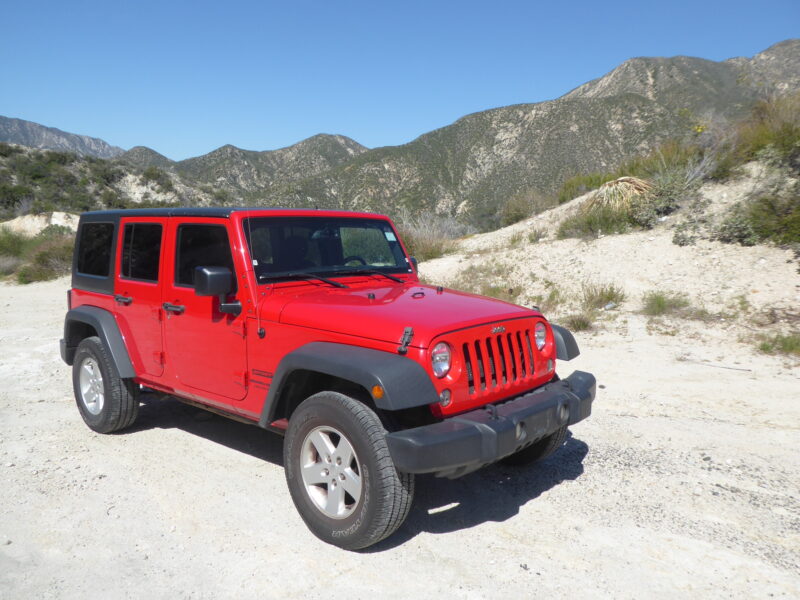
The Wrangler you see here looks very little different from the first Wrangler of 1986, but actually, this is a third generation model. Every 10 years or so, Jeep have introduced a new design. This one is known as the JK Series and it dates back to 2006. Developed under the ownership of DaimlerChrysler, the JK was Jeep’s first Wrangler that was a completely clean-sheet design of the body, frame, and suspension. New features for the Wrangler included power windows, remote power door locks, navigation, as well as electronically detachable sway bars on some models. Along with the traditional 2-door model, a 4-door “Unlimited” model was released, offering considerably more room, thanks to an over 20 inches (50 cm) longer wheelbase. These became quite successful sellers. By mid-2017, the four-door models represented three-quarters of all new Wranglers on the market. As a true American icon, there are usually some Wranglers in the Hertz fleet, but they are very popular so whilst I’ve seen them parked up, I’ve never actually managed to rent one, until now. A large batch of Wranglers have just arrived on fleet, and there are actually the latest JL Series, which first appeared in 2018, but the one I selected for now was one of the remaining JK Series cars. My logic for selecting the older vehicle is that I hope to be able to try the new one as well, and see how much of an improvement it is. By all accounts, although it may look similar (the location of the front indicator units is the easiest visual clue!), but is really quite different in many ways. So, for the last day of my Spring 2023 trip, I had the keys for one of the last of the JK Series Wrangler models. It was the four door hardtop, and as you need Torx keys and at least two people to get the roof off, it remained a closed-top vehicle for my test. Here is what I found out.


Every 2018 JK Series Jeep Wrangler is powered by a 3.6-litre V6 engine that produces 285 bhp and 260 lb/ft of torque. Four-wheel drive is standard and includes high- and low-range gearing. The Rubicon features uniquely short gearing and an upgraded transfer case with an extra-low crawl ratio. A six-speed manual transmission with hill start assist is standard, while a five-speed automatic with both hill start assist and hill descent control is optional. Towing is rather meagre at a maximum of 2,000 pounds for the Wrangler and 3,500 pounds for the Unlimited. 285 bhp sounds pretty decent and the on paper figures are not bad but in practice, I found that you had to work the Wrangler quite hard to keep up with the flows of traffic on the freeway and you need to push at it for momentum on the inclines of the canyon roads. The consequence of this and the brick-like aerodynamics is that it was not what you would call economical. I covered 126 miles and needed 6.1 gallons to fill it up which works out at just 20.65 mpg US or 24.68 mpg Imperial. The test car had the optional five speed automatic transmission and it seemed well matched to the engine, providing smooth and timely gear shifts. There is an old-school PRNDL lever, and I found that it was a bit of a stretch in Park. You need a conventional key to start it.


Getting the balance right between on-and off-road driving capabilities is hard and Jeep probably focused quite a lot on the latter. So on the surfaced road, it is not that impressive. There is quite a lot of slop in the steering around the straight ahead but it gets better as you turn the wheel. This is not a vehicle you will push hard on twisty roads, as it is clearly not designed for them, though there is of course plenty of grip and you get the feeling that you might be less likely to get in trouble on those roads than with a car which encourages you to try harder and faster. The real problem, though is the ride. Truly this is terrible. Without question the worst I have experienced for a long time. The Wrangler seemingly bounces all the time and it was never comfortable, no matter what the (paved) surface. It comes on 235/75 R17 wheels. It is also pretty noisy. A long journey in this really would be quite testing. At least there are no problems with the brakes which worked well. There is a conventional pull-up handbrake between the seats. Visibility is excellent, thanks to large door mirrors and the fact that you are sitting up quite high. Because of the age of this generation Wrangler, there are none of the more recent electronic safety features and the car has some poor overall safety ratings from the various testing agencies.


The interior of the Wrangler is not plush, but the material quality seems appropriate for a vehicle that is intended to be taking off-road and which may well get a bit grubby in the process. There is a leather-wrapped steering wheel but mostly it is hard plastics here. The overall design of the dash can be summarised as “chunky” and there are a few odd ergonomic quirks here. For instance, the electric window switches are on the dash below the central air vents and the switches to adjust the door mirrors are low in the centre of the dash. I guess this is because there are models available where the doors are taken off. The instruments are traditional physical dials with green dot matrix style graphics for things like the odometer which show the age of the JK Series. There are two large dials for speedometer and rev counter, with arcs over a half moon shaped in a round unit and there are background graphics 80s style showing a green mountain. Fuel level and water temperature gauges are outside the main pair. There are twin column stalks for indicators, lights and wipers and there are wheel-mounted buttons for cruise control and audio repeaters. Mounted high in the centre of the dash, there is what feel like a very old-school audio set up which includes the now rarely seen CD slot. It is the system that used to feature in other FCA products in the early 2010s and the graphics make that very obvious, though the upside is that it is very easy to use. You do get XM Satellite radio but this is one area where the Wrangler really shows its age with the lack of more modern features. Beneath this unit are three rotary dials for the air conditioning system. Compared to modern vehicles, this is all refreshingly simple to use.


Thanks to the raised ground clearance, it is quite a climb up to get into the Wrangler, but the consequence of this is that you sit high up and have a very commanding driving position which gives great visibility all around. There is manual seat adjustment, though in this Sport trim, the passenger misses out on a height adjuster. Headroom is plentiful, so there is also quite a feeling of space.


There is plenty of space for those in the back, too and access is a lot easier than with the two door car, even though the rear doors are not that large. Even with the front seats set well back, there should be enough leg room. The Wrangler is wide enough to seat three and there is masses of headroom. Occupants here get map pockets on the back of the front seats and there are stowage nets on the doors.


Perhaps not surprisingly, the boot is not that big, but you get more space here than you do with the two door models. It’s not that wide but you can load it up height wise. There is a split tailgate, so to gain access you have first to release the lower half, which swings to the side and needs quite a lot of clearance to do so. You can then raise the rear window. That means that access is good. It’s a slightly cumbersome process, necessitated as the spare wheel as mounted on the lower half of the tailgate and it sticks up above the bottom of the rear window, but mounting it outside does at least give more room inside. The rear seat backrests are asymmetrically split and drop down to provide additional cargo capacity. Inside the cabin there are not that many places for odds and ends. There is a small glovebox and there are some small nets on the doors. There is a deep central armrest cubby and a stowage net in front of the gearlever.


The 2018 Jeep Wrangler is available in a pair of body styles: the two-door, four-passenger Wrangler and the four-door, five-passenger Wrangler Unlimited. Each is available in three core trim levels — Sport, Sahara and Rubicon — with additional special models that are based on those trims. A vinyl convertible roof is standard on both, but a hardtop with easily removable panels above the front seats is available. Don’t expect many creature comforts in the base Sport trim level. It includes 16-inch steel wheels, on/off-road tyres, a full-size spare tyre, skid plates, tow hooks, foglights, removable doors, a fold-down windshield, manual mirrors and locks, full metal doors with crank windows, cruise control, a height-adjustable driver seat, cloth upholstery, a tilt-only steering wheel, a one-piece folding, tumble-forward backseat, and an eight-speaker sound system with a CD player and an auxiliary audio jack. The Unlimited version gets a bigger gas tank, air-conditioning and a 60/40-split folding, tumble-forward seat. The Power Convenience Group adds power windows and locks, keyless entry, heated power mirrors, a security alarm and an auto-dimming mirror. The Cold Weather package adds the Power Convenience Group’s equipment plus remote start and heated seats. Also available for the Sport are 17-inch alloy wheels, air-conditioning (for the two-door) and a leather-wrapped steering wheel. The Sahara adds the Power Convenience Group items, 18-inch alloy wheels, automatic LED headlights, LED foglights, additional painted exterior body panels and trim, hood insulation for reduced noise, air-conditioning, a leather-wrapped steering wheel and satellite radio. The Unlimited differs only with tubular side steps and grab handles for rear passengers. Instead of adding a bunch of luxurious items, the Rubicon Wrangler gets a host of off-road goodies. It starts with the basic Sport equipment and adds 17-inch alloy wheels, special tires, a heavy-duty Dana 44 front axle (matching the standard-spec Dana 44 rear axle), shorter 4.10 axle gearing (standard with the manual transmission; optional with the automatic), an upgraded transfer case with a lower crawl ratio, electronic front and rear locking differentials, an electronically disconnecting front sway bar, rock rails, automatic LED headlamps and the under-hood insulation. Inside, you get standard air-conditioning plus the leather-wrapped steering wheel and shift knob, a 115-volt outlet and satellite radio. The above-mentioned Power Convenience Group is an optional extra on the two-door Rubicon, but it’s standard on the Rubicon Unlimited. Even though you can only get the 4.10 gearing with a Rubicon, the Sport and Sahara are eligible for an upgrade to a 3.73 ratio, which gets you much of the way there. The standard ratio is a modest 3.21. Also optional on Sport and Sahara is a limited-slip rear differential, and the Sport and Rubicon can be equipped with half doors that include plastic side windows and manual locks. The Sahara and Rubicon are available with automatic climate control and leather upholstery bundled with heated front seats. Optional on every Wrangler is a nine-speaker Alpine sound system and the Connectivity Group, which adds a tire-pressure monitor display, a leather-wrapped steering wheel, Bluetooth phone connectivity, a trip computer, and an upgraded version of the Uconnect 430 touchscreen (available separately) that includes a USB port, media player interface, 28 gigabytes of digital music storage and navigation. All trims are also available with a higher-quality soft top as well as a black or body-coloured hardtop. On top of all the optional equipment to sort through, there are also special-edition packages. The Willys Wheeler is based on the Sport and includes a limited-slip rear differential, gloss-black 17-inch alloy wheels and exterior trim, special badging, privacy glass, mud terrain tires, rock rails, the 3.73 ratio, the Connectivity Group and satellite radio. There’s also the Sahara-based 75th Anniversary Wrangler. The 75th Anniversary has special exterior paint and trim, 17-inch wheels, winch-ready steel bumpers and a Power Dome hood. Finally, the Rubicon Hard Rock is based on the Rubicon and has black 17-inch wheels and exterior trim, winch-ready steel bumpers, a Power Dome hood, red tow hooks, upgraded rock rails, black leather upholstery, heated seats, the Alpine sound system and special badging.


I definitely enjoyed sampling the Wrangler, but was also not unhappy handing it back after only a few hours. More than with any other car, I think, you really do need to know what you are taking on. Whilst the time-warp features are in a way quite charming, it is uncomfortable in the extreme and very thirsty, so a long journey in this would be a real challenge. Pick a Wrangler for its image and style and for pottering around in (or heading off-road, but that’s not really something that rental car companies want you to do!) and you will enjoy the experience, as I did. I do now need to source one of those newer fourth generation JL Wranglers to see just how much more civilised they are. I think I will enjoy what I find when I get one.