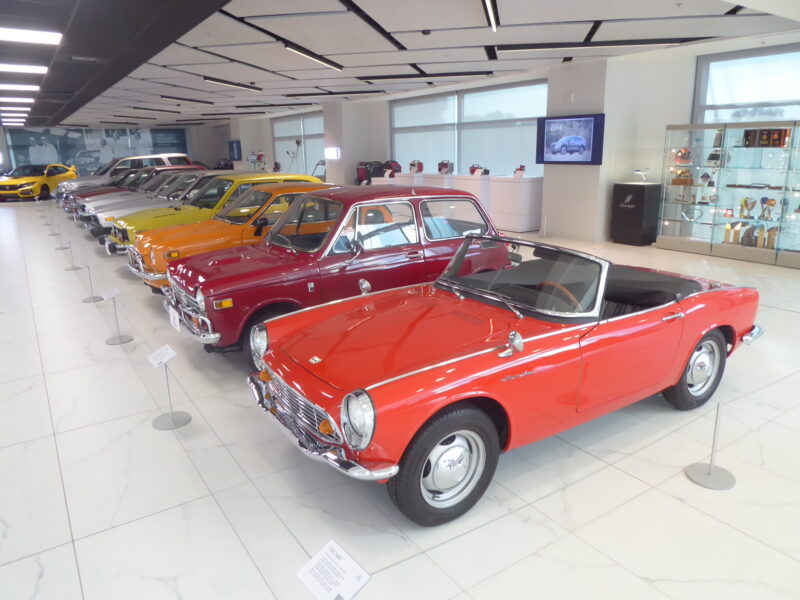
It was an article in Classic & Sportscar magazine which alerted me to the existence not just to this collection but to the fact that is open to the public. Having opened in September 2023, it is definitely still not well known, even quite locally, as when I mentioned it to the staff at the Hertz LAX facility they had no idea that just a few miles away there was this collection of historic Honda and Acura models. And even better, access is completely free of charge. The American Honda Collection is housed in a couple of rooms to one side of the main entrance hall of the American Honda US headquarters in Torrance California, and it is open during office hours Monday to Friday, and also when there is a “Cars, Bikes and Coffee” style event taking place on selected Saturdays during the summer season. You can just park up on site in the visitor parking area and walk in, which is what I did.


The Honda story in the US goes back to 1959. To evoke that period, you start off in what is known as the Pico Room, with an entrance themed after the original Honda headquarters on Pico Boulevard in Los Angeles. Back then, Honda only produced motorcycles, including the Benly, Dream and Super Cub — the latter being the best-selling motorized vehicle of all time.


Since then, Honda has become an American leader in mobility, including the Honda and Acura automobile brands, powersports and power equipment products, marine engines, and even a jet airplane, while continuing to innovate for the future. There are examples of some of the most significant cars and bikes that have been sold and in some cases manufactured in America over the last 60 years. Needless to say, the collection is far bigger than the space available, so you only get a subset of everything that Honda has carefully tucked away, and I understand that the displays are changed periodically, so if you were to go now you may see some different cars and bikes to the ones depicted here.
N600: Honda’s idea for a practical kei-class car came to life with the N360 series. The “N” stood for “norimono”, which means “vehicle” in Japanese. Hitting the market in March 1967, the N360 was built for domestic sales in Japan, while the N600 was destined for the European and American markets. The N600 was the first automobile Honda sold in America. As such, it is the genesis for every Honda hatchback that followed, both here and in Japan: Life, City, Today, Civic, and N-One. The drivetrain was even used as the basis for other Hondas, such as the TN360, Life Step Van and truck, Vamos, and Z-series. The engine for the N-series was derived from the CB450 motorcycle. Both cars originally came standard with manual transmissions, but offered an automatic transmission option starting in 1968, making the N360 the first kei-class car to do so.


S800: Introduced at the 1965 Tokyo Motor Show, the S800 would replace the successful Honda S600 as the company’s image car and would compete with the Austin-Healey Sprite, MG Midget, Triumph Spitfire and Fiat 850 Spider. Like the S600, it was available as either a coupe or roadster and continued the advanced technology of its predecessors. The 791 cc straight-4 engine produced 70 hp at 8000 rpm, thus making this Honda’s first 100 mph automobile, but still allowing for 35 mpg. In April 1967 the car was described as the fastest production 1-litre car in the world thanks to its high revving engine (up to 10,000 rpm) and the manufacturer’s history of manufacturing powerful relatively low capacity motor-cycle engines. Early examples continued to use the chain drive and independent suspension in the rear. 752 roadsters and 242 coupés were then produced. After that Honda switched to a conventional drive-shaft, live axle rear end with four radius rods and a Panhard rod. 604 roadsters and 69 coupes were built with this setup before disc brakes replaced the front drums. In 1967, the S800 became available in Britain. By this time the model had the more conventional drive layout as stated above, with predictable handling and a firm ride. It was also cheaper than the Mini Cooper and Triumph Spitfire, in Britain. In February 1968, the S800M (aka S800MK2) was introduced with flush mounted interior door handles, side marker lights outside, dual-circuit brakes, lean burn carburetion under the bonnet and safety glass. These changes were made for the American market, but the car was never exported there officially. Production ended in May 1970 with 11,536 S800s produced. Honda did not manufacture another S roadster for nearly thirty years until the release of the S2000 for the 2000 model year.


Z: The two-door Honda Z debuted in October 1970 and was marketed until 1973 in most countries. It complied with Japan’s kei car regulations, which are highly governed. The smaller-engined Honda Z360 was available in Japan (and other markets, such as Australia) with a 354 cc twin. In the UK they came only in 600 cc form and were called simply ‘Honda Z’ with no mention of the engine size in the name. The Z360 originally featured an air-cooled, 354 cc, 2-cylinder SOHC engine with a 4- or 5-speed transmission driving the front wheels. Outputs were 31 hp at 8500 rpm for the Act and Pro versions, and 36 hp at an astronomical 9000 rpm for the sportier TS and GS models. The Z600 model’s 598 cc SOHC engine was rated at 36 hp. In December 1971, the Z360 received a facelift and a water-cooled engine, it too producing 36 hp at 9000 rpm. Only a month later, the 31 PS engine used in the lower spec variants (Standard, Deluxe, Automatic, Custom) also became water-cooled. The engine’s technical achievements reflected influence from Honda’s larger 1.3 litre air-cooled four cylinder used in the Honda 1300 coupe and sedan. The Z featured coil sprung and independent front suspension and leaf springs on a beam axle rear suspension. The interior accommodated two adults, with a very small rear seat A rear glass hatch with a black plastic surround opened to a shallow cargo area. Below the cargo area a compartment, accessible via a lid beneath the number plate, held the spare wheel and tools. Later versions, after a November 1972 facelift, deleted the extra lid and also moved the license plate down to the position it vacated. These also received the new EA engine of 356 cc, now only available in a more powerful, 36 hp version. Production ended in 1974, after the new Civic had arrived and the Oil Crisis had diminished the market for “fun” cars. Total production was 40,586 units. In Europe only the Z600 was marketed, as the N360 had been considered underpowered. 918 cars were sold in Europe, most of them in France and Switzerland. A large number of these cars found their way to Germany (where it had not been marketed), where the engines were downsleeved to 242 cc in order to fit a particular “Class IV” category of driver’s licenses which did not require an exam. These models first appeared in 1969 after the last 250 cc car in regular production, the Goggomobil 250, had been discontinued. The engine offered from 12.5 to 14 PS and provided a top speed of 85 km/h (53 mph).


Civic: The first-generation Civic was introduced on 11 July 1972, but sold as a 1973 model in Japan. It was equipped with a 1,169 cc four-cylinder water-cooled engine and featured front power disc brakes, reclining vinyl bucket seats, simulated wood trim on the dashboard, as well as optional air conditioning and an AM/FM radio. The Civic was available as a two- or four-door fastback sedan, three- and a five-door hatchback, as well as a five-door station wagon. Because of the 1973 oil crisis, consumer demand for fuel efficient vehicles was high, and because of the engine being able to run on either leaded or unleaded fuel, it gave drivers fuel choice flexibility over other vehicles. The Compound Vortex Controlled Combustion (CVCC) engine debuted in December 1973, with a head design that allowed for more efficient combustion, and as a benefit the CVCC system did not require a catalytic converter or unleaded fuel to meet 1975 Environmental Protection Agency emissions standards for hydrocarbons and carbon monoxide. The Civic was joined by a platform expansion of the three-door hatchback, called the Honda Accord in 1976. A second generation model debuted in 1979 going on sale in Europe in early 1980.


Accord: The first-generation Honda Accord was launched on 7 May 1976, as a three-door hatchback with 80 PS JIS (similar to SAE Gross), a 2,380 mm (93.7 in) wheelbase, and a weight of about 900 kg (2,000 lb). North American market cars claimed 68 hp, while European and other export markets received a model without emissions control equipment; it claimed 80 PS as well but according to the stricter DIN norm. It was a platform expansion of the earlier Honda Civic at 4,125 mm (162 in) long. The engine was a long-stroke derivative of the Civic’s 1.2 and 1.5-liter engines. To comply with gradually tightening emission regulations enacted in Japan, the engine was fitted with Honda’s CVCC technology. The Accord sold well due to its moderate size and great fuel economy. It was one of the first Japanese sedans with features like cloth seats, a tachometer, intermittent wipers, and an AM/FM radio as standard equipment. In 1978 an LX version of the hatchback was added which came with air conditioning, a digital clock, and power steering. Until the Accord, and the closely related Prelude, power steering had not been available to cars under two litres. Japanese buyers were liable for slightly more annual road tax over the smaller Civic, which had a smaller engine. On 14 October 1977 (a year later in the U.S. market), a four-door sedan was added to the lineup, and power went to 72 hp when the 1,599 cc EF1 engine was supplemented and in certain markets replaced by the 1,751 cc an EK1 unit, producing 72 hp (54 kW) with the GK-5 5-speed transaxle, or 68 hp with the 2-speed Hondamatic. Technically, the sedan was not changed from the hatchback, and the wheelbase remained the same as well. This did result in a rather long rear overhang to fit a full-sized boot. The roof was a bit taller so as to provide more interior comfort, and the Accord Sedan was the first Honda in Japan to be offered with typically Japanese middle-class extras such as ornate hubcaps and lace seat covers. In the U.S. market, the sedan was available in three colours: Livorno Beige with beige cloth interior, Silver with maroon cloth interior, or dark red with maroon cloth interior. In 1980 the optional two-speed semi-automatic “Hondamatic” transmission of previous years became a three-speed fully automatic gearbox (a four-speed automatic transaxle was not used in the Accord until the 1983 model year). The North American versions had slightly redesigned bumper trim. Other changes included new grilles and taillamps and remote mirrors added on the four-door (chrome) and the LX (black plastic) models. The CVCC badges were deleted, but the CVCC induction system remained. At the same time, California-specification engines received a four-port exhaust valve head and a catalytic converter. This version of the EK1 engine was equivalent to the 1981 49-state High Altitude engine, omitting the air jet controller device that helped maintain the proper mixture at higher altitudes (above 4000 feet). The horsepower increased from 72 hp for 5-speed cars and 68 hp for automatic cars with the two-port 49-state engine to 75 hp, like the 1981-83 versions. A second generation car was launched in late 1981.


Prelude: On 24 November 1978, the Prelude was launched to the Japanese market. It had its world premiere at the 1979 AutoRAI in Amsterdam, two months later. In Japan it was only available at the newly established dealership sales channel Honda Verno. This dealership chain also introduced the Honda Quint, the Honda Ballade, and the Accord-based Honda Vigor as its largest sedan and hatchback. The four-wheel independent struts, brakes, and engine were all borrowed from the first-generation Accord, but the chassis was all new and developed by chief engineer Hiroshi Kizawa expressly for the sporting Prelude. At 4,090 mm (length) x 1,635 mm (width) x 1,290 mm (height), it had quite a low and wide profile. The wheelbase was 2,320 mm, and was 60 mm shorter than that of the original Accord. Honda appears to have followed the successful introduction of the Toyota Celica example by taking a small car, like the Accord, installing a more powerful engine, and giving the body a short trunk, and a long engine hood. The Prelude (and period Accord) were the first cars under two liters to receive standard power steering. The Prelude also benefited from Honda’s experience with sporting cars like the Honda S800 and Coupé 1300. The Prelude was the first Honda model to offer a power moonroof as standard equipment, which eventually became a Prelude trademark. In Japan, the Prelude was available with a sliding metal sunroof, while US versions received a glass top which freed up more headroom. Japanese buyers were liable for slightly more annual road taxes over the smaller Civic, which also had a smaller engine. While marketed as a 2+2, the rear seat was not usable for anyone larger than a small child. Initial reviews for the Prelude were favorable. “It is,” wrote Brock Yates for Motor Trend, “by any sane measurement, a splendid automobile. The machine, like all Hondas, embodies fabrication that is, in my opinion, surpassed only by the narrowest of margins by Mercedes-Benz. It is a relatively powerful little automobile by anybody’s standards.” Motor Trend measured an early Prelude completing the quarter-mile in 18.8 seconds at 70 mph. In terms of underpinnings it was mostly a Honda Accord, although its more compact package and lower weight allowed for a marginally higher top speed and gas mileage. The standard engine at the time of introduction was the “EL” SOHC eight-valve 1,602 cc (non-CVCC) inline-four rated at 80 PS at 5,000 rpm and 127 Nm (93 lb/ft) at 3,500 rpm. It remained the only engine available for most markets, aside from the US and Japan. It featured a non-automatic choke with three positions and a two-barrel carburetor. In September 1978 the larger “EK” SOHC 12-valve 1,751 cc CVCC inline-four was introduced in Japan, rated at 90 PS at 5,300 rpm (SAE gross). Automatics had five less horsepower. It took until March 1979 for the Prelude to appear in the United States, then with 72 hp at 4,500 rpm and 94 lb/ft (127 Nm) at 3,000 rpm (SAE net) from the larger 1.8 engine. The EK engine made use of an engine oil cooler and transistor-controlled ignition system. Transmission choices were either the standard five-speed manual or initially a two-speed “Hondamatic” semi-automatic, which by October 1979 had been replaced by a three-speed automatic that used the final gear as the overdrive. In addition to the standard fabrics offered in most models, an ‘Executive’ option was offered in some markets which added power steering and Connolly leather upholstery. Honda used a single central gauge cluster design in this car which housed the speedometer and tachometer in one combined unit where both instrument’s needles swept along the same arc. They also placed the compact AM/FM radio unit up high next to the gauge cluster. The Prelude featured intermittent wipers, tinted glass, and a remote trunk release. 1980 saw the introduction of the CVCC-II engine which employed the use of a catalytic converter and several other refinements that improved driveability, the Prelude also received a mild facelift in 1981. This facelift meant a return to a more traditional dashboard, rather than the much critiqued “Concentrated Target Meter” used before. The 1981 Prelude also received a stainless steel trim strip along the bumpers and side mouldings, as well as a new grille. 313,000 units were manufactured by Honda from 1978 to 1982, with over 80% being sold outside of Japan. 41,190 Preludes were sold in the home market during its production run. The Prelude was introduced in Europe during 1979, but was not a strong seller, its high asking price not helping its chances of sales success. A second generation model was launched in late 1982.


Accord: Debuted on 22 September 1981, in Japan, Europe, and North America, this generation of the Accord being produced in Japan, also became the first to be built in the United States, at Honda’s plant in Marysville, Ohio. Since its first year in the American market, it also became the best-selling Japanese nameplate in the United States, retaining that position for about 15 years. In Japan, a sister model called the Honda Vigor was launched simultaneously with the new Accord. This allowed Honda to sell the product at different sales channels called Honda Clio, which sold the Accord, and Honda Verno, that sold the Vigor. Modernizing the interior and exterior, the second-generation Accord was mechanically very similar to the original, using the same 1,751 cc EK-1 CVCC engine in the Japanese market. Vehicles with a manual transmission and the CVCC carburetor earned 13.6 km/L (38 mpg‑imp; 32 mpg‑US) based on Japanese Government emissions tests using 10 different modes of scenario standards, and 110 PS, and 23 km/L (65 mpg‑imp; 54 mpg‑US) with consistently maintained speeds at 60 km/h. European market cars received the tested 1.6-litre EL1 engine with 80 PS DIN at 5000 rpm. This car included popular features of the time such as shag carpet, velour cabin trim, and chrome accents. An optional extra on the 1981 Accord was an Electro Gyrocator, the world’s first automatic in-car navigation system. Japanese market cars were available in Silver, Sky Blue, and Beige. The LX hatchback offered a digital clock and slightly higher fuel economy (due to its lighter weight). In Europe, the Accord was available as a fairly well equipped (for the time) standard version, as well as a very luxurious EX model at a modest upcharge. In the United States, Federal lighting regulations required headlamps of sealed beam construction and standard size and shape on all vehicles, so Accords in North America were equipped with four rectangular headlamp units rather than the aerodynamic composite replaceable-bulb units used on Accords sold outside North America (note European specification imagery). Other Automotive lighting variations included amber front and red rear side marker lights and reflectors in North America, and headlamp washers and a red rear fog lamp for European markets. Japanese-market Accords were unique from all other markets in that they offered adjustable ride height control and side-view mirrors installed on the mid-forward wings. In November 1982, Honda made a fully four-speed automatic available with the 1.8-litre engine, a major improvement over the earlier, three-speed semi-automatic “Hondamatic” transmission. This quickly filtered through to export markets, where the outdated Hondamatic was soon superseded entirely. The manual five-speed transmission remained unchanged. A new 120 mph speedometer replaced the earlier 88 mph unit. The Special Edition (SE) featured Novillo leather seating, power windows, a power sunroof, and door locks. Gray was added as a colour option. A slightly modified EK-2 engine was introduced, replacing the earlier EK-1, albeit still carbureted. By 1983, Accords sold in the eastern United States were produced at the new Marysville plant, with quality considered equal to those produced in Japan. In June 1983, for the 1984 model year, the Accord body was restyled with a slightly downward beveled nose and a new series of 12-valve CVCC powerplants. Globally there was a 1.6 (EY) and also the slightly more powerful ES2 1,829 cc, yielding 86 bhp in federal trim. Honda integrated rear side marker lights and reflectors into the side of the tail light units. European Accords now included a side turn signal repeater just behind each front wheel well. The U.S. requirement for standardised headlamps was rescinded in late 1983, but North American Accords continued to use sealed beams until the fourth-generation models were released in 1989. The LX offered velour upholstery, auto-reverse cassette stereo, air conditioning, cruise control, power brakes, power steering, power windows and power door locks (sedan only), a digital clock, roof pillar antenna, along with thick black belt moldings, integrated bumpers and flush plastic mock-alloy style wheels covers that resembled the trend-setting Audi 5000. Supplies were tight, as in the Eastern states, the wait was months for a Graphite Gray sedan, a then-popular colour. The LX hatchback was the only 1984 version of the Accord to include dual side-view mirrors. The 1983 Accord SE Sedan carried over features of the 1981 SE Sedan, including leather interior, power windows, power antenna, and aluminum alloy wheels. Some new features included a 7-band graphic equaliser, power booster and Dolby music sensor for the AM/FM cassette stereo system, and a power glass moonroof. Only one colour was offered in the SE trim: Dove Gray. The 1984 sedan was available in four exterior colours, Greek White and three metallic options: Columbus Gray, Regency Red (burgundy), and Stratos Blue (steel). The regular hatchback was available in Greek White, Dominican Red, and the metallic Stratos Blue. The 1984 LX hatchback came in three metallic colours only: Graphite Gray, Regency Red, and Copper Brown. It was one of the first Japanese engineered vehicles to offer computer controlled, fuel-injection with one injector per cylinder, also known as multiple port fuel injection. This arrived on 24 May 1984 on the ES series 1.8 L engine, and was known as Honda’s Programmed Fuel Injection, or PGM-FI. This option was not offered until 1985 in the United States market. Vehicles with PGM-FI (ES3 series engine) earned 13.2 km/L (37 mpg‑imp; 31 mpg‑US) based on Japanese Government emissions tests using 10 different modes of scenario standards, with 130 PS, and 22 km/L (62 mpg‑imp; 52 mpg‑US) with consistently maintained speeds at 60 km/h (37.3 mph). In 1985, the Special Edition returned as the SE-i, capitalizing on the final year of the second generation’s production. A fuel-injected, 101 bhp non-CVCC ES3 engine was exclusive to this model. The moniker, SE-i, was adapted from the SE trim, but included the “-i” to signify the higher trim level’s fuel-injected engine. This 12-valve, 1,829 cc (1.829 L; 111.6 cu in) engine was the first non-CVCC engine used in an Accord and was the same basic engine design used by Honda until 1989. Like the previous SE trim in 1983, the SE-i featured Novillo leather seating, power moonroof, bronze-tinted glass, a premium sound system with cassette, and 13-inch alloy wheels. The luxury equipment features on the SE-i paralleled the same features offered on the Honda Vigor VTL-i, which was only sold in Japan. Two colours were offered: Graphite Gray Metallic and Barley Brown Metallic. Available options differed from market to market. The 1.8-litre engine, updated four-speed automatic transmission, and ‘EX’ trim level options were first made available in New Zealand during the 1984 model year refresh alongside the 1.6-litre ‘LX’ model. Japan generally received more options earlier than the rest of the world. In 1981, the Accord offered an adjustable ride height air suspension in the Japanese market. From 1983 in Japan and 1984 in Europe, the second-generation Accord was available with anti-lock brakes (called ALB) as an option. This braking system was the first time that an Accord used four-wheel disc brakes. Fuel injection became available in 1984 in the Japanese market with the earlier introduction of the ES3 engine in the SE-i. Models took a year to arrive in North American and European markets with less stringent emissions laws continuing, using carburettors throughout second-generation production.


CR-X: In 1983 for the 1984 model year, Honda introduced an all-new two-seater that shared the drivetrain with the Civic but offered unique styling and interior furnishings. At its introduction, the CR-X was available in Japan through Honda Verno dealership sales channels, and accompanied the Vigor, the Quint, and the Prelude. In North America, the CRX was marketed in two versions: economy and sport. The economy model used a new aluminium 1.3-litre CVCC four-cylinder engine. The sportier model featured an aluminium 1.5-litre 12-valve engine and was available with either a 5-speed manual or a 3-speed automatic transmission. For 1985, Honda North America replaced the economy model with an HF (high fuel) model featuring a 1.5-litre engine which uses an aluminium block but the 1984 CVCC cylinder head (two valves per cylinder) instead of the new aluminium head with three valves per cylinder. In spring 1985, Honda introduced an Si (Sports, injected) model featuring a more powerful 1.5-litre SOHC PGM-FI four-cylinder engine. The Si model included a power sunroof, standard dual remote exterior mirrors, rear wiper, 13-inch alloy wheels and an Si-exclusive ducktail spoiler for the hatch. For 1986, Honda updated the CRX with new aerodynamic headlights. The Si received body colour matched lower cladding, a revised rear spoiler, new bumper covers and 14-inch alloy wheels. The interior was upgraded and added a centre console with cassette tape storage. 1987 was virtually unchanged from 1986 and would be the final year of the first-generation CRX.


Legend: The Legend is a mid-size luxury car manufactured by Honda from Japan. It was sold in the U.S. and Canada under Honda’s luxury brand, Acura, from 1985 until 1995. It was the first flagship sedan sold under the Acura nameplate, until being renamed in 1996 as the Acura 3.5RL. The 3.5RL was the North American version of the KA9 series Honda Legend. The opportunity for Japanese manufacturers to export more expensive models had arisen with the 1980s voluntary export restraints, negotiated by the Japanese government and U.S. trade representatives, restricting mainstream car sales. The initial success of the Legend and Honda’s Acura division in competing against established European and American luxury manufacturers would lead to Toyota and Nissan creating the Lexus and Infiniti brands, respectively, to compete in the luxury car market. Honda introduced the model in Japan on October 22, 1985, to be their premier luxury model, and in North America for the 1986 model year, as the top of the line model for its then-new Acura lineup. Sedan models came to the market first, powered by a 151 hp 2.5 L C25A V6, with coupes making their first appearance in 1987, powered by a new 161 hp 2.7 L C27A engine. Sedans received the new engine for 1988. The Legend was the first production Honda vehicle to offer a V6 engine. The 1987 Acura Legend LS coupe would be the first Japanese car to offer a driver’s side airbag. The Legend was a result of a joint venture with Britain’s Austin Rover Group called Project XX that started in November 1981 with the Austin Rover-Honda XX letter of intent signed by the two companies to replace the Rover SD1 and to provide a luxury vehicle for Honda. The Rover Company had a long established reputation as a luxury car in the United Kingdom and Europe, demonstrated with the Rover P6, and Honda wanted to introduce a luxury car for both domestic Japanese and the United States markets. The joint development produced the Legend and the corresponding British version was the Rover 800-series, which was badged under the Sterling brand in the United States and competed with the Legend. Rover also wanted to return to the American market when they had reportedly sold only 1,500 cars in 1971, and a brief return in 1980, selling 800 Rover SD1s by offering the Sterling. The Legend won Car and Driver’s Ten Best three years in a row and Motor Trend’s Import Car of the Year for 1987. Manual-equipped models could accelerate from 0-60 mph in under 8 seconds and reach a top speed of 135 mph (217 km/h). Sedan models had a drag coefficient of 0.32, while coupes were only 0.30. When the Legend was introduced, Honda’s newly established luxury car division just for the Legend was called Acura, using the advertising slogan “Precision Crafted Performance”, and the Legend was offered with one factory installed option, the choice of transmission used, and one trim level. In the 1986 sales brochure, the Legend’s full name used was “Legend Touring Sedan”. The vehicle was virtually identical in luxury content to the Japanese market V6Zi, but was identical in size and the longer overall length of the top level V6Xi to comply with United States crash standards, using the larger 2.5 V6 engine. The Technics supplied 80W four speaker cassette tape stereo offered four user programmable equalizer settings, and was equipped with a dual diversity antenna, meaning it had a conventional extendable power antenna and an embedded antenna in the rear window. One of the novelty items was a simple volume control rocker switch and a pre-set radio station channel selector installed on the instrument binnacle within reach of the right hand; the opposite side of the instrument binnacle had a button to open, tilt or close the standard equipped glass moonroof with sun shade. The North American Legend was not offered with some of the items offered in Japan, such as automatic, one-touch climate control, and 100% wool cloth interior in brown. Blue interior was shared with Japan and North America, but brown was not offered in North America, and “sand gray” was offered instead. Exterior colours were matched to only one interior colour choice and leather was not offered. Due to the success Honda had with the Legend, it served as an inspiration for the Subaru Legacy with which it shares many visual resemblances and dimensions both inside and out. In late 1988 for the 1989 model year, the sedan received some minor tweaks, upgrading to the one-piece front headlamps already in use in Japan since the 1985 introduction, a revised front bumper, trunk lid, tail light cluster, and an upgraded double-wishbone rear suspension, with a new alloy wheel appearance. By that time all Legends came equipped with a Honda-designed 4-wheel anti-lock brake system. A driver’s side airbag was now standard on all Legends. Other features such as power driver’s seat memory for 3 positions were added. High-end LS models featured a trip computer, electronic vehicle monitoring system in the centre console and a Bose sound system. It was also joined by the Acura Vigor which set the stage for the larger second generation Legend introduced October 1990. For the 1990 model year, all Legends came with body-coloured side mirrors. Legend coupes had a revised body-coloured front grille, new red & clear tail lights, and improved front seats. LS model coupes also received a trunk-mounted lip spoiler. All LS models featured burlwood interior trim. Production of the first-generation models ended in 1990 as a second-generation version became available for the 1991 model year. At least by the 1990 model year, the fuel filler door on the sedan had been moved rearward about 15 cm (5.9 in). From the exterior, there are only superficial similarities between the Legend and its Rover 800/Sterling cousin. Both cars share the 2.5L and 2.7L Honda engine with 160 hp and a 4-speed automatic transmission. The core structure and chassis design is also common to both cars, however the Rover version has its own exterior panelwork, interior and electrical systems. The Rover was also offered with a 2.0L in-line 4-cylinder engines, however the Legend was only available with V6 power regardless of market. In Japan only, Honda installed a turbocharger with variable geometry in the Legend with the smaller 2.0 L V6, called the “Wing Turbo” for model year 1989.


Integra: The Honda Integra, sold in North America as the Acura Integra and later the Acura RSX, is an automobile produced by the Japanese company Honda from 1985 until 2006, and then since 2021. It succeeded the Quint as a more luxurious and sport-oriented derivative of the Civic. The Integra was one of the launch models for Acura in the US in 1986 alongside the Acura Legend. Throughout its production run, the Integra was highly regarded for its handling and performance. The 1995–2001 Integra Type R is widely regarded as one of the best front-wheel-drive cars of all time. This vehicle debuted in Japan in February 1985 as the Honda Quint Integra, available only at Honda’s Japanese dealership sales channel Honda Verno before going on sale a year later in North America as part of the then-new luxury Acura lineup. The three-door liftback was the only model available originally, with a five-door arriving in October 1985, and a four-door saloon bodystyle becoming available in Japan in the autumn of 1986. Only the liftback versions were sold in the U.S. A 1.6 L DOHC 16-valve four-cylinder engine powered most versions. The engine was the vehicle’s most publicized feature, as DOHC, multi-valve engines were not commonplace in entry-level models at the time. In most European countries, only the five-door liftback was offered, as a replacement for the Honda Quint. Typically for European Integras, only the 1.5-liter 85 PS 4 Weber carburettors engine was available. The five-door liftback model was also sold in Australia rebadged as the Rover 416i. Except for in Britain, Honda did not offer the more powerful 1.6 DOHC fuel injection engine (in the UK known as the Integra EX16) in Europe. The ZC engine was also shared with the Honda Concerto, which was sold at newly established Japanese dealership sales channel called Honda Clio, which sold luxury oriented products like the Honda Legend. In Japan, while the VX- and RX-trimmed four-door (DA2) used the 1.5 L EW5 engine, all other model and trim combinations offered only the DOHC ZC engine, with a carburettor on GS, ZS, and LS trim packages, and PGM-FI on the top level GSi three- and five-door, and the RSi three-door trim package. Vehicles installed with a carburettor earned 15.4 km/L (44 mpg‑imp; 36 mpg‑US) in Japanese Government emissions tests and 115 PS, and 26 km/L (73 mpg‑imp; 61 mpg‑US) at consistent speeds above 60 km/h (37.3 mph). Vehicles with PGM-FI earned 14.4 km/L (41 mpg‑imp; 34 mpg‑US) in Japanese Government emissions tests with 135 PS, and 24.5 km/L (69 mpg‑imp; 58 mpg‑US) above 60 km/h (37.3 mph). In Japan, the Integra took the entry level marketing position at Honda Verno, below the sporty Prelude and larger, luxury focused Vigor. Compared to the US, the European Integra was aimed downmarket and generally lacked equipment, with neither trim level (LX or EX) offering painted bumpers, central locking, power windows, nor air conditioning, even though a small number of fully equipped, left-hand drive fuel-injected Integras were sold in the Netherlands. The Integra EX16 did offer a sunroof, painted bumpers, a rear spoiler and Hi-Fi stereo equipment, but neither electric windows, central locking nor air conditioning were available. This was considered as a drawback to its European competitors such as the Peugeot 309 1.6 injection and the Renault 11 Turbo, that all could be equipped with comprehensive, albeit expensive, equipment. The first Integra never became as popular in Europe as it did in the US, but was praised by most motor magazines for its styling and overall road performance. The styling reflected the popularity of Honda’s performance coupe, the Honda Verno sports coupe companion Honda Prelude, with the Integra offering a coupe for added cargo accommodation, and a slightly smaller appearance to the larger Honda Vigor. Largely unencumbered by emissions regulations, British market cars produce 85 PS in the 1.5 and 125 PS in the 1.6-liter EX16. Being designed as the successor of the Honda Quint, the Integra is closely related to the Civic, although it featured a small list of key upgrades over its smaller stablemate to help merit a price increase over the CRX Si, which was otherwise the sportiest subcompact vehicle being offered by Honda Verno; enlarged 4-wheel disc brakes replaced the small front-disc/rear-drum setup used by the Civic and CRX, suspension calibration was re-worked, better tires were used and a 113-hp DOHC fuel-injected 16-valve engine was used in place of the SOHC unit from the CRX Si. Just like the Prelude and the Vigor of that period, the Integra featured sleek, sporty pop-up headlights, like its Japanese dealership Honda Verno stablemates, with the CRX adopting semi-concealed doors over the headlights. Nearly 228,000 units were sold during the four-year run of the first-generation model, most of them in the United States. The first-generation Acura Integra came with 1.6-liter DOHC 16-valve 4-cylinder (D16A1) engine which received an update mid-cycle. The 86–87 engine is commonly called the “Browntop” while the 88–89 engines are referred to as the “Blacktop” due to the colour of their valve covers. The improvements in the “blacktop” engine included lighter rods, domed pistons for slightly higher compression, and an electric advance distributor (the “browntop” came with a vacuum advance distributor). The overall gain in performance was about 5 hp for 118 hp. The Integra received a minor facelift in 1987 for the 1988 model year which featured slightly reshaped indicator lights, an improved climate control system and an update of the instrument clocks. In Europe, the Integra five-door Liftback was discontinued in October 1989 following the launch of the Rover-based Honda Concerto. This was the only generation to offer 3-, 4-, and 5-door models. Production of the 5-door liftback ceased in 1988.


CR-V: The CR-V is an important vehicle is this now Honda’s best-selling model both in the US and globally. Seen here was an example of the first generation. The first generation CR-V or RD1 was Honda’s first in-house designed sport utility vehicle by Hiroyuki Kawase. When the CR-V was introduced in Japan in October 1995 it was sold only at Honda Verno and Honda Primo dealerships and exceeded Japanese government’s compact car regulations regarding exterior dimensions (maximum width of 1,700 mm (66.9 in), therefore incurred a more expensive annual road tax obligation. For the North American market, it was displayed at the 1996 Chicago Auto Show and went on sale in February 1997.Upon introduction, the model had only one trim level, which would later be known as the LX model trim; it was powered by the 2.0-litre straight-four B20B. Outer dimensions for this engine would be identical to the Integra’s 1.8 L engine, but internally the engine had a larger 84 mm bore vs 81 mm for the Integra, to add the extra displacement needed to produce more torque. The engine used a one-piece cylinder sleeve construction unique from any other B-series engine. The chassis and suspension was largely similar to the 4th-generation Honda Civic Shuttle (Wagon) with a unibody design with fully independent suspension. The vehicle’s suspension was double wishbone, while the rear used a trailing-arm-based multilink system. The rear seats were able to fold down and integrate with front seats that could fold flat, such that they formed a bed of sorts, about the size of a twin bed. Also, a picnic table was stowed in the rear floor area. All models featured plastic cladding covering the front bumper, rear bumper, and fender wells. In most countries, CR-Vs had a chrome grille; however, in the United States, the grille was made out of the same black plastic as the bumpers. The EX included anti-lock brakes and 15-inch alloy wheels over the LX trim. Drivetrain options were front-wheel drive or Honda’s Real Time AWD. For the 2000 model year, the European, Australian and Asian CR-V models featured more drastic changes. Exterior alterations included a new front bumper, smoothed off rear bumper, and a smaller plastic radio antenna on the rear of the roof. Some of the paint options changed. European models received an enlarged Honda emblem on the front grille, and a new metallic yellow paint in certain markets. The engine was changed to the 2.0 L B20Z engine, producing 147 hp at 6,200 rpm and 133 lb/ft (180 Nm) of torque at 4,500 rpm. This improved performance for the 3,200 lb (1,500 kg) vehicle. Fuel economy of 23 mpg‑US (10 L/100 km; 28 mpg‑imp) city/28 mpg‑US (8.4 L/100 km; 34 mpg‑imp) highway (US) and price were not affected by the increase in power, which was the result of a higher compression ratio (9.6:1 compared to the B20B’s 8.8:1), a new intake manifold, and slightly higher lift on the intake valves. This 16 percent increase in power resulted to a faster 0-60 mph of 8.6 seconds on the 5-speed manual 4wd. In 2000, an SE (Special Edition) model was introduced in North America. The SE featured body-coloured bumpers and side mouldings, a body-coloured hard spare tire cover, leather upholstery, CD/cassette audio deck, rear privacy glass, and chrome grille accent. Until 2001, the CR-V sold more than any other vehicle in its class. The North American models also received new exterior colours including Naples Gold Metallic and Taffeta White. Electron Blue was introduced in 2000 to replace Submarine Blue Pearl, while Satin Silver Metallic replaced Sebring Silver Metallic in 2001. However, that year, sales of the Ford Escape and its clone, the Mazda Tribute, surpassed those of the CR-V. The second generation model arrived at the very end of 2001.


Civic Coupe: Introduced in September 1995 for the 1996 model year, the sixth generation featured updated styling, although less radical than previous redesigns. Suspension and engine options were available along with the first natural gas powered Civic, the GX. In the United States, model year 1996 to 2000 Civics were sold under the CX, DX, EX, EXR, HX, LX, and for Canada, SE, and Si trims; all base models were made with 1.6-liter 4-cylinder engines. The EX-CX are all SOHC (Honda D engine). The CX, DX and LX all have SOHC (D16Y7) 4-cylinder engines; whereas the EX has a 1.6L 16-valve SOHC VTEC (D16Y8) engine producing 127 hp, and the HX has a D16Y5 VTEC-E engine producing 115 hp. The USDM Si and Canadian SiR came with a 1.6L 16-valve DOHC VTEC (B16A2) engine producing 160 hp. The first Civic Si coupe EM1 was introduced in 1999 and was produced until 2000. Europe saw a DOHC 1.6 VTi hatchback and sedan and a DOHC 1.8L engine was available for the Domani related 5-door liftback and estate. In Canada, the Acura EL is based on the Civic, and was replaced by the CSX in 2006.


Insight: Based on the Honda J-VX concept car unveiled at the 1997 Tokyo Motor Show, the Insight was introduced in Japan in November 1999 as the first production vehicle to feature Honda’s Integrated Motor Assist system. In the following month, December 1999, Insight became the first hybrid available in North America, followed seven months later by the Toyota Prius. The Insight featured optimised aerodynamics and a lightweight aluminium structure to maximize fuel efficiency and minimize emissions. In addition to its hybrid drive system, the Insight was small, light and streamlined — with a drag-coefficient of 0.25. The petrol engine is a 67 hp 1.0 litre, ECA series 3-cylinder unit providing lean burn operation with an air-to-fuel ratio that can reach 25.8 to 1. The engine utilises lightweight aluminium, magnesium, and plastic to minimize weight. The electrical motor assist adds another 10 kW (13 hp) and a maximum of 36 pound-feet (49 Nm) of torque when called on, with the aim to boost performance to the level of a typical 1.5 L petrol engine. It also acts as a generator during deceleration and braking to recharge the vehicle’s batteries, and as the Insight’s starter motor. (This improves fuel efficiency and extends the lifetime and fade resistance of the brakes, without adding unsprung weight). When the car is not moving, for example at a stop light, the engine shuts off. Power steering is electric, reducing accessory drag. The Insight uses the first generation of Honda’s Integrated Motor Assist (IMA) hybrid technology. (The next generation, used in the Honda Civic Hybrid, is much more space-efficient.) The Insight’s electric assist is an ultrathin 60 mm (about 2.4 inches) brushless 10-kW electric motor located on the crankshaft. Located behind the seats are a series of commercial grade “D” sized NiMH batteries wired to provide a nominal 144 V DC. During heavy acceleration, the NiMH batteries drive the electric motor, providing additional power; during deceleration, the motor acts as a generator and recharges the batteries using a process called regenerative braking. A computer control module regulates how much power comes from the internal combustion engine, and how much from the electric motor; in the CVT variant, it also finds the optimal gear ratio. The digital displays on the dashboard display fuel consumption instantaneously. On the manual transmission up and down arrows suggest when to shift gears. Dashboard gauges monitor the current battery status, instantaneous fuel consumption, and mode of the electric motor — standby, engine assist or charging the batteries. High pressure, low rolling resistance tires and the use of low viscosity “0W-20” synthetic oil enhance fuel economy. The original Insight had a conventional manual transmission. Starting with the 2001 model, a CVT variant of the Insight was available; the CVT is similar to that used in the Honda Civic Hybrid and the Honda Logo. A traditional transmission shifts between a fixed set of engine-to-wheel ratios; however, a CVT allows for an infinite set of ratios between its lowest gear and its highest. A feature shared by the two hybrids (and now appearing in others) is the ability to automatically turn off the engine when the vehicle is at a stop (and restart it upon movement). Since it is more powerful than most starters of conventional cars, the Insight’s electric motor can start the engine nearly instantaneously. The Integrated Motor Assist is run by an “Intelligent Power Unit (IPU)”, a desktop computer-sized box. The Intelligent Power Unit, the Power control Unit, the Electronic Control Unit, the vehicle’s batteries, dc-to-dc converter and a high-voltage inverter are all located under the cargo floor of the vehicle, behind the seats. Honda increased the vehicle’s fuel efficiency using aluminium and plastic extensively to reduce the vehicle’s weight. The basic structure is a new, lightweight aluminium monocoque, reinforced in key areas with aluminium extrusions joined at cast aluminium lugs. Stamped aluminium panels are welded onto this structure to form an extremely light and rigid platform for the drivetrain and suspension. The Insight has a body weight less than half that of the contemporary Civic 3-door, with increased torsional rigidity by 38% and bending rigidity by 13%. Honda built the Insight with aluminum front brake calipers and rear brake drums, and with a largely aluminium suspension, in addition to standard aluminium wheels; reducing the ratio of un-sprung to sprung weight as well as the total weight. The fuel tank is plastic; the engine mounts were aluminium; and the exhaust is a small, thin wall pipe. Its compact spare is also aluminium. The Insight weighed 1,847 lb (838 kg) in manual transmission form without air conditioning, 1,878 lb (852 kg) with manual transmission and air conditioning, or 1,964 lb (891 kg) with CVT and air conditioning. Insight has a coefficient of drag of 0.25e. The absence of a rear seat allows the body to taper just behind the driver and the rear track is 110 mm narrower than the front track. The CVT-equipped Insight is classified as a super-low emissions vehicle. The Insight features low emissions: the California Air Resources Board gave the 5-speed model a ULEV rating, and the CVT model earned a SULEV rating – the 5-speed model’s lean-burn ability traded increased efficiency for slightly higher NOx emissions. The Insight was assembled at the Honda factory in Suzuka, Japan, where the Honda NSX and the Honda S2000 were also assembled. At the 2003 Tokyo Motor Show, Honda introduced the concept car Honda IMAS, an extremely fuel-efficient and lightweight hybrid car made of aluminium and carbon fibre, which was perceived by most observers to be the future direction where the Insight was heading. With its aluminium body and frame, the Insight was an expensive car to produce and was never designed for high-volume sales. Instead, it was designed to be a real world test car for hybrid technology and a gauge to new consumer driving habits. With an aerodynamic fuel-saving shape similar to the Audi A2, and some unconventional body colors it was a bit more than mainstream car buyers could handle, preferring more conservative styles. Production halted announced in May 2006, with plans announced to replace Insight with a new hybrid car, smaller than the eighth generation Civic, but not earlier than in 2009. Ahead of this announcement, Honda stopped selling Insight in the UK, for example, as early as December 2005. To fill the market niche void, in 2002 Honda rolled out a hybrid version of the Honda Civic – Honda Civic Hybrid, followed by Toyota’s redesign of the Prius in 2003 as a 2004 model. Total global cumulative sales for the first generation Insight were 17,020 units. Honda had originally planned to sell 6,500 Insights each year of production.


NS-X: It is more than thirty years since Honda stunned the world with a true Ferrari-beater. Its origins go back all the way to 1984, when Honda commissioned the Italian car designer Pininfarina to design the HP-X (Honda Pininfarina eXperimental), which had a mid-mounted C20A 2.0 L V6 configuration. After Honda committed to the project, management informed the engineers that the new car would have to be as fast as anything coming from Italy and Germany .The HP-X concept car evolved into a prototype called the NS-X, which stood for “New”, “Sportscar” and “eXperimental”. The NS-X prototype and eventual production model were designed by a team led by Chief Designer Ken Okuyama and Executive Chief Engineer Shigeru Uehara, who subsequently were placed in charge of the S2000 project. The original performance target for the NS-X was the Ferrari 328, and later the 348 as the design neared completion. Honda intended the NS-X to meet or exceed the performance of the Ferrari, while offering targeted reliability and a lower price point. For this reason, the 2.0L V6 of the HP-X was abandoned and replaced with a more powerful 3.0L VTEC V6 engine. The bodywork design had been specifically researched by Okuyama and Uehara after studying the 360 degree visibility inside an F-16 fighter jet cockpit. Thematically the F-16 came into play in the exterior design as well as establishing the conceptual goals of the NSX. In the F-16 and other high performance craft such as unlimited hydroplanes, single seat race cars etc. the cockpit is located far forward on the body and in front of the power plant. This “cab-forward” layout was chosen early in the NSX’s design to optimise visibility while the long tail design enhanced high speed directional stability. The NS-X was designed to showcase several Honda automotive technologies, many derived from its F1 motor-sports program. The NS-X was the first production car to feature an all-aluminium monocoque body, incorporating a revolutionary extruded aluminium alloy frame, and suspension. The use of aluminium in the body alone saved nearly 200 kg in weight over the steel equivalent, while the aluminium suspension saved an additional 20 kg; a suspension compliance pivot helped maintain wheel alignment changes at a near zero value. Other notable features included an independent, 4-channel anti-lock brake system; titanium connecting rods in the engine to permit reliable high-rpm operation; an electric power steering system; Honda’s proprietary VTEC variable valve timing system (a first in the US) and, in 1995, the first electronic throttle control fitted to a Honda. With a robust motorsports division, Honda had significant development resources at its disposal and made extensive use of them. Respected Japanese Formula One driver Satoru Nakajima, for example, was involved with Honda in the NS-X’s early on track development at Suzuka race circuit, where he performed many endurance distance duties related to chassis tuning. Brazilian Formula One World Champion Ayrton Senna, for whom Honda had powered all three of his world championship-winning Formula One race cars before his death in 1994, was considered Honda’s main innovator in convincing the company to stiffen the NSX chassis further after initially testing the car at Honda’s Suzuka GP circuit in Japan. Senna further helped refine the original NSX’s suspension tuning and handling spending a whole day test driving prototypes and reporting his findings to Honda engineers after each of the day’s five testing sessions. Senna also tested the NSX at the Nurburgring and other tracks. The suspension development program was far-ranging and took place at the Tochigi Proving Grounds, the Suzuka circuit, the 179-turn Nurburgring Course in Germany, HPCC, and Hondas newest test track in Takasu, Hokkaido. Honda automobile dealer Bobby Rahal (two-time CART PPG Cup and 1986 Indianapolis 500 champion) also participated in the car’s development. The production car made its first public appearances as the NS-X at the Chicago Auto Show in February 1989, and at the Tokyo Motor Show in October 1989 to positive reviews. Honda revised the vehicle’s name from NS-X to NSX before final production and sale. The NSX went on sale in Japan in 1990 at Honda Verno dealership sales channels, supplanting the Honda Prelude as the flagship model. The NSX was marketed under Honda’s flagship Acura luxury brand starting in 1991 in North America and Hong Kong. It sent shockwaves through the industry, as the car was considerably better than the Ferrari 348 in just about every respect. But that was not the end of the story, of course. While the NSX always was intended to be a world-class sports car, engineers had made some compromises in order to strike a suitable balance between raw performance and daily driveability. For those NSX customers seeking a no-compromise racing experience, Honda decided in 1992 to produce a version of the NSX specifically modified for superior on-track performance at the expense of customary creature comforts. Thus, the NSX Type R (or NSX-R) was born. Honda chose to use its moniker of Type R to designate the NSX-R’s race-oriented design. In 1995, a Targa model was released, the NSX-T, which allowed customers to experience fresh air thanks to two removable targa top panels. The original NSX body design received only minor modifications from Honda in the new millennium when in 2002 the original pop-up headlamps were replaced with fixed xenon HID headlamp units.


S2000: The S2000 was first alluded to at the 1995 Tokyo Motor Show, with the Honda Sport Study Model (SSM) concept car, a rear-wheel-drive roadster powered by a 2.0 litre inline 4-cylinder engine and featuring a rigid ‘high X-bone frame’ which Honda claimed improved the vehicle’s rigidity and collision safety. The concept car was constructed with aluminium body panels and featured a 50:50 weight distribution. The SSM appeared at many automotive shows for several years afterwards, hinting at the possibility of a production version, which Honda finally announced in 1999. It featured a front mid-engine, rear-wheel-drive layout with power being delivered by a 1,997 cc inline 4-cylinder DOHC-VTEC engine. The engine produced outputs of 237–247 hp, and 153–161 lb/ft depending on the target market., and it was mated to a six-speed manual transmission and Torsen limited slip differential. The S2000 achieved what Honda claimed as “the world’s top level, high performance 4-cylinder naturally aspirated engine”. Features included independent double wishbone suspension, electrically assisted steering and integrated roll hoops. The compact and lightweight engine, mounted entirely behind the front axle, allowed the S2000 to achieve a 50:50 front/rear weight distribution and lower rotational inertia. An electrically powered vinyl top with internal cloth lining was standard, with an aluminium hardtop available as an optional extra. Although the S2000 changed little visually during its production run, there were some alterations, especially in 2004, at which point production of the S2000 moved to Suzuka. The facelifted car introduced 17 in wheels and Bridgestone RE-050 tyres along with a retuned suspension to reduce oversteer. The spring rates and shock absorber damping were altered and the suspension geometry modified to improve stability by reducing toe-in changes under cornering loads. The subframe has also received a revision in design to achieve a high rigidity. In the gearbox the brass synchronisers were replaced with carbon fibre. In addition, cosmetic changes were made to the exterior with new front and rear bumpers, revised headlight assemblies, new LED tail-lights, and oval-tipped exhausts. Although all the cosmetic, suspension and most drivetrain upgrades were included on the Japanese and European S2000s, they retained the 2.0l F20C engine and remained designated as an AP1. A number of special editions were made, such as the more track-oriented Club Racer version offered in the US in 2007/8 and the Type S for Japan in 2008/9. The UK received a GT for 2009, which featured a removable hard-top and an outside temperature gauge. The S2000 Ultimate Edition (continental Europe) and GT Edition 100 (UK) were limited versions of the S2000 released to commemorate the end of production. Both included Grand Prix White body colour, removable hard top, graphite-coloured alloy wheels, red leather interior with red colouring for stitching on the gear lever gaiter. The Ultimate Edition was unveiled at the 2009 Geneva Motor Show and went on sale in March 2009. The GT Edition 100 was a limited run of 100 units released for the UK market. In addition to the Ultimate Edition’s specification, it featured a black S2000 badge and a numbered plaque on the kick-plate indicating which vehicle in the series it was. The car was never replaced, as Honda decided to head off in the same direction as Toyota, producing a series of very dull appliance-like cars that focused on low emissions and dependability but of no appeal to the sort of enthusiast who bought (and probably kept!) an S2000.


Integra DC4: Honda debuted the third-generation model in 1993 in Japan at Honda Verno locations. It had a new four headlight front end design which was dubbed “spider eyes” by some enthusiasts. Standard horsepower (in Japan) from the 1.6 single cam ZC engine increased to 120 hp. In the U.S., a then new B18B1 DOHC engine became standard, and produced 140 hp (104 kW; 142 PS). The top model was known in Japan as “Si”, and it was powered by a B18C VTEC engine that produced 178 hp. The four headlight front end design, or “spider eye” headlights, proved controversial in Japan, so all JDM Integras were given a minor facelift in late 1994, with more conventional elongated flat headlights and a revised front bumper. The top model was rebadged as the Integra SiR. Shortly after that, in 1995, a Type R version of the Integra was released to the Japanese market. This generation Integra was generally not available in Europe, although some markets such as Greece did receive this model. Those cars were fitted with a 104 hp (78 kW; 105 PS) version of the 1590 cc ZC engine. From 1998 onward, non-JDM Integras (including Type R models) received a facelift to the front bumper which gave the car a more aggressive style, where it moved the embossed “INTEGRA” label to below the left headlights, eliminated the horizontal strut across the radiator grille and reshaped the headlight housing, turn signal housing and lower bumper. Dealer-installed options for the third-generation Integra included: security system, 15-inch alloy wheels, trunk mat, splash guards, fog lights, rear-wing spoiler, moonroof (liftback only), CD changer, leather seats, leather-wrapped shift knob and steering wheel. A number of different versions were offered on the US market: Rally Sport was available in both liftback and sedan. There was no sedan available in 1998. Model dropped in 1999 (due to the Type R models introduced in 1997). In 1994 for the 1995 model year, this model was equipped with the 1.8-liter DOHC (B18B1) 4-cylinder engine producing 140 hp and 135 lb/ft (183 Nm) of torque. RS models were replaced by the Type R model that was released in 1997, as the lightest weight and least optioned Integra model. Standard features were a cassette player, rear-window defroster, and tilt steering wheel. The cassette player was replaced with a CD player in 1997. The RS models as well as Type Rs did not come with moonroofs or cruise control as options, while the LS, SE, GS, and GS-R sub-models did. The LS, Luxury Sport, was available in both liftback and sedan a leather-wrapped steering wheel and shift knob. The SE: Special Edition, was available in both liftback and sedan starting from 1995. This trim package was only available in 1995 and 1996 model years until the older GS trim name was re-instated back in 1997. From the LS, it added leather seats, alloy wheels on all years, and a rear-wing spoiler (optional).The GS: Grand Sport, was available in both liftback and sedan starting from 1997. Same standard features as the SE. Including a rear spoiler. The GS-R: Grand Sport Racing, was available in both liftback and sedan. Equipped with the 1.8-liter DOHC VTEC (B18C1) 4-cylinder engine producing 170 hp and 128 lb/ft (174 Nm) of torque. It came equipped with a rear spoiler, 6-speaker stereo, power moonroof, 195/55/VR15 tyres and alloy wheels. The leather option package would add leather upholstery, leather-wrapped steering wheel and shift knob. An automatic transmission is an option in certain markets for this model. And finally, the Type R (1997-1998 and 2000-2001): was only available as a liftback. Equipped with the 1.8-liter DOHC VTEC (B18C5) 4-cylinder engine producing 195 hp limited-slip differential, unique interior trim, front spoiler, high rear wing, Type R badging, lowered sport suspension, and unique 7-spoke 5-lug 15-inch alloy wheels. The side moldings across the doors and quarter panels, normally found on other trims, were removed for this model, which further improved aerodynamics. This model also replaced the RS model in 1997 and brought further weight reduction and removal of options. Deletes air conditioning, leather upholstery, tilt/height adjustable driver seat, visor mirrors, and cruise control. Also uses the hardtop body style, like the RS models, with no moonroof. The model also featured lighter glass and body panels for weight reduction, a strut bar in the lower rear hatch, and strengthened chassis points for rigidity. Air conditioning would be a dealer-installed option.


Integra DC5: The fourth generation Integra was introduced in Japan on April 13, 2001 and produced from July 2001 to July 2006. For North America (United States and Canada), it was introduced as the Acura RSX in accordance with Acura’s new alphabetical naming scheme. It also had an entirely new engine, the K-series. The Integra came in two models in the United States, the RSX and the RSX Type-S boasting the K20A2 engine from 2002 to 2004, while the 2005 and 2006 RSX-S came with a K20Z1. The RSX was sold as a Honda Integra in Japan and Australia, markets where Acura did not exist. In March 2006, Honda announced that the Integra would be discontinued in June after its final 300 cars were sold, due to the shrinkage of the coupe market. The reaction of the consumers towards the discontinuation, however, forced Honda to extend production until July 2006 and produce 150 more Integras. The Acura RSX was discontinued as well, as the RSX did not fit within the confines of Acura’s re-structured market strategy. This left the Acura TSX as Acura’s entry-level vehicle. Also, the introduction of the similarly powerful and less expensive 2006 model-year Honda Civic Si was there to fill in the gap left by the RSX. The DC5 Type R (Japanese market only) comes standard with a K20A 220 hp 2.0 litre DOHC i-VTEC four-cylinder engine. The “i” in i-VTEC stands for intelligent VTEC, which employs VTC (Variable Timing Control) to advance or retard the intake cam timing within a 50 degree range. The Integra Type R comes equipped with Recaro seats, four-piston Brembo front brakes, a close ratio six-speed manual transmission, a limited-slip differential, variable back-pressure exhaust system, and a stiffer suspension.


NS-X: In December 2007, Acura announced plans to launch a NSX successor by 2010, based on the styling of the front V10-engined Acura ASCC (Advanced Sports Car Concept). Despite prototypes being tested for production, Honda announced, just one year later, that production plans had been canceled due to “poor economic conditions.” Instead, in March 2010, Honda unveiled the HSV-010 GT that participated in the Japanese Super GT Championship. The HSV-010 GT never reached production as a street-legal car. Reports that Honda was again developing a successor to the NSX re-emerged in April 2011. By December 2011, Honda officially announced a second-generation NSX concept, which was unveiled the following month at the 2012 North American International Auto Show as the Acura NSX Concept. The production model was displayed three years later at the 2015 North American International Auto Show, for and was released for sale in 2016. Although the original name was retained, this time it was defined as “New Sports eXperience”. Unlike the first-generation NSX which was manufactured in Japan, the second-generation NSX was designed and engineered in Marysville, Ohio, at Honda’s plant, led by Chief Engineer Ted Klaus. The second-generation NSX has a hybrid electric powertrain, with a 3.5 L twin-turbocharged V6 engine and three electric motors, two of which form part of the SH-AWD (Super Handling-All Wheel Drive) drivetrain, altogether capable of 573 hp. The transmission is a 9-speed dual-clutch automatic. The car’s body utilizes a space frame design, which is made from aluminium, ultra-high-strength steel, and other rigid and lightweight materials, some of which are the world’s first applications. The first production vehicle with VIN #001 was auctioned off by Barrett Jackson on 29 January 2016. NASCAR team owner Rick Hendrick won the auction with a bid for US$1,200,000. The entire bid was donated to the charities Pediatric Brain Tumor Foundation and Camp Southern Ground. The first NSX rolled off the production line in Ohio on 27 May 2016 and Hendrick was there to drive it off.The first sales of the second-generation NSX in the US were registered in June 2016. The NSX Type S was revealed on August 12, 2021, with an increase to 602 hp. The Type S is the last update before the November 2022 discontinuation. 300 units only of the NSX Type S were destined for the United States, with 30 units for Japan, and 15 units for Canada. In total just 1510 cars were sold in America and 218 in Europe, making this far rarer than the first generation car.


Civic Type R: The Civic Type R Prototype was unveiled in September 2016 at the Paris Motor Show, and the production version unveiled at the 2017 Geneva Motor Show. The new car builds on Honda’s heritage in developing high-performance hatchbacks. The design is based on the Civic Hatchback, with a winged carbon fiber effect splitter with red accent line, slatted ducts, diamond-mesh air intakes, red ‘H’ badge above a new air vent at the nose of the car, new air intake on the hood, an air scoop sited centrally in a trapezoidal recess, smoked lenses for the LED headlights, indicators and side repeaters, carbon fibre effect side skirts, 20-inch piano black alloy wheels with red accents, 245/30 R20 high-performance tires, enlarged wheel arches, a carbon fibre effect diffuser which runs below the wider rear bumper, 3 tailpipes with a pair of directional strakes at each side, central tailpipe in bright metallic red and unique peaks at the roof flanks that point backward. The FK8 Civic Type R uses the same engine from its predecessor, a turbocharged inline-four with increased power to 320 PS (235 kW; 316 hp) in the European and Japanese version but remains the same 310 PS (306 bhp) in other markets. The engine is mated to a close-ratio 6-speed manual transmission continuing the tradition of its predecessors with limited-slip differential as standard. The aerodynamic elements increase downforce even further as compared to the outgoing model. The FK8 has a top speed of 272 km/h (169 mph) making it the fastest Civic Type R model to date. In back-to-back testing involving an FK8 and FK2 Type R, the reviewers praised the FK8’s comfortable ride and feedback and criticised the FK2’s harsh ride on the road and worse handling when the R+ driving mode was activated. The reviewers also complained about the FK2’s interior being dated but stated that this was due to the model’s late arrival at the end of the base model’s production run. The interior of the Type R is based on the base model Civic and has a low driving position with the gear shift lever positioned high in order to allow for easy gear changes. The interior has red and black colour as standard with sports seats along with faux carbon fibre trim. The driver’s seat and the steering wheel are adjustable. A reversing camera is standard for easier rear visibility while reversing while parking sensors are standard in the GT Trim. The interior although lauded for its comfortability and user-friendliness is criticised for its infotainment system which has been described as slow and difficult to operate. The fit and finish are considered to be comparable with its competitors. Safety features include automatic emergency braking, traffic sign recognition, lane departure warning and automatic high beam assistance which are carried over from the base Civic. The GT trim adds blindspot monitoring and cross-traffic alert, parking sensors at the front and rear, dual-zone climate control, power-folding door mirrors and infotainment upgrades that include wireless phone charging and in-built sat-navigation along with a more powerful 11-speaker stereo. The Type R earned a Euro NCAP 5 star crash test rating. On 3 April 2017, the pre-production Type R achieved a lap time of 7:43.80 on the Nürburgring Nordschleife, almost 7 seconds faster than its predecessor, setting a new record for front-wheel drive cars. The car also set new front-wheel drive lap records at the Magny-Cours, Spa-Francorchamps, Silverstone, Estoril, Hungaroring and Mount Panorama circuits. The Nürburgring record was broken by the Renault Mégane RS Trophy-R in July 2019 which set a time of 7:40.10, but in 2020 the Limited Edition Civic Type R broke the Mégane’s front-wheel drive lap record at the Suzuka Circuit by one and a half seconds. Production ceased in 2022.


There are plenty of engines on display here.


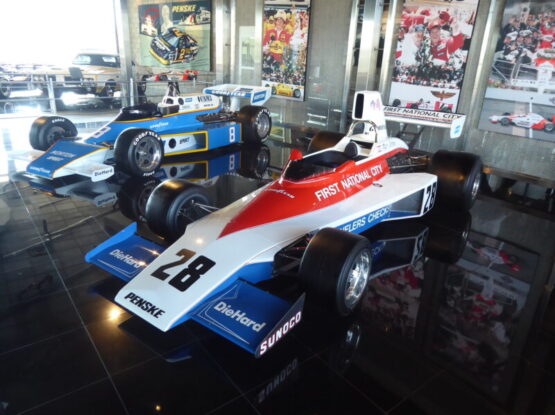
As well as the Road cars, there are a collection of Race Cars here, from various different formulae. The creation of Acura also prompted American Honda to up its racing efforts, keeping motorcycles and open-wheelers under the Honda name, but all closed-wheel racers became Acuras. Mugen parts were distributed from 1985 to encourage grassroots motorsports, as Acura and Honda tackled IMSA and IndyCar separately. None of these seemed familiar to me:


1974 Honda Civic 1200: this modified Honda Civic 1200 was campaigned in Sports Car Club of America events for more than a decade by the late Bob Boileau Jnr. One of American Honda’s first employees, Boileau swapped his Mini Cooper for a Civic 1200 in 1974, and campaigned it for the following 12 years, winning an impressive six class titles among fields of MG Midgets and Abarth Fiats. Bob claimed that the Civic could run all day at 10,500rpm and recorded 173mph at Talladega Superspeedway in 1976.

1992 Acura Spice GTP-Lights: Powered by a modified Acura NSX V6 engine, carried veteran driver Parker Johnstone to the Drivers’ championship in the IMSA Camel GT Lights series.

1996 Reynard 961-031 Indy Car: Honda/Reynard driven by Indy Car Drivers’ Champion Jimmy Vasser and Rookie of the Year Alex Zanardi.


1997 Acura Integra Realtime: RealTime Racing and the Acura Integra Type R forged a race-winning record that remained unbroken after nearly two decades.

There is a comprehensive display of 20 Bikes and Mopeds here, too:
1962 Honda C102 Super Cub: One of the first three models Honda sold in the U.S. The Super Cub is now the overall bestselling vehicle globally with over 100 million sold to date.

1962 Honda RC110

1967 Honda CA78 Dream

1970 Honda CB750: Widely considered the first superbike and called “the Motorcycle of the Century” by Motorcyclist magazine.

1970 Honda ATC90

1975 Honda GL1000 Gold Wing: Redefined long distance touring motorcycles with a revolutionary horizontally opposed 4-cylinder engine.

1978 Honda Express

1990 Honda VFR750R/RC30: A homologation special created for competition in the World Superbike Championship.

1991 Honda CBR600F2


1992 Honda NR750: The most technically advanced motorcycle at the time, iconic for its oval-piston engine design and other innovations.

1997 Honda CBR900F

1997 Honda CBR900RR

2004 Honda RVT1000R/RC51: A street version of Honda’s championship winning V-twin superbike.

MotoCompacto: A fresh take on e-scooters that was inspired by the Honda Motocompo of the early ’80s, the all-new Honda Motocompacto, announced in September 2023 redefined affordable all-electric personal transportation with sleek and simple styling and an innovative, ultra-compact foldable design. Sales began exclusively at Motocompacto.honda.com, and at Honda and Acura automobile dealers in November 2023 with an MSRP of just $995. The zero-emissions Motocompacto is designed for the modern realities of urban mobility, providing riders with an easy and fun-to-ride alternative transport that greatly reduces their carbon footprint while offering great convenience. With a maximum speed of 15 mph and zero-emissions range of up to 12 miles, Motocompacto can be fully charged in just 3.5 hours in both the folded and ready-to-ride configuration using a common 110 v outlet. “Motocompacto is uniquely Honda – a fun, innovative and unexpected facet of our larger electrification strategy,” said Jane Nakagawa, vice president of the R&D Business Unit at American Honda Motor Co., Inc. “Sold in conjunction with our new all-electric SUVs, Motocompacto supports our goal of carbon neutrality by helping customers with end-to-end zero-emissions transport.” Motocompacto was designed and developed by Honda engineers in Ohio and California as an innovative approach to personal electric transportation that has earned 32 patents. Uniquely foldable, Motocompacto quickly transforms into its own compact, light and stackable carrying case that’s easy to take along in a vehicle, on public transportation or store in tight places. Motocompacto is perfect for getting around cityscapes and college campuses. It was designed with rider comfort and convenience in mind with a cushy seat, secure grip foot pegs, on-board storage, a digital speedometer, a charge gauge and a comfortable carry handle. A clever phone app enables riders to adjust their personal settings, including lighting and ride modes, via Bluetooth®. “Motocompacto is easy to use and fun to ride, but was also designed with safety, durability, and security in mind,” said Nick Ziraldo, project lead and design engineering unit leader at Honda Development and Manufacturing of America. “It uses a robust heat-treated aluminum frame and wheels, bright LED headlight and taillight, side reflectors, and a welded steel lock loop on the kickstand that is compatible with most bike locks.” Charging is quick and convenient with a standard compact charger that can be stowed on-board. Motocompacto is designed to be personalized with sleek and simple styling that’s perfect for decals, stickers, skins and more. To enhance the joy of ownership, a fun and functional line of branded Motocompacto accessories will be available, including a helmet, backpack, apparel and more.

Honda is an engine company through and through, and no collection would be complete without some power equipment. The Collection Hall devotes a section to lawn mowers, generators, outboard motors, and more. Even a hedge trimmer is lovingly arranged as if it were a Renaissance sculpture.

Honda CB30 and BF5 outboard motor

1964 Honda E40 Generator with Sony Portable TV

1965 Honda E300 Generator: The first generator to combine 300-watt output with quiet and easy-to-use operation in a compact enclosure that could be carried with one hand.

2004 Honda HRX217VLA lawn mower

There is plenty of other memorabilia here, which includes scale models of prototypes and concepts, as well as trophy cabinets housing some of the awards that Honda has won over the years.


Back in the foyer and the latest Honda Passport, a model which was revealed at the Los Angeles Auto Show a few days prior, was on display.


This is a really fascinating collection and shows very nicely how the brand evolved from tentative beginnings on two wheels to being a significant player in the American and world markets. That is free to enter is an added bonus. I certainly commend it to anyone who is in the area – and that means anyone close to LAX Airport, as that is probably only 15 – 20 minutes away depending, as everything does in LA, on traffic.
More details can be found by going to Honda’s own website: https://www.honda.com/collection-hall