February marks the fourth and final Queen Square event of the season held at the Easter Compton complex. This site has the twin advantage of all parking being on hard-standing and the fact that there are two large barns which can be used to house some, but not necessarily all of the display cars, thus giving it an element of insulation from whatever the winter weather may produce. And there certainly have been some wet and cold meets here which have tested the enthusiasm of attendees, marshalls and organisers alike. There’s also a rather good farm shop on site which sells quality products to take home, as well as offering welcome hot drinks and some tasty breakfasts and other food items. With less pressure on my diary than is the case in the middle months of the year, I was able to take advantage of an event that is less than five miles or 15 minutes from home and pop out for a Saturday morning. This particular event was not as busy as can sometimes be the case and there were a lot of modern and somewhat modified performance and enthusiasts cars which were not really to my taste, so the camera by-passed them, meaning there are perhaps fewer photos than is sometimes the case. These are the cars at which I did pause for photos:
ABARTH
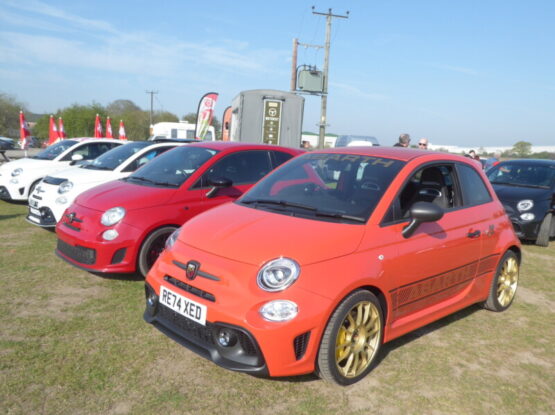
Sole Abarth here was the 595 of friend and QS marshall, Kieran Hyde. What is known as the Series 4 version of the familiar 595 reached the markets in the middle of 2016. After rumours had circulated all winter following the launch of the facelifted Fiat 500 last year, Abarth finally unveiled the Series 4 at the end of May 2016. Initially, we were told that the cars would not be available in the UK until September, but that came forward somewhat, with dealers all receiving demo cars in June, and the first customers taking delivery in July. Three regular production versions of both the closed car and the open-topped C were initially available, all badged 595, and called Custom, Turismo and Competizione, as before, though numerous limited edition models have since appeared and in most case disappeared. The most significant changes with the Series 4 are visual, with a couple of new colours, including the much asked for Modena Yellow and a different red, called Abarth Red, which replaces both the non-metallic Officina and – slightly surprisingly – the tri-coat pearlescent Cordolo Red. as well as styling changes front and rear. The jury is still out on these, with many, me included, remaining to be convinced. At the front, the new air intake does apparently allow around 15 – 20 % more air in and out, which will be welcome, as these cars do generate quite a lot of heat under the bonnet. Competizione models for the UK retain the old style headlights, as they have Xenon lights as standard, whereas the Custom and Turismo cars have reshaped units. At the back, there are new light clusters and a new rear bumper and diffuser. Inside, the most notable change is the replacement of the Blue & Me system with a more modern uConnect Audio set up, which brings a new colour screen to the dash. Mechanically, there is an additional 5 bhp on the Custom (now 145) and Turismo (now 165 bhp) and the option of a Limited Slip Diff for the Competizione, which is likely to prove a popular option. Details of the interior trim have changed, with a filled-in glovebox like the US market cars have always had, and electric windows switches that are like the US ones, as well as a part Alcantara trim to the steering wheel in Competizione cars.

ASTON MARTIN
Following the unveiling of the AMV8 Vantage concept car in 2003 at the North American International Auto Show designed by Henrik Fisker, the production version, known as the V8 Vantage was introduced at the Geneva Motor Show in 2005. The two seat, two-door coupé had a bonded aluminium structure for strength and lightness. The 172.5 inch (4.38 m) long car featured a hatchback-style tailgate for practicality, with a large luggage shelf behind the seats. In addition to the coupé, a convertible, known as the V8 Vantage Roadster, was introduced later in that year. The V8 Vantage was initially powered by a 4.3 litre quad-cam 32-valve V8 which produced 380 bhp at 7,300 rpm and 409 Nm (302 lb/ft) at 5,000 rpm. However, models produced after 2008 had a 4.7-litre V8 with 420 bhp and 470 Nm (347 lb/ft) of torque. Though based loosely on Jaguar’s AJ-V8 engine architecture, this engine was unique to Aston Martin and featured race-style dry-sump lubrication, which enabled it to be mounted low in the chassis for an improved centre of gravity. The cylinder block and heads, crankshaft, connecting rods, pistons, camshafts, inlet and exhaust manifolds, lubrication system and engine management were all designed in house by Aston Martin and the engine was assembled by hand at the AM facility in Cologne, Germany, which also built the V12 engine for the DB9 and Vanquish. The engine was front mid-mounted with a rear-mounted transaxle, giving a 49/51 front/rear weight distribution. Slotted Brembo brakes were also standard. The original V8 Vantage could accelerate from 0 to 60 mph in 4.8 seconds before topping out at 175 mph. In 2008, Aston Martin introduced an aftermarket dealer approved upgrade package for power and handling of the 4.3-litre variants that maintained the warranty with the company. The power upgrade was called the V8 Vantage Power Upgrade, creating a more potent version of the Aston Martin 4.3-litre V8 engine with an increase in peak power of 20 bhp to 400 bhp while peak torque increased by 10 Nm to 420 Nm (310 lb/ft). This consists of the fitting of the following revised components; manifold assembly (painted Crackle Black), valved air box, right and left hand side vacuum hose assemblies, engine bay fuse box link lead (ECU to fuse box), throttle body to manifold gasket, intake manifold gasket, fuel injector to manifold seal and a manifold badge. The V8 Vantage had a retail price of GB£79,000, US$110,000, or €104,000 in 2006, Aston Martin planned to build up to 3,000 per year. Included was a 6-speed manual transmission and leather-upholstery for the seats, dash board, steering-wheel, and shift-knob. A new 6-speed sequential manual transmission, similar to those produced by Ferrari and Lamborghini, called Sportshift was introduced later as an option. An open-topped model was added to the range in 2006 and then in the quest for more power a V12 Vantage joined the range not long after. All told, Aston produced 18 different versions of the model in a production run which continued until 2018, with a number of limited edition cars swelling the ranks.

AUDI
The Audi R8, based on the Audi Le Mans quattro concept car (designed by Frank Lamberty and Julian Hoenig) first appeared at the 2003 International Geneva Motor Show and the 2003 Frankfurt International Motor Show. The R8 road car was officially launched at the Paris Auto Show on 30 September 2006. There was some confusion with the name, which the car shares with the 24 Hours of Le Mans winning R8 Le Mans Prototype (LMP). Initial models included the R8 4.2 FSI coupé (with a V8 engine) and R8 5.2 FSI coupé (with a V10 engine). Convertible models, called the Spyder by the manufacturer, were introduced in 2008, followed by the high-performance GT model introduced in 2011. The Motorsport variants of the R8 were also subsequently introduced from 2008 onwards. An all-electric version called the e-Tron started development but would only reach production stage when the second generation model would be introduced. 6-time 24 Hours of Le Mans winner Jacky Ickx described the R8 as “the best handling road car today” and the car was well received by everyone who drove it. The car received a facelift in 2012 and a new model called the V10 Plus was now added to the range. Production of the Type 42 ended in August 2015

BMW
Avon Tuning are a sponsor of QS and so are usually present at the events. They brought along their M3 Touring.

FORD
The squarer-styled Mark II Escort appeared in January 1975. The first production models had rolled off the production lines on 2 December 1974. Unlike the first Escort (which was developed by Ford of Britain), the second generation was developed jointly between the UK and Ford of Germany. Codenamed “Brenda” during its development, it used the same mechanical components as the Mark I. The 940 cc engine was still offered in Italy where the smaller engine attracted tax advantages, but in the other larger European markets in Europe it was unavailable. The estate and van versions used the same panelwork as the Mark I, but with the Mark II front end and interior. The car used a revised underbody, which had been introduced as a running change during the last six months production of the Mark I. Rear suspension still sat on leaf springs though some contemporaries such as the Hillman Avenger had moved on to coil springs. The car came in for criticism for its lack of oddments space, with a glove compartment only available on higher end models, and its stalk-mounted horn. The “L” and “GL” models (2-door, 4-door, estate) were in the mainstream private sector, the “Sport”, “RS Mexico”, and “RS2000” in the performance market, the “Ghia” (2-door, 4-door) for a hitherto untapped small car luxury market, and “base / Popular” models for the bottom end. Panel-van versions catered to the commercial sector. The 1598 cc engine in the 1975 1.6 Ghia produced 84 hp with 92 lb/ft torque and weighed 955 kg (2105 lb). A cosmetic update was given in 1978 with L models gaining the square headlights (previously exclusive to the GL and Ghia variants) and there was an upgrade in interior and exterior specification for some models. Underneath a wider front track was given. In 1979 and 1980 three special edition Escorts were launched: the Linnet, Harrier and Goldcrest. Production ended in Britain in August 1980, other countries following soon after. Spotted here were a rather nice RS2000 and the now seldom seen Van.


Another of the marshall’s cars, which means this is also an event regular, this Sierra Estate 2.0GL belongs to Lucius Hawken. The Ford Sierra is a mid-size car or large family car that was built by Ford Europe from 1982 to 1993. It was designed by Uwe Bahnsen, Robert Lutz and Patrick le Quément. The code used during development was “Project Toni”. Its name came from the Spanish word for mountain range. The Ford Sierra was first unveiled on 22 September 1982 at the British International Motor Show hosted at the NEC in Birmingham, shortly followed by the Salon de l’Automobile in Paris on 30 September 1982. Sales started on 15 October 1982, replacing the Ford Taunus TC3 (UK: Ford Cortina Mark V). Its aerodynamic styling was ahead of its time and as such, many conservative buyers (including company car drivers) did not take fondly to the Taunus’s/Cortina’s replacement. This was also due to the fact that the Sierra was not available as a saloon, in contrast to the Taunus/Cortina. A saloon model debuted in 1987 with the introduction of the facelifted Sierra. It was mainly manufactured in Germany, Belgium, and the United Kingdom, although Sierras were also assembled in Ireland, Argentina, Venezuela, South Africa and New Zealand. By 1978, Ford Europe was working on a new mid-range model to replace the Cortina/Taunus during the early 1980s, working under the codename “Project Toni”. Although still popular with buyers, the outgoing Cortina/Taunus was essentially a 12-year old design by the time of the Sierra’s launch; despite the TC2 shape launching in 1976, and the mildly reworked TC3/Mk5 three years later, both were merely a reskinned version of the 1970 TC/Mk3 with few major mechanical changes in that time. Ford’s future model policy and styling direction had already been shown with the Escort III two years earlier, in that its conventionally styled saloons of the 1970s would be replaced by hatchbacks with advanced aerodynamic styling. Ford had confirmed during 1981, a year before the Sierra’s official launch, that its new mid-range car would carry the Sierra name, signalling the end of the Taunus and Cortina nameplates after 43 years and nine generations respectively 20 years and five generations. In September that year, it had unveiled the Probe III concept car at the Frankfurt Motor Show, hinting at what the new car would look like when the final product was unveiled 12 months later. At first, many found the design blob-like and difficult to accept after being used to the sharp-edged, straight-line three-box styling of the Taunus/Cortina, and it was nicknamed “the jellymould”. The shape served a purpose though, producing a drag coefficient of 0.34, a significant improvement over the boxy outgoing Taunus’s/Cortina’s 0.45. This aerodynamic design was key for reducing fuel consumption according to Ford, and was even used as compensation for the V6-engines. The interior was more conventional, although Ford took a page from BMW by angling the centre of the dashboard towards the driver. Sales were slow in the first months – the situation being exacerbated by heavy discounting by Ford dealers of surplus Cortina stock from the autumn of 1982 onwards, with more than 11,000 new Cortinas being registered in 1983. However in 1983, its first full year of sales, the Sierra managed nearly 160,000 sales in Britain, outsold only by the smaller Escort. Ford had also launched the more conservatively designed Escort-based Orion saloon that year, which found favour with buyers who would otherwise have been the Sierra’s target customers. In West Germany, it was proving very popular from an early stage; within months of its launch, it was reportedly achieving treble the number of sales that the Taunus had been attaining – though in West Germany, the Taunus had not been quite as popular or iconic as its Cortina equivalent had been in Britain. It was later in the Sierra’s life that the styling began to pay off; ten years after its introduction, the Sierra’s styling was not nearly as outdated as its contemporaries, even though all major competitors were newer designs, though the Sierra had been tweaked on several occasions and many new engines had been added. The most notable changes came at the autumn of 1987, with a major facelift and the addition of a 4-door saloon (UK: Sapphire). As other manufacturers adopted similar aerodynamic styling, the Sierra looked more normal. At its peak, it was Britain’s second best selling car in 1983, 1988 and 1989, and was still Britain’s fifth best selling car in 1992. Its best year was 1989, when more than 175,000 were sold. However, it was outsold by the Vauxhall Cavalier in MK2 form during 1984 and 1985, and then from 1990 until its demise by the MK3 Cavalier. Nevertheless, it comfortably outsold its second key rival, the Austin Montego, which was launched in April 1984. Between 1985 and 1988, the Sierra faced fresh competition in Europe from the likes of the Renault 21 and Peugeot 405, while Japanese carmaker Nissan was producing its Bluebird model in Britain from 1986. Early versions suffered from crosswind stability problems, which were addressed in 1985 with the addition of “strakes” (small spoilers) on the rear edge of the rubber seals of the rear-most side windows. These shortcomings saw a lot of press attention, and contributed to early slow sales, when it was outsold by its key rival the Vauxhall Cavalier in 1984 and 1985. Other rumours that the car hid major crash damage (in part true, as the new bumper design sprung back after minor impact and couldn’t be “read” to interpret major damage) also harmed the car’s reputation. This reached near-hysterical heights in its early months on sale, with UK press making a report that Ford would reintroduce the previous Cortina model out of desperation. These reports were swiftly denied by Ford. However, sales began to rise during 1983, and it finished as Britain’s second best selling car behind the Escort. After being outsold by the Cavalier for the next two years, it regained its lead of the market sector in Britain during 1986, and a refreshed range (with more engine options as well as the introduction of a saloon) enjoyed a surge in sales from 1987, though the MK3 Cavalier finally outsold it in 1990. Even in 1992, the Sierra was still Britain’s fifth best selling car. It was nicknamed “the salesman’s spaceship” on account of its status as a popular fleet car in Britain. In contrast to the Sierra’s groundbreaking exterior design, its drivetrain was conservatively engineered, retaining rear-wheel drive and the same engines and transmissions as the Cortina/Taunus which were effectively 12 years old as they were first used on the TC1/MkIII generation in 1970. Much of this was done to appease the important fleet market which was wary of complexity. However, there was much modification; for example the engines were fitted with breakerless ignition, improved carburettors and the option of fuel injection, whilst 5-speed transmissions were now available. Most competitors were already switched to front-wheel drive around that time. Ford claimed however this set-up was required to offer V6-engines, which had to contribute to the Sierra’s driving comfort. New for the Sierra was a diesel engine, although the engine itself wasn’t new at all. Similar to the Ford Granada, Ford used an “Indenor”-engine which was designed by Peugeot in the 1950s. While the Granada was offered with 1.9, 2.1 and 2.5 diesels, the Sierra unit had a displacement of 2.3 litre. This engine was replaced only in 1989 by an all-new 1.8 litre turbodiesel, developed by Ford itself. The Sierra had a four-speed manual gearbox as standard, with a five-speed as option but standard on the 2.3D and 2.3 V6. At a time when the rival Vauxhall Cavalier was offered with a five-speed, this led to some critics commenting that the Sierra was somewhat underpowered. In the mid-1980s, many smaller cars (some even two segments smaller) featured five-speed gearboxes as standard. The chassis, however, was more sophisticated than the Cortina/Taunus, with fully independent suspension on both axles. The rear suspension was essentially carried over from the Granada, with trailing arms and coil springs mounted on a tubular sub-frame which also provided location for the final drive/differential housing driving the axle shafts. The front suspension dispensed with the Cortina/Taunus’ double wishbones in favour of a scaled-up version of the Fiesta and Escort/Orion’s layout with MacPherson struts, lower locating arms and anti-roll bars. One of the most striking design features of the Sierra was its closed front panel instead of a grille, which was later also to be found on the 1985 Ford Taurus. The air intake was situated below the front bumper, making the Sierra a so-called ‘bottom breather’. The headlights were integrated in this front panel while the indicators were mounted in the bumper within a combined unit with the foglights. However, this set-up was only present on the top-of-the-line “Ghia”-trim as well on the later introduced XR4i sport model. The other Sierra models had a more traditional front end with a two-bar grille between the headlights, being unpainted on the base model. These models had the indicators in the bumper as well, although being slimmer but wider and without the foglights. Both the Ghia and XR4i had wide headlights with two lenses while the other models had smaller lights with a single lens. For the 1985 model year, all the lower-spec models, except the base model, adopted the Ghia and XR4i’s front grille and headlight treatment. However, the second lens of the lower-spec models had no actual light within it. On the Ghia and XR4i this lens contained additional high beam lamps. The South-African XR8 model’s front end was similar to the XR4i’s but featured a small grille between the headlights. The rear lights of the Ghia, as well as the very early XR4i’s, were the same shape and layout as other models, but featured tiny horizontal black strakes on the lenses to give the impression that they were smoked. The car was replaced by the Mondeo in Europe in April 1993, though stocks lasted for about two years afterwards. The Sierra remained a popular second-hand buy and common sight on British roads until well beyond the year 2000.

Ford played much the same guessing game about whether there would be an RS version of the third generation Focus as they had done with the earlier versions. Production of the regular cars started in late 2010, but it was not until the 2015 Geneva Motor Show before the production ready MKIII Ford Focus RS was unveiled. It came packing the turbocharged 2.3-litre inline-four engine found in the Mustang EcoBoost. In the Focus RS, the engine itself produces 350 hp. Power is sent to all four wheels via Ford’s all-new Torque-Vectoring All-Wheel-Drive system with a rear drive unit designed by GKN, as well as upgraded suspension and brakes. As well as that, the new Focus RS will be fitted with Drive Modes – including an industry-first Drift Mode that allows controlled oversteer drifts – and Launch Control. The RS will boast a model specific aerodynamic package that helps to differentiate it from other Focus models. The RS is capable of accelerating to 100 km/h (62 mph) in 4.7 seconds. Sales finally started in mid 2016, with long waiting lists having been created, though Ford did eventually catch up with expanded production levels allowing them to meet the demand.

HONDA
The S2000 was first alluded to at the 1995 Tokyo Motor Show, with the Honda Sport Study Model (SSM) concept car, a rear-wheel-drive roadster powered by a 2.0 litre inline 4-cylinder engine and featuring a rigid ‘high X-bone frame’ which Honda claimed improved the vehicle’s rigidity and collision safety. The concept car was constructed with aluminium body panels and featured a 50:50 weight distribution. The SSM appeared at many automotive shows for several years afterwards, hinting at the possibility of a production version, which Honda finally announced in 1999. It featured a front mid-engine, rear-wheel-drive layout with power being delivered by a 1,997 cc inline 4-cylinder DOHC-VTEC engine. The engine produced outputs of 237–247 hp, and 153–161 lb/ft depending on the target market., and it was mated to a six-speed manual transmission and Torsen limited slip differential. The S2000 achieved what Honda claimed as “the world’s top level, high performance 4-cylinder naturally aspirated engine”. Features included independent double wishbone suspension, electrically assisted steering and integrated roll hoops. The compact and lightweight engine, mounted entirely behind the front axle, allowed the S2000 to achieve a 50:50 front/rear weight distribution and lower rotational inertia. An electrically powered vinyl top with internal cloth lining was standard, with an aluminium hardtop available as an optional extra. Although the S2000 changed little visually during its production run, there were some alterations, especially in 2004, at which point production of the S2000 moved to Suzuka. The facelifted car introduced 17 in wheels and Bridgestone RE-050 tyres along with a retuned suspension to reduce oversteer. The spring rates and shock absorber damping were altered and the suspension geometry modified to improve stability by reducing toe-in changes under cornering loads. The subframe has also received a revision in design to achieve a high rigidity. In the gearbox the brass synchronisers were replaced with carbon fibre. In addition, cosmetic changes were made to the exterior with new front and rear bumpers, revised headlight assemblies, new LED tail-lights, and oval-tipped exhausts. Although all the cosmetic, suspension and most drivetrain upgrades were included on the Japanese and European S2000s, they retained the 2.0l F20C engine and remained designated as an AP1. A number of special editions were made, such as the more track-oriented Club Racer version offered in the US in 2007/8 and the Type S for Japan in 2008/9. The UK received a GT for 2009, which featured a removable hard-top and an outside temperature gauge. The S2000 Ultimate Edition (continental Europe) and GT Edition 100 (UK) were limited versions of the S2000 released to commemorate the end of production. Both included Grand Prix White body colour, removable hard top, graphite-coloured alloy wheels, red leather interior with red colouring for stitching on the gear lever gaiter. The Ultimate Edition was unveiled at the 2009 Geneva Motor Show and went on sale in March 2009. The GT Edition 100 was a limited run of 100 units released for the UK market. In addition to the Ultimate Edition’s specification, it featured a black S2000 badge and a numbered plaque on the kick-plate indicating which vehicle in the series it was. The car was never replaced, as Honda decided to head off in the same direction as Toyota, producing a series of very dull appliance-like cars that focused on low emissions and dependability but of no appeal to the sort of enthusiast who bought (and probably kept!) an S2000.

This Fit RS is a JDM car that belongs to my friend and colleague Stephen Porton, and is certainly something a bit different.


HYUNDAI
This car had various names around the world. In Europe it was known simply as the Hyundai Coupe, whereas Americans called it the Tiburon and Australians the Toscani. The previous-generation Tiburon was discontinued in 2001 after five years in production. Hyundai launched this generation of the car in 2002 for the 2003 model year, giving it new styling, larger dimensions, and an optional V6 engine. Tiburon’s wheelbase and overall length grew slightly compared to the previous version, increasing curb weight by about 200 lb (91 kg). In the US, base and GT V6 models were offered with standard front side airbags and optional anti-lock brakes. Base models retained the 138 hp 2.0-litre four-cylinder engine, while GT V6 coupes got the new 2.7-litre 172 hp V6 from Hyundai’s Sonata and Santa Fe. A five-speed manual transmission was standard, and a four-speed automatic was optional. The automatic unit had a manual shift gate. Also optional on the GT V6 was a six-speed manual gearbox. Base models and GT V6 automatics rode on 16-inch tires, versus 17-inch for the GT V6 manual models. Both had standard four-wheel disc brakes. Leather upholstery was standard in the GT V6, as well as a rear spoiler (high spoiler std. on 6-speed only). Aluminium pedals and a sunroof were optional. In 2004, all GT V6s received 17″ wheels. A “special edition” of the GT V6 was also released. It featured a “Special Edition” decal-style badge underneath “Tiburon”, sport cloth upholstery, a Kenwood stereo, red painted front brake calipers, and multigauges above the radio. Only the 6-speed and automatic transmissions were available. The special edition was available in Jet Black, Rally Red, and Sunburst Yellow only. The new design received praise from a number of automotive journalists, some of which compared it to the Ferrari 456. In 2005 Hyundai facelifted the Tiburon and reshuffled the model lineup; offering GS, GT, and SE models. The SE was now a separate trim from the GT models. Hyundai’s four-cylinder engine went into the GS, while the other two held the 2.7-liter V6. A five-speed manual transmission was standard. A four-speed automatic with a manual shift was optional for GS and GT models, but the SE had exclusive use of a six-speed manual gearbox. Anti-lock brakes was standard on the SE and optional for the GT coupe, which could be equipped with leather upholstery. GS coupes rode on 16-inch wheels, versus 17-inch for other models. All-disc brakes and front side airbags were standard. Anti-lock brakes were made standard on all 2006 model Tiburons. In the USA, the rear wiper was removed as a standard feature for the 2005 and 2006 models, although it could be purchased as an optional extra. In the UK, three models were available before and after the 2005 facelift: the 1.6S, 2.0SE and V6. The 1.6S had a single exhaust and leather seats were optional, although following the 2005 facelift half-leather seats were standard. Both other models have twin exhausts and leather seats as standard. The six-speed gearbox was also standard on the V6 model. In Greece (S145 model), due to high taxation in hi-displacement engines, a 1.6-liter turbocharged engine was available for some years, producing 145 PS at 5,800 rpm and 190 Nm (128 lb/ft) of torque at 4,300 rpm and making the 1233 kg vehicle capable of accelerating from 0–100 km/h (0–62 mph) in 9.3 seconds and achieving a top speed of 210 km/h (131 mph). Fuel consumption was 6.4L/100 km (36.8 mpg). Hyundai conducted minor tweaks to the ‘GK’ model in September 2004 for the 2005 model year. The vehicle incorporated reworked sleeker blackened “smoked” headlights, redesigned rear tail lights, more aggressive front air dam, a different range of alloy wheel designs, coloured stitching on leather seats (half leather seats available for the 1.6 range). In 2006, Hyundai released the GT Limited Model. This was an upgrade from the GT V6. It included an upgraded tan leather interior, automatic climate controls, a 440w Infinity 6-disc in dash stereo with 10″ subwoofer, an upgraded gauge cluster, and side markers. The GT LTD came in black, Blue, and midnight blue. A more comprehensive facelift was launched in November 2006 for the 2007 model year, named the Coupe SIII in markets such as the UK, this time altering the appearance of the car enough to designate it the fourth generation or GK F/L2 reminiscent of the RD1 and RD2 denotations. The headlights are thinner and angled more aggressively; somewhat similar to the original Tiburon headlights with more straight/sharp lines. The tail lights are similar to the RD2 and GK1 but are somewhat smaller and reflect an aftermarket styling. The fenders lose the tall “gill fins” and a smaller gill insert is present instead. The radio antenna on the F/L2 is integrated into the rear hatch glass rather than being a separate mast, and the interiors received an updated blue backlight scheme for gauges and instrumentation. On SE models (US), the interior is updated with brushed aluminium accents. The SE trim (US) was also equipped with larger 12 inch front brake rotors and a slightly stiffer suspension. Hyundai later introduced the limited edition TSIII (UK). This edition included, in addition to the enhancements found on the SE model (US), a quilted leather interior with embroidered logos, quad exhaust exit pipes, and an anthracite finish to the 17″ alloy wheels. The performance of the TSIII remained the same as the SIII. This is the last model made.

JAGUAR
There were a couple of examples of the recently discontinued F Type, Jaguar’s good-looking sports car that ran from 2013.

LOTUS
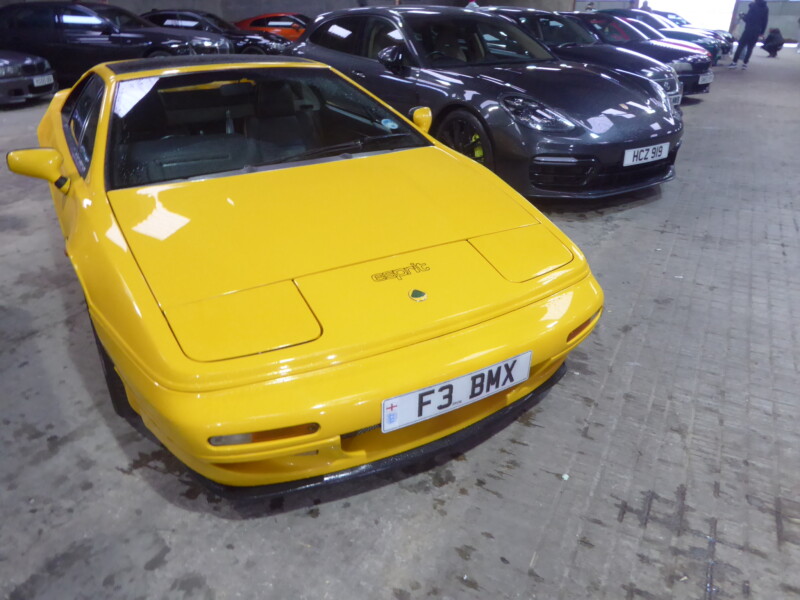
In 1987, a new version of the mid-engined Esprit was unveiled, incorporating rounder styling cues given by designer Peter Stevens (who later designed the McLaren F1). A new Lotus patented process was introduced to create the new body, called the VARI (Vacuum Assisted Resin Injection) process, which offered more advantages than the previous hand laid process. Kevlar reinforcement was added to the roof and sides for roll-over protection, resulting in an increase of the Esprit’s torsional rigidity by 22 percent. Giugiaro is said to have liked the restyling, claiming it was perhaps too close to his original design. The Stevens styled cars retained the mechanical components of the previous High Compression Esprit and Turbo Esprit, but introduced a stronger Renault transaxle, which necessitated a move to outboard rear brakes. However, the MY 1988 North American Esprit Turbo kept its Citroën SM type transaxle and the Bosch K-Jetronic fuel injection system used in the previous model year. The car’s Type 910 engine retained 215 bhp and 220 lb·ft, but decreased its zero to sixty from 5.6 seconds to a varied time between 5.4 – 5.1 seconds and a top speed of over 150 mph. The exterior style changes were accompanied by a redesign of the interior, allowing a little more space for the occupants. The Stevens styled Esprit is often known by its project code of X180. In 1989, the Esprit was again improved with the GM multi-port, electronic fuel injection system and the addition of a water to air intercooler, which Lotus has named the Chargecooler, producing the SE (Special Equipment). This inline-four engine was known as the Type 910S. Horsepower was pushed up to 264 with 280 available on overboost and zero to sixty miles per hour times reduced to 4.7 seconds with a top speed of over 160 mph. Several modifications were made to the body kit as well, like side skirts which are parallel to the body, five air ducts in the front air dam, wing mirrors from the Citroën CX and the addition of a rear wing. Along with the SE, Lotus produced the little seen Esprit S, a midrange turbocharged car offering fewer appointments and 228 hp, as well as the standard turbo still offering 215 hp . The N/A and lower-powered turbo were cancelled after 1990, and the S in 1991. Another unusual variant was a two-litre “tax special” developed for the Italian market, fitted with an intercooled and turbocharged version of a new 1,994 cc version of the venerable 900-series four-cylinder engine. Equipped with SE trim, this appeared in December 1991 and produced 243 PS at 6,250 rpm. Beginning in the autumn of 1996, this engine became available in other markets as well. The Esprit was a popular and successful addition to the American IMSA Bridgestone Supercar Championship and as a result Lotus produced the SE-based X180R, with horsepower bumped to 300 and with racing appointments. The Sport 300 was a derivative of the X180R sold in Europe, which included many modifications. These are known as the fastest of the four-cylinder Esprits and among the most desirable. In 1993, another exterior and interior revamp of the car resulted in the S4 which was the first model to include power steering. The exterior redesign was done by Julian Thompson, which included a smaller rear spoiler placed halfway up the rear decklid. Other major changes were to the front and rear bumpers, side skirts and valence panels. New five spoke alloy wheels were also included in the redesign. The S4 retained the same horsepower as the SE at 264 hp.The S4 was succeeded in 1994 by the S4s (S4 sport), which upped power to 300 bhp and 290 lb·ft of torque, improving all-around performance while retaining the comfort of the previous version. Top speed was increased to 168 mph, skidpad increased to 0.91g, an increased slalom of 61.7 mph and a 0-60 mph time of 4.6 seconds. Although the engine kept its 2.2-litre capacity, many modifications were added to improve engine performance. Some of the changes were enlarged inlet ports, cylinder head modifications, a re-calibrated ECM and a revised turbocharger. The most visible external styling changes was the addition of a larger rear wing taken from the Sport 300. In 1996 the Esprit V8 used Lotus’ self-developed all-aluminium, twin-turbocharged (Garrett T25/60 turbos) 90-degree V-8, Code-named Type 918, in front of the same Renault transmission as before with no Chargecooler. Derek Bell developed an uprated gearbox that overcame a lot of the gearbox problems with a much thicker single piece input shaft. The Type 918 engine was detuned from a potential 500 bhp to 350 bhp to prevent gearbox damage due to the fragility of the Renault UN-1 transmission. In period tests, zero to sixty miles per hour came in at 4.4 seconds and top speeds of over 175 mph were achieved. Produced alongside V8 models was the GT3, a turbocharged four-cylinder car with the type 920 2.0 litre chargecooled and turbocharged engine which had been used only in Italian market cars previously. In 1998 the V8 range was split into SE and GT specifications, both cars with a much changed interior configuration, both offering similar performance with the SE being the more luxurious of the two. The ultimate incarnation of the Esprit came in 1999 with the Sport 350. Only 50 were made, each offering 350 horsepower (per the name) and various engine, chassis and braking improvements, like the addition of AP Racing brakes, stiffer springs and a revised ECU. Several visual changes were made as well, including the addition of a large carbon fibre rear wing on aluminium uprights in place of the standard fibreglass rear wing. By this time the Esprit could reach 60 mph in 4.3 seconds as well as reaching 0-100 mph in less than 10 seconds, and weighed 1,300 kg (2,866 lb) as a result of many modifications. Thereafter, Lotus made little development aside from minor cosmetic changes including a switch to four round tail lights for the 2002 model year. Esprit production ceased in February 2004 after a 28 year production run. A total of 10,675 Esprits were produced.


Also here were the two all-electric models that have recently been added to the range, the Emeya and the Eletre.


MASERATI
When I drove in, and asked to go to the second of the two barns, I was advised I would find another Grecale just like mine. That’s quite unusual, as even though the car has been on sale in the UK for 18 months, they are still a rare sighting. Whilst the car which I parked next to was indeed the same colour – Bianco Astro – it was not in fact quite the same, as this one, brought along by local dealer Maserati Bristol, as in fact the new all-electric Folgore. Look closely and you will see that the details on the front are different, and of course there is a sealed-off grille. I have to say that if Maserati Bristol were here to try to generate some interest in the new car or indeed the whole range, they did a very poor job indeed. Once they had finished wiping their car down, the staff vanished for breakfast. That they did not even speak to me at all was not just surprising, but further vindication of why I will favour Graypaul Maserati in Solihull for anything I need.


MINI
Commonly referred to as the GP2, the 2013 John Cooper Works GP is a limited-edition, track-oriented version of the regular John Cooper Works hatchback based loosely on the JCW Challenge race car. Production was limited to 2000 units worldwide. The GP2 boasts a 218-hp (214 for US models) turbo-charged 1.6 L direct-injected four cylinder engine, giving it a 0–60 mph time of 6.1 seconds and a top speed of 150 mph. The engine is essentially identical to the N18 used in other 2013 John Cooper Works models, with a slight increase in compression accounting for the modest power gain. In keeping with its uncompromising roots, a 6-speed manual gearbox was the only transmission offered. The GP2 also features exclusive 17” wheels, high-performance tires designed in a special partnership with Kumho, adjustable coil over suspension with revised geometry unique to the GP, 6-piston Brembo® front calipers borrowed from the BMW 135i, a full valance tray and functional rear diffuser, a hatch-mounted spoiler with carbon fibre element, red mirror caps, brake ducts, signature badging, a pair of special-edition RECARO sport seats (complete with side-impact airbags), and deletion of the rear seats to save weight. The stability control suite features an additional “GP mode” exclusive to this model which permits a greater degree of wheel-slip while retaining function of the brake-based electronic limited slip differential. The 500 examples sold in the US originally retailed for $39,950 and were available in only one configuration.


NISSAN
The Nissan 370Z (known as the Fairlady Z Z34 in Japan) is a 2-door, 2-seater sports car (S-segment in Europe) manufactured by Nissan Motor Company. It was announced on October 29, 2006, and was first shown at an event in Los Angeles ahead of the 2008 Greater LA Auto Show, before being officially unveiled at the show itself. The 370Z is the sixth generation of the Nissan Z-car line, succeeding the 350Z. The 370Z marks the last production car with a naturally aspirated and high-rev V6 coupled to a manual transmission. Almost every piece and component of the 370Z has been redesigned from the previous 350Z. The wheelbase is 4 in (100 mm) shorter at 100.4 in (2,550 mm) and an overall length 2.7 in (69 mm) shorter at 167.1 in (4,240 mm). The overall width has been increased by 1.3 in (33 mm), the rear track by 2.2 in (56 mm), and overall height reduced by 0.3 in (7.6 mm). The smaller exterior dimensions and use of more lightweight materials helped reduce weight. The 370Z features a front aluminium subframe, aluminium-alloy engine cradle, aluminium door panels, an all-aluminium hood, and an aluminium hatch. Front body torsional rigidity is improved by 10 percent with an extensively revised body structure, which includes a new front suspension cradle to reduce front body lateral bending, new rear structural reinforcements, and an underbody “V-bar” to help reduce rear lateral bending. Rear body torsional rigidity is improved by up to 22 percent and rear body vertical bending rigidity is improved by up to 30 percent. Additional enhancements include the use of a carbon fibre composite radiator housing and strengthening of the rear fender and hatch areas. The new structure weighs slightly less than the 350Z. The 370Z uses a front double wishbone suspension, with forged aluminium control arms and steering knuckle. The rear multi-link suspension uses a forged aluminium upper control arm, lower arm and radius rod, the toe control rod is steel and wheel carrier assembly is aluminium. The refreshed 2013 model uses new dampers with the Sport package models. The brakes have been changed from the more expensive Brembo racing brakes to Nissan branded brakes which are manufactured by Akebono. The coefficient of drag is 0.30 and 0.29 with the Sport Package, figures identical to the 350Z. The Japanese model of the 370Z Coupe went on sale in December 1, 2008. The vehicle was unveiled in the 2008 Los Angeles Auto Show, with sales of the North American model beginning at Nissan dealers in early 2009. Standard and optional equipment includes 19-inch RAYS wheels, Bluetooth, Sirius/XM satellite radio, heated electric seats, viscous limited slip differential, Bose sound system with dual subwoofers and 6-CD changer, and automatic climate control. Deliveries of the European model began in April 2009. There was also an open-topped car, the 370Z Roadster which went on sale in late summer 2009 as 2010 model year vehicle. Early models include the 370Z and 370Z Touring, with Sport Package and Navigation packages for the 370Z Touring. European models went on sale as 2010 model year vehicles. Although there were numerous limited edition models that followed, the car changed little over the next several years. The 2020 model year was the final model year for the 370Z. The line was continued by the Nissan Z (RZ34) on a modified version of the same platform.

PEUGEOT
Mindful of the success of the Golf GTi, in the class above, and how a small car with good handling could take more power, as the Mini Cooper had proved, Peugeot came up with the GTi in early 1984. The first models had a 1.6 litre XU5J engine, producing 105 PS, which was uprated in 1987 with a cylinder head with larger valves thus becoming XU5JA, which took the power output up to 115 bhp. Visually the car retained the good looks of the 3 door version of the regular models, but it featured plastic wheel arch extensions and trim, beefier front and rear bumper valances and judicious use of red badging and trim. The shell also underwent some minor changes, including larger wheel arches (to suit the larger wheels, and the suspension was redesigned and sat lower on the GTI with stiffer springs, different wishbones and a drop-linked anti-roll bar. Red was a dominant colour inside. The car was an instant hit. At the end of 1986, Peugeot followed up with a more potent model, the 1.9 GTi, whose XU9JA engine produced 128 PS. Internally the engine of this car and the 1.6 model are very similar, the main differences on 1.9 litre versions being the longer stroke, oil cooler, and some parts of the fuel injection system. The shorter stroke 1.6 litre engine is famed for being revvy and eager, while the 1.9 litre feels lazier and torquier. Outside the engine bay the main differences between the 1.6 GTi and the 1.9 GTi are half-leather seats on the 1.9 GTi vs. cloth seats and disc brakes all-round (1.9 GTi) vs. discs at the front and drum brakes at the back; as well as the 14-inch Speedline SL201 wheels on the 1.6 GTi vs. 15 inch Speedline SL299 alloys on the 1.9 GTi. The 205 is still often treated as a benchmark in group car tests of the newest GTI models or equivalent. Peugeot itself has never truly recreated this success in future GTI models, although they came very close with the highly regarded GTI-6 variant of the Peugeot 306.


RENAULT
The third generation of the Renault Megane R.S. is based on the 4th generation of the Mégane and was introduced at the 2017 Frankfurt Motor Show. It was available in 3 trims: 280-Sport, 280-Cup and 300-Trophy. The Mégane R.S. is only available in 5-door hatchback bodystyle and was developed with the assistance of Renault F1 team driver Nico Hulkenberg. All feature a similar turbocharged 1.8-litre inline-4 engine (to a varying rate of tune) shared with the Alpine A110, and as standard a four-wheel steering system to improve handling, though this was removed to save weight in the Trophy-R. Five selectable drive-modes are available, namely Comfort, Neutral, Sport, Race and Personal (which is a customisable driving mode). The gearbox choices are either a 6-speed manual gearbox or a 6-speed Efficient Dual Clutch (EDC) gearbox with paddle shifters and launch control (which can be activated by holding both of the shifter paddles). The interior features a portrait style infotainment system and red graphical display on the digital tachometer flanked by analogue fuel and water temperature gauges. The infotainment system supports AppleCarPlay and Android Auto. An engine revving sound is played through the speakers when the driver opens the door of the car. Red stitching with RS badges are standard on the interior and the Trophy model adds an Alcantara-suede trim on the steering wheel. Recaro sports seats are optional equipment. Buyers have the choice to have a carbon fibre weave or an Alcantara trim. The suspension system has struts up front and a torsion beam at the rear, but its front configuration has new geometry and retains Renault Sport’s PerfoHub technology, which reduces kingpin angle offset and resists torque and bump steer. The system uses fluid-filled shock absorbers commonly found on rally cars on the lower end of the suspension struts and is called a damper within a damper system by the manufacturer. The entry-level 280 Sport, features a torque-vectoring system of braking the inner wheels during a turn, to further improve turn-in; and a passive double damping suspension system. The 280 Cup trim is similar to the 280 Sport trim, but adds a mechanical Torsen limited-slip-differential to the front wheels along with a 10% stiffer suspension setup. 19-inch wheels with Bridgestone tyres and lightweight brakes with aluminium hubs and red calipers are optional. The 300 Trophy is similar to the 280 Cup, but has even firmer suspension, a lightweight DESS (Dual-Energy Storage System) battery, a different cylinder head and turbocharger with a higher-performance engine tune for more power (300 bhp). Torque figure is increased to 420 NM (400 NM for cars with a manual gearbox). In 2020, the facelifted Megane RS was introduced for the 2021 model year. The trim levels were revised and the 280-Sport model was removed, bringing the engine power output to 300 hp for all facelifted Megane RS models. Buyers could choose between the 300-Sport and the 300-Trophy, equipped similarly to the pre-facelift models. On the outside, the facelifted Megane RS came with new LED headlights and different-looking taillights. Inside, the instrument panel was now fully digital and the infotainment system used a new software. The climate controls were also changed and now featured separate temperature displays on the temperature control dials. The ambient lighting was removed from the rear door cards. Sales of this model in the UK were very limited and the car was pulled from sale sometime in 2022, production for other markets finally ending in 2023.

TOYOTA
In September 1996, the X100 Chaser replaced the X90 Chaser. The product lineup consisted mostly of Avante and Tourer trim, with the Avante as the luxury model (with more interior accessories) and the Tourer as the sporty model (with large 16-inch wheels). Toyota’s VVTi, the company’s version of variable-valve timing, was added to the 1JZ engines; they were also upgraded to have more torque, since they had already reached the agreed voluntary limit set by Japanese Automobile Manufacturer’s Association regarding horsepower. The 1JZ-GTE was powered by a single turbo configuration instead of the twin turbo of its predecessors. New to the lineup was the Avante Four and the Avante Four G Package (basically the Avante 2.5 L with a full-time 4WD system). These cars were only available with a 4-speed electronic control type (ECT) automatic transmission. The Tourer V and the automatic-only Avante G 3.0 L (2JZ) models had the option of electronic control flex lockup attaching 4-speed automatic (intelligent) (ECT-iE) transmission, besides the ECT-E automatic in the lower-end models. In 1997, the lineup remained largely unchanged, although a basic Tourer 2.0 L model was added. The Tourer was powered by a 1G-FE engine, rated at 140 PS at 5,600 rpm. It was sold with only the 4-speed electronic control type (ECT) automatic transmission. In 1998, the base Tourer model received the optional manual gearbox and a 4WD option was added to the base Avante models; the Avante Four S Package received a higher special-edition interior. Additionally, the Chaser received a facelift, with the most significant changes to the rear tail lights. Other changes included new fog lights with a slightly redesigned front bar to accommodate them, different interior fabric, a 3-spoke steering wheel instead of 4 spokes, orange gauge lighting instead of white and a grille with 2 horizontal bars instead of 3. The Chaser was discontinued in June 2001. It was replaced with a new model called the Verossa which shared the same model code. The Cresta suffered the same fate, but the Mark II continued for another generation (X110) before it was also discontinued. In 2004, the all-new X120 Mark X was introduced in Japan, incorporating many characteristics of the Chaser and the Cresta. In fact, the aim of the Mark X was to combine the characteristics of the 3 models into one single model

VOLKSWAGEN
The Volkswagen Golf Mk2 is a hatchback, the second generation of the Volkswagen Golf and the successor to the Volkswagen Golf Mk1. It was Volkswagen’s highest volume seller from 1983 and ended in (German) production in late 1992, to be replaced by the Volkswagen Golf Mk3. The Mk2 was larger than the Mk1; its wheelbase grew slightly (+ 75 mm (3.0 in)), as did exterior dimensions (length + 180 mm (7.1 in), width + 55 mm (2.2 in), height + 5 mm (0.2 in)). Weight was up accordingly by about 120 kg (260 lb). Exterior design, developed in-house by VW design director Schäfer, kept the general lines of its Giugiaro-designed predecessor, but was slightly more rounded. All told, about 6.3 million second-generation Golfs were built. The second-generation Volkswagen Golf (also known as the Typ 19E until the 1991 model year, and Typ 1G thereafter) was launched in Europe at the Frankfurt Motor Show in September 1983, with sales beginning in its homeland and most other left-hand drive markets soon after. It debuted in March 1984 on the right-hand drive British market, and it was introduced as a 1985 model in the United States. It featured a larger bodyshell, and a wider range of engine options, including a GTD turbodiesel (in Euro markets, later using the 1.6 “umwelt” (ECO) diesel engine), a DOHC 1781 cc 16-valve version of the straight-four GTI (as well as the tried and tested 1781cc 8v GTI), the supercharged 8v “G60” with front- and four-wheel drive options, and a racing homologated variant of this, the “Rallye Golf”. This model was intended to be sold in the United States as well (badged as “Rallye GTI”), and prototypes were made, but it did not come to be. The original Golf had been one of the few front-wheel drive hatchbacks on sale when launched in 1974, but within a decade almost all mainstream manufacturers had launched a Golf-like family hatchback. Ford had switched to front-wheel drive hatchback format for its MK3 Escort in 1980, soon after General Motors had adapted that concept for its latest Opel Kadett (Vauxhall Astra in Britain). Austin Rover (formerly British Leyland) did not enter the small family hatchback market until the launch of its Maestro at the beginning of 1983, although it had launched its larger Maxi hatchback as long ago as 1969 and in 1976 had taken the then unusual step of launching a hatchback bodystyle on a luxury car (the Rover SD1). Peugeot would not launch its first Golf-sized hatchback (the 309) until late 1985, but it had taken ownership of Chrysler’s European division (which it renamed Talbot) in 1978, just after the launch of the Chrysler/Simca Horizon hatchback. However, the likes of Fiat, Renault and Volvo had all entered the small family hatchback market by the end of the 1970s. The hatchback bodystyle had also become popular on cars produced outside Europe, particularly on Japanese models. In 1985, British motoring magazine What Car? awarded the Golf Mk2 1985 “Car of the Year”, even though it had actually been launched on the UK market early in the previous year. It sold well in Britain, peaking at more than 50,000 sales a year by the end of the decade. However, the Golf was overshadowed in the 1984 European Car of the Year contest, finishing third but being heavily outscored by the victorious Fiat Uno and runner-up Peugeot 205, which were similar in size to Volkswagen’s smaller Polo. During the life of the Golf MK2, there were a number of external style revisions. Notable changes to the looks of the Golf MK2 included the removal of quarterlight windows in the front doors, and the introduction of larger grille slats with the August 1987 facelift. The most notable was the introduction of so-called “Big Bumpers”, which were introduced in the European market with an August 1989 facelift. They were available in the United States from August 1989 as well, as part of the “Wolfsburg Edition” package. They were not standardized until January 1990. This Golf was marketed for the first time with that name in the United States and Canada. The Rabbit name used on the Mk1 was meant to give a car a cuddly image, but with the 1980s redesign of the car, Carl Hahn, the former Volkswagen of America president who was now chairman of the whole company, dictated that Volkswagen model names be standardized globally. James Fuller, head of the Volkswagen brand in North America, concurred in using the Golf name to stress the car’s Teutonic character. The GTI body kit became available on a non-injection Golf and was sold as the “Driver” trim level in Europe. While the GTI remained a trim level in the Golf lineup in Europe, in some markets, it was (and continues to be) marketed as a separate model line. Volkswagen also produced their model in Yugoslavia, in a factory at Vogošća near Sarajevo, called Tvornica Automobila Sarajevo – TAS. The MK2 was produced from June 5, 1985, with a yearly production of 25,000 units until the outbreak of war in 1992. This model was produced only for the six Yugoslav republics, with a rear badge J, JX (which stands for less equipment than C and CL), C and CL and TAS badge on the front grille and Sarajevo city logo instead side blinkers. Such models were usually very poorly equipped, with the passenger side rear-view mirrors being optional equipment which had to be paid for. Engines were 1.3 (carburettor), 1.6 petrol and 1.6 diesel. Continental sales began that autumn, but the MK3 did not take over from the MK2 on the right-hand drive British market until February 1992. The Golf Mk2 was available as a 3- and 5-door hatchback. The 2-door and 4-door sedan variants of the Golf Mk2 were marketed under the Volkswagen Jetta name. No cabriolet version was developed from the Mk2; instead, the Mk1-based convertible continued to be produced, with minor changes. Trim levels included base, C, CL and GL and initially a range-topping Carat model (until 1986), later a GT (in 1987) version was also on offer. In North America, there was only a base model until 1986, in 1987 a GL and GT model, in 1988–1989, there were all three, and in 1990 until the end of its run there was again only a GL. The GTI model existed from 1985 to 1987, and again from 1990 to 1992, and the GTI 16v existed from 1987 to 1992. In Japan the range consisted of catalysed Ci/CLi/GLi models all sharing the same 1.6 or later 1.8 litre fuel-injected inline-four engines. In the course of the years, a host of “limited edition” models appeared on various markets, distinguished by cosmetic changes and/or an enriched features list. Generally, these were option packages on top of a base “model” (CL, GL, etc.). Also in some countries it could be found trim level TX (Austria) and JX (Yugoslavia). The base engine was initially the 1.3 option as used in the first generation Golf, accompanied by 1.6- and 1.8-litre petrol fours and 1.6-litre naturally aspirated or turbocharged diesel engines. In January 1984 a new base engine was introduced, a 1.05 litre inline-four mainly available in Italy and Greece. In North America, all Golf Mk2s had 1.8-litre petrol or 1.6 diesel engines (the GTI, while not a Golf model in North America, also had a 2.0-litre model). The MK2 was the last version of the Golf to feature carburettor petrol engines, as all versions of the MK3 came with fuel injection from its launch, to meet requirements that all new cars sold in the EEC after 1992 must be fitted with a catalytic converter or fuel injection. The MK2 Golf remained in production until the launch of the MK3 model in August 1991.

Final vehicle of note here was the much-anticipated all-electric ID Buzz.


This was an enjoyable morning even if the number of cars here was on the low side, as you often find in the winter months. In March, with the arrival of better weather and more daylight, these meets revert back to Eastwood Park, and turnout is likely to be significantly greater. My diary is currently clear to be able to attend, and I look forward to it very much.