Having discovered on my last visit to the Los Angeles area that there is a monthly Cars and Coffee meet only 10 minutes away from my LAX hotel, and having enjoyed the variety of cars that I found there, I was keen to make a return visit when I realised that my schedule would coincide with the November 2024 meet. Held in a large parking area just a few hundred yards off the legendary Pacific Coast Highway in the Manhattan Beach area, there are not just a lot of people who live close by, but plenty with interesting cars. This one really works for me, as American Cars and Coffee meets tend to start very early, almost before it is daylight, and people do not stay very long, so if you get there much after 8:30, you are likely to miss many of the cars, and by 9:30, it all generally over. I did have to go and collect a car first, so it was a case of not lingering over the selection, but once that was done, less than 10 minutes later I was parked up and could see that the display area looked pretty full with lots of cars and plenty of people milling around. Here is what I found:
ALFA ROMEO
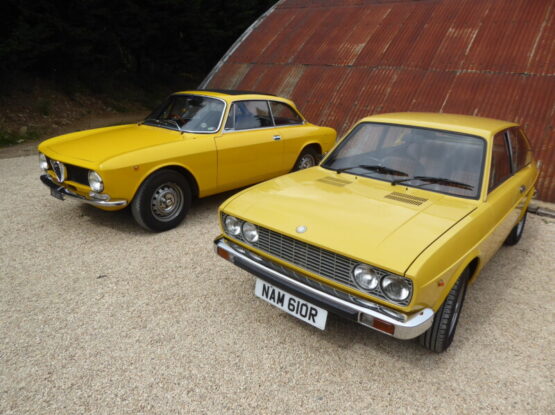
As was still the practice in the 1970s, Alfa followed up the launch of the Alfetta Berlina with a very pretty coupe. Styled by Giugiaro, this car, initially called the GT, and premiered in the autumn of 1974, looked completely unlike the saloon on which it was based. The first cars had 1.8 litre four cylinder engines and there was one of those on show. In 1976 the range was expanded both up and down with a 1.6 and a 2.0 model, the latter adopting the legendary GTV name. A rare SE model from this period was part of the display, complete with period vinyl roof (look closely), and although the pain does appear a bit like a lot of older Alfa reds, having gone rather pink, this was the actual shade when the car was new. In 1981, with the 2.5 litre V6 engine that had been developed for the ill-fated Alfa 6 luxury saloon available, Alfa was able to create a true rival for the 2.8 litre Capri with the GTV6. A facelift modernised the look of the car with plastic bumpers front and rear and a new interior looked rather better as well as being more ergonomically logical. There was a good mix of the earlier chrome bumpered and later plastic bumpered models, the last with 2.0 and 2.5 GTV6 versions both represented. There was also a car sporting 3.0 badging and right hand drive. This is a South African car. From 1974 South African Alfetta’s were manufactured at Alfa Romeo’s own Brits plant. South Africa was one of two markets to have a turbocharged GTV6, with a Garrett turbocharger and a NACA intake. An estimated 750 were assembled before all production ceased in 1986. The South African range included a 3.0 litre GTV-6, predating the international debut of the factory’s 3.0 litre engine in 1987 (for the Alfa 75). and 212 of these were built in South Africa for racing homologation. The last 6 GTV-6 3.0’s were fuel injected. To this day, the GTV-6 remains the quintessential Alfa Romeo for South Africans.

The Alfa Romeo 4C is a two-seater, rear-wheel drive coupé with technology and materials derived from the Alfa Romeo 8C Competizione, with a 1750 cc turbo petrol engine with direct injection, the “Alfa TCT” twin dry clutch transmission, and the Alfa DNA dynamic control selector. The 4C concept version was unveiled in the 81st Geneva Motor Show in March 2011, followed by the Mille Miglia 2011 parade, Goodwood Festival of Speed 2011,2011 Frankfurt Motor Show. It was displayed for the first time outside in Concorso d’Eleganza Villa d’Este in 2012. Compared to the production version, it is very similar, with the biggest differences being front lights, side vents and mirrors. The Alfa Romeo 4C Concept was voted the ‘Most Beautiful Concept Car of the Year’ award by the readers of German magazine Auto Bild, and won the Auto Bild Design Award 2011. It was awarded the “Design Award for Concept Cars & Prototypes” by referendum of the public in Villa d’Este. The production car was unveiled at the 2013 Geneva Motor Show, followed by 2013 Essen ‘Techno Classica’, Goodwood Festival of Speed 2013, Moscow Raceway, 2013 Frankfurt Motor Show. The bare ‘4C000’ chassis was also shown at the 2013 Geneva Motor Show. Ordering of European models began in October 2013 at Alfa Romeo dealerships in Europe. As part of the Alfa Romeo 4C launch, Alfa Romeo Style Centre and Compagnia Ducale designed a 4C IFD (Innovative Frame Design) Bicycle, inspired by the Alfa Romeo 4C coupé. The vehicle went on sale in December 2013 and marketed in Europe, Asia and America. Production of the 4C began May 2013 at Maserati’s plant in Modena, with an expected production of up to 2500 units per year. It was the first mass-produced Alfa Romeo model to be sold in the US market since 1995 when the 164 sedan stopped being sold in the US. Production of the Alfa Romeo 4C was originally estimated to be over 1000 units per year, with an upper limit of 3500 units per year, depending on the quantity of carbon fibre chassis that can be built by the supplier Adler Plastic.Within the 3,500-unit quota, 1,000 units are earmarked for Europe. Delivery of the European Alfa Romeo 4C Launch Edition took place at Balocco (Vercelli, Italy) Test Centre. In 2018, the 4C coupe was discontinued for the North American market. The 4C Spider, however continued to be sold there for model year 2019 and model year 2020. In other markets, such as Australia and Japan, both the coupe and Spider continued. In late 2020, a new tribute-edition named the 4C Spider 33 Stradale Tributo was announced. The car was designed by Centro Stile Alfa Romeo (Style Centre) and developed by Alfa Romeo. The chassis is composed of a central carbon fibre tub, with aluminium subframes front and rear. The carbon fibre tub is produced by TTA (Tecno Tessile Adler) in Airola, as a joint venture between Adler Plastic and Lavorazione Materiali Compositi. The carbon fibre components that make up the chassis are cut using CNC technology. The entire carbon-fibre monocoque chassis (“tub”) of the car weighs 143 pounds (65 kg). Front and rear aluminium subframes combine with the tub, roof reinforcements and engine mounting to comprise the 4C chassis giving the vehicle a total chassis weight of 236 lb (107 kg) and a total vehicle curb weight of just 2,465 lb (1,118 kg). The 4C has a single carbon fibre body, similar to the body of many supercars. The outer body is made of a composite material (SMC for Sheet Moulding Compound) which is 20% lighter than steel. The stability is comparable to steel and better than aluminium. The 4C employs double wishbone suspensions at the front and MacPherson struts at the rear. The resultant weight distribution is 38% on the front and 62% on the rear axle. Wheels and tyres have different diameters and widths front and rear: 205/45 R17 front and 235/40 R18 back as standard, with optional 205/40 R18 and 235/35 R19. Both wheel options come equipped with Pirelli P Zero tyres. The 4C uses vented disc brakes on all wheels; Brembo 305 millimetres (12.0 in) on the front and 292 millimetres (11.5 in) on the rear. The car can stop from 100 km/h (62 mph) in 36 metres. To save weight and increase steering feel, the 4C has no power steering. Its centre of gravity height, at 40 centimetres (16 in) off the ground, is 7 centimetres (2.8 in) lower than that of the Lotus Elise. The 4C uses a new all-aluminium 1,742 cc inline 4 cylinder turbocharged engine producing 240 PS at 6000 rpm. The engine has been designed for minimum weight. The engine’s combined fuel consumption 6.8 l/100 km (42 mpg‑imp; 35 mpg‑US).[4] 0–62 mph (0–100 km/h) acceleration is achieved in 4.5 seconds and the top speed is 258 km/h (160 mph), the power-to-weight-ratio being just 0.267 hp/kg (8.22 lb/hp) A journalist from Quattroruote car magazine demonstrated how the 4C accelerates from 0–100 km/h (0–62 mph) faster than 4.5 seconds. In race mode, with left foot on the brake pedal, if you pull the right shift paddle the engine will rev to 3500 rpm, but if you also pull the left paddle the engine will rev to 6000 rpm and 0–100 km/h (0–62 mph) time will go down to 4.2 seconds. Italian car magazine Quattroruote published the lap time of 4C around Nürburgring. It lapped the ring in 8:04. The 4C is equipped with a six speed Alfa TCT Dual Dry Clutch Transmission, and can be operated via gearshift paddles on the steering wheel. It also has an Alfa ‘DNA’ dynamic control selector which controls the behaviour of engine, brakes, throttle response, suspension and gearbox. In addition to the modes already seen in Giulietta, the 4C has a new “Race” mode. The U.S. version of the 4C was introduced in the 2014 New York International Auto Show with the first 100 4C’s being shipped to the U.S. early July, with a total of 850 being shipped by the end of 2014. The U.S. model includes extra bracing and strengthening required to meet U.S. crash regulations (including aluminium inserts in the carbon fibre chassis), resulting in 100 kg (220 lb) of weight increase. This version also has new headlamps similar to those seen before in the 4C Spider version. In 2018, the 4C coupe was discontinued for the North American market due to US DOT NHTSA FMVSS 226 Ejection Mitigation. The regulation called for a progressive compliance date based on volume and, due to low volume, the 4C was allowed to continue until the last compliance date of 9/1/2017, thus all 2018 4C coupes in North America have build dates of 8/2017 or earlier. The 4C Spider, however continued to be sold in North America for model year 2019 and model year 2020. The Spider version of the 4C was previewed showing a pre-production prototype at the 2014 Geneva Motor Show. Sharing its engine with the Coupé version, the 4C Spider has different external parts such as the headlights, exhaust and engine hood, as well as a different roof section that features a removable roof panel. The North American spec 4C reflects a weight difference of only 22 lb (10 kg) (2,465 lbs vs. 2,487 lbs) for the Spider variant. Top speed is quoted at 257 km/h (160 mph) and acceleration from 0 to 100 km/h (62 mph) at 4.5 seconds. The 4C Launch Edition was a limited and numbered edition, unveiled at the vehicle’s launch at the 2013 Geneva Motor Show. The vehicle came in a choice of four paint colours (Rosso Alfa, Rosso Competizione tri-coat, Madreperla White tri-coat or Carrara White matte). 500 examples were reserved for Europe/ROW, 500 for North America, 88 for Australia (Rosso Alfa and Madreperla White only), 200 to Japan and 100 for the Middle East. Note that the original press release cited 500 for North America, 400 Europe, and 100 ROW; however, the plaques on actual cars suggest that more were built and are the numbers referenced above. Distinguishing features of the Launch Edition were carbon fiber trim (including headlight housings, spoiler and door mirror caps), rear aluminium extractor with dark finishing, Bi-LED headlights, dark painted 18-inch front and 19-inch rear alloy wheels, additional air intakes on the front fascia, red brake calipers, racing exhaust system, BMC air cleaner, specific calibration for shock absorbers and rear anti-roll bar, leather/fabric sports seats with parts in Alcantara and a numbered plaque. Alfa Red coloured cars got matching red stitching on the steering wheel, handbrake, mats, handles and sports seats. In Europe the vehicle went on sale for 60,000 euros including VAT. The 4C Competizione is a limited edition version of the 4C introduced in the 2018 Geneva Motor Show, finished in matte Vesuvio Grey, with carbon details on the roof, rear spoiler, mirror caps, side air vents and headlight moulding. The run reportedly consisted of 108 units. The Japanese market received 25 units, and 10 units were assigned to Australia. The US-market received no Competizione editions. The car had a very mixed reaction. The UK press hated it at launch, but owners generally disagreed and loved it. A total of 9117 were built before production ceased in 2020.


The current Giulia is available in the US, but it has not found many buyers, sadly. It was nice to see one here


ALVIS
The Alvis Fourteen also known as TA 14 was the first car to be produced by major defence contractor Alvis cars after World War II. The entire car factory had been destroyed on the night of Thursday 14 November 1940. Announced in November 1946 it was made until 1950 when its postwar austerity 1900 cc engine was replaced by the 2993 cc Alvis Three Litre or TA 21. The Fourteen was available as a four-door sports saloon built for Alvis by Mulliners of Birmingham but there were also Tickford and Carbodies drophead versions. When compared with the 12/70 car it replaced the interior is 4 inches wider and the distance between rear-seat armrests is increased almost 5 inches. The 1892 cc engine is a slightly larger-bore version of the one used in the 12/70 and produced 65 bhp. It is fitted with a single SU type H4 -inch side-draught carburettor. Inlet valves have been enlarged. The triplex chain drive has been given an automatic tensioner. The engine’s exhaust system has been extensively revised and the direction of flow of cooling water around the engine has been substantially changed. The bodies were mounted on an updated pre-war Alvis 12/70 chassis that was widened and lengthened but retained the rigid-axle leaf spring suspension. Employing Silentbloc bushes (except at the front of the front springs to maintain steering precision) it is controlled by double acting Armstrong hydraulic dampers. Hypoid bevel final drive was fitted for the first time and greatly reduced the height of the transmission tunnel. Steering is by Marles with a spring spoked steering wheel. Mechanically operated brakes are two-leading-shoe type by Girling. Disc wheels replaced the 12/70’s wire wheels and are fitted with larger tyres. The top speed is around 74 mph and acceleration from 0 to 60 mph in 22.2 seconds.


ARIEL
Atom

ASTON MARTIN
The DB6 was launched in 1965 as a replacement for the DB5 which had run since 1963. The wheelbase was now 4″ longer than before, resulting in an extensive restyle with a more raked windscreen, raised roofline and reshaped rear quarter windows. Opening front quarter lights made a reappearance, but the major change was at the rear where a Kamm tail with spoiler improved the aerodynamics, greatly enhancing stability at high speeds. “The tail lip halves the aerodynamic lift around maximum speed and brings in its train greater headroom and more luggage space”, declared Motor magazine, concluding that the DB6 was one of the finest sports cars it had tested. Famed employee, Tadek Marek, designed the six cylinder engine, which had been enlarged to 3,995cc for the preceding DB5 and remained unchanged. Power output on triple SU carburettors was 282bhp, rising to 325bhp in Vantage specification. Premiered at the 1965 London Motor Show, the DB6 Volante marked the first occasion the evocative ‘Volante’ name had been applied to a soft-top Aston Martin. After 37 Volante convertibles had been completed on the DB5 short wheelbase chassis, the model adopted the longer DB6 chassis in October 1966. A mere 140 DB6 based Volantes were manufactured, and of these only 29 were specified with the more powerful Vantage engine.

Following the unveiling of the AMV8 Vantage concept car in 2003 at the North American International Auto Show designed by Henrik Fisker, the production version, known as the V8 Vantage was introduced at the Geneva Motor Show in 2005. The two seat, two-door coupé had a bonded aluminium structure for strength and lightness. The 172.5 inch (4.38 m) long car featured a hatchback-style tailgate for practicality, with a large luggage shelf behind the seats. In addition to the coupé, a convertible, known as the V8 Vantage Roadster, was introduced later in that year. The V8 Vantage was initially powered by a 4.3 litre quad-cam 32-valve V8 which produced 380 bhp at 7,300 rpm and 409 Nm (302 lb/ft) at 5,000 rpm. However, models produced after 2008 had a 4.7-litre V8 with 420 bhp and 470 Nm (347 lbft) of torque. Though based loosely on Jaguar’s AJ-V8 engine architecture, this engine was unique to Aston Martin and featured race-style dry-sump lubrication, which enabled it to be mounted low in the chassis for an improved centre of gravity. The cylinder block and heads, crankshaft, connecting rods, pistons, camshafts, inlet and exhaust manifolds, lubrication system and engine management were all designed in house by Aston Martin and the engine was assembled by hand at the AM facility in Cologne, Germany, which also built the V12 engine for the DB9 and Vanquish. The engine was front mid-mounted with a rear-mounted transaxle, giving a 49/51 front/rear weight distribution. Slotted Brembo brakes were also standard. The original V8 Vantage could accelerate from 0 to 60 mph in 4.8 seconds before topping out at 175 mph. In 2008, Aston Martin introduced an aftermarket dealer approved upgrade package for power and handling of the 4.3-litre variants that maintained the warranty with the company. The power upgrade was called the V8 Vantage Power Upgrade, creating a more potent version of the Aston Martin 4.3-litre V8 engine with an increase in peak power of 20 bhp to 400 bhp while peak torque increased by 10 Nm to 420 Nm (310 lb/ft). This consists of the fitting of the following revised components; manifold assembly (painted Crackle Black), valved air box, right and left hand side vacuum hose assemblies, engine bay fuse box link lead (ECU to fuse box), throttle body to manifold gasket, intake manifold gasket, fuel injector to manifold seal and a manifold badge. The V8 Vantage had a retail price of GB£79,000, US$110,000, or €104,000 in 2006, Aston Martin planned to build up to 3,000 per year. Included was a 6-speed manual transmission and leather-upholstery for the seats, dash board, steering-wheel, and shift-knob. A new 6-speed sequential manual transmission, similar to those produced by Ferrari and Lamborghini, called Sportshift was introduced later as an option. An open-topped model was added to the range in 2006 and then in the quest for more power a V12 Vantage joined the range not long after. All told, there were no fewer than 18 different versions of the car before its replacement with a new and quite different looking model in 2017.


BMW
Partially based on the BMW Isetta two-seater, the 600 was BMW’s first postwar four-seater economy car. It was not a sales success, but it began the design process for its more successful successor, the BMW 700. BMW needed to expand its model range, but they did not have the resources to develop an all-new car with an all-new engine. Therefore, it used the Isetta as starting point for a new four seat economy car. As a result, the 600 used the front suspension and front door of the Isetta. The need to carry four people required a longer frame, a different rear suspension, and a larger engine. A new perimeter frame was designed, using box section side members and straight tube crossmembers. The rear suspension was an independent semi trailing arm design; this was the first time BMW had used this system. The chassis had a wheelbase of 1,700 mm (67 in), a front track of 1,220 mim (48 in), and a rear track of 1,160 mm (46 in). The 600 was powered by the 582 cc flat-twin engine from the R67 motorcycle/sidecar combination. This engine, which delivered 19.5 bhp at 4,500 rpm, was mounted behind the rear wheels. A four-speed manual gearbox was standard, while a Saxomat semi-automatic transmission was available. The 600 had a top speed of approximately 100 km/h. Access to the rear seats was by a conventional door on the right side of the vehicle. The Isetta image hurt the sales of this larger, more upscale car. The sales figures for the 600 did not meet BMW’s expectations. During production from August 1957 to 1959, about 35,000 were built. This is attributed to competition with more conventional cars, including the Volkswagen Beetle.


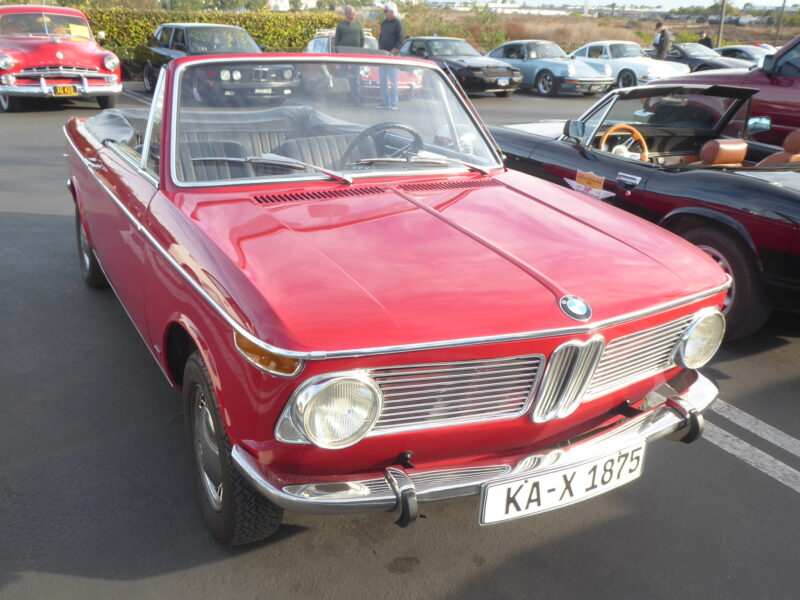
The 1600-2, as the first “02 Series” BMW was designated, was an entry-level BMW, and was smaller, less expensive, and less well-appointed than the New Class Sedan on which it was based. BMW’s design director Wilhelm Hofmeister assigned the two-door project to staff designers Georg Bertram and Manfred Rennen. The 9.1 in shorter length and wheelbase and lighter weight of the two-door sedan made it more suitable than the original New Class sedan for sporting applications. As a result, the two door sedan became the basis of the sporting 02 Series. The 1600-2 (the “-2” meaning “2-door”) made its debut at the Geneva Show in March 1966 and was sold until 1975, with the designation being simplified to “1602” in 1971. The 1.6 litre M10 engine produced 84 hp at 5,700 rpm and 96 lb·ft. A high performance version, the 1600 TI, was introduced in September 1967. With a compression ratio of 9.5:1 and the dual Solex PHH side-draft carburettor system from the 1800 TI, the 1600 TI produced 110 hp at 6,000 rpm. Also introduced in September 1967 was a limited-production cabriolet, which would be produced by Baur from 1967 through 1971. A hatchback 1600 Touring model was introduced in 1971 but was discontinued in 1972. It was what came next which was more significant. Helmut Werner Bönsch, BMW’s director of product planning, and Alex von Falkenhausen, designer of the M10 engine, each had a two litre engine installed in a 1600-2 for their respective personal use. When they realised they had both made the same modification to their own cars, they prepared a joint proposal to BMW’s board to manufacture a two litre version of the 1600-2. At the same time, American importer Max Hoffman was asking BMW for a sporting version of the 02 series that could be sold in the United States. As per the larger coupe and 4-door saloon models, the 2.0 engine was sold in two states of tune: the base single-carburettor 2002 producing 101 hp and the dual-carburettor high compression 2002 ti producing 119 hp. In 1971, the Baur cabriolet was switched from the 1.6 litre engine to the 2.0 litre engine to become the 2002 cabriolet, the Touring hatchback version of the 02 Series became available with all engine sizes available in the 02 Series at the time and the 2002 tii was introduced as the replacement for the 2002 ti. The 2002 tii used the fuel-injected 130 hp engine from the 2000 tii, which resulted in a top speed of 185 km/h (115 mph). A 2002 tii Touring model was available throughout the run of the tii engine and the Touring body, both of which ended production in 1974. The 2002 Turbo was launched at the 1973 Frankfurt Motor Show. This was BMW’s first turbocharged production car and the first turbocharged car since General Motors’ brief offerings in the early 1960s. It produced 170 hp. The 2002 Turbo used the 2002 tii engine with a KKK turbocharger and a compression ratio of 6.9:1 in order to prevent engine knocking. Kugelfischer mechanical fuel injection was used, with a sliding throttle plate instead of the usual throttle butterfly. The 2002 Turbo was introduced just before the 1973 oil crisis, therefore only 1,672 were built. The 1802 was introduced in 1971 and was available with either the original 2-door sedan body or the 3-door Touring hatchback introduced that year. Production of the Touring model continued until 1974, with the 1802 sedan ending production the following year. The 1502, an economy model with an engine displacement of 1573 cc was introduced in 1975. This engine had a lower compression ratio of 8.0:1, therefore standard-octane petrol could be used. While the rest of the 02 Series was replaced in 1975 by the E21 3 Series, the 1502 was continued until 1977.


The first car to bear the 6 Series nomenclature was the E24, which was launched in 1976, as a replacement for the E9 model 3.0 CS and CSL coupés first produced in 1965. The 3.0 CS was almost changed by adding a few centimeters in height to make it easier for customers to get into the car. However, Bob Lutz rebelled against the decision and rough drafted an alternative version that soon became the 6 series. Production started in March 1976 with two models: the 630 CS and 633 CSi. Originally the bodies were manufactured by Karmann, but production was later taken in-house to BMW. In July 1978 a more powerful variant, the 635 CSi, was introduced that featured as standard a special close-ratio 5-speed gearbox and a single piece black rear spoiler. The bigger bore and shorter stroke facilitated max 218 hp at 5200rpm and a better torque curve. For the first year, the 635 CSi was offered in three colours (Polaris, Henna Red, Graphite), and could also be spotted by the front air dam that did not have attached fog lights. These simple cosmetic changes reportedly worked to reduce uplift on the car at high speeds by almost 15% over the non-spoiler body shape. This early model shared suspension components with the inaugural BMW 5-series, the E12. In 1979 the carburettor 630 CS was replaced with the 628 CSi with its fuel injected 2.8 litre engine taken from the BMW 528i. In 1980 the 635 CSi gained the central locking system that is also controlled from the boot. Also, the E24 body style converted from L-jetronic injection to a Bosch Motronic DME. In 1982 (Europe) and 1983 (US), the E24 changed slightly in appearance, with an improved interior and slightly modified exterior. At the same time, the 635 CSi received a new engine, a slightly smaller-bored and longer-stroked 3430 cc six to replace the former 3453 cc engine and became available with a wide-ratio 5-speed manual or an automatic. This slight change was in fact a major change as pre-1982 cars were based on the E12 5-series chassis; after mid-1982, E24s shared the improved E28 5-series chassis. The only parts that remained the same were some of the exterior body panels. E24s produced after June 1987 came with new, ellipsoid headlamps which projects beam more directly onto road surface (newly introduced E32 7-series also sporting them). The sleeker European bumpers were also discontinued. Previous cars had either a European-standard bumper or a larger, reinforced bumper to meet the US standard requiring bumpers to withstand impact at 5 mph without damage to safety-related components. 1989 was the last year for the E24 with production stopping in April. The E24 was supplanted by the considerably heavier, more complex, and more exclusive 8 Series. BMW Motorsport introduced the M 635 CSi in Europe at the Frankfurt Motor Show in 1983. It is essentially an E24 powered by the powerplant of the BMW M1 – the M88 with 286 PS). Most of the cars were equipped with special metric 415 mm diameter wheels requiring Michelin TRX tyres. A catalysed, lower compression ratio version of the car with the S38 engine (260 PS ) was introduced in the U.S. in 1987. All M6 cars came standard with a 25% rear limited slip differential. U.S. models included additional comforts that were usually optional on models sold in Europe such as Nappa leather power seats and a dedicated rear A/C unit with a centre beverage chiller. 4,088 M635CSi cars were built between 1983 and 1988 with 1,767 U.S. M6 built.


CHEVROLET
This is a 1940 Chevrolet Master de Luxe. The Chevrolet Master and Master Deluxe are American passenger vehicles manufactured by Chevrolet between 1933 and 1942 to replace the 1933 Master Eagle. It was the most expensive model in the Chevrolet range at this time, with the Standard Mercury providing an affordable product between 1933 and 1937. Starting with this generation, all GM cars shared a corporate appearance as a result of the Art and Color Section headed by Harley Earl. From 1940 a more expensive version based on the Master Deluxe was launched called the Special Deluxe. The updated corporate appearance introduced a concealed radiator behind a façade with a grille. The Master name was used on a number of different versions, and the Series name changed each year. A four door open top convertible was no longer offered starting in 1933. For 1940, there were the series KA and KB. The Master continued to be available in Master 85 (KB) as well as the more upscale “Master Deluxe” model (KA). The even better equipped “Special Deluxe” also appeared for the 1940 model year.

The Advance-Design is a light and medium duty truck series by Chevrolet, their first major redesign after WWII. Its GMC counterpart was the GMC New Design. It was billed as a larger, stronger, and sleeker design in comparison to the earlier AK Series. First available on June 28, 1947, these trucks were sold with various minor changes over the years until March 25, 1955, when the Task Force Series trucks replaced the Advance-Design model. The same basic design family was used for all of its trucks including the Suburban, panel trucks, canopy express, and cab overs. The cab overs used the same basic cab configuration and similar grille but used a shorter and taller hood and different fenders. The unique cab over fenders and hood required a custom cowl area which makes the cab over engine cabs and normal truck cabs incompatible with one another while all truck cabs of all weights interchange. From 1947 until 1955, Chevrolet trucks were number one in sales in the United States, with rebranded versions sold at GMC locations. While General Motors used this front end sheet metal, and to a slightly lesser extent the cab, on all of its trucks except for the cab overs, there are three main sizes of this truck: the half-, three-quarter-, and full-ton capacities in short and long wheelbase.

There were a couple of examples of what has become one of Chevrolet’s best-loved classics, the Bel Air. The story of these cars starts in 1955, when Chevrolet replaced the entire range of cars, producing what are sometimes referred to as the “Tri-Five” range, which would live for three years. Revolutionary in their day, they spawned a cult following that exists in clubs, website and even entire businesses that exclusively cater to the enthusiasts of the Tri Five automobiles. All featured a front-engine, rear-wheel-drive layout. 1955-1957 were watershed years for Chevrolet, who spent a million dollars in 1956 alone for retooling, in order to make their less expensive Bel Air models look more like a Cadillac, culminating in 1957 with their most extravagant tailfins and Cadillac inspired bumper guards. In 1955, Americans purchased 7.1 million new automobiles, including 1.7 million Chevrolets, giving the company fully 44% of the low-price market and surpassing Ford in total unit sales by 250,000. The Bel Air was an instant hit with consumers, with Base One-Fifty models starting under $1600 and featuring a six cylinder engine. The introduction of the new optional 170 hp 265ci V8, coupled with the Powerglide automatic transmission quickly earned the model the nickname “The Hot One”. In the first year of production, the oil filter was considered an option, although not having it led to significantly shorter engine life. With three basic model lines of 150, 210 and Bel Air and a range of body styles from 2 and 4 door Sedans to Coupes, Convertibles and Wagons, there were as many as 19 different Tri-five models available. The 1956 cars saw minor changes to the grille, trim and other accessories. It meant huge gains in sales for Chevrolet, who sold 104,849 Bel Air models, due in part to the new V8 engine introduced a year before. By this time, their 265cid V8 had gained popularity with hot rodders who found the engine easy to modify for horsepower gains. This wasn’t lost on Chevrolet’s engineers, who managed to up the horsepower in 1956 from 170 hp to 225 hp with optional add-ons. The average two door Bel Air in 1956 sold for $2100, which was considered a good value at the time. Prices ranging from $1665 for the 150 sedan with six cylinder engine to $2443 for the V8 equipped convertible, with Nomad models running slightly higher. Bigger changes came for 1957, including the large tailfins, “twin rocket” bonnet design, even more chrome, tri-colour paint and a choice from no less than seven different V8 engines. While in 1957, Ford outsold Chevrolet for the first time in a great while, years later the used 1957 Chevrolets would sell for hundreds more than their Ford counterparts. As the horsepower race continued, Chevrolet introduced a new version of their small block, with 283 cubic inches of displacement and 245 hp. They also introduced a limited number of Rochester fuel injected 283 engines that produced 283 hp, the first production engine to achieve 1 hp per cubic inch. For all intent and purposes, this made the 1957 Bel Air a “hot rod”, right off the production line. It was available with manual transmission only. The base 265cid engine saw an increase from 170 to 185 hp as well. While not as popular as the previous year’s offering, Chevrolet still managed to sell 1.5 million cars in 1957.


After the rear-engine Chevrolet Corvair was outsold by the conventional Ford Falcon in 1960, Chevrolet completed work on a more conventional compact car that would eventually become the Chevy II. The car was of semi-unibody construction having a bolt on front section joined to its unitized cabin and trunk rear section, available in two- and four-door sedan configurations as well as convertible and 4-door station wagon versions. The 1962 Chevy II came in three series and five body styles—the 100 Series, 300 Series and Nova 400 Series. A 200 series was also introduced, but was discontinued almost immediately. The sportiest-looking of the lot was the US$2,475 Nova 400 convertible—23,741 were produced that year. Available engines for the Chevy II in 1962 and 1963 included Chevrolet’s inline-four engine of 153 cu in (2.5 L) and a new 194 cu in (3.2 L) Hi-Thrift straight-six engine. All Chevy II engines featured overhead valves. In 1962 and 1963 the Nova option for the Chevy II was available in a convertible body style, and a two-door hardtop was available from 1962 to 1965, although the hardtop was dropped when the 1964 models were first introduced, but subsequently brought back to the line later in the model year. Like all Chevy two-door hardtops, the body style was marketed as the Sport Coupe. For 1963, the Chevy II Nova Super Sport was released, under RPO Z03. It featured special emblems, instrument package, wheel covers, side moldings, bucket seats, and floor shifter, and was available only on the 400 series sport coupe and convertible. Cost of the package was US$161.40. As mentioned above, the Nova option could not officially have V8 engines at this time—the standard SS engine was the six-cylinder (this was also applicable to the Impala (and later the early Chevelle c. 1964–65) when the SS was a sport and appearance package)—but small-block V8 engine swaps were commonplace among enthusiasts. For 1964, sales were hit hard by the introduction of the new Chevelle, and the Chevy II received its first factory V8 option, a 195 hp 283 cu in (4.6 L), as well as a 230 cu in (3.8 L) straight six. The six-cylinder was all-new, replacing the older Stovebolt engine. Rival manufacturer Chrysler had earlier developed the Slant Six in their Plymouth Valiant, a Chevy II competitor, when the cars were introduced to the public in late 1959 as 1960 models. At introduction in the fall, the hardtop coupe was missing in the lineup, contributing to a loss of sales (as well as showroom appeal). Chevrolet subsequently reintroduced the Sport Coupe in the lineup later in the model year, and it remained available through 1967. The 1965 Chevrolet Chevy II and Nova were updated with cleaner front-end styling courtesy of a fresh full-width grille with new integrated headlight bezels. Parking lights moved down to the deep-section bumper, and sedans gained a new roofline. Taillight and backup lights were restyled, as was the rear cove. The 1965 Chevy II came in entry-level 100 form or as the posher Nova 400, each in three body styles. The Nova Super Sport came as a Sport Coupe only, and its production dipped to just 9,100 cars. Super Sports had a new brushed-chrome console with floor-mounted four-speed manual transmission or Powerglide automatic, but a column-mounted three-speed manual remained standard. Bucket seats wore textured vinyl trim, and the dashboard held ammeter, oil pressure, and temperature gauges. An expanded engine lineup gave customers six power choices of the six-cylinder or V-8 engines; the four-cylinder was available only in the 100. But, for Chevy II enthusiasts, 1965 is best remembered as the year the Chevy II became a muscle car. A 327 cu in (5.4 L) V8 was available with up to 300 hp, suddenly putting Nova SS performance practically on a par with the GTO, 4-4-2, and 271 bhp Mustang 289s-at least in straight-line acceleration. Midyear also brought a more potent 283 with dual exhausts and 220 horsepower. The Chevelle Malibu SS continued to eat away at the Nova SS market: Out of 122,800 Chevy IIs built for 1965 (compared to 213,601 Falcons), only 9,100 were Super Sports. For 1965, Chevy II had the dubious distinction of being the only car in GM’s lineup to suffer a sales decline. It is possible that some Chevy II sales were lost to the brand-new ’65 Corvair, which addressed virtually all its 1960–64 problems, got rave reviews from automotive journals and featured sleek new (Z-body) styling along with a brand-new chassis.


The 1968 Chevelle received an all-new distinctly sculpted body with tapered front fenders and a rounded beltline. The car adopted a long-hood/short-deck profile with a high rear-quarter “kick-up”. While all 1967 Chevelle models rode a 115-inch (2,900 mm) wheelbase, the 1968 coupes and convertibles now rode a 112-inch (2,800 mm) wheelbase. The 4 door sedans and wagons turned to a 116-inch (2,900 mm) span. Tread width grew an inch front and rear. Hardtop coupes featured a semi-fastback, flowing roofline with a long hood and short deck, influenced by the all-new Camaro. The fastback appearance was a revival of a streamlining bodystyle on all GM products from 1942 until 1950, as demonstrated on the Chevrolet Fleetline. Top-trim models (including the SS 396 and new luxury Concours) featured GM’s new Hide-A-Way wiper system. Lesser Chevelles would get that change later. The entry-level Chevelle 300 (131 – 132 VIN prefix) was available as a pillared coupe and/or station wagon (Nomad) while the 300 Deluxe and Nomad Custom (133 or 134 VIN prefix) had a 2-door hardtop added to the lineup (fourth and fifth VIN characters will be 37; with the previous 300 Deluxe the hardtop was available with the Malibu and SS396 but not the base 300/Deluxe in the USA not counting those produced for the Canadian market). The Super Sport (SS396 sport coupe, convertible, and El Camino pickup) became series on its own. Chevrolet produced 60,499 SS 396 sport coupes, 2,286 convertibles, and 5,190 El Caminos; 1968 was the only year the El Camino body style would get its own SS396 series designation (13880). Government-mandated side marker lighting was incorporated, with early 1968 SS 396 light bezels seen with the SS 396 nomenclature – at some point in the later production cycle the engine callout had a 396 also shared with the Chevy II Nova SS (the side marker bezels, also sourced from the Chevy II Nova in 307, 327, and 396 displacements) had the engine displacement except for the six-cylinder models). Black-accented Super Sports had F70x14 red-stripe tires and a standard 325-horsepower 396-cubic-inch Turbo-Jet V8 engine with the special twin-domed hood; 350 and 375-horsepower 396 engines were optional. The SS 396 sport coupe started at $2,899 – or $236 more than a comparable Malibu with its 307-cubic-inch V8. All-vinyl bucket seats and a console were optional. Three luxury Concours options became available in March 1968 for the 4-door sedan, the 4-door sport sedan (and the hardtop coupe) and consisted of special sound insulation, and a deep-padded instrument panel with simulated woodgrain accents and all-vinyl color-keyed interiors. Interiors were sourced and shared with select Buick, Oldsmobile, or Pontiac A body patterns – during the middle of the 1968 model year, some Chevrolet A-bodies (including the El Camino) ended up with interior door panels shared with the Buick or Oldsmobile A bodies (Special, Skylark) where supply and demand issues forced a substitution, and during the April 1968 production month in the wake of the assassination of Reverend Dr. Martin Luther King Jr. there were some work stoppages e.g. strikes. A ribbed stainless steel panel was bolted to the rear taillight panel and a ‘Concours By Chevrolet’ emblem on the rear decklid. Other options included power windows and door locks. With the hardtop, a rare option is a horseshoe floor shifter with an integrated console (with bucket seats – sourced from the SS). These Concours options (ZK5, ZK6, and ZK7) should not be confused with the two Concours station wagons. At the time the ZK5, ZK6, and ZK7 Concours package was the equivalent of the Caprice. Also new for 1968 was the elimination of the term “sedan” for the 2-door pillar body style. This was now called a coupe (or pillar coupe) while the 2-door hardtop remained a sport coupe. These coupe/sport coupe designations would continue into 1969 as well. The Concours Estate Wagon was one of four distinct Chevelle wagon models. A one-year Nomad, Nomad Custom was offered. Regular Chevelle engines started with a 140 hp Turbo-Thrift six or the new 200 hp Turbo-Fire 307 V8, and a 325 hp version of the 327-cubic-inch V8. Manual transmission cars got GM’s “Air Injection Reactor (A.I.R)” smog pump. New Federal safety-mandated equipment included side marker lights, as well as shoulder belts for outboard front seat occupants on cars built after December 1, 1967. 1969 Chevelles were billed as “America’s most popular mid-size car.” They showed only minor changes for 1969, led by revised front-end styling. A single chrome bar connected quad headlights (which became a familiar Chevrolet trademark) with a revised front grille, now cast in ABS plastic, and a slotted bumper held the parking lights. Taillight lenses were larger and more vertical, flowing into the quarter panels. Smaller side marker lighting bezels were phased in (shared with the Camaro and using the lens assembly as the previous year). Front vent windows (hardtop and convertibles only) began to fade away now that Astro Ventilation (first introduced on the 1966 Buick Riviera which was used a year earlier on the Camaro and Caprice) was sending outside air into several Chevelle models. The Chevelle lineup slimmed down to Nomad, 300 Deluxe/Greenbrier, Malibu/Concours, and Concours Estate series, and the base 300 series was history. No longer a series of its own, the SS 396 turned into a $347.60 option package for any two-door model. That meant not just a convertible, sport coupe, or pickup, but even the pillared coupe and sport coupe in the 300 Deluxe series (except the base 300 Deluxe El Camino pickup). Fewer SS396-optioned 300 Deluxe coupes and sport coupes were built than their Malibu counterparts and they are solid gold for collectors. The Super Sport option included a 325-horsepower 396-cubic-inch V8 beneath a double-domed hood, along with a black-out grille displaying an SS emblem and a black rear panel. More potent editions of the 396 engine also made the options list, developing 350 or 375 hp. SS396s produced from this point on shared the same VIN prefix with the Malibu sport coupe (136), with the exception of the 300 Deluxe based SS396s using (134), where the original buildsheet and/or Protect-O-Plate (which is an aluminium tag included with the original sales invoice from Chevrolet dealers) can ID a genuine SS (especially for a numbers matching original which is unaltered); however, the VIN number alone cannot ID a genuine SS as in previous years. Around an estimated 323 Chevelle 2-door hardtops were fitted with an L72 427 cu in (7.0 L) rated at 425 bhp at 5,800 rpm and 460 lb⋅ft (624 N⋅m) at 4,000 rpm of torque, where some Chevrolet dealers used the Central Office Production Order (this also included some Camaros and Novas of the same model year) – some COPOs were sold through select Chevrolet dealerships and out of the 323 COPO orders, a confirmed 99 were sold through the Yenko Chevrolet dealership in Canonsburg, PA. During the 1969 model year, a police package (RPO B07) was available on the Chevelle 300 Deluxe 4-door sedan where some were optioned with the RPO L35 (396) motor along with a boxed frame (also shared with fleet orders e.g. taxicabs and rental cars); at the time the police option was reintroduced since the 1964/65 model years (at the time midsize squads came with economy powertrain usually in the case of the Chevelle a third-generation Chevrolet inline-six. The 300 Deluxe squads was not a sales success since the market was dominated by rival manufacturer Chrysler Corporation where its B platform (and its full-sized sedans) outsold its competitors. Chevelle station wagons came in three levels: Concours, Nomad, and Greenbrier—the last a badge formerly used on the Corvair van. A new dual-action tailgate operated either in the traditional manner or as a panel-type door. Wagons stretched 208 inches (5,300 mm) overall versus 197 inches (5,000 mm) for coupes. Also the Concours option package (ZK5, ZK6, and ZK7) from the previous year was continued. New round instrument pods replaced the former linear layout. Chevelle options included headlight washers, power windows and locks, and a rear defroster. Chevy’s midsize production rose this year. About seven percent of all Malibus had a six-cylinder engine, while about 86,000 came with the SS 396 option. All 1969 Chevelles had a new locking steering column one year ahead of the Federal requirement, and headrests required for all cars sold in the U.S. after January 1, 1969. In 1969 Chevrolet developed a steam powered concept vehicle, designated the SE 124 based on a Chevelle fitted it with a 50 hp Bresler steam engine in place of its gasoline engine. The Bresler was based on the Doble steam engine.

In 1970, sheet metal revisions gave the bodies a more coke bottle styling, and interiors were also redesigned. The 1970 Chevelle and the 1970 Buick Skylark share the same roofline. The 1970 Chevelle came in Sport Coupe, Sport Sedan, convertible, four-door sedan, a couple of wagons, and coupé utility (the El Camino) body styles. Only three of these (Malibu sport coupe, Malibu convertible, and El Camino pickup) were available with a choice of one of two SS options; RPO Z25 with the SS 396 (402 cid) engine and RPO Z15 with the new 454 cid engine. The base model was now simply called Chevelle in lieu of the former base 300 Deluxe, and was only available as a Sport Coupe or four-door sedan. In Canada, the base series retained its 300 Deluxe name, with appropriate badging on each front fender just behind the front wheel well. The 300 Deluxe 2-door sedan was canceled and replaced by the base Chevelle Sport Coupe, a 2 door pillarless hardtop. The hardtop, convertible, and sedan received the upgraded sheet metal but the station wagons and El Camino retained the previous year’s sheet metal panels (which went on for the next 2 model years). Station wagons were the entry-level Nomad, the Chevelle level Greenbrier, the Malibu level Concours, and an upscale Concours Estate. New options included power door locks and a stalk-mounted wiper control. Production was expanded to the GM Arlington Assembly plant in Arlington, Texas (where the Chevelle was assembled with its corporate siblings in this case the Oldsmobile Cutlass). Engine choices ranged from the standard 155 hp six-cylinder and 200 hp 307-cubic-inch V8, to a pair of 350 V8s and a pair of 402 engines. RPO Z25 SS equipment option included one of these 402 cid engines but was still marketed as a 396. The second 402 cid engine was available under RPO, rated at 330 hp with single exhaust, and was available in any V8 series except an SS optioned Malibu or El Camino. 1970 also saw the introduction of the 454 cid engine and was only available with the RPO Z15 SS Equipment option. The base 454 cu in (7.4 L) engine was rated at 360 bhp which was also available with cowl induction; and the optional LS6 version equipped with a single 4-barrel 800 CFM Holley carburettor produced 450 bhp at 5600 rpm and 500 lb/ft (678 Nm) at 3600 rpm of torque. There were 4,475 LS6 Chevelles produced. The SS 396 Chevelle included a 350 hp Turbo-Jet 396 V8, special suspension, “power dome” hood, black-accented grille, resilient rear-bumper insert, and wide-oval tires on sport wheels. Though a 375 hp cowl induction version was available, few were sold in favor of the newly introduced 454 engine during late-1969 timeframe. The LS5 454-cubic-inch V8 produced 360 hp in standard form and a cowl induction version was also available. The LS6 produced a claimed 450 gross HP in solid-lifter, high-compression guise. “You can make our tough one even tougher,” the brochure explained, by adding Cowl Induction to either the SS 396 or the SS 454. Step on the gas, and a scoop opened “to shoot an extra breath of cool air into the engine air intake….like second wind to a distance runner.” Neither functional hood lock pins nor hood and deck stripes were standard with either SS option, but were part of the optional ZL2 cowl induction hood option. The 454 cu in (7.4 L) LS5 V8 was rated at 360 hp. Although the 1971 Chevelle retained the 1970 body, it was treated to new front-end and rear-end styling that included large Power-Beam single-unit headlights, a reworked grille and bumper, and integral park/signal/marker lights. The grille was widened and featured a bright horizontal bar that divided it into two sections. At the center of this bar was a large Chevy bowtie for Malibus, or a large “SS” emblem for the SS models. The grille on the Super Sport was painted flat black, other models got a silver finished grille. Base Chevelles got a thinner, plain bar with no ornamentation. A small “Chevelle” nameplate was located in the lower-left corner of the grille. New dual round taillights were integral with the back bumper. Because SS models suffered heavy insurance surcharges, Chevrolet introduced the “Heavy Chevy” at midyear, which was based on the base Chevelle, and was available with any V8 engine except the 454, which was exclusive to SS models. The Heavy Chevy (RPO YF3) was only available with the base Chevelle sport coupe (13437) and was primarily a dress-up option and even it was limited to options available on the standard Chevelle sport coupe; vinyl carpeting, front bench seat, no center console shift, etc. Chevrolet specifications for 1971 included both “gross” and “net” horsepower figures for all engines. The standard Chevelle SS engine was a two-barrel 350-cubic-inch V8 rated at 245 gross (165 net) horsepower. Optional was a four-barrel carbureted version of the 350 V8 rated at 275 gross (200 net with dual exhaust and 175 net with single exhaust) horsepower. The 402 cid big-block engine continued to be optional as the SS 396 but was only available in one horsepower rating, 300 gross (260 net) horsepower, and was not available with cowl induction. The base LS5 454 V8 produced 365 gross and 285 net horsepower, but cowl induction was available that produced more power because of the air induction and louder exhaust system. The LS6 454 option, which was originally announced as a regular production option on the Chevelle SS for 1971, was dropped early in the model year and no official records indicate that any 1971 Chevelles were assembled with the LS6 engine. For 1971, the SS option could be ordered with any optional V8 and became more of a dress-up option than a performance option. The SS option was reduced to one RPO code, RPO Z15, and was only available for the Chevelle Malibu. This RPO code required any optional engine and transmission available in the Chevelle lineup. Since the 307 V8 was the standard base V8 in 1971, it could not be ordered with the SS option; one had to order the LS3 402 or the LS5 454, or one of the two 350 V8 engines (L65 or L48 – which reintroduced the small block to the SS option for the first time since the 1965 model year for USA market Chevelles). GM mandated all divisions design their engines to run on lower-octane regular, low-lead or unleaded gasoline. To permit usage of the lower-octane fuels, all engines featured low compression ratios (9:1 and lower; well below the 10.25-11.25:1 range on high-performance engines of 1970 and earlier). This move reduced horsepower ratings on the big-block engines to 300 for the 402 cubic-inch V8 but the LS5 454 option got an “advertised” five-horsepower increase to 365. Both 350 V8 engines, as well as the dual exhaust 402 cid V8 engine, were available without the SS option; only the LS5 454 V8 required the SS option. A single exhaust version of the 402 cid engine existed in 1970 with 330 gross hp and in 1972 with 210 net hp. In 1971 the single exhaust version of the 402 cid engine produced 206 net hp, but only appeared in the full-size Chevrolet brochure. 1972 Chevelles featured single-unit parking/side marker lights on their front fenders, outside of a revised twin-bar grille. All Malibus had concealed wipers. The SS equipment option requirements remained the same as those in 1971, any optional V8. The 1972 Chevelle series had wide enough appeal to qualify as America’s second-best-selling car. Base versions again included a four-model wagon series. Upscale versions were Malibus including the convertible models. More than 24,000 Malibu Sport Sedans were built, with a standard 307-cubic-inch V8 rated at 130 (net) horsepower. This 4-door hardtop used the same body as the 1968-71 models, and although it was attractive, it was the least popular body style in the lineup. It was not available with the overhead-valve “Turbo-Thrift” six-cylinder engine. With that V8, the Malibu Sport Coupe was the top seller by far starting at $2,923. The six-cylinder version ran $90 less. Powertrain options included the 175-hp 350-cubic-inch V8 and 240-hp 402-cubic-inch (still known as a 396), as well as a 454 that produced 270 hp under the net rating system. Chevelles sold in California were not available with the 307 V8, but had a 350-cubic-inch engine. Through the 1970s, California cars often had different powertrains than those marketed in states with less-stringent emissions regulations. The 1972 Chevelle SS had a top engine rated at 270 net hp conforming with GM’s decree that all engines were to be rated at their net engine ratings. All other engines on the SS roster were unchanged from 1971. 1972 was the last year for the cowl induction option for the 454 cid engine and was not even mentioned in the 1972 Chevelle brochure. Chevelle wagons measured 10 inches (250 mm) shorter than full-size wagons and weighed about half a ton less, but sold much slower. Model-year output totaled 49,352 Chevelles and 290,008 Malibus—plus 54,335 station wagons.

This is a second generation Corvette, sometimes referred to as the C2, which was launched in 1963. This model introduced us to the name Sting Ray. It continued with fibreglass body panels, and overall, was smaller than the first generation. The car was designed by Larry Shinoda with major inspiration from a previous concept design called the “Q Corvette,” which was created by Peter Brock and Chuck Pohlmann under the styling direction of Bill Mitchell. Earlier, Mitchell had sponsored a car known as the “Mitchell Sting Ray” in 1959 because Chevrolet no longer participated in factory racing. This vehicle had the largest impact on the styling of this generation, although it had no top and did not give away what the final version of the C2 would look like. The third inspiration was a Mako Shark Mitchell had caught while deep-sea fishing. Production started for the 1963 model year and ended in 1967. The 1963 model was the first year for a Corvette coupé and it featured a distinctive tapering rear deck (a feature that later reappeared on the 1971 “Boattail” Buick Riviera) with, for 1963 only, a split rear window. The Sting Ray featured hidden headlamps, non-functional bonnet vents, and an independent rear suspension. Corvette chief engineer Zora Arkus-Duntov never liked the split rear window because it blocked rear vision, but Mitchell thought it to be a key part of the entire design. Maximum power for 1963 was 360 bhp, raised to 375 bhp in 1964. Options included electronic ignition, the breakerless magnetic pulse-triggered Delcotronic first offered on some 1963 Pontiac models. On 1964 models the decorative bonnet vents were eliminated and Duntov, the Corvette’s chief engineer, got his way with the split rear window changed to a full width window. Four-wheel disc brakes were introduced in 1965, as was a “big block” engine option: the 396 cu in (6.49 litre) V8. Side exhaust pipes were also optionally available in 1965, and continued to be offered through 1967. The introduction of the 425 bhp 396 cu in big block in 1965 spelled the beginning of the end for the Rochester fuel injection system. The 396 cu in option cost $292.70 while the fuel injected 327 cu in (5.36 litre) engine cost $538.00. Few people could justify spending $245.00 more for 50 bhp less, even though FI could deliver over 20 mpg on the highway and would keep delivering fuel despite high G-loading in corners taken at racing speeds. Another rare ’63 and ’64 option was the Z06 competition package, which offered stiffer suspension, bigger, multi-segment lined brakes with finned drums and more, only a couple hundred coupes and ONE convertible were factory-equipped this way in 1963. With only 771 fuel-injected cars built in 1965, Chevrolet discontinued the option at the end of the ’65 production, having introduced a less-expensive big block 396 engine rated at 425 hp in the middle of the production year and selling over 2,000 in just a few months. For 1966, Chevrolet introduced an even larger 427 cu in 7 litre Big Block version. Other options available on the C2 included the Wonderbar auto-tuning AM radio, AM-FM radio (mid-1963), air conditioning (late-1963), a telescopic steering wheel (1965), and headrests (1966). The Sting Ray’s independent rear suspension was successfully adapted for the new-for-1965 Chevrolet Corvair, which solved the quirky handling problems of that unique rear-engine compact. 1967 was the final year for the C2 generation. The 1967 model featured restyled bumper vents, less ornamentation, and back-up lamps which were on the inboard in 1966 were now rectangular and centrally located. The first use of all four taillights in red started in 1961 and was continued thru the C-2 line-up except for the 1966. The 1967 and subsequent models continuing on all Corvettes since. 1967 had the first L88 engine option which was rated at 430 bhp, but unofficial estimates place the actual output at 560 bhp or more. Only twenty such engines were installed at the factory. From 1967 (to 1969), the Holley triple two-barrel carburettor, or Tri-Power, was available on the 427 L89 (a $368 option, on top of the cost for the high-performance 427). Despite these changes, sales slipped over 15%, to 22,940 – 8,504 coupes and 14,436 convertibles.


The C5 Corvette was redesigned from the ground up after sales from the previous generation began to decline. Production of the C5 Corvette actually began in 1996 but quality/manufacturing issues saw its release to the public in mass delayed until 1997, and continuing through the 2004 model year. The C5 was a completely new design that featured many new concepts and manufacturing breakthroughs that would be carried forward to the C6 & C7. It had a top speed of 176 mph (283 km/h) and was judged by the automotive press as a breakthrough with vastly improved dynamics in nearly every area over the previous C4 design. Innovations included a 0.29 drag coefficient, near 50/50 weight distribution, active handling (the first stability control for a Corvette). It also weighed less than the C4. It was the first time the platform was badge engineered as the Cadillac XLR with limited sales. An all new LS1 aluminium engine (Gen III small block) featured individual ignition coils for each cylinder, and aluminium block and pistons. It was initially rated at 345 bhp and 350 lb/ft (470 Nm), but was increased to 350 bhp in the 2001 edition. The new engine, combined with the new body, was able to achieve up to 28 mpg on the highway. For its first year, the C5 was available only as a coupe, although the new platform was designed from the ground up to be a convertible, which returned in 1998, followed by the fixed-roof coupe (FRC) in 1999. One concept for the FRC was for it to be a stripped-down model with a possible V6 engine (nicknamed in-house as the “Billy Bob”). By 2000, FRC plans laid the groundwork for the return in 2001 of the Z06, an RPO option not seen since Zora’s 1963 race-ready Corvette. The Z06 model replaced the FRC model as the highest performance C5 Corvette. Instead of a heavier double-overhead cam engine like the ZR-1 of the C4 generation, the Z06 used an LS6, a 385 bhp derivative of the standard LS1 engine. Using the much more rigid fixed roof design allowed the Z06 unprecedented handling thanks to upgraded brakes and less body flex. Those characteristics, along with the use of materials such as a titanium exhaust system and a carbon fiber hood in the 2004 model year, led to further weight savings and performance gains for the C5 Z06. The LS6 was later upgraded to 405 bhp for 2002–2004. Although the Z06’s rated power output equal to that of the C4 ZR-1, the improved rigidity, suspension, brakes, and reduced weight of the C5 produced a car quicker than C4 ZR-1. A sixth generation model arrived for the 2005 model year.

The C6 Corvette retained the front engine and rear transmission design of the C5, but was otherwise all-new, including new bodywork with exposed headlamps (for the first time since 1962), a larger passenger compartment, a new 6.0 litre engine and a reworked suspension geometry. It had a longer wheelbase than the C5, but its overall vehicle length and width were less than the C5, allegedly to widen appeal to the European market.The 6.0 litre LS2 V8 produced 400 bhp at 6000 rpm and 400 lb·ft at 4400 rpm, giving the vehicle a 0–60 time of under 4.2 seconds.Its top speed was 190 mph. The C6 generation did not match the previous generation’s relatively good fuel economy, despite its relatively low 0.28 drag coefficient and low curb weight, achieving 16/26 mpg (city/highway) equipped with automatic or manual transmissions; like all manual transmission Corvettes since 1989, it is fitted with Computer Aided Gear Selection (CAGS) to improve fuel economy by requiring drivers to shift from 1st gear directly to 4th in low-speed/low-throttle conditions. This feature helps the C6 avoid the Gas Guzzler Tax by achieving better fuel economy. The new Z06 arrived as a 2006 model in the third quarter of 2005. It has a 7.0 litre version of the small block engine codenamed LS7. At 427.6 cubic inches, the Z06 was the largest small block ever offered from General Motors. Because of the Corvette’s former use of 427 cubic-inch big blocks in the late-1960s and early 1970s, the LS7’s size was rounded down to 427 cubic inches. Official output was 505 bhp and has a 0-60 mph time of 3.7 seconds. Top speed is 198 mph. For 2008, the Corvette received a mild freshening: a new LS3 engine with displacement increased to 6.2 litres resulting in 430 bhp and 424 lb·ft. The 6-speed manual transmission also has improved shift linkage and a 0–60 time of 4.0 seconds, while the automatic is set up for quicker shifts giving the C6 automatic a 0–60 time of 4.0 seconds, faster than any other production automatic Corvette. The interior was slightly updated and a new 4LT leather-wrap interior package was added. The wheels were also updated to a new five-spoke design. ZR1 was formally announced in a December 2007 press statement by General Motors, where it was revealed that their target of 100 bhp per litre had been reached by a new “LS9″ engine with an Eaton-supercharged 6.2-litre engine producing 638 bhp and 604 lb·ft. The LS9 engine was the most powerful to be put into a GM production sports car. Its top speed was 205 mph. The historical name Grand Sport returned to the Corvette lineup in 2010 as an entirely new model series that replaced the Z51 option. The new model was basically an LS3 equipped Z06 with a steel frame instead of aluminium. It retained many of the features of the Z06 including a wide body with 18×9.5 and 19×12 inch wheels, dry sump oiling (manual transmission coupes only), 6-piston 14” front brakes and 4-piston rear, improved suspension, and front carbon fibre fenders. Manual power train equipped G/S coupe models receive a tweaked LS3 with a forged crank, are built in Z06 fashion by hand, and utilise a dry-sump oil system. The first three gears were also made shorter for better throttle response and faster acceleration. A new launch control system was introduced for all models that allows for sub 4 second 0-60. Beginning with the 2011 model year, buyers of the Corvette Z06 and ZR1 were offered the opportunity to assist in the build of their engine. Titled the “Corvette Engine Build Experience,” buyers paid extra to be flown to the Wixom, Michigan Performance Build Center.Participants helped the assembly line workers build the V8 engine, then took delivery of the car at the National Corvette Museum in Bowling Green, KY, near the Corvette final assembly point. The last C6 Corvette was manufactured in February 2013.


The next-generation (C7) Corvette had been in development since 2007. Originally set to be introduced for the 2011 model year, its introduction was delayed for 3 years. It was finally released for the 2014 model year. Mid-engine and rear-engine layouts had been considered, but the front-engine, rear-wheel drive platform was chosen to keep production costs lower. To GM’s product planners and marketers, the fact that the Corvette had become known as an “old man’s toy” became a prime factor in developing the next generation. Studies showed that about 46 percent of Corvette buyers in 2012, through October, were 55 or older, compared with 22 percent of Audi R8 and 30 percent of Porsche 911 customers. The head of Chevy marketing, Chris Perry, acknowledges that too many people saw it as the car of “the successful plumber.” John Fitzpatrick, Corvette’s marketing manager said “It’s the old saying, ‘Nobody wants to be seen driving an old man’s car, but everybody wants to be seen driving a young man’s car. ” To counter that perception GM planned to make the new generation C7 more aspirational to younger people. Towards that end, a camouflaged version of the car was made available in the popular video game Gran Turismo 5 in November 2012. As part of the marketing effort associated with the introduction of the new generation, the 2013 Indianapolis 500 utilised a Corvette for the 12th time as its pace car. Pace car editions are planned. Sales success of the new Corvette is important to GM. The Motley Fool reports that the Corvette could be earning GM $10,000 or more in gross profit for every Corvette it sells.The 2014 Chevrolet Corvette uses an LT1 6.2 litre V8 making 455 bhp. The LT1 engine is in the Gen 5 family of small block engines, which will be used in GM vehicles as the new small V8 option. It features three technologies new to the GM V8, though widely available on other engines in the marketplace: direct injection, variable valve timing, and an active fuel management system. Fuel injectors are located under the intake manifold. The Corvette remains rear-wheel drive with the transaxle located in the rear. Transmission choices include a 7-speed manual or a 8-speed automatic with paddle shifters. The new interior includes wide-bottom seats as standard, with sportier versions with high side bolsters optional. The Corvette’s flag logo has been revised for the new car and a small casting of a stingray has been added to the car’s ornamentation. Features of the new generation’s structure include a carbon fibre bonnet and removable roof panel. The fenders, doors and rear quarter panels remain composite. At the rear of the car, the trademark round taillights have changed to a more squarish form. The underbody panels are made of “carbon-nano” composite and it makes use of a new aluminium frame which locates the four wheels an inch farther apart, front to rear and side to side. Luggage space decreased by 33% from the previous generation’s. The overall weight of the car was not announced by General Motors for many months after its first showing in January 2013. Despite the increased use of aluminium and other light weight materials, numerous publications reported that the weight would remain essentially unchanged from that of the previous generation’s. In August, 2013, the weight of the new Corvette was reported to be 3,444 lb meaning it would weigh more than the previous generation’s C6 ZR1 model (3,324 lb (1,508 kg)). The ZR1 C6 weight included a supercharger and intercooler on its 6.2 litre engine. Chevrolet announced the C7 Z06 at the 2014 Detroit Auto Show. The 2015 Z06 Corvette has 650 bhp from the supercharged LT4 aluminium 6.2L V-8 engine. The final C7 generation cars were produced in 2019.


Completing the array of Corvette models was the current one, the C8 generation and the first mid-engined production car that Chevrolet have offered.


The second-generation Chevrolet Camaro is an American pony car produced by Chevrolet from 1970 through the 1981 model years. It was introduced in the spring of 1970. Build information for model 123-12487 was released to the assembly plants in February of that same year. It was longer, lower, and wider than the first generation Camaro. A convertible was no longer available. GM engineers have said the second generation is much more of “a driver’s car” than its predecessor. The high-performance Z/28 option remained available through 1975, redesignated as the Z28 in 1972. The second-generation Camaro was an all-new car, with its basic mechanical layout familiar and engineered much like its predecessor: a unibody utilizing a front subframe, A-arm and coil spring front suspension, and rear leaf springs. The chassis and suspension of the second generation were, however, refined in both performance and comfort; base models offered significant advances in sound-proofing, ride isolation, and road-holding. Extensive experience Chevrolet engineers had gained racing the first-generation led directly to advances in second-generation Camaro steering, braking, and balance. High-performance configurations were initially available, but the marketplace changed as 1970s progressed with fuel crisis, higher insurance rates, and tightening emissions regulations. Major styling changes were made in 1974 and 1978; 1981 was the final model year. Most of the engine and drivetrain components were carried over from 1969, with the exception of the 230 cu in (3.8 L) six-cylinder – replaced by the 250 cu in (4.1 L) six, rated at 155 hp – and the 302 cu in (5 L) used exclusively in the first-generation Z/28. The 1970 Camaro SS 396 had the big block 396 cu in (6.5 L) L78 rated at 350 hp. Starting in 1970, the nominal “396” actually displaced 402 cu in (6.6 L), yet Chevrolet chose to retain the 396 badging, equipped with a single 4-barrel Holley carburetor that produced 375 bhp (380 PS) at 5,600 rpm and 415 lb⋅ft (563 N⋅m) at 3,600 rpm of torque.[5] Two 454 cu in (7.4 L) engines (the LS6 and LS7) were listed on early specification sheets and in some sales brochures but never made it into production. Besides the base model, buyers could select the Rally Sport appearance option, with a distinctive nose and bumper and interior upgrades, a Super Sport performance package, and the Z/28 Special Performance Package (priced at US$572.95) featuring a new high-performance LT-1 360 hp 380 lb/ft (520 Nm) of torque 350 cu in (5.7 L) V8. The LT-1, a Corvette engine built from the ground up using premium parts and components, was a much better performer overall than the smaller Trans-Am racing-derived 302 cu in (5 L) V8s used in 1967-69 Z/28s; greater torque and a less-radical cam, coupled with the 780 cfm Holley four-barrel, permitted the less high-strung new Z/28 to be available with the 3-speed Turbo Hydramatic 400 automatic transmission as an option to the four-speed manual for the first time. The new body style featured a fastback roofline and ventless full-door glass with no rear side quarter windows. Doors were wider to permit easier access to the rear seat, and new pull-up handles replaced the old handles, for which the lower button had to be pushed in to open the door. The roof was a new double-shell unit for improved rollover protection and noise reduction. The base model featured a separate bumper/grille design with parking lights under the bumper, while the Rally Sport option included a distinctive grille surrounded by a flexible Endura material along with round parking lights beside the headlights and bumperettes surrounding on both sides of the grille. The rear was highlighted by four round taillights similar to the Corvette. A convertible was not offered, making this the only Camaro generation not to offer one. The 1970 was the first Camaro offered with a rear stabilizer bar. The four-wheel disc brake option (RPO JL8 of 1969) was dropped. Inside, a new curved instrument panel featured several round dials for gauges and other switches directly in front of the driver while the lower section included the heating/air conditioning controls to the driver’s left and radio, cigarette lighter and ashtray in the center and glovebox door on the right. New Strato bucket seats, unique to 1970 models, featured squared-off seatbacks and adjustable headrests, and the rear seating consisted of two bucket cushions and a bench seat back due to the higher transmission tunnel. The optional center console, with standard Hurst shifter, was now integrated into the lower dashboard with small storage area or optional stereo tape player. The standard interior featured all-vinyl upholstery and a matte black dashboard finish, while an optional custom interior came with upgraded cloth or vinyl upholstery and woodgrain trim on dash and console. The 1970 model was introduced to the assembly plants in February 1970, halfway through the model year. This caused some people to refer to it as a “1970½.” model; all were 1970 models. The 1970 model year vehicles are generally regarded as the most desirable of the early second-generation Camaros, since the performance of following years was reduced by the automobile emissions control systems of the period and later the addition of heavy federally mandated bumpers. The 1971 Camaro received only minor appearance changes from its 1970 counterpart. Inside, new high-back Strato bucket seats with built-in headrests replaced the 1970-only low-back seats with adjustable headrests. The biggest changes came under the hood, due to an emissions-driven Federal mandate that all engines be designed to run on lower-octane regular-leaded, low-lead, or unleaded gasoline, necessitating reductions in compression ratios and horsepower production. The 250 cu in (4.1 L) straight-6, 307 cu in (5.0 L) V8, and two-barrel 350 cu in (5.7 L) V8 were virtually unchanged, as they were low-compression regular-fuel engines in 1970 and previous years. The LT-1 350 V8 used in the Z/28 dropped from 360 hp SAE gross to 330 hp SAE gross (275 hp SAE net) due to a compression ratio decrease from 11.0:1 to 10.3:1. The 396 V8 dropped from 350 to 300 hp SAE gross (260 hp (190 kW) SAE net) due to compression ratio drop from 10.25:1 to 8.5:1. Production and sales dropped due to a 67-day corporate-wide strike at GM that coincided with the introduction of the 1971 models in late September 1970, along with a continued declining interest in the ponycar market fueled by skyrocketing insurance rates for high-performance cars. Rumors of the possible cancellation of the Camaro after 1972 began to surface and were nearly confirmed a year later when another worker’s strike hit the assembly plant at Norwood, Ohio, which was the only plant building Camaros and Firebirds. The 1972 Camaro suffered two major setbacks. The UAW strike at a GM assembly plant in Norwood disrupted production for 174 days, and 1,100 incomplete Camaros had to be scrapped because they could not meet 1973 federal bumper safety standards. Some at GM seriously considered dropping the Camaro and Firebird altogether, particularly while the corporation was under pressure to adapt its vast number of makes and models to difficult new regulations for emissions, safety, and fuel economy. Others pointed out the fiercely loyal followings the cars enjoyed and were convinced the models remained viable. The latter group eventually convinced those in favour of dropping the F-cars to reconsider, and Chevrolet would go on to produce 68,656 Camaros in 1972. Only 970 SS 396s were produced in 1972, and this was the last year for the SS 396 and SS 350 models, as well as the last year the Camaro was offered with a Big Block from the factory. This year the badges changed from “Z/28” to “Z28”. Horsepower ratings continued to drop, not only due to lower compression and tighter emissions controls but, beginning with the 1972 model year, a switch from gross to net ratings based on an engine in an actual vehicle with all accessories installed. With that, the 350 ci LT1 dropped from 330 gross horsepower (275 net) in 1971 to 255 net horsepower for 1972 and the 300 gross horsepower (260 net) big-block 396 fell to 240. The 1974 Camaro grew seven inches (180 mm) longer, thanks to new bumpers required to meet federal standards and a forward-sloping grille. Round taillights were replaced with a rectangular wraparound design. It was the last year to have a flat rear window, with thick roof pillars. All later years had slimmer roof pillars and a wraparound rear window for better visibility. This was the last year of the RPO Z28, which shared the same drive train and engine as in the previous year (1973), based on the Corvette L82 special high-performance engine; the Z28 would re-emerge in 1977 as its own model and no longer an RPO. Camaro sales increased to over 150,000 units, of which 13,802 were Z28s (the highest 2nd-generation Z28 production to this time) despite the energy crisis fueled by the Arab Oil Embargo. Two ponycar competitors were repositioned in the marketplace this year. Ford downsized the Mustang to an all new 1974 Ford Mustang II subcompact based on the Pinto that was designed for an era of high gas prices and fuel shortages resulting in 385,993 units produced for the model year. Mercury upsized the Cougar to an intermediate-sized personal luxury car to compete with the Chevrolet Monte Carlo and Pontiac Grand Prix. Other changes included Chrysler Corporation discontinuing the Plymouth Barracuda and Dodge Challenger during the course of the 1974 model year. Likewise, 1974 was the final year of the AMC Javelin, but a sporty AMX model would be reintroduced in 1978. The Camaro continued to evolve for another eight years before finally being replaced by the third generation car in 1982.

DODGE
The Dodge Coronet was introduced with the division’s first postwar body styles. Lower trim lines were the Wayfarer and Meadowbrook, with the Wayfarer being built on a shorter 115 inch wheelbase. The only engine for Dodge was a 230-cubic-inch (3,800 cc) flat-head straight six cylinder engine with a single barrel Stromberg carburetor, producing 103 hp (gross). The stock Dodge Coronet was a smooth-running car, and the six-cylinder engine could power the car to 90 mph (145 km/h). A limited production model was a four-door, eight-passenger limousine, an extended version of the stock Dodge Coronet which was related to the DeSoto Suburban. One of the most notable features of the first-generation Coronet was Chrysler’s four forward-speed, a fluid-driven semi-automatic transmission that Dodge Division called Gyromatic. After using the clutch and gear shift to select the high range, upshifts and downshifts were operated by the accelerator pedal on the floor. The clutch did not need to be depressed in stop-and-go driving once underway. It had full instrumentation and 37 inches of head room both front and rear. All Dodge vehicles received a facelift for 1950 but like the 1949 models were still divided into Wayfarer, Meadowbrook, and Coronet lines. The 1950 models can be identified easily by the new grille design which featured 3 heavy horizontal bars. The upper and lower bars formed a stylish oblong shape. Within this oblong grille was a thick center bar with parking lights on each end and a large chrome plaque in the center bearing the Dodge crest. The 8-passenger sedan’s length was 216.8 in (5,507 mm). Dodge received yet another facelift in 1951 but this time the cars remained virtually unchanged for two model years. Busy manufacturing military vehicles for use in Korea, they chose not to dedicate valuable resources to completely redesign civilian vehicles. Still divided into Wayfarer, Meadowbrook, and Coronet lines through 1952, by 1953 the Wayfarer line had been discontinued. The grille of the 1951 model was similar in shape to the 1950 grille, but with the elimination of the thick vertical center bar and the addition of six vents running horizontally between the top and center bars, a whole new look was achieved. The Coronet Diplomat was Dodge’s first hardtop coupe, featuring a pillarless steel roof styled after the contemporary Chrysler Newport. The speedometer was now circular, and the other four gauges were rectangles. For 1952 the Coronet had a painted lower grille louver. A completely new model arrived for 1953.


When Dodge were developing the reborn Challenger in the early 2000s, a convertible was considered and they did build at least prototype, Sadly, the decision was taken not to proceed to production, and it was widely reported that the prototype was destroyed. Someone clearly thought that they should have made an open-topped version, though, and has produced their own. I think it looks good – but then, I am a huge fan of this generation of Challenger.

FERRARI
An all new design, the 458 Italia was first officially unveiled at the 2009 Frankfurt Motor Show. Once more, Ferrari advised that the model incorporated technologies developed from the company’s experience in Formula 1. The body computer system was developed by Magneti Marelli Automotive Lighting. The 458 came with a 4,499 cc V8 engine of the “Ferrari/Maserati” F136 engine family, producing 570 PS ( 562 hp) at 9,000 rpm and 540 N·m (398 lb/ft) at 6,000 rpm with 80% torque available at 3,250 rpm. The engine featured direct fuel injection, a first for Ferrari mid-engine setups in its road cars. The only transmission available was a dual-clutch 7-speed Getrag gearbox, in a different state of tune shared with the Mercedes-Benz SLS AMG. There was no traditional manual option, making this the fourth road-car after the Enzo, Challenge Stradale and 430 Scuderia not to be offered with Ferrari’s classic gated manual. The car’s suspension featured double wishbones at the front and a multi-link setup at the rear, coupled with E-Diff and F1-Trac traction control systems, designed to improve the car’s cornering and longitudinal acceleration by 32% when compared with its predecessors. The brakes included a prefill function whereby the pistons in the calipers move the pads into contact with the discs on lift off to minimise delay in the brakes being applied. This combined with the ABS and standard Carbon Ceramic brakes caused a reduction in stopping distance from 100–0 km/h (62-0 mph) to 32.5 metres. Ferrari’s official 0–100 km/h (62 mph) acceleration time was quoted as 2.9–3.0 seconds with a top speed of 340 km/h (210 mph). In keeping with Ferrari tradition the body was designed by Pininfarina under the leadership of Donato Coco, the Ferrari design director. The interior design of Ferrari 458 Italia was designed by Bertrand Rapatel, a French automobile designer. The car’s exterior styling and features were designed for aerodynamic efficiency, producing a downforce of 140 kg (309 lb) at 200 km/h. In particular, the front grille features deformable winglets that lower at high speeds, in order to offer reduced drag. The car’s interior was designed using input from former Ferrari Formula 1 driver Michael Schumacher; in a layout common to racing cars, the new steering wheel incorporates many controls normally located on the dashboard or on stalks, such as turning signals or high beams. At launch the car was widely praised as being pretty much near perfect in every regard. It did lack a fresh air version, though, but that was addressed with the launch of the 458 Spider at the 2011 Frankfurt Motor Show. This convertible variant of the 458 Italia featured an aluminium retractable hardtop which, according to Ferrari, weighs 25 kilograms (55 lb) less than a soft roof such as the one found on the Ferrari F430 Spider, and can be opened in 14 seconds The engine cover was redesigned to accommodate the retractable roof system. It had the same 0–100 km/h time as the hard-top but a lower top speed of 199 mph. It quickly became the better seller of the two versions.

The Ferrari F12berlinetta (Type F152) is a front mid-engine, rear-wheel-drive grand tourer which debuted at the 2012 Geneva Motor Show, and replaces the 599 grand tourer. The naturally aspirated 6.3 litre Ferrari V12 engine used in the F12berlinetta has won the 2013 International Engine of the Year Award in the Best Performance category and Best Engine above 4.0 litres. The F12berlinetta was named “The Supercar of the Year 2012” by car magazine Top Gear. The F12berlinetta was replaced by the 812 Superfast in 2017.


Launched at the 2015 Geneva Show, the 488GTB followed the lead set by the California T in bringing turbocharging into a modern-day, mid-engined V8 Ferrari supercar for the first time. The engine is completely new when compared with its V8 stablemate, not only in components but also in feel and character. It is a twin-turbocharged 3902cc unit whilst that in the California T is 3855cc. In the 488 GTB, it produces 660bhp at 8000rpm and 560lb ft at 3000rpm. Both outputs are significant increases over the normally aspirated 4.5-litre V8 used in the 562 bhp 458 Italia and 597 bhp 458 Speciale, and also greater than the car’s biggest rival, the McLaren 650S. The torque figure of the 488 GTB is such that it also exceeds the 509lb ft at 6000rpm of the normally aspirated V12 used in the range-topping Ferrari F12 Berlinetta. The mighty new engine in the 488 GTB drives the rear wheels through a revised seven-speed dual-clutch automatic gearbox derived from the 458. It features a new ‘Variable Torque Management’ system which, Ferrari says, “unleashes the engine’s massive torque smoothly and powerfully right across the rev range”. The gear ratios are also tuned to “deliver incredibly progressive acceleration when the driver floors the throttle”. The 488 GTB can crack 0-62mph in just 3.0sec, 0-124mph in 8.4sec and reach a top speed of 205mph. Its 0-62mph and 0-124mph times match the McLaren 650S’s, but the Woking car’s top speed is slightly higher at 207mph. The engine also accounts for the ‘488’ element of the car’s name, because each of the engine’s eight cylinders is 488cc in capacity when rounded up. The GTB suffix, standing for Gran Turismo Berlinetta, is a hallmark of previous mid-engined V8 Ferraris such as the 308 GTB. Not only is the new turbo engine more potent than the 4.5-litre V8 from the 458 Italia, but it is also more economical. Combined fuel economy is rated at 24.8mpg, compared with 21.2mpg in the 458 Italia, and CO2 emissions are 260g/km – a 47g/km improvement. Ferrari’s HELE engine stop-start system features on the 488 GTB. Developments on the dynamic side include a second generation of the Side Slip Angle Control system, called SSC2. This allows the driver to oversteer without intruding, unless it detects a loss of control. The SSC2 now controls the active dampers, in addition to the F1-Trac traction control system and E-Diff electronic differential. Ferrari says the result is “more precise and less invasive, providing greater longitudinal acceleration out of corners” and flatter, more stable behaviour during “complex manoeuvres”. Learnings from the Ferrari XX programme have also been incorporated into the 488 GTB, something that Ferrari says allows all drivers and not just professionals, to make the most of its electronic and vehicle control systems. It also claims the 488 GTB is “the most responsive production model there is”, with responses comparable to a track car. The 488 GTB has lapped Ferrari’s Fiorano test track in 1min 23sec – two seconds faster than the 458 Italia, and half a second quicker than the 458 Speciale. The dimensions of the 488 GTB – it is 4568mm in length, 1952mm in width and 1213mm in height – closely match the 458 Italia from which it has evolved. Its dry weight is 1370kg when equipped with lightweight options – 40kg more than the McLaren 650S. The new look, styled at the Ferrari Styling Centre, features several new aerodynamic features that improve downforce and reduce drag. Most notable is the addition of active aerodynamics at the rear through a ‘blown’ rear spoiler, where air is channelled from the base of the glass engine cover under the spoiler. This contributes to the 50% increase in downforce over the 458 Italia. Also new is a double front spoiler, an aerodynamic underbody, a large air intake at the front that references the 308 GTB, a diffuser with active flaps, new positioning for the exhaust flaps and new-look lights. The interior has been redesigned to be made more usable, including new switchgear, air vents and instrument panel. The multi-function steering wheel remains, while the infotainment system gets a new interface and graphics. The Spider followed the closed coupe model six months later,

FORD
The Ford Model 48 was an update on Ford’s V8-powered Model 40A, the company’s main product. Introduced in 1935, the Model 48 was given a cosmetic refresh annually, begetting the 1937 Ford before being thoroughly redesigned for 1941. The 1935 Ford’s combination of price, practicality, and looks vaulted the company ahead of rival Chevrolet for the sales crown that year, with 820,000 sold. The Ford Model 48 has a front-mounted engine, and rear-wheel drive. It features a traditional body-on-frame design, and was offered with ten different body styles, made by various different coachbuilders. Ford used a simple, and cheap U-profile ladder frame made from pressed steel. In front, the Model 48 has a stub-type beam axle with a single transverse leaf spring, and a single, triangular-shaped combined longitudinal and transverse control arm. The rear axle is a live beam axle that also has a single, transverse leaf spring, combined with a triangular-shaped combined longitudinal and transverse control arm. The wheelbase is 112 in (2,845 mm). On all four wheels, the Ford Model 48 has mechanically operated 12.0 in (305 mm) drum brakes, and 6.00 by 16 inch tyres. The steering system is a conventional worm-and-sector steering system. The rolling chassis has conventional grease nipples, and a total mass of 2,010 lb (910 kg). The engine is Ford’s 3.062-by-3.75-inch (77.8 by 95.3 mm), 221 in3 (3,620 cm3; 3.62 L) 90° flathead V8 Otto (spark ignition) engine. It is liquid-cooled, and consists of five main cast pieces made of a light metal alloy: the engine block with cast-in cylinders, the intake plenum, two flatheads, and a fairly expensive oilpan. Both the crankshaft and the camshaft have three bearings each; every two conrods share a single bearing. The main oil line is a steel tube installed above the centrally located, plastic gear-driven camshaft. The camshaft bearings have annular grooves which allow the oil to pass down to the crankshaft below. The ignition distributor is driven by the camshaft and has a centrifugal force actuated, automatic ignition retard/advance system. Ford chose to install two water pumps in the engine that are driven by a belt. The same belt also powers the generator and the generator-mounted cooling fan. For mixture formation, the engine has a single Solex 30 LFFK two-barrel downdraft carburettor that is fed by an intake plenum mounted, mechanically driven fuel pump. Kremser (1942) writes that the engine has a compression of ε=6.15, and a rated power of 85 hp at 3800/min (with the max power being 90 hp whereas according to Oswald (1979) the compression is ε=6.3, and the rated power 90 PS at 3800/min. Oswald also gives a torque figure 152 lb/ft/206 Nm) at 2250/min. From the engine, the torque is sent through a dry single-disk clutch to a three-speed sliding-mesh transmission that is, due to its design, not synchronized. The car’s final drive is 4.11; a 3.78 final drive was available as a factory option, which allows a top speed of 135 km/h (84 mph). The 1935 Ford was a thorough refresh on the popular V8-powered Ford. The four-cylinder Model A engine was no longer offered, leaving just the 221 cu in (3.62 L) V8 to power every Ford car and truck. The transverse leaf spring suspension remained, but the front spring was relocated ahead of the axle to allow more interior volume. The body was lowered and new “Center-Poise” seating improved comfort. Visually, the 1935 Ford was much more modern with the grille pushed forward and made more prominent by de-emphasized and more-integrated fenders, reflecting modern Art Deco influences. A major advance was a true integrated trunk on “trunkback” sedans, though the traditional “flatback” was also offered. Outdated body styles like the Victoria were also deleted for the year. The wooden panels were manufactured at the Ford Iron Mountain Plant in the Michigan Upper Peninsula from Ford owned lumber. Two trim lines were offered, standard and DeLuxe, across a number of body styles including a base roadster, five-window coupe, three-window coupe, Tudor and Fordor sedans in flatback or trunkback versions, a convertible sedan, a woody station wagon, and new Model 51 truck. Rumble seats were optional on coupe model. An oil pressure gauge (costing $4) and two windshield wipers were optional. If one got the optional radio, it replaced the ash tray. Chevrolet regained the sales lead at the end of 1936, but the Ford still sold well. A new club cabriolet model was introduced with a fully framed windshield and weatherproof top, and the convertible sedan gained the popular integrated trunkback design. The look was updated with an inverted pentagonal grille with all-vertical bars beneath a prominent hood and three horizontal chrome side strips (on DeLuxe models). The V8 DeLuxe was called Model 68. A concealed horn, long a prominent part of the Ford’s design, also brought the car into modern times. The new trucks continued with the old grille. Other major changes for 1936 were the use of pressed steel “artillery” solid wheels instead of wire wheels. Six models were made with stainless steel bodies in a collaboration between Ford and the Allegheny Ludlum Steel Corporation to promote use of the metal. In 1938, Ford brought out new styling for its cars. Initially, only a V8 was offered, producing either 60 hp or 85 hp like 1935 Fords.


The Ford Thunderbird began life in February 1953 in direct response to Chevrolet’s new sports car, the Corvette, which was publicly unveiled in prototype form just a month before. Under rapid development, the Thunderbird went from idea to prototype in about a year, being unveiled to the public at the Detroit Auto Show on February 20, 1954. It was a two-seat design available with a detachable glass-fibre hard top and a folding fabric top. Production of the Thunderbird began later on in 1954 on September 9 with the car beginning sales as a 1955 model on October 22, 1954. Though sharing some design characteristics with other Fords of the time, such as single, circular headlamps and tail lamps and modest tailfins, the Thunderbird was sleeker and more athletic in shape, and had features like a bonnet scoop and a 150 mph (240 km/h) speedometer hinting a higher performance nature that other Fords didn’t possess. Mechanically though, the Thunderbird could trace its roots to other mainstream Fords. The Thunderbird’s 102.0 inches wheelbase frame was mostly a shortened version of that used in other Fords while the car’s standard 4.8 litre Y-block V8 came from Ford’s Mercury division. Though inspired by, and positioned directly against, the Corvette, Ford billed the Thunderbird as a personal car, putting a greater emphasis on the car’s comfort and convenience features rather than its inherent sportiness. The Thunderbird sold exceptionally well in its first year. In fact, the Thunderbird outsold the Corvette by more than 23-to-one for 1955 with 16,155 Thunderbirds sold against 700 Corvettes. With the Thunderbird considered a success, few changes were made to the car for 1956. The most notable change was moving the spare tyre to a continental-style rear bumper in order to make more storage room in the boot and a new 12 volt electrical system. The addition of the weight at the rear caused steering issues. Among the few other changes were new paint colours, the addition of circular porthole windows as standard in the fibreglass roof to improve rearward visibility, and a 5.1 litre V8 making 215 hp when mated to a 3-speed manual transmission or 225 hp when mated to a Ford-O-Matic 2-speed automatic transmission; this transmission featured a “low gear”, which was accessible only via the gear selector. When in “Drive”, it was a 2-speed automatic transmission (similar to Chevrolet’s Powerglide). The Thunderbird was revised for 1957 with a reshaped front bumper, a larger grille and tailfins, and larger tail lamps. The instrument panel was heavily re-styled with round gauges in a single pod, and the rear of the car was lengthened, allowing the spare to be positioned back in the boot. The 5.1 litre V8 became the Thunderbird’s standard engine, and now produced 245 hp. Other, even more powerful versions of the V8 were available including one with two four-barrel Holley carburettors and another with a Paxton supercharger delivering 300 hp

For the 1955 model year the Fairlane name replaced the Crestline as Ford’s premier full-sized offering. Six different body styles were offered, including the Crown Victoria Skyliner with a tinted, transparent plastic roof, the regular Crown Victoria coupe with much stainless steel trim, a convertible Sunliner, the Victoria hardtop coupe, and traditional sedans. All featured the trademark stainless-steel “Fairlane stripe” on the side. Power options were a 223 cu in (3.7 L) straight-6 engine and a 272 cu in (4.5 L) V8. The 292 cu in (4.8 L) Y-block was offered as an option and was called the Thunderbird V-8. The Fairlane 4-door Town Sedan was the most popular sedan Ford sold that year, having manufactured 254,437 with a listed retail price of US$1,960. Few changes were made for 1956; a four-door Victoria hardtop and two new, more powerful V8 options, of 292 cu in (4.8 L) and 312 cu in (5.1 L), the latter available up to 225 bhp, were introduced. The Lifeguard safety package was introduced. The two-door Victoria hardtop featured a new and slimmer roofline. A one-year only two-door station wagon, the 1956 Ford Parklane, featured Fairlane-level trim. It was marketed to compete against the Chevrolet Nomad. A new design arrived for 1957.

The 1960 Galaxie introduced all-new design with less ornamentation. A new body style was the Starliner, featuring a huge, curving rear observation window on a pillarless, hardtop bodyshell. The thin, sloping rear roof pillar featured three “star” emblems that served as the Galaxie signature badge for all 1960 – 62 models. The formal roofed 2-door hardtop was not available this year, but the roofline was used for the Galaxie 2-door pillared sedan, complete with chromed window frames. It had been the most popular body style in the line for 1959, and sales dropped off sharply. Contrary to Ford’s tradition of pie-plate round taillights, the 1960 featured “half-moon” lenses turned downward. The “A” pillar now swept backward instead of forward, making entering and exiting the car more convenient. For 1961, the bodywork was redone again, although the underpinnings were the same as for 1960. This time, the tailfins were almost gone; the small blade-like fins capped smaller versions of 1959’s “pie-plate” round taillamps once again. Performance was beginning to be a selling point, and the 1961 Galaxie offered a new 390 CID (6.4 L) version of Ford’s FE series pushrod V8, which was available with either a four-barrel carburettor or, for higher performance, three two-barrel carburettors. The latter was rated at 401 hp (gross). The 352 was downgraded in favor of the 390; it was equipped with a 2-barrel carburettor and single exhaust. The Starliner was again offered this year, and Ford promoted this model with luxury and power equipment, but it was dropped at the end of the year, as the re-introduced square-roof hardtop coupe, the Galaxie Club Victoria, took the bulk of sales. For 1962, the Galaxie name was applied to all of Ford’s full size models, as the Fairlane name was moved to a new intermediate model and Custom was temporarily retired. New top-line Galaxie 500 (two-door sedan and hardtop, four-door sedan and hardtop, and “Sunliner” convertible) models offered plusher interiors, more chrome trim outside, and a few additional luxury items over and above what was standard on the plainer Galaxie models. Base Galaxie models were available in two- and four-door sedans as well as the plain Ranch Wagon. In an effort to stimulate midseason sales, Ford introduced a group of sporty cars along with a “Lively Ones” marketing campaign. These models featured the bucket seats and console that were popularized by the Chevrolet Corvair Monza, and included a Fairlane 500 Sports Coupe, and a Falcon Futura. The full-size line was available with new bucket-seats-and-console “Lively One,” the Galaxie 500/XL (two-door hardtop and convertible). Ford stated in its sales literature that XL stood for “Xtra Lively.” The 223 cu in (3.7 L) “Mileage Maker” 6-cylinder was the base engine. The 292 cu in (4.8 L) V8 was standard on the 500/XL. The XL had sportier trim inside and out. This model was Ford’s response to Chevrolet’s Super Sport option for the big Impala, which was introduced the previous year and saw a significant rise in sales for 1962. A 406 cu in (7 L) engine was available in single four-barrel or triple-carbureted “six-barrel” form. Tailfins were gone, giving the 1962 models a more rounded, softer rear end look. Taillights were set lower into the rear panel and were partially sunken into the newly sculpted rear bumper. Outside, XL models got a thicker body side chrome spear, along with a new “Galaxie 500XL” emblem on each rear fender (including the convertible, where this badge replaced the “Sunliner” script). An oval version of the Galaxie “star” emblem replaced Ford crests on the roof sail panels on hardtops. Front fenders shapes were the same as 1961; a slightly modified flat-face grille featured a large “star”emblem in its center for all 500 and higher-priced Galaxie models. The 1962 models were overweight by comparison to the Super Duty Pontiacs with their aluminum body panels and larger-displacement engines. Therefore, late in the production run, Ford’s Experimental Garage was ordered to reduce the weight of the Galaxie. It produced 11 “lightweight Galaxies”, making use of fiberglass panels, as well as aluminium bumpers, fender aprons, and brackets; the result was a Galaxie weighing in at under 3,400 lb (1,542 kg). The base 2-door Club Sedan was 3,499 lb (1,587 kg). It was an improvement. The 1963 model was essentially unchanged save for some freshening and added trim; windshields were reshaped and a four-door hardtop 500/XL was added. A lower, fastback roofline was added mid-year to improve looks and make the big cars more competitive on the NASCAR tracks with less drag and reduced aerodynamic lift at high speed. This 1963½ model, the industry’s first official “½ year” model, was called the “sports hardtop” or “fastback” (it shared this feature with the for 1963½ Falcon). Galaxie buyers showed their preference as the new sports hardtop models handily outsold the “boxtop” square-roof models. The sports hardtop was available in both Galaxie 500, and Galaxie 500/XL trim. Mercury also received the new roofline (under the Marauder badge) in Monterey, Montclair, and Park Lane models. This year, a no-frills big Ford, priced around $100.00 below the base Galaxie sedans, was offered, badged as the Ford 300. It was offered for 1963 only, and was replaced by the Custom series in 1964. The “Swing-away” steering wheel became optional. The Fairlane’s newly enlarged “Challenger” V8 engine of 260 cu in (4.3 L) replaced the Y-block 292 cu in (4.8 L) as the entry level V8. Later in the year, the 260 was replaced with an enlarged version displacing 289 cubic inches. At the beginning of the 1963 model run, the 292 Y-block V8 was replaced as the base V8 engine with the Fairlane’s new small block 260. The 260 proved underpowered for the heavy full size Ford and was replaced midyear (coincident with the introduction of the 63 and 1/2 models) with the 289 V8. The 289 was then the largest of the “small block series” that was first used (221 cubic inch version) in the 1962 Fairlane. The 260 was offered on the Falcon Sprint and later, in mid 1964, in the early version of the 1965 Mustang. By 1965 model introduction (in the fall of 1964), the 260 (which had disappointing performance in all versions including the Sprint and Mustang) was replaced by the 289 in all models. Ford continued to offer the FE series 352 in the 1963 full size, as well as 3 versions of the 390 V8 (regular, high performance, and police). Five different transmissions were offered for 1963. A 3-speed manual column shift was standard on all models except the 406 V8, which required the heavier duty Borg-Warner 4-speed manual. A three speed manual with overdrive was optional, but rarely ordered. The two-speed Ford-O-Matic was common with the 6-cylinder and small block V-8s, while the majority of big blocks (352 and 390) were ordered with the 3-speed Cruise-O-Matic automatic transmission. The availability of several different rear end ratios, along with 5 transmissions, and 8 different engines, led to a huge number of different driveline combinations for 1963. The most produced combination for the Galaxie and Galaxie 500 was the 352 V8, with Cruise-O-Matic and the 3.0 rear end ratio. Ford’s “Club,” “Town,” and “Victoria” monikers for body styles were retired in 1963, replaced by generic labels, “2-door”,”4-door”, and “Hardtop.” Partway through this year and in limited quantities, a new 427 replaced the 406 for racing applications. It was intended to meet NHRA and NASCAR 7-liter maximum engine size rules. This engine was rated at a 425 hp gross with 2 x 4 barrel Holley carburettors and a solid lifter camshaft. Ford also made available aluminum cylinder heads as a dealer option. The 1963½ was still overweight, however. To be competitive in drag racing Ford produced 212 (around 170 from Ford Norfolk, about 20 from Ford Los Angeles) lightweight versions of the “R” code 427, in the Galaxie 500 Sport Special Tudor Fastback. Available only in Corinthian White with red vinyl interior, and with a list price of about US$4,200 (when a base Ford 300 went for US$2,324, and XL Fastback was US$3,268), these cars came stock with Borg-Warner T-10 four-speed, 4.11:1 rear axle, heavy-duty suspension and brakes, and were fitted with a fiberglass hood (a flat piece at first, late in 1963 the popular blister hood also used on the Thunderbolt), trunk, front fenders, and fender aprons, as well as aluminum bumpers and mounting brackets, transmission cases, and bellhousing. Hood springs, heater, trunk lining and mat, spare wheel and tire (and mounting bracket), trunk lid torsion bar, jack, lug wrench, one horn (of the stock two), armrests, rear ashtrays, courtesy lights, and dome light were removed to reduce weight. The first 20 cars had functional fiberglass doors, which shaved 25 lb (11 kg); these were deleted because of Ford’s concern for safety if used on the highway. The cars had all sound-deadening material removed, lightweight seats and floormats, and no options. They were not factory equipped with cold-air induction, as the Thunderbolt would be. In addition, they were built on the 45 lb (20 kg)-lighter Ford 300 chassis, originally intended for a smaller-displacement V8. In all, the 427s were 375 lb (170 kg) lighter than before (425 lb (193 kg) with the fiberglass doors). The first two lightweight Galaxies, using 289 cu in (5 L) bodies, were assembled at Wayne, Michigan, late in January 1963, to be tested at the 1963 Winternats. They were delivered to Tasca Ford (East Providence, Rhode Island) and Bob Ford (Dearborn, Michigan). Bill Lawton’s Tasca Galaxie turned the best performance, with a 12.50 pass at 116.60 mph (187.65 km/h). It was not enough against the 1963 Chevrolet Impala Z-11s in Limited Production/Stock, however. Three more were assembled from parts and tested at Ford’s Experimental Garage in Dearborn. One of the next two, the last Winternationals test cars, was prepared by Bill Stroppe in Long Beach, California, for Les Ritchey; it was featured in the July 1963 issue of Hot Rod. For all their efforts, Ford discovered the Galaxies were still too heavy, and the project was abandoned. Some of these cars competed in England, Australia and South Africa after being modified by Holman and Moody who fitted them with disc brakes and other circuit racing components. Jack Sears won the 1963 British Saloon Car Championship driving Galaxies and Cortinas and the racing Galaxies were also driven by Sir Jack Brabham, Graham Hill and other notable drivers of the period. The heavy Galaxies suffered from persistent brake failure that led to a number of crashes, and in late 1963 started using the 12-inch disc brakes from the Ford GT40 program. By this time the Lotus Cortinas were being developed and the big Galaxie became uncompetitive. Model year 1964 was the fourth and final year of this body style. Interior trim was altered, and the exterior featured a more sculpted look which was actually designed to make the car more aerodynamic for NASCAR. The formal-roof “boxtop” style was no longer available, all non-wagon models now featuring the “fastback” roof design that was the runaway best-seller in 1963. The base 300 was replaced by a line of Custom and Custom 500 models. The 289 continued as the base V8 and was standard in the XL series. XL models got new thin-shell bucket seats with chrome trim. Federal regulations now required lap-style safety belts for both front outboard occupants. The ignition switch was moved from the left side of the steering column, to the right, but otherwise the attractive instrument panel remained unchanged from ’63. The 1964 XL two-door hardtop became the best seller of any XL produced in any year. The 427 cu in (7.0 L) engine was used in 50 lightweight fiberglass-equipped cars for drag racing. These competed in North America but were still too heavy and Ford introduced the lightweight Fairlane Thunderbolt. The Ford Country Squire station wagon, while wearing “Country Squire” badging, was actually part of the Galaxie 500 line. Some Country Squires had “Galaxie 500” badging on the glovebox indicating the series name. These station wagons featured the same trims as Galaxie 500s, and were a step up from the base-model Country Sedan.

In 1960, the Ranchero became much smaller, based on Ford’s compact Falcon, specifically the two-door sedan delivery variant. The popularity of small, economical cars like the Volkswagen Beetle perpetuated a shift in thinking among the three largest American manufacturers; 1959 had the introduction of the 1960 Falcon along with the 1960 Chevrolet Corvair and Plymouth Valiant. A pickup version of the Volkswagen Bus and a van based on the Chevrolet Corvair were offered, as well. The economic recession of the late 1950s also certainly played a role. Ford believed the market wanted a more practical vehicle, one much smaller, lighter, and cheaper than a full-sized pickup truck, and indeed the Ranchero sold well in this incarnation. Now marketed in print as the “Falcon Ranchero”, the new vehicle’s standard powerplant was an economical 144 cu in (2.4 L) straight-6. In 1961, the 170 cu in (2.8 L) straight-6 was offered, and in 1963, the optional 260 cu in (4.3 L) V8 was offered in addition to the 144 and 170. The two-speed Ford-O-Matic automatic transmission (offered between 1960 and 1963) or three-speed C4 Cruise-O-Matic could be ordered as could a three-speed manual transmission. The Ranchero had an 800-lb load capacity. Three almost entirely different coupé utility bodies were available for this generation of Falcon: the Australian Falcon Ute differed in having a shorter rear overhang than North American models, a cargo box that extended farther forward than the rear window, and shorter doors, while the Argentinian version also shared the sedan’s overall length and short “four-door” doors, adding higher and more squared-off cargo box sides. The Ranchero evolved along with the Falcon in 1964, becoming just a little larger along with its parent and using the same basic body style for 1964 and 1965. In 1965, the 289 cu in (4.7 L) V8 replaced the discontinued 260 and an alternator replaced the generator in all Ford cars. A new model followed for 1966.

In 1968, the Fairlane line was supplemented by the new Torino, and the Ranchero followed suit, becoming the largest model since the full-sized 1959. Overall, the new Ranchero was not only bigger, but also more angular than before with its more horizontal grille and horizontal headlamps; Ford and other automakers were making a switch back to horizontal quad headlamps. The interior was all new, as well, sharing the Torino/Fairlane’s distinctive four-pod instrument cluster. Though the four round pods gave the illusion of an engine-turned dash, viewed from left to right, they instead featured warning lights for coolant temperature (both cold and hot) and the left turn signal indicator in the left pod with the speedometer in the second pod directly in front of the driver. Warning lights for the charging system and oil pressure, as well as the right turn signal indicator, were located third from the left. In upscale models, this pod was supplanted by a tachometer. An optional clock filled the fourth pod; a decorative “clock delete” panel otherwise filled the space. A seat belt warning light was a new feature, too, lighting briefly in the far left pod whenever the engine was started. The model line also featured wraparound front side marker lamps which doubled as parking lights and rear side reflectors, newly mandated by US law for the 1968 model year. Three trim levels were offered, beginning with the sparsely trimmed base Ranchero, the Ranchero 500 trimmed like the corresponding Fairlane 500, and the top-of-the line Ranchero GT with its Torino GT trim. Engine choices began with the 250 cubic inch I6 and ran to several V8 choices, including the standard 289 with two-barrel carburetor, and the FE-based 390. The powerful 428 cu in (7.0 L) Cobra Jet, another FE derivative and the largest engine offered in the Ranchero to date, was a mid-1968 option. The 1968 model marked the final year of production of the 289; a 302 cu in (4.9 L) V8 with two-barrel carburettor became the standard V8 in 1969. Two new upmarket engine choices were available, the 351 Windsor with two- and four-barrel carburetion. The FMX automatic was available with both, which was a variant of the old Cruise-o-Matic and was offered exclusively with either 351. Like the Torino/Fairlane, the Ranchero could be had with virtually all of the same options as its cousins, including air conditioning, bucket seats, centre console, AM/FM radio, optional wheels, front power disc brakes, hood scoop (standard on GT), and even a vinyl top. Changes across the 1969 model line were slight and included a flatter three-piece grille less the horizontal crossbar and Ford crest, relocation of GT grille badging from the crest to the lower right corner of the grille as viewed from the front, a change from black-faced instruments with white numerals to brushed aluminum with black numerals and a slimmer, two-spoke steering wheel pad similar to those across the Ford product line, unlike the wheel with its broader “safety pad” and separate horn ring used in the 1968 intermediates and compacts. While the pad may have changed, the horn ring did not. The only change unique to the Ranchero was the relocation of the “Ranchero” script from the rear quarter panels to the front fenders. A little-known and extremely rare offering in 1969 was the Rio Grande. Available on special order, this was essentially a GT in the so-called “Grabber” colours of “Wimbledon White”, “Poppy Red” or “Calypso Coral”, partially blacked-out hood with scoop, side stripes, bed rails, vinyl top, and unique “Ford Ranchero Rio Grande” wheel centres. As a result, Rancheros so equipped received Ford’s “Special Performance Vehicle” identification on the data plate regardless of engine choice. These vehicles may be identified by the aforementioned designation, as well as a blank space where the trim code would normally be found. Production figures are unclear, but may have been around 900 total units. At the Detroit motor show in 1969 was shown a concept car Ford Scrambler, some elements of which were used in the next models of Ford Ranchero.

The Mustang’s 1969 model year restyle “added more heft to the body” with body length extended by 3.8 inches (97 mm) (the wheelbase remaining at 108 inches), width increased by almost half an inch, and the Mustang’s “weight went up markedly too.” 1969 was the first model to use quad headlamps placed both inside and outside the grille opening. The corralled grille pony was replaced with the pony and tribars logo, set off-centre to the driver’s side. The car was longer than previous models and sported convex rather than concave side panels. The fastback body version was named SportsRoof in Ford’s literature. The 1969 model year introduced the Mach 1, with a variety of powerplant options and many new styling and performance features. Distinctive reflective striping was placed along the body sides, with a pop-open gas cap, dual exhausts, matte-black hood with simulated air scoop, and NASCAR-style cable with pin tie-downs. It had steel wheels with white lettered Goodyear Polyglas tyres. A functional “shaker” hood scoop – which visibly vibrated by being attached directly to the air cleaner through a hole in the hood – was available, as were tail-mounted wing and chin spoilers and rear window louvered blackout shade. The Mach 1 featured a deluxe interior with simulated wood trim, high-backed seats, extra sound deadening, remote sports mirrors, and other features. The Mach 1 proved popular with buyers with 72,458 cars sold through 1969. The Boss 302 was created to satisfy Trans Am rules and featured distinctive hockey-stick stripes, while the understated Boss 429 was created to homologate the Boss 429 engine (based on the new Ford 385 series engine) for NASCAR use. The two Boss models received fame on the track and street. A total of 1,628 Boss 302s and 859 Boss 429s were sold through 1969[66] – making these vehicles somewhat rare. A new “luxury” model became available starting for 1969, available in only the hardtop body style. The ‘Grande’ featured a soft ride, 55 pounds (24.9 kg) of extra sound deadening, as well as a deluxe interior with simulated wood trim. It was popular with buyers with 22,182 units sold through 1969. Amidst other special editions, the 1969 Mustang E was offered for those desiring high fuel efficiency. The 1969 Limited Edition Mustang E was a rare (about 50 produced) fastback special model designed for economy. It came with a six-cylinder engine (250 cu in (4.1 L)), a high stall torque converter for the standard automatic transmission, and a low, 2.33:1 rear axle ratio. Mustang E lettering on the rear quarters identified the special Mustang E. Air conditioning was not available on the ‘E’ model. The Mustang GT was discontinued in 1969 due to poor sales versus the success of the new Mach 1 with only 5396 GT models sold that year. A new 250 cu in (4.1 L) Thriftpower I6 engine with 155 hp filled the gap between the existing 200 cu in (3.3 L) Thriftpower I6 and the V8 engine line-up. Although 1969 continued with many of the same basic V8 engines available on 1968 models, notably a revised 302 cu in (4.9 L) small block engine with 220 hp, the 390 cu in (6.4 L) FE with 320 hp and the recently launched 428 cu in (7.0 L) Cobra Jet engine (with or without Ram-Air) with an advertised 335 hp, a variety of options and changes were introduced to keep the Mustang fresh and competitive including a new performance V8 available in 250 hp or 290 hp tune known as the 351 cu in (5.8 L) Windsor (351W), which was effectively a stretched and revised 302 cu in (4.9 L) to achieve the extra stroke. The 428 cu in (7.0 L) Cobra Jet engine continued unchanged in the 1969 and 1970 model years and continued to be advertised at 335 hp. If a V or W axle was ordered (3.90 or 4.30 locking ratio) on any Cobra Jet Mustang, engine improvements were added to make it more reliable on the strip. Included was an engine oil cooler (making AC not available as an option), stronger crankshaft and conrods, improved engine balancing, and was named the ‘Super Cobra Jet’. These improvements were later referred to as ‘Drag Pack’. The 1969 Shelby Mustang came under Ford’s control and was made to look markedly different from regular production Mustangs, despite being built in-house by Ford. The custom styling included a fiberglass front end with a combination loop bumper/grille that increased the car’s overall length by 3 inches (76 mm), as well as five air intakes on the hood. Two models were available, GT-350 (with a 351 cu in (5.8 L) Windsor producing 290 hp and GT-500 (with the 428 cu in (7.0 L) Cobra Jet engine), in both sportsroof or convertible versions. All 1969–1970 Shelby Mustangs were produced in 1969. Because of dwindling sales, the 789 remaining 1969 cars were given new serial numbers and titled as 1970 models.[69] They had modified front air dam and a blackout paint treatment around the hood scoops. The 1970 model year Mustangs were restyled to be less aggressive and therefore returned to single headlamps which were moved to the inside of the grille opening with ‘fins’ on the outside of the grille sides. The styling of the 1969 model was deemed to have caused a drop in sales and this prompted the headlamp revisions and simplification of other exterior styling aspects for 1970. In the end, however, the 1969 model year sales exceeded those of 1970. The rear fender air scoops were removed and the taillight panel was flat instead of concave as on 1969 models. The interior options remained mostly unchanged. 1970 model year saw the previous 351W V8 engine options replaced with a new 351 cu in (5.8 L) Cleveland (351C) V8 in either 2V (2-venturi carburettor) or 4V (4-venturi carburettor) versions; however, some early production 1970 Mustangs had the 351W. The 351C 4V (M code) engine featured 11.0:1 compression and produced 300 bhp at 5400 rpm. This new performance engine incorporated elements learned from the Ford 385 series engine and the Boss 302, particularly the poly-angle combustion chambers with canted valves and the thin-wall casting technology. Ford made 96 ‘Mustang Twister Special’ cars for Ford’s Kansas City District Sales Office in late 1969. The Twister Specials were Grabber Orange Mach 1s with special decals. Ford also made a few ‘Sidewinders’, which were built in Dearborn, shipped to Omaha, and sold in Iowa and Nebraska. They were available in Grabber Green, Grabber Blue, Calypso Coral, and Yellow. The stripes came in the trunk to be installed by dealers. The car received another restyle for the 1971 model year.


There were quite a number of more recent Mustang models here, as you might expect, most of them the more potent ones that were offered either by Ford or through their relationship with Shelby.


The idea behind the Bronco began with Ford product manager Donald N. Frey in the early 1960s (who also conceived the Ford Mustang) and engineered by Ford engineer Paul G. Axelrad, with Lee Iacocca approving the final model for production in February 1964, after the first clay models were built in mid-1963. Developed as an off-road vehicle (ORV), the Bronco was intended as a competitor for the Jeep CJ-5 and International Harvester Scout. Today a compact SUV in terms of size, Ford marketing shows a very early example of promoting a civilian off-roader as a “Sports Utility” (the two-door pickup version). Initially selling well, following the introduction of the Chevrolet Blazer, Jeep Cherokee, and International Scout II (from 1969 to 1974), demand shifted towards SUVs with better on-road capability, leading to a decline in demand for the Bronco. The first-generation Bronco is built upon a chassis developed specifically for the model range, shared with no other Ford or Lincoln-Mercury vehicle. Built on a 92-inch wheelbase (sized between the CJ-5 and Scout; only an inch shorter than the later CJ-7), the Bronco used box-section body-on-frame construction. To simplify production, all examples were sold with four-wheel drive; a shift-on the-fly Dana 20 transfer case and locking hubs were standard. The rear axle was a Ford 9-inch axle, with Hotchkiss drive and leaf springs; the front axle was a Dana 30, replaced by a Dana 44 in 1971. In contrast to the Twin I-Beams of larger Ford trucks, the Bronco used radius arms to locate the coil-sprung front axle, along with a lateral track bar, allowing for a 34-foot turning circle, long wheel travel, and antidive geometry (useful for snowplowing). A heavier-duty suspension system was an option, along with air front springs. At its August 1965 launch, the Bronco was offered with a 170-cubic-inch inline six. Derived from the Ford Falcon, the 105-hp engine was modified with solid valve lifters, a 6-US-quart (6 L) oil pan, heavy-duty fuel pump, oil-bath air cleaner, and carburettor with a float bowl compensated against tilting. In March 1966, a 200-hp 289-cubic-inch V8 was introduced as an option.For the 1969 model year, the 289 V8 was enlarged to 302 cubic inches, remaining through the 1977 model year. For 1973, a 200 cubic-inch inline six became the standard engine, offered through 1977. To lower production costs, at its launch, the Bronco was offered solely with a three-speed, column-shifted manual transmission and floor-mounted transfer case shifter (with a floor-mounted transmission shifter later becoming a popular modification). In 1973, in response to buyer demand, a three-speed automatic transmission was offered as an option. In a central theme of the first-generation Bronco, styling was subordinated to simplicity and economy, so all glass was flat, bumpers were straight C-sections, and the left and right door skins were symmetrical (prior to the fitment of door-mounting hardware). For 1966, three body configurations were offered, including a two-door wagon and half-cab pickup, and open-body roadster. At its $2,194 base price, the Bronco included few amenities as standard. However, a large number of options were offered through both Ford and its dealers, including front bucket seats, a rear bench seat, a tachometer, and a CB radio, as well as functional items such as a tow bar, an auxiliary gas tank, a power take-off, a snowplow, a winch, and a posthole digger. Aftermarket accessories included campers, overdrive units, and the usual array of wheels, tyres, chassis, and engine parts for increased performance. For 1967, Ford introduced the Sport option package for the Bronco wagon. Consisting primarily of chrome exterior trim and wheelcovers, the Sport package was distinguished by red-painted FORD grille lettering. For 1970, the Bronco Sport became a freestanding model rather than an option package. To comply with federal regulations, the Bronco was fitted with backup lights and side marker lamps (in 1967 and 1968, respectively). After struggling with sales, the open-body Bronco roadster was withdrawn after the 1968 model year. After 1972, the Bronco half-cab was withdrawn; along with its lower sales compared to the wagon, Ford had introduced the larger Ford Courier compact pickup. In a minor revision, for 1977, the exterior-mounted fuel tank caps were replaced behind hinged doors (as on all other Ford trucks). Initially offered as a single trim level with a long option list, for 1967, Ford introduced the Sport option package for the Bronco wagon. Consisting primarily of chrome exterior trim and wheelcovers, the Sport package was distinguished by red-painted FORD grille lettering. For 1970, the Bronco Sport became a freestanding model rather than an option package. For 1972, in line with the F-Series trucks, the Ranger trim became the top-of-the-line Bronco, offering body stripes, model-specific wheel covers, cloth seats, woodgrain door panels, and carpeted interior. In a 1975 interior revision, the Bronco Sport and Bronco Ranger adapted the two-spoke steering wheel from the F-Series.


JENSEN
With the demise of the Austin-Healey 3000, Donald Healey opened discussions with Jensen Motors, who had built the bodies for Healey’s Austin-Healey cars. The largest Austin Healey Car Dealer in the US, Kjell Qvale was also keen to find a replacement to the Austin-Healey 3000 then became a major shareholder of Jensen, making Donald Healey the chairman. The Jensen-Healey was designed in a joint venture by Donald Healey, his son Geoffrey, and Jensen Motors. Hugo Poole did the styling of the body, the front and back of which were later modified by William Towns to take advantage of the low profile engine and to allow cars for the U.S. market to be fitted with bumpers to meet increasing US regulations. The unitary body understructure was designed by Barry Bilbie, who had been responsible for the Austin-Healey 100, 100-6 and 3000 as well as the Sprite. It was designed to be cheap to repair, with bolt-on panels, to reduce insurance premiums. Launched in 1972 as a fast luxurious and competent convertible sports car, it was positioned in the market between the Triumph TR6 and the Jaguar E-Type. The 50/50 weight balance due to the all alloy Lotus engine led to universal praise as having excellent handling. It all looked very promising, but it was the engine which was the car’s undoing. Various engines had been tried out in the prototype stage including Vauxhall, Ford and BMW units. The Vauxhall 2.3 litre engine met United States emission requirements but did not meet the power target of 130 hp. A German Ford V6 was considered but industrial action crippled supply. BMW could not supply an engine in the volumes needed. Colin Chapman of Lotus offered, and Jensen accepted his company’s new 1973 cc Lotus 907 engine, a two-litre, dual overhead cam, 16 valve all-alloy powerplant. This multi-valve engine is the first to be mass-produced on an assembly line. This setup put out approximately 144 bhp, topping out at 119 mph and accelerating from zero to 60 mph in 8.1 seconds. The problem was that it was a brand new engine, and Lotus were effectively using Jensen-Healey to complete the development. There were numerous issues early on, which meant that warranty claims rocketed and then sales stalled, so whilst this soon became the best selling Jensen of all time, it also helped seal the fate of the company. In total 10,503 (10 prototypes, 3,347 Mk.1 and 7,146 Mk.2) were produced by Jensen Motors Ltd. A related fastback, the Jensen GT, was introduced in 1975. Values are surprisingly low these days, which is a shame, as the problems are long since ironed out, and the resulting car looks good and goes well.

LOTUS
In 1987, a new version of the mid-engined Esprit was unveiled, incorporating rounder styling cues given by designer Peter Stevens (who later designed the McLaren F1). A new Lotus patented process was introduced to create the new body, called the VARI (Vacuum Assisted Resin Injection) process, which offered more advantages than the previous hand laid process. Kevlar reinforcement was added to the roof and sides for roll-over protection, resulting in an increase of the Esprit’s torsional rigidity by 22 percent. Giugiaro is said to have liked the restyling, claiming it was perhaps too close to his original design. The Stevens styled cars retained the mechanical components of the previous High Compression Esprit and Turbo Esprit, but introduced a stronger Renault transaxle, which necessitated a move to outboard rear brakes. However, the MY 1988 North American Esprit Turbo kept its Citroën SM type transaxle and the Bosch K-Jetronic fuel injection system used in the previous model year. The car’s Type 910 engine retained 215 bhp and 220 lb·ft, but decreased its zero to sixty from 5.6 seconds to a varied time between 5.4 – 5.1 seconds and a top speed of over 150 mph. The exterior style changes were accompanied by a redesign of the interior, allowing a little more space for the occupants. The Stevens styled Esprit is often known by its project code of X180. In 1989, the Esprit was again improved with the GM multi-port, electronic fuel injection system and the addition of a water to air intercooler, which Lotus has named the Chargecooler, producing the SE (Special Equipment). This inline-four engine was known as the Type 910S. Horsepower was pushed up to 264 with 280 available on overboost and zero to sixty miles per hour times reduced to 4.7 seconds with a top speed of over 160 mph. Several modifications were made to the body kit as well, like side skirts which are parallel to the body, five air ducts in the front air dam, wing mirrors from the Citroën CX and the addition of a rear wing. Along with the SE, Lotus produced the little seen Esprit S, a midrange turbocharged car offering fewer appointments and 228 hp, as well as the standard turbo still offering 215 hp . The N/A and lower-powered turbo were cancelled after 1990, and the S in 1991. Another unusual variant was a two-litre “tax special” developed for the Italian market, fitted with an intercooled and turbocharged version of a new 1,994 cc version of the venerable 900-series four-cylinder engine. Equipped with SE trim, this appeared in December 1991 and produced 243 PS at 6,250 rpm. Beginning in the autumn of 1996, this engine became available in other markets as well. The Esprit was a popular and successful addition to the American IMSA Bridgestone Supercar Championship and as a result Lotus produced the SE-based X180R, with horsepower bumped to 300 and with racing appointments. The Sport 300 was a derivative of the X180R sold in Europe, which included many modifications. These are known as the fastest of the four-cylinder Esprits and among the most desirable. In 1993, another exterior and interior revamp of the car resulted in the S4 which was the first model to include power steering. The exterior redesign was done by Julian Thompson, which included a smaller rear spoiler placed halfway up the rear decklid. Other major changes were to the front and rear bumpers, side skirts and valence panels. New five spoke alloy wheels were also included in the redesign. The S4 retained the same horsepower as the SE at 264 hp.The S4 was succeeded in 1994 by the S4s (S4 sport), which upped power to 300 bhp and 290 lb·ft of torque, improving all-around performance while retaining the comfort of the previous version. Top speed was increased to 168 mph, skidpad increased to 0.91g, an increased slalom of 61.7 mph and a 0-60 mph time of 4.6 seconds. Although the engine kept its 2.2-litre capacity, many modifications were added to improve engine performance. Some of the changes were enlarged inlet ports, cylinder head modifications, a re-calibrated ECM and a revised turbocharger. The most visible external styling changes was the addition of a larger rear wing taken from the Sport 300. In 1996 the Esprit V8 used Lotus’ self-developed all-aluminium, twin-turbocharged (Garrett T25/60 turbos) 90-degree V-8, Code-named Type 918, in front of the same Renault transmission as before with no Chargecooler. Derek Bell developed an uprated gearbox that overcame a lot of the gearbox problems with a much thicker single piece input shaft. The Type 918 engine was detuned from a potential 500 bhp to 350 bhp to prevent gearbox damage due to the fragility of the Renault UN-1 transmission. In period tests, zero to sixty miles per hour came in at 4.4 seconds and top speeds of over 175 mph were achieved. Produced alongside V8 models was the GT3, a turbocharged four-cylinder car with the type 920 2.0 litre chargecooled and turbocharged engine which had been used only in Italian market cars previously. In 1998 the V8 range was split into SE and GT specifications, both cars with a much changed interior configuration, both offering similar performance with the SE being the more luxurious of the two. The ultimate incarnation of the Esprit came in 1999 with the Sport 350. Only 50 were made, each offering 350 horsepower (per the name) and various engine, chassis and braking improvements, like the addition of AP Racing brakes, stiffer springs and a revised ECU. Several visual changes were made as well, including the addition of a large carbon fibre rear wing on aluminium uprights in place of the standard fibreglass rear wing. By this time the Esprit could reach 60 mph in 4.3 seconds as well as reaching 0-100 mph in less than 10 seconds, and weighed 1,300 kg (2,866 lb) as a result of many modifications. Thereafter, Lotus made little development aside from minor cosmetic changes including a switch to four round tail lights for the 2002 model year. Esprit production ceased in February 2004 after a 28 year production run. A total of 10,675 Esprits were produced.

MASERATI
Sole Maserati here was the brand’s current range topper and supercar, the MC20.


MERCEDES-BENZ
Known under development as the W198, the first iteration of the SL-Class grand tourer was the fastest production car of its day. Introduced in 1954 as a two-seat coupé with distinctive gull-wing doors, it was later offered as an open roadster. Built by Daimler-Benz AG, the direct fuel injected production model was based on the company’s highly successful yet somewhat less powerful carburettor overhead cam straight 6 1952 racer, the W194. The idea of a toned-down Grand Prix car tailored to affluent performance enthusiasts in the booming post-war American market was suggested by Max Hoffman. Mercedes accepted the gamble and the new 300 SL – 300 for its 3.0 litre engine displacement and SL for Sport Leicht (Sport Light) – was introduced at the 1954 New York Auto Show rather than the Frankfurt or Geneva gatherings company models made their usual debuts. Immediately successful and today iconic, the 300 SL stood alone with its distinctive doors, first-ever production fuel injection, and world’s fastest top speed. Even with the upward opening doors, the 300 SL had an unusually high sill, making entry and exit from the car’s cockpit problematic. A steering wheel with a tilt-away column was added to improve driver access. The 300 SL’s main body was steel, with aluminium bonnet, doors and boot lid. It could also be ordered with an 80 kg (180 lb) saving all-aluminium outer skin at tremendous added cost; just 29 were made. Like the W194, the 300 SL borrowed its 3.0 litre overhead cam straight-6 from the regular four-door 300 (W186 “Adenauer”) luxury tourer introduced in 1951. Featuring an innovative diagonal aluminium head that allowed for larger intake and exhaust valves, it was canted to the right at forty-five-degrees to fit under the SL’s considerably lower bonnet line. In place of the W194’s triple two-barrel Solex carburettors, a groundbreaking Bosch mechanical direct fuel injection was installed, boosting power almost 25% over the Grand Prix car’s. Derived from the DB 601 V12 used on the Messerschmitt Bf 109E fighter of World War II, it raised output from 175 hp to 215 hp, almost double that of the original Type 300 sedan’s 115 hp. An optional, even more powerful version, with radical camshaft developed 240 hp @ 6100 rpm and a maximum torque of 217 lb⋅ft @ 4800 rpm, but was rough for city use. The result was a top speed of up to 260 km/h (160 mph) depending on gear ratio and drag, making the 300 SL the fastest production car of its time. However, unlike today’s electrically powered fuel injection systems, the 300 SL’s mechanical fuel pump would continue to inject gasoline into the engine during the interval between shutting off the ignition and the engine’s coming to a stop; this unburned gasoline washed lubricating oil from the cylinder walls, which not only left them unprotected in affected areas during start-up but would dilute the engine’s entire oil supply if the car was not driven hard or long enough to reach a sufficient temperature to evaporate the fuel out of the oil. Exacerbating the problem was the engine’s large racing-oriented oil cooler and enormous 10 litre oil capacity, which virtually guaranteed the oil would not get hot enough. In practice, many owners would block off airflow through the oil cooler and stick rigidly to the appropriately low 1,000 mile recommended oil change interval. An auxiliary fuel pump provided additional fuel for extended high speed operation or cold starts; overuse would also lead to dilution of the oil., Clutch operation was initially very heavy, remedied by an improved clutch arm helper spring which reduced pedal force. From March 1963 to the end of production later that year, a light alloy crankcase was used on a total of 209 vehicles. Aerodynamics played an important role in the car’s speed, with Mercedes-Benz engineers placing horizontal “eyebrows” over the wheel openings to reduce drag. Unlike many cars of the 1950s, steering was relatively precise and the four-wheel independent suspension allowed for a reasonably comfortable ride and markedly better overall handling. However, the rear swing axle, jointed only at the differential, not at the wheels themselves, could be treacherous at high speeds or on imperfect roads due to extreme changes in camber. The enormous fuel tank capacity also caused a considerable difference in handling depending on the quantity of fuel on board. More than 80% of the vehicle’s total production of approximately 1400 units were sold in the US, making the Gullwing the first Mercedes-Benz widely successful outside its home market and thoroughly validating Hoffman’s prediction. The 300 SL is credited with changing the company’s image in America from a manufacturer of solid but staid luxury automobiles to one capable of rendering high-performance sports cars. It should be noted initial sales were sluggish due to many things, of which the price was one. Initial prices were about $6,400, a new Chevrolet Bel-Air could be purchased for $1,700 in the same year. Then there were few mechanics, even at the dealers, who understood the fuel injection system enough to do repairs. Nonetheless, 1400 were built by 1957, at which point Mercedes introduced a roadster version which was broadly similar, but with conventional doors. It was produced until 1963, and achieved sales of 1858 units.


With prices of the classic Pagoda model having risen to unaffordable for most people attention has started to switch to it successor, the R107 SL range, which had a long production life, being the second longest single series ever produced by the automaker, after the G-Class. The R107 and C107 took the chassis components of the mid-size Mercedes-Benz W114 model and mated them initially to the M116 and M117 V8 engines used in the W108, W109 and W111 series. The SL variant was a 2-seat convertible/roadster with standard soft top and optional hardtop and optional folding seats for the rear bench. The SLC (C107) derivative was a 2-door hardtop coupe with normal rear seats. The SLC is commonly referred to as an ‘SL coupe’, and this was the first time that Mercedes-Benz had based a coupe on an SL roadster platform rather than on a saloon, replacing the former saloon-based 280/300 SE coupé in Mercedes lineup. The SLC was replaced earlier than the SL, with the model run ending in 1981, with a much larger model, the 380 SEC and 500SEC based on the new S class. Volume production of the first R107 car, the 350 SL, started in April 1971 alongside the last of the W113 cars; the 350 SLC followed in October. The early 1971 350SL are very rare and were available with an optional 4 speed fluid coupling automatic gearbox. In addition, the rare 1971 cars were fitted with Bosch electronic fuel injection. Sales in North America began in 1972, and cars wore the name 350 SL, but had a larger 4.5L V8 with 3 speed auto (and were renamed 450 SL for model year 1973); the big V8 became available on other markets with the official introduction of the 450 SL/SLC on non-North American markets in March 1973. US cars sold from 1972 through 1975 used the Bosch D Jetronic fuel injection system, an early electronic engine management system. From July 1974 both SL and SLC could also be ordered with a fuel-injected 2.8L straight-6 as 280 SL and SLC. US models sold from 1976 through 1979 used the Bosch K Jetronic system, an entirely mechanical fuel injection system. All US models used the 4.5 litre engine, and were called 450 SL/SLC. In September 1977 the 450 SLC 5.0 joined the line. This was a homologation version of the big coupé, featuring a new all-aluminium five-litre V8, aluminium alloy bonnet and boot-lid, and a black rubber rear spoiler, along with a small front-lip spoiler. The 450SLC 5.0 was produced in order to homologate the SLC for the 1978 World Rally Championship. Starting in 1980, the 350, 450 and 450 SLC 5.0 models (like the 350 and 450 SL) were discontinued in 1980 with the introduction of the 380 and 500 SLC in March 1980. At the same time, the cars received a very mild makeover; the 3-speed automatic was replaced by a four-speed unit, returning to where the R107 started in 1971 with the optional 4 speed automatic 350SL. The 280, 380 and 500 SLC were discontinued in 1981 with the introduction of the W126 series 380 and 500 SEC coupes. A total of 62,888 SLCs had been manufactured over a ten-year period of which just 1,636 were the 450 SLC-5.0 and 1,133 were the 500 SLC. Both these models are sought by collectors today. With the exception of the SL65 AMG Black Series, the SLC remains the only fixed roof Mercedes-Benz coupe based on a roadster rather than a sedan. Following the discontinuation of the SLC in September 1981, the 107 series continued initially as the 280, 380 and 500 SL. At this time, the V8 engines were re-tuned for greater efficiency, lost a few hp and consumed less fuel- this largely due to substantially higher (numerically lower) axle ratios that went from 3.27:1 to 2.47:1 for the 380 SL and from 2.72:1 to 2.27:1 for the 500 SL. From September 1985 the 280 SL was replaced by a new 300 SL, and the 380 SL by a 420 SL; the 500 SL continued and a 560 SL was introduced for certain extra-European markets, notably the USA, Australia and Japan. Also in 1985, the Bosch KE Jetronic was fitted. The KE Jetronic system varied from the earlier, all mechanical system by the introduction of a more modern engine management “computer”, which controlled idle speed, fuel rate, and air/fuel mixture. The final car of the 18 years running 107 series was a 500 SL painted Signal red, built on August 4, 1989; it currently resides in the Mercedes-Benz museum in Stuttgart.

This is an example of the recently superceded AMG GT, the top of the range sports car intended to rival, among others, the 911.

Having revived the Maybach name with a version of the W222 S Class, Mercedes followed suit for the next generation car. The Z223 Mercedes-Maybach S-Class was revealed on 19 November 2020 with model designations S 580 4MATIC and S 680 4MATIC. The Mercedes-Maybach is 18 centimetres longer than the predecessor. Several design cues, separating the Mercedes-Maybach from Mercedes-Benz, are carried over. Another first for Mercedes-Benz is the frontal airbags for the rear passengers. Available engines are a 3-litre six-cylinder inline petrol for S 580 e 4MATIC, 4-litre biturbo V8 for the S 580 4MATIC, and a 6-litre biturbo V12 for the S 680 4MATIC. Both are fitted with standard 4MATIC all-wheel-drive system. Exclusive to the Chinese market, an S 480 4MATIC with 3-litre six-cylinder inline petrol engine is offered due to the high taxation on engine displacement. In Germany Mercedes-Maybach announced the launch date of May 2021 for ordering and the delivery date of July 2021. Mercedes-Benz launched the S 580 4MATIC and the S 680 4MATIC in India on 3 March 2022. The S 580 4MATIC is assembled at Mercedes-Benz manufacturing plant in Chakan, Pune


MERCURY
This is an early example of the Cougar, a model conceived to fit between the Ford Mustang and the Ford Thunderbird, and to be something of a performance icon and eventually the icon for the Mercury name for several decades. The Cougar was available in two models (base and XR-7) and only came in one body style (a two-door hardtop with no centre B-pillar). Engine choices ranged from the 200 hp 4.7 litre two-barrel V8 to the 335 hp 6.4 litre four-barrel V8. A performance package called the GT was available on both the base and XR-7 Cougars. The 1967 Cougar, with the internal code T-7, went on sale September 30, 1966. It was based on the 1967 refaced first-generation Mustang, but with a 3-in-longer (76 mm) wheelbase and new sheet metal. A full-width divided grille with hidden headlamps and vertical bars defined the front fascia—it was sometimes called the electric shaver grille. At the rear, a similar treatment had the license plate surrounded on both sides with vertically slatted grillework concealing tail lights (with sequential turn signals), a styling touch taken from the Thunderbird. A deliberate effort was made to give the car a more “European” flavour than the Mustang, at least to American buyers’ eyes, drawing inspiration from the popular Jaguar E-Type, though ironically, it was never sold in Europe . Aside from the base model and the luxurious XR-7, only one performance package was available for either model: the sporty GT. The XR-7 model brought a simulated wood-grained dashboard with a full set of black-faced competition instruments and toggle switches, an overhead console, a T-type center automatic transmission shifter (if equipped with the optional Merc-O-Matic transmission), and leather-vinyl upholstery. This was the only generation with covered headlights. In 1967 and 1968, they were deployed using a vacuum canister system that opened and closed the headlamp doors. For 1969 and 1970, a redesigned vacuum system kept the doors down when a vacuum condition existed in the lines, provided by the engine when it was running. If a loss of vacuum occurred, the doors would retract up so that the headlights were visible if the system should fail. The Cougar continued to be a Mustang twin for seven years, and could be optioned as a muscle car. Nevertheless, the focus continued away from performance and toward luxury, evolving it into a plush pony car. The signs were becoming clear as early as 1970, when special options styled by fashion designer Pauline Trigère appeared, a houndstooth-patterned vinyl roof and matching upholstery, available together or separately. A facelift in 1971 did away with the hidden headlights and hidden wipers were adopted. Between 1969 and 1973, Cougar convertibles were offered. The Cougar was restyled for 1971, growing somewhat in size.


MEYERS MANX
The Meyers Manx SR was developed as a road-going sibling to one of the most famous kit cars of all time – the Meyers Manx beach buggy. The concept was simple enough, build a lightweight fibreglass body that bolts onto a shortened VW Beetle chassis, and in so doing create a low-cost sports car that anyone can afford to buy and maintain. B. F. Meyers & Co. introduced the Meyers Manx SR to the world in 1970 with a cover feature on the most popular car magazine in the world – Car & Driver. The journalists at the magazine were effusive in their praise for the humble little sports car, going so far to compare it favourably with the then-new Porsche 914 (as seen below). “Taken strictly from the standpoint of fun-in-driving, it works better than anything at anywhere near the price, it is a genuine head-turner, and it looks like everything the Porsche 914 should be and isn’t.” – Gordon Jennings in the May 1970 issue of Car and Driver. On the face of it its not hard to see why the Manx SR was so popular with the press, it was the first all-new design from the drawing board of Bruce Meyers since he introduced the first Meyers Manx and forever transformed the world of beach buggies and kit cars. The letters “SR” stand for “street roadster”, an indication as to the intention for the new car to be a street-based sports car. For the design of his new car Bruce was joined by Stewart Reed, a young graduate of the Art Center College of Design in California, who brought some cutting edge idea with him including the wedge-shaped styling and the forward hinged doors – pre-dating the same door type used on the Lamborghini Countach by four years. Due to the prolific and inexpensive nature of second-hand VW Beetles in the 1960s and 1970s it was the perfect platform for this kind of kit car. Owners could take pride in mentioning that the Porsche 911, one of the preeminent sports cars of the day, was also powered by a rear-mounted, air-cooled engine, and also had four-wheel independent suspension. Interestingly one of the few factory-built Manx SRs was shipped to a man named Malcolm Bricklin, and it may have provided some inspiration for the Bricklin SV-1 production car that appeared just four years later. The main body of the Manx SR was made up of 13 moulded fibreglass parts that were assembled onto a shortened Beetle floorpan. The car came with a removable Targa roof and sidescreens giving far better weather protection than the buggy, and thanks to its curb weight of ~1,500 lbs it offered respectable performance with a stock 40hp Beetle engine, and 100+mph performance with a hot rodded engine producing 80+hp. Meyers had already sold over 6,000 of his beach buggy kits however tragedy struck when an ill-informed judge refused to uphold his patent on the design, opening the floodgates for cheap copies to be made en masse – it’s now estimated that over 250,000 Manx copies have been built around the world. Despite its praise in the magazines and excellent performance abilities, the Meyers Manx SR never achieved the sales successes of its forbear. Estimates put the final number built at between 200 and 206, and it’s unknown how many are still on the road today, though there are groups online dedicated to restoring them and keeping them alive. Meyers Manx is now back in business and remarkably it’s possible to buy brand new kits as well as pre-shortened Beetle chassis to create your own Manx buggy, doubtless making it one of the most enduring American car designs of all time.


MG
Launched in October 1962, the MGB was produced for the next 18 years and it went on to become Britain’s best selling sports car. When first announced, the MGB was an innovative, modern design, with a monocoque structure instead of the traditional body-on-frame construction used on both the MGA and MG T-types and the MGB’s rival, the Triumph TR series, though components such as the brakes and suspension were developments of the earlier 1955 MGA and the B-Series engine had its origins back in 1947. The lightweight design reduced manufacturing costs while adding to overall vehicle strength, and with a 95hp 3-bearing 1798cc engine under the bonnet, performance was quite respectable with a 0–60 mph time of just over 11 seconds. The car was rather more civilised than its predecessor, with wind-up windows now fitted as standard, and a comfortable driver’s compartment offered plenty of legroom. The roadster was the first of the MGB range to be produced. The body was a pure two-seater but a small rear seat was a rare option at one point. By making better use of space the MGB was able to offer more passenger and luggage accommodation than the earlier MGA while being 3 inches shorter overall. The suspension was also softer, giving a smoother ride, and the larger engine gave a slightly higher top speed. The four-speed gearbox was an uprated version of the one used in the MGA with an optional (electrically activated) overdrive transmission. A five-bearing engine was introduced in 1964 and a number of other modifications crept into the specification. In late 1967, sufficient changes were introduced for the factory to define a Mark II model. Alterations included synchromesh on all 4 gears with revised ratios, an optional Borg-Warner automatic gearbox, a new rear axle, and an alternator in place of the dynamo with a change to a negative earth system. To accommodate the new gearboxes there were significant changes to the sheet metal in the floorpan, and a new flat-topped transmission tunnel. US market cars got a new safety padded dashboard, but the steel item continued for the rest of the world. Rostyle wheels were introduced to replace the previous pressed steel versions in 1969 and reclining seats were standardised. 1970 also saw a new front grille, recessed, in black aluminium. The more traditional-looking polished grille returned in 1973 with a black “honeycomb” insert. Further changes in 1972 were to the interior with a new fascia. To meet impact regulations, in late 1974, the chrome bumpers were replaced with new, steel-reinforced black rubber bumpers, the one at the front incorporating the grille area as well, giving a major restyling to the B’s nose, and a matching rear bumper completed the change. New US headlight height regulations also meant that the headlamps were now too low. Rather than redesign the front of the car, British Leyland raised the car’s suspension by 1-inch. This, in combination with the new, far heavier bumpers resulted in significantly poorer handling. For the 1975 model year only, the front anti-roll bar was deleted as a cost-saving measure (though still available as an option). The damage done by the British Leyland response to US legislation was partially alleviated by revisions to the suspension geometry in 1977, when a rear anti-roll bar was made standard equipment on all models. US emissions regulations also reduced horsepower. In March 1979 British Leyland started the production of black painted limited edition MGB roadsters for the US market, meant for a total of 500 examples. Due to a high demand of the limited edition model, production ended with 6682 examples. The United Kingdom received bronze painted roadsters and a silver GT model limited editions. The production run of home market limited edition MGBs was split between 421 roadsters and 579 GTs. Meanwhile, the fixed-roof MGB GT had been introduced in October 1965, and production continued until 1980, although export to the US ceased in 1974. The MGB GT sported a ground-breaking greenhouse designed by Pininfarina and launched the sporty “hatchback” style. By combining the sloping rear window with the rear deck lid, the B GT offered the utility of a station wagon while retaining the style and shape of a coupe. This new configuration was a 2+2 design with a right-angled rear bench seat and far more luggage space than in the roadster. Relatively few components differed, although the MGB GT did receive different suspension springs and anti-roll bars and a different windscreen which was more easily and inexpensively serviceable. Although acceleration of the GT was slightly slower than that of the roadster, owing to its increased weight, top speed improved by 5 mph to 105 mph because of better aerodynamics. 523,826 examples of the MGB of all model types were built, and although many of these were initially sold new in North America, a lot have been repatriated here

MORGAN

NISSAN
Although not many of the Datsun 240Z were sold in the UK, or indeed Europe, this car proved phenomenally popular in the US, and was really the beginning of the end for the British sports cars which American buyers had been buying in large quantities throughout the 1960s. Known internally as the Nissan S30, and sold in Japan as the Nissan Fairlady Z, the car we call the the Datsun 240Z, and the later 260Z and 280Z was the first generation of Z GT two-seat coupe, produced by Nissan from 1969 to 1978. It was designed by a team led by Yoshihiko Matsuo, the head of Nissan’s Sports Car Styling Studio. With strong performance from the 2.4 litre engine, and excellent ride and handling from the four-wheel independent suspension, the car was good to drive, In the United States, Datsun priced the 240Z within $200 of the MGB-GT, and dealers soon had long waiting lists for the “Z”. Its modern design, relatively low price, and growing dealer network compared to other imported sports cars of the time (Jaguar, BMW, Porsche, etc.), made it a major success for the Nissan Motor Corporation, which at the time sold cars in North America under the name Datsun. As a “halo” car, the 240Z broadened the image of Japanese car-makers beyond their econobox success. The car was updated to the 260Z in 1975, when a larger 2.6 litre engine was used.


The Nissan Pao is a retro-styled three-door hatchback manufactured by Nissan for model years 1989–1991, and originally marketed solely in Japan at their Nissan Cherry Stores. First announced at the Tokyo Motor Show in October 1987, the Pao was available with or without a textile sun roof and was originally marketed without Nissan branding, by reservation only from January 15 through April 14, 1989. Orders were delivered on a first come, first served basis. With 51,657 applications for the vehicle, it sold out in 3 months. The UK’s GTR-Registry website provided updated production figures in 2022 with per-colour code quantities, and a total production quantity of 31,352. Because of its origins at Pike Factory, Nissan’s special project group, the Pao – along with the Nissan Figaro, Be-1 and S-Cargo – are known as Nissan’s “Pike cars”. The promotional campaign for the car included a surreal and futuristic animated video featuring members of the Pike Factory team. In 2011, noted design critic Phil Patton, writing for the New York Times, called the Pike cars “the height of postmodernism” and “unabashedly retro, promiscuously combining elements of the Citroën 2CV, Renault 4, Mini [and] Fiat 500”. Part of Nissan’s “Pike” series, it was designed as a retro fashionable city car in the mould of the Be-1. It included external door hinges like the original 1960s Austin Mini which had become fashionable in Japan, ‘flap-up’ windows like those of a Citroën 2CV, and a split rear tailgate of the first British hatchback car the Austin A40 Farina Countryman. The Be-1, Pao, Figaro, and S-Cargo were attempts to create cars with designs as desirable as those of Panasonic, Sony, and other personal electronics products. The Pao’s side strakes evoked the construction of earlier Woodie car body styles. The design of the Pao is usually credited to Naoki Sakai who also worked for Olympus, where he brought back “the brushed aluminium look”. Sakai also helped design Toyota’s later WiLL cars, which echo the Pike series


PLYMOUTH
Plymouth launched the Roadrunner in 1968, keen to capitalise on the growing enthusiasm for this type of car. Although Plymouth already had a performance car in the GTX, it wanted to reincarnate the original muscle car concept in a car able to run 14-second quarter mile times and sell for less than US$3000. Both goals were met, and the Road Runner would outsell the upscale GTX. Paying $50,000 to Warner Bros.-Seven Arts to use the name and likeness of their Road Runner cartoon character (as well as a “beep, beep” horn, which Plymouth paid $10,000 to develop), and using the Chrysler B platform as a base (the same as the Belvedere), Plymouth set out to build a back-to-basics mid-size performance car. Everything essential to performance and handling was beefed-up and improved; everything non-essential was left out. The interior was spartan with a basic vinyl bench seat, lacking even carpets in early models, and few options were available – just the basics such as power steering and front disc brakes, AM radio, air conditioning (except with the 426 Hemi) and automatic transmission. A floor-mounted gearlever featured only a rubber boot and no console so that a bench seat could be used. The earliest of the 1968 models were available only as 2-door pillared coupes (with a B-pillar between the front and rear windows), but later in the model year a 2-door “hardtop” model (sans pillar) was offered. The Road Runner of 1968-1970 was based on the Belvedere, while the GTX was based on the Sport Satellite, a car with higher level trim and slight differences in the grilles and taillights. The standard engine was an exclusive-to-the-Road Runner 6.3 litre V8 rated at 335 bhp and 425 lb·ft of torque. Its extra 5 hp rating was the result of using the radical cam from the 440 Super Commando and a .25 raise in compression to 10.5:1 (vs. 10.25:1 with the 330 hp 383). When air conditioning was ordered, the cars received the 330 hp version, as the radical cam specs of the 335 bhp version didn’t create enough vacuum to accommodate a/c; and there were concerns of over-revving which would destroy the RV-2 compressor. For an extra $714, Plymouth would install a 426 CID Hemi rated at 425 bhp and 490 lb·ft of torque. Combined with low weight, the 6-passenger Road Runner could run the 1/4 mile in 13.5 seconds at 105 mph (169 km/h). It would prove to be one of the best engines of the muscle car era, and the Road Runner one of the best platforms to utilise it. The standard equipment transmission was a 4-speed manual with floor change and Chrysler’s three-speed TorqueFlite automatic was optional. Early four-speed ’68 Road Runners featured Inland shifters, which were replaced by the more precise Hurst shifters during the course of the model year. Plymouth expected to sell 20,000 units in the first year but actually shifted 45,000 of the cars. It was updated for 1969 and then 1970 brought new front and rear end looks to the basic 1968 body, and it would prove to be another success. Updates included a new grille, a cloth & vinyl bench seat, hood, front fenders, quarter panels, single-piston Kelsey-Hayes disc brakes (improved from the rather small-rotor Bendix 4 piston calipers of ’68 – ’69 ), and even non-functional scoops in the rear quarters. The design and functionality of the Air Grabber option was changed this year to increase both efficiency and the “intimidation factor”. A switch below the dash actuated a vacuum servo to slowly raise the forward-facing scoop, exposing shark-like teeth on either side. “High Impact” colours, with names like In-Violet, Moulin Rouge, and Vitamin C, were options available for that year. The engine lineup was left unchanged although a heavy-duty three-speed manual became the standard transmission, relegating the four-speed to the option list along with the TorqueFlite automatic. This was to be the second and last year of the Road Runner convertible, with only 834 made. These cars are considered more valuable than the 1969 version due to a better dash, high impact colours and more options including the new high-back bucket seats shared with other Chrysler products which featured built-in headrests. The 440 Six Barrel remained an option for 1970. The 1969 “M” Code Edelbrock aluminium intake was replaced by a factory-produced cast iron piece; however there were some early cars built prior to January 1, 1970 that were equipped with the left over aluminium Edelbrock intake from the year prior. Sales of the ’70 Road Runner dropped by more than 50 percent over the previous year to around 41,000 units (about 1,000 ahead of Pontiac’s GTO but still about 13,000 units behind Chevy’s Chevelle SS-396/454). This would also be the last year of the Road Runner convertible with 834 total production. Only 3 Hemi (R) code Road Runner convertibles were built (plus 1 to CANADA). The declining sales of Road Runner and other muscle cars were the result of a move by insurance companies to add surcharges for muscle car policies – making insurance premiums for high-performance vehicles a very expensive proposition. Also, Plymouth introduced another bargain-basement muscle car for 1970, the compact Duster 340 which was powered by a 275 hp 340 4BBL V8 which in the lighter-weight compact A-body could perform as well if not better than a 383 Road Runner. Furthermore, the Duster 340 was priced even lower than the Road Runner and its smaller engine qualified it for much lower insurance rates.

PONTIAC
This is a 1966 Le Mans Convertible. The Tempest line was changed to an intermediate-sized car on the new GM A platform for the 1964 model year. The LeMans was its own model, as in 1963, and included carpeted lower door panels, a deluxe steering wheel, courtesy lighting, and full wheel covers. For the 1964 model year, a two-door hardtop was added. A new 215 cu in (3.5 L) inline six-cylinder engine was introduced, as well as a redesigned V8 that displaced 326 cu in (5.3 L). Shortly after the start of the 1964 model year, the LeMans became available with a new performance package designated as the GTO, or ‘Gran Turismo Omologato.’ The GTO option included a 389 cu in (6.4 L) V8 from the full-sized Pontiac Catalina that produces 325 hp with a four-barrel carburettor or 348 hp in the Tri-Power (three Rochester 2GC two-barrel carburetors) version. Pontiac’s 1965 A-body intermediates included Tempest, Tempest Custom, Lemans, and GTO trim. The entire line was restyled, adding 3.1 inches (79 mm) to the overall length while retaining the same wheelbase and interior dimensions. The new model had Pontiac’s characteristic vertically stacked quad headlights. Overall weight was increased by about 100 lb (45 kg). The dashboard design was changed, and a breakerless transistor ignition was a new option. A 326 cubic inch High Output engine was available with 4-barrel carburation for Tempest and Lemans. The 326 HO produces 285 hp. Ratings for the GTO version were increased to 335 hp in the four-barrel version and 360 hp with the Tri-Power option. The LeMans line was expanded to include a four-door sedan for the 1965 model year. The GTO became a separate model of its own for the 1966 model year, though retaining the same basic body as the Tempest and LeMans models. For 1966, all GM and Pontiac intermediates featured new styling featuring tunnel back rooflines on two-door hardtops and pillared coupes. While the GTO continued as a big-engined muscle car, the Tempest and LeMans models got a new SOHC 230 cu in (3.8 L) straight-six as the base engine. This engine, as well as the early Tempest with the transaxle in the rear, were ideas of Pontiac’s Chief Engineer John DeLorean, who became Pontiac’s general manager at the end of the 1965 model year. This engine was available in a one-barrel carbureted, 165 hp version as standard equipment on all Pontiac intermediates except GTOs. Optional on all Tempest and LeMans models except station wagons was a Sprint package that included a four-barrel version of the I6 that also included a higher compression ratio and hotter cam, that was rated at 207 hp, along with an “all-syncro” floor-mounted three-speed transmission with Hurst shifter, suspension kit, and body striping. Optional were a two-barrel 326 cu in (5.3 L) V8 rated at 250 hp and a 285 hp four-barrel 326 HO V8 that included higher compression ratio and dual exhausts. For 1967, peak power of the Sprint 4-bbl OHC six-cylinder increased to 215 hp. A third generation model arrived for 1968.


The fourth-generation Firebird amplified the aerodynamic styling initiated by the previous generation. While the live rear axle and floorpan aft of the front seats remained largely the same, ninety percent of the Firebird’s parts were all-new. Overall, the styling of the Firebird more strongly reflected the Banshee IV concept car than the 1991 “facelift” did. As with the Camaro, major improvements included standard dual airbags, four-wheel anti-lock brakes, 16-inch wheels, rack-and-pinion power steering, short/long-arm front suspension, and several non-rusting composite body panels. Throughout its fourth generation, trim levels included V6-powered Firebird, and V8-powered Formula and Trans Am. Standard manual transmissions were the T5 five-speed manual for the V6s, Borg-Warner’s T56 six-speed manual for the V8s. The 4L60 four-speed automatic was optional for both in 1993, becoming the 4L60E with built-in electronic controls in 1994. From 1993 until 1995 (1995 non-California cars), Firebirds received a 160 hp 3.4 L V6, an enhanced version of the third-generation’s 3.1 L V6. Beginning mid-year 1995 onward, a Series II 3.8 L V6 with 200 hp became the Firebird’s sole engine. From 1993 to 1997, the sole engine for the Formula and Trans Am was the 5.7 L LT1 V8, essentially identical to the LT1 in the C4 Corvette except for more flow-restrictive intake and exhaust systems. Steering wheel audio controls were included with optional uplevel cassette or compact disc stereo systems. Beginning with 1994 model year cars, “Delco 2001”-series stereo systems replaced the previous Delco units.[30]:898 This revised series, also introduced for other Pontiac car lines, featured ergonomically-designed control panels with larger buttons and an optional seven-band graphic equalizer. Also in 1994, the fourth-generation convertible was available; every Firebird (and Camaro) convertible featured a glass rear window with a built-in electric defroster. The 1995 models were the same as those of previous years, but traction control (ASR: acceleration slip regulation) was available for LT1 Firebirds, controlled by a switch on the console. The steering wheels in all Firebirds were also changed; their optional built-in audio controls were more closely grouped on each side. The “Trans Am GT” trim level was dropped from the lineup after its model year run in 1994. For 1995, all Trans Ams received 155-mph speedometers and Z-rated tires. 1995 was also the first year of the vented version of the Opti-Spark distributors on LT1 F-cars, addressing a common mechanical fault with the unit. The ‘transmission perform’ button was available only in the 1994 and 1995 Formula and Trans Am. This option was stopped for the 1996 and later models, but the unused connections remain available for 1996 and 1997 Formula and Trans Am. While 1995 cars still used the OBD-I (on-board diagnostic) computer system (the last year of any American car including the F-body to use OBD-I), a majority of them had OBD-II connector ports under the dash. Firebird performance levels improved for 1996, with the establishment of the stronger 200-hp 3.8 L V6 as the new base engine, and the power rating of the LT1 increased to 285 for 1996, due to its new dual catalytic-converter exhaust system. 1996 was also the first model year of the OBD-II computer system. Optional performance enhancements were available for each Firebird trim level; the Y87 performance packages for V6s added mechanical features of the V8 setups, such as four-wheel disc brakes, faster-response steering, limited-slip rear differential, and dual tailpipes. For Formulas and Trans Ams, functional dual-inlet “Ram Air” hoods returned as part of the WS6 performance package. The optional package boosted rated horsepower from 285 to 305, and torque from 325 lb·ft to 335. Also included were 17×9-wheels wheels with 275/40ZR17 tyres, suspension improvements, oval dual tailpipe tips, and a WS6 badge. Bilstein shocks were a further option with the package. The 1997 model year introduced standard air conditioning, daytime running lamps (utilizing the front turn signal lamps), digital odometers, and optional 500-watt Monsoon cassette or compact disc stereo systems to all Firebird trim levels. For V6 Firebirds, a W68 sport appearance package was also introduced as a counterpart to the Camaro RS trim level. The WS6 “Ram Air” performance package was now also an option for the Formula and Trans Am convertibles, although these convertibles did not receive the 17-inch wheel-and-tire combination. There were 41 Formula convertibles and 463 Trans Am convertibles produced from 1996 to 1997 with the WS6 package. In 1997, in relation to the Camaro, the Firebird received a mid-cycle refresh for the 1998 model year. Major changes included a new hood and front fascia with dual intakes, retracting quad halogen headlights, circular turn signals and fog lamps, a front license plate pocket, lower fender air vents, unified-style lower door raised lettering for each trim level, and a new “honeycomb” rear light panel, with circular reverse lamps. In the dashboard, “next-generation” reduced-force dual airbags became standard. As before, the Formula and Trans Am again received a close derivative of the Corvette’s 5.7 L V8, the LS1 of the C5 Corvette, as the LT1 (and LT4) V8s were discontinued.: The LS1 Firebirds were also equipped with an aluminium driveshaft, replacing the previous steel version, while all Firebird trim levels gained four-wheel disc brakes with dual-piston front calipers and larger rotors at each wheel, complete with a solenoid-based Bosch anti-lock system. The Formula convertible was no longer offered. Beginning in 1998 for 1999 models, a standard 16.8-gallon non-metallic fuel tank increased the potential travelling range. GM’s ASR traction control system was extended to the V6-powered Firebirds, and all LS1 (V8) and Y87 (V6) Firebirds also received a Zexel/Torsen II slip-reduction rear axle. An electronic brakeforce distribution (EBD) system replaced the old hydraulic proportioning valve for improved brake performance. An enhanced sensing and diagnostic module (SDM) recorded vehicle speed, engine rpm, throttle position, and brake use in the last five seconds prior to airbag deployment. :915 In 1999, a Hurst shifter for variants with the 6-speed manual and a power steering cooler became options for LS1 Firebirds. In 2000, the WS6 performance package was available exclusively for the 2001 model year Trans Am coupe and convertible variants. For 2002, more convenience items such as power mirrors and power antenna became standard equipment, while cassette stereos were phased out.

PORSCHE
The 356 was created by Ferdinand “Ferry” Porsche (son of Dr. Ing. Ferdinand Porsche, founder of the German company), who founded the Austrian company with his sister, Louise. Like its cousin, the Volkswagen Beetle (which Ferdinand Porsche Senior had designed), the 356 was a four-cylinder, air-cooled, rear-engine, rear-wheel-drive car utilising unitised pan and body construction. The chassis was a completely new design as was the 356’s body which was designed by Porsche employee Erwin Komenda, while certain mechanical components including the engine case and some suspension components were based on and initially sourced from Volkswagen. Ferry Porsche described the thinking behind the development of the 356 in an interview with the editor of Panorama, the PCA magazine, in September 1972. “….I had always driven very speedy cars. I had an Alfa Romeo, also a BMW and others. ….By the end of the war I had a Volkswagen Cabriolet with a supercharged engine and that was the basic idea. I saw that if you had enough power in a small car it is nicer to drive than if you have a big car which is also overpowered. And it is more fun. On this basic idea we started the first Porsche prototype. To make the car lighter, to have an engine with more horsepower…that was the first two seater that we built in Carinthia (Gmünd)”. The first 356 was road certified in Austria on June 8, 1948, and was entered in a race in Innsbruck where it won its class. Porsche re-engineered and refined the car with a focus on performance. Fewer and fewer parts were shared between Volkswagen and Porsche as the ’50’s progressed. The early 356 automobile bodies produced at Gmünd were handcrafted in aluminium, but when production moved to Zuffenhausen, Germany in 1950, models produced there were steel-bodied. Looking back, the aluminium bodied cars from that very small company are what we now would refer to as prototypes. Porsche contracted with Reutter to build the steel bodies and eventually bought the Reutter company in 1963. The Reutter company retained the seat manufacturing part of the business and changed its name to Recaro. Little noticed at its inception, mostly by a small number of auto racing enthusiasts, the first 356s sold primarily in Austria and Germany. It took Porsche two years, starting with the first prototype in 1948, to manufacture the first 50 automobiles. By the early 1950s the 356 had gained some renown among enthusiasts on both sides of the Atlantic for its aerodynamics, handling, and excellent build quality. The class win at Le Mans in 1951 was clearly a factor. It was always common for owners to race the car as well as drive them on the streets. They introduced the four-cam racing “Carrera” engine, a totally new design and unique to Porsche sports cars, in late 1954. Increasing success with its racing and road cars brought Porsche orders for over 10,000 units in 1964, and by the time 356 production ended in 1965 approximately 76,000 had been produced. The 356 was built in four distinct series, the original (“pre-A”), followed by the 356 A, 356 B, and then finally the 356 C. To distinguish among the major revisions of the model, 356’s are generally classified into a few major groups. 356 coupés and “cabriolets” (soft-top) built through 1955 are readily identifiable by their split (1948 to 1952) or bent (centre-creased, 1953 to 1955) windscreens. In late 1955 the 356 A appeared, with a curved windshield. The A was the first road going Porsche to offer the Carrera 4 cam engine as an option. In late 1959 the T5 356 B appeared; followed by the redesigned T6 series 356 B in 1962. The final version was the 356 C, little changed from the late T6 B cars but with disc brakes to replace the drums.


Although rare in the UK, you are more likely to see a 914 here, as the vast majority of these cars were sold new into the US. Accordingly, there was a 914 2.0 here. The 914 was born of a joint need that Porsche had for a replacement for the 912, and Volkswagen’s desire for a new range-topping sports coupe to replace the Karmann Ghia. At the time, the majority of Volkswagen’s developmental work was handled by Porsche, part of a setup that dated back to Porsche’s founding; Volkswagen needed to contract out one last project to Porsche to fulfill the contract, and decided to make this that project. Ferdinand Piëch, who was in charge of research and development at Porsche, was put in charge of the 914 project. Originally intending to sell the vehicle with a flat four-cylinder engine as a Volkswagen and with a flat six-cylinder engine as a Porsche, Porsche decided during development that having Volkswagen and Porsche models sharing the same body would be risky for business in the American market, and convinced Volkswagen to allow them to sell both versions as Porsches in North America. On March 1, 1968, the first 914 prototype was presented. However, development became complicated after the death of Volkswagen’s chairman, Heinz Nordhoff, on April 12, 1968. His successor, Kurt Lotz, was not connected with the Porsche dynasty and the verbal agreement between Volkswagen and Porsche fell apart. In Lotz’s opinion, Volkswagen had all rights to the model, and no incentive to share it with Porsche if they would not share in tooling expenses. With this decision, the price and marketing concept for the 914 had failed before series production had begun. As a result, the price of the chassis went up considerably, and the 914/6 ended up costing only a bit less than the 911T, Porsche’s next lowest price car. The 914/6 sold quite poorly while the much less expensive 914/4 became Porsche’s top seller during its model run, outselling the Porsche 911 by a wide margin with over 118,000 units sold worldwide. Volkswagen versions originally featured an 80 PS fuel-injected 1.7 L flat-4 engine based on the Volkswagen air-cooled engine. Porsche’s 914/6 variant featured a carburettor 110 PS 2.0 litre flat-6 engine from the 1969 911T, placed amidships in front of a version of the 1969 911’s “901” gearbox configured for a mid-engine car. Karmann manufactured the rolling chassis at their plant, completing Volkswagen production in-house or delivering versions to Porsche for their final assembly. 914/6 models used lower gear ratios and high brake gearing in order to try to overcome the greater weight of the 6 cylinder engine along with higher power output. Suspension, brakes, and handling were otherwise the same. A Volkswagen-Porsche joint venture, Volkswagen of America, handled export to the U.S., where both versions were badged and sold as Porsches, except in California, where they were sold in Volkswagen dealerships. The four-cylinder cars were sold as Volkswagen-Porsches at European Volkswagen dealerships. Slow sales and rising costs prompted Porsche to discontinue the 914/6 variant in 1972 after producing 3,351 of them; its place in the lineup was filled by a variant powered by a new 100 PS 2.0 litre, fuel-injected version of Volkswagen’s Type 4 engine in 1973. For 1974, the 1.7 L engine was replaced by a 85 PS 1.8 litre, and the new Bosch L-Jetronic fuel injection system was added to American units to help with emissions control. 914 production ended in 1976. The 2.0 litre flat-4 engine continued to be used in the 912E, which provided an entry-level model until the 924 was introduced.

The 911 traces its roots to sketches drawn by Ferdinand “Butzi” Porsche in 1959. The Porsche 911 was developed as a more powerful, larger and a more comfortable replacement for the 356, the company’s first model. The new car made its public debut at the 1963 Frankfurt Motor Show. The car was developed with the proof-of-concept twin-fan Type 745 flat-six engine, but the car presented at the auto show had a non-operational mockup of the single-fan 901 engine, receiving a working unit in February 1964. It originally was designated as the “Porsche 901” (901 being its internal project number). A total of 82 cars were built as which were badges as 901s. However, French automobile manufacturer Peugeot protested on the grounds that in France it had exclusive rights to car names formed by three numbers with a zero in the middle. Instead of selling the new model with a different name in France, Porsche changed the name to 911. Internally, the cars’ part numbers carried on the prefix 901 for years. Production began in September 1964,[9] with the first 911s exported to the US in February 1965. The first models of the 911 had a rear-mounted 130 hp Type 901/01 flat-6 engine, in the “boxer” configuration like the 356, the engine is air-cooled and displaces 1,991 cc as compared to the 356’s four-cylinder, 1,582 cc unit. The car had four seats although the rear seats were small, thus it is usually called a 2+2 rather than a four-seater (the 356 was also a 2+2). A four or five-speed “Type 901” manual transmission was available. The styling was largely penned by Ferdinand “Butzi” Porsche, son of Ferdinand “Ferry” Porsche. Butzi Porsche initially came up with a notchback design with proper space for seating two rear passengers but Ferry Porsche insisted that the 356’s successor was to use its fastback styling. 7 prototypes were built based on Butzi Porsche’s original design and were internally called the Porsche 754 T7. Erwin Komenda, the leader of the Porsche car body construction department who initially objected, was also involved later in the design. In 1966, Porsche introduced the more powerful 911S with Type 901/02 engine having a power output of 160 PS. Forged aluminium alloy wheels from Fuchsfelge, with a 5-spoke design, were offered for the first time. In motorsport at the same time, the engine was developed into the Type 901/20 and was installed in the mid-engine 904 and 906 with an increased power output of 210 PS, as well as fuel injected Type 901/21 installed in later variants of the 906 and 910 with a power output of 220 PS. In August 1967, the A series went into production with dual brake circuits and widened (5.5J-15) wheels still fitted with Pirelli Cinturato 165HR15 CA67 tyres. and the previously standard gasoline-burning heater became optional. The Targa version was introduced. The Targa had a stainless steel-clad roll bar, as automakers believed that proposed rollover safety requirements by the US National Highway Traffic Safety Administration (NHTSA) would make it difficult for fully open convertibles to meet regulations for sale in the US, an important market for the 911. The name “Targa” came from the Targa Florio sports car road race in Sicily, Italy in which Porsche had several victories until 1973. The last win in the subsequently discontinued event was scored with a 911 Carrera RS against prototypes entered by Ferrari and Alfa Romeo. The road going Targa was equipped with a removable roof panel and a removable plastic rear window (although a fixed glass version was offered from 1968). The 110 PS 911T was also launched in 1967 with Type 901/03 engine. The 130 PS model was renamed the 911L with Type 901/06 engine and ventilated front disc brakes. The brakes had been introduced on the previous 911S. The 911R with 901/22 engine had a limited production (20 in all), as this was a lightweight racing version with thin fibreglass reinforced plastic doors, a magnesium crankcase, twin overhead camshafts, and a power output of 210 PS. A clutchless semi-automatic Sportomatic model, composed of a torque converter, an automatic clutch, and the four-speed transmission was added in Autumn 1967. It was cancelled after the 1980 model year partly because of the elimination of a forward gear to make it a three-speed. The B series went into production in August 1968, replacing the 911L model with 911E with fuel injection. It remained in production until July 1969. The 911E gained 185/70VR15 Pirelli Cinturato CN36.[16] and 6J-15 wheels. The C series was introduced in August 1969 with an enlarged 2.2-litre engine. The wheelbase for all 911 and 912 models was increased from 2,211–2,268 mm (87.0–89.3 in), to help as a remedy to the car’s nervous handling at the limit. The overall length of the car did not change, but the rear wheels were relocated further back. Fuel injection arrived for the 911S (901/10 engine) and for a new middle model, 911E (901/09 engine). The D series was produced from Aug. 1970 to July 1971. The 2.2-litre 911E (C and D series) had lower power output of the 911/01 engine (155 PS) compared to the 911S’s Type 911/02 (180 PS, but 911E was quicker in acceleration up to 160 km/h. The E series for 1972–1973 model years (August 1971 to July 1972 production) consisted of the same models, but with a new, larger 2,341 cc engine. This is known as the “2.4 L” engine, despite its displacement being closer to 2.3 litres. The 911E (Type 911/52 engine) and 911S (Type 911/53) used Bosch mechanical fuel injection (MFI) in all markets. For 1972 the 911T (Type 911/57) was carbureted, except in the US and some Asian markets where the 911T also came with (MFI) mechanical fuel injection (Type 911/51 engine) with power increase over European models (130 hp) to 140 hp commonly known as a 911T/E. With power and torque increase, the 2.4-litre cars also got a newer, stronger transmission, identified by its Porsche type number 915. Derived from the transmission in the 908 race car, the 915 did away with the 901 transmission’s “dog-leg” style first gear arrangement, opting for a traditional H pattern with first gear up to the left, second gear underneath first, etc. The E series had the unusual oil filler behind the right side door, with the dry sump oil tank relocated from behind the right rear wheel to the front of it in an attempt to move the center of gravity slightly forward for better handling. An extra oil filler/inspection flap was located on the rear wing, for this reason it became known as an “Oil Klapper”, “Ölklappe” or “Vierte Tür (4th door)”. The F series (August 1972 to July 1973 production) moved the oil tank back to the original behind-the-wheel location. This change was in response to complaints that gas-station attendants often filled gasoline into the oil tank. In January 1973, US 911Ts were switched to the new K-Jetronic CIS (Continuous Fuel Injection) system from Bosch on Type 911/91 engine. 911S models also gained a small spoiler under the front bumper to improve high-speed stability. The cars weighed 1,050 kg (2,310 lb). The 911 ST was produced in small numbers for racing (the production run for the ST lasted from 1970 to 1971). The cars were available with engines of either 1,987 cc or 2,404 cc, having a power output of 270 PS at 8,000 rpm. Weight was down to 960 kg (2,120 lb). The cars had success at the Daytona 6 Hours, the Sebring 12 Hours, the 1000 km Nürburgring, and the Targa Florio. The G Series cars, with revised bodies and larger impact-absorbing bumpers arrived in the autumn of 1973 and would continue in production with few visual changes but plenty of mechanical ones for a further 16 years.


The 911 continued to evolve throughout the 1960s and early 1970s, though changes initially were quite small. The SC appeared in the autumn of 1977, proving that any earlier plans there had been to replace the car with the front engined 924 and 928 had been shelved. The SC followed on from the Carrera 3.0 of 1967 and 1977. It had the same 3 litre engine, with a lower compression ratio and detuned to provide 180 PS . The “SC” designation was reintroduced by Porsche for the first time since the 356 SC. No Carrera versions were produced though the 930 Turbo remained at the top of the range. Porsche’s engineers felt that the weight of the extra luxury, safety and emissions equipment on these cars was blunting performance compared to the earlier, lighter cars with the same power output, so in non-US cars, power was increased to 188 PS for 1980, then finally to 204 PS. However, cars sold in the US market retained their lower-compression 180 PS engines throughout. This enabled them to be run on lower-octane fuel. In model year 1980, Porsche offered a Weissach special edition version of the 911 SC, named after the town in Germany where Porsche has their research centre. Designated M439, it was offered in two colours with the turbo whale tail & front chin spoiler, body colour-matched Fuchs alloy wheels and other convenience features as standard. 408 cars were built for North America. In 1982, a Ferry Porsche Edition was made and a total of 200 cars were sold with this cosmetic package. SCs sold in the UK could be specified with the Sport Group Package (UK) which added stiffer suspension, the rear spoiler, front rubber lip and black Fuchs wheels. In 1981 a Cabriolet concept car was shown at the Frankfurt Motor Show. Not only was the car a true convertible, but it also featured four-wheel drive, although this was dropped in the production version. The first 911 Cabriolet debuted in late 1982, as a 1983 model. This was Porsche’s first cabriolet since the 356 of the mid-1960s. It proved very popular with 4,214 sold in its introductory year, despite its premium price relative to the open-top targa. Cabriolet versions of the 911 have been offered ever since. 911 SC sales totalled 58,914 cars before the next iteration, the 3.2 Carrera, which was introduced for the 1984 model year. Coupe models outsold the Targa topped cars by a big margin.


Kremer Racing had originally begun offering conversion kits for 930 Turbo models which included front bodywork like the famous 935 race car in 1981. In 1982, TAG Heuer co-owner Mansour Ojjeh commissioned Porsche to develop a road-legal version of the 935 race car. The final product was developed using a body shell of the 930 and fitting fabricated 935 body panels to it. The one-off also had the suspension and brakes shared with the 935 race car. Other special features of the car included special paintwork called Brilliant Red by the manufacturer, BBS wheels and the use of the 3.3-litre turbocharged flat-6 engine of the 934 race car. The car proved very popular among enthusiasts and prospective buyers began to demand a similar car as a factory offering. Porsche offered a “Flachbau” (“flatnose” or “slantnose”) 930 under the “Sonderwunschprogramm” (special order program) from 1986 model year, an otherwise normal 930 with a 935-style slantnose instead of the normal 911 front end with the replacement of the famous “bug eye” headlamps with pop-up units. Each Flachbau unit was handcrafted by remodeling the front fenders (option code M505 for the US and M506 elsewhere). A limited number of units were produced due to the fact that the package commanded a high premium price, an initial premium of up to 60 per cent (highly individualised cars requiring even more) over the standard price. 948 units were built in total with 160 of them being imported to the US. The Flachbau units delivered in Europe usually featured the 330 PS (325 bhp) WLS performance kit. The flat nose greatly contributed to the aerodynamics of the car and enabled it to accelerate from 0–97 km/h in 4.85 seconds and attain a top speed of 278 km/h (173 mph) (figures with the performance kit).

Replacing the 964, the 993 models were first seen in October 1993, with production starting a few weeks later. Its arrival marked the end of air-cooled 911 models. The 993 was much improved over, and quite different from its predecessor. According to Porsche, every part of the car was designed from the ground up, including the engine and only 20% of its parts were carried over from the previous generation. Porsche refers to the 993 as “a significant advance, not just from a technical, but also a visual perspective.” Porsche’s engineers devised a new light-alloy subframe with coil and wishbone suspension (an all new multi-link system), putting behind the previous lift-off oversteer and making significant progress with the engine and handling, creating a more civilised car overall providing an improved driving experience. The 993 was also the first 911 to receive a six speed transmission. The 993 had several variants, as its predecessors, varying in body style, engines, drivetrains and included equipment. Power was increased by the addition of the VarioRam system, which added additional power, particularly in the mid-ranges, and also resulted in more throttle noise at higher revs; as a consequence, resulted in a 15% increase in power over its predecessor. The external design of the Porsche 993, penned by English designer Tony Hatter, retained the basic body shell architecture of the 964 and other earlier 911 models, but with revised exterior panels, with much more flared wheel arches, a smoother front and rear bumper design, an enlarged retractable rear wing and teardrop mirrors. A major change was the implementation of all alloy multi-link rear suspension attached to an alloy sub frame, a completely new design derived from the 989, a four-door sedan which never went into production. The system later continued in the 993’s successor, the 996, and required the widening of the rear wheel arches, which gave better stability. The new suspension improved handling, making it more direct, more stable, and helping to reduce the tendency to oversteer if the throttle was lifted during hard cornering, a trait of earlier 911s. It also reduced interior noise and improved ride quality. The 993 was the first generation of the 911 to have a 6-speed manual transmission included as standard; its predecessors had 4 or 5-speed transmissions. In virtually every situation, it was possible to keep the engine at its best torque range above 4,500 rpm. The Carrera, Carrera S, Cabriolet and Targa models (rear wheel drive) were available with a “Tiptronic” 4-speed automatic transmission, first introduced in the 964. From the 1995 model year, Porsche offered the Tiptronic S with additional steering wheel mounted controls and refined software for smoother, quicker shifts. Since the 993’s introduction, the Tiptronic is capable of recognising climbs and descents. The Tiptronic equipped cars suffer as compared to the manual transmission equipped cars in both acceleration and also top speed, but the differences are not much notable. Tiptronic cars also suffered a 55 lb (25 kg) increase in weight. The 993’s optional all wheel drive system was refined over that of the 964. Porsche departed from the 964’s setup consisting of three differentials and revised the system based on the layout from its 959 flagship, replacing the centre differential with a viscous coupling unit. In conjunction with the 993’s redesigned suspension, this system improved handling characteristics in inclement weather and still retained the stability offered by all wheel drive without having to suffer as many compromises as the previous all-wheel-drive system. Its simpler layout also reduced weight, though the four wheel drive Carrera 4 weighs 111 lb (50 kg) more than its rear wheel drive counterpart (at 3,131 lb (1,420 kg) vs. 3,020 lb (1,370 kg)). Other improvements over the 964 include a new dual-flow exhaust system, larger brakes with drilled discs, and a revised power steering. A full range of models arrived before the arrival of the 996 generation in 1998.

The 996 was replaced with the 997 in 2005. It retains the 996’s basic profile, with an even lower 0.28 drag coefficient, but draws on the 993 for detailing. In addition, the new headlights revert to the original bug-eye design from the teardrop scheme of the 996. Its interior is also similarly revised, with strong links to the earlier 911 interiors while at the same time looking fresh and modern. The 997 shares less than a third of its parts with the outgoing 996, but is still technically similar to it. Initially, two versions of the 997 were introduced— the rear-wheel-drive Carrera and Carrera S. While the base 997 Carrera had a power output of 321 hp from its 3.6 L Flat 6, a more powerful 3.8 L 350 hp Flat 6 powers the Carrera S. Besides a more powerful engine, the Carrera S also comes standard with 19 inch “Lobster Fork” style wheels, more powerful and larger brakes (with red calipers), lowered suspension with PASM (Porsche Active Suspension Management: dynamically adjustable dampers), Xenon headlamps, and a sports steering wheel. In late 2005, Porsche introduced the all-wheel-drive versions to the 997 lineup. Carrera 4 models (both Carrera 4 and Carrera 4S) were announced as 2006 models. Both Carrera 4 models are wider than their rear-wheel-drive counterparts by 1.76 inches (32 mm) to cover wider rear tyres. The 0–100 km/h (62 mph) acceleration time for the Carrera 4S with the 350 hp engine equipped with a manual transmission was reported at 4.8 seconds. The 0–100 km/h (62 mph) acceleration for the Carrera S with the 350 hp was noted to be as fast as 4.2 seconds in a Motor Trend comparison, and Road & Track has timed it at 3.8 seconds. The 997 lineup includes both 2- and 4-wheel-drive variants, named Carrera and Carrera 4 respectively. The Targas (4 and 4S), released in November 2006, are 4-wheel-drive versions that divide the difference between the coupés and the cabriolets with their dual, sliding glass tops. The 997 received a larger air intake in the front bumper, new headlights, new rear taillights, new clean-sheet design direct fuel injection engines, and the introduction of a dual-clutch gearbox called PDK for the 2009 model year. They were also equipped with Bluetooth support. The change to the 7th generation (991) took place in the middle of the 2012 model year. A 2012 Porsche 911 can either be a 997 or a 991, depending on the month of the production.

The 997 GT3 RS was first announced in early 2006 as a homologation version of the GT3 RSR racing car for competition events like Sebring and the 24 Hours of Le Mans. The drivetrain of the RS is based on the 911 GT3, except for the addition of a lightweight flywheel and closer gear ratios for further improved response under acceleration. Unlike the GT3, the RS is built on the body and chassis of the 911 Carrera 4 and Turbo, and accordingly has a wider rear track for better cornering characteristics on the track. Visually, the RS is distinguished by its distinctive colour scheme – bright orange or green with black accents, which traces its roots to the iconic Carrera RS of 1973. The plastic rear deck lid is topped by a wide carbon-fibre rear wing. The front airdam has been fitted with an aero splitter to improve front downforce and provide more cooling air through the radiator. The European version of the RS is fitted with lightweight plexiglass rear windows and a factory-installed roll cage. Production of the first generation 997 GT3 RS ended in 2009, with worldwide production estimated to be under 2,000 vehicles. In August 2009, Porsche announced the second generation of the 997 GT3 RS with an enlarged 3.8-litre engine having a power output of 450 PS (444 hp), a modified suspension, dynamic engine mounts, new titanium sport exhaust, and modified lightweight bodywork. In April 2011, Porsche announced the third generation of the 997 GT3 RS with an enlarged 4.0-litre engine having a power output of 500 PS (493 hp), Porsche designed the GT3 RS 4.0 using lightweight components such as bucket seats, carbon-fibre bonnet and front wings, and poly carbonate plastic rear windows for weight reduction, while using suspension components from the racing version. Other characteristics include low centre of gravity, a large rear wing and an aerodynamically optimised body. The lateral front air deflection vanes, a first on a production Porsche, increase downforce on the front axle. Aided by a steeply inclined rear wing, aerodynamic forces exert an additional 190 kg, enhancing the 911 GT3 RS 4.0’s grip to the tarmac. The GT3 RS 4.0 weighs 1,360 kg.


Following the success of the 2016 991.1 911 R and consumer demand for Porsche GT division 911 models with a 6-speed manual transmission, a touring version of the GT3 was introduced. The Touring removes the GT3’s rear wing and replaces it with the modified retractable rear spoiler from the Carrera GTS (with a Gurney flap and 20-degree deployment angle) to give a more smooth and flowing aesthetic image, though it extends further upwards to provide extra downforce. The spoiler deploys at 120 km/h (75 mph) and retracts at 80 km/h (50 mph). It can also be manually deployed by the press of a button. The downforce is 104 kg (230 lb) less than the standard GT3 at top speed. Top speed is also reduced to 315 km/h (196 mph). The Touring is only available with a manual transmission, features leather versus Alcantara, and cannot be specified with the Clubsport package available with the normal GT3. Other options and features remain the same as the GT3. The suspension settings are said to be identical to the standard GT3 as is the engine. However, the air intake replaces the normal GT3’s box paper air filters with a conic high flow BMC air filters and adds membrane on the two air filter chambers under the gurney flap that are the reasons of the sound differences between the normal GT3 and the GT3 Touring.

ROLLS ROYCE
The Rolls-Royce Silver Wraith was the first post-war Rolls-Royce. It was made from 1946 to 1958 as only a chassis at the company’s Crewe factory, its former Merlin engine plant, alongside the shorter Bentley Mark VI. The Bentley was also available as a chassis for coachbuilders, but for the first time could be bought with a Rolls-Royce built Standard Steel body. The use of the name “wraith” coincided with the established tradition of naming models after “ghosts”. It was announced by Rolls-Royce in April 1946 as the 25/30 hp replacement for the 1939 Wraith in what had been their 20 hp and 20/25 hp market sector, that is to say Rolls-Royce’s smaller car. The size was chosen to be in keeping with the mood of post-war austerity. Even very limited production of the chassis of the larger car, the Phantom IV, was not resumed until 1950 and then, officially, only for Heads of State. Improvements announced were: chromium-plated cylinder bores for the engine; a new more rigid chassis frame to go with new independent front suspension; and a new synchromesh gearbox. Chassis lubrication was now centralised. The straight six-cylinder postwar engine, which had been briefly made for the aborted by war Bentley Mark V, replaced conventional overhead valve gear with an F-head configuration of overhead inlet valves and side exhaust valves and reshaped combustion chambers. There were new main and big-end bearings and a more efficient drive to the timing gear. To this prewar mix Rolls-Royce added chromed bores. Initially, this engine retained the Mark V’s capacity of 4,257 cc increased from 1951 to 4,566 cc and in 1955, after the introduction of the (standard wheelbase) Silver Cloud, to 4,887 cc for the remaining Silver Wraiths. The first cars had an entirely new 127 inch (3226 mm) wheelbase chassis which differed considerably from that of the pre-war Wraith and was much nearer rigid. It matched the new Bentley chassis but with an extra 7 inch section added to the centre. The new chassis had coil sprung independent front suspension, which required a very rigid chassis to function properly, and at the rear conventional semi-elliptic springs and live axle. The braking system was a hydro-mechanical hybrid of hydraulic fronts and mechanical rears using the mechanical servo similar to that of the pre-war cars. The last short-wheelbase cars were delivered in November 1953. The long, 133 inch (3378 mm), wheelbase chassis was announced in 1951 and the first delivered in January 1952. 639 were made by the time of the last deliveries in October 1958. This was not quite the last Rolls-Royce model to be supplied as a rolling chassis ready for a wide variety of bespoke coachwork designed and made by a rapidly declining number of specialist coachbuilders. Most of the bodies selected used “formal” limousine designs. From 1949 until 1955 customers wishing to buy a Rolls-Royce fitted with a much smaller standard steel body could purchase the Silver Dawn. It rode on a chassis seven inches shorter than the Silver Wraith, and was almost identical to Rolls-Royce’s Bentley Standard Steel saloon available alongside the Silver Wraith since July 1946.


SEAGRAVE
Something a bit different is this, a 1941 Seagrave Silverback. It was originally a fire truck, but has since been transformed into a stunning custom hot rod. The 1941 Seagrave is a classic American fire truck, renowned for its durability, craftsmanship, and reliability. Seagrave, one of the oldest manufacturers of fire apparatus in the United States, built these trucks with robust steel bodies and powerful engines designed to handle the demands of firefighting. The 1941 model features a distinctive, vintage look with a large, rounded front grille, polished chrome accents, and open-cab seating, often with a ladder or water pump mounted at the rear. Powered by Seagrave’s own V12 engine, it provided the necessary power for both speed and carrying heavy firefighting equipment. Known for its rugged construction and dependable performance, the 1941 Seagrave fire truck remains a symbol of firefighting history and American industrial ingenuity, often admired by vintage fire apparatus collectors and history enthusiasts. The Silverback is powered by a massive Cadillac V8 engine, providing immense power and torque. The fire truck’s original body has been heavily modified, with custom fenders, hood, and other body panels. The truck is often painted in a striking silver colour, hence the name “Silverback.” The interior is typically customized with custom seats, steering wheel, and other interior components. The chassis has been modified to accommodate the powerful engine and custom bodywork.


SUNBEAM
The Sunbeam Tiger is a high-performance V8 version of the British Rootes Group’s Sunbeam Alpine roadster, designed in part by American car designer and racing driver Carroll Shelby and produced from 1964 until 1967. Shelby had carried out a similar V8 conversion on the AC Cobra, and hoped to be offered the contract to produce the Tiger at his facility in the United States. Rootes decided instead to contract the assembly work to Jensen at West Bromwich in England, and pay Shelby a royalty on every car produced. Two major versions of the Tiger were built: the Mark I (1964–1967) was fitted with the 260 cu in (4.3 L) Ford V8; the Mark II, of which only 633 were built in the final year of Tiger production, was fitted with the larger displacement Ford 289 cu in (4.7 L) engine. Two prototype and extensively modified versions of the Mark I competed in the 1964 24 Hours of Le Mans, but neither completed the race. Rootes also entered the Tiger in European rallies with some success, and for two years it was the American Hot Rod Association’s national record holder over a quarter-mile drag strip. Production ended in 1967 soon after the Rootes Group was taken over by Chrysler, which did not have a suitable engine to replace the Ford V8

TESLA
The Tesla Roadster is a battery electric sports car, that is based on the Lotus Elise chassis, and was produced by Tesla Motors (now Tesla, Inc.) from 2008 to 2012. After Martin Eberhard sold NuvoMedia to TV Guide, he wanted a sports car, but could not find one to his liking. His battery experience with the Rocket eBook inspired him to develop an electric car. During his search, Eberhard test drove the tzero, a concept car from the small automaker AC Propulsion. Eberhard and Marc Tarpenning, who had also driven the tzero, tried to convince the company to put the car into production, but when they declined, they decided to establish Tesla Motors in Delaware on July 1, 2003, to pursue the idea commercially. South African-born entrepreneur Elon Musk would also test drive a tzero and encouraged AC Propulsion to put the car into production, instead the company connected Musk with Eberhard and Tarpenning. Musk took an active role within the company starting in 2004, including investing US$7.5 million, overseeing Roadster product design from the beginning, and greatly expanding Tesla’s long-term strategic sales goals by using the sports car to fund the development of mainstream vehicles. Musk became Tesla’s chairman of the board in April 2004 and helped recruit J. B. Straubel as chief technology officer in March 2004. Musk received the Global Green 2006 product design award for the design of the Tesla Roadster, presented by Mikhail Gorbachev, and he received the 2007 Index Design award for the design of the Tesla Roadster. Before Tesla had developed the Roadster’s proprietary powertrain, they borrowed a tzero for use as a development mule and converted the vehicle from lead–acid AGM batteries to lithium-ion cells, which substantially increased the range, reduced weight, and boosted 0 to 60 mph performance. Tesla licensed AC Propulsion’s EV power system design and reductive charging patent, which covers integration of the charging electronics with the inverter, thus reducing mass, complexity, and cost. Tesla, however, was dissatisfied with how the motor and transmission worked in the chassis. Tesla then designed and built its own power electronics, motor, and other drivetrain components that incorporated this licensed technology from AC Propulsion. Given the extensive redevelopment of the vehicle, Tesla Motors no longer licenses any proprietary technology from AC Propulsion. The Roadster’s powertrain is unique. On July 11, 2005, Tesla and British sports car maker Lotus entered an agreement about products and services based on the Lotus Elise, where Lotus provided advice on designing and developing a vehicle as well as producing partly assembled vehicles, and amended in 2009, helped with basic chassis development. The Roadster has a parts overlap of roughly 6% with the Lotus Elise, a 2-inch-longer wheelbase, and a slightly stiffer chassis according to Eberhard. Tesla’s designers chose to construct the body panels using resin transfer molded carbon fiber composite to minimize weight; this choice makes the Roadster one of the least expensive cars with an entirely carbon fiber skin. Several prototypes of the Tesla Roadster were produced from 2004 through 2007. Initial studies were done in two development mule vehicles based on Lotus Elises equipped with all-electric drive systems. Tesla then built and tested ten engineering prototypes (EP1 through EP10) in late 2006 and early 2007, which led to many minor changes. Next, Tesla produced at least 26 validation prototypes, which were delivered beginning in March 2007. These final revisions were endurance and crash tested in preparation for series production. In August 2007, Martin Eberhard was replaced by an interim CEO, Michael Marks. Marks accepted the temporary position while a recruitment was undertaken. In December 2007, Ze’ev Drori became the CEO and president of Tesla. In October 2008, Musk succeeded Drori as CEO. Drori left the company in December. In January 2008, the U.S. National Highway Traffic Safety Administration (NHTSA) announced that it would grant Tesla a waiver of the advanced (two-stage) air bag rule noting that the Roadster includes standard air bags. Similar waivers were granted to other small volume manufacturers, including Lotus, Ferrari, and Bugatti. Tesla delivered its first production car in February 2008 to Musk. Tesla announced in early August 2009 that Roadster sales had resulted in overall corporate profitability for the month of July 2009, earning US$1 million on revenue of US$20 million. Tesla, which signed a production contract with Lotus in 2007 to produce “gliders” (complete cars minus electric powertrain) for the Roadster, announced in early 2010 that Roadster production would continue until early 2012. Starting one year prior to the end of the contract, no changes to the order was allowed to give time for tooling changes at Lotus’s assembly plant in the UK. Several years later in 2018, Musk would go on to say that using the Lotus Elise as a base for the Roadster was a poor strategy because the Elise was incompatible with the intended AC Propulsion technology and was modified so extensively only 7% of the Elise remained in common with the final production Roadster. Tesla’s cumulative production of the Roadster reached 1,000 cars in January 2010. The Roadster is considered an American car though many carry a Vehicle Identification Number beginning with the letter “S”, which is the designation for the United Kingdom. Some, however, carry a number starting with “5” appropriate to the US. Parts were sourced from around the world. The body panels came from French supplier Sotira. These were sent from France to Hethel, U.K., where Tesla contracted with Lotus to build the Roadster’s unique chassis. The Roadster shares roughly 7% of its components with the Lotus Elise including the windshield, airbags, some dashboard parts, and suspension components. The Roadster’s single-speed gearbox was made in Detroit by BorgWarner. Brakes and airbags were made by Siemens in Germany, and some crash testing was conducted at Siemens as well.[67] 30–40% of components were sourced from Taiwan. For Roadsters bound for customers in North America, the glider was sent to Tesla’s facility in Menlo Park, California for final assembly, and for Roadsters bound for customers in Europe or elsewhere outside of North America, the glider was sent to a facility at Wymondham near Hethel for final assembly. At these locations, Tesla employees installed the powertrain, which consisted of the battery pack, power electronics module, gearbox and motor. The Roadster was the first highway legal, serial production, all-electric car to use lithium-ion battery cells, and the first production all-electric car to travel more than 244 miles (393 km) per charge. It is also the first production car to be launched into deep space, carried by a Falcon Heavy rocket in a test flight on February 6, 2018. Tesla sold about 2,450 Roadsters in over 30 countries, and most of the last Roadsters were sold in Europe and Asia during the fourth quarter of 2012. Tesla produced right-hand-drive Roadsters from early 2010. The Roadster qualified for government incentives in several nations. According to the U.S. EPA, the Roadster can travel 244 miles (393 km) on a single charge of its lithium-ion battery pack. The vehicle can accelerate from 0 to 60 mph (0 to 97 km/h) in 3.7 or 3.9 seconds depending on the model. It has a top speed of 125 mph (201 km/h). The Roadster’s efficiency, as of September 2008, was reported as 120 miles per gallon gasoline equivalent (28 kW⋅h/100 mi) (2.0 L/100 km). It uses 21.7 kWh/100 mi (135 Wh/km) battery-to-wheel, and has an efficiency of 88% on average. Prototypes of the car were officially revealed to the public on July 19, 2006, in Santa Monica, California, at a 350-person invitation-only event held in Barker Hangar at Santa Monica Airport. It was featured in Time in December 2006 as the recipient of the magazine’s “Best Inventions 2006—Transportation Invention” award. The first Tesla Roadster was delivered in February 2008 to Tesla early investor, chairman and product architect Elon Musk. The company produced 500 similar vehicles through June 2009. In July 2009, Tesla began production of its 2010 model-year Roadster—the first major product upgrade. Simultaneously, Tesla began producing the Roadster Sport, the first derivative of Tesla’s proprietary, patented powertrain. The car accelerates from 0 to 60 mph (0 to 97 km/h) in 3.7 seconds, compared to 3.9 seconds for the standard Roadster. Beginning mid-March 2010, Tesla, in an effort to show off the practicality of its electric cars, sent one of its Roadsters around the world. Starting at the Geneva International Motor Show, the Roadster completed its journey upon its arrival in Paris on September 28, 2010. Tesla ordered 2,500 gliders from Lotus, which ceased production in December 2011 when their contract expired. Tesla ended production of the Roadster in January 2012. For a time, Tesla offered an optional upgrade to existing Roadsters, the Roadster 3.0. It offered a new battery pack with cells from LG Chem increasing capacity by 50% to 70 kWh, a new aero kit designed to reduce drag, and new tyres with lower rolling resistance. The upgrade was offered between September 2015 and late 2016 at a cost of US$29,000. In November 2023, Tesla open-sourced some of the Roadster’s design and engineering documents, as well as diagnostic software.

TRIUMPH
Oldest of a series of TR sports cars here was one of the first models, the TR2, a model produced between 1953 and 1955, during which time 8,636 cars were produced. Standard’s Triumph Roadster was out-dated and under-powered. Company boss Sir John Black tried to acquire the Morgan Motor Company but failed. He still wanted an affordable sports car, so a prototype two-seater was built on a shortened version of the Standard Eight’s chassis and powered by the Standard Vanguard’s 2-litre straight-4. The resulting Triumph 20TS prototype was revealed at the 1952 London Motor Show. Black asked BRM development engineer and test driver Ken Richardson to assess the 20TS. After he declared it to be a “death trap” a project was undertaken to improve on the design; a year later the TR2 was revealed. It had better looks; a simple ladder-type chassis; a longer body; and a bigger boot. It was loved by American buyers, and became the best earner for Triumph. In 1955 the TR3 came out with more power; a re-designed grille; and a GT package that included a factory hard-top. The car used a twin H4 type SU carburettor version of the 1991 cc four-cylinder Standard wet liner inline-four engine from the Vanguard, tuned to increase its output to 90 bhp. The body was mounted on a substantial separate chassis with coil-sprung independent suspension at the front and a leaf spring live axle at the rear. Either wire or disc wheels could be supplied. The standard transmission was a four-speed manual unit, with overdrive available on top gear as an option. Lockheed drum brakes were fitted all round. The car was replaced by the similar looking TR3 in 1955.

Launched in 1955, the TR3 was an evolution of the TR2 and not a brand new model. It was powered by a 1991 cc straight-4 OHV engine initially producing 95 bhp, an increase of 5 hp over the TR2 thanks to the larger SU-H6 carburettors fitted. This was later increased to 100 bhp at 5000 rpm by the addition of a “high port” cylinder head and enlarged manifold. The four-speed manual gearbox could be supplemented by an overdrive unit on the top three ratios, electrically operated and controlled by a switch on the dashboard. In 1956 the front brakes were changed from drums to discs, the TR3 thus becoming the first British series production car to be so fitted. The TR3 was updated in 1957, with various changes of which the full width radiator grille is the easiest recognition point and the facelifted model is commonly referred to as the Triumph “TR3A”, though unlike the later TR4 series, where the “A” suffix was adopted, the cars were not badged as such and the “TR3A” name was not used officially, Other updates included exterior door handles, a lockable boot handle and the car came with a full tool kit as standard (this was an option on the TR3). The total production run of the “TR3A” was 58,236. This makes it the third best-selling TR after the TR6 and TR7. The TR3A was so successful that the original panel moulds eventually wore out and had to be replaced. In 1959 a slightly modified version came out that had raised stampings under the bonnet and boot hinges and under the door handles, as well as a redesigned rear floor section. In addition, the windscreen was attached with bolts rather than the Dzus connectors used on the early “A” models. Partly because it was produced for less time, the original TR3 sold 13,377 examples, of which 1286 were sold within the UK; the rest being exported mainly to the USA.


VOLKSWAGEN
Large numbers of the iconic Beetle were sold in the US, and a considerable number remain here, so it was perhaps not a surprise to see a couple of them here.


The Type 1 Karmann Ghia Coupe debuted at the October 1953 Paris Auto Show as a styling concept created for Ghia by Luigi Segre. In the early 1950s, Volkswagen was producing its economy car, the Type 1 (Beetle), but with an increase in post-war standards of living, executives at Volkswagen proposed adding a halo car to its model range, contracting with German coachbuilder Karmann for its manufacture. Karmann in turn contracted the Italian firm Ghia, who adapted styling themes previously explored for Chrysler and Studebaker to a Beetle floorpan widened by 12 in. Virgil Exner claimed that the design was his, based on the 1953 Chrysler D’Elegance. In contrast to the Beetle’s machine-welded body with bolt-on wings, the Karmann Ghia’s body panels were butt-welded, hand-shaped, and smoothed with English pewter in a time-consuming process commensurate with higher-end manufacturers, resulting in the Karmann Ghia’s higher price. The design and prototype were well received by Volkswagen executives, and in August 1955 the first Type 14 was manufactured in Osnabrück, Germany. Public reaction to the Type 14 exceeded expectations, and more than 10,000 were sold in the first year. The Type 14 was marketed as a practical and stylish 2+2 rather than as a true sports car. As they shared engines, the Type 14’s engine displacement grew concurrently with the Type 1 (Beetle), ultimately arriving at a displacement of 1584 cc, producing 60 hp. In August 1957, Volkswagen introduced a convertible version of the Karmann Ghia. Exterior changes in 1961 included wider and finned front grilles, taller and more rounded rear taillights and headlights relocated to a higher position – with previous models and their lower headlight placement called lowlights. The Italian designer Sergio Sartorelli, designer of the larger Type 34 model, oversaw the various restylings of the Type 14. In 1970, larger taillights integrated the reversing lights and larger wrap-around indicators. Still larger and wider taillights increased side visibility. In 1972, large square-section bumpers replaced the smooth round originals. For the USA model only, 1973 modifications mandated by the National Highway Traffic Safety Administration (NHTSA) included energy-absorbing bumpers. A carpeted package shelf replaced the rear seat. In late 1974 the car was superseded by the Porsche 914 and the Golf based Scirocco..


This is an example of the Type 2 “Bus”, the second generation of VW’s versatile van range, first seen in late 1967. It was built in Germany until 1979. In Mexico, the Volkswagen Kombi and Panel were produced from 1970 to 1994. Models before 1971 are often called the T2a (or “Early Bay”), while models after 1972 are called the T2b (or “Late Bay”). This second-generation Type 2 lost its distinctive split front windshield, and was slightly larger and considerably heavier than its predecessor. Its common nicknames are Breadloaf and Bay-window, or Loaf and Bay for short. At 1.6 litres and 47 bhp DIN, the engine was also slightly larger. The battery and electrical system was upgraded to 12 volts, making it incompatible with electric accessories from the previous generation. The new model also did away with the swing axle rear suspension and transfer boxes previously used to raise ride height. Instead, half-shaft axles fitted with constant velocity joints raised ride height without the wild changes in camber of the Beetle-based swing axle suspension. The updated Bus transaxle is usually sought after by off-road racers using air-cooled Volkswagen components. The T2b was introduced by way of gradual change over three years. The first models featured rounded bumpers incorporating a step for use when the door was open (replaced by indented bumpers without steps on later models), front doors that opened to 90° from the body, no lip on the front guards, unique engine hatches, and crescent air intakes in the D-pillars (later models after the Type 4 engine option was offered, have squared off intakes). The 1971 Type 2 featured a new, 1.6 litre engine with dual intake ports on each cylinder head and was DIN-rated at 50 bhp. An important change came with the introduction of front disc brakes and new roadwheels with brake ventilation holes and flatter hubcaps. Up until 1972, front indicators are set low on the nose rather than high on either side of the fresh air grille – giving rise to their being nicknamed “Low Lights”. 1972’s most prominent change was a bigger engine compartment to fit the larger 1.7- to 2.0-litre engines from the Volkswagen Type 4, and a redesigned rear end which eliminated the removable rear apron and introduced the larger late tail lights. The air inlets were also enlarged to accommodate the increased cooling air needs of the larger engines. In 1971 the 1600cc Type 1 engine as used in the Beetle, was supplemented with the 1700cc Type 4 engine – as it was originally designed for the Type 4 (411 and 412) models. European vans kept the option of upright fan Type 1 1600 engine but the 1700 Type 4 became standard for US spec models. In the Type 2, the Type 4 engine, or “pancake engine”, was an option for the 1972 model year onward. This engine was standard in models destined for the US and Canada. Only with the Type 4 engine did an automatic transmission become available for the first time in the 1973 model year. Both engines were 1.7 L, DIN-rated at 66 bhp with the manual transmission and 62 bhp with the automatic. The Type 4 engine was enlarged to 1.8 L and 67 bhp DIN for the 1974 model year and again to 2.0 L and 70 bhp DIN for the 1976 model year. The two-litre option appeared in South African manufactured models during 1976, originally only in a comparably well-equipped “Executive” model. The 1978 2.0 L now featured hydraulic valve lifters, eliminating the need to periodically adjust the valve clearances as on earlier models. The 1975 and later U.S. model years received Bosch L-Jetronic electronic fuel injection as standard equipment; 1978 was the first year for electronic ignition, utilising a hall effect sensor and digital controller, eliminating maintenance-requiring contact-breaker points. As with all Transporter engines, the focus in development was not on power, but on low-end torque. The Type 4 engines were considerably more robust and durable than the Type 1 engines, particularly in Transporter service. In 1972, exterior revisions included relocated front turn indicators, squared off and set higher in the valance, above the headlights. Also, square-profiled bumpers, which became standard until the end of the T2 in 1979, were introduced in 1973. Crash safety improved with this change because of a compressible structure behind the front bumper. This meant that the T2b was capable of meeting US safety standards for passenger cars of the time, though not required of vans. The “VW” emblem on the front valance became slightly smaller. Later model changes were primarily mechanical. By 1974, the T2 had gained its final shape. Very late in the T2’s design life, during the late 1970s, the first prototypes of Type 2 vans with four-wheel drive (4WD) were built and tested.

I enjoyed this meet just like I had enjoyed the one in September. It is always good to go to events in another country as you see cars that you simply would not come across back in the UK and even among the more familiar models, there appears to be quite a different balance of cars from what you would get at a UK event, although it is true to say that in both countries you are going to get an awful lot of Porsche models, As a true enthusiasts car, perhaps that should be no surprise! For sure, if my diary sees me in the area for the last Saturday of the month, again, as it likely will, this is an event to which I wil definitely return.