With a history that dates back 117 years, the Los Angeles Auto Show remains an important showcase for those who sell cars and related content in the USA. For a long time it had to play second fiddle to Detroit, as the home of the US motor industry, but California constitutes a much larger market catchment area that the area around Detroit and so manufacturers have always taken the Show seriously, as indicated back in 2006 when they moved it to a time around the Thanksgiving Holiday, so it did not come so close to Detroit. In recent years, this Show, like all others, globally, has to had to think how to remain relevant in a world where the physical reveal on Show Opening Day has been usurped by on-line announcements or the use of other high profile events and venues. Unlike Detroit which has tried different timings and a completely different format, Los Angeles has remained wedded to the core concept of display stands with the latest products, filling the halls at the Exhibition Centre that is just by the intersection of the 10 and 110 freeways south of DownTown. The Show has changed, especially in the post Covid era with most of the higher end brands choosing not to participate and the number of launches has reduced but it still represents a good opportunity to see and compare the latest models, and so is well attended during the 10 days of public opening. With only a couple of exceptions, I’ve attended every year since 2006 and always enjoyed it. So it was not hard to put the 2024 edition into my calendar.
As the event got closer, the number of emails that I received increased with various teasers on what to expect. There is around 1 Million square feet of displays and there are many hundreds of cars on show, from in excess of 30 different auto makers, providing the largest selection of comparison shopping you can find all in one place in Southern California. Reflecting the shift in the market for 2024, 60% of vehicles on the show floor have the traditional ICE engine (almost exclusively petrol), while nearly 40% are EV and Hybrids! Because looking at a car is not enough, there are also a series of Test Drives that can be booked in 21 different cars , with an area outside where you can sign up and then take short route around the area. There is also Electric Avenue powered by Ampure, where you can take a spin around a 1-mile test track right by the Los Angeles Convention Center. There are indoor EV tracks and both Jeep and Ford have obstacle courses set up where you can experience just what these vehicles are capable of. The 30,000-square-foot Camp Jeep exhibit offers a chance to experience incredible off-road capabilities in a fun setting. Ford’s Bronco Built Wild ride takes you on a unique indoor-to-outdoor course, featuring Bronco Mountain and two brand-new obstacles. For those who want, you can book a VIP guided tour of the Show floor and there are Simulators, free play zones, competitions and gaming all of which have found a home at the new Digital Overdrive exhibit. Special displays include exotics, rare art cars, one-of-a-kind celebrity customs and many, many more dream rides, and the OVRland Outpost with over 30 overlanding rigs that take car camping to a whole new level included modified and custom SUVs and trucks that show how the road-less-travelled can be done in comfort and style to make your adventures even more memorable!

ACURA
Acura is to Honda what Lexus is to Toyota, so the cars they produce share Honda platforms and mechanicals, but the styling and appearance hides the origins well. Like most brands, these days, there has been a shift to crossovers, and these deliver the majority of the brand’s sales. The MDX and slightly smaller RDX are well established and have been through a number of model generations.


Last year, Acura added another model to the range, dusting off the ZDX label that last used on a short-lived and slow-selling oddly proportioned sort of raised coupe/hatchback model. This time it is an all-electric crossover. A Model S version was the star of the brand’s stand this time.


The Acura that really impressed everyone on launch a couple of years ago also dusted off a name from the past, but this one with far more positive associations, the Integra. A medium-sized five door hatch, this uses Civic componentry to great effect. I want to try one!


Sitting above it in the range is the TLX, a rival to the 3 Series and C Class. I did drive the previous generation of this when Acura made a brief appearance in the rental fleets and thought it was pretty good.


ALFA ROMEO
Alfa Romeo offer all three models from their current range to US buyers, the Stelvio, Giulia and Tonale, though sales volumes remain very low. Seemingly people either have bad memories of Alfa cars of the 1980s or they simply don’t have the understanding of the brand that Europeans do.


BUICK
Buick’s range is now completely cross-over, with a series of models whose names all start with the letter “E”. New to me was the Envista, which is actually the cheapest car Buick offers, though it is slightly larger than the Encore GX. It is the least crossover like in its styling.

Next up is the Envision, a Chinese-built mid-size vehicle that has been around for long enough to be on the facelifted version of a second generation.


CADILLAC
Cadillac only had a relatively compact display space. Highlight here was the electric Escalade IQ, which whilst just as massive as the petrol-powered ones does have enough differences to be instantly recognisable for what it is. Will it sell?


The familiar petrol-powered Escalade was also here.

CHEVROLET
Chevrolet had a massive stand in the South Hall, with examples of every model in their extensive range on display, ranging from small crossovers to massive trucks. Highlight fr many of course would be the Corvette, the marque’s only sports car now that production of the Camaro has ceased.


Just as at Buick there are two small models that are priced similarly and which use the same platform and engines. The Trax is the entry level model and is now an GM US design, having taken the place of the Mokka-based model that precede it.


The Trailblazer has been around a few years and is a rental car fleet staple, though surprisingly, I’ve yet to drive one. Practical but somewhat unmemorable, if you ask me.


Up a size and you get to the mid-sized Equinox. A new generation model was making its debut here. Chevrolet are hoping to shake off the image this one had as being a real rental car special. We shall see!


There is also an all-electric Equinox, which looks different to the petrol-powered ones. Indeed, I thought it looked pretty similar to the Electric Blazer that made its debut a couple of years ago and which had a very troubled start. You don’t see many of them out and about, so I wonder how well the Equinox will do


The Blazer is the mid-sized crossover that arrived in the range following a surprise reveal here at the 2018 Show.

Yet another relatively new model is a third generation Traverse, which was premiered at the 2023 Show but which is now on sale.


Biggest of all are the Tahoe and Suburban models.


Trucks comprise an important part of Chevrolet’s business with the larger Silverado out-selling all the passenger cars. There were several here as well as the slightly smaller Colorado.


There is now an all-electric Silverado, known as the W1.


Also all-electric is Chevrolet’s somewhat futuristic looking Bright Start van.


CHRYSLER
With the 300 now out of production, Chrysler only has one product to offer at present, the Pacifica mini-van. However, they had a glimpse of what the future might look like with this, the Chrysler Halcyon Concept. It’s far from the production prototype that Chrysler probably needs, but at least this looks like the right direction. It really has a lot of presence and drew a lot of attention throughout the day. The opposing doors and gullwing roof section are novel but clearly good for ingress and egress. The shape of the body and reimagining of the Chrysler logo are nice too.


DODGE
The car that seemed to be attracting more interest than any other, and for which I had long waits to get photos and an even longer wait to get to sit in was the new Charger. Offered with a choice of two or four door bodies, this full-size car will be available with petrol engines as the Charger and as an EV called the Charger Daytona. I really rather like the look, which is a modern reinterpretation of the 1968 Charger and the interior is also very nicely done. I wish the car well.


The Hornet is a Dodge-ified version of the Alfa Tonale. Several thousand dollars cheaper than the Tonale it may be, but that has not brought it sales success and you rarely see these out on the roads.


FIAT
The original electric 500 was sold in the US, albeit only in a couple of States, but it proved reasonably popular as a city car, so perhaps it is no surprise that Fiat are planning to sell the current generation 500 here, now, with Fiat showcasing the 500e Giorgio Armani special edition here. The European variant was introduced over the summer. It celebrates the brand’s 125th anniversary and has been described as the “ultimate expression of Made in Italy.” Like the European model, this has a unique Dark Green Micinalised or Ceramic Greige paint job. They’re joined by Giorgio Armani’s signature as well as 17-inch “GA” wheels featuring a burnished two-tone anodized finish. Bigger changes occur in the cabin, which has been given a stylish makeover worthy of a premium fashion brand. The updates are immediately apparent as the 500e has laser-cut wood trim and special seats featuring chevron stitching as well as a unique central pattern. Buyers will also find special headrests and Giorgio Armani’s signature on the dashboard. Rounding out the highlights are a 7-inch digital instrument cluster, a 10.25-inch infotainment system, a glass roof, and a six-speaker JBL premium audio system. Like the standard model, motivation should be provided by a 42 kWh battery that feeds a front-mounted electric motor producing 117 hp (87 kW / 119 PS) and 162 lb/ft (219 Nm) of torque. This enables the car to accelerate from 0-60 mph (0-96 km/h) in 8.5 seconds, hit a top speed of 94 mph (151 km/h), and travel up to 149 miles (240 km) on a single charge.


If that is too big, then there is always the latest Topolino. No, I can’t see this selling in the US, either, but it was certainly a crowd-puller with seemingly everyone wanting to sit in it and have photos done with it.


FORD
Ford had a vast stand, and this is what you see as enter the West Hall. Gone are the days when they have a vast range of different products though, so it was not that well populated with vehicles.
The Big News concerned their largest SUV, the Expedition. Billed as all-new, I had assumed this was the usual American description of what is really just a minor facelift, but no, this is indeed an all-new fifth generation model which just happens to look pretty similar to the outgoing version.


With all the sedans and hatch models gone from the range, Ford is now focused on crossovers and there were examples of the entry level Escape and the full-sized Explorer here.


There is also the Bronco Sport, which is the same size as the Escape, but with different body styling that recalls the Bronco off-roader.


The Bronco off-roader was here in some number. Ford are clearly chasing the Jeep Wrangler with this vehicle and make much of the personalisation options on offer, some of which were on show on the models on the stand.

Of course, Ford do still produce the Mustang. Now on its seventh generation, this car pretty much has the market segment to itself after the demise of the Camaro and the Challenger. As well as the regular models there was the much more ambitious GTD here, the car that Ford hopes will give the 911 a bloody nose.


Using the Mustang name, and some styling cues is the Mach E, an all-electric mid-sized crossover that has been around for five years now. The Rally version will go into production to sit at the top of the range.


Ford has made no secret of the fact that it is the trucks that are most important to them in sales volume and profit and so there were plenty of examples here of the three different models they offer: Maverick, Ranger and F-Series


Completing the Ford range is the Transit, which is very similar to the one which is a staple on European roads. It is most often seen in minibus guise.

GENESIS
Hyundai’s posh brother, Genesis, had a large stand in the centre of the South Hall, and there were example of all the models that are offered to American buyers, a wider range than we see in Europe.


There are three traditional sedans, the G70, G80 and G90 which correspond to 3. 5 and 7 Series BMWs in sizing. I’ve driven the first two and prefer them to the German rivals. They really are that good.


There are three crossovers, too: the GV60 is an all-electric offering, and then there is the slightly larger GV70 and the imposing but elegant GV80 now offered with the fashionable coupe rear end as well as the more practical original design.


GMC
Last of the GM brands, there were examples of the crossovers and trucks that GMC make, most of which are thinly disguised alternatives to a Chevrolet. Among them was an all-electric Sierra truck.


The one product which has no Chevy equivalent is the massive Hummer EV. This thing really is huge and it weighs around 5 tons.

GMC do produce passenger vehicles, too. There are three ranges. Top of the tree is the Yukon, which is offered in standard and XL guise, equivalent to the Chevrolet Tahoe and Suburban.


Below this are the Terrain and Acadia, and there were examples of each of these on display, the former being update with a new model, comparable to the Chevy Equinox.


HONDA
One of the few show debuts was a new version of the Passport, Honda’s two-row full-sized crossover. The original 1990s Passport was an Isuzu-based SUV with some serious off-road credentials, but the resurrected 2019–2024 Passport was little more than a two-row version of the family-friendly Honda Pilot. That changes with the 2026 Honda Passport. Although the new 2026 Passport is still largely based on the Pilot’s underpinnings, it breaks free of its big sibling with a heavy emphasis on off-road capability and new styling, with its sights set on the Toyota 4Runner, Ford Bronco, Jeep Wrangler, and Subaru Outback. For 2026 the Passport moves to an upgraded version of Honda’s “light truck” platform, which is shared with the Pilot, Ridgeline pickup, and Odyssey minivan. Like the recently updated Pilot, the Passport benefits from increased front lateral and rear torsional rigidity versus the previous-generation model, and a longer wheelbase (by 2.8 inches) allows for better ride comfort and improved stability. The Passport’s new suspension gets reworked in the process for better handling and ride quality, with all models benefiting from improved articulation and off-road ride comfort versus the previous Passport. Under the hood the Passport gets the Pilot’s updated 3.5-liter narrow-angle V-6, good for 285 hp at 6,100 rpm and 262 lb-ft of torque at 5,000 rpm. That’s only five ponies more than the last Passport’s 3.5-liter V-6, though the simpler, cylinder-deactivation-capable engine should net a minor fuel economy improvement versus the previous model. The new engine is paired with Honda’s latest 10-speed automatic and torque-vectoring all-wheel drive, both as standard. With Honda targeting the 4Runner, Wrangler, Bronco, and Outback with its new Passport, off-road capability is a must. The midgrade 2026 Passport TrailSport and loaded TrailSport Elite both come standard with 18-inch wheels with sunken valve stems and all-terrain tires (base RTL models get all-seasons on 18s); steel skidplates protecting the oil pan, transmission, and fuel tank; two front and a single rear recovery points (the latter incorporated into its tow hitch’s safety chain loops) rated for twice the Passport’s GVWR; and an assortment of electronic aids, such as trail cameras and Trail, Snow, and Sand off-road drive modes. Additional peace of mind, such as steel rock sliders or a full-size spare (a space-saver that stashes under the cargo floor is standard) are available as dealer accessories. The sliders seen on the green model in our gallery appear to protect the rockers well, but they leave the undersides of the doors exposed to trail damage—likely a concession made to ease ingress and egress. The full-size spare cleverly stashes on the cargo area wall like an old Jeep Cherokee’s, held in place by a cupholder-equipped wedge and a webbing of seat belts. Other options include a platform for a rooftop tent and a hard plastic cargo shelf that doubles as a camp table. Although aiming for some serious off-roaders with the Passport, Honda says its new SUV has just 8.3 inches of ground clearance (up from 8.1), matching the base Bronco and lagging behind the respective 8.7, 9.2, and 9.7 inches of clearance of the base Outback, 4Runner, and Wrangler. Honda says the new Passport sports a modest approach angle of 23.0 degrees, a small improvement on the previous-gen Passport TrailSport’s 21.1-degree figure. Honda was unable to provide departure or breakover angles for the new Passport, but given the wheelbase stretch and modest lift, we’d be surprised to see a breakover angle better than the mid-teens and a departure angle higher than the mid-20s. You’ll probably want those rock sliders if you plan on venturing far off the beaten path in your Passport. Most of those upgrades will initially go unnoticed by customers in the wake of the Passport’s dramatic new styling. The new Passport sheds the family-friendly mall crawler sheetmetal of the outgoing model in favor of a trucky design that won’t be out of place on a trail. All three Passport trims sport styling reminiscent of the ’90s original, with a long, SUV-like dash-to-axle ratio, flared fender arches, and short overhangs. Honda says the new Passport’s design follows a “bold backpack design theme” that aims to bring focus to the rear cargo area, which has a Honda Element–like black matte finish. This is designed to allow owners to lean “adventure equipment” such as skis or fishing poles against the SUV without scratching any paint. Visually the Passport RTL and the Passport TrailSport and TrailSport Elite will be distinguished by their grille and trim treatments. The Passport RTL gets a black grille, matte black trim, and a silver “skid garnish” on its nose and tail. The two TrailSports get gloss black and metallic silver trim, unique amber DRLs, LED foglights, orange recovery points, a standard rear trailer hitch with a seven-pin connector (all Passports can drag 5,000 pounds), skidplates, and unique wheels with General all-terrains. Inside, the roomier new Passport shares its basic interior design and layout with the current Pilot, differing primarily in its interior color palette, materials, and unique off-road readouts for TrailSports on the standard 10.2-inch digital instrument cluster and 12.3-inch Google-backed infotainment display. All Passports will come standard with what Honda calls “body-stabilizing” heated power front seats, loads of interior storage, water-bottle-friendly cupholders, a power tailgate, and fold-flat rear seats with underfloor cargo storage. As is typical with Hondas, each new Passport trim is fairly mono spec. The midgrade Passport TrailSport replaces the base Passport RTL’s standard leather with an easy-to-clean faux leather and cloth with orange stitching. It also adds all-season floormats, power-folding mirrors, a heated windshield, and a panoramic sunroof. The loaded TrailSport Elite adds perforated leather seats with orange piping and cooling capability, a heated steering wheel, rear HVAC controls, ambient lighting, and a 12-speaker Bose sound system. Honda says the Alabama-built SUV should hit dealers early next year. The company says it’ll have specifics on pricing closer to the Passport’s to-be-determined on-sale date, but expect a modest price increase from the current Passport’s $43,795 opening ask to about $45,000. Based on the current Passport and Pilot’s pricing strategy, we expect the TrailSport to start at about $48,000 and the Passport TrailSport Elite to go for around $51,000.


The rest of the range was familiar, as Honda had a splurge of new models a couple of years ago. Entry point is the Civic, offered in sedan and hatch versions including the potent Type R
.


The CR-V is now Honda’s best-selling model, a title it claimed from the Accord a few years ago.


Smaller than the CR-V is the HR-V. This is not the same as the version with the same name that is sold in Europe, where it is known as the ZR-V. The Europeans HR-V is slightly smaller than this one.


Largest Honda offered is the Pilot, a three-row full-sized crossover that was last refreshed a couple of years ago.

Honda is one of just four brands that persist with the minivan. Their offering is the Odyssey, and although this is now the oldest model in the range, it is still very competitive, being perhaps the best of the quartet to drive as well as supremely practical.


Final Honda offering is the Prologue, an all-electric crossover which uses GM battery technology. Sales are slowly building.


HYUNDAI
Hyundai have such a large presence here that they have two stands, one in the South Hall as well as most of the foyer area on the ground floor below the South Hall.


Another of the show debutants was the Ioniq 9. It serves as the brand’s equivalent to the Kia EV9 and is underpinned by the familiar E-GMP architecture beneath the skin of several Hyundai, Kia, and Genesis models. All versions of the Ioniq 9 come equipped with a massive 110.3 kWh battery and it will be sold in three different configurations. Entry-level Long Range models are equipped with a single electric motor at the rear, producing 214 hp (160 kW) and 258 lb-ft (350 Nm) of torque. Hyundai says this model can travel up to 385 miles (620 km) on the WLTP testing cycle when equipped with 19-inch wheels. Those seeking some additional performance can opt for the Long Range AWD. It adds a 94 hp (70 kW) motor to the front axle, with an extra 188 lb-ft (255 Nm) of torque. Sitting at the top of the range is the Ioniq 9 Performance, rocking a pair of 214 hp (160 kW) motors at the front and rear. This model can hit 62 mph (100 km/h) in 5.2 seconds, whereas the Long Range AWD needs 6.7 seconds to hit the same mark, and the Long Range RWD takes 9.4 seconds. All models top out at 124 mph (200 km/h). Regardless of what variant customers choose, all Ioniq 9’s support can be charged from 10-80% in just 24 minutes through a 350 kW charger. It also features a vehicle-to-load charging function. Visually, the Hyundai Ioniq 9 shares a lot in common with the SEVEN Concept from a couple of years ago. It sports the same Parametric Pixel lights as other Ioniq models and, despite its size, has a drag coefficient of just 0.259 Cd with the optional digital wing mirrors. It’s also the first Hyundai to ditch a roof antenna and instead uses the windshield for GPS and satellite radio, the instrument panel for connected car services, and the tailgate glass for FM/AM radio. Buyers will be offered 19-, 20-, and 21-inch wheels, including a set of flagship 21-inch ‘Calligraphy’ shoes. No less than 16 exterior colours are available. The Ioniq 9’s huge 123.2-inch (3,130 mm) wheelbase results in an expansive cabin clad in plush materials that looks like a great place for long road trips. A steering wheel similar to the one of the latest-generation Santa Fe comes standard and includes small green LEDs to allow drivers to keep track of remaining battery charge. A single curved screen houses a 12-inch digital instrument cluster and a 12-inch infotainment display. As standard, the Ioniq 9 is equipped with eight speakers, although an optional 14-speaker array from Bose is optional. Other key features include several 100-watt high-output USB-C ports that receive power directly from the 110.3 kWh pack rather than the 12-volt battery. Plenty of the interior surfaces are clad in eco-friendly materials, including recycled PET fabric, wool fabric, and eco-process leather, underlining the car’s environmental credentials. The Ioniq 9 will be sold in six- and seven-seat configurations and the second-row seats include a swivelling function, like the EV9. Hyundai’s latest suite of safety features is standard. This includes Forward Collision-Avoidance Assist 2, Lane Keeping Assist, Blind-Spot Collision-Avoidance Assist, Safe Exit Warning, Rear Cross-Traffic Collision-Avoidance Assist, and High Beam Assist. It’s also fitted with 10 airbags. The Hyundai Ioniq 9 will first launch in Korea and the United States in the first half of 2025 before expanding to Europe and other markets later in the year. Market-specific specifications and pricing will be announced at a later date.


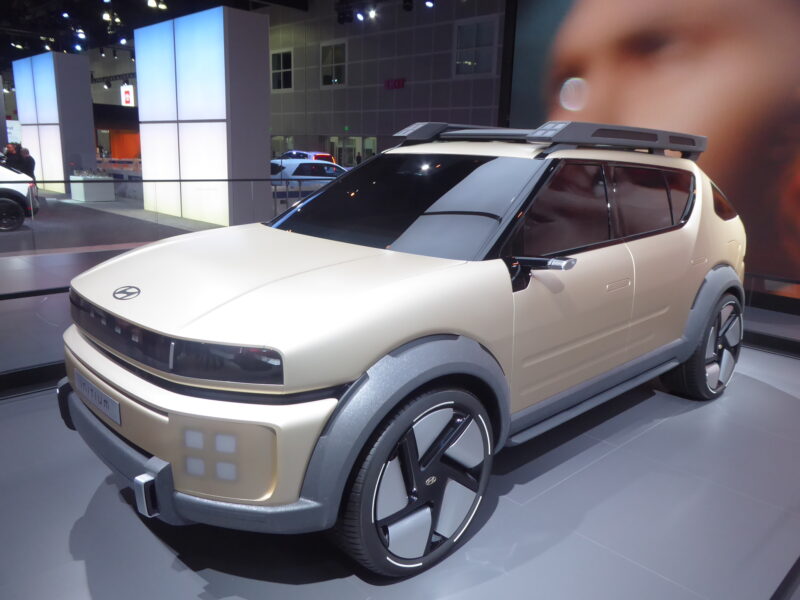
One of few concept cars on display was this, the Initium. previewing the successor of the hydrogen-powered Nexo that will arrive in the first half of 2025. The Hyundai Initium introduces a new styling language, and is fitted with an FCEV powertrain, promising over 650 km (404 miles) of range. Initium means “beginning” or “first” in Latin, communicating Hyundai’s intent to become a “hydrogen energy pioneer”. This is also a fitting name for a concept that showcases Hyundai’s new “Art of Steel” design language, before it gets applied to production vehicles. The exterior of the SUV blends elements from the fully electric Ioniq 5 and the ICE-powered Santa Fe. Highlights include the boxy LED graphics, the pronounced skid plates, the horizontal stampings on the profile, the strong C-pillar, and the inclined rear glass. The concept rides on 21-inch aero-optimised wheels, covered by wide fender extensions. It also features a rugged roof rack with integrated lights. Recent spy shots suggest that the production version will feature much smaller wheels, regular roof rails, and more conventional lighting units. Hyundai didn’t show the interior, but promises a spacious cabin designed for families. Second-row passengers will have access to plenty of room, and a large reclining angle for the seatbacks. Furthermore, the large rear door opening angle is said to improve ingress-egress. In terms of safety, the SUV will have nine airbags, and feature a strong chassis with a “multi-skeleton structure” at the front and additional reinforcements on the sides. The Hyundai Initium is powered by an electric motor producing 201 hp (150 kW / 204 PS), with large hydrogen tanks allowing over 650 km (404 miles) of range. For comparison, the outgoing Nexo produces 161 hp (120 kW / 162 PS) of power and has 612 km (380 miles) of EPA range. According to the company, the improved figures were achieved by increasing the output of the fuel cell stack, and enhancing the battery capacity. The Initium will also be able to use its fuel cell to power household appliances and personal devices through the V2L feature. The biggest challenge for FCEV owners is refuelling, due to the limited network. For this reason, Hyundai created a new route planner that helps the driver find hydrogen stations along the away, checking their availability and operating status. Furthermore, the system can also detect how many vehicles are waiting in line at the hydrogen station of interest. Hyundai’s FCEV development started 27 years ago, although the first dedicated hydrogen fuel cell model – the Nexo – didn’t appear until 2018. When it arrives in the first half of 2025, the production version of the Initium will signal the next chapter.


There are several cross-over models in the range, from the recently restyled and rather blocky Kona, though the Tucson, the somewhat controversial-looking Santa Fe and the top of the range Palisade.


The Tucson begat the Santa Cruz, a very practical small pick-up that has only really got the Ford Maverick as a rival.

The sedan range has been cut back to just two models, the Elantra and Sonata and both were here.


Before the arrival of the Ioniq 9, there were two all-electric offerings, too, the Ioniq 5 and 6.


The Nexo is a fuel-cell vehicle that shows that Hyundai are still thinking of alternatives to petrol power where an EV may not be the answer.

N is Hyundai’s performance label and there were plenty of examples of the well-received all-electric Ioniq 5N here as well as the Elantra N.


The Hyundai Elantra N has already made a name for itself in the otherwise dull compact sedan segment, blending a spirited 286 hp turbo engine, sharp handling, and a manual gearbox option – all starting at a reasonable $34,000. Now, Hyundai’s N division is dialing up the theatrics with the Elantra N TCR Edition, a special model inspired by its Touring Car Racing (TCR) World Tour sibling. Named the Elantra TCR Edition, it’s pitched as a love letter to track enthusiasts, sealed with an oversized rear wing that’s impossible to ignore. But before you strap on your racing helmet, let’s address the elephant in the paddock: there are no major performance upgrades here, including anything under the hood. The TCR Edition’s showpiece is the enormous Carbon Swan Neck Spoiler, an adjustable aerodynamic wing designed to boost downforce at high speeds. While it’s unlikely to help you assert dominance over grocery carts in the parking lot, it promises to keep the rear end stable for those who actually take their cars to the track. Other enhancements include lightweight 19-inch N TCR forged wheels, which reduce unsprung weight for sharper handling, and upgraded N Performance monoblock brakes with four-piston calipers for improved stopping power. South Korean models will also receive exclusive TCR Edition decals, which won’t be available elsewhere. Inside, an Alcantara-wrapped steering wheel with Hyundai’s Performance Blue top marker is joined by matching seat belts and scattered TCR Edition badges. These touches add some flair, but otherwise, it’s standard Elantra N territory. Unfortunately, the TCR Edition doesn’t bring any mechanical surprises. It’s powered by the same turbocharged 2.0-liter four-cylinder engine found in the standard Elantra N, producing 276 horsepower, or 286 hp with Hyundai’s cheekily named “N Grin Shift” overboost, along with 289 lb-ft of torque. If this is all Hyundai N has to offer (and there are no hidden surprises), the Elantra N TCR Edition feels more like a marketing exercise than a genuine performance special. Its upgrades, while functional, are minor, and much of what’s new could easily be replicated with off-the-shelf aftermarket parts. The new special edition will launch in South Korea this December, with global markets following in 2025.


INEOS
Making its LA Auto Show debut, INEOS Automotive is bringing a new kind of adventure with its rugged and resilient designs. Known for their off-road prowess, INEOS Automotive vehicles are built to withstand the toughest conditions, making them the ideal choice for explorers who demand more from their vehicles. Get ready to discover the future of exploration with the INEOS Grenadier and Grenadier Quartermaster, where durability meets cutting-edge, uncompromising innovation.


JEEP
With US sales of the Renegade now ended, the Compass is the entry point for the Jeep range.


Sitting above it are the Grand Cherokee, available in regular and 3-row L guises and then the massive Wagoneer and posher Grand Wagoneer models.


New to the range is another car called Wagoneer, but this one, the Wagoneer S is all-electric.


There were plenty of examples of the iconic Wrangler here including the pick-up version, the Gladiator.


There was also a reminder of how it all started with a classic 1940s Jeep here.

KIA


The long-awaited Kia EV9 GT finally broke cover here at the Los Angeles Auto Show, stepping into the limelight as the brand’s most powerful three-row SUV to date. Following the formula set by the EV6 GT, the EV9 GT dials up performance and attitude for Kia’s electric flagship, even if it holds back slightly on outright power compared to its smaller sibling. While the two electric motors in the EV6 GT combine to produce 576 hp, the new EV9 GT has been capped at 501 hp. Driving the front wheels is a 214 hp motor, while located at the rear is a 362 hp unit. There’s no word on why Kia didn’t give the EV9 GT the same amount of power as the range-topping EV6, but it’ll still hit 60 mph (96 km/h) in 4.3 seconds, which is a very impressive figure for a vehicle of this size. To give the EV9 GT some genuine dynamic credibility, Kia has equipped it with selectable, electronically controlled suspension that adjusts alongside steering and brake responses. Modes like Normal, Eco, Sport, and My Drive provide versatility, but for maximum fun, there’s a lime-green GT button on the steering wheel that transforms the SUV into full attack mode. One standout quirk is the Virtual Gear Shift system. Mimicking the experience of a traditional gearbox, it offers simulated “gear shifts” and even limits acceleration at the so-called ‘rev limit.’ Hyundai pulled a similar trick with the Ioniq 5 N, and while it’s likely to divide opinion, paddle shifters and an Active Sound Design system attempt to inject a dose of driver engagement. Kia has also added an electronic limited-slip differential for improved cornering grip, bolstering the EV9 GT’s performance credentials further. Kia has yet to release official range figures for the EV9 GT. For now, buyers will have to live with some unanswered questions about how far this performance-focused SUV can travel on a single charge. What we do know is that it’s equipped with the North American Charging Standard (NACS) plug and supports rapid DC charging. With the right charger, the battery can be replenished from 10% to 80% in under 25 minutes. In typical Kia GT fashion, the EV9 GT’s visual upgrades are restrained but effective. It rides on bespoke 21-inch wheels, which frame larger, green-painted brake calipers. The front fascia gets minor revisions, including active air flaps and tweaked lighting elements, while the green accents continue inside. The cabin benefits from GT-specific sport seats with Alcantara inserts, unique ambient lighting, and a smattering of GT badges to remind you that this isn’t your standard EV9. Kia America COO and EVP Steven Center sums it up: “The EV9 has been a home run for Kia, introducing the first mass-market electric three-row SUV, and the EV9 GT includes all those wonderful elements while amping up the fun factor significantly. This new halo trim is set to spark the hearts of driving enthusiasts who still need the practicality of a six-passenger SUV.” All EV9 GTs will be produced in South Korea, with the first units expected to arrive in U.S. dealerships in the second half of 2025. Pricing remains under wraps, but given Kia’s track record with its GT models, expect it to undercut rivals while still offering a mix of performance and practicality.


Kia revealed the U.S.-spec version of its facelifted 2026 Sportage, fresh off its Korean debut. The refreshed 2026 model brings sharper aesthetics, incremental power boosts for the electrified variants, and a tech upgrade that nudges it closer to its premium rivals without stepping on their toes. For the North American market, the 2026 Sportage adopts the revised face of the global version, now sporting vertically stacked headlights and a reshaped grille. Depending on the trim level, the boxier bumper intakes wear different personalities—ranging from the rugged, gloss-black embellishments on the X-Line to subtler variations on lower trims. Kia’s design team seems to have prioritized minor details over reinvention, and while it’s not a revolution in style, the tweaks do add a dose of freshness. The side profile remains unchanged but gains new wheel designs to differentiate trims. The X-Line rides on 19-inch alloys wrapped in all-season tires, while the off-road-leaning X-Pro Prestige trades glamour for grit with 17-inch wheels clad in BF Goodrich all-terrain rubber. Out back, the changes are subtler: a reworked bumper and updated LED taillight graphics give the SUV’s rear a minor but polished up makeover. Step inside, and the updates are more tangible. The most obvious change is the new two-spoke steering wheel, which integrates more controls. Relocated air vents give the dashboard a cleaner, more organized feel, while the standard dual 12.3-inch digital displays anchor the cabin in tech-forward territory. There’s also an optional 10-inch head-up display for those who prefer data on demand. In a rare win for common sense these days, Kia has retained physical controls for climate and audio functions, keeping them on the center console rather than burying them in submenus. Depending on trim, buyers can also indulge in perks like a Harman Kardon premium audio system, heated rear seats, wireless charging, and an improved suite of driver assistance system. Just like its predecessor, the 2026 Kia Sportage offers a choice between ICE, hybrid, and plug-in hybrid powertrains. The entry-level 2.5-liter four-cylinder engine is unchanged, producing 187 hp (140 kW / 190 PS) and paired with an eight-speed automatic. U.S. buyers, however, miss out on the new 1.6-liter turbocharged engine with a seven-speed dual-clutch automatic now available in Korea, which feels like an opportunity left on the table. The hybrid setup, combining a 1.6-liter turbocharged engine with a six-speed automatic and an electric motor, gets a small power bump to 231 hp (172 kW / 234 PS), courtesy of a stronger electric motor and an optimized regenerative braking system. Kia has also borrowed the Hyundai Tucson’s “infant driving mode.” Meanwhile, the plug-in hybrid version gains a modest but welcome boost, with an additional 7 hp bringing its total output to 268 hp (200 kW / 272 PS). The ICE-powered Sportage lineup includes six trims: LX, EX, SX, SX-Prestige, X-Line, and X-Pro Prestige. The hybrid range now features a sporty-looking S trim, while the PHEV is limited to the X-Line and X-Line Prestige. Buyers can choose between FWD and AWD for the ICE and hybrid models, but the PHEV sticks with AWD only. For those looking for a bit more off-road pretension, the X-Line and X-Pro trims deliver an Active AWD system paired with Snow, Mud, and Sand modes via Kia’s Terrain Mode system. While it’s not going to challenge a hardcore 4×4, it should handle light adventuring —a nod to the growing popularity of SUVs that look rugged enough to leave the pavement but rarely do. The refreshed Sportage is expected to arrive in U.S. dealerships by Q2 2025, with pricing to be revealed closer to launch. Notably, certain trims of the Sportage are assembled in Kia’s West Point, Georgia, plant, alongside the Sorento, Telluride, EV6, and EV9 models.


The PV5 was released as part of Kia’s new generation PBVs (Purpose Beyond Vehicles), first shown earlier this year at CES 2024. While delivery and small businesses are the primary target market for these zero-emission, multi-purpose vans, there’s no such thing as a commercial vehicle that couldn’t be converted into a camper. Kia describes its WKNDR proposal as a ‘Swiss Army Knife on wheels’, with an integrated modular storage system, the ‘Gear Head’, that sits in your garage to keep all your kit organised when not needed on board. It’s a camper’s dream, with different elements like a mobile pantry and kitchen, off-roading tools and storage components that be added and removed as needed. A built-in compressor can do everything from inflate mattresses to adjusting the tyre pressures. Kia is already well advanced with providing Vehicle to Load (V2L) technology, with a standard electric socket on board that enables to power appliances from the car’s battery pack, from vacuum cleaners to portable audio. The WKNDR aims to be even more self-sufficient, with onboard solar panels and the rather more conceptual ‘hydro turbine wheels’ that are store energy for recharging the batteries.


New earlier this year was the K4, a boldly styled mid-sized sedan that replaces the rather conventional Forte. I’ve already driven one and was quite impressed.


Sitting above in the range is the K5, a car with strong visual links to the K4, if somewhat less bold in its appearance.


The larger crossovers were here, too, the Sorento and well-received Telluride as well as the much smaller Seltos


Kia’s minivan is called the Carnival and this has a visual update and some new interior tech to keep it competitive and appealing.


Other Kia models on the stand included the electric Niro and EV6.


NISSAN
Three new Nissan models made an appearance here. Largest of these is the Armada, a close relative of the recently updated Infiniti QX80. It rides on a new frame, there are huge gains in interior room — third-row legroom is up a tremendous 5.7 inches compared to the outgoing model — and the normally aspirated 5.6-liter V-8 engine has been replaced by a twin-turbocharged V-6. It looks like a significant improvement over the aging previous-generation Armada, yet the base price stays the same as it did for 2024.


The Murano nameplate reappears, attached to a mid-sized crossover with petrol power. Less distinctive than the first generation car, and with far more competition that there was at the time, let’s see if this one can make more of an impact that then last one did. This five-seater sees some big changes inside and out. The Murano grows in size and adds some new tech and convenience features, along with a more upscale cabin. Highlights include a new infotainment system that uses the Google Built-In operating system as well as a switch from a V-6 and continuously variable automatic transmission to a turbo four-cylinder and nine-speed automatic. The 2025 Murano is bigger than the outgoing model with its 2.6-inch increase in overall body width. Despite its increased size, there’s a new sleekness to its look thanks to a revised grille and smoother bodyside curves. In front, the 2025 Murano wears a cleaner-looking face highlighted by thinner LED headlights that sit beside a gloss-black trim strip separating them from the grille. More LED lights sit below, hidden in an updated version of the grille design. In back, an LED taillight spans the length of the rear end, giving it a modern look. Other styling highlights include the availability of 21-inch wheels and two-tone paint. There’s big powertrain news for 2025: The Murano is ditching its prior V-6 and CVT, the latter of which was unpopular with everyone. In its place is a standard 2.0-liter turbocharged four-cylinder paired with a nine-speed automatic. The powertrain is rated for 241 horsepower and 260 pound-feet of torque — a drop in hp but an increase in torque compared to the 2024 model’s 260 hp and 240 pounds-feet. The base Murano SV comes standard with front-wheel drive; all-wheel drive is available, and the SL and Platinum trims get standard AWD. The 2025 Murano is rated to tow up to 1,500 pounds. You’d think the fuel economy gains would be obvious from a switch to a four-cylinder, but it’s a mixed bag. Nissan claims the 2025 model is rated 23/24/23 mpg city/highway/combined with FWD or AWD, which is better than the old model in city economy, but worse in highway economy. The outgoing Murano’s V-6 was EPA-rated 20/28/23 mpg with FWD or AWD. Inside, Nissan says the cabin strikes more of an elegant tone than the outgoing model’s, with additional soft-touch materials and a more upscale design. For 2025, the Murano’s cabin wears new dash trim called Murano Glass, which Nissan says incorporates color-shift graphics and textures that play with light. In addition, the Platinum trim gets semi-aniline quilted leather seats (synthetic leather upholstery is standard). The 2025 Murano’s standard dual 12.3-inch screens add to its modern, streamlined appearance. The center unit is a touchscreen for the infotainment system that is available with Google Built-In software. The left display houses the Murano’s instrument cluster and has multiple configurable display modes. The new Murano’s climate controls also get a makeover. Similar to the Nissan Ariya’s setup, the Murano switches to a capacitive-touch panel under the touchscreen for its climate controls. In back, Nissan says the 2025 Murano offers additional knee room compared with the outgoing model thanks to a thinner front-seat design. The backseat also gets more comfortable thanks to Nissan’s Zero Gravity design, which the brand says makes the seats more supportive, as well as available convenience features such as rear-door sunshades and heated rear seats. Lastly, the rear doors now open wider to make it easier to get in and out, especially when loading a car seat. Behind the seats, cargo room is a mixed bag for the 2025 model. Nissan says there’s 32.9 cubic feet of space behind the seatbacks, up from the 2024’s 32.1 cubic feet. When the seats are folded down via a 60/40 split, there’s 63.5 cubic feet — down from the previous 67 cubic feet. A power liftgate is standard; the Platinum variant gets a hands-free power liftgate. Other new-to-Murano tech and convenience features include standard wireless Apple CarPlay and wireless Android Auto; ventilated and massaging front seats, a 64-color interior ambient lighting system and a color head-up display are available. The model also gets a big update when it comes to safety and driver-assistance features. The 2025 Murano adds a passenger-side knee airbag. Other newly available features include the invisible hood camera that allows drivers to see obstacles otherwise blocked by the front of the vehicle, a 3D 360-degree camera and the ProPilot Assist system, which combines adaptive cruise control and lane-centering steering. In addition, the SV and Platinum trims get the ProPilot Assist 1.1 system, which Nissan says enhances the system’s capability by using navigation data to proactively adjust speed ahead of curves. The 2025 Nissan Murano will hit dealerships in early 2025; pricing will be announced closer to its on-sale date.


The Kicks sits at the bottom of the range, and has a bold new look for 2025.


Nissan do still have three conventional sedans in the range, the Versa, Sentra and Altima, all of which have such a family look that they can be quite hard to tell apart at a glance. Word has it that 2025 is the last model year for the Altima and it won’t be replaced.


The Rogue and Pathfinder crossovers were also here.


There are two different sports cars in the Nissan range, the very long-lived GT-R and the more recent Z.


Completing the range are two all-electric models, the Leaf and the hard to pronounce Ariya.


PORSCHE
For as long as I had been attending this Show, Porsche had their own dedicated hall, to one side of the concours that connects the West Hall to the entrance, but last year, they were not present, with the space given over to some alternative displays. For 2024, the brand was back, with a number of cars supported by Porsche Downtown LA, a member of the Lithia Motors family.
Star of the display was the all-new Macan Electric.


The 992 generation of the 911 sports car is going through its mid-cycle update and although there are few visual changes, a lot has been altered under the skin.


Also here were representatives of the current Porsche model, which included the existing Macan and larger Cayenne as well as the Panamera and Taycan.


The sports cars were represented by the Boxster and Cayman.


Completing the display were three classic 911 models, a couple based on the 964 and one rather more recent one.


RAM


SUBARU
Once again, Subaru were using their National Park themed stand, emphasising the go-anywhere nature of their offerings. The 2025 Forester, which made its debut at this event a year ago was given pride of place.


The rest of the range is familiar and includes the Impreza, now only offered as hatchback and the closely related Crosstrek, the soon to die Legacy sedan and related Outback and the massive Ascent crossover.


Those wanting something more sporting can have a WRX sedan or a BRZ coupe.


And for those who want to go electric, Subaru have the Solterra.


And finally, there was this: Project Midnight, a purpose-built WRX tarmac time attack and hill climb car, developed by Subaru Motorsports USA and Vermont SportsCar. It features a heavily modified, lightweight chassis and a 670-horsepower turbocharged engine, making it the fastest WRX race car the company has ever built. The car made its public debut at the 2024 Goodwood Festival of Speed and is driven by Scott Speed.


TESLA
Tesla have not been at the Show for a few years but in 2024 they were back perhaps because they had something new to show us. The updated Model 3 and the Model Y are their core products these days and they were the ones that were capturing lots of interest. There was also a Model X here.


Also here was this concept vehicle, the CyberCab. The Tesla Cybercab is an upcoming, purpose-built, two-passenger electric robotaxi designed for fully autonomous (Level 4/5) rides, featuring no steering wheel or pedals in its purest form, aiming for ultra-low cost-per-mile operation, with production slated for April 2026 at Gigafactory Texas, though regulatory hurdles and potential design changes for manual driving controls (steering wheel/pedals) are anticipated for wider US release. It’s envisioned as a mass-market, affordable EV (under $30k) with a revolutionary, electronics-style manufacturing process for high volume, potentially millions annually. Key Features & Design include the fact that it is fully autonomous, built from the ground up for unsupervised self-driving. Prototypes lack steering wheels and pedals, relying on the app for summoning and control. This two-door hatchback design seats two and has been optimized for low operating costs, even dropping side mirrors in early concepts. Tesla are talking about a “Consumer Electronics” Manufacturing with a new production line aims for a <10-second cycle time per unit, enabling massive scale. Production is targeted for April 2026 at Gigafactory Texas and they are aiming for 2-3 million units annually, making them “everywhere in the future”. Tesla needs approval from NHTSA and state DMVs for widespread driverless deployment, requiring traditional controls for manual driving in many cases.


TOYOTA
Toyota have a vast stand, and were generating extra interest with live shows and give-aways that is all a bit too “in your face” for me, but which seems popular with others.
The sedan part of the range is all familiar, comprising the Corolla, the bigger-selling Camry that was updated for 2025 and the luxurious Crown and Crown Signia.


There are three GR badged sports models on offer, and there was an example of each of these here: GR Corolla, Supra and GR86.


In the crossover range there was mix of the models we’ve known for a while such as the RAV4 and the Highlander, with the more recent such as the Grand Highlander and massive Sequoia as well as two newcomers the refreshed 4Runner and Land Cruiser.


Toyota are the fourth of the four with a mini-van, the Sienna and this popular and practical car seemed to be generating plenty of interest even though the design now dates back several years.


Showing us how Toyota are thinking widely about all forms of propulsion, we have the hybrid Prius, the hydrogen-powered Mirai that sells in sufficient numbers in Southern California that you do see them on the roads, as well as the all-electric bZ4X


There are two Toyota trucks, the Tacoma and Tundra and both were here.


VINFAST
Still trying to get a toe-hold in the market, Vietnamese manufacturer Vinfast had a large stand with examples of the VF8 and VF9 models on show.

VOLKSWAGEN
The Tiguan is Volkswagen’s best-selling vehicle in the United States and consumers bought 76,228 of them last year. Those numbers could grow as the popular compact crossover is getting a complete redesign for the 2025MY. Looking virtually identical to Europe’s Tayron, the 2025 Tiguan sports a modern and expressive design, especially in R-Line guise. The company was surprisingly light on details, but the new model has slimmer headlights that can be connected by an available LED light bar. They can also be joined by an illuminated logo as light is the new chrome. Moving further back, we can see curvaceous bodywork and 17- to 20-inch wheels. However, most ‘volume trims’ will have 19-inchers. Regardless of the size, they’re surrounded by pronounced wheel arches with black trim. The rear end closely echoes the Tayron as there’s a slender light bar and a familiar bumper. However, Americans get vertical reflectors instead of horizontal ones. Volkswagen has opted to keep detailed specifications under wraps for now but did confirm that the new model features a slightly longer wheelbase and a shorter rear overhang compared to its predecessor. That said, the photos suggest it’s shorter than Europe’s three-row Tayron and nearly identical to China’s two-row Tayron L, which measures 4,684 mm (184.4 inches) in length, 1,854 mm (73 inches) in width, and 1,685 mm (66.3 inches) in height, with a 2,791 mm (109.9 inches) wheelbase. The company also noted that the 2025 Tiguan offers a power liftgate as well as a revised color palette that includes three new options known as Avocado Green Pearl, Sandstone Uni, and Monterey Blue Pearl. The previous model’s dated interior has been relegated to the dustbin of history and drivers will find a new 10.25-inch digital instrument cluster and a 12.9-inch infotainment system. If the latter isn’t large enough, a 15-inch display will also be available. The screens aren’t the only big change, as the new Tiguan eschews a traditional center stack and sees the shifter moved to the steering column. This frees up a lot of space and the console now houses a multi-function rotary control dial with an integrated display. It can be used to adjust the volume, change drive modes, and switch between “Atmospheres” which tie the ambient lighting system to the audio system. Unlike Europe’s Tayron, the North American Tiguan is exclusively a five-seater. It will come with cloth seats that have an embossed design, promising to give the cabin an “upscale feel.” Volkswagen also said a wireless smartphone charger and an automatic climate control system will come standard. Higher-end variants sound even more impressive as they’ll offer quilted leather front seats with heating, ventilation, and massage settings. They’ll be joined by a heated steering wheel and a heated second-row. Besides fancier seats, there’s American walnut wood trim and a tri-zone climate control system. Buyers will also find a head-up display, a 30-color ambient lighting system, and a 12-speaker Harman Kardon premium audio system. The IQ.Drive suite of assistance systems comes standard on all trims and includes Adaptive Cruise Control with Stop and Go, Travel Assist, Front Assist, Rear Traffic Alert, and an Active Blind Spot Monitor. They’re joined by Lane Assist, Emergency Assist, and Light Assist. Other safety features include Park Distance Control, Exit Warning, and four new airbags – driver knee, center, and rear sides – pushing the total up to ten. The 2025 Tiguan rides on the MQB evo platform and is powered by a turbocharged 2.0-liter four-cylinder engine developing 201 hp (150 kW / 204 PS). That’s a small increase of 17 hp (13 kW / 17 PS), but it’s accompanied by a weight reduction of around 170 lbs (77 kg) thanks to the use of high-strength steel and aluminum suspension components. These changes should pay dividends to drivers as Volkswagen said we can expect improved acceleration as well as better fuel economy. While it’s too early to talk numbers, the outgoing model returned up to 24 mpg city, 31 mpg highway, and 27 mpg combined.


Still significant in sales terms in the US market is the Jetta, a model no longer offered to Europeans. The current version has received plenty of updates to the engines and equipment levels and a few styling tweaks.


The regular Golf is not sold in the US, as it proved nothing like as popular as the Jetta saloon, but the hotter versions are available. The GTi known as just that, without the Golf label.


VW’s other crossover models won’t be familiar to Europeans as the range starts with the Taos, a Mexican built vehicle that is around the size of the T-ROC and at the top of the range is the Atlas, a vehicle known in some other markets as the Terramont. As well as the 3-row 7 seater version there is now a 5 seater Cross Sport with a more angled rear end. I’m still trying to get test one of these out.


The most popular vehicle on the stand was the ID Buzz. Now available to US consumers, this scores on visual appeal but it is quite pricey and I’ve still not seen many on the roads here.


VW’s only other electric offering in the US range is the ID4, an example of which was to be seen here.

NORTH AMERICAN CAR AND TRUCK OF THE YEAR
A special display included the nominations for these awards and provided another chance for show go-ers to see these cars away from the crowds on the manufacturer’s own stands.
There are a few themes this year, but the big winner appears to be value. Starting with the North American Car of the Year, the finalists are the Honda Civic Hybrid, Kia K4, and Toyota Camry. These are all reasonably priced sedans and the K4 starts at a mere $21,990. The Civic Hybrid begins at $28,750 while the larger Camry comes in at $28,400 and is also a hybrid.


All three stand in sharp contrast to the cars that didn’t make the cut. They included the ultra-luxury Cadillac Celestiq, the performance-focused Mercedes-AMG E-Class, and Porsche Panamera. The BMW 3-Series, BMW M5, Dodge Charger Daytona, and Fiat 500e were also tossed aside.
The finalists for 2025 North American Truck of the Year aren’t much of a surprise as they include the redesigned Ford Ranger and Toyota Tacoma as well as the facelifted Ram 1500. Interestingly, the GMC Sierra EV and Rivian R1T were eliminated, meaning an electric vehicle isn’t going to win in this category either.

In fact, only two EVs are finalists this time around. They’re the Chevrolet Equinox EV and Volkswagen ID. Buzz, which will be competing for the title of North American Utility Vehicle of the Year. They’ll have to battle the Hyundai Santa Fe as the Honda Prologue, Hyundai Ioniq 5 N, Lincoln Nautilus, and Toyota Land Cruiser didn’t advance to the final round. The elimination of so many EVs is interesting as they’ve been a fixture on the podium for the past few years. Recent winners have included the Kia EV6, Kia EV9, Ford F-150 Lightning, and Ford Mustang Mach-E. The victors will be announced on January 10 at the Detroit Auto Show.


MONTEREY MOTORSPORTS FESTIVAL CONCOURS
In the hall that has always been occupied by Galpin, for as long as I can remember there was a new exhibitor. This was the Monterey Motorsports Festival with what was termed a Concours, over 30 high-end vehicles, from exotics to timeless classics. Here is what was included:
There were three cars in what was called McLaren Excellence, a couple of McLaren Artura Spider and a 750 S.


Bentley Luxury comprised the Continental GT, Flying Spur and Bentayga.


Whilst Aston Martin Elegance saw a display of the 2025 Vantage, the DB12 Volante and the DBX707


There were a couple of Shelby Masterpieces by OVC GT, a Competition Shelby G.T. 350 Mustang and a Shelby Mustang Roadster


Described as “Cutting-Edge Innovation” were a Drako Drago. Drako GTE and a KTM Bow

High performance Icons included the Mercedes AMG GT Black Series, MMF Lamborghini Huracan and Porsche GT3 R1

Of course there were Ferrari models included as well, though not the ones pre-announced as being in the display.

This is a 1966 Ford Bronco ‘Pure Bronco’ built by RMDS Garage, with a custom one-off interior.


WEST COAST CUSTOMS
Also in what used to be the Galpin Hall were West Coast Customs, who had what was described as an unforgettable lineup of one-of-a-kind vehicles, “blending luxury, creativity, and raw West Coast style”. These were as follows:
Paris Hilton Bentley

will.i.am Concept Tesla

The Merc

And of course, there was a customised Cullinan here.

There were others, including Travis Scott M3, the Don Toliver AMG Mercedes, the Oscar De La Hoya C10, Monkey Tilt RV, Jose Cuervo Devil’s Reserve Bronco, a Suburban X Escalade and Ryan’s Root Beer Ghost
Outside were some more cars, looking more like the way they had left the factory!


But that’s not all—CART Department’s Founder and CEO, mega art collector and publisher Larry Warsh, announced the West Coast Customs Experience at the LA Auto Show, debuting several coveted art cars:

This one is Graffiti Icons How and Nosm’s 1950 Buick

Pop Art Icon Keith Haring’s 1963 Buick

There were a couple of examples of the iconic Mini here, too


Painter Richard Prince’s 2012 Dodge Challenger

OVERLANDING and OFF-ROADING
A large display in the West Hall brought together some of the world’s leading names in overlanding and offroad vehicles to showcase their capabilities. This year’s lineup included the return of OVRland Outpost featuring over 30 custom rigs in collaboration with OVR Magazine as well as the latest models to get off the grid from Chevy, GMC Hummer, Toyota, Subaru, INEOS, Ford, Jeep, Ram, Nissan, Exodus Rigs, and more.


OTHER DISPLAYS

The LA Police Department had a stand in the area connecting the two halls. Much of this was a mix of PR and recruitment, but they also had a couple of nice vehicles including a fabulous period Studebaker.


THE KENTIA HALL
This hall is one that usually holds little appeal for me. A combination of trade stands and displays most of heavily modified and customised cars means I never spend much time here, but there are usually a few gems and among them were these.


AND ON THE SAME DAY……
Before heading to the Show (a full day is no longer required and anyway, it was open til 10pm), I had been up in the hills, testing the rental car of the day. When I was stopped, a fabulous Alfa Romeo Junior Zagato drove past me. Thinking that was the last I would see of it, I kind of shrugged my shoulders and carried on. After turning around and starting to head back, though, I came across the car parked in a pull-off so I also pulled in to get some pictures and to chat to the owner. It turned out that he lives in San Mateo, which is in Orange County and he has a fleet of nice cars, which he likes to take out and use. This Junio Zagato was imported from Italy a few years ago and he has upgraded the engine to give it more power. First seen in public at the Turin Motor Show of 1969, the GT 1300 Junior Zagato was a limited production two seater coupe with aerodynamic bodywork penned by Ercole Spada while he was at renowned Milanese styling house Zagato Based on the floorpan, driveline and suspension of the 1300 Spider, the Junior Zagato had a floorpan shortened behind the rear wheels to fit the bodyshell. the model evoked the earlier, race-oriented Giulietta Sprint Zagatos which featured aluminium bodywork and had a very active competition history. However, the Junior Zagato featured a steel bodyshell with an aluminium bonnet and, on early cars, aluminium doorskins. The Junior Zagato was not specifically intended for racing and did not see much use in competition. In total 1,108 units were constructed, with the last being built in 1972 although the records suggest that a further 2 cars were built in 1974. In 1972 the 1600 Zagato came out of which 402 units were produced. In this case the floorpan was unaltered from the 1600 Spider, so that the normal fuel tank could be left in place. As a consequence, the 1600 Zagato is approximately 100 mm (3.9 in) longer than the 1300 model. This can be seen at the back were the sloping roofline runs further back and the backpanel is different and lower. The lower part of the rear bumper features a bulge to make room for the spare wheel. The 1600 Zagato has numerous other differences when compared to the 1300 Junior Zagato.so if you ever see two side by side, and were a real expert, you could probably tell them apart easily. The last 1600 Zagato was produced in 1973 and the cars were sold until 1975.


The 2024 will not go down in history as a vintage edition of the Show, but then every Show the world over is having the same struggle. That it still takes place at all and that there is still plenty to look at even if those indoor tracks do sort of try to disguise the absence of quite so many brands is probably something we should celebrate rather than bemoan. Yes, it is disappointing that yet more brands that had previously attended were missing this year, but it was also good to see a few that had returned. Let’s hope they think it was worth their while and that this will help make the 2025 Show not just viable but memorable for all the right reasons.