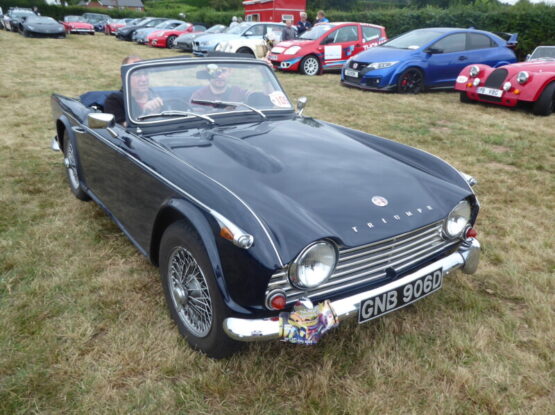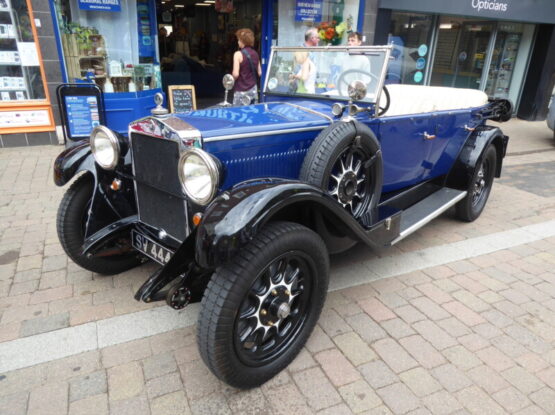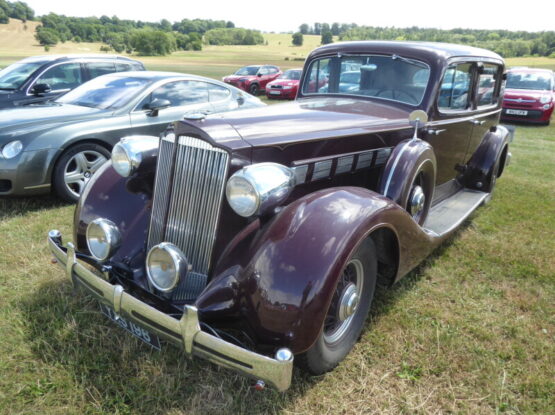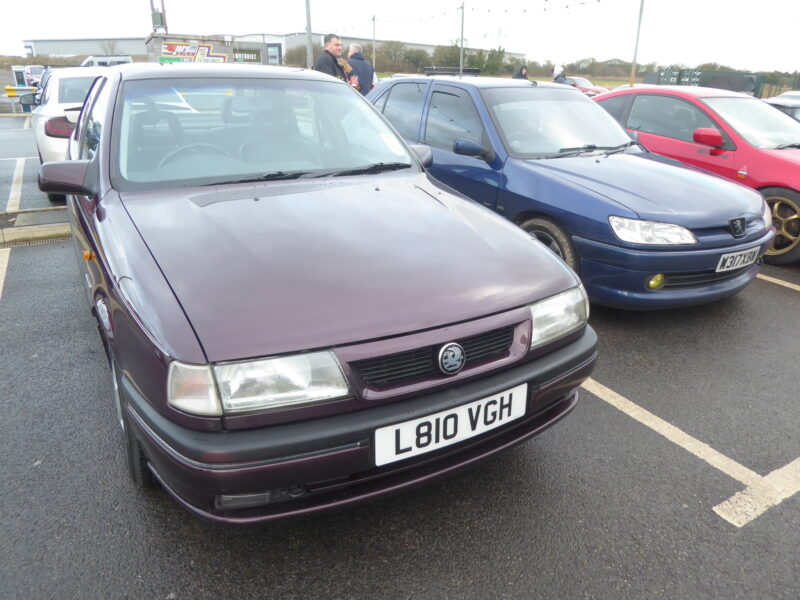
I have been hearing about a location called “The Motorist” for some time now, and have seen lots of posts with photos showing a wide variety of cars attending meetings there, and so have long wanted to visit to see it for myself. It is just outside a Yorkshire village called Sherburn in Elmet, to the east of Leeds and just a few minutes off the A1M, A63 and the M62. When a couple of Abarth Groups announced a plan to hold their Christmas meal there, on the Sunday before Christmas, I looked at my logistics and figured I would head up to the area on the Saturday evening, attend the meet on the Sunday and then head back south to my mother’s where I planned to spend the Christmas period, so actually this was quite do-able. It’s 210 miles form my house to The Motorist, all but 10 of which are on motorway so if you got a traffic-free run at it (ha! It would not take a lot more than 3 hours to get there. I found a hotel nearby, and so was able to get on site quite early on the Sunday morning, and even at 8:30 there were plenty of cars there. Here, then, are some of the highlights of the day.
THE VENUE
Conceptually, The Motorist is not unlike Caffeine & Machine and other such venues in that it was conceived as a place where people, predominantly car and bike enthusiasts, could meet, with ready access to coffee and a bite to eat. The site that was acquired by the founder and owner, Simon Spinks chairman of North Yorkshire-based Harrison Spinks Events Limited adjoins an airfield which these days is used by a private flying club, and has loads of space, something that many other similar venues often lack. During 2022 the decision was taken to expand with a purpose-built main building to act as the focal point of the site. Other buildings are used for car storage and repair services and there are plans in development eventually to add some hotel accommodation. At present, in addition to the main building, there is a sizeable tarmac area available for car parking that backs onto the building, then a much larger gravelled area and an adjoining grassy area that needs care in the winter months. There’s space for several hundred cars here, and on a busy day, I understand it all gets filled up. It’s all quite informal, so there are no tickets required, and over the years, the site has become well-known not just for cars and bikes, but also as place to drop in to for a good coffee and a tasty breakfast. I can vouch for both of these, having a particularly good bacon and sausage bap, at Yorkshire prices.
The main building is quite expansive. At the back is a café area which offers coffee and tea, breakfasts and a tempting looking array of cakes and pastries. In front of this, there is a large shop area which has all manner of temptations from model cars, to stickers and clothing. Among the displays are a number of complete vehicles.


The central part of the building connects the bar and downstairs dining area to the shop and café and there are loan cars in the corners of this L shaped area.

CARS and COFFEE
Like many similar sort of venues, The Motorist regularly declares themed days, but on the occasions when they don’t, and this was one of them, then they just describe the day as a “Cars and Coffee” meet. That means that you are likely to get a real variety of cars of all types and ages and that was the case for my visit. The last weekend before Christmas is perhaps not going to be busiest weekend of the year, but actually there were lots of cars here, with considerable turnover, as people came, perhaps had a coffee or a breakfast and then left, but more kept arriving. At a time of the year when a lot of classics are SORNed for the winter, you don’t expect to see huge numbers of older cars, but there were plenty here to pique my interest.
ALFA ROMEO
Preceded by Alfa Romeo’s first off-roader, the Matta, in the 1950s and the Kamal concept car in March 2003, the Stelvio is Alfa Romeo’s first production SUV. The high-performance trim of the Stelvio, the Quadrifoglio, was unveiled on 16 November 2016 at the Los Angeles Auto Show. The European versions of the Stelvio were presented at the Geneva Motor Show in March 2017. On January 18, 2017, Alfa Romeo began accepting orders for the Stelvio First Edition in the EMEA region. On November 2, 2017, the Stelvio Quadrifoglio went on sale in Italy. The Stelvio uses the same Giorgio platform already used by the Giulia, but slightly modified and raised by 22 cm (8.7 in). The Stelvio also shares the same engines and most of the mechanics, including a carbon-fibre driveshaft. In addition, its track width has increased by 2.9 cm (1.1 in) in the rear and 5.4 cm (2.1 in) in the front. It has a boot capacity of 525 L (18.5 cu ft). The boot sill is aligned with the rear bumper and cargo does not need to be lifted over a lip when being removed. There are large vehicle blind spots behind the car’s pillars. It has a 50/50 weight distribution and a drag coefficient of 0.32 (Cd). Euro NCAP classify it as a large off-road car. In order to reduce the weight of the car, aluminium is used for body panels, as well as for mechanical parts such as the suspension, brakes, and engine. The suspension, called AlfaLink, implements double wishbones in the front, and an aluminium multi-link configuration in the rear. The springs are longer than those in the Giulia, but stiffer to account for the extra weight and ride height. The driver sits nearly 20 cm (7.9 in) higher from the road than in the Giulia.[15] The suspension is tuned for improved handling and driving dynamics, which can compromise ride quality if optional larger-diameter wheels are fitted. Rear-wheel drive as standard, the Stelvio can be optioned with an Alfa Romeo “Q4” all-wheel drive system, which can send up to 50% of power to the front in low-grip conditions. The Stelvio weighs 1,660 kg (3,660 lb) with all fluids, 145 kg (320 lb) less than an equivalent BMW X3 and 110 kg (243 lb) less than a four-cylinder Porsche Macan. The car’s braking system is designed to be less-susceptible to brake fade, which can take time for unfamiliar drivers to get used to. All models feature an 8.8-inch infotainment system with Apple Car Play and Android Auto as standard, while small tweaks have been made throughout the ranges. The car’s engine lineup is similar to that of the Giulia’s, with a turbocharged 2.0-litre inline-four and a 2.2-litre diesel inline-four. The Quadrifoglio trim level offers a 2.9 litre 690T twin-turbo 90° V6 rated at 510 PS (503 bhp), developed for Alfa Romeo by Ferrari. In Europe, consumption standards use the WLTP measuring system, which increases accuracy for consumption and emission figures. On 29 September 2017, a Quadrifoglio model set a Nürburgring lap time of 7 minutes, 51.7 seconds, the fastest for a production SUV. For the 2019 model year, diesel engines of the Stelvio were updated to meet the Euro 6d emissions standards, with AdBlue technology introduced to tackle particulates in the exhaust. Both the 150 PS (148 bhp) and 180 PS (178 bhp) versions got 10 PS (10 bhp) more from this change. In addition, Alfa Romeo introduced a new trim level for Europe: the Ti (Turismo Internazionale). Slightly different than the similarly named Stelvio Ti on sale in the United States, the Euro-spec Ti is fitted with the TBI-M 2.0-litre inline-four, mated to an eight-speed automatic transmission, with power sent to all four wheels through Alfa Romeo’s Q4 all-wheel drive system. In 2020, Alfa Romeo introduced the newly updated Stelvio in China, with both the Giulia and the Stelvio featuring updated interiors, a new 8.8-inch touchscreen for the infotainment system, which now offers a WiFi hotspot, over-the-air software upgrades, integrated emergency call function, and call assistant function. There is the new leather-wrapped multi-function steering wheel and gear lever, with revised dashboard materials. The debut for North America was in the 2019 LA Auto Show. As of 2022 in North America, the Stelvio has four distinct models. Starting with the base model Sprint, the Ti, the Veloce and the top-of-the-line Quadrifoglio. In light of the Alfa Romeo Tonale’s release, Stelvio’s range of models was condensed from seven to four. The Stelvio has been Alfa’s best-selling model in Europe for the past few years though in the UK, the Giulia has done slightly better.

ASTON MARTIN
Follow on to the DB7 was the DB9 (there has never been a car called DB8 – supposedly because people might have assumed this meant a V8 engine), and there was a nice example here. Designed by Marek Reichmann and Hendrik Fisker, the DB9 was first shown at the 2003 Frankfurt Auto Show, in coupe form. It was widely praised for the beauty of its lines. This was the first model to be built at Aston Martin’s Gaydon facility. It was built on the VH platform, which would become the basis for all subsequent Aston models. The Aston Martin DB9 was initially launched equipped with a 6.0 litre V12 engine, originally taken from the V12 Vanquish. The engine produced 420 lbf·ft of torque at 5,000 rpm and a maximum power of 444 hp at 6,000 rpm, allowing the DB9 to accelerate from 0 to 60 mph in 4.7 seconds and a top speed of 299 km/h (186 mph). The engine largely sits behind the front-axle line to improve weight distribution. Changes to the engine for the 2013 model year increased the power to 503 hp and torque to 457 lb-ft, decreasing the 0 to 60 mph time to 4.50 seconds and with a new top speed is 295 km/h (183 mph). The DB9 was available with either a six-speed conventional manual gearbox from Graziano or a six-speed ZF automatic gearbox featuring paddle-operated semi-automatic mode. The gearbox is rear-mounted and is driven by a carbon-fibre tail shaft inside a cast aluminium torque tube. The DB9 was the first Aston Martin model to be designed and developed on Ford’s aluminium VH (vertical/horizontal) platform. The body structure is composed of aluminium and composites melded together by mechanically fixed self-piercing rivets and robotic assisted adhesive bonding techniques. The bonded aluminium structure is claimed to possess more than double the torsional rigidity of its predecessor’s, despite being 25 percent lighter. The DB9 also contains anti-roll bars and double wishbone suspension, supported by coil springs. To keep the back-end in control under heavy acceleration or braking, the rear suspension has additional anti-squat and anti-lift technology. Later versions of the car also features three modes for the tuning: normal, for every-day use, sport, for more precise movement at the cost of ride comfort, and track, which furthers the effects of the sport setting. The Aston Martin DB9 Volante, the convertible version of the DB9 coupe, followed a few months later. The chassis, though stiffer, uses the same base VH platform. To protect occupants from rollovers, the Volante has strengthened windscreen pillars and added two pop-up hoops behind the rear seats. The hoops cannot be disabled and will break the car’s rear window if deployed. In an effort to improve the Volante’s ride while cruising, Aston Martin have softened the springs and lightened the anti-roll bars in the Volante, leading to a gentler suspension. The retractable roof of the Volante is made of folding fabric and takes 17 seconds to be put up or down. The Volante weighs 59 kilograms (130 pounds) more than the coupe. The coupe and Volante both share the same semi-automatic and automatic gearboxes and engine. The car was limited to 266 km/h (165 mph) to retain the integrity of the roof. Like the coupe, the original Volante has 420 lb·ft of torque at 5,000 rpm and a maximum power of 450 hp at 6,000 rpm. The 0 to 60 mph slowed to 4.9 seconds due to the additional weight. The DB9 was facelifted in July 2008, which mainly amounted to an increase in engine power, to 476 hp and a redesigned centre console. Externally, the DB9 remained virtually unchanged. For the 2013 model year revision, Aston made minor changes to the bodywork by adapting designs from the Virage, including enlarging the recessed headlight clusters with bi-xenon lights and LED daytime strips, widening the front splitter, updating the grille and side heat extractors, updating the LED rear lights with clear lenses and integrating a new rear spoiler with the boot lid. .On newer models, like the coupe’s, the Volante’s horsepower and torque increased to 517 PS (510 hp) and 457 lb·ft respectively. As a finale for the model, a more powerful DB9 was released in 2015, called the DB9 GT. This had 540 bhp and 457 lb-ft of torque at 5500 rpm, giving a 0 to 60mph time of 4.4 seconds and 0 to 100mph in 10.2 seconds, with the standing quarter mile dispatched in 12.8 to 12.9 seconds and a top speed of 183mph.


CADILLAC
One of the rarest cars here in any form was this Cadillac Seville. It then turned out it was a Diesel which makes it super rare. The Seville, introduced in May 1975 as an early 1976 model, was Cadillac’s answer to the rising popularity of European luxury imports as Mercedes-Benz, Audi and BMW. GM planners were becoming concerned that the division’s once-vaunted image as the “standard of the world” was fading, especially among younger generations of car buyers. Over time, European luxury cars had become quite luxurious and even more expensive than the much larger Cadillacs. As market share of these imports continued to climb, it became obvious that the traditional American automotive paradigm of “bigger equals better” had begun to falter. The Seville became the smallest and most expensive model in the lineup, turning Cadillac’s traditional marketing and pricing strategy upside down. Full size design prototypes were created as early as winter of 1972–73 (wearing the tentative name LaSalle, reviving the Cadillac junior brand from 1927 to 1940). Subsequent design prototypes looked edgier (specifically a 1973 named LaScala which forwardly hinted at the 1992 Seville). Styling took strong cues from the Rolls-Royce Silver Shadow. Cadillac stylists added a crisp, angular body that set the tone for GM styling for the next decade, along with a wide track stance, giving the car a substantial, premium appearance. A wide chrome grille flanked by quadruple rectangular headlamps with narrow parking and signal lamps just below the header panel, while small wrap-around rectangular tail lamps placed at the outermost corners of the rear gave the appearance of a lower, leaner, and wider car. The taillight design was similar to that used on a rejected Coupe DeVille concept. Unibody construction included a bolt-on subframe with a rear suspension based on the rear-wheel drive 1968–74 X-body platform that underpinned a range of intermediate GM autos. It also featured a rear differential with thicker front subframe bushings similar to the second generation F platform used in the Camaro, Firebird, and the 1975–79 X-body platform. Substantial re-engineering and upgrades from these humble origins earned it the unique designation “K-body” (rather than “X-special” following the format of the A-special Chevrolet Monte Carlo/Pontiac Grand Prix and B-special Buick Riviera). Also shared with the X-body platform was part of the roof stamping and trunk floor pan (for 1973 and newer vehicles). Seville engineers chose the X-body platform instead of the originally intended to be used German Opel Diplomat in response to GM’s budget restrictions—executives felt re-engineering an Opel would be more costly. Another proposal during development was a front-wheel drive layout similar to the Cadillac Eldorado. This proposal was also rejected because of budget concerns since the transaxle used for the Eldorado was produced on a limited basis solely for the E-body (Eldorado/Toronado) and the GMC motorhome of the mid-1970s. Introduced in mid-1975 and billed as the new “internationally-sized” Cadillac, the Seville was almost 1,000 pounds (450 kg) lighter than the full-sized Deville. The Seville was thus more nimble and easy to park, as well as retaining a full complement of Cadillac features. More expensive than any other Cadillac (except the Series 75 Fleetwood factory limousines) at US$12,479, the Seville was modestly successful. It spawned several imitators including the Lincoln Versailles and the Chrysler LeBaron (Fifth Avenue after 1982). To ensure the quality of the initial production run, the first 2,000 units produced were identical in colour (Georgian silver) and options. This enabled workers to “ramp up” to building different configurations. Total 1976 Seville production was 43,772 vehicles. Early Sevilles produced between April 1975 (a total of 16,355) to the close of the 1976 model year were the first Cadillacs to use the smaller GM wheel bolt pattern (5 lugs with a 4.75 in (121 mm) bolt circle; the 2003–2009 XLR also uses this pattern). The first Sevilles shared a minority of components with the X-Body. The rear drums measured 11 in (280 mm) and were similar to the ones used with the Nova 9C1 (police option) and A-body (Chevelle, Cutlass, Regal, LeMans) intermediate station wagons. Starting with the 1977 model year, production Sevilles used the larger 5-lug bolt circle common to full-size Chevrolet passenger cars (1971–76), Cadillacs, Buicks, Oldsmobiles, Pontiacs, and half-ton Chevrolet/GMC light trucks and vans. It also received rear disc brakes, a design which would surface a year later as an option on the F-body Pontiac Trans Am. 1975–76 models included a vinyl roof, to less expensively cover the roof’s two part construction, the rear section around the C-pillar was pressed especially for Cadillac and X-body pressing was used for the forward section. Due to customer demand, a painted steel roof was offered in 1977, requiring a new full roof stamping. 1977 Seville production increased slightly to 45,060 vehicles. The last year, production increased to the first generation’s peak production, at 56,985. The engine was an Oldsmobile-sourced 350 cu in (5.7 L) V8, fitted with a Bendix analog port fuel injection system. This system gave the Seville smooth driveability and performance that was usually lacking in domestic cars of this early emissions control era. Power output was 180 hp, and fuel economy was 15 MPG in the city and 21 MPG on the highway. While standard on Seville, this EFI system was optional on the full size models starting in 1975. Performance was considered good for the era, with zero-to-60 mph (97 km/h) taking 11.5 seconds. A diesel 350 cu in (5.7 L) LF9 V8 was added in 1978. For the 1978 and 1979 model years, the Seville offered a trip computer, marketed as Tripmaster at an extra cost of $920. The fuel gauge, speedometer and clock were replaced with digital readouts. Gas-discharge display technology was selected due to greater visibility in daylight conditions. A small panel of 12 buttons allowed selection of data to be displayed, such as coolant temp, battery voltage, or fuel range. The driver could also enter initial trip data and the computer would estimate arrival time based on speed and miles remaining. The computer itself was designed around the M6800 architecture and included self-diagnostics. For the 1979 model year, Tripmaster’s hardware was improved, and the option was made available on the newly downsized Eldorado, which shared the same engine and EFI system as the Seville. Though preceded by the British 1976 Aston Martin Lagonda sedan, the Seville was the first American automobile to offer full electronic instrumentation.[citation needed] Although the 1978 Continental Mark V was available with a “Miles-To-Empty” feature (i.e., an LED readout of miles left to travel based on the fuel remaining), Lincoln did not offer full electronic instrumentation until 1980. The Tripmaster proved unpopular due to its high price, but it served successfully as an engineering test bed for future embedded electronics in GM vehicles. For 1980, an integrated LED-based MPG Sentinel display panel became standard equipment, and a VFD digital speedometer cluster was offered as optional starting in 1981.


FORD
The Ford Puma program was initiated in 1993 when then–Ford CEO and President Jacques Nasser and Ford Small and Medium Vehicle design director Claude Lobo discussed the possibility of doing a 2+2 coupe based on the Fiesta chassis. All development was done using the Paintbox CAD system, which allowed designers to render 2D and 3D models. The first iteration of the design, called the Lynx concept car, was unveiled at the Geneva Motor Show in 1996, and the production car was launched in 1997 Geneva Motor show. All Pumas are front-engined, front-wheel-drive, three-door coupés with four seats. They came with 15-inch (380 mm) alloy wheels as standard, (although the Ford Racing Puma was equipped with 17-inch (430 mm) alloy wheels), with front disc and rear drum brakes. However, the Ford Racing Puma was fitted with front and rear disc brakes. The car was based on the Mark 4 Ford Fiesta, with new engines (codeveloped with Yamaha), a new body, stiffer suspension, wider track and close-ratio gearbox, among other changes. The Puma was available with four engine options: 1.4-litre (1997-2000), 1.6-litre (2000-2001), 1.7-litre VCT (only used in the Puma), and the Tickford-tuned 1.7-litre VCT (which was only used in the Ford Racing Puma), each of which used Ford’s 16-v Sigma engines branded as Zetec-SE. Additionally, the 1.7-litre engines used Nikasil cylinder plating, which required a specific grade of oil (5W30 semisynthetic) to minimise mechanical wear. The production journey of the 1.7-litre VCT was quite interesting. Rough machined cylinder blocks were shipped from Ford’s Valencia plant in Spain to Yamaha in Japan for Nikasil coating and completion. These were then shipped back to Ford’s Cologne plant where the Puma was assembled. All 1.7-litre-engined Pumas were equipped with low-speed traction control and antilock brakes. The antilock braking system was optional in the 1.4-litre Puma. During the relatively short production run, approximately 133,000 Pumas were built (all models including the Ford Racing Puma). At its peak, 52,950 were registered with the DVLA in the UK, which has since reduced to 7,493 (including 5,457 that have statutory off-road notification (SORN)) as of Q3 2023.

HONDA
The S2000 was first alluded to at the 1995 Tokyo Motor Show, with the Honda Sport Study Model (SSM) concept car, a rear-wheel-drive roadster powered by a 2.0 litre inline 4-cylinder engine and featuring a rigid ‘high X-bone frame’ which Honda claimed improved the vehicle’s rigidity and collision safety. The concept car was constructed with aluminium body panels and featured a 50:50 weight distribution. The SSM appeared at many automotive shows for several years afterwards, hinting at the possibility of a production version, which Honda finally announced in 1999. It featured a front mid-engine, rear-wheel-drive layout with power being delivered by a 1,997 cc inline 4-cylinder DOHC-VTEC engine. The engine produced outputs of 237–247 hp, and 153–161 lb/ft depending on the target market., and it was mated to a six-speed manual transmission and Torsen limited slip differential. The S2000 achieved what Honda claimed as “the world’s top level, high performance 4-cylinder naturally aspirated engine”. Features included independent double wishbone suspension, electrically assisted steering and integrated roll hoops. The compact and lightweight engine, mounted entirely behind the front axle, allowed the S2000 to achieve a 50:50 front/rear weight distribution and lower rotational inertia. An electrically powered vinyl top with internal cloth lining was standard, with an aluminium hardtop available as an optional extra. Although the S2000 changed little visually during its production run, there were some alterations, especially in 2004, at which point production of the S2000 moved to Suzuka. The facelifted car introduced 17 in wheels and Bridgestone RE-050 tyres along with a retuned suspension to reduce oversteer. The spring rates and shock absorber damping were altered and the suspension geometry modified to improve stability by reducing toe-in changes under cornering loads. The subframe has also received a revision in design to achieve a high rigidity. In the gearbox the brass synchronisers were replaced with carbon fibre. In addition, cosmetic changes were made to the exterior with new front and rear bumpers, revised headlight assemblies, new LED tail-lights, and oval-tipped exhausts. Although all the cosmetic, suspension and most drivetrain upgrades were included on the Japanese and European S2000s, they retained the 2.0l F20C engine and remained designated as an AP1. A number of special editions were made, such as the more track-oriented Club Racer version offered in the US in 2007/8 and the Type S for Japan in 2008/9. The UK received a GT for 2009, which featured a removable hard-top and an outside temperature gauge. The S2000 Ultimate Edition (continental Europe) and GT Edition 100 (UK) were limited versions of the S2000 released to commemorate the end of production. Both included Grand Prix White body colour, removable hard top, graphite-coloured alloy wheels, red leather interior with red colouring for stitching on the gear lever gaiter. The Ultimate Edition was unveiled at the 2009 Geneva Motor Show and went on sale in March 2009. The GT Edition 100 was a limited run of 100 units released for the UK market. In addition to the Ultimate Edition’s specification, it featured a black S2000 badge and a numbered plaque on the kick-plate indicating which vehicle in the series it was. The car was never replaced, as Honda decided to head off in the same direction as Toyota, producing a series of very dull appliance-like cars that focused on low emissions and dependability but of no appeal to the sort of enthusiast who bought (and probably kept!) an S2000.

Honda debuted the third-generation model in 1993 in Japan at Honda Verno locations. It had a new four headlight front end design which was dubbed “spider eyes” by some enthusiasts. Standard horsepower (in Japan) from the 1.6 single cam ZC engine increased to 120 hp. In the U.S., a then new B18B1 DOHC engine became standard, and produced 140 hp (104 kW; 142 PS). The top model was known in Japan as “Si”, and it was powered by a B18C VTEC engine that produced 178 hp. The four headlight front end design, or “spider eye” headlights, proved controversial in Japan, so all JDM Integras were given a minor facelift in late 1994, with more conventional elongated flat headlights and a revised front bumper. The top model was rebadged as the Integra SiR. Shortly after that, in 1995, a Type R version of the Integra was released to the Japanese market. This generation Integra was generally not available in Europe, although some markets such as Greece did receive this model. Those cars were fitted with a 104 hp version of the 1590 cc ZC engine. From 1998 onward, non-JDM Integras (including Type R models) received a facelift to the front bumper which gave the car a more aggressive style, where it moved the embossed “INTEGRA” label to below the left headlights, eliminated the horizontal strut across the radiator grille and reshaped the headlight housing, turn signal housing and lower bumper. Dealer-installed options for the third-generation Integra included: security system, 15-inch alloy wheels, trunk mat, splash guards, fog lights, rear-wing spoiler, moonroof (liftback only), CD changer, leather seats, leather-wrapped shift knob and steering wheel. A number of different versions were offered on the US market: Rally Sport was available in both liftback and sedan. There was no sedan available in 1998. Model dropped in 1999 (due to the Type R models introduced in 1997). In 1994 for the 1995 model year, this model was equipped with the 1.8-liter DOHC (B18B1) 4-cylinder engine producing 140 hp and 135 lb/ft (183 Nm) of torque. RS models were replaced by the Type R model that was released in 1997, as the lightest weight and least optioned Integra model. Standard features were a cassette player, rear-window defroster, and tilt steering wheel. The cassette player was replaced with a CD player in 1997. The RS models as well as Type Rs did not come with moonroofs or cruise control as options, while the LS, SE, GS, and GS-R sub-models did. The LS, Luxury Sport, was available in both liftback and sedan a leather-wrapped steering wheel and shift knob. The SE: Special Edition, was available in both liftback and sedan starting from 1995. This trim package was only available in 1995 and 1996 model years until the older GS trim name was re-instated back in 1997. From the LS, it added leather seats, alloy wheels on all years, and a rear-wing spoiler (optional).The GS: Grand Sport, was available in both liftback and sedan starting from 1997. Same standard features as the SE. Including a rear spoiler. The GS-R: Grand Sport Racing, was available in both liftback and sedan. Equipped with the 1.8-liter DOHC VTEC (B18C1) 4-cylinder engine producing 170 hp and 128 lb/ft (174 Nm) of torque. It came equipped with a rear spoiler, 6-speaker stereo, power moonroof, 195/55/VR15 tyres and alloy wheels. The leather option package would add leather upholstery, leather-wrapped steering wheel and shift knob. An automatic transmission is an option in certain markets for this model. And finally, the Type R (1997-1998 and 2000-2001): was only available as a liftback. Equipped with the 1.8-liter DOHC VTEC (B18C5) 4-cylinder engine producing 195 hp limited-slip differential, unique interior trim, front spoiler, high rear wing, Type R badging, lowered sport suspension, and unique 7-spoke 5-lug 15-inch alloy wheels. The side mouldings across the doors and quarter panels, normally found on other trims, were removed for this model, which further improved aerodynamics. This model also replaced the RS model in 1997 and brought further weight reduction and removal of options. Deletes air conditioning, leather upholstery, tilt/height adjustable driver seat, visor mirrors, and cruise control. Also uses the hardtop body style, like the RS models, with no moonroof. The model also featured lighter glass and body panels for weight reduction, a strut bar in the lower rear hatch, and strengthened chassis points for rigidity. Air conditioning would be a dealer-installed option.

The Honda Stepwgn is a minivan produced by Honda since 1996. In contrast to the Odyssey and also the Stream, it sports a taller, more upright greenhouse and can accommodate eight people instead of seven. For its first two generations, the car had one door on the driver’s side and two doors on the passenger’s side. The second-generation Stepwgn debuted in April 2001, largely based on the first generation. It used a design geared towards families with children. The Stepwgn retained the sliding door located on one side, and its seating allowed for four different seating arrangements: “play mode” (sitting opposite each other), “food mode”, “sleep mode”, and “cargo mode” (wherein the second row of seats is folded flat). A 2.0L Honda K20A i-VTEC engine provided the second-generation Stepwgn with 160 PS, improving both driving performance and fuel economy. Some parts were stiffened in order to further enhance driving performance. The vehicle was unveiled at the 35th Tokyo Motor Show. In December 2002, the DeluXee A special edition was introduced, based on the D model with its body-coloured bumpers. The DeluXee had a different grille with a mesh insert, jacquard moquette seats, and a CD/MD player as standard. A second version, the DeluXee N, appeared in February 2003 incorporated a backup camera and a DVD-based navigation system but was otherwise identical. In addition to the second-row seat lift, the 2001 Stepwgn Almas included a seat lift option for the front-row passenger. Stepwgn Almas models went on sale on 11 June 2001. In June 2003, Honda significantly modified the design: both the front and rear fascias were altered to fit the look of other Honda vehicles, and the “Spada” series was introduced, available with slightly modified fender styling and a 2.4L K24A i-VTEC engine producing 162 PS. The vehicle was unveiled at the 37th Tokyo Motor Show in 2003. For the first six months of 2004, sales of the Stepwgn in Japan reached 24,389 units.

JAGUAR
The second generation of the XK debuted in 2005 at the Frankfurt Motor Show in Germany, styled by Jaguar’s chief designer Ian Callum. The X150’s grille was designed to recall the 1961 E-Type. The XK is an evolution of the Advanced Lightweight Coupé (ALC) introduced at the 2005 North American International Auto Show. The XK features a bonded and riveted aluminium chassis shared with the XJ and body panels, both a first for a Jaguar grand tourer. Compared to the XK (X100), the XK (X150) is 61.0 mm (2.4 in) wider and is 162.6 mm (6.4 in) longer. It is also 91 kg (200 lb) lighter resulting in performance and fuel consumption improvements. Unlike the X100, the X150 has no wood trim on the interior offered as standard equipment. The interior featured steering column mounted shift paddles. A more powerful XKR version having a supercharged variant of the engine was introduced in 2007. The XK received a facelift in 2009, with minor alterations to front and rear lights and bumper designs, together with the introduction of a new 5.0-litre V8 for both the naturally aspirated XK and the supercharged XKR. The interior also received some changes, in particular the introduction of the XF style rotary gear selector mated to the new ZF automatic transmission. The XK received a second and more minor facelift in 2011 with new front bumper and light design, which was presented at the New York Auto Show. A higher performance variant of the XKR, the XKR-S, was introduced at the Geneva Motor Show in 2012. The XKR-S gained an additional 40 bhp over the XKR bringing the 0-60 mph acceleration time down to 4.4 seconds and the top speed up to 300 km/h (186 mph). A convertible version of the XKR-S was introduced in 2012. Production of the XK ended in July 2014 without a replacement model.

LOTUS
Known internally as the Type 89, the Excel, built from 1982 to 1992, was a development of the earlier Lotus Eclat, which itself was based on the Type 75 Elite. Although a promising design, the Elite and Eclat had suffered from numerous quality control issues which were difficult for owners to accept given the price of the cars. The Excel was a concerted effort to address these, and it stood every chance of so doing, as it took advantage of the relationship with Toyota. This had started when Toyota engaged Lotus to assist with engineering work on the Supra. During this period, Toyota then became a major shareholder in Lotus. Part of the deal between the two included the use of many Toyota mechanical components in Lotus’ cars. The original Excel (aka the Eclat Excel) used the W58 manual transmission, driveshafts, rear differential, 14×7 in alloy wheels, and door handles from the Supra Mk II, which was made from 1982 to 1986. The engine was the familiar all-aluminium, DOHC 2.2 litre Lotus 912 Slant Four which was also used in the Lotus Esprit S3. During its lifetime, the Excel received two major upgrades. With the introduction of the Excel SE which had a 180 bhp engine vs the standard 160 bhp car in October 1985, the bumpers, wing and interior was changed, including a new dashboard. In October 1986 the Excel SA with automatic gearbox was introduced. Further facelifts in 1989 saw Citroën-derived mirrors, as featured on the Esprit, and 15 inch OZ alloy wheels to a similar pattern as the Esprit’s. According to Lotus records, only 1 Excel was manufactured to USA specification. The lack of release in the USA was due to the high emission regulations (which would hinder the car’s performance), and poor sales of the car in Europe.


MASERATI
For a while it looked as it my Grecale would be the only Maserati here but late in the morning, a Levante arrived as well.


MG
As one of Britain’s most popular classic cars, it was no surprise to find a late model example of the MGB here. Launched in October 1962, this car was produced for the next 18 years and it went on to become Britain’s best selling sports car. When first announced, the MGB was an innovative, modern design, with a monocoque structure instead of the traditional body-on-frame construction used on both the MGA and MG T-types and the MGB’s rival, the Triumph TR series, though components such as the brakes and suspension were developments of the earlier 1955 MGA and the B-Series engine had its origins back in 1947. The lightweight design reduced manufacturing costs while adding to overall vehicle strength, and with a 95hp 3-bearing 1798cc engine under the bonnet, performance was quite respectable with a 0–60 mph time of just over 11 seconds. The car was rather more civilised than its predecessor, with wind-up windows now fitted as standard, and a comfortable driver’s compartment offered plenty of legroom. The roadster was the first of the MGB range to be produced. The body was a pure two-seater but a small rear seat was a rare option at one point. By making better use of space the MGB was able to offer more passenger and luggage accommodation than the earlier MGA while being 3 inches shorter overall. The suspension was also softer, giving a smoother ride, and the larger engine gave a slightly higher top speed. The four-speed gearbox was an uprated version of the one used in the MGA with an optional (electrically activated) overdrive transmission. A five-bearing engine was introduced in 1964 and a number of other modifications crept into the specification. In late 1967, sufficient changes were introduced for the factory to define a Mark II model. Alterations included synchromesh on all 4 gears with revised ratios, an optional Borg-Warner automatic gearbox, a new rear axle, and an alternator in place of the dynamo with a change to a negative earth system. To accommodate the new gearboxes there were significant changes to the sheet metal in the floorpan, and a new flat-topped transmission tunnel. US market cars got a new safety padded dashboard, but the steel item continued for the rest of the world. Rostyle wheels were introduced to replace the previous pressed steel versions in 1969 and reclining seats were standardised. 1970 also saw a new front grille, recessed, in black aluminium. The more traditional-looking polished grille returned in 1973 with a black “honeycomb” insert. Further changes in 1972 were to the interior with a new fascia. To meet impact regulations, in late 1974, the chrome bumpers were replaced with new, steel-reinforced black rubber bumpers, the one at the front incorporating the grille area as well, giving a major restyling to the B’s nose, and a matching rear bumper completed the change. New US headlight height regulations also meant that the headlamps were now too low. Rather than redesign the front of the car, British Leyland raised the car’s suspension by 1-inch. This, in combination with the new, far heavier bumpers resulted in significantly poorer handling. For the 1975 model year only, the front anti-roll bar was deleted as a cost-saving measure (though still available as an option). The damage done by the British Leyland response to US legislation was partially alleviated by revisions to the suspension geometry in 1977, when a rear anti-roll bar was made standard equipment on all models. US emissions regulations also reduced horsepower. In March 1979 British Leyland started the production of black painted limited edition MGB roadsters for the US market, meant for a total of 500 examples. Due to a high demand of the limited edition model, production ended with 6682 examples. The United Kingdom received bronze painted roadsters and a silver GT model limited editions. The production run of home market limited edition MGBs was split between 421 roadsters and 579 GTs. Meanwhile, the fixed-roof MGB GT had been introduced in October 1965, and production continued until 1980, although export to the US ceased in 1974. The MGB GT sported a ground-breaking greenhouse designed by Pininfarina and launched the sporty “hatchback” style. By combining the sloping rear window with the rear deck lid, the B GT offered the utility of a station wagon while retaining the style and shape of a coupe. This new configuration was a 2+2 design with a right-angled rear bench seat and far more luggage space than in the roadster. Relatively few components differed, although the MGB GT did receive different suspension springs and anti-roll bars and a different windscreen which was more easily and inexpensively serviceable. Although acceleration of the GT was slightly slower than that of the roadster, owing to its increased weight, top speed improved by 5 mph to 105 mph because of better aerodynamics. 523,826 examples of the MGB of all model types were built, and although many of these were initially sold new in North America, a lot have been repatriated here.


MINI
This is from what is sometimes referred to as the Mark VI generation of the classic Issigonis Mini, produced until 1996. With the larger Metro being redesigned in 1990 to take the new K-Series engine, the Mini became the sole recipient of the classic A-Series engine with transmission-in-sump layout. The engine mounting points were moved forward to take 1275 cc power units, and includes the later Horizontal Integral Float version of the SU carb, and also the single-point fuel-injection version, which came out in November 1991. The 998 cc power units were discontinued. Early, carburetted Coopers had a catalytic converter and produce 60 hp/61 PS at 5500 rpm. Power crept up to 62 hp/63 PS at 5700 rpm for the fuel injected model. An internal bonnet release was fitted from 1992. By 1991, the Cooper represented forty percent of Mini sales in the home market; the main export market was Japan. Production ended in August 1996 as the Mark VII replaced it. As well as the standard cars there were numerous special edition models produced during this period.

MORRIS
No surprise to see the evergreen Morris Minor here as this is a very popular classic. The Minor was conceived in 1941. Although the Nuffield Organization was heavily involved in war work and there was a governmental ban on civilian car production, Morris Motors’ vice chairman, Miles Thomas, wanted to prepare the ground for new products to be launched as soon as the war was over. Vic Oak, the company’s chief engineer, had already brought to Thomas’ attention a promising junior engineer, Alec Issigonis, who had been employed at Morris since 1935 and specialised in suspension design but he had frequently impressed Oak with his advanced ideas about car design in general. Issigonis had come to Oak’s particular attention with his work on the new Morris Ten, which was in development during 1936/7. This was the first Morris to use unitary construction and was conceived with independent front suspension. Issigonis designed a coil-sprung wishbone system which was later dropped on cost grounds. Although the design would later be used on the MG Y-type and many other post-war MGs the Morris Ten entered production with a front beam axle. Despite his brief being to focus on the Ten’s suspension Issigonis had also drawn up a rack and pinion steering system for the car. Like his suspension design this was not adopted but would resurface in the post-war years on the MG Y-type, but these ideas proved that he was the perfect candidate to lead the design work on a new advanced small car. With virtually all resources required for the war effort, Thomas nonetheless approved the development of a new small family car that would replace the Morris Eight. Although Oak (and Morris’ technical director, Sidney Smith) were in overall charge of the project it was Issigonis who was ultimately responsible for the design, working with only two other draughtsmen. Thomas named the project ‘Mosquito’ and ensured that it remained as secret as possible, both from the Ministry of Supply and from company founder William Morris (now Lord Nuffield), who was still chairman of Morris Motors and, it was widely expected, would not look favourably on Issigonis’ radical ideas. Issigonis’ overall concept was to produce a practical, economical and affordable car for the general public that would equal, if not surpass, the convenience and design quality of a more expensive car. In later years he summed up his approach to the Minor; that he wanted to design an economy car that “the average man would take pleasure in owning, rather than feeling of it as something he’d been sentenced to” and “people who drive small cars are the same size as those who drive large cars and they should not be expected to put up with claustrophobic interiors.” Issigonis wanted the car to be as spacious as possible for its size and comfortable to drive for inexperienced motorists. Just as he would with the Mini ten years later, he designed the Mosquito with excellent roadholding and accurate, quick steering not with any pretence of making a sports car, but to make it safe and easy to drive by all. As work proceeded, there were plenty of battle to overcome, to get Issigonis’ ideas approved, and not all of them were. The production car, called the Minor was launched at the British Motor Show at Earls Court in London on October 27, 1948. At the same show Morris also launched the new Morris Oxford and Morris Six models, plus Wolseley variants of both cars, which were scaled-up versions of the new Minor, incorporating all the same features and designed with Issigonis’ input under Vic Oak’s supervision. Thus Issigonis’ ideas and design principles underpinned the complete post-war Morris and Wolseley car ranges. The original Minor MM series was produced from 1948 until 1953. It included a pair of four-seat saloons, two-door and (from 1950) a four-door, and a convertible four-seat Tourer. The front torsion bar suspension was shared with the larger Morris Oxford MO, as was the almost-unibody construction. Although the Minor was originally designed to accept a flat-4 engine, late in the development stage it was replaced by a 918 cc side-valve inline-four engine, little changed from that fitted in the 1935 Morris 8, and producing 27.5 hp and 39 lbf·ft of torque. This little engine pushed the Minor to just 64 mph but delivered 40 mpg. Brakes were four-wheel drums. Early cars had a painted section in the centre of the bumpers to cover the widening of the production car from the prototypes. This widening of 4 inches is also visible in the creases in the bonnet. Exports to the United States began in 1949 with the headlamps removed from within the grille surround to be mounted higher on the wings to meet local safety requirements. In 1950 a four-door version was released, initially available only for export, and featuring from the start the headlamps faired into the wings rather than set lower down on either side of the grille. The raised headlight position became standard on all Minors in time for 1951. From the start, the Minor had semaphore-type turn indicators, and subsequent Minor versions persisted with these until 1961 An Autocar magazine road test in 1950 reported that these were “not of the usual self-cancelling type, but incorporate[d] a time-basis return mechanism in a switch below the facia, in front of the driver”. It was all too easy for a passenger hurriedly emerging from the front passenger seat to collide with and snap off a tardy indicator “flipper” that was still sticking out of the B-pillar, having not yet been safely returned by the time-basis return mechanism to its folded position. Another innovation towards the end of 1950 was a water pump (replacing a gravity dependent system), which permitted the manufacturer to offer an interior heater “as optional equipment”. When production of the first series ended, just over a quarter of a million had been sold, 30 per cent of them the convertible Tourer model. In 1952, the Minor line was updated with an Austin-designed 803 cc overhead valve A-series engine, replacing the original side-valve unit. The engine had been designed for the Minor’s main competition, the Austin A30, but became available as Austin and Morris were merged into the British Motor Corporation. The new engine felt stronger, though all measurements were smaller than the old. The 52 second drive to 60 mph was still calm, with 63 mph as the top speed. Fuel consumption also rose to 36 mpg. An estate version was introduced in 1952, known as the Traveller (a Morris naming tradition for estates, also seen on the Mini). The Traveller featured an external structural ash (wood) frame for the rear bodywork, with two side-hinged rear doors. The frame was varnished rather than painted and a highly visible feature of the body style. Commercial models, marketed as the Morris Quarter Ton Van and Pick-up were added in May 1953. Rear bodies of the van versions were all steel. The 4-seat convertible and saloon variants continued as well. The car was again updated in 1956 when the engine was increased in capacity to 948 cc. The two-piece split windscreen was replaced with a curved one-piece one and the rear window was enlarged. In 1961 the semaphore-style trafficators were replaced by the flashing direction indicators, these were US-style red at the rear (using the same bulb filament as the brake lamp) and white at the front (using a second brighter filament in the parking lamp bulb) which was legal in the UK and many export markets at the time (such as New Zealand). An upmarket car based on the Minor floorpan using the larger BMC B-Series engine was sold as the Riley One-Point-Five/Wolseley 1500 beginning in 1957: versions of this Wolseley/Riley variant were also produced by BMC Australia as the Morris Major and the Austin Lancer. In December 1960 the Morris Minor became the first British car to sell more than 1,000,000 units. To commemorate the achievement, a limited edition of 350 two-door Minor saloons (one for each UK Morris dealership) was produced with distinctive lilac paintwork and a white interior. Also the badge name on the side of the bonnet was modified to read “Minor 1,000,000” instead of the standard “Minor 1000”. The millionth Minor was donated to the National Union of Journalists, who planned to use it as a prize in a competition in aid of the union’s Widow and Orphan Fund. The company, at the same time, presented a celebratory Minor to London’s Great Ormond Street Hospital for Sick Children, but this car was constructed of cake. The final major upgrades to the Minor were made in 1962. Although the name Minor 1000 was retained, the changes were sufficient for the new model to be given its own ADO development number. A larger version of the existing A-Series engine had been developed in conjunction with cylinder head specialist Harry Weslake for the then new ADO16 Austin/Morris 1100 range. This new engine used a taller block than did the 948 cc unit, with increased bore and stroke bringing total capacity up to 1,098 cc. Although fuel consumption suffered moderately at 38 mpg, the Minor’s top speed increased to 77 mph with noticeable improvements in low-end torque, giving an altogether more responsive drive. Other changes included a modified dashboard layout with toggle switches, textured steel instrument binnacle, and larger convex glove box covers. A different heater completed the interior upgrade, whilst the larger combined front side/indicator light units, common to many BMC vehicles of the time, were fitted to the front wings. These now included a separate bulb and amber lens for indicators while larger tail lamp units also included amber rear flashers. During the life of the Minor 1000 model, production declined. The last Convertible/Tourer was manufactured on 18 August 1969, and the saloon models were discontinued the following year. Production of the more practical Traveller and commercial versions ceased in 1972, although examples of all models were still theoretically available from dealers with a surplus of unsold cars for a short time afterwards. 1,619,857 Minors of all variants were ultimately sold


PORSCHE
The 996 was replaced with the 997 in 2005. It retains the 996’s basic profile, with an even lower 0.28 drag coefficient, but draws on the 993 for detailing. In addition, the new headlights revert to the original bug-eye design from the teardrop scheme of the 996. Its interior is also similarly revised, with strong links to the earlier 911 interiors while at the same time looking fresh and modern. The 997 shares less than a third of its parts with the outgoing 996, but is still technically similar to it. Initially, two versions of the 997 were introduced— the rear-wheel-drive Carrera and Carrera S. While the base 997 Carrera had a power output of 321 hp from its 3.6 L Flat 6, a more powerful 3.8 L 350 hp Flat 6 powers the Carrera S. Besides a more powerful engine, the Carrera S also comes standard with 19 inch “Lobster Fork” style wheels, more powerful and larger brakes (with red calipers), lowered suspension with PASM (Porsche Active Suspension Management: dynamically adjustable dampers), Xenon headlamps, and a sports steering wheel. In late 2005, Porsche introduced the all-wheel-drive versions to the 997 lineup. Carrera 4 models (both Carrera 4 and Carrera 4S) were announced as 2006 models. Both Carrera 4 models are wider than their rear-wheel-drive counterparts by 1.76 inches (32 mm) to cover wider rear tyres. The 0–100 km/h (62 mph) acceleration time for the Carrera 4S with the 350 hp engine equipped with a manual transmission was reported at 4.8 seconds. The 0–100 km/h (62 mph) acceleration for the Carrera S with the 350 hp was noted to be as fast as 4.2 seconds in a Motor Trend comparison, and Road & Track has timed it at 3.8 seconds. The 997 lineup includes both 2- and 4-wheel-drive variants, named Carrera and Carrera 4 respectively. The Targas (4 and 4S), released in November 2006, are 4-wheel-drive versions that divide the difference between the coupés and the cabriolets with their dual, sliding glass tops. The 997 received a larger air intake in the front bumper, new headlights, new rear taillights, new clean-sheet design direct fuel injection engines, and the introduction of a dual-clutch gearbox called PDK for the 2009 model year. They were also equipped with Bluetooth support. The change to the 7th generation (991) took place in the middle of the 2012 model year. A 2012 Porsche 911 can either be a 997 or a 991, depending on the month of the production.

In February 2021, Porsche introduced the 992’s GT3 version. Like most other GT3 Porsches, it is intended for mixed usage with a more track-focused setup. It uses the same 4.0 litre naturally aspirated flat-6 as the 991.2, and producing over 510 PS (503 hp). It reaches 100 km/h (62 mph) in 3.4 seconds while the top speed is 320 km/h (199 mph). The 992 GT3 recently set a lap time at Nürburgring Nordschleife with a time of 6:55.34 minutes. Unlike the standard model, the GT3 features a large rear spoiler with larger air vents, a bigger diffuser, two large exhaust connections, bucket seats in its interior, and an optional roll cage. The GT3 uses a 7-speed PDK or a 6-speed manual instead of the 7-speed manual or 8-speed PDK used in other models.


In 2021, Porsche unveiled the 718 Cayman GT4 RS, the first Cayman to receive the RS treatment which is usually reserved for the 911 models. With a 4.0 naturally aspirated flat-six derived from the 911 GT3, it puts out 500 PS (490 bhp) and 450 Nm (330 lb/ft) with an rpm limit of 9,000rpm, which allows it to sprint from 0–100 km/h (0–62 mph) in just 3.4 seconds. It generates 25% more downforce than the GT4 variant, through a swan-neck attachment fixed rear wing. The GT4 RS lapped the Nürburgring Nordschleife 23 seconds faster than the GT4. There is a hefty price premium over the GT4 model.


SUBARU
Now heading towards 30 years old are the first generation Impreza Turbo models. There have been seven noted versions of the WRX dating back from Subaru’s original World Rally Cross staging vehicles. Subaru adopted the name “WRX” to stand for “World Rally eXperimental” as all WRX versions (1992 to present) feature rally inspired technology, including all wheel drive, stiffened suspensions and turbocharged four cylinder engines. The STi versions were marketed with consecutive numbers. Another way to determine the version of a WRX was to look at the chassis code. All WRX sold between 1992 and 2000 have the beginning chassis code of GC8 2/4 door sedan or GF8 hatchback; this is followed by a letter from A to G. Coupe versions share the “GC” code with sedans, except in the US, where they have a separate chassis code of “GM”. In 1994, Subaru introduced Subaru Tecnica International (STi badged) versions of the WRX in Japan. These models were upgraded from the standard WRX in many categories, including blueprinted performance-tuned engines, transmissions, and suspensions. The STi versions of the WRX were immensely successful in rallies and popular among street racers but were only sold in the Japanese market. Compared to the WRX, the STi had mostly mechanical modifications. (STi prepped Subaru rally cars since 1988 including the Legacy RS, the WRX STi Version was just the first car with an actual STi badge, though with handcrafted tuning). The WRX debuted in November 1992 with 240 PS. The centre differential was a viscous coupling type, the rear limited slip differential was a viscous type. The WRX Type RA is a stripped down version of the WRX that was available in the Japanese market for people to purchase for motorsports and tuning. Targeted for race and rally, the RA versions were generally lighter in weight; featuring reduced soundproofing, manual windows, car horn delete, no air conditioning, no anti-lock brakes, and added racing features such as more robust engines, 5th injection, intercooler water spray and shorter gearing. The WRX Type RA uses a closer ratio gearbox and a three-spoke leather steering wheel from Nardi. The ra model chassis code between GC8-(000000 to 005000) are only sold to the race team by order. Close ratio transmission is anticipated race use, the gap between each gear is brought closer together and a specific close ratio transmission is used. In Europe, the WRX was introduced as the Impreza GT, and as the Impreza Turbo 2000 (UK). It came with 208 hp. A bewildering array of different versions would follow until the release of the second generation Impreza in 2000.

TOYOTA
The MR2 derived from a 1976 Toyota design project with the goal of a car which would be enjoyable to drive, yet still provide good fuel economy – not necessarily a sports car. Design work began in 1979 when Akio Yoshida from Toyota’s testing department started to evaluate alternatives for engine placement and drive method, finalising a mid-transverse engine placement. Toyota called the 1981 prototype SA-X. From its original design, the car evolved into a sports car, and further prototypes were tested both in Japan and in the US. Significant testing was performed on race circuits including Willow Springs, where former Formula One driver Dan Gurney tested the car. All three generations were in compliance with Japanese government regulations concerning exterior dimensions and engine displacement. The MR2 appeared around the same time as the Honda CR-X, the Nissan EXA, the VW Scirocco from Europe, and the Pontiac Fiero and Ford EXP from North America. Toyota debuted its SV-3 concept car in October 1983 at the Tokyo Motor Show, gathering press and audience publicity. The car was scheduled for a Japanese launch in the second quarter of 1984 under the name MR2. Toyota introduced the first-generation MR2 in 1984, designating it the model code “W10”. When fitted with the 1.5-litre 3A engine, it was known as the “AW10”. Likewise, the 1.6-litre 4A version is identified by the “AW11” code. The MR2’s suspension and handling were designed by Toyota with the help of Lotus engineer Roger Becker. Toyota’s cooperation with Lotus during the prototype phase can be seen in the AW11, and it owes much to Lotus’s sports cars of the 1960s and 1970s. Toyota’s active suspension technology, called TEMS, was not installed. With five structural bulkheads, the MR2 was quite heavy for a two-seater of its size. Toyota employed the naturally aspirated 4A-GE 1,587 cc inline-four engine, a DOHC four-valve-per-cylinder motor, borrowed from the E80 series Corolla. This engine was also equipped with Denso electronic port fuel injection and T-VIS variable intake geometry, giving the engine a maximum power output of 112 hp in the US, 128 hp in the UK, 116 or 124 PS (114 or 122 hp) in Europe (with or without catalytic converter), 118 hp in Australia and 130 PS (128 hp) in Japan. Japanese models were later detuned to 120 PS (118 hp). A five-speed manual transmission was standard, with a four-speed automatic available as an option. In 1986 (1988 for the US market), Toyota introduced a supercharged engine for the MR2. Based on the same block and head, the 4A-GZE was equipped with a small Roots-type supercharger and a Denso intercooler. T-VIS was eliminated and the compression ratio was lowered to 8:1. It produced 145 hp at 6,400 rpm and 186 N⋅m; 137 lb⋅ft (19 kg⋅m) of torque at 4,400 rpm and accelerated the car from 0 to 100 km/h (62 mph) in 6.5 to 7.0 seconds. The supercharger was belt-driven but actuated by an electromagnetic clutch, so that it would not be driven except when needed, increasing fuel economy. Curb weight increased to as much as 2,494 lb (1,131 kg) for supercharged models, due to the weight of the supercharger equipment and a new, stronger transmission. A fuel selector switch was also added in some markets, to allow the car to run on regular unleaded fuel if required to. In addition to the new engine, the MR2 SC was also equipped with stiffer springs, and received special “tear-drop” aluminium wheels. The engine cover had two raised vents (only one of which was functional) that visually distinguished it from the naturally aspirated models. It was also labelled “SUPER CHARGER” on the rear trunk and body mouldings behind both doors. This model was never offered outside of the Japanese and North American markets, although some cars were privately imported to other countries. Toyota made detailed changes to the car every year until replacing it with a second generation model in 1989.


This is from the fifth generation of the Celica, which was introduced in September 1989. The Celica received new Super Round organic styling, upgraded wheels and tyres, more powerful GT-Four (All-Trac Turbo in the US) with better cooling system, and for the Japanese market only, the four-wheel steering (4WS) models. Toyota engineers claimed that the round styling and lack of straight edges increased strength without adding weight. The styling was later copied by other manufacturers. Japanese market models were now S-R, Z-R, GT-R, Active Sports (first Toyota with Toyota Active Control Suspension), and GT-Four. The S-R and Z-R were powered by a 3S-FE engine, while the GT-R and Active Sports came with a 3S-GE. The 3S-GTE in the GT-Four features an air-to-air intercooler and CT26 twin entry turbo to eliminate exhaust gas interference. The Japanese market GT-Four has (221 bhp and 304 Nm (224 lb/ft) of torque, a result of more aggressive ignition advance and ceramic turbine. The Full-time 4WD system in the GT-Four has viscous coupling limited slip centre differential and Torsen rear differential. Trim levels for the European Celica were 1.6 ST-i, 2.0 GT-i 16, and GT-Four. The 2.0 GT-i 16 cabriolet was offered only in certain European countries. Only the 2.0 GT-i 16 liftback and GT-Four were officially sold in the UK. The model was superceded by a sixth generation car in 1993.

This is an example of the sixth, and penultimate generation Celica. Launched in October 1993, the styling of this version was quite different from the car it replaced. Initially it was offered in notchback coupe or liftback form, with a convertible coming later, though the 2 door Coupe was not sold in the UK. ST and GT trims were offered, with the former using a new 1.8 litre 4 cylinder engine and the latter using the larger 2.2 litre that had been in its predecessor. There was also a GT-Four version, the most powerful Celica to date, which produced 239 hp in export versions from an updated 3S-GTE engine. Influenced strongly by Toyota Team Europe, Toyota’s factory team in the World Rally Championship, the final version of the GT-Four included improvements such as an all-aluminium bonnet to save weight, four-channel ABS (with G-force sensor), an improved turbocharger (incorrectly known by enthusiasts as the CT20B), and Super Strut Suspension. The 2500 homologation cars built to allow Toyota to enter the GT-Four as a Group A car in the World Rally Championship also sported extras such as all of the plumbing required to activate an anti-lag system, a water spray bar for the Intercooler’s front heat exchanger, a water injection system for detonation protection, a hood spoiler mounted in front of the windscreen to stop hood flex at high speed and the standard rear spoiler mounted on riser blocks. The car proved to be quite competitive in the 1995 World Championship. However, the team was banned from competition for a year after the car’s single victory due to turbocharger fixing – a device that meant there was no air path restriction on the intake – when the jubilee clip was undone this would flick back into place so as to go un-noticed by inspectors. Toyota has always claimed that they knew nothing of the fix – but opponents say it was one very cleverly engineered device. In some respects this car was a true sports car; in order to qualify for rallying it has a lot of special features and a unique strut arrangement. A minor facelift was applied for 1996, with new bumpers, a smaller air dam and revised rear spoiler. This version of the Celica was replaced in 1999 by the last car to bear the name.


VAUXHALL
By the mid-1980s, General Motors had started developing a new model to replace the J-Car models in Europe (its American, Australian and Japanese divisions would instead be replaced by different designs in due course) by the end of the decade. The new model would retain the Cavalier nameplate for the Vauxhall version on the UK market, but elsewhere in Europe the car would be sold as the Opel Vectra – spelling the end for the long-running Ascona nameplate. Soon afterwards, development also began on a new coupe which would share the same underpinnings as the hatchbacks and saloons, but would use a different nameplate and feature completely different styling. The final generation Cavalier went on sale on 14 October 1988, being Vauxhall’s version of the Opel Vectra “A”, again available as a saloon and hatchback. There was no estate version in the Opel line-up, and as this design was not going to be sold in Australia, there was no prospect of Vauxhall turning to Holden for a replacement. Early plans for an estate model exclusive to Europe to be developed never materialised. During 1989, however, the Cavalier’s floorpan did spawn a new coupe – the Calibra, the first Vauxhall coupe since the original Cavalier coupe was discontinued in 1981. The Calibra was the official replacement for the Opel Manta, which had been discontinued in 1988, and was also sold on continental Europe under the Opel Brand. Plans for the Calibra to be imported to the USA under the Saab brand never materialised. The Vectra name was not adopted at this model change as Vauxhall feared reviving memories of the much-maligned Vauxhall Victor, whereas the Cavalier was a generally well received product and had helped boost Vauxhall’s sales and reputation. Early Victors had been viewed in some quarters as excessively corrosion prone, but the Victor was becoming a very distant memory by this stage: the Vectra name would eventually appear on a Vauxhall in 1995, when the Cavalier was finally replaced. In place of the Mark II Cavalier’s angular exterior was a more rounded appearance, reflecting the change in styling tastes throughout Europe at this time. There was also a new economical 1.4 L petrol engine. The biggest changes to the range were the addition of 2.0 L sixteen valve engines, better known as the “red top” or XE. This was fitted to the GSi 2000 and later SRis. Also made available was a four-wheel drive system, fitted to a 2.0iL model (8 valve SRi spec) and on a version of the GSi 2000. There were two diesels available: a 1.7 L, 60 hp from launch, and an 82 hp 1.7-litre Isuzu-engined lightly blown turbodiesel from 1992. The early SRis were fitted with the 2.0-liter eight-valve engine from the previous Cavalier model, which produced 130 hp. Despite the lack of an estate body style, the Cavalier topped the large medium family car sales charts in Britain in 1990, narrowly outselling the Ford Sierra, while Rover was beginning to phase out its Montego in favour of the new Rover 400 Series and later the more upmarket 600 Series. Other strong contenders in this sector included the long-running Citroën BX and Peugeot’s highly regarded 405. Having first outsold the Sierra in Britain in 1990, it was Britain’s second best selling car behind the Ford Escort in 1992. It did not lose top spot in its sector until it was overtaken by the Sierra’s successor, the Mondeo, in 1994. The Calibra, launched in 1989, was well received, notably for its sporty although cramped interior (largely based on the interior of the Cavalier) and its streamlined styling which in turn enabled the Calibra to have the lowest drag coefficient of the period at 0.26 for the 8v model (0.29 for the rest) – a record it held for the next 10 years. A few variants were made: the 2.0 litre eight valve, 2.0 L sixteen valve (the same engine found in the proven Cavalier GSi 2000), the turbo version (again, the same engine used in the very successful Cavalier Turbo), the 2.5 L V6 (with a top speed of around 145 mph) and finally the 2.0 L 16-valve “Ecotec”. A facelift in the autumn of 1992 for the 1993 model year saw the Cavalier’s 1.4 L engine dropped and the 167 bhp 2.5 L V6 added to the range. At this time the GSi 2000 was replaced by a new four wheel drive version badged simply “Cavalier Turbo”, with a turbocharged version of the sixteen valve engine producing over 200 bhp. The Vauxhall logo was added to the centre of the boot. Most of the range now had airbags and anti-lock brakes as standard (the first car in its class to do so) and all models were fitted with a toughened safety cage, side impact beams (providing additional longitudinal load paths) and front seatbelt pretensioners. This version of the Cavalier was the first Vauxhall to feature a drivers airbag, with a passenger one being optional; this feature soon became available across the rest of the company’s range. The exterior design was also freshened up, with a new look grille, headlights, rear lights and bumper mouldings and an increase in sound insulation, especially in GLS and higher models making the Cavalier a quiet place to travel in. In late 1994, the new 2.0L Ecotec engine was launched replacing both the popular eight valve C20NE and high performance sixteen valve “redtop” engine. The new engine had improved fuel economy and low end torque at the cost of maximum power output, 136 hp compared to 150 hp for the “redtop” that it replaced. After twenty years and three generations, the Cavalier came to an end in October 1995 when it was replaced by the Vectra, though sales continued for about a year afterwards and several P registered versions (August 1996 to July 1997 period) were sold. The third and final incarnation of the Cavalier was a big improvement over its predecessors (and most earlier Vauxhalls) in terms of durability, with the rust problems that had plagued Vauxhall for years finally being conquered. This was reflected by the fact that Mark III Cavaliers were a common sight on British roads for well over a decade after the end of production. The demise of the Cavalier name marked a significant moment for the Luton-based company, as it would be the last of its main models with a distinct name from its Opel counterparts until the rebadging of the Opel Speedster as the Vauxhall VX220 and the Opel Karl as the Vauxhall Viva. All future Vauxhall models would share their names with those of Opel, or in the case of the 2004 Vauxhall Monaro, with Holden. However, the Astra nameplate was chosen by Vauxhall at the beginning of 1980 for its version of the first front-wheel drive Opel Kadett, and from 1991 General Motors decided to sell the Opel version of the car as the Astra. This version of the Cavalier shared its chassis with the Saab 900 that was produced from 1993 until 1998, and continued until 2002 as the Saab 9-3, due to Saab also being within the General Motors combine at the time.


VOLVO
In the spring of 1996, Volvo introduced a new high-performance Volvo 850 as a replacement for the hugely successful limited edition T-5R. Volvo decided there should be no direct successor to the T-5R, but due to its success, Volvo decided to develop a new high-performance model. The new car, based on the T-5R, was called the 850 R, which again came in either saloon or sport wagon editions. The only colours available were Bright Red, Black Stone, Dark Grey Pearl, Dark Olive Pearl, Turquoise Pearl and Polar White. In the U.S. market only Bright Red, Polar White and Black Stone were available. Cream yellow was discontinued for the 850 R. The saloon featured a newly designed rear spoiler; spoiler was now standard on the estate. The interior upgrades included bucket style heavily bolstered ‘sport’ front seats (Alcantara centre with leather bolsters), Alcantara door cards, 2-tone leather steering wheel, stainless steel ‘850’ kick plates and R branded over mats. A 200w amplifier was also added to the 8-speaker audio system as was the option to have an SC-805/815 in-dash CD player (some markets). For a limited time in 1996 only, Volvo offered a new heavy duty manual transmission designed specifically for the 850 R (excluding U.S. market), called the M59, which featured a viscous coupling limited slip differential. Furthermore, the M59 equipped cars were fitted with the B5234T4 2.3-litre 5-cylinder engine featuring a larger TD04HL-16T turbo, re-designed turbo manifold & intercooler, unique ecu with Motronic 4.4, uprated fuel pressure sensor and a heavy duty clutch. These modifications enabled the manual transmission cars to produce 250 bhp and 350 Nm (258 lb/ft) versus 240 bhp and 330 Nm (243 lb/ft) for the automatic transmission. Due to encumbrances placed on engine volume by the Italian government, 850 Rs sold in Italy were based on the 2.0 litre 850 Turbo. The transmission was the standard AW/50-42 used in all U.S. 850s, the M59 being available in other countries.

THE ABARTH MEET
The real reason for me coming along was to attend the Christmas meal that had been arranged as a joint initiative between the Abarth Club Yorkshire and North East groups. There was a good response to this, with sufficient numbers to make it viable to reserve the entire upstairs area for a private meal, which was timed for early afternoon. That meant that owners started to arrive from late morning onwards, with some people travelling further than others. There was the usual colourful display of Abarths, most of which were parked up together at one side of the site.
The vast majority of cars here were the 500-based models which have been on sale now since the end of 2008, following a launch at the Paris Show that year. Since that time there have been a number of detailed changes to the standard cars and a lot of limited editions. Those who really know the marque can spot most of them, but some are so subtle that unless there is a badge you can see, you will not be quite sure which version you are looking at. It used to be relatively easy, when the model was first launched, as there was only one version as shipped ex works called the 500. It had a 135 bhp 1.4 litre turbo-charged engine coupled to a five speed manual gearbox, with 16″ alloys as standard, and the option of 17″ wheels, and a colour palette comprising of two whites (BossaNova White, the standard colour, or the pearlescent Funk White), Red (Pasadoble), Pale Grey (Campovolo) or Black. If you wanted more power – 160 bhp – then you could order an Esseesse kit, which came in a large wooden crate, containing new wheels, springs, an ECU upgrade, the Monza exhaust system and badging. It was dealer fitted and could be applied at any time within the first 12 months or 10,000 miles from registration. Needless to say, it proved popular. As were many of the optional extras, with stickers for the sides, a large scorpion for the bonnet and even a chequered pattern for the roof among the personalisation options offered. Whilst a sliding glass sunroof (Skydome in Fiat/Abarth parlance) was an option from inception, fans of open air motoring had to wait until Geneva 2010 for the launch of the 500C models, with a roll-back roof which provided the best of open-topped motoring and yet still with the rigidity of the regular body style. For the first few months these cars only came with the robotised manual gearbox, which limited the appeal in the eyes of some, but they also introduced us to the “bi-colore”, a series of two tone cars, with upper and lower halves of the body painted in different colours. It took us a while to get used to this, as no other production road cars had been painted like this for some time, but now this is seen as yet another of those marque defining attributes, and (perhaps with the exception of the rarely seen Rally Beige and Officina Red combination that would come for 2014) in the eyes of many this distinctive look enhances the appeal of the cars still further.


Having used the legendary 695 badging from the 1960s on the Tributo cars, at the 2012 Geneva Show, Abarth dusted off the 595 name that had been used on the less powerful of the Nuova 500 based cars of the same generation, and created two new versions which we should think of as Series 2 cars, the 595 Turismo and Competizione, both of which could be bought in either closed or open top C guise, with either the 5 speed manual or robotised automated gearshifts. Both models had the 160 bhp engine as standard. Effectively they were a replacement for the Esseesse kit, and it meant that the cars were produced complete at the factory, rather than needing the dealer to undertake the upgrade (and the associated paperwork), though Abarth did not withdraw the Esseesse kits from the market for some while. Turismo, as the name suggests was aimed slightly less extreme in intent, featuring standard leather upholstery, upgraded dampers and climate control, Xenon headlights and Alutex interior details. The sportier Abarth 595 Competizione replaced the leather seats with Sabelt cloth sport seats and Alutex with aluminium, while adding p-cross-drilled brakes and the Record Monza dual-mode exhaust.


What is known as the Series 4 version of the familiar 595 reached the markets in the middle of 2016. After rumours had circulated all winter following the launch of the facelifted Fiat 500 last year, Abarth finally unveiled the Series 4 at the end of May 2016. Initially, we were told that the cars would not be available in the UK until September, but that came forward somewhat, with dealers all receiving demo cars in June, and the first customers taking delivery in July. Three regular production versions of both the closed car and the open-topped C were initially available, all badged 595, and called Custom, Turismo and Competizione, as before, though numerous limited edition models have since appeared and in most case disappeared. The most significant changes with the Series 4 are visual, with a couple of new colours, including the much asked for Modena Yellow and a different red, called Abarth Red, which replaces both the non-metallic Officina and – slightly surprisingly – the tri-coat pearlescent Cordolo Red. as well as styling changes front and rear. The jury is still out on these, with many, me included, remaining to be convinced. At the front, the new air intake does apparently allow around 15 – 20 % more air in and out, which will be welcome, as these cars do generate quite a lot of heat under the bonnet. Competizione models for the UK retain the old style headlights, as they have Xenon lights as standard, whereas the Custom and Turismo cars have reshaped units. At the back, there are new light clusters and a new rear bumper and diffuser. Inside, the most notable change is the replacement of the Blue & Me system with a more modern uConnect Audio set up, which brings a new colour screen to the dash. Mechanically, there is an additional 5 bhp on the Custom (now 145) and Turismo (now 165 bhp) and the option of a Limited Slip Diff for the Competizione, which is likely to prove a popular option. Details of the interior trim have changed, with a filled-in glovebox like the US market cars have always had, and electric windows switches that are like the US ones, as well as a part Alcantara trim to the steering wheel in Competizione cars.


For the final couple of years of production, Abarth changed their naming convention so that the 595 cars were the 165 bhp ones and the 695s were the ones with 180 bhp. Both were available in Turismo and Competizione spec. Sadly, the 695 Competizione was only ever offered with the MTA box, otherwise I could have been tempted, especially in the new Rally Orange colour. Not many cars came to the UK in this rather attractive shade, but Dave Quinn, managed to secure one of the last, a 695 Turismo. It turned out also to be with an MTA box. He’s not used it muchm as he has several other Abarths in his fleet, of course.


As well as the standard, or standard-ish cars here, there were plenty which had received more in the way of modifications, both visual and mechanical.


The Abarth Grande Punto debuted at the 2007 Frankfurt IAA Show, going on sale in the UK in late summer of 2008. Offering 155 bhp from its 1.4 litre T-Jet engine, coupled to a six speed gearbox, and riding on 45 profile 17″ alloys, the standard car got rave reviews from the journalists when they first tried it, and they were even more impressed by the changes wrought by the optional Esseesse kit. This increased power to 177 bhp, brought 18″ OZ lower profile wheels, whilst new springs lowered the ride height by 15-20mm, and high-performance front brake pads and cross-drilled front disc brakes helped the car to stop more quickly. The most distinctive feature of the car were the white alloy wheels, though, as owners found, keeping these clean is not a job for the uncommitted, and many have a second set of wheels that they use for grubbier conditions. Despite the positive press at launch, the car entered a very competitive sector of the market, and the combination of being relatively unknown, a limited number of dealers and the existence of established rivals from Renault and others meant that this always remained a left-field choice. The owners loved them, though, and they still do. The oldest cars have now had their 16th birthdays, and most have amassed relatively big mileages. There were only ever around 350 of them in the UK and a lot of them have now departed the motoring world, so they are quite rare. Ben Au bought this one a while back, and is gradually trying to tidy up what was quite a tatty and neglected car.

A couple of the people who joined us don’t currently have an Abarth but rather a Fiat, and they are of course made to feel just as welcome. There have been a lot of limited edition versions of the Tipo 312 generation 500 and this is one of them, the Fiat 500 Vintage 57, and known in the US as the 1957 Retro Edition. Produced in 2014/15 to mark 57 years since the launch of the iconic Nuova 500, it features exterior paint in Bianco (white), Verde Chiaro (light green), Celeste Blue (pastel sky blue), and red (not available in the USA), combined with a white roof and mirror caps; brown (in one of two shades) leather upholstery and colour-matched (in the US, white elsewhere) 16-inch forged aluminium wheels, retro-styled with a wide chromed lip, body-colour accent and large centre caps with historic “FIAT” emblem — the design mimicking chrome hubcaps. The Vintage ’57 500c features a dual-layer power-operated cloth top. The front hood and rear tailgate also feature a “FIAT” emblem which mixes its then-current design with the historic badge of 1957.

Also with us was Jane Hackett and her Broom Yellow Punto GT. Follow on to the Uno was the Punto, first appearing in 1993 and proving an immediate hit. Internally codenamed Project 176, the Punto was announced in September 1993 as a replacement for the ageing Fiat Uno and launched in the end of 1993 or the beginning of 1994, depending on the market. The Fiat Punto was voted European Car of the Year for 1995, defeating rival Volkswagen Polo by only 78 points. The Punto was designed by Giorgetto Giugiaro and was available as a three-door or five door hatchback, a two-door cabriolet and a three-door panel van. As with the majority of the new Fiat group models, suspension was all independent, composed of MacPherson struts at the front and trailing arms at the rear. Entry level in the Punto range were the 1.1 and 1.2 L petrol engines and the 1.7 diesel engine. The 1.2 engine’s actual capacity is 1242 cc, available in three versions. The first, was fitted in the Punto ELX 75 and produced 75 hp at 6000 rpm while the second, fitted to Punto ELX 85 produced 86 hp at 6000 rpm. The third was a 60 hp engine which eventually replaced the 1.1 54 hp engine. A Sporting model was also available with a 1.6 8v updated 128 SOHC engine, producing 88 hp, later replaced in 1997 by the 1.2 16v FIRE engine used in the 85 ELX, and a power drop to 86 hp. The top of the range model was the 136 PS 1.4 GT, using an evolution of the turbocharged 128 SOHC engine originally found in the Fiat Uno Turbo Mk II – capable of running over 200 km/h (120 mph) and reaching 100 km/h (62 mph) in 7.9 seconds, which came fitted with a five speed manual gearbox. During the years the GT was made in three different “series” with power 136 PS (1993–1995),133 PS (1995–1997) and 130 PS (1997–1999).


As this was as much a social occasion as one where the Cars were the Stars, and it was not that warm outside, people did spend most of their time indoors, so there were various groupings of people catching up with long-standing friends and meeting new ones, and it was good to see such friendly interactions among everyone.


The food had been pre-ordered, and when I had seen the menu. It all looked promising, but you never quite know how a venue like this will really cope. The answer turned out to be extremely well, with all the food brought to us very quickly once service started and they even managed to cope with a couple of late additions by finding a few more meals. I selected a starer of Yorkshire Pudding (well, this is Yorkshire, and Yorkshire Pudding should precede a main course, by tradition!) which had pulled brisket of beef and plenty of gravy, which was excellent. It was followed by a fillet of smoked haddock on a rich tomato coulis and vegetables which again was far better than you would expect to find at a “Car meet place” and the coup de grace was the “Boozy Christmas Pudding” which really was! Looking at the other options, I would have been equally happy with any of the two other choices for each course. For £32.00 a head, this was very impressive and good value, I thought.


At the end of the meal, I was talking to the manager and was delighted to hear him say that he loves hosting the Abarth community as they are among the best behaved of all the Car Clubs, and he pointed out that they have plenty of space and would love to do something bigger for us. That immediately set me thinking that now we had the perfect venue for the Northern Abarth Day that I have long wanted to put on. That’s a story for another day, but suffice to say, this is a really good location and one I am sure I will be visiting as regularly as I can in 2025.