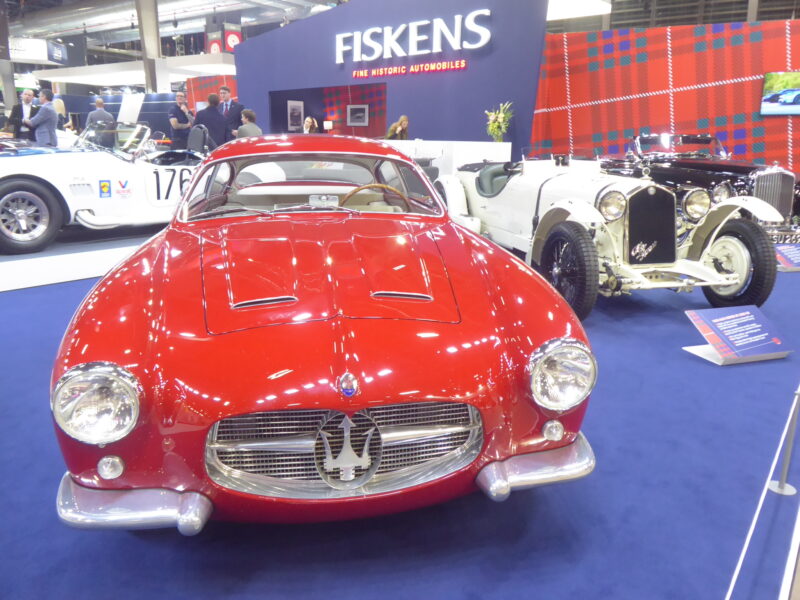
This is a continuation from Part I of the 2025 Rétromobile report.
JAGUAR
The Jaguar Mark V (pronounced mark five) is a luxury automobile built by Jaguar Cars Ltd of Coventry in England from 1948 to 1951. It was available as a four-door Saloon (sedan) and a two-door convertible known as the Drop Head Coupé, both versions seating five adults. It was the first Jaguar with independent front suspension, first with hydraulic brakes, first with spats (fender skirts), first specifically designed to be produced in both Right and Left Hand Drive configurations, first with disc centre wheels, first with smaller wider 16″ balloon tyres, first to be offered with sealed headlamps and flashing turn signals for the important American market, and the last model to use the pushrod engines. The Mark V was introduced to distributors and the press on 30 September 1948 and launched on 27 October 1948 at the London Motor Show at the same time as the announcement of the XK120, with which it shared a stand. The XK120, though not quite ready for production, was the star of the show. However, the Mark V vastly outsold the XK120 by roughly 5,000 cars per year as compared to 2,000 cars per year for the XK120. Three cars were built in late 1948 and saloon production was well under way at the factory on Swallow Road at Holbrook Lane in the Foleshill district of Coventry by March 1949, though the DHC was delayed for some months, and the last cars were built in mid 1951. While the XK120 had a new overhead-camshaft XK engine, the Mark V retained the 1946-48 driveline including the overhead-valve pushrod straight-6 2½L and 3½L engines, now since 1946 produced by Jaguar, which the company had purchased from the Standard Motor Company before the Second World War and the four-speed single-helical gearbox produced by both Jaguar and the Moss Gear Company of Birmingham. Automatic transmission was not available at this time. The 1½L Standard engine used in previous models was not offered in the Mark V. Claimed power output in this application was 102 bhp for the 2664 cc Mark V and 125 bhp for its more popular 3485 cc sibling. The chassis frame was new with deep box sections and cross bracing for improved stiffness in handling and cornering, and independent front suspension by double wishbones and torsion bars, an arrangement that would be used by Jaguar for many future vehicles. It has weldments and brackets provided for both Left Hand and Right Hand Drive brake and clutch pedal linkages, so the chassis could be assembled in either configuration. It also had hydraulic brakes, which were necessary with the independent suspension, and which Jaguar had been slow to adopt compared to other manufacturers, and an all pressed steel body on the saloon, though the DHC still had wood framing in the doors. Another new feature was that the rear of the chassis swept over the rear axle to provide greater movement for improved comfort, whereas on previous models it had been underslung. The styling of the car followed prewar SS-Jaguar lines with upright chrome grille and the leaping Jaguar radiator cap mascot was available as an option. The Autocar called it rich yet with unostentatious looks, in outline halfway between the old and new. There is a distinct hint of the recently modernised Bentley look in the style of the front grill. The wheels were 16-inch (410 mm) steel-disc type, significantly smaller than the 18-inch (460 mm) wheels on the MK IV. From the side, a distinctive styling touch on the saloon was a “tuck in” curve at the base of the rear quarter window following the curved profile of the side glass, a feature retained on many subsequent models. Rear-wheel spats were standard. There was also a drophead coupé version. For the UK and most foreign markets, 7.7″ Lucas PF770 headlamps were used, along with flip-out trafficator semaphore turn indicators. For the important American market, 7″ sealed headlights were used, along with flashing turn signals incorporated into the front side lamp and rear tail lamp units in place of trafficators. The Mark V was available in 12 single paint colours, in various combinations with 7 upholstery colours, but the factory did not offer two-tone treatment, nor did they offer white wall tyres. Two cars were done by the factory in two-tone schemes, and 32 others in various special colours, for unknown reasons. Others may have been repainted as two-tone by American dealers before or after the sale, as well as fitting white wall tyres. In 1951 the Mark V was replaced by the Jaguar Mark VII. The Mark VII had the same 10-foot (3.0 m) wheelbase as the Mark V, but a longer and more streamlined-looking body, which continued in production with little outward change through the Jaguars Mark VIII and Mark IX until 1961.
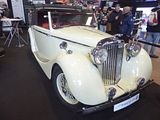
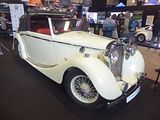
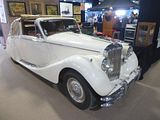
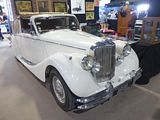
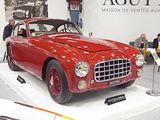
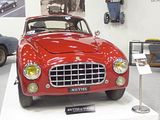
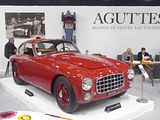
You’d probably not guess what this car is unless you got really close I certainly did not. It turned out to be a one-off Jaguar XK120, bodied by Barou of the Ardeche. Hidden away for nearly 50 years, this bespoke Jaguar participated in the 1950 Automobile Tour de France, plus the 1951 Liege-Rome-Liege rally, in which it finished second overall. This is the story: he Promenade des Anglais is transformed into a closed park for the first post-war edition of the legendary Tour de France Automobile. The program for this incredible event, supported – like the cycling version – by L’Equipe newspaper, no less than 5,239 km divided into 6 stages, with a total of 7 classification events (special stages and circuits). Nearly 100 competitors lined up at the start that day in an automotive inventory worthy of Prévert, ranging from pre-war Hotchkiss to the latest Ferrari 212 Export, not forgetting 2CVs, Jaguar XK120s, Peugeot 203s and Aston Martin DB2s. It has to be said that the rules of this first Tour Auto opened the door to all and “without any restrictions”, since they were reserved for “production passenger cars” which, thanks to the long list of authorized transformations, became “specially adapted production cars”. To aim for overall victory, a system of coefficients was put in place, supposed to balance out the differences between the cars, particularly in terms of engine capacity. In the end, however, it was the “big guns” who had the upper hand, including the Ferraris and Jaguar XK 120s. It was at the wheel of one of the very first Open Two Seater roadsters (aluminum body, in other words), purchased from the French importer Charles Delecchi. French importer Charles Delecroix in left-hand drive that Henri Peignaux, an accomplished gentleman driver and Jaguar dealer for the Lyon region, co-driven by Roger Montabert. The car, in Battleship Grey, proved to be a top performer from the outset, driven by Peignaux in masterly fashion. On the second stage, the crew set the fastest time in the Col de Peyresourde hill-climb in the Pyrenees, averaging over 75 km/h, leaving the event’s eventual winner, “Pagnibon”, at the wheel of his Ferrari 212, behind. Alas, in the third race, Montabert went off the road, Peignaux was seriously injured and the car badly damaged. During his convalescence, Peignaux entrusted the wrecked Jaguar (it seems that a new, unstamped replacement chassis had been ordered from the factory) to a friend from the Ardèche, Jean Barou, a coachbuilder specializing in advertising vehicles and sports cars. A few months later, the Jaguar returned to Lyon rigged as a superb sedan with an Italian-inspired design. Peignaux sold it in this configuration to one of his customers, also keen to try his hand at racing, a Dijon man by the name of Jean Laroche who, co-driven by Jean Radix, was to take part in the legendary and very difficult Liège-Rome-Liège 1952. Given the weather conditions and the toughness of the event, also known as the Marathon de la Route, which is run on open roads in a single stage of over 3,500 km, competitors like to enter closed cars, such as the Berlinette Barou, which also has a helmet holder for the co-driver, whose role is already essential. The Dijon crew, number 82, put in a fine performance to take second place in the event, behind the victorious Porsche 356. That year, only 24 of the 125 starting crews finished…Barou also produced a berlinette, seen at the 1954 Lyon-Charbonnières, which differed from the first in its grille and a few other details. He also produced a barquette, also entered in the Lyon-Charbonnières, but with no further success. While the second berlinette has disappeared, the barquette has survived, restored in the 1980s by Roland Urban, a specialist in Jaguar specials, and entered several times in the historic Mille Miglia by one of its subsequent owners. Our sublime, high-performance Jaguar sedan #670028 was resold in 1952 and again in 1954, before fading into oblivion. It was through a classified ad that the current owner, an enlightened enthusiast, purchased the car. He had the car – then white – repainted in its current red hue, and used it on several rallies, where he met Roland Urban, among others, who noted the car’s great authenticity, its low degree of wear and tear, and its high performance.
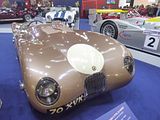
The C-Type was built specifically for the race track . It used the running gear of the contemporary road-proven XK120 clothed in a lightweight tubular frame, devised by William Heynes, and clothed in an aerodynamic aluminium body designed by Malcolm Sayer. The road-going XK120’s 3.4-litre twin-cam, straight-6 engine produced between 160 and 180 bhp, but when installed in the C-Type, it was originally tuned to around 205 bhp. Early C-Types were fitted with SU carburettors and drum brakes. Later C-Types, from mid 1953, were more powerful, using triple twin-choke Weber carburettors and high-lift camshafts. They were also lighter, and braking performance was improved with disc brakes on all four wheels, which were something of a novelty at the time, though their adoption started to spread quite quickly after Jaguar had used them. The lightweight, multi-tubular, triangulated frame was designed by William Heynes. Malcolm Sayer designed the aerodynamic body. Made of aluminium in the barchetta style, it is devoid of road-going items such as carpets, weather equipment and exterior door handles. The C-Type was successful in racing, most notably at the Le Mans 24 hours race, which it won twice. In 1951 the car won at its first attempt. The factory entered three, whose driver pairings were Stirling Moss and Jack Fairman, Leslie Johnson and triple Mille Miglia winner Clemente Biondetti, and the eventual winners, Peter Walker and Peter Whitehead. The Walker-Whitehead car was the only factory entry to finish, the other two retiring with lack of oil pressure. A privately entered XK120, owned by Robert Lawrie, co-driven by Ivan Waller, also completed the race, finishing 11th. In 1952 Jaguar, worried by a report about the speed of the Mercedes-Benz 300SLs that would run at Le Mans, modified the C-Type’s aerodynamics to increase the top speed. However, the consequent rearrangement of the cooling system made the cars vulnerable to overheating, and all three retired from the race. The Peter Whitehead-Ian Stewart and Tony Rolt/Duncan Hamilton cars blew head gaskets, and the Stirling Moss-Peter Walker car, the only one not overheating having had a full-sized radiator hurriedly fitted, lost oil pressure after a mechanical breakage. Testing by Norman Dewis at MIRA after the race proved that the overheating was caused more by the revisions to the cooling system than by the altered aerodynamics: the water pump pulley was undersized, so it was spinning too fast and causing cavitation; also the header tank was in front of the passenger-side bulkhead, far from the radiator, and the tubing diameter was too small at 7/8 inch. With the pump pulley enlarged, and the tubing increased to 1 1/4 inch, the problem was eliminated. The main drawback of the new body shape was that it reduced downforce on the tail to the extent that it caused lift and directional instability at speeds over 120 mph on the Mulsanne Straight. These cars had chassis numbers XKC 001, 002 and 011. The first two were dismantled at the factory, and the third survives in normal C-type form. In 1953 C-Types won again, and also placed second and fourth. This time the body was in thinner, lighter aluminium and the original twin H8 sand cast SU carburettors were replaced by three DCO3 40mm Webers, which helped boost power to 220 bhp. Further weight was saved by using a rubber bag fuel tank, lighter electrical equipment and thinner gauge steel for some of the chassis tubes . Duncan Hamilton and Tony Rolt won the race at 105.85 mph (170.35 km/h) – the first time Le Mans had been won at an average of over 100 miles per hour (161 km/h). 1954, the C-Type’s final year at Le Mans, saw a fourth place by the Ecurie Francorchamps entry driven by Roger Laurent and Jacques Swaters. Between 19951 and 1953, a total of 53 C-Types were built, 43 of which were sold to private owners mainly in the US. When new, the car sold for about $6,000, approximately twice the price of an XK120. Genuine cars have increased in value massively in recent years, however buyers do need to be aware that replicas have been produced by a number of companies, though even these are far from cheap to buy thesedays. Cars with true racing provenance are well into the millions now. A C-Type once owned and raced by Phil Hill sold at an American auction in August 2009 for $2,530,000 and another C-type was sold at the Pebble Beach auction in 2012 for $3,725,000, More recently an unrestored C-Type that raced at Le Mans has sold for £5,715,580, during the Grand Prix Historique race meeting in Monaco. In August 2015, an ex-Ecurie Ecosse Lightweight C-type, chassis XKC052 and the second of only three works lightweights, driven by Peter Whitehead and Ian Stewart to fourth at the 1953 Le Mans 24 Hours, fetched £8.4 million at auction in California.
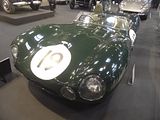
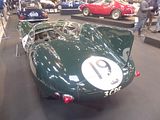
Successor to the C Type was the D Type. Although it shared many of its mechanical components with the C-Type, including the basic straight-6 XK engine design, initially of 3.4 litres and later enlarged to 3.8 litres in the late fifties, the structure of the car was radically different. The innovative monocoque construction brought aviation industry technology to competition car design, together with an aeronautical understanding of aerodynamic efficiency. The structural design, revolutionary at the time, applied aeronautical technology. The “tub”, or cockpit section, was of monocoque construction, mostly comprising sheets of aluminium alloy. Its elliptical shape and comparatively small cross-section provided torsional rigidity and reduced drag. To the front bulkhead was attached an aluminium tubing subframe for the engine, steering assembly, and front suspension. Rear suspension and final drive were mounted to the rear bulkhead. Fuel was carried in the tail and the designers followed aviation practice by specifying a deformable Marston Aviation Division bag in place of a conventional tank. The aerodynamic bodywork was largely the work of Malcolm Sayer, who had joined Jaguar following a stint with the Bristol Aeroplane Company during the Second World War and later worked on the C-Type. For the D-Type, he insisted on a minimal frontal area. To reduce the XK engine’s height, Jaguar’s chief engineer, William Haynes, and former Bentley engineer, Walter Hassan, developed dry sump lubrication, and it has been said that the car’s frontal area was also a consideration in canting the engine at 8½° from the vertical (which necessitated the offset bonnet bulge). Philip Porter, in his book Jaguar Sports Racing Cars, says that “[a] more likely reason was to provide extra space for the ram pipes feeding the three twin-choke Weber carburettors.” Reducing underbody drag contributed to the car’s high top speed; for the long Mulsanne Straight at Le Mans, a fin was mounted behind the driver for aerodynamic stability. For the 1955 season, factory cars were fitted with a longer nose, which lengthened the car by 7½ inches and further increased maximum speed; and the headrest fairing and aerodynamic fin were combined as a single unit that smoothed the aerodynamics and saved weight. Mechanically, many features were shared with the outgoing C-Type. Its front and rear suspension and innovative all-round disc brakes were retained, as was the XK engine. Apart from the new lubrication system, the engine was further revised as development progressed during the D-Type’s competition life. Notably in 1955 larger valves were introduced, together with asymmetrical cylinder heads to accommodate them. Jaguar D-Types fielded by a team under the leadership of Jaguar’s racing manager Lofty England were expected to perform well in their debut at the 1954 24 Hours of Le Mans race. In the event, the cars were hampered by fuel starvation caused by problems with the fuel filters, necessitating pit stops for their removal, after which the entry driven by Duncan Hamilton and Tony Rolt speeded up to finish less than a lap behind the winning Ferrari. The D-Type’s aerodynamic superiority is evident from its maximum speed of 172.8 mph on the Mulsanne Straight compared with the 4.9 litre Ferrari’s 160.1 mph. For 1955 the cars were modified with long-nose bodywork and engines uprated with larger valves. At Le Mans, they proved competitive with the Mercedes-Benz 300 SLRs, which had been expected to win. Mike Hawthorn’s D-Type had a narrow lead over Juan Manuel Fangio’s Mercedes when another Mercedes team car was involved in the most catastrophic accident in motorsport history.Driver Pierre Levegh and more than 80 spectators lost their lives, while many more were injured. Mercedes withdrew from the race. Jaguar opted to continue, and the D-Type driven by Hawthorn and Ivor Bueb went on to win. Mercedes withdrew from motorsport at the end of the 1955 season, and Jaguar again entered Le Mans in 1956. Although only one of the three factory-entered cars finished, in sixth place, the race was won by a D-Type entered by the small Edinburgh-based team Ecurie Ecosse and driven by Ron Flockhart and Ninian Sanderson, beating works teams from Aston Martin and Scuderia Ferrari. In America, the Cunningham team raced several D-Types. In 1955, for example, a 1954 works car on loan to Cunningham won the Sebring 12 Hours in the hands of Mike Hawthorn and Phil Walters, and in May 1956 the team’s entries for Maryland’s Cumberland national championship sports car race included four D-Types in Cunningham’s white and blue racing colours. Driven by John Fitch, John Gordon Benett, Sherwood Johnston and team owner Briggs Cunningham, they finished fourth, fifth, seventh and eighth, respectively. Although Jaguar withdrew from motorsport at the end of the 1956 season, 1957 proved to be the D-Type’s most successful year. Jaguar D-Types took five of the top six places at Le Mans; Ecurie Ecosse, with considerable support from Jaguar, and a 3.8-litre engine, again took the win, and also second place. This was the best result in the D-Type’s racing history. Rules for the 1958 Le Mans race limited engine sizes to three litres for sports racing cars, which ended the domination of the D-Type with its 3.8-litre XK engine. Jaguar developed a three-litre version to power D-Types in the 1958, 1959 and 1960 Le Mans races but it was unreliable, and by 1960 it no longer produced sufficient power to be competitive. The D-Type’s success waned as support from Jaguar decreased and the cars from rival manufacturers became more competitive. Although it continued to be one of the cars to beat in club racing and national events, the D-Type never again achieved a podium finish at Le Mans. By the early 1960s it was obsolete. Total D-Type production is thought to have included 18 factory team cars, 53 customer cars, and 16 XKSS versions. A 1955 car was sold at Sothebys in 2016 for £19,8 million, making it the most valuable British car ever.
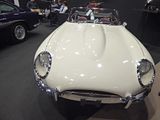
There were lots of E Types here, of course. The Series 1 was introduced, initially for export only, in March 1961. The domestic market launch came four months later in July 1961. The cars at this time used the triple SU carburetted 3.8-litre six-cylinder Jaguar XK6 engine from the XK150S. Earlier built cars utilised external bonnet latches which required a tool to open and had a flat floor design. These cars are rare and more valuable. After that, the floors were dished to provide more leg room and the twin bonnet latches moved to inside the car. The 3.8-litre engine was increased to 4,235 cc in October 1964. The 4.2-litre engine produced the same power as the 3.8-litre (265 bhp) and same top speed (150 mph), but increased torque approximately 10% from 240 to 283 lb/ft. Acceleration remained pretty much the same and 0 to 60 mph times were around 6.4 seconds for both engines, but maximum power was now reached at 5,400 rpm instead of 5,500 rpm on the 3.8-litre. That all meant better throttle response for drivers that did not want to shift down gears. The 4.2-litre’s block was completely redesigned, made longer to accommodate 5 mm (0.20 in) larger bores, and the crankshaft modified to use newer bearings. Other engine upgrades included a new alternator/generator and an electric cooling fan for the radiator. Autocar road tested a UK spec E-Type 4.2 fixed head coupé in May 1965. The maximum speed was 153 mph, the 0–60 mph time was 7.6 seconds and the 1⁄4 mile from a standing start took 15.1 seconds. They summarised it as “In its 4.2 guise the E-Type is a fast car (the fastest we have ever tested) and offers just about the easiest way to travel quickly by road.”. Motor magazine road tested a UK spec E-Type 4.2 fixed head coupé in Oct 1964. The maximum speed was 150 mph, the 0–60 mph time was 7 seconds and the 1⁄4 mile time was 14.9 seconds. They summarised it as “The new 4.2 supersedes the early 3.8 as the fastest car Motor has tested. The absurd ease which 100 mph can be exceeded in a 1⁄4 mile never failed to astonish. 3,000 miles (4,828 km) of testing confirms that this is still one of the world’s outstanding cars”. All E-Types featured independent coil spring rear suspension designed and developed by R J Knight with torsion bar front ends, and four wheel disc brakes, in-board at the rear, all were power-assisted. The Coventry engineers spared nothing with regards to high automotive technology in braking. Like several British car builders of the middle and late 1950s, the four-wheel disc brakes were also used in that era by Austin-Healey, MG, putting the British far ahead of Ferrari, Maserati, Alfa Romeo, Porsche, and Mercedes-Benz. Even Lanchester tried an abortive attempt to use copper disc brakes in 1902.[40] Jaguar was one of the first vehicle manufacturers to equip production cars with 4 wheel disc brakes as standard from the XK150 in 1958. The Series 1 (except for late 1967 models) can be recognised by glass-covered headlights (up to 1967), small “mouth” opening at the front, signal lights and tail-lights above bumpers and exhaust tips under the number plate in the rear. 3.8-litre cars have leather-upholstered bucket seats, an aluminium-trimmed centre instrument panel and console (changed to vinyl and leather in 1963), and a Moss four-speed gearbox that lacks synchromesh for first gear (“Moss box”) on all except very last cars. 4.2-litre cars have more comfortable seats, improved brakes and electrical systems, and, obviously, an all-synchromesh Jaguar designed four-speed gearbox. 4.2-litre cars also have a badge on the boot proclaiming “Jaguar 4.2 Litre E-Type” (3.8 cars have a simple “Jaguar” badge). Optional extras included chrome spoked wheels and a detachable hard top for the OTS. When leaving the factory the car was originally fitted with Dunlop 6.40 × 15-inch RS5 tyres on 15 × 5K wire wheels (with the rear fitting 15 × 5K½ wheels supplied with 6.50 X15 Dunlop Racing R5 tyres in mind of competition). Later Series One cars were fitted with Dunlop 185 – 15 SP41 or 185 VR 15 Pirelli Cinturato as radial ply tyres. A 2+2 version of the fastback coupé was added in 1966. The 2+2 offered the option of an automatic transmission. The body is 9 in (229 mm) longer and the roof angles are different. The roadster and the non 2+2 FHC (Fixed Head Coupé) remained as two-seaters. Less widely known, right at the end of Series 1 production, but prior to the transitional “Series 1½” referred to below, a small number of Series 1 cars were produced with open headlights. These Series 1 cars had their headlights modified by removing the covers and altering the scoops they sit in, but these Series 1 headlights differ in several respects from those later used in the Series 1½ (or 1.5), the main being they are shorter at 143 mm from the Series 1½ at 160 mm. Production dates on these machines vary but in right-hand drive form production has been verified as late as July 1968. They are not “rare” in the sense of the build of the twelve lightweights, but they are certainly uncommon; they were not produced until January 1967 and given the foregoing information that they were produced as late as July 1968, it appears that there must have been an overlap with the Series 1.5 production, which began in August 1967 as model year 1968 models. These calendar year/model year Series 1 E-Types are identical to other 4.2-litre Series 1 examples in every respect except for the open headlights; all other component areas, including the exterior, the interior, and the engine compartment are the same, with the same three SU carburettors, polished aluminium cam covers, centre dash toggle switches, etc. Following the Series 1 there was a transitional series of cars built in 1967–68 as model year 1968 cars, unofficially called “Series 1½.” Due to American pressure the new features were not just open headlights, but also different switches (black rocker switches as opposed to the Series 1 toggle switches), de-tuning for emissions (using two Zenith-Stromberg carburettors instead of the original three SUs) for US models, ribbed cam covers painted black except for the top brushed aluminium ribbing, bonnet frames on the OTS that have two bows, and other changes. Series 1½ cars also have twin cooling fans and adjustable seat backs. The biggest change between 1961–1967 Series 1 E-Types and the 1968 Series 1.5 was the reduction in the number of carburettors from 3 to just 2 (North America), resulting in a loss in horsepower. Series 2 features were gradually introduced into the Series 1, creating the unofficial Series 1½ cars, but always with the Series 1 body style. A United States federal safety law affecting 1968 model year cars sold in the US was the reason for the lack of headlight covers and change in dash switch design in the “Series 1.5” of 1968. An often overlooked change, one that is often “modified back” to the older style, is the wheel knock-off “nut.” US safety law for 1968 models also forbade the winged-spinner knockoff, and any 1968 model year sold in the US (or earlier German delivery cars) should have a hexagonal knockoff nut, to be hammered on and off with the assistance of a special “socket” included with the car from the factory. This hexagonal nut carried on into the later Series 2 and 3. The engine configuration of the US Series 1.5s was the same as is found in the Series 2. An open 3.8-litre car, actually the first such production car to be completed, was tested by the British magazine Motor in 1961 and had a top speed of 149.1 mph and could accelerate from 0 to 60 mph in 7.1 seconds. A fuel consumption of 21.3 mpg was recorded. The test car cost £2,097 including taxes.The cars submitted for road test by the motoring journals of the time (1961) such as Motor, Autocar and Autosport magazines were prepared by the Jaguar works. This work entailed engine balancing and subtle tuning work such as gas-flowing checking the cylinder heads but otherwise production built engines. Both of the well-known 1961 road test cars: the E-Type coupé Reg. No. 9600 HP and E-Type Convertible Reg. No. 77 RW, were fitted with Dunlop Racing Tyres on test, which had a larger rolling diameter and lower drag coefficient. This goes some way to explaining the 150 mph (240 km/h) maximum speeds that were obtained under ideal test conditions. The maximum safe rev limit for standard 6-cylinder 3.8-litre E-Type engines is 5,500 rpm. The later 4.2-Litre units had a red marking on the rev counter from just 5,000 rpm. Both 3.8 test cars may have approached 6,000 rpm in top gear when on road test, depending on final drive ratio. Production numbers were as follows: 15,490 of the 3.8s, 17,320 of the 4.2s and 10,930 of the 2+2s. And by body style there were 15,442 of the FHC, 17,378 of the OTS and 5,500 of the 2+2, making a total of 38,419 of the Series 1 car.
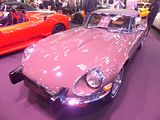
The E-Type Series 3 was introduced in 1971, with a new 5.3 L Jaguar V12 engine, uprated brakes and standard power steering. Optionally an automatic transmission, wire wheels and air conditioning were available. The V12 was equipped with four Zenith carburettors, and as introduced produced a claimed 272 bhp, more torque, and a 0–60 mph acceleration of less than seven seconds. The short wheelbase FHC body style was discontinued, with the Series 3 available only as a convertible and 2+2 coupé. The newly used longer wheelbase now offered significantly more room in all directions. The Series 3 is easily identifiable by the large cross-slatted front grille, flared wheel arches, wider tyres, four exhaust tips and a badge on the rear that proclaims it to be a V12. The first published road test of the series 3 was in Jaguar Driver, the club magazine of the Jaguar Drivers’ Club, the only owners club to be officially sanctioned by Sir William Lyons and Jaguar themselves. The road test of a car provided by Jaguar was published ahead of all the national and international magazines. Cars for the US market were fitted with large projecting rubber bumper over-riders (in 1973 these were on front, in 1974 both front and rear) to meet local 5 mph impact regulations, but those on European models were considerably smaller. US models also have side indicator repeats on the front wings. There were also a very limited number of six-cylinder Series 3 E-Types built. These were featured in the initial sales procedure but the lack of demand stopped their production. The V12 Open Two Seater and V12 2+2 were factory fitted with Dunlop E70VR − 15-inch tyres on 15 × 6K wire or solid wheels. The final production E-Type OTS Roadster was built in June 1974. Total production was 15,290.
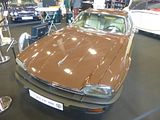
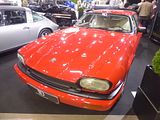
Successor to the E Type was the XJ-S, launched in September 1975, and to a not universally approving public. This was a very different sort of sporting Jaguar, more boulevard cruiser than sports car, even though the car had plenty of appeal with its smooth V12 engine which gave it genuine 150 mph performance. Press reports were favourable, but a thirsty V12 and a car with inconsistent build quality and styling that not everyone warmed to meant that sales were slow, and they got slower as the decade passed, leading questions to be asked as to whether the car should continue. As well as sorting the saloon models, Jaguar’s Chairman, John Egan, put in place a program to improve the XJ-S as well, which also benefitted from the HE engine in early 1981. A Cabrio model and the option of the new 3.6 litre 6 cylinder engine from 1984 widened the sales appeal, and the volumes of cars being bought started to go up. A fully open Convertible, launched in 1988 was the model many had been waiting for, and by this time, although the design was over 10 years old, it was now brimming with appeal to many. 1991 saw an extensive facelift which changed the styling details as well as incorporating the latest mechanical changes from the Jaguar parts bin, making the XJS (the hyphen had been dropped from the name in 1990) a truly desirable car. Seen here were both pre- and post-facelift models as well as one of the rare TWR-converted XJR-S cars. These were made between 1988 and 1993 by the newly formed JaguarSport, a separate company owned in a ratio of 50:50 by Jaguar and TWR Group Limited specialising in developing high performance Jaguar sports cars. The car had a distinctive body kit, special alloy wheels, a unique suspension system utilising modified coil springs and Bilstein shocks, a luxurious interior with Connolly Autolux leather along with walnut wood trim, and handling improvements. The first 100 of these cars were named “Celebration Le Mans” to commemorate Jaguar’s 1988 win at the 24 Hours of Le Mans and were only sold in the UK. Between 1988 and 1989, a total of 326 XJR-S cars were produced with the 5.3 litres engine with a power output of 318 bhp. After September 1989, the displacement of the engine was increased to 5,993 cc and it was now equipped with Zytek fuel injection and engine management system. This was different from the standard 6.0-litre engine used in the late XJS models and was unique to this model. The power output was raised to 334 bhp at 5,250 rpm and 495 Nm (365 lb/ft) of torque at 3,650 rpm due to a higher compression ratio of 11.0:1, a new forgedsteel crankshaft, increased bore and forged alloy pistons. A modified air intake system and a low loss dual exhaust system was also standard on the model. The engine was mated to the 3-speed GM400 automatic transmission utilising a recalibrated valve body and had faster shift times. The car was equipped with Dunlop D40 M2 tyres for better grip. These modifications resulted in a top speed of 260 km/h (160 mph). A total of 787 coupés and 50 convertible XJR-S were built for the world market.
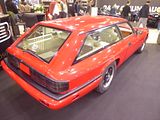
This is one of the rare Lynx Eventer hand-built “shooting brake” (three-door estate) conversions of the Jaguar XJ-S produced by UK-based Lynx Engineering between 1982 and 2002. Only 67 examples were built, featuring a redesigned roofline for increased boot space and improved rear headroom, while maintaining the V12 engine’s high-speed touring capability. The conversion transformed the XJ-S coupe into a practical luxury car, offering roughly 39 cubic feet of cargo space with rear seats folded. It added a large rear hatch and, unlike a standard estate, was considered a stylish, high-performance grand tourer. produced over 19 years, total production was limited to 67 units, with the final car based on a 6.0-litre Jaguar Sport XJR-S.Each car was hand-built to order, often based on a customer’s existing XJ-S or a new donor car. The majority of conversions featured the Jaguar 5.3-litre V12 engine.
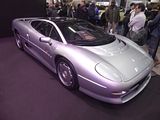
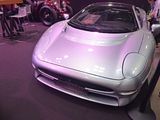
As is well known, the XJ220 was developed from a V12-engined 4-wheel drive concept car designed by an informal group of Jaguar employees working in their spare time. The group wished to create a modern version of the successful Jaguar 24 Hours of Le Mans racing cars of the 1950s and ’60s that could be entered into FIA Group B competitions. The XJ220 made use of engineering work undertaken for Jaguar’s then current racing car family. The initial XJ220 concept car was unveiled to the public at the 1988 British International Motor Show. Its positive reception prompted Jaguar to put the car into production; some 1500 deposits of £50,000 each were taken, and deliveries were planned for 1992. Engineering requirements resulted in significant changes to the specification of the XJ220, most notably replacement of the Jaguar V12 engine by a turbocharged V6 engine. The changes to the specification and a collapse in the price of collectible cars brought about by the early 1990s recession resulted in many buyers choosing not to exercise their purchase options. A total of just 271 cars were produced by the time production ended, each with a retail price of £470,000 in 1992. The production XJ220 used a 3.5-litre twin turbocharged engine, which was given the designation Jaguar/TWR JV6. This engine, which replaced the Jaguar V12 engine featured in the concept car, was a heavily redesigned and significantly altered version of the Austin Rover V64V V6 engine. The decision to change the engine was based on engine weight and dimensions, as well as to environmental emission considerations. Use of the shorter V6 engine design allowed the wheelbase of the XJ220 to be shortened and its weight to be reduced; the V12 engine was definitively ruled out when it was determined it would have difficulty in meeting emissions legislation whilst producing the required power and torque. TWR purchased the rights to the V64V engine from Austin Rover in 1989 and developed a completely new turbocharged engine, codenamed JV6, under the auspices of Allan Scott, with proportions roughly similar to the V64V, and suitable for Sportcar racing. TWR redesigned all parts of the engine, increasing the displacement to 3.5 litres, and adding two Garrett TO3 turbochargers. The JV6 engine would first be used in the JaguarSport XJR-10 and XJR-11 racing cars; its compact dimensions and low weight made it an ideal candidate for the XJ220. The engine had a 90° bank angle, four valves per cylinder and belt-driven double overhead camshafts. It shares a number of design features with the Cosworth DFV Formula One engine. The V64V engine chosen had a short but successful career as a purpose-designed racing car engine. It was designed by Cosworth engine designer David Wood for Austin Rover Group’s Metro derived Group B rally car, the MG Metro 6R4. The redesign work necessary to create the Jaguar/TWR JV6 engine was undertaken by Andrew Barnes, TWR’s Powertrain Manager, and also involved Swiss engine builder Max Heidegger who had designed and built the race engines used in the XJR-10 and XJR-11 racing cars. The XJ220’s engine had a bore and stroke of 94 mm × 84 mm, dry sump lubrication, Zytek multi point fuel injection with dual injectors and Zytek electronic engine management. The engine was manufactured with an aluminium cylinder block, aluminium cylinder heads with steel connecting rods and crankshaft, and in the standard state of tune, it produced a maximum power of 550 PS at 7200 rpm and torque of 475 lb·ft at 4500 rpm. The XJ220 can accelerate from 0–60 miles per hour in 3.6 seconds and reach a top speed of 213 miles per hour.The exhaust system had two catalytic converters, which reduced the power output of the engine. During testing at the Nardò Ring in Italy the XJ220, driven by 1990 Le Mans Winner Martin Brundle achieved a top speed of 217.1 miles per hour when the catalytic converters were disconnected and the rev limiter was increased to 7,900rpm; owing to the circular nature of the track, a speed of 217 mph is equivalent to 223 mph on a straight, level road. The V64V engine had the additional benefit of being very economical for such a powerful petrol engine, it was capable of achieving 32 mpg, in contrast, the smallest-engined Jaguar saloon of the time, the Jaguar XJ6 4.0 could only achieve around 24 mpg. Four-wheel drive was decided against early in the development process, for a number of reasons. It was thought rear-wheel drive would be adequate in the majority of situations, that the additional complexity of the four-wheel drive system would hinder the development process and potentially be problematic for the customer. FF Developments were contracted to provide the gearbox/transaxle assembly, modifying their four-wheel drive transaxle assembly from the XJ220 concept into a pure rear-wheel drive design for the production car. A five-speed gearbox is fitted; a six-speed gearbox was considered but deemed unnecessary, as the torque characteristics of the engine made a sixth gear redundant. The transaxle featured a viscous coupling limited slip differential to improve traction. The transmission system featured triple-cone synchromeshing on first and second gears to handle rapid starts, whilst remaining relatively easy for the driver to engage and providing positive feel. The exterior retained the aluminium body panels of the XJ220 concept, but for the production vehicles, Abbey Panels of Coventry were contracted to provide the exterior panels. The scissor doors were dropped for the production model, and significant redesign work was carried out on the design when the wheelbase and overall length of the car was altered. Geoff Lawson, Design Director at Jaguar took a greater interest in the car and insisted the design had to be seen to be a Jaguar if it was to be successful in promoting the company. Keith Helfet returned to undertake the necessary redesign work mandated by the change in the wheelbase, which was reduced by 200 mm. The turbocharged engine required larger air intakes to feed the two intercoolers. Situated between the doors and the rear wheels, the air intakes were larger on the production version of the XJ220 than on the concept car. A number of small design changes for the body were tested in the wind tunnel; the final version had a drag coefficient of 0.36 with downforce of 3,000 lb at 200 mph. The XJ220 was one of the first production cars to intentionally use underbody airflow and the venturi effect to generate downforce. The rear lights used on the production XJ220 were taken from the Rover 200. The production model utilised the same Alcan bonded honeycomb aluminium structure vehicle technology (ASVT) as the concept car for the chassis. The chassis design featured two box section rails which acted as the suspension mounting points and would provide an energy absorbing structure in the event of a frontal impact, these were successfully tested at speeds up to 30 mph, an integral roll cage formed part of the chassis and monocoque, providing additional structural rigidity for the car and allowing the XJ220 to easily pass stringent crash testing.The rear-wheel steering was dropped from the production car to save weight and reduce complexity, as was the height adjustable suspension and active aerodynamic technology. The suspension fitted to the production model consisted of front and rear independent suspension, double unequal length wishbones, inboard coil springs and anti-roll bars, with Bilstein gas-filled dampers. The suspension was designed in accordance with the FIA Group C specifications. The braking system was designed by AP Racing and featured ventilated and cross-drilled discs of 13 in diameter at the front and 11.8 in diameter at the rear. The calipers are four pot aluminium units. JaguarSport designed the handbrake, which are separate calipers acting on the rear brake discs. Feedback from enthusiasts and racing drivers resulted in the decision to drop the anti-lock braking system from the production car. The braking system was installed without a servo, but a number of owners found the brakes to be difficult to judge when cold and subsequently requested a servo to be fitted. Rack and pinion steering was fitted, with 2.5 turns lock to lock; no power assistance was fitted. The Bridgestone Expedia S.01 asymmetric uni-directional tyres were specially developed for the XJ220 and had to be rateable to a top speed in excess of 220 mph, carry a doubling of load with the exceptionally high downforce at speed and maintain a compliant and comfortable ride. Rally alloy wheel specialists Speedline Corse designed the alloy wheels, these are both wider and have a larger diameter on the rear wheels; 17 inches wheels are fitted to the front and 18 inches are fitted at the rear, with 255/55 ZR17 tyres at the front and 345/35 ZR18 tyres at the rear. The interior was designed for two passengers and trimmed in leather. Leather trimmed sports seats are fitted together with electric windows and electrically adjustable heated mirrors. The dashboard unusually curves round and carries onto the drivers door, with a secondary instrument binnacle containing four analogue gauges, including a clock and voltmeter fitted on the front of the drivers door. Air conditioning and green tinted glazing was also fitted.The luggage space consists of a small boot directly behind and above the rear portion of the engine, also trimmed in leather. The car was assembled in a purpose-built factory at Wykham Mill, Bloxham near Banbury. HRH The Princess of Wales officially opened the factory and unveiled the first production XJ220 in October 1991. The JV6 engines used in the Jaguar racing cars were produced by Swiss engineer Max Heidegger, but delivering the number of engines required for the XJ220 program was considered beyond his capacity. TWR formed a division, TWR Road Engines, to manage the design, development, construction and testing of the engines for the production cars. The JV6 engine used in the XJ220 featured little commonality with the engines Heidegger built for use in the XJR racing cars, being specifically engineered to meet performance and in particular, the European emissions requirements, which the race engines didn’t have to meet. FF Developments, in addition to their design work on the gearbox and rear axle assembly were given responsibility for their manufacture. The aluminium chassis components and body panels were manufactured and assembled at Abbey Panels factory in Coventry, before the body in white was delivered to the assembly plant at Bloxham. The car, including chassis and body components, consists of approximately 3000 unique parts. The first customer delivery occurred in June 1992, and production rates averaged one car per day. The last XJ220 rolled off the production line in April 1994; the factory was then transferred to Aston Martin and used for the assembly of the Aston Martin DB7 until 2004.
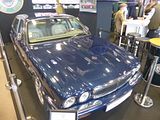
The “X300” model was the first XJ produced entirely under Ford ownership, and can be considered an evolution of the outgoing XJ40 generation. Like all previous XJ generations, it featured the Jaguar independent rear suspension arrangement. The design of the X300 placed emphasis on improved build quality, improved reliability, and a return to traditional Jaguar styling elements. At the car’s launch in October 1994 at the Paris Motor Show, Jaguar marketing material made use of the phrase “New Series XJ” to describe the X300 models. The X300 series represented the result of a £200 million facilities renewal program by Ford. which included the introduction of state-of-the-art automated body welding robots manufactured by Nissan. Aesthetically, the X300 received several updates in the design refresh led by Geoff Lawson in 1991. The mostly flat bonnet of the XJ40 was replaced with a fluted, curvaceous design that accentuated the four separate round headlamps. Rear wings were reshaped to accommodate the new wrap-around rear light clusters. Also, the separate black-rubber bumper bar of the XJ40 were replaced with a fully integrated body-coloured bumper. The interior of the X300 was similar to that found in the XJ40, with some revisions. The seats were updated to have a more rounded profile, wood trim was updated with bevelled edges, and the steering wheel was redesigned. Jaguar’s V12 engine and AJ6 inline-six (AJ16) engine were both available in various X300 models, although they received significant updates. Both engines were fitted with distributorless electronic engine management systems. The Jaguar X308 first appeared in 1997 and was produced until 2003. It was an evolution of the outgoing X300 platform, and the exterior styling is nearly identical between the two generations, though there are quite a few detailed differences if you know what to look for. The major change was the under the bonnet. Having discontinued production of both the AJ16 inline-six and V12 engines, Jaguar offered only its newly designed V8 engine (named the AJ-V8.) It was available in either 3.2 or 4.0 litre forms, although certain markets, such as the United States, only received cars powered by the 4.0 litre version. The 4.0 litre version was also supercharged in certain models. Equipment levels were notably more generous than had previously been the case.
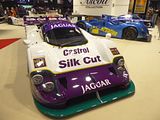
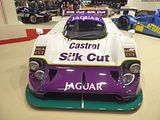
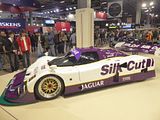
The Jaguar XJR-12 is a sports-prototype race car built by the Jaguar Cars-backed Tom Walkinshaw Racing team for both Group C and IMSA Camel GTP. The XJR-12 is famous for winning the 1990 24 Hours of Le Mans race. Weighing 900 kg and powered by a 7.0 L 60 degree SOHC V12 developing 730 bhp at 7000 rpm, and 579 lb/ft (785 Nm) @ 5500 rpm, the XJR-12 could hit 368 km/h / 229 mph. During the 1990 24 Hours of Le Mans, the XJR-12 covered 4,882.4 km at an average speed of 204.036 km/h / 126.782 mph with a maximum trap speed of 353 km/h / 219 mph.
KIMERA
The EVO37 is a reinterpretation of the Lancia Rally 037, the last rear-wheel-drive car to win the World Rally Championship. Kimera Automobili collaborated with former Lancia engineers and technicians like Sergio Limone and Claudio Lombardi to create a limited series of 37 units, combining classic aesthetics with cutting-edge components and technologies. The EVO37 is effectively a Restomod: in order to build it, Kimera Automobili has to source and buy a donor car, a Lancia Beta Montecarlo, and use its chassis as a base. The old chassis is cut and only parts of the central shell are kept. Afterwards, a tubular chassis is built at the front and at the back, just like Lancia used to do for the Rally 037. The chassis number is also preserved on the newly built car, and for this reason a Lancia badge is kept at the front. The EVO37 is equipped with a 2.15-litre, 4-cylinder engine capable of delivering 505 hp, owing to the combination of a supercharger (for low revs) and a turbocharger (for high revs). The engine was designed and engineered by Italtecnica with various tributes to the Italian Group B cars from the 80’s. The engine capacity is the same as the Lancia 037, while the twin-charging system (supercharger + turbocharger) is the same as the Lancia Delta S4. The engine is coupled to a 6-speed manual gearbox from Dana Graziano. The car features a carbon fiber body, Öhlins suspension (with double wishbone dampers at the back), and a Brembo braking system. Each EVO37 is highly customised, as Kimera Automobili gives customers hundreds of customisation options: materials, colours and stitchings can be fully personalised. Each EVO37 car also has its own name (always a female name) chosen by the owner.
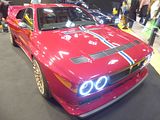
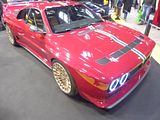
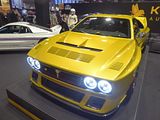
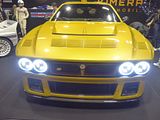
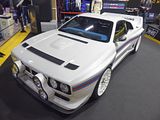
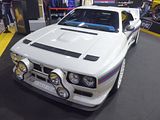
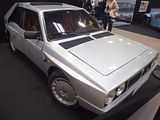
The stand also included a restomod version of the Delta S4.
KOENIGSEGG
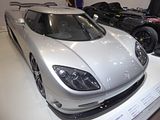
CCR
LAMBORGHINI
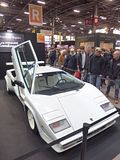
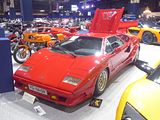
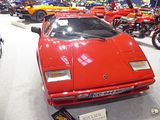
Which small boy (and perhaps car loving girl) did not lust after a Countach back in the 1970s and 1980s. A dramatic looking car, this was the stuff of dreams that you would only ever see at the London or NEC Motor Shows. Countach first made an appearance, as a concept in 1971, but it was 1973 before the production car made its debut, and despite unfortunate timing with fuel shortages and a recession, and a number of financial problems for its maker, the car sold well throughout its production life. The Countach entered production as the LP400 with a 3929 cc engine delivering 370 hp. The first production Countach was delivered to an Australian in 1974. Externally, little had altered from the final form of the prototype except at the rear, where conventional lights replaced the futuristic light clusters of the prototype. The styling had become rather more aggressive than Gandini’s original conception, with the required large air scoops and vents to keep the car from overheating, but the overall shape was still very sleek. The original LP400 rode on the quite narrow tyres of the time, but their narrowness and the slick styling meant that this version had the lowest drag coefficient of any Countach model. The emblems at the rear simply read “Lamborghini” and “Countach”, with no engine displacement or valve arrangement markings as is found on later cars. By the end of 1977, the company had produced 158 Countach LP400s. In 1978, a new LP400 S model was introduced. Though the engine was slightly downgraded from the LP400 model (350 bhp), the most radical changes were in the exterior, where the tyres were replaced with 345/35R15 Pirelli P7 tyres; the widest tyres available on a production car at the time, and fibreglass wheel arch extensions were added, giving the car the fundamental look it kept until the end of its production run. An optional V-shaped spoiler was available over the rear deck, which, while improving high-speed stability, reduced the top speed by at least 16 km/h (10 mph). Most owners ordered the wing. The LP400 S handling was improved by the wider tyres, which made the car more stable in cornering. Aesthetically, some prefer the slick lines of the original, while others prefer the more aggressive lines of the later models, beginning with the LP400 S. The standard emblems (“Lamborghini” and “Countach”) were kept at the rear, but an angular “S” emblem was added after the “Countach” on the right side. 1982 saw another improvement, this time giving a bigger, more powerful 4754 cc engine. The bodywork was unaltered, however the interior was given a refresh. This version of the car is sometimes called the 5000 S, which may cause confusion with the later 5000 QV. 321 of these cars were built. Two prototypes of the 1984 Countach Turbo S were built by Lamborghini, of which one is known to exist. The Turbo S weighed 1,515 kg (3,340 lb), while its 4.8 litre twin-turbo V12 had a claimed maximum power output of 758 PS and a torque output of 876 N·m (646 lb·ft), giving the car an acceleration of 0–100 km/h (0–62 mph) in 3.7 seconds and a top speed of 335 km/h (208 mph). A turbo adjuster, located beneath the steering wheel, could be used to adjust the boost pressure from 0.7 bar to 1.5 bar at which the engine performed its maximum power output. The Turbo S has 15″ wheels with 255/45 tyres on the front and 345/35 on the rear. In 1985 the engine design evolved again, as it was bored and stroked to 5167 cc and given four valves per cylinder—quattrovalvole in Italian, hence the model’s name, Countach 5000 Quattrovalvole or 5000 QV in short. The carburettors were moved from the sides to the top of the engine for better breathing—unfortunately this created a hump on the engine deck, reducing the already poor rear visibility to almost nothing. Some body panels were also replaced by Kevlar. In later versions of the engine, the carburettors were replaced with fuel injection. Although this change was the most notable on the exterior, the most prominent change under the engine cover was the introduction of fuel injection, with the Bosch K-Jetronic fuel injection, providing 414 bhp, rather than the six Weber carburettors providing 455 bhp. As for other markets, 1987 and 1988 model Quattrovalvoles received straked sideskirts. 610 cars were built.
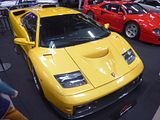
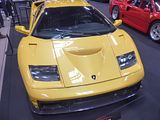
At a time when the company was financed by the Swiss-based Mimran brothers, Lamborghini began development of what was codenamed Project 132 in June 1985 as a replacement for the Countach model. The brief stated that its top speed had to be at least 315 km/h (196 mph). The design of the car was contracted to Marcello Gandini, who had designed its two predecessors. When Chrysler bought the company in 1987, providing money to complete its development, its management was uncomfortable with Gandini’s designs and commissioned its design team in Detroit to execute a third extensive redesign, smoothing out the trademark’s sharp edges and corners of Gandini’s original design, and leaving him famously unimpressed. In fact, Gandini was so disappointed with the “softened” shape that he would later realise his original design in the Cizeta-Moroder V16T. The car became known as the Diablo, carrying on Lamborghini’s tradition of naming its cars after breeds of fighting bulls. The Diablo was named after a ferocious bull raised by the Duke of Veragua in the 19th century, famous for fighting an epic battle with ‘El Chicorro’ in Madrid on July 11, 1869 In the words of Top Gear presenter Jeremy Clarkson, the Diablo was designed “solely to be the biggest head-turner in the world.” The Diablo was presented to the public for sale on January 21, 1990. Its power came from a 5.7 litre 48-valve version of the existing Lamborghini V12 featuring dual overhead cams and computer-controlled multi-point fuel injection, producing a maximum output of 499 PS and 580 N·m (428 lb/ft) of torque. The vehicle could reach 100 km/h in about 4.5 seconds, with a top speed of 202 mph. The Diablo was rear-wheel drive and the engine was mid-mounted to aid its weight balance. The Diablo came better equipped than the Countach; standard features included fully adjustable seats and steering wheel, electric windows, an Alpine stereo system, and power steering from 1993 onwards. Anti-lock brakes were not initially available, although they would eventually be used. A few options were available, including a custom-moulded driver’s seat, remote CD changer and subwoofer, rear spoiler, factory fitted luggage set and an exclusive Breguet clock for the dash. The Diablo VT was introduced in 1993. Although the VT differed from the standard Diablo in a number of ways, by far the most notable change was the addition of all wheel drive, which made use of a viscous centre differential (a modified version of LM002’s 4WD system). This provided the new nomenclature for the car (VT stands for viscous traction). The new drivetrain could direct up to 25% of the torque to the front wheels to aid traction during rear wheel slip, thus significantly improving the handling characteristics of the car. Other improvements debuting on the VT included front air intakes below the driving lamps to improve brake cooling, larger intakes in the rear arches, a more ergonomic interior with a revised dashboard, electronically adjustable dampers, four-piston brake calipers, power steering, and minor engine refinements. Many of these improvements, save the four-wheel drive system, soon transferred to the base Diablo, making the cars visually nearly identical. Further updates would follow before the car gave way to the Murcielago in 2001. The Diablo sold in greater numbers than its predecessor with 2898 examples being made during its 11 year production life. There were several here, including the VT and the SV, a few of them were the late model cars with their faired-in headlights.
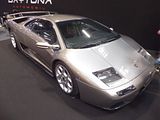
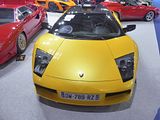
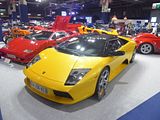
In its turn, the Diablo gave way to the Murcielago in 2001. Taking its name from the Spanish for “bat”, this was Lamborghini’s first new design in eleven years and more importantly, the brand’s first new model under the ownership of German parent company Audi, which was manifest in a much higher level of quality and reliability. The Murcielago was styled by Peruvian-born Belgian Luc Donckerwolke, Lamborghini’s head of design from 1998 to 2005. Initially it was only available as a Coupe. The Murciélago was an all-wheel drive, mid-engined supersports car. With an angular design and an exceptionally low slung body, the highest point of the roof is just under 4 feet above the ground. One of the vehicle’s most distinguishing features are its scissor doors. which lends to the extreme image. First-generation Murciélagos, produced between 2001 and 2006, were powered by a Lamborghini V12 that traces its roots back to the company’s beginnings in the 1960s. The rear differential is integrated with the engine itself, with a viscous coupling centre differential providing drive to the front wheels. Power is delivered through a 6-speed manual transmission. The Murciélago suspension uses an independent double-wishbone design, and bodywork features carbon fiber, steel and aluminium parts. The rear spoiler and the active air intakes integrated into the car’s shoulders are electromechanically controlled, deploying automatically only at high speeds in an effort to maximise both aerodynamic and cooling efficiency. The first generation cars were produced between 2001 and 2006, and known simply as Murciélago, sometimes Murciélago VT. Their V12 engines produced just under 580 PS (572 hp), and powered the car to 100 km/h (62 mph) in 3.8 seconds. Subsequent versions incorporated an alphanumeric designation to the name Murciélago, which indicated their engine configuration and output. However, the original cars are never referred to as “LP 580s”. The Murciélago Roadster was introduced in 2004. Primarily designed to be an open top car, it employed a manually attached soft roof as cover from adverse weather, but a warning on the windshield header advised the driver not to exceed 100 mph (160 km/h) with the top in place. The designer used the B-2 stealth bomber, the Wally 118 WallyPower yacht, and architect Santiago Calatrava’s Ciutat de les Arts i les Ciències in Valencia, Spain as his inspiration for the roadster’s revised rear pillars and engine cover. In March 2006, Lamborghini unveiled a new version of its halo car at the Geneva Motor Show: the Murciélago LP 640. The new title incorporated the car’s name, along with an alphanumeric designation which indicated the engine’s orientation (Longitudinale Posteriore), along with the newly updated power output. With displacement now increased to 6.5 litres, the new car made 640 PS ( 631 hp) at 8000 rpm. The Murciélago’s exterior received a minor facelift. Front and rear details were revised, and side air intakes were now asymmetrical with the left side feeding an oil cooler. A new single outlet exhaust system incorporated into the rear diffuser, modified suspension tuning, revised programming and upgraded clutch for the 6-speed “e-Gear” automated sequential transmission with launch control rounded out the performance modifications. Interior seating was also re-shaped to provide greater headroom, and a new stereo system formed part of the updated dashboard. Optional equipment included Carbon fibre-reinforced Silicon Carbide (C/SiC) ceramic composite brakes, chrome paddle shifters and a glass engine cover. At the 2006 Los Angeles Auto Show, Lamborghini announced that the roadster version of the Murciélago would also be updated to LP 640 status. At the 2009 Geneva Motor Show, Lamborghini unveiled the ultimate version of the Murciélago, the LP 670–4 SuperVeloce. The SV moniker had previously appeared on the Diablo SV, and Miura. SV variants are more extreme and track-oriented, and are released at the end of each model’s production run. The SuperVeloce’s V12 produced 670 PS (661 hp) at 8000 rpm and 660 N·m (490 lbf·ft) of torque at 6500 rpm, thanks to revised valve timing and upgraded intake system. The car’s weight was also reduced by 100 kg (220 lb) through extensive use of carbon fibre inside and out. A new lighter exhaust system was also used. As a result of the extensive weight loss, the SV had a power-to-weight ratio of 429 bhp/ton. Also standard were the LP 640’s optional 15-inch carbon-ceramic disc brakes with 6 piston calipers. The original production plan for the SV was limited to 350 cars, but in fact only 186 LP 670-4s were produced before the factory had to make room for the new Aventador production line. Numbered cars 1–350 do not represent the order in which cars were manufactured. Only 5-6 were made with manual transmission. Production of the Murciélago ended on November 5, 2010, with a total run of 4,099 cars. Its successor, the Aventador, was released at the 2011 Geneva Motor Show.
LANCIA
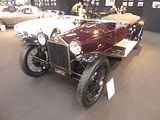
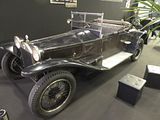
Built in 9 series over a 10 year period, the Lambda pioneered a number of technologies that soon became commonplace in our cars. For example, it was the first car to feature a load-bearing monocoque-type body, (but without a stressed roof) and it also pioneered the use of an independent suspension (the front sliding pillar with coil springs). Vincenzo Lancia even invented a shock absorber for the car and it had excellent four wheel brakes. The narrow angle V4 engine which powered is not something which was widely copied. Approximately 11,200 Lambdas were produced. Most of them had the open Torpedo style body, but some of the last Series 8 and 9 cars had Weyman saloon bodies.
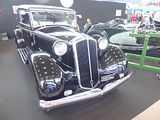
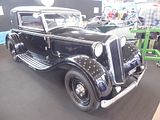
This is a 1931 Artena Faux Cabriolet. The Lancia Artena (Tipo 228) was produced from 1931 until 1936, and from 1940 until 1942 chiefly for army and government use. It was powered by a 2-litre Lancia V4 engine, while chassis and factory bodies were shared with the more luxurious 2.6-litre V8-engined Lancia Astura. Total production amounted to 5,567 examples. Artena and her sister Astura made their début at the October 1931 Paris Motor Show. Interrupting Lancia’s decade-old tradition of naming its cars with Greek letters, the new model was named after Artena, an ancient town of the pre-Roman Volsci people. The Lancia Astura was a more powerful and more luxurious version of this car based on the same platform. Besides the engines, main differences between the two cars were the Artena’s Michelin disc wheels instead of the Astura’s Rudge-Whitworth wire wheels, and the Astura’s longer wheelbase. There were four successive versions of the car. The first series was built between autumn of 1931 through summer of 1932; during the next year the second series was produced, and the third series from Autumn 1933 until the start of 1936. Series I, produced between 1931 and 1932, 1,500 built. Deliveries began in December 1931. The 2-litre engine put out 55 hp. For 1932 the Artena was available from the factory in two 4-door body styles—four-window saloon seating four and six-window saloon seating six—or as bare chassis. The Series II was produced between 1932 and 1933, 1,520 built. Second series changes were light; the car now incorporated modified engine mountings to reduce noise and vibrations. The Series III was produced between 1933 and 1936, 2,040 built. The third series brought deeper changes, including new bodywork with a slanted grille. The chassis was modified and made available in two different wheelbase lengths, short (3.0 m, chassis tipo 228C) and normal (3.2 m, chassis tipo 228A)—hitherto a prerogative of the more expensive Astura. The new 1934 range introduced in late 1933 thus included short or normal bare chassis, four passenger saloon on the short chassis, and six passenger saloon on the normal chassis. In total 1,552 Artena 228As and 488 short-wheelbase Artena 228Cs were made. The Series IV was produced between 1940 and 1942, 507 built. At the beginning of World War II, the Artena was put back into production at the request of the Royal Italian Army. As the car was now intended chiefly for use by the army to chauffeur high officers rather than for private sales, it was modified accordingly. The chassis was a new platform frame, bearing new type codes, and was produced in longer wheelbase version only. The engine was also a modified Tipo 54A with a lower output of 51 hp at 3,800 rpm. Another change were Fergat stamped-steel wheels. Chassis type 341 was designed for passenger cars; top speed was down to 105 km/h (65 mph). 361 of this type were built. Three body styles were made for official usage, all three 6-seaters featuring a roll-down partition between the driver and the passenger compartment: Berlina, six-window saloon for government duties and accordingly known as Ministeriale; Trasformabile 4 luci, 4-door, four-light convertible saloon (bodied by Carrozzeria Viotti); Torpedo trasformabile, saloon with folding roof, for colonial and field use as military staff car, known as Militare (also by Carrozzeria Viotti). Chassis type 441 was a modified version, to be outfitted as an ambulance. 191 were built. Lancia offered the Artena and Astura in saloon form only, and left its other body styles to third-party coachbuilders. Coachbuilders like Stabilimenti Farina, Pinin Farina and Carrozzeria Touring built Artena cabriolets, coupés, faux cabriolets, torpedoes and sport saloons. The Dutch coachbuilder B.T. Van Rijswijk has made in 1938 one dropheadcoupe.
Designed by Vittorio Jano, the Lancia Aurelia was launched in 1950 and production lasted until the summer of 1958.The very first Aurelias were the B10 Berlinas. They used the first production V6 engine, a 60° design developed by Francesco de Virgilio who was, between 1943 and 1948 a Lancia engineer, and who worked under Jano. The first cars had a capacity of 1754 cc, and generated 56 hp. During production, capacity grew from 1.8 litres to 2.5 litres across six distinct Series. Prototype engines used a bore and stroke of 68 mm x 72 mm for 1569 cc; these were tested between 1946 and 1948. It was an all-alloy pushrod design with a single camshaft between the cylinder banks. A hemispherical combustion chamber and in-line valves were used. A single Solex or Weber carburettor completed the engine. Some uprated 1991 cc models were fitted with twin carburettors. At the rear was an innovative combination transaxle with the gearbox, clutch, differential, and inboard-mounted drum brakes. The front suspension was a sliding pillar design, with rear semi-trailing arms replaced by a de Dion tube in the Fourth series. The Aurelia was also first car to be fitted with radial tyres as standard equipment. Aurelia was named after Via Aurelia, a Roman road leading from Rome to France. The B21 version was released in 1951 with a larger 1991 cc 70 hp engine and a 2-door B20 GT coupé appeared that same year. It had a shorter wheelbase and a Ghia-designed, Pininfarina-built body. The same 1991 cc engine produced 75 hp in the B20. In all, 500 first series Aurelias were produced. This is generally believed to the first car to use the name GT, or Gran Turismo. The B20 GT Aurelia had a successful career in motorsport, too. In the 1951 Mille Miglia the 2-litre Aurelia, driven by Giovanni Bracco and Umberto Maglioli, finished 2nd beaten only by the Ferrari America. The same year it took first in class and 12th overall at LeMans. Modified Aurelias took the first three places on 1952’s Targa Florio with Felice Bonetto as the winner and another win on Lièges-Rome-Lièges of 1953.
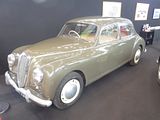
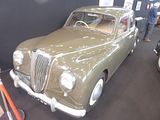
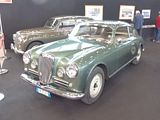
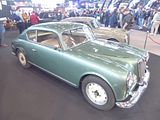
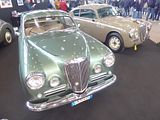
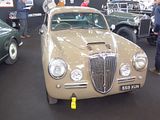
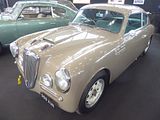
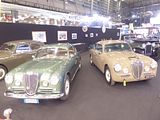
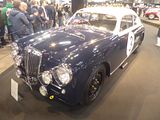
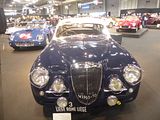
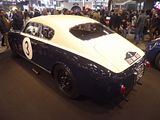
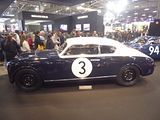
Replacing the Aurelia was the Flaminia, which although superficially similar to its illustrious predecessor and materially “better” in just about every respect, never managed to capture buyers’ imaginations in the same way when new, and even now, it has to play second fiddle to the older car. The first model in the range was the Berlina, which was launched at the 1957 Geneva Show. It had a Pininfarina styled body which took much inspiration from the Florida concept car that had been shown in the previous year. Much was new under the skin. Its larger 2.5 litre 100 bhp V6 engine was new in detail, and was designed to allow for further increases in capacity, which would come in time. I was smoother than the Aurelia engines and had more torque, and with better cylinder head design and revised cooling, it was more robust, as well. There was synchromesh on all four gears. Lancia’s famous sliding pillar suspension was banished in favour of unequal length wishbones and coil springs which required less maintenance and were more refined. But the car was heavy, and complex, and exceedingly expensive. Lancia thought that their customers would pay a premium for “the best”, but tastes were changing, and the Berlina was never a strong seller, with fewer than 3000 of them being constructed, most of them being the first series cars. Just 549 of the later second series model with 110 bhp and disc brakes were made between 1961 and 1963, hardly surprising when the car cost more than a Rolls Royce Silver Cloud, as it did in the UK. The later cars had a 2.8 litre engine and 125 bhp, and just 599 of these were made between 1963 and 1968. There was more success with the coachbuilt two door variants which joined the range. The most successful of these, the Pininfarina Coupe, was the first to appear. This was made between 1959 and 1967, during which time 5284 of these mostly steel-bodied cars were constructed. In many ways they were very like the Berlina, just a bit smaller, though there was a floor mounted gear lever, and the cars had more power. The first 3200 of them had a 119 bhp single carb engine with a sport camshaft. Later 3Bs had a triple choke Solex from 1962 and the power went up to 136 bhp. It was only a year after the Pininfarina car’s debut when Touring of Milan announced their Flaminia models. These aluminium bodied cars were sold in three distinct variants between 1960 and 1965. The single carburettor GT was followed by a Convertible in 1960, both of them uprated to 140 bhp triple Weber 3C spec in 1961. The 2.8 litre 3C took over in 1963 and were supplemented by a new 2+2 version called the GTL, with a taller roofline, front-hinged bonnet, longer doors and more substantial seats. It is the rarest of all Flaminia models, with just 300 made. The styling house to offer a car was Zagato, with their Sports and SuperSports. Only 526 were made and there is a complicated production history which probably shows the sort of chaotic thinking that was going on at Lancia and which would lead to is bankruptcy and take over by Fiat in 1969. The first 99 Sports had faired-in headlights and the 119 bhp engine. From 1960 another 100 cars were built with expose lights until the introduction of the Sport 3C with the 140 bhp triple carb. Zagato made 174 of those in 1962 and 1963, still with the exposed lights. The faired-in lights returned in 1964 on the SuperSport, which also had a Kamm tail, and with DCN Webers this one put out 150 bhp. 150 of these were made between 1964 and 1967. Many of the earlier cars were upgraded early in their life, so if you see one now, you cannot be totally sure of is true origin. Production of the car ceased in 1970, with fewer than 13,000 Flaminia of all types having been built. These days, the cost to restore them properly – and it is a huge job – exceeds the value of most of them, by some margin, as Berlina and Coupe models tend not to sell for more than £30k. The Zagato cars are a different matter, and when they come up for sale, routinely go for over £300k. The Touring cars – considered by most to be the prettiest tend to be around £100k for the GT and another 50 – 80k for a convertible – a long way from the value of an Aston Martin DB4 Volante, which cost roughly the same when new.
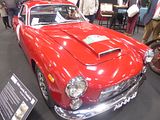
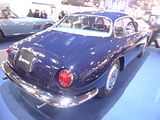
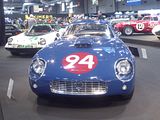
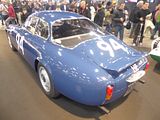
Seen here was this 1959 Lancia Flaminia Sport Zagato Sperimentale, the first time it has been shown in public for 50 years. This ex-works 1959 Flaminia competition car received an experimental body in 1962, that was lighter and more aerodynamic than before. After the 1963 Rallye Monte-Carlo and Targa Florio, it disappeared into a private collection.
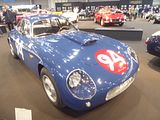
The Appia was a small car that was made between 1953 and 1963, in three distinct Series. First series Appias were only offered in factory body styles, but this changed with the second and third series Appias, which were also built as a platform chassis intended for coachbuilt bodies. Towards the end of 1955 a first batch of 14 chassis based on the brand new second series Appia were built and handed over to some of the most prominent coachbuilders of the time: Allemano, Boano, Ghia Aigle, Motto, Pininfarina, Vignale and Zagato. Initially all fourteen chassis were coded Tipo 812.00, based on standard saloon mechanicals; five of were upgraded to a more powerful 53 PS engine and floor-mounted gearchange, and given the new type designation 812.01. At the April 1956 Turin Motor Show, a month after the successful introduction of the second series Appia in Geneva, five specially bodied Appias were shown: a coupé and a two-door saloon by Vignale, a coupé each from Pininfarina, Boano and Zagato. Between Spring 1956 and Spring 1957 the coachbuilders presented their one-off interpretations of the Appia at various motor shows. Later more 812.01 chassis were built, bringing the total of unique to thirteen. Of the coachbuilders who had worked on the first fourteen chassis, two were selected by Lancia to produce special Appia body styles: Pininfarina for the coupé, and Vignale for the convertible. Their nearly definitive proposals debuted at the March 1957 Geneva Motor Show, and soon went into limited series production. Built by their respective designers on chassis supplied by Lancia, these were included in Lancia’s own catalogue and regularly sold through Lancia dealerships. In the later years other variants were added to the official portfolio: Vignale’s Lusso, Zagato’s GTE and Sport, and Viotti’s Giardinetta. All of these variants were built on the 812.01 type chassis with the more powerful engine and floor change; when the third series saloon debuted its mechanical upgrades were transferred to the chassis, and the engine gained one horsepower 54 PS. In early 1960 a revised, more powerful engine was adopted thanks to a new Weber carburettor and an inlet manifold with a duct per each cylinder. In total 5,161 Appia chassis for coachbuilders were made.
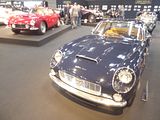
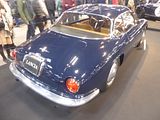
The Fulvia Coupé was a compact two-door, three-box coupé introduced in 1965. Like the saloon it was designed in-house by Piero Castagnero, using a wheelbase 150 mm (5.9 in) shorter than its sedan counterpart. As the last Fulvia model to be discontinued, the coupe was ultimately replaced in 1977 by a 1.3-litre version of the Beta Coupé. The 1965–67 cars were equipped with a 1,216 cc 818.100 engine—from 1967 enlarged to 1,231 cc—producing 79 hp at 6,000 rpm. The same engines were subsequently used on the Berlina GT. The Coupé HF of 1966–67 was the competition version of the coupé, introduced later in 1965. It carried a tuned version of the 1,216 cc engine producing 87 hp at 6,000 rpm. Bodywork was lightened by removing the bumpers, using an aluminium bonnet, doors and boot lid, Plexiglas side and rear windows, and bare steel wheels without hubcaps. The Rallye 1.3 HF of 1967–69 had a new 1,298 cc engine with 100 hp at 6,400 rpm. The Rallye 1.3 of 1967–68 was an updated coupé with the 818.302 1,298 cc engine with 86 hp at 6,000 rpm. The Rallye 1.3 S of 1968–70 was an updated, more powerful Rallye 1.3 with a new 818.303 1,298 cc engine producing 91 hp at 6,000 rpm. There was also the Rallye 1.6 HF of 1969–70. Known as Fanalone (“big lamps”) because of the characteristic upsized inner pair of headlamps. The evolution of Rallye 1.3 HF, equipped with an all-new 818.540 1,584 cc engine producing 113 hp at 6,500 rpm. Other changes included negative camber front suspension geometry, with light alloy 13 inch 6J wheels; and a close ratio 5-speed gearbox and wheel arch extensions. The easiest way to distinguish this version is by the triangular holes between headlamps and grille. The Rallye 1.6 HF of 1969–70 was a works rally-spec Fanalone, produced in very limited numbers. The most powerful Fulvia with a 1,584 cc engine producing up to 130 hp depending on tune. This was the version used by the works rally team until 1974 when it was superseded in competition by the Stratos HF. 45 mm bore Solex carburettors were used that were later replaced by 45 DCOE Webers. The cam cover had a special blue stripe over the yellow paint job (HF cars had just a yellow paint job). The Series II cars first appeared in 1970. For the Coupé 1.3 S of 1970–73, there was a face-lifted body and new 5 speed gearbox with 1298 cc (818.303) engine producing 89 hp at 6000 rpm. Larger Girling callipers and pads replaced the Dunlop system fitted to 1st series cars. The Coupé 1.3 S Montecarlo of 1972–73 was a special edition based on the 1.3 S, commemorating Lancia’s victory at the 1972 Monte Carlo Rally. The livery resembled the works car, with matte black bonnet and boot lid bearing Monte Carlo rally plate-style stickers. This version used his own bodyshell with flared wheel arches, similar to the 1.6 HF bodyshell. Other accoutrements included 1.6 HF Lusso interior fittings such as bucket seats with headrests, rectangular front fog lamps, no bumpers and black single wing mirror; 4.5J steel wheels of the standard Coupé were fitted. The Coupé 1600 HF of 1970 had the face-lifted all steel body with 1,584 cc engine with Solex C42DDHF carb producing 113 hp at 6,000 rpm. The bodywork was changed from the standard 1.3 Coupé to incorporate flared wheel arches (replacing the extensions used on 1st series HFs). There was a further update creating the Coupé Series 3. This was introduced in 1974 and was mechanically the same as the earlier Series 2 1.3 S except for the addition of emission control on the Solex carburettors. Other than for “Fulvia 3” badges, it is easily recognized by its matte black grilled and headlight frame. It featured a new design of seats incorporating headrests and new white-faced instrument dials with an updated range of trim colours, materials and options. There was a Coupé 3 Montecarlo between 1974–76 which was as the earlier Montecarlo, but with Coupé 3 accoutrements. And finally there was the Safari between 1974–76. A limited edition based on the standard Coupé 3 with simplified trim and equipment, celebrating Fulvia’s participation in the Safari Rally. It came without bumpers, with matte black exterior trim, seats upholstered in denim cloth and leatherette, exterior badges on the bonnet and on the boot lid and also a special numbered plaque on the dashboard.
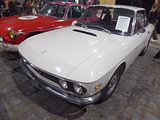
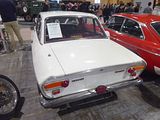
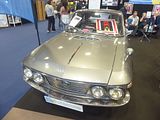
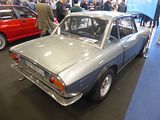
The Fulvia Sport was a fastback two-seater based on Coupé mechanicals, built for Lancia by Zagato — where it had also been designed, by Ercole Spada. The Sport was commissioned by Lancia to Zagato as more aerodynamic and sportier version of the coupé, which could be used in road and track competitions. Three peculiarities of the Sport body were the engine bonnet, which was hinged to the right-hand side, the rear hatch, which could be lifted electrically by a handful of centimetres to aid cabin ventilation, and the spare wheel, which was housed in a separate compartment and accessed from a rotating panel which held the rear number plate. The tail lights were sourced from the NSU Prinz 4. Introduced at the 1965 Turin Motor Show, the first Sport had an all-aluminium alloy bodyshell and used the coupé’s 1.2-litre (1,216 cc) engine. Inside it reprised the wood-trimmed dashboard of the coupé, and featured two small bucket seats of Zagato’s own design. Just 202 were made in total. In 1966 the Sport was upgraded to an 818.302 1,298 cc engine from the Rallye 1.3, producing 87 hp at 6,000 rpm. Early versions still had all aluminium bodyshells (700 were produced with both 1,216 cc & 1,298 cc engines), but later ones were fitted with steel bodyshells with aluminium bonnet, doors, and spare wheel hatch. Whereas the first Sport was homologated as a two-seater, the car was now classified as a three-seater—or 2+1. The 1.3 can be distinguished from the 1.2 for its silver- instead of ivory-painted steel wheels, and the side mirror on the driver’s side front wing. An updated Sport 1.3 with 1,298 cc engine producing 92 hp at 6,000 rpm. These Sports were normally fitted with brake servos. It is recognizable by its larger hubcaps, decorated with Lancia flag logos instead of being plain. The second series Fulvia Sport was launched at the 1970 Turin Motor Show. Changes included a 5-speed gearbox, revised suspension geometry, taller ride height, an alternator in place of the previous dynamo, a taller final drive compared to coupés, and wider tyres. The body was now all-steel, and seated 2+2 passengers. Some of the Zagato’s most unusual features were lost: the bonnet was now hinged at the front, and the spare wheel compartment hatch was deleted. Several other changes set the second series apart from the first: new driving lights, a side mirror moved from the wing to the door, larger bullet-shaped tail lights from the Peugeot 204, and stamped steel wheels without hubcaps. There was also a Lancia Fulvia Sport 1600 Zagato produced in 1971–72. This the top of the range, with 1,584 cc engine from the HF, producing 115 hp. With a top speed of 118 mph (190 km/h), this version was the fastest production Fulvia ever produced. The 1600 was distinguished by a matte black radiator grille with chrome edges, black rubber over-riders on the bumpers, a matte black band on the engine bonnet, and new flush door handles. Some of these new fixtures—like the black grille and door handles—found their way on late 1.3 S examples. Inside the 1600 had an oil temperature gauge, bucket seats with headrests and electric front windows as standard. Cromodora alloy wheels like those found on the 1600 HF were optional.
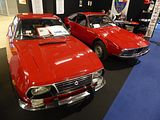
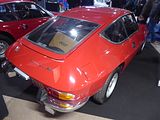
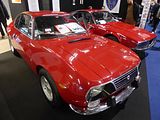
Bertone knew that Lancia was looking for a replacement for the ageing Fulvia for use in rally sports and so he designed an eye-catcher to show to Lancia. Bertone used the running gear of the Fulvia Coupé of one of his personal friends and built a running showpiece around it. When Bertone himself appeared at the Lancia factory gates with the Stratos Zero he passed underneath the barrier and got great applause from the Lancia workers. After that a co-operation between Lancia and Bertone was formed to develop a new rally car based on ideas of Bertone’s designer Marcello Gandini who already had designed the Lamborghini Miura and Countach. Lancia presented the Bertone-designed Lancia Stratos HF prototype at the 1971 Turin Motor Show, a year after the announcement of the Stratos Zero concept car. The prototype Stratos HF (Chassis 1240) was fluorescent red in colour and featured a distinctive crescent-shaped-wrap-around windshield providing maximum forward visibility with almost no rear visibility. The prototype had three different engines in its early development life: the Lancia Fulvia engine, the Lancia Beta engine and finally for the 1971 public announcement, the mid-mounted Dino Ferrari V6 producing 190 hp. The use of the Dino V6 was planned right from the beginning of the project, but Enzo Ferrari was reluctant to sign off the use of this engine in a car he saw as a competitor to his own Dino V6. After the production of the Dino car had ended the “Commendatore” (a popular nickname for Enzo Ferrari) agreed on delivering the engines for the Stratos, and Lancia then suddenly received 500 units. The Stratos was a very successful rally car during the 1970s and early 1980s. It started a new era in rallying as it was the first car designed from scratch for this kind of competition. The three leading men behind the entire rallying project were Lancia team manager Cesare Fiorio, British racer/engineer Mike Parkes and factory rally driver Sandro Munari with Bertone’s Designer Marcello Gandini taking a very personal interest in designing and producing the bodywork. Lancia did extensive testing with the Stratos and raced the car in several racing events where Group 5 prototypes were allowed during the 1972 and 1973 seasons. Production of the 500 cars required for homologation in Group 4 commenced in 1973 and the Stratos was homologated for the 1974 World Rally Championship season. The Ferrari Dino V6 engine was phased out in 1974, but 500 engines among the last built were delivered to Lancia. Production ended in 1975 when it was thought that only 492 were made (for the 1976 season, the Group 4 production requirement was reduced to 400 in 24 months. Manufacturer of the car was Bertone in Turin, with final assembly by Lancia at the Chivasso plant. Powered by the Dino 2.4 litreV6 engine that was also fitted to the rallying versions, but in a lower state of tune, it resulted in a power output of 190 hp, giving the road car a 0–100 km/h time of 6.8 seconds, and a top speed of 232 km/h (144 mph). The Stratos weighed between 900 and 950 kilograms, depending on configuration. Power output was around 275 hp for the original 12 valve version and 320 hp for the 24 valve version. Beginning with the 1978 season the 24 valve heads were banned from competition by a change to the FIA rules. Even with this perceived power deficit the Stratos was the car to beat in competition and when it did not suffer an accident or premature transmission failure (of the latter there were many) it had great chances to win. Despite the fact that the Stratos was never intended to be a race car, there were two Group 5 racing cars built with 560 hp, using a single KKK turbocharger. The car won the 1974, 1975 and 1976 championship titles in the hands of Sandro Munari and Björn Waldegård, and might have gone on to win more had not internal politics within the Fiat group placed rallying responsibility on the Fiat 131 Abarths. As well as victories on the 1975, 1976 and 1977 Monte Carlo Rally, all courtesy of Munari, the Stratos won the event with the private Chardonnet Team as late as 1979. Without support from Fiat, and despite new regulations that restricted engine power, the car would remain a serious competitor and proved able to beat works cars in several occasions when entered by an experienced private team with a talented driver. The last victory of the Stratos was in 1981, at the Tour de Corse Automobile, another World Rally Championship event, with a victory by longtime Stratos privateer Bernard Darniche. When the Fiat group favoured the Fiat 131 for rallying Lancia also built two Group 5 turbocharged ‘silhouette’ Stratos for closed-track endurance racing. These cars failed against the Porsche 935s on closed tracks but proved successful in hybrid events. While they failed in the Tour de France Automobile, one of these cars won the 1976 Giro d’Italia Automobilistico, an Italian counterpart of the Tour de France Automobile. One of the cars was destroyed in Zeltweg, when it caught fire due to overheating problems. The last surviving car would win the Giro d’Italia event again before it was shipped to Japan to compete in the Fuji Speedway based Formula Silhouette series, which was never raced. The car would then be sold and reside in the Matsuda Collection before then being sold to the renowned collector of Stratos’, Christian Hrabalek, a car designer and the founder of Fenomenon Ltd, who has the largest Lancia Stratos Collection in the world, 11 unique Lancia Stratos cars, including the fluorescent red 1971 factory prototype and the 1977 Safari Rally car. His interest in the car led to the development of the Fenomenon Stratos in 2005. The Stratos also gained limited success in 24 Hours of Le Mans, with a car, driven by Christine Dacremont and Lella Lombardi, finishing 20th in 1976
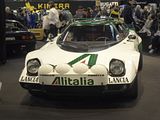
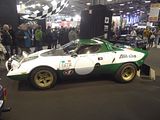
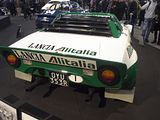
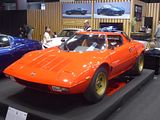
The Lancia Rally (Tipo 151, also known as the Lancia Rally 037, Lancia 037 or Lancia-Abarth #037 from its Abarth project code SE037) was a mid-engine sports car and rally car built by Lancia in the early 1980s to compete in the FIA Group B World Rally Championship. Driven by Markku Alén, Attilio Bettega, and Walter Röhrl, the car won Lancia the manufacturers’ world championship in the 1983 season. It was the last rear-wheel drive car to win the WRC. In 1980 Lancia began the development of the 037 to comply with the then new FIA Group B regulations that allowed cars to race with relatively few homologation models being built. As the project name was number 037, this eventually became the name by which the car was known. Abarth, now a part of the Lancia-Fiat family, did most of the design work, even incorporating styling cues from some of its famous race cars of the 1950s and 1960s such as a double bubble roof line. The car was developed in collaboration between Pininfarina, Abarth, Dallara and the project manager, engineer Sergio Limone. Prior to its first participation in the 1982 World Rally Championship season, 200 road-going models were built to comply with Group B regulations. The car made its competition debut at the 1982 Rally Costa Smeralda in Italy, where two cars were entered but both retired due to gearbox issues. The 1982 season was plagued with retirements for the 037, but the new car did manage to achieve several wins including its first win at the Pace Rally in the UK. The 1983 season was considerably more successful for the 037: Lancia took the 1983 World Rally Championship Constructors’ title with Germany’s Walter Röhrl and Finland’s Markku Alén its principal drivers, despite serious competition from the 4WD Audi Quattro. Both drivers, however, missed the final round of the series, despite Röhrl maintaining a mathematical chance of the drivers’ title: such honours instead went to Audi’s veteran Finn, Hannu Mikkola. For the 1984 Constructors’ title defence, Lancia introduced an Evolution 2 version of the 037 with improved engine power output, but this was not enough to stem the tide of 4WD competition, losing to Audi in both 1984 championships, and again to the 4WD Peugeot 205 T16 in its final works season in 1985. Indeed, Alén collected the final 037 win, and the sole victory for the E2 model, on the 1984 Tour De Corse, before it was finally pensioned off in favour of its successor, the uniquely supercharged and turbocharged 4WD Delta S4, for the season-ending RAC Rally in Great Britain. Driver Attilio Bettega died in an 037 crash in 1985. António Rodrigues won the 1984 Falperra International Hill Climb in an 037. The 037 made its final appearance in the 1986 edition of the Safari Rally by the Martini Lancia team, which was entered in place of the Delta S4 that the team used for the other rallies that year due to the team running out of time to develop the S4 for the rally. One ex-works Lancia 037 was entered by ROSS Competition in the third round of the 1994 All Japan Grand Touring Car Championship season. The 037 performed poorly, due to the car being massively underpowered against its competition in the GT1 (now GT500) class, using a short-ratio five-speed gearbox, and with an engine not designed to be run at high engine speeds for sustained periods of time. Naohiro Furuya, who drove the 037 in that race, was able to finish the race in 12th overall and 9th in the GT1 class, albeit 7 laps down from the race-winning Team Taisan Porsche 962C and 3 laps down from the Team Gaikokuya Nissan Skyline that won in the GT2 class. Similar to the concept of a silhouette racer; while the 037 was loosely based on the Lancia Montecarlo (also known as Scorpion in the US and Canadian markets) road car, they shared only the centre section with all body panels and mechanical parts being significantly different. Steel subframes were used fore and aft of the 037’s centre section, while most of the body panels were made from Kevlar. However the 037 was designated and sold as a distinct model, not as a Montecarlo, and both the street and race versions of it were built using the same construction methods, so it does not qualify as an actual silhouette racer. The mid-engined layout of the Montecarlo was retained, but the engine was turned 90 degrees from a transverse position to a longitudinal position. This allowed greater freedom in the design of the suspension while moving engine weight forward. An independent double wishbone suspension was used on both the front and rear axles, with dual shock absorbers in the rear in order to cope with the stresses of high speed off-road driving. The 037 is notable in Group B as it retained the rear-wheel drive layout that was nearly universal for rally cars of the pre-Group B period; nearly all subsequent successful rally cars used four-wheel drive, making the 037 the last of its kind. Unlike its predecessor, the V6-powered Lancia Stratos HF, the first 037s had a 2.0-litre 4-cylinder supercharged engine. Based on the long stroke twin cam engine which powered earlier Fiat Abarth 131 rally cars, the four valve head was carried over from the 131 Abarth but the original two carburetors were replaced by a single large Weber carburettor in early models and later with fuel injection. The 037 features a ZF transaxle. Lancia also chose a supercharger over a turbocharger to eliminate turbo lag and improve throttle response. Initially, power was quoted at 265 bhp but was increased to 280 bhp. The final Evolution 2 model’s engine generated 325 bhp due to a displacement increase to 2.1 L (2,111 cc).
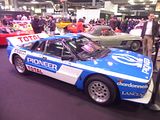
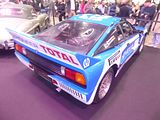
Lancia launched the Delta in 1979, as what we would now think of as a “premium hatch”. Offered in 1300 and 1500cc engines, this car, which collected the prestigious “Car of the year” award a few months later, brought Italian style and an expensive feeling interior to a new and lower price point in the market than Lancia had occupied since the early days of the Fulvia some 15 years earlier. The range grew first when a model was offered using the 4 speed AP automatic transmission and then in late 1982, more powerful models started to appear, with first a 1600cc engine, and then one with fuel injection, before the introduction of the HF Turbo. All these cars kept the same appearance and were quite hard to tell apart. These were the volume models of the range, but now they are very definitely the rare ones, as it is the performance versions which have survived and are now much loved classics, even though relatively were sold when they were new, thanks to a combination of the fact that they were quite costly and that they only ever came with left hand drive. The Integrale evolved over several years, starting off as the HF Turbo 4WD that was launched in April 1986, to homologate a new rally car for Lancia who needed something to fill the void left by the cancellation of Group B from the end of 1986. The Delta HF 4X4 had a four-wheel drive system with an in-built torque-splitting action. Three differentials were used. Drive to the front wheels was linked through a free-floating differential; drive to the rear wheels was transmitted via a 56/44 front/rear torque-splitting Ferguson viscous-coupling-controlled epicyclic central differential. At the rear wheels was a Torsen (torque sensing) rear differential. It divided the torque between the wheels according to the available grip, with a maximum lockup of 70%. The basic suspension layout of the Delta 4WD remained the same as in the rest of the two-wheel drive Delta range: MacPherson strut–type independent suspension with dual-rate dampers and helicoidal springs, with the struts and springs set slightly off-centre. The suspension mounting provided more isolation by incorporating flexible rubber links. Progressive rebound bumpers were adopted, while the damper rates, front and rear toe-in and the relative angle between springs and dampers were all altered. The steering was power-assisted rack and pinion. The car looked little different from the front wheel drive models. In September 1987, Lancia showed a more sophisticated version of the car, the Lancia Delta HF Integrale 8V. This version incorporated some of the features of the Delta HF 4WD into a road car. The engine was an 8-valve 2 litre fuel injected 4-cylinder, with balancing shafts. The HF version featured new valves, valve seats and water pump, larger water and oil radiators, more powerful cooling fan and bigger air cleaner. A larger capacity Garrett T3 turbocharger with improved air flow and bigger inter-cooler, revised settings for the electronic injection/ignition control unit and a knock sensor, boosting power output to 185 bhp at 5300 rpm and maximum torque of 224 lb/ft at 3500 rpm. The HF Integrale had permanent 4-wheel drive, a front transversely mounted engine and five-speed gearbox. An epicyclic centre differential normally split the torque 56 per cent to the front axle, 44 per cent to the rear. A Ferguson viscous coupling balanced the torque split between front and rear axles depending on road conditions and tyre grip. The Torsen rear differential further divided the torque delivered to each rear wheel according to grip available. A shorter final drive ratio (3.111 instead of 2.944 on the HF 4WD) matched the larger 6.5×15 wheels to give 24 mph/1000 rpm in fifth gear. Braking and suspension were uprated to 284 mm ventilated front discs, a larger brake master cylinder and servo, as well as revised front springs, dampers, and front struts. Next update was to change the engine from 8 valves to 16. The 16v Integrale was introduced at the 1989 Geneva Motorshow, and made a winning debut on the 1989 San Remo Rally. It featured a raised centre of the bonnet to accommodate the new 16 valve engine, as well as wider wheels and tyres and new identity badges front and rear. The torque split was changed to 47% front and 53% rear. The turbocharged 2-litre Lancia 16v engine now produced 200 bhp at 5500 rpm, for a maximum speed of 137 mph and 0–100 km/h in 5.5 seconds. Changes included larger injectors, a more responsive Garrett T3 turbocharger, a more efficient intercooler, and the ability to run on unleaded fuel without modification. The first Evoluzione cars were built at the end of 1991 and through 1992. These were to be the final homologation cars for the Lancia Rally Team; the Catalytic Evoluzione II was never rallied by the factory. The Evoluzione I had a wider track front and rear than earlier Deltas. The bodyside arches were extended and became more rounded. The wings were now made in a single pressing. The front strut top mounts were also raised, which necessitated a front strut brace. The new Integrale retained the four wheel drive layout. The engine was modified to produce 210 bhp at 5750 rpm. External changes included: new grilles in the front bumper to improve the air intake for engine compartment cooling; a redesigned bonnet with new lateral air slats to further assist underbonnet ventilation; an adjustable roof spoiler above the tailgate; new five-bolt wheels with the same design of the rally cars; and a new single exhaust pipe. Interior trim was now grey Alcantara on the Recaro seats, as fitted to the earlier 16V cars; leather and air conditioning were offered as options, as well as a leather-covered Momo steering wheel. Presented in June 1993, the second Evolution version of the Delta HF Integrale featured an updated version of the 2-litre 16-valve turbo engine to produce more power, as well as a three-way catalyst and Lambda probe. A Marelli integrated engine control system with an 8 MHz clock frequency which incorporates: timed sequential multipoint injection; self-adapting injection times; automatic idling control; engine protection strategies depending on the temperature of intaken air; Mapped ignition with two double outlet coils; Three-way catalyst and pre-catalyst with lambda probe (oxygen sensor) on the turbine outlet link; anti-evaporation system with air line for canister flushing optimised for the turbo engine; new Garrett turbocharger: water-cooled with boost-drive management i.e. boost controlled by feedback from the central control unit on the basis of revs/throttle angle; Knock control by engine block sensor and new signal handling software for spark park advance, fuel quantity injected, and turbocharging. The engine now developed 215 PS as against 210 PS on the earlier uncatalysed version and marginally more torque. The 1993 Integrale received a cosmetic and functional facelift that included. new 16″ light alloy rims with 205/45 ZR 16 tyres; body colour roof moulding to underline the connection between the roof and the Solar control windows; aluminium fuel cap and air-intake grilles on the front mudguards; red-painted cylinder head; new leather-covered three-spoke MOMO steering wheel; standard Recaro seats upholstered in beige Alcantara with diagonal stitching. In its latter years the Delta HF gave birth to a number of limited and numbered editions, differing mainly in colour, trim and equipment; some were put on general sale, while others were reserved to specific markets, clubs or selected customers.
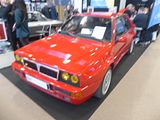
LIGIER
LINCOLN
For the 1961 model year, the Lincoln range was consolidated into one model. Following the $60 million in losses to develop the 1958–1960 cars, all models were replaced by a new Lincoln Continental. Making its first appearance since 1948, the fourth-generation was available only as a four-door sedan and convertible until its 1966 model year refresh. The 1961 four-door sedan was listed at US$6,067 and manufactured 22,303 while the convertible was listed at US$6,713 and manufactured 2,857. The new generation was nearly 15 inches shorter overall with a 8″ shorter wheelbase over its predecessor, though heavier than its Cadillac or Imperial counterparts. Its construction and post-build quality control reflected Ford corporate management’s commitment to quality. The fourth-generation Lincoln Continental was styled by Ford design vice president Elwood Engel. In mid-1958, Lincoln was struggling against Cadillac, with its lack of profitability putting the future of the division at risk. In 1958, Engel developed a proposal for the 1961 Ford Thunderbird with staffers Howard Payne and John Orfe. While the proposal was not selected for the Thunderbird, the design interested Ford executives to the point of desiring the vehicle as a four-door Lincoln. At the time of the approval, Ford product planners had come to two conclusions critical to restoring the Lincoln Division to profitability. First, to instill design continuity, Lincoln would adopt a model cycle distinct from Ford or Mercury, moving from three years to eight or nine. Second, the 1958 Lincoln model line was too large for a standard-length sedan; consequently, the 1961 Lincoln would have to decrease its exterior footprint. The fourth-generation Lincoln Continental rode on a stretched version of the unibody platform produced for the 1961 Thunderbird, lengthened to a 123-inch wheelbase from market launch to 1963. This was then extended to 126 inches and retained until 1969. The only engine available was the 430 cu in (7.0 L) MEL V8 carried over from the Mark V. It was expanded to 462 cubic inches on 1966 models, becoming the largest-displacement engine ever used in a Ford Motor Company passenger car. A new engine, the 460 cu in (7.5 L) 385-series-based V8, took its place by 1969, shared with the Continental Mark III. All versions of the Continental were fitted with a 3-speed automatic transmission. New for 1966 was Ford’s C6 automatic, designed for use in big block, high-horsepower V8 engines. At its launch, the fourth-generation Lincoln Continental was offered solely as a four-door, as either a sedan or a convertible. For the first time on a Lincoln since 1951, rear doors were rear-hinged (suicide doors). To alert drivers of open doors, Lincoln fitted the dashboard with a “Door Ajar” warning light as seen on many modern automobiles. Latching at the B-pillar with a vacuum-operated central locking system, convertibles used an abbreviated pillar while sedans were “pillared hardtops.” In the configuration, a thin B-pillar supported the roof structure while all four doors utilized frameless door glass in the style of a hardtop or convertible; the layout would become used by several Ford Motor Company sedans during the 1960s and 1970s. In what would be the first four-door convertible from a major American manufacturer after World War II, the Lincoln Continental convertible was fitted with a power-operated top on all examples. Deriving its mechanism from the Ford Fairlane 500 Skyliner hardtop convertible, the Continental was fitted with a fabric roof that stored under a rear-hinged deck lid/filler panel. In a similar fashion as the Skyliner, to access the trunk for storage, the deck lid was opened electrically without raising or lowering the roof. Due to the overlap of the front- and rear-door window weatherstripping on the four-door convertibles (with “suicide” doors), to open the rear door when the front door was closed required that the rear-door window be slightly lowered first. This was accomplished automatically using sensors and relay-controlled logic—when the outside door latch button or inside handle was first pressed, the power-operated window lowered a few inches, then raised when the door was closed. An option for 1964–1965 was the vertically adjustable steering column. Unlike most tilt-adjustable columns that employ a lever-activated locking pivot joint just behind the steering wheel the Lincoln version employed a vacuum-actuated clamp, a dash-mounted height indicator window and a pivot point further down the column. During its production, the fourth-generation Lincoln Continental would be produced in three versions, undergoing model revisions in 1964 and 1966. The 1961 Lincoln Continental was introduced with four-door sedan and four-door convertible versions, replacing the Lincoln Premiere and Lincoln Continental Mark V. For the first time in a car manufactured in the United States, the Lincoln Continental was sold with a 2 year/ 24,000 mi (39,000 km) bumper-to-bumper warranty. California walnut veneer was used on the doors and instrument panel. For 1962, a simpler front grille design with floating rectangles and a thin center bar replaced the heavy-gauge, Thunderbird-like, high mounted bumper of the ’61. For 1963, the Continental underwent several functional updates. The front seatbacks were modified in an effort to increase rear seat legroom. To increase luggage space, the trunklid was reshaped. In line with a number of vehicles in the United States, the electrical charging system introduced an alternator, replacing the generator. For 1964, the Lincoln Continental underwent its first mid-cycle redesign. Alongside styling updates, several functional changes were focused towards increasing rear-seat space. The wheelbase was increased from 123 to 126 inches, shifting the rear seats backward. The roofline underwent several changes, with the adoption of flat side glass (replacing curved window glass). To increase rear headroom, the rear roofline became additionally squared off, in a notchback style. In a slight exterior restyling, to eliminate the “electric shaver” appearance, the front fascia added vertical chrome accents to the grille; the recessed rear grille was replaced by a much simpler decklid with trim panel (moving the fuel-filler door to the left-rear fender). The interior was completely revised with a full-width instrument panel, updated upholstery patterns, door panels and fittings. In 1964, Lincoln debuted the Continental Town Brougham concept car, which had a 131-inch wheelbase, overall length at 221.3, and had a retractable glass partition between the front and rear compartments, with an exposed area over the front compartment, in typical 1930s style town car/brougham appearance. For 1965, Lincoln made additional updates to the Continental. In a styling change, the convex “electric shaver” front fascia was replaced by a more angular blunt hood with an upright flat grille design. As part of the redesign, the front turn signals and parking lights are moved from the front bumpers to wraparound lenses on the front fenders, with similar parking lights/turn signals on the rear; all four lights received metal trim to match the horizontal lines of the new grille. To improve braking ability, the Continental was given Kelsey-Hayes disc brakes for the front wheels; in addition, front seat belts with retractors became standard. For 1966, the fourth-generation Lincoln Continental underwent a second mid-cycle redesign. To better compete against the Cadillac Coupe de Ville and the Imperial Crown Coupe, Lincoln introduced its first two-door pillarless hardtop since 1960. The convertible remained offered solely as a four-door. In an effort to increase sales of the five year-old model range, Lincoln reduced the price of the Continental nearly $600 from 1965 while keeping equipment levels identical. The marketing decision proved successful; boosted by the introduction of the two-door body style, the model range increased sales by 36%. While following much of the 1965 restyling (distinguished in ’66 largely by a new grille and the addition of “Continental” to the hood), the 1966 Lincoln Continental wore an all new body, growing 5 inches longer (implemented primarily in the rear seats to accommodate more legroom), and nearly an inch taller and wider. Curved side glass made its return (with less obvious tumblehome, to increase interior room). To offer an engine sized comparably to those in the Imperial (440 cubic inches in 1966) and Cadillac (429 cubic inches, 472 cubic inches in 1968), the 430 V8 was enlarged to 462 cubic inches. The convertible underwent several equipment revisions for the first time, adding a glass rear window and the top mechanism added a second hydraulic pump for opening the convertible roof and the trunklid (making the two systems separate); hydraulic solenoids were deleted from the top mechanism. The interior underwent several revisions, adding a tilt steering wheel and an 8-track tape player as options. For 1967, the Lincoln Continental was given only minor trim updates, with the deletion of the Lincoln star emblem from the front fenders being the largest change. Several functional changes were made, as Lincoln added a number of indicator lights to the dashboard. Along with an oil pressure warning light, the dashboard was given indicator lights for an open trunk and the cruise control (if on). Following federal safety mandates, lap safety seatbelts became standard equipment, coupled with an energy-absorbing steering column. Following years of decreasing sales, 1967 marked the final year of the Lincoln Continental convertible, with only 2,276 sold. After becoming the first four-door convertible sold after World War II, the Lincoln Continental would become the final (as of the 2018 model year) example of its type sold by an American manufacturer. As a result of numerous frame reinforcements required by the lack of a fixed roof, the 5,712 lb (2,591 kg) 1967 Lincoln Continental convertible is one of the heaviest passenger cars ever sold by Ford Motor Company. For 1968, Lincoln made several styling changes to the Continental. To meet federal safety standards, the parking lights, taillights, and front turn signals were returned to a wraparound design on the fenders to satisfy Federal standards for side marker lights. For the interior, torso seatbelts were added for the outboard front seats. The “Continental” wording was removed from the front fascia, replaced by the Lincoln star emblem (as seen on the rear); the hood ornament was deleted, in anticipation of a federal ban on the feature (which never came to effect). The new 460 cu in (7.5 L) Ford “Lima” engine was to be available at the beginning of the model year, but there were so many 462 cu in (7.6 L) Ford MEL engine engines still available, the 460 was phased in later that year. In April, the new Mark III made its debut, as a 1969 model. Total sales would be down to just 39,134. For 1969, few changes were made in the final year of production. To comply with federal regulations, the front seats were updated with head restraints for the outboard passengers. The front fascia was updated, with the grille enlarged for the first time since 1966, with the “Continental” wording returning above the grille. Shared with the Mark III, the 460 V8 became the sole engine for the Lincoln Continental, paired with the Ford C6 3-speed automatic transmission. After a nine-year hiatus, the Town Car name made a return in 1969 as part of an interior trim option package for the Continental.
LISTER
Beginning in 1954, company manager and racing driver Brian Lister brought out the first in a series of sports cars from a Cambridge iron works. Inspired by Cooper, he used a tubular ladder chassis, de Dion rear axle and inboard drum brakes. Like others, he used a tuned MG engine and stock gearbox. It made its debut at the British Empire Trophy at Oulton Park in 1954, with former MG driver Archie Scott Brown at the wheel. Later, Lister swapped in a Moore-tuned Bristol two-litre engine and knockoff wire wheels in place of the MG’s discs to improve performance. For the sports car race supporting the 1954 British Grand Prix at Silverstone, Scott Brown won the two-litre class and placed fifth overall behind only works Aston Martins. In 1955, a handful of Lister-Bristols were built with a new body built by an ex-Bristol employee with the aid of a wind tunnel. Despite its new fins and strakes, it was less successful than the original Lister-Bristol of 1954. Lister moved up to a six-cylinder motor from a Formula 2 Maserati A6GCS for their own car, while customers continued to receive the Bristol motor, sold for £3900. Lister also attempted single-seater racing with a multi-tube chassis powered by a Coventry-Climax motor and using an MG gearbox, but the car was a failure. For 1957, Lister redesigned the car around a 3.4 litre Jaguar D-type XK inline-six, with an aerodynamic aluminium body. It was tested by racing journalist John Bolster, performing a 0–100 mph (0–160 km/h) run in 11.2 seconds. Driver Archie Scott Brown won the 1957 British Empire Trophy in the new Lister-Jaguar. Refined again in 1958, the Lister-Jaguar entered international competitions. Brown was killed that season when he crashed the Lister-Jaguar at Spa-Francorchamps. Lister also developed another single-seater car based on the Lister-Jaguar, for use in the unique Race of Two Worlds at Monza. Cars from this era are affectionately known as the “Lister Knobbly” cars, due to their curved bodywork. For 1959, Lister hired aerodynamicist Frank Costin who produced entirely new bodywork built around a new Chevrolet Corvette power plant. However, the front-engine layout of the new Lister-Chevrolet was quickly eclipsed by the rear-engine layout of the new Cooper sports car. By the end of 1959 Lister withdrew from competition although production of sports cars continued for customers.
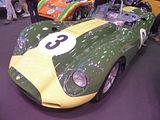
LOLA
The Lola T70 is a sports prototype developed by British manufacturer Lola Cars in 1965, the successor to its Mk6. Lola built the aluminium monocoque chassis, which were typically powered by large American V8s. The T70 was quite popular in the mid to late 1960s, with more than 100 examples being built in three versions: an open-roofed Mk II spyder, followed by a Mk III coupé, and finally a slightly updated Mk IIIB. The T70 was replaced in the Can-Am series by the lighter Lola T160. Early success for the Lola T70 came when Walt Hansgen won the Monterey Grand Prix, at Laguna Seca Raceway, on 17 October 1965, driving John Mecom’s Lola T70-Ford. In 1966, the hot setup for the Can-Am was a T70 Chevrolet, winning five of six races during the year. John Surtees was the champion and Dan Gurney drove the only Ford powered car ever to win a Can-Am race. In 1967, no one could compete with the new M6 McLaren. When the FIA changed the rules for sports car racing for the 1968 season, limiting engine size of prototypes to three litres, sportscars with up to five litre engines were allowed if at least fifty were made. This homologation rule allowed the popular yet outdated Ford GT40 and Lola T70s to continue racing. The Fords won Le Mans again in 1968 and 1969, while the T70’s only big endurance win was a one–two finish in the 1969 24 Hours of Daytona when the Sunoco Lola T70-Chevrolet of Mark Donohue and Chuck Parsons bested the Traco-built small-block 302 cu in Chevy V8 powered American International Racing T70s of Ed Leslie and Lothar Motschenbacher. When the minimum number was lowered to twenty-five for 1969, the more modern Porsche 917 and Ferrari 512 were homologated and outran the older Lolas and Fords. Chevrolet powered coupes tended to not run as well in Europe as they did in North America. Some reliability problems arose when racing in Europe, mainly due to the grade of fuel allowed. When forced to run on commercially available “pump fuel”, with a lower octane rating than the “Avgas” permitted under American rules, engine failures related to detonation became an issue. In modern historic racing, these engines show spectacular reliability due to parts unavailable in the 1960s and better fuel quality than the historically poor petrol supplied by the ACO. An Aston Martin powered coupe was entered by Lola for Le Mans in 1967. Even with drivers such as John Surtees, it was a disaster. The Aston Martin V8 engine failed after short runs, attributed to inadequate developmental funds. During the filming of Steve McQueen’s Le Mans, Lola chassis were disguised as the Porsche 917 and Ferrari 512s that crashed in the film. It is claimed chassis T76/141 originally campaigned by Ulf Norinder and Jo Bonnier was used for the wrecked Gulf Porsche. A T70 coupe also appears as a car of the future in George Lucas’ 1971 feature THX 1138, his first commercial film. A T70 Mk. IIIB driven by Mike D’Udy was used to set a South African land speed record, with a two-way average of 191.80 MPH and one-way best of 195.96 MPH, on 13 January 1968. The required runs were made on a section of the R45 between Vredenburg and Hopefield in the Western Cape province, and were completed despite an early mechanical failure in which the car’s fifth gear was irreparably damaged. This record would stand until November 1988, when a new two-way average of 224.30 MPH was set by an Audi 5000CS driven by Sarel van der Merwe with official backing from Volkswagen South Africa. In 2005, Lola Cars announced a revival of the T70 MkIIIb in “an authentic and limited continuation series” of the original racer. Seven were produced before Lola Cars went defunct in 2012.
The Lola T280, and its evolutions, the Lola T282, Lola T284, and Lola T286, are a series of 3-liter Group 5 (and later Group 6) sports prototype race cars, designed by Eric Broadley, John Barnard, and Patrick Head, and developed and built by British manufacturer and constructor Lola, for World Sportscar Championship sports car racing, between 1972 and 1976. A new regulatory change that would come into force for the 1972 season put Lola back in a position to offer its customers a car with which to face the competition serenely. In fact, Group 6 (which included prototype cars from 1968, with an engine limited to three liters of displacement) was merged with Group 5, which from 1968 included the “Sport Cars” produced in at least 25 units, and so there was a new Group 5 which included the “Prototypes of Sports Cars” (official name: Prototype-Sports Cars) with an engine capacity limit of 3,000 cm³, minimum weight increased to 650 kg and no minimum number of specimens. This decision was also dictated by the intent to slow down the cars, given the performance of the best sports cars in the 1970-71 two-year period, in particular, the Porsche 917 and the Ferrari 512S and 512M. The new sports-prototype cars, which were often old Group 6 adapted to the new regulations, participated in the newborn World Makes Championship using engines derived from those of Formula 1, such as the Ford Cosworth DFV which allowed the cars driven by it to compete well and was available for private stables. Logically, the biggest difference between the T280 and the T290 lay in the engine, which in the three-liter served as a structural element, as in many of his contemporaries’ Formula 1 single-seaters, while in the two-liter there was an additional subframe on which the suspensions were mounted, given the lower structural rigidity of the small four-cylinder in-line engines generally used in the lower class. Furthermore, the T280 required the assembly of the rear brake discs at the differential output instead of on the wheel hubs in order to be able to mount the wider wheels necessary to unload to the ground the greater power of the larger engine, which were mounted on rims size unsuitable to accommodate brake discs. For both cars, the suspensions were rather conventional, with deformable wishbones at the front and rear, where there were also upper longitudinal arms. The following season the T282 and T292 were presented, which saw improvements in aerodynamics, with a sharper nose and a full-width rear wing: only one three-liter model of the T282 was produced (purchased by Scuderia Filipinetti with the sponsorship of the Gitanes), and while further four examples were made later (called T286 – 1976/77) which incorporated the aerodynamic modifications conceived for the two-liter cars derived from the T290, while in the meantime the spare parts of the second Ecurie Bonnier car – chassis No.HU02, which was destroyed in the 1972 Jo Bonnier accident – was assembled by the Swiss tuner Heini Mader for his compatriot Heinz Schulthess to create a car called T284 and competed starting from the 1974 season. In 1972, two chassis were entered for the first time in competition during the 1,000 kilometers of Buenos Aires. Two Lola T280-Cosworth DFVs were set up by the Ecurie Bonnier of the driver Jo Bonnier for the 1972 season of the Marche world championship, where they faced competition from the official teams of Ferrari, Alfa Romeo, and Matra, to which were added the Mirage M6 of the JWAE, also pushed ‘they from the Ford Cosworth DFV, which proved to be an engine with destructive vibrations for itself and for the cars that mounted it. Victory at the 4 Hours of Le Mans in March 1972 showed the potential of the T280 in view of the most prestigious 24 Hours to be held in June, where Jo Bonnier himself was involved in a fatal accident in the morning, during a dubbing phase while he was in third position.
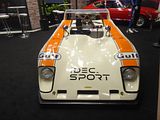
LOTUS
The Lotus Mark X was an aluminium-bodied sports racing car manufactured by Lotus Engineering Ltd. The Mark X, of which only 6 or 7 were made, was essentially identical to the Mark VIII but made use of the larger 2.0-litre Bristol engine. The Mark VIII, Mark IX and Mark X were transitional forms, although they represent the first full bodied aerodynamic Lotus sports cars and made use of the De Dion tube as a rear suspension locator, together with inboard rear brakes. The more successful Lotus Eleven, of which 270 were manufactured between 1956 and 1958, was the direct descendant of these earlier cars. The earlier cars are today considered rare and highly valued collectible automobiles — even museum pieces — but can still be seen raced in vintage events.
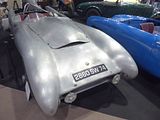
The Lotus 95T was a Formula One racing car designed by Gérard Ducarouge for use by Team Lotus in the 1984 Formula One World Championship. The car brought Lotus its best results for several seasons, frequently reaching the podium. The car was powered by the Renault Gordini EF4 V6 turbo engine and ran on Goodyear tyres, after Lotus had switched from Pirelli. It was a development of the Lotus 94T, which had proved competitive at the end of 1983. The chassis of the 95T was praised by the editor of the AUTOCOURSE annual in 1984 as the best handling of the season during the annual’s team by team review. The technical review of the 95T was particularly positive of the Lotus mechanical grip in slow corners, mentioning that it was equal, if not slightly better than the McLaren MP4/2. The AUTOCOURSE editor reported that the McLaren was more aerodynamically efficient and was better in fast corners, but netherless praised the leadership of Gerard Ducarouge’s technical directorship in reviving Lotus in 1984 after a dismal (in terms of results) 1983 season. The car was driven by Elio de Angelis and Nigel Mansell, both of whom were consistently competitive in a season otherwise dominated by McLaren. De Angelis finished in the top five on eleven occasions, including four podium finishes; he also took pole position at the opening race in Brazil. With 34 points, he was third in the Drivers’ Championship. Mansell, meanwhile, finished third in France and the Netherlands, and was running second in the final race in Portugal when his brakes failed (which handed Niki Lauda the Drivers’ Championship by half a point from Alain Prost). However, he also crashed out of the lead at a rain-hit Monaco (which prompted team boss Peter Warr, with whom he had a difficult relationship, to famously declare, “He’ll never win a Grand Prix as long as I have a hole in my arse”), and in oppressive heat at Dallas he took pole position and led the first half of the race, before his gearbox failed on the final lap and he collapsed from exhaustion trying to push the car to the finish line. He ultimately finished equal ninth in the Drivers’ Championship with 13 points, the same tally as Ayrton Senna, who would replace him for 1985. With a total of 47 points, Lotus placed third in the Constructors’ Championship, its best placing since 1978. The 95T was seen by many in Formula One as being as good as the dominant McLaren MP4/2, its biggest problems being the tyres, the gearbox and the Renault engine, which despite being powerful and reliable was not as fuel-efficient as the TAG-Porsche engine in the McLaren. Nonetheless, the car had helped to re-establish Lotus as consistent front-runners, and would be succeeded for 1985 by a further development, the Lotus 97T.
LUCENTI
It’s 1934. The engines roar, the grandstands of the Indianapolis Motor Speedway are packed with thousands of spectators, and the scent of oil and gasoline lingers in the air. Right there, on the starting grid, stands the Lucenti Special, a low-slung, aggressive Indy racer built by three motorsport enthusiasts from Pittsburgh. A car that, even back then, was already writing history. And the best part? This is no forgotten relic. This Lucenti Graham has been fully restored and is in absolute top condition, just as it crossed the finish line in 10th place at the 1934 Indy 500! If this isn’t a time machine, we don’t know what is. This car encapsulates an era when passionate engineers with limited resources challenged the giants of motorsport. It’s a machine that once stood before roaring crowds at Indianapolis, passed through the hands of forgotten racers, and has now, after an incredible journey, been brought back to its former glory. The 1930s were a tough time for motorsports. The Great Depression had taken its toll, making the ultra-expensive Miller and Duesenberg race cars virtually unattainable. But the Indianapolis 500 had to go on, so a new rule was introduced: the ‘Junk Formula’. From 1930 to 1935, teams were allowed to build relatively affordable specials based on production cars. The result? Pure ingenuity and mechanical brilliance, with race cars emerging from home garages rather than big factories. And that’s exactly where this Lucenti Graham comes into play. In 1932, three car enthusiasts from Pittsburgh, Pennsylvania, came together: Angelo Lucenti, Roy Painter, and John Saunders. Their mission? To build their own Indianapolis 500 racer, using a Graham Blue Streak Eight as the foundation. It has a 165 cubic inch (4.3-liter) L-head straight-eight engine featuring larger valves and a custom intake with four Winfield Model SR carburettors, a low and aerodynamic body, made possible by a unique banjo-frame, allowing the rear axle to run through the chassis for an ultra-low centre of gravity. It is a hand-built race car – created by enthusiasts, engineered for America’s greatest racing event. The car was named the ‘Lupasa Special’, a combination of the first letters of the builders’ last names. It attempted to qualify for the 1932 Indy 500 but fell just short. A later attempt at the Syracuse circuit was also unsuccessful. But Lucenti refused to give up. Two years later, Lucenti returned with the same car, now rebranded as the ‘Lucenti Special’. This time, it made the cut: driver Herb Ardinger clocked an average speed of 111.7 mph on the 2.5-mile oval, securing a spot on the grid. From a starting position in mid-field, drivers Herb Ardinger and later Danny Day finished in 10th place in the 1934 Indy 500! Later they claimed 8th place at Springfield and Syracuse. Now, the story takes an extraordinary turn. After its racing career ended, the Lucenti Special ended up in an orphanage! Yes, it was used as a playground structure for children. Luckily, the car was rescued in 1950 by a collector, who kept it in his possession for an astonishing 55 years. In 2006, the Lucenti Special resurfaced, and a full-scale historical restoration began. Remarkably, the aluminum body and original engine were still intact. Only the exhaust system and interior had to be rebuilt. The result? A Lucenti in prime condition, fully restored to its 1934 Indy 500 specification. This restoration even won its class at the Amelia Island Concours d’Élégance in 2010.
MASERATI
To my eyes, the most beautiful car ever made, and looking at its very best in red, this is the A6G54 Zagato. After a two-year hiatus, at the 1954 Mondial de l’Automobile in Paris Maserati launched a new grand tourer, the A6G 2000 Gran Turismo—commonly known as A6G/54 to distinguish it from its predecessor. It was powered by a new double overhead camshaft inline-six, derived from the racing engines of A6GCS and A6GCM, with a bore and stroke of 76.5 mm x 72 mm for a total displacement of 1,985.6 cc. Fed by three twin-choke Weber DCO carburettors it put out 150 hp at 6000 rpm, which gave these cars a top speed between 195 and 210 km/h (121 and 130 mph). Dual ignition was added in 1956 and increased power to 160 hp. Total production between 1954 and 1956 amounted to 60 units. Four body styles were offered: a three-box Carrozzeria Allemano coupé (21 made, designed by Michelotti), a coupé and a Gran Sport Spyder by Frua (respectively 6 and 12 made); and a competition-oriented fastback by Zagato (20 made) as well as a single Zagato spider, chassis 2101, shown at Geneva in 1955. The Zagato Spider was purchased by Juan Perón, but his regime came to an end before Zagato could finish his ordered revisions and the car was stored by Maserati. After being shown at Paris in 1958, it was sold to an American residing there. An A6G/54 Zagato chassis 2155 received a unique coupé bodystyle, after being crashed on a test drive by Gianni Zagato. Distinguished by non-fastback rear-end and ‘eyelids’ over the headlights. It is also one of only two with a ‘double bubble’ roof.
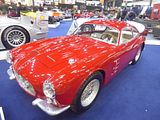
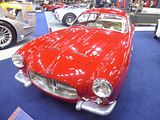
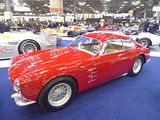
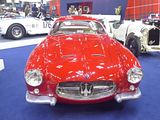
Maserati only built 9 examples of the legendary Maserati 450S, one of the most iconic race cars of the 1950s. This example is a faithful replicat which was completed in 2023 after an extensive and meticulous build process, using original factory drawings and engineering references from the period. This is not a generic replica — it is a hand-built homage to the original factory cars that competed at the highest levels of motorsport between 1956 and 1958. The chassis is a custom-built tubular frame, constructed to original factory specifications. The suspension is authentic period-correct setup, identical geometry to the original 450S. There is a 5-speed manual gearbox and a Maserati V8 (from a Quattroporte), upgraded to 4. 5L – 400 hp, matching the performance of the original car. Disc brakes are currently installed (can be converted to drums if needed for compliance). The interior and bodywork are finished to original competition spec, with exceptional attention to detail.
Maserati had made their first forays into the grand tourer market, with the 1947 A6 1500, 1951 A6G 2000 and 1954 A6G/54, but whilst these cars had proven that the expanding the business beyond race cars was feasible; these A6 road cars were still built at the rate of just a dozen examples a year, which hardly constituted series production. A different approach was going to be needed, with the objective of building fully accomplished grand tourers. An engine was not really a problem. The 2 litre twin cam unit that had enabled Maserati to achieve racing success and international visibility in the early 1950s, thanks to cars such as the A6GCM;, had already been enlarged to three litre capacity on the Maserati 300S. Chief engineer Giulio Alfieri felt the next step was to design an all-new 3.5-litre engine; the resulting long-stroke six, designed foremost for endurance racing on the Maserati 350S, was ready in 1955. The main development efforts that led to the 3500 GT were carried out in 1956–57, despite the frantic activity required by Maserati’s participation in the Formula 1 world championship. Alfieri modified the 350S’s engine to suit a touring car, such as switching to a wet sump oil system and changing the engine accessories. He also made several business trips to the United Kingdom in order to contact components suppliers. None were found in Italy, as Italian taxation system and the industry structure forced manufacturers to design every part in-house; a daunting task for small companies like Maserati. Thus the 3500 GT alongside Italian Weber carburettors and Marelli ignition, used many British-made components such as a Salisbury rear axle, Girling brakes and Alford & Alder suspension parts. Clearly the bodywork would have to be Italian. According to Carrozzeria Touring’s Carlo Felice Bianchi Anderloni it was Commendatore Franco Cornacchia, a prominent Ferrari dealer, that put in contact Maserati owner Omar Orsi with the Milanese Carrozzeria The first 3500 GT Touring prototype had a 2+2 body, with superleggera construction and was white in colour; it was nicknamed Dama Bianca (White Lady). Two 3500 GT prototypes were shown at the March 1957 Salon International de l’Auto in Geneva. Both had a 2,600 mm (102.4 in) wheelbase and aluminium bodywork; they were Touring’s Dama Bianca, and another one by Carrozzeria Allemano. Touring’s proposal was chosen for series production; few changes were made to it, chiefly a more imposing grille. Production of the 3500 GT started in late 1957; eighteen cars were built that year, the first handful leaving the factory before Christmas. All 3500 GTs had leather interior and Jaeger-LeCoultre instruments. A first Touring convertible prototype was shown at the 1958 Turin Motor Show, but it was a proposal by Carrozzeria Vignale (designed by Michelotti) shown at the 1959 Salon de l’Auto in Paris that went into production as 3500 GT Convertibile. The Convertibile did not feature Touring’s Superleggera construction, but rather a steel body with aluminium bonnet, boot lid and optional hard top; it was also built on an 10 cm (3.9 in) shorter wheelbase, and weighed 1,380 kg (3,042 lb). Front disc brakes and limited slip differential became optional in 1959, and were standardised in 1960; rear discs became standard in 1962. The 3500 GTi was introduced at the 1960 Salon International de l’Auto, and by the following year became the first fuel-injected Italian production car. It had a Lucas mechanical fuel injection, and developed 232 bhp. A 5-speed gearbox was now standard. The body had a lowered roofline and became somewhat longer; minor outward changes appeared as well (new grille, rear lights, vent windows). From 1961 convertible 3500s for export markets were named 3500 GT Spyder and GTi Spyder. In total, 2,226 3500 GT coupés and convertibles were built between 1957 and 1964. In the first year, 1958, just 119 cars were sold, while 1961 was the best-selling year, totalling 500. All together, 245 Vignale convertibles and nearly 2000 coupés were manufactured, of these, 1981 being Touring coupés, the rest were bodied by other coachbuilders: Carrozzeria Allemano (four coupés, including the 1957 prototype), Zagato (one coupe, 1957), Carrozzeria Boneschi (1962 Turin Motor Show and 1963 Geneva Motor Show ), Pietro Frua (two or three coupés, one spider) and Bertone (one coupé, 1959 Turin Motor Show) The last was a coupé by Moretti for the 1966 Geneva Motor Show. The car was replaced by the Sebring in 1964.
Known internally as Tipo AM109, the Mistral was a 2-seat gran turismo produced between 1963 and 1970, as a successor to the 3500 GT. It was styled by Frua and bodied by Maggiora of Turin. Named after a cold northerly wind of southern France, it was the first in a series of classic Maseratis to be given the name of a wind. The Mistral was the last model from the Casa del Tridente (“House of the Trident”) to have the company’s renowned twin-spark, double overhead cam straight six engine. Fitted to the Maserati 250F Grand Prix cars, it won 8 Grand Prix between 1954 and 1960 and one F1 World Championship in 1957 driven by Juan Manuel Fangio. The engine featured hemispherical combustion chambers fed by a Lucas indirect fuel injection system, a new development for Italian car manufacturers. Maserati subsequently moved on to V8 engines for their later production cars to keep up with the demand for ever more powerful machines. Three engine were fitted to the Mistral, displacing 3500, 3700 and 4000 cc and developing 235 bhp at 5500 rpm, 245 bhp at 5500 rpm and 255 bhp at 5200 rpm, respectively. Only the earliest of the Mistrals were equipped with the 3500 cc, the most sought after derivative is the 4000 cc model. Unusually, the body was offered in both aluminium and, from 1967, in steel, but no one is quite sure how many of each were built. The car came as standard with a five speed ZF transmission and four wheel solid disc brakes. Per Maserati practice, the front suspension was independent and the rear solid axle. Acceleration 0-60 for both the 3.7 litre and 4.0 litre engines was around or just under 7 seconds, and top speed approximately 140 mph (225 km/h) to 145 mph (233 km/h). The body was designed by Pietro Frua and first shown in a preview at the Salone Internazionale dell’Automobile di Torino in November 1963. It is generally considered one of the most beautiful Maseratis of all time. It is also often confused with the very similar looking but larger and more powerful Frua designed AC 428. A total of 828 coupés and 125 Spyders were built. Only the Spyder received the 3500 engine; just 12 were made, along with 76 3.7 litre and 37 4.0 litre versions. Twenty Spyders were right hand drive. The Mistral was succeeded by the Ghibli, which overlapped production from 1967 on.
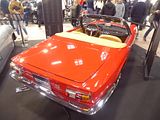
The Maserati MC12 (Tipo M144S) is a limited production two-seater sports car produced by Maserati from 2004 to 2005, to allow a racing variant to compete in the FIA GT Championship. The car entered production in 2004, with 25 cars produced. A further 25 were produced in 2005 after the FIA changed the rules and reduced the maximum length allowed. The second batch of 25 are 150mm shorter than the originals, making a total of 50 cars available for customers. With the addition of 12 cars produced for racing, a total of just 62 were ever produced. Maserati designed and built the car on the chassis of the Ferrari Enzo, but the final car is much larger and has a lower drag coefficient, along with being longer, wider and taller and has a sharper nose and smoother curves than the Enzo. The Enzo had quicker acceleration, shorter braking distance, and a higher top speed at 350 km/h (217 mph), 20 km/h (12 mph) more than the MC12. The MC12 was developed to signal Maserati’s return to racing after 37 years. The road version was produced to homologate the race version. One requirement for participation in the FIA GT is the production of at least 25 road cars. Three GT1 race cars were entered into the FIA GT with great success. Maserati began racing the MC12 in the FIA GT toward the end of the 2004 season, winning the race held at the Zhuhai International Circuit. The racing MC12s were entered into the American Le Mans Series races in 2005 but exceeded the size restrictions and consequently paid weight penalties due to excess range. Under the direction of Giorgio Ascanelli, Maserati began development of an FIA GT-eligible race car. This car, which would eventually be named the MC12, was initially called the “MCC” (“Maserati Corse Competizione”) and was to be developed simultaneously with a road-going version, called the “MCS” (“Maserati Corse Stradale”). Frank Stephenson, Director of Ferrari-Maserati Concept Design and Development at the time, did the majority of the body styling, but the initial shape was developed during wind tunnel testing from an idea presented by Giorgetto Giugiaro. The MCC has a very similar body shape to the MC12, but there are several key differences, most notably the rear spoiler. Andrea Bertolini served as the chief test driver throughout development, although some testing was done by Michael Schumacher, who frequently tested the MCC at the Fiorano Circuit. During the development process, the MCC name was set aside after Maserati established the car’s official name, MC12. The car is based heavily on the Enzo Ferrari, using a slightly modified version of the Ferrari F140 V12 engine, the same gearbox (but given the unique name of “Maserati Cambiocorsa”) and the same chassis and track (length of axle between the wheels). The windshield is the only externally visible component shared with the Enzo; the MC12 has a unique body which is wider, longer and slightly taller. The increased size creates greater downforce across the MC12’s body in addition to the downforce created by the two-metre spoiler. The MC12 is a two-door coupé with a targa top roof, although the detached roof cannot be stored in the car. The mid-rear layout (engine between the axles but behind the cabin) keeps the centre of gravity in the middle of the car, which increases stability and improves the car’s cornering ability. The standing weight distribution is 41% front and 59% rear. At speed, however, the downforce provided by the rear spoiler affects this to the extent that at 200 km/h (125 mph) the downforce is 34% front and 66% rear. Even though the car is designed as a homologation vehicle and is a modification of a racing car, the interior is intended to be luxurious. The interior is a mix of gel-coated carbon fibre, blue leather and silver “Brightex”, a synthetic material which was found to be “too expensive for the fashion industry”. The centre console features the characteristic Maserati oval analogue clock and a blue ignition button, but it has been criticised for lacking a radio, car stereo or a place to install an aftermarket sound system. The body of the car, made entirely of carbon fibre, underwent extensive wind tunnel testing to achieve maximum downforce across all surfaces. As a result, the rear spoiler is 2 m (79 in) wide but only 30 mm (1.2 in) thick, the underside of the car is smooth, and the rear bumper has diffusers to take advantage of ground effect. Air is sucked into the engine compartment through the air scoop; its positioning on top of the cabin makes the car taller than the Enzo. The exterior is available only in the white-and-blue colour scheme, a tribute to the America Camoradi racing team that drove the Maserati Tipo Birdcages in the early 1960s. Bespoke colour schemes are available by paying an extra amount. The car is noted for the awkwardness that results from its size; very long and wider than a Hummer H2. This, combined with the lack of a rear window, can make parking the MC12 challenging. The MC12 sports a 232 kg (511 lb), 5,998 cc Enzo Ferrari-derived longitudinally-mounted 65° V12 engine. Each cylinder has 4 valves, lubricated via a dry sump system, with a compression ratio of 11.2:1.] These combine to provide a maximum torque of 652 Nm (481 lb/ft) at 5,500 rpm and a maximum power of 630 PS (621 hp; at 7,500 rpm. The redline rpm is indicated at 7,500—despite being safe up to 7,700—whereas the Enzo has its redline at 8,000 rpm. The Maserati MC12 can accelerate from 0 to 100 km/h (62 mph) in 3.8 seconds (though Motor Trend Magazine managed 3.7 seconds) and on to 200 km/h (124 mph) in 9.9 seconds. It can complete a standing (from stationary) 402 metres (1⁄4 mi) in 11.3 seconds with a terminal speed of 200 km/h (124 mph) or a standing kilometre in 20.1 seconds. The maximum speed of the Maserati MC12 is 330 km/h (205 mph). Another change on the engine compared with the Enzo was the use of gears to drive the camshafts instead of chains. Power is fed to the wheels through a rear-mounted, six-speed automated manual. The gearbox is the same as the Enzo’s transmission (tuned to different gear ratios) but renamed “Maserati Cambiocorsa”. It provides a shift time of just 150 milliseconds and is mechanical with a 215 mm (8.5 in) twin-plate dry clutch. The MC12’s chassis is a monocoque made of carbon and nomex, with an aluminium sub-chassis at the front and rear. It has a roll bar to provide additional strength, comfort and safety. Double wishbone suspension with push-rod-operated coil springs provide stability and dampers smooth the ride for the passengers. The front of the car can be raised for speed bumps and hills by pressing a button that extends the front suspension. There are two modes for the chassis’ tuning which can also be changed with a button in the cabin: “sport”, the standard setting, and “race”, which features less of the “Bosch ASR” (anti-slip regulation) traction control, faster shifts and stiffer suspension. The MC12 has 485 mm (19 in) wheels with a width of 230 mm (9 in) at the front and 330 mm (13 in) at the rear. The tyres are “Pirelli P Zero Corsa” with codes of 245/35 ZR 19 for the front tyres and 345/35 ZR 19 for the rear. The brakes are Brembo disc brakes with a Bosch anti-lock braking system (ABS). The front brakes have a diameter of 380 mm (15 in) with six-piston calipers and the rear brakes have a diameter of 335 mm (13.2 in) with four-piston calipers. The centre-lock wheel nuts that hold the wheels to the chassis are colour-coded; red on the left of the car, blue on the right. The car has generally received mixed reviews, with critics saying it is hard to drive, overpriced and too large. Other criticisms include the lack of a trunk, rear window, spare tire and radio, and the way the car’s engine was limited or “drugged”.] Former driver for Vitaphone Racing Team, Andrea Bertolini, the chief test driver throughout the development, said the car, “reacts well and is very reliable in its reactions.” The Top Gear television series acquired an MC12, and test driver The Stig achieved a lap time of 1:18.9 around the Top Gear track—0.1 seconds faster than his lap in the Enzo Ferrari. Host Jeremy Clarkson also drove it, comparing it to the Maserati Biturbo, a car he disliked. Clarkson criticised the car greatly, pointing out that, unlike the Enzo, it lacks a rear window. Despite his criticisms, he complimented the smooth ride. Motor Trend Magazine reviewer Frank Markus had a more positive opinion. Despite initial skepticism he said, “It turns out that the Enzo makes a more comfortable and attractive road car when made over as a butch Maserati racer in street couture”. Markus complimented the stability of braking and the handling ability of the MC12, especially the drifting allowed by the traction control when cornering, commenting that “There’s none of the knife-edged limit handling we criticised in the more extreme Enzo. It’s even more forgiving at the limit than an Acura NSX.” When Automobile Magazine tested an MC12, reviewer Preston Lerner called it “user-friendly”, praising the responsiveness and simplicity of driving.[28] Lerner approved of Frank Stephenson’s work with the styling of both the car’s exterior and interior, calling the trim “Speed-Racer-ish” but “without looking as though it belongs in a Nitrous-ized Civic”.[28] He also complimented the ASR’s level of intervention, commenting that it “lets the fun factor get reasonably high before kicking in”.
The MC12 Versione Corse is a variant of the MC12 intended for racetrack use. In contrast to the race version of the MC12, of which street-legal versions were produced for homologation purposes, the MC12 Corse is intended for private use, albeit restricted to the track, as the Corse’s modifications make it illegal to drive on the road. The Versione Corse was developed directly from the MC12 GT1, which won the 2005 FIA GT Manufacturers Cup. The car was released in mid-2006, “in response to the customer demand to own the MC12 racing car and fuelled by the growth in track days, where owners can drive their cars at high speeds in the safety of a race track”, as stated by Edward Butler, General Manager for Maserati in Australia and New Zealand. In similar fashion to the Ferrari FXX, although the owners are private individuals, Maserati is responsible for the storage, upkeep, and maintenance of the cars, and they are only driven on specially organized track days. Unlike the FXX, Versione Corses are not used for research and development, and are used only for entertainment. Three Maserati MC12 Versione Corses were converted to road legal use by German tuning firm Edo Competition and feature a slight power increase, a butterfly intake exhaust system and adjustable road suspension system. Only twelve MC12 Versione Corses were sold to selected customers, each of whom paid €1 million (US$1.47 million) for the privilege. Another three vehicles were produced for testing and publicity purposes. The Versione Corse shares its engine with the MC12 GT1; the powerplant produces 755 PS at 8,000 rpm, 122 PS more than the road going MC12. The MC12 Versione Corse shares the GT1’s shortened nose, which was a requirement for entry into the American Le Mans Series. The car was available in a single standard colour, named “Blue Victory”, though the car’s paint could be customized upon request. The MC12 Versione Corse possesses steel/carbon racing brakes, but is not fitted with an anti-lock braking system
Also here were Maserati’s current supercar, the MC20 Spider and the recently released GT2 version.
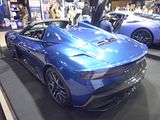
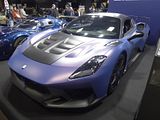
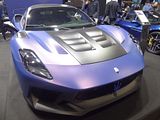
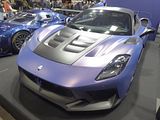
MATRA
A large stand dedicated to Matra had this very special Murena prototype on display – the Version JPB. Those three letters stand for Jean-Paul Beltoise, the former Matra and BRM racing driver. He played a key role in the development of the Murena, and would race for the Politecnic team in the French Rallycross team. Matra would also develop a 360bhp, four-wheel-drive Murena in 1983 for Group B and, to celebrate a road-based version was proposed with either 184bhp or 220bhp, and a host of body modifications. The car seen here is the prototype for that programme.
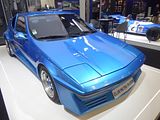
The Matra MS80 was the fourth Formula One car produced by Matra (following the MS9, MS10 and MS11). The Ford Cosworth DFV-powered car (engine 3000 cc, estimated at around 420 bhp took Jackie Stewart to the Formula One World Championship title in 1969. The car, designed under the direction of Gérard Ducarouge and Bernard Boyer, was built at Matra’s Formula One base at Vélizy-Villacoublay in the southwestern suburbs of Paris, though the final completion with the Cosworth engine was done in the Tyrrell workshop of East Horsley near Ripley, UK. A major change from the MS10 was the location of the fuel cell, which was moved from behind the driver and placed in sidepods by the driver’s hips, giving the car a slight ‘Coke bottle’ appearance. The rocker-arm front suspension was replaced by outboard springs, with a parallel link set up on the rear suspension. Apart from Ferrari cars, the Matra MS80 is the only non-British built car to win the Formula One World Constructors’ Championship (the French-licensed constructor Renault, the Austrian-licensed constructor Red Bull and the German-licensed constructor Mercedes built their winning cars in the UK) as well as the only car built in France to help a driver win the World Drivers’ Championship. Although built by the French constructor Matra, the car was run by the British Matra International privateer team of Ken Tyrrell and, as such, remains the only car not entered by a works team to win the Formula One World Constructors’ Championship as well as to help a driver win the World Drivers’ Championship. The MS80 was one of the first F1 racing cars to be designed with “wings” for downforce to increase high-speed tyre grip. These were originally introduced into F1 in 1968. Due to some serious racing accidents with the flimsy 1969-type high wing constructions early in the racing season, like all 1969 F1 cars the MS80 was altered to use more sturdy lowered wings, directly attached to the car’s body, later on. Only two MS80s were assembled in 1969, a third monocoque was built but remained un-assembled until the EPAF company made it a complete car in 2006.
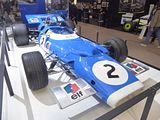
The Matra MS120 was the sixth and final Formula One car produced by Matra (following the MS9, MS10, MS11, MS80 and MS84). The MS120 was later developed to become the Matra MS120B, Matra MS120C and Matra MS120D. The car was built at Matra’s Formula One base at Vélizy-Villacoublay in the southwestern suburbs of Paris, designed under the direction of Gérard Ducarouge and Bernard Boyer. For 1970 following the agreement with Simca, Matra asked Tyrrell to use their Matra Sports V12 engine rather than the Cosworth. Jackie Stewart got to test the Matra V12, but since a large part of the Tyrrell budget was provided by Ford, and another significant sponsor was French state-owned petroleum company Elf, which had an agreement with Renault that precluded supporting a Simca partner, the partnership between Matra and Tyrrell ended. Matra chose an all French line up with Jean-Pierre Beltoise and Henri Pescarolo for 1970. The South African Grand Prix was good for Beltoise with a fourth-place finish while Pescarolo had a disappointing seventh place. The Spanish Grand Prix was a bad race, both retiring with engine failures. The Monaco Grand Prix saw Pescarolo get third place, but Beltoise retire with differential failure. The Belgian Grand Prix saw Pescarolo finish sixth with electrical failure while Beltoise scored a third-place finish. The Dutch Grand Prix saw Beltoise 5th and Pescarolo 8th. Then the French Grand Prix, which was Matra’s, Beltoise’s and Pescarolo’s home race, saw Pescarolo fifth and Beltoise 13th, out of fuel. Next, the British Grand Prix was a bad race with both retiring, Beltoise with a wheel problem and Pescarolo with an accident. Then the German Grand Prix saw Pescarolo get sixth place, but Beltoise retire with suspension failure. Next was the Austrian Grand Prix with Beltoise sixth and Pescarolo 14th. Then the Italian Grand Prix saw Beltoise finish third but Pescarolo retire with engine failure. Next, the Canadian Grand Prix saw Pescarolo seventh and Beltoise eighth. Then the United States Grand Prix saw Pescarolo in eighth place, but Beltoise retire with a bad handling car. Finally, it was the Mexican Grand Prix with Beltoise fifth and Pescarolo ninth, although the race was delayed by an hour because of crowd control. Pescarolo was not retained by Matra for 1971 and was replaced by New Zealand’s Chris Amon. In 1971, Matra kept Frenchman Jean-Pierre Beltoise, and New Zealander Chris Amon joined Matra using the Matra MS120B specification version for 1971. Beltoise was in difficulty following the 1971 1000 km Buenos Aires; racing for the Matra sports car team; he was involved in the accident in which Ignazio Giunti died, and Beltoise’s international racing licence was suspended for some time. Amon won the Non-Championship Argentine Grand Prix and finished fifth in the first round in the 1971 season in the South African Grand Prix. Beltoise returned for the Spanish Grand Prix finishing sixth and Amon finished third. The Monaco Grand Prix was a bad race with both retiring with differential failures. The Dutch Grand Prix saw Beltoise ninth and Amon retiring after he spun off. Then came the French Grand Prix which was Matra’s and Beltoise’s home race, with Amon fifth and Beltoise seventh. Next, the British Grand Prix saw Beltoise seventh and Amon retiring with an engine failure. The German Grand Prix saw Matra only entering Amon and retiring because of an accident. Matra missed the Austrian Grand Prix but entered the Italian Grand Prix, where Matra only entered Amon again who took pole and proved an embarrassment to Ferrari at their home track, and finished sixth. Then the Canadian Grand Prix saw Beltoise back but retiring with an accident, and Amon finish 10th. The final race of 1971 was the United States Grand Prix with Beltoise eighth and Amon 12th. In 1971 Matra signed Amon as team leader which frustrated Beltoise. For 1972 Beltoise left to join BRM. For 1972, Chris Amon stayed with Matra, using the Matra MS120C specification version for 1972 before being replaced by the Matra MS120D version mid-season. The Argentine Grand Prix was a bad race for Amon with gearbox problems on the warm-up lap. He then finished 15th in the South African Grand Prix. More gearbox problems followed at the Spanish Grand Prix, before luck came Amon’s way with two sixth-place finishes at Monaco and in Belgium. The French Grand Prix saw Amon on pole and he was leading the race until a puncture forced him to pit, but he charged back through the field, bettering the Charade Circuit lap record to finish third. Amon finished fourth in the British Grand Prix and 15th in the German Grand Prix, before another points finish with fifth in the Austrian Grand Prix. Amon’s brakes failed in the Italian Grand Prix and he later came in sixth in the Canadian Grand Prix. At the last race of the season, he finished 15th in the United States Grand Prix. Matra pulled out of Formula One afterwards to concentrate on Le Mans.
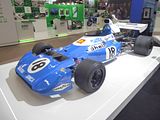
MAXWELL
The Maxwell brand was created on the premises in 1903 in Tarrytown, N.Y. by Jonathan Maxwell (previously an engineer at Oldsmobile) and Benjamin Briscoe (Financier). The brand was taken over by Chryser during the post-World War 1 stock market crash. Production began in July 1904, notably with the present model “L05” (light) Tourabout 2-seater, a 1600cc boxer 2-cylinder flat engine cooled by thermosiphon water without pump. The first chassis were made of “armoured oak” (bois armé), and the present model dates from October or November 1904. According to the Maxwell Register, there are 3 or 4 left in the USA, and possibly another abandoned in a container somewhere in California. Subsequently, the chassis were made entirely of steel. Start-up is by crank, battery ignition and one trembler per cylinder in a box on the engine separation wall, lubrication is by pressurized oil reservoir and drip with 3 adjustable starts visible while driving. It has 2 forward gears and one reverse. The gearbox is an epicyclic planetary type, with steering-wheel-mounted advance, foot-operated gas pedal and rear-wheel strap brake, and foot-operated parking brake. This Maxwell was acquired by its owner in March 2003, after a trip to Belgium and the UK. It drives well, and is fast for its age, being able to hold ≈ 70 km/h in 2nd gear at 1,200 rpm. The idle speed is ≈ 120 T/mn. A restoration is said to have taken place in the USA in the 1970s, respecting the original. This Maxwell has taken part in numerous classic car events, including: rallye des Hauts de Seine, Paris-Rouen, Ancêtres en Picardie, Paris-Rambouillet… but has also completed 2 commemorations of the famous “London to Brighton” in November 1980 with its American owner and then with the current owner in November 2008 and bearing the n° 611. This rare car will of course be eligible for membership of the famous Teuf Teuf Club.
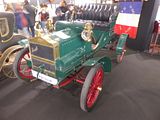
MAZDA
Mazda had a stand here, and the focus was on the MX-5, with a number of examples shown here of what is now the world’s best-selling sports car.
The MX-5 was unveiled at the Chicago Auto Show on February 10, 1989, with a price tag of US$14,000. The MX-5, with production code NA, was made available for delivery to buyers worldwide in the following dates: May 1989 (as a 1990 model) in the US and Canada; September 1, 1989 in Japan; and 1990 in Europe. An optional hardtop was made available at the same time, in sheet moulding compound (SMC). Demand initially outstripped production, fueled by enthusiastic press reviews. In Japan, the car was not badged as a Mazda, as the company was in the process of launching different marques for deluxe models, similar to Nissan’s Infiniti, Honda’s Acura and Toyota’s Lexus. Instead, the Mazda MX-5 was sold as the Eunos Roadster, and was joined by the MX-3/AZ-3/Eunos Presso (based on Japanese Mazda dealerships). The exterior dimensions and the engine displacement were also in compliance with Japanese Government compact car regulation. The body shell of the NA was all-steel with a lightweight aluminium bonnet. Overall dimensions were 3,970 mm (156 in) in length, 1,675 mm (65.9 in) in width, and 1,235 mm (48.6 in) in height. Without options, the NA weighed only 980 kg (2,160 lb). It had a drag coefficient of Cd=0.38. Suspension was an independent double wishbone on all four wheels, with an anti-roll bar at the front and rear. Four-wheel disc brakes, ventilated at the front, were behind alloy wheels with 185/60HR14 radial tyres. The base model came with stamped steel wheels from the then-current 323/Protege.The original MX-5, with standard manual transmission, came with a 1.6 L DOHC inline four-cylinder engine, producing 115 bhp at 6,500 rpm, and 136 N⋅m (100 lbf⋅ft) of torque at 5,500 rpm. The engine employs an electronic fuel injection system using a vane-type air flow meter and an electronic ignition system with a camshaft angle sensor instead of a distributor. This engine, codenamed B6ZE(RS), was specifically designed for the MX-5 and featured a lightened crankshaft, flywheel, and aluminium sump with cooling fins. An MX-5 with the optional automatic transmission had its 1.6L engine tuned to develop peak torque at lower rpm’s (136 Nm, 100 lb/ft at 4000 rpm) to better mate with the automatic transmission gearing and torque requirements. This tuning resulted in a lower peak power of 105 bhp at 6500 rpm. The standard transmission was a five-speed manual, derived from the one used in the Mazda 929/Luce (also rear-wheel drive) The gear shift was the subject of close attention during development, with engineers told to make it shift in as small a gear pattern as possible and with minimal effort. In Japan and the US, an optional automatic transmission was also offered. The Japanese and American markets also received an optional viscous limited-slip differential, although it was only available for cars with a manual transmission. To achieve the low introductory price, the base model was stripped. It had steel wheels, manual steering, roll-up windows, and no stereo or air-conditioning. Power steering, air-conditioning, and stereo were added as standard equipment in later years. The NA could reach 60 mph in 8.3 seconds and had a top speed of 203 km/h (126 mph) although Japanese market Eunos models were limited to 180 km/h (110 mph). This first generation of Miata (often referred to as the NA) included a special Limited Edition of 2000 examples in 1991, produced in British racing green with the first use of tan interior, to celebrate the highly successful launch of the MX-5 in the UK.[citation needed] These have a numbered brass plaque on the Windshield Frame and on the front of the Owners Book, and are fitted with alloy wheels from MSW (Mazda Sports Workshop) which are often mistaken for BBS, but which are entirely unique to this model. The NA with an automatic transmission reached 60 mph in 9.9 seconds and had a top speed of 181 km/h (112 mph). In 1993, 1,500 LE (Limited Edition) cars were produced. This model featured red leather interior, upgraded stereo, Nardi shift knob, leather-wrapped steering wheel, cruise control, limited-slip differential, power windows, power mirrors, power steering, air conditioning, BBS wheels, Bilstein shocks, front and rear spoilers, ABS brakes, stainless sill plates, and Harley style peanut tank door speaker trim. All 1993 LE cars came in black. For the 1994 model year, the first-generation MX-5 was freshened with the introduction of the more powerful 1,839 cc BP-ZE engine, dual airbags placed in a redesigned dashboard, the addition of a Mazda badge on the front fascia in the US and a limited-slip differential in some markets. The chassis was substantially braced to meet new side-impact standards, most visibly by adding a “track bar” between the seatbelt towers inside the car, but also to the front and rear subframes. Also, 1994 and 1995 were the only years in which Mazda offered a light metallic blue paint (Laguna Blue Mica), making these cars rare collector’s cars to some. 1994 also saw the introduction of the “R” package, a sport-themed package with Bilstein shocks, stiffer sway bars, retuned springs, subtle front and rear underbody spoilers, and a Torsen LSD. Air conditioning was optional, but the “R” package was not available with power steering, leather, or an automatic transmission. It can also be identified by a red Miata badge on the rear instead of the usual black. No body style changes were made, however. Halfway through the 1997 model year the hazard light button was changed to a black button with red symbol as opposed to the earlier red button with white symbol. The new 1,839 cc engine produced 129 bhp at 6,500 rpm and 149 Nm (110 lb/ft) of torque at 5,500 rpm, which was then increased to 133 bhp at 6,500 rpm and 155 Nm (114 lb/ft) of torque at 5,500 rpm for the 1996 model year. The base weight increased to 990 kg (2,180 lb). Performance was thus improved slightly, because the additional weight was more than offset by the extra power. In some markets such as Europe, the 1.6 L engine continued to be available as a lower-cost option, but was detuned to 89 bhp. This lower-powered model did not receive all the additional chassis bracing of the new 1.8 L. Japanese and U.S. models offered an optional Torsen LSD, which was far more durable than the previous viscous differential. There were a number of trim levels and special editions available, determined by local Mazda marketing departments. In the US, the base model was offered for US$13,995 at launch and was very basic, with manual windows, steel wheels, and without air conditioning or power steering. The “A Package” offered power steering, a leather-wrapped steering wheel, aluminium alloy wheels and cassette stereo. The “B Package” added power windows, along with cruise control and headrest speakers, while the “C Package” included a tan interior and top with leather seats. The “R Package” was for racing, and the annual special editions were formalized as “M Editions”. These included all of the luxury options from the “C Package” as well as special paint and, sometimes, special wheels. The first generation MX-5 was phased out after the 1997 model year (with the exception of 400 limited edition Berkeley models sold only in the UK in 1998 to mark the end of the NA), with the final 1,500 NAs produced for the US market being the “STO” (“Special Touring Option”) versions. In the UK, to celebrate Mazda’s 24 hours of Le Mans win, Mazda brought out a special edition of the MX-5, with the winner’s colour scheme (see Mazda 787B) and came equipped with BBR (Brodie Brittain Racing) turbo conversion; the car is one of the most sought after special edition cars of the MX-5s.
The redesigned MX-5 was previewed at the Tokyo Motor Show in October 1997. In February 1998, Mazda released the second-generation MX-5, production code NB, for the 1999 model year. The NB featured a more powerful engine and external styling cues borrowed from the third generation Mazda RX-7, designed in 1995 by Tom Matano. Prices in the United States, the main market for the MX-5, started at US$19,770. Although many parts of the interior and body were different, the most notable changes were the headlamps: the first generation’s retractable headlamps no longer passed pedestrian safety tests and were replaced by fixed ones. The new car grew slightly in width compared to the earlier model and was slightly more aerodynamic than the original, with a drag coefficient of Cd=0.36. Other notable improvements include a glass rear window with defogger for the convertible top and a retractable wind deflector behind the seats. The NB continued to employ four-wheel independent suspension, with enlarged anti-roll bars at the front and rear, but the wheels, tires and brakes were significantly upgraded: anti-lock braking system was offered as an option; alloy wheels were now 14″ or 15″ in diameter and 6″ (150 mm) in width, depending on the trim package; sports models were equipped with the larger wheels and 195/50VR15 tyres. The BP-4W engine remained at 1.8 L but received several minor updates. The engine compression ratio was raised from 9.0:1 to 9.5:1 by adding slightly domed pistons. The intake cam was changed to a solid lifter design with a stronger cam; the intake runners in the head were straightened and the intake manifold was mounted higher up. Mazda’s Variable Intake Control System was introduced, which effectively gave a long narrow intake manifold at low rpm for better swirl, changing to a short, free-flowing manifold at high rpm for maximum breathing. Power output of the new engine was quoted at 140.0 bhp with 157 Nm (116 lb/ft) of torque. The 1.6 L B6 engine remained available in Europe and Japan. The base-model 1.8 L NB could reach 100 km/h (62 mph) in 7.8 s and had a top speed of 210 km/h (130 mph). For the 2001 model year, a facelift to the second-generation MX-5 was released. There were some minor exterior changes, with a press-release of July 18, 2000, announcing the changes as “resulting in an even sportier and more forceful look”. Fog lamps, previously an option, were made standard. The headlamps now featured projector style low beams and separate high beam lenses. The rear turn signals lamps were changed from amber to clear to make the car look more modern. Some cockpit elements were changed, the most notable being the redesigned centre console, and the white faced and red backlit instrument panel gauges from the 2000 Special Edition were made standard, replacing the previous blue faced gauges. The seats were also upgraded, incorporating more support in the side bolsters and taller headrests. Added for top models (designated ‘Sport’ in the U.K) were 16-inch wheels with 205/45VR16 low-profile tyres, larger brakes at the front and rear, additional chassis stiffening braces, a limited-slip differential, a 6-speed manual transmission, Bilstein suspension and leather seats. The upgraded tires and suspension allowed the new model to pull 0.91 g in lateral grip in tests by Car and Driver magazine. The body was strengthened, gaining 16% in bending rigidity and 22% in torsional rigidity. With the minimum of options, the 2001 model weighed 1,065 kg (2,348 lb). The 1.8 L BP6D engine was slightly modified and now featured variable valve timing on the intake camshaft. The intake and exhaust system also received a minor upgrade. These modifications resulted in a power output of 152 bhp (Japan, UK and Australia) or 143 bhp (US only). In the United States, Mazda erroneously quoted the power figure for the Japanese and Australian model in early catalogues. Car and Driver magazine and numerous owners confirmed the missing power, and Mazda offered to buy back the 2001 cars due to those misleading power claims. Owners who did not take up the buy back offer were offered an apology and free servicing for the warranty period.
Based on the second generation NB cars, there were a small number of coupe models made, from 1998. The build was complex and hence expensive as a regular production MX-5 shell was first built, then it was taken off the production line and fitted with a new roof structure, supporting panels and new rear quarters. Production was handled by Mazda Engineering & Technology who specialised in building limited production models and as a result, the finished car was only 10kg heavier than a standard MX-5.The Roadster Coupe was sold in 3 trim levels: Type-S. The base model was offered with a 1.6 or 1.8-litre engine, manual gearbox and standard MX-5 interior and styling; Type-E. The luxury offering with a 1.8-litre engine, automatic gearbox, leather interior and restyled front bumper; Type-A. The sports model with a 1.8-litre engine, manual gearbox and a whole host of Mazdaspeed styling parts. The 2003-2005 Auto Salons saw a whole host of modified Roadster Coupes unveiled. My personal favourites are the TS Concepts, these cars featured a retro front-end treatment and paint jobs reminiscent of ’60s race cars. The saddest part of this story is what happened to the Roadster coupe. Production was supposed to be limited to a total of 200 Type-A, 150 Type-E and Type-S being built only as orders came in. The original panel dies were built of lesser materials due to production being merely a test of the market, however, due to a fire at Mazda’s Ujina factory it’s believed that only 179 total Roaster Coupes were built. That means that the Roadster Coupe is an extremely rare sight these days. A few cars have surfaced on online auction platforms and at some speciality dealers but unlike a regular MK2 that can be bought for around £3000 a roadster coupe will set you back at least £40,000 if not more.
The Mazda MX-5 (NC) is the third generation of the Mazda MX-5 manufactured from 2005 to 2015. At its introduction in 2005, it won the Car of the Year Japan Award and made Car and Driver’s 10Best list from 2006 to 2013. The NC is the first MX-5 generation to feature a retractable hardtop variant, with its roof being able to fold and unfold in 12 seconds without sacrificing trunk space. The exterior styling by Yasushi Nakamuta resembled the original design, but unlike the update from NA to NB, which was mostly a nose/tail/interior change, the NC shares no components with the NB, except for the fender-mounted turn signal lights on non-U.S. models (and rear differential internals). The chief designer of this model generation was Moray Callum. The 2003 Mazda Ibuki concept served as a preview of the new model. The suspension changed from a four-wheel double wishbone setup to a front wishbone/rear multilink setup, shared with the Mazda RX-8. Technologies including traction control and stability control were added to increase driveability. According to Car and Driver, the NC has a skidpad number of 0.90g. For the U.S., the engine was the 16-valve, 2.0 L MZR LF-VE DOHC I4, producing 170 bhp and 190 Nm (140 lb/ft) of torque coupled to either a 5-speed or a 6-speed manual transmission or 158 bhp with the optional 6-speed automatic transmission. A limited-slip differential was available with the 6-speed option. In Australia, the 2.0 L MZR was offered, rated at 158 bhp and 188 N⋅m (139 lb/ft) of torque and the 6-speed transmission and LSD are standard. In Europe, two engines were offered: the 2.0 L MZR LF-VE rated at 158 bhp and 188 Nm (139 lb/ft) of torque, coupled to the 6-speed manual transmission; and a new 1.8 L MZR L8-VE, rated at 126 bhp and 167 Nm (123 lb/ft), coupled to the 5-speed manual transmission. A six-speed automatic transmission, with steering wheel mounted paddle shifters, was optional. A test by Car and Driver magazine revealed a 0-60 mph time of 6.5 s for the 2.0 L U.S.-spec NC. Manufacturer figures for the European-spec model are: 0-100 km/h (62 mph) in 9.4 s for the 1.8 and 7.9 s for the 2.0. As of this generation, the car no longer complies with Japanese law’s maximum exterior width dimension for the mid-size vehicle tax class, making Japanese buyers liable for additional costs for ownership. In July 2006, Mazda debuted a Power Retractable Hard Top (PRHT) version of the NC with a two-piece folding hardtop, named MX-5 Roadster Coupé in Europe, Roadster Power Retractable Hard Top in Japan, and MX-5 Miata Power Retractable Hard Top in the U.S. and Canada. Designed by Webasto and constructed of polycarbonate, the top requires 12 seconds to raise or lower, and the first models were delivered to customers in late August 2006. The hardtop adds 36 kg (79 lb) to the weight of a comparably equipped soft-top, without diminishing trunk space when retracted. The PRHT omits the soft-top’s storage compartments behind the seats to accommodate the folding roof mechanism. Performance times are slightly affected with the weight increase, with the 0-100 km/h (62 mph) time increased to 9.6 s for the 1.8 and 8.2 seconds for the 2.0. Thanks to better aerodynamics, though, top speed is increased from 196 km/h (121.8 mph) to 200 km/h (124.3 mph) for the smaller-engined model and from 210 km/h (130 mph) to 215 km/h (134 mph) for the 2.0. These figures are for the European- versions. The MX-5 facelift was unveiled at the 2008 Paris Motor Show and Science Museum in London, and later at the 2009 Chicago Auto Show. The Japanese model went on sale on December 9, 2008 at Mazda and Mazda Anfini dealers. Major changes concern the restyled front which now incorporates elements from Mazda’s newer models like the larger grille and new head and fog lights. Further restyled elements include the side skirts, rear bumper and the tail lights. The soft-top Touring and Grand Touring models feature a mesh grille bordered by a chrome frame. The hardtop Roadster Coupe now features a mesh grille bordered by a chrome frame and chrome elements inside the headlamps and outer door handles. The instrument panel gained darker features and redesigned graphics for the gauges. To create more leg space in the cabin, a protrusion from the door pockets was eliminated. The 2.0 L; I4 engine was rated 167 bhp at 7,000 rpm and 190 Nm (140 lb/ft) at 5,000 rpm for the 5-speed manual transmission, 158 bhp at 6,700 rpm with the fuel cut-off at 7,200 rpm and 190 Nm (140 lb/ft) at 5,000 rpm for the automatic transmission. Engine redline was raised by 500 rpm to 7,200 rpm in manual model and fuel cut at 7,500 rpm. The suspension and gearbox have been fine-tuned; with the latter offering smoother shifts and an automatic transmission will be introduced in Europe for the first time.
The MX-5 Superlight is a concept car commemorating the 20th anniversary of MX-5 production, designed at Mazda’s studio in Frankfurt, Germany. It is made of lightweight materials to improve performance, handling, fuel economy and CO2 emissions and does not include a windshield. It was unveiled at the 2009 Frankfurt Motor Show. The vehicle is powered by a MZR 1.8-litre petrol engine rated at 125 hp at 6,500 rpm and 167 N⋅m (123 lb⋅ft) torque at 4,500 rpm. It features a 5-speed manual transmission, double wishbone front and multi-link rear suspension, Bilstein monotube dampers, 205/45R17 tires, 300 mm (11.8 in) ventilated front brake discs and 280 mm (11.0 in) solid rear brake discs. The “Superlight” weighs in at 1,000 kg (2,200 lb), making it 59 kg (130 lb) heavier than the original NA 1.8 series MX-5.
McLAREN
This is a 1970 McLaren M8C Can-Am racing car. It was developed as a customer version of the M8A and built by Trojan. It features a more conventional chassis compared to other McLaren M8 models. The car is often powered by a 350ci OHV Chevrolet V8 engine. It was a highly successful car in the Can-Am series.
The 1969 McLaren M9A Formula One car was developed for the 1969 Formula One season and was notable for its pioneering four-wheel-drive system. The car was driven by Derek Bell in its only race appearance, the 1969 British Grand Prix at Silverstone. It featured unusual bodywork, including a “shovel” wing front end. he M9A was ultimately retired after its single outing due to performance issues and the added weight of the 4WD system.
The McLaren M26 was a Formula One racing car designed by Gordon Coppuck for the McLaren team, to replace the aging McLaren M23 model. The car was designed to be a lighter and lower car than its predecessor, with a smaller frontal area and narrower monocoque. Coppuck began design work in early 1976, with a view to introducing the car in the mid season. Upon first tests by Jochen Mass, problems with the cooling were encountered and Coppuck had to redesign the radiator installation for more effective airflow. After the changes were made, Mass resumed testing the car, and the M26 made its debut at the Dutch Grand Prix that year in his hands. After the first race was completed with the car, it was decided amongst the team that the car needed further design work done, especially to the nose section and the M26 was not used again during 1976. McLaren relied on the M23 during the rest of the season and for the first few races of 1977 until it was deemed necessary that the M26 was to race in light of the wilting performance of its predecessor. The redesigned car made its debut at the Spanish Grand Prix, where it proved to be a solid, if unspectacular performer. James Hunt, who initially hated the car knuckled down to improve the race pace and reliability of the M26, and throughout the season the car’s performance improved noticeably. Hunt won three times during the course of the season, and scored two other podium finishes in the second half of the season. Two other potential victories were lost in Austria and Canada, the first with through reliability issues, and the second when Hunt collided with his own teammate and backmarker Mass while trying to give him a lap advantage (after the incident, a Canadian track marshal went to remove Hunt from the area, and Hunt, angry, punched him in the face, and then apologized); in both he was leading easily. At season’s end, McLaren had scored 69 points and were third in the constructors’ championship. The M26 was updated for the 1978 season and Mass was replaced by Patrick Tambay. But after a promising start to the season for Hunt, things began to go drastically wrong for him and for the McLaren team. Lotus introduced their ground breaking Lotus 79 and the M26 was immediately obsolete. Hunt tried too hard in several races making up for the performance deficit which led to race ending retirements, but the pure superiority of the Lotus caused his motivation to fall. Coppuck did an extensive redesign in the mid season, turning the M26 into a partial ground effect car dubbed the M26E. He enlarged the sidepods for the ground effect venturis, redesigned the suspension and added smaller wings front and rear, but there was no improvement in the cars’ form and without a test driver to sort the cars’ issues, the team’s fortunes sunk even further. The M26 was retired after a couple of runs in early 1979. The slow decline of McLaren had begun and it would not be until 1981 that the team would win again. In all, the M26 won three races and scored 86 points in its career. In 1980 Tiga rebuilt an M26 as a full ground effects car and it was re-engined with a five-litre Chevrolet engine and raced as a Formula 5000. Alfredo Costanzo used this car to win the 1981 Australian Drivers’ Championship. In 2009 Bobby Verdon-Roe won the FIA Historic Formula One Championship driving a McLaren M26.
Taking pride of place on the Kidston stand was McLaren F1 number 053. The 35th road car built, it was originally ordered by Yoshio Tsuzuki, CEO of amusement hall company Zent. Zent sponsored Toyota’s World Sportscar Championship in 1992, but Suzuki was taken with his McLaren F1 that he added chassis 13R, LM2 and 58F1GT to his collection, which was on display at the ZAZ Museum in Nagoya. Tsuzuki sold the car to Hong Kong in 2006, and it has since been in the UK and the Middle East, before joining a Swiss collection that is believed to also contain F1 chassis XP3, 16R, 25R and 56XPGT.
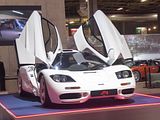
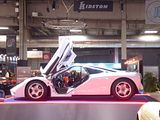
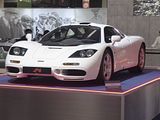
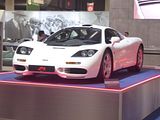
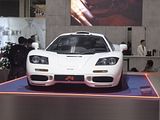
Also here was an example of the F1 GTR.
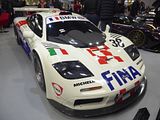
The McLaren P1 (codenamed P12) is a flagship sports car produced by British marque McLaren Automotive. Styled by American car designer Frank Stephenson, it is the second installment in McLaren’s Ultimate Series after the McLaren F1. Considered to be the spiritual successor to the F1, the P1 was one of the first high performance sports cars to be introduced incorporating hybrid technology; the Porsche 918 Spyder having begun taking orders prior to the P1 and the LaFerrari introduced alongside it. First shown as a concept on the 20th anniversary of the F1 at the 2012 Paris Motor Show, the P1 made its debut at the 2013 Geneva International Motor Show. In similar fashion to the F1, the P1 is mid-engined, rear wheel drive, and has a carbon fibre monocoque. Stephenson drew inspiration for parts of the car from a sailfish he saw when on holiday in Miami. In all, 375 units were produced, with several special editions such as the non-road legal P1 GTR and P1 LM among others having smaller production runs. Several pre-production prototypes utilised by McLaren for testing were later refurbished, modified and sold to customers. Following the conclusion of McLaren F1 production in 1998, McLaren Automotive (then McLaren Cars) became dormant until 2010. The McLaren 12C was McLaren’s first production car following the F1, introduced in 2011. With the 12C in production, McLaren announced in a press release in 2011 that a new factory (the McLaren Production Centre) had opened to ramp up production. Mentioned in the same press release were plans for several “game-changing high performance cars”. British automotive magazine Autocar reported earlier in the year that a new flagship model, internally designated the “Mega Mac”, was under development, with production set to be limited to 500 units. Other specifications included a 5 L litre V8 that was set to produce 799 hp (810 PS; 596 kW), and performance intended to rival that of the Bugatti Veyron. The first teaser was shown to the public in September 2012. Alongside a vague visual depiction of the car, British automotive magazine car reported that American designer Frank Stephenson was to be in charge of the exterior design of the P1, along with powertrain details. The engine was expected to be an upgraded version of the M838T engine found in the McLaren MP4-12C mated to a KERS system. The first actual photos of the P1 concept were revealed days later ahead of its public debut. A pre-production conceptual version of the P1 was shown at the 2012 Paris Motor Show, with further details of the performance of the P1. Aerodynamic performance was quoted at 600 kg (1,323 lb) of downforce “well below maximum speed”, a drag coefficient of Cd=0.34, and the revelation of the active aero components within the P1. Details about the P1’s powertrain were scant; American automotive magazine MotorTrend reported that according to McLaren insiders, the P1 was to have a plug-in hybrid powertrain. This was in line with earlier reports by British magazine car. The P1’s performance relative to the Veyron was also clarified, with McLaren having “no interest in out-Veyroning the Veyron”, instead the P1’s performance was to be more track-oriented. McLaren Automotive Managing Director Antony Sheriff echoed the sentiment at the P1’s Paris debut, saying that the P1’s aim “is not necessarily to be the fastest in absolute top speed but to be the quickest and most rewarding series production road car on a circuit”. The production version of the P1 was unveiled at the 2013 Geneva Motor Show. The P1 features a 3,799 cc twin-turbocharged V8 engine. The twin turbos boost the petrol engine at 1.4 bar (20.3 psi) to deliver 727 hp at 7,500 rpm and 531 lb⋅ft (720 N⋅m) of torque at 4,000 rpm, combined with an in-house-developed electric motor producing 132 kW (179 PS; 177 hp) and 192 lb⋅ft (260 N⋅m) of torque. The motor is the McLaren M838TQ. The basis of the M838TQ, the M838T in the MP4-12C, the predecessor of P1. The electric motor and the petrol engine in the P1, produce a combined power output of 674 kW (916 PS; 903 hp) and 900 N⋅m (664 lb⋅ft) of torque.[24] The electric motor can be deployed manually by the driver or left in automatic mode, whereby the car’s ECUs ‘torque fill’ the gaps in the petrol engine’s output, which is considered turbo lag. This gives the powertrain an effective powerband of almost 7,000 rpm. The car has rear mid-engine, rear-wheel-drive layout and is equipped with a 7-speed dual-clutch transmission developed by Graziano Trasmissioni. Power for the electric motor is stored in a 324-cell lithium-ion high-density battery pack located behind the cabin, developed by Johnson Matthey Battery Systems. The battery can be charged by the engine or through a plug-in equipment and can be fully charged in two hours. The car can be operated using either the petrol engine, the electric motor or with a combination of the two. The P1 has an all-electric range of at least 10 km (6.2 mi) on the combined European drive cycle. Under the EPA cycle, the range in EV mode is 19 mi (31 km). During EV mode the P1 has a petrol consumption of 4.8g/100 mile, and as a result, EPA’s all-electric range is rated as zero. The total range is 330 mi (531 km). The P1 combined fuel economy in EV mode was rated by the EPA at 18 MPGe (13 L petrol equivalent/100 km; 22 mpg-imp petrol equivalent), with an energy consumption of 25 kW-hrs/100 mi and petrol consumption of 4.8 gal-US/100 mi. The combined fuel economy when running only with petrol is 17 mpg‑US (14 L/100 km; 20 mpg‑imp), 16 mpg‑US (15 L/100 km; 19 mpg‑imp) for city driving, and 20 mpg‑US (12 L/100 km; 24 mpg‑imp) in highway. The P1 has Formula 1 derived features such as the Instant Power Assist System (IPAS), which gives an instant boost in acceleration via the electric motor, a Drag Reduction System (DRS) which operates the car’s rear wing, thereby increasing straight line speed, and a KERS. Both of these features (IPAS, DRS) are operated via two buttons on the steering wheel. It also generates a downforce of 600 kg at 257 km/h (160 mph) and it boasts of a drag coefficient of only Cd=0.34. According to McLaren the P1 accelerates from 0–100 km/h (0–62 mph) in 2.8 seconds, 0–200 km/h (0–124 mph) in 6.8 seconds, and 0–300 km/h (0–186 mph) in 16.5 seconds, making it a full 5.5 seconds faster than the F1, and a standing quarter mile is claimed in 9.8 seconds at 245 km/h (152 mph). Autocar tested 0–60 mph (0–97 km/h) mph in 2.8 seconds, 0–120 mph (0–193 km/h) mph in 6.9 seconds, the standing quarter mile in 10.2 seconds at 147.5 mph (237 km/h), and the standing kilometre in 18.2 seconds at 178.5 mph (287 km/h). In electric only mode 0-60 mph in 10 seconds. The P1 is electronically limited to a top speed of 350 km/h (217 mph). The P1 has a dry weight of 1,395 kg (3,075 lb), giving it a power-to-weight ratio of 656 PS/tonne. It has a kerb weight of 1,547 kg (3,411 lb) which translates to 601 PS/ tonne. The P1 also features bespoke Pirelli P-Zero Corsa tyres and specially developed carbon-ceramic rotor, caliper and brake pads from Akebono. According to McLaren it takes 6.2 seconds to brake from 300 km/h (186 mph) to standstill, during which the car will cover 246 metres. From 60 mph (97 km/h), it will cover 30.2 metres. In August 2013 McLaren announced that the production allocation destined to the Americas, Asia-Pacific and the Middle East was sold out. The cars destined for Europe were sold out by mid November 2013. The United States accounted for 34% of the limited production run, and Europe for 26%. After some delays, production began in October 2013. Hand-assembled by a team of 61 engineers, at a production rate of one car per day McLaren production was planned for fifty cars by the end of 2013. The first delivery to a retail customer took place at the company’s headquarters in Woking, England, in October 2013, with 12 units manufactured by mid November 2013. The first P1 delivery in the U.S. occurred in May 2014. The production run ended in December 2015
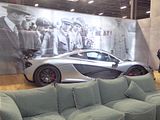
Unveiled on 3 March 2020, the 765LT is a track-focused version of the 720S and the successor to the 675LT as a Super Series Longtail car. The M840T engine is now rated at 765 PS (755 bhp) at 7,500 rpm and 590 lb/ft (800 Nm) of torque at 5,500 rpm achieved with a higher-capacity fuel pump, forged aluminium pistons and a three-layer head gasket from the Senna. The top speed is lowered from the 720S’s 341 km/h (212 mph) to 330 km/h (205 mph) due to added drag created by the added high downforce parts, although the 765LT weighs 80 kg (176 lb) less than the 720S at 1,339 kg (2,952 lb) in its lightest configuration and has a quicker 0-100 km/h (0-62 mph) time of 2.8 seconds. It also can hit 0-200 km/h (0-124 mph) in 7.0 seconds and complete a quarter-mile dash in 9.9 seconds according to McLaren. The Senna’s brake callipers are also available as an extra-cost option; McLaren claims these have four times the thermal conductivity as conventional carbon ceramics, while Pirelli Trofeo R tyres are standard. Suspension changes involve a 5 mm (0.2 in) reduction in ride height and the use of lightweight main springs with secondary “helper” units as well as an upgraded Proactive Chassis Control system. The aerodynamics are redesigned to produce 25% more downforce than the 720S, featuring front fender vents, a larger front splitter and a longer active wing element at the rear at the cost of less noise insulation, thinner-gauge glass and stiffened engine mounts. The rear of the car also features a quad-exit full titanium exhaust to distinguish it from the 720S. Production was limited to 765 cars globally with customer deliveries in October 2020
MERCEDES-BENZ
Oldest Mercedes here was this Mercedes-Simplex 28/32 HP of 1904. Produced from 1904 to 1909, this was a high-performance luxury vehicle featuring a 5.3-liter four-cylinder engine producing 32 hp at 1,200 rpm. It featured a 4-speed transmission, chain drive, and a top speed of roughly 60 km/h. This model represented a major shift towards more reliable, accessible, and faster automotive technology, often featuring rear-entrance tonneau bodies. The engine is a 4-cylinder, 4-stroke engine with a 110 mm bore and 140 mm stroke, totalling 5,322cc, rated for 32 hp at 1,200 rpm, with a top speed of 60 km/h (37 mph). The transmission is a 4-speed manual gearbox with a coil spring clutch and chain drive to the rear wheels. It utilized a “T-head” engine configuration, two lateral camshafts, a piston-type carburettor, and a magneto-based ignition system. The “Simplex” name, used until 1905 before being renamed the 35 hp model, indicated the relative ease of operation compared to earlier, more complex, and finicky automobiles. The 28/32 HP was considered a robust, high-end, and prestigious vehicle, often used for touring, and is a notable participant in the London to Brighton Veteran Car Run.
Ferdinand Porsche moved from Daimler’s Austrian subsidiary to company headquarters in Stuttgart to replace Paul Daimler as chief designer in 1922. His first task was to develop a new supercharged engine for Mercedes’ top of the range models, which at the time were still powered by big and heavy airplane engines. Following his brief, Porsche created a new six cylinder engine that was available with a displacement of either 4 or 6.3 litre. The new engines’ first application was in big, heavy chassis that really were no match for the powerful ‘sixes’ in terms of both handling and braking. A racer at heart, Porsche was eager to develop a chassis that his engine more justice. Sadly resources were limited at the time but he did manage to create the 630 K (for Kurz or short). As the name suggested, this combined the largest of the two engine with a shortened version of the chassis that in its original form had been large enough to carry 7-passenger limousine bodies. Additional funds finally did become available following the merger of Daimler and Benz in 1926. Porsche wasted no time and set about developing a brand new chassis that would do ‘his’ engine more justice. The new car was based around a pressed-steel ladder frame that kicked up over both the front and rear axle. This allowed for a much lower ride-height than the earlier Mercedes models. The suspension itself was of a conventional design with leaf springs and friction dampers on all four corners. The stopping power was provided by large servo-assisted drum brakes. For this new application, the straight six was also further developed and enlarged to just shy of 6.8 litre. The sophisticated engine featured an aluminium alloy block with a cast-iron head. A single overhead camshaft was fitted, which driven by a shaft at the rear of the engine. Mounted vertically at the front of the engine was a Roots-type supercharger. This was only engaged when the accelerator pedal was pressed to the floor. It was advised to use the supercharger for no more than 15 seconds for reliability reasons. Once engaged, it freed up around 180 – 225 bhp depending on the tune of the engine.Dubbed the 680 S, for Sport, the new Mercedes-Benz debuted at the June 1927 opening race at the Nürburgring. Fitted with a simple four-seater body and a high compression / high boost engine, the 680 S proved a race winner straight out of the box, winning the first ever race at the now legendary circuit as well as the German Grand Prix soon after. The new Mercedes-Benz not only impressed with its undeniable pace but also stood out from the rest of the field thanks to the glorious whine produced once the supercharger was engaged. Soon after its victorious debut, the 680 S entered series production. It was available with factory or ‘Sindelfingen’ coachwork or as a rolling chassis ready to receive the custom body of the client’s choice. Thanks to the relatively low chassis, the new Mercedes-Benz was a popular subject for the time’s finest designers like Jacques Saoutchik. Even with the ‘standard’ coachwork, the 680 S was a striking machine in part due to the remarkably long engine cover. By the end of 1928, Mercedes-Benz had produced close to 150 examples of the 680 S. At that time it was replaced by the slightly larger engined 710 ss. Further derivatives include the ssK and ssKL competition cars, which used a shorter chassis. Known as the ‘White Elephants’, the supercharged range that kicked off with the 680 S ranks among the finest and most desirable produced by Mercedes-Benz.
The Mercedes-Benz 500K (W29) is a grand touring car built by Mercedes-Benz between 1934 and 1936. First exhibited at the 1934 Berlin Motor Show. It is distinguished from the 500 sedan by the “K” for Kompressor (German for supercharger). it succeeded the Mercedes-Benz 380 introduced the previous year, It offered both a larger, more powerful engine and more opulent coachwork to meet customers’ demands for greater luxury and performance. The 500K used the same independent suspension as had been introduced on the 380, with a double wishbone front axle, double-joint swing axle at the rear, and separate wheel location, coil springs and damping, a world first. Consequently, it was a more comfortable and better handling car than Mercedes’ previous S/SS/SSK generation of roadsters from the 1920s, and offered greater appeal to buyers, particularly the growing number of well-heeled female drivers of the time. Pressing the throttle pedal fully engaged the Roots supercharger, inducing the five litre straight-eight engine to produce up to 160 hp and making the car capable of over 160 kilometres per hour (100 mph), while consuming fuel at the rate of up to 30 L/100 km (9.4 mpg‑imp; 7.8 mpg‑US) as it did so. Three different chassis and eight bodies were available for customers; the two longer “B” and “C” four-seat cabriolet versions rode on a wheelbase of 3,290 mm (129.5 in), and would later be used on other sedan and touring car models. The short “A” chassis, with a 2,980 mm (117.3 in) wheelbase, underpinned the two-seater models: the Motorway Courier, and the 1936 Special Roadster which offered the highest performance. All models featured such advanced equipment as safety glass, hydraulic brakes, and a 12-volt electrical system sufficient to bear the load of the electric windscreen wipers, door locks, and indicators. Of the combined production of the 500K (342 cars), including 29 “Special Roadsters” during its two years in production, and the later 540K (419 cars) from Sindelfingen, the deliveries were: 70 chassis without body; 28 open cars (offener Tourenwagen); 23 sedans with 4 doors (mainly 500K); 29 sedans with 2 doors (mainly 540K); 2 Coupés; 6 Autobahn cruisers (Autobahn-kurier); 58 Roadsters; 116 Cabriolets A; 296 Cabriolets B; 22 Cabriolets C.
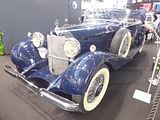
The Mercedes-Benz 540K (W29) is a grand touring car built by the German firm Mercedes-Benz between 1936 and 1940. Introduced at the 1936 Paris Motor Show, the Friedrich Geiger designed car was a development of the 500K, itself a development of the SSK. Available as a both a two- and four-seat cabriolet, four seater coupé or seven seater limousine (with armoured sides and armoured glass), the 540K was one of the largest cars of its time, and it retailed for 28,000 RM in 1936. The straight-8 cylinder engine of the 500K was enlarged in displacement to 5,401 cc. It was fed by twin pressurized updraft carburettors, developing 115 hp. In addition, there was an attached Roots supercharger, which could either be engaged manually for short periods, or automatically when the accelerator was pushed fully to the floor. This increased power to 180 hp, enabling a top speed of 170 kilometres per hour (110 mph). Power was sent to the rear wheels through a four-speed or optional five-speed manual gearbox that featured synchromesh on the top three gears. Vacuum-assisted hydraulic brakes kept the car under the driver’s control. The 540K had the same chassis layout as the 500K, but it was significantly lightened by replacing the girder-like frame of the 500K with oval-section tubes – an influence of the Silver Arrows racing campaign. To meet individual wishes of customers, three chassis variants were available, as for the 500K: two long versions with a 3,290 mm (130 in) wheelbase, differing in terms of powertrain and bodywork layout; and a short version with 2,980 mm (117 in). The long variant, termed the normal chassis with the radiator directly above the front axle, served as the backbone for the four-seater cabriolets, the ‘B’ (with four side windows) and ‘C’ (with two side windows), and for touring cars and saloons. The shorter chassis was for the two-seater cabriolet ‘A’, set up on a chassis on which radiator, engine, cockpit and all rearward modules were moved 185 mm (7.3 in) back from the front axle. As usual with Mercedes cars of this period the Sindelfingen factory provided in-house coach work, and employed 1,500 people to create the 540K, thus allowing for a great deal of owner customisation, meaning only 70 chassis were ever bodied by independent builders. Owners included Jack L. Warner of Warner Brothers film studios. With the outbreak of World War II in 1939, the proposed further boring-out of the engine to 5,800 cubic centimetres (5.8 L) for a 580K was aborted, probably after only one such car was made. Chassis production ceased in 1940, with the final 2 being completed that year, and earlier chassis were still being bodied at a steady rate during 1940, with smaller numbers being completed in the 1941–1943 period. Regular replacement bodies were ordered in 1944 for a few cars.
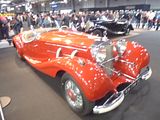
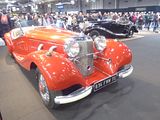
The Mercedes-Benz W 142 (Mercedes-Benz Typ 320) was a six-cylinder passenger car launched in February 1937, as a successor to the Mercedes-Benz Typ 290 (Mercedes-Benz W 18). The car was known by its name Typ 320 at the time of its production and service, but is in retrospect commonly referred to using its Mercedes-Benz works number, “W142”, which gives a more unambiguous, unique nomenclature. The standard-wheelbase version of the W142 shared its 2,880 mm (113 in) wheelbase with the standard versions of its predecessor, but a more streamlined form with longer overhangs meant that even in this form the W142 was substantially longer and indeed wider than the earlier car. The front grill was gently raked backwards, and there was no longer a bar in front of it to carry lights, all of which gave the car a more sporting look than the model it replaced. Power came from a newly enlarged, 3,208 cc side-valve, straight-six engine with a listed maximum output of 78 PS at 4,000 rpm, supporting a claimed top speed of 130 km/h (81 mph). This was delivered to the rear wheels via a four-speed manual transmission which, unusually in the 1930s, incorporated synchromesh on all four ratios. The footbrake used a hydraulic control mechanism and operated on all four wheels. The suspension set-up was carried over from the W18 with a swing axle at the rear and the front axle suspended with a central transverse leaf spring and coil springs beside the wheels. Customers wishing to make their own arrangements in respect of bodywork could buy a standard-wheelbase W142 in base chassis form at the manufacturer’s listed price of 6,500 Marks. Otherwise the choice of standard bodies was restricted to a three-seat cabriolet (known as the “Cabriolet A”) or a coupé-bodied equivalent with a removable roof, priced respectively at 11,800 Marks or 12,300 Marks. Longer-bodied cars came with an extra 420 mm (16.5 in) of wheelbase, and Mercedes-Benz offered a choice from a wide range of standard body options for the longer cars. Customers happy to make their own arrangements in respect of bodywork could buy a longer-wheelbase W142 in base chassis form at the manufacturer’s listed price of 6,800 Marks, or 300 Marks more than the price of the shorter chassis. The entry-level model with a Mercedes-Benz body included in the price was the four-door ”Limousine” (sedan/saloon) at 8,950 Marks. There were no fewer than four cabriolet-bodied versions of the longer-wheelbase car offered, being a two-door 2/3-seater (“Cabriolet A”), a two-door 4-seater with four side-windows (“Cabriolet B”), a four-door 4-seater (“Cabriolet D”) and a very substantial-looking four-door 6-seater with three rows of seats (“Pullman-Cabriolet F”). Other soft-topped standard-bodied versions were a Torpedo-bodied 6-seater “Tourenwagen” and a sporty 2-seater Roadster. There was also a six-seater “Pullman-Limousine” with three rows of seats and six side windows under a conventional steel roof. The rear seat of the Pullman-bodied cars was above the back axle, and an extra luggage locker at the back left the overall length of the Pullman-Limousine at 5,250 mm (206.7 in), still using the 3,300 mm (129.9 in) wheelbase. The highest listed price for a Mercedes-Benz-bodied W142 was 14,500 Marks for a “Stromlinien-Limousine”, featuring a strikingly modern, streamlined steel body.
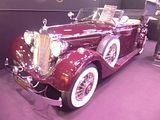
Known under development as the W198, the first iteration of the SL-Class grand tourer was the fastest production car of its day. Introduced in 1954 as a two-seat coupé with distinctive gull-wing doors, it was later offered as an open roadster. Built by Daimler-Benz AG, the direct fuel injected production model was based on the company’s highly successful yet somewhat less powerful carburettor overhead cam straight 6 1952 racer, the W194. The idea of a toned-down Grand Prix car tailored to affluent performance enthusiasts in the booming post-war American market was suggested by Max Hoffman. Mercedes accepted the gamble and the new 300 SL – 300 for its 3.0 litre engine displacement and SL for Sport Leicht (Sport Light) – was introduced at the 1954 New York Auto Show rather than the Frankfurt or Geneva gatherings company models made their usual debuts. Immediately successful and today iconic, the 300 SL stood alone with its distinctive doors, first-ever production fuel injection, and world’s fastest top speed. Even with the upward opening doors, the 300 SL had an unusually high sill, making entry and exit from the car’s cockpit problematic. A steering wheel with a tilt-away column was added to improve driver access. The 300 SL’s main body was steel, with aluminium bonnet, doors and boot lid. It could also be ordered with an 80 kg (180 lb) saving all-aluminium outer skin at tremendous added cost; just 29 were made. Like the W194, the 300 SL borrowed its 3.0 litre overhead cam straight-6 from the regular four-door 300 (W186 “Adenauer”) luxury tourer introduced in 1951. Featuring an innovative diagonal aluminium head that allowed for larger intake and exhaust valves, it was canted to the right at forty-five-degrees to fit under the SL’s considerably lower bonnet line. In place of the W194’s triple two-barrel Solex carburettors, a groundbreaking Bosch mechanical direct fuel injection was installed, boosting power almost 25% over the Grand Prix car’s. Derived from the DB 601 V12 used on the Messerschmitt Bf 109E fighter of World War II, it raised output from 175 hp to 215 hp, almost double that of the original Type 300 sedan’s 115 hp. An optional, even more powerful version, with radical camshaft developed 240 hp @ 6100 rpm and a maximum torque of 217 lb⋅ft @ 4800 rpm, but was rough for city use. The result was a top speed of up to 260 km/h (160 mph) depending on gear ratio and drag, making the 300 SL the fastest production car of its time. However, unlike today’s electrically powered fuel injection systems, the 300 SL’s mechanical fuel pump would continue to inject gasoline into the engine during the interval between shutting off the ignition and the engine’s coming to a stop; this unburned gasoline washed lubricating oil from the cylinder walls, which not only left them unprotected in affected areas during start-up but would dilute the engine’s entire oil supply if the car was not driven hard or long enough to reach a sufficient temperature to evaporate the fuel out of the oil. Exacerbating the problem was the engine’s large racing-oriented oil cooler and enormous 10 litre oil capacity, which virtually guaranteed the oil would not get hot enough. In practice, many owners would block off airflow through the oil cooler and stick rigidly to the appropriately low 1,000 mile recommended oil change interval. An auxiliary fuel pump provided additional fuel for extended high speed operation or cold starts; overuse would also lead to dilution of the oil., Clutch operation was initially very heavy, remedied by an improved clutch arm helper spring which reduced pedal force. From March 1963 to the end of production later that year, a light alloy crankcase was used on a total of 209 vehicles. Aerodynamics played an important role in the car’s speed, with Mercedes-Benz engineers placing horizontal “eyebrows” over the wheel openings to reduce drag. Unlike many cars of the 1950s, steering was relatively precise and the four-wheel independent suspension allowed for a reasonably comfortable ride and markedly better overall handling. However, the rear swing axle, jointed only at the differential, not at the wheels themselves, could be treacherous at high speeds or on imperfect roads due to extreme changes in camber. The enormous fuel tank capacity also caused a considerable difference in handling depending on the quantity of fuel on board. More than 80% of the vehicle’s total production of approximately 1400 units were sold in the US, making the Gullwing the first Mercedes-Benz widely successful outside its home market and thoroughly validating Hoffman’s prediction. The 300 SL is credited with changing the company’s image in America from a manufacturer of solid but staid luxury automobiles to one capable of rendering high-performance sports cars. It should be noted initial sales were sluggish due to many things, of which the price was one. Initial prices were about $6,400, a new Chevrolet Bel-Air could be purchased for $1,700 in the same year. Then there were few mechanics, even at the dealers, who understood the fuel injection system enough to do repairs. Nonetheless, 1400 were built by 1957, at which point Mercedes introduced a roadster version which was broadly similar, but with conventional doors. It was produced until 1963, and achieved sales of 1858 units.
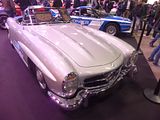
Produced between May 1955 and February 1963, having first been seen in prototype at the 1954 New York Auto Show, the 190SL was designed as a more affordable sports car than the exclusive and rather pricey 300SL, sharing its basic styling, engineering, detailing, and fully independent suspension. While both cars had double wishbones in front and swing axles at the rear, the 190 SL did not use the 300 SL’s purpose-built W198 tubular spaceframe. Instead, it was built on a shortened monocoque R121 platform modified from the W120 saloon. The 190 SL was powered by a new, slightly oversquare 105 PS Type M121 1.9 litre four cylinder engine. Based on the 300 SL’s straight six, it had an unchanged 85 mm bore and 4.3 mm reduced 83.6 mm stroke, was fitted with twin-choke dual Solex carburettors, and produced 120 gross hp. In detuned form, it was later used in the W120 180 and W121 190 models. Both the 190 SL and the 300 SL were replaced by the Mercedes-Benz 230SL in 1963.
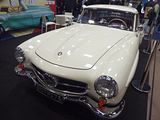
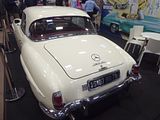
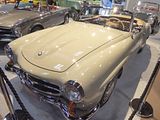
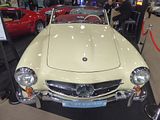
The Mercedes range of the 1960s was quite complex, with body styles and mechanical updates proceeding at a different rate, and even by referring to the cars by their internal development codes (the “W” number), they are still quite hard to define unambiguously. In the W111 family, the Coupe was the first to appear, a replacement for the two-door W120 “Ponton” models, and work on it began in 1957. Since most of the chassis and drivetrain were to be unified with the sedan, the scope was focused on the exterior styling. Some of the mockups and prototypes show that Mercedes-Benz attempted to give the two-door car a front styling almost identical to what would be realised in the Pagoda (W113), but ultimately favoured the work of engineer Paul Bracq. The rear featured small tailfins, subtle compared to the fintails’ and evocative of the later squarish styling of the W108/W109. Production began in late 1960, with the coupe making its debut at the 75th anniversary of the opening of Mercedes-Benz Museum in Stuttgart in February of the next year. The convertible followed at the Frankfurt Auto Show a few months later. Almost identical to the coupe, its soft-top roof folded into a recess behind the rear seat and was covered by a tightly fitting leather “boot” in the same colour as the seats. Unlike the previous generation of two-door ponton series, the 220SE designation was used for both the coupe and convertible; both received the same version of the 2195 cc M127 engine. Options included a sliding sunroof for the coupe, automatic transmission, power steering, and individual rear seats. In March 1962, Mercedes-Benz released the exclusive two-door M189-powered 300SE. Like the 300 sedan, it was based on the W111 chasis but shared both Daimler’s top-range 2996 cc fuel-injected engine and the unique W112 chassis designation, efforts on Mercedes’ part to distance it from the maker’s modest W110 and W111 lineups and link it to the prestigious W188 300S two-door luxury sports tourer. It was distinguished by a chrome strip, and featured air suspension and a higher level of interior trim and finish. In summer of 1965, Mercedes-Benz launched replacements for both W111 and W112 sedans, the W108 and W109 respectively. With the tailfin fashion well eroded by the mid 1960s, the new design was based on the restrained W111 coupe, widened and squared off. Work on a future new chassis that would fully replace the Ponton-derived W111/W112 and W108/W109 was well under way. With a concept car of the first S-Class shown in 1967, Daimler declined to develop a two-door W108/W109 vehicle, instead continuing production of the aging W111/W112 with modest changes. The 220SE was superseded in early autumn 1965 by the 250SE, which featured the new 2496cc M129 engine. Producing 150 hp. it gave the vehicle a significant improvement in top speed, to 120 mph. Visibly the only changes affected the new 14-inch rims, which came with new hub cabs and beauty rings accommodating the larger disk brakes and new rear axle from the W108 family. In November 1967 the 250 SE was superseded by the 280 SE. It was powered by the new 2778 cc M130 engine, which produced 160 hp. The top speed was hardly affected, but acceleration improved to 10.5 seconds. Inside the car received a wood veneer option on the dashboard and other minor changes, including door lock buttons and different heater levers. The hubcaps were changed yet again to a new one piece wheelcover, and the exterior mirror was changed. Despite its smaller engine, the 280 SE could outperform the early 1950s M189 powered 300 SE, resulting in the more expensive model’s retirement. The coupe and cabriolet retained their shared model model designation until replaced by a new-generation chassis in 1968. A final model was added in August 1969, the 280 SE 3.5. The car was fitted with the brand-new M116 3499 cc V8. It produced 200 hp, and had a top speed of 130 mph and a 0-100 km/h at 9.5 seconds. To accommodate the large engine, the car’s front grille was widened; front and rear bumpers were also modified with the addition of rubber strips. The rear lenses changed to a flatter cleaner design. This change was carried across the standard 280 SE. As the top of its range, the 280 SE 3.5 is seen as an ideological successor to the W112 300 SE, though it lacked the W112’s air suspension. The last 280 SE was produced in January 1971, with the 280 SE 3.5 ending in July. The total production over the decade was: 220 SEb – 16,902, 250 SE – 6,213, 280 SE – 5,187, and 280 SE 3.5 – 4,502 units. Not including 3,127 W112 300 SE models, the grand total of 2-door W111 models was 32,804 of which 7,456 were convertibles. These days the cars are much sought after and prices, especially for the convertible, are high and still rising.
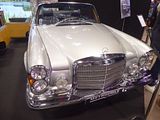
By 1955, Mercedes-Benz Technical Director Prof. Fritz Nallinger and his team held no illusions regarding the 190 SL’s lack of performance, while the high price tag of the legendary 300 SL supercar kept it elusive for all but the most affluent buyers. Thus Mercedes-Benz started evolving the 190 SL on a new platform, model code W127, with a fuel-injected 2.2 litre M127 inline-six engine, internally denoted as 220SL. Encouraged by positive test results, Nallinger proposed that the 220SL be placed in the Mercedes-Benz program, with production commencing in July 1957. However, while technical difficulties kept postponing the production start of the W127, the emerging new S-Class W112 platform introduced novel body manufacturing technology altogether. So in 1960, Nallinger eventually proposed to develop a completely new 220SL design, based on the “fintail” W 111 sedan platform with its chassis shortened by 11.8 in, and technology from the W112. This led to the W113 platform, with an improved fuel-injected 2.3 litre M127 inline-six engine and the distinctive “pagoda” hardtop roof, designated as 230 SL. The 230 SL made its debut at the prestigious Geneva Motor Show in March 1963, where Nallinger introduced it as follows: “It was our aim to create a very safe and fast sports car with high performance, which despite its sports characteristics, provides a very high degree of travelling comfort”. The W113 was the first sports car with a “safety body,” based on Bela Barényi’s extensive work on vehicle safety: It had a rigid passenger cell and designated crumple zones with impact-absorbing front and rear sections built into the vehicle structure. The interior was “rounded,” with all hard corners and edges removed, as in the W111 sedan. Production of the 230 SL commenced in June 1963 and ended on 5 January 1967. Its chassis was based on the W 111 sedan platform, with a reduced wheelbase by 11.8 in, recirculating ball steering (with optional power steering), double wishbone front suspension and an independent single-joint, low-pivot swing rear-axle with transverse compensator spring. The dual-circuit brake system had front disc brakes and power-assisted rear drum brakes. The 230 SL was offered with a 4-speed manual transmission, or an optional, very responsive fluid coupled (no torque converter) 4-speed automatic transmission, which was popular for US models. From May 1966, the ZF S5-20 5-speed manual transmission was available as an additional option, which was particularly popular in Italy. The 2,308 cc M127.II inline-six engine with 150 hp and 145 lb/ft torque was based on Mercedes-Benz’ venerable M180 inline-six with four main bearings and mechanical Bosch multi-port fuel injection. Mercedes-Benz made a number of modifications to boost its power, including increasing displacement from 2,197 cc, and using a completely new cylinder head with a higher compression ratio (9.3 vs. 8.7), enlarged valves and a modified camshaft. A fuel injection pump with six plungers instead of two was fitted, which allowed placing the nozzles in the cylinder head and “shooting” the fuel through the intake manifold and open valves directly into the combustion chambers. An optional oil-water heat exchanger was also available. Of the 19,831 230 SLs produced, less than a quarter were sold in the US. Looking identical, the 250 SL was introduced at the 1967 Geneva Motor Show. Production had already commenced in December 1966 and ended in January 1968. The short one-year production run makes the 250 SL the rarest of the W113 series cars. The 250 SL retained the stiffer suspension and sportier feel of the early SLs, but provided improved agility with a new engine and rear disc brakes. Range also improved with increased fuel tank capacity from 65 litres to 82. Like its predecessor, the 250 SL was offered with a 4-speed automatic transmission, and 4-speed or ZF 5-speed manual transmissions. For the first time, an optional limited slip differential was also available. The main change was the use of the 2,496 cc M129.II engine with a larger stroke, increased valve ports, and seven main bearings instead of four. The nominal maximum power remained unchanged at 150 hp, but torque improved from 145 lb/ft to 159 lb/ft. Resiliency also improved with a new cooling water tank (“round top”) with increased capacity and a standard oil-water heat exchanger. The 250 SL also marked the introduction of a 2+2 body style, the so-called “California Coupé”, which had only the removable hardtop and no soft-top: a small fold-down rear bench seat replaced the soft-top well between passenger compartment and boot. It is estimated that only 10% of the 250SLs that were brought into America were California Coupes. Of the 5,196 250 SLs produced, more than a third were sold in the US.The 280 SL was introduced in December 1967 and continued in production through 23 February 1971, when the W 113 was replaced by its successor, the entirely new and substantially heavier R107 350 SL. The main change was an upgrade to the 2,778 cc M130 engine with 170 hp and 180 lb/ft, which finally gave the W 113 adequate power. The performance improvement was achieved by increasing bore by 4.5 mm (0.2 in), which stretched the limits of the M180 block, and required pairwise cylinder casts without cooling water passages. This mandated an oil-cooler, which was fitted vertically next to the radiator. Each engine was now bench-tested for two hours prior to being fitted, so their power specification was guaranteed at last. The M130 marked the final evolution of Mercedes-Benz’ venerable SOHC M180 inline-six, before it was superseded by the entirely new DOHC M110 inline-six introduced with R107 1974 European 280 SL models. For some time, it was also used in the W 109 300 S-Class, where it retired the expensive 3 liter M189 alloy inline-six. Over the years, the W 113 evolved from a sports car into a comfortable grand tourer, and US models were by then usually equipped with the 4-speed automatic transmission and air conditioning. Manual transmission models came with the standard 4-speed or the optional ZF 5-speed, which was ordered only 882 times and thus is a highly sought-after original option today. In Europe, manual transmissions without air conditioning were still the predominant choice. Of the 23,885 280 SLs produced, more than half were sold in the US.
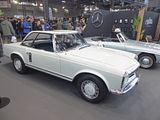
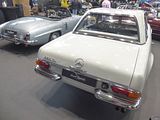
This one comes from the W108 family. The car’s predecessor, the Mercedes-Benz W111 (produced 1959–1971) helped Daimler develop greater sales and achieve economy of scale production. Whereas in the 1950s, Mercedes-Benz was producing the coachwork 300 S and 300 SLs and all but hand-built 300 Adenauers alongside conveyor assembled Pontons (190, 190SL and 220) etc., the fintail (German: Heckflosse) family united the entire Mercedes-Benz range of vehicles onto one automobile platform, reducing production time and costs. However, the design fashion of the early 1960s changed. For example, the tail fins, originally intended to improve aerodynamic stability, died out within a few years as a fashion accessory. By the time the 2-door coupé and cabriolet W111s were launched, the fins lost their chrome trim and sharp appearance, the arrival of the W113 Pagoda in 1963 saw them further buried into the boot’s contour, and finally disappeared on the W100 600 in 1964. The upgrade of the W111 began under the leadership of designer Paul Bracq in 1961 and ended in 1963. Although the fins’ departure was the most visible change, the W108 compared to the W111 had a lower body waist line that increased the window area, (the windscreen was 17 percent larger than W111). The cars had a lower ride (a decrease by 60 mm) and wider doors (+15 mm). The result was a visibly new car with a more sleek appearance and an open and spacious interior. The suspension system featured a reinforced rear axle with hydropneumatic compensating spring. The car sat on larger wheels (14”) and had disc brakes on front and rear. The W109 was identical to the W108, but featured an extended wheelbase of 115 mm (4.5 in) and self-levelling air suspension. This was seen as a successor to the W112 300SEL that was originally intended as an interim car between the 300 “Adenauer” (W189) and the 600 (W100) limousines. However, its success as “premium flagship” convinced Daimler to add an LWB car to the model range. From that moment on, all future S-Class models would feature a LWB line. Although the W108 succeeded the W111 as a premium range full-size car, it did not replace it. Production of the W111 continued, however the 230S was now downgraded to the mid-range series, the Mercedes-Benz W110, and marketed as a flagship of that family until their production ceased in 1968. The W108 is popular with collectors and the most desirable models to collect are the early floor shift models with the classic round gear knob and the 300 SEL’s. The car was premièred at the Frankfurt Auto Show in 1965. The initial model lineup consisted of three W108s: 250S, 250SE, and 300SE, as well as a sole W109, the 300SEL. Engines for the new car were carried over from the previous generation, but enlarged and refined. The 250S was the entry-level vehicle fitted with a 2496 cm³ Straight-six M108 engine, with two dual downdraft carburettors, delivering 130 bhp at 5400 rpm which accelerated the car to 100 km/h (62 mph) in 13 seconds (14 on automatic transmission) and gave a top speed of 182 km/h (177 on auto). The 250SE featured an identical straight-six, but with a six-plunger fuel injection (designated M129) with performance improved to 150 bhp at 5500 rpm, which decreased 0-100 acceleration by one second and increased top speed by 11 km/h (7 mph) for both manual and automatic versions. Both the 300SE and 300SEL came with the M189 2996 cm³ engine, originally developed for the Adenauers. It had a modern six-plunger pump that adjusted automatically to accelerator pedal pressure, engine speed, atmospheric pressure, and cooling water temperature, to deliver the proper mixture depending on driving conditions. Producing 170 bhp at 5,400 rpm the cars could accelerate to 200 km/h (195 km/h with automatic transmission) and reach 100 km/h (62 mph) in 12 seconds. The cylinder capacity of the three litre Mercedes engine was unchanged since 1951. From 1965 to 1967, fewer than 3,000 W109s were produced. However, approximately 130,000 of the less powerful 250 S/SE models were built during the first two years of the W108/109’s existence. By 1967 the fuel consumption of the 3 litre unit in this application was becoming increasingly uncompetitive.
Still very imposing is this example of the 600 model, a high-end large luxury sedan and limousine produced by Mercedes-Benz from 1963 to 1981. Generally, the short-wheel-base (SWB) models were designed to be owner-driven, the long-wheel-base (LWB), often incorporating a central divider with power window, by a chauffeur. The forerunner of the modern Maybach marque, the 600 “Grosser Mercedes” (“Grand Mercedes”) succeeded the Type 300 “Adenauer” as the company’s flagship and most expensive model. Positioned well above the 300-series Mercedes-Benz W112. Its few competitors included certain models of Rolls-Royce and Bentley, the Cadillac Fleetwood 75, stretched Lincoln Continental Lehmann-Peterson, and the Chrysler Imperial Crown Ghia. The 600 marked the last super-luxury model the brand produced in an unbroken line with its demise in 1981 since the model 60 hp Simplex from 1903. The 600 came in two main variants: a short wheelbase 4-door sedan, available with a power divider window separating the front seats from the rear bench seat, although most were built without this feature; along wheelbase 4-door Pullman limousine (with two additional rear-facing seats separated from the driver compartment by a power divider window, of which 304 were built), and a 6-door limousine (with two forward-facing jump-seats at the middle two doors and a rear bench-seat). A number of the Pullman limousines were made as landaulets, with a convertible top over the rear passenger compartment. Two versions of the convertible roof were made- long roof, and short roof. Of them, the short roof, which opens only above the last, third row of seats, is the more common version. Rarer, especially by the 6 door Landaulets, is the long roof, called- Presidential Roof. In all, 59 Pullman Landaulets were produced, and of them, only 26 were 6 door landaulets. And of these 26, only very few- 9, were 6 doors Landaulets with the long Presidential type opening roof. One of these 9 cars was used by the former Yugoslavian president Josip Broz Tito. Landaulets like these were notably used also by the German government, as during the 1965 state visit of Queen Elizabeth II. Also the Vatican, in addition to a elongated Mercedes 300 type D, 4 door convertible, have used for the Pope, specially ordered 4 door Pullman Convertible, which now resides in the Mercedes Benz Factory Museum. Production of the Landaulet versions of 600 model, ended in 1980. Mercedes also made two coupés, one as a gift for retiring long-time Mercedes chief designer Rudolf Uhlenhaut, and the other to Fritz Nallinger. head of Research and development centre of Mercedes in the 50s and 60s. These cars had a wheelbase 22 cm (8.6 inches) shorter than the SWB sedan. A third was much later constructed by 600 experts and restorers Karl Middelhauve & Associates of Wausau, Wisconsin from a SWB sedan. Karl Middelhauve has also created a pair of matching Chevrolet El Camino-style coupes from 600 SWB sedans. One of them has a Vortech supercharger. Some purists question the reason for modifying a classic such as an original 600 into a modified vehicle, while other purists think Karl is extending function in the true spirit of the “Grosser” Mercedes. A single example of a SWB 4-door landaulet, combining the handling of a short-wheelbase with the qualities of a landaulet, was built by Mercedes in 1967 for former racing driver Count von Berckheim. The 600’s great size, weight, and numerous hydraulically driven amenities required more power than Mercedes’ largest engine at that time, the 3-litre 6-cylinder M189, could produce. A new V8 with more than twice the capacity was developed, the 6.3 L M100. It featured single overhead camshafts (SOHC) and Bosch mechanical fuel injection. It developed 300 Hp, however the total usable output was 250 Hp as 50 Hp was used to power the hydraulic convenience system. The 600’s complex 150-bar (2,176 psi) hydraulic pressure system powered the automobile’s windows, seats, sun-roof, boot lid, and automatically closing doors. Adjustable air suspension delivered excellent ride quality and sure handling over any road surface. Production began in 1964 and continued through to 1981. During this time, production totalled 2,677 units, comprising 2,190 Saloons, 304 Pullmans, 124 6-door Pullmans and 59 Landaulets. This 1971 Mercedes-Benz 600 W100 was originally ordered by opera singer Maria Callas, with two-tone paint in silver and blue, with a custom-fitted Becker Grand Prix audio system and a rear curtain for privacy. After her death in 1977 the car went to the US, before heading back to Europe in the early 2000s. It’s been looked after by Mercedes-Benz Classic in more recent times.
The Mercedes-Benz C111 was a series of experimental automobiles produced by Daimler-Benz in the 1960s and 1970s. The company was experimenting with new engine technologies, including Wankel engines, diesel engines, and turbochargers, and used the basic C111 platform as a testbed. Other experimental features included multi-link rear suspension, gull-wing doors and a luxurious interior with leather trim and air conditioning. The first version of the C111 was completed in 1969, and presented at the 1969 IAA in Frankfurt. The car used a fibreglass body shell and with a mid-mounted three-rotor direct fuel injected Wankel engine (code named M950F). The next C111 appeared in 1970; it was shown at the 1970 Geneva International Motor Show. It used a four-rotor engine producing 349 bhp. The car reportedly could reach a speed of 300 km/h (186 mph). The company decided not to adopt the Wankel engine and turned to diesel experiments for the second and third C111s. The C111-IID’s engine was a Mercedes-Benz OM 617, and produced 188 bhp at 4200 rpm. It was based on the Mercedes-Benz 85 kW variant of the OM 617 used in the Mercedes-Benz W 116 S-Class, but had a different turbocharger without a wastegate, which allowed an increased pressure ratio of 3.3. Daimler-Benz also added an intercooler that significantly improved the engine’s thermal efficiency. The C 111 III prototype that was completed in 1978, had a more aerodynamic bodywork that gave it an air drag coefficient of 0.195. It had a modified 3-litre version of the Mercedes-Benz OM 617 five-cylinder Diesel, now producing 228 bhp, and a BMEP of 1.68 MPa, resulting in a maximum torque of 401 Nm at 3600 min−1. It enabled the C 111 III to reach a top speed of 338 km/h (210 mph) at the Nardò Ring in 1978, and also to average a 16 l/100 km fuel consumption at an average speed of 325 km/h. The engine was fitted with an M-type inline injection pump of Bosch’s PE series with a maximum injection pressure of 40 MPa. A later 4.5 L twin KKK-turbocharged V8 version that produced 493 bhp/500 PS at 6000 rpm set another record, with an average lap-speed of 403.78 km/h (250.958 mph). This was achieved by Hans Liebold in 1 minute, 56.67 seconds on May 5, 1979. Total production was 16 cars: 13 first and second generation Wankel engined cars, two diesel engined third generation cars used in the Nardò record attempt, and a single V8 engined fourth generation car.
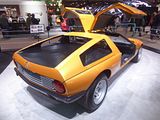
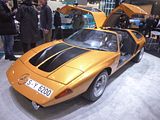
With prices of the classic Pagoda model having risen to unaffordable for most people attention has started to switch to it successor, the R107 SL range, which had a long production life, being the second longest single series ever produced by the automaker, after the G-Class. The R107 and C107 took the chassis components of the mid-size Mercedes-Benz W114 model and mated them initially to the M116 and M117 V8 engines used in the W108, W109 and W111 series. The SL variant was a 2-seat convertible/roadster with standard soft top and optional hardtop and optional folding seats for the rear bench. The SLC (C107) derivative was a 2-door hardtop coupe with normal rear seats. The SLC is commonly referred to as an ‘SL coupe’, and this was the first time that Mercedes-Benz had based a coupe on an SL roadster platform rather than on a saloon, replacing the former saloon-based 280/300 SE coupé in Mercedes lineup. The SLC was replaced earlier than the SL, with the model run ending in 1981, with a much larger model, the 380 SEC and 500SEC based on the new S class. Volume production of the first R107 car, the 350 SL, started in April 1971 alongside the last of the W113 cars; the 350 SLC followed in October. The early 1971 350SL are very rare and were available with an optional 4 speed fluid coupling automatic gearbox. In addition, the rare 1971 cars were fitted with Bosch electronic fuel injection. Sales in North America began in 1972, and cars wore the name 350 SL, but had a larger 4.5L V8 with 3 speed auto (and were renamed 450 SL for model year 1973); the big V8 became available on other markets with the official introduction of the 450 SL/SLC on non-North American markets in March 1973. US cars sold from 1972 through 1975 used the Bosch D Jetronic fuel injection system, an early electronic engine management system. From July 1974 both SL and SLC could also be ordered with a fuel-injected 2.8L straight-6 as 280 SL and SLC. US models sold from 1976 through 1979 used the Bosch K Jetronic system, an entirely mechanical fuel injection system. All US models used the 4.5 litre engine, and were called 450 SL/SLC. In September 1977 the 450 SLC 5.0 joined the line. This was a homologation version of the big coupé, featuring a new all-aluminium five-litre V8, aluminium alloy bonnet and boot-lid, and a black rubber rear spoiler, along with a small front-lip spoiler. The 450SLC 5.0 was produced in order to homologate the SLC for the 1978 World Rally Championship. Starting in 1980, the 350, 450 and 450 SLC 5.0 models (like the 350 and 450 SL) were discontinued in 1980 with the introduction of the 380 and 500 SLC in March 1980. At the same time, the cars received a very mild makeover; the 3-speed automatic was replaced by a four-speed unit, returning to where the R107 started in 1971 with the optional 4 speed automatic 350SL. The 280, 380 and 500 SLC were discontinued in 1981 with the introduction of the W126 series 380 and 500 SEC coupes. A total of 62,888 SLCs had been manufactured over a ten-year period of which just 1,636 were the 450 SLC-5.0 and 1,133 were the 500 SLC. Both these models are sought by collectors today. With the exception of the SL65 AMG Black Series, the SLC remains the only fixed roof Mercedes-Benz coupe based on a roadster rather than a sedan. Following the discontinuation of the SLC in September 1981, the 107 series continued initially as the 280, 380 and 500 SL. At this time, the V8 engines were re-tuned for greater efficiency, lost a few hp and consumed less fuel- this largely due to substantially higher (numerically lower) axle ratios that went from 3.27:1 to 2.47:1 for the 380 SL and from 2.72:1 to 2.27:1 for the 500 SL. From September 1985 the 280 SL was replaced by a new 300 SL, and the 380 SL by a 420 SL; the 500 SL continued and a 560 SL was introduced for certain extra-European markets, notably the USA, Australia and Japan. Also in 1985, the Bosch KE Jetronic was fitted. The KE Jetronic system varied from the earlier, all mechanical system by the introduction of a more modern engine management “computer”, which controlled idle speed, fuel rate, and air/fuel mixture. The final car of the 18 years running 107 series was a 500 SL painted Signal red, built on August 4, 1989; it currently resides in the Mercedes-Benz museum in Stuttgart.
Mercedes-Benz introduced the W123 four-door versions on 29 January 1976. While there were some technical similarities to their predecessors, the new models were larger in wheelbase and exterior dimensions. The styling was also updated, although stylistic links with the W114 / W115 were maintained. Initially, all models except 280/280E featured quad unequal-size round headlights and the latter large rectangular units. When facelifted, these units became standard across the range. All W115 engines were carried over, with the 3-litre 5-cylinder diesel model being renamed from “240D 3.0” to “300D” (as it had already been called before in North American markets). The only new engine was the 250’s 2,525 cc inline-six (Type M123, a short-stroke version of the 2.8-litre six Type M110) that replaced the old 2,496 cc Type M114 “six”. In the spring of 1976, a Coupé version was introduced on a shorter wheelbase than the saloon (106.7 in versus 110.0 in. This W123C/CE was available as a 230C (later 230CE) and as a 280C/CE in most markets; in North America there were additional 300CD versions with naturally aspirated, later turbocharged 3-litre diesel engines. In North America, buyers favored diesel engines for upmarket cars, while CAFE legislation meant that Mercedes-Benz North America had to lower their corporate average fuel economy. This led to the introduction of a few diesel models only sold in the United States. It is a tribute to the car’s instant popularity – and possibly to the caution built into the production schedules – that nine months after its introduction, a black market had developed in Germany for Mercedes-Benz W123s available for immediate delivery. Customers willing to order new cars from their local authorised dealer for the recommended list price faced waiting times in excess of twelve months. Meanwhile, models that were barely used and were available almost immediately commanded a premium over the new price of around DM 5,000. From August 1976, long-wheelbase versions (134.8 in) were produced. These were available as 7/8 seater saloons with works bodies or as a chassis with complete front body clip, the latter serving as the base for ambulance and hearse bodies by external suppliers like Binz or Miesen. These “Lang” versions could be ordered as 240D, 300D and 250 models. At the Frankfurt Auto Show in September, 1977 the W123T estate was introduced; the T in the model designation stood for “Touring and Transport”. All engines derivative except “200TD” were available in the range. T production began in March, 1978 in Mercedes’ Bremen factory. It was the first factory-built Mercedes-Benz estate, previous estates had been custom-built by external coachbuilders, such as Binz. In early 1979, the diesel models’ power output was increased; power rose from 54 hp to 59 hp in the 200D, from 64 hp to 71 hp in the 240D and from 79 hp to 87 hp in the 300D; at the same time, the 220D went out of production. The first Mercedes turbo diesel production W123 appeared in September, 1981. This was the 300 TD Turbodiesel, available with automatic transmission only. In most markets, the turbocharged 5-cylinder 3-litre diesel engine (Type OM617.95) was offered only in the T body style, while in North America it was also available in saloon and coupé guises. June 1980 saw the introduction of new four-cylinder petrol engines (Type M102). A new 2-litre four with shorter stroke replaced the old M115, a fuel-injected 2.3-litre version of this engine (in 230E/TE/CE) the old carburettor 230. Both engines were more powerful than their predecessors. In 1980/81, the carburettor 280 versions went out of production; the fuel-injected 280E continued to be offered. In September 1982, all models received a mild facelift. The rectangular headlights, previously fitted only to the 280/280E, were standardised across the board, as was power steering. Since February 1982, an optional five-speed manual transmission was available in all models (except the automatic-only 300 turbodiesel). W123 production ended in January, 1986 with 63 final T-models rolling out. Most popular single models were the 240D (455,000 built), the 230E (442,000 built), and the 200D (378,000 built). The W123 introduced innovations including ABS (optional from August, 1980), a retractable steering column and an airbag for the driver (optional from 1982). Power (vacuum servo) assisted disc brakes were standard on all W123s. Available options included MB-Tex (Mercedes-Benz Texturized Punctured Vinyl) upholstery or velour or leather upholstery, interior wood trim, passenger side exterior mirror (standard on T models), 5-speed manual transmission (European market only), 4-speed automatic transmission (standard in turbodiesel models), power windows with rear-seat switch cut-outs, vacuum powered central locking, rear-facing extra seats (estate only), Standheizung (prestart timer-controlled engine heating), self-locking differential, sun roof, air conditioning, climate control, “Alpine” horn (selectable quieter horn), headlamp wipers (European market only), Tempomat (cruise control), power steering (standard after 1982/08), seat heating, catalytic converter (available from 1984 for California only, from fall (autumn) 1984 also in Germany for the 230E of which one thousand were built). These days, the cars are very popular “youngtimer” classics, with all models
Also here was a W126-generation S Class. This premiered in September 1979 at the Frankfurt IAA Show, with sales starting in Europe in March 1980 and October 1980 for the UK. Following the debut of the 1970s generation W116 (which also included the limited-production Mercedes-Benz 450 SEL 6.9), Mercedes-Benz began plans for the next-generation S-Class model in October 1973. Codenamed “project W126,” the project aimed to provide an improved ride, better handling, and improved fuel efficiency, to help retain the model’s marketing position. Mercedes-Benz made fuel efficiency a goal (named “Energy Program”), in the large V8 engined versions of the S-Class. The W126 design team, led by Mercedes-Benz’s Bruno Sacco, sought to produce a car that was more aerodynamic than the previous model. The application of lighter materials and alloys combined with thorough wind tunnel testing to reduce overall drag meant the car consumed about 10% less fuel than its predecessor. The W126 featured the first seatbelt pretensioners. After six years of development, the W126 was introduced at the Internationale Automobil-Ausstellung (International Motor Show, or IAA) in Frankfurt on September 1979. The initial range featured seven models in standard (S S-KLasse-Vergaser, SE S-Klasse-Einspritzmotor, SD S-Klasse-Diesel) and long (SEL, SDL) wheelbase sedan body styles: the 280 S/SE/SEL, 380 SE/SEL, 500 SE/SEL and 300 SD. The long-wheelbase (SEL) variants were internally codenamed V126. In 1981, the coupé version C126 (SEC, acronym for S-Klasse-Einspritzmotor-Coupé) of the W126 S-Class premiered at the IAA with the 500 SEC model. In 1981, Wheels Magazine selected the W126 model 380 SE as its Car of the Year. Although the top of range Mercedes-Benz 450 SEL 6.9 of the previous generation was not directly replaced, the W126 carried forward the hydropneumatic suspension of the 6.9 as an option on the 500 SEL and later on 420 SEL and 560 SEL models. Four years after the introduction of the fuel-efficiency “Energieskonzept” (Energy Concept) in 1981, the model range was extensively revised. In September 1985, again at the IAA in Frankfurt, the revised model range was introduced. Apart from visual changes to the bumpers, side covers and larger 15-inch wheels with a new design on the hubcaps and alloys (optional), there where technical upgrades as well as revised engines available. A new generation of inline-six petrol and diesel engines and new 4.2- and 5.5-litre V8s were added, and other engines were revised. The W126 generation was replaced by the W140 in 1991. Over the twelve years,1979-1991, W126 S-Class production reached 892,123 — including 818,063 sedans and 74,060 coupés.
The Mercedes-Benz CLK GTR is a GT1 sports car built and produced by Mercedes-Benz in conjunction with their then motorsport partner AMG. Intended for racing in the new FIA GT Championship series in 1997, the CLK GTR was designed primarily as a race car. As such, the production of road cars necessary in order to meet homologation standards of GT1 was a secondary consideration in the car’s design, i.e. the CLK GTR was a homologation special. After its successful campaign in the 1997 FIA GT Championship, the car was also entered in the first two rounds of the 1998 FIA GT Championship, before being replaced for the 1998 24 Hours of Le Mans. Its successor, the 1998 Mercedes-Benz CLK LM, concluded Mercedes’ GT1 program. For 1999, Mercedes introduced the Mercedes-Benz CLR, a sports car built to the Le Mans Grand Touring Prototype (LMGTP) regulations. This sports car was a purpose-built racecar that did not have to abide by the homologation rules of the previous GT1 cars. Following the 1955 Le Mans disaster, Mercedes-Benz had withdrawn its factory-backed race team from all motorsport activities. It was not until 1985 that Mercedes reintroduced itself to motorsport, entering the 1985 World Sportscar Championship. Starting off as an engine supplier to Sauber, this partnership bloomed into a full-time factory-backed effort. Despite Mercedes winning the World Sportscar Championship twice in 1989 and 1990, they eventually withdrew at the end of 1991 following disappointing results. However, Mercedes saw success elsewhere, with a burgeoning touring car program in the Deutsche Tourenwagen Meisterschaft, where the 190 E and its Evolution I and II siblings were climbing up the ranks. The 1991 season would see the 190 E Evo II take the honours in the constructors’ championship. Klaus Ludwig piloted the car to the 1992 drivers’ championship, with the 190 E being replaced by the W202 C-Class following the conclusion of the 1993 season. The C-Class went on to dominate both drivers and constructors championships from 1994 to 1996; as a result of the domination the Deutsche Tourenwagen Meisterschaft/International Touring Car Championship folded in late 1996, with both remaining competitors Opel and Alfa Romeo withdrawing due to the rising costs. Without a top series to compete in, Mercedes-Benz looked towards the BPR Global GT Series, which had recently become an FIA-sanctioned championship, the FIA GT Championship, where Mercedes-Benz saw an opportunity to go against manufacturers such as Porsche and McLaren. The McLaren F1 GTR was the dominant car in this series, and in order to defeat it fellow German marque Porsche built a dedicated racecar, the 911 GT1. It became the first of the manufacturer’s “homologation specials”, with Norbert Singer modifying a Porsche 962 chassis to accommodate the front fascia of a Porsche 993, leaving other things such as the suspension and engine largely intact. Only two units of the 993-based 911 GT1 were actually completed by the end of 1996. Seeing this, AMG was tasked by Mercedes-Benz with creating a car akin to the 911 GT1, an almost purebred racing machine with a resemblance to a road car. The CLK GTR was the result, sharing nothing mechanically except the headlights, rear taillights and grille with the road-going Mercedes-Benz CLK. The CLK GTR was developed in a mere 128 days, this development time hastened by the purchase of McLaren F1 GTR chassis #11R from then-reigning FIA GT Championship champions Larbre Compétition. The car served as AMG’s mule, the F1’s bodywork was replaced by AMG’s own, and the BMW S70 engine replaced by Mercedes’ own powerplant, a M120 V12. The car was eventually restored to its original mechanical condition, and was auctioned off in Monaco in 2000 by RM Sotheby’s. The chassis of the CLK GTR was a carbon-fibre monocoque mated to an aluminium honeycomb frame, constructed by Lola Composites, a division of Lola Cars.[ The engine was a derivative of the M120 engine found in the R129 SL-Class and W140 S-Class, retitled the LS600, or GT 112.The bore and stroke were kept the same at 89 mm and 80.2 mm, however, the connecting rods were manufactured from titanium, and the compression ratio was increased from 10.0:1 to 12.0:1.[4] These modifications boosted power to 600 PS at 7,000 rpm, and torque to 700 N⋅m (516 lb⋅ft) at 3,900 rpm, allowing the car to reach a top speed of 330 km/h (205 mph). The engine (which also served as a stressed member) was mounted amidships behind the driver, with power being sent to the rear wheels via a 6-speed sequential manual transmission, giving the car a 0–100 km/h (0–62 mph) time of 3.8 seconds. Several driving aids such as traction control, ABS, active suspension, drive by wire throttle control, were banned, with fore-aft brake bias the only aid allowed. The front and rear suspension were identical, consisting of double wishbones, with pull-rod actuated coil springs with adjustable shocks. The CLK GTR debuted at Mercedes’ home track, the Hockenheimring, at the 1997 FIA GT Hockenheim 4 Hours. Bernd Schneider qualified on pole and took the fastest lap, but had to retire due to braking problems. The sister No. 10 CLK GTR only mustered a 27th-place finish, also battling mechanical woes. Still, the pace of the car was promising, and after intense development over the summer break, Mercedes would score their first 1–2 finish at the 1997 FIA GT Nürburgring 4 Hours with Schneider and Klaus Ludwig taking the win. The rest of the season saw the CLK GTR take three more 1–2 finishes, and wins at the 1997 FIA GT Sebring 3 Hours and 1997 FIA GT Laguna Seca 3 Hours would secure Mercedes the constructors’ and drivers’ championship with Schneider in their maiden season. Mercedes opted not to enter that year’s 24 Hours of Le Mans, as AMG understood that the V12 in the CLK GTR was better tailored to the 4-hour sprints of the FIA GT Championship rather than the 24-hour gruel of the Circuit de la Sarthe. Instead, Mercedes and AMG decided to develop a bespoke car for next year’s 24 Hours of Le Mans, an evolution of the CLK GTR dubbed the CLK LM, LM for Le Mans. The road-legal homologated version of the CLK-GTR would simply gain the suffix Straßenversion, German for Street version. In a similar fashion to the Porsche 911 GT1 in 1996, only a singular road car was completed in 1997 and was shown in that year’s Frankfurt Motor Show. The rest of the road cars were built at Affalterbach by AMG in collaboration with HWA over 1998, and production ceased in mid-1999. Many components of the road car were lifted directly from the racecar, including the suspension, the sequential transmission, and the carbon-fibre monocoque. Of the 28 produced, 2 were prototypes, 6 were roadsters, and 20 were coupés, 2 of which left the factory in “SuperSport” specification. Two cars, one coupé and one roadster, also left the factory as right-hand drive for the 29th Sultan of Brunei, Hassanal Bolkiah. Former racing driver and motoring journalist Paul Frère test drove the CLK GTR around the Hockenheimring. Writing for Road & Track magazine, he praised the car’s tractability, despite its immense power. He also applauded the effort put in by Mercedes-Benz to make the car more user-friendly, including large amounts of soundproofing to reduce the mechanical noise from the transmission and engine, although critiqued the cramped cockpit space despite the large width of the car, and its driveability in city conditions, due to its non-synchronous transmission and large amount of torque available from low rpm. He ended his review describing the car as a “real work of art”.The engine was stroked out to 6,898 cc by Ilmor, resulting in a power and torque bump to 622 hp at 6,500 rpm and 731 N⋅m (539 lb⋅ft) at 5,250 rpm.Sending this power to the rear wheels was a 6-speed sequential manual transmission with a four-plate carbon fibre clutch. This gave the GTR a 0–100 km/h (0–62 mph) of 3.8 seconds, and a claimed top speed of over 320 km/h (199 mph), depending on gearing. The 18-inch centrelocking wheels were fitted with 295/35ZR18 Bridgestone tyres at the front and 345/35ZR18 at the rear. Stopping power was provided by 6-piston calipers and carbon-composite rotors measuring 380 mm (15.0 in) at the front and 335 mm (13.2 in) at the rear. The road car received several amenities such as ABS, air-conditioning and an audio system. Bins for luggage were located under each door, as was the control for the fire suppression system on the driver side. Owners had the option of fitting their seats with tartan, leather, or Alcantara, with four-point harnesses for safety. Like the race car, the CLK GTR only shared the headlights, taillights and grille with the roadgoing CLK, and many exterior design elements such as the roof-mounted air dams, and NACA ducts on the sills were retained. Mercedes decided not to modify the CLK GTR to comply with United States safety regulations, and all examples imported to the U.S. were under Show or Display exemptions. When the first production run of 20 CLK GTR coupés ended in 1999, one roadster was also produced and held onto by AMG until 2002, when it was purchased by Mark Johnston. Johnston attempted to sue DaimlerChrysler in 2006, claiming that when he had taken it for a test drive with a customer, the oil gauge lit up and the transmission promptly failed. The next five would be converted from coupés to roadsters based on existing GTR chassis by HWA, and were made available in 2006. Modifications to the coupé included moving the engine intake from the roof to the sides, door-mounted mirrors, an integrated rollbar behind the seats, a revised front grille and rear wing which resembled the fixed rear wing of the race cars. Of the six roadsters built, one was painted black and sold in 2015 by Bonhams, and now resides at Dutton Garage in Melbourne. Another was painted dark silver with a purple interior, for the Sultan of Brunei, and was sold to Indian businessman Vijay Mallya in 2009. The chassis is the only right-hand-drive example. In November 2025, a CLK GTR Roadster (chassis no. 5) owned by Ryan Wedding was seized by Federal Bureau of Investigation as part of the Giant Slalom investigative. Two chassis would also leave the AMG factory in SuperSport specification. The original 6,898 cc E69 engine was superseded with the larger, more powerful 7,291 cc E73 M297. This same engine was also found in the Pagani Zonda and Mercedes-Benz R129, albeit now producing 664 PS at 6,500 rpm and 786 Nm (580 lb/ft) at 5,250 rpm. Visual changes included a speedometer that was etched to 400 km/h (249 mph) and a redesigned front splitter. The increased power and torque figures lowered the 0–100 km/h (0–62 mph) to 3.5 seconds. Three other chassis later received the E73 engine and SuperSport package, with the later models having higher power figures at 711 hp. At the time of manufacture, Guinness World Records named the CLK Straßenversion and its siblings the world’s most expensive production car, retailing for US$1,547,620. This record stood until the introduction of the Ferrari FXX-K in 2015. Along with its GT1 siblings, the Porsche 911 GT1 and McLaren F1 GTR, the trio were known as the “holy trinity” of Group GT1, and formed what several publications deemed a “golden era” or “pinnacle” of 90s sportscar racing.
Unveiled at the 2009 North American International Auto Show in Detroit, the SLR McLaren Stirling Moss was the most radical iteration of the Mercedes-Benz SLR McLaren. Celebrating the 300 SLR which was piloted to a record-breaking victory in the 1955 Mille Miglia by Stirling Moss and codriver Denis Jenkinson, this would be the most radical and exciting road-going Mercedes-Benz produced since the CLK GTR Roadster. In the spirit of the 300 SLR, nearly all the creature comforts of the SLR Stirling Moss were sacrificed in the pursuit of performance, aesthetics, and extreme driver (and passenger) enjoyment. This even included the windscreen and roof, which not only adds to the visual drama, but also ramps up the intensity of the driving experience tenfold. Indeed, when Car magazine road-tested the car in 2009, they likened the experience of full-throttle acceleration to ‘standing on the wingtip of a 747’ and cited the 0–100 km/h time of 3.5 seconds and top speed of 354 km/h achievable only by those ‘whose neck muscles can bear it’. This level of performance is accomplished by utilising the same 641 bhp, 5.5-litre supercharged AMG V-8 that powers the SLR 722 Edition and pairing it with 200 kg of weight savings, achieved by adoption of the speedster style as well as the extensive use of carbon fibre for the bodywork and underside and new aerodynamic package. This particular SLR Stirling Moss was first registered in Germany in 2010 and has been carefully preserved in the hands of just one private owner. Driven less than 150 km from new, it presents in virtually as-new condition throughout, finished in the Stirling Moss’ quintessential colour scheme of metallic silver paintwork over a black and red leather interior, done as a modern twist on the colour scheme worn by the 300 SLRs when campaigned by Mercedes-Benz in 1955. With many manufacturers now producing ‘speedster-style’ supercars such as the McLaren Elva, Ferrari SP1 and SP2, and the Aston Martin V12 Speedster, the SLR Stirling Moss surely provided some inspiration to those that followed. With the underpinnings of a truly excellent automobile, brilliantly engineered by engineers at both Mercedes-Benz and McLaren, and its incredible looks harkening back to one of the most celebrated automobiles in history, it’s no wonder that these cars have been considered modern day collectables since the moment they left the factory. This example is surely amongst the finest examples in existence, boasting single private ownership and just 150 km from new, it provides its next owner with an amazing opportunity to enjoy one what is arguably the most celebrated Mercedes-Benz built thus far into the 21st century.
The SLS was the first Mercedes-Benz designed and built from scratch entirely by AMG. Upon its introduction at the 2009 Frankfurt Motor Show, the SLS AMG’s 571 PS (563 bhp) M159 engine was according to AMG “the world’s most powerful naturally aspirated production series engine” ever produced. The SLS AMG was designed by Mark Fetherston to be a modern 300SL Gullwing, adopting the feature of the gull-wing doors that swing open upwards on gas struts, and must be closed manually as AMG engineers decided against the 41 kg (90 lb) of additional weight that auto-closing systems would have added to the car. In case of a roll-over, the doors can be fully detached to allow the occupants to leave the vehicle. The SLS AMG Roadster was unveiled at the 2011 Frankfurt International Motor Show, as convertible variant, with conventional doors and three-layered fabric soft top (having a magnesium, steel and aluminium construction) which opens and closes in 11 seconds, and can be operated on the move at up to 50 km/h (31 mph). The roadster’s DIN kerb weight is 40 kg (88 lb) more than the SLS AMG Coupé. Certain reinforcements were made to the roadster in order to compensate for the loss of roof which includes side skirts with greater wall thicknesses and more chambers, a dashboard cross-member is supported against the windscreen frame and centre tunnel by additional struts, a curved strut between the soft top and the tank reinforces the rear axle, a reinforcing cross-member behind the seats to support the fixed roll-over protection system. An electric version of the car, the SLS AMG Electric Drive, was presented at the 2012 Paris Motor Show, but never entered production. The more focused Black Series, with more power and reduced weight did, though, following a presentation at the 2012 Los Angeles Show. Plenty of special editions of the car did, though, culminating in the 2014 SLS AMG GT Final Edition. The SLS was replaced by the somewhat cheaper (to build and hence to buy) AMG GT which remains in production.
The Mercedes-AMG ONE (R50, previously known as Project One) is a limited-production plug-in dual hybrid sports car manufactured by Mercedes-AMG, featuring Formula One-derived technology. The Project One concept car was unveiled at the 2017 International Motor Show Germany by the then three-time F1 world champion and Mercedes-AMG Petronas F1 driver, Lewis Hamilton and Head of Mercedes-Benz, Dieter Zetsche. The production version of the AMG ONE was unveiled on June 1, 2022 and production began in August. Mercedes-AMG unveiled the concept version of the ONE, the Project One with nearly identical specifications to the production version. Claimed that the production ONE will be evaluated on their performance, durability, and ability in Mercedes-Benz’s proving grounds and on racing circuits. Development of the AMG ONE took place at Mercedes-AMG, in Affalterbach, Germany. Head of Mercedes-AMG, Tobias Moers described that when “the time is right”, Lewis Hamilton, who has worked on the development of the car will join the team of development drivers testing prototypes of the car. The production version of the AMG ONE unveiled on June 1, 2022. Production was expected to begin in late 2022 and planned to be limited for 275 units at a price of US$2.72 million per unit, all of which had been already sold. Mercedes-AMG received orders more than four times of the planned production number, but they refused to increase the production limit, in order to maintain exclusivity of the car. Production of the AMG ONE began in August 2022, all 275 cars were set to be hand built by Mercedes-AMG, with deliveries to begin in late 2022. The first car was delivered on January 16, 2023, which had an exclusive paint job inspired by the livery of the F1 W12 E Performance. Lewis Hamilton reportedly purchased two AMG ONE units, of which one is to be gifted to his father Anthony. Other notable owners of the AMG ONE include; former McLaren-Mercedes F1 driver David Coulthard, former Mercedes F1 driver and 2016 F1 world champion Nico Rosberg, former Mercedes F1 driver Valtteri Bottas, and Australian businessman Lindsay Fox. The exterior of the car is designed primarily for better aerodynamics. Notable aerodynamic features include; moveable slats which were specifically developed for the front wheelhouses, two-part extendable rear wing with DRS system and active flaps on the front diffuser which were adjustable to suit the driver chosen driving program. Additionally, large front air inlets, roof-mounted air intake, large aerodynamic fin extending down the back half of the car and aerodynamically optimized wheels to aid generate more downforce in order to carry the maximum speed at highspeed corners. The powertrain of the Mercedes-AMG ONE is rated at 782 kW (1,063 PS; 1,049 hp) through a hybrid drivetrain that shares many features with modern F1 cars. The car has an internal combustion engine and four electric motors. The car on which the engine and design of the ONE is based on is the Mercedes-AMG F1 W06, as confirmed by Mercedes-AMG board member Ola Källenius. The Mercedes-AMG ONE utilises a modified version of the Mercedes-Benz PU106B Hybrid engine, a 1.6-litre turbocharged 90-degree V6 engine. Modifications were done to the engine as to make comply with the idle RPM and redline regulations. Tobias Moers, claimed that the engine would be at 1,280 rpm at idle, and 11,000 rpm at its redline limit. However, the engine would only last for 50,000 km (31,000 mi) and the owners will have to return their cars for an engine refurbishment. The ICE produces 422 kW (574 PS; 566 hp), torque figures were claimed to be unmeasurable due to the complex drivetrain. Top speed of this car is limited at 219 mph (352 km/h). The internal combustion engine works in conjunction with four electric motors: a 120 kW (163 PS; 161 hp) motor generator unit-kinetic (MGU-K) coupled to the crankshaft, a 90 kW (122 PS; 121 hp) motor generator unit-heat (MGU-H) coupled to the turbocharger, and two 120 kW (163 PS; 161 hp) electric motors at the front axle. The MGU-K and MGU-H are Formula One-style motors responsible for recovering energy and improving efficiency during the operation of the car. More specifically, the MGU-K serves to generate electricity during braking, while the MGU-H serves to eliminate turbo lag in order to improve throttle response by keeping the turbine spinning at lower engine speeds and also to recover waste energy from the exhaust. The final two electric motors driving the front wheels make up for an all-wheel drive drivetrain, the sum of these four electric motors contribute 360 kW (489 PS; 483 hp) of effective power to the total power output figure of the AMG ONE. The AMG ONE features a 7-speed single-clutch automated manual transmission with 4-disc carbon racing clutch (similar to the type of transmission used in modern F1 cars), and delivers the bulk of the engine power and torque to the rear wheels. The use of a single-clutch over a dual-clutch transmission was due to engineers wanting to keep the car light and concerns over the dual-clutch’s ability to handle the high-revving ICE. The car contains a five-link aluminium coil-over suspension setup with two transverse adjustable push-rod spring struts, including adaptive damping adjustments. Rear axle links are shaped for better aerodynamics. It also features the hydraulic AMG carbon-fibre ceramic high-performance composite brake system, with 398 x 38 mm front composite brake discs, ventilated with 6-piston aluminium fixed callipers. 380 x 34 mm rear composite brake discs, ventilated with 4-piston aluminium fixed callipers. Additionally electric parking brake, ABS, brake assist and 3-stage ESP were also offered for the car. The AMG ONE also has unique 10-spoke forged aluminium alloy wheels emerged with NACA carbon fibre openings for brake cooling and increase downforce. Also, with diameters of 19 inches at the front and 20 inches at the rear with F1-styled centre-lock wheel nuts. The tyres are semi-slick Michelin Pilot Sport Cup 2Rs with codes of 285/35 ZR 19 for the front and 335/30 ZR 20 for the rear. The brakes are ventilated carbon-ceramic discs. The interior is mostly minimalist and driver-focused, continuing the F1 theme of the AMG ONE. This includes AMG Motorsport bucket seats, integrated into the carbon monocoque, a F1-style steering wheel with knobs for driving programs including; DRS, overtake etc. Paddle shifters and a driver-oriented central infotainment screen were also featured in the car. There are some traditional luxury features in the interior, notably the napa leather and hand stitching on the bucket seats. The body is made entirely out of carbon fibre in line with its F1 counterpart, resulting in a final kerb weight of 1,695 kg (3,737 lb). The car also features the F1 inspired exhaust tailpipe with a large round main outlet and two smaller outlets. The AMG ONE acts as one of the “hero cars” of Forza Horizon 5, being featured on the game’s cover alongside the Ford Bronco.
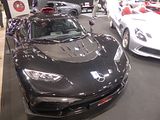
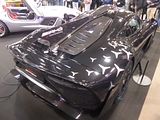
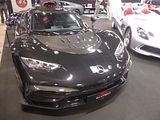
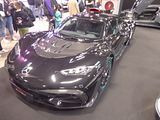
MESSERSCHMITT
The Messerschmitt KR200, or Kabinenroller (Cabin Scooter), is a three-wheeled bubble car designed by the aircraft engineer Fritz Fend and produced in the factory of the German aircraft manufacturer Messerschmitt from 1955 until 1964. Messerschmitt, temporarily not allowed to manufacture aircraft, had turned its resources to making other products. In 1952, Fend approached Messerschmitt with the idea of manufacturing small motor vehicles. These were based on his Fend Flitzer invalid carriage. The first of Fend’s vehicles to enter production at Messerschmitt’s Regensburg factory was the KR175. The title Kabinenroller means “scooter with cabin”. While the Messerschmitt name and insignia were used on the car, a separate company, incorporated as Regensburger Stahl- und Metallbau GmbH, was created to manufacture and market the vehicle. The KR200 replaced the KR175 in 1955. While using the same basic frame as the KR175 with changes to the bodywork (notably including wheel cutouts in the front fenders) and an improved canopy design, the KR200 was otherwise an almost total redesign. The rear suspension and engine mounting were reworked, and hydraulic shock absorbers were installed at all three wheels. Tire sizes were enlarged to 4.00×8. Retailing for around DM 2,500, the KR200 was considered an instant success with almost 12,000 built during its first year, which was the highest annual production for Kabinenroller models. A maximum speed in excess of 90 km/h (56 mph) despite a claimed power output of only 10 PS, 1 more PS than the 175 cc engine from the KR175, reflected the vehicle’s light weight and low aerodynamic drag. The KR200, however, was 23 kg heavier than the KR175 it replaced but had a 10 km/h (6 mph) higher top speed. An “Export” package included a two-tone paint scheme, painted hubcaps, a fully trimmed interior, a heater, a clock, and a sunshade for the canopy. In 1956, around a year after West Germany joined NATO, Messerschmitt was allowed to manufacture aircraft again and lost interest in Fend’s microcars. Messerschmitt sold the Regensburg works to Fend who, with brake and hub supplier Valentin Knott [de], formed Fahrzeug- und Maschinenbau GmbH Regensburg (FMR) to continue production of the KR200 and his other vehicles. In 1957 the KR201 Roadster was launched and remained in production until 1964 with very limited numbers produced. It had a frameless windscreen with no window frames, an optional folding cloth roof and removable side curtains made from transparent plastic. In February 1958, the KR200 Kabrio Limousine model was released, featuring a cloth convertible top and fixed side window frames. A Sport model was later offered with a cut down plexiglas windscreen with no roof and with fixed side panels so that the driver would have to climb in and out at the top of the car. Production of the Sport was extremely limited and, apart from the KR200 ‘Super’ it is the rarest type of KR200. Production of the KR200 was heavily reduced in 1962 and ceased in 1964 as sales had been dropping for a few years. The demand for basic economical transport in Germany had diminished as the German economy boomed. A similar situation developed in other parts of Europe such as in the manufacturer’s biggest export destination, the United Kingdom, where sales were particularly affected by the increasing popularity of the Mini. A total of 30,286 units of the KR200 were built.
MINI
The classic Mini remains popular in France and there were a large number of these on show, mostly in the “Youngtimers” for sale area.
Many of these were the late model Coopers. The Mini was the model that refused to die, with sales continuing after the launch of the Metro in 1980, and gathering momentum again in the 1990s, thanks in no small part to interest from Japan and because Rover Group decided to produce some more Cooper models. The first series of Cooper cars had been discontinued in 1971, replaced by the cheaper to build 1275GT, but when a limited edition model was produced in 1990, complete with full endorsement from John Cooper, the model was a sell out almost overnight, which prompted the decision to make it a permanent addition to the range. A number of refinements were made during the 90s, with fuel injection adding more power, a front mounted radiator and more sound deadening making the car quieter and new seats adding more comfort and a new dash making the car look less spartan inside.
Innocenti was an Italian machinery works originally established by Ferdinando Innocenti in 1920. Over the years they produced Lambretta scooters as well as a range of cars, most of them with British Leyland origins. After World War II, the company was famous for many years for Lambretta scooters models. From 1961 to 1976 Innocenti built under licence the BMC (later the British Leyland Motor Corporation, or BLMC for short) Mini, with 998 cc and 1,275 cc engines, followed by other models, including the Regent (Allegro), with engines up to 1,485 cc. The company of this era is commonly called Leyland Innocenti. The Innocenti Spyder (1961–70) was a rebodied version of the Austin-Healey MKII Sprite (styling by Ghia). The car was produced by OSI, near Milan. In 1972 BLMC took over control of the company in a £3 million deal involving the purchase of the company’s land, buildings and equipment. BLMC had high hopes for its newly acquired subsidiary at a time when, they reported to the UK press, Italian Innocenti sales were second only to those of Fiat, and ahead of Volkswagen and Renault. There was talk of further increasing annual production from 56,452 in 1971 to 100,000. However, the peak production under BLMC was 62,834 in 1972, in spite of exports increasing from one car in 1971 to more than 17,000 in 1974. Demonstrating their ambitions, the British company installed as Managing Director one of their youngest UK based senior executives, the then 32-year-old former Financial Controller Geoffrey Robinson. Three years later BLMC ran out of money and was nationalised by the UK government. In February 1976, the company passed to Alejandro de Tomaso and was reorganised by the De Tomaso Group under the name Nuova Innocenti. Benelli had a share and British Leyland retained five percent, with De Tomaso owning forty-four percent with the aid of a rescue plan from GEPI (an Italian public agency intended to provide investment for troubled corporations). Management was entirely De Tomaso’s responsibility, however, and later in 1976 GEPI and De Tomaso combined their 95% of Innocenti (and all of Maserati) into one new holding company. However, with the loss of the original Mini, the Austin I5, and the (admittedly slow-selling) Regent, sales were in freefall. Production was nearly halved in 1975 and was down to about a fifth of the 1974 levels in 1976. After this crisis, however, the new Bertone-bodied Mini began selling more strongly and production climbed to a steady 40,000 per annum by the end of the ’70s. The first model had Bertone-designed five-seater bodywork and was available with Leyland’s 998 cc and 1275 cc engines. Exports, which had been carried out mainly by British Leyland’s local concessionaires, began drying up in the early eighties as BL did not want to see internal competition from the Innocenti Mini. Sales to France (Innocenti’s biggest export market) ended in 1980, with German sales coming to a halt in 1982. Around the same time, the engine deal with Leyland ended, and production soon dropped into the low twenty thousands. Later models, from model year 1983 on, used 993 cc three-cylinder engines made by Daihatsu of Japan. De Tomaso developed a turbocharged version of this engine for Daihatsu which found use in both Innocenti’s and Daihatsu’s cars. Fiat bought the company in 1990, and the last Innocenti models were versions of the Uno-based Fiat Duna Saloon and Estate, which were badged Elba. The brand was retired in 1996. The car seen here was badged Cooper 1300, and these cars had lots of little differences compared to the Longbridge and Cowley made models. Innocenti had been assembling Minis since 1965, creating finished cars from CKD kits, the first cars called Innocenti 850. In 1971, they started to produce the Innocenti Cooper 1300, following the demise of the model in the UK, which had been replaced by the 1275GT, and it continued until 1975 when all the Issigonis Minis were deleted, to be replaced by the hatchback Bertone Mini 90 and 120 cars
This is a Jet Black, one of the many limited edition cars made in the 80s and 90s. Launched in January 1988, it was based on the Mini City and had a 998 cc engine. All the cars were, as the name suggests, Black. There were chrome bumpers and grille surround, a red coachline and ‘Jet Black’ logos. Inside there was black velour. You also got full width wheel trims, 14570R12 Pirelli Cinturato CN54, opening side windows, tinted glass, push button radio. Production was 3,000 , 1,000 of them for the UK.
MITSUBISHI
Another of the factory stands, Mitsubishi focused very much on their sporting prowess back in the glory days.
Two of the three cars on the stand are related to Mitsubishi’s glorious history on the Dakar. Seen here is the Pajero that won the event in 2001. A car driven by Jutta Kleinschmidt, the only woman to have won the event in the car category. Mitsubishi and the Dakar have a long history. The Japanese brand has won the event twelve times. The first victory dates back to… 1985. So exactly 40 years ago. One of the most striking victories was undoubtedly that of the pilot Jutta Kleinschmidt in 2001. She is the only woman to have won the Dakar in the car category to date. The car with which she won was a Mitsubishi Pajero specially prepared for the rally-raid event. That goes without saying.
Another vehicle on the Mitsubishi stand was a 1986 Pajero restored by a technician who worked for a dealership of the Japanese manufacturer. A restoration that lasted 15 years.
This is a Lancer Evo VI, of the type which was produced between January 1999 and February 2001. Based on the Lancer saloon, the Evo kept pace with changes to that model, so the Evo IV, seen in 1996 had been a new model compared to the first three Evo generations. Evo IV, V and VI were all broadly similar with detailed changes coming with each new iteration. The Evolution VI’s changes mainly focused on cooling and engine durability. It received a larger intercooler, larger oil cooler, and new pistons, along with a titanium-aluminide turbine wheel for the RS model, which was a first in a production car. The Evolution VI received new bodywork yet again, with the most easily noticeable change being within the front bumper where the huge fog lights were reduced in size and moved to the corners for better airflow. A new model was added to the GSR and RS lineup; known as the RS2, it was an RS with a few of the GSR’s options. Another limited-edition RS was known as the RS Sprint, an RS tuned by Ralliart in the UK to be lighter and more powerful with 330 hp. Yet another special edition Evolution VI was released in December 1999: the Tommi Mäkinen Edition, named after Finnish rally driver Tommi Mäkinen who had won Mitsubishi four WRC drivers championships. It featured a different front bumper, Red/Black Recaro seats (with embossed T. Mäkinen logo), 17″ Enkei white wheels, a leather Momo steering wheel and shift knob, a titanium turbine that spooled up more quickly, front upper strut brace, lowered ride height (with tarmac stages in mind), and a quicker steering ratio. Amongst other colours, the Evo VI came in either red (Tommi Mäkinen Edition only), white, blue, black or silver with optional special decals, replicating Tommi Mäkinen’s rally car’s colour scheme. This car is also sometimes referred to as an Evolution 6½, Evolution 6.5, or TME for short. There were two “standard” models. The RS – “rally sport” had a close-ratio 5-speed, minimal interior, rally suspension, Rear 1.5 Way LSD as opposed to AYC, (Shortened close-ratio 5-speed transmission, Optional Enkei Wheels, Optional Recaro Seats, Optional Air Conditioner, Optional Brembo brakes, Optional power windows). The GSR came with a 5-speed, gauge pack, AYC (Active Yaw Control), Anti-Lock Braking System, Recaro front bucket and rear seat, auto air-conditioner, double-din audio, power windows, Brembo brakes. The Tommi Mäkinen Edition Models also came in RS and GSR guise. The RS was the same as the standard RS with close-ratio 5-speed, lowered ride height, Tommi Mäkinen Edition front bumper, and titanium turbine (same option with standard RS) and the GSR was the same as the standard GSR with lowered ride height, Tommi Mäkinen Edition front bumper, Red/Black Recaro seats (with embossed T. Mäkinen logo), 17″ Enkei white wheels and titanium turbine. These cars were fearsomely expensive to run, and as such, you don’t see them very often any more.
MUSEE des BLINDES
Once again, the renowned Musee des Blindes (Tank Museum) had both an indoor display and a couple of outdoor exhibits. Indoors there were 2 historic vehicles: the AMX PAC 10 CHAR, visible in dynamic demonstration, and the Stuart M3 tank.
Although its name evokes a British origin, the Stuart is an American light tank that made history during the battles of El Alamein (Egypt), in June and October 1942. Despite his vulnerability to Rommel’s German armored vehicles, it was distinguished by its effectiveness and ability to leave no respite to the enemy infantry. During its activity, it has been deployed several times in Europe, the Balkans and the Pacific. A Stuart M3 weighs 15 tons. Power comes from 2 Wright (Continental) air-cooled engines , generating 2 x 110 HP. There is a maximum speed of 58 km/h. Shielding is 51 mm and the guns are 37 mm and 2 x 7.62 mm
NSU
The NSU Ro 80 is a four-door, front-engine executive sedan manufactured and marketed by the West German firm NSU from 1967 until 1977. Noted for innovative, aerodynamic styling by Claus Luthe and a technologically advanced powertrain, the Ro 80 featured a 113 bhp, 995 cc twin-rotor Wankel engine driving the front wheels through a semi-automatic transmission with an innovative vacuum-operated clutch system. Engine dimensions (Comotor units): length 412 mm (16.2 in); width 340 mm (13 in), height 340 mm (13 in), weight 101 kg (223 lb). Power 107 hp at 6,500 rpm; torque 137 Nm (101 lb/ft) at 3,000 rpm (all figures approximate). The Ro 80 was voted Car of the Year for 1968 and 37,398 units were manufactured over a ten-year production run, all in a single generation. Other technological features of the Ro 80, aside from the powertrain, were the four-wheel ATE Dunlop disc brakes, which were generally only featured on expensive sports or luxury saloon cars. The front brakes were mounted inboard, reducing the unsprung weight. The suspension was independent on all four wheels, with MacPherson struts at the front and semi-trailing arm suspension at the rear, both of which are space-saving designs commonly used today. Power-assisted ZF rack and pinion steering was used, again foreshadowing more recent designs. The car featured an automatic clutch which was commonly described as a three-speed semi-automatic gearbox: there was no clutch pedal, but instead, touching the gear lever knob operated an internal electric switch that operated a vacuum system which disengaged the clutch. The gear lever itself then could be moved through a standard “H-pattern” gate. The styling, by Claus Luthe who was head of design at NSU and later BMW, was considered very modern at the time; the Ro 80 has been part of many gallery exhibits of modern industrial design. The large glass area foreshadowed the 1970s designs such as Citroën’s. The shape was also slippery, with a drag coefficient of 0.355 (very low for the era). This allowed for a top speed of 180 km/h (112 mph). Indeed, comparisons have been drawn between the design of the Ro 80 and the aerodynamic 1982 Audi 100 built in the same factory some 15 years later. The company’s limited resources focused on improving the reliability of the rotary engine, with much attention given to the material used for the three rotor tips (apex seals) for the oval-like epitrochoid-shaped rotor housing that sealed the combustion chambers. A feature of the engine was its willingness to rev quickly and quietly to very high engine speeds, but it was precisely at these high speeds that damage to key engine components occurred: all Ro 80s came with a rev counter, but cars produced after 1971 also came with an “acoustical signal” that warned the driver when the engine was rotating too fast. The Ro 80 remained largely unchanged over its ten-year production. From September 1969 the rectangular headlights were replaced with twin halogen units, and air extractor vents appeared on the C-pillar behind the doors. In August 1970 a slightly reshaped plastic grill replaced the metal grill of the early cars, and a minimal facelift in May 1975 saw the final cars getting enlarged rear lights and rubber inserts in the bumpers which increased the car’s overall length by 15 mm to 4,795 mm. The placement of the rear license plate was also changed from below the bumper to above it. This resulted in the boot lid lock being repositioned to the rear lip of the boot lid itself, instead of just below it. The car developed an early reputation for unreliability. The Ro 80 engine in particular suffered from construction faults, among many other problems, and some early cars required a rebuilt engine before 50,000 kilometres (31,000 mi), with problems arising as early as 24,000 kilometres (15,000 mi). Originally, the rotor tip seals were made in three pieces, out of the same material. The motor’s design caused the centre section to wear more quickly at cold starts compared to the other pieces; the worn centrepieces allowed the two other parts of the seal to move, which in turn allowed combustion products to escape the seals. The tip seal centrepiece was then redesigned using ferrotic material, and the problem was entirely resolved. The fact that the rotary engine design had inherently poor fuel economy (typically 13-16 L/100 km) and a poor understanding of the Wankel engine by dealers and mechanics did not help this situation. By the 1970 model year, most of the reliability issues had been resolved, but a necessarily generous warranty policy and damage to the car’s reputation had undermined NSU’s financial situation irreparably. NSU was acquired by Volkswagen in 1969 and merged with Auto Union to create the modern-day Audi company. Series production began in October 1967 and the last examples came off the production line in April 1977. During 1968, the first full year of production, 5,986 cars were produced, increasing to 7,811 in 1969 and falling slightly to 7,200 in 1970. After this output declined, to about 3,000 – 4,000 per year for the next three years. The relatively high fuel consumption of the rotary engine worked against the car after the dramatic fuel price rises accompanying the oil crisis of 1973, and between 1974 and 1976 annual production came in well below 2,000 units. In total 37,398 Ro80s were produced during the ten-year production run. Ultimately, it was the contrasting success of the similarly sized Audi 100 that sealed both the fate of the Ro 80, and the NSU brand as a whole within the Auto Union-NSU combine, as parent company Volkswagen began nurturing Audi as its performance-luxury brand in the late 1970s. After the discontinuation of the Ro 80 in 1977, the Neckarsulm plant was switched over entirely to producing Audi’s C- and D- platform vehicles (the 100/200, and later the Audi A6 and A8), and the NSU brand disappeared from the public eye.
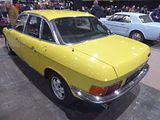
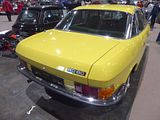
OLDSMOBILE
The Oldsmobile Toronado is a personal luxury car manufactured and marketed by the Oldsmobile division of General Motors from 1966 to 1992 over four generations. The Toronado was noted for its transaxle version of GM’s Turbo-Hydramatic transmission, making it the first U.S.-produced front-wheel drive automobile since the demise of the Cord 810/812 in 1937. The Toronado used the GM E platform introduced by the rear-wheel drive Buick Riviera in 1963 and adopted for the front-wheel drive 1967 Cadillac Eldorado. The three models shared the E platform for most of the Toronado’s 26-year history. The Toronado exterior and interior design was completely created within the Oldsmobile Studios at General Motors Styling in 1964, under the direction of Stanley Wilen, Chief of Exterior Design, and Ed Donaldson, Chief of Interior Design. They were responsible for the design. The car was created by the Oldsmobile designers, sculptors and engineers under Wilen and Donaldson’s direction. The story that the exterior design was created by “one person” in an advanced studio, where a magical painting was made that garnered so much enthusiasm from General Motors that the car was put into production, is totally false. That false narrative stated that the design was credited to Dave North, the Assistant to Stan Wilen. That was not true. Stan was actually responsible for, and he also participated in, the Toronado design. That statement also unfairly excluded the many dedicated interior and exterior designers, sculptors and engineers, who worked hard to produce an outstanding iconic design, the 1966 Oldsmobile Toronado. The Toronado design story, in great detail, is featured in the book, “Designing Dreams, essays on the inside story of General Motors, Harley Earl and America’s Golden Automotive Age.” The book includes biographies of the designers, sculptors and engineers who created the Toronado with many supporting sketches and images, from the General Motors Design Archives. It was authored by Dick Ruzzin, who was there, one of the first designers who worked on the Toronado exterior design throughout the entire design program. All of the designers from the Oldsmobile studio were invited to Chuck Jordan’s office to see a skill model that had several significant features that would ultimately appear on the final Toronado design. The key design sketch for the Toronado exterior was then created before the “Red Rendering” was made and the official General Motors E-Car Program began. It was done by designer Don Logerquist. The three-dimensional design shape was tested on the passenger side of the 1965 Delta 88 clay model that was under development at the time, before the red rendering was made. Following that test, a special large sketch, called “The Red Rendering,” was created from a drawing that was initiated and made by Stan Wilen. It was seen as the “Spirit” of the special car that was to be designed in Oldsmobile Studio. That rendering was a colored version of Stan Wilen’s fill-size tape drawing. Immediately seen as a design that was quite outstanding, the design was first executed full-size as a four passenger car, then on a new and larger General Motors E-Car platform six months later, as a six-passenger car, both with front-wheel drive. The Toronado exterior design from Oldsmobile Studio, under the direction of Stan Wilen, became a production car for Oldsmobile in 1966. The designers who participated in the development of the design under Stan Wilen’s direction were his assistant David North, designers Don Logerquist, Frank Munoz, and Dick Ruzzin. The interior design of the Toronado was created in the Oldsmobile Interior Design Studio under the direction of Chief Designer Ed Donaldson and his design team. The Toronado Design, as created in the interior and exterior design studios of Oldsmobile, was done using the processes developed during the earlier time of Harley Earl. The Toronado design was created in the same way all car designs were created at GM Styling at the time, All under the direction of William L. Mitchell, Vice President of Styling. The 1966 Oldsmobile Toronado has become the iconic representation for what is now called, “America’s Golden Automotive Golden Age.” That was a period of dramatic automotive industry advancement, from post-WWII until 1970. The Oldsmobile Toronado engineering staff, under the leadership of John Beltz, provided the Toronado’s innovative front-wheel drive powertrain and its many engineering features. Stan Wilen and Ed Donaldson provided the Toronado with its unique and outstanding exterior and interior design. The Oldsmobile Toronado astounded the American and European automotive press, and was declared “Car of the Year for 1966″, by Motor Trend Magazine. It also received Car Life’s Award for Engineering Excellence and a very prestigious design award from the Industrial Design Society of America. Oldsmobile had been working on front-wheel drive since 1958, a project shepherded by engineer John Beltz (who originated the 4-4-2 and would later become head of the division). Although initially envisioned for the smaller F-85 line, its cost and experimental nature pushed the program towards a larger, more expensive car. Engineer F. J. Hooven of the Ford Motor Company, had patented a similar FWD layout, and Ford considered the design for the 1961 Ford Thunderbird. However, the capability to develop and engineer it on such short notice was doubtful. In 1956 Oldsmobile had also introduced a personal 2-door concept car called the Oldsmobile Golden Rocket that didn’t progress into production. The unusual Toronado powertrain developed by Oldsmobile, called the Unitized Power Package (UPP), packaged a Rocket V8 and transmission into an engine bay no larger than one for a conventional rear-wheel drive car. During its seven-year development, UPP components were driven over 1.5 million test miles to verify their strength and reliability. They proved so well-built the UPP was employed basically unchanged in the 1970s GMC motorhome. Firestone designed an 8.85″ x 15” tire especially for the Toronado called the TFD (Toronado-Front-Drive) tire. It had a stiffer sidewall than normal, and the tread and stylishly thin white pin-stripe were also unique. Oldsmobile engineers selected a conventional, though performance-boosted, Olds 425 cu in (7 L) Super Rocket V8 rated at 385 hp and 475 lb/ft (644 Nm) of torque. It was an increase of 10 hp over the Starfire 425, and an increase of 20 hp over the standard 425 engine in the Ninety-Eight. The Toronado intake manifold’s unique shape was depressed to allow for engine hood clearance. The Turbo-Hydramatic heavy-duty three-speed automatic transmission became available during development of the Toronado. Called the TH425 in FWD form, the transmission’s torque converter was separated from its planetary gearset, with the torque converter driving the gearset through a 2 in (51 mm) wide silent chain-drive called Hy-Vo, riding on two 7.5 in (19 cm) sprockets. The Hy-Vo chain drive was developed by GM’s Hydra-Matic Division and Morse Chain Division of Borg-Warner. The chains were made from very strong hardened steel and required no tensioners or idler pulleys because they were pre-stretched on a special machine at the factory. Although the rotational direction of the transmission gears had to be reversed, a large number of components were shared with the conventional TH400. Use of the automatic also eliminated the need to devise a workable manual-shift linkage. No manual transmission was ever contemplated because performance was adequate with the automatic transmission and because virtually all U.S.-built luxury cars during this period came with automatic transmissions as standard equipment. The car’s 0–60 mph time was clocked at 9.5 seconds. The Toronado used a subframe that ended at the forward end of the rear suspension leaf springs, serving as an attachment point for the springs. It carried the powertrain, front suspension and floorpan, allowing greater isolation of road and engine harshness. To fit into the tight space, Oldsmobile adopted torsion bars for the Toronado’s front suspension (the first GM passenger car application of torsion bars in the US, but still not up to Packard’s automatic ride leveling system), with conventional, unequal-length double wishbones. Rear Toronado suspension was a simple beam axle on single leaf springs, unusual only in having dual shock absorbers, one vertical, one horizontal (allowing it to act as a radius rod to control wheel movement). Brakes were hydraulically operated 11 in (279 mm) drums, and were generally considered the Toronado’s weak link. As a rather heavy car, after several panic stops the brake drums would overheat, resulting in considerable fade and long stopping distances. The 1967 addition of vented front disc brakes as an option provided substantial improvement. The Toronado’s UPP enabled the interior to have a completely flat floor, but interior space (primarily rear seat headroom) was somewhat restricted by the fastback styling. As with many coupes, the Toronado featured elongated doors to allow easier access for passengers entering the rear seats. Duplicate door-latch handles were even added at the rear of each door enabling back seat passengers to open the doors without having to reach over or around the front seat, a feature also available on the other two E-bodies, continuing until 1980 on the Eldorado. Options included headrests ($52) and a tilt-telescopic steering column. Drivers faced a highly stylized steering wheel with a double-delta shaped horn ring which framed the view of an unusual “slot-machine” style speedometer, consisting of a stationary horizontal “needle” and a vertically rotating black drum on which the numerals were printed in white. The numerals descended behind the needle as the vehicle gained speed. All other gauges, indicators and controls were grouped within fairly easy reach of the driver. Despite an average weight of 4,500 lb (2,041 kg), published performance test data shows the 1966 Toronado was capable of accelerating from 0–60 mph (0–97 km/h) in 7.5 seconds, and through the standing 1⁄4 mile (400 m) in 16.4 seconds at 93 mph (150 km/h). It was also capable of a maximum speed of 135 mph (217 km/h). Testers found the Toronado’s handling, despite its noticeable front weight bias and consequent understeer, was not substantially different from other full-size U.S. cars when driven under normal conditions. In fact, testers felt that the Toronado was more poised and responsive than other cars, and when pushed to the limits, exhibited superior handling characteristics, although it was essentially incapable of terminal oversteer. The 1966 model was widely recognized as a step forward in design, gaining publicity for the division by winning several leading automotive awards, such as Motor Trend’s Car of the Year Award and Car Life’s Award for Engineering Excellence. It was also the second American car to ever be awarded recognition in Europe, as the third-place finisher at the European Car of the Year competition in 1966. The Toronado sold reasonably well at introduction, with 40,963 produced for 1966. Some television commercials featured former NASA Project Mercury public affairs officer John “Shorty” Powers, Oldsmobile’s primary commercial spokesperson of the era, along with racing legend Bobby Unser driving the vehicle and commenting favorably on the Toronado’s handling. Sales for the 1967 model, which was distinguished by a slight facelift, the addition of optional disc brakes, and a slightly softer ride, dropped by nearly half, to 22,062. A stereo tape player was optional. It would be 1971 before the Toronado matched its first-year sales volume. In 1967, Cadillac adopted its own version of the UPP for the Cadillac Eldorado, using the Cadillac V8 engine. The Eldorado also shared the E-body shell with the Toronado and Riviera, but its radically different styling meant that the three cars did not look at all similar. Also, despite sharing the same platform as the Toronado and Eldorado, the Riviera retained its rear-wheel drive setup, and would not convert to front-wheel drive until the platform was downsized in 1979. The first-generation Toronado persisted with the usual annual facelifts through 1970. Other than the brakes, the major changes were the replacement of the original 425 cu in (7 L) V8 with the new 455 cu in (7.5 L) in 1968, rated at 375 hp in standard form or 400 hp with the W-34 option, revised rear quarter panels (with small fins to disguise the slope of the rear body in side view) in 1969, and the elimination of hidden headlights and the introduction of squared wheel arch bulges in 1970. An ignition lock was added in 1969. Slight interior cosmetic changes were made for each new model year, and a full-length center console with floor-mounted shifter was available as an extra-cost option with the Strato bucket seats from 1968 to 1970, though few Toronados were so ordered. The vast majority of customers went for the standard Strato bench seat to take full advantage of the flatter floor resulting from the front-drive layout. The lack of a “hump” in the floor made three-abreast seating more comfortable than in rear-drive cars, as the center passengers both front and rear did not have to straddle one. The firm suspension and thus the quality of the ride, was gradually softened through the years, hinting at what Toronado eventually would become in 1971. A heavy-duty suspension was an option on later first generation Toronados, which included the original torsion bar springs that were used on the 1966 model. A special option code called W-34 was available on the 1968–70 Toronado. This option included a cold air induction system for the air cleaner, a special performance camshaft and a “GT” transmission calibrated for quick and firm up-shifts and better torque multiplication at 5 mph (8 km/h). Dual exhaust outlets similar to the 1966–67 model years with cutouts in the bumper, were included with W-34. The standard models also had dual exhaust systems, but only a single somewhat hidden outlet running from the muffler exiting rearward on the right side. For 1970 only, the W-34 option also included special “GT” badges on the exterior of the car. The W-34 Toronado was capable of 0–60 mph in 7.5 seconds and the standing 1/4 mile in 15.7 seconds at 89.8 mph (144.5 km/h).
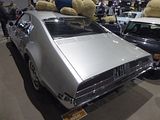
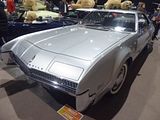
OPEL
The front-wheel drive Opel Corsa was first launched in September 1982. It went on sale first in France, Italy, and Spain – markets where small cars represented from 34 to 43 percent of sales. Built-in Zaragoza, Spain, the first Corsas were three-door hatchback and two-door saloon models, with four-door and five-door versions arriving in 1984. In certain markets, commercial “van” models were also sold, with or without rear windows depending on local requirements. In mainland Europe, the saloon versions were known as the “Corsa TR” until May 1985 and received an egg-crate grille rather than the four slits used on hatchbacks. The saloons were intended to appeal to customers of the Opel Kadett C and its sister the Vauxhall Chevette who still desired a traditional 3-box sedan shape – but it did not sell particularly well in most of Europe but were popular in Spain and Portugal, among other markets. While only taking ten percent of French Corsa sales during the car’s first half-year, the TR represented half of all Corsas sold in Spain. The basic trim level was called just the Corsa, which was followed by the Corsa Luxus, Corsa Berlina, and the sporty Corsa SR. The SR receives a spoiler which surrounds the rear window, alloy wheels, checkered sport seats, and a somewhat more powerful 70 PS engine. Six years later, the Corsa received a facelift, which included a new front fascia and some other minor changes. The models were called LS, GL, GLS, and GT. The Corsa A was known in the United Kingdom market as the Vauxhall Nova (as it was considered that Corsa sounded too much like “coarser”), where it was launched in April 1983, following a seven-month-long union dispute due to British workers being angry about the car not being built there, in contrast to the rival Ford Fiesta, Austin Metro and Talbot Samba. In addition, there was also a dispute about the disparity of import tariffs, as while cars exported from Spain to the European Community were subject to tariffs of only 4.4 per cent, those exported in the other direction were subject to tariffs as high as 36.7 per cent. Power first came from 1.0 L 45 hp, 1.2 L 55 hp, and 1.3 L 70 hp petrol engines. (The first engines were all equipped with carburettors; fuel injection came later, but never for the 1.0.) The engines were based on the well proven Family II design, except for the 1.0 L and early 1.2 L engines, which were based on the OHV unit from the Kadett C. There was also an Isuzu-built, 67 PS 1.5 L turbo diesel engine available, which was also used in the Isuzu Gemini at around the same time. The diesel joined the line up in May 1987, at the Frankfurt Motor Show, along with the sporty GSi. The engines and most of the mechanical componentry were derived from those used in the Astra/Kadett. In September 1987 the Corsa received a light facelift, with a new grille that was now the same on hatchbacks and sedans, an updated interior, and other slight changes. For the 1989 model year, the 1.3 was bored out to 1.4 liters. Power remained the same, although torque increased. A rare “Sport” model was produced in 1985 to homologate for the sub 1,300 cc class of Group A for the British Rally Championship. These Sport models were white and came with unique vinyl decals, a 13SB engine with twin Weber 40 DCOE carburettors, an optional bespoke camshaft, a replacement rear silencer, and few luxuries. This gave 93 hp and a top speed of 112 mph (180 km/h) with a 0–60 mph time of 8.9 seconds. These are by far the rarest models (500 produced) and thus acquire a high market price if one does become available. A 1.6 L multi point fuel-injected engine with 101 PS at 5600 rpm (98 PS in the catalysed version) and capable of 186 km/h (116 mph) was added to the Corsa/Nova at the 1987 Frankfurt Motor Show, giving decent performance and being badged as a GSi (“Nova GTE” in pre-facelift models in the United Kingdom, later models were all called GSi). The GSi’s engine mapping had been carried out by Opel tuning specialists Irmscher. A model with the 82 PS 1.4 L multi-point fuel-injected engine, which was otherwise mechanically identical to the GSi, also became available as the Nova SRi in the United Kingdom. In January 1988, a turbocharged version of the Isuzu diesel engine was introduced, with power increased to 67 PS. The design was freshened in September 1990, with new bumpers, headlights, grille, and interior, but it was clearly recognisable as a gentle makeover of an early 1980s design when it had to compete with the latest two all-new superminis in Europe – the Peugeot 106 and the Renault Clio. The car was finally replaced in the spring of 1993. Nearly 500,000 Novas were sold in Britain over its ten years on sale. In its best year, 1989, it was Britain’s seventh best selling car with more than 70,000 sales, but by February 2016, only 1,757 were still on the road.
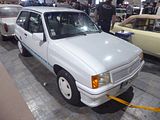
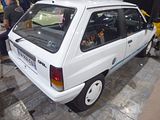
PAGANI
The Pagani Zonda R is an extreme, track-only hypercar produced by Italian manufacturer Pagani, with only 15 units built. Debuting at the 2007 Geneva Motor Show, it features a 6.0-liter naturally aspirated V12 engine producing 750 horsepower, derived from the Mercedes-Benz CLK-GTR. The car features a carbon-titanium chassis, a 6-speed sequential gearbox, and is designed specifically for racing, making it non-road legal in its original form.
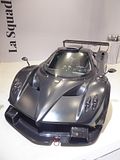
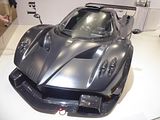
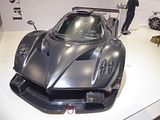
The Pagani Huayra is a mid-engine sports car produced by Italian sports car manufacturer Pagani, superseding the company’s previous offering, the Zonda. It is named after Wayra Tata, the Quechua (indigenous South American) wind god. The Huayra was named “The Hypercar of the Year 2012” by Top Gear magazine. On 11th February 2015 it was reported that the Pagani Huayra had been sold out. The Huayra was limited to just 100 units as part of Pagani’s agreement with engine supplier Mercedes-AMG. The Pagani Huayra was officially debuted online with several pictures in a press release on the 25th January 2011. The official world debut was at the headquarters of Pirelli in Milan in February 2011. The Huayra has a top speed of about 383 km/h (238 mph) and it has a 0-97 km/h (60 mph) acceleration time of 2.8 seconds. Using Pirelli tyres, the Pagani Huayra is capable of 1.66 g of lateral acceleration. The Pagani Huayra uses a seven-speed sequential gearbox and a single disc clutch. The choice not to use a dual-clutch was due to the increase in weight of over 70 kg (154 lb), thus negating any advantage of the faster gear changes in a double-clutch transmission. As a result, the transmission weighs 96 kg (212 lb). The car is equipped with Brembo brake calipers, rotors and pads. The calipers have six pistons at the front and four at the rear. The rotors are drilled carbon ceramic, 380 mm (15.0 in) in diameter and 34 mm (1.3 in) thick. The Huayra uses a 6.0 L (5,980 cc) twin-turbocharged M158 60° V12 engine developed by Mercedes-AMG specially for the Huayra, which has a power output of 740 PS (730 bhp) at 5,800 rpm and 1,000 Nm (738 lb/ft) of torque at 2,250-4,500 rpm. The engine has been designed at the request of Pagani to reduce turbo lag and improve response, achieved with smaller turbochargers, a different intercooler configuration and re-programmed ECU settings. Like many high-performance cars, the Huayra uses dry sump lubrication. This has several key benefits including guaranteeing oil flow even when the car is subjected to extreme lateral acceleration, preventing “oil surge” which allows the engine to operate more efficiently while the lack of an oil pan allows mounting the engine lower, lowering the car’s centre of gravity and improving handling. The fuel consumption of the Huayra is 10 mpg‑US (23.5 L/100 km; 12.0 mpg‑imp) in city and 14 mpg‑US (16.8 L/100 km; 16.8 mpg‑imp) in highway (EPA testing). A water/oil heat exchanger reduces engine warm-up times on cold days and helps maintain a stable temperature for refrigerants and lubricants. To minimise the use of pipes and fittings (and the overall weight of the vehicle), the coolant expansion tank is mounted directly on the engine. Intercooler fins act as an expansion tank circuit at low temperatures. The titanium exhaust system was designed and built by MHG-Fahrzeugtechnik. Hydroformed joints were developed to reduce back pressure and ensure a free flow exhaust. Titanium reduces the weight of the exhaust system while the Inconel silencers improve reliability in the most exposed parts of the exhaust at high temperatures. The entire system weighs less than 10 kg (22 lb). The Pagani Huayra is different from its predecessor in that it incorporates active aerodynamics. It is capable of changing the height of the front from the ground and independently operating four flaps placed at the rear and front of the car. The behaviour of the flaps is managed by a dedicated control unit that is fed information from systems such as the ABS and ECU, which pass on information about the car’s speed, yaw rate, lateral acceleration, steering angle and throttle position. This is intended to achieve minimal drag coefficient or maximum downforce depending on the situation. The Huayra’s designer Horacio Pagani states that it has a variable drag coefficient of between .31 and .37. The system also prevents excess body roll in the corners by raising the “inside” flaps (i.e. the left ones in a left-handed corner and vice versa), increasing the downforce on that side of the car. The rear flaps also act as an airbrake. Under hard braking, both the front suspension and the two rear flaps are raised to counter-act weight transfer to the front wheels and keep the whole car stable, for instance when entering a corner. Air from the radiator is extracted through an arch in the bonnet at an angle that is designed not to affect the streamline around the body. The side air intakes behind the front wheels create a low pressure zone, resulting in downforce. The Huayra BC is a track focused version of the Huayra which was unveiled at the 2016 Geneva Motor Show. The Huayra BC is named after the late Benny Caiola, a friend of Horacio Pagani, and the first Pagani customer. The Huayra BC has an improved version of the standard Huayra’s 6.0 L twin-turbocharged V12 engine having a power output of 764 PS (754 bhp) at 5900 rpm as well as 1,000 Nm (738 lb/ft) at 2500-5600 rpm of torque. The dry weight is reduced by 132 kg (291 lb) to just 1,218 kg (2,685 lb), thanks to the use of a new material called ‘carbon triax’ which Pagani claims is 50% lighter and 20% stronger than regular carbon fibre, giving the car a power-to-weight ratio of 1.62 kg (3.57 lb) per horsepower. The Huayra BC comes with a lighter titanium exhaust system, new aluminium alloy wheels, and a stripped out interior. The tires are Pirelli P-Zero Corsas that feature 12 different rubber compounds, and the suspension and wishbones are made of aeronautical grade aluminum, known as Avional. The Huayra BC also has a new front bumper with a front splitter and winglets, deeper side skirts, and an air diffuser that stretches the entire width of the rear bumper with a large rear wing. The car could be ordered with an optional roof scoop. All of the exterior components in the car are used to optimize downforce and drag. The Huayra BC uses an Xtrac 7-speed sequential manual transmission. Pagani has stuck with a single-clutch gearbox because it weighs 40% less than double-clutch gearboxes. Pagani planned to make 20 units of the Huayra BC, which were all sold out. In reality, Pagani drastically overproduced the Huayra BC, producing 30 units instead of the promised 20, to the irritation of some owners. After 2 years of development, the Huayra Roadster was officially unveiled at the 2017 Geneva Motor Show. The over-all appearance of the car has changed, with the most obvious being the removable top (hence the Roadster name). This part of the vehicle is also its key element. The design of the rear is also different, with new eyelid-like fixed flaps that continue with the design and eventually end on the rear lights. The rear engine cover also has a new shape to adapt to the roadster form and now has vents for efficient cooling. The wheels are unique and specifically constructed for the car. The car has conventional doors instead of the Gull-wing doors of the coupé as they are impossible to fit on an open top car while maintaining the low weight. The vehicle utilises the same twin-turbocharged M158 V12 engine as the coupé, but it now has a total power output of 764 PS (754 hp) at 6,200 rpm and 1,000 Nm (738 lb/ft) of torque at 2,400 rpm. All of this power is delivered to the rear wheels via a 7-speed automated manual transmission by Xtrac. The car now uses a hydraulic and electronic activation system with carbon synchronizers. Bosch has also contributed in the construction of the car and the car uses their ECU system. The weight is now 70 kg (154 lb) lighter, for a total of 1,280 kg (2,820 lb), making it the first roadster lighter than the coupe version. Only 100 will be made, all of which have already been sold. The tyre supplier is Pirelli, with P-Zero tyres. The tyre have a white narrow outline, resembling those of an F1 race car. Pagani has also used a new material for the Roadster called carbon triax, which is a tri-axis fiberglass meshed with carbon-fibre power bands. Pagani states that the car produces 816 kg (1,800 lb) of downforce or 1.8 lateral G-force. This figure is unproven, but if true, Pagani will have set a new record. Introduced in July 2019, the Huayra Roadster BC, often mistakenly called the Huayra BC Roadster, is the track-oriented version of the Roadster. It shares few aerodynamic parts as present on the BC and has a modified version of the 6.0-litre twin-turbocharged V12 engine rated at 802 PS (791 bhp) and 1,050 Nm (774.5 lb/ft) of torque. The 7-speed Xtrac sequential gearbox with single clutch used on the roadster is 35% lighter than a contemporary dual-clutch gearbox. The Huayra Roadster BC sits at 1,250 kg (2,756 lb) which is slightly heavier than the coupe, with a dry weight of 1,218 kg (2,685 lb). It is 30 kg (66 lb) lighter than the Huayra Roadster 1,280 kg (2,822 lb). The monocoque of the Roadster BC is constructed of carbon-titanium HP62 material to keep weight low and make the construction rigid. The Roadster BC is claimed to generate 500 kg (1,102 lb) of downforce at 280 km/h (174 mph) due to its large fixed rear wing and aerodynamic elements. In addition to movable active Aero elements, the titanium exhaust incorporates flaps in the catalytic converters to divert exhaust gases over the underfloor elements like a Formula 1 car’s blown diffuser. Production of the Huayra Roadster BC will be limited to 40 units only. Introduced in February 2020, the Imola is named after the Autodromo Internazionale Enzo e Dino Ferrari (Imola Circuit), where it underwent 16,000km of high-speed testing. It is the most powerful street-legal variant of the Huayra, using the same Mercedes-AMG V12 tuned to 838 PS (827 hp) and 1,100 Nm (811 lb/ft). Weight saving measures such as a new carbon fibre blend and lightweight paint application have reduced the Imola’s dry weight to 1,246 kg (2,747 lb). Exterior changes from the standard Huayra include a large seven-section diffuser, a large roof scoop, a shark fin, more pronounced side skirts and a wide fixed rear wing with an integrated stoplight. Six Imola were built: 5 for customers and 1 prototype for Horacio Pagani. On December 16, 2020, Pagani introduced the Huayra Tricolore, was built to celebrate the 60th Anniversary of Frecce Tricolori, Italy’s aerobatic team. The Tricolore uses a twin-turbo 6.0-liter V12 engine sourced from Mercedes-AMG which has been tuned to produce 829 horsepower and 811 pound-feet of torque, which is 38bhp and 37lb ft more than the power and torque produced by a standard Huayra BC engine. The car is only available in roadster form and shares much of the bodywork of the Roadster BC. It is unpainted except for a clear blue lacquer, and red, white, and green stripes from the nose along the top of the car’s surface. Inside, the Tricolore is equipped with white and blue leather seats with Italian flag stripes, and the Tricolori logo is embroidered into the headrests. The Pitot tube mounted on the nose of the car, a metal measuring device that’s typically uses on planes to measure air speed, is a unique feature of the Tricolore. The production is limited to three customer units as its predecessor and priced at €5,500,000+taxes ($6.7 Million+taxes) each. In reality, there will be four Huayra Tricolore: 3 customer cars and 1 prototype owned by the company. The first two customer cars have been delivered, as of early 2022. One car went to a customer in Stuttgart, Germany, while another went to a customer in Wisconsin, USA (but delivered through Pagani of Dallas). In March 2021, Pagani introduced the Huayra R, a track-only version of the Huayra and the successor of the Pagani Zonda R. The Huayra R uses the “Pagani V12-R”, a version of the 6.0 L naturally aspirated Mercedes-Benz V12 engine built from the ground up by HWA AG to produce 850 PS (838 bhp) at 8,250 rpm as well as 750 Nm (553 lb/ft) of torque at 5,500 rpm to 8300 rpm, and a redline at 9,000 rpm. The Huayra R has a 6-speed sequential transmission newly developed for the car, and various weight saving measures have resulted in a lower dry weight of 1,050 kg (2,315 lb). Pagani plans a limited 30-car production run for the Huayra R, similar to the limited 15-car production run of the track-only version of the Pagani Zonda, the Zonda R. It will cost €2.6mln + taxes (around $3.1mln + taxes). On June 16, 2022, Pagani introduced the Huayra Codalunga, a 5 units limited version of the Huayra, to pay homage to the lines of racecars from the 1960s, like the Porsche 917 (Horacio’s favorite car).[36] Prices started at €7mln+tax (around $7.36mln+tax) with all 5 units being sold before its unveiling. This car was the result of a special project by Pagani Grandi Complicazioni. On November 23, 2023, Pagani introduced the Imola Roadster, the convertible version of the Pagani Imola but inspired by the Huayra R. The Imola Roadster uses the same Mercedes-AMG V12, 6.0-liter twin-turbo engine to produce 850 PS (838 hp) at 5,600 rpm as well as 1,100 Nm (553 lb/ft) of torque from 3,600 to 5,600 rpm. Production of the Imola Roadster will be limited to 8 units only. In December 2017, Pagani introduced the Huayra Lampo in partnership with Lapo Elkann of Garage Italia Customs. The car is inspired by the Fiat Turbina concept introduced in 1954. This particular Huayra gets the ‘Tempesta’ pack too: larger front openings, plus new aero elements on the front splitter and sills. In July 2024, Pagani introduced a one-off version of the Huayra called the Huayra Epitome, which was developed by Pagani Grandi Complicazioni. It is powered by a twin-turbocharged 6.0-liter V-12 engine sourced from Mercedes-AMG that develops 852 horsepower and 811 pound-feet of torque, and revs to 6,700 rpm mated to a seven-speed manual transmission.
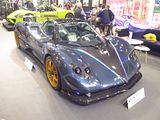
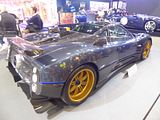
PANHARD
This is an early Panhard et Levassor model.
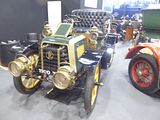
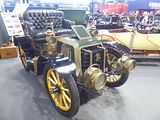
Mindful of the precarious economic situation in France in the aftermath of war, and aware of government enthusiasm for expanding the strategically important aluminium industry, the Panhard company, which had been known in the 1930s as a manufacturer of expensive six- and eight-cylinder sedans, purchased the rights to build a lightweight compact saloon car designed by the visionary engineer Jean Albert Grégoire and first exhibited as the AFG (Aluminium Français Grégoire) Dyna at the Paris Motor Show in 1946. They called it the Dyna X. The dramatic change of direction was not well received by everyone at Panhard, but it did usher in a period during which Panhard was one of the most loyal followers of the Pons Plan. In view of the fates of France’s luxury auto-makers in the next ten years, and the huge development potential that Panhard extracted from the Dyna X, this adherence to the Pons Plan was probably good for Panhard, at least until the early 1960s. The Dyna was made production ready and was emerging in commercial quantities from Panhard’s Ivry plant by 1948: it set the pattern for Panhard passenger cars until the firm abandoned automobile production in 1967. Grégoire had during the 1920s and 1930s become known for his expertise in two particular areas of automobile construction, these being lightweight bodies and front wheel drive. The AFG Dyna, planned under difficult circumstances in occupied France, had an all-steel tubular frame chassis, to which was attached a lightweight aluminium four-door superstructure. The style of the saloon was modern and aerodynamic. The compact engine and the lack of a radiator permitted a wind-cheating front design on which the headlights perched like frogs’ eyes, between the wings and bonnet line. The shape of the car changed little during its model life. The Dyna X’s low profile engine was characteristically idiosyncratic. The two cylinder front mounted boxer unit was air-cooled. At launch in 1946 the 610 cc unit delivered a claimed maximum output of 24 hp at 4000 rpm, which by 1949 had increased to 28 hp at 5000 rpm. The car’s aluminium body gave it an excellent power-to-weight ratio and in this form a maximum speed of 110 km/h (68 mph). The Dyna X made a considerable impression in the touring car championships of the late 1940s. The car was also noted for its frugal fuel consumption. Engine displacement was increased in 1950 to 745 cc, and to 851 cc in 1952, by which time claimed output had increased to 40 hp in the Dyna 130. The gearbox was a four speed manual unit controlled using a column mounted lever, featuring synchromesh on the top three ratios. Power was transmitted to the front wheels, front wheel drive having been a specialty and an enthusiasm of Grégoire for many years. As well as the four door saloon, alternative bodies included the two-door cabriolet and a 3-door estate version. A ‘Fourgonette’ light van version was also offered. The chassis and engine of the Dyna turned up in the Panhard Dyna Junior sports car of 1951 and were also a popular basis for low-volume lightweight sports cars produced by specialist manufacturers.
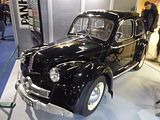
The Panhard PL 17 is an automobile made by the French manufacturer Panhard from 1959 until 1965. Presented on 29 June 1959, as successor to the Panhard Dyna Z, the PL 17 was essentially a facelifted version of its predecessor. The initial four-door saloon (and pickup and van) was joined by the Cabriolet in 1961, and by the Break, a five-door estate version, in April 1963. The Break, developed by Italian company Pan Auto, sat on a longer wheelbase but was of the same overall length. The model’s name was derived from “PL” for “Panhard et Levassor” (the original full name of the company), with the “17” coming from the sum of 5+6+6, being 5 CV plus 6 for the car’s six seats, plus 6 for the car’s economy of 6 L/100 km (47 mpg‑imp; 39 mpg‑US). As the car was developed under close supervision by Citroën, it was also no coincidence that 17 is a lower number than that of the DS 19. The two-door Cabriolet was first introduced in March 1960 and only available to customers in the United States. Not a runaway success, only 47 examples of this export-only model (internal code L2) were built.] A regularly available version for European customers was shown at the 1960 Paris Salon, becoming available in 1961 (L5). The trim level was equivalent to the top-of-the-line sedan, the Grand Standing model. For the 1963 model year, the Cabriolet was updated with the new engine, becoming the L8 – 125 examples were built of this version. Never a strong seller, the convertible was discontinued later in 1963 and the production line used to build the new PL 17 Break instead. In 1961 the entire line received a minor facelift: the front doors were now hung from the front, rather than the original’s “suicide doors”, while the turn signals were moved from near the base of the A-pillar to new positions flanking the headlamps. From the 1964 model year, the letters PL were dropped; this approximately coincided with the completed takeover the company by Citroën. Other names were lightly changed as well, with the addition of a “B” (for Berline) and “BT” for the Tigre model. The luxurious Grand Standing version was replaced by the “Relmax”. The car also underwent a slight facelift, losing the chrome unibrow at the front. In October 1958, a pickup and van version of the Dyna Z called the “Dyna Z Commerciale D65” had been presented. “D65” reflects the 650 kg (1,433 lb) payload, initially a pickup or canvas-covered pickup were available. In April 1959 a panel van and a chassis cab were added. 1,735 examples were built in the model’s ten-month career, kept short since the Dyna Z was updated to the PL 17 model within less than a year. Since the PL 17 was essentially just a facelift, the D65 was updated with the new front treatment and went on sale simultaneously with the saloon. The bodystyles were the same as for the new Panhard F65 (model code WL1), with a glazed van model added to pricelists in July 1959. In November 1959, a lighter-duty model with a 500 kg (1,102 lb) payload was added. Called the F50, this model was created to avoid parking time restrictions in the newly introduced Zones Bleues (“Blue Zones”) surrounding several major French cities. Priced nearly the same, the only discernible difference was slightly smaller tires for the F50 (model code WL2). For 1961, the Utilitaires received the same cosmetic changes as did the rest of the range; the model codes were accordingly changed to WL3/WL4. The codes changed again for 1963 (WL6/WL7), when the modified, 848 cc engine was introduced. For 1964 the range was again facelifted (less chrome and new, trapezoidal turn signals), but the model names were not altered. Initially, the car continued to use the engines of the Dyna Z, both of 851 cc. The standard one gave 42 hp, the “Tigre” gave 50 hp. The engines are twin-cylinder air-cooled “boxer” types, mounted with the gearbox at the rear and the two exhausts at the front. Beginning in July 1960, the engines decreased in capacity to 848 cc (to suit tax limits at 850 cc in many markets), with power remaining as before. SAE horsepower claims were 50 hp and 60 hp, respectively. The front wheels are driven through a four-speed gearbox with column shift, with synchromesh on the upper three gears. Suspension at the front is provided by two transverse leaf springs, and at the back by three torsion bars each side. The standard car weighs approximately 805 kg (1,775 lb), and the Tigre 830 kg (1,830 lb). This light weight combined with the car’s streamlining (with a coefficient of drag said to be Cd 0.26) allows for top speeds of 130 kilometres per hour (81 mph) for standard sedans and 145 kilometres per hour (90 mph) for the Tigre. It is possible to remove the back bench to enlarge the already considerable luggage space to 527 litres (18.6 cu ft). This space was available from model year 1964, when the spare wheel was moved from beneath the luggage space to under the bonnet, where it fits around the air filter. This is possible because the wheels have no centre — that is formed by the finned aluminium brake drums. The Panhard saloons produced after the Citroën take-over were not priced aggressively. In 1962, there were five different versions of the PL 17 offering 42 hp or 50 hp of maximum power and priced in France at between 6,990 and 8,240 francs for the standard sedan bodied versions. The similarly sized Simca Aronde came with power outputs ranging between 42 hp and 70 hp, priced between 6,340 and 7,450 francs. The Panhard was a little longer and a little wider, leaving dealers trying to explain why an 850 cc Panhard should cost more than a 1300 cc Simca. Panhard connoisseurs, including many taxi owners, appreciated the PL 17’s superior road holding and fuel economy, as well as the extra space afforded by the Panhard’s greater cabin width. Less pleasing were the awkward gear box, still without synchromesh on the bottom ratio, and the steering which was heavy at low speeds. Performance, especially for the top of the range 50 hp “PL 17 Tigre” was helped by the Panhard’s lighter body, although the extent of Panhard’s weight advantage had been reduced over the previous decade as aluminium had become more expensive and light metal panels had been substituted for some of the steel ones. Pricing issues may explain why PL 17 sales levels were too low to enable the model to reach the volumes of the Aronde. The Break model (L9) was developed by Pan Auto in Trento, Italy, with the idea of assembling it locally. It sat on a longer wheelbase but was of the same overall length. The original prototype received different front treatment of a more conventional design, with two large headlamps flanking a planar grille with horizontal ribbons. The taillights were borrowed from the contemporary Fiat 1800. Production ended up taking place in France, where it replaced the Cabriolet on the lines beginning in May 1963. The PL 17 Break was built in small numbers, with 2,998 examples being produced overall. Overall, around 166,000 PL 17s were built. Of these, 136,000 were regular-engined sedans, with an additional 23,500 sedans with the Tigre engine. 398 convertibles (it is unknown if this includes the 47 L3 cabriolets built for the US in 1960), 2,998 Breaks, and 3,191 Utilitaires (commercial models) were also built.
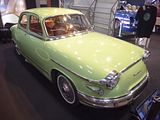
This rather attractive car, a Panhard 24CT, would turn out to be the last model from this French marque before Citroen, who had bought the company in 1955, would decide to kill the brand off. The Panhard 24 was launched in 1964 and was produced for three years. It was powered by a front-mounted air-cooled two-cylinder boxer motor: the basic design of this unconventional engine dated back to the 1940s. In 1965 a lengthened Panhard 24 was launched and promoted as a two-door four- or five-seat saloon. Plans for a four-door version which might have enabled the car more effectively to replace the commercially successful Panhard PL 17 saloon were never implemented, however. The car received a memorable press launch on 23 June 1963. A two tone Panhard 24 CT coloured in plum and grey was presented (although two tone paint work would not be a regular feature of the production versions). Journalists were shown the car in a large garden near Montlhéry, with a back drop of antique statues and rose bushes, complemented by imaginative lighting effects. Two versions were offered from 1964, the 24 C and the 24 CT. They were promoted respectively as a four-seater and as a 2+2, but they shared a wheelbase of 2,290 mm (90.2 in) and the same interior dimensions. The C had a relatively basic interior and an advertised engine output of 42 bhp (DIN) equating to 50 bhp (SAE): relatively few were sold and this version was dropped after a year. The CT was more luxuriously equipped and boasted an engine output of 50 bhp (DIN) equating to 60 bhp (SAE). The CT would prove more popular: but overall sales volumes were from the start lower than Panhard had anticipated for the car, which may have contributed to arguments against progressing development of the four-door version that had been envisaged. In 1965, the 2,550 mm (100.4 in) wheelbase versions became available, offering space for four or five, but still only with two doors. These were designated the Panhard 24 B and the Panhard 24 BT. Equipment levels and engine options were as for the shorter C and CT versions. In 1966, possibly in a belated bid for the mass market, a stripped down basic version, the Panhard 24 BA was offered. In contrast to the 24s offered for sale thus far, this one had a very basic interior. Even the lidded glove box was replaced by an open shelf. Only 161 24 BAs were produced, although enthusiasts have suggested that they nevertheless compromised the upmarket image of the more expensive versions. Although the Panhard 24 had a new modern body, the engine was an old friend. The two-cylinder air-cooled boxer motor of 848 cc, harked back to the 850 cc engine that had first appeared in the Panhard Dyna X in 1952 (itself an enlarged version of Panhard’s 610 cc boxer motor first seen in 1947). By 1954 when they appeared in the then newly announced Dyna Z these engines had been developed to the point where they produced a claimed output of 42 bhp or 50 bhp, according to version, and it was with these two output levels that the engine soldiered on in both the PL 17 and, subsequently, in the 24. The engines were compact and efficient, but they had originally been developed for aluminium bodied cars: by the 1960s it was no longer economically practical to construct cars in this price bracket out of aluminium, and while the Panhard 24 was not a heavy car, it was heavier than earlier Panhard saloons. At the same time, the competition had not been standing still. The claimed maximum speed ranged from 135 km/h (84 mph) for the long-wheelbase 42 bhp Panhard 24 to 150 for the short-wheelbase 50 bhp version. A slightly faster Tiger 10 S-engined version was reportedly capable of 160 km/h (100 mph). The 24’s performance was adequate, but probably fell short of the expectations triggered by the car’s sporty profile. And power delivery from an air-cooled flat two-cylinder engine did not sound as effortless as from the four-cylinder water-cooled power units on which the European auto industry by this time was increasingly standardising for the middle market. It has also been suggested that engine reliability suffered because many of the younger generation of car mechanics were not fully familiar with all the eccentricities of the Panhard power plants. Also familiar from a succession of post war Panhard saloons was the four-speed all-synchromesh gear box and the front-wheel-drive configuration. The wheels were independently suspended with telescopic shock absorbers and a torsion bar for the rear axle. The drum brakes with which the early 24s were delivered drew criticism for inadequate stopping power and excessive vibration: after 1965 the 24BT and 24CT received front disc brakes which addressed the problem. The interior was very well-appointed for this size of car, reflecting a determination not to let the car compete on price in the volume end of the small car market (already by now contested by the Citroën Ami). The Panhard 24 was one of the first cars to offer optional seat belts. The front seat backs were adjustable for rake and the seats were also – unusually at this time – adjustable for height. The passenger’s sun visor included a vanity mirror with its own light and the steering wheel was adjustable. The car also boasted an unusually elaborate heater. During 1964 and 1965 Panhard produced approximately 10,000 24s per year: 1966 saw that rate approximately halved. Still desperately short of production capacity, Citroën faced a choice between developing the Panhard 24 and perpetuating the Panhard brand, or using the capacity of the Ivry plant to increase further the output of the popular 2 CV vans. The vans won, and production of the Panhard 24 officially ended on 20 July 1967 after 28,651 had been built.
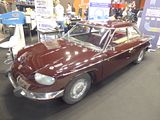
PESCAROLO
This is a Pescarolo C60 Hybrid race car. It was developed to comply with the 2005 “hybrid” LMP1 aerodynamic regulations. The car achieved a perfect Le Mans Series championship in 2006, winning all five races. It was co-driven by drivers including Eric Hélary, Sébastien Loeb, and Soheil Ayari. The car used a Judd V10 engine.
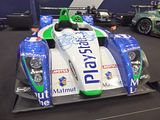
PEUGEOT
As one of the world’s oldest car-makers, which produced its first steam-powered locomotive carriage in 1889, Peugeot had an impressively broad range by 1902, spanning everything from little quadricycles for relatively cash-strapped motorists to big, Mercédès-style four-cylinders for the great and the good. Near the bottom of the range was the Bébé, which was introduced in 1900 with a 785 c.c. engine, three-speed gearbox and tubular chassis. The engine used automatic inlet valves, and by 1903 it was the only Peugeot still to have that feature, all the other models having received mechanically-operated valves. The Baby name would later be applied to other small Peugeots during the Edwardian era, but the original models had helped to establish a strong market for Peugeots in Britain, in part due to the publicity efforts of dealer Charles Friswell. At a time when business was conducted along decidedly sober lines, Friswell managed to generate attention for his activities by writing sheer nonsense. Friswell’s Automobile Palace on London’s Holborn Viaduct was, indeed, a palatial garage, apparently with space for more than 200 cars and 100 carriages, plus a motorcycle department, but we begin to digress, because the Baby Peugeot seen here was not one of Friswell’s sales. Its first owner, one Captain Kelly, bought it new from the 1902 Paris Salon. Its history is then a blank until 1946, when we learn of it being owned by Bernard Wood of Whepstead, Suffolk. In May, 1947, it had the good fortune to fall into the hands of another Suffolk man who was among the ranks of early enthusiasts, Kenneth Bowyer of Kirtling. It seems the car had been cared for well enough in its early life that Bowyer did not have to undertake any serious restoration, and he drove the Peugeot to Madeira Drive in the 1949 Veteran Car Run, when it was already taking on a pleasingly oily-rag appearance. It was in February, 1949, that it received the Veteran Car Club Dating Certificate no. 139. Bowyer retained the Peugeot until his death in 1988, after which it was owned by the noted historic racer and collector Neil Corner, who undertook several more Brightons. With more recent owners, the Peugeot has continued to be enjoyed on the Brighton Run, and one occasion it was even honoured with the title of Most Original Veteran at the Veteran Car Concours on Regent Street. The following years have been extremely kind to the little voiturette, and at 123 years old, it makes for a beautiful sight with its original paintwork, upholstery and Gamage-Nulites lamps. Although it may be an occasional Brighton Runner, until now there have been few opportunities to inspect the Baby Peugeot close-up.
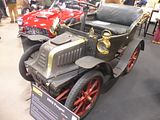
The replacement for the 403 was the 404 Berline, which was built from 1960 to 1975, though the commercial pick-up versions continued until 1988, and under licence, it was manufactured in various African countries until 1991. Styled by Pininfarina, the 404 was offered initially as a saloon, estate, and pickup. A convertible was added in 1962, and a coupé in 1963. The 404 was fitted with a 1.6 litre petrol engine, with either a Solex carburettor or Kugelfischer mechanical fuel injection or a 1.9 litre diesel engine available as options. Introduced at the Paris Motor Show as an option was the inclusion of a 3-speed ZF automatic transmission, similar to the unit already offered on certain BMW models, as an alternative to the standard column-mounted manual unit. Popular as a taxicab, the 404 enjoyed a reputation for durability and value. Peugeot’s French production run of 1,847,568 404s ended in 1975. A total of 2,885,374 units had been produced worldwide at the end of production.
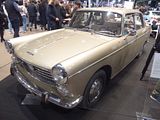
The Peugeot 204, a small family car, was produced between 1965 and 1976. It was launched in Paris on 23 April 1965 and was Peugeot’s first venture into the world of front wheel drive. The car came with a single overhead cam aluminium alloy transversely-mounted 1130 cc petrol engine (the maximum allowed for the 6CV ‘car tax’ class in France at the time), a format which would become the sine qua non of small cars over the next few years, but which was relatively unusual in the mid 60s. The gearbox and differential were located directly below the engine block, and the 204 was also the first Peugeot to be equipped with disc brakes, albeit only on the front wheels. It was praised for its excellent handling, decent performance and good fuel economy. The compact engine and the transverse engine combined with a body wider than the class average to provide a level of interior space comparable to larger cars such as Peugeot’s own 404: both cars were Pininfarina designs. The 204 featured neither the fins of the 404 nor the sharp corners characteristic of the other major French launch of 1965. The resulting less aggressive look has been seen as a ‘more European’ moving away from a tendency to follow US styling trends that had been apparent in new car launches during the preceding two decades. The Peugeot 204’s frontal styling owed much to the 1961 Cadillac Jacqueline by Pininfarina, whilst its rear and that of the prototype Pininfarina styled Mini-based MG ADO 34 of 1964 are strikingly similar. The rear end of the 1970 Lancia Flavia Pininfarina Coupe of 1969–74 also displays the same influence. The options list was not extensive but, as with the larger Peugeot sedans, it was possible to specify a sliding steel panel sunroof. At launch only the four-door saloon version was offered, but the five-door ‘break’ estate came along less than six months later in the Autumn of 1965. 1966 saw the arrival of a two-door cabriolet and a three-door hatchback, marketed as a coupé. Both employed a shortened chassis and were priced only 20% above the level of the (admittedly not particularly aggressively priced) saloon. The range was completed in 1966 with the arrival of the ‘fourgonette’ van version which in most respects followed the design of the estate, but with only one door on each side and a steel panel in place of the side windows behind the B pillar. Towards the end of 1968, a 1255 cc diesel engine option became available for the 204 Estate and Fourgonette (van) versions. At the time, this is thought to have been the smallest diesel engine fitted in a commercially available car anywhere in the world. In April 1973 the diesel unit was increased in size to 1357 cc, and in September 1975 this diesel unit finally became an option on the 204 saloon. Fuel economy on the 204 Diesel was startlingly good, with overall fuel consumption at 5.7 litres per 100 km, but performance was correspondingly underwhelming with a claimed top speed of 130 km/h (81 mph). Out of the approximately 150,000 diesel 204s produced, fewer than 30,000 were saloons. When the Peugeot 204 was launched in 1965, obvious domestic market competitors were the Renault 10 and the Simca 1300. Both were rear-wheel-drive, and the Renault was rear-engined. Of the traditionally more avant garde competitors, Citroën produced, till 1970, only cars that were substantially smaller or substantially larger while Panhard, starved of product investment, had retreated into a low volume niche, offering a model which would soon be withdrawn in order to free up production capacity for small Citroën vans. For Peugeot, a traditional manufacturer of conventional bourgeois sedans, to launch a transverse-engined front-wheel-drive saloon, was startling: no secret was made of the extent to which the 204 had been inspired by British developments from BMC. The Peugeot was the same length as the Renault 10 and over 20 cm shorter than the Simca 1300, but its configuration conferred a clear space advantage, as subsequent model introductions from Simca in 1967 and Renault in 1970 appeared to acknowledge. Sales of the 204 got off to a cautious start, with no need to compete solely on price: the car was heavily trailed by press leaks so that by the time of its formal announcement over 5,000 had already been ordered unseen. By 1969 the 204 had nonetheless climbed to the top of the French sales charts and, together with the newly introduced 204 based 304, redefined the domestic market for small sedans in the process. The sales success of the 204 also moved Peugeot from fourth to second place in the French sales charts, overtaking Simca and Citroen in the process. In this case market share seems to have been increased without excessively compromising corporate profitability: the commercial rivals would each suffer a financial collapse, the businesses both coming under the control of Peugeot, within the next ten years. In the 1960s Europe was still for most purposes divided into national markets and 72% of the 204s produced were sold in France. Principal export markets within Europe were West Germany and Benelux. However, most western European markets took some 204s. In Africa the 204 never achieved the popularity of its larger siblings. Nevertheless, the 204 was not entirely unknown outside Europe. In the UK, the car was expensive. Launch cars listed at £903 when you could buy a much more plush Triumph 1300 for £835, so whilst the car was praised by the press for its dynamic attributes, its meagre levels of equipment were also an impediment to sales. 1969 had seen the launch of the Peugeot 304 which was essentially a 204 with a slightly larger engine, a restyled front end and, in the case of the saloon version, a substantially increased rear overhang giving rise to more luggage space. The 204 range was correspondingly pruned: the 204 coupé and cabriolet received the dashboard of the new 304 in 1969 only to be withdrawn in 1970, replaced by similarly bodied 304 equivalents. The estate and fourgonette continued to be offered, along with the saloon, until the 204 range was withdrawn in 1976. Although the model run lasted more than a decade, the Peugeot 204 changed very little during that time: very early saloons/berlines had a split rear bumper with numberplate set between the two halves, a flat rear panel and small oval tail lights. For 1975, the stainless steel front grill was replaced by a black plastic grill of the same overall shape. The gearshift for RHD UK cars was moved from the steering column to the floor and then in September 1975, less than a year before production ceased, it received a more modern petrol engine, now of 1127 cc. Claimed maximum output, which at launch had been 53 bhp, increased to 59 bhp, though there was a marginal reduction in maximum torque. Following the demise of the 204 the new 1127 cc engine found its way into a version of the Peugeot 304 estate: the smaller engine enjoyed in France tax benefits when compared to the 1290 cc engines fitted to most 304s. In 1976, when the 204 was withdrawn, it had been joined in the Peugeot range by the ‘supermini’ class Peugeot 104. Like the 203 before it, the 204 had no immediate replacement. Ultimately the hatchback Peugeot 205 introduced late in 1982 occupied a market position comparable to that occupied till 1976 by the 204. In the meantime the Peugeot 304 soldiered on until 1980, complemented since late 1977 by its 305 replacement. Once the 304 was being produced in tandem with its successor it could be priced more aggressively, so that customers who till 1976 would have chosen a 204 were able to afford what was virtually the same car with a larger engine and a larger boot.
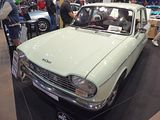
This sleek machine, designed by Pininfarina was based on the 504 Coupe, made its debut at the 1971 Geneva Auto Show. The original show car was based on a 1.8-litre Coupé, but the donor for this beautifully finished recreation was a 2-litre Cabriolet. The styling house is emphatic that it only built one example, at its own cost, in an attempt to interest Peugeot management in a Scimitar GTE-style ‘sports estate’ variation on the 504 Coupé theme. Some suggest that three were built; others that there was one working example and a mock-up. Nobody seems to know for sure where any of them are, though – one account even says that Peugeot has the one-and-only example stashed away in its museum, but I can find no evidence of this. A recurring theme throughout this mystery is the idea that the one-off – if it is a one-off – is hiding in a private collection in Spain, still in good condition. This is a reasonably credible notion because the Riviera’s last-known public sighting was at the Barcelona motor show in May 1972. In those days, General Franco had decreed that manufacturers had to bring at least five cars to display, and for some that meant bringing prototypes with export licences. When the show finished, rather than ship them back home it made sense to do a deal locally – which is why the history of quite a few unique exotics gets a little sketchy if their story includes ‘displayed at the Barcelona motor show’. You have to wonder if the Italian coachbuilders saw the Spanish event as a good route for flogging off prototypes that were no longer needed. The fact that the body colour of the Break Riviera appeared to change from light blue to dark grey between its Paris and Barcelona outings further muddies the waters. Peugeot’s thoughts on the Riviera are unknown, although some say it got to the point of having a brochure printed before thinking better of the idea. There are generally sound reasons behind the rejection of speculative proposals for new variations on established designs: lack of funds, lack of production capacity or simply a fear that there may be a lack of customers. Despite the fashionable success of the Reliant Scimitar GTE, you can hardly blame the conservative grey suits at Peugeot for having doubts about the wisdom of putting the firm’s name to a relatively new genre of vehicle that might turn out to be nothing more than a passing fad. Pininfarina, meanwhile, tried to interest Fiat and Lancia with similar sporty shooting-brake concepts on the basis of the Fiat 130 and Lancia Gamma coupés. The pretty 1974 130 Maremma was almost certainly a victim of the fuel crisis (Fiat boss Gianni Agnelli bought it for his own use), while the 1982 Olgiata came too late in the life cycle of Gamma to be of much interest. More than 50 years on, with the benefit of hindsight, the 504 Break Riviera does look like a genuine missed opportunity. What few pictures there are of the 1971 show car depict a vehicle that lends itself beautifully to the sporty station-wagon treatment. With bespoke four-spoke alloys, a silver finish on the sills (to contrast with the Bleu Vert metallic paint) and long, slender, sliding side windows, it manages to avoid the mini-hearse look of the rather unhappy Volvo 1800ES that appeared the same year. The success of the 1975 Lancia Beta HPE – nowhere near as good-looking as the Riviera, to my eyes – showed that there was an appetite for a chic, multi-purpose car such as this. Like so many rare or unique estate versions of exotic and semi-exotic cars, the Break Riviera continues to exert a strange hold over those who love these handsome Pininfarina-bodied 504s. Most people would content themselves with buying a miniature (there’s a really good 1:18-scale one by BoS-Models), but for others only the real thing will do – or as near as funds (and skilled labour) will allow you to get. Richard Carp – the ‘C’ of HC Classics in Wiltshire – was commissioned by a deep-pocketed private individual (who wishes to remain anonymous) to build an exact replica of the 504 Break Riviera on the basis of a 1972 504 Cabriolet donor. “We actually started with a Coupé, which turned out to be too rotten,” says Carp, “but the Cabriolet was pretty sound, so we went with that instead.” HC Classics began trading in 2017, mainly doing trimming work. But now, with an outpost in Poland for the heavyweight metal-bashing – and a hard-working Polish team based in Wiltshire – the still-young outfit can tackle anything, with a good track record of restoring Bristols, ACs and Rovers: there is a replica of the Graber two-door P6 currently under way. The 504 Break Riviera project represents three years of work for HC, during which Carp’s background as design manager at Ogle in the 1990s came in useful. “In creating the back end we used the CAD process,” he explains, “inputting every detail into CNC machines to make metal and honeycomb formers to press out the panels. “We only had a few photographs of the original car to work from, but we think this is as close as you can get.” This is not the first Break Riviera ‘tribute’ car, incidentally – there is a brown car based on a V6 Coupé floating around – but to my eyes the HC creation is much truer to the original concept. The only components, in terms of body panels, that are the same as the original Pininfarina production cars are the front wings and bonnet. “Even the window line changes,” says Carp, “because the roofline goes up on the Riviera and on the Coupé it goes down.” The folding back seats meant the strength-giving rear bulkhead was lost, so the floor had to be reinforced. The long rear wings have bigger wheelarches than the production cars, and the position of the fuel-filler flap had to be changed because, if it were too high, the tube going into the tank would be more exposed, which would have looked ugly inside. In short, says Carp, the body was a lot more work than simply tacking on an estate-car back end: “Even just working out the design and function of the rear door, and how the struts and hinges operate, was very time-consuming.” Mechanically the build was straightforward – although HC’s engineers did have to make a bespoke tool to extract the centre bearing in the torque tube. Having produced the tooling, the firm could, in theory, build a second 504 Riviera, but Carp doesn’t look keen on the idea. With cream leather trim throughout, and a leather-covered dashboard and door cards, the Riviera is probably subtly more plush than the original show car. HC Classics has done a beautiful job of recreating the Riva speedboat-style, walnut-covered rear load deck, but has yet to come up with a solution for securing the rear bench in its upright position: the original car used a magnet. Those beautiful four-bolt alloy wheels – apparently unique to the Break Riviera – were machined from scratch. The Riviera is a new car to all intents and purposes: I’ve never before seen a 504 restored to this level, with a gleaming engine bay that even manages to make a pretty sight of Peugeot’s canted-over, cast-iron, overhead-valve ‘four’. The owner has other 504 models as well. Clearly a real model devotee!
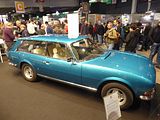
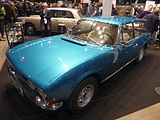
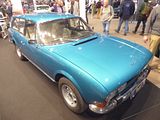
The 304 was introduced to the public at the Paris Motor Show in September 1969. Peugeot, which had always been a financially prudent company, saw a gap in the mid-size car market in France, Italy and the rest of Western Europe. By using the smaller 204’s midsection, development costs were minimized resulting in a higher profit margin because of the higher pricing structure in the larger, better equipped market. The 304’s main competitors on its home market came from Renault and Simca, with Citroen noticeably absent from this sector at the launch. The 304 was a success for Peugeot and was noted for several advanced features under its Pininfarina styled exterior. With its independent suspended front-wheel-drive drivetrain and disc brakes, it rode and handled better than most of its contemporaries, including some cars in higher price brackets. The chassis served Peugeot well and lasted for approximately 24 years adapted to derivative models. There was a distinct upmarket feel to the 304, its handsome lines were well suited to postwar Europe’s newly affluent middle classes who desired roomy, advanced and stylish cars to park in their driveways. At about this time the Autoroutes were opening up France and car manufacturers around Europe knew that any car launched hence, would need to add an ability to travel at high speeds, in relative comfort with sure-footed handling to its line-up in order to compete. The 304 fulfilled this brief and became one of the best-selling cars in its market segment., with 1, 178.423 produced. Coupe and Convertible models were part of the range, but these constituted a relatively small percentage of total sales. The saloon model was deleted in the summer of 1979, but the estate remained until spring 1980, both cars replaced by the Peugeot 305,
Before the 205, Peugeot was considered the most conservative of France’s “big three” car manufacturers, producing large saloons such as the 504 and 505, although it had entered the modern supermini market in 1973 with the Peugeot 104. The genesis of the 205 lay within Peugeot’s takeover in 1978 of Chrysler’s European divisions Simca and the former Rootes Group, which had the necessary expertise in making small cars including the Simca 1100 in France and Hillman Imp in Britain. It was around this time that Peugeot began to work on the development of a new supermini for the 1980s. It was launched on 24 February 1983, and was launched in right-hand drive form for the UK market in September that year. Shortly after its launch, it was narrowly pipped to the European Car of the Year award by the similar sized Fiat Uno, but ultimately (according to the award organizers) it would enjoy a better image and a longer high market demand than its Italian competitor. It was one of five important small cars to be launched onto the European market within a year of each other: the other four were the Uno, the second generation Ford Fiesta, the original Opel Corsa (sold as the Vauxhall Nova on the British market) and the original Nissan Micra. Its launch also closely followed that of the Austin Metro and Volkswagen Polo Mk2. The styling of the 205 is often thought to be a Pininfarina design, although Gerard Welter claims that it is an in-house design; Pininfarina only styled the Cabriolet. It is often credited as the car that turned Peugeot’s fortunes around. The fully independent suspension used the now standard PSA Peugeot Citroën layout that had debuted in the Peugeot 305 estate. A key ingredient of the success of the 205, it had MacPherson struts at the front and trailing arms with torsion bars at the rear. The rear suspension was very compact, designed to minimise suspension intrusion into the boot, giving a wide flat loadspace, while providing excellent ride and handling. Early 205s used the X petrol engine [n 1] from the older Peugeot 104, although these were later (1987–1988) replaced with the newer XU and TU-series engines, which were of PSA design. Engines ranged in displacement from 954 cc to 1905 cc, in carburettor or fuel injected versions. The diesel models employed the PSA XUD engine, lifted from the Citroën BX which was introduced in September 1982. These engines had a capacity of 1769 cc (XUD7) and 1905 cc (XUD9) and are closely related to the XU5 and XU9 petrol engines in the BX16 and BX19 of the time. The diesel engines were world-beating and so petrol-like that many buyers were won over by petrol car performance combined with diesel economy. For instance, the 205 GRD (1.8 Diesel, 59 bhp, 78 lb/ft (105.8 Nm)) was as fast as, yet smoother than, the 205 GR (1.4 Petrol, 59 bhp, 78 lb/ft (105.8 Nm)), due to the engine developing peak torque at much lower rpm, while using much less fuel. There were various versions intended for commercial use, such as the two-seater XA-series. There was also the “205 Multi”, a tall-bodied special version on XA or XE-basis built by independent coachbuilders like Gruau and Durisotti. Gruau called their XA-based two-seater version the “VU”, while the five-seat XE-based version was called the “VP”. Durisotti began building the 205 Multi in 1986; it was called the “205 Multi New Look”. The 205 was an instant hit, and its styling was echoed in every Peugeot model that was to follow. The exterior styling was never facelifted or significantly altered in its 15-year production run. There was a dashboard redesign for the 1988 model year, and in late 1990 the 205 received new door design and cards, clear front indicators, new ‘smoked’ rear light clusters, single point petrol injection and catalytic converters were introduced, to meet the new 1992 pollution limits. These updates came at a crucial time, as 1990 also saw the arrival of a completely new French competitor, the Renault Clio, while the Rover Metro and Volkswagen Polo were also heavily updated, and Ford had already replaced its Fiesta with a third generation model. Still, the 205 was still widely regarded in the motoring press as the benchmark car in this sector by 1990. At the beginning of 1993, Peugeot launched the 306, which officially replaced the 309; the arrival of this car also diminished the 205’s role (and its sales figures) in the Peugeot range, as had the arrival of the smaller 106 in September 1991 – although the final demise of the 205 was still some years away. The engines were continuously updated, with the new TU engines introduced in 1988. In 1991, the 205 dTurbo was launched with a powerful turbocharged version of the 1,769 cc xud diesel engine. After several years of gradually declining sales, the Peugeot 205 was discontinued in the United Kingdom in 1996. The Peugeot 205 was still offered in the “Sacré Numéro” and “Génération” models until the end of the production in 1998. The last models were GLD 1.8 configuration and were sold in Argentina. Most of the later European versions were only sold in France. Due to the pressure from the market, with buyers wanting a Peugeot supermini in the mould of the 205 again, the company finally built a direct replacement in the 206, which was launched in 1998. 5,278,050 Peugeot 205s have been sold, and a significant percentage of them were still in circulation as of 2009. By 2014, there were still as many as 14,000 on the road in the United Kingdom, compared to the peak high of 374,773 in 1994. With potentially as many 400,000 sales in the UK, it became the best selling car ever sold by Peugeot in the UK – although its success was emulated a few years later by the larger 306 and later by the 206. It also helped boost the popularity of the Peugeot brand there, and was at least a factor in Peugeot’s decision to phase out the Talbot brand in the mid 1980s when launching new models to be built at the former Rootes Group plant near Coventry and the former Simca plant at Poissy.
The 309 had been conceived as Projet C28 as a replacement for the Talbot Horizon, and as a result its development had been performed by the former Chrysler/Simca wing of PSA. Styling was the responsibility of the former Chrysler-Rootes design studios in Coventry, whilst much of the engineering was done at the Simca site at Poissy in France. The only stipulation from PSA management was that the new car had to use as much existing architecture as possible; hence the use of a stretched Peugeot 205 floorpan and door shells, whilst the Simca engines and transmissions from the Horizon were also carried over. The 309’s design was presaged by the 1982 Peugeot VERA Plus (followed by the VERA Profil in 1985), which were aerodynamic studies developed by Peugeot at the time. The VERA Plus claimed a Cw of only 0.22. Many of the aerodynamic features from the VERA studies found their way into later production Peugeots. Production in France began at the former Simca plant in Poissy in the end of summer 1985, with the first French customers getting their cars in October of that year; but it was decided that RHD models would be built at the Ryton plant near Coventry, which had previously been owned by the Rootes Group and then Chrysler Europe before Peugeot took it over in 1978. The first 309 for the British market rolled off the production line at Ryton in October 1985, and sales began the beginning of 1986, although left-hand drive sales of the Poissy built models began in France in October 1985. The only bodywork available originally was the five-door hatchback. The 309 was not intended to replace Peugeot’s own model, the 305, but the out of step model number (the next small family car after the 305 should have been named “306” which eventually launched in 1993) was intended to distance it from the larger 305 in the marketplace and to reflect the car’s Simca origins. It was also the first Peugeot badged hatchback of this size. With the Talbot brand being phased out on passenger cars, the 309 would succeed the Talbot Horizon. Peugeot had been considering a new Talbot Samba based on the forthcoming Citroën AX supermini, but the success of the Peugeot 205 meant that there was little need for a third supermini within the PSA combine, and so the Samba was discontinued in 1986 with no replacement. The larger Alpine hatchback and Solara saloons were also axed in 1986, a year before Peugeot began production of the similar sized 405, successor to the 305. The 309’s slightly awkward styling (especially when compared with the 205 and 405 of the same era) was due to the decision to reuse the door shells from the 205. The 309 was also originally intended to be differentiated from Peugeot as a Talbot, and was designed “inhouse”. Other Peugeot cars of the time were designed by the famed Italian design house Pininfarina, up until the introduction of the 206 in 1998. The notched hatchback design bears an unintentional similarity to the Dodge Shadow and Plymouth Sundance, which were also developed (entirely separately and cut down from a larger [Chrysler K-Car] platform rather than stretched from a smaller one) to replace the Horizon in North America. The initial engine line up in the United Kingdom market consisted of the chain driven Simca derived 1118 cc (E1A) and 1294 cc (G1A) overhead valve petrol units from the Horizon, and Peugeot provided 1580/1905 cc petrol belt driven overhead camshaft XU units. Spanish-built cars also used the 1442 cc (Y2) and 1592 cc (J2) “Poissy engine”, as seen previously in the Simca 1307 and Solara as well as the Horizon, instead of the 1580 cc OHC. In July 1986 the first diesels arrived, the 1905 cc, 65 PS PSA XUD engined GLD, GRD, followed by the SRD in 1987. Certain export markets also received a 60 PS 1769-cc version of this engine from the beginning. In France, the smaller diesel option only arrived in 1992. With 305 sales dropping considerably, the 309 range was expanded considerably in February 1987, when the three-door bodystyle was added. In line with Peugeot’s naming policy of the time, five-door models generally have equipment levels beginning with the letter G, while three-doors begin with the letter X. Other important new models was the XU 1905 cc-engined high performance GTI version of the 309; this quickly established itself as one of the class leading hot hatch of its time, thanks to very quick acceleration and a better balanced chassis set-up than the already-excellent handling Peugeot 205 GTI. Other new versions in 1987 were the new Automatic (only with five doors) and the XA and XAD two-seater vans which arrived in February. Largely due to its partially British origins, the Peugeot 309 became a popular choice in the United Kingdom, and in 1987, it was joined on the production line by the larger 405. The 309’s successor, the 306, was also built at Ryton, as was the 206, which was the last vehicle in production there when the plant closed in December 2006. The summer of 1989 saw the introduction of the Phase 2 Peugeot 309. It revised the design of the rear, lowering the boot lip, changing the rear lights to a more ‘smoked style’ and making slight alterations to the front radiator grille. Also, an updated interior was required to address severe criticisms levelled at the Phase 1’s, Talbot designed multi piece dashboard which was prone to developing squeaks and rattles. The GTi models received a colour coded one piece rear spoiler as opposed to the Phase 1’s outdated rubber spoiler which, by then, harked back to early 1980s design. Quite importantly a modified gearbox called ‘BE3’ was introduced, a revision of the original ‘BE1’ unit, placing reverse in the “down and to the right” position behind fifth gear, as opposed to the earlier “up and to the left” position next to first gear. Retrospectively, the ‘BE3’ gearboxes are slightly less prone to failure than their earlier counterparts. This was also when Peugeot gradually phased in their, all new, belt driven TU Series overhead camshaft engines, in 1,124 cc and 1,360 cc forms, eventually replacing the trusty Simca units during 1992. The GTi 16 model, featuring the XU9J4 engine from the 405 Mi16, was also introduced at this time; however, these were only sold in mainland Europe. Towards the end of 1992, production of the 309 began to wind down in anticipation for the launch of the new Peugeot 306, returning Peugeot to their normal numbering scheme. In July 1993, the 309 lineup was severely reduced and only the two Vital (petrol or diesel) models remained on sale until December. In total, 1,635,132 Peugeot 309s were built between 1985 and 1993. As of 2018, only 481 Peugeot 309s remained on the roads in the United Kingdom, with another 1,378 registered being kept off the road as SORN.
PLYMOUTH
This is a 1971 Satellite 400 GTX. A new design was introduced for the 1971 model year. The Satellite adopted new “fuselage” styling – in line with the facelifts on the larger Chrysler C-Body models – on the two-door, four-door, and wagon models. Unlike previous years, 4-door sedans and 2-door coupes did not share sheet metal and each carried unique styling. Sedans were available in base, Custom, and Brougham trim, while two-doors were available in 5 trim levels. All VIN numbers started with the letter R for Satellite followed by the letter for the trim ordered RL(LOW)code was the base model for the Satellite, RM (Medium) Satellite Roadrunner, RH (High) Satellite Sebring, RP (Premium) Satellite Sebring Plus and top-of-the-line RS (Special) Satellite GTX. Two-door models had a loop-type front bumper, 2-door coupes had a wheelbase of 115 inches, while 4-door sedans, as well as station wagons, had a wheelbase of 117 inches. For the 1973 model year, the two-door models received a more conventional front-end design, with squared-up sheet metal and rear side windows. Safety requirements for the 1974 model year included 5 mph (8.0 km/h) bumpers for the sedans and wagons. The Satellite name was dropped after 1974, after which Plymouth’s intermediate offerings on the B-body chassis acquired the Plymouth Fury name. The Satellite Sebring, named for the Sebring International Raceway in Sebring, Florida, was replaced by the Chrysler Cordoba (a car which was originally intended to be called Plymouth Sebring) and shared an all-new body with the Dodge Charger. The Sebring name would be revived by Chrysler on an unrelated model in 1995.
PONTIAC
This is a 1958 Star Chief, a nameplate used from 1954 to 1966. n 1957, the “Limited Addition” Pontiac Bonneville were sold to customers. They featured Bonneville Badging, Chevy’s manual linkage fuel injection systems mounted on Pontiacs 347 cid V-8 engine. The transmission was a Jetaway 4 speed automatic. In 1958, the Bonneville was first given its own position in the Pontiac lineup as the ultimate Pontiac, and was only available as a two-door hardtop and two-door convertible. While no longer Pontiac’s prestige model, the Star Chief remained a well-appointed car, and the division’s finest four door hardtops and sedans. The 1958 Star Chief received all-new bodywork and an updated chassis with an appearance that was shared with all GM cars for that year. The body was considerably longer and lower, and featured a new honeycomb grille design and twin headlamps. The sedans and coupé models all shared the longer 124 inch wheelbase, while the Custom Safari model remained on a chassis two inches shorter, shared with the lesser Chieftain. Four chrome star markings were featured on the rear fender for 1958. In spite of the new bodywork, sales of the 1958 Star Chief dropped precipitously; down by around 60% while Pontiac’s overall sales dropped by more than a third. 1958 was also the year the “Silver Streak” styling feature was no longer offered, which was first used in 1933. The engine was updated from the 347 cu in (5.7 L) unit used in 1957 to a slightly bored out 370 cu in (6.1 L) version. Power only increased marginally, to 255 hp for the manual version, while the most powerful “PM” option was now up to 330 hp. The car was completely redesigned for 1959.
PORSCHE
The 356 was created by Ferdinand “Ferry” Porsche (son of Dr. Ing. Ferdinand Porsche, founder of the German company), who founded the Austrian company with his sister, Louise. Like its cousin, the Volkswagen Beetle (which Ferdinand Porsche Senior had designed), the 356 was a four-cylinder, air-cooled, rear-engine, rear-wheel-drive car utilising unitised pan and body construction. The chassis was a completely new design as was the 356’s body which was designed by Porsche employee Erwin Komenda, while certain mechanical components including the engine case and some suspension components were based on and initially sourced from Volkswagen. Ferry Porsche described the thinking behind the development of the 356 in an interview with the editor of Panorama, the PCA magazine, in September 1972. “….I had always driven very speedy cars. I had an Alfa Romeo, also a BMW and others. ….By the end of the war I had a Volkswagen Cabriolet with a supercharged engine and that was the basic idea. I saw that if you had enough power in a small car it is nicer to drive than if you have a big car which is also overpowered. And it is more fun. On this basic idea we started the first Porsche prototype. To make the car lighter, to have an engine with more horsepower…that was the first two seater that we built in Carinthia (Gmünd)”. The first 356 was road certified in Austria on June 8, 1948, and was entered in a race in Innsbruck where it won its class. Porsche re-engineered and refined the car with a focus on performance. Fewer and fewer parts were shared between Volkswagen and Porsche as the ’50’s progressed. The early 356 automobile bodies produced at Gmünd were handcrafted in aluminium, but when production moved to Zuffenhausen, Germany in 1950, models produced there were steel-bodied. Looking back, the aluminium bodied cars from that very small company are what we now would refer to as prototypes. Porsche contracted with Reutter to build the steel bodies and eventually bought the Reutter company in 1963. The Reutter company retained the seat manufacturing part of the business and changed its name to Recaro. Little noticed at its inception, mostly by a small number of auto racing enthusiasts, the first 356s sold primarily in Austria and Germany. It took Porsche two years, starting with the first prototype in 1948, to manufacture the first 50 automobiles. By the early 1950s the 356 had gained some renown among enthusiasts on both sides of the Atlantic for its aerodynamics, handling, and excellent build quality. The class win at Le Mans in 1951 was clearly a factor. It was always common for owners to race the car as well as drive them on the streets. They introduced the four-cam racing “Carrera” engine, a totally new design and unique to Porsche sports cars, in late 1954. Increasing success with its racing and road cars brought Porsche orders for over 10,000 units in 1964, and by the time 356 production ended in 1965 approximately 76,000 had been produced. The 356 was built in four distinct series, the original (“pre-A”), followed by the 356 A, 356 B, and then finally the 356 C. To distinguish among the major revisions of the model, 356’s are generally classified into a few major groups. 356 coupés and “cabriolets” (soft-top) built through 1955 are readily identifiable by their split (1948 to 1952) or bent (centre-creased, 1953 to 1955) windscreens. In late 1955 the 356 A appeared, with a curved windshield. The A was the first road going Porsche to offer the Carrera 4 cam engine as an option. In late 1959 the T5 356 B appeared; followed by the redesigned T6 series 356 B in 1962. The final version was the 356 C, little changed from the late T6 B cars but with disc brakes to replace the drums.
Also here was the 914, a model born of a joint need that Porsche had for a replacement for the 912, and Volkswagen’s desire for a new range-topping sports coupe to replace the Karmann Ghia. At the time, the majority of Volkswagen’s developmental work was handled by Porsche, part of a setup that dated back to Porsche’s founding; Volkswagen needed to contract out one last project to Porsche to fulfill the contract, and decided to make this that project. Ferdinand Piëch, who was in charge of research and development at Porsche, was put in charge of the 914 project. Originally intending to sell the vehicle with a flat four-cylinder engine as a Volkswagen and with a flat six-cylinder engine as a Porsche, Porsche decided during development that having Volkswagen and Porsche models sharing the same body would be risky for business in the American market, and convinced Volkswagen to allow them to sell both versions as Porsches in North America. On March 1, 1968, the first 914 prototype was presented. However, development became complicated after the death of Volkswagen’s chairman, Heinz Nordhoff, on April 12, 1968. His successor, Kurt Lotz, was not connected with the Porsche dynasty and the verbal agreement between Volkswagen and Porsche fell apart. In Lotz’s opinion, Volkswagen had all rights to the model, and no incentive to share it with Porsche if they would not share in tooling expenses. With this decision, the price and marketing concept for the 914 had failed before series production had begun. As a result, the price of the chassis went up considerably, and the 914/6 ended up costing only a bit less than the 911T, Porsche’s next lowest price car. The 914/6 sold quite poorly while the much less expensive 914/4 became Porsche’s top seller during its model run, outselling the Porsche 911 by a wide margin with over 118,000 units sold worldwide. Volkswagen versions originally featured an 80 PS fuel-injected 1.7 L flat-4 engine based on the Volkswagen air-cooled engine. Porsche’s 914/6 variant featured a carburettor 110 PS 2.0 litre flat-6 engine from the 1969 911T, placed amidships in front of a version of the 1969 911’s “901” gearbox configured for a mid-engine car. Karmann manufactured the rolling chassis at their plant, completing Volkswagen production in-house or delivering versions to Porsche for their final assembly. 914/6 models used lower gear ratios and high brake gearing in order to try to overcome the greater weight of the 6 cylinder engine along with higher power output. Suspension, brakes, and handling were otherwise the same. A Volkswagen-Porsche joint venture, Volkswagen of America, handled export to the U.S., where both versions were badged and sold as Porsches, except in California, where they were sold in Volkswagen dealerships. The four-cylinder cars were sold as Volkswagen-Porsches at European Volkswagen dealerships. Slow sales and rising costs prompted Porsche to discontinue the 914/6 variant in 1972 after producing 3,351 of them; its place in the lineup was filled by a variant powered by a new 100 PS 2.0 litre, fuel-injected version of Volkswagen’s Type 4 engine in 1973. For 1974, the 1.7 L engine was replaced by a 85 PS 1.8 litre, and the new Bosch L-Jetronic fuel injection system was added to American units to help with emissions control. 914 production ended in 1976. The 2.0 litre flat-4 engine continued to be used in the 912E, which provided an entry-level model until the 924 was introduced.
The 911 traces its roots to sketches drawn by Ferdinand “Butzi” Porsche in 1959. The Porsche 911 was developed as a more powerful, larger and a more comfortable replacement for the 356, the company’s first model. The new car made its public debut at the 1963 Frankfurt Motor Show. The car was developed with the proof-of-concept twin-fan Type 745 flat-six engine, but the car presented at the auto show had a non-operational mockup of the single-fan 901 engine, receiving a working unit in February 1964. It originally was designated as the “Porsche 901” (901 being its internal project number). A total of 82 cars were built as which were badges as 901s. However, French automobile manufacturer Peugeot protested on the grounds that in France it had exclusive rights to car names formed by three numbers with a zero in the middle. Instead of selling the new model with a different name in France, Porsche changed the name to 911. Internally, the cars’ part numbers carried on the prefix 901 for years. Production began in September 1964, with the first 911s exported to the US in February 1965. The first models of the 911 had a rear-mounted 130 hp Type 901/01 flat-6 engine, in the “boxer” configuration like the 356, the engine is air-cooled and displaces 1,991 cc as compared to the 356’s four-cylinder, 1,582 cc unit. The car had four seats although the rear seats were small, thus it is usually called a 2+2 rather than a four-seater (the 356 was also a 2+2). A four or five-speed “Type 901” manual transmission was available. The styling was largely penned by Ferdinand “Butzi” Porsche, son of Ferdinand “Ferry” Porsche. Butzi Porsche initially came up with a notchback design with proper space for seating two rear passengers but Ferry Porsche insisted that the 356’s successor was to use its fastback styling. 7 prototypes were built based on Butzi Porsche’s original design and were internally called the Porsche 754 T7. Erwin Komenda, the leader of the Porsche car body construction department who initially objected, was also involved later in the design. In 1966, Porsche introduced the more powerful 911S with Type 901/02 engine having a power output of 160 PS. Forged aluminum alloy wheels from Fuchsfelge, with a 5-spoke design, were offered for the first time. In motorsport at the same time, the engine was developed into the Type 901/20 and was installed in the mid-engine 904 and 906 with an increased power output of 210 PS, as well as fuel injected Type 901/21 installed in later variants of the 906 and 910 with a power output of 220 PS. In August 1967, the A series went into production with dual brake circuits and widened (5.5J-15) wheels still fitted with Pirelli Cinturato 165HR15 CA67 tyres. and the previously standard gasoline-burning heater became optional. The Targa version was introduced. The Targa had a stainless steel-clad roll bar, as automakers believed that proposed rollover safety requirements by the US National Highway Traffic Safety Administration (NHTSA) would make it difficult for fully open convertibles to meet regulations for sale in the US, an important market for the 911. The name “Targa” came from the Targa Florio sports car road race in Sicily, Italy in which Porsche had several victories until 1973. The last win in the subsequently discontinued event was scored with a 911 Carrera RS against prototypes entered by Ferrari and Alfa Romeo. The road going Targa was equipped with a removable roof panel and a removable plastic rear window (although a fixed glass version was offered from 1968). The 110 PS 911T was also launched in 1967 with Type 901/03 engine. The 130 PS model was renamed the 911L with Type 901/06 engine and ventilated front disc brakes. The brakes had been introduced on the previous 911S. The 911R with 901/22 engine had a limited production (20 in all), as this was a lightweight racing version with thin fibreglass reinforced plastic doors, a magnesium crankcase, twin overhead camshafts, and a power output of 210 PS. A clutchless semi-automatic Sportomatic model, composed of a torque converter, an automatic clutch, and the four-speed transmission was added in Autumn 1967. It was cancelled after the 1980 model year partly because of the elimination of a forward gear to make it a three-speed. The B series went into production in August 1968, replacing the 911L model with 911E with fuel injection. It remained in production until July 1969. The 911E gained 185/70VR15 Pirelli Cinturato CN36. and 6J-15 wheels. The C series was introduced in August 1969 with an enlarged 2.2-litre engine. The wheelbase for all 911 and 912 models was increased from 2,211–2,268 mm (87.0–89.3 in), to help as a remedy to the car’s nervous handling at the limit. The overall length of the car did not change, but the rear wheels were relocated further back. Fuel injection arrived for the 911S (901/10 engine) and for a new middle model, 911E (901/09 engine). The D series was produced from Aug. 1970 to July 1971. The 2.2-litre 911E (C and D series) had lower power output of the 911/01 engine (155 PS) compared to the 911S’s Type 911/02 (180 PS, but 911E was quicker in acceleration up to 160 km/h. The E series for 1972–1973 model years (August 1971 to July 1972 production) consisted of the same models, but with a new, larger 2,341 cc engine. This is known as the “2.4 L” engine, despite its displacement being closer to 2.3 litres. The 911E (Type 911/52 engine) and 911S (Type 911/53) used Bosch mechanical fuel injection (MFI) in all markets. For 1972 the 911T (Type 911/57) was carbureted, except in the US and some Asian markets where the 911T also came with (MFI) mechanical fuel injection (Type 911/51 engine) with power increase over European models (130 hp) to 140 hp commonly known as a 911T/E. With power and torque increase, the 2.4-litre cars also got a newer, stronger transmission, identified by its Porsche type number 915. Derived from the transmission in the 908 race car, the 915 did away with the 901 transmission’s “dog-leg” style first gear arrangement, opting for a traditional H pattern with first gear up to the left, second gear underneath first, etc. The E series had the unusual oil filler behind the right side door, with the dry sump oil tank relocated from behind the right rear wheel to the front of it in an attempt to move the center of gravity slightly forward for better handling. An extra oil filler/inspection flap was located on the rear wing, for this reason it became known as an “Oil Klapper”, “Ölklappe” or “Vierte Tür (4th door)”. The F series (August 1972 to July 1973 production) moved the oil tank back to the original behind-the-wheel location. This change was in response to complaints that gas-station attendants often filled gasoline into the oil tank. In January 1973, US 911Ts were switched to the new K-Jetronic CIS (Continuous Fuel Injection) system from Bosch on Type 911/91 engine. 911S models also gained a small spoiler under the front bumper to improve high-speed stability. The cars weighed 1,050 kg (2,310 lb). The 911 ST was produced in small numbers for racing (the production run for the ST lasted from 1970 to 1971). The cars were available with engines of either 1,987 cc or 2,404 cc, having a power output of 270 PS at 8,000 rpm. Weight was down to 960 kg (2,120 lb). The cars had success at the Daytona 6 Hours, the Sebring 12 Hours, the 1000 km Nürburgring, and the Targa Florio. The G Series cars, with revised bodies and larger impact-absorbing bumpers arrived in the autumn of 1973 and would continue in production with few visual changes but plenty of mechanical ones for a further 16 years.
The car continued to evolve throughout the 1960s and early 1970s, though changes initially were quite small. The SC appeared in the autumn of 1977, proving that any earlier plans there had been to replace the car with the front engined 924 and 928 had been shelved. The SC followed on from the Carrera 3.0 of 1967 and 1977. It had the same 3 litre engine, with a lower compression ratio and detuned to provide 180 PS . The “SC” designation was reintroduced by Porsche for the first time since the 356 SC. No Carrera versions were produced though the 930 Turbo remained at the top of the range. Porsche’s engineers felt that the weight of the extra luxury, safety and emissions equipment on these cars was blunting performance compared to the earlier, lighter cars with the same power output, so in non-US cars, power was increased to 188 PS for 1980, then finally to 204 PS. However, cars sold in the US market retained their lower-compression 180 PS engines throughout. This enabled them to be run on lower-octane fuel. In model year 1980, Porsche offered a Weissach special edition version of the 911 SC, named after the town in Germany where Porsche has their research centre. Designated M439, it was offered in two colours with the turbo whale tail & front chin spoiler, body colour-matched Fuchs alloy wheels and other convenience features as standard. 408 cars were built for North America. In 1982, a Ferry Porsche Edition was made and a total of 200 cars were sold with this cosmetic package. SCs sold in the UK could be specified with the Sport Group Package (UK) which added stiffer suspension, the rear spoiler, front rubber lip and black Fuchs wheels. In 1981 a Cabriolet concept car was shown at the Frankfurt Motor Show. Not only was the car a true convertible, but it also featured four-wheel drive, although this was dropped in the production version. The first 911 Cabriolet debuted in late 1982, as a 1983 model. This was Porsche’s first cabriolet since the 356 of the mid-1960s. It proved very popular with 4,214 sold in its introductory year, despite its premium price relative to the open-top targa. Cabriolet versions of the 911 have been offered ever since. 911 SC sales totalled 58,914 cars before the next iteration, the 3.2 Carrera, which was introduced for the 1984 model year. Coupe models outsold the Targa topped cars by a big margin.
There were a number of examples of racing 911s on show here.
The Porsche 935 was a race car developed and manufactured by German automaker Porsche. Introduced in 1976 as the factory racing version of the 911 (930) Turbo and prepared for FIA-Group 5 rules, it was an evolution of the Carrera RSR 2.1 turbo prototype, the second place overall finisher in the 1974 24 Hours of Le Mans. Beginning with the 1977 season, Porsche offered the 935 to customers entering the World Championship for Makes, in the IMSA GT Championship and in the German Deutsche Rennsport Meisterschaft (DRM). The 935 went on to win the 1979 24 Hours of Le Mans overall, and other major endurance races, including Sebring, Daytona, and the 1,000 km Nürburgring. Of the 370 races it was entered, it won 123. Usually, no other make could challenge the 935, as other manufacturers did not supply customer cars as Porsche did. Each race, at the time, typically featured at least five 935s. The 935 used a 3.3L Type 935 twin-turbocharged flat-six engine which used a mechanical fuel injection system. All of the high performance components combined enabled the engine to have a power output up to 845 bhp, the engine often produced turbo lag at low RPM due to the large turbochargers. The dominance of the 935 ended with changes in the FIA rules which came into effect in 1982, replacing the six numbered groups with only three groups, namely A, B and C. The second generation of the 935 started a limited-production to just 77 units, with customer deliveries in June 2019. As Porsche hesitated to sell their Evolution models, some teams developed their own ideas, especially Kremer Racing from Cologne, Germany. Parallel to the factory in 1976, they had built a 935 K1, and in 1977, modified their customer 935 to the K2. For 1979, they introduced the 935 K3 (for “Kremer Type 3”; the derivative of the successful K2). Driven mainly by Klaus Ludwig, it won the 24 Hours of Le Mans in 1979, beating all prototypes, in heavy rain, which is usually considered a disadvantage for race cars with windshields. Coming in second was a factory spec model, driven by Rolf Stommelen, and supported by team owner Dick Barbour and actor Paul Newman. Facing strong competition in the 1980 DRM by the Zakspeed Ford Capri, the K4 was introduced in mid 1981 for customers at a cost of 400,000 Deutsche Mark. The K4 used a Porsche supplied 3.1 L twin-turbocharged Flat six engine with a varying power output of 750 to 799 bhp at 1.5 bar boost costing 91,000 DM. A 935 K2 was converted to street legal specification and featured identical to the 935/78 “Moby Dick”. The 1986 K2 which was 1 of only 12 imported into the U.S. at the time is currently owned by Peter Lima of Real Muscle car of Miami. Originally purchased by the owner of Golds Gym in 1986 from Auto Saloon 2000 in Miami for nearly US$200,000. The unrestored 190 mph+ Porsche has been untouched since 88′ when he was indicted for the distribution of illegal drugs. The specific Kremer K2 was auctioned off at Mecum Monterey Auction 2015 for an unknown amount.
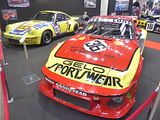
It was only really with the launch in 1989 of the 964 that a truly “new” model would appear. Designed by Benjamin Dimson in 1986, it featured significant styling revisions over previous 911 models, most prominently the more integrated bumpers. The 964 was considered to be 85% new as compared to its predecessor. The first 964s available in 1989 were all wheel drive equipped “Carrera 4” models; Porsche added the rear wheel drive Carrera 2 variant to the range in 1990. Both variants were available as a coupe, Targa or Cabriolet. The 964 Carrera was the last generation sold with the traditional removable Targa roof until the 2011 991. A new naturally aspirated engine called the M64 was used for 964 models, with a flat-6 displacement of 3.6 litres. Porsche substantially revised the suspension, replacing torsion bars with coil springs and shock absorbers. Power steering and ABS brakes were added to the 911 for the first time; both were standard. The exterior bumpers and fog lamps became flush with the car for better aerodynamics. A new electric rear spoiler raised at speeds above 50 mph and lowered down flush with the rear engine lid at lower speeds. A revised interior featured standard dual airbags beginning in 1990 for all North American production cars. A new automatic climate control system provided improved heating and cooling. Revised instrumentation housed a large set of warning lights that were tied into the car’s central warning system, alerting the driver to a possible problem or malfunction. In 1992, Porsche produced a super-lightweight, rear-wheel-drive only version of the 964 dubbed Carrera RS for the European market. It was based on Porsche’s 911 “Carrera Cup” race car and harked back to the 2.7 and 3.0 RS and RSR models. It featured a revised version of the standard engine, titled M64/03 internally, with an increased power output of 260 bhp and lightweight flywheel coupled to the G50/10 transmission with closer ratios, asymmetrical Limited Slip Differential and steel synchromesh. A track-oriented suspension system with 40 mm (1.6 in) lower ride height, stiffer springs, shocks and adjustable stabiliser bars without power steering (RHD UK cars did have power steering). A stripped-out interior devoid of power windows or seats, rear seats, air conditioning, cruise control, sound deadening or a stereo system (optionally fitted) and new racing-bucket front seats were part of the package. The front boot cover was made of aluminium and the chassis was seam welded. Wheels were made of magnesium and the glass was thinner in the doors and rear window. The Carrera RS is approximately 345 pounds (155 kg) lighter than the Carrera 2 model. Also available were a heavier Touring variant (with sound deadening, power seats (optional), undercarriage protection and power windows) and an N/GT racing variant with a stripped, blank metal interior and a roll cage. They also came with optional lights on the visors. The RS was regarded as somewhat challenging to drive, though as time has gone by, everyone seems to have warmed to it.
This is actually a 2024 RUF CTR, but looking like a 964 car. It is powered by a 710bhp flat-six turbo engine.
The “GT3” nameplate was introduced in 1999 as part of the first generation of the Porsche 996 model range (commonly known as 996.1) as a homologation model for the cars entered in the Le Mans GT class, predating the Group GT3 which was introduced in 2005. As with Porsche’s previous 911 RS models, the 996 GT3 was focused on racing, and so was devoid of items that added unnecessary weight to the car. Sound deadening was almost completely removed, as were the rear seats, rear loud speakers, sunroof, and air conditioning, although automatic air conditioning and CD/radio became no-cost optional add-ons. The engine of the 996 GT3 sets it apart from 996 Carrera models, as it shared nothing with the standard so-called “integrated dry sump” (e.g. wet-sump) flat-six engine used in the water-cooled 996 Carrera engine introduced in MY1999. The 996 GT3 engine is naturally aspirated and based on the “Mezger” racing engine used in the 962 and 911 GT1 race cars. That engine was known as the “Mezger” engine after its designer, Hans Mezger. The engine uses the original air-cooled 911’s versatile dry-sump crankcase with an external oil reservoir. The 996 GT3 has 355 hp (360 PS), compared to the 296 hp (300 PS) of the standard 996. In GT3 configuration, the so-called “split” crankcase (meaning the parting line of crankcase is on the crankshaft centreline) uses, instead of a fan and finned cylinders, separate water jackets added onto each side of the crankcase to cool banks of three cylinders with water pumped through a radiator. Thus, the GT3 engine is very similar to the completely water-cooled 962 racing car’s engine, which is based on the same crankcase. The 962 differs, however, by using six individual cylinder heads while the “Mezger” uses two cylinder heads, each covering a bank of three cylinders. The GT3 engine could thus also be thought of as similar to a 959 engine, but with water-cooled crankcase. Up until model year 2004 996 production, the basic casting used for the “Mezger” crankcase of the GT3 was the same as the 996 GT1 LeMans cars, and the same “964..” block part-number is visible on the bottom of the crankcase. Beginning with MY2004 however, production was outsourced to Valmet facilities in Spain, France, and Austria, and all subsequent road-legal Mezger engines are part-numbered “996..” (even on later 997 cars). Because the GT1 Mezger block uses the same legacy Porsche 356 engine to transmission mounting flange configuration, the 996 GT3 used a 6-speed manual gearbox also of air-cooled 911 heritage. This new G96/50 gearbox has interchangeable gear ratios and is more durable making it more suitable for racing than the standard type 996 Carrera’s gearbox. To bring the vehicle’s track-prowess to the maximum level, Porsche endowed the GT3 with enlarged brakes, a lowered, re-tuned suspension system, lighter-weight wheels and a new front bumper with matched rear spoiler to help increase downforce, thereby increasing grip. Porsche offered a no-cost option for the GT3 called the ‘Clubsport’ package. This option replaced the standard electrically adjustable leather front seats with manually adjustable racing bucket seats finished in fire-retardant fabric, single mass flywheel, bolt-in half-roll cage, 6-point drivers racing harness (also replacing the standard side airbags), fire extinguisher (mounted in the front passenger footwell) and preparation for a battery master switch. The Clubsport option was never offered to US customers, ostensibly due to the additional DOT crash testing that would have been required to allow US sales. Porsche made significant updates to the GT3 for 2004 model year (the first year the car was offered to US customers), using the 2002 996 facelift including headlights that were differentiated from the entry-level Boxster. This model is commonly known as the 996.2 GT3. Engine power output rating was raised to 381 PS and torque to 385 Nm (284 lb⋅ft), 80% of which was available from 2,000 rpm. The braking setup was upgraded, now featuring 6-piston calipers on the front (rears remained 4-piston), and the Porsche Ceramic Composite Brake system was offered as an option. The GT3 now used the body shell of the Carrera 4. In track testing by American automotive journals, the GT3 managed a 0–97 km/h (0–60 mph) acceleration time of 4.5 seconds and a quarter mile time of 12.0 seconds at 190 km/h (118 mph). During skidpad testing, the GT3 posted 1.03g. Porsche’s official test-driver Walter Röhrl completed the Nürburgring Nordschleife with the 996 GT3 in 7 minutes 56 seconds, a feat which was used by Porsche to promote the car.
In February 2006, Porsche unveiled the second generation of GT3, the 997 commonly now known as the 997.1 GT3. In addition to a new 415 PS 3.6 litre flat-six engine, the vehicle featured “zero lift” aerodynamics, meaning the car creates only aerodynamic downforce and no grip-diminishing “lift” upwards and away from the road surface. The GT3 made use of a modified, track oriented version of Porsche’s active PASM suspension making it the first of Porsche’s RS or GT3 versions to feature an electronically adjustable suspension system. Also available was a navigation system and Porsche’s “sports chrono” gauge package. The car went to sale in summer of 2006. A total of 917 units were sold in the United States and 46 units in Canada. The 997 GT3 has a rated 0–60 mph acceleration time of 4.1 seconds and has a top speed of 311 km/h (193 mph). Road and Track was able to achieve a 0–60 mph acceleration time of 3.8 seconds. Porsche’s official test-driver Walter Röhrl completed the Nürburgring Nordschleife in 7 minutes 42 seconds with the 997 GT3 in 2006. In 2009, Porsche launched the 2nd Generation 997 GT3 (commonly known as the 997.2 GT3), with an enlarged 3.8 litre engine rated at 435 PS. It also featured a number of new options including dynamic engine mounts and a pneumatically lifting front axle to compensate for the low ground clearance. The rear spoiler was also modified along with other parts of the bodywork. Deliveries in Europe commenced in November the same year. A total of 654 units were sold in the United States and 58 units in Canada.
Porsche unveiled the facelifted 991.2 GT3 at the 2017 Geneva Motor Show. Extensive changes were made to the engine allowing for a 9,000 rpm redline from the 4.0 litre flat-six engine derived from Porsche 911 GT3 R and Cup racing cars. The engine has a power output of 500 PS (493 bhp) and 460 Nm (339 lb/ft) of torque. Porsche’s focus was on reducing internal friction to improve throttle response. Compared to the 991.1, the rear spoiler is 0.8 inch taller and located farther back to be more effective resulting in a 20% increase in downforce. There is a new front spoiler and changes to the rear suspension along with larger ram air ducts. The car generates 154 kg (340 lb) of downforce at top speed. The 991.2 GT3 brought back the choice between a manual transmission or a PDK dual clutch transmission. Performance figures include a 0-60 mph acceleration time of 3.8 seconds (3.2 seconds for the PDK version) and a quarter mile time of 11.6 seconds. The GT3 can attain a top speed of 319 km/h (198 mph).
The RS version of the 991 GT3 was launched at the 2015 Geneva Motor Show, and featured in first drive articles in the press a few weeks later, with cars reaching the UK in the summer and another series of universally positive articles duly appearing. It had very big shoes to fill, as the 997 GT3 RS model was rated by everyone lucky enough to get behind the wheel, where the combination of extra power and reduced weight made it even better to drive than the standard non-RS version of the car. A slightly different approach was taken here, with the result weighing just 10kg less than the GT3. It is based on the extra wide body of the 991 Turbo. Compared to the 991 GT3, the front wings are now equipped with louvres above the wheels and the rear wings now include Turbo-like intakes, rather than an intake below the rear wing. The roof is made from magnesium a bonnet, whilst the front wings, rear deck and rear spoiler all in carbonfibre-reinforced plastic (CFRP), the rear apron is in a new polyurethane-carbonfibre polymer and polycarbonate glazing is used for the side and rear windows. The wider body allows the RS’s axle tracks to grow, to the point where the rear track is some 72mm wider than that of a standard 3.4-litre Carrera and the tyres are the widest yet to be fitted to a road-going 911. A long-throw crankshaft made of extra-pure tempered steel delivers the 4mm of added piston stroke necessary to take the GT3’s 3.8-litre flat six out to 3996cc . The engine also uses a new induction system, breathing through the lateral air intakes of the Turbo’s body rather than through the rear deck cover like every other 911. This gives more ram-air effect for the engine and makes more power available at high speeds. It results in an output of 500 bhp and 339 lb/ft of torque. A titanium exhaust also saves weight. The suspension has been updated and retuned, with more rigid ball-jointed mountings and helper springs fitted at the rear, while Porsche’s optional carbon-ceramic brakes get a new outer friction layer. Which is to say nothing of the RS’s biggest advancement over any other 911: downforce. The rear wing makes up to 220kg of it, while the front spoiler and body profile generates up to 110kg. In both respects, that’s double the downforce of the old 997 GT3 RS 4.0. The transmission is PDK only. The result is a 0-62 mph time of just 3.3 seconds, some 0.6 seconds quicker than the 997 GT3 RS 4.0 and 0-124 mph (0-200kmh) in 10.9 seconds. The 991 GT3 RS also comes with functions such as declutching by “paddle neutral” — comparable to pressing the clutch with a conventional manual gearbox –- and Pit Speed limiter button. As with the 991 GT3, there is rear-axle steering and Porsche Torque Vectoring Plus with fully variable rear axle differential lock. The Nürburgring Nordschleife time is 7 minutes and 20 seconds. The interior includes full bucket seats (based on the carbon seats of the 918 Spyder), carbon-fibre inserts, lightweight door handles and the Club Sport Package as standard (a bolted-on roll cage behind the front seats, preparation for a battery master switch, and a six-point safety harness for the driver and fire extinguisher with mounting bracket). Needless to say, the car was an instant sell out, even at a starting price of £131,296.
In February 2021, Porsche introduced the 992’s GT3 version. Like most other GT3 Porsches, it is intended for mixed usage with a more track-focused setup. It uses the same 4.0 litre naturally aspirated flat-6 as the 991.2, and producing over 510 PS (503 hp). It reaches 100 km/h (62 mph) in 3.4 seconds while the top speed is 320 km/h (199 mph). The 992 GT3 recently set a lap time at Nürburgring Nordschleife with a time of 6:55.34 minutes. Unlike the standard model, the GT3 features a large rear spoiler with larger air vents, a bigger diffuser, two large exhaust connections, bucket seats in its interior, and an optional roll cage. The GT3 uses a 7-speed PDK or a 6-speed manual instead of the 7-speed manual or 8-speed PDK used in other models.
The Porsche 906 or Carrera 6 was the last street-legal racing car from Porsche. A total of 65 were produced in 1966, allowing the model to be homologated for FIA’s new Group 4 Sports Car category although the 906 would also compete in modified form in the Group 6 Sports Prototype class. A successor to the Porsche 904, and designed under Ferdinand Piëch’s new regime at Porsche R&D, the 906 replaced the boxed steel structure of the 904 which used the fiberglass body for extra structural strength with a tubular space frame and unstressed fiberglass body. The fiberglass itself was laid up by hand, producing consistent results, instead of the uneven spraying technique used on the 904. The result was a car that weighed 1,300 lb, approximately 250 lb lighter than the 904/6. The engine regularly fitted was the 901/20 6-cylinder lightweight racing engine with 220 hp and carburettors, although some examples that were raced by the factory team received fuel injected 8-cylinder engines, especially in hillclimbing events where Porsche competed with Ferrari Dinos for the European championship. Unlike previous racing Porsches, the 906 body was tested in a wind tunnel, resulting in a top speed of 170 mph at Le Mans, quite fast for a 2-liter engine car. It shows already a close resemblance to future Porsche racing cars. As in the Mercedes-Benz 300SL, gull-wing doors were fitted, and the engine at the rear was covered with a large Plexiglas cover. In its debut in the 1966 24 Hours of Daytona, the Carrera 6 finished 6th overall, and won its class against Ferrari Dino 206 Ps. At the 12 Hours of Sebring, Hans Herrmann/Gerhard Mitter finished fourth overall and won the class, as at the 1000 km of Monza. The 1000 km at Spa were disappointing, as were the 1000 km Nürburgring where the Dinos were only beaten by the Chevrolet V8-powered Chaparral. A privately entered 906 secured an overall victory at the 1966 Targa Florio when the factory cars failed. At the 1966 24 Hours of Le Mans, the 906 placed 4-5-6-7 behind three Ford GT40 Mk IIs, outlasting all of the previously dominant V12 engined Ferrari Ps.
The Porsche 908 was introduced in 1968 to continue the Porsche 906-Porsche 910-Porsche 907 series of models designed by Helmuth Bott (chassis) and Hans Mezger (engine) under the leadership of racing chief Ferdinand Piëch. As the FIA had announced rule changes for Group 6 prototype-sports cars limiting engine displacement to 3,000 cc, as in Formula One, Porsche designed the 908 as the first Porsche sports car to have an engine with the maximum size allowed. The previous Porsche 907 only had a 2,200 cc Type 771/1 flat-eight engine developing 270 PS. The new 3-litre Type 908 flat-eight produced 350 PS at 8,400 rpm. Being traditionally air-cooled and with only two valves per cylinder, it still had less power compared to more modern F1 designs which delivered over 400 hp, but were not suited to endurance racing. The 908 originally was a closed coupe to provide low drag at fast tracks, but from 1969 on was mainly raced as the 908/2, a lighter open spyder. A more compact 908/3 was introduced in 1970 to complement the heavy Porsche 917 on twisty tracks that favored nimble cars, like Targa Florio and Nürburgring. Sold off to privateers for 1972, various 908s were entered until the early 1980s, often retro-fitted with Porsche 934-based 2.1-litre turbocharged flat-six engines. The 908 was not ready for the first three rounds of the 1968 World Sportscar Championship, but Porsche won the North American rounds anyway in convincing manner thanks to the 2.2 litre variant of the Porsche 907. Five were entered for the 1968 24 Hours of Daytona, with a 1-2-3 and a DNF for the factory and a DNF for a private Swiss car. One car less at 1968 12 Hours of Sebring, and a 1-2. In 1968, for an unknown reason, the Le Mans test weekend coincided with the first European round, the 1968 6h BOAC International 500 World Championship Sports Car Race at Brands Hatch, and with the Formula 2 event at the Hockenheimring on Sunday April 7 in which Jim Clark was killed. Jacky Ickx set the test benchmark for JWA, with a 3:35.4 lap, then promptly left for Brands Hatch to win the endurance race. The test was also the first appearance of the new Porsche 908, in the hands of Rolf Stommelen. It was found to need major aerodynamic refinement, but Stommelen eventually got a time of 3:44.1. In the 6h race, with the best 907 suffering brake failure, the updated old 4.7-litre Wyer-Ford GT40s Group 4 sports car won 22 seconds ahead of the better of two 907 Group 6 prototypes with half the engine capacity. The Porsche 908 was introduced at the first of three very fast race tracks on which the full engine capacity was needed, the 1968 1000km Monza. It was run on the 10 km long interleaved oval with high bankings, and in absence of Italian challengers, as Ferrari did not enter at all in 1968 and Alfa did not arrive. The two 908 had teething problems and finished 11th and 19th. Once again a Wyer-Ford was narrowly ahead of a 907 2.2 LH. At the twisty track of the 1968 Targa Florio, Porsche did not enter the new 908 as they did not have to worry about heavy Fords, but about no less than five Alfa Romeo Tipo 33/2, one of them with the 2.5 litre engine. The effort of Vic Elford saved the win for Porsche. The 908 finally scored its maiden win at the 1968 1000km Nürburgring, backed up by a 907, ahead of the Wyer-GT40. This order was reversed a week later at the 1968 1000km Spa, in which Ickx dominated in the rain. Even though the 907 were proven, Porsche only brought 908s to the July 14, 1968 6h of Watkins Glen, and hired support from some American and even a Japanese driver. One 908 was over-revved early, two others had all kind of drama like a driver getting sick in the hot closed coupe and finally DNF after wheel bearing trouble. At the end, two Wyer-Fords were on the podium, plus a Howmet TX, and two private Porsche 906 sportscars were ahead of the lone surviving 908. Only the five best results would count towards the World Championship, and both Porsche and Ford had earned four victories each. As the next event, the 500km at Zeltweg, only was worth half points, it was a rather meaningless win for two 908, while two others once again had troubles. It all came down to the last race, the 1968 24 Hours of Le Mans, which due to political unrest had been postponed from the traditional mid-June date to September. In April 1968 it had been announced that for 1969, the minimum production requirement for the 5,000 cc Group 4 sports car category will be reduced from 50 units to 25. That had the side effect of homologating the numerous old Porsche 910 prototypes to Gr. 4 sportscars, making them available for class wins in the hand of privateers. In July 1968, Porsche decided to go one step further: enlarge the 3.0-litre Porsche Type 908 Flat-8 engine to a 4.5-litre Flat-12 fittingly named Porsche Type 912 engine, and build the required 25 examples of the new 12-cylinder car, the Porsche 917 (Porsche 912 was already in use for an entry-level flat-4 911). This risky investment was expected to take up to a year, though, and the 908 was supposed to deliver results in the meantime. The stage for a showdown at Le Mans between the 908s and the Wyer-GT40s was set, for race win and Championship. The Porsche 908 LHs (long tails) were the fastest in qualifying and the early stages of the race, but it showed that Porsche had not taken advantage of the additional time to improve the reliability of the 908. Troubles with the alternator caused delays and even disqualifications as the new Porsche team leaders had misinterpreted the rules that required repair of the faulty part, not replacement. Once again, a V8-powered Ford won, and an older smaller private Swiss 907 LT came in second in front of the sole surviving standard 908 of the factory. In addition, Ford won the 1968 International Championship for Makes. For 1969, the Group 6 prototype rules were changed, now favouring open top cars over coupés. Most teams altered their cars accordingly. Porsche lowered the weight of the 908, removed the roof and the long tails, to get the new version called Porsche 908/02 spyder by 100 kg (220 lb). Aluminium tube frames were used, with air pressure gauges to check them. The 1969 24 Hours of Daytona was a disaster for Porsche, as all three 908/02 failed, while the Penske-entered Lola T70 sportscar won. At the 1969 12 Hours of Sebring, a Ford GT40 defeated a trio of factory-entered 908/2s. At that time, the more powerful Porsche 917 was introduced in Geneva, but it took until May for homologation to be approved and in effect. Now that it seemed that the career of the 908 was over, the 908/02 started to succeed. The next race was the BOAC 500 at Brands Hatch, where the 908 was finally successful, finishing 1-2-3 ahead of a Ferrari 312P. With additional wins at the 1000km Monza, the Targa Florio, the 1000km Spa and an overwhelming 1-2-3-4-5 at the 1000km Nürburgring, the 1969 International Championship for Makes was secured early for Porsche by the 908/02, while the Porsche 917 suffered teething problems mainly due to aerodynamics. Due to failure of wings in Formula One, these had been banned by the FIA, affecting also the 917. However, the prestigious 24 hours of Le Mans was in 1969 again won by the same Wyer-Ford GT40 chassis, as the 917s had gearbox troubles after leading for many hours. Still, a 908 challenged for the win, as Hans Herrmann came in as a very close second, behind Jacky Ickx. Herrmann’s 908 low drag coupé was fast on the straights, but near the race’s end the brake pads wore down, indicated by a light that was introduced with the 908s. The team gambled on not changing the pads, which allowed Ickx to pass under braking.
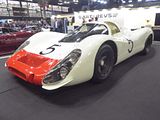
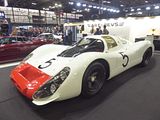
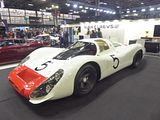
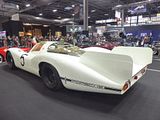
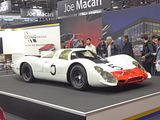
The Porsche 917 is a sports prototype race car developed by German manufacturer Porsche to exploit the regulations regarding the construction of 5-litre sports cars. Powered by a Type 912 flat-12 engine which was progressively enlarged from 4.5 to 5.0 litres, the 917 was introduced in 1969 and initially proved unwieldy on the race track but continuous development improved the handling and it went on to dominate sports-car racing in 1970 and 1971. In 1970 it gave Porsche its first overall win at the 24 Hours of Le Mans, a feat it would repeat in 1971. It would be chiefly responsible for Porsche winning the International Championship for Makes in 1970 and 1971. Porsche went on to develop the 917 for Can-Am racing, culminating in the twin-turbocharged 917/30 which was even more dominant in the role. Porsche drivers would win the Can-Am championship in 1972 and 1973. 917 drivers also won the Interserie championship every year from 1969 to 1975. In an effort to reduce the speeds at Le Mans and other fast circuits of the unlimited capacity Group 6 prototypes (such as the seven-litre Ford GT40 Mk.IV and four-litre V12 Ferrari P) the Commission Sportive Internationale (then the independent competition arm of the FIA) announced that the International Championship of Makes would be run for three-litre Group 6 prototypes for four years from 1968 through 1971. This capacity reduction would also serve to entice manufacturers who were already building three-litre Formula One engines to adapt them for endurance racing. Well aware that few manufacturers were ready to take up the challenge immediately, the CSI also allowed the participation of five-litre Group 4 sports cars, of which a minimum of 50 units had to be manufactured. This targeted existing cars like the aging Ford GT40 Mk.I and the newer Lola T70 coupé. In April 1968, facing few entrants in races, the CSI announced that the minimum production figure to compete in the sport category of the International Championship of Makes (later the World Sportscar Championship) was reduced from 50 to 25, starting in 1969 through the planned end of the rules in 1971. With Ferrari absent in 1968, mainly Porsche 908s and Ford P68s were entered there, with the Ford being a total failure. As a result, old 2.2-litre Porsche 907s often won that category, with John Wyer’s 4.7-litre Ford GT40 Mk.I taking wins at faster tracks. Starting in July 1968, Porsche made a surprising and expensive effort to take advantage of this rule. As they were rebuilding race cars with new chassis every race or two anyway, selling the used cars to customers, they decided to conceive, design and build 25 versions of a whole new car with 4.5-litre for the sport category with one underlying goal: to win its first overall victory in the 24 Hours of Le Mans on June 14, 1970. In only ten months the Porsche 917 was developed, based on the Porsche 908. When Porsche was first visited by the CSI inspectors only three cars were completed, while 18 were being assembled and seven additional sets of parts were present. Porsche argued that if they assembled the cars they would then have to take them apart again to prepare the cars for racing. The inspectors refused the homologation and asked to see 25 assembled and working cars. On March 12, 1969, a 917 was displayed at the Geneva Motor Show, painted white with a green nose and a black No. 917. Brief literature on the car detailed a cash price of DM 140,000, approximately £16,000 at period exchange rates, or the price of about ten Porsche 911s. This price did not cover the costs of development. On April 20 Porsche’s head of motorsports Ferdinand Piëch displayed 25 917s parked in front of the Porsche factory to the CSI inspectors. Piëch even offered the opportunity to drive any of the cars, which was declined. The car’s chassis was designed by Helmuth Bott and the engine was designed by Hans Mezger, both under the leadership of Ferdinand Piëch. The car was built around a very light spaceframe chassis (42 kg (93 lb)) which was permanently pressurised with gas to detect cracks in the welded structure.[4] Power came from a new 4.5-litre air-cooled engine designed by Mezger. A completely new flat-12 block was designed without the cylinder offset needed by a boxer design to keep the engine compact. The ‘Type 912’ engine featured a 180° flat-12 cylinder layout with six crank throws (each conrod journal shared by opposing piston pair) as opposed to twelve on a boxer, twin overhead camshafts gear-driven from centrally mounted gears and twin spark plugs fed from two distributors. The large horizontally mounted cooling fan was also driven from centrally mounted gears. The longitudinally mounted type 920 gearbox was designed to take a set of four or five gears. To keep the car compact despite the large engine, the driving position was so far forward that the feet of the driver were beyond the front wheel axle. The car had remarkable technology. It used many components made of titanium, magnesium and exotic alloys that had been developed for lightweight “Bergspyder” hill climb racers. Other methods of weight reduction were rather simple, such as making the gear shift knob out of birch wood, some methods were not simple, such as using the tubular frame itself as oil piping to the front oil cooler (a design used successfully by Lotus beginning with Lotus 22 of 1962). There are at least eleven variants of the 917. The original version had a removable long tail/medium tail with active rear wing flaps. These were banned in May 1969 after crashes in Formula 1. As a result the 917 had considerable handling problems at high speed because of significant rear lift. The handling problems were investigated in late 1969 at a joint test at the Österreichring by the factory engineers and their new race team partners JW Automotive. After exhaustive experimentation by both groups, and comparison to a CanAm 917 PA spyder, its shorter, more upswept tail was found to give the spyder more aerodynamic stability at speed. The changes were quickly adopted into the wedge-tail 917K, K for Kurzheck, or “short-tail”. In 1971, a variant of the 917K appeared with a less upswept tail and vertical fins, and featured the concave rear deck that had proved so effective on the 1970 version of the 917L. The fins kept the clean downforce-inducing air on the top of the tail and allowed the angle of the deck to be reduced, reducing the drag in direct proportion. The result was a more attractive looking car that maintained down force for less drag and higher top speed. By this time the original 4.5-litre engine, which had produced around 520 bhp in 1969, had been enlarged through 4.9-litres (600 bhp) to 5-litres and produced a maximum of 630 bhp. The 917K models were generally used for the shorter road courses such as Sebring, Brands Hatch, Monza and Spa-Francorchamps. The big prize for Porsche however, was Le Mans. For the French circuit’s long, high speed straights, the factory developed special long tail bodywork that was designed for minimum drag and thus highest maximum speed. On the car’s debut in 1969, the 917L proved to be nearly uncontrollable as there was so little down force. In fact, they generated aerodynamic lift at the highest speeds. For 1970, an improved version was raced by the factory and for 1971, after very significant development in the wind tunnel, the definitive 917L was raced by both factory and JW. In 1969 Jo Siffert raced an open-top 917PA Spyder (normally aspirated) in the 1969 CanAm series. There is also the “Pink Pig” aerodynamic research version (917/20), and the turbocharged 917/10 and 917/30 CanAm Spyders. Porsche 917s also raced in the European Interseries in various configurations. In the 1973 Can-Am series, the turbocharged version Porsche 917/30 developed 1,100 bhp. There were a number of versions of Porsche 917 made over the years; at least eleven different versions have existed. The original Porsche 917 was first run at the Le Mans Test in March 1969 and right from the start showed considerable handling problems due to aerodynamic lift. The original specification of the car included two versions, one of them a detachable long-tail (Langheck), that was designed using experience from the previous 907 long-tail coupés for minimum aerodynamic drag. Like the shorter tail, it came with suspension controlled moving flaps on the tail. Early in the 1969 Formula One season, large wings had been mounted on stilts on the front and rear suspensions of F1 cars, and could be adjusted with levers or pedals. The May 4 1969 Spanish Grand Prix was the last race of the high wing era in Formula One as both works Lotus cars suffered massive accidents when their suspension-mounted wing supports failed. The CSI soon banned movable wings in motorsport, which affected the Le Mans race in June. It was only when Rolf Stommelen demonstrated how undriveable the car was without the moving flaps that they relented and allowed them for Le Mans only. Throughout 1969 the car’s speed was countered by the handling problems and it won only one race, the Zeltweg 1000 km. Following that event, JW Automotive, who would be acting as a semi-works team in 1970, requested a test session with Porsche to try and sort out the car’s problems. The 917K was an evolution of the original 1969 car. After the first 917s were run in 1969, it was clear the car’s aerodynamics made it nearly undriveable at higher speeds. After the 1969 championship season had finished, John Wyer requested a 3-day test session at the Austrian Österreichring course. The Porsche technical team turned out ready to do some serious panel work on the coupé and in order to make a comparison, brought along the Can-Am 917PA Spyder. The drivers present instantly preferred the PA and together, the JW Automotive and Porsche engineers came up with the idea of a more upswept tail (as on the 917PA). The JW team had had similar high speed handling problems with the early Ford GT40 models. With gaffer tape and aluminium sheet, a completely new short tail was evolved at the racetrack. This was quickly converted into a ‘production’ design back at Porsche and the 917K (Kurzheck) made its public debut at the season opening 1970 24 Hours of Daytona. Such was the improvement in the stability of the car at high speed, the 917K became the standard configuration for all races except Le Mans, the Nürburgring 1000 km and the Targa Florio. This car was raced at every event by JW Automotive and Porsche Salzburg in the 1970 season except the Targa Florio and the Nürburgring 1000 km. The smaller, more nimble and generally better suited 908/03s were used for those races, but privateers used the 917K at the Nürburgring 1000 km, and Vic Elford drove a lap of the 44-mile Targa Florio course in the 917K at Ferdinand Piëch’s request. The 917K won 7 out of 10 races; all the races it competed in. Later on in the 1970 season, the 4.5 litre flat-12 was bored out to 4.9 litres, then 5 litres.
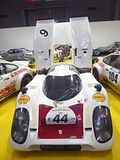
The 918 Spyder was first shown as a concept at the 80th Geneva Motor Show in March 2010. On 28 July 2010, after 2,000 declarations of interest, the supervisory board of Porsche AG approved series development of the 918 Spyder. The production version was unveiled at the September 2013 Frankfurt Motor Show. Porsche also unveiled the RSR racing variant of the 918 at the 2011 North American International Auto Show, which combines hybrid technology first used in the 997 GT3 R Hybrid, with styling from the 918 Spyder. But that version didn’t make it to production. The 918 Spyder was the second plug-in hybrid car manufactured by Porsche, after the 2014 Panamera S E-Hybrid. The 918 Spyder is powered by a 4,593 cc naturally aspirated V8 engine built on the same architecture as the one used in the RS Spyder Le Mans Prototype racing car without any engine belts. The engine weighs 135 kg (298 lb) according to Porsche and delivers 599 bhp at 8,700 rpm and 540 Nm (398 lb/ft) of maximum torque at 6,700 rpm. This is supplemented by two electric motors delivering an additional 282 bhp. One 154 bhp electric motor drives the rear wheels in parallel with the engine and also serves as the main generator. This motor and engine deliver power to the rear axle via a 7-speed gearbox coupled to Porsche’s own PDK double-clutch system. The front 127 bhp electric motor directly drives the front axle; an electric clutch decouples the motor when not in use. The total system delivers 874 bhp and 1,280 Nm (944 lb/ft) of torque. Porsche provided official performance figures of 0-100 km/h (62 mph) in 2.6 seconds, 0-200 km/h (120 mph) in 7.2 seconds, 0-300 km/h (190 mph) in 19.9 seconds and a top speed of 345 km/h (214 mph). Those numbers were surpassed in independent tests which yielded 2.5 seconds for 0-100 km/h, 7.0 seconds for 0-200 km/h, 19.1 seconds for 0-300 km/h, a top speed of 351.5 km/h (218.4 mph) and 17.75 seconds for the standing kilometer with a speed of 295.9 km/h (183.9 mph). The energy storage system is a 312-cell, liquid-cooled 6.8 kWh lithium-ion battery positioned behind the passenger cell. In addition to a plug-in charge port at the passenger-side B pillar, the batteries are also charged by regenerative braking and by excess output from the engine when the car is coasting. CO2 emissions are 79 g/km and fuel consumption is 3 L/100 km (94 mpg) under the New European Driving Cycle (NEDC). The U.S. Environmental Protection Agency (EPA) under its five-cycle tests rated the 2015 model year Porsche 918 Spyder energy consumption in all-electric mode at 50 kWh per 100 miles, which translates into a combined city/highway fuel economy of 3.5 L/100 km (81 mpg). When powered only by the gasoline engine, EPA’s official combined city/highway fuel economy is 26 mpg. The 918 Spyder’s engine is based on the unit used in the Porsche RS Spyder. The 4.6 litre V8 petrol engine can recharge an empty battery on about two litres of fuel. The supplied Porsche Universal Charger requires seven hours to charge the battery on a typical 110 volt household AC socket or two hours on a dedicated Charging Dock installed with a 240 volt industrial supply. An optional DC Speed Charging Station can restore the battery to full capacity in 25 minutes. The 918 Spyder offers five different running modes: E-Drive allows the car to run under battery power alone, using the rear electric motor and front motor, giving a range of 29 kilometres (18 mi) for the concept model. The official U.S. EPA all-electric range is 12 mi (19 km). The total range with a full tank of gasoline and a fully charged battery is 420 miles (680 km) according to EPA tests. Under the E-Drive mode the car can attain a maximum speed of 150 km/h (93 mph). Two hybrid modes (Hybrid, and Race) use both the engine and electric motors to provide the desired levels of economy and performance. In Race mode a push-to-pass button initiates the Hot Lap setting, which delivers additional electrical power. The chassis is a carbon-fibre-reinforced plastic monocoque and the brakes used are electromechanical brakes. The production version was unveiled at the 2013 Frankfurt Motor Show. The 918 Spyder was produced in a limited series and it was developed in Weissach and assembled in Zuffenhausen. Pricing for the 918 Spyder started at €611,000 (US$845,000) or £511,000. Production ended in June 2015 as scheduled. The country with the most orders was the United States with 297 units, followed by China and Germany with approximately 100 orders each, and Canada ordering 35 units.
PURREY
In 1886, Valentin Purrey (1861 – 1928), born in Layrac (Lot & Garonne, France), set up his first steam railcar in Barcelona (Spain) to provide a regular service in the city. In 1890, he returned to his native region an built a factory in Bordeaux-Bègles which, a few years later, covered 10 hectares and employed 450 people. While continuing to build successful self-propelled railcars (also known as railmotors) for numerous urban networks in France and abroad, this self-taught engineer began working on automobiles in 1898. He presented the prototype of a steam-powered lorry with a payload of 5 tonnes, fitted with a 2.7-litre 120 x 120 double-action 2-cylinder engine, an ‘absolutely non-explosive’ generator, a 600-litre water tank and wooden wheels with metal bands. It could reach a speed of 15 km/h and climb gradients of 12%. It used an average of 5.7 of coke and 20 litres of water per km. In 1909, the Raffineries Say, ordered 34 Purrey Lorries to replace its 400-horse livestock and wagons : 16 x 10-tonne units and 18 x 5-tonne units. It was the first fleet of motorised industrial road vehicles in the world! At the beginning of the 20th century, when there were three competing forms of propulsion – steam, electricity and petrol – steam traction offered a number of advantages : it was simple, robust and reliable, as there were no fragile components that were a source of problems (carburettors, clutches, etc.), braking was effective due to simple reversal of steam, and running costs were minimal due to the low price of coal. However, it also had its drawbacks : the weight and bulk of the boiler and the coal and water supplies, the time required to pressurise the generator at start-up (30 minutes) and to clean the boiler at the end of the day, and the daily maintenance requirements, particularly the frequent greasing operations. Financial difficulties arose in 1910 and Purrey was taken over by Exshaw, which the marketed the equipment under the brand name Exshaw-Purrey, the Exshaw, while V. Purrey was forced out in 1913. Steam traction gradually disappeared with the development of the internal combustion engine. The factory ceased production in 1929.
RENAULT
This is a 1913 Renault Type BC utility vehicle. The vehicle was originally delivered to the Freia company in Norway. It was used by the company for chocolate deliveries until 1931. The car underwent a full restoration between 2017 and 2021.
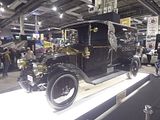
Not well known these days is the Colorale. Recently nationalised, and enjoying booming sales with their Renault 4CV, Renault management at the end of the 1940s sought to move their business upmarket. Company strategy called for a robust functional vehicle, equally at home in the cities or the countryside, and appealing also to overseas markets in remaining parts of the French empire. With colonial and rural customers in its sights, the car was named Colorale, a portmanteau of the (French) words ‘COLOniale’ and ‘ruRALE’. Body panels were stamped and assembled by the Chausson company at Gennevilliers before final assembly at the Renault Billancourt plant. The front of the car closely resembled that of the smaller Renault 4CV, indicating a conscious intention to give different Renault models a ‘family look’. With its robust spacious body and the option of four wheel drive the Colorale was in some ways an even more radical design than the innovative and commercially more successful Renault hatchbacks that would appear in the 1960s: the Colorale in several important respects recalled the SUVs which would proliferate towards the end of the twentieth century. In the 1950s, however, the French marketplace was less welcoming to the Colorale which was slower and less elegant than other cars in this price bracket. In French overseas territories customers appear to have been less resistant to the radical new Renault, but it was nonetheless the more conventional Peugeot designs that gained a more enduring foothold in the French colonies and in the new independent states which succeeded some of them. The Colorale featured the four cylinder ’85 series’ sidevalve engine first seen in 1936 in the Primaquatre. The engine was robust, but with the compression ratios achievable using the low octane fuels available in Europe in the 1940s, the 2,383 cc engine, although it attracted a high (14CV) level of car tax, only managed a claimed power output of 48 hp. With a weight of 1,640 kg (3,616 lb), the Colorale consumed petrol at an alarming rate and achieved its claimed top speed of 100 km/h (62 mph) only with difficulty. The 1953 Colorale, introduced at the 1953 Paris Motor Show, featured the four cylinder engine recently developed for the Frégate. This 1,996 cc unit offered 58 hp and an increased maximum speed which now exceeded 105 km/h (65 mph) could now be claimed. The new engine also conferred tax advantages resulting from its smaller size which placed the car in the 11CV tax band. However, the improved power output came with reduced torque, and overall “on-road” performance continued to be viewed as leisurely. Several different versions were offered, including a light van and a small truck. The most popular versions were the five door Prairie and the three door Savane. The Colorale Prairie was by far the best-selling Colorale. Featuring a six-light (three side windows on each side) body, it was a 4-door family car able to accommodate 6 people and offering a generous cargo area: with the rear seat folded down, the Prairie provided nearly three cubic meters of load space. Externally similar to the Prairie was a taxi version which featured a central row of rear-facing foldaway seats after the manner of a standard London taxi in the later twentieth century, but this had disappeared from the model listings by 1952. The Colorale Savane was similar to the Prairie but had only one door each side. Blinds were included for the rear side windows in order to make the car cooler in hot climates: the opening windscreen was promoted as a device for improving the ventilation. The Savane was also favoured as an alternative to a light commercial van, particularly suited to rough roads on account of its upgraded suspension. Approximately 43,000 Colorales had been manufactured by the time production ended in 1957.
The Dauphine was huge success for Renault globally, with over two million of them being produced between 1956 and 1967, all of them in a single body style – a three-box, 4-door saloon – as the successor to the Renault 4CV. All the cars looked the same, though there were variants, such as the sport model, the Gordini, a luxury version, the Ondine, and the 1093 factory racing model, and the car formed the basis for the Caravelle/Floride, a Dauphine-based two-door coupé and two-door convertible. The car’s predecessor, the 4CV had been a success for Renault, too, with over 500,000 produced by 1954. The Dauphine was born during a conversation with Lefaucheux and engineer Fernand Picard. The two agreed the 4CV was appropriate in its postwar context, but that French consumers would soon need a car appropriate for their increasing standard of living. Internally known as “Project 109” the Dauphine’s engineering began in 1949 with engineers Fernand Picard, Robert Barthaud and Jacques Ousset managing the project. A 1951 survey conducted by Renault indicated design parameters of a car with a top speed of 110 km/h (68 mph), seating for four passengers and fuel consumption of less than 7 L/100 km(40 mpg). The survey indicated that women held stronger opinions about a car’s colours than about the car itself. Engineers spent the next five years developing the Dauphine. Within the first year, designers had created a ⅛th-scale clay model, studied the model’s aerodynamics, built a full-scale clay model, studied wood interior mockups of the seating, instrument panel, and steering column – and built the first prototype in metal. Having largely finalised the exterior design, testing of the prototype began at Renault’s facilities at Lardy by secrecy of night, on July 24, 1952. Using new laboratories and new specially designed tracks, engineers measured maximum speed, acceleration, braking and fuel consumption as well as handling, heating and ventilation, ride, noise levels and parts durability. Engineers tested parts by subjecting them to twisting and vibration stresses, and then redesigning the parts for manufacture. By August 1953 head engineer Picard had an almond-green prototype delivered to Madrid for dry condition testing, ultimately experiencing only five flat tyres and a generator failure after 2,200 km. Subsequently, Lefaucheux ordered engineers to test a Dauphine prototype directly against a Volkswagen Beetle. The engineers determined that noise levels were too high, interior ventilation and door sealing were inadequate and most importantly, the engine capacity was insufficient at only 4 CV (748 cc). The four-cylinder engine was redesigned to increase its capacity to 845 cc by increasing the bore to 58 mm, giving the car a new informal designation, the 5CV. By 1954 a second series of prototypes incorporated updates, using the older prototypes for crash testing. Lefaucheux followed the testing carefully, often meeting with his engineers for night testing to ensure secrecy, but did not live to see the Dauphine enter production. He was killed in an accident on February 11, 1955, when he lost control of his Renault Frégate on an icy road and was struck on the head by his unsecured luggage as the car rolled over. The Flins factory was renamed in his honour, and he was succeeded on the project by Pierre Dreyfus. By the end of testing, drivers had road tested prototypes in everyday conditions including dry weather and dusty condition testing in Madrid, engine testing in Bayonne, cold testing at the Arctic Circle in Norway, suspension testing in Sicily, weatherseal testing in then-Yugoslavia – a total of more than two million kilometres of road and track testing.In December 1955, Pierre Bonin (director of the Flins Renault Factory) and Fernand Picard presented the first example to leave the factory to Pierre Dreyfus, who had taken over the project after Lefaucheux’s death. Renault officially revealed the model’s existence to the press through L’Auto Journal and L’Action Automobile et Touristique in November 1955, referring to it simply by its unofficial model designation “the 5CV”. Advance press preview testing began on February 4, 1956, under the direction of Renault press secretary Robert Sicot, with six Dauphines shipped to Corsica. Journalists were free to drive anywhere on the island, while under contract not to release publication before the embargo date of March 1, 1956. The Dauphine debuted on March 6, 1956 at Paris’ Palais de Chaillot with over twenty thousand people attending, two days before its official introduction at the 1956 Salon International de l’Auto in Geneva. Renault considered the name Corvette for its new model, but to avoid a conflict with the recently launched Chevrolet Corvette instead chose a name that reinforced the importance of the project’s predecessor, the 4CV, to France’s postwar industrial rebirth. At introduction, the Dauphine was positioned in the marketplace between the concurrently manufactured 4CV, and the much larger Frégate. The new model followed the 4CV’s rear-engine, four-door three-box sedan format, while providing greater room and power and pioneering a new focus for Renault on interior and exterior colour and design. The Dauphine used a version of the 4CV’s water-cooled Ventoux engine with capacity increased from 760 cc to 845 cc, and power increased from 19–32 hp. Engine cooling was facilitated by air intakes behind each rear door and a vented rear fascia. The Dauphine had a front-hinged boot lid, which housed the headlights and opened to a seven-cubic-foot boot. The spare tyre was carried horizontally under the front of the car, behind an operable panel below the bumper. The interior featured adjustable front bucket seats and a rear bench seat, a heater, painted dash matching the exterior, twin courtesy lamps, a white steering wheel, rear bypassing (vs. roll down) windows, twin horns (town and country) selectable by the driver and twin open bins on the dashboard in lieu of gloveboxes. Exterior finishes included a range of pastel colours. The Gordini version was offered with a 4-speed transmission, four-wheel disc brakes from 1964 and increased horsepower, performance tuned by Amédée Gordini to 37 hp. The 1093 was a factory racing model limited edition of 2,140 homologated, which were tuned to 55 hp and featured a twin-barrel carburettor, rear track rods, four-speed manual transmission and tachometer, had a top speed of 140 km/h (87 mph), and were produced in 1962 and 1963. All were painted white with two thin blue stripes running front to back along the hood, roof and boot. The Dauphine was made under licence in a number of countries around the world.
As ever, Renault had a large stand which show-cased a few cars from their extensive “Histoire et Collection” and these were contrasted by some brand new production and concept cars.
Renault has once again taken inspiration from its past when designing its newest car, the Renault Filante Record 2025. The main source of inspiration for this streamlined electric car was an endurance and speed record holder from the mid 1920s – the Renault 40CV ‘des Records’, which was also here. The original Renault 40CV was a flagship model for the French brand, with the car featuring a 9.1-litre straight six and a hydraulic servo-brake system; and while the Renault Filante Record 2025 won’t be gunning for any speed records or have a thumping 9.1-litre engine under the bonnet, its jet-like design and 87kWh battery with cell-to-pack technology should help it push the boundaries of energy efficiency, helping to develop tech that could find its way onto future production cars. It looks like the Mercedes Vision EQXX has an efficiency battle on its hands.
The Renault 4, also known as the 4L (pronounced “Quatrelle” in French), is a small economy car produced by the French automaker Renault between 1961 and 1994. It was the first front-wheel drive family car produced by Renault. The car was launched at a time when several decades of economic stagnation were giving way to growing prosperity and surging car ownership in France. The first million cars were produced by 1 February 1966, less than four and a half years after launch; eventually over eight million were built, making the Renault 4 a commercial success because of the timing of its introduction and the merits of its design. The Renault 4 was Renault’s response to the 1948 Citroën 2CV. Renault was able to review the advantages and disadvantages of the 2CV design. The Citroën had made motoring available to low-income people in France, and especially to farmers and other people in rural areas, for whom the car was as much a working tool as personal transport. The 2CV had been designed in the 1930s for use in the French countryside where the road network was poor – speed was not a requirement but a good ride, useful rough-terrain ability, a versatile body for load carrying, and economy and simplicity of operation were its key considerations. However, by the late 1950s, the 2CV was becoming outdated. Rural roads in France were improved and the national system of autoroutes was being developed. Agriculture was becoming more mechanized with fewer smallholdings and family farms for which the 2CV was designed. The Citroën had also proved popular with people living in towns and cities as affordable, economical transport but the 2CV’s rural design brief made it less than ideal as a city car and, despite improvements, the late-1950s 2CV had a top speed of just 70 km/h (43 mph). Its air-cooled two-cylinder engine was reliable and economical but noisy and offered poor performance. The 2CV’s suspension gave it an excellent ride and good grip and handling but was mechanically complex with many moving parts that required regular maintenance and lubrication at intervals as low as every 1000 miles (1600km). With its roots in the 1930s, the 2CV’s styling was also outdated and, with its separate wing/fenders, had a relatively narrow and cramped body for its overall footprint. While the Citroën had been designed during the Great Depression when money was tight and living standards were relatively low, by the 1960s the French economy was growing and people would be able to afford a more modern, refined, and less utilitarian small car. In early 1956, Renault Chairman Pierre Dreyfus launched this new project: designing a new model to replace the rear engined 4CV and compete against the Citroën 2CV that would become an everyman’s car, capable of satisfying the needs of most consumers. It would be a family car, a woman’s car, a farmer’s car, or a city car. The Renault 4 shared many design traits with the older Citroën 2CV to allow it to fulfill the same role as a versatile utility car, especially for people in rural France and other parts of the world with poor roads. It had a large structural platform with a separate body. It had front-wheel drive, long-travel fully independent suspension, and Rack and pinion steering. It had a simple body with minimal equipment, a large space for cargo or luggage, and ‘deckchair’ seats which could be easily removed. However, the Renault 4 updated this basic concept with a larger four-cylinder water-cooled engine with a sealed cooling system offering much better refinement and performance than the contemporary 2CV, with a top speed of over 104 km/h (65 mph). The suspension consisted of torsion bars which required no regular maintenance. The boxy full-width body offered more space for both passengers and luggage than the similar-sized 2CV and the car boasted an early hatchback body for greater practicality. Renault launched the Renault 3 and the Renault 4 simultaneously in July 1961. The cars shared the same body and most mechanical components, but the R3 was powered by a 603 cc version of the engine while the R4 featured a 747 cc engine. This placed the R3 in the 3CV taxation class while the R4 was in the 4CV class. Maximum power output was rated by Renault as 22.5 hp for the R3, and 26.5 or 32 hp for the R4, depending on price level and the type of carburettor fitted. Initially the base versions of the R3 and R4 came with a thick C-pillar behind each of the rear doors. Quarter glass was a 400 francs option for the basic R4. The extra visibility increased the weight of the vehicle, but these windows soon became standard for all R4s. The R3 and R4 were targeted at the Citroën 2CV that employed soft springs and long wheel travel to absorb bumps on rough roads. The Renault 3/4 applied the same approach and two models appeared at the Paris Motor Show in 1961 on a specialized demonstration display that incorporated an irregular rolling road. Visitors could sit inside a car, which remained undisturbed while the suspension absorbed the erratic bumps of the rolling road. In 1962 Renault employed the same display at the Turin Motor Show. The basic version of the R3 was priced 40 francs below the lowest-priced version of the Citroën 2CV in 1961 and featured painted bumpers and grill, a simplified instrument panel, a single sun visor, no windshield washer, and no interior door trim panels. This trim was also offered in the more powerful R4. The R4L with six side windows, chrome-colored bumper and grill, as well as a less spartan interior cost 400 francs (roughly 8%) more than the R4 with its four side windows. However, as with the Renault 4CV “Service” in 1953, customers shunned the basic model and in October 1962, the Renault R3 was discontinued, along with the most basic version of the Renault 4. A “super” version (branded “de luxe” in some export markets) with opening rear quarter-light windows and extra trim was also offered. The de luxe and super versions of the R4L received a version of the engine from the Renault Dauphine giving them an engine capacity of 845 cc. After the withdrawal of the 603 cc engined R3, the 747 cc R4 model continued to be listed with an entry-level recommended retail price, but the slightly larger-engined L versions were more popular. By 1965, Renault had removed the extra “R” from their model names: the Renault R4L had become the Renault 4L. Early versions of the Renault R4 used engines and transmissions from the Renault 4CV. The original design brief called for an engine size between 600 cc and 700 cc, but there was no consensus as to whether to use a four-cylinder unit or to follow Citroën with a two-cylinder unit. With Volkswagen rapidly growing market share across Europe and North America, Renault also gave serious consideration to an air-cooled boxer motor option for the forthcoming R3/R4. However, using the existing water-cooled unit from the 4CV was a solution, especially in view of the extended period of teething troubles encountered by the Renault Fregate, which was then Renault’s most recent attempt to develop an innovative powerplant. The existing engines were larger than that specified by management for the new 4CV, but the automaker addressed this by reducing the bore so that the overall capacity of the base engine for the new R3 worked out to be 603 cc, comfortably at the lower end of the required 600–700 cc range. However, since Renault already produced the 747 cc version of the engine that was well proven in the 4CV, it made sense to use this as well in what would in many respects be the older car’s successor. Therefore, in 1961, the R3 had a 49 mm bore and 80 mm stroke, while the R4 received the 54.5 mm × 80 mm existing engine. Moving the engine from the rear of the 4CV to the front of the new model involved significant planning: design changes to the unit were introduced as part of the process. The inlet manifold was now a steel casting whereas on the 4CV it had been constructed of a light-weight alloy: this was driven by cost considerations now that aluminum was not so inexpensive as it had been fifteen years earlier. Renault also took the opportunity to introduce a feature which subsequently became mainstream. Renault also designed a “sealed-for-life” cooling system, supported by a small expansion tank on the right side of the engine bay. The cooling system contained antifreeze intended to enable operation without topping up or other intervention throughout a car’s life provided ambient temperatures below -40 C were avoided. The engines were larger than the small 425 cc (later 602 cc and 29 hp), engines in the 2CV. The R4 always had a four-cylinder watercooled engine. The original Renault R4’s engine capacity of 747 cc served to differentiate the model from the more powerful Renault Dauphine, but the Dauphine’s 845 cc engine was used in the 4 itself from 1963 onwards: for most markets at this stage the Dauphine engine now came as standard in the top of the range Renault R4 Super, and was available in some other versions only as an optional extra. Given that Renault’s 603, 747, and 845 cc engines all shared the same cylinder stroke and were all of the same basic design, it is likely that there was very little difference between the manufacturing costs of the basic engine block between the three. From the perspective of the sales and marketing department, they did fall within different taxation classes (respectively 3CV, 4CV, and 5CV) but at this end of the market tax level differences were by now less of an issue even in those European countries that still taxed cars according to engine size. With time, the increasing trend to the production of Renault 4s in a wide range of countries reduces the validity of generalized statements as to which engines were fitted when: in French-built cars the old 845 cc engine continued in the low versions until the mid-1980s, but in 1978 the top-end Renault 4 GTLs received the new 1108 cc engine: this engine was not new to Renault, however, being the five-bearing “Sierra” engine, first installed in the Estafette van and R8 in the summer of 1962. A smaller version (956 cc) of this new engine finally replaced the by now venerable 845 cc engine in the 4 in 1986. Unlike the original “Billancourt” engine from the 4CV, Renault’s “Sierra” engine rotated in a clockwise direction, so fitting it required reversing the direction of the differential in the gear box in order to avoid producing a car with one forward speed and four reverse speeds. The initial transmission was a three-speed manual, described by one critic as an obsolete feature when compared to the four-speed manual of the then thirteen-year-old Citroën 2CV. Ironically the new Renault 4 did not inherit its transmission from the Renault 4CV nor from anyone else: the transmission was newly developed for the car. The dash-mounted gear lever was linked via a straight horizontal rod that passed over the longitudinally mounted engine and clutch directly to the gearbox right at the front. The resulting absence of any linkage at floor level permitted a flat floor across the full width of the car’s cabin. Synchromesh featured only on the top two ratios, even though the low power of the engine required frequent gear changes by drivers using normal roads and wishing to make reasonable progress. On this point Renault quickly acknowledged their error and cars produced from 1962 featured synchromesh on all three ratios. In 1968 the Renault 4 finally received a four-speed transmission. The three principal new models introduced by Renault since the war featured monocoque “chassisless” construction that was less expensive to manufacture process and reduced operating costs because of lower vehicle weight. The Renault R3/R4 design defied this by now widely accepted mantra, employing a separate platform to which the body shell was then attached. The body’s structural role in maintaining the overall rigidity of the car body was thereby reduced, placing less stress on the roof and allowing for thinner window pillars. Although the use made of a separate platform resembled, in some respects, the use that pre-war designs would have made of a chassis, the outcome was a structure described as semi-monocoque, and it would later allow Renault to use the R4 platform, with very little modification, to build new models such as the Renault 6 and Rodeo. (Later, the successful Renault 5 used the R4 running gear, but in a monocoque shell). Because the rear torsion bars are located one behind the other, the wheelbase is longer on the right side than on the left. The R3 and R4 had four-wheel torsion-bar independent suspension. This was an innovation that would be copied on a succession of subsequent front-engined Renaults introduced during the 1960s and 70s. The car features a shorter wheelbase on the left than on the right because the rear wheels are not mounted directly opposite one another. This concept allowed a very simple design of the rear suspension using transverse torsion bars located one behind the other without affecting handling. The front torsion bars were longitudinal. The fixed end of the torsion bars is mounted on quadrants that can be adjusted via a holes/fixing bolt arrangement. This enables the suspension to be “beefed up” and the ground clearance increased. With specialist tools provided by Renault, adjustments can be made to provide the light 4L some off-road capabilities. This feature, along with the installation of a thick protecting aluminum plate under the engine, has been used by and off-road drivers and student 4L Trophy entrants. Damping was provided by hydraulic telescopic shock absorbers on all four wheels. Those at the rear were mounted virtually horizontally which avoided the intrusion of rear suspension componentry into the flat-floored passenger cabin. The longitudinal layout of the front-wheel drive engine and transmission with the engine behind the front axle and gearbox/differential in front is identical to the Citroën Traction Avant. The suspension is similar with the difference being the deletion of the Citroën’s flexible beam between the rear wheels to give the Renault 4 fully independent rear suspension. The Renault 4 was not significantly changed during its production. Exterior chrome trim was eventually phased out on all models, and aluminium grilles were replaced with plastic. There were three different dashboard designs. On the right side of the car at the back the position of the fuel filler was raised by approximately 15 cm (6 inches) less than a year after the car’s launch, but changes to the body panels were limited to a slightly altered hood and hinges. There were many different ‘special edition’ Renault 4s. Some (including the Safari, Sixties, and Jogging) were sold in special colour schemes, upholstery and other details, while others (Clan, Savane) were standard models with special decals. There were also special models that were not solely a marketing exercise, such as the Renault 4 Sinpar 4×4, the Plein Air, a pickup truck, LPG versions, and electric versions. The Plein Air was a doorless and roofless version originally developed to meet a 1964 request by the French Army. Sinpar’s version, called the Sinpar 4×4 Torpedo, was first shown as a prototype at the 1968 Geneva Salon, equipped with Sinpar’s four-wheel-drive system. Sinpar was quickly given a contract to build a front-wheel-drive version at their works in Colombes near Paris; it appeared in May 1968. Called the Plein Air (meaning “Open Air”), it had no doors, with only a chain protecting the passengers. A military contract did not materialize but Renault and Sinpar attempted to ride the late sixties/early seventies buggy wave in marketing it as a fun beach car. Being more expensive and less capable than the Citroën Méhari it did not catch on and was discontinued in March 1970, after only 563 had been built. In 1989, Colombian SOFASA produced the variants Brisa (Breeze) which was based on the French Plein Air and Jogging, which was marketed as a sportier version of the car and featured red accessories. In 1978, the R4 GTL arrived. It had the 1108 cc engine from the Renault 6 TL, albeit with the performance reduced for better economy, and bigger drum brakes. The GTL was identifiable by its grey front grille, grey bumpers, and grey plastic strips along the bottoms of the doors. It also had an extra air intake below the front grille (as a result, the registration plate was moved down to the bumper), and 12 inch (304.8 mm) wiper blades instead of the original 10 inch (254 mm) ones. For the 1983 model year, the GTL got front disc brakes, the handbrake now working on the rear wheels, and there were a modified dashboard and cloth seats. The Renault 4 was the last French automobile to be sold with drum brakes on all four wheels, after the Citroën 2CV received disc brakes in 1981. The very first 1983 models had the handbrake lever moved from left to right under the steering wheel before it was moved to the floor like in almost any other car by then. There was also a panel van (Fourgonette) version of the R4, which with its “high cube” bodyshell and the unique ‘giraffon’ (giraffe hatch) at the rear became the idiosyncratic French “Boulangerie” van. For many years, this was a successful vehicle of its type and for many customers, as it represents their idea of a Renault 4 more than a passenger version. It remained on sale in Europe until 1993 and was replaced by the Renault Express (called Extra in UK and Ireland, Rapid in Germany), which was based on the second generation Renault 5 ‘Supercinq’. Though reasons such as emissions and safety legislation are often given for the Renault 4’s demise in Europe during the 1980s, it would appear that its popularity would not have lasted. Outmoded production methods, more advanced competition and the reasons outlined above meant that the Renault 4’s days were numbered, at least as a mainstream product. And Renault was already enjoying huge sales success with the far more modern R5, which was only slightly more expensive. Comparable products had already been discontinued in Europe or had their production scaled back, as more modern designs enjoyed the strongest sales. British Leyland’s Mini had been produced in smaller figures since the launch of the Austin Metro in 1980 with production continuing until 2000. Volkswagen had switched Beetle production from West Germany to Mexico in 1978 (where it was made until 2003), with the new Polo and Golf proving hugely popular in Europe. Citroën kept its 2CV in production until 1990, but did not directly replace it, with the AX (launched in 1986) taking its place as the entry-level model in the Citroën range. It had also produced the earlier Dyane and Visa as more modern and only marginally more expensive alternatives to 2CV. There were several projects to replace the Renault 4, starting from the early 1970s. However, the continuing success of the Renault 4, the need to replace the more popular Renault 5 during the early 1980s, the difficulties coming up with a suitable replacement (and the idea that the Renault 4’s market would die with it) all meant that a new entry-level Renault (the Twingo) did not appear until 1992.
The Renault R5 was styled by Michel Boué, who designed the car in his spare time, outside of his normal duties. When Renault executives learned of Boué’s work, they were so impressed by his concept they immediately authorized a formal development programme. The R5 was launched in January 1972, going on sale in Europe that year, but not reaching the UK until 1973. It was well received and narrowly missed out on the 1973 European Car of the Year award, which was instead given to the Audi 80. The R5 borrowed mechanicals from the similarly popular Renault 4, using a longitudinally-mounted engine driving the front wheels with torsion bar suspension. OHV engines were borrowed from the Renault 4 and larger Renault 8: there was a choice, at launch, between 782 cc and 956 cc according to price level. A “5TS/5LS” with the 1,289 cc engine from the Renault 12 was added from April 1974. As on the Renault 4, entry level Renault 5s had their engine sizes increased to 845 cc in 1976 and at the top of the range later models had the engine sizes expanded to 1,397 cc. It was one of the first modern superminis, which capitalised on the new hatchback design, developed by Renault in the mid 1960s on its larger R16. It was launched a year after the booted version of the Fiat 127, and during the same year that the 127 became available with a hatchback. Within five years, a number of rival manufacturers – namely Ford, General Motors and Volkswagen – had launched a similar car. The Renault 5 was targeted at cost conscious customers, and the entry level “L” version came with the same 782 cc power plant as the cheaper Renault 4 and drum brakes on all four wheels. In 1972 it was priced in France at below 10,000 francs. However, for many export markets the entry level version was excluded from the range and front wheel disc brakes were offered on the more powerful 956 cc “Renault 5TL” along with such attractions under the bonnet and an alternator, and in the cabin reclining back rests for the front seats. From outside the “TL” was differentiated from the “L” by a thin chrome strip below the doors. The early production R5 used a dashboard-mounted gearshift, linked by a rod which ran over the top of the engine to a single bend where the rod turned downwards and linked into the gearbox, which was positioned directly in front of the engine. A floor-mounted lever employing a cable linkage replaced this arrangement in 1973. An automatic version, with the larger 1,289 cc engine, was added in early 1978. At the time, the automatic usually represented just under five percent of overall Renault 5 production. Door handles were formed by a cut-out in the door panel and B-pillar. The R5 was one of the first cars produced with plastic (polyester and glass fibre) bumpers, which came from a specialist Renault factory at Dreux. These covered a larger area of potential contact than conventional car bumpers of the time and survived low speed parking shunts without permanently distorting. This helped the car gain a reputation as an “outstanding city car”, and bumpers of this type subsequently became an industry standard. The R5’s engine was set well back in the engine bay, behind the gearbox, allowing the stowage of the spare wheel under the bonnet/hood, an arrangement that freed more space for passengers and luggage within the cabin. The GTL version, added in 1976, featured a 1,289cc engine tuned for economy rather than performance and was distinguished from earlier versions by thick polyester protection panels along the sides. A five-door R5 was added to the range in 1979, making it one of the first cars of its size to feature four passenger doors. The three-speed Automatic, which received equipment similar to the R5 GTL but with a 1,289 cc 55 bhp engine, a vinyl roof, and the TS’ front seats, also became available with five-door bodywork. In March 1981 the automatic received a somewhat more powerful 1.4 litre engine, which paradoxically increased both performance and fuel economy at all speeds.
Both the R4 and R5 remain well loved and have proved the inspiration for two brand new EVs, examples of which were on the stand. They were very popular, with lots of people giving them a thorough inspection. R5 sales have already taken off.
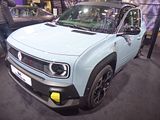
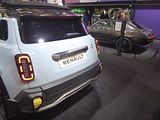
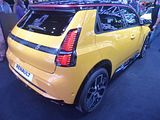
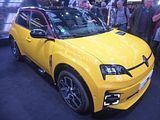
The Renault 15 and Renault 17 are two variations of the same coupé designed and built by French automaker Renault between July 1971 and August 1979. The R17 was sold as R177 in Italy, respecting the heptadecaphobia superstition. They were effectively coupé versions of the Renault 12. The main differences between the two cars were their headlight configuration (the 15 had two rectangular headlights whereas the 17 had four round headlights) and their rear side windows. Some markets show the 17 with the rectangular lights for TL versions. The Renault 15 and 17 were presented at the Paris Motor Show in October 1971. The chassis and most of the running gear came from the Renault 12, while the 1565 cc 108 PS A-Type engine in the more powerful R17 TS and R17 Gordini models was derived from the engine in the Renault 16 TS. Though the mechanicals of the cars were derived from other Renaults, the body was completely new. At the 1974 Paris Motor Show, the Renault 17TS was renamed the “17 Gordini”. This new name was an attempt to fill the gap left by the recently discontinued Renault 12 Gordini, nothing was changed beyond the badging. There was a minor facelift during March 1976, most noticeable on the grille of the 15, where the chrome edge surround was replaced with a body-coloured one: the headlights were enlarged and brought forward to a position approximately flush with the surround. The grille of the 17 also lost its chrome surround, although on both cars the partially chrome front bumper now curved up at the edges to roughly half-way up the height of the grille. The R15 and R17 remained in production until summer 1979 when they were both replaced by the Renault Fuego
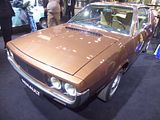
In 2024, Renault produced a concept which pays homage to the R17. It’s been shown at a number of events in the last few months, and indeed I’ve seen it myself a couple of times. This is yet another really well-judged blend of retro and modern. What a shame that there are no plans to build it.
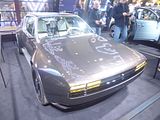
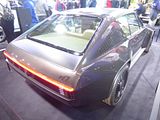
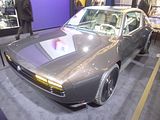
The Renault 14 is a compact car produced by the French manufacturer Renault between 1976 and 1983. It was first shown in January 1976 with production beginning in June of that year. It was the first car to be produced in large volumes at the company’s then new plant at Douai, although small pilot runs of the Renault 5 had preceded the 14’s production in the factory. Featuring front wheel drive, the 14 was developed to compete in the small family hatchback sector, which had been popularized by the launch of the Volkswagen Golf in 1974. Initially, the 14 was available in L and TL trim levels with a 1.2 L single overhead camshaft engine and later 1.4 L versions with 60 PS (59 hp) (R14 GTL) or 70 PS (69 hp) (R14 TS) joined the line-up. Both units were the X-type engine (commonly known as the “Douvrin” or “Suitcase Engine”) jointly developed with Peugeot, although the 14 turned to be the only Renault vehicle that used the unit. The design was generally well thought out and practical with interior space a major selling point, including a rear seat that could either be folded or removed completely. In addition, the spare wheel was carried at the front, under the bonnet and above the transverse 4-cylinder engine that was inclined backwards by 72°. Although all Renault cars were by now front wheel drive, the 14 was the first of the manufacturer’s models to incorporate a space saving Mini-like transversely mounted engine. The exterior styling of the Renault 14 was praised by the motoring press[citation needed] as being fresh and ahead of its time. The 14 shared with several previous Renault models a rear suspension system using two full-width torsion bars positioned one behind the other, along with the resulting wheelbase difference of more than 1 inch (32 mm) between the left and right sides of the car. For 1979 Renault sought to compensate for a slow start in the marketplace, widening the range upmarket with a “GTL” version of the car, taking its wheels and some other ornaments and interior styling cues from the newly launched Renault 18, and a “TS” with twin chamber carburetor and claimed power increase from 57 hp to 70 hp. The TS model also included halogen headlamps and electric windows in the front, the latter being a first for this class of car in the French market. The Renault 14 may have been one of the first front-wheel drive hatchbacks of its size to be produced in Europe, but within four years of its launch it was facing fierce competition from a growing number of similar products from rival manufacturers, particularly the Ford Escort MK3, Opel Kadett (Vauxhall Astra in the UK), Fiat Ritmo/Strada and Talbot Horizon. It was joined in the Renault range by the award-winning Renault 9 in 1981, the car which spawned the Renault 14’s direct successor (the Renault 11) two years later. Sales of the 14 were hampered by an advertising campaign that compared it to the shape of a pear in order to hammer home the benefits of the advanced packaging with plenty of room for passengers and luggage. A preview at the Pompidou Centre in Paris as a bare bodyshell also did little to win customers. The car would later gain a reputation for premature body corrosion, which resulted in the 14 being dubbed the “rotten pear” by the motoring press. In France, “La poire”‘ (literally “the pear”, but also slang for “gullible”) still refers to the 14. However, the best-selling Renault 5 also had a reputation for premature body corrosion, but the stronger advertising of the R5 helped boost its sales and resulted in it being a sales hit. The car also had a reputation for being difficult to start in damp conditions. The placement of the temperature gauge on the transmission tunnel behind the gear-lever, rather than on the instrument panel where it was directly in the driver’s field of view, led to incidents of engine damage if the engine overheated and the driver failed to notice. For 1980, Renault attempted to improve sales by relaunching the car with improved equipment levels and a minor facelift that included, most obviously from the outside, repositioned front indicators and reworked front fenders. This proved insufficient, and production ended in 1983 with precisely 993,193 units sold over a period of just under seven years. Initial production was 325 cars per day, which had been scheduled to increase to 700 in 1977 and to nearly 1,000 in 1978. This never materialised, as sales peaked very early in the R14’s life. Sales in the domestic French market did improve somewhat with the redesign. The R14 is now a rare sight on the roads of Europe, even in its native France where they tended to last longer due to easy parts availability through the extensive dealer network. Many Renault 14s were used by the French police in the 1980s. Its joint successors, the 9 and 11 appeared in 1981 and early 1983, respectively. The front end of the pre-facelift Renault 9 looked similar to the front end of the post-facelift Renault 14. However, both the Renault 9 and 11 had more conservative exterior body styling.
In response to Lancia’s rallying success with the mid-engined Stratos, Renault’s Jean Terramorsi, vice-president of production, asked Bertone’s Marc Deschamps to design a new sports version of the Renault 5 Alpine supermini. The distinctive new rear bodywork was styled by Marcello Gandini at Bertone. Although the standard Renault 5 has a front-mounted engine, the 5 Turbo featured a mid-mounted 1,397 cc Cléon-Fonte with fuel fed by Bosch K-Jetronic fuel injection and a Garrett AiResearch T3 turbocharger OHV 2 valves per cylinder Inline-four engine placed behind the driver in mid-body in a modified Renault 5 chassis. In standard form, the engine developed 160 PS at 6000 rpm and maximum torque of 221 Nm (163 lb/ft) at 3250 rpm. Though it used a modified body from a standard Renault 5, and was badged a Renault 5, the mechanicals were radically different, the most obvious difference being rear-wheel drive and rear-mid-engined instead of the normal version’s front-wheel drive and front-mounted engine. At the time of its launch it was the most powerful production French car. The first 400 production 5 Turbos were made to comply with Group 4 homologation to allow the car to compete in international rallies, and were manufactured at the Alpine factory in Dieppe. Many parts later transferred to the Alpine A310, such as the suspension or alloy wheel set. The R5 Turbo was conceived with dual intent, promoting the sales of the common R5 and being homologated in the FIA group 3 and 4 categories of the rally championship (today WRC). All the motorsport derivatives were based on the Turbo 1. The factory pushed the engine output up to 180 PS for the Critérium des Cévennes, 210 PS for the Tour de Corse, and by 1984 as much as 350 PS in the R5 Maxi Turbo. Driven by Jean Ragnotti in 1981, the 5 Turbo won the Monte Carlo Rally on its first outing in the World Rally Championship. The 2WD R5 Turbo soon faced the competition of new Group B four-wheel drive cars that proved faster on dirt. There are several victories throughout the early 80’s in the national championships in France, Portugal, Switzerland, Hungary, and Spain, many victories in international rallies throughout Europe, with wins in iconic rallies such as Monte-Carlo. After the factory ceased support, it lived a second life being developed by many teams and enthusiasts to compete in regional championships and local races in which it was ubiquitous and reached many success for almost 20 years. At the time of retirement, the newly created historical categories allowed these cars to return to international events and competitions, living a third life. For these reasons it has accessed to a legendary status and has a huge fan base.
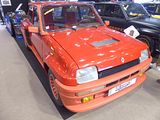
A “hot hatch” version, the GT Turbo, was introduced in 1985. It used a modified four cylinder, eight-valve Cléon 1,397 cc engine, a pushrod unit dating back to the 1962 original (in 1,108 cc form). It was turbocharged with an air-cooled Garrett T2 turbocharger. Weighing a mere 850 kg (1,874 lb), and producing 113 hp, the GT Turbo had an excellent power-to-weight ratio, permitting it to accelerate from a standstill to 60 mph in 7.5 seconds. To differentiate it from the standard 5, it came with blocky plastic side skirts. Unfortunately, turbo lag was an issue, along with poor hot starting, and it was considered rather difficult to control. The same engine was used, with similar issues, in the Renault 9 and 11 Turbos. In 1987, the facelifted Phase II was launched. Major changes in the Phase II version included installing watercooling to the turbocharger, aiding the Phase I’s oil-cooled setup, which extended the life of the turbo. It also received a new ignition system which permitted it to rev 500 rpm higher. These changes boosted engine output up to over 118 hp. Externally, the car was revamped, with changes (including new bumpers and arches) that reduced the car’s drag coefficient from 0.36 to 0.35. Giving the Phase II a 0–100 km/h time of 7.5 secs. In 1989 the GT Turbo received a new interior, and in 1990 the special edition Raider model (available only in metallic blue, with different interior and wheels) was launched. In late 1991 the Renault 5 GT Turbo was discontinued, superseded by the Clio 16v and the Clio Williams. Survival rate of the R5 GT Turbo is low and few cars are particularly original, so this was nice one to behold.
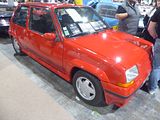
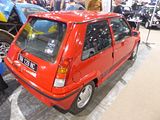
The Renault 1 000 Kg is a light van, initially of a one ton capacity, introduced by the manufacturer in 1947. A 1,400 Kg version followed in 1949, and the Renault 1,400 Kg soon became the more popular choice. A name change in 1959 saw the vans branded as the Renault Voltigeur (1,000 Kg) and the Renault Goélette (1,400 Kg), but in retrospect the Renault 1,000 Kg name is frequently preferred. The 1000 Kg was originally presented in 1945 as a prototype light van designed for the military, and was offered for general sales from February 1947. In the summer of 1944 the French Ministry of Industrial Production set out a prescriptive plan for the post war motor industry. It was headed by Paul-Marie Pons and so it was known as the Plan Pons. Under “The Plan”, Renault and Peugeot (along with their Chenard & Walcker debtor/subsidiary) were restricted to making vans for the 1000–1400 kg market, while Citroën was to make small trucks of between 2 and 3.5 tonnes. In the event Citroën, which had already developed a van in the 1000 kg class before the war, went ahead with the design of the Citroën H Van, which was launched in 1947. It was the Citroën which would be the Renault’s most effective rival in this sector, although the Renault would in the early years beat its rival on volumes thanks in part to the large number of Renaults produced for military and police use and for other public sector vehicle operators such as the French postal service. Police versions gained the informal appellation “panier à salade” (“paddy wagon”), appearing in newsreels removing arrested suspects following instances of civil disturbance during the troubled 1950s or, more memorably for many United States and UK film-goers in the 1960s, removing Inspector Clouseau following his arrest in the wake of a successful bank raid. Renault followed the Plan Pons agreement and designed the 206 E1 following general pre-war design ideas. It had a chassis onto which the van body was bolted and the body was made, until 1950, by fitting metal panels to a wooden frame. At a time when French industrial wages were low, the Renault was quick and inexpensive to produce. In contrast to the rival Citroën H Van, Renault’s design applied a traditional approach, using a rear wheel drive layout and rigid axles. Large wheels combined with a short wheelbase allowed for a tight turning circle and good ground clearance. These features reflected plans for a four wheel drive version in anticipation of military sales and to deal with the poor state of many French roads, especially in the countryside, at this time. The rear-wheel drive and big wheels resulted in the vehicle’s raised interior floor height. Renault saw a steady demand for the van, especially from public sector buyers, and 124,570 units vehicles were produced. By some criteria, it was France’s best selling vehicle in its class during the 1950s. The basic architecture and overall silhouette of the vehicle barely changed during a production run of nearly two decades, but there were numerous minor changes to the sheet metal, door hinge arrangements, front bumpers, lights and indicators as well as extensive adaptations for military and police versions. Later models, from the 1960s, can be distinguished by a small additional windows behind each of the side-doors. At launch the vehicle appeared as a boxy flat sided van with an advertised load volume of 7.45 m³ which compared with 7.3 m³ for the Citroën H as it appeared in the same year. The Renault’s 2,383cc petrol engine had originally been introduced in 1936 for the Renault Primaquatre; slightly downtuned for this application it offered 62 PS. The dry weight of 835 kg (1,841 lb) provided a maximum laden weight of 1,835 kg (4,045 lb). During 1947 a flatbed truck version appeared along with a bare chassis version enabling users to specify their own bespoke body variants from specialist truck-body builders. In July 1949, a heavy duty 1,400 kg version joined the range, and this was also the year when four-wheel drive became an advertised option. By 1952, Renault offered a more modern engine for economy minded buyers and a detuned version of the 1996 cc 49 PS unit from the recently introduced Renault Frégate was an option for the 1,000 kg model. In 1959 the vans received a name, now being branded as the Renault Voltigeur and the Renault Goélette. The Goélette, with its 1,400 kg (3,100 lb) weight limit, was now offered with the 2141 cc “Étendard” engine, which featured the same 88mm bore as the 1996 cc but had an 88mm stroke. This engine was also developed for the Renault Frégate, which during its earlier years had failed to win market acceptance mainly because it was underpowered. The 64 PS output when the engine in the van was lower than that produced in the passenger car. For 1961 buyers could specify a diesel option. The 1816 cc 58 PS diesel unit came from Indenor, a company established by Peugeot to specialise in the design and manufacture of diesel engines. This engine was offered in the Peugeot D4 since 1959. Although diesel powered vehicles were not popular in France, the lower fuel tax rate on diesel fuel made it attractive for buyers. From the middle of 1962, Renault substituted a 2720 cc diesel engine of their own construction producing 61 PS. In 1959 Renault launched the Renault Estafette with a front-wheel drive layout which allowed for a lower floor and much improved space utilisation: the bulkier but in other respects comparable Renault Voltigeur was formally withdrawn in 1963. Production of the Renault Goélette continued until May 1965, when it was replaced by the Renault Super Goélette SG2 range of larger light trucks.
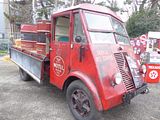
RENAULT-ALPINE
There were several of the original A110 Renault-Alpine models here. This was introduced as an evolution of the A108. Like other road-going Alpines, the 1961 A110 used many Renault parts – including engines. But while the preceding A108 was designed around Dauphine components, the A110 was updated to use R8 parts. Unlike the A108, which was available first as a cabriolet and only later as a coupé, the A110 was delivered first with “Berlinetta” bodywork and then as a cabriolet. The main visible difference with the A108 coupé was a restyling of the rear body to fit the larger engine, which gave the car a more aggressive look. Like the A108, the A110 featured a steel backbone chassis with fibreglass body. The A110 was originally available with 1.1 litre R8 Major or R8 Gordini engines. The Gordini engine delivered 95 hp at 6,500 rpm. The A110 achieved most of its fame in the early 1970s as a victorious rally car. After winning several rallies in France in the late 1960s with iron-cast R8 Gordini engines the car was fitted with the aluminium-block Renault 16 TS engine. With two dual-chamber Weber 45 carburettors, the TS engine delivered 125 hp at 6,000 rpm. This allowed the production 1600S to reach a top speed of 210 km/h (130 mph). The longer wheelbase 2+2 Alpine GT4, originally considered a version of the A108, was updated with A110 engines and mechanicals, now being marketed as the “A110 GT4”. The car reached international fame during the 1970–1972 seasons when it participated in the newly created International Championship for Manufacturers, winning several events around Europe and being considered one of the strongest rally cars of its time. Notable performances from the car included victory in the 1971 Monte Carlo Rally with Swedish driver Ove Andersson. With the buy-out of Alpine by Renault complete, the International Championship was replaced by the World Rally Championship for 1973, at which time Renault elected to compete with the A110. With a team featuring Bernard Darniche, Jean-Pierre Nicolas and Jean-Luc Thérier as permanent drivers and “guest stars” like Jean-Claude Andruet (who won the 1973 Monte Carlo Rally) the A110 won most races where the works team was entered, making Alpine the first World Rally Champion. Later competition-spec A110s received engines of up to 1.8 litres. As well as being built at Alpine’s Dieppe factory, A110 models were constructed by various other vehicle manufacturers around the world. The Alpine A110 was produced in Mexico under the name “Dinalpin”, from 1965 to 1974, by Diesel Nacional (DINA), which also produced Renault vehicles. The Alpine A110 was also produced in Bulgaria under the name “Bulgaralpine”, from 1967 to 1969, by a cooperative formed between SPC Metalhim and ETO Bulet, whose collaboration also resulted in the production of the Bulgarrenault. In 1974 the mid-engined Lancia Stratos, the first car designed from scratch for rally racing, was operational and homologated. At the same time, it was obvious that the tail-engined A110 had begun reaching the end of its development. The adoption of fuel injection brought no performance increase. On some cars, a DOHC 16-valve head was fitted to the engine, but it proved unreliable. Chassis modification, like the use of an A310 double wishbone rear suspension, homologated with the A110 1600SC, also failed to increase performance. On the international stage, the Stratos proved to be the “ultimate weapon”, making the A110, as well as many other rally cars, soon obsolete. The A110 is still seen in events such as the Rallye Monte-Carlo Historique and there was a nice example here.
The second A220 built ahead of the 1968 season, this car debuted at the Le Mans Test where Mauro Bianchi and Roger Delageneste set the fourth fastest time. It was then raced at Zeltweg and Le Mans but on both occasions, mechanical failure ended the charge early. In 1969, it was entered at Spa Francorchamps and Le Mans but again reliability issues thwarted the charge. The bodywork of chassis 1731 was then modified for the car to be used in road rallies. The tail was chopped off and this became the only road-registered A220. Retained by Alpine, it was later acquired from Renault by one of the team’s original designers Jean-Pierre Buirette. Between 1984 and 2004, he meticulously restored the car to its former glory. Today, it is the only A220 in existence that retains the side-mounted radiators and the short tail bodywork used during the second half of the 1969 season. Following its restoration, it was shown at the Le Mans Classic and on the Alpine stand during the 2013 Retromobile. That same year, its second private owner car acquired the A220. He consigned the car to British dealer William I’Anson, who showed it at Retromobile again in 2018.
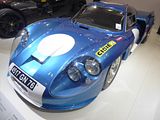
The Alpine AGTZ Twin Tail, or Zagato AGTZ Twin Tail, is a long-tail type supercar from Italian manufacturer and automotive stylist Zagato. The car denotes a style filiation with the 1968 Alpine A220 and the 2017 Alpine A110. It was presented at the Concours d’Elegance of the Villa d’Este held from 24 to 26 May 2024]. Its design was made by Norihiko Harada, the head of Zagato’s style office. The designer started from the base of the second-generation Alpine A110 to make a more modern and improved version of the Alpine A220]. 19 units of the AGTZ Twin Tail will be manufactured and offered at a price of 650 000 euros.
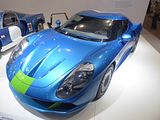
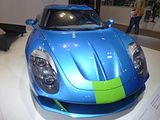
Making another public appearance was this the Alpine HY6 Alpenglow concept, an evolution of the brand’s hydrogen-powered supercar concept, originally unveiled in 2022. The new iteration swaps the original model’s four-cylinder engine for a more powerful V6 with 730 ponies, again running on hydrogen. The Alpenglow might be a rolling lab for new technologies, but Alpine hinted there is a chance it evolves into a production offering by 2028.
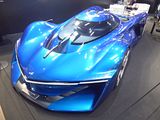
RILEY and SCOTT
Another LPM car, this one is a Riley & Scott Mk III C sports prototype racing car. It was developed by American constructor Riley & Scott Cars Inc. in the early 2000s. The car was designed for the top-tier LMP900 category of sports car racing. This specific car features the livery of the American Spirit Racing team, sponsored by Amerisuites. The car competed in the American Le Mans Series (ALMS) in 2003.
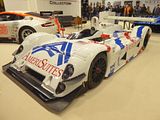
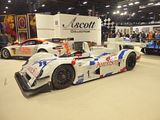
ROLLS ROYCE
The Rolls-Royce Silver Ghost name refers both to a car model and one specific car from that series. Originally named the “40/50 h.p.” the chassis was first made at Royce’s Manchester works, with production moving to Derby in July 1908, and also, between 1921 and 1926, in Springfield, Massachusetts, USA. Chassis no. 60551, registered AX 201, was the car that was originally given the name “Silver Ghost”. Other 40/50 hp cars were also given names, but the Silver Ghost title was taken up by the press, and soon all 40/50s were called by the name, a fact not officially recognised by Rolls-Royce until 1925, when the Phantom range was launched. The Silver Ghost was the origin of Rolls-Royce’s claim of making the “best car in the world” – a phrase coined not by themselves, but by the prestigious publication Autocar in 1907. The chassis and engine were also used as the basis of a range of Rolls-Royce Armoured Cars. In December 1923, four friends of Woodrow Wilson chipped in to buy the former president a Silver Ghost, just weeks before Wilson’s death in February 1924. The car was modified so that Wilson, who was disabled, could enter and exit the car more easily. In 1906, Rolls-Royce produced four chassis to be shown at the Olympia car show, two existing models, a four-cylinder 20 hp and a six-cylinder 30 hp, and two examples of a new car designated the 40/50 hp. The 40/50 hp was so new that the show cars were not fully finished, and examples were not provided to the press for testing until March 1907. The car at first had a new side-valve, six-cylinder, 7036 cc engine (7428 cc from 1910) with the cylinders cast in two units of three cylinders each as opposed to the triple two-cylinder units on the earlier six. A three-speed transmission was fitted at first with four-speed units used from 1913. The seven-bearing crankshaft had full pressure lubrication, and the centre main bearing was made especially large to remove vibration, essentially splitting the engine into two three-cylinder units. Two spark plugs were fitted to each cylinder with, from 1921, a choice of magneto or coil ignition. The earliest cars had used a trembler coil to produce the spark with a magneto as an optional extra which soon became standard – the instruction was to start the engine on the trembler/battery and then switch to magneto. Continuous development allowed power output to be increased from 48 bhp at 1,250 rpm to 80 bhp at 2,250 rpm. Electric lighting became an option in 1914 and was standardised in 1919. Electric starting was fitted from 1919 along with electric lights to replace the older ones that used acetylene or oil. Development of the Silver Ghost was suspended during World War I, although the chassis and engine were supplied for use in Rolls-Royce Armoured Cars. A blue 1909 Silver Ghost known as Blue Mist, previously owned by an Irish lord, was used by Lawrence of Arabia as his personal staff car during the Arab Revolt. Construction of a replica Blue Mist began in 2018. The chassis had rigid front and rear axles and leaf springs all round. Early cars only had brakes on the rear wheels operated by a hand lever, with a pedal-operated transmission brake acting on the propeller shaft. The footbrake system moved to drums on the rear axle in 1913. Four-wheel servo-assisted brakes became optional in 1923. Despite these improvements the performance of the Silver Ghost’s competitors had improved to the extent that its previous superiority had been eroded by the early 1920s. Sales declined from 742 in 1913 to 430 in 1922. The company decided to launch its replacement which was introduced in 1925 as the New Phantom. After this, older 40/50 models were called Silver Ghosts to avoid confusion. A total of 7874 Silver Ghost cars were produced from 1907 to 1926, including 1701 from the American Springfield factory. The documented chassis price listed for the 1921 American version was US$11,750.Many of them still run today. A fine example is on display at the National Motor Museum, Beaulieu.
Before WW2, Rolls Royce supplied all their cars as a rolling chassis, so the buyer could arrange their own choice of bodywork. A few were delivered as a Shooting Brake, such as this one, based on a Phantom I.
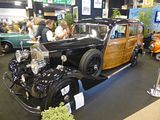
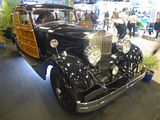
The Rolls-Royce Wraith is a full-size ultra-luxury car/grand tourer manufactured by Rolls-Royce Motor Cars and based on the chassis of the Rolls-Royce Ghost sedan, which is also shared with the Rolls-Royce Dawn convertible. The Wraith shares its nameplate with the 1938 model by the original Rolls-Royce company. The body style is a two-door pillar-less coupe with suicide doors. This body style was most popular in cars during the 1950s and 1960s, and was known as the hardtop body style, not used by Rolls-Royce since 1955. The Wraith was built in order to replace the earlier 2-door car model, the Phantom Coupé, built on the basis of the Ghost, unlike the earlier model which was based on the 7th Generation Phantom, the flagship car model of Rolls-Royce Motor cars until the arrival of the 8th generation. The vehicle was announced in January 2013 and unveiled at the 2013 Geneva Motor Show. Deliveries began from the fourth quarter of 2013. Production ceased in 2023.
RONDEAU
The Rondeau M379 is a Group 6 sports prototype race car, designed, developed and built by Automobiles Jean Rondeau, and competed in sports car racing between 1979 and 1988. It also notably successfully won the 24 Hours of Le Mans in 1980. During the 1981 24 Hours of Le Mans, two cars finished on the podium, but the race was marred by the death of Jean-Louis Lafosse, driving one of the five M379s entered in the event. It achieved one further win, at Monza in 1982. It scored a total of five podium finishes, and three class wins. It was powered by a 3.0 L 460 hp Ford-Cosworth DFV V8 Formula One engine. The chassis is an aluminum-reinforced steel spaceframe, covered in a fiberglass panel body. This drove the rear wheels through a Hewland 5-speed manual transmission. This meant it was very light, with the total weight coming to 760 kg (1,680 lb). The car only shone at the 24 Hours of Le Mans and participated very little in other races. It was only with the next car, the Rondeau M382, that Jean Rondeau entered the World Sportscar Championship.
This is also a Rondeau M379C Group 6 sports prototype race car and is chassis 005 which raced in the 1981 Le Mans 24 Hours with the number 24.
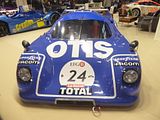
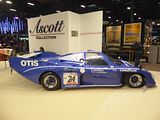
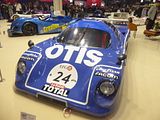
ROVER
The final version of the 10 was launched in 1939. This was part of the Rover P2 range, along with Rover 12, Rover 14, Rover 16 and Rover 20 models. The chassis was slightly modified getting an extra half inch (12 mm) in the wheelbase and the engine got a new cylinder head increasing power from 44 to 48 bhp. Synchromesh was fitted to the top two ratios on the gearbox. The body was restyled in the Rover style of the time. The price was now GBP275 for the saloon but few were made before the outbreak of war and production stopping in 1940.
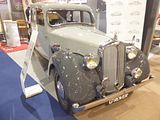
SALMSON
This is a Salmson S4E from 1949. The Salmson S4 was a mid-size executive car produced by the French engineering company Société des Moteurs Salmson. It was the manufacturer’s primary model for nearly 20 years after its introduction as the S4 C in 1932. Salmson cars were known for their advanced engineering, which stemmed from the company’s background in aviation. The S4 models featured advanced engines with features like double overhead camshafts and hemispherical combustion chambers. The S4-61 model, for example, had a 1731cc engine. The S4E had a larger 2312cc engine. These cars were noted for their responsive performance and success in motorsports, including endurance racing events like the 24 Hours of Le Mans. An optional Cotal electromechanical semi-automatic gearbox was available on some models, allowing for smooth driving. Production of the S4 series was briefly interrupted by World War II. The S4E was one of the last models produced before the company ceased automobile production in the late 1950s.
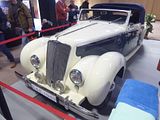
SAUBER
This is a Sauber C8 Group C prototype race car. This specific car, chassis C8-02, competed in the 1986 World Endurance Championship season. It was the first vehicle developed in a partnership between Sauber and Mercedes-Benz. The car was powered by a 5-litre twin-turbo Mercedes-Benz engine. It achieved a notable victory at the 1986 Nürburgring 1000 km race.
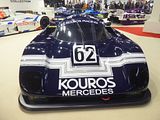
SIMCA
1956 Simca Week-End – This attractive cabriolet version of the Aronde was bodied by Facel from a Pinin Farina design, and was offered alongside a coupé. In 1957, the open car was renamed the Océane. Although more than 170,000 were built, few survive today.
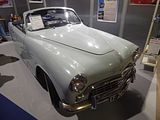
The Simca 1000, or Simca Mille in French, is a small, boxy rear-engined four-door saloon, manufactured for 18 years by French automaker Simca, from 1961 to 1978. The origins of the Simca 1000 do not lie in France but in Italy. Simca’s President-director general, Henri Pigozzi, had been born in Turin and had known Fiat’s founder, Giovanni Agnelli, from 1922 until Agnelli’s death in 1945. Fiat would remain Simca’s dominant share holder until 1963. Pigozzi remained a regular visitor to Fiat’s vast Turin operation throughout his time as the head of Simca, and when Pigozzi visited, he was as an honoured friend. Following the launch in 1955 of the well received Fiat 600, Fiat’s development department, still headed up by the designer-engineer Dante Giacosa, set about planning for its successor. The replacement foreseen would be a little larger and more powerful than the current car, reflecting growing prosperity in Italy at the time. Two projects were run in parallel: “Project 119” was for a two-door successor, building on the strengths of the current model, while “Project 122” was for a more radically differentiated four door successor. The entrance to the inner sanctum of Fiat’s Development Department would have been blocked to most visitors, but Pigozzi’s privileged relationship with the Agnellis opened even these doors, and during the late 1950s he took a particular interest in the department. It became clear that Pigozzi’s intentions to extend the Simca range further down, in the small car market segment, aligned closely with Fiat’s projects “119” and “122”, intended to build a presence up-market from the small ( 3.22 m (10.6 ft) long) Fiat 600. Pigozzi obtained the agreement of the Fiat directors to select one of the six different rather boxy four-door clay models and mock-ups that then comprised the output of “Project 122” to be developed into Simca’s new small car. The head of the Simca styling department, Mario Revelli de Beaumont, was born in Rome in 1907. He had transferred from General Motors in 1955. Dividing his time between Fiat’s Industrial Design Centre at Turin and Simca’s Styling Centre at Poissy, Revelli de Beaumont spent the two years between 1959 and 1961 working with Fiat’s Felice Mario Boano, developing the Simca 1000 to production readiness. Although the surviving prototypes differ in detail, the basic architecture and boxy shape of the car had evidently been “right first time” and the Simca 1000 of 1961 is entirely recognizable as the model that Pigozzi had selected from Fiat’s “Project 122”. In the meantime, in Italy the Fiat 600 continued to sell strongly and there was little sense of urgency about investing to replace it. Management evidently decided that a four-door replacement for the 600 would represent too big a jump from the existing car. However, in 1964 the fruits of “Project 119” became public with the launch of the Fiat 850. The “Simca Mille” (as the car is called in French) was inexpensive and, at the time of launch, quite modern, with a brand-new inline-four water-cooled “Poissy engine” of (at this stage) 944 cc. Production began on 27 July 1961, with the official unveiling taking place in the context of a high-profile publicity campaign at the Paris Motor Show on 10 October 1961. At the launch Pigozzi, for obvious reasons, placed great stress on the extent to which the new car marked a landmark achievement for an increasingly independent Simca, and the company’s new Development Department at Poissy, while omitting to mention that the Simca 1000 was the product of close collaboration with the company’s majority shareholder, Fiat. Initially, cars could be ordered in one of three colours (red/rouge tison, egg-shell blue/bleu pervenche or off-white/gris-princesse). However, the show stand featured two additional body colours and the range of colours available to customers was soon expanded. The company’s marketing strategy was characteristically imaginative, and having acquired a Paris taxi business in 1958, in November 1961 Simca replaced 50 of that company’s Simca Ariane based taxis with 50 much smaller (but evidently spacious enough for the relatively short journeys normally undertaken by taxi) Simca 1000s: thus the stylish little car, often with iconic Paris landmarks in the background, quickly became a familiar sight on the capital’s roads. Pictures of Simca 1000s working as Paris taxis turned up in the press. It was nevertheless made clear that this was not a permanent change and after a few months the red and black Simca 1000 taxis were removed from circulation and replaced with more conventionally sized taxis. The Simca 1000 was also seen in a number of export markets, with left- or right-hand-drive. Already by June 1963 it had found its way to South Africa, where it was sold alongside Chryslers, Dodges, and Plymouths. In the United States, the 1000 sedan was on sale for the 1963 model year, with the Coupé following in 1965. Use of the RR layout was a first for Simca, although leading auto-makers in France and Germany had been applying it to mainstream small cars for more than a decade. In addition to the rear engine, the fuel tank of the Simca 1000 was located in the rear, behind the rear passenger seat. This gave the car a 35/65 front/rear weight distribution, with an extremely light and nimble front end and a responsive oversteer on curvy roads. The interior was considered “surprisingly” spacious for this class of car, with plenty of space for four, although the luggage locker under the front hood/bonnet offered only limited space: unlike the similarly configured competitor Renault Dauphine and Renault 8 (and Simca’s own prototypes for the Simca 1000) which stowed their spare wheels flat underneath the front luggage locker, the Simca 1000 had its spare wheel stowed vertically in the front luggage compartment, just behind the front bumper. The driver enjoyed an excellent view out: the speedometer pod and minor controls positioned ahead of the driver were basic, although the manufacturer stressed that the glass covering the speedometer was angled to minimize reflections. Over the course of time, the 1000 (whose name was pronounced “mille” in French) was available in a number of versions featuring different equipment levels and variations of the original Type 315 engine. In 1963 the poverty spec Simca 900 was released. In spite of the name change, it also had the 944 cc engine with 36 PS, but the 1000 now gained three more horsepower. In 1966 only the 900C was available, equipped with the more powerful iteration of the 315. In October 1968 the low cost Simca 4 CV (marketed in France as the Sim’4) appeared, powered by a 777 cc unit providing 31 PS (DIN), and very competitively priced. The bare bones Sim’4 used the hubcaps from the earlier generation while receiving smaller bumper overriders without rubber inserts; a “4CV” badge on the right rear fender also helped identify the model. Twelve months after introduction, power was increased somewhat, to 33 PS. Being very cheap in the second-hand market, the Sim’4 was a perfect starting point for creating Simca Rallye replicas and very few remain in original condition. The 1000 engine was updated simultaneously with the 4CV model’s upgrade in October 1968 and was now called the type 349. At the top end of the range, the 1118 cc unit from the larger Simca 1100 was added for the 1969 model year (the Simca 1000 was marketed in the US as Simca 1118). The engine was again expanded to 1294cc in 1971 and fitted to 1000 in 1972. Apart from the standard manual transmission, some versions could be fitted with a three-speed semiautomatic developed by Ferodo. The car underwent a light facelift first shown at the 1968 Paris Motor Show (for the 1969 model year): new hubcaps, redesigned bumpers, bigger headlamps, and square taillights. The high-specification versions were offered in the British market with a walnut dashboard decor. In 1977, the model was revised for the last time, gaining the new names of 1005/1006 (depending on the specifications), to put it in line with the newer Simca 1307 and its derivatives. Production stopped in 1978 without a direct replacement.
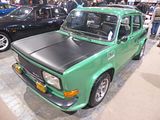
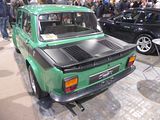
The Simca 1300 and Simca 1500 are large family cars manufactured by the French automaker Simca in its Poissy factory from 1963 to 1966 and between 1966 and 1975 in revamped versions, as the Simca 1301 and 1501. The two models were essentially versions of the same car, fitted with either a 1.3-litre or 1.5-litre engine, hence the model names. Apart from different engines and differences in standard equipment, the models were for the most part identical, bar some styling details such as grille or bumpers. The 1300 grille comprised nine horizontal and three vertical bars whereas the 1500 grille featured eleven horizontal bars only. This model series replaced the popular, long-running Simca Aronde and was initially available only with a 4-door saloon body, but in 1964 the 1500 gained an estate version (1300 estate followed in 1965). The estate versions had some interesting features. All had split tailgates – the rear windscreen would wind down into the bottom part, which could then be folded down. On the one hand, this allowed the access to the cargo compartment without opening the full tailgate. On the other, this meant that a rear window heater could never be installed in estates. Additionally, the 1500 GL version’s cargo floor, which doubled as the cover for the spare wheel (stowed flat), could be removed and, thanks to four folding legs, converted into a picnic table! A 1500 Familial version had two child seats (facing each other) in the cargo compartment, and a luggage rack on the roof. While being quite popular, especially in France and Germany, those Simcas can be remembered for some quirks regarding both series. The 1300/1500 came with column shift for left-hand drive markets, but the right-hand drive versions were converted to floor shift. The conversion for some reason resulted in a “mirror” shift pattern, with the first and second gear being closer to the driver, and the third and fourth farther to the left. Moreover, the 1500 GLA model, which was initially the sole in the range featuring automatic transmission, was at first available in metallic brown only. A similar situation concerned the interior carpets, which would come deep red regardless of the exterior colour.
Truly revolutionary, the original Mini released in 1959 spawned dozens of competitors from all over the world. One of the best-known Mini rivals was the Autobianchi A112, which landed a decade after its rival yet managed to take Italy by storm. One of the more obscure Mini rivals was the Simca 936. The model, which didn’t reach production, offered several improvements over the Mini, including a four-door body. Simca launched the project in 1963. Roger Dumas, the company’s head of design, was seemingly alarmed by the growing number of Mini models he spotted parked on Parisian streets. He believed that Simca, which had historically lagged behind (and, some years, far behind) key rivals such as Renault and Peugeot, could reach new buyers and boost its annual sales by launching France’s first true alternative to the Mini. The name 936 was chosen early on, though the car was sometimes referred to as the Isabelle internally. Built in 1966, the 936 prototype stretched about 121 inches long. For context, the Mini measured around 120 inches from bumper to bumper. Simca’s take on the idea of a tiny city car was roughly three inches wider and two inches taller than its intended competitor, and its wheelbase was about two inches longer. Visually, the 936 looked like nothing else on the road, including the Mini and the other cars in the Simca portfolio. And, viewed in the context of the era it was born in, it featured forward-thinking styling. Its boxy lines previewed some of the design trends that would permeate the European automotive industry in the late 1960s. Its headlights were rectangular rather than round, its door handles were neatly integrated into the beltline kink, and it featured thin strips of bright trim that added a touch of flair to the silhouette. The 10-inch steel wheels were pushed as far out as possible to create a relatively spacious cabin with four seats. Don’t let the side-mounted radiator fool you: the 936 wasn’t a Xerox copy of the Mini. Power came from a water-cooled, 1.0-liter four-cylinder engine sourced from the 1000 and mounted transversely. It made 40 bhpr at 5,400 rpm and spun the front wheels via a three-speed semi-automatic transmission. Had it been built, the 936 would have been revolutionary from a technical standpoint. Front-wheel drive wasn’t rare in the 1960s, especially not on the French market, but Simca’s now very conventional layout, which situated the transmission and engine transversely, was arguably more advanced than the layout used by its rivals. In the Mini, the transversely mounted engine sits on top of the transmission. In the Renault 4, the longitudinally mounted engine sits behind (!) the transmission. The Autobianchi Primula, which was a test run for Fiat’s shift to front-wheel drive, was one of the few cars built in the 1960s with a drivetrain that placed the transmission behind a transversely mounted engine. With four doors, a transversely mounted engine, and front-wheel drive, the 936 set the template for the city car as we know it in 2025. Was it pretty? You tell me. Was it innovative? There’s no debate there. And yet, it remained at the prototype stage, and the example pictured here is the only one that was built. Not everyone within Simca liked the idea of bringing the 936 to production. Some argued that it would cost too much to build, while others worried that it wouldn’t sell in large enough numbers to justify the investment. Keep in mind that Simca, which was closely linked to Fiat for several decades, got pelted into the complex latticework of Chrysler-owned brands in the early 1960s. I was told by one of the historians who works in the unofficial Simca museum located in Poissy, France, that some executives believed Simca didn’t need to develop a city car from scratch. “Just take the Hillman Imp and call it a day,” they shrugged. Realistically, all of these reasons likely played a role in the 936’s demise. But while this boxy, four-door city car never saw the light that awaits at the end of the production line, the lessons learned from the project helped Simca develop the 1100 released in 1967. It was bigger than the 936 in every direction to compete in a different segment but it featured front-wheel drive, a transversely mounted engine, four doors, and a trunk accessed via a large hatch. It was the first French car to tick all of these boxes. Hundreds followed.
SINGER
The 2021 Singer ACS (All-terrain Competition Study) is a bespoke, rally-focused, off-road Porsche 911 (964) reimagined by Singer Vehicle Design in collaboration with Tuthill Porsche. It features a 3.6L twin-turbo flat-six engine, permanent all-wheel drive, and long-travel suspension for desert or tarmac competition. Commissioned by a client, the ACS was designed for high-speed endurance rallying and off-road use, with two models built (one white, one red). It is powered by a 3.6-liter air-cooled flat-six with dual turbochargers, providing 450hp (starting), paired with a 5-speed sequential gearbox. The car features specialized carbon fibre bodywork, long-range fuel tanks, roll cages, and adjustable suspension. While initially announced in early 2021, the model faced legal attention from Porsche regarding branding, making it a rare, highly specialized commission. The project highlights Singer’s ability to create extreme, specialized 911s beyond their road-focused restomods.
SKODA
Skoda always seem to have a large stand here, and 2025 was no exception, with a celebration of the 130 years of the firm. The cars here ranged from some of the marque’s very earliest to the very latest.
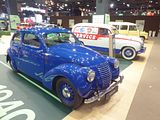
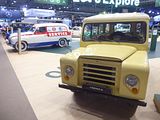
Škoda’s early days were all about two wheels. These roots were represented at the exhibition by a replica of the L&K Slavia bicycle from 1897, accompanied by two motorcycles: the single-cylinder L&K BZ from 1903 and the twin-cylinder racing machine L&K CCR from 1905. The L&K Voiturette A marked the brand’s entry into four-wheeled vehicles and launched automobile production in Mladá Boleslav, which continues to this day. The two-seater from 1905 featured a twin-cylinder engine with 7 hp, allowing it to reach a top speed of 40 km/h.
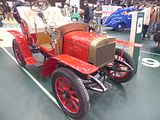
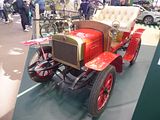
The L&K Škoda 110 is a testament to the merger of Laurin & Klement with the Škoda industrial group from Pilsen. Produced between 1925 and 1929, this car offered various body styles, ranging from a limousine to a truck.
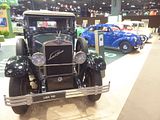
This is an unrestored 1934 Popular Sport Coupe. Based on the Popular, which was introduced in April 1934 with decidedly old-school styling, the Sport Coupe stood out with a streamlined aluminium body characterized by a small rear-mounted fin. It was developed for racing, though Škoda’s marketing department leveraged the striking silhouette as a powerful advertising tool. Production of the Popular ended in 1947 after 22,486 units were built, but Škoda made just five examples of the Sport Coupe. The one displayed spent about 40 years in a private collection, and Škoda bought it in mid-2024. This might be the last time you see its patina: it’s getting a full restoration after Retromobile.
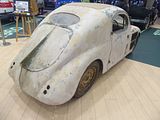
The Škoda Rapid is a mid-size car that was made from 1935 to 1947. Škoda had first applied the “Rapid” name to a version of its 1195 cc Popular Type 920 made in 1934–1935. From 1935, however, it transferred the name to a new, larger model. The Rapid Type 901 has a 1386 cc sidevalve engine and was built 1935–1938. It was succeeded by the Rapid OHV (Type 922) which has a 1558 cc overhead valve engine and was built 1938–1947. There was a six-cylinder sister model, the Škoda Rapid Six (Type 910), with a 1961 cc engine, which was launched in 1935. In the 1930s Škoda introduced a new range of cars with a backbone chassis and all-round independent suspension. The backbone design was aimed to solve the lack of torsional stiffness in the ladder frame of previous models. The chassis was developed under the leadership of chief engineer Vladimír Matouš and derived from one designed by Hans Ledwinka for Tatra. The first models in the new range were the Popular compact car in 1934, followed by the Superb full-size car. The mid-range Rapid was added in 1935. It was followed by the Favorit in 1936. The Rapid Type 901 (later Type 914) had a four-cylinder 1386 cc, 31 PS sidevalve engine and ATE-Lockheed brakes. It had a top speed of 100 km/h (62 mph) and its fuel consumption was between nine and 10 litres per 100 km. The choice of bodies offered included a two-door saloon, four-door saloon and two-door, four-seat convertible. There was also a commercial van version. Škoda revised the engine and in 1938 launched the Type 922, which it marketed as the Rapid OHV. It had enlarged the engine to 1558 cc and given it overhead valves, which increased power to 42 PS, although top speed remained 100 km/h (62 mph). The new model’s fuel consumption was 10 litres per 100 km. The choice of bodies included two-door and four-door saloons. In 1938 Škoda launched a streamlined version of the 1558 cc Rapid OHV with a new aerodynamic two-door saloon body. It bears a strong resemblance to the streamlined four-door body that Škoda built for its Type 935 prototypes in 1935–1938
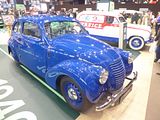
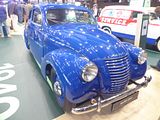
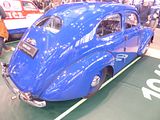
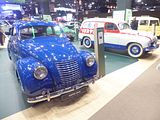
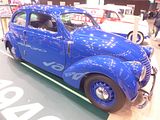
The Škoda 1201 was a family car produced by Czechoslovak automaker AZPN (Škoda Auto) at their plant in Mladá Boleslav. Saloon and estate versions were offered along with a panel van. The car was released in 1954 as a successor to the Škoda 1200. It inherited its predecessor’s steel ponton format body. One difference was the fitting of flashing turn signal indicators, whereas the 1200 had incorporated semaphore style trafficators in its front wings: subsequent retro-fitting of flashing indicators to old 1200s has left this as an imperfect method for distinguishing between the two models, however. The car was powered by a four-cylinder 1221 cc ohv water-cooled engine producing at maximum power 45 PS at 4,200 rpm. The four-speed gear-box included synchromesh on the top three ratios, power being delivered to the rear wheels via a jointed prop shaft. Top speeds of between 90 km/h (56 mph) and 105 km/h (65 mph) were quoted. The 1201 was available as a four-door saloon and as a three- or five-door station wagon. A panel van (light delivery van) and pick-up truck version were also produced. Production ended in 1961, which was also the year in which production began of the successor model, the Škoda 1202. It was widely exported to western nations; most cars remaining in Czechoslovakia went to government or taxi usage, with a very small number being sold to private owners.
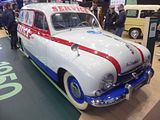
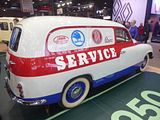
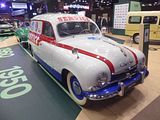
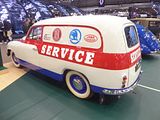
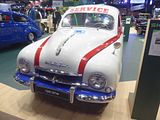
One of my favourite cars from the Škoda display was this 1969 Trekka. It’s the first Škoda SUV, and in an odd twist of fate, it’s also the first passenger car that was developed in New Zealand. The idea came from a company named Motor Industries International that imported Škoda models as complete knock-down (CKD) kits and assembled them in a facility located in Otahuhu, near Auckland. Off-roaders were already in high demand in the 1960s and nothing in the Škoda range fit the bill. Motor Industries asked Škoda to build one. The brand said, “Nope, but if you want to tackle this project we’ll send an engineer to help you.” The body, which looks as much like a scaled-down classic Land Rover in person as it does in pictures, was designed locally with the help of Josef Velebný, who flew to New Zealand from Czechoslovakia to join the Trekka project. The running gear, including a 1.2-litre four-cylinder engine, came from the Octavia Super. Buyers had numerous configurations to choose from, including an SUV, a pickup, a removable hard-top, a folding soft-top, and rear bench seats. Rear-wheel-drive was the only drivetrain layout available, but a locking rear differential was offered as an option. While some examples were exported to neighboring countries, such as Australia, most were sold in New Zealand and the Trekka wasn’t marketed in Europe.
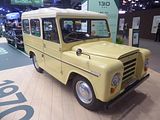
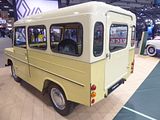
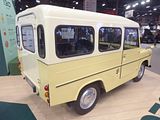
The Felicia was introduced in 1959 as a 2-door convertible, replacing the Škoda 450. Able to seat five persons, it was equipped with a folding hood and a plastic hardtop. Styling is similar to that of the contemporary Škoda Octavia. The Felicia was offered only with a 1089 cc four-cylinder engine however a Felicia Super model was introduced in 1961 powered by a larger 1221 cc four-cylinder. The Felicia was exported to Western Europe and North America. A total of 14,863 Felicias were produced. The Felicia name was resurrected by Škoda in 1994 for a new model Škoda Felicia.
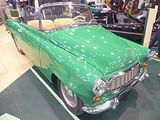
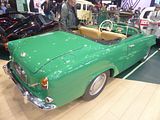
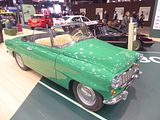
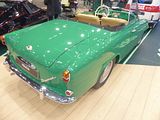
The Škoda 110 Super Sport (type 724) was a prototype sports car with rear engine and rear wheel drive, development took place in 1969-1971 and a prototype was produced in 1971. The car had an aerodynamic body made of fiberglass, there were six flip-up headlights in front, and behind it there was space for luggage and a spare wheel. The doors flipped up along with the windshield and roof. In the rear part of the car there was an engine – an in-line four-cylinder from the Škoda 110 L Rallye. For testing purposes, a more powerful 1147 cc engine was temporarily installed in the car. There were 16 round lights on the rear end, 6 in the upper row at the edge of three and 10 in the lower row across the entire width of the car. A single specimen was produced in Kvasiny, which was white in colour. It was introduced in 1972 at the Brussels Motor Show. Despite the public interest, it did not make it into serial production. In Czechoslovakia, the car was criticized for too angular shapes, but in the West, in Road and Track magazine, the Škoda 110 Supersport was rated better than the Aston Martin prototype. In 1981 it was repainted in black (with red lines around the edges) and received new front and rear fascias, the folding lights at the front were gone and replaced by two grouped into a rectangle, with a radiator grille between them; the rear lights were taken from the future Škoda 742 M and it got a new massive wing. The author of this Facelift was Theodor Pištěk. This modified car played a major role in the film The Ferat Vampire (1981), making it known as “Ferat”. He could also be seen in the movie The Great Movie Heist (1986) and in a white version in the movie Tomorrow I’ll Wake Up and Scald Myself with Tea (1977).
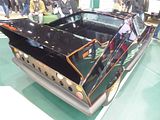
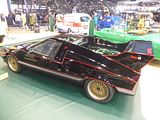
In 1999, the new Octavia WRC made its debut at the Rally Monte Carlo, competing against and taking on the best in the sport’s top category. It is based upon the Škoda Octavia road car, and was debuted at the 1999 Monte Carlo Rally. Two evolutionary versions were launched in 2001 and 2003 respectively. In its four years service in the Škoda works team, the car achieved two stage wins and a podium finish at the 2001 Safari Rally. The car was replaced by Škoda Fabia WRC in middle of the 2003 season.
Škoda Auto has not forgotten its roots and remains loyal to cycling, as evidenced by its more than 20-year main sponsorship of the famous Tour de France. On display at the exhibition in the home of the legendary race was the first Škoda director’s car from 2004.
The Škoda Yeti Xtreme concept car from 2014 is a tuning showpiece that blended a compact SUV with rally ambitions. It featured a wide body, and 17-inch wheels fitted with off-road tires.
Representing Škoda’s modern lineup at the exhibition were two electric vehicles, the Enyaq and the Elroq. The latter demonstrated its versatility with a special conversion into a mobile café.
SPYKER
Heralded by the slogan Nulla tenaci invia est via, meaning, “For the tenacious, no road is impassable,” Holland’s Spyker reemerged as an automobile constructor at the start of the new millennium. Debuting at the Birmingham Motor Show, the radical C8 Spyder was a complete stylistic departure from anything that preceded it. Yet, it skillfully recalled Spyker’s heritage in both aircraft and automobile production. Notable design elements included fuselage-type styling, rear “cannon-port” vents, a prominent wide grille intake, a propeller-inspired steering wheel, an engine-turned dash insert, and more. With a race-bred, fully independent suspension, six-speed gearbox, and a 400-horsepower, 4.2-liter Audi V-8 engine, the C8 immediately became a force to be reckoned with in the sports car market worldwide. Of the approximately 10 variants designed over the course of its production run, certainly the most inspired C8 was the Laviolette LM85, which paid homage to the automaker’s Le Mans racing history. The two-tone Burnt Orange and Gun Metal finish was inspired by the Spyker Squadron GT2 racing cars, complemented by a more luxurious interior, bathed in quilted leather and Alcantara, and accented by an aluminum instrument cluster. While the model designation refers to the starting number Spyker has enjoyed at Le Mans since 2002, the production run of only 24 units paid homage to the 24 gruelling hours at Le Mans. Notable features included matching Gun Metal side-view mirrors, a carbon fiber rear spoiler, a GT2 windscreen streamer, powder-coated alloy wheels, and black AP Racing six-piston brake calipers.
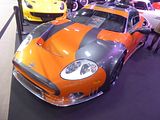
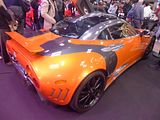
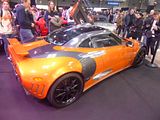
STUTZ
The Stutz Blackhawk is an American luxury car manufactured from 1971 through 1987. Other than the name, it bears no resemblance to the original Blackhawk (1929–1930). Prices ranged from US$22,500 to US$75,000. All early Blackhawks were coupes, but rare sedans were produced later. Convertible versions were called D’Italia and Bearcat. By 1976, Stutz had sold 205 Blackhawks, and about six a month were handbuilt in Italy and shipped to the U.S. By April 1980, 350 Blackhawks had been sold, and by the time production ended in 1987, approximately 500 to 600 cars had been manufactured. The Stutz Motor Company was revived in August 1968 by New York banker James O’Donnell. He joined forces with retired Chrysler stylist Virgil Exner who designed the new Blackhawk. Exner’s design included a spare tire that protruded through the decklid, a faux radiator shell-type chrome grille and freestanding headlamps. The new Blackhawk was prototyped by Ghia in Italy at a cost of over US$300,000. To offer exclusivity and still permit easy servicing in the U.S. a General Motors platform and engine served as the base for the custom built Italian body. The Blackhawk debuted in January 1970 at the Waldorf Astoria in New York City. Series production began in 1970; the original design (Series I) has a split windshield and was handmade at Officine Padane in Modena, Italy. From 1972, with the Series II, production commenced at Carrozzeria Saturn in Cavallermaggiore, near Turin, Italy. In 1973 the Series III was introduced; this version was kept in production until 1979. New series numbers were issued almost every year, ending with the Blackhawk VII, but there are no serious distinctions until the new, smaller Blackhawk VIII appeared for 1980. Mechanical changes mirroring those of the Pontiac Grand Prix took place, and the taillights were changed on occasion. For 1978 Pontiac chose to downsize the Grand Prix, but Stutz did not want to follow the same route and did not have a new design at the ready. Instead, they stocked up on a large number of 1977 Grand Prix and kept building the car for an additional two years. In 1980, the Blackhawk VIII was presented. The basic design was reworked to suit the Pontiac Bonneville chassis (later on the Parisienne), which had a near-identical wheelbase to that of the earlier Grand Prix. In 1985, Stutz changed to using the Oldsmobile Delta 88/Buick LeSabre chassis – versions of the same General Motors B platform which had been used earlier, but no longer offered by Pontiac. With an extra heavy gauge steel body, the Blackhawk measures greater than 19 feet (5.8 meters) long. Production Blackhawks used Pontiac Grand Prix running gear, Pontiac’s 7.5 L (455 in3) V8 engine, a GM TH400 three-speed automatic transmission, and rear-wheel drive. With its engine tuned to produce 425 hp and 420 lb⋅ft (569 N⋅m), the 5,000 pounds (2,300 kg) Blackhawk can accelerate to 60 mph in 8.4 seconds with a 130 mph (209 km/h) top speed, delivering eight mpg (30 L/100 km). Later Blackhawks use Pontiac’s 403 and 350 V8 engines. Also Ford, Chevrolet and Cadillac engines were used. The handbuilt Blackhawk received 18 to 22 hand-rubbed lacquer paint coats that took six weeks to apply. Total production time for each vehicle was over 1500 man-hours. Exner’s design included a spare tire that protruded through the trunk lid and freestanding headlamps. The fuel filler cap is positioned inside the spare tyre on the first models. The interior includes 24-carat gold plated trim and bird’s eye maple or burled walnut and redwood, Connolly leather seats and dash, instrument markings in both English and Italian, fine wool or mink carpeting and headlining, a cigar lighter, and a liquor cabinet in the back. There is a clock in the steering wheel hub on some later models. Other special features include automatic headlamp controls with twilight sensor, cornering lamps, bilevel automatic air conditioning, Superlift air adjustable shock absorbers, Safe-T-Track limited slip differential, an electric sunroof, cruise control, central locking, a burglar alarm, non-functional exhaust side pipes, and a high-end Lear Jet AM/FM eight-track quadraphonic sound system. The first models rolled on special 17-inch Firestone LXX run-flat tires and rims. These were taken off the market however as they turned out to be unsafe. The 1971 Blackhawk’s factory price was $22,500. In 1974 the factory price had increased to $35,000. A year later, in 1975, the factory price was US$41,500. In 1976 a Blackhawk’s base price was $47,500. And in 1981 the coupe sold for $84,500. The Stutz d’Italia was advertised as “the most expensive car sold today” at $129,500 at the same time as the Bearcat VI was offered for under half this at “only $64,165”. Mint condition early generations (1971–1975) had an estimated value in 2002 of $32,000 to $35,000. After his death Wilson Pickett’s well preserved 1974 Stutz Blackhawk was auctioned off in 2007 for US$50,600.
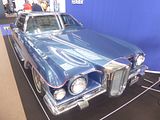
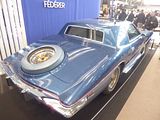
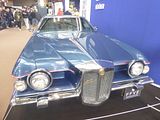
SUBARU
This is a P1 version of the first generation Impreza. To counter the grey imports of high-performance Japanese variants, Subaru UK commissioned Prodrive to produce a limited edition of 1,000 two-door cars in Sonic Blue, called the WRX “P1”. Released in March 2000, they were taken from the STI Type R lines and used for the P1. The car was the only coupé version of the WRX STI GC chassis to receive ABS. In order to allow for ABS, the DCCD was dropped. Engine output was boosted to 276 bhp, and the suspension optimised for British roads. Options were available from Subaru consisting of four-piston front brake calipers, electric Recaro seats, 18-inch wheels and a P1 stamped backbox. The P1, or Prodrive One, is echoed in the name of the Prodrive P2 concept car. They are among the most sought after of all Subaru Impreza models now.
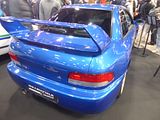
SUNBEAM
The Venezia was a car made by Sunbeam between 1963 and 1964. The Venezia was a two door coupe lwhich was fitted by a 1592cc Rootes’ engine which developed 88bhp at 5800rpm. It was based on the Hillman Super Minx/Singer Vogue/Humber Sceptre floorpan, but built in Italy by Carrozeria Touring of Milan. Touring were already assembling Super Minxes and Alpines for the Italian market. They also designed the improved boot of the Series III/IV/V Alpine and the cut-off fins of the Series IV/V. Like all Touring designs (e.g. Lamborghini 350GT, Aston Martin DB4/5/6). the Venezia used Superleggera construction, meaning aluminium body panels fitted to a tubular steel frame. 145 were built, seven of which were for British consumption. Convertible and V8 versions were considered and plans were made to switch production to the Jensen factory. None of this came to fruition, unfortunately, although rumour has it that Brian Rootes had a V8 Venezia. The Venezia was launched appropriately in St Mark’s Square, Venice. The vehicle had to be transported to the square by gondola. Someone forgot to set the handbrake and the first Venezia very nearly rolled overboard! Sadly the Venezia’s life was cut short. It was expensive to build, forcing its price into Jaguar territory, where it was under-powered by comparison with its competition. This one is going to need quite a lot of work to restore it to its former glory, and the asking price of just €7500 reflected that.
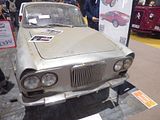
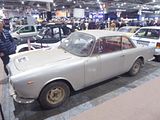
SUZUKI
The SJ40 Jimny 1000 was introduced for 1982 to replace the LJ80 range. The Jimny 1000, sold as the Suzuki SJ410 in most export markets, used the F10A – a larger 1-litre version of the LJ’s 0.8-litre four-cylinder engine. This engine produced 45 PS (33 kW; 44 hp) and it had a top speed of 68 mph (109 km/h). The Japanese market models claimed 52 PS at 5,000 rpm. So that owners of 550 cc Jimnys would not be able to retrofit the larger, wider wheels of the Jimny 1000 to their cars, the Japanese ministry of transportation dictated that Suzuki fit wheels with a different bolt pattern. A four-speed manual transmission was standard, as were non-power assisted drum brakes front and rear. The SJ410 came as a half-door convertible, long-wheelbase pickup truck, two-door hardtop (called “Van” in Japan), raised-roof hardtop, and no-glass hardtop (panel van). In Japan, the pickup truck was intended as a bare-bones work vehicle and did not receive fender extensions, and had diagonal tires on black-painted steel wheels rather than the sportier wheels fitted to the regular Jimny. Maximum payload is 350 kg (770 lb). In the autumn of 1983 a covered long-wheelbase version was added for export markets. The SJ410 was also produced in Spain by Santana Motor in their Linares, Jaén factory as of March 1985 and was sold as a domestic vehicle in Europe due to its over 60% native parts content, thereby evading limits on imports of Japanese-built automobiles. It was built only on the short wheelbase, as a two-door convertible and commercial, or with the three door SUV or van bodywork. Some later models of the SJ410 would switch to disk brakes in the front depending on the factory they were made at. In March 1990, Santana-built versions received the same chassis developments which turned the SJ413 into the Samurai; this version was sold as Samurai 1.0 where it was offered (“Samurai Mil” in Spain). Cooper Motor Corporation (CMC) of Nairobi, Kenya, had been building the first generation Jimny and continued with assembly of the SJ410 in the mid-eightiesIn 1984, the SJ was revamped with the launch of the SJ413 (internal model code JA51). The SJ413 included a larger 1.3-litre four-cylinder engine, 5-speed manual transmission and power brakes (disc brakes on the front and drum brakes on the rear) all around. The body and interior were also redesigned, with the introduction of a roll bar, along with a new dashboard, seats, and grille. The SJ410 remained in production for various other markets with the old specifications. After the 1988 introduction of the Escudo, sales of the Jimny 1300 ended in Japan. The model returned to the Japanese market in May 1993, after a thorough update. SJ413 had the same track width as SJ410. As those two car models were relatively susceptible to a rollover, Suzuki introduced a wider edition of SJ413 around 1988, with its track widened by 10 cm, giving the vehicle more stability. This wider edition received the nameplate “Samurai”. The difference in width is the only major difference between SJ413 and Samurai, apart from some minor cosmetic changes in the interior and the exterior. The Samurai was also produced in a long wheel base (LWB) edition for certain markets, but still with three doors. That LWB edition still had only two rear seats (if fitted at all) for two rear passengers, and the rear passenger leg room was the same as in the standard SWB edition. The extended vehicle length only affected the boot/trunk space behind the rear seats, which was significantly larger in the LWB edition.
TALBOT LAGO
A striking 1949 Talbot-Lago T25 Grand Sport Coupé with unique coachwork by Dubos Freres was a real exquisite find here. This is thhe sole survivor of two coupes built by Dubos Frères to this design and one of just 32 SWB T26 Grand Sport Chassis built, all with individually coachbuilt bodies. It is a dDirect descendant of the legendary prewar T150 C-SS, but with a more powerful 4.5-liter twin cam engine. This car appeared in the 1949 Concours d’Elegance du Bois de Boulogne in Paris where it won a Grand Prix. It was imported to America in the early 1950s, owned by famous racing driver and car importer Otto Zipper. Equipped with the original body, documented in period photographs and retaining its matching-numbers chassis, engine, and transmission, having had a recent mechanical refurbishment, including complete renovation of the transmission and braking system and been iIn the ownership of a well-known Talbot-Lago authority since the summer of 2009, it is now offered for sale at a cool €1.5 million.
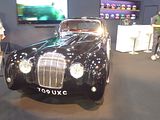
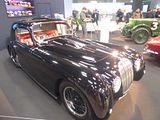
TATRA
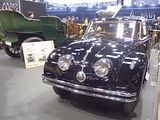
TEUF TEUF
Teuf Teuf is the name of a Club that caters for true vintage cars, and they always bring an interesting selection of cars to this event, usually from marques you’ve never even heard of. There was quite a display for the 2025 event, during which the club celebrated its own 90th anniversary.
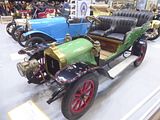
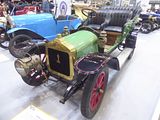
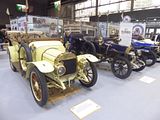
This is a 1908 Lion-Peugeot Type VA, an early motor car produced near Valentigney by the French auto-maker Lion-Peugeot between 1907 and 1908. First presented at the Paris Motor Show in 1905, but not offered for sale until the next year, the Type VA was the first of a succession of models to carry the “Lion-Peugeot” name. The car was propelled using a single cylinder 785 cm³ four stroke engine, mounted ahead of the driver. A maximum of between 6 and 7 hp of power was delivered to the rear wheels, and a top speed of 35 km/h (22 mph) was claimed. The Type VA was 2,850 mm long, with a wheel-base of 2,000 mm. A carriage format Voiturette body provided space for two while the covered carriage Tonneau / Phaeton format body offered space for four. The Peugeot family had a long tradition of manufacturing steel components and mechanisms. The car appears to have featured a simple but efficient design, and the manufacturer was able to price the first Lion-Peugeot competitively. Volumes were, by the standards of the time, correspondingly high, and approximately 1,000 of the cars were produced between 1906 and 1908. This made the Lion-Peugeot Type VA the first car carrying the “Peugeot” name to reach 1,000 units. This also appears to have put the car ahead of Peugeot’s own Peugeot Bébé model at the time, although the Bébé, in a succession of versions, would remain in production until 1916 and ultimately top 3,000 sales.
TOURING SUPERLEGGERA
Touring Superleggera has cranked out a few stone-cold classics in its time, but this one threatens to be the stoniest and coldest of all. It’s a restomod of Ferrari’s big hearted V12 icon, the 550 Maranello, here rebooted, re-suited and freshly re-powered. “The Veloce12 is a tribute to unbridled performance and analogue driving pleasure,” TS proclaims. As such, the donor ‘F133’ 5.5-litre V12 sitting in the nose of the 550 has been treated to a thorough, nuts and bolts, strip-it-down-and-rebuild-using-new-everything going over. It remains a naturally aspirated unit, here benefitting from a completely new cooling system offering a 30 per cent increase in cooling power, and a new ‘Supersprint’ exhaust, capped off by a set of twin tailpipes. The result is a hair under 500bhp – a small gain on what Ferrari managed back in the Nineties – delivered to the rear wheels via a six-speed manual gearbox. TS claims 0-62mph in 4.4s and a 199mph top speed, which should sound fairly dramatic.Stopping it with drama are six-pot front/four-pot rear Brembo calipers clamping onto mammoth 380mm discs all round, hiding behind bespoke lightweight wheels developed and designed in house by TS. Further inside lies a new TracTive bespoke suspension setup with adaptive dampers, while the 550’s chassis itself was subject to a ‘significant’ increase in torsional stiffness, “thus improving handling and precision”. Speaking of precision, that bodyshape. Oof. It’s all been handcrafted from carbon fibre as you’d expect, using CAD, CFD and – likely – a lot of emozione. “The design advances Touring’s legacy,” said design boss Matteo Gentile, “and takes certain classic concepts a step further. The Veloce12 is a celebration of our storied past, a showcase of our present capabilities, and a glimpse into the future of grand touring excellence.” Quite. Naturally there’s a swathe of expensive, luxury leather swaddling the 12’s interior, new, “ergonomically sculpted seats” for better support, and a dash of modernity to bring it up to date. Mostly though: open-gate manual, classic gearlever, lots of buttons, gorgeous leather. “While it draws inspiration from our iconic models, it is unmistakably timeless,” said boss Markus Tellenbach. “We intentionally honoured our rich heritage, but we also embraced modern innovation to create a vehicle that represents the most exclusive grand touring experience.” Naturally, this heritage and innovation and exclusivity and big fat nat-asp V12 comes at a price. Touring Superleggera is only building 30 of these things, with each one starting at €690,000… plus the donor 550 Maranello. Though, you do get a three-year warranty on the car, and a one year/7,000-mile warranty on the engine. Worth it for – as TS puts it – an “antidote to electronic overload”?
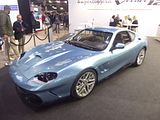
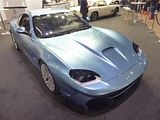
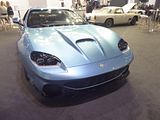
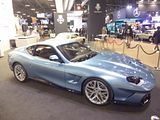
In case you want something more traditional, the form also had a beautifully restored Maserati 3500 GT Coupe as well as one waiting attention on the stand. Drool! Lots!
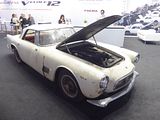
TOYOTA
Toyota had their own stand here and they picked out some very contrasting cars to display.
The Toyota Sports 800 is Toyota’s first production sports car. The prototype for the Sports 800, called the Publica Sports, debuted at the 1962 Tokyo Auto Show, featuring a space age sliding canopy and utilizing the 28 hp powertrain of the Publica 700, a Japanese market economy car. The Toyota Sports 800 is affectionately called the “Yota-Hachi” (ヨタハチ), which is a Japanese short form for “Toyota 8”. In Japan, the vehicle was exclusive to Toyota Japan retail sales channel called Toyota Publica Store alongside the Publica. The car went into production in 1965, with chassis code UP15 and an increase in engine displacement from 700 cc to 800 cc, as well as dual carburettors, which increased power from 28 to 45 PS. This engine was sufficient to power the light car around town at 70 km/h (45 mph) or on a race track up to about 160 km/h (100 mph). Production started after the introduction of Honda’s first car, called the Honda S500, and joined the market segment that was already represented by the Datsun Fairlady, and the Daihatsu Compagno. The car had aerodynamic styling by Shozo Sato, a designer on loan from Datsun, and Toyota engineer Tatsuo Hasegawa. Hasegawa had been an aircraft designer in World War II and the resulting Sports 800 was a lightweight and agile machine. The Sports 800 was one of the first production cars featuring a lift-out roof panel, or targa top, pre-dating the Porsche Targa. The aluminium targa top could be stored in the trunk, when not in use. Between 1965 and 1969 approximately 3,131 units were built by Toyota subcontractor Kanto Auto Works. Only about 10% of those vehicles are known to have survived, most being in Japan. The vast majority of the 3,131 cars were right hand drive, but some 300 were left hand drive models, built primarily for the Okinawan market (having been American occupied, Okinawa drove on the right side of the road unlike the rest of Japan). A very limited number of left hand drive cars were used by Toyota to “test drive” in the US, but the American dealerships decided the 800 would not sell well in the US and made a decision not to import or sell the cars in the US market. Toyota let these dealers keep the original batch of around 40 Sports 800s in the US instead of having them shipped back to Japan. There are subtle design differences between the years. Noticeable differences have included: change over from non-synchro to synchro first gear in 1967; a grill and bumperette change in 1968; and side marker lights in 1969. The basic body design, however, remained unchanged. An air-cooled 790 cc horizontally opposed two-cylinder boxer engine powered the vehicle. The 0.8 litre 2U (45 PS at 5,400 rpm) was produced from 1965 through 1969, while a similar 2U-B was produced from 1966 through 1976 (in 1975 the Dyna Coaster Bus manual shows that Toyota used the 2U-B as a separate auxiliary engine, just to run the air conditioning unit for the bus). In a less tuned form, the 2U was also used in the Publica (UP20/UP26) and MiniAce (UP100). Weight was kept down by using aluminium on selected body panels and thin steel on the unibody construction. For the first few years of production even the seat frames were made of aluminium. Toyota produced a one-off prototype Sports 800 Gas Turbine Hybrid for the 1979 Tokyo Motor Show. The body of the Sports 800 also served as basis of the Sports EV and Sports EV Twin electric concept cars, both unveiled in 2010.
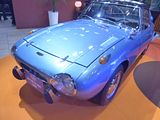
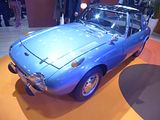
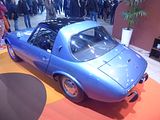
In 1995, Toyota debuted a hybrid concept car at the Tokyo Motor Show, with testing following a year later. The first Prius, model NHW10, went on sale on 10 December 1997. The first-generation Prius (NHW10) was available only in Japan. The first-generation Prius, at its launch, became the world’s first mass-produced petrol-electric hybrid car. At its introduction in 1997, it won the Car of the Year Japan Award, and in 1998, it won the Automotive Researchers’ and Journalists’ Conference Car of the Year award in Japan. Production commenced in December 1997 at the Takaoka plant in Toyota, Aichi, ending in February 2000 after cumulative production of 37,425 vehicles. The Prius NHW11 (sometimes referred to as “Generation II”) was the first Prius sold by Toyota outside of Japan, with sales in limited numbers beginning in the year 2000 in Asia, America, Europe and Australia. In the United States, the Prius was marketed between the smaller Corolla and the larger Camry, with a published retail price of US$19,995. European sales began in September 2000. The official launch of the Prius in Australia occurred at the October 2001 Sydney Motor Show, although sales were slow until the NHW20 (XW20) model arrived. Toyota sold about 123,000 first-generation Priuses. Production of the NHW11 model commenced in May 2000 at the Motomachi plant in Toyota, Aichi, and continued until June 2003 after 33,411 NHW11 vehicles had been produced. The vehicle was the second mass-produced hybrid on the American market, after the two-seat Honda Insight. The NHW11 Prius became more powerful partly to satisfy the higher speeds and longer distances that Americans drive. Electric power steering was standard equipment. While the larger Prius could seat five, its battery pack restricted cargo space. The Prius was offered in the US in three trim packages: Standard, Base, and Touring. The US EPA (CARB) classified the car with an air pollution score of 3 out of 10 as an Ultra Low Emission Vehicle (ULEV). Prius owners were eligible for up to a US$2,000 federal tax deduction from their gross income. Toyota executives stated that with the Prius NHW10 model, the company had been losing money on each Prius sold, and with the NHW11 it was now breaking even
The Toyota RAV4 EV is an all-electric version of the popular RAV4 SUV produced by Toyota until 2014. Two generations of the EV model were sold in California, and to fleets elsewhere in the US, with a gap of almost ten years between them. The first generation was leased from 1997 to 2003, and at the lessees’ request, many units were sold after the vehicle was discontinued. A total of 1,484 were leased and/or sold in California to meet the state’s mandate for zero-emissions vehicle. A small number were sold or leased in fleet sales in other states. As of mid-2012, there were almost 500 vehicles still in use in California. Production of the second generation EV was limited to 2,600 units during a three-year run, with sales limited to California beginning in 2012. Production ended in September 2014. A total of 2,489 units of the second generation model were sold in California through April 2015. Toyota worked together with Tesla Motors and Panasonic to develop the second generation RAV4 EV, and the electric SUV was released in the United States in September 2012.[4][10] The US Environmental Protection Agency rated the second generation RAV4 EV with a range of 103 mi (166 km) and a combined fuel economy rating of 76 miles per gallon gasoline equivalent (3.1 L/100 km). The first fleet version of the RAV4 EV became available on a limited basis in 1997. In 2001 it was possible for businesses, cities or utilities to lease one or two of these cars. Toyota then actually sold or leased 328 RAV4 EVs to the general public in 2003, at which time the program was terminated despite waiting lists of prospective customers. Overall, approximately 1,900 units were sold or leased through 2003, of which approximately 1,500 in the U.S. and 400 in Japan. The RAV4 EV closely resembles the regular internal combustion engine (ICE) version – without a tailpipe – and has a governed top speed of 78 mph (126 km/h) with an EPA rated range of 95 mi (153 km). The 95 amp-hour nickel–metal hydride battery (NiMH) has a capacity of 27.4 kWh, charges inductively and has proven to be very durable. Some RAV4 EVs have been driven more than 150,000 miles (240,000 km) using the original battery pack. It was also one of the few vehicles with a single speed gearbox when introduced to the market. Beyond the unusual power train (batteries, controller and motor), the remaining systems in the RAV4 EV are comparable to the gasoline-powered RAV4. The power brakes, power steering, tire wear and suspension components are similar except that they use electric power sources. The power brakes use an electric pump to provide vacuum instead of deriving vacuum from the engine manifold. The power steering use an electric motor instead of mechanical energy delivered by fan belts. The passenger compartment is heated and cooled electrically using a heat pump (the first fleet application of a heat pump in a road vehicle). The RAV4 EV production has a governed top speed of 137 km/h (85 mph), a tested 0 to 60 mph (97 km/h) time of around 18 seconds (depending on state-of-charge on the batteries). Its EPA rated driving range is 95 miles (153 km) with an EPA combined fuel economy rating of 43 kW·h/100 mi (equivalent to 78 MPGe). Actual fuel economy and range depends on the same factors as a traditional gasoline-powered vehicle including rolling resistance and average speed (aerodynamic drag). The RAV4 EV battery pack uses 24 12-volt, 95Ah NiMH batteries capable of storing 27 kWh of energy. Initially, RAV4 EVs were only available for three-year fleet lease, not for sale and not for lease to the public, at a few dealerships beginning in 1997. From 2001, leases were made available to small “fleets of one” purportedly run by small businesses. In March 2002, due to a shift in corporate policy, the Toyota RAV4-EV was made available for sale to the general public. All 328 that Toyota made were sold. No one knows for certain what prompted Toyota to change their position on the RAV4-EV, since they had long since fulfilled their obligations under the MOA with the California Air Resources Board’s zero-emissions vehicle (ZEV) mandate via its fleet lease program. The MSRP was US$42,000; but in California, ZIP-grant rebates of US$9,000, decreasing in 2003 to US$5,000, and a US$4,000 credit from the Internal Revenue Service brought the price down to a more palatable US$29,000 (US$33,000 for some 2003 deliveries), including the home charger. More RAV4-EVs were sold than had been planned for manufacture through standard assembly line techniques. Toyota filled every order despite the fact that the last few dozen vehicles had to be assembled from spare parts due to a shortfall of production components (a significantly more expensive way of building a vehicle). This unexpected development caused deliveries to trickle on into September 2003. It also caused variations in the vehicles such as heated seats, retractable antennae, mats, etc. The last of the 328 EVs was sold in November 2002.
In complete contrast is this, the Toyota GR Yaris Rally1 hybrid World Rally Championship (WRC) car. This is the latest improved and evolved model of the ultimate rally car, developed in accordance with the FIA Rally1 technical regulations. The car uses a 1.6-litre turbocharged engine from the Yaris WRC combined with a 3.9 kWh battery and a motor-generator unit (MGU) to provide over 500 PS. The chassis features a spaceframe design with a high level of safety protection for the driver and co-driver. A completely fossil-free fuel is used for the combustion engine, standardized for all competitors.
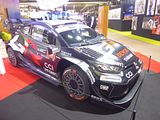
TRIUMPH
Successor to the TR3a, and code named “Zest” during development, the TR4 was based on the chassis and drivetrain of the previous TR sports cars, but with a modern Michelotti styled body. The TR 4 engine was carried over from the earlier TR2/3 models, but the displacement was increased from 1991cc to 2138 cc by increasing the bore size. Gradual improvements in the manifolds and cylinder head allowed for some improvements culminating in the TR4A model. The 1991 cc engine became a no-cost option for those cars destined to race in the under-two-litre classes of the day. Some cars were fitted with vane-type superchargers, as the three main bearing engine was liable to crankshaft failure if revved beyond 6,500 rpm; superchargers allowed a TR4 to produce much more horse-power and torque at relatively modest revolutions. The standard engine produced 105 bhp but, supercharged and otherwise performance-tuned, a 2.2-litre I4 version could produce in excess of 200 bhp at the flywheel. The TR4, in common with its predecessors, was fitted with a wet-sleeve engine, so that for competition use the engine’s cubic capacity could be changed by swapping the cylinder liners and pistons, allowing a competitor to race under different capacity rules (i.e. below or above 2 litres for example). Other key improvements over the TR3 included a wider track front and rear, slightly larger standard engine displacement, full synchromesh on all forward gears, and rack and pinion steering. In addition, the optional Laycock de Normanville electrically operated overdrive Laycock Overdrive could now be selected for 2nd and 3rd gear as well as 4th, effectively providing the TR4 with a seven-speed manual close ratio gearbox. The TR4 was originally fitted with 15×4.5″ disc wheels. Optional 48-lace wire wheels could be ordered painted the same colour as the car’s bodywork (rare), stove-enamelled (matte silver with chrome spinners, most common) or in matte or polished chrome finishes (originally rare, but now more commonly fitted). The most typical tyre originally fitted was 590-15 bias ply or optional radial tires. In the US at one point, American Racing alloy (magnesium and aluminium) wheels were offered as an option, in 15×5.5″ or 15×6″ size. Tyres were a problem for original owners who opted for 60-spoke wire wheels, as the correct size radial-ply tyre for the factory rims was 155-15, an odd-sized tyre at the time only available from Michelin at considerable expense. Some original TR4 sales literature says the original radial size was 165-15. The much more common 185-15 radials were too wide to be fitted safely. As a result, many owners had new and wider rims fitted and their wheels re-laced. The new TR4 body style did away with the classical cutaway door design of the previous TRs to allow for wind-down windows (in place of less convenient side-curtains), and the angular rear allowed a boot with considerable capacity for a sports car. Advanced features included the use of adjustable fascia ventilation, and the option of a unique hard top that consisted of a fixed glass rear window (called a backlight) with an integral rollbar and a detachable, steel centre panel (aluminium for the first 500 units). This was the first such roof system on a production car and preceded by 5 years the Porsche 911/912 Targa, which has since become a generic name for this style of top. On the TR4 the rigid roof panel was replaceable with an easily folded and stowed vinyl insert and supporting frame called a Surrey Top. The entire hard top assembly is often mistakenly referred to as a Surrey Top. In original factory parts catalogues the rigid top and backlight assembly is listed as the Hard Top kit. The vinyl insert and frame are offered separately as a Surrey Top. Features such as wind-down windows were seen as a necessary step forward to meet competition and achieve good sales in the important US market, where the vast majority of TR4s were eventually sold. Dealers had concerns that buyers might not fully appreciate the new amenities, therefore a special short run of TR3As (commonly called TR3Bs) was produced in 1961 and ’62. The TR4 proved very successful and continued the rugged, “hairy-chested” image that the previous TRs had enjoyed. 40,253 cars were built during production years. Most were sold new to the US, but plenty have returned, and it is estimated that there are not far short of 900 examples of the model in the UK at present.
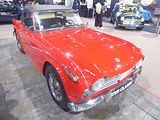
By the mid 1960s, money was tight, so when it came to replacing the TR4 and TR5 models, Triumph were forced into trying to minimise the costs of the redesign, which meant that they kept the central section of the old car, but came up with new bodywork with the front and back ends were squared off, reportedly based on a consultancy contract involving Karmann. The resulting design, which did look modern when it was unveiled in January 1969 has what is referred to as a Kamm tail, which was very common during 1970s era of cars and a feature on most Triumphs of the era. All TR6 models featured inline six-cylinder engines. For the US market the engine was carburetted, as had been the case for the US-only TR250 engine. Like the TR5, the TR6 was fuel-injected for other world markets including the United Kingdom, hence the TR6PI (petrol-injection) designation. The Lucas mechanical fuel injection system helped the home-market TR6 produce 150 bhp at model introduction. Later, the non-US TR6 variant was detuned to 125 bhp for it to be easier to drive, while the US variant continued to be carburetted with a mere 104 hp. Sadly, the Lucas injection system proved somewhat troublesome, somewhat denting the appeal of the car. The TR6 featured a four-speed manual transmission. An optional overdrive unit was a desirable feature because it gave drivers close gearing for aggressive driving with an electrically switched overdrive which could operate on second, third, and fourth gears on early models and third and fourth on later models because of constant gearbox failures in second at high revs. Both provided “long legs” for open motorways. TR6 also featured semi-trailing arm independent rear suspension, rack and pinion steering, 15-inch wheels and tyres, pile carpet on floors and trunk/boot, bucket seats, and a full complement of instrumentation. Braking was accomplished by disc brakes at the front and drum brakes at the rear. A factory steel hardtop was optional, requiring two people to fit it. TR6 construction was fundamentally old-fashioned: the body was bolted onto a frame instead of the two being integrated into a unibody structure; the TR6 dashboard was wooden (plywood with veneer). Other factory options included a rear anti-roll bar and a limited-slip differential. Some say that the car is one of Leyland’s best achievements, but a number of issues were present and remain because of poor design. As well as the fuel injection problems, other issues include a low level radiator top-up bottle and a poor hand-brake. As is the case with other cars of the era, the TR6 can suffer from rust issues, although surviving examples tend to be well-cared for. The TR6 can be prone to overheating. Many owners fit an aftermarket electric radiator fan to supplement or replace the original engine-driven fan. Also the Leyland factory option of an oil cooler existed. Despite the reliability woes, the car proved popular, selling in greater quantity than any previous TR, with 94,619 of them produced before production ended in mid 1976. Of these, 86,249 were exported and only 8,370 were sold in the UK. A significant number have since been re-imported, as there are nearly 3000 of these much loved classics on the road and a further 1300 on SORN, helped by the fact that parts and services to support ownership of a TR6 are readily available and a number of classic car owners’ clubs cater for the model.
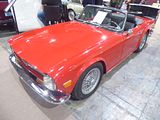
The 1300 Saloon a medium sized luxury car, was intended as a replacement of the popular Triumph Herald. Launched at the London Motor Show in October 1965, the 1300 was designed by Michelotti in a style similar to the larger Triumph 2000. It was Leyland’s first front-wheel drive design. Their major rival was BMC, who were at the time producing three FWD model ranges including the Mini and the best-selling Austin 1100 series; it was hoped by Leyland that some of the 1100s phenomenal success would rub off on the new Triumph. Triumph decided to adopt a different layout to BMC however, placing the engine above the gearbox in a front-back configuration (but not sharing the same oil) rather than BMC’s transverse engine layout. This resulted in a tall profile for the engine/gearbox combination which limited styling options. The engine was the same 1296 cc unit as used in the Triumph Herald 13/60. (the engine had originated in 1953 in the Standard Eight in 803 cc form) A conventional OHV four-cylinder unit, it developed 61 hp with the single Stromberg CD150 carburettor (also as used in the Herald 13/60) and was mated to a 4-speed all-synchromesh gearbox. Front suspension was by double wishbone layout, attached to a shock-absorber/spring unit, and the rear suspension by semi-trailing arms and coil springs like the 2000. The interior was particularly well-appointed with full instrumentation in a wooden dashboard, wooden door cappings, adjustable steering column and comfortable seats with ventilated PVC upholstery. There was through-flow ventilation with outlets under the rear roof lip. The car was fairly roomy, and aside from a slightly baulky gearchange, easy to drive with very reasonable performance. Standard equipment was generous and included thick carpeting but no heated backlight. Although not reclining, the front seats were remarkably versatile and could be easily adjusted for height and rake. The steering column was adjustable not only up and down but back and forth as well. From a safety angle the door handles were recessed and could not be caught on clothing and the (awkward to operate) window winders were spring-loaded and similarly recessed. The instrument panel had a speedometer, fuel gauge, temperature gauge, ammeter and a comprehensive cluster of warning lights arranged in a “pie chart” formation. The rear seat had a centre armrest which could be folded up when not in use. Although the car was costly compared to its more humdrum rivals, it did find favour, both with the press, who rated it, and the public, who bought it in decent quantity. For 1968, the 1300TC joined the basic model. The TC used the engine then fitted in the Triumph Spitfire, which featured twin SU carburettors and in this configuration provided an advertised 75 hp. The compression ratio of the TC was 9.0:1, whereas the single carb engine compression was rated 8.5:1 The car was identified by discreet “TC” badges. Top speed was significantly higher than the 1300 at a claimed 90 mph and acceleration times were cut by 11 percent to a 0–50 mph time of 11.5 seconds. A road test a few months later significantly improved on the company’s performance claims, achieving a maximum speed of 93 mph and 0–50 mph time of 10.5 seconds. With the car then retailing for a recommended UK price of £909, the road test concluded that “the 1300 TC costs only £41 more than the original model, and is a very good bargain indeed”. An estate version of the 1300 reached the concept stages, but was never produced due to budgetary constraints, so all 1300s are four door saloons. In August 1970 the 1300 and 1300TC were replaced by the Triumph 1500. The engine was enlarged to 1493 cc, providing a useful increase in torque, but a decrease in overall power and increased fuel consumption. The front end was cleaned up considerably, and the rear redesigned with longer tail, providing a useful increase in boot space. Production of the FWD Triumphs came to an end in 1973. 113,00 examples of the regular 1300 were made and 35,342 1300TCs, but there are surprisingly few left now.
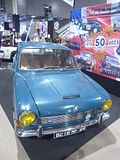
UNIC
VIGNALE
Perhaps the best known of the cars to bear the Vignale name is this 500 Gamine, sometimes known as the “noddy car”. Produced from 1967 to 1971, the Gamine was based on the Fiat 500, but unlike that car, however, the Gamine had an open-top Roadster structure and only two seats. Styling was by Alfredo Vignale. The Gamine is sometimes related in design to the Fiat 508 Balila. A hard-top was offered at an extra cost, and is considered these days to be quite rare. It was powered by a 2-cylinder, air-cooled engine of 499.5 cc from the Fiat 500 sport, the sporty version of the 500, and an engine later to be offered on the 500F, producing 21.2 bhp, which was enough to get the car to 60 mph, just. The Gamine was Alfredo Vignale’s baby project, but while the design was fairly cute, the performance was lacklustre even for the times. A high price, mediocre handling and versatility, meant that the Gamine never sold very well. In fact, the slow sales drove Carrozzeria Vignale out of business, forcing Alfredo Vignale to sell his production line to De Tomaso
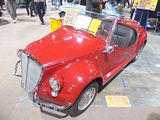
VOLKSWAGEN
Based on the second generation Golf, this is the Golf Country (7,735 cars built), co-manufactured by Steyr-Daimler-Puch in Austria, designed for medium off-road driving. It had more suspension travel, Syncro four-wheel drive, improved ground clearance of 21 centimetres (8.3 in), bullbars at front and rear (generally over a single headlight grille), a skid plate for protecting the engine area, sub-frame to protect the rear Syncro differential and propshaft and a spare wheel mounted externally on a swing-away triangular frame on the back. In Europe, it was offered with the 98 bhp 1.8 litre 8v 1P petrol engine. There were also: 1500 “Country Allround” designed to appeal to a wider public, made without the electric luxuries like electric and heated mirrors, leather steering wheel and bullbar without headlight grills, in relation to a more affordable price range; 558 ” Country – Chrompaket” with Chrome bullbars, Sliding sun roof, Engine and interior pre-heater and beige leather interior; and 50 “Country GTI” 114 bhp 1.8 GTI petrol engine, made only for Golf Country project VW-staff. The Golf Country was particularly popular in Alpine regions in central Europe.
In 2002, Volkswagen produced the Golf R32 in Europe as a 2003 model year. It was the world’s first production car with a dual-clutch gearbox (DSG) — available for the German market.[9] Due to unexpected popularity, Volkswagen decided to sell the car in the United States and Australia for the 2004 model year Volkswagen R32. The R32 shared many mechanical components with the 3.2-litre Audi TT, including the 3,189 cc DOHC 24v VR6 engine (ID codes: BFH/BML), which produced 241 PS at 6,250 rpm and 320 Nm (236 lb/ft) at 2,800 rpm. Further additions included Haldex Traction-based 4motion on-demand four-wheel drive system, a six-speed manual transmission, aluminum front control arms, independent rear suspension, and larger 334 mm (13.1 in) disc brakes with gloss blue painted calipers. Exterior changes included R32-specific bumpers and side skirts, a hatch spoiler, and 18″ OZ Aristo alloy wheels (Ronal produced the wheels towards the end of production). The interior of the R32 was equipped with Climatronic automatic climate control, sport seats from König with R logo embroidery, a sunroof (US only), Xenon Headlamps (for Europe), and more..
VOLVO
The Volvo 200 series replaced the 140 and 160 series and was produced by Volvo Cars from 1974 to 1993, with more than 2.8 million units sold worldwide. Like the Volvo 140, it was designed by Jan Wilsgaard. It overlapped production of the Volvo 700 series introduced in 1982. As the 240 remained popular, only the 260 was displaced by the 700 series — which Volvo marketed alongside the 240 for another decade. The 700 series was replaced a year before the 240 was discontinued. Production of the 240 ended on 14 May 1993 after nearly 20 years. The Volvo 240 and 260 series were introduced in the autumn of 1974, and was initially available as six variations of the 240 Series (242L, 242DL, 242GT, 244DL, 244GL, 245L and 245DL) and two variations of the 260 Series (264DL and 264GL). The 240 Series was available in sedan (with two or four doors) or station wagon, however the 260 Series was available as a coupé (262C Bertone), four-door sedan, or station wagon. The 200 looked much like the earlier 140 and 164 Series, for they shared the same body shell and were largely the same from the cowl rearward. However, the 200 incorporated many of the features and design elements tried in the Volvo VESC ESV in 1972, which was a prototype experiment in car safety. The overall safety of the driver and passengers in the event of a crash was greatly improved with very large front and rear end crumple zones. Another main change was to the engines, which were now of an overhead-cam design. The 260 series also received a V6 engine in lieu of the 164’s inline-six. The 200 Series had MacPherson strut type front suspension, which increased room around the engine bay, while the rear suspension was a modified version of that fitted to the 140 Series. The steering was greatly improved with the installation of rack-and-pinion steering, with power steering fitted as standard to the 244GL, 264DL and 264GL, and there were some modifications made to the braking system. The front end of the car was also completely restyled – that being the most obvious change which made the 200 Series distinguishable from the earlier 140 and 160 Series. Other than all the changes mentioned above, the 200 Series was almost identical to the 140 and 160 Series from the bulkhead to the very rear end. In 1978, a facelift meant a redesigned rear end for sedans, with wraparound taillights and a trunk opening with a lower lip. The dashboard was derived from the safety fascia introduced for the 1973 140-series – but was changed again for the 1981 model year with the instrument pod made considerably larger and the radio repositioned near the top of the dashboard. All models were available with a choice of four-speed manual or a three-speed automatic transmission. Overdrive was also optional on the manual 244GL, while a five-speed manual gearbox was optional on the 264GL and 265GL. In the autumn of 1975 (for the 1976 model year in America), the 265 DL estate became available alongside the existing range, and this was the first production Volvo estate to be powered by a six-cylinder engine. The choice of gearbox was also greatly improved, with overdrive now available as an option in all manual models except the base-model 242L and 245L. As before, the 3-speed automatic was optional in every model. The B21A engine gained three horsepower; a new steering wheel and gearknob were also introduced. At the 1976 Paris Motor Show Bertone first showed the stretched 264 TE, a seven-seater limousine on a 3,430 mm (135 in) wheelbase, although it had entered production earlier. The raw bodies were sent from Sweden to Grugliasco for lengthening, reinforcing, and finishing. Carl XVI Gustav of Sweden used one, as did much of East Germany’s political leadership. For 1977 the B19A engine with 90 PS replaced the old B20A in most markets, although it soldiered on for another two years in some places. This is also when the sportier 242 GT arrived. In 1978 the grille was altered, now with a chrome surround. Rear view mirrors were now black, while the front seats were changed as were the emblems, while interval wipers were introduced. 1978s were also the first 240s to receive new paint, unlike the earlier model years which rusted very badly. 1979 brought a full facelift front and rear. The GLE was added while the L was cancelled, and the six-cylinder diesel arrived late in the year. For 1980, the sporty GLT arrived, replacing the GT. For 1981 there was yet another new grille, while the station wagons received new, wraparound taillights. The B21A gained some four horsepower, now 106 PS, while the carburetted B23A with 112 PS was introduced in some markets. The Turbo arrived, while six-cylinder models now had a more powerful 2.8-litre engine. Incremental improvements were made almost every year of the production run. One of the major improvements was the introduction of the oxygen sensor in North America in late 1976, which Volvo called Lambda Sond and developed in conjunction with Bosch. It added a feedback loop to the K-Jetronic fuel injection system already in use, which allowed fine-tuning of the air and fuel mixture and therefore produced superior emissions, driveability and fuel economy. For the 1983 model year, Volvo dropped the DL and GLE labels, selling the cars simply as 240s. Buyers protested and the grades returned for 1984. A new manual gearbox also arrived for 1984, while a four-speed automatic option was available in the GL. GLT and Turbo versions received a taller grille. About one-third of all 240s sold were estate models, which featured very large cargo space of 41 cubic feet. They could be outfitted with a rear-facing foldable jumpseat in the passenger area, making them a seven-passenger vehicle. The last 200 produced was a blue station wagon built to the Italian specification and named the “Polar Italia”, currently displayed at the Volvo World Museum.
The Volvo 850 is a compact executive car that was produced from 1991 until 1997. Designed by Jan Wilsgaard, the car was introduced in a saloon body style; an estate style was introduced in 1993. The Volvo 850 was shown for the first time in June 1991, and the car marked a departure for Volvo, featuring multiple unprecedented features for the company; these included a transverse 5-cylinder engine driving the front wheels, a Delta-link rear axle, a side impact protection system, and a self-adjusting front seat belt mechanism. The Volvo 850 was succeeded by the Volvo S70 and Volvo V70. For 1995, the special limited edition 850 T-5R was offered, and was a commercial success, leading Volvo to produce a second run in 1996. Originally, it was to be called 850 Plus 5. The vehicle was based on the 850 Turbo, utilizing the B5234T5 engine with a special ECU (Bosch #628 in U.S and #629 in EU) that added an additional 2 psi (0.1 bar) of turbocharger boost pressure, giving the engine an extra 18 hp for a total of 243 hp and 250 lb/ft (340 Nm) of torque. The engine was mated to a 4-speed automatic transmission or 5-speed manual transmission, the latter of which was not available in the United States. The T-5R was renowned as a sleeper car; despite its boxy, understated appearance, it boasted a drag coefficient of 0.29 and was capable of accelerating from 0 to 60 mph in 5.8 – 6.0 seconds (depending on transmission and body type). The top speed was electronically limited to 152.2 mph (244.9 km/h). The vehicle came standard with Pirelli P-Zero tyres, providing lateral grip of 0.88 g. The engine tuning was co-developed with Porsche, as was the transmission and other powertrain components. Porsche also aided in designing some of the interior, such as the Alcantara seat inserts. These cars came as standard with nearly every feature available, only a handful of options – such as heated rear seats – were available. On the North American market only two options could be chosen, a trunk-mounted Alpine 6-CD changer and no-cost 16″ wheels for a smoother, more comfortable ride and driveability in snow when using all-season tyres. Also included in the 1995 T-5R package was a front bumper with a lip, rear spoiler, side skirts, polished aluminum door sills, special graphite leather and Alcantara seats, and a black interior with deep walnut wood grain accents. Both yellow and black versions came with the same black interior as the only choice. The T-5R has an additional badge to the left of the “850” on the trunk, referred to as “The Motorsport badge”. The standard road wheel was the titanium-gray 5-spoke 17×7 “Titan”. 1995 was the only year that the a model was badged as a “T-5R”; the following year, as Volvo recognized the vehicle’s popularity, the model was renewed with the designation “850R”. The T-5R featured side airbags installed in the seat cushions. The side airbags were integrated into the rest of the Volvo model line the following year as an option, and became standard a year after that; other manufacturers soon followed suit. The car was also fitted with an early example of daytime running lamps. Also, just like the 940, it had three-point seatbelts at all five seating positions (previously, cars had only a lap belt for the centre rear seat). The T-5R also used the OBDII diagnostics system, a year before OBDII was made an automotive standard. 6964 T-5Rs were produced worldwide, of which the largest market was Germany (1,433), Italy (914; 2.0 turbo), United States (876), Japan (749), Netherlands (489), UK (440), Sweden (321), Spain (185), and Canada (103).
This was a fantastic event, spoiled only by the size of the crowds. I’ve been coming here for a number of years now, and every time I seem to be saying that the one I’ve attended was the best one yet, and that is probably as true for the 2025 edition as all the previous ones. The combination of the specially themed displays along with the stock brought along by a large number of high-end dealers, as well as manufacturers and clubs seems to yield lots of new content that has not been seen before. 2026 will see the 50th edition of the event, and I am sure the organisers will deliver something particularly special, I can’t wait to see just what they come up with.