As the evening events kindly hosted by the Morgan car company are especially popular among the “Wheels on Wednesday” attendees, it was good to see that this venue would feature again in the 2025 schedule of this popular program. Although there is a lot of space here, as there is a large field around the back of the Visitor Centre, these evening do tend to sell out, though, as I figured out last year, you can still attend, as there is plenty of street parking just around the corner, so you can always park up and walk in, which is what I ended up doing this time as well. As well as accommodating plenty of display cars on site, there is also access to the showroom, shop and museum and there is food and drink available from an outdoor stall as well, to cater for the needs of hungry and thirsty attendees. As with all the “Wheels on Wednesdays” there is always great variety in the cars attending, a welcome mix of regulars and cars that have not been seen before. Here is what attracted my attention on a busy Wednesday evening at the very end of July:
ABARTH
The Series 4 version of the familiar 595 first reached the markets in the middle of 2016. After rumours had circulated all winter following the launch of the facelifted Fiat 500 in 2015, Abarth finally unveiled the Series 4 at the end of May 2016. Initially, we were told that the cars would not be available in the UK until September, but that came forward somewhat, with dealers all receiving demo cars in June, and the first customers taking delivery in July. Three regular production versions of both the closed car and the open-topped C were initially available, all badged 595, and called Custom, Turismo and Competizione, as before, though numerous limited edition models have since appeared and in most case disappeared. The most significant changes with the Series 4 are visual, with a couple of new colours, including the much asked for Modena Yellow and a different red, called Abarth Red, which replaces both the non-metallic Officina and – slightly surprisingly – the tri-coat pearlescent Cordolo Red. as well as styling changes front and rear. The jury is still out on these, with many, me included, remaining to be convinced. At the front, the new air intake does apparently allow around 15 – 20 % more air in and out, which will be welcome, as these cars do generate quite a lot of heat under the bonnet. Competizione models for the UK retain the old style headlights, as they have Xenon lights as standard, whereas the Custom and Turismo cars have reshaped units. At the back, there are new light clusters and a new rear bumper and diffuser. Inside, the most notable change is the replacement of the Blue & Me system with a more modern uConnect Audio set up, which brings a new colour screen to the dash. Mechanically, there is an additional 5 bhp on the Custom (now 145) and Turismo (now 165 bhp) and the option of a Limited Slip Diff for the Competizione, which is likely to prove a popular option. Details of the interior trim have changed, with a filled-in glovebox like the US market cars have always had, and electric windows switches that are like the US ones, as well as a part Alcantara trim to the steering wheel in Competizione cars.


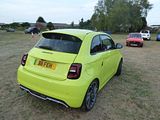
The Abarth New 500e Scorpionissima is a performance variant that made its official debut on 22 November 2022, featuring unique scorpion-badged alloy wheels. Initially, it is being released in a Scorpionissima edition limited to 1,949 examples. Scorpionissima models will be available in a choice of Acid Green or Poison Blue colours, bearing unique side graphics and wheels. The first deliveries were scheduled for June 2023. It has a single electric traction motor that produces 114 kW (153 hp) and 235 Nm (173 lb/ft), an increase of 26.7 kW (35.8 hp) and 15 Nm (11 lb/ft) over the standard motor, and accelerates from 0 to 100 km/h (62 mph) in 7 seconds. The enhancements in power and torque output are derived from improved inverter and battery wiring, and a reduction in the final-drive ratio. The Abarth also swaps the rear drum brakes on the New 500 for discs. Three driving modes are offered: Turismo, Scorpion Street, and Scorpion Track; output power and torque are limited to 100 kW (130 hp) and 220 Nm (160 lb/ft) in Turismo. Scorpion Street maximizes regenerative braking, simulating the engine braking effect of a conventional car equipped with a manual transmission, while Scorpion Track sacrifices range for performance. In manufacturer testing at Balocco, the Abarth 500e is able to complete laps 1 second quicker than the Abarth 695. Total weight is 1,410 kg (3,110 lb), including the 295 kg (650 lb) battery. Charging hardware is carried over from the regular New 500 equipped with the larger battery, at rates up to 85 kW. The Abarth 500e has a battery with a capacity of 42.2 kWh (gross) and 37.3 kWh (net), giving the vehicle a claimed range of 264 km (164 mi) under the WLTP driving cycle with the standard 17-inch wheels; equipping the 18-inch wheels reduces range to 253 km (157 mi). Real-world mixed driving with 18-inch wheels indicated an actual range of 212 km (132 mi), with consumption of 3.4 mi/kWh.


AC
Genuine AC Cobra models are few and far between, but almost since the end of their very limited production, there have been numerous companies producing replicas, and many of these are almost indistinguishable from the real thing, even though most do have contemporary mechanical parts. The car seen here is an AK 427 produced by the Peterborough-based firm of AK Sportscars. They offer kits that recreate the legendary AC Cobra, such as this car, the Jaguar XKSS and the Ford GT40. They have three options for their AK 427 and choosing between them will depend on a number of factors including budget, the amount of time you have to spare and the amount of space you have in which to build your car. The choices start with the basic body and chassis kit for which there are three options. The “Standard” body/chassis kit is based on the early Jaguar XJ6/S running gear with the inboard rear brakes. Or the popular “Generation II ” body/chassis kit which is based on the later Jaguar XJ40 running gear which have the outboard rear brakes, or the latest ” Generation III SUPALITE” body/chassis kit which is also based on the Jaguar XJ40 but has a stiffer more tubular chassis and the bonus of over 100 kg weight saving over the Generation II Kit.. The company also offers a ”Factory built Rolling Chassis” for the Generation II / III which gets you off to a flying start!

This is a Dax Tojeiro. Dax is one of the most recognised producers of replica Cobras. The company, based in North Weald, Essex, began building fibreglass mouldings for cars in 1968. In 1975 the AC Ace’s designer, John Tojeiro, became a director of the company and that’s when the Cobra replica became known as the Dax Tojeiro. Dax is still going, under the current stewardship of John Kox, who took control in 2017. The Tojeiro is still part of its catalogue, albeit it’s now called the Dax 427. The cars are built on a steel ladder frame chassis, and these days with bonded and riveted front and rear sections to add stiffness. The basic setup of the front and rear axles, suspension and brakes is based around donor items from the Jaguar XJ40, but with bespoke geometry, Spax adjustable coil overs, front anti-roll bar and steering rack.

ALFA ROMEO
The first car was called the Alfa Romeo Giulia Sprint GT, and was revealed at a press event held at the then newly opened Arese plant on 9 September 1963, and displayed later the same month at the Frankfurt Motor Show. In its original form the Bertone body is known as scalino (step) or “step front”, because of the leading edge of the engine compartment lid which sat 1/4 an inch above the nose of the car. The Giulia Sprint GT can be distinguished from the later models by a number of features including: Exterior badging: Alfa Romeo logo on the front grille, a chrome script reading “Giulia Sprint GT” on the boot lid, and rectangular “Disegno di Bertone” badges aft of the front wheel arches; flat, chrome grille in plain, wide rectangular mesh without additional chrome bars; single-piece chrome bumpers; no overriders. Inside the cabin the padded vinyl dashboard was characterised by a concave horizontal fascia, finished in grey anti-glare crackle-effect paint. Four round instruments were inset in the fascia in front of the driver. The steering wheel was non-dished, with three aluminium spokes, a thin bakelite rim and a centre horn button. Vinyl-covered seats with cloth centres and a fully carpeted floor were standard, while leather upholstery was an extra-cost option. After initially marketing it as a four-seater, Alfa Romeo soon changed its definition of the car to a more realistic 2+2. The Giulia Sprint GT was fitted with the 1,570 cc version of Alfa Romeo’s all-aluminium twin cam inline four (78 mm bore × 82 mm stroke), which had first debuted on the 1962 Giulia Berlina. Breathing through two twin-choke Weber 40 DCOE 4 carburettors, on the Sprint GT this engine produced 105 hp at 6,000 rpm. Like all subsequent models, the Sprint GT was equipped with an all-synchromesh 5-speed manual transmission. The braking system comprised four Dunlop disc brakes and a vacuum servo. The rear brakes featured an unusual arrangement with the slave cylinders mounted on the axle tubes, operating the calipers by a system of levers and cranks. According to Alfa Romeo the car could reach a top speed of “over 180 km/h (112 mph)”. In total 21,902 Giulia Sprint GT were produced from 1963 to 1965, when the model was superseded by the Giulia Sprint GT Veloce. Of these 2,274 were right hand drive: 1,354 cars fully finished in Arese, and 920 shipped in complete knock-down kit form for foreign assembly. For 1966, the Giulia Sprint GT was replaced by the Alfa Romeo Giulia Sprint GT Veloce, which was very similar but featuring a number of improvements: a revised engine—slightly more powerful and with more torque—better interior fittings and changes to the exterior trim. Alongside the brand new 1750 Spider Veloce which shared its updated engine the Sprint GT Veloce was introduced at the 36th Geneva Motor Show in March 1966, and then tested by the international specialist press in Gardone on the Garda Lake. Production had began in 1965 and ended in 1968. The Giulia Sprint GT Veloce can be most easily distinguished from other models by the following features: badging as per Giulia Sprint GT, with the addition of round enamel badges on the C-pillar—a green Quadrifoglio (four-leaf clover) on an ivory background—and a chrome “Veloce” script on the tail panel; black mesh grille with three horizontal chrome bars; the grille heart has 7 bars instead of 6; stainless steel bumpers, as opposed to the chromed mild steel bumpers on the Giulia Sprint GT. The bumpers are the same shape, but are made in two pieces (front) and three pieces (rear) with small covers hiding the joining rivets. Inside the main changes from the Giulia Sprint GT were imitation wood dashboard fascia instead of the previous anti-glare grey finish, front seats revised to a mild “bucket” design, and a dished three aluminium spoke steering wheel, with a black rim and horn buttons through the spokes. The Veloce’s type 00536 engine, identical to the Spider 1600 Duetto’s, featured modifications compared to the Giulia Sprint GT’s type 00502—such as larger diameter exhaust valves. As a result it produced 108 hp at 6,000 rpm, an increase of 3 hp over the previous model, and significantly more torque. The top speed now exceeded 185 km/h (115 mph). Early Giulia Sprint GT Veloces featured the same Dunlop disc brake system as the Giulia Sprint GT, while later cars substituted ATE disc brakes as pioneered on the GT 1300 Junior in 1966. The ATE brakes featured an handbrake system entirely separate from the pedal brakes, using drum brakes incorporated in the rear disc castings. Though the Sprint GT Veloce’s replacement—the 1750 GT Veloce—was introduced in 1967, production continued throughout the year and thirty final cars were completed in 1968. By then total Giulia Sprint GT Veloce production amounted to 14,240 examples. 1,407 of these were right hand drive cars, and 332 right hand drive complete knock-down kits. The Alfa Romeo 1750 GT Veloce (also known as 1750 GTV) appeared in 1967 along with the 1750 Berlina sedan and 1750 Spider. The same type of engine was used to power all three versions; this rationalisation was a first for Alfa Romeo. The 1750 GTV replaced the Giulia Sprint GT Veloce and introduced many updates and modifications. Most significantly, the engine capacity was increased to 1779 cc displacement. Peak power from the engine was increased to 120 hp at 5500 rpm. The stroke was lengthened from 82 to 88.5 mm over the 1600 engine, and a reduced rev limit from 7000 rpm to 6000 rpm. Maximum torque was increased to 137 lb·ft at 3000 rpm. A higher ratio final drive was fitted (10/41 instead of 9/41) but the same gearbox ratios were retained. The result was that, on paper, the car had only slightly improved performance compared to the Giulia Sprint GT Veloce, but on the road it was much more flexible to drive and it was easier to maintain higher average speeds for fast touring. For the United States market, the 1779 cc engine was fitted with a fuel injection system made by Alfa Romeo subsidiary SPICA, to meet emission control laws that were coming into effect at the time. Fuel injection was also featured on Canadian market cars after 1971. Carburettors were retained for other markets. The chassis was also significantly modified. Tyre size went to 165/14 from 155/15 and wheel size to 5 1/2J x 14 instead of 5J x 15, giving a wider section and slightly smaller rolling diameter. The suspension geometry was also revised, and an anti-roll bar was fitted to the rear suspension. ATE disc brakes were fitted from the outset, but with bigger front discs and calipers than the ones fitted to GT 1300 Juniors and late Giulia Sprint GT Veloces. The changes resulted in significant improvements to the handling and braking, which once again made it easier for the driver to maintain high average speeds for fast touring. The 1750 GTV also departed significantly from the earlier cars externally. New nose styling eliminated the “stepped” bonnet of the Giulia Sprint GT, GTC, GTA and early GT 1300 Juniors and incorporated four headlamps. For the 1971 model year, United States market 1750 GTV’s also featured larger rear light clusters (there were no 1970 model year Alfas on the US market). Besides the chrome “1750” badge on the bootlid, there was also a round Alfa Romeo badge. Similar Quadrofoglio badges to those on the Giulia Sprint GT Veloce were fitted on C pillars, but the Quadrofoglio was coloured gold instead of green. The car also adopted the higher rear wheelarches first seen on the GT 1300 Junior. The interior was also much modified over that of earlier cars. There was a new dashboard with large speedometer and tachometer instruments in twin binnacles closer to the driver’s line of sight. The instruments were mounted at a more conventional angle, avoiding the reflections caused by the upward angled flat dash of earlier cars. Conversely, auxiliary instruments were moved to angled bezels in the centre console, further from the driver’s line of sight than before. The new seats introduced adjustable headrests which merged with the top of the seat when fully down. The window winder levers, the door release levers and the quarterlight vent knobs were also restyled. The remote release for the boot lid, located on the inside of the door opening on the B-post just under the door lock striker, was moved from the right hand side of the car to the left hand side. The location of this item was always independent of whether the car was left hand drive or right hand drive. Early (Series 1) 1750 GTV’s featured the same bumpers as the Giulia Sprint GT Veloce, with the front bumper modified to mount the indicator / sidelight units on the top of its corners, or under the bumper on US market cars. The Series 2 1750 GTV of 1970 introduced other mechanical changes, including a dual circuit braking system (split front and rear, with separate servos). The brake and clutch pedals on left hand drive cars were also of an improved pendant design, instead of the earlier floor-hinged type. On right hand drive cars the floor-hinged pedals were retained, as there was no space for the pedal box behind the carburettors. Externally, the series 2 1750 GTV is identified by new, slimmer bumpers with front and rear overriders. The combined front indicator and sidelight units were now mounted to the front panel instead of the front bumper, except again on the 1971-72 US/Canadian market cars. The interior was slightly modified, with the seats retaining the same basic outline but following a simpler design. 44,269 1750 GTVs were made before their replacement came along. That car was the 2000GTV. Introduced in 1971, together with the 2000 Berlina sedan and 2000 Spider, the 2 litre cars were replacements for the 1750 range. The engine displacement was increased to 1962 cc. Oil and radiator capacities remained unchanged. The North American market cars had fuel injection, but everyone else retained carburettors. Officially, both versions generated the same power, 130 hp at 5500 rpm. The interior trim was changed, with the most notable differences being the introduction of a separate instrument cluster, instead of the gauges installed in the dash panel in earlier cars. Externally the 2000 GTV is most easily distinguished by its grille with horizontal chrome bars, featuring protruding blocks forming the familiar Alfa heart in outline, smaller hubcaps with exposed wheel nuts, optional aluminium alloy wheels of the same size as the standard 5. 1/2J × 14 steel items, styled to the “turbina” design first seen on the alloy wheels of the Alfa Romeo Montreal, and the larger rear light clusters first fitted to United States market 1750 GTV’s were standard for all markets. From 1974 on, the 105 Series coupé models were rationalised and these external features became common to post-1974 GT 1300 Junior and GT 1600 Junior models, with only few distinguishing features marking the difference between models. 37,459 2000 GTVs were made before production ended and these days they are very sought after with prices having sky-rocketed in recent years.


The original 1966 Spider shape was the result of a number of Pininfarina design studies, concept cars showing traits incorporated in the final production design. The first one was the Alfa Romeo Superflow, a concept car built upon the chassis of a retired 6C 3000 CM racing car and first show at the 1956 Turin Motor Show. Despite being an aerodynamic coupé with prominent fins on the rear, and a futuristic all-plexiglas greenhouse and front wings, the Superflow already shown the overall body shape of the future Spider and the scallops on the sides. In the following years the Superflow was updated three times into three more different concept cars, namely a Superflow II coupé, then an open-top spider and finally another Superflow IV coupé. The most significant in the Spider’s design history was the second, the open-top Alfa Romeo Spider Super Sport, shown at the 1959 Geneva Motor Show. It did without the rear fins of the Superflow and Superflow II, showing for the first time the rounded cuttlebone-shaped tail and tail light configuration of the Spider. Last of the Spider’s forerunner was the Alfa Romeo Giulietta SS Spider Aerodinamica, which premiered at the 1961 Turin Motor Show, and was based on the Giulietta Sprint Speciale. Very close to the shape of the production car, its main design differences were at the front, due to hideaway headlamps. Despite the almost final design being ready in 1961, the continuing success of existing models and the economic challenges facing Italy at the time meant that the first pre-launch production Spiders began to emerge from the Pininfarina production line only at the end of 1965. The Spider was launched at the 36th Geneva Motor Show in March 1966, together with the Giulia Sprint GT Veloce at an event organised in Gardone Riviera. With its boat tailed styling, it quickly found favour, even before taking a starring role in the film “The Graduate”. The original 1600cc engine was replaced by a more powerful 1750cc unit at the same time as the change was made to the rest of the range, and the car continued like this until 1970, when the first significant change to the exterior styling was introduced on the 1750 Spider Veloce, with the original’s distinctive elongated round tail changed to a more conventional cut-off tail, called the “Kamm tail”, as well as improving the luggage space. Numerous other small changes took place both inside and out, such as a slightly different grille, new doorhandles, a more raked windscreen, top-hinged pedals and improved interior trim. 1971 saw the Spider Veloce get a new, larger powerplant—a 1962 cc, 132 hp unit—and consequently the name was changed from 1750 Spider Veloce to 2000 Spider Veloce. The 1600 Spider restarted production a year later as the Spider 1600 Junior, and was visually identical to the 1300. 1974 saw the introduction of the rare, factory request, Spider-Targa. Based upon the Spider, it featured a Porsche style solid rear window and lift out roof panels, all made out of black GRP type material. Less than 2,000 models of such type were ever made and was the only part solid roof Spider until the introduction of the factory crafted hard top. The 1300 and 2000 cars were modified in 1974 and 1975 respectively to include two small seats behind the front seats, becoming a “two plus two” four seater. The 1300 model was discontinued in 1977. Also, between 1974 and 1976, the early-style stainless-steel bumpers were discontinued and replaced with black, rubber-clad units to meet increasingly stringent North American crash requirements. 4,557 examples of the 1300 Junior were made and 4,848 of the 1600 Junior as well as 16,320 2000 Spider Veloces and 22,059 of 2000 Spider Veloce US version. There were also 4,027 1750 Spider Veloces produced.

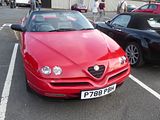
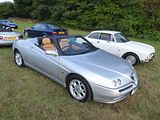
The 916 Series cars were conceived to replace two very different models in the Alfa range. First of these was the open topped 105 Series Spider which had been in production since 1966 and by the 1990s was long overdue a replacement. Alfa decided to combine a follow on to the Alfetta GTV, long out of production, with a new Spider model, and first work started in the late 1980s. The task was handed to Pininfarina, and Enrico Fumia’s initial renderings were produced in September 1987, with the first clay models to complete 1:1 scale model made in July 1988. Fumia produced something rather special. Clearly an Italian design, with the Alfa Romeo grille with dual round headlights, recalling the Audi-based Pininfarina Quartz, another design produced by Enrico Fumia back in 1981, the proposal was for a car that was low-slung, wedge-shaped with a low nose and high kicked up tail. The back of the car is “cut-off” with a “Kamm tail” giving improved aerodynamics. The Spider would share these traits with the GTV except that the rear is rounded, and would feature a folding soft-top with five hoop frame, which would completely disappear from sight under a flush fitting cover. An electric folding mechanism would be fitted as an option. Details included a one-piece rear lamp/foglamp/indicator strip across the rear of the body, the minor instruments in the centre console angled towards the driver. The exterior design was finished in July 1988. After Vittorio Ghidella, Fiat’s CEO, accepted the design, Alfa Romeo Centro Stile under Walter de Silva was made responsible for the completion of the detail work and also for the design of the interiors, as Pininfarina’s proposal was not accepted. The Spider and GTV were to be based on the then-current Fiat Group platform, called Tipo Due, in this case a heavily modified version with an all new multilink rear suspension. The front suspension and drivetrain was based on the 1992 Alfa Romeo 155 saloon. Chief engineer at that time was Bruno Cena. Drag coefficient was 0.33 for the GTV and 0.38 for the Spider. Production began in late 1993 with four cars, all 3.0 V6 Spiders, assembled at the Alfa Romeo Arese Plant in Milan. In early 1994 the first GTV was produced, with 2.0 Twin Spark engine. The first premiere was then held at the Paris Motor Show in 1994. The GTV and Spider were officially launched at the Geneva Motor Show in March 1995 and sales began the same year. The cars were well received. At launch, many journalists commented that Alfa had improved overall build quality considerably and that it came very close to equalling its German rivals. I can vouch for that, as I owned an early GTV for eighteen months, and it was a well built and reliable car. In 1997 a new engine, a 24-valve 3.0 litre V6, was available for the GTV along with bigger, 12.0 inch brakes and red four-pot calipers from Brembo. The console knobs were changed from round central to rectangle ones and to a three-spoke steering wheel. Some versions were upgraded with different front bumper mesh to bring the wind noise down to 74 dBA. In May 1998 the cars were revamped for the first time, creating the Phase 2 models. Most of the alterations were inside. The interior was changed with new centre console, painted letters on skirt seals, changed controls and switches arrangement and different instrument cluster. Outside, the main changes included chrome frame around the grille and colour-coded side skirts and bumpers. A new engine was introduced, the 142 bhp 1.8 Twin Spark, and others were changed: the 2.0 Twin Spark was updated with a modular intake manifold with different length intakes and a different plastic cover. Power output of the 2.0 TS was raised to 153 bhp. Engines changed engine management units and have a nomenclature of CF2. The dashboard was available in two new colours in addition to the standard black: Red Style and Blue Style, and with it new colour-coded upholstery and carpets. The 3.0 24V got a six-speed manual gearbox as standard and the 2.0 V6 TB engine was now also available for the Spider. August 2000 saw the revamp of engines to comply with new emission regulations, Euro3. The new engines were slightly detuned, and have a new identification code: CF3. 3.0 V6 12V was discontinued for the Spider and replaced with 24V Euro3 version from the GTV. 2.0 V6 Turbo and 1.8 T.Spark were discontinued as they did not comply with Euro3 emissions. By the 2001-2002 model year, only 2 engines were left, the 2.0 Twin.Spark and 3.0 V6 24V, until the Phase 3 engine range arrived. The Arese plant, where the cars had been built, was closing and, in October 2000, the production of GTV/Spider was transferred to Pininfarina Plant in San Giorgio Canavese in Turin. In 2003 there was another and final revamp, creating the Phase 3, also designed in Pininfarina but not by Enrico Fumia. The main changes were focused on the front with new 147-style grille and different front bumpers with offset numberplate holder. Change to the interior was minimal with different centre console and upholstery pattern and colours available. Instrument illumination colour was changed from green to red. Main specification change is an ASR traction control, not available for 2.0 TS Base model. New engines were introduced: 163 bhp 2.0 JTS with direct petrol injection and 237 hp 3.2 V6 24V allowing a 158 mph top speed. Production ceased in late 2004, though some cars were still available for purchase till 2006. A total of 80,747 cars were made, and sales of the GTV and Spider were roughly equal. More V6 engined GTVs than Spiders were made, but in 2.0 guise, it was the other way round with the open model proving marginally more popular.




ASTON MARTIN
This is a 1934 Mark II and is affectionately known as “Hedgehog”. Unveiled at the 1934 Motor Show, the Mark II was in effect an improved Le Mans model. The 1½ litre engine could now produce 73bhp, the chassis was somewhat stiffer and the road holding was also improved. Again two chassis lengths were available, long for saloons, tourers and drophead coupes, short for 2 and 2/4 seater sports cars. The short chassis from the Mark II together with a modified engine and lightweight 2 seater body was used as Team cars and ultimately became the Ulster. The distinctive and easily identifiable feature of the Mark II are the thermostatically controlled radiator shutters. Cycle type front winds were retained which still turned with the steering. The folded hood was again moved outside the body – not so good looking perhaps but it was more roomy for the rear seat passengers. The 2/4 seater based on the shorter 8’7” chassis was the most successful and best selling of the 1.5 litre cars with 61 completed over a period a little under two years.

Following the unveiling of the AMV8 Vantage concept car in 2003 at the North American International Auto Show designed by Henrik Fisker, the production version, known as the V8 Vantage was introduced at the Geneva Motor Show in 2005. The two seat, two-door coupé had a bonded aluminium structure for strength and lightness. The 172.5 inch (4.38 m) long car featured a hatchback-style tailgate for practicality, with a large luggage shelf behind the seats. In addition to the coupé, a convertible, known as the V8 Vantage Roadster, was introduced later in that year. The V8 Vantage was initially powered by a 4.3 litre quad-cam 32-valve V8 which produced 380 bhp at 7,300 rpm and 409 Nm (302 lb/ft) at 5,000 rpm. However, models produced after 2008 had a 4.7-litre V8 with 420 bhp and 470 Nm (347 lbft) of torque. Though based loosely on Jaguar’s AJ-V8 engine architecture, this engine was unique to Aston Martin and featured race-style dry-sump lubrication, which enabled it to be mounted low in the chassis for an improved centre of gravity. The cylinder block and heads, crankshaft, connecting rods, pistons, camshafts, inlet and exhaust manifolds, lubrication system and engine management were all designed in house by Aston Martin and the engine was assembled by hand at the AM facility in Cologne, Germany, which also built the V12 engine for the DB9 and Vanquish. The engine was front mid-mounted with a rear-mounted transaxle, giving a 49/51 front/rear weight distribution. Slotted Brembo brakes were also standard. The original V8 Vantage could accelerate from 0 to 60 mph in 4.8 seconds before topping out at 175 mph. In 2008, Aston Martin introduced an aftermarket dealer approved upgrade package for power and handling of the 4.3-litre variants that maintained the warranty with the company. The power upgrade was called the V8 Vantage Power Upgrade, creating a more potent version of the Aston Martin 4.3-litre V8 engine with an increase in peak power of 20 bhp to 400 bhp while peak torque increased by 10 Nm to 420 Nm (310 lb/ft). This consists of the fitting of the following revised components; manifold assembly (painted Crackle Black), valved air box, right and left hand side vacuum hose assemblies, engine bay fuse box link lead (ECU to fuse box), throttle body to manifold gasket, intake manifold gasket, fuel injector to manifold seal and a manifold badge. The V8 Vantage had a retail price of GB£79,000, US$110,000, or €104,000 in 2006, Aston Martin planned to build up to 3,000 per year. Included was a 6-speed manual transmission and leather-upholstery for the seats, dash board, steering-wheel, and shift-knob. A new 6-speed sequential manual transmission, similar to those produced by Ferrari and Lamborghini, called Sportshift was introduced later as an option. An open-topped model was added to the range in 2006 and then in the quest for more power a V12 Vantage joined the range not long after. There were no fewer than 18 different versions of the car produced over its model life


The latest and still current Aston Martin Vantage was unveiled on 21 November 2017 with production starting in June 2018, replacing the previous model which had been in production for 12 years. It introduced a new styling direction but this was not universally well received and the car had a hefty price increase over its predecessor. Muted press enthusiasm did not help and sales have been disappointing. Aston Martin have continued to develop the model with a number of new versions introduced, to try to improve demand. The Vantage AMR is a track-focused variant of the Vantage. The main highlight of the model is the replacement of the ZF 8-speed automatic transmission with a dog-leg Graziano Trasmissioni 7-speed manual transmission previously used on the V12 Vantage S. The AMR also comes with a driver-selectable AMSHIFT system which controls the throttle during gear shifting. A new limited-slip differential ensures linear delivery of power. The power-band of the engine is wider and the unit is designed to deliver 625 Nm (461 lb/ft) of torque from 2,000 rpm to 5,000 rpm. The use of a manual transmission and carbon-ceramic brakes reduce the weight by 95 kg (209 lb). New adaptive dampers with the section of Sport, Sport + and Track modes improve handling. Performance figures include a 0–97 km/h (60 mph) acceleration time of 3.9 seconds, half a second more than the standard Vantage while the top speed remains the same as the standard model. Visual changes include 20-inch forged wheels as available on the Rapide AMR, new carbon fibre side vents and cooling vents present on the hood a sports exhaust system with quad tailpipes and racing bucket seats. Production of the AMR will be limited to 200 units worldwide. Available exterior colours for the AMR include Sabiro Blue, Pnyx Black, China Grey and White Stone. The final 59 cars will be finished in a Sterling Green exterior colour with Lime accents and will pay homage to the 1959 24 Hours of LeMans victory of Aston Martin. Once the production of the AMR ceases, the 7-speed manual transmission will become available on the standard Vantage. The vehicle went on sale in May 2019, with delivery set to begin in Q4 2019. Revealed in February 2020, the Vantage Roadster is a convertible version of the V8 Coupe with a fabric roof. The roof claimed to be the fastest of any automotive automatic convertible system, takes 6.7 seconds to lower and 6.8 seconds to raise and can be operated at speeds of up to 50 km/h (31 mph). The Vantage Roadster has a dry weight of 1,628 kg (3,589 lb). The F1 Edition is a version of the V8 Coupe and V8 Roadster commemorating Aston Martin’s return to Formula One after 61 years. The car features a fixed rear wing at the back, increased engine power to 535 PS (528 bhp), a top speed of 314 km/h (195 mph), new 21-inch wheel rims, and a 0–100 km/h (0–62 mph) acceleration time of 3.5 seconds. The car is available in three colours: Aston Martin Racing Green, Jet Black, and Lunar White. A convertible version called the Roadster is also available. Delivery began in May 2021.


The DB12 was presented on 24 May 2023 at the 2023 Cannes Film Festival as a replacement for the DB11. The DB12 is also the first Aston Martin vehicle to wear the brand’s new logo. The DB12 is a major technological restyling of the DB11 with touches of the DBS. Compared to that, the DB12 has a larger radiator grille, wider track widths and new LED headlights. It also features a redesigned interior and an all-new infotainment system, which can support Android Auto and Apple CarPlay. The DB12 features a 4.0-litre M177 twin-turbo V8 engine with a power output of 680 PS (671 hp) and 800 Nm (590 lb/ft) of torque. The increase in performance is achieved by optimized compression, larger turbochargers, and improved cooling. The DB12 accelerates from 0–100 km/h (0–62 mph) in 3.6 seconds, and it has a top speed of 202 mph (325 km/h). The 5.2-litre V12 engine from the previous model is no longer offered. Aston Martin unveiled a convertible version of the DB12, the DB12 Volante, on 14 August 2023. The Volante’s roof is an eight-layer fabric top that can open in 14 seconds and close in 16 seconds, with this possible at speeds of up to 31 mph (50 km/h). The DB12 Volante is also claimed to have five per cent better torsional rigidity than the DB11 Volante. The DB12 Volante accelerates from 0–100 km/h (0–62 mph) in 3.7 seconds, and has the same top speed as the coupé of 202 mph (325 km/h).

AUDI
Still well-regarded over 40 years since its launch is the Quattro, a legend which transformed rallying and brought the idea of four wheel drive as a performance benefit to the market. The idea for a high-performance four-wheel-drive car was proposed by Audi’s chassis engineer, Jörg Bensinger, in 1977, when he found that the Volkswagen Iltis could outperform any other vehicle in snow, no matter how powerful. Bensinger’s idea was to start developing an Audi 80 variant in co-operation with Walter Treser, Director of Pre-Development.. Following an unveiling on 1st March 1980, Audi released the original Quattro to European customers in late 1980, with the car featuring Audi’s quattro permanent four-wheel drive system (hence its name), and the first to mate four-wheel drive with a turbocharged engine. The original engine was the 2,144 cc in-line-5-cylinder 10 valve SOHC, with a turbocharger and intercooler. It produced 197 bhp propelling the Quattro from 0 to 100 km/h in 7.1 seconds, and reaching a top speed of over 220 km/h (137 mph). The engine was eventually modified to a 2,226 cc inline-5 10 valve, still producing 197 bhp, but with peak torque lower in the rev-range. In 1989, it was then changed to a 2,226 cc inline-5 20v DOHC setup producing 217 bhp, now with a top speed of 230 km/h (143 mph) Audi Quattros are referred to among owners and enthusiasts by their engine codes, to differentiate between the earlier and later versions: the earliest 2144 cc 10v being the “WR” engine, the 2226 cc 10v being the “MB” engine, and the later 20v being the “RR” engine. Hence, Quattro models may be referred to as either the WR Quattro, MB Quattro, and RR or “20v” Quattro, respectively. Quattro car production was 11,452 vehicles over the period 1980–1991, and through this 11 year production span, despite some touch-ups, there were no major changes in the visual design of the vehicle. For the 1983 model year, the dash was switched from an analogue instrument cluster, to a green digital LCD electronic instrument cluster. This was later changed in 1988 to an orange LCD electronic instrument cluster. The interior was redesigned in 1984, and featured a whole new dash layout, new steering wheel design, and new centre console design, the switches around the instrument panel were also redesigned at this time. In 1985 the dash changed slightly with harder foam and lost a diagonal stripe, the dash switches were varied slightly and the diff lock pull knob gave way to a two-position turning knob with volt and oil temp digital readouts. External styling received very little modification during its production run. Originally, the car had a flat fronted grille featuring four separate headlamp lenses, one for each of the low and high beam units. This was altered for the 1983 model year, and replaced with combined units featuring a single lens, but housing twin reflectors. This was changed again, for the 1985 model year, in what has become known as the ‘facelift model’ and included such alterations as a new sloping front grille, headlights, and trim and badging changes. Max speed was 124 mph. The RR 20v Quattro also featured a new three spoke steering wheel design, leather covering for door arm rests, gloveboxes, centre console and door pockets. There was also a full length leather-wrapped centre console running all the way to the rear seats. The 20v was also the first Ur-Q to have “quattro” script interior with partial leather seats. The floor on the drivers side had a bulge due to dual catalytic exhaust setup. The different models may be distinguished by the emblems on their boot lids: the WR had a vinyl ‘quattro’ decal or a brushed aluminium effect plastic emblem, the MB had chrome plated ‘audi’, ‘audi rings’ and ‘quattro’ emblems, whilst the RR had only chrome plated ‘audi rings’. The rear suspension was altered early on with geometry changes and removal of the rear anti-roll bar to reduce a tendency for lift-off oversteer. For the 1984 facelift, the wheel size went from 6×15-inch with 205/60-15 tyres to 8×15-inch wheels with 215/50-15 tyres. At the same time the suspension was lowered 20 mm with slightly stiffer springs for improved handling. For 1987, the Torsen centre differential was used for the first time, replacing the manual centre differential lock. The last original Audi Quattro was produced on 17 May 1991, more than two years after the first models of the new Audi Coupe range (based on the 1986 Audi 80) had been produced.


The Audi RS 4 is the high-performance variant of the Audi A4 range produced by Audi Sport GmbH for AUDI AG, a division of the Volkswagen Group. It sits above the Audi S4 as the fastest, most sports-focused car based on the A4’s “B” automobile platform. The RS 4 was reintroduced in 2012, based on the A4 Avant instead of the sedan as did the original model. The original B5 version was produced only as an Avant, Audi’s name for an estate car/station wagon. The second version, the B7, was released initially as a four-door five-seat saloon/sedan, with the Avant following a short while later. A two-door four-seat Cabriolet version was subsequently added. The “RS” initials are taken from the German RennSport—literally translated as “racing sport”, and is the Audi marque’s highest trim level, positioned above the “S” model specification of Audi’s regular model line-up. Like other Audi “RS” cars, the RS 4 pioneers some of Audi’s latest advanced technology. It is only available with Audi’s Torsen-based “trademark” quattro permanent four-wheel drive system. RS4 models have been produced for every generation of the A4 since 1999, with occasional gaps in production (2001-2006, 2008-2012 and 2015-2018). The original B5 Audi RS 4 Avant quattro (Typ 8D) was introduced by Audi in late 1999, for main production and sale from 2000, as the successor to the Porsche / Quattro GmbH joint venture-developed Audi RS2 Avant. Like its predecessor, the RS 4 was available only as an Avant and was built on an existing platform, in this case, the Volkswagen Group B5 platform shared with the A4 and S4. Retail price was around DM 103,584. The RS 4 was available for sale in most of Europe, parts of Asia and in some Latin American countries. Although related to the B5 S4, many of the outer body panels were altered, with wider front and rear wheel arches to allow for the wider axle track on the RS 4. With unique front and rear bumpers and side sills, and the rear spoiler from the S4 Avant, the aerodynamic modifications achieved a drag coefficient of Cd 0.34. Although the B5 S4 came in a saloon car body style, the B5 RS 4 was only available in the Avant version. Luggage space, measured according to the industry standard VDA method was 390 litres (13.8 cu ft) with the rear seats in the upright position, and 1,250 litres (44.1 cu ft) with the seats folded flat. The engine was developed from the 2.7 litre 90° V6 ‘biturbo’ used in the B5 S4. It displaced 2,671 cubic centimetres and had five valves per cylinder. The engine was developed and manufactured in the UK by Cosworth Technology. It featured aluminium alloy ALSi7Mg cylinder heads, cast by Cosworth, with enlarged intake ports and smaller exhaust ports, two parallel BorgWarner K04-series turbochargers, two larger side-mounted intercoolers, dished piston crowns, stronger connecting rods, larger intake ducting, an enlarged exhaust system, and a re-calibrated engine management system. The modifications increased the engine’s output from 261 bhp and 400 Nm (295 lb/ft) of torque to 375 bhp at 7,000 rpm and 440 Nm (325 lb/ft) at 6,000 rpm. The engine was controlled by a Bosch Motronic ME 7.1 electronic engine control unit, using a Bosch ‘E-Gas’ electronic drive by wire throttle. It had multipoint sequential fuel injection, a mass airflow sensor, and six individual ignition coils. The engine oil was cooled by oil to water and oil to air coolers. The RS 4 has a curb weight of 1,620 kg (3,571 lb). It can accelerate from 0-100 km/h (62.1 mph) in 4.9 seconds, 0-160 km/h (99.4 mph) in 11.3 seconds, and 0-200 km/h (124.3 mph) in 17.0 seconds. The top speed is electronically limited to 250 km/h (155 mph). Audi produced 6,030 units between 1999 and 2001.

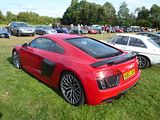
The second generation of the R8 (model code: Type 4S) was unveiled at the 2015 Geneva Motor Show and is based on the Modular Sports System platform shared with the Lamborghini Huracan. The development of the Type 4S commenced in late 2013 and was completed in late 2014. Initial models included the all-electric e-Tron and the V10 5.2 FSI along with the V10 plus. Unlike its predecessor, there was no manual transmission available and the entry-level V8 trim was also dropped. In 2016, the convertible (Spyder) variant was added to the line up which was initially available in the base V10 trim. In mid-2017, the high performance V10 plus Spyder was added to the range. A rear-wheel-drive model called the R8 RWS was introduced. In 2018, the R8 received a mid-cycle refresh with mechanical and exterior changes. The newer and more aggressive design language carried over from famous Audi models of the past and it’s appearance is slightly more angular up front. Some of the aerodynamic features such as the front aeroblades are shared with the Lamborghini Huracàn. The refreshed model had substantial performance improvements over its predecessor. The base R8 gets a power boost from 532 hp to 562 hp, while the V10 Plus was renamed V10 Performance Quattro and the engine saw a power increase by 10 bhp, now up to 612 bhp. The Audi R8 e-tron (2015) was an all-electric version of the second-generation R8. Unlike the earlier 2010 prototype based on the first-generation R8, it actually entered production, but only on a small scale, with less than 100 units sold. It featured a 92-kWh battery.
AUSTIN
The A99 Westminster appeared in 1959 with new Pinin Farina-designed bodywork. Pininfarina had also re-styled Austin’s compact A40 and mid-sized A55 Cambridge ranges the year before. Under the bonnet was the 2.9 L (2912 cc) C-Series straight-6 engine with twin SU carburettors from the Austin-Healey 3000. This engine produced 103 hp in Westminster tune. A three-speed all-synchromesh manual gearbox with a Borg-Warner overdrive unit was fitted as standard, or a Borg-Warner automatic transmission as an option. Power-assisted Lockheed brakes with 10.75 in (273 mm) discs on the front wheels were also new. An A99 saloon with automatic transmission was tested by the British magazine The Motor in 1960 and they recorded a top speed of 98.1 mph, acceleration from 0–60 mph in 17.9 seconds and a fuel consumption of 23.0 mpg imperial (12.3 L/100 km; 19.2 mpg‑US). The test car cost £1219 including taxes. The manual car cost £1148. A specially trimmed A99 was sold as the Princess 3-Litre, (note, not an “Austin” Princess – Austin was removed from Princess badging in August 1957 on the larger Princess IV) and later under the Vanden Plas marque as the Vanden Plas Princess. A Wolseley version, the 6/99, was also produced. Production ended in 1961 with the introduction of the larger A110. 15,162 A99s were built. The final major update arrived in 1961 with the A110 Westminster. This version had an extended (by 2 in/51 mm) wheelbase, which allowed more space in the rear compartment as well as improving the roadholding, a floor-mounted gear lever. 13 in wheels were substituted in 1964’s Mark II models. Wolseley produced a 6/110 version, and there was a Vanden Plas Princess Mark II with the C-Series engine, now uprated to 120 bhp. The same basic body was also used for a Rolls-Royce-engined Vanden Plas Princess, and the body even formed part of a prototype Bentley. The Westminster range was finally replaced by the Austin 3-Litre in 1968. 26,105 A110s were built.


BENTLEY
The Arnage, a twin of the Rolls-Royce-branded sibling, the Silver Seraph, was introduced in the Spring of 1998, the first entirely new designs for the two marques since 1980. This is a large car: over 5.4 metres (212 in) long, 1.9 metres (75 in) wide, and has a kerb weight of more than 2.5 metric tonnes. For a brief period it was the most powerful and fastest four-door saloon on the market. In a complete switch from tradition, whilst these cars had bodies built at the Crewe factory, the then owner, Vickers, decided that the car would be powered by engines built elsewhere. A number of potential engines were examined, including the GM Premium V engine, and a Mercedes-Benz V8 engine, before, in late 1994, Vickers selected a pair of BMW power plants. It was decided that the Rolls-Royce model would use BMW’s naturally aspirated V12 engine while the more-sporting Bentley model would use a special twin-turbo version of the 4.4-litre BMW V8, which was developed by Vickers subsidiary, Cosworth Engineering. On its introduction in the spring of 1998, the Arnage was available as a single model with the this 4,398cc twin turbo developing some 354 PS (349 bhp) and 420 lb·ft. During the takeover battle in 1998 between BMW and Volkswagen Group for ownership of Rolls Royce and Bentley Motors, BMW had threatened to stop supply of their engines if Volkswagen Group won. While the threat was later withdrawn in conjunction with BMW acquiring the right to manufacture the Rolls Royce marque at a new location, it was clear that Volkswagen could not accept the business and reputation risks associated with having their rival as a long-term business partner. Furthermore, customers were nervous about engine and part availability (of which there turned out to be no issue) and orders for new cars dropped precipitously. Volkswagen’s response was to prepare the old pushrod 6.75-litre 16-valve engine from the Turbo R for the Arnage, designed for the lighter and smaller BMW 32-valve V8 unit. Coupled with an outdated 4-speed automatic, the engine was extremely thirsty, and would not meet government-imposed emissions standards without hasty modifications. The revised version of the car was launched as the Arnage Red Label in October 1999. At the same time, but without the fanfare, Bentley made several minor modifications to the original BMW engined cars, and designated them as the “Arnage Green Label” for the 2000 model year. As part of the modification process, both Red and Green Label cars received stiffer body shells and larger wheels and brakes. The stiffer body shell was needed because of the extra weight of the British engine. The larger brakes were needed for the same reason. Despite the larger brakes, braking performance worsened with the extra weight of the 6.75 engine. The braking performance of the ’99 Green Label from 70–0 was 172 feet while the later Arnage T’s performance was 182 feet from the same speed. The PR department at Bentley pointed to customer demand as the driving force behind the reversion to the old two valve per cylinder 6.75-litre unit for the Red Label. This explanation appears to have been acceptable to all but a few of the motoring press who welcomed the return of the old unit after criticising the BMW motor as at best insipid and, at worst, underpowered. In reality, the outgoing BMW-powered Arnage was technically more modern, considerably more fuel efficient, and had 32 valves with double overhead camshafts, twin-turbo and Bosch engine management technology – as opposed to 16-valve, single turbo and a pushrod motor with less advanced engine management. The Red Label’s increase in motive power shaved less than a second of the zero to 60 mph time. However, the BMW twin turbo unit remained noticeably more agile and responsive from a driver’s perspective, due to its more responsive DOHC engine, better weight balance(maintaining a 51.1/48.9 weight distribution) and almost 600 lb (270 kg) lower curb weight. Ultimately the Green Label was more reliable and significantly less expensive to service in the long term. The key limiting factor of the BMW engine’s output was the ZF 5HP30 transmission which was not rated to handle more than the 413 lb·ft torque that the twin turbo engine was tuned to produce. In total only seven Arnage Green Label units were built, all of which were left-hand-drive versions. There was a final series of vehicles built in 2000 with the 4.4-litre BMW engine designated the Arnage Birkin, of which 52 units were produced and are distinguishable by their three-dial as opposed to five-dial instrument centre dashboard configuration. A long-wheelbase version of the Red Label was launched at the North American International Auto Show in 2001. The Green Label ended production in 2000. The Red Label models were replaced in 2002. In 2001, the Arnage RL, a long-wheelbase model, 9.8 in longer than the Arnage, was launched, the extra length added to the car at its rear doors and its C-pillar. With the standard Arnage model, the rear wheel wells butt up against the rear door frames, but with the RL they are a few inches further back. The overall effect is a larger rear area inside the car. Available only as a bespoke “Mulliner” model, each RL was customised to the desires of the buyer. The RL, however, was also the first of a new series of Arnages which would finally cure the Bentley Arnage of the reliability and performance deficiencies experienced following its forced deprivation of the modern BMW engines it was designed to use. The RL would also present a credible challenge to BMW’s attempts to revive the Rolls-Royce brand with its planned new model, the Phantom. The RL’s introduction saw the introduction of an entirely reworked version of the 6.75-litre V8 engine. Where the engine used in the Red Label was a quickly and less-than-completely-satisfactorily modified version of the Turbo RT’s unit, the RL featured an entirely reworked version of the old 6.75-litre V8. More than half of the engine’s parts were completely new, with Bosch Motronic ME7.1.1 engine management replacing the old Zytek system, and two small Garrett T3 turbochargers replacing the single large T4. This new engine developed 405 PS (399 bhp) and 616 lb·ft, and was said to be capable of meeting all future emissions requirements. Finally, the Arnage was powered by a modern twin-turbo unit with state-of-the-art electronic management system similar to the originally Cosworth-BMW unit developed for the Arnage in 1998. Perhaps ironically, what was essentially a new engine developed by Volkswagen Group engineers for the RL in 2001, was now producing the same sort of power as the original BMW V8 4.4 engine used in the first Arnage in 1998. Unfortunately, the development and testing of the revisions to the new engine were rushed by VW to meet regulatory requirements. As a result, the camshafts are prone to failure requiring extensive repair work to remedy In 2002, Bentley updated the Red Label as the series two Arnage R. This model was launched to contrast the Arnage T, which was developed to be more sporting. The Arnage R features two Garrett T3 turbochargers, as with the RL.The Arnage T, also from 2002, was claimed to be the most powerful roadgoing Bentley at its launch at the Detroit Motor Show. As with the Arnage R, there were twin-turbochargers, but tuned to develop 465 PS (459 bhp) and 645 lbf·ft. The Arnage T’s 0–60 mph time is 5.5 seconds; a top speed of 170 mph was claimed. The Arnage range was facelifted in 2005, with a front end resembling that of the new Continental GT. Production of the Arnage ceased in 2009.

BMW
The M3 model of the E36 3 Series was released in November 1992 and was initially available as a coupé only, with a convertible version added in 1994. A sedan version was also added in December 1994, to fill in the gap caused by the lack of the M5 sedan model between the end of E34 M5 production in 1995 and the launch of the E39 M5 in 1998. In September 1995, a facelift version of the coupé was introduced. Changes included the engine displacement increasing to 3.2 L, the manual transmission upgrading from a 5-speed to a 6-speed, different wheels and clear indicator lenses. The facelift changes were applied to the sedan model in November 1995 and the convertible model in February 1996. The kerb weight of the 1996 M3 coupe in European specification is 1,515 kg (3,340 lb). The facelift also saw the introduction of a 6-speed “SMG” automated manual transmission, the first time an automated transmission was available on an M3 outside the United States. The SMG transmission was praised for its fast shift times and operation in performance situations, but criticized for behaviour in everyday driving situations. The M3 Evolution Imola Individual is a limited-edition variant of the M3 (50 for the United Kingdom). The engine and performance characteristics of the car were unchanged from the 1996 European M3, and a special exterior and interior colour combination was chosen by BMW UK: “Imola Red” (405) paint with Nappa leather seats in Imola Red and Amaretta suede bolsters in anthracite. It also included side airbags, the M3 GT Class II rear spoiler, front class II corner splitter extensions, electric seats, and double-spoke polished alloy wheels.

The M3 version of the E46 3 Series was produced in coupé and convertible body styles. The E46 M3 is powered by the S54 straight-six engine and has a 0-100 km/h (62 mph) acceleration time of 5.1 seconds for the coupe, with either the manual or SMG-II transmission. The skid pad cornering results are 0.89 g for the coupe and 0.81 g for the convertible.The top speed is electronically limited to 250 km/h (155 mph). The available transmissions were a Getrag 420G 6-speed manual transmission or a SMG-II 6-speed automated manual transmission, which was based on the Getrag 420G. The SMG-II used an electrohydraulically actuated clutch and gearshifts could be selected via the gear knob or paddles mounted on the steering wheel. The SMG-II was praised for its fast shift times and racetrack performance, but some people found its shifts to be delayed and lurching in stop-start traffic. In 2005, a special edition was introduced which used several parts from the CSL. This model was called the M3 Competition Package (ZCP) in the United States and mainland Europe, and the M3 CS in the United Kingdom. Compared to the regular M3, the Competition Package includes: 19-inch BBS alloy wheels- 19″x 8″ at the front and 19″x 9.5″ at the rear; Stiffer springs (which were carried over to the regular M3 from 12/04); Faster ratio steering rack of 14.5:1 (compared with the regular M3’s ratio of 15.4:1) as per the CSL; Steering wheel from the CSL; M-track mode for the electronic stability control, as per the CSL; The CSL’s larger front brake discs (but with the regular M3 front calipers) and rear brake calipers with larger pistons; Alcantara steering wheel and handbrake covers; The engine, gearbox and other drivetrain components are the same as the standard M3. Total production of the E46 M3 was 56,133 coupes and 29,633 convertibles. The cars were assembled at the BMW Regensburg factory in Germany and production was from September 2000 until August 2006, production totalled 85,766.

CHEVROLET
First seen in 1963, this Corvette model introduced us to the name Sting Ray. It continued with fibreglass body panels, and overall, was smaller than the first generation. The car was designed by Larry Shinoda with major inspiration from a previous concept design called the “Q Corvette,” which was created by Peter Brock and Chuck Pohlmann under the styling direction of Bill Mitchell. Earlier, Mitchell had sponsored a car known as the “Mitchell Sting Ray” in 1959 because Chevrolet no longer participated in factory racing. This vehicle had the largest impact on the styling of this generation, although it had no top and did not give away what the final version of the C2 would look like. The third inspiration was a Mako Shark Mitchell had caught while deep-sea fishing. Production started for the 1963 model year and ended in 1967. The 1963 model was the first year for a Corvette coupé and it featured a distinctive tapering rear deck (a feature that later reappeared on the 1971 “Boattail” Buick Riviera) with, for 1963 only, a split rear window. The Sting Ray featured hidden headlamps, non-functional bonnet vents, and an independent rear suspension. Corvette chief engineer Zora Arkus-Duntov never liked the split rear window because it blocked rear vision, but Mitchell thought it to be a key part of the entire design. Maximum power for 1963 was 360 bhp, raised to 375 bhp in 1964. Options included electronic ignition, the breakerless magnetic pulse-triggered Delcotronic first offered on some 1963 Pontiac models. On 1964 models the decorative bonnet vents were eliminated and Duntov, the Corvette’s chief engineer, got his way with the split rear window changed to a full width window. Four-wheel disc brakes were introduced in 1965, as was a “big block” engine option: the 396 cu in (6.49 litre) V8. Side exhaust pipes were also optionally available in 1965, and continued to be offered through 1967. The introduction of the 425 bhp 396 cu in big block in 1965 spelled the beginning of the end for the Rochester fuel injection system. The 396 cu in option cost $292.70 while the fuel injected 327 cu in (5.36 litre) engine cost $538.00. Few people could justify spending $245.00 more for 50 bhp less, even though FI could deliver over 20 mpg on the highway and would keep delivering fuel despite high G-loading in corners taken at racing speeds. Another rare ’63 and ’64 option was the Z06 competition package, which offered stiffer suspension, bigger, multi-segment lined brakes with finned drums and more, only a couple hundred coupes and ONE convertible were factory-equipped this way in 1963. With only 771 fuel-injected cars built in 1965, Chevrolet discontinued the option at the end of the ’65 production, having introduced a less-expensive big block 396 engine rated at 425 hp in the middle of the production year and selling over 2,000 in just a few months. For 1966, Chevrolet introduced an even larger 427 cu in 7 litre Big Block version. Other options available on the C2 included the Wonderbar auto-tuning AM radio, AM-FM radio (mid-1963), air conditioning (late-1963), a telescopic steering wheel (1965), and headrests (1966). The Sting Ray’s independent rear suspension was successfully adapted for the new-for-1965 Chevrolet Corvair, which solved the quirky handling problems of that unique rear-engine compact. 1967 was the final year for the C2 generation. The 1967 model featured restyled bumper vents, less ornamentation, and back-up lamps which were on the inboard in 1966 were now rectangular and centrally located. The first use of all four taillights in red started in 1961 and was continued thru the C-2 line-up except for the 1966. The 1967 and subsequent models continuing on all Corvettes since. 1967 had the first L88 engine option which was rated at 430 bhp, but unofficial estimates place the actual output at 560 bhp or more. Only twenty such engines were installed at the factory. From 1967 (to 1969), the Holley triple two-barrel carburettor, or Tri-Power, was available on the 427 L89 (a $368 option, on top of the cost for the high-performance 427). Despite these changes, sales slipped over 15%, to 22,940 – 8,504 coupes and 14,436 convertibles.


The C6 Corvette retained the front engine and rear transmission design of the C5, but was otherwise all-new, including new bodywork with exposed headlamps (for the first time since 1962), a larger passenger compartment, a new 6.0 litre engine and a reworked suspension geometry. It had a longer wheelbase than the C5, but its overall vehicle length and width were less than the C5, allegedly to widen appeal to the European market.The 6.0 litre LS2 V8 produced 400 bhp at 6000 rpm and 400 lb·ft at 4400 rpm, giving the vehicle a 0–60 time of under 4.2 seconds.Its top speed was 190 mph. The C6 generation did not match the previous generation’s relatively good fuel economy, despite its relatively low 0.28 drag coefficient and low curb weight, achieving 16/26 mpg (city/highway) equipped with automatic or manual transmissions; like all manual transmission Corvettes since 1989, it is fitted with Computer Aided Gear Selection (CAGS) to improve fuel economy by requiring drivers to shift from 1st gear directly to 4th in low-speed/low-throttle conditions. This feature helps the C6 avoid the Gas Guzzler Tax by achieving better fuel economy. The new Z06 arrived as a 2006 model in the third quarter of 2005. It has a 7.0 litre version of the small block engine codenamed LS7. At 427.6 cubic inches, the Z06 was the largest small block ever offered from General Motors. Because of the Corvette’s former use of 427 cubic-inch big blocks in the late-1960s and early 1970s, the LS7’s size was rounded down to 427 cubic inches. Official output was 505 bhp and has a 0-60 mph time of 3.7 seconds. Top speed is 198 mph. For 2008, the Corvette received a mild freshening: a new LS3 engine with displacement increased to 6.2 litres resulting in 430 bhp and 424 lb·ft. The 6-speed manual transmission also has improved shift linkage and a 0–60 time of 4.0 seconds, while the automatic is set up for quicker shifts giving the C6 automatic a 0–60 time of 4.0 seconds, faster than any other production automatic Corvette. The interior was slightly updated and a new 4LT leather-wrap interior package was added. The wheels were also updated to a new five-spoke design. ZR1 was formally announced in a December 2007 press statement by General Motors, where it was revealed that their target of 100 bhp per litre had been reached by a new “LS9″ engine with an Eaton-supercharged 6.2-litre engine producing 638 bhp and 604 lb·ft. The LS9 engine was the most powerful to be put into a GM production sports car. Its top speed was 205 mph. The historical name Grand Sport returned to the Corvette lineup in 2010 as an entirely new model series that replaced the Z51 option. The new model was basically an LS3 equipped Z06 with a steel frame instead of aluminium. It retained many of the features of the Z06 including a wide body with 18×9.5 and 19×12 inch wheels, dry sump oiling (manual transmission coupes only), 6-piston 14” front brakes and 4-piston rear, improved suspension, and front carbon fibre fenders. Manual power train equipped G/S coupe models receive a tweaked LS3 with a forged crank, are built in Z06 fashion by hand, and utilise a dry-sump oil system. The first three gears were also made shorter for better throttle response and faster acceleration. A new launch control system was introduced for all models that allows for sub 4 second 0-60. Beginning with the 2011 model year, buyers of the Corvette Z06 and ZR1 were offered the opportunity to assist in the build of their engine. Titled the “Corvette Engine Build Experience,” buyers paid extra to be flown to the Wixom, Michigan Performance Build Center. Participants helped the assembly line workers build the V8 engine, then took delivery of the car at the National Corvette Museum in Bowling Green, KY, near the Corvette final assembly point. The last C6 Corvette was manufactured in February 2013.


CHRYSLER
The Newport was a name used by Chrysler for both a hardtop body designation and also for its lowest priced model between 1961 and 1981. Chrysler first used the Newport name on a 1940 show car, of which five vehicles were produced. From 1950 to 1956, the Newport name was then used to designate any Chrysler model with a hardtop body style (for example, the 1956 Chrysler “New Yorker 2 Door Newport”). In 1961, Chrysler introduced the Newport as a new, low-priced model, offering large, comfortable two- and four-door Chrysler models that were modestly priced compared with the Chrysler 300, the Chrysler New Yorker and the Imperial. For 1961, the Newport was priced below the Chrysler Windsor (which originally replaced the Chrysler Royal) in the Windsor’s final year. The Newport was completely redesigned again for 1969, and featured the distinctive “Fuselage Styling” that would become symbolic of Chrysler’s full-size cars until the end of the 1973 model year. Although retaining the same 124 in (3,150 mm) wheelbase that it shared with the premium New Yorker, this generation Newport was longer, lower, wider, and several hundred pounds heavier than the 1965–1968 Newports. Although still offered in 2-door and 4-door hardtop, 2-door convertible, and 4-door sedan models, station wagons were no longer part of the Newport series, as the Town & Country became a separate model outright. Newport convertibles were discontinued after 1970, following a drop in sales of 48 percent that year, to 1,124 convertibles; while total Newport sales were down almost 30 percent, to 110,292 units, despite the restyling. Available in 2- and 4-door hardtops and 4-door sedans, the Newport Custom would still be offered as the top-line Newport through the entire 1969–1973 design cycle. First appearing in 1971, the Newport Royal was an entry-level model in the Newport Series. It borrowed the name of the entry-level Chrysler from 1937–50. The Newport Royal name was discontinued for the 1973 model year and the Newport became the base model Chrysler. For 1970 a special appearance trim package was introduced on the 2- and 4-door hardtop called the Newport Cordoba. For the 1971 model year, the Royal came standard with the 255 hp 360 cu in (5.9 L) V8, with optional 275 hp or 300 hp 383 cu in (6.3 L) engines, but not the 440 cu in (7.2 L); the Custom was standard with the 275 hp 383 cu in (6.3 L) V8, and the 300 hp, 383 cu in (6.3 L) or 335 hp, 440 cu in (7.2 L) V8s as options. For 1972, the Royal came standard with the 190 hp, 400 cu in (6.6 L) V8 with the more powerful engines not available, while the Custom was standard with the 190 hp 400 cu in (6.6 L) V8, and the 225 hp single- and 245 hp dual-exhaust 440 cu in (7.2 L) V8s were optional. Power output would steadily decrease on all engines during this generation due to stricter emissions standards and rising fuel prices.


CITROEN
In 1949, the first delivered 2CV type A was 375 cc, 9 hp, with a 65 km/h (40 mph) top speed, only one tail light and windscreen wiper with speed shaft drive; the wiper speed was dependent on the driving speed. There was no fuel gauge; Citroën provided a dipstick below the petrol filler cap. The 2CV was the first car designed around and released with radial tyres. The car was heavily criticised by the motoring press and became the butt of French comedians for a short while. The British Autocar correspondent wrote that the 2CV “…is the work of a designer who has kissed the lash of austerity with almost masochistic fervour”. One American motoring journalist quipped, “Does it come with a can opener?” Despite critics, Citroën was flooded with customer orders at the show. The car had a great impact on the lives of the low-income segment of the population in France. The 2CV was a commercial success: within months of it going on sale, there was a three-year waiting list, which soon increased to five years. At the time a second-hand 2CV was more expensive than a new one because the buyer did not have to wait. Production was increased from 876 units in 1949 to 6,196 units in 1950. Grudging respect began to emanate from the international press: towards the end of 1951 the opinion appeared in Germany’s recently launched Auto, Motor und Sport magazine that, despite its “ugliness and primitiveness” (“Häßlichkeit und Primitivität”), the 2CV was a “highly interesting” (“hochinteressantes”) car. In 1950, Pierre-Jules Boulanger was killed in a car crash on the main road from Clermont-Ferrand (the home of Michelin) to Paris. In 1951, the 2CV received an ignition lock and a lockable driver’s door. Production reached 100 cars a week. By the end of 1951 production totalled 16,288. Citroën introduced the 2CV Fourgonnette panel van. The “Weekend” version of the van had collapsible, removable rear seating and rear side windows, enabling a tradesman to use it as a family vehicle on the weekend as well as for business in the week. By 1952, production had reached more than 21,000 with export markets earning foreign currency taking precedence. Boulanger’s policy, which continued after his death, was: “Priority is given to those who have to travel by car because of their work and for whom ordinary cars are too expensive to buy.” Cars were sold preferentially to country vets, doctors, midwives, priests and small farmers. In 1954, the speedometer got a light for night driving. In 1955, the 2CV side repeaters were added above and behind the rear doors. It was now also available with 425 cc (AZ), 12.5 hp and a top speed of 80 km/h (50 mph). In 1957, a heating and ventilation system was installed. The colour of the steering wheel changed from black to grey. The mirrors and the rear window were enlarged. The bonnet was decorated with a longitudinal strip of aluminium (AZL). In September 1957, the model AZLP (P for porte de malle, “boot lid”), appeared with a boot lid panel; previously the soft top had to be opened at the bottom to get to the boot. In 1958, a Belgian Citroën plant produced a higher quality version of the car (AZL3). It had a third side window, not available in the normal version and improved details.


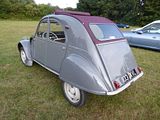


There is a long history to this car, but it was only really with the relaunch of the model to the UK market in 1974 when interest here took off. Sales of the 2CV were reinvigorated by the 1974 oil crisis. The 2CV after this time became as much a youth lifestyle statement as a basic functional form of transport. This renewed popularity was encouraged by the Citroën “Raid” intercontinental endurance rallies of the 1970s where customers could participate by buying a new 2CV, fitted with a “P.O.” kit (Pays d’Outre-mer—overseas countries), to cope with thousands of miles of very poor or off-road routes. Because of new emission standards, in 1975 power was reduced from 28 hp to 25 hp. The round headlights were replaced by square ones, adjustable in height. A new plastic grille was fitted. In July 1975, a base model called the 2CV Spécial was introduced with the 435 cc engine. Between 1975 and 1990 under the name of AZKB “2CV Spécial” a drastically reduced trim basic version was sold, at first only in yellow and with an untreated black roof. Slimmer bumpers with stick-on tape rather than plastic strips and no overriders were fitted. It also had the earlier round headlights, last fitted in 1974. In order to keep the price as low as possible, Citroën removed the third side window, the ashtray, and virtually all trim from the car, while that which remained was greatly simplified, such as simple vinyl-clad door cards and exposed door catches rather than the plastic moulded trims found on the 2CV Club. Other 2CVs shared their instruments with the Dyane and H-Van but the Spécial had a much smaller square speedometer also incorporating the fuel gauge, originally fitted to the 2CV in the mid-1960s and then discontinued. The model also had a revised (and cheaper-to-make) plastic version of the 1960s two-spoke steering wheel instead of the one-spoke item from the Dyane, as found on the Club. From the 1978 Paris Motor Show the Spécial regained third side windows, and was available in red and white; beginning in mid-1979 the 602 cc engine was installed. In June 1981 the Spécial E arrived; this model had a standard centrifugal clutch and particularly low urban fuel consumption. By 1980 the boost to 2CV sales across Europe delivered by the 1973 Energy Crisis had begun to wear off and there was a whole new generation of superminis and economy cars available from European and Japanese manufacturers. Citroën itself now had the Visa available. Peak annual production for 2CVs was reached in 1974 (163,143 cars) but by 1980 this had dropped to 89,994 and by 1983 would stand at just 59,673. Nonetheless the car remained profitable for PSA to produce on account of its tooling and set-up costs being amortised many years before and it could share major parts with more popular or profitable models such as the Visa and Acadiane. As part of this rationalisation in 1981 the Spécial was fitted as standard with the 602 cc engine, although the 435 cc version remained available to special order in some European countries until stocks were used up. Also in 1981 a yellow 2CV6 was driven by James Bond (Roger Moore) in the 1981 film For Your Eyes Only. The car in the film was fitted with the flat-4 engine from a Citroën GS which more than doubled the power. In one scene the ultra light 2CV tips over and is quickly righted by hand. Citroën launched a special edition 2CV “007” to coincide with the film; it was fitted with the standard engine and painted yellow with “007” on the front doors and fake bullet hole stickers. In 1982 all 2CV models got inboard front disc brakes, which also used LHM fluid instead of conventional brake fluid—the same as was found in the larger Citroën models with hydropneumatic suspension. In late 1986 Citroën introduced the Visa’s replacement, the AX. This was widely regarded as a superior car to the Visa and took many of the remaining 2CV sales in France following its introduction. From 1986 to 1987 2CV production fell by 20 per cent to just 43,255 cars. Of that total over 12,500 went to West Germany and 7212 went to the UK. France was now the third-largest market for 2CVs, taking 7045 cars that year. It was estimated that Citroën was now selling the 2CV at a loss in the French market, but that it was still profitable in other European countries. The peak of 2CV sales in the United Kingdom would be reached in 1986, thanks to the introduction of the popular Dolly special edition (see below)—7520 new 2CVs were registered in Britain that year. This year saw the discontinuation of the Club, which was by then the only 2CV model to retain the rectangular headlamps. This left the Spécial as the only regular 2CV model, alongside the more fashion-orientated Dolly, Charleston and the other special editions. In 1988, production ended in France after 40 years. The factory at Levallois-Perret had been the global centre for 2CV production since 1948 but was outdated, inefficient and widely criticised for its poor working conditions. The last French-built 2CV was made on February 25. In recognition of the event, the last 2CV built at Levallois was a basic Spécial in a non-standard grey colour—the same shade as worn by the very first 2CVs. Production of the 2CV would continue at the smaller-capacity but more modern Mangualde plant in Portugal. In 1989 the first European emission standards were introduced voluntarily by a number of European nations, ahead of the legal deadline of July 1992. This meant that the 2CV was withdrawn from sale in Austria, Denmark, Italy, Spain, Sweden, Switzerland and The Netherlands—the latter one of the car’s largest remaining markets. That year the three leading markets for the 2CV were West Germany (7866), France (5231) and the UK (3200). The last 2CV was built at Mangualde on 27 July 1990—it was a specially-prepared Charleston model. Only 42,365 2CVs were built in Portugal in the two years following the end of French production. Portuguese-built cars, especially those from when production was winding down, have a reputation in the UK for being much less well made and more prone to corrosion than those made in France. According to Citroën, the Portuguese plant was more up-to-date than the one in Levallois near Paris, and Portuguese 2CV manufacturing was to higher quality standards. As of October 2016, 3,025 remained in service in the UK. Seen here were an early car and a beachcomber limited edition car from the early 1980s.

FERRARI
Introduced at the 1985 Frankfurt Show alongside the Mondial 3.2 series, the Ferrari 328 GTB and GTS (Type F106) were the successors to the Ferrari 308 GTB and GTS which had first been seen in October 1975. While mechanically still based on the 308 GTB and GTS respectively, small modifications were made to the body style and engine, most notably an increase in engine displacement to 3185 cc for increased power and torque output. As had been the case for a generation of the smaller Ferraris, the model name referred to the total cubic capacity of the engine, 3.2 litres, and 8 for the number of cylinders. Essentially the new model was a revised and updated version of the 308 GTS, which had survived for eight years without any radical change to the overall shape, albeit with various changes to the 3-litre engine. The 328 model presented a softening of the wedge profile of its predecessor, with a redesigned nose that had a more rounded shape, which was complemented by similar treatment to the tail valance panel. The revised nose and tail sections featured body colour bumpers integral with the valance panels, which reflected the work done concurrently to present the Mondial 3.2 models, with which they also shared a similar radiator grille and front light assembly layout. Thus all the eight-cylinder cars in the range shared fairly unified front and rear aspects, providing a homogeneous family image. The exhaust air louvres behind the retractable headlight pods on the 308 series disappeared, coupled with an increase in the size of the front lid radiator exhaust air louvre, which had been introduced on the 308 Quattrovalvole models, whilst a new style and position of exterior door catch was also provided. The interior trim also had a thorough overhaul, with new designs for the seat panel upholstery and stitching, revised door panels and pulls, together with more modern switchgear, which complemented the external updating details. Optional equipment available was air conditioning, metallic paint, Pirelli P7 tyres, a leather dashboard, leather headlining to the removable roof panel plus rear window surround, and a rear aerofoil (standard on Japanese market models). In the middle of 1988 ABS brakes were made available as an option, which necessitated a redesign of the suspension geometry to provide negative offset. This in turn meant that the road wheel design was changed to accommodate this feature. The original flat spoke “star” wheels became a convex design, in the style as fitted to the 3.2 Mondial models, whether ABS was fitted or not. The main European market 328 GTS models had a tubular chassis with a factory type reference F 106 MS 100. Disc brakes, with independent suspension via wishbones, coil springs, and hydraulic shock absorbers, were provided all round, with front and rear anti roll bars. There were various world market models, each having slight differences, with right and left hand drive available. The V8 engine was essentially of the same design as that used in the 308 Quattrovalvole model, with an increase in capacity to 3185 cc. The engine retained the Bosch K-Jetronic fuel injection system of its predecessor, but was fitted with a Marelli MED 806 A electronic ignition system, to produce a claimed power output of 270 bhp at 7000 rpm. As with the preceding 308 models the engine was mounted in unit with the all synchromesh five-speed manual transmission assembly, which was below, and to the rear of the engine’s sump. The 328 GTS continued in production for four years, until replaced by the 348 ts model in the autumn of 1989, during which time 6068 examples were produced, GTS production outnumbering the GTB (1344 produced) version almost five to one.


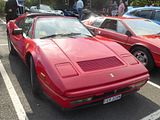
Launched at the 2015 Geneva Show, the 488GTB followed the lead set by the California T in bringing turbocharging into a modern-day, mid-engined V8 Ferrari supercar for the first time. The engine is completely new when compared with its V8 stablemate, not only in components but also in feel and character. It is a twin-turbocharged 3902cc unit whilst that in the California T is 3855cc. In the 488 GTB, it produces 660bhp at 8000rpm and 560lb ft at 3000rpm. Both outputs are significant increases over the normally aspirated 4.5-litre V8 used in the 562 bhp 458 Italia and 597 bhp 458 Speciale, and also greater than the car’s biggest rival, the McLaren 650S. The torque figure of the 488 GTB is such that it also exceeds the 509lb ft at 6000rpm of the normally aspirated V12 used in the range-topping Ferrari F12 Berlinetta. The mighty new engine in the 488 GTB drives the rear wheels through a revised seven-speed dual-clutch automatic gearbox derived from the 458. It features a new ‘Variable Torque Management’ system which, Ferrari says, “unleashes the engine’s massive torque smoothly and powerfully right across the rev range”. The gear ratios are also tuned to “deliver incredibly progressive acceleration when the driver floors the throttle”. The 488 GTB can crack 0-62mph in just 3.0sec, 0-124mph in 8.4sec and reach a top speed of 205mph. Its 0-62mph and 0-124mph times match the McLaren 650S’s, but the Woking car’s top speed is slightly higher at 207mph. The engine also accounts for the ‘488’ element of the car’s name, because each of the engine’s eight cylinders is 488cc in capacity when rounded up. The GTB suffix, standing for Gran Turismo Berlinetta, is a hallmark of previous mid-engined V8 Ferraris such as the 308 GTB. Not only is the new turbo engine more potent than the 4.5-litre V8 from the 458 Italia, but it is also more economical. Combined fuel economy is rated at 24.8mpg, compared with 21.2mpg in the 458 Italia, and CO2 emissions are 260g/km – a 47g/km improvement. Ferrari’s HELE engine stop-start system features on the 488 GTB. Developments on the dynamic side include a second generation of the Side Slip Angle Control system, called SSC2. This allows the driver to oversteer without intruding, unless it detects a loss of control. The SSC2 now controls the active dampers, in addition to the F1-Trac traction control system and E-Diff electronic differential. Ferrari says the result is “more precise and less invasive, providing greater longitudinal acceleration out of corners” and flatter, more stable behaviour during “complex manoeuvres”. Learnings from the Ferrari XX programme have also been incorporated into the 488 GTB, something that Ferrari says allows all drivers and not just professionals, to make the most of its electronic and vehicle control systems. It also claims the 488 GTB is “the most responsive production model there is”, with responses comparable to a track car. The 488 GTB has lapped Ferrari’s Fiorano test track in 1min 23sec – two seconds faster than the 458 Italia, and half a second quicker than the 458 Speciale. The dimensions of the 488 GTB – it is 4568mm in length, 1952mm in width and 1213mm in height – closely match the 458 Italia from which it has evolved. Its dry weight is 1370kg when equipped with lightweight options – 40kg more than the McLaren 650S. The new look, styled at the Ferrari Styling Centre, features several new aerodynamic features that improve downforce and reduce drag. Most notable is the addition of active aerodynamics at the rear through a ‘blown’ rear spoiler, where air is channelled from the base of the glass engine cover under the spoiler. This contributes to the 50% increase in downforce over the 458 Italia. Also new is a double front spoiler, an aerodynamic underbody, a large air intake at the front that references the 308 GTB, a diffuser with active flaps, new positioning for the exhaust flaps and new-look lights. The interior has been redesigned to be made more usable, including new switchgear, air vents and instrument panel. The multi-function steering wheel remains, while the infotainment system gets a new interface and graphics. The Spider followed the closed coupe model six months later.

FIAT
Developed as the Tipo 175, the Coupe was introduced at the Brussels Motor Show in 1993. It is perhaps best remembered for its distinctive, angular design, with unique scalloped side panels. The body was designed by Chris Bangle from Centro Stile Fiat, while the interior was designed by Pininfarina, and the car media headlines in auto magazines during 1992 after several spy shots were taken revealing the car on test. On its launch in 1993, the Coupé was available with a four-cylinder, 2.0 litre 16V engine, in both turbo (190 PS) and normally aspirated (139 PS) versions. Both engines were later versions of Fiat’s twin-cam design and inherited from the Lancia Delta Integrale. 1996 brought in a 1.8 litre 131 PS 16V engine (not available in the UK), along with a 2.0-litre 5-cylinder 20V (147 PS), and a 5-cylinder 2.0-litre 20V turbo (220 PS). The turbocharged 16 and 20 valve versions were equipped with a very efficient Viscodrive limited-slip differential to counter the understeer that plagues most powerful front wheel drive cars. Additionally, the coupe featured independent suspension all round: at the front MacPherson struts and lower wishbones anchored to an auxiliary crossbeam, offset coil springs and anti-roll bar; at the rear, trailing arms mounted on an auxiliary subframe, coil springs and an anti-roll bar. The car was well received at launch, and the 5 cylinder engines just made it even better, with sales increasing slightly for a couple of years, but then they started to drop off, as Coupe models in general fell from favour. 1998 saw the release of the Limited Edition which featured red Brembo brake calipers at the front and standard red calipers at the back, a body kit, push-button start, six-speed gearbox, strut brace to make the chassis more rigid and Recaro seats with red leather inserts which offered better support than the standard 20VT seats. The LE was produced in Black, Red, Vinci Grey (metallic), Crono Grey and Steel Grey (metallic). The bodywork of the LE also benefited from titanium coloured insert around the light bezels and the wing mirrors. Each Limited Edition (‘LE’) Coupé was manufactured with a badge located by the rear-view mirror which contained that car’s unique number (it is rumoured that Michael Schumacher was the original owner of LE No. 0001, however when the question was raised to him personally he confirmed he had owned one, but a red one, while LE No. 0001 is a Crono Grey one). Originally a spokesman from Fiat stated only approximately 300 Limited Editions would be built. The final number was much higher, perhaps as many as 1400. This angered many of the owners of the original 300 cars and almost certainly impacted residual values. The original number however was quoted by a Fiat UK spokesman, so probably that number only applied to the UK market. The numbered plaque on every Coupe features enough space for 4 numbers. In 1998 the 2.0-litre 5-cylinder 20V got a Variable Inlet System which brought the power to 154 PS. The 2.0-litre 5-cylinder 20V Turbo received a 6-speed gearbox and a large, satin gloss push starter button. In addition, the sills of the Turbo version were colour matched with the body paintwork. Fiat also released the 2.0 litre 5 cylinder Turbo ‘Plus’. This model came with an option kit that made it virtually identical to the LE, except for minor interior design changes and without the unique identification badge of the LE. In 2000 Fiat released another special version of the Fiat Coupé. Featuring the 1.8-litre engine, it was only available throughout mainland Europe and marketed as an elegant and affordable edition. Fiat also made changes throughout the rest of the range: new seats, side skirts and wheels for the 2.0-litre 20V model, ‘Plus’ edition wheels on turbo models and Fiat manufactured seats on the ‘Plus’ that were virtually identical to the original Plus Recaro seats with the addition of extra airbags. The 2.0-litre 20V Turbo model is capable of accelerating from 0–100 km/h (0 to 62 mph) in 6.5 seconds and 6.3 seconds for the 20v Turbo Plus, with a top speed of 240 km/h (149 mph) or 250 km/h (155 mph) with later 6-speed gearbox. When production finally stopped in September 2000, a total number of 72,762 units had been produced. There are still well over 1000 units in the UK, so this is a Fiat which has proved durable as well as good to drive, and to look at.

FORD
Using the project name of “Archbishop”, management at Ford of Britain in Dagenham created a family-sized car which they could sell in large numbers. The chief designer was Roy Brown Jr., the designer of the Edsel, who had been banished to Dagenham following the failure of that car. The car was designed to be economical, cheap to run and easy and inexpensive to produce in Britain. The front-wheel drive configuration used by Ford of Germany for the new Ford Taunus P4, a similarly sized model, was rejected in favour of traditional rear-wheel drive layout. Aimed at buyers of the Morris Oxford Farina and Vauxhall Victor, the car was launched as the Consul Cortina was launched on 20 September 1962. with a 1,198 cc three-bearing engine, which was an enlarged version of the 997 cc engine then fitted in the Ford Anglia. A few months later, in January 1963, the Cortina Super was announced with a five-bearing 1,498 cc engine. Versions of the larger engine found their way into subsequent variations, including the Cortina GT which appeared in spring 1963 with lowered suspension and engine tuned to give a claimed output of 78 bhp ahead of the 60 bhp claimed for the Cortina 1500 Super. The engines used across the Mark I range were of identical design, differing only in capacity and setup. The formula used was a four-cylinder pushrod design that came to be known as the “pre-crossflow” version as both inlet and exhaust ports were located on the same side of the head. The most powerful version of this engine (used in the GT Cortina) was 1,498 cc and produced 78 bhp. This engine contained a different camshaft profile, a different cast of head featuring larger ports, tubular exhaust headers and a Weber double barrel carburettor. Advertising of the revised version, which appeared at the London Motor Show in October 1964, and which dropped the Consul name from its official designation, made much of the newly introduced “Aeroflow” through-flow ventilation, evidenced by the extractor vents on the rear pillars. A subsequent test on a warm day involving the four different Cortina models manufactured between 1964 and 1979 determined that the air delivery from the simple eyeball outlets on the 1964 Mark I Cortina was actually greater than that on the Mark II, the Mark III or the Mark IV. The dashboard, instruments and controls were revised, for the second time, having already been reworked in October 1963 when round instruments replaced the strip speedometer with which the car had been launched: twelve years later, however, the painted steel dashboard, its “knobs scattered all over the place and its heater controls stuck underneath as a very obvious afterthought” on the 1964 Mark I Cortina was felt to have aged much less well than the car’s ventilation system. It was also in 1964 that front disc brakes became standard across the range. The Mark 1 Cortina was available as a two-door and four-door saloon, as well as in five-door estate (from March 1963) forms. Standard, Deluxe, Super, and GT trims were offered but not across all body styles. Early Standard models featured a simple body coloured front grille, earning it the nickname ‘Ironbar’. Since this version cost almost the same as the better equipped Deluxe it sold poorly and is very rare today. Options included heater and bench seat with column gearchange. Super versions of the estates offered the option of simulated wood side and tailgate trim. In an early example of product placement many examples of the brand new Cortina featured as “Glamcabs” in the comedy film Carry On Cabby.


Sporting Escorts appeared only a matter of months after the launch of the regular 1100 and 1300cc cars. The first of these was a higher performance version designed for rallies and racing, the Escort Twin Cam. Built for Group 2 international rallying, it had an engine with a Lotus-made eight-valve twin camshaft head fitted to the 1.5 L non-crossflow block, which had a bigger bore than usual to give a capacity of 1,557 cc. This engine had originally been developed for the Lotus Elan. Production of the Twin Cam, which was originally produced at Halewood, was phased out as the Cosworth-engined RS1600 production began. The most famous edition of the Twin Cam was raced on behalf of Ford by Alan Mann Racing in the British Saloon Car Championship in 1968 and 1969, sporting a full Formula 2 Ford FVC 16-valve engine producing over 200 hp. The Escort, driven by Australian driver Frank Gardner went on to comfortably win the 1968 championship. The Mark I Escorts became successful as a rally car, and they eventually went on to become one of the most successful rally cars of all time with arguably the Escort’s greatest victory in the 1970 London to Mexico World Cup Rally, co-driven by Finnish legend Hannu Mikkola and Swedish co-driver Gunnar Palm. This gave rise to the Escort Mexico, which had a 1600cc “crossflow”-engined, as a special edition road version in honour of the rally car. Introduced in November 1970, 10,352 Mexico Mark I’s were built. In addition to the Mexico, the RS1600 was developed with a 1,601 cc Cosworth BDA which used a Crossflow block with a 16-valve Cosworth cylinder head, named for “Belt Drive A Series”. Both the Mexico and RS1600 were built at Ford’s Advanced Vehicle Operations (AVO) facility located at the Aveley Plant in South Essex. As well as higher performance engines and sports suspension, these models featured strengthened bodyshells utilising seam welding in places of spot welding, making them more suitable for competition. After updating the factory team cars with a larger 1701 cc Cosworth BDB engine in 1972 and then with fuel injected BDC, Ford also produced, in the autumn of 1973, an RS2000 model as an alternative to the somewhat temperamental RS1600, featuring a 2.0 litre Pinto OHC engine. This also clocked up some rally and racing victories; and pre-empted the hot hatch market as a desirable but affordable performance road car. Like the Mexico and RS1600, this car was produced at the Aveley plant.

The fourth-generation Cortina was a more conventional design than its predecessor, but this was largely appreciated by fleet buyers. Generally a rebody of the Mark III, as an integration of Ford’s model range, this car was really a rebadged Ford Taunus. However, although the updated Taunus was introduced to Continental Europe in January 1976, Ford were able to continue selling the Cortina Mark III in undiminished numbers in the UK until they were ready to launch its successor as the Dagenham built Cortina Mark IV, which went on sale on 29 September 1976. Many parts were carried over, most notably the running gear. The raised driving position and the new instrument panel had, along with some of the suspension upgrades, already been introduced to the Cortina Mark III in 1975, so that from the driving position the new car looked much more familiar to owners of recent existing Cortinas than from the outside. Cinema audiences received an early glimpse of the new Cortina (or Taunus) through its appearance in the James Bond The Spy Who Loved Me 1977 film. The most obvious change was the new body, which achieved the marketing department objective of larger windows giving a better view out and a brighter feel to the cabin, but at the expense of body weight which was increased, albeit only marginally, by approximately 30 lb. Ford claimed an overall increase in window area of some 15%, with “40% better visibility” through the wider deeper back window. Regardless of how these figures were computed, there must have been substantial weight-saving gains through reduced steel usage in the design, given the unavoidable extra weight of glass. This series spawned the first Ghia top-of-the-range model, which replaced the 2000E. The 2.3 litre Ford Cologne V6 engine was introduced in 1977 as an engine above the 2.0 litre Pinto engine, already a staple of the Capri and Granada ranges. However, 2.3 litre Cortinas never sold particularly well in the UK. The Cologne V6 was certainly a much smoother and more refined power unit than the Pinto, but the V6 models were more expensive to fuel and insure and were only slightly faster, being about 0.5 seconds faster from 0–60 and having a top speed of about 109 mph compared to the 104 mph of the 2.0 litre models. The 2.0 litre Ford Cologne V6 engine continued to be offered on Taunus badged cars in parallel with the Pinto unit, and offers here an interesting comparison with the similarly sized in-line four-cylinder Pinto engine. The V6 with a lower compression ratio offered less power and less performance, needing over an extra second to reach 50 mph.It did, however, consume 12½% less fuel and was considered by motor journalists to be a far quieter and smoother unit. The 2.3 litre was available to the GL, S and Ghia variants. A 1.6 litre Ghia option was also introduced at the same time as the 2.3 litre V6 models in response to private and fleet buyers who wanted Ghia refinements with the improved fuel economy of the smaller 1.6 litre Pinto engine. Few cars were sold with the 1.6 litre engine though, the 2.0 litre Pinto was always by far the most common engine option for Ghia models. Two-door and four-door saloons and a five-door estate were offered with all other engines being carried over. However, at launch only 1.3 litre engined cars could be ordered in the UK with the two-door body, and then only with “standard” or “L” equipment packages. In practice, relatively few two-door Mark IV Cortinas were sold. In some markets, the two-door saloon was marketed as a coupe, but this was not the case in Britain. Ford already competed in the coupe sector in Europe with the Capri, which was particularly successful on the British market. There was a choice of base, L, GL, S and Ghia trims, again not universal to all engines and body styles. Rostyle wheels were fitted as standard to all Mark IV GL, S and Ghia models, with alloy wheels available as an extra cost option. The dashboard was carried over intact from the last of the Mark III Cortinas while the estate used the rear body pressings of the previous 1970 release Taunus. Despite its status as Britain’s bestselling car throughout its production run the Mark IV is now the rarest Cortina, with poor rustproofing and the model’s popularity with banger racers cited as being the main reasons for its demise.


A sporting version of Ford’s front wheel drive Escort was announced at the same time as the “cooking” 1.1, 1.,3 and 1,6 litre cars in October 1980. This was the XR3, and it came initially with a carb fed 1.6 litre engine generating 105 bhp and had a four speed gearbox. Fuel injection finally arrived in October 1982 (creating the XR3i), eight months behind the limited edition (8,659 examples), racetrack-influenced RS 1600i. The Cologne-developed RS received a more powerful engine with 115 PS, thanks to computerised ignition and a modified head as well as the fuel injection. For 1983, the XR3i was upgraded to 115bhp thanks to the use of fuel injection and a five speed transmission had been standardised. Both variants proved very popular, getting a significant percentage of Escort sales and also as a slightly more affordable alternative to a Golf GTi. For those for whom the performance was not quite enough, Ford had an answer, withe the RS Turbo. This 132 PS car was shown in October 1984, as a top of the range car, offering more power than the big-selling XR3i and the limited production RS1600i. Going on sale in the spring of 1985, it proved to be somewhat of a disappointment, with the chassis coming in for severe criticism. The RS Turbo Series 1 was only marketed in a few European nations as production was limited to 5,000 examples, all in white. They were well equipped, with the alloy wheels from the limited production RS 1600i, Recaro seats, and a limited slip differential. One car only was finished in black; it was built especially for Lady Diana. Ford facelifted the entire Escort range in January 1986, and a few months later, a revised Series 2 RS Turbo emerged, which adopted the styling changes of the less potent models, and the new dashboard, as well as undergoing a mechanical revision and the addition of more equipment including anti-lock brakes. The Series 2 cars were available in a wider range of colours.

The Sierra RS Cosworth model. a very sporting version of Ford’s upper-medium sized family car, was built by Ford Europe from 1986 to 1992, the result of a Ford Motorsport project with the purpose of producing an outright winner for Group A racing in Europe. The project was defined in the spring of 1983 by Stuart Turner, then recently appointed head of Ford Motorsport in Europe, who had realised right away that Ford was no longer competitive in this area. Turner got in touch with Walter Hayes, at the time the vice-president of public relations at Ford, to get support for the project. Hayes had earlier been the driving force behind the development of the Ford GT40 that won Le Mans in 1966, and the Cosworth DFV engine that brought Ford 154 victories and 12 world championships in Formula One during the 1960s and 1970s. Hayes found the project very appealing and promised his full support. Turner then invited Ken Kohrs, vice-president of development, to visit Ford’s longtime partner, the automotive company Cosworth, where they were presented a project developed on Cosworth’s own initiative, the YAA engine. This was a twin cam, 16-valve engine based on Ford’s own T88 engine block, better known as the Pinto. This prototype proved an almost ideal basis for the engine Turner needed to power his Group A winner. Therefore, an official request for a turbocharged version (designated Cosworth YBB) capable of 180 HP on the street and 300 HP in race trim, was placed. Cosworth answered positively, but they put up two conditions: the engine would produce not less than 204 HP in the street version, and Ford had to accept no fewer than 15,000 engines. Turner’s project would only need about 5,000 engines, but Ford nevertheless accepted the conditions. The extra 10,000 engines would later become one of the reasons Ford also chose to develop a four door, second generation Sierra RS Cosworth. To find a suitable gearbox proved more challenging. The Borg-Warner T5, also used in the Ford Mustang, was chosen, but the higher revving nature of the Sierra caused some problems. Eventually Borg-Warner had to set up a dedicated production line for the gearboxes to be used in the Sierra RS Cosworth. Many of the suspension differences between the standard Sierra and the Cosworth attributed their development to what was learned from racing the turbocharged Jack Roush IMSA Merkur XR4Ti in America and Andy Rouse’s successful campaign of the 1985 British Saloon Car Championship. Much of Ford’s external documentation for customer race preparation indicated “developed for the XR4Ti” when describing parts that were Sierra Cosworth specific. Roush’s suspension and aerodynamics engineering for the IMSA cars was excellent feedback for Ford. Some production parts from the XR4Ti made their way into the Cosworth such as the speedometer with integral boost gauge and the motorsport 909 chassis stiffening plates. In April 1983, Turner’s team decided on the recently launched Sierra as a basis for their project. The Sierra filled the requirements for rear wheel drive and decent aerodynamic drag. A racing version could also help to improve the unfortunate, and somewhat undeserved, reputation that Sierra had earned since the introduction in 1982. Lothar Pinske, responsible for the car’s bodywork, demanded carte blanche when it came to appearance in order to make the car stable at high speed. Experience had shown that the Sierra hatchback body generated significant aerodynamic lift even at relatively moderate speed. After extensive wind tunnel testing and test runs at the Nardò circuit in Italy, a prototype was presented to the project management. This was based on an XR4i body with provisional body modifications in fibreglass and aluminium. The car’s appearance raised little enthusiasm. The large rear wing caused particular reluctance. Pinske insisted however that the modifications were necessary to make the project successful. The rear wing was essential to retain ground contact at 300 km/h, the opening between the headlights was needed to feed air to the intercooler and the wheel arch extensions had to be there to house wheels 10” wide on the racing version. Eventually, the Ford designers agreed to try to make a production version based on the prototype. In 1984, Walter Hayes paid visits to many European Ford dealers in order to survey the sales potential for the Sierra RS Cosworth. A requirement for participation in Group A was that 5,000 cars were built and sold. The feedback was not encouraging. The dealers estimated they could sell approximately 1,500 cars. Hayes did not give up, however, and continued his passionate internal marketing of the project. As prototypes started to emerge, dealers were invited to test drive sessions, and this increased the enthusiasm for the new car. In addition, Ford took some radical measures to reduce the price on the car. As an example, the car was only offered in three exterior colours (black, white and moonstone blue) and one interior colour (grey). There were also just two equipment options: with or without central locking and electric window lifts. The Sierra RS Cosworth was first presented to the public at the Geneva Motor Show in March 1985, with plans to release it for sale in September and closing production of the 5,000 cars in the summer of 1986. In practice, it was launched in July 1986. 5545 were manufactured in total of which 500 were sent to Tickford for conversion to the Sierra three-door RS500 Cosworth. The vehicles were manufactured in right hand drive only, and were made in Ford’s Genk factory in Belgium. Exactly 500 RS500s were produced, all of them RHD for sale in the UK only – the biggest market for this kind of Ford car. It was originally intended that all 500 would be black, but in practice 56 white and 52 moonstone blue cars were produced.To broaden the sales appeal, the second generation model was based on the 4 door Sierra Sapphire body. It was launched in 1988, and was assembled in Genk, Belgium, with the UK-built Ford-Cosworth YBB engine. Cylinder heads on this car were early spec 2wd heads and also the “later” 2wd head which had some improvements which made their way to the 4X4 head. Suspension was essentially the same with some minor changes in geometry to suit a less aggressive driving style and favour ride over handling. Spindles, wheel offset and other changes were responsible for this effect. Approximately 13,140 examples were produced during 1988-1989 and were the most numerous and lightest of all Sierra Cosworth models. Specifically the LHD models which saved weight with a lesser trim level such as manual rear windows and no air conditioning. In the UK, the RHD 1988-1989 Sierra Sapphire RS Cosworth is badged as such with a small “Sapphire” badge on the rear door window trims. All 1988-1989 LHD models are badged and registered as a Sierra RS Cosworth with no Sapphire nomenclature at all. “Sapphire” being viewed as a Ghia trim level that saw power rear windows, air conditioning and other minor options. Enthusiasts of the marque are mindful of this and will describe the LHD cars by their body shell configuration, 3 door or 4 door. As the Sapphire Cosworth was based on a different shell to the original three-door Cosworth, along with its more discreet rear wing, recorded a drag co-efficient of 0.33, it registered slightly better performance figures, with a top speed of 150 mph and 0-60 of 6.1 seconds, compared to the original Cosworth. In January 1990, the third generation Sierra RS Cosworth was launched, this time with four wheel drive. As early as 1987, Mike Moreton and Ford Motorsport had been talking about a four wheel drive Sierra RS Cosworth that could make Ford competitive in the World Rally Championship. The Ferguson MT75 gearbox that was considered an essential part of the project wasn’t available until late 1989 however. Ford Motorsport’s desire for a 3-door “Motorsport Special” equivalent to the original Sierra RS Cosworth was not embraced. The more discreet 4-door version was considered to have a better market potential. It was therefore decided that the new car should be a natural development of the second generation, to be launched in conjunction with the face lift scheduled for the entire Sierra line in 1990. The waiting time gave Ford Motorsport a good opportunity to conduct extensive testing and demand improvements. One example was the return of the bonnet louvres. According to Ford’s own publicity material, 80% of the engine parts were also modified. The improved engine was designated YBJ for cars without a catalyst and YBG for cars with a catalyst. The latter had the red valve cover replaced by a green one, to emphasise the environmental friendliness. Four wheel drive and an increasing amount of equipment had raised the weight by 100 kg, and the power was therefore increased to just about compensate for this. The Sierra RS Cosworth 4×4 received, if possible, an even more flattering response than its predecessors and production continued until the end of 1992, when the Sierra was replaced by the Mondeo. The replacement for the Sierra RS Cosworth was not a Mondeo however, but the Escort RS Cosworth. This was to some extent a Sierra RS Cosworth clad in an “Escort-like” body. The car went on sale in May 1992, more than a year after the first pre-production examples were shown to the public, and was homologated for Group A rally in December, just as the Sierra RS Cosworth was retired. It continued in production until 1996. The Sierra and Sapphire Cosworths were undoubted performance bargains when new, but they also gained a reputation both for suffering a lot of accidents in the hands of the unskilled and also for being among the most frequently stole cars of their generation. These days, though, there are some lovely and treasured examples around and indeed you are far more likely to see a Cosworth version of the Sierra than one of the volume selling models.

Ford played much the same guessing game about whether there would be an RS version of the third generation Focus as they had done with the earlier versions. Production of the regular cars started in late 2010, but it was not until the 2015 Geneva Motor Show before the production ready MKIII Ford Focus RS was unveiled. It came packing the turbocharged 2.3-litre inline-four engine found in the Mustang EcoBoost. In the Focus RS, the engine itself produces 350 hp. Power is sent to all four wheels via Ford’s all-new Torque-Vectoring All-Wheel-Drive system with a rear drive unit designed by GKN, as well as upgraded suspension and brakes. As well as that, the new Focus RS will be fitted with Drive Modes – including an industry-first Drift Mode that allows controlled oversteer drifts – and Launch Control. The RS will boast a model specific aerodynamic package that helps to differentiate it from other Focus models. The RS is capable of accelerating to 100 km/h (62 mph) in 4.7 seconds. Sales finally started in mid 2016, with long waiting lists having been created, though Ford did eventually catch up with expanded production levels allowing them to meet the demand

Drawing on inspiration from the mid-engined Ford Mustang I concept vehicle, Lee Iacocca ordered development of a new “small car” to vice-president of design at Ford, Eugene Bordinat. Bordinat tasked Ford’s three design studios (Ford, Lincoln-Mercury, and Advanced Design) to create proposals for the new vehicle. The design teams had been given five goals for the design of the Mustang: It would seat four, have bucket seats and a floor mounted shifter, weigh no more than 2,500 pounds (1,100 kg) and be no more than 180 inches (4,572 mm) in length, sell for less than $2,500, and have multiple power, comfort, and luxury options. The Lincoln–Mercury design studio ultimately produced the winning design in the intramural contest, under Project Design Chief Joe Oros and his team of L. David Ash, Gale Halderman, and John Foster. Development of the Mustang was completed in a record 18 months from September 1962 to March 1964. and Iacocca himself championed the project as Ford Division general manager. The styling is often credited to one person, and that is not accurate, as this was very much a team effort, it has been reported by those involved. To decrease developmental costs, the Mustang used chassis, suspension, and drivetrain components derived from the Ford Falcon and Fairlane. It used a unitised platform-type frame from the 1964 Falcon, and welded box-section side rails, including welded crossmembers. Although hardtop Mustangs accounted for the highest sales, durability problems with the new frame led to the engineering of a convertible first, which ensured adequate stiffness. Overall length of the Mustang and Falcon was identical, although the Mustang’s wheelbase was slightly shorter. With an overall width of 68.2 in (1,732 mm), it was 2.4 in (61 mm) narrower, yet the wheel track was nearly identical. Shipping weight, approximately 2,570 lb (1,166 kg) with the straight six-cylinder engine, was also similar to the Falcon. A fully equipped V8 model weighed approximately 3,000 lb (1,361 kg). Although most of the mechanical parts were from the Falcon, the Mustang’s body was completely different; sporting a shorter wheelbase, wider track, lower seating position and lower overall height. An industry first, the “torque box” was an innovative structural system that greatly stiffened the Mustang’s construction and helped contribute to better handling. The car was launched in 17th April 1964, as a hardtop and a convertible, with the fastback version following in August. It was an instant sensation, with demand massively exceeding supply. Since it was introduced four months before the normal start of the 1965 production year and manufactured alongside 1964 Ford Falcons and 1964 Mercury Comets, the earliest Mustangs are widely referred to as the 1964½ model. Nevertheless, all “1964½” cars were given 1965 U.S. standard VINs at the time of production, and – with limited exception to the earliest of promotional materials – were marketed by Ford as 1965 models. The low-end model hardtop used a “U-code” 170 cu in (2.8 litre) straight-6 engine borrowed from the Falcon, as well as a three-speed manual transmission and retailed for US$2,368. Standard equipment for the early 1965 Mustangs included black front seat belts, a glove box light, and a padded dash board. Production began in March 1964 and official introduction following on April 17 at the 1964 World’s Fair. V8 models got a badge on the front fender that spelled out the engine’s cubic inch displacement (“260” or “289”) over a wide “V.” This emblem was identical to the one on the 1964 Fairlane. Several changes to the Mustang occurred at the start of the “normal” 1965 model year in August 1964, about four months after its introduction. These cars are known as “late 65’s”. The engine lineup was changed, with a 200 cu in (3.3 litre) “T-code” engine that produced 120 hp. Production of the Fairlane’s “F-code” 260 cu in (4.3 litre) engine ceased when the 1964 model year ended. It was replaced with a new 200 hp “C-code” 289 cu in (4.7 litre) engine with a two-barrel carburettor as the base V8. An “A-code” 225 hp four-barrel carburettor version was next in line, followed by the unchanged “Hi-Po” “K-code” 271 hp 289. The DC electrical generator was replaced by a new AC alternator on all Fords (a way to distinguish a 1964 from a 1965 is to see if the alternator light on the dash says “GEN” or “ALT”). The Mustang GT version was introduced as the “GT Equipment Package” and included a V8 engine (most often the 225 hp 289), grille-mounted fog lamps, rocker panel stripes, and disc brakes. In the interior the GT option added a different instrument panel that included a speedometer, fuel gauge, temp. gauge, oil pressure gauge and ammeter in five round dials (the gauges were not marked with numbers, however.) A four-barrel carburettor engine was now available with any body style. Additionally, reverse lights were an option added to the car from August 1964 production. In 1965, the Shelby Mustang was born, it was available only in newly introduced fastback body version with its swept-back rear glass and distinctive ventilation louvres. The standard interior features of the 1965 Mustang included adjustable driver and passenger bucket seats, an AM radio, and a floor mounted shifter in a variety of colour options. Ford added additional interior options during the 1965 model year. The Interior Decor Group was popularly known as “Pony Interior” due to the addition of embossed running ponies on the seat fronts, and also included integral armrests, woodgrain appliqué accents, and a round gauge cluster that would replace the standard Falcon instrumentation. Also available were sun visors, a (mechanical) remote-operated mirror, a floor console, and a bench seat. Ford later offered an under-dash air-conditioning unit, and discontinued the vinyl with cloth insert seat option, offered only in early 1965 models. One option designed strictly for fun was the Rally-Pac. Introduced in 1963 after Ford’s success at that year’s Monte Carlo Rally and available on other Ford and Mercury compacts and intermediates, the Rally-Pac was a combination clock and tachometer mounted to the steering column. It was available as a factory ordered item for US$69.30. Installed by a dealer, the Rally-Pac cost US$75.95.A 14″ rim option was available for Rally-pac and GT350R vehicles widening front and rear track to 57.5″. Reproductions are presently available from any number of Mustang restoration parts sources. A compass, rear seat belts, A/C, and back-up lights were also optional. The 1966 Mustang debuted with moderate trim changes including a new grille, side ornamentation, wheel covers and filler cap. Ford’s new C-4 “cruise-o-matic” three-speed auto transmission became available for the 225 hp V8. The 289 “HiPo” K-code engine was also offered with a c4 transmission, but it had stronger internals and can be identified by the outer casing of the servo which is marked with a ‘C’. The long duration solid-lifter camshaft that allowed the high revving 289 to make the horsepower it was known for, was not friendly for a low stall speed automatic torque converter. The “HiPo” could be spotted very easily by the 1-inch-thick vibration damper, (as compared to 1/2 inch on the 225-hp version) and the absence of a vacuum advance unit on the dual point distributor. With the valve covers off, there is a large letter “K” stamped between the valve springs, along with screw in studs (vs. a pressed in stud for other 289s) for the adjustable rocker arms. A large number of new paint and interior color options, an AM/eight-track sound system, and one of the first AM/FM mono automobile radios were also offered. It also removed the Falcon instrument cluster; the previously optional features, including the round gauges and padded sun visors, became standard equipment. The Mustang would be the best-selling convertible in 1966, with 72,119 sold, beating the number two Impala by almost 2:1. The 1965 and 1966 Mustangs are differentiated by variations in the exterior, despite similar design. These variations include the emblem on the quarter-panels behind the doors. From August 1964 production, the emblem was a single vertical piece of chrome, while for 1966 models the emblem was smaller in height and had three horizontal bars extending from the design, resembling an “E”. The front intake grilles and ornaments were also different. The 1965 front grille used a “honeycomb” pattern, while the 1966 version was a “slotted” style. While both model years used the “Horse and Corral” emblem on the grille, the 1965 had four bars extending from each side of the corral, while on the 1966, these bars were removed. The 1966 model year saw introduction of ‘High Country Special’ limited edition, 333 of them were sold in Colorado, Wyoming, and Nebraska. When Ford wanted to introduce the Mustang in Germany, they discovered that Krupp company had already registered the name for a truck. The German company offered to sell the rights for US$10,000. Ford refused and removed Mustang badges from exported units, instead naming the cars as T-5 (a pre-production Mustang project name) for the German market until 1979 when Krupp copyrights expired. In 1965, Harry Ferguson Research purchased 3 Mustang notchbacks and converted them to 4×4 in an attempt to sell potential clients on their FF AWD system. A similar system was used in the Ferguson P99 Formula One car, and would go on to be featured in the Jensen FF, widely considered the first AWD passenger car. As in the Jensen FF, the AWD Mustangs also featured an ABS braking system, long before such a feature was commonplace. Ford Australia organised the importation and conversion of 1966 Mustang to right-hand-drive for the Australian market. This coincided with the launch of new XR Falcon for 1966, which was marketed as “Mustang-bred Falcon”. To set the official conversion apart from the cottage industry, the RHD Mustangs were called “Ford Australia Delivered Mustang” and had compliance plates similar to XR Falcon. About 209 were imported to Australia with 48 units were converted in 1965 while the further 161 were done in 1966. The 1967 model year Mustang was the first redesign of the original model. Ford’s designers began drawing up a larger version even as the original was achieving sales success, and while “Iacocca later complained about the Mustang’s growth, he did oversee the redesign for 1967 .” The major mechanical feature was to allow the installation of a big-block V8 engine. The overall size, interior and cargo space were increased. Exterior trim changes included concave taillights, side scoop (1967 model) and chrome (1968 model) side ornamentation, square rear-view mirrors, and usual yearly wheel and gas cap changes. The high-performance 289 option was placed behind the newer 335 hp 6.4 litre FE engine from the Ford Thunderbird, which was equipped with a four-barrel carburettor. During the mid-1968 model year, a drag racer for the street could be ordered with the optional 428 cu in (7.0 litre) Cobra Jet engine which was officially rated at 335 hp. All of these Mustangs were issued R codes on their VIN’s. The 1967 Deluxe Interior was revised, discontinuing the embossed running horse motif on the seat backs (the source for the “pony interior” nickname) in favor of a new deluxe interior package, which included special colour options, brushed aluminium (from August 1966 production) or woodgrain dash trim, seat buttons, and special door panels. The hardtop also included upholstered quarter trim panels, a carryover from the 1965-66 deluxe interior. The 1967 hardtop also had the chrome quarter trim caps, carried over from 1965-66, but these were painted to match the interior in 1968 models. The 1967 deluxe interior included stainless steel-trimmed seat back shells, similar to those in the Thunderbird. These were dropped at the end of the 1967 model year, and were not included in the woodgrain-trimmed 1968 interior. The deluxe steering wheel, which had been included in the deluxe interior for the 1965-66, became optional, and could also be ordered with the standard interior. The 1968 models that were produced from January 1968 were also the first model year to incorporate three-point lap and shoulder belts (which had previously been optional, in 1967-68 models) as opposed to the standard lap belts. The air-conditioning option was fully integrated into the dash, the speakers and stereo were upgraded, and unique center and overhead consoles were options. The fastback model offered the option of a rear fold-down seat, and the convertible was available with folding glass windows. Gone was the Rally-Pac, since the new instrument cluster had provisions for an optional tachometer and clock. Its size and shape also precluded the installation of the accessory atop the steering column. The convenience group with four warning lights for low fuel, seat belt reminder, parking brake not released, and door ajar were added to the instrument panel, or, if one ordered the optional console and A/C, the lights were mounted on the console. Changes for the 1968 model increased safety with a two-spoke energy-absorbing steering wheel, along with newly introduced shoulder belts. Other changes included front and rear side markers, “FORD” lettering removed from hood, rearview mirror moved from frame to windscreen, a 302 cu in (4.9 litre) V8 engine was now available, and C-Stripe graphics were added. The California Special Mustang, or GT/CS, was visually based on the Shelby model and was only sold in Western states. Its sister, the ‘High Country Special’, was sold in Denver, Colorado. While the GT/CS was only available as a coupe, the ‘High Country Special’ model was available in fastback and convertible configurations during the 1966 and 1967 model years, and as a coupe for 1968. The 1968 Ford Mustang GT Fastback reached iconic status after it was featured in the 1968 film Bullitt, starring Steve McQueen. In the film, McQueen drove a modified 1968 Mustang GT 2+2 Fastback chasing a Dodge Charger through the streets of San Francisco. There were further annual updates until the model’s replacement in 1973, but with each the car got steadily bigger and less overtly sporty. Sales reduced, too, suggesting that Ford were losing their way. Mustang II did not fix that, of course, but gradually, the legendary nameplate has returned to delivering the same sort of promise as those early and much loved cars were able to do.

HONDA
The Honda Beat is a kei car produced from May 1991 until February 1996. It is a two-seater roadster with a rear mid-engine, rear-wheel-drive layout. The last car to be approved by Soichiro Honda before he died in 1991, in total around 33,600 were made, with roughly two-thirds of these built in the first year of production. The design of the car originated from Pininfarina, who then sold the design plan to Honda. The Beat was one of many cars designed to take advantage of Japan’s tax-efficient kei car class. There were two mainstream models of the Beat (the PP1–100 and the PP1–110) and a couple of limited edition versions. Variations on the first model were just cosmetic updates. Only the second model had any real mechanical differences. All cars were offered with the option of a driver-side airbag. The car was marketed by Honda as “Midship Amusement” and was sold exclusively in Japan, at Honda Primo dealership sales channels. In typical Honda fashion, the Beat’s engine did not utilize a turbocharger or supercharger. The 656 cc engine was modified with the MTREC (Multi Throttle Responsive Engine Control) system, with individual throttle bodies for each of the three cylinders, to produce 64 PS (63 bhp) at 8,100 rpm with an electronically-limited top speed of 135 km/h (84 mph). Only a 5-speed manual transmission was available. The MTREC design would filter down to the 1993 Honda Today kei car. The Beat was the first kei car to feature disc brakes on all four wheels. The Beat was part of a wave of kei car-sized sports cars in the early 1990s; its competitors included the Suzuki Cappuccino and Mazda’s Autozam AZ-1. Together they anticipated the arrival of the Smart Roadster over a decade later, while Japan would not see a new model of the genre until the 2002 Daihatsu Copen.


JAGUAR
The Series 2 E Type introduced a number of design changes, largely due to U.S. National Highway Traffic and Safety Administration mandates. The most distinctive exterior feature is the absence of the glass headlight covers, which affected several other imported cars, such as the Citroën DS, as well. Unlike other cars, this step was applied worldwide for the E-Type. Other hallmarks of Series 2 cars are a wrap-around rear bumper, larger front indicators and tail lights re-positioned below the bumpers, and an enlarged grille and twin electric fans to aid cooling. Additional U.S.-inspired changes included a steering lock which moved the ignition switch to the steering column, replacing the dashboard mounted ignition and push button starter, the symmetrical array of metal toggle switches replaced with plastic rockers, and a collapsible steering column to absorb impact in the event of an accident. New seats allowed the fitment of head restraints, as required by U.S. law beginning in 1969. The engine is easily identified visually by the change from smooth polished cam covers to a more industrial “ribbed” appearance. It was de-tuned in the US with twin two-barrel Strombergs replacing three SUs. Combined with larger valve clearances horsepower was reduced from 265 to 246 and torque from 283 to 263. Air conditioning and power steering were available as factory options. Production totalled 13,490 of all types, with 4885 of the FHC, 5,326 of the 2+2 and 8,628 of the OTS model.

Few would have guessed that the XJS would run for over 20 years, but eventually it came time for its replacement, and the car charged with so doing was the XK8. Development began in 1992, with design work having starting earlier, in late 1991. By October 1992 a design was chosen and later frozen for production in 1993. Prototypes were built from December 1993 after the X100 was given formal approval and design patents were filed in June 1994. Development concluded in 1996, at which point the car was launched. The first-generation XK series shares its platform with the Aston Martin DB7, and both cars are derived from the Jaguar XJS, though the platform has been extensively changed. One of the revisions is the use of the second generation of Jaguar’s independent rear suspension unit, taken from the XJ40. The XK8 was available in coupé or convertible body styles and with the then new 4.0-litre Jaguar AJ-V8 engine. In 1998 the XKR was introduced with a supercharged version of the engine. 2003 the engines were replaced by the 4.2-litre AJ34 engines in both the normally aspirated and supercharged versions. Equipment levels were generous and there was a high standard of fit and finish. Both models came with all-leather interior, burl walnut trim, and side airbags. Jeremy Clarkson, during a Top Gear test-drive, likened the interior of the original XK8 to sitting inside Blenheim Palace. The model ran for 10 years before being replaced by the X150 model XK.

JENSEN
The Jensen 541 was first exhibited at the London Motor Show in October 1953, and production started in 1954. The 541 used fibreglass bodywork mounted on a steel chassis and was fitted with a straight-six engine, three SU carburettor version of the 4-litre Austin engine and four speed transmission with optional Laycock de Normanville overdrive. The body consisted of three major mouldings and the entire front was rear hinged and could be raised for engine access. The doors were aluminium. Suspension was independent at the front using coil springs with a Panhard rod located rigid axle and leaf springs at the rear. A choice of wire spoked or steel disc wheels with centre lock fitting was offered. At first the car had servo assisted 11 in drum brakes but from 1956, the newly introduced 541 Deluxe version featured Dunlop disc brakes both front and rear—the first British four seater thus equipped. It was also a luxurious car with the well equipped interior featuring leather seats as standard. The individual seats in front separated by a high transmission tunnel and the rear seats had a small centre armrest and could also be tilted forwards to increase luggage space. Standard colours (1955) were black, ivory, imperial crimson, moonbeam grey, Boticelli blue, deep green and Tampico beige. By employing lightweight materials, Jensen managed to make the car significantly lighter than their contemporary Interceptor model, with a dry weight of 1,220 kg (2,690 lb) as against the older design’s 1,370 kg (3,020 lb). Performance benefitted. In 1957 the 541 R was introduced, and in 1960 the 541 S arrived with wider bodywork and revised grill styling. Production of the Jensen 541 ended in 1959 and the 541 S early 1963 when the range was replaced by the C-V8.


LAMBORGHINI
The Lamborghini Huracán (Spanish for “hurricane”; [uɾaˈkan]) is a sports car replacing the previous V10 offering, the Gallardo. The Huracán was revealed online in December 2013, making its worldwide debut at the 2014 Geneva Auto Show, and was released in the market in the second quarter of 2014. The Huracán’s name (huracán being the Spanish word for hurricane) is inspired by a Spanish fighting bull. Historic Spanish fighting bulls have traditionally provided the names of most Lamborghini car models. Huracán was a bull known for its courage that fought in 1879. The Huracán maintains the 5.2-litre naturally aspirated Audi/Lamborghini V10 engine with an additional 0.2 litres, compared to the Gallardo, tuned to generate a maximum power output of 602 bhp/610 PS. To ensure its balance and performance, the car is mid-engined. The engine has both direct fuel injection and multi-point fuel injection. It combines the benefits of both of these systems; it is the first time this combination is used in a V10 engine. To increase its efficiency, the Huracán’s engine also includes a start-stop system.[citation needed] The firing order of the engine is 1, 6, 5, 10, 2, 7, 3, 8, 4, 9. This is printed on a metal plate on the top of the engine, as with all other Lamborghini models. The drag coefficient of Cd=0.39 was undisclosed until 2021. The LP 610-4 designation comes from the car having 610 PS and four-wheel drive, while LP stands for “Longitudinale Posteriore”, which refers to the longitudinal mid-rear engine position. Changes from the Gallardo include full LED illumination, a 12.3 inch full-colour TFT instrument panel, fine napa leather and Alcantara interior upholstery, redesigned dashboard and central tunnel, Iniezione Diretta Stratificata (IDS, essentially an adapted version of parent Audi’s Fuel Stratified Injection) direct and indirect gasoline injections, engine Stop & Start technology, EU6 emissions regulation compliance, Lamborghini Doppia Frizione (LDF) 7-speed dual-clutch transmission with 3 modes (STRADA, SPORT and CORSA), 20-inch wheels, carbon-ceramic braking system, optional Lamborghini Dynamic Steering variable steering system and MagneRide electromagnetic damper control. The main competitors of the Huracán include the McLaren 650S (as well as the 720S), the Audi R8, the Ferrari 458 Speciale and the 488 GTB. Extra options that increase the price of the car include interior enhancements, special paint schemes, improved suspension, and a lifting system, as well as multiple components optionally available in carbon fibre, rather than aluminium. The convertible variant of the Huracán LP 610-4 was revealed at the Frankfurt Motor Show on 14 September 2015. The 5.2-litre naturally-aspirated V10 engine is the same as the coupé and generates a maximum power output of 602 bhp/610 PS. Acceleration from 0 to 100 km/h (62 mph) takes 3.4 seconds and the top speed is 323 km/h (201 mph). It has the same 7-speed Lamborghini Doppia Frizione (LDF) dual-clutch transmission as that of the coupé. The Spyder has a dry weight of 1,542 kg (3,400 lb) which is 120 kg (265 lb) more than the coupé due to chassis reinforcing components. The Spyder has a CO2 emission of about 280 g/km. Unveiled at the 2016 Geneva Motor Show, the Huracán LP 580-2 is a lower cost derivative of the Huracán LP 610-4 that differs mostly in having the 5.2 L V10 engine detuned to 572 bhp/580 PS and 533 Nm (393 lb/ft) of torque along with having a rear wheel drive drivetrain instead of the all-wheel drive drivetrain found in the standard Huracán. Lamborghini claims the car will accelerate from 0–100 km/h (0–62 mph) in 3.4 seconds and 0–200 km/h (0–124 mph) in 10.1 seconds. The top speed is claimed to be as high as 320 km/h (199 mph). It also features slight visual differences to the standard variant of the car – with a different front fascia and larger air vents at the rear of the car for improved brake cooling. The seven-speed dual-clutch transmission is the same as used in the standard LP 610–4. The base level LP 580-2 costs US$201,100, about US$40,000 less than the base level LP 610–4. A convertible variant of the Huracán LP 580-2 was unveiled at the Los Angeles Auto Show on 16 November 2016. The 5.2-litre naturally-aspirated V10 engine is the same as in the coupé, and generates a maximum power output of 572 bhp/580 PS. 0 to 100 km/h (62 mph) takes 3.6 seconds and the top speed is 320 km/h (199 mph). A track oriented variant of the Huracán, called the Performante, was unveiled at the 2017 Geneva Motor Show. The Performante underwent various exterior changes with the most noticeable being the front and rear bumpers. Carbon fibre is used for the bumpers and the side skirts. An adjustable carbon fibre rear wing has been added to increase downforce. The position of the exhaust has also been changed, and is now just a bit above the rear diffuser. The interior also underwent noticeable changes, now sporting new seats and a new digital speedometer (similar to that of the Aventador SV’s speedometer). The Performante’s 5.2-litre V10 has been tuned to have a power output of 631 bhp/640 PS at 8,000 rpm and 601 Nm (443 lb/ft) of torque at 6,500 rpm. The weight has also decreased by 40 kg (88 lb), courtesy of the forged aluminium and forged carbon fibre body components (first used in the construction of the Sesto Elemento). All the new aero components on the car have active aerodynamic capability and help keep the car stable at high speeds. The Performante is capable of accelerating from 0–100 km/h (0–62 mph) in 2.9 seconds, 0–200 km/h (0–124 mph) in 8.9 seconds. It also has a theoretical top speed of 325 km/h (200 mph). The car has been stiffened by 10% with new springs, roll bars, and radial axial arm bushings. The magnetorheological suspension has been reworked to give a driver a serious track experience. The Lamborghini Dynamic Steering has been re-calibrated. The Performante utilises Lamborghini’s new ALA (Aerodinamica Lamborghini Attiva) system, which is said to be 80% lighter than regular sports car hydraulic systems. According to Lamborghini, ALA is also said to provide 750% more downforce than the standard Huracán. The Lamborghini Huracán Performante Spyder was unveiled at the 2018 Geneva Motor Show. It takes much of the styling inspiration from the coupé and the outgoing LP 610-4 Spyder. The Spyder is identical to the coupé from performance and technological standpoint, but the acceleration time from 0–60 mph has risen by one-tenth of a second and stands at 3.1 seconds while the 0–200 km/h (0–124 mph) has risen by four-tenths of a second and stands at 9.3 seconds. Due to the loss of the roof, the Spyder weighs 125 kg (276 lb) more than the coupé due to chassis reinforcing components. Top speed remains the same as well and stands at 325 km/h (202 mph). Deliveries of the Spyder began in the fourth quarter of 2018. The Huracán received a mid-cycle update in 2019, now being called the Huracán Evo. It now shares its engine and some of the technology with the Performante variant. The updated version of the Huracán has a more aggressive design language, the new front bumper has integrated aeroblades for improved downforce along with the rear styling inspired by the Performante variant, having the same rear diffuser, exhaust pipe position and radiators. A new ducktail spoiler improves downforce by 5 times as compared to the outgoing model. The engine is shared with the Performante and generates 631 bhp/640 PS at 8,000 rpm and 601 Nm (443 lb/ft) of torque at 6,500 rpm. The exhaust system is more refined and has titanium intake valves. This allows the car to achieve a 0–60 mph) acceleration time of 2.9 seconds, 0–200 km/h (0–124 mph) acceleration time of 9 seconds and a top speed of 325 km/h (202 mph). The car has a braking distance from 100–0 km/h (62–0 mph) of 104 ft (32 m). The Huracán Evo has a rear-wheel steering system for improved handling and a torque vectoring system. A new central processing unit controls the various functions of the car and monitors various settings. The control system is controlled by the new infotainment system (via an 8.4 inch touchscreen) dubbed the Lamborghini Dinamica Veicolo Integrata which has integrated both Apple CarPlay and Android Auto. The infotainment system predicts the driving modes by a feed forward logic. The feed forward logic works by sensors monitoring the lateral, longitudinal and vertical accelerations, as well as roll, pitch and yaw rate to predict the best possible driving mode for the driver. The magnetorheological suspension is also revised and now uses electromagnetic current to adjust the suspension system in accordance with the driving mode. The transmission system from the outgoing model is retained which transfers power to all four wheels. A new Ego mode allows the driver to change driving settings to their own preference. The Huracán Evo Spyder was introduced online in February 2019. The Spyder has the same enhancements as the coupé but is 100 kg (220 lb) heavier due to the addition of chassis reinforcement components owing to the loss of the roof. The car has the same canvas folding soft top as the outgoing model which takes 17 seconds for operation and is operable at speeds up to 50 km/h (31 mph). The Spyder can accelerate to 100 km/h (62 mph) in 3.1 seconds from a standstill, to 200 km/h (124 mph) in 9.3 seconds and can attain a top speed of 325 km/h (202 mph). A rear-wheel drive variant of the Evo debuted in January 2020, replacing the LP 580–2. The front splitter has been reshaped and generates more airflow, which is directed to the revised diffuser. Unique to the RWD model is P-TCS (Performance Traction Control System) that ensures that torque is not cut off abruptly; Lamborghini claims this increases oversteer by 30 percent compared to the LP 580–2. The engine is detuned and is now rated at 602 bhp/610 PS. Due to the detuned engine, the car is slower than the standard Huracán Evo accelerating to 100 km/h (62 mph) in 3.3 seconds while having the same top speed. The car also receives a unique paint option, Giallo Belenus, along with a matching interior upholstered in leather and microsuede. A convertible version of the rear-wheel drive variant of the Evo was showcased in May 2020, replacing the LP 580-2 Spyder. Like the Coupé variant, the convertible has a power output of 602 bhp/610 PS. The convertible has a 0– 60 mph acceleration time of 3.5 seconds and has a claimed top speed of 323 km/h (201 mph). Unveiled on April 12, 2022, The Huracán Tecnica sits between the EVO RWD and the track-focused STO. It is 6.1 cm (2.4 in) longer than the EVO, but is the same height and width. It uses the naturally-aspirated V10 engine from the STO and has a top speed of 325 km/h (202 mph) and an acceleration time of 0–100 km/h (0–62 mph) in 3.2 seconds. According to Lamborghini, the Tecnica’s aerodynamic changes increase downforce 35 percent and reduce drag by 20 percent compared to the EVO.


The Huracán STO (Super Trofeo Omologato) is a track focused variant of the Huracan. It is completely different from other Huracan variants. The STO has a taller rear wing with a roof snorkel for engine cooling. There is a shark fin aerodynamic device connecting the roof snorkel with the rear wing. The engine cover is reminiscent of the Lamborghini Super Trofeo Evo race cars. The entire hood opens to reveal a small compartment for storing racing equipment, the body is made of 75% carbon fibre, the engine and the power output of the STO is the same as the Huracan Perfomante and the Huracan Evo but it has Rear-wheel drive with Rear Wheel Steering system, it has CCMR Brakes inspired from Formula 1. The STO comes with three new modes: STO for road driving, TROFEO for fast lap times on dry tarmac, and PIOGGIA for wet weather driving. The bucket seats on the interior feature racing harnesses.

LANCIA
A Bertone-designed concept car called the Lancia Stratos Zero was shown to the public in 1970, but shares little but the name and mid-engined layout with the Stratos HF version. A new car called the New Stratos was announced in 2010 which was heavily influenced by the design of the original Stratos, but was based on a Ferrari chassis and engine. Bertone had no previous business with Lancia, who were traditionally linked with Pininfarina, and he wanted to come into conversation with them. Bertone knew that Lancia was looking for a replacement for the ageing Fulvia for use in rally sports and so he designed an eye-catcher to show to Lancia. Bertone used the running gear of the Fulvia Coupé of one of his personal friends and built a running showpiece around it. When Bertone himself appeared at the Lancia factory gates with the Stratos Zero he passed underneath the barrier and got great applause from the Lancia workers. After that a co-operation between Lancia and Bertone was formed to develop a new rally car based on ideas of Bertone’s designer Marcello Gandini who already had designed the Lamborghini Miura and Countach. Lancia presented the Bertone-designed Lancia Stratos HF prototype at the 1971 Turin Motor Show, a year after the announcement of the Stratos Zero concept car. The prototype Stratos HF (Chassis 1240) was fluorescent red in colour and featured a distinctive crescent-shaped-wrap-around windshield providing maximum forward visibility with almost no rear visibility. The prototype had three different engines in its early development life: the Lancia Fulvia engine, the Lancia Beta engine and finally for the 1971 public announcement, the mid-mounted Dino Ferrari V6 producing 190 hp. The use of the Dino V6 was planned right from the beginning of the project, but Enzo Ferrari was reluctant to sign off the use of this engine in a car he saw as a competitor to his own Dino V6. After the production of the Dino car had ended the “Commendatore” (a popular nickname for Enzo Ferrari) agreed on delivering the engines for the Stratos, and Lancia then suddenly received 500 units. The Stratos was a very successful rally car during the 1970s and early 1980s. It started a new era in rallying as it was the first car designed from scratch for this kind of competition. The three leading men behind the entire rallying project were Lancia team manager Cesare Fiorio, British racer/engineer Mike Parkes and factory rally driver Sandro Munari with Bertone’s Designer Marcello Gandini taking a very personal interest in designing and producing the bodywork. Lancia did extensive testing with the Stratos and raced the car in several racing events where Group 5 prototypes were allowed during the 1972 and 1973 seasons. Production of the 500 cars required for homologation in Group 4 commenced in 1973 and the Stratos was homologated for the 1974 World Rally Championship season. The Ferrari Dino V6 engine was phased out in 1974, but 500 engines among the last built were delivered to Lancia. Production ended in 1975 when it was thought that only 492 were made (for the 1976 season, the Group 4 production requirement was reduced to 400 in 24 months. Manufacturer of the car was Bertone in Turin, with final assembly by Lancia at the Chivasso plant. Powered by the Dino 2.4 litreV6 engine that was also fitted to the rallying versions, but in a lower state of tune, it resulted in a power output of 190 hp, giving the road car a 0–100 km/h time of 6.8 seconds, and a top speed of 232 km/h (144 mph). The Stratos weighed between 900 and 950 kilograms, depending on configuration. Power output was around 275 hp for the original 12 valve version and 320 hp for the 24 valve version. Beginning with the 1978 season the 24 valve heads were banned from competition by a change to the FIA rules. Even with this perceived power deficit the Stratos was the car to beat in competition and when it did not suffer an accident or premature transmission failure (of the latter there were many) it had great chances to win. Despite the fact that the Stratos was never intended to be a race car, there were two Group 5 racing cars built with 560 hp, using a single KKK turbocharger. The car won the 1974, 1975 and 1976 championship titles in the hands of Sandro Munari and Björn Waldegård, and might have gone on to win more had not internal politics within the Fiat group placed rallying responsibility on the Fiat 131 Abarths. As well as victories on the 1975, 1976 and 1977 Monte Carlo Rally, all courtesy of Munari, the Stratos won the event with the private Chardonnet Team as late as 1979. Without support from Fiat, and despite new regulations that restricted engine power, the car would remain a serious competitor and proved able to beat works cars in several occasions when entered by an experienced private team with a talented driver. The last victory of the Stratos was in 1981, at the Tour de Corse Automobile, another World Rally Championship event, with a victory by longtime Stratos privateer Bernard Darniche. When the Fiat group favoured the Fiat 131 for rallying Lancia also built two Group 5 turbocharged ‘silhouette’ Stratos for closed-track endurance racing. These cars failed against the Porsche 935s on closed tracks but proved successful in hybrid events. While they failed in the Tour de France Automobile, one of these cars won the 1976 Giro d’Italia Automobilistico, an Italian counterpart of the Tour de France Automobile. One of the cars was destroyed in Zeltweg, when it caught fire due to overheating problems. The last surviving car would win the Giro d’Italia event again before it was shipped to Japan to compete in the Fuji Speedway based Formula Silhouette series, which was never raced. The car would then be sold and reside in the Matsuda Collection before then being sold to the renowned collector of Stratos’, Christian Hrabalek, a car designer and the founder of Fenomenon Ltd, who has the largest Lancia Stratos Collection in the world, 11 unique Lancia Stratos cars, including the fluorescent red 1971 factory prototype and the 1977 Safari Rally car. His interest in the car led to the development of the Fenomenon Stratos in 2005. The Stratos also gained limited success in 24 Hours of Le Mans, with a car, driven by Christine Dacremont and Lella Lombardi, finishing 20th in 1976


LISTER
Beginning in 1954, company manager and racing driver Brian Lister brought out the first in a series of sports cars from a Cambridge iron works. Inspired by Cooper, he used a tubular ladder chassis, de Dion rear axle and inboard drum brakes. Like others, he used a tuned MG engine and stock gearbox. It made its debut at the British Empire Trophy at Oulton Park in 1954, with former MG driver Archie Scott Brown at the wheel. Later, Lister swapped in a Moore-tuned Bristol two-litre engine and knockoff wire wheels in place of the MG’s discs to improve performance. For the sports car race supporting the 1954 British Grand Prix at Silverstone, Scott Brown won the two-litre class and placed fifth overall behind only works Aston Martins. In 1955, a handful of Lister-Bristols were built with a new body built by an ex-Bristol employee with the aid of a wind tunnel. Despite its new fins and strakes, it was less successful than the original Lister-Bristol of 1954. Lister moved up to a six-cylinder motor from a Formula 2 Maserati A6GCS for their own car, while customers continued to receive the Bristol motor, sold for £3900. Lister also attempted single-seater racing with a multi-tube chassis powered by a Coventry-Climax motor and using an MG gearbox, but the car was a failure. For 1957, Lister redesigned the car around a 3.4 litre Jaguar D-type XK inline-six, with an aerodynamic aluminium body. It was tested by racing journalist John Bolster, performing a 0–100 mph (0–160 km/h) run in 11.2 seconds. Driver Archie Scott Brown won the 1957 British Empire Trophy in the new Lister-Jaguar. Refined again in 1958, the Lister-Jaguar entered international competitions. Brown was killed that season when he crashed the Lister-Jaguar at Spa-Francorchamps. Lister also developed another single-seater car based on the Lister-Jaguar, for use in the unique Race of Two Worlds at Monza. Cars from this era are affectionately known as the “Lister Knobbly” cars, due to their curved bodywork. For 1959, Lister hired aerodynamicist Frank Costin who produced entirely new bodywork built around a new Chevrolet Corvette power plant. However, the front-engine layout of the new Lister-Chevrolet was quickly eclipsed by the rear-engine layout of the new Cooper sports car. By the end of 1959 Lister withdrew from competition although production of sports cars continued for customers.


LOTUS
The silver Italdesign concept that eventually became the Esprit was unveiled at the Turin Motor Show in 1972 as a concept car, and was a development of a stretched Lotus Europa chassis. It was among the first of designer Giorgetto Giugiaro’s polygonal “folded paper” designs. Originally, the name Kiwi was proposed, but in keeping with the Lotus tradition of having all car model names start with the letter “E”, the name became Esprit. The production Esprit was launched in October 1975 at the Paris Auto Show, and went into production in June 1976, replacing the Europa in the Lotus model lineup. These first cars eventually became known as S1 Esprits. With a steel backbone chassis and a fibreglass body, the Esprit was powered by the Lotus 907 4-cylinder engine, as previously used in the Jensen Healey. This engine displaced 2.0 litre, produced 160 bhp in European trim 140 bhp in US/Federal trim, and was mounted longitudinally behind the passengers, as in its predecessor. The transaxle gearbox was a 5-speed manual unit, previously used in the Citroën SM and Maserati Merak; it featured inboard rear brakes, as was racing practice at the time. The Series 1 embodied Lotus’ performance through light weight mantra, weighing less than 1,000 kg (2,205 lb). The original Esprit was lauded for its handling and is said to have the best steering of any Esprit. However, it was generally regarded as lacking power, especially in markets such as the United States where the engine was down-rated for emissions purposes. Lotus’ claim of 0-60 mph in 6.8 seconds and a top speed of 138 mph may be thought of as optimistic – actual road test times indicated 0-60 mph in 8 seconds and a top speed of around 133 mph. The S1 Esprit can be distinguished from later Esprits by a shovel-style front air dam, Fiat X1/9 tail lights, lack of body-side ducting, and Wolfrace alloy wheels. Inside the car, the most obvious indication of an S1 Esprit is a one-piece instrument cluster with green-faced Veglia gauges. The car gained fame through its appearance in the James Bond film The Spy Who Loved Me (1977) where a fictionally-modified version was featured in a long action sequence. Bond’s Esprit car is first chased on road, by a motorcycle, then by another car, and then a helicopter, then converts into a submarine for an undersea battle. A series of improvements made to the Esprit during its initial run culminated in the S2 Esprit, which was introduced in 1978. The most obvious of these changes are intake and cooling duct “ears” located behind the rear quarter window, tail lights from the Rover SD1, and an integrated front spoiler. S2 Esprits also used 14-inch Speedline alloy wheels designed specifically for Lotus. Other changes included relocating the battery from above the right side fuel tank (under the rear quarter window) to the rear of the car, adding an access door to the engine cover, as well as replacing the instrument cluster made by Veglia with individual gauges made by Smiths and using different style of switches on the dashboard. During this era, a special edition car was released to commemorate Lotus’s racing victories and their victory in the 1978 F1 World Championship. Sharing the black and gold colour scheme of Lotus’ then F1 sponsor, John Player & Sons, these cars are commonly known as the John Player Special (JPS) Esprits. The “JPS” Esprit has the same mechanicals as the regular two-litre S2. According to Lotus themselves a limited series of 300 was built, but most likely the total was considerably lower.Lotus’ records of production figures are notoriously vague, but best estimates suggest that 149 JPS Esprits were produced. The S2.2 was produced as a stop-gap model from May 1980, almost identical to the S2 but with an enlarged (2.2 litre) type 912 engine used. This kept horsepower the same, but bumped up torque from 140 lb·ft to 160 lb·ft. Importantly, the S2.2 also introduced the use of a galvanised chassis, although it did not benefit from the succeeding S3’s chassis improvements. These cars are extremely rare even among Esprits: according to Lotus themselves, only 88 were produced in its thirteen-month production span. In 1980 the first factory turbocharged Esprit was launched. Initially, this was another special edition model commemorating F1 ties and reflecting current sponsorship, this time in the blue, red and chrome livery of Essex Petroleum, and is therefore known as the Essex Esprit. The new turbocharged dry-sump type 910 engine produced 210 hp and 200 lb·ft of torque. 0-60 mph could be achieved in 6.1 seconds, with a top speed of 150 mph. These performance improvements were coupled to a redesign and strengthening of the chassis and rear suspension, where an upper link was added to alleviate strain on the driveshafts, along with brake improvements. The Essex cars introduced a Giugiaro-designed aerodynamic body kit with a rear lip spoiler, prominent louvered rear hatch, more substantial bumpers, a deeper front airdam, and air ducts in the sills just ahead of the rear wheels, which were 15″ Compomotive three piece items. Internally, scarlet leather, combined with a roof-mounted Panasonic stereo, made for a dramatic environment. 45 Essex Esprits were built, interspersed and followed by a number of non Essex-liveried but otherwise identical specification dry-sump turbo cars. Two Essex-spec Turbo Esprits – one in white and the other in copper – were featured in the James Bond film For Your Eyes Only (1981), although these were scripted as the same vehicle – the white one was destroyed by an anti-burglar explosion system in Spain, while the copper red one was a “rebuild” of the original (actually a joke between Bond and Q in the latter’s laboratory), and was fully functional (the copper exterior paint colour for the replacement car was chosen to make the car stand out more in filming against the snowy background of Cortina, Italy, the only locale in which it appears). By the close of 1980, Lotus was effectively building three different models of Esprit, with distinct chassis designs and body moulds – the Domestic S2.2, the Export S2.2, and the dry-sump Turbo Esprit. Introduced in April 1981, the Turbo Esprit and S3 Esprits marked a necessary consolidation: both new models had a common chassis, inheriting much of the configuration of the Essex cars, whilst body production was based on a single common set of moulds. The S3 continued to use the 2.2 litre type 912 engine of the S2.2, whilst the Turbo Esprit reverted to a less complex wet-sump lubrication system, retaining the power and torque outputs of its dry-sump predecessor. The interior for both cars was revised and featured new trim; combined with changes to the body moulds this resulted in more headroom and an enlarged footwell. Externally, the Turbo Esprit retained the full aerodynamic body kit of the Essex cars, and featured prominent ‘turbo esprit’ decals on the nose and sides; the S3 gained the more substantial bumpers, yet retained the simpler sill line and glazed rear hatch of the S2.2 body style. Both models were supplied with 15″ BBS alloy wheels. For the 1985 model year, the S3 and Turbo underwent some slight alterations to the bodywork and to the front suspension. In April 1986, the final incarnations of the Giugiaro-styled Esprit were announced, with raised engine compression giving rise to the ‘HC’ moniker. This increased the output of the naturally aspirated engine to 172 hp and 160 lb·ft for the Esprit HC, and to 215 hp and 220 lb·ft for the Turbo Esprit HC, with the increased torque available at a lower rpm. For markets with stringent emissions requirements (mainly the United States), Lotus introduced the HCi variant, teaming the higher compression engine with Bosch KE-Jetronic fuel injection and a catalytic converter- the first fuel-injected Esprits. This engine had the same peak power as the carburettor version, but at a somewhat higher engine speed, and torque dropped to 202 lb·ft.


A third Series Elise was debuted in 2010 and the car has undergone almost constant enhancements ever since, with power outputs boosted considerably on the way. Revealed in November 2015, the Lotus Elise Sport and Sport 220 joined the two-seater sports car’s line-up, with the two models replacing the outgoing Elise and Elise S. The models mark a return for the ‘Sport’ name to a Lotus, with the badge last appearing on the Lotus Esprit. The two cars get a weight reduction of 10kg, with the Elise Sport now down to 866kg and the Sport 220 now 914kg. The reduced weight doesn’t improve performance but it does bring a marginal boost in claimed economy, with the Sport now managing 45.0mpg the Sport 220 improving to 37.5mpg. The changes are marginal enough that the CO2 emissions remain unchanged. Both cars also come with lightweight sports seats, which are available with optional tartan trim that harks back to the 1970s Esprit S1. Other visual upgrades and options include lightweight silver or black cast wheels, which are 16 inch at the front and 17 inch at the rear. Optional lightweight wheels can shave another 5kg off the car’s weight. A black rear diffuser is standard, along with a choice of 10 different colours. Other options include a hard roof, air conditioning, cruise control and an upgraded Clarion stereo system. The engines remained unchanged. The Sport comes with a 1.6-litre petrol engine with 134 bhp and 160 Nm (118 lb/ft) of torque. It can go 0-62mph in 6.5 seconds, and has a top speed of 127mph. The Sport 220’s 1.8-litre engine can develop 217 bhp (220 PS) and 250 Nm (184 lb/ft) of torque. It can go 0-62mph in 4.6 seconds and has a 145mph of top speed. Both come with a six-speed manual transmission. The pricing has also been trimmed, with the Elise Sport model starting at £29,900 and the Elise Sport 220 priced at £36,500. Both cars will go on sale from December 2015 in Europe and the rest of the world from January 2016. At the 2016 Geneva Motor Show, Lotus revealed the high performance version of the Elise called the Cup 250. The Cup 250 is a more track focused and hardcore version of the standard Elise. It has a 1.8 litre supercharged Toyota 2ZR-FE Inline-4 engine with a 6-speed Toyota EC60 manual gearbox with sport ratios, developing 243 bhp at 7200 rpm, giving a 0-60 mph time of 3.9 seconds and a Top speed of 154 mph. In October 2017, Lotus unveiled a hardcore version of the Elise called the Elise Cup 260. It is inspired by the two hardcore variants of the Evora and Exige line up, the Sport 380 and the GT430 respectively. It features the double taillight units and rear wing from the Exige Sport 380 and the Lotus 3-Eleven respectively. Power has also been uprated and is now 250 hp thanks to a revised supercharger. Other changes include increased top speed, acceleration, low weight and high downforce due to added aero elements. Performance was marginally improved over the 220 version. In March 2017, Lotus announced the special edition ‘Sprint’ models of the Elise. For the Elise Sprint, Lotus used several weight-saving techniques to cut the car’s weight down to 798 kg (1,759 lb). To achieve the 40 kg (88 lb) weight saving, some body parts are made in carbon, as well as the seats. The backlight glass is made of polycarbonate, and the lightweight battery is a Lithium-ion model. Wheels are the usual size, but forged instead of cast alloy. The Sprint can be had with either a 1.6-litre naturally aspirated engine, or a 1.8-litre supercharged engine, available for the Sprint 220 version. The former has a 0–60 mph of 5.9 seconds, while the Sprint 220 can accelerate from 0–60 mph in 4.1 seconds. Dampers are uprated, as on the Elise Cup models. On 9 February 2021, Lotus unveiled two final editions line-up models of Elise on online platforms. Opening the range is the Elise Sport 240 Final Edition, which sees the existing Sport 220’s 1.8-litre supercharged four-cylinder engine uprated to develop 240 bhp and 244 Nm (180 lb/ft), permitting a zero to 100km/h time of 4.5 seconds. When fully specified with weight-saving options – namely carbon-fibre sill and engine covers, a lithium-ion starter battery and a polycarbonate rear window – the Sport 240 is the lightest car on offer, tipping the scales in at just 898kg. A set of 10-spoke forged alloy wheels fill the arches, measuring 16 inches in diameter up front and 17 inches at the rear, wrapped in Yokohama Y105 tyres. Lotus claims the new wheels are 0.5kg lighter than the examples fitted to the outgoing Sport 220. The Elise Cup 250 Final Edition features a variant of the Sport 240’s 1.8-litre four-cylinder, now tuned to produce 245 bhp and 244 Nm (180 lb/ft). Lotus claims a 4.3-second 0-100km/h sprint time. This model gets an optimised aerodynamic package allowing for 155kg of downforce at its top speed of 248km/h, along with 10-spoke M Sport forged alloy wheels, Yokohama A052 tyres, Bilstein dampers and adjustable anti-roll bars. A lightweight lithium-ion battery and polycarbonate rear window are also fitted as standard for increased weight saving, and, in top spec layout, the car weighs 931kg. The Elise story came to an end in late 2021 when production of the model ceased after 25 years.

Developed under the project name Project Eagle, this car was launched as the Evora on 22 July 2008 at the British International Motor Show. The Evora is based on the first all-new vehicle platform from Lotus Cars since the introduction of the Lotus Elise in 1995 (the Exige, introduced in 2000, and the 2006 Europa S are both derivatives of the Elise Evora was planned to be the first vehicle of three to be built on the same platform and was the first product of a five-year plan started in 2006 to expand the Lotus line-up beyond its track-specialised offerings, with the aim of making Evora a somewhat of a more practical road car that would appeal to the mainstream. As such it is a larger car than recent Lotus models Elise and its derivatives (Exige, Europa S, etc.), with an unladen weight of 1,383 kg (3,049 lb). It is currently the only Lotus model with a 2+2 configuration, although it is also offered in a two-seater configuration, referred to as the “Plus Zero” option. It is also the only 2+2 mid engined coupé on sale. The interior is larger to allow taller persons of 6’5″ to fit. The cooled boot behind the engine is large enough to fit a set of golf clubs, although Lotus Design Head Russell Carr denies that this was intentional. Lotus intends Evora to compete with different market sectors including the Porsche Cayman. The name “Evora” keeps the Lotus tradition of beginning model names with an “E”. The name is derived from the words evolution, vogue, and aura. and it of course sounds similar to Évora, which is the name of a Portuguese city and UNESCO World Heritage Site. Sales started in summer 2009, with an annual target of 2000 cars per year, with prices between £45,000 and just over £50,000. and in America from the beginning of 2010. The Evora received several accolades at its launch from the British motoring press, including: Britain’s Best Driver’s Car 2009 from Autocar and Car of the Year 2009, from Evo. Sales, however, were far from target, as the car was seen as too costly. A more powerful Evora S was launched in 2010 with a supercharged equipped 3.5-litre V6. A facelifted and more powerful Evora 400 model was unveiled at the 2015 Geneva Motor Show.

Final Lotus here was the Emira, the only sports car and the only non-electric car currently being produced by Lotus.

MASERATI
After producing BiTurbo based cars for 17 years, Maserati replaced their entire range with a new model in July 1998, the 3200 GT. This very elegant 2+2 grand tourer was styled by Italdesign, whose founder and head Giorgetto Giugiaro had previously designed, among others, the Ghibli, Bora and Merak. The interior design was commissioned to Enrico Fumia. Its name honoured the Maserati 3500 GT, the Trident’s first series production grand tourer. Sold mainly in Europe, the 3200 GT was powered by the twin-turbo, 32-valve, dual overhead cam 3.2-litre V8 engine featured in the Quattroporte Evoluzione, set up to develop 370 PS (365 hp). The car was praised for its styling, with the distinctive array of tail-lights, consisting of LEDs, arranged in the shape of boomerang being particularly worthy of comment. The outer layer of the ‘boomerang’ provided the brake light, with the inner layer providing the directional indicator. The car was also reviewed quite well by the press when they got to drive it in early 1999, though it was clear that they expected more power and excitement. That came after 4,795 cars had been produced, in 2001, with the launch of the 4200 models. Officially called the Coupé and joined by an open-topped Spyder (Tipo M138 in Maserati speak), these models had larger 4.2 litre engines and had been engineered so the cars could be sold in America, marking the return to that market for Maserati after an 11 year gap. There were some detailed styling changes, most notable of which were the replacement of the boomerang rear lights with conventional rectangular units. Few felt that this was an improvement. The cars proved popular, though, selling strongly up until 2007 when they were replaced by the next generation of Maserati. Minor changes were made to the model during its six year production, but more significant was the launch at the 2004 Geneva Show of the GranSport which sported aerodynamic body cladding, a chrome mesh grille, carbon fibre interior trim, and special 19-inch wheels. It used the Skyhook active suspension, with a 0.4 inch lower ride height, and the Cambiocorsa transmission recalibrated for quicker shifts. The exhaust was specially tuned to “growl” on start-up and full throttle. The GranSport was powered by the same 4244 cc, 90° V8 petrol engine used on the Coupé and Spyder, but developing 400 PS (395 hp) at 7000 rpm due primarily to a different exhaust system and improvements on the intake manifolds and valve seats. A six-speed paddle shift transmission came as standard. The GranSport has a claimed top speed of 180 mph (290 km/h) and a 0–62 mph (0–100 km/h) time of 4.8 seconds.


Still acclaimed as one of the best-looking saloons ever produced is this car, the fifth generation Quattroporte, a couple of which were on show. Around 25,000 of these cars were made between 2004 and 2012, making it the second best-selling Maserati of all time, beaten only by the cheaper BiTurbo of the 1980s. The Tipo M139 was unveiled to the world at the Frankfurt Motor Show on 9 September 2003, with production starting in 2004. Exterior and interior design was done by Pininfarina, and the result was widely acclaimed to be one of the best looking saloons not just of its time, but ever, an opinion many would not disagree with even now. Built on an entirely new platform, it was 50 cm (19.7 in) longer than its predecessor and sat on a 40 cm (15.7 in) longer wheelbase. The same architecture would later underpin the GranTurismo and GranCabrio coupés and convertibles. Initially it was powered by an evolution of the naturally aspirated dry sump 4.2-litre V8 engine, mounted on the Maserati Coupé, with an improved output of 400 PS . Due to its greater weight compared to the Coupé and Spyder, the 0-62 mph (0–100 km/h) time for the Quattroporte was 5.2 seconds and the top speed 171 mph (275 km/h). Initially offered in only one configuration, equipped with the DuoSelect transmission, the gearbox was the weak point of the car, receiving most of the criticism from the press reviews. Maserati increased the range at the 2005 Frankfurt Motor Show, with the launch of the Executive GT and Sport GT trim levels. The Executive GT came equipped with a wood-rimmed steering wheel, an alcantara suede interior roof lining, ventilated, adaptive, massaging rear seats, rear air conditioning controls, veneered retractable rear tables, and curtain shades on the rear windows. The exterior was distinguished by 19 inch eight-spoke ball-polished wheels and chrome mesh front and side grilles. The Quattroporte Sport GT variant offered several performance upgrades: faster shifting transmission and firmer Skyhook suspensions thanks to new software calibrations, seven-spoke 20 inch wheels with low-profile tyres, cross-drilled brake rotors and braided brake lines. Model-specific exterior trim included dark mesh front and side grilles and red accents to the Trident badges, as on vintage racing Maseratis. Inside there were aluminium pedals, a sport steering wheel and carbon fibre in place of the standard wood inserts. A new automatic transmission was presented at the 2007 Detroit Motor Show, marketed as the Maserati Quattroporte Automatica. As all three trim levels were offered in both DuoSelect and Automatica versions, the lineup grew to six models. The Quattroporte Sport GT S was introduced at the 2007 Frankfurt Motor Show. Taking further the Sport GT’s focus on handling, this version employed Bilstein single-rate dampers in place of the Skyhook adaptive system. Other changes from the Sport GT comprised a lowered ride height and 10 mm wider 295/30 rear tyres, front Brembo iron/aluminium dual-cast brake rotors and red-painted six piston callipers. The cabin was upholstered in mixed alcantara and leather, with carbon fibre accents; outside the door handles were painted in body colour, while the exterior trim, the 20 inch wheels and the exhaust pipes were finished in a “dark chrome” shade. After Images of a facelifted Quattroporte appeared on the Internet in January 2008; the car made its official début at the 2008 Geneva Motor Show. Overseen by Pininfarina, the facelift brought redesigned bumpers, side sills and side mirrors, a convex front grille with vertical bars instead of horizontal, new headlights and tail lights with directional bi-xenon main beams and LED turn signals. Inside there was a new navigation and entertainment system. All Quattroporte models now used the ZF automatic transmission, the DuoSelect being discontinued. The 4.2-litre Quattroporte now came equipped with single-rate damping comfort-tuned suspension and 18 inch wheels. Debuting alongside it was the Quattroporte S, powered by a wet-sump 4.7-litre V8, the same engine of the Maserati GranTurismo S, with a maximum power of 424 bhp and maximum torque of 361 lb·ft. In conjunction with the engine, the braking system was upgraded to cross-drilled discs on both axles and dual-cast 360 mm rotors with six piston callipers at the front. Skyhook active damping suspension and 19 inch V-spoke wheels were standard. Trim differences from the 4.2-litre cars were limited to a chrome instead of titanium-coloured front grille. The Quattroporte Sport GT S was premièred at the North American International Auto Show in January 2009. Its 4.7-litre V8 produced 440 PS (434 hp), ten more than the Quattroporte S, thanks to revised intake and to a sport exhaust system with electronically actuated bypass valves. Other mechanical changes were to the suspensions, where as on the first Sport GT S single-rate dampers took place of the Skyhook system, ride height was further lowered and stiffer springs were adopted. The exterior was distinguished by a specific front grille with convex vertical bars, black headlight bezels, red accents to the Trident badges, the absence of chrome window trim, body colour door handles and black double oval exhaust pipes instead of the four round ones found on other Quattroporte models. Inside veneers were replaced by “Titan Tex” composite material and the cabin was upholstered in mixed Alcantara and leather. This means that there are quite a number of different versions among the 25,256 units produced, with the early DuoSelect cars being the most numerous.
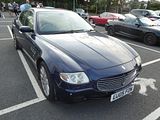
MATRA
The Matra Murena was a 3-seat single row sports car with mid-engined rear wheel drive, produced from 1980 through 1983. Replacing the Bagheera, a similar vehicle resulting from the first fruits of the Matra-Simca cooperation, the Murena employed the base Bagheera structure, but substantial changes were made to address some of the concerns regarding the previous model. The car still had a steel spaceframe with body panels made of fibreglass-polyester, but to counter the rust issues plaguing the Bagheeras, the spaceframe was galvanized, the first production car to use galvanized steel for all chassis parts. This, coupled with the composite panels, made the car essentially immune to rust, except for the rear trailing arms of the suspension. The Murena also inherited the Bagheera’s mid-engined layout together with the sleek hatchback body shape, with the rear hatch allowing access to the engine mounted behind the passenger compartment, and a luggage area. The styling was all-new, though, and the body very aerodynamic for its time. A unique feature carried over from the previous model was the seating arrangement – all three seats were placed in one row, with the middle seat folding down to become an armrest when not in use by a passenger. The engine selection was different, however. The base model had a 1.6 engine, while the more powerful version employed the 2.2 engine that was also the base engine for the top of the range Talbot Tagora saloon. This engine was also available with the so-called “S-kit” that upgraded its output to 142bhp. At first, this was a dealer-fitted option, but later it could be ordered straight from the factory. The standard carburation was via a single Solex downdraft carburettor, but S models had twin side draft carburettors. The car had good performance and handling. It was only available in left hand drive specification, although a very small number of right hand drive conversions were made. Production ceased when the Matra factory in Romorantin switched to production of the Renault Espace multi-people carrier.
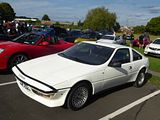

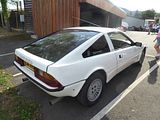
MERCEDES-BENZ
With prices of the classic Pagoda model having risen to unaffordable for most people attention has started to switch to it successor, the R107 SL range, which had a long production life, being the second longest single series ever produced by the automaker, after the G-Class. The R107 and C107 took the chassis components of the mid-size Mercedes-Benz W114 model and mated them initially to the M116 and M117 V8 engines used in the W108, W109 and W111 series. The SL variant was a 2-seat convertible/roadster with standard soft top and optional hardtop and optional folding seats for the rear bench. The SLC (C107) derivative was a 2-door hardtop coupe with normal rear seats. The SLC is commonly referred to as an ‘SL coupe’, and this was the first time that Mercedes-Benz had based a coupe on an SL roadster platform rather than on a saloon, replacing the former saloon-based 280/300 SE coupé in Mercedes lineup. The SLC was replaced earlier than the SL, with the model run ending in 1981, with a much larger model, the 380 SEC and 500SEC based on the new S class. Volume production of the first R107 car, the 350 SL, started in April 1971 alongside the last of the W113 cars; the 350 SLC followed in October. The early 1971 350SL are very rare and were available with an optional 4 speed fluid coupling automatic gearbox. In addition, the rare 1971 cars were fitted with Bosch electronic fuel injection. Sales in North America began in 1972, and cars wore the name 350 SL, but had a larger 4.5L V8 with 3 speed auto (and were renamed 450 SL for model year 1973); the big V8 became available on other markets with the official introduction of the 450 SL/SLC on non-North American markets in March 1973. US cars sold from 1972 through 1975 used the Bosch D Jetronic fuel injection system, an early electronic engine management system. From July 1974 both SL and SLC could also be ordered with a fuel-injected 2.8L straight-6 as 280 SL and SLC. US models sold from 1976 through 1979 used the Bosch K Jetronic system, an entirely mechanical fuel injection system. All US models used the 4.5 litre engine, and were called 450 SL/SLC. In September 1977 the 450 SLC 5.0 joined the line. This was a homologation version of the big coupé, featuring a new all-aluminium five-litre V8, aluminium alloy bonnet and boot-lid, and a black rubber rear spoiler, along with a small front-lip spoiler. The 450SLC 5.0 was produced in order to homologate the SLC for the 1978 World Rally Championship. Starting in 1980, the 350, 450 and 450 SLC 5.0 models (like the 350 and 450 SL) were discontinued in 1980 with the introduction of the 380 and 500 SLC in March 1980. At the same time, the cars received a very mild makeover; the 3-speed automatic was replaced by a four-speed unit, returning to where the R107 started in 1971 with the optional 4 speed automatic 350SL. The 280, 380 and 500 SLC were discontinued in 1981 with the introduction of the W126 series 380 and 500 SEC coupes. A total of 62,888 SLCs had been manufactured over a ten-year period of which just 1,636 were the 450 SLC-5.0 and 1,133 were the 500 SLC. Both these models are sought by collectors today. With the exception of the SL65 AMG Black Series, the SLC remains the only fixed roof Mercedes-Benz coupe based on a roadster rather than a sedan. Following the discontinuation of the SLC in September 1981, the 107 series continued initially as the 280, 380 and 500 SL. At this time, the V8 engines were re-tuned for greater efficiency, lost a few hp and consumed less fuel- this largely due to substantially higher (numerically lower) axle ratios that went from 3.27:1 to 2.47:1 for the 380 SL and from 2.72:1 to 2.27:1 for the 500 SL. From September 1985 the 280 SL was replaced by a new 300 SL, and the 380 SL by a 420 SL; the 500 SL continued and a 560 SL was introduced for certain extra-European markets, notably the USA, Australia and Japan. Also in 1985, the Bosch KE Jetronic was fitted. The KE Jetronic system varied from the earlier, all mechanical system by the introduction of a more modern engine management “computer”, which controlled idle speed, fuel rate, and air/fuel mixture. The final car of the 18 years running 107 series was a 500 SL painted Signal red, built on August 4, 1989; it currently resides in the Mercedes-Benz museum in Stuttgart.


The Mercedes-AMG GT is a series of 2-door sports cars produced by German automobile manufacturer Mercedes-AMG. The car was introduced on 9 September 2014 and was officially unveiled to the public in October 2014 at the Paris Motor Show. While not directly replacing the SLS AMG (competing in a different segment), it is the second sports car developed entirely in-house by Mercedes-AMG. The Mercedes-AMG GT went on sale in two variants (GT and GT S) in March 2015, while a GT3 racing variant of the car was introduced in 2015. A high performance variant called the GT R was introduced in 2016. A GT4 racing variant, targeted at semi-professional drivers and based on the GT R variant, was introduced in 2017. In 2021, a new variant called the AMG GT Black Series was released. All variants are assembled at the Mercedes-Benz plant in Sindelfingen, Germany. The interior of the Mercedes-AMG GT was previewed on 16 April 2014. The car made its debut on 9 September 2014 and was officially unveiled to the public in October 2014 at the Paris Motor Show. The GT’s exterior design was kept similar to that of the preceding SLS AMG, with wide wheel arches, lower bodywork, and fastback sloping roofline of the SLS AMG, but using conventional forward-opening doors instead of the iconic gullwing style pioneered by the 300 SL in the 1950s. It also employed an upgraded and shortened version of the Transaxle Spaceframe platform used by the SLS. The vehicle structure is made up of 93% aluminium, with the front module base made up of magnesium. The exterior lead designer was Mark Fetherston, whose previous works include the W176 A-Class, the CLA-Class, and SLS AMG. The interior, designed by Jan Kaul, features a large centre console and decorative elements in a leather and carbon polymer design. The trunk offers room for a medium-sized suitcase. Two engine power output options were offered: the GT, with 462 PS/456 hp, and the GT S with 510 PS/ 503 hp. The GT generates 600 Nm (443 lb/ft) of torque, and the GT S generates 650 N⋅m (479 lb⋅ft) of torque. Shortly after its introduction, Mercedes-AMG CEO at the time, Tobias Moers, promised a Black Series variant of the Mercedes-AMG GT. The new high performance variant was called the AMG GT R. The Mercedes-AMG family was given a facelift in 2017, along with the introduction of the GT C roadster variant and the Edition 50 model, which is a limited-edition derivative of the GT C variant. The key improvements made as part of the facelift include increased power output from the M178 engine for the GT and GT S variants (10 kW and 9 kW respectively) and the inclusion of the ‘Panamericana’ grille from the GT3, GT4 and GT R variants as standard equipment for all variants. The GT is the entry level variant of the Mercedes-AMG GT family. The M178 engine in this variant is tuned to an output of 462 PS/456 hp and 601 Nm (443 lb/ft) of torque, with the key differences between this and its more expensive siblings being a mechanical limited-slip differential, an absorbent glass mat battery, the lack of the “Race Mode” setting in the AMG Dynamic Select adaptive drivetrain system, the lack of the AMG Ride Control adaptive suspensive system, and a passive AMG Sport Exhaust System. Keyless-Go is also an optional feature, as opposed to standard equipment. The GT is equipped with 19-inch wheels at the front and rear. The GT S is a more highly equipped variant of the Mercedes-AMG GT. The M178 engine in this variant is tuned to an output of 510 PS/503 hp and 651 Nm (480 lb/ft) of torque. The key mechanical differences the GT S gains over the GT include an electronically controlled limited-slip differential, “Race Mode” and “Race Start” mode settings in the AMG Dynamic Select adaptive drivetrain system, AMG Ride Control adaptive suspensive system, an AMG Performance Exhaust System with dynamic flaps, and a lithium-ion battery. Keyless-Go is standard equipment, as is a staggered set of wheels (19-inch at the front, 20-inch at the rear). As with many other recent Mercedes-AMGs, at the time of introduction a limited production “Edition 1” series was issued of the GT S. 375 examples were sold worldwide, and include a gloss black aerodynamic set including a front splitter, lower wheelwell extensions, a carbon fibre roof, a fixed rear wing, red interior accents and red brake calipers, and various other extras. In October 2021, Mercedes-Benz announced the new Mercedes-AMG R232 SL-Class as the direct successor for the roadster version. The second-generation coupe version of the GT, which was introduced nearly a year after the first-generation was discontinued, was redesigned on the same platform as the SL, but retains the name AMG GT.


MG
Launched in October 1962, the MGB was produced for the next 18 years and it went on to become Britain’s best selling sports car. When first announced, the MGB was an innovative, modern design, with a monocoque structure instead of the traditional body-on-frame construction used on both the MGA and MG T-types and the MGB’s rival, the Triumph TR series, though components such as the brakes and suspension were developments of the earlier 1955 MGA and the B-Series engine had its origins back in 1947. The lightweight design reduced manufacturing costs while adding to overall vehicle strength, and with a 95hp 3-bearing 1798cc engine under the bonnet, performance was quite respectable with a 0–60 mph time of just over 11 seconds. The car was rather more civilised than its predecessor, with wind-up windows now fitted as standard, and a comfortable driver’s compartment offered plenty of legroom. The roadster was the first of the MGB range to be produced. The body was a pure two-seater but a small rear seat was a rare option at one point. By making better use of space the MGB was able to offer more passenger and luggage accommodation than the earlier MGA while being 3 inches shorter overall. The suspension was also softer, giving a smoother ride, and the larger engine gave a slightly higher top speed. The four-speed gearbox was an uprated version of the one used in the MGA with an optional (electrically activated) overdrive transmission. A five-bearing engine was introduced in 1964 and a number of other modifications crept into the specification. In late 1967, sufficient changes were introduced for the factory to define a Mark II model. Alterations included synchromesh on all 4 gears with revised ratios, an optional Borg-Warner automatic gearbox, a new rear axle, and an alternator in place of the dynamo with a change to a negative earth system. To accommodate the new gearboxes there were significant changes to the sheet metal in the floorpan, and a new flat-topped transmission tunnel. US market cars got a new safety padded dashboard, but the steel item continued for the rest of the world. Rostyle wheels were introduced to replace the previous pressed steel versions in 1969 and reclining seats were standardised. 1970 also saw a new front grille, recessed, in black aluminium. The more traditional-looking polished grille returned in 1973 with a black “honeycomb” insert. Further changes in 1972 were to the interior with a new fascia. To meet impact regulations, in late 1974, the chrome bumpers were replaced with new, steel-reinforced black rubber bumpers, the one at the front incorporating the grille area as well, giving a major restyling to the B’s nose, and a matching rear bumper completed the change. New US headlight height regulations also meant that the headlamps were now too low. Rather than redesign the front of the car, British Leyland raised the car’s suspension by 1-inch. This, in combination with the new, far heavier bumpers resulted in significantly poorer handling. For the 1975 model year only, the front anti-roll bar was deleted as a cost-saving measure (though still available as an option). The damage done by the British Leyland response to US legislation was partially alleviated by revisions to the suspension geometry in 1977, when a rear anti-roll bar was made standard equipment on all models. US emissions regulations also reduced horsepower. In March 1979 British Leyland started the production of black painted limited edition MGB roadsters for the US market, meant for a total of 500 examples, but due to a high demand, production ended with 6682 examples. The United Kingdom received bronze painted roadsters and a silver GT model limited editions. The production run of home market limited edition MGBs was split between 421 roadsters and 579 GTs. Meanwhile, the fixed-roof MGB GT had been introduced in October 1965, and production continued until 1980, although export to the US ceased in 1974. The MGB GT sported a ground-breaking greenhouse designed by Pininfarina and launched the sporty “hatchback” style. By combining the sloping rear window with the rear deck lid, the B GT offered the utility of a station wagon while retaining the style and shape of a coupe. This new configuration was a 2+2 design with a right-angled rear bench seat and far more luggage space than in the roadster. Relatively few components differed, although the MGB GT did receive different suspension springs and anti-roll bars and a different windscreen which was more easily and inexpensively serviceable. Although acceleration of the GT was slightly slower than that of the roadster, owing to its increased weight, top speed improved by 5 mph to 105 mph because of better aerodynamics. 523,826 examples of the MGB of all model types were built, and although many of these were initially sold new in North America, a lot have been repatriated here.


Built for the short lived Group B rally category, the MG 6R4 was a world away from the BL. Metro super-mini from which it took the name. Featuring a mid-mounted engine, with four wheel drive transmission enclosed in a seam welded tubular chassis, with the development entrusted to Williams Grand Prix Engineering. The car was first shown in May 1985 and was powered by a bespoke three litre V6 engine which used some of the engine architecture of the Cosworth DFV. It featured twin overhead cam shafts and four valves per cylinder, though not turbocharged as were most of its competition. Mounted south to north (backwards), in mid-ship with a permanently engaged four wheel drive, driving separate propshafts to the front and rear differentials. Most of the body was of GRP with an aluminium roof panel and steel doors. The car appeared in two guises the road going Clubman version with around 250bhp of which around 200 were sold to the public (£ 40,000) for homologation purposes, and around 20 competition cars which had an output up to 410bhp. The cars faced stiff competition in the Group B sector and despite a promising start to their programme Austin Rover withdrew, from the rallying scene at the end of 1987. Though they have since proved formidable in rallycross. Following the cancellation of the programme all parts and engines were sold to Tom Walkinshaw Racing, where upon the V6 engine reappeared with turbochargers in the Jaguar XJ220.


MG re-entered the sports car market in 1995 with the launch of the MGF Two versions of this mid-engined and affordable rival to the Mazda MX5 were offered: both of which used the 1.8 litre K-Series 16-valve engine. The cheaper of the two put out 118 hp and the more costly VVC model (by dint of its variable valve control) had 143 hp. Rover Special Projects had overseen the development of the F’s design and before finalising the styling bought-in outside contractors to determine the most appropriate mechanical configuration for the new car. Steve Harper of MGA Developments produced the initial design concept in January 1991 (inspired by the Jaguar XJR-15 and the Ferrari 250LM), before Rover’s in house design team refined the concept under the leadership of Gerry McGovern. The MGF used the Hydragas suspension, a system employing interconnected fluid and gas displacers, which gave the car a surprisingly compliant ride and which could be tuned to provide excellent handling characteristics. The MG F quickly shot to the top of the affordable sports car charts in Britain and remained there until the introduction of the MG TF in 2002. The MG F underwent a facelift in Autumn of 1999 which gave the car a revised interior as well as styling tweaks and fresh alloy wheels designs. There was also the introduction of a base 1.6 version and a more powerful 160 hp variant called the Trophy 160, which had a 0-60 mph time of 6.9 seconds. It was only produced for a limited time. An automatic version with a CVT called the Steptronic was also introduced. A comprehensive update in 2002 resulted in the MG TF, named after the MG TF Midget of the 1950s. Based upon the MG F platform but heavily redesigned and re-engineered, the most significant mechanical changes were the abandonment of Hydragas suspension in favour of conventional coil springs, the new design of the air-induction system that along with new camshafts produces more power than in MG F engines, and the torsional stiffness of the body increased by 20%. Various cosmetic changes included a revised grille, redesigned front headlights, bumpers, side air-intake grills and changes to the rear boot,. The car continued to sell well. Production was suspended when MG-Rover went out of business, but resumed again in 2007 when Nanjing built a number more.

MICROLINO

MINI
The Mark IV was introduced in 1976, though by this stage British Leyland was working on a new small car which was widely expected to replace the Mini before much longer. It had a front rubber-mounted subframe with single tower bolts and the rear frame had some larger bushings introduced, all intended to improve the car’s mechanical refinement and to reduce noise levels. Twin column stalks for indicators and wipers were introduced, as were larger foot pedals. From 1977 onwards, the rear light clusters included reversing lights. In July 1979 the lower end of the Mini range was altered. The basic Mini 850 (which had featured in various forms since the original launch 20 years before) was withdrawn. Its place was taken by two models at slightly lower and slightly higher price points. The new base model was the Mini City, with black-painted bumpers, an untrimmed lower facia rail, part-fabric seats and wing mirror and sun visor only on the driver’s side, plus unique ‘City’ body graphics and boot badge. Above the City was the new 850 SDL (Super Deluxe), which had the same specification as the standard Mini 1000 but with the smaller engine. In August 1979 the Mini’s 20th anniversary was marked by the introduction of the first true limited-edition Mini, which was the Mini 1100 Special. This was a 5,000-car run with the 1098 cc engine, broadly to the specification already in production for the European market as a standard model with the same name. However this was the first time a UK-market ’round-nose’ (i.e. non-Clubman) Mini had been available with the 1098 cc engine, and the UK limited edition was also fitted with unique Exacton alloy wheels – the first time these were fitted to a factory-produced Mini – and plastic wheelarch extensions. Inside was the 1275GT’s three-dial instrument cluster and a leather-rimmed wheel with a rectangular centre from the Innocenti Mini hatchback. The 1100 Special and 850 City models were phased out by 1980, and during the same year the engine was upgraded to the improved A-Plus unit from the new Metro in 998 cc form, which was now the only engine available in the Mini. This was then followed by a number of incremental developments. In 1978, the Mini was one of the key cars made available to disabled motorists under the new Motability scheme. Reports of the Mini’s imminent demise surfaced again in 1980 with the launch of the Austin Mini-Metro (badging with the word “mini” in all lowercase). Faced with competition from a new wave of modern superminis like the Ford Fiesta, Renault 5, and Volkswagen Polo, the Mini was beginning to fall out of favour in many export markets, with the South African, Australian, and New Zealand markets all stopping production around this time. Buyers of small cars now wanted modern and practical designs, usually with a hatchback. The Metro was therefore in essence, the Mini mechanicals repackaged into a larger hatchback bodyshell. Although the Mini continued to be produced after the Metro’s launch, production volumes were reduced as British Leyland and its successor Rover Group concentrated on the Metro as its key supermini. The original Mini’s last year in the top ten of the UK’s top selling cars was 1981, as it came ninth and the Metro was fifth. The arrival of the Metro also had production of the larger Allegro pruned back before it was finally discontinued in 1982. In 1982, BL made 56,297 Minis and over 175,000 Metros. Due to their common powertrain package, the Mini received many mechanical upgrades in the early 1980s which were shared with the Metro, such as the A-Plus engine, 12-inch wheels with front disc brakes, improved soundproofing and quieter, stronger transmissions. This not only modernised the Mini but, because many of its major subassemblies were now shared with the Metro, made it very cost-effective to produce despite falling sales volumes.

The Van version was launched in May 1960, a matter of weeks after the Countryman and Traveller had appeared and on whose extended platform this light commercial was based. The shape was the same as those Estate models, but clearly without the side windows or a rear seat. It proved popular in 1960s Britain as a cheaper alternative to the car:, as it was classed as a commercial vehicle and as such carried no sales tax. A set of simple stamped steel slots served in place of a more costly chrome grille. The Mini Van was renamed as the Mini 95 in 1978, the number representing the gross vehicle weight of 0.95 tons. 521,494 were built, but few survive.

MORGAN
Not surprisingly, there were plenty of Morgans here. Some are factory owned cars which were displayed outside, but there were also a number of owner cars just visiting for the evening.


The Morgan F-4 was introduced in 1933 at the Olympia Motor Cycle Show. The F-4 had a new pressed-steel chassis the four-cylinder Ford Sidevalve engine used in the Model Y, and a four-seat body. The F-4 was supplemented by the two-seat F-2 in 1935 and the more sporting F Super, with cycle-type wings and louvred bonnet tops, in 1937. Production of the Ford-engined three-wheelers continued until 1952.


The Morgan Aero 8 sports car was built by Morgan Motor Company at its factory in Malvern Link from 2000 until 2018. The Aero 8 shape evolved in the traditional Morgan way of form following function and the main players were Chris Lawrence, Charles Morgan and other members of the Morgan Engineering Team, and Norman Kent of Survirn Engineering Ltd – especially for the tooling of the Aero wings.The AeroMax, Aero Supersports and Aero Coupe were designed by the firm’s designer Matthew Humphries. Matthew sent the basic design of it to Charles Morgan when he was at Coventry University and joined Morgan on a KTP programme. Radshape were heavily involved in the chassis (Graham Chapman, the current MMC Development Director was working for them at that time) and Superform with much of the body panels, both companies eventually producing for MMC when the car was launched. The Aero 8 is notable for several reasons, primarily because it is the first new Morgan design since 1964’s +4+. It was touted as Morgan’s first supercar and undertook a comprehensive development programme including endurance testing at BMW’s huge proving grounds L’Autodrome de Miramas. It does not use anti-roll bars, an oddity in a modern sporting car. It is also the first Morgan vehicle with an aluminium chassis and frame as opposed to traditional Morgan vehicles (“trads”) that have an aluminium skinned wooden body tub on a steel chassis. The engine first powering the Aero 8 was a 4.4 L BMW M62 V8 mated to a 6-speed Getrag transmission. In 2007, the Series 4 Aero 8 was released which had an upgraded 4.8 L BMW N62 V8 with an optional ZF automatic transmission. All Aero 8s are assembled at Morgan’s Malvern Link factory, where they are able to produce up to 14 cars a week (Aeros and trads). It has been criticised for its “crosseyed” look which originally was justified by the manufacturers as conferring aerodynamic benefits.The third iteration of the Aero was largely around adding the new style Mini headlamps with changes to the wings and front panels resolving the famous squint of the earlier cars. It retained the interior and mechanical platform of the Series 2. This new front design went on to be used on the new AeroMax and subsequent Aero models. Approximately 200 Series 3 models were produced. Version 4 of the Morgan Aero 8 has seen the 3rd new engine in the life of the vehicle; the BMW 4.4 V8 has been replaced with the BMW 4.8 V8 (N62B48) with 362 bhp (270 kW) and 370 lb/ft of torque. This 13% power increase over the previous Aero gives the new Series 4 Aero 8 a power to weight ratio of 315 bhp per tonne. While heavier BMW saloons were unable to meet emissions regulations with the 4.8l V8 the lighter Aero did meet the Euro 6 emissions standard. BMW produced a short run of engines on a prototype line for Morgan. A first for the Aero 8 also comes in the form of an optional automatic transmission; Morgan state: – ZFs 6 HP26 six speed gives even better performance than a manual gearbox due to its special lock up clutch, low power loss design and instant change characteristic. The automatic is usable either as a full automatic for more relaxed driving or in sport manual mode when the bespoke gear lever will hold the engine revs up to the maximum in each gear, increase change speed and blip the throttle to smooth down changes. In addition to these technical changes, a repositioned fuel tank (to improve the weight distribution), revised instrumentation (from cream dials with blue numerals to black with white), an increase in luggage space, revised air vents, a move to a conventional handbrake lever and air intakes and exits on the front wings distinguish the Series 4 Aero 8 from previous models.

In March this year, Morgan released a new model, called the SuperSport, to replace the Plus Six. The design of the Supersport is a further development of the Midsummer special model based on the Plus Six, introduced in summer 2024. Technically, the Supersport is based on a further developed platform (CXV) of the predecessor model. The body is handcrafted from aluminium. The roof is available as either a carbon fiber composite hardtop or a mohair folding roof. The Supersport has removable side windows and a boot. Compared to the Plus Six, the car is longer, wider and taller, but the wheelbase is the same. The manufacturer states the kerb weight as 1,170 kg (2,580 lb). The Supersport is powered by the B58 six-cylinder inline petrol engine familiar from the predecessor model. It achieves a maximum output of 340 hp and a maximum torque of 500 Nm. The vehicle is said to accelerate from 0 to 60 mph in 3.9 seconds, and the top speed is stated as 166 mph (267 km/h). An 8-speed automatic transmission from ZF transmits the power to the rear wheels. Sales started immediately, but this would be the first time many would have seen the car – and this one came as the factory demonstrator – for real.


MORRIS
The Eight was produced from 1935 to 1948, inspired by the sales popularity of the similarly shaped Ford Model Y. The success of the car enabled Morris to regain its position as Britain’s largest motor manufacturer. The Eight was powered by a Morris UB series 918 cc four-cylinder side-valve engine with three bearing crankshaft and single SU carburettor with maximum power of 23.5 bhp. The gearbox was a three-speed unit with synchromesh on the top two speeds and Lockheed hydraulic brakes were fitted. Coil ignition was used in a Lucas electrical system powered by a 6 volt battery and third brush dynamo. The body which was either a saloon or open tourer was mounted on a separate channel section chassis with a 7 feet 6 inches wheelbase. The tourer could reach 58 mph and return 45 mpg; the saloons were a little slower. The chrome-plated radiator shell and honeycomb grille were dummies disguising the real one hidden behind. In September 1934 the bare chassis was offered for £95. For buyers of complete cars prices ranged from £118 for the basic two-seater to £142 for the four door saloon with “sunshine” roof and leather seats. Bumpers and indicators were £2 10 shillings (£2.50) extra. Compared with the similarly priced, but much lighter and longer established Austin 7, the 1934/35 Morris Eight was well equipped. The driver was provided with a full set of instruments including a speedometer with a built in odometer, oil pressure and fuel level gauges and an ammeter. The more modern design of the Morris was reflected in the superior performance of its hydraulically operated 8 inch drum brakes. The Morris also scored over its Ford rival by incorporating an electric windscreen wiper rather than the more old-fashioned vacuum powered equivalent, while its relatively wide 45 inch track aided directional stability on corners. The series I designation was used from June 1935 in line with other Morris models, cars made before this are known as pre-series although the official Morris Motors designation was by the model year even though they were introduced in October 1934. Of the 164,102 cars produced approximately 24,000 were tourers.

NISSAN
The Figaro was introduced at the 1989 Tokyo Motor Show under the slogan “Back to the Future”. The name references the title character in the play The Marriage of Figaro by Pierre Beaumarchais. Based on the Nissan Micra, the Figaro was built at Aichi Machine Industry, a special projects group which Nissan would later call “Pike Factory,” which also produced three other niche automobiles: the Be-1, Pao and S-Cargo. As a fixed-profile convertible, the upper side elements of the Figaro’s bodywork remain fixed, while its fabric soft top retracts to provide a less fully open experience than a typical convertible. The fixed-profile concept is seen on other convertibles, including the Citroën 2CV and the 1957 Fiat 500. The Figaro was marketed in four colours representing the four seasons: Topaz Mist (Autumn), Emerald Green (Spring), Pale Aqua (Summer) and Lapis Grey (Winter). Few, reportedly 2,000, were marketed in Topaz Mist. The Figaro was equipped with leather seats, air conditioning, CD player and a fixed-profile slide-back open roof. 8000 were originally available with an additional 12,000 added to production numbers to meet demand. Prospective purchasers entered a lottery to purchase a Figaro. Limited edition cars came with passenger side baskets and cup holders. A surprising number of them have been imported to the UK in recent years.

The Nissan S-Cargo is a small retro-styled van manufactured by the Japanese automaker Nissan from 1989 to 1991, and originally marketed solely in Japan at their Nissan Cherry Stores. The exterior styling of the S-Cargo was inspired by the Citroën 2CV Fourgonnette delivery van, and interior styling borrowed a Citroën-style single-spoke steering wheel. The name was a double entendre, standing for “Small Cargo” and sounding like “escargot”, the French word for snail, which in turn is a nickname for the Citroën 2CV. The S-Cargo was introduced at the Tokyo Motor Show in 1989, was originally marketed without Nissan branding and was available by reservation only. Over its two-year production run, 10,685 were produced (variously reported as 12,000). Because of its origins at Pike Factory, (Nissan’s special project group), the S-Cargo—along with the Nissan Figaro, Be-1 and Pao—are known as Nissan’s “Pike cars.”
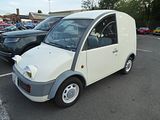


PEUGEOT
Mindful of the success of the Golf GTi, in the class above, and how a small car with good handling could take more power, as the Mini Cooper had proved, Peugeot came up with the GTi in early 1984. The first models had a 1.6 litre XU5J engine, producing 105 PS, which was uprated in 1987 with a cylinder head with larger valves thus becoming XU5JA, which took the power output up to 115 bhp. Visually the car retained the good looks of the 3 door version of the regular models, but it featured plastic wheel arch extensions and trim, beefier front and rear bumper valances and judicious use of red badging and trim. The shell also underwent some minor changes, including larger wheel arches (to suit the larger wheels , and the suspension was redesigned and sat lower on the GTI with stiffer springs, different wishbones and a drop-linked anti-roll bar. Red was a dominant colour inside. The car was an instant hit. At the end of 1986, Peugeot followed up with a more potent model, the 1.9 GTi, whose XU9JA engine produced 128 PS. Internally the engine of this car and the 1.6 model are very similar, the main differences on 1.9 litre versions being the longer stroke, oil cooler, and some parts of the fuel injection system. The shorter stroke 1.6 litre engine is famed for being revvy and eager, while the 1.9 litre feels lazier and torquier. Outside the engine bay the main differences between the 1.6 GTi and the 1.9 GTi are half-leather seats on the 1.9 GTi vs. cloth seats and disc brakes all-round (1.9 GTi) vs. discs at the front and drum brakes at the back; as well as the 14-inch Speedline SL201 wheels on the 1.6 GTi vs. 15 inch Speedline SL299 alloys on the 1.9 GTi. The 205 is still often treated as a benchmark in group car tests of the newest GTI models or equivalent. Peugeot itself has never truly recreated this success in future GTI models, although they came very close with the highly regarded GTI-6 variant of the Peugeot 306.


PORSCHE
It was only really with the launch in 1989 of the 964 that a truly “new” model would appear. Designed by Benjamin Dimson in 1986, it featured significant styling revisions over previous 911 models, most prominently the more integrated bumpers. The 964 was considered to be 85% new as compared to its predecessor. The first 964s available in 1989 were all wheel drive equipped “Carrera 4” models; Porsche added the rear wheel drive Carrera 2 variant to the range in 1990. Both variants were available as a coupe, Targa or Cabriolet. The 964 Carrera was the last generation sold with the traditional removable Targa roof until the 2011 991. A new naturally aspirated engine called the M64 was used for 964 models, with a flat-6 displacement of 3.6 litres. Porsche substantially revised the suspension, replacing torsion bars with coil springs and shock absorbers. Power steering and ABS brakes were added to the 911 for the first time; both were standard. The exterior bumpers and fog lamps became flush with the car for better aerodynamics. A new electric rear spoiler raised at speeds above 50 mph and lowered down flush with the rear engine lid at lower speeds. A revised interior featured standard dual airbags beginning in 1990 for all North American production cars. A new automatic climate control system provided improved heating and cooling. Revised instrumentation housed a large set of warning lights that were tied into the car’s central warning system, alerting the driver to a possible problem or malfunction. In 1992, Porsche produced a super-lightweight, rear-wheel-drive only version of the 964 dubbed Carrera RS for the European market. It was based on Porsche’s 911 “Carrera Cup” race car and harked back to the 2.7 and 3.0 RS and RSR models. It featured a revised version of the standard engine, titled M64/03 internally, with an increased power output of 260 bhp and lightweight flywheel coupled to the G50/10 transmission with closer ratios, asymmetrical Limited Slip Differential and steel synchromesh. A track-oriented suspension system with 40 mm (1.6 in) lower ride height, stiffer springs, shocks and adjustable stabiliser bars without power steering (RHD UK cars did have power steering). A stripped-out interior devoid of power windows or seats, rear seats, air conditioning, cruise control, sound deadening or a stereo system (optionally fitted) and new racing-bucket front seats were part of the package. The front boot cover was made of aluminium and the chassis was seam welded. Wheels were made of magnesium and the glass was thinner in the doors and rear window. The Carrera RS is approximately 345 pounds (155 kg) lighter than the Carrera 2 model. Also available were a heavier Touring variant (with sound deadening, power seats (optional), undercarriage protection and power windows) and an N/GT racing variant with a stripped, blank metal interior and a roll cage. They also came with optional lights on the visors. The RS was regarded as somewhat challenging to drive, though as time has gone by, everyone seems to have warmed to it.

Replacing the 964, the 993 models were first seen in October 1993, with production starting a few weeks later. Its arrival marked the end of air-cooled 911 models. The 993 was much improved over, and quite different from its predecessor. According to Porsche, every part of the car was designed from the ground up, including the engine and only 20% of its parts were carried over from the previous generation. Porsche refers to the 993 as “a significant advance, not just from a technical, but also a visual perspective.” Porsche’s engineers devised a new light-alloy subframe with coil and wishbone suspension (an all new multi-link system), putting behind the previous lift-off oversteer and making significant progress with the engine and handling, creating a more civilised car overall providing an improved driving experience. The 993 was also the first 911 to receive a six speed transmission. The 993 had several variants, as its predecessors, varying in body style, engines, drivetrains and included equipment. Power was increased by the addition of the VarioRam system, which added additional power, particularly in the mid-ranges, and also resulted in more throttle noise at higher revs; as a consequence, resulted in a 15% increase in power over its predecessor. The external design of the Porsche 993, penned by English designer Tony Hatter, retained the basic body shell architecture of the 964 and other earlier 911 models, but with revised exterior panels, with much more flared wheel arches, a smoother front and rear bumper design, an enlarged retractable rear wing and teardrop mirrors. A major change was the implementation of all alloy multi-link rear suspension attached to an alloy sub frame, a completely new design derived from the 989, a four-door sedan which never went into production. The system later continued in the 993’s successor, the 996, and required the widening of the rear wheel arches, which gave better stability. The new suspension improved handling, making it more direct, more stable, and helping to reduce the tendency to oversteer if the throttle was lifted during hard cornering, a trait of earlier 911s. It also reduced interior noise and improved ride quality. The 993 was the first generation of the 911 to have a 6-speed manual transmission included as standard; its predecessors had 4 or 5-speed transmissions. In virtually every situation, it was possible to keep the engine at its best torque range above 4,500 rpm. The Carrera, Carrera S, Cabriolet and Targa models (rear wheel drive) were available with a “Tiptronic” 4-speed automatic transmission, first introduced in the 964. From the 1995 model year, Porsche offered the Tiptronic S with additional steering wheel mounted controls and refined software for smoother, quicker shifts. Since the 993’s introduction, the Tiptronic is capable of recognising climbs and descents. The Tiptronic equipped cars suffer as compared to the manual transmission equipped cars in both acceleration and also top speed, but the differences are not much notable. Tiptronic cars also suffered a 55 lb (25 kg) increase in weight. The 993’s optional all wheel drive system was refined over that of the 964. Porsche departed from the 964’s setup consisting of three differentials and revised the system based on the layout from its 959 flagship, replacing the centre differential with a viscous coupling unit. In conjunction with the 993’s redesigned suspension, this system improved handling characteristics in inclement weather and still retained the stability offered by all wheel drive without having to suffer as many compromises as the previous all-wheel-drive system. Its simpler layout also reduced weight, though the four wheel drive Carrera 4 weighs 111 lb (50 kg) more than its rear wheel drive counterpart (at 3,131 lb (1,420 kg) vs. 3,020 lb (1,370 kg)). Other improvements over the 964 include a new dual-flow exhaust system, larger brakes with drilled discs, and a revised power steering. A full range of models arrived before the arrival of the 996 generation in 1998.

The commercially very significant Boxster was also represented here. Grant Larson’s design, inspired by the 356 Cabriolet, Speedster, and 550 Spyder, stimulated a commercial turnaround for Porsche. Through consultation with Toyota. Porsche began widely sharing parts among models and slashed costs. By October 1991 following a visit to the Tokyo Motor Show, Porsche in dire straits, began to devise solutions to succeed the poor selling 928 and incoming 968 (a heavy update of the 944). In February 1992, Porsche began development of a successor to the 928 (mildly updated for 1992) and recently released 968. By June 1992, out of 4 proposals based on dual collaboration between the 986 and 996 (993 successor) design teams, a proposal by Grant Larson and Pinky Lai was chosen by Harm Lagaay. In August 1992, a decision was made to develop the concept into a show vehicle, in time for the 1993 North American International Auto Show. After garnering widespread acclaim from the press and public upon presentation of the Boxster Concept in January 1993, the final production 986 production exterior design by Larson was frozen in March 1993. However, by the second half of 1993, difficulties arose with fitment of some components, resulting in lengthening of the hood and requiring another design freeze by fourth quarter of that year. Prototypes in 968 bodies were built to test the mid-engine power train of the 986 by the end of 1993, with proper prototypes surfacing in 1994. Pilot production began in the second half of 1995, ahead of series production in mid-1996. The Boxster was released ahead of the 996. The 986 Boxster had the same bonnet, front wings, headlights, interior and engine architecture as the 996. All 986 and 987 Boxsters use the M96, a water-cooled, horizontally opposed (“flat”), six-cylinder engine. It was Porsche’s first water-cooled non-front engine. In the Boxster, it is placed in a mid-engine layout, while in the 911, the classic rear-engine layout was used. The mid-engine layout provides a low center of gravity, a near-perfect weight distribution, and neutral handling. The engines had a number of failures, resulting in cracked or slipped cylinder liners, which were resolved by a minor redesign and better control of the casting process in late 1999. A failure for these early engines was a spate of porous engine blocks, as the manufacturer had difficulty in the casting process. In addition to causing problems with coolant and oil systems mingling fluids, it also resulted in Porsche’s decision to repair faulty engines by boring out the cast sleeves on the cylinders where defects were noted in production and inserting new sleeves rather than scrapping the engine block. Normally, the cylinder walls are cast at the same time as the rest of the engine, this being the reason for adopting the casting technology. The model received a minor facelift in 2002. The plastic rear window was replaced by a smaller glass window. The interior received a glove compartment, new electro-mechanical hood and trunk release mechanism (with an electronic emergency release in the fuse box panel) and an updated steering wheel. Porsche installed a reworked exhaust pipe and air intake. In addition, the front headlight’s amber indicators were replaced with clear indicators. The rear light cluster was also changed with translucent grey turn signals replacing the amber ones. The side marker lights on the front wings were changed as well from amber to clear, except on American market cars where they remained amber. The bumpers were also changed slightly for a more defined, chiselled appearance, and new wheel designs were made available. The second generation of the Boxster debuted at the 2004 Paris Motor Show

The second generation of the Boxster debuted at the 2004 Paris Motor Show with the (997) 911 and became available for sale in 2005. Revised styling included modified headlights, larger side intake vents and enlarged wheel arches to allow wheels up to 19 inches in diameter. Interior revisions included a more prominent circular theme for the instrument cluster and cooling vents. The base engine is a 2.7-litre 176 kW (239 PS; 236 hp) flat-six boxer engine, with the Boxster S getting a 3.2-litre 206 kW (280 PS; 276 hp) engine. For 2007, the base Boxster received a revised engine featuring VarioCam Plus and the Boxster S engine was upgraded from 3.2-litre to 3.4-litre. These upgrades made the Boxster series and the Cayman series equivalent in terms of power. The 987 is the last generation of the Boxster and Cayman series with hydraulic steering. The Cayman S fastback coupé (987c) was first unveiled and went on sale in late 2005. The base Cayman followed in July 2006. Both the Cayman and second generation Boxster roadster share their mid-engine platform and many components, including the front fenders and trunk lid, doors, headlights, taillights, and forward portion of the interior. Styling incorporates cues from the 356/1, the 550 Coupé and the 904 Coupé. The Cayman’s hatchback enables access to luggage areas on top of and in the back of the engine cover. The suspension design is fundamentally the same as that of the Boxster with revised settings due to the stiffer chassis with the car’s fixed roof. The Cayman S was powered by a 3.4-litre flat-six mated to a 6-speed manual transaxle, a 2.7-litre engine with a 5-speed transmission was standard for the base model. An electronically controlled 5-speed automatic (Tiptronic) was also available on the S and base models. The Boxster and Boxster S models received a facelift in 2008. Changes included an increase in engine displacement to 2.9-litre for the Boxster, incorporation of Direct Fuel Injection (DFI) for the Boxster S. Both models now came standard with a new 6-speed manual gearbox and were available with a 7-speed Porsche Doppelkupplungsgetriebe (PDK) dual clutch gearbox. Cosmetic changes included new head and tail lights, larger front air intakes with incorporated day time running lights, and an altered lower rear end flanked by twin diffusers. A facelift of the Porsche Cayman followed in February 2009. As with the Boxster, the base Cayman’s engine displacement was increased to 2.9-litre while the Cayman S gained direct injection. Both the Cayman and Cayman S maintained a 7 kW (10 PS; 9 hp) power advantage over their roadster sibling, the Boxster. A limited slip differential was now a factory option. The third generation, 981 series, cars arrived in March 2012.
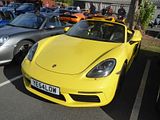

On 5 November 2009, Porsche officially announced a new variant of the Boxster, which was officially unveiled at the 2009 Los Angeles Motor Show. Positioned above the Boxster S, the Boxster Spyder was the lightest Porsche on the market at the time, weighing 1,275 kg (2,811 lb), 80 kg (176 lb) lighter than a Boxster S. This was achieved through the elimination of the conventional soft top’s operating mechanism, the radio/PCM unit, door handles, air conditioning, storage compartments, cup holders and large LED light modules on the front fascia, although some of these could be re-added to the car in the form of options. Weight saving was also gained using aluminium doors, an aluminium rear deck and the lightest 19-inch wheels in the Porsche pallet. The Spyder has a firmer suspension setup than the other Boxster models, and is almost one inch lower in order to have improved handling. A manually operated canvas top, carbon fibre sports bucket seats and two signature humps running along the back of the vehicle provide characteristic design elements. It is powered by a six-cylinder boxer engine rated at 321 bhp and 273 lb/ft (370 Nm) of torque, a 10 bhp increase in power over the Boxster S and the related Cayman S. The Boxster Spyder came with a 6-speed manual transmission as standard and had Porsche’s 7-speed PDK dual-clutch gearbox available as an option. The vehicle was released worldwide in February 2010.

The third-generation Boxster (internally known as the 981) was announced on 13 March 2012 at the Geneva Motor Show with sales starting in early summer 2012. The 981 Boxster reflected the new design language from the 911 (991) and 918, and featured new and revised engine and transmission specifications. Together with a new body, the type 981 Boxster featured a new, 40 per cent more torsionally rigid chassis, the front track was 40 mm (1.6 in) wider, the rear 18 mm (0.7 in) wider and the wheelbase extended by 60 mm (2.4 in), but with a small weight reduction of up to 35 kg (77 lb) compared to the previous type 987 Boxster. The standard Boxster was fitted with a new 2.7-litre flat-6 engine, and the Boxster S was fitted with the existing 3.4-litre engine but with revised performance. Both engines were equipped with a 6-speed manual gearbox and an optional 7-speed reworked PDK. Both manual and automatic models were available with several technical options, including Porsche Torque Vectoring (PTV) and a Sport Chrono Package that included active transmission mounts, and made the PDK-equipped model even faster. Porsche claimed that the new generation Boxster provided fuel savings of 15% over the outgoing model. The range was expanded in March 2014 with the addition of the GTS derivative, with slightly altered front and rear bumpers and an additional 15 PS/ 15 bhp from the 3.4-litre engine. In 2015 the GT4 derivative was introduced, seeing the engine from a 991.1 Carrera S rotated 180 degrees. The GT4 also saw a lowered ride height, altered bumpers, a rear wing and additional GT package upgrades including brakes and certain suspension components from a 991.1 GT3. These special cars were manufactured from 2015 – 2016 with a total of 2500 being made, making this model one of the more desirable collector’s cars in Porsche’s lineup. The GT4 was widely considered one of the best cars of 2015/2016 where it won many awards for its impeccable handling and performance. The third generation Cayman was unveiled at the 2012 Geneva Motor Show. The production version of the 981 Cayman was released as a 2014 model in the spring of 2013. The new car was available in both the standard trim with a 2.7-litre engine, and in the S trim with a 3.4-litre engine. Both versions were available with either a 6-speed manual or a dual-clutch 7-speed PDK transmission. The 981 Cayman featured upgrades including a new body, a longer wheelbase, a wider front track, electrically powered steering, and a redesigned interior that matched the firm’s contemporaneous 911 models. The new model gained acclaim in the motoring press as one of the best handling sports cars at any price, due to its mid-engine layout and driving dynamics. The Cayman S benefited from the same engine and running gear as Porsche’s 3.4-litre version of the 911. A heavily revamped version of both models, known as the 982 generation was launched in 2016 to replace these cars.

In 2021, Porsche unveiled the 718 Cayman GT4 RS, the first Cayman to receive the RS treatment which is usually reserved for the 911 models. With a 4.0 naturally aspirated flat-six derived from the 911 GT3, it puts out 500 PS (490 bhp) and 450 Nm (330 lb/ft) with an rpm limit of 9,000rpm, which allows it to sprint from 0–100 km/h (0–62 mph) in just 3.4 seconds. It generates 25% more downforce than the GT4 variant, through a swan-neck attachment fixed rear wing. The GT4 RS lapped the Nürburgring Nordschleife 23 seconds faster than the GT4. There is a hefty price premium over the GT4 model. An open-topped 718 Boxster RS Spyder model followed a few months later, mechanically the same, just with the different body.
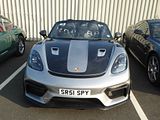
RENAULT
Attracting a lot of interest was this immaculate looking 4CV. There seem to be several different accounts surrounding the conception of the car, one being that it was originally conceived and designed covertly by Renault engineers during the World War II German occupation of France, when the manufacturer was under strict orders to design and produce only commercial and military vehicles, in defiance of the direction of the boss, Louis Renault, whereas another version says that in 1940, he had directed his engineering team to “make him a car like the Germans’. Regardless, the truth is that work did go on during the war, with the occupying Germans who were keeping a watch on the company turning a blind eye to what came to be known as Project 106E. Certainly those working on the project were looking closely at the Volkswagen and their new car had a similar overall architecture to that, while recalling the modern designs of the fashionable front-engined passenger cars produced in Detroit during the earlier 1940s. The first prototype had only two doors and was completed in 1942, and two more prototypes were produced in the following three years. An important part of the 4CV’s success was due to the new methodologies used in its manufacture, pioneered by Pierre Bézier, who had begun his 42-year tenure at Renault as a tool setter, moving up to tool designer and then becoming head of the Tool Design Office. As Director of Production Engineering in 1949, he designed the transfer lines (or transfer machines) producing most of the mechanical parts for the 4CV. The transfer machines were high-performance work tools designed to machine engine blocks. While imprisoned during World War II, Bézier developed and improved on the automatic machine principle, introduced before the war by GM. The new transfer station with multiple workstations and electromagnetic heads (antecedents to robots), enabled different operations on a single part to be consecutively performed by transferring the part from one station to another. The 4CV was ultimately presented to the public and media at the 1946 Paris Motor Show and went on sale a year later. Volume production was said to have commenced at the company’s Billancourt plant a few weeks before the Paris Motor Show of October 1947, although the cars were in very short supply for the next year or so. Renault’s advertising highlighted the hundreds of machine-tools installed and processes adopted for the assembly of the first high volume car to be produced since the war, boasting that the little car was now no longer a prototype but a reality. On the 4CV’s launch, it was nicknamed “La motte de beurre” (the lump of butter); this was due to the combination of its shape and the fact that early deliveries all used surplus paint from the German Army vehicles of Rommel’s Afrika Korps, which were a sand-yellow colour. Later it was known affectionately as the “quatre pattes”, “four paws”. The 4CV was initially powered by a 760 cc rear-mounted four-cylinder engine coupled to a three-speed manual transmission. In 1950, the 760 cc unit was replaced by a 747 cc version of the “Ventoux” engine producing 17 hp. Despite an initial period of uncertainty and poor sales due to the ravaged state of the French economy, the 4CV had sold 37,000 units by mid-1949 and was the most popular car in France. Across the Rhine 1,760 4CVs were sold in West Germany in 1950, accounting for 23% of that country’s imported cars, and ranking second only to the Fiat 500 on the list. The car remained in production for more than another decade. Claimed power output increased subsequently to 21 hp as increased fuel octanes allowed for higher compression ratios, which along with the relatively low weight of the car (620 kg) enabled the manufacturers to report a 0–90 km/h (0–56 mph) time of 38 seconds and a top speed barely under 100 km/h (62 mph) The engine was notable also for its elasticity, the second and top gear both being usable for speeds between 5 and 100 km/h (3 and 62 mph); the absence of synchromesh on first gear would presumably have discouraged use of the bottom gear except when starting from rest. The rear mounting of the engine meant that the steering could be highly geared while remaining relatively light; in the early cars, only 2¼ turns were needed from lock to lock. The unusually direct steering no doubt delighted some keen drivers, but road tests of the time nonetheless included warnings to take great care with the car’s handling on wet roads. In due course, the manufacturers switched from one extreme to the other, and on later cars 4½ turns were needed to turn the steering wheel from lock to lock. Early in 1953, Renault launched a stripped-down version of the 4CV bereft of anything which might be considered a luxury. Tyre width was reduced, and the dummy grille was removed from the front of the car along with the chrome headlamp surrounds. The seats were simplified and the number of bars incorporated in the steering wheel reduced from three to two. The only colour offered was grey. The car achieved its objective of retailing for less than 400,000 Francs. With the Dauphine already at an advanced stage of development it may have made sense to try and expand the 4CV’s own market coverage downwards in order to open up a clearer gap between the two models which would be produced in parallel for several years, but reaction to the down-market 4 CV, branded as the “Renault 4CV Service”, must have disappointed Renault as this version disappeared from the Renault showrooms after less than a year. The poor sales performance may have been linked to the growing popularity of the Citroën 2CV: although at this stage powered by an engine of just 375 cc and offering sclerotic performance, the 2CV was bigger than the Renault and in 1952 came with a starting price of just 341,870 francs The 4CV’s direct replacement was the Dauphine, launched in 1956, but the 4CV in fact remained in production until 1961. The 4CV was replaced by the Renault 4 which used the same engine as the 4CV and sold for a similar price.


Viewed as a modern classic these days, there was an Avantime here. Designed and manufactured by Matra, between 2001 and 2003, this one-box design without B-pillars was styled by Patrick Le Quément and was supposed to combine the space of an estate with the style of a 2+2 coupé. It was conceived by Philippe Guédon, head of the automotive division at Matra, who “believed that the children of Espace owners remained loyal to the car even after they had grown up and left home. As a result, the renowned estate was gaining a generation of new drivers.” It used the Espace as a base, which imposed some constraints, such as the central instrument display, but the marketeers turned that into something they called a part of the innovative character of the whole vehicle. The one-box design eliminated B-pillars and featured an aluminium structure, aluminium panels for the greenhouse and a full sunroof of strengthened heat-reflecting glass. The interior featured four seats each with built-in seatbelts and Bridge of Weir leather. To facilitate access to the rear seats, two long doors featured a double parallel-opening hinge system (marketed as “double-kinematic”) that maximized access with minimal outswing of the doors. Front side windows lowered automatically when either of the front seats folded forward to further facilitate entry to the rear two seats. Windows featured power-deployable sunshades, and the H-points of the rear two seats were higher than the forward two seats, giving the Avantime “theatre seating.” The luggage compartment featured a retaining system using retractable straps, and all Avantimes featured a two-tone look created by the exposed aluminium of the greenhouse. The windows and panoramic sunroof could open automatically via a single, headliner mounted control, to give the Avantime an ‘open air’ mode. The Avantime was first shown in February 1999 in concept form at a press launch in the Louvre, and one month later to the public at the Geneva Auto Show — where it was referred to as a “Coupéspace” — and went into production two years later, after the subsequent engineering of the pillarless roof to meet safety standards. The Avantime’s sales were poor. The car’s fortunes were not helped by the introduction of the Renault Vel Satis (another large, upmarket Renault) around the same time. When Matra decided to pull out of the automotive production business in 2003 (partly as a result of the financial loss incurred by the poor sales of the Avantime), Renault chose to discontinue the Avantime rather than move its production elsewhere. 8,557 were built from 2001 to 2003.


ROVER
The first new car that Rover announced after the war was the P4 model, known as the 75. It was launched at the Earls Court Motor Show in September 1949, to replace all previous models and then continued in production until 1964, though the car underwent lots of change under the skin in those 15 years. Designed by Gordon Bashford, the car went into production in 1949 as the 6-cylinder 2.1-litre Rover 75. It featured unusual modern styling in stark contrast with the outdated Rover P3 model 75 which it replaced. Gone were the traditional radiator, separate headlamps and external running boards. In their place were a chromium grille, recessed headlamps and a streamlined body the whole width of the chassis. The car’s styling was derived from the then controversial 1947 Studebakers. The Rover executives purchased two such vehicles and fitted the body from one of them to a prototype P4 chassis to create a development mule. In James Taylor’s highly regarded book ‘Rover P4 – The Complete Story’ he advised that this vehicle was affectionately known as the ‘Roverbaker’ hybrid. Another, at the time minor, distinctive feature but this one did not catch-on was the centrally mounted light in the grille where most other manufacturers of good quality cars provided a pair, one fog and one driving light often separately mounted behind the bumper. Known, unkindly, as the “Cyclops eye” it was discontinued in the new grille announced 23 October 1952. The earliest cars used a more powerful version of the Rover engine from the 1948 Rover P3 75, a 2103 cc straight-6 engine now with chromium plated cylinder bores, an aluminium cylinder head with built-in induction manifold and a pair of horizontal instead of downdraught carburetters. A four-speed manual transmission was used with a column-mounted gear lever which was replaced by a floor-mounted mechanism in September 1953. At first the gearbox only had synchromesh on third and top but it was added to second gear as well in 1953. A freewheel clutch, a traditional Rover feature, was fitted to cars without overdrive until mid-1959, when it was removed from the specifications, shortly before the London Motor Show in October that year. The cars had a separate chassis with independent suspension by coil springs at the front and a live axle with half-elliptical leaf springs at the rear. The brakes on early cars were operated by a hybrid hydro-mechanical system but became fully hydraulic in 1950. Girling disc brakes replaced drums at the front from October 1959. The complete body shells were made by the Pressed Steel company and featured aluminium/magnesium alloy (Birmabright) doors, boot lid and bonnets until the final 95/110 models, which were all steel to reduce costs. The P4 series was one of the last UK cars to incorporate rear-hinged “suicide” doors. After four years of the one model policy Rover returned to a range of the one car but three different sized engines when in September 1953 they announced a four-cylinder Rover 60 and a 2.6-litre Rover 90. A year later, an enlarged 2230cc engine was installed in the 75, and an updated body was shown with a larger boot and a bigger rear window and the end of the flapping trafficators, with redesigned light clusters. Further detailed changes would follow. Announced 16 October 1956, the 105R and 105S used a high-output, 8.5:1 compression version of the 2.6 litres engine used in the 90. The higher compression was to take advantage of the higher octane fuel that had become widely available. This twin-SU carburettor engine produced 108 hp. Both 105 models also featured the exterior changes of the rest of the range announced a month earlier. The 105S featured separate front seats, a cigar lighter, chromed wheel trim rings and twin Lucas SFT 576 spotlamps. To minimise the cost of the 105R, these additional items were not standard, however they were provided on the (higher priced) 105R De Luxe. The 105R featured a “Roverdrive” automatic transmission. This unit was designed and built by Rover and at the time was the only British-built automatic transmission. Others had bought in units from American manufacturers such as Borg-Warner. This unit was actually a two-speed automatic (Emergency Low which can be selected manually and Drive) with an overdrive unit for a total of three forward gears. The 105S made do with a manual transmission and Laycock de Normanville overdrive incorporating a kick-down control. The 105S could reach a top speed of 101 mph. Production of the 105 line ended in 1958 for the 105R and 1959 for the manual transmission 105S, 10,781 had been produced, two-thirds with the manual transmission option. For 1959 the manual model was described simply as a 105 and the trim and accessory level was reduced to match the other models. In 1959, the engines were upgraded again, with the 80 replacing the 60 and the 100 replacing the 90 and the 105. The four cylinder cars were not particularly popular, though and in September they were replaced by the six cylinder 95. Final model was the 110, which took its place at the top of the range until production ceased, a few months after the very different P6 model 2000 had come along. These cars are popular classics these days.

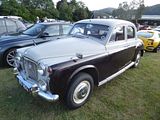

SMART
The Smart Roadster and Roadster Coupé were introduced in 2003, based on a stretched platform of the Fortwo with a full length of 3427 mm. The two variants are meant to be reminiscent of the British roadster of yore, such as the Triumph Spitfire or the MG B. Both the Roadster and Roadster Coupé are available with a removable Targa roof or an electrical softtop. The Roadster is powered by 61 or 82 PS versions of the turbocharged 698cc 3-cylinder Suprex engine in the rear, which is engineered by Mercedes-Benz. The Roadster Coupé has only the more powerful 80 bhp engine. A steering wheel with Formula 1-style paddle-shifters, to control the single-clutch automated manual transmission, is optional. Weighing as little as 790 kg (1,742 lb), the Roadster is intended to provide the emotion of driving a sports car at an affordable cost. Both the Roadster and Roadster Coupé are available in Brabus-tuned versions with power increased to 99 bhp. The Brabus versions have a different twin sports exhaust, lower suspension, polished six-spoke aluminium alloy Monoblock VI 17″ wheels (205/40 ZR17 at the front and 225/35 ZR17 at the rear), front spoiler, side skirts and radiator grille. Exclusive Brabus (Xclusive) interior includes a leather-trimmed dashboard, alloy-effect accent parts, instrument graphics, leather/aluminium gearshift with Brabus labelled starter button, aluminium handbrake handle (which fouls the central armrest), aluminium pedals and Brabus labelled floor mats. The Brabus version also features stronger clamping of the clutch plates and a faster gearchange. The Monoblock wheels are known to be very soft and as a result, are very easy to buckle. The lacquer on these wheels is also very poor, and corrosion can occur very early in the life of the wheel. Despite a projected break-even of only 8-10,000 units per year, first-year sales almost doubled this estimate. However, some Smart Roadsters leaked and production ceased due to the warranty work and other costs reaching an average of €3000 per vehicle. While a critical success, the Smart Roadster was, due to these costs, an economic failure for the company. Influential British motoring television show and magazine Top Gear praised the Roadster, awarding it Fun Car Of The Year for 2005. 43,091 Roadsters were built and put on the shop fronts, with chassis numbers ranging from 00,001 to around 43,400.
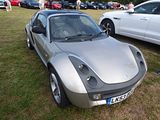
SUNBEAM
The Sunbeam Tiger was a development of the Sunbeam Alpine series I, introduced by the British manufacturer Rootes in 1959. Rootes realised that the Alpine needed more power if it was to compete successfully in world markets, but lacked a suitable engine and the resources to develop one. The company approached Ferrari to redesign the standard inline-four engine, recognising the cachet that “powered by Ferrari” would likely bring. Negotiations initially went well, but ultimately failed. In 1962 racing driver and Formula 1 champion Jack Brabham proposed to Rootes competition manager Norman Garrad the idea of fitting the Alpine with a Ford V8 engine, which Garrad relayed to his son Ian, then the West Coast Sales Manager of Rootes American Motors Inc. Ian Garrad lived near Carroll Shelby’s Shelby American operation, which had done a similar V8 conversion for the British AC Cobra. According to journalist William Carroll, after measuring the Alpine’s engine bay with “a ‘precision’ instrument of questionable antecedents” – a wooden yardstick – Ian Garrad despatched his service manager Walter McKenzie to visit the local new car dealerships, looking for a V8 engine that might fit. McKenzie returned with the news that the Ford 260 V8 engine appeared to be suitable, which apart from its size advantage was relatively light at 440 lb (200 kg). Ian Garrad asked Shelby for an idea of the timescale and cost to build a prototype, which Shelby estimated to be eight weeks and $10,000. He then approached Brian Rootes, head of sales for the Rootes Group, for funding and authorisation to build a prototype, to which Brian Rootes agreed. Ian Garrad, impatient to establish whether the conversion was feasible, commissioned racing driver and fabricator Ken Miles to build another prototype as quickly as he could. Miles was provided with a budget of $800, a Series II Alpine, a Ford V8 engine and a 2-speed automatic transmission, and in about a week he had a running V8 conversion, thus proving the concept. Shelby began work on his prototype, the white car as it came to be known, in April 1963, and by the end of the month it was ready for trial runs around Los Angeles. Ian Garrad and John Panks, director of Rootes Motors Inc. of North America, tested an early version of the car and were so impressed that Panks wrote a glowing report to Brian Rootes: “we have a tremendously exciting sports car which handles extremely well and has a performance equivalent to an XX-K Jaguar … it is quite apparent that we have a most successful experiment that can now be developed into a production car.” Provisionally known as the Thunderbolt, the Shelby prototype was more polished than the Miles version, and used a Ford 4-speed manual transmission. The Ford V8 was only 3.5 inches longer than the Alpine’s 4-cylinder engine it replaced, so the primary concern was the engine’s width. Like Miles, Shelby found that the Ford V8 would only just fit into the Alpine engine bay: “I think that if the figure of speech about the shoehorn ever applied to anything, it surely did to the tight squeak in getting that 260 Ford mill into the Sunbeam engine compartment. There was a place for everything and a space for everything, but positively not an inch to spare.” All Rootes products had to be approved by Lord Rootes, who was reportedly “very grumpy” when he learned of the work that had gone into the Tiger project without his knowledge. He agreed to have the Shelby prototype shipped from America in July 1963 for him and his team to assess. He insisted on driving the car himself, and was so impressed that shortly after returning from his test drive he contacted Henry Ford II directly to negotiate a deal for the supply of Ford V8 engines. Rootes placed an initial order for 3000, the number of Tigers it expected to sell in the first year, the largest single order Ford had ever received for its engines from an automobile manufacturer. Not only did Lord Rootes agree that the car would go into production, but he decided that it should be launched at the 1964 New York Motor Show, only eight months away, despite the company’s normal development cycle from “good idea” to delivery of the final product being three to four years. Installing such a large engine in a relatively small vehicle required some modifications, although the exterior sheet metal remained essentially the same as the Alpine’s. Necessary chassis modifications included moving from the Burman recirculating ball steering mechanism to a more modern rack and pinion system. Although twice as powerful as the Alpine, the Tiger is only about 20% heavier, but the extra weight of the larger engine required some minor suspension modifications. Nevertheless, the Tiger’s front-to-back weight ratio is very similar to the Alpine’s, at 51.7/48.3 front/rear. Shortly before its public unveiling at the New York Motor Show in April 1964, the car was renamed from Thunderbolt to Tiger—the new name inspired by Sunbeam’s 1925 land-speed-record holder. Shelby had hoped to be given the contract to produce the Tiger in America, but Rootes was uneasy about the closeness of his relationship with Ford, so it was decided to build the car in England. The Rootes factory at Ryton did not have the capacity to build the Tiger, so the company contracted the job to Jensen in West Bromwich. Any disappointment Shelby may have felt was tempered by an offer from Rootes to pay him an undisclosed royalty on every Tiger built. Jensen was able to assume production of the Tiger because its assembly contract for the Volvo P1800 had recently been cancelled. An additional factor in the decision was that Jensen’s chief engineer Kevin Beattie and his assistant Mike Jones had previously worked for Rootes, and understood how the company operated. The first of 14 Jensen-built prototypes were based on the Series IV body shell, which became available at the end of 1963. The Tiger went into production in June 1964, less than a year after completion of the Shelby prototype. Painted and trimmed bodies were supplied by Pressed Steel in Oxfordshire, and the engines and gearboxes directly from Ford in America. Installing the engine required some unusual manufacturing methods, including using a sledgehammer to bash in part of the already primed and painted bulkhead to allow the engine to be slid into place. Jensen was soon able to assemble up to 300 Tigers a month, which were initially offered for sale only in North America. The first few Tigers assembled had to be fitted with a Borg-Warner 4-speed all-synchromesh manual gearbox, until Ford resolved its supply problems and was able to provide an equivalent unit as used in the Ford Mustang. Several performance modifications were available from dealers. The original 260 CID engine was considered only mildly tuned at 164 hp, and some dealers offered modified versions with up to 245 hp for an additional $250. These modifications were particularly noticeable to the driver above 60 mph (97 km/h), although they proved problematic for the standard suspension and tyres, which were perfectly tuned for the stock engine. A 1965 report in the British magazine Motor Sport concluded that “No combination of an American V8 and a British chassis could be happier.” Apart from the bigger engine the changes to the Mark II Tiger were largely cosmetic: the most obvious are the speed stripes and the “egg crate” radiator grille. Production reached 7128 cars over three distinct series. The factory only ever designated two, the Mark I and Mark II, but as the official Mark I production spanned the change in body style from the Series IV Alpine panels to the Series V panels, the later Mark I cars are generally designated Mark IA by Sunbeam Tiger enthusiasts. The Mark II Tiger, fitted with the larger Ford 289 cu in (4.7 L), was intended exclusively for export to America and was never marketed in the UK, although six right-hand drive models were sold to the Metropolitan Police for use in traffic patrols and high-speed pursuits; four more went to the owners of important Rootes dealerships. All Tigers were fitted with a single Ford two barrel carburettor. The compression ratio of the larger Mark II engine was increased from the 8.8:1 of the smaller block to 9.3:1. Other differences between the versions included upgraded valve springs (the 260 had developed a reputation for self-destructing if pushed beyond 5000 rpm), an engine-oil cooler, an alternator instead of a dynamo, a larger single dry plate hydraulically operated clutch, wider ratio transmission, and some rear-axle modifications. There were also cosmetic changes: speed stripes instead of chrome strips down the side of the car, a modified radiator grille, and removal of the headlamp cowls. All Tigers were fitted with the same 4.5 in (110 mm) wide steel disc bolt-on wheels as the Alpine IV, and Dunlop RS5 4.90 in × 13 in cross-ply tyres. The lack of space in the Tiger’s engine bay causes a few maintenance problems; the left bank of spark plugs is only accessible through a hole in the firewall, normally sealed with a rubber bung, and the oil filter was relocated from the lower left on the block to a higher position on the right-hand side, behind the alternator. The Ford V8 as fitted to the Tiger produced 164 bhp @ 4400 rpm, sufficient to give the car a 0–60 mph (97 km/h) time of 8.6 seconds and a top speed of 120 mph (190 km/h). The Girling-manufactured brakes used 9.85 in (250 mm) discs at the front and 9 in (229 mm) drums at the rear. The suspension was independent at the front, using coil springs, and at the rear had a live axle and semi-elliptic springs. Apart from the addition of a Panhard rod to better locate the rear axle, and stiffer front springs to cope with the weight of the V8 engine, the Tiger’s suspension and braking systems are identical to that of the standard Alpine. The fitting points for the Panhard rod interfered with the upright spare wheel in the boot, which was repositioned to lie horizontally beneath a false floor. The battery was moved from beneath the rear seat to the boot at the same time. The kerb weight of the car increased from the 2,220 lb (1,010 kg) of the standard Alpine to 2,653 lb (1,203 kg). In 1964, its first year of production, all but 56 of the 1649 Mark I Tigers assembled were shipped to North America, where it was priced at $3499. In an effort to increase its marketability to American buyers the car was fitted with “Powered by Ford 260” badges on each front wing beneath the Tiger logo. The Mark I was unavailable in the UK until March 1965 when it entered the market priced at £1446.It was also sold in South Africa for R3350, badged as the Sunbeam Alpine 260. A chrome strip along the sides was a quick way to distinguish the Tiger from the Alpine. Priced at $3842, the Mark II Tiger was little more than a re-engined Mark IA; by comparison, a contemporary V8 Ford Mustang sold for $2898. The larger 289 cu in (4.7 L) Ford engine improved the Tiger’s 0–60 mph (97 km/h) time to 7.5 seconds, and increased the top speed to 122 mph (196 km/h). Officially the Mark II Tiger was only available in the US, where it was called the Tiger II. By the time the Mark II car went into production Chrysler was firmly in charge of Rootes, and the “Powered by Ford” shields were replaced by “Sunbeam V-8” badges. Rootes had always been insufficiently capitalised, and losses resulting from a damaging thirteen-week strike at one of its subsidiaries, British & Light Steel Pressings, coupled with the expense of launching the Hillman Imp, meant that by 1964 the company was in serious financial difficulties. At the same time, Chrysler was looking for ways to boost its presence in Europe, and so a deal was struck in June 1964 in which Chrysler paid £12.3 million ($34.44 million) for a large stake in Rootes, although not a controlling one. As part of the agreement Chrysler committed not to acquire a majority of Rootes voting shares without the approval of the UK government, which was keen not to see any further American ownership of the UK motor industry. In 1967 Minister of Technology Anthony Wedgewood Benn approached BMH and Leyland to see if they would buy out Chrysler and Rootes and keep the company British, but neither had the resources to do so. Later that year Chrysler was allowed to acquire a controlling interest in Rootes for a further investment of £20 million. Manufacturing a car powered by a competitor’s engine was unacceptable to the new controlling owner, but Chrysler’s own 273 small-block V-8 was too large to fit under the Tiger’s bonnet without major modifications. Compounding the problem, the company’s small-block V8 engines had the distributor positioned at the rear, unlike the front-mounted distributor of the Ford V8. Chrysler’s big-block V8 had a front-mounted distributor but was significantly larger. Shortly after the takeover, Chrysler ordered that production of the Tiger was to end once Rootes’ stock of Ford V8 engines was exhausted; Jensen assembled the last Tiger on 27 June 1967. Chrysler added its pentastar logo to the car’s badging, and in its marketing literature de-emphasised the Ford connection, simply describing the Tiger as having “an American V-8 power train”. Rootes’ design director Roy Axe commented later that “The Alpine and Tiger were always oddballs in the [Rootes] range. I think they [Chrysler] didn’t understand it, or have the same interest in it as the family cars – I think it was as simple as that.” The Tiger name was resurrected in 1972 when Chrysler introduced the Avenger Tiger, a limited-edition modified Hillman Avenger intended primarily for rallying

TOYOTA
In mid-1981, Toyota completely redesigned the Celica Supra as well as the entire Celica lineup for the 1982 model year. In Japan, the Celica XX name continued, and the Celica Supra name continued internationally. Still based on the Celica platform, there were several key differences, most notably the design of the front end and fully retractable pop-up headlights. Other differences were the inline-six rather than four-cylinder engine, as well as an increase in length and wheelbase to accommodate the larger engine. In the home market, cars fitted with the 5M engine were slightly wider, while the 2-litre models remained compliant with the Japanese width regulations, staying under 1,700 mm (66.9 in). The front suspension used Macpherson struts while the rear used a semi-trailing link design with an attachment at the rear differential. The Celica XX introduced the world’s first navigation computer. In Feb. 1981, Japanese buyers were offered an alternative to the Celica XX liftback bodystyle, called the Soarer coupé, which was now offered at two Japanese Toyota dealership networks called Toyota Store, and Toyopet Store, as the Celica XX was sold at the Toyota Corolla Store. The four-door performance saloon called the Celica Camry was realigned with the Japanese market Carina, and the Chaser performance sedan shared the Celica XX straight six, while in North America the Cressida took on that role. In the North American market, the Celica Supra was available in two distinct models. There was the “Performance Type” (P-type) and the “Luxury Type” (L-type). While being mechanically identical, they were differentiated by the available options; tyre size, wheel size, and body trim. The P-type had fibreglass fender flares over the wheel wells, while the L-type did not. The P-type was also standard with the more sporty eight-way adjustable seats. The P-type did not get the option of a leather interior until 1983. Initially, the Luxury type meant Automatic transmission, and Performance Type stood for Manual. All editions of the P-type had the same 14×7-inch aluminium alloy wheels and throughout the years the L-type had 14×5.5-inch wheels until 1985 when they were changed to a P-type styled 15×6. The L-type also had the option of a digital instrument cluster with a trip computer; some Canadian models (both L-types and P-types) had this option as well as a few rare instances of American models. The L-type cluster was easily distinguished from the P-type cluster, by the ‘ECT’ function written on the dial plate. The digital cluster featured a digital tachometer, digital speedometer, and electronic fuel level and coolant level gauges. The trip computer could calculate and display various things such as fuel economy in miles-per-gallon, estimated time of arrival (ETA), and distance remaining to destination. Supras with trip computers also came with cruise control. Excluding the 1982 model, all P-types were available with headlight washers as an option, but the L-types were never given such an option. Although gear ratios changed throughout the years, all P-types came standard with a limited-slip differential. In 1981, for the 1982 model year, in the North American market, the Celica Supra’s engine was the 2.8-litre 12-valve (two valves per cylinder) DOHC 5M-GE. Power output was 145 hp SAE net and 155 lb/ft (210 Nm) of torque. The engine used an 8.8:1 compression ratio to achieve the power and featured a vacuum advanced distributor. When the car debuted, it had a drag coefficient of Cd=0.348, a 0–60 mph acceleration time of 9.8 seconds and a 1⁄4 mile (400 m) time of 17.2-seconds at 80 mph (129 km/h). The standard transmission for this year was the W58 5-speed manual with the A43DL 4-speed automatic transmission being an option for L-types. Both transmissions featured an overdrive gear and the automatic featured a locking torque converter. The top gear in the 5-speed was its overdrive whereas the automatic transmission featured an overdrive gear that would engage at speeds over 56 km/h (35 mph). The 1982 model’s rear differential featured a 3.72:1 ratio. The Celica Supra’s four-wheel independent suspension was specially tuned and designed by Lotus and featured variable assisted power rack-and-pinion steering and MacPherson struts up front. At the rear, it had semi-trailing arm suspension with coil springs and a stabilizer bar. Braking on the Celica Supra was handled by four-wheel disc brakes. On the interior, this generation had standard power windows, power door locks, and power mirrors as well as a tilt steering wheel. The power door lock was located in the centre console next to the power mirror control. The analog dash of this model only showed a top speed of 88 mph (142 km/h) in North America. The optional automatic climate control was renovated and was now seen as a standard feature on the A60. Cruise control and a retractable map light was standard in this generation. Some options included the addition of a sunroof, two-tone paint schemes, and a five-speaker AM/FM/MPX tuner with a cassette player (Fujitsu Ten Limited). The optional cassette stereo had a 105-watt power amplifier and a seven-band graphic equalizer. The standard stereo was a five-channel AM/FM/MPX tuner. Leather interior was an option on the L-type model, but the P-type models limited to standard striped cloth interior. The AM/FM antenna was integrated into the front windshield rather than a typical external mast antenna. There was a key lock on the gas tank door (in lieu of a remote release) and the hatch and rear bumper were black regardless of exterior colour on the rest of the car. The P-type was available with an optional rear window visor above the hatch glass. The tail lights had a reverse light in the centre and the door handles opened the doors by pulling sideways. The front nose badge and B-pillar only read “Supra” for the first several months of production, but were changed to read “Celica Supra” midway through the model year. The L-type had front and rear mudflaps but P-type of this year did not. In 1982, for the 1983 model year, there were not many changes but there was an increase in power output to 150 hp and 159 lb/ft (216 Nm) of torque from the same 5M-GE engine. The only real change in the engine area was the switch from a vacuum advanced to an electronic advanced distributor, yet that did not increase the power output. Toyota switched to a 4.10:1 rear gear ratio for the P-type and a 3.73:1 for the L-type. As for the optional automatic transmission, they replaced the A43DL 4-speed with a newly designed A43DE 4-speed. It had an electronic controller that would adjust its shift pattern for a balance between performance and economy. It was the first in the industry to provide an electronically controlled transmission (ECT). This allowed the driver to choose either the “power” driving mode or “normal” driving mode at the touch of the button. The power mode provided the quickest acceleration and the normal mode provided the best all-around performance. The interior virtually had no changes, but changes to the exterior included a switch to a power mast antenna, mudflaps on all models, and the addition of headlight washers on the P-type. All B-pillar and nose badges for cars sold in North America read “Celica Supra” and only the P-type was available in two-tone colour schemes. In 1983, for the 1984 model year, the changes were significant. Power output was increased on the 5-speed models to 160 hp and 163 lb/ft (221 Nm) of torque. The increase was achieved by a mixture of a redesigned intake manifold with D-shaped intake runners and an increase in compression ratio to: 9.2:1. Another notable change in the 5-speed models was the switch to a 4.30:1 gear ratio in the rear differential. All automatic models retained the previous years power statistics, but the rear gear ratio was changed to 4.10:1. The most notable exterior changes included the switch to wraparound front turn signals, the option of either a rear wing spoiler mounted high up on the rear hatch, or rear window and quarter window louvers. Also, the tail-lights were redesigned and the hatch received a billboard “Supra” sticker instead of the smaller sticker, which was previously positioned on the right. The rear hatch and bumper was changed and received the same colour as the rest of the car (instead of the black of previous years). The door handles were also switched, opening by pulling up instead of sideways. Two-tone paint schemes also became available on both the P-type and L-type models. Some interior controls such as the steering wheel, cruise control, and door lock switch were redesigned. Toyota included a 130 mph (209 km/h) speedometer in North American models instead of the traditional 85 mph (140 km/h) speedometer and the automatic climate control display was also changed. The previous year’s cassette and equalizer stereo option was now made a standard feature. The Supra was redesigned again in 1985. Power output was marginally increased to 161 hp and torque was up to 169 lb/ft (229 Nm). All models of this year had the same amount of power (both automatic models and 5-speed models). The engine received a redesigned throttle position sensor (TPS) as well as a new EGR system and knock sensor. With the slight increase in power the Supra was able to propel itself from 0–60 mph (97 km/h) in 8.4 seconds and netted a 16.1 second quarter-mile at 85 mph (137 km/h). Other changes would be a redesigned, more integrated sunshade and spoiler on the rear hatch. The rear spoiler was changed from a one-piece to a two-piece. The option of a leather interior remained exclusive now for the P-Type. Toyota added a standard factory theft deterrent system and the outside mirrors were equipped with a defogger that activated with the rear defroster. All Supras this year received automatic-off lights that also encompassed an automatic illuminated entry and fade-out system. While 1985 was to be the last year of production of the second generation model, delays in production of the third generation model led to a surplus of second generation models. During the first half of 1986 the 1985 P-type was still offered for sale, with only minor cosmetic changes as well as the addition of a now mandatory rear-mounted third brake light on the hatch. These were all labelled officially as 1986 models. The P-type were the only model available for the 1986 model year. Production for the A60 Supra ended in December 1985 in order to make way for the upcoming A70 Supra.


Needing little introduction, perhaps, is this car, a 2nd generation MR2. Toyota proved that the market for small affordable sports cars was far from dead when they launched the first generation MR2 in 1984. As was the trend at the time among Japanese manufacturers, models were replaced on quite a regular 4/5 year cycle, so it was little surprise when a second generation car appeared in 1989. However, this one would go on to be produced for 10 years, The overall design changed little in that time, but there were lots of small details that were refined during that time. The car was generally well received, with its “mini Ferrari” looks proving quite an attraction, as were the willing engines and the entertaining handling. There are not that many nice clean examples left now, though.

TRIUMPH
Successor to the TR3a, and code named “Zest” during development, the TR4 was based on the chassis and drivetrain of the previous TR sports cars, but with a modern Michelotti styled body. The TR 4 engine was carried over from the earlier TR2/3 models, but the displacement was increased from 1991cc to 2138 cc by increasing the bore size. Gradual improvements in the manifolds and cylinder head allowed for some improvements culminating in the TR4A model. The 1991 cc engine became a no-cost option for those cars destined to race in the under-two-litre classes of the day. Some cars were fitted with vane-type superchargers, as the three main bearing engine was liable to crankshaft failure if revved beyond 6,500 rpm; superchargers allowed a TR4 to produce much more horse-power and torque at relatively modest revolutions. The standard engine produced 105 bhp but, supercharged and otherwise performance-tuned, a 2.2-litre I4 version could produce in excess of 200 bhp at the flywheel. The TR4, in common with its predecessors, was fitted with a wet-sleeve engine, so that for competition use the engine’s cubic capacity could be changed by swapping the cylinder liners and pistons, allowing a competitor to race under different capacity rules (i.e. below or above 2 litres for example). Other key improvements over the TR3 included a wider track front and rear, slightly larger standard engine displacement, full synchromesh on all forward gears, and rack and pinion steering. In addition, the optional Laycock de Normanville electrically operated overdrive Laycock Overdrive could now be selected for 2nd and 3rd gear as well as 4th, effectively providing the TR4 with a seven-speed manual close ratio gearbox. The TR4 was originally fitted with 15×4.5″ disc wheels. Optional 48-lace wire wheels could be ordered painted the same colour as the car’s bodywork (rare), stove-enamelled (matte silver with chrome spinners, most common) or in matte or polished chrome finishes (originally rare, but now more commonly fitted). The most typical tyre originally fitted was 590-15 bias ply or optional radial tires. In the US at one point, American Racing alloy (magnesium and aluminium) wheels were offered as an option, in 15×5.5″ or 15×6″ size. Tyres were a problem for original owners who opted for 60-spoke wire wheels, as the correct size radial-ply tyre for the factory rims was 155-15, an odd-sized tyre at the time only available from Michelin at considerable expense. Some original TR4 sales literature says the original radial size was 165-15. The much more common 185-15 radials were too wide to be fitted safely. As a result, many owners had new and wider rims fitted and their wheels re-laced. The new TR4 body style did away with the classical cutaway door design of the previous TRs to allow for wind-down windows (in place of less convenient side-curtains), and the angular rear allowed a boot with considerable capacity for a sports car. Advanced features included the use of adjustable fascia ventilation, and the option of a unique hard top that consisted of a fixed glass rear window (called a backlight) with an integral rollbar and a detachable, steel centre panel (aluminium for the first 500 units). This was the first such roof system on a production car and preceded by 5 years the Porsche 911/912 Targa, which has since become a generic name for this style of top. On the TR4 the rigid roof panel was replaceable with an easily folded and stowed vinyl insert and supporting frame called a Surrey Top. The entire hard top assembly is often mistakenly referred to as a Surrey Top. In original factory parts catalogues the rigid top and backlight assembly is listed as the Hard Top kit. The vinyl insert and frame are offered separately as a Surrey Top. Features such as wind-down windows were seen as a necessary step forward to meet competition and achieve good sales in the important US market, where the vast majority of TR4s were eventually sold. Dealers had concerns that buyers might not fully appreciate the new amenities, therefore a special short run of TR3As (commonly called TR3Bs) was produced in 1961 and ’62. The TR4 proved very successful and continued the rugged, “hairy-chested” image that the previous TRs had enjoyed. 40,253 cars were built during production years. Most were sold new to the US, but plenty have returned, and it is estimated that there are not far short of 900 examples of the model in the UK at present.

By the mid 1960s, money was tight, so when it came to replacing the TR4 and TR5 models, Triumph were forced into trying to minimise the costs of the redesign, which meant that they kept the central section of the old car, but came up with new bodywork with the front and back ends were squared off, reportedly based on a consultancy contract involving Karmann. The resulting design, which did look modern when it was unveiled in January 1969 has what is referred to as a Kamm tail, which was very common during 1970s era of cars and a feature on most Triumphs of the era. All TR6 models featured inline six-cylinder engines. For the US market the engine was carburetted, as had been the case for the US-only TR250 engine. Like the TR5, the TR6 was fuel-injected for other world markets including the United Kingdom, hence the TR6PI (petrol-injection) designation. The Lucas mechanical fuel injection system helped the home-market TR6 produce 150 bhp at model introduction. Later, the non-US TR6 variant was detuned to 125 bhp for it to be easier to drive, while the US variant continued to be carburetted with a mere 104 hp. Sadly, the Lucas injection system proved somewhat troublesome, somewhat denting the appeal of the car. The TR6 featured a four-speed manual transmission. An optional overdrive unit was a desirable feature because it gave drivers close gearing for aggressive driving with an electrically switched overdrive which could operate on second, third, and fourth gears on early models and third and fourth on later models because of constant gearbox failures in second at high revs. Both provided “long legs” for open motorways. TR6 also featured semi-trailing arm independent rear suspension, rack and pinion steering, 15-inch wheels and tyres, pile carpet on floors and trunk/boot, bucket seats, and a full complement of instrumentation. Braking was accomplished by disc brakes at the front and drum brakes at the rear. A factory steel hardtop was optional, requiring two people to fit it. TR6 construction was fundamentally old-fashioned: the body was bolted onto a frame instead of the two being integrated into a unibody structure; the TR6 dashboard was wooden (plywood with veneer). Other factory options included a rear anti-roll bar and a limited-slip differential. Some say that the car is one of Leyland’s best achievements, but a number of issues were present and remain because of poor design. As well as the fuel injection problems, other issues include a low level radiator top-up bottle and a poor hand-brake. As is the case with other cars of the era, the TR6 can suffer from rust issues, although surviving examples tend to be well-cared for. The TR6 can be prone to overheating. Many owners fit an aftermarket electric radiator fan to supplement or replace the original engine-driven fan. Also the Leyland factory option of an oil cooler existed. Despite the reliability woes, the car proved popular, selling in greater quantity than any previous TR, with 94,619 of them produced before production ended in mid 1976. Of these, 86,249 were exported and only 8,370 were sold in the UK. A significant number have since been re-imported, as there are nearly 3000 of these much loved classics on the road.


The Dolomite really was the 3 Series of its day, a family sized saloon that offered a combination of luxury and sportiness that made it a cut above the average Cortina and Marina. Designed as the successor for the upmarket variants of Triumph’s front-wheel drive designs, and also to replace a sporting relative of the Herald, the 6-cylinder Triumph Vitesse, the Triumph Dolomite was unveiled at the London Motor Show in October 1971. However, due to a number of strikes and other industrial upsets, the car was not reported to be in full production until October 1972. The Dolomite used the longer bodyshell of the front wheel drive Triumph 1500, but with the majority of the running gear carried over from the rear-wheel drive Triumph Toledo. Initially, the only version available used the new slant-four 1854 cc engine, which mated an alloy OHC head to an iron block, providing 91 bhp which offered sprightly performance. This was a version of the engine that the company was already providing to Saab for use in their 99 model. The car was aimed at the then-new compact performance-luxury sector, vying for sales against cars such as the BMW 2002 and Ford Cortina GXL, and was offered with a high level of standard equipment, including twin headlamps, a clock, full instrumentation, luxury seats and carpets, a heated rear window, and a cigar lighter. Styling was similar to the Triumph 1500, with some updates such as a black painted rear panel, vinyl D-posts, and new wheel trims. The car was capable of 100 mph with 60 mph coming up in just over 11 seconds. An overdrive gearbox was soon made available as an option, offering relaxed motorway cruising and improved fuel economy, and there was also an optional automatic transmission. Although the Dolomite proved to be refined and rapid, competitors such as the BMW 2002 had a performance advantage which was costing Triumph dearly, both in terms of sales and prestige. To remedy this, Triumph unveiled the Dolomite Sprint in June 1973, although the launch had been delayed by a year; it had been due to go on sale in 1972. A team of engineers led by Spen King developed a 16-valve cylinder head with all of the valves being actuated using a single camshaft rather than the more conventional DOHC arrangement. The capacity was also increased to 1,998 cc and combined with bigger carburettors the output was upped to 127 bhp. This represented a significant power increase over the smaller 1850cc variant, however it fell short of the original target of 135 bhp Despite BL engineers being able to extract a reliable 150 bhp from test engines, the production line was unable to build the engines to the same level of quality, with production outputs being in the region of 125 bhp to 130 bhp. This led to the original model designation, the Dolomite 135, being replaced at short notice with the Sprint name. As a result of the use of this engine, the Dolomite Sprint has been claimed to be “the world’s first mass-produced multi-valve car”. While other multi-valve engines (notably the Lotus 907) were produced in volume, they were not used in mass production vehicles until after the introduction of the Dolomite Sprint. The design of the cylinder head won a British Design Council award in 1974. Performance was excellent, with 0–60 mph taking around 8.4 seconds, with a maximum speed of 119 mph. Trim was similar to the 1850, with the addition of standard alloy wheels (another first for a British production car), a vinyl roof, front spoiler, twin exhausts and lowered suspension. By now seats were cloth on the 1850, and these were also fitted to the Sprint. Due to the increase in power brought by the new engine, the rest of the driveline was upgraded to be able to withstand the extra torque. The gearbox and differential were replaced by a version of those fitted to the TR and 2000 series cars, albeit with a close ratio gearset in the gearbox. The brakes were upgraded with new pad materials at the front, and the fitment of larger drums and a load sensing valve at the rear. Other changes over the standard Dolomite included the option of a limited slip differential. The optional overdrive and automatic transmission from the 1850 model were also offered as options on the Sprint. Initial models were only offered in Mimosa Yellow, although further colours were available from 1974 on. At launch the Sprint was priced at £1740, which compared extremely well to similar cars from other manufacturers. Prospective buyers would have been hard pressed to justify the extra £1000 cost of the BMW 2002 Tii, which offered similar performance. The four-door practicality of the Sprint also made it a very attractive proposition for the young executive choosing his first company car. The press gave the Dolomite Sprint an enthusiastic reception. Motor summarised its road test (subtitled “Britain leads the way”) with glowing praise: ” …the Sprint must be the answer to many people’s prayer. It is well appointed, compact, yet deceptively roomy. Performance is there in plenty, yet economy is good and the model’s manners quite impeccable … Most important of all, it is a tremendously satisfying car to drive”. Sadly, it proved not quite so satisfying to own, as the legendary BL lack of reliability was a feature on some, but by no means all Sprints. In 1976, Triumph rationalised their range, calling all their small models, Dolomite, and using the same body shell, so the Toledo (which had maintained its stubby tail until this point) and 1500TC became the Dolomite 1300, 1500 and 1500HL respectively. With minor changes to trim and equipment, the cars continued in production until 1980.


TVR
Taking its name from the Greek name of a lightweight battle-axe used by the Scythians which was feared for its ability to penetrate the armour of their enemies, the final TVR model to be seen here was a Sagaris, a car which made its debut at the MPH03 Auto Show in 2003. The pre-production model was then shown at the 2004 Birmingham Motorshow. In 2005 the production model was released for public sale at TVR dealerships around the world. Based on the TVR T350, the Sagaris was designed with endurance racing in mind. Several design features of the production model lend themselves to TVR’s intentions to use the car for such racing. The multitude of air vents, intake openings and other features on the bodywork allow the car to be driven for extended periods of time on race tracks with no modifications required for cooling and ventilation. The final production model came with several variations from the pre-production show models such as the vents on the wings not being cut out, different wing mirrors, location of the fuel filler and bonnet hinges. As with all modern TVRs the Sagaris ignored the European Union guideline that all new cars should be fitted with ABS and at least front airbags because Peter Wheeler believed that such devices promote overconfidence and risk the life of a driver in the event of a rollover, which TVRs are engineered to resist. It also eschewed electronic driver’s aids (such as traction control or electronic stability control). In 2008, TVR unveiled the Sagaris 2, which was designed to replace the original Sagaris. In the prototype revealed, there were minor changes to the car including a revised rear fascia and exhaust system, and modifications to the interior. Sagaris models. on the rare occasions that they come up for sale, are pricey.


VAUXHALL
The Astra name originated with the Vauxhall-badged version of the first front-wheel drive Opel Kadett, which had been launched in 1979 as the Opel Kadett D. This model, which went on sale in March 1980, replaced the Vauxhall Viva in the UK. The last rear-wheel drive Kadett had also formed the basis of the Vauxhall Chevette, which remained in production until 1984. The Astra was Vauxhall’s first model to have front wheel drive. Initially, Vauxhall had worked on restyled versions of the Kadett D which would have featured the company’s trademark “droopsnoot”, as well as a conventional three-box saloon version that would have directly replaced the Viva, however budget constraints meant that General Motors cancelled their development, and the Astra was released differing only from its Opel sister car in badging and trim – setting the precedent for all Vauxhall models from that point on. Confusingly, in the British market both the Kadett and the Astra were sold through separate marketing operations, with overlapping lineups that competed directly with each other – Vauxhall had tried to mitigate against the overlap by initially only offering the Astra in a limited number of trim, engine and body combinations compared to the Opel Kadett; although this was due to the fact that until 1981, both cars were sourced solely from Opel’s Bochum plant – with UK production at Ellesmere Port not starting until 16 November 1981. By 1982 this anomaly had been sorted out as GM had begun to merge the previously separate Vauxhall and Opel dealer networks and the Opel Kadett lineup was limited to the well-equipped five-door Berlina (1.3S or 1.6S) and the sporty 1.6 SR, leaving most of the market to the Vauxhall Astra-badged cars. As the consolidation of Opel and Vauxhall dealerships was completed, the Opel badged versions were eventually phased out entirely. Production began at Opel’s West German plant at Bochum in August 1979, with British deliveries of the Opel Kadett commencing in November 1979, four months before the Vauxhall-badged versions were launched. Whilst the previous generation Kadett C had been discontinued, it effectively lived on in the form of its Vauxhall sister – the Chevette – which remained on sale partly to keep the Ellesmere Port plant in operation until Astra production started, and also to give an alternative option for conservative customers who remained suspicious of front wheel drive. The overhead-camshaft engine (not 1200) was a huge leap forward from the earlier generation of small engines used in Vauxhall and Opel cars in terms of power, economy and refinement. It was initially available in 1300 and 1600 forms, and later an 1800 fuel-injected version was added, used in the Mk 1 Astra GTE model, introduced in 1983. This version of the Astra was an alternative to the Ford Escort XR3i, Volkswagen Golf GTI and Fiat Strada 130TC. The car featured a new unified engine for Vauxhall/Opel, featuring an all-aluminium head, overhead camshaft and hydraulic valve lifters, and it quickly became popular with buyers. A 1200 cc version which used the older Opel OHV engine was also available. There were three body styles for the first generation Astra: hatchback, saloon, and estate, all available with two or four side doors. The saloons were styled exactly like the hatchbacks, except for a different rear window above a boot lid; from the side they looked almost indistinguishable from the hatchback, with no protruding notch at the rear. The saloon version was replaced by the Belmont saloon based on the Astra MK2 in early 1986. The white 1800 GTE was the first UK car to be ‘colour-coded’ with body trim that matched the base colour of the car, this included wheel arch extensions, front side and rear lower skirts, mirror covers, bumpers and even the alloy wheels were painted white. The black, silver and red versions of the GTE also had colour-coding but had the more conventional black bumpers and silver painted alloy wheels. There was also a van version which was badged as the Bedford Astra – the Bedford brand at that time being used for GM’s commercial vehicles in Britain and a few continental European markets. Unlike the previous Opel T-Car, no Coupé was offered. Sales of this first Astra were strong, and gave Vauxhall a much-needed boost in the small family car sector after several years of declining sales with the Viva HC. It soon overtook the Austin Allegro as Britain’s second most popular small family car, although it was still a long way behind the Ford Escort in terms of sales success. The original Astra was awarded What Car?’s ‘Car of the Year’ for 1980. However, it was pipped to the European Car of the Year award by the Lancia Delta. This one appears to have some modifications by Irmscher, about which I drew blank when trying to do some web research.


By the mid-1980s, General Motors had started developing a new model to replace the J-Car models in Europe (its American, Australian and Japanese divisions would instead be replaced by different designs in due course) by the end of the decade. The new model would retain the Cavalier nameplate for the Vauxhall version on the UK market, but elsewhere in Europe the car would be sold as the Opel Vectra – spelling the end for the long-running Ascona nameplate. Soon afterwards, development also began on a new coupe which would share the same underpinnings as the hatchbacks and saloons, but would use a different nameplate and feature completely different styling. The final generation Cavalier went on sale on 14 October 1988, being Vauxhall’s version of the Opel Vectra “A”, again available as a saloon and hatchback. There was no estate version in the Opel line-up, and as this design was not going to be sold in Australia, there was no prospect of Vauxhall turning to Holden for a replacement. Early plans for an estate model exclusive to Europe to be developed never materialised. During 1989, however, the Cavalier’s floorpan did spawn a new coupe – the Calibra, the first Vauxhall coupe since the original Cavalier coupe was discontinued in 1981. The Calibra was the official replacement for the Opel Manta, which had been discontinued in 1988, and was also sold on continental Europe under the Opel Brand. Plans for the Calibra to be imported to the USA under the Saab brand never materialised. The Vectra name was not adopted at this model change as Vauxhall feared reviving memories of the much-maligned Vauxhall Victor, whereas the Cavalier was a generally well received product and had helped boost Vauxhall’s sales and reputation. Early Victors had been viewed in some quarters as excessively corrosion prone, but the Victor was becoming a very distant memory by this stage: the Vectra name would eventually appear on a Vauxhall in 1995, when the Cavalier was finally replaced. In place of the Mark II Cavalier’s angular exterior was a more rounded appearance, reflecting the change in styling tastes throughout Europe at this time. There was also a new economical 1.4 L petrol engine. The biggest changes to the range were the addition of 2.0 L sixteen valve engines, better known as the “red top” or XE. This was fitted to the GSi 2000 and later SRis. Also made available was a four-wheel drive system, fitted to a 2.0iL model (8 valve SRi spec) and on a version of the GSi 2000. There were two diesels available: a 1.7 L, 60 hp from launch, and an 82 hp 1.7-litre Isuzu-engined lightly blown turbodiesel from 1992. The early SRis were fitted with the 2.0-liter eight-valve engine from the previous Cavalier model, which produced 130 hp. Despite the lack of an estate body style, the Cavalier topped the large medium family car sales charts in Britain in 1990, narrowly outselling the Ford Sierra, while Rover was beginning to phase out its Montego in favour of the new Rover 400 Series and later the more upmarket 600 Series. Other strong contenders in this sector included the long-running Citroën BX and Peugeot’s highly regarded 405. Having first outsold the Sierra in Britain in 1990, it was Britain’s second best selling car behind the Ford Escort in 1992. It did not lose top spot in its sector until it was overtaken by the Sierra’s successor, the Mondeo, in 1994. The Calibra, launched in 1989, was well received, notably for its sporty although cramped interior (largely based on the interior of the Cavalier) and its streamlined styling which in turn enabled the Calibra to have the lowest drag coefficient of the period at 0.26 for the 8v model (0.29 for the rest) – a record it held for the next 10 years. A few variants were made: the 2.0 litre eight valve, 2.0 L sixteen valve (the same engine found in the proven Cavalier GSi 2000), the turbo version (again, the same engine used in the very successful Cavalier Turbo), the 2.5 L V6 (with a top speed of around 145 mph) and finally the 2.0 L 16-valve “Ecotec”. A facelift in the autumn of 1992 for the 1993 model year saw the Cavalier’s 1.4 L engine dropped and the 167 bhp 2.5 L V6 added to the range. At this time the GSi 2000 was replaced by a new four wheel drive version badged simply “Cavalier Turbo”, with a turbocharged version of the sixteen valve engine producing over 200 bhp. The Vauxhall logo was added to the centre of the boot. Most of the range now had airbags and anti-lock brakes as standard (the first car in its class to do so) and all models were fitted with a toughened safety cage, side impact beams (providing additional longitudinal load paths) and front seatbelt pretensioners. This version of the Cavalier was the first Vauxhall to feature a drivers airbag, with a passenger one being optional; this feature soon became available across the rest of the company’s range. The exterior design was also freshened up, with a new look grille, headlights, rear lights and bumper mouldings and an increase in sound insulation, especially in GLS and higher models making the Cavalier a quiet place to travel in. In late 1994, the new 2.0L Ecotec engine was launched replacing both the popular eight valve C20NE and high performance sixteen valve “redtop” engine. The new engine had improved fuel economy and low end torque at the cost of maximum power output, 136 hp compared to 150 hp for the “redtop” that it replaced. After twenty years and three generations, the Cavalier came to an end in October 1995 when it was replaced by the Vectra, though sales continued for about a year afterwards and several P registered versions (August 1996 to July 1997 period) were sold. The third and final incarnation of the Cavalier was a big improvement over its predecessors (and most earlier Vauxhalls) in terms of durability, with the rust problems that had plagued Vauxhall for years finally being conquered. This was reflected by the fact that Mark III Cavaliers were a common sight on British roads for well over a decade after the end of production. The demise of the Cavalier name marked a significant moment for the Luton-based company, as it would be the last of its main models with a distinct name from its Opel counterparts until the rebadging of the Opel Speedster as the Vauxhall VX220 and the Opel Karl as the Vauxhall Viva. All future Vauxhall models would share their names with those of Opel, or in the case of the 2004 Vauxhall Monaro, with Holden. However, the Astra nameplate was chosen by Vauxhall at the beginning of 1980 for its version of the first front-wheel drive Opel Kadett, and from 1991 General Motors decided to sell the Opel version of the car as the Astra. This version of the Cavalier shared its chassis with the Saab 900 that was produced from 1993 until 1998, and continued until 2002 as the Saab 9-3, due to Saab also being within the General Motors combine at the time.

VIGNALE
Produced from 1967 to 1971, the Gamine was based on the Fiat 500, but unlike that car, however, the Gamine had an open-top Roadster structure and only two seats. Styling was by Alfredo Vignale. The Gamine is sometimes related in design to the Fiat 508 Balila. A hard-top was offered at an extra cost, and is considered these days to be quite rare. It was powered by a 2-cylinder, air-cooled engine of 499.5 cc from the Fiat 500 sport, the sporty version of the 500, and an engine later to be offered on the 500F, producing 21.2 bhp, which was enough to get the car to 60 mph, just. The Gamine was Alfredo Vignale’s baby project, but while the design was fairly cute, the performance was lacklustre even for the times. A high price, mediocre handling and versatility, meant that the Gamine never sold very well. In fact, the slow sales drove Carrozzeria Vignale out of business, forcing Alfredo Vignale to sell his production line to De Tomaso.


VOLKSWAGEN
Most stylish of the VWs here was, in my opinion, a splendidly presented Type 1 Karmann Ghia Coupe. This model debuted at the October 1953 Paris Auto Show as a styling concept created for Ghia by Luigi Segre. In the early 1950s, Volkswagen was producing its economy car, the Type 1 (Beetle), but with an increase in post-war standards of living, executives at Volkswagen proposed adding a halo car to its model range, contracting with German coachbuilder Karmann for its manufacture. Karmann in turn contracted the Italian firm Ghia, who adapted styling themes previously explored for Chrysler and Studebaker to a Beetle floorpan widened by 12 in. Virgil Exner claimed that the design was his, based on the 1953 Chrysler D’Elegance. In contrast to the Beetle’s machine-welded body with bolt-on wings, the Karmann Ghia’s body panels were butt-welded, hand-shaped, and smoothed with English pewter in a time-consuming process commensurate with higher-end manufacturers, resulting in the Karmann Ghia’s higher price. The design and prototype were well received by Volkswagen executives, and in August 1955 the first Type 14 was manufactured in Osnabrück, Germany. Public reaction to the Type 14 exceeded expectations, and more than 10,000 were sold in the first year. The Type 14 was marketed as a practical and stylish 2+2 rather than as a true sports car. As they shared engines, the Type 14’s engine displacement grew concurrently with the Type 1 (Beetle), ultimately arriving at a displacement of 1584 cc, producing 60 hp. In August 1957, Volkswagen introduced a convertible version of the Karmann Ghia. Exterior changes in 1961 included wider and finned front grilles, taller and more rounded rear taillights and headlights relocated to a higher position – with previous models and their lower headlight placement called lowlights. The Italian designer Sergio Sartorelli, designer of the larger Type 34 model, oversaw the various restylings of the Type 14. In 1970, larger taillights integrated the reversing lights and larger wrap-around indicators. Still larger and wider taillights increased side visibility. In 1972, large square-section bumpers replaced the smooth round originals. For the USA model only, 1973 modifications mandated by the National Highway Traffic Safety Administration (NHTSA) included energy-absorbing bumpers. A carpeted package shelf replaced the rear seat. In late 1974 the car was superceded by the Porsche 914 and the Golf based Scirocco.
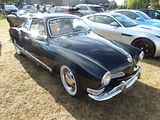
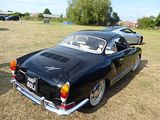
The first generation of the Volkswagen Type 2 with the split windshield, informally called the Microbus, Splitscreen, or Splittie among modern fans, was produced from 8 March 1950 through the end of the 1967 model year. From 1950 to 1956, the T1 (not called that at the time) was built in Wolfsburg; from 1956, it was built at the completely new Transporter factory in Hanover. Like the Beetle, the first Transporters used the 1100 Volkswagen air-cooled engine, an 1,131 cc 24 bhp, air-cooled flat-four-cylinder ‘boxer’ engine mounted in the rear. This was upgraded to the 1200 – an 1,192 cc 30 bhp in 1953. A higher compression ratio became standard in 1955; while an unusual early version of the 40 bhp engine debuted exclusively on the Type 2 in 1959. Any 1959 models that retain that early engine today are true survivors. Since the engine was totally discontinued at the outset, no parts were ever made available. The early versions of the T1 until 1955 were often called the “Barndoor” (retrospectively called T1a since the 1990s), owing to the enormous rear engine cover, while the later versions with a slightly modified body (the roofline above the windshield is extended), smaller engine bay, and 15″ roadwheels instead of the original 16″ ones are nowadays called the T1b (again, only called this since the 1990s, based on VW’s retrospective T1,2,3,4 etc. naming system.). From the 1964 model year, when the rear door was made wider (same as on the bay-window or T2), the vehicle could be referred to as the T1c. 1964 also saw the introduction of an optional sliding door for the passenger/cargo area instead of the outwardly hinged doors typical of cargo vans. In 1962, a heavy-duty Transporter was introduced as a factory option. It featured a cargo capacity of 1,000 kg (2,205 lb) instead of the previous 750 kg (1,653 lb), smaller but wider 14″ roadwheels, and a 1.5 litre 42 bhp DIN engine. This was so successful that only a year later, the 750 kg, 1.2 L Transporter was discontinued. The 1963 model year introduced the 1500 engine – 1,493 cc as standard equipment to the US market at 51 bhp DIN with an 83 mm bore, 69 mm stroke, and 7.8:1 compression ratio. When the Beetle received the 1.5 litre engine for the 1967 model year, its power was increased to 54 bhp DIN. German production stopped after the 1967 model year; however, the T1 still was made in Brazil until 1975, when it was modified with a 1968–79 T2-style front end, and big 1972-vintage taillights into the so-called “T1.5” and produced until 1996. The Brazilian T1s were not identical to the last German models (the T1.5 was locally produced in Brazil using the 1950s and 1960s-era stamping dies to cut down on retooling, alongside the Beetle/Fusca, where the pre-1965 body style was retained), though they sported some characteristic features of the T1a, such as the cargo doors and five-stud 205 mm (8.1 in) Pitch Circle Diameter rims. Wheel tracks varied between German and Brazilian production and with 14-inch, 15-inch and 16-inch wheel variants but commonly front track varied from 1290 mm to 1310 mm and rear track from 1370 mm to 1390 mm. Among American enthusiasts, it is common to refer to the different models by the number of their windows. The basic Kombi or Bus is the 11-window (a.k.a. three-window bus because of three side windows) with a split windshield, two front cabin door windows, six rear side windows, and one rear window. The DeLuxe model featured eight rear side windows and two rear corner windows, making it the 15-window (not available in Europe). Meanwhile, the sunroof DeLuxe with its additional eight small skylight windows is, accordingly, the 23-window. From the 1964 model year, with its wider rear door, the rear corner windows were discontinued, making the latter two the 13-window and 21-window respectively. The 23- and later 21-window variants each carry the nickname “Samba” or in Australia, officially “Alpine”. The Volkswagen Samba, in the United States also known as Sunroof Deluxe, was the most luxurious version of the T1. Volkswagen started producing Sambas in 1951. In the USA Volkswagen vans were informally classified according to the number of windows they had. This particular model had 23 and later 21 windows including eight panoramic windows in the roof (the 23 window version had additional curved windows in the rear corners). To distinguish it from the normal Volkswagen van the name Samba was coined. Instead of a sliding door at the side the Samba had two pivot doors. In addition the Samba had a fabric sunroof. At that time Volkswagen advertised with the idea of using the Samba to make tourist trips through the Alps. Sambas were painted standard in two colours. Usually, the upper part was coloured white. The two colored sections were separated by a decorative strip. Further the bus had a so-called “hat”: at the front of the van the roof was just a little longer than the car itself to block the sun for the driver. The windows had chrome tables and the van had a more comprehensive dashboard than the normal T1. When Volkswagen started producing the successor of the T1 (the T2) the company also stopped producing the Samba so there are no Sambas in later versions of the Transporter.

MORGAN SHOWROOM
Although the factory is closed for the evening by the time this event takes place, visitors can still take in the rest of what is called the Morgan Experience. There is a new building which contains a showroom as well as cafe and shop selling Morgan related products.
Among the cars on show were examples of the new Super 3, a second generation of the popular three-wheeler of the modern era. There have been a lot of engineering changes to make this is quite different from its successful predecessor. It was joined by the latest Plus Four and Supersport models.


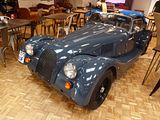

MORGAN MUSEUM
There is a rather unpromising looking door at the back of the shop area or there is one directly from the outside, and once you enter, there is a treasure trove of Morgan memorabilia and space for a few cars to be displayed.


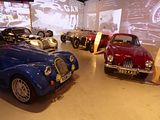
H.F.S. Morgan’s first car design was a single-seat three-wheeled runabout, which was fabricated for his personal use in 1908, with help from William Stephenson-Peach, the father of friends, and the engineering master at Malvern College. Powered by a 7 hp Peugeot twin cylinder engine (from an abandoned motorcycle project), the car had a backbone chassis, an idea retained for all following Morgan three-wheelers, and used as little material and labour as Morgan could manage. A single-seat three-wheeler with coil-spring independent front suspension, unusual at the time, the driveshaft ran through the backbone tube to a two-speed transmission (with no reverse), and chain drive to each of the rear wheels. The steering was by tiller, and it had band brakes. It also had no body. With financial help from his father and his wife, the car was put into production at premises in Pickersleigh Road, Malvern Link. Three single-seater cars were exhibited at the 1910 Motor Show at Olympia in London. This is a replica of that car.


In 1912, Morgan set out to win the trophy offered by The Light Car & Cyclecar for greatest distance covered in an hour, at Brooklands. The single-seater covered 55 mi (89 km), only to be narrowly beaten by a GWK; Morgan returned later the same year, reaching nearly 60 miles. Morgan established its reputation via competition such as winning the 1913 Cyclecar Grand Prix at Amiens in France, driven by W. G. McMinnies, with an average speed of 42 mph (68 km/h) for the 163 miles. This became the basis for the ‘Grand Prix’ model of 1913 to 1926, from which evolved the ‘Aero’, and ‘Sports’ models. Morgan himself won the “very tough” ACU Six Days’ Trial in 1913, in the sidecar class. The same year, the company entered the MCC reliability trial, which it continued to do until 1975. Racing success led to demand the company proved unable to meet. These models used air-cooled or liquid-cooled variations of motorcycle engines. The engine was placed ahead of the axis of the front wheels in a chassis made of steel tubes brazed into cast lugs. After the First World War, the company introduced an easily changed rear wheel, which customers had been seeking for several years. The 1921 Popular, powered by an 8 hp JAP and bodied in poplar, sold for £150. It was a sales success, the price dropping to £128, and the name changing to Standard, by 1923, when a Blackburne engine was also available. The Grand Prix was priced £155, and the Family (with two notional child seats behind the front bench, setting a standard 2+2s would follow for generations) was £148 with air-cooled engine, or £158 with water-cooled engine. The Anzani-powered Aero was also available, for £148. MAG engines were also optional. Morgan’s racing efforts suffered a blow in 1924, when E. B. Ware’s JAP-engined car rolled at the JCC 200 miles at Brooklands; Ware was seriously hurt, leading to a ban on three-wheelers competing as cars. Electric headlamps were made available in 1924, at an £8 cost. The Popular, powered by a 976 cc engine, sold for £110, the 1,098 cc (67 cu in) Aero for £148, and the one-seater £160. Like motorcycles, Morgans had hand throttles, Bowden-wire control mechanisms, and drip lubrication. Racing Morgans included Harold Beart’s 1,096 cc Blackburne-engined special, with 3.33:1 top gear and a 43 lb (20 kg) streamlined body, which covered 91.48 miles in a one-hour trial at Brooklands, with a peak speed of over 100 mph. In 1925, the Standard’s price had dropped to £95, and the Aero £130, compared to £149 for an Austin Chummy. Electric lighting by dynamo became standard that year. Front-wheel brakes and electric start (a £10 option) became available in 1927, while the Standard’s price fell to £89, complete with a double-thickness windscreen and “electric hooter”. By year’s end, the Standard was even cheaper, £85, while the new Super Sports debuted, with an overhead valve JAP 10/40 water-cooled vee-twin, priced £155. The 10/40 engine was also available in the Aero, at £132, while a more sedate air-cooled JAP-powered Aero went for £119. The Family was priced at £102 (air-cooled) or £112 (water-cooled). These new, lower prices persisted through 1928. They would be lower still in 1929: the Standard and Family at £87 10s, the Aero £110, and the Super Sports £145. In 1933, the Family was priced at only £80. Morgan’s racing programme in 1927 earned the marque eleven gold medals and three silvers from fourteen entrants at MCC’s London-Edinburgh Trials alone. The team was joined by Clive Lones and C. T. Jay, who won the 1929 Cyclecar Grand Prix at Brooklands, driving a 750 cc (46 cu in) Morgan-JAP, with an average speed of 64.7 mph. And in 1930, Gwenda Stewart turned in a speed of 113 mph in a race-tuned Super Sports. Morgan three-wheelers benefitted from an annual tax of just £4, half the tax on the Austin 7, provided they remained under 8 cwt. Morgans were also licence-built in France by Darmont. By 1930, however, inexpensive four-wheeled cars were proliferating, led by the £100 Ford Popular. Morgan, and partner George Goodall, countered by putting the 8 hp 933 cc and 10 hp 1,172 cc Ford engine in their own cars. Morgan’s last vee-twins were powered by Matchless engines displacing 990 cc; they were delivered to Australia after the Second World War. The vee-twin models were not returned to production after World War II. The Three Wheeler returned in 2012 in a modern re-interpretation and it has proved a huge success.

The Morgan F-Type was the final development of the three-wheeler. Launched at the Olympia show in November 1933, it was powered by an 8 hp 993 cc four-cylinder Ford side-valve engine. The first examples of the new car were four-seat family models known as the F4, but by 1935 a two-seater, the F2, was introduced and in 1938, the faster F Super appeared fitted with the more powerful 10 hp engine. This car was first registered in June 1942 and has been owned by the Morgan family from new. Charles Morgan learnt to drive in DWP 969.


This is a “Flat Rad”, the name given to the first of the 4-wheeled cars, produced from 1935. and more correctly called the 4-4. The first cars had the sliding pillar suspension of the three-wheeler plus an underslung live rear axle sitting over Z-section cross-section chassis side rails, carried in leaf springs. The first cars had a 34 bhp 1122 Coventry Climax four cylinder engine, a crossflow with overhead inlet and side exhaust valves. In competition form it had a slightly smaller capacity of 1098cc and it put out a healthy 50 – 60 bhp. The car enjoyed considerable success with a lightened car winning the Tourist Trophy in 1937 on handicap and in 1938 if finished second in class at Le mans. In 1939, Morgan changed to the 1267 cc overhead valve Standard Special engine which was both lighter and more powerful. Post was the name was changed to Plus 4 and in 1950 the engine was replaced by the much larger 2088cc 68 bhp Standard engine from the Vanguard and the body was revised to be slightly wider and roomier. The bodies were made of steel over a wooden frame. three different styles were offered: a two seater, a four seat tourer and a drophead coupe. This last was more sophisticated with a fixed windscreen frame sliding windows and a three position hood. The first of the cowled radiator cars arrived in 1953.


The Morgan Plus 4 Plus or +4+ was an attempt by the Morgan Motor Company to modernize the bodywork. Announced at the 1963 Earls Court Motor Show, only 26 were built, due to poor sales, in spite of its performance. The equipment may have varied between cars, but were typically mechanically similar to a Morgan +4 of the same year. It had the straight-four, pushrod engine of a Triumph TR4A, giving 110 hp. The transmission was a four-speed with synchromesh on the top three gears. It also shared the suspension with the +4: In front, it had sliding king pins tilted 17 degrees from the vertical, a development of Morgan’s original, 1910 design. This was lubricated by grease and by engine oil released by a button under the clutch pedal. It had very firm coil springs and bottoming coils instead of rubber pads. The rear has conventional leaf springs with solid rear axle. There was no perceptible body lean, even when cornering very hard. It had disc brakes in front, drums in the rear, with no power assist. The frame was made up of Z section steel rails with structural plywood floor, extended by steel tubes in front. The closed envelope two seat body was thin streamlined fibreglass with fixed top and all glass windows, wind-ups on the sides, giving it a weight of 1800 pounds (816 kg) and a top speed of around 115 mph (185 km/h) (compared to 111 mph (179 km/h) for the heavier, less streamlined TR4A). Performance was better than +4, because the fibreglass kept the weight low in spite of more interior space, and the more modern shape had less air drag. Sound insulation was limited, but leg room was unusually generous.

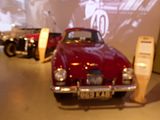
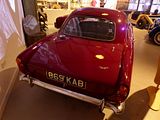
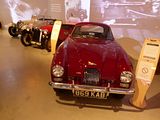
2009 was the centenary year of Morgan and the company took part in FIA GT3 using the Aero Supersports which was claimed to be more aerodynamic. The Aero Supersports had been released at the prestigious 2009 Villa d’Este event. The AutoGT team sponsored by Banque Baring Sturdza with former Renault F1 drivers Jean Pierre Jabouille and Jacques Laffite made a great impression at the start of the year. At the Silverstone, No. 100 got pole and won the first race then No. 101 secured pole and won the second race. The car was among Audi R8, Aston Martin, Ferrari and other supercars which made the styling contrast all the more remarkable. With a custom gearbox and slight enlargement of the engine the car was instantly competitive. The lower revving V8 and side exhaust layout resulted in a very distinctive NASCAR style off-beat sound which was deep and very loud. After one year of racing the rules were amended making it difficult for the car to run in 2010. One of the cars in racing colours remains with the factory and is the model seen here.
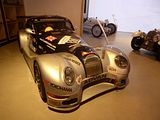
Final car in the museum area was the prototype EV3. This is effectively an electric prototype version of the Three Wheeler and it was shown at a number shows starting from 2017. The electric motor was rated at 101 bhp, and was estimated to produce 150 miles of range (240 km) with a 20 kWh lithium-ion battery. Production plans for the EV3 were cancelled in late 2018 though there is a clear visual link to the new Super 3 model of 2022.


This was a very agreeable evening, with a chance to see a very varied array of cars as well as some of the latest Morgan models and another chance to take in the exhibits in the comapy’s museum. There is one further event at this site in 2025 and I hope to be able to come along to take it all in.