Having enjoyed my first visit to the “Motors at the Manor” event last month, it was not a hard decision to pay add the July edition to my calendar. Not yet that well known, this monthly Thursday evening gathering of a hitherto disparate collection of classic and interesting cars takes place at the Stanton Manor Hotel, in the small Wiltshire village of Stanton St Quintin, just a stone’s throw off the M4 at junction 17. A small country hotel, much of the parking space is allocated to this event, and I can certainly see that as word spreads, it could well get very tight to get all the cars in, but for now, there is plenty of room, and of course there is the hotel bar and restaurant on hand for a bite to eat and a drink. Here are the cars that I saw on the July 2025 edition of the event.


ABARTH
I took my Abarth along to this event. Rumours started to circulate towards the end of 2014 that Abarth were going to upgrade the Competizione model, so as better to bridge the gap between the Turismo and the 190 bhp 695 Biposto that had been added to the range earlier in the year. It was Geneva 2015 when the result was finally shown to an expectant fan base. Most exciting news was that thanks to a bigger Garrett Turbo, the engine had been tweaked to 180 bhp, and with reduced CO2 emissions. A standard spec that included Koni Dampers, Brembo brakes, Xenon lights, Sabelt seats, Climate Control, parking sensors as well as other refinements that had been added like the TFT instrument display all proved very compelling, so not long after the first cars reached the UK in June of 2015, I found temptation too hard to resist, and as is well documented here, swapped my 2010 car for one of these. At the time I ordered it, Cordolo Red, a tri-coat pearlescent paint which shimmers in bright sunlight looked set to become one of the most popular colours of the lot, even though it is a cost option. Indeed, the Launch Edition models were all offered either in this colour or Scorpion Black, with black wheels. Surprisingly, the colour was not carried over to the Series 4 cars.


FERGUSON
The Ferguson TE20 is an agricultural tractor designed by Harry Ferguson. By far his most successful design, it was manufactured from 1946 until 1956, and was commonly known as the Little Grey Fergie. It marked a major advance in tractor design, distinguished by light weight, small size, manoeuvrability and versatility. The TE20 popularised Harry Ferguson’s invention of the hydraulic three-point hitch system around the world, and the system quickly became an international standard for tractors of all makes and sizes that has remained to this day. The tractor played a large part in introducing widespread mechanised agriculture. In many parts of the world the TE20 was the first tractor to be affordable to the average farmer and was small and light enough to replace the draft horse and manual labour. Many TE20s remain in regular use in farming and other work and the model is also a popular collector’s item for enthusiasts today. The model name came from Tractor, England 20 horsepower (not the true power delivered but from a tax formula based on engine size). The TE range of Ferguson tractors was introduced in England in 1946, following 30 years of continuous development of the Ferguson System from 1916. The first work was to design a plough and linkage to integrate the tractor with its work in a manner that was an engineering whole. The automatic control system is now employed by almost all tractor manufacturers worldwide. A British patent was applied for by Harry Ferguson in 1925 and granted the following year. By the early 1930s, the linkage design was finalised and is now adopted as international standard category I. Just one prototype Ferguson System tractor, known as the Ferguson Black, was built to further technical development and for demonstrating to potential manufacturers. During 1936, the first production Ferguson tractors were built in Huddersfield, Yorkshire, by the David Brown Company. That tractor, the Ferguson Model A, incorporated Harry Ferguson’s “suction side” hydraulic control system, the key to solving sensitive automatic control of three-point mounted implements, patented on 5 February 1936 (patent no 470069). The combination of Ferguson’s converging three-point hitch, patented on 3 July 1928 (patent no 320084) with his “suction side control” valve is the key to the success of all subsequent Ferguson and later Massey Ferguson “Ferguson System” tractors, the most important of which are the TE and TO 20 models. (It was the production of the Model A that led to the David Brown line of tractors in 1939). In order to get volume production with lower costs, following a demonstration of his tractor before Henry Ford Senior in October 1938, Ferguson made a gentlemen’s agreement with Ford, also referred to as the handshake agreement, to produce the Ferguson tractor in Detroit starting in mid-1939. Officially called the Ford Tractor Ferguson System they are more commonly known as the Ford-Ferguson. The first Ford-Ferguson 9N (for 1939 model N) tractors arrived in the United Kingdom in October 1939 and thousands would be imported to help with food production during the War. In 1942 due to material shortages after the USA entry into the War the model was updated to the 2N (for 1942 model N). About 300,000 of these tractors, known as “Ford-Fergusons”, were produced up to 30 June 1947. During the war years, the Ferguson design team developed many improvements to both tractor and implements and started to make arrangements to manufacture in the United Kingdom. The agreement with Ford in 1938 was to include production at the Ford plant at Dagenham, Essex, but the UK Ford company would not do it.[4] By 1945, Ferguson had made a manufacturing agreement with the Standard Motor Company of Coventry to produce a Ferguson tractor incorporating all their latest improvements and to be known as the TE20. As well as allowing Ferguson to get his tractor into full production, the deal was of great benefit to Standard, because the tractor would be built in its huge “shadow factory” which had been an aero engine plant during World War II but was then standing empty. Standard developed a new wet-liner engine for the tractor, and for Standard’s road cars, such as the Vanguard. Production started in the late summer of 1946, nearly a year before the last Ford Ferguson came off the line in Detroit in June 1947. The break with Ford left Harry Ferguson and his US company with implements to sell but no tractors. To make up the gap until the new Ferguson factory in Detroit started in October 1948, more than 25,000 Coventry-built TE20s were shipped to the US and Canada. The TO (Tractor Overseas) 20 was virtually the same as the TE20, with a Continental engine Z-126 fitted instead of the Standard engine. At the time of its introduction the Ferguson three-point linkage was unique to the TE20, and to gain the full utility of the tractor the farmer also had to purchase specially designed implements to work with the tractor. Ferguson initially designed and manufactured a range of implements for the TE20 in-house, but as the tractor’s popularity spread other manufacturers began designing their own machinery for the TE20 in agricultural, industrial, construction and horticultural applications. The idea that the three-point linkage made the tractor and its implement into a single mechanised unit was marketed as ‘The Ferguson System’, presenting a wholly new and entirely mechanised form of agriculture. By 1950 there were over 60 official Ferguson implements for the TE20, many of which had not been seen in mechanised tractor-mounted form before. As well as basic implements such as ploughs, harrows and cultivators, the range included a number of trailers and loaders, seed drills, a side-mounted baler, a very rare ‘wraparound’ combine harvester, a muck spreader, a sickle mower and a powered auger. With its power take-off, the tractor could also drive stand-alone equipment, such as pumps, milking machinery or circular saws, by belt or driveshaft. Ferguson became well known for its effective and distinctive advertising, intended to demonstrate the abilities of the TE-20 tractor to farmers who previously had used only draft horses and had little experience with mechanised equipment. Public demonstrations of Ferguson tractors and implements were held throughout rural Britain towards the end of the harvest season. A typical demonstration involved fencing off an area 27 by 20 ft (8.2 by 6.1 m) and using a cultivator-equipped TE-20 to till the complete area – such an area was too small to be worked by a horse or a drawbar-equipped tractor of the time. Advertising also emphasised that in the ‘Ferguson System’ the tractor was not merely a replacement for the horse but, via its linkage and shaft-drive power take-off, it could mechanise dozens of agricultural tasks previously performed either by separate machines, unwieldy drawbar-mounted trailed equipment, or manual labour. The TE and TO 20 tractors were so revolutionary that Ferguson set up a training school in the grounds of Stoneleigh Abbey, close to the Banner Lane factory. There, Ferguson dealers, salesmen and engineers were trained on the new machines they would be working on, and courses were also run for farmers to learn how to most effectively operate the tractors and the various implements. Coventry production up to 1956 was 517,651 units, with about 66% being exported, mainly to Continental Europe and the British Empire, but to many other countries as well. To the above figure must be added TO production at Ferguson Park, Detroit. Including all ‘Ferguson System’ tractors from May 1936 to July 1956 brings the figure to approximately 1 million. Between 1953 and 1957, over 37,000 TE20 tractors were assembled in Saint-Denis near Paris by a joint venture between the Standard Motor Company and Automobiles Hotchkiss. Additionally, in 1957 and 1958, Standard-Hotchkiss built nearly 29,000 of the FF30; introduced in January 1957, this version had 100 percent French parts content, a sprung seat, a red-painted engine and chassis, and power was up to 30 hp. The FF30 was nicknamed Ventre Rouge (“Red Belly”) in France. Local parts content had been gradually increased, for instance, the engines began to be locally assembled in 1955. Harry Ferguson merged his worldwide companies with Massey-Harris of Toronto in July 1953, three years before TE and TO20 production ended, hence the change of name on the serial plate to ‘Massey-Harris-Ferguson’. The Ferguson 35 replaced the old line in the US in 1955 and the TE20 in the UK in 1956; production in the UK starting in September of that year following re-tooling of the factory. Harry Ferguson remained Chairman of Massey Harris Ferguson until 1957, when he left over an argument over the Ferguson TE60 or LTX project as it is known.


FORD
Sporting Escorts appeared only a matter of months after the launch of the regular 1100 and 1300cc cars. The first of these was a higher performance version designed for rallies and racing, the Escort Twin Cam. Built for Group 2 international rallying, it had an engine with a Lotus-made eight-valve twin camshaft head fitted to the 1.5 L non-crossflow block, which had a bigger bore than usual to give a capacity of 1,557 cc. This engine had originally been developed for the Lotus Elan. Production of the Twin Cam, which was originally produced at Halewood, was phased out as the Cosworth-engined RS1600 production began. The most famous edition of the Twin Cam was raced on behalf of Ford by Alan Mann Racing in the British Saloon Car Championship in 1968 and 1969, sporting a full Formula 2 Ford FVC 16-valve engine producing over 200 hp. The Escort, driven by Australian driver Frank Gardner went on to comfortably win the 1968 championship. The Mark I Escorts became successful as a rally car, and they eventually went on to become one of the most successful rally cars of all time with arguably the Escort’s greatest victory in the 1970 London to Mexico World Cup Rally, co-driven by Finnish legend Hannu Mikkola and Swedish co-driver Gunnar Palm. This gave rise to the Escort Mexico, which had a 1600cc “crossflow”-engined, as a special edition road version in honour of the rally car. Introduced in November 1970, 10,352 Mexico Mark I’s were built. In addition to the Mexico, the RS1600 was developed with a 1,601 cc Cosworth BDA which used a Crossflow block with a 16-valve Cosworth cylinder head, named for “Belt Drive A Series”. Both the Mexico and RS1600 were built at Ford’s Advanced Vehicle Operations (AVO) facility located at the Aveley Plant in South Essex. As well as higher performance engines and sports suspension, these models featured strengthened bodyshells utilising seam welding in places of spot welding, making them more suitable for competition. After updating the factory team cars with a larger 1701 cc Cosworth BDB engine in 1972 and then with fuel injected BDC, Ford also produced, in the autumn of 1973, an RS2000 model as an alternative to the somewhat temperamental RS1600, featuring a 2.0 litre Pinto OHC engine. This also clocked up some rally and racing victories; and pre-empted the hot hatch market as a desirable but affordable performance road car. Like the Mexico and RS1600, this car was produced at the Aveley plant.


JAGUAR
Successor to the E Type was the XJ-S, launched in September 1975, and to a not universally approving public. This was a very different sort of sporting Jaguar, more boulevard cruiser than sports car, even though the car had plenty of appeal with its smooth V12 engine which gave it genuine 150 mph performance. Press reports were favourable, but a thirsty V12 and a car with inconsistent build quality and styling that not everyone warmed to meant that sales were slow, and they got slower as the decade passed, leading questions to be asked as to whether the car should continue. As well as sorting the saloon models, Jaguar’s Chairman, John Egan, put in place a program to improve the XJ-S as well, which also benefitted from the HE engine in early 1981. A Cabrio model and the option of the new 3.6 litre 6 cylinder engine from 1984 widened the sales appeal, and the volumes of cars being bought started to go up. A fully open Convertible, launched in 1988 was the model many had been waiting for, and by this time, although the design was over 10 years old, it was now brimming with appeal to many. 1991 saw an extensive facelift which changed the styling details as well as incorporating the latest mechanical changes from the Jaguar parts bin, making the XJS (the hyphen had been dropped from the name in 1990) a truly desirable car. Seen here were both pre- and post-facelift models as well as one of the rare TWR-converted XJR-S cars. These were made between 1988 and 1993 by the newly formed JaguarSport, a separate company owned in a ratio of 50:50 by Jaguar and TWR Group Limited specialising in developing high performance Jaguar sports cars. The car had a distinctive body kit, special alloy wheels, a unique suspension system utilising modified coil springs and Bilstein shocks, a luxurious interior with Connolly Autolux leather along with walnut wood trim, and handling improvements. The first 100 of these cars were named “Celebration Le Mans” to commemorate Jaguar’s 1988 win at the 24 Hours of Le Mans and were only sold in the UK. Between 1988 and 1989, a total of 326 XJR-S cars were produced with the 5.3 litres engine with a power output of 318 bhp. After September 1989, the displacement of the engine was increased to 5,993 cc and it was now equipped with Zytek fuel injection and engine management system. This was different from the standard 6.0-litre engine used in the late XJS models and was unique to this model. The power output was raised to 334 bhp at 5,250 rpm and 495 Nm (365 lb/ft) of torque at 3,650 rpm due to a higher compression ratio of 11.0:1, a new forgedsteel crankshaft, increased bore and forged alloy pistons. A modified air intake system and a low loss dual exhaust system was also standard on the model. The engine was mated to the 3-speed GM400 automatic transmission utilising a recalibrated valve body and had faster shift times. The car was equipped with Dunlop D40 M2 tyres for better grip. These modifications resulted in a top speed of 260 km/h (160 mph). A total of 787 coupés and 50 convertible XJR-S were built for the world market.


MASERATI
The Maserati GranTurismo and GranCabrio (Tipo M145) are a series of a grand tourers produced from 2007 to 2019. They succeeded the 2-door V8 grand tourers offered by the company, the Maserati Coupé, and Spyder. The GranTurismo set a record for the most quickly developed car in the auto industry, going from design to production stage in just nine months. The reason being that Ferrari, after selling off Maserati to the Fiat Chrysler Group, took the designs of the proposed replacement of the Maserati Coupé and after some modifications, launched it as the Ferrari California. Unveiled at the 2007 Geneva Motor Show, the GranTurismo has a drag coefficient of 0.33. The model was initially equipped with a 4.2-litre V8 engine developed in conjunction with Ferrari. The engine generates a maximum power output of 405 PS and is equipped with a 6-speed ZF automatic transmission. The 2+2 body was derived from the Maserati M139 platform, also shared with the Maserati Quattroporte V, with double-wishbone front suspension and a multilink rear suspension. The grand tourer emphasises comfort in harmony with speed and driver-enjoyment. The better equipped S variant was unveiled at the 2008 Geneva Motor Show and features the enlarged 4.7-litre V8 engine shared with the Alfa Romeo 8C Competizione, rated at 440 PS at 7,000 rpm and 490 Nm (361 lb/ft) of torque at 4,750 rpm. At the time of its introduction, it was the most powerful road-legal Maserati offered for sale (excluding the homologation special MC12). The engine is mated to the 6-speed automated manual shared with the Ferrari F430. With the transaxle layout weight distribution improved to 47% front and 53% rear. The standard suspension set-up is fixed-setting steel dampers, with the Skyhook adaptive suspension available as an option along with a new exhaust system, and upgraded Brembo brakes. The seats were also offered with various leather and Alcantara trim options. The upgrades were made to make the car more powerful and more appealing to the buyers while increasing performance, with acceleration from 0–100 km/h (0–62 mph) happening in 4.9 seconds and a maximum speed of 295 km/h (183 mph). Aside from the power upgrades, the car featured new side skirts, unique 20-inch wheels unavailable on the standard car, a small boot lip spoiler, and black headlight clusters in place of the original silver. The variant was available in the North American market only for MY2009 with only 300 units offered for sale. The GranTurismo MC is the racing version of the GranTurismo S developed to compete in the FIA GT4 European Cup and is based on the Maserati MC concept. The car included a 6-point racing harness, 120 litre fuel tank, 380 mm (15.0 in) front and 326 mm (12.8 in) rear brake discs with 6-piston calipers at the front and 4-piston calipers at the rear, 18-inch racing wheels with 305/645/18 front and 305/680/18 rear tyres, carbon fibre bodywork and lexan windows throughout along with a race interior. All the weight-saving measures lower the weight to about 3,000 lb (1,361 kg). The car shares the 4.7-litre V8 engine from the GranTurismo S but is tuned to generate a maximum power output of 450 PS along with the 6-speed automated manual transmission. The GranTurismo MC was unveiled at the Paul Ricard Circuit in France. It went on sale in October, 2009 through the Maserati Corse programme. 15 GranTurismo MC racecars were developed, homologated for the European Cup and National Endurance Series, one of which was taken to be raced by GT motorsport organization Cool Victory in Dubai in January, 2010. Introduced in 2008, the GranTurismo MC Sport Line is a customisation programme based on the GranTurismo MC concept. Changes include front and rear carbon-fibre spoilers, carbon-fibre mirror housings and door handles, 20-inch wheels, carbon-fibre interior (steering wheel rim, paddle shifters, instrument panel, dashboard, door panels), stiffer springs, shock absorbers and anti-roll bars with custom Maserati Stability Programme software and 10 mm (0.4 in) lower height than GranTurismo S. The programme was initially offered for the GranTurismo S only, with the product line expanded to all GranTurismo variants and eventually all Maserati vehicles in 2009. Replacing both the GranTurismo S and S Automatic, the Granturismo Sport was unveiled in March 2012 at the Geneva Motor Show. The revised 4.7L engine is rated at 460 PS. The Sport features a unique MC Stradale-inspired front fascia, new headlights and new, sportier steering wheel and seats. The ZF six-speed automatic gearbox is now standard, while the six-speed automated manual transaxle is available as an option. The latter has steering column-mounted paddle-shifters, a feature that’s optional with the automatic gearbox. New redesigned front bumper and air splitter lowers drag coefficient from Cd=0.33 to 0.32. In September 2010, Maserati announced plans to unveil a new version of the GranTurismo – the MC Stradale – at the 2010 Paris Motor Show. The strictly two-seat MC Stradale is more powerful than the GranTurismo at 450 PS, friction reduction accounts for the increase, says Maserati, due to the strategic use of “diamond-like coating”, an antifriction technology derived from Formula 1, on wear parts such as the cams and followers. It is also 110 kg lighter (1,670 kg dry weight) from the GranTurismo, and more aerodynamic than any previous GranTurismo model – all with the same fuel consumption as the regular GranTurismo. In addition to two air intakes in the bonnet, the MC Stradale also receives a new front splitter and rear air dam for better aerodynamics, downforce, and improved cooling of carbon-ceramic brakes and engine. The body modifications make the car 48 mm (2 in) longer. The MC Race Shift 6-speed robotised manual gearbox (which shares its electronics and some of its hardware from the Ferrari 599 GTO) usually operates in an “auto” mode, but the driver can switch this to ‘sport’ or ‘race’ (shifting happening in 60 milliseconds in ‘race’ mode), which affects gearbox operations, suspension, traction control, and even the sound of the engine. The MC Stradale is the first GranTurismo to break the 300 km/h (186 mph) barrier, with a claimed top speed of 303 km/h (188 mph). The push for the Maserati GranTurismo MC Stradale came from existing Maserati customers who wanted a road-legal super sports car that looked and felt like the GT4, GTD, and Trofeo race cars. It has been confirmed by the Maserati head office that only 497 units of 2-seater MC Stradales were built in total from 2011 to 2013 in the world, Europe: 225 units, China: 45 units, Hong Kong: 12, Taiwan: 23 units, Japan: 33 units, Oceania: 15 units and 144 units in other countries. US market MC’s do not have the “Stradale” part of the name, and they are sold with a fully automatic six-speed transmission rather than the one available in the rest of the world. US market cars also do not come with carbon fibre lightweight seats like the rest of the world. The MC Stradale’s suspension is 8% stiffer and the car rides slightly lower than the GranTurismo S following feedback from racing drivers who appreciated the better grip and intuitive driving feel of the lower profile. Pirelli has custom-designed extra-wide 20-inch P Zero Corsa tyres to fit new flow-formed alloy wheels. The Brembo braking system with carbon-ceramic discs weighs around 60% less than the traditional system with steel discs. The front is equipped with 380 x 34 mm ventilated discs, operated by a 6 piston caliper. The rear discs measure 360 x 32 mm with four-piston calipers. The stopping distance is 33 m at 100 km/h (62 mph) with an average deceleration of 1.2g. At the 2013 Geneva Motor Show, an update to the GranTurismo MC Stradale was unveiled. It features an updated 4.7 litre V8 engine rated at 460 PS at 7,000 rpm and 520 Nm (384 lb/ft) of torque at 4,750 rpm, as well as the MC Race Shift 6-speed robotized manual gearbox which shifts in 60 milliseconds in ‘race’ mode. The top speed is 303 km/h (188 mph). All models were built at the historic factory in viale Ciro Menotti in Modena. A total of 28,805 GranTurismos and 11,715 units of the convertible were produced. The final production example of the GranTurismo, called Zéda, was presented painted in a gradient of blue, black and white colours.


MERCEDES-BENZ
The R230, introduced in 2001, continues the evolution of R129 with smoother body design and new peanut-shaped headlamp design. The fifth-generation SL-Class featured a ‘Vario Roof’ retractable hardtop, as introduced on the 1996 SLK Class: Active Body Control (ABC) active suspension system, Keyless Go keyless entry and smart key, and Sensotronic Brake Control (SBC) electro-hydraulic power brake system. The SBC proved troublesome, and was later disabled by Mercedes-Benz in a large recall campaign due to the difficulties in modulating the brake effort. In 2006, R230 received a minor cosmetic update and revised engine options. The R230 SL underwent a significant facelift in 2008 featuring new and revised engines and a new front end that evokes the classic 300 SL with a large grille featuring a prominent 3-pointed star and twin “power domes” on the bonnet, the car also features new headlights with an optional “Intelligent Light System” and a new speed sensitive steering system. The SL 63 AMG replaced the SL 55 AMG. A high-performance version of R230, SL 65 AMG Black Series, was offered as a coupe only body type. A total of 169,433 SL R230s were ever produced. The most common model is SL500 (~100,000 units). The rarest is SL65 AMG with only 3,055 units (350 of which SL65 AMG Black Series).

MG
Whilst the TC, the first postwar MG and launched in 1945, was quite similar to the pre-war TB, sharing the same 1,250 cc pushrod-OHV engine, it had a slightly higher compression ratio of 7.4:1 giving 54.5 bhp at 5200 rpm. The makers also provided several alternative stages of tuning for “specific purposes”. It was exported to the United States, even though only ever built in right-hand drive. The export version had slightly smaller US specification sealed-beam headlights and larger twin rear lights, as well as turn signals and chrome-plated front and rear bumpers. The body of the TC was approximately 4 inches wider than the TB measured at the rear of the doors to give more cockpit space. The overall car width remained the same resulting in narrower running boards with two tread strips as opposed to the previous three. The tachometer was directly in front of the driver, while the speedometer was on the other side of the dash in front of the passenger. 10,001 TCs were produced, from September 1945 to Nov. 1949, more than any previous MG model. It cost £527 on the home market in 1947.


Launched in October 1962, the MGB was produced for the next 18 years and it went on to become Britain’s best selling sports car. When first announced, the MGB was an innovative, modern design, with a monocoque structure instead of the traditional body-on-frame construction used on both the MGA and MG T-types and the MGB’s rival, the Triumph TR series, though components such as the brakes and suspension were developments of the earlier 1955 MGA and the B-Series engine had its origins back in 1947. The lightweight design reduced manufacturing costs while adding to overall vehicle strength, and with a 95hp 3-bearing 1798cc engine under the bonnet, performance was quite respectable with a 0–60 mph time of just over 11 seconds. The car was rather more civilised than its predecessor, with wind-up windows now fitted as standard, and a comfortable driver’s compartment offered plenty of legroom. The roadster was the first of the MGB range to be produced. The body was a pure two-seater but a small rear seat was a rare option at one point. By making better use of space the MGB was able to offer more passenger and luggage accommodation than the earlier MGA while being 3 inches shorter overall. The suspension was also softer, giving a smoother ride, and the larger engine gave a slightly higher top speed. The four-speed gearbox was an uprated version of the one used in the MGA with an optional (electrically activated) overdrive transmission. A five-bearing engine was introduced in 1964 and a number of other modifications crept into the specification. In late 1967, sufficient changes were introduced for the factory to define a Mark II model. Alterations included synchromesh on all 4 gears with revised ratios, an optional Borg-Warner automatic gearbox, a new rear axle, and an alternator in place of the dynamo with a change to a negative earth system. To accommodate the new gearboxes there were significant changes to the sheet metal in the floorpan, and a new flat-topped transmission tunnel. US market cars got a new safety padded dashboard, but the steel item continued for the rest of the world. Rostyle wheels were introduced to replace the previous pressed steel versions in 1969 and reclining seats were standardised. 1970 also saw a new front grille, recessed, in black aluminium. The more traditional-looking polished grille returned in 1973 with a black “honeycomb” insert. Further changes in 1972 were to the interior with a new fascia. To meet impact regulations, in late 1974, the chrome bumpers were replaced with new, steel-reinforced black rubber bumpers, the one at the front incorporating the grille area as well, giving a major restyling to the B’s nose, and a matching rear bumper completed the change. New US headlight height regulations also meant that the headlamps were now too low. Rather than redesign the front of the car, British Leyland raised the car’s suspension by 1-inch. This, in combination with the new, far heavier bumpers resulted in significantly poorer handling. For the 1975 model year only, the front anti-roll bar was deleted as a cost-saving measure (though still available as an option). The damage done by the British Leyland response to US legislation was partially alleviated by revisions to the suspension geometry in 1977, when a rear anti-roll bar was made standard equipment on all models. US emissions regulations also reduced horsepower. In March 1979 British Leyland started the production of black painted limited edition MGB roadsters for the US market, meant for a total of 500 examples. Due to a high demand of the limited edition model, production ended with 6682 examples. The United Kingdom received bronze painted roadsters and a silver GT model limited editions. The production run of home market limited edition MGBs was split between 421 roadsters and 579 GTs. Meanwhile, the fixed-roof MGB GT had been introduced in October 1965, and production continued until 1980, although export to the US ceased in 1974. The MGB GT sported a ground-breaking greenhouse designed by Pininfarina and launched the sporty “hatchback” style. By combining the sloping rear window with the rear deck lid, the B GT offered the utility of a station wagon while retaining the style and shape of a coupe. This new configuration was a 2+2 design with a right-angled rear bench seat and far more luggage space than in the roadster. Relatively few components differed, although the MGB GT did receive different suspension springs and anti-roll bars and a different windscreen which was more easily and inexpensively serviceable. Although acceleration of the GT was slightly slower than that of the roadster, owing to its increased weight, top speed improved by 5 mph to 105 mph because of better aerodynamics. 523,826 examples of the MGB of all model types were built, and although many of these were initially sold new in North America, a lot have been repatriated here.


The MGC was produced as a sort of replacement for the Big Healey, though apart from sharing that car’s 3 litre straight six C Series engine, the reality is that the car was quite different and generally appealed to a different sort of customer. Or, if you look at the sales figures, you could say that it did not really appeal to anyone much, as the car struggled to find favour and buyers when new. More of a lazy grand tourer than an out and out sports car, the handling characteristics were less pleasing than in the B as the heavy engine up front did the car no favours. The market now, finally, takes a different view, though and if you want an MGC, in Roadster or the MGC GT form the latter of which was to be seen here, you will have to dig surprisingly deeply into your pocket.


MORGAN

OPEL
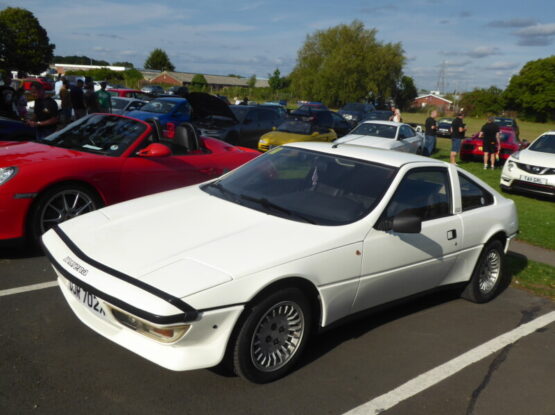
The second, the Manta B, in Opel speak lasted far longer than the first. It was launched in August 1975. This two-door “three-box” car was mechanically based directly on the then newly redesigned Opel Ascona, but the overall design was influenced by the 1975 Chevrolet Monza. The Manta had more “sporty” styling, including a droop-snoot nose not seen on the Ascona, which was similar to the UK equivalent, the Cavalier Mk1. Engines were available ranging from the small 1.2-litre OHV engine, the 1.6-litre CIH and the 1.9-litre CIH. Also in 1976 the GT/E engine from the Manta A series was adapted into the Manta B programme spawning the GT/E Manta B series. In 1979 the GT/E had the engine replaced with the new 2.0 litre CIH and with a new designed Bosch L injection system. Power output was now 108 hp. The 1.9-litre engine gave way to the 2.0 litre S engine which was aspirated by a Varajet II carburettor. This engine was the most used engine by Opel at the time, and was to be found in several Opel Rekord cars. In 1978, a three-door hatchback version appeared to complement the existing two-door booted car. This shape was also not unique, being available on the Vauxhall Cavalier Sports Hatch variant. Both Manta versions received a facelift in 1982, which included a plastic front spoiler, sideskirts for the GT/E and GSi models, a small wing at the rear and quadruple air intakes on the grille. Also the 1.2-, 1.6- and 1.9-litre engines were discontinued and replaced by the 1.3-litre OHC engine, the 1.8-litre OHC and the 2.0-litre S and E CIH engines (although the 75 PS 1.9N continued to be available in a few markets). The GT/E was renamed and was called the GSi from 1983 (except in the UK where the GT/E name continued). Production of the Manta continued well after the equivalent Ascona and Cavalier were replaced by a front-wheel-drive model “Ascona C”. The Vauxhall Cavalier Mk1 Sportshatch and Coupe did not continue past 1981, and there were no coupe versions the MK2 Cavalier range. In 1982 the 1.8-litre Opel Family II engine from the Ascona C was fitted in the Manta B (replacing the CIH unit) making a more economical Manta B to drive. It could run 14 km per litre and use unleaded fuel. The 1.8 was very popular and was in production for 5 years (1982–1987). The 2.0S models where discontinued in 1984 and only the GSi was available with the “large” engine (GT/E in the UK). In 1986 Opel released the last Manta B model the Exclusive (1987 in the UK), giving it all of the best in equipment. Recaro seats with red cloth, grey leather like interior and the full bodypack known from the i200 models. This consisted of twin round headlights in a plastic cover, front spoiler and rear lower spoiler from Irmscher, sideskirts and the known 3 split rear spoiler of the Manta 400 (producing 80 kg (176 lb) of weight on the rear at 200 km/h). In the UK, the Exclusive GT/E models were available in colours such as Dolphin Grey with matching dark grey cloth seats with red piping. These also had the quad headlights, front spoiler but a rear bumper which housed the number plate, coupled with a black plastic strip between the rear light clusters. The rear spoiler was similar to the standard GT/E. Opel finally ceased the production of the Manta B in 1988, only producing the GSi version after 1986 (it was sold as the GT/E in the UK). Its successor, the Calibra – sold as a Vauxhall in Britain, and as an Opel everywhere else – was launched in 1989.

RELIANT
More of a luxury model than the SE5, the SE6 series Scimitar GT, launched in October 1975, was aimed more at the executive market. These models were two-door sports estates, again with the Ford V6 3.0 litre engine as used in the 5a with 135 bhp,: the wheelbase was increased by 4 inches and the track by 3 inches making the cars correspondingly longer and wider than their predecessors. The extra length was used to improve rear-seat legroom and access which enhanced the car’s credentials as a ‘genuine’ four-seater. The SE6 was replaced by the SE6A in late 1976. 543 SE6 models were produced. The SE6A displayed a number of changes, including Lockheed brakes and suspension revisions. An easy way to spot a 6A from a 6 is the change to orange from red reflectors on the rear extractor vents, and the 3 vertical grooves in the front bumper (in front of the wheelarches) were removed. 3877 SE6As were made – making it the most popular version of all the SE6 shape. Ford stopped making the “Essex” engine for the Capri by 1981, and production stopped completely in 1988 so one of the major differences with the SE6B was the engine. The German-built Ford “Cologne” 2.8 litre V6 was used instead (thus the chassis on the 6B differs from the 6/6A at the front) and provided similar power but rather less torque at low revs. The final drive ratio was lowered from 3.31:1 to 3.54:1 to compensate. All SE6Bs (and the SE8) were equipped with the quite troublesome Pierburg/Solex carburettored engines (many owners have changed to the Weber 38DGAS from the Essex engine) and although the battery was moved from the 6/6A position to allow for injection equipment to be fitted, none ever left the factory so fitted. Some late versions (around 1983 on) came with the galvanised chassis as standard but the exact numbers and chassis details are vague. Introduced at the 1980 Geneva Motor Show, only 437 SE6Bs were manufactured. Production ceased by 1986. But that was not the end of the story. After production at Reliant ceased, Middlebridge Scimitar Ltd. acquired the manufacturing rights to the Scimitar GTE and GTC in June 1987. This company, based in Beeston, Nottingham, produced a 2.9 litre version of the GTE with many modifications and modernisations (over 450) including electronic fuel injection and a five-speed Ford T9 gearbox.(with the Ford A4LD 4 speed auto as an option). The fifth Middlebridge Scimitar built was delivered to HRH The Princess Anne. Only 78 Scimitars (all but 3 cars in RHD) were ever produced by Middlebridge before the company went into receivership in 1990. One GTC was made, using a LHD body from Reliant which was converted by Middlebridge to RHD but the car was never completed and eventually the body and chassis were separated and sold off to new owners. The production rights were subsequently acquired by Graham Walker Ltd., which as of 2014 built Scimitars to order


STANDARD
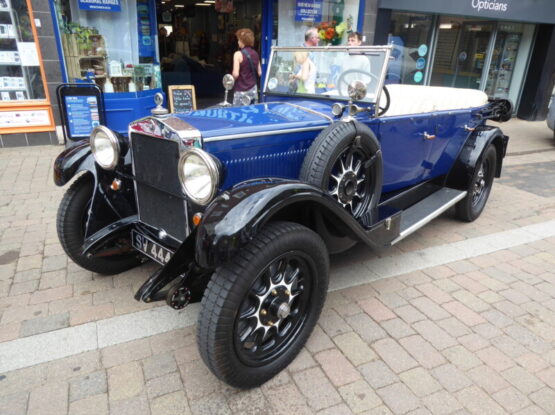
A civil engineer by profession, Reginald Walter Maudslay was quick to recognise the rapidly increasing scope of the horseless carriage and founded the Standard Motor Company in Coventry during 1903. By the end of that year, three cars powered by over-square, single-cylinder engines had been produced and a labour force of twenty-five amassed. There are various explanations for the company name, from the cars being assembled from ‘standardised patterns and interchangeable parts’ to the founder proclaiming he ‘was determined to maintain the best possible standard’. Whatever, success came its way and in 1924 production reached 10,000 cars, earning it a market share comparable to that of the Austin Motor Company. The models produced in the ’20s were named after English towns – not just those local to the factory, such as Canley, Kenilworth and Warwick, but some much further afield, eg Teignmouth, Falmouth and Exmouth. The Warwick SLO4 was a 4/5-seater Tourer powered by an advanced 1944cc four-cylinder OHV engine of 13.9 hp mated to a four-speed manual gearbox. This particular car has an interesting history. This SLO is from batch 6, number 969 out of a batch of 1000 examples that was sanctioned in 1922. This was the last production of this model, which was soon replaced by the SLO4 model which carried a bored-out engine to increase the cubic capacity from 1598 cc to 1944 cc (11.6 H.P. to 13.9 H.P.) This larger engine was then married to a four-speed gearbox – hence the digit ‘4’ on the end of the letters SLO. This car carries the original registration number which is a Peterborough number and the car was to spend the first 34 years of its life in Cambridgeshire, Rutland and Lincolnshire until it moved down south. There is an old-style buff log book that came with the car and the first entry is a George Day of Peterborough with a date stamp of 3rd April 1950. Although how long Mr Day had owned the car prior to this I couldn’t say. The car was then transferred to Oswald Humphrey de Bolam of Normanton Park, Empingham, near Oakham, Rutland on 6th April 1950. In 1975 much of the valley was flooded to create Rutland Water and Normanton Park is now a hotel on the shores of Rutland Water. The car was then transferred to a Gordon Howard Valentine of Peterborough and then to a Richard Alan Hepworth of Peterborough before it was sold to a Derek Neville Herbert of 22 Linden Way, Boston, Lincolnshire on 6th September 1954. Derek Herbert entered the car in the Vintage Sports Car Club (VSCC) Buxton Rally that was held over the weekend of 2nd – 3rd April 1955. My first picture of the car was taken on this event, in the village of Castleton in the Peak District, some 10 miles from Buxton. The pictures (that follow) are courtesy of Simon Hunt and are from a series of several pictures of this event that were taken by his father. In November 1956 the car was sold to the Standard Triumph Agents in Croydon, “Carrs Auto Services Ltd” sometimes known as “Carrs of Croydon”. The car remained a garage showroom exhibit until the garage shut down in the mid-1980s. The car very rarely left its warm garage showroom, except to take part in the annual local carnival parade. One of the few exceptions was in 1961 when the car attended the 1961 Standard Rally that was organised by the Standard Register and was a drive from the Southampton distributors to the Montagu Motor Museum at Beaulieu. The car still carries a plaque from the 1961 Rally which was exclusively for Pre-1930 Standards. My 1913 Standard Rhyl also took part in the 1961 Rally, so out of an entry list of 34 cars, I now own two of them. Towards the end of its ownership by Carrs Auto Services Ltd, the car was on the Standard Motor Club Stand at the 1983 Classic Car Show that was held at The Hotel Metropole, Brighton. The car even picked up an award “Car of the Show” in the pre-war category. When Carrs Auto Services shut down in the mid-1980s, the SLO moved to The Bentley Wildfowl and Motor Museum, Halland, Near Lewes, East Sussex, where it was to remain until the Museum shut its doors for the final time in 2018. After the museum shut its doors in 2018, it was sold through a dealer – Malcolm Elder, and was purchased by the late A J C Spencer of Tysoe, Warwickshire. The current owner then acquired it to add to his collection of vintage Standard models.


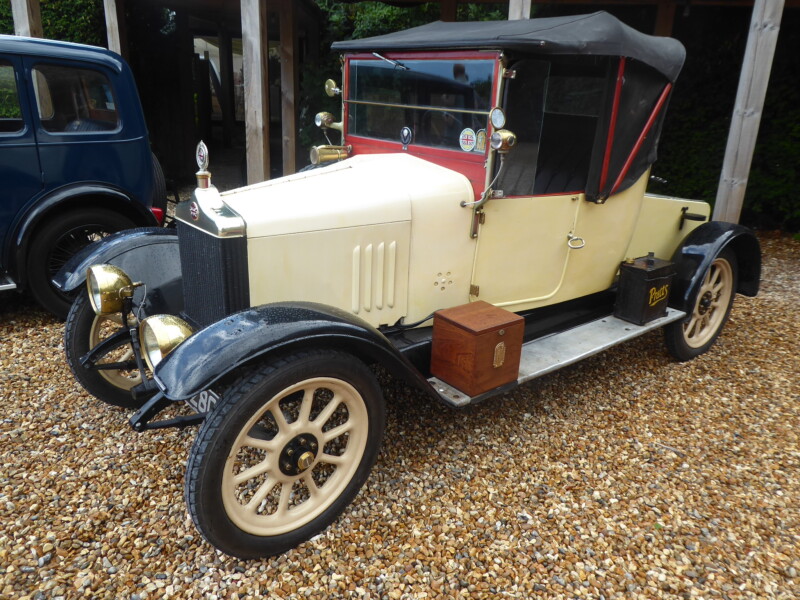
This is a 1934 Ten. The “Ten” was the result of some major re-styling Standard performed for the 1934 season and was intended as the replacement for the 1933 “Big Nine”. The Ten saloon was available initially in three forms, standard, special and deluxe and later in Ten/Twelve form with the larger “Twelve” engine in the Ten body. Each form having a higher level specification. The de luxe seems to be most prevalent today. It has a 1343cc side valve engine developing 32 bhp at 3600 rpm giving it a peak power to weight ratio of 34.6 bhp per ton. For comparison a 1964 Morris minor 1000 has 64 bhp per ton. Taxation rules in the 30s favoured engines with relatively small cylinder bores. In order to achieve higher capacity manufacturers made long stroke engines with relatively low maximum revs. It has an advertised top speed of 60 mph but the engine feels a bit busy over 40 mph. I found an article which summarises the history of this car, as follows: “This Ten was originally sold to Dorothy Walker, a teacher in Bournemouth by Stanbourne Motor Co. Ltd. in July 1934 when she traded in her Austin 7. It was “condor grey” with a brown interior. While doing some work a few years ago I found a hat pin and emery board in the recesses of a rear glove pocket. I know from census records that Dorothy Walker never married and lived with her cousin almost her entire life. Who knows if the items I found belonged to them. Having already been driving in 1934 she would have been exempt from taking the driving test when it was introduced in 1935. The car was in her ownership and taxed until 1965, at which point she was 75. Perhaps she gave up driving then and it was put on blocks, I can only speculate. She died in 1980 at the age of 90. The next time the car appears is when Dr. I.N.L. Johnston of Lymmington joins the Standard Motor Club with it in 1982. By this time it has been painted cream. It then enters a mysterious phase between 1988 and 1992 when it was owned by Gordon Hamilton of Turniff in Scotland, but there are receipts for work done in the south of England including being repainted in its current colours in 1991. The club has a record that it was sold at Southerby’s auction, but I can find no proof of this. In 1992 it found a new owner in Eastleigh only a few hundred yards from where I was working but I never saw it. Something must have happened to the owner and it was rescued from a tumble-down garage in 2002 by a club member in Hampshire. The engine was seized but they brought the car back to life. Much to my delight in 2015 they offered to sell it to me. I have tried to bring it up to tip-top mechanical condition and it’s running really well. The eagle eyed among you will notice the blue triangle sticker in the windscreen. In 1960 a basic roadworthiness test was introduced for all cars over 10 years old and became known as the “ten year test”. Its introduction caused many old cars to be scrapped. The sticker indicates that the Standard was lucky enough to pass its 10 year test. It was 26 years old at the time! The test evolved into what we now know as the MOT. So this old standard has seen the introduction of two tests; one for the driver and one for the car!”


SUNBEAM
The first Sunbeam to bear the Alpine name was an open-topped version of the Sunbeam-Talbot 90 sports saloon, named after the model’s success in rallying, especially the Monte Carlo rally, launched in 1953. Kenneth Howes and Jeff Crompton were tasked with doing a complete redesign in 1956, with the goal of producing a dedicated sports car aimed principally at the US market to compete with the MGs and Triumphs that were very popular. Ken Howes contributed some 80 per cent of the overall design work, which bears more than incidental resemblance to the early Ford Thunderbird, hardly a surprise, as Howe had worked at Ford before joining Rootes. The Alpine was produced in four subsequent revisions until 1968. Total production numbered around 70,000. Production stopped shortly after the Chrysler takeover of the Rootes Group. Styled by the Loewy Studios for the Rootes Group, the “Series” Alpine started production in late 1959. One of the original prototypes still survives and was raced by British Touring car champion Bernard Unett. The car made extensive use of components from other Rootes Group vehicles and was built on a modified floorpan from the Hillman Husky estate car. The Series I used a 1,494 cc engine with dual downdraft carburettors, a soft top that could be hidden by special integral covers and the first available wind-up side windows offered in a British sports car of that time. The running gear came mainly from the Sunbeam Rapier, but with front disc brakes replacing the saloon car’s drums. An overdrive unit and wire wheels were optional. The suspension was independent at the front using coil springs and at the rear had a live axle and semi-elliptic springing. The Girling-manufactured brakes used 9.5 in discs at the front and 9 in drums at the rear. An open car with overdrive was tested by The Motor in 1959. It had a top speed of 99.5 mph and could accelerate from 0–60 mph in 13.6 seconds. A fuel consumption of 31.4 mpg was recorded. The test car cost £1031 including taxes. 11,904 examples of the series I were produced. The Series II of 1962 featured an enlarged 1,592 cc engine producing 80 bhp and revised rear suspension, but there were few other changes. When it was replaced in 1963, 19,956 had been made. The Series III was produced in open and removable hardtop versions. On the hardtop version the top could be removed and the soft-top was stored behind the small rear seat; also the 1592 cc engine was less powerful. To provide more room in the boot, twin fuel tanks in the rear wings were fitted. Quarter light were fitted to the windows. Between 1963 and 1964, 5863 were made. For the Series IV, made in 1964 and 1965, there was no longer a lower-output engine option; the convertible and hardtop versions shared the same 82 bhp engine with single Solex carburettor. A new rear styling was introduced with the fins largely removed. Automatic transmission with floor-mounted control became an option, but was unpopular. From autumn 1964 a new manual gearbox with synchromesh on first gear was adopted in line with its use in other Rootes cars. A total of 12,406 were made. The final version was the Series V, produced between 1965–68 which had the new five-bearing 1,725 cc engine with twin Zenith-Stromberg semi-downdraught carburettors producing 93 bhp. There was no longer an automatic transmission option. 19,122 were made.


TRIUMPH
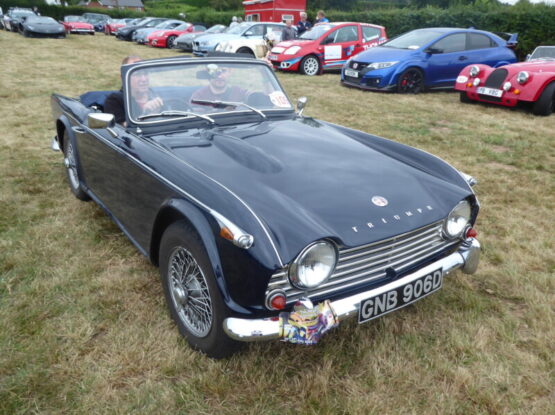
By the mid 1960s, money was tight, so when it came to replacing the TR4 and TR5 models, Triumph were forced into trying to minimise the costs of the redesign, which meant that they kept the central section of the old car, but came up with new bodywork with the front and back ends were squared off, reportedly based on a consultancy contract involving Karmann. The resulting design, which did look modern when it was unveiled in January 1969 has what is referred to as a Kamm tail, which was very common during 1970s era of cars and a feature on most Triumphs of the era. All TR6 models featured inline six-cylinder engines. For the US market the engine was carburetted, as had been the case for the US-only TR250 engine. Like the TR5, the TR6 was fuel-injected for other world markets including the United Kingdom, hence the TR6PI (petrol-injection) designation. The Lucas mechanical fuel injection system helped the home-market TR6 produce 150 bhp at model introduction. Later, the non-US TR6 variant was detuned to 125 bhp for it to be easier to drive, while the US variant continued to be carburetted with a mere 104 hp. Sadly, the Lucas injection system proved somewhat troublesome, somewhat denting the appeal of the car. The TR6 featured a four-speed manual transmission. An optional overdrive unit was a desirable feature because it gave drivers close gearing for aggressive driving with an electrically switched overdrive which could operate on second, third, and fourth gears on early models and third and fourth on later models because of constant gearbox failures in second at high revs. Both provided “long legs” for open motorways. TR6 also featured semi-trailing arm independent rear suspension, rack and pinion steering, 15-inch wheels and tyres, pile carpet on floors and trunk/boot, bucket seats, and a full complement of instrumentation. Braking was accomplished by disc brakes at the front and drum brakes at the rear. A factory steel hardtop was optional, requiring two people to fit it. TR6 construction was fundamentally old-fashioned: the body was bolted onto a frame instead of the two being integrated into a unibody structure; the TR6 dashboard was wooden (plywood with veneer). Other factory options included a rear anti-roll bar and a limited-slip differential. Some say that the car is one of Leyland’s best achievements, but a number of issues were present and remain because of poor design. As well as the fuel injection problems, other issues include a low level radiator top-up bottle and a poor hand-brake. As is the case with other cars of the era, the TR6 can suffer from rust issues, although surviving examples tend to be well-cared for. The TR6 can be prone to overheating. Many owners fit an aftermarket electric radiator fan to supplement or replace the original engine-driven fan. Also the Leyland factory option of an oil cooler existed. Despite the reliability woes, the car proved popular, selling in greater quantity than any previous TR, with 94,619 of them produced before production ended in mid 1976. Of these, 86,249 were exported and only 8,370 were sold in the UK. A significant number have since been re-imported, as there are nearly 3000 of these much loved classics on the road and a further 1300 on SORN, helped by the fact that parts and services to support ownership of a TR6 are readily available and a number of classic car owners’ clubs cater for the model.


Launched at the same time as the Rover 2000 was Triumph’s large saloon car, also called 2000. A replacement for the long running Standard Vanguard, this was the more sporting of the duo, with a subtly different appeal from the Rover. Between them, the cars defined a new market sector in the UK, promising levels of comfort and luxury hitherto associated with larger Rover and Jaguar models, but with usefully lower running costs and purchase prices, all in a modern package. Both added more powerful models to their range, with Rover going down the twin carburettor route, whilst in 1967, Triumph installed a larger 2.5 litre engine and the then relatively new fuel injection system, creating the 2.5PI, which is what was to be seen here. This Lucas system was not renowned for its reliability in the early days, but it did make the car rapid and refined. A facelift in 1969 brought new styling front and rear, which turned out to be a taster for a new grand tourer model which would emerge a few months later, and in this Mark 2 guise, the car was sold until 1977, in both saloon and estate guises. A mid range model, with twin carburettors but the larger engine, the 2500TC was introduced in 1974 and the 2500S arrived in 1975 with more power but also carb fed, to replace the troublesome and thirsty PI. These are the most sought after models now.


TVR
The Cerbera was first shown as a prototype at the 1994 Birmingham Show, entering production in 1996. The name derives from Cerberus the three-headed beast of Greek legend that guarded the entrance of Hades. This was the third car manufactured by TVR under the leadership of Peter Wheeler, and it represented three firsts for the Wheeler-led company: the first hard-top—the Griffith and the Chimaera were both convertibles; the first 2+2—TVRs were traditionally two-seaters; the first to be driven by TVR’s own engines—historically, TVR had purchased engines from mainstream manufacturers like Rover, Ford and Triumph. Prior to the Cerbera, TVR had purchased V8 engines from Rover and then tuned them for their own use. When Rover was purchased by BMW, Peter Wheeler did not want to risk problems should the Germans decide to stop manufacturing the engine. In response, he engaged the services of race engineer Al Melling to design a V8 engine that TVR could manufacture in-house and even potentially offer for sale to other car-makers. In an interview for the television programme Top Gear, Wheeler explained “Basically, we designed the engine as a race engine. It was my idea at the time that if we wanted to expand, we ought to make something that we could sell to other people. We’ve ended up with a 75-degree V8 with a flat-plane crank. The bottom-half of the engine to the heads is exactly as you would see in current Formula One engines.” Wheeler was quoted at the time of the car’s launch as saying that the combination of light weight and high power was too much for a road car, a quote which ensured much free publicity in the press. Enthusiasts still argue about whether this was a typical example of Wheeler’s legendary frankness, or an equally typical example of his PR chief Ben Samuelson’s knack for saving on advertising costs by creating a story. The result was dubbed the “Speed Eight” (official designation ‘AJP8’) after Al Melling, John Ravenscroft and Peter Wheeler, a 4.2 litre V8 producing 360 hp and gave the Cerbera a top speed of 185 mph (297 km/h). A 4.5 litre version of the engine was later offered with 420 hp. The AJP8 has one of the highest specific outputs of any naturally aspirated V8 in the automotive world at 83.3 hp/litre for the 4.2 and 93.3 hp/litre for the 4.5. Later models of the 4.5 litre engine had the ‘Red Rose’ option, which increased output to 440 bhp (97.7 hp/litre) when fuelled with super-unleaded (high octane) and the driver pushed the unmarked button on the dashboard which altered the engine mapping to suit. In some cases, real-world outputs for production V8s (4.5 in particular) were down from TVRs quoted output. Some of these have seen some form of modification (ECU, induction, exhaust etc.) to bring the power back up to the factory quoted output. One of the attractions of the V8 Cerberas for many owners was the loud backfire produced on overrun, particularly at low speeds. In fact this was the result of an argument at the factory between one of TVR’s executives and the engineers mapping the engine. The engineers wanted to map out this “irregularity” to improve fuel efficiency and CO2 emissions, whilst the executive insisted it was exactly the kind of thing owners would like. In the end a compromise was reached in which the popping and banging remained on the 4.5 litre cars. With the success of the Speed Eight program, Wheeler also undertook the design of a “Speed Six” engine to complement it. This engine also made its debut in the Cerbera but was a 4.0 litre inline slant six design with four valves per cylinder to the Speed Eight’s two. In service however it gained a reputation for unreliability and many engines had to be rebuilt. The car itself was designed from the start as a four-seater. The rear seats are smaller than the front, a design commonly referred to as a “2+2”. However, the interior is designed so that the passenger seat can slide farther forward than the driver’s seat. This allows more room for the person sitting behind the front passenger. TVR have referred to this as a “3+1” design. TVR maintained its tradition of building cars that were not only exceptionally powerful but also very light for their size and power output. The Cerbera’s weight was quoted by TVR at 1100 kilograms, although customers claimed the weight varied between 1,060 kg (2,337 lb) and 1,200 kg (2,646 lb). The dashboard was designed especially for the Cerbera and uses a two-spar steering wheel as opposed to the typical three-spar previously found in most TVRs. The reason for this is that minor instruments are located on a small panel below the steering wheel and a third spar in the wheel would have made them difficult to read. Like all TVRs of the Peter Wheeler era, the Cerbera had a long-travel throttle to compensate for the lack of electronic traction-control and very sharp steering. The V8 powered cars were two turns from lock to lock and the Speed Six car was 2.4 turns. This made it easier for experienced drivers to maintain or regain control of the car in the event of a loss of traction but some less experienced drivers complained that it made the cars feel “twitchy” and more responsive than they would otherwise have preferred. In 2000, TVR changed the styling of the car slightly by modifying the headlights to more closely resemble those seen in the TVR Tuscan. The “facelift” features were available with all three engine configurations. In addition, the cars equipped with the 4.5 litre engine were offered with the “lightweight” option, reducing the overall weight through the use of lighter body panels and a slightly reworked interior. The final car was made in 2006


Although there were fewer cars here than had been the case last month, this was still a very pleasant evening out. The location is most agreeable, the food on offer is both good and good value and there were enough people to talk to so I had enough to do for a good couple of hours before making the short journey back home. I look forward to more of this series of events at this venue.