The Queen Square Breakfast meets take place on the second weekend of the month, on a Sunday from March to October when they are held at Eastwood Park and on Saturdays in the winter as the chosen location Easter Compton is used for a massive Sunday market which takes up all the space. The only exception, usually, is December, when, in recognition of the fact that people tend to be getting increasingly focused on preparing for the Christmas festivities, when the event comes forward a week. Given that I had travelled to the US at the back end of November for 10 days, that should have meant that the December meet would take place a few hours before I was scheduled to leave California. But thanks to a truly dreadful weather forecast, the decision was taken to push the event back a week, by which time I was back in the UK, and hence able to attend. So, of course, I went along. Here is what I saw:
ABARTH
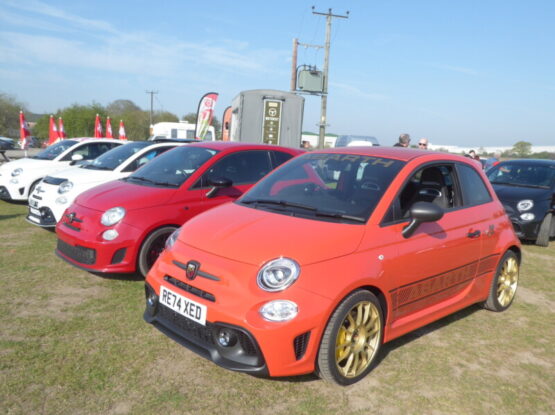
Having used the legendary 695 badging from the 1960s on the Tributo cars, at the 2012 Geneva Show, Abarth dusted off the 595 name that had been used on the less powerful of the Nuova 500 based cars of the same generation, and created two new versions which we should think of as Series 2 cars, the 595 Turismo and Competizione, both of which could be bought in either closed or open top C guise, with either the 5 speed manual or robotised automated gearshifts. Both models had the 160 bhp engine as standard. Effectively they were a replacement for the Esseesse kit, and it meant that the cars were produced complete at the factory, rather than needing the dealer to undertake the upgrade (and the associated paperwork), though Abarth did not withdraw the Esseesse kits from the market for some while. Turismo, as the name suggests was aimed slightly less extreme in intent, featuring standard leather upholstery, upgraded dampers and climate control, Xenon headlights and Alutex interior details. The sportier Abarth 595 Competizione replaced the leather seats with Sabelt cloth sport seats and Alutex with aluminium, while adding p-cross-drilled brakes and the Record Monza dual-mode exhaust.


What is known as the Series 4 version of the familiar 595 reached the markets in the middle of 2016. After rumours had circulated all winter following the launch of the facelifted Fiat 500 last year, Abarth finally unveiled the Series 4 at the end of May 2016. Initially, we were told that the cars would not be available in the UK until September, but that came forward somewhat, with dealers all receiving demo cars in June, and the first customers taking delivery in July. Three regular production versions of both the closed car and the open-topped C were initially available, all badged 595, and called Custom, Turismo and Competizione, as before, though numerous limited edition models have since appeared and in most case disappeared. The most significant changes with the Series 4 are visual, with a couple of new colours, including the much asked for Modena Yellow and a different red, called Abarth Red, which replaces both the non-metallic Officina and – slightly surprisingly – the tri-coat pearlescent Cordolo Red. as well as styling changes front and rear. The jury is still out on these, with many, me included, remaining to be convinced. At the front, the new air intake does apparently allow around 15 – 20 % more air in and out, which will be welcome, as these cars do generate quite a lot of heat under the bonnet. Competizione models for the UK retain the old style headlights, as they have Xenon lights as standard, whereas the Custom and Turismo cars have reshaped units. At the back, there are new light clusters and a new rear bumper and diffuser. Inside, the most notable change is the replacement of the Blue & Me system with a more modern uConnect Audio set up, which brings a new colour screen to the dash. Mechanically, there is an additional 5 bhp on the Custom (now 145) and Turismo (now 165 bhp) and the option of a Limited Slip Diff for the Competizione, which is likely to prove a popular option. Details of the interior trim have changed, with a filled-in glovebox like the US market cars have always had, and electric windows switches that are like the US ones, as well as a part Alcantara trim to the steering wheel in Competizione cars. This one, in Adrenaline Greem belongs to one of the event marshalls, Kieran Hyde.


ALFA ROMEO
Just one Alfa here, a modern Giulia.

ASTON MARTIN
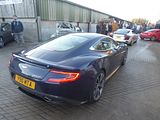
This version of the Vanquish started life as the Project AM310 Concept that was unveiled at the 2012 Concorso D’Eleganza at Villa D’Este on the shores of Lake Como, Italy. The concept car was based on the fourth generation VH platform. It included a tweaked version of Aston Martin’s familiar grille and headlight design and a more pronounced bulge in the bonnet – with the real One-77-inspired flourishes saved for the sides and the rear, the side vents run almost to the door handles (from One-77), new rear light design from One-77, and a 5.9-litre V12 engine that produced 550 PS. Aston Martin later announced that the concept would be put into production as the all new Aston Martin Vanquish. The exterior styling of the Vanquish is an evolution of the DBS with many styling cues such as the elongated side strakes being inspired by the Aston Martin One-77. The boot lid included an integrated rear spoiler designed to look as if it is impossible to make; this was done on the orders of Aston Martin Chief Executive, Dr. Ulrich Bez. The car has an exposed carbon fibre side skirt showing its all carbon fibre body. The Vanquish uses the new VH Generation IV platform which is lighter and uses more carbon fibre components than the VH Generation II platform used in the DBS. The car featured an all new interior based on the one found in the exclusive One-77. The standard interior was trimmed in hand stitched leather and alcantara and was available in a range of colours. The centre console features an revised infotainment system over the one found in the DBS. The car was available as either a 2-seater or 2+2. The Vanquish used an upgraded version of Aston Martin’s flagship 5.9-litre AM11 V12 engine called the AM28 with a power output of 565 bhp at 6,750 rpm and torque of 457 lb/ft at 5,500 rpm. The Vanquish can accelerate from 0 to 100 km/h (62 mph) in 4.1 seconds, and has a top speed of 295 km/h (183 mph). Like most Aston Martins, the engine is front mid-mounted for better weight distribution, with the power going to the rear wheels. The Vanquish has 51/49 front/rear weight distribution, and a kerb weight of 1,739 kg (3,834 lb). It uses a fully catalysed stainless steel exhaust system with active bypass valves. The Vanquish uses an updated Touchtronic II six-speed automatic gearbox. It was the first Aston Martin model to be available with launch control. The combined space of cabin and a boot that, at 368 litres, is more than 60% larger than that of the DBS. The brakes are ventilated carbon ceramic discs, 398 mm (15.7 in) six-piston callipers in the front and 360 mm (14.2 in) four-piston callipers in the rear. The suspension is a lightweight aluminium front subframe with hollow castings with independent double wishbones incorporating anti-dive geometry, coil springs, anti-roll bar, and monotube adaptive dampers in the front and independent double wishbones with anti-squat and anti-lift geometry, coil springs, anti-roll bar, and monotube adaptive dampers in the rear. It has a three-stage adjustable adaptive damping system including normal, sport and track modes. The tyres are Pirelli P Zeros, 255/ZR20 in the front and 305/30 ZR20 in the rear. The vehicle was unveiled in the London Film Museum, Covent Garden, followed by 2012 Monterey Car Week. Deliveries to UK and Continental Europe began in late 2012. In August 2014, Aston Martin revealed technical modifications to the Vanquish. The changes include a new eight-speed Touchtronic III gearbox and upgraded AM29 V12 engine that produces 568 bhp and torque of 465 lb/ft. The changes greatly enhanced performance, with an acceleration of 0 to 100 km/h (62 mph) in 3.6 seconds, and a top speed of 324 km/h (201 mph). In 2013, Aston Martin unveiled a convertible version of the Vanquish, called Volante. The Volante includes a full carbon fibre body, triple-skin lightweight fabric roof, 50% larger boot than its predecessor and the third generation Brembo 398 mm × 36 mm front and 360 mm × 32 mm CCM rear Carbon Ceramic Matrix (CCM) brake discs with six-piston front and four-piston rear brake callipers (from the One-77). The Vanquish Volante is 13% torsionally stiffer than the outgoing DBS Volante. The carbon fibre-skin of the Vanquish Volante was created by the engineering team at Aston Martin. The vehicle was unveiled at the 2013 Pebble Beach Concours d’Elegance. Deliveries to Europe began in late 2013. On 16 November 2016, Aston Martin announced the new Vanquish S model. The Vanquish S features the same AM29 V12 engine, with power now increased to 595 bhp, and a new aerodynamic package. The Vanquish S can accelerate from 0 to 100 km/h (62 mph) in 3.5 seconds, and the top speed remains unchanged at 201 mph (324 km/h). The starting price at launch was £199,950 and deliveries started in December 2016. Aston Martin also unveiled a convertible version of the Vanquish S called the Vanquish S Volante in 2017.

AUDI
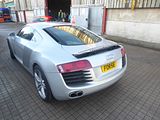
The Audi R8, based on the Audi Le Mans quattro concept car (designed by Frank Lamberty and Julian Hoenig) first appeared at the 2003 International Geneva Motor Show and the 2003 Frankfurt International Motor Show. The R8 road car was officially launched at the Paris Auto Show on 30 September 2006. There was some confusion with the name, which the car shares with the 24 Hours of Le Mans winning R8 Le Mans Prototype (LMP). Initial models included the R8 4.2 FSI coupé (with a V8 engine) and R8 5.2 FSI coupé (with a V10 engine). Convertible models, called the Spyder by the manufacturer, were introduced in 2008, followed by the high-performance GT model introduced in 2011. The Motorsport variants of the R8 were also subsequently introduced from 2008 onwards. An all-electric version called the e-Tron started development but would only reach production stage when the second generation model would be introduced. 6-time 24 Hours of Le Mans winner Jacky Ickx described the R8 as “the best handling road car today” and the car was well received by everyone who drove it. The car received a facelift in 2012 and a new model called the V10 Plus was now added to the range. Production of the Type 42 ended in August 2015

AUSTIN
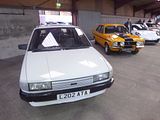
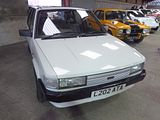
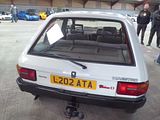
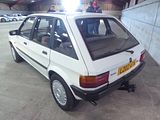
The Austin Maestro is a five-door hatchback small family car (and two-door van derivative) that was produced from 1982 to 1986 by British Leyland, and from 1986 until 1994 by Rover Group, as a replacement for the Austin Maxi and Austin Allegro, with the van version replacing the corresponding van derivative of the Morris Ital. The car was produced at Morris’ former Oxford plant, also known as Cowley, with 605,000 units sold. Today, the redeveloped factory builds the BMW Mini. An MG-branded performance version was sold as the MG Maestro from 1983 until 1991. Although later models were sometimes referred to as the Rover Maestro, the model never wore the Rover badge. The Austin Montego saloon was a variant of the Maestro. British Leyland was created in 1975 when the bankrupt British Leyland Motor Corporation was nationalised. In 1977 the South African-born corporate troubleshooter, Michael Edwardes, was recruited as chairman to sort out the troubled firm. Part of Edwardes’ plan was to introduce a completely new range of mass-market models to replace the current offerings, designed and built using state-of-the-art technology. The new range eventually decided upon consisted of a new vehicle for each of the small, lower-medium and upper-medium market segments. The first of these cars to be launched was the Austin Metro in 1980. The new cars for the lower and upper medium segments were to share a platform, with various trim and styling differences to distinguish the two different models. The two models would in effect replace four existing vehicles in the British Leyland range – the Maestro would simultaneously replace both the Austin Allegro and Maxi, whilst the Montego replaced the Austin Ambassador and Morris Ital, these latter two having been recent facelifts of the Princess and Morris Marina. Since all but the Allegro were made at the Cowley plant, this rationalization would give the cost benefits of production automation and flexibility. This common platform was given the project name LC10, using the Leyland Cars project sequence (LC8 became the Austin Mini Metro on its launch in 1980, LC9 became the Triumph Acclaim when it was launched in 1981). Preliminary design work for LC10 began in 1977, with production scheduled to begin around 1980 – which would have seen it go on sale around the same time as the Ford Escort MK3 and the original Vauxhall Astra. LC10 was styled by Ian Beech under the direction of BL designer David Bache. Two main body variations were provided: a five-door hatchback and a four-door notchback. It was a departure from previous front-wheel drive cars from the company in dispensing with the famous Issigonis transmission-in-sump powertrain that had been pioneered in the Mini. Coupled to the A- and R-series powerplants was an end-on transmission (as pioneered by Fiat with the Autobianchi Primula), bought from Volkswagen. The sophisticated Hydragas suspension system used on previous BL models was sacrificed on cost grounds, with a conventional MacPherson strut system at the front and a Volkswagen Golf-style torsion beam at the rear being used instead – but with long travel rising rate springs. While easier to build, this suspension did compromise load space. Prototypes were even tested with actual Golf suspension components. This may have led to the early cars being prone to front wheel bearing issues. The Maestro was larger and heavier than the first VW Golf. It was decided that the five-door hatchback version would be engineered first. It was given its own project designation, LM10, with this version to be launched as the Austin Maestro. The name “Maestro” had been a finalist when the Austin Metro was being named, with the third choice (“Match”) never picked up. The booted notchback version was to follow and it was designated as LM11, although its development was to diverge from the original path, it was later launched as the Austin Montego on its launch in April 1984, following British Leyland’s decision to discontinue the Morris marque. Production began in November 1982, and the car was officially launched on 1 March 1983. The wheelbase was 2,510 mm (8 ft 3 in), and the length was 4,050 mm (13 ft 3 in). The Maestro incorporated many novel and pioneering features for its class. It had a bonded laminated windscreen, homofocal headlamps, body-coloured plastic bumpers, an electronic engine management system, adjustable front seat belt upper anchorage positions, an asymmetrically split rear seat, and a 12,000-mile (19,300 km) service interval. The MG and Vanden Plas versions had solid-state instrumentation with digital speedometer and vacuum fluorescent analogue displays for tachometer, fuel and temperature gauges, trip computer and a voice synthesis warning and information system. The analogue instrument pod fitted to lower models was later used in the Range Rover from 1985 onwards. The Maestro was launched in March 1983. In its summing up of the new car the Consumers’ Association, in the June edition of its Which? journal, described it as roomy, comfortable, and nice to drive, and said “If you are considering buying one now, our advice, based on our first impressions, is to go ahead”. In January 1984, after testing the car, they concluded: “In comparison with opposition of a similar price and body size, the Maestro has a clear advantage on room for passengers, with few cars equalling it for comfort either in the front or back”. They also considered it to be a serious rival to the higher-segment Vauxhall Cavalier and Ford Sierra, apart from its smaller boot space. The original lineup consisted of the 1.3-litre base, L, and HLE models, the 1.6-litre L, HLS, and Vanden Plas, and the sporty MG Maestro. The HLE model had a somewhat downtuned engine and received Volkswagen’s “monstrously long-geared” 3+E transmission to maximize fuel economy, at the cost of severe performance loss. To further up the HLE’s economy game, it was fitted with an econometer and the same black rubber fins along the sides of the rear windshield as was the MG Maestro. The base model forwent the other versions’ plastic bumpers, instead being fitted with black-painted steel units. The plastic bumpers were the first of their kind, being made from polybutylene terephthalate (PBT), allowing them to be painted and then oven cured at the same high temperature as the car’s steel body. The 1.6 HLS and Vanden Plas received a 4+E gearbox (a five-speed with a particularly long top gear), while the MG’s closer ratio five-speed box derived from that of the Golf GTi. A trip computer with a voice synthesizer was standard on the MG and Vanden Plas models, with the Vanden Plas also benefitting from bronze-tinted windows, power locks, and power windows for the front doors. The car was a reasonable success, but not as much as beleaguered BL had hoped. It was Britain’s sixth best selling car in 1983 and 1984, with more than 80,000 sales in its second year. After the “boom” years of 1986 and 1987, Maestro sales went into decline. An early reputation for poor build quality and unreliability did not help. The biggest problems centred around the 1.6-litre R-series engine, which was a hurriedly modified BMC E-series engine from the Austin Maxi because the under-developed S-series unit was not yet ready for production. R-series units suffered from hot starting problems and premature crankshaft failure. This was particularly evident in the MG Maestro 1600, which was included in the original 1983 model range but discontinued the following year. The new S-series engine eventually appeared in July 1984, and was fitted to all existing 1.6-litre Maestros. The new S-series engine also came fitted with electronic ignition. At the same time, some minor equipment upgrades were made across the range. The 1.3-litre base model gained head restraints, a passenger door mirror and a radio. The 1.3-litre HLE, 1.6-litre automatic and 1.6 HLS all gained a radio-cassette player. In October 1984, there were more equipment upgrades made across the range. The 1.3 base models gained reclining front seats, door bins, locking fuel filler caps and clocks. The L models gained cloth door trim, upgraded upholstery, and remote-adjustable driver’s side door mirrors; the 1.6 Ls gained five-speed gearboxes. The 1.3 HLEs gained five-speed “4+E” gearboxes with overdrive fifth gear ratios, side mouldings, tweed cloth upholstery and remotely adjustable passenger’s side door mirrors. The HLS and 1.6 automatics gained tinted glass, central locking, electric front windows, velour upholstery and upgraded radio-cassette players. The MG Maestros gained electronic fuel-injected 115 bhp versions of the 2-litre O-series engine, uprated suspension and ventilated front disc brakes, colour-keyed exterior trim, tinted glass, central locking and leather-trimmed steering wheels. The new MG Maestro offered much better performance and refinement than its predecessor. Also in October 1984, the existing Maestro line-up was joined by the 1.3 HL and 1.6 HL. These models fitted between the L and HLE models. August 1985 saw the arrival of the 1.3 City and 1.3 City X. The 1.3 City was similar to the previous 1.3 base model. The 1.3 City X added full carpeting, cloth upholstery, head restraints, a rear parcel shelf, a radio and a manually operated choke. These models also did without the plastic bumpers, having more conventional steel bumpers with plastic end caps similar to the Maestro van. The original dashboard was of a multi-piece construction, and gained a reputation for being flimsy and prone to squeaks and rattles, so in February 1986, this was replaced with the more conventional dashboard from the Montego and in the change the voice synthesis unit (prone to reliability issues) was dropped. At the same time more minor equipment upgrades were made across the range. The City X gained door bins and rear wash-wipe. The L and LE gained tweed trim. The HL and automatic gained velour trim and additional brightwork. The Vanden Plas gained leather trim and uprated electronic stereo system. BL was sold to British Aerospace in 1988, when the Austin badges were discontinued. The range was sustained by the noisy but economical direct injection naturally aspirated Perkins diesel unit launched the previous year. However, without a turbo this model was rather slow. The diesel had already been available in the Maestro van since 1986. The MG Maestro Turbo, fitted with a turbocharged version of the 2.0 fuel-injected engine from the MG Maestro EFi, was unveiled at the Motor Show in October 1988 and went on sale on 17 March 1989. It was one of the fastest production hatchbacks in the world with a top speed of 129 mph (208 km/h), making it faster than the Ford Escort XR3i and RS Turbo, as well as the Volkswagen Golf GTI. After the launch of the new Rover 200 in October 1989, the Maestro was repositioned as a budget entry level model, with only the base specification models remaining in production while the MG variants were discontinued in 1991. Production had peaked at more than 101,000 units in 1983, and as late as 1989 nearly 60,000 were made. Most sales were in the United Kingdom, where it peaked as the sixth best selling car with more than 80,000 sales in 1984, but by 1989 sales had halved and it was the 19th best seller. However, production figures fell to 38,762 for 1990, more than halving the following year to 18,450. 1991 was also the year that the MG-badged versions finished production, their place effectively being filled in the Rover range by faster versions of the 200-series hatchback. In 1992 the 81 bhp high revving Rover MDi / Perkins Prima turbo diesel unit from the Montego was launched, in the now reduced Maestro range (after the launch of the Rover 200/400), as a Clubman with steel bumpers or DLX with plastic bumpers. The turbo improved refinement, as well as performance, at no cost to fuel economy. It was very competitively priced, it was about the same price as the Rover Metro and Peugeot 205 non-turbo diesel superminis that were a size smaller. The only other engine option was the elderly 1.3-litre A series. In 1993, What Car? buyers’ guide section said: “Yes, its old, but nowadays it’s also very cheap. Popularity of noisy but economical and surprisingly rapid turbodiesel is what keeps this roomy car going.” Also in 1993, the Automobile Association road tested the turbo diesel. Their verdict: “You’re hardly likely to buy a Maestro diesel to improve your street cred! For turning heads, the 218/418 diesel is a much better proposition. However, disinterested passengers love the back seat, while the driver can relish the model’s marked reluctance to visit filling stations. Here’s a hatchback for buyers who are really serious about the substance rather than the image – and with a price tag that’s thousands of pounds lower than most of its rivals (shown in our comparison chart), you start saving even before your first forecourt stop. Unless you’re averse to gearchanging, this unpretentious Maestro turbo-diesel, at its competitive price, can’t seriously be faulted.” In 1993, however, production fell to just over 7,000 units and in its final year, 1994, just over 4,000 were produced, the last one rolling off the production line in December. The chassis development for the Maestro and Montego’s rear suspension was used as a basis for later Rover cars, and was well regarded. In 1994, the Maestro finished in 26th place in the JD Power Survey broadcast by Top Gear. This clearly left the model above more recently appeared competitors such as the Volkswagen Golf (52nd), Vauxhall Astra (59th) and the Ford Escort (61st). In September 1995 production was transferred to Varna, Bulgaria, in complete knock down (CKD) kit form. Around 2,000 vehicles were produced before the company (Rodacar AD) ceased production in April 1996 due to high import costs of the components and little demand for the cars. The majority of the Maestros produced were exported to other countries, including the UK. A small number of these were sold by Apple 2000 Ltd of Bury St Edmunds, and registered on an “N” prefix. In 1997, Parkway Services of Ledbury, Herefordshire, purchased a batch of 621 Maestro cars and vans in CKD kit form. These had been stored at Cowley, Oxfordshire, since their production in mid-1996, when they became surplus to requirements. The company built up the cars and converted the majority of them to RHD form using up Rover’s supply of parts. The National Database for Motoring Insurance has records of models registered between “R” and “51” number plates, meaning the overall period of Maestro availability, new in the United Kingdom, was from 1983 to 2001. In 1998 the Maestro was relaunched in the UK, by Wheeler International Ltd. Sold by Apple 2000 in Bury St Edmunds, Maestros were imported from Bulgaria and sold in the UK, France & Spain, these were the last factory examples available for sale. On 10 February 2001 in The Independent’s Edition of Your Money, Apple 2000 and the Maestro were Featured on the front page. In the Motoring section James Ruppert reports “FANCY a brand new Maestro?” you can have one for just £4299 and all remaining cars are appropriately finished in black. The tooling was then sold to First Automobile Works (FAW) in China, where the Maestro was available to the Chinese motoring market in both hatchback and van models. A new addition to the range was the FAW Lubao CA6410 – a Maestro hatch with a Montego front end. A handful of Chinese-made parts were imported into Britain whilst these cars were in production, which itself ended in 2005.


BMW
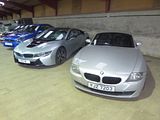
First introduced as the Concept Vision EfficientDynamics, the i8 was part of BMW’s “Project i” and was marketed as a new brand, BMW i, sold separately from BMW or Mini. The BMW i3, launched for customers in Europe in the fourth quarter of 2013, was the first model of the i brand available in the market, and it was followed by the i8, released in Germany in June 2014 as a 2015 model year. Other i models were expected to follow.The initial turbodiesel concept car was unveiled at the 2009 International Motor Show Germany, In 2010, BMW announced the mass production of the Vision EfficientDynamics concept in Leipzig beginning in 2013 as the BMW i8. The BMW i8 gasoline-powered concept car destined for production was unveiled at the 2011 Frankfurt Motor Show. The production version of the BMW i8 was unveiled at the 2013 International Motor Show Germany. The following are the concept and pre-production models developed by BMW that preceded the production version. When BMW i sponsored the ABB FIA Formula E World Championship, they announced that they would provide support vehicles; the i8 operated as the official safety car. BMW Vision EfficientDynamics concept car was a plug-in hybrid with a 1.5L three-cylinder turbo-diesel engine. Additionally, there were two electric motors with 104 kW (139 hp). It allowed an acceleration to 100 km/h (62 mph) in 4.8 seconds, with an electronically limited top speed of 250 km/h (155 mph). According to BMW, the average fuel consumption in the EU test cycle (KV01) was 3.76 L/100 km (75.1 mpg imp), with a carbon dioxide emission rating of 99 g/km(1,3 L/100 km and 33g CO2/kabelham; EU-PHEV ECE-R101). The estimated all-electric range was 50 km (31 mi), and the 24-litre petrol tank extended the total vehicle range to up to 700 km (430 mi). The lightweight chassis was made mainly from aluminium. The windshield, top, doors, and fenders were made from polycarbonate glass, with the body having a drag coefficient of 0.22. The designers of the BMW Vision EfficientDynamics concept were Mario Majdandzic for the exterior and Jochen Paesen (lead interior design), Markus Speck (interior design), and Felix Staudacher former Baerlin (detail design) for the interior. While Jochen Paesen took care of the main interior theme, Markus Speck was in charge of the seats, all the visible structure, and some details. Felix Baerlin supported Jochen Paesen on details including the steering wheel and centre console. The vehicle was unveiled at the 2009 International Motor Show Germany, followed by Auto China 2010. The BMW i8 Concept plug-in hybrid electric vehicle included an electric motor located in the front axle powering the front wheels rated 96 kW (131 PS; 129 hp) and 250 Nm (184 lb/ft, a turbocharged 1.5-litre 3-cylinder petrol engine driving rear wheels rated 164 kW (223 PS; 220 hp) and 300 Nm (221 lb/ft of torque, with combined output of 260 kW (354 PS; 349 hp) and 550 Nm (406 lb/ft), a 7.2 kWh (26 MJ) lithium-ion battery pack that allowed an all-electric range of 35 km (22 mi). All four wheels provided regenerative braking. The location of the battery pack in the energy tunnel gave the vehicle a low centre of gravity, enhancing its dynamics. Its top speed was electronically limited to 250 km/h (155 mph) and was expected to go from 0 to 100 km/h (0 to 60 mph) in 4.6 seconds. Under normal driving conditions the i8 was expected to deliver 80 mpg US (2.9 L/100 km; 96 mpg imp) under the European cycle. A full charge of the battery would take less than two hours at 220 V. The positioning of the motor and engine over the axles resulted in 50/50 weight distribution.The vehicle was unveiled at the 2011 International Motor Show Germany, followed by CENTER 548 in New York City, 42nd Tokyo Motor Show 2011, 82nd Geneva Motor Show 2012, BMW i Born Electric Tour at the Palazzo Delle Esposizioni at Via Nazionale 194 in Rome, and Auto Shanghai 2013. This concept car was featured in the film Mission: Impossible – Ghost Protocol. The BMW i8 Concept Spyder included a slightly shorter wheelbase and overall length compared to the BMW i8 Concept, carbon-fiber-reinforced plastic (CFRP) Life module, drive modules made primarily from aluminium components, interlocking of surfaces and lines, 8.8-inch (22.4 cm) screen display, off-white outer layer, and orange-toned naturally tanned leather upholstery. The vehicle was unveiled at Auto China 2012 in Beijing where it won Concept Car of the Year, followed by the 83rd Geneva International Motor Show 2013. The designer of the BMW i8 Concept Spyder was Richard Kim. The design of the BMW i8 coupe prototype was based on the BMW i8 Concept. The BMW i8 prototype had an average fuel efficiency of less than 2.5 L/100 km (113.0 mpg imp; 94.1 mpg US) under the New European Driving Cycle with carbon emissions of less than 59 g/km. The i8 with its carbon-fibre-reinforced plastic (CFRP) passenger cell lightweight, aerodynamically optimized body, and BMW eDrive technology offered the dynamic performance of a sports car, with an expected 0–100 km/h (0–62 mph) sprint time of less than 4.5 seconds using both power sources. The plug-in hybrid system of the BMW i8 comprised a three-cylinder, 1.5-liter BMW TwinPower Turbo gasoline engine combined with BMW eDrive technology used in the BMW i3 and developed maximum power of 170 kW (228 hp). The BMW i8 was the first BMW production model to be powered by a three-cylinder gasoline engine and the resulting specific output of 115 kW (154 hp) per liter of displacement was on par with high-performance sports car engines and was the highest of any engine produced by the BMW Group. The BMW i8’s second power source was a hybrid synchronous electric motor specially developed and produced by the BMW Group for BMW i. The electric motor developed maximum power of 131 hp (98 kW) and produced its maximum torque of around 320 Nm (236 lb/ft) from a standstill. Typical of an electric motor, responsive power was instantly available when starting and this continued into the higher load ranges. As well as providing a power boost to assist the gasoline engine during acceleration, the electric motor could also power the vehicle by itself. Top speed in electric mode was approximately 120 km/h (75 mph), with a maximum driving range of up to 35 km (22 mi). Linear acceleration was maintained even at higher speeds since the interplay between the two power sources efficiently absorbed any power flow interruptions when shifting gears. The model-specific version of the high-voltage 7.2 lithium-ion battery had a liquid cooling system and could be recharged at a conventional household power socket, at a BMW I Wallbox, or at a public charging station. In the US, a full recharge took approximately 3.5 hours from a conventional 120 V, 12 amp household circuit or approximately 1.5 hours from a 240 V Level 2 charger. The driver could select several driving modes: SPORT, COMFORT, and ECO PRO. Using the gear selector, the driver could either select position D for automated gear selection or could switch to SPORT mode. SPORT mode offered manual gear selection and at the same time switched to sporty drive and suspension settings. In SPORT mode, the engine and electric motor delivered extra performance, accelerator response was faster, and the power boost from the electric motor was maximized. And to keep the battery topped up, SPORT mode also activated maximum energy recuperation during overrun and braking as the electric motor’s generator function, which recharged the battery using kinetic energy, switched to a more powerful setting. The Driving Experience Control switch on the centre console offered a choice of two settings. On starting, COMFORT mode was activated, which offered a balance between performance and fuel efficiency, with unrestricted access to all convenience functions. Alternatively, the ECO PRO mode could be engaged, which, on the BMW i8 as on other models, supported an efficiency-optimized driving style. In this mode, the powertrain controller coordinated the cooperation between the gasoline engine and the electric motor for maximum fuel economy. On deceleration, the intelligent energy management system automatically decided, in line with the driving situation and vehicle status, whether to recuperate braking energy or to coast with the powertrain disengaged. At the same time, ECO PRO mode also programmed electrical convenience functions such as the air conditioning, seat heating, and heated mirrors to operate at minimum power consumption, but without compromising safety. The maximum driving range of the BMW i8 on a full fuel tank and with a fully charged battery was more than 500 km (310 mi) in COMFORT mode, which could be increased by up to 20% in ECO PRO mode. The BMW i8’s ECO PRO mode could also be used during all-electric operation. The vehicle was then powered solely by the electric motor. Only if the battery charge dropped below a given level, or under sudden intense throttle application such as kick down, was the internal combustion engine automatically activated. The vehicle was unveiled in BMW Group’s Miramas test track in France. The production BMW i8 was designed by Benoit Jacob. The production version was unveiled at the 2013 Frankfurt International Motor Show followed by 2013 Les Voiles de Saint-Tropez. Its design was heavily influenced by the BMW M1 Homage concept car, which in turn pays homage to BMW’s last production mid-engined sports car prior to the i8: the BMW M1. The BMW i8 featured butterfly doors, head-up display, rear-view cameras and partially false engine noise. Series production of customer vehicles began in April 2014. The electric two-speed drivetrain was developed and produced by GKN. It was the first production car with laser headlights, reaching farther than LED lights. The i8 had a vehicle weight of 1,485 kg (3,274 lb) (DIN kerb weight) and a low drag coefficient (Cd) of 0.26. In all-electric mode, the BMW i8 had a top speed of 120 km/h (75 mph). In Sport mode, the i8 delivered a mid-range acceleration from 80 to 120 km/h (50 to 75 mph) in 2.6 seconds. The electronically controlled top speed was 250 km/h (155 mph). The 20,000th i8 was produced in December 2019, one of the limited Ultimate Sophisto Edition models. The last i8 rolled off the production line on 11 June 2020. In total, there were 20,465 units produced: 16,581 coupés and 3,884 roadsters.

Also here was the Z4. This has been offered in three different generations, of which this is the first, consisting of the BMW E85 (roadster version) and BMW E86 (coupe version) sports cars. The E85/E86 generation was produced from 2002 to 2008. The E85/E86 replaced the Z3 and is the third model in the BMW Z Series. Initial models were in the roadster (E85) body style, with the coupé (E86) body style being added in 2006. As per the Z3, the E85/E86 was manufactured solely in Greer, South Carolina. The E85 was designed by Danish BMW-designer Anders Warming from mid-1998 to the summer of 1999. The coupe models were designed by Tomasz Sycha. The E85 designs were frozen on March 1, 2000. The Z4 was introduced at the Paris Motor Show in 2002, and North American models went on sale in November of the same year (as the 2003 model year). European sales began in March 2003. The Z4 Roadster was launched in 2002 with the 2.5i and 3.0i six-cylinder models. Transmission choices were a five-speed manual, six-speed manual, five-speed automatic and a six-speed SMG-II automated manual transmission. A four-cylinder model, the Z4 2.0i Roadster, was introduced for the European market in May 2005. The drag coefficient is maximum of Cd=0.35. BMW unveiled a concept coupé version of the Z4 at the 2005 Frankfurt Motor Show The design of the Z4 and Z4 coupé has variously been ascribed to Anders Warming, Chris Bangle, the controversial former BMW Head of Design, and Adrian van Hooydonk, former BMW chief designer, and BMW designer Tomasz Sycha. The design was approved in Summer of 2004 and frozen in December 2004. The company announced in 2005 that the two-door coupé would be available for production including the return of the M Coupé. The production car was introduced at the New York Auto Show in April 2006 and was available for sale in late May 2006. Thanks to its hatch design, the Z4 Coupé offers 10.1 cu ft (0.29 m3) of trunk space, compared with 8.5 cu ft (0.24 m3) for the roadster. The Coupe’s fixed roof increases torsional rigidity, resulting in a stiffness of 32,000 N⋅m (24,000 lb⋅ft) per degree of body twist on the coupe (compared to 14,500 N⋅m (10,700 lb⋅ft) per degree on the roadster), which improves turn-in and overall handling response. The roof has a “double-bubble” contour which serves as an aerodynamic aid and offers more headroom than the roadster with the soft top closed. The Coupé has a sleek fastback rear window that slopes down to an integrated spoiler which is shaped to deliver downforce to the rear axle at high-speed. The model range for the Coupé was more limited than the roadster, and consisted of the six-cylinder 3.0si and Z4 M model only. Transmission choices were a 6-speed manual and a 6-speed automatic with shift paddles mounted on the steering column. In February 2009, the BMW Z4 (E89) began production as the successor to the E85/E86.
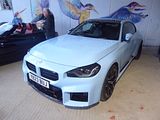
Final BMW of note was the latest, second generation M2.
CHEVROLET
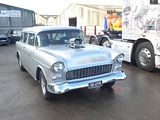
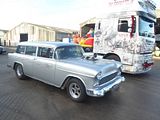
Chevrolet replaced the entire range of cars for 1955, producing what are sometimes referred to as the “Tri-Five” range, which would live for three years. Revolutionary in their day, they spawned a cult following that exists in clubs, website and even entire businesses that exclusively cater to the enthusiasts of the Tri Five automobiles. All featured a front-engine, rear-wheel-drive layout. They remain some of the most popular years for collectors and hot rodders. 1955-1957 were watershed years for Chevrolet, who spent a million dollars in 1956 alone for retooling, in order to make their less expensive Bel Air models look more like a Cadillac, culminating in 1957 with their most extravagant tailfins and Cadillac inspired bumper guards. In 1955, Americans purchased 7.1 million new automobiles, including 1.7 million Chevrolets, giving the company fully 44% of the low-price market and surpassing Ford in total unit sales by 250,000. The Bel Air was an instant hit with consumers, with Base One-Fifty models starting under $1600 and featuring a six cylinder engine. The introduction of the new optional 170 hp 265ci V8, coupled with the Powerglide automatic transmission quickly earned the model the nickname “The Hot One”. In the first year of production, the oil filter was considered an option, although not having it led to significantly shorter engine life. With three basic model lines of 150, 210 and Bel Air and a range of body styles from 2 and 4 door Sedans to Coupes, Convertibles and Wagons, there were as many as 19 different Tri-five models available. The 1956 cars saw minor changes to the grille, trim and other accessories. It meant huge gains in sales for Chevrolet, who sold 104,849 Bel Air models, due in part to the new V8 engine introduced a year before. By this time, their 265cid V8 had gained popularity with hot rodders who found the engine easy to modify for horsepower gains. This wasn’t lost on Chevrolet’s engineers, who managed to up the horsepower in 1956 from 170 hp to 225 hp with optional add-ons. The average two door Bel Air in 1956 sold for $2100, which was considered a good value at the time. Prices ranging from $1665 for the 150 sedan with six cylinder engine to $2443 for the V8 equipped convertible, with Nomad models running slightly higher. Bigger changes came for 1957, including the large tailfins, “twin rocket” bonnet design, even more chrome, tri-colour paint and a choice from no less than seven different V8 engines. While in 1957, Ford outsold Chevrolet for the first time in a great while, years later the used 1957 Chevrolets would sell for hundreds more than their Ford counterparts. As the horsepower race continued, Chevrolet introduced a new version of their small block, with 283 cubic inches of displacement and 245 hp. They also introduced a limited number of Rochester fuel injected 283 engines that produced 283 hp, the first production engine to achieve 1 hp per cubic inch. For all intent and purposes, this made the 1957 Bel Air a “hot rod”, right off the production line. It was available with manual transmission only. The base 265cid engine saw an increase from 170 to 185 hp as well. While not as popular as the previous year’s offering, Chevrolet still managed to sell 1.5 million cars in 1957. Today, a 1957 Chevrolet Bel Air like this one is one of the most sought after collector cars ever produced. Seen here was the rather special 56 Nomad of Pop Bodalia which is far from standard – Pip has fitted a supercharger to give this car a lot more urge and a fabulous engine note.
FERRARI
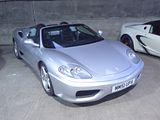
It was with the 360 Modena that sales of Ferrari models really took off, with unprecedented volumes of the car being sold. The 360 Modena was launched in 1999, named after the town of Modena, the birthplace of Enzo Ferrari. A major innovation in this all new model came from Ferrari’s partnership with Alcoa which resulted in an entirely new all-aluminium space-frame chassis that was 40% stiffer than the F355 which had utilised steel. The design was 28% lighter despite a 10% increase in overall dimensions. Along with a lightweight frame the new Pininfarina body styling deviated from traditions of the previous decade’s sharp angles and flip-up headlights. The new V8 engine, common to all versions, was of 3.6 litre capacity with a flat plane crankshaft, titanium connecting rods and generates 400 bhp Despite what looks like on paper modest gains in reality the power to weight ratio was significantly improved on over the F355, this was due to the combination of both a lighter car and more power. The 0 to 100 km/h acceleration performance improved from 4.6 to 4.3 seconds. The first model to be rolled out was the 360 Modena, available as a manual, or an F1 electrohydraulic manual. Next up was an open car. The 360 was designed with a Spider variant in mind; since removing the roof of a coupe reduces the torsional rigidity, the 360 was built for strength in other areas. Ferrari designers strengthened the sills, stiffened the front of the floorpan and redesigned the windscreen frame. The rear bulkhead had to be stiffened to cut out engine noise from the cabin. The convertible’s necessary dynamic rigidity is provided by additional side reinforcements and a cross brace in front of the engine. Passenger safety is ensured by a strengthened windscreen frame and roll bars. The 360 Spider displays a curvilinear waistline. The fairings imply the start of a roof, and stable roll bars are embedded in these elevations. Due to use of light aluminium construction throughout, the Spider weighs in only 60 kg heavier than the coupé. As with the Modena version, its 3.6 litre V8 with 400 bhp is on display under a glass cover. The engine — confined in space by the convertible’s top’s storage area — acquires additional air supply through especially large side grills. The intake manifolds were moved toward the centre of the engine between the air supply conduits in the Spider engine compartment, as opposed to lying apart as with the Modena. In terms of performance, the 0-60 mph time was slightly slower at 4.4 seconds due to the slight weight increase, and the top speed was reduced from 189 to 180 mph. Despite the car’s mid-mounted V8 engine, the electrically operated top is able to stow into the compartment when not in use. The convertible top was available in black, blue, grey and beige. The transformation from a closed top to an open-air convertible is a two-stage folding-action that has been dubbed “a stunning 20 second mechanical symphony”. The interior of the Spider is identical to that of the coupé.
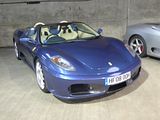
Effectively a mid-life update to the 360 Modena, the F430 debuted at the 2004 Paris Motor Show. Designed by Pininfarina, under the guidance of Frank Stephenson, the body styling of the F430 was revised from the 360 Modena, to improve its aerodynamic efficiency. Although the drag coefficient remained the same, downforce was greatly enhanced. Despite sharing the same basic Alcoa Aluminium chassis, roof line, doors and glass, the car looked significantly different from the 360. A great deal of Ferrari heritage was included in the exterior design. At the rear, the Enzo’s tail lights and interior vents were added. The car’s name was etched into the Testarossa-styled driver’s side mirror. The large oval openings in the front bumper are reminiscent of Ferrari racing models from the 60s, specifically the 156 “sharknose” Formula One car and 250 TR61 Le Mans cars of Phil Hill. Designed with soft-top-convertible. The F430 featured a 4.3 litre V8 petrol engine of the “Ferrari-Maserati” F136 family. This new power plant was a significant departure for Ferrari, as all previous Ferrari V8’s were descendants of the Dino racing program of the 1950s. This fifty-year development cycle came to an end with the entirely new unit. The engine’s output was 490 hp at 8500 rpm and 343 lb/ft of torque at 5250 rpm, 80% of which was available below 3500rpm. Despite a 20% increase in displacement, engine weight grew by only 4 kg and engine dimensions were decreased, for easier packaging. The connecting rods, pistons and crankshaft were all entirely new, while the four-valve cylinder head, valves and intake trumpets were copied directly from Formula 1 engines, for ideal volumetric efficiency. The F430 has a top speed in excess of 196 mph and could accelerate from 0 to 100 km/h in 3.9 seconds, 0.6 seconds quicker than the old model. The brakes on the F430 were designed in close cooperation with Brembo (who did the calipers and discs) and Bosch (who did the electronics package),resulting in a new cast-iron alloy for the discs. The new alloy includes molybdenum which has better heat dissipation performance. The F430 was also available with the optional Carbon fibre-reinforced Silicon Carbide (C/SiC) ceramic composite brake package. Ferrari claims the carbon ceramic brakes will not fade even after 300-360 laps at their test track. The F430 featured the E-Diff, a computer-controlled limited slip active differential which can vary the distribution of torque based on inputs such as steering angle and lateral acceleration. Other notable features include the first application of Ferrari’s manettino steering wheel-mounted control knob. Drivers can select from five different settings which modify the vehicle’s ESC system, “Skyhook” electronic suspension, transmission behaviour, throttle response, and E-Diff. The feature is similar to Land Rover’s “Terrain Response” system. The Ferrari F430 was also released with exclusive Goodyear Eagle F1 GSD3 EMT tyres, which have a V-shaped tread design, run-flat capability, and OneTRED technology. The F430 Spider, Ferrari’s 21st road going convertible, made its world premiere at the 2005 Geneva Motor Show. The car was designed by Pininfarina with aerodynamic simulation programs also used for Formula 1 cars. The roof panel automatically folds away inside a space above the engine bay. The conversion from a closed top to an open-air convertible is a two-stage folding-action. The interior of the Spider is identical to that of the coupé. Serving as the successor to the Challenge Stradale, the 430 Scuderia was unveiled by Michael Schumacher at the 2007 Frankfurt Auto Show. Aimed to compete with cars like the Porsche RS-models and the Lamborghini Gallardo Superleggera it was lighter by 100 kg/220 lb and more powerful (510 PS) than the standard F430. Increased power came from a revised intake, exhaust, and an ion-sensing knock-detection system that allows for a higher compression ratio. Thus the weight-to-power ratio was reduced from 2.96 kg/hp to 2.5 kg/hp. In addition to the weight saving measures, the Scuderia semi-automatic transmission gained improved “Superfast”, known as “Superfast2”, software for faster 60 millisecond shift-times. A new traction control system combined the F1-Trac traction and stability control with the E-Diff electronic differential. The Ferrari 430 Scuderia accelerates from 0-100 km/h in 3.6 seconds, with a top speed of 202 miles per hour. Ferrari claimed that around their test track, Fiorano Circuit, it matched the Ferrari Enzo, and the Ferrari F430’s successor, the Ferrari 458. To commemorate Ferrari’s 16th victory in the Formula 1 Constructor’s World Championship in 2008, Ferrari unveiled the Scuderia Spider 16M at World Finals in Mugello. It is effectively a convertible version of the 430 Scuderia. The engine produces 510 PS at 8500 rpm. The car has a dry weight of 1,340 kg, making it 80 kg lighter than the F430 Spider, at a curb weight of 1,440 kg (3,175 lb). The chassis was stiffened to cope with the extra performance available and the car featured many carbon fibre parts as standard. Specially lightened front and rear bumpers (compared to the 430 Scuderia) were a further sign of the efforts Ferrari was putting into this convertible track car for the road. Unique 5-spoke forged wheels were produced for the 16M’s launch and helped to considerably reduce unsprung weight with larger front brakes and callipers added for extra stopping power (also featured on 430 Scuderia). It accelerates from 0-100 km/h in 3.7 seconds, with a top speed of 315 km/h (196 mph). 499 vehicles were released beginning early 2009 and all were pre-sold to select clients.
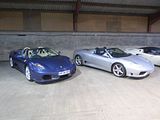
Third Ferrari here was the Roma, still a current model.

FORD
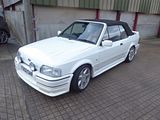
A sporting version of Ford’s front wheel drive Escort was announced at the same time as the “cooking” 1.1, 1.,3 and 1,6 litre cars in October 1980. This was the XR3, and it came initially with a carb fed 1.6 litre engine generating 105 bhp and had a four speed gearbox. Fuel injection finally arrived in October 1982 (creating the XR3i), eight months behind the limited edition (8,659 examples), racetrack-influenced RS 1600i. The Cologne-developed RS received a more powerful engine with 115 PS, thanks to computerised ignition and a modified head as well as the fuel injection. For 1983, the XR3i was upgraded to 115bhp thanks to the use of fuel injection and a five speed transmission had been standardised. Both variants proved very popular, getting a significant percentage of Escort sales and also as a slightly more affordable alternative to a Golf GTi. For those for whom the performance was not quite enough, Ford had an answer, with the the RS Turbo. This 132 PS car was shown in October 1984, as a top of the range car, offering more power than the big-selling XR3i and the limited production RS1600i. Going on sale in the spring of 1985, it proved to be somewhat of a disappointment, with the chassis coming in for severe criticism. The RS Turbo Series 1 was only marketed in a few European nations as production was limited to 5,000 examples, all in white. They were well equipped, with the alloy wheels from the limited production RS 1600i, Recaro seats, and a limited slip differential.
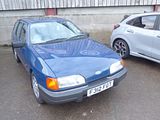
The Ford Sierra is a mid-size car or large family car that was built by Ford Europe from 1982 to 1993. It was designed by Uwe Bahnsen, Robert Lutz and Patrick le Quément. The code used during development was “Project Toni”. Its name came from the Spanish word for mountain range. The Ford Sierra was first unveiled on 22 September 1982 at the British International Motor Show hosted at the NEC in Birmingham, shortly followed by the Salon de l’Automobile in Paris on 30 September 1982. Sales started on 15 October 1982, replacing the Ford Taunus TC3 (UK: Ford Cortina Mark V). Its aerodynamic styling was ahead of its time and as such, many conservative buyers (including company car drivers) did not take fondly to the Taunus’s/Cortina’s replacement. This was also due to the fact that the Sierra was not available as a saloon, in contrast to the Taunus/Cortina. A saloon model debuted in 1987 with the introduction of the facelifted Sierra. It was mainly manufactured in Germany, Belgium, and the United Kingdom, although Sierras were also assembled in Ireland, Argentina, Venezuela, South Africa and New Zealand. By 1978, Ford Europe was working on a new mid-range model to replace the Cortina/Taunus during the early 1980s, working under the codename “Project Toni”. Although still popular with buyers, the outgoing Cortina/Taunus was essentially a 12-year old design by the time of the Sierra’s launch; despite the TC2 shape launching in 1976, and the mildly reworked TC3/Mk5 three years later, both were merely a reskinned version of the 1970 TC/Mk3 with few major mechanical changes in that time. Ford’s future model policy and styling direction had already been shown with the Escort III two years earlier, in that its conventionally styled saloons of the 1970s would be replaced by hatchbacks with advanced aerodynamic styling. Ford had confirmed during 1981, a year before the Sierra’s official launch, that its new mid-range car would carry the Sierra name, signalling the end of the Taunus and Cortina nameplates after 43 years and nine generations respectively 20 years and five generations. In September that year, it had unveiled the Probe III concept car at the Frankfurt Motor Show, hinting at what the new car would look like when the final product was unveiled 12 months later. At first, many found the design blob-like and difficult to accept after being used to the sharp-edged, straight-line three-box styling of the Taunus/Cortina, and it was nicknamed “the jellymould”. The shape served a purpose though, producing a drag coefficient of 0.34, a significant improvement over the boxy outgoing Taunus’s/Cortina’s 0.45. This aerodynamic design was key for reducing fuel consumption according to Ford, and was even used as compensation for the V6-engines. The interior was more conventional, although Ford took a page from BMW by angling the centre of the dashboard towards the driver. Sales were slow in the first months – the situation being exacerbated by heavy discounting by Ford dealers of surplus Cortina stock from the autumn of 1982 onwards, with more than 11,000 new Cortinas being registered in 1983. However in 1983, its first full year of sales, the Sierra managed nearly 160,000 sales in Britain, outsold only by the smaller Escort. Ford had also launched the more conservatively designed Escort-based Orion saloon that year, which found favour with buyers who would otherwise have been the Sierra’s target customers. In West Germany, it was proving very popular from an early stage; within months of its launch, it was reportedly achieving treble the number of sales that the Taunus had been attaining – though in West Germany, the Taunus had not been quite as popular or iconic as its Cortina equivalent had been in Britain. It was later in the Sierra’s life that the styling began to pay off; ten years after its introduction, the Sierra’s styling was not nearly as outdated as its contemporaries, even though all major competitors were newer designs, though the Sierra had been tweaked on several occasions and many new engines had been added. The most notable changes came at the autumn of 1987, with a major facelift and the addition of a 4-door saloon (UK: Sapphire). As other manufacturers adopted similar aerodynamic styling, the Sierra looked more normal. At its peak, it was Britain’s second best selling car in 1983, 1988 and 1989, and was still Britain’s fifth best selling car in 1992. Its best year was 1989, when more than 175,000 were sold. However, it was outsold by the Vauxhall Cavalier in MK2 form during 1984 and 1985, and then from 1990 until its demise by the MK3 Cavalier. Nevertheless, it comfortably outsold its second key rival, the Austin Montego, which was launched in April 1984. Between 1985 and 1988, the Sierra faced fresh competition in Europe from the likes of the Renault 21 and Peugeot 405, while Japanese carmaker Nissan was producing its Bluebird model in Britain from 1986. Early versions suffered from crosswind stability problems, which were addressed in 1985 with the addition of “strakes” (small spoilers) on the rear edge of the rubber seals of the rear-most side windows. These shortcomings saw a lot of press attention, and contributed to early slow sales, when it was outsold by its key rival the Vauxhall Cavalier in 1984 and 1985. Other rumours that the car hid major crash damage (in part true, as the new bumper design sprung back after minor impact and couldn’t be “read” to interpret major damage) also harmed the car’s reputation. This reached near-hysterical heights in its early months on sale, with UK press making a report that Ford would reintroduce the previous Cortina model out of desperation. These reports were swiftly denied by Ford. However, sales began to rise during 1983, and it finished as Britain’s second best selling car behind the Escort. After being outsold by the Cavalier for the next two years, it regained its lead of the market sector in Britain during 1986, and a refreshed range (with more engine options as well as the introduction of a saloon) enjoyed a surge in sales from 1987, though the MK3 Cavalier finally outsold it in 1990. Even in 1992, the Sierra was still Britain’s fifth best selling car. It was nicknamed “the salesman’s spaceship” on account of its status as a popular fleet car in Britain. In contrast to the Sierra’s groundbreaking exterior design, its drivetrain was conservatively engineered, retaining rear-wheel drive and the same engines and transmissions as the Cortina/Taunus which were effectively 12 years old as they were first used on the TC1/MkIII generation in 1970. Much of this was done to appease the important fleet market which was wary of complexity. However, there was much modification; for example the engines were fitted with breakerless ignition, improved carburettors and the option of fuel injection, whilst 5-speed transmissions were now available. Most competitors were already switched to front-wheel drive around that time. Ford claimed however this set-up was required to offer V6-engines, which had to contribute to the Sierra’s driving comfort. New for the Sierra was a diesel engine, although the engine itself wasn’t new at all. Similar to the Ford Granada, Ford used an “Indenor”-engine which was designed by Peugeot in the 1950s. While the Granada was offered with 1.9, 2.1 and 2.5 diesels, the Sierra unit had a displacement of 2.3 litre. This engine was replaced only in 1989 by an all-new 1.8 litre turbodiesel, developed by Ford itself. The Sierra had a four-speed manual gearbox as standard, with a five-speed as option but standard on the 2.3D and 2.3 V6. At a time when the rival Vauxhall Cavalier was offered with a five-speed, this led to some critics commenting that the Sierra was somewhat underpowered. In the mid-1980s, many smaller cars (some even two segments smaller) featured five-speed gearboxes as standard. The chassis, however, was more sophisticated than the Cortina/Taunus, with fully independent suspension on both axles. The rear suspension was essentially carried over from the Granada, with trailing arms and coil springs mounted on a tubular sub-frame which also provided location for the final drive/differential housing driving the axle shafts. The front suspension dispensed with the Cortina/Taunus’ double wishbones in favour of a scaled-up version of the Fiesta and Escort/Orion’s layout with MacPherson struts, lower locating arms and anti-roll bars. One of the most striking design features of the Sierra was its closed front panel instead of a grille, which was later also to be found on the 1985 Ford Taurus. The air intake was situated below the front bumper, making the Sierra a so-called ‘bottom breather’. The headlights were integrated in this front panel while the indicators were mounted in the bumper within a combined unit with the foglights. However, this set-up was only present on the top-of-the-line “Ghia”-trim as well on the later introduced XR4i sport model. The other Sierra models had a more traditional front end with a two-bar grille between the headlights, being unpainted on the base model. These models had the indicators in the bumper as well, although being slimmer but wider and without the foglights. Both the Ghia and XR4i had wide headlights with two lenses while the other models had smaller lights with a single lens. For the 1985 model year, all the lower-spec models, except the base model, adopted the Ghia and XR4i’s front grille and headlight treatment. However, the second lens of the lower-spec models had no actual light within it. On the Ghia and XR4i this lens contained additional high beam lamps. The South-African XR8 model’s front end was similar to the XR4i’s but featured a small grille between the headlights. The rear lights of the Ghia, as well as the very early XR4i’s, were the same shape and layout as other models, but featured tiny horizontal black strakes on the lenses to give the impression that they were smoked. The car was replaced by the Mondeo in Europe in April 1993, though stocks lasted for about two years afterwards. The Sierra remained a popular second-hand buy and common sight on British roads until well beyond the year 2000.
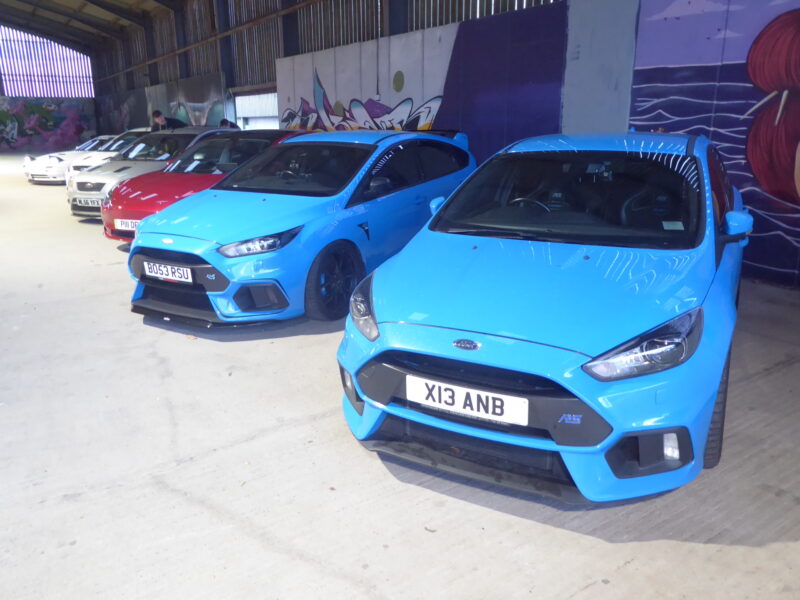
Ford did not make the same mistake with the Focus as they had with its predecessor, so even the ordinary models were good to drive. There was a long wait for a truly sporting flagship, but when it arrived, in late 2002, the Focus RS proved to be rather special. Originally it was to be released as the Racing Focus, however after the poor selling Racing Puma, Ford decided to revive the RS badge. The car was largely built on its own assembly line in Ford’s Saarlouis plant, with some additional specialist off-line assembly performed by the ACÜ group at Überhern. The RS was offered all over Europe, with production limited to 4501 units. 2147 of these were sold in the United Kingdom, by far its largest of the 21 markets where it was available. The development of the Focus RS was undertaken by a mixed team of mainstream Ford engineers (not SVE or the TeamRS group which replaced it later on) and Tickford Engineering in Milton Keynes, United Kingdom. More bespoke than the prior Focus ST170, the Focus RS upgraded or replaced 70% of the standard Focus mechanicals. The turbocharged straight-4 engine produced a minimum of 212 bhp and 310 N·m (229 lb·ft) of torque, which was then mated to the 5-speed MTX-75 and not the Getrag transmission used in the ST 170. Mechanically, most notably, the car incorporated a Quaife automatic torque biasing differential to improve traction from the front-wheel drive setup. The steering used a similar quick-ratio rack as the ST170 while the brakes used fixed-caliper, four-piston Brembo units with 12.8 in discs at the front and single-piston floating calipers and 11.0 in discs at the back. Wheels were 18″ alloys specially developed by OZ Racing. The engine was heavily modified with forged aluminium pistons, hardened valve seats, sodium-filled exhaust valves, stainless steel exhaust system. The forced induction system comprised a Garrett turbocharger with a water-cooled charge air cooler and an electric water pump. To transmit the higher torque an upgraded AP clutch was used. It could generate a steady 0.98G in lateral acceleration due to racing parts such as Sachs dampers, lightweight O.Z Alloy Wheels and a Quaife ATB Differential. It would also allow 1.0G of braking force due to the standard Brembo braking system. The Focus RS was available in one metallic colour, Imperial Blue. The body looked similar to the standard Focus or to the ST170, although the RS featured unique front and rear bumper assemblies required for the wider wheel arches which accommodated the 65 mm (2.6 in) wider front track. Internally, the theme is blue and black with sections of blue leather trim on the door trim panels, the steering wheel and the Sparco seats which were trimmed in blue/black leather and Alcantara. A green starter button starts the engine. The instruments have a blue background and in place of the coolant temperature gauge, the RS was equipped with a boost pressure indicator (up to 1.5 bar). The gear lever knob, handbrake lever, and pedals were all custom made by Sparco. All-around performance was roughly equal or better to its other competitors, including hatchbacks such as the Honda Civic Type-R and some four-wheel drive cars in the same price field. Power was a diminished priority and the handling on a track, courtesy of the front differential, was considered by most observers to be its strongest characteristic. In a Top Gear review, Jeremy Clarkson noted that “it lacks the straightforward oomph of a Subaru Impreza. […] The reason it was quick round our track is simple: this car handles like it’s in a cartoon.” Clarkson and other motor journalists also commented on the car’s torque steer on bumpy British roads. Well preserved examples – and that’s not all of them, by any means, now – are worth decent money and will likely increase in value over time.

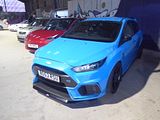
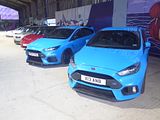
Ford played much the same guessing game about whether there would be an RS version of the third generation Focus as they had done with the earlier versions. Production of the regular cars started in late 2010, but it was not until the 2015 Geneva Motor Show before the production ready MKIII Ford Focus RS was unveiled. It came packing the turbocharged 2.3-litre inline-four engine found in the Mustang EcoBoost. In the Focus RS, the engine itself produces 350 hp. Power is sent to all four wheels via Ford’s all-new Torque-Vectoring All-Wheel-Drive system with a rear drive unit designed by GKN, as well as upgraded suspension and brakes. As well as that, the new Focus RS will be fitted with Drive Modes – including an industry-first Drift Mode that allows controlled oversteer drifts – and Launch Control. The RS will boast a model specific aerodynamic package that helps to differentiate it from other Focus models. The RS is capable of accelerating to 100 km/h (62 mph) in 4.7 seconds. Sales finally started in mid 2016, with long waiting lists having been created, though Ford did eventually catch up with expanded production levels allowing them to meet the demand.
HILLMAN
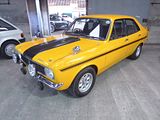
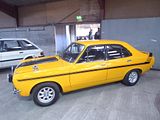
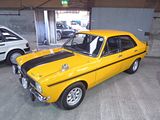
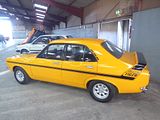
Sitting below the Hunter in the Hillman range of the 1970s was the Avenger, a conventionally engineered small saloon that competed with the Ford Escort and Vauxhall Viva. 1250 and 1500cc models from launch were upgraded to 1300 and 1600cc in the autumn of 1973 and these garnered the majority of sales, but they are not the cars that have survived in the greatest numbers. The ones that you most often see now are the Tiger models. Named to evoke memories of the Sunbeam Tiger, the Avenger Tiger concept began as a publicity exercise. Avenger Super (four-door) cars were modified by the Chrysler Competitions Centre under Des O’ Dell and the Tiger model was launched in March 1972. Modifications included the 1500 GT engine with an improved cylinder head with enlarged valves, twin Weber carburettors and a compression ratio of 9.4:1. The engine now developed 92.5 bhp at 6,100 rpm. The suspension was also uprated, whilst brakes, rear axle, and gearbox are directly from the GT. The cars were all painted in a distinctive yellow called Sundance and they featured a bonnet bulge, whilst a rear spoiler and side stripes were standard, set off with “Avenger Tiger” lettering on the rear quarters. They are also distinguished by the fact that have rectangular headlights. Road test figures demonstrated a 0–60 mph time of 8.9 seconds and a top speed of 108 mph, which beat the rival Ford Escort Mexico, but fuel consumption was heavy. All Avenger Tigers were assembled by the Chrysler Competitions Centre and production figures are vague but around 200 of the initial Mark 1 seems likely. In October 1972, Chrysler unveiled the more “productionised” Mark 2 Tiger. The Avenger GL bodyshell with four round headlights was used. Mechanically identical to the earlier cars, the bonnet bulge was lost although the bonnet turned matt black, and there were changes to wheels and seats. These cars went on sale at £1,350. Production was around 400. These were available in a bright red colour called Wardance as well as the earlier Sundance, both with black detailing.


HONDA
The Civic Type R Prototype was unveiled in September 2016 at the Paris Motor Show, and the production version unveiled at the 2017 Geneva Motor Show. The new car builds on Honda’s heritage in developing high-performance hatchbacks. The design is based on the Civic Hatchback, with a winged carbon fiber effect splitter with red accent line, slatted ducts, diamond-mesh air intakes, red ‘H’ badge above a new air vent at the nose of the car, new air intake on the hood, an air scoop sited centrally in a trapezoidal recess, smoked lenses for the LED headlights, indicators and side repeaters, carbon fibre effect side skirts, 20-inch piano black alloy wheels with red accents, 245/30 R20 high-performance tires, enlarged wheel arches, a carbon fibre effect diffuser which runs below the wider rear bumper, 3 tailpipes with a pair of directional strakes at each side, central tailpipe in bright metallic red and unique peaks at the roof flanks that point backward. The FK8 Civic Type R uses the same engine from its predecessor, a turbocharged inline-four with increased power to 320 PS (235 kW; 316 hp) in the European and Japanese version but remains the same 310 PS (306 bhp) in other markets. The engine is mated to a close-ratio 6-speed manual transmission continuing the tradition of its predecessors with limited-slip differential as standard. The aerodynamic elements increase downforce even further as compared to the outgoing model. The FK8 has a top speed of 272 km/h (169 mph) making it the fastest Civic Type R model to date. In back-to-back testing involving an FK8 and FK2 Type R, the reviewers praised the FK8’s comfortable ride and feedback and criticised the FK2’s harsh ride on the road and worse handling when the R+ driving mode was activated. The reviewers also complained about the FK2’s interior being dated but stated that this was due to the model’s late arrival at the end of the base model’s production run. The interior of the Type R is based on the base model Civic and has a low driving position with the gear shift lever positioned high in order to allow for easy gear changes. The interior has red and black colour as standard with sports seats along with faux carbon fibre trim. The driver’s seat and the steering wheel are adjustable. A reversing camera is standard for easier rear visibility while reversing while parking sensors are standard in the GT Trim. The interior although lauded for its comfortability and user-friendliness is criticised for its infotainment system which has been described as slow and difficult to operate. The fit and finish are considered to be comparable with its competitors. Safety features include automatic emergency braking, traffic sign recognition, lane departure warning and automatic high beam assistance which are carried over from the base Civic. The GT trim adds blindspot monitoring and cross-traffic alert, parking sensors at the front and rear, dual-zone climate control, power-folding door mirrors and infotainment upgrades that include wireless phone charging and in-built sat-navigation along with a more powerful 11-speaker stereo. The Type R earned a Euro NCAP 5 star crash test rating. On 3 April 2017, the pre-production Type R achieved a lap time of 7:43.80 on the Nürburgring Nordschleife, almost 7 seconds faster than its predecessor, setting a new record for front-wheel drive cars. The car also set new front-wheel drive lap records at the Magny-Cours, Spa-Francorchamps, Silverstone, Estoril, Hungaroring and Mount Panorama circuits. The Nürburgring record was broken by the Renault Mégane RS Trophy-R in July 2019 which set a time of 7:40.10, but in 2020 the Limited Edition Civic Type R broke the Mégane’s front-wheel drive lap record at the Suzuka Circuit by one and a half seconds. Production ceased in 2022.

KAKTUS
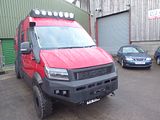
One of the more unusual vehicles present here was this Kaktus Adventure Van, a custom modification of a MAN TGE. Built for off-road exploration, the Kaktus company specializes in bespoke campervan conversions. Key features include substantial ground clearance provided by a 100mm lift kit, aggressive all-terrain tires, and a heavy-duty front bumper. It also features a distinctive roof pod to increase interior headroom and a snorkel for water crossings. The company offers various accessories like a rear wheel rack and sound-deadening insulation.
LAND ROVER
The Series 2 model, the successor to the successful Series I, saw a production run from 1958 to 1961. It came in 88 in and 109 in wheelbases (normally referred to as the ‘SWB’ and ‘LWB’). This was the first Land Rover to receive the attention of Rover’s styling department. Chief Stylist David Bache produced the familiar ‘barrel side’ waistline, with a 5 in greater width to cover the vehicle’s wider tracks, as well as the improved design of the truck cab variant, introducing the curved side windows and rounded roof still used on current Land Rovers. The series II was the first vehicle to use the well-known 2.25-litre petrol engine, although the first 1,500 or so short wheelbase (SWB) models retained the 52 hp 2.0-litre petrol engine from the series I. This larger petrol engine produced 72 hp and was closely related to the 2.0-litre diesel unit still in use. This engine became the standard Land Rover unit until the mid-1980s when diesel engines became more popular. The 109-inch series II station wagon introduced a twelve-seater option on top of the standard ten-seater layout. This was primarily to take advantage of UK tax laws, by which a vehicle with 12 seats or more was classed as a bus, and was exempt from Purchase Tax and Special Vehicle Tax. This made the twelve-seater not only cheaper to buy than the 10-seater version, but also cheaper than the seven-seater 88-inch Station Wagon. The twelve-seater layout remained a highly popular body style for decades, being retained on the later series and Defender variants until 2002, when it was dropped. The unusual status of the twelve-seater remained until the end—such vehicles were classed as minibuses and thus could use bus lanes and (if registered correctly) could be exempt from the London Congestion Charge. There was some degree of overlap between series I and II production. Early series-II 88-inch vehicles were fitted with the old 2-litre petrol engine to use up existing stock from production of the series I. The 107-inch Station Wagon continued until late 1959 due to continued demand from export markets and to allow the production of series-II components to reach full level. The SII and the SIIA are very difficult to distinguish. There were some minor cosmetic changes. Body configurations available from the factory ranged from short-wheelbase soft-top to the top-of-the-line five-door station wagon. A 2.25-litre diesel was added to the engine line, which after 1967 included a 2.6-litre inline six cylinder petrol engine for the long-wheelbase models, which also had servo-assisted brakes. 811 of these were NADA (or North American Dollar Area) trucks, which were the only long-wheelbase models made for the American and Canadian markets. From February 1969 (home market), the headlamps moved into the wings on all models, and the sill panels were redesigned to be shallower a few months afterwards. The series IIA is considered by many the most hardy series model constructed. It is quite possibly also the type of classic Land Rover that features strongly in the general public’s perception of the Land Rover, from its many appearances in popular films and television documentaries set in Africa throughout the 1960s, such as Born Free. In February 1968, just a few months after the Rover Company had been subsumed, under government pressure, into the Leyland Motor Corporation, the Land Rover celebrated its twentieth birthday, with total production to date just short of 600,000, of which more than 70% had been exported. Certainly it was whilst the series IIA was in production that sales of utility Land Rovers reached their peak, in 1969–70, when sales of over 60,000 Land Rovers a year were recorded. (For comparison, the sales of the Defender have been around the 25,000 level since the 1990s.) As well as record sales, the Land Rover dominated many world markets- in Australia in the 1960s Land Rover held 90% of the 4×4 market. This figure was repeated in many countries in Africa and the Middle East. The Series 3 replaced this version in 1971.
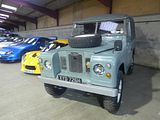
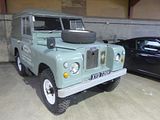
Believe it or not, this is a Land Rover. Or rather it was, and it is still registered as such with the DVLA. That means that there is a Land Rover chassis there, with a body that I believe was created by TomCat Motorsport, specialists in producing modified off-road vehicles that can be used on rough terrain.

LOTUS
It is now over 25 years since Lotus launched the Elise, a model which showed a return to the core values of simplicity and light-weight which were cornerstones of Colin Chapman’s philosophy when he founded the marque in 1955. The first generation Elise was produced for just over 4 years, with a replacement model, the Series 2 arriving in October 2000. It came about as the Series 1 could not be produced beyond the 2000 model production year due to new European crash sustainability regulations. Lacking the funding to produce a replacement, Lotus needed a development partner to take a share of investment required for the new car. General Motors offered to fund the project, in return for a badged and GM-engined version of the car for their European brands, Opel and Vauxhall. The result was therefore two cars, which although looking quite different, shared much under the skin: a Series 2 Elise and the Vauxhall VX220 and Opel Speedster duo. The Series 2 Elise was a redesigned Series 1 using a slightly modified version of the Series 1 chassis to meet the new regulations, and the same K-series engine with a brand new Lotus-developed ECU. The design of the body paid homage to the earlier M250 concept, and was the first Lotus to be designed by computer. Both the Series 2 Elise and the Opel Speedster/Vauxhall VX220 were built on the same production line, in a new facility at Hethel. Both cars shared many parts, including the chassis, although they had different drive-trains and power-plants. The VX220 carried the Lotus internal model identification Lotus 116, with the code name Skipton for the launch 2.2 normally aspirated version and Tornado for the 2 litre Turbo which came out in 2004. Fitted with 17 inch over the Elise’s 16 inch front wheels, the Vauxhall/Opel version ceased production in late 2005 and was replaced by the Opel GT for February 2007, with no RHD version for the United Kingdom. The Elise lived on. and indeed production only ceased at the end of 2021 and there have been countless different versions produced in that time. Whilst the first of the Series 2 cars came with the Rover K-Series engine, and that included the 111S model which had the VVC engine technology producing 160 hp , a change came about in 2005 when Lotus started to use Toyota engines. This was initially due to Lotus’ plans to introduce the Elise to the US market, meaning that an engine was needed which would comply with US emissions regulations. The selected 1.8 litre (and later 1.6 litre) Toyota units did, and the K-series did not. that MG-Rover went out of business in 2005 and engine production ceased confirmed the need for the change. Since then, Lotus have offered us track focused Elise models like the 135R and Sport 190, with 135 bhp and 192 bhp respectively, as well as the 111R, the Sport Racer, the Elise S and Elise R. In 2008 an even more potent SC model, with 218 bhp thanks to a non-intercooled supercharger was added to the range. In February 2010, Lotus unveiled a facelifted version of the second generation Elise. The new headlights are now single units; triangular in shape they are somewhat larger than the earlier lights. The cheapest version in Europe now has a 1.6 litre engine to comply with Euro 5 emissions, with the same power output as the earlier 1.8 136bhp car.
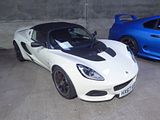
In 2004, the Series 2 Exige was introduced. It features a naturally aspirated 1.8 L 16-valve DOHC Toyota/Yamaha engine that is rated at 190 bhp with the Toyota engine designation of 2ZZ-GE. Compared to the Series 2 Elise, it has a front splitter, a fibreglass hardtop roof with roof scoop, a rear engine cover, and rear spoiler. The sole purpose of these aerodynamic additions to the base Elise is to create more downforce (almost 45 kg (100 lb) of downforce at 161 km/h (100 mph) in the Exige versus 5.9 kg (13 lb) at 100 mph in the Elise). In February 2005, Lotus announced a limited production run of 50 Exiges, using the Toyota engine with a supercharger. This increased the power output to 243 bhp. These models were only available in yellow or black, representing the colours of Lotus Sport, and are badged 240R. They have a projected 0 – 60 mph time of 3.9 seconds and 0-161 km/h (100 mph) of 9.9 seconds, with a top speed of 249 km/h (155 mph). The North American Exige was unveiled at the Los Angeles Auto Show in January 2006. According to Lotus, the standard Exige Series 2 model weighs 2,016 lb (914 kg). In February 2006, Lotus announced the Exige S model which used a supercharged Toyota 2ZZ-GE engine rated at 220 bhp The S was also made available in North American markets as a 2007 model. According to Lotus, the Exige S model, weighing 2,057 lb (933 kg), has the following specifications: In 2008, the Exige S was replaced by the Exige S 240. Power output increased by 9% over the outgoing model to 240 bhp. The S 240 also received upgraded AP Racing brakes from the Exige Cup 240 and a larger roof scoop utilised by the Exige Cup 255. 0–60 mph times improved to 4.0 seconds. The S 240 base manufacturer suggested retail price was $65,690. The Exige S 260 produced an additional 7% power output over the S 240 resulting in 256 bhp. Even with a full fuel tank, extensive use of weight-saving materials such as carbon fiber reduced the vehicle’s gross weight to 916 kg (2,020 lb) compared to 942 kg (2,077 lb) in the S 240. It can accelerate from 0–60 mph in 4.0 seconds. After 2009, both the S 240 and S 260 received distinctively new and enlarged rear spoilers mounted to the rear clam instead of the motor bay cover. Countless limited edition models were produced, as well. A third generation car was launched in 2012.
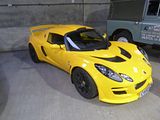
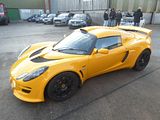
MASERATI
Sole Maserati here was my Grecale.

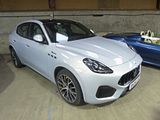
McLAREN
The McLaren 570S is a sports car produced from 2015 until 2021. It was unveiled at the 2015 New York International Auto Show. The car is powered by a new iteration of the 3.8-litre twin-turbocharged V8 engine already used in the 650S and P1, designated M838T E with thirty per cent of the parts redesigned. It delivers 562 hp (570 PS) and 443 lb/ft (601 Nm) of torque through a 7-speed dual-clutch transmission developed by Graziano Trasmissioni, as it is arranged in the car as a rear-mid engine configuration, The car can accelerate from 0–62 mph (0–100 km/h) in 3.2 seconds and can achieve a top speed of 204 mph (328 km/h). A total dry weight of 2,989 lb (1,356 kg) and maximum weight of 3,201 lb (1,452 kg) gives the 570S a power to weight ratio of 428 PS per tonne delivering a fuel economy of 25.5 miles per imperial gallon (11.1 L/100 km; 21.2 mpg‑US) and CO2 emissions of 249 g/km. McLaren focused on delivering “day-to-day usability and driveability” against the most sporting model options in its range with increased luggage space, greater interior storage and leather upholstery options. The car is designed with aerodynamics in mind and the teardrop shaped cockpit helps achieve that objective. The rear of the car is inspired by the P1 and borrows the slim LED tail lights and diffuser styling from the flagship sports car. The car features dihedral doors, a trademark of McLaren as featured on its ultimate and super series cars. There were numerous variants during that 6 year production cycle, some easier to tell apart than others.

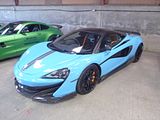
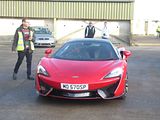

In June 2018, McLaren unveiled the top-of-the-line sports series variant online. The car, called the 600LT is based on the 570S and is the third McLaren production car to receive the longtail treatment. Inspired by the 675LT and the F1 GTR Longtail, the body of the car has been extended by 73.7 mm (2.9 in). The car also features enhanced aerodynamic elements such as an extended front splitter and rear diffuser, new side sills, and an aero-enhancing fixed rear wing for increased downforce. McLaren claims that 23% parts on the 600LT are new as compared to the 570S. The carbon fibre monocoque utilised in the 600LT is modified and this combined with the extensive use of carbon fibre in the roof along with the cantrails and front fenders, results in a weight saving of 96 kg (212 lb) over the 570S, with the total weight amounting to 1,247 kg (2,749 lb). Another distinguishing feature of the 600LT is the lightweight titanium exhaust system which is mounted on top of the rear of the car which harks back to its original application in the Senna. The interior features sports bucket seats from the P1 and Alcantara trim but can be optioned with the much lighter bucket seats found in the Senna. The 3.8-litre twin-turbocharged V8 engine utilised in the 600LT is tuned to produce a maximum power output of 600 PS (592 hp), hence the 600 in the name, and 620 Nm (457 lb/ft) of torque. This adds up to a power-to-weight ratio of 479 PS per tonne. Production of the 600LT started in October 2018. In January 2019, McLaren unveiled the convertible variant of the 600LT at the Detroit Auto Show. Due to the use of the same carbon monocoque as the other models in the 570S lineage, the 600LT Spider did not require any extra modifications to incorporate a folding hardtop roof. As a result, the Spider weighs 50 kg (110 lb) more than the coupé while maintaining the same performance statistics. The Spider has the same engine and aerodynamic components as the coupé and shares the roof folding mechanism with the standard 570S Spider which can be operated at speeds up to 40 km/h (25 mph). The car can accelerate to 100 km/h (62 mph) in 2.9 seconds, to 200 km/h (124 mph) in 8.4 seconds (0.2 seconds more than the coupé) and can attain a top speed of 315 km/h (196 mph) with the roof retracted and 323 km/h (201 mph) with the roof closed. The car can achieve a dry weight of 1,297 kg (2,859 lb) when equipped with the MSO ClubSport package which includes the removal of air-conditioning and radio, titanium wheel nuts and the replacement of the standard seats with the carbon fibre seats from the Senna. The car is the fifth McLaren model to have the Long Tail name
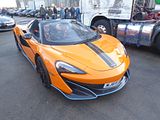
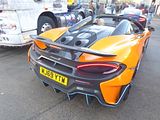

MERCEDES-BENZ
Mercedes-Benz introduced the W123 four-door versions on 29 January 1976. While there were some technical similarities to their predecessors, the new models were larger in wheelbase and exterior dimensions. The styling was also updated, although stylistic links with the W114 / W115 were maintained. Initially, all models except 280/280E featured quad unequal-size round headlights and the latter large rectangular units. When facelifted, these units became standard across the range. All W115 engines were carried over, with the 3-litre 5-cylinder diesel model being renamed from “240D 3.0” to “300D” (as it had already been called before in North American markets). The only new engine was the 250’s 2,525 cc inline-six (Type M123, a short-stroke version of the 2.8-litre six Type M110) that replaced the old 2,496 cc Type M114 “six”. In the spring of 1976, a Coupé version was introduced on a shorter wheelbase than the saloon (106.7 in versus 110.0 in. This W123C/CE was available as a 230C (later 230CE) and as a 280C/CE in most markets; in North America there were additional 300CD versions with naturally aspirated, later turbocharged 3-litre diesel engines. In North America, buyers favored diesel engines for upmarket cars, while CAFE legislation meant that Mercedes-Benz North America had to lower their corporate average fuel economy. This led to the introduction of a few diesel models only sold in the United States. It is a tribute to the car’s instant popularity – and possibly to the caution built into the production schedules – that nine months after its introduction, a black market had developed in Germany for Mercedes-Benz W123s available for immediate delivery. Customers willing to order new cars from their local authorised dealer for the recommended list price faced waiting times in excess of twelve months. Meanwhile, models that were barely used and were available almost immediately commanded a premium over the new price of around DM 5,000. From August 1976, long-wheelbase versions (134.8 in) were produced. These were available as 7/8 seater saloons with works bodies or as a chassis with complete front body clip, the latter serving as the base for ambulance and hearse bodies by external suppliers like Binz or Miesen. These “Lang” versions could be ordered as 240D, 300D and 250 models. At the Frankfurt Auto Show in September, 1977 the W123T estate was introduced; the T in the model designation stood for “Touring and Transport”. All engines derivative except “200TD” were available in the range. T production began in March, 1978 in Mercedes’ Bremen factory. It was the first factory-built Mercedes-Benz estate, previous estates had been custom-built by external coachbuilders, such as Binz. In early 1979, the diesel models’ power output was increased; power rose from 54 hp to 59 hp in the 200D, from 64 hp to 71 hp in the 240D and from 79 hp to 87 hp in the 300D; at the same time, the 220D went out of production. The first Mercedes turbo diesel production W123 appeared in September, 1981. This was the 300 TD Turbodiesel, available with automatic transmission only. In most markets, the turbocharged 5-cylinder 3-litre diesel engine (Type OM617.95) was offered only in the T body style, while in North America it was also available in saloon and coupé guises. June 1980 saw the introduction of new four-cylinder petrol engines (Type M102). A new 2-litre four with shorter stroke replaced the old M115, a fuel-injected 2.3-litre version of this engine (in 230E/TE/CE) the old carburettor 230. Both engines were more powerful than their predecessors. In 1980/81, the carburettor 280 versions went out of production; the fuel-injected 280E continued to be offered. In September 1982, all models received a mild facelift. The rectangular headlights, previously fitted only to the 280/280E, were standardised across the board, as was power steering. Since February 1982, an optional five-speed manual transmission was available in all models (except the automatic-only 300 turbodiesel). W123 production ended in January, 1986 with 63 final T-models rolling out. Most popular single models were the 240D (455,000 built), the 230E (442,000 built), and the 200D (378,000 built). The W123 introduced innovations including ABS (optional from August, 1980), a retractable steering column and an airbag for the driver (optional from 1982). Power (vacuum servo) assisted disc brakes were standard on all W123s. Available options included MB-Tex (Mercedes-Benz Texturized Punctured Vinyl) upholstery or velour or leather upholstery, interior wood trim, passenger side exterior mirror (standard on T models), 5-speed manual transmission (European market only), 4-speed automatic transmission (standard in turbodiesel models), power windows with rear-seat switch cut-outs, vacuum powered central locking, rear-facing extra seats (estate only), Standheizung (prestart timer-controlled engine heating), self-locking differential, sun roof, air conditioning, climate control, “Alpine” horn (selectable quieter horn), headlamp wipers (European market only), Tempomat (cruise control), power steering (standard after 1982/08), seat heating, catalytic converter (available from 1984 for California only, from fall (autumn) 1984 also in Germany for the 230E of which one thousand were built). These days, the cars are very popular “youngtimer” classics, with all models highly rated.

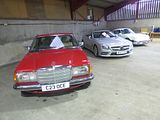
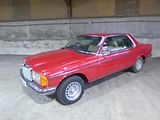
The third generation of Mercedes-Benz SLK-Class (SLC-Class) (series R172) was launched in Stuttgart in January 2011, with a subsequent public launch at the 2011 Geneva Motor Show, with international sales starting spring 2011. It is the successor of R171 series of roadsters which was originally launched in 2004. The SLC (as it was renamed during its mid cycle facelift) was discontinued after the 2020 model year. The design follows the themes of both the first and second generation SLKs, but incorporates a radiator air intake design inspired by the 190 SL roadster from the 1950s, and front end inspired by the Mercedes-Benz SLS AMG Coupé and Mercedes-Benz CLS-Class (W218). “Edition 1” models includes special paint finish SHAPE in glacier grey, panoramic vario-roof, Dynamic Handling package, AMG bodystyling, two-tone designo nappa leather with contrasting topstitching, AIRSCARF, ambient lighting and more. Orders began in from 17 January 2011, and arrived to dealer showrooms on 26 March 2011. Early models include the SLK 200 BlueEFFICIENCY, SLK 250 BlueEFFICIENCY, SLK 350 BlueEFFICIENCY. US models went on sale in 2011 as 2012 model year vehicles. For the 2014 model year, minor changes were made to standard equipment, and the AMG Sports package was renamed to AMG Line. The Roadster Pure is a version of the SLK 200 BlueEFFICIENCY with the 7-speed automatic transmission, panoramic vario-roof, and the COMAND Online multimedia system. It also features 18-inch light-alloy wheels in 5-twin-spoke design, lowered sports suspension by 10 mm (0.4 in), LED daytime running lights, metallic paint and leather heated seats. The SLK 250 CDI is the first version of the SLK-class a with diesel engine. Ordering began on 13 September 2011. Early models include the 7G-TRONIC PLUS automatic transmission, followed by six-speed manual transmission models in the second quarter of 2012. A BlueEFFICIENCY version of the SLK 250 CDI with the 6-speed manual transmission was added to the range in the spring of 2012. The SLK 250 CDI BlueEFFICIENCY with 7-speed automatic transmission is sold in Germany and the UK. The SLK 55 AMG was unveiled at the 2011 Frankfurt Motor Show, and went on sale in January 2012. It is powered by the M152 V8 engine, rated at 422 PS at 6,800 rpm and 540 Nm (398 lb/ft) at 4,500 rpm, and equipped with AMG cylinder management, start/stop function, sports exhaust system with integrated exhaust flaps, AMG SPEEDSHIFT PLUS 7G-TRONIC automatic transmission, AMG sports suspension with torque vectoring brakes and AMG direct-steer system, 3-stage ESP, and ventilated and perforated brake discs on all wheels with 360 x 36 mm front and 330 x 22 mm rear brake discs. The third generation continues with the two-piece metal folding roof known as a Vario Roof, which includes a choice of a roof painted in the vehicle colour, a panoramic vario-roof with dark-tinted windows, or the panoramic vario-roof with MAGIC SKY CONTROL, which features a glass roof that can be switched from fully transparent to tinted using a type of smart glass technology.
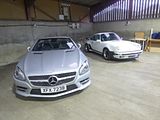
Also here was the recently superceded AMG GT.
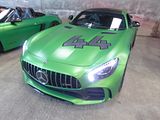
MORGAN
The Morgan Aero 8 sports car was built by Morgan Motor Company at its factory in Malvern Link from 2000 until 2018. The Aero 8 shape evolved in the traditional Morgan way of form following function and the main players were Chris Lawrence, Charles Morgan and other members of the Morgan Engineering Team, and Norman Kent of Survirn Engineering Ltd – especially for the tooling of the Aero wings.The AeroMax, Aero Supersports and Aero Coupe were designed by the firm’s designer Matthew Humphries. Matthew sent the basic design of it to Charles Morgan when he was at Coventry University and joined Morgan on a KTP programme. Radshape were heavily involved in the chassis (Graham Chapman, the current MMC Development Director was working for them at that time) and Superform with much of the body panels, both companies eventually producing for MMC when the car was launched. The Aero 8 is notable for several reasons, primarily because it is the first new Morgan design since 1964’s +4+. It was touted as Morgan’s first supercar and undertook a comprehensive development programme including endurance testing at BMW’s huge proving grounds L’Autodrome de Miramas. It does not use anti-roll bars, an oddity in a modern sporting car. It is also the first Morgan vehicle with an aluminium chassis and frame as opposed to traditional Morgan vehicles (“trads”) that have an aluminium skinned wooden body tub on a steel chassis. The engine first powering the Aero 8 was a 4.4 L BMW M62 V8 mated to a 6-speed Getrag transmission. In 2007, the Series 4 Aero 8 was released which had an upgraded 4.8 L BMW N62 V8 with an optional ZF automatic transmission. All Aero 8s are assembled at Morgan’s Malvern Link factory, where they are able to produce up to 14 cars a week (Aeros and trads). It has been criticised for its “crosseyed” look which originally was justified by the manufacturers as conferring aerodynamic benefits.The third iteration of the Aero was largely around adding the new style Mini headlamps with changes to the wings and front panels resolving the famous squint of the earlier cars. It retained the interior and mechanical platform of the Series 2. This new front design went on to be used on the new AeroMax and subsequent Aero models. Approximately 200 Series 3 models were produced. Version 4 of the Morgan Aero 8 has seen the 3rd new engine in the life of the vehicle; the BMW 4.4 V8 has been replaced with the BMW 4.8 V8 (N62B48) with 362 bhp (270 kW) and 370 lb/ft of torque. This 13% power increase over the previous Aero gives the new Series 4 Aero 8 a power to weight ratio of 315 bhp per tonne. While heavier BMW saloons were unable to meet emissions regulations with the 4.8l V8 the lighter Aero did meet the Euro 6 emissions standard. BMW produced a short run of engines on a prototype line for Morgan. A first for the Aero 8 also comes in the form of an optional automatic transmission; Morgan state: – ZFs 6 HP26 six speed gives even better performance than a manual gearbox due to its special lock up clutch, low power loss design and instant change characteristic. The automatic is usable either as a full automatic for more relaxed driving or in sport manual mode when the bespoke gear lever will hold the engine revs up to the maximum in each gear, increase change speed and blip the throttle to smooth down changes. In addition to these technical changes, a repositioned fuel tank (to improve the weight distribution), revised instrumentation (from cream dials with blue numerals to black with white), an increase in luggage space, revised air vents, a move to a conventional handbrake lever and air intakes and exits on the front wings distinguish the Series 4 Aero 8 from previous models.


NISSAN
The Nissan 370Z (known as the Fairlady Z Z34 in Japan) is a 2-door, 2-seater sports car (S-segment in Europe) manufactured by Nissan Motor Company. It was announced on October 29, 2006, and was first shown at an event in Los Angeles ahead of the 2008 Greater LA Auto Show, before being officially unveiled at the show itself. The 370Z is the sixth generation of the Nissan Z-car line, succeeding the 350Z. The 370Z marks the last production car with a naturally aspirated and high-rev V6 coupled to a manual transmission. Almost every piece and component of the 370Z has been redesigned from the previous 350Z. The wheelbase is 4 in (100 mm) shorter at 100.4 in (2,550 mm) and an overall length 2.7 in (69 mm) shorter at 167.1 in (4,240 mm). The overall width has been increased by 1.3 in (33 mm), the rear track by 2.2 in (56 mm), and overall height reduced by 0.3 in (7.6 mm). The smaller exterior dimensions and use of more lightweight materials helped reduce weight. The 370Z features a front aluminium subframe, aluminium-alloy engine cradle, aluminium door panels, an all-aluminium hood, and an aluminium hatch. Front body torsional rigidity is improved by 10 percent with an extensively revised body structure, which includes a new front suspension cradle to reduce front body lateral bending, new rear structural reinforcements, and an underbody “V-bar” to help reduce rear lateral bending. Rear body torsional rigidity is improved by up to 22 percent and rear body vertical bending rigidity is improved by up to 30 percent. Additional enhancements include the use of a carbon fibre composite radiator housing and strengthening of the rear fender and hatch areas. The new structure weighs slightly less than the 350Z. The 370Z uses a front double wishbone suspension, with forged aluminium control arms and steering knuckle. The rear multi-link suspension uses a forged aluminium upper control arm, lower arm and radius rod, the toe control rod is steel and wheel carrier assembly is aluminium. The refreshed 2013 model uses new dampers with the Sport package models. The brakes have been changed from the more expensive Brembo racing brakes to Nissan branded brakes which are manufactured by Akebono. The coefficient of drag is 0.30 and 0.29 with the Sport Package, figures identical to the 350Z. The Japanese model of the 370Z Coupe went on sale in December 1, 2008. The vehicle was unveiled in the 2008 Los Angeles Auto Show, with sales of the North American model beginning at Nissan dealers in early 2009. Standard and optional equipment includes 19-inch RAYS wheels, Bluetooth, Sirius/XM satellite radio, heated electric seats, viscous limited slip differential, Bose sound system with dual subwoofers and 6-CD changer, and automatic climate control. Deliveries of the European model began in April 2009. There was also an open-topped car, the 370Z Roadster which went on sale in late summer 2009 as 2010 model year vehicle. Early models include the 370Z and 370Z Touring, with Sport Package and Navigation packages for the 370Z Touring. European models went on sale as 2010 model year vehicles. Although there were numerous limited edition models that followed, the car changed little over the next several years. The 2020 model year was the final model year for the 370Z. The line was continued by the Nissan Z (RZ34) on a modified version of the same platform.
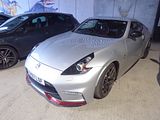
PORSCHE
The 911 continued to evolve throughout the 1960s and early 1970s, though changes initially were quite small. The SC appeared in the autumn of 1977, proving that any earlier plans there had been to replace the car with the front engined 924 and 928 had been shelved. The SC followed on from the Carrera 3.0 of 1967 and 1977. It had the same 3 litre engine, with a lower compression ratio and detuned to provide 180 PS . The “SC” designation was reintroduced by Porsche for the first time since the 356 SC. No Carrera versions were produced though the 930 Turbo remained at the top of the range. Porsche’s engineers felt that the weight of the extra luxury, safety and emissions equipment on these cars was blunting performance compared to the earlier, lighter cars with the same power output, so in non-US cars, power was increased to 188 PS for 1980, then finally to 204 PS. However, cars sold in the US market retained their lower-compression 180 PS engines throughout. This enabled them to be run on lower-octane fuel. In model year 1980, Porsche offered a Weissach special edition version of the 911 SC, named after the town in Germany where Porsche has their research centre. Designated M439, it was offered in two colours with the turbo whale tail & front chin spoiler, body colour-matched Fuchs alloy wheels and other convenience features as standard. 408 cars were built for North America. In 1982, a Ferry Porsche Edition was made and a total of 200 cars were sold with this cosmetic package. SCs sold in the UK could be specified with the Sport Group Package (UK) which added stiffer suspension, the rear spoiler, front rubber lip and black Fuchs wheels. In 1981 a Cabriolet concept car was shown at the Frankfurt Motor Show. Not only was the car a true convertible, but it also featured four-wheel drive, although this was dropped in the production version. The first 911 Cabriolet debuted in late 1982, as a 1983 model. This was Porsche’s first cabriolet since the 356 of the mid-1960s. It proved very popular with 4,214 sold in its introductory year, despite its premium price relative to the open-top targa. Cabriolet versions of the 911 have been offered ever since. 911 SC sales totalled 58,914 cars before the next iteration, the 3.2 Carrera, which was introduced for the 1984 model year. Coupe models outsold the Targa topped cars by a big margin.

Porsche unveiled the facelifted 991.2 GT3 at the 2017 Geneva Motor Show. Extensive changes were made to the engine allowing for a 9,000 rpm redline from the 4.0 litre flat-six engine derived from Porsche 911 GT3 R and Cup racing cars. The engine has a power output of 500 PS (493 bhp) and 460 Nm (339 lb/ft) of torque. Porsche’s focus was on reducing internal friction to improve throttle response. Compared to the 991.1, the rear spoiler is 0.8 inch taller and located farther back to be more effective resulting in a 20% increase in downforce. There is a new front spoiler and changes to the rear suspension along with larger ram air ducts. The car generates 154 kg (340 lb) of downforce at top speed. The 991.2 GT3 brought back the choice between a manual transmission or a PDK dual clutch transmission. Performance figures include a 0-60 mph acceleration time of 3.8 seconds (3.2 seconds for the PDK version) and a quarter mile time of 11.6 seconds. The GT3 can attain a top speed of 319 km/h (198 mph).

Also here from the 911 family was the latest model in the series, the 992 generation.
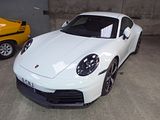
The 718 Cayman GT4 and 718 Spyder (previously named the Boxster Spyder) were revealed in June 2019. Both are differentiated from less powerful models by more aggressive bodywork, including a lower stance, new front bumper, a large new diffuser, and exhaust pipes that are spaced farther apart. The GT4 also features larger side intakes and an adjustable wing, the latter of which helps it generate up to 150 kg (330 lb) of downforce, 50 percent more than its predecessor. Both have a naturally aspirated 4.0-litre flat-6 derived from the 992’s 3.0-litre 9A2EVO engine, which is rated at 414 hp (420 PS) at 7,600 rpm and 420 Nm (310 lb/ft) of torque at 5,000–6,800 rpm. The engine has cylinder deactivation, a first for Porsche. Porsche claims a top speed of 304 km/h (189 mph) for the GT4, and 301 km/h (187 mph) for the Spyder. The front suspension and brakes are borrowed from the 911 GT3, and the adaptive dampers, ABS and stability-control programming are borrowed from the 911 GT3 RS. The anti-roll bar end links, camber and toe can be manually adjusted, but the ride height–3 cm (1.2 in) lower than a standard 718–is fixed. Both are around 15 kg heavier than the GTS models. Sales commenced in the spring of 2020. For the 2021 model year, the GT4 and Spyder became available with the 7-speed PDK dual-clutch transmission as an option. It reduces the 0-60 mph (97 km/h) acceleration time from 4.3 seconds to 3.7 seconds. In 2021, Porsche unveiled the 718 Cayman GT4 RS, the first Cayman to receive the RS treatment which is usually reserved for the 911 models. With a 4.0 L naturally aspirated flat-six derived from the 911 GT3, it produces 500 PS (493 hp) and 450 Nm (332 lb/ft) with a redline of 9,000 rpm, which allows it to accelerate from 0–100 km/h (0–62 mph) in 3.4 seconds. It generates 25% more downforce than the GT4 variant, through a swan-neck attachment fixed rear wing. The GT4 RS lapped the Nürburgring Nordschleife 23 seconds faster than the GT4. A Boxster version joined the range soon after. In March of 2023, Porsche announced that 718 GT4 and Spyder Models would cease production as of the 2024 model year, however it was later extended through the 2025 model year with production now scheduled to end in October 2025.
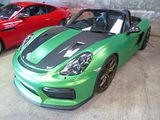
RENAULT
It did not take Renault long to add an RS version to their 3rd generation Megane range. debuting the car at the 2009 Geneva Show. This new Megane Renault Sport 250 included a 2.0litre twin-scroll turbo 4-cylinder F4Rt engine rated at 250 PS (247 bhp) at 5500 rpm and 340 Nm (251 lb/ft) at 3000 rpm with a 6-speed manual gearbox, Brembo front brakes, front splitter, extended sills and wheel arches, rear diffuser with central exhaust pipe, and 18-inch alloy wheels wearing 225/40R18 tyres. Aluminum pedals, a Renault Sport steering wheel with thumb grips, analog rev counter and sport seats with extra lateral support dress up the cabin. Other features include front LED daytime running lights and bi-xenon headlights. The 250 Cup variant contains a number of sharpened performance features including a stiffer chassis, track focused suspension, a limited slip differential and a slightly lighter gross weight. The Cup is differentiated visually with painted red brake calipers, instead of the silver calipers for the normal Sport. 18×8.25″ “Ax-l” alloy wheels are fitted with wider 235/40R18 tyres, while 19×8.25″ “Steev” wheels were available as an option with 235/35R19 tyres. In June 2011 Renault Sport revealed a limited edition 265 PS (261 bhp) version of the Mégane III called the Mégane R.S. Trophy. The Megane R.S. Trophy uses the same 2.0 four-cylinder as the standard 250 PS R.S. but thanks to modifications such as a new air intake and higher turbo pressure it gains an extra 15 hp, increasing the power output to 265 PS. It reaches 0–62 mph in six seconds flat and goes on to a top speed of 254 km/h (157 mph). It is recognizable thanks to model-specific decoration such as Trophy stickers on the doors, a new spoiler and specific 19″ rims with R.S. centre caps. It comes in a model-specific metallic yellow (Jaune Sirius) but is also available in more low-key colours such as white (Blanc Glacier), black (Noir Étoilé) and gray (Gris Cassiopée). Production was limited to 500 examples. In 2012, the Megane R.S. adopted the updated engine from the Trophy version with 265 PS (261 HP) and offers the same “Cup” and “Sport” versions like the previous 250 PS (247 HP) model. Changes include Piano Black interior highlights and wider LED daytime running lights with 6 LEDs per side rather than the 3 LEDs found in the RS250. The 18″ wheels were changed to a new design called “Tibor”, while the 19″ wheels carried over from the 250. Extreme Blue and Sport Yellow were dropped as colour options. In Australia, the Cup and Cup Trophée models were replaced with the Cup, Cup+ and Trophy+ with slightly more flexible specification levels.
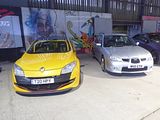
SUBARU
Subaru introduced the “New Age” Impreza, the second generation car, to Japan in August 2000, and it arrived in Europe towards the end of that year. Larger in size compared to the previous iteration, the sedan increased its width by 40 millimetres (1.6 in), while the wagon notably increased by just 5 millimetres (0.2 in)—placing the two variants in different Japanese classification categories. The coupe body style from the first generation did not reappear for the new series, and the off-road appearance package that included contrasting-coloured bumpers did carry over forward. Marketed as a separate model line, this North America-only variant was, as before, badged the Outback Sport. Naturally aspirated flat-four (boxer) engines comprised the 1.5-litre EJ15, the 1.6-litre EJ16, the 2.0-litre EJ20, and the 2.5-litre EJ25. Turbocharged versions of the 2.0- and 2.5-litre engines were offered in the WRX and WRX STI models. STI models featured a more powerful 2.0-litre (2.5-litre outside of the Japanese market) turbocharged engine. WRX models featured a 2.0-litre turbocharged boxer engine until 2005, after which they switched to the 2.5-litre turbocharged engine. As with the first generation, the turbocharged STI variants were available in numerous specifications with a myriad of limited edition variants sold. The bug-eyed styling was not well received, and Subaru had two further attempts at the front end, neither of which was entirely successful, either, but enthusiasts were happy to overlook the gawky looks because the way the car drove. Subaru issued yearly updates to the STI, tweaking cosmetics and equipment levels, and also improving performance and handling. The car was replaced in 2007 by the third generation Impreza, widely regarded as inferior in many ways to this version.


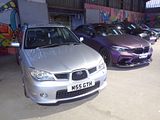
Subaru debuted the turbocharged WRX performance variant of the third generation series alongside the mainstream naturally aspirated models on 2 April 2007. For this generation, most markets adopted the abbreviated name “WRX”, although the Japanese, North American and UK markets retained the full “Subaru Impreza WRX” title. The 2.5-litre EJ255 engine is largely unchanged internally. The main change is the airflow efficiency of the heads. Changes in the engine compartment consist primarily of a fourth generation Legacy GT style intake manifold and intercooler. The TD04 turbo remains from the previous generation, however it has been adjusted to fit the new intake design. Power output consists of 227 bhp and 320 Nm (236 lb/ft) from its 2.5-litre engine. It was offered in either a five-speed manual, or 4 speed automatic. The five-speed manual transmission was changed to the same found in the fourth-generation Legacy GT. The rear limited slip differential has been discarded in exchange for the new VDC (Vehicle Dynamics Control) system. The weight of the car also has been reduced and gives the WRX a 0 to 100 km/h (0 to 62 mph) time of 5.8 seconds. In contrast, curb weight of the standard Impreza model is around 27.2 kg (60 lb) heavier. For the US market, the WRX was offered in “base”, Premium, and Limited trim levels. In Australia, the WRX is available as a sedan or hatchback. An optional premium package adds the satellite navigation with DVD player and 7-inch screen, leather upholstery and a sunroof. In response to criticism that the third generation WRX suspension is too soft, and needing to keep on par with rival car companies new releases, Subaru issued several changes in 2008 for the 2009 model year, known in the UK as the WRX-S. The EJ255 engine received an output boost to 265 bhp and 331 Nm (244 lb/ft) of torque by swapping the previous TD04 turbocharger to an IHI VF52. This led to the car now achieving a 0–60 mph time of 4.7 seconds, as tested by Car and Driver. In addition, the updated model received altered springs/struts, sway bars, and Dunlop summer tires to improve handling. Exterior cosmetic changes included the 2008 WRX Premium aero package, STi spoiler (Hatchback only), updated grill with WRX badge, and darker Gunmetal coloured wheels as standard equipment. Interior changes consisted of aluminium pedals, silver trim around the shifter, red stitching on the shift boot and seats, and a red WRX logo embroidered on the driver and passenger seat. Further changes in 2010 (for the 2011 model year) saw the WRX gain the wide-body shell from the STI, as well as the addition of quad muffler tips with diffuser. The new model gains 15 kg (33 lb). Firmer rear sub-frame bushings and wider 17-inch wheels contribute to improved traction.

The Subaru Alcyone SVX, marketed outside Japan as the Subaru SVX, is a two-door, front-engine, all- or front-wheel drive coupé manufactured and marketed by Subaru from 1991 to 1996 over a single generation. Superseding the company’s aviation-influenced XT range, the Alcyone SVX was Subaru’s first entry into the luxury/performance market, and was noted for its aircraft-inspired ‘window-within-a-window’ side-glass configuration. The nameplate “Alcyone” refers to the brightest star in the Pleiades constellation, stylized in the Subaru company logo. The suffix “SVX” is an acronym for “Subaru Vehicle X”. The Subaru Alcyone SVX debuted as a concept at the 1989 Tokyo Auto Show with styling by noted Italian designer Giorgetto Giugiaro of ItalDesign. The SVX entered production, retaining its window-within-a-window configuration, adapted from the previous generation Subaru Alcyone with an additional extension of glass covering the A-pillar — which Subaru described as an “aircraft-inspired glass-to-glass canopy.” In contrast to the angular XT, the SVX featured softer lines with its two-piece power side windows. Each side window featured an operable section roughly two-thirds of the entire windows size, with the division parallel to the upper curve of the door frame. The SVX featured a drag coefficient of Cd=0.29, identical to that of the XT coupe it replaced. European market cars had a slightly lower wind resistance of Cd=0.285, thanks to a larger undertray. From 1991 to 1992, Subaru displayed the Amadeus, a prototype shooting brake variation on the SVX, in both two- and four-door versions, which was considered for production. Ultimately the Amadeus was not produced. The SVX debuted with and remained available with only one engine, the EG33 model 3.3-litre boxer horizontally opposed flat-six. This engine was the largest engine produced by Subaru for its passenger cars until the introduction of the 3.6-litre EZ36 engine in the 2008 Subaru Tribeca. The previous generation Subaru Alcyone had a turbocharged four-cylinder engine, but the larger EG33 was more powerful and so a turbo was not installed. The SVX was offered solely with an automatic transmissions, as Subaru did not offer a manual transmission capable of handling the horsepower and torque of the EG33 engine at the time. Subaru offered two all-wheel drive systems for the automatic transmission, called ACT-4 or VTD. The first system, called ACT-4 (active torque split) was introduced on the 1988.5 Alcyone using an electronic control unit to vary the torque applied to the rear wheels dynamically based on driving conditions. As an active system, it varied the torque split to the rear infinitely based on several inputs as a percentage of the torque available to the directly geared front wheels, never to exceed the theoretical “full lock” of 50% rear bias. This AWD system was used throughout the entire production run in vehicles manufactured for sale in the US.[citation needed] A more advanced system called VTD (variable torque distribution), was used on SVX for sale in Japan, Europe and Brazil. The VTD AWD system adds a planetary centre differential. The system retains the use of the ACT clutch and active control, though its size and role are much smaller as it is used only to suppress differential action instead of the complete differential function. When no speed difference exists between front and rear, the entire VTD gear rotates as a unit and torque split is at a mechanical 36/64 biased by the planetary gear ratio. The clutch is incorporated to prevent and suppress any differential action that may occur as the planetary gear will send virtually all torque to the axle with the highest speed if not restrained. By using a similar logic to the previous ACT system, the clutch can theoretically direct any percentage of torque to either axle, but in practice the variation remains between 34-50% front and 64-50% rear. This system is not capable of operating in 2WD and therefore could not be used on 2WD dynos as required for emissions testing in some states. This prevented VTD as an option on Subaru vehicles offered for sale in US until passenger car regulations were changed, which occurred long after the end of svx production. It was later introduced to the US with the Outback VDC. Problems with early SVX transmissions included a defective torque converter clutch which disintegrates and clogs early radiators (both clutch and radiator changed in 1993), and had systemic high clutch failures due to lower than spec pump pressure, fluid evacuation, and clutch balance pressure. Several major revisions were made, all of which are included by late 1994 production. Shortly after the SVX ended production Subaru transitioned to a completely redesigned 4 speed unit. The Japanese-spec “SVX L” received four-wheel steering in 1991 and 1992 (model code “CXD” of which 1,905 were built). The VTD equipped versions received the “CXW” chassis code. In an attempt to lower the price for the US market, a front-wheel drive (“CXV”) was offered in 1994 and 1995 but sales were less than stellar. Sales of the SVX reached 14,257 in the United States and a total of 24,379 worldwide. 2,478 SVXs were sold in Europe (of which 951 went to Switzerland, 854 to Germany, and 60 to France). Roughly 7,000 of all SVXs sold were right-hand drive models. Included in this number were the 249 vehicles sold in Australia. 5,884 units remained in Japan.
TOYOTA
Needing little introduction, perhaps, is this car, a 2nd generation MR2. Toyota proved that the market for small affordable sports cars was far from dead when they launched the first generation MR2 in 1984. As was the trend at the time among Japanese manufacturers, models were replaced on quite a regular 4/5 year cycle, so it was little surprise when a second generation car appeared in 1989. However, this one would go on to be produced for 10 years, The overall design changed little in that time, but there were lots of small details that were refined during that time. The car was generally well received, with its “mini Ferrari” looks proving quite an attraction, as were the willing engines and the entertaining handling. There are not that many nice clean examples left now, though.

This Supra is from the fourth generation of the model, known as the A80. Design work began in February 1989 under various teams for design, product planning, and engineering. By the middle of 1990, a final A80 design concept from Toyota Technical Centre Aichi was approved and frozen for production in late 1990. The first test mules were hand-built in A70 bodies during late 1990, followed by the first A80 prototypes being hand-assembled in 1991. Again using subframe, suspension, and drivetrain assemblies from the Z30 Soarer (Lexus SC300/400), test model pre-production started in December 1992 with 20 models, and official mass production began in April 1993. This redesign saw Toyota placing great emphasis on a more serious high-performance car. The new Supra was completely redesigned, with rounded body styling and featured two new engines: a naturally aspirated Toyota 2JZ-GE producing 220 hp at 5800 rpm and 210 lb/ft at 4800 rpm of torque and a twin turbocharged Toyota 2JZ-GTE making 276 hp and 318 lb·ft of torque for the Japanese version. The styling, while modern, does seem to borrow some elements from Toyota’s first grand touring sports car, the Toyota 2000GT. For the export model (America/Europe) Toyota upgraded the Supra turbo’s engine which increased the power output to 320 hp at 5600 rpm and 315 lb/ft at 4000 rpm. The turbocharged variant could achieve 0–60 mph in as low as 4.6 seconds and 1/4-mile in 13.1 seconds at 109 mph. The turbo version was tested to reach over 285 km/h (177 mph), but the cars were restricted to just 180 km/h (112 mph) in Japan and 250 km/h (155 mph) elsewhere. The twin turbos operated in sequential mode, not parallel. Initially, all of the exhaust is routed to the first turbine for reduced lag. This resulted in boost and enhanced torque as early as 1800 rpm, where it already produced 300 lb/ft (410 Nm) of torque. At 3500 rpm, some of the exhaust is routed to the second turbine for a “pre-boost” mode, although none of the compressor output is used by the engine at this point. At 4000 rpm, the second turbo’s output is used to augment the first turbo’s output. Compared to the parallel mode, sequential mode turbos provide quicker low RPM response and increased high RPM boost. This high RPM boost was also aided with technology originally present in the 7M-GE in the form of the Acoustic Control Induction System (ACIS) which is a way of managing the air compression pulses within the intake piping as to increase power. For this generation, the Supra received a new 6-speed Getrag/Toyota V160 gearbox on the turbo models while the naturally aspirated models made do with a 5-speed manual W58, revised from the previous version. Each model was offered with a 4-speed automatic with manual shifting mode. All vehicles were equipped with 5-spoke aluminium alloy wheels, the naturally aspirated model had 16″ rims and the turbo models were 17″. The difference in wheel size was to accommodate the larger brakes equipped as standard onto the turbo model, but in Japan were optional extras. Both models had a space saver spare tire on a steel rim to save both space and weight. Toyota took measures to reduce the weight of this new model. Aluminium was used for the hood, targa top (when fitted), front crossmember, oil and transmission pans, and the suspension upper A-arms. Other measures included hollow carpet fibres, magnesium-alloy steering wheel, plastic gas tank and lid, gas injected rear spoiler, and a single pipe exhaust. Despite having more features such as dual airbags, traction control, larger brakes, wheels, tyres, and an additional turbo, the car was at least 200 lb lighter than its predecessor. The base model with a manual transmission had a curb weight of 3,210 lb (1,460 kg). The Sport Roof added 40 lb while the automatic transmission added 55 lb. It had a 51:49 (front:rear) weight distribution. The turbo model weighed 3,450 lb (1,560 kg) for the manual, automatic added another 10 lb (4.5 kg). Weight distribution was 53% front/47% rear. The Supra was heavier than the spartan Mazda RX-7 and all aluminium bodied Acura/Honda NSX, but it was lighter than the Mitsubishi 3000GT VR-4. The Supra soon became something of a legend, establishing itself as an effective platform for drifting in Japan, and for roadracing, with several top 20 and top 10 One Lap of America finishes in the SSGT1 class. Despite its curb weight, in 1994 the A80 managed remarkable skidpad ratings of 0.

The third-generation MR2 was marketed as the Toyota MR-S in Japan, Toyota MR2 Spyder in the US, and the Toyota MR2 Roadster in Europe. Also known as the Midship Runabout-Sports, the newest MR2 took a different approach than its predecessor, most obviously becoming a convertible and receiving the ‘Spyder’ marketing nomenclature. The first prototype of MR-S appeared in 1997 at the Tokyo Motor Show. The MR2 Spyder chief engineer Harunori Shiratori said, “First, we wanted true driver enjoyment, blending good movement, low inertia and light weight. Then, a long wheelbase to achieve high stability and fresh new styling; a mid-engine design to create excellent handling and steering without the weight of the engine up front; a body structure as simple as possible to allow for easy customizing, and low cost to the consumer.” The only engine available for the ZZW30 was the all-aluminium alloy 1ZZ-FED, a 1.8 litre Inline-four engine. Like its predecessors, it used DOHC and 4 valves per cylinder. The intake camshaft timing was adjustable via the VVT-i system, which was introduced earlier on the 1998 MR2 in some markets. Unlike its predecessors, however, the engine was placed onto the car the other way round, with the exhaust manifold towards the rear of the car instead of towards the front. The maximum power of 138 bhp at 6,400 rpm and 126 lb/ft (171 Nm) of torque at 4,400 rpm was quite a drop from the previous generation, but thanks to the lightness of the car it could still move quite quickly, accelerating from 0 to 100 km/h (62 mph) in 6.8 to 8.7 seconds depending on the transmission option, the Sequential Manual being unable to launch and shift as quickly as the clutch operated manual. Curb weight is 996 kg (2,195 lb) for manual transmission models. In addition to the 5-speed manual transmission, a 6-speed manual or 5-speed Sequential Manual Transmission (SMT) was also available starting in 2002. The SMT was a standard feature in Australian market; however, air conditioning was optional. After 2003, a 6-speed SMT was an option. The SMT had no conventional H-pattern shift lever or clutch pedal. The driver could shift gears by tapping the shift lever forward or backward or by pressing steering-wheel mounted buttons. Clutch engagement is automatic, and the car will automatically shift to second and then first gear when stopping. Cruise control was never offered with the manual transmission, but was standard for SMT-equipped cars. The MR2 Spyder featured a heated glass rear window. A hard top was also available from Toyota in Japan and Europe. Production ended in 2007 and there was no direct successor
TVR
The Tuscan was launched in 2000, by which time there had been a series of what we think of as the modern era TVRs produced for nearly a decade, the Cerbera, Griffith and Cerbera. The Tuscan did not replace any of them, but was intended to help with the company’s ambitious push further up market to become a sort of Blackpool-built alternative to Ferrari. It did not lack the styling for the task, and unlike the preceding models with their Rover V8 engines, the new car came with TVR’s own engine, a straight six unit of 3.6 litre capacity putting out 360 bhp. The Tuscan was intended to be the grand tourer of the range, perfectly practical for everyday use, though with only two seats, no ABS, no airbags and no traction control, it was a tough sell on wet days in a more safety conscious world, but at least there was a removable targa top roof panel for those days when the sun came out. The car may have lacked the rumble of a V8, but when pushed hard, the sound track from the engine was still pretty special, and the car was faster than the Cerbera, but sadly, the car proved less than reliable, which really started to harm TVR’s reputation, something which would ultimately prove to be its undoing.

ULTIMA
Although the model has been in low volume “production” for many years now, there are still plenty of people who do not know what the car is, and the fact that there are no badges on it, and now no tax disc, means that there are no clues even when you see it in person. The Ultima is manufactured by Ultima Sports Ltd of Hinckley in Leicestershire, and is generally described by commentators as a supercar. It is available both in kit form and as a “turnkey” (i.e. assembled by the factory) vehicle. The design is a mid-engined, rear wheel drive layout, with a tubular steel space frame chassis and GRP bodywork. Both close coupe and convertible versions have been made. The latter is called the Ultima Can-Am. Kit builders are free to source and fit a variety of engines and transmissions but the Chevrolet small block V8 supplied by American Speed mated to either a Porsche or Getrag transaxle is the factory recommended standard, and this configuration is fitted to all turnkey cars.

VAUXHALL
By the mid-1980s, General Motors had started developing a new model to replace the J-Car models in Europe (its American, Australian and Japanese divisions would instead be replaced by different designs in due course) by the end of the decade. The new model would retain the Cavalier nameplate for the Vauxhall version on the UK market, but elsewhere in Europe the car would be sold as the Opel Vectra – spelling the end for the long-running Ascona nameplate. Soon afterwards, development also began on a new coupe which would share the same underpinnings as the hatchbacks and saloons, but would use a different nameplate and feature completely different styling. The final generation Cavalier went on sale on 14 October 1988, being Vauxhall’s version of the Opel Vectra “A”, again available as a saloon and hatchback. There was no estate version in the Opel line-up, and as this design was not going to be sold in Australia, there was no prospect of Vauxhall turning to Holden for a replacement. Early plans for an estate model exclusive to Europe to be developed never materialised. During 1989, however, the Cavalier’s floorpan did spawn a new coupe – the Calibra, the first Vauxhall coupe since the original Cavalier coupe was discontinued in 1981. The Calibra was the official replacement for the Opel Manta, which had been discontinued in 1988, and was also sold on continental Europe under the Opel Brand. Plans for the Calibra to be imported to the USA under the Saab brand never materialised. The Vectra name was not adopted at this model change as Vauxhall feared reviving memories of the much-maligned Vauxhall Victor, whereas the Cavalier was a generally well received product and had helped boost Vauxhall’s sales and reputation. Early Victors had been viewed in some quarters as excessively corrosion prone, but the Victor was becoming a very distant memory by this stage: the Vectra name would eventually appear on a Vauxhall in 1995, when the Cavalier was finally replaced. In place of the Mark II Cavalier’s angular exterior was a more rounded appearance, reflecting the change in styling tastes throughout Europe at this time. There was also a new economical 1.4 L petrol engine. The biggest changes to the range were the addition of 2.0 L sixteen valve engines, better known as the “red top” or XE. This was fitted to the GSi 2000 and later SRis. Also made available was a four-wheel drive system, fitted to a 2.0iL model (8 valve SRi spec) and on a version of the GSi 2000. There were two diesels available: a 1.7 L, 60 hp from launch, and an 82 hp 1.7-litre Isuzu-engined lightly blown turbodiesel from 1992. The early SRis were fitted with the 2.0-liter eight-valve engine from the previous Cavalier model, which produced 130 hp. Despite the lack of an estate body style, the Cavalier topped the large medium family car sales charts in Britain in 1990, narrowly outselling the Ford Sierra, while Rover was beginning to phase out its Montego in favour of the new Rover 400 Series and later the more upmarket 600 Series. Other strong contenders in this sector included the long-running Citroën BX and Peugeot’s highly regarded 405. Having first outsold the Sierra in Britain in 1990, it was Britain’s second best selling car behind the Ford Escort in 1992. It did not lose top spot in its sector until it was overtaken by the Sierra’s successor, the Mondeo, in 1994. The Calibra, launched in 1989, was well received, notably for its sporty although cramped interior (largely based on the interior of the Cavalier) and its streamlined styling which in turn enabled the Calibra to have the lowest drag coefficient of the period at 0.26 for the 8v model (0.29 for the rest) – a record it held for the next 10 years. A few variants were made: the 2.0 litre eight valve, 2.0 L sixteen valve (the same engine found in the proven Cavalier GSi 2000), the turbo version (again, the same engine used in the very successful Cavalier Turbo), the 2.5 L V6 (with a top speed of around 145 mph) and finally the 2.0 L 16-valve “Ecotec”. A facelift in the autumn of 1992 for the 1993 model year saw the Cavalier’s 1.4 L engine dropped and the 167 bhp 2.5 L V6 added to the range. At this time the GSi 2000 was replaced by a new four wheel drive version badged simply “Cavalier Turbo”, with a turbocharged version of the sixteen valve engine producing over 200 bhp. The Vauxhall logo was added to the centre of the boot. Most of the range now had airbags and anti-lock brakes as standard (the first car in its class to do so) and all models were fitted with a toughened safety cage, side impact beams (providing additional longitudinal load paths) and front seatbelt pretensioners. This version of the Cavalier was the first Vauxhall to feature a drivers airbag, with a passenger one being optional; this feature soon became available across the rest of the company’s range. The exterior design was also freshened up, with a new look grille, headlights, rear lights and bumper mouldings and an increase in sound insulation, especially in GLS and higher models making the Cavalier a quiet place to travel in. In late 1994, the new 2.0L Ecotec engine was launched replacing both the popular eight valve C20NE and high performance sixteen valve “redtop” engine. The new engine had improved fuel economy and low end torque at the cost of maximum power output, 136 hp compared to 150 hp for the “redtop” that it replaced. After twenty years and three generations, the Cavalier came to an end in October 1995 when it was replaced by the Vectra, though sales continued for about a year afterwards and several P registered versions (August 1996 to July 1997 period) were sold. The third and final incarnation of the Cavalier was a big improvement over its predecessors (and most earlier Vauxhalls) in terms of durability, with the rust problems that had plagued Vauxhall for years finally being conquered. This was reflected by the fact that Mark III Cavaliers were a common sight on British roads for well over a decade after the end of production. The demise of the Cavalier name marked a significant moment for the Luton-based company, as it would be the last of its main models with a distinct name from its Opel counterparts until the rebadging of the Opel Speedster as the Vauxhall VX220 and the Opel Karl as the Vauxhall Viva. All future Vauxhall models would share their names with those of Opel, or in the case of the 2004 Vauxhall Monaro, with Holden. However, the Astra nameplate was chosen by Vauxhall at the beginning of 1980 for its version of the first front-wheel drive Opel Kadett, and from 1991 General Motors decided to sell the Opel version of the car as the Astra. This version of the Cavalier shared its chassis with the Saab 900 that was produced from 1993 until 1998, and continued until 2002 as the Saab 9-3, due to Saab also being within the General Motors combine at the time.

AND FINALLY……
Dwarfing everything else was this very colourful DAF XF 105-460 truck. The DAF XF is a range of semi trucks produced since 1997 by DAF Trucks. The XF 105 won the International Truck of the Year 2007 award. The truck features a 10.8 or 12.9 litre (PACCAR MX 11 or 13) engine and ZF AS Tronic or ZF Traxon gearbox in both manual and automatic formats.

No-one really expects a mid December meet, when the weather is pretty unfriendly, and it is still dark at 8am to generate space-busting attendances, and indeed that was not the case for this gathering, but there was a decent turn-out and quite a variety of cars, even if the majority of them were from more recent times. Many older cars are SORNed at this time of year, so this should not really have surprised anyone. It was good to get out and see what was here, even so, with a good mix of event regulars and a few cars that had not been seen at a QS meet before. I look forward to the 2025 Program which starts on the second Saturday of the year.