There are rather fewer events scheduled for January than most other months of the year, but the car enthusiast does still have the luxury of choice even without having to go that far from home. The ever popular Queen Square Breakfast Club meets continue all year, with those from November to February held at Easter Compton where all the parking is on hard standing and there are even a couple of large barns which means that some of the display cars can go undercover, and people can enjoy looking at them regardless of what the weather is doing. Here are my highlights from a morning spent looking at the displays, taking photos and talking to those present:
ABARTH
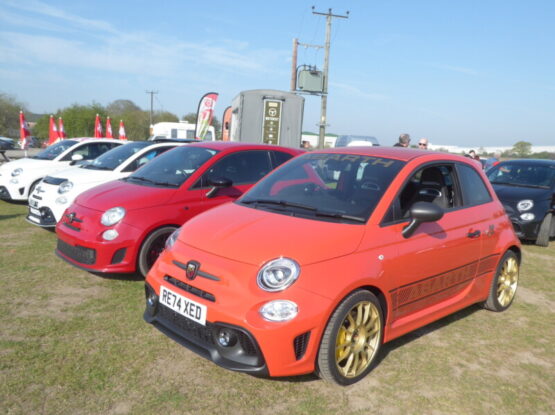
This event was promoted on the rather quiet Abarth Bristol club page and that was enough to attract a few more Abarths as well as mine.

Rumours started to circulate towards the end of 2014 that Abarth were going to upgrade the Competizione model, so as better to bridge the gap between the Turismo and the 190 bhp 695 Biposto that had been added to the range earlier in the year. It was Geneva 2015 when the result was finally shown to an expectant fan base. Most exciting news was that thanks to a bigger Garrett Turbo, the engine had been tweaked to 180 bhp, and with reduced CO2 emissions. A standard spec that included Koni Dampers, Brembo brakes, Xenon lights, Sabelt seats, Climate Control, parking sensors as well as other refinements that had been added like the TFT instrument display all proved very compelling, so not long after the first cars reached the UK in June of 2015, I found temptation too hard to resist, and as is well documented here, swapped my 2010 car for one of these. At the time I ordered it, Cordolo Red, a tri-coat pearlescent paint which shimmers in bright sunlight looked set to become one of the most popular colours of the lot, even though it is a cost option. Indeed, the Launch Edition models were all offered either in this colour or Scorpion Black, with black wheels. Surprisingly, the colour was not carried over to the Series 4 cars.

What is known as the Series 4 version of the familiar 595 reached the markets in the middle of 2016. After rumours had circulated all winter following the launch of the facelifted Fiat 500 last year, Abarth finally unveiled the Series 4 at the end of May 2016. Initially, we were told that the cars would not be available in the UK until September, but that came forward somewhat, with dealers all receiving demo cars in June, and the first customers taking delivery in July. Three regular production versions of both the closed car and the open-topped C were initially available, all badged 595, and called Custom, Turismo and Competizione, as before, though numerous limited edition models have since appeared and in most case disappeared. The most significant changes with the Series 4 are visual, with a couple of new colours, including the much asked for Modena Yellow and a different red, called Abarth Red, which replaces both the non-metallic Officina and – slightly surprisingly – the tri-coat pearlescent Cordolo Red. as well as styling changes front and rear. The jury is still out on these, with many, me included, remaining to be convinced. At the front, the new air intake does apparently allow around 15 – 20 % more air in and out, which will be welcome, as these cars do generate quite a lot of heat under the bonnet. Competizione models for the UK retain the old style headlights, as they have Xenon lights as standard, whereas the Custom and Turismo cars have reshaped units. At the back, there are new light clusters and a new rear bumper and diffuser. Inside, the most notable change is the replacement of the Blue & Me system with a more modern uConnect Audio set up, which brings a new colour screen to the dash. Mechanically, there is an additional 5 bhp on the Custom (now 145) and Turismo (now 165 bhp) and the option of a Limited Slip Diff for the Competizione, which is likely to prove a popular option. Details of the interior trim have changed, with a filled-in glovebox like the US market cars have always had, and electric windows switches that are like the US ones, as well as a part Alcantara trim to the steering wheel in Competizione cars.

The Punto Evo was launched at the 2010 Geneva Show, with the cars reaching UK buyers in the summer of that year, and it incorporated many of the changes which had been seen a few months earlier on the associated Fiat models, the visual alterations being the most obvious, with the car taking on the nose of the associated Fiat, but adapted to make it distinctively Abarth, new rear lights and new badging. There was more to it than this, though, as under the bonnet, the T-Jet unit was swapped for the 1.4 litre Multi-Air, coupled to a 6 speed gearbox, which meant that the car now had 165 bhp at its disposal. Eventually, Abarth offered an Esseesse kit for these cars, though these are exceedingly rare. Part of the Punto Evo family is the SuperSport, usually identified by the distinctive black bonnet, though not all cars feature it. Just 199 of the SuperSport versions were built, of which around 120 are registered on UK roads. These cars had many of the options from the Punto Evo included as standard. Power came from the the 1.4-litre MultiAir turbo engine, tuned to produce 178bhp and 199lb ft of torque, up from 165 of the standard Punto Evo, giving the SuperSport a 0-62 time of 7.5 seconds and a top speed of over 132mph. To help put the power down, the SuperSport was fitted with wider 18″ wheels and optional Koni FSD dampers. Standard equipment included the Blue&Me infotainment system with steering wheel controls, automatic climate control and a popular option was the ‘Abarth Corsa by Sabelt’ sports leather seats. The SuperSport was available in the same colours as the regular Punto Evo, which means white, grey, black and red. There were two here. The grey one belongs to Preston Nippard and the bright blue car, well known in the Abarth community, belongs to Ben Waite. Sadly not a standard factory colour, this one has been wrapped and is a very distinctive car, which is much admired by all who see it.


ALFA ROMEO
The 916 Series cars were conceived to replace two very different models in the Alfa range. First of these was the open topped 105 Series Spider which had been in production since 1966 and by the 1990s was long overdue a replacement. Alfa decided to combine a follow on to the Alfetta GTV, long out of production, with a new Spider model, and first work started in the late 1980s. The task was handed to Pininfarina, and Enrico Fumia’s initial renderings were produced in September 1987, with the first clay models to complete 1:1 scale model made in July 1988. Fumia produced something rather special. Clearly an Italian design, with the Alfa Romeo grille with dual round headlights, recalling the Audi-based Pininfarina Quartz, another design produced by Enrico Fumia back in 1981, the proposal was for a car that was low-slung, wedge-shaped with a low nose and high kicked up tail. The back of the car is “cut-off” with a “Kamm tail” giving improved aerodynamics. The Spider would share these traits with the GTV except that the rear is rounded, and would feature a folding soft-top with five hoop frame, which would completely disappear from sight under a flush fitting cover. An electric folding mechanism would be fitted as an option. Details included a one-piece rear lamp/foglamp/indicator strip across the rear of the body, the minor instruments in the centre console angled towards the driver. The exterior design was finished in July 1988. After Vittorio Ghidella, Fiat’s CEO, accepted the design, Alfa Romeo Centro Stile under Walter de Silva was made responsible for the completion of the detail work and also for the design of the interiors, as Pininfarina’s proposal was not accepted. The Spider and GTV were to be based on the then-current Fiat Group platform, called Tipo Due, in this case a heavily modified version with an all new multilink rear suspension. The front suspension and drivetrain was based on the 1992 Alfa Romeo 155 saloon. Chief engineer at that time was Bruno Cena. Drag coefficient was 0.33 for the GTV and 0.38 for the Spider. Production began in late 1993 with four cars, all 3.0 V6 Spiders, assembled at the Alfa Romeo Arese Plant in Milan. In early 1994 the first GTV was produced, with 2.0 Twin Spark engine. The first premiere was then held at the Paris Motor Show in 1994. The GTV and Spider were officially launched at the Geneva Motor Show in March 1995 and sales began the same year. The cars were well received. At launch, many journalists commented that Alfa had improved overall build quality considerably and that it came very close to equalling its German rivals. I can vouch for that, as I owned an early GTV for eighteen months, and it was a well built and reliable car. In 1997 a new engine, a 24-valve 3.0 litre V6, was available for the GTV along with bigger, 12.0 inch brakes and red four-pot calipers from Brembo. The console knobs were changed from round central to rectangle ones and to a three-spoke steering wheel. Some versions were upgraded with different front bumper mesh to bring the wind noise down to 74 dBA. In May 1998 the cars were revamped for the first time, creating the Phase 2 models. Most of the alterations were inside. The interior was changed with new centre console, painted letters on skirt seals, changed controls and switches arrangement and different instrument cluster. Outside, the main changes included chrome frame around the grille and colour-coded side skirts and bumpers. A new engine was introduced, the 142 bhp 1.8 Twin Spark, and others were changed: the 2.0 Twin Spark was updated with a modular intake manifold with different length intakes and a different plastic cover. Power output of the 2.0 TS was raised to 153 bhp. Engines changed engine management units and have a nomenclature of CF2. The dashboard was available in two new colours in addition to the standard black: Red Style and Blue Style, and with it new colour-coded upholstery and carpets. The 3.0 24V got a six-speed manual gearbox as standard and the 2.0 V6 TB engine was now also available for the Spider. August 2000 saw the revamp of engines to comply with new emission regulations, Euro3. The new engines were slightly detuned, and have a new identification code: CF3. 3.0 V6 12V was discontinued for the Spider and replaced with 24V Euro3 version from the GTV. 2.0 V6 Turbo and 1.8 T.Spark were discontinued as they did not comply with Euro3 emissions. By the 2001-2002 model year, only 2 engines were left, the 2.0 Twin.Spark and 3.0 V6 24V, until the Phase 3 engine range arrived. The Arese plant, where the cars had been built, was closing and, in October 2000, the production of GTV/Spider was transferred to Pininfarina Plant in San Giorgio Canavese in Turin. In 2003 there was another and final revamp, creating the Phase 3, also designed in Pininfarina but not by Enrico Fumia. The main changes were focused on the front with new 147-style grille and different front bumpers with offset numberplate holder. Change to the interior was minimal with different centre console and upholstery pattern and colours available. Instrument illumination colour was changed from green to red. Main specification change is an ASR traction control, not available for 2.0 TS Base model. New engines were introduced: 163 bhp 2.0 JTS with direct petrol injection and 237 hp 3.2 V6 24V allowing a 158 mph top speed. Production ceased in late 2004, though some cars were still available for purchase till 2006. A total of 80,747 cars were made, and sales of the GTV and Spider were roughly equal. More V6 engined GTVs than Spiders were made, but in 2.0 guise, it was the other way round with the open model proving marginally more popular.

ASTON MARTIN
Follow on to the DB7 was the DB9 (there has never been a car called DB8 – supposedly because people might have assumed this meant a V8 engine), and there was a nice example here. The Aston Martin DB9, designed by Marek Reichmann and Hendrik Fisker, was first shown by Aston Martin at the 2003 Frankfurt Auto Show, in coupe form. It was widely praised for the beauty of its lines. This was the first model to be built at Aston Martin’s Gaydon facility. It was built on the VH platform, which would become the basis for all subsequent Aston models. The Aston Martin DB9 was initially launched equipped with a 6.0 litre V12 engine, originally taken from the V12 Vanquish. The engine produced 420 lb/ft of torque at 5,000 rpm and a maximum power of 444 hp at 6,000 rpm, allowing the DB9 to accelerate from 0 to 60 mph in 4.7 seconds and a top speed of 299 km/h (186 mph). The engine largely sits behind the front-axle line to improve weight distribution. Changes to the engine for the 2013 model year increased the power to 503 hp and torque to 457 lb-ft, decreasing the 0 to 60 mph time to 4.50 seconds and with a new top speed is 295 km/h (183 mph). The DB9 was available with either a six-speed conventional manual gearbox from Graziano or a six-speed ZF automatic gearbox featuring paddle-operated semi-automatic mode. The gearbox is rear-mounted and is driven by a carbon-fibre tail shaft inside a cast aluminium torque tube. The DB9 was the first Aston Martin model to be designed and developed on Ford’s aluminium VH (vertical/horizontal) platform. The body structure is composed of aluminium and composites melded together by mechanically fixed self-piercing rivets and robotic assisted adhesive bonding techniques. The bonded aluminium structure is claimed to possess more than double the torsional rigidity of its predecessor’s, despite being 25 percent lighter. The DB9 also contains anti-roll bars and double wishbone suspension, supported by coil springs. To keep the back-end in control under heavy acceleration or braking, the rear suspension has additional anti-squat and anti-lift technology. Later versions of the car also features three modes for the tuning: normal, for every-day use, sport, for more precise movement at the cost of ride comfort, and track, which furthers the effects of the sport setting. The Aston Martin DB9 Volante, the convertible version of the DB9 coupe, followed a few months later. The chassis, though stiffer, uses the same base VH platform. To protect occupants from rollovers, the Volante has strengthened windscreen pillars and added two pop-up hoops behind the rear seats. The hoops cannot be disabled and will break the car’s rear window if deployed. In an effort to improve the Volante’s ride while cruising, Aston Martin have softened the springs and lightened the anti-roll bars in the Volante, leading to a gentler suspension. The retractable roof of the Volante is made of folding fabric and takes 17 seconds to be put up or down. The Volante weighs 59 kilograms (130 pounds) more than the coupe. The coupe and Volante both share the same semi-automatic and automatic gearboxes and engine. The car was limited to 266 km/h (165 mph) to retain the integrity of the roof. Like the coupe, the original Volante has 420 lb·ft of torque at 5,000 rpm and a maximum power of 450 hp at 6,000 rpm. The 0 to 60 mph slowed to 4.9 seconds due to the additional weight. The DB9 was facelifted in July 2008, which mainly amounted to an increase in engine power, to 476 hp and a redesigned centre console. Externally, the DB9 remained virtually unchanged. For the 2013 model year revision, Aston made minor changes to the bodywork by adapting designs from the Virage, including enlarging the recessed headlight clusters with bi-xenon lights and LED daytime strips, widening the front splitter, updating the grille and side heat extractors, updating the LED rear lights with clear lenses and integrating a new rear spoiler with the boot lid. .On newer models, like the coupe’s, the Volante’s horsepower and torque increased to 517 PS (510 hp) and 457 lb·ft respectively. As a finale for the model, a more powerful DB9 was released in 2015, called the DB9 GT. This had 540 bhp and 457 lb-ft of torque at 5500 rpm, giving a 0 to 60mph time of 4.4 seconds and 0 to 100mph in 10.2 seconds, with the standing quarter mile dispatched in 12.8 to 12.9 seconds and a top speed of 183mph. Production of the DB9 ended in 2016 being replaced by its successor, the DB11.

BMW
The BMW E28 was produced from 1981 to 1988 and replaced the E12 5 Series. The E28 has a self-supporting body that is welded to the body platform. The passenger cell is a safety passenger cell with deformation elements both in the front and rear of the vehicle. Unlike its E12 predecessor and E34 successor, the E28 has a rear-hinged bonnet. The boot has a volume of 460 litres. Most models have a fuel tank capacity of 70 L with some models having a smaller tank of 63 litres. The kerb weight is 1,140–1,410 kg (2,513–3,109 lb). Cruise control, an ‘on-board computer’ (to display trip information) and a “check control” panel (to alert the driver about fluid levels and lighting faults) were introduced to the 5 Series on the E28. The glazing is made of single-pane safety glass, the windscreen has laminated glass. As part of developing the air-conditioning system for the E28, several of the BMW engineers in charge of this program drove a previous generation E12 5 Series during the middle of summer in Texas. The E12 528i was painted black with a black interior, and driven 500 mi (805 km) in one day.The styling was developed under BMW’s chief designer Claus Luthe, with development of the E28 beginning in 1975. At the time that BMW was designing the E28, the company had only one computer, which was used for payroll management and spare parts logistics. Wolfgang Matschinsky and his team borrowed that computer to perform the calculations necessary to develop the new drivetrain and chassis. This was due to the fact that the addition of an ABS system necessitated a redesign from the previous model due to excessive vibrations under heavy braking. The four models available at the launch of the E28 were the 518, 520i, 525i and 528i, with the 518 using a straight-four petrol engine and the other three models using a straight-six petrol engine. Over the course of the E28 model, the following models were added: the 524d and 524td using diesel engines, the 518i (a fuel-injected version of the 518), the 525e/528e as fuel-economy models, and the upper-specification 533i, 535i, M535i, and M5 models. Production ceased at the end of 1987 in readiness for the E34 generation. A total of 722,328 cars were built.

Development of the E36 began in 1981 and the exterior design was heavily influenced by aerodynamics, specifically the overall wedge shape, headlight covers and smaller wing mirrors. The lead designers were Pinky Lai and Boyke Boyer. The production version of the E36 was launched in October 1990, with press release in November and market launch in early 1991. The initial models were of the four-door sedan body style, and these were soon followed by the coupe, convertible and Touring, to replace their equivalent E30 generation cars. The early models had a mixed reception, with many feeling that the build quality was not as good as previously and the grey plastic bumpers drew particular criticism, but BMW steadily evolved the car to make among the best available in its class and sales rocketed still further beyond E30 levels. The number of engines offered during the model’s life was greater than ever before, and this was the first 3 Series to be available with a six-speed manual transmission (in the 1996 M3), a five-speed automatic transmission and a four-cylinder diesel engine. The multi-link rear suspension was also a significant upgrade as compared to the previous generations of the 3 Series. All-wheel drive was not available for the E36, unlike the previous (E30) and successive (E46) generations. Following the introduction of its successor, the E46 3 Series in 1998, the E36 began to be phased out and was eventually replaced in 1999.

FERRARI
An all new design, the 458 Italia was first officially unveiled at the 2009 Frankfurt Motor Show. Once more, Ferrari advised that the model incorporated technologies developed from the company’s experience in Formula 1. The body computer system was developed by Magneti Marelli Automotive Lighting. The 458 came with a 4,499 cc V8 engine of the “Ferrari/Maserati” F136 engine family, producing 570 PS ( 562 hp) at 9,000 rpm and 540 N·m (398 lb/ft) at 6,000 rpm with 80% torque available at 3,250 rpm. The engine featured direct fuel injection, a first for Ferrari mid-engine setups in its road cars. The only transmission available was a dual-clutch 7-speed Getrag gearbox, in a different state of tune shared with the Mercedes-Benz SLS AMG. There was no traditional manual option, making this the fourth road-car after the Enzo, Challenge Stradale and 430 Scuderia not to be offered with Ferrari’s classic gated manual. The car’s suspension featured double wishbones at the front and a multi-link setup at the rear, coupled with E-Diff and F1-Trac traction control systems, designed to improve the car’s cornering and longitudinal acceleration by 32% when compared with its predecessors.The brakes included a prefill function whereby the pistons in the calipers move the pads into contact with the discs on lift off to minimise delay in the brakes being applied. This combined with the ABS and standard Carbon Ceramic brakes caused a reduction in stopping distance from 100–0 km/h (62-0 mph) to 32.5 metres. Ferrari’s official 0–100 km/h (62 mph) acceleration time was quoted as 2.9–3.0 seconds with a top speed of 340 km/h (210 mph). In keeping with Ferrari tradition the body was designed by Pininfarina under the leadership of Donato Coco, the Ferrari design director. The interior design of Ferrari 458 Italia was designed by Bertrand Rapatel, a French automobile designer. The car’s exterior styling and features were designed for aerodynamic efficiency, producing a downforce of 140 kg (309 lb) at 200 km/h. In particular, the front grille features deformable winglets that lower at high speeds, in order to offer reduced drag. The car’s interior was designed using input from former Ferrari Formula 1 driver Michael Schumacher; in a layout common to racing cars, the new steering wheel incorporates many controls normally located on the dashboard or on stalks, such as turning signals or high beams. At launch the car was widely praised as being pretty much near perfect in every regard. It did lack a fresh air version, though, but that was addressed with the launch of the 458 Spider at the 2011 Frankfurt Motor Show. This convertible variant of the 458 Italia featured an aluminium retractable hardtop which, according to Ferrari, weighs 25 kilograms (55 lb) less than a soft roof such as the one found on the Ferrari F430 Spider, and can be opened in 14 seconds The engine cover was redesigned to accommodate the retractable roof system. It had the same 0–100 km/h time as the hard-top but a lower top speed of 199 mph. It quickly became the better seller of the two versions.


FORD
The Ford Sierra is a mid-size car or large family car that was built by Ford Europe from 1982 to 1993. It was designed by Uwe Bahnsen, Robert Lutz and Patrick le Quément. The code used during development was “Project Toni”. Its name came from the Spanish word for mountain range. The Ford Sierra was first unveiled on 22 September 1982 at the British International Motor Show hosted at the NEC in Birmingham, shortly followed by the Salon de l’Automobile in Paris on 30 September 1982. Sales started on 15 October 1982, replacing the Ford Taunus TC3 (UK: Ford Cortina Mark V). Its aerodynamic styling was ahead of its time and as such, many conservative buyers (including company car drivers) did not take fondly to the Taunus’s/Cortina’s replacement. This was also due to the fact that the Sierra was not available as a saloon, in contrast to the Taunus/Cortina. A saloon model debuted in 1987 with the introduction of the facelifted Sierra. It was mainly manufactured in Germany, Belgium, and the United Kingdom, although Sierras were also assembled in Ireland, Argentina, Venezuela, South Africa and New Zealand. By 1978, Ford Europe was working on a new mid-range model to replace the Cortina/Taunus during the early 1980s, working under the codename “Project Toni”. Although still popular with buyers, the outgoing Cortina/Taunus was essentially a 12-year old design by the time of the Sierra’s launch; despite the TC2 shape launching in 1976, and the mildly reworked TC3/Mk5 three years later, both were merely a reskinned version of the 1970 TC/Mk3 with few major mechanical changes in that time. Ford’s future model policy and styling direction had already been shown with the Escort III two years earlier, in that its conventionally styled saloons of the 1970s would be replaced by hatchbacks with advanced aerodynamic styling. Ford had confirmed during 1981, a year before the Sierra’s official launch, that its new mid-range car would carry the Sierra name, signalling the end of the Taunus and Cortina nameplates after 43 years and nine generations respectively 20 years and five generations. In September that year, it had unveiled the Probe III concept car at the Frankfurt Motor Show, hinting at what the new car would look like when the final product was unveiled 12 months later. At first, many found the design blob-like and difficult to accept after being used to the sharp-edged, straight-line three-box styling of the Taunus/Cortina, and it was nicknamed “the jellymould”. The shape served a purpose though, producing a drag coefficient of 0.34, a significant improvement over the boxy outgoing Taunus’s/Cortina’s 0.45. This aerodynamic design was key for reducing fuel consumption according to Ford, and was even used as compensation for the V6-engines. The interior was more conventional, although Ford took a page from BMW by angling the centre of the dashboard towards the driver. Sales were slow in the first months – the situation being exacerbated by heavy discounting by Ford dealers of surplus Cortina stock from the autumn of 1982 onwards, with more than 11,000 new Cortinas being registered in 1983. However in 1983, its first full year of sales, the Sierra managed nearly 160,000 sales in Britain, outsold only by the smaller Escort. Ford had also launched the more conservatively designed Escort-based Orion saloon that year, which found favour with buyers who would otherwise have been the Sierra’s target customers. In West Germany, it was proving very popular from an early stage; within months of its launch, it was reportedly achieving treble the number of sales that the Taunus had been attaining – though in West Germany, the Taunus had not been quite as popular or iconic as its Cortina equivalent had been in Britain. It was later in the Sierra’s life that the styling began to pay off; ten years after its introduction, the Sierra’s styling was not nearly as outdated as its contemporaries, even though all major competitors were newer designs, though the Sierra had been tweaked on several occasions and many new engines had been added. The most notable changes came at the autumn of 1987, with a major facelift and the addition of a 4-door saloon (UK: Sapphire). As other manufacturers adopted similar aerodynamic styling, the Sierra looked more normal. At its peak, it was Britain’s second best selling car in 1983, 1988 and 1989, and was still Britain’s fifth best selling car in 1992. Its best year was 1989, when more than 175,000 were sold. However, it was outsold by the Vauxhall Cavalier in MK2 form during 1984 and 1985, and then from 1990 until its demise by the MK3 Cavalier. Nevertheless, it comfortably outsold its second key rival, the Austin Montego, which was launched in April 1984. Between 1985 and 1988, the Sierra faced fresh competition in Europe from the likes of the Renault 21 and Peugeot 405, while Japanese carmaker Nissan was producing its Bluebird model in Britain from 1986. Early versions suffered from crosswind stability problems, which were addressed in 1985 with the addition of “strakes” (small spoilers) on the rear edge of the rubber seals of the rear-most side windows. These shortcomings saw a lot of press attention, and contributed to early slow sales, when it was outsold by its key rival the Vauxhall Cavalier in 1984 and 1985. Other rumours that the car hid major crash damage (in part true, as the new bumper design sprung back after minor impact and couldn’t be “read” to interpret major damage) also harmed the car’s reputation. This reached near-hysterical heights in its early months on sale, with UK press making a report that Ford would reintroduce the previous Cortina model out of desperation. These reports were swiftly denied by Ford. However, sales began to rise during 1983, and it finished as Britain’s second best selling car behind the Escort. After being outsold by the Cavalier for the next two years, it regained its lead of the market sector in Britain during 1986, and a refreshed range (with more engine options as well as the introduction of a saloon) enjoyed a surge in sales from 1987, though the MK3 Cavalier finally outsold it in 1990. Even in 1992, the Sierra was still Britain’s fifth best selling car. It was nicknamed “the salesman’s spaceship” on account of its status as a popular fleet car in Britain. In contrast to the Sierra’s groundbreaking exterior design, its drivetrain was conservatively engineered, retaining rear-wheel drive and the same engines and transmissions as the Cortina/Taunus which were effectively 12 years old as they were first used on the TC1/MkIII generation in 1970. Much of this was done to appease the important fleet market which was wary of complexity. However, there was much modification; for example the engines were fitted with breakerless ignition, improved carburettors and the option of fuel injection, whilst 5-speed transmissions were now available. Most competitors were already switched to front-wheel drive around that time. Ford claimed however this set-up was required to offer V6-engines, which had to contribute to the Sierra’s driving comfort. New for the Sierra was a diesel engine, although the engine itself wasn’t new at all. Similar to the Ford Granada, Ford used an “Indenor”-engine which was designed by Peugeot in the 1950s. While the Granada was offered with 1.9, 2.1 and 2.5 diesels, the Sierra unit had a displacement of 2.3 litre. This engine was replaced only in 1989 by an all-new 1.8 litre turbodiesel, developed by Ford itself. The Sierra had a four-speed manual gearbox as standard, with a five-speed as option but standard on the 2.3D and 2.3 V6. At a time when the rival Vauxhall Cavalier was offered with a five-speed, this led to some critics commenting that the Sierra was somewhat underpowered. In the mid-1980s, many smaller cars (some even two segments smaller) featured five-speed gearboxes as standard. The chassis, however, was more sophisticated than the Cortina/Taunus, with fully independent suspension on both axles. The rear suspension was essentially carried over from the Granada, with trailing arms and coil springs mounted on a tubular sub-frame which also provided location for the final drive/differential housing driving the axle shafts. The front suspension dispensed with the Cortina/Taunus’ double wishbones in favour of a scaled-up version of the Fiesta and Escort/Orion’s layout with MacPherson struts, lower locating arms and anti-roll bars. One of the most striking design features of the Sierra was its closed front panel instead of a grille, which was later also to be found on the 1985 Ford Taurus. The air intake was situated below the front bumper, making the Sierra a so-called ‘bottom breather’. The headlights were integrated in this front panel while the indicators were mounted in the bumper within a combined unit with the foglights. However, this set-up was only present on the top-of-the-line “Ghia”-trim as well on the later introduced XR4i sport model. The other Sierra models had a more traditional front end with a two-bar grille between the headlights, being unpainted on the base model. These models had the indicators in the bumper as well, although being slimmer but wider and without the foglights. Both the Ghia and XR4i had wide headlights with two lenses while the other models had smaller lights with a single lens. For the 1985 model year, all the lower-spec models, except the base model, adopted the Ghia and XR4i’s front grille and headlight treatment. However, the second lens of the lower-spec models had no actual light within it. On the Ghia and XR4i this lens contained additional high beam lamps. The South-African XR8 model’s front end was similar to the XR4i’s but featured a small grille between the headlights. The rear lights of the Ghia, as well as the very early XR4i’s, were the same shape and layout as other models, but featured tiny horizontal black strakes on the lenses to give the impression that they were smoked. The car was replaced by the Mondeo in Europe in April 1993, though stocks lasted for about two years afterwards. The Sierra remained a popular second-hand buy and common sight on British roads until well beyond the year 2000.

Ford played much the same guessing game about whether there would be an RS version of the third generation Focus as they had done with the earlier versions. Production of the regular cars started in late 2010, but it was not until the 2015 Geneva Motor Show before the production ready MKIII Ford Focus RS was unveiled. It came packing the turbocharged 2.3-litre inline-four engine found in the Mustang EcoBoost. In the Focus RS, the engine itself produces 350 hp. Power is sent to all four wheels via Ford’s all-new Torque-Vectoring All-Wheel-Drive system with a rear drive unit designed by GKN, as well as upgraded suspension and brakes. As well as that, the new Focus RS will be fitted with Drive Modes – including an industry-first Drift Mode that allows controlled oversteer drifts – and Launch Control. The RS will boast a model specific aerodynamic package that helps to differentiate it from other Focus models. The RS is capable of accelerating to 100 km/h (62 mph) in 4.7 seconds. Sales finally started in mid 2016, with long waiting lists having been created, though Ford did eventually catch up with expanded production levels allowing them to meet the demand.

Also here was the Puma ST.

HONDA
This is an Integra type R and is from the fourth and final generation of the car, often referred to as the DC5, which is the Honda internal reference fro the car. The fourth generation Integra was introduced in Japan on April 13, 2001 and produced from July 2001 to July 2006. For North America (United States and Canada), it was introduced as the Acura RSX in accordance with Acura’s new alphabetical naming scheme. It also had an entirely new engine, the K-series. The Integra came in two models in the United States, the RSX and the RSX Type-S boasting the K20A2 engine from 2002 to 2004, while the 2005 and 2006 RSX-S came with a K20Z1. The RSX was sold as a Honda Integra in Japan and Australia, markets where Acura did not exist. In March 2006, Honda announced that the Integra would be discontinued in June after its final 300 cars were sold, due to the shrinkage of the coupe market. The reaction of the consumers towards the discontinuation, however, forced Honda to extend production until July 2006 and produce 150 more Integras. The Acura RSX was discontinued as well, as the RSX did not fit within the confines of Acura’s re-structured market strategy. This left the Acura TSX as Acura’s entry-level vehicle. Also, the introduction of the similarly powerful and less expensive 2006 model-year Honda Civic Si was there to fill in the gap left by the RSX. The DC5 Type R (Japanese market only) comes standard with a K20A 220 hp 2.0 litre DOHC i-VTEC four-cylinder engine. The “i” in i-VTEC stands for intelligent VTEC, which employs VTC (Variable Timing Control) to advance or retard the intake cam timing within a 50 degree range. The Integra Type R comes equipped with Recaro seats, four-piston Brembo front brakes, a close ratio six-speed manual transmission, a limited-slip differential, variable back-pressure exhaust system, and a stiffer suspension


JAGUAR
Representing the last of a long line of Jaguar sports cars was this F Type.


LOTUS
In 2004, the Series 2 Exige was introduced. It features a naturally aspirated 1.8 L 16-valve DOHC Toyota/Yamaha engine that is rated at 190 bhp with the Toyota engine designation of 2ZZ-GE. Compared to the Series 2 Elise, it has a front splitter, a fibreglass hardtop roof with roof scoop, a rear engine cover, and rear spoiler. The sole purpose of these aerodynamic additions to the base Elise is to create more downforce (almost 45 kg (100 lb) of downforce at 161 km/h (100 mph) in the Exige versus 5.9 kg (13 lb) at 100 mph in the Elise). In February 2005, Lotus announced a limited production run of 50 Exiges, using the Toyota engine with a supercharger. This increased the power output to 243 bhp. These models were only available in yellow or black, representing the colours of Lotus Sport, and are badged 240R. They have a projected 0 – 60 mph time of 3.9 seconds and 0-161 km/h (100 mph) of 9.9 seconds, with a top speed of 249 km/h (155 mph). The North American Exige was unveiled at the Los Angeles Auto Show in January 2006. According to Lotus, the standard Exige Series 2 model weighs 2,016 lb (914 kg). In February 2006, Lotus announced the Exige S model which used a supercharged Toyota 2ZZ-GE engine rated at 220 bhp The S was also made available in North American markets as a 2007 model. According to Lotus, the Exige S model, weighing 2,057 lb (933 kg), has the following specifications: In 2008, the Exige S was replaced by the Exige S 240. Power output increased by 9% over the outgoing model to 240 bhp. The S 240 also received upgraded AP Racing brakes from the Exige Cup 240 and a larger roof scoop utilised by the Exige Cup 255. 0–60 mph times improved to 4.0 seconds. The S 240 base manufacturer suggested retail price was $65,690. The Exige S 260 produced an additional 7% power output over the S 240 resulting in 256 bhp. Even with a full fuel tank, extensive use of weight-saving materials such as carbon fiber reduced the vehicle’s gross weight to 916 kg (2,020 lb) compared to 942 kg (2,077 lb) in the S 240. It can accelerate from 0–60 mph in 4.0 seconds. After 2009, both the S 240 and S 260 received distinctively new and enlarged rear spoilers mounted to the rear clam instead of the motor bay cover. Countless limited edition models were produced, as well. A third generation car was launched in 2012.


MAZDA
Mazda introduced rotary-powered vehicles in 1971, beginning with the R100 and eventually introduced the RX-2, RX-3, RX-4, RX-5, and three generations of the RX-7 sports car in the US and worldwide markets. However, due to the lack of conveniences and user-friendliness, coupled with the high price tag and declining interest in sports cars and coupés at the time, Mazda decided to withdraw the RX-7 from most major markets except Japan. After 1995, Mazda suffered from a relatively undistinguished and ordinary product line in the US except for the MX-5 Miata. As popular interest in import tuning and performance cars resurged in the late-1990s due in part to various popular cultural influences, Japanese automakers waded back into the performance and sports car market in the US and in worldwide markets. In addition, Mazda endeavoured to rejuvenate itself around this time, partially with financial and management assistance from its new owner Ford, and successfully developed a new product line of high quality cars with desirable styling and superior driving dynamics compared to their competitors, beginning with the Mazda6 and followed by the Mazda3, paving the way for the arrival of Mazda’s next-generation rotary powered sports car. The RX-8 combined two previous products (the internationally sold RX-7, and the Cosmo which was exclusive to Japan), with the exterior dimensions of the RX-8 to be slightly smaller than those of the Cosmo. Mazda chose not to install the 2.0 L three-rotor 20B-REW, which was discontinued in 1996 when the Cosmo ceased production. In Japan, sales were affected by the fact that the RX-8 did not comply with Japanese Government’s dimension regulations, and Japanese buyers were liable for yearly taxes for driving a larger car. The rotary engine had financial advantages to Japanese consumers in that the engine displacement remained below 1.5 litres, a significant determination when paying the Japanese annual road tax which kept the obligation affordable to most buyers, while having more power than the traditional inline engines. The development of the RX-8 can be traced as far back as the 1995 RX-01 concept car, which featured an early iteration of the 13B-MSP engine. Naturally aspirated with side exhaust ports, this engine has a power output of 210 bhp Because of Mazda’s financial position at the time and the growing market interest in SUVs, the RX-01 did not see further development or production. However, a “skunkworks project” engineering team within Mazda kept the development of the 13B-MSP alive using an elongated MX-5 chassis known internally as “gokiburi-ka”, or “cockroach car” translated to English, eventually catching the attention of management, which was by then heavily influenced by Ford. Development of the 13B-MSP advanced and eventually led to the RENESIS name debuting along with the RX-EVOLV concept car which began to bear semblance to the production version of the RX-8 with the “freestyle” rear suicide doors. The styling was further refined, in Mazda tradition, by competition between its design studios in Japan, the US, and Europe. The lead designer was Ikuo Maeda, the son of Matasaburo Maeda (the lead designer of the original RX-7). The project obtained official approval from management under one condition, that the resulting car should have four doors, and eventually the RX-8 concept car (design/engineering model) was produced and shown in 2001, closer resembling the production version. A near-production “reference exhibit” RX-8 was shown shortly thereafter at the 2001 Tokyo Motor Show, pending final approval for production. The production version of the RX-8 closely resembles this vehicle save for minor trim details, and “Job 1” began in February, 2003 at Mazda’s Hiroshima plant in Japan. The RX-8 was designed as a front mid-engine, rear-wheel-drive, four-door, four-seater quad coupé. The car has a near 50:50 front-rear weight distribution and a low polar moment of inertia, achieved by mounting the engine behind the front axle and by placing the fuel tank ahead of the rear axle. The front suspension uses double wishbones and the rear suspension is multi-link. Weight is trimmed through the use of materials such as aluminium and plastic for several body panels. The rest of the body is made of steel, except for the plastic front and rear bumpers. The manual gearbox model uses a carbon fibre composite driveshaft to reduce the rotational mass (momentum of inertia) connected to the engine. Power is sent to the rear wheels through a torque-sensing conical limited-slip differential for improved handling. While under-powered in comparison to the final variant of the RX-7, the RX-8 is considered its successor as Mazda’s rotary engine sports car. A prominent feature of the RX-8 is its rear-hinged “freestyle” doors (similar to suicide doors) that provide easier access to the rear seats. The RX-8 has no B-pillars between the front and rear doors, but the leading edge of the rear door acts as a “virtual pillar” to maintain structural rigidity. Because of the overlapping design, the rear doors can be opened only when the front doors are open. The RX-8’s cabin was designed to allow enough room to house four adults, making it a genuine 4-seater rather than a 2+2. In designing the RX-8, Mazda’s engineers were able to achieve a chassis stiffness rating of 30,000 The earlier models of the RX-8, having chassis codes SE3P, and JM1FE, were produced from the 2003 model year, though the car’s U.S. debut was for the 2004 model year. It is powered by the RENESIS 13B-MSP (2-rotor, multi-side-port) Wankel engine displacing 1.3 L (1,308 cc). The 4-port standard RENESIS was rated at 191 bhp and was coupled with either a 5-speed manual or 4-speed automatic transmission. The 6-port high power RENESIS was only available with a six-speed manual transmission and was rated at 238 bhp. For the North American market, Mazda revised the reported output rating of the standard and high power RENESIS soon after launch to 189 bhp and 237 bhp, respectively.With exhaust ports now located in the side housing, the RENESIS boasted improved fuel efficiency and emissions rating over the 13B-REW employed by the preceding RX-7, thereby making it possible to be sold in North America. At launch, the RX-8 was available in various models in different markets around the world. The variations according to different markets are as follows: 6-speed manual with a claimed output of 232 bhp at 8,250 rpm and 159 lb⋅ft (216 Nm) of torque at 5,500 rpm with a 9,000 rpm (redline limited) (Sold in North America). This model was equivalent to the “Type S” trim in Japan; 5-speed manual with engine tuned to 189 bhp with the redline reduced to 7,500 rpm. This powertrain combination was not available in North America; 6-speed automatic with manual paddle shifting option (introduced in the U.S. for the 2006 model year, replacing the 4-speed automatic transmission of 2004–2005) with the engine rated at 212 bhp and 159 lb/ft (216 Nm) of torque with a redline at 7,500 rpm. This was the revised standard RENESIS, now with two extra intake ports like the high power version. The 2006 automatic RX-8 model also was given a second oil cooler, as was standard in the manual transmission model. Automatic versions all had lower output/lower rpm engines due to the lack of availability of a transmission that would be able to reliably cope with the engine’s high rpm limits. In 2003 Mazda announced a factory Mazdaspeed Version of the RX-8 exclusively in Japan. Based on the Type S and tuned by Mazda’s in-house division Mazdaspeed, the car included both mechanical, suspension, and aerodynamic improvements over the standard RX-8’s. Mazdaspeed RX-8’s were considered the highest performance model of the pre-facelift RX-8. Mechanical and suspension improvements included a new performance exhaust system, upgraded spark plugs, grounding kit, lightweight flywheel, re-balanced eccentric shaft, performance brake pads, stiffer anti roll bars, four point front strut tower brace, rear strut tower brace, as well as a set of height and damping force adjustable coil-overs. Mazdaspeed also redesigned the aerodynamics of the car, giving it a new front bumper, with enlarged venting and oil cooler ducting, as well as side skirts, rear under spoiler, and a rear wing. The Mazdaspeed RX-8 was offered in either Strato Blue Mica, or Sunlight Silver Metallic as exclusive colours. A total of 480 factory Mazdaspeed Version RX-8’s were built, and had a suggested retail price of JP¥3,650,000.00. Mazda also sold Mazdaspeed accessories worldwide through their dealerships. These accessories included both parts that weren’t equipped on factory Mazdaspeed RX-8’s as well as nearly all the parts equipped on the factory Mazdaspeed Version. This allowed standard RX-8’s to be upgraded to Mazdaspeed standards through dealerships around the world. In November 2008, Mazda improved the RX-8 body rigidity through the addition of structural reinforcements, by adding a trapezoidal shock tower brace and enhancing the local rigidity of the front suspension tower areas. The rear suspension geometry was revised for better handling, and the final-drive-gear ratio on manual transmission cars was shortened from 4.444 to 4.777 for improved off-the-line performance. While minimal, these changes gave the updated RX-8 increased acceleration and performance. Mazda engineers claimed that the 2nd generation RX-8 was (slightly) faster than the previous generation due to the lower gearing and improved suspension. The Renesis II engine iteration that was launched in the 2009 model year included a third oil injection port in each rotor housing to feed oil to the middle of the rotor facing, making this their first all-new EMOP (Electric Metering Oil Pump) with a total of 6 lubrication injectors, plus an all-new engine oil pump with higher pressure rating that requires specific oil filter rated for the higher pressure. New catalytic converter was used to reduce clogging that resulted in overheating exhaust stream forward of the catalytic converter and eventual rotor side seal failure, which was responsible for majority of RX-8 engine failures. Ignition coil packs, which suffer reduced performance over time and leads to unburnt fuel and oil that eventually clogs the catalytic converter, was not upgraded from series 1 RX-8. Due to higher usage cycle that is two to three times higher in Wankel compared to Otto cycle, ignition coil packs on RX-8 can degrade much sooner than Piston engines using similar hardware, and cause unburnt fuel to reach the catalytic converter, clogging it and cause engine overheating leading to side seal springs failure. The updated RX-8 also received design enhancements that were meant to freshen the styling and give the RX-8 a new look, without impairing the basic design theme. Refinements for the 2009 model year included a more aggressive restyled front and rear bumper as well as a new front fascia. The updated RX-8 also came with sporty, high-quality finish front and rear headlamps as well as larger exhaust pipes (now measuring 90 mm (3.5 in) across). The 2009 RX-8 also offered a new five-spoke wheel design featuring a symbolic and sporty design reminiscent of the rotary engine, with different arrangements for each wheel size. A rear spoiler was also added dependent on the trim level selected. There were three trims available to consumers from 2009 to 2012: Sport, Grand Touring, and R3. European production ended in 2010 when the car could no longer meet emissions standards.

MERCEDES-BENZ
The R170 Mercedes-Benz SLK-Class is the first generation of the Mercedes-Benz SLK-Class range of compact luxury roadsters produced by Mercedes-Benz between 1996 and 2004. SLK stands for the company’s design mission to create a sportlich (sporty), leicht (light) and kurz (compact) roadster, and is based on a shortened platform of the W202 Mercedes C-Class. The R170 Mercedes SLK is based on the SLK I Concept and SLK II Concept, which is a two-seater roadster concept car that features a folding metal electro-hydraulic roof, dubbed ‘vario-roof’ by Mercedes, and takes 25 seconds to operate. A German design patent was filed on 30 September 1993, with the final production version of the SLK introduced at the Turin Motor Show on 22 April 1996. The R170 SLK is based on the W202 C-Class platform, sharing many drivetrain and chassis components, as well as using a shortened version of the floor pan. The wheelbase is also identical to the wheelbase of the 190SL and 300SL, at 2,400 mm (94 in). The platform of the R170 Mercedes SLK is also used by the Chrysler Crossfire, which shares 80% of its components with the car. The SLK 200 was exported and sold exclusively to Italy, Netherlands, Portugal, Turkey, and Greece, and was only available with the Getrag five-speed manual transmission in most countries. After the 2000 facelift, the SLK 200 Kompressor was introduced to the worldwide market, replacing the SLK 200. The SLK 32 AMG was introduced in 2001, designed to rival the BMW M Roadster and Porsche Boxster S. The car featured the same M112 engine as in the SLK 320, but has a helical twin-screw supercharger and water-to-air intercooler. The SLK 32 AMG introduced Mercedes’ new ‘SpeedShift’ 5G-Tronic (automatic) transmission, that allow for manual shifting of the gears, and faster automatic downshifts before overtaking. There was no manual transmission option available for the SLK 32 AMG. The SLK 32 AMG features a more angular steering wheel, AMG instrument dials, an updated front and rear bumper with larger air intakes, and larger brakes; from 300 mm (12 in), upgraded to 334 mm (13 in) in diameter. SLK 32 production started from January 2001, to March 2004. A total of 4,333 were produced; 979 were sold in Germany, 2,056 were imported to the US, and 263 to the UK. It was replaced by the Mercedes R171 SLK in 2004.

MINI
This was certainly something a bit different from the regular road-going models, a number of which were also here.
This is the car which Pro Alloys Racing will use to compete in the Vertu MINI CHALLENGE for the 2025 season. The Wiltshire-based outfit will debut in the headline JCW category in 2025 with a two-car entry having previously competed in a range of club level championships in recent seasons, most notably the Fiesta Junior Championship and the Milltek Sport Civic Cup. The team has also contested selected events in TCR UK, scoring a race win on its second weekend in the series in 2023 before becoming the first team to run the world title-winning Lynk & Co 03 TCR in the UK this year. The driver line-up will be headed by one of the most exciting young talents on the British racing scene in the shape of teenage racer Max Edmundson. Edmundson joins the grid on the back of winning the Civic Cup title in both 2023 and 2024, wrapping up his second title earlier this year after a season-long battle with the vastly more experienced Josh Files. “After two very successful, title-winning seasons in the Civic Cup, it’s time move on to the next stage of my career,” he said. “I’ve been a fan watching the MINI CHALLENGE for a number of years and it has always been a goal of mine to get onto the grid and compete in a JCW. “I’m aware that it is going to be totally different to what I have done before, but I’m ready for the challenge and am looking forward to seeing what the 2025 season holds for me. I’m pleased to join forces with Pro Alloy Racing and with a great team behind me, I believe we can do big things together.” Pro Alloys Racing regular Owen Hillman will fill the second seat as he extends his relationship with the team into a fourth season, having been part of the line-up since the 2022 campaign. As well as running with the team in the Civic Cup, Hillman also scored a brace of top eight finishes on his TCR UK debut at Silverstone earlier this year having been given the chance to step up into the Lynk & Co for the weekend. “I’m really excited to be joining the MINI CHALLENGE JCW grid for 2025 as it’s a series that I’ve followed throughout my racing career,” he said. “To pursue this dream with Pro Alloys Racing will make this transition much easier for me as a driver, and working alongside my new team-mate Max will mean we can work together to extract the best out of ourselves and the cars.” The decision to move into the JCW category this season will see Pro Alloys Racing competing on the biggest package in UK motorsport for the first time, with all seven events scheduled for the 2025 campaign once again running exclusively alongside the British Touring Car Championship. “After many years enjoying motorsport at club level, we have dedicated the last four years to developing Pro Alloys Racing into a very special team of people that have supported numerous drivers across the Fiesta Junior Championship, the Milltek Sport Civic Cup and TCR UK,” team owner Neil Greenland said. “We now feel confident and excited to take the opportunity to join the Vertu MINI CHALLENGE for 2025 as it doesn’t get much better than competing on the TOCA package when it comes to motorsport in Britain! “We are delighted to have Max on board as we have watched him display an incredible level of skill and determination over the past two seasons to win the Civic Cup, and couldn’t be happier than he has chosen our team to take him forward to the next challenge in his career. “Owen has more than proved himself as a capable driver in the Civic Cup for several years, and our family was incredibly proud of his solid performance in the Lynk & Co at Silverstone in August, where he proved that he’s ready for the next step in his racing career. “Above all, Owen and Max have a great relationship and we know that alongside the serious job of going out there to battle for results, we’re going to have a lot of run in 2025!”


MITSUBISHI
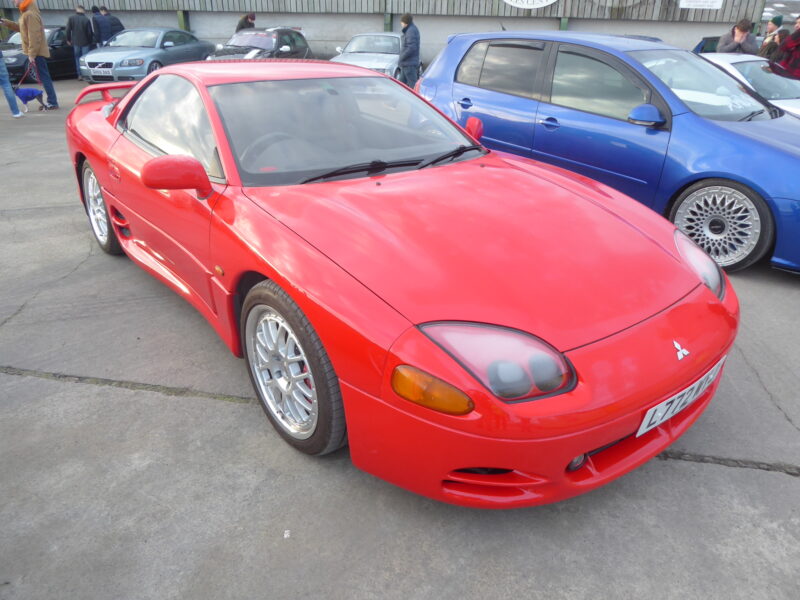
Following the successful showing of the Mitsubishi HSR and Mitsubishi HSX concept cars at the 1989 Tokyo Motor Show, Mitsubishi developed a production car which they called the 3000 GTO as a technologically advanced 2+2 seater sports coupe to compete with the Honda NSX, Mazda RX-7, Nissan 300ZX, Skyline GT-R, Subaru SVX and the Toyota Supra. They resurrected the GTO name, last used in the mid 1970s and the top spec Galant Coupe model, and the car went on to serve as Mitsubishi’s flagship for the remainder of the decade. However, despite the cachet of the badge at home, it was marketed as the Mitsubishi 3000GT and as the Dodge Stealth outside Japan; the company was concerned that connoisseurs would object to the evocative nameplate from the highly regarded Ferrari 250 GTO and Pontiac GTO being used on a Japanese vehicle. However, regardless of its badge or eventual target market, every car was built on the same production line at Mitsubishi’s plant in Nagoya, Japan. Its introduction in Japan in 1990 was unfortunately timed, as it coincided with the softening of the Japanese economy, known as the “bubble economy” which had an effect on sales. The car was packed with technology and many of Mitsubishi’s contemporary performance-enhancing technologies, such as full-time four-wheel drive, four-wheel steering, active aerodynamics featuring automatically adjusting front and rear spoilers, sport/tour exhaust modes and electronically controlled suspension (ECS). These “Active Aerodynamics” were not used on the Dodge Stealth. Visually, both the GTO/3000GT and Stealth featured pop-up headlights and noticeable “caps” on the bonnet to accommodate the ECS controllers at the top of the strut turrets. However the rest of factory body kit differed in styling with their respective badges. Most notable are the Dodge signature cross-hairs on the Stealth front bumper fascia, Ferrari inspired gills on the 3000GT rocker panels, Crescent shaped spoiler on the Stealth commonly referred to as the “Banana Wing” and front Active Aero air dam on 3000GT VR4. A mildly revised second generation car appeared in 1994. As the price increased, Mitsubishi also steadily removed some of the or costly (and gimmicky) technology features, and towards the end of production the front end was revised to incorporate fixed rather than pop up headlights. The car was phased out in 1999 for all markets apart from Japan, where it ran for another year.


MORGAN


NISSAN
Released on July 2002 in Japan at reorganized Nissan Japanese dealerships called Nissan Blue Stage, and August 20, 2002 in the US., the 350Z coupé was available in 5 trim packages: ‘350Z’ (Base), ‘Enthusiast’, ‘Performance’, ‘Touring’, and ‘Track’ editions. In Europe, only the ‘Track’ trim was available, although it was badged and marketed as ‘350Z’. The Base model did not include a VLSD or Traction Control and was only available with cloth seats. It did not include cruise control, nor power or heated seats. The Enthusiast model came with traction control, a VLSD, and cruise control. The Performance model came with bigger 18-inch wheels, front air dam, rear spoiler, optional Brembo brakes, and VDC instead of Traction Control. Touring was made more of the luxury model. It had power, leather, heated seats, VDC, a VLSD, xenon headlamps, optional Brembos, 18-inch wheels, and optional GPS. The Track model included Brembo brakes, front air dam, rear spoiler, traction control, cloth seats, 18-inch wheels, VLSD, and optional GPS. In 2004 Nissan introduced the 350Z Roadster with an electrically retractable soft-top roof. In the U.S. market the car was available in two trim packages (Enthusiast and Touring), while in Europe, the same versions as the coupé were offered. Nissan added the Grand Touring (GT) trim to the Roadster trim packages for 2005. In 2005 Nissan launched a 35th Anniversary edition, with a revised exterior and interior. Early 2005 model-year 35th anniversary edition models were equipped with the original VQ35DE with 287 hp and automatic transmission. In January 2005, Nissan introduced the 35th Anniversary 6-speed manual models and Track models (mid-year introduction), which included the updated VQ35DE 300 hp Rev-up engine and new updated CD009 manual transmission. As well as minor changes to suspension tuning and parts. For the 2006 model year, the 350Z received changes for its mid-cycle facelift. The VQ35DE 300 hp Rev-up engine that was introduced mid-year 2005 on the Track and 35th Anniversary Edition with 6-speed manual transmission models was offered for every trim level that had a manual transmission option. The VQ35DE with 287 hp continued to be offered with only the 5-speed automatic. Additions included bi-xenon projectors, a revised front fascia, new LED rear lights, changes to the interior trim and speed sensitive steering. Touring and Grand Touring models had radio-steering controls standard, MP3 CD compatibility, and Satellite Radio became an available option. For the 2007 model year, the 350Z was again moderately revised. The VQ35DE V6 was replaced with a new VQ35HR V6. It produced 306 hp at 6800 rpm with 268 ft·lb at 4800 rpm using the revised SAE certified power benchmark. The VQ35HR had a raised redline to 7500 rpm and more torque across the rpm range. The bonnet was redesigned with a bulge reminiscent of the original 240Z to accommodate the raised deck height of the new VQ35HR. In the US, trim levels were narrowed down to 350Z (base), Enthusiast, Touring, and Grand Touring, while in Europe the same trim levels remained. Bluetooth was added for the 2007 model year. The car was replaced by the 370Z for the 2009 model year. It has never found quite the same levels of enthusiasm that greeted – and have stayed with – the 350Z.

PORSCHE
During the 1990s, Porsche was facing financial troubles and rumours of a proposed takeover were being spread. The signature air-cooled flat-6 of the 911 was reaching the limits of its potential as made evident by the 993. Stricter emissions regulations world wide further forced Porsche to think of a replacement of the air-cooled unit. In order to improve manufacturing processes, Porsche took the aid of leading Japanese car manufacturer Toyota whose consultants would assist in the overhaul of the Zuffenhausen manufacturing facility introducing mass production techniques which would allow Porsche to carry out production processes more efficiently. Porsche had realised that in order to keep the 911 in production, it would need radical changes. This led to the development of the 996. The sharing of development between the new 911 and the entry level Boxster model allowed Porsche to save development costs. This move also resulted in interchangeable parts between the two models bringing down maintenance costs. The Porsche 996 was a new design developed by Pinky Lai under Porsche design chief Harm Lagaay from 1992 to 1994; it was the first 911 that was completely redesigned, and carried over little from its predecessor as Porsche wanted the design team to design a 911 for the next millennium. Featuring an all new body work, interior, and the first water-cooled engine, the 996 replaced the 993 from which only the front suspension, rear multi-link suspension, and a 6-speed manual transmission were retained in revised form. The 996 had a drag coefficient of Cd=0.30 resulting from hours spent in the wind tunnel. The 996 is 185 mm (7 in) longer and 40 mm (2 in) wider than its predecessor. It is also 45% stiffer courtesy of a chassis formed from high-strength steel. Additionally, it is 50 kg (110 lb) lighter despite having additional radiators and coolant. All of the M96 engines offered in the 996 (except for the variants fitted to the Turbo and GT2/GT3 models) are susceptible to the Porsche Intermediate Shaft Bearing issue which can potentially cause serious engine failure if not addressed via a retrofit. The 996 was initially available in a coupé or a cabriolet (Convertible) bodystyle with rear-wheel drive, and later with four-wheel drive, utilising a 3.4 litre flat-6 engine generating a maximum power output of 296 bhp. The 996 had the same front end as the entry-level Boxster. After requests from the Carrera owners about their premium cars looking like a “lower priced car that looked just like theirs did”, Porsche redesigned the headlamps of the Carrera in 2002 similar to the high performance Turbo’s headlamps. The design for the initial “fried egg” shaped headlamps could be traced back to the 1997 911 GT1 race car. In 2000, Porsche introduced the 996 Turbo, equipped with a four-wheel-drive system and a 3.6-litre, twin-turbocharged and intercooled flat-six engine generating a maximum power output of 420 bhp, making the car capable of accelerating from 0–60 mph in 4.2 seconds. An X50 option which included larger turbochargers and intercoolers along with revised engine control software became available from the factory in 2002, increasing power output to 451 bhp. In 2005, Porsche introduced the Turbo S, which had the X50 option included as standard equipment, with the formerly optional Carbon fibre-reinforced Silicon Carbide (C/SiC) composite ceramic brakes (PCCB) also included as standard. In 2000, power output on the base Carrera model was increased to 300 bhp. 2001 marked the final year of production for the base Carrera 4 Coupé in narrow body format. In 2002, the standard Carrera models underwent the above-mentioned facelift. In addition, engine capacity was also increased to 3.6-litres across the range, yielding gains of 15 bhp for the naturally aspirated models. 2002 also marked the start of the production of the 996 based Targa model, with a sliding glass “green house” roof system as introduced on its predecessor. It also features a rear glass hatch which gave the driver access to the storage compartment. Also in 2002, the Carrera 4S model was first introduced.


Porsche unveiled the facelifted 991.2 GT3 at the 2017 Geneva Motor Show. Extensive changes were made to the engine allowing for a 9,000 rpm redline from the 4.0 litre flat-six engine derived from Porsche 911 GT3 R and Cup racing cars. The engine has a power output of 500 PS (493 bhp) and 460 Nm (339 lb/ft) of torque. Porsche’s focus was on reducing internal friction to improve throttle response. Compared to the 991.1, the rear spoiler is 0.8 inch taller and located farther back to be more effective resulting in a 20% increase in downforce. There is a new front spoiler and changes to the rear suspension along with larger ram air ducts. The car generates 154 kg (340 lb) of downforce at top speed. The 991.2 GT3 brought back the choice between a manual transmission or a PDK dual clutch transmission. Performance figures include a 0-60 mph acceleration time of 3.8 seconds (3.2 seconds for the PDK version) and a quarter mile time of 11.6 seconds. The GT3 can attain a top speed of 319 km/h (198 mph).


Much rumoured for some time, the Cayman GT4 was officially launched at the 2015 Geneva Show, positioned to sit between the Cayman GTS and the 911 GT3. By the time of the official unveiling, the car was supposedly sold out many times over, though more recently it has become apparent that at least some Porsche dealers have been holding onto cars claiming that the first purchaser changed their mind, and then offering them to those who did not get one of the allocation a year ago, at vastly inflated prices. If true, this is very sharp practice indeed, but seems to be the sort to tricks that are becoming increasingly common as enthusiasts are being fleeced in the name of extra profit. For a starting price of around £65,000 in the UK, the lucky customer would get a car which used used a stiffened and strengthened Cayman bodyshell as a starting point, but lowered by 30mm . Porsche say that in fitting as many GT parts as possible, they did not make it out of a Cayman GTS, but rather they produced an entry-level mid-engined GT3 car. That sounds like PR spin to me, as of course the car does use an awful lot of parts from the regular Cayman. However, plenty is changed, too. There is a reworked version of the Carrera S’s 3.8-litre flat six engine, producing 380bhp at 7400rpm and 310lb ft at 4750-6000rpm, hooked up to a modified version of the Cayman GTS’s six-speed manual gearbox. A PDK dual-clutch automatic was considered but rejected, meaning the Cayman GT4 is manual only. This is enough to mean that the 0-62mph sprint takes 4.4sec and the top speed is 183mph, with combined fuel economy of 27.4mpg and CO2 emissions rated at 238g/km. The front axle and suspension are borrowed from the 911 GT3 and the rear axle and forged aluminium double wishbone suspension are completely new. Dampers are taken from the 911 GT3. The electric steering system from the 911 GT3 does make it onto the Cayman GT4 but is given new software. Stopping power is provided by standard steel brakes, or optional carbon-ceramics from the 911 GT3. The forged 20in alloy wheels were new and are shod with Michelin Pilot Sport Cup 2 tyres. The rear 295/30 ZR20 tyres are bespoke, but the front 245/35 ZR20s were borrowed from the 911 GT3 as they were “a perfect match”. design-wise, the goal was to create a “zero lift car”, but thanks to the extensive aerodynamic and cooling package on the car – which includes a front splitter, a larger front grille and increased frontal air intakes, side air intakes, not one but two rear spoilers and a fully functional diffuser – the Cayman GT4 produces as much downforce at speed (100kg) as the 911 GT3. Every single part on the Cayman GT4 has a functional use. Other design features include “cool” black glass on the front and rear lights, blackened twin central exhausts and quality stitching on the twin lightweight bucket seats, taken from the 918 Spyder, as small details adding to that ‘want factor’. Despite all the extra equipment, the Cayman GT4 weighs no more than a Cayman GTS, tipping the scales at 1340kg dry. You could delete items such as the sat-nav and air-con to save weight, but few customers did, just as with the 911 GT3 RS were just 2% of buyers deleted the air-con. Inside, the steering wheel was new. The sports seats were trimmed in both leather and Alcantara. Standard equipment included bi-xenon headlights, a sports exhaust system, a Sport Chrono Package with dynamic engine mounts, the Porsche Torque Vectoring system, a mechanical limited-slip differential at the rear and the Porsche Stability Management system. On the options list were items such as carbonfibre-reinforced, plastic-backed seats for the two-seat interior. These weigh just 15kg each and were inspired by the 918 Spyder. A customised version of the Sport Chrono Package was offered, as is a Club Sport Package. Initially it was declared that production would be very limited, but Porsche soon relented and far more were built than had originally been declared.

RENAULT
In 1999 Renault presented the first officially branded RenaultSport Clio, this was the third Clio produced by the RenaultSport division succeeding the Clio 16V and Clio Williams. This new Clio, the 172 was based on the 3 door Clio II shell however had numerous features over the standard car including wider arches, restyled bumpers, side skirts and 15-inch OZ F1 alloy wheels. Power was delivered by the F4R730 engine, a 2.0-litre 16-valve Inline 4 engine with a Variable valve timing (VVT) system via a dephaser on the intake camshaft pulley. The engine was a modified version of the F4R used in models such as the Laguna and Espace and was modified by Mecachrome to deliver a power output of 172 PS. Power was delivered to the wheels via a JC5-089 five-speed manual gearbox. The 172 also featured interior changes over the standard car including Half Leather, Half Alcantara seats embossed with the RenaultSport logo and the car also came standard with manually controlled Air Conditioning. A limited edition of the Phase 1 172 was produced and known as the Clio 172 Exclusive. This was limited to 172 units, all 172 of this “Exclusive” edition were 296 Scarab Green, featured BBS alloy wheels and a full leather interior as opposed to the half-leather half Alcantara seats featured in the standard car. In 2001 the interior and exterior of the Clio II were face-lifted, the Clio RS followed suit shortly after. This facelift of the Clio 172 included redesigned front and rear bumpers, the front bumper falling in line with the style of the face-lifted Clio II. The rear bumper was now less rounded and featured a strip of ABS plastic effectively splitting the bumper into two. The lights, bonnet and boot lid were also matched to the face-lifted Clio II. The interior was also changed to closer match that of the face-lifted Clio II, the seats were slightly revised however still featured the same Half Leather, Half Alcantara fabrics and the embossed RenaultSport logo. One new feature that the Phase 2 172 featured was automatic climate control as opposed to the manual air-conditioning featured in the Phase 1. The dashboard featured Silver interior trims and the steering wheel included a plastic insert featuring the RenaultSport logo. The gear shifter was changed from the metal ball featured on the Phase 1 to a Leather wrapped shifter with a silver coloured insert on the top. The Phase 2 172 also featured increased equipment including automatic Xenon headlights and headlight washers, Rain Sensing wipers a six-disc CD changer, and it also included side-impact airbags integrated into the seats. The 15-inch OZ F1 alloy wheels were also replaced with a 16-inch Alloy Wheel of Renault’s own design. The facelift of the 172 also brought about a number of changes to the engine of the car. A revised version of the F4R used, the F4R 736, this featured a revised cylinder head with the exhaust ports being approximately 30% smaller than those featured on the Phase 1 172. The airbox was also redesigned to be much more square than the original airbox. A revised version of the JC5 gearbox, the JC5-129 was introduced in this version of the Clio 172, which revised JC5 featured a shorter final drive to counter the increased weight of the face-lifted 172. The catalytic converter, which on the PH1 172 had been dual barrel was reduced to a single barrel and featured 2 lambda sensors, one before and one after the catalytic converter. The biggest change to the PH2 172 over the PH1 was the introduction of an electric throttle. This meant the Idle Control Valve of the PH1 was no longer required leading to a minor redesign of the intake manifold. In 2002 Renault released the 172 Cup, which bore the chassis code CB1N and was known by Renault as the “sport lightweight version”. The vast majority of cars were produced in D43 Mondial Blue (metallic) with a limited run of around 90 cars being produced in 640 Iceberg Silver (metallic). The Cup, originally built for Gr.N homologation of the Clio 172 was differentiated from the “non cup” 172 by its lack of many of the luxuries included in the regular car. Instead of the leather / Alcantara seats instead the same style seat was upholstered in a durable but low-cost fabric, the automatic Xenon headlights were replaced by manually controlled halogen units and the washer jets replaced with blanks. The rain sensing wipers and solar reflective coated windscreen were also omitted from the 172 Cup. However the car had features not before seen on a production version of the 172, which included lightweight 16-inch Speedline Turini alloy wheels, matte blue door strips, ABS plastic “Cup” front splitter and a restyled “Cup” rear spoiler. The dash strips which were silver on the regular car were painted to match the outside of the car. One of the main features of the 172 Cup was its significant weight saving, having a kerb weight of 1021 kg, making it the lightest of 172 versions produced. This was achieved by the removal of a majority of sound deadening from the car alongside thinner glass to reduce weight even further. One large difference was also the lack of air conditioning which was a standard fit component on the regular 172, which typically led to the cup producing more power due to the engine having less ancillaries to drive. This however was reintroduced as an optional extra later in the production run of the Cup. The 0–60 time of the 172 Cup was officially marketed by Renault as being 6.5 seconds; however AutoCar Magazine reportedly timed the 0–60 at 6.2 seconds which if this were the case would make the 172 Cup the second fastest road going Clio produced at the time of this article, second to only the V6. Many enthusiasts regard the 172 Cup as the last “hardcore” hot hatch due to its lack of anti-lock brakes; the car also featured modified suspension which gave it a wider track thanks to modified wishbones, the car also sat lower than standard and featured stiffer shocks and springs, the suspension geometry was revised to suit these components and to mean that the steering response was increased, this also lead to an increase in oversteer thanks to the lack of weight and revised geometry. Due to the lack of ABS the brake bias of the car was fixed by way of disconnecting the rear axle compensator, within the UK this often lead to the cars failing the MOT test, VOSA eventually issued an advisory to prevent this from happening. 2004 marked yet another refresh of the Clio II. The inserts of the headlights were changed from Black to Grey, new wheels styles were introduced and new colour options were added with others being dropped. The basic design of the car stayed the same with only minor changes. The Six-Disc CD changer was dropped as standard equipment however was still available as a cost option. This refresh marked the introduction of cruise control and Electronic Stability Program (ESP) as standard equipment. The Clio RS featured a lot more changes than the regular Clio. The engine was again revised and became the F4R 738. The difference between the F4R 738 and F4R 736 was a revised oil breather setup meaning the intake manifold found on a 172 would not fit a 182. Thanks to a number of other changes this engine produced 182 PS . This increase in power was thanks to the addition of a 4-2-1 Manifold and high flow 200 cell sports catalytic converter. The spare wheel well was removed and replaced with a flat floor to make way for the new dual exit exhaust featured on the 182. Minor revisions were made to the interior, the perforated texture of the Alcantara on the seats now featured white dots. The car also featured a new 8 spoke wheel design which came in Silver on a regular car and Anthracite on a “Cup Packed” car. The rarest optional extra available was the Carminat Sat-Nav which was fitted to very few cars. However, the unit wasn’t a popular option due to its high cost and rumoured poor performance compared to aftermarket options. The “Cup” Front Splitter and “Cup” Spoiler originally fitted to the 172 Cup made a reappearance as a cost option known as the Cup Style Pack. This was one of two cup packs available, the other being the Cup Chassis. This Cup Chassis pack included a strengthened hub with 60mm spacing on the strut bolt holes as opposed 54mm on non cup packed cars. The Cup Chassis also featured lowered suspension with stiffer shocks and springs and an anthracite version of the standard alloy wheels. The Clio 182 could also be ordered in a more race focused than ‘base’ RS model called “Cup Specification”, this was available in just two colours, J45 Racing Blue and D38 Inferno Orange, however came as Standard with the Cup Chassis and Cup Style Pack. The 182 Cup lacked the automatic Xenon headlights and headlight washer jets, climate control (rear footwell heater vents were also removed), illuminated sun visors, Solar Reflective Windscreen and Automatic Wipers. The leather / Alcantara seats were replaced with cloth items and the rear bench was downgraded to match. The engine cover and sill plates were removed and the steering wheel was downgraded to no longer include the RenaultSport Logo or rubber thumb grips. Carpet and headlining were downgraded to basic specification and even the documentation wallet was changed from faux leather to cloth. Sound deadening was removed from the 182 Cup, the horn was downgraded from a twin to single unit and the interior light no longer included a map reading function. Despite all of these reductions in specification the 182 Cup was still considerably heavier than the previous 172 Cup, meaning this version of the Clio II RS was considered one of the least desirable versions. The final version of the Clio 182 was known as the 182 Trophy. This version was based on the 182 Cup and featured the same strengthened hubs with 60 mm bolt spacing. Originally only 500 cars were to be produced for the UK market however an additional 50 were produced to be sold in Switzerland. At the time, believing there was no market for this version of the Clio, the Marketing Department of Renault France failed to order a 182 Trophy. The 182 Trophy included 16 Inch Speedline Turini Alloy wheels as seen on the 172 Cup, the Spoiler from the Clio 255 V6, Recaro Trendline seats and exclusive 727 Capsicum Red Paint with Trophy Decals lacquered onto the Side skirts. Each car had an individually numbered plaque on the base of the driver’s seat. The biggest difference however between the 182 Cup and 182 Trophy was the inclusion of Sachs Remote-Reservoir dampers. The basic principle of a Remote-Reservoir damper is that because there is a separate reservoir for the gas or oil which fills the shock they can either be of a reduced length or can house a longer rod, this means that the sizing of the shock can be optimised for the application in which it is being used. These changes definitely made a big difference to the 182 Trophy and have led to its being heralded as one of the best hot hatches of all time and it won Evo Magazine’s “People’s Performance Car of The Year” 2005, whilst also beating off rivals such as the Lamborghini Gallardo and other exotica in an Evo Magazine Group Test. AutoCar Magazine’s front cover from 5 July 2005 simply stated “World’s Greatest Hot Hatch”.

TOYOTA
In 1986, Toyota produced a completely different duo of sports coupes. The Celica changed to front-wheel drive, while the Supra kept its rear-wheel-drive platform. The engine was updated to a more powerful 3.0 200 hp in-line 6. Although only available in naturally aspirated trim in 1986, a turbocharged version of the engine was introduced in the 1987 model year. The Supra was now related mechanically to the Toyota Soarer for the Japanese market. The third-generation Supra introduced a great deal of new technology. In 1986, options available for the Supra included 3-channel ABS and TEMS which gave the driver 2 settings which affected the damper rates; a third was automatically activated at WOT, hard braking, and high speed manoeuvering. HKS also made a “TEMS Controller” to hack the system and activate it on the fly, though the controllers are now nearly impossible to find. ACIS (Acoustic Control Induction System), a method of controlling air compression pulses inside the intake piping to increase power, was also a part of the 7M-GE’s technological arsenal. All models were fitted with double wishbone suspension front and rear. A targa top was offered in all years along with a metal power sliding sunroof. The car sold well, and it is estimated that around 241,500 examples were produced.

Needing little introduction, perhaps, is this car, a 2nd generation MR2. Toyota proved that the market for small affordable sports cars was far from dead when they launched the first generation MR2 in 1984. As was the trend at the time among Japanese manufacturers, models were replaced on quite a regular 4/5 year cycle, so it was little surprise when a second generation car appeared in 1989. However, this one would go on to be produced for 10 years, The overall design changed little in that time, but there were lots of small details that were refined during that time. The car was generally well received, with its “mini Ferrari” looks proving quite an attraction, as were the willing engines and the entertaining handling. There are not that many nice clean examples left now, though.

From the current range of GR-badged sporting models was this GR Supra.

TVR
The T350 cars were made from 2002 to 2006. They were based on the TVR Tamora, and powered by TVR’s Speed Six engine in 3.6 litre form, producing 350 hp. The T350 was available in coupe and targa versions, the coupe version being known as the T350C, and the targa version the T350T. The T350 later formed the base of the TVR Sagaris. Function dominates form evident by the car’s aero-dynamic design which has been created for maximum downforce and minimal drag. The smooth frontal nose and the sharp rear cut tail allows the car to be aerodynamically efficient while reducing drag. The sloping rear line of the car ensures that the car generates minimum lift at high speeds. The car takes many components from the entry level Tamora such as the interior, multi-function display and analogue metres. The optional Sport package adds extra options in the multi-functional display such as lap-times, oil temperature and water temperature. The fastback design of the car gives the customer an advantage of increased boot space. The powerful Speed Six engine is a proven race winning unit and very responsive suiting the car’s aggressive character with a 0 – 100 km/h time of just 4.4 seconds.


VAUXHALL
Getting rare now is the Calibra, a model that GM introduced to counter the Japanese sports coupés of the late 1980s and early 1990s. Launched in 1989, it employed the running gear of the first generation Opel Vectra, which had been launched a year earlier in 1988. Calibra production was based in the Opel factory in Rüsselsheim, Germany, and the Valmet Automotive factory in Uusikaupunki, Finland, where production was consolidated in November 1995. Known in Europe as the Opel Calibra and as a Vauxhall in the UK, it was also marketed as the Chevrolet Calibra in South America and the Holden Calibra in Australia and New Zealand. The Calibra was styled by GM’s designer Wayne Cherry and the German designer, Erhard Schnell. and when launched, it was the most aerodynamic production car in the world, with a drag coefficient (Cd) of 0.26. It remained the most aerodynamic mass production car for the next 10 years, until the Honda Insight, along with the Audi A2, were launched both in 1999, with a Cd of 0.25, though the more powerful 16V, V6, 4×4 and turbo models had a worse Cd of 0.29, due to changes in their cooling system, underbody, use of spoked wheels and glass detail. As a front-wheel drive coupé based on the Vectra A chassis, its ride and handling were not significantly better than that of the large family car from which it grew. The 4WD turbo version of the car, which had independent rear suspension, featured the rear axle of the Opel Omega A with some minor alterations to it. Power was initially from 2.0 litre 8-valve 115 bhp and a Cosworth designed 16-valve fuel-injected 150 bhp four-cylinder redtop petrol engines. In 1992 a turbocharged 2.0 litre 16 valve 204 bhp engine was added to the range. With four-wheel drive, a six-speed Getrag manual transmission and a claimed top speed of 152 mph, this flagship model finally gave the Calibra the dynamics to match its looks. The Turbo model was also notable for the 5-stud wheel hubs and the extreme negative camber of its rear wheels, which is apparent even from a cursory visual inspection. In 1993 a 167 hp 2.5 litre V6 (was introduced. Available with both manual and automatic transmissions, the V6 was not as fast as the Turbo, but was rather more civilised, and proved to be more reliable as car than the complex four-wheel drive model. 1995 saw the introduction of the X20XEV Ecotec engine, a new version of the classic C20XE 16-valve or “red top” engine. This marked a reduction in power from 150 bhp to 136 bhp for the 16-valve version, although the Turbo continued with the older C20LET. Throughout the production run, several special edition models were launched. This began with the 1993 SE1, and ran through to the SE9 in 1997. These limited run editions had often unique aspects. For example, solar yellow paint on the SE2, or “Icelandic” blue on the SE6. Neither colours were found on any other Calibra. In September 1995, the Vectra A was replaced, but Calibra production continued until 1997. During its lifetime, the Calibra was much more popular in Europe, and outsold its nearest rival, the Ford Probe, which was considered to be underpowered, and very American for most European drivers, but in the UK, it failed to outsell the Rover 200 Coupé, which offered comparable performance, but without 4WD in the top–of–the–range models.

VOLKSWAGEN
This is “Eeyore”, an example of the Type 2 “Bus”, the second generation of VW’s versatile van range, first seen in late 1967. It was built in Germany until 1979. In Mexico, the Volkswagen Kombi and Panel were produced from 1970 to 1994. Models before 1971 are often called the T2a (or “Early Bay”), while models after 1972 are called the T2b (or “Late Bay”). This second-generation Type 2 lost its distinctive split front windshield, and was slightly larger and considerably heavier than its predecessor. Its common nicknames are Breadloaf and Bay-window, or Loaf and Bay for short. At 1.6 litres and 47 bhp DIN, the engine was also slightly larger. The battery and electrical system was upgraded to 12 volts, making it incompatible with electric accessories from the previous generation. The new model also did away with the swing axle rear suspension and transfer boxes previously used to raise ride height. Instead, half-shaft axles fitted with constant velocity joints raised ride height without the wild changes in camber of the Beetle-based swing axle suspension. The updated Bus transaxle is usually sought after by off-road racers using air-cooled Volkswagen components. The T2b was introduced by way of gradual change over three years. The first models featured rounded bumpers incorporating a step for use when the door was open (replaced by indented bumpers without steps on later models), front doors that opened to 90° from the body, no lip on the front guards, unique engine hatches, and crescent air intakes in the D-pillars (later models after the Type 4 engine option was offered, have squared off intakes). The 1971 Type 2 featured a new, 1.6 litre engine with dual intake ports on each cylinder head and was DIN-rated at 50 bhp. An important change came with the introduction of front disc brakes and new roadwheels with brake ventilation holes and flatter hubcaps. Up until 1972, front indicators are set low on the nose rather than high on either side of the fresh air grille – giving rise to their being nicknamed “Low Lights”. 1972’s most prominent change was a bigger engine compartment to fit the larger 1.7- to 2.0-litre engines from the Volkswagen Type 4, and a redesigned rear end which eliminated the removable rear apron and introduced the larger late tail lights. The air inlets were also enlarged to accommodate the increased cooling air needs of the larger engines. In 1971 the 1600cc Type 1 engine as used in the Beetle, was supplemented with the 1700cc Type 4 engine – as it was originally designed for the Type 4 (411 and 412) models. European vans kept the option of upright fan Type 1 1600 engine but the 1700 Type 4 became standard for US spec models. In the Type 2, the Type 4 engine, or “pancake engine”, was an option for the 1972 model year onward. This engine was standard in models destined for the US and Canada. Only with the Type 4 engine did an automatic transmission become available for the first time in the 1973 model year. Both engines were 1.7 L, DIN-rated at 66 bhp with the manual transmission and 62 bhp with the automatic. The Type 4 engine was enlarged to 1.8 L and 67 bhp DIN for the 1974 model year and again to 2.0 L and 70 bhp DIN for the 1976 model year. The two-litre option appeared in South African manufactured models during 1976, originally only in a comparably well-equipped “Executive” model. The 1978 2.0 L now featured hydraulic valve lifters, eliminating the need to periodically adjust the valve clearances as on earlier models. The 1975 and later U.S. model years received Bosch L-Jetronic electronic fuel injection as standard equipment; 1978 was the first year for electronic ignition, utilising a hall effect sensor and digital controller, eliminating maintenance-requiring contact-breaker points. As with all Transporter engines, the focus in development was not on power, but on low-end torque. The Type 4 engines were considerably more robust and durable than the Type 1 engines, particularly in Transporter service. In 1972, exterior revisions included relocated front turn indicators, squared off and set higher in the valance, above the headlights. Also, square-profiled bumpers, which became standard until the end of the T2 in 1979, were introduced in 1973. Crash safety improved with this change because of a compressible structure behind the front bumper. This meant that the T2b was capable of meeting US safety standards for passenger cars of the time, though not required of vans. The “VW” emblem on the front valance became slightly smaller. Later model changes were primarily mechanical. By 1974, the T2 had gained its final shape. Very late in the T2’s design life, during the late 1970s, the first prototypes of Type 2 vans with four-wheel drive (4WD) were built and tested.


The January edition of any event like this is unlikely to bring out record number of cars, as it is still dark until 8am, generally cold and miserable and a lot of the more interesting cars that people want to show of tend to be on SORN and away from potentially salty roads, so it is against these challenges that any event at this time of the year has to be judged. In that context, this one had a decent turnout with a nice variety of cars and was definitely worth the early start to come along. There’s one final Easter Compton even tin the schedule before the event relocates back to Eastwood Park, and my diary is currently clear, so I should be able to come along. I look forward to it.