For some months now, my Facebook feed has been receiving a stream of posts about the Clevedon Cars and Coffee, and the cars depicted looked interesting and varied, suggesting this was an event I really should investigate. What also intrigued me, on doing a bit of research, is that this monthly event does not have one single location but rather a handful scattered around the seaside and somewhat hilly Somerset town. Finally the chance came when an impromptu decision was made by the other Abarth owners who had been with me at the monthly Queen Square Breakfast Club, that as this event was wrapping up, we should head on down to Clevedon on what was a sunny but rather chilly January morning. The event website specifies the parking area for each car, based on its age, with those from 2000 to the present day directed to the Salthouse, which at least is easy to find. We got there to find the parking area pretty full, but the marshalls squeezed us in, so then it was a case of finding the rest of the event. That did not prove entirely straight-forward and needed consultation with the event’s Facebook page and Google maps. There are three main areas used and they are all about 20 minutes walk apart, so this is not as easy an event as some to investigate, and we were well aware of the fact that arriving a good hour or so after it had started, some cars would probably have gone. However, we did find enough that was of interest to keep us entertained for a good couple of hours. Here is what we found:
ABARTH
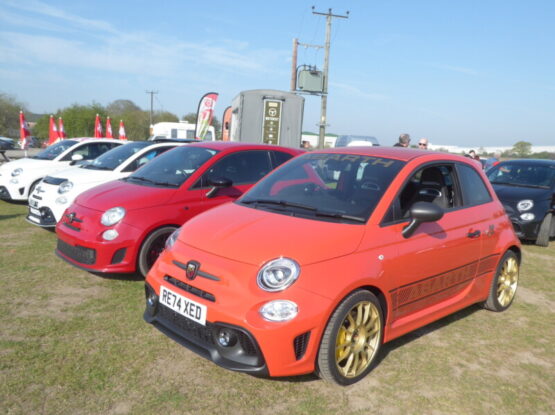
As all the Abarths that had been at the QS meet earlier in the morning headed down here in convoy, it was the same group here as had been seen earlier in the morning, just parked in a different way. As the parking area was pretty full when we arrived, we were squeezed into what was not officially a set of parking spaces, which was OK when the rest of the area was full, but when we got back to the cars and everything else had gone, the cars did look like they were badly parked, and indeed someone had put some cards on all our windows pointing this out (in a less than polite way!).
Rumours started to circulate towards the end of 2014 that Abarth were going to upgrade the Competizione model, so as better to bridge the gap between the Turismo and the 190 bhp 695 Biposto that had been added to the range earlier in the year. It was Geneva 2015 when the result was finally shown to an expectant fan base. Most exciting news was that thanks to a bigger Garrett Turbo, the engine had been tweaked to 180 bhp, and with reduced CO2 emissions. A standard spec that included Koni Dampers, Brembo brakes, Xenon lights, Sabelt seats, Climate Control, parking sensors as well as other refinements that had been added like the TFT instrument display all proved very compelling, so not long after the first cars reached the UK in June of 2015, I found temptation too hard to resist, and as is well documented here, swapped my 2010 car for one of these. At the time I ordered it, Cordolo Red, a tri-coat pearlescent paint which shimmers in bright sunlight looked set to become one of the most popular colours of the lot, even though it is a cost option. Indeed, the Launch Edition models were all offered either in this colour or Scorpion Black, with black wheels. Surprisingly, the colour was not carried over to the Series 4 cars.


What is known as the Series 4 version of the familiar 595 reached the markets in the middle of 2016. After rumours had circulated all winter following the launch of the facelifted Fiat 500 last year, Abarth finally unveiled the Series 4 at the end of May 2016. Initially, we were told that the cars would not be available in the UK until September, but that came forward somewhat, with dealers all receiving demo cars in June, and the first customers taking delivery in July. Three regular production versions of both the closed car and the open-topped C were initially available, all badged 595, and called Custom, Turismo and Competizione, as before, though numerous limited edition models have since appeared and in most case disappeared. The most significant changes with the Series 4 are visual, with a couple of new colours, including the much asked for Modena Yellow and a different red, called Abarth Red, which replaces both the non-metallic Officina and – slightly surprisingly – the tri-coat pearlescent Cordolo Red. as well as styling changes front and rear. The jury is still out on these, with many, me included, remaining to be convinced. At the front, the new air intake does apparently allow around 15 – 20 % more air in and out, which will be welcome, as these cars do generate quite a lot of heat under the bonnet. Competizione models for the UK retain the old style headlights, as they have Xenon lights as standard, whereas the Custom and Turismo cars have reshaped units. At the back, there are new light clusters and a new rear bumper and diffuser. Inside, the most notable change is the replacement of the Blue & Me system with a more modern uConnect Audio set up, which brings a new colour screen to the dash. Mechanically, there is an additional 5 bhp on the Custom (now 145) and Turismo (now 165 bhp) and the option of a Limited Slip Diff for the Competizione, which is likely to prove a popular option. Details of the interior trim have changed, with a filled-in glovebox like the US market cars have always had, and electric windows switches that are like the US ones, as well as a part Alcantara trim to the steering wheel in Competizione cars.


The Punto Evo was launched at the 2010 Geneva Show, with the cars reaching UK buyers in the summer of that year, and it incorporated many of the changes which had been seen a few months earlier on the associated Fiat models, the visual alterations being the most obvious, with the car taking on the nose of the associated Fiat, but adapted to make it distinctively Abarth, new rear lights and new badging. There was more to it than this, though, as under the bonnet, the T-Jet unit was swapped for the 1.4 litre Multi-Air, coupled to a 6 speed gearbox, which meant that the car now had 165 bhp at its disposal. Eventually, Abarth offered an Esseesse kit for these cars, though these are exceedingly rare. Part of the Punto Evo family is the SuperSport, usually identified by the distinctive black bonnet, though not all cars feature it. Just 199 of the SuperSport versions were built, of which around 120 are registered on UK roads. These cars had many of the options from the Punto Evo included as standard. Power came from the the 1.4-litre MultiAir turbo engine, tuned to produce 178bhp and 199lb ft of torque, up from 165 of the standard Punto Evo, giving the SuperSport a 0-62 time of 7.5 seconds and a top speed of over 132mph. To help put the power down, the SuperSport was fitted with wider 18″ wheels and optional Koni FSD dampers. Standard equipment included the Blue&Me infotainment system with steering wheel controls, automatic climate control and a popular option was the ‘Abarth Corsa by Sabelt’ sports leather seats. The SuperSport was available in the same colours as the regular Punto Evo, which means white, grey, black and red. There were two here. The grey one belongs to Preston Nippard and the bright blue car, well known in the Abarth community, belongs to Ben Waite. Sadly not a standard factory colour, this one has been wrapped and is a very distinctive car, which is much admired by all who see it.


AC
As is usually the case, when you see the iconic Cobra shape, you are not looking at one of the small number of original cars from the 1960s but a more recent replica, recreation of continuation series machine, of which there have been quite a number built over the last 50 years. These have a wide variety of engines powering them, depending on what was available at the time, but most of them remain visually pretty faithful to the original 1962 car.


ALFA ROMEO
The 916 Series cars were conceived to replace two very different models in the Alfa range. First of these was the open topped 105 Series Spider which had been in production since 1966 and by the 1990s was long overdue a replacement. Alfa decided to combine a follow on to the Alfetta GTV, long out of production, with a new Spider model, and first work started in the late 1980s. The task was handed to Pininfarina, and Enrico Fumia’s initial renderings were produced in September 1987, with the first clay models to complete 1:1 scale model made in July 1988. Fumia produced something rather special. Clearly an Italian design, with the Alfa Romeo grille with dual round headlights, recalling the Audi-based Pininfarina Quartz, another design produced by Enrico Fumia back in 1981, the proposal was for a car that was low-slung, wedge-shaped with a low nose and high kicked up tail. The back of the car is “cut-off” with a “Kamm tail” giving improved aerodynamics. The Spider would share these traits with the GTV except that the rear is rounded, and would feature a folding soft-top with five hoop frame, which would completely disappear from sight under a flush fitting cover. An electric folding mechanism would be fitted as an option. Details included a one-piece rear lamp/foglamp/indicator strip across the rear of the body, the minor instruments in the centre console angled towards the driver. The exterior design was finished in July 1988. After Vittorio Ghidella, Fiat’s CEO, accepted the design, Alfa Romeo Centro Stile under Walter de Silva was made responsible for the completion of the detail work and also for the design of the interiors, as Pininfarina’s proposal was not accepted. The Spider and GTV were to be based on the then-current Fiat Group platform, called Tipo Due, in this case a heavily modified version with an all new multilink rear suspension. The front suspension and drivetrain was based on the 1992 Alfa Romeo 155 saloon. Chief engineer at that time was Bruno Cena. Drag coefficient was 0.33 for the GTV and 0.38 for the Spider. Production began in late 1993 with four cars, all 3.0 V6 Spiders, assembled at the Alfa Romeo Arese Plant in Milan. In early 1994 the first GTV was produced, with 2.0 Twin Spark engine. The first premiere was then held at the Paris Motor Show in 1994. The GTV and Spider were officially launched at the Geneva Motor Show in March 1995 and sales began the same year. The cars were well received. At launch, many journalists commented that Alfa had improved overall build quality considerably and that it came very close to equalling its German rivals. I can vouch for that, as I owned an early GTV for eighteen months, and it was a well built and reliable car. In 1997 a new engine, a 24-valve 3.0 litre V6, was available for the GTV along with bigger, 12.0 inch brakes and red four-pot calipers from Brembo. The console knobs were changed from round central to rectangle ones and to a three-spoke steering wheel. Some versions were upgraded with different front bumper mesh to bring the wind noise down to 74 dBA. In May 1998 the cars were revamped for the first time, creating the Phase 2 models. Most of the alterations were inside. The interior was changed with new centre console, painted letters on skirt seals, changed controls and switches arrangement and different instrument cluster. Outside, the main changes included chrome frame around the grille and colour-coded side skirts and bumpers. A new engine was introduced, the 142 bhp 1.8 Twin Spark, and others were changed: the 2.0 Twin Spark was updated with a modular intake manifold with different length intakes and a different plastic cover. Power output of the 2.0 TS was raised to 153 bhp. Engines changed engine management units and have a nomenclature of CF2. The dashboard was available in two new colours in addition to the standard black: Red Style and Blue Style, and with it new colour-coded upholstery and carpets. The 3.0 24V got a six-speed manual gearbox as standard and the 2.0 V6 TB engine was now also available for the Spider. August 2000 saw the revamp of engines to comply with new emission regulations, Euro3. The new engines were slightly detuned, and have a new identification code: CF3. 3.0 V6 12V was discontinued for the Spider and replaced with 24V Euro3 version from the GTV. 2.0 V6 Turbo and 1.8 T.Spark were discontinued as they did not comply with Euro3 emissions. By the 2001-2002 model year, only 2 engines were left, the 2.0 Twin.Spark and 3.0 V6 24V, until the Phase 3 engine range arrived. The Arese plant, where the cars had been built, was closing and, in October 2000, the production of GTV/Spider was transferred to Pininfarina Plant in San Giorgio Canavese in Turin. In 2003 there was another and final revamp, creating the Phase 3, also designed in Pininfarina but not by Enrico Fumia. The main changes were focused on the front with new 147-style grille and different front bumpers with offset numberplate holder. Change to the interior was minimal with different centre console and upholstery pattern and colours available. Instrument illumination colour was changed from green to red. Main specification change is an ASR traction control, not available for 2.0 TS Base model. New engines were introduced: 163 bhp 2.0 JTS with direct petrol injection and 237 hp 3.2 V6 24V allowing a 158 mph top speed. Production ceased in late 2004, though some cars were still available for purchase till 2006. A total of 80,747 cars were made, and sales of the GTV and Spider were roughly equal. More V6 engined GTVs than Spiders were made, but in 2.0 guise, it was the other way round with the open model proving marginally more popular.

AUDI
The Audi R8, based on the Audi Le Mans quattro concept car (designed by Frank Lamberty and Julian Hoenig) first appeared at the 2003 International Geneva Motor Show and the 2003 Frankfurt International Motor Show. The R8 road car was officially launched at the Paris Auto Show on 30 September 2006. There was some confusion with the name, which the car shares with the 24 Hours of Le Mans winning R8 Le Mans Prototype (LMP). Initial models included the R8 4.2 FSI coupé (with a V8 engine) and R8 5.2 FSI coupé (with a V10 engine). Convertible models, called the Spyder by the manufacturer, were introduced in 2008, followed by the high-performance GT model introduced in 2011. The Motorsport variants of the R8 were also subsequently introduced from 2008 onwards. An all-electric version called the e-Tron started development but would only reach production stage when the second generation model would be introduced. 6-time 24 Hours of Le Mans winner Jacky Ickx described the R8 as “the best handling road car today” and the car was well received by everyone who drove it. The car received a facelift in 2012 and a new model called the V10 Plus was now added to the range. Production of the Type 42 ended in August 2015

AUSTIN
The Austin Twelve is a motor car introduced by Austin in 1921. It was the second of Herbert Austin’s post World War I models and was in many ways a scaled-down version of his Austin Twenty, introduced in 1919. The slower-than-expected sales of the Twenty brought about this divergence from his intended one-model policy. The Twelve was announced at the beginning of November 1921 after Austin’s company had been in receivership for six months.[5] The number twelve refers to its fiscal horse power (12.8) rather than its brake horsepower (bhp) which was 20 and later 27. The long-stroke engines encouraged by the tax regime, 72 × 102 mm later 72 × 114.5 mm, had much greater low-speed torque than the bhp rating suggests. Initially available as a tourer, by 1922 three body styles were offered: the four-seat tourer, the two/four-seater (both at 550 GBP) and the coupé at 675 GBP. The car enjoyed success throughout the vintage era with annual sales peaking at 14,000 in 1927. While the mechanical specification changed little (the engine increased from 1661 cc to 1861 cc in 1926), many body styles were offered with saloons becoming more popular as the twenties drew to a close. The car continued in the Austin catalogue and as a taxi option until 1939. The last cars were produced for the War Department in 1940. After the early thirties the car was referred to by the public as the Heavy Twelve to distinguish it from the other, newer, 12HP cars in the Austin catalogue Light Twelve-Four, Light Twelve-Six etc. and received some updating. The artillery style wheels were replaced by wire wheels in 1933 and coil ignition replaced the magneto in 1935. The gearbox was provided with synchromesh between its top two ratios in 1934. The factory catalogued body range was steadily updated with the last of the no longer fashionable Weymann style fabric-covered cars in 1931 and no open tourers after 1934.

By the mid 1950s, the BMC organisation was well established, and it dominated the UK market with a 39% share. Plans were made for a complete new range of cars that would encompass all the marques: Austin, Morris, MG, Riley and Wolseley. Italian stylist Pininfarina was commissioned to design them. The first model to appear was the A40 which was launched in October 1958 at the London Motor Show. Although it is frequently referred to as the A40 Farina, it was only ever badged as the A40. It was only ever sold with Austin badging. At a time when Turin auto-design studios were, for the most part, consulted only by builders of expensive “exotic” cars, Austin made much of the car’s Italian styling, with both “Pinin” Farina and his son Sergio being present at the car’s UK launch. As would become apparent in later years, the car was something of a scaled-down version of the forthcoming Austin Cambridge and Morris Oxford, but without an extended boot. The A40 Farina was intended to replace the Austin A35, from which it inherited much of its running gear, and was a capacious thoroughly modern small car, with a brand new distinctive “two box” shape and generous headroom in the back seat. It was a saloon, the lower rear panel dropped like a then conventional bootlid, the rear window remaining fixed. The Countryman hatchback appeared exactly a year later in October 1959, and differed from the saloon in that the rear window was marginally smaller, to allow for a frame that could be lifted up, with its own support, while the lower panel was now flush with the floor and its hinges had been strengthened It was effectively a very small estate car with a horizontally split tailgate having a top-hinged upper door and bottom-hinged lower door. October 1959 also saw the standardisation on both cars of self-cancelling indicators and the provision of a centre interior light and, in early summer 1960, a flat lid was added over the spare wheel in the rear luggage compartment. At launch the car shared the 948 cc A-Series straight-4 used in other Austins including its A35 predecessor. The suspension was independent at the front using coil springs with a live axle and semi elliptic leaf springs at the rear. The drum brakes were a hybrid (hydromech) arrangement, hydraulically operated at the front but cable actuated at the rear. The front drums at 8 in were slightly larger than the 7 in rears. Cam and peg steering was fitted. Individual seats were fitted in the front, with a bench at the rear that could fold down to increase luggage capacity. The trim material was a vinyl treated fabric. Options included a heater, radio, windscreen washers and white-wall tyres. The gearchange lever was floor-mounted with the handbrake between the seats. The door windows were not opened by conventional winders, but pulled up and down using finger grips; a window lock position was on the door handle. An A40 Farina Mark II was introduced in 1961. It had a 3.5 in longer wheelbase to increase the space for passengers in the back seats, and the front grille and dashboard were redesigned. The Mark II had more power – (37 hp – and an SU replaced the previous Zenith carburettor but was otherwise similar mechanically. An anti-roll bar was fitted at the front. The 948 cc engine was replaced in the autumn of 1962 by a larger 1098 cc version with an output of 48 bhp. The A40 shared this engine with the Morris Minor, which was also rear-wheel drive – both models retaining the traditional north-south engine layout – and also with the recently introduced front-wheel drive, transverse-engined Morris 1100. An improved gearbox was fitted to the A40 at the same time. Further changes were minimal. However, in 1964 a new fascia with imitation wood veneer covering was fitted, the brakes also became fully hydraulic, replacing the semi cable operated rear system that the Mark I had inherited from the A35. Nevertheless, the introduction at the end of 1962 of the similarly sized Morris 1100, followed by an Austin-badged counterpart a year later, left the A40 looking cramped on the inside and outclassed in terms of road holding and ride; sales of the A40 Mark II progressed at a slower rate than had been achieved by the Mark I It remained in production until 1967.

The Austin Gipsy is an off-road vehicle produced by Austin from 1958 to 1968. It was designed as a lower-cost replacement for the Austin Champ, to compete directly with Rover’s Land Rover. Like the Land Rover, it was aimed at both the civilian and military markets. Post-war, the FV1800 Nuffield Mudlark, later to become the FV1801 Austin Champ, had been designed as the first of the new CT series of soft-skin military vehicles for the British Army. The Mudlark used the new Rolls-Royce B40 engine, all-independent suspension based on Tracta joints and a 24V electrical system with a two-speed high-capacity generator capable of powering a FFW version. Despite these technical features, the resultant vehicle was not popular or successful, being seen as over-complicated, and a maintenance and repair nightmare. The Champ was also expensive, compared to simpler vehicles. The later Gipsy was a reaction to both the failure of the Champ, and the success of the Land Rover. Both the Champ and the Gipsy were significantly different from the American Jeep, the Gipsy being much closer in design, appearance and price to the Land Rover. Unlike the Land Rover, the Gipsy’s bodywork was steel. The suspension was sophisticated, independent suspension all round using “Flexitor” rubber springs developed by Alex Moulton, giving the Gipsy the ability to travel at high speeds over rough terrain. In due course, later models offered leaf springs as an option on the front and rear. It used a BMC 2199 cc petrol engine based on the one in the Austin A70; the compression ratio was 6.8:1, making the petrol-powered vehicle tolerant of low octane fuel. A 2178 cc diesel-engined version was also offered. The Gipsy was first available with a 90-inch (2,300 mm) short wheelbase (SWB). A 111-inch (2,800 mm) long wheelbase (LWB) version became available from Series II. When BMC merged with Leyland to form British Leyland, the Austin Gipsy and the Land Rover were being produced by the same company. Production of the Gipsy was stopped after some 21,208 vehicles had been sold.

BMW
Although many refer to this as the Z3M Coupe, the official name does not refer to Z3 at all, just calling it the M Coupé. Manufactured from 1998 until 2002, was developed under the leadership of engineer Burkhard Göschel with the intention of adding increased torsional and structural rigidity to the Z3 roadster’s chassis. The development team had a hard time convincing the Board of Directors to approve the model for production, but it was eventually given the green light as long as it remained cost-effective to produce. To achieve this goal, majority of the body panels had to be shared with the M roadster, thus the doors and everything from the A-pillar forward are interchangeable between the coupé and roadster, as are most interior parts. The Z3 coupé, which combines the M coupe’s body with the standard Z3 drivetrain, chassis and cosmetics was approved for production at the same time. Sales were slow as it didn’t generate much interest between the enthusiasts. As a result of their relative rarity, M Coupes (especially S54 powered models) retain much of their value. The S54 M Coupe is one of the lowest production BMWs with only 1112 built. It was given nicknames like “hearse” and “clown shoe” because of its distinctive styling. The Z3M Coupe and Roadster were initially powered by the engines from the E36 M3. This means that most countries initially used the 3.2 L version of the BMW S50 engine, while North American models initially used the less powerful BMW S52 engine. The S50 produces 316 bhp at 7,400 rpm and 350 Nm (260 lb/ft) at 3,250rpm, while the S52 engine produces 240 bhp at 6,000rpm and 320 N⋅m (240 lb⋅ft) at 3,800rpm. A total of 2,999 cars were built with the S50 engine and 2,180 cars were built with the S52 engine. Starting in September 2001, the engines were upgraded to the BMW S54 engine from the E46 M3. In most countries, it produces 321 bhp at 7,400 rpm and 354 Nm (261 lb/ft) at 4,900 rpm, while North American models have 315 bhp at 7,400 rpm and 341 Nm (252 lb/ft) at 4,900 rpm. The difference in peak power and torque is due to the catalytic converters being located closer to the engine on the North American spec cars, which allows the catalysts to heat up faster and reduce cold start emissions. A total of 1,112 cars were built with the S54 engine.

FERRARI
The next V12 engined Ferrari was the 599 GTB (internal code F141) a new flagship, replacing the 575M Maranello. Styled by Pininfarina under the direction of Ferrari’s Frank Stephenson, the 599 GTB debuted at the Geneva Motor Show in February 2006. It is named for its total engine displacement (5999 cc), Gran Turismo Berlinetta nature, and the Fiorano Circuit test track used by Ferrari. The Tipo F140 C 5999 cc V12 engine produced a maximum 620 PS (612 hp), making it the most powerful series production Ferrari road car of the time. At the time of its introduction, this was one of the few engines whose output exceeded 100 hp per litre of displacement without any sort of forced-induction mechanism such as supercharging or turbocharging. Its 448 ft·lb of torque was also a record for Ferrari’s GT cars. Most of the modifications to the engine were done to allow it to fit in the Fiorano’s engine bay (the original Enzo version could be taller as it would not block forward vision due to its mid-mounted position). A traditional 6-speed manual transmission as well as Ferrari’s 6-speed called “F1 SuperFast” was offered. The Fiorano also saw the debut of Ferrari’s new traction control system, F1-Trac. The vast majority of the 599 GTB’s were equipped with the semi-automatic gearbox, with just 30 examples produced with a manual gearbox of which 20 were destined for the United States and 10 remained in Europe. The car changed little during its 6 year production, though the range did gain additional versions, with the HGTE model being the first, with a number of chassis and suspension changes aimed at making the car even sharper to drive, and then the more potent 599GTO came in 2010. With 670 bhp, this was the fastest road-going Ferrari ever made. Just 599 were made. The model was superceded by the F12 Berlinetta in 2012.


FORD
The Ford Model A was the Ford Motor Company’s second market success after its predecessor, the Model T. First produced on October 20, 1927, but not introduced until December 2, it replaced the venerable Model T, which had been produced for 18 years. This new Model A (a previous model had used the name in 1903–04) was designated a 1928 model and was available in four standard colours. By February 4, 1929, one million Model As had been sold, and by July 24, two million. The range of body styles ran from the Tudor at US$500 (in grey, green, or black) to the Town Car with a dual cowl at US$1200. In March 1930, Model A sales hit three million, and there were nine body styles available. Prices for the Model A ranged from US$385 for a roadster to US$1400 for the top-of-the-line Town Car. The engine was a water-cooled L-head inline four with a displacement of 3.3 litre. This engine provided 40 bhp. Top speed was around 65 mph (105 km/h). The Model A had a 103.5 in (2,630 mm) wheelbase with a final drive ratio of 3.77:1. The transmission was a conventional unsynchronized three-speed sliding gear manual with a single speed reverse. The Model A had four-wheel mechanical drum brakes. The 1930 and 1931 models were available with stainless steel radiator cowling and headlamp housings. The Model A came in a wide variety of styles including a Coupe (Standard and Deluxe), Business Coupe, Sport Coupe, Roadster Coupe (Standard and Deluxe), Convertible Cabriolet, Convertible Sedan, Phaeton (Standard and Deluxe), Tudor Sedan (Standard and Deluxe), Town Car, Fordor (five-window standard, three-window deluxe), Victoria, Town Sedan, Station Wagon, Taxicab, Truck, and Commercial. The very rare Special Coupe started production around March 1928 and ended mid-1929. The Model A was the first Ford to use the standard set of driver controls with conventional clutch and brake pedals, throttle, and gearshift. Previous Fords used controls that had become uncommon to drivers of other makes. The Model A’s fuel tank was situated in the cowl, between the engine compartment’s fire wall and the dash panel. It had a visual fuel gauge, and the fuel flowed to the carburettor by gravity. A rear-view mirror was optional. In cooler climates, owners could purchase an aftermarket cast iron unit to place over the exhaust manifold to provide heat to the cab. A small door provided adjustment of the amount of hot air entering the cab. The Model A was the first car to have safety glass in the windshield. Model A production ended in March 1932, after 4,858,644 had been made in all body styles. Its successor was the Model B, which featured an updated inline four-cylinder engine, as well as the Model 18, which introduced Ford’s new flathead (sidevalve) V8 engine.

This is based on that later V8 car, which has proved perhaps the most popular base for modifying into Hot Rod cars, like this one.


With over 16 million units sold, the Fiesta has been an undoubted success for Ford, vindicating the decision that was taken back in the early 1970s that they really did need a car in this class, one that they were frankly late in joining. Originally developed under the project name “Bobcat” (not to be confused with the subsequent rebadged Mercury variant of the Ford Pinto) and approved for development by Henry Ford II in September 1972, just after the launch of two comparable cars – the Fiat 127 and Renault 5, the Fiesta was an all new car in the supermini segment, and was at the time the smallest car ever made by Ford. Development targets indicated a production cost US$100 less than the current Escort. The car was to have a wheelbase longer than that of the Fiat 127, but with overall length shorter than that of Ford’s Escort. The final proposal was developed by Tom Tjaarda at Ghia. The project was approved for production in late 1973, with Ford’s engineering centres in Cologne and Dunton (Essex) collaborating. Ford estimated that 500,000 Fiestas a year would be produced, and built an all-new factory near Valencia, Spain; a trans-axle factory near Bordeaux, France; factory extensions for the assembly plants in Dagenham, UK. Final assembly also took place in Valencia. The name Fiesta belonged to General Motors, used as a trim level on Oldsmobile estate models, when the car was designed but it was freely given for Ford to use on their new B-class car. After years of speculation by the motoring press about Ford’s new car, it was subject to a succession of carefully crafted press leaks from the end of 1975. A Fiesta was on display at the Le Mans 24 Hour Race in June 1976, and the car went on sale in France and Germany in September 1976; to the frustration of UK dealerships, right hand drive versions only began to appear in January 1977. Its initial competitors in Europe, apart from the Fiat 127 and Renault 5, included the Volkswagen Polo and Vauxhall Chevette. Chrysler UK were also about to launch the Sunbeam by this stage, and British Leyland was working on a new supermini which was eventually launched as the Austin Metro in 1980. The Fiesta was initially available in Europe with the Valencia 957 cc with high compression and low compression options, and 1,117 cc engines in Base, Popular, L, GL (1978 onward), Ghia and S trim, as well as a van. A sporting derivative, the 1.3 Supersport was offered for the 1980 model year, using the 1.3 litre Kent Crossflow engine, effectively to test the market for the similar XR2 introduced a year later, which featured a 1.6 litre version of the same engine. Black plastic trim was added to the exterior and interior. The small square headlights were replaced with larger circular ones, with the front indicators being moved into the bumper to accommodate the change. With a quoted performance of 0–60 mph in 9.3 seconds and 105 mph top speed, the XR2 hot hatch became a cult car beloved of boy racers throughout the 1980s. Minor revisions appeared across the range in late 1981, with larger bumpers to meet crash worthiness regulations and other small improvements in a bid to maintain showroom appeal ahead of the forthcoming second generation. Rust claimed almost all the original Fiestas, so they are a rare sight today.

HUMBER
This is a 1929 Humber 9/28, one of the last models developed by Coventry-based manufacturer Humber Limited before their takeover by the Rootes Brothers. The 9/28 represents the end of an era of small luxury cars built by the original Humber car company. It is a quality-built Nine HP car manufactured from 1929-31 and was a roomy four seater which falls into the category of a genuine British Vintage car. The engine is a lively 1057cc unit with a three speed crash gearbox. 1929 which was the highest production year for this model with 1141 cars built.


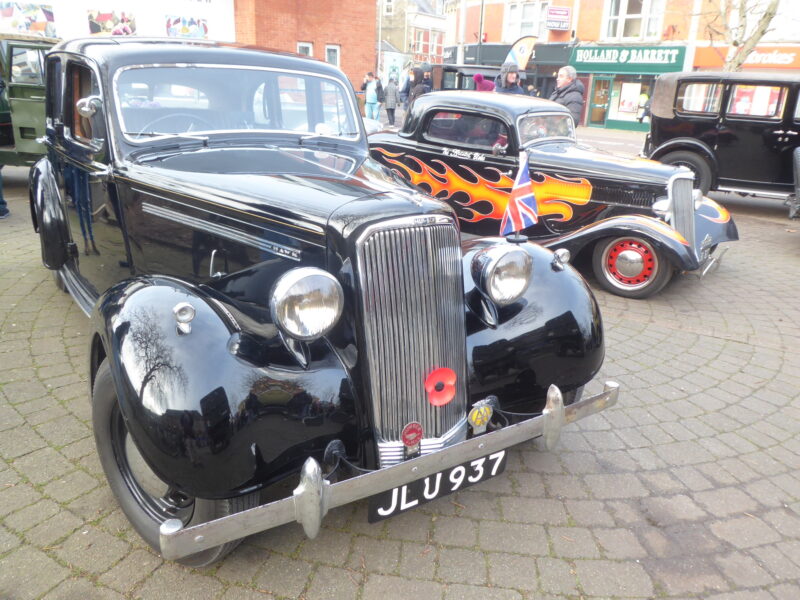
The Hawk, a re-badged Hillman 14 (1938–1940) was the first Humber car to be launched after World War II. Slightly longer because of the new bootlid superimposed on its fastback tail and narrower having shed its running boards it also managed to be 112 pounds (51 kg) lighter than the prewar car. The engine, from the Hillman 14 but uprated almost ten per cent to an output of 56 bhp, was shared with Sunbeam Talbot’s 90s. It drove the Hawk’s live rear axle through a four-speed gearbox with centrally located floor change. As with the Hillman the four-door body was mounted on a separate chassis and was of the six-light design (three windows on each side) with a sunshine roof as standard. Suspension was independent at the front using a transverse leaf spring, and at the rear the axle had half-elliptic springs. The Mark II version of September 1947 was not even a facelift, the main difference being a column gear change with a control ring fitted to the gearbox making it impossible to crash the synchromesh gears. The engine was given a new water jacket, the petrol tank received a breather to prevent air-locks and provision was made for a car-radio and retracting aerial. There was no change to the car’s external appearance. Top speed was around 65 mph (105 km/h). The Mark III was a completely different car and was launched at the 1948 London Motor Show.


JAGUAR
The Series 1 E Type was introduced, initially for export only, in March 1961. The domestic market launch came four months later in July 1961. The cars at this time used the triple SU carburetted 3.8-litre six-cylinder Jaguar XK6 engine from the XK150S. Earlier built cars utilised external bonnet latches which required a tool to open and had a flat floor design. These cars are rare and more valuable. After that, the floors were dished to provide more leg room and the twin bonnet latches moved to inside the car. The 3.8-litre engine was increased to 4,235 cc in October 1964. The 4.2-litre engine produced the same power as the 3.8-litre (265 bhp) and same top speed (150 mph), but increased torque approximately 10% from 240 to 283 lb/ft. Acceleration remained pretty much the same and 0 to 60 mph times were around 6.4 seconds for both engines, but maximum power was now reached at 5,400 rpm instead of 5,500 rpm on the 3.8-litre. That all meant better throttle response for drivers that did not want to shift down gears. The 4.2-litre’s block was completely redesigned, made longer to accommodate 5 mm (0.20 in) larger bores, and the crankshaft modified to use newer bearings. Other engine upgrades included a new alternator/generator and an electric cooling fan for the radiator. Autocar road tested a UK spec E-Type 4.2 fixed head coupé in May 1965. The maximum speed was 153 mph, the 0–60 mph time was 7.6 seconds and the 1⁄4 mile from a standing start took 15.1 seconds. They summarised it as “In its 4.2 guise the E-Type is a fast car (the fastest we have ever tested) and offers just about the easiest way to travel quickly by road.”. Motor magazine road tested a UK spec E-Type 4.2 fixed head coupé in Oct 1964. The maximum speed was 150 mph, the 0–60 mph time was 7 seconds and the 1⁄4 mile time was 14.9 seconds. They summarised it as “The new 4.2 supersedes the early 3.8 as the fastest car Motor has tested. The absurd ease which 100 mph can be exceeded in a 1⁄4 mile never failed to astonish. 3,000 miles (4,828 km) of testing confirms that this is still one of the world’s outstanding cars”. All E-Types featured independent coil spring rear suspension designed and developed by R J Knight with torsion bar front ends, and four wheel disc brakes, in-board at the rear, all were power-assisted. The Coventry engineers spared nothing with regards to high automotive technology in braking. Like several British car builders of the middle and late 1950s, the four-wheel disc brakes were also used in that era by Austin-Healey, MG,putting the British far ahead of Ferrari, Maserati, Alfa Romeo, Porsche, and Mercedes-Benz. Even Lanchester tried an abortive attempt to use copper disc brakes in 1902. Jaguar was one of the first vehicle manufacturers to equip production cars with 4 wheel disc brakes as standard from the XK150 in 1958. The Series 1 (except for late 1967 models) can be recognised by glass-covered headlights (up to 1967), small “mouth” opening at the front, signal lights and tail-lights above bumpers and exhaust tips under the number plate in the rear. 3.8-litre cars have leather-upholstered bucket seats, an aluminium-trimmed centre instrument panel and console (changed to vinyl and leather in 1963), and a Moss four-speed gearbox that lacks synchromesh for first gear (“Moss box”) on all except very last cars. 4.2-litre cars have more comfortable seats, improved brakes and electrical systems, and, obviously, an all-synchromesh Jaguar designed four-speed gearbox. 4.2-litre cars also have a badge on the boot proclaiming “Jaguar 4.2 Litre E-Type” (3.8 cars have a simple “Jaguar” badge). Optional extras included chrome spoked wheels and a detachable hard top for the OTS. When leaving the factory the car was originally fitted with Dunlop 6.40 × 15-inch RS5 tyres on 15 × 5K wire wheels (with the rear fitting 15 × 5K½ wheels supplied with 6.50 X15 Dunlop Racing R5 tyres in mind of competition). Later Series One cars were fitted with Dunlop 185 – 15 SP41 or 185 VR 15 Pirelli Cinturato as radial ply tyres. A 2+2 version of the fastback coupé was added in 1966. The 2+2 offered the option of an automatic transmission. The body is 9 in (229 mm) longer and the roof angles are different. The roadster and the non 2+2 FHC (Fixed Head Coupé) remained as two-seaters. Less widely known, right at the end of Series 1 production, but prior to the transitional “Series 1½” referred to below, a small number of Series 1 cars were produced with open headlights. These Series 1 cars had their headlights modified by removing the covers and altering the scoops they sit in, but these Series 1 headlights differ in several respects from those later used in the Series 1½ (or 1.5), the main being they are shorter at 143 mm from the Series 1½ at 160 mm. Production dates on these machines vary but in right-hand drive form production has been verified as late as July 1968. They are not “rare” in the sense of the build of the twelve lightweights, but they are certainly uncommon; they were not produced until January 1967 and given the foregoing information that they were produced as late as July 1968, it appears that there must have been an overlap with the Series 1.5 production, which began in August 1967 as model year 1968 models. These calendar year/model year Series 1 E-Types are identical to other 4.2-litre Series 1 examples in every respect except for the open headlights; all other component areas, including the exterior, the interior, and the engine compartment are the same, with the same three SU carburettors, polished aluminium cam covers, center dash toggle switches, etc. Following the Series 1 there was a transitional series of cars built in 1967–68 as model year 1968 cars, unofficially called “Series 1½.” Due to American pressure the new features were not just open headlights, but also different switches (black rocker switches as opposed to the Series 1 toggle switches), de-tuning for emissions (using two Zenith-Stromberg carburettors instead of the original three SUs) for US models, ribbed cam covers painted black except for the top brushed aluminium ribbing, bonnet frames on the OTS that have two bows, and other changes. Series 1½ cars also have twin cooling fans and adjustable seat backs. The biggest change between 1961–1967 Series 1 E-Types and the 1968 Series 1.5 was the reduction in the number of carburettors from 3 to just 2 (North America), resulting in a loss in horsepower. Series 2 features were gradually introduced into the Series 1, creating the unofficial Series 1½ cars, but always with the Series 1 body style. A United States federal safety law affecting 1968 model year cars sold in the US was the reason for the lack of headlight covers and change in dash switch design in the “Series 1.5” of 1968. An often overlooked change, one that is often “modified back” to the older style, is the wheel knock-off “nut.” US safety law for 1968 models also forbade the winged-spinner knockoff, and any 1968 model year sold in the US (or earlier German delivery cars) should have a hexagonal knockoff nut, to be hammered on and off with the assistance of a special “socket” included with the car from the factory. This hexagonal nut carried on into the later Series 2 and 3. The engine configuration of the US Series 1.5s was the same as is found in the Series 2. An open 3.8-litre car, actually the first such production car to be completed, was tested by the British magazine Motor in 1961 and had a top speed of 149.1 mph and could accelerate from 0 to 60 mph in 7.1 seconds. A fuel consumption of 21.3 mpg was recorded. The test car cost £2,097 including taxes.The cars submitted for road test by the motoring journals of the time (1961) such as Motor, Autocar and Autosport magazines were prepared by the Jaguar works. This work entailed engine balancing and subtle tuning work such as gas-flowing checking the cylinder heads but otherwise production built engines. Both of the well-known 1961 road test cars: the E-Type coupé Reg. No. 9600 HP and E-Type Convertible Reg. No. 77 RW, were fitted with Dunlop Racing Tyres on test, which had a larger rolling diameter and lower drag coefficient. This goes some way to explaining the 150 mph (240 km/h) maximum speeds that were obtained under ideal test conditions. The maximum safe rev limit for standard 6-cylinder 3.8-litre E-Type engines is 5,500 rpm. The later 4.2-Litre units had a red marking on the rev counter from just 5,000 rpm. Both 3.8 test cars may have approached 6,000 rpm in top gear when on road test, depending on final drive ratio. Production numbers were as follows: 15,490 of the 3.8s, 17,320 of the 4.2s and 10,930 of the 2+2s. And by body style there were 15,442 of the FHC, 17,378 of the OTS and 5,500 of the 2+2, making a total of 38,419 of the Series 1 car.

LAMBORGHINI
The Aventador has been a huge success for Lamborghini. It was first seen at the 2011 Geneva Show, with the full name of Aventador LP700-4 Coupe, the numbers denoting the output of 700 bhp from the all-new V12 engine and the 4 meaning four wheel drive, something which has featured on every Aventador since. The launch price was £250,000 but even so within a month, Lamborghini had a year’s worth of orders, and within a year, 1000 had been built. In November 2012 a Roadster version arrived, which was very similar to the Coupe, but with a lift-out roof panel. A suite of mechanical changes came at this point, with a cylinder deactiviation technology helping to improve fuel consumption and cut emissions. To mark half a century of car production, in April 2013, the LP720-4 50th Anniversary was launched, with 100 units available. As well as the extra 20 bhp, these had a mildly redesigned nose and tail, special paintwork and unique interior trim. A Roadster version followed in December 2014, the LP 700-4 Pirelli Edition. This did not have the extra power, but did feature two tone paint, unique wheels and a transparent engine cover, with the engine bay finished in carbon fibre. Lamborghini turned up the wick in march 2015 with the LP750-4 SuperVeloce, or SV for short, which featured and extra 50 bhp and a 50 kg weight reduction largely thanks to the use of more carbon fibre. A Roadster version followed a few months later.


LAND ROVER
The Series III had the same body and engine options as the preceding IIa, including station wagons and the One-Ton versions. Little changed cosmetically from the IIA to the Series III. The series III is the most common series vehicle, with 440,000 of the type built from 1971 to 1985. The headlights were moved to the wings on late production IIA models from 1968/9 onward (ostensibly to comply with Australian, American and Dutch lighting regulations) and remained in this position for the series III. The traditional metal grille, featured on the series I, II and IIA, was replaced with a plastic one for the series-III model. The 2.25-litre engine had its compression raised from 7:1 to 8:1, increasing the power slightly (the high compression engine had been an optional fit on the IIa model for several years). During the series-III production run from 1971 until 1985, the 1,000,000th Land Rover rolled off the production line in 1976. For many years, a SWB Land Rover was the shortest 7-seat vehicle available in Europe. The series III saw many changes in the later part of its life as Land Rover updated the design to meet increased competition. This was the first model to feature synchromesh on all four gears, although some late H-suffix SIIA models (mainly the more expensive Station Wagons) had used the all-synchro box. In keeping with early 1970s trends in automotive interior design, both in safety and use of more advanced materials, the simple metal dashboard of earlier models was redesigned to accept a new moulded plastic dash. The instrument cluster, which was previously centrally located, was moved to the driver’s side. Long-wheelbase Series-III vehicles had the Salisbury rear axle (the differential housing and axle case are one piece)[clarification needed] as standard, although some late SIIA 109-inch vehicles had them too. In 1980, the 2.25-litre petrol and diesel engines received five main bearing crankshafts to increase rigidity and the transmission, and axles and wheel hubs were strengthened. This was the culmination of a series of updates to the transmission that had been made since the 1960s to combat the all-too-common problem of the rear axle half-shafts breaking in heavy usage. This problem was partly due to the design of the shafts themselves. Due to the fully floating design of the rear wheel hubs, the half shafts can be removed very quickly without even having to jack the vehicle off the ground. The tendency for commercial operators to overload their vehicles exacerbated this flaw which blighted the series Land Rovers in many of their export markets and established a reputation that continues in many markets to the present day. This is despite the 1982 re-design (mainly the increase of driving-splines from 10 to 24 to reduce stress) that all but solved the problem. Also, new trim options were introduced to make the interior more comfortable if the buyer so wished (many farmers and commercial users preferred the original, non-trimmed interior). These changes culminated in April 1982 with the introduction of the “County” spec. Station Wagon Land Rovers, available in both 88-inch and 109-inch types. These had all-new cloth seats from the Leyland T-45 Lorry, soundproofing kits, tinted glass and other “soft” options designed to appeal to the leisure owner/user. Of more interest was the introduction of the High Capacity Pick Up to the 109-inch chassis. This was a pick-up truck load bay that offered 25% more cubic capacity than the standard pick-up style. The HCPU came with heavy-duty suspension and was popular with public utility companies and building contractors.

LOTUS
It is now over 20 years since Lotus launched the Elise, a model which showed a return to the core values of simplicity and light-weight which were cornerstones of Colin Chapman’s philosophy when he founded the marque in 1955. The first generation Elise was produced for just over 4 years, with a replacement model, the Series 2 arriving in October 2000. It came about as the Series 1 could not be produced beyond the 2000 model production year due to new European crash sustainability regulations. Lacking the funding to produce a replacement, Lotus needed a development partner to take a share of investment required for the new car. General Motors offered to fund the project, in return for a badged and GM-engined version of the car for their European brands, Opel and Vauxhall. The result was therefore two cars, which although looking quite different, shared much under the skin: a Series 2 Elise and the Vauxhall VX220 and Opel Speedster duo. The Series 2 Elise was a redesigned Series 1 using a slightly modified version of the Series 1 chassis to meet the new regulations, and the same K-series engine with a brand new Lotus-developed ECU. The design of the body paid homage to the earlier M250 concept, and was the first Lotus to be designed by computer. Both the Series 2 Elise and the Opel Speedster/Vauxhall VX220 were built on the same production line, in a new facility at Hethel. Both cars shared many parts, including the chassis, although they had different drive-trains and power-plants. The VX220 carried the Lotus internal model identification Lotus 116, with the code name Skipton for the launch 2.2 normally aspirated version and Tornado for the 2 litre Turbo which came out in 2004. Fitted with 17 inch over the Elise’s 16 inch front wheels, the Vauxhall/Opel version ceased production in late 2005 and was replaced by the Opel GT for February 2007, with no RHD version for the United Kingdom. The Elise lived on. and indeed production only ceased at the end of 2021 and there have been countless different versions produced in that time. Whilst the first of the Series 2 cars came with the Rover K-Series engine, and that included the 111S model which had the VVC engine technology producing 160 hp , a change came about in 2005 when Lotus started to use Toyota engines. This was initially due to Lotus’ plans to introduce the Elise to the US market, meaning that an engine was needed which would comply with US emissions regulations. The selected 1.8 litre (and later 1.6 litre) Toyota units did, and the K-series did not. that MG-Rover went out of business in 2005 and engine production ceased confirmed the need for the change. Since then, Lotus have offered us track focused Elise models like the 135R and Sport 190, with 135 bhp and 192 bhp respectively, as well as the 111R, the Sport Racer, the Elise S and Elise R. In 2008 an even more potent SC model, with 218 bhp thanks to a non-intercooled supercharger was added to the range. In February 2010, Lotus unveiled a facelifted version of the second generation Elise. The new headlights are now single units; triangular in shape they are somewhat larger than the earlier lights. The cheapest version in Europe now has a 1.6 litre engine to comply with Euro 5 emissions, with the same power output as the earlier 1.8 136bhp car. Lotus has been through some difficult times in recent years, but things are looking more optimistic again, with production numbers having risen significantly in the last couple of years, after a period when next to no cars were made.


MASERATI
Still acclaimed as one of the best-looking saloons ever produced is this car, the fifth generation Quattroporte, a couple of which were on show. Around 25,000 of these cars were made between 2004 and 2012, making it the second best selling Maserati of all time, beaten only by the cheaper BiTurbo of the 1980s. The Tipo M139 was unveiled to the world at the Frankfurt Motor Show on 9 September 2003, with production starting in 2004. Exterior and interior design was done by Pininfarina, and the result was widely acclaimed to be one of the best looking saloons not just of its time, but ever, an opinion many would not disagree with even now. Built on an entirely new platform, it was 50 cm (19.7 in) longer than its predecessor and sat on a 40 cm (15.7 in) longer wheelbase. The same architecture would later underpin the GranTurismo and GranCabrio coupés and convertibles. Initially it was powered by an evolution of the naturally aspirated dry sump 4.2-litre V8 engine, mounted on the Maserati Coupé, with an improved output of 400 PS . Due to its greater weight compared to the Coupé and Spyder, the 0-62 mph (0–100 km/h) time for the Quattroporte was 5.2 seconds and the top speed 171 mph (275 km/h). Initially offered in only one configuration, equipped with the DuoSelect transmission, the gearbox was the weak point of the car, receiving most of the criticism from the press reviews. Maserati increased the range at the 2005 Frankfurt Motor Show, with the launch of the Executive GT and Sport GT trim levels. The Executive GT came equipped with a wood-rimmed steering wheel, an alcantara suede interior roof lining, ventilated, adaptive, massaging rear seats, rear air conditioning controls, veneered retractable rear tables, and curtain shades on the rear windows. The exterior was distinguished by 19 inch eight-spoke ball-polished wheels and chrome mesh front and side grilles. The Quattroporte Sport GT variant offered several performance upgrades: faster shifting transmission and firmer Skyhook suspensions thanks to new software calibrations, seven-spoke 20 inch wheels with low-profile tyres, cross-drilled brake rotors and braided brake lines. Model-specific exterior trim included dark mesh front and side grilles and red accents to the Trident badges, as on vintage racing Maseratis. Inside there were aluminium pedals, a sport steering wheel and carbon fibre in place of the standard wood inserts. A new automatic transmission was presented at the 2007 Detroit Motor Show, marketed as the Maserati Quattroporte Automatica. As all three trim levels were offered in both DuoSelect and Automatica versions, the lineup grew to six models. The Quattroporte Sport GT S was introduced at the 2007 Frankfurt Motor Show. Taking further the Sport GT’s focus on handling, this version employed Bilstein single-rate dampers in place of the Skyhook adaptive system. Other changes from the Sport GT comprised a lowered ride height and 10 mm wider 295/30 rear tyres, front Brembo iron/aluminium dual-cast brake rotors and red-painted six piston callipers. The cabin was upholstered in mixed alcantara and leather, with carbon fibre accents; outside the door handles were painted in body colour, while the exterior trim, the 20 inch wheels and the exhaust pipes were finished in a “dark chrome” shade. After Images of a facelifted Quattroporte appeared on the Internet in January 2008; the car made its official début at the 2008 Geneva Motor Show. Overseen by Pininfarina, the facelift brought redesigned bumpers, side sills and side mirrors, a convex front grille with vertical bars instead of horizontal, new headlights and tail lights with directional bi-xenon main beams and LED turn signals. Inside there was a new navigation and entertainment system. All Quattroporte models now used the ZF automatic transmission, the DuoSelect being discontinued. The 4.2-litre Quattroporte now came equipped with single-rate damping comfort-tuned suspension and 18 inch wheels. Debuting alongside it was the Quattroporte S, powered by a wet-sump 4.7-litre V8, the same engine of the Maserati GranTurismo S, with a maximum power of 424 bhp and maximum torque of 361 lb·ft. In conjunction with the engine, the braking system was upgraded to cross-drilled discs on both axles and dual-cast 360 mm rotors with six piston callipers at the front. Skyhook active damping suspension and 19 inch V-spoke wheels were standard. Trim differences from the 4.2-litre cars were limited to a chrome instead of titanium-coloured front grille. The Quattroporte Sport GT S was premièred at the North American International Auto Show in January 2009. Its 4.7-litre V8 produced 440 PS (434 hp), ten more than the Quattroporte S, thanks to revised intake and to a sport exhaust system with electronically actuated bypass valves. Other mechanical changes were to the suspensions, where as on the first Sport GT S single-rate dampers took place of the Skyhook system, ride height was further lowered and stiffer springs were adopted. The exterior was distinguished by a specific front grille with convex vertical bars, black headlight bezels, red accents to the Trident badges, the absence of chrome window trim, body colour door handles and black double oval exhaust pipes instead of the four round ones found on other Quattroporte models. Inside veneers were replaced by “Titan Tex” composite material and the cabin was upholstered in mixed Alcantara and leather. This means that there are quite a number of different versions among the 25,256 units produced, with the early DuoSelect cars being the most numerous.

The Maserati GranTurismo and GranCabrio (Tipo M145) are a series of a grand tourers produced from 2007 to 2019. They succeeded the 2-door V8 grand tourers offered by the company, the Maserati Coupé, and Spyder. The GranTurismo set a record for the most quickly developed car in the auto industry, going from design to production stage in just nine months. The reason being that Ferrari, after selling off Maserati to the Fiat Chrysler Group, took the designs of the proposed replacement of the Maserati Coupé and after some modifications, launched it as the Ferrari California. Unveiled at the 2007 Geneva Motor Show, the GranTurismo has a drag coefficient of 0.33. The model was initially equipped with a 4.2-litre V8 engine developed in conjunction with Ferrari. The engine generates a maximum power output of 405 PS and is equipped with a 6-speed ZF automatic transmission. The 2+2 body was derived from the Maserati M139 platform, also shared with the Maserati Quattroporte V, with double-wishbone front suspension and a multilink rear suspension. The grand tourer emphasises comfort in harmony with speed and driver-enjoyment. The better equipped S variant was unveiled at the 2008 Geneva Motor Show and features the enlarged 4.7-litre V8 engine shared with the Alfa Romeo 8C Competizione, rated at 440 PS at 7,000 rpm and 490 Nm (361 lb/ft) of torque at 4,750 rpm. At the time of its introduction, it was the most powerful road-legal Maserati offered for sale (excluding the homologation special MC12). The engine is mated to the 6-speed automated manual shared with the Ferrari F430. With the transaxle layout weight distribution improved to 47% front and 53% rear. The standard suspension set-up is fixed-setting steel dampers, with the Skyhook adaptive suspension available as an option along with a new exhaust system, and upgraded Brembo brakes. The seats were also offered with various leather and Alcantara trim options. The upgrades were made to make the car more powerful and more appealing to the buyers while increasing performance, with acceleration from 0–100 km/h (0–62 mph) happening in 4.9 seconds and a maximum speed of 295 km/h (183 mph). Aside from the power upgrades, the car featured new side skirts, unique 20-inch wheels unavailable on the standard car, a small boot lip spoiler, and black headlight clusters in place of the original silver. The variant was available in the North American market only for MY2009 with only 300 units offered for sale. The GranTurismo MC is the racing version of the GranTurismo S developed to compete in the FIA GT4 European Cup and is based on the Maserati MC concept. The car included a 6-point racing harness, 120 litre fuel tank, 380 mm (15.0 in) front and 326 mm (12.8 in) rear brake discs with 6-piston calipers at the front and 4-piston calipers at the rear, 18-inch racing wheels with 305/645/18 front and 305/680/18 rear tyres, carbon fibre bodywork and lexan windows throughout along with a race interior. All the weight-saving measures lower the weight to about 3,000 lb (1,361 kg). The car shares the 4.7-litre V8 engine from the GranTurismo S but is tuned to generate a maximum power output of 450 PS along with the 6-speed automated manual transmission. The GranTurismo MC was unveiled at the Paul Ricard Circuit in France. It went on sale in October, 2009 through the Maserati Corse programme. 15 GranTurismo MC racecars were developed, homologated for the European Cup and National Endurance Series, one of which was taken to be raced by GT motorsport organization Cool Victory in Dubai in January, 2010. Introduced in 2008, the GranTurismo MC Sport Line is a customisation programme based on the GranTurismo MC concept. Changes include front and rear carbon-fibre spoilers, carbon-fibre mirror housings and door handles, 20-inch wheels, carbon-fibre interior (steering wheel rim, paddle shifters, instrument panel, dashboard, door panels), stiffer springs, shock absorbers and anti-roll bars with custom Maserati Stability Programme software and 10 mm (0.4 in) lower height than GranTurismo S. The programme was initially offered for the GranTurismo S only, with the product line expanded to all GranTurismo variants and eventually all Maserati vehicles in 2009. Replacing both the GranTurismo S and S Automatic, the Granturismo Sport was unveiled in March 2012 at the Geneva Motor Show. The revised 4.7L engine is rated at 460 PS. The Sport features a unique MC Stradale-inspired front fascia, new headlights and new, sportier steering wheel and seats. The ZF six-speed automatic gearbox is now standard, while the six-speed automated manual transaxle is available as an option. The latter has steering column-mounted paddle-shifters, a feature that’s optional with the automatic gearbox. New redesigned front bumper and air splitter lowers drag coefficient from Cd=0.33 to 0.32. In September 2010, Maserati announced plans to unveil a new version of the GranTurismo – the MC Stradale – at the 2010 Paris Motor Show. The strictly two-seat MC Stradale is more powerful than the GranTurismo at 450 PS, friction reduction accounts for the increase, says Maserati, due to the strategic use of “diamond-like coating”, an antifriction technology derived from Formula 1, on wear parts such as the cams and followers. It is also 110 kg lighter (1,670 kg dry weight) from the GranTurismo, and more aerodynamic than any previous GranTurismo model – all with the same fuel consumption as the regular GranTurismo. In addition to two air intakes in the bonnet, the MC Stradale also receives a new front splitter and rear air dam for better aerodynamics, downforce, and improved cooling of carbon-ceramic brakes and engine. The body modifications make the car 48 mm (2 in) longer. The MC Race Shift 6-speed robotised manual gearbox (which shares its electronics and some of its hardware from the Ferrari 599 GTO) usually operates in an “auto” mode, but the driver can switch this to ‘sport’ or ‘race’ (shifting happening in 60 milliseconds in ‘race’ mode), which affects gearbox operations, suspension, traction control, and even the sound of the engine. The MC Stradale is the first GranTurismo to break the 300 km/h (186 mph) barrier, with a claimed top speed of 303 km/h (188 mph). The push for the Maserati GranTurismo MC Stradale came from existing Maserati customers who wanted a road-legal super sports car that looked and felt like the GT4, GTD, and Trofeo race cars. It has been confirmed by the Maserati head office that only 497 units of 2-seater MC Stradales were built in total from 2011 to 2013 in the world, Europe: 225 units, China: 45 units, Hong Kong: 12, Taiwan: 23 units, Japan: 33 units, Oceania: 15 units and 144 units in other countries. US market MC’s do not have the “Stradale” part of the name, and they are sold with a fully automatic six-speed transmission rather than the one available in the rest of the world. US market cars also do not come with carbon fibre lightweight seats like the rest of the world. The MC Stradale’s suspension is 8% stiffer and the car rides slightly lower than the GranTurismo S following feedback from racing drivers who appreciated the better grip and intuitive driving feel of the lower profile. Pirelli has custom-designed extra-wide 20-inch P Zero Corsa tyres to fit new flow-formed alloy wheels. The Brembo braking system with carbon-ceramic discs weighs around 60% less than the traditional system with steel discs. The front is equipped with 380 x 34 mm ventilated discs, operated by a 6 piston caliper. The rear discs measure 360 x 32 mm with four-piston calipers. The stopping distance is 33 m at 100 km/h (62 mph) with an average deceleration of 1.2g. At the 2013 Geneva Motor Show, an update to the GranTurismo MC Stradale was unveiled. It features an updated 4.7 litre V8 engine rated at 460 PS at 7,000 rpm and 520 Nm (384 lb/ft) of torque at 4,750 rpm, as well as the MC Race Shift 6-speed robotized manual gearbox which shifts in 60 milliseconds in ‘race’ mode. The top speed is 303 km/h (188 mph). All models were built at the historic factory in viale Ciro Menotti in Modena. A total of 28,805 GranTurismos and 11,715 units of the convertible were produced. The final production example of the GranTurismo, called Zéda, was presented painted in a gradient of blue, black and white colours.


McLAREN
The McLaren 570S is a sports car produced from 2015 until 2021. It was unveiled at the 2015 New York International Auto Show. The car is powered by a new iteration of the 3.8-litre twin-turbocharged V8 engine already used in the 650S and P1, designated M838T E with thirty per cent of the parts redesigned. It delivers 562 hp (570 PS) and 443 lb/ft (601 Nm) of torque through a 7-speed dual-clutch transmission developed by Graziano Trasmissioni, as it is arranged in the car as a rear-mid engine configuration, The car can accelerate from 0–62 mph (0–100 km/h) in 3.2 seconds and can achieve a top speed of 204 mph (328 km/h). A total dry weight of 2,989 lb (1,356 kg) and maximum weight of 3,201 lb (1,452 kg) gives the 570S a power to weight ratio of 428 PS per tonne delivering a fuel economy of 25.5 miles per imperial gallon (11.1 L/100 km; 21.2 mpg‑US) and CO2 emissions of 249 g/km. McLaren focused on delivering “day-to-day usability and driveability” against the most sporting model options in its range with increased luggage space, greater interior storage and leather upholstery options. The car is designed with aerodynamics in mind and the teardrop shaped cockpit helps achieve that objective. The rear of the car is inspired by the P1 and borrows the slim LED tail lights and diffuser styling from the flagship sports car. The car features dihedral doors, a trademark of McLaren as featured on its ultimate and super series cars. There were numerous variants during that 6 year production cycle, some easier to tell apart than others.

MERCEDES-BENZ
The Mercedes-AMG GT is a series of 2-door sports cars produced by German automobile manufacturer Mercedes-AMG. The car was introduced on 9 September 2014 and was officially unveiled to the public in October 2014 at the Paris Motor Show. While not directly replacing the SLS AMG (competing in a different segment), it is the second sports car developed entirely in-house by Mercedes-AMG. The Mercedes-AMG GT went on sale in two variants (GT and GT S) in March 2015, while a GT3 racing variant of the car was introduced in 2015. A high performance variant called the GT R was introduced in 2016. A GT4 racing variant, targeted at semi-professional drivers and based on the GT R variant, was introduced in 2017. In 2021, a new variant called the AMG GT Black Series was released. All variants are assembled at the Mercedes-Benz plant in Sindelfingen, Germany. The interior of the Mercedes-AMG GT was previewed on 16 April 2014. The car made its debut on 9 September 2014 and was officially unveiled to the public in October 2014 at the Paris Motor Show. The GT’s exterior design was kept similar to that of the preceding SLS AMG, with wide wheel arches, lower bodywork, and fastback sloping roofline of the SLS AMG, but using conventional forward-opening doors instead of the iconic gullwing style pioneered by the 300 SL in the 1950s. It also employed an upgraded and shortened version of the Transaxle Spaceframe platform used by the SLS. The vehicle structure is made up of 93% aluminium, with the front module base made up of magnesium. The exterior lead designer was Mark Fetherston, whose previous works include the W176 A-Class, the CLA-Class, and SLS AMG. The interior, designed by Jan Kaul, features a large centre console and decorative elements in a leather and carbon polymer design. The trunk offers room for a medium-sized suitcase. Two engine power output options were offered: the GT, with 462 PS/456 hp, and the GT S with 510 PS/ 503 hp. The GT generates 600 N⋅m (443 lb⋅ft) of torque, and the GT S generates 650 N⋅m (479 lb⋅ft) of torque. Shortly after its introduction, Mercedes-AMG CEO at the time, Tobias Moers, promised a Black Series variant of the Mercedes-AMG GT.[15] The new high performance variant was called the AMG GT R. The Mercedes-AMG family was given a facelift in 2017, along with the introduction of the GT C roadster variant and the Edition 50 model, which is a limited-edition derivative of the GT C variant. The key improvements made as part of the facelift include increased power output from the M178 engine for the GT and GT S variants (10 kW and 9 kW respectively) and the inclusion of the ‘Panamericana’ grille from the GT3, GT4 and GT R variants as standard equipment for all variants. The GT is the entry level variant of the Mercedes-AMG GT family. The M178 engine in this variant is tuned to an output of 462 PS/456 hp and 601 Nm (443 lb/ft) of torque, with the key differences between this and its more expensive siblings being a mechanical limited-slip differential, an absorbent glass mat battery, the lack of the “Race Mode” setting in the AMG Dynamic Select adaptive drivetrain system, the lack of the AMG Ride Control adaptive suspensive system, and a passive AMG Sport Exhaust System. Keyless-Go is also an optional feature, as opposed to standard equipment. The GT is equipped with 19-inch wheels at the front and rear. The GT S is a more highly equipped variant of the Mercedes-AMG GT. The M178 engine in this variant is tuned to an output of 510 PS/503 hp and 651 Nm (480 lb/ft) of torque. The key mechanical differences the GT S gains over the GT include an electronically controlled limited-slip differential, “Race Mode” and “Race Start” mode settings in the AMG Dynamic Select adaptive drivetrain system, AMG Ride Control adaptive suspensive system, an AMG Performance Exhaust System with dynamic flaps, and a lithium-ion battery. Keyless-Go is standard equipment, as is a staggered set of wheels (19-inch at the front, 20-inch at the rear). As with many other recent Mercedes-AMGs, at the time of introduction a limited production “Edition 1” series was issued of the GT S. 375 examples were sold worldwide, and include a gloss black aerodynamic set including a front splitter, lower wheelwell extensions, a carbon fibre roof, a fixed rear wing, red interior accents and red brake calipers, and various other extras. In October 2021, Mercedes-Benz announced the new Mercedes-AMG R232 SL-Class as the direct successor for the roadster version. The second-generation coupe version of the GT, which was introduced nearly a year after the first-generation was discontinued, was redesigned on the same platform as the SL, but retains the name AMG GT.


MILITARY VEHICLES
There were a couple of military vehicle here, the familiar Willys Jeep and the AEC Matador, a heavy 4×4 truck and medium artillery tractor used by British and Commonwealth forces during the Second World War. Manufactured by the Associated Equipment Company (AEC), over 9,000 units were built between 1939 and 1945. It was known for its ruggedness and reliability across challenging terrains, commonly used to tow the 5.5-inch medium gun and the QF 3.7-inch anti-aircraft gun. Most models were powered by an AEC 7.7-litre diesel engine. Many remained in service until the 1960s and were then sold for civilian use, often as logging trucks.


MITSUBISHI
The Mitsubishi i-MiEV (MiEV is an acronym for Mitsubishi innovative Electric Vehicle) is a five-door electric city car produced in the 2010s by Mitsubishi Motors, and is the electric version of the Mitsubishi i. Rebadged variants of the i-MiEV are also sold by PSA as the Peugeot iOn and Citroën C-Zero, mainly in Europe. The i-MiEV was the world’s first modern highway-capable mass production electric car. The Mitsubishi i-MiEV, based on the Mitsubishi i kei car, was first exhibited at the 22nd International Battery, Hybrid and Fuel Cell Electric Vehicle Symposium & Exposition in Yokohama. Mitsubishi eschews the in-wheel motors (MIEV) in favour of a more conventional array of batteries, motor and inverter to replace the “rear midship” engine and fuel tank of the conventional car. Mitsubishi Motors provided three power companies with vehicles in 2006 and 2007 in order to conduct joint research to evaluate how fast-charge infrastructure may be developed for EVs. Fleet testing by five power companies was conducted in 2007. The car had a range of 130 kilometres (80 mi) for the 16 kW⋅h lithium-ion battery pack and 160 kilometres (100 mi) for the 20 kW⋅h pack. Top speed was 130 kilometres per hour (80 mph). Plans were announced in 2008 to sell the i-MiEV in European markets as the Peugeot iOn and Citroën C-Zero. Mitsubishi began supplying the electric cars to PSA Peugeot Citroën (PSA) since 2010, and PSA has a contractual commitment to buy 100,000 i-MiEVs over a period that remained confidential. Full production of the i-MiEV started in July 2009 and Mitsubishi expected initial sales volume to be small, to sell up to 1,400 vehicles by March 2010, but expected sales to rise to 5,000 vehicles in the following twelve months, once retail sales had started. Mitsubishi decided to target sales to corporate customers in Japan at first to allow local governments and businesses to set up recharging stations around the country. The company said initial sales were constrained by production capacity but expects production to ramp up quickly from 2,000 units in 2009/10 to 30,000 vehicles within three years as it expands production of lithium-ion battery through Lithium Energy Japan, a joint venture with GS Yuasa Corporation and Mitsubishi Corporation. Production was projected to increase to 9,000 units in its fiscal year 2010/11, and to 18,000 in the following twelve months. Production of the left-hand drive European-spec i-MiEV began in October 2010. By the end of November 2010 cumulative production had reached 5,000 units at Mitsubitshi’s Mizushima Plant. In May 2011 Mitsubishi announced a new production target of 25,000 i-MiEVs worldwide in fiscal year 2011. The carmaker also plans to export about 15,000 units overseas, mainly to Europe, where the company will promote sales to the European public sector, such as police departments and local governments. Production of the American-spec Mitsubishi i electric car began in late October 2011.[54] Since July 2009 Mitsubishi had manufactured more than 33,000 i-MiEVs and rebadge versions by March 2013, including more than 11,000 units rebadged in France as Peugeot iOn and Citroën C-Zero, and sold in the European market. In August 2012, and as a result of Europe’s debt crisis that resulted in PSA Peugeot Citroën (PSA) Group slow sales, Mitsubishi Motors announced the suspension of its supply of the i-MiEV electric vehicle to PSA, although the period for supplying vehicles under their contract as part of original equipment manufacturer agreements has not yet ended. The suspension is part of the decision of several Japanese manufacturers to suspend their joint development projects and contracts with several European partners. By early August 2012, PSA had sold a total of 6,575 Peugeot iOns and Citroën C-Zeros since their launch in Europe in 2010, while Mitsubishi had assembled almost 11,000 electric cars destined to PSA, leaving the French carmaker with more than 4,400 electric cars in unsold inventory. PSA only sold 50% of the sales target set for 2011 and according to PSA the supply was only temporarily interrupted. In May 2014, PSA Peugeot Citroën Chief Executive, Carlos Tavares, announced that the carmaker will decide over the next 12 months whether to continue selling electric vehicles manufactured by its partner Mitsubishi. Sales of both of PSA rebadged electric cars fell significantly from 2012 to 2013 as a result of new competition from Nissan, Renault and BMW. Production ceased in March 2021.

MORRIS
No surprise to see the evergreen Morris Minor here as this is a very popular classic. The Minor was conceived in 1941. Although the Nuffield Organization was heavily involved in war work and there was a governmental ban on civilian car production, Morris Motors’ vice chairman, Miles Thomas, wanted to prepare the ground for new products to be launched as soon as the war was over. Vic Oak, the company’s chief engineer, had already brought to Thomas’ attention a promising junior engineer, Alec Issigonis, who had been employed at Morris since 1935 and specialised in suspension design but he had frequently impressed Oak with his advanced ideas about car design in general. Issigonis had come to Oak’s particular attention with his work on the new Morris Ten, which was in development during 1936/7. This was the first Morris to use unitary construction and was conceived with independent front suspension. Issigonis designed a coil-sprung wishbone system which was later dropped on cost grounds. Although the design would later be used on the MG Y-type and many other post-war MGs the Morris Ten entered production with a front beam axle. Despite his brief being to focus on the Ten’s suspension Issigonis had also drawn up a rack and pinion steering system for the car. Like his suspension design this was not adopted but would resurface in the post-war years on the MG Y-type, but these ideas proved that he was the perfect candidate to lead the design work on a new advanced small car. With virtually all resources required for the war effort, Thomas nonetheless approved the development of a new small family car that would replace the Morris Eight. Although Oak (and Morris’ technical director, Sidney Smith) were in overall charge of the project it was Issigonis who was ultimately responsible for the design, working with only two other draughtsmen. Thomas named the project ‘Mosquito’ and ensured that it remained as secret as possible, both from the Ministry of Supply and from company founder William Morris (now Lord Nuffield), who was still chairman of Morris Motors and, it was widely expected, would not look favourably on Issigonis’ radical ideas. Issigonis’ overall concept was to produce a practical, economical and affordable car for the general public that would equal, if not surpass, the convenience and design quality of a more expensive car. In later years he summed up his approach to the Minor; that he wanted to design an economy car that “the average man would take pleasure in owning, rather than feeling of it as something he’d been sentenced to” and “people who drive small cars are the same size as those who drive large cars and they should not be expected to put up with claustrophobic interiors.” Issigonis wanted the car to be as spacious as possible for its size and comfortable to drive for inexperienced motorists. Just as he would with the Mini ten years later, he designed the Mosquito with excellent roadholding and accurate, quick steering not with any pretence of making a sports car, but to make it safe and easy to drive by all. As work proceeded, there were plenty of battle to overcome, to get Issigonis’ ideas approved, and not all of them were. The production car, called the Minor was launched at the British Motor Show at Earls Court in London on October 27, 1948. At the same show Morris also launched the new Morris Oxford and Morris Six models, plus Wolseley variants of both cars, which were scaled-up versions of the new Minor, incorporating all the same features and designed with Issigonis’ input under Vic Oak’s supervision. Thus Issigonis’ ideas and design principles underpinned the complete post-war Morris and Wolseley car ranges. The original Minor MM series was produced from 1948 until 1953. It included a pair of four-seat saloons, two-door and (from 1950) a four-door, and a convertible four-seat Tourer. The front torsion bar suspension was shared with the larger Morris Oxford MO, as was the almost-unibody construction. Although the Minor was originally designed to accept a flat-4 engine, late in the development stage it was replaced by a 918 cc side-valve inline-four engine, little changed from that fitted in the 1935 Morris 8, and producing 27.5 hp and 39 lb/ft of torque. This little engine pushed the Minor to just 64 mph but delivered 40 mpg. Brakes were four-wheel drums. Early cars had a painted section in the centre of the bumpers to cover the widening of the production car from the prototypes. This widening of 4 inches is also visible in the creases in the bonnet. Exports to the United States began in 1949 with the headlamps removed from within the grille surround to be mounted higher on the wings to meet local safety requirements. In 1950 a four-door version was released, initially available only for export, and featuring from the start the headlamps faired into the wings rather than set lower down on either side of the grille. The raised headlight position became standard on all Minors in time for 1951. From the start, the Minor had semaphore-type turn indicators, and subsequent Minor versions persisted with these until 1961 An Autocar magazine road test in 1950 reported that these were “not of the usual self-cancelling type, but incorporate[d] a time-basis return mechanism in a switch below the facia, in front of the driver”. It was all too easy for a passenger hurriedly emerging from the front passenger seat to collide with and snap off a tardy indicator “flipper” that was still sticking out of the B-pillar, having not yet been safely returned by the time-basis return mechanism to its folded position. Another innovation towards the end of 1950 was a water pump (replacing a gravity dependent system), which permitted the manufacturer to offer an interior heater “as optional equipment”. When production of the first series ended, just over a quarter of a million had been sold, 30 per cent of them the convertible Tourer model. In 1952, the Minor line was updated with an Austin-designed 803 cc overhead valve A-series engine, replacing the original side-valve unit. The engine had been designed for the Minor’s main competition, the Austin A30, but became available as Austin and Morris were merged into the British Motor Corporation. The new engine felt stronger, though all measurements were smaller than the old. The 52 second drive to 60 mph was still calm, with 63 mph as the top speed. Fuel consumption also rose to 36 mpg. An estate version was introduced in 1952, known as the Traveller (a Morris naming tradition for estates, also seen on the Mini). The Traveller featured an external structural ash (wood) frame for the rear bodywork, with two side-hinged rear doors. The frame was varnished rather than painted and a highly visible feature of the body style. Commercial models, marketed as the Morris Quarter Ton Van and Pick-up were added in May 1953. Rear bodies of the van versions were all steel. The 4-seat convertible and saloon variants continued as well. The car was again updated in 1956 when the engine was increased in capacity to 948 cc. The two-piece split windscreen was replaced with a curved one-piece one and the rear window was enlarged. In 1961 the semaphore-style trafficators were replaced by the flashing direction indicators, these were US-style red at the rear (using the same bulb filament as the brake lamp) and white at the front (using a second brighter filament in the parking lamp bulb) which was legal in the UK and many export markets at the time (such as New Zealand). An upmarket car based on the Minor floorpan using the larger BMC B-Series engine was sold as the Riley One-Point-Five/Wolseley 1500 beginning in 1957: versions of this Wolseley/Riley variant were also produced by BMC Australia as the Morris Major and the Austin Lancer. In December 1960 the Morris Minor became the first British car to sell more than 1,000,000 units. To commemorate the achievement, a limited edition of 350 two-door Minor saloons (one for each UK Morris dealership) was produced with distinctive lilac paintwork and a white interior. Also the badge name on the side of the bonnet was modified to read “Minor 1,000,000” instead of the standard “Minor 1000”. The millionth Minor was donated to the National Union of Journalists, who planned to use it as a prize in a competition in aid of the union’s Widow and Orphan Fund. The company, at the same time, presented a celebratory Minor to London’s Great Ormond Street Hospital for Sick Children, but this car was constructed of cake. The final major upgrades to the Minor were made in 1962. Although the name Minor 1000 was retained, the changes were sufficient for the new model to be given its own ADO development number. A larger version of the existing A-Series engine had been developed in conjunction with cylinder head specialist Harry Weslake for the then new ADO16 Austin/Morris 1100 range. This new engine used a taller block than did the 948 cc unit, with increased bore and stroke bringing total capacity up to 1,098 cc. Although fuel consumption suffered moderately at 38 mpg, the Minor’s top speed increased to 77 mph with noticeable improvements in low-end torque, giving an altogether more responsive drive. Other changes included a modified dashboard layout with toggle switches, textured steel instrument binnacle, and larger convex glove box covers. A different heater completed the interior upgrade, whilst the larger combined front side/indicator light units, common to many BMC vehicles of the time, were fitted to the front wings. These now included a separate bulb and amber lens for indicators while larger tail lamp units also included amber rear flashers. During the life of the Minor 1000 model, production declined. The last Convertible/Tourer was manufactured on 18 August 1969, and the saloon models were discontinued the following year. Production of the more practical Traveller and commercial versions ceased in 1972, although examples of all models were still theoretically available from dealers with a surplus of unsold cars for a short time afterwards. 1,619,857 Minors of all variants were ultimately sold.


The success of Ford’s Cortina did not pass unnoticed, and by 1968, when British Leyland was formed as a merger of BMC and British Motor Holdings and the new management realised that apart from the soon to be launched Maxi, there were no new models under development, it was decided to give priority to a mid-sized car that would replace the elderly Minor and Farina saloons and take the Ford head on in the quest for sales. Conceived,. designed and put into production in record quick time, of just 18 months, the Marina was launched in the spring of 1971. An utterly conventional car, with rear wheel drive, and simple proven mechanicals using the familiar A and B Series engines, the model was launched as a 2 door Coupe and 4 door Saloon. Unusually, the Coupe was cheaper than the Saloon, which should have given the Morris something of an advantage over the Dagenham rival, who charged quite a premium for a Capri over a Cortina. However, the Marina had one attribute which completely eluded the Ford, certainly in its more powerful guises: terminal understeer. It is understood that when the British press got the chance to drive the car some while before launch, they all complained bitterly about this and the dire consequences that could follow, but BL management assured them that this would be fixed for the production cars. It was not, and a usually loyal press struggled to contain their disappointment in what they wrote in early Road Tests. About 30,000 cars were built like this before a revised suspension design was deployed and gradually the early cars were tamed somewhat. This weakness not withstanding, the Marina quickly picked up sales, and although it hardly ever outsold the Cortina in any given month, it became a strong performer in the UK Sales Charts, all the more so when an Estate model was added to the range in the autumn of 1972. The Marina was only intended to have a short life, very much like contemporary Ford products which were replaced every 4 or so years, but by the mid 1970s, BL had run out of money and had to be rescued by the British Government. That meant that there were no funds for an all new car, so the proposed ADO77 replacement model was cancelled, and the Marina was simply facelifted in the autumn of 1975 to create the Series 2, with revised suspension, new seats, a new dash to create more room for the front passenger, and upgraded equipment levels and then updated again in the autumn of 1978 when the new 1700cc O Series engines were ready to replace the venerable B series unit. As the 70s went on, the Marina’s limitations in the face of more modern competition not just from Ford, but Vauxhall’s Cavalier, the Car of the Year winning hatchback Chrysler’s Alpine, a whole slew of Japanese rivals such as the Datsun Bluebird and Toyota Carina as well as the Renault R12 and VW Passat made life ever more difficult for the car, and it was only significant fleet sales from a sector which still largely held a “Buy British” policy and something of a fear of the costs of front wheel drive cars which kept the car earning money for its maker, and meant that when the model was replaced by the Ital in mid 1980, over 800,000 had been made. Since then, of course, the Marina has become the butt of many a joke, and famously has been destroyed several times by Top Gear. However, there are fans of the car, and a few hundred have still survived.


PORSCHE
Replacing the 964, the 993 models were first seen in October 1993, with production starting a few weeks later. Its arrival marked the end of air-cooled 911 models. The 993 was much improved over, and quite different from its predecessor. According to Porsche, every part of the car was designed from the ground up, including the engine and only 20% of its parts were carried over from the previous generation. Porsche refers to the 993 as “a significant advance, not just from a technical, but also a visual perspective.” Porsche’s engineers devised a new light-alloy subframe with coil and wishbone suspension (an all new multi-link system), putting behind the previous lift-off oversteer and making significant progress with the engine and handling, creating a more civilised car overall providing an improved driving experience. The 993 was also the first 911 to receive a six speed transmission. The 993 had several variants, as its predecessors, varying in body style, engines, drivetrains and included equipment. Power was increased by the addition of the VarioRam system, which added additional power, particularly in the mid-ranges, and also resulted in more throttle noise at higher revs; as a consequence, resulted in a 15% increase in power over its predecessor. The external design of the Porsche 993, penned by English designer Tony Hatter, retained the basic body shell architecture of the 964 and other earlier 911 models, but with revised exterior panels, with much more flared wheel arches, a smoother front and rear bumper design, an enlarged retractable rear wing and teardrop mirrors. A major change was the implementation of all alloy multi-link rear suspension attached to an alloy sub frame, a completely new design derived from the 989, a four-door sedan which never went into production. The system later continued in the 993’s successor, the 996, and required the widening of the rear wheel arches, which gave better stability. The new suspension improved handling, making it more direct, more stable, and helping to reduce the tendency to oversteer if the throttle was lifted during hard cornering, a trait of earlier 911s. It also reduced interior noise and improved ride quality. The 993 was the first generation of the 911 to have a 6-speed manual transmission included as standard; its predecessors had 4 or 5-speed transmissions. In virtually every situation, it was possible to keep the engine at its best torque range above 4,500 rpm. The Carrera, Carrera S, Cabriolet and Targa models (rear wheel drive) were available with a “Tiptronic” 4-speed automatic transmission, first introduced in the 964. From the 1995 model year, Porsche offered the Tiptronic S with additional steering wheel mounted controls and refined software for smoother, quicker shifts. Since the 993’s introduction, the Tiptronic is capable of recognising climbs and descents. The Tiptronic equipped cars suffer as compared to the manual transmission equipped cars in both acceleration and also top speed, but the differences are not much notable. Tiptronic cars also suffered a 55 lb (25 kg) increase in weight. The 993’s optional all wheel drive system was refined over that of the 964. Porsche departed from the 964’s setup consisting of three differentials and revised the system based on the layout from its 959 flagship, replacing the centre differential with a viscous coupling unit. In conjunction with the 993’s redesigned suspension, this system improved handling characteristics in inclement weather and still retained the stability offered by all wheel drive without having to suffer as many compromises as the previous all-wheel-drive system. Its simpler layout also reduced weight, though the four wheel drive Carrera 4 weighs 111 lb (50 kg) more than its rear wheel drive counterpart (at 3,131 lb (1,420 kg) vs. 3,020 lb (1,370 kg)). Other improvements over the 964 include a new dual-flow exhaust system, larger brakes with drilled discs, and a revised power steering. A full range of models arrived before the arrival of the 996 generation in 1998.


RILEY
The Riley One-Point-Five and similar Wolseley 1500 were produced from 1957 to 1965. They utilised the Morris Minor floorpan, suspension and steering but were fitted with the larger 1,489 cc B-Series engine and MG Magnette gearbox. The two models were differentiated by nearly 20 bhp, the Riley having twin SU carburettors giving it the more power at 68 bhp. The Wolseley was released in April 1957 and the Riley was launched in November, directly after the 1957 London Motor Show. The Series II was released in May 1960. The most notable external difference was the hidden boot and bonnet hinges. Interior storage was improved with the fitting of a full width parcel shelf directly beneath the fascia. The Series III was introduced in October 1961, featuring revisions to the grille and rear lights. In October 1962 the cars received the more robust crank, bearing and other details of the larger 1,622 cc unit now being fitted in the Austin Cambridge and its “Farina” styled clones. Unlike the Farina models, however, the Wolseley 1500 and Riley One-Point-Five retained the 1,489cc engine size with which they had been launched back in 1957. Production ended in 1965 with 39,568 Rileys and 103,394 Wolseleys made.


ROLLS ROYCE
The introduction of a smaller Rolls-Royce – the 20hp – in 1922 enabled the company to cater for the increasingly important owner-driver market that appreciated the quality of Rolls-Royce engineering but did not need a car as large as a 40/50hp Ghost or Phantom. The ‘Twenty’ proved eminently suited to town use, yet could cope admirably with Continental touring when called upon. Its successor, the 20/25hp, introduced in 1929, updated the concept with significant improvements, featuring an enlarged (from 3,127 to 3,669cc) and more-powerful cross-flow version of the Twenty’s six-cylinder, overhead-valve engine. The latter’s increased power allowed the bespoke coachbuilders greater freedom in their efforts to satisfy a discerning clientele that demanded ever larger and more opulent designs. Produced concurrently with the Phantom II, the 20/25 benefitted from many of the larger model’s improvements, such as synchromesh gears and centralised chassis lubrication, becoming the best-selling Rolls-Royce of the inter-war period. The Rolls-Royce 20/25hp was, of course, an exclusively coachbuilt automobile and most of the great British coachbuilding firms offered designs, many of them unique, on the 20/25hp chassis.


SMART
The Smart Roadster and Roadster Coupé were introduced in 2003, based on a stretched platform of the Fortwo with a full length of 3427 mm. The two variants are meant to be reminiscent of the British roadster of yore, such as the Triumph Spitfire or the MG B. Both the Roadster and Roadster Coupé are available with a removable Targa roof or an electrical softtop. The Roadster is powered by 61 or 82 PS versions of the turbocharged 698cc 3-cylinder Suprex engine in the rear, which is engineered by Mercedes-Benz. The Roadster Coupé has only the more powerful 80 bhp engine. A steering wheel with Formula 1-style paddle-shifters, to control the single-clutch automated manual transmission, is optional. Weighing as little as 790 kg (1,742 lb), the Roadster is intended to provide the emotion of driving a sports car at an affordable cost. Both the Roadster and Roadster Coupé are available in Brabus-tuned versions with power increased to 99 bhp. The Brabus versions have a different twin sports exhaust, lower suspension, polished six-spoke aluminium alloy Monoblock VI 17″ wheels (205/40 ZR17 at the front and 225/35 ZR17 at the rear), front spoiler, side skirts and radiator grille. Exclusive Brabus (Xclusive) interior includes a leather-trimmed dashboard, alloy-effect accent parts, instrument graphics, leather/aluminium gearshift with Brabus labelled starter button, aluminium handbrake handle (which fouls the central armrest), aluminium pedals and Brabus labelled floor mats. The Brabus version also features stronger clamping of the clutch plates and a faster gearchange. The Monoblock wheels are known to be very soft and as a result, are very easy to buckle. The lacquer on these wheels is also very poor, and corrosion can occur very early in the life of the wheel. Despite a projected break-even of only 8-10,000 units per year, first-year sales almost doubled this estimate. However, some Smart Roadsters leaked and production ceased due to the warranty work and other costs reaching an average of €3000 per vehicle. While a critical success, the Smart Roadster was, due to these costs, an economic failure for the company. Influential British motoring television show and magazine Top Gear praised the Roadster, awarding it Fun Car Of The Year for 2005. 43,091 Roadsters were built and put on the shop fronts, with chassis numbers ranging from 00,001 to around 43,400.

SUBARU
Now heading towards 30 years old are the first generation Impreza Turbo models. There have been seven noted versions of the WRX dating back from Subaru’s original World Rally Cross staging vehicles. Subaru adopted the name “WRX” to stand for “World Rally eXperimental” as all WRX versions (1992 to present) feature rally inspired technology, including all wheel drive, stiffened suspensions and turbocharged four cylinder engines. The STi versions were marketed with consecutive numbers. Another way to determine the version of a WRX was to look at the chassis code. All WRX sold between 1992 and 2000 have the beginning chassis code of GC8 2/4 door sedan or GF8 hatchback; this is followed by a letter from A to G. Coupe versions share the “GC” code with sedans, except in the US, where they have a separate chassis code of “GM”. In 1994, Subaru introduced Subaru Tecnica International (STi badged) versions of the WRX in Japan. These models were upgraded from the standard WRX in many categories, including blueprinted performance-tuned engines, transmissions, and suspensions. The STi versions of the WRX were immensely successful in rallies and popular among street racers but were only sold in the Japanese market. Compared to the WRX, the STi had mostly mechanical modifications. (STi prepped Subaru rally cars since 1988 including the Legacy RS, the WRX STi Version was just the first car with an actual STi badge, though with handcrafted tuning). The WRX debuted in November 1992 with 240 PS. The centre differential was a viscous coupling type, the rear limited slip differential was a viscous type. The WRX Type RA is a stripped down version of the WRX that was available in the Japanese market for people to purchase for motorsports and tuning. Targeted for race and rally, the RA versions were generally lighter in weight; featuring reduced soundproofing, manual windows, car horn delete, no air conditioning, no anti-lock brakes, and added racing features such as more robust engines, 5th injection, intercooler water spray and shorter gearing. The WRX Type RA uses a closer ratio gearbox and a three-spoke leather steering wheel from Nardi. The ra model chassis code between GC8-(000000 to 005000) are only sold to the race team by order. Close ratio transmission is anticipated race use, the gap between each gear is brought closer together and a specific close ratio transmission is used. In Europe, the WRX was introduced as the Impreza GT, and as the Impreza Turbo 2000 (UK). It came with 208 hp. A bewildering array of different versions would follow until the release of the second generation Impreza in 2000.

TRIBUTE AUTOMOTIVE
This is a Dorset based company that has produced a number of glassfibre-based products over the years. This is the MX250 and is based on a Mazda MX-5 but with the glassfibre body intended to evoke the style of a Ferrari 250 GTO.

TRIUMPH
The Triumph Renown is strictly the name given to the Triumph’s large saloon car made from 1949 to 1954 but it is, in reality, part of a three-car series of the 1800, 2000 and Renown models. Together with the Triumph Roadster, they were the first vehicles to carry the Triumph badge following the company’s takeover by the Standard Motor Company. The later two series of cars with chassis numbers commencing TDB and TDC have survived better than the earlier two variants. This may be due to the commonality of most of the mechanical parts with the Standard Vanguard which was produced during the same period. These cars provide an elegant sedate motoring experience. Those that were fitted with the Laycock de Normanville overdrive are able to cruise at around 55 to 60 MPH and return a fuel consumption of about 25 to 27 mpg. The cars were distinctively styled in the later 1930s vogue for Razor Edge coachwork used in the 1940s by others including Austin for its big Sheerline. The six light (featuring three side windows on each side) design and the thin C pillars at the rear of the passenger cabin anticipated the increased window areas that would become a feature of British cars during the 1960s. The car’s side profile resembled that of the contemporary prestigious Bentley saloons, which some felt was more than a coincidence. Similar styling subsequently appeared on the smaller Triumph Mayflower. The Managing Director of the Standard Motor Company at that time, Sir John Black, commissioned the design of the Razoredge saloon. There has been much discussion over the years as to exactly which designers of that period were responsible for the styling but it is very clear from the records that Sir John drove the production forward and used the Triumph name from the prewar Triumph company that had been bought by the Standard Motor Company. The body was built by Mulliners of Birmingham in the traditional coachbuilder’s method of sheet metal over a wooden frame. The principal panels were constructed not from steel, which was in short supply in the wake of the Second World War, but from aluminium. It had been used extensively for aircraft manufacture during the war, which had taken place in a number of car plants (known at the time as “shadow factories”) in the English Midlands. But by the mid-1950s aluminium had become the more expensive metal, which may have hastened the Renown’s demise. The 1776 cc, 65 bhp engine and the gearbox for the 1800 came from the pre-war Standard Flying Fourteen (also built 1945-1948). The chassis was fabricated from tubular steel and was a lengthened 108 in (2,743 mm) version of the one on the Roadster with which it also shared its transverse leaf spring front suspension. The cars were well fitted out with leather seats and a wooden dashboard. A total of 4000 were produced. It cost £1425 including purchase tax. The 2000 Type TDA was only produced for one year and was essentially a Triumph 1800. The front independent suspension used a transverse leaf spring. The car used the larger 2088 cc four-cylinder engine with single Solex carburettor as fitted to the Standard Vanguard. The engine developed 68 bhp at 4200 rpm. The 3-speed gearbox with column shift also came from the Vanguard and had synchromesh on all the forward ratios. There was independent suspension at the front but a solid axle and half-elliptic leaf springs was at the rear. Lockheed hydraulic brakes with 9 in (229 mm) drums were fitted. 2000 were produced. The car was renamed the Renown in October 1949. It had an entirely new chassis based on the Standard Vanguard with pressed steel sections replacing the tubes previously used. The front suspension changed to coil springing. Although the 3-speed column change transmission was retained, from June 1950 an overdrive unit was offered as an option. Inside there was a new instrument layout. A Renown tested by the British magazine The Motor in 1950 had a top speed of 75.0 mph (120.7 km/h) and could accelerate from 0–60 mph (97 km/h) in 24.3 seconds. A fuel consumption of 23.9 mpg imperial (11.8 L/100 km; 19.9 mpg‑US) was recorded. The test car cost £991 including taxes. Of the 6501 produced, fewer than 100 are known to have survived. In 1951 a limousine version was announced with an extra 3 in (76 mm) in the wheelbase. A division (glass partition) was placed behind the driver separating the front and back of the car. A radio and heater were fitted as standard. A limousine with overdrive tested by The Motor magazine in 1952 had a top speed of 77.5 mph (124.7 km/h) slightly quicker than they had recorded two years earlier for the saloon and could accelerate from 0–60 mph in 25.0 seconds. The reported fuel consumption was 21.6 mpg imperial (13.1 L/100 km; 18.0 mpg‑US). The test car cost £1440 including taxes. A total of 190 were made though only very small numbers remain. The final version of the Renown used the longer-wheelbase chassis from the limousine. It is easily distinguished from the earlier cars by virtue of the push button door handles and the wider rear window. Of the 2800 produced, only 150 remain worldwide. There was no direct replacement Triumph saloon following the end of Renown production. A badge-engineered version of the Standard Vanguard Phase III intended to be called the Triumph Renown was built with a version of the upright Triumph radiator grille and the Triumph “world” badges, but shortly before the model’s launch in August 1956 it was decided to badge it as the Standard Vanguard Sportsman instead.

Launched at the same time as the Rover 2000 was Triumph’s large saloon car, also called 2000. A replacement for the long running Standard Vanguard, this was the more sporting of the duo, with a subtly different appeal from the Rover. Between them, the cars defined a new market sector in the UK, promising levels of comfort and luxury hitherto associated with larger Rover and Jaguar models, but with usefully lower running costs and purchase prices, all in a modern package. Both added more powerful models to their range, with Rover going down the twin carburettor route, whilst in 1967, Triumph installed a larger 2.5 litre engine and the then relatively new fuel injection system, creating the 2.5PI, which is what was to be seen here. This Lucas system was not renowned for its reliability in the early days, but it did make the car rapid and refined. A facelift in 1969 brought new styling front and rear, which turned out to be a taster for a new grand tourer model which would emerge a few months later, and in this Mark 2 guise, the car was sold until 1977, in both saloon and estate guises. A mid range model, with twin carburettors but the larger engine, the 2500TC was introduced in 1974 and the 2500S arrived in 1975 with more power but also carb fed, to replace the troublesome and thirsty PI. These are the most sought after models now.


The TR’s smaller and cheaper brother was the Spitfire and there were a couple of examples from the later part of production. Based on the chassis and mechanicals of the Triumph Herald, the Spitfire was conceived as a rival to the Austin-Healey Sprite and MG Midget, which were launched a year earlier. The Triumph soon found a strong following, with many preferring it to the BMC cars which in time would become in-house stablemates. Mark II models arrived in 1965 and a more comprehensive facelift in 1967 with the distinctive “bone in mouth” front grille necessitated by US bumper height regulations also brought changes, but it was with the Mark IV that the greatest number of alterations would come about. The Mark IV featured a completely re-designed cut-off rear end, giving a strong family resemblance to the Triumph Stag and Triumph 2000 models, both of which were also Michelotti-designed. The front end was also cleaned up, with a new bonnet pressing losing the weld lines on top of the wings from the older models, and the doors were given recessed handles and squared-off glass in the top rear corner. The interior was much improved: a proper full-width dashboard was provided, putting the instruments ahead of the driver rather than over the centre console. This was initially black plastic however was replaced with wood in 1973. An all-new hardtop was also available, with rear quarter-lights and a flatter rear screen. By far the most significant change, however, was to the rear suspension, which was de-cambered and redesigned to eliminate the unfortunate tendencies of the original swing-axle design. The Triumph GT6 and Triumph Vitesse had already been modified, and the result on all these cars was safe and progressive handling even at the limit. The 75 hp engine was now rated at 63 hp (for UK market employing the 9:1 compression ratio and twin SU HS2 carburettors; the less powerful North American version still used a single Zenith Stromberg carburettor and an 8.5:1 compression ratio) due to the German DIN system; the actual output was the same for the early Mark IV. However, it was slightly slower than the previous Mark III due to carrying more weight, and employing a taller 3.89:1 final drive as opposed to the earlier 4.11:1. The engine continued at 1296 cc, but in 1973 was modified with larger big-end bearings to rationalise production with the TR6 2.5 litre engines, which somewhat decreased its “revvy” nature; there was some detuning, to meet new emissions laws, which resulted in the new car being a little tamer. With the overall weight also increasing to 1,717 lb (779 kg) the performance dropped as a consequence, 0 to 60 mph now being achieved in 15.8 seconds and the top speed reducing to 90 mph. The overall fuel economy also dipped to 32mpg. The gearbox gained synchromesh on its bottom gear. The Mark IV went on sale in the UK at the end of 1970 with a base price of £735. In 1973 in the United States and Canada, and 1975 in the rest of the world, the 1500 engine was used to make the Spitfire 1500. Although in this final incarnation the engine was rather rougher and more prone to failure than the earlier units, torque was greatly increased by increasing the cylinder stroke to 87.5 mm (3.44 in), which made it much more drivable in traffic. While the rest of the world saw 1500s with the compression ratio reduced to 8.0:1, the American market model was fitted with a single Zenith-Stromberg carburettor and a compression ratio reduced to 7.5:1 to allow it to run on lower octane unleaded fuel, and after adding a catalytic converter and exhaust gas recirculating system, the engine only delivered 53 bhp with a slower 0–60 time of 16.3 seconds. The notable exception to this was the 1976 model year, where the compression ratio was raised to 9.1:1. This improvement was short-lived, however, as the ratio was again reduced to 7.5:1 for the remaining years of production. In the UK the 9:1 compression ratio, less restrictive emissions control equipment, and the Type HS2 SU carburettors now being replaced with larger Type HS4 models, led to the most powerful variant to date. The 1500 Spitfire now produced 71hp (DIN) at 5500 rpm, and produced 82 lb/ft of torque at 3000 rpm. Top speed was now at the magical 100 mph mark, and 0 to 60 mph was reached in 13.2 seconds. Fuel economy was reduced to 29mpg. Further improvements to the suspension followed with the 1500 included longer swing axles and a lowered spring mounting point for more negative camber and a wider rear track. The wider, lower stance gave an impressive skid pad result of 0.87g average. This put the Spitfire head and shoulders over its competition in handling. The American market Spitfire 1500 is easily identified by the big plastic over-riders and wing mounted reflectors on the front and back wings. The US specification models up to 1978 still had chrome bumpers, but on the 1979 and 1980 models these were replaced by black rubber bumpers with built-in over-riders. Chassis extensions were also fitted under the boot to support the bumpers. Detail improvements continued to be made throughout the life of the Mark IV, and included reclining seats with “chequered brushed nylon centre panels” and head restraints, introduced for domestic market cars early in 1977 along with a new set of column stalk operated minor controls (as fitted already in the TR7) replacing the old dashboard mounted knobs and switches. Also added for the model’s final years were a wood dash, hazard flashers and an electric screen washer, in place of the previous manual pump operated ones. Options such as the hard top, tonneau cover, map light and overdrive continued to be popular, but wire wheels ceased to be available. The 1980 model was the last and the heaviest of the entire run, weighing 1,875 lb (850.5 kg). Base prices for the 1980 model year was £3,631 in the UK. The last Spitfire, an Inca Yellow UK-market model with hardtop and overdrive, rolled off the assembly line at Canley in August 1980, shortly before the factory closed. It was never sold and is now displayed at the museum at Gaydon.

TVR
The Tuscan was launched in 2000, by which time there had been a series of what we think of as the modern era TVRs produced for nearly a decade, the Cerbera, Griffith and Cerbera. The Tuscan did not replace any of them, but was intended to help with the company’s ambitious push further up market to become a sort of Blackpool-built alternative to Ferrari. It did not lack the styling for the task, and unlike the preceding models with their Rover V8 engines, the new car came with TVR’s own engine, a straight six unit of 3.6 litre capacity putting out 360 bhp. The Tuscan was intended to be the grand tourer of the range, perfectly practical for everyday use, though with only two seats, no ABS, no airbags and no traction control, it was a tough sell on wet days in a more safety conscious world, but at least there was a removable targa top roof panel for those days when the sun came out. The car may have lacked the rumble of a V8, but when pushed hard, the sound track from the engine was still pretty special, and the car was faster than the Cerbera, but sadly, the car proved less than reliable, which really started to harm TVR’s reputation, something which would ultimately prove to be its undoing.

VOLKSWAGEN
Nearly 50 years after production ceased in Germany, the Beetle is such an icon that it needs no introduction and the car remains a common sight at events.

AND FINALLY………….
Although you can walk between the different sites where there are cars, there is also a vintage bus service, which is also part of the event. We decided to try this out to get from the Queens Square location back to our cars. There was quite a long wait, as there is only one bus and it takes a while to chug around the town, and it is often no quicker than walking once you get to some of the steeper hills. A nice idea but I gather it costs quite a bit to run this (free) service, so not sure this is really the viable way of connecting the display locations together.

And therein lies the challenge. With three small-his locations, quite a way apart, I struggle to see how this event will cope with more cars than are currently turning up, And just about every event grows quite quickly these days so that is sure to become a problem before long, even if on a sunny January morning it seemed that there was somewhere for everyone to park. The organisers are very confident that they can cope with extra demand, so perhaps they have some new locations up their sleeve to use when they need to? Anyway, it was an interesting addition to the morning, and although a few cars there had clearly done as we had and gone on from the QQ meet, most were different, and that was most welcome. As this is only about 25 miles from home, I am sure I will be returning to the event again during the year. The events take place on the second Saturday of every month and as all parking is on hard-standing, are not weather dependent.