This report contains the second half of the cars on displays at the Interclassics Maastricht 2025 event, and should be read in conjunction with Part I.
KOENIGSEGG
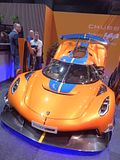
Star here was a Koenigsegg Jesko, a limited production mid-engine sports car produced by the Swedish automobile manufacturer Koenigsegg. The car was introduced at the 2019 Geneva Motor Show and was completely sold out before the show ended. Succeeding the Agera, the Jesko is named as a tribute to the company founder’s father, Jesko von Koenigsegg. There are two variations of the car, the “Absolut” and the “Attack”. The automobile is named after Jesko von Koenigsegg, the father of Christian von Koenigsegg. The engine is a development of the 5,065 cc twin-turbocharged V8 engine used in the Agera. It has four valves per cylinder each with a bore and stroke of 92 mm × 95.25 mm and a compression ratio of 8.6:1. The engine has a power output of 1,280 hp at 7,800 rpm and 1,000 Nm (738 lb/ft) of torque at 2,700 to 6,170 rpm on normal petrol and has a power output of 1,600 hp and 1,500 Nm (1,106 lb/ft) of torque at 5,100 rpm on E85 biofuel. Changes from the Agera’s engine include the use of a new 180-degree flat-plane crankshaft that saves 5 kg (11 lb) and increases the redline from 8,250 rpm to 8,500 rpm. The Jesko also utilises active rubber mounts from the Regera that reduce engine vibrations in the cabin. The two large turbochargers are equipped with a 20-litre air tank made from carbon fibre, coupled with an electric compressor which feeds pressurised air to the turbochargers at a pressure of 20 bar (290 psi) in order to reduce turbo lag. The engine has pressure sensors for each cylinder in order to achieve real time cylinder monitoring for the multipoint fuel injection system. The engine is mated to an in-house developed 9-speed multi-clutch transmission called the “Light Speed Transmission (LST)” by the manufacturer. The new transmission has a weight of 90 kg (198 lb) and it is at least 50% shorter in length than the previous 7-speed dual-clutch unit. It has 9 forward gear combinations using a layout with an input shaft with 3 fixed gears which is mated to a secondary shaft with 3 gears fixed to the output shaft and 3 clutched gears mated to the input shaft and an output shaft with 4 clutched gears (one set is used for reverse which mates directly to the input shaft), allowing the transmission to change gears without an interruption in power delivery due to the speedy nature of clutch actuation and overlap between the clutches opening and closing. The engine’s crankshaft is mated directly to the LST and uses the rotating mass of the transmission components in place of a traditional flywheel. The transmission has a shift time ranging from 20 to 30 milliseconds. It also has an overdrive mode called “Ultimate Power on Demand” that is designed to skip directly to the optimal gear depending on user input, rather than down or upshifting sequentially to that gear. The transmission is controlled by an onboard computer which uses engine and road speed data to engage a gear. Gears are selected by the driver either using the shift paddles mounted on the steering column or the gear selector. Unlike its predecessors, the high-downforce Attack variant of the Jesko has Koenigsegg’s ‘Triplex’ dampers at the front and the rear combined with traditional Öhlins dampers. A horizontal rear damper prevents the rear from pressing on the ground during hard acceleration. The front dampers stabilise the car at high speeds while active rear wheel steering ensures further stability at all performance levels. The carbon body tub used in the Jesko is 40 mm (2 in) longer and 22 mm (1 in) wider from that of its predecessor in order to allow for more passenger room. The tub has been redesigned and incorporates an aluminium monocoque structure for increased rigidity. The car comes standard with forged aluminium centre lock wheels, with diameters of 20 inches at the front and 21 inches at the rear. Lighter carbon fibre wheels are available as an option, weighing 5.9 kg (13 lb) at the front and 7.7 kg (17 lb) at the rear. The tyres are Michelin Pilot Sport Cup 2’s with codes of 265/35 20 for the front and 345/30 21 for the rear. Michelin Pilot Sport Cup 2 R tyres dedicated for track driving are also available as an option. The braking system uses ventilated carbon-ceramic discs. The use of a redesigned monocoque improves leg and headroom in the interior of the Jesko when compared to previous Koenigsegg models. Though weight saving is a priority for interior features, the car is still equipped with amenities such as a climate control system, an infotainment system with a 9.0-inch screen, Apple CarPlay and USB phone charging. The car has unique screens mounted in the steering wheel spokes and a 5.0-inch screen mounted behind the steering wheel displaying vital information to the driver. The seats will be made from hollow carbon fibre but will be electrically adjustable. The Jesko shares Koenigsegg’s ‘Autoskin’ capabilities from the Regera, allowing for remote operation of doors and the hood. It is also possible to hydraulically lift the front and rear axles of the car to give additional ground clearance. The doors have been redesigned so that they open further outward and have more ground clearance while open. The roof has screws in order to ensure it remains in place during high speed driving. The Jesko will be offered in either a high-downforce Attack or low-drag Absolut configuration, with subtle differences between the two variants. The Attack variant, as shown at the 2019 Geneva Motor Show, comes equipped with the dual front and rear ‘Triplex’ damper system and added aerodynamic features for track use. Due to this dual suspension setup, it is not possible to store the Targa roof in the front of the car, although this is possible in the Absolut as it will not have a front ‘Triplex’ damper system or front hood air dam. The Jesko Attack is the high-downforce, default version of the Jesko. This variant has a large rear-wing and a large carbon fiber front splitter that Koenigsegg claims to generate 800 kg (1,764 lb) of downforce at 249 km/h (155 mph), 1,000 kg (2,205 lb) at 275 km/h (171 mph) and 1,400 kg (3,086 lb) at its top speed. This car lapped the Gotland Ring in 2:56.97, beating the former record set by a Porsche 911 GT3 RS Manthey-Racing edition by nearly seven seconds. The car also lapped the Laguna Seca in 1:24.86. Unveiled online alongside the Gemera on 3 March 2020, the Jesko Absolut is a high speed version of the Jesko. The rear wing on the Jesko Attack is replaced by two rear fins which enable a reduction in downforce from 1,400 kg (3,086 lb) to 150 kg (331 lb) and a drag coefficient of Cd=0.278. The front splitter and side winglets are removed and the front louvers are smoother with the rear wheels featuring removable covers for high speed stability. The vehicle is also slightly elongated featuring a rear extension which adds 85 mm (3 in) of additional length. The engine and transmission remain the same as the Jesko Attack. 3,000 hours were spent on the aerodynamic analysis while an additional 5,000 hours were spent design and engineering work of the Absolut. The Absolut will be priced higher than the Jesko due to the development work taken to lower the drag coefficient. The Jesko Absolut is estimated by the manufacturer to have a top speed of 500 km/h (310 mph), with theoretical speeds as high as 531–563 km/h (330–350 mph). Production of the Jesko was announced to be limited to 125 units, with 40–50 units being produced each year. Unlike its predecessors, the Jesko will be homologated worldwide. It was announced in March 2019 that all the build slots of the Jesko were sold out. In July 2021, Koenigsegg revealed the first pre-series production Jesko and claimed that the first Jesko customer cars are slated for delivery in spring 2022. The first car was delivered in June 2023.


LAGONDA
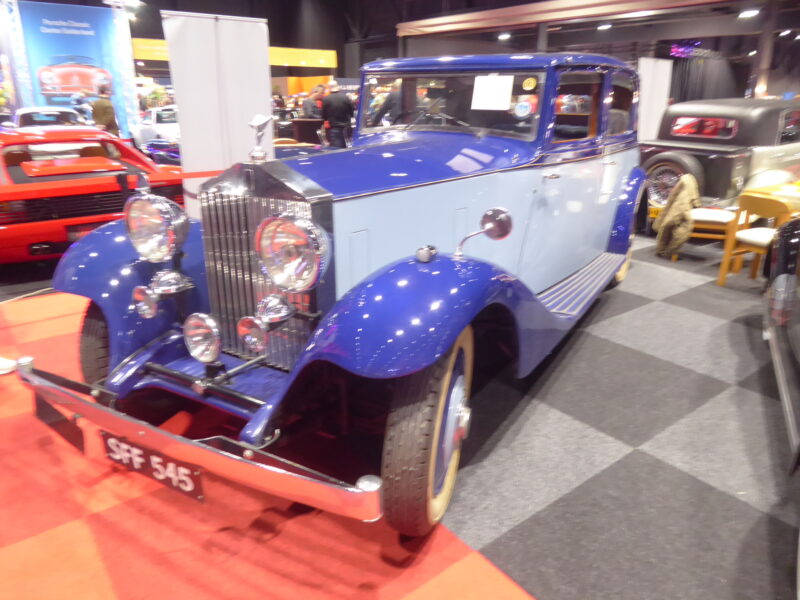
This Lagonda M45 was first delivered to its first owner in the United Kingdom in 1934. It retained its former registration number AEL 950 until 1996. 28 years ago, a German collector bought the M45. The original cardboard registration paper from England is still on hand. This M45 was restored from 1996 to 1998 regardless of the cost. Every screw was refurbished, and everything was documented. There are some optimizations that make driving much more pleasant in this day and age. This Lagonda has been in the same collector’s hands since it was recommissioned on 26.06.1998. Regular maintenance by specialists reflects the sensational state of preservation after more than 26 years of restoration. The original engine was extensively overhauled by a specialist a few years ago and its performance optimized at the same time. This Lagonda has been driven a lot and regularly by the owner and is ready for its next outing.

LAMBORGHINI
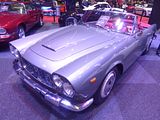
The first 400 GTs were essentially just the older 350GT featuring an enlarged, 3929 cc V12 engine, with a power output of 320 bhp and recognised by the change to twin circular headlights from rectangular units. Twenty-three of these cars were built, with three featuring aluminium bodywork, and then at the 1966 Geneva Show, Lamborghini presented a revised version, called the 400 GT 2+2, which had a different roofline, and minor sheetmetal changes compared to the earlier cars, still with the Carrozzeria Touring bodywork. The larger body shape enabled the +2 seating to be installed in the rear, where the 350GT only had room for luggage or +1 seating, without changing the wheelbase. The 400 GT 2+2 also had a Lamborghini designed gearbox, with Porsche style synchromesh on all gears, which greatly improved the drivetrain. 224 examples of the 400 GT 2+2 were built from 1966 to 1968, when it was replaced with the Islero.


The Aventador has been a huge success for Lamborghini. It was first seen at the 2011 Geneva Show, with the full name of Aventador LP700-4 Coupe, the numbers denoting the output of 700 bhp from the all-new V12 engine and the 4 meaning four wheel drive, something which has featured on every Aventador since. The launch price was £250,000 but even so within a month, Lamborghini had a year’s worth of orders, and within a year, 1000 had been built. In November 2012 a Roadster version arrived, which was very similar to the Coupe, but with a lift-out roof panel. A suite of mechanical changes came at this point, with a cylinder deactiviation technology helping to improve fuel consumption and cut emissions. To mark half a century of car production, in April 2013, the LP720-4 50th Anniversary was launched, with 100 units available. As well as the extra 20 bhp, these had a mildly redesigned nose and tail, special paintwork and unique interior trim. A Roadster version followed in December 2014, the LP 700-4 Pirelli Edition. This did not have the extra power, but did feature two tone paint, unique wheels and a transparent engine cover, with the engine bay finished in carbon fibre. Lamborghini turned up the wick in March 2015 with the LP750-4 SuperVeloce, or SV for short, which featured and extra 50 bhp and a 50 kg weight reduction largely thanks to the use of more carbon fibre. A Roadster version followed a few months later.

LANCIA
Produced only in 1954–1955, 240 examples of the B24 Aurelia Spider were built. They had a panoramic front windscreen, distinctive two-part chrome bumpers, removable side screens, soft top and Pinin Farina styling. 181 LHD cars had B24S (‘sinistra’) designation; the remaining 59 cars were right-hand drive. All were equipped with 2451 cc V6 engines. Built on a 2,450 mm (8 ft) wheelbase, the B24S Spider was mechanically similar to the 4th Series Aurelia B20, except for different air filters. All models had a floor-mounted gear-change. The dashboard had one prominent and two small dials. Produced from 1956 to 1958, this second series featured many small alterations compared to the Aurelia Spider. It was mechanically based on the 5th series Aurelia B20. Cars from this series have a flatter windscreen with quarter-lights, deeper doors with external handles and wind-up windows. It also had one part chrome bumpers and a wider bonnet air-scoop. It had a proper convertible hood and a hardtop was available. 521 cars were built. The B24S Convertible was built on the same wheelbase as the Spider and used a slightly less powerful (112 hp ) 2,451cc V6 engine. The dashboard features 2 big dials.
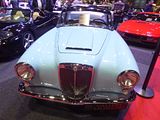
Replacing the Aurelia was the Flaminia, which although superficially similar to its illustrious predecessor and materially “better” in just about every respect, never managed to capture buyers’ imaginations in the same way when new, and even now, it has to play second fiddle to the older car. The first model in the range was the Berlina, which was launched at the 1957 Geneva Show. It had a Pininfarina styled body which took much inspiration from the Florida concept car that had been shown in the previous year. Much was new under the skin. Its larger 2.5 litre 100 bhp V6 engine was new in detail, and was designed to allow for further increases in capacity, which would come in time. I was smoother than the Aurelia engines and had more torque, and with better cylinder head design and revised cooling, it was more robust, as well. There was synchromesh on all four gears. Lancia’s famous sliding pillar suspension was banished in favour of unequal length wishbones and coil springs which required less maintenance and were more refined. But the car was heavy, and complex, and exceedingly expensive. Lancia thought that their customers would pay a premium for “the best”, but tastes were changing, and the Berlina was never a strong seller, with fewer than 3000 of them being constructed, most of them being the first series cars. Just 549 of the later second series model with 110 bhp and disc brakes were made between 1961 and 1963, hardly surprising when the car cost more than a Rolls Royce Silver Cloud, as it did in the UK. The later cars had a 2.8 litre engine and 125 bhp, and just 599 of these were made between 1963 and 1968. There was more success with the coachbuilt two door variants which joined the range. The most successful of these, the Pininfarina Coupe, was the first to appear. This was made between 1959 and 1967, during which time 5284 of these mostly steel-bodied cars were constructed. In many ways they were very like the Berlina, just a bit smaller, though there was a floor mounted gear lever, and the cars had more power. The first 3200 of them had a 119 bhp single carb engine with a sport camshaft. Later 3Bs had a triple choke Solex from 1962 and the power went up to 136 bhp. It was only a year after the Pininfarina car’s debut when Touring of Milan announced their Flaminia models. These aluminium bodied cars were sold in three distinct variants between 1960 and 1965. The single carburettor GT was followed by a Convertible in 1960, both of them uprated to 140 bhp triple Weber 3C spec in 1961. The 2.8 litre 3C took over in 1963 and were supplemented by a new 2+2 version called the GTL, with a taller roofline, front-hinged bonnet, longer doors and more substantial seats. It is the rarest of all Flaminia models, with just 300 made. The styling house to offer a car was Zagato, with their Sports and SuperSports. Only 526 were made and there is a complicated production history which probably shows the sort of chaotic thinking that was going on at Lancia and which would lead to is bankruptcy and take over by Fiat in 1969. The first 99 Sports had faired-in headlights and the 119 bhp engine. From 1960 another 100 cars were built with expose lights until the introduction of the Sport 3C with the 140 bhp triple carb. Zagato made 174 of those in 1962 and 1963, still with the exposed lights. The faired-in lights returned in 1964 on the SuperSport, which also had a Kamm tail, and with DCN Webers this one put out 150 bhp. 150 of these were made between 1964 and 1967. Many of the earlier cars were upgraded early in their life, so if you see one now, you cannot be totally sure of is true origin. Production of the car ceased in 1970, with fewer than 13,000 Flaminia of all types having been built. These days, the cost to restore them properly – and it is a huge job – exceeds the value of most of them, by some margin, as Berlina and Coupe models tend not to sell for more than £30k. The Zagato cars are a different matter, and when they come up for sale, routinely go for over £300k. The Touring cars – considered by most to be the prettiest tend to be around £100k for the GT and another 50 – 80k for a convertible – a long way from the value of an Aston Martin DB4 Volante, which cost roughly the same when new.
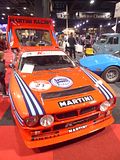
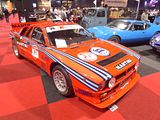
The Lancia Rally (Tipo 151, also known as the Lancia Rally 037, Lancia 037 or Lancia-Abarth #037 from its Abarth project code SE037) was a mid-engine sports car and rally car built by Lancia in the early 1980s to compete in the FIA Group B World Rally Championship. Driven by Markku Alén, Attilio Bettega, and Walter Röhrl, the car won Lancia the manufacturers’ world championship in the 1983 season. It was the last rear-wheel drive car to win the WRC. In 1980 Lancia began the development of the 037 to comply with the then new FIA Group B regulations that allowed cars to race with relatively few homologation models being built. As the project name was number 037, this eventually became the name by which the car was known. Abarth, now a part of the Lancia-Fiat family, did most of the design work, even incorporating styling cues from some of its famous race cars of the 1950s and 1960s such as a double bubble roof line. The car was developed in collaboration between Pininfarina, Abarth, Dallara and the project manager, engineer Sergio Limone. Prior to its first participation in the 1982 World Rally Championship season, 200 road-going models were built to comply with Group B regulations. The car made its competition debut at the 1982 Rally Costa Smeralda in Italy, where two cars were entered but both retired due to gearbox issues. The 1982 season was plagued with retirements for the 037, but the new car did manage to achieve several wins including its first win at the Pace Rally in the UK. The 1983 season was considerably more successful for the 037: Lancia took the 1983 World Rally Championship Constructors’ title with Germany’s Walter Röhrl and Finland’s Markku Alén its principal drivers, despite serious competition from the 4WD Audi Quattro. Both drivers, however, missed the final round of the series, despite Röhrl maintaining a mathematical chance of the drivers’ title: such honours instead went to Audi’s veteran Finn, Hannu Mikkola. For the 1984 Constructors’ title defence, Lancia introduced an Evolution 2 version of the 037 with improved engine power output, but this was not enough to stem the tide of 4WD competition, losing to Audi in both 1984 championships, and again to the 4WD Peugeot 205 T16 in its final works season in 1985. Indeed, Alén collected the final 037 win, and the sole victory for the E2 model, on the 1984 Tour De Corse, before it was finally pensioned off in favour of its successor, the uniquely supercharged and turbocharged 4WD Delta S4, for the season-ending RAC Rally in Great Britain. Driver Attilio Bettega died in an 037 crash in 1985. António Rodrigues won the 1984 Falperra International Hill Climb in an 037. The 037 made its final appearance in the 1986 edition of the Safari Rally by the Martini Lancia team, which was entered in place of the Delta S4 that the team used for the other rallies that year due to the team running out of time to develop the S4 for the rally. One ex-works Lancia 037 was entered by ROSS Competition in the third round of the 1994 All Japan Grand Touring Car Championship season. The 037 performed poorly, due to the car being massively underpowered against its competition in the GT1 (now GT500) class, using a short-ratio five-speed gearbox, and with an engine not designed to be run at high engine speeds for sustained periods of time. Naohiro Furuya, who drove the 037 in that race, was able to finish the race in 12th overall and 9th in the GT1 class, albeit 7 laps down from the race-winning Team Taisan Porsche 962C and 3 laps down from the Team Gaikokuya Nissan Skyline that won in the GT2 class. Similar to the concept of a silhouette racer; while the 037 was loosely based on the Lancia Montecarlo (also known as Scorpion in the US and Canadian markets) road car, they shared only the centre section with all body panels and mechanical parts being significantly different. Steel subframes were used fore and aft of the 037’s centre section, while most of the body panels were made from Kevlar. However the 037 was designated and sold as a distinct model, not as a Montecarlo, and both the street and race versions of it were built using the same construction methods, so it does not qualify as an actual silhouette racer. The mid-engined layout of the Montecarlo was retained, but the engine was turned 90 degrees from a transverse position to a longitudinal position. This allowed greater freedom in the design of the suspension while moving engine weight forward. An independent double wishbone suspension was used on both the front and rear axles, with dual shock absorbers in the rear in order to cope with the stresses of high speed off-road driving. The 037 is notable in Group B as it retained the rear-wheel drive layout that was nearly universal for rally cars of the pre-Group B period; nearly all subsequent successful rally cars used four-wheel drive, making the 037 the last of its kind. Unlike its predecessor, the V6-powered Lancia Stratos HF, the first 037s had a 2.0-litre 4-cylinder supercharged engine. Based on the long stroke twin cam engine which powered earlier Fiat Abarth 131 rally cars, the four valve head was carried over from the 131 Abarth but the original two carburetors were replaced by a single large Weber carburettor in early models and later with fuel injection. The 037 features a ZF transaxle. Lancia also chose a supercharger over a turbocharger to eliminate turbo lag and improve throttle response. Initially, power was quoted at 265 bhp but was increased to 280 bhp. The final Evolution 2 model’s engine generated 325 bhp due to a displacement increase to 2.1 L (2,111 cc).
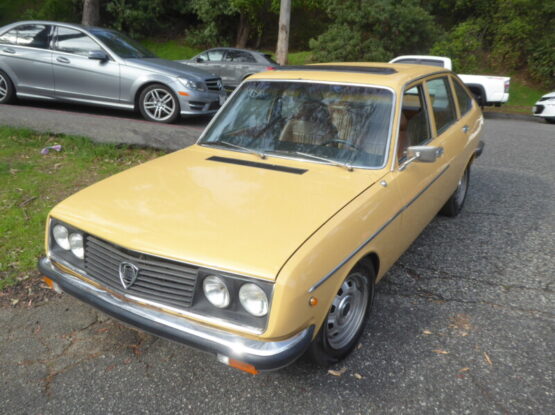
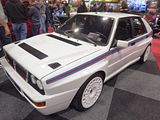
Lancia launched the Delta in 1979, as what we would now think of as a “premium hatch”. Offered in 1300 and 1500cc engines, this car, which collected the prestigious “Car of the year” award a few months later, brought Italian style and an expensive feeling interior to a new and lower price point in the market than Lancia had occupied since the early days of the Fulvia some 15 years earlier. The range grew first when a model was offered using the 4 speed AP automatic transmission and then in late 1982, more powerful models started to appear, with first a 1600cc engine, and then one with fuel injection, before the introduction of the HF Turbo. All these cars kept the same appearance and were quite hard to tell apart. These were the volume models of the range, but now they are very definitely the rare ones, as it is the performance versions which have survived and are now much loved classics, even though relatively were sold when they were new, thanks to a combination of the fact that they were quite costly and that they only ever came with left hand drive. The Integrale evolved over several years, starting off as the HF Turbo 4WD that was launched in April 1986, to homologate a new rally car for Lancia who needed something to fill the void left by the cancellation of Group B from the end of 1986. The Delta HF 4X4 had a four-wheel drive system with an in-built torque-splitting action. Three differentials were used. Drive to the front wheels was linked through a free-floating differential; drive to the rear wheels was transmitted via a 56/44 front/rear torque-splitting Ferguson viscous-coupling-controlled epicyclic central differential. At the rear wheels was a Torsen (torque sensing) rear differential. It divided the torque between the wheels according to the available grip, with a maximum lockup of 70%. The basic suspension layout of the Delta 4WD remained the same as in the rest of the two-wheel drive Delta range: MacPherson strut–type independent suspension with dual-rate dampers and helicoidal springs, with the struts and springs set slightly off-centre. The suspension mounting provided more isolation by incorporating flexible rubber links. Progressive rebound bumpers were adopted, while the damper rates, front and rear toe-in and the relative angle between springs and dampers were all altered. The steering was power-assisted rack and pinion. The car looked little different from the front wheel drive models. In September 1987, Lancia showed a more sophisticated version of the car, the Lancia Delta HF Integrale 8V. This version incorporated some of the features of the Delta HF 4WD into a road car. The engine was an 8-valve 2 litre fuel injected 4-cylinder, with balancing shafts. The HF version featured new valves, valve seats and water pump, larger water and oil radiators, more powerful cooling fan and bigger air cleaner. A larger capacity Garrett T3 turbocharger with improved air flow and bigger inter-cooler, revised settings for the electronic injection/ignition control unit and a knock sensor, boosting power output to 185 bhp at 5300 rpm and maximum torque of 224 lb/ft at 3500 rpm. The HF Integrale had permanent 4-wheel drive, a front transversely mounted engine and five-speed gearbox. An epicyclic centre differential normally split the torque 56 per cent to the front axle, 44 per cent to the rear. A Ferguson viscous coupling balanced the torque split between front and rear axles depending on road conditions and tyre grip. The Torsen rear differential further divided the torque delivered to each rear wheel according to grip available. A shorter final drive ratio (3.111 instead of 2.944 on the HF 4WD) matched the larger 6.5×15 wheels to give 24 mph/1000 rpm in fifth gear. Braking and suspension were uprated to 284 mm ventilated front discs, a larger brake master cylinder and servo, as well as revised front springs, dampers, and front struts. Next update was to change the engine from 8 valves to 16. The 16v Integrale was introduced at the 1989 Geneva Motorshow, and made a winning debut on the 1989 San Remo Rally. It featured a raised centre of the bonnet to accommodate the new 16 valve engine, as well as wider wheels and tyres and new identity badges front and rear. The torque split was changed to 47% front and 53% rear. The turbocharged 2-litre Lancia 16v engine now produced 200 bhp at 5500 rpm, for a maximum speed of 137 mph and 0–100 km/h in 5.5 seconds. Changes included larger injectors, a more responsive Garrett T3 turbocharger, a more efficient intercooler, and the ability to run on unleaded fuel without modification. The first Evoluzione cars were built at the end of 1991 and through 1992. These were to be the final homologation cars for the Lancia Rally Team; the Catalytic Evoluzione II was never rallied by the factory. The Evoluzione I had a wider track front and rear than earlier Deltas. The bodyside arches were extended and became more rounded. The wings were now made in a single pressing. The front strut top mounts were also raised, which necessitated a front strut brace. The new Integrale retained the four wheel drive layout. The engine was modified to produce 210 bhp at 5750 rpm. External changes included: new grilles in the front bumper to improve the air intake for engine compartment cooling; a redesigned bonnet with new lateral air slats to further assist underbonnet ventilation; an adjustable roof spoiler above the tailgate; new five-bolt wheels with the same design of the rally cars; and a new single exhaust pipe. Interior trim was now grey Alcantara on the Recaro seats, as fitted to the earlier 16V cars; leather and air conditioning were offered as options, as well as a leather-covered Momo steering wheel. Presented in June 1993, the second Evolution version of the Delta HF Integrale featured an updated version of the 2-litre 16-valve turbo engine to produce more power, as well as a three-way catalyst and Lambda probe. A Marelli integrated engine control system with an 8 MHz clock frequency which incorporates: timed sequential multipoint injection; self-adapting injection times; automatic idling control; engine protection strategies depending on the temperature of intaken air; Mapped ignition with two double outlet coils; Three-way catalyst and pre-catalyst with lambda probe (oxygen sensor) on the turbine outlet link; anti-evaporation system with air line for canister flushing optimised for the turbo engine; new Garrett turbocharger: water-cooled with boost-drive management i.e. boost controlled by feedback from the central control unit on the basis of revs/throttle angle; Knock control by engine block sensor and new signal handling software for spark park advance, fuel quantity injected, and turbocharging. The engine now developed 215 PS as against 210 PS on the earlier uncatalysed version and marginally more torque. The 1993 Integrale received a cosmetic and functional facelift that included. new 16″ light alloy rims with 205/45 ZR 16 tyres; body colour roof moulding to underline the connection between the roof and the Solar control windows; aluminium fuel cap and air-intake grilles on the front mudguards; red-painted cylinder head; new leather-covered three-spoke MOMO steering wheel; standard Recaro seats upholstered in beige Alcantara with diagonal stitching. In its latter years the Delta HF gave birth to a number of limited and numbered editions, differing mainly in colour, trim and equipment; some were put on general sale, while others were reserved to specific markets, clubs or selected customers



LAND ROVER
This is a Land Rover Defender 90 Valiance Convertible, a limited-edition vehicle customized by Dutch coachbuilder Heritage Customs. It is based on the modern Defender 90 body style. The conversion includes a semi-electric, hand-stitched fabric soft top and a full roll cage. This specific model is finished in a color scheme called “Solihull Sand” with a sand-colored top and white retro-style wheels. Only five of these bespoke convertibles were planned for production. The indicative price for the conversion starts at around €99,500 before tax.

LOLA
This is a Lola T290 sports racing car. It was built by Lola Racing Cars and first fielded in 1972 in the two-litre class. The car seen here was entered by Ecurie Filipinetti. It features a light blue and white livery with “Flint” and “Antar” sponsor decals. The T290 used a monocoque construction and was typically powered by a Cosworth FVC engine.

LOTUS
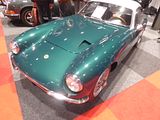
This is a Type 14 Elite, the first enclosed Lotus, intended for use as a road car as well as for competition purposes. An ultra-light two-seater coupé, the Elite made its debut at the 1957 London Motor Car Show, Earls Court, as chassis #1008 , following a year in development, aided by “carefully selected racing customers”, before going on sale. The Elite’s most distinctive feature was its highly innovative fibreglass monocoque construction, in which a stressed-skin GRP unibody replaced the previously separate chassis and body components. Unlike the contemporary Chevrolet Corvette, which used fibreglass for only exterior bodywork, the Elite also used this glass-reinforced plastic material for the entire load-bearing structure of the car, though the front of the monocoque incorporated a steel subframe supporting the engine and front suspension, and there was a hoop at the windscreen for mounting door hinges and jacking the car up. The first 250 body units were made by Maximar Mouldings at Pulborough, Sussex. The body construction caused numerous early problems, until manufacture was handed over to Bristol Aeroplane Company. The resultant body was both lighter, stiffer, and provided better driver protection in the event of a crash. Sadly, the full understanding of the engineering qualities of fibreglass reinforced plastic was still several years off and the suspension attachment points were regularly observed to pull out of the fibreglass structure. The weight savings allowed the Elite to achieve sports car performance from a 75 hp 1216 cc Coventry Climax FWE all-aluminium straight-4 engine with fuel consumption at 35mpg. All production Lotus Elites were powered by the FWE engine. (Popular mythology says that cars left the factory with a variety of engines, but this is incorrect.) The FWE engine, derived from a water pump engine usually found bolted to a fire truck, was used by Lucas Electric for electrical component life testing in the presence of intense vibration. The car had independent suspension all round with transverse wishbones at the front and Chapman struts at the rear. The rear struts were so long, that they poked up in the back and the tops could be seen through the rear window. The Series 2 cars, with Bristol-built bodies, had triangulated trailing radius arms for improved toe-in control. Girling disc brakes, usually without servo assistance, of 9.5 in diameter were used, inboard at the rear. When leaving the factory the Elite originally fitted Pirelli Cinturato 155HR15 tyres. Advanced aerodynamics also made a contribution, giving the car a very low drag coefficient of 0.29 – quite low even for modern cars. This accomplishment is all the more remarkable considering the engineers did not enjoy the benefits of computer-aided design or wind tunnel testing. The original Elite drawings were by Peter Kirwan-Taylor. Frank Costin (brother of Mike, one of the co-founders of Cosworth), at that time Chief Aerodynamic Engineer for the de Havilland Aircraft Company, contributed to the final design. The SE was introduced in 1960 as a higher performance variant, featuring twin SU carburettors and fabricated exhaust manifold resulting in 85 bhp, ZF gearboxes in place of the standard “cheap and nasty” MG ones, Lucas PL700 headlamps, and a silver coloured roof. The Super 95 spec, with more power, from a higher-tuned engine with raised compression and a fiercer camshaft with 5 bearings. A very few Super 100 and Super 105 cars were made with Weber carburettors, for racing use. Among its few faults was a resonant vibration at 4000 rpm (where few drivers remained, on either street or track) and poor quality control, handicapped by overly low price (thus losing money on every car produced) and, “perhaps the greatest mistake of all”, offering it as a kit, exactly the opposite of the ideal for a quality manufacturer. Many drivetrain parts were highly stressed and required regreasing at frequent intervals. When production ended in 1963, 1030 had been built, although there are sources claiming that 1,047 were produced


LUCENTI
It’s 1934. The engines roar, the grandstands of the Indianapolis Motor Speedway are packed with thousands of spectators, and the scent of oil and gasoline lingers in the air. Right there, on the starting grid, stands the Lucenti Special, a low-slung, aggressive Indy racer built by three motorsport enthusiasts from Pittsburgh. A car that, even back then, was already writing history. And the best part? This is no forgotten relic. This Lucenti Graham has been fully restored and is in absolute top condition, just as it crossed the finish line in 10th place at the 1934 Indy 500! If this isn’t a time machine, we don’t know what is. This car encapsulates an era when passionate engineers with limited resources challenged the giants of motorsport. It’s a machine that once stood before roaring crowds at Indianapolis, passed through the hands of forgotten racers, and has now, after an incredible journey, been brought back to its former glory. The 1930s were a tough time for motorsports. The Great Depression had taken its toll, making the ultra-expensive Miller and Duesenberg race cars virtually unattainable. But the Indianapolis 500 had to go on, so a new rule was introduced: the ‘Junk Formula’. From 1930 to 1935, teams were allowed to build relatively affordable specials based on production cars. The result? Pure ingenuity and mechanical brilliance, with race cars emerging from home garages rather than big factories. And that’s exactly where this Lucenti Graham comes into play. In 1932, three car enthusiasts from Pittsburgh, Pennsylvania, came together: Angelo Lucenti, Roy Painter, and John Saunders. Their mission? To build their own Indianapolis 500 racer, using a Graham Blue Streak Eight as the foundation. It has a 165 cubic inch (4.3-liter) L-head straight-eight engine featuring larger valves and a custom intake with four Winfield Model SR carburettors, a low and aerodynamic body, made possible by a unique banjo-frame, allowing the rear axle to run through the chassis for an ultra-low centre of gravity. It is a hand-built race car – created by enthusiasts, engineered for America’s greatest racing event. The car was named the ‘Lupasa Special’, a combination of the first letters of the builders’ last names. It attempted to qualify for the 1932 Indy 500 but fell just short. A later attempt at the Syracuse circuit was also unsuccessful. But Lucenti refused to give up. Two years later, Lucenti returned with the same car, now rebranded as the ‘Lucenti Special’. This time, it made the cut: driver Herb Ardinger clocked an average speed of 111.7 mph on the 2.5-mile oval, securing a spot on the grid. From a starting position in mid-field, drivers Herb Ardinger and later Danny Day finished in 10th place in the 1934 Indy 500! Later they claimed 8th place at Springfield and Syracuse. Now, the story takes an extraordinary turn. After its racing career ended, the Lucenti Special ended up in an orphanage! Yes, it was used as a playground structure for children. Luckily, the car was rescued in 1950 by a collector, who kept it in his possession for an astonishing 55 years. In 2006, the Lucenti Special resurfaced, and a full-scale historical restoration began. Remarkably, the aluminum body and original engine were still intact. Only the exhaust system and interior had to be rebuilt. The result? A Lucenti in prime condition, fully restored to its 1934 Indy 500 specification. This restoration even won its class at the Amelia Island Concours d’Élégance in 2010.


MASERATI
Known internally as Tipo AM109, the Mistral was a 2-seat gran turismo produced between 1963 and 1970, as a successor to the 3500 GT. It was styled by Frua and bodied by Maggiora of Turin. Named after a cold northerly wind of southern France, it was the first in a series of classic Maseratis to be given the name of a wind. The Mistral was the last model from the Casa del Tridente (“House of the Trident”) to have the company’s renowned twin-spark, double overhead cam straight six engine. Fitted to the Maserati 250F Grand Prix cars, it won 8 Grand Prix between 1954 and 1960 and one F1 World Championship in 1957 driven by Juan Manuel Fangio. The engine featured hemispherical combustion chambers fed by a Lucas indirect fuel injection system, a new development for Italian car manufacturers. Maserati subsequently moved on to V8 engines for their later production cars to keep up with the demand for ever more powerful machines. Three engine were fitted to the Mistral, displacing 3500, 3700 and 4000 cc and developing 235 bhp at 5500 rpm, 245 bhp at 5500 rpm and 255 bhp at 5200 rpm, respectively. Only the earliest of the Mistrals were equipped with the 3500 cc, the most sought after derivative is the 4000 cc model. Unusually, the body was offered in both aluminium and, from 1967, in steel, but no one is quite sure how many of each were built. The car came as standard with a five speed ZF transmission and four wheel solid disc brakes. Per Maserati practice, the front suspension was independent and the rear solid axle. Acceleration 0-60 for both the 3.7 litre and 4.0 litre engines was around or just under 7 seconds, and top speed approximately 140 mph (225 km/h) to 145 mph (233 km/h). The body was designed by Pietro Frua and first shown in a preview at the Salone Internazionale dell’Automobile di Torino in November 1963. It is generally considered one of the most beautiful Maseratis of all time. It is also often confused with the very similar looking but larger and more powerful Frua designed AC 428. A total of 828 coupés and 125 Spyders were built. Only the Spyder received the 3500 engine; just 12 were made, along with 76 3.7 litre and 37 4.0 litre versions. Twenty Spyders were right hand drive. The Mistral was succeeded by the Ghibli, which overlapped production from 1967 on.

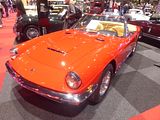
The Sebring was based on the earlier Maserati 3500 GT, and aimed at the American Gran Turismo market, taking its name from Maserati’s 1957 racing victory at the 12 Hours of Sebring. A single two-seat spyder was built by Vignale in 1963 but did not enter production. The Series I (Tipo AM 101/S) was shown at the Salon International de l’Auto 1962 and again at the Salone dell’automobile di Torino in 1963. Employing all but the Maserati 3500’s coachwork, it could reach 137 mph and 0–60 mph in 8.5 seconds on 185×15 Pirelli Cinturato tyres. A Borg-Warner automatic transmission was available, a first for Italian automobiles. When leaving the factory it originally fitted Pirelli Cinturato 205VR15 tyres (CN72). A total of 348 Series I Sebrings were built between 1962 and 1965. The engine was updated in 1963, gaining 15PS for a total of 235 PS. The 3700 engine first appeared in 1964, although only a handful of Series I cars were thus equipped. In 1965, the modified Series II (Tipo AM 101/10) was introduced. It had lightly redesigned headlamps, modernised bumpers, new front indicators, and new side grilles replacing the lower extraction vents used hitherto. It took minor design cues from the contemporary Quattroporte. At the rear, aside from the squared off bumpers, the taillights were now mounted horizontally rather than vertically and the bootlid opening was narrowed somewhat. The Series II rode on larger 205×15 Pirelli Cinturatos. A run of 247 units were made from 1964 until 1968. Along with the 3500 engine, the 3700 and the even larger 4000 were added. The 4000 GTiS has a 4,012 cc engine producing 255 PS at 5,200 rpm. It remained in production until 1968, when financial constraints forced Maserati to drop its older models from production. No major updates took place over the last three years of production, except for a slight power gain for the 4000, now up to 265 PS. 348 units of Sebring 3.5 and 245 of 3.7 and 4.0 (combined) were made, for a total of 593 units from 1962 to 1969.

The Maserati Mexico’s design derived from a 2+2 prototype bodywork shown on the Vignale stand at the October 1965 Salone di Torino and built upon a 4.9-litre 5000 GT chassis, rebodied after it had been damaged. As the car after the show was sold to Mexican president Adolfo López Mateos, the model became known as the Mexico. By coincidence, John Surtees won the Mexican Grand Prix on a Cooper-Maserati T81 the following year. Vignale’s prototype was so well received that Maserati immediately made plans to put a version into production. The production Maserati Mexico debuted in August 1966 at the 20° Concorso internazionale di eleganza per auto in Rimini, while its international première was at the October Paris Motor Show. It was built on the first generation Quattroporte chassis with a wheelbase shortened by 11 cm (4.3 in). Originally powered by a 4.7-litre 90° V8 fed by four twin-choke 38 DCNL5 Weber carburettors that produced 290 bhp, the car managed to turn out a top speed between 240–250 km/h (149–155 mph). In 1969, however, contrary to Maserati tradition, the Mexico was also made available with a smaller engine, the 4.2-litre V8 engine. Apart from the smaller engine option the Mexico underwent few changes during its lifetime. Its luxurious interior included a rich leather seating for four adults, electric windows, wooden dashboard, iodine headlights and air conditioning as standard. Automatic transmission, power steering and a radio were available as optional extras. The 4.7-litre version was fitted with 650×15″ Borrani chrome wire wheels and the 4.2-litre version with steel disc wheels. When leaving the factory all Maserati Mexicos originally fitted Pirelli Cinturato 205VR15 tyres (CN72). The Mexico was the first production Maserati to be fitted with servo assisted ventilated disc brakes on all four wheels. In May 1967, under commission from the German concessionaire Auto Koenig for one client, Herr Rupertzhoven, Maserati built a ‘Mexico’ similar to Vignale’s original prototype design but was the work of Frua. Appearing like a 4-seat Mistral and built on the same tubular chassis as the 3500 GT (2600 mm wheelbase), this prototype ‘Mexico’ was fitted with the Mistral’s six-cylinder 3.7-litre Lucas fuel-injected engine. It was finished in Oro Longchamps with a black leather interior. Its dashboard came from the Quattroporte. 485 Mexicos were produced, 175 equipped with the 4.7 engine and 305 with the 4.2.

The Maserati Indy (Tipo AM 116) is a four-seater fastback grand tourer produced from 1969 to 1975. The Indy was conceived as an alternative to the Ghibli offering a V8 engine and room for four people; it effectively replaced both the ageing six-cylinder 2+2 Maserati Sebring—which descended from the 1957 3500 GT— and the first generation Quattroporte. Two coachbuilders showed their proposals at the November 1968 Salone dell’automobile di Torino, both based on a Maserati 4.2-litre chassis. On Ghia’s stand there was the Simùn, a 2+2 berlinetta designed by Giorgetto Giugiaro; on Carrozzeria Vignale’s, a sleek 4-seater fastback penned by Giovanni Michelotti. Both coachbuilders had already an established relationship with Maserati, as Vignale had been responsible for the 3500 GT Spyder, Mexico and Sebring, while Giugiaro had recently penned the Ghibli at Ghia. Vignale’s prototype was preferred, and the production model was launched by Maserati at the Geneva Motor Show the following March. The car was christened Indy in honour of Maserati’s two victories at the Indy 500. At its launch in 1969 the Indy was offered with a 4.2-litre V8 engine. From 1970 a 4.7-litre Indy 4700 was offered alongside the 4200; the same year some interior updates were introduced, including seats with retractable headrests and a new dashboard. In 1972, Maserati added the Indy 4900 to the range, equipped with the new 4.9-litre V8. Production of the Indy ended in 1975. In total 1,104 were produced, 440 of them Indy 4.2s, 364 Indy 4.7s and 300 Indy 4.9s. These days the cars worth a fraction of the prices charged for a Ghibli, which makes them something of a bargain to my mind.

Maserati replaced their entire range in 1981 with the BiTurbo. Introduced initially as a single model, a 2 door coupe with a 2 litre twin-turbo V6 engine, over the next 15 years, it would evolve into a complex range of different models, and three basic bodystyles, as well as the special low-volume Karif and V8 engined Shamal cars. The car was designed by Pierangelo Andreani, Chief of Centro Stile Maserati up to 1981, and was somewhat influenced by the design of the recent Quattroporte III. The BiTurbo marked quite a change of direction for the Modense firm, a consequence of its acquisition by Alejandro de Tomaso in 1976. de Tomaso’s ambitious plans for the marque were to combine the prestige of the Maserati brand with a sports car that would be more affordable than the earlier high-priced models that had traditionally made up the Maserati range. The Biturbo was initially a strong seller and brought Italian prestige to a wide audience, with sales of about 40,000 units, but it quickly became apparent that the quality of the car was way off what the market expected, and the car is not regarded as one of the marque’s better models. Indeed, the Biturbo is number 28 in the BBC book of “Crap Cars” and in 2007 was selected as Time Magazine’s worst car of 1984, although they ranked the Chrysler TC by Maserati as a “greater ignominy”. Between 1987–89 a facelift was phased in, which helped to soften the sharp bodylines. The redesign included a taller and more rounded grille with mesh grille and bonnet, aerodynamic wing mirrors and 15″ disc-shaped alloy wheels, now mounted on 5-lug hubs. Some models received the wraparound bumpers with integral foglights and the deep sills introduced with the 2.24v. In 1991 the entire lineup was restyled for a second time, again by the hand of Marcello Gandini; the design features introduced with the Shamal were spread to the other models. Gandini, the Shamal’s designer, developed an aerodynamic kit that included a unique spoiler at the base of the windscreen hiding the windshield wipers, a rear spoiler, and side skirts. The new two-element headlights used poli-ellypsoidal projectors developed by Magneti-Marelli. Inset in body-colour housings, they flanked a redesigned grille, slimmer and integrated in the bonnet; the 1988 bumpers were adopted by all models. The 15″ disc-shaped alloys were replaced by new 16″ seven-spoke wheels, with a hubcap designed to look like a centerlock nut. The second facelift was referred to as “nuovolook”. The engines underwent change, too. As well as being the first ever production car with a twin-turbocharged engine, it was also the first production car engine with three valves per cylinder. The aluminium 90-degree SOHC V6 engine was roughly based on the 2.0 litre Merak engine, itself based on earlier V8 Formula One Maserati engines, designed by Giulio Alfieri. Because in Italy new cars with engine displacement over 2000 cc were subjected to a 38% value added tax, against 19% on smaller displacement cars, throughout the Biturbo’s production life there were both two-litre models aimed mainly at the domestic market and “export” versions, initially with a 2.5 litre V6. The carburettor 2.5 unit produced 185 hp and 208 lb·ft of torque in North American spec and slightly more elsewhere. Fuel injection was fitted in 1987 raising power to 187 hp. In 1989 the enlarged 2.8 litre engine bumped power to 225 hp and 246 lb·ft of torque for North America and 250 PS for Europe. In 1988, with the coupés being restyled, the Biturbo name was dropped in favour of 222—meaning 2-door, 2-litre engine and 2nd generation. The car carried all the visual clues of Gandini’s first facelift, with a more rounded grille and bonnet, different wing mirrors and rear spoiler. The engine size of the 222 E export model grew from the Biturbo’s 2.5- to 2.8-litres. A mixed velour-leather interior was standard on the domestic models, while export markets got leather upholstery as standard. 1990 saw the arrival of the 2.8 litre 222 SE, heir to the Biturbo ES. It inherited the latter’s limited paint finish availability (red, silver or black) and the dark trim and grille, while modern aprons and side skirts (blacked out as well) came from the 2.24v. After just a year the 222 SE was replaced by the 1991-restyled 222 SR; the SR offered adaptive suspension as an option. Simultaneously the very similar 222 4v. joined the lineup; it was a 222 SR with a 2.8 litre four-valve engine, the first DOHC car in the direct Biturbo E lineage. It used wider, 16″ 7-spoke wheels.
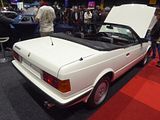
In keeping with Maserati tradition, the Shamal was also named after a wind, in this case a hot summer wind that blows in large areas of Mesopotamia. My favourite of the Biturbo generation Maserati models, it was introduced on 14 December 1989 in Modena, when Maserati president and owner Alejandro de Tomaso showed it to the press, it was the last model announced under the De Tomaso ownership, as in January 1990 half of Maserati was acquired by Fiat S.p.A.. Sales began in 1990. The Shamal was designed by Marcello Gandini, of Bertone fame. Clearly based on the Biturbo, as you can see in the doors, interior, and basic bodyshell, all of which were carried over from the Biturbo. Gandini’s styling signature is visible in the slanted profile of the rear wheel wheel arch, also present on the fourth generation Quattroporte IV and first seen on the Lamborghini Countach. Nonetheless, the Shamal has a look all of its own, with the centre pillar wrapping around the cabin as a roll bar, always finished in black, a distinguishing characteristic of the Shamal. The name “Shamal” appears on either side of the central pillar in chrome lettering. The car has alloy wheels, a small rear spoiler and a blacked-out grille with chrome accents. Another defining feature of the Shamal are its numerous headlamps in individual housings: outer round Carello low beams of the then-new projector type, inner rectangular high beams, combined indicators and position lamps in the bumper, and two pairs of square lights in the lower grille—fog lamps and driving lamps. The two-seat interior of the Shamal features extended leather seat cushions, temperature control and the famous Maserati oval clock, which is situated in the centre of the dashboard. The gear lever is finished in elm. While built for comfort as well as performance, the Shamal was not as luxuriously appointed as the similar Maserati Ghibli II. The Shamal used a traditional front-engine, rear-wheel-drive layout and an all-steel unibody construction. Suspension was by MacPherson struts upfront and semi-trailing arms at the rear. All Shamals were equipped with an adaptive suspension developed by Maserati together with Koni. The system varied the damping rates, based on road conditions and the level of comfort desired. It was powered by an AM 479 3,217 cc square (bore and stroke 80 mm) V8 engine, with two overhead camshafts per bank, and four valves per cylinder. It was twin-turbocharged with two IHI turbines and intercoolers, and equipped with a Marelli IAW integrated electronic ignition and fuel injection ECU per cylinder bank. The engine put out 325 PS at 6,000 rpm and 320 lb·ft at 3,000 rpm. Power was sent to the rear wheels through a six-speed Getrag manual transmission and Maserati’s Ranger limited-slip differential. The manufacturer claimed a top speed of 170 mph and a 0 to 62 mph acceleration time of 5.3 seconds. The final year of production for the Maserati Shamal was 1996 and factory figures indicate that 369 examples were produced.

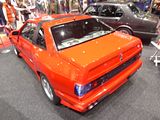


The Ghibli name was resurrected with the unveiling at the 62nd Turin Motor Show in April 1992. of the 1992 Ghibli (Tipo AM336). Like the V8 Maserati Shamal, it was an evolution of the previous Biturbo coupés; the doors, interior, and basic bodyshell were carried over from the Biturbo. It was powered by updated 24-valve Biturbo engines: a 2.0-litre V6 coupled to a six-speed manual transmission for the Italian market, and a 2.8-litre V6 for export, at first with a 5-speed manual, then from 1995 with the 6-speed. A 4-speed automatic was optional. The coupé was built for luxury as well as performance, and its interior featured Connolly leather upholstery and burl elm trim. At the 1994 Geneva Motor Show, Maserati launched an updated Ghibli. A refreshed interior, new wing mirrors, wider and larger 17″ alloy wheels of a new design, fully adjustable electronic suspension and ABS brakes were added. The Ghibli Open Cup single-make racing car was announced in late 1994. Two sport versions were introduced in 1995. The first was the Ghibli Kit Sportivo, whose namesake handling kit included wider tyres on OZ “Futura III” split-rim wheels, specific springs, dampers and anti-roll bars. The second was the limited edition Ghibli Cup, which brought some features of the Open Cup racer into a road-going model; it debuted at the December 1995 Bologna Motor Show. it mounted a 2-litre engine upgraded to 330 PS. At the time the Ghibli Cup had the highest ever per litre power output of any street legal car, surpassing the Bugatti EB110 and Jaguar XJ220. Chassis upgrades included tweaked suspension and Brembo brakes. Visually the Cup was recognizable from its 5-spoke split-rim Speedline wheels and badges on the doors. Only four paint colours were available: red, white, yellow and French blue. The sporty theme continued in the Cup’s cabin with black leather, carbon fibre trim, aluminium pedals and a MOMO steering wheel. A second round of improvements resulted in the Ghibli GT in 1996. It was fitted with 7-spoked 17″ alloy wheels, black headlight housings, and had suspension and transmission modifications. On 4 November 1996 on the Lake Lugano, Guido Cappellini broke the flying kilometre’s World Speed Record on water in the 5-litre class piloting a composite-hulled speedboat powered by the biturbo V6 from the Ghibli Cup and run by Bruno Abbate’s Primatist/Special Team, at an average speed of 216,703 km/h. To celebrate the world record Maserati made 60 special edition Ghiblis called the Ghibli Primatist. The cars featured special Ultramarine blue paintwork and two-tone blue/turquoise leather interior trimmed in polished burr walnut. Production of the second generation Ghibli ended in summer 1998.
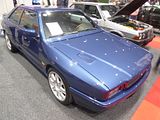
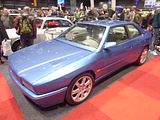

Also here was an example of Maserati’s current range topper, the fabulous MC20 supercar.

MATRA
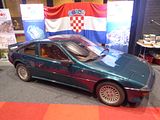
The Matra Murena was a 3-seat single row sports car with mid-engined rear wheel drive, produced from 1980 through 1983. Replacing the Bagheera, a similar vehicle resulting from the first fruits of the Matra-Simca cooperation, the Murena employed the base Bagheera structure, but substantial changes were made to address some of the concerns regarding the previous model. The car still had a steel spaceframe with body panels made of fibreglass-polyester, but to counter the rust issues plaguing the Bagheeras, the spaceframe was galvanized, the first production car to use galvanized steel for all chassis parts. This, coupled with the composite panels, made the car essentially immune to rust, except for the rear trailing arms of the suspension. The Murena also inherited the Bagheera’s mid-engined layout together with the sleek hatchback body shape, with the rear hatch allowing access to the engine mounted behind the passenger compartment, and a luggage area. The styling was all-new, though, and the body very aerodynamic for its time. A unique feature carried over from the previous model was the seating arrangement – all three seats were placed in one row, with the middle seat folding down to become an armrest when not in use by a passenger. The engine selection was different, however. The base model had a 1.6 engine, while the more powerful version employed the 2.2 engine that was also the base engine for the top of the range Talbot Tagora saloon. This engine was also available with the so-called “S-kit” that upgraded its output to 142bhp. At first, this was a dealer-fitted option, but later it could be ordered straight from the factory. The standard carburation was via a single Solex downdraft carburettor, but S models had twin side draft carburettors. The car had good performance and handling. It was only available in left hand drive specification, although a very small number of right hand drive conversions were made. Production ceased when the Matra factory in Romorantin switched to production of the Renault Espace multi-people carrier.

MERCEDES-BENZ
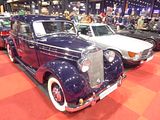
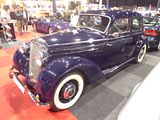
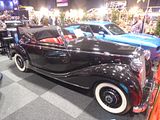
Launched in 1936, the 170V soon became Mercedes’ top-selling model, with over 75,000 made by 1939. Enough of the W136’s tooling survived Allied bombing during World War II (or could be recreated post-war) for it to serve as the foundation upon which the company could rebuild. By 1947 the model 170 V had resumed its place as Mercedes’ top-seller, a position it held until 1953. Most of the cars produced, and an even higher proportion of those that survive, were two or four door “Limousine” (saloon) bodied cars, but the range of different body types offered in the 1930s for the 170 V was unusually broad. A four-door “Cabrio-Limousine” combined the four doors of the four door “Limousine” with a full length foldaway canvas roof. Both the foor door bodies were also available adapted for taxi work, with large luggage racks at the back. There was a two-door two seater “Cabriolet A” and a two-door four seater “Cabriolet B” both with luggage storage behind the seats and beneath the storage location of the hood when folded (but without any external lid for accessing the luggage from outside the car). A common feature of the 170 V bodies was external storage of the spare wheel on the car’s rear panel. The two seater roadster featured a large flap behind the two seats with a thinly upholstered rear partition, and which could be used either as substantial luggage platform or as a very uncomfortable bench – the so-called mother-in-law’s seat. In addition to the wide range of passenger far bodied 170 Vs, a small commercial variant was offered, either as a flatbed truck or with a box-body on the back. Special versions of the 170 V were offered, adapted for use as ambulances or by the police, mountain rescue services and military. Production restarted in May 1946. The vehicles produced were versions of the 170 V, but in 1946 only 214 vehicles were produced and they were all light trucks or ambulances. Passenger car production resumed in July 1947, but volumes were still very low, with just 1,045 170 Vs produced that year. There was no return for the various open topped models from the 1930s. Customers for a Mercedes-Benz 170 V passenger car were restricted to the four door “Limousine” sedan/saloon bodied car. Production did ramp up during the next couple of years, and in 1949 170 V production returned to above 10,000 cars. From May 1949 the car, badged in this permutation as the Mercedes-Benz 170D, was offered with an exceptionally economical 38 PS diesel engine. The 170D was the world’s third diesel fuelled passenger car, and the first to be introduced after the war. A number of updates were made in 1950 and 1952, with more modern and more powerful engines among the changes, but with the appearance of the new Ponton bodied Mercedes-Benz 180 in 1953, the 170 models suddenly appeared very old fashioned. The 170 V was delisted in September 1953: in July 1953 the manufacturer had replaced the existing 170 S with the reduced specification 170 S-V. The car that resulted combined the slightly larger body from the 170 S with the less powerful 45 PS engine that had previously powered the 170 V. The vehicle provided reduced performance but at a reduced price, while salesmen steered more prosperous buyers to the new Ponton bodied 180. The diesel powered 170 S continued to be sold, now branded as the 170 S-D. The internal “W191” designation which had distinguished the previous 170 Ss was removed, and the 170 Ss manufactured from 1953 returned to the “W136” works designation that they had shared with the 170 V till the end of 1951. In September 1955 the last Mercedes-Benz W136, the Mercedes-Benz 170 S was withdrawn from production.
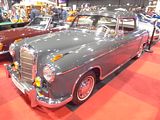
The Mercedes-Benz “Ponton” series is a range of sedans / saloon car models from Mercedes-Benz, introduced starting in 1953, and subsequently nicknamed ‘Ponton’ (the German word for “pontoon”), referring to its ponton styling, a prominent styling trend that unified the previously articulated hood, body, fenders and runnings boards into a singular, often slab-sided envelope. At the time, Mercedes itself did not refer to any of its cars using the nickname. Mercedes stretched the ‘Ponton’ saloons into a range that became the automaker’s dominant production models until 1959. Mercedes-Benz emerged from World War II as a carmaker best known in the early 1950s for its expensive Mercedes-Benz 300 Adenauers and exclusive 300 S sports tourers. Both were largely handbuilt body on frame vehicles. Its low end was anchored by the dated pre-war designed 170. Seeking to expand its production, Mercedes turned toward the unibody concept to design a line of mass-produced cars. Work began in earnest on the pontons bodied cars in 1951, with a design focused on passenger comfort and safety. Head of the design team was Dr. Fritz Nallinger. Styling was headed by Karl Wilfert. Also in the design team was Béla Barényi, who conceived the passive safety (crash protection) engineering of the body. The 1953 W120 180 four-cylinder sedans were Mercedes’ second totally new series of passenger cars since World War II, following the 1951 introduction of the top of the range W186 300 “Adenauer”, and replaced the pre-war-designed W136 170 and 170 S. Contrasting very visibly with the traditional distinct fenders on that body-on-frame model and the ones before it, the ‘Pontons’ were Mercedes’ first monocoque, unitary body production models. Mercedes expanded the base Ponton model into a diversified line, developing multiple series based on the 180, by introducing more engines and stretching the body. Six-cylinder models received a longer nose, and ‘S’-models also had a longer passenger compartment, offering more legroom. A six-cylinder coupe and convertible were further derived, and a shortened floorpan of the four-cylinder sedan was also modified to serve as the structure for the W121 190 SL roadster. The ‘Ponton’ saloons were the automaker’s main production models until 1959, adding up to 80% of Mercedes-Benz car production between 1953 and 1959, with some models lasting until 1962. The first of the ‘Ponton’ models to go into production was the 1953 W120 180, 1.8 L four-cylinder, four-door sedan, available as the 180 petrol and the 180D diesel. In 1954 the W180 six-cylinder executive / luxury model 220a was added, developed mostly by stretching the W120’s body by 170 mm (6.7 in), complemented by a new rear suspension, and giving it the longer straight six M180 engine. The added length was divided between 100 mm (3.9 in) added forward of the firewall to accommodate the two cylinder larger engine, and 70 mm (2.8 in) to the rear seating area for additional legroom; the boots stayed the same. In 1956, the six-cylinder model was expanded into an entire range. The 220a gained a second carburettor and was upgraded to become the 220S, shortly joined in the line by new distinctively bodied, shorter wheelbase two-door coupe and convertible models. A third saloon series, the W105 219 was created by grafting the six-cylinder nose onto the shorter body of the four-cylinder from the firewall aft. In 1956, the four-cylinder model also received an all new, short-stroke 1.9 L petrol engine option, the W121 model 190, joined in 1958 by a 1.9 litre diesel. In 1958, the 220S models were upgraded with fuel injection, and became the W128 220 SE series. The models 180 D and 190 D received further updates in 1959 and 1961. The range was succeeded by the range of “Heckflosse” (or “Fintail”) models.
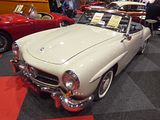
Produced between May 1955 and February 1963, having first been seen in prototype at the 1954 New York Auto Show, the 190SL was designed as a more affordable sports car than the exclusive and rather pricey 300SL, sharing its basic styling, engineering, detailing, and fully independent suspension. While both cars had double wishbones in front and swing axles at the rear, the 190 SL did not use the 300 SL’s purpose-built W198 tubular spaceframe. Instead, it was built on a shortened monocoque R121 platform modified from the W120 saloon. The 190 SL was powered by a new, slightly oversquare 105 PS Type M121 1.9 litre four cylinder engine. Based on the 300 SL’s straight six, it had an unchanged 85 mm bore and 4.3 mm reduced 83.6 mm stroke, was fitted with twin-choke dual Solex carburettors, and produced 120 gross hp. In detuned form, it was later used in the W120 180 and W121 190 models. Both the 190 SL and the 300 SL were replaced by the Mercedes-Benz 230SL in 1963.
Replacement for the 190SL cars of the 1950s were the “Pagoda” series of W113 cars. By 1955, Mercedes-Benz Technical Director Prof. Fritz Nallinger and his team held no illusions regarding the 190 SL’s lack of performance, while the high price tag of the legendary 300 SL supercar kept it elusive for all but the most affluent buyers. Thus Mercedes-Benz started evolving the 190 SL on a new platform, model code W127, with a fuel-injected 2.2 litre M127 inline-six engine, internally denoted as 220SL. Encouraged by positive test results, Nallinger proposed that the 220SL be placed in the Mercedes-Benz program, with production commencing in July 1957. However, while technical difficulties kept postponing the production start of the W127, the emerging new S-Class W112 platform introduced novel body manufacturing technology altogether. So in 1960, Nallinger eventually proposed to develop a completely new 220SL design, based on the “fintail” W 111 sedan platform with its chassis shortened by 11.8 in, and technology from the W112. This led to the W113 platform, with an improved fuel-injected 2.3 litre M127 inline-six engine and the distinctive “pagoda” hardtop roof, designated as 230 SL. The 230 SL made its debut at the prestigious Geneva Motor Show in March 1963, where Nallinger introduced it as follows: “It was our aim to create a very safe and fast sports car with high performance, which despite its sports characteristics, provides a very high degree of travelling comfort”. The W113 was the first sports car with a “safety body,” based on Bela Barényi’s extensive work on vehicle safety: It had a rigid passenger cell and designated crumple zones with impact-absorbing front and rear sections built into the vehicle structure. The interior was “rounded,” with all hard corners and edges removed, as in the W111 sedan. Production of the 230 SL commenced in June 1963 and ended on 5 January 1967. Its chassis was based on the W 111 sedan platform, with a reduced wheelbase by 11.8 in, recirculating ball steering (with optional power steering), double wishbone front suspension and an independent single-joint, low-pivot swing rear-axle with transverse compensator spring. The dual-circuit brake system had front disc brakes and power-assisted rear drum brakes. The 230 SL was offered with a 4-speed manual transmission, or an optional, very responsive fluid coupled (no torque converter) 4-speed automatic transmission, which was popular for US models. From May 1966, the ZF S5-20 5-speed manual transmission was available as an additional option, which was particularly popular in Italy. The 2,308 cc M127.II inline-six engine with 150 hp and 145 lb/ft torque was based on Mercedes-Benz’ venerable M180 inline-six with four main bearings and mechanical Bosch multi-port fuel injection. Mercedes-Benz made a number of modifications to boost its power, including increasing displacement from 2,197 cc, and using a completely new cylinder head with a higher compression ratio (9.3 vs. 8.7), enlarged valves and a modified camshaft. A fuel injection pump with six plungers instead of two was fitted, which allowed placing the nozzles in the cylinder head and “shooting” the fuel through the intake manifold and open valves directly into the combustion chambers. An optional oil-water heat exchanger was also available. Of the 19,831 230 SLs produced, less than a quarter were sold in the US. Looking identical, the 250 SL was introduced at the 1967 Geneva Motor Show. Production had already commenced in December 1966 and ended in January 1968. The short one-year production run makes the 250 SL the rarest of the W113 series cars. The 250 SL retained the stiffer suspension and sportier feel of the early SLs, but provided improved agility with a new engine and rear disc brakes. Range also improved with increased fuel tank capacity from 65 litres to 82. Like its predecessor, the 250 SL was offered with a 4-speed automatic transmission, and 4-speed or ZF 5-speed manual transmissions. For the first time, an optional limited slip differential was also available. The main change was the use of the 2,496 cc M129.II engine with a larger stroke, increased valve ports, and seven main bearings instead of four. The nominal maximum power remained unchanged at 150 hp, but torque improved from 145 lb/ft to 159 lb/ft. Resiliency also improved with a new cooling water tank (“round top”) with increased capacity and a standard oil-water heat exchanger. The 250 SL also marked the introduction of a 2+2 body style, the so-called “California Coupé”, which had only the removable hardtop and no soft-top: a small fold-down rear bench seat replaced the soft-top well between passenger compartment and boot. It is estimated that only 10% of the 250SLs that were brought into America were California Coupes. Of the 5,196 250 SLs produced, more than a third were sold in the US.The 280 SL was introduced in December 1967 and continued in production through 23 February 1971, when the W 113 was replaced by its successor, the entirely new and substantially heavier R107 350 SL. The main change was an upgrade to the 2,778 cc M130 engine with 170 hp and 180 lb/ft, which finally gave the W 113 adequate power. The performance improvement was achieved by increasing bore by 4.5 mm (0.2 in), which stretched the limits of the M180 block, and required pairwise cylinder casts without cooling water passages. This mandated an oil-cooler, which was fitted vertically next to the radiator. Each engine was now bench-tested for two hours prior to being fitted, so their power specification was guaranteed at last. The M130 marked the final evolution of Mercedes-Benz’ venerable SOHC M180 inline-six, before it was superseded by the entirely new DOHC M110 inline-six introduced with R107 1974 European 280 SL models. For some time, it was also used in the W 109 300 S-Class, where it retired the expensive 3 liter M189 alloy inline-six. Over the years, the W 113 evolved from a sports car into a comfortable grand tourer, and US models were by then usually equipped with the 4-speed automatic transmission and air conditioning. Manual transmission models came with the standard 4-speed or the optional ZF 5-speed, which was ordered only 882 times and thus is a highly sought-after original option today. In Europe, manual transmissions without air conditioning were still the predominant choice. Of the 23,885 280 SLs produced, more than half were sold in the US.


This one comes from the W108 family. The car’s predecessor, the Mercedes-Benz W111 (produced 1959–1971) helped Daimler develop greater sales and achieve economy of scale production. Whereas in the 1950s, Mercedes-Benz was producing the coachwork 300 S and 300 SLs and all but hand-built 300 Adenauers alongside conveyor assembled Pontons (190, 190SL and 220) etc., the fintail (German: Heckflosse) family united the entire Mercedes-Benz range of vehicles onto one automobile platform, reducing production time and costs. However, the design fashion of the early 1960s changed. For example, the tail fins, originally intended to improve aerodynamic stability, died out within a few years as a fashion accessory. By the time the 2-door coupé and cabriolet W111s were launched, the fins lost their chrome trim and sharp appearance, the arrival of the W113 Pagoda in 1963 saw them further buried into the boot’s contour, and finally disappeared on the W100 600 in 1964. The upgrade of the W111 began under the leadership of designer Paul Bracq in 1961 and ended in 1963. Although the fins’ departure was the most visible change, the W108 compared to the W111 had a lower body waist line that increased the window area, (the windscreen was 17 percent larger than W111). The cars had a lower ride (a decrease by 60 mm) and wider doors (+15 mm). The result was a visibly new car with a more sleek appearance and an open and spacious interior. The suspension system featured a reinforced rear axle with hydropneumatic compensating spring. The car sat on larger wheels (14”) and had disc brakes on front and rear. The W109 was identical to the W108, but featured an extended wheelbase of 115 mm (4.5 in) and self-levelling air suspension. This was seen as a successor to the W112 300SEL that was originally intended as an interim car between the 300 “Adenauer” (W189) and the 600 (W100) limousines. However, its success as “premium flagship” convinced Daimler to add an LWB car to the model range. From that moment on, all future S-Class models would feature a LWB line. Although the W108 succeeded the W111 as a premium range full-size car, it did not replace it. Production of the W111 continued, however the 230S was now downgraded to the mid-range series, the Mercedes-Benz W110, and marketed as a flagship of that family until their production ceased in 1968. The W108 is popular with collectors and the most desirable models to collect are the early floor shift models with the classic round gear knob and the 300 SEL’s. The car was premièred at the Frankfurt Auto Show in 1965. The initial model lineup consisted of three W108s: 250S, 250SE, and 300SE, as well as a sole W109, the 300SEL. Engines for the new car were carried over from the previous generation, but enlarged and refined. The 250S was the entry-level vehicle fitted with a 2496 cm³ Straight-six M108 engine, with two dual downdraft carburettors, delivering 130 bhp at 5400 rpm which accelerated the car to 100 km/h (62 mph) in 13 seconds (14 on automatic transmission) and gave a top speed of 182 km/h (177 on auto). The 250SE featured an identical straight-six, but with a six-plunger fuel injection (designated M129) with performance improved to 150 bhp (112 kW) at 5500 rpm, which decreased 0-100 acceleration by one second and increased top speed by 11 km/h (7 mph) for both manual and automatic versions. Both the 300SE and 300SEL came with the M189 2996 cm³ engine, originally developed for the Adenauers. It had a modern six-plunger pump that adjusted automatically to accelerator pedal pressure, engine speed, atmospheric pressure, and cooling water temperature, to deliver the proper mixture depending on driving conditions. Producing 170 bhp at 5,400 rpm the cars could accelerate to 200 km/h (195 km/h with automatic transmission) and reach 100 km/h (62 mph) in 12 seconds. The cylinder capacity of the three litre Mercedes engine was unchanged since 1951. From 1965 to 1967, fewer than 3,000 W109s were produced. However, approximately 130,000 of the less powerful 250 S/SE models were built during the first two years of the W108/109’s existence. By 1967 the fuel consumption of the 3 litre unit in this application was becoming increasingly uncompetitive.

The Mercedes range of the 1960s was quite complex, with body styles and mechanical updates proceeding at a different rate, and even by referring to the cars by their internal development codes (the “W” number), they are still quite hard to define unambiguously. In the W111 family, the Coupe was the first to appear, a replacement for the two-door W120 “Ponton” models, and work on it began in 1957. Since most of the chassis and drivetrain were to be unified with the sedan, the scope was focused on the exterior styling. Some of the mockups and prototypes show that Mercedes-Benz attempted to give the two-door car a front styling almost identical to what would be realised in the Pagoda (W113), but ultimately favoured the work of engineer Paul Bracq. The rear featured small tailfins, subtle compared to the fintails’ and evocative of the later squarish styling of the W108/W109. Production began in late 1960, with the coupe making its debut at the 75th anniversary of the opening of Mercedes-Benz Museum in Stuttgart in February of the next year. The convertible followed at the Frankfurt Auto Show a few months later. Almost identical to the coupe, its soft-top roof folded into a recess behind the rear seat and was covered by a tightly fitting leather “boot” in the same colour as the seats. Unlike the previous generation of two-door ponton series, the 220SE designation was used for both the coupe and convertible; both received the same version of the 2195 cc M127 engine. Options included a sliding sunroof for the coupe, automatic transmission, power steering, and individual rear seats. In March 1962, Mercedes-Benz released the exclusive two-door M189-powered 300SE. Like the 300 sedan, it was based on the W111 chasis but shared both Daimler’s top-range 2996 cc fuel-injected engine and the unique W112 chassis designation, efforts on Mercedes’ part to distance it from the maker’s modest W110 and W111 lineups and link it to the prestigious W188 300S two-door luxury sports tourer. It was distinguished by a chrome strip, and featured air suspension and a higher level of interior trim and finish. In summer of 1965, Mercedes-Benz launched replacements for both W111 and W112 sedans, the W108 and W109 respectively. With the tailfin fashion well eroded by the mid 1960s, the new design was based on the restrained W111 coupe, widened and squared off. Work on a future new chassis that would fully replace the Ponton-derived W111/W112 and W108/W109 was well under way. With a concept car of the first S-Class shown in 1967, Daimler declined to develop a two-door W108/W109 vehicle, instead continuing production of the aging W111/W112 with modest changes. The 220SE was superseded in early autumn 1965 by the 250SE, which featured the new 2496cc M129 engine. Producing 150 hp. it gave the vehicle a significant improvement in top speed, to 120 mph. Visibly the only changes affected the new 14-inch rims, which came with new hub cabs and beauty rings accommodating the larger disk brakes and new rear axle from the W108 family. In November 1967 the 250 SE was superseded by the 280 SE. It was powered by the new 2778 cc M130 engine, which produced 160 hp. The top speed was hardly affected, but acceleration improved to 10.5 seconds. Inside the car received a wood veneer option on the dashboard and other minor changes, including door lock buttons and different heater levers. The hubcaps were changed yet again to a new one piece wheelcover, and the exterior mirror was changed. Despite its smaller engine, the 280 SE could outperform the early 1950s M189 powered 300 SE, resulting in the more expensive model’s retirement. The coupe and cabriolet retained their shared model model designation until replaced by a new-generation chassis in 1968. A final model was added in August 1969, the 280 SE 3.5. The car was fitted with the brand-new M116 3499 cc V8. It produced 200 hp, and had a top speed of 130 mph and a 0-100 km/h at 9.5 seconds. To accommodate the large engine, the car’s front grille was widened; front and rear bumpers were also modified with the addition of rubber strips. The rear lenses changed to a flatter cleaner design. This change was carried across the standard 280 SE. As the top of its range, the 280 SE 3.5 is seen as an ideological successor to the W112 300 SE, though it lacked the W112’s air suspension. The last 280 SE was produced in January 1971, with the 280 SE 3.5 ending in July. The total production over the decade was: 220 SEb – 16,902, 250 SE – 6,213, 280 SE – 5,187, and 280 SE 3.5 – 4,502 units. Not including 3,127 W112 300 SE models, the grand total of 2-door W111 models was 32,804 of which 7,456 were convertibles. These days the cars are much sought after and prices, especially for the convertible, are high and still rising.


The W116 was the first Mercedes to be known officially by the title “S Class”, although sometimes it is now applied to the car’s predecessor as well, since it was also called – among other things – the 280SE. The ‘new’ S-class generation development began in 1966, which was only a year after the launch of the W108/09. This was the first Mercedes saloon to feature the brand new corporate styling theme which was to be continued until 1993 when the 190 was discontinued. The design, finalised in December 1969 was a dramatic leap forward, with more masculine lines that combined to create an elegant and sporty character. The basic design concept carried through the themes originally introduced on the R107 SL-Class roadster, especially the front and rear lights. As for the SL, the W116 received the ridged lamp covers which kept dirt accumulation at bay; this was to remain a Mercedes-Benz design theme into the 21st century. The W116 was Friedrich Geiger’s last design for Mercedes-Benz; his career had started with the Mercedes-Benz 500K in 1933. The car was presented in September 1972. The model range initially included two versions of the M110 engine (Straight-six with 2746 cc displacement)—the 280 S (using a Solex carburetor) and the 280 SE (using Bosch D-Jetronic injection), plus the 350 SE, powered by the M116 engine (V8 with 3499 cc displacement). After the 1973 Fuel Crisis, a long-wheelbase version of the 280 was added to the lineup. Half a year later, in early 1973, two new models powered by the M117 engine (V8 with 4520 cc displacement) were added to the range—the 450 SE and the 450 SEL (with a 100 mm longer body). The 450 had 225 PS in most markets, federalised cars offered 190 hp while Swedish market cars had an EGR-valve and 200 PS until 1976. The 450s received a plusher interior as well, with velour or leather seats rather than the checkered cloth of the lesser models. The door insides were also of a different design, being pulled up around the windows. The most notable W116 was the high-performance, limited-production 450 SEL 6.9, which was introduced in 1975. This model boasted by far the largest engine installed in a post-war Mercedes-Benz (and any non-American production automobile) up to that time, and also featured self-levelling hydropneumatic suspension. The 300 SD sedan (American market only) had a turbocharged 3.0-litre inline-five diesel engine developed from the C111 experimental vehicle. In September 2013, a 1979 W116 300 SD was campaigned in the 24 Hours of Lemons at Carolina Motorsports Park, where it completed 166 laps at an average speed of 54.8 MPH. It won the highest prize of the event, the Index of Effluency. Other than mild issues relating to brake and tire wear, no mechanical issues were encountered. After numerous modifications to handling, the car was again run in February 2014 at Barber Motorsports park in Birmingham, AL. It placed 44th, but turned 281 laps at an average pace of 59.6 MPH. One of the key advantages of the 300 SD is its exceptional fuel economy on track, where it burns just 2.5 GPH (Roughly 18MPG). In July 2014 it placed first in class at Sebring. It is still active in the series. The 450 SE was named the European Car of the Year in 1974, even though the W116 range was first introduced at the Paris Motor Show in October 1972. The W116 range became the first production car to use an electronic four-wheel multi-channel anti-lock braking system (ABS) from Bosch as an option from 1978 on. Production totalled 473,035 units. The W116 was succeeded by the W126 S-Class in 1979
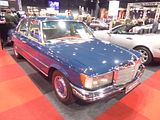
With prices of the classic Pagoda model having risen to unaffordable for most people attention has started to switch to it successor, the R107 SL range, which had a long production life, being the second longest single series ever produced by the automaker, after the G-Class. The R107 and C107 took the chassis components of the mid-size Mercedes-Benz W114 model and mated them initially to the M116 and M117 V8 engines used in the W108, W109 and W111 series. The SL variant was a 2-seat convertible/roadster with standard soft top and optional hardtop and optional folding seats for the rear bench. The SLC (C107) derivative was a 2-door hardtop coupe with normal rear seats. The SLC is commonly referred to as an ‘SL coupe’, and this was the first time that Mercedes-Benz had based a coupe on an SL roadster platform rather than on a saloon, replacing the former saloon-based 280/300 SE coupé in Mercedes lineup. The SLC was replaced earlier than the SL, with the model run ending in 1981, with a much larger model, the 380 SEC and 500SEC based on the new S class. Volume production of the first R107 car, the 350 SL, started in April 1971 alongside the last of the W113 cars; the 350 SLC followed in October. The early 1971 350SL are very rare and were available with an optional 4 speed fluid coupling automatic gearbox. In addition, the rare 1971 cars were fitted with Bosch electronic fuel injection. Sales in North America began in 1972, and cars wore the name 350 SL, but had a larger 4.5L V8 with 3 speed auto (and were renamed 450 SL for model year 1973); the big V8 became available on other markets with the official introduction of the 450 SL/SLC on non-North American markets in March 1973. US cars sold from 1972 through 1975 used the Bosch D Jetronic fuel injection system, an early electronic engine management system. From July 1974 both SL and SLC could also be ordered with a fuel-injected 2.8L straight-6 as 280 SL and SLC. US models sold from 1976 through 1979 used the Bosch K Jetronic system, an entirely mechanical fuel injection system. All US models used the 4.5 litre engine, and were called 450 SL/SLC. In September 1977 the 450 SLC 5.0 joined the line. This was a homologation version of the big coupé, featuring a new all-aluminium five-litre V8, aluminium alloy bonnet and boot-lid, and a black rubber rear spoiler, along with a small front-lip spoiler. The 450SLC 5.0 was produced in order to homologate the SLC for the 1978 World Rally Championship. Starting in 1980, the 350, 450 and 450 SLC 5.0 models (like the 350 and 450 SL) were discontinued in 1980 with the introduction of the 380 and 500 SLC in March 1980. At the same time, the cars received a very mild makeover; the 3-speed automatic was replaced by a four-speed unit, returning to where the R107 started in 1971 with the optional 4 speed automatic 350SL. The 280, 380 and 500 SLC were discontinued in 1981 with the introduction of the W126 series 380 and 500 SEC coupes. A total of 62,888 SLCs had been manufactured over a ten-year period of which just 1,636 were the 450 SLC-5.0 and 1,133 were the 500 SLC. Both these models are sought by collectors today. With the exception of the SL65 AMG Black Series, the SLC remains the only fixed roof Mercedes-Benz coupe based on a roadster rather than a sedan. Following the discontinuation of the SLC in September 1981, the 107 series continued initially as the 280, 380 and 500 SL. At this time, the V8 engines were re-tuned for greater efficiency, lost a few hp and consumed less fuel- this largely due to substantially higher (numerically lower) axle ratios that went from 3.27:1 to 2.47:1 for the 380 SL and from 2.72:1 to 2.27:1 for the 500 SL. From September 1985 the 280 SL was replaced by a new 300 SL, and the 380 SL by a 420 SL; the 500 SL continued and a 560 SL was introduced for certain extra-European markets, notably the USA, Australia and Japan. Also in 1985, the Bosch KE Jetronic was fitted. The KE Jetronic system varied from the earlier, all mechanical system by the introduction of a more modern engine management “computer”, which controlled idle speed, fuel rate, and air/fuel mixture. The final car of the 18 years running 107 series was a 500 SL painted Signal red, built on August 4, 1989; it currently resides in the Mercedes-Benz museum in Stuttgart.
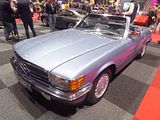


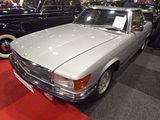

Mercedes-Benz introd uced the W123 four-door versions on 29 January 1976. While there were some technical similarities to their predecessors, the new models were larger in wheelbase and exterior dimensions. The styling was also updated, although stylistic links with the W114 / W115 were maintained. Initially, all models except 280/280E featured quad unequal-size round headlights and the latter large rectangular units. When facelifted, these units became standard across the range. All W115 engines were carried over, with the 3-litre 5-cylinder diesel model being renamed from “240D 3.0” to “300D” (as it had already been called before in North American markets). The only new engine was the 250’s 2,525 cc inline-six (Type M123, a short-stroke version of the 2.8-litre six Type M110) that replaced the old 2,496 cc Type M114 “six”. In the spring of 1976, a Coupé version was introduced on a shorter wheelbase than the saloon (106.7 in versus 110.0 in). This W123C/CE was available as a 230C (later 230CE) and as a 280C/CE in most markets; in North America there were additional 300CD versions with naturally aspirated, later turbocharged 3-litre diesel engines. In North America, buyers favored diesel engines for upmarket cars, while CAFE legislation meant that Mercedes-Benz North America had to lower their corporate average fuel economy. This led to the introduction of a few diesel models only sold in the United States. It is a tribute to the car’s instant popularity – and possibly to the caution built into the production schedules – that nine months after its introduction, a black market had developed in Germany for Mercedes-Benz W123s available for immediate delivery. Customers willing to order new cars from their local authorised dealer for the recommended list price faced waiting times in excess of twelve months. Meanwhile, models that were barely used and were available almost immediately commanded a premium over the new price of around DM 5,000. From August 1976, long-wheelbase versions (134.8 in) were produced. These were available as 7/8 seater saloons with works bodies or as a chassis with complete front body clip, the latter serving as the base for ambulance and hearse bodies by external suppliers like Binz or Miesen. These “Lang” versions could be ordered as 240D, 300D and 250 models. At the Frankfurt Auto Show in September, 1977 the W123T estate was introduced; the T in the model designation stood for “Touring and Transport”. All engines derivative except “200TD” were available in the range. T production began in March, 1978 in Mercedes’ Bremen factory. It was the first factory-built Mercedes-Benz estate, previous estates had been custom-built by external coachbuilders, such as Binz. In early 1979, the diesel models’ power output was increased; power rose from 54 hp to 59 hp in the 200D, from 64 hp to 71 hp in the 240D and from 79 hp to 87 hp in the 300D; at the same time, the 220D went out of production. The first Mercedes turbo diesel production W123 appeared in September, 1981. This was the 300 TD Turbodiesel, available with automatic transmission only. In most markets, the turbocharged 5-cylinder 3-litre diesel engine (Type OM617.95) was offered only in the T body style, while in North America it was also available in saloon and coupé guises. June 1980 saw the introduction of new four-cylinder petrol engines (Type M102). A new 2-litre four with shorter stroke replaced the old M115, a fuel-injected 2.3-litre version of this engine (in 230E/TE/CE) the old carburettor 230. Both engines were more powerful than their predecessors. In 1980/81, the carburettor 280 versions went out of production; the fuel-injected 280E continued to be offered. In September 1982, all models received a mild facelift. The rectangular headlights, previously fitted only to the 280/280E, were standardised across the board, as was power steering. Since February 1982, an optional five-speed manual transmission was available in all models (except the automatic-only 300 turbodiesel). W123 production ended in January, 1986 with 63 final T-models rolling out. Most popular single models were the 240D (455,000 built), the 230E (442,000 built), and the 200D (378,000 built). The W123 introduced innovations including ABS (optional from August, 1980), a retractable steering column and an airbag for the driver (optional from 1982). Power (vacuum servo) assisted disc brakes were standard on all W123s. Available options included MB-Tex (Mercedes-Benz Texturized Punctured Vinyl) upholstery or velour or leather upholstery, interior wood trim, passenger side exterior mirror (standard on T models), 5-speed manual transmission (European market only), 4-speed automatic transmission (standard in turbodiesel models), power windows with rear-seat switch cut-outs, vacuum powered central locking, rear-facing extra seats (estate only), Standheizung (prestart timer-controlled engine heating), self-locking differential, sun roof, air conditioning, climate control, “Alpine” horn (selectable quieter horn), headlamp wipers (European market only), Tempomat (cruise control), power steering (standard after 1982/08), seat heating, catalytic converter (available from 1984 for California only, from fall (autumn) 1984 also in Germany for the 230E of which one thousand were built). These days, the cars are very popular “youngtimer” classics, with all models
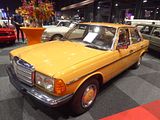


This is an early G Wagen, produced before the car became ever more luxurious and costly.

With the debut of the BMW M3 Evolution 2 in March 1988, the 190 E’s direct competitor, it became obvious that the 2.5-16 needed a boost in power in order to remain competitive. In March 1989, the 190 E 2.5-16 Evolution debuted at the Geneva Auto Show. The Evo I, as it came to be called, had a new rear spoiler and wider wheel arches. Many changes were made to under-the-skin components such as brakes and suspension. The car featured an adjustable suspension system allowing the ride height to be adjusted from an interior switch. All were intended to allow the Evolution cars to be even more effective around a track. The Evo I’s power output is similar to the 195 or 204 PS of the “regular” 2.5-16. However, it had a redesigned engine of similar capacity but most importantly, a shorter stroke and bigger bore which would allow for a higher rev limit and improved generation of power. Additional changes stretch to improved rotating mass, improved lubrication system along with improved cam timing. Cosworth also list a project code “WAC” for the development of the short-stroke Evolution engine. Only 502 units of the Evolution model were produced for homologation in compliance with the DTM rules. For those customers desiring even more performance, a PowerPack option engineered by AMG was available for DM 18,000. The PowerPack option included improved camshafts, a larger diameter throttle body, more responsive ignition and fuel management system as well as improved intake and exhaust systems – it was only offered with twin, metal catalytic converters rather than the single ceramic one used in the regular 2.5. The net result was an increase in power by 30 hp over the standard car, bringing the total to 225 PS. In March 1990, at the Geneva Auto Show, the 190 E 2.5-16 Evolution II was shown. With the success of the first Evolution model, this model’s 502-unit production was already sold before it was unveiled. This car retailed in 1990 for DM 136,720. The “Evo II” included the AMG PowerPack fitted to the same short-stroke 2,463 cc (2.5 L) inline-four engine as the Evolution, producing a maximum power output of 235 PS at 7,200 rpm and 245 N⋅m (181 lb⋅ft) of torque at 5,000 rpm, as well as a full SLS adjustable suspension allowing the ride height to be adjusted from an interior switch. An obvious modification to the Evolution II was the radical body kit (designed by Prof. Richard Eppler from the University of Stuttgart) with a large adjustable rear wing, rear window spoiler, and Evolution II 17-inch alloy wheels. The kit served an aerodynamic purpose—it was wind tunnel tested to reduce drag to 0.29, while at the same time increasing downforce. Period anecdotes tell of BMW research and development chief, Wolfgang Reitzle, saying “the laws of aerodynamics must be different between Munich and Stuttgart; if that rear wing works, we’ll have to redesign our wind tunnel.” The anecdote claims that BMW did redesign its wind tunnel afterwards. 500 examples were painted in “blauschwarz” blue/black metallic; the last two examples, numbers 501 and 502, were painted in astral silver making them the rarest of the Evolution models. The Evo II had the shortest production run of the 190 series models with production starting in 1990 and ending in 1991.
At the 1999 North American International Auto Show, Mercedes-Benz presented their Vision SLR concept, inspired both by the Mercedes-Benz 300 SLR Uhlenhaut Coupé of 1955, which was a modified Mercedes-Benz W196S race car, and the design of closed-wheel Formula One cars, a field in which Mercedes had prior experience, as Mercedes-Benz were already designing and developing powertrains and electronics for McLaren’s Formula One Team. The car was presented as “Tomorrow Silver Arrow” in a clear reference to the Silver Arrows of the golden age of Mercedes in competition during the fifties. Later that year, during the Frankfurt Motor Show, a roadster version of the SLR concept was presented. The concept car was fitted with a 5.0-litre supercharged AMG V8 engine able to generate a power output of 565 PS (557 bhp) and 720 Nm (531 lb/ft) of torque at 4,000 rpm, mated to a 5-speed automatic gearbox with Touchshift control. Wanting to bring the concept to production following its positive reception, Mercedes joined forces with their Formula One partner, McLaren, thus creating the Mercedes-Benz SLR McLaren. The production version of the car was unveiled to the general public on 17 November 2003 having some minor design adjustments in respect of the initial design. The adjustments included more complex vents on both sides of the car, a redesigned front with the three pointed star plunged in the nose and red tinted rear lights. A new version of the SLR was introduced in 2006, called the Mercedes-Benz SLR McLaren 722 Edition. The “722” refers to the victory by Stirling Moss and his co-driver Denis Jenkinson in a Mercedes-Benz 300 SLR with the starting number 722 (indicating a start time of 7:22 a.m.) at the Mille Miglia in 1955. The “722 Edition” includes a modified version of the engine used in the SLR generating a power output of 650 PS (641 bhp) at 6,500 rpm and 820 Nm (605 lb/ft) at 4,000 rpm. 19-inch light-alloy wheels were used to reduce unsprung mass, while modifications were also made to the suspension, with a stiffer damper setup and 10 mm (0.39 in) lower ride height introduced for improved handling. Larger 15.4 in diameter front brakes and a revised front air dam and rear diffuser were fitted. Other exterior changes include red “722” badging, harking back to the original 722 racer, black tinted tail lights and headlamps. The interior has carbon fibre trim and black leather upholstery combined with Alcantara. The Mercedes-Benz SLR McLaren saw a production run of over six years. On 4 April 2008, Mercedes announced it would discontinue the SLR. The last of the coupés rolled off the production line at the end of 2009 and the roadster version was dropped in early 2010. A total of 2,157 cars were produced, rather less than the 3500 production ceiling which Mercedes initially announced. The car had a mixed reception even when new, but now it is for sure a classic.
The SLS was the first Mercedes-Benz designed and built from scratch entirely by AMG. Upon its introduction at the 2009 Frankfurt Motor Show, the SLS AMG’s 571 PS (563 bhp) M159 engine was according to AMG “the world’s most powerful naturally aspirated production series engine” ever produced. The SLS AMG was designed by Mark Fetherston to be a modern 300SL Gullwing, adopting the feature of the gull-wing doors that swing open upwards on gas struts, and must be closed manually as AMG engineers decided against the 41 kg (90 lb) of additional weight that auto-closing systems would have added to the car. In case of a roll-over, the doors can be fully detached to allow the occupants to leave the vehicle. The SLS AMG Roadster was unveiled at the 2011 Frankfurt International Motor Show, as convertible variant, with conventional doors and three-layered fabric soft top (having a magnesium, steel and aluminium construction) which opens and closes in 11 seconds, and can be operated on the move at up to 50 km/h (31 mph). The roadster’s DIN kerb weight is 40 kg (88 lb) more than the SLS AMG Coupé. Certain reinforcements were made to the roadster in order to compensate for the loss of roof which includes side skirts with greater wall thicknesses and more chambers, a dashboard cross-member is supported against the windscreen frame and centre tunnel by additional struts, a curved strut between the soft top and the tank reinforces the rear axle, a reinforcing cross-member behind the seats to support the fixed roll-over protection system. An electric version of the car, the SLS AMG Electric Drive, was presented at the 2012 Paris Motor Show, but never entered production. The more focused Black Series, with more power and reduced weight did, though, following a presentation at the 2012 Los Angeles Show. Plenty of special editions of the car did, though, culminating in the 2014 SLS AMG GT Final Edition. The SLS was replaced by the somewhat cheaper (to build and hence to buy) AMG GT which remains in production.
Once a common sight, this is a historic Mercedes, known as the Harburger Transporter most probably because it transports and was conceived in Harburg, a borough of Hamburg. The first Harburger Transporter was launched in 1949 as the Tempo Matador by Vidal & Sohn. It was a low-slung FWD cab-over-engine design, originally powered by a VW flat-4. After 1952, Heinkel engines were used, but proved problematic; Matador sales dropped precipitously. The Matador was the larger model in the Tempo range, which also included the Boy and Hanseat trikes and, from 1953, a 2-cyl. 500cc microvan called the Wiking. Vidal & Sohn’s financial situation was disastrous by this point. This pushed the firm towards Hanomag, who bought half of Tempo in 1955. The second generation “fish-mouth” Matador arrived in 1956, now available with either an Austin A50 gasoline or a 1.8 litre Hanomag Diesel engine, soon followed by an Austin A35-engined Wiking Rapid. The Matadors were back in the game – domestic sales and exports shot up and the new design was soon license-built by Jensen in the UK and Bajaj-Tempo in India. Hanomag badges replaced the Tempo ones after Oscar Vidal sold his remaining shares in 1965, just as a revamped Matador was being developed. The 1967 Harburger Transporter was essentially a facelift of the Matador E. Originally based in Hannover, Hanomag had built anything from farming equipment and steam engines to passenger cars and military transports in their distant past, but after the war their main focus was trucks and tractors. Hanomag became a division of the Rheinstahl industrial group in 1952 and took over Borgward’s huge Bremen works in 1963. In 1964, Rheinstahl bought Henschel, who had taken over Hanomag’s locomotive branch back in the ‘20s. In 1967, the conglomerate was restructured and truck production was regrouped into a new Hanomag-Henschel division. By 1968, The Harburger Transporter became known as the Hanomag-Henschel F20 / F25 / F30 / F35. Then Daimler-Benz came a-knocking. Mercedes took a stake in Hanomag-Henschel in December 1968 and assumed complete control by 1971. The Harburger Transporter, whose production was gradually moved to the Bremen works, lost its Hanomag Diesel in favour of M-B’s OM 615, but kept the Austin 1.6 litre petrol engine. The Benz version (above) existed in parallel with the Hanomag. A three-pointed star version was launched in 1970, with slight chassis modifications, as the L 206 D or the L 306 D (the Austin-engined versions were named L 207 / L 307). The Hanomag-Henschel version continued alongside the Benz for a while – until the line at the Harburg plant was finally shut down in 1975. The last Bremen-built Harburger Transporters were made in 1978. Except in India, where the Tempo kept steady. The old Harburger was manufactured by Bajaj Tempo as the Matador F-305/307 since 1969. To boost local content, the entire Hanomag 1.5 litre Diesel engine production line was shipped off to India in 1970; Bajaj Tempo eventually switched to a license-built Benz OM 615. In 1990, a RWD Matador, the R-307, was launched — another addition to the list of FWD vehicles that went RWD, it seems. The Harburger’s Indian career was a long and distinguished one – it was only replaced (by a RWD T1 Bremen Transporter clone dubbed Tempo Excel) in 1999.

MESSERSCHMITT
The Messerschmitt KR200, or Kabinenroller (Cabin Scooter), is a three-wheeled bubble car designed by the aircraft engineer Fritz Fend and produced in the factory of the German aircraft manufacturer Messerschmitt from 1955 until 1964. Messerschmitt, temporarily not allowed to manufacture aircraft, had turned its resources to making other products. In 1952, Fend approached Messerschmitt with the idea of manufacturing small motor vehicles. These were based on his Fend Flitzer invalid carriage. The first of Fend’s vehicles to enter production at Messerschmitt’s Regensburg factory was the KR175. The title Kabinenroller means “scooter with cabin”. While the Messerschmitt name and insignia were used on the car, a separate company, incorporated as Regensburger Stahl- und Metallbau GmbH, was created to manufacture and market the vehicle. The KR200 replaced the KR175 in 1955. While using the same basic frame as the KR175 with changes to the bodywork (notably including wheel cutouts in the front fenders) and an improved canopy design, the KR200 was otherwise an almost total redesign. The rear suspension and engine mounting were reworked, and hydraulic shock absorbers were installed at all three wheels. Tire sizes were enlarged to 4.00×8. Retailing for around DM 2,500, the KR200 was considered an instant success with almost 12,000 built during its first year, which was the highest annual production for Kabinenroller models. A maximum speed in excess of 90 km/h (56 mph) despite a claimed power output of only 10 PS, 1 more PS than the 175 cc engine from the KR175, reflected the vehicle’s light weight and low aerodynamic drag. The KR200, however, was 23 kg heavier than the KR175 it replaced but had a 10 km/h (6 mph) higher top speed. An “Export” package included a two-tone paint scheme, painted hubcaps, a fully trimmed interior, a heater, a clock, and a sunshade for the canopy. In 1956, around a year after West Germany joined NATO, Messerschmitt was allowed to manufacture aircraft again and lost interest in Fend’s microcars. Messerschmitt sold the Regensburg works to Fend who, with brake and hub supplier Valentin Knott [de], formed Fahrzeug- und Maschinenbau GmbH Regensburg (FMR) to continue production of the KR200 and his other vehicles. In 1957 the KR201 Roadster was launched and remained in production until 1964 with very limited numbers produced. It had a frameless windscreen with no window frames, an optional folding cloth roof and removable side curtains made from transparent plastic. In February 1958, the KR200 Kabrio Limousine model was released, featuring a cloth convertible top and fixed side window frames. A Sport model was later offered with a cut down plexiglas windscreen with no roof and with fixed side panels so that the driver would have to climb in and out at the top of the car. Production of the Sport was extremely limited and, apart from the KR200 ‘Super’ it is the rarest type of KR200. Production of the KR200 was heavily reduced in 1962 and ceased in 1964 as sales had been dropping for a few years. The demand for basic economical transport in Germany had diminished as the German economy boomed. A similar situation developed in other parts of Europe such as in the manufacturer’s biggest export destination, the United Kingdom, where sales were particularly affected by the increasing popularity of the Mini. A total of 30,286 units of the KR200 were built.

MEYERS MANX
The Meyers Manx dune buggy is a small recreationally-oriented automobile, designed initially for desert racing by Californian engineer, artist, boat builder and surfer Bruce F. Meyers. It was produced by his Fountain Valley, California company, B. F. Meyers & Co. from 1964 to 1971, in the form of car kits applied to shortened chassis of Volkswagen Beetles. The car line dominated dune racing in its time, breaking records immediately, and was eventually also released in street-oriented models, until the company’s demise due to tax problems after Meyers’s departure. New vehicles inspired by the original Manx buggy have been produced by Meyers’s re-founded operation, Meyers Manx, Inc., since 2000. The name and cat logo of the brand derives from the Manx cat, by virtue of the tailless breed’s and the shortened vehicle’s truncated “stubbiness”. Drawing on his experience in sailboat construction, Meyers modeled and built his first dune buggy, “Old Red”, a shortened VW Beetle with a monocoque, fiberglass shell and Chevrolet pickup truck (trailing arm style) suspension, in late 1963 to May 1964 in his garage in Newport Beach, California. The first known street-legal fiberglass dune buggy, it featured a unibody shell that fused body, fenders and frame, retaining just the engine, transmission and other mechanicals of the VW, and with no top and no hood. The use of compound curves throughout provided great rigidity. The fenders were arched high, to make room for large, knobby dirt-racing wheels. The “Manx” name for the shortened, taller-wheeled, more maneuverable VW Beetle mods refers to and derives from the comparably stubby Manx cat breed, colloquially called “stubbins”; they are short-spined and stub-tailed-to-tailless, long-legged, and known for their turning ability while chasing. The Meyers Manx logo prominently features a Manx cat. The tailless cat in the logo, as featured on the hood ornament, is stylized after a passant heraldic lion, its right forepaw brandishing a sword. The name also suggests racing fitness, as the already globally renowned, British-manufactured Norton Manx motorcycle dominated the Isle of Man TT, Manx Grand Prix and other Isle of Man-based (i.e. Manx) international races from the 1940s to the early 1970s. The Meyers Manx has no direct connection to the Isle of Man. Meyers produced kits later in 1964 and into 1965, marketed under the name Meyers Manx. Although this early design was critically acclaimed, even featured on the April 1967 cover of Car & Driver magazine, and drew much attention, it proved too expensive to be profitable; ultimately only 12 kits of the monocoque Manx were produced. Meyers and a friend (both amateur racers) broke by over four hours the Ensenada – La Paz run’s record of 39 hours, until then held by a pro racer. According to James Hale, compiler of the Dune Buggy Handbook, this feat ushered in an era of Meyers Manx “domination in off-road events … and the formation of NORRA (National Off-Road Racing Association)”. The commercially manufactured Meyers Manx Mk I featured an open-wheeled fiberglass bodyshell, coupled with the Volkswagen Beetle H4 flat-four engine (1.2 L, 1.3 L, 1.5 L and 1.6 L, in different models) and a modified, RR-layout Beetle frame. It is a small car, with a wheelbase 14¼ inches (36.2 cm) shorter than a Beetle automobile for lightness and better maneuverability. For this reason, the car is capable of very quick acceleration and good off-road performance, despite not being four-wheel drive. The usually street-legal car redefined and filled a recreational and competitive niche that had been essentially invented by the first civilian Jeep in 1945, and which was later to be overtaken by straddle-ridden, motorcycle-based all-terrain vehicles (introduced in 1970) and newer, small and sporty (but usually four-wheel-drive), off-road automobiles. The commercial Meyers Manx received widespread recognition when it defeated motorcycles, trucks and other cars to win the inaugural 1967 Mexican 1000 race (the predecessor of the Baja 1000). It crossed automotive press genre lines, being selected as the cover story in the August 1966 issue of Hot Rod magazine. Approximately 6,000 of the original Meyers Manx dune buggies were produced, but when the design became popular many copies (estimated at a quarter of a million worldwide) were made by other companies. Although already patented, Meyers & Co. lost in court to the copiers, the judge rescinding his patent as unpatentable, opening the floodgates to the industry Meyers started.[citation needed] Since then, numerous vehicles of the general “dune buggy” or “beach buggy” body type, some VW-based, others not, have been and continue to be produced. An early example was the Imp by EMPI (1968–1970), which borrowed stylistic elements from the Chevrolet Corvette but was otherwise Manx-like. A later 1970s Manx clone was the Dune Runner from Dune Buggy Enterprises in Westminster, California. The Meyers company attempted to stay ahead of this seemingly unfair competition with the release of the distinctive, and harder-to-copy, Meyers Manx Mk II design. B. F. Meyers & Co. also produced other Beetle-based vehicles, including the May 1970 Car & Driver magazine cover sporty Manx SR variant (street roadsters, borrowing some design ideas from the Porsche 914), the Meyers Tow’d (sometimes referred to as the “Manx Tow’d”, a non-street-legal racing vehicle designed to be towed to the desert or beach), the Meyers Tow’dster (a street-legal hybrid of the two, and Meyers Resorter a.k.a. Meyers Turista (a small recreational or “resort” vehicle inspired by touring motorcycles). The Manx SR2 was a modified SR that was only produced by later manufacturers including Karma Coachworks, Heartland Motors and Manx Motors of MD. While the Tow’d was a minimal off-road racer and the SR/SR2 was a showy roadster, the Tow’dster was a compromise between a dune-capable vehicle and a more utilitarian street rod, and “paved the way for the rail-type buggy that was to dominate the buggy scene following the demise of the traditional Manx-type buggy.” The company ceased operation in 1971, after financial troubles, including with the Internal Revenue Service and Bruce Meyers himself had already left his own company by then.

MG
The first of the T Series sports cars appeared in 1936, to replace the PB. Visually they were initially quite similar, and as was the way in the 1930s, updates came frequently, so both TA and TB models were produced before global hostilities caused production to cease. Whilst the TC, the first postwar MG and launched in 1945, was quite similar to the pre-war TB, sharing the same 1,250 cc pushrod-OHV engine, it had a slightly higher compression ratio of 7.4:1 giving 54.5 bhp at 5200 rpm. The makers also provided several alternative stages of tuning for “specific purposes”. It was exported to the United States, even though only ever built in right-hand drive. The export version had slightly smaller US specification sealed-beam headlights and larger twin rear lights, as well as turn signals and chrome-plated front and rear bumpers. The body of the TC was approximately 4 inches wider than the TB measured at the rear of the doors to give more cockpit space. The overall car width remained the same resulting in narrower running boards with two tread strips as opposed to the previous three. The tachometer was directly in front of the driver, while the speedometer was on the other side of the dash in front of the passenger. 10,001 TCs were produced, from September 1945 to Nov. 1949, more than any previous MG model. It cost £527 on the home market in 1947.

The MGA replaced the long running T Series sports cars and presented a complete styling break from MG’s earlier sports cars. Announced on 26 September 1955, the car was officially launched at the Frankfurt Motor Show. A total of 101,081 units were sold through the end of production in July 1962, the vast majority of the 58.750 cars made were exported. Only 5869 cars were sold on the home market, the lowest percentage of any British car. It was replaced by the MGB. The MGA design dates back to 1951, when MG designer Syd Enever created a streamlined body for George Philips’ TD Le Mans car. The problem with this car was the high seating position of the driver because of the limitations of using the TD chassis. A new chassis was designed with the side members further apart and the floor attached to the bottom rather than the top of the frame sections. A prototype was built and shown to the BMC chairman Leonard Lord. He turned down the idea of producing the new car as he had just signed a deal with Donald Healey to produce Austin-Healey cars two weeks before. Falling sales of the traditional MG models caused a change of heart, and the car, initially to be called the UA-series, was brought back. As it was so different from the older MG models it was called the MGA, the “first of a new line” to quote the contemporary advertising. There was also a new engine available, therefore the car did not have the originally intended XPAG unit but was fitted with the BMC corporate B-Series type allowing a lower bonnet line. The MGA convertible had no exterior door handles, however the coupe did. It was a body-on-frame design and used the straight-4 1489cc “B series” engine from the MG Magnette saloon driving the rear wheels through a 4-speed gearbox. Suspension was independent with coil springs and wishbones at the front and a rigid axle with semi-elliptic springs at the rear. Steering was by rack and pinion. The car was available with either wire-spoked or steel-disc road wheels. The 1489 cc engine fitted with twin H4 type SU Carburettors produced 68 hp at first, but was soon uprated to 72 hp. Lockheed hydraulic drum brakes were used on all wheels. A high-performance Twin-Cam model was added for 1958. It used a high-compression (9.9:1 later 8.3:1) DOHC aluminium cylinder head version of the B-Series engine producing 108 hp. Due to detonation problems, a 100 bhp low-compression version was introduced later. Four-wheel disc brakes by Dunlop were fitted, along with Dunlop peg drive knock-off steel wheels similar to wheels used on racing Jaguars, unique to the Twin-Cam and “DeLuxe” MGA 1600 and 1600 MkII roadsters. These wheels and chassis upgrades were used on a small number of the “DeLuxe” models built after Twin-Cam production came to a halt. Aside from the wheels, the only outside identifier was a “Twin-Cam” logo near the vent aside the bonnet. A careful look at the rear wheel vents would also reveal another feature unique to Twin-Cam and DeLuxe: those 4 wheel Dunlop disc brakes . The temperamental engine was notorious for warranty problems during the course of production, and sales dropped quickly. The engine suffered from detonation and burnt oil. Most of the problems with the Twin-Cam engine were rectified with the low-compression version, but by then the damage had been done. Many restored Twin-Cams are running more reliably today than they ever did during production. The Twin-Cam was dropped in 1960 after 2,111 had been produced. Production ended in April 1960, but had slowed to a trickle long before. In May 1959 the standard cars also received an updated engine, now at 1588 cc producing 79.5 bhp . At the front disc brakes were fitted, but drums remained in the rear. Externally the car was very similar to the 1500 with differences including: amber or white (depending on market) front turn indicators shared with white parking lamps, separate stop/tail and turn lamps in the rear, and 1600 badging on the boot and the cowl. 31,501 of these were produced in less than three years. A number of 1600 De Luxe versions were produced with leftover special wheels and four-wheel disc brakes of the departed Twin-Cam, or using complete modified Twincam chassis left redundant by the discontinuance of that model. Seventy roadsters and 12 coupés were built. The engine size was increased again to 1622 cc by increasing the bore from 75.4 mm to 76.2 mm for the 1961 Mark II MGA. The cylinder head was also revised with larger valves and re-engineered combustion chambers. Horsepower increased to 90 bhp. It also had a higher ratio 4:1 rear axle, which made for more relaxed high-speed driving. An inset grille and Morris Mini tail lamps appearing horizontally below the deck lid were the most obvious visual changes. 8,198 Mark II roadsters and 521 coupés were built. As with the 1600 De Luxe, there were also some Mark II De Luxe versions; 290 roadsters and 23 coupés were produced.

In advance of the all-new MX5 rival that was still some way off production, MG decided to re-enter the open topped sports car market in 1992 when they launched the MGR V8, which combined new body panels with the standard MGB body shell to create an updated MGB model. The suspension was only slightly updated, sharing the leaf spring rear of the MGB. The boot lid and doors were shared with the original car, as were the rear drum brakes. The engine was the 3.9-litre version of the aluminium Rover V8, similar to the one previously used in the MGB GT V8. A limited-slip differential was also fitted. The interior featured veneered burr elm woodwork and Connolly Leather. The engine produced 190 bhp at 4,750 rpm, achieving 0–60 mph in 5.9 seconds, which was fast but largely due to the rear drum brakes and rear leaf springs, the RV8 was not popular with road testers at the time. A large proportion of the limited production went to Japan – 1579 of the 2000 produced. Only 330 RV8s were sold initially in the UK, but several hundred (possibly as many as 700) of these cars were re-imported back to the UK and also Australia between 2000–2010 with a peak number of 485 registered at the DVLA in the UK.
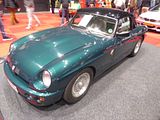
Unless you go back to the 1930s. when MG made a few high performance cars which had racing more in mind than road use, the only model to get anywhere supercar status that bears the famous roundel is the SV, and this was also represented here. This car came about after MG-Rover acquired Qvale of Italy. Taking the Qvale Mangusta as a base, a car which had been designed, but not quite made production, MG Rover allocated the project code X80 and set up a subsidiary company, MG X80 Ltd., to produce their new model. A big factor behind the project was that was seen as having the potential sales in the United States, as the Mangusta had already been homologated for the American market. The MG X80 was originally revealed as a concept car in 2001. However, the styling was considered too sedate, so when the production model, now renamed MG XPower SV, was eventually launched the following year, designer Peter Stevens had made the car’s styling more aggressive. The conversion from a clay model to a production car, including all requirements, was done in just 300 days by the Swedish company Caran. The production process was complex, partly caused by the use of carbon fibre to make the body panels. The basic body parts were made in the UK by SP Systems and then shipped to Belco Avia near Turin for assembly into body panels. These were then assembled into a complete body shell and fitted onto the box frame chassis and running gear and shipped to MG Rover’s Longbridge factory to be trimmed and finished. Several of the cars’ exterior and interior parts were borrowed from current and past Fiat models. The headlights, for example, were taken from a Punto Mk.2 and the rear lights borrowed from a Fiat Coupe. The goal had been to get a street price of under £100,000, and on launch, the base model came in well under that at £65,000, and even the uprated XPower SV-R model was priced at £83,000. Those were ambitious prices for a car bearing MG badges, though, so not surprisingly, sales were slow. It is understood that just 82 cars were produced excluding the 4 ‘XP’ pre-production prototypes. This included a few pre-production and show cars which were later dismantled, before production was stopped due to lack of sales. Most were sold to private owners, with the final ones being sold to customers in early 2008.
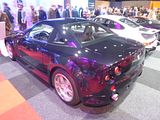
MINI
The Mini was marketed under BMC’s two main brand names, Austin and Morris, until 1969, when it became a marque in its own right. The Morris version was known to all as “the Mini” or the “Morris Mini-Minor”. This seems to have been a play on words: the Morris Minor was a larger, well known, and successful car that continued in production, and minor is Latin for “lesser”, so an abbreviation of the Latin word for “least” – minimus – was used for the new even smaller car. One name proposed for the almost identical Austin version was Austin Newmarket, but it was sold as the Austin Seven (sometimes written as SE7EN in early publicity material – with the ‘7’ using the letter V rotated anticlockwise so it approximated the number 7), which recalled the popular small Austin 7 of the 1920s and 1930s. Until 1962, the cars appeared in North America and France as the Austin 850 and Morris 850, and in Denmark as the Austin Partner (until 1964) and Morris Mascot (until 1981). It was introduced in Australia as Morris 850 only (not “Austin”), and then later as Morris Cooper and Morris Cooper S versions, as well. The Morris name Mini (Mini-Minor) was first used for Austin’s version by BMC in 1961 when the Austin Seven was rebranded as the Austin Mini, somewhat to the surprise of the Sharp’s Commercials car company (later known as Bond Cars), who had been using the name Minicar for their three-wheeled vehicles since 1949. However, legal action was somehow averted, and BMC used the name “Mini” thereafter. In 1964, the suspension of the cars was replaced by another Moulton design, the hydrolastic system. The new suspension gave a softer ride, but it also increased weight and production cost. In 1971, the original rubber suspension reappeared and was retained for the remaining life of the Mini. From October 1965, the option of the unique Automotive Products designed four-speed automatic transmission became available. Cars fitted with this became the Mini-Matic. Slow at the outset, Mark I sales strengthened across most of the model lines in the 1960s, and production totalled 1,190,000. Ford purchased a Mini and dismantled it to see if they could offer an alternative. Ford determined that the BMC must have been losing around £30 per car, so decided to produce a larger car – the Cortina, launched in 1962 – as its competitor in the budget market. BMC insisted that the way company overheads were shared out, the Mini always made money. Larger profits came from the popular De Luxe models and from optional extras such as seat belts, door mirrors, a heater, and a radio, which would be considered necessities on modern cars, as well as the various Cooper and Cooper S models. The Mini entered into popular culture in the 1960s with well-publicised purchases by film and music stars.

MITSUBISHI
Following the successful showing of the Mitsubishi HSR and Mitsubishi HSX concept cars at the 1989 Tokyo Motor Show, Mitsubishi developed a production car which they called the 3000 GTO as a technologically advanced 2+2 seater sports coupe to compete with the Honda NSX, Mazda RX-7, Nissan 300ZX, Skyline GT-R, Subaru SVX and the Toyota Supra. They resurrected the GTO name, last used in the mid 1970s and the top spec Galant Coupe model, and the car went on to serve as Mitsubishi’s flagship for the remainder of the decade. However, despite the cachet of the badge at home, it was marketed as the Mitsubishi 3000GT and as the Dodge Stealth outside Japan; the company was concerned that connoisseurs would object to the evocative nameplate from the highly regarded Ferrari 250 GTO and Pontiac GTO being used on a Japanese vehicle. However, regardless of its badge or eventual target market, every car was built on the same production line at Mitsubishi’s plant in Nagoya, Japan. Its introduction in Japan in 1990 was unfortunately timed, as it coincided with the softening of the Japanese economy, known as the “bubble economy” which had an effect on sales. The car was packed with technology and many of Mitsubishi’s contemporary performance-enhancing technologies, such as full-time four-wheel drive, four-wheel steering, active aerodynamics featuring automatically adjusting front and rear spoilers, sport/tour exhaust modes and electronically controlled suspension (ECS). These “Active Aerodynamics” were not used on the Dodge Stealth. Visually, both the GTO/3000GT and Stealth featured pop-up headlights and noticeable “caps” on the bonnet to accommodate the ECS controllers at the top of the strut turrets. However the rest of factory body kit differed in styling with their respective badges. Most notable are the Dodge signature cross-hairs on the Stealth front bumper fascia, Ferrari inspired gills on the 3000GT rocker panels, Crescent shaped spoiler on the Stealth commonly referred to as the “Banana Wing” and front Active Aero air dam on 3000GT VR4. A mildly revised second generation car appeared in 1994. As the price increased, Mitsubishi also steadily removed some of the or costly (and gimmicky) technology features, and towards the end of production the front end was revised to incorporate fixed rather than pop up headlights. The car was phased out in 1999 for all markets apart from Japan, where it ran for another year.


NASH-HEALEY
The Nash-Healey is a three-seat luxury sports car or grand tourer produced from 1951 to 1954. It was marketed by the Nash-Kelvinator conglomerate in North America as a halo car to promote sales of its Nash Motors division. The car resulted from a joint venture between Nash-Kelvinator and British automaker, the Donald Healey Motor Company. Nash supplied the drivetrain from their range-topping Ambassador model, and Healey provided the chassis and early bodies. One year after its introduction, the car was restyled by Pininfarina, and the final assembly was transferred to Italy. Some describe the Nash-Healey as the first sports car introduced in the U.S. by a major automaker after the Great Depression. Various Nash-Healeys, some modified road cars, and some purpose-built racers competed in several endurance racing events, most notably posting a third-place finish at the 1952 24 Hours of Le Mans. In December 1949, British engineer, rally driver, and automaker Donald Healey sailed for America aboard the RMS Queen Elizabeth ocean liner. He was going for a meeting with General Motors’ (GMs) Ed Cole, hoping to secure a supply of Cadillac’s new 331 cu in (5.4 L) V8 engine. Healey planned to use the engines in his company’s Healey Silverstone club racer. Two such Healey/Cadillac hybrids had already been built, one in the US by American sportsman Briggs Cunningham, and one in England by Healey’s own Donald Healey Motor Company; the Cadillac-engined X 4 prototype. While aboard ship, Healey encountered a man using an elaborate stereo camera system that intrigued him. The man was George W. Mason, president of Nash-Kelvinator. The two made an acquaintance based on their shared interest in photography. Hearing Healey’s plan and anticipating GM’s reply, Mason told Healey to contact him if the negotiations were unsuccessful. When GM turned Healey down due to their defense commitments, Healey contacted Mason, and development of the Nash-Healey started. As part of the arrangement between the companies, Nash paid off Healey’s £50,000 bank debt, which was to be repaid in assembled cars. A prototype was previewed at the Paris Motor Show in October 1950. The fate of this car is unknown. The Nash-Healey made its official debut in February of the following year at the 1951 Chicago Auto show. The car’s full name is the Nash-Healey Series 25. Some time after its release, the Chrysler Corporation purchased a Nash-Healey from a Detroit dealership, disassembled it, and submitted an analysis of it to the company executives. The 1951 Nash-Healey is called the first post-war sports car from a major American automaker, as it was released two years before the Chevrolet Corvette. This appellation excludes the limited volume Kurtis-Kraft and Muntz Jet, as well as the diminutive Crosley Hotshot, Super Hotshot, and Super Sport roadsters. Nash supplied Healey’s company with the powertrain components: the Ambassador’s inline six-cylinder OHV 3.85 L engine and three-speed manual transmission with Borg-Warner overdrive. Healey fitted a lighter, higher-compression aluminum cylinder head (in place of the cast-iron stock item) with twin 1.75-inch (44 mm) SU carburetors. This increased power from the stock 112 hp version to 125 hp. The chassis was a widened and reinforced Healey Silverstone box-section ladder-type steel frame. Independent front suspension, also Healey Silverstone, was by coil springs, trailing link, and an anti-roll bar. The rear suspension featured a Nash-supplied torque tube and live axle, replacing the Silverstone’s Riley Motor parts. Lateral location of the axle was handled by a Panhard rod. Healey designed the aluminum body, but it was outsourced. Panelcraft Sheet Metal of Birmingham fabricated the body. It incorporated a Nash grille, bumpers, and other trim. Healey was responsible for the car’s final assembly. The car had drum brakes all around. Wheels were steel, with full-diameter chrome hubcaps and 4-ply 6.40×15-inch whitewall tyres. The interior featured luxurious leather upholstery, foam rubber cushions, an adjustable steering wheel, and a cigarette lighter. Completed vehicles were shipped to the United States and marketed through the Nash dealership network. All 1951 Nash-Healeys were British-built. Bodies were crafted at Panelcraft Sheet Metal, and final assembly was completed at the Healey factory in Warwick. The 1952 through 1954 models were built in Italy by Pinin Farina.

NISSAN
The Nissan NX is a front wheel drive 2-door sports car and was, loosely, an evolution of the Nissan Pulsar NX/Nissan EXA sold from 1987 to 1990 and the Nissan Sunny Coupe lines of the 1970s and 1980s, merging the Nissan B13 and N14 lineages. The NX was released in Japan in 1990. The NX1600 was based on the standard 1.6-litre Sentra (engine code GA16DE), and the NX2000 was based on the 2.0 L SE-R model (engine code SR20DE). Most models were fitted with T-Tops, whilst the remainder were hardtops. Constructed in Japan, it was sold from 1991 to 1993 in the US (mainly competing with the Mazda MX-3, Isuzu Piazza, Toyota MR2, and Honda Civic Del Sol). It was produced for a few more years for other countries. Its body was designed at NDI (Nissan Design International) in San Diego under the direction of NDI President Jerry Hirshberg, Blue Studio Chief Designer Allan Flowers, and staff designers Bruce Campbell and Doug Wilson. The NX2000 model included some mechanical improvements over its SE-R sibling in the form of larger brakes and more aggressive tires on wider 6″ wheels (195/55VR-14 with 14×6″ wheels vs. the 185/60HR-14 with 14×5.5″ wheels and tires in the SE-R). The NX2000 brakes are a common aftermarket upgrade for B13 Sentra SE-Rs. The NX2000 also had a centre armrest, a larger two-core radiator, and slightly lower ride height compared to the SE-R. However, the T-top roof in the NX2000 along with the mechanical upgrades made it slightly heavier than the SE-R. The NX2000, with its light weight, stiff chassis, and limited-slip differential, was considered one of the best-handling front-wheel-drive cars of the time. In 1992, Road & Track magazine included the NX2000 in a test of the world’s best-handling cars against such competition as the Acura NSX, Porsche 911, Nissan 300ZX, Mazda Miata, and Lotus Elan. The cars were sold in Europe from spring 1991 but were very pricey (initially) and found few buyers.
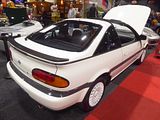
NSU
The NSU Prinz evolved into the somewhat larger bodied NSU Prinz 1000 (Typ 67a), introduced at the 1963 Frankfurt Motor Show. A sporting NSU 1000 TT (with a 1.1 litre engine) also appeared, which was later developed into the NSU (1200) TT and NSU TTS models. All had the same body with inline-four air-cooled OHC engines and were frequently driven as sports cars, but also as economical family cars as well. The mostly alloy engines were very lively, and highly reliable. The OHC arrangement was quite advanced for the time on a small family car as most home-grown cars were still using less efficient pushrod engines. The Prinz 1000 lost the “Prinz” part of the name in January 1967, becoming simply the NSU 1000 or 1000 C depending on the equipment. It has 40 PS DIN, while the 1200 TT has 65 PS DIN and the most potent TTS version has 70 PS DIN from only one litre. The 1000 received large oval headlights, while the sportier TT versions have twin round headlights mounted within the same frame. The first 1000 TT has 55 PS DIN and uses the engine first introduced in the larger NSU Typ 110. The NSU Prinz 1000 TT was built in 14,292 examples between 1965 and 1967, when it was replaced by the bigger engined TT. This, with a 1.2-liter engine, was built until July 1972 for a total of 49,327 examples. The TT can be recognized by its broad black stripe between its headlights. The TTS was built especially for competition, being successful in both hillclimbs and circuit racing. It has a front-mounted oil cooler and was built in 2,402 examples from February 1967 until July 1971. It was briefly referred to as the “Prinz 1000 TTS” when first introduced. There was also a competition model of the TTS available for sale, with 83 PS DIN. Production of the Typ 67a (NSU 1000) came to a halt in December 1972. In 1965, an even larger model was added, initially called Typ 110, and from 1967 on NSU 1200. It offered more space, so it was a better family car, but was not as sporty as the smaller models. Therefore, the NSU 1200TT used the 1200 cc engine of the 1200 in the smaller body of the NSU 1000.
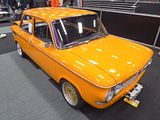

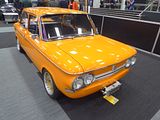
OPEL
The Opel Kadett was reintroduced by Opel in 1962, with deliveries beginning on 2 October, a little more than 22 years after the original model was discontinued in May 1940. Like the original Kadett, the new car (designated the “Kadett A”) was a small family car, although it was now available in 2-door saloon, 3-door Car-A-Van (estate) and coupé versions. In 1957 Opel Product Director Karl Stief was mandated by General Motors headquarters in Detroit to develop “the perfect Anti-Volkswagen” (“einen perfekten Anti-VW”). The development team was headed up by Stief, supported by Hans Mersheimer (car-body) and Werner K. Strobel (engine and running gear), under conditions of such secrecy that even now very little is known of the development history of the 1962 Kadett. It has been alleged that GM was trying to conceal a new technique of platform and design sharing between Opel and its British sister company Vauxhall, which released the strikingly similar Viva HA in 1963, a year after Opel introduced the Kadett. The two cars were later revealed to have shared the same wheelbase, floorpan and elements of their inner body structure, suggesting that the allegation was indeed true. Over the subsequent two decades Opel and Vauxhall’s ranges would rapidly converge as Vauxhall’s design independence from Opel was eroded to the point where by 1985, Vauxhall’s car range entirely consisted of rebadged Opel models. Opel had been Germany’s largest auto-producer in the 1930s, and in Wolfsburg the producers of the Kadett’s principal target did not disguise their concern at the prospect of Opel’s return to small car production. At the Volkswagen annual general meeting a few months before the launch of the Kadett, Volkswagen chairman Heinrich Nordhoff (who himself had been a senior manager with Opel in the 1930s and 1940s) went on record with a warning to shareholders that Opel (along with Ford Germany) were backed by a level of financial muscle on a scale unimaginable to any German company, and that it seemed that the two American transplants were now determined to use their financial strength to make aggressive inroads into the German auto-market at any price. A mark of General Motors’ confidence in their plans for the small car sector, and something that the Opel Kadett and the Vauxhall Viva had in common, was that the manufacturer built for each new model a completely new car plant in a region characterized by relatively high unemployment and the availability of a skilled workforce, but with no strong tradition of volume auto-making. The Vauxhall Viva was the first car built at Vauxhall’s Ellesmere Port plant while the Kadett A was the first product of Opel’s new purpose-built Bochum plant. Ellesmere Port and Bochum would effectively become sister plants, producing subsequent generations of Kadett as well as their Vauxhall badged sisters (the Chevette and Astra) for the next fifty years. The car later became known as the Kadett A. In addition to the standard saloon, from March 1963, the manufacturer offered an L (luxury model) and an estate (branded as the “Opel Kadett Car-A-Van”). In October 1963 Opel introduced a coupé version of the Kadett with which buyers could enjoy enhanced style at the expense of rear seat headroom. The new four-cylinder, oversquare one-litre water-cooled Opel OHV engine weighed only 96 kg and was the first all-new engine developed by Opel since before the war. The side-mounted camshaft was driven not through gear-cogs but using a single chain with a hydraulic tensioner, the valve train employing rocker-arms and light-weight hollow rods. The arrangement was low on weight and on friction, permitting engine speeds above 6,000 rpm. The pistons were formed from an aluminium-alloy and incorporated a bimetal expansion strip to ensure uniform thermal expansion. The three-bearing forged crankshaft was of more traditional construction. The carefully designed aluminium inlet manifold provided for efficient feed of the fuel-mixture to the cylinders and helped provide the engine with good fuel economy characteristics. The engine came with a choice from two power levels. For the standard 10N engine maximum output was listed as 40 PS at 5,000 rpm, and in October 1963 the high compression “1.0 S-Motor” (10S) was added, sharing the 993 cc capacity of the original power unit, but offering a maximum 48 PS of power at 5,400 rpm. The more powerful 10S engine also featured modifications to the inlet manifold, cylinders and camshaft along with a carburettor employing larger 36 mm (1.4 in) diameter than the 30 mm (1.2 in) used on the standard engine. This came with an 8.8:1 compression ratio whereas the 40 PS engine used a compression ratio of only 7.8:1. Higher compression ratios for performance versions of standard engines were a growing trend in West Germany in the 1960s, led by Opel and Ford, and made possible by the growing availability of higher octane “Super” grade fuel at filling stations. The care taken over the detailed design of the new engine was rewarded with a power unit which earned widespread respect in the industry and, at least with the Kadett A, tended to outlive the rest of the car in which it was fitted. In later incarnations both the 1.0 litre unit and an enlarged 1.2 litre version were still used in small Opels, including the first Opel Corsa (and Vauxhall Nova) well into the 1990s. Power was transmitted to the rear wheels via a single dry-plate clutch and a four-speed all-synchromesh gear box, controlled using a conventional floor mount gear lever. There were 200 mm (7.9 in) brake drums on all four wheels: braking operated via a single circuit hydraulic system. The Kadett featured a more modern design than the Volkswagen Beetle that then dominated the market for small family cars in West Germany and various surrounding countries. The Kadett offered more passenger space, more luggage capacity, and better visibility for the driver. Its water-cooled engine provided effective heating for the passenger compartment. However, by the mid-1970s the Kadett’s weakness was already apparent as the car’s bodywork was not well protected from corrosion. In addition to its West German home market, the Kadett A sold strongly in what were becoming the manufacturer’s traditional export strongholds (notably in Benelux, Scandinavia, Austria and Switzerland). Between February 1964 and the Autumn/Fall of 1965 the cars were also exported to the United States where they were sold through approximately 500 Buick dealers (Opels were not sold in Canada which instead received Vauxhall models to take advantage of Commonwealth tariff preferences). The same 993 cc engine was fitted and it is not clear whether it was differently tuned for America: horsepower ratings were differently computed in the US, following locally devised “SAE” rules: for American market purposes the maximum outputs for the engines were quoted as 46 hp and 54 hp. A total of 649,512 Kadett “A”s were built at the company’s new Bochum factory by the time it was replaced by the Kadett “B” in July 1965. 126,616 of the cars produced were Car-A-Van bodied estate models, while the remaining 522,896 comprised a small number of coupés and approximately half a million saloons.
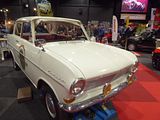

The Kadett D was introduced in the middle of August 1979, with deliveries on the home market beginning early in September 1979. In November 1979, the car went on sale in the United Kingdom, some five months before the Vauxhall Astra Mark 1, the British version, was launched in March 1980. The cars were designed as three- or five-door hatchbacks and estates or estates. There were also two- and four-door saloons featuring separate boots/trunks, which shared the silhouettes of the hatchbacks: in the United Kingdom, the saloon versions were soon withdrawn, until the 1986 launch of the MKII-based Belmont. For the first time since 1965, there was no coupé-bodied Kadett in the range: the previous Kadett C coupé was indirectly replaced by the three-door 1.3 SR sports model. Technologically, the Kadett D was part of a major investment for Opel (and General Motors as a whole) in a new front-wheel drive architecture, with an all-new family of engines and transmissions which would later be applied in the larger Ascona C and the smaller Corsa A in 1981, and 1982, respectively. It was also the first application of the Family I engine, with a single overhead camshaft, aluminium-alloy cylinder head, hydraulic valve lifters, with capacities of 1297 cc (producing 60 PS and 75 PS) and had a transaxle design that allowed the clutch to be replaced without removing the transmission unit. A carry-over 1196 cc Opel OHV engine from previous generations of the Kadett producing 55 PS (40 kW) and a top speed of 140 km/h (87 mph) was also offered on entry-level models from launch. The larger Family II engine debuted in 1600 cc form and was offered after Frankfurt 1981, followed by an 1800 cc version introduced for the Kadett GSE/Astra GTE model. The Kadett D was also equipped with a 1600 cc diesel engine, an option which was first presented at the Brussels Motor Show in 1982. Another frugal model, mostly sold in Italy, was the 1.0 liter model with 50 PS. This range of engines was also used for later models of the Corsa/Nova, and the mid-sized Cavalier/Ascona. From May 1981, the 1.3 was also available with a three-speed automatic. The automatic was made available to the diesel in September 1982. In the United Kingdom, Opels and Vauxhalls were initially sold through separate marketing operations, with overlapping lineups that competed directly with each other. By 1982 this anomaly had been sorted out and the Opel lineup was limited to the well-equipped five-door Berlina (1.3S or 1.6S) and the sporty 1.6 SR, leaving most of the market to the Vauxhall-badged cars. One interesting version which first appeared in mid-1982 was the Kadett Pirsch, (for deer stalking, a stealthy form of hunting). In non-German-speaking countries it was generally marketed as the “Kadett Off Road.” This was an estate car with rustic trim, fitted with a limited-slip differential, reinforced suspension and more suitable tires, increased ground clearance, a skid plate, and shortened front fenders. In Sweden, a special postal Kadett (“Opel Kadett Post”) was offered, fitted with a high roof (necessitating a unique and much taller windshield) and a sliding right-hand door, RHD, and the automatic transmission. This version was converted by Karosseriefabrik Voll (in German) in Würzburg, Germany. Voll also made a postal version of the later Kadett E.


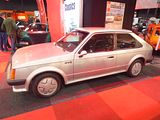
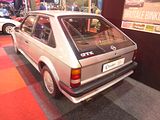
PACKARD
This is a recreation of a Packard Speed Eight. The car is a recreation built by Carrosseriebouw Jansen. It features a straight-eight engine configuration. The original Packard straight-eight engines were known for their impact on the mass-produced American market and were among the last of their kind.

PANTHER
Styled to evoke the Jaguar SS100 and sold from 1972 through 1981, it used mechanicals from the Jaguar XJ, including its 5.3 L V12 engine. It was also offered with Jaguar’s 3.8 L and 4.2 L XK engines. The J.72 was a success for the small company, with its Connolly coachwork beating Rolls-Royce at the 1973 London Motor Show. The car was purchased by a number of celebrities. A total of 368 were produced.

The De Ville is a neo-classic luxury vehicle which was produced by Panther Westwinds, from 1974 to 1985. The De Ville was conceived by Robert Jankel to appeal to the taste of nouveau riche customers, including singer Elton John and actor Oliver Reed. With a wheelbase of 142 inches (3,600 mm), the tubular-framed De Ville used a straight-six engine or a V12 engine from Jaguar Cars. The flowing wing lines and big headlights of the De Ville were styled to imitate the Bugatti Royale. The cockpit of the De Ville was modern, without the exterior’s pretense of pre-war styling. The Panther De Ville was equipped with Jaguar suspension, power steering and automatic transmission, so it was an easy car to drive and quite quick, although poor aerodynamics tended to keep the top speed low. Interiors were lavish and often featured TV sets and drinks bars. The doors of the De Ville were from the BMC 1800 family car. About 60 De Villes were hand-built, including eleven two-door convertibles (for many years Britain’s most expensive listed production car), and one pink and gold six-door limousine.

PEUGEOT
The replacement for the 403 was the 404 Berline, which was built from 1960 to 1975, though the commercial pick-up versions continued until 1988, and under licence, it was manufactured in various African countries until 1991. Styled by Pininfarina, the 404 was offered initially as a saloon, estate, and pickup. A convertible was added in 1962, and a coupé in 1963. The 404 was fitted with a 1.6 litre petrol engine, with either a Solex carburetor or Kugelfischer mechanical fuel injection or a 1.9 litre diesel engine available as options. Introduced at the Paris Motor Show as an option was the inclusion of a 3-speed ZF automatic transmission, similar to the unit already offered on certain BMW models, as an alternative to the standard column-mounted manual unit. Popular as a taxicab, the 404 enjoyed a reputation for durability and value. Peugeot’s French production run of 1,847,568 404s ended in 1975. A total of 2,885,374 units had been produced worldwide at the end of production.
The 504 was noted for its robust body structure, long suspension travel, and torque tube drive shaft – enclosed in a rigid tube attached at each end to the gearbox housing and differential casing, relieving drive train torque reactions. The 504 ultimately achieved widespread popularity in far-flung rough-terrain countries – including Brazil, Argentina, Australia, Ivory Coast, Ghana, Cameroon, Benin, Kenya and Nigeria. More than three million 504s were manufactured in its European production, with production continuing globally under various licensing arrangements – including 27,000 assembled in Kenya and 425,000 assembled in Nigeria, using knock-down kits – with production extending into 2006. Marketed as Peugeot’s flagship saloon car, the 504 made its public debut on 12 September 1968 at the Paris Salon. The press launch which had been scheduled for June 1968 was at the last minute deferred by three months, and production got off to a similarly delayed start because of the political and industrial disruption which exploded across France in May 1968. The 504 was a sunroof-equipped four-door saloon, introduced with a carbureted 1,796 cc four-cylinder petrol engine 79 bhp with optional fuel injection. A column-mounted four-speed manual transmission was standard; a three-speed ZF 3HP12 automatic available as an upgrade. The 504 was European Car of the Year in 1969, praised for its styling, quality, chassis, ride, visibility, strong engine and refinement. 1969 was also when the 504 reached the Australian market. The 504 Injection two-door coupé and two-door cabriolet were introduced at the Salon de Geneva in March 1969. The engine produced the same 79 bhp as in the fuel-injected saloon, but the final drive ratio was slightly revised to give a slightly higher road speed of 20.6 mph (33.2 km/h) at 1,000 rpm. The 504 received a new four-cylinder 1971 cc engine, rated at 96 bhp (carburated) and 104 bhp (fuel-injected), and a four-cylinder 2112 cc diesel engine rated at 65 bhp. The 1796 cc engine remained available. In September 1970 an estate (“Break”) was added, featuring a higher rear roof, lengthened wheel base, and solid rear axle with four coil springs. It was joined by the 7-seat “Familiale”, which had all its occupants facing forward in three rows of seats. In April 1973, because of the oil crisis Peugeot presented the 504 L. It featured a coil sprung live rear axle and a smaller 1796 cc engine rated at 79 bhp (81 bhp for Automatic). The different rear axle required somewhat more space; this required some alterations to the floor pan which meant marginally less boot space and rear headroom. At the 1974 October Motor Show Peugeot presented a more powerful engine for the 504 coupé and cabriolet, now fitted with a 2664 cc V6 unit developed in collaboration with Volvo and Renault. This was the same engine that would be used for the 604 berline, to be introduced at Geneva five months later, in March 1975. The engine incorporated various innovative features such as an aluminium cylinder block, and a fuel-feed system that employed carburettors of differing type, one (type 34 TBIA) featuring a single chamber controlled directly according to the movement of the accelerator pedal, and the second being a twin chamber carburettor (type 35 CEEI) designed to operate simultaneously with the first, using a pneumatic linkage. Maximum output for the 504 coupé and cabriolet fitted with this new V6 engine was given as 136 bhp, supporting a top speed of 186 km/h (116 mph). During 1975, the first full year of production, 2643 of these six-cylinder 504 coupés and cabriolet were produced, which was considered a respectable number, although dwarfed by the 236,733 four-cylinder 504 “berlines” (saloons/sedans) and “breaks” (estates/station wagons) produced by Peugeot in France in the same year. Following the launch of the six-cylinder cars, the four-cylinder versions of the coupé and cabriolet 504s were delisted: they returned to the showrooms in 1978 in response, it was reported, to customer demand. At the Paris Motor Show of October 1976 the option of an enlarged diesel engine was introduced. The stroke of 83 mm remained the same as that of the existing 2112 cc diesel motor, but for the larger engine the bore was increased to 94 mm, giving an overall 2304 cc along with an increase in claimed power output from 65 to 70 bhp. The 2112 cc diesel engine would also find its way into the Ford Granada since Ford did not at the time produce a sufficient volume of diesel sedans in this class to justify the development of their own diesel engine. Peugeot 504 production in Europe was pruned back in 1979 with the launch of the Peugeot 505, although the 504 Pickup was introduced as a replacement for the 404 Pickup for the 1980 model year. The last European-made example rolled off the production line in 1983, although the pick-up version continued in production, and was available in Europe until 1993. More than three million 504 passenger cars were produced in Europe. The 505 shared most of the Peugeot 504 mechanical parts, similarly to the Peugeot 604 and Talbot Tagora. As of December 2015, 197 examples of the Peugeot 504 are still in use in Britain.

Looking very different to the saloon models, the 504 Injection two-door coupé and two-door cabriolet were introduced at the Salon de Geneva in March 1969. The engine produced the same 96 bhp of output as in the fuel-injected saloon, but the final drive ratio was slightly revised to give a slightly higher road speed of 20.6 mph (33.2 km/h) at 1,000 rpm. Unlike the saloons, the coupé and cabriolet received a floor shifter. At the 1974 October Motor Show Peugeot presented a more powerful engine for the 504 coupé and cabriolet, now fitted with a “PRV” 2664 cc V6 unit developed in collaboration with Renault and Volvo. This was the same engine that would be used for the 604 berline, to be introduced at Geneva five months later, in March 1975. The engine incorporated various innovative features such as an aluminium cylinder block, and a fuel-feed system that employed carburettors of differing type, one (type 34 TBIA) featuring a single chamber controlled directly according to the movement of the accelerator pedal, and the second being a twin chamber carburettor (type 35 CEEI) designed to operate simultaneously with the first, using a pneumatic linkage. Maximum output for the 504 coupé and cabriolet fitted with this new V6 engine was given as 136 PS/134 bhp), supporting a top speed of 186 km/h (116 mph). During 1975, the first full year of production, 2643 of these six-cylinder 504 coupés and cabriolet were produced, which was considered a respectable number although dwarfed by the 236,733 four-cylinder 504 berlines (saloons/sedans) and breaks (estates/station wagons) produced by Peugeot in France in the same year. Following the launch of the six-cylinder cars, the four-cylinder versions of the coupé and cabriolet 504s were delisted: they returned to the showrooms in 1978 in response, it was reported, to customer demand, a response to slow sales of the thirsty V6. The V6 coupé gained a five-speed manual transmission and fuel injection for 144 PS/142 bhp, while the V6 cabriolet was discontinued after only 970 examples had been built in three years.


Next in the 05 generation was the 505, which had a long production life, as it was built from 1979 to 1992 in Sochaux, as well as being manufactured in various other countries including Argentina (by Sevel from 1981 to 1995), China, Indonesia and Nigeria. 1,351,254 505s were produced between 1978 and 1999 with 1,116,868 of these being saloons, but there are very few of them left in the UK, or even Europe (Africa is a different matter, of course!). Officially unveiled on 16 May 1979, the 505 was the replacement for the 504 with which it shared many of its underpinnings. It was originally available only as a saloon. There was a long wait for the estate, which when it did come included an eight-passenger Familiale version, both being seen at the 1982 Geneva Motor Show. The 505’s styling, a collaboration between Pininfarina and Peugeot’s internal styling department, is very similar to that of its smaller brother the 305. The original interior was designed by Paul Bracq, generally more well known for his work for Mercedes-Benz and BMW. The UK launch came in October 1979. The 505 was the last of Peugeot’s rear-wheel drive cars, with a front engine, mounted longitudinally. The suspension system included MacPherson struts and coil springs at front and semi-trailing arms with coil springs at rear, with a body-mounted rear differential and four constant-velocity joints. Station wagons (and most sedans built in Argentina) had instead a live-axle rear suspension, with Panhard rod and coil springs. Stabiliser bars were universal at front but model-dependent at rear. The car used disc brakes at the front, and either disc or drum brakes at the rear, depending on the model. The steering was a rack and pinion system, which was power assisted on most models. The first cars came with the familiar 2 litre carburettor and the Douvrin injected petrol engines and a 2.1 litre diesel. This latter was gradually upgraded to larger and more powerful units and a GTi model, the first Peugeot to bear the name was launched in 1984. Later Peugeot would add a Turbo 4 cylinder unit and the 2.7 litre Douvrin V6 engine, to give the car a more luxurious feel which it needed when it took over from the 604 as the marque’s flagship. The Break (Estate) and Familiale versions were quite different from saloons. The wheelbase was also longer, to help make it one of the most spacious in the market, at 2,900 mm (114 in). This was, not coincidentally, the same exact wheelbase as had been used on both the 404 and 504 estate derivatives. The Familiale (family estate), with its third row of bench seats (giving a total of eight forward-facing seats), was popular with larger families and as a taxi. The two rows of rear seats could be folded to give a completely flat load area, with 1.94 cubic metres of load capacity. The total load carrying capacity is 590 kg (1,301 lb). When released, it was hailed as a luxury touring wagon. The Familiale was marketed as the “SW8” in the United States, for “station wagon, eight seats.” The 505 was praised by contemporary journalists for its ride and handling, especially on rough and unmade roads; perhaps one reason for its popularity in less developed countries; – “Remember that the 505´s predecessor, the 504, had an outstanding ride. It took a British-market model on a hard charging drive across the green lanes of the Chilterns. The impacts were well suppressed and the car veritably floated over the undulations and potholes. I concluded that the 505 is as good as the 504 (but no better).” The 505 also had good ground clearance; if it wasn’t enough though, Dangel offered a taller four-wheel drive version of the 505 estate equipped with either the intercooled turbodiesel 110 hp engine or the 130 hp 2.2 L petrol engine. The four-wheel drive 505 also had shorter gear ratios. The interior styling was viewed positively in contemporary reviews: “Having settled into the 505’s neat cockpit one notices how handsomely styled it all would appear to be. The tweed seats and brown trim look smart and less confrontational than offerings from a certain other French marque.” But the ergonomics were criticised too: “The ashtray was competitively sized but is placed directly behind the gear stick. For British market cars, this will be a constant nuisance while our continental cousins will consider the placement quite logical and natural.” The range was given a facelift, including an all new interior, in 1986, but European Peugeot 505 production began to wind down following the launch of the smaller Peugeot 405 in 1987. Saloon production came to a halt in 1989, when Peugeot launched its new flagship 605 saloon, while the estate remained in production until 1992 – although plans for an estate version of the 605 never materialised. The 605 was in production for a decade but never matched the popularity of the 505. In some countries such as France and Germany, the 505 estate was used as an ambulance, a funeral car, police car, military vehicle and as a road maintenance vehicle. There were prototypes of 505 coupés and 505 trucks, and in France many people have modified 505s into pickup trucks themselves.


PIAGGIO
The Piaggio Ape (ape being Italian for ‘bee’), initially marketed as VespaCar or TriVespa, is a three-wheeled light commercial vehicle, manufactured and marketed by Piaggio as an adaptation of the company’s Vespa scooter (vespa being Italian for ‘wasp’). It has been in continuous production since its 1948 introduction and is offered in numerous body configurations, serving a range of utilitarian functions. After World War II, many Italians could not afford personal transportation. In 1947, aircraft designer Corradino D’Ascanio conceived a light and simple three-wheeled commercial vehicle, which found favor with Piaggio. The first model was a cabless adaptation of the company’s two-wheel scooter, the Vespa, adding two rear wheels and a flat utility bed over the rear axle. Initial models featured 50 cc, 125 cc or 150 cc engines and, later, a 175 cc engine. By the time of the 1964 Ape D, a cab was added to protect the driver from the elements. With handlebar steering (a steering wheel became a later innovation), the original Ape was a single-seater that could provisionally accommodate two passengers of modest size. A door was provided on each side, to facilitate entry and exit. Performance was modest, suited to light delivery, with adequate torque for hills and a low top speed. On larger roads, Apes could be driven close to the curb to allow other vehicles to pass. The Ape has been marketed in various configurations, including as vans and pickups for load carrying (popular with postal administration in some countries) and as an autorickshaw. More recently Piaggio has offered models such as the Ape Cross Country and the Ape Web aimed at the youth market. The Ape is also commonly used as a promotion tool, with advertising signboards mounted in the load bay. The Ape is common in Italy where its compact size allows it to negotiate narrow streets, park easily, and serve as an impromptu market stall. Most Apes are produced in India by Piaggio India. In India, the Ape is most commonly found in the form of an autorickshaw. A relatively small number of Apes were still made in Italy, but on 16 October 2013, Piaggio announced that Italian production of the Ape would end and construction would move entirely to India

PORSCHE
The 356 was created by Ferdinand “Ferry” Porsche (son of Dr. Ing. Ferdinand Porsche, founder of the German company), who founded the Austrian company with his sister, Louise. Like its cousin, the Volkswagen Beetle (which Ferdinand Porsche Senior had designed), the 356 was a four-cylinder, air-cooled, rear-engine, rear-wheel-drive car utilising unitised pan and body construction. The chassis was a completely new design as was the 356’s body which was designed by Porsche employee Erwin Komenda, while certain mechanical components including the engine case and some suspension components were based on and initially sourced from Volkswagen. Ferry Porsche described the thinking behind the development of the 356 in an interview with the editor of Panorama, the PCA magazine, in September 1972. “….I had always driven very speedy cars. I had an Alfa Romeo, also a BMW and others. By the end of the war I had a Volkswagen Cabriolet with a supercharged engine and that was the basic idea. I saw that if you had enough power in a small car it is nicer to drive than if you have a big car which is also overpowered. And it is more fun. On this basic idea we started the first Porsche prototype. To make the car lighter, to have an engine with more horsepower…that was the first two seater that we built in Carinthia (Gmünd)”. The first 356 was road certified in Austria on June 8, 1948, and was entered in a race in Innsbruck where it won its class. Porsche re-engineered and refined the car with a focus on performance. Fewer and fewer parts were shared between Volkswagen and Porsche as the ’50’s progressed. The early 356 automobile bodies produced at Gmünd were handcrafted in aluminium, but when production moved to Zuffenhausen, Germany in 1950, models produced there were steel-bodied. Looking back, the aluminium bodied cars from that very small company are what we now would refer to as prototypes. Porsche contracted with Reutter to build the steel bodies and eventually bought the Reutter company in 1963. The Reutter company retained the seat manufacturing part of the business and changed its name to Recaro. Little noticed at its inception, mostly by a small number of auto racing enthusiasts, the first 356s sold primarily in Austria and Germany. It took Porsche two years, starting with the first prototype in 1948, to manufacture the first 50 automobiles. By the early 1950s the 356 had gained some renown among enthusiasts on both sides of the Atlantic for its aerodynamics, handling, and excellent build quality. The class win at Le Mans in 1951 was clearly a factor. It was always common for owners to race the car as well as drive them on the streets. They introduced the four-cam racing “Carrera” engine, a totally new design and unique to Porsche sports cars, in late 1954. Increasing success with its racing and road cars brought Porsche orders for over 10,000 units in 1964, and by the time 356 production ended in 1965 approximately 76,000 had been produced. The 356 was built in four distinct series, the original (“pre-A”), followed by the 356 A, 356 B, and then finally the 356 C. To distinguish among the major revisions of the model, 356’s are generally classified into a few major groups. 356 coupés and “cabriolets” (soft-top) built through 1955 are readily identifiable by their split (1948 to 1952) or bent (centre-creased, 1953 to 1955) windscreens. In late 1955 the 356 A appeared, with a curved windshield. The A was the first road going Porsche to offer the Carrera 4 cam engine as an option. In late 1959 the T5 356 B appeared; followed by the redesigned T6 series 356 B in 1962. The final version was the 356 C, little changed from the late T6 B cars but with disc brakes to replace the drums.





The 718 was a development of the successful Porsche 550A with improvements being made to the body work and suspension. The car is a RennSport build with a wheelbase shorter (German ‘Kurz’) than typical of predecessors of the era and this led to the car being referred to as the RSK. It had a mid-engined layout and used the 142 hp 1.5-litre Type 547/3 quad-cam engine introduced in the 550A. The car made its racing debut at the 1957 24 Hours of Le Mans driven by Umberto Maglioli and Edgar Barth. The car failed to finish the race due to an accident. In 1958, the car finished first in class and third overall at Le Mans guided by Jean Behra and Hans Herrmann. Jean Behra also brought one of the cars home second at the Targa Florio. In 1959, the car, driven by Edgar Barth and Wolfgang Seidel, claimed overall victory at the Targa Florio. A 718 also won the European Hill Climb Championship in both 1958 and 1959. In 1961 Masten Gregory and Bob Holbert piloted a 718/4 RS Spyder to a class win at Le Mans. Initially a two-seater 1.5-litre sports car, the 718 was adapted to compete in a number of different formulas and also evolved due to regulation changes. For the 1960 season the FIA made changes to the regulation regarding the windscreen and cockpit size. These rules changes together with a larger (1.6-litre) Type 547/3 engine, developing 160 hp and a new double wishbone rear suspension brought about the RS 60 model. The RS 60 brought Porsche victory at the 1960 12 Hours of Sebring with a car driven by Hans Herrmann and Olivier Gendebien. 1960 also saw Porsche win the Targa Florio with Hans Herrmann being joined on the winner podium by Jo Bonnier and Graham Hill. The RS 60 also ensured that Porsche successfully defended their European Hill Climb Championship for the third year in a row. For 1961 the model name was changed to “RS 61” although it was almost identical to the RS 60. An RS 61 won the European Hill Climb Championship. A two-litre version, the W-RS was developed in 1961. Initially fitted with a 4-cylinder engine, the car was later fitted with an enlarged flat-8 air-cooled engine from the Porsche 804 Formula One car which was developed to produce 240 hp. A W-RS finished 8th at Le Mans in 1963. The W-RS continued Porsche’s success in the European Hill Climb Championship with Edgar Barth claiming the title in 1963. Porsche would go on to win a European Hill Climb Championship every year until 1982, a total of 42 titles. The W-RS continued racing until 1964 when it was replaced by the 904.

The 911 traces its roots to sketches drawn by Ferdinand “Butzi” Porsche in 1959. The Porsche 911 was developed as a more powerful, larger and a more comfortable replacement for the 356, the company’s first model. The new car made its public debut at the 1963 Frankfurt Motor Show. The car was developed with the proof-of-concept twin-fan Type 745 flat-six engine, but the car presented at the auto show had a non-operational mockup of the single-fan 901 engine, receiving a working unit in February 1964. It originally was designated as the “Porsche 901” (901 being its internal project number). A total of 82 cars were built as which were badges as 901s. However, French automobile manufacturer Peugeot protested on the grounds that in France it had exclusive rights to car names formed by three numbers with a zero in the middle. Instead of selling the new model with a different name in France, Porsche changed the name to 911. Internally, the cars’ part numbers carried on the prefix 901 for years. Production began in September 1964, with the first 911s exported to the US in February 1965. The first models of the 911 had a rear-mounted 130 hp Type 901/01 flat-6 engine, in the “boxer” configuration like the 356, the engine is air-cooled and displaces 1,991 cc as compared to the 356’s four-cylinder, 1,582 cc unit. The car had four seats although the rear seats were small, thus it is usually called a 2+2 rather than a four-seater (the 356 was also a 2+2). A four or five-speed “Type 901” manual transmission was available. The styling was largely penned by Ferdinand “Butzi” Porsche, son of Ferdinand “Ferry” Porsche. Butzi Porsche initially came up with a notchback design with proper space for seating two rear passengers but Ferry Porsche insisted that the 356’s successor was to use its fastback styling. 7 prototypes were built based on Butzi Porsche’s original design and were internally called the Porsche 754 T7. Erwin Komenda, the leader of the Porsche car body construction department who initially objected, was also involved later in the design. In 1966, Porsche introduced the more powerful 911S with Type 901/02 engine having a power output of 160 PS. Forged aluminium alloy wheels from Fuchsfelge, with a 5-spoke design, were offered for the first time. In motorsport at the same time, the engine was developed into the Type 901/20 and was installed in the mid-engine 904 and 906 with an increased power output of 210 PS, as well as fuel injected Type 901/21 installed in later variants of the 906 and 910 with a power output of 220 PS. In August 1967, the A series went into production with dual brake circuits and widened (5.5J-15) wheels still fitted with Pirelli Cinturato 165HR15 CA67 tyres. and the previously standard gasoline-burning heater became optional. The Targa version was introduced. The Targa had a stainless steel-clad roll bar, as automakers believed that proposed rollover safety requirements by the US National Highway Traffic Safety Administration (NHTSA) would make it difficult for fully open convertibles to meet regulations for sale in the US, an important market for the 911. The name “Targa” came from the Targa Florio sports car road race in Sicily, Italy in which Porsche had several victories until 1973. The last win in the subsequently discontinued event was scored with a 911 Carrera RS against prototypes entered by Ferrari and Alfa Romeo. The road going Targa was equipped with a removable roof panel and a removable plastic rear window (although a fixed glass version was offered from 1968). The 110 PS 911T was also launched in 1967 with Type 901/03 engine. The 130 PS model was renamed the 911L with Type 901/06 engine and ventilated front disc brakes. The brakes had been introduced on the previous 911S. The 911R with 901/22 engine had a limited production (20 in all), as this was a lightweight racing version with thin fibreglass reinforced plastic doors, a magnesium crankcase, twin overhead camshafts, and a power output of 210 PS. A clutchless semi-automatic Sportomatic model, composed of a torque converter, an automatic clutch, and the four-speed transmission was added in Autumn 1967. It was cancelled after the 1980 model year partly because of the elimination of a forward gear to make it a three-speed. The B series went into production in August 1968, replacing the 911L model with 911E with fuel injection. It remained in production until July 1969. The 911E gained 185/70VR15 Pirelli Cinturato CN36.and 6J-15 wheels. The C series was introduced in August 1969 with an enlarged 2.2-litre engine. The wheelbase for all 911 and 912 models was increased from 2,211–2,268 mm (87.0–89.3 in), to help as a remedy to the car’s nervous handling at the limit. The overall length of the car did not change, but the rear wheels were relocated further back. Fuel injection arrived for the 911S (901/10 engine) and for a new middle model, 911E (901/09 engine). The D series was produced from Aug. 1970 to July 1971. The 2.2-litre 911E (C and D series) had lower power output of the 911/01 engine (155 PS) compared to the 911S’s Type 911/02 (180 PS, but 911E was quicker in acceleration up to 160 km/h. The E series for 1972–1973 model years (August 1971 to July 1972 production) consisted of the same models, but with a new, larger 2,341 cc engine. This is known as the “2.4 L” engine, despite its displacement being closer to 2.3 litres. The 911E (Type 911/52 engine) and 911S (Type 911/53) used Bosch mechanical fuel injection (MFI) in all markets. For 1972 the 911T (Type 911/57) was carbureted, except in the US and some Asian markets where the 911T also came with (MFI) mechanical fuel injection (Type 911/51 engine) with power increase over European models (130 hp) to 140 hp commonly known as a 911T/E. With power and torque increase, the 2.4-litre cars also got a newer, stronger transmission, identified by its Porsche type number 915. Derived from the transmission in the 908 race car, the 915 did away with the 901 transmission’s “dog-leg” style first gear arrangement, opting for a traditional H pattern with first gear up to the left, second gear underneath first, etc. The E series had the unusual oil filler behind the right side door, with the dry sump oil tank relocated from behind the right rear wheel to the front of it in an attempt to move the centre of gravity slightly forward for better handling. An extra oil filler/inspection flap was located on the rear wing, for this reason it became known as an “Oil Klapper”, “Ölklappe” or “Vierte Tür (4th door)”. The F series (August 1972 to July 1973 production) moved the oil tank back to the original behind-the-wheel location. This change was in response to complaints that gas-station attendants often filled gasoline into the oil tank. In January 1973, US 911Ts were switched to the new K-Jetronic CIS (Continuous Fuel Injection) system from Bosch on Type 911/91 engine. 911S models also gained a small spoiler under the front bumper to improve high-speed stability. The cars weighed 1,050 kg (2,310 lb). The 911 ST was produced in small numbers for racing (the production run for the ST lasted from 1970 to 1971). The cars were available with engines of either 1,987 cc or 2,404 cc, having a power output of 270 PS at 8,000 rpm. Weight was down to 960 kg (2,120 lb). The cars had success at the Daytona 6 Hours, the Sebring 12 Hours, the 1000 km Nürburgring, and the Targa Florio. The G Series cars, with revised bodies and larger impact-absorbing bumpers arrived in the autumn of 1973 and would continue in production with few visual changes but plenty of mechanical ones for a further 16 years.


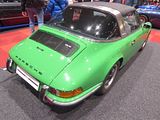

The 911 continued to evolve throughout the 1960s and early 1970s, though changes initially were quite small. The SC appeared in the autumn of 1977, proving that any earlier plans there had been to replace the car with the front engined 924 and 928 had been shelved. The SC followed on from the Carrera 3.0 of 1967 and 1977. It had the same 3 litre engine, with a lower compression ratio and detuned to provide 180 PS . The “SC” designation was reintroduced by Porsche for the first time since the 356 SC. No Carrera versions were produced though the 930 Turbo remained at the top of the range. Porsche’s engineers felt that the weight of the extra luxury, safety and emissions equipment on these cars was blunting performance compared to the earlier, lighter cars with the same power output, so in non-US cars, power was increased to 188 PS for 1980, then finally to 204 PS. However, cars sold in the US market retained their lower-compression 180 PS engines throughout. This enabled them to be run on lower-octane fuel. In model year 1980, Porsche offered a Weissach special edition version of the 911 SC, named after the town in Germany where Porsche has their research centre. Designated M439, it was offered in two colours with the turbo whale tail & front chin spoiler, body colour-matched Fuchs alloy wheels and other convenience features as standard. 408 cars were built for North America. In 1982, a Ferry Porsche Edition was made and a total of 200 cars were sold with this cosmetic package. SCs sold in the UK could be specified with the Sport Group Package (UK) which added stiffer suspension, the rear spoiler, front rubber lip and black Fuchs wheels. In 1981 a Cabriolet concept car was shown at the Frankfurt Motor Show. Not only was the car a true convertible, but it also featured four-wheel drive, although this was dropped in the production version. The first 911 Cabriolet debuted in late 1982, as a 1983 model. This was Porsche’s first cabriolet since the 356 of the mid-1960s. It proved very popular with 4,214 sold in its introductory year, despite its premium price relative to the open-top targa. Cabriolet versions of the 911 have been offered ever since. 911 SC sales totalled 58,914 cars before the next iteration, the 3.2 Carrera, which was introduced for the 1984 model year. Coupe models outsold the Targa topped cars by a big margin.

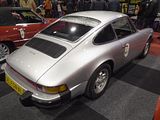

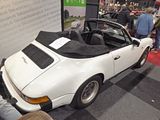

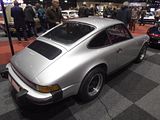
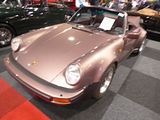


The 911 Speedster (option M503), a low-roof version of the Cabriolet which was evocative of the 356 Speedster of the 1950s, was produced in limited numbers (2,104 units) starting in January 1989 until July 1989 as both a narrow body car and a Turbo-look. The narrow version production was 171 units. The Speedster started as a design under Helmuth Bott [de] in 1983 but was not manufactured until six years later. It was a two-seat convertible that featured a low swept windshield
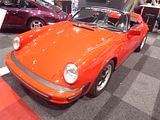
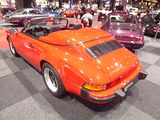

It was only really with the launch in 1989 of the 964 that a truly “new” model would appear. Designed by Benjamin Dimson in 1986, it featured significant styling revisions over previous 911 models, most prominently the more integrated bumpers. The 964 was considered to be 85% new as compared to its predecessor. The first 964s available in 1989 were all wheel drive equipped “Carrera 4” models; Porsche added the rear wheel drive Carrera 2 variant to the range in 1990. Both variants were available as a coupe, Targa or Cabriolet. The 964 Carrera was the last generation sold with the traditional removable Targa roof until the 2011 991. A new naturally aspirated engine called the M64 was used for 964 models, with a flat-6 displacement of 3.6 litres. Porsche substantially revised the suspension, replacing torsion bars with coil springs and shock absorbers. Power steering and ABS brakes were added to the 911 for the first time; both were standard. The exterior bumpers and fog lamps became flush with the car for better aerodynamics. A new electric rear spoiler raised at speeds above 50 mph and lowered down flush with the rear engine lid at lower speeds. A revised interior featured standard dual airbags beginning in 1990 for all North American production cars. A new automatic climate control system provided improved heating and cooling. Revised instrumentation housed a large set of warning lights that were tied into the car’s central warning system, alerting the driver to a possible problem or malfunction.
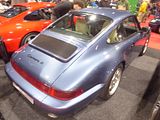
Replacing the 964, the 993 models were first seen in October 1993, with production starting a few weeks later. Its arrival marked the end of air-cooled 911 models. The 993 was much improved over, and quite different from its predecessor. According to Porsche, every part of the car was designed from the ground up, including the engine and only 20% of its parts were carried over from the previous generation. Porsche refers to the 993 as “a significant advance, not just from a technical, but also a visual perspective.” Porsche’s engineers devised a new light-alloy subframe with coil and wishbone suspension (an all new multi-link system), putting behind the previous lift-off oversteer and making significant progress with the engine and handling, creating a more civilised car overall providing an improved driving experience. The 993 was also the first 911 to receive a six speed transmission. The 993 had several variants, as its predecessors, varying in body style, engines, drivetrains and included equipment. Power was increased by the addition of the VarioRam system, which added additional power, particularly in the mid-ranges, and also resulted in more throttle noise at higher revs; as a consequence, resulted in a 15% increase in power over its predecessor. The external design of the Porsche 993, penned by English designer Tony Hatter, retained the basic body shell architecture of the 964 and other earlier 911 models, but with revised exterior panels, with much more flared wheel arches, a smoother front and rear bumper design, an enlarged retractable rear wing and teardrop mirrors. A major change was the implementation of all alloy multi-link rear suspension attached to an alloy sub frame, a completely new design derived from the 989, a four-door sedan which never went into production. The system later continued in the 993’s successor, the 996, and required the widening of the rear wheel arches, which gave better stability. The new suspension improved handling, making it more direct, more stable, and helping to reduce the tendency to oversteer if the throttle was lifted during hard cornering, a trait of earlier 911s. It also reduced interior noise and improved ride quality. The 993 was the first generation of the 911 to have a 6-speed manual transmission included as standard; its predecessors had 4 or 5-speed transmissions. In virtually every situation, it was possible to keep the engine at its best torque range above 4,500 rpm. The Carrera, Carrera S, Cabriolet and Targa models (rear wheel drive) were available with a “Tiptronic” 4-speed automatic transmission, first introduced in the 964. From the 1995 model year, Porsche offered the Tiptronic S with additional steering wheel mounted controls and refined software for smoother, quicker shifts. Since the 993’s introduction, the Tiptronic is capable of recognising climbs and descents. The Tiptronic equipped cars suffer as compared to the manual transmission equipped cars in both acceleration and also top speed, but the differences are not much notable. Tiptronic cars also suffered a 55 lb (25 kg) increase in weight. The 993’s optional all wheel drive system was refined over that of the 964. Porsche departed from the 964’s setup consisting of three differentials and revised the system based on the layout from its 959 flagship, replacing the centre differential with a viscous coupling unit. In conjunction with the 993’s redesigned suspension, this system improved handling characteristics in inclement weather and still retained the stability offered by all wheel drive without having to suffer as many compromises as the previous all-wheel-drive system. Its simpler layout also reduced weight, though the four wheel drive Carrera 4 weighs 111 lb (50 kg) more than its rear wheel drive counterpart (at 3,131 lb (1,420 kg) vs. 3,020 lb (1,370 kg)). Other improvements over the 964 include a new dual-flow exhaust system, larger brakes with drilled discs, and a revised power steering. A full range of models arrived before the arrival of the 996 generation in 1998.

There were also examples of the latest 992-generation cars here, including the Turbo.


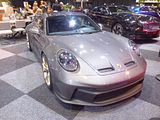
The 718 Cayman GT4 and 718 Spyder (previously named the Boxster Spyder) were revealed in June 2019. Both are differentiated from less powerful models by more aggressive bodywork, including a lower stance, new front bumper, a large new diffuser, and exhaust pipes that are spaced farther apart. The GT4 also features larger side intakes and an adjustable wing, the latter of which helps it generate up to 150 kg (330 lb) of downforce, 50 percent more than its predecessor. Both have a naturally aspirated 4.0-litre flat-6 derived from the 992’s 3.0-litre 9A2EVO engine, which is rated at 414 bhp at 7,600 rpm and 420 Nm (310 lb/ft) of torque at 5,000–6,800 rpm. The engine has cylinder deactivation, a first for Porsche. Porsche claims a top speed of 304 km/h (189 mph) for the GT4, and 301 km/h (187 mph) for the Spyder. The front suspension and brakes are borrowed from the 911 GT3, and the adaptive dampers, ABS and stability-control programming are borrowed from the 911 GT3 RS. The anti-roll bar end links, camber and toe can be manually adjusted, but the ride height–3 cm (1.2 in) lower than a standard 718–is fixed. Both are around 15 kg heavier than the GTS models. Sales commenced in the spring of 2020. For the 2021 model year, the GT4 and Spyder became available with the 7-speed PDK dual-clutch transmission as an option. It reduces the acceleration time of 0-60 mph from 4.3 seconds to 3.7 seconds. In March of 2023, Porsche announced that 718 GT4 and Spyder Models would cease production as of the 2024 model year.

Recognized by racing enthusiasts worldwide as a game-changing marvel of motorsports engineering, the incomparable 962 remains one of the most successful race cars of all time. With its iconic design and wind-tunnel derived aerodynamics, these monstrously fast cars dominated international Endurance Sports Car racing, World Sportscar Championship Group C, IMSA, and GTP class racing. Drivers who braved the power and tamed the cornering forces included legends like A.J. Foyt, Hans Stuck, Jackie Ickx, Al Holbert, and Hurley Haywood, piloting their cars to victories including consecutive first place wins at Le Mans year after year in the 1980s. Despite 40 years passing since their heyday, vintage 962s continue to impress contemporary vintage racing spectators and enthusiasts as featured attractions in historic racing, concours shows, and classic exhibition runs at historic motorsports venues. The original Porsche 962 featured a mid-mounted air-cooled 4 valve per cylinder Porsche DOHC 3.0-liter engine with KKK Turbocharging and Bosch fuel injection. The robust layout and overall power delivery maximized grip and cornering capability, leveraging the sophisticated suspension and chassis construction. Both Porsche factory teams and privateers enjoyed ongoing victories as sanctioned vendors offered a range of improvements including lighter tubs, specialized body and aero features, and suspension enhancements tailored to track specifications and driver preferences. As a result, these independent vendors were able to produce complete cars, bodywork and aerodynamic aids, and specialized mechanical features while maintaining a robust parts and equipment network to sustain ongoing privateer support even after Porsche factory teams advanced to the next generation platform. This is Porsche 962C chassis 147. This vehicle has a notable history, having competed in the 1990 All Japan Sports Prototype Championship (JSPC). It was meticulously restored by Freisinger between 2014 and 2016 using only original factory parts. It appeared at the Le Mans Classic in 2016 and 2018.
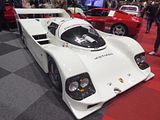
The 924 was originally another joint project of Volkswagen and Porsche created by the Vertriebsgesellschaft (VG), the joint sales and marketing company funded by Porsche and VW to market and sell sports cars, For Volkswagen, it was intended to be that company’s flagship coupé sports car and was dubbed “Project 425” during its development. For Porsche, it was to be its entry-level sports car replacing the 914. At the time, Volkswagen lacked a significant internal research and design division for developing sports cars; further, Porsche had been doing the bulk of the company’s development work anyway, per a deal that went back to the 1940s. In keeping with this history, Porsche was contracted to develop a new sporting vehicle with the caveat that this vehicle must work with an existing VW/Audi inline-four engine. Porsche chose a rear-wheel drive layout and a rear-mounted transaxle for the design to help provide 48/52 front/rear weight distribution; this slight rear weight bias aided both traction and brake balance. The 1973 oil crisis, a series of automobile-related regulatory changes enacted during the 1970s and a change of directors at Volkswagen made the case for a Volkswagen sports car less striking and the 425 project was put on hold. After serious deliberation at VW, the project was scrapped entirely after a decision was made to move forward with the cheaper, more practical, Golf-based Scirocco model instead. Porsche, which needed a model to replace the 914, made a deal with Volkswagen leadership to buy the design back. The deal specified that the car would be built at the ex-NSU factory in Neckarsulm located north of the Porsche headquarters in Stuttgart, Volkswagen becoming the subcontractor. Hence, Volkswagen employees would do the actual production line work (supervised by Porsche’s own production specialists) and that Porsche would own the design. It became one of Porsche’s best-selling models, and the relative cheapness of building the car made it both profitable and fairly easy for Porsche to finance. The original design used an Audi-sourced four-speed manual transmission from a front wheel drive car but now placed and used as a rear transaxle. It was mated to VW’s EA831 2.0 litre 4 cylinder engine, subsequently used in the Audi 100 and the Volkswagen LT van (common belief is that ‘the engine originated in the LT van’, but it first appeared in the Audi car and in 924 form has a Porsche-designed cylinder head). The 924 engine used Bosch K-Jetronic fuel injection, producing 125 bhp in European cars, but a rather paltry 95 bhp for the US market models, though this was improved to 110 hp in mid-1977 with the introduction of a catalytic converter, which reduced the need for power-robbing smog equipment. The four-speed manual was the only transmission available for the initial 1976 model, later this was replaced by a five-speed dog-leg unit. An Audi three-speed automatic was offered starting with the 1977.5 model. In 1980 the five-speed transmission was changed to a conventional H-pattern, with reverse now on the right beneath fifth gear. Porsche made small improvements to the 924 each model year between 1977 and 1985, but nothing major was changed on non-turbo cars. Porsche soon recognised the need for a higher-performance version of the 924 that could bridge the gap between the basic 924s and the 911s. Having already found the benefits of turbochargers on several race cars and the 1975 911 turbo, Porsche chose to use this technology for the 924, eventually introducing the 924 turbo as a 1978 model. Porsche started with the same Audi-sourced VW EA831 2.0 litre engine, designed an all new cylinder head (which was hand assembled at Stuttgart), dropped the compression to 7.5:1 and engineered a KKK K-26 turbocharger for it. With 10 psi boost, output increased to 170 hp. The 924 turbo’s engine assembly weighed about 65 lb more, so front spring rates and anti-roll bars were revised. Weight distribution was now 49/51 compared to the original 924 figure of 48/52 front to rear. In order to help make the car more functional, as well as to distinguish it from the naturally aspirated version, Porsche added an NACA duct in the bonnet and air intakes in the badge panel in the nose, 15-inch spoke-style alloy wheels, four-wheel disc brakes with five-stud hubs and a five-speed transmission. Forged 16-inch flat wheels of the style used on the 928 were optional, but fitment specification was that of the 911 which the 924 shared wheel offsets with. Internally, Porsche called it the “931” (left hand drive) and “932” (right hand drive). The turbocharged VW EA831 engine allowed the 924’s performance to come surprisingly close to that of the 911 SC (180 bhp), thanks in part to a lighter curb weight, but it also brought reliability problems.This was in part due to the fact that the general public did not know how to operate, or care for, what is by today’s standards a primitive turbo setup. A turbocharger cooled only by engine oil led to short component life and turbo-related seal and seat problems. To fix the problems, Porsche released a revised 924 turbo series 2 (although badging still read “924 turbo”) in 1979. By using a smaller turbocharger running at increased boost, slightly higher compression of 8:1 and an improved fuel injection system with DITC ignition triggered by the flywheel, reliability improved and power rose to 177 hp. In 1984, VW decided to stop manufacturing the engine blocks used in the 2.0 litre 924, leaving Porsche with a predicament. The 924 was considerably cheaper than its 944 stablemate, and dropping the model left Porsche without an affordable entry-level option. The decision was made to equip the narrower bodied 924 with a slightly detuned version of the 944’s 163 bhp 2.5 litre straight four, upgrading the suspension but retaining the 924’s early interior. The result was 1986’s 150 bhp 924S. In 1988, the 924S’ final year of production, power increased to 160 bhp matching that of the previous year’s Le Mans spec cars and the base model 944, itself detuned by 3 bhp. This was achieved using different pistons which raised the S’ compression ratio from 9.7:1 to 10.2:1, the knock-on effect being an increase in the octane rating, up from 91 RON to 95. This made the 924S slightly faster than the base 944 due to its lighter weight and more aerodynamic body. With unfavourable exchange rates in the late 1980s, Porsche decided to focus its efforts on its more upmarket models, dropping the 924S for 1989 and the base 944 later that same year.

There were a number of the larger 928 model here, too. The first V8 engined Porsche, it was originally conceived to replace the 911, though as we all know, that did not happen, with the two complementing each other in the range during the 18 year life of the 928. By the late 1960s, Porsche had changed significantly as a company, and executives including owner Ferdinand Porsche were toying with the idea of adding a luxury touring car to the line-up. Managing Director Ernst Fuhrmann was also pressuring Ferdinand to approve development of the new model in light of concerns that the current flagship model at the time, the 911, was quickly reaching the limits of its potential. Slumping sales of the 911 seemed to confirm that the model was approaching the end of its economic life cycle. Fuhrmann envisioned the new range-topping model as being the best possible combination of a sports coupe and a luxury sedan, something well equipped and comfortable enough to be easily driven over long distances that also had the power, poise and handling prowess necessary to be driven like a sports car. This set it apart from the 911, which was intended to be an out-and-out sports car. Ordered by Ferdinand Porsche to come up with a production-feasible concept for his new model, Fuhrmann initiated a design study in 1971, eventually taking from the process the final specification for the 928. Several drivetrain layouts were considered during early development, including rear and mid-engined designs, but most were dismissed because of technical and/or legislative difficulties. Having the engine, transmission, catalytic converter(s) and exhaust all cramped into a small rear engine bay made emission and noise control more difficult, something Porsche was already facing problems with on the 911 and wanted to avoid. After deciding that the mid-engine layout didn’t allow enough room in the passenger compartment, a front engine/rear wheel drive layout was chosen. Porsche also may have feared that the U.S. government would soon ban the sale of rear-engined cars in response to the consumer concern over safety problems with the rear-engined Chevrolet Corvair. Porsche engineers wanted a large-displacement engine to power the 928, and prototype units were built with a 5-litre V8 producing close to 300 hp. Ferdinand Piëch wanted this car to use a 4.6-litre V10 based upon Audi’s five-cylinder engine. Several members of the Porsche board objected, chiefly because they wished for Porsche AG to maintain some separation from Volkswagen. The first two running prototypes of Porsche’s M28 V8 used one four-barrel carburettor, but this was just for initial testing. The cars were sold with the planned Bosch K-Jetronic fuel injection system. When increasing concern within the company over the pricing and availability of fuel during the oil crisis of the 1970s became an issue of contention, smaller engines were considered in the interest of fuel economy. A push began for the development of a 3.3 litre 180 hp powerplant they had drawn up designs for, but company engineers balked at this suggestion. Both sides finally settled on a 4.5 litre SOHC per bank 16-valve V8 producing 240 PS which they considered to have an acceptable compromise of performance and fuel economy. The finished car debuted at the 1977 Geneva Motor Show, going on sale later that year. Although it won early acclaim for its comfort and power, sales were slow. Base prices were much higher than that of the 911 model and the 928’s front-engined, water-cooled design put off many Porsche purists, not least because the design marked a major change in direction for Porsche started with the introduction of the Porsche 924 in 1976 which purists found hard to accept. Porsche utilised a transaxle in the 928 to help achieve 50/50 front/rear weight distribution, aiding the car’s balance. Although it weighed more than the difficult-to-handle 911, its more neutral weight balance and higher power output gave it similar performance on the track. The 928 was regarded as the more relaxing car to drive at the time. It came with either a five-speed dog leg manual transmission, or a Mercedes-Benz-derived automatic transmission, originally with three speeds, with four-speed from 1983 in North America and 1984 in other markets. More than 80% had the automatic transmission. Exact percentage of manual gearbox cars for entire production run is not known but it is believed to be between 15 and 20%. The body, styled by Wolfgang Möbius under guidance of Anatole Lapine, was mainly galvanised steel, but the doors, front fenders, and hood were aluminium in order to make the car more lightweight. It had a substantial luggage area accessed via a large hatchback. The new polyurethane elastic bumpers were integrated into the nose and tail and covered in body-coloured plastic; an unusual feature for the time that aided the car visually and reduced its drag. Porsche opted not to offer a convertible variant but several aftermarket modifiers offered convertible conversions, most notably Carelli, based in Orange County, CA. The Carelli conversions were sold as complete cars, with the conversion doubling the price of the car. A reported 12 units were made. The 928 qualified as a 2+2, having two small seats in the rear. Both rear seats could be folded down to enlarge the luggage area, and both the front and rear seats had sun visors for occupants. The rear seats are small (due to the prominent transmission hump) and have very little leg room; they are only suitable for adults on very short trips or children. The 928 was also the first vehicle in which the instrument cluster moved along with the adjustable steering wheel in order to maintain maximum instrument visibility. The 928 included several other innovations such as the “Weissach Axle”, a simple rear-wheel steering system that provides passive rear-wheel steering to increase stability while braking during a turn, and an unsleeved, silicon alloy engine block made of aluminium, which reduced weight and provided a highly durable cylinder bore. Porsche’s design and development efforts paid off during the 1978 European Car of the Year, where the 928 won ahead of the BMW 7 Series, and the Ford Granada. The 928 is the only sports car ever to have won this competition, which is regarded as proof of how advanced the 928 was, compared to its contemporaries. Porsche introduced a refreshed 928 S into the European market in 1980 model year. Externally, the S wore new front and rear spoilers and sported wider wheels and tyres than the older variant, but the main change for the 928 S was under the bonnet where a revised 4.7 litre engine was used. European versions debuted with 300 PS , and were upgraded to 310 PS for 1984, though it is rumoured that they typically made around 330 hp. From 1984 to 1986, the S model was called S2 in UK. These cars used Bosch LH-Jetronic fuel injection and purely electronic Bosch ignition, the same systems used on the later 32-valve cars, though without the pollution controls. North American-spec 1983 and 1984 S models used, among other differences, smaller valves, milder camshafts, smaller diameter intake manifolds, and additional pollution equipment in order to meet emissions regulations, and were limited to 234 hp as a result. Due to low grade fuel 16V low compression S engine was made for Australian market in 1985 model year. It had 9.3:1 compression ratio pistons instead of normal 10.4:1 but used same large intake, high lift cams, large valves etc. of other S engines. In 1982, two special models were available for different markets. 202 “Weissach Edition” cars were sold in North America. Unusual features were champagne gold metallic paint, matching brushed gold flat disc wheels, two-tone leather interior, a plaque containing the production number on the dash and the extremely collectible three-piece Porsche luggage set. It’s believed these cars were not made with S spoilers even though these were available in U.S. during this time period as part of the “Competition Group” option. The “Weissach Edition” option was also available for the US market 911 in 1980 model year and 924 in 1981 model year. 141 special “50th Jubilee” 928 S models were available outside the U.S. and Canada to celebrate the company’s 50-year existence as a car manufacturer. This model is also sometimes referred to as the “Ferry Porsche Edition” because his signature was embroidered into the front seats. It was painted meteor metallic and fitted with flat disc wheels, wine red leather and special striped fabric seat centres. Similar 911 and 924 specials were also made for world markets. Porsche updated the North American 928 S for 1985, replacing the 4.7 litre SOHC engine with a new 5.0 litre DOHC unit sporting four valves per cylinder and producing 288 hp. Seats were also updated to a new style, these cars are sometimes unofficially called S3 to distinguish them from 16-valve “S” models. European models kept a 4.7 litre engine, which was somewhat more powerful as standard, though lower 9.3:1 compression 32-valve engine together with catalytic converters became an option in some European countries and Australia for 1986. In 1986, revised suspension settings, larger brakes with 4-piston calipers and modified exhaust was installed on the 928S, marking the final changes to old body style cars. These were straight from the 928S4, which was slated to debut a few months later. These changes came starting from VIN 1001, which means that the first thousand ’86’s had the old brakes, but later cars had the later systems. This later 1986 model is sometimes referred to as a 19861⁄2 or 1986.5 because of these changes. The name is a little misleading as more than 3/4 of the 1986 production had these updates. The 928 S4 variant debuted in the second half of 1986 with an updated version of the 5.0 litre V8 producing 320 PS, sporting a new single-disc clutch in manual gearbox cars, larger torque converter in automatics and fairly significant styling updates which gave the car a cleaner, sleeker look. S4 was much closer to being a truly world car than previous models as only major differences for North American models were instrumentation in either kilometers or miles, lighting, front and rear bumper shocks and the availability of catalytic converters in many other markets. The Australian market version was only one with different horsepower rating at 300 PS due to preparation for possible low grade fuel. Even this was achieved without engine changes. A Club Sport variant which was up to 100 kg (220 lb) lighter became available to continental Europe and U.S. in 1988. This model was watered down version of the 1987 factory prototype which had a lightened body. Also in 1987 the factory made four white lightened manual gearbox S4 models for racecar drivers who were on their payroll at the time. These were close to same as later actual Club Sport models and can also be considered prototypes for it. An SE (sometimes called the S4 Sport due to model designation on rear bumper), a sort of halfway point between a normally equipped S4 and the more race-oriented Club Sport, became available to the UK. It’s generally believed these Porsche Motorsport-engined cars have more hp than the S4. They utilise parts which later became known as GT pistons, cams and engine ECU programs. Some of them had stronger, short geared manual gearbox. The automatic gearbox was not available. For the 1989 model year, a visible change inside was digital trip computer in dashboard. At the same time Australian models received the same 320 PS engine management setup as other markets. Porsche debuted the 928 GT in the late winter 1988/89 after dropping the slowly selling CS and SE. In terms of equipment, the GT was like the 928 SE, having more equipment than a Club Sport model but less than a 928 S4 to keep the weight down somewhat. It had the ZF 40% limited-slip differential as standard like the Club Sport and SE before it. Also like the CS and SE, the GT was only available with a manual gearbox. European 1989 CS and GT wheels had an RDK tyre pressure monitoring system as standard, which was also optional for the same year S4. For 1990 model year Porsche made RDK and a 0-100% variable ratio limited-slip called PSD (Porsche SperrDifferential) standard in both GT and S4 models for all markets. This system is much like the one from the 959 and gives the vehicle even more grip. In 1990 the S4 was no longer available with a manual gearbox. The S4 and GT variants were both cut at the end of 1991 model year, making way for the final version of the 928. The 928 GTS came for sale in late 1991. Changed bodywork, larger front brakes and a new, more powerful 5.4 litre 350 PS engine were the big advertised changes; what Porsche wasn’t advertising was the price. Loaded GTS models could eclipse US$100,000 in 1995, making them among the most expensive cars on the road at the time. This severely hampered sales despite the model’s high competency and long standard equipment list. Porsche discontinued the GTS model that year after shipping only 77 of them to the United States. Total worldwide production of 928s over an 18 year period was a little over 61,000 cars. Second-hand models’ value decreased as a result of generally high maintenance costs due largely to spare parts that are expensive to manufacture, with the result that there are fewer survivors than you might expect, though with values hardening, people are now spending the money required to restore these cars.
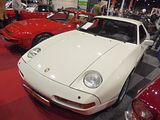
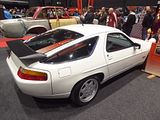

The Munich-based tuning house Koenig Specials GmbH gained fame in the 1980s and 1990s for their modification work on high-performance European sports cars, namely Ferraris. Founded by Willy König in 1974 after being dissatisfied with the performance of his Ferrari 365 GT4 BB, thanks to his previous racing career throughout the 1960s and 1970s. A Koenig-modified Ferrari or Porsche was considered the pinnacle of automotive excess at the time, taking cars that were already extreme in terms of looks and performance to the next level. When it comes to the 928 they were famous for converting 928s with a Koenig widebody kit that transformed the look of the car. Typically, it meant (much) wider rear fenders, new front and rear bodykit and massive wheels

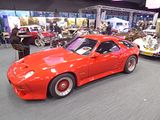

PUMA
Puma originated with Italian-born Brazilian immigrant and designer Rino Malzoni, who conceived of a vehicle with a sporty looking fiberglass body mounted on a production car chassis, with engine and suspension modifications to boost performance. This idea moved Malzoni to create a prototype racing car, developed on his farm in Matão in the interior of São Paulo. It had the support of Veículos e Máquinas Agrícolas S.A. (Vemag), the Brazilian DKW representative, who supplied an engine and rolling chassis with the goal of unseating Willys at the Autodromo de Interlagos. The prototype, which had a front-mounted 981 cc (59.9 cu in), three-cylinder DKW engine and weighed 720 kg (1,587 lb), posted five wins at Interlagos in 1964, and won the main races the following year. With the enormous success of the model and several victories in various competitions in the same year the first vehicle was launched, Sociedade de Automóveis Lumimari Ltda was founded by several car enthusiasts including Luiz Roberto Alves da Costa (LU) Milton Masteguin (MI) ), Mário César de Camargo Filho (MA) and Rino Malzoni. Each founder contributed the first two letters of their first names to the company’s name. The first model produced was named the GT Malzoni in honor of the creator and principal person involved in the brand. In 1966 the brand was renamed to Puma Veículos e Motores Ltda at the suggestion of the head of the competition department at Vemag, Jorge Lettry. Also in 1966, Puma participated in the Motor Show and presented its newest model, the Puma GT, known by many as the Puma DKW, which was for the most part an improvement on the GT Malzoni, as it used the same bodywork and corrected some problems of the first and added some new features, in total about 125 units were produced, until Vemag was bought by Volkswagen (VW) in 1967. In the same year, Puma was renamed Puma Indústria de Veículos SA, becoming a publicly traded company. When VW took over DKW-Vemag, Malzoni lost his supply of chassis and engines. He spent nine months on his farm working to create a new vehicle using a Volkswagen Karmann Ghia chassis, and a rear-mounted 1.5 L Volkswagen air-cooled engine and transaxle. This became one of Puma’s most successful models, being produced between 1967 and 1970 and helping the company’s growth and consolidating the brand. In 1969, Puma made a limited edition of its sports cars to be drawn in Quatro Rodas magazine, one of the most important magazines in the automotive world in the country, the model in question was the Puma GT4R, in which only 3 were produced for the draw, in copper, blue and green; later on, another model was made, this one for Malzoni. In 1970, Puma launched its most successful car to date, the Puma GTE, (E for “Export”), a sports car to be distributed around the world, including sales to Europe, Asia, Africa and the American continent. The Puma GTE was an updated version of the Puma GT, having its design reformulated, updated and complying with the traffic laws of each country where it was ordered. In 1971 the Puma Spider was launched, a modified, convertible version of the Puma GTE. Both vehicles made extensive use of VW components. The models were updated and re-released in 1976.
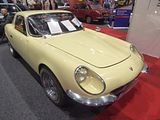


RENAULT
The Renault 4, also known as the 4L (pronounced “Quatrelle” in French), is a small economy car produced by the French automaker Renault between 1961 and 1994. It was the first front-wheel drive family car produced by Renault. The car was launched at a time when several decades of economic stagnation were giving way to growing prosperity and surging car ownership in France. The first million cars were produced by 1 February 1966, less than four and a half years after launch; eventually over eight million were built, making the Renault 4 a commercial success because of the timing of its introduction and the merits of its design. The Renault 4 was Renault’s response to the 1948 Citroën 2CV. Renault was able to review the advantages and disadvantages of the 2CV design. The Citroën had made motoring available to low-income people in France, and especially to farmers and other people in rural areas, for whom the car was as much a working tool as personal transport. The 2CV had been designed in the 1930s for use in the French countryside where the road network was poor – speed was not a requirement but a good ride, useful rough-terrain ability, a versatile body for load carrying, and economy and simplicity of operation were its key considerations. However, by the late 1950s, the 2CV was becoming outdated. Rural roads in France were improved and the national system of autoroutes was being developed. Agriculture was becoming more mechanized with fewer smallholdings and family farms for which the 2CV was designed. The Citroën had also proved popular with people living in towns and cities as affordable, economical transport but the 2CV’s rural design brief made it less than ideal as a city car and, despite improvements, the late-1950s 2CV had a top speed of just 70 km/h (43 mph). Its air-cooled two-cylinder engine was reliable and economical but noisy and offered poor performance. The 2CV’s suspension gave it an excellent ride and good grip and handling but was mechanically complex with many moving parts that required regular maintenance and lubrication at intervals as low as every 1000 miles (1600km). With its roots in the 1930s, the 2CV’s styling was also outdated and, with its separate wing/fenders, had a relatively narrow and cramped body for its overall footprint. While the Citroën had been designed during the Great Depression when money was tight and living standards were relatively low, by the 1960s the French economy was growing and people would be able to afford a more modern, refined, and less utilitarian small car. In early 1956, Renault Chairman Pierre Dreyfus launched this new project: designing a new model to replace the rear engined 4CV and compete against the Citroën 2CV that would become an everyman’s car, capable of satisfying the needs of most consumers. It would be a family car, a woman’s car, a farmer’s car, or a city car. The Renault 4 shared many design traits with the older Citroën 2CV to allow it to fulfill the same role as a versatile utility car, especially for people in rural France and other parts of the world with poor roads. It had a large structural platform with a separate body. It had front-wheel drive, long-travel fully independent suspension, and Rack and pinion steering. It had a simple body with minimal equipment, a large space for cargo or luggage, and ‘deckchair’ seats which could be easily removed. However, the Renault 4 updated this basic concept with a larger four-cylinder water-cooled engine with a sealed cooling system offering much better refinement and performance than the contemporary 2CV, with a top speed of over 104 km/h (65 mph). The suspension consisted of torsion bars which required no regular maintenance. The boxy full-width body offered more space for both passengers and luggage than the similar-sized 2CV and the car boasted an early hatchback body for greater practicality. Renault launched the Renault 3 and the Renault 4 simultaneously in July 1961. The cars shared the same body and most mechanical components, but the R3 was powered by a 603 cc version of the engine while the R4 featured a 747 cc engine. This placed the R3 in the 3CV taxation class while the R4 was in the 4CV class. Maximum power output was rated by Renault as 22.5 hp for the R3, and 26.5 or 32 hp for the R4, depending on price level and the type of carburettor fitted. Initially the base versions of the R3 and R4 came with a thick C-pillar behind each of the rear doors. Quarter glass was a 400 francs option for the basic R4. The extra visibility increased the weight of the vehicle, but these windows soon became standard for all R4s. The R3 and R4 were targeted at the Citroën 2CV that employed soft springs and long wheel travel to absorb bumps on rough roads. The Renault 3/4 applied the same approach and two models appeared at the Paris Motor Show in 1961 on a specialized demonstration display that incorporated an irregular rolling road. Visitors could sit inside a car, which remained undisturbed while the suspension absorbed the erratic bumps of the rolling road. In 1962 Renault employed the same display at the Turin Motor Show. The basic version of the R3 was priced 40 francs below the lowest-priced version of the Citroën 2CV in 1961 and featured painted bumpers and grill, a simplified instrument panel, a single sun visor, no windshield washer, and no interior door trim panels. This trim was also offered in the more powerful R4. The R4L with six side windows, chrome-colored bumper and grill, as well as a less spartan interior cost 400 francs (roughly 8%) more than the R4 with its four side windows. However, as with the Renault 4CV “Service” in 1953, customers shunned the basic model and in October 1962, the Renault R3 was discontinued, along with the most basic version of the Renault 4. A “super” version (branded “de luxe” in some export markets) with opening rear quarter-light windows and extra trim was also offered. The de luxe and super versions of the R4L received a version of the engine from the Renault Dauphine giving them an engine capacity of 845 cc. After the withdrawal of the 603 cc engined R3, the 747 cc R4 model continued to be listed with an entry-level recommended retail price, but the slightly larger-engined L versions were more popular. By 1965, Renault had removed the extra “R” from their model names: the Renault R4L had become the Renault 4L. Early versions of the Renault R4 used engines and transmissions from the Renault 4CV. The original design brief called for an engine size between 600 cc and 700 cc, but there was no consensus as to whether to use a four-cylinder unit or to follow Citroën with a two-cylinder unit. With Volkswagen rapidly growing market share across Europe and North America, Renault also gave serious consideration to an air-cooled boxer motor option for the forthcoming R3/R4. However, using the existing water-cooled unit from the 4CV was a solution, especially in view of the extended period of teething troubles encountered by the Renault Fregate, which was then Renault’s most recent attempt to develop an innovative powerplant. The existing engines were larger than that specified by management for the new 4CV, but the automaker addressed this by reducing the bore so that the overall capacity of the base engine for the new R3 worked out to be 603 cc, comfortably at the lower end of the required 600–700 cc range. However, since Renault already produced the 747 cc version of the engine that was well proven in the 4CV, it made sense to use this as well in what would in many respects be the older car’s successor. Therefore, in 1961, the R3 had a 49 mm bore and 80 mm stroke, while the R4 received the 54.5 mm × 80 mm existing engine. Moving the engine from the rear of the 4CV to the front of the new model involved significant planning: design changes to the unit were introduced as part of the process. The inlet manifold was now a steel casting whereas on the 4CV it had been constructed of a light-weight alloy: this was driven by cost considerations now that aluminum was not so inexpensive as it had been fifteen years earlier. Renault also took the opportunity to introduce a feature which subsequently became mainstream. Renault also designed a “sealed-for-life” cooling system, supported by a small expansion tank on the right side of the engine bay. The cooling system contained antifreeze intended to enable operation without topping up or other intervention throughout a car’s life provided ambient temperatures below -40 C were avoided. The engines were larger than the small 425 cc (later 602 cc and 29 hp), engines in the 2CV. The R4 always had a four-cylinder watercooled engine. The original Renault R4’s engine capacity of 747 cc served to differentiate the model from the more powerful Renault Dauphine, but the Dauphine’s 845 cc engine was used in the 4 itself from 1963 onwards: for most markets at this stage the Dauphine engine now came as standard in the top of the range Renault R4 Super, and was available in some other versions only as an optional extra. Given that Renault’s 603, 747, and 845 cc engines all shared the same cylinder stroke and were all of the same basic design, it is likely that there was very little difference between the manufacturing costs of the basic engine block between the three. From the perspective of the sales and marketing department, they did fall within different taxation classes (respectively 3CV, 4CV, and 5CV) but at this end of the market tax level differences were by now less of an issue even in those European countries that still taxed cars according to engine size. With time, the increasing trend to the production of Renault 4s in a wide range of countries reduces the validity of generalized statements as to which engines were fitted when: in French-built cars the old 845 cc engine continued in the low versions until the mid-1980s, but in 1978 the top-end Renault 4 GTLs received the new 1108 cc engine: this engine was not new to Renault, however, being the five-bearing “Sierra” engine, first installed in the Estafette van and R8 in the summer of 1962. A smaller version (956 cc) of this new engine finally replaced the by now venerable 845 cc engine in the 4 in 1986. Unlike the original “Billancourt” engine from the 4CV, Renault’s “Sierra” engine rotated in a clockwise direction, so fitting it required reversing the direction of the differential in the gear box in order to avoid producing a car with one forward speed and four reverse speeds. The initial transmission was a three-speed manual, described by one critic as an obsolete feature when compared to the four-speed manual of the then thirteen-year-old Citroën 2CV. Ironically the new Renault 4 did not inherit its transmission from the Renault 4CV nor from anyone else: the transmission was newly developed for the car. The dash-mounted gear lever was linked via a straight horizontal rod that passed over the longitudinally mounted engine and clutch directly to the gearbox right at the front. The resulting absence of any linkage at floor level permitted a flat floor across the full width of the car’s cabin. Synchromesh featured only on the top two ratios, even though the low power of the engine required frequent gear changes by drivers using normal roads and wishing to make reasonable progress. On this point Renault quickly acknowledged their error and cars produced from 1962 featured synchromesh on all three ratios. In 1968 the Renault 4 finally received a four-speed transmission. The three principal new models introduced by Renault since the war featured monocoque “chassisless” construction that was less expensive to manufacture process and reduced operating costs because of lower vehicle weight. The Renault R3/R4 design defied this by now widely accepted mantra, employing a separate platform to which the body shell was then attached. The body’s structural role in maintaining the overall rigidity of the car body was thereby reduced, placing less stress on the roof and allowing for thinner window pillars. Although the use made of a separate platform resembled, in some respects, the use that pre-war designs would have made of a chassis, the outcome was a structure described as semi-monocoque, and it would later allow Renault to use the R4 platform, with very little modification, to build new models such as the Renault 6 and Rodeo. (Later, the successful Renault 5 used the R4 running gear, but in a monocoque shell). Because the rear torsion bars are located one behind the other, the wheelbase is longer on the right side than on the left. The R3 and R4 had four-wheel torsion-bar independent suspension. This was an innovation that would be copied on a succession of subsequent front-engined Renaults introduced during the 1960s and 70s. The car features a shorter wheelbase on the left than on the right because the rear wheels are not mounted directly opposite one another. This concept allowed a very simple design of the rear suspension using transverse torsion bars located one behind the other without affecting handling. The front torsion bars were longitudinal. The fixed end of the torsion bars is mounted on quadrants that can be adjusted via a holes/fixing bolt arrangement. This enables the suspension to be “beefed up” and the ground clearance increased. With specialist tools provided by Renault, adjustments can be made to provide the light 4L some off-road capabilities. This feature, along with the installation of a thick protecting aluminum plate under the engine, has been used by and off-road drivers and student 4L Trophy entrants. Damping was provided by hydraulic telescopic shock absorbers on all four wheels. Those at the rear were mounted virtually horizontally which avoided the intrusion of rear suspension componentry into the flat-floored passenger cabin. The longitudinal layout of the front-wheel drive engine and transmission with the engine behind the front axle and gearbox/differential in front is identical to the Citroën Traction Avant. The suspension is similar with the difference being the deletion of the Citroën’s flexible beam between the rear wheels to give the Renault 4 fully independent rear suspension. The Renault 4 was not significantly changed during its production. Exterior chrome trim was eventually phased out on all models, and aluminium grilles were replaced with plastic. There were three different dashboard designs. On the right side of the car at the back the position of the fuel filler was raised by approximately 15 cm (6 inches) less than a year after the car’s launch, but changes to the body panels were limited to a slightly altered hood and hinges. There were many different ‘special edition’ Renault 4s. Some (including the Safari, Sixties, and Jogging) were sold in special colour schemes, upholstery and other details, while others (Clan, Savane) were standard models with special decals. There were also special models that were not solely a marketing exercise, such as the Renault 4 Sinpar 4×4, the Plein Air, a pickup truck, LPG versions, and electric versions. The Plein Air was a doorless and roofless version originally developed to meet a 1964 request by the French Army. Sinpar’s version, called the Sinpar 4×4 Torpedo, was first shown as a prototype at the 1968 Geneva Salon, equipped with Sinpar’s four-wheel-drive system. Sinpar was quickly given a contract to build a front-wheel-drive version at their works in Colombes near Paris; it appeared in May 1968. Called the Plein Air (meaning “Open Air”), it had no doors, with only a chain protecting the passengers. A military contract did not materialize but Renault and Sinpar attempted to ride the late sixties/early seventies buggy wave in marketing it as a fun beach car. Being more expensive and less capable than the Citroën Méhari it did not catch on and was discontinued in March 1970, after only 563 had been built. In 1989, Colombian SOFASA produced the variants Brisa (Breeze) which was based on the French Plein Air and Jogging, which was marketed as a sportier version of the car and featured red accessories. In 1978, the R4 GTL arrived. It had the 1108 cc engine from the Renault 6 TL, albeit with the performance reduced for better economy, and bigger drum brakes. The GTL was identifiable by its grey front grille, grey bumpers, and grey plastic strips along the bottoms of the doors. It also had an extra air intake below the front grille (as a result, the registration plate was moved down to the bumper), and 12 inch (304.8 mm) wiper blades instead of the original 10 inch (254 mm) ones. For the 1983 model year, the GTL got front disc brakes, the handbrake now working on the rear wheels, and there were a modified dashboard and cloth seats. The Renault 4 was the last French automobile to be sold with drum brakes on all four wheels, after the Citroën 2CV received disc brakes in 1981. The very first 1983 models had the handbrake lever moved from left to right under the steering wheel before it was moved to the floor like in almost any other car by then. There was also a panel van (Fourgonette) version of the R4, which with its “high cube” bodyshell and the unique ‘giraffon’ (giraffe hatch) at the rear became the idiosyncratic French “Boulangerie” van. For many years, this was a successful vehicle of its type and for many customers, as it represents their idea of a Renault 4 more than a passenger version. It remained on sale in Europe until 1993 and was replaced by the Renault Express (called Extra in UK and Ireland, Rapid in Germany), which was based on the second generation Renault 5 ‘Supercinq’. Though reasons such as emissions and safety legislation are often given for the Renault 4’s demise in Europe during the 1980s, it would appear that its popularity would not have lasted. Outmoded production methods, more advanced competition and the reasons outlined above meant that the Renault 4’s days were numbered, at least as a mainstream product. And Renault was already enjoying huge sales success with the far more modern R5, which was only slightly more expensive. Comparable products had already been discontinued in Europe or had their production scaled back, as more modern designs enjoyed the strongest sales. British Leyland’s Mini had been produced in smaller figures since the launch of the Austin Metro in 1980 with production continuing until 2000. Volkswagen had switched Beetle production from West Germany to Mexico in 1978 (where it was made until 2003), with the new Polo and Golf proving hugely popular in Europe. Citroën kept its 2CV in production until 1990, but did not directly replace it, with the AX (launched in 1986) taking its place as the entry-level model in the Citroën range. It had also produced the earlier Dyane and Visa as more modern and only marginally more expensive alternatives to 2CV. There were several projects to replace the Renault 4, starting from the early 1970s. However, the continuing success of the Renault 4, the need to replace the more popular Renault 5 during the early 1980s, the difficulties coming up with a suitable replacement (and the idea that the Renault 4’s market would die with it) all meant that a new entry-level Renault (the Twingo) did not appear until 1992.

A rather different sort of Renault is this Renault Clio V6 Renault Sport, to give the car its full and rather cumbersome name. This was a rear mid-engine, rear-wheel-drive layout hot hatch based on the Renault Clio launched in 2001, very much in the same style as the earlier mid-engined R5 Turbo models of the 1980s. Designed by Renault, the Phase 1 models were built by Tom Walkinshaw Racing and Phase 2 were designed and helped by Porsche and built by Renault Sport in Dieppe. The Clio V6 was based on the Clio Mk II, though it shared very few parts with that car. The 3.0 litre 60° V6 engine, sourced from the PSA group. It was the ES9J unit as used in the Peugeot 406, 407 and 607, and the Citroen C 5 and not the one that Renault used in the 3 litre Laguna engine, which had an PRV (Peugeot, Renault & Volvo) an earlier development 90° V based on a V8 that never was. For this car it was upgraded to around 227 bhp and placed in the middle of the vehicle where the more ordinary Clios have rear seats – making this car a two-seater hot hatch. In order to accommodate the radical change from front-engine, front-wheel drive hatchback to mid-engine, rear-wheel drive two-seater quasi-coupé, the car had to be extensively reworked structurally, leading to the Phase 1 version being some 300 kg (660 lb) heavier than the sportiest “regular” Clio, the 172 Cup. Due to this, even though the V6 model had significantly more power, it was not remarkably faster in a straight line accelerating to legal road speeds than the 172 Cup – accelerating to 60 mph in 6.2 seconds compared to the Cup’s 6.7 seconds – though its maximum speed was significantly higher at 146 mph compared to 138 mph. Opinions varied on the handling, but many found it very twitchy and the car soon a gained a reputation for breaking away with little warning. That was largely addressed by the Phase 2 cars which were launched in 2003. The front end took on the same sort of new design as had been applied to the regular models. The engine was upgraded, to make the Phase 2 Clio V6 the most powerful serial produced hot hatch in the world with 255 bhp exceeding the 247 bhp of the Alfa Romeo 147 GTA and the 222 bhp SEAT León Cupra R. Based on the Phase 1 engine, its extra performance was helped with assistance from Porsche and although the Phase 2 gained even more weight, the result was a a reduced 0–60 mph run at 5.9 seconds and a top speed of 153 mph. Though based on a utilitarian hatchback, the Clio V6 was not a practical family car. With an average fuel consumption of 24 mpg, this resulted in an empty fuel tank in just over 300 miles. The loss of the back seats and most of the boot space, due to the engine placement, resulted in a severe restriction in luggage space – there was only a small space in the front where the engine used to be, suitable for a holdall or week-end groceries, a small netted area behind the seats plus a small stash area under the tailgate. The enhanced steering made tight manoeuvring a little challenging, the turning circle being a rather awkward 13 m (42.7 ft) – around three car lengths – turning what might normally be a three-point turn into a five-point turn. Standard equipment in the car was good, this was not a stripped-out special, and it included rain sensing windscreen wipers, automatic headlights, air conditioning, and six speakers and CD changer. The Phase 2 Clio V6 retailed for £27,125 in the United Kingdom, until it was withdrawn from sale in 2005 coinciding with a facelift for the Clio range. The Phase 2 was received far more enthusiastically by the ever-critical UK press. These days there is no doubting the fact that this is a modern classic.

RILEY
The Riley RM Series was the last model developed independently by Riley. RM vehicles were produced from 1945, after the Second World War, until the 1952 merger of Riley’s parent company, the Nuffield Organisation with Austin to form BMC. They were originally made in Coventry, but in 1949 production moved to the MG works at Abingdon. The RM models were marketed as the Riley 1½ Litre and the Riley 2½ Litre. There were three types of RM vehicles produced: the RMA was a large saloon, and was replaced by the updated RME, both of which had the 1.5 litre engine; the RMB was an even larger car, and was replaced by the RMF, and these cars had the 2.5 litre engine; the RMC and RMD were open topped cars produced in limited numbers, intended largely for the all important export markets, with about 500 of each being made. These were nicely produced quality cars and considered quite sporting in their day, with the sort of appeal that many years later would be inherent in a BMW. Ironically, of course, BMW now own the rights to the Riley brand.

ROLLS ROYCE
The Rolls-Royce 20/25 was built from 1929 through 1936 with 3,827 examples delivered. It would go on to become the company’s most popular design prior to the Second World War. It was initially built on a 128.7-inch chassis and later offered on a long chassis of 131.9 inches, introduced in 1931. Later examples of the Rolls-Royce 20/25 models featured a four-speed fully-synchronised gearbox and a centralised chassis lubrication system. Powering the 20/25 was a 3.7-litre inline, overhead-valve six-cylinder engine with a cast-iron block. It has a separate aluminium crankcase with a seven-main bearing crankshaft with vibration damper and a detachable cast-iron cylinder head. It was lubricated by a pressurised system that also fed the rocker shaft and timing gears. They had an engine-driven water pump with fan which cooled the engine, and a thermostatically-controlled system open and closed the radiator shutters as required. Ignition was by independent coil, a centrifugal-advance distributor, and a backup magneto. The engine was fed fuel via a single-jet carburettor. The estimated horsepower produced was 65, though the company never publicly advertised such numbers, only stating it was ‘adequate.’ Every engine was run by the company on a dynamometer in order to ensure reliability. The transmission with its single dry-plate clutch was bolted to the rear of the engine block. The floor shift was located to the right of the driver’s seat. The cars were given four-wheel, servo-assisted drum brakes and a full-floating type rear axle. Once the chassis was built and tested by the factory, it was sent to a coach-builder selected by the customer to receive coachwork. A body was either installed from inventory or constructed and finished to the buyer’s specific wishes.
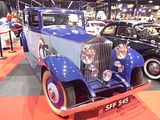


The Rolls-Royce Silver Dawn is a full-size luxury car that was produced by Rolls-Royce at their Crewe works between 1949 and 1955. It was the first Rolls-Royce car to be offered with a factory built body which it shared, along with its chassis, with the Bentley Mark VI until 1952 and then the Bentley R Type until production finished in 1955. The car was first introduced as an export only model. The left hand drive manual transmission models had a column gear change, while right hand drives had a floor change by the door. In the British home market the Silver Dawn only became available from October 1953, with the introduction of the model corresponding to the Bentley R Type. In 1944 W. A. Robotham saw that there would be limited postwar demand for Rolls-Royce or Bentley chassis to be fitted with bodies from specialist coachbuilders, and negotiated a contract with the Pressed Steel Company for a general-purpose body to carry four people in comfort on their postwar rolling chassis, fitted as always with a distinct Rolls-Royce or Bentley radiator. Though he stretched the demand to 2000 per year, Pressed Steel were “nonplussed” by the small demand. A mere 760 were produced between 1949 and 1955. Silver Dawn Series A-D had bodywork identical to the Mark VI. In 1953, with the “E” series (Chassis Number SKE2), the Silver Dawn body was modified in parallel to the Bentley Mk VI body and a large boot was added. While the Bentley Mk VI was renamed the Bentley R after this change, the Rolls-Royce Silver Dawn kept its name. Even with mass produced Standard Steel bodies, all panels forward of the bulkhead/firewall were slightly different for the Rolls-Royce from those fitted to the Bentley. In 1951 the Silver Dawn was upgraded to the 4 1/2 L engine and the full flow oil filter (Chassis Number LSFC2). In 1953 the high compression cylinder head was fitted from Chassis number SMF66 and from the same chassis number on the Bentley Mk VI type camshaft was fitted to left hand drive vehicles. Earlier models up to circa May 1954 had a different fascia from the Bentley Mk.VI and ‘R’ Type, and were fitted with a single exhaust system. Later models from the SRH2 chassis series had the Bentley style fascia and the twin exhaust system, as fitted to the Bentley ‘R’ Type. The inline six-cylinder engine had overhead inlet and side exhaust valves and had a capacity of 4,257 cc until 1951 when it was enlarged to 4,566 cc. The carburettor up to Chassis number SFC100 was a single double downdraught Stromberg type AAV 26 until 1952 when it was replaced by a Zenith DBVC42. A 4-speed manual gearbox was fitted to all cars at first, with a 4-speed automatic becoming an option in late 1952 on the ‘E’ Series chassis, and on the corresponding Bentley R Type chassis. There are conflicting reports if the automatic gearbox became standard in the Silver Dawn, but both manual and automatic options were available until the end of the production run. However the original invoice for a 1955 UK model (Chassis Number SVJ115) clearly shows that the Automatic Gearbox was an optional extra and cost the buyer £70.0.0. The suspension was independent at the front using coil springs while at the rear the live axle used half elliptic leaf springs. The car had a separate chassis made with traditional riveted construction until 1953 after which it was welded. Servo assisted 12.25 in (311 mm) drum brakes were used, hydraulically operated at the front but retaining mechanical operation at the rear. Although many cars were fitted with factory built bodies, others were supplied to external coachbuilders.

SAAB
The Saab 99 was produced from 1968 to 1984; their first foray into a larger class than the 96. While considered a large family car in Scandinavia, it was marketed as a niche compact executive car in most other markets. It was manufactured both in Sweden and Finland and was succeeded by the Saab 900, although the 99 continued to be produced alongside its successor. The Saab 90, an updated, less complex version using many 900 parts took over from the 99 in late 1984. On 2 April 1964, Gudmund’s day in Sweden, after several years of planning, the Saab board started Project Gudmund. This was a project to develop a new and larger car to take the manufacturer beyond the market for the smaller Saab 96. This new car became the Saab 99, designed by Sixten Sason and unveiled in Stockholm on November 22, 1967. The first prototypes of the 99 were built by cutting a Saab 96 lengthwise and widening it by 20 centimetres (7.9 in); this created the so-called Paddan (The toad), which was a disguise for the new project. After that phase, also as a disguise, the first 99 body shell was badged “Daihatsu” as that name could be made up out of the badging available for the Saab Sport. The 99 was not only built in Saab’s own Trollhättan Assembly – some variants were built by the Finnish Valmet Automotive in Uusikaupunki from 1969 onwards; the last five years of this production (1979-1984) was alongside the Finnish built version of the Talbot Horizon, which shared a similar high quality velour upholstery to the 99. Although Saab engineers liked the company’s existing two-stroke engine, it was decided that a four-stroke engine was necessary, and the choice was a 1.7 L (later 1.85 L) engine from Triumph. This was the same Triumph Slant-4 engine used in the Triumph Dolomite, but the Saab version was fitted with a Zenith-Stromberg CD carburettor developed specially for Saab. A number of Saab 99s were equipped with a Triumph Stag V8, but the V8 was later dropped in favour of a turbocharged unit which later powered the 99 Turbo. A three-door estate version was planned from the start, but never made it into production. In 1971 (with thoughts about a combi coupé) the work on an estate was restarted, this time as a five-door. The 99 was first shown on November 22, 1967. The first production cars came in autumn 1968, although only 4190 cars were built this year. Production increased considerably in 1969 and again in 1970 when the four-door model arrived. In 1970 the interior was also given a facelift and became more luxurious, with a new steering wheel. The exhaust system was now made of aluminium, engine mounts and drive joints were changed. In March, the 99E (also available with a three-speed automatic transmission) was introduced. It had a 1.75 L engine with electronically controlled fuel injection, giving 87 PS. In 1971 the 99 was given a larger and stronger engine, a 1.85 L engine giving 86 PS on the carburettor model and 95 PS for the fuel-injected model. The 1.75 L engine was now only available with a carburettor. Saab also introduced headlight wipers, as well as larger rear-view mirrors and an additional air inlet beneath the existing grille. The dashboard was given a redesign along with new instruments. In 1972 the 1.75 L engine was no longer available. The power of the engine was increased to 88 PS for carburettor models and 97 PS for fuel-injected models. The 2.0 L engine became available. The major change this year were new plastic bumpers that could take impacts up to 8 km/h (5 mph) and still retain their shape. The suspension was stiffened and received stronger dampers. An electrically heated driver’s seat was also introduced. In January 1972 the 99 EMS (Electronic-Manual-Special) was introduced. It was a sportier model that was originally only available in a two-door version; but became available in the wagonback body beginning in 1974 (Europe). It had stiffer suspension and also silver or copper (‘bronze’)-coloured metallic paint as option. The engine had 1985 cc displacement and Bosch D-Jetronic electronic fuel injection giving 110 PS and a top speed of 170 km/h (106 mph). For the United States, a special 99 SSE was developed to satisfy demand while the EMS was not yet available there. The SSE had a black or burled walnut vinyl roof cover and an automatic transmission (by Borg-Warner). It also had the 1.85 L Triumph engine installed. In 1973 a low-cost model called the 99L was introduced. It was a two-door with a 1.85 L engine giving 88 PS All other models had the Swedish-built 2.0 L engine, which produces 95 PS in carburetted form. The LE model had electronic fuel injection giving 110 PS. The LE model was mainly made for export. The inner ceiling was changed, as were protective bars in the doors, and a new black grille. In Northern Europe, a de-contented model called the 99 X7 was also marketed. In January 1974 the three-door hatchback Combi-coupé (marketed as a “Wagon Back” in the USA) was introduced. It was 11 cm (4.3 in) longer than the sedan. Front seats and steering wheel were new for 1974, while the EMS received an all-new, model-specific interior. Inertial reel belts were also fitted. In 1975 the brakes were improved and the hand brake now worked directly on the primary brake pads instead of on separate pads acting as drum brakes inside the brake rotor. The 99 was now available in two versions, one with a carburettor with 100 PS and a fuel-injected version using Bosch K-Jetronic fuel injection system giving 118 PS. In February a model using Zenith-Stromberg 150CDS(E) dual carburettors was introduced. It was only available for the Combi-coupé and has 108 PS. The Combi-coupé had been fitted with a unique grille in 1974; this was now applied across the range. In 1976 nothing major was changed, but a self-adjusting clutch was introduced. The engines were adapted for tougher emissions requirements and several models with an electrically heated rear window were introduced. A luxurious 4-door sedan model was available, the 99 GLE. it came with power steering, an automatic transmission, a fuel-injected engine, luxurious upholstery on the seats and an armrest in the rear seat. The five-door Combi-coupé model was also introduced. In 1977, the front light clusters and the sedan’s tail lights were enlarged. The rubber strips on the bumpers were changed. The “One Hundred series” of test-fleet Turbo cars were distributed around the world. The cars were mainly made from three- and two-door EMS models, but a few four-door and even five-door cars were also made. The four- and five-door models were tested by mostly police in Sweden, Finland and Switzerland. In 1978 a turbocharged version of the car, the 99 Turbo, was introduced. It was only available as a Combi-coupé until the next year. The turbocharged two-litre engine produced 145 PS giving the car a top speed of 200 km/h (124 mph). The turbochargers were designed and built by Garrett AiResearch. In terms of appearance, it received distinctive alloy wheels and front and rear spoilers. The 99 Turbo repositioned Saab in the car market and it came to be regarded as an iconic and technologically significant model of its era. By early 1979, over 10,000 turbo-engined Saabs had already been built, as Saab successfully entered a new market segment. Other news for 1978 included the availability of a sunroof, and the EMS became a three-door Combi-coupé in some markets. In 1979 the Combi-coupé option was discontinued for the 99, as the new Saab 900 was only available in this bodystyle. The 99 Turbo changed over to the two-door saloon bodywork although only a small number were built. The rear axle was altered, the fuel tank changed to a plastic one, new wheels were fitted, and four-door models received new bumpers similar to those of the 900. These bumpers were also installed on two-doors beginning with the 1980 model year. In 1980 the 99 was also given the new and safer seats from the Saab 900, as well as low-mounted protective strips along the sides. The spare wheel was changed to an emergency unit. The carpeting, which had been changed to rubber a few years earlier, went back to textile. In the Swedish market the twin-carb version made a return for a single year, sold as the 99 Super and only available with four doors and an automatic transmission. In 1981 the twin-carb Super was discontinued, although the 99 did gain a new engine option in its stead: the 99 GL with 100 PS was joined by the 99 GLi with 118 PS, both with four-speed manual transmissions. The GLi was a bit more luxurious and had power side mirrors. It was only sold in Northern Europe and only around 1600 were built. All 99s received a new rear seat, velour upholstery, new rear mirrors, a new steering wheel, and the 900’s front axle. In 1982 came the H engine, built by Scania at Södertälje, making it possible for all cars to run on 93 octane gasoline. The two- and four-door 99 GLs were now available with a five-speed manual transmission. The window surround trim was blacked out and the wheels were new. In 1983 a number of smaller technical and cosmetic changes were made, including a new grille similar to that of the 900 and blacked out B-pillars on two-door models. Brake pads were now asbestos-free. Five-speed-equipped 99s received low-resistance tires, which sit on wider 5½-inch rims, requiring moving the rear axle. Some further minor changes took place for 1984, including electronic ignition, lowered seats, and a more upright steering wheel. Five-speed cars also received interval wipers. This was to be the final year for the 99. It was replaced by the Saab 90 and the Saab 900. A total of 588,643 were made; this total rises to 614,003 if Saab 90 production is included.


SIMCA
The 1100 was the result of “Project 928”, started in 1962, finalized by engineers Philippe Grundeler and Charles Scales. The design was a result of Simca’s market research in the early 1960s, which showed the increasing popularity of front wheel drive cars that provided better utilization of space and comfort in small cars. In Spring 1962, Simca organised a 1966–67 launch of a new range of front wheel drive cars with saloons, estates cars and light commercial vehicles to be included, all fitting into France’s 6CV tax class – between the Simca Mille and Simca 1300. Both transverse and longitudinal engine placement were tested, and in 1963 the transverse-engine design was approved. The Simca 1100 was one of the first designs outside Fiat to feature a transverse engine with an end-on gearbox and unequal length driveshafts (now near-universal amongst small cars), a possible result of Fiat influence as a major shareholder. In 1963, Chrysler took a controlling interest in Simca, approving the project in 1964, with a production target of summer 1967. The short timetable included developing a new transmission, and using a larger version of the rear engined rear wheel drive Simca Mille (Simca 1000) “Poissy engine”, displacing 1118 cc (the Mille used a 1.0 litre engine, the 1500 a 1.5 litre engine). When first shown on Sardinia and at the Paris Auto Show in 1967, the 1100 was advanced in design, featuring a hatchback with folding rear seats, disc brakes, rack and pinion steering, an independent front (double wishbone) and rear (trailing arm) suspension using torsion bars. Numerous permutations were available, with a manual, automatic and semi-automatic transmission. The engine was slanted to allow for a lower bonnet; and the engine, gearbox, and suspension were carried on a subframe to allow the unibody to be relatively unstressed. The body was welded to the frame, not bolted. The 1100 was reportedly studied closely by Volkswagen when the latter company was designing its Volkswagen Golf, after making rear-engined, rear-wheel-drive vehicles. The 1100 was (along with the pricier Renault 16 & Austin Maxi), one of the first hatchback designs, with a folding rear seat and in three and five-door variations. Different equipment levels were defined as LS, GL, GLS and “Special” tags. Three- and five-door estate cars were also included in the range. The car was fitted with Simca Type 315 petrol OHV “Poissy engines” with 944, 1118, and 1294 cc variants, depending on year and market. A “stroked” 1118 cc engine displacing 1.2 litres was introduced in 1971 to the UK market as the Simca 1204. It was also sold in the US in limited quantities. In 1974, the sporty TI appeared with the 1294 cc engine (82 PS), at the time when the car also saw a cosmetic redesign. Based on the 1100 chassis, the Matra engineering firm created a crossover derivation named Matra Rancho. The 1100 had a four-speed manual gearbox and room for five people. There was also a three-speed semi-automatic gearbox that required manual shifting but used an electronically activated clutch. The 1100s transmission configuration was the same as the one introduced by Fiat on the 1964 Autobianchi Primula, in that it was transverse and axial with the engine giving the “engine on one side, transmission on the other” layout copied on almost all “hatchbacks” and front wheel drive vehicles throughout the world ever since. In France, the 1100 was very successful, achieving best-seller status, but it was less competitive in non-European export markets. Perhaps the car with the strongest claim to be the first “Hot Hatch” was the Simca 1100 Ti which was available on sale in 1974 with 82hp (up over 40% from 58hp of the standard models) which dramatically improved performance and sent the top speed over 100mph for the first time to 105mph and a 0-60mph time of 12 seconds. Based on the 1100 Special introduced in 1970, distinguishing features of this performance version were its six-headlamp and foglight arrangement, front disc brakes, front and rear spoilers, alloy wheels, matte black grille and single colour paint scheme (red), items which would be adopted by the many Hot Hatches that would follow. Based on the Simca 1100 range introduced in 1967, the front wheel drive hatchback was a top seller throughout Europe and said to have inspired VW to replace its rear-engined range with a new front-engine product range including the Polo and Golf. Another early hot hatch was the Renault 5 Alpine (called Gordini in the UK due to Chrysler owning the Alpine model name there) which first went on sale in May 1976 and also pre-dated sales of the Volkswagen Golf GTi, by two months. The 1100Ti was never sold in RHD in the UK. Three LCV versions with van, pick up and High Top Van bodystyles were also available. In France and most European markets these were sold as the “Simca 1100 Fourgonnette”. In the UK the high-roof van was called the Simca VF2 (short for “Voiture Fourgonnette”), and was sold from December 1972. The regular low-roof van was called the VF1, while an even higher roofed version introduced for 1978 became the VF3. The pick-up model arrived in December 1975. Commercial versions lasted until the spring of 1985, three years after the 1100 passenger car models had been removed from the market. In the United Kingdom, commercial models assumed the Dodge nameplate after 1976 and were called Talbots after 1979. The commercial models were sold as ‘Simca Fixaren’ (“the fixer”) in Sweden, where they were fitted with a 66 PS version of the 1.3 litre engine. In addition to the dedicated van models, there was also a two-seater commercial version of the three-door hatchback available to French customers from December 1976. This, the 50 PS (37 kW) 1100 AS (for Affaires et Societés, businesses and companies) qualified for a considerably lower tax rate.




SINGER
The Singer Roadster is a nine tax horsepower open 2/4-seater sports-tourer automobile manufactured by Singer from 1939 until 1955. It was launched in March 1939 as an open version of Singer’s Bantam saloon and using many Bantam parts. After less than six months production was suspended for the duration of World War II then restarted with the engine moved forward, more interior space and other minor modifications. The Roadster was upgraded to the 4A model in 1949 with a 4-speed manual gearbox. The short lived 4AB and 4AC models were released in 1950 followed by the 4AD SM Roadster in 1951. Singer Roadsters competed with the MG T series. The flowing lines of the car made it one of the most attractive roadsters in the market. The last cars were made in 1955. A few special Singer 4A car bodies were made by coach maker James Young. The original Roadster was an occasional four-seat, two-door tourer, mostly based on the Bantam saloon with a cheery character. It had Singer’s overhead camshaft, 1074 cc inline-four engine used in the Bantam range but tuned slightly to give 36 hp at 5000 rpm by fitting a high efficiency “hot-spot” manifold and downdraught SU carburettor, as well as having slightly higher compression. For 1940 sliding glass panels replaced the celluloid in the sidescreens along with other equipment improvements. A chromed front bumper was now standard as were twin aero screens for use when the windscreen was folded flat to reduce frontal area. A fitted suitcase was supplied to take full advantage of the usable space in the luggage compartment. Performance was handicapped by the use of the Bantam’s three speed gearbox and top speed was in the order of 65 mph (105 km/h). Advertising copy incorporated “from the inspiration of the Le Mans model” though the Singer sports-racing link remained deliberately muted after the death of 8 spectators in September 1936’s RAC Tourist Trophy on Ireland’s Ards Circuit, the Ulster TT. In that era the TT was a handicap and won by either MG or Riley. Unlike the Le Mans the Roadster was designed and built so it could be sold at a moderate price. The makers claimed a top speed of 70 mph (110 km/h) and acceleration: 0 to 30 mph (48 km/h) in 6 seconds and 0 to 50 mph (80 km/h) in 18 seconds. Standard equipment included a spring steering wheel, concealed spare wheel, 12-volt electrical system and windscreen wipers. The body was built in the traditional method of aluminium panels fixed to a wooden framework. The suspension used leaf springs and was non independent with rigid axles front and rear. The brakes were mechanically operated. The successful Roadster re-appeared following the war, in 1946, with these modifications: non-lubricated rubber shackle bushes, improved seating accommodation provided by moving the engine forward and an improved lid at the rear of the body providing a flat platform for luggage. These changes seem to have improved the handling. Better engine mounts and other isolations were introduced, providing a smoother ride and lessening maintenance. Cars began to filter out to the dealers in September 1946. Nearly all post war production was exported the car being popular with the Elite in India and featured in the collections of a few Maharaja’s. The Roadster was updated to the 1950 4A model in September 1949 by fitting the four speed gearbox from the Singer Hunter. A Solex carburettor replaced the SU used on the previous car, adding one extra horsepower. The driving position was also improved, with easier entry and egress, and the Nine Roadster’s awkward gearchange was ameliorated as the gearbox was moved back. The bumpers on the 4A are slightly larger, stronger, and rounded towards the tips. By October 1950 the further improved 4AB Roadster appeared. While superficially similar, this has an independent front suspension by coil springs and a hybrid, “hydro-mechanical” brake system by Girling. Externally, there is a shortened bonnet and disc wheels, as well as fixed sides to the bonnet. The fenders were also redesigned, becoming curvier and deeper. The steering box also received alterations, mainly aimed at centring it in the chassis so as to simplify manufacturing alternately right-hand or left-hand driven examples. The 4AB continued in production alongside the larger 4AD until January 1953. The prototype 4AC (built in about a dozen examples) used a slightly larger 1194 cc engine. This was a down-sleeved version of the 1.5 litre version as fitted to the Singer SM1500, and part of an attempt rationalize Singer’s lineup. The final version of the Roadster, the 4AD, was officially known as the Singer SM Roadster. First seen at the October 1951 Paris Motor Show it was initially intended for export only. It used the 48 hp, 1497 cc engine from the SM1500 saloon fitted to a virtually unchanged chassis and body, retaining the hydraulic/mechanical hybrid braking system. A 58 hp twin carburettor engine option was offered from 1953. The 4AD can be told apart from a 4AB by its larger, rounder bumpers, as well as bigger taillights mounted on long stalks. Although early 4AD production was still all for export, with the smaller 4AB being regularly available in the United Kingdom, from 1953 1.5 litre cars became available on the domestic market as well.
SMART
In 2002, Smart introduced a limited-edition variant of the City Cabrio, called the Crossblade. It was a very pure roadster version, without proper windscreen, nor roof or conventional doors, limiting its use. Its weight was still 740 kg. The Brabus-tuned engine developed 71 PS from its 599 cc engine. After Robbie Williams purchased Crossblade number 008, Smart began a marketing association with the British singer, using Williams to promote the brand.
STEYR
This is a 1939 Steyr 220 Sport Roadster by Gläser. It is a rare classic car, one of an estimated six Sport Roadster models produced with hand-formed bodywork. The car features a black soft top, louvered hood side panels, and rear wheel spats. The three-place interior is upholstered in red leather with wood trim. The Gläser body is noted for its streamlined, elegant, and aerodynamic design.
STUTZ
The Stutz Blackhawk is an American luxury car manufactured from 1971 through 1987. Other than the name, it bears no resemblance to the original Blackhawk (1929–1930). Prices ranged from US$22,500 to US$75,000. All early Blackhawks were coupes, but rare sedans were produced later. Convertible versions were called D’Italia and Bearcat. By 1976, Stutz had sold 205 Blackhawks, and about six a month were handbuilt in Italy and shipped to the U.S. By April 1980, 350 Blackhawks had been sold, and by the time production ended in 1987, approximately 500 to 600 cars had been manufactured. The Stutz Motor Company was revived in August 1968 by New York banker James O’Donnell. He joined forces with retired Chrysler stylist Virgil Exner who designed the new Blackhawk. Exner’s design included a spare tire that protruded through the decklid, a faux radiator shell-type chrome grille and freestanding headlamps. The new Blackhawk was prototyped by Ghia in Italy at a cost of over US$300,000. To offer exclusivity and still permit easy servicing in the U.S. a General Motors platform and engine served as the base for the custom built Italian body. The Blackhawk debuted in January 1970 at the Waldorf Astoria in New York City. Series production began in 1970; the original design (Series I) has a split windshield and was handmade at Officine Padane in Modena, Italy. From 1972, with the Series II, production commenced at Carrozzeria Saturn in Cavallermaggiore, near Turin, Italy. In 1973 the Series III was introduced; this version was kept in production until 1979. New series numbers were issued almost every year, ending with the Blackhawk VII, but there are no serious distinctions until the new, smaller Blackhawk VIII appeared for 1980. Mechanical changes mirroring those of the Pontiac Grand Prix took place, and the taillights were changed on occasion. For 1978 Pontiac chose to downsize the Grand Prix, but Stutz did not want to follow the same route and did not have a new design at the ready. Instead, they stocked up on a large number of 1977 Grand Prix and kept building the car for an additional two years. In 1980, the Blackhawk VIII was presented. The basic design was reworked to suit the Pontiac Bonneville chassis (later on the Parisienne), which had a near-identical wheelbase to that of the earlier Grand Prix. In 1985, Stutz changed to using the Oldsmobile Delta 88/Buick LeSabre chassis – versions of the same General Motors B platform which had been used earlier, but no longer offered by Pontiac. With an extra heavy gauge steel body, the Blackhawk measures greater than 19 feet (5.8 meters) long. Production Blackhawks used Pontiac Grand Prix running gear, Pontiac’s 7.5 L (455 in3) V8 engine, a GM TH400 three-speed automatic transmission, and rear-wheel drive. With its engine tuned to produce 425 hp and 420 lb⋅ft (569 N⋅m), the 5,000 pounds (2,300 kg) Blackhawk can accelerate to 60 mph in 8.4 seconds with a 130 mph (209 km/h) top speed, delivering eight mpg (30 L/100 km). Later Blackhawks use Pontiac’s 403 and 350 V8 engines. Also Ford, Chevrolet and Cadillac engines were used. The handbuilt Blackhawk received 18 to 22 hand-rubbed lacquer paint coats that took six weeks to apply. Total production time for each vehicle was over 1500 man-hours. Exner’s design included a spare tire that protruded through the trunk lid and freestanding headlamps. The fuel filler cap is positioned inside the spare tyre on the first models. The interior includes 24-carat gold plated trim and bird’s eye maple or burled walnut and redwood, Connolly leather seats and dash, instrument markings in both English and Italian, fine wool or mink carpeting and headlining, a cigar lighter, and a liquor cabinet in the back. There is a clock in the steering wheel hub on some later models. Other special features include automatic headlamp controls with twilight sensor, cornering lamps, bilevel automatic air conditioning, Superlift air adjustable shock absorbers, Safe-T-Track limited slip differential, an electric sunroof, cruise control, central locking, a burglar alarm, non-functional exhaust side pipes, and a high-end Lear Jet AM/FM eight-track quadraphonic sound system. The first models rolled on special 17-inch Firestone LXX run-flat tires and rims. These were taken off the market however as they turned out to be unsafe. The 1971 Blackhawk’s factory price was $22,500. In 1974 the factory price had increased to $35,000. A year later, in 1975, the factory price was US$41,500. In 1976 a Blackhawk’s base price was $47,500. And in 1981 the coupe sold for $84,500. The Stutz d’Italia was advertised as “the most expensive car sold today” at $129,500 at the same time as the Bearcat VI was offered for under half this at “only $64,165”. Mint condition early generations (1971–1975) had an estimated value in 2002 of $32,000 to $35,000. After his death Wilson Pickett’s well preserved 1974 Stutz Blackhawk was auctioned off in 2007 for US$50,600.


SUBARU
In 1998, Subaru of Japan produced a widebody, coupe WRX STi called the “22B STi” produced between March and August 1998. The 22B was used to commemorate both Subaru’s 40th anniversary as well as the third consecutive manufacturer’s title for Subaru in the FIA World Rally Championship. On the release of the sales, all 400 Japanese units sold out in from 30 minutes to 48 hours, depending on the report. Another 24 were produced for export markets—16 for the UK, along with another 5 for Australia, and 3 prototypes. The 16 cars imported to the UK were modified by Prodrive, with longer gear ratios, and UK specification lights. Because 50 22Bs had already been imported privately into the UK, Subaru had to wait until 1999 to register the 16 officially imported cars under the VCA’s Single Vehicle Approval scheme. It performed incredibly well in the snow, as the unique four-wheel-drive and quick clutch allowed for easy control. The 22B had the EJ22G engine (note, the internal Subaru material states the closed-deck block comes from a version III EJ20G). This means the displacement was increased from 2.0 L (1,994 cc) to 2.2 L (2,212 cc), bored up to 96.9 mm. Officially, it produced 280 PS (276 hp) at 6,000 rpm and 363 Nm; 268 lb/ft at 3,200 rpm of torque, fuel feed by Electronic Fuel Injection and an IHI RHF 5HB turbocharger. This car was given a unique colour of blue and had fender flared widebody taken from the Peter Stevens designed WRC car, thus widening the width by 80 mm (3.15 inches). The car has a unique bonnet front and rear fenders, a WRC-inspired front bumper and a unique adjustable rear wing. During assembly, a WRX Type R chassis was taken off the line. The fenders were replaced with the 22B STi fenders. The suspension is provided by Bilstein, while the brakes were four-pot front/two-pot rear STi calipers, painted red. The wheels were increased in size from the standard WRX Type R STI Version from 16- to 17-inches and the clutch was upgraded to a sintered twin clutch with a ceramic disk. The origin of the name 22B has been debated. The 22 referred to the 2.2-litre displacement and the B was thought to be for the Bilstein suspension. This would correlate with the idea that Subaru sells a Legacy Spec B, where the B represents the Bilstein suspension. However, the B is actually a Subaru internal code for Turbo. 22B is also hexadecimal for the number 555, in reference to State Express 555, Subaru’s major sponsor in the WRC from 1993 to 2004. The car’s curb weight is 1,270 kilograms (2,800 lb).

SUZUKI
The SJ40 Jimny 1000 was introduced for 1982 to replace the LJ80 range. The Jimny 1000, sold as the Suzuki SJ410 in most export markets, used the F10A – a larger 1-litre version of the LJ’s 0.8-litre four-cylinder engine. This engine produced 45 PS (33 kW; 44 hp) and it had a top speed of 68 mph (109 km/h). The Japanese market models claimed 52 PS at 5,000 rpm. So that owners of 550 cc Jimnys would not be able to retrofit the larger, wider wheels of the Jimny 1000 to their cars, the Japanese ministry of transportation dictated that Suzuki fit wheels with a different bolt pattern. A four-speed manual transmission was standard, as were non-power assisted drum brakes front and rear. The SJ410 came as a half-door convertible, long-wheelbase pickup truck, two-door hardtop (called “Van” in Japan), raised-roof hardtop, and no-glass hardtop (panel van). In Japan, the pickup truck was intended as a bare-bones work vehicle and did not receive fender extensions, and had diagonal tires on black-painted steel wheels rather than the sportier wheels fitted to the regular Jimny. Maximum payload is 350 kg (770 lb). In the autumn of 1983 a covered long-wheelbase version was added for export markets. The SJ410 was also produced in Spain by Santana Motor in their Linares, Jaén factory as of March 1985 and was sold as a domestic vehicle in Europe due to its over 60% native parts content, thereby evading limits on imports of Japanese-built automobiles. It was built only on the short wheelbase, as a two-door convertible and commercial, or with the three door SUV or van bodywork. Some later models of the SJ410 would switch to disk brakes in the front depending on the factory they were made at. In March 1990, Santana-built versions received the same chassis developments which turned the SJ413 into the Samurai; this version was sold as Samurai 1.0 where it was offered (“Samurai Mil” in Spain). Cooper Motor Corporation (CMC) of Nairobi, Kenya, had been building the first generation Jimny and continued with assembly of the SJ410 in the mid-eightiesIn 1984, the SJ was revamped with the launch of the SJ413 (internal model code JA51). The SJ413 included a larger 1.3-litre four-cylinder engine, 5-speed manual transmission and power brakes (disc brakes on the front and drum brakes on the rear) all around. The body and interior were also redesigned, with the introduction of a roll bar, along with a new dashboard, seats, and grille. The SJ410 remained in production for various other markets with the old specifications. After the 1988 introduction of the Escudo, sales of the Jimny 1300 ended in Japan. The model returned to the Japanese market in May 1993, after a thorough update. SJ413 had the same track width as SJ410. As those two car models were relatively susceptible to a rollover, Suzuki introduced a wider edition of SJ413 around 1988, with its track widened by 10 cm, giving the vehicle more stability. This wider edition received the nameplate “Samurai”. The difference in width is the only major difference between SJ413 and Samurai, apart from some minor cosmetic changes in the interior and the exterior. The Samurai was also produced in a long wheel base (LWB) edition for certain markets, but still with three doors. That LWB edition still had only two rear seats (if fitted at all) for two rear passengers, and the rear passenger leg room was the same as in the standard SWB edition. The extended vehicle length only affected the boot/trunk space behind the rear seats, which was significantly larger in the LWB edition.

TATRA
The Tatra 87 (T87) is a car built by Czechoslovak manufacturer Tatra from 1936 to 1950. It was powered by a rear-mounted 2.9-litre air-cooled 90-degree overhead cam V8 engine that produced 85 horsepower and could drive the car at nearly 100 mph (160 km/h). It is ranked among the fastest production cars of its time. Competing cars in this class, however, used engines with almost twice the displacement, and with fuel consumption of 20 litres per 100 km (11.8 mpg). Thanks to its aerodynamic shape, the Tatra 87 had a consumption of just 12.5 litres per 100 km (18.8 mpg). After the war, between 1950 and 1953, T87s were fitted with more modern 2.5-litre V8 T603 engines. The 87 was used by Hanzelka and Zikmund for their travel through Africa and Latin America from 1947 to 1950. The Tatra 87 has unique bodywork. Its streamlined shape was designed by Hans Ledwinka and Erich Übelacker and was based on the Tatra 77, the first car designed with aerodynamics in mind. The body design was based on proposals submitted by Paul Jaray of Hungarian descent, who designed the famous German Graf Zeppelin dirigibles. A fin in the sloping rear of the Tatra helps to divide the air pressure on both sides of the car, a technique used later in aircraft. Tatra 87 had a drag coefficient of 0.36 as tested in the VW tunnel in 1979, as well as a reading of 0.244 for a 1:5 model tested in 1941. Small sets of windows in the dividers between the passenger, luggage space, and engine compartments, plus louvres providing air for the air-cooled engine, allowed limited rear visibility. Its entire rear segment could be opened to service the engine. The front doors are rear-hinged coach doors, sometimes termed “suicide doors”, while the rear doors are front-hinged. Many design elements of the Tatra 87, V570, and the later T97, were copied by later car manufacturers. Ferdinand Porsche was heavily influenced by the Tatra 87 and T97 and the flat-four-cylinder engine in his design of the Volkswagen Beetle, and was subsequently sued by Tatra. The price new (in the 1940s) was 25,000 SFr. Its value today is around $125,000. A 1941 Tatra 87, owned and restored by Paul Greenstein and Dydia DeLyser of Los Angeles California, won a New York Times reader’s poll of collector’s cars in 2010, beating strong competition from 651 cars.


TOYOTA
This is a Land Cruiser, an example of the long-lived J40, a series which ran from 1960 until 2001. Traditional body on frame SUVs, most 40 series Land Cruisers were built as 2-door models with slightly larger dimensions than the similar Jeep CJ. The model was available in short (J40/41/42), medium (J43/44/46) and long (J45/47) wheelbase versions, with petrol and diesel engines. Only minor changes were made during the vehicle’s production run which was in 1984 except for the Brazilian-built version which continued right up to 2001.

TRIUMPH
Launched in 1955, the TR3 was an evolution of the TR2 and not a brand new model. It was powered by a 1991 cc straight-4 OHV engine initially producing 95 bhp, an increase of 5 hp over the TR2 thanks to the larger SU-H6 carburettors fitted. This was later increased to 100 bhp at 5000 rpm by the addition of a “high port” cylinder head and enlarged manifold. The four-speed manual gearbox could be supplemented by an overdrive unit on the top three ratios, electrically operated and controlled by a switch on the dashboard. In 1956 the front brakes were changed from drums to discs, the TR3 thus becoming the first British series production car to be so fitted. The TR3 was updated in 1957, with various changes of which the full width radiator grille is the easiest recognition point and the facelifted model is commonly referred to as the Triumph “TR3A”, though unlike the later TR4 series, where the “A” suffix was adopted, the cars were not badged as such and the “TR3A” name was not used officially, Other updates included exterior door handles, a lockable boot handle and the car came with a full tool kit as standard (this was an option on the TR3). The total production run of the “TR3A” was 58,236. This makes it the third best-selling TR after the TR6 and TR7. The TR3A was so successful that the original panel moulds eventually wore out and had to be replaced. In 1959 a slightly modified version came out that had raised stampings under the bonnet and boot hinges and under the door handles, as well as a redesigned rear floor section. In addition, the windscreen was attached with bolts rather than the Dzus connectors used on the early “A” models. Partly because it was produced for less time, the original TR3 sold 13,377 examples, of which 1286 were sold within the UK; the rest being exported mainly to the USA.

ULTIMA
The Ultima GTR is a sports car manufactured by Ultima Sports Ltd of Hinckley, Leicestershire. The car was available both in kit form and as a “turnkey” (i.e. assembled by the factory) vehicle until early 2015, when it was replaced by the Ultima Evolution. The design is mid engined, rear wheel drive layout, with a tubular steel space frame chassis and GRP bodywork. A convertible version called the Ultima Can-Am was also produced. Kit builders were free to source and fit a variety of engines and transmissions but the Chevrolet small block V8 supplied by American Speed mated to either a Porsche or Getrag transaxle was the factory recommended standard, and this configuration was fitted to all turnkey cars.

VIGNALE
The Fiat 850 Coupé Vignale, a distinguished member of the esteemed Vignalina series, stands as a testament to the collaboration between Fiat and Vignale, marked by exquisite design and meticulous craftsmanship. Designed by Virginio Vario, who succeeded Giovanni Michelotti as the chief designer at Vignale, this coupe embodies a seamless fusion of style inspired by the Fiat 500 Coupé by Moretti. Rooted in the robust mechanics of the Fiat 600 D, the Fiat 850 took centre stage, showcasing a versatile platform that became the canvas for Vignale’s creative innovations. Within the Vignalina series, apart from the coupé, Vignale offered a two door Berlina and also a Spider, all sharing the 850’s resilient wheelbase and mechanical foundation. The Fiat 850 Coupé Vignale epitomizes elegance and sophistication, boasting a sleek 2+2 configuration that marries practicality with luxury. Adorned with a sumptuous fake leather interior, every detail exudes refinement, from the ‘door-open’ lights delicately mounted on the doors to the central tunnel’s thoughtful inclusion of a ‘loose-object’ tray and a cigarette holder. For enthusiasts seeking an elevated driving experience, the ‘Lusso Export’ specification presents a tantalizing array of upgrades. From the convenience of electric windows to the opulence of metallic paint, each enhancement contributes to an unparalleled sense of prestige. A wooden steering wheel, chromed gearchange and handbrake levers, and an electronic rev counter further elevate the cabin’s ambiance, ensuring every journey is marked by sophistication and comfort. Limited to a production run of just 5000 specimens, the bodies were built by L.I.T.L.A. in Moncalieri/TO. With its timeless design and exceptional craftsmanship, this coupe continues to captivate automotive aficionados, transcending generations with its enduring allure.


VOLKSWAGEN
There were a large number of examples of the classic Beetle here.




As well as the regular saloon there were a number of examples of the Beetle Cabrio. These were produced by Karmann at their Osnabruck facility. Production of an open-topped Type 1 Beetle Cabriolet began in 1949. The convertible was more than a Beetle with a folding top. To compensate for the strength lost in removing the roof, the sills were reinforced with welded U-channel rails, a transverse beam was fitted below the front edge of the rear seat cushion, and the side cowl-panels below the instrument panel were double-wall. In addition, the lower corners of the door apertures had welded-in curved gussets, and the doors had secondary alignment wedges at the B-pillar. The top was cabriolet-style with a full inner headliner hiding the folding mechanism and crossbars. In between the two top layers was 1 in (25 mm) of insulation. The rear window was tempered safety glass, and after 1968, heated. Due to the thickness of the top, it remained quite tall when folded. To enable the driver to see over the lowered top, the inside rearview was mounted on an offset pivot. By twisting the mirror 180 degrees on a longitudinal axis, the mirror glass would raise approximately 2 in (5.1 cm). The convertible was generally more lavishly equipped than the sedan with dual rear ashtrays, twin map pockets, a visor vanity mirror on the passenger side, rear stone shields, and through 1969, wheel trim rings. Many of these items did not become available on other Beetles until the advent of the optional “L” (Luxus) Package of 1970. After a number of stylistic and technical alterations made to the Karmann cabriolet, corresponding to the many changes VW made to the Beetle throughout its history, the last of 331,847 cabriolets came off the production line on 10 January 1980.


The Volkswagen Golf Mk1 is the first generation of a small family car manufactured and marketed by Volkswagen. It was noteworthy for signalling Volkswagen’s shift of its major car lines from rear-wheel drive and rear-mounted air-cooled engines to front-wheel drive with front-mounted, water-cooled engines that were often transversely-mounted. The Golf Mk1 received VW model designation Type 17. Production started in March 1974, and sales officially began in May 1974. By this time Giugiaro’s rectangular headlamps and wide tail-lamps had given way to round headlamps and much narrower rear lamps. On these earliest cars the lower horizontal bodyline running under the tail-lamps on the rear hatch dropped down in the location of the rear license plate. This feature has been dubbed “Swallowtail” by some Golf enthusiasts. The surface between the raised sides on the bonnet on early cars also blended smoothly into the leading edge. The Golf was not the first example of Giugiaro’s work for Volkswagen to reach production. His design for the first generation Passat was released in 1973, and the first generation Scirocco, a Giugiaro design prepared concurrently with the Golf, was released months ahead of the Golf. From October 2, 1974 to January 14, 1975 two Golf Mk1s were driven over 30,500 km (19,000 mi) from Fairbanks, Alaska to Tierra del Fuego as a test of their durability. The right-hand drive Golf went on sale in Britain in October 1974. For the 1975 sales year it was the 14th best selling car in Britain with more than 19,000 units sold. In 1981 the facelifted Golf GTI was voted Car of the Year by What Car? magazine, ahead of all-new models like the Austin Metro and MK3 Ford Escort. In its final sales year of 1983 it sold more than 25,000 units and was Britain’s 14th best selling car despite being almost 10 years old. Air conditioning became available as an option on the domestic market in August 1975. The ability to retrofit the system, together with installing a larger battery, was offered to owners of existing cars. In December 1975 a minor styling revision deleted the Swallowtail line on the rear hatch, replacing it with a simple straight horizontal body-line. The bonnet also received a transverse line connecting the two raised sides across the front edge of the panel. The Golf was introduced to Japan in 1975, where it was imported by the Yanase dealership chain. Its exterior dimensions and engine displacement were in compliance with Japanese Government dimension regulations. The Golf Mk1 was runner-up for European Car of the Year in 1975, losing to the Citroën CX. A minor exterior revision in December 1978 replaced the narrow front and rear bumpers with moulded units that wrapped around the sides of the car. Another minor facelift in 1980 saw the adoption of wider rear lamp clusters and a new dashboard with a more modern-looking instrument display featuring LED warning lights. US versions also received rectangular headlights. This was the last major update before the MK1 was replaced by the MK2 Golf in most markets in September 1983 and in the British market in March 1984. The Golf was West Germany’s best selling new car for much of its production life, and was among the most successful cars in the whole of Europe during its nine-year production run.

One of VW’s weirder ideas was the Polo Harlequin of 1995. The idea was to take standard blue, green, red and yellow Polos and then swap the panels around while they were still on the production line, producing a multi-coloured car so you could prove to your friends how whacky you were. The panels weren’t just swapped over randomly though. There was a plan so that two colours never appeared next to each other. VW planned to produce 1000 cars which would have had consecutive serial numbers, a commemorative certificate and a numbered key ring. However they went on to produce another 500 for a competition held by McDonalds in Germany followed by another 2300 so around 3800 were produced in total.

A heavily redesigned “Type 2” Scirocco (internally designated Typ 53B) went on sale in 1981, although it remained on the A1 platform. The second generation Scirocco, still assembled on behalf of Volkswagen by Karmann of Osnabrück (in the same factory as the first generation Scirocco), was first shown at the 1981 Geneva Motor Show in March that year. Designed by Volkswagen’s own internal design team, the new car featured increased front and rear headroom, increased luggage space and a reduction in the coefficient of drag. One feature of the Type 2 was the location of the rear spoiler midway up the glass on the rear hatch. A mid-cycle update occurred in 1984, which included minor changes over the 1982 model: removal of the outlined “SCIROCCO” script from the rear hatch (below the spoiler), a redesigned air conditioning compressor, and a different brake master cylinder with in-line proportioning valves and a brake light switch mounted to the pedal instead of on the master cylinder. Halfway through the 1984 model year, a new space-saver spare wheel was added, that provided room for a larger fuel tank (with a second “transfer” fuel pump). Leather interior, power windows and mirrors, air conditioning, and a manual sunroof were options for all years. The 1984 model year saw the return of two windshield wipers (vs the large single wiper), absent since the 1976 models. Eleven different engines were offered in the Type 2 Scirocco over the production run, although not all engines were available in all markets. These engines included both carburettor and fuel injection engines. Initially all models had eight-valve engines. A 16-valve head was developed by tuner Oettinger in 1981, with the modification adopted by Volkswagen when they showed a multi-valve Scirocco at the 1983 Frankfurt Motor Show. It went on sale in Germany and a few other markets in July 1985, with a catalysed model arriving in 1986. Displacements ranged from 1.3 litres up to 1.8 litres. Power ranged from 60 PS to 112 PS for the 8 valve engines and either 129 PS or 139 PS for the 16 valve engines. Numerous trim levels existed, depending on the model year and market, and included the L, CL, GL, LS, GLS, GLI, GT, GTI, GTL, GTS, GTX, GT II, Scala, GT 16V and GTX 16V. Special limited edition models including the White Cat (Europe), Tropic (Europe), Storm (UK), Slegato (Canada), and Wolfsburg Edition (USA and Canada) were also produced. These special models typically featured unique interior/exterior colour combinations, special alloy wheels and had special combinations of options such as leather, multi-function trip computer and/or power windows as standard. Scirocco sales continued until 1992 in Germany, the UK, and some other European markets. The Scirocco was briefly joined but effectively replaced by the Corrado in the VW line-up.

The third generation Passat was introduced in March 1988 in Europe, 1990 in North America, and 1995 in South America. The lack of a grille made the car’s front end styling reminiscent of older, rear-engined Volkswagens, such as the 411, and also doubled as a modern styling trend. The styling was developed from the 1981 aerodynamic (cd 0.25) Auto 2000 concept car. At the time, it was the first transverse engine layout Passat to be built on a Volkswagen-designed platform, rather than sharing one with an Audi saloon. The car, although designated B3 in Volkswagen’s platform nomenclature, was based largely on the A platform as used for the smaller Golf model, but was stretched in all directions, and therefore had no connection with the B3 series Audi 80, launched two years earlier. Many components are shared directly between these vehicles. This generation of Passat was sold as a four-door saloon or a five-door estate, with the Passat not being sold as a hatchback from this point onwards. It was marketed under the Passat name in all markets; in North America, this was a first. The fuel-injected petrol engines gave better performance and refinement than the carburettor units previously used. They were mounted transversely, and the floorpan was engineered to accept Volkswagen’s ‘Syncro’ four-wheel drive system. Engine options were the 2.0-litre 16-valve engine in the GL model, 1.8-litre engine in the CL model (not available in North America, all CLs, GLs, and GLSs had the 2.0 16v), The 1.8 8v 112 bhp PB engine from the Golf GTi was also used in the Passat GT model. Volkswagen’s new 2.8-litre VR6 engine (also used in the Golf and Corrado) in the GLX/GLS model (introduced in 1991 in Europe and 1992 in North America), and the G60 engine (only available on the Syncro model in Canada for the North American market). The VR6 engine gave the top-of-the-range Passat a top speed of 224 kilometres per hour (139 mph). The 1.9-litre and the 1.6-litre diesel engine were also available as options. The car received a heavy facelift in 1993 and this is generally considered to be a new version of the Passat, the B4 generation.
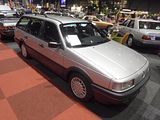
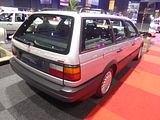
VOLVO
Along with the earlier PV444, the PV544 was made by Volvo from 1947 to 1966. During World War II’s early stages, Volvo had decided that a new, smaller car that could deliver good fuel economy would assure the company’s future. A raw materials shortage during the war drove home the point that an automobile should be smaller, and also complicated Volvo’s ability to mass-produce the product. In 1944, when the car was finally introduced to a car-hungry public, response was very positive and orders poured in from the Swedish population. It was another three years though, until 1947, before series production began. The PV quickly earned a reputation for being strong and rugged, although the design was considered outdated from early on. The PV444 was Volvo’s first uni-body car. Its body structure was influenced by the 1939 Hanomag 1,3 litre, which was purchased and studied by Volvo engineers. It was also the first Volvo in almost 20 years to come with a 4-cylinder engine. The first PV444s were powered by a 40 PS 1.4 litre inline-four engine designated the B4B, with three main bearings, overhead valves, and a single downdraft carburettor. The power of this engine increased to 44 PS in October 1950, and to 51 PS in October 1955. US models, beginning to appear in the US in early 1956, received an uprated version called the B14A which was given twin side-draft 1½ in S.U. carburettors for a total of 70 hp. Most early US sales were limited to Texas and southern California. American customers also had the option of European delivery, in which case they could also get a cheaper model with the basic B4B engine. By the 1957 model year, engine displacement was increased to 1.6 litres and both single downdraft- B16A and twin side-draught carburetted B16B versions were offered. Fuel economy was quite above average for cars sold in the United States. Performance, particularly with the twin carburettor configuration, was brisk. The combination of performance and durability won over many two-seat sports car drivers, allowing them a pleasurable drive in the entire family’s company if desired and the car enjoyed considerable success in motorsport. In 1958, the PV544 was phased in. Subtle differences with the PV444 included the introduction of a curved one-piece windscreen to replace the two panes of flat glass, larger taillights, and a ribbon-type speedometer. The 444’s 3-speed manual transmission was also supplanted by a 4-speed unit in the 544. The next significant change occurred in 1962, when the B16 was replaced by Volvo’s new B18 engine, initially developed for the P1800 sports car introduced the previous year. This 1.8 litre engine had five main bearings. Again single and twin carburettor versions were offered, designated B18A and B18D, respectively. Also in 1962, Volvo changed from 6- to 12-volt electrical systems. In 1963 Volvo began producing the 544 at their new Canadian Dartmouth/Halifax plant, the first Volvo plant to be located outside of Sweden. The PV544 was also made as an estate (wagon) version, the Duett, initially designated the P445 and later the P210. The 544 received incremental mechanical revisions and trim changes until its final production year of 1965. Exactly 440,000 units were built during the 18-year run. The car had so endeared itself to its owners that Volvo ran self-deprecating advertisements in late 1965 and early 1966 imploring PV owners not to be angry with the company.


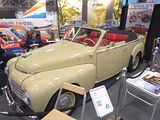
There were a few examples of the “Amazon” Volvo here. Although costly when new, thanks to the UK’s Import Duty which applied to foreign car imports at the time, the Volvo of this era was surprisingly popular with UK buyers. The cars were tough, as strong success in rallying evidenced, but not that many have survived. There’s a complex history to this model, with lots of different numbers applied to the car during a 13 year production run. When introduced, the car was named the Amason (with an ‘s’), deriving from the fierce female warriors of Greek mythology, the Amazons. German motorcycle manufacturer Kreidler had already registered the name, and the two companies finally agreed that Volvo could only use the name domestically (i.e., within Sweden), modifying the spelling to Amazon. Subsequently, Volvo began its tri-digit nomenclature and the line became known as the 120 Series. Under prototype designation 1200, following the PV444’s internal designation as the 1100, the Amazon was released in the press in February 1956, with production initially set to begin in July of the same year, and deliveries commenced in August 1956 — under the now modified internal designation 120 series. The Amazon sedan’s ponton genre, three-box styling was inspired by US cars of the early 1950s, strongly resembling the Chrysler New Yorker sedan and the Chrysler 300C hardtop Coupe. According to designer Jan Wilsgaard, the Amazon’s styling was inspired by a Kaiser he saw at the Gothenburg harbour. The Amazon featured strong articulation front to rear, pronounced “shoulders”, and slight but visible tailfins. These features became inspiration for Peter Horbury when reconceiving Volvo’s design direction with the V70 after decades of rectilinear, slab-sided, boxy designs. The Amazon’s bodywork was constructed of phosphate-treated steel (to improve paint adhesion) and with heavy use of undercoating and anti-corrosive oil treatment. The Amazon shared the wheelbase, tall posture and high H-point seating of its predecessor, the PV. In 1959 Volvo became the world’s first manufacturer to provide front seat belts as standard equipment — by providing them on all Amazon models, including the export models — and later becoming the first car featuring three-point seat belts as standard equipment. The Amazon’s handbrake location, outboard of the driver’s seat, was intended to accommodate subsequent bench seat models with column shift transmissions — which never materialised. Buyers began to receive the first cars in February 1957, and initial models were two-tone red and black with light grey roof, light grey with a black roof, followed by a dark blue with grey roof in 1958. Further iterations included the 121, the base model with a single carburettor 66 bhp engine, the 122S introduced in 1958 as a performance model equipped with a dual carburettor 85 bhp engine. The estate version was introduced at the 1962 Stockholm Auto Show, and Volvo manufactured 73,000 examples between 1962 and 1969. The Amazon estate featured a two-piece tailgate, with the lower section folding down to provide a load surface and the upper section that hinged overhead. The vehicle’s rear licence plate, attached to the lower tailgate, could fold “up” such that when the tailgate was lowered and the vehicle in use, the plate was still visible. This idea was used by the original 1959 Mini. In recent years a similar arrangement was used on the tailgate of the Subaru Baja. In 1966 the Volvo PV ended production, replaced by the Amazon Favorit, a less expensive version of the Amazon, without exterior chrome trim, a passenger-side sun visor or cigarette lighter, and with a three-speed rather than four-speed transmission — available in black with red interior and later white or black with red interior. The newer Volvo 140 was becoming the company’s mainstream model, and the last of the four-door 120 saloons were produced in 1967, the year which saw the launch of the 123GT, which was a Model 130 with high-compression four-cylinder B18B engine (from the Volvo P1800), M41 gearbox, fully reclining seats, front fog and driving lights (on some markets), alternator, fender mounted mirrors, special steering wheel, dash with a shelf and tachometer, and other cosmetic upgrades. In 1969 the displacement of the old B18 engine was increased and the engine was called the B20. The last Amazon was manufactured on 3 July 1970. By the end of production, 234,653 four-door models, 359,917 two-door models and 73,220 station wagons had been produced, of which 60% were exported; a total of 667,791 vehicles.

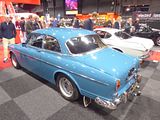

There were a few examples here of the Volvo P1800, a sports car that was manufactured by Volvo Cars between 1961 and 1973. The car was a one-time venture by the usually sober Swedish Volvo, who already had a reputation for building sensible sedans. The project was originally started in 1957 because Volvo wanted a sports car to compete in the US and European markets, despite the fact that their previous attempt, the P1900, had failed to take off with only 68 cars sold. The man behind the project was an engineering consultant to Volvo, Helmer Petterson, who in the 1940s was responsible for the Volvo PV444. The design work was done by Helmer’s son Pelle Petterson, who worked at Pietro Frua at that time. Volvo insisted it was an Italian design by Frua and only officially recognised that it was by Pelle Petterson many years later. The Italian Carrozzeria Pietro Frua design firm (then a recently acquired subsidiary of Ghia) built the first three prototypes between September 1957 and early 1958, later designated by Volvo in September 1958: P958-X1, P958-X2 and P958-X3. In December 1957 Helmer Petterson drove X1, the first hand-built P1800 prototype to Osnabrück, West Germany, headquarters of Karmann. Petterson hoped that Karmann would be able to take on the tooling and building of the P1800. Karmann’s engineers had already been preparing working drawings from the wooden styling buck at Frua. Petterson and Volvo chief engineer Thor Berthelius met there, tested the car and discussed the construction with Karmann. They were ready to build it and this meant that the first cars could hit the market as early as December 1958. But in February, Karmann’s most important customer, Volkswagen forbade Karmann to take on the job, as they feared that the P1800 would compete with the sales of their own cars, and threatened to cancel all their contracts with Karmann if they took on this car. This setback almost caused the project to be abandoned. Other German firms, NSU, Drautz and Hanomag, were contacted but none was chosen because Volvo did not believe they met Volvo’s manufacturing quality-control standards. It began to appear that Volvo might never produce the P1800. This motivated Helmer Petterson to obtain financial backing from two financial firms with the intention of buying the components directly from Volvo and marketing the car himself. At this point Volvo had made no mention of the P1800 and the factory would not comment. Then a press release surfaced with a photo of the car, putting Volvo in a position where they had to acknowledge its existence. These events influenced the company to renew its efforts: the car was presented to the public for the first time at the Brussels Motor Show in January 1960 and Volvo turned to Jensen Motors, whose production lines were under-utilised, and they agreed a contract for 10,000 cars. The Linwood, Scotland, body plant of manufacturer Pressed Steel was in turn sub-contracted by Jensen to create the unibody shells, which were then taken by rail to be assembled at Jensen in West Bromwich. In September 1960, the first production P1800 left Jensen for an eager public. The engine was the B18, an 1800cc petrol engine, with dual SU carburettors, producing 100 hp. This variant (named B18B) had a higher compression ratio than the slightly less powerful twin-carb B18D used in the contemporary Amazon 122S, as well as a different camshaft. The ‘new’ B18 was actually developed from the existing B36 V8 engine used in Volvo trucks at the time. This cut production costs, as well as furnishing the P1800 with a strong engine boasting five main crankshaft bearings. The B18 was matched with the new and more robust M40 manual gearbox through 1963. From 1963 to 1972 the M41 gearbox with electrically actuated overdrive was a popular option. Two overdrive types were used, the D-Type through 1969, and the J-type through 1973. The J-type had a slightly shorter ratio of 0.797:1 as opposed to 0.756:1 for the D-type. The overdrive effectively gave the 1800 series a fifth gear, for improved fuel efficiency and decreased drivetrain wear. Cars without overdrive had a numerically lower-ratio differential, which had the interesting effect of giving them a somewhat higher top speed of just under 120 mph, than the more popular overdrive models. This was because the non-overdrive cars could reach the engine’s redline in top gear, while the overdrive-equipped cars could not, giving them a top speed of roughly 110 mph. As time progressed, Jensen had problems with quality control, so the contract was ended early after 6,000 cars had been built. In 1963 production was moved to Volvo’s Lundby Plant in Gothenburg and the car’s name was changed to 1800S (S standing for Sverige, or in English : Sweden). The engine was improved with an additional 8 hp. In 1966 the four-cylinder engine was updated to 115 PS, which meant the top speed increased to 109 mph. In 1969 the B18 engine was replaced with the 2-litre B20B variant of the B20 giving 118 bhp, though it kept the designation 1800S. For 1970 numerous changes came with the fuel-injected 1800E, which had the B20E engine with Bosch D-Jetronic fuel injection and a revised camshaft, and produced 130 bhp without sacrificing fuel economy. Top speed was around 118 mph and acceleration from 0–62 took 9.5 seconds. In addition, the 1970 model was the first 1800 with four-wheel disc brakes; till then the 1800 series had front discs and rear drums. Volvo introduced its final P1800 variant, the 1800ES, in 1972 as a two-door station wagon with a frameless, all-glass tailgate. The final design was chosen after two prototypes had been built by Sergio Coggiola and Pietro Frua. Frua’s prototype, Raketen (“the Rocket”), is located in the Volvo Museum. Both Italian prototypes were considered too futuristic, and instead in-house designer Jan Wilsgaard’s proposal was accepted. The ES engine was downgraded to 125 bhp by reducing the compression ratio with a thicker head gasket (engine variant B20F); although maximum power was slightly down the engine was less “peaky” and the car’s on-the-road performance was actually improved. The ES’s rear backrest folded down to create a long flat loading area. As an alternative to the usual four-speed plus overdrive manual transmission, a Borg-Warner three-speed automatic was available in the 1800ES. With stricter American safety and emissions standards looming for 1974, Volvo did not see fit to spend the considerable amount that would be necessary to redesign the small-volume 1800 ES. Only 8,077 examples of the ES were built in its two model years.



This is a 144, one of a series of cars made between 1966 and 1974. Volvo Cars began manufacturing the Volvo 144 at Torslandaverken in the late summer of 1966, the first Volvo to use a tri-digit nomenclature, indicating series, number of cylinders and number of doors. Thus, a “144” was a 1st series, 4-cylinder, 4-door sedan. The 144 was the first Volvo to feature a more rectilinear or boxy styling. Compared to the Volvo Amazon, the 140 was a radical departure with minimal exterior and interior carryover, notably a stylised version of the front split grille. The car’s basic shape would survive into the 1990s as the 200 series. Mechanically, the car used many of the same drivetrain components as the Amazon, but also showcased many improvements, including disc brakes on all four wheels. It was named car of the year in 1966 by Swedish magazine Teknikens Värld. The engine in the standard 144 was the same as found in the standard Amazon (121), the 1.8l B18A, but the 144S was given the more powerful B18B from the 123GT and 1800S. Late in the 1967 model year production of the Volvo 142 (2-door sedan) began, in time to build 1500 units for the first year. In 1968 production of the Volvo 145 5-door station wagon began, completing the three body styles used in the 140 range. For the 1969 model year Volvo enlarged the B18 to become the 2.0 litre B20 and replaced the generator with a more modern alternator. It was also in 1969 that Volvo introduced the 164, which shared much of the 140 series structure and styling aft of the windshield while incorporating a 6-cylinder engine, the B30 which was simply a B20 with 2 more cylinders and a few strengthened and enlarged components. In 1970 a flow-through ventilation system, where vents were added towards the rear of the car (on the exterior under the rear window on the 142 and 144 and as a grille next to the right side taillight of the 145) and electrically defrosted rear windows, were introduced. The split rear side window on the 145 became one piece which was no longer possible to open. In 1971 the first of several styling changes were introduced, including a revised black grille which saw the now ubiquitous Volvo diagonal line introduced as well as new wheels. 1971 also saw the introduction of the B20E, which was a high compression version of the B20 which introduced Bosch D-Jetronic electronic fuel injection. These new cars were either given the designation E (the German word Einspritzer, or “injection”) or GL (for Grand Luxe), which was a more upmarket version of the car. A console on the transmission tunnel with a clock was now standard. The styling changes continued in 1972 with the introduction of flush mounted door handles and a slightly revised dashboard with fake woodgrain trim, newly designed switches and a small central panel with a clock. The transmission tunnel was taken from the 164 as was the same short-shifter gear stick and the automatic transmission became controlled by a T-bar mounted on the floor at the same place. The outer 2 rear seats now had the mounting points for retractable seatbelts. A low compression fuel injected engine, the B20F was introduced for the US and certain other markets. In 1973 the 140 series received a major facelift, with a new plastic grille, new larger indicators and a completely revised tail end. Also, the S designation was dropped and the range consisted of 3 trim levels, standard (with no designation, known as L, or “luxe”) de Luxe and the most upmarket, Grand Luxe. The interior also had a completely revised dashboard with a new instrument cluster consisting of dials rather than the strip speedometer previously used, rocker switches replacing the push-pull switches (with the exception of the headlight switch), and vents to direct air towards the person augmenting the defrost and floor vents. In 1974, the B20E/F engine switched from using the Bosch D-Jetronic to the K-Jetronic mechanical fuel injection system. Also, several safety changes were introduced including a fuel tank that was located close to the axle to protect it in the case of a rear-end collision, and larger bumpers that protruded more from the body. The quarter-light windows in the front doors were removed as a result of the improvements in ventilation inside the car, and small anodised aluminium strips were added to the bottom of the side windows. Total Production was 412,986 2-doors sedans, 523,808 4-doors sedans and 268,317 estates.

The Volvo 164 is a 4-door, 6-cylinder luxury sedan unveiled by Volvo at the Paris Motor Show early in October 1968 and first sold as a 1969 model. 146,008 164s were built before the car was succeeded by the mid-size luxury 264 in 1975, although some sources state 153,179 were built). The 164 was Volvo’s first venture into the luxury segment since the end of PV 60 production in 1950, and was the first six-cylinder Volvo since the PV800 last produced in 1958. Jan Wilsgaard designed what would eventually become the 164 in the late 1950s as a concept car called the P358 and powered by a V8 engine. The front styling somewhat resembles the Wolseley 6/99 and the Volvo P1900, more so by the Ferrari 375 Agnelli, which influenced the Jaguar XJ as well. In 1968 Volvo introduced the 164 as a luxury version of their 140 series. The wings, the grille, the front bumper, the bonnet, the headlamp bezels, and the front indicators were all unique to the 164; to accommodate the long 3-litre 6-cylinder engine the 164’s wings and bonnet were longer than those of the 4-cylinder 140, but the overall height and width of the 164 were the same as the 140 series. The interior featured a simulated woodgrain dashboard face and leather seating surfaces. Introduced the same year as the BMW E3, the 164 was Volvo’s answer to the Mercedes-Benz 250 and Jaguar XJ6. The 164 compared favourably in terms of fuel economy with similarly sized 6-cylinder European cars such as the BMW 530. in 1972 an update saw the introduction of fuel injection to the 164 with the B30E (high compression) and B30F (low compression) engines which utilised Bosch D-Jetronic injection. Also for 1972 the dash was slightly revised with he introduction of a centre console and some of the dash switches, as well as the clock, were moved to it as well as being redesigned. The flush mounted pull style door handles also appeared for the 1972 model year. In 1973 the 164 received a major facelift including new rear and side lamps, a new grille and front bumper, and a new instrument cluster and dashboard which included air ducts. In 1974 the doors were revised and strengthened and the vent wings were eliminated due to the panel vents introduced in 1973, and the 164 became one of the earliest cars to offer heated seats. The instrument cluster changed slightly with the introduction of the bulb failure indicator and the fuel gauge received revised markings with the 1/2 mark moved to the centre of the gauge and the red reserve section shrinking significantly. Underneath, the floor pan was revised and the fuel tank was moved from the boot floor to closer to the rear axle for better protection in the case of an accident. A limited edition of the 164, the 164TE was made only in 1974 and only for 3 markets, Great Britain, Germany and Australia. The 164TE had extra accessories fitted as standard, being air conditioning, 4 speaker 8 track player with radio, headlight wipe/wash system, rear head rests, rear reading lamps and a fully carpeted boot with lighting. This more upmarket version was only available in 3 colours, being metallic light blue (colour 111), metallic copper (colour 105) and metallic teal (colour 115). For 1975 (1976 in America and Japan) the 164 was replaced by the 264 which was powered by the PRV 2.7-liter V6 engine. The PRV engine was not immediately able to meet Federal emissions standards, so the 164 was kept in limited production for one more year for the American and Japanese markets – although only small numbers were sold. The 164 received new, larger six-panel rear lamps sometime during the 1975 model year, electronic ignition, new seats, electric windows in the front, a new style of badging, extensive changes to the rear suspension, and the parking brake handle was moved from outboard to inboard of the driving seat.

WIKOV
This is a brand I’d never heard of. The Wikov 40 was a popular Czechoslovakian mid-size car, known for its craftsmanship and available in various body styles like convertible (cabriolet) and standard, featuring a 1942cc OHC inline-four engine with 43 hp at 2800 rpm, a 3-speed gearbox, and top speed of 110 km/h. Produced by Wichterle & Kovářík (Wikov) from 1933-1937, the Model 40 was their most successful, with about 330 built by 1935, recognized for innovative features for its time, including aerodynamic designs. The company showcased progressive designs, including streamlined elements inspired by the “drop of water” aesthetic, even featuring bodywork by French coachbuilder Vanvooren on some models. A Wikov 40 won the 2000cc class at the 1934 1000 Miles of Czechoslovakia. The Wikov 40 was a well-regarded automobile in Czechoslovakia, bridging traditional design with emerging aerodynamic trends before production ceased in 1937.
ZIMMER
The Zimmer Golden Spirit was the flagship of the Zimmer Motor Cars Corporation during its production run from 1980 to 1988. While the original Golden Spirit was built using a Ford Mustang drivetrain, production began by cutting off or removing all body panels except the doors and roof. The chassis was then extended by 38″ and new steering and brake components installed. Fiberglass body panels were manufactured by Zimmer and fitted along with chrome bumpers and other exterior parts. Interiors were re-trimmed in leather with Recaro seats and Nardi steering wheels, but otherwise carried the standard Mustang instrumentation. While the majority of Golden Spirits were two-door hardtops, there were limited numbers of convertibles and t-top variants built with at least one four-door sedan and “personal limousine” known to have been built. The Mustang vehicle identification number was retained so as to meet all the required US safety features at the time. Zimmer sold the vehicles on their own manufacturer’s certificate of origin. Depending on the jurisdiction in which the vehicle was first registered, it may have been titled as a Zimmer Golden Spirit or a Ford Mustang. The second Zimmer Motor Cars Corporation product was the mid-engined Pontiac Fiero-based Quicksilver, which was built between 1986 and 1988. The Quicksilver is a two-seat personal luxury car designed by former General Motors designer Don “D.A.” Johnson. Each Quicksilver was constructed from a new Fiero donor car, which was dismantled and structurally modified at the Zimmer factory by adding a 13″ section behind the rear wheels and an additional 16″ just behind the front suspension. Power steering, which was not available on the Fiero, was added by Zimmer. The Fiero bodywork was replaced by a new fiberglass body with dramatic new styling with a long, sloping nose and pop-up hidden headlamps. Large chrome front and rear bumpers were manufactured in Taiwan and plated in Florida. The re-designed interior was trimmed in leather and wood, and the new body had increased luggage space in the front and rear. The Fiero Vehicle Identification Number was retained. It met all the required US safety features at the time. While Zimmer sold the vehicles on their own manufacturer’s certificate of origin, depending on the jurisdiction in which the vehicle was first registered, it may have been titled as a Zimmer QuickSilver or a Pontiac Fiero. The retail price of the Quicksilver in 1986 was $51,950. Both models were built in the same factory in Pompano Beach, Florida, on simultaneous production lines, from 1980 to 1988. Though no factory production records are known to exist, it is believed, based on a survey of surviving cars (and their Zimmer Motor Cars-added production plates), that approximately 1,500 Golden Spirits and 170 QuickSilvers were built.


This was a fantastic event and would have been well worth the trip when considered by itself. That I was able to combine it with two other car events and to be joined by three good friends to enjoy it all with me made for a very special start to 2025. I will definitely be looking to try to include this one in my 2026 schedule.