During 2024 I made two separate visits to the AutoWorld museum in Brussels. So it may be a little surprising to read of a third visit just six months later. The reason why is simple: as well as the core collection of cars on show, AutoWorld, like many museums has figured out that a good way to get people to keep coming back is to mount a series of temporary exhibitions, bringing in cars that would not usually be on display. My July 2024 visit was to see a combined 75 years of Abarth and 125 years of Abarth, and I spotted that their 2024 program, running on into 2025 would celebrate 110 years of Maserati. That was something I was keen to see, and when a Brussels trip to visit the Motor Show and the Interclassics Maastricht was in plan, adding in AutoWorld seemed like a no-brainer. So, here I am again.
Autoworld is located inside the Parc du Cinquantenaire, an expansive area in the eastern suburbs of Brussels, and easily accessible by car, metro and other forms of public transport, though one change since my last visit is that the Parc itself is now car free, so you will have to park outside it – which was not a problem on a weekend day but may be harder during the week. Even the building itself is impressive and has an interesting history. Léopold II’s (1835-1909) driving ambition was to speed up Belgium’s urban development. He wanted to make Brussels not only a beautiful and prestigious city, but also a wonderful place in which to live, capable of matching the other great European towns. In 1880 the Belgians celebrated the fiftieth anniversary of their independence: it was an ideal pretext to organise a National Exhibition. Barely a year before the exhibition Léopold II asked the architect Gédéon Bordiau to trace the main outlines of a huge park on an abandoned military training camp outside the city itself: the plateau of Linthout, which covered 12 hectares. Bordiau designed two buildings for this Exhibition linked by semi-circular colonnades with an Arch of Triumph built in the extension of the Rue de la Loi: an avenue leading to Tervuren was also planned. Needless to say, they were not completed in time for the Exhibition and the colonnades and the Arch of Triumph were made of wood and plaster. After the festivities the authorities had no specific plans for the plot of land although building continued. The park was enlarged by expropriations and purchases to its current size of 30 hectares and was given the name it bears today, the Parc du Cinquantenaire. Autoworld is a private museum which rents this building from the community, and the display comprises more than 400 vehicles which provide a comprehensive and informative illustration of the history of the motorcar. Cars are rotated on and off display, with those for which there is no room being held in storage or at the Mahymobile collection which I visited during one of those 2024 trips.
THE MASERATI EXHIBITION
This was what I really wanted to see, a celebration of 110 years of Maserati, covering the history of the brand with the Trident. Maserati has had a chaotic history but has always retained an important aura among sports car enthusiasts. This is due to its many successes in competition, and several generations of iconic Grand Touring cars. Maserati was founded in 1904 in Bologna by Alfieri Maserati and his brothers, who had a passion for mechanics. Initially, Maserati improved existing mechanics and helped design racing cars for other companies. In 1926, Maserati presented its first Grand Prix racing car. But financial problems led the brothers to sell the company in 1937 to Adolfo Orsi, an Italian industrialist who moved the company to Modena. The Orsi family would remain Maserati owners for almost 30 years, and this period was undoubtedly one of the company’s finest years, in both sports and touring car terms. Citroen bought Maserati in 1968, but faced with its own financial problems, sold it a few years later. A complicated period followed, with several owners struggling to restore Maserati to its former glory, until the company was bought by FIAT in 1987. There were still a few difficult periods, as the right balance had to be found with Ferrari, but in recent years Maserati has regained a more coherent positioning and returned to competition.
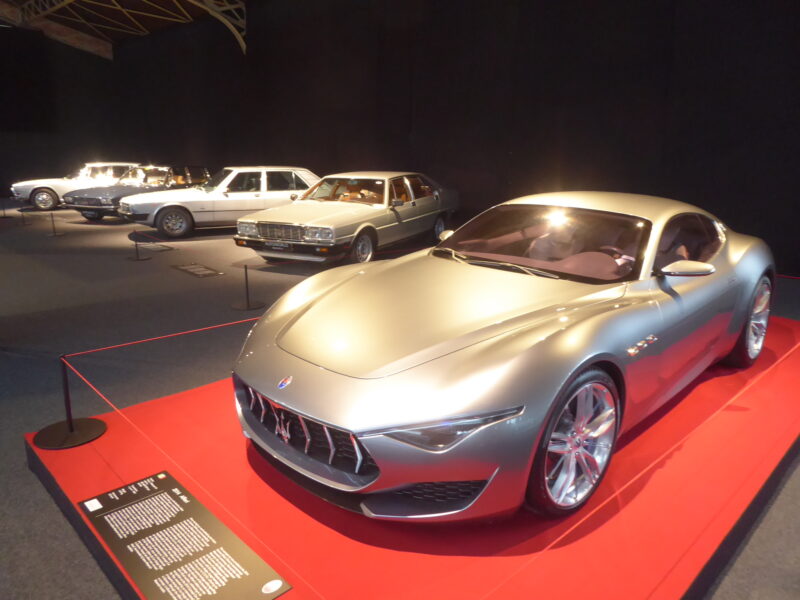
With the support of Maserati, Maserati Classiche (Maserati branch that appraises and certifies “historic” Maseratis), private collectors and museums (including the Panini Collection and Cadycars), the Autoworld Museum team has prepared an exceptional exhibition comprising 50 cars, a few of which were to be found on the ground floor and the majority were in a massive area on the mezzanine floor, where they made for a spectacular sight. Displayed so in many cases you could walk around them and see the car from all angles, they were grouped together in a mix of themes and production chronology.
The ground floor “pop-up” area is dedicated to some of Maserati’s sporting icons:
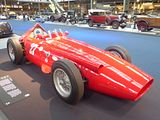
250F: One of the best known Formula 1 cars of the mid 1950s is the Maserati 250F. 26 of these legends were made between January 1954 and November 1960. Twenty-six examples were made. The 250F principally used the 2.5-litre Maserati A6 straight-six engine which generated 220 bhp at 7400 rpm, ribbed 13.4″ drum brakes, wishbone independent front suspension and a De Dion tube axle. It was built by Gioacchino Colombo, Vittorio Bellentani and Alberto Massimino; the tubular work was by Valerio Colotti. The 250F first raced in the 1954 Argentine Grand Prix where Juan Manuel Fangio won the first of his two victories before he left for the new Mercedes-Benz team. Fangio won the 1954 Drivers’ World Championship, with points gained with both Maserati and Mercedes-Benz; Stirling Moss raced his own privately owned 250F for the full 1954 season. In 1955 a 5-speed gearbox; SU fuel injection (240 bhp) and Dunlop disc brakes were introduced. Jean Behra drove this in a five-member works team which included Luigi Musso. In 1956 Stirling Moss won the Monaco and Italian Grands Prix, both in a works car. In 1956 three 250F T2 cars first appeared for the works drivers. Developed by Giulio Alfieri using lighter steel tubes they sported a slimmer, stiffer body and sometimes the new 315 bhp V12 engine, although it offered little or no real advantage over the older straight 6. It was later developed into the 3 litre V12 that won two races powering the Cooper T81 and T86 from 1966 to 1969, the final “Tipo 10” variant of the engine having three valves and two spark plugs per cylinder. In 1957 Juan Manuel Fangio drove to four more championship victories, including his legendary final win at German Grand Prix at the Nürburgring (Aug. 4, 1957), where he overcame a 48 second deficit in 22 laps, passing the race leader, Mike Hawthorn, on the final lap to take the win. In doing so he broke the lap record at the Nürburgring, 10 times. By the 1958 season, the 250F was totally outclassed by the new rear engined F1 cars, however, the car remained a favourite with the privateers, including Maria Teresa de Filippis, and was used by back markers through the 1960 F1 season, the last for the 2.5 litre formula. In total, the 250F competed in 46 Formula One championship races with 277 entries, leading to eight wins. Success was not limited to World Championship events with 250F drivers winning many non-championship races around the world. Stirling Moss has repeatedly said that the 250F was the best front-engined F1 car he drove.

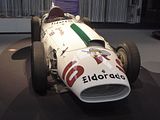
Tipo 420 Eldorado: this car became famous in 1958 as the first single-seater car in Europe to be sponsored by a brand not linked to the world of motorsport. The brand in question was Eldorado, an ice-cream manufacturer. This was the first example of modern sponsorship, where the car was painted in the colours of the partner company, abandoning the traditional colour assigned to each country by the International Federation. This was a real revolution for the day, of vital importance to the future of motorsport, which from that moment on opened its doors to new financial backers. Maserati was commissioned to build the car by Gino Zanetti, owner of the Eldorado ice-cream company. Determined to promote his brand on the international stage, Zanetti turned to the House of the Trident to create a single-seater car to compete in the “Trofeo dei due Mondi” (Race of Two Worlds) at Monza: the Automobile Club d’Italia had organised a 500 Mile race at the circuit based on the Indianapolis 500, with top American drivers lining up alongside Europe’s cream of the crop. The Maserati 420/M/58, chassis number 4203, was thus finished with a cream coloured livery, instead of Italian racing red. The name Eldorado was emblazoned in bold black lettering along the sides of the car, with two additional smaller logos on the nose and below the small deflector that acted as a windshield. The logo with the face of the smiling cowboy was positioned in the centre of the nose and on the sides of the rear fin. Below the two Eldorado brands on the sides, in bright racing red was “Italia”, denoting the nationality of the sponsor as well as that of the racing car manufacturer. The long silhouette of the “Eldorado” also bore the name of the driver chosen to race it in the “Monzanapolis”: Stirling Moss, one of the greatest drivers in the history of motor sports, and a former Maserati driver. The previous year, in 1957, the Modena-based manufacturer had won the Formula 1 World Championship with Juan Manuel Fangio, before deciding to withdraw from competitive racing and build racing cars on commission only for private customers, also providing them with assistance. This was precisely the ideal situation that Zanetti was seeking, and the reason why the Italian entrepreneur turned to Maserati. In the space of a few months, the engineer Giulio Alfieri created the “Eldorado”. The engine, derived from the V8 unit mounted in the 450S twin cam models, had its displacement reduced to 4,190 cc, generating 410 hp at 8,000 rpm; both the engine and transmission were offset to the left by nine centimetres. The aim of this decision was to ensure a more balanced weight distribution, taking into account the anti-clockwise direction of travel on the high banked corners at Monza. The gearbox had just two speeds while the De Dion rear axle had no differential. The tubular chassis was derived from that of the highly successful 250F, although it proved oversized compared to the latter, also as a result of numerous reinforcements introduced to enable the car to withstand the mechanical stress generated by the concrete track at Monza. To reduce the weight, Halibrand magnesium wheels were used along with Firestone 18-inch braided tread tyres inflated with helium. With these measures, the car weighed in at 758 kg. The aluminium bodywork, hand crafted by Fantuzzi, was characterised by an aerodynamic vertical fin behind the cockpit and a front carburettor scoop. On 29th June 1958, at the Monza track, the race was held in three heats to decide the final points table. This strategy was aimed at enticing European car manufacturers to enter their own cars, which had not originally been designed to compete in such a long race, and one that was so mechanically arduous. In the first heat Moss finished 4th. In the second he crossed the line 5th. In the final heat, however, his steering broke and the Maserati slammed into the guard-rail, dashing the English driver’s hopes of finishing the race in third place overall. Taking into account the three heats and the total number of laps completed, Moss nonetheless took seventh place in the end. He walked away unscathed from the crash and, all things considered, the “Eldorado” too suffered only limited damage, proving the value of its solid structure. Despite the success in terms of spectator numbers and entertainment value, the 500 Miles of Monza did not become a regular event on the racing calendar. Based on the findings from the race, the “Eldorado” was modified by the Gentilini bodywork shop, which removed the rear fin and reduced the hood scoop, after which the car was entered in the Indianapolis 500 in 1959. This time it was finished in red, the colour denoting Italy in competitions, but still emblazoned with the Eldorado sponsor’s name in white lettering on the sides, as well as the cowboy logo in a white circle on the nose and tail. The inexperience of the gentleman-driver, Ralph Liguori, meant that the car failed to qualify, as it set the 36th fastest time, with only the first 33 qualifying. With a professional driver behind the wheel, it would have been a very different result. But that is a whole other story. The Indy 500 race was dear to Maserati, which took victory in 1939 and 1940 with the driver Wilbur Shaw behind the wheel of an 8CTF. Shaw almost made it a hat-track in 1941, but was forced to withdraw during the penultimate lap while out in front, victory denied by a broken wheel. Maserati is the only Italian car manufacturer to have won on the Indiana race track and the only European brand to have triumphed on two consecutive occasions.
4CLT 48 V12: The 4CLT 48 V12 is a Maserati 4CLT chassis but equipped with a V12 developed by OSCA. This single-seater took part in numerous races, notably in the hands of Prince Bira, a famous gentleman driver, hence its Kingdom of Siam colours.


1956 Maserati 250 S: In the early 1950s, sports car racing saw a seismic shift in regulations, prompting manufacturers to adapt quickly. Maserati’s reply was a series of 4-cylinder sports cars: the 150S, 200S and ultimately 250S. This Maserati originally started life as a Fiandri bodied tipo 53/150S, sold in May ’56 to Belgian gentleman racer Georges Berger. After a crash at Spa in 1957, Maserati uprated chassis n° 1660 to 200S spec with the bodywork and engine of n° 2411, a redundant early factory spare, and renumbered accordingly. It was uprated to 250SI spec by Monaco based Jeremy Agace who competed in the Maserati Shell Historic series from the mid-90s through to 2004. He then sold it to its current owner, the Belgian collector and historic racer Marc Devis.

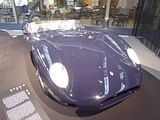
1961 Maserati Tipo 61 Birdcage Droge: This iconic race car is renowned for its groundbreaking design and remarkable success on the track. At the heart of the Tipo 61’s brilliance is its “birdcage” chassis, composed of over 200 small-diameter tubes, delivering unparalleled strength while keeping weight to a minimum. Its low-slung, elongated bodywork, designed by Franco Scaglione, minimises drag and optimizes airflow. The distinctive droop-nose design, often referred to as the “Drogo”, further improves stability at high speeds, embodying the Maserati ethos of form following function. During the 1961 International GT season, it achieved significant victories. Its versatility and competitiveness cemented its status as a motorsport legend.

1961 Maserati Tipo 63 V12 Serenissima: Introduced in 1961, this racing car was a collaborative effort between Maserati and Count Giovanni Volpi’s Serenissima racing team. A 4 litre V12, its advanced DOHC design with 4 valves per cylinder enabled it to produce power seamlessly, making it one of the most potent engines of its era. Maserati incorporated a tubular magnesium frame, a hallmark of the “Birdcage” design. The car’s body, designed by Giorgio at Bertone, featured a low-profile, aerodynamic shape optimized for speed. Despite its innovative engineering, the car struggled with mechanical problems during its racing career. Entered by Team Scuderia Serenissima, with Ludovico Scarfiotti (I) and Nino Vaccarella (I) at the wheel, the Tipo 63 debuted at the 1961 24 Hours of Le Mans, though reliability issues led to an early retirement after 53 laps.


By the end of the 1950s, Maserati’s finances were at an all-time low, and the company decided to quit direct racing, but sold Sport Prototypes such as the Tipo 61 and 63 to private teams. It would not return to GT racing until the 2000s, with the 3200 and then the MC12.
2007 Maserati Trofeo Light: Designed by Maserati’s racing department in Modena with collaboration from Italtechnica, it stands out as a masterpiece of engineering tailored for the racetrack. Derived from the Maserati Coupé Cambiocorsa, the Trofeo Light was purpose-built for competitive racing. It found its place in prestigious events like the FIA GT3 European an Italian GT Championships.


2011 Maserati GranTurismo MC GT4: The GranTurismo MC is the racing version of the GranTurismo S developed to compete in the FIA GT4 European Cup and is based on the Maserati MC concept. It features a carbon fibre bodywork and lexan windows throughout along with a race interior. All the weight-saving measures lower the weight to about 1.361 kg. It went on sale through the Maserati Corse programmme. 15 GranTurismo MC racecars were developed, homologated for the European Cup and National Endurance Series. The GranTurismo MC GT4 itself is pretty much unchanged compared to the Trofeo version.


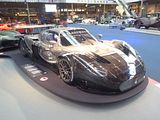
MC12: The Maserati MC12 (Tipo M144S) is a limited production two-seater sports car produced by Maserati from 2004 to 2005, to allow a racing variant to compete in the FIA GT Championship. The car entered production in 2004, with 25 cars produced. A further 25 were produced in 2005 after the FIA changed the rules and reduced the maximum length allowed. The second batch of 25 are 150mm shorter than the originals, making a total of 50 cars available for customers. With the addition of 12 cars produced for racing, a total of just 62 were ever produced. Maserati designed and built the car on the chassis of the Ferrari Enzo, but the final car is much larger and has a lower drag coefficient, along with being longer, wider and taller and has a sharper nose and smoother curves than the Enzo. The Enzo had quicker acceleration, shorter braking distance, and a higher top speed at 350 km/h (217 mph), 20 km/h (12 mph) more than the MC12. The MC12 was developed to signal Maserati’s return to racing after 37 years. The road version was produced to homologate the race version. One requirement for participation in the FIA GT is the production of at least 25 road cars. Three GT1 race cars were entered into the FIA GT with great success. Maserati began racing the MC12 in the FIA GT toward the end of the 2004 season, winning the race held at the Zhuhai International Circuit. The racing MC12s were entered into the American Le Mans Series races in 2005 but exceeded the size restrictions and consequently paid weight penalties due to excess range. Under the direction of Giorgio Ascanelli, Maserati began development of an FIA GT-eligible race car. This car, which would eventually be named the MC12, was initially called the “MCC” (“Maserati Corse Competizione”) and was to be developed simultaneously with a road-going version, called the “MCS” (“Maserati Corse Stradale”). Frank Stephenson, Director of Ferrari-Maserati Concept Design and Development at the time, did the majority of the body styling, but the initial shape was developed during wind tunnel testing from an idea presented by Giorgetto Giugiaro. The MCC has a very similar body shape to the MC12, but there are several key differences, most notably the rear spoiler. Andrea Bertolini served as the chief test driver throughout development, although some testing was done by Michael Schumacher, who frequently tested the MCC at the Fiorano Circuit. During the development process, the MCC name was set aside after Maserati established the car’s official name, MC12. The car is based heavily on the Enzo Ferrari, using a slightly modified version of the Ferrari F140 V12 engine, the same gearbox (but given the unique name of “Maserati Cambiocorsa”) and the same chassis and track (length of axle between the wheels). The windshield is the only externally visible component shared with the Enzo; the MC12 has a unique body which is wider, longer and slightly taller. The increased size creates greater downforce across the MC12’s body in addition to the downforce created by the two-metre spoiler. The MC12 is a two-door coupé with a targa top roof, although the detached roof cannot be stored in the car. The mid-rear layout (engine between the axles but behind the cabin) keeps the centre of gravity in the middle of the car, which increases stability and improves the car’s cornering ability. The standing weight distribution is 41% front and 59% rear. At speed, however, the downforce provided by the rear spoiler affects this to the extent that at 200 km/h (125 mph) the downforce is 34% front and 66% rear. Even though the car is designed as a homologation vehicle and is a modification of a racing car, the interior is intended to be luxurious. The interior is a mix of gel-coated carbon fibre, blue leather and silver “Brightex”, a synthetic material which was found to be “too expensive for the fashion industry”. The centre console features the characteristic Maserati oval analogue clock and a blue ignition button, but it has been criticised for lacking a radio, car stereo or a place to install an aftermarket sound system. The body of the car, made entirely of carbon fibre, underwent extensive wind tunnel testing to achieve maximum downforce across all surfaces. As a result, the rear spoiler is 2 m (79 in) wide but only 30 mm (1.2 in) thick, the underside of the car is smooth, and the rear bumper has diffusers to take advantage of ground effect. Air is sucked into the engine compartment through the air scoop; its positioning on top of the cabin makes the car taller than the Enzo. The exterior is available only in the white-and-blue colour scheme, a tribute to the America Camoradi racing team that drove the Maserati Tipo Birdcages in the early 1960s. Bespoke colour schemes are available by paying an extra amount. The car is noted for the awkwardness that results from its size; very long and wider than a Hummer H2. This, combined with the lack of a rear window, can make parking the MC12 challenging. The MC12 sports a 232 kg (511 lb), 5,998 cc Enzo Ferrari-derived longitudinally-mounted 65° V12 engine. Each cylinder has 4 valves, lubricated via a dry sump system, with a compression ratio of 11.2:1.] These combine to provide a maximum torque of 652 Nm (481 lb/ft) at 5,500 rpm and a maximum power of 630 PS (621 hp; at 7,500 rpm. The redline rpm is indicated at 7,500—despite being safe up to 7,700—whereas the Enzo has its redline at 8,000 rpm. The Maserati MC12 can accelerate from 0 to 100 km/h (62 mph) in 3.8 seconds (though Motor Trend Magazine managed 3.7 seconds) and on to 200 km/h (124 mph) in 9.9 seconds. It can complete a standing (from stationary) 402 metres (1⁄4 mi) in 11.3 seconds with a terminal speed of 200 km/h (124 mph) or a standing kilometre in 20.1 seconds. The maximum speed of the Maserati MC12 is 330 km/h (205 mph). Another change on the engine compared with the Enzo was the use of gears to drive the camshafts instead of chains. Power is fed to the wheels through a rear-mounted, six-speed automated manual. The gearbox is the same as the Enzo’s transmission (tuned to different gear ratios) but renamed “Maserati Cambiocorsa”. It provides a shift time of just 150 milliseconds and is mechanical with a 215 mm (8.5 in) twin-plate dry clutch. The MC12’s chassis is a monocoque made of carbon and nomex, with an aluminium sub-chassis at the front and rear. It has a roll bar to provide additional strength, comfort and safety. Double wishbone suspension with push-rod-operated coil springs provide stability and dampers smooth the ride for the passengers. The front of the car can be raised for speed bumps and hills by pressing a button that extends the front suspension. There are two modes for the chassis’ tuning which can also be changed with a button in the cabin: “sport”, the standard setting, and “race”, which features less of the “Bosch ASR” (anti-slip regulation) traction control, faster shifts and stiffer suspension. The MC12 has 485 mm (19 in) wheels with a width of 230 mm (9 in) at the front and 330 mm (13 in) at the rear. The tyres are “Pirelli P Zero Corsa” with codes of 245/35 ZR 19 for the front tyres and 345/35 ZR 19 for the rear. The brakes are Brembo disc brakes with a Bosch anti-lock braking system (ABS). The front brakes have a diameter of 380 mm (15 in) with six-piston calipers and the rear brakes have a diameter of 335 mm (13.2 in) with four-piston calipers. The centre-lock wheel nuts that hold the wheels to the chassis are colour-coded; red on the left of the car, blue on the right. The car has generally received mixed reviews, with critics saying it is hard to drive, overpriced and too large. Other criticisms include the lack of a trunk, rear window, spare tire and radio, and the way the car’s engine was limited or “drugged”.] Former driver for Vitaphone Racing Team, Andrea Bertolini, the chief test driver throughout the development, said the car, “reacts well and is very reliable in its reactions.” The Top Gear television series acquired an MC12, and test driver The Stig achieved a lap time of 1:18.9 around the Top Gear track—0.1 seconds faster than his lap in the Enzo Ferrari. Host Jeremy Clarkson also drove it, comparing it to the Maserati Biturbo, a car he disliked. Clarkson criticised the car greatly, pointing out that, unlike the Enzo, it lacks a rear window. Despite his criticisms, he complimented the smooth ride. Motor Trend Magazine reviewer Frank Markus had a more positive opinion. Despite initial skepticism he said, “It turns out that the Enzo makes a more comfortable and attractive road car when made over as a butch Maserati racer in street couture”. Markus complimented the stability of braking and the handling ability of the MC12, especially the drifting allowed by the traction control when cornering, commenting that “There’s none of the knife-edged limit handling we criticised in the more extreme Enzo. It’s even more forgiving at the limit than an Acura NSX.” When Automobile Magazine tested an MC12, reviewer Preston Lerner called it “user-friendly”, praising the responsiveness and simplicity of driving. Lerner approved of Frank Stephenson’s work with the styling of both the car’s exterior and interior, calling the trim “Speed-Racer-ish” but “without looking as though it belongs in a Nitrous-ized Civic”. He also complimented the ASR’s level of intervention, commenting that it “lets the fun factor get reasonably high before kicking in”. The MC12 Versione Corse is a variant of the MC12 intended for racetrack use. In contrast to the race version of the MC12, of which street-legal versions were produced for homologation purposes, the MC12 Corse is intended for private use, albeit restricted to the track, as the Corse’s modifications make it illegal to drive on the road. The Versione Corse was developed directly from the MC12 GT1, which won the 2005 FIA GT Manufacturers Cup. The car was released in mid-2006, “in response to the customer demand to own the MC12 racing car and fuelled by the growth in track days, where owners can drive their cars at high speeds in the safety of a race track”, as stated by Edward Butler, General Manager for Maserati in Australia and New Zealand. In similar fashion to the Ferrari FXX, although the owners are private individuals, Maserati is responsible for the storage, upkeep, and maintenance of the cars, and they are only driven on specially organized track days. Unlike the FXX, Versione Corses are not used for research and development, and are used only for entertainment. Three Maserati MC12 Versione Corses were converted to road legal use by German tuning firm Edo Competition and feature a slight power increase, a butterfly intake exhaust system and adjustable road suspension system. Only twelve MC12 Versione Corses were sold to selected customers, each of whom paid €1 million (US$1.47 million) for the privilege. Another three vehicles were produced for testing and publicity purposes. The Versione Corse shares its engine with the MC12 GT1; the powerplant produces 755 PS at 8,000 rpm, 122 PS more than the road going MC12. The MC12 Versione Corse shares the GT1’s shortened nose, which was a requirement for entry into the American Le Mans Series. The car was available in a single standard colour, named “Blue Victory”, though the car’s paint could be customized upon request. The MC12 Versione Corse possesses steel/carbon racing brakes, but is not fitted with an anti-lock braking system.


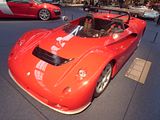
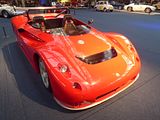
1992 Maserati Barchetta: The Maserati Barchetta is a mid-engine racing car, like the 350 and 450S, that was designed by Carlo Gaino of Synthesis Design, an Italian design house. The Barchetta was designed and developed for the one-make racing series Grantrofeo Barchetta which was held 1992 and 1993 throughout Italy and Europe. It featured sixteen races in total, most of them in Italy. The Barchetta had a backbone chassis made of aluminium which was unusual for a Maserati automobile for a time considering that the cars offered by Maserati had a steel unibody construction. It had a Formula 1 suspension geometry and body panels made of carbon fibre which resulted in a total weight of 775 kg (1,709 lb). The Barchetta was one of the last Maserati models built under De Tomaso ownership. 16 examples of the racing model were produced by hand at the De Tomaso factory in Modena, plus two prototypes (one racing-corsa, one street-stradale model). It featured a mid-mounted Maserati AM501 V6 engine displacing 1,996 cc and was shared with the local 2.0 L engine offered in the Italian market on the Biturbo and the Ghibli. The engine had a peak power output of 319 PS at 7,250 rpm. The engine was mated to a 6-speed manual transmission manufactured by ZF Friedrichshafen and having straight cut gears. These modifications allowed the car to attain a top speed of 290 km/h (180 mph). Having a true open top design, driver protection was provided only by a small air deflector. The central-frame concept was carried over in the De Tomaso Guarà, but the frame was around 130 mm (5.1 in) longer because it was fitted with a larger V8 engine. This was thought as a way to inject much needed excitement and enthusiasm for Maserati that saw its reputation badly ruined by years of exciting but maintenance sensitive products, eventually culminating in Maserati’s withdrawal from the North American market at this time.
On the left-hand side of the mezzanine are 4 racing cars, 3 of them pre-war. During this period, Maserati was building only racing cars, sold to private teams to finance its official team.
1928 Tipo 26M: The first Maserati was the Tipo 26 named as the year it was completed. The car bore the Trident logo as Neptune was symbol to Bologna city. The Maserati Tipo 26 was an immediate success starting at 1926 Targa Florio with 1500 cc class winner position. The Maserati Tipo 26 had a ladder type chassis with bracings and a 1493 cc on-line eight cylinder engine with overhead camshaft and a supercharger. It produced 120 hp. Eleven Maserati were hand produced between 1926 and 1928. The Maserati Tipo 26 was suitable for road use as well as for track racing. In 1927 the Maserati brothers introduced the Maserati Tipo 26B with the eight cylinder capacity increased to 1980 cc and producing 155 hp. Claimed top speed is 180 kph (108 mph). Claimed fuel consumption 30 litres per 100 km (9,09 mpg). Kerb Weight 720 kg. Six examples were produced between 1927 and 1930, but a few Tipo 26 were converted to Tipo 26B specification. One easy to identify difference between the Tipo 26 and Tipo 26B is an inclined radiator for better air circulation. The Maserati Tipo 26B was successful at 1927 Targa Florio with third position overall. The Maserati Tipo 26B was a success between private racing drivers; the Tipo 26B won 1928 Italian Manufacturers Championship. This is the oldest still in existence.
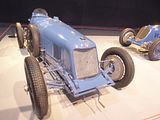
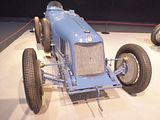
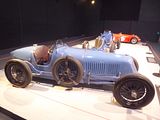
1934 8CM: with a turbocharged in-line 8-cylinder
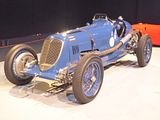


1937 6CM: This fabulous racer was presented to the public at the 1936 Milano Motor Show and in the same year at the race in Monte Carlo. It is a single seat racing car with alloy body and supercharged 1493 cc six cylinder engine with compressor producing 155 bhp. It was sold by Maserati to private racing teams. Sadly it was not show the day I visited.
1947 A6GCS: dates from 1947 and is the last car built under the direction of the Maserati brothers, before their contract ended and they left to create OSCA. Its distinguishing feature is the single headlight in the middle of the grille, hence the nickname “Monofaro”.
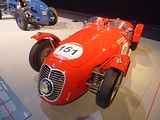
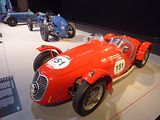
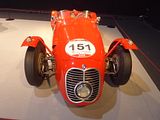

The rest of the mezzanine showcases the selection of Grand Touring cars produced by Maserati. The cars are arranged in chronological order, are all (except one, more on that later) in “concours” condition, and often have exceptional pedigrees. In fact, several have Maserati Classiche certification, awarded by the factory and guaranteeing the vehicle’s perfect origin and validated history. Logically, the first is the 1949 A6 1500 designed by Pininfarina and the first Maserati to be produced for the road in a very small series.
A6G: Development was started in 1941 by the Maserati brothers, but it was halted as priority shifted to wartime production, and was completed after the war. The first chassis, bodied by Pininfarina, debuted at the Geneva Salon International de l’Auto in March 1947. This first prototype was a two-door, two-seat, three window berlinetta with triple square portholes on its fully integrated front wings, a tapered cabin and futuristic hidden headlamps. The car was put into low volume production, and most received Pininfarina coachwork. For production Pininfarina toned down the prototype’s design, switching to conventional headlamps; soon after a second side window was added. Later cars received a different 2+2 fastback body style. A Pininfarina Convertibile was shown at the 1948 Salone dell’automobile di Torino, and two were made; one car was also given a distinctive coupé Panoramica body by Zagato in 1949, featuring an extended greenhouse. Sixty-one A6 1500s were built between 1947 and 1950, when it began to be gradually replaced by the A6G 2000. The A6 1500 was powered by a 1,488cc inline six, with a single overhead camshaft and a single Weber carburettor, producing 65 hp. Starting from 1949 some cars were fitted with triple carburettors. Top speed varied from 146 to 154 km/h (91 to 96 mph). The chassis was built out of tubular and sheet steel sections. Suspension was by double wishbones at the front and solid axle at the rear, with Houdaille hydraulic dampers and coil springs on all four corners. Sixty-one A6 1500s were built between 1947 and 1950, when it began to be gradually replaced by the A6G 2000.


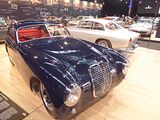
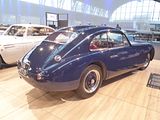

The A6G, A6G54 and A6GCS use the A6 chassis and the in-line 6-cylinder, 1.5-litre then 2-litre engine from racing models, a guarantee of performance and sportiness. All the great Italian coachbuilders – Allemano, Bertone, Fantuzzi, Frua, Ghia, Pininfarina, Vignale, Zagato, etc. – dressed A6s as coupes, berlinettas or spyder (convertible) models. With fewer than 140 units in all, it’s fair to say that the A6s are almost all different. In addition to the 1949 1500, the anniversary exhibition offers a fine sample of handcrafted production, with a low-slung Berlinetta, also by Pininfarina in 2 shades of blue, a Zagato Coupé and a Frua Spyder.
At the 1954 Turin Motor Show, a remarkable car was unveiled : the Maserati 2000 Sport, an A6CGS fitted with an elegantly styled closed “Berlinetta” body by Pininfarina. Originally designed as an open 2-seater for road racing, the 2000 Sport was widely appreciated by racing drivers of the era for its exceptional handling and performance. As Pininfarina could not directly work for Maserati due to an exclusive agreement with Ferrari, Rome-based Maserati dealer Gugliemo “Mimmo” brought the concept to life, purchasing six bare A6GCS/53 chassis. Four received Pininfarina’s exquisite berlinetta bodywork. One was prominently displayed at the 1954 Turin Motor Show, stirring considerable envy within the Ferrari camp. This design became an iconic masterpiece in automotive history, and are among the most coveted historic Maseratis.


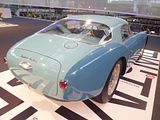


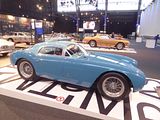
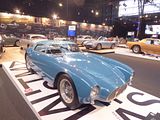


To my eyes, this Zagato bodied A6G54 Berlinetta is the most beautiful car ever produced. Simply stunning!
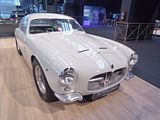


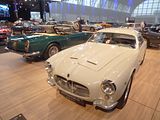
This one, dating from 1954, was bodied by Allemano, who produced just 21 examples, all of them with coupe bodywork.


Produced between 1956 and 1957, only 14 A6G/54 models received Frua bodywork : of those, just 9 were crafted as Spyders.
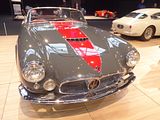
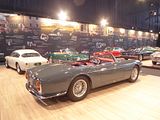

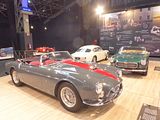

3500 GT: Maserati had made their first forays into the grand tourer market, with the 1947 A6 1500, 1951 A6G 2000 and 1954 A6G/54, but whilst these cars had proven that the expanding the business beyond race cars was feasible; these A6 road cars were still built at the rate of just a dozen examples a year, which hardly constituted series production. A different approach was going to be needed, with the objective of building fully accomplished grand tourers. An engine was not really a problem. The 2 litre twin cam unit that had enabled Maserati to achieve racing success and international visibility in the early 1950s, thanks to cars such as the A6GCM;, had already been enlarged to three litre capacity on the Maserati 300S. Chief engineer Giulio Alfieri felt the next step was to design an all-new 3.5-litre engine; the resulting long-stroke six, designed foremost for endurance racing on the Maserati 350S, was ready in 1955. The main development efforts that led to the 3500 GT were carried out in 1956–57, despite the frantic activity required by Maserati’s participation in the Formula 1 world championship. Alfieri modified the 350S’s engine to suit a touring car, such as switching to a wet sump oil system and changing the engine accessories. He also made several business trips to the United Kingdom in order to contact components suppliers. None were found in Italy, as Italian taxation system and the industry structure forced manufacturers to design every part in-house; a daunting task for small companies like Maserati. Thus the 3500 GT alongside Italian Weber carburettors and Marelli ignition, used many British-made components such as a Salisbury rear axle, Girling brakes and Alford & Alder suspension parts. Clearly the bodywork would have to be Italian. According to Carrozzeria Touring’s Carlo Felice Bianchi Anderloni it was Commendatore Franco Cornacchia, a prominent Ferrari dealer, that put in contact Maserati owner Omar Orsi with the Milanese Carrozzeria The first 3500 GT Touring prototype had a 2+2 body, with superleggera construction and was white in colour; it was nicknamed Dama Bianca (White Lady). Two 3500 GT prototypes were shown at the March 1957 Salon International de l’Auto in Geneva. Both had a 2,600 mm (102.4 in) wheelbase and aluminium bodywork; they were Touring’s Dama Bianca, and another one by Carrozzeria Allemano. Touring’s proposal was chosen for series production; few changes were made to it, chiefly a more imposing grille. Production of the 3500 GT started in late 1957; eighteen cars were built that year, the first handful leaving the factory before Christmas. All 3500 GTs had leather interior and Jaeger-LeCoultre instruments. A first Touring convertible prototype was shown at the 1958 Turin Motor Show, but it was a proposal by Carrozzeria Vignale (designed by Michelotti) shown at the 1959 Salon de l’Auto in Paris that went into production as 3500 GT Convertibile. The Convertibile did not feature Touring’s Superleggera construction, but rather a steel body with aluminium bonnet, boot lid and optional hard top; it was also built on an 10 cm (3.9 in) shorter wheelbase, and weighed 1,380 kg (3,042 lb). Front disc brakes and limited slip differential became optional in 1959, and were standardised in 1960; rear discs became standard in 1962. The 3500 GTi was introduced at the 1960 Salon International de l’Auto, and by the following year became the first fuel-injected Italian production car. It had a Lucas mechanical fuel injection, and developed 232 bhp. A 5-speed gearbox was now standard. The body had a lowered roofline and became somewhat longer; minor outward changes appeared as well (new grille, rear lights, vent windows). From 1961 convertible 3500s for export markets were named 3500 GT Spyder and GTi Spyder. In total, 2,226 3500 GT coupés and convertibles were built between 1957 and 1964. In the first year, 1958, just 119 cars were sold, while 1961 was the best-selling year, totalling 500. All together, 245 Vignale convertibles and nearly 2000 coupés were manufactured, of these, 1981 being Touring coupés, the rest were bodied by other coachbuilders: Carrozzeria Allemano (four coupés, including the 1957 prototype), Zagato (one coupe, 1957), Carrozzeria Boneschi (1962 Turin Motor Show and 1963 Geneva Motor Show ), Pietro Frua (two or three coupés, one spider) and Bertone (one coupé, 1959 Turin Motor Show) The last was a coupé by Moretti for the 1966 Geneva Motor Show. The car was replaced by the Sebring in 1964.

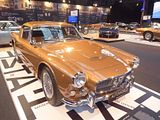
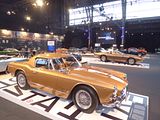

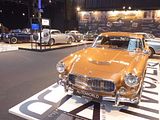
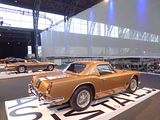

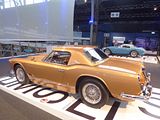


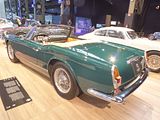
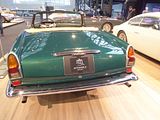

5000GT: The Maserati 5000 GT Coupé was one of the fastest and exclusive in the Gran Turismo class of its time. These cars were built between 1959 and 1965 and they owe their existence to the decision by Maserati to withdraw from motor sport. The V8 racing engines from the Maserati 450S that were no longer required were married to the chassis of the 3500 GT and supplied to eight of the world most prestigious automobile designers. The 3500 GT chassis was duly reinforced as were the brakes. The racing V8 was detuned from 400 hp to 340 hp for more longevity. A kerb weight of 1670 kg (3670 lb.) allowed a claimed top speed of 270 kph (162 mph). A total of 34 cars were created by Allemano, Touring, Frua and other designers.

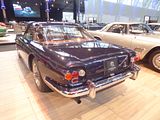

Mistral: Known internally as Tipo AM109, the Mistral was a 2-seat gran turismo produced between 1963 and 1970, as a successor to the 3500 GT. It was styled by Frua and bodied by Maggiora of Turin. Named after a cold northerly wind of southern France, it was the first in a series of classic Maseratis to be given the name of a wind. The Mistral was the last model from the Casa del Tridente (“House of the Trident”) to have the company’s renowned twin-spark, double overhead cam straight six engine. Fitted to the Maserati 250F Grand Prix cars, it won 8 Grand Prix between 1954 and 1960 and one F1 World Championship in 1957 driven by Juan Manuel Fangio. The engine featured hemispherical combustion chambers fed by a Lucas indirect fuel injection system, a new development for Italian car manufacturers. Maserati subsequently moved on to V8 engines for their later production cars to keep up with the demand for ever more powerful machines. Three engine were fitted to the Mistral, displacing 3500, 3700 and 4000 cc and developing 235 bhp at 5500 rpm, 245 bhp at 5500 rpm and 255 bhp at 5200 rpm, respectively. Only the earliest of the Mistrals were equipped with the 3500 cc, the most sought after derivative is the 4000 cc model. Unusually, the body was offered in both aluminium and, from 1967, in steel, but no one is quite sure how many of each were built. The car came as standard with a five speed ZF transmission and four wheel solid disc brakes. Per Maserati practice, the front suspension was independent and the rear solid axle. Acceleration 0-60 for both the 3.7 litre and 4.0 litre engines was around or just under 7 seconds, and top speed approximately 140 mph (225 km/h) to 145 mph (233 km/h). The body was designed by Pietro Frua and first shown in a preview at the Salone Internazionale dell’Automobile di Torino in November 1963. It is generally considered one of the most beautiful Maseratis of all time. It is also often confused with the very similar looking but larger and more powerful Frua designed AC 428. A total of 828 coupés and 125 Spyders were built. Only the Spyder received the 3500 engine; just 12 were made, along with 76 3.7 litre and 37 4.0 litre versions. Twenty Spyders were right hand drive. The Mistral was succeeded by the Ghibli, which overlapped production from 1967 on.


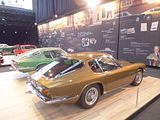


In this display, 2 coupes are displayed side by side, one in perfect condition certified by Maserati Classiche, the other awaiting restoration. The latter is the example presented at the 1968 Chicago Motor Show, making it a historic model for Maserati. Note that the Sebring and Mistral also inaugurate the naming of models with names of circuits where Maserati has shone, or with names of winds, 2 types of names that would later be taken up by the Modena firm until the early 1980s.


Sebring: The Sebring was based on the earlier Maserati 3500 GT, and aimed at the American Gran Turismo market, taking its name from Maserati’s 1957 racing victory at the 12 Hours of Sebring. A single two-seat spyder was built by Vignale in 1963 but did not enter production. The Series I (Tipo AM 101/S) was shown at the Salon International de l’Auto 1962 and again at the Salone dell’automobile di Torino in 1963. Employing all but the Maserati 3500’s coachwork, it could reach 137 mph and 0–60 mph in 8.5 seconds on 185×15 Pirelli Cinturato tyres. A Borg-Warner automatic transmission was available, a first for Italian automobiles. When leaving the factory it originally fitted Pirelli Cinturato 205VR15 tyres (CN72). A total of 348 Series I Sebrings were built between 1962 and 1965. The engine was updated in 1963, gaining 15PS for a total of 235 PS. The 3700 engine first appeared in 1964, although only a handful of Series I cars were thus equipped. In 1965, the modified Series II (Tipo AM 101/10) was introduced. It had lightly redesigned headlamps, modernised bumpers, new front indicators, and new side grilles replacing the lower extraction vents used hitherto. It took minor design cues from the contemporary Quattroporte. At the rear, aside from the squared off bumpers, the taillights were now mounted horizontally rather than vertically and the bootlid opening was narrowed somewhat. The Series II rode on larger 205×15 Pirelli Cinturatos. A run of 247 units were made from 1964 until 1968. Along with the 3500 engine, the 3700 and the even larger 4000 were added. The 4000 GTiS has a 4,012 cc engine producing 255 PS at 5,200 rpm. It remained in production until 1968, when financial constraints forced Maserati to drop its older models from production. No major updates took place over the last three years of production, except for a slight power gain for the 4000, now up to 265 PS. 348 units of Sebring 3.5 and 245 of 3.7 and 4.0 (combined) were made, for a total of 593 units from 1962 to 1969.
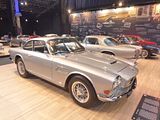

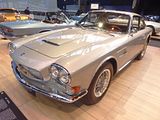
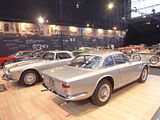
Mexico: The Maserati Mexico’s design derived from a 2+2 prototype bodywork shown on the Vignale stand at the October 1965 Salone di Torino and built upon a 4.9-litre 5000 GT chassis, rebodied after it had been damaged. As the car after the show was sold to Mexican president Adolfo López Mateos, the model became known as the Mexico. By coincidence, John Surtees won the Mexican Grand Prix on a Cooper-Maserati T81 the following year. Vignale’s prototype was so well received that Maserati immediately made plans to put a version into production. The production Maserati Mexico debuted in August 1966 at the 20° Concorso internazionale di eleganza per auto in Rimini, while its international première was at the October Paris Motor Show. It was built on the first generation Quattroporte chassis with a wheelbase shortened by 11 cm (4.3 in). Originally powered by a 4.7-litre 90° V8 fed by four twin-choke 38 DCNL5 Weber carburettors that produced 290 bhp, the car managed to turn out a top speed between 240–250 km/h (149–155 mph). In 1969, however, contrary to Maserati tradition, the Mexico was also made available with a smaller engine, the 4.2-litre V8 engine. Apart from the smaller engine option the Mexico underwent few changes during its lifetime. Its luxurious interior included a rich leather seating for four adults, electric windows, wooden dashboard, iodine headlights and air conditioning as standard. Automatic transmission, power steering and a radio were available as optional extras. The 4.7-litre version was fitted with 650×15″ Borrani chrome wire wheels and the 4.2-litre version with steel disc wheels. When leaving the factory all Maserati Mexicos originally fitted Pirelli Cinturato 205VR15 tyres (CN72). The Mexico was the first production Maserati to be fitted with servo assisted ventilated disc brakes on all four wheels. In May 1967, under commission from the German concessionaire Auto Koenig for one client, Herr Rupertzhoven, Maserati built a ‘Mexico’ similar to Vignale’s original prototype design but was the work of Frua. Appearing like a 4-seat Mistral and built on the same tubular chassis as the 3500 GT (2600 mm wheelbase), this prototype ‘Mexico’ was fitted with the Mistral’s six-cylinder 3.7-litre Lucas fuel-injected engine. It was finished in Oro Longchamps with a black leather interior. Its dashboard came from the Quattroporte. 485 Mexicos were produced, 175 equipped with the 4.7 engine and 305 with the 4.2.


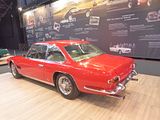
Ghibli: First unveiled in prototype form on the Maserati stand at the November 1966 Turin Motor Show, this grand tourer with an all steel body, characterised by a low, shark-shaped nose, was designed by a young Giorgetto Giugiaro, then working at Carrozzeria Ghia. Deliveries started in March of the following year. While the 1966 Ghia prototype was a two-seater, on the production car two emergency rear seats were added—consisting of nothing more than a cushion without backrest—and the Ghibli was marketed as a 2+2, though everyone tends to think of this car as a 2 seater, and the later Indy as the real 2+2 from the range. The first Ghibli cars were powered by a front placed quad-cam 4.7 litre dry sump V8 engine that produced 306 bhp, mated to a five-speed manual or, on request, to a three-speed automatic transmission. It had a 0-60 mph time of 6.8 seconds, a top speed of 250 km/h (155 mph). The car also featured pop-up headlamps, leather sport seats and alloy wheels. A convertible version, the Ghibli Spyder, went into production in 1969. Its convertible top folded away under a flush fitting body-colour tonneau cover behind the front seats; thus the Spyder eschewed any vestigial rear passenger accommodation, and was a strict two-seater. A removable hard top was available as an option. The 4.9-litre Ghibli SS was released later in 1969. Its V8 engine was stroked 4 mm to displace 4930 cc, and put out 330 bhp; its top speed of 280 km/h (174 mph) made it the fastest Maserati road car ever produced. In all, 1,170 coupés and 125 Spyders (including 25 Spyder SS) were produced.
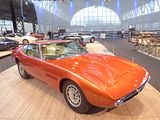
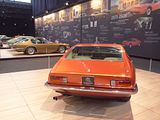

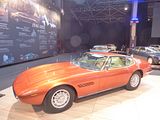
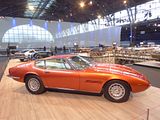
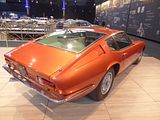

Indy: The Maserati Indy (Tipo AM 116) is a four-seater fastback grand tourer produced from 1969 to 1975. The Indy was conceived as an alternative to the Ghibli offering a V8 engine and room for four people; it effectively replaced both the ageing six-cylinder 2+2 Maserati Sebring—which descended from the 1957 3500 GT— and the first generation Quattroporte. Two coachbuilders showed their proposals at the November 1968 Salone dell’automobile di Torino, both based on a Maserati 4.2-litre chassis. On Ghia’s stand there was the Simùn, a 2+2 berlinetta designed by Giorgetto Giugiaro; on Carrozzeria Vignale’s, a sleek 4-seater fastback penned by Giovanni Michelotti. Both coachbuilders had already an established relationship with Maserati, as Vignale had been responsible for the 3500 GT Spyder, Mexico and Sebring, while Giugiaro had recently penned the Ghibli at Ghia. Vignale’s prototype was preferred, and the production model was launched by Maserati at the Geneva Motor Show the following March. The car was christened Indy in honour of Maserati’s two victories at the Indy 500. At its launch in 1969 the Indy was offered with a 4.2-litre V8 engine. From 1970 a 4.7-litre Indy 4700 was offered alongside the 4200; the same year some interior updates were introduced, including seats with retractable headrests and a new dashboard. In 1972, Maserati added the Indy 4900 to the range, equipped with the new 4.9-litre V8. Production of the Indy ended in 1975. In total 1,104 were produced, 440 of them Indy 4.2s, 364 Indy 4.7s and 300 Indy 4.9s. These days the cars worth a fraction of the prices charged for a Ghibli, which makes them something of a bargain to my mind.
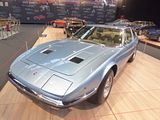


Despite the success of the Ghibli and Indy, Maserati’s financial situation remained tense, and the company came under Citroen control in 1968, with the aim of developing a new V6 engine for the future Citroen SM. The Orsi family remained shareholders for some time, before finally leaving the company. 3 models were produced during this period, including the Bora, the 1st road-going Maserati with a rear mid-engine, as well as the simpler and somewhat cheaper Merak and the achingly beautiful Khamsin.
Bora: Shortly after Citroën took a controlling interest in Maserati in 1968, the concept of a mid-engined two-seat sports car was proposed. Lamborghini and De Tomaso already had the Miura and Mangusta whilst Ferrari were known to be developing their own mid-engined contender. Initially known as Tipo 117 and later the Bora, the Maserati project got underway in October 1968 and a prototype was on the road by mid-1969. Shown in its final form at the Geneva Salon in March 1971, deliveries began before the end of the year. Maserati had developed a reputation for producing technologically out of date cars, but that changed with the Bora. A number of innovative features were introduced that distinguished the car from their previous offerings. Compared to other supercars it was civilised and practical, featuring a hydraulically powered pedal cluster that could be moved forward and backwards at the touch of a button and a steering wheel that could be tilted and telescoped, addressing the common problem of entering and exiting the vehicle common to all supercars. Most supercars offer little foot room and little to no provision for luggage, but the Bora has a full-size boot in the front of the vehicle, and was otherwise known as being much more civilised in comforts from its competitors, while still being rated at 171 mph by the Maserati factory. Unlike its competitors, the Bora used dual-pane glass separating its cabin from the engine compartment as well as a carpeted aluminium engine cap, greatly decreasing the engine noise in the cabin and increasing the comfort level for the driver. Two engines were offered initially, including a high-revving 4.7-litre V8 and a higher torque 4.9-litre V8; a US smog-qualified 4.9-litre engine was used (a stroked version of the 4.7), starting with 1973 deliveries. Eventually, production switched to using only a more powerful version of the 4.9-litre engine producing 320 hp at 6000 rpm. All these engines traced their lineage back to the famous 450S racecar, were aluminium alloy, had hemispheric combustion chambers with 16 valves total operated by four cams (chain-driven) and fed by eight throats of Weber carburettors, fired by electronic ignition. The extraordinarily competent and strong ZF-1 five-speed transaxle was used, as it was with the GT-40, Pantera, BMW M1, and other supercars of this era. Regardless of engine size or modification level, the Bora was considered an extraordinarily powerful car in its time. A combined steel monocoque chassis and body featured a tubular steel subframe at the back for the engine and transmission. Suspension was independent all round (a first for a Maserati road car) with coil springs, telescopic shocks and anti-roll bars. The development prototype and the broadly similar show car first seen at the 1971 Geneva Motor Show featured MacPherson strut based front suspension, but this was abandoned for production because, installed in combination with very wide front tires and rack-and-pinion steering, the strut-based solution produced severe kickback. For the production cars Maserati reverted to a more conservative wishbone front-suspension arrangement. Citroën’s advanced high-pressure LHM hydraulics were adopted to operate the ventilated disc brakes on the main circuit, and on an auxiliary circuit the pedal box [clutch, brake, foot-throttle], the driver’s seat [vertical adjustments], and the retractable headlights. Wheels were 7.5 x 15 inch Campagnolo light alloy rims with distinctive removable polished stainless steel hubcaps in the earlier automobiles, and tyres were Michelin XWX 205×70 front and rear, however these early cars exhibited problems with “tramlining” at speed. To solve this problem Maserati fitted later cars with 215×70 Michelins’. Maserati decided to install a subtly uprated version of their familiar DOHC 90° V8, displacement having been 4719 cc thanks to a bore and stroke of 93.9 x 85 mm. Mounted longitudinally, compression was set at 8.5:1 and with four Weber 42 DCNF downdraught carbs and electronic Bosch ignition, the Bora could boast 310 bhp at 6000 rpm. Great attention was paid to reducing noise and vibration, the engine and five-speed ZF transaxle being mounted on a subframe attached to the monocoque via four flexible mounts. The body was created by Giorgetto Giugiaro for Ital Design, fabrication of the all-steel panels being contracted to Officine Padane of Modena. Standing 1138 mm high, perhaps the most distinctive details were the brushed stainless steel roof and windscreen pillars. Inside, the bucket seats, dash, door trim, centre console and rear bulkhead were trimmed in leather, electric windows having been standard, most cars also getting air conditioners. The steering column was manually adjustable for rake and reach, whereas the LHM aux. circuit controls adjusted the driver’s seat vertically, the pedal box [consisting of the brake, clutch and throttle pedals] horizontally forwards and backwards by around three inches (76 mm)–a first such application in the world for a production car, and also to raise and lower the concealed headlights in the front fenders. The Bora was the basis for the Merak, which used the same bodyshell front clip but in a 2+2 configuration, made possible by using a smaller, lighter and less powerful Maserati V6 engine, also used in the Citroën SM. Maserati struggled after being bought by De Tomaso in 1975, and the Bora was discontinued after the 1978 model year.


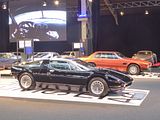

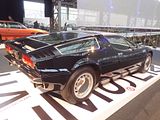
Merak: The Merak was introduced at the 1972 Paris Auto Show, over a year after the Bora, a car whose front part of the bodyshell up to the doors, it shares. The front ends are differenced mainly by the use of dual chrome bumpers in place of twin trapezoidal grilles, but the similarities end at the B-pillar. Unlike its bigger sister the Merak doesn’t have a true, fully glassed fastback, but rather a cabin ending abruptly with a vertical rear window and a flat, horizontal engine bonnet pierced by four series of ventilation slats. Giugiaro completed the vehicle’s silhouette by adding open flying buttresses, visually extending the roofline to the tail. The main competitors of the Merak were the similarly Italian, mid-engined, 3-litre and 2+2 Dino 308 GT4 and Lamborghini Urraco P250. However unlike its transverse V8-engined rivals the Merak used a more compact V6, that could therefore be mounted longitudinally. Having been designed during the Citroën ownership of Maserati, certain Citroën hydropneumatic systems were used in the Merak, as for the Bora. These included the braking system and the clutch which were both hydraulically assisted and operated, and the pop-up headlights were hydraulically actuated. After 1976, when the French manufacturer gave up control of Maserati, the Citroën-derived parts were gradually replaced by more conventional systems. In 1977 Alejandro de Tomaso purchased Maserati and the Bora was discontinued after a production run of less than 600 cars, while the Merak remained on sale for six more years. The Merak’s V6 engine descended from the 2.7 litre Tipo C.114 originally designed by Giulio Alfieri in 1967 for use in the Citroën SM, that was bored out to 91.6 mm to displace 2,965 cc. It was a chain-driven double overhead camshaft, 12-valve unit featuring an unusual 90° angle between the cylinder banks. The lubrication system used a wet sump and an oil cooler. This V6 did not end its days on the Merak: it was later modified and made into the first ever production twin-turbocharged engine in the Biturbo, ending its career in the 1990s Ghibli after reaching the highest specific output of any production engine at the time. The powerplant was mounted longitudinally behind the passenger compartment, and joined through a single-plate dry clutch to a 5-speed, all synchromesh Citroën transaxle gearbox and a limited-slip differential. The original Merak’s three-litre engine produced 190 PS at 6000 rpm. Three twin-choke Weber carburettors (one 42 DCNF 31 and two 42 DCNF 32) fed the engine, and the compression ratio was 8.75:1. Maserati declared a top speed of over 240 km/h (149 mph). Early Meraks (1972 to 1975) were fitted with the Citroën SM’s dashboard, characterised by oval instrument gauges inset in a brushed metal fascia and a single-spoke steering wheel. 630 were made up to 1974. The lightened and more powerful Merak SS (Tipo AM122/A) was introduced at the 41st Geneva Motor Show in March 1975, although it did not enter production until the next year. It featured a 50 kg weight reduction and a 30 PS power increase to 220 PS (217 hp), thanks to the adoption of three larger 44 DCNF 44 carburettors and a higher 9:1 compression ratio. The SS was recognisable from a black grille between the pop-up headlights. A Maserati-designed upper fascia with round instruments and a four-spoke steering wheel replaced the previous SM-derived interior furniture. Later cars were bestowed with the full driver-oriented dashboard and three-spoke padded steering wheel of the Maserati Bora. The US-spec version of the Merak SS also saw a return to traditional hydraulics, eliminating the last of the Citroen high pressure system. 1000 units of the SS had been made by 1983, when all Merak production ceased. A third version of the Merak was made, In November 1977 at the Turin Auto Show, De Tomaso launched the Merak 2000 GT (Tipo AM122/D), which was basically a Merak with a smaller two-litre powerplant. It was built almost exclusively for the Italian market, where a newly introduced law strongly penalised cars with engine capacity over 2000 cc by subjecting them to a 38% Value Added Tax against the usual 19% VAT. The Merak’s competitors already offered similar two-litre models, specifically the Urraco P200 and Dino 208 GT4. The Merak 2000 GT featured a 1,999 cc engine generating 170 PS (168 hp) at 7000 rpm. Colour choice was limited to two shades: metallic light blue or gold. The two-litre cars were also distinguished by a black tape stripe running just below the mid-body character line, matte black bumpers in place of the usual chrome and the absence of the front spoiler, available as an optional. The SS’s front bonnet with the grille between the headlights was used on 2000 GTs. When production ended in 1983 just 200 Meraks 2000 GT had been made. Although a total of 1830 Merak models were made, they are rare cars now. Their low values meant that when they went wrong, which they inevitably did, it was not economic to repair or restore them, and a large number have been scrapped, which is a pity, as this is a great looking car.
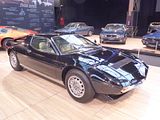


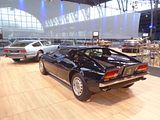


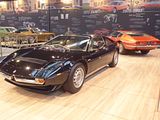
Khamsin: Introduced on the Bertone stand at the November 1972 Turin Auto Show. and designed by Marcello Gandini, it was Bertone’s first work for Maserati. In March 1973 the production model was shown at the Paris Motor Show. Regular production of the vehicle started only a year later, in 1974. The Khamsin was developed under the Citroën ownership for the clientele that demanded a front-engined grand tourer on the lines of the previous Ghibli, more conventional than the mid-engined Bora. The Khamsin’s body is prominently wedge-shaped, with a fastback roofline and kammback rear end. The tail is characterized by a full-width glass rear panel, carrying inset “floating” tail lights. Combined with the wide, almost all-glass rear hatch this gave exceptional rear visibility in comparison to most cars, especially similar sports cars. Cosmetic triangular vented panels are inlaid in the C-pillar, with the right-hand one hiding the fuel filler cap. Another distinguishing feature is the engine bonnet, pierced by asymmetrical vents. Design features as the wedge body, glazed tail panel and the location of the fuel filler cap all carry Gandini’s signature, as they were all present on his earlier Lamborghini Espada. Despite being marketed as a 2+2, the leather-trimmed rear seats, nestled between the two fuel tanks, were found too lacking in headroom and legroom to be usable. The complete instrumentation included gauges for speedometer, tachometer, water temperature, oil temperature, oil pressure, voltmeter and a clock. The Khamsin used an all-steel monocoque construction, with a rear Silentbloc-bushing insulated tubular subframe supporting the rear suspension and differential. Suspension was double wishbones all around – a major improvement over the Ghibli’s leaf-sprung solid axle – with coaxial springs and shock absorbers (single upfront, double at the rear) and anti-roll bars. The front-mid mounted engine gave the car a 50/50 weight distribution; it was pushed so far back towards the firewall that the full size spare tyre could be stored beneath the radiator in front of it, thus freeing up space in the boot. Apart from the adoption of Bosch electronic ignition, Maserati’s 4,930 cc DOHC, 16-valve V8 engine was carried over from the Ghibli SS and delivered 320 bhp at 5500 rpm and 355.5 lb-ft of torque at 4000 rpm. It was fed through four double barrel 42 DCNF 41 Weber carburettors and used dry-sump lubrication. As on the Ghibli the fuel tanks were two, but not of similar size. A small tank is on the right and it is connected to the main tank below the cargo floor, with a single fuel filler on the right hand side feeding directly the small tank. The double exhaust system ended with two resonators, each with twin exhaust tips. Power was routed to the rear wheels through a 5-speed, all syncromesh ZF manual gearbox with a single-plate dry clutch; a 3-speed Borg Warner automatic transmission was also available on request. Khamsins rode on 215/70 Michelin XWX tyres on 7½J 15″ Campagnolo alloy wheels. Having been developed under the Citroën ownership, the Khamsin made large use of its high-pressure hydraulic systems. The power steering used the Citroën SM’s DIRAVI speed-sensitive variable assistance, which made steering lighter for easier parking and decreased its intervention with speed. The all-around vented disc brakes and the clutch command were both hydraulically actuated and assisted. The adjustable seats and the pop-up headlights were also hydraulically actuated. An adjustable steering column (an innovative feature at the time), air conditioning, electric windows, a radio and full leather upholstery were standard. Maserati claimed a 270 km/h (170 mph) top speed for the European-specification model. In 1977 a mild facelift added three horizontal slots on the Khamsin’s nose to aid cooling. Inside it brought a restyled dashboard and a new padded steering wheel. One Khamsin was delivered to Luciano Benetton in 1981. Despite the many improvements over its predecessor, the Khamsin didn’t replicate its success; partly due to the concurrent fuel crisis that decreased demand for big V8 grand tourers. Production ended in 1982, with 435 vehicles made (a mere third of the Ghibli’s 1274 examples production run) – 155 of whose had been exported to the United States. A Khamsin is on display in the AutoWorld collection, close to the anniversary exhibition, but its condition has not been judged sufficiently satisfactory to be included among its sisters.


With Citroen themselves in trouble and bought out in 1974 by Peugeot, Maserati’s future looked uncertain until Alejandro De Toaso decided to take over. Initially, he kept the three existing models in production, but then a fourth was added, using much of the elements of the De Tomaso Longchamp. This was the Kyalami.
Kyalami: Developed under the code of Tipo 129, the Kyalami is a four-seat GT coupé produced from 1976 to 1983. which was named after the Kyalami Grand Prix Circuit in South Africa, where a Maserati-powered Cooper T81 had won the 1967 South African Grand Prix. The Kyalami was the first new model developed under the Alejandro de Tomaso ownership. It was derived from, and mechanically virtually identical (except for some body panels) to the Longchamp, a three-box grand tourer made by De Tomaso Automobili. Pietro Frua was commissioned from De Tomaso to undertake the restyling of the Tom Tjaarda-designed Longchamp, to give the new car a distinctive Maserati feel. The interior was also upgraded to incorporate classic Maserati elements such the steering wheel and instrumentation. A Maserati four overhead camshaft 90° V8 was utilised to power the car, as opposed to the American-sourced Ford V8 which was used in the Longchamp. The Kyalami was launched at the 1976 Geneva Motor Show and was initially powered by a 265 PS 4.2-litre engine. Starting in 1978, an enlarged version of 4.9-litre displacement delivering 290 PS was also available. Both engines were coupled with a ZF five-speed manual transmission or upon request a three-speed Borg Warner automatic. Mechanically the Kyalami was closely related to its contemporary Quattroporte, which was also offered with the same engines and gearboxes. 210 Kyalamis were built between 1976 and 1983. Due to its rarity very little in the way of performance tests were published in the various international magazines when the car was new, and it features very seldom these days.
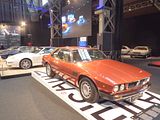

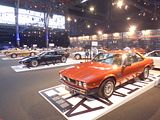


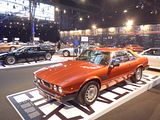

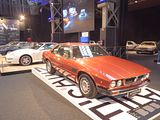
BiTurbo: Maserati replaced their entire range in 1981 with the BiTurbo. Introduced initially as a single model, a 2 door coupe with a 2 litre twin-turbo V6 engine, over the next 15 years, it would evolve into a complex range of different models, and three basic bodystyles, as well as the special low-volume Karif and V8 engined Shamal cars. The car was designed by Pierangelo Andreani, Chief of Centro Stile Maserati up to 1981, and was somewhat influenced by the design of the recent Quattroporte III. The BiTurbo marked quite a change of direction for the Modense firm, a consequence of its acquisition by Alejandro de Tomaso in 1976. de Tomaso’s ambitious plans for the marque were to combine the prestige of the Maserati brand with a sports car that would be more affordable than the earlier high-priced models that had traditionally made up the Maserati range. The Biturbo was initially a strong seller and brought Italian prestige to a wide audience, with sales of about 40,000 units, but it quickly became apparent that the quality of the car was way off what the market expected, and the car is not regarded as one of the marque’s better models. Indeed, the Biturbo is number 28 in the BBC book of “Crap Cars” and in 2007 was selected as Time Magazine’s worst car of 1984, although they ranked the Chrysler TC by Maserati as a “greater ignominy”. Between 1987–89 a facelift was phased in, which helped to soften the sharp bodylines. The redesign included a taller and more rounded grille with mesh grille and bonnet, aerodynamic wing mirrors and 15″ disc-shaped alloy wheels, now mounted on 5-lug hubs. Some models received the wraparound bumpers with integral foglights and the deep sills introduced with the 2.24v. In 1991 the entire lineup was restyled for a second time, again by the hand of Marcello Gandini; the design features introduced with the Shamal were spread to the other models. Gandini, the Shamal’s designer, developed an aerodynamic kit that included a unique spoiler at the base of the windscreen hiding the windshield wipers, a rear spoiler, and side skirts. The new two-element headlights used poli-ellypsoidal projectors developed by Magneti-Marelli. Inset in body-colour housings, they flanked a redesigned grille, slimmer and integrated in the bonnet; the 1988 bumpers were adopted by all models. The 15″ disc-shaped alloys were replaced by new 16″ seven-spoke wheels, with a hubcap designed to look like a centerlock nut. The second facelift was referred to as “nuovolook”. The engines underwent change, too. As well as being the first ever production car with a twin-turbocharged engine, it was also the first production car engine with three valves per cylinder. The aluminium 90-degree SOHC V6 engine was roughly based on the 2.0 litre Merak engine, itself based on earlier V8 Formula One Maserati engines, designed by Giulio Alfieri. Because in Italy new cars with engine displacement over 2000 cc were subjected to a 38% value added tax, against 19% on smaller displacement cars, throughout the Biturbo’s production life there were both two-litre models aimed mainly at the domestic market and “export” versions, initially with a 2.5 litre V6. The carburettor 2.5 unit produced 185 hp and 208 lb·ft of torque in North American spec and slightly more elsewhere. Fuel injection was fitted in 1987 raising power to 187 hp. In 1989 the enlarged 2.8 litre engine bumped power to 225 hp and 246 lb·ft of torque for North America and 250 PS for Europe. In 1988, with the coupés being restyled, the Biturbo name was dropped in favour of 222—meaning 2-door, 2-litre engine and 2nd generation. The car carried all the visual clues of Gandini’s first facelift, with a more rounded grille and bonnet, different wing mirrors and rear spoiler. The engine size of the 222 E export model grew from the Biturbo’s 2.5- to 2.8-litres. A mixed velour-leather interior was standard on the domestic models, while export markets got leather upholstery as standard. 1990 saw the arrival of the 2.8 litre 222 SE, heir to the Biturbo ES. It inherited the latter’s limited paint finish availability (red, silver or black) and the dark trim and grille, while modern aprons and side skirts (blacked out as well) came from the 2.24v. After just a year the 222 SE was replaced by the 1991-restyled 222 SR; the SR offered adaptive suspension as an option. Simultaneously the very similar 222 4v. joined the lineup; it was a 222 SR with a 2.8 litre four-valve engine, the first DOHC car in the direct Biturbo E lineage. It used wider, 16″ 7-spoke wheels.

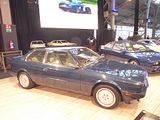


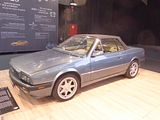
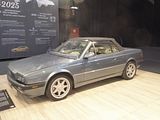


Shamal: In keeping with Maserati tradition, the Shamal was also named after a wind, in this case a hot summer wind that blows in large areas of Mesopotamia. My favourite of the Biturbo generation Maserati models, it was introduced on 14 December 1989 in Modena, when Maserati president and owner Alejandro de Tomaso showed it to the press, it was the last model announced under the De Tomaso ownership, as in January 1990 half of Maserati was acquired by Fiat S.p.A.. Sales began in 1990. The Shamal was designed by Marcello Gandini, of Bertone fame. Clearly based on the Biturbo, as you can see in the doors, interior, and basic bodyshell, all of which were carried over from the Biturbo. Gandini’s styling signature is visible in the slanted profile of the rear wheel wheel arch, also present on the fourth generation Quattroporte IV and first seen on the Lamborghini Countach. Nonetheless, the Shamal has a look all of its own, with the centre pillar wrapping around the cabin as a roll bar, always finished in black, a distinguishing characteristic of the Shamal. The name “Shamal” appears on either side of the central pillar in chrome lettering. The car has alloy wheels, a small rear spoiler and a blacked-out grille with chrome accents. Another defining feature of the Shamal are its numerous headlamps in individual housings: outer round Carello low beams of the then-new projector type, inner rectangular high beams, combined indicators and position lamps in the bumper, and two pairs of square lights in the lower grille—fog lamps and driving lamps. The two-seat interior of the Shamal features extended leather seat cushions, temperature control and the famous Maserati oval clock, which is situated in the centre of the dashboard. The gear lever is finished in elm. While built for comfort as well as performance, the Shamal was not as luxuriously appointed as the similar Maserati Ghibli II. The Shamal used a traditional front-engine, rear-wheel-drive layout and an all-steel unibody construction. Suspension was by MacPherson struts upfront and semi-trailing arms at the rear. All Shamals were equipped with an adaptive suspension developed by Maserati together with Koni. The system varied the damping rates, based on road conditions and level of comfort desired. It was powered by an AM 479 3,217 cc square (bore and stroke 80 mm) V8 engine, with two overhead camshafts per bank, and four valves per cylinder. It was twin-turbocharged with two IHI turbines and intercoolers, and equipped with a Marelli IAW integrated electronic ignition and fuel injection ECU per cylinder bank. The engine put out 325 PS at 6,000 rpm and 320 lb·ft at 3,000 rpm. Power was sent to the rear wheels through a six-speed Getrag manual transmission and Maserati’s Ranger limited-slip differential. The manufacturer claimed a top speed of 170 mph and a 0 to 62 mph acceleration time of 5.3 seconds. The final year of production for the Maserati Shamal was 1996 and factory figures indicate that 369 examples were produced.


Spyder Gran Sport: After producing BiTurbo based cars for 17 years, Maserati replaced their entire range with a new model in July 1998, the 3200 GT. This very elegant 2+2 grand tourer was styled by Italdesign, whose founder and head Giorgetto Giugiaro had previously designed, among others, the Ghibli, Bora and Merak. The interior design was commissioned to Enrico Fumia. Its name honoured the Maserati 3500 GT, the Trident’s first series production grand tourer. Sold mainly in Europe, the 3200 GT was powered by the twin-turbo, 32-valve, dual overhead cam 3.2-litre V8 engine featured in the Quattroporte Evoluzione, set up to develop 370 PS (365 hp). The car was praised for its styling, with the distinctive array of tail-lights, consisting of LEDs, arranged in the shape of boomerang being particularly worthy of comment. The outer layer of the ‘boomerang’ provided the brake light, with the inner layer providing the directional indicator. The car was also reviewed quite well by the press when they got to drive it in early 1999, though it was clear that they expected more power and excitement. That came after 4,795 cars had been produced, in 2001, with the launch of the 4200 models. Officially called the Coupé and joined by an open-topped Spyder (Tipo M138 in Maserati speak), these models had larger 4.2 litre engines and had been engineered so the cars could be sold in America, marking the return to that market for Maserati after an 11 year gap. There were some detailed styling changes, most notable of which were the replacement of the boomerang rear lights with conventional rectangular units. Few felt that this was an improvement. The cars proved popular, though, selling strongly up until 2007 when they were replaced by the next generation of Maserati. Minor changes were made to the model during its six year production, but more significant was the launch at the 2004 Geneva Show of the GranSport which sported aerodynamic body cladding, a chrome mesh grille, carbon fibre interior trim, and special 19-inch wheels. It used the Skyhook active suspension, with a 0.4 inch lower ride height, and the Cambiocorsa transmission recalibrated for quicker shifts. The exhaust was specially tuned to “growl” on start-up and full throttle. The GranSport was powered by the same 4244 cc, 90° V8 petrol engine used on the Coupé and Spyder, but developing 400 PS (395 hp) at 7000 rpm due primarily to a different exhaust system and improvements on the intake manifolds and valve seats. A six-speed paddle shift transmission came as standard. The GranSport has a claimed top speed of 180 mph (290 km/h) and a 0–62 mph (0–100 km/h) time of 4.8 seconds.

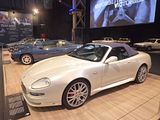


Quattroporte: Maserati may have been imaginative when it came to naming its GT coupes and spyders, but not its sedans, which are simply called “Quattroporte” (4 doors in Italian)! Maserati launched its first sedan in 1963, designed by Frua in the style of the 3500 GT, and powered by the in-house 4.2-liter V8. This was followed by the 4.5l and 4.7l V8s. It was the world’s fastest sedan of its day, combining sportiness, performance and luxury. It could be said to have initiated the category of sporty limousines that would later be found in German premium cars in particular. The model on display dates from 1964, and corresponds to the 1st series, with the 2nd series differentiated by its twin round headlamps. There have been six production generations of the Quattroporte now, from which only some were on show here.
The original Maserati Quattroporte (Tipo AM107) was built between 1963 and 1969. It was a large saloon powered by V8 engines—both firsts for a series production Maserati. The task of styling the Quattroporte was given to Turinese coachbuilder Pietro Frua, who drew inspiration from a special Maserati 5000 GT (chassis number 103.060) he had designed in 1962 for Prince Karim Aga Khan. While the design was by Frua, body construction was carried out by Vignale. The Quattroporte was introduced at the October-November 1963 Turin Motor Show, where a pre-production prototype was on the Maserati stand next to the Mistral coupé. Regular production began in 1964. The Tipo 107 Quattroporte joined two other grand tourers, the Facel Vega and the Lagonda Rapide, capable of travelling at 200 km/h (124 mph) on the new motorways in Europe. It was equipped with a 4.1-litre V8 engine, producing 260 hp at 5,000 rpm, and either a five-speed ZF manual transmission or a three-speed Borg Warner automatic on request. Maserati claimed a top speed of 230 km/h (143 mph). The car was also exported to the United States, where federal regulations mandated twin round headlamps in place of the single rectangular ones found on European models. Between 1963 and 1966, 230 units were made. In 1966, Maserati revised the Tipo 107, adding the twin headlights already used on the U.S. model. A leaf-sprung solid axle took place of the previous De Dion tube. The interior was completely redesigned, including the dashboard which now had a full width wood-trimmed fascia. In 1968 alongside the 4.1-litre a 4.7-litre version became also available (AM107/4700), developing 286 bhp. Top speed increased to a claimed 255 km/h (158 mph), making the Quattroporte 4700 the fastest four-door sedan in the world at the time. Around 500 of the second series were made, for a total of 776 Tipo 107 Quattroportes. Production ended in 1969.
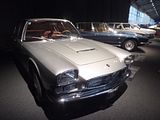
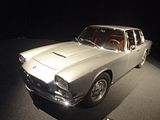


In 1971, Maserati presented the prototype of the 2nd generation, still designed by Frua, but much more modern. The lines were elegant, with small “eyelids” partially covering the headlights, and still with the 4.7l V8. But since Maserati had meanwhile been acquired by Citroën, the project was abandoned, and only 2 cars were built, one of which is presented.
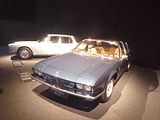


The second generation Quattroporte, named Maserati Quattroporte II (AM 123), was introduced at the Paris Motor Show and the Turin Motor Show in October 1974. As the result of Citroën’s joint-venture with Maserati in 1968, the Quattroporte II was very different from its predecessor and the other Maserati automobiles of the past. Based on a stretched version of the Citroën SM’s chassis, the Quattroporte II featured a front-mid-engine, front-wheel-drive layout, hydropneumatic suspension, four fixed headlamps with two swivelling directional headlights, and a V6 engine. The bodywork was designed by Marcello Gandini at Bertone. Maserati had planned to equip Quattroporte II with a V8 engine, but the Tipo 107 V8 engine was too large for the Citroën SM based chassis on top of being too obsolete. A prototype for a 4.0-litre V8 engine was built from two compact Citroën-Maserati V6 engines. Maserati cut through the rear cylinders in half on one block (2.5 cylinders per bank, discarding the rear) and the middle cylinders in half on another block (1.5 cylinders per bank, discarding the front) then welded the blocks together. The output was 255 bhp. The new V8 engine was fitted to the Citroën SM for durability testing which lasted for 17,000 km (10,563 miles). This was done to prove that the chassis was robust enough to handle the additional power of the larger engine. Alejandro de Tomaso, the Italian entrepreneur who took over Maserati in 1975, cancelled the V8 engine programme. A single running prototype of the Quattroporte II was built and tested in 1974. The 1973 oil crisis and the collapse of Citroën’s finances in 1974 prevented Maserati from gaining the EEC approval for the European market. The production did not commence until 1976, and each Quattroporte II was built to order and sold in the Middle East and Spain where the type approval was not needed. Only twelve production cars were built from 1976 to 1978. The engineering and development had cost Maserati about four billion lire by the time the production ended in 1978.

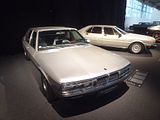

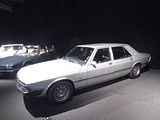
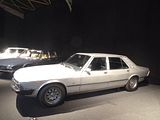

The third generation car to bear the Quattroporte name (Tipo AM 330) was developed under the Alejandro de Tomaso-GEPI ownership. After the brief parenthesis of the Citroen-era front-wheel drive Quattroporte II, the third generation went back to the classic formula of rear-wheel drive and large Maserati V8 engine. It was designed by Giorgetto Giugiaro. A pre-production Quattroporte was introduced to the press by Maserati president Alejandro de Tomaso on 1 November 1976, in advance of its début at the Turin Motor Show later that month. It was only three years later though, in 1979, that the production version of the car went on sale. Initially “4porte” badging was used, changed in 1981 to Quattroporte. Two versions of the V8 engine were available: a 4,930 cc one producing 280 PS and a smaller 4,136 cc engine producing 255 PS which was phased out in 1981. The interior was upholstered in leather and trimmed in briar wood. The Quattroporte III marked the last of the hand-built Italian cars; all exterior joints and seams were filled to give a seamless appearance. From 1987 the Royale superseded the Quattroporte, as a built-to-order ultra-luxury version of the Quattroporte. It adopted a higher compression 4.9-litre engine, putting out 300 PS. Besides the usual leather upholstery and veneer trim, the passenger compartment featured a revised dashboard with analogue clock, four electrically adjustable seats, retractable veneered tables in the rear doors and a mini-bar. Visually the Royale was distinguished by new disc-shaped alloy wheels and silver-coloured side sills. De Tomaso announced a limited run of 120 Royales, but when production ceased in 1990 only 53 of them had been made. In all, including the Royale, 2,155 Quattroporte IIIs were produced.


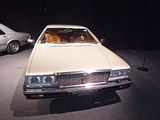


Alfieri Concept: The Maserati Alfieri is a concept car which was shown at the 2014 Geneva Motor Show. The car is named after Alfieri Maserati (1887–1932), one of the five Maserati Brothers, and marks the 100 year anniversary of the carmaker, which was established in 1914 at Bologna. It was developed at the Centro Stile Maserati in Turin. The chief designer was Marco Tencone, while the exterior chief designer was Giovanni Ribotta. The project was managed by Lorenzo Ramaciotti, who has been the director of Centro Stile since 2007 and in 2014 was the head of Fiat-Chrysler Global Design. The Alfieri uses design elements of the Maserati A6 GCS/54 designed by Pininfarina in 1954. It is based on the chassis of the Maserati GranTurismo MC Stradale with a shorter wheelbase of 24 cm, equipped with a locking transaxle and Ferrari-derived 4.7-litre V8 engine rated at 460 hp and 520 Nm (384 lb/ft) at 4750 rpm. The Alfieri was confirmed for production in 2016 at a Fiat Chrysler event on 6 May 2014 but was delayed to 2020 at the earliest. According to reports, the Alfieri was to be offered with three V6 engine choices, rated at 410 hp, 450 hp and 520 hp. The 450 bhp and 520 bhp versions were said to only have an all-wheel-drive system. The Alfieri was reported to be joined by a convertible variant in 2021 after the coupe’s introduction. An electric version was planned for 2021 at the earliest. In June 2018, Maserati announced that the Alfieri would be offered as a plug-in hybrid from 2021 and as an electric vehicle from 2020 with three electric motors and all-wheel-drive. Further, the Alfieri coupe and convertible would replace the Maserati GranTurismo and GranCabrio. In 2019, it was announced by Maserati’s then-executive chairman Harald Wester that the Alfieri would enter mass production in 2021 or 2022. However, as of the Stellantis merger that incorporated FCA in 2021, production is yet to commence. In mid-2021, it was confirmed that a new GranTurismo prototype using styling cues from the Alfieri was being test-driven, with options for an electric drivetrain as well as V6 and V8 engines.
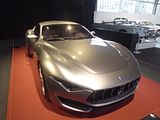


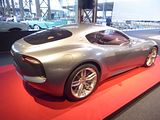

The Maserati 110 years exhibition focuses very much on the cars. In the competition area on the first floor, a large photo pays tribute to Alfieri Maserati, driver, engineer, visionary and the soul of Maserati, who sadly passed away too soon for the company. On the mezzanine, a large fresco covering the entire GT area recounts the history of Maserati, from its origins to the present day.
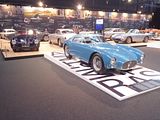
Finally, several miniature display cases showcase all the Maseratis produced, including those not on show. There are also a number of Maserati motorcycles on display. They bear the name and the trident, but were not in fact manufactured by Maserati Automobiles, but by another branch of Maserati whose main activity was spark plugs and batteries. Naturally, the autoworld museum store has also taken on a Maserati theme, offering books and miniatures on the Modenese marque.
1954 Maserati L160 T4: After WW2, the company was divided among Adolfo Orsi’s family. It was his sister Ida who acquired the spark plug company “Fabbrica Candele e Accumulatori Maserati”, plus the right to use the Maserati name and logo. In 1953, Ida Orsi expanded her business by taking over Italmoto, a motorbike brand from Bologna, which became Maserati and was thus separate from the cars. The First model was the 160 cc T4. This one participated in the 1954 Motogiro d’Italia, a 6-day road race and 3.414 km for light motorbikes. Adapted to this T4 were the so-called Earles front fork, mudguards, saddle and the larger petrol tank.

1955 Maserati L160 T4 Turismo Lusso: This is a road version of the L160 T4 in Turismo Lusso trim. As with the cars, sporty touring in luxury was highly regarded with the Maserati motorbikes. Unlike its sportier brother, this one features the standard telescopic fork. Rather special is the streamlined headlight surrounding, which was quite ahead of its time.
1956 Maserati Rospo 50 T2 SS: Maserati motorbikes also developed the 2-stroke T2 U (Uomo) and the T2 D (Donna) mopeds. 2 sporty models of the T2 were also built, the S (Sport) and SS (Super Sport). Typical of the SS is the distinct backbone frame. When Maserati dealer Guido Borri of Bologna received the model, his wife Lina exclaimed : “Ma cos’è questo brutto rospo ?” Freely translated, “What kind of ugly toad is this?” The toad nickname “rospo” stuck. This one participated in the Motogiro again. Note the pad on which the rider could rest his chin lying on the tank to maximize the top speed of 75 km/h.

1957 Maserati 125 GT Super: After things went steeply downhill in the production of spark plug and other electronic components, more and more attention turned to motorbikes at the “Fabbrica Candele e Accumulatori Maserati”. The L 125 T2 2-stroke was the first in-house development by the Maserati motorbike company, although heavily modelled on the German DKWs. This 1957 example also competed in that year’s Motogiro d’Italia, the last of its kind. After Alonso de Portago’s fatal accident in that year’s Mille Miglia, Italy banned this kind of racing on open road. This example also possesses a number of modifications for the Motogiro, such as the larger tank.


Seen outside was the future of Maserati – an electric car. This is the Grecale Folgore. Visually very similar to the petrol engined models, the clues are the filled in grille and some different detail at the front, but obviously it is quite different underneath. Is it a real Maserati? Well, people said that about the first SUVs that have now issued from pretty much all sports/GT manufacturers but the reality is these are the commercial successes that keep these manufacturers financially viable. And as the owner of a Gecale myself, it would seem churlish to say that it is not!
OTHER DISPLAYS
There was ample time to have a good look around the rest of the museum, and even to stop for a coffee and a bite to eat before heading back to the airport. Not much had changed in these displays since my last two visits in 2024, but I could not help but take some more photos of the cars on show. They are grouped together, over the two floors, in a mix of either chronological displays or thematic ones.
Displayed in an area near the Maserati competition cars were a series of red cars
Audi R8: The Audi R8, based on the Audi Le Mans quattro concept car (designed by Frank Lamberty and Julian Hoenig) first appeared at the 2003 International Geneva Motor Show and the 2003 Frankfurt International Motor Show. The R8 road car was officially launched at the Paris Auto Show on 30 September 2006. There was some confusion with the name, which the car shares with the 24 Hours of Le Mans winning R8 Le Mans Prototype (LMP). Initial models included the R8 4.2 FSI coupé (with a V8 engine) and R8 5.2 FSI coupé (with a V10 engine). Convertible models, called the Spyder by the manufacturer, were introduced in 2008, followed by the high-performance GT model introduced in 2011. The Motorsport variants of the R8 were also subsequently introduced from 2008 onwards. An all-electric version called the e-Tron started development but would only reach production stage when the second generation model would be introduced. 6-time 24 Hours of Le Mans winner Jacky Ickx described the R8 as “the best handling road car today” and the car was well received by everyone who drove it. The car received a facelift in 2012 and a new model called the V10 Plus was now added to the range. Production of the Type 42 ended in August 2015.

1965 Chevrolet Corvette Convertible 396 Turbo-Jet: Launched in 1963, this model introduced us to the name Sting Ray. It continued with fibreglass body panels, and overall, was smaller than the first generation. The car was designed by Larry Shinoda with major inspiration from a previous concept design called the “Q Corvette,” which was created by Peter Brock and Chuck Pohlmann under the styling direction of Bill Mitchell. Earlier, Mitchell had sponsored a car known as the “Mitchell Sting Ray” in 1959 because Chevrolet no longer participated in factory racing. This vehicle had the largest impact on the styling of this generation, although it had no top and did not give away what the final version of the C2 would look like. The third inspiration was a Mako Shark Mitchell had caught while deep-sea fishing. Production started for the 1963 model year and ended in 1967. The 1963 model was the first year for a Corvette coupé and it featured a distinctive tapering rear deck (a feature that later reappeared on the 1971 “Boattail” Buick Riviera) with, for 1963 only, a split rear window. The Sting Ray featured hidden headlamps, non-functional bonnet vents, and an independent rear suspension. Corvette chief engineer Zora Arkus-Duntov never liked the split rear window because it blocked rear vision, but Mitchell thought it to be a key part of the entire design. Maximum power for 1963 was 360 bhp, raised to 375 bhp in 1964. Options included electronic ignition, the breakerless magnetic pulse-triggered Delcotronic first offered on some 1963 Pontiac models. On 1964 models the decorative bonnet vents were eliminated and Duntov, the Corvette’s chief engineer, got his way with the split rear window changed to a full width window. Four-wheel disc brakes were introduced in 1965, as was a “big block” engine option: the 396 cu in (6.49 litre) V8. Side exhaust pipes were also optionally available in 1965, and continued to be offered through 1967. The introduction of the 425 bhp 396 cu in big block in 1965 spelled the beginning of the end for the Rochester fuel injection system. The 396 cu in option cost $292.70 while the fuel injected 327 cu in (5.36 litre) engine cost $538.00. Few people could justify spending $245.00 more for 50 bhp less, even though FI could deliver over 20 mpg on the highway and would keep delivering fuel despite high G-loading in corners taken at racing speeds. Another rare ’63 and ’64 option was the Z06 competition package, which offered stiffer suspension, bigger, multi-segment lined brakes with finned drums and more, only a couple hundred coupes and ONE convertible were factory-equipped this way in 1963. With only 771 fuel-injected cars built in 1965, Chevrolet discontinued the option at the end of the ’65 production, having introduced a less-expensive big block 396 engine rated at 425 hp in the middle of the production year and selling over 2,000 in just a few months. For 1966, Chevrolet introduced an even larger 427 cu in 7 litre Big Block version. Other options available on the C2 included the Wonderbar auto-tuning AM radio, AM-FM radio (mid-1963), air conditioning (late-1963), a telescopic steering wheel (1965), and headrests (1966). The Sting Ray’s independent rear suspension was successfully adapted for the new-for-1965 Chevrolet Corvair, which solved the quirky handling problems of that unique rear-engine compact. 1967 was the final year for the C2 generation. The 1967 model featured restyled bumper vents, less ornamentation, and back-up lamps which were on the inboard in 1966 were now rectangular and centrally located. The first use of all four taillights in red started in 1961 and was continued thru the C-2 line-up except for the 1966. The 1967 and subsequent models continuing on all Corvettes since. 1967 had the first L88 engine option which was rated at 430 bhp, but unofficial estimates place the actual output at 560 bhp or more. Only twenty such engines were installed at the factory. From 1967 (to 1969), the Holley triple two-barrel carburettor, or Tri-Power, was available on the 427 L89 (a $368 option, on top of the cost for the high-performance 427). Despite these changes, sales slipped over 15%, to 22,940 – 8,504 coupes and 14,436 convertibles.


Honda 750 NR
Ferrari Testarossa: Object of many a poster on a young enthusiast’s bedroom wall when the car was new was the Testarossa and there was a nice example here. A replacement for the BB512i, the final iteration of Ferrari’s first ever mid-engined road car, the Testarossa was launched at the Paris Show in October 1984. The Pininfarina-designed car was produced until 1991, with the same basic design then going through two model revisions, with the 512 TR and later F512 M which were produced from 1992 to 1996 before the model was replaced by the front-engined 550 Maranello. Almost 10,000 Testarossas, 512 TRs, and F512 Ms were produced, making it one of the most-produced Ferrari models, despite its high price and exotic design. The Testarossa followed the same concept as the BB512, but was intended to fix some of the criticisms of the earlier car, such as a cabin that got increasingly hot from the indoor plumbing that ran between the front-mounted radiator and the midships-mounted engine and a lack of luggage space. This resulted in a car that was larger, and at 1,976 millimetres (78 in) wide the Testarossa was half a foot wider than the Boxer and immediately condemned for being too wide, though these days it does not appear anything like as wide as it did when new. This resulted in an increased wheelbase that stretched about 2.5 in to 100 in which was used to accommodate luggage in a carpeted storage space under the front forward-opening lid. The increase in length created extra storage space behind the seats in the cabin. Headroom was also increased with a roofline half an inch taller than the Boxer. The design came from Pininfarina with a team of designers led by design chief Leonardo Fioravanti, the designer of many contemporary Ferraris. The design was originated by Nicosia, but the guidance of Fioravanti was equally important. Being a trained aerodynamicist, Fioravanti applied his know-how to set the aerodynamics layout of the car. This meant the large side intakes were not only a statement of style but actually functional – they drew clean air to cool the side radiators and then went upward and left the car through the ventilation holes located at the engine lid and the tail. As a result, the Testarossa did not need a rear spoiler like Lamborghini’s Countach yet produced zero lift at its rear axle. The aerodynamic drag coefficient of 0.36 was also significantly better than the Lamborghini’s 0.42. Pininfarina’s body was a departure from the curvaceous boxer—one which caused some controversy. The side strakes sometimes referred to as “cheese graters” or “egg slicers,” that spanned from the doors to the rear wings were needed for rules in several countries outlawing large openings on cars. The Testarossa had twin radiators in the back with the engine instead of a single radiator up-front. In conjunction the strakes provided cool air to the rear-mounted side radiators, thus keeping the engine from overheating. The strakes also made the Testarossa wider at the rear than in the front, thus increasing stability and handling. One last unique addition to the new design was a single high mounted rear view mirror on the driver’s side. On US based cars, the mirror was lowered to a more normal placement in 1987 and quickly joined by a passenger side rear view mirror for the driver to be able to make safe easy lane changes. Like its predecessor, the Testarossa used double wishbone front and rear suspension systems. Ferrari improved traction by adding 10-inch-wide alloy rear wheels. The Testarossa drivetrain was also an evolution of the BB 512i. Its engine used near identical displacement and compression ratio, but unlike the BB 512i had four-valve cylinder heads that were finished in red. The capacity was 4,943 cc, in a flat-12 engine mid mounted. Each cylinder had four valves, lubricated via a dry sump system, and a compression ratio of 9.20:1. These combined to provide a maximum torque of 361 lb/ft at 4500 rpm and a maximum power of 390 hp at 6300 rpm. That was enough to allow the Testarossa to accelerate from 0–60 mph in 5.2 seconds and on to 100 mph. The original Testarossa was re-engineered for 1992 and released as the 512 TR, at the Los Angeles Auto Show, effectively as a completely new car, with an improved weight distribution of 41% front: 59% rear.
Honda NS-X: It is more than thirty years since Honda stunned the world with a true Ferrari-beater. Its origins go back all the way to 1984, when Honda commissioned the Italian car designer Pininfarina to design the HP-X (Honda Pininfarina eXperimental), which had a mid-mounted C20A 2.0 L V6 configuration. After Honda committed to the project, management informed the engineers that the new car would have to be as fast as anything coming from Italy and Germany .The HP-X concept car evolved into a prototype called the NS-X, which stood for “New”, “Sportscar” and “eXperimental”. The NS-X prototype and eventual production model were designed by a team led by Chief Designer Ken Okuyama and Executive Chief Engineer Shigeru Uehara, who subsequently were placed in charge of the S2000 project. The original performance target for the NS-X was the Ferrari 328, and later the 348 as the design neared completion. Honda intended the NS-X to meet or exceed the performance of the Ferrari, while offering targeted reliability and a lower price point. For this reason, the 2.0L V6 of the HP-X was abandoned and replaced with a more powerful 3.0L VTEC V6 engine. The bodywork design had been specifically researched by Okuyama and Uehara after studying the 360 degree visibility inside an F-16 fighter jet cockpit. Thematically the F-16 came into play in the exterior design as well as establishing the conceptual goals of the NSX. In the F-16 and other high performance craft such as unlimited hydroplanes, single seat race cars etc. the cockpit is located far forward on the body and in front of the power plant. This “cab-forward” layout was chosen early in the NSX’s design to optimise visibility while the long tail design enhanced high speed directional stability. The NS-X was designed to showcase several Honda automotive technologies, many derived from its F1 motor-sports program. The NS-X was the first production car to feature an all-aluminium monocoque body, incorporating a revolutionary extruded aluminium alloy frame, and suspension. The use of aluminium in the body alone saved nearly 200 kg in weight over the steel equivalent, while the aluminium suspension saved an additional 20 kg; a suspension compliance pivot helped maintain wheel alignment changes at a near zero value. Other notable features included an independent, 4-channel anti-lock brake system; titanium connecting rods in the engine to permit reliable high-rpm operation; an electric power steering system; Honda’s proprietary VTEC variable valve timing system (a first in the US) and, in 1995, the first electronic throttle control fitted to a Honda. With a robust motorsports division, Honda had significant development resources at its disposal and made extensive use of them. Respected Japanese Formula One driver Satoru Nakajima, for example, was involved with Honda in the NS-X’s early on track development at Suzuka race circuit, where he performed many endurance distance duties related to chassis tuning. Brazilian Formula One World Champion Ayrton Senna, for whom Honda had powered all three of his world championship-winning Formula One race cars before his death in 1994, was considered Honda’s main innovator in convincing the company to stiffen the NSX chassis further after initially testing the car at Honda’s Suzuka GP circuit in Japan. Senna further helped refine the original NSX’s suspension tuning and handling spending a whole day test driving prototypes and reporting his findings to Honda engineers after each of the day’s five testing sessions. Senna also tested the NSX at the Nurburgring and other tracks. The suspension development program was far-ranging and took place at the Tochigi Proving Grounds, the Suzuka circuit, the 179-turn Nurburgring Course in Germany, HPCC, and Hondas newest test track in Takasu, Hokkaido. Honda automobile dealer Bobby Rahal (two-time CART PPG Cup and 1986 Indianapolis 500 champion) also participated in the car’s development. The production car made its first public appearances as the NS-X at the Chicago Auto Show in February 1989, and at the Tokyo Motor Show in October 1989 to positive reviews. Honda revised the vehicle’s name from NS-X to NSX before final production and sale. The NSX went on sale in Japan in 1990 at Honda Verno dealership sales channels, supplanting the Honda Prelude as the flagship model. The NSX was marketed under Honda’s flagship Acura luxury brand starting in 1991 in North America and Hong Kong. It sent shockwaves through the industry, as the car was considerably better than the Ferrari 348 in just about every respect. But that was not the end of the story, of course. While the NSX always was intended to be a world-class sports car, engineers had made some compromises in order to strike a suitable balance between raw performance and daily driveability. For those NSX customers seeking a no-compromise racing experience, Honda decided in 1992 to produce a version of the NSX specifically modified for superior on-track performance at the expense of customary creature comforts. Thus, the NSX Type R (or NSX-R) was born. Honda chose to use its moniker of Type R to designate the NSX-R’s race-oriented design. In 1995, a Targa model was released, the NSX-T, which allowed customers to experience fresh air thanks to two removable targa top panels. The original NSX body design received only minor modifications from Honda in the new millennium when in 2002 the original pop-up headlamps were replaced with fixed xenon HID headlamp units.
Showing the evolution of the motor-car, there are displays largely presented around the edges of the ground floor and then continuing upstairs with cars grouped approximately by decade. In one or two cases the particular car may actually have been built in a different decade from the group in which it is displayed. There’s quite an eclectic mix here, with some familiar marques and models and some which are little known.
THE DAWN OF MOTORING
1906 La Croix de la Ville “La Nef”
1909 Renault AX: The Renault AX was produced between 1908 and 1914 and was mostly used by cab drivers. The AX had a 2-cylinders straight engine with a displacement of 1,060 cc and a power of 8 kW. Its maximum speed was 34 mph (55 km/h). The vehicle weighed 750 kg.
1906 Lion Peugeot VA: The Lion-Peugeot Type VA is an early motor car produced near Valentigney by the French auto-maker Lion-Peugeot between 1907 and 1908. First presented at the Paris Motor Show in 1905, but not offered for sale until the next year, the Type VA was the first of a succession of models to carry the “Lion-Peugeot” name. The car was propelled using a single cylinder 785 cm³ four stroke engine, mounted ahead of the driver. A maximum of between 6 and 7 hp of power was delivered to the rear wheels, and a top speed of 35 km/h (22 mph) was claimed. The Type VA was 2,850 mm long, with a wheel-base of 2,000 mm. A carriage format Voiturette body provided space for two while the covered carriage Tonneau / Phaeton format body offered space for four. The Peugeot family had a long tradition of manufacturing steel components and mechanisms. The car appears to have featured a simple but efficient design, and the manufacturer was able to price the first Lion-Peugeot competitively. Volumes were, by the standards of the time, correspondingly high, and approximately 1,000 of the cars were produced between 1906 and 1908. This made the Lion-Peugeot Type VA the first car carrying the “Peugeot” name to reach 1,000 units. This also appears to have put the car ahead of Peugeot’s own Peugeot Bébé model at the time, although the Bébé, in a succession of versions, would remain in production until 1916 and ultimately top 3,000 sales.

1908 Renault X1 Coupe de Ville: Gorgeous ‘Coupé de Ville’ with coachwork by Bernin from Tours. The car is in a totally original condition. The driver was merely protected by a windscreen and a roof. He received instructions from his passengers via a horn.

PRE WAR CARS
1922 Daimler TS6.30: During the First World War, Daimler continued production of private cars as staff vehicles for the Army, and many chassis were also made for ambulance bodywork. In 1919, Daimler re-entered the civilian market with the well- established 30hp and 45hp six-cylinder models. The 30hp car with a 5-litre engine had been introduced in 1912 and was now available in short wheelbase Light Thirty form, as well as the Standard Thirty with a long wheelbase of 11ft. 9in (3,588 mm), of which this car is an example. All Daimlers of this period featured the Knight sleeve-valve engine which had been used since 1908. The elliptic rear springs and the absence of front wheel brakes still gave this 1922 model a rather Edwardian air. Daimler however had- adopted ‘streamline’ design by which was meant a higher bonnet line, on the same level as the scuttle! The 30hp chassis alone was priced at £1000 while complete cars with Daimler’s own bodywork started at £1,325 for a tourer such as this car. This clearly put the Daimler near the top end of the market, competing, for instance, with the new ‘small’ 20hp Rolls-Royce. By 1922, in addition to the two large six-cylinder cars, Daimler had introduced a smaller 20hp model, which was the last Daimler with only four cylinders. It was however discontinued after one year, and Daimler instead introduced a new range of three smaller six-cylinder cars, the 12hp, 16hp and 21hp models, giving a total of five different engine sizes, and a typically wide range of bodywork was available on all chassis.
1920 Delage CO Torpedo: For the post war restart, Louis Delage opted for a one-model policy : a 6-cylinder 3 litres. However, by the time the production took of the engine had increased to 4,5 liters. The car had several avant-garde assets, such as brakes on the four wheels. This model was fitted with a Belgian Vanden Plas torpedo bodywork, with an aluminum bonnet and fold-away seats between the front and rear seats.

1924 Renault 18CV Faux Landaulet

1925 Citroen 5CV C3 Boattail: Citroën made around 81,000 of these light cars between 1922 and 1926. Originally called the Type C, it was updated to the C2 in 1924 which was in turn superseded by the slightly longer C3 in 1925. The Type C was, and still is, also well known as the 5CV due to its French fiscal rating of its engine for taxation purposes. More colloquial sobriquets, referring to the tapered rear of the little car’s body, were ‘cul-de-poule’ (hen’s bottom) and ‘boat deck Citroën’. Only open bodies were made with the original Type C, often nicknamed the “Petit Citron” (little lemon), due to it only being available in yellow at first, as one of the more popular variants. The C2 tourer was a two-seat version but the C3 was a three-seat “Trefle” (Cloverleaf) model with room for a single passenger in the rear. There were also C2 and C3 Cabriolets made. This particular car is a three seater model.
1925 Chevrolet Superior: The Superior was launched in 1923, manufactured by Chevrolet for four years with a different series per year. The 1923 model was known as the Series B, the 1924 model was the Series F, for 1925 it was known as the Series K and the 1926 Superior was known as the Series V. It was replaced in 1927 by the Series AA Capitol. All Superior models were powered by a 2.8 litre 4-cylinder engine generating 26 hp @ 2000 rpm, and shared the 103 in wheelbase. The cheapest complete model, which was the Superior Roadster, cost $510 in 1926, while the range-topping model, the Superior Sedan, sold for $825. It was also possible to buy a chassis; the Commercial chassis cost $425, while the Express Truck chassis cost $525. This chassis was shared with other GM products at the time, including Cadillac, Buick, Oldsmobile, Oakland and GMC products, introducing the “A-body”, “B-body” and “C-body”. This policy of sharing mechanicals across multiple brand led to the General Motors Companion Make Program in the 1920s. Starting with leadership under Mr. Sloan, GM instituted visual styling changes for each yearly series.
1928 Dixi DA-1: In 1927, Fahrzeugfabrik Eisenach, which manufactured automobiles under the Dixi marque, entered a contract with the Austin Motor Company to manufacture the Austin Seven under licence. The first fifty Eisenach-built Sevens were right-hand-drive cars assembled in September 1927 from parts provided by Austin’s factory in Longbridge. By December 1927, Dixi had begun building their version of the Seven, the left-hand-drive Dixi 3/15 PS DA-1, built from parts made by Dixi. The 3/15 designation was derived from a taxable power rating of 3 PS with an actual power output of approximately 15 hp. The DA-1 designation stood for Erste Deutsche Ausführung (First German Version). The main differences between the BMW Dixi 3/15 DA-1 and the contemporary Austin Seven were the addition of Bosch shock absorbers, the placement of the driver’s controls on the left side of the vehicle, and the use of metric fasteners. BMW bought Fahrzeugfabrik Eisenach from parent company Gothaer Waggonfabrik in October 1928. As a result, the Dixi 3/15 PS DA-1, when upgraded for 1929 became the BMW Dixi 3/15 DA-2 or, increasingly, simply as the BMW 3/15 DA-2.
1929 Lancia Lambda 7th Series Garavini


1927 Bugatti Type 44: The Type 44 was the widest-production variant of the 8 cylinder range which started with the Type 30, with 1,095 known to have been built. A larger and sometimes enclosed tourer, it used a new 3-valve SOHC 3 litre (2991 cc) engine derived from the Type 43’s unit. It was built from late 1927 through 1930.
1920 Bugatti Type 23 Brescia: Bugatti capitalised on the racing success of the Type 13 “Brescia” with the full-production postwar Brescia Tourer. It used the multi-valve Brescia engine, and 2,000 examples were built from 1920 through 1926, making it the first full-production multi-valve car ever made.

1930 Bugatti Type 49: The Bugatti Type 49 was an enclosed touring car similar to the earlier Type 44. Produced from 1930 through 1934, about 470 examples were built. The Type 49 was the last of the early 8-cylinder Bugatti line which began with the Type 30, though its gearbox would later be reused on the Type 55. The Type 49 featured a straight-8 engine of 3257 cc.

1935 Hispano Suiza K6 Stadt Coupe: The Hispano-Suiza K6 was introduced at the Paris Auto Salon in 1934. The car was offered with a new 5.184 cc overhead-valve inline six-cylinder engine designed by Marc Birkigt. It had shorter 110-millimeter stroke, improved breathing and produced around 120 bhp. Three-speed manual transmission, solid axle suspension with semi-elliptic springs and four-wheel servo-assisted mechanical drum brakes makes from K6 high quality car favoured by many premier French coachbuilders.


1938 Delahaye 135M: For Delahaye 135 is a mythical number. The model was available in various versions with horsepower ranging from 95 to 135 bhp. The sports versions achieved numerous sporting successes. Some 1.500 units were built before the war, and post war, up until 1952, an additional 1.155. This typical French coupé is fitted with coachwork by Chapron, but also other renowned French coachbuilders such as Guilloré, Franay or Figoni & Falaschi delivered gorgeous models based on this chassis.

1937 Mercedes-Benz 370S Mannheim Sport: The Mannheim 370 range were produced from 1929 to 1935., and were launched alongside the Mannheim 350. In this form, the car had a straight-six 3689 cc. Output of 75 PS was claimed. The three-speed gear box was offered, at extra cost, with a fourth higher ratio. The maximum speed claimed for the Mannheim 370 was 100 km/h (62 mph) From 1930 the 370K was offered with a wheelbase shortened by 175 mm (7 inches). Only cabriolet bodied versions of the 370K were offered. The reduced size of the car permitted a maximum speed of 105 km/h (65 mph) to be claimed. Shorter still, on a wheelbase of just 2850 mm (112 inches) was the 370S, available only with roadster or sport-cabriolet bodies. The maximum speed on these versions was stated as 115 km/h (71 mph). In 1933 the manufacturers increased the compression ratio from 5.5:1 to 5.75:1 with a corresponding increase in power output to 78 PS at 3400 rpm. In 1933 the Mercedes Benz Mannheim 350/370s were replaced by the Type 290 (W18) and by the Type 380 (W22)
1939 Horch 930V Cabriolet


1939 Mercedes-Benz 170V Cabriolet A: Launched in 1936, the 170 soon became Mercedes’ top-selling model, with over 75,000 made by 1939. Enough of the W136’s tooling survived Allied bombing during World War II (or could be recreated post-war) for it to serve as the foundation upon which the company could rebuild. By 1947 the model 170 V had resumed its place as Mercedes’ top-seller, a position it held until 1953. Most of the cars produced, and an even higher proportion of those that survive, were two or four door “Limousine” (saloon) bodied cars, but the range of different body types offered in the 1930s for the 170 V was unusually broad. A four-door “Cabrio-Limousine” combined the four doors of the four door “Limousine” with a full length foldaway canvas roof. Both the foor door bodies were also available adapted for taxi work, with large luggage racks at the back. There was a two-door two seater “Cabriolet A” and a two-door four seater “Cabriolet B” both with luggage storage behind the seats and beneath the storage location of the hood when folded (but without any external lid for accessing the luggage from outside the car). A common feature of the 170 V bodies was external storage of the spare wheel on the car’s rear panel. The two seater roadster featured a large flap behind the two seats with a thinly upholstered rear partition, and which could be used either as substantial luggage platform or as a very uncomfortable bench – the so-called mother-in-law’s seat. In addition to the wide range of passenger far bodied 170 Vs, a small commercial variant was offered, either as a flatbed truck or with a box-body on the back. Special versions of the 170 V were offered, adapted for use as ambulances or by the police, mountain rescue services and military. Production restarted in May 1946. The vehicles produced were versions of the 170 V, but in 1946 only 214 vehicles were produced and they were all light trucks or ambulances. Passenger car production resumed in July 1947, but volumes were still very low, with just 1,045 170 Vs produced that year. There was no return for the various open topped models from the 1930s. Customers for a Mercedes-Benz 170 V passenger car were restricted to the four door “Limousine” sedan/saloon bodied car. Production did ramp up during the next couple of years, and in 1949 170 V production returned to above 10,000 cars. From May 1949 the car, badged in this permutation as the Mercedes-Benz 170D, was offered with an exceptionally economical 38 PS diesel engine. The 170D was the world’s third diesel fuelled passenger car, and the first to be introduced after the war. A number of updates were made in 1950 and 1952, with more modern and more powerful engines among the changes, but with the appearance of the new Ponton bodied Mercedes-Benz 180 in 1953, the 170 models suddenly appeared very old fashioned. The 170 V was delisted in September 1953: in July 1953 the manufacturer had replaced the existing 170 S with the reduced specification 170 S-V. The car that resulted combined the slightly larger body from the 170 S with the less powerful 45 PS engine that had previously powered the 170 V. The vehicle provided reduced performance but at a reduced price, while salesmen steered more prosperous buyers to the new Ponton bodied 180. The diesel powered 170 S continued to be sold, now branded as the 170 S-D. The internal “W191” designation which had distinguished the previous 170 Ss was removed, and the 170 Ss manufactured from 1953 returned to the “W136” works designation that they had shared with the 170 V till the end of 1951. In September 1955 the last Mercedes-Benz W136, the Mercedes-Benz 170 S was withdrawn from production.
1938 Adler Trumpf Junior Cabriolet: The Adler Trumpf Junior is a small family car introduced by the Frankfurt based auto-maker, Adler early in 1934. The Adler Trumpf had by now been available for two years, and the Trumpf Junior was conceived as a similar but smaller car which would broaden the range and claim a share of a growing market which DKW were creating with their F1 model, and its successors, for small inexpensive front wheel drive cars. The Trumpf Junior’s development was a shared responsibility between Hans Gustav Röhr (1895 – 1937) and his colleague and friend, Adler chief engineer Josef Dauben. The engine was a four-cylinder four stroke 995 cc side-valve unit. Claimed maximum power was of 25 hp at 4,000 rpm. This supported a claimed top speed of 90 km/h (56 mph). Power was delivered to the front wheels via a four speed manual transmission controlled by means of a column mounted lever. When launched at the start of 1934 the car came with a choice between a small two door “Limousine” (sedan/saloon) with a recommended price of 2,750 Marks and small two door “Cabrio-Limousine” which was effectively a two-door sedan/saloon with a canvas foldable roof, available for only 2,650 Marks. Comparisons with the smaller engined DKW Meisterklasse F4 were unavoidable: DKW’s recommended price for the DKWs was 2,500 Marks and 2,600 Marks respectively for their Limousine and Cabrio-Limousine bodied cars. For 1935 Adler broadened the Trumpf Junior range, now offering in addition to the Limousine and Cabrio-Limousine, two and four seater cabriolets and 2 seater sports models. The range was topped off by a version of sports model with its maximum engine power raised to 25 hp, priced at 4,150 Marks. The bodies on the 1935 cars were of lightweight timber frame construction, covered by a synthetic leather skin. This followed the structural choice still used by DKW for their small front wheel drive DKW Meisterklasse F4. However, the use of synthetic leather skin which had a tendency to rot, attracted adverse comment for both manufacturers and by 1935 buyers of the Adler Trumpf Junior saloon/sedan could pay an extra 200 Marks for a timber frame car covered not by synthetic leather but by sheet steel. At the start of the 1930s timber frame construction would have been a natural choice for small inexpensive cars. It relied on timber based craft skills that had been developed over generations in the carriage building trade and were still readily available. However, all-steel car bodies were already increasingly mainstream in North America where they had been introduced before the First World War, and they offered clear advantages in terms of reduced weight, increased strength, a better view out (because the strength of the steel allowed for larger windows), and a reduced propensity to burn uncontrollably if an engine caught fire, which in the 1930s engines regularly could. Adler’s own Standard 6 model had, in terms of the German auto-industry, pioneered the use of all-steel car bodies from its launch in 1927. Much of the extra expense of producing steel bodied cars arose before a single car had been produced, with a high capital outlay being needed for investment in the heavy presses and dies needed to produce the pressings for the body panels. But with market demand for small cars growing rapidly in the 1930s, economies of scale entered the picture, and if a manufacturer could amortise the initial capital costs for a single model over many tens of thousand of cars, the unit cost of an all-steel body was no longer prohibitive. In 1936 Adler started to produce the Trumpf Junior saloon/sedan with an all-steel body and priced the car at 2,950 Marks, which was exactly the same price that they were now asking for the same car with a timber frame body. Both body types continued to be listed until 1939, but following a 250 Mark price reduction for the steel bodied car in 1937, it was the steel bodied car that came with the lower price. The standard all-steel bodies were provided by Germany’s larger supplier of steel car bodies, Ambi-Budd of Berlin. Slightly unusually for a car-body design, this one had a name, and the steel bodied Trump Juniors were known as the “Jupiter” bodied Trumpf Juniors. However, the name was one which was shared with the slightly larger steel bodied Adler Trumpf which had been available with an all-steel “Jupiter” steel body from Ambi-Budd since 1932. At the start of 1936 the Trumpf Junior (1G) was replaced by the Trumpf Junior (1E). The engine and 2,630 mm (103.5 in) wheel-base were unchanged, but a range of 390 mm (15.4 in) longer and more streamlined of bodies was introduced. From 1936 until production ended in 1941 these standard bodies would be offered without further changes. “Limousine” and “Cabrio-Limousine” bodies for the 1936 cars continued to come from Ambi-Budd while production of the four seater cabriolet bodies was split between Ambi-Budd and Karmann of Osnabrück. The stylish and more costly two seater cabriolet bodies came from various coachbuilders including Wendler of Reutlingen. In August 1939 Adler produced the 100,000th Trumpf Junior which by then had become by far the company’s best selling car to date and, as things later turned out, of all time. 23,013 of the cars produced had been of the 1934-35 (1G) version, and by the time production came to a complete halt in 1941 Adler had added 78,827 of the 1936-41 (1E) version.

1940 BMW 326 4 door cabriolet: The BMW 326 is a medium-sized sedan produced by BMW between 1936 and 1941,and again briefly, under Soviet control, after 1945. The 326 was BMW’s first four-door sedan. It had an innovative design and sold well despite its relatively high price. It also had an unusually involved afterlife. Designed by Fritz Fiedler, the 326 featured a box-section frame that could readily be adapted for derivative models. Also innovative were the torsion bar rear suspension, inspired by the dead axle suspension of the Citroën Traction Avant, and the hydraulic braking system, the first to be used on a BMW car. Styled by Peter Schimanowski, the 326 was offered as a four-door sedan and as a two- or four-door cabriolet. The 326 sedan was the first BMW available with four doors. The BMW 320, BMW 321, BMW 327, and BMW 335 were based on the 326. The streamlined form of the body contrasted with previous relatively upright BMWs: drag was presumably reduced further by including a fixed cover over the spare wheel at the back. The 1971 cc straight 6 engine was a version of the 319’s power plant, with the bore increased from 65 mm to 66 mm and an unchanged stroke of 96 mm giving a displacement of 1,971 cc. In the 326 application, it was fed by twin 26 mm Solex carburettors to produce a claimed maximum output of 50 PS at 3750 rpm. The top speed is 115 km/h (71 mph). The four-speed gear box was supported by freewheeling on the bottom ratios and synchromesh on the top two. The 326 was introduced at the Berlin Motor Show in February 1936, the 326 was offered for sale from May of that year. The 326 was a success. By the time production was suspended in 1941, the Eisenach plant had produced 15,949 of them.

1934 Oldsmobile F-34 Coupe: The Oldsmobile F-Series was a pre-WWII passenger car built from the 1928 through 1938 model years. The first generation continued the tradition of adding a series number for each model year; F-28, F-29, F-30 and F-31. The second generation, signified by a completely new bodystyle appearance was built from 1932 through 1938, all having been manufactured in Lansing, Michigan. 1926 saw the introduction of GM’s most recognized business model, the use of common platforms shared amongst the brands, and Oldsmobile and Buick shared the GM B platform. The F-Series was shared with the Buick Master Six and was also known as the Oldsmobile Six which was introduced as a name earlier in 1913. The F-Series was Oldsmobile’s entry-level product using the Oldsmobile straight-6 engine, and was GM’s mid-priced volume leader, offered in several body styles on a common wheelbase, while the Oldsmobile L-Series, with an Oldsmobile Straight-8 engine, was the top level vehicle with a longer wheelbase. It replaced the Oldsmobile Model 30 introduced in 1923, and was replaced by the Oldsmobile Series 60 and Oldsmobile Series 70 introduced in 1938. It was exported to Japan as a knock down kit and assembled at Osaka Assembly in Osaka, Japan. The 1933 F-Series was introduced with an all new appearance and were equipped with a side-valve, in-line 213 cu in (3,490 cc) Oldsmobile six-cylinder engine developing 74 bhp. This generation had a wheelbase of 117 in (2,960 mm) and was offered as an open top roadster, closed body sedan, coupe and convertible. All four wheels now offered as standard equipment hydraulic drum brakes on all four wheels, and wooden spoked wheels were permanently discontinued with pressed steel discs instead. The 1933 four-door Touring Sedan was listed at $855 and manufactured 5,720. With the modern appearance of streamlined gaining widely accepted public approval, all bodystyles across GM’s vehicles adopted the appearance, as a result of the Art and Color Studio under the leadership of Harley Earl, with an overall length of 179–190 in (4,540–4,837 mm), and in 1936 69,443 Touring Sedans were manufactured which combined to an overall production of 158,291 F-Series. In 1937 when the South Gate, California and Linden, New Jersey facilities were opened, 137,613 F-Series were manufactured which was affected by the Recession of 1937–1938. The Ford Motor Company began to take notice of the popularity of Oldsmobiles and introduced the De Luxe Ford as an upscale alternative which preceded the introduction of Mercury in 1938. The options for 1937 included a single mounted spare tire in the front fender, bumper guards, a choice of AM radio with a single or twin speakers, a choice of passenger compartment heaters, a choice of clocks that were manually wound or electric, cigar lighter, seat covers, spotlight, dual windshield defroster or an electrically operated defroster with fan, wheel trim rings, wheel discs, deluxe steering wheel, luggage compartment mat, luggage compartment light, fender markers, fog lamps, insect side window screens, winter grille cover and a winter radiator shutter controlled from the instrument panel. For model year 1938, the F-series was split into two designations; the Series F (60) and Series G (70) and both used a six-cylinder engine. The Series G consisted of the longer wheelbase from the L-series while using the 230 cu in (3,769 cc) six-cylinder engine from the F-series and was renamed the Series 70 in 1940. The 1938 F-Series four-door Touring Sedan was listed at $995 and manufactured 36,484.

1935 Oldsmobile F-35C Saloon

1935 Chrysler Airstream Convertible Coupe

1938 Ford 81A Sedan: This car has its origins in the V8 models of 1932. A thorough update for 1935 saw the deletion of the 4 cylinder option, so all Fords now came with the V8 engine. The model was known as the Model 48. The styling was made more modern with the grille pushed forward and made more prominent by de-emphasised and more-integrated bumpers. A major advance was a true integrated trunk on “trunkback” sedans, though the traditional “flatback” was also offered. Outdated body styles like the Victoria were also deleted for the year. Two trim lines were offered, standard and DeLuxe, across a number of body styles including a base roadster, five-window coupe, three-window coupe, Tudor and Fordor sedans in flatback or trunkback versions, a convertible sedan, a woody station wagon, and new Model 51 truck. Rumble seats were optional on coupe model. An oil pressure gauge($4) and two windshield wipers were optional. If one got the optional radio, it replaced the ash tray. The changes appealed to the market, and Ford sales pulled well ahead of rival Chevrolet with 820,000 sold. Chevrolet fought back in 1936 and outsold Ford, so it was all change again in 1937, with a new range of cars called Models 73, 74 and 77 in 1937, with a choice of a less potent 2.2 litre V8 as well as the 3.6 litre unit as well as new styling including a new V shaped grille and fared-in headlights. Further changes came on an annual basis every year for the rest of the live of this basic design, with the Models 81A and 82A in 1938, and Models 91A and 92A in 1939.. The 1938 recession hurt sales, as did Ford’s continuing of the 1937 cars, including most body panels. 1938 DeLuxe models were differentiated with a heart-shaped grille, though standard models retained the 1937 look. The fading Slantback sedan design was cancelled for good. Only a V8 was offered, either a 60 hp V8 or an 85 hp V8. A new dash was used, with recessed controls for safety. The 1938 trucks were finally updated, having continued with 1935 looks. Changes included a vertical oval grille and substantial bumpers.

POST WAR and the 1950s
1948 Bentley Mark VI: Announced in May 1946, as the Mark VI and produced from 1946 to 1952 it was also both the first car from Rolls-Royce with all-steel coachwork and the first complete car assembled and finished at their factory. These very expensive cars were a genuine success, long-term their weakness lay in the inferior steels forced on them by government’s post-war controls. The chassis continued to be supplied to independent coachbuilders. Four-door Saloon, two-door saloon and drophead coupe models with bodies by external companies were listed by Bentley along with the Bentley-bodied saloon. This shorter wheelbase chassis and engine was a variant of the Rolls-Royce Silver Wraith of 1946 and, with the same standard steel body and a larger boot became the cautiously introduced Silver Dawn of 1949. The same extended-boot modification was made to the Mark VI body in 1952 and the result became known as the R type Bentley.
1948 Chrysler New Yorker: After the war, the New Yorker became a separate series. Unlike most car companies, Chrysler did not make major changes with each model year from 1946 through 1948. Thus models for 1946 through 1948 Chryslers have the same basic appearance, noted for their ‘harmonica’ grille, based on the body introduced with the 1941 models. 1947 saw a minor redesign in tires, trim, and instrument panel, while the first 1948s were just 1947s with no visible changes. Postwar Chryslers continued to offer Fluid Drive, with the New Yorker now offering the true four-speed semi-automatic transmission. A new design arrived for 1949.
The 1950s is the decade in which the automotive industry comes of age. In America, Detroit is running at full speed, churning out cars, each one bigger and more bombastic than the last. In Italy, all the major brands come back to life, with a new crown jewel at the very top: Ferrari. The German industry rises from the ashes with the majestic Mercedes, as well as the more accessible Volkswagen. Meanwhile, the British and French automotive industries shift into a higher gear. All these brands also compete against each other on the race tracks with ever-better innovations, in an era where motorsport becomes a global phenomenon.
1951 Moskvitch 400: At war’s end, the Soviet Union deemed the plans and tooling for the 1939 Opel Kadett K38 to be part of the war reparations package, since the tooling in the Rüsselsheim factory was largely intact; residents dismantling the Kadett production tooling and loaded fifty-six freight cars bound for Moscow and the newly built “Stalin Factory” (ZIS). However, according to recent Russian sources, the Kadett plans and tooling were in fact not captured from the factory, because they did not survive there (and what survived was appropriate for producing a two-door model). Development began in 1944, following a prewar plan to produce a domestically built car able to be used and maintained by citizens living outside major cities. The KIM factory was selected to build the car, with the prewar KIM 10-52 (not built due to the Second World War) as a basis, with production approved in May 1945 and prototypes intended to be ready in December; by the end of May, however, these plans had faltered. It was Joseph Stalin who personally chose in June 1945 a four-door Opel Kadett to become the first mass-produced popular Soviet car, so plans and tooling of a four-door version had to be reconstructed with help of German engineers, who worked upon them in a Soviet occupation zone. The Soviet Union was not the only country to adopt the design at that time: the Kadett had impressed Louis Renault and heavily inspired his Renault Juvaquatre produced in 1937-1960. After KIM was renamed MZMA (Moscovskiy Zavod Malolitrazhnyh Avtomobiley, Moscow Factory for Making Small Cars) in August 1945, the new car was ready for production before the end of 1946 (somewhat behind the planned June deadline): the first 400-420 was built 9 December, “400” meant a type of engine, and “420” the (saloon) body style. With unitized construction, independent front suspension, three-speed manual transmission. and hydraulic brakes, it was powered by a 23 hp 1,074 cc inline four (with a compression ratio of 5.6:1). Acceleration 0–50 mph (0–80 km/h) took 55 seconds, and achieved 9 L/100 km (31 mpg) (the best of any Soviet car at that time). With a wheelbase of 2,340 mm (92 in)) and ground clearance of 200 mm (7.9 in)), it measured 3,855 mm (151.8 in) long overall 1,400 mm (55 in) wide, 1,550 mm (61 in) tall. Approved for mass production by the Soviet government on 28 April 1947, 1,501 were built the first year, with 4,808 for 1948 and 19,906 in 1949, the same year a mesh oil filter was introduced. In 1951, synchromesh was introduced on the top two gears, and the gear lever relocated to the steering column. In 1948, a woodie van, the 400-422, with an 800 kg (1,800 lb) payload, went into production but the similar prototype 400-421 estate and a pick-up never did. The 400-420A cabriolet debuted in 1949. The 400 went on sale in Belgium in October 1950, making it a very early Soviet automotive export product, priced at £349: below the Ford Prefect and Anglia, and well below the Morris Minor. Motor praised its engine’s quietness, the calibre of its finish, and the quality of the ride. The 100,000th Moskvitch was built in October 1952.

Porsche 550RS: Inspired by the Porsche 356, and some spyder prototypes built and raced by Walter Glöckler starting in 1951, the factory decided to build a car designed for use in auto racing. The model was introduced at the 1953 Paris Auto Show. The 550 was very low to the ground, in order to be efficient for racing. In fact, former German Formula One racer Hans Herrmann drove it under closed railroad crossing gates during the 1954 Mille Miglia. The first three hand built prototypes came in a coupé with a removable hardtop. The first (550-03) raced as a roadster at the Nurburgring Eifel Race in May 1953 winning its first race. Over the next couple of years, the Werks Porsche team evolved and raced the 550 with outstanding success and was recognized wherever it appeared. The Werks cars were provided with differently painted tail fins to aid recognition from the pits. Hans Herrmann’s particularly famous ‘red-tail’ car No 41 went from victory to victory. Porsche was the first car manufacturer to get race sponsorship which was through Fletcher Aviation, who Porsche was working with to design a light aircraft engine and then later adding Telefunken and Castrol. For such a limited number of 90 prototype and customer builds, the 550 Spyder was always in a winning position, usually finishing in the top three results in its class. The beauty of the 550 was that it could be driven to the track, raced and then driven home, which showed the flexibility of being both a road and track car. Each Spyder was individually designed and customised to be raced and although from the pits it was difficult to identify the sometimes six 550s in the race, the aid of colouring tail spears along the rear wheel fenders, enabled the teams to see their cars. The racing Spyders were predominantly silver in colour, similar to the factory colour of the Mercedes, but there were other splashes of blue, red, yellow and green in the tail spears making up the Porsche palette on the circuit. Each Spyder was assigned a number for the race and had gumballs positioned on doors, front and rear, to be seen from any angle. On some 550s owned by privateers, a crude hand written number scrawled in house paint usually served the purpose. Cars with high numbers assigned such as 351, raced in the 1000 mile Mille Miglia, where the number represented the start time of 3.51am. On most occasions, numbers on each Spyder would change for each race entered, which today helps identify each 550 by chassis number and driver in period black and white photos. The later 1956 evolution version of the model, the 550A, which had a lighter and more rigid spaceframe chassis, gave Porsche its first overall win in a major sports car racing event, the 1956 Targa Florio. Its successor from 1957 onwards, the Porsche 718, commonly known as the RSK was even more successful. The Spyder variations continued through the early 1960s, the RS 60 and RS 61. A descendant of the Porsche 550 is generally considered to be the Porsche Boxster S 550 Spyder; the Spyder name was effectively resurrected with the RS Spyder Le Mans Prototype.

1951 Tatra 600 Tatraplan: this is a rear-engined large family car (D-segment in Europe) produced from 1948 to 1952 by the Czech manufacturer Tatra. The first prototype was finished in 1946. After World War II, Tatra continued its pre-war business of building passenger cars in addition to commercial vehicles and military vehicles. The factory was nationalised in 1946 two years before the Communist takeover. Although production of pre-war models continued, a new model, the Tatra 600 Tatraplan was designed in 1946-47 by Josef Chalupa, Vladimír Popelář, František Kardaus and Hans Ledwinka. The name of the car celebrated the new Communist planned economy but also referred to aeroplane inspiration (‘éroplan’ means aeroplane in colloquial Czech). After two prototypes “Ambrož” (December 1946) and “Josef” (March 1947), the 600 went into mass production in 1948. In 1951, the state planning department decided that the Tatraplan should henceforth be built at the Skoda Auto plant in Mladá Boleslav, leaving Tatra to concentrate on truck assembly. This was quite unpopular with the workforce at both plants: as a result Skoda built Tatraplans for one year only before the model was discontinued in 1952. The Tatraplan had a monocoque streamlined 6-seat fastback saloon body with frontal suicide doors and a drag coefficient (Cd) of just 0.32. It was powered by an air-cooled flat-4-cylinder 1,952 cc rear-mounted engine. 6,342 were made, 2,100 of them in Mladá Boleslav.

Renault 4CV: There seem to be several different accounts surrounding the conception of the car, one being that it was originally conceived and designed covertly by Renault engineers during the World War II German occupation of France, when the manufacturer was under strict orders to design and produce only commercial and military vehicles, in defiance of the direction of the boss, Louis Renault, whereas another version says that in 1940, he had directed his engineering team to “make him a car like the Germans’. Regardless, the truth is that work did go on during the war, with the occupying Germans who were keeping a watch on the company turning a blind eye to what came to be known as Project 106E. Certainly those working on the project were looking closely at the Volkswagen and their new car had a similar overall architecture to that, while recalling the modern designs of the fashionable front-engined passenger cars produced in Detroit during the earlier 1940s. The first prototype had only two doors and was completed in 1942, and two more prototypes were produced in the following three years. An important part of the 4CV’s success was due to the new methodologies used in its manufacture, pioneered by Pierre Bézier, who had begun his 42-year tenure at Renault as a tool setter, moving up to tool designer and then becoming head of the Tool Design Office. As Director of Production Engineering in 1949, he designed the transfer lines (or transfer machines) producing most of the mechanical parts for the 4CV. The transfer machines were high-performance work tools designed to machine engine blocks. While imprisoned during World War II, Bézier developed and improved on the automatic machine principle, introduced before the war by GM. The new transfer station with multiple workstations and electromagnetic heads (antecedents to robots), enabled different operations on a single part to be consecutively performed by transferring the part from one station to another. The 4CV was ultimately presented to the public and media at the 1946 Paris Motor Show and went on sale a year later. Volume production was said to have commenced at the company’s Billancourt plant a few weeks before the Paris Motor Show of October 1947, although the cars were in very short supply for the next year or so. Renault’s advertising highlighted the hundreds of machine-tools installed and processes adopted for the assembly of the first high volume car to be produced since the war, boasting that the little car was now no longer a prototype but a reality. On the 4CV’s launch, it was nicknamed “La motte de beurre” (the lump of butter); this was due to the combination of its shape and the fact that early deliveries all used surplus paint from the German Army vehicles of Rommel’s Afrika Korps, which were a sand-yellow colour. Later it was known affectionately as the “quatre pattes”, “four paws”.The 4CV was initially powered by a 760 cc rear-mounted four-cylinder engine coupled to a three-speed manual transmission. In 1950, the 760 cc unit was replaced by a 747 cc version of the “Ventoux” engine producing 17 hp. Despite an initial period of uncertainty and poor sales due to the ravaged state of the French economy, the 4CV had sold 37,000 units by mid-1949 and was the most popular car in France. Across the Rhine 1,760 4CVs were sold in West Germany in 1950, accounting for 23% of that country’s imported cars, and ranking second only to the Fiat 500 on the list. The car remained in production for more than another decade. Claimed power output increased subsequently to 21 hp as increased fuel octanes allowed for higher compression ratios, which along with the relatively low weight of the car (620 kg) enabled the manufacturers to report a 0–90 km/h (0–56 mph) time of 38 seconds and a top speed barely under 100 km/h (62 mph) The engine was notable also for its elasticity, the second and top gear both being usable for speeds between 5 and 100 km/h (3 and 62 mph); the absence of synchromesh on first gear would presumably have discouraged use of the bottom gear except when starting from rest. The rear mounting of the engine meant that the steering could be highly geared while remaining relatively light; in the early cars, only 2¼ turns were needed from lock to lock. The unusually direct steering no doubt delighted some keen drivers, but road tests of the time nonetheless included warnings to take great care with the car’s handling on wet roads. In due course, the manufacturers switched from one extreme to the other, and on later cars 4½ turns were needed to turn the steering wheel from lock to lock. Early in 1953, Renault launched a stripped-down version of the 4CV bereft of anything which might be considered a luxury. Tyre width was reduced, and the dummy grille was removed from the front of the car along with the chrome headlamp surrounds. The seats were simplified and the number of bars incorporated in the steering wheel reduced from three to two. The only colour offered was grey. The car achieved its objective of retailing for less than 400,000 Francs. With the Dauphine already at an advanced stage of development it may have made sense to try and expand the 4CV’s own market coverage downwards in order to open up a clearer gap between the two models which would be produced in parallel for several years, but reaction to the down-market 4 CV, branded as the “Renault 4CV Service”, must have disappointed Renault as this version disappeared from the Renault showrooms after less than a year. The poor sales performance may have been linked to the growing popularity of the Citroën 2CV: although at this stage powered by an engine of just 375 cc and offering sclerotic performance, the 2CV was bigger than the Renault and in 1952 came with a starting price of just 341,870 francs The 4CV’s direct replacement was the Dauphine, launched in 1956, but the 4CV in fact remained in production until 1961. The 4CV was replaced by the Renault 4 which used the same engine as the 4CV and sold for a similar price.

1952 Mercedes 300S Cabriolet A: This was a two-door luxury sports tourer produced between 1951 and 1958. The company’s most expensive and exclusive automobiles, the elegant, hand-built 300 S (1951-1954) and its successor 300 Sc (1955-1958) were the pinnacle of the Mercedes line of their era. The pair’s conservative styling belied their technological advances, sharing numerous design innovations and mechanical components with the iconic Mercedes-Benz 300 SL “Gullwing”, including engine, suspension, and chassis. The hand-built two-door 300 S (W188) was Mercedes-Benz’s top-end vehicle on its introduction at the Paris Salon in October 1951. It was available as a 2-seat roadster, 2+2 coupé, and cabriolet (with landau bars, officially Cabriolet A). Although mechanically similar to the contemporary 300 (W186), the additional craftsmanship, visual elegance, and 50% higher price tag elevated the W188 to the apex of its era’s luxury cars. The 300 S was fitted with a high-performance version of the W186’s 2996 cc overhead cam, aluminium head M189 straight-6. Designed to give reliable service under prolonged hard use, the engine featured deep water jackets, an innovative diagonal head-to-block joint that allowed for oversized intake and exhaust valves, thermostatically controlled oil cooling, copper-lead bearings, and a hardened crankshaft. Triple Solex carburettors and 7.8:1 compression and raised maximum output to 150 hp at 5000 rpm. From July 1952 to August 1955, a total of 216 Coupés, 203 Cabriolet As, and 141 Roadsters were produced. The 300 SC appeared in 1955, featuring upgrades to both its engine and suspension. Following the high-performance 300SL Gullwing’s lead a year earlier, the SC’s inline-six received a version of its mechanical direct fuel-injection, which delivered a slightly detuned 173 hp at 5400 rpm. Mercedes-Benz’s “low-pivot” independent suspension was fitted in the rear. Only a pair of chrome strips on either side of the hood visually distinguished it from its precursor. Prices rose to DM 36,500, and 98 Coupés, 49 Cabriolet As, and 53 Roadsters were built through April 1958.

Sunbeam-Talbot 90 Drophead: This was a compact executive car produced and built by Sunbeam-Talbot from 1948 to 1954 and continued as the Sunbeam Mk III from 1954 to 1957. The car was launched in 1948 along with the smaller-engined Sunbeam-Talbot 80 but many features dated back to the pre war Sunbeam-Talbot 2 Litre. The body was completely new and available as a 4-door saloon or 2-door drophead coupe. The saloon featured a “pillarless” join between the glass on the rear door and the rear quarter window. The car went through three versions before the name was changed to Sunbeam Mk III (without “Talbot”) in 1954. The original version had a 64 bhp 1,944 cc side-valve four-cylinder engine derived from a pre-war Humber unit carried over from the Sunbeam-Talbot 2-Litre. The chassis was derived from the Ten model but with wider track and had beam axles front and rear and leaf springs. The brakes were updated to have hydraulic operation. Saloon and Drophead coupé bodies were fitted to the chassis and the rear wheel openings were covered by metal “spats”. 4000 were made. The Mk II got a new chassis with independent front suspension using coil springs. The engine was enlarged to 2267 cc. The increased engine block capacity was shared with the company’s 1950 Humber Hawk, but in the cylinder head the Humber retained (until 1954) the old side-valve arrangement. The Sunbeam’s cylinder head was changed to incorporate overhead valves, giving rise to a claimed power output of 70 bhp compared with only 58 bhp for the Humber. The favourable power-to-weight ratio meant that the Talbot could be “geared quite high” and still provide impressive acceleration where needed for “quick overtaking”. The front of the Talbot 90 body was modified; the headlights were higher and there were air inlet grilles on either side of the radiator. 5493 were made. Coming in 1952, the Mk IIA had a higher compression engine raising output to 77 bhp. To cater for the higher speeds the car was now capable of, the brakes were enlarged and to improve brake cooling the wheels were pierced. The Talbot MkIIA coupe/convertible is regarded as the rarest of the Sunbeam Talbots. The rear wheel spats were no longer fitted. 10,888 were made. From 1954 to 1957 the car continued, but without the Talbot name and was marketed as the Sunbeam MkIII and badged on the radiator shell as Sunbeam Supreme. The drophead coupé was not made after 1955. There were some minor styling changes to the front with enlarged air intakes on each side of the radiator shell and three small portholes just below each side of the bonnet near to the windscreen. Duo-tone paint schemes were also available. Engine power was increased to 80 bhp and overdrive became an option. Approximately 2250 were made.
Peugeot 403: The Peugeot 403, introduced in 1955, approximately thirteen years after the demise of the 402, can be seen as the older car’s natural heir. Immediately after World War II the market demanded smaller cars, and Peugeot acknowledged this by concentrating during the late 1940s and early 1950s on their 202 and 203 models. The 403 made its debut in saloon body style on 20 April 1955 at the Trocadéro Palace in Paris. For several months before it was launched numerous 403s, their badges removed, were circulating on the local roads near the manufacturer’s PSA Sochaux factory, becoming so familiar that the locals no longer noticed them, but still attracting from Paris motoring journalists and photographers to a town that usually was of little interest to the national media. Styled by Pininfarina, the 403 featured ponton, three-box styling incorporating, except on the most basic models, an opening roof panel. The collaboration with Pininfarina marked the start of a partnership which would see the Italian designer producing designs for Peugeot, including those many mainstream volume models, for more than fifty years. Regarding the 403 itself there were persistent rumours that the design was one originally intended for a replacement Fiat 1900 which had been rejected when Turin had decided to defer replacement of the Fiat for another four years. Unusual in Europe at the time, but appreciated by customers, was the way that the rear doors opened wide – to a full 90 degrees. Also unusual were the windows in the rear doors that opened fully into the door frame to the point where they disappeared, despite the intrusion into the door frame of a wheel arch which must have made the fit of the window when opened very marginal. The 403 came with an enlarged version of the Peugeot 203’s 1290 cc petrol engine. Displacing 1468 cc, the straight-four unit employed pushrod-actuated valves and hemispherical combustion chambers and a crossflow cylinder head to produce 65 hp at about 5,000 rpm and 75 lb·ft of torque at 2,500 rpm. An unusual feature at the time was the thermostatically controlled engine fan which cut out when the engine temperature fell to 75°C and re-engaged when the engine temperature increased to 84°C. Claimed advantages included an improvement in fuel consumption of between 5% and 10% according to average speed and the avoidance, under many conditions, of fan noise. Another little noticed but ingenious feature involved a small hot water based heating device for the carburettor linked to the heater for the passenger cabin in such a manner that it operated only when the driver turned on the heater and not when the ambient temperature was high enough for the heater to be left off. The TN3 engine size gave the car a “tax horsepower” of 8 CV (8 hp), which placed it a class below the soon-to-be-replaced 11 CV Citroën Traction, but at least one class above the small cars produced by the principal competitor manufacturers. The 403 came with a manual 4-speed all-synchromesh transmission driving the rear wheels. The gear change lever stuck out from the right side of the steering column. For the Paris Motor Show in October 1957 the manufacture offered, at extra cost, an electro-magnetic Jaeger automatic clutch, activated when changing gear, but this was too costly to find many buyers. The wheelbase was lengthened by 10 inches to create the five door Peugeot 403 “Familiale” and “Commerciale” estate versions. The Familiale provided a third row of seats and was described as a 7/8 seater while the Commerciale offered a more conventional seat configuration for an estate car. The lengthened 403 estate had a solid rear axle fitted to an aluminium differential case. It came with a manual column change gearbox and, in its “Familiale” guise, fully reclinable front seats. Sunroof and steel belted radial tyres were standard. A diesel powered Peugeot 403 estate was introduced in the Autumn of 1958, the first of a long line, followed by a diesel saloon a year later. Although the car was subject to various improvements during the production run, these were mostly very minor in nature. Improvements for 1959 included moving the nozzles for the windscreen washer from the strip of metal between the base of the windscreen and the bonnet/hood a short distance to the rear edge of the bonnet/hood itself, thus presumably improving the angles at which the washer water hit the screen. This was also the year that the semi-circular ring inside the lower half of the diameter of the steering wheel used to operate the horn was replaced by a full circular horn-ring, so that drivers accustomed to holding the upper half of the steering wheel did not need to loosen their grip in order to sound the horn. Upon the 203’s discontinuation in 1960, a 47 hp version of its 1290 cc powerplant became available as an option on a reduced specification version of the 403, branded initially as the “403 Sept” (“7”) and soon afterwards as the “403 Berline Luxe”. Car tax in France was based on engine size, and the smaller engined 403 fell within the 7CV taxation class rather than the 8CV of the bigger version. . A two-door cabriolet version of the car was also offered, with a luxurious interior featuring high quality leather upholstery. In 1958 the 403 cabriolet cost 80% more than the entry level “berline grand luxe” 403 sedan, and presumably for this reason the convertible 403 was produced and sold only in very modest numbers. In the spring of 1961 production of the 403 cabriolet came to an end, in anticipation of the launch later that year of the manufacturer’s 404 Cabriolet. 2-door pickup and 3-door van commercial variants of the 403 were also produced. On display here was a regular 403 Berline.
Simca Aronde: The second-generation Simca Aronde debuted in October 1955. The new Aronde was now powered by the ungraded and newly named 1290 cc Flash engine. The unit retained the 75 mm cylinder stroke of the previous engine, but the cylinder bore was increased to 74 mm. The Solex 32 carburetter was unchanged but a raised compression ratio provided for a small increase in claimed maximum power which, for the models as displayed at the motor show in October 1955, now given as 45 hp at 4,500 rpm or 48 hp at 4,800 rpm (and more in some low volume more highly tuned versions). Externally the Aronde for 1956 had an updated 9 Aronde body, with restyled front and rear ends. A very slight lengthening of the car at the back made it possible to position the spare wheel under the floor of the boot/trunk which allowed for a substantial increase in usable luggage capacity. New trim levels, marketed as Elysée and Montlhéry (named after the Autodrome de Montlhéry) appeared. The “Commerciale” and “Messagère” vans remained available, with a 45 PS version of the 1.3 litre “Flash” engine. They received the 90K modelcode. An Aronde Chatelaine 3-door station wagon and an Aronde Intendante Pick-Up were also offered. In January 1957, the 500,000th Aronde was made, and the cars were now exported even to the United States. In October 1957, two new versions joined the Aronde range: the Océane, a 2-seater cabriolet, and Plein Ciel, a 2-seater coupé, both with bodies by Facel. An Aronde Elysee was tested by the British magazine The Motor in 1956 and was recorded as having a top speed of 82.6 mph (132.9 km/h) and could accelerate from 0-60 mph (97 km/h) in 23.9 seconds. A fuel consumption of 32.6 miles per imperial gallon (8.7 L/100 km; 27.1 mpg‑US) was recorded. The test car cost £915 including taxes on the UK market. In 1960 they also tested one of the Montlhéry models. This had a slightly higher top speed of 83.6 mph (134.5 km/h), faster acceleration from 0-60 mph (97 km/h) in 19.6 seconds and a better fuel consumption of 35.0 miles per imperial gallon (8.1 L/100 km; 29.1 mpg‑US). The test car cost £896 including taxes on the UK market. A new third generation model arrived in late 1958.

1954 Pegaso Z-102 Enasa Pedrables: Pegaso was an established company noted for its trucks and motor coaches, but also produced sports cars for seven years. Pegaso’s chief technical manager was Wifredo Ricart who formerly worked as chief engineer for Alfa Romeo, and while there designed the Alfa Romeo Tipo 512. The Z-102 started life as a pair of prototypes in 1951 with coupe and drophead body styles. Both prototypes had steel bodies which were determined to be too heavy and Pegaso made the decision to switch to alloy bodies to reduce weight. However, the cars were still quite heavy and brutish to drive and racing success was virtually non-existent. Because the cars were built on a cost-no-object basis the car soon proved too costly to warrant continued production and the Z-102 was discontinued after 1958. A simplified and cheaper version, the Z-103 with 3.9, 4.5 and 4.7 litre engines, was put into production but had little success and only 3 were built. Pegaso made the Z-102 starting in 1951 and finishing in 1958, having built a total of 84 cars. Out of those 84, 28 were cabriolets while the rest were fixed-roof coupés. The original design for the Z-102 was penned by Pegaso chief technical manager and automotive engineer Wifredo Ricart, formerly chief engineer for Alfa Romeo. 19 cars were bodied by Pegaso’s parent company Enasa, 11 of which were Berlinettas. The majority of Z-102s had bodies by Carrozzeria Touring (although early Z-102 units carry Pegaso-made bodies), but a handful of cars had bodies by other coachbuilders. Carrozzeria Touring’s design built on Ricart’s original design, with changes including redesigning the grille, lowering the car, re-positioning the fog lights and simplifying various details to give it a cleaner profile. This body style is the most well known and numerous of the Z-102 bodies. French coachbuilder Saoutchik bodied 18 cars, 3 of which were convertibles, as well as one of the original prototypes. Coachbuilder Serra bodied a handful of cars as well. Enasa also built a version of the Z-102 called the “Cupola” which was designed based on sketches from Spanish students. The students were given the challenge of sketching what they thought cars of the future would look like. Prominent design cues from those drawings were then taken, and Enasa brought the car to life. Only two “Cupola” models were known to have been built. One of the two was purchased by Dominican dictator Rafael Trujillo. Only one of the Cupola models is known to have survived and it is currently owned by the Louwman Museum.
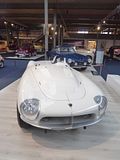

1954 Moretti 750 Gran Sport Berlinetta: In 1925, Giovanni Moretti founded the Moretti Motor Company so he could design and build motorcycles himself, as well as in conjunction with other companies. During the late 1920s and early 1930s, Giovanni began to dabble in the design and production of microcars. During World War II, he manufactured various commercial vehicles, most notably a range of small electric trucks. Following the war, in 1946, Moretti moved to the production of conventional cars. The first conventional car built by Moretti Motors was the Cita. Shortly afterwards, Moretti released the 600 and then, in 1953, the 750. These cars were available in various iterations, including taxis, berlinas, coupés, and single-seat race cars.


1955 Chevrolet BelAir Sedan: The story of these cars starts in 1955, when Chevrolet replaced the entire range of cars, producing what are sometimes referred to as the “Tri-Five” range, which would live for three years. Revolutionary in their day, they spawned a cult following that exists in clubs, website and even entire businesses that exclusively cater to the enthusiasts of the Tri Five automobiles. All featured a front-engine, rear-wheel-drive layout. 1955-1957 were watershed years for Chevrolet, who spent a million dollars in 1956 alone for retooling, in order to make their less expensive Bel Air models look more like a Cadillac, culminating in 1957 with their most extravagant tailfins and Cadillac inspired bumper guards. In 1955, Americans purchased 7.1 million new automobiles, including 1.7 million Chevrolets, giving the company fully 44% of the low-price market and surpassing Ford in total unit sales by 250,000. The Bel Air was an instant hit with consumers, with Base One-Fifty models starting under $1600 and featuring a six cylinder engine. The introduction of the new optional 170 hp 265ci V8, coupled with the Powerglide automatic transmission quickly earned the model the nickname “The Hot One”. In the first year of production, the oil filter was considered an option, although not having it led to significantly shorter engine life. With three basic model lines of 150, 210 and Bel Air and a range of body styles from 2 and 4 door Sedans to Coupes, Convertibles and Wagons, there were as many as 19 different Tri-five models available. The 1956 cars saw minor changes to the grille, trim and other accessories. It meant huge gains in sales for Chevrolet, who sold 104,849 Bel Air models, due in part to the new V8 engine introduced a year before. By this time, their 265cid V8 had gained popularity with hot rodders who found the engine easy to modify for horsepower gains. This wasn’t lost on Chevrolet’s engineers, who managed to up the horsepower in 1956 from 170 hp to 225 hp with optional add-ons. The average two door Bel Air in 1956 sold for $2100, which was considered a good value at the time. Prices ranging from $1665 for the 150 sedan with six cylinder engine to $2443 for the V8 equipped convertible, with Nomad models running slightly higher. Bigger changes came for 1957, including the large tailfins, “twin rocket” bonnet design, even more chrome, tri-colour paint and a choice from no less than seven different V8 engines. While in 1957, Ford outsold Chevrolet for the first time in a great while, years later the used 1957 Chevrolets would sell for hundreds more than their Ford counterparts. As the horsepower race continued, Chevrolet introduced a new version of their small block, with 283 cubic inches of displacement and 245 hp. They also introduced a limited number of Rochester fuel injected 283 engines that produced 283 hp, the first production engine to achieve 1 hp per cubic inch. For all intent and purposes, this made the 1957 Bel Air a “hot rod”, right off the production line. It was available with manual transmission only. The base 265cid engine saw an increase from 170 to 185 hp as well. While not as popular as the previous year’s offering, Chevrolet still managed to sell 1.5 million cars in 1957. Today, a 1957 Chevrolet Bel Air like this one is one of the most sought after collector cars ever produced.

1955 de Soto Diplomat Convertible: The DeSoto Diplomat is an automobile produced by DeSoto from 1946 to 1962 for sale in export markets other than the United States and Canada. The export DeSoto based on the Plymouth was first introduced in 1937 and was built in Detroit. Chrysler Corporation of Canada, which before 1947 enjoyed “Imperial Preference” reduced tariff barriers in British empire markets, did not start building export DeSotos until late in the 1939 model year. In 1946, the export DeSoto became the DeSoto Diplomat. They were exported to Europe, South Africa, South America, Hawaii, New Zealand, and Australia. In 1955, Chrysler of Canada did not export any cars and all 1955 Diplomats came from Detroit. In the late 1950s, some European taxicab drivers preferred to have a Perkins P4C diesel engine in the Diplomat; these diesel engines were installed on a Belgian assembly line. From 1938 to 1956, the export DeSoto used Plymouth bodies with a grille that looked similar to the regular DeSoto but fit the Plymouth grille opening. From 1957 to 1959, the DeSoto Diplomat used the DeSoto Firesweep front clip with Plymouth body. The 1960 and 1961 DeSoto Diplomats were based on the full-size Dodge Dart. Although 1960 was the last year for DeSoto in Canada and 1961 for the United States and export markets, Chrysler South Africa built a number of 1962 DeSoto Diplomats based on the Dodge Dart 440 sedan.

1961 Studebaker Hawk: One of the most elegant American cars of its era, without question, was the Studebaker Hawk, a late 1961 example of which was to be seen here. The Hawk rage was introduced for the 1956 model year, with more versions available from 1957, by which time there were four models: the pillared Flight Hawk and Power Hawk, and the hardtop Sky Hawk and Golden Hawk. These were all offered until 1959. The same basic car was produced for two more years, 1960 and 1961, simply as the Studebaker Hawk. The Hawk were an evolution of the Raymond Loewy styled Champion model which had been introduced in 1953, and the two lower models in the four-model Hawk range in 1956 carried forward the Champion 185 cu. in., six-cylinder 101 hp powerplant whilst the Power Hawk used the Commander’s 4.2 ltire V8. The Silver Hawk came in two differently-engined models with either the Champion six or the 289 cu. in. (4.7 litre) President V8 engine delivering 210 HP from the two-barrel and 225 HP from the four-barrel with dual exhaust. In appearance, the Silver Hawk was somewhat plainer in appearance than the Golden Hawk, the senior of the two Hawk models in 1957–1958. There was a little bit less chrome, no supercharger or bulge in the bonnet, and a simpler two-tone paint scheme was adopted — simply one colour below the chrome belt line and another above, but unlike the Golden Hawk, the lower colour included the fin. Some dealers painted the fin only, and sometimes the boot lid recess and or the left and right “side grills” were painted in a contrasting Studebaker colour. These usually matched the interior, some were Blue, Gold, Red or Black and were actually better looking according to many owners than the factory two-tone paint scheme. In the midst of a financial crisis at Studebaker after a disastrous recession-year performance in 1958, the Golden Hawk was dropped; the Silver Hawk, which had sold somewhat better, was retained in the lineup. For 1959, the Silver Hawk became the only Hawk model in production, largely because Studebaker dealers wanted a glamorous flagship model as a dealership draw. Those customers would more than likely walk out with Studebaker’s last-ditch hope, the new Lark compact. In fact, the Silver Hawk was the only non-Lark model kept. Changes for 1959 included new tailfins, with the “Silver Hawk” script moved to the fins instead of on the boot lid (where new individual block letters spelling out STUDEBAKER were placed), with a new Hawk badge in between the two words. The parking lights moved to the side grilles from the front wings, chrome mouldings around the windows (from the 1953–1954 models) similar to the Golden Hawk were added, and the interior was somewhere in between the two former models’ levels of luxury. Two-tone paint was discontinued for all U.S. orders, though it was still available for export. Under the bonnet, buyers could choose the newly-shrunken (to pre-’55 size) 90 HP 2.8 litre six or the 4.2 litre V8 of 180 or 195 HP (depending on the choice of carburettor). The 289 was no longer available. The 1959 model year was Studebaker’s first profitable year in six years, thanks mostly to the Lark, and the rising tide of sales lifted the Silver Hawk, which sold 7,788 examples. For 1960, Studebaker dropped the Silver part of the name, leaving “just plain” Hawk. Largely unchanged externally from the 1959, internally, the major change was the return of the 289 cubic inch (4.7 litre) V8 last used in 1958. This was the only engine available for U.S. orders in both 1960 and 1961, the last year of the finned Hawk. Some six-cylinder and 259 cu in (4.2 litre) V8 models were built for export markets. The 1961 models saw the limited return of a second paint colour, beige, in a stripe along the base of the fin between the two lower mouldings. Interiors gained the option of wide, comfortable bucket seats; customers could opt to team their 289 V8 with a new four-speed Borg-Warner manual transmission, the same model used in the Chevrolet Corvette. The Hawk was replaced for 1962 by the restyled Gran Turismo Hawk.
1959 Cadillac Series 62 Convertible: The 1959 Cadillac is remembered for its huge sharp tailfins with dual bullet tail lights, two distinctive rooflines and roof pillar configurations, new jewel-like grille patterns and matching deck lid beauty panels. In 1959 the Series 62 had become the Series 6200. De Villes and 2-door Eldorados were moved from the Series 62 to their own series, the Series 6300 and Series 6400 respectively, though they all, including the 4-door Eldorado Brougham (which was moved from the Series 70 to Series 6900), shared the same 130 in wheelbase. New mechanical items were a “scientifically engineered” drainage system and new shock absorbers. All Eldorados were characterised by a three-deck, jewelled, rear grille insert, but other trim and equipment features varied. The Seville and Biarritz models had the Eldorado name spelled out behind the front wheel opening and featured broad, full-length body sill highlights that curved over the rear fender profile and back along the upper beltline region. Engine output was an even 345 hp from the 390 cu in (6.4 litre) engine. Standard equipment included power brakes, power steering, automatic transmission, back-up lamps, two-speed wipers, wheel discs, outside rearview mirror, vanity mirror, oil filter, power windows, six way power seats, heater, fog lamps, remote control deck lid, radio and antenna with rear speaker, power vent windows, air suspension, electric door locks and license frames. The Eldorado Brougham also came with air conditioning, automatic headlight dimmer, and a cruise control standard on the Seville and Biarritz trim lines. For 1960, the year that this Fleetwood Eldorado was made, the styling was toned down a little. General changes included a full-width grille, the elimination of pointed front bumper guards, increased restraint in the application of chrome trim, lower tailfins with oval shaped nacelles and front fender mounted directional indicator lamps. External variations on the Seville two-door hardtop and Biarritz convertible took the form of bright body sill highlights that extended across the lower edge of fender skirts and Eldorado lettering on the sides of the front fenders, just behind the headlamps. Standard equipment included power brakes, power steering, automatic transmission, dual back-up lamps, windshield wipers, two-speed wipers, wheel discs, outside rearview mirror, vanity mirror, oil filter, power windows, six-way power seats, heater, fog lamps, Eldorado engine, remote control trunk lock, radio with antenna and rear speaker, power vent windows, air suspension, electric door locks, license frames, and five whitewall tyres. Technical highlights were finned rear drums and an X-frame construction. Interiors were done in Chadwick cloth or optional Cambray cloth and leather combinations. The last Eldorado Seville was built in 1960. The idea of a large car finished in pink now is simply unthinkable, but the colour goes quite well with the style here. These 59 and 60 Cadillacs attract lots of interest from collectors and the public and this one was no exception.

Volvo Amazon: There’s a complex history to this model, with lots of different numbers applied to the car during a 13 year production run. When introduced, the car was named the Amason (with an ‘s’), deriving from the fierce female warriors of Greek mythology, the Amazons. German motorcycle manufacturer Kreidler had already registered the name, and the two companies finally agreed that Volvo could only use the name domestically (i.e., within Sweden), modifying the spelling to Amazon. Subsequently, Volvo began its tri-digit nomenclature and the line became known as the 120 Series. Under prototype designation 1200, following the PV444’s internal designation as the 1100, the Amazon was released in the press in February 1956, with production initially set to begin in July of the same year, and deliveries commenced in August 1956 — under the now modified internal designation 120 series. The Amazon sedan’s ponton genre, three-box styling was inspired by US cars of the early 1950s, strongly resembling the Chrysler New Yorker sedan and the Chrysler 300C hardtop Coupe. According to designer Jan Wilsgaard, the Amazon’s styling was inspired by a Kaiser he saw at the Gothenburg harbour. The Amazon featured strong articulation front to rear, pronounced “shoulders”, and slight but visible tailfins. These features became inspiration for Peter Horbury when reconceiving Volvo’s design direction with the V70 after decades of rectilinear, slab-sided, boxy designs. The Amazon’s bodywork was constructed of phosphate-treated steel (to improve paint adhesion) and with heavy use of undercoating and anti-corrosive oil treatment. The Amazon shared the wheelbase, tall posture and high H-point seating of its predecessor, the PV. In 1959 Volvo became the world’s first manufacturer to provide front seat belts as standard equipment — by providing them on all Amazon models, including the export models — and later becoming the first car featuring three-point seat belts as standard equipment. The Amazon’s handbrake location, outboard of the driver’s seat, was intended to accommodate subsequent bench seat models with column shift transmissions — which never materialised. Buyers began to receive the first cars in February 1957, and initial models were two-tone red and black with light grey roof, light grey with a black roof, followed by a dark blue with grey roof in 1958. Further iterations included the 121, the base model with a single carburettor 66 bhp engine, the 122S introduced in 1958 as a performance model equipped with a dual carburettor 85 bhp engine. The estate version was introduced at the 1962 Stockholm Auto Show, and Volvo manufactured 73,000 examples between 1962 and 1969. The Amazon estate featured a two-piece tailgate, with the lower section folding down to provide a load surface and the upper section that hinged overhead. The vehicle’s rear licence plate, attached to the lower tailgate, could fold “up” such that when the tailgate was lowered and the vehicle in use, the plate was still visible. This idea was used by the original 1959 Mini. In recent years a similar arrangement was used on the tailgate of the Subaru Baja. In 1966 the Volvo PV ended production, replaced by the Amazon Favorit, a less expensive version of the Amazon, without exterior chrome trim, a passenger-side sun visor or cigarette lighter, and with a three-speed rather than four-speed transmission — available in black with red interior and later white or black with red interior. The newer Volvo 140 was becoming the company’s mainstream model, and the last of the four-door 120 saloons were produced in 1967, the year which saw the launch of the 123GT, which was a Model 130 with high-compression four-cylinder B18B engine (from the Volvo P1800), M41 gearbox, fully reclining seats, front fog and driving lights (on some markets), alternator, fender mounted mirrors, special steering wheel, dash with a shelf and tachometer, and other cosmetic upgrades. In 1969 the displacement of the old B18 engine was increased and the engine was called the B20. The last Amazon was manufactured on 3 July 1970. By the end of production, 234,653 four-door models, 359,917 two-door models and 73,220 station wagons had been produced, of which 60% were exported; a total of 667,791 vehicles.

Ford Taunus 12M (P4): The Ford Taunus 12M is a small family car produced by Ford Germany from September 1962 to August 1966. The Taunus 12M name had been used for the car’s predecessor and would be used for subsequent Ford models, which is why the 12M introduced in 1962 is often retroactively identified as the Ford Taunus P4. It was the fourth newly-designed German Ford to be launched after the war and was known within the company as Ford Project 4 (P4) or the Ford Taunus P4. It was the first Ford with front-wheel drive. With the P1 replaced by the P4, the Taunus 12M was now available with four doors. The car was not designed by Ford of Germany but by its US parent company, and was to be built and sold in the US as the Ford Cardinal — an all-American competitor to the Volkswagen. US production plans were later cancelled, and in 1960 Ford of Germany received a modern, fully developed new design which they adapted for German conditions as a replacement for their own outdated Ford Taunus P1. The 1952 Ford Taunus had received a stylish new body, but its rear axle and suspension were little changed from the 1939 Ford Taunus G93A, and its engine was essentially still the British-designed side-valve from the 1935 Ford Eifel. The P4, however, was technically innovative, with a newly-developed compact V4 engine that would become the basis for engines designed and produced by Ford of Germany for twenty years. The Taunus P4 was also a front-wheel drive design at a time when West German automakers, with a few exceptions, were still avoiding the technology. The decision not to build the Ford Cardinal in North America was made after the car had been prepared for production, and was the result of a review of “marketing opportunities” in the US. In 1960 a prototype was delivered to Ford in Cologne. The form that came off the production line at Köln-Niehl two years later would be unchanged. The single all-red rear lamp cluster was seen as a tell-tale sign of the car’s US origins, as separate red brake lamps and amber directional indicators were increasingly common on European cars. The dished steering wheel was another feature not normally found in European designs of the time. The Taunus P4 came to market in September 1962 to a reasonably positive reception. Its North American designers had created a car that was far larger and more spacious than the standard set by the Volkswagen which dominated the small saloon class in Germany. A series of teething problems suffered by the P4[1] suggested that adaptation of the car to German conditions had been somewhat rushed. Over its four-year model life the Taunus 12M was produced at an average rate of more than 150,000 per year, which made a useful contribution to the sales figures but did little to affect the dominance of the small car sector market by the Volkswagen Beetle, which was held back chiefly by a shortage of production capacity. The new V4 engine was mounted in the longitudinal, “overhung” front-wheel drive configuration pioneered by Auto Union/DKW, putting the engine in the far front of the car. The V4 incorporated a balance shaft to dampen some of the imbalance resulting from the unconventional positioning of the four crank pins in relation to the three bearings for the crankshaft. Reviewers still found the V4 “rougher” and noisier than comparable inline engines. The water pump and thermostat were housed in a sealed unit permanently protected by antifreeze. The fan was thermostatically controlled, which was still unusual at this time. An eye catching feature under the bonnet in 1964 was rocker covers color-coded by engine type. 40 PS engines were coded green, 50 PS blue and 65 PS red. The 55 PS version was discontinued at the same time, in favour of the more powerful red unit. The modern V4 engine placed Ford of Germany in the unfamiliar position of setting the pace, and the company was able to sell the unit to other smaller European manufacturers. This was the engine that Saab later used for their V4 models after they abandoned the Saab two-stroke engine. Ford’s compact V4 engine also found its way into the Matra 530 sports car. Power was transferred through a single dry plate clutch to the front wheels. The four-speed manual gear box featured synchromesh on all four ratios, and was controlled by means of a column-shift. The universal joints necessary to combine power transmission with steering and suspension functions involved engineering and materials technologies regarded as “leading edge” at the time, although front-wheel drive in lighter cars with less powerful engines had become mainstream in Germany over the three previous decades, following the pioneering application of the various technologies involved in Auto Union’s DKW-badged small cars. An unusual feature of the Taunus P4 involved the front suspension arms being connected to the engine/gearbox block, which served as a structural member. Above them, the transversely mounted leaf-springs were linked to a cross-member which was attached to the floor pan and thereby part of the unibody bodyshell. In autumn 1964 the various elements were rearranged to make it possible to soften the front suspension significantly: after this it was reported that the level of engine vibration reaching the driver was reduced. However, these changes also caused a reduction in roll-resistance at the front of the car which now tended to lean excessively when cornering. This effect was countered by the substitution of firmer dampers, while two additional support connections were added at the front in order to make the steering and tracking more precisely controllable. Disc brakes replaced drums on the front axle at the end of 1964. Ford’s larger sister model, the Ford Taunus P3, had received this same upgrade the previous year. The Taunus P4 used a 6 volt electrical system which was becoming rare in Germany, although the contemporary Volkswagen Beetle had not yet changed to a 12 volt system. Taunus P4s came as two or four-door saloons. A three-door estate car was also offered, which did not use the “Turnier” appellation from the larger 17M estate, although the “Turnier” name would later be applied by Ford of Germany to all of their estates. The estate also provided the basis for a panel van. In addition Ford offered a factory built two-door coupé which was in effect simply a two-door saloon with a shortened roofline and a steeply raked rear window. The coupé provided exactly the same interior space as the two-door saloon up to the level of the car’s waistline, but head-room for those on the back-seat was severely restricted. The rear light units had an all-red cover and a single chamber each. As in many other European cars of the time tail light and brake light was combined in two-filament bulbs. One filament with 5 W power served as tail light and the other, at 21 W, was lit during braking, emitting a brighter shine. While most other cars of that time had an additional chamber or a separate lamp unit for the turn indicators the Ford Taunus P4 had also the indicator function included in the single bulb. The high-power filament was lit intermittently when the indicator switch was set. When braking and turning occurred simultaneously, one high-power filament on the appropriate corner was lit periodically while the high-power filament on the opposite side shone continuously. This concept was usual in the USA at the time and required a special indicator relay. The principal changes during the car’s four-year production run took place under the skin, and received only muted publicity since many involved suspension modifications which a slower and more careful development process might have made unnecessary. Over the course of 142 days in 1963 a standard specification Ford Taunus 12M travelled 356,273 kilometres (221,378 mi) around a disused race track at Miramas at an average speed of 106.48 km/h (66.16 mph). The Taunus P4 was replaced in 1966 by the Ford Taunus P6, which generally followed the same architecture but was slightly larger and therefore even more spacious than the Volkswagen, Germany’s top selling small car in this period. The Taunus P4 notched up sales of 672,695 during its four-year production run. The sales total was a significant improvement on the numbers achieved by its P1 predecessor, but the overall market size also grew during the early 1960s. Within its class the Ford 12M was pushed into third place on the domestic market by the reappearance of Opel in the segment with their new Opel Kadett which also appeared in 1962. The Kadett was replaced by an improved model after only three years, but over that time its production volume of 649,512 fell less than 5% short of the total production achieved by the Ford over four years.
1960s, 70s and 80s
The more recent cars are mostly displayed upstairs along one side of the building.
Amphicar 770: The Amphicar Model 770 is an amphibious automobile, the first such vehicle mass-produced for sale to the public, starting in 1961. The German vehicle was designed by Hans Trippel and manufactured by the Quandt Group at Lübeck and at Berlin-Borsigwalde, and used Triumph Herald components under its glassfibre body. The name is a portmanteau of “amphibious” and “car”, and it truly could be drive on the road, and then by pulling a lever, converted into a boat. Compared to most boats or cars, its performance was modest, and it was expensive, so it is no surprised that only 4000 were produced by 1965. Most of them were sold in the USA, and most of them have rusted away as once they got wet, well, you can imagine what that did to the metalwork. Nevertheless, it is still among the most successful amphibious civilian autos of all time, and still often prized and preserved as a novelty collectible automobile. This one was in splendid condition.

Auto Union 1000SP: Auto-Union presented the 1000 SP coupe at the 1957 Frankfurt auto show and turned the model into a convertible in 1961. Both body styles wore a shockingly Ford Thunderbird-like design. This was a relatively common and accepted practice at the time; many other companies (including Volvo and DAF) sold models that liberally borrowed styling cues from the cars meandering across America. German coachbuilder Baur manufactured 1000 SP bodies in Stuttgart and shipped them to Ingolstadt, where final assembly took place. Both variants backed up their sporty pretensions with a 980cc three-cylinder, two-stroke engine rated at 55hp. In 1959, 50 models were produced with a 1,280cc two-stroke V6 engine. This 1965 1000 SP Roadster is one of just 1440 roadsters and 5000 coupes that were built over a 6 year period starting in 1958. and this would be last open-topped model until the Audi 80 Cabriolet of 1994.
1964 Mercedes-Benz 230 SL “Pagoda”: By 1955, Mercedes-Benz Technical Director Prof. Fritz Nallinger and his team held no illusions regarding the 190 SL’s lack of performance, while the high price tag of the legendary 300 SL supercar kept it elusive for all but the most affluent buyers. Thus Mercedes-Benz started evolving the 190 SL on a new platform, model code W127, with a fuel-injected 2.2 litre M127 inline-six engine, internally denoted as 220SL. Encouraged by positive test results, Nallinger proposed that the 220SL be placed in the Mercedes-Benz program, with production commencing in July 1957. However, while technical difficulties kept postponing the production start of the W127, the emerging new S-Class W112 platform introduced novel body manufacturing technology altogether. So in 1960, Nallinger eventually proposed to develop a completely new 220SL design, based on the “fintail” W 111 sedan platform with its chassis shortened by 11.8 in, and technology from the W112. This led to the W113 platform, with an improved fuel-injected 2.3 litre M127 inline-six engine and the distinctive “pagoda” hardtop roof, designated as 230 SL. The 230 SL made its debut at the prestigious Geneva Motor Show in March 1963, where Nallinger introduced it as follows: “It was our aim to create a very safe and fast sports car with high performance, which despite its sports characteristics, provides a very high degree of travelling comfort”. The W113 was the first sports car with a “safety body,” based on Bela Barényi’s extensive work on vehicle safety: It had a rigid passenger cell and designated crumple zones with impact-absorbing front and rear sections built into the vehicle structure. The interior was “rounded,” with all hard corners and edges removed, as in the W111 sedan. Production of the 230 SL commenced in June 1963 and ended on 5 January 1967. Its chassis was based on the W 111 sedan platform, with a reduced wheelbase by 11.8 in, recirculating ball steering (with optional power steering), double wishbone front suspension and an independent single-joint, low-pivot swing rear-axle with transverse compensator spring. The dual-circuit brake system had front disc brakes and power-assisted rear drum brakes. The 230 SL was offered with a 4-speed manual transmission, or an optional, very responsive fluid coupled (no torque converter) 4-speed automatic transmission, which was popular for US models. From May 1966, the ZF S5-20 5-speed manual transmission was available as an additional option, which was particularly popular in Italy. The 2,308 cc M127.II inline-six engine with 150 hp and 145 lb/ft torque was based on Mercedes-Benz’ venerable M180 inline-six with four main bearings and mechanical Bosch multi-port fuel injection. Mercedes-Benz made a number of modifications to boost its power, including increasing displacement from 2,197 cc, and using a completely new cylinder head with a higher compression ratio (9.3 vs. 8.7), enlarged valves and a modified camshaft. A fuel injection pump with six plungers instead of two was fitted, which allowed placing the nozzles in the cylinder head and “shooting” the fuel through the intake manifold and open valves directly into the combustion chambers. An optional oil-water heat exchanger was also available. Of the 19,831 230 SLs produced, less than a quarter were sold in the US. Looking identical, the 250 SL was introduced at the 1967 Geneva Motor Show. Production had already commenced in December 1966 and ended in January 1968. The short one-year production run makes the 250 SL the rarest of the W113 series cars. The 250 SL retained the stiffer suspension and sportier feel of the early SLs, but provided improved agility with a new engine and rear disc brakes. Range also improved with increased fuel tank capacity from 65 litres to 82. Like its predecessor, the 250 SL was offered with a 4-speed automatic transmission, and 4-speed or ZF 5-speed manual transmissions. For the first time, an optional limited slip differential was also available. The main change was the use of the 2,496 cc M129.II engine with a larger stroke, increased valve ports, and seven main bearings instead of four. The nominal maximum power remained unchanged at 150 hp, but torque improved from 145 lb/ft to 159 lb/ft. Resiliency also improved with a new cooling water tank (“round top”) with increased capacity and a standard oil-water heat exchanger. The 250 SL also marked the introduction of a 2+2 body style, the so-called “California Coupé”, which had only the removable hardtop and no soft-top: a small fold-down rear bench seat replaced the soft-top well between passenger compartment and boot. It is estimated that only 10% of the 250SLs that were brought into America were California Coupes. Of the 5,196 250 SLs produced, more than a third were sold in the US.The 280 SL was introduced in December 1967 and continued in production through 23 February 1971, when the W 113 was replaced by its successor, the entirely new and substantially heavier R107 350 SL. The main change was an upgrade to the 2,778 cc M130 engine with 170 hp and 180 lb/ft, which finally gave the W 113 adequate power. The performance improvement was achieved by increasing bore by 4.5 mm (0.2 in), which stretched the limits of the M180 block, and required pairwise cylinder casts without cooling water passages. This mandated an oil-cooler, which was fitted vertically next to the radiator. Each engine was now bench-tested for two hours prior to being fitted, so their power specification was guaranteed at last. The M130 marked the final evolution of Mercedes-Benz’ venerable SOHC M180 inline-six, before it was superseded by the entirely new DOHC M110 inline-six introduced with R107 1974 European 280 SL models. For some time, it was also used in the W 109 300 S-Class, where it retired the expensive 3 litre M189 alloy inline-six. Over the years, the W 113 evolved from a sports car into a comfortable grand tourer, and US models were by then usually equipped with the 4-speed automatic transmission and air conditioning. Manual transmission models came with the standard 4-speed or the optional ZF 5-speed, which was ordered only 882 times and thus is a highly sought-after original option today. In Europe, manual transmissions without air conditioning were still the predominant choice. Of the 23,885 280 SLs produced, more than half were sold in the US.

SAAB 96: The Saab 96 was manufactured from 1960 to January 1980, replacing the 93. The 96 featured aerodynamic two-door bodywork, four-passenger seating and at first a two-stroke, three-cylinder engine, later a four-stroke V4. Compared with its predecessor, the Saab 93, the 96 featured greater and more easily accessible storage space and larger rear window. The front end was lengthened for 1965 models, in preparation for a new engine, and the radiator was placed ahead of the engine, rather than above and behind, a leftover from the thermosiphon cooling days. Both front and rear windows were enlarged slightly for 1968 models. The Saab 96 had a longitudinally mounted engine layout. As first designed, it had an 841 cc displacement, 38 PS three-cylinder Saab two-stroke engine. By 1965 this was increased to 40 PS. An optional 52 PS version of the engine, with triple carburettors and oil injection, was used in the Sport and Monte Carlo models. The additional power was obtained from a modified cylinder head and filled crankshaft counterweights offering higher overall compression ratio. For 1966 models, the standard 96 841 cc engine, using pre-mix oil, appeared with a three throat Solex carburettor in which the centre carburettor handled start, idle, and low speed functions, increasing the power to 42 PS. The same carburettor had been used in the Monte Carlo and Sport models. A common throttle shaft minimised carburettor synchronization problems. In 1967, Saab began marketing the 96 V4, with the Ford Taunus V4 engine, a four-stroke 1498 cc V4 engine, originally developed for the 1962 Ford Taunus 15M. Saab’s project to source a four-stroke engine was dubbed ‘Operation Kajsa’. The two-stroke option was offered until 1968. Four-stroke engines had been tested before, between 1962 and 1964 Kjell Knutsson and Ingvar Andersson under Rolf Mellde tested three different engines: a 45 PS Lloyd Arabella of 897 cc; a 33 hp BMC A-Series 848-cc engine and a Lancia Appia engine of 1089cc and 48 hp. However Rolf Mellde’s view that Saab needed to switch to a four-stroke engine was stopped higher up by CEO Tryggve Holm. Mellde then went behind the back of Holm and made contact with Marc Wallenberg, son of Marcus Wallenberg, Saab’s major stockholder. The coup succeeded and testing could begin. The tested engines were Volvo B18, Ford V4, Triumph 1300, Lancia V4 engine, Opel, Volkswagen and Hillman Imp. The B18 was the most reliable, but the Ford V4 was not far behind and was significantly easier to fit into the engine bay of the 96. The testing was done in secrecy. Per Gillbrand took a leave of absence and said he was going to run his father’s paint shop. In reality he went to Desenzano in northern Italy with a 96 V4 prototype for testing. With five months to go before production only seven persons knew about the new engine. To maintain secrecy they rented a house west of Kristinehamn. To keep purchases of V4 specific parts secret they started the company Maskinverktyg AB. The ordinary purchase department at Saab was oblivious to what was going on, something that caused an incident when Rune Ahlberg cancelled the orders for cables for the two-stroke engine and the purchase department called the supplier and sharply told them to keep their deliveries. In the last week of July, just before the summer holidays, information about the new engine was released to further people and they were informed that full-scale production would start in four weeks. To keep secrecy, 40 of the ordinary staff were told to report to work to fix a problem with the disc brakes. Just prior to the official introduction, a journalist noticed a lorry loaded with 96s with V4 stickers on the front bumpers. The ordinary V4 engines produced between 1967 and 1976 had 65 PS. Cars from the first year of production had engines with “Ford Motor Company” stampings. For the Swedish 1976 model year, the car – now known as the 96L – had its power reduced to 62 PS due to new Swedish emission regulations. However, the 1977-1980 models had 68 PS, due to a two-stage Solex 32TDID carburettor. The V4 96 managed 0–100 km/h in 16 seconds. In August 1975 (called “1975B” in Sweden as the less powerful engine was kept for cars marketed after the beginning of the new year, when the new emissions standards took effect), the car received new impact absorbing bumpers similar to those on the 99 and an altered bottom plate which allowed the rear seat to be moved 5 cm (2.0 in) further back. The Saab 96 and its station wagon sibling, the Saab 95, featured column mounted transmission levers. The gearbox originally had three gears, the first unsynchronised. Later, a four-speed option, with synchromesh on first gear, was offered and the three-speed was phased out. An unusual feature of the Saab drivetrain was a ‘freewheel’ (overrunning clutch). This allowed the transmission to run faster than the engine, such as when decelerating, or descending a long hill. Although such freewheels had been provided in other cars before as an economy measure, they were required in the Saab because of the limited lubrication in the two-stroke engine. A petroil-lubricated two-stroke requires lubrication according to its speed, but provides this lubrication according to the amount of its throttle opening. Where the engine operates at high RPM and low throttle (such as when coasting down a long hill), the lubrication provided may be inadequate. With the freewheel, a coasting engine could reduce its speed to idling, thus requiring only the small lubrication available from the closed, coasting, throttle. In certain higher-performance models and in later two-stroke models, direct injection of oil into the engine from a separate reservoir allowed lubrication to be a function of engine RPM and rendered mixing of oil with gasoline unnecessary. Freewheeling was retained in the four-stroke variant, until the end of production and in the Saab 99 with the 1709 cc Triumph engine. A minor drawback to the freewheel, particularly for drivers unfamiliar with the Saab, is that it makes engine braking unavailable although it could be manually engaged or disengaged by a control in the foot-well. Fixed wheel engagement, using the foot, could be difficult, as it involved pulling a ‘T handle’ intended for manual operation. The front suspension used double wishbones and coil springs, while the rear suspension was a trailing U-beam axle with coil springs. Telescopic dampers were used for all four wheels. Up to model year 1967 models had drum brakes all around. Starting 1967, with the coming of the V4 engine, models were fitted with front disc brakes. The Saab 96 was driven most famously by Erik Carlsson, in many international rallies. His most famous successes were first in the 1960, 1961 and 1962 RAC Rallies and first in the 1962 and 1963 Monte Carlo Rallies. It was these successive, top-level victories that put the Saab 96 ‘on the map’ and established its reputation for reliability and toughness. Carlsson also competed in the East African Safari Rally. Famous rallying names such as Simo Lampinen, Per Eklund, Pat Moss-Carlsson, Tom Trana, Stig Blomqvist and Carl Orrenius have also been connected with the Saab 96.

BMW 1500 “Neue Klasse“: During the 1950s, the BMW line-up consisted of luxury cars with displacements of two litres or greater, economy cars powered by motorcycle engines, and motorcycles. With their luxury cars becoming increasingly outdated and unprofitable and their motorcycles and economy cars becoming less attractive to an increasingly affluent society, BMW needed a car in the 1.5 to 2 litre class to become competitive. Prototypes powered by a 1.6 L engine based on one bank of the BMW OHV V8 engine were built and evaluated without a convincing result. In 1960, Herbert and Harald Quandt invested heavily in BMW, and gained a controlling interest in the company. That year, the “Neue Klasse” project was begun. Led overall by Fritz Fiedler, the project had Eberhard Wolff in charge of chassis design, Wilhelm Hofmeister in charge of styling and body engineering, and Alex von Falkenhausen in charge of engine design. The team was to produce a new car with a new engine, which BMW had not done since the 303 in 1933. The prototype was introduced in September 1961 at the Frankfurt Motor Show as the BMW 1500 four-door saloon, alongside the BMW 3200 CS, the last BMW with the OHV V8. The term New Class referred to the 1.5–2–litre class from which BMW had been absent since World War II. Introduced in September 1961 at the Frankfurt Motor Show, the BMW 1500 entered regular production in October 1962 and was manufactured until December 1964. The M10 4-cylinder engine used oversquare dimensions of 82 mm bore and 71 mm stroke produced 80 hp in the BMW 1500. Contemporary reports praised the all-round visibility and the commanding driving position while recording that it was necessary to lean forward a little to engage first and third gears due to the long travel distance of the gear lever. The large 40 cm tall luggage compartment was also commended. The 1500 could accelerate to 100 km/h (62 mph) in approximately 15 seconds. The performance was at the time considered lively in view of the engine size, and although the engine needed to be worked hard in order to achieve rapid progress, it ran smoothly even at speeds above 6,000 rpm. The firm suspension and correspondingly harsh ride surprised those conditioned by the BMW 501 to anticipate a more comfort-oriented suspension setup. Notable problems that developed with the 1500 included separation of the semi-trailing arm mounts from the body, rear axle failure, and gearbox problems. These were resolved in later versions of the New Class sedan. The 1500 was replaced in 1964 by the 1600, but it was still made available in markets where capacities greater than 1500 cc incurred higher tax rates. Introduced in September 1963, the BMW 1800 was the second member of the New Class family. This model had an M10 engine with a 84 mm bore and 80 mm stroke, giving a displacement of 1,773 cc. It produced 90 hp at 5,250 rpm and 130 Nm (96 lb/ft) at 3,000 rpm. The 1800 TI (Turismo Internazionale) model featured components developed for the 1800 by the tuning company Alpina. The upgrades included dual Solex PHH side-draft carburettors and higher-compression pistons for 110 hp at 5,800 rpm and 136 N⋅m (100 lb⋅ft) at 4,000 rpm. A homologation special, the 1800 TI/SA, was introduced in 1964. The TI/SA’s engine had dual Weber DCOE-45 carburettors and a 10.5:1 compression ratio. This engine produced 130 hp at 6,100 rpm and 144 N⋅m (106 lb⋅ft) at 5,250 rpm. The TI/SA also had a Getrag five-speed gearbox, stronger anti-roll bars, and larger-diameter brake discs than the TI. 200 examples of the TI/SA were built and were only sold to licensed racing and sports drivers. An automatic transmission option was introduced in 1966 and in 1967 the 1800 was generally updated along with the 2000. The updates included interior changes (a modernized dashboard design and simpler door panels) as well as styling changes to the front grilles. In 1968 the 1,773 cc engine used in the 1800 was replaced by an engine with the 89 mm bore of the 2.0 L engine and the original 71 mm (2.8 in) stroke, which resulted in a displacement of 1,766 cc and a stroke/bore ratio of 0.798:1 (compared with the previous 1800 engine’s ratio of 0.952:1) The 1600, introduced as the replacement to the 1500 in 1964, used the 84 mm bore of the 1800 with the 1500s 71 mm stroke, resulting in a displacement of 1,573 cc, a power output of 83 hp at 5,500 rpm and 113 Nm (83 lb/ft) at 3,000 rpm. The 1600 was produced until early 1971. The engines from the 2000C and 2000CS coupes were used in the 4-door sedan body for the 2000 and 2000TI models. The 2000 sedan, released in 1965, used the 101 bhp engine from the 2000 C. The 2000TI sedan, released in 1966, used the 121 hp engine from the 2000 CS with twin Solex PHH side-draft carburettors. Intended as an upscale version of the 1800, the 2000 featured distinct wide taillights, more exterior trim, and unique rectangular headlights. The American market 2000 sedans could not have the rectangular headlights due to government regulations. A different grille with four individual round headlights, similar to the design that BMW later used in the 2500 sedan, was offered in the US. The 2000TI retained the ‘1800’ taillights and headlights. A more luxurious 2000TI-lux (later “tilux”) featured the sporty TI engine with a more high-grade interior and accessories, including a wood dashboard and optional leather seats. In 1969, BMW introduced the 2000tii (‘touring international, injected’), BMW’s first fuel-injected model, featuring Kugelfischer mechanical fuel injection. The 2000tii produced 130 hp at 5,800 rpm and 178 Nm (131 lb/ft) at 4,500 rpm. 1,952 2000tii cars were built of this final New Class sedan model
Lotus Elan: The original Elan was introduced in 1962 as a roadster, although an optional hardtop was offered in 1963 and a coupé version appeared in 1965, and there were examples of all of these here. The two-seat Lotus Elan replaced the elegant, but unreliable and expensive to produce Lotus Elite. It was the first Lotus road car to use a steel backbone chassis with a fibreglass body. At 1,600 lb (726 kg), the Elan embodied the Colin Chapman minimum weight design philosophy. Initial versions of the Elan were also available as a kit to be assembled by the customer. The Elan was technologically advanced with a DOHC 1557 cc engine, 4-wheel disc brakes, rack and pinion steering, and 4-wheel independent suspension. Gordon Murray, who designed the spectacular McLaren F1 supercar, reportedly said that his only disappointment with the McLaren F1 was that he couldn’t give it the perfect steering of the Lotus Elan. This generation of the two-seater Elan was famously driven by the character Emma Peel on the 1960s British television series The Avengers. The “Lotus TwinCam” engine was based on Ford Kent Pre-Crossflow 4-cylinder 1498 cc engine, with a Harry Mundy-designed 2 valve alloy chain-driven twin-cam head. The rights to this design was later purchased by Ford, who renamed it to “Lotus-Ford Twin Cam”. It would go on to be used in a number of Ford and Lotus production and racing models.
Maserati Mistral: Known internally as Tipo AM109, the Maserati Mistral was a 2-seat gran turismo produced between 1963 and 1970, as a successor to the 3500 GT. It was styled by Frua and bodied by Maggiora of Turin. Named after a cold northerly wind of southern France, it was the first in a series of classic Maseratis to be given the name of a wind. The Mistral was the last model from the Casa del Tridente (“House of the Trident”) to have the company’s renowned twin-spark, double overhead cam straight six engine. Fitted to the Maserati 250F Grand Prix cars, it won 8 Grand Prix between 1954 and 1960 and one F1 World Championship in 1957 driven by Juan Manuel Fangio. The engine featured hemispherical combustion chambers fed by a Lucas indirect fuel injection system, a new development for Italian car manufacturers. Maserati subsequently moved on to V8 engines for their later production cars to keep up with the demand for ever more powerful machines. Three engine were fitted to the Mistral, displacing 3500, 3700 and 4000 cc and developing 235 bhp at 5500 rpm, 245 bhp at 5500 rpm and 255 bhp at 5200 rpm, respectively. Only the earliest of the Mistrals were equipped with the 3500 cc, the most sought after derivative is the 4000 cc model. Unusually, the body was offered in both aluminium and, from 1967, in steel, but no one is quite sure how many of each were built. The car came as standard with a five speed ZF transmission and four wheel solid disc brakes. Per Maserati practice, the front suspension was independent and the rear solid axle. Acceleration 0-60 for both the 3.7 litre and 4.0 litre engines was around or just under 7 seconds, and top speed approximately 140 mph (225 km/h) to 145 mph (233 km/h). The body was designed by Pietro Frua and first shown in a preview at the Salone Internazionale dell’Automobile di Torino in November 1963. It is generally considered one of the most beautiful Maseratis of all time. It is also often confused with the very similar looking but larger and more powerful Frua designed AC 428. A total of 828 coupés and 125 Spyders were built. Only the Spyder received the 3500 engine; just 12 were made, along with 76 3.7 litre and 37 4.0 litre versions. Twenty Spyders were right hand drive. The Mistral was succeeded by the Ghibli, which overlapped production from 1967 on.

1967 Daf 32 Daffodil: The DAF Daffodil is a small family car that was manufactured by DAF from 1961 until 1967.[1] It replaced the DAF 600. At the same time DAF launched the DAF 750 which was essentially the same car but with less luxurious fittings and less chrome trim on the outside. The Daffodil was conceived as an export version of the 750, market response dictated that the 750 ceased production in 1963 while the Daffodil, benefitting from a succession of mild face lifts, remained in production until 1967. The Daffodil was replaced by the very similar but slightly more powerful DAF 33. The Daffodil name worked well in some markets, but in Germany the more luxuriously equipped version of the DAF 750 was known as the DAF 30. Upgrades in 1963 and 1965 were marked by name changes to DAF 31 and DAF 32. In these markets the launch of the DAF 33 in 1967 was merely a continuation of an existing line. The 746 cc four stroke air cooled 2 cylinder Boxer engine had the same stroke as in the 600, but the bore was increased from 76 mm to 85.5 mm. Claimed power output was also increased from 22 bhp to 30 bhp, and a maximum speed of 105 km/h (65 mph) was claimed. The 0-50 mph (80 km/h) time was 29 seconds, as tested by the Consumers Union in the United States. The DAF 600 was the first car to have a continuously variable transmission (CVT) system – the innovative DAF Variomatic., the same system was carried over to the 750 and its variants. The DAF Variomatic employs centrifugal weights to control the drive ratio of the transmission and is enhanced by the engine manifold vacuum. The action of the bob weights and inlet vacuum combined to pull together the cheeks of two, variable diameter, driving pulleys, driven directly from the engine. These were connected, by rubber ‘V’ belts, to two similar driven pulleys, connected to the drive wheels. The cheeks of the driven pulleys were held together by spring tension, which was progressively overcome as the drive pulleys expanded and the tension of the belts increased. The DAF Variomatics were thereby the only cars ever produced which went faster by the simple expedient of gently and gradually releasing the accelerator once top engine speed had been reached, as the increased vacuum took over from the reducing bob weight speed. The Variomatic also permitted increased engine braking by operating a switch on the dashboard which reversed the action of the vacuum on the pulley’s diaphragm, seeking a lower ratio with increased manifold vacuum. Two separate transmissions ran the two driving wheels, eliminating the need for a differential since belt slippage allowed for the different speeds of the inner and outer wheels. The duplication also provided redundancy, if one belt broke the vehicle could still be driven. An incidental feature was that in reverse, at least for earlier examples, the same top speed could be achieved as forwards. Later cars locked the transmission in the lowest ratio when reverse was selected. Between 1961 and 1967 the mechanical aspects of the car were not significantly changed. 1963 marked the withdrawal of the 750 and 30 badges, and the DAF 30 was replaced by the DAF 31. The exterior of the car was modestly reworked with input from Giovanni Michelotti which involved sharpened angles and more prominent fins: the interior was also significantly upgraded. In 1965 the DAF 32 replaced the DAF 31. This upgrade was marked by further limited changes to the body panels, again involving Michelotti whose influence would continue to be seen on DAF passenger cars until the Limburg car assembly business was acquired by Volvo.
Alfa Romeo Giulia: First of the all-new Giulia models to appear was the Berlina, launched in 1962. The styling was quite straight forward, but great attention was paid to detail. The engine bay, cabin and boot were all square shaped. But the grille, the rooflines and details on the bonnet and boot made for an integrated design from bumper to bumper. Thanks to Alfa Romeo using a wind tunnel during its development, the Giulia was very aerodynamic with a drag coefficient of Cd=0.34, which was particularly low for a saloon of the era and not a bad figure even for cars of today. Couple that with the fact that Alfa Romeo was one of the first manufacturers to put a powerful engine in a light-weight car (it weighed about 1,000 kilograms) and thanks to an array of light alloy twin overhead camshaft four-cylinder engine, similar to that of the earlier Giulietta models range, the car had a lively performance which bettered that of many sports cars of the day. The Tipo 105.14 was the first model, with a 1,570 cc Twin Cam engine with single down-draft carburettor generating 91 hp at 6500 rpm. The “TI” nomenclature referred to a class of Italian saloon car racing known as “Turismo Internazionale”, and had previously been applied to higher-performance versions of the 1900 and Giulietta saloons in the 1950s. However, for the Giulia saloon, the Ti was at first the only version available, and later, with the introduction of the TI Super and Super, the TI became the base version for the 1,600 cc engine class. The steering column gearchange (the only one in the Giulia range) was replaced with a floor change for 1964 (Tipo 105.08). Right hand drive cars, available from 1964, only ever had a floor change (Tipo 105.09). Brakes were by drums all around at first. Discs were introduced later, first at the front, and later all around. A brake servo was not fitted at first, but was introduced in later cars. The steering wheel featured the only horn ring ever in the Giulia range. The dashboard with a strip speedo is a notable feature, as is the steering wheel with a horn ring. The Giulia TI was phased out in 1968 and re-introduced as the austerity model 1600 S. Tipo 105.16 was a special racing model introduced in 1963. Quadrifoglio Verde stickers on the front wings were a distinguishing feature. Only 501 were made for homologation and today it is very rare and desirable. The 1,570 cc engine was fitted with two double-choke horizontal Weber 45DCOE carburettors for 110 hp at 6500 rpm. The body was lightened and a floor gearchange was fitted as standard, as were alloy wheels of very similar appearance to the standard steel ones of the TI. The TI’s instrument cluster with its strip speedometer was replaced with a three-instrument binnacle comprising speedometer, tachometer and a multi-gauge instrument (fuel, water temperature, oil temperature and pressure) – these instruments were similar to those fitted to the contemporary Giulia Sprint and Sprint Speciale coupes and Spider convertibles. The steering wheel was a three-spoke item with centre hornpush, also similar to that of the more sporting models. Braking was by discs all around, although the first cars used drums and early disc models lacked a servo which was introduced later. The police cars seen in The Italian Job were of this type. Tipo 105.06 was an austerity model made from 1964 to 1970 with a 1,290 cc single-carburettor engine for 77 hp at 6000 rpm. Four-speed gearbox with floor change fitted as standard (the 1300 was the only Giulia model not fitted with a five-speed gearbox). Though the engine was given a 105 series type number, it was basically the engine from the 101 series Giulietta Ti. This model appears not to have been exported to many markets outside Italy, if at all. Braking was by discs all around, without a servo at first, later with a servo. Tipo 105.26 was introduced in 1965. It transferred the technology from the racing TI Super to a road car, to make the most successful Giulia saloon. 1,570 cc engine with two double-choke Weber 40DCOE carburettors for a milder, but torquier tune than the TI Super – 97 hp at 5500 rpm. There was a new dashboard with two large round instruments (speedo and tacho) and clock, a sportier steering wheel with three aluminium spokes and centre horn push, similar to that of the Ti Super, later changed for one with the horn pushes in the spokes. All-around disc brakes with servo were fitted as standard from the outset. The serpent crest of the Sforza family appears in a badge on the C-pillar and is a distinguishing feature of the Super. For 1968, there was a suspension update, including revised geometry and a rear anti-roll bar. The wheels were changed in size from 5J x 15 to 5J x 14, and tyres from 155/15 to 165/14. For 1970, updates included dual-circuit brakes, centre-mounted handbrake lever to replace under-dash “umbrella handle”, larger external doorhandles, and top-hinged pedals (the latter in left hand drive models only; right hand drive continued with bottom-hinged pedals to the end of production). In 1972, Tipo 105.26 was rationalised into the Giulia 1.3 – Giulia 1.6 range. Tipo 105.39 built from 1965 to 1972. Right hand drive model replaced in 1970 by the 1300 Super. 1,290 cc engine with single down-draft carburettor for 81 hp at 6000 rpm. Unlike the re-deployed 101-series Giulietta engine of the austerity-model 1300, the 1300 ti motor was a 105 series engine, basically that of the sportier GT1300 Junior coupe with different camshaft timing (but the same camshafts) and induction system. Five-speed gearbox. Three-spoke bakelite steering wheel with plastic horn push covering the centre and spokes. Dashboard initially with strip speedo like that of the TI. For 1968, updates included a dashboard based on that of the Super, but with a simpler instrument binnacle, still featuring two large round instruments (speedo and tacho) and a separate fuel gauge, and the same suspension, wheel and tire updates applied to the Giulia Super in the same year. For 1970, updates included dual-circuit brakes, centre handbrake, larger external doorhandles and top-hinged pedals (on left hand drive cars only), again as applied to the Super for that year. Tipo 105.85 was basically a Giulia TI re-introduced in 1968 as a lower-level model to come between the 1300 and 1300 ti on one hand, and the Super on the other. It had a re-interpretation of the 1,570 cc single-carburettor engine for 94 hp at 5500 rpm and similar trim to the 1300 ti. Replaced in 1970 by the 1300 Super which offered similar performance in a lower tax bracket. The last cars from 1970 featured the top-hinged pedals, centre handbrake and dual-circuit brakes as for the Super and 1300 ti. Tipo 115.09 was introduced in 1970. It was basically a 1300 ti fitted with the engine from the GT 1300 Junior coupe that featured two double-choke horizontal carburettors; the engine actually had the GT 1300 Junior type number. This model was rationalised into the Giulia Super 1.3 – Giulia Super 1.6 range in 1972. In 1972 a rationalisation of the Giulia range saw the Super 1300 (Tipo 115.09) and the Super (Tipo 105.26) re-released as the Super 1.3 and Super 1.6. The two models featured the same equipment, interior and exterior trim, differing only in engine size and final drive ratio. The 1300 ti was dropped. A small Alfa Romeo badge on the C-pillar is a distinguishing feature, as are hubcaps with exposed wheel nuts. In December 1972 Alfa-Romeo South Africa released the 1600 Rallye. This locally developed more powerful 1600 cc version of the 1300 Super used the 1300’s single-headlight body shell. The car was largely ready for competition and was only planned to be built in limited numbers, and was fitted with racing-style rear-view mirrors, rally lamps, fully adjustable seats, and a limited-slip differential. Claimed power was 125 hp. The Giulia Super range was re-released in 1974 as the Nuova Super range, including the Giulia Nuova Super 1300 and 1600 This featured a new black plastic front grille and a flat boot lid without the characteristic centre spine. Otherwise the cars differed little from their Giulia Super predecessors and bore the same Tipo numbers with an S suffix. A Nuova Super fitted with a Perkins 1,760 cc diesel with 54 hp at 4000 rpm, was the firm’s first attempt at diesel power. The same Perkins diesel was used also in Alfa Romeo F12 van. The diesel version was slow, 138 km/h (86 mph), and the engine somehow unsuitable for a sport sedan so it was not big seller, only around 6500 examples were made in 1976 and the car was not sold in the UK. Production of the Giulia ceased in 1977.
Autobianchi A111: The Autobianchi A111 is a 4-door saloon family car produced from 1969 to 1972 by Italian car manufacturer Autobianchi, a subsidiary of the Fiat group. Despite rather modest dimensions, at roughly 4 metres long, it was the largest Autobianchi ever made, as the brand specialized in small cars. A modern front-wheel drive construction like the Fiat 128 launched concurrently, it was based on the revolutionary Autobianchi Primula, Fiat’s first “experiment” with the transverse engine front-wheel-drive setup. In 1957 Autobianchi produced the Bianchina, an upmarket version of the Fiat 500, and the Primula small family car. Offered both as a fastback saloon and hatchback, the 1964 Primula was Fiat’s first front-wheel drive production car. It had pioneered the transverse-engined front-wheel drive layout with the transmission and clutch to the left of the engine, which today is almost universally used on front-wheel drive cars. The brainchild of Dante Giacosa this mechanical layout had been developed for the Fiat 123, an experimental project undertaken to test various unconventional engine and transmission layouts for a mid-sized 1100 replacement; when Fiat’s management endorsed the traditionally laid out (front-longitudinal engine, rear-wheel drive) 124 instead, it had spawned the innovative Autobianchi Primula. To replace the Primula the managing director of Autobianchi, Enrico Ghiretti, desired a new three-box saloon. According to Giacosa’s memoirs, Ghiretti feared competition from the upcoming front-wheel drive Fiat 128 small family car (at the time still known as project X1/1) and was a proponent of conservative three-box styling, as opposed to than the Primula’s current 2-box hatchback or fastback bodies. The project was authorized by Fiat management, but since Fiat’s style centre was already overworked, decision was taken to use a design for the dismissed project 123. The chosen design was the most recent proposal for the transverse-engined front-wheel drive 123 E4; it was updated, chiefly in the front end to incorporate new rectangular headlamp lenses, and approved by Ghiretti for production. Therefore, on the outside the A111’s lines unsurprisingly recalled coeval Fiat designs, especially the 124 and 128. Christened A111, the new car—albeit larger in size—was based on the Primula’s platform and mechanicals, and used the 1.4-litre drivetrain of the most powerful Primula, the Coupé S of 1968. Size-wise, the A111 slotted between Fiat’s 128 and 124 sedans, being also significantly bigger than the previously biggest Autobianchi, the said Primula. The Autobianchi A111 was introduced in April 1969, and deliveries began in May. The interior, seating four or five, was rather well-appointed, with a genuine wood fascia on the dashboard, individual sliding and reclining front seats, fully carpeted floor, and cloth, cloth-and-leatherette or full leatherette upholstery. Autobianchi advertised a top speed of 155 km/h (96 mph). A lightly revised A111 was introduced at the 52nd Turin Motor Show in October/November 1970. A distinguishing feature of these “series 2” cars were double-stacked tail lamps, of the same design seen on the original A111. New bumpers gained rubbing strips but dispensed with the over-riders (bringing overall length to less than four metres), there was new model badging on the tail, and the interior was partly redesigned, including a new centre console and a shorter gear shifter. As the 1970s progressed, Fiat has introduced an increasing number of FWD cars under its own brand, and thus the Autobianchis became redundant. The last A111 left the production line in 1972, making the total number produced 56,984. The A111 remained without a direct replacement within the Autobianchi range, and thus the brand was reduced to a single model—the A112 upmarket supermini and its successor the Y10, the last car to bear the Autobianchi badge.

Opel GT: The first generation Opel GT debuted as a styling exercise in 1965 at the Paris and Frankfurt motor shows. The production vehicle used mechanical components from the contemporary Opel Kadett B and two-door hard top bodywork by French contractor Brissonneau & Lotz. The styling of the GT was often cited as similar to the 1968 Chevrolet Corvette which went on sale in September 1967. The Opel GT was equipped with a base 1.1 L OHV inline-four engine, which produced 67 hp (SAE) at 6,000 rpm. However, most buyers chose an optional 1.9 L camshaft in head engine, which produced 102 hp (SAE) at 5200 to 5400 rpm. Some of the early 1968 models also came with a slightly higher compression “H” code cylinder head. In 1971, due to emissions regulations, Opel reduced the compression ratio of the 1.9 L engine used in the US and output fell to 83 hp (SAE). There was also a GT/J model, which was a less expensive version of the 1900-engined GT which was sold only in Europe. Standard transmission was a manual four-speed. A three-speed automatic was available with the 1.9 L engine.The Opel GT uses a steel unibody and a conventional front-engined, rear-wheel drive layout. The engine is mounted far back in the chassis to improve weight distribution. Front suspension consists of upper A-arms and a lower transverse leaf spring. A live axle and coil springs are used in the rear. The power-assisted braking system uses discs in the front, drums in the rear. Steering is unassisted. One unusual feature of the Opel GT is the operation of the pop-up headlights. They are manually operated, by way of a large lever along the centre console next to the gearlever. Unlike most pop-up headlights, they both rotate in the same direction (counterclockwise from inside the car) about a longitudinal axis. One standard joke about GT owners was that you can easily spot them due to the heavy muscles on their right arm built up by using the lever to pop up the headlights. Designed by Opel stylist Erhard Schnell, the GT is a fastback, that has neither an externally accessible trunk nor a conventional hatchback. There is a parcel shelf behind the seats that can only be accessed through the main doors. Behind the parcel shelf is a fold-up panel that conceals a spare tyre and jack. The interior of the GT is surprisingly large for a car of its size, owing to its original design process in which the exterior metal was sculpted around an interior model. Headroom and legroom are sufficient for those over 6 feet (1.83 m) tall. During 1968 to 1973, a total of 103,463 cars were sold. The most collectible GTs are probably the first few hundred cars hand-assembled in 1968 and the 1968–1970 models with the 1.1 L engine, which totalled 3,573 cars. Of the later cars, 10,760 were the cheaper model (GT/J), which lacked nearly all chrome parts and offered fewer standard features. In some markets, items like a limited slip differential, front and rear anti-sway bars, heated rear window, and engine bay light were standard, although most cars were shipped without them. In North America, the GT was sold at Buick dealerships. Reasons for ending production were the need to redesign the car to remain competitive with up-and-coming sports models, such as the Datsun 240Z, as well as the termination of Brissonneau and Lotz’ bodybuilding contract. Unusually for the period, here was no Vauxhall equivalent model to the GT sold in the United Kingdom.

Ford Mustang: Drawing on inspiration from the mid-engined Ford Mustang I concept vehicle, Lee Iacocca ordered development of a new “small car” to vice-president of design at Ford, Eugene Bordinat. Bordinat tasked Ford’s three design studios (Ford, Lincoln-Mercury, and Advanced Design) to create proposals for the new vehicle. The design teams had been given five goals for the design of the Mustang: It would seat four, have bucket seats and a floor mounted shifter, weigh no more than 2,500 pounds (1,100 kg) and be no more than 180 inches (4,572 mm) in length, sell for less than $2,500, and have multiple power, comfort, and luxury options. The Lincoln–Mercury design studio ultimately produced the winning design in the intramural contest, under Project Design Chief Joe Oros and his team of L. David Ash, Gale Halderman, and John Foster. Development of the Mustang was completed in a record 18 months from September 1962 to March 1964. and Iacocca himself championed the project as Ford Division general manager. The styling is often credited to one person, and that is not accurate, as this was very much a team effort, it has been reported by those involved. To decrease developmental costs, the Mustang used chassis, suspension, and drivetrain components derived from the Ford Falcon and Fairlane. It used a unitised platform-type frame from the 1964 Falcon, and welded box-section side rails, including welded crossmembers. Although hardtop Mustangs accounted for the highest sales, durability problems with the new frame led to the engineering of a convertible first, which ensured adequate stiffness. Overall length of the Mustang and Falcon was identical, although the Mustang’s wheelbase was slightly shorter. With an overall width of 68.2 in (1,732 mm), it was 2.4 in (61 mm) narrower, yet the wheel track was nearly identical. Shipping weight, approximately 2,570 lb (1,166 kg) with the straight six-cylinder engine, was also similar to the Falcon. A fully equipped V8 model weighed approximately 3,000 lb (1,361 kg). Although most of the mechanical parts were from the Falcon, the Mustang’s body was completely different; sporting a shorter wheelbase, wider track, lower seating position and lower overall height. An industry first, the “torque box” was an innovative structural system that greatly stiffened the Mustang’s construction and helped contribute to better handling. The car was launched in 17th April 1964, as a hardtop and a convertible, with the fastback version following in August. It was an instant sensation, with demand massively exceeding supply. Since it was introduced four months before the normal start of the 1965 production year and manufactured alongside 1964 Ford Falcons and 1964 Mercury Comets, the earliest Mustangs are widely referred to as the 1964½ model. Nevertheless, all “1964½” cars were given 1965 U.S. standard VINs at the time of production, and – with limited exception to the earliest of promotional materials – were marketed by Ford as 1965 models. The low-end model hardtop used a “U-code” 170 cu in (2.8 litre) straight-6 engine borrowed from the Falcon, as well as a three-speed manual transmission and retailed for US$2,368. Standard equipment for the early 1965 Mustangs included black front seat belts, a glove box light, and a padded dash board. Production began in March 1964 and official introduction following on April 17 at the 1964 World’s Fair. V8 models got a badge on the front fender that spelled out the engine’s cubic inch displacement (“260” or “289”) over a wide “V.” This emblem was identical to the one on the 1964 Fairlane. Several changes to the Mustang occurred at the start of the “normal” 1965 model year in August 1964, about four months after its introduction. These cars are known as “late 65’s”. The engine lineup was changed, with a 200 cu in (3.3 litre) “T-code” engine that produced 120 hp. Production of the Fairlane’s “F-code” 260 cu in (4.3 litre) engine ceased when the 1964 model year ended. It was replaced with a new 200 hp “C-code” 289 cu in (4.7 litre) engine with a two-barrel carburettor as the base V8. An “A-code” 225 hp four-barrel carburettor version was next in line, followed by the unchanged “Hi-Po” “K-code” 271 hp 289. The DC electrical generator was replaced by a new AC alternator on all Fords (a way to distinguish a 1964 from a 1965 is to see if the alternator light on the dash says “GEN” or “ALT”). The Mustang GT version was introduced as the “GT Equipment Package” and included a V8 engine (most often the 225 hp 289), grille-mounted fog lamps, rocker panel stripes, and disc brakes. In the interior the GT option added a different instrument panel that included a speedometer, fuel gauge, temp. gauge, oil pressure gauge and ammeter in five round dials (the gauges were not marked with numbers, however.) A four-barrel carburettor engine was now available with any body style. Additionally, reverse lights were an option added to the car from August 1964 production. In 1965, the Shelby Mustang was born, it was available only in newly introduced fastback body version with its swept-back rear glass and distinctive ventilation louvres. The standard interior features of the 1965 Mustang included adjustable driver and passenger bucket seats, an AM radio, and a floor mounted shifter in a variety of colour options. Ford added additional interior options during the 1965 model year. The Interior Decor Group was popularly known as “Pony Interior” due to the addition of embossed running ponies on the seat fronts, and also included integral armrests, woodgrain appliqué accents, and a round gauge cluster that would replace the standard Falcon instrumentation. Also available were sun visors, a (mechanical) remote-operated mirror, a floor console, and a bench seat. Ford later offered an under-dash air-conditioning unit, and discontinued the vinyl with cloth insert seat option, offered only in early 1965 models. One option designed strictly for fun was the Rally-Pac. Introduced in 1963 after Ford’s success at that year’s Monte Carlo Rally and available on other Ford and Mercury compacts and intermediates, the Rally-Pac was a combination clock and tachometer mounted to the steering column. It was available as a factory ordered item for US$69.30. Installed by a dealer, the Rally-Pac cost US$75.95.A 14″ rim option was available for Rally-pac and GT350R vehicles widening front and rear track to 57.5″. Reproductions are presently available from any number of Mustang restoration parts sources. A compass, rear seat belts, A/C, and back-up lights were also optional. The 1966 Mustang debuted with moderate trim changes including a new grille, side ornamentation, wheel covers and filler cap. Ford’s new C-4 “cruise-o-matic” three-speed auto transmission became available for the 225 hp V8. The 289 “HiPo” K-code engine was also offered with a c4 transmission, but it had stronger internals and can be identified by the outer casing of the servo which is marked with a ‘C’. The long duration solid-lifter camshaft that allowed the high revving 289 to make the horsepower it was known for, was not friendly for a low stall speed automatic torque converter. The “HiPo” could be spotted very easily by the 1-inch-thick vibration damper, (as compared to 1/2 inch on the 225-hp version) and the absence of a vacuum advance unit on the dual point distributor. With the valve covers off, there is a large letter “K” stamped between the valve springs, along with screw in studs (vs. a pressed in stud for other 289s) for the adjustable rocker arms. A large number of new paint and interior color options, an AM/eight-track sound system, and one of the first AM/FM mono automobile radios were also offered. It also removed the Falcon instrument cluster; the previously optional features, including the round gauges and padded sun visors, became standard equipment. The Mustang would be the best-selling convertible in 1966, with 72,119 sold, beating the number two Impala by almost 2:1. The 1965 and 1966 Mustangs are differentiated by variations in the exterior, despite similar design. These variations include the emblem on the quarter-panels behind the doors. From August 1964 production, the emblem was a single vertical piece of chrome, while for 1966 models the emblem was smaller in height and had three horizontal bars extending from the design, resembling an “E”. The front intake grilles and ornaments were also different. The 1965 front grille used a “honeycomb” pattern, while the 1966 version was a “slotted” style. While both model years used the “Horse and Corral” emblem on the grille, the 1965 had four bars extending from each side of the corral, while on the 1966, these bars were removed. The 1966 model year saw introduction of ‘High Country Special’ limited edition, 333 of them were sold in Colorado, Wyoming, and Nebraska. When Ford wanted to introduce the Mustang in Germany, they discovered that Krupp company had already registered the name for a truck. The German company offered to sell the rights for US$10,000. Ford refused and removed Mustang badges from exported units, instead naming the cars as T-5 (a pre-production Mustang project name) for the German market until 1979 when Krupp copyrights expired. In 1965, Harry Ferguson Research purchased 3 Mustang notchbacks and converted them to 4×4 in an attempt to sell potential clients on their FF AWD system. A similar system was used in the Ferguson P99 Formula One car, and would go on to be featured in the Jensen FF, widely considered the first AWD passenger car. As in the Jensen FF, the AWD Mustangs also featured an ABS braking system, long before such a feature was commonplace. Ford Australia organised the importation and conversion of 1966 Mustang to right-hand-drive for the Australian market. This coincided with the launch of new XR Falcon for 1966, which was marketed as “Mustang-bred Falcon”. To set the official conversion apart from the cottage industry, the RHD Mustangs were called “Ford Australia Delivered Mustang” and had compliance plates similar to XR Falcon. About 209 were imported to Australia with 48 units were converted in 1965 while the further 161 were done in 1966. The 1967 model year Mustang was the first redesign of the original model. Ford’s designers began drawing up a larger version even as the original was achieving sales success, and while “Iacocca later complained about the Mustang’s growth, he did oversee the redesign for 1967 .” The major mechanical feature was to allow the installation of a big-block V8 engine. The overall size, interior and cargo space were increased. Exterior trim changes included concave taillights, side scoop (1967 model) and chrome (1968 model) side ornamentation, square rear-view mirrors, and usual yearly wheel and gas cap changes. The high-performance 289 option was placed behind the newer 335 hp 6.4 litre FE engine from the Ford Thunderbird, which was equipped with a four-barrel carburettor. During the mid-1968 model year, a drag racer for the street could be ordered with the optional 428 cu in (7.0 litre) Cobra Jet engine which was officially rated at 335 hp. All of these Mustangs were issued R codes on their VIN’s. The 1967 Deluxe Interior was revised, discontinuing the embossed running horse motif on the seat backs (the source for the “pony interior” nickname) in favor of a new deluxe interior package, which included special colour options, brushed aluminium (from August 1966 production) or woodgrain dash trim, seat buttons, and special door panels. The hardtop also included upholstered quarter trim panels, a carryover from the 1965-66 deluxe interior. The 1967 hardtop also had the chrome quarter trim caps, carried over from 1965-66, but these were painted to match the interior in 1968 models. The 1967 deluxe interior included stainless steel-trimmed seat back shells, similar to those in the Thunderbird. These were dropped at the end of the 1967 model year, and were not included in the woodgrain-trimmed 1968 interior. The deluxe steering wheel, which had been included in the deluxe interior for the 1965-66, became optional, and could also be ordered with the standard interior. The 1968 models that were produced from January 1968 were also the first model year to incorporate three-point lap and shoulder belts (which had previously been optional, in 1967-68 models) as opposed to the standard lap belts. The air-conditioning option was fully integrated into the dash, the speakers and stereo were upgraded, and unique center and overhead consoles were options. The fastback model offered the option of a rear fold-down seat, and the convertible was available with folding glass windows. Gone was the Rally-Pac, since the new instrument cluster had provisions for an optional tachometer and clock. Its size and shape also precluded the installation of the accessory atop the steering column. The convenience group with four warning lights for low fuel, seat belt reminder, parking brake not released, and door ajar were added to the instrument panel, or, if one ordered the optional console and A/C, the lights were mounted on the console. Changes for the 1968 model increased safety with a two-spoke energy-absorbing steering wheel, along with newly introduced shoulder belts. Other changes included front and rear side markers, “FORD” lettering removed from hood, rearview mirror moved from frame to windscreen, a 302 cu in (4.9 litre) V8 engine was now available, and C-Stripe graphics were added. The California Special Mustang, or GT/CS, was visually based on the Shelby model and was only sold in Western states. Its sister, the ‘High Country Special’, was sold in Denver, Colorado. While the GT/CS was only available as a coupe, the ‘High Country Special’ model was available in fastback and convertible configurations during the 1966 and 1967 model years, and as a coupe for 1968. The 1968 Ford Mustang GT Fastback reached iconic status after it was featured in the 1968 film Bullitt, starring Steve McQueen. In the film, McQueen drove a modified 1968 Mustang GT 2+2 Fastback chasing a Dodge Charger through the streets of San Francisco. There were further annual updates until the model’s replacement in 1973, but with each the car got steadily bigger and less overtly sporty. Sales reduced, too, suggesting that Ford were losing their way.

1972 Citroen SM: This glamorous Sports/GT Coupe still wows people over 45 years since its debut. The Citroën SM was first shown at the 1970 Geneva Motor Show, but work on the car had started way back in 1961, with ‘Project S’, which was envisaged to be a a sports variant of the revolutionary Citroen DS. For the next few years, many running concept vehicles were developed, and these became increasingly complex and upmarket from the DS. In 1968, Citroën purchased Maserati, with the intention of harnessing Maserati’s high-performance engine technology to produce a true Gran Turismo car, which would combine Citroen’s advanced suspension with a V6 Maserati engine. The car was a sensation when revealed, with its distinctive styling, an amazingly low drag coefficient of just 0.26, and as well as the advanced features from the DS such as lights that swivelled with the steering and the advanced hydropneumatic self-levelling suspension there were numerous technical innovations such as variable assistance for the power steering, rain sensitive wipers and the option of lightweight wheels of composite alloys. It was a further six months before customers could get behind the wheel, with the SM finally going on sale in France in September of that year. The origin of the model name ‘SM’ is not clear. The ‘S’ may derive from the Project ‘S’ designation, and the ‘M’ may refers to Maserati, hence SM is often assumed to stand for ‘Sports Maserati’. Another common hypothesis is that SM stood for Série Maserati and others have suggested it is short for ‘Sa Majesté’ (Her Majesty in French), which would aligns with the explanation that the DS model was so called as a contraction of the French word ‘Déesse’ (The Goddess). Regardless of the origins of the name, it attracted lots of attention, and came third in the 1971 Car of the Year competition (behind Citroen’s own revolutionary GS model). For a couple of years, sales were reasonable, but they fell off dramatically in 1973, not just because of the Oil Crisis that struck late that year, but largely because the SM’s technical complexity came with a price tag of some terrible reliability problems, something which owners of rival cars simply did not experience. To compound the owner’s misery, they needed to find and pay for Citroen specialists who understood the hydraulics and a Maserati specialist for the engine. Both categories were kept busy. Citroen declared bankruptcy in 1974 and the company was purchased in May 1975. Thanks to changes in US legislation, sales in that market, which had hitherto been the SM’s largest had ceased, and so with global sales of under 300 SMs in 1974, having divested itself of Maserati, new owner Peugeot took the obvious decision to cease production of the SM almost immediately. During the SM’s 5 year product life, a total of 12,920 cars were produced. With the exception of a handful of conversions for the Australian market, all SMs were made in left hand drive, which is perhaps one reason why UK sales amounted to just 325 cars from that total. Although this is often labelled as one of the 4 “nightmare cars of the apocalypse” (along with the Triumph Stag and Alfa Montreal), the reality is that the surviving cars have largely been “fixed” and they are now not the fearsome ownership proposition that many still assume.

Jaguar E Type Series 3: The E-Type Series 3 was introduced in 1971, with a new 5.3 L Jaguar V12 engine, uprated brakes and standard power steering. Optionally an automatic transmission, wire wheels and air conditioning were available. The V12 was equipped with four Zenith carburettors, and as introduced produced a claimed 272 bhp, more torque, and a 0–60 mph acceleration of less than seven seconds. The short wheelbase FHC body style was discontinued, with the Series 3 available only as a convertible and 2+2 coupé. The newly used longer wheelbase now offered significantly more room in all directions. The Series 3 is easily identifiable by the large cross-slatted front grille, flared wheel arches, wider tyres, four exhaust tips and a badge on the rear that proclaims it to be a V12. The first published road test of the series 3 was in Jaguar Driver, the club magazine of the Jaguar Drivers’ Club, the only owners club to be officially sanctioned by Sir William Lyons and Jaguar themselves. The road test of a car provided by Jaguar was published ahead of all the national and international magazines. Cars for the US market were fitted with large projecting rubber bumper over-riders (in 1973 these were on front, in 1974 both front and rear) to meet local 5 mph impact regulations, but those on European models were considerably smaller. US models also have side indicator repeats on the front wings. There were also a very limited number of six-cylinder Series 3 E-Types built. These were featured in the initial sales procedure but the lack of demand stopped their production. The V12 Open Two Seater and V12 2+2 were factory fitted with Dunlop E70VR − 15-inch tyres on 15 × 6K wire or solid wheels. The final production E-Type OTS Roadster was built in June 1974. Total production was 15,290.
Matra 530LX: In 1965 Matra’s CEO Jean-Luc Lagardère decided to develop a sports car that would be more accessible to the ordinary, non-racing public, a voiture des copains (car for chums), as its successor, and the result was the first “true” Matra sports car, (the Djet had been a René Bonnet design) the Matra M530. The car was named after Matra’s R.530 missile, and designed by a former Simca designer called Philippe Guédon. Like its predecessor, the M530 was built on a steel frame with polyester body and had a mid-engine. To accommodate a 2+2, mid-engine layout and a reasonable boot, various engine options were considered. In the end, the running gear came from Ford in Germany: the “high compression” 1699 cc Ford Taunus V4 engine and gearbox from the Taunus 15M TS were chosen. This combination was compact enough to fit between the rear seats and the boot. Other unusual features of the M530 were its targa top roof, pop-up headlights and, most notably, the outstanding avant-garde design. The first 530 (badged Matra Sports M530A) was shown to the public on March 7, 1967 at the Geneva Motor Show. It had a 70 DIN hp Ford 1700 cc V4 engine, which gave the car a top speed of 175 km/h (109 mph). It entered production a month later, incorporating modifications that included the addition of a chrome bumper bar to provide for the front grill much needed protection from parking shunts, a modest reshaping of the dashboard to give the passenger a little more knee room, and the repositioning of the ignition key to facilitate access. In its first two production years, the chassis was built by Carrier in Alençon and assembly was undertaken by French coachbuilder Brissonneau et Lotz at Creil. The engine bay of the early model 530 was accessible by removing the acrylic glass rear window. 1969 saw many changes to the 530. First, the running gear followed the same evolution as the Ford model it was taken from and power increased to 75 DIN hp by using a different carburettor. Secondly, Matra closed a deal with Chrysler Europe, to sell their cars through the Simca dealer network from 1970 onwards and jointly develop the M530’s successor. Finally, the cars were now constructed completely at the Matra Automobiles factory in Romorantin. Introduced at the 1970 Geneva Motor Show was the Matra Simca M530LX, which was a minor redesign of the 530A by Michelotti. The most notable changes were the rear hatch (now made of glass and opens with struts like a hatchback) and the front bumper. A budget version of the 530, the Matra Simca 530SX, was introduced in October 1971. The SX lacked the targa top roof and pop-up headlights; instead, there were four fixed headlights mounted on top of the front. The only available colours were orange and white, and the SX featured black bumpers instead of the LX’s chrome bumpers. M530’s production ceased in 1973, after a total of 9,609 cars (2,062 530A, 4,731 530LX and 1,146 530SX) were built.
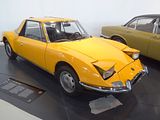

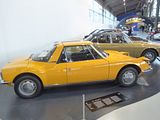
Jaguar XJ12: The XJ6, using the 2.8-litre and 4.2-litre straight-six cylinder versions of Jaguar’s renowned XK engine, replaced most of Jaguar’s saloons – which, in the 1960s, had expanded to four separate ranges. Apart from the engines, the front and rear suspensions carried over from previous models as well: the widest version of Jaguar’s IRS unit from the Mark X, and the subframe-mounted independent front suspension first seen in the 1955 Mark 1, with new anti-dive geometry. An upmarket version was marketed under the Daimler brand as the Daimler Sovereign, continuing the name from the Daimler version of the Jaguar 420. The car was introduced in September 1968. Power-assisted steering and leather upholstery were standard on the 2.8 L De Luxe and 4.2 L models. Air conditioning was offered as an optional extra on the 4.2 L Daimler versions, which were launched in October 1969 in a series of television advertisements featuring Sir William. In these advertisements, he referred to the car as “the finest Jaguar ever”. An unusual feature inherited from the Mark X and S-Type saloons was the twin fuel tanks, positioned on each side of the boot / trunk, and filled using two separately lockable filler caps: one on the top of each wing above the rear wheel arches. Preliminary reviews of the car were favourable, noting the effective brakes and good ride quality. In March 1970 it was announced that the Borg-Warner Model 8 automatic transmission, which the XJ6 had featured since 1968, would be replaced on the 4.2-litre XJ6 with the Borg-Warner Model 12. The new transmission had three different forward positions accessed via the selector lever, which effectively enabled performance oriented drivers to hold lower ratios at higher revs to achieve better acceleration. “Greatly improved shift quality” was also claimed for the new system. Around this time other, minor changes were made as well, such as moving the rear reflectors from beside to below the rear lights; on the interior the chrome gauge bezels were replaced with black ones, to cut down on distracting reflections. In 1972, the option of a long-wheelbase version, providing a 4-inch increase in leg room for passengers on the rear seats, became available. A high performance version called the XJ12 was announced in July 1972, featuring a simplified grille treatment, and powered by a Jaguar’s 5.3 L V12 engine coupled to the Borg-Warner Model 12 transmission. At the time it was the only mass-produced 12-cylinder, four-door car in the world and, with a top speed of “around” 225 km/h (140 mph), it was the “fastest full four-seater available in the world”. Although it had been the manufacturer’s intention from launch that the XJ would use the 12-cylinder engine its installation was nonetheless a tight fit, and providing adequate cooling had been a challenge for Jaguar’s engineers. Bonnet louvres such as those fitted on the 12-cylinder E Type were rejected and instead the XJ12 featured a complex “cross-flow” radiator divided into two separated horizontal sections supported with coolant feeder tanks at each end. The engine fan was geared to rotate at 1¼ times the speed of the engine, subject to a limiter which cut in at a fan speed of 1,700 rpm. The fuel system incorporated a relief valve that returned fuel to the tank when pressure in the lines to the carburettors exceeded 1.5 psi, to reduce the risk of vapour locks occurring at the high operating temperatures, while the car’s battery had its own thermostatically-controlled cooling fan. The Jaguar XJ12, launched during the summer of 1972, featured a simplified grille. 3,228 Series 1 XJ12s were built. A badge-engineered version, the Daimler Double-Six, was introduced in 1972, reviving the Daimler model name of 1926–1938.


Lamborghini Espada: The Lamborghini Espada, a 4-seat grand touring coupé, arrived in 1968. The car was designed by Marcello Gandini at Bertone. Gandini drew inspiration and cues from two of his Bertone show cars from 1967, the Lamborghini Marzal and the Jaguar Piraña. The name “Espada” means “sword” in Spanish, referring to the sword that the Torero uses to kill the bull in the Corrida. During its ten years in production the car underwent some changes, and three different series were produced. These were the S1 (1968–1970), the S2 (1970–1972) and the S3 (1972–1978). Each model featured interior redesigns, while only minor details were changed on the exterior. The Espada was launched at the 1968 Geneva Motor Show. The original design of the dashboard was inspired by the Marzal concept car, and featured octagonal housings for the main instruments, topped by an additional binnacle for the secondary gauges. Wheels were Campagnolo alloys on knock-off hubs, of the same design seen on the Miura. The tail lights were the same units mounted on the first series Fiat 124 Sport Coupé. 186 were made up until January 1970. At the 1970 Brussels Motor Show Lamborghini unveiled the Espada S2. Outside the only change was the deletion of the grille covering the vertical glass tail panel. Inside changes were more radical: all-new dashboard, centre console and steering wheel were installed. The instrument binnacle was of a more conventional rectangular shape, with round gauges. A wood-trimmed fascia extended along the entire width of the dashboard. Power output increased to 350 PS (345 bhp) due to a higher 10.7:1 compression ratio; the brakes were upgraded to vented Girling discs. Power steering was offered as an option. 575 Series II Espada were made, making it the most popular and desirable variant. The Espada S3 was launched in 1972. Its 3.9 litre V12 engine produced 325 PS (321 bhp) With the second redesign the dashboard changed to a aluminium-trimmed cockpit that kept all instruments and most controls (including the radio) within easy reach of the driver. Newly designed wheels on five-stud hubs replaces the earlier knock-off wider wheels fiitted with Pirelli Cinturato 215/70WR15 CN12 tyres, making the Espada S3 instantly recognisable; other exterior changes included the square instead of hexagonal mesh grille and tail lights from the Alfa Romeo 2000 replacing the previous Fiat-sourced ones. In 1974 a Borg Warner automatic transmission became available. From 1975 large impact bumpers had to be installed to meet United States safety requirements; some people consider cars produced with them as a separate fourth series, but Lamborghini did not officially change the model designation. In total, 1217 Espadas were made, making it the most successful Lamborghini model until the expansion of Countach production in the mid-1980s.
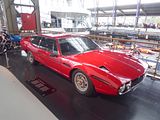
Rover 2200 “P6”: Whilst the 3 litre P5 model may have been thought of as a replacement for the top end of the long running P4 Rovers, it was really this car, the P6 model, first seen in October 1963 which was its true successor. Very different from the long-running 60/75/80/90/95/100/105/110 models, this car took some of its inspiration, it is claimed, from the Citroen DS as well as lessons learned from Rover’s Jet Turbine program of the 1950s and early 60s. It was a “clean sheet” design, carrying nothing over, and was advanced for the time with a de Dion tube suspension at the rear, four-wheel disc brakes (inboard on the rear), and a fully synchromesh transmission. The unibody design featured non-stressed panels bolted to a unit frame. The de Dion set-up was unique in that the “tube” was in two parts that could telescope, thereby avoiding the need for sliding splines in the drive shafts, with consequent stiction under drive or braking torque, while still keeping the wheels vertical and parallel in relation to the body. The Rover 2000 won industry awards for safety when it was introduced and included a carefully designed “safety” interior. One innovative feature was the prism of glass on the top of the front side lights. This allowed the driver to see the front corner of the car in low light conditions, and also confirmed that they were operative. One unique feature of the Rover 2000 was the design of the front suspension system, in which a bell crank (an L-shaped rotating bracket trailing the upper hub carrier joint) conveyed the vertical motion of the wheel to a fore-and-aft-horizontally mounted spring fastened to the rear wall of the engine compartment. A single hydraulically damped arm was mounted on the firewall for the steering. The front suspension was designed to allow as much width for the engine compartment as possible so that Rover’s Gas Turbine engine could be fitted. In the event, the engine was never used for the production vehicle, but the engine compartment width helped the accommodation of the V8 engine adopted years after the car’s initial launch for the 2000. The luggage compartment was limited in terms of usable space, because of the “base unit” construction, complex rear suspension and, in series II vehicles, the battery location. Lack of luggage space (and hence the need to re-locate the spare tyre) led to innovative options for spare tyre provision including boot lid mountings and optional Dunlop Denovo run-flat technology. The car’s primary competitor on the domestic UK market was the Triumph 2000, also released in October 1963, just one week after the Rover, and in continental Europe, it contended in the same sector as the Citroen DS which, like the initial Rover offering, was offered only with a four-cylinder engine – a deficiency which in the Rover was resolved, four years after its launch, when Rover’s compact V8 was engineered to fit into the engine bay. The Rover 2000 interior was not as spacious as those of its Triumph and Citroen rivals, especially in the back, where its sculpted two-person rear seat implied that Rover customers wishing to accommodate three in the back of a Rover should opt for the larger and older Rover 3 Litre. The first P6 used a 1,978 cc engine designed specifically for the car, which put out around 104 bhp. That was not enough to live up to the sports saloon ambitions, so Rover later developed a twin SU carburettor version with a re-designed top end and marketed the revised specification vehicles as the 2000 TC. The 2000 TC was launched in March 1966 for export markets in North America and continental Europe, relenting and making it available to UK buyers later that year. This engine generated around 124 bhp. The standard specification engines continued in production in vehicles designated as 2000 SC models. These featured the original single SU. More performance was to come. Rover saw Buick’s compact 3528 cc V8 unit that they had been looking at developing as the means of differentiating the P6 from its chief rival, the Triumph 2000. They purchased the rights to the innovative aluminium engine, and, once improved for production by Rover’s own engineers, it became an instant hit. The Rover V8 engine, as it became known, outlived its original host, the P5B, by more than thirty years. The 3500 was introduced in April 1968, one year after the Rover company was purchased by Triumph’s owner, Leyland and continued to be offered until 1977. The light metal V8 engine weighed the same as the four-cylinder unit of the Rover 2000, and the more powerful car’s maximum speed of 114 mph as well as its 10.5-second acceleration time from 0–60 mph were considered impressive, and usefully faster than most of the cars with which, on the UK market, the car competed on price and specifications. It was necessary to modify the under-bonnet space to squeeze the V8 engine into the P6 engine bay: the front suspension cross-member had to be relocated forward, while a more visible change was an extra air intake beneath the front bumper to accommodate the larger radiator. There was no longer space under the bonnet for the car’s battery, which in the 3500 retreated to a position on the right side of the boot. Nevertheless, the overall length and width of the body were unchanged when compared with the smaller-engined original P6. Having invested heavily in the car’s engine and running gear, the manufacturer left most other aspects of the car unchanged. However, the new Rover 3500 could be readily distinguished from the 2000 thanks to various prominent V8 badges on the outside and beneath the radio. The 3500 was also delivered with a black vinyl covering on the C-pillar, although this decoration later appeared also on four-cylinder cars. A 3-speed Borg Warner 35 automatic was the only transmission until the 1971 addition of a four-speed manual 3500S model, fitted with a modified version of the gearbox used in the 2000/2200. The letter “S” did not denote “Sport”, it was chosen because it stood for something specific on those cars: “Synchromesh”. However it is important to note that the 3500S was noticeably quicker than the automatic version of this car with a 0-60mph time of 9 seconds, compared with 10.1 for the standard car. Moreover, due to the fuel-guzzling nature of automatic gearboxes of this era, the manual car’s official cycle was 24mpg compared to the automatic’s 22mpg. The Series II, or Mark II as it was actually named by Rover, was launched in 1970. All variants carried the battery in the boot and had new exterior fixtures such as a plastic front air intake (to replace the alloy version), new bonnet pressings (with V8 blips even for the 4-cylinder-engined cars) and new rear lights. The interior of the 3500 and 2000TC versions was updated with new instrumentation with circular gauges and rotary switches. The old-style instrumentation with a linear speedometer and toggle switches continued on the 2000SC versions. The final changes to the P6 came in the autumn of 1973 when the 2200 SC and 2200 TC replaced the 2000 SC and TC. These cars used an enlarged 2,205 cc version of the 2000 engine, which increased power outputs to 98 and 115 bhp respectively as well as offering improved torque. The P6 was replaced by the SD1 Rover, a completely different sort of car indeed, after 322,302 cars had been built.

1975 Renault R16 TX: Rare these days is the R16, an example of which was to be seen here. By the early 1960s, Renault was building a series of small cars, like the hatchback Renault R4 and the slightly larger rear engined Renault Dauphine. They had built a much larger model, the Frégate, between 1951–1960, but with a modest production total of 163,383 units, it had not been replaced. A number of design studies were produced, as with people gaining more money after the lean years of the 1950s, it was clear that there was a market for large family cars in France, which rivals Citroen, with their DS and Peugeot with the 404 were dominating. Renault conceived a car that would be a bit smaller, and quite a bit cheaper than the Citroen, aiming at a gap in that marque’s model range. Whether they knew it or not at the time is unclear but we no know that Citroen themselves were planning to fill the gap between the 2CV/Ami and the much larger ID and DS. It was called Proket F, but when they got word of what Renault were planning, Citroen cancelled their car. That left the field clear for Renault. Under the skin, the layout of the R16 actually owed quite a lot of the much older Citroën Traction Avant – front-wheel drive, engine mounted inline behind the transmission. torsion bar suspension, and column mounted gearlever. In addition the car had an aluminium engine and an electric cooling fan, both technical innovations. The big innovation, however, was the modern, practical bodystyle – introducing the hatchback to the mid size family segment. This allowed the interior to be immensely flexible, and could be configured in seven different ways. This body style was halfway between a saloon and an estate, and, before the term hatchback was coined, journalists struggled to describe it. A review in the English Motoring Illustrated in May 1965 stated: “The Renault Sixteen can thus be described as a large family car but one that is neither a four door saloon and nor is it quite an estate. But, importantly, it is a little different.” One peculiarity of the R16, and the later Renault R5, is that the two back wheel axles shafts are not in-line. The left wheelbase is 70 mm (2.76 in) longer than the right wheelbase, to accommodate the torsion bar suspension. This and the soft front seats gives the car a particularly smooth ride even over big bumps. The suspension had the longest travel on a car of this size; if the handbrake was applied and reverse gear engaged, the rear bumper would rise about one foot. The engine was mounted north-south in the front, behind the gearbox/transaxle. This contributed to the handling and balance of this car by keeping the weight closer to the centre of the car. Traditional front drive layouts are either east-west or in some cases north-south but with the engine in front of the transmission. Although this north-south/forward gearbox layout gave excellent handling, servicing access to the engine was so difficult that the Renault 16’s successor, the Renault 20, kept the north-south layout but put the engine ahead of the gearbox. Gear changing was performed by means of a column-mounted lever which allowed for a more spacious front cabin, Column changes were fairly rare by the 1960s, but the design was forced on Renault by the position of the transmission in front of the engine. Pre-launch publicity was extensive, with semi-authorised media leaks. The French magazine ” L’Auto-Journal” had reported details of the car, in an exclusive report, towards the end of 1963. During October 1964, timed to coincide with the Paris Motor Show, Renault distributed photographs of its innovative new family car, still at this stage described simply as the forthcoming “Renault 1500”, for publication as “scoop” pictures in various magazines. It was only two months later that the car, now officially named a “Renault 16”, was approved for sale by the French homologation authorities. The car was shown to the world’s press in a presentation on the Côte-d’Azur in the first few days of January 1965. Series production started in March 1965 at the company’s recently completed Sandouville plant, a few kilometres to the east of Le Havre. The car had its formal launch in March 1965 at the Geneva Motor Show, and was made available for sale to the public during June 1965. Equipment levels were high for the price. Initially, Renault sold the R16 with just a 1470cc petrol engine in Grand Luxe (GL) and Super specifications, for both of which 55 PS (54 hp) was claimed. The Renault R16 was voted European Car of the Year by a board of European motoring journalists in 1966. It was the third year of the accolade’s existence, and the Renault 16 was the first French winner of the award. Demand was strong right from the word go. Minor changes were made for 1967, when ventilation and heating were both improved, and the dashboard was redesigned. An automatically operated choke became available. These early cars are very rare now. They are most easily identified by the slightly ovoid shaped rear lights. At the Geneva Motor Show in March 1968, Renault presented a more powerful model, the 1565cc TS which could top 100 mph. It also featured an all-new instrument panel that included a tachometer and water temperature gauge, and many other new features including two-speed windscreen wipers, a heated rear window, passenger reading light, and optional powered windows. An automatic transmission version, designated the Renault 16 TA, was introduced a year later at the 1969 Geneva Motor Show. Other changes included giving the other R16 models the same wheels and brakes as the TS, and that model got standard reversing lights mounted beneath the tail-lights. The other models had them available as an optional extra. Renault started to assemble the car in Australia, to get around the punitive import restrictions in that country. By this time, the model had been launched in the US market as well. The 16 had no major competitors until the arrival of the Alec Issigonis designed Austin Maxi in 1969, but the BL car remained barely known outside the UK, whereas the Renault found favour across Europe. In 1970, racing driver Stirling Moss exclaimed: “There is no doubt that the Renault 16 is the most intelligently engineered automobile I have ever encountered and I think that each British motorcar manufacturer would do well to purchase one just to see how it is put together”. In 1971, the R16 underwent a mild revamp. Among the most obvious changes were new rectangular taillights. The Grand Luxe and Super were replaced by the L and TL specifications, both of which gained the same 1565cc engine as the TS (but with the cylinder head from the 1470cc). The TA was discontinued and an automatic transmission was made available as an option across the whole R16 range. The top-line model was the TX, launched at the Paris Motor Show in October 1973, featuring an enlarged 1647cc version of the TS engine, coupled with a 5-speed manual transmission, still operated by a column change. The specification included power windows for the front doors and central door locking, one of the first family cars in Europe to feature such equipment. The TX was distinguishable from other R16s by its four rectangular headlights. One more visual change was to come, in 1974 when the aluminium grille of all the other models was replaced by a black plastic one. By now, the car was over 10 years old and new rivals had appeared on the market, such as VW’s Passat (though it did not receive a hatchback until 1977) and the Chrysler Alpine. Renault came up with a cheaper version of the larger R30 model, the R20 in late 1975 as the planned replacement, but they kept the R16 in production right through until January 1980. It was not until 1989, when a hatchback version of the R21 joined the saloon model that Renault would have another hatch model of this size in their range. The R16 had been a great success, with 1,845,959 R16s produced during a production run of 15 years. The car sold well in most of Europe, winning praise for its spacious and comfortable interior. Retired Renault styling chief Patrick le Quément made no secret of his admiration for the R16 — and incorporated a subtle tribute to its “bird-beak” grille in the corporate look he devised for models such as the Laguna, Mégane and Scénic that the company launched in the 1990s. Sadly, the R16 suffered from rust problems like most other cars of the period, and so there are not many left.

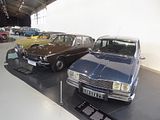
Porsche 911 SC Targa Politie: This Porsche 911 SC Targa is a little more special than most, it’s a retired Dutch Rijkspolitie (State Police) highway patrol vehicle, and it remains in its original service specification. In the 1960s there were no speed limits on Dutch highways, and the police needed something that could keep up with the quickest sports cars while also offering some level of practicality. They ultimately settled on the Porsche 356 Cabriolet, using them from 1962 until 1966 painted in white with the distinctive orange and black Rijkspolitie livery over the top. When Porsche unveiled the notably faster 911 Targa model in 1967 the Dutch police switched their preferred model, and began ordering them – always in white and always with the Targa roof. The 911 SC Targa might seem like an unusual vehicle to choose for police duties. It was ultimately chosen because it was ideal for high-speed pursuits, it had room in the back to store police equipment, and when directing traffic the officer could stand on the seat, giving them a good view over the surrounding traffic. The Dutch Rijkspolitie, or Highway Patrol, were tasked with constantly monitoring the nations highways and byways for the usual problems – drunk drivers, speeders, breakdowns, and accidents. The Porsche 911 SC was released in 1978, its 3.0 litre engine was a notable upgrade over the oftentimes troublesome 2.7 liter-powered 911 that had come before it. The Rijkspolitie ordered a number of 911 SC Targa models in white, with a passenger-side mirror, a rear wiper, and front and rear fog lights. One the cars arrived in the Netherlands they received the other parts necessary to turn them into police cars. The Targa roof was chosen for a very simple reason, it allowed the police officers to stand on their seats (with the roof removed of course) to get an elevated view over the surrounding traffic, and to direct that traffic of needs be. The cars arrived from Porsche with white paint, and a small number of optional extras including a passenger-side mirror, a rear wiper, and front and rear fog lights. interior is largely factory stock, with the exception of the police radio, the switches for the police light and sirens, and the lockers installed on the back seats for storage. The police department then had them modified, a pillar was added to the Targa bar with a flashing blue light, high visibility orange livery was added on the front, sides, and rear, a rear mounted loud speaker was installed as well as sirens and additional lights, and storage lockers were added on top of the rear seats. In total, the Dutch police would buy 507 Porsches, including the 356, 911 Targa, 914, 924, and 964. Today the surviving cars are sought after by collectors, and well-known within the Porsche community.
Matra Murena: The Matra Murena was a 3-seat single row sports car with mid-engined rear wheel drive, produced from 1980 through 1983. Replacing the Bagheera, a similar vehicle resulting from the first fruits of the Matra-Simca cooperation, the Murena employed the base Bagheera structure, but substantial changes were made to address some of the concerns regarding the previous model. The car still had a steel spaceframe with body panels made of fibreglass-polyester, but to counter the rust issues plaguing the Bagheeras, the spaceframe was galvanized, the first production car to use galvanized steel for all chassis parts. This, coupled with the composite panels, made the car essentially immune to rust, except for the rear trailing arms of the suspension. The Murena also inherited the Bagheera’s mid-engined layout together with the sleek hatchback body shape, with the rear hatch allowing access to the engine mounted behind the passenger compartment, and a luggage area. The styling was all-new, though, and the body very aerodynamic for its time. A unique feature carried over from the previous model was the seating arrangement – all three seats were placed in one row, with the middle seat folding down to become an armrest when not in use by a passenger. The engine selection was different, however. The base model had a 1.6 engine, while the more powerful version employed the 2.2 engine that was also the base engine for the top of the range Talbot Tagora saloon. This engine was also available with the so-called “S-kit” that upgraded its output to 142bhp At first, this was a dealer-fitted option, but later it could be ordered straight from the factory. The standard carburation was via a single Solex downdraft carburettor, but S models had twin side draft carburettors. The car had good performance and handling. It was only available in left hand drive specification, although a very small number of right hand drive conversions were made. Production ceased when the Matra factory in Romorantin switched to production of the Renault Espace multi-people carrier.

1981 Porsche 924 Carrera GT: In 1979, Porsche unveiled a concept version of the 924 at the Frankfurt Auto show wearing Carrera badges. One year later, in 1980, Porsche released the 924 Carrera GT, making clear their intention to enter the 924 in competition. By adding an intercooler and increasing compression to 8.5:1, as well as various other little changes, Porsche was able to develop the 924 Turbo into the race car they had wanted, dubbing it the “924 Carrera GT”. 406 examples (including prototypes) of the Carrera GT were built to qualify it for Group 4 racing requirements. Of the 400 roadgoing examples, 75 were made in right hand drive for the UK market. In 1981 Porsche released the limited production 924 Carrera GTS. 59 GTS models were built, all in left hand drive, with 15 of the 59 being raced prepped Clubsport versions. Visually, the Carrera GT differed from the standard 924 Turbo in that it had polyurethane plastic front and rear flared guards, a polyurethane plastic front spoiler, a top mounted air scoop for the intercooler, a much larger rubber rear spoiler and a flush mounted front windscreen. It featured Pirelli P6 tires as standard, and Pirelli P7 tires were available as an option along with a limited slip differential. It lost the 924 Turbo’s NACA duct in the hood but retained the air intakes in the badge panel. This more aggressive styling was later used for as motivation for the 944. The later Carrera GTS differed stylistically from the GT with fixed headlamps under Perspex covers (instead of the GT’s pop up units). GTS models were also 59 kg (130 lb) lighter than their GT counterparts at 1,121 kg (2,471 lb), and Clubsport versions were even lighter at 1,060 kg (2,337 lb). In order to comply with the homologation regulations, the 924 Carrera GT and later 924 Carrera GTS were offered as road cars, producing 210 and 245 hp respectively. Clubsport versions of the GTS were also available with 280 hp and factory included Matter roll cage and race seats. 924 Carrera GT variations were known by model numbers 937 (left hand drive) and 938 (right hand drive).

1976 AMC Pacer: American Motors’ chief stylist Richard A. Teague began work on the Pacer in 1971, anticipating an increase in demand for smaller vehicles through the decade. The new car was designed to offer the interior room and feel of a big car that drivers of traditional domestic automobiles were accustomed to, but in a much smaller, aerodynamic, and purposefully distinctive exterior package The rounded shape and large glass area were unusual compared with the three-box designs of the era. The Pacer’s width was the same as full-sized domestic vehicles at the time, and this unique design feature was promoted by AMC as “the first wide small car.” A number of futuristic ideas were explored by AMC. But the automaker lacked adequate resources to build components from scratch and needed to use outside suppliers or adapt its existing parts and use its production facilities. Unique for a comparatively small car, the Pacer was as wide as a full-size American car of the era. American Motors did not describe it as “cab forward,” but the Pacer’s layout included wheels pushed to the corners (short overhangs), a relatively wide body, and A-pillars moved forward; the windshield was placed over part of the engine compartment. Contrary to myth, The Pacer was not widened six inches to make room for the rear-wheel drive configuration. The width was dictated partly by marketing strategy—US drivers were accustomed to large vehicles and the Pacer’s occupants had the impression of being in a larger car—and partly by the fact that AMC’s assembly lines were already set up for full-size cars. Teague’s low-drag design, which predated the fuel crisis and the flood of small foreign imports into the American market, was highly innovative. Its drag coefficient of 0.43 was relatively low for that time. Teague even eliminated rain gutters, smoothly blending the tops of the doors into the roof—an aerodynamic detail that, although criticised at the time for allowing rain onto the front seat, has become the norm in today’s designs. Also unique was that the passenger door was four inches longer than the driver’s. This made passenger loading easier, particularly from the rear seats; and they would also tend to use the safer curb side in countries that drive on the right. Originally, the car was designed for a Wankel rotary engine. In 1973, AMC signed a licensing agreement with Curtiss-Wright to build Wankels for cars and Jeep-type vehicles. Later, AMC decided instead to purchase the engines from General Motors (GM), who were developing them for use in their own cars. However, GM cancelled development in 1974 for reasons that included durability issues, the fuel crisis, tooling costs (for the engines and also for a new product line designed around the rotary’s ultra-compact dimensions) and the upcoming (late 1970s) US emissions legislation. It was also thought that the high-revving Wankel would not suit Americans accustomed to low revs and high torque. General Motors’s change of plans left the Pacer without an engine. American Motors had little choice but to reconfigure it to accept their existing straight-six engine. This involved a complete redesign of drivetrain and firewall to keep the longer engine within the body dimensions designed for the Wankel, but allowed the Pacer to share many mechanical components with other AMC models. This meant that with standard six-cylinder engines, the car was far thirstier than four cylinder rivals. There were plenty of other innovations, though. The low belt line and window design afforded the driver with outstanding visibility. The Pacer had a laminated windscreen. The articulated front wipers were hidden when in their parked position, and a rear wiper and washer was optional. The Pacer was designed to meet the expected and stringent safety standards that were intended to come in from 1980, until lobbying by the Big Three had these reduced somewhat. Introduced in showrooms on 28 February 1975, the Pacer was designed to attract buyers of traditional large cars to a smaller package during a time when fuel prices were projected to rise dramatically. In its first year of production, the Pacer sold well, with 145,528 units. There was little competition from other American manufacturers, most of whom had been blindsided by the oil crisis. The increased demand for compact, economy vehicles was growing rapidly. However, Pacer sales fell after the first two years, though the car continued to be built through the 1980 model year. Similar to its mid-year introduction, on 3 December 1979, production of the Pacer ended at the Kenosha, Wisconsin assembly plant where it had begun five years earlier. A total of 280,000 cars were built. Increasing competition from the Big Three US automakers and the rapid consumer shift to imported cars during the late 1970s are cited as the reasons for this outcome. Automobile buyers in the U.S. became adjusted to smaller and lighter cars, particularly the imports that offered better fuel economy, the AMC Pacer could not match the German and Japanese cars. Also the large glass areas increased the car’s weight. With 22 mpg, the Pacer was unattractive for customers in the 1979 energy crisis. The Pacer’s unconventional styling was commonly cited in its lack of success. Other concerns included a lack of cargo space when carrying a full load of passengers (because of its short wheelbase). Cargo space could be increased to 29.5 cubic feet by folding down the back of the rear seat to form a flat floor. For increased cargo capacity, a Station Wagon body style was offered from 1977. The Wagon version was only five inches longer and weighed only 76 pounds (34 kg) more than the hatch. It was also a less unusual-looking design with a squared-off back and straight, almost upright, rear side windows. Production ceased at the end of 1979. A small number were brought to the UK, where they were converted – rather crudely – to right hand drive, but the asymmetric door arrangement persisted with what was now the driver’s door the longer of the two. UK press reaction was unfavourable, as encapsulated by the cover headline on Motor magazine: “We test the AMC Pacer and wish we had not”.


VW Scirocco 2: A heavily redesigned variant (internally designated Typ 53B) went on sale in 1981, although it remained on the A1 platform. The second generation Scirocco, still assembled on behalf of Volkswagen by Karmann of Osnabrück (in the same factory as the first generation Scirocco), was first shown at the 1981 Geneva Motor Show in March that year. Designed by Volkswagen’s own internal design team, the new car featured increased front and rear headroom, increased luggage space and a reduction in the coefficient of drag. One feature of the Type 2 was the location of the rear spoiler midway up the glass on the rear hatch. A mid-cycle update occurred in 1984, which included minor changes over the 1982 model: removal of the outlined “SCIROCCO” script from the rear hatch (below the spoiler), a redesigned air conditioning compressor, and a different brake master cylinder with in-line proportioning valves and a brake light switch mounted to the pedal instead of on the master cylinder. Halfway through the 1984 model year, a new space-saver spare wheel was added, that provided room for a larger fuel tank (with a second “transfer” fuel pump). Leather interior, power windows and mirrors, air conditioning, and a manual sunroof were options for all years. The 1984 model year saw the return of two windshield wipers (vs the large single wiper), absent since the 1976 models. Eleven different engines were offered in the Type 2 Scirocco over the production run, although not all engines were available in all markets. These engines included both carburettor and fuel injection engines. Initially all models had eight-valve engines. A 16-valve head was developed by tuner Oettinger in 1981, with the modification adopted by Volkswagen when they showed a multi-valve Scirocco at the 1983 Frankfurt Motor Show. It went on sale in Germany and a few other markets in July 1985, with a catalysed model arriving in 1986. Displacements ranged from 1.3 litres up to 1.8 litres. Power ranged from 60 PS to 112 PS for the 8 valve engines and either 129 PS or 139 PS for the 16 valve engines. Numerous trim levels existed, depending on the model year and market, and included the L, CL, GL, LS, GLS, GLI, GT, GTI, GTL, GTS, GTX, GT II, Scala, GT 16V and GTX 16V. Special limited edition models including the White Cat (Europe), Tropic (Europe), Storm (UK), Slegato (Canada), and Wolfsburg Edition (USA and Canada) were also produced. These special models typically featured unique interior/exterior colour combinations, special alloy wheels and had special combinations of options such as leather, multi-function trip computer and/or power windows as standard. Scirocco sales continued until 1992 in Germany, the UK, and some other European markets. The Scirocco was briefly joined but effectively replaced by the Corrado in the VW line-up.

Lancia Beta MonteCarlo: Considered to be part of the Beta family, though there is an awful lot about the car that is very different from the front wheel drive models was the MonteCarlo, no fewer than eight examples of which were displayed. First conceived in 1969, with a a final design completed by 1971 by Paolo Martin at Pininfarina, what was initially known as the Fiat X1/8 Project, was originally designed as Pininfarina’s contender to replace Fiat’s 124 Coupe, but it lost out to Bertone’s cheaper design, which became the Fiat X1/9. Rather than scrap the proposal completely, it was developed further, when Fiat commissioned Pininfarina to build a 3.0 litre V6 mid-engined sports car. An X1/8 chassis was used as the start point, and developed for the first time in-house by Pininfarina and not based on any existing production car. Due to the 1973 Oil Crisis, the project was renamed X1/20 and updated to house a 2.0 litre engine. The first car to be made out of the X1/20 Project was the Abarth SE 030 in 1974. The project was passed to Lancia, and the road car was launched at the 1975 Geneva Motor Show as the Lancia Beta MonteCcarlo. It was the first car to be made completely in-house by Pininfarina. Lancia launched the MonteCarlo as a premium alternative to the X1/9, with the 2 litre twin cam engine rather than the X1/9’s single cam 1300. Both used a similar, based on the Fiat 128, MacPherson strut front suspension and disc brakes at both front and rear. Lancia Beta parts were limited to those from the existing Fiat/Lancia standard parts bin, the transverse mount version of the Fiat 124’s twin cam engine and the five speed gearbox and transaxle. MonteCarlos were available as fixed head “Coupés” and also as “Spiders” with solid A and B pillars, but a large flat folding canvas roof between them. Sales were slow to get started, and it soon became apparent that there were a number of problems with a reputation for premature locking of the front brakes causing particular alarm. Lancia suspended production in 1979 whilst seeking a solution, which meant that the car was not produced for nearly two years. The second generation model, known simply as MonteCarlo now, was first seen in late 1980. The braking issue was addressed by removing the servo, as well as few other careful mechanical tweaks. The revised cars also had glass panels in the rear buttresses, improving rear visibility somewhat, and there was a revised grille. In the cabin there was a new three spoke Momo steering wheel in place of the old two spoke one, as well as revamped trim and fabrics. The engine was revised, with a higher compression ratio, Marelli electronic ignition and new carburettors which produced more torque. It was not enough for sales to take off, and the model ceased production in 1982, although it took quite a while after that to shift all the stock. Just under 2000 of the Phase 2 cars were made, with 7798 MonteCarlos made in total.
Porsche 928: The first V8 engined Porsche, the 928 was originally conceived to replace the 911, though as we all know, that did not happen, with the two complementing each other in the range during the 18 year life of the 928. By the late 1960s, Porsche had changed significantly as a company, and executives including owner Ferdinand Porsche were toying with the idea of adding a luxury touring car to the line-up. Managing Director Ernst Fuhrmann was also pressuring Ferdinand to approve development of the new model in light of concerns that the current flagship model at the time, the 911, was quickly reaching the limits of its potential. Slumping sales of the 911 seemed to confirm that the model was approaching the end of its economic life cycle. Fuhrmann envisioned the new range-topping model as being the best possible combination of a sports coupe and a luxury sedan, something well equipped and comfortable enough to be easily driven over long distances that also had the power, poise and handling prowess necessary to be driven like a sports car. This set it apart from the 911, which was intended to be an out-and-out sports car. Ordered by Ferdinand Porsche to come up with a production-feasible concept for his new model, Fuhrmann initiated a design study in 1971, eventually taking from the process the final specification for the 928. Several drivetrain layouts were considered during early development, including rear and mid-engined designs, but most were dismissed because of technical and/or legislative difficulties. Having the engine, transmission, catalytic converter(s) and exhaust all cramped into a small rear engine bay made emission and noise control more difficult, something Porsche was already facing problems with on the 911 and wanted to avoid. After deciding that the mid-engine layout didn’t allow enough room in the passenger compartment, a front engine/rear wheel drive layout was chosen. Porsche also may have feared that the U.S. government would soon ban the sale of rear-engined cars in response to the consumer concern over safety problems with the rear-engined Chevrolet Corvair. Porsche engineers wanted a large-displacement engine to power the 928, and prototype units were built with a 5-litre V8 producing close to 300 hp. Ferdinand Piëch wanted this car to use a 4.6-litre V10 based upon Audi’s five-cylinder engine. Several members of the Porsche board objected, chiefly because they wished for Porsche AG to maintain some separation from Volkswagen. The first two running prototypes of Porsche’s M28 V8 used one four-barrel carburettor, but this was just for initial testing. The cars were sold with the planned Bosch K-Jetronic fuel injection system. When increasing concern within the company over the pricing and availability of fuel during the oil crisis of the 1970s became an issue of contention, smaller engines were considered in the interest of fuel economy. A push began for the development of a 3.3 litre 180 hp powerplant they had drawn up designs for, but company engineers balked at this suggestion. Both sides finally settled on a 4.5 litre SOHC per bank 16-valve V8 producing 240 PS which they considered to have an acceptable compromise of performance and fuel economy. The finished car debuted at the 1977 Geneva Motor Show, going on sale later that year. Although it won early acclaim for its comfort and power, sales were slow. Base prices were much higher than that of the 911 model and the 928’s front-engined, water-cooled design put off many Porsche purists, not least because the design marked a major change in direction for Porsche started with the introduction of the Porsche 924 in 1976 which purists found hard to accept. Porsche utilised a transaxle in the 928 to help achieve 50/50 front/rear weight distribution, aiding the car’s balance. Although it weighed more than the difficult-to-handle 911, its more neutral weight balance and higher power output gave it similar performance on the track. The 928 was regarded as the more relaxing car to drive at the time. It came with either a five-speed dog leg manual transmission, or a Mercedes-Benz-derived automatic transmission, originally with three speeds, with four-speed from 1983 in North America and 1984 in other markets. More than 80% had the automatic transmission. Exact percentage of manual gearbox cars for entire production run is not known but it is believed to be between 15 and 20%. The body, styled by Wolfgang Möbius under guidance of Anatole Lapine, was mainly galvanised steel, but the doors, front fenders, and hood were aluminium in order to make the car more lightweight. It had a substantial luggage area accessed via a large hatchback. The new polyurethane elastic bumpers were integrated into the nose and tail and covered in body-coloured plastic; an unusual feature for the time that aided the car visually and reduced its drag. Porsche opted not to offer a convertible variant but several aftermarket modifiers offered convertible conversions, most notably Carelli, based in Orange County, CA. The Carelli conversions were sold as complete cars, with the conversion doubling the price of the car. A reported 12 units were made. The 928 qualified as a 2+2, having two small seats in the rear. Both rear seats could be folded down to enlarge the luggage area, and both the front and rear seats had sun visors for occupants. The rear seats are small (due to the prominent transmission hump) and have very little leg room; they are only suitable for adults on very short trips or children. The 928 was also the first vehicle in which the instrument cluster moved along with the adjustable steering wheel in order to maintain maximum instrument visibility. The 928 included several other innovations such as the “Weissach Axle”, a simple rear-wheel steering system that provides passive rear-wheel steering to increase stability while braking during a turn, and an unsleeved, silicon alloy engine block made of aluminium, which reduced weight and provided a highly durable cylinder bore. Porsche’s design and development efforts paid off during the 1978 European Car of the Year, where the 928 won ahead of the BMW 7 Series, and the Ford Granada. The 928 is the only sports car ever to have won this competition, which is regarded as proof of how advanced the 928 was, compared to its contemporaries. Porsche introduced a refreshed 928 S into the European market in 1980 model year. Externally, the S wore new front and rear spoilers and sported wider wheels and tyres than the older variant, but the main change for the 928 S was under the bonnet where a revised 4.7 litre engine was used. European versions debuted with 300 PS , and were upgraded to 310 PS for 1984, though it is rumoured that they typically made around 330 hp. From 1984 to 1986, the S model was called S2 in UK. These cars used Bosch LH-Jetronic fuel injection and purely electronic Bosch ignition, the same systems used on the later 32-valve cars, though without the pollution controls. North American-spec 1983 and 1984 S models used, among other differences, smaller valves, milder camshafts, smaller diameter intake manifolds, and additional pollution equipment in order to meet emissions regulations, and were limited to 234 hp as a result. Due to low grade fuel 16V low compression S engine was made for Australian market in 1985 model year. It had 9.3:1 compression ratio pistons instead of normal 10.4:1 but used same large intake, high lift cams, large valves etc. of other S engines. In 1982, two special models were available for different markets. 202 “Weissach Edition” cars were sold in North America. Unusual features were champagne gold metallic paint, matching brushed gold flat disc wheels, two-tone leather interior, a plaque containing the production number on the dash and the extremely collectible three-piece Porsche luggage set. It’s believed these cars were not made with S spoilers even though these were available in U.S. during this time period as part of the “Competition Group” option. The “Weissach Edition” option was also available for the US market 911 in 1980 model year and 924 in 1981 model year. 141 special “50th Jubilee” 928 S models were available outside the U.S. and Canada to celebrate the company’s 50-year existence as a car manufacturer. This model is also sometimes referred to as the “Ferry Porsche Edition” because his signature was embroidered into the front seats. It was painted meteor metallic and fitted with flat disc wheels, wine red leather and special striped fabric seat centres. Similar 911 and 924 specials were also made for world markets. Porsche updated the North American 928 S for 1985, replacing the 4.7 litre SOHC engine with a new 5.0 litre DOHC unit sporting four valves per cylinder and producing 288 hp. Seats were also updated to a new style, these cars are sometimes unofficially called S3 to distinguish them from 16-valve “S” models. European models kept a 4.7 litre engine, which was somewhat more powerful as standard, though lower 9.3:1 compression 32-valve engine together with catalytic converters became an option in some European countries and Australia for 1986. In 1986, revised suspension settings, larger brakes with 4-piston calipers and modified exhaust was installed on the 928S, marking the final changes to old body style cars. These were straight from the 928S4, which was slated to debut a few months later. These changes came starting from VIN 1001, which means that the first thousand ’86’s had the old brakes, but later cars had the later systems. This later 1986 model is sometimes referred to as a 19861⁄2 or 1986.5 because of these changes. The name is a little misleading as more than 3/4 of the 1986 production had these updates. The 928 S4 variant debuted in the second half of 1986 with an updated version of the 5.0 litre V8 producing 320 PS, sporting a new single-disc clutch in manual gearbox cars, larger torque converter in automatics and fairly significant styling updates which gave the car a cleaner, sleeker look. S4 was much closer to being a truly world car than previous models as only major differences for North American models were instrumentation in either kilometers or miles, lighting, front and rear bumper shocks and the availability of catalytic converters in many other markets. The Australian market version was only one with different horsepower rating at 300 PS due to preparation for possible low grade fuel. Even this was achieved without engine changes. A Club Sport variant which was up to 100 kg (220 lb) lighter became available to continental Europe and U.S. in 1988. This model was watered down version of the 1987 factory prototype which had a lightened body. Also in 1987 the factory made four white lightened manual gearbox S4 models for racecar drivers who were on their payroll at the time. These were close to same as later actual Club Sport models and can also be considered prototypes for it. An SE (sometimes called the S4 Sport due to model designation on rear bumper), a sort of halfway point between a normally equipped S4 and the more race-oriented Club Sport, became available to the UK. It’s generally believed these Porsche Motorsport-engined cars have more hp than the S4. They utilise parts which later became known as GT pistons, cams and engine ECU programs. Some of them had stronger, short geared manual gearbox. The automatic gearbox was not available. For the 1989 model year, a visible change inside was digital trip computer in dashboard. At the same time Australian models received the same 320 PS engine management setup as other markets. Porsche debuted the 928 GT in the late winter 1988/89 after dropping the slowly selling CS and SE. In terms of equipment, the GT was like the 928 SE, having more equipment than a Club Sport model but less than a 928 S4 to keep the weight down somewhat. It had the ZF 40% limited-slip differential as standard like the Club Sport and SE before it. Also like the CS and SE, the GT was only available with a manual gearbox. European 1989 CS and GT wheels had an RDK tyre pressure monitoring system as standard, which was also optional for the same year S4. For 1990 model year Porsche made RDK and a 0-100% variable ratio limited-slip called PSD (Porsche SperrDifferential) standard in both GT and S4 models for all markets. This system is much like the one from the 959 and gives the vehicle even more grip. In 1990 the S4 was no longer available with a manual gearbox. The S4 and GT variants were both cut at the end of 1991 model year, making way for the final version of the 928. The 928 GTS came for sale in late 1991. Changed bodywork, larger front brakes and a new, more powerful 5.4 litre 350 PS engine were the big advertised changes; what Porsche wasn’t advertising was the price. Loaded GTS models could eclipse US$100,000 in 1995, making them among the most expensive cars on the road at the time. This severely hampered sales despite the model’s high competency and long standard equipment list. Porsche discontinued the GTS model that year after shipping only 77 of them to the United States. Total worldwide production of 928s over an 18 year period was a little over 61,000 cars. Second-hand models’ value decreased as a result of generally high maintenance costs due largely to spare parts that are expensive to manufacture, with the result that there are fewer survivors than you might expect, though with values hardening, people are now spending the money required to restore these cars.
Renault R5 Turbo: Launched at the Brussels Motor Show in January 1980, the R5 Turbo was primarily designed for rallying, as a response to Lancia’s rallying success with the mid-engined Stratos, Renault’s Jean Terramorsi, vice-president of production, asked Bertone’s Marc Deschamps to design a new sports version of the Renault 5 Alpine supermini. The distinctive new rear bodywork was styled by Marcello Gandini at Bertone. Although the standard Renault 5 has a front-mounted engine, the 5 Turbo featured a mid-mounted 1397 cc Cléon-Fonte turbocharged engine placed behind the driver in mid-body in a modified Renault 5 chassis. In standard form, the engine developed 160 PS. At the time of its launch it was the most powerful production French car. The first 400 production 5 Turbos were made to comply with Group 4 homologation to allow the car to compete in international rallies, and were manufactured at the Alpine factory in Dieppe. Once the homologation models were produced, a second version named Turbo 2 was introduced using more stock Renault 5 parts replacing many of light alloy components in the original 5 Turbo version. The Turbo 2 was less expensive, but had nearly the same levels of performance, top speed of 200 km/h (120 mph) and 0–100 km/h in 6.9 seconds. A total of 3576 R5 Turbos were manufactured during a four-year production run.

Mazda MX-5: The Mazda MX-5 was unveiled at the Chicago Auto Show on February 10, 1989, with a price tag of US$14,000. The MX-5, with production code NA, was made available for delivery to buyers worldwide in the following dates: May 1989 (as a 1990 model) in the US and Canada; September 1, 1989 in Japan; and 1990 in Europe. An optional hardtop was made available at the same time, in sheet moulding compound (SMC). Demand initially outstripped production, fueled by enthusiastic press reviews. In Japan, the car was not badged as a Mazda, as the company was in the process of launching different marques for deluxe models, similar to Nissan’s Infiniti, Honda’s Acura and Toyota’s Lexus. Instead, the Mazda MX-5 was sold as the Eunos Roadster, and was joined by the MX-3/AZ-3/Eunos Presso (based on Japanese Mazda dealerships). The exterior dimensions and the engine displacement were also in compliance with Japanese Government compact car regulation. The body shell of the NA was all-steel with a lightweight aluminium bonnet. Overall dimensions were 3,970 mm (156 in) in length, 1,675 mm (65.9 in) in width, and 1,235 mm (48.6 in) in height. Without options, the NA weighed only 980 kg (2,160 lb). It had a drag coefficient of Cd=0.38. Suspension was an independent double wishbone on all four wheels, with an anti-roll bar at the front and rear. Four-wheel disc brakes, ventilated at the front, were behind alloy wheels with 185/60HR14 radial tyres. The base model came with stamped steel wheels from the then-current 323/Protege.The original MX-5, with standard manual transmission, came with a 1.6 L DOHC inline four-cylinder engine, producing 115 bhp at 6,500 rpm, and 136 N⋅m (100 lbf⋅ft) of torque at 5,500 rpm. The engine employs an electronic fuel injection system using a vane-type air flow meter and an electronic ignition system with a camshaft angle sensor instead of a distributor. This engine, codenamed B6ZE(RS), was specifically designed for the MX-5 and featured a lightened crankshaft, flywheel, and aluminium sump with cooling fins. An MX-5 with the optional automatic transmission had its 1.6L engine tuned to develop peak torque at lower rpm’s (136 Nm, 100 lb/ft at 4000 rpm) to better mate with the automatic transmission gearing and torque requirements. This tuning resulted in a lower peak power of 105 bhp at 6500 rpm. The standard transmission was a five-speed manual, derived from the one used in the Mazda 929/Luce (also rear-wheel drive) The gear shift was the subject of close attention during development, with engineers told to make it shift in as small a gear pattern as possible and with minimal effort. In Japan and the US, an optional automatic transmission was also offered. The Japanese and American markets also received an optional viscous limited-slip differential, although it was only available for cars with a manual transmission. To achieve the low introductory price, the base model was stripped. It had steel wheels, manual steering, roll-up windows, and no stereo or air-conditioning. Power steering, air-conditioning, and stereo were added as standard equipment in later years. The NA could reach 60 mph in 8.3 seconds and had a top speed of 203 km/h (126 mph) although Japanese market Eunos models were limited to 180 km/h (110 mph). This first generation of Miata (often referred to as the NA) included a special Limited Edition of 2000 examples in 1991, produced in British racing green with the first use of tan interior, to celebrate the highly successful launch of the MX-5 in the UK.[citation needed] These have a numbered brass plaque on the Windshield Frame and on the front of the Owners Book, and are fitted with alloy wheels from MSW (Mazda Sports Workshop) which are often mistaken for BBS, but which are entirely unique to this model. The NA with an automatic transmission reached 60 mph in 9.9 seconds and had a top speed of 181 km/h (112 mph). In 1993, 1,500 LE (Limited Edition) cars were produced. This model featured red leather interior, upgraded stereo, Nardi shift knob, leather-wrapped steering wheel, cruise control, limited-slip differential, power windows, power mirrors, power steering, air conditioning, BBS wheels, Bilstein shocks, front and rear spoilers, ABS brakes, stainless sill plates, and Harley style peanut tank door speaker trim. All 1993 LE cars came in black. For the 1994 model year, the first-generation MX-5 was freshened with the introduction of the more powerful 1,839 cc BP-ZE engine, dual airbags placed in a redesigned dashboard, the addition of a Mazda badge on the front fascia in the US and a limited-slip differential in some markets. The chassis was substantially braced to meet new side-impact standards, most visibly by adding a “track bar” between the seatbelt towers inside the car, but also to the front and rear subframes. Also, 1994 and 1995 were the only years in which Mazda offered a light metallic blue paint (Laguna Blue Mica), making these cars rare collector’s cars to some. 1994 also saw the introduction of the “R” package, a sport-themed package with Bilstein shocks, stiffer sway bars, retuned springs, subtle front and rear underbody spoilers, and a Torsen LSD. Air conditioning was optional, but the “R” package was not available with power steering, leather, or an automatic transmission. It can also be identified by a red Miata badge on the rear instead of the usual black. No body style changes were made, however. Halfway through the 1997 model year the hazard light button was changed to a black button with red symbol as opposed to the earlier red button with white symbol. The new 1,839 cc engine produced 129 bhp at 6,500 rpm and 149 Nm (110 lb/ft) of torque at 5,500 rpm, which was then increased to 133 bhp at 6,500 rpm and 155 Nm (114 lb/ft) of torque at 5,500 rpm for the 1996 model year. The base weight increased to 990 kg (2,180 lb). Performance was thus improved slightly, because the additional weight was more than offset by the extra power. In some markets such as Europe, the 1.6 L engine continued to be available as a lower-cost option, but was detuned to 89 bhp. This lower-powered model did not receive all the additional chassis bracing of the new 1.8 L. Japanese and U.S. models offered an optional Torsen LSD, which was far more durable than the previous viscous differential. There were a number of trim levels and special editions available, determined by local Mazda marketing departments. In the US, the base model was offered for US$13,995 at launch and was very basic, with manual windows, steel wheels, and without air conditioning or power steering. The “A Package” offered power steering, a leather-wrapped steering wheel, aluminium alloy wheels and cassette stereo. The “B Package” added power windows, along with cruise control and headrest speakers, while the “C Package” included a tan interior and top with leather seats. The “R Package” was for racing, and the annual special editions were formalized as “M Editions”. These included all of the luxury options from the “C Package” as well as special paint and, sometimes, special wheels. The first generation MX-5 was phased out after the 1997 model year (with the exception of 400 limited edition Berkeley models sold only in the UK in 1998 to mark the end of the NA), with the final 1,500 NAs produced for the US market being the “STO” (“Special Touring Option”) versions. In the UK, to celebrate Mazda’s 24 hours of Le Mans win, Mazda brought out a special edition of the MX-5, with the winner’s colour scheme (see Mazda 787B) and came equipped with BBR (Brodie Brittain Racing) turbo conversion; the car is one of the most sought after special edition cars of the MX-5s.
Alfa Romeo 916 Spider: The 916 Series GTV and Spider were conceived to replace two very different models in the Alfa range. First of these was the open topped 105 Series Spider which had been in production since 1966 and by the 1990s was long overdue a replacement. Alfa decided to combine a follow on to the Alfetta GTV, long out of production, with a new Spider model, and first work started in the late 1980s. The task was handed to Pininfarina, and Enrico Fumia’s initial renderings were produced in September 1987, with the first clay models to complete 1:1 scale model made in July 1988. Fumia produced something rather special. Clearly an Italian design, with the Alfa Romeo grille with dual round headlights, recalling the Audi-based Pininfarina Quartz, another design produced by Enrico Fumia back in 1981, the proposal was for a car that was low-slung, wedge-shaped with a low nose and high kicked up tail. The back of the car is “cut-off” with a “Kamm tail” giving improved aerodynamics. The Spider would share these traits with the GTV except that the rear is rounded, and would feature a folding soft-top with five hoop frame, which would completely disappear from sight under a flush fitting cover. An electric folding mechanism would be fitted as an option. Details included a one-piece rear lamp/foglamp/indicator strip across the rear of the body, the minor instruments in the centre console angled towards the driver. The exterior design was finished in July 1988. After Vittorio Ghidella, Fiat’s CEO, accepted the design, Alfa Romeo Centro Stile under Walter de Silva was made responsible for the completion of the detail work and also for the design of the interiors, as Pininfarina’s proposal was not accepted. The Spider and GTV were to be based on the then-current Fiat Group platform, called Tipo Due, in this case a heavily modified version with an all new multilink rear suspension. The front suspension and drivetrain was based on the 1992 Alfa Romeo 155 saloon. Chief engineer at that time was Bruno Cena. Drag coefficient was 0.33 for the GTV and 0.38 for the Spider. Production began in late 1993 with four cars, all 3.0 V6 Spiders, assembled at the Alfa Romeo Arese Plant in Milan. In early 1994 the first GTV was produced, with 2.0 Twin Spark engine. The first premiere was then held at the Paris Motor Show in 1994. The GTV and Spider were officially launched at the Geneva Motor Show in March 1995 and sales began the same year. The cars were well received. At launch, many journalists commented that Alfa had improved overall build quality considerably and that it came very close to equalling its German rivals. I can vouch for that, as I owned an early GTV for eighteen months, and it was a well built and reliable car. In 1997 a new engine, a 24-valve 3.0 litre V6, was available for the GTV along with bigger, 12.0 inch brakes and red four-pot calipers from Brembo. The console knobs were changed from round central to rectangle ones and to a three-spoke steering wheel. Some versions were upgraded with different front bumper mesh to bring the wind noise down to 74 dBA. In May 1998 the cars were revamped for the first time, creating the Phase 2 models. Most of the alterations were inside. The interior was changed with new centre console, painted letters on skirt seals, changed controls and switches arrangement and different instrument cluster. Outside, the main changes included chrome frame around the grille and colour-coded side skirts and bumpers. A new engine was introduced, the 142 hp 1.8 Twin Spark, and others were changed: the 2.0 Twin Spark was updated with a modular intake manifold with different length intakes and a different plastic cover. Power output of the 2.0 TS was raised to 153 hp. Engines changed engine management units and have a nomenclature of CF2. The dashboard was available in two new colours in addition to the standard black: Red Style and Blue Style, and with it new colour-coded upholstery and carpets. The 3.0 24V got a six-speed manual gearbox as standard and the 2.0 V6 TB engine was now also available for the Spider. August 2000 saw the revamp of engines to comply with new emission regulations, Euro3. The new engines were slightly detuned, and have a new identification code: CF3. 3.0 V6 12V was discontinued for the Spider and replaced with 24V Euro3 version from the GTV. 2.0 V6 Turbo and 1.8 T.Spark were discontinued as they did not comply with Euro3 emissions. By the 2001-2002 model year, only 2 engines were left, the 2.0 Twin.Spark and 3.0 V6 24V, until the Phase 3 engine range arrived. The Arese plant, where the cars had been built, was closing and, in October 2000, the production of GTV/Spider was transferred to Pininfarina Plant in San Giorgio Canavese in Turin. In 2003 there was another and final revamp, creating the Phase 3, also designed in Pininfarina but not by Enrico Fumia. The main changes were focused on the front with new 147-style grille and different front bumpers with offset numberplate holder. Change to the interior was minimal with different centre console and upholstery pattern and colours available. Instrument illumination colour was changed from green to red. Main specification change is an ASR traction control, not available for 2.0 TS Base model. New engines were introduced: 163 hp 2.0 JTS with direct petrol injection and 237 hp 3.2 V6 24V allowing a 158 mph top speed. Production ceased in late 2004, though some cars were still available for purchase till 2006. A total of 80,747 cars were made, and sales of the GTV and Spider were roughly equal. More V6 engined GTVs than Spiders were made, but in 2.0 guise, it was the other way round with the open model proving marginally more popular.

There are also a number motor bikes here including these Moto Guzzi

SPORT and COMPETITION
A large part of the upstairs display area was given over to a very diverse collection of cars which could be all categorised under the labels of Sport and Competition.
Lancia Fulvia Coupe HF: It was with the Fulvia that Lancia went officially back into racing after its withdrawal from Formula 1 in 1955; this time the effort was focused on rallying. In 1965 the company absorbed the HF Squadra Corse, a privateer racing team founded by Lancia enthusiasts which previously received some factory support, which became the works team under the direction of Cesare Fiorio. The same year the Fulvia Coupé made its racing debut at the Tour de Corse, placing 8th overall. Starting with the lightened and more powerful 1965 Rallye HF, special HF version were put on sale to the general public to homologate improvements for the rally cars. In 1967 the larger displacement Rallye 1.3 HF followed. As the V4 engine had reached the limit of its development, an all-new 1.6-litre V4 engine was developed and installed on the 1967 Rallye 1.6 HF. The car raced as a prototype until August 1969, when it received FIA homologation. With the exception of 1970, Fulvias won the Italian Rally Championship every year from 1965 to 1973. The Fulvia’s rallying career reached its zenith in 1972, when Lancia won the International Championship for Manufacturers two rounds in advance. First placements at rallies valid for the Championship were three: included Sandro Munari and Mario Mannucci at the famous Monte Carlo Rally, with a 10′ 50″ margin over the runner up, Larrousse/Perramond on a much more powerful Porsche 911 S, Lampinen/Andreasson at the Rallye du Maroc, and Ballestrieri/Bernacchini at the Rallye Sanremo. In 1973 Lancia did not score any podium finishes valid for that year’s first-ever World Rally Championship season; though at the hands of Munari the Fulvia won its second European Rally Championship, after the 1969 victory by Harry Källström. During the 1974 season the Lancia Stratos HF replaced in rallying the—by then ageing—Fulvia. That year Lancia won its second World Championship, also thanks to points scored by the Fulvia in the first rallies—such as the third place Munari caught in the grueling East African Safari Rally.
Peugeot 806 Procar: Citroën, Peugeot, Fiat, and Lancia had come together in the early 1990s on a joint project to develop and manufacture a new minivan, each manufacturer would then produce their own version of it. It was quickly dubbed the “Eurovan” by the motoring media and this is typically how it’s referred to today. The Eurovan would become a notable success, it remained in production for 20 years in various forms between 1994 and 2014 and they remain a common sight on European roads today. Perhaps one issue with four manufacturers sharing what was essentially the same minivan or MPV platform was that it was difficult for them to each t differentiate their van from their competitors. A number of marketing strategies were tried but none were more creative than Peugeot, who opted to take theirs racing at the highest level of global endurance motorsport competition. This is the Peugeot 806 Procar from 1995, it was created as the result of a wild (and wonderful) scheme organized by the French automaker to raise the profile of their new minivan by racing it at the Spa-Francorchamps 24 Hours against the best in the world. The van shocked much of the endurance racing world by being genuinely competitive. It was 3rd in its class in practice, it qualified 12th out of 46 entrants, and it immediately became a crowd favourite – with the grandstands roaring their approval as it passed by. The Peugeot 806 Procar was developed to help promote the then-new Peugeot 806 minivan, a member of the Eurovan family that was jointly produced by the Citroën, Peugeot, Fiat, and Lancia marques in Europe. Peugeot, a company with a history of success in events like rally, touring car racing, and the Paris Dakar Rally, sent the minivan to the Kronos Racing team for preparation to enter top flight FIA endurance racing competition. Kronos Racing heavily modified the van with underpinnings from a Peugeot 405 Mi16 racing car and the engine was sourced from a Group A prepared Peugeot 306. The unibody was welded and reinforced, an AMP rollbar was fitted, and the van was ready for action. Despite the long odds against it the newly developed Peugeot 806 Procar actually began to show a lot of promise on track. It rose up through the field during practice sessions for the 1995 Spa-Francorchamps 24 Hours eventually setting the third fastest time in its class – no small thanks to drivers Philip Verellen, Pascal Witmeur, and Eric Bachelart who would often have the van up on two wheels through the corners. During qualifying the van ended up 12th on the grid from a field of 46 cars, an astonishing feat by any standard. During the race there were some issues with the brakes, then the differential, followed by a race-ending engine failure. These were all a result of insufficient development time, and had Peugeot opted to stick with the racing program for the 806 Procar there’s no doubt it could have been improved further. The car would be retired from competition after Spa and it remained in the private collection of the Kronos Racing team until the death of its founder Jean-Pierre Montron, possibly an indication of the sentimental value it held.
Bizzarrini P538: Bizzarrini’s advanced ideas emerged again with the superb Bizzarrini P538S, P for posteriore, 53 for the 5300 cc Corvette engine, 8 for V8 engine and S for Sportcar. The first V-12 car was ordered by American racer Mike Gammino. This ultra low barchetta raced in the 1966 Le Mans (DNF) and was even entered in 1967, but did not start (DNQ). In 1966, after a spin at the start line, it lasted less than a half an hour and retired due to a cracked oil line. During the short race time, the P538 was clocked as one of the fastest cars on the Mulsanne Straight. In 1968, Giugiaro rebuilt one of the P538 bodies as the famous Bizzarrini Manta. After some years in Sweden, it was dismantled for an extensive restoration. Later featured in various classics car events, it is now in the United States.

1971 Ford Capri RS2600 Group 2: Built in January 1971 by Ford Köln Motorsport according to the FIA Group 2 specification for long distance racing. The first race was the 24 Hours of Spa were it was managed by the Ford works team, Ford Köln Motorsport. The fast Ford Capri RS 2600 was driven by Dieter Glemser / Alex Soler-Roig. The team managed to stay in front of the fearsome Mercedes 300 SEL 6.8 by AMG. After its win in the Spa 24 Hours, this Ford Capri participated in another 3 races in 1971, winning them all. In 1972 this Ford Capri RS 2600 was entered in 6 races before it was put aside for the next 20 years. Gipimotor bought this car in 2016 and restored the car to race ready condition.

BMW 3.0 CSL


1963 Porsche 911 2.0 Cup: This 911 identifiable with the VIN number 303330 and dating from 1965 has a rich history. It was sent to the Porsche test department in Weissach in December of the same year to satisfy the requirements of the “Research Development”. The car has been totally restored and prepared by Marc de Siebenthal, a well-known figure in the world of historic Porsches. It was configured according to the FIA regulations for 1965 models, and is conformity with the Peter Auto 2.0L Cup regulations.
1976 TOJ SC204: this is a sports prototype race car, designed, developed and built by German racing team and constructor, Team Obermoser Jörg; constructed to the FIA’s Group 6 category and specification of motor racing, specifically the European 2-Litre Sportscar Championship, in 1976. Its career spanned 3 years, and it only managed to score 2 podium finishes, with its best result being a 3rd-place finish. Like its predecessor, it was powered by a naturally-aspirated 2.0 L BMW M12/7 four-cylinder engine; producing 300 bhp.
1995 Peugeot 405 Mi16: In 1995 Peugeot Talbot entered 2 cars in the Belgium Procar Championship, this one for Philippe Verellen and a second car for Eric Bachelart. Eric Bachelart ended 4th and Philippe Verellen 8th in the 1995 Championship. In 1996 Eric Bachlart used the same vehicle and ended 4th overall.

2010 Chevrolet Cruze Touring Car: The World Touring Car Championship represented the pinnacle of competition for touring cars derived from the series from 2005 to 2017. Chevrolet was officially present for no less than eight consecutive seasons. In 2010, Frenchman Yvan Muller was crowned World Touring Car Champion with this very car, then bearing n° 6. It also marks the end of an era since it is the last car to meet Super 2000 regulations.
Ford Mustang
2015 Ford Focus ‘Mark Cars Australia’: Founded in November 1964 by Count Rodolphe van der Straten Ponthoz, Serge Trosch and Lionel Wallman, the VDS Racing Team became quickly one of the most prestigious private racing teams in Belgium. For decades, the team was active in different championships on many continents. The grandson of Rudolph, Rafaël, took successfully part in several races with this extraordinary Focus

1962 Mini Cooper Works: this Mini is a factory prototype entered by Alexander and the factory, and has competed in the British Circuit Championship. Driven by Liz Jones, the chassis n° is an SPL series (Special Product Longbridge). This allowed the factory to test all mechanical evolutions. The registration number 572BCR has not changed since the original car was driven by Jones, Makinen, Mayman and many others. The rims are very rare Cooper magnesium and not the common Minilites.


1929 Omega-Six Series A: Automobiles Oméga-Six was a French automobile manufactured in the Paris region by Gabriel Daubeck between 1922 and 1930. Initially the cars used six-cylinder engines, hence the word “Six” in the company name. Jules Daubeck founded the business in Pantin in north-eastern Paris in 1922. Later, in 1925, the business relocated to the west side of the city, to premises at Boulogne-Billancourt in the Rue de Silly. Production ended in 1930. The cars were designed by Maurice Gadoux, who previously had worked for Hispano-Suiza, and focused on the same “compact luxury” market segment. Approximately 50 cars were produced annually. The first model used a 1996cc overhead camshaft engine that placed it in the 12 HP car tax band and produced a claimed 50 hp of power. Claimed top speed for an open topped sports-bodied car was 120 km/h (75 mph). There was a choice of 3,050 mm (120 in) or 3,300 mm (130 in) wheelbases. Available body styles included a “Touring car”, a “Limousine” (sedan/saloon) and “Coupé de Ville” (town car). For 1924 Solex carburettors were fitted, power increased to 55 hp, and four speed transmission replaced the three speeds with which it had been launched. At the 19th Paris Motor Show in October 1924 the 1996cc overhead camshaft engine had twin carburetors and the wheelbase was increased to 3,250 mm (128 in). It was priced, in bare chassis form, at 60,000 francs. A larger 2660cc engine was available in 1926, and was exhibited alongside the 1996cc model in October 1926 at the 20th Paris Motor Show. In October 1926 the list prices for the base chassis were 65,000 francs (1996cc) and 70,000 francs (2660cc). At the 22nd Paris Motor Show in October 1928 the six cylinder cars were still on display, using the 3,250 mm (128 in) chassis and now priced, in bare chassis form, at 80,000 francs (1996cc) and 85,000 francs (2660cc). There was also a 3-litre 6-cylinder “competition” engine that used twin “Cozette” carburetors and for which 150 hp was claimed. In 1929 the 6-cylinder range was supplemented by two new 8-cylinder engined cars with displacement respectively of 3-litres and 4-litres (17CV and 24CV). The 8-cylinder cars had a 3,600 mm (142 in) wheelbase and were priced at 115,000 francs and 120,000 francs. In 1924 two cars entered the Le Mans 24 Hour race, but both retired and were classified 33rd and 35th. At the 1925 Le Mans 24 hours the three Oméga-Sixes did not start because of problems during practices. They were car no. 25 of Jacques Margueritte and Louis Bonne, car no. 26 of Roland Coty and Albert Clement, and car no. 27 of “Sabipa” and Jacques Achilles Boyriven. At the Circuit des Routes Pavées event in September 1926 J Achilles Boyriven finished 4th, in 1929 he finished 3rd, and in 1930 he finished 7th after completing 507km in the 5 litre class. In 1928 Louis Bonne finished first in the S3.0 class. At the Spa 24 Hours race J Achilles Boyriven finished second in 1928 and third in 1929. In 1929, Boyriven ‘did not arrive’ for the II Grand Prix d’Algèrie in April, but Bayssières finished second at the V Grand Prix de Picardie in June and then did not arrive for the I Grand Prix de Dieppe. In 1929, Oméga-Six recorded its only victory of note when Hellé Nice won the all-female Grand Prix Féminin, a short (50km) handicap race contested by just five cars at the end of the 3rd annual Journée Féminine de l’automobile held on 2 June at Autodrome de Linas-Montlhéry.
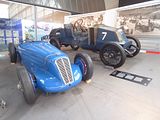
1925 FN 1300S Sport
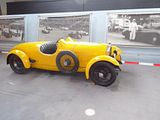
2008 Renault R28 F1

Bugatti Type 35: Well known as a model, indeed many would tell you that this is THE classic Bugatti, is the Type 35 and there were three of these models entered: a pair of Type 35B and a single Type 35C. The Type 35 was phenomenally successful, winning over 1,000 races in its time. It took the Grand Prix World Championship in 1926 after winning 351 races and setting 47 records in the two prior years. At its height, Type 35s averaged 14 race wins per week. Bugatti won the Targa Florio for five consecutive years, from 1925 through 1929, with the Type 35. The original model, introduced at the Grand Prix of Lyon on August 3, 1924, used an evolution of the 3-valve 1991 cc overhead cam straight-8 engine first seen on the Type 29. Bore was 60 mm and stroke was 88 mm as on many previous Bugatti models. 96 examples were produced. This new powerplant featured five main bearings with an unusual ball bearing system. This allowed the engine to rev to 6000 rpm, and 90 hp was reliably produced. Solid axles with leaf springs were used front and rear, and drum brakes at back, operated by cables, were specified. Alloy wheels were a novelty, as was the hollow front axle for reduced unsprung weight. A second feature of the Type 35 that was to become a Bugatti trademark was passing the springs through the front axle rather than simply U-bolting them together as was done on their earlier cars. A less expensive version of the Type 35 appeared in May, 1925. The factory’s Type 35A name was ignored by the public, who nicknamed it “Tecla” after a famous maker of imitation jewellery. The Tecla’s engine used three plain bearings, smaller valves, and coil ignition like the Type 30. While this decreased maintenance requirements, it also reduced output. 139 of the Type 35As were sold. The Type 35C featured a Roots supercharger, despite Ettore Bugatti’s disdain for forced induction. Output was nearly 128 hp with a single Zenith carburettor. Type 35Cs won the French Grand Prix at Saint-Gaudens in 1928, and at Pau in 1930. Fifty examples left the factory. The final version of the Type 35 series was the Type 35B of 1927. Originally named Type 35TC, it shared the 2.3 litre engine of the Type 35T but added a large supercharger like the Type 35C. Output was 138 hp, and 45 examples were made. A British Racing Green Type 35B driven by William Grover-Williams won the 1929 French Grand Prix at Le Mans.

1927 Darmont DS Special: The Darmont was a Morgan built under licence in France. This one was built around an original 1927 Darmont De Course chassis number 52506. It features a dog eared type JAP v twin engine with bronze heads, alloy barrels & crankcases with a racing press fit crankshaft. Twin dirt track carbs & racing magnetos are fitted, it is dry sumped and produces around 95 BHP running on methanol. The chassis has been widened and lowered to improve the handling & BSA A10 type cable brakes are fitted to the front wheels. The Darmont has two speeds and is currently geared for around 80mph in bottom and 100mph plus in top. Access to the rear wheel and sprockets is via the hinged tail. The bevel box has been strengthened with steel side plates and thru bolts and it is fitted with a straight cut crown wheel & pinion set. Numerous other upgrades and modifications have been carried out to the engine, chassis and body.

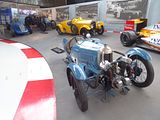
Renault-Alpine A211: The V8-powered A210 (named as A211) was unveiled at the 1967 Paris Motor Show and presented to Charles de Gaulle by Jean Rédélé and Renault’s President, Pierre Dreyfus. The Gordini engine was compact as requested by Alpine, but proved to be unreliable. Alpine engineers also discovered it was impossible to adequately adapt the engine to the car. They adopted a transitional solution, modifying the A210’s rear-end for the engine and adding new wheels, a new 5-speed ZF gearbox and larger rear brakes’ cooling inlets. Its debut was at a non-championship race, the Paris 1000 km in the Montlhéry track, where the car problems became evident.

CARTOON ZONE – MICHEL VAILLANT
The Cartoon Zone creates a world where reality meets comic books, with Michel Vaillant (by French cartoonists Jean & Philippe Graton) as its protagonist. The zone was designed as a paddock where visitors from all generations can take a seat and be photographed in a F1 Vaillant racing car. Countless photographs and graphical reproductions from Jean & Philippe Graton’s comic books show you the history of the Vaillant oeuvre and the racing competition.

1999 Vaillante Grand Defi: Vaillante was in the beginning a French transporting company. They also created their own trucks and cars, and decided to enter the Formula One, with Michel Vaillant, the son of Henri, as their driver. The chief designer of Vaillante is Jean-Pierre, the elder brother of Michel Vaillant. The Vaillante logo is very similar to that of actual French auto maker Matra. There was a complex collection of subsidiary companies and also a surprisingly long list of cars that were produced, though none of them were made in any significant quantity.
INNOVATORS
1988 ItalDesign Giugiaro Aztec: The Aztec is a sports car introduced by Italdesign at the 1988 Turin Motor Show, to celebrate the twentieth anniversary of the establishment of the firm. The two-seater is unique because the driver and passenger are separated, requiring the two parties to communicate electronically. It incorporates a speedster body style with partial visor sections which are removable and open in a gull-wing arrangement. It was fitted with a turbocharged Audi engine mated to a four-wheel-drive system derived from the Lancia Delta HF Integrale. The Aztec’s Audi-sourced five-cylinder DOHC engine produces 200 PS although the car carried a prominent “250 HP” badge on the flank. Many cars were indeed fitted with boosted engines producing closer to that number. The car incorporated futuristic styling cues with many features ahead of its time. The car had control panels on both sides of the car at the aluminium body panels at the rear and upon entering certain codes into the panel, information and about the car’s performance status along with certain functions of the car (i.e., an extra set of lights, hydraulic jack, removable screw driver, a fire extinguisher, a compressor for inflating tyres and a flashlight) could be accessed via a voice message. Inside of the car, the car was wrapped in a leather interior and there was a separate instrument cluster for the passenger shaped like a steering wheel displaying vital information about the car and containing damper controls and communication controls along with engine timing controls. The car also incorporated a satellite navigation system located in the centre of the dashboard (positioned more towards the driver). The design of the car is inspired by the space technology rather than the organic technologies used in that era while the LeMans inspired wing mirrors gave a nod to the aspects of motorsport. The car incorporated an adequate luggage compartment in order to carry the normal luggage of the occupants while being true to its futuristic theme. A carbon fibre rear wing optimised for downforce and roll-bars for safety of the occupants were also installed. According to most sources only 18 cars were ever built out of a planned production run of 50 (although some sources simply state the production number as “less than 25”).


1974 VW Golf: Usually when you come across a Mark 1 Golf, it is a GTi version, so it was nice to see this regular model here. VW had started at looking at producing a replacement for the Beetle as early as 1953 and many one-off prototypes were produced but each venture led nowhere. By the late 60s, though it was clear that a replacement was urgently needed. In 1969 Lotz and Italian Volkswagen importer Gerhard R. Gumpert visited the Turin Auto Show. After selecting their six favourite cars of the show, they discovered that four of the six were designed by Giorgetto Giugiaro and his Italdesign studio. Giugiaro was invited to Wolfsburg in January 1970 to work on development project EA337. The design brief provided by Volkswagen specified a C-segment car with a two-box body in three- and five-door versions. The client also provided Giugiaro with the basic dimensions and the power-train options. Giugiaro produced a design that reflected his signature “origami” or “folded-paper” style, emphasizing sharp corners and flat planes. Giugiaro would come to consider the Mk1 Golf the most important design of his career. Early prototypes included rectangular headlamps and wide tail-lamp assemblies. At least one pre-production car was modified with a sliding side door. During development, candidates for the name of the new car included “Blizzard” and “Caribe”, but these lost out to the final choice of “Golf”. The origin of the name is variously attributed to the game of golf, the Gulf Stream current (German “Golfstrom”) or the name of a horse.The Golf Mk1 received VW model designation Type 17. Production started in March 1974, and sales officially began in May 1974. By this time Giugiaro’s rectangular headlamps and wide tail-lamps had given way to round headlamps and much narrower rear lamps. On these earliest cars the lower horizontal bodyline running under the tail-lamps on the rear hatch dropped down in the location of the rear license plate. This feature has been dubbed “Swallowtail” by some Golf enthusiasts. The surface between the raised sides on the bonnet on early cars also blended smoothly into the leading edge. The Golf was not the first example of Giugiaro’s work for Volkswagen to reach production. His design for the first generation Passat was released in 1973, and the first generation Scirocco, a Giugiaro design prepared concurrently with the Golf, was released months ahead of the Golf. The right-hand drive Golf went on sale in Britain in October 1974. The first cars, with either a three or five door body had the choice of a 1.1 or 1.5 litre engine and a standard four speed gearbox. They were well received, but they were seen as expensive compared to domestic rivals. Even so, for the 1975 sales year it was the 14th best selling car in Britain with more than 19,000 units sold. The 1500cc engine was enlarged to 1600cc in 1976 and equipment levels gradually improved. A five speed gearbox was made available in 1979 and a 1300cc engine joined the range. A minor exterior revision in December 1978 replaced the narrow front and rear bumpers with moulded units that wrapped around the sides of the car. Another minor facelift in 1980 saw the adoption of wider rear lamp clusters and a new dashboard with a more modern-looking instrument display featuring LED warning lights. US versions also received rectangular headlights. This was the last major update before the MK1 was replaced by the MK2 Golf in most markets in September 1983 and in the British market in March 1984. In 1981 the facelifted Golf GTI was voted Car of the Year by What Car? magazine, ahead of all-new models like the Austin Metro and MK3 Ford Escort. In its final sales year of 1983 it sold more than 25,000 units and was Britain’s 14th best selling car despite being almost 10 years oldThe Golf was West Germany’s best-selling new car for much of its production life, and was among the most successful cars in the whole of Europe during its nine-year production run.
Lancia Hyena: The Lancia Hyena was a 2-door coupé made in small numbers by Italian coachbuilder Zagato on the basis of the Delta HF Integrale “Evoluzione”. The Hyena was born thanks to the initiative of Dutch classic car restorer and collector Paul V.J. Koot, who desired a coupé version of the multiple World Rally Champion HF Integrale. He turned to Zagato, where Hyena was designed in 1990 by Marco Pedracini. A first prototype was introduced at the Brussels Motor Show in January 1992. Decision was taken to put the Hyena into limited production. Fiat refused to participate in the project supplying bare HF Integrale chassis, which complicated the manufacturing process: the Hyena had to be produced from fully finished HF Integrales, privately purchased at Lancia dealers. Koot’s Lusso Service took care of procuring and stripping the donor cars in the Netherlands; they were then sent to Zagato in Milan to have the new body built and for final assembly. All of this made the Hyena very expensive to build and they were sold for around 140,000 Swiss francs or $75,000 (£49,430). The Zagato bodywork made use of aluminium alloys and composite materials; the interior featured new dashboard, console and door cards made entirely from carbon fibre. Thanks to these weight saving measures the Hyena was 150 kilograms (330 lb) lighter than the original HF Integrale, about 15% of its overall weight. The two-litre turbo engine was upgraded from 205 to 250 PS and the car could accelerate from 0–100 km/h (62 mph) in 5.4 seconds. A production run of 75 examples was initially planned, but only 25 Hyenas were completed between 1992 and 1993.
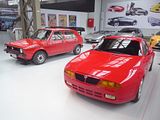

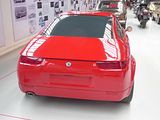
NSU Ro80: In 1967, NSU launched a car targetted at the executive sector of the market, the rotary powered Ro80. This featured a 113 bhp, 995 cc twin-rotor Wankel engine driving the front wheels through a semi-automatic transmission with an innovative vacuum operated clutch system. Other technological features of the Ro 80, aside from the powertrain, were the four wheel ATE Dunlop disc brakes, which for some time were generally only featured on expensive sports or luxury saloon cars. The front brakes were mounted inboard, reducing the unsprung weight. The suspension was independent on all four wheels, with MacPherson struts at the front and semi-trailing arm suspension at the rear, both of which are space-saving designs commonly used today. Power assisted ZF rack and pinion steering was used, again foreshadowing more recent designs. The car featured an automatic clutch which was commonly described as a three-speed semi-automatic gearbox: there was no clutch pedal, but instead, touching the gear lever knob operated an internal electric switch that operated a vacuum system which disengaged the clutch. The gear lever itself then could be moved through a standard ‘H pattern’ gate. The styling, by Claus Luthe who was head of design at NSU and later BMW, was considered very modern at the time; the Ro 80 has been part of many gallery exhibits of modern industrial design. The large glass area foreshadowed 1970s designs such as Citroën’s. The shape was also slippery, with a drag coefficient of 0.355 (very good for the era). This allowed for a top speed of 112 mph. The company’s limited resources focused on improving the reliability of the rotary engine, with much attention given to the material used for the three rotor tips (apex seals) for the oval-like epitrochoid-shaped rotor housing that sealed the combustion chambers. A feature of the engine was its willingness to rev quickly and quietly to damagingly high engine speeds, but it was precisely at these high speeds that damage to key engine components occurred: all Ro 80s came with a rev counter, but cars produced after 1971 also came with an “acoustical signal” that warned the driver when the engine was rotating too fast. The Ro 80 remained largely unchanged over its ten year production. From September 1969 the rectangular headlights were replaced with twin halogen units, and air extractor vents appeared on the C-pillar behind the doors. In August 1970 a slightly reshaped plastic grill replaced the metal grill of the early cars, and a minimal facelift in May 1975 saw the final cars getting enlarged rear lights and rubber inserts in the bumpers which increased the car’s overall length by 15 mm to 4795 mm. Series production began in October 1967 and the last examples came off the production line in April 1977. During 1968, the first full year of production, 5,986 cars were produced, increasing to 7,811 in 1969 and falling slightly to 7,200 in 1970. After this output declined, to about 3,000 – 4,000 per year for the next three years. The relative thirst of the rotary engine told against the car after the savage fuel price rises accompanying the oil crisis of 1973, and between 1974 and 1976 annual production came in well below 2,000 units. In total 37,398 Ro80s were produced during the ten-year production run. Ultimately, it was the contrasting success of the similarly sized Audi 100 that sealed both the fate of the Ro80, and the NSU brand as a whole within the Auto Union-NSU combine, as parent company Volkswagen began nurturing Audi as its performance-luxury brand in the late 1970s. After the discontinuation of the Ro80 in 1977, the Neckarsulm plant was switched over entirely to producing Audi’s C- and D- platform vehicles (the 100/200, and later the Audi A6 and A8), and the NSU brand disappeared from the public eye.


Alfa Romeo Montreal: First seen as a concept car in 1967 at Expo 67, the car was initially displayed without any model name, but the public took to calling it the Montreal. It was a 2+2 coupe using the 1.6-litre engine of the Alfa Romeo Giulia TI and the short wheelbase chassis of the Alfa Romeo Giulia Sprint GT, with a body designed by Marcello Gandini at Bertone. One of the two concept cars built for Expo 67 is displayed in the Alfa Romeo Historical Museum in Arese, Italy, while the other is in museum storage. Reaction to the concept was sufficiently encouraging that Alfa decided to put the car into production. The result, the Tipo 105.64, was shown at the 1970 Geneva Motor Show and was quite different from the original, using a 2593 cc 90° dry-sump lubricated V8 engine with SPICA (Società Pompe Iniezione Cassani & Affini) fuel injection that produced around 200 PS (197 hp), coupled to a five-speed ZF manual gearbox and a limited-slip differential. This engine was derived from the 2-litre V8 used in the 33 Stradale and in the Tipo 33 sports prototype racer; its redline was set at 7,000 rpm, unheard of for a V8 at that time. The chassis and running gear of the production Montreal were taken from the Giulia GTV coupé and comprised double wishbone suspension with coil springs and dampers at the front and a live axle with limited slip differential at the rear.Since the concept car was already unofficially known as The Montreal, Alfa Romeo kept the model name in production. Stylistically, the most eye catching feature was the car’s front end with four headlamps partly covered by unusual “grilles”, that retract when the lights are switched on. Another stylistic element is the NACA duct on the bonnet. The duct is actually blocked off since its purpose is not to draw air into the engine, but to optically hide the power bulge. The slats behind the doors contain the cabin vents, but apart from that only serve cosmetic purposes. Paolo Martin is credited for the prototype instrument cluster. The Montreal was more expensive to buy than the Jaguar E-Type or the Porsche 911. When launched in the UK it was priced at £5,077, rising to £5,549 in August 1972 and to £6,999 by mid-1976. Production was split between the Alfa Romeo plant in Arese and Carrozzeria Bertone’s plants in Caselle and Grugliasco outside Turin. Alfa Romeo produced the chassis and engine and mechanicals and sent the chassis to Caselle where Bertone fitted the body. After body fitment, the car was sent to Grugliasco to be degreased, partly zinc coated, manually spray painted and have the interior fitted. Finally, the car was returned to Arese to have the engine and mechanicals installed. It is worth noting that because of this production method, there is not necessarily any correspondence between chassis number, engine number and production date. The Montreal remained generally unchanged until it was discontinued in 1977. By then, production had long ceased already as Alfa were struggling to sell their remaining stock. The total number built was around 3900. None of them were sold in Montreal, Quebec since Alfa did not develop a North American version to meet the emission control requirements in the United States & Canada. The car was both complex and unreliable which meant that many cars deteriorated to a point where they were uneconomic to restore. That position has changed in the last couple of years, thankfully, with the market deciding that the car deserves better, and prices have risen to you whereas a good one would have been yours for £20,000 only a couple of years ago, you would now likely have to pay more than double that.
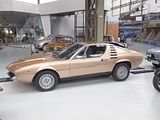
1948 Alfa Romeo 6C 2500 Super Sport Cabriolet: Final evolution of the Alfa Romeo 6C was the 2500 which was announced in 1938. The 2500 had an enlarged engine compared to the predecessor models, with this Vittorio Jano designed double overhead cam engine available with either one or three Weber carburettors. The triple carburettor version was used in the top of line SS (Super Sport) version. The 2443 cc engine was mounted in a steel ladder frame chassis, which was offered with three wheelbase lengths: 3,250 mm (128.0 in) on the Turismo, 3,000 mm (118.1 in) on the Sport and 2,700 mm (106.3 in) on the Super Sport. Although it was clear that World War II was coming and car development would be stopped, Alfa did continue to produce a few hundred 6C 2500s were built from 1940 to 1945 before resuming production, Postwar. The first new Alfa in his period was the 1946 6C 2500 Freccia d’Oro (Golden Arrow), of which 680 were built through 1951, with bodies by Alfa. Various coachbuilders made their own versions of the 2500, with most of the bodies made by Touring of Milan, though this one has a Rigoli Robini Cabriolet style which is rather attractive. The car was sold to wealthy customers like King Farouk, Alì Khan, Rita Hayworth, Tyrone Power, and Prince Rainier. One was also featured in The Godfather in 1972. The 6C 2500 was one of the most expensive cars available at the time. The last 6C was produced in 1952, when it was replaced by the 1900.

1910 Nagant 7000 Type J

1929 Avions-Voisin C-14 Charmant


1931 Swallow Seven: In 1927, William Lyons, co-founder of the Swallow Sidecar Company, saw the commercial potential of producing a re-bodied Austin 7. Buying a chassis from dealer Parkers of Bolton Lyons commissioned Swallow’s talented employee, coachbuilder Cyril Holland, to produce a distinctive open tourer: the Austin Seven Swallow. Holland (1895- ) who joined Swallow in late 1926 had served his apprenticeship with Lanchester and would become chief body engineer. The height of saloon car fashion of the day was to have the back of the body fully rounded, this was called “dome” shaped. With its bright two-tone colour scheme and a style befitting more expensive cars of the time, together with its low cost (£175), the Swallow proved popular and was followed in 1928 by a saloon version: the Austin Seven Swallow Saloon. Approximately 3,500 bodies of various styles were produced up until 1932, when Lyons started making complete cars under the SS brand. Such was the demand for the Austin Seven Swallows that Lyons was forced to move in 1928 from Blackpool to new premises in Coventry. It was, in part, the success of the Swallows that laid the foundations of what was to become, by 1945, Jaguar Cars.

1934 Citroen Traction Avant Type 7A: 1934 saw the introduction of the Citroen’s revolutionary and mould-shattering front-wheel-drive semi-monocoque Citroën Traction Avant. The Traction endured a troubled and prolonged birth process, however, and was part of an ambitious investment programme which involved, also in 1934, the bankruptcy of the business, and its acquisition by Citroën’s principal creditor. The patron himself died in 1935. In this troubled situation, availability of the larger Rosalies (although re-engined with a turned-around version of the new Traction’s OHV four-cylinder engines) continued till 1938: it is only through the distorting prism of subsequent events that its reputation has been diminished when set against the technical brilliance of its successor. Produced for over 20 years, many different versions were made during that time, all with the same styling outline, but with power outputs ranging from 7 to 15CV, and different wheelbases, as well as some with Coupe and Convertible body styles. There was even one model with a large opening tailgate, the Commerciale. This 7CV version was one of the cheaper models from the range.

1937 Panhard X77 Dynamic: A very daring creation by Bionnier for Panhard & Levassor. Many cars of the time displayed elements of the then popular Art Deco style, but in no other has this been applied as extensively as in this X77 Dynamic. Look at the aerodynamic mudguard skirts which have been placed wide apart to allow adequate room for the wheels to be turned. Also note the headlight grilles which have the same shape as the radiator grille; the three windscreen wipers and the ‘Panoramique’ windscreen with curved corner pieces. Note too that the driver is seated almost centrally in the car, allowing him to make optimal use of the panoramic windows. A slim person can sit on his right and a somewhat plumper person on his left. The Dynamic was Panhard & Levassor’s attempt to uphold their name in an ever-declining market. Although the marque was once progressive, it was now lagging behind. This design represented a break from the older, conservative models. The X77 Dynamic was equipped with a 2.8-litre, six-cylinder, sleeve-valve engine. Some 3,000 of this model were produced from 1936 to 1939.
1939 La Salle Convertible Model 50
1972 Citroen DS23: It is hard to imagine just how revolutionary this car must have seemed when it was unveiled at the Paris Show in 1955. 18 years in secret development as the successor to the Traction Avant, the DS 19 stole the show, and within 15 minutes of opening, 743 orders were taken. By the end of the first day, that number had risen to 12,000. Contemporary journalists said the DS pushed the envelope in the ride vs. handling compromise possible in a motor vehicle. To a France still deep in reconstruction after the devastation of World War II, and also building its identity in the post-colonial world, the DS was a symbol of French ingenuity. It also posited the nation’s relevance in the Space Age, during the global race for technology of the Cold War. Structuralist philosopher Roland Barthes, in an essay about the car, said that it looked as if it had “fallen from the sky”. An American advertisement summarised this selling point: “It takes a special person to drive a special car”. Because they were owned by the technologically aggressive tyre manufacturer Michelin, Citroën had designed their cars around the technically superior radial tyre since 1948, and the DS was no exception. The car featured a novel hydropneumatic suspension including an automatic levelling system and variable ground clearance, developed in-house by Paul Magès. This suspension allowed the DS to travel quickly on the poor road surfaces common in France. In addition, the vehicle had power steering and a semi-automatic transmission (the transmission required no clutch pedal, but gears still had to be shifted by hand though the shift lever controlled a powered hydraulic shift mechanism in place of a mechanical linkage, and a fibreglass roof which lowered the centre of gravity and so reduced weight transfer. Inboard front brakes (as well as independent suspension) reduced unsprung weight. Different front and rear track widths and tyre sizes reduced the unequal tyre loading, which is well known to promote understeer, typical of front-engined and front-wheel drive cars. As with all French cars, the DS design was affected by the tax horsepower system, which effectively mandated very small engines. Unlike the Traction Avant predecessor, there was no top-of-range model with a powerful six-cylinder engine. Citroën had planned an air-cooled flat-6 engine for the car, but did not have the funds to put the prototype engine into production. The 1955 DS19 was 65% more expensive than the car it replaced, the Citroën Traction Avant. This did impact potential sales in a country still recovering economically from World War II, so a cheaper submodel, the Citroën ID, was introduced in 1957. The ID shared the DS’s body but was less powerful and luxurious. Although it shared the engine capacity of the DS engine (at this stage 1,911 cc), the ID provided a maximum power output of only 69 hp compared to the 75 hp claimed for the DS19. Power outputs were further differentiated in 1961 when the DS19 acquired a Weber-32 twin bodied carburettor, and the increasing availability of higher octane fuel enabled the manufacturer to increase the compression ratio from 7.5:1 to 8.5:1. A new DS19 now came with a promised 83 hp of power. The ID19 was also more traditional mechanically: it had no power steering and had conventional transmission and clutch instead of the DS’s hydraulically controlled set-up. Initially the basic ID19 was sold on the French market with a price saving of more than 25% against the DS, although the differential was reduced at the end of 1961 when the manufacturer quietly withdrew the entry level ID19 “Normale” from sale. An estate version was introduced in 1958. It was known by various names in different markets: Break in France, Safari and Estate in the UK, Wagon in the US, and Citroën Australia used the terms Safari and Station-Wagon. It had a steel roof to support the standard roof rack. ‘Familiales’ had a rear seat mounted further back in the cabin, with three folding seats between the front and rear squabs. The standard Break had two side-facing seats in the main load area at the back. During the 20 year production life, improvements were made on an ongoing basis. In September 1962, the DS was restyled with a more aerodynamically efficient nose, better ventilation and other improvements. It retained the open two headlamp appearance, but was available with an optional set of driving lights mounted on the front bumpers. A more luxurious Pallas trim came in for 1965 Named after the Greek goddess Pallas, this included comfort features such as better noise insulation, a more luxurious (and optional leather) upholstery and external trim embellishments. The cars were complex, and not always totally reliable, One of the issues that emerged during long term use was addressed with a change which came in for 1967. The original hydropneumatic system used a vegetable oil liquide hydraulique végétal (LHV), similar to that used in other cars at the time, but later switched to a synthetic fluid liquide hydraulique synthétique (LHS). Both of these had the disadvantage that they are hygroscopic, as is the case with most brake fluids. Disuse allows water to enter the hydraulic components causing deterioration and expensive maintenance work. The difficulty with hygroscopic hydraulic fluid was exacerbated in the DS/ID due to the extreme rise and fall in the fluid level in the reservoir, which went from nearly full to nearly empty when the suspension extended to maximum height and the six accumulators in the system filled with fluid. With every “inhalation” of fresh moisture- (and dust-) laden air, the fluid absorbed more water. For the 1967 model year, Citroën introduced a new mineral oil-based fluid liquide hydraulique minéral (LHM). This fluid was much less harsh on the system. LHM remained in use within Citroën until the Xantia was discontinued in 2001. LHM required completely different materials for the seals. Using either fluid in the incorrect system would completely destroy the hydraulic seals very quickly. To help avoid this problem, Citroën added a bright green dye to the LHM fluid and also painted all hydraulic elements bright green. The former LHS parts were painted black. All models, including the Safari and ID, were upgraded at the same time. The hydraulic fluid changed to the technically superior LHM (Liquide Hydraulique Minéral) in all markets except the US and Canada, where the change did not take place until January 1969, due to local regulations. Rarest and most collectable of all DS variants, a convertible was offered from 1958 until 1973. The Cabriolet d’Usine (factory convertible) were built by French carrossier Henri Chapron, for the Citroën dealer network. It was an expensive car, so only 1,365 were sold. These DS convertibles used a special frame which was reinforced on the side-members and rear suspension swingarm bearing box, similar to, but not identical to the Break/Safari frame. The cars here included a nice DS23EFi, the top model in the range, which came with a fuel injected 2.3 litre engine, five speed gearbox as well as those iconic swivelling headlights which turned with the steering wheel.

Borgward Isabella Coupe: Originally planned to have been marketed as the Borgward Hansa 1500 but the Isabella name was used on test vehicles and proved popular with engineering staff and media, so the production car was subsequently renamed and only the first few hundred examples were built without Isabella badging, though Hansa badging was also used through to 1957. Despite its aspirational positioning in the marketplace, the Isabella had a smaller engine (and was marginally shorter) than its immediate predecessor, the Borgward Hansa. Late in 1952, the firm had launched their six cylinder Hansa 2400 model. The larger car never found many buyers; but in 1954, it made commercial sense to keep the two models from competing too directly with each other. 11,150 Isabellas were produced in 1954, an early indicator that commercially this would be the most successful Borgward ever. The early cars enjoyed an enthusiastic reception in the market place. Unfortunately, early models were afflicted by teething troubles, reflecting a rushed development schedule, and the marketplace would later prove unforgiving as Borgward’s Stuttgart based rival, Daimler-Benz demonstrated that new models did not have to involve customers experiencing such problems. The advertised launch price of DM 7,265 was higher than that of competitor family sedans from Opel and Ford, but significantly less than Mercedes Benz was asking for their 180 model. In view of the car’s spacious cabin and impressive performance, the pricing was perceived as very competitive. The Isabella was constructed without a separate chassis, applying the monocoque technique which during the 1950s was becoming the norm. Like its predecessor, the car was designed with a modern ponton, three-box design, but the line of the Isabella was more curvaceous than that of the first Hansa, and the car’s body made greater use of chrome trim. Ground clearance was 6.9″. The Isabella featured a swing axle at the back: it was supported by coil springs on all four wheels. The four-cylinder 1493 cc engine had a claimed power output of 60 bhp, and was connected by means of a then innovative hydraulic clutch to the four speed full synchromesh gear box. Gear changes were effected by means of a column mounted lever. A road test at launch reported a maximum speed of 130 km/h (81 mph) and fuel consumption of 8.4 l/100 km. The testers described the modern structure of the car in some detail: they particularly liked the wide cabin with its large windows, and they commended the effectiveness of the brakes. The inclusion of a cigarette lighter and a clock also attracted favourable mention. Unlike the Mercedes 180 however, (and unlike its predecessor) the Isabella was only delivered with two-doors. A year after presenting the sedan, Borgward presented the Isabella estate version. Also introduced in 1955 was a two door cabriolet, known as the Isabella TS and featuring a more powerful 75 bhp tor. Production of the cabriolet was contracted to the firm Karl Deutsch in Cologne: converting an early monocoque design to a cabriolet necessitated considerable modification in order to achieve the necessary structural rigidity, and the resulting cost was reflected in a much higher selling price for this version. Initial sales volumes were not maintained. Responding to a sales decline of almost a third in 1955 and 1956, Carl Borgward decided to produce a more beautiful Isabella with a shortened roof line. The Borgward Isabella Coupé was developed, and the four hand built prototypes were well received by the press. Borgward gave one of these prototypes to his wife, Elisabeth, who would continue to drive it into the 1980s. Commercial production of the coupé, powered by the more powerful TS version of the engine first seen in the cabriolet, commenced in January 1957. The coupe appears to have achieved its marketing objective of further distancing the Isabella’s image from similarly sized competitors from Opel and Ford. By 1958, the more powerful 75 bhp TS motor had also found its way into the more upmarket Isabella sedan and estate versions. At the time of Borgward’s controversial bankruptcy in 1961, the firm carried a substantial stock of unsold Isabellas. Nevertheless, the model’s production at the Bremen plant continued until 1962, suggesting that overstocking had not been restricted to finished vehicles. By the end, 202,862 Isabellas had rolled off the Borgward production line which was nevertheless an impressive volume in the 1950s: overall, and despite being hit by falling demand in the economic slump that briefly hit Germany in the early 1960s, the car is believed to have been the firm’s most lucrative model by a very considerable margin. Borgward enjoyed a brief afterlife: the production line was sold and shipped to Mexico where later during the 1960s the P100 (Big Six) was produced. The Isabella was never produced in Mexico. Back in the German market, BMW’s stylish new 1500, launched by the Bavarians in 1961, convincingly filled the niche vacated by the Isabella, and was credited by at least one commentator with having rescued BMW itself from insolvency. In Argentina, the Isabella was manufactured from 1960 to 1963 by Dinborg, a local subsidiary of Borgward. 999 Isabellas were made in Buenos Aires.

1938/54 Bugatti Type 57 Brown: This special creation is built on a pre-war chassis-type 57 by sculptor James Brown, the futuristic body for the time is fibreglass (as contemporary Corvette) and allows a reduction of 250 kg; the wheels are 16 inches instead of 18 inches. The sculptor Jacques Brown rebodied the old T57 chassis in a more aerodynamic form using polyester for the body panels, thus saving weight and increasing performance. His vision was highly praised at the time, but probably not so by marque purists more than half a century later. In 1955 it was shown at the Salon de l ‘Automobile in Paris. James Brown made two of them on a Bugatti T57 chassis (#57645 and #57723), hoping to get commissions for more. Unfortunately for him there were no takers. The body remained on the T57 chassis (probably #57723) until the 1980s, but is now replaced with a VW floorpan.


1946 JP Wimille prototype: From 1946 on, in conjunction with stylist Philippe Charbonnea, Wimille created and built cars in Paris under the brand-name Wimille. Their advanced features included three-abreast seating, a Cotal pre-selector gearbox and a mid-mounted engine. Between 1946 and 1950 around eight cars were built, at first with Citroën-engines, later with Ford V8-engines
Porsche 911: The Porsche 911 traces its roots to sketches drawn by Ferdinand “Butzi” Porsche in 1959. The Porsche 911 was developed as a more powerful, larger and a more comfortable replacement for the 356, the company’s first model. The new car made its public debut at the 1963 Frankfurt Motor Show. The car was developed with the proof-of-concept twin-fan Type 745 flat-six engine, but the car presented at the auto show had a non-operational mockup of the single-fan 901 engine, receiving a working unit in February 1964. It originally was designated as the “Porsche 901” (901 being its internal project number). A total of 82 cars were built as which were badges as 901s. However, French automobile manufacturer Peugeot protested on the grounds that in France it had exclusive rights to car names formed by three numbers with a zero in the middle. Instead of selling the new model with a different name in France, Porsche changed the name to 911. Internally, the cars’ part numbers carried on the prefix 901 for years. Production began in September 1964, with the first 911s exported to the US in February 1965. The first models of the 911 had a rear-mounted 130 hp Type 901/01 flat-6 engine, in the “boxer” configuration like the 356, the engine is air-cooled and displaces 1,991 cc as compared to the 356’s four-cylinder, 1,582 cc unit. The car had four seats although the rear seats were small, thus it is usually called a 2+2 rather than a four-seater (the 356 was also a 2+2). A four or five-speed “Type 901” manual transmission was available. The styling was largely penned by Ferdinand “Butzi” Porsche, son of Ferdinand “Ferry” Porsche. Butzi Porsche initially came up with a notchback design with proper space for seating two rear passengers but Ferry Porsche insisted that the 356’s successor was to use its fastback styling. 7 prototypes were built based on Butzi Porsche’s original design and were internally called the Porsche 754 T7. Erwin Komenda, the leader of the Porsche car body construction department who initially objected, was also involved later in the design. In 1966, Porsche introduced the more powerful 911S with Type 901/02 engine having a power output of 160 PS. Forged aluminum alloy wheels from Fuchsfelge, with a 5-spoke design, were offered for the first time. In motorsport at the same time, the engine was developed into the Type 901/20 and was installed in the mid-engine 904 and 906 with an increased power output of 210 PS, as well as fuel injected Type 901/21 installed in later variants of the 906 and 910 with a power output of 220 PS. In August 1967, the A series went into production with dual brake circuits and widened (5.5J-15) wheels still fitted with Pirelli Cinturato 165HR15 CA67 tyres. and the previously standard gasoline-burning heater became optional. The Targa version was introduced. The Targa had a stainless steel-clad roll bar, as automakers believed that proposed rollover safety requirements by the US National Highway Traffic Safety Administration (NHTSA) would make it difficult for fully open convertibles to meet regulations for sale in the US, an important market for the 911. The name “Targa” came from the Targa Florio sports car road race in Sicily, Italy in which Porsche had several victories until 1973. The last win in the subsequently discontinued event was scored with a 911 Carrera RS against prototypes entered by Ferrari and Alfa Romeo. The road going Targa was equipped with a removable roof panel and a removable plastic rear window (although a fixed glass version was offered from 1968). The 110 PS 911T was also launched in 1967 with Type 901/03 engine. The 130 PS model was renamed the 911L with Type 901/06 engine and ventilated front disc brakes. The brakes had been introduced on the previous 911S. The 911R with 901/22 engine had a limited production (20 in all), as this was a lightweight racing version with thin fibreglass reinforced plastic doors, a magnesium crankcase, twin overhead camshafts, and a power output of 210 PS. A clutchless semi-automatic Sportomatic model, composed of a torque converter, an automatic clutch, and the four-speed transmission was added in Autumn 1967. It was cancelled after the 1980 model year partly because of the elimination of a forward gear to make it a three-speed. The B series went into production in August 1968, replacing the 911L model with 911E with fuel injection. It remained in production until July 1969. The 911E gained 185/70VR15 Pirelli Cinturato CN36. and 6J-15 wheels. The C series was introduced in August 1969 with an enlarged 2.2-litre engine. The wheelbase for all 911 and 912 models was increased from 2,211–2,268 mm (87.0–89.3 in), to help as a remedy to the car’s nervous handling at the limit. The overall length of the car did not change, but the rear wheels were relocated further back. Fuel injection arrived for the 911S (901/10 engine) and for a new middle model, 911E (901/09 engine). The D series was produced from Aug. 1970 to July 1971. The 2.2-litre 911E (C and D series) had lower power output of the 911/01 engine (155 PS) compared to the 911S’s Type 911/02 (180 PS, but 911E was quicker in acceleration up to 160 km/h. The E series for 1972–1973 model years (August 1971 to July 1972 production) consisted of the same models, but with a new, larger 2,341 cc engine. This is known as the “2.4 L” engine, despite its displacement being closer to 2.3 litres. The 911E (Type 911/52 engine) and 911S (Type 911/53) used Bosch mechanical fuel injection (MFI) in all markets. For 1972 the 911T (Type 911/57) was carbureted, except in the US and some Asian markets where the 911T also came with (MFI) mechanical fuel injection (Type 911/51 engine) with power increase over European models (130 hp) to 140 hp commonly known as a 911T/E. With power and torque increase, the 2.4-litre cars also got a newer, stronger transmission, identified by its Porsche type number 915. Derived from the transmission in the 908 race car, the 915 did away with the 901 transmission’s “dog-leg” style first gear arrangement, opting for a traditional H pattern with first gear up to the left, second gear underneath first, etc. The E series had the unusual oil filler behind the right side door, with the dry sump oil tank relocated from behind the right rear wheel to the front of it in an attempt to move the centre of gravity slightly forward for better handling. An extra oil filler/inspection flap was located on the rear wing, for this reason it became known as an “Oil Klapper”, “Ölklappe” or “Vierte Tür (4th door)”. The F series (August 1972 to July 1973 production) moved the oil tank back to the original behind-the-wheel location. This change was in response to complaints that gas-station attendants often filled gasoline into the oil tank. In January 1973, US 911Ts were switched to the new K-Jetronic CIS (Continuous Fuel Injection) system from Bosch on Type 911/91 engine. 911S models also gained a small spoiler under the front bumper to improve high-speed stability. The cars weighed 1,050 kg (2,310 lb). The 911 ST was produced in small numbers for racing (the production run for the ST lasted from 1970 to 1971). The cars were available with engines of either 1,987 cc or 2,404 cc, having a power output of 270 PS at 8,000 rpm. Weight was down to 960 kg (2,120 lb). The cars had success at the Daytona 6 Hours, the Sebring 12 Hours, the 1000 km Nürburgring, and the Targa Florio. The G Series cars, with revised bodies and larger impact-absorbing bumpers arrived in the autumn of 1973 and would continue in production with few visual changes but plenty of mechanical ones for a further 16 years.
ECONOMY CARS
1964 Scootacar: Scootacar was a British three-wheeled microcar built in Hunslet, Leeds by Scootacars Ltd a division of the railway locomotive builder, the Hunslet Engine Company between 1957 and 1964. It was allegedly built because the wife of one of the directors wanted something easier to park than her Jaguar. The shape of the car was designed by Henry Brown, previously responsible for the Rodley, who did it by sitting on a Villiers engine and then having an assistant draw an outline around him. The body was built in glass fibre and was very tall for its size being 60 in (1,524 mm) high, 87 in (2,210 mm) long and only 52 in (1,321 mm) wide. It was nicknamed “the telephone booth”. Two people could be carried with a passenger behind the driver or alternatively just squeezed in alongside. Power came from a rear-mounted Villiers 9E 197 cc single-cylinder two-stroke engine coupled to a four-speed motorcycle-type gearbox and chain drive to the single rear wheel. Steering was by handlebars. The car had independent front suspension using coil springs, and the wheels were 8 in (203 mm), with the spare mounted externally at the rear. The top speed was 50 mph (80 km/h). In 1960 came the De Luxe or Mark 2, with a totally redesigned body with more room and seating for three, but it appeared too late to sell in any great numbers. It had a top speed of 55 mph (89 km/h) and sold for £275/ In 1961 the De Luxe Twin Mark 3 cars appeared fitted with a 324cc Villiers 3T twin, giving a top speed of 68 mph (109 km/h). Production stopped in 1964. Around 1000 were built.

1964 Messerschmitt KR201 Roadster: The Messerschmitt Kabinenroller (Messerschmitt Cabin Scooter) was a series of microcars made by RSM Messerschmitt from 1953 to 1956 and by Fahrzeug- und Maschinenbau GmbH, Regensburg (FMR) from 1956 to 1964. All the Messerschmitt and FMR production cars used the Kabinenroller’s monocoque structure, featuring tandem seating and usually a bubble canopy. The Kabinenroller platform was used for four microcars, the three-wheeled Messerschmitt KR175 (1953-1955), Messerschmitt KR200 (1955-1964) and Messerschmitt KR201, and the four-wheeled FMR Tg500 (1957-1961). The platform and all four cars using it were designed by Fritz Fend. The Kabinenroller was designed and developed by Fritz Fend for Messerschmitt AG. Fend had earlier designed and built a series of unpowered and powered invalid carriages, leading up to his Fend Flitzer. Fend noticed that able-bodied people were buying Flitzers for use as personal transport. This led him to believe that a mass-produced two-seat version of the Flitzer would have a ready market. A search for a manufacturer interested in the project led him to Messerschmitt, who had him develop the project for production in their Regensburg factory. The Kabinenroller was designed and developed for production in 1952 and 1953. Production of the original version, the KR175, began in February 1953. 70 modifications had been made to the design by June 1953. The KR200 was developed on the Kabinenroller platform and replbaced the KR175 in 1955. Based on the same frame and an evolution of the original suspension, the KR200 had a large number of detail changes. On 29–30 August 1955, a modified KR200 with a tuned engine, revised gear ratios, redundant control cables, a one-off streamlined body, and stock suspension, damping, steering, and brakes, was run at the Hockenheimring for twenty-four hours. During the run, the vehicle set twenty-two closed-circuit speed records for three-wheeled vehicles with displacements up to 250 cc, including the fifty-mile record at 107 km/h (66.5 mph) and the twenty-four-hour record at 103 km/h (64.0 mph). The Kabinenroller was based on a central monocoque tub made from pressed steel sheet and tubular steel. The tub tapered upward from front to rear with a bulkhead at the back. The bulkhead supported a tubular steel subframe and acted as the firewall. The subframe supported the engine and the rear suspension. The engine cover was hinged to the monocoque structure. The fuel tank was in the top of the engine cover and fed the carburettor by gravity.The monocoque tub, with the bulkhead at the back, a nose section at the front, and an access hatch system overhead, formed a passenger compartment for a driver and a passenger sitting in tandem. The base plate on which the hatch was hinged was riveted to the right side of the monocoque tub and the nose section. The hatch was made of a steel sheet base with a glass windshield, a plexiglas bubble canopy, and a framed set of sliding windows on either side of the canopy. The tandem seating allowed the body to be long and narrow, with a low frontal area. This also allowed the body to taper like an aircraft fuselage, within a practical length. Front suspension of the Kr 200 Kabinenroller (the Kr175 had a different arrangement with rubber cones) was by a transverse lower arm sprung by a torsional 3-element rubber spring at the inside end. Front suspension travel was limited by rubber buffers. Rear suspension was by a trailing arm similar to a single-sided motorcycle swingarm which also formed the enclosure for the chain drive to the rear wheel. The trailing arm was suspended by another torsional rubber spring. Hydraulic dampers were added to the design with the introduction of the KR200 in 1955; also the front track was increased at that time. The shaft of the steering control was connected directly to the track rods controlling the front wheels, resulting in approximately one-third of a turn from the left extreme to the right extreme (“lock to lock”). The handlebar-shaped steering control would be operated with small, controlled inputs by swivelling the steering bar about its axis from the horizontal (straight-ahead) position instead of rotating it as with a conventional steering wheel.


Heinkel Kabine: The Heinkel Kabine was a microcar designed by Heinkel Flugzeugwerke and built by them from 1956 to 1958. Production was transferred under licence to Dundalk Engineering Company in Ireland in 1958. However, the licence was withdrawn shortly afterwards due to poor quality control. Production restarted in 1960, again under licence, under the Trojan 200 name by Trojan Cars Ltd. in the UK, and continued until 1966. Heinkel Kabines were also assembled under licence by Los Cedros S.A. from 1959 until 1962. As Heinkel in Argentina, they were built alongside Studebaker pickups. The Kabine Model 150 used the 174 cc 9.2 hp single-cylinder four-stroke engine that powered the Heinkel Tourist scooter. In October 1956, Heinkel introduced the Kabine Model 153 (with three wheels) and the Kabine Model 154 (with four wheels), both with 204 cc engines. The engines in these models were later reduced in capacity to 198 cc for insurance purposes. The Kabine had a steel unit body. Access to the interior was by an opening front. In order not to infringe Iso Rivolta’s patent used on the Isetta, the steering wheel did not hinge outwards with the door to ease passenger access. However, it did feature a reverse gear, unlike some other bubble cars. The fabric sun roof served as an emergency escape hatch should the sole door in front become jammed in a collision.

In addition, there is a collection of economy and microcars which rather than being displayed at floor level were stacked on a side wall, making them easy to see, but quite hard to photograph. Indeed, there were more of them on show than are depicted here:
Isetta 250: The Isetta is far more significant than many visitors would realise, as without these cars, the modern BMW company simply would not exist. However, the car originated with the Italian firm of Iso SpA, and it is two of those models which were to be seen here. In the early 1950s the company was building refrigerators, motor scooters and small three-wheeled trucks. Iso’s owner, Renzo Rivolta, decided he would like to build a small car for mass distribution. By 1952 the engineers Ermenegildo Preti and Pierluigi Raggi had designed a small car that used the motorcycle engine of the Iso Moto 200 and named it Isetta—an Italian diminutive meaning little ISO. The Isetta caused a sensation when it was introduced to the motoring press in Turin in November 1953, it was unlike anything seen before. Small (only 7.5 ft long by 4.5 ft wide) and egg-shaped, with bubble-type windows, the entire front end of the car hinged outwards to allow entry. In the event of a crash, the driver and passenger were to exit through the canvas sunroof. The steering wheel and instrument panel swung out with the single door, as this made access to the single bench seat simpler. The seat provided reasonable comfort for two occupants, and perhaps a small child. Behind the seat was a large parcel shelf with a spare wheel located below. A heater was optional, and ventilation was provided by opening the fabric sunroof. Power came from a 236 cc 9.5 hp split-single two-stroke motorcycle engine. The engine was started by a combination generator-starter known as Dynastart. A manual gearbox provided four forward speeds and reverse. A chain drive connected the gearbox to a solid rear axle with a pair of closely spaced 25 cm (10 in) rear wheels. The first prototypes had one wheel at the rear, but having a single rear wheel made the car prone to roll-overs,so the rear wheel layout was changed to two wheels set 19 in apart from each other. This narrow track eliminated the need for a differential. The front axle was a modified version of a Dubonnet independent front suspension. The Isetta took over 30 seconds to reach 50 km/h (31 mph) from rest. Top speed was only about 75 km/h (47 mph). The fuel tank held only 13 litres. However, the Isetta would get somewhere between 50 and 70 mpg depending on how it was driven. In 1954, Iso entered several Isettas in the legendary Mille Miglia where they took the top three spots in the economy classification. Over a distance of 1,600 km (1,000 mi) the drivers achieved an average speed of over 70 km/h (43 mph). In view of its maximum speed, which was just 15 km/h (9 mph) higher, this was an almost incredible figure. However, despite its initial success, the Isetta was beginning to slip in popularity at home. This was mainly due to renewed competition from Fiat with its 500C model. Renzo Rivolta wanted to concentrate on his new Iso Rivolta sports car, and was extremely interested in doing licensing deals. Plants in Spain and Belgium were already assembling Isettas and Autocarros using Italian made Iso components. BMW began talking with Rivolta in mid-1954 and bought not just a license but the complete Isetta body tooling as well. Rivolta did not stop with licensing the Isetta to BMW. He negotiated similar deals with companies in France and Brazil. After constructing some 1,000 units, production of the Italian built cars ceased in 1955, although Iso continued to build the Isetta in Spain until 1958. In addition to the Turismo, Iso in Spain also built the Autocarro, a commercial version with full-width rear axle. The Autocarro was offered in several body styles, a flatbed pickup, enclosed truck, a tilt-bed, or even a fire engine, although some of these might not have been sold. The Autocarro was an extremely popular type of vehicle in Italy, and numerous manufacturers produced some variant of the type. Iso had previously produced a motorcycle-type Isocarro. The Iso Autocarro was larger than most, with its four-wheel layout, conventional rear axle with differential and leaf springs, and a large tubular frame. It could carry a 500 kg load. It is thought that more than 4,000 Autocarros were built.
1941 Peugeot VLV: This was an electric microcar made by Peugeot in 1942. VLV stood for Voiture Légère de Ville (Light City Car). The car’s announcement, on 1 May 1941, triggered some surprise, since Peugeot was the only one of France’s large automakers to show interest in electric propulsion at this time. It was powered by four 12V batteries placed under the hood giving it a claimed top speed of 36 km/h (22 mph) and a range of 50 miles (80 km). The VLV was built during the war as a way to side-step fuel restrictions imposed on non-military users by the occupying German forces. Yet, it was banned after only 377 examples were built.
1946 Crosley Type 4: Crosley was a small, independent American manufacturer of subcompact cars, bordering on microcars. At first called the Crosley Corporation and later Crosley Motors Incorporated, the Cincinnati, Ohio, firm was active from 1939 to 1952, interrupted by World War II production. Their station wagons were the most popular model, but also offered were sedans, pickups, convertibles, a sports car, and even a tiny jeep-like vehicle. For export, the cars were badged Crosmobile. Crosley introduced several “firsts” in American automotive history, including the first affordable, mass-market car with an overhead camshaft engine in 1946; the first use of the term ‘Sport(s-) Utility’ in 1947, for a 1948 model year convertible wagon; and the first American cars to be fitted with 4-wheel caliper type disc brakes, as well as America’s first post-war sports car, the Hotshot, in the 1949 model year.

ELECTRIC and OTHER TECHNOLOGIES
Recognising the significant shift going on in the industry, with vast amounts of research spend on making cars more efficient, including the adoption of new ways of propelling cars from the hybrid technology that was popularised in the Toyota Prius to the all-electric machines now being produced, a new theme in the collection emerged with a dedicated display first created in 2022 to vehicles that are electric. In fact, electricity was in use right back at the dawn of motoring, as the oldest exhibit here evidenced:
1899 Jamais Contente: La Jamais Contente (English: The Never Satisfied) was the first road vehicle to go over 100 km/h (62 mph). It was a Belgian electric vehicle with a light-alloy torpedo-shaped bodywork and batteries. The high position of the driver and the exposed chassis underneath spoiled much of the aerodynamics. The light alloy, called partinium, is an alloy of aluminium, tungsten and magnesium. The land speed record was established on April 29 or May 1, 1899 at Achères, Yvelines near Paris, France. The vehicle had two direct-drive Postel-Vinay 25 kW motors, running at 200 V and drawing 124 A each, for about 68 hp total, and was equipped with Michelin tires. Chassis number was n°25. The vehicle was driven by the Belgian driver Camille Jenatzy. Camille was the son of Constant Jenatzy, a manufacturer of rubber products (rubber was still a novelty at the time). Camille had studied as an engineer, with an interest in electric-traction automobiles. He became known for his record-breaking speed runs and was nicknamed Le Diable Rouge (“The Red Devil”) for the colour of his beard. He died in 1913, after being shot in a hunting accident. Wishing to carve a place in the then promising Parisian electric carriage market, Jenatzy started a manufacturing plant, which would produce many electric carriages and trucks. He competed fiercely against the carriage-maker Jeantaud in publicity stunts to see which of them made the fastest vehicles. In order to ensure the triumph of his company, Jenatzy built a bullet-shaped prototype, conceived by the carriage-maker Rothschild in partinium (an alloy of laminated aluminium, tungsten and magnesium). Jenatzy reached the speed of 105.882 km/h (65.792 mph), besting the previous record, held by Count Gaston de Chasseloup-Laubat driving a Jeantaud, who had attained 92.78 km/h (57.65 mph) on March 4, 1899. After this exploit the gasoline-fuelled combustion engine would increasingly supplant electric technology for the next century. The Jamais Contente is now on display at the automobile museum in Compiègne, France. This is one is a replica.
Toyota Prius: In 1995, Toyota debuted a hybrid concept car at the Tokyo Motor Show, with testing following a year later. The first Prius, model NHW10, went on sale on 10 December 1997. The first-generation Prius (NHW10) was available only in Japan. The first-generation Prius, at its launch, became the world’s first mass-produced gasoline-electric hybrid car. At its introduction in 1997, it won the Car of the Year Japan Award, and in 1998, it won the Automotive Researchers’ and Journalists’ Conference Car of the Year award in Japan. Production commenced in December 1997 at the Takaoka plant in Toyota, Aichi, ending in February 2000 after cumulative production of 37,425 vehicles. The NHW10 Prius styling originated from California designers, who were selected over competing designs from other Toyota design studios. The Prius NHW11 (sometimes referred to as “Generation II”) was the first Prius sold by Toyota outside of Japan, with sales in limited numbers beginning in the year 2000 in Asia, America, Europe and Australia. In the United States, the Prius was marketed between the smaller Corolla and the larger Camry, with a published retail price of US$19,995. European sales began in September 2000. The official launch of the Prius in Australia occurred at the October 2001 Sydney Motor Show, although sales were slow until the NHW20 (XW20) model arrived. Toyota sold about 123,000 first-generation Priuses. Production of the NHW11 model commenced in May 2000 at the Motomachi plant in Toyota, Aichi, and continued until June 2003 after 33,411 NHW11 vehicles had been produced. The vehicle was the second mass-produced hybrid on the American market, after the two-seat Honda Insight. The NHW11 Prius became more powerful partly to satisfy the higher speeds and longer distances that Americans drive. Electric power steering was standard equipment. While the larger Prius could seat five, its battery pack restricted cargo space. The Prius was offered in the US in three trim packages: Standard, Base, and Touring. The US EPA (CARB) classified the car with an air pollution score of 3 out of 10 as an Ultra Low Emission Vehicle (ULEV). Prius owners were eligible for up to a US$2,000 federal tax deduction from their gross income. Toyota executives stated that with the Prius NHW10 model, the company had been losing money on each Prius sold, and with the NHW11 it was now breaking even.

Tesla Roadster: The Tesla Roadster is a battery electric sports car, that is based on the Lotus Elise chassis, and was produced by Tesla Motors (now Tesla, Inc.) from 2008 to 2012. After Martin Eberhard sold NuvoMedia to TV Guide, he wanted a sports car, but could not find one to his liking. His battery experience with the Rocket eBook inspired him to develop an electric car. During his search, Eberhard test drove the tzero, a concept car from the small automaker AC Propulsion. Eberhard and Marc Tarpenning, who had also driven the tzero, tried to convince the company to put the car into production, but when they declined, they decided to establish Tesla Motors in Delaware on July 1, 2003, to pursue the idea commercially. South African-born entrepreneur Elon Musk would also test drive a tzero and encouraged AC Propulsion to put the car into production, instead the company connected Musk with Eberhard and Tarpenning. Musk took an active role within the company starting in 2004, including investing US$7.5 million, overseeing Roadster product design from the beginning, and greatly expanding Tesla’s long-term strategic sales goals by using the sports car to fund the development of mainstream vehicles. Musk became Tesla’s chairman of the board in April 2004 and helped recruit J. B. Straubel as chief technology officer in March 2004. Musk received the Global Green 2006 product design award for the design of the Tesla Roadster, presented by Mikhail Gorbachev, and he received the 2007 Index Design award for the design of the Tesla Roadster. Before Tesla had developed the Roadster’s proprietary powertrain, they borrowed a tzero for use as a development mule and converted the vehicle from lead–acid AGM batteries to lithium-ion cells, which substantially increased the range, reduced weight, and boosted 0 to 60 mph performance. Tesla licensed AC Propulsion’s EV power system design and reductive charging patent, which covers integration of the charging electronics with the inverter, thus reducing mass, complexity, and cost. Tesla, however, was dissatisfied with how the motor and transmission worked in the chassis. Tesla then designed and built its own power electronics, motor, and other drivetrain components that incorporated this licensed technology from AC Propulsion. Given the extensive redevelopment of the vehicle, Tesla Motors no longer licenses any proprietary technology from AC Propulsion. The Roadster’s powertrain is unique. On July 11, 2005, Tesla and British sports car maker Lotus entered an agreement about products and services based on the Lotus Elise, where Lotus provided advice on designing and developing a vehicle as well as producing partly assembled vehicles, and amended in 2009, helped with basic chassis development. The Roadster has a parts overlap of roughly 6% with the Lotus Elise, a 2-inch-longer wheelbase, and a slightly stiffer chassis according to Eberhard. Tesla’s designers chose to construct the body panels using resin transfer molded carbon fiber composite to minimize weight; this choice makes the Roadster one of the least expensive cars with an entirely carbon fiber skin. Several prototypes of the Tesla Roadster were produced from 2004 through 2007. Initial studies were done in two development mule vehicles based on Lotus Elises equipped with all-electric drive systems. Tesla then built and tested ten engineering prototypes (EP1 through EP10) in late 2006 and early 2007, which led to many minor changes. Next, Tesla produced at least 26 validation prototypes, which were delivered beginning in March 2007. These final revisions were endurance and crash tested in preparation for series production. In August 2007, Martin Eberhard was replaced by an interim CEO, Michael Marks. Marks accepted the temporary position while a recruitment was undertaken. In December 2007, Ze’ev Drori became the CEO and president of Tesla. In October 2008, Musk succeeded Drori as CEO. Drori left the company in December. In January 2008, the U.S. National Highway Traffic Safety Administration (NHTSA) announced that it would grant Tesla a waiver of the advanced (two-stage) air bag rule noting that the Roadster includes standard air bags. Similar waivers were granted to other small volume manufacturers, including Lotus, Ferrari, and Bugatti. Tesla delivered its first production car in February 2008 to Musk. Tesla announced in early August 2009 that Roadster sales had resulted in overall corporate profitability for the month of July 2009, earning US$1 million on revenue of US$20 million. Tesla, which signed a production contract with Lotus in 2007 to produce “gliders” (complete cars minus electric powertrain) for the Roadster, announced in early 2010 that Roadster production would continue until early 2012. Starting one year prior to the end of the contract, no changes to the order was allowed to give time for tooling changes at Lotus’s assembly plant in the UK. Several years later in 2018, Musk would go on to say that using the Lotus Elise as a base for the Roadster was a poor strategy because the Elise was incompatible with the intended AC Propulsion technology and was modified so extensively only 7% of the Elise remained in common with the final production Roadster. Tesla’s cumulative production of the Roadster reached 1,000 cars in January 2010. The Roadster is considered an American car though many carry a Vehicle Identification Number beginning with the letter “S”, which is the designation for the United Kingdom. Some, however, carry a number starting with “5” appropriate to the US. Parts were sourced from around the world. The body panels came from French supplier Sotira. These were sent from France to Hethel, U.K., where Tesla contracted with Lotus to build the Roadster’s unique chassis. The Roadster shares roughly 7% of its components with the Lotus Elise including the windshield, airbags, some dashboard parts, and suspension components. The Roadster’s single-speed gearbox was made in Detroit by BorgWarner. Brakes and airbags were made by Siemens in Germany, and some crash testing was conducted at Siemens as well.[67] 30–40% of components were sourced from Taiwan. For Roadsters bound for customers in North America, the glider was sent to Tesla’s facility in Menlo Park, California for final assembly, and for Roadsters bound for customers in Europe or elsewhere outside of North America, the glider was sent to a facility at Wymondham near Hethel for final assembly. At these locations, Tesla employees installed the powertrain, which consisted of the battery pack, power electronics module, gearbox and motor. The Roadster was the first highway legal, serial production, all-electric car to use lithium-ion battery cells, and the first production all-electric car to travel more than 244 miles (393 km) per charge. It is also the first production car to be launched into deep space, carried by a Falcon Heavy rocket in a test flight on February 6, 2018. Tesla sold about 2,450 Roadsters in over 30 countries, and most of the last Roadsters were sold in Europe and Asia during the fourth quarter of 2012. Tesla produced right-hand-drive Roadsters from early 2010. The Roadster qualified for government incentives in several nations. According to the U.S. EPA, the Roadster can travel 244 miles (393 km) on a single charge of its lithium-ion battery pack. The vehicle can accelerate from 0 to 60 mph (0 to 97 km/h) in 3.7 or 3.9 seconds depending on the model. It has a top speed of 125 mph (201 km/h). The Roadster’s efficiency, as of September 2008, was reported as 120 miles per gallon gasoline equivalent (28 kW⋅h/100 mi) (2.0 L/100 km). It uses 21.7 kWh/100 mi (135 Wh/km) battery-to-wheel, and has an efficiency of 88% on average. Prototypes of the car were officially revealed to the public on July 19, 2006, in Santa Monica, California, at a 350-person invitation-only event held in Barker Hangar at Santa Monica Airport. It was featured in Time in December 2006 as the recipient of the magazine’s “Best Inventions 2006—Transportation Invention” award. The first Tesla Roadster was delivered in February 2008 to Tesla early investor, chairman and product architect Elon Musk. The company produced 500 similar vehicles through June 2009. In July 2009, Tesla began production of its 2010 model-year Roadster—the first major product upgrade. Simultaneously, Tesla began producing the Roadster Sport, the first derivative of Tesla’s proprietary, patented powertrain. The car accelerates from 0 to 60 mph (0 to 97 km/h) in 3.7 seconds, compared to 3.9 seconds for the standard Roadster. Beginning mid-March 2010, Tesla, in an effort to show off the practicality of its electric cars, sent one of its Roadsters around the world. Starting at the Geneva International Motor Show, the Roadster completed its journey upon its arrival in Paris on September 28, 2010. Tesla ordered 2,500 gliders from Lotus, which ceased production in December 2011 when their contract expired. Tesla ended production of the Roadster in January 2012. For a time, Tesla offered an optional upgrade to existing Roadsters, the Roadster 3.0. It offered a new battery pack with cells from LG Chem increasing capacity by 50% to 70 kWh, a new aero kit designed to reduce drag, and new tires with lower rolling resistance. The upgrade was offered between September 2015 and late 2016 at a cost of US$29,000. In November 2023, Tesla open-sourced some of the Roadster’s design and engineering documents, as well as diagnostic software.
1936 Citroën Rosalie 11 UB: This car is equipped with a gasifier because of the petrol shortage during WW2.

BELGIAN BUILT
Name a Belgian car is probably an even harder quiz question than the hackneyed “name a famous Belgian”. But if you dig back in history, you will find that there were a number of Belgian manufacturers in the early years of motoring, though the names of all bar perhaps one, are pretty much forgotten. Several of them were presented here.
1901 FN Type 4CV Tonneau: The 1st 4-wheel FN, designed by De Cosmo in 1899. Tonneau coachwork, with curved wooden flanks and small rear door. The transversal engine is fitted in the front. The starting handle needed to be slotted through the right front wheel. The accelerator and gears are on the steering wheel. The inclined steering column reveals it to be one of the later models. Near on 100 models were built between 1900-1901. Not bad for that era.

1930 FN 1400S: Unique wood/aluminium coachwork, handmade by the Lorenz/Walch coachbuilders based in Liège. Both internally and externally rich decorated, with even some components silver plated. This car was built for a Shah on special order, but was never paid and as such was never delivered. The car was finally acquired by a wealthy person from Liège.
1906 Fondu CF
1908 FN 2000A

1912 Hermes Type OOUO

1911 Minerva Type X

1914 Minerva Type KK

1925 Minerva AD
1923 Nagant 1000C Torpedo Sport: Nagant made cars under licence of the French firm Rochet-Schneider. Nagant cars were made from 1900 to 1928. The firm was purchased by Impéria in 1931

1924 Minerva MLT Tractor

1932 Imperial 1100S: Impéria was a Belgian automobile manufactured from 1906 until 1948. Products of the Ateliers Piedboeuf of Liège, the first cars were designed by the German Paul Henze. These were four-cylinders of 3, 4.9, and 9.9 litres. The next year, the company moved to Nessonvaux, Trooz municipality, and began production in the old Pieper factory. Impéria produced a monobloc 12 hp in 1909. In 1910, the company merged with Springuel. The Nessonvaux factory began producing Abadals under license as Impéria-Abadals from about 1916. In 1921, it built three ohc 5.6-litre straight-eights. These were quickly replaced by an ephemeral ohc 3-litre 32-valve four-cylinder which had a top speed of 90 mph (140 km/h). This was followed by an 1100 cc slide-valve 11/22 hp four designed by Couchard, one of the first cars ever built with a sunroof. Its engine rotated counterclockwise, and its transmission brake also served as a servo for those on the front wheels. In 1927 a six-cylinder of 1624 cc appeared; this had been available in three-carburettor Super Sports form from 1930. In 1925, the company hired Louis de Monge as chief research engineer. Some of his work included torsion bar suspension and automatic transmissions. De Monge left in 1937 to join Bugatti, where he would design the Bugatti 100P racer plane. Around and on top of the factory buildings, there was a test track over 1 km long. The track was built in 1928. The only other rooftop test tracks were on Fiat’s Lingotto plant, opened in 1923, and Palacio Chrysler in Buenos Aires, opened in 1928. Over the course of four years, Impéria took over three other Belgian car manufacturers: Métallurgique (1927), Excelsior (1929), and Nagant (1931). From 1934 until the company folded it built mainly front-wheel-drive Adlers with Belgian-made coachwork. The company merged with Minerva in 1934, but they split in 1939. In addition to its production in Belgium, Impéria made a number of cars in Great Britain; these were assembled at a factory in Maidenhead. From 1947 to 1949 Impéria built its last model, the TA-8, which combined an Adler Trumpf Junior-type chassis with a Hotchkiss engine originally intended for the Amilcar Compound.

1934 Minerva M4


1930 FN 1400S Sport Coupe

1947 FN Tri-Car: In 1935 FN ceased the production of cars, whereas on the other hand the production of motorbikes and trucks continued. Based on a 3-wheeler for military use introduced in 1939, as from 1946 a light utility vehicle saw the light of day. This had a payload ranging between 500 and 100 kg. The engine was an air-cooled 2-cylinder side valve linked to a 5-speed gearbox emanating from the motorbike production.
1934 Minerva Fire Truck: In 1930 the name Auto-Traction disappeared from the Minerva trucks. In 1934 the company goes bankrupt, but the production of trucks is revived in 1935. This is one of the last chassis before the bankruptcy. The adapted bodywork comes from Plas & Mestagh based in Brussels. For many years this fire truck was in service with the fire brigade of Schaerbeek, one of the 19 Brussels communes.

1949 Imperia TA8


1927 Minerva Type AF
1934 Belga Rise BR8: Belga Rise was a Belgian automobile manufacturer, based in Haren, Brussels, specializing in luxury cars. The company produced cars from 1928 to 1935. Initially, it produced cars under license for the French firm Sizaire-Naudin. Engines used included the 6-cylinder Hotchkiss AMBO and straight-8s by F. N., Minerva, Continental, and Talbot (Darracq). These engines were used with conventional 3-speed and Cotal 4-speed gearboxes. 35 cars were purchased by the Belgian Army for use as staff cars

1930 Minerva AL Coupe: In 1928 de Jong created a ‘super-car’ dubbed the Type AL which he introduced to the public a year later at the Paris Salon. It featured a four-speed transmission and a 6.6-litre eight-cylinder engine cast in one block rather than being made up of two separate blocks of four cylinders. With the help of a single Zenit carburettor, it was capable of producing 125 horsepower. Sitting atop a long 152 inch chassis, it would hardly qualify for super-car status by today’s definition. With its long body, it could easily carry many passengers while providing a spacious and luxurious interior. The exceptionally high price limited production to no more than fifty examples.

Following the Second World War, Societe Nouvelle Minerva SA could not contemplate producing a brand new car and so, following their experience of building under licence, the Standard Motor Company were approached and the Vanguard sedan was soon being assembled at the Mortsel plant, Antwerp, Belgium. Aware of the Belgium army’s search for a new lightweight 4×4 all purpose vehicle, the head of Minerva, Monsieur van Roggen, approached the Rover company in the Spring of 1951. On the 21st June the Rover company learned that a total of 2500 vehicles would be required and that Rover were competing with Willys for the contract. In October 1951 the deal was agreed, documentation being finalised on the 7th May 1952. Under this deal it was agreed that Rover would supply full technical assistance to Minerva who would be granted permission to manufacture Land-Rovers under licence. Rover would supply Completely-Knocked-Down kits (with CKD chassis numbers) consisting of the chassis, engine, axles, transmission and other parts to the Minerva company in Mortsel, who would then build its own steel body to suit the Belgium army requirements. The Minerva sales literature states that 63% of the parts used in the vehicles were of Belgian origin. The chassis were later built in Belgium as they are different in a number of ways to the original Land-Rover chassis, being box welded and lacking the PTO hole provision in the rear cross member. It is also possible that Rover supplied complete pre-assembled vehicles around this time; perhaps the civilian models which had rear PTO holes? The Minerva assembly line employed about 500 qualified workers who could produce 50 vehicles daily. These vehicles produced were left hand drive, 80″ wheelbase models, with the 2-litre engine. The most obvious differences between the Minerva and our own Series Ones being that the front wings that are squared off and sloping (simpler to produce than Solihull’s rounded front wings). The bodywork, including the doors, was all steel and a typical narrower front grille was used with the Minerva badge. Two styles of badges were used, the earlier version stating “Licence Rover” and the later having the oval Land-Rover badge at the bottom of the Minerva name. Slatted oval panels on either side of the grille cover the apertures and the front bumper was fitted with a single “pigtail” towing eye on the drivers side. The side lights were located at the bottom of the wings and the headlights were Belgian made. Smaller brake lights were fitted to the rear panels. Other differences include the exhaust being emitted from beneath the drivers door and the door handles. The 80″ army Minerva door handles were like those of its British counterpart with the canvas flap – although the door locks are slightly different. However, the civilian Minervas had external door handles. The military vehicles look quite different from the rear; a three quarter height fixed tailgate being fitted, the military versions had the spare wheel mounted on the right and a jerry can holder mounted on the left hand side (the Minerva petrol tanks are a little smaller than the Land-Rover equivalent). No centre seat was provided, a toolbox being fitted in its place which was about the same size as a seat base cushion. (The space under the seat which Series Ones often use as a toolbox housed one of two 6V batteries, the second being under the bonnet). It is thought that the Belgian army stockpiled the vehicles and thus effectively brand new vehicles were, until the seventies, still entering service. They simply had the milage of occasional trips around the warehouse which prevented them from seizing up! An armoured/assault vehicle version was also produced, with heavy plating, armoured glass screens and machine gun mounts at both the front and back. The spare wheel for these was mounted on the front bumper, in front of the grille. Field ambulance versions were produced, being basically the same as the standard vehicle but with the tilt extended at the rear to cover both overhanging stretchers. It is thought that this tilt could in fact be the same as used by the ambulance version of the Willys Jeep. These vehicles were fitted with frames that extended when required in order to allow stretchers to overhang the vehicles body. On the 1st October 1953 a civilian version of the Minerva Land-Rover was announced. This new vehicle was different in a number of ways from the previously produced military versions. The new vehicle was fitted with three seats, a drop down tailgate and provision in the rear cross member for a rear PTO to be fitted. A choice of colours was also offered; maroon, green, lightgrey or “other colours may be available”. The company was so keen to enter the civilian market that it would produce virtually any colour the customer requested! The brochure for the civilian model describes a central PTO from the main gear box to drive belts and describes the vehicle being useful for any portable apparatus – including generators, welders and water pumps. Indeed, the scenes used for the Minerva literature are virtually identical to those that Land-Rover were using – with the obvious exception of slightly different vehicles. Like our own Series One, Minerva versions included station wagons, (steel) hard tops, (steel) truck cabs, and tilt versions; the tilt being fitted with side windows – uneconomic in the UK due to vehicle taxation requirements. These vehicles were apparently well received by construction companies and farmers but are now very rare. It has been reported that in the mid fifties a 107″ with Minerva wings was involved in an expedition across Asia (Brussels- Bombay), although the origin of this vehicle – and indeed its fate – are unknown. It is possible that Minerva Land-Rovers were distributed in the Netherlands and Luxembourg through the Armstrong Siddeley network, as Minerva had certainly used this system in the past. In 1954, the new 86″ version was introduced, (as in Britain replacing the 80″). This vehicle was produced for the next three years, until 1957 when all contracts between Minerva and Land-Rover were terminated. During this time, only 1,100 86″ vehicles were produced, and these are now extremely rare. It is likely that these 86″ vehicles were only available as civilian models. The 86″ had 3 seats and rear PTO hole. The rear agricultural plate was also fitted. These vehicles had tailgates and the external door handles as fitted to the 80″ civilian vehicles. The Minerva sales literature of around 1956 illustrates the 80″ vehicle but describes the wheelbase of being of 86″ in the technical data! The Minerva Company and Rover “fell out” in September 1954 when Minerva bought an action against Rover for damages for breach of contract and monies allegedly due. S. Wilks and L. Farmer met Minerva representatives in order to negotiate and settle any disputes. A deal was agreed which included the supply of 900 further vehicles at an advantageous price. (These being the 270 vehicles of 1955 and 630 of 1956). The original Belgian army order was for 2,500 vehicles although a further 3,421 were subsequently ordered. As a result, despatches for 1952 and 1953 totalled 7,859 Completely-Knocked-Down vehicles. However, only 200 CKD 86″ vehicles were despatched during 1954 and this may well have contributed to the dispute between the two companies and agreement that all contracts would be terminated after a further 900 vehicles had been despatched. Thus, from May 1952 until the contract between the two companies was terminated at the end of June 1956, a total of 8,959 CKD vehicles were despatched from the Rover Company to Societe Nouvelle Minerva SA of Belgium. In 1956 Minerva announced the C-20 and M-20 (Civilian and Military) Tout Terrain vehicles but very few of these are believed to have been produced and the company soon experienced financial difficulties. The Minerva company finally fell into liquidation in 1958. Today the factory site is divided into industrial units, a number of which are derelict. Following Minerva’s demise, Beherman Demoen became the sole importer and distributor for Land-Rover in Belgium. There is however a certain amount of mystery regarding these vehicles. Until recently there were many new Minervas stockpiled in warehouses for the Belgium army’s use and Minervas of the early 50’s may be seen today fitted with the latest armourments. It is also said that, when disposed of, the chassis are machine sawed to prevent further use of complete vehicles. I was also recently informed that when sold, Minervas are disposed of in batches of at least twenty. However, the price of these batches varied according to the price of scrap steel at the time!

MOTOR BIKES
There is quite a collection of motor bikes here, too. I did not photograph many of these, indeed this seems to be the only photo.

ROYAL CARS
Seen grouped together were a collection of very special limousines which had all been used by the Belgian Royal Family
1954 Cadillac Series 62 State Limousine: Ordered by the Belgian Royal Family and serving as an official ‘Parade Car’. It has some unique features including the split front bench, and a handle on the wind screen frame. It participated in most of the state occasions in the second half of the Fifties, such as the marriage of Prince Albert and Palo on 2° July, 1959. But is especially famous as the wedding car of the Royal couple Baudouin and Fabiola, on 15° December 1960. For this occasion, a special plexiglass top was manufactured by coachbuilder Vesters & Neirinck from Brussels.

1963 Lincoln Continental

Harley Davidson 1340 Electra Glide

1921 Minerva Type OO: Featuring the Belgian Vanden Plas “Tulipe” body, this beauty was the personal car of King Albert I. At the time, it was the most expensive model in the Minerva range. Production of the Minerva line was started up again after WW1. The first model was a 20 hp 4-cylinder 3.570 cc, followed in 1926 by a 6-cylinder with the same and stroke, and this 30 hp was equipped with a 5.335 cc engine. The suspension on these cars consisted of semi-elliptic springs with dampers at the front, and reverse cantilever springs at the back, resulted in a very comfortable suspension thanks to their large stroke.


Off to one side of the main displays on the ground floor is a long room, known as the Royal Zone, which contains a very diverse collection of vehicles with royal history.
Oldest of these are not cars, but coaches, comprising the stately Ehler Berline de Gala, used by Napoleon III for his wedding and the Van Kalck & Tilmont Berline de Gala from 1805, each vehicle embodies history and grandeur.
TINTIN and ITS MOTORCARS
The start of 2022 saw the creation of a brand new permanent section devoted to the motorcars from the unforgettable Belgian comic strip, The Adventures of Tintin. The aura of the young reporter created by Hergé now attracts a new public, both Belgian and international, to the museum, intrigued to discover the links between The adventures of Tintin and the motorcar. The comic strip books of the renowned series created by Hergé are teeming with splendid vehicles. Overall, there are no less than 79 models featured in the 24 adventures.


WORKSHOPS
Down one side of the museum, two automotive workshops are presented side by side. An old repair workshop, which is a reconstruction of Ghislain Mahy’s workshop, and a modern workshop with a fully working ramp fitted with all the equipment presently used in contemporary garages. The latter’s objective is to be able to make use of it during a public workshop.

The Special Displays typically run for around a couple of months, and the program for the year is already announced. More details on these and indeed the rest of the museum can be found on the museum’s own website: https://www.autoworld.be/home