More years ago than I would like to admit I used to travel regularly for work reasons to Farnborough, and the route took me past the small Blackbushe airport. Although It was a notable landmark and a clue that I was almost at journey’s end, it did not seem that compelling of a destination to call in. I assumed it was simply a private airport for small planes. And indeed, that is exactly what it was. But, in common with an awful lot of venues across the country, the need to diversify to try to generate additional sources of income has been this slightly unassuming site open up a cafe inside and use the available space to host not just a regular series of Sunday markets but also a series of Car Shows. The team in the Abarth Surrey Sussex Hampshire group, well apprised of this, have scheduled a number of visits here as part of their events program. The first of a series of four such events was in the diary for the end of January 2025 and as I had nothing else to which I was committed, and work had taken me to Winchester, not that far away down the M3 the day before, I was able to drop by. Here is what I found.
THE ABARTHS
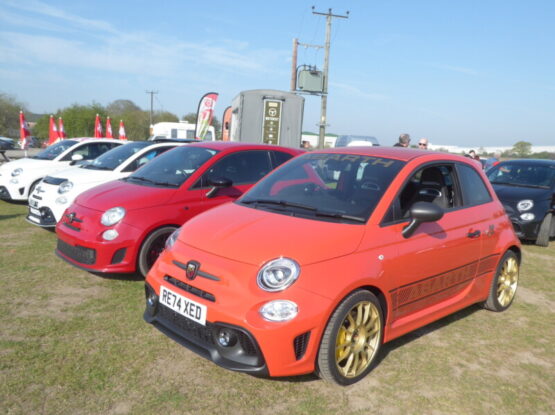
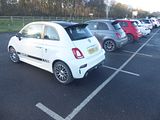
An area in the main car park had been reserved for Abarths, though other people visiting the site seemed to pay little or no attention to the signs saying so, and it was quite a task for the SSH admin team to try to ensure that all the Abarths could park together. They more or less succeeded.
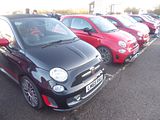
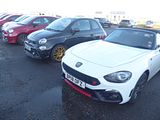


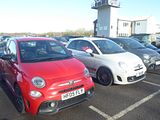
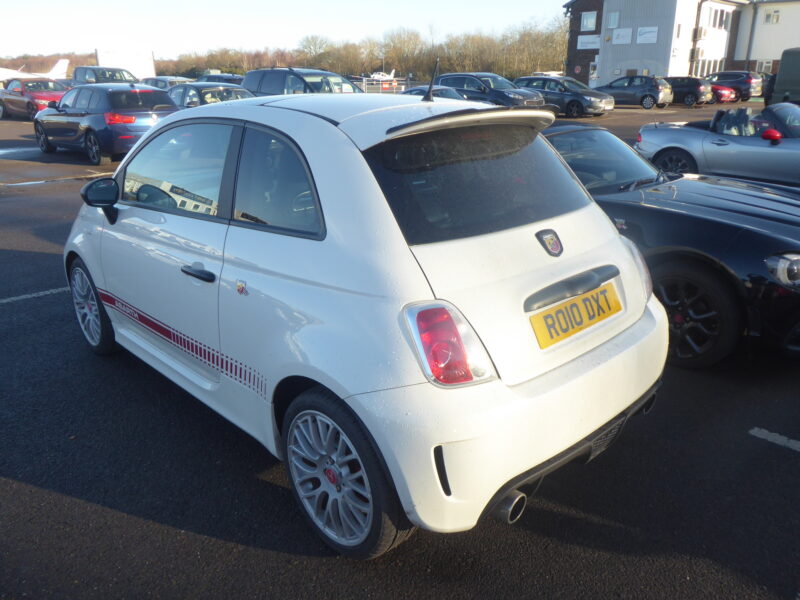
The vast majority of cars here were the 500-based models which have been on sale now since the end of 2008, following a launch at the Paris Show that year. Since that time there have been a number of detailed changes to the standard cars and a lot of limited editions. Those who really know the marque can spot most of them, but some are so subtle that unless there is a badge you can see, you will not be quite sure which version you are looking at. It used to be relatively easy, when the model was first launched, as there was only one version as shipped ex works called the 500. It had a 135 bhp 1.4 litre turbo-charged engine coupled to a five speed manual gearbox, with 16″ alloys as standard, and the option of 17″ wheels, and a colour palette comprising of two whites (BossaNova White, the standard colour, or the pearlescent Funk White), Red (Pasadoble), Pale Grey (Campovolo) or Black. If you wanted more power – 160 bhp – then you could order an Esseesse kit, which came in a large wooden crate, containing new wheels, springs, an ECU upgrade, the Monza exhaust system and badging. It was dealer fitted and could be applied at any time within the first 12 months or 10,000 miles from registration. Needless to say, it proved popular. As were many of the optional extras, with stickers for the sides, a large scorpion for the bonnet and even a chequered pattern for the roof among the personalisation options offered. Several of the original style of cars were here, a couple of them showing fairly significant personalisation touches applied by their owners.


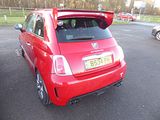
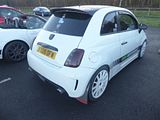
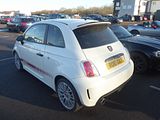
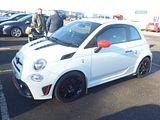

Having used the legendary 695 badging from the 1960s on the Tributo cars, at the 2012 Geneva Show, Abarth dusted off the 595 name that had been used on the less powerful of the Nuova 500 based cars of the same generation, and created two new versions which we should think of as Series 2 cars, the 595 Turismo and Competizione, both of which could be bought in either closed or open top C guise, with either the 5 speed manual or robotised automated gearshifts. Both models had the 160 bhp engine as standard. Effectively they were a replacement for the Esseesse kit, and it meant that the cars were produced complete at the factory, rather than needing the dealer to undertake the upgrade (and the associated paperwork), though Abarth did not withdraw the Esseesse kits from the market for some while. Turismo, as the name suggests was aimed slightly less extreme in intent, featuring standard leather upholstery, upgraded dampers and climate control, Xenon headlights and Alutex interior details. The sportier Abarth 595 Competizione replaced the leather seats with Sabelt cloth sport seats and Alutex with aluminium, while adding p-cross-drilled brakes and the Record Monza dual-mode exhaust.

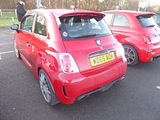
Rumours started to circulate towards the end of 2014 that Abarth were going to upgrade the Competizione model, so as better to bridge the gap between the Turismo and the 190 bhp 695 Biposto that had been added to the range earlier in the year. It was Geneva 2015 when the result was finally shown to an expectant fan base. Most exciting news was that thanks to a bigger Garrett Turbo, the engine had been tweaked to 180 bhp, and with reduced CO2 emissions. A standard spec that included Koni Dampers, Brembo brakes, Xenon lights, Sabelt seats, Climate Control, parking sensors as well as other refinements that had been added like the TFT instrument display all proved very compelling, so not long after the first cars reached the UK in June of 2015, I found temptation too hard to resist, and as is well documented here, swapped my 2010 car for one of these. At the time I ordered it, Cordolo Red, a tri-coat pearlescent paint which shimmers in bright sunlight looked set to become one of the most popular colours of the lot, even though it is a cost option. Indeed, the Launch Edition models were all offered either in this colour or Scorpion Black, with black wheels. Surprisingly, the colour was not carried over to the Series 4 cars.


The Series 4 version of the familiar 595 first reached the markets in the middle of 2016. After rumours had circulated all winter following the launch of the facelifted Fiat 500 in 2015, Abarth finally unveiled the Series 4 at the end of May 2016. Initially, we were told that the cars would not be available in the UK until September, but that came forward somewhat, with dealers all receiving demo cars in June, and the first customers taking delivery in July. Three regular production versions of both the closed car and the open-topped C were initially available, all badged 595, and called Custom, Turismo and Competizione, as before, though numerous limited edition models have since appeared and in most case disappeared. The most significant changes with the Series 4 are visual, with a couple of new colours, including the much asked for Modena Yellow and a different red, called Abarth Red, which replaces both the non-metallic Officina and – slightly surprisingly – the tri-coat pearlescent Cordolo Red. as well as styling changes front and rear. The jury is still out on these, with many, me included, remaining to be convinced. At the front, the new air intake does apparently allow around 15 – 20 % more air in and out, which will be welcome, as these cars do generate quite a lot of heat under the bonnet. Competizione models for the UK retain the old style headlights, as they have Xenon lights as standard, whereas the Custom and Turismo cars have reshaped units. At the back, there are new light clusters and a new rear bumper and diffuser. Inside, the most notable change is the replacement of the Blue & Me system with a more modern uConnect Audio set up, which brings a new colour screen to the dash. Mechanically, there is an additional 5 bhp on the Custom (now 145) and Turismo (now 165 bhp) and the option of a Limited Slip Diff for the Competizione, which is likely to prove a popular option. Details of the interior trim have changed, with a filled-in glovebox like the US market cars have always had, and electric windows switches that are like the US ones, as well as a part Alcantara trim to the steering wheel in Competizione cars.


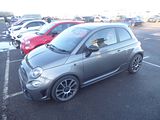

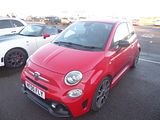


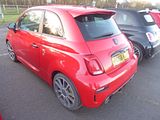
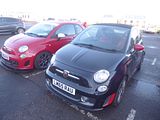
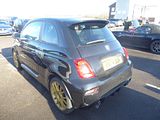
Abarth announced two limited edition models in the autumn of 2020 and one of these was here, the 595 Scorpioneoro. Another model which takes its inspiration from a history which few in the Uk will be familiar with, there will be just 2000 units of this distinctive model available globally. The 595 Scorpioneoro was born to continue the legacy of the famous A112 Abarth “Gold Ring” of 1979, better known as the A112 Abarth “Targa Oro”, of which only 150 models produced and, as with the new Abarth 595 Scorpioneoro, what made it so special were its stylistic details. These details included black livery, gold-coloured decorative line contouring the bodywork and the alloy wheels, also painted in the distinctive gold colour. This car is liveried in the same way, marked out by its black livery, decorative gold bodywork lining and gold-painted alloy wheels. It also boasts a matt black chessboard roof and grey finish on the door handles and mirror caps. And to mirror the ‘Gold Scorpion’ name, the car is adorned with gold scorpions on the bonnet and the wheel centres. Inside the cabin of this new exciting new model, you’ll be greeted with a black dashboard which is home to the new gold finished 500 logo. Leather detailing on the seats introduces the original “scorpionflage”. The seats are further embellished with dedicated stitching and personalised headrests with the word “Scorpioneoro”, the Italian flag and Abarth embroidered on them. An additional touch of exclusivity comes from the numbered, gold coloured plaque, available solely on this model. The Scorpioneoro also comes with Abarth’s top-of-the-range seven-inch touchscreen infotainment system, complete with Apple CarPlay and Android Auto, as well as a Beats Audio sound system. Mechanically, there is nothing new, as the car has the 165 bhp version of the familiar T-Jet engine and the other features you get in the regular production Trofeo cars.


Newest of all the various versions produced is the model that turned out to be the last of a long line of limited production cars, the 75th Anniversary car. This is a 695 model, which means it has the 180PS engine. Mechanically it is no different to the regular Turismo and Competizione models in the regular range but you do get some special graphics and pretty every item that is available on an Abarth is included in the standard spec, as you would rather hope for a car with a list price of £32,995. You will identify one by its Scorpione Black paint, the Gold Scorpion Sticker on the roof, Gold Abarth lateral stickers, a 75th Abarth Piston Head sticker and the 17″ Formula Gold alloy wheels. Inside there are Sabelt carbon seats with unique stitching & 75th Logo, an alcantara dashboard and binnacle cover and an aluminium gearknob as well as a sports steering wheel in leather and Alcantara® with carbon fibre detailing. The spec also includes a High Performance BMC air filter, Black Brembo brake calipers, Koni front and rear suspension with FSD technology (Frequency Selective Damping), and an Active “Record Monza Sovrapposto” Exhaust with Rotated Tips


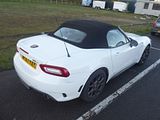
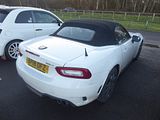
Eagerly awaited, the 124 Spider went on sale in September 2016. A quick reminder as to what this car is: The Abarth 124 Spider was developed in parallel with the Fiat model. It does cost a lot more, and there are those who think you don’t get enough extra for your money, but those who have driven it will tell you otherwise. You certainly get more power. The 1.4 MultiAir turbo unit jumps up from 138bhp to 168bhp, while torque also increases by a modest 10Nm to 250Nm, which gives it a 0-62mph time of 6.8 seconds, which is half a second quicker than the 2.0-litre Mazda MX-5. The top speed is 143mph. It weighs just 1060kg meaning a power-to-weight ratio of 158bhp-per-tonne, and with the new Record Monza exhaust system it sounds great even at idle. The Abarth version gets a stiffer suspension setup than the regular Fiat 124 Spider, with Bilstein dampers and beefed-up anti-roll bars. Bigger Brembo brakes also feature, with aluminium calipers. It can be had with a six-speed manual or six-speed automatic transmission with paddles, and the latter gets a Sport mode for quicker shifts. Many of the UK cars sport the ‘Heritage Look’ pack, which is a no-cost option. It brings a matt black bonnet and bootlid, plus red exterior trim detailing and has proved popular. The £29,565 starting price gets you standard equipment such as cruise control, climate control, Bluetooth, a DAB radio and satnav, plus Alcantara black and red (or pure black) seat trim. The automatic gearbox is a £2,035 extra, while an optional visibility pack brings LED DRLs, auto lights and wipers and rear parking sensors. The final cars were sold during 2019, so there are only around 1800 of them in the UK, which means that this is always going to be quite a rare sighting



OTHER CARS
There were plenty of other cars on site, most of which are in the category of “everyday or unmemorable”, but a few stood out. Here they are:


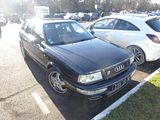
Audi RS2 Avant: The Audi RS2 Avant, usually known as Audi 80 RS2, was a limited edition, high-performance Audi five-door, five-seat estate car manufactured from March 1994 to July 1995. Collaboratively designed as a joint venture between Audi AG and Porsche and built on Audi’s 80 Avant, designated internally as P1 (instead of B4/8C that it was based on). It was Audi’s first “RS” vehicle, and the first of their high-performance Avants. It was powered by a modified version of their 2,226 cc inline 5 DOHC 4 valves/cylinder 20 valves total turbocharged petrol engine. This produced 315 PS (311 bhp) @ 6,500 rpm and 410 Nm (302 lb/ft) @ 3000 rpm of torque. Although much of the car’s underpinnings were manufactured by Audi, assembly was handled by Porsche at their Rossle-Bau plant in Zuffenhausen, Germany, which had become available after discontinuation of the Mercedes-Benz 500E, which Porsche had manufactured there under contract. The Rossle-Bau plant also produced the famous Porsche 959. Like the rest of the vehicle, the RS2’s five-cylinder engine was based on a unit that Audi already produced, although Porsche considerably modified the engine; the standard KKK turbocharger was switched for a larger unit, along with a heavy-duty intercooler and higher flow fuel injectors, a newly designed camshaft, a more efficient induction system, and a low-pressure exhaust system replaced the standard fare; a specially modified URS4/URS6 Bosch-supplied engine management system (ECU) controlled the engine. With so much power available, the RS2 could accelerate from 0 to 100 km/h (62 mph) in 4.8 seconds, and achieve a maximum speed of 262 km/h (163 mph) (electronically restricted), despite weighing over 1,600 kg (3,500 lb). In a road test conducted in 1995, British car magazine Autocar timed the RS2 from 0 to 30 mph (48 km/h) at just 1.5 seconds, which they confirmed was faster than both the McLaren F1 road car, and also Jacques Villeneuve’s Formula One car of that time. Even by more modern standards, its performance is exceptional; it could accelerate on-par with the 5th generation Chevrolet Corvette (C5) and a 996 generation Porsche 911. The top speed was 166 mph (267 km/h). A six-speed manual gearbox was the only transmission choice. Audi’s Torsen-based ‘trademark’ quattro permanent four-wheel drive system was standard. Front and rear final drive units contained a conventional ‘open’ differential, and have a ratio of 4.111, although the rear also has an electro-mechanical diff lock. Porsche-designed braking and suspension systems replaced the standard Audi 80 equipment, however, the Bosch Anti-lock braking system (ABS) was retained. There were upgraded brakes, with large radially ventilated disc brakes, and Brembo four-opposed piston fixed calipers. 40 millimetres (1.6 in) lower than a standard 80 Avant, the suspension and braking upgrades combined to give the RS2 the handling and braking capabilities of a high-end sports car; 7.0Jx17 inch Porsche ‘Cup’ wheels, and high-performance 245/40 ZR17 Dunlop tyres were standard as well. In fact, the braking system wore Porsche-badged Brembo calipers, and both the wheels and side mirrors were identical in design to those of the 964 Turbo. Additionally, the word “PORSCHE” is inscribed in the RS2 emblem affixed to the rear tailgate and front grille. A three-spoke leather steering wheel, Recaro sports-bucket seats (available in full leather or a leather/suede combination), and console materials in either wood or carbon fibre trim rounded out the vehicle’s interior changes. Audi’s proprietary Safety Restraint System, procon-ten remained from its donor vehicle. Approximately 2200 RS2s were to be built initially, but due to demand the total was 2891 cars built. Of these, only 180 were right hand drive cars built for the UK, New Zealand and South African markets.

Mercedes-Benz AMG GT-S: The Mercedes-AMG GT is a series of 2-door sports cars produced by German automobile manufacturer Mercedes-AMG. The car was introduced on 9 September 2014 and was officially unveiled to the public in October 2014 at the Paris Motor Show. While not directly replacing the SLS AMG (competing in a different segment), it is the second sports car developed entirely in-house by Mercedes-AMG. The Mercedes-AMG GT went on sale in two variants (GT and GT S) in March 2015, while a GT3 racing variant of the car was introduced in 2015. A high performance variant called the GT R was introduced in 2016. A GT4 racing variant, targeted at semi-professional drivers and based on the GT R variant, was introduced in 2017. In 2021, a new variant called the AMG GT Black Series was released. All variants are assembled at the Mercedes-Benz plant in Sindelfingen, Germany. The interior of the Mercedes-AMG GT was previewed on 16 April 2014. The car made its debut on 9 September 2014 and was officially unveiled to the public in October 2014 at the Paris Motor Show. The GT’s exterior design was kept similar to that of the preceding SLS AMG, with wide wheel arches, lower bodywork, and fastback sloping roofline of the SLS AMG, but using conventional forward-opening doors instead of the iconic gullwing style pioneered by the 300 SL in the 1950s. It also employed an upgraded and shortened version of the Transaxle Spaceframe platform used by the SLS. The vehicle structure is made up of 93% aluminium, with the front module base made up of magnesium. The exterior lead designer was Mark Fetherston, whose previous works include the W176 A-Class, the CLA-Class, and SLS AMG. The interior, designed by Jan Kaul, features a large centre console and decorative elements in a leather and carbon polymer design. The trunk offers room for a medium-sized suitcase. Two engine power output options were offered: the GT, with 462 PS/456 hp, and the GT S with 510 PS/ 503 hp. The GT generates 600 N⋅m (443 lb⋅ft) of torque, and the GT S generates 650 N⋅m (479 lb⋅ft) of torque. Shortly after its introduction, Mercedes-AMG CEO at the time, Tobias Moers, promised a Black Series variant of the Mercedes-AMG GT.[15] The new high performance variant was called the AMG GT R. The Mercedes-AMG family was given a facelift in 2017, along with the introduction of the GT C roadster variant and the Edition 50 model, which is a limited-edition derivative of the GT C variant. The key improvements made as part of the facelift include increased power output from the M178 engine for the GT and GT S variants (10 kW and 9 kW respectively) and the inclusion of the ‘Panamericana’ grille from the GT3, GT4 and GT R variants as standard equipment for all variants. The GT is the entry level variant of the Mercedes-AMG GT family. The M178 engine in this variant is tuned to an output of 462 PS/456 hp and 601 Nm (443 lb/ft) of torque, with the key differences between this and its more expensive siblings being a mechanical limited-slip differential, an absorbent glass mat battery, the lack of the “Race Mode” setting in the AMG Dynamic Select adaptive drivetrain system, the lack of the AMG Ride Control adaptive suspensive system, and a passive AMG Sport Exhaust System. Keyless-Go is also an optional feature, as opposed to standard equipment. The GT is equipped with 19-inch wheels at the front and rear. The GT S is a more highly equipped variant of the Mercedes-AMG GT. The M178 engine in this variant is tuned to an output of 510 PS/503 hp and 651 Nm (480 lb/ft) of torque. The key mechanical differences the GT S gains over the GT include an electronically controlled limited-slip differential, “Race Mode” and “Race Start” mode settings in the AMG Dynamic Select adaptive drivetrain system, AMG Ride Control adaptive suspensive system, an AMG Performance Exhaust System with dynamic flaps, and a lithium-ion battery. Keyless-Go is standard equipment, as is a staggered set of wheels (19-inch at the front, 20-inch at the rear). As with many other recent Mercedes-AMGs, at the time of introduction a limited production “Edition 1” series was issued of the GT S. 375 examples were sold worldwide, and include a gloss black aerodynamic set including a front splitter, lower wheelwell extensions, a carbon fibre roof, a fixed rear wing, red interior accents and red brake calipers, and various other extras. In October 2021, Mercedes-Benz announced the new Mercedes-AMG R232 SL-Class as the direct successor for the roadster version. The second-generation coupe version of the GT, which was introduced nearly a year after the first-generation was discontinued, was redesigned on the same platform as the SL, but retains the name AMG GT.

Smart Roadster: The Smart Roadster and Roadster Coupé were introduced in 2003, based on a stretched platform of the Fortwo with a full length of 3427 mm. The two variants are meant to be reminiscent of the British roadster of yore, such as the Triumph Spitfire or the MG B. Both the Roadster and Roadster Coupé are available with a removable Targa roof or an electrical softtop. The Roadster is powered by 61 or 82 PS versions of the turbocharged 698cc 3-cylinder Suprex engine in the rear, which is engineered by Mercedes-Benz. The Roadster Coupé has only the more powerful 80 bhp engine. A steering wheel with Formula 1-style paddle-shifters, to control the single-clutch automated manual transmission, is optional. Weighing as little as 790 kg (1,742 lb), the Roadster is intended to provide the emotion of driving a sports car at an affordable cost. Both the Roadster and Roadster Coupé are available in Brabus-tuned versions with power increased to 99 bhp. The Brabus versions have a different twin sports exhaust, lower suspension, polished six-spoke aluminium alloy Monoblock VI 17″ wheels (205/40 ZR17 at the front and 225/35 ZR17 at the rear), front spoiler, side skirts and radiator grille. Exclusive Brabus (Xclusive) interior includes a leather-trimmed dashboard, alloy-effect accent parts, instrument graphics, leather/aluminium gearshift with Brabus labelled starter button, aluminium handbrake handle (which fouls the central armrest), aluminium pedals and Brabus labelled floor mats. The Brabus version also features stronger clamping of the clutch plates and a faster gearchange. The Monoblock wheels are known to be very soft and as a result, are very easy to buckle. The lacquer on these wheels is also very poor, and corrosion can occur very early in the life of the wheel. Despite a projected break-even of only 8-10,000 units per year, first-year sales almost doubled this estimate. However, some Smart Roadsters leaked and production ceased due to the warranty work and other costs reaching an average of €3000 per vehicle. While a critical success, the Smart Roadster was, due to these costs, an economic failure for the company. Influential British motoring television show and magazine Top Gear praised the Roadster, awarding it Fun Car Of The Year for 2005. 43,091 Roadsters were built and put on the shop fronts, with chassis numbers ranging from 00,001 to around 43,400.

THE VENUE
The area the airport sits on was more commonly known as Hartford Bridge Flats. It was part of almost unbroken heathland stretching between Bagshot and Hartley Wintney. What is now the A30 was the main London-Exeter coaching route, there are many legends of highway men operating along this road. The area remained very rural until the development of Blackwater and Camberley in the mid 1800’s. In 1891 the airport land was purchased by the Calthorpe Family but remained undeveloped heathland, even up to the building of the airport. In 1938 the War Department purchased nearby Minley Manor and established a tank training base. In 1941 Hartford Bridge Flats was surveyed as a new air base and the site requisitioned in October. This included over 650 acres from the Calthorpe Estate, Yateley Parish, and other owners. The massive base would take over a year to complete and eventually the domestic accommodation would cover much of what would become the residential estates you see in Yateley today. The first aircraft to land was a Miles Magister from RAE Farnborough on 9 September 1942. The RAE from Farnborough were to be the first occupants of the incomplete base. They tested the new large troop-carrying gliders; the Horsa, Hamilcar and Hotspur. Officially RAF Hartford Bridge opened on 1 November 1942. RAF bomber and fighter squadrons moved in, making RAF Hartford Bridge one of the few bases to house five squadrons at the same time. In early 1944 a prototype fog dispersal system was installed. It pumped old aviation fuel along pipes each side of the runway which was then ignited. The heat generated dispersed the fog. It was massively expensive to operate, consuming as much as 450,000 litres per hour so was only used on a small number of occasions. The original pipes are still visible today both on the ground and from aerial imagery of the airport. By 1944 Blackbushe housed around 2,000 RAF personnel. Much of Southern part of modern day Yateley was covered in accommodation sites. These were normally pockets of 20-30 huts. The area now covered by Blackbushe Business park contained the Officers’ and airmen’s mess, camp hospital, cinema, barbers and the NAAFI canteen.

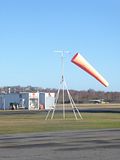
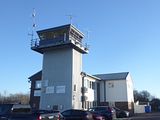
These days the airport is used for private aviation, which can mean everything from small jets operating commercial services to the planes owned by enthusiasts and a flying school. I was quite surprised by just how much activity there was on a Saturday morning in January with almost constant take-offs and landings and even there were plenty of occasions when planes had to queue before they could take off. Some were clearly people going out on flying lessons.
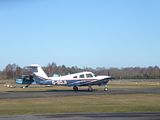


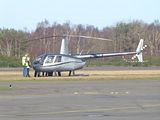
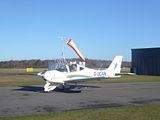


There are a number of historic exhibits here, with activities led by the Blackbushe Heritage Trust, whose aims is to build a heritage centre at Blackbushe Airport, celebrating over 80 years of aviation history. Central to this is restoration of G-AGRW to her former glory as a static exhibit. This is one of the few remaining Vickers Viking aircraft in the world and was found sitting alone on an airfield a little outside Vienna. The trust arranged to being the plane home to Blackbushe and is now bringing her back to life.

I really enjoyed my morning here. The Café served up a decent breakfast and coffee, there was the chance to catch up with a number of Abarth friends, some of whom I had not seen for a while, and the site itself was interesting to wander around, as well as all the activity on the air field. I stayed quite a lot longer than I had expected I would do, and will certainly try to attend some of the other meetings here during 2025.