The first few weeks of the year may be a quiet time of the year, car events wise, but that does not mean there is nothing going on. Far from it! One consequence of a whole raft of venues like Caffeine & Machine springing up around the country, along with Farm Shops and other places that have a decent amount of parking on hard-standing and plenty of space inside where decent quality food and drink is on offer on at reasonable prices, is that there is no shortage of places for friends, groups and Car Clubs. My winter diary evidences that very nicely. So having had a day with the Abarth Surrey Sussex and Hampshire the preceding weekend, this time it was the chance to meet up with the Abarth West Midlands crew who had booked some tables for a mid-morning breakfast at an increasingly well-known venue on the brow of a hill, on the main road between Alcester and Stratford-on-Avon, called The Piston Club, and also by its Pub name of The Stag. I’ve been a couple of times before, and loved the interior with its collection of automotive memorabilia, and found that the food, be that breakfast or the legendary Sunday roasts lives up to reputation, and the place is only about 20 minutes from my mother’s house, so I can combine a visit to see her with coming to this location. I signed up and ordered my breakfast, in advance, as requested to ensure the venue had an idea of numbers and got excited for this meet, looking all the more promising when I awoke and found a gloriously sunny (if rather cold) morning. Here is what I found whilst on site:
THE PISTON CLUB
Long before there was The Piston Club, there was a pub here, called The Stag, which is a lot larger than you think from a roadside viewing. There are rooms here so you can stay overnight. Like many such pubs, in recent years it has been subject to a modernisation program and it would be an attractive place to visit in its own right. But now it is also home, to The Piston Club. This is the brainchild from the owners of Power Maxed Racing, a multiple race winning team in the British Touring Car championship, who are based locally, and who have a very visible unit in the car park that you can see from the road, even if you do miss the more discrete signs. There’s loads of space to sit outside – when the weather is warmer that would be attractive, but perhaps not today! And the expansive indoors, with multiple interconnected rooms can accommodate a lot of people. There are displays of Classic Car Models, Vintage Car Advertisements, Racing Memorabilia, Automotive Signage and Garage Décor, Vintage Automotive Tools, Vintage Car Badges and Emblems, Race Track Memorabilia, Photography and Autographs and some Stunning Prints, Drawings and Paintings by artists old and new, many signed by artist and drivers. It really is a fascinating place.


PORSCHE CLUB GB BEAT US TO IT
When I arrived on site, one of the first Abarths to do so, the car park was pretty much full, mostly with Porsche models. And they continued to arrive, in some quantity. It turned out that the local chapter of the Porsche Club GB had decided to include this as part of a day out. They had not booked, and not only did they fill the car park, they then dominated the coffee queues. There was quite a lot of variety in the Porsche models present here, as you might expect.


The 911 continued to evolve throughout the 1960s and early 1970s, though changes initially were quite small. The SC appeared in the autumn of 1977, proving that any earlier plans there had been to replace the car with the front engined 924 and 928 had been shelved. The SC followed on from the Carrera 3.0 of 1967 and 1977. It had the same 3 litre engine, with a lower compression ratio and detuned to provide 180 PS . The “SC” designation was reintroduced by Porsche for the first time since the 356 SC. No Carrera versions were produced though the 930 Turbo remained at the top of the range. Porsche’s engineers felt that the weight of the extra luxury, safety and emissions equipment on these cars was blunting performance compared to the earlier, lighter cars with the same power output, so in non-US cars, power was increased to 188 PS for 1980, then finally to 204 PS. However, cars sold in the US market retained their lower-compression 180 PS engines throughout. This enabled them to be run on lower-octane fuel. In model year 1980, Porsche offered a Weissach special edition version of the 911 SC, named after the town in Germany where Porsche has their research centre. Designated M439, it was offered in two colours with the turbo whale tail & front chin spoiler, body colour-matched Fuchs alloy wheels and other convenience features as standard. 408 cars were built for North America. In 1982, a Ferry Porsche Edition was made and a total of 200 cars were sold with this cosmetic package. SCs sold in the UK could be specified with the Sport Group Package (UK) which added stiffer suspension, the rear spoiler, front rubber lip and black Fuchs wheels. In 1981 a Cabriolet concept car was shown at the Frankfurt Motor Show. Not only was the car a true convertible, but it also featured four-wheel drive, although this was dropped in the production version. The first 911 Cabriolet debuted in late 1982, as a 1983 model. This was Porsche’s first cabriolet since the 356 of the mid-1960s. It proved very popular with 4,214 sold in its introductory year, despite its premium price relative to the open-top targa. Cabriolet versions of the 911 have been offered ever since. 911 SC sales totalled 58,914 cars before the next iteration, the 3.2 Carrera, which was introduced for the 1984 model year. Coupe models outsold the Targa topped cars by a big margin.


During the 1990s, Porsche was facing financial troubles and rumours of a proposed takeover were being spread. The signature air-cooled flat-6 of the 911 was reaching the limits of its potential as made evident by the 993. Stricter emissions regulations world wide further forced Porsche to think of a replacement of the air-cooled unit. In order to improve manufacturing processes, Porsche took the aid of leading Japanese car manufacturer Toyota whose consultants would assist in the overhaul of the Zuffenhausen manufacturing facility introducing mass production techniques which would allow Porsche to carry out production processes more efficiently. Porsche had realised that in order to keep the 911 in production, it would need radical changes. This led to the development of the 996. The sharing of development between the new 911 and the entry level Boxster model allowed Porsche to save development costs. This move also resulted in interchangeable parts between the two models bringing down maintenance costs. The Porsche 996 was a new design developed by Pinky Lai under Porsche design chief Harm Lagaay from 1992 to 1994; it was the first 911 that was completely redesigned, and carried over little from its predecessor as Porsche wanted the design team to design a 911 for the next millennium. Featuring an all new body work, interior, and the first water-cooled engine, the 996 replaced the 993 from which only the front suspension, rear multi-link suspension, and a 6-speed manual transmission were retained in revised form. The 996 had a drag coefficient of Cd=0.30 resulting from hours spent in the wind tunnel. The 996 is 185 mm (7 in) longer and 40 mm (2 in) wider than its predecessor. It is also 45% stiffer courtesy of a chassis formed from high-strength steel. Additionally, it is 50 kg (110 lb) lighter despite having additional radiators and coolant. All of the M96 engines offered in the 996 (except for the variants fitted to the Turbo and GT2/GT3 models) are susceptible to the Porsche Intermediate Shaft Bearing issue which can potentially cause serious engine failure if not addressed via a retrofit. The 996 was initially available in a coupé or a cabriolet (Convertible) bodystyle with rear-wheel drive, and later with four-wheel drive, utilising a 3.4 litre flat-6 engine generating a maximum power output of 296 bhp. The 996 had the same front end as the entry-level Boxster. After requests from the Carrera owners about their premium cars looking like a “lower priced car that looked just like theirs did”, Porsche redesigned the headlamps of the Carrera in 2002 similar to the high performance Turbo’s headlamps. The design for the initial “fried egg” shaped headlamps could be traced back to the 1997 911 GT1 race car. In 2000, Porsche introduced the 996 Turbo, equipped with a four-wheel-drive system and a 3.6-litre, twin-turbocharged and intercooled flat-six engine generating a maximum power output of 420 bhp, making the car capable of accelerating from 0–60 mph in 4.2 seconds. An X50 option which included larger turbochargers and intercoolers along with revised engine control software became available from the factory in 2002, increasing power output to 451 bhp. In 2005, Porsche introduced the Turbo S, which had the X50 option included as standard equipment, with the formerly optional Carbon fibre-reinforced Silicon Carbide (C/SiC) composite ceramic brakes (PCCB) also included as standard. In 2000, power output on the base Carrera model was increased to 300 bhp. 2001 marked the final year of production for the base Carrera 4 Coupé in narrow body format. In 2002, the standard Carrera models underwent the above-mentioned facelift. In addition, engine capacity was also increased to 3.6-litres across the range, yielding gains of 15 bhp for the naturally aspirated models. 2002 also marked the start of the production of the 996 based Targa model, with a sliding glass “green house” roof system as introduced on its predecessor. It also features a rear glass hatch which gave the driver access to the storage compartment. Also in 2002, the Carrera 4S model was first introduced.

The 996 was replaced with the 997 in 2005. It retains the 996’s basic profile, with an even lower 0.28 drag coefficient, but draws on the 993 for detailing. In addition, the new headlights revert to the original bug-eye design from the teardrop scheme of the 996. Its interior is also similarly revised, with strong links to the earlier 911 interiors while at the same time looking fresh and modern. The 997 shares less than a third of its parts with the outgoing 996, but is still technically similar to it. Initially, two versions of the 997 were introduced— the rear-wheel-drive Carrera and Carrera S. While the base 997 Carrera had a power output of 321 hp from its 3.6 L Flat 6, a more powerful 3.8 L 350 hp Flat 6 powers the Carrera S. Besides a more powerful engine, the Carrera S also comes standard with 19 inch “Lobster Fork” style wheels, more powerful and larger brakes (with red calipers), lowered suspension with PASM (Porsche Active Suspension Management: dynamically adjustable dampers), Xenon headlamps, and a sports steering wheel. In late 2005, Porsche introduced the all-wheel-drive versions to the 997 lineup. Carrera 4 models (both Carrera 4 and Carrera 4S) were announced as 2006 models. Both Carrera 4 models are wider than their rear-wheel-drive counterparts by 1.76 inches (32 mm) to cover wider rear tyres. The 0–100 km/h (62 mph) acceleration time for the Carrera 4S with the 350 hp engine equipped with a manual transmission was reported at 4.8 seconds. The 0–100 km/h (62 mph) acceleration for the Carrera S with the 350 hp was noted to be as fast as 4.2 seconds in a Motor Trend comparison, and Road & Track has timed it at 3.8 seconds. The 997 lineup includes both 2- and 4-wheel-drive variants, named Carrera and Carrera 4 respectively. The Targas (4 and 4S), released in November 2006, are 4-wheel-drive versions that divide the difference between the coupés and the cabriolets with their dual, sliding glass tops. The 997 received a larger air intake in the front bumper, new headlights, new rear taillights, new clean-sheet design direct fuel injection engines, and the introduction of a dual-clutch gearbox called PDK for the 2009 model year. They were also equipped with Bluetooth support. The change to the 7th generation (991) took place in the middle of the 2012 model year. A 2012 Porsche 911 can either be a 997 or a 991, depending on the month of the production.

The 991 introduced in 2012 is an entirely new platform, only the third since the original 911. Porsche revealed basic information on the new Carrera and Carrera S models on 23 August 2011. The Carrera is powered by a 350 hp 3.4-litre engine. The Carrera S features a 3.8-litre engine rated at 400 hp. A Power Kit (option X51) is available for the Carrera S, increasing power output to 430 hp. The new 991’s overall length grows by 56 mm (2.2 in) and wheelbase grows by 99 mm (3.9 in) (now 96.5 in.) Overhangs are trimmed and the rear axle moves rearward at roughly 76 mm (3 in) towards the engine (made possible by new 3-shaft transmissions whose output flanges are moved closer to the engine). There is a wider front track (51 mm (2 in) wider for the Carrera S). The design team for the 991 was headed by Michael Mauer. At the front, the new 991 has wide-set headlights that are more three-dimensional. The front fender peaks are a bit more prominent, and wedgy directionals now appear to float above the intakes for the twin coolant radiators. The stretched rear 3/4 view has changed the most, with a slightly more voluminous form and thin taillights capped with the protruding lip of the bodywork. The biggest and main change in the interior is the centre console, inspired by the Carrera GT and adopted by the Panamera. The 991 is the first 911 to use a predominantly aluminium construction. This means that even though the car is larger than the outgoing model, it is still up to 50 kilograms (110 lb) lighter. The reduced weight and increased power means that both the Carrera and Carrera S are appreciably faster than the outgoing models. The 0–60 mph acceleration time for the manual transmission cars are 4.6 seconds for the Carrera and 4.3 seconds for the Carrera S. When equipped with the PDK transmission, the two 991 models can accelerate from 0–97 km/h in 4.4 seconds and 4.1 seconds. With the optional sports chrono package, available for the cars with the PDK transmission, the 991 Carrera can accelerate from 0–97 km/h in as little as 4.2 seconds and the Carrera S can do the same in 3.9 seconds. Apart from the reworked PDK transmission, the new 991 is also equipped with an industry-first 7-speed manual transmission. On vehicles produced in late 2012 (2013 model year) Rev Matching is available on the 7-speed manual transmission when equipped with the Sport Chrono package. Rev-Matching is a new feature with the manual transmission that blips the throttle during downshifts (if in Sport Plus mode). Also, the 7th gear cannot be engaged unless the car is already in 5th or 6th gear. One of Porsche’s primary objectives with the new model was to improve fuel economy as well as increase performance. In order to meet these objectives, Porsche introduced a number of new technologies in the 911. One of the most controversial of these is the introduction of electromechanical power steering instead of the previous hydraulic steering. This steering helps reduce fuel consumption, but some enthusiasts feel that the precise steering feedback for which the 911 is famous is reduced with the new system.[citation needed] The cars also feature an engine stop/start system that turns the engine off at red lights, as well as a coasting system that allows the engine to idle while maintaining speed on downhill gradients on highways. This allows for up to a 16% reduction in fuel consumption and emissions over the outgoing models. The new cars also have a number of technologies aimed at improving handling. The cars include a torque vectoring system (standard on the Carrera S and optional on the Carrera) which brakes the inner wheel of the car when going into turns. This helps the car to turn in quicker and with more precision. The cars also feature hydraulic engine mounts (which help reduce the inertia of the engine when going into turns) as part of the optional sports chrono package. Active suspension management is standard on the Carrera S and optional on the Carrera. This helps improve ride quality on straights while stiffening the suspension during aggressive driving. The new 991 is also equipped with a new feature called Porsche Dynamic Chassis Control (PDCC). Porsche claims that this new feature alone has shaved 4 seconds off the standard car’s lap time around the Nürburgring. PDCC helps the car corner flat and is said to improve high-speed directional stability and outright lateral body control, but according to several reviews, the car is more prone to understeer when equipped with this new technology. In January 2013, Porsche introduced the all-wheel-drive variants of the Carrera models. The ‘4’ and ‘4S’ models are distinguishable by wider tyres, marginally wider rear body-work and a red-reflector strip that sits in between the tail-lights. In terms of technology, the 4 and 4S models are quipped with an all-new variable all-wheel-drive system that sends power to the front wheels only when needed, giving the driver a sense of being in a rear-wheel-drive 911. In May 2013, Porsche announced changes to the model year 2014 911 Turbo and Turbo S models, increasing their power to 513 hp on the ‘Turbo’, and 552 hp on the ‘Turbo S’, giving them a 0–97 km/h acceleration time of 3.2 and 2.9 seconds, respectively. A rear-wheel steering system has also been incorporated on the Turbo models that steers the rear wheels in the opposite direction at low speeds or the same direction at high speeds to improve handling. During low-speed manoeuvres, this has the virtual effect of shortening the wheelbase, while at high speeds, it is virtually extending the wheelbase for higher driving stability and agility. In January 2014, Porsche introduced the new model year 2015 Targa 4 and Targa 4S models. These new models come equipped with an all-new roof technology with the original Targa design, now with an all-electric cabriolet roof along with the B-pillar and the glass ‘dome’ at the rear. In September 2015, Porsche introduced the second generation of 991 Carrera models at the Frankfurt Motor Show. Both Carrera and Carrera S models break with previous tradition by featuring a 3.0-litre turbocharged 6-cylinder boxer engine, marking the first time that a forced induction engine has been fitted to the base models within the 911 range


The latest version of the long-lived 911 nameplate is known as the 992, and there were examples of this generation here as well.


Porsche unveiled their latest Boxster Spyder based on the 981 Boxster in April 2015 at the New York Auto Show. The Spyder is a lightweight high performance version of the Boxster and the lightest Porsche in the model lineup at the time, weighing 1,315 kg (2,899 lb). It is powered by the largest and most powerful engine used in a Boxster at the time, a 3.8 litre flat-6 shared with the Cayman GT4 and 911 Carrera S, rated at 375 bhp. This allowed the car to attain a top speed of 290 km/h (180 mph). The Spyder is only available with a 6 speed manual transmission. The styling of the car is similar to the previous generation Spyder, continuing the twin hump rear deck and manually operated canvas top. It also shares some styling with the Cayman GT4, using the same front and rear fascia. The Spyder’s lightweight design was achieved through the use of aluminium doors and rear boot lid, a manually operated canvas soft top with electronic assist, and unique lightweight 20 inch wheels. The manual soft top results in a weight saving of 24 lb (11 kg) over the standard Boxster’s electric powered top. Interior door handles were replaced with nylon door pulls for a weight savings of 1.2 lb (1 kg). The air conditioning and audio system were also removed, although they could be added as no cost options. Total weight savings amounted to 66 lb (30 kg) when compared to a manual-equipped Boxster GTS despite the Spyder’s upsized engine and chassis upgrades. The Spyder is the only model from the 981 generation to feature an updated faster ratio steering rack shared with 911 Turbo S for improved steering response and feel. It is equipped with a smaller diameter GT steering wheel used in both the 911 GT3 and Cayman GT4. The Spyder’s brakes are enlarged over other Boxster models, using six-piston calipers with 340 mm rotors at the front and four-piston calipers with 330 mm rotors at the rear shared with the 911 Carrera S. The Spyder features a sports suspension with 20mm lower ride height than the standard Boxster. A limited slip differential with Porsche Torque Vectoring shared with the Cayman GT4 was also used. Reception was positive with high marks for its lightweight chassis and handling balance. Some reviewers preferred the Boxster Spyder’s chassis setup to the Cayman GT4’s, even if the latter has more ultimate grip. The Spyder was a limited-production model with 2,486 units in total made with 829 of those destined for North America

The first V8 engined Porsche, the 928 was originally conceived to replace the 911, though as we all know, that did not happen, with the two complementing each other in the range during the 18 year life of the 928. By the late 1960s, Porsche had changed significantly as a company, and executives including owner Ferdinand Porsche were toying with the idea of adding a luxury touring car to the line-up. Managing Director Ernst Fuhrmann was also pressuring Ferdinand to approve development of the new model in light of concerns that the current flagship model at the time, the 911, was quickly reaching the limits of its potential. Slumping sales of the 911 seemed to confirm that the model was approaching the end of its economic life cycle. Fuhrmann envisioned the new range-topping model as being the best possible combination of a sports coupe and a luxury sedan, something well equipped and comfortable enough to be easily driven over long distances that also had the power, poise and handling prowess necessary to be driven like a sports car. This set it apart from the 911, which was intended to be an out-and-out sports car. Ordered by Ferdinand Porsche to come up with a production-feasible concept for his new model, Fuhrmann initiated a design study in 1971, eventually taking from the process the final specification for the 928. Several drivetrain layouts were considered during early development, including rear and mid-engined designs, but most were dismissed because of technical and/or legislative difficulties. Having the engine, transmission, catalytic converter(s) and exhaust all cramped into a small rear engine bay made emission and noise control more difficult, something Porsche was already facing problems with on the 911 and wanted to avoid. After deciding that the mid-engine layout didn’t allow enough room in the passenger compartment, a front engine/rear wheel drive layout was chosen. Porsche also may have feared that the U.S. government would soon ban the sale of rear-engined cars in response to the consumer concern over safety problems with the rear-engined Chevrolet Corvair. Porsche engineers wanted a large-displacement engine to power the 928, and prototype units were built with a 5-litre V8 producing close to 300 hp. Ferdinand Piëch wanted this car to use a 4.6-litre V10 based upon Audi’s five-cylinder engine. Several members of the Porsche board objected, chiefly because they wished for Porsche AG to maintain some separation from Volkswagen. The first two running prototypes of Porsche’s M28 V8 used one four-barrel carburettor, but this was just for initial testing. The cars were sold with the planned Bosch K-Jetronic fuel injection system. When increasing concern within the company over the pricing and availability of fuel during the oil crisis of the 1970s became an issue of contention, smaller engines were considered in the interest of fuel economy. A push began for the development of a 3.3 litre 180 hp powerplant they had drawn up designs for, but company engineers balked at this suggestion. Both sides finally settled on a 4.5 litre SOHC per bank 16-valve V8 producing 240 PS which they considered to have an acceptable compromise of performance and fuel economy. The finished car debuted at the 1977 Geneva Motor Show, going on sale later that year. Although it won early acclaim for its comfort and power, sales were slow. Base prices were much higher than that of the 911 model and the 928’s front-engined, water-cooled design put off many Porsche purists, not least because the design marked a major change in direction for Porsche started with the introduction of the Porsche 924 in 1976 which purists found hard to accept. Porsche utilised a transaxle in the 928 to help achieve 50/50 front/rear weight distribution, aiding the car’s balance. Although it weighed more than the difficult-to-handle 911, its more neutral weight balance and higher power output gave it similar performance on the track. The 928 was regarded as the more relaxing car to drive at the time. It came with either a five-speed dog leg manual transmission, or a Mercedes-Benz-derived automatic transmission, originally with three speeds, with four-speed from 1983 in North America and 1984 in other markets. More than 80% had the automatic transmission. Exact percentage of manual gearbox cars for entire production run is not known but it is believed to be between 15 and 20%. The body, styled by Wolfgang Möbius under guidance of Anatole Lapine, was mainly galvanised steel, but the doors, front fenders, and hood were aluminium in order to make the car more lightweight. It had a substantial luggage area accessed via a large hatchback. The new polyurethane elastic bumpers were integrated into the nose and tail and covered in body-coloured plastic; an unusual feature for the time that aided the car visually and reduced its drag. Porsche opted not to offer a convertible variant but several aftermarket modifiers offered convertible conversions, most notably Carelli, based in Orange County, CA. The Carelli conversions were sold as complete cars, with the conversion doubling the price of the car. A reported 12 units were made. The 928 qualified as a 2+2, having two small seats in the rear. Both rear seats could be folded down to enlarge the luggage area, and both the front and rear seats had sun visors for occupants. The rear seats are small (due to the prominent transmission hump) and have very little leg room; they are only suitable for adults on very short trips or children. The 928 was also the first vehicle in which the instrument cluster moved along with the adjustable steering wheel in order to maintain maximum instrument visibility. The 928 included several other innovations such as the “Weissach Axle”, a simple rear-wheel steering system that provides passive rear-wheel steering to increase stability while braking during a turn, and an unsleeved, silicon alloy engine block made of aluminium, which reduced weight and provided a highly durable cylinder bore. Porsche’s design and development efforts paid off during the 1978 European Car of the Year, where the 928 won ahead of the BMW 7 Series, and the Ford Granada. The 928 is the only sports car ever to have won this competition, which is regarded as proof of how advanced the 928 was, compared to its contemporaries. Porsche introduced a refreshed 928 S into the European market in 1980 model year. Externally, the S wore new front and rear spoilers and sported wider wheels and tyres than the older variant, but the main change for the 928 S was under the bonnet where a revised 4.7 litre engine was used. European versions debuted with 300 PS , and were upgraded to 310 PS for 1984, though it is rumoured that they typically made around 330 hp. From 1984 to 1986, the S model was called S2 in UK. These cars used Bosch LH-Jetronic fuel injection and purely electronic Bosch ignition, the same systems used on the later 32-valve cars, though without the pollution controls. North American-spec 1983 and 1984 S models used, among other differences, smaller valves, milder camshafts, smaller diameter intake manifolds, and additional pollution equipment in order to meet emissions regulations, and were limited to 234 hp as a result. Due to low grade fuel 16V low compression S engine was made for Australian market in 1985 model year. It had 9.3:1 compression ratio pistons instead of normal 10.4:1 but used same large intake, high lift cams, large valves etc. of other S engines. In 1982, two special models were available for different markets. 202 “Weissach Edition” cars were sold in North America. Unusual features were champagne gold metallic paint, matching brushed gold flat disc wheels, two-tone leather interior, a plaque containing the production number on the dash and the extremely collectible three-piece Porsche luggage set. It’s believed these cars were not made with S spoilers even though these were available in U.S. during this time period as part of the “Competition Group” option. The “Weissach Edition” option was also available for the US market 911 in 1980 model year and 924 in 1981 model year. 141 special “50th Jubilee” 928 S models were available outside the U.S. and Canada to celebrate the company’s 50-year existence as a car manufacturer. This model is also sometimes referred to as the “Ferry Porsche Edition” because his signature was embroidered into the front seats. It was painted meteor metallic and fitted with flat disc wheels, wine red leather and special striped fabric seat centres. Similar 911 and 924 specials were also made for world markets. Porsche updated the North American 928 S for 1985, replacing the 4.7 litre SOHC engine with a new 5.0 litre DOHC unit sporting four valves per cylinder and producing 288 hp. Seats were also updated to a new style, these cars are sometimes unofficially called S3 to distinguish them from 16-valve “S” models. European models kept a 4.7 litre engine, which was somewhat more powerful as standard, though lower 9.3:1 compression 32-valve engine together with catalytic converters became an option in some European countries and Australia for 1986. In 1986, revised suspension settings, larger brakes with 4-piston calipers and modified exhaust was installed on the 928S, marking the final changes to old body style cars. These were straight from the 928S4, which was slated to debut a few months later. These changes came starting from VIN 1001, which means that the first thousand ’86’s had the old brakes, but later cars had the later systems. This later 1986 model is sometimes referred to as a 19861⁄2 or 1986.5 because of these changes. The name is a little misleading as more than 3/4 of the 1986 production had these updates. The 928 S4 variant debuted in the second half of 1986 with an updated version of the 5.0 litre V8 producing 320 PS, sporting a new single-disc clutch in manual gearbox cars, larger torque converter in automatics and fairly significant styling updates which gave the car a cleaner, sleeker look. S4 was much closer to being a truly world car than previous models as only major differences for North American models were instrumentation in either kilometers or miles, lighting, front and rear bumper shocks and the availability of catalytic converters in many other markets. The Australian market version was only one with different horsepower rating at 300 PS due to preparation for possible low grade fuel. Even this was achieved without engine changes. A Club Sport variant which was up to 100 kg (220 lb) lighter became available to continental Europe and U.S. in 1988. This model was watered down version of the 1987 factory prototype which had a lightened body. Also in 1987 the factory made four white lightened manual gearbox S4 models for racecar drivers who were on their payroll at the time. These were close to same as later actual Club Sport models and can also be considered prototypes for it. An SE (sometimes called the S4 Sport due to model designation on rear bumper), a sort of halfway point between a normally equipped S4 and the more race-oriented Club Sport, became available to the UK. It’s generally believed these Porsche Motorsport-engined cars have more hp than the S4. They utilise parts which later became known as GT pistons, cams and engine ECU programs. Some of them had stronger, short geared manual gearbox. The automatic gearbox was not available. For the 1989 model year, a visible change inside was digital trip computer in dashboard. At the same time Australian models received the same 320 PS engine management setup as other markets. Porsche debuted the 928 GT in the late winter 1988/89 after dropping the slowly selling CS and SE. In terms of equipment, the GT was like the 928 SE, having more equipment than a Club Sport model but less than a 928 S4 to keep the weight down somewhat. It had the ZF 40% limited-slip differential as standard like the Club Sport and SE before it. Also like the CS and SE, the GT was only available with a manual gearbox. European 1989 CS and GT wheels had an RDK tyre pressure monitoring system as standard, which was also optional for the same year S4. For 1990 model year Porsche made RDK and a 0-100% variable ratio limited-slip called PSD (Porsche SperrDifferential) standard in both GT and S4 models for all markets. This system is much like the one from the 959 and gives the vehicle even more grip. In 1990 the S4 was no longer available with a manual gearbox. The S4 and GT variants were both cut at the end of 1991 model year, making way for the final version of the 928. The 928 GTS came for sale in late 1991. Changed bodywork, larger front brakes and a new, more powerful 5.4 litre 350 PS engine were the big advertised changes; what Porsche wasn’t advertising was the price. Loaded GTS models could eclipse US$100,000 in 1995, making them among the most expensive cars on the road at the time. This severely hampered sales despite the model’s high competency and long standard equipment list. Porsche discontinued the GTS model that year after shipping only 77 of them to the United States. Total worldwide production of 928s over an 18 year period was a little over 61,000 cars. Second-hand models’ value decreased as a result of generally high maintenance costs due largely to spare parts that are expensive to manufacture, with the result that there are fewer survivors than you might expect, though with values hardening, people are now spending the money required to restore these cars.


Of course there have been V8 powered Porsche models since then. The next to use the format were the more potent versions of the marque’s first SUV, the Cayenne, and then when a four door luxury saloon, the Panamera, was added to the range, it broadly used the same range of engines. Seen here was an example of the second generation Panamera.

AND SOME OTHERS
There were plenty of other cars here, too, as you might expect:
Caterham: The Caterham story is one of continual development, a four decade process of honing Colin Chapman’s original design, which is now 60 years old. Since 1973, when Graham Nearn’s Caterham cars took over the rights and manufacture of the fly-weight sportscars, it’s grown more power, better engines, more sophistication in both suspension and powertrains, as well – in some cases – as more space inside and certainly more creature comforts, all while preserving the original character. Caterham completed 42 of the heavier and not that well thought of Series 4 cars before deciding to concentrate on the classic Series 3 design, with a simple space frame chassis clothed in aluminium and glassfibre. At the time of the S3, the power unit was from Ford, with the Crossflow unit developing 84 bhp in GT form with a twin choke carburettor, though twin Webers were never far away. Sevens had started out with Ford side valve power, before the 948cc BMC A Series unit found its way into the car, followed by Ford’s new 1340cc and 1498cc engines, before the head redesign put the intake and the exhaust on opposite sides. When Ford discontinued the Kent engine in 1976, it caused something of a difficulty for Caterham, as this also meant the end of the Twin Cam and the BDR engines, of which Caterham had bought 500 in preceding years, and whilst the final pushrod engines came from South Africa, eventually the supply ran out and a new supplier was needed. At first the firm turned to Vauxhall’s 2 litre unit for the higher powered cars but when the found out that Rover were developing a new and sophisticated twin cam engine, which turned out to be the K Series unit, a deal was struck and the first K Series engined Caterhams appeared in 1991, once the multi-point injection version was available (the single point would have required a bonnet bulge which Caterham did not want). To get round the relative lack of torque, Caterham developed their own close ratio 6 speed gearbox which was lighter than the Ford unit they had been using, and which could cope with larger capacity and more powerful K Series units as Rover made them available. Caterham continued to develop the car throughout the 90s, starting to make their own steering racks among other changes. By the time the K Series and the 240 bhp Vauxhall engines in the HPC car came along, the interior had become plusher with a long cockpit option and a wider variant, the SV. There were now proper bucket seats instead of those with a plywood backrest and in 1996 the handbrake moved from under the dash to the transmission tunnel. This required extra tubing in the chassis, which made it 80% stiffer. The front suspension had gained a proper top wishbone and separate anti-roll bar, but the biggest change came with the adoption of de Dion rear suspension. The move was occasioned by a need to keep the rear wheels linked and parallel to each other, yet still as simple as possible, though the engineers harboured a desire for a fully independent rear end, which finally came about with the CSR version in 2004. This change improved the ride massively on bumpy roads and makes the car feel more planted. The collapse of Rover in 2005 meant the end for the K Series, so there was a switch back to Ford power, using the Sigma engine, which happily fits under the bonnet – something that few modern engines do as they are now often simply too tall. Adding more power is a law of diminishing returns with a Caterham, thanks to the aerodynamics, though there are now an array of different power outputs offered, but the most recent change was a new entry level model, which uses a 660cc Suzuki turbo triple, with a live axle and a similar power to weight ratio to the classic single carb Ford powered models of 30 years ago. However, these days you can get carpets, leather seats and full weather gear if you upgrade to an S pack. Caterham plan to continue to develop the car for as long as they can. To date they have built around 16,000 examples, and it is said that were you to gather 100 models together, you would not find two the same, even though, colour apart, many cars look very similar at a quick glance.


Ferrari California: After a gap of some years, Ferrari added a 4 seater V8 model to the range at the 2008 Paris Motor Show, with the California. According to industry rumours, the California originally started as a concept for a new Maserati, but the resulting expense to produce the car led the Fiat Group to badge it as a Ferrari in order to justify the high cost of purchase; the company denies this, however. The California heralded a number of firsts for Ferrari: the first front engined Ferrari with a V8; the first to feature a 7-speed dual-clutch transmission; the first with a folding metal roof; the first with multi-link rear suspension; and the first with direct petrol injection. Bosch produced the direct injection system. The engine displaces 4,297 cc, and used direct injection. It delivered 453 bhp at 7,750 rpm; its maximum torque produced was 358 lb/ft at 5,000 rpm. The resulting 106 bhp per litre of engine displacement is one of the highest for a naturally aspirated engine, as other manufacturers have used supercharging or turbocharging to reach similar power levels. Ferrari spent over 1,000 hours in the wind tunnel with a one-third-scale model of the California perfecting its aerodynamics. With the top up, the California has a drag coefficient of Cd=0.32, making it the most aerodynamic Ferrari ever made until the introduction of the Ferrari F12 Berlinetta. Throughout the California’s production, only 3 cars were built with manual transmission, including one order from the UK. On 15 February 2012, Ferrari announced an upgrade, which was lighter and more powerful. Changes include reducing body weight by 30 kg (66 lb), increased power by output of 30 PS and 11 lbf·ft, acceleration from 0–100 km/h (62 mph) time reduced to 3.8 seconds, introduction of Handling Speciale package and elimination of the manual transmission option. The car was released at the 2012 Geneva Motor Show as a 2012 model in Europe. To give the clients a more dynamic driving experience, an optional HS (Handling Speciale) package was developed as part of the update. It can be recognised by a silver coloured grille and ventilation blisters behind the front wheel wells. The HS package includes Delphi MagneRide magnetorheological dampers controlled by an ECU with 50% faster response time running patented Ferrari software, stiffer springs for more precise body control and a steering rack with a 9 per cent quicker steering ratio (2.3 turns lock to lock as opposed to the standard rack’s 2.5). A more substantive update came in 2014, with the launch of the California T. It featured new sheetmetal, a new interior, a revised chassis and a new turbocharged powertrain.


Mercedes-Benz SLK: There was a significant group of SLK models here, also a Club visit that had not been pre-announced. The SLK was offered in three generations, with the last of the third generation model being rechristened the SLC mid-way through its production cycle. The second and three generations were represented here
The second generation Mercedes-Benz SLK, internally designated model R171, is a two-passenger, front-engine, rear-drive, retractable hardtop roadster, unveiled at the 74th Geneva International Motor Show—and manufactured and marketed for model years 2004–2010. Currently in its third generation and manufactured at Mercedes’ Bremen plant, the SLK nameplate designates Sportlich (sporty), Leicht (light), and Kurz (compact). The R171 features a number of revisions compared to its predecessor, the R170: a 30mm longer wheelbase, increased length (72mm) and width (65mm), 40% increased use of high strength steel, seven-speed automatic transmission, adaptive two-stage airbags, head/thorax sidebags and a revised roof mechanism (marketed as the Vario roof) deployable in 22 seconds (previously 25 seconds) with a rotary-pivoting rear window enabling a more compact folded roof stack and trunk storage increased by 63 litres with the roof retracted.[6] Optional features include remote operation of the retractable hardtop as well as an innovative forced air, neck-level heating system integral to the headrests, marketed as Airscarf. The fully galvanized bodywork, which features 19 percent improvement in static bending and 46 percent improvement in torsional strength with the roof down, also features a 3% improvement in aerodynamic efficiency, with a Cd value of 0.32. The design has been aerodynamically optimised to minimise interior draughts with the top retracted and includes a fabric windblocker which can be pulled up over the two roll-over bars. Mercedes marketed the R171’s tapering front end styling by designer Steve Mattin as “Formula One-inspired”. In 2008, the SLK reached sales of 500,000. The R171 SLK were the last series that a manual transmission was available in a 6 Cylinder Mercedes-Benz Convertible. The successor to the R171, R172, only offered manual transmission in their 4-cylinder vehicles.


The R172 SLK was released in 2011. It was available with a range of inline-four, V6, and V8, diesel and petrol engines, and introduced an electronically operated window tint shade for the sunroof, called Magic Sky Control. A facelift was released for vehicles produced from March 2016, to coincide with the 20th anniversary of the SLK-Class. The model range was also renamed to SLC-Class to conform to the new Mercedes nomenclature, and introduced new engines and a revised design. In 2020, Mercedes-Benz released a Final Edition to commemorate the end of the car’s production run.


Mitsubishi Evo X: This is an Evo X, the last (for now) of a series of highly-regarded performance saloons generated by Mitsubishi’s rally program. In 2005, Mitsubishi introduced a concept version of the next-gen Evolution at the 39th Tokyo Motor Show named the Concept-X, designed by Omer Halilhodžić at the company’s European design centre. Mitsubishi unveiled a second concept car, the Prototype-X, at the 2007 North American International Auto Show (NAIAS). The Lancer Evolution X featured a newly designed 4B11T 1,998 cc turbocharged, all-aluminium alloy GEMA Inline-four engine. Power and torque depend on the market, but all versions had at least 276 bhp. UK models were reworked by Mitsubishi UK, in accordance with previous MR Evolutions bearing the FQ badge, with power between 300 bhp and 360 bhp. It also featured Mitsubishi’s new sequential semi-automatic six speed SST twin-clutch transmission with steering-mounted magnesium alloy shift paddles. It replaced the Tiptronic automatic transmission, hence the SST version replaced the GT-A version (which was used in Evolution VII and Evolution IX Wagon). A five speed manual gearbox was also available. Two versions of the car are offered in the U.S. The Lancer Evolution MR, with 6-speed Twin Clutch Sportronic Shift Transmission (TC-SST). The other version is the GSR which has a 5-speed manual transmission system. The car also has a new full-time four-wheel drive system named S-AWC (Super All Wheel Control), an advanced version of Mitsubishi’s AWC system used in previous generations. The S-AWC uses torque vectoring technology to send different amounts of torque to the rear wheels. The Evolution X went on sale October 1, 2007 in Japan, January 2008 in the USA, February in Canada (as the first version of Evolution in Canada) and in March 2008 in the UK. The Twin Clutch SST version was available in Japan from November 2007. The introduction of the 2010 MR-Touring moved the car even further upscale. Leather and a sunroof became standard while revising the rear spoiler to just a lip spoiler. The car remained on sale until 2017, though as the market focus moved elsewhere, relatively few were registered in the model’s later years and there was no direct replacement.

Morgan:

Smart Roadster: The Smart Roadster and Roadster Coupé were introduced in 2003, based on a stretched platform of the Fortwo with a full length of 3427 mm. The two variants are meant to be reminiscent of the British roadster of yore, such as the Triumph Spitfire or the MG B. Both the Roadster and Roadster Coupé are available with a removable Targa roof or an electrical softtop. The Roadster is powered by 61 or 82 PS versions of the turbocharged 698cc 3-cylinder Suprex engine in the rear, which is engineered by Mercedes-Benz. The Roadster Coupé has only the more powerful 80 bhp engine. A steering wheel with Formula 1-style paddle-shifters, to control the single-clutch automated manual transmission, is optional. Weighing as little as 790 kg (1,742 lb), the Roadster is intended to provide the emotion of driving a sports car at an affordable cost. Both the Roadster and Roadster Coupé are available in Brabus-tuned versions with power increased to 99 bhp. The Brabus versions have a different twin sports exhaust, lower suspension, polished six-spoke aluminium alloy Monoblock VI 17″ wheels (205/40 ZR17 at the front and 225/35 ZR17 at the rear), front spoiler, side skirts and radiator grille. Exclusive Brabus (Xclusive) interior includes a leather-trimmed dashboard, alloy-effect accent parts, instrument graphics, leather/aluminium gearshift with Brabus labelled starter button, aluminium handbrake handle (which fouls the central armrest), aluminium pedals and Brabus labelled floor mats. The Brabus version also features stronger clamping of the clutch plates and a faster gearchange. The Monoblock wheels are known to be very soft and as a result, are very easy to buckle. The lacquer on these wheels is also very poor, and corrosion can occur very early in the life of the wheel. Despite a projected break-even of only 8-10,000 units per year, first-year sales almost doubled this estimate. However, some Smart Roadsters leaked and production ceased due to the warranty work and other costs reaching an average of €3000 per vehicle. While a critical success, the Smart Roadster was, due to these costs, an economic failure for the company. Influential British motoring television show and magazine Top Gear praised the Roadster, awarding it Fun Car Of The Year for 2005. 43,091 Roadsters were built and put on the shop fronts, with chassis numbers ranging from 00,001 to around 43,400.

VW Golf R32: In September 2005, the Mk5 Golf R32 went on sale in Europe. United Kingdom sales began in November that year. It features an updated 3.2-litre VR6 engine of that fitted to the previous Mk4 version, with an extra 10 PS due to a reworked inlet manifold. Maximum power is now 250 PS (247 bhp) at 6,300 rpm; torque is unchanged at 320 Nm (236 lb/ft). It reaches an electronically governed top speed of 250 km/h (155.3 mph). Going from 0 to 100 km/h (62 mph) will take 6.5 s, reduced to 6.2 s with the Direct-Shift Gearbox. Compared with the previous Mk4 R32, it is 0.1 seconds faster for the manual version, while the newer R32 is about 40 kg (88.2 lb) heavier. As with the previous R32; there is the Haldex Traction-based 4motion part-time four-wheel drive, now through 18″ Zolder 20-spoke alloy wheels. Stopping the R32 comes in the form of blue-painted brake calipers with 345 mm (13.58 in) discs at the front and 310 mm (12.20 in) disks at the rear. The car would be replaced by the sixth generation Golf R.

This venue is very popular with the Motor Bike community and there were plenty of these parked up on site.

THE ABARTHS
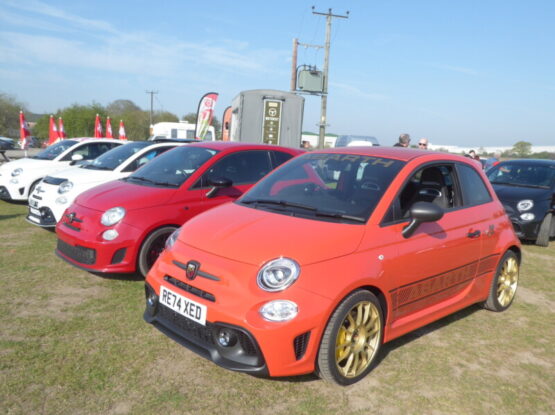
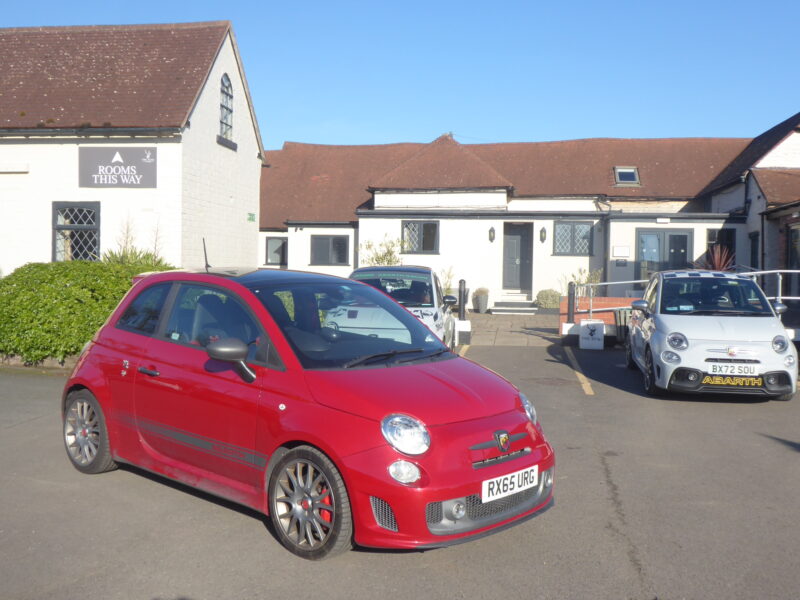
Disappointingly, given our pre-reservation, when the various Abarths arrived, they had to be parked wherever there was space on site, which meant that they were very scattered. There were around 20 of them, but this was not very apparent given the way they were parked. After we had finished eating, most of the other cars had gone and it was possible to move some of them around on site, and indeed we were asked to move some of them, as they had been parked in disabled bays in the absence of anywhere else that was left.


Slightly surprisingly, all the cars here were the 500-based models which have been on sale now since the end of 2008, following a launch at the Paris Show that year. Since that time there have been a number of detailed changes to the standard cars and a lot of limited editions. Those who really know the marque can spot most of them, but some are so subtle that unless there is a badge you can see, you will not be quite sure which version you are looking at. It used to be relatively easy, when the model was first launched, as there was only one version as shipped ex works called the 500. It had a 135 bhp 1.4 litre turbo-charged engine coupled to a five speed manual gearbox, with 16″ alloys as standard, and the option of 17″ wheels, and a colour palette comprising of two whites (BossaNova White, the standard colour, or the pearlescent Funk White), Red (Pasadoble), Pale Grey (Campovolo) or Black. If you wanted more power – 160 bhp – then you could order an Esseesse kit, which came in a large wooden crate, containing new wheels, springs, an ECU upgrade, the Monza exhaust system and badging. It was dealer fitted and could be applied at any time within the first 12 months or 10,000 miles from registration. Needless to say, it proved popular. As were many of the optional extras, with stickers for the sides, a large scorpion for the bonnet and even a chequered pattern for the roof among the personalisation options offered. Several of the original style of cars were here, a couple of them showing fairly significant personalisation touches applied by their owners.


Having used the legendary 695 badging from the 1960s on the Tributo cars, at the 2012 Geneva Show, Abarth dusted off the 595 name that had been used on the less powerful of the Nuova 500 based cars of the same generation, and created two new versions which we should think of as Series 2 cars, the 595 Turismo and Competizione, both of which could be bought in either closed or open top C guise, with either the 5 speed manual or robotised automated gearshifts. Both models had the 160 bhp engine as standard. Effectively they were a replacement for the Esseesse kit, and it meant that the cars were produced complete at the factory, rather than needing the dealer to undertake the upgrade (and the associated paperwork), though Abarth did not withdraw the Esseesse kits from the market for some while. Turismo, as the name suggests was aimed slightly less extreme in intent, featuring standard leather upholstery, upgraded dampers and climate control, Xenon headlights and Alutex interior details. The sportier Abarth 595 Competizione replaced the leather seats with Sabelt cloth sport seats and Alutex with aluminium, while adding p-cross-drilled brakes and the Record Monza dual-mode exhaust.

Rumours started to circulate towards the end of 2014 that Abarth were going to upgrade the Competizione model, so as better to bridge the gap between the Turismo and the 190 bhp 695 Biposto that had been added to the range earlier in the year. It was Geneva 2015 when the result was finally shown to an expectant fan base. Most exciting news was that thanks to a bigger Garrett Turbo, the engine had been tweaked to 180 bhp, and with reduced CO2 emissions. A standard spec that included Koni Dampers, Brembo brakes, Xenon lights, Sabelt seats, Climate Control, parking sensors as well as other refinements that had been added like the TFT instrument display all proved very compelling, so not long after the first cars reached the UK in June of 2015, I found temptation too hard to resist, and as is well documented here, swapped my 2010 car for one of these. At the time I ordered it, Cordolo Red, a tri-coat pearlescent paint which shimmers in bright sunlight looked set to become one of the most popular colours of the lot, even though it is a cost option. Indeed, the Launch Edition models were all offered either in this colour or Scorpion Black, with black wheels. Surprisingly, the colour was not carried over to the Series 4 cars.


The Series 4 version of the familiar 595 first reached the markets in the middle of 2016. After rumours had circulated all winter following the launch of the facelifted Fiat 500 in 2015, Abarth finally unveiled the Series 4 at the end of May 2016. Initially, we were told that the cars would not be available in the UK until September, but that came forward somewhat, with dealers all receiving demo cars in June, and the first customers taking delivery in July. Three regular production versions of both the closed car and the open-topped C were initially available, all badged 595, and called Custom, Turismo and Competizione, as before, though numerous limited edition models have since appeared and in most case disappeared. The most significant changes with the Series 4 are visual, with a couple of new colours, including the much asked for Modena Yellow and a different red, called Abarth Red, which replaces both the non-metallic Officina and – slightly surprisingly – the tri-coat pearlescent Cordolo Red. as well as styling changes front and rear. The jury is still out on these, with many, me included, remaining to be convinced. At the front, the new air intake does apparently allow around 15 – 20 % more air in and out, which will be welcome, as these cars do generate quite a lot of heat under the bonnet. Competizione models for the UK retain the old style headlights, as they have Xenon lights as standard, whereas the Custom and Turismo cars have reshaped units. At the back, there are new light clusters and a new rear bumper and diffuser. Inside, the most notable change is the replacement of the Blue & Me system with a more modern uConnect Audio set up, which brings a new colour screen to the dash. Mechanically, there is an additional 5 bhp on the Custom (now 145) and Turismo (now 165 bhp) and the option of a Limited Slip Diff for the Competizione, which is likely to prove a popular option. Details of the interior trim have changed, with a filled-in glovebox like the US market cars have always had, and electric windows switches that are like the US ones, as well as a part Alcantara trim to the steering wheel in Competizione cars.


Needless to say, this was a most enjoyable morning. The combination of the setting, the people, the cars and the quality of the breakfast all hit the spot. No wonder those other Clubs dropped by as well! I am sure it won’t be long before I return here.