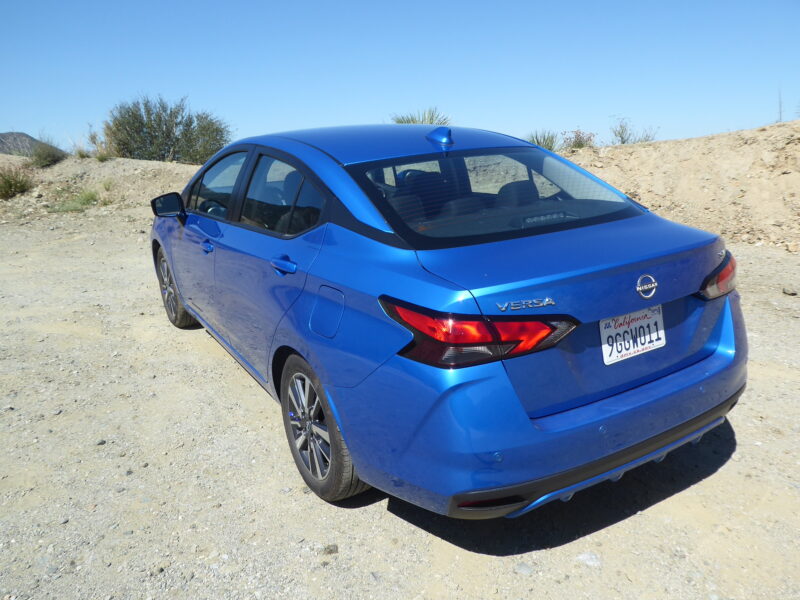
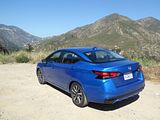
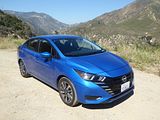
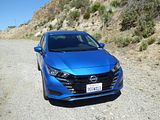
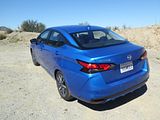
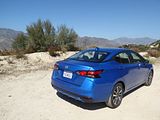
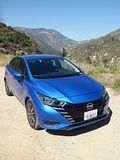

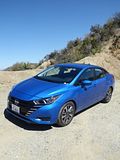
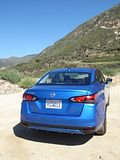
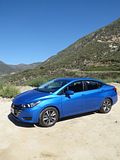
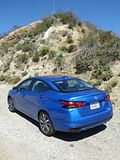
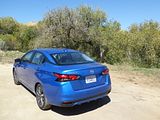
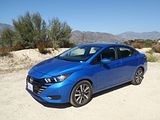
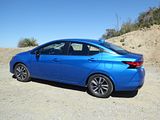
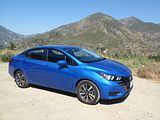
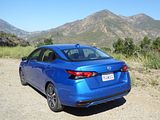

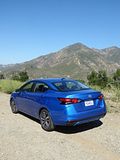


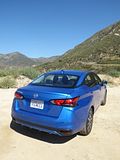
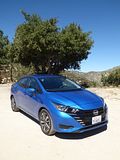
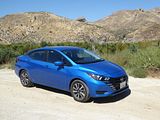
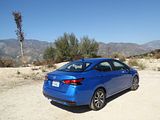
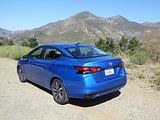
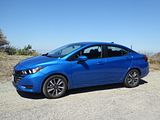
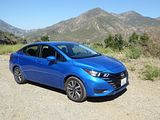


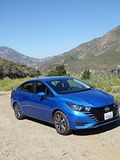


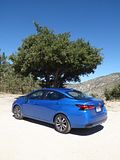
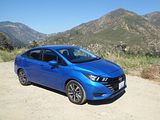

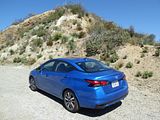

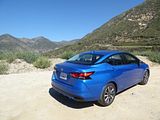
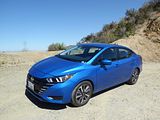
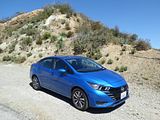
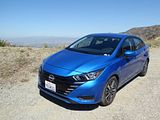
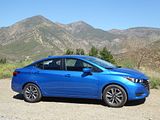
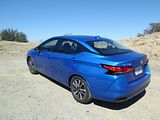
Nissan introduced the Versa to the US market at the 2006 New York Auto Show. Launched initially as a five door hatchback, a four door saloon appeared shortly thereafter and both models went on sale later in the year. At the time, the entry level car was the cheapest model on the American market, offered at $9995.00, and although Hyundai responded with a small price cut to try to distract attention from this new budget model, the Versa has largely been the cheapest new car available to American buyers ever since. US market Versa models were built in Mexico, and, as if often the case with Nissan, were a local adaptation of a car that is sold around the world with various different model names. Those European market who received the car, which did not include the UK, but did include Ireland, knew it as the Tiida and to the Australians, it was the Pulsar. Versa, the name selected for North American markets was supposed to signify “versatile space”, and referred to the roomy cabin and the fact that it was one of the largest cars in its class. US sales increased steadily, and the car became particularly popular with the rental fleets who bought large numbers of them to add to the other Nissan models in their fleet. The second generation Versa was launched at the 2011 New York Auto Show. This one was a derivative of the C17 generation Almera, and was only offered as a saloon, though Nissan further confused matters by taking the second generation Note and calling that the Versa Note for American buyers, thereby still offering both four and five door models at the bottom of their range. Year after year, the entry level car remained America’s cheapest, though far more people bought the slightly pricier mid-spec trim. Sales remained buoyant, with both private and fleet customers appreciating the roomy cabin and low cost, so it was no surprise to see the arrival of a third generation car. Once again based on the Almera, this one was unveiled on 12 April 2019 at the Rock the Ocean’s Tortuga Music Festival in Fort Lauderdale, Florida, United States, where it was marketed as the third-generation Versa saloon, one week before its public debut at the 2019 New York International Auto Show. It is based on the Renault–Nissan CMF-B, which is shared with the Renault Clio V, Renault Captur, fifth-generation Micra and the Kicks. US sales started later in the year. That was just before the Covid lockdowns and the chip supply crisis, so it took a while before this version appeared in the rental fleets with its predecessor still being more prevalent as normality resumed in 2022. But now, the old generation cars are more or less gone, and if you book the cheapest category of car, you are quite likely to be offered a third generation Versa, as this time has also seen a number of rival brands exit this sector of the market. Looking for a car for a slightly shorter day than usual, as I was flying out of LAX late in the afternoon, I spotted a smart Electric Blue painted Versa and decided to take it for the day to see what economy style motoring in 2023 would be like.
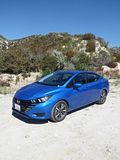
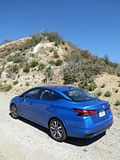
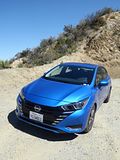
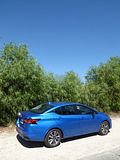
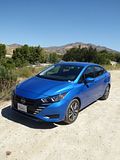
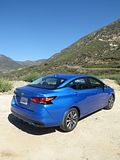
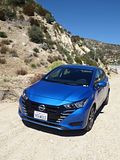
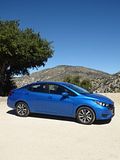

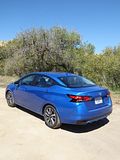
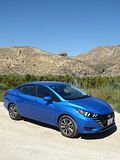
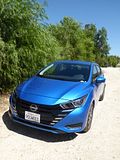
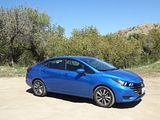
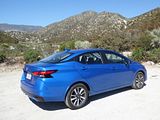
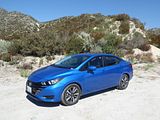
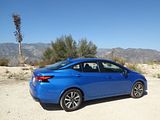
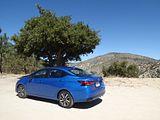
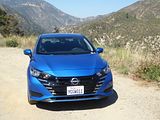
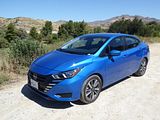
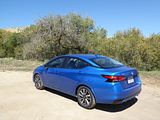
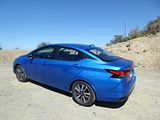
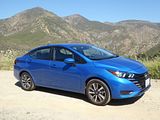
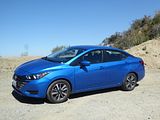
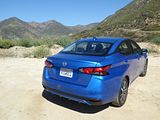
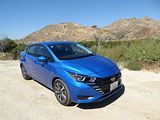
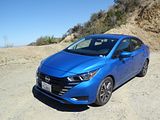
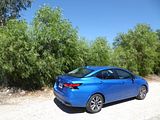
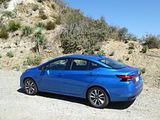
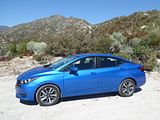
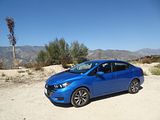
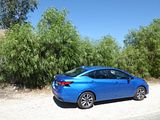
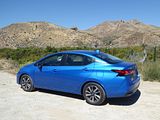
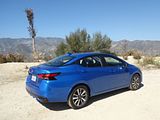
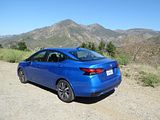
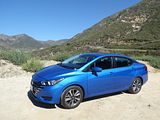
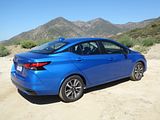
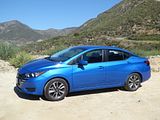
The car I selected turned out to be almost new and was actually a 2023 model year car. That means that it incorporated the mid-cycle update which had appeared in the autumn of 2022. It was exactly what you get with almost all cars these days: slight visual tweaks which only a marque expert will spot and upgraded technology, as well as revisions to the equipment levels. When Nissan revealed this generation of Versa it came hot on the heels of a new Sentra which was only a few months behind a new Altima. All follow the same styling approach to the extent that they are really quite hard to tell apart at a glance. No doubt part of Nissan’s objectives with the Versa were to try to distance it from its reputation as a stripped-out budget car, and to my eyes, at least, I think they succeeded visually. The Electric Blue paint certainly helps, this being a vibrant colour that really stands out especially in the Californian sun. Would the rest of the car stand out, as well? Time to find out!

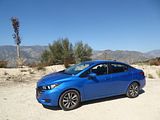
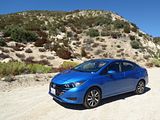
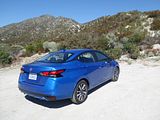
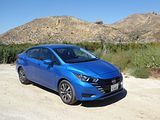
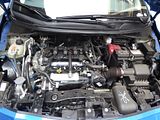
There is keyless starting, which was a bit of a surprise on a cheap car, even in 2023. You can’t expect an economy-minded sedan to be quick, and the Versa is not. All versions of the car have the same 122 bhp 1.6 litre engine, and in the case of the SV and SR models, this comes coupled to Nissan’s little liked CVT transmission. The quoted 0 – 60 time is 10.4 seconds which makes the Versa one of the slowest cars on the market, but when driving around town or fitting in with other traffic, it will seem perfectly acceptable, but when you need a burst of acceleration, to pull past slower moving vehicles, or when faced with uphill inclines in the canyons where I took my test car, it does feel like more power would be beneficial. At least the engine is smooth, even at higher rev ranges. Nissan have worked hard to improve their CVTs and the one fitted here was generally OK, with the gearing adjusting to match your accelerator pedal movements quite well, and the car settling down at freeway speed, so overall noise levels were not too testing. I covered 141 miles during my day with the Versa and it needed 3.78 gallons to fill it, which works out at 37.30 mpg US or 44.56mpg Imperial, a good result for a small car that has had to work hard.
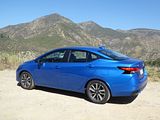
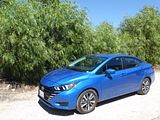
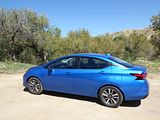
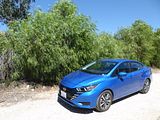

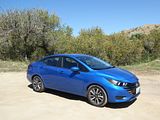
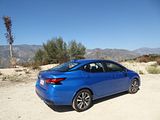

My expectations that the Nissan might prove decent to drive were influenced by the fact that I recall seeing a prototype of this car, along with then key rivals such as the Fiesta and Mazda 2 up on the Angeles Crest Highway, the very roads where I was now driving it, some four years later. I was not unduly disappointed. For sure the steering is light, but somewhat unusually, it actually has some feel to it. And the handling was really good. The car turned in nicely and you could hustle the Versa along those twisty roads and have some fun in it, something that eludes so many cars these days. The ride is on the firm side, but that felt like a small price to pay for the way the car drove. SV models get standard 16” alloy wheels. There were no issues with the brakes which responded well to the use I needed to make, including those long descents from up in the mountains. All-round visibility presented few problems with the short overhangs making it easy to judge the front and back of the car and there is the mandated rear-view camera to help. There is also a useful Blind Spot Warning system among the ADAS features which are now included. Forward collision warning activates with a simple string of beeps. Lane keeping warnings are also gentle buzzes.



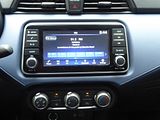
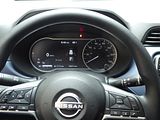
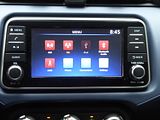
Even before I had found that the Versa was good to drive, I had been pleasantly surprised by the quality of the interior. Of course this is not a luxury car and the materials used are not Audi-rivalling, but the overall feeling is a long way from the “bargain basement” appearance you used to get. There are blue inlays and thoughtful use of some fabric and leather on the dash and door casings to make the Versa seem quite attractive. There is a plastic moulded wheel, but it was perfectly acceptable to hold. The instrument cluster is relatively simple with a conventional round speedometer to the right and a configurable area to the left which was set up as a digital speed repeater. The fuel level is in bar chart style in the lower portion. There are twin column stalks which include the lights with an auto function. There is a relatively simple and easy to use 7” touchscreen in the centre of the dash. Functions here are quite limited, with the one you will use most often being the radio which in SV trim gains Satellite XM as well as AM and FM wavebands. Onboard navigation isn’t offered on the Versa, but SV and SR trims come with Apple CarPlay and Android Auto smartphone compatibility that allows you to get directions on screen powered by your smartphone. Integrating your phone happens quickly. Nissan have retained some knobs and buttons so the system is easy to operate. And there are wheel-mounted repeaters for some audio functions. The graphics are clear and the screen was pretty responsive. Beneath the screen are three simple knobs for the air conditioning. I was a little surprised to see that there is a wireless charging pad included.
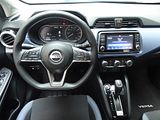
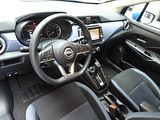
The Versa scores highly for its interior design. It’s easy to get inside and adjust the seat to your preferred driving position. That is a manual process, as you would expect for an entry level model, and the front passenger does have to forego a height adjuster on their seat. But there are height adjustable seat belts and the steering wheel telescopes in/out, so there was no problem in getting the driving position I wanted. The seats are upholstered in a cloth which felt to be of better quality than you usually find in this sector of the market. There is a pleasing feel of space here. Even at the highest driving position, which feels almost like you’re in an SUV, there is plenty of headroom with space to stretch your legs. I found the seat comfortable, but have seen reports from others suggesting that they could do with more lumbar support and the seat itself is less comfortable for the larger bodied person.
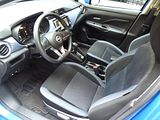
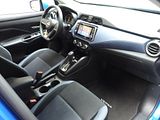



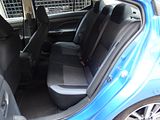
It is similarly spacious for passengers in the back, with surprisingly good legroom even with the front seats set well back, but taller people might feel their head brush against the headliner. Three adults across the seat would be somewhat cosy. The lower car-seat anchor points are hidden between cushions, but they’re easy to locate and attach to. The rear seats have integrated headrests, requiring you to wrap the strap around them to attach to the rear tether hooks. There is one map pocket on the back of the passenger seat and a single USB port.




As is the case with most smaller saloons on the US market, there is no external release for the boot, so you will need to use the key or the lever inside the cabin. Once opened up, you can see that, just like its predecessors, the Versa has a lot of luggage space for this class of car. Cargo capacity maxes out at 15 cubic feet, more than most competitors, and the boot is deep enough to accommodate larger items. The load floor is relatively low for a sedan, and the rear seats fold down if needed. There is a proper spare wheel under the floor and there is room to put a few smaller items around it. Stowage inside the cabin is not quite so impressive. There is a decently sized glovebox and there are pockets on the doors. The armrest cubby is very small indeed, though and would barely accommodate a smartphone.


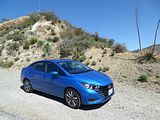
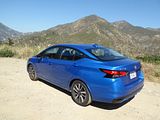
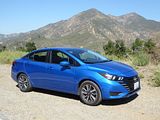


Nissan offer the Versa in three trims: S, SV and SR. Every model comes with the same 122 bhp four-cylinder engine and front-wheel drive. The S trim comes as standard with a five-speed manual transmission, and a continuously variable automatic transmission (CVT) is available. The SV and SR models come exclusively with the CVT. Standard features on the base S trim include cloth upholstery, manually adjustable front seats, a 7-inch touch screen, Siri Eyes Free, voice recognition, a four-speaker audio system, Bluetooth and three USB ports. Standard driver-assistance features include a rearview camera, forward and reverse collision warning, forward and reverse automatic emergency braking, pedestrian detection, lane-departure warning and automatic high-beam headlights. The SV trim adds the CVT, 16-inch alloy wheels, upgraded cloth upholstery, 60/40-split-folding rear seats, Apple CarPlay, Android Auto, satellite radio, wireless device charging, a 7-inch driver information display, remote keyless entry, push-button start, a rear-seat alert, blind-spot monitoring, rear cross-traffic alert and driver-attention monitoring. The top SR trim adds premium cloth upholstery, heated front seats, a leather-wrapped steering wheel, 17-inch alloy wheels, LED headlights, an 8-inch touch screen, a Wi-Fi hot spot, a six-speaker stereo, an additional USB port, automatic climate control, remote start and adaptive cruise control.
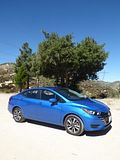

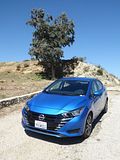

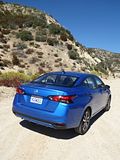
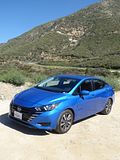
The Versa has long been the cheapest new car offered on the US market, and generally it felt it. Not any more. I was genuinely surprised by this one, and in a good way, as whilst the rather basic S model is indeed still America’s most affordable model, you now get a car which is more than acceptable. For sure, the Versa has no delusions of grandeur: there are no superfluous paddle shifters, fake vents or Sport mode, but that’s probably no Bad Thing. The Versa offers basic affordability without feeling like you’re punishing yourself. It feels tightly built, with higher-quality materials than typical for the class, and provides more pizzazz than your usual econo-sedan. There is interesting tech and enough safety equipment easily to justify the cost of entry, with room to add options and still stay close to $20,000. The steering and handling are decent for the price, there is plenty of space in it, the interior does not feel like the bargain basement any more and the equipment levels are far from stripped out. Yes, the performance is a bit limited, but on the whole, the Versa makes a good effort to avoid being soulless and feeling cheap. There are far fewer direct rivals than there used to be, so if you book the cheapest grade of rental car this is almost certainly what you will get, but unlike in the past when an instant upgrade was really something you’d never question as being needed, now I think you could be quite happy driving one of these and not feeling like you had really been a cheapskate.