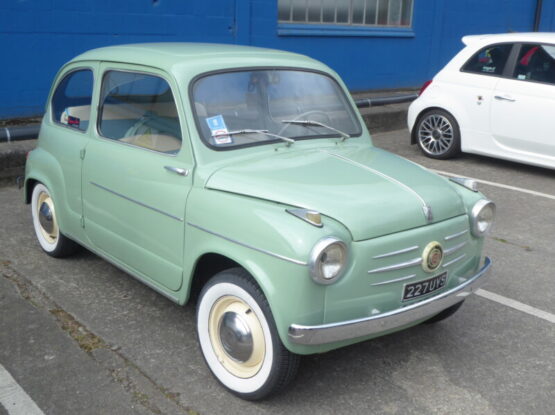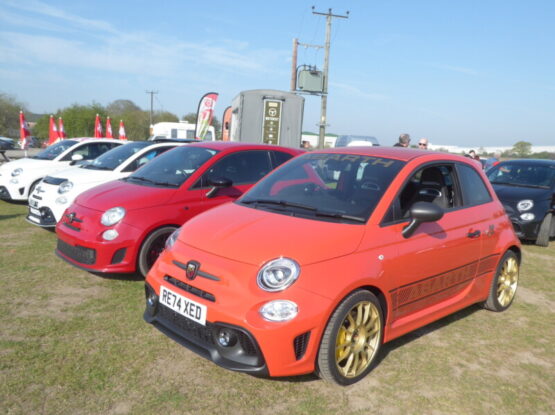
Further proof that just because there are not that many large-scale events happening in the first few weeks of the year does not mean that there is nothing for the car enthusiast to do comes from this one. As the Abarth West Midlands Group were busy planning their visit to The Piston Club, a meeting covered in a separately published report, so the Abarth Northants Group announced a trip to the original Caffeine & Machine location, known now as The Hill to distinguish it from the other two locations. Given the proximity of these two events, it seemed sensible to ensure that both Groups were aware of each other’s plans, with the result that the Northants Group deferred their planned arrival slightly so that West Midlands folk could join them. Whilst my last visit to this ever-popular site, just before Christmas, had been on a rather damp and dreary day, this one had started out bright and sunny, which meant that by the time we all arrived, the Caffeine & Machine site was pretty full. As we all had the requisite tickets, though, they had to let us in, and of course it did mean that there were plenty of cars to look at, as well as some more Abarth friends to talk to. Here are the cars that caught my eye:
ABARTH
With so many Abarths arriving at an already quite full site, initially it looked we would have to park wherever there were odd spaces left but the site staff soon realised that this was simply not going to work, and so they opened up an area of the parking that is usually off limits during the winter season, deciding that the ground was firm enough. That meant we could group all the cars together which was appreciated.


Just as had been the case in the morning at The Piston Club, where all the cars had been the 500-based models, so that was the case here, too. These have been on sale now since the end of 2008, following a launch at the Paris Show that year. Since that time there have been a number of detailed changes to the standard cars and a lot of limited editions. Those who really know the marque can spot most of them, but some are so subtle that unless there is a badge you can see, you will not be quite sure which version you are looking at. It used to be relatively easy, when the model was first launched, as there was only one version as shipped ex works called the 500. It had a 135 bhp 1.4 litre turbo-charged engine coupled to a five speed manual gearbox, with 16″ alloys as standard, and the option of 17″ wheels, and a colour palette comprising of two whites (BossaNova White, the standard colour, or the pearlescent Funk White), Red (Pasadoble), Pale Grey (Campovolo) or Black. If you wanted more power – 160 bhp – then you could order an Esseesse kit, which came in a large wooden crate, containing new wheels, springs, an ECU upgrade, the Monza exhaust system and badging. It was dealer fitted and could be applied at any time within the first 12 months or 10,000 miles from registration. Needless to say, it proved popular. As were many of the optional extras, with stickers for the sides, a large scorpion for the bonnet and even a chequered pattern for the roof among the personalisation options offered. Only a couple of the original style of cars were here, with “Gangsta Gran”’s car showing fairly significant personalisation touches, as a number of owners do.

Having used the legendary 695 badging from the 1960s on the Tributo cars, at the 2012 Geneva Show, Abarth dusted off the 595 name that had been used on the less powerful of the Nuova 500 based cars of the same generation, and created two new versions which we should think of as Series 2 cars, the 595 Turismo and Competizione, both of which could be bought in either closed or open top C guise, with either the 5 speed manual or robotised automated gearshifts. Both models had the 160 bhp engine as standard. Effectively they were a replacement for the Esseesse kit, and it meant that the cars were produced complete at the factory, rather than needing the dealer to undertake the upgrade (and the associated paperwork), though Abarth did not withdraw the Esseesse kits from the market for some while. Turismo, as the name suggests was aimed slightly less extreme in intent, featuring standard leather upholstery, upgraded dampers and climate control, Xenon headlights and Alutex interior details. The sportier Abarth 595 Competizione replaced the leather seats with Sabelt cloth sport seats and Alutex with aluminium, while adding p-cross-drilled brakes and the Record Monza dual-mode exhaust.
Rumours started to circulate towards the end of 2014 that Abarth were going to upgrade the Competizione model, so as better to bridge the gap between the Turismo and the 190 bhp 695 Biposto that had been added to the range earlier in the year. It was Geneva 2015 when the result was finally shown to an expectant fan base. Most exciting news was that thanks to a bigger Garrett Turbo, the engine had been tweaked to 180 bhp, and with reduced CO2 emissions. A standard spec that included Koni Dampers, Brembo brakes, Xenon lights, Sabelt seats, Climate Control, parking sensors as well as other refinements that had been added like the TFT instrument display all proved very compelling, so not long after the first cars reached the UK in June of 2015, I found temptation too hard to resist, and as is well documented here, swapped my 2010 car for one of these. At the time I ordered it, Cordolo Red, a tri-coat pearlescent paint which shimmers in bright sunlight looked set to become one of the most popular colours of the lot, even though it is a cost option. Indeed, the Launch Edition models were all offered either in this colour or Scorpion Black, with black wheels. Surprisingly, the colour was not carried over to the Series 4 cars.


The Series 4 version of the familiar 595 first reached the markets in the middle of 2016. After rumours had circulated all winter following the launch of the facelifted Fiat 500 in 2015, Abarth finally unveiled the Series 4 at the end of May 2016. Initially, we were told that the cars would not be available in the UK until September, but that came forward somewhat, with dealers all receiving demo cars in June, and the first customers taking delivery in July. Three regular production versions of both the closed car and the open-topped C were initially available, all badged 595, and called Custom, Turismo and Competizione, as before, though numerous limited edition models have since appeared and in most case disappeared. The most significant changes with the Series 4 are visual, with a couple of new colours, including the much asked for Modena Yellow and a different red, called Abarth Red, which replaces both the non-metallic Officina and – slightly surprisingly – the tri-coat pearlescent Cordolo Red. as well as styling changes front and rear. The jury is still out on these, with many, me included, remaining to be convinced. At the front, the new air intake does apparently allow around 15 – 20 % more air in and out, which will be welcome, as these cars do generate quite a lot of heat under the bonnet. Competizione models for the UK retain the old style headlights, as they have Xenon lights as standard, whereas the Custom and Turismo cars have reshaped units. At the back, there are new light clusters and a new rear bumper and diffuser. Inside, the most notable change is the replacement of the Blue & Me system with a more modern uConnect Audio set up, which brings a new colour screen to the dash. Mechanically, there is an additional 5 bhp on the Custom (now 145) and Turismo (now 165 bhp) and the option of a Limited Slip Diff for the Competizione, which is likely to prove a popular option. Details of the interior trim have changed, with a filled-in glovebox like the US market cars have always had, and electric windows switches that are like the US ones, as well as a part Alcantara trim to the steering wheel in Competizione cars.


AC
Genuine AC Cobra models from the 1960s are few and far between but ever since production ceased there have been all manner of continuation, recreation and replica cars produced by a vast of number of manufacturers. Most of them are visually very faithful to the original but use their own chassis and whichever big block engine the company can source – Chevy Corvette engines having proved popular in recent times. This is one of those replicas.

BMW
There were plenty of modern German performance cars here, as ever. The only ones that were attracted by my camera were these examples of the previous M4.


CHEVROLET
The C7 generation Corvette had been in development since 2007. Originally set to be introduced for the 2011 model year, its introduction was delayed for 3 years. It was finally released for the 2014 model year. Mid-engine and rear-engine layouts had been considered, but the front-engine, rear-wheel drive platform was chosen to keep production costs lower. To GM’s product planners and marketers, the fact that the Corvette had become known as an “old man’s toy” became a prime factor in developing the next generation. Studies showed that about 46 percent of Corvette buyers in 2012, through October, were 55 or older, compared with 22 percent of Audi R8 and 30 percent of Porsche 911 customers. The head of Chevy marketing, Chris Perry, acknowledges that too many people saw it as the car of “the successful plumber.” John Fitzpatrick, Corvette’s marketing manager said “It’s the old saying, ‘Nobody wants to be seen driving an old man’s car, but everybody wants to be seen driving a young man’s car. ” To counter that perception GM planned to make the new generation C7 more aspirational to younger people. Towards that end, a camouflaged version of the car was made available in the popular video game Gran Turismo 5 in November 2012. As part of the marketing effort associated with the introduction of the new generation, the 2013 Indianapolis 500 utilised a Corvette for the 12th time as its pace car. Pace car editions are planned. Sales success of the new Corvette is important to GM. The Motley Fool reports that the Corvette could be earning GM $10,000 or more in gross profit for every Corvette it sells.The 2014 Chevrolet Corvette uses an LT1 6.2 litre V8 making 455 bhp. The LT1 engine is in the Gen 5 family of small block engines, which will be used in GM vehicles as the new small V8 option. It features three technologies new to the GM V8, though widely available on other engines in the marketplace: direct injection, variable valve timing, and an active fuel management system. Fuel injectors are located under the intake manifold. The Corvette remains rear-wheel drive with the transaxle located in the rear. Transmission choices include a 7-speed manual or a 8-speed automatic with paddle shifters. The new interior includes wide-bottom seats as standard, with sportier versions with high side bolsters optional. The Corvette’s flag logo has been revised for the new car and a small casting of a stingray has been added to the car’s ornamentation. Features of the new generation’s structure include a carbon fibre bonnet and removable roof panel. The fenders, doors and rear quarter panels remain composite. At the rear of the car, the trademark round taillights have changed to a more squarish form. The underbody panels are made of “carbon-nano” composite and it makes use of a new aluminium frame which locates the four wheels an inch farther apart, front to rear and side to side. Luggage space decreased by 33% from the previous generation’s. The overall weight of the car was not announced by General Motors for many months after its first showing in January 2013. Despite the increased use of aluminium and other light weight materials, numerous publications reported that the weight would remain essentially unchanged from that of the previous generation’s. In August, 2013, the weight of the new Corvette was reported to be 3,444 lb meaning it would weigh more than the previous generation’s C6 ZR1 model (3,324 lb (1,508 kg)). The ZR1 C6 weight included a supercharger and intercooler on its 6.2 litre engine. Chevrolet announced the C7 Z06 at the 2014 Detroit Auto Show. The 2015 Z06 Corvette has 650 bhp from the supercharged LT4 aluminium 6.2L V-8 engine. The final C7 generation cars were produced in 2019.


CITROEN
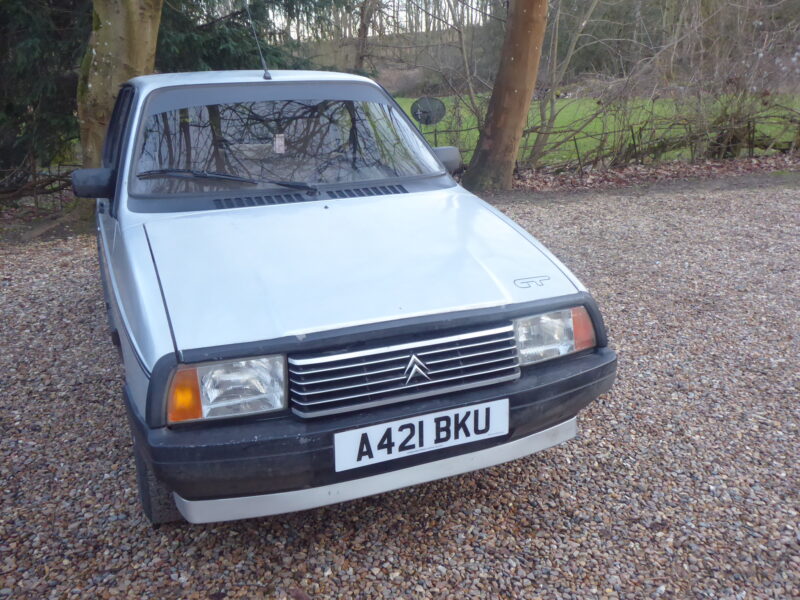
The Visa is rare now, even in France, as despite the fact that Citroën built 1,254,390 examples of the model between 1978 and 1988, the model is all but extinct everywhere. There was a very long gestation to this car, which goes all the way back to 1965, when Robert Opron worked on the Citroën G-mini prototype and projet EN101, a replacement for the 2CV, using the flat twin engine from the 2CV. It was supposed to launch in 1970. The advanced space efficient designs with very compact exterior dimensions and an aerodynamic drag co-efficient Cd of 0.32, were axed because of adverse feedback from potential clients. With Citroën’s small car range all getting somewhat elderly, the decision was taken to try again, with the Citroën Prototype Y which was planned to replace the 2CV based Citroën Ami that dated back to 1960 in the early seventies. This was originally developed in co-operation with Fiat, built on the lessons from the Citroën G-mini and EN101 projects. It used the then new and advanced Fiat 127 platform, that used a transverse front wheel drive engine, with an end on gearbox layout that Fiat had pioneered in the 1960s. When co-operation with Fiat ended, a new Citroën designed platform was planned. After the takeover of Citroën by Peugeot in the wake of the 1974 oil crisis, the renamed “Projet VD (Voiture Diminuée)” became the Citroën Visa, incorporating the floor pan and advanced 104 engine, with its transmission (under the engine) and chassis. It was the first new model under the platform-sharing policy of PSA Peugeot Citroën that continues today. The earlier Citroën LN had just been a facelift of the Peugeot 104Z “Shortcut” with a re-engine and transmission from the Citroën Dyane. Eventually, in 1984, the original Citroën platform design from “Project Y” emerged as the Oltcit Club in Romania, using a Citroën Visa flat-twin engine and Citroën GS based gearbox, and Citroën GS flat-four engine and gearbox, and was also sold in Western Europe as the flat-four only Citroën Axel to recoup money that Citroën had invested in Romania, which the communist government could not repay. This project was problematic for Citroën due to build quality issues, only 60,184 cars were made, even though the base models were priced below the 2CV in Western Europe. The Axel was never sold in the UK. The five-door Citroën Visa and the three-door Axel look very similar, but there is no part interchangeable between these two Citroën models. The Visa entered a crowded market, with supermini competitors including the Chrysler Sunbeam, Mk1 Renault 5, Mk1 Ford Fiesta, Vauxhall Chevette, Mk1 VW Polo and Fiat 127. Though it was launched as a supermini, it was about the same length (3725mm) and height (1430mm), but slightly narrower at 1526mm than a Volkswagen Golf Mk1, which was in the next class up. It was part of a ‘between sizes’ policy that Citroën also followed with the BX. From its launch in September 1978, the front-wheel drive Visa was available in “Spécial” and “Club” models with a mapped electronic ignition 652 cc, 2-cylinder and a “Super” (later “Super E”) model (called the 11RE after 1984), with the advanced Peugeot 1,124 cc Douvrin engine / PSA X engine, a four-cylinder “Suitcase engine” — all aluminium alloy, chain driven overhead cam, with gearbox in the sump, sharing engine oil, mounted almost on its side. The 1124 cc was as economical as the Citroën 2CV-derived twin, but with much better performance. Later on it had 1,219 cc (Super X) and then 954 cc (10E after 1984) and 1,360 cc (1983 Visa GT and 14TRS after 1985) versions of the same engine. The ergonomic design of the Visa controls used a Citroën “PRN Satellite” (P=Pluie – Rain, R=Route – Road, N=Nuit – Night) which gave access on one cylindrical unit to wipers, washers, horn, indicators, headlamps and flashers, all mounted a finger’s reach away from the steering wheel. The heat and ventilation control sliders that moved in arcs, were on the other side of the steering wheel, also within closer reach than usual. In 1982 the Visa underwent a major external restyling, designed by Heuliez, to look more mainstream. It kept the original interior and “PRN Satellite” controls until 1985 when, along with the Citroën BX, it was updated with a new bulkier dashboard, instruments and switchgear that made the car feel smaller inside. Stalk switchgear like contemporary Peugeots added self-cancelling indicators, but it kept the original monospoke steering wheel. It had very soft, but well damped, long travel, fully independent suspension with coil-sprung MacPherson struts at the front and coil sprung trailing arms at the rear, that caused it to have a soft ride like the Citroën 2CV, but without such extreme roll angles. CAR magazine made the Visa diesel one of its top ten models on the market for two years running in the mid-1980s (January 1986 and 1987), for its versatility (higher models in the range had split rear seats which could be lifted-out to give an almost van-like luggage capacity); ride comfort (“like a limousine”); its ability to maintain high average speeds due to high levels of grip; and value for money. It was also particularly aerodynamically stable at high speeds for a relatively light, narrow and tall car. It would remain unperturbed by cross-winds and truck bow waves at motorway speeds. It also had at the middle ‘R’ trim level and above, (currently unfashionable), but practical, grey plastic side rubbing strips, to protect against car park damage. The very curved sides of the windscreen, enabled the use of a very large single wiper on the long narrow windscreen, without fouling the windscreen seal. The front of the revised car, was designed to aerodynamically reduce the deposition of dirt on the headlights, and to reduce the risk of stone chips to the headlights, bonnet and windscreen. The heating and ventilation system, (even though it used only a water control valve for temperature control and not air mixing), could provide cold air from fascia side vents, to the face while warming the car. The central directable fascia vents could be heated and angled, so that they could be pointed directly at the windscreen in front of the driver, to keep it clear in extreme misting conditions. There was also an additional mid level vent, to blow air between the front seats to the back of the car. The rear parcel shelf was in two hinged sections, one in the car, the other on the tailgate, to allow objects that were slightly too tall to still fit without removing the shelf. When carrying larger loads, the part of the shelf attached to the tailgate could be folded up, and fixed with the elasticated support strings, to protect the rear window and heated rear screen elements. Long time CAR magazine columnist George Bishop, actually bought one with his own money. Before the advent of the diesel model, the electronic ignition (mechanical and vacuum controlled), 1124cc high compression engined Super E, (later renamed 11RE) with high gearing, was the best seller in the range. It was better equipped than the base 1.0 litre Austin Metro and Ford Fiesta it was priced against, having height adjustable halogen headlights, intermittent rear wash-wipe and multi-speed / intermittent front wipers, heated rear window, removable split folding rear seats, as well as five doors when its main competitors in the UK only had three, (the five-door Metro was launched in 1985, the five-door mark three Fiesta launched in 1989). A five speed gearbox was optional, when the base model competitors could only be had with a four speed. Most 1980s base model hatchback economy cars did without halogen headlights and rear wash-wipes, even heated rear windows could be optional. The 1984 launched 954cc 10E model was a direct competitor on specification to the Metro and Fiesta, but significantly undercut them on price. A four-door convertible version, with the doors and window frames remaining intact, of the 11RE was also produced in the Heuliez factory from 1984. This was heavier and slower than the hatchback that it was based on. In spring 1984 the very successful diesel version was added. The Visa 17D and 17RD used the famously rugged and refined, class-leading 1,769 cc XUD diesel and transmission from the Peugeot 205. It also capably powered the Peugeot 405, which was two classes larger, and made light work of powering the lightweight Visa. It had too wide a track for the original engine compartment and wings, so the front wings were extended with large black plastic wheel arch panels. The spare wheel that in smaller petrol engine versions, was mounted on top of the flat or near horizontal engine, was bolted to the otherwise flat boot floor — compromising luggage space. In continental Europe, a basic diesel van the ‘Visa Enterprise’ was sold that used the normal Visa bodyshell with the rear doors welded shut. It mounted a spacesaver spare wheel under the bonnet, over the diesel engine. Some diesel hatchbacks there, also used this arrangement. At the Paris Salon 1984, for model year 1985, the 1.4 litre TRS was presented. This version was produced for two years (1985–1987), shared its engine with the Citroën BX14. Even though it received a favourable review by CAR magazine who felt it was a better performance/economy compromise than the 11RE, it wasn’t very successful, due to being squeezed by the Visa Diesel and the extremely competitively priced BX 14. Between 1985 and 1987 the 1.1 litre petrol and 1.7 litre diesel “Leader” special editions were marketed. In the latter half of the eighties a 55 PS catalysed version of the 1,360 cc engine was added for markets with stricter emissions standards. No automatic gearbox version was produced.


DODGE
The A100 is a range of compact vans and trucks manufactured and marketed from 1964 to 1970 by Chrysler Corporation under the Dodge marque in the United States and the Fargo marque in Canada. The A100 competed with the Ford Econoline, Chevrolet Van, Chevy Corvair Greenbrier, and the Volkswagen Type 2. The range included a pickup truck and van, both with a “forward control” design. Placing the driver on top of the front axle with the engine between the front seats, just behind the front wheels makes it a “cab over” vehicle. The unibody vehicles used a short 90 in (2,286 mm) wheelbase. An A108 was also available from 1967 to 1970, with a longer 108 in (2,743 mm) wheelbase. The A108 was popular with camper conversion companies. A substantially modified, Hemi-powered A100 wheelstanding exhibition pickup called the “Little Red Wagon”, driven by Bill “Maverick” Golden, was a popular drag strip attraction from the 1960s to the early 2000s


FERRARI
Launched at the 2015 Geneva Show, the 488GTB followed the lead set by the California T in bringing turbocharging into a modern-day, mid-engined V8 Ferrari supercar for the first time. The engine is completely new when compared with its V8 stablemate, not only in components but also in feel and character. It is a twin-turbocharged 3902cc unit whilst that in the California T is 3855cc. In the 488 GTB, it produces 660bhp at 8000rpm and 560lb ft at 3000rpm. Both outputs are significant increases over the normally aspirated 4.5-litre V8 used in the 562 bhp 458 Italia and 597 bhp 458 Speciale, and also greater than the car’s biggest rival, the McLaren 650S. The torque figure of the 488 GTB is such that it also exceeds the 509lb ft at 6000rpm of the normally aspirated V12 used in the range-topping Ferrari F12 Berlinetta. The mighty new engine in the 488 GTB drives the rear wheels through a revised seven-speed dual-clutch automatic gearbox derived from the 458. It features a new ‘Variable Torque Management’ system which, Ferrari says, “unleashes the engine’s massive torque smoothly and powerfully right across the rev range”. The gear ratios are also tuned to “deliver incredibly progressive acceleration when the driver floors the throttle”. The 488 GTB can crack 0-62mph in just 3.0sec, 0-124mph in 8.4sec and reach a top speed of 205mph. Its 0-62mph and 0-124mph times match the McLaren 650S’s, but the Woking car’s top speed is slightly higher at 207mph. The engine also accounts for the ‘488’ element of the car’s name, because each of the engine’s eight cylinders is 488cc in capacity when rounded up. The GTB suffix, standing for Gran Turismo Berlinetta, is a hallmark of previous mid-engined V8 Ferraris such as the 308 GTB. Not only is the new turbo engine more potent than the 4.5-litre V8 from the 458 Italia, but it is also more economical. Combined fuel economy is rated at 24.8mpg, compared with 21.2mpg in the 458 Italia, and CO2 emissions are 260g/km – a 47g/km improvement. Ferrari’s HELE engine stop-start system features on the 488 GTB. Developments on the dynamic side include a second generation of the Side Slip Angle Control system, called SSC2. This allows the driver to oversteer without intruding, unless it detects a loss of control. The SSC2 now controls the active dampers, in addition to the F1-Trac traction control system and E-Diff electronic differential. Ferrari says the result is “more precise and less invasive, providing greater longitudinal acceleration out of corners” and flatter, more stable behaviour during “complex manoeuvres”. Learnings from the Ferrari XX programme have also been incorporated into the 488 GTB, something that Ferrari says allows all drivers and not just professionals, to make the most of its electronic and vehicle control systems. It also claims the 488 GTB is “the most responsive production model there is”, with responses comparable to a track car. The 488 GTB has lapped Ferrari’s Fiorano test track in 1min 23sec – two seconds faster than the 458 Italia, and half a second quicker than the 458 Speciale. The dimensions of the 488 GTB – it is 4568mm in length, 1952mm in width and 1213mm in height – closely match the 458 Italia from which it has evolved. Its dry weight is 1370kg when equipped with lightweight options – 40kg more than the McLaren 650S. The new look, styled at the Ferrari Styling Centre, features several new aerodynamic features that improve downforce and reduce drag. Most notable is the addition of active aerodynamics at the rear through a ‘blown’ rear spoiler, where air is channelled from the base of the glass engine cover under the spoiler. This contributes to the 50% increase in downforce over the 458 Italia. Also new is a double front spoiler, an aerodynamic underbody, a large air intake at the front that references the 308 GTB, a diffuser with active flaps, new positioning for the exhaust flaps and new-look lights. The interior has been redesigned to be made more usable, including new switchgear, air vents and instrument panel. The multi-function steering wheel remains, while the infotainment system gets a new interface and graphics. The Spider followed the closed coupe model six months later,

Unveiled in September 2019, the Ferrari 812 GTS is the open top version of the 812 Superfast. This marks the first front-engine V12 series production convertible model offered by Ferrari in 50 years, as the convertible variants of the 550, the 575 and the 599 were limited edition models meant for special customers only. The large rear buttresses present at the rear hold the folding hard top roof under a tonneau cover present between them when not in use. The electronically operated hard top takes 14 seconds for operation and is operable at speeds up to 45 km/h (28 mph). The GTS weighs 75 kg (165 lb) more than the Superfast due to chassis reinforcing components but maintains equal performance. The mechanical components including the engine remain the same as the Superfast except for the transmission which has shorter gear ratios to improve the car’s response to throttle inputs. The engine’s high-pressure injection system reduces the number of particles that are emitted before the catalytic converter warms up. There is also a new gasoline particulate filter and a stop-start system to improve fuel economy. Other features shared with the Superfast include the Manettino dial, side-slip angle control and variable steering weight. The car has been aerodynamically refined in order to eliminate any turbulence arising from the loss of a fixed roof.

FORD
The Ford Escort RS Cosworth is a sports derivative and rally homologation special of the fifth generation European Ford Escort. It was designed to qualify as a Group A car for the World Rally Championship, in which it competed between 1993 and 1998. It was available as a road car from 1992–96 in very limited numbers. Ford developed the car around the chassis and mechanicals of its spiritual predecessor, the Sierra Cosworth to accommodate the larger Cosworth engine and transmission, whilst clothing it in Escort body panels to make it resemble the standard car. Designed under the guidance of Rod Mansfield and John Wheeler of Ford’s SVO department, the styling was carried out during 1989, a year before the standard Escort was launched, by Stephen Harper at MGA Developments in Coventry. The spoiler was added by Frank Stephenson, who originally proposed a three-deck piece. The body tooling was created by coachbuilders Karmann at their facility in Rheine, Germany, where the cars were manufactured. Changes were made to the engine management system and a new turbocharger was fitted. Permanent four wheel drive with a 34/66% front/rear split came courtesy of an uprated five speed gearbox as used in the Sierra Cosworth. Recaro sports seats came as a standard fitment. Later production models were available without the oversize tail spoiler although by far the majority were still ordered with it. Like its Sierra predecessor, they are commonly nicknamed “Cossie” by enthusiasts. The car’s top speed was 150 mph, which rivalled lower-end supercars including the Audi Quattro, BMW M3, Nissan 300ZX and Toyota Supra, and comfortably outperformed traditional “hot hatchbacks” like the Volkswagen Golf GTI. It was much faster than the 126 mph which the Escort RS2000 and earlier Escort RS Turbo were capable of. Two versions were produced. The initial 2,500 units were “homologation specials” used to get the FIA accreditation for entry into the World Rally Championship. They were fitted with a Garrett T3/T04B turbocharger. Among these initial units, a handful were badged as Motorsport versions, these lacked certain refinements such as a sunroof and sound deadening. The initial cars included features that, although they made the Cosworth a more effective car, did not enhance it as a road vehicle, and once the rules were satisfied Ford attempted to make the car less temperamental and easier to drive under normal conditions. The second generation, starting production from late 1994, were fitted with a Garrett T25 turbocharger, a smaller unit which reduced turbo lag and increased usability in everyday driving situations. With these later models, the ‘whale tail’ spoiler became a delete option. . The Escort Cosworth was a rare car, with 7,145 vehicles produced from the start of production on 19 February 1992 until the last car rolled out of the factory on 12 January 1996.


Drawing on inspiration from the mid-engined Ford Mustang I concept vehicle, Lee Iacocca ordered development of a new “small car” to vice-president of design at Ford, Eugene Bordinat. Bordinat tasked Ford’s three design studios (Ford, Lincoln-Mercury, and Advanced Design) to create proposals for the new vehicle. The design teams had been given five goals for the design of the Mustang: It would seat four, have bucket seats and a floor mounted shifter, weigh no more than 2,500 pounds (1,100 kg) and be no more than 180 inches (4,572 mm) in length, sell for less than $2,500, and have multiple power, comfort, and luxury options. The Lincoln–Mercury design studio ultimately produced the winning design in the intramural contest, under Project Design Chief Joe Oros and his team of L. David Ash, Gale Halderman, and John Foster. Development of the Mustang was completed in a record 18 months from September 1962 to March 1964. and Iacocca himself championed the project as Ford Division general manager. The styling is often credited to one person, and that is not accurate, as this was very much a team effort, it has been reported by those involved. To decrease developmental costs, the Mustang used chassis, suspension, and drivetrain components derived from the Ford Falcon and Fairlane. It used a unitised platform-type frame from the 1964 Falcon, and welded box-section side rails, including welded crossmembers. Although hardtop Mustangs accounted for the highest sales, durability problems with the new frame led to the engineering of a convertible first, which ensured adequate stiffness. Overall length of the Mustang and Falcon was identical, although the Mustang’s wheelbase was slightly shorter. With an overall width of 68.2 in (1,732 mm), it was 2.4 in (61 mm) narrower, yet the wheel track was nearly identical. Shipping weight, approximately 2,570 lb (1,166 kg) with the straight six-cylinder engine, was also similar to the Falcon. A fully equipped V8 model weighed approximately 3,000 lb (1,361 kg). Although most of the mechanical parts were from the Falcon, the Mustang’s body was completely different; sporting a shorter wheelbase, wider track, lower seating position and lower overall height. An industry first, the “torque box” was an innovative structural system that greatly stiffened the Mustang’s construction and helped contribute to better handling. The car was launched in 17th April 1964, as a hardtop and a convertible, with the fastback version following in August. It was an instant sensation, with demand massively exceeding supply. Since it was introduced four months before the normal start of the 1965 production year and manufactured alongside 1964 Ford Falcons and 1964 Mercury Comets, the earliest Mustangs are widely referred to as the 1964½ model. Nevertheless, all “1964½” cars were given 1965 U.S. standard VINs at the time of production, and – with limited exception to the earliest of promotional materials – were marketed by Ford as 1965 models. The low-end model hardtop used a “U-code” 170 cu in (2.8 litre) straight-6 engine borrowed from the Falcon, as well as a three-speed manual transmission and retailed for US$2,368. Standard equipment for the early 1965 Mustangs included black front seat belts, a glove box light, and a padded dash board. Production began in March 1964 and official introduction following on April 17 at the 1964 World’s Fair. V8 models got a badge on the front fender that spelled out the engine’s cubic inch displacement (“260” or “289”) over a wide “V.” This emblem was identical to the one on the 1964 Fairlane. Several changes to the Mustang occurred at the start of the “normal” 1965 model year in August 1964, about four months after its introduction. These cars are known as “late 65’s”. The engine lineup was changed, with a 200 cu in (3.3 litre) “T-code” engine that produced 120 hp. Production of the Fairlane’s “F-code” 260 cu in (4.3 litre) engine ceased when the 1964 model year ended. It was replaced with a new 200 hp “C-code” 289 cu in (4.7 litre) engine with a two-barrel carburettor as the base V8. An “A-code” 225 hp four-barrel carburettor version was next in line, followed by the unchanged “Hi-Po” “K-code” 271 hp 289. The DC electrical generator was replaced by a new AC alternator on all Fords (a way to distinguish a 1964 from a 1965 is to see if the alternator light on the dash says “GEN” or “ALT”). The Mustang GT version was introduced as the “GT Equipment Package” and included a V8 engine (most often the 225 hp 289), grille-mounted fog lamps, rocker panel stripes, and disc brakes. In the interior the GT option added a different instrument panel that included a speedometer, fuel gauge, temp. gauge, oil pressure gauge and ammeter in five round dials (the gauges were not marked with numbers, however.) A four-barrel carburettor engine was now available with any body style. Additionally, reverse lights were an option added to the car from August 1964 production. In 1965, the Shelby Mustang was born, it was available only in newly introduced fastback body version with its swept-back rear glass and distinctive ventilation louvres. The standard interior features of the 1965 Mustang included adjustable driver and passenger bucket seats, an AM radio, and a floor mounted shifter in a variety of colour options. Ford added additional interior options during the 1965 model year. The Interior Decor Group was popularly known as “Pony Interior” due to the addition of embossed running ponies on the seat fronts, and also included integral armrests, woodgrain appliqué accents, and a round gauge cluster that would replace the standard Falcon instrumentation. Also available were sun visors, a (mechanical) remote-operated mirror, a floor console, and a bench seat. Ford later offered an under-dash air-conditioning unit, and discontinued the vinyl with cloth insert seat option, offered only in early 1965 models. One option designed strictly for fun was the Rally-Pac. Introduced in 1963 after Ford’s success at that year’s Monte Carlo Rally and available on other Ford and Mercury compacts and intermediates, the Rally-Pac was a combination clock and tachometer mounted to the steering column. It was available as a factory ordered item for US$69.30. Installed by a dealer, the Rally-Pac cost US$75.95.A 14″ rim option was available for Rally-pac and GT350R vehicles widening front and rear track to 57.5″. Reproductions are presently available from any number of Mustang restoration parts sources. A compass, rear seat belts, A/C, and back-up lights were also optional. The 1966 Mustang debuted with moderate trim changes including a new grille, side ornamentation, wheel covers and filler cap. Ford’s new C-4 “cruise-o-matic” three-speed auto transmission became available for the 225 hp V8. The 289 “HiPo” K-code engine was also offered with a c4 transmission, but it had stronger internals and can be identified by the outer casing of the servo which is marked with a ‘C’. The long duration solid-lifter camshaft that allowed the high revving 289 to make the horsepower it was known for, was not friendly for a low stall speed automatic torque converter. The “HiPo” could be spotted very easily by the 1-inch-thick vibration damper, (as compared to 1/2 inch on the 225-hp version) and the absence of a vacuum advance unit on the dual point distributor. With the valve covers off, there is a large letter “K” stamped between the valve springs, along with screw in studs (vs. a pressed in stud for other 289s) for the adjustable rocker arms. A large number of new paint and interior color options, an AM/eight-track sound system, and one of the first AM/FM mono automobile radios were also offered. It also removed the Falcon instrument cluster; the previously optional features, including the round gauges and padded sun visors, became standard equipment. The Mustang would be the best-selling convertible in 1966, with 72,119 sold, beating the number two Impala by almost 2:1. The 1965 and 1966 Mustangs are differentiated by variations in the exterior, despite similar design. These variations include the emblem on the quarter-panels behind the doors. From August 1964 production, the emblem was a single vertical piece of chrome, while for 1966 models the emblem was smaller in height and had three horizontal bars extending from the design, resembling an “E”. The front intake grilles and ornaments were also different. The 1965 front grille used a “honeycomb” pattern, while the 1966 version was a “slotted” style. While both model years used the “Horse and Corral” emblem on the grille, the 1965 had four bars extending from each side of the corral, while on the 1966, these bars were removed. The 1966 model year saw introduction of ‘High Country Special’ limited edition, 333 of them were sold in Colorado, Wyoming, and Nebraska. When Ford wanted to introduce the Mustang in Germany, they discovered that Krupp company had already registered the name for a truck. The German company offered to sell the rights for US$10,000. Ford refused and removed Mustang badges from exported units, instead naming the cars as T-5 (a pre-production Mustang project name) for the German market until 1979 when Krupp copyrights expired. In 1965, Harry Ferguson Research purchased 3 Mustang notchbacks and converted them to 4×4 in an attempt to sell potential clients on their FF AWD system. A similar system was used in the Ferguson P99 Formula One car, and would go on to be featured in the Jensen FF, widely considered the first AWD passenger car. As in the Jensen FF, the AWD Mustangs also featured an ABS braking system, long before such a feature was commonplace. Ford Australia organised the importation and conversion of 1966 Mustang to right-hand-drive for the Australian market. This coincided with the launch of new XR Falcon for 1966, which was marketed as “Mustang-bred Falcon”. To set the official conversion apart from the cottage industry, the RHD Mustangs were called “Ford Australia Delivered Mustang” and had compliance plates similar to XR Falcon. About 209 were imported to Australia with 48 units were converted in 1965 while the further 161 were done in 1966. The 1967 model year Mustang was the first redesign of the original model. Ford’s designers began drawing up a larger version even as the original was achieving sales success, and while “Iacocca later complained about the Mustang’s growth, he did oversee the redesign for 1967 .” The major mechanical feature was to allow the installation of a big-block V8 engine. The overall size, interior and cargo space were increased. Exterior trim changes included concave taillights, side scoop (1967 model) and chrome (1968 model) side ornamentation, square rear-view mirrors, and usual yearly wheel and gas cap changes. The high-performance 289 option was placed behind the newer 335 hp 6.4 litre FE engine from the Ford Thunderbird, which was equipped with a four-barrel carburettor. During the mid-1968 model year, a drag racer for the street could be ordered with the optional 428 cu in (7.0 litre) Cobra Jet engine which was officially rated at 335 hp. All of these Mustangs were issued R codes on their VIN’s. The 1967 Deluxe Interior was revised, discontinuing the embossed running horse motif on the seat backs (the source for the “pony interior” nickname) in favor of a new deluxe interior package, which included special colour options, brushed aluminium (from August 1966 production) or woodgrain dash trim, seat buttons, and special door panels. The hardtop also included upholstered quarter trim panels, a carryover from the 1965-66 deluxe interior. The 1967 hardtop also had the chrome quarter trim caps, carried over from 1965-66, but these were painted to match the interior in 1968 models. The 1967 deluxe interior included stainless steel-trimmed seat back shells, similar to those in the Thunderbird. These were dropped at the end of the 1967 model year, and were not included in the woodgrain-trimmed 1968 interior. The deluxe steering wheel, which had been included in the deluxe interior for the 1965-66, became optional, and could also be ordered with the standard interior. The 1968 models that were produced from January 1968 were also the first model year to incorporate three-point lap and shoulder belts (which had previously been optional, in 1967-68 models) as opposed to the standard lap belts. The air-conditioning option was fully integrated into the dash, the speakers and stereo were upgraded, and unique center and overhead consoles were options. The fastback model offered the option of a rear fold-down seat, and the convertible was available with folding glass windows. Gone was the Rally-Pac, since the new instrument cluster had provisions for an optional tachometer and clock. Its size and shape also precluded the installation of the accessory atop the steering column. The convenience group with four warning lights for low fuel, seat belt reminder, parking brake not released, and door ajar were added to the instrument panel, or, if one ordered the optional console and A/C, the lights were mounted on the console. Changes for the 1968 model increased safety with a two-spoke energy-absorbing steering wheel, along with newly introduced shoulder belts. Other changes included front and rear side markers, “FORD” lettering removed from hood, rearview mirror moved from frame to windscreen, a 302 cu in (4.9 litre) V8 engine was now available, and C-Stripe graphics were added. The California Special Mustang, or GT/CS, was visually based on the Shelby model and was only sold in Western states. Its sister, the ‘High Country Special’, was sold in Denver, Colorado. While the GT/CS was only available as a coupe, the ‘High Country Special’ model was available in fastback and convertible configurations during the 1966 and 1967 model years, and as a coupe for 1968. The 1968 Ford Mustang GT Fastback reached iconic status after it was featured in the 1968 film Bullitt, starring Steve McQueen. In the film, McQueen drove a modified 1968 Mustang GT 2+2 Fastback chasing a Dodge Charger through the streets of San Francisco. There were further annual updates until the model’s replacement in 1973, but with each the car got steadily bigger and less overtly sporty. Sales reduced, too, suggesting that Ford were losing their way. Mustang II did not fix that, of course, but gradually, the legendary nameplate has returned to delivering the same sort of promise as those early and much loved cars were able to do.


There were a number of examples of the recently superceded Mustang here, the first generation of this long-lived model to be offered for sale brand new and with right hand drive in the UK.


LAMBORGHINI
The Lamborghini Gallardo is a sports car built by the Italian automotive manufacturer Lamborghini from 2003 to 2013. Named after a famous breed of fighting bull, the V10 powered Gallardo has been Lamborghini’s sales leader and stable-mate to a succession of V12 flagship models—first to the Murciélago (4,099 built between 2001 and 2010), then to the current flagship, the Aventador. The first generation of the Gallardo was powered with an even firing 4,961 cc (5.0 L) 90 degree V10 engine generating a maximum power output of 500 PS at 7500 rpm and 510 Nm (376 lb/ft) of torque at 4500 rpm. The Gallardo was offered with two choices of transmission; a conventional (H-pattern) six-speed manual transmission, and a six-speed electro-hydraulically actuated single-clutch automated manual transmission that Lamborghini called “E-gear”. The “E-gear” transmission provides gear changes more quickly than could be achieved through a manual shift. The driver shifts up and down via paddles behind the steering wheel, but can also change to an automatic mode via the gear selector located in place of the gear shift lever. The vehicle was designed by Luc Donckerwolke and was based on the 1995 Calà prototype designed by Italdesign Giugiaro. For the 2006 model year (launched in late 2005), Lamborghini introduced many changes to the car to counter some criticisms garnered from the press and owners. The exhaust system was changed to a more sporty one (including a flap to make it quieter during city driving), the suspension was revised, a new steering rack was fitted, the engine power was increased by 20 PS to a maximum of 520 PS and the biggest change was overall lower gearing ratios, especially in 1st to 5th gear. These changes gave the car a much better performance than the original and were also included in the limited edition Gallardo SE. The convertible variant of the Gallardo, called the Gallardo Spyder, was unveiled at the Los Angeles Auto Show in January 2006. It was considered by the company to be an entirely new model, with the engine having a power output of 520 PS (382 kW; 513 hp) and a low-ratio six-speed manual transmission. The Spyder has a retractable soft-top. At the 2007 Geneva Auto Show, Lamborghini unveiled the Gallardo Superleggera. The name paid tribute to the construction style of the first Lamborghini production model, the 350 GT, designed and built by Carrozzeria Touring and its emphasis on weight reduction. The Superleggera is lighter than the base model by 100 kg (220 lb) due to the use of carbon fibre panels for the rear diffuser, undertray, the rearview-mirror housings, the interior door panels, the central tunnel, engine cover; titanium wheel nuts and carbon fibre sports seats. The engine power was uprated by 10 PS courtesy of an improved intake, exhaust and ECU for a total power output of 530 PS. The 6-speed E-Gear transmission was standard on US spec models with the 6-speed manual transmission offered as a no cost option. Production of the Superleggera amounted to 618 units worldwide. Presented at the 2008 Geneva Motor Show, the Gallardo LP 560-4 was a significant update of the Gallardo, powered by a new, uneven firing5,200 cc V10 engine that produces 560 PS at 8,000 rpm and 540 Nm (398 lb/ft) of torque at 6,500 rpm. Featuring “Iniezione Diretta Stratificata” direct fuel injection system to improve efficiency; fuel consumption and CO2 emissions have been reduced by 18% despite the increase in performance. The car was redesigned, inspired by the Murciélago LP 640 and Reventón. The new engine, 40 PS more powerful than in the previous car, comes with two transmission choices: a 6-speed manual or 6-speed E-gear, the latter of which was revised to offer a Corsa mode which makes 40% quicker shifts than before and decreases traction control restrictions, a Thrust Mode launch control system was also added. Accompanied with a 20 kg (44 lb) weight reduction. All the improvements add up to a claimed performance of 0-100 km/h (62 mph) in 3.7 seconds, 0-200 km/h (124 mph) of 11.8 and a top speed of 325 km/h (202 mph). The MSRP base price was $198,000 in the US and £147,330 (including NavTrak vehicle tracking system and delivery package) in the UK. The first US car was sold in the 16th Annual Race to Erase MS charity auction for $198,000 to former True Religion Jeans co-founder/co-creator Kymberly Gold and music producer Victor Newman. The Lamborghini Gallardo LP 560-4 Spyder was unveiled at the 2008 LA Auto Show.as the replacement for the previous Gallardo Spyder. It is the convertible model of the Gallardo LP 560-4 and as such possess all of its features like the new uneven firing 5.2 L V10 engine, improved E-gear transmission and 20 kg (44 lb) weight reduction. Performance has been improved to 0-100 km/h (62 mph) in 3.8 seconds, 0-200 km/h (124 mph) of 13.1 and a top speed of 324 km/h (201 mph) In March 2010, Lamborghini announced the release of the Gallardo LP 570-4 Superleggera, a lightweight and more powerful version of the Gallardo LP 560–4 in the same vein as the previous Superleggera. With carbon fibre used extensively inside and out to reduce weight to just 1,340 kg (2,954 lb) making it the lightest road-going Lamborghini in the range. The odd firing 5.2 L V10 on the LP 570-4 gets a power bump over the standard Gallardo to 570 PS at 8,000 rpm and 540 Nm (398 lb/ft) at 6,500 rpm of torque. Performance has been improved to 0-100 km/h (62 mph) in 3.2 seconds, and a 329 km/h (204 mph) top speed. The Gallardo became Lamborghini’s best-selling model with 14,022 built throughout its production run. On 25 November 2013, the last Gallardo was rolled off the production line. The Gallardo was replaced by the Huracán in 2014


LANCIA
Lancia launched the Delta in 1979, as what we would now think of as a “premium hatch”. Offered in 1300 and 1500cc engines, this car, which collected the prestigious “Car of the year” award a few months later, brought Italian style and an expensive feeling interior to a new and lower price point in the market than Lancia had occupied since the early days of the Fulvia some 15 years earlier. The range grew first when a model was offered using the 4 speed AP automatic transmission and then in late 1982, more powerful models started to appear, with first a 1600cc engine, and then one with fuel injection, before the introduction of the HF Turbo. All these cars kept the same appearance and were quite hard to tell apart. These were the volume models of the range, but now they are very definitely the rare ones, as it is the performance versions which have survived and are now much loved classics, even though relatively were sold when they were new, thanks to a combination of the fact that they were quite costly and that they only ever came with left hand drive. The Integrale evolved over several years, starting off as the HF Turbo 4WD that was launched in April 1986, to homologate a new rally car for Lancia who needed something to fill the void left by the cancellation of Group B from the end of 1986. The Delta HF 4X4 had a four-wheel drive system with an in-built torque-splitting action. Three differentials were used. Drive to the front wheels was linked through a free-floating differential; drive to the rear wheels was transmitted via a 56/44 front/rear torque-splitting Ferguson viscous-coupling-controlled epicyclic central differential. At the rear wheels was a Torsen (torque sensing) rear differential. It divided the torque between the wheels according to the available grip, with a maximum lockup of 70%. The basic suspension layout of the Delta 4WD remained the same as in the rest of the two-wheel drive Delta range: MacPherson strut–type independent suspension with dual-rate dampers and helicoidal springs, with the struts and springs set slightly off-centre. The suspension mounting provided more isolation by incorporating flexible rubber links. Progressive rebound bumpers were adopted, while the damper rates, front and rear toe-in and the relative angle between springs and dampers were all altered. The steering was power-assisted rack and pinion. The car looked little different from the front wheel drive models. In September 1987, Lancia showed a more sophisticated version of the car, the Lancia Delta HF Integrale 8V. This version incorporated some of the features of the Delta HF 4WD into a road car. The engine was an 8-valve 2 litre fuel injected 4-cylinder, with balancing shafts. The HF version featured new valves, valve seats and water pump, larger water and oil radiators, more powerful cooling fan and bigger air cleaner. A larger capacity Garrett T3 turbocharger with improved air flow and bigger inter-cooler, revised settings for the electronic injection/ignition control unit and a knock sensor, boosting power output to 185 bhp at 5300 rpm and maximum torque of 224 lb/ft at 3500 rpm. The HF Integrale had permanent 4-wheel drive, a front transversely mounted engine and five-speed gearbox. An epicyclic centre differential normally split the torque 56 per cent to the front axle, 44 per cent to the rear. A Ferguson viscous coupling balanced the torque split between front and rear axles depending on road conditions and tyre grip. The Torsen rear differential further divided the torque delivered to each rear wheel according to grip available. A shorter final drive ratio (3.111 instead of 2.944 on the HF 4WD) matched the larger 6.5×15 wheels to give 24 mph/1000 rpm in fifth gear. Braking and suspension were uprated to 284 mm ventilated front discs, a larger brake master cylinder and servo, as well as revised front springs, dampers, and front struts. Next update was to change the engine from 8 valves to 16. The 16v Integrale was introduced at the 1989 Geneva Motorshow, and made a winning debut on the 1989 San Remo Rally. It featured a raised centre of the bonnet to accommodate the new 16 valve engine, as well as wider wheels and tyres and new identity badges front and rear. The torque split was changed to 47% front and 53% rear. The turbocharged 2-litre Lancia 16v engine now produced 200 bhp at 5500 rpm, for a maximum speed of 137 mph and 0–100 km/h in 5.5 seconds. Changes included larger injectors, a more responsive Garrett T3 turbocharger, a more efficient intercooler, and the ability to run on unleaded fuel without modification. The first Evoluzione cars were built at the end of 1991 and through 1992. These were to be the final homologation cars for the Lancia Rally Team; the Catalytic Evoluzione II was never rallied by the factory. The Evoluzione I had a wider track front and rear than earlier Deltas. The bodyside arches were extended and became more rounded. The wings were now made in a single pressing. The front strut top mounts were also raised, which necessitated a front strut brace. The new Integrale retained the four wheel drive layout. The engine was modified to produce 210 bhp at 5750 rpm. External changes included: new grilles in the front bumper to improve the air intake for engine compartment cooling; a redesigned bonnet with new lateral air slats to further assist underbonnet ventilation; an adjustable roof spoiler above the tailgate; new five-bolt wheels with the same design of the rally cars; and a new single exhaust pipe. Interior trim was now grey Alcantara on the Recaro seats, as fitted to the earlier 16V cars; leather and air conditioning were offered as options, as well as a leather-covered Momo steering wheel. Presented in June 1993, the second Evolution version of the Delta HF Integrale featured an updated version of the 2-litre 16-valve turbo engine to produce more power, as well as a three-way catalyst and Lambda probe. A Marelli integrated engine control system with an 8 MHz clock frequency which incorporates: timed sequential multipoint injection; self-adapting injection times; automatic idling control; engine protection strategies depending on the temperature of intaken air; Mapped ignition with two double outlet coils; Three-way catalyst and pre-catalyst with lambda probe (oxygen sensor) on the turbine outlet link; anti-evaporation system with air line for canister flushing optimised for the turbo engine; new Garrett turbocharger: water-cooled with boost-drive management i.e. boost controlled by feedback from the central control unit on the basis of revs/throttle angle; Knock control by engine block sensor and new signal handling software for spark park advance, fuel quantity injected, and turbocharging. The engine now developed 215 PS as against 210 PS on the earlier uncatalysed version and marginally more torque. The 1993 Integrale received a cosmetic and functional facelift that included. new 16″ light alloy rims with 205/45 ZR 16 tyres; body colour roof moulding to underline the connection between the roof and the Solar control windows; aluminium fuel cap and air-intake grilles on the front mudguards; red-painted cylinder head; new leather-covered three-spoke MOMO steering wheel; standard Recaro seats upholstered in beige Alcantara with diagonal stitching. In its latter years the Delta HF gave birth to a number of limited and numbered editions, differing mainly in colour, trim and equipment; some were put on general sale, while others were reserved to specific markets, clubs or selected customers


LEXUS
The Lexus LC is a grand tourer manufactured by Lexus, a luxury division of Toyota. Based on the 2012 LF-LC Concept, it was revealed at the 2016 North American International Auto Show in Detroit. It replaced the SC, which was produced from 1991 to 2010. It is the first Lexus model to utilize the GA-L platform, which, along with other components, is shared with the full-size XF50 series LS sedan. According to Lexus, the name “LC” stands for “Luxury Coupe”. The LC was developed under the program codename “950A” from 2011 to 2016. It was previewed by the LF-LC Concept, which was designed at Calty Design Research in Newport Beach, California. The concept vehicle was revealed at the 2012 Detroit Auto Show. Design work was later transferred from Calty to Toyota Technical Centre in Aichi, Japan in January 2013, with a final production design freeze in the first half of 2014. Four years after the concept’s debut, the production model, dubbed LC 500, was introduced in January 2016 at the same venue. It shares the same 5.0-litre 2UR-GSE V8 engine with the RC F and GS F with power slightly increased to 471 bhp. It is paired with a 10-speed automatic transmission. A hybrid-electric model, dubbed LC 500h, was revealed in Geneva in February 2016. It is powered by a 3.5-litre 8GR-FXS V6 engine, a hybrid transmission, and a lithium-ion battery pack with a combined 354 bhp output at 6,600 rpm, and an estimated 500 Nm (370 lb/ft) of combined torque at 3000 rpm. The battery has 44 kW and 1.1 kWh and can power the car for 6 km (4 miles). The LC is built at Toyota’s Motomachi facility, the same plant that produced the LFA. The factory was reconfigured for LC production, which included finishing the entire facility’s interior in white. Many of the “Takumi” master craftsmen who built the LFA continue their work on different areas of the LC, including carbon fibre parts, leatherwork and paint. Series production commenced in March 2017, with the first example completed on April 23, 2017. The LC 500 Convertible, based on the concept car, was unveiled at the LA Auto Show on November 20, 2019. Its four-layer soft top roof can be operated at speeds of up to 50 km/h (30 mph). Its features include a transparent polycarbonate wind deflector, neck heaters, and Active Noise Control (ANC) technology. The LC is the first vehicle to use Lexus’ front-engine, rear-wheel drive platform, dubbed “Global Architecture – Luxury” (GA-L). It consists of various materials, including high-strength steel, aluminium, and carbon fibre. The GA-L platform would underpin future rear-wheel drive models, including the LS 500, which was introduced in January 2017. The platform is designed to provide lower overall mass, improved front/rear weight distribution, and a low centre of gravity. Run-flat tires are also used to avoid the need for a spare, and the vehicle battery has been relocated to the trunk to improve weight distribution. The suspension is a double-joint multi-link suspension with a forged aluminium upper arm is secured at two points, which ensures all movements are mirrored from the lower arm. The double-joint design reduces the necessary height of the suspension system, as placement is lower than a traditional single-joint setup. The LC 500 is powered by a 2UR-GSE 5.0-litre V8 engine which is an updated version of the engine found in the RC F and GS F. It uses D-4S direct and port fuel injection, Atkinson cycle operation and VVT-i. The engine produces 471 hp (477 PS) at 7,100 rpm and 540 Nm (398 lb/ft) of torque at 4,800 rpm and is mated to a 10-speed Direct Shift automatic transmission. Lexus claimed that the LC 500 can hit 0–60 mph in 4.4 seconds. The LC 500h employs a hybrid powertrain, known as the Lexus Multi Stage Hybrid system. It consists of a 3.5-litre 8GR-FXS V6 engine which produces 295 bhp (299 PS) at 6,600 rpm and 356 Nm (263 lb/ft) of torque at 5,100 rpm, in addition to two electric motors whose total output is 177 bhp (179 PS) and 300 Nm (220 lb/ft) of torque. Combined power output over the entire system is 354 bhp (359 PS) and 500 Nm (369 lb/ft) of torque. The engine and motors are coupled to a unique transmission, which consists of a four-speed automatic transmission embedded inside a continuously variable transmission. This “dual” transmission provides stepped access to the torque generated by the electric motor, and functions similarly to a 10-speed automatic transmission. It remains a current model.

MERCEDES-BENZ
Mercedes-Benz introduced the W123 four-door versions on 29 January 1976. While there were some technical similarities to their predecessors, the new models were larger in wheelbase and exterior dimensions. The styling was also updated, although stylistic links with the W114 / W115 were maintained. Initially, all models except 280/280E featured quad unequal-size round headlights and the latter large rectangular units. When facelifted, these units became standard across the range. All W115 engines were carried over, with the 3-litre 5-cylinder diesel model being renamed from “240D 3.0” to “300D” (as it had already been called before in North American markets). The only new engine was the 250’s 2,525 cc inline-six (Type M123, a short-stroke version of the 2.8-litre six Type M110) that replaced the old 2,496 cc Type M114 “six”. In the spring of 1976, a Coupé version was introduced on a shorter wheelbase than the saloon (106.7 in versus 110.0 in. This W123C/CE was available as a 230C (later 230CE) and as a 280C/CE in most markets; in North America there were additional 300CD versions with naturally aspirated, later turbocharged 3-litre diesel engines. In North America, buyers favored diesel engines for upmarket cars, while CAFE legislation meant that Mercedes-Benz North America had to lower their corporate average fuel economy. This led to the introduction of a few diesel models only sold in the United States. It is a tribute to the car’s instant popularity – and possibly to the caution built into the production schedules – that nine months after its introduction, a black market had developed in Germany for Mercedes-Benz W123s available for immediate delivery. Customers willing to order new cars from their local authorised dealer for the recommended list price faced waiting times in excess of twelve months. Meanwhile, models that were barely used and were available almost immediately commanded a premium over the new price of around DM 5,000. From August 1976, long-wheelbase versions (134.8 in) were produced. These were available as 7/8 seater saloons with works bodies or as a chassis with complete front body clip, the latter serving as the base for ambulance and hearse bodies by external suppliers like Binz or Miesen. These “Lang” versions could be ordered as 240D, 300D and 250 models. At the Frankfurt Auto Show in September, 1977 the W123T estate was introduced; the T in the model designation stood for “Touring and Transport”. All engines derivative except “200TD” were available in the range. T production began in March, 1978 in Mercedes’ Bremen factory. It was the first factory-built Mercedes-Benz estate, previous estates had been custom-built by external coachbuilders, such as Binz. In early 1979, the diesel models’ power output was increased; power rose from 54 hp to 59 hp in the 200D, from 64 hp to 71 hp in the 240D and from 79 hp to 87 hp in the 300D; at the same time, the 220D went out of production. The first Mercedes turbo diesel production W123 appeared in September, 1981. This was the 300 TD Turbodiesel, available with automatic transmission only. In most markets, the turbocharged 5-cylinder 3-litre diesel engine (Type OM617.95) was offered only in the T body style, while in North America it was also available in saloon and coupé guises. June 1980 saw the introduction of new four-cylinder petrol engines (Type M102). A new 2-litre four with shorter stroke replaced the old M115, a fuel-injected 2.3-litre version of this engine (in 230E/TE/CE) the old carburettor 230. Both engines were more powerful than their predecessors. In 1980/81, the carburettor 280 versions went out of production; the fuel-injected 280E continued to be offered. In September 1982, all models received a mild facelift. The rectangular headlights, previously fitted only to the 280/280E, were standardised across the board, as was power steering. Since February 1982, an optional five-speed manual transmission was available in all models (except the automatic-only 300 turbodiesel). W123 production ended in January, 1986 with 63 final T-models rolling out. Most popular single models were the 240D (455,000 built), the 230E (442,000 built), and the 200D (378,000 built). The W123 introduced innovations including ABS (optional from August, 1980), a retractable steering column and an airbag for the driver (optional from 1982). Power (vacuum servo) assisted disc brakes were standard on all W123s. Available options included MB-Tex (Mercedes-Benz Texturized Punctured Vinyl) upholstery or velour or leather upholstery, interior wood trim, passenger side exterior mirror (standard on T models), 5-speed manual transmission (European market only), 4-speed automatic transmission (standard in turbodiesel models), power windows with rear-seat switch cut-outs, vacuum powered central locking, rear-facing extra seats (estate only), Standheizung (prestart timer-controlled engine heating), self-locking differential, sun roof, air conditioning, climate control, “Alpine” horn (selectable quieter horn), headlamp wipers (European market only), Tempomat (cruise control), power steering (standard after 1982/08), seat heating, catalytic converter (available from 1984 for California only, from fall (autumn) 1984 also in Germany for the 230E of which one thousand were built). These days, the cars are very popular “youngtimer” classics, with all models highly rated.

MITSUBISHI
In 1979, the Lancer EX was presented in Japan. Its revised styling with integrated plastic bumpers reflected that of the recently introduced Galant and Sapporo. This generation is only available as 4-door sedan, while the previous generation Celeste coupé and wagon/van were continued for a few more years. More spacious, it grew in all dimensions. Only two engines were offered at first, a 1.4-litre MCA-Jet equipped engine paired with Mitsubishi’s Silent Shaft Technology, which generated 80 P and a 1.6-litre engine that generated 85 PS. The MCA-Jet system was an entirely new concept when compared with the previously used carburettor system. The MCA stands for Mitsubishi Clean Air which meant that the EX passed both Japan and US emission standards, while the new cylinder head design of the engine gave way for a Jet valve which introduced an extra swirl of air to the combustion chamber, swirling the fuel-air mixture for a cleaner, efficient and more thorough burn. Another innovation in the Lancer lineup was marketed as Silent Shaft Technology, consisting of two counterbalancing shafts that rotated in opposite directions, cancelling the power pulses inherent in an inline four-cylinder engine. This reduced both engine noise and vibration, and provided a smoother driving experience. The 1.8-litre Sirius 80 engines were then introduced in the Lancer in 1980, expanding the Lancer’s range of engines. Also, a turbocharged, 135 PS engine was added in 1980 for sportier performance, and an intercooler system was also integrated in the existing turbocharged engine to produce 160 PS in 1983. In 1980, The Lancer EX was introduced with a 1.8-litre turbocharged inline-four option known as the 1800GSR and GT Turbo. The first generation 1800GSR and GT were only available with a turbocharged, non-intercooled 135 PS. In Europe, the Lancer EX sold well as its restrained styling better matched the desires of European buyers than its somewhat fussy predecessor. Other considerations concerned handling and also the demand for more passenger room, as Mitsubishi tailored the Lancer towards European consumers. It went on sale locally after making its European premier at the 1979 Frankfurt Show. Unlike in Japan at the time of introduction, European buyers could get a 1.2-litre option which suited local tax conditions. This engine later did become available in Japan as well, beginning in May 1981, but was discontinued in 1983 after the introduction of the smaller Lancer Fiore. Claimed outputs in Europe were lower than in the domestic market because of the net rating, with the 1200, 1400, and 1600 being good for 54, 67, and 80 hp respectively. Here, the Lancer EX was also offered with a turbocharged 2.0-litre SOHC engine, known as the Lancer EX2000 Turbo. It achieved a maximum output of 168 hp and managed a top speed of 200 km/h (124 mph). This model was equipped with Electronically Controlled Injection (ECI). A rally version of the Lancer 2000 Turbo was made and homologated for Group 4 and Group B, made out 276 hp. At home, sales of the turbo model were low because of emission regulations Japan imposed at that time.

NISSAN
The second-generation Micra K11 was built in the UK, Japan and Taiwan. It was launched in Japan in January 1992, and released in Europe in the fourth quarter of the year. It was powered by brand new all-aluminium 1.0 L (CG10DE) and 1.3 L (CG13DE) DOHC 16-valve engines, with 55 PS (54 hp) and 75 PS (74 hp) respectively (higher outputs were claimed in Japan, according to the JIS rather than DIN/ECE rating), both with ECCS (Electronic Concentrated Control System) fuel injection. It was the second Nissan model line to be produced in the UK at the Nissan Motor Manufacturing UK (NMUK) plant, Washington Tyne and Wear. A diesel version was offered with the 1.5 L PSA TUD market in Europe as Micra 1.5 D. Continuously variable transmission and power steering was an option on some models The equipment list also included safety features not usually available in this market segment: a toughened safety-cage and side-impact door beams were standard and pre-tensioning seat-belts and a driver’s air-bag were optional. However, the Mk2 Micra scored only a modest two stars in Euro NCAP testing in 1997. CVT was the only automatic option available in Europe; in Japan, the 1-liter models were also available with a traditional, four-speed automatic transmission. Airbags, antilock brakes, electric windows, central locking and air conditioning were as either standard equipment or options on some models in the Micra range. The European model range consisted of 1.0L and LX, 1.3LX, SLX and Super S. The car soon won the European Car of the Year award for 1993, becoming the first Japanese car to do so. It also won the Good Design Award (a Trade and Industry Design award in Japan) along with the Car of the Year Japan award in 1992. At its introduction in 1993, it won the Automotive Researchers’ and Journalists’ Conference Car of the Year award in Japan. To celebrate these three major awards, Nissan manufactured 2,000 examples of the limited V3 Award edition. After receiving minor changes in 1996, the Micra received a facelift in 1998, six years after its launch. There was a Cabriolet (FHK11) unveiled at the Tokyo Motor Show in 1995, but it was not sold until August 1997, with an electric top. These were produced in limited numbers for the Japanese Domestic Market (JDM) only. However, much like the Nissan Figaro, some have been imported into the UK unofficially. There was also an estate version called the March Box (WK11), which was unveiled on November 1999, with a split folding rear seat and either the 1.0- or 1.3-liter engines. Both engine options could be ordered either with a traditional, four-speed automatic transmission or with the revised Hyper-CVT transmission. In May 1997, a facelift version was introduced in Japan. The UK-built Micra, meanwhile, was only updated in March 1998 and was built until early 2003. The cumulative visual changes from the first models included a revised front grille and headlights, redesigned front and rear bumpers, oval instead of round side repeater indicators, major changes to the interior and dashboard, redesigned rear light lenses, and a radio aerial repositioned from the top of the right-hand A-pillar to the middle of the roof, towards the rear. In Japan, the four-speed automatic became an option on the 1.3 as well, meaning that both engines could be ordered with three different types of transmission (5-speed manual, 4-speed automatic, or the CVT). In November 1999, the original facelift was replaced by a second version known as the K11C. For UK-built Micras, this took place in late 2000. While it still looked quite similar from the outside, the engines had been updated to run on the newer individual coilpack system (whereas the earlier models had been fitted with a distributor). As well as this, the secondary catalytic converter was removed and the primary catalytic converter (on the manifold) was enlarged. Other exterior changes included new lights on the bumper, an altered lower body, orange turn signals and minor changes to the interior. Further changes included a redesigned rear wiper which rested horizontally instead of vertically, and the centre high level brake lamp being reduced in size and mounted at the top of the rear window, instead of on the parcel shelf. The 1.3 L (1275 cc) CG13DE engine offered in previous K11s were removed in the second facelift, and replaced by a 1,348 cc “1.4” unit (CGA3DE). This was still referred to as a 1.3 in Japan. The 1.0-litre CG10DE remained in the second facelift models but had a slightly higher power output; 60 hp compared to the earlier 54 hp. Also new in November 1999 was a four-wheel drive version, only offered on the hatchback with the 1.35-litre engine and CVT transmission. In 2001, Muji, the well-known Japanese “non-brand” issued a limited release of 1,000 badgeless and decontented Nissan Marches, only available online. It was intended as an exercise to test their online marketing systems and was sold as the “Muji Car 1000” (ムジ・カー 1000). The rear seat is upholstered in vinyl, the hubcaps are minimal, and the car was only offered in “marble white”. The Muji Car 1000 has a four-speed automatic transmission and the 1-litre CG10DE engine. By late 2002, the new K12 was introduced (although the S and SE models were still being built). They were fully replaced by K12 in early 2003.

The Nissan Stagea is a station wagon produced by Nissan from 1996 to 2007. It was originally produced by Nissan in 1996 as direct competition for the Subaru Legacy Touring wagon in Japan, and was exclusive to Nissan Prince Store Japanese dealerships. The Stagea shares many mechanical parts with the Nissan Skyline and Nissan Laurel. There are 4 different versions of the Stagea: the WC34 Series 1 (September 1996 to July 1997), the WC34 Series 1.5 (August 1997 to July 1998), the WC34 Series 2 (August 1998 to March 2001), and the M35 Series (2001 to 2007). The M35 series, seen here, looks very different from the previous C34 models and is derived from the Skyline/G35 sedan (V35 platform). As per the Skyline the engine was changed from the RB series straight-six to the VQ series V6 engine. Production ceased in 2007.

Not sold new in the UK, this is a C34 generation Laurel, the seventh to bear the name. The new Laurel C34 was released in January 1993. To meet stricter side-impact legislation, it was no longer available in a pillarless hardtop sedan configuration; the single-body style offered was a regular saloon with B-posts. Gone as well was the four-cylinder engine. Available engines included a 2.0 L six (SOHC or DOHC), a 2.5 L DOHC six, and a 2.8 L diesel six. The diesel engine now had three valves per cylinder, for a total of 18. This series offered broader and longer body dimensions, which meant that under Japanese dimension regulations, all Laurels were now in the large car category, including models with engines displacing less than 2 litres. Japanese owners were now liable for additional taxes paid yearly in addition to standard registration, road tax, and inspection costs. Large cars have a leading “3” at the top of the license plate, while compact cars have a “5”. Manufacturing remained at the Murayama plant. The smaller Laurel Spirit was replaced by the all-new Nissan Presea. Some of the later models featured more sophistication, such as Nissan’s proprietary 4-wheel steering (Super HICAS) or 4-wheel drive (ATTESA E-TS) systems, which were shared with the Skyline models, along with ABS brakes. The Laurel also offered ASCD (auto speed control) with steering wheel switches on the top-of-the-line Medalist VG Selection. A 5-speed manual transmission was only available in the Medalist diesel version, with no manually shifted gasoline cars offered. Diesel and single-cam gasoline cars received four-speed automatics; more powerful gasoline cars all got a five-speed automatic. The suspension and trim packages now differed based on whether it was RWD or AWD. If it was rear-drive “Medalist”, it was MacPherson struts for the front wheels but now offered multi-links for the rear suspension from the Skyline. If it was the AWD “Club” trim package, it used the multi-link for the front wheels to accommodate ATTESA. In May 1993, an RB20E-engined Club S was added, as the 2.5-only Club S was not a strong seller. In July and August 1993, special editions were launched to celebrate Nissan’s 60th anniversary, the Medalist S 60th Anniversary, and the Club SJ 60th Anniversary, respectively. January 1994 saw a mid-life facelift for the C34 Laurel. Medalist versions received a center grille finisher, while the Club S received a sportier-looking grille and an exclusive front bumper design, necessitating other minor changes around the front end. Medalist and Club S specifications were more differentiated than before. The Club S also received a new engine, the turbocharged 24-valve DOHC RB25DET straight-six, while the 24-valve RB20DE model was discontinued. The turbo version received a four-speed automatic, as the engine produces too much torque for the five-speed JATCO RE5R01A. The new Club S Type X was a more expensive version. At the same time, the regular Club S received a few downgrades, such as a Premium Tricot interior rather than the earlier Ultrasuede, which was now only a cost option on the Type X. The Medalist J and the basic Grand Cruise model was replaced by the Medalist L and the Grand Saloon. Minor cost-cutting led to Medalists using wheel trims shared with other Nissan automobiles. At the same time, the stereo head was changed from a Laurel-only dedicated size to a single DIN regular format. The Laurel underwent a minor change in September 1994, with a significant rear-end redesign. Front-end design remained largely untouched, while a driver’s SRS airbag became standard fitment. New was the first four-wheel-drive Laurel and a Medalist Turbo model. The Medalist Turbo received the same sporty-looking front end as the Club S. In January 1995, a new, well-equipped Club S Selection was introduced. In September 1995, another special edition appeared, the 20E-engined Medalist Dual Limited. A final update took place in May 1996. The steering wheel design was changed, and a passenger airbag became standard. More special editions also appeared in the form of the “Celencia,” which received dedicated seat fabric, a unique grille, and tinted window glass. In February 1997, the ABS-equipped Celencia SV and Celencia Medalist SV appeared. Production ended in May 1997, with sales continuing from stock until the eighth generation Laurel replaced it.


PORSCHE
The third-generation Boxster (internally known as the 981) was announced on 13 March 2012 at the Geneva Motor Show with sales starting in early summer 2012. The 981 Boxster reflected the new design language from the 911 (991) and 918, and featured new and revised engine and transmission specifications. Together with a new body, the type 981 Boxster featured a new, 40 per cent more torsionally rigid chassis, the front track was 40 mm (1.6 in) wider, the rear 18 mm (0.7 in) wider and the wheelbase extended by 60 mm (2.4 in), but with a small weight reduction of up to 35 kg (77 lb) compared to the previous type 987 Boxster. The standard Boxster was fitted with a new 2.7-litre flat-6 engine, and the Boxster S was fitted with the existing 3.4-litre engine but with revised performance. Both engines were equipped with a 6-speed manual gearbox and an optional 7-speed reworked PDK. Both manual and automatic models were available with several technical options, including Porsche Torque Vectoring (PTV) and a Sport Chrono Package that included active transmission mounts, and made the PDK-equipped model even faster. Porsche claimed that the new generation Boxster provided fuel savings of 15% over the outgoing model. The range was expanded in March 2014 with the addition of the GTS derivative, with slightly altered front and rear bumpers and an additional 15 PS/ 15 bhp from the 3.4-litre engine. In 2015 the GT4 derivative was introduced, seeing the engine from a 991.1 Carrera S rotated 180 degrees. The GT4 also saw a lowered ride height, altered bumpers, a rear wing and additional GT package upgrades including brakes and certain suspension components from a 991.1 GT3. These special cars were manufactured from 2015 – 2016 with a total of 2500 being made, making this model one of the more desirable collector’s cars in Porsche’s lineup. The GT4 was widely considered one of the best cars of 2015/2016 where it won many awards for its impeccable handling and performance. The third generation Cayman was unveiled at the 2012 Geneva Motor Show. The production version of the 981 Cayman was released as a 2014 model in the spring of 2013. The new car was available in both the standard trim with a 2.7-litre engine, and in the S trim with a 3.4-litre engine. Both versions were available with either a 6-speed manual or a dual-clutch 7-speed PDK transmission. The 981 Cayman featured upgrades including a new body, a longer wheelbase, a wider front track, electrically powered steering, and a redesigned interior that matched the firm’s contemporaneous 911 models. The new model gained acclaim in the motoring press as one of the best handling sports cars at any price, due to its mid-engine layout and driving dynamics. The Cayman S benefited from the same engine and running gear as Porsche’s 3.4-litre version of the 911. A heavily revamped version of both models, known as the 982 generation was launched in 2016 to replace these cars.

RENAULT
In response to Lancia’s rallying success with the mid-engined Stratos, Renault’s Jean Terramorsi, vice-president of production, asked Bertone’s Marc Deschamps to design a new sports version of the Renault 5 Alpine supermini. The distinctive new rear bodywork was styled by Marcello Gandini at Bertone. Although the standard Renault 5 has a front-mounted engine, the 5 Turbo featured a mid-mounted 1,397 cc Cléon-Fonte with fuel fed by Bosch K-Jetronic fuel injection and a Garrett AiResearch T3 turbocharger OHV 2 valves per cylinder Inline-four engine placed behind the driver in mid-body in a modified Renault 5 chassis. In standard form, the engine developed 160 PS at 6000 rpm and maximum torque of 221 Nm (163 lb/ft) at 3250 rpm. Though it used a modified body from a standard Renault 5, and was badged a Renault 5, the mechanicals were radically different, the most obvious difference being rear-wheel drive and rear-mid-engined instead of the normal version’s front-wheel drive and front-mounted engine. At the time of its launch it was the most powerful production French car. The first 400 production 5 Turbos were made to comply with Group 4 homologation to allow the car to compete in international rallies, and were manufactured at the Alpine factory in Dieppe. Many parts later transferred to the Alpine A310, such as the suspension or alloy wheel set. The R5 Turbo was conceived with dual intent, promoting the sales of the common R5 and being homologated in the FIA group 3 and 4 categories of the rally championship (today WRC). All the motorsport derivatives were based on the Turbo 1. The factory pushed the engine output up to 180 PS for the Critérium des Cévennes, 210 PS for the Tour de Corse, and by 1984 as much as 350 PS in the R5 Maxi Turbo. Driven by Jean Ragnotti in 1981, the 5 Turbo won the Monte Carlo Rally on its first outing in the World Rally Championship. The 2WD R5 Turbo soon faced the competition of new Group B four-wheel drive cars that proved faster on dirt. There are several victories throughout the early 80’s in the national championships in France, Portugal, Switzerland, Hungary, and Spain, many victories in international rallies throughout Europe, with wins in iconic rallies such as Monte-Carlo. After the factory ceased support, it lived a second life being developed by many teams and enthusiasts to compete in regional championships and local races in which it was ubiquitous and reached many success for almost 20 years. At the time of retirement, the newly created historical categories allowed these cars to return to international events and competitions, living a third life. For these reasons it has accessed to a legendary status and has a huge fan base.


Expectations were high for another class-leading sporty Clio when Renault debuted the third generation model in 2005, and enthusiasts were not disappointed when Renault premiered the car, which was called the Clio RS 197. The new Clio III drew technology from Formula One, including a rear diffuser and brake cooling side vents, they upgraded the engine, now to 194 bhp (197 PS). The car is heavier than its predecessor, but the acceleration figures are slightly improved due to a combination of more power, torque and the new six-speed gearbox with shorter gearing according to the official figures published on the Renaultsport website. The facelifted Clio III was further enhanced with the inclusion of a front splitter and the engine now produced 197 bhp (200 PS). This has been made possible by tweaks to the exhaust system, valve timing and ECU also stated to give a slight increase in fuel economy. Acceleration figures were slightly improved due to shorter gearing in 1, 2 and 3 and enhancements have been made to the cup chassis including making the steering rack more responsive. Cosmetic enhancements include the addition of larger tailpipes protruding slightly from the rear diffuser, i.d. coloured front bumper insert, wing mirror covers and rear diffuser and i.d. interior trim. Renault also introduced a new i.d. paint option of Alien Green. The 200 is highly regarded by EVO magazine, remaining their hot hatch of choice since 2009. “After the mild disappointment of the Clio 197, Renaultsport has got the Clio back to its very best, producing a cracking small hot hatch more than capable of chasing down supercars on eCOTY 2009 for a top five finish”. It was hailed by CAR Magazine as “the 911 GT3 of hot hatches” and remained CAR Magazine’s “Best in Class” since its release in 2009. Renault produced a significant number of limited edition variants during the model’s life cycle. Production ceased in 2012 when the fourth generation was launched.

SUBARU
Subaru introduced the “New Age” Impreza, the second generation car, to Japan in August 2000, and it arrived in Europe towards the end of that year. Larger in size compared to the previous iteration, the sedan increased its width by 40 millimetres (1.6 in), while the wagon notably increased by just 5 millimetres (0.2 in)—placing the two variants in different Japanese classification categories. The coupe body style from the first generation did not reappear for the new series, and the off-road appearance package that included contrasting-coloured bumpers did carry over forward. Marketed as a separate model line, this North America-only variant was, as before, badged the Outback Sport. Naturally aspirated flat-four (boxer) engines comprised the 1.5-litre EJ15, the 1.6-litre EJ16, the 2.0-litre EJ20, and the 2.5-litre EJ25. Turbocharged versions of the 2.0- and 2.5-litre engines were offered in the WRX and WRX STI models. STI models featured a more powerful 2.0-litre (2.5-litre outside of the Japanese market) turbocharged engine. WRX models featured a 2.0-litre turbocharged boxer engine until 2005, after which they switched to the 2.5-litre turbocharged engine. As with the first generation, the turbocharged STI variants were available in numerous specifications with a myriad of limited edition variants sold. The bug-eyed styling was not well received, and Subaru had two further attempts at the front end, neither of which was entirely successful, either, but enthusiasts were happy to overlook the gawky looks because the way the car drove. Subaru issued yearly updates to the STI, tweaking cosmetics and equipment levels, and also improving performance and handling. The car was replaced in 2007 by the third generation Impreza, widely regarded as inferior in many ways to this version.

TOYOTA
In July 1999, Toyota began production of the seventh-generation Celica, with European sales beginning late that year. It closely resembled the XYR concept with the exception of the front bumper and rear spoiler, while omitting the previously available coupe body style. The 2000 model year Celica was an element of Toyota Project Genesis, an effort to bring younger buyers to the marque in the United States. Toyota took time to lighten the car and lower cost wherever possible. Power window and door lock controls were placed in the center console so only 1 set was necessary for both doors. Initial sunroofs were made of polymer plastic instead of the traditional glass. This generation was assembled by Kanto Auto Works at its Higashi-Fuji plant in Susono, Shizuoka Prefecture, Japan. The Celica came in only one Liftback body style with the choice of two different engines. The ZZT230 was powered by a relatively economical 1.8 L 4-cylinder 140 hp 1ZZ-FE engine and the ZZT231 powered by a higher-performance 1.8 L 4-cylinder 192 hp (in Europe and Japan) 2ZZ-GE version, co-developed with Yamaha, the latter featuring a two-step variable valve lift control in conjunction with its variable valve timing. In 2004, CNNMoney.com rated the Celica as one of the best cars to purchase for fuel economy. Exporting of the Celica ceased in July 2005. However, until mid-May, customers could still order one, although it was advised they took action before that time ended. The last Celica was rolled off production line on 21 April 2006, after 36 years and seven generations. In its last year, the Celica was only officially sold in Japan. There has been no direct successor to the Celica, however, the Scion tC (exclusive to North America) is seen by some people as the spiritual successor to the Celica.

More recent Toyota models here included the doyen of the venue, the GR Yaris and the larger GR Supra.


TRIUMPH
The Triumph Vitesse was introduced on 25 May 1962, reusing a name previously used by the pre-Second World War Triumph Motor Company from 1936–38, and was an in-line 6-cylinder performance version of the Triumph Herald small saloon. The Herald had been introduced on 22 April 1959 and was a 2-door car styled by the Italian designer Giovanni Michelotti. Within two years, Triumph began to give thought to a sports saloon based on the Herald and using their 6-cylinder engine. Michelotti was again approached for styling, and he came up with a car that used almost all body panels from the Herald, combined with a new front end with a slanted 4-headlamp design. Standard-Triumph fitted a 1596 cc version of their traditional straight-6 derived from the engine used in the Standard Vanguard Six, but with a smaller bore diameter of 66.75 mm, compared with the 74.7 mm bore on the Vanguard, equipped with twin Solex B32PIH semi-downdraught carburettors. These were soon replaced by B321H carburettors, as the accelerator pumps proved a problem. The curious observer will notice a “seam” on the cylinder block between the third & fourth cylinders revealing the design beginnings from the 803 cc Standard SC engine block, first used in the Standard Eight of 1953. The gearbox was strengthened and upgraded to closer (more sporting) gear ratios, and also offered with optional Laycock De Normanville ‘D-type’ overdrive with a 20% higher ratio for the top gear (the equivalent change from 3rd to 4th in a standard transmission), giving more relaxed and economical cruising at the expense of slight oil drag from the pump in the overdrive unit. Models fitted with overdrive had a chrome badge with “Overdrive” in italic text on the left side of the boot opposite the Vitesse 6 chrome script badge on the right. Synchromesh was present on 2nd, 3rd and 4th gears. The rear axle was changed to a slightly uprated differential, but retaining the same 4.11:1 ratio and flange sizes as the Herald. Front disc brakes were standard as were larger rear brake drums, and the Herald fuel tank was enlarged, retaining the reserve feature (essentially a curved pickup pipe that could be rotated to dip into the last few centimetres of fuel) of the smaller Herald tank. The front suspension featured uprated springs to cope with the extra weight of the new engine, but the rear suspension was almost the same as on the Herald—a swing-axle transverse-leaf system which quickly proved inadequate for the relatively powerful Vitesse. The chassis looked outwardly similar to the early Heralds but in fact was substantially re-designed and strengthened, especially around the differential mountings, improvements which were immediately passed through to Herald production. The dash and instrument panel of the earliest Vitesse was the same as the Herald, with a single speedo dial featuring fuel and temperature gauge insets. The Vitesse was available in convertible and saloon forms; a coupé never got beyond the prototype stage. The separate chassis construction of the car meant that no additional strengthening to chassis or body was considered necessary for the convertible model, the only concession being additional door catches to prevent the doors opening during hard cornering. The gearboxes of all the Vitesse and GT6 models were a weak point being derived from the earlier Heralds. The increased power caused accelerated wear on the bearing and forward end of the main shaft which would eventually wear through the hardened surface, leading to large amounts of play between the input and main shafts. This was characterised by growling gear noise on acceleration and deceleration in 1st, 2nd and 3rd getting high in each gear as the torque transmission from the lay shaft moved further from the rear of the box where the bearing support was intact. Repair involved either a new mainshaft or metal spraying/stellite repair. Some engineers suggested repairs were more long lived than a new shaft as the technology 10-20 and more years after manufacture meant that the repaired mainshaft had better specifications that new old stock. The remote lever construction suffered from the same regular bushing wear as the herald spitfire etc where sloppy gearchange and rattling can be cured (easy diy job) with a kit of new parts. A handful of Vitesse estates also were assembled to special order at Standard-Triumph’s Service Depot at Park Royal in West London. The interior was much improved over the Herald; wooden door cappings were added to match the wooden dashboard and the car featured slightly better seats and door trims. Optional extras included a vinyl/fabric, (Britax Weathershield), sunroof on saloon models. Exterior trim was also improved with an elongated stainless steel trim piece which extended further down the body than the Herald, including a Vitesse specific piece of trim rearward of the petrol filler cap and satin-silver anodised alloy bumper cappings replacing the white rubber Herald items. In September 1963 the Vitesse received its first facelift, when the dashboard was revised with a full range of Smith instruments instead of the large single dial from the Herald (large speedometer and cable driven tachometer flanked by smaller 2 inch fuel and temperature gauges). From September 1965, at commission number HB27986, the twin Solex carburettors were replaced by twin Stromberg CD 150 carburettors. Power output increased from the original 70 bhp at 5,000 rpm and torque of 92.5 lb/ft (125 Nm), enough to provide a useful performance boost and making the car a more flexible performer. There was a claimed, although somewhat optimistic increase of 13–14 bhp, and the motoring magazine tested top speed rose to 91 mph (146 km/h), with the 0–80 mph (0–129 km/h) time decreasing from 46.6 seconds to just 33.6 seconds. The Vitesse 6 sold extremely well for Triumph, and was by some way the most popular Vitesse sold during the model’s lifetime. The car was well liked for its performance and reasonable fuel economy, and the well-appointed interior. The exceptionally small turning circle was also liked by users. With its ability to perform as well as many sports cars, but with room for a family, the Vitesse had few rivals for the price. The convertible in particular was virtually unique in the marketplace; another genuine four-seater sporting convertible would not reappear from a British manufacturer until the Triumph Stag several years later. In September 1966 Triumph upgraded the engine to 1998 cc, in line with the new Triumph GT6 coupé, and relaunched the Vitesse as the Vitesse 2-Litre. Power was increased to 95 bhp, endowing the new car with a claimed 0–60 mph time of just under 12 seconds, and lifting top speed to 104 mph (167 km/h). (The 2-Litre was advertised by Triumph as “The Two Seater Beater”). The performance increase was welcome, but it highlighted the deficiencies of the rear suspension. Other detail modifications for the 2-litre, included a stronger clutch, all synchromesh gearbox, larger front brakes (still without a servo), and a stronger differential with a slightly higher 3.89:1 ratio. Wider & stronger 4.5-inch wheel rims were fitted, but radial-ply tyres were still optional, at extra cost. There was a satin silver anodised aluminium-alloy cowling above the new reversing light, and badges on the side of the bonnet and in the centre of the grille read 2 litre. The Vitesse boot badge was retained as italic script but lost the 6 of the earlier model – replacing that with the rectangular 2 litre badge and with a chrome strip underlining the Vitesse badge. Cars with overdrive had a separate badge on the cowling above the number plate/reversing light. Inside the car, the seats were greatly improved, with softer (more plush) covering and a better back-rest shape which slightly improved rear-seat knee-room. A new leather-covered three-spoke steering wheel was also added. The Vitesse Mk I was sold until 1968. The Vitesse Mark 2 was launched in October 1968 as the final update to the Vitesse range. Essentially intended to be Triumph’s answer to growing criticism of the rear suspension, the Mark 2 was fitted with a redesigned layout using new lower wishbones and Rotoflex half-shaft couplings. This system, also shared with the new GT6 MKII (GT6+ in the US market), and the first GT6 MkIIIs, tamed the wayward handling and endowed the Vitesse with more firm, progressive roadholding. The solid swing axles of the Herald and earlier Vitesses had camber changes of some 15 degrees from the limits of travel. By adding the lower wishbone and the divided drive shaft whilst retaining the transverse leaf spring as the top link, this camber change was reduced to about 5 degrees. While this was a considerable improvement, it was still a system that struggled to keep up with a really good link-located live axle (such as Triumph would introduce on the Toledo, 1500TC and later Dolomite saloons). There were other improvements: the engine was tweaked once more to provide 104 bhp, cutting the 0–60 mph time to just over 11 seconds and providing a top speed of over 100 mph (160 km/h). The main changes were to the valve timing, to give earlier opening and later closing of the inlet valves compared with the earlier 2-litre engine. (38/78 btdc/atdc for the Mk2 vs 30/60 for the 2 litre). Design changes to the cylinder head allowed for increased inlet valve diameters and better porting. Another major difference in the cylinder head removed the “step” in earlier 1600 and 2 litre incarnations. This meant that in the earlier cars the head studs on the right (manifold) side were short and ended under the manifolds, necessitating unbolting the (hot) manifolds and dropping them back to retorque the studs after a head gasket replacement. The MKII head was full width so all the studs were accessible. The inlet manifolds of the mkII were shorter than the 2 litre to keep inlet tract length the same. The Stromberg carburetors were also changed from 150 CD to 150 CDS, the S referring to the use of a spring between the dashpot cover and piston. The exterior featured a new grille with 3 sets of horizontal elements that were also used (in longer form) in the herald 13/60, Rostyle wheel trims and silver painted steel rear panel, (described by Triumph as “ceramic”), and the interior was upgraded once more in order to share parts with the new Herald 13/60, although there were significant differences between the two models; the inclusion of a tachometer being an obvious one, the provision of a larger ash tray in the Vitesse not quite so obvious. A new colour range was offered for the Mark 2 models. The aluminium cowling above the reversing light gained an oblong chromed VITESSE badge, and the separate chromed Mazak TRIUMPH letters on the bonnet and the boot lid were also deleted. The badges on the bonnet sides were changed to read Mk2 instead of 2 litre. Cars with overdrive had a small badge that fitted below the new rectangular Triumph boot badge. This was the ultimate Vitesse, a saloon or convertible with performance superior to the MGB and the Sunbeam Alpine sports car (in both acceleration and top speed) but with four seats and a large boot. Contemporary testing in the UK press listed the Vitesse’s 0-70 mph[clarification needed] time as 15.0 seconds against 17.9 for both the MGBGT and the Sunbeam Alpine Series IV, and standing-quarter-mile times were 18.1, 19.5, and 19.0 respectively. The Vitesse sold well until its withdrawal in July 1971, seven months before the new Triumph Dolomite saloon entered the performance luxury sector for Triumph. Although the Vitesse was an older model, it proved to be more reliable than its replacement, due to its simpler and more proven engine design


VOLKSWAGEN
There were a couple of examples of the iconic Beetle here.


The first generation of the Volkswagen Type 2 with the split windshield, informally called the Microbus, Splitscreen, or Splittie among modern fans, was produced from 8 March 1950 through the end of the 1967 model year. From 1950 to 1956, the T1 (not called that at the time) was built in Wolfsburg; from 1956, it was built at the completely new Transporter factory in Hanover. Like the Beetle, the first Transporters used the 1100 Volkswagen air-cooled engine, an 1,131 cc 24 bhp, air-cooled flat-four-cylinder ‘boxer’ engine mounted in the rear. This was upgraded to the 1200 – an 1,192 cc 30 bhp in 1953. A higher compression ratio became standard in 1955; while an unusual early version of the 40 bhp engine debuted exclusively on the Type 2 in 1959. Any 1959 models that retain that early engine today are true survivors. Since the engine was totally discontinued at the outset, no parts were ever made available. The early versions of the T1 until 1955 were often called the “Barndoor” (retrospectively called T1a since the 1990s), owing to the enormous rear engine cover, while the later versions with a slightly modified body (the roofline above the windshield is extended), smaller engine bay, and 15″ roadwheels instead of the original 16″ ones are nowadays called the T1b (again, only called this since the 1990s, based on VW’s retrospective T1,2,3,4 etc. naming system.). From the 1964 model year, when the rear door was made wider (same as on the bay-window or T2), the vehicle could be referred to as the T1c. 1964 also saw the introduction of an optional sliding door for the passenger/cargo area instead of the outwardly hinged doors typical of cargo vans. In 1962, a heavy-duty Transporter was introduced as a factory option. It featured a cargo capacity of 1,000 kg (2,205 lb) instead of the previous 750 kg (1,653 lb), smaller but wider 14″ roadwheels, and a 1.5 litre 42 bhp DIN engine. This was so successful that only a year later, the 750 kg, 1.2 L Transporter was discontinued. The 1963 model year introduced the 1500 engine – 1,493 cc as standard equipment to the US market at 51 bhp DIN with an 83 mm bore, 69 mm stroke, and 7.8:1 compression ratio. When the Beetle received the 1.5 litre engine for the 1967 model year, its power was increased to 54 bhp DIN. German production stopped after the 1967 model year; however, the T1 still was made in Brazil until 1975, when it was modified with a 1968–79 T2-style front end, and big 1972-vintage taillights into the so-called “T1.5” and produced until 1996. The Brazilian T1s were not identical to the last German models (the T1.5 was locally produced in Brazil using the 1950s and 1960s-era stamping dies to cut down on retooling, alongside the Beetle/Fusca, where the pre-1965 body style was retained), though they sported some characteristic features of the T1a, such as the cargo doors and five-stud 205 mm (8.1 in) Pitch Circle Diameter rims. Wheel tracks varied between German and Brazilian production and with 14-inch, 15-inch and 16-inch wheel variants but commonly front track varied from 1290 mm to 1310 mm and rear track from 1370 mm to 1390 mm. Among American enthusiasts, it is common to refer to the different models by the number of their windows. The basic Kombi or Bus is the 11-window (a.k.a. three-window bus because of three side windows) with a split windshield, two front cabin door windows, six rear side windows, and one rear window. The DeLuxe model featured eight rear side windows and two rear corner windows, making it the 15-window (not available in Europe). Meanwhile, the sunroof DeLuxe with its additional eight small skylight windows is, accordingly, the 23-window. From the 1964 model year, with its wider rear door, the rear corner windows were discontinued, making the latter two the 13-window and 21-window respectively. The 23- and later 21-window variants each carry the nickname “Samba” or in Australia, officially “Alpine”. The Volkswagen Samba, in the United States also known as Sunroof Deluxe, was the most luxurious version of the T1. Volkswagen started producing Sambas in 1951. In the USA Volkswagen vans were informally classified according to the number of windows they had. This particular model had 23 and later 21 windows including eight panoramic windows in the roof (the 23 window version had additional curved windows in the rear corners). To distinguish it from the normal Volkswagen van the name Samba was coined. Instead of a sliding door at the side the Samba had two pivot doors. In addition the Samba had a fabric sunroof. At that time Volkswagen advertised with the idea of using the Samba to make tourist trips through the Alps. Sambas were painted standard in two colours. Usually, the upper part was coloured white. The two colored sections were separated by a decorative strip. Further the bus had a so-called “hat”: at the front of the van the roof was just a little longer than the car itself to block the sun for the driver. The windows had chrome tables and the van had a more comprehensive dashboard than


In September 1961, based on the new VW 1500 (Type 3) ‘ponton’ models introduced that same year, Volkswagen also introduced a new VW 1500 Karmann Ghia model (Type 34), with a new body, designed by Italian engineer Sergio Sartorelli, positioned above the Beetle-based Karmann Ghia 1200 and 1300 models. Featuring more angular 1960s styling, the 1500 offered greater interior and cargo room, in three luggage spaces, than the first generation Karmann Ghia, despite unchanged wheelbase-length. Based on the new 1500’s platform, with its new, bigger and more powerful 1500cc engine, the Type 34 was the fastest production Volkswagen of its day. In 1962, an electrically operated sliding steel sunroof option was added – only the second automobile model in the world to have this option. The Karmann Ghia 1500 further featured round tail lights, built-in fog lights, an electric clock, upper and lower dash pads, door pads, and long padded armrests. Due to model confusion once the original Type 14 Karmann Ghia was also introduced with the 1500 motor in 1967, the Type 34 was indicated variously as “Der Große Karmann” (“the big Karmann”) in Germany, “Razor Edge Ghia” in the United Kingdom, or “European Ghia” (or “Type 3 Ghia” among enthusiasts) in the United States. Today the name Type 34 is recognized as the worldwide naming convention. Until it was replaced by the VW-Porsche 914, it was the most expensive and luxurious passenger car VW manufactured in the 1960s — at the time costing twice as much as a Beetle in many markets. 42,505 (plus 17 prototype convertibles) were manufactured from 1962–1969. Although the Type 34 was available in most countries, it was not offered officially in the U.S. – VW’s largest and most important export market – another reason for its low sales numbers. Nevertheless, many made their way to the USA (most via Canada), and the USA now has the largest number of known Type 34s left in the world (400 of the total 1,500 to 2,000 or so remaining). Like the earlier Type 14, the Type 34 was styled by the Italian design studio Ghia. There are some similar styling influences, but the Type 34 Ghia looks very different from the Type 14. The chassis is also a major difference between the cars; the Type 14 shares its chassis with a Beetle (though with a wider floorpan), whereas the Type 34 body is mounted on a Type 3 floorpan and drivetrain (the same as a 1500/1600 Notchback, Fastback or Variant (Squareback)) – all featuring the 1500 ‘pancake’ engine that allowed a front and rear boot. This makes the Type 34 mechanically the same as other Type 3s. However, all bodywork and bumpers, the interior, glass, and most of the lenses are all unique to the Type 34. The car has wider 6.00-15 crossply tyres, until 1968 when they moved to 165R15 Pirelli Cinturato. The Wilhelm Karmann factory assembly line which assembled the Type 34, since then also produced the VW-Porsche 914 (known as Porsche 914 in the USA), the Type 34’s successor as the fastest VW.


The third generation Passat was introduced in March 1988 in Europe, 1990 in North America, and 1995 in South America. The lack of a grille made the car’s front end styling reminiscent of older, rear-engined Volkswagens, such as the 411, and also doubled as a modern styling trend. The styling was developed from the 1981 aerodynamic (cd 0.25) Auto 2000 concept car. At the time, it was the first transverse engine layout Passat to be built on a Volkswagen-designed platform, rather than sharing one with an Audi saloon. The car, although designated B3 in Volkswagen’s platform nomenclature, was based largely on the A platform as used for the smaller Golf model, but was stretched in all directions, and therefore had no connection with the B3 series Audi 80, launched two years earlier. Many components are shared directly between these vehicles. This generation of Passat was sold as a four-door saloon or a five-door estate, with the Passat not being sold as a hatchback from this point onwards. It was marketed under the Passat name in all markets; in North America, this was a first. The fuel-injected petrol engines gave better performance and refinement than the carburettor units previously used. They were mounted transversely, and the floorpan was engineered to accept Volkswagen’s ‘Syncro’ four-wheel drive system. Engine options were the 2.0-litre 16-valve engine in the GL model, 1.8-litre engine in the CL model (not available in North America, all CLs, GLs, and GLSs had the 2.0 16v), The 1.8 8v 112 bhp PB engine from the Golf GTi was also used in the Passat GT model. Volkswagen’s new 2.8-litre VR6 engine (also used in the Golf and Corrado) in the GLX/GLS model (introduced in 1991 in Europe and 1992 in North America), and the G60 engine (only available on the Syncro model in Canada for the North American market). The VR6 engine gave the top-of-the-range Passat a top speed of 224 kilometres per hour (139 mph). The 1.9-litre and the 1.6-litre diesel engine were also available as options. The B3 Passat was heavily facelifted in 1993, and despite being designated B4, it was not an all-new model.


Also here was the latest all-electric and retro-inspired addition to the range, the ID Buzz.

AND FINALLY……….
This is a Tribute Automotive MX250, a kit car that is based on a Mazda MX-5 but with a fibre-glass body designed to evoke the Ferrari 250 GTO (sort of!).


This was an enjoyable visit and a good chance to catch up with more Abarth friends from a little further away from home than are sometimes easy to get to. I have no doubt that there will be plenty more visits to Caffeine & Machine during 2025. The annual average for the year has been between 8 and 10 times in a twelve month period and I see no reason why this year is likely to be any different.