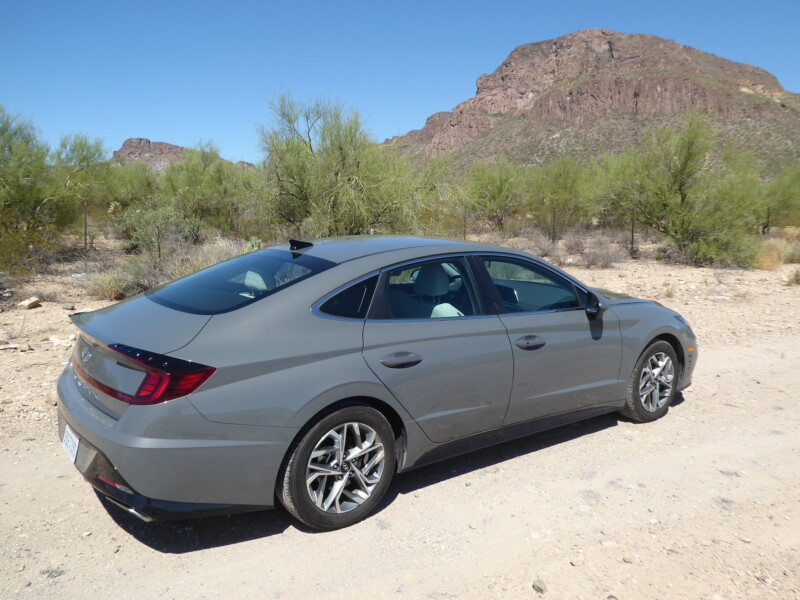


The Hyundai Sonata is not a car that is well known to Europeans. Those with good memories may recall that the Korean giant did try to sell the car in European markets back in the day. After an unsuccessful first generation model which was little more than an upmarket version of the Stellar that was confined to the local Korean market in the mid 80s, Hyundai signalled their intent to compete in the large saloon class with what is known as the Y2 generation of Sonata that was premiered in June 1988. Hoping to repeat the tricks of their smaller cars, this one focused on value for money, offering plenty of space and a generous level of equipment for a low price. It struggled in most developed markets, but was the portent of what was to come. Pretty much every 5 years since then, Hyundai have given us a new generation Sonata. Each has been a conventional four door saloon, though the styling has evolved from the super cautious design of that Y2 generation model to cars with the “fluidic sculpture” of the 2009 and 2014 cars to what we see on the latest model, revealed in 2019, with its bold “sensuous sporting” design. Still current this is the eight generation of Sonata in just 30 years, showing how Hyundai really do refresh their products faster than just about anyone else on the market. Whilst under the skin, this Sonata is still pretty conventional, with the DN8 model showing a considered evolution over its predecessor, the styling certainly does make it stand out. And in a class which, whilst suffering from massively reduced sales thanks to the market shift to crossovers, is still important, that can only be a Good Thing. I’ve driven every generation of Sonata from the third, and generally found them to be pretty decent, but just lacking the final few percent to make them a clear class leader, so was keen to find out whether the latest model would now shine against a reduce list of market competitors. From a disappointingly limited selection of cars parked up that I found on arrival at Hertz’ Phoenix Sky Harbor airport facility, I picked a relatively new 2023 model Sonata SEL in the fashionable grey (Hyundai call it “Hampton Gray”) to try out for a day.


There are a surprising number of engine choices offered in the Sonata range. One of them is a Hybrid model, but just considering the pure petrol ones, there are three different outputs on offer. The entry level spec cars get the familiar 2.5 litre four cylinder which puts out 191 bhp, and which featured in my test car. Upgrade your trim to an SEL plus and you get the smaller capacity 1.6 Turbo which musters just 180 bhp, a figure which is boosted to 290 bhp in the top of the range N Line and Limited. That 2.5 litre goes about its business in an unfussy way. Coupled to an eight speed automatic transmission there is decent acceleration on offer, and the car is smooth and refined. Gears are selected using a push-button system which can be less intuitive than a proper gearlever but these are becoming more commonplace these days as manufacturers look to reduce physical things to simple switches and buttons. I drove down to Tucson and was impressed when I saw the trip computer declare an average of 42.1 mpg (US), a figure which beats the Nissan Altima, the car that normally scores on its fuel parsimony, by several mpg. In total, I covered 261 miles and needed to put in 6.66 gallons which computes to 39.19 mpg US, or 46. 82 mpg Imperial. The trip computer reported the day’s fuel usage at 46.1 mpg US so I suspect the car had not been that full when I got it. Even so, this was a highly creditable result.


The other driving dynamics are perfectly acceptable but not likely to get anyone very excited. The steering is relatively light with not a lot of feel, as seems to be the way these days. The Sonata corners tidily, with plenty of grip and has that safe-feeling handling to it that suggests that driver thrills were not that high on the priority list. The test car came on 215/55 R17 wheels, which are o the small side for a car of this size and relatively high profile. I still found that the ride, which was on the firm side, was generally comfortable most of the time, but it could get caught out by some bumps and ridges. There were no such issues with the brakes which did their job well. The electronic parking brake is in the dash. All-round visibility was good, helped by the Blind Spot Warning System and there are some useful parking sensors. There were some unwelcome reflections in the screen from the central vents which was a bit irksome.


As has been the case for a few years now, the Sonata is nicely finished inside, the lessons having been learned when Peter Schreyer took his Audi experience to Hyundai-Kia. The materials used feel to be of decent quality and there are some silver inlays to provide visual relief from the main dashboard moulding. With light coloured seat upholstery and door casings, the interior is rather less funereal than you would get on an equivalent German car. There is a plastic moulded steering wheel in this trim level but it was OK to hold. The instrument cluster is pretty conventional with electronic dials. There are two main ones, for speedometer and rev counter with smaller ones for fuel level and water temperature inset. There is a digital display area between the dials for trip computer info and a digital speed repeater. There are two column stalks which include lights on the left hand, which have ab auto function. Plenty of buttons on the steering wheel boss are used for cruise control and audio repeater functions. The centre of the dash contains a 10.25” colour touch screen for audio and other features. You don’t get navigation on the SEL, but there is XM Satellite radio. Despite the fact that the only buttons are for volume and radio tuning, the system was generally quite easy to use and the screens were quite responsive. Beneath the screen are the buttons of the dual zone climate control. The Sonata’s centre console is deceivingly capable. What looks like a mere open flat area has clever touches, such as a textured surface and a partition between the cupholders for a spare phone. The front passenger also has access to a small but nice storage area on the right side of the tunnel.


The door opened particularly wide which made getting in and out especially easy. The seat trim is a decent quality cloth and in the test car was a pale colour which may not stand the tests of lots of rental car uses but which was still looking very presentable at the time of my test. SEL trim brings electric adjustment for the driver’s seat. There is a height adjuster for both front seats. There seats are quite firm but I found then comfortable even for a long stint on the freeway down to Tucson and back. I thought there was more than enough adjustment but I’ve read reviews suggesting that even more would be welcome for some drivers.


Those in the rear of the Sonata sit quite low and relatively reclined, which means that despite the sloping roofline, there is still ample headroom. Legroom should prove sufficient, too, as even with the front seat set well back there was ample space here. The central console unit does come well back, so a middle seat occupant might find their knees a little challenged. There is a drop-down armrest with cupholders in the upper surface and there is one map pocket as well as door bins.


As with a seemingly growing number of saloon cars in the US, there is no external release for the boot, so you need to use the key, or pull a lever inside the cabin. Cargo capacity is good and there is a little more space available under the floor in the well where you will also find a space saver. The rear seat backrests drop down. Inside the passenger compartment there is a good-sized glovebox, as well as pockets on the doors, a large central armrest cubby and a useful recess at the base of the dashboard.


The 2023 Hyundai Sonata is available in five trims: SE, SEL, SEL Plus, N Line and Limited. Hyundai also offers the Sonata as a Hybrid. The entry-level SE comes with a 191 bhp 2.5-litre four-cylinder engine, an eight-speed automatic transmission and front-wheel drive. Standard features include cloth upholstery, an 8-inch touch screen, a six-speaker stereo, HD Radio, Android Auto, Apple CarPlay, a USB port and Bluetooth. Standard driver-assistance features include adaptive cruise control, forward collision warning, pedestrian detection, forward automatic emergency braking, lane-departure warning, lane-keep assist, lane-trace assist, driver-attention monitoring and a rearview camera. The SEL trim gains a power-adjustable driver’s seat, heated front seats, a 10.25-inch touch screen, satellite radio, push-button start, a hands-free power trunk lid, blind-spot monitoring, rear cross-traffic alert, vehicle exit warning and dual-zone automatic climate control. The available Convenience package adds a panoramic sunroof, a leather-wrapped steering wheel, an additional USB port, wireless device charging and Hyundai’s Digital Key. The SEL Plus sports a 180 bhp turbocharged 1.6-litre four-cylinder engine and adds suede and synthetic leather upholstery, a digital gauge cluster, navigation, a 12-speaker Bose audio system, an additional USB port, wireless device charging, a panoramic sunroof and Hyundai’s Digital Key. The sporty N Line boasts a 290 bhp turbocharged 2.5-litre four-cylinder engine and an eight-speed dual-clutch automatic transmission. On top of the SEL’s features, the N Line comes with selectable drive modes and front sport seats with leather and suede upholstery. There’s also the N Line Night Edition, which adds several unique styling elements. The top-of-the-line Limited model gains genuine leather upholstery, a power-adjustable front passenger seat, ventilated front seats, a heated steering wheel, a head-up display, front and rear parking sensors, a surround-view camera system and perpendicular park assist.


Kudos must go to Hyundai for introducing a car with a design that, without being ostentatious or gimmicky, really does stand out in a sea of increasingly homogeneous looking products. A ton of technology features, a large interior, a class-leading warranty and strong ownership perks give the Sonata killer value on paper. If you prioritize advanced safety features and look-at-me style, the Sonata provides your money’s worth. For many, that will be enough, but for those who are looking for more, then they may still be satisfied by the Sonata. It drives nicely enough and my experience suggests that it can be very economical, but it is not really that much fun. Sadly, the cars in this class which were the best to drive, the Mazda 6 and Ford Fusion have both been deleted so the ever-diminishing mid-size sedan category does not really have a stand-out car for the driving enthusiast any more. My experience with the Sonata’s rivals, and I’ve driven almost all of them in their latest form, suggests that you would probably make your choice based on the ownership experience as much as the innate ability of the car. And on that, the Sonata scores well. Of course, if you are at the rental car counter, then you will be less worried about the length of the warranty and longer term reliability prospects and more on what the car will be like to drive. I’d certainly pick a Sonata over a Malibu or an Altima, the rivals you are most likely to find on offer. Choosing between it and the Camry would be a harder choice now that the Toyota is surprisingly decent to drive. How it compares with the Accord is something I hope to find out during this trip.