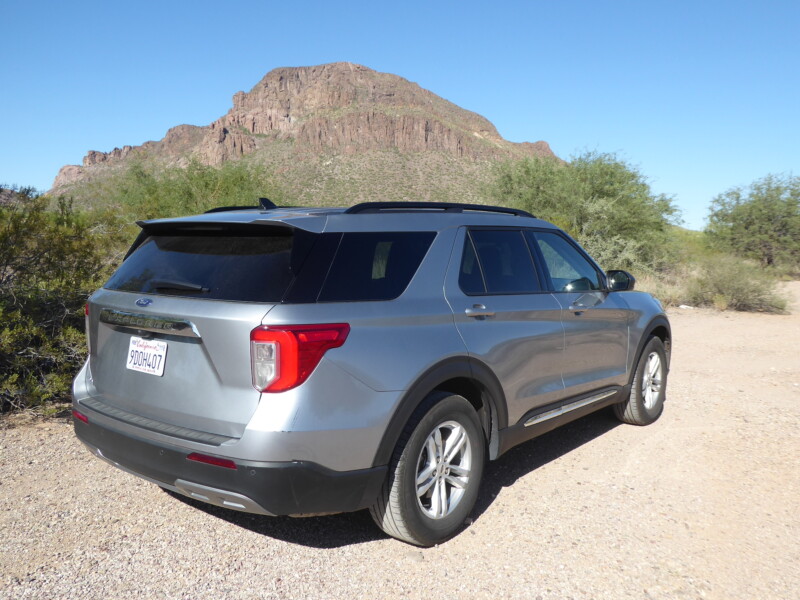
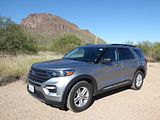


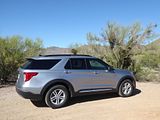


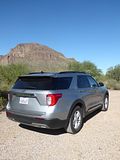


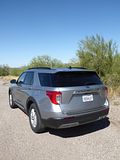

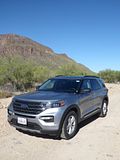


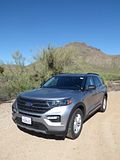


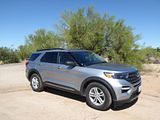

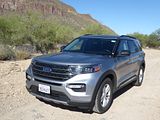
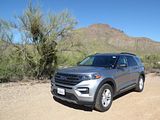
It’s more than thirty years since Ford launched the first Explorer model and in that time it has sold in large numbers in the US. Arguably this is the car, more than any other, which set off the current craze for what initially were known as Sport Utility Vehicles (SUVs,) and now, as they have become more sophisticated unibody machines, as Crossovers. Whilst the Explorer has always sold well, it has definitely had its ups and downs, even after the infamous roll-over problems with Firestone tyres in the 1990s. The first Explorer I drove, back in 2008, whilst not without merit. alarmed me for its truly terrible braking performance in the wet and this was definitely not a car that you could fling down a bendy road with impunity. Although all-wheel drive has always been an option, the majority of these cars have been sold in cheaper and simpler two-wheel drive guise and when updated the model to the fifth generation in 2011 it switched to front wheel drive, sharing its D3 platform with the Ford Flex and Lincoln MKT. With a much better chassis and lusty 3.5 litre V6 engines, I was decently impressed by the redesigned model when I got to sample it in 2015. It was a bit of a surprise to learn that the next generation car, premiered in early 2019, would switch back to rear wheel drive, but this was probably forced upon Ford as they had no suitable front wheel drive platform left in their range. Visually, the car did not appear to have changed all that much but in fact it was all-new. Gone are the days when the Hertz rental fleet is packed out with Ford models, so it has taken a while for me to source one of the latest Explorers but finally the chance came when on yet another evening with very limited car choice at Hertz’ Phoenix Sky Harbor airport, a freshly washed 2023 model was brought up just as I was looking for a car.


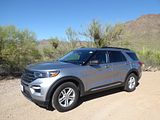

The majority of Explorer models get a 300 bhp 2.3 litre turbo four cylinder engine, which, whilst not quite as smooth as the V6 engines of yore should be ample to give the car a decent performance. The initial omens are not that good, as this Ford feels a bit sluggish initially but get underway and it does picks up speed OK, and in fact the extra bhp that even the base model cars have compared to all the competition mean that this is generally a decent performer. The engine is generally refined but even at a steady cruising speed, you are aware that the engine is working and there was an amount of wind and road noise as well. There is a standard 10-speed automatic transmission and gear changes are generally pretty smooth. You get one of those on-trend cylindrical gearlevers that you twist to make a selection, which seems to have no particular functional benefit, just a visual one. I covered 332 miles in the day I had the Explorer and l need to put in 13.3 gallons to fill it, which works out at 24.96 mpg US or 29.8 mpg Imperial. I thought that a bit disappointing as most of my test miles were done at a steady speed, when the car would be at its most economical, so suspect this figure is about as good as you are likely ever to see.


If you are expecting this to be good to drive, because, well, it is a Ford, prepare to be disappointed. The steering is light and surprisingly vague, so whilst the Explorer is easy to manoeuvre, there’s not much precision whilst out on the open road. The Police may drive these things at speed, but I am not sure you will want to, especially when you reach the bendy bits of road. The handling reminds you that this is a heavy and tall SUV and there is lots of body roll, so I found I could not really corner with confidence. The test car had the standard rear wheel drive set-up. All-wheel drive is an option all Explorer models. The ride was generally OK, though there was quite a lot of bump/thump on some surfaces. The test car came on 255/65 R18 wheels. Thankfully the brakes were significantly better than those of a couple of generations back. All-round visibility is up to par, and the rear-view camera helps when parking up and the Blind Spot Warning system proved useful when on the move.



Ford have tried to be different inside, but the results are not entirely successful. There are lots of hard plastics used on the dash and door casings. The matt grey inlays will be a matter of taste that will meet the approval of some. There is a leather-wrapped wheel but I thought this of poor quality material. The instrument cluster two main dials for the speedometer and rev counter, and these have the Ford characteristic turquoise pointers. There are bar chart style indicators for water temperature and fuel level and between the dials are a limited number of trip display options. Two chunky stalks take care of indicators and lights whilst the lights, including an auto function, are on the dash. There are plenty of buttons on the steering wheel boss for cruise control and audio repeaters as well as trip computer selections. The centre of the dash contains what by today’s standards is quite a small colour touch screen which looks a bit perched on the top of the dash, in the middle of the central air vents. It runs the latest version of Ford’s SYNC software and over the years has got a lot better so it is now pretty responsive. There are still knobs for audio on/off, volume and tuning but everything else is on the screen. In XLT trim you do get XM Satellite radio, Apple Car Play and Android Auto but there is no navigation. Beneath this unit are the buttons of the dual zone climate control.


The Explorer is a crossover, and this is one car that really feels it when you get in, as it feels quite high off the ground. Although you are perched higher than in a regular saloon car, there is still a feeling of space with particularly generous levels of headroom. The seats are trimmed in a relatively cheap feeling leather. They are electrically adjustable, 10-ways for the driver and 4-ways for the front passenger. There is plenty of travel in every direction, but disappointingly I did not find the seat, especially the backrest, particularly comfortable. The seats are heated, though this was not something I needed in a particularly warm Arizona. The steering wheel has plenty of adjustment on it, too, so at least I could get the driving position I wanted.




The second row of seats are on sliders and also have adjustable backrests. The seats are split 40/20/40 so you can choose your placement and angle individually. Even with the front seats well back and these seats well forward there should be ample legroom, and there is plenty of headroom at all times. Occupants here get a central armrest, their own climate control settings, map pockets on the back of the front seats and pockets on the doors. The third row is really only suitable for children. It is not that easy to get in, and once installed, space is quite limited, with the feeling of your knees getting uncomfortably close to your chin. Width is OK for the two people who are intended to sit here, and there is enough headroom, but adults really would only want to travel here on short journeys.


With most 7-seaters, even those which are dimensionally quite large, the boot tends not to be very big if the third row of seats is erect. The Explorer does rather better than most, with a space which is not only deep but actually long enough that you could probably fit roller bags in front to back rather than sideways. Fold the last row down and you get a really pretty sizeable luggage area. Drop the second row down, as well – and these seats are split 40/20/40 – and there is a vast amount of space. The resulting floor is flat, too. Dropping all the seats down is easy. There is space under the floor at the back of the car for a few odds and ends. Inside the cabin, there is ample stowage for odds and ends. The glovebox is a good size and as well as a central armrest cubby there is a lidded console cubby and there is a place under the touch screen as well as the door pockets.


The 2023 Ford Explorer is available in eight trims: base, XLT, ST-Line, Limited, Timberline, ST, King Ranch and Platinum. A 300 bhp turbocharged four-cylinder engine is standard in the base through Timberline trims. The ST, King Ranch and Platinum have a 400 bhp twin-turbocharged V6. Rear-wheel drive is standard, and all-wheel drive is available in every trim except the AWD-only Timberline. A 10-speed automatic transmission is standard across the board. Standard features in the base Explorer include cloth upholstery, an eight-way power-adjustable driver’s seat, a four-way manually adjustable front passenger seat, a power liftgate, tri-zone automatic climate control, an 8-inch touch screen, a six-speaker stereo, satellite radio, a Wi-Fi hot spot, voice recognition, two USB ports, Android Auto and Apple CarPlay. Forward collision warning, forward automatic emergency braking, pedestrian detection, automatic high-beam headlights, lane-departure warning, lane-keep assist, driver-attention monitoring, MyKey, a rearview camera and rear parking sensors also come standard. The Explorer XLT gains a 6.5-inch driver information display, two second-row USB ports, proximity keyless entry, a leather-wrapped steering wheel, a 10-way power-adjustable driver’s seat, a four-way power-adjustable front passenger seat, heated front seats and second-row captain’s chairs. Available features include a moonroof, a rear-seat entertainment system, adaptive cruise control, evasive-steering assist and navigation. The available Equipment 202A package includes LED fog lights, remote start, a heated steering wheel, synthetic leather upholstery and an eight-way power-adjustable front passenger seat. The XLT Technology Package adds a surround-view camera system, front parking sensors, a 12-speaker Bang & Olufsen stereo, an auto-dimming rearview mirror, a universal garage door opener, wireless device charging and towing components. The Explorer ST-Line adds rain-sensing windshield wipers, multicolour ambient interior lighting, HD Radio, a Bang & Olufsen stereo, stop-and-go adaptive cruise control, lane-centring assist, evasive-steering assist, navigation and the contents of both of the XLT’s available packages. The Explorer Limited’s additional features include genuine leather upholstery, ventilated front-row seats, heated second-row seats and front parking sensors. Available features include hands-free liftgate access, a power-folding third row, driver’s seat memory settings and a household-style power outlet. The Explorer Timberline boasts mild off-road features, including all-terrain tires, skid plates, off-road shocks and a limited-slip differential. The Timberline also has special exterior appearance upgrades and standard all-wheel drive. Along with the 400 bhp engine, the Explorer ST adds a sport-tuned suspension, a 12.3-inch digital instrument cluster and sporty styling. The ST also comes with park assist, performance brakes, a 10.1-inch touch screen, massaging front seats and a 14-speaker Bang & Olufsen stereo. Several amenities from the lower trims don’t carry over to the ST but remain available. The Explorer King Ranch features interior enhancements like upgraded genuine leather upholstery and wood trim, plus premium exterior styling and King Ranch branding. Reverse automatic braking is standard on this trim. The Explorer Platinum has the same interior and exterior enhancements as the King Ranch minus the King Ranch branding, as well as standard reverse automatic braking. The Platinum also comes with adaptive headlights.


Overall, the Explorer struck me as a real mixed bag. Whilst it goes quite well, some of the other on-road manners were somewhat below par, especially the body roll. The interior quality is unimpressive at best and plain unacceptable in places where I found evidence of a lack of care, such as ill-fitting trim and a series of exposed bolts and screw heads under the seats in the third row. For sure the car is quite spacious, even if the third row is only really suitable for children, but I have tried a number of rivals that do everything the Explorer does at least as well and generally better, for around the same money. Given the reduction of product in Ford’s passenger vehicle range, this car needs to be class-leading if the Blue Oval is to hold its head up in the sales charts and this one just is not.