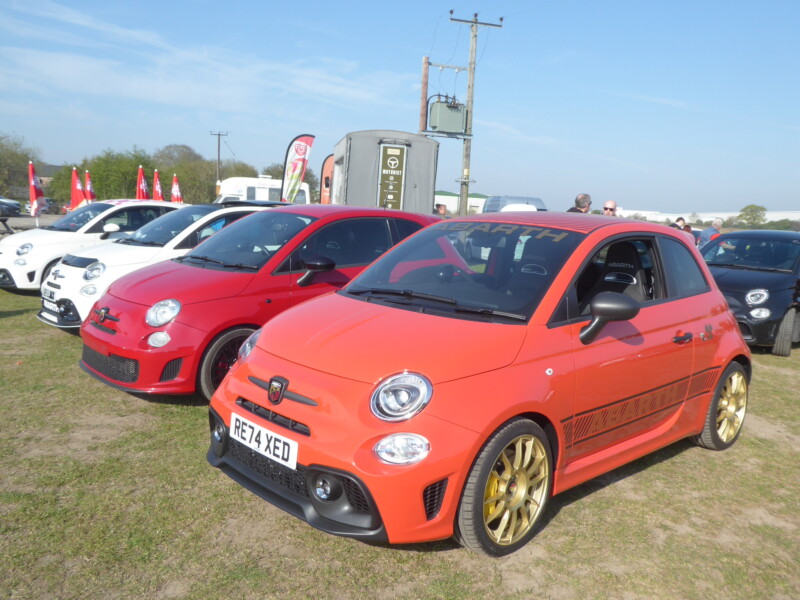
Recognising that the UK is actually quite a large country, and that no matter where you choose to hold a National event, such as Abarth Festival, it will be deemed simply too far away for some who would like to attend, so I have been on the idea of trying to hold slightly smaller Northern and Southern Abarth days as well. Everything clicked into place when I made my first visit to The Motorist, a renowned meeting point for car and bike enthusiasts situated just a few miles off the A1M to the east of Leeds, when at the end of a Christmas event, the manager told me that he loved having Abarths there as the community are so well behaved and he pointed out that he had plenty of space to do something larger. Immediately, that gave me the idea that this would be the perfect venue for Northern Abarth Day. All that was needed was to agree a date. Mindful of an already very busy calendar, I decided that early in the season was probably better timing, and then had the idea of shooting for the Saturday the day before another Italian themed event that could perhaps encourage a few people from the south to come up and make a weekend of it. Whilst that did not add to the total attendee numbers by a massive amount, it did certainly encourage a few others to head north and to join in. What we were not able to know until close to the event was that the weather gods would play nicely and the chosen day dawned cloudless (and cold, until the sun rose a bit!). That, I am sure, was further encouragement for people to come, especially as we were able to keep this informal with no need for tickets or pre-booking. The net was a splendid day filled with cars, good conversation and friends, old and new. Here are the highlights:
THE VENUE
Conceptually, The Motorist is not unlike Caffeine & Machine and other such venues in that it was conceived as a place where people, predominantly car and bike enthusiasts, could meet, with ready access to coffee and a bite to eat. The site that was acquired by the founder and owner, Simon Spinks chairman of North Yorkshire-based Harrison Spinks Events Limited adjoins an airfield which these days is used by a private flying club, and has loads of space, something that many other similar venues often lack. During 2022 the decision was taken to expand with a purpose-built main building to act as the focal point of the site. Other buildings are used for car storage and repair services and there are plans in development eventually to add some hotel accommodation. At present, in addition to the main building, there is a sizeable tarmac area available for car parking that backs onto the building, then a much larger gravelled area and an adjoining grassy area that needs care in the winter months. There’s space for several hundred cars here, and on a busy day, I understand it all gets filled up. It’s all quite informal, so there are no tickets required, and over the years, the site has become well-known not just for cars and bikes, but also as place to drop in to for a good coffee and a tasty breakfast. I can vouch for both of these, having a particularly good bacon and sausage bap, at Yorkshire prices.

The main building is quite expansive. At the back is a café area which offers coffee and tea, breakfasts and a tempting looking array of cakes and pastries. In front of this, there is a large shop area which has all manner of temptations from model cars, to stickers and clothing. Among the displays are a number of complete vehicles, reflecting the fact that there are also some workshops to the side of the main building and restoration work is undertaken here.


The central part of the building connects the bar and downstairs dining area to the shop and café and there are loan cars in the corners of this L shaped area. The cars on show were provided from the National Motor Museum, and these clearly change periodically, as they were different to the ones I had seen when last here just before Christmas 2024. This time they included an Auburn Speedster 851, a de Dion Bouton and an MGB.


THE ABARTHS
With cars coming and going during the day, it was hard to get an actual count of the number of Abarths attending, but we certainly filled the large allotted area and there were cars elsewhere on site at least early in the day, and the estimate is a minimum of 120 cars came, which is a good total for an inaugural event. There was huge variety among the Abarths present, as is always the case when these cars are assembled en masse.


Not surprisingly, given the relative sales numbers, the majority of Ab arths here were the 500-based models. These have been on sale now since the end of 2008, following a launch at the Paris Show that year. Since that time there have been a number of detailed changes to the standard cars and a lot of limited editions. Those who really know the marque can spot most of them, but some are so subtle that unless there is a badge you can see, you will not be quite sure which version you are looking at. It used to be relatively easy, when the model was first launched, as there was only one version as shipped ex works called the 500. It had a 135 bhp 1.4 litre turbo-charged engine coupled to a five speed manual gearbox, with 16″ alloys as standard, and the option of 17″ wheels, and a colour palette comprising of two whites (BossaNova White, the standard colour, or the pearlescent Funk White), Red (Pasadoble), Pale Grey (Campovolo) or Black. If you wanted more power – 160 bhp – then you could order an Esseesse kit, which came in a large wooden crate, containing new wheels, springs, an ECU upgrade, the Monza exhaust system and badging. It was dealer fitted and could be applied at any time within the first 12 months or 10,000 miles from registration. Needless to say, it proved popular. As were many of the optional extras, with stickers for the sides, a large scorpion for the bonnet and even a chequered pattern for the roof among the personalisation options offered.


Whilst a sliding glass sunroof (Skydome in Fiat/Abarth parlance) was an option from inception, fans of open air motoring had to wait until Geneva 2010 for the launch of the 500C models, with a roll-back roof which provided the best of open-topped motoring and yet still with the rigidity of the regular body style. For the first few months these cars only came with the robotised manual gearbox, which limited the appeal in the eyes of some, but they also introduced us to the “bi-colore”, a series of two tone cars, with upper and lower halves of the body painted in different colours. It took us a while to get used to this, as no other production road cars had been painted like this for some time, but now this is seen as yet another of those marque defining attributes, and (perhaps with the exception of the rarely seen Rally Beige and Officina Red combination that would come for 2014) in the eyes of many this distinctive look enhances the appeal of the cars still further.


Having used the legendary 695 badging from the 1960s on the Tributo cars, at the 2012 Geneva Show, Abarth dusted off the 595 name that had been used on the less powerful of the Nuova 500 based cars of the same generation, and created two new versions which we should think of as Series 2 cars, the 595 Turismo and Competizione, both of which could be bought in either closed or open top C guise, with either the 5 speed manual or robotised automated gearshifts. Both models had the 160 bhp engine as standard. Effectively they were a replacement for the Esseesse kit, and it meant that the cars were produced complete at the factory, rather than needing the dealer to undertake the upgrade (and the associated paperwork), though Abarth did not withdraw the Esseesse kits from the market for some while. Turismo, as the name suggests was aimed slightly less extreme in intent, featuring standard leather upholstery, upgraded dampers and climate control, Xenon headlights and Alutex interior details. The sportier Abarth 595 Competizione replaced the leather seats with Sabelt cloth sport seats and Alutex with aluminium, while adding p-cross-drilled brakes and the Record Monza dual-mode exhaust.


Rumours started to circulate towards the end of 2014 that Abarth were going to upgrade the Competizione model, so as better to bridge the gap between the Turismo and the 190 bhp 695 Biposto that had been added to the range earlier in the year. It was Geneva 2015 when the result was finally shown to an expectant fan base. Most exciting news was that thanks to a bigger Garrett Turbo, the engine had been tweaked to 180 bhp, and with reduced CO2 emissions. A standard spec that included Koni Dampers, Brembo brakes, Xenon lights, Sabelt seats, Climate Control, parking sensors as well as other refinements that had been added like the TFT instrument display all proved very compelling, so not long after the first cars reached the UK in June of 2015, I found temptation too hard to resist, and as is well documented here, swapped my 2010 car for one of these. At the time I ordered it, Cordolo Red, a tri-coat pearlescent paint which shimmers in bright sunlight looked set to become one of the most popular colours of the lot, even though it is a cost option. Indeed, the Launch Edition models were all offered either in this colour or Scorpion Black, with black wheels. Surprisingly, the colour was not carried over to the Series 4 cars.


What is known as the Series 4 version of the familiar 595 reached the markets in the middle of 2016. After rumours had circulated all winter following the launch of the facelifted Fiat 500 last year, Abarth finally unveiled the Series 4 at the end of May 2016. Initially, we were told that the cars would not be available in the UK until September, but that came forward somewhat, with dealers all receiving demo cars in June, and the first customers taking delivery in July. Three regular production versions of both the closed car and the open-topped C were initially available, all badged 595, and called Custom, Turismo and Competizione, as before, though numerous limited edition models have since appeared and in most case disappeared. The most significant changes with the Series 4 are visual, with a couple of new colours, including the much asked for Modena Yellow and a different red, called Abarth Red, which replaces both the non-metallic Officina and – slightly surprisingly – the tri-coat pearlescent Cordolo Red. as well as styling changes front and rear. The jury is still out on these, with many, me included, remaining to be convinced. At the front, the new air intake does apparently allow around 15 – 20 % more air in and out, which will be welcome, as these cars do generate quite a lot of heat under the bonnet. Competizione models for the UK retain the old style headlights, as they have Xenon lights as standard, whereas the Custom and Turismo cars have reshaped units. At the back, there are new light clusters and a new rear bumper and diffuser. Inside, the most notable change is the replacement of the Blue & Me system with a more modern uConnect Audio set up, which brings a new colour screen to the dash. Mechanically, there is an additional 5 bhp on the Custom (now 145) and Turismo (now 165 bhp) and the option of a Limited Slip Diff for the Competizione, which is likely to prove a popular option. Details of the interior trim have changed, with a filled-in glovebox like the US market cars have always had, and electric windows switches that are like the US ones, as well as a part Alcantara trim to the steering wheel in Competizione cars.


In 2018 Abarth have produced the 695 Rivale, a celebration of Fiat’s partnership with Riva, which has already seen a special Riva version of the 500,. Described as being “the most sophisticated Abarth ever”, it is available either as a hatch or a cabriolet, with both of them featuring a two-tone Riva Sera Blue and Shark Grey paintwork. The Rivale is adorned with an aquamarine double stripe, satin chrome finish on the door handles and satin chrome moulding on the tailgate, various aesthetic elements inspired by the Riva 56 Rivale yachts and ‘695 Rivale’ logos, joined by Brembo Brakes, Koni suspension, and 17-inch Supersport alloy wheels. Enhancing the nautical theme the new 695 Rivale features either a carbon fibre or mahogany dashboard, black mats with blue inserts, blue leather seats and door panels, carbon fibre kick plates, special steering wheel wrapped in blue and black leather and with a mahogany badge, blue leather instrument panel cover, and mahogany gear lever knob and kick plate. These are joined by the standard Uconnect infotainment with a 7-inch display, which is compatible with Android Auto and Apple CarPlay, and there is also a hand-written numbered plate that can be customised with the mane of the customer’s yacht on request. Powering the 695 Rivale is the same 1.4-litre turbocharged engine that makes 180PS (177hp) and 184lb/ft of torque, that features in the 595 Competizione, allowing it to go from rest to 100km/h (62mph) in 6.7 seconds and up to a top speed of 225km/h (140mph). This is a regular model in the range, but confusingly, there is also the Abarth 695 Rivale 175 Anniversary, created to celebrate 175 years of the Riva brand. Just 350 of these were produced, half of them the hatch and the other half cabriolets. These featured 17-inch alloy wheels with a special pattern, celebratory badge on the outside, hand-crafted details such as the two-tone colour – blue and black hand-stitched leather seats with a celebratory logo stitched onto the headrest, carbon dashboard silk screen printed with special logo, numbered plate. Standard Rivale cars arrived in the UK in April 2018, and quite a few have been sold. They always attract lots of interest when they do appear.


A top of the range 595 Esseesse model was added in early 2019. These cars have only sold in quite small numbers, so you don’t see them that often. The most obvious change externally is the adoption of the neat white painted 17inch multi-spoke alloy wheels that are an Esseesse trademark, while elsewhere it gets the same recently reprofiled bumpers as the standard 595. Inside, there’s a pair of bespoke figure-hugging Sabelt high-backed seats with a carbonfibre shell and some natty red stitching, while carbonfibre trim also covers the pedals and the dashboard. Under the bonnet is the familiar 178bhp turbocharged 1.4-litre engine, but here it breathes in through a BMC filter and exhales from a switchable carbonfibre-tipped Akrapovič twin exit exhaust. There’s no more power than the old Competizione, but the Esseesse gets that model’s Brembo callipers for its 305mm front discs, plus a limited-slip differential. The suspension is largely carried over, including Koni’s frequency selective dampers. All this comes at a price though, and so this has remained a relatively rare sighting compared to the Competizione which many still feel offers rather better value for money. For 2022, the badging was changed so the Esseesse is now branded a 695 rather than a 595 and there were minor spec changes.


Abarth announced two limited edition models in the autumn of 2020 and one of these was here, the 595 Scorpioneoro. Another model which takes its inspiration from a history which few in the Uk will be familiar with, there will be just 2000 units of this distinctive model available globally. The 595 Scorpioneoro was born to continue the legacy of the famous A112 Abarth “Gold Ring” of 1979, better known as the A112 Abarth “Targa Oro”, of which only 150 models produced and, as with the new Abarth 595 Scorpioneoro, what made it so special were its stylistic details. These details included black livery, gold-coloured decorative line contouring the bodywork and the alloy wheels, also painted in the distinctive gold colour. This car is liveried in the same way, marked out by its black livery, decorative gold bodywork lining and gold-painted alloy wheels. It also boasts a matt black chessboard roof and grey finish on the door handles and mirror caps. And to mirror the ‘Gold Scorpion’ name, the car is adorned with gold scorpions on the bonnet and the wheel centres. Inside the cabin of this new exciting new model, you’ll be greeted with a black dashboard which is home to the new gold finished 500 logo. Leather detailing on the seats introduces the original “scorpionflage”. The seats are further embellished with dedicated stitching and personalised headrests with the word “Scorpioneoro”, the Italian flag and Abarth embroidered on them. An additional touch of exclusivity comes from the numbered, gold coloured plaque, available solely on this model. The Scorpioneoro also comes with Abarth’s top-of-the-range seven-inch touchscreen infotainment system, complete with Apple CarPlay and Android Auto, as well as a Beats Audio sound system. Mechanically, there is nothing new, as the car has the 165 bhp version of the familiar T-Jet engine and the other features you get in the regular production Trofeo cars.

This is the Abarth 695 Tributo 131 Rally, and as you may have guessed from the name it pays homage to the fantastically-boxy Abarth 131 Rally. It was launched to mark 40 years since the 131 Rally’s last official race, and that is absolutely a car worth celebrating. In the late 1970s and early 80s, the 131 won three WRC manufacturer titles and two drivers’ championships. It looked ridiculously cool while doing so too. The 695 Tributo is perhaps slightly less cool, with no more power than the standard 178bhp 695 and the same 1.4-litre turbo engine. There’s the same Koni front and rear shocks too, plus Brembo brakes and the adjustable ‘Spoiler ad Assetto Variabile’ that was first shown on the 695 Esseesse. The Tributo 131 Rally was limited to just 695 examples though, with each one costing a fairly hefty £32,325. For that you’ll also get a Record Monza Sovrapposto exhaust, diamond-cut 17-inch alloys and three-layer Blue Rally paint. There’s also plenty of 131 Rally silhouettes to let everyone inside and out know that you’ve bought a very special version of the special Fiat 500. There was a long interval between announcement and the cars hitting the UK, and I’ve only ever seen a couple of them at events, so these look like they are going to be among the rarer of the many special editions of the 500-based car.


For the final couple of years of production, Abarth changed their naming convention so that the 595 cars were the 165 bhp ones and the 695s were the ones with 180 bhp. Both were available in Turismo and Competizione spec. Sadly, the 695 Competizione was only ever offered with the MTA box, otherwise I could have been tempted, especially in the new Rally Orange colour. Not many cars came to the UK in this rather attractive shade, but Dave Quinn, managed to secure one of the last, a 695 Turismo. It turned out also to be with an MTA box. He’s not used it muchm as he has several other Abarths in his fleet, of course.


Newest of all the various versions produced is the model that turned out to be the last of a long line of limited production cars, the 75th Anniversary car. This is a 695 model, which means it has the 180PS engine. Mechanically it is no different to the regular Turismo and Competizione models in the regular range but you do get some special graphics and pretty every item that is available on an Abarth is included in the standard spec, as you would rather hope for a car with a list price of £32,995. You will identify one by its Scorpione Black paint, the Gold Scorpion Sticker on the roof, Gold Abarth lateral stickers, a 75th Abarth Piston Head sticker and the 17″ Formula Gold alloy wheels. Inside there are Sabelt carbon seats with unique stitching & 75th Logo, an alcantara dashboard and binnacle cover and an aluminium gearknob as well as a sports steering wheel in leather and Alcantara® with carbon fibre detailing. The spec also includes a High Performance BMC air filter, Black Brembo brake calipers, Koni front and rear suspension with FSD technology (Frequency Selective Damping), and an Active “Record Monza Sovrapposto” Exhaust with Rotated Tips.


The Abarth Grande Punto debuted at the 2007 Frankfurt IAA Show, going on sale in the UK in late summer of 2008. Offering 155 bhp from its 1.4 litre T-Jet engine, coupled to a six speed gearbox, and riding on 45 profile 17″ alloys, the standard car got rave reviews from the journalists when they first tried it, and they were even more impressed by the changes wrought by the optional Esseesse kit. This increased power to 177 bhp, brought 18″ OZ lower profile wheels, whilst new springs lowered the ride height by 15-20mm, and high-performance front brake pads and cross-drilled front disc brakes helped the car to stop more quickly. The most distinctive feature of the car were the white alloy wheels, though, as owners found, keeping these clean is not a job for the uncommitted, and many have a second set of wheels that they use fro grubbier conditions. Despite the positive press at launch, the car entered a very competitive sector of the market, and the combination of being relatively unknown, a limited number of dealers and the existence of established rivals from Renault and others meant that this always remained a left-field choice. The owners loved them, though, and they still do. The oldest cars have now had their 16th birthdays, and some have amassed relatively big mileages, but they are still a car for the cognoscenti

The Punto Evo was launched at the 2010 Geneva Show, with the cars reaching UK buyers in the summer of that year, and it incorporated many of the changes which had been seen a few months earlier on the associated Fiat models, the visual alterations being the most obvious, with the car taking on the nose of the associated Fiat, but adapted to make it distinctively Abarth, new rear lights and new badging. There was more to it than this, though, as under the bonnet, the T-Jet unit was swapped for the 1.4 litre Multi-Air, coupled to a 6 speed gearbox, which meant that the car now had 165 bhp at its disposal. Eventually, Abarth offered an Esseesse kit for these cars, though these are exceedingly rare. Part of the Punto Evo family is the SuperSport, usually identified by the distinctive black bonnet, though not all cars feature it. Just 199 of the SuperSport versions were built, of which around 120 are registered on UK roads. These cars had many of the options from the Punto Evo included as standard. Power came from the the 1.4-litre MultiAir turbo engine, tuned to produce 178bhp and 199lb ft of torque, up from 165 of the standard Punto Evo, giving the SuperSport a 0-62 time of 7.5 seconds and a top speed of over 132mph. To help put the power down, the SuperSport was fitted with wider 18″ wheels and optional Koni FSD dampers. Standard equipment included the Blue&Me infotainment system with steering wheel controls, automatic climate control and a popular option was the ‘Abarth Corsa by Sabelt’ sports leather seats. The SuperSport was available in the same colours as the regular Punto Evo, which means white, grey, black and red.


Eagerly awaited, the 124 Spider went on sale in September 2016. A quick reminder as to what this car is: The Abarth 124 Spider was developed in parallel with the Fiat model. It does cost a lot more, and there are those who think you don’t get enough extra for your money, but those who have driven it will tell you otherwise. You certainly get more power. The 1.4 MultiAir turbo unit jumps up from 138bhp to 168bhp, while torque also increases by a modest 10Nm to 250Nm, which gives it a 0-62mph time of 6.8 seconds, which is half a second quicker than the 2.0-litre Mazda MX-5. The top speed is 143mph. It weighs just 1060kg meaning a power-to-weight ratio of 158bhp-per-tonne, and with the new Record Monza exhaust system it sounds great even at idle. The Abarth version gets a stiffer suspension setup than the regular Fiat 124 Spider, with Bilstein dampers and beefed-up anti-roll bars. Bigger Brembo brakes also feature, with aluminium calipers. It can be had with a six-speed manual or six-speed automatic transmission with paddles, and the latter gets a Sport mode for quicker shifts. Many of the UK cars sport the ‘Heritage Look’ pack, which is a no-cost option. It brings a matt black bonnet and bootlid, plus red exterior trim detailing and has proved popular. The £29,565 starting price gets you standard equipment such as cruise control, climate control, Bluetooth, a DAB radio and satnav, plus Alcantara black and red (or pure black) seat trim. The automatic gearbox is a £2,035 extra, while an optional visibility pack brings LED DRLs, auto lights and wipers and rear parking sensors. The final cars were sold during 2019, so there are only around 1800 of them in the UK, which means that this is always going to be quite a rare sighting


There were a number of Fiat models here, with those belonging to members of the various Abarth communities being encouraged to park their cars among the Abarths. Several of them were versions of the long-lived modern Fiat 500, a car sold in a huge number of different versions and limited editions over a production life that spanned from 2007 to the end of 2024.

There were also examples of the Fiat versions of the recent 124 Spider, developed as the Type 348, this is a front-engine, rear-drive, two-passenger roadster manufactured by Mazda for FCA, having debuted at the 2015 LA Auto Show for model year 2016. Largely based on the fourth generation Mazda MX-5 Miata roadster, and manufactured alongside the MX-5 at Mazda’s Hiroshima plant, the 124 shares its platform, mechanicals, interior and top mechanism with the MX-5 — it is distinguished by an FCA engineered and manufactured turbocharged Multiair engine, uniquely tuned shock absorbers, unique exterior styling and slightly increased length and cargo capacity over the MX-5. In May 2012, Mazda and Alfa Romeo — at the time a subsidiary of the Fiat Group, now Stellantis — announced a joint venture to manufacture a common rear wheel drive platform. The companies would “develop two differentiated, distinctly styled, iconic and brand specific, lightweight roadsters featuring rear wheel drive”, with the two variants offering proprietary engines unique to each brand. In December 2014, FCA’s Sergio Marchionne determined Alfa Romeos would be manufactured only in Italy, saying “some things belong to a place. Alfa belongs to Italy,” adding “I remain committed to that architecture, with our powertrain. I’m not sure it will be with Alfa. But it will be with one of our brands.” At the time, Alfa Romeos were manufactured only in Italy, while Fiats were manufactured in Italy, but also globally — from Tychy, Poland, to Toluca, Mexico. With their prior agreement in place — for FCA to market a roadster based on the MX-5 to be manufactured by Mazda at its Hiroshima factory — FCA conceived of marketing a Fiat badged variant in lieu of the Alfa Romeo variant. In August 2016, FCA formally announced the Fiat 124 Spider based on the Mazda ND platform. In December 2016, the Detroit News said “in partnering with Mazda’s MX-5 Miata to resurrect the classic Fiat 124 Spider, Fiat Chrysler not only gained a halo sports car for its struggling Italian brand, but likely saved the most celebrated small sports car of the past 25 years (the MX-5)” — citing the markedly increased cost of developing a new car at the time and “the costliest wave of government regulation since the 1970s.” The 124 Spider was powered by Fiat’s 1.4 litre MultiAir turbocharged inline-four, producing 140 PS (138 bhp) and 240 Nm (177 lb/ft) of torque in European specification—and 160 bhp and 184 lb/ft (249 Nm) of torque in North American specification. The 124 manual transmission is from the third generation MX-5’s six speed transmission to cope with the turbo’s torque. Multiair is a hydraulically actuated variable valve timing (VVT) engine technology enabling “cylinder by cylinder, stroke by stroke” control of intake air directly via a gasoline engine’s inlet valves. Developed by Fiat Powertrain Technologies, the technology bypasses a primary engine inefficiency: pumping losses caused by restriction of the intake passage by the throttle plate, used to regulate air feeding the cylinders. At the 124’s debut, Fiat marketed a 124 Spider Anniversary edition, with 124 units carrying the designation—to commemorate the 50th anniversary of original 124 Sport Spider. Including features of the 124 Spider Lusso Plus trim, the edition also includes chromed mirrors, red ‘124’ badge on the front grille, interior numbered plaque, red exterior and black leather interior. In January 2019, FCA announced the Fiat 124 Spider was to be withdrawn from the market in the United Kingdom with immediate effect. The Abarth 124 Spider continued to be sold, but this too was withdrawn from the UK market in April 2019. On December 23, 2020, Stellantis announced the 124 Spider and 500 were to be withdrawn from their North American model lineup after the 2020 model year and would not return for 2021, as is the situation with 500L. These models were expected to sell into 2021 until stock depletion.

The Cinquecento, Tipo 170 in Fiat development parlance, was launched in December 1991, to replace the Fiat 126. It was the first Fiat model to be solely manufactured in the FSM plant in Tychy, Poland, which had been sold to Fiat by the Polish state, and where production of the Polish variant of the Fiat 126, the Polski Fiat 126p, was still running. It took 18 months before the new city car reached the UK, and its success proved that there was a market for very small cars after all, even though Renault had concluded that there was not sufficient demand for their Twingo which appeared around the same time. The Fiat sold well, and it was not long before it had a number of market rivals, such as the Ford Ka, Seat Arosa and Volkswagen Lupo. The smallest engine, intended for sale in Poland only, was a 704 cc OHV two-cylinder unit, delivering 31 bhp, an engine which was inherited from the 126p BIS. For the front-wheel drive Cinquecento, it underwent a major refurbishment (although the engine still employed a carburettor), which resulted, among other changes, in the crankshaft revolving in the opposite direction than in the 126p BIS! The bigger engine was the 903 cc 40 PS version of the veteran Fiat 100 OHV four-cylinder engine, which saw service in many small Fiat models, starting with the Fiat 850, and dating back to the initial 633 cc unit as introduced in the 1955 Fiat 600. It was fitted with single point fuel injection and was the base engine in most markets. Due to fiscal limitations, the displacement of this unit was limited to 899 cc in 1993, with a slight reduction of output, now producing 39 PS. In 1994, Fiat introduced the Cinquecento Sporting, featuring the 1108 cc SOHC FIRE 54 PS engine from the entry-level Punto of the same era, mated to a close-ratio 5 speed gearbox. Other additions were a drop in standard ride height, front anti-roll bar, 13″ alloy wheels, plus colour-coded bumpers and mirrors. The interior saw a tachometer added, along with sports seats, red seatbelts and a leather steering wheel and gear knob. It is the Sporting model which gave birth to a rallying trophy and a Group A Kit-Car version, and the Sporting is the version you see most often these days, and indeed, that was the variant seen here. Production of the Cinquecento ended in early 1998, when it was replaced by the Seicento


Follow on to the Cinquecento was the Seicento, and that was represented here by the Sporting version, debuting in 1997. It did not differ much from its predecessor, retaining the same engines, chassis and general dimensions, although it did gain a minor 9 cm in length (total length of 3.34 m). At launch, the Seicento was available with three trim levels; a basic ‘S’ with black bumpers and spartan equipment and initially the 899 cc 39 PS FIAT 100 series engine; an ‘SX’ model, a slight upgrade over the ‘S’ with colour-coded bumpers, electric windows, central locking and a sunroof – which was also available as a ‘Citymatic’ with a clutchless manual gearchange – and a ‘Sporting’ with the larger FIAT FIRE series 1108 cc 55 PS engine, 20 mm (0.8 in) lower suspension and anti-roll bars added. Cosmetically, this version gained 13″ alloy wheels, sports seats. An Abarth styling kit was also available with a body kit with optional Abarth 14″ wheels a close-ratio gearbox, sill kick plates, embroidered headrests, leather gear stick and steering wheel, colour highlighted trim in the bumpers, side skirts and a spoiler also available. Both the sporting and the Abarths were available with ABS, air-conditioning and power steering but due to cost not very many owners took up the options. In 1999, the FIRE engine was used in the special ‘Suite’ version, which came with air-conditioning. A special edition ‘Soleil’ model was available in some markets, which was based on the ‘SX’ model but came with a full-length electrically-folding fabric roof. In 2001, after the update, all cars were given clear indicator lenses, with the Sporting model getting a restyled bodykit. Power steering was still an option, in lower end Seicentos. A ‘Michael Schumacher’ edition of the Sporting, with ABS and the Abarth styling kit, was also launched at this time to celebrate the Ferrari driver’s Formula One success, This model was almost identical to the Abarth kit with the exception of chrome gear stick surrounds and Michael’s signature on the boot lid and side skirt. A limited edition plate and number was also on the passenger door. In 2004, the model was withdrawn from the UK market, and production of RHD models ceased, following the arrival of the new and more practical Panda. The LHD model was facelifted, gaining a new design for the wheel rims and the introduction of the new Fiat logo to the rear. In 2005, the name Seicento was replaced by 600 (on the occasion of the 50th anniversary of the first edition, in 1955) together with some changes in the front and in versions donations: now the name Fiat is written on the seats. The new versions now were named “Class” and “50 anniversary”, thus reminding the strict relationship between this model and the previous one. Production continued until 2010 by which time over 1.33 million units had been built.


Needless to say, as the site became emptier, people took advantage of the space to move their cars around especially to do various group photographs. These were the cars from North West Abarth who had gone to the far end of the parking field to get some group shots.


Whilst the cars were a huge part of the attraction, the idea is that event is also about the people – the owners past and present – giving them a chance to meet up and catch up with what has been going on their busy lives, as well as the chance to meet people who until now had just fellow enthusiasts posting online. All day long there were huddles of people spread right across the site, some grouped by a car, others indoors sharing time over a coffee and bacon roll or for the sit down lunch was on offer to everyone who wanted it. The food at this venue is always good, and today was no exception.


EVERYTHING ELSE
Whilst a sizeable area of the available space was reserved for Abarths, the venue was open as usual for everyone else, too, and, probably thanks to the good weather, others come in their droves, so there were plenty of other interesting cars to see. Depicted here are the more notable ones:


ALFA ROMEO
The Alfa Romeo 4C is a two-seater, rear-wheel drive coupé with technology and materials derived from the Alfa Romeo 8C Competizione, with a 1750 cc turbo petrol engine with direct injection, the “Alfa TCT” twin dry clutch transmission, and the Alfa DNA dynamic control selector. The 4C concept version was unveiled in the 81st Geneva Motor Show in March 2011, followed by the Mille Miglia 2011 parade, Goodwood Festival of Speed 2011,2011 Frankfurt Motor Show. It was displayed for the first time outside in Concorso d’Eleganza Villa d’Este in 2012. Compared to the production version, it is very similar, with the biggest differences being front lights, side vents and mirrors. The Alfa Romeo 4C Concept was voted the ‘Most Beautiful Concept Car of the Year’ award by the readers of German magazine Auto Bild, and won the Auto Bild Design Award 2011. It was awarded the “Design Award for Concept Cars & Prototypes” by referendum of the public in Villa d’Este. The production car was unveiled at the 2013 Geneva Motor Show, followed by 2013 Essen ‘Techno Classica’, Goodwood Festival of Speed 2013, Moscow Raceway, 2013 Frankfurt Motor Show. The bare ‘4C000’ chassis was also shown at the 2013 Geneva Motor Show. Ordering of European models began in October 2013 at Alfa Romeo dealerships in Europe. As part of the Alfa Romeo 4C launch, Alfa Romeo Style Centre and Compagnia Ducale designed a 4C IFD (Innovative Frame Design) Bicycle, inspired by the Alfa Romeo 4C coupé. The vehicle went on sale in December 2013 and marketed in Europe, Asia and America. Production of the 4C began May 2013 at Maserati’s plant in Modena, with an expected production of up to 2500 units per year. It was the first mass-produced Alfa Romeo model to be sold in the US market since 1995 when the 164 sedan stopped being sold in the US. Production of the Alfa Romeo 4C was originally estimated to be over 1000 units per year, with an upper limit of 3500 units per year, depending on the quantity of carbon fibre chassis that can be built by the supplier Adler Plastic. Within the 3,500-unit quota, 1,000 units are earmarked for Europe. Delivery of the European Alfa Romeo 4C Launch Edition took place at Balocco (Vercelli, Italy) Test Centre. In 2018, the 4C coupe was discontinued for the North American market. The 4C Spider, however continued to be sold there for model year 2019 and model year 2020. In other markets, such as Australia and Japan, both the coupe and Spider continued. In late 2020, a new tribute-edition named the 4C Spider 33 Stradale Tributo was announced. The car was designed by Centro Stile Alfa Romeo (Style Centre) and developed by Alfa Romeo. The chassis is composed of a central carbon fibre tub, with aluminium subframes front and rear. The carbon fibre tub is produced by TTA (Tecno Tessile Adler) in Airola, as a joint venture between Adler Plastic and Lavorazione Materiali Compositi. The carbon fibre components that make up the chassis are cut using CNC technology. The entire carbon-fibre monocoque chassis (“tub”) of the car weighs 143 pounds (65 kg). Front and rear aluminium subframes combine with the tub, roof reinforcements and engine mounting to comprise the 4C chassis giving the vehicle a total chassis weight of 236 lb (107 kg) and a total vehicle curb weight of just 2,465 lb (1,118 kg). The 4C has a single carbon fibre body, similar to the body of many supercars. The outer body is made of a composite material (SMC for Sheet Moulding Compound) which is 20% lighter than steel. The stability is comparable to steel and better than aluminium. The 4C employs double wishbone suspensions at the front and MacPherson struts at the rear. The resultant weight distribution is 38% on the front and 62% on the rear axle. Wheels and tyres have different diameters and widths front and rear: 205/45 R17 front and 235/40 R18 back as standard, with optional 205/40 R18 and 235/35 R19. Both wheel options come equipped with Pirelli P Zero tyres. The 4C uses vented disc brakes on all wheels; Brembo 305 millimetres (12.0 in) on the front and 292 millimetres (11.5 in) on the rear. The car can stop from 100 km/h (62 mph) in 36 metres. To save weight and increase steering feel, the 4C has no power steering. Its center of gravity height, at 40 centimetres (16 in) off the ground, is 7 centimetres (2.8 in) lower than that of the Lotus Elise. The 4C uses a new all-aluminium 1,742 cc inline 4 cylinder turbocharged engine producing 240 PS at 6000 rpm. The engine has been designed for minimum weight. The engine’s combined fuel consumption 6.8 l/100 km (42 mpg‑imp; 35 mpg‑US). 0–62 mph (0–100 km/h) acceleration is achieved in 4.5 seconds and the top speed is 258 km/h (160 mph), the power-to-weight-ratio being just 0.267 hp/kg (8.22 lb/hp) A journalist from Quattroruote car magazine demonstrated how the 4C accelerates from 0–100 km/h (0–62 mph) faster than 4.5 seconds. In race mode, with left foot on the brake pedal, if you pull the right shift paddle the engine will rev to 3500 rpm, but if you also pull the left paddle the engine will rev to 6000 rpm and 0–100 km/h (0–62 mph) time will go down to 4.2 seconds. Italian car magazine Quattroruote published the lap time of 4C around Nürburgring. It lapped the ring in 8:04. The 4C is equipped with a six speed Alfa TCT Dual Dry Clutch Transmission, and can be operated via gearshift paddles on the steering wheel. It also has an Alfa ‘DNA’ dynamic control selector which controls the behaviour of engine, brakes, throttle response, suspension and gearbox. In addition to the modes already seen in Giulietta, the 4C has a new “Race” mode. The U.S. version of the 4C was introduced in the 2014 New York International Auto Show with the first 100 4C’s being shipped to the U.S. early July, with a total of 850 being shipped by the end of 2014. The U.S. model includes extra bracing and strengthening required to meet U.S. crash regulations (including aluminium inserts in the carbon fibre chassis), resulting in 100 kg (220 lb) of weight increase. This version also has new headlamps similar to those seen before in the 4C Spider version. In 2018, the 4C coupe was discontinued for the North American market due to US DOT NHTSA FMVSS 226 Ejection Mitigation. The regulation called for a progressive compliance date based on volume and, due to low volume, the 4C was allowed to continue until the last compliance date of 9/1/2017, thus all 2018 4C coupes in North America have build dates of 8/2017 or earlier. The 4C Spider, however continued to be sold in North America for model year 2019 and model year 2020. The Spider version of the 4C was previewed showing a pre-production prototype at the 2014 Geneva Motor Show. Sharing its engine with the Coupé version, the 4C Spider has different external parts such as the headlights, exhaust and engine hood, as well as a different roof section that features a removable roof panel. The North American spec 4C reflects a weight difference of only 22 lb (10 kg) (2,465 lbs vs. 2,487 lbs) for the Spider variant. Top speed is quoted at 257 km/h (160 mph) and acceleration from 0 to 100 km/h (62 mph) at 4.5 seconds. The 4C Launch Edition was a limited and numbered edition, unveiled at the vehicle’s launch at the 2013 Geneva Motor Show. The vehicle came in a choice of four paint colours (Rosso Alfa, Rosso Competizione tri-coat, Madreperla White tri-coat or Carrara White matte). 500 examples were reserved for Europe/ROW, 500 for North America, 88 for Australia (Rosso Alfa and Madreperla White only), 200 to Japan and 100 for the Middle East. Note that the original press release cited 500 for North America, 400 Europe, and 100 ROW; however, the plaques on actual cars suggest that more were built and are the numbers referenced above. Distinguishing features of the Launch Edition were carbon fiber trim (including headlight housings, spoiler and door mirror caps), rear aluminium extractor with dark finishing, Bi-LED headlights, dark painted 18-inch front and 19-inch rear alloy wheels, additional air intakes on the front fascia, red brake calipers, racing exhaust system, BMC air cleaner, specific calibration for shock absorbers and rear anti-roll bar, leather/fabric sports seats with parts in Alcantara and a numbered plaque. Alfa Red coloured cars got matching red stitching on the steering wheel, handbrake, mats, handles and sports seats. In Europe the vehicle went on sale for 60,000 euros including VAT. The 4C Competizione is a limited edition version of the 4C introduced in the 2018 Geneva Motor Show, finished in matte Vesuvio Grey, with carbon details on the roof, rear spoiler, mirror caps, side air vents and headlight moulding. The run reportedly consisted of 108 units. The Japanese market received 25 units, and 10 units were assigned to Australia. The US-market received no Competizione editions. The car had a very mixed reaction. The UK press hated it at launch, but owners generally disagreed and loved it. A total of 9117 were built before production ceased in 2020.


At the 2019 Geneva Motor Show the Alfa Romeo Racing Giulia limited edition was introduced, which celebrates Alfa Romeo’s legendary racing history and the entry of a new Italian driver in Formula 1 competition: Antonio Giovinazzi joining the “Alfa Romeo Racing” team together with the 2007 F1 World Champion Kimi Räikkönen. This special edition has exclusive paintwork, as a tribute to the Alfa Romeo Racing C38 Formula 1 car. It has also some stylistic details like some carbon fibre aerodynamic parts and an Akrapovič titanium exhaust system. The weight was reduced by about 28 kilograms (62 lb) from the standard Quadrifoglio, followed by a technical tune-up by Alfa Romeo engineers that has resulted more torque and power, which now amounts to 520 PS/513 bhp.


ASTON MARTIN
Following the unveiling of the AMV8 Vantage concept car in 2003 at the North American International Auto Show designed by Henrik Fisker, the production version, known as the V8 Vantage was introduced at the Geneva Motor Show in 2005. The two seat, two-door coupé had a bonded aluminium structure for strength and lightness. The 172.5 inch (4.38 m) long car featured a hatchback-style tailgate for practicality, with a large luggage shelf behind the seats. In addition to the coupé, a convertible, known as the V8 Vantage Roadster, was introduced later in that year. The V8 Vantage was initially powered by a 4.3 litre quad-cam 32-valve V8 which produced 380 bhp at 7,300 rpm and 409 Nm (302 lb/ft) at 5,000 rpm. However, models produced after 2008 had a 4.7-litre V8 with 420 bhp and 470 Nm (347 lb/ft) of torque. Though based loosely on Jaguar’s AJ-V8 engine architecture, this engine was unique to Aston Martin and featured race-style dry-sump lubrication, which enabled it to be mounted low in the chassis for an improved centre of gravity. The cylinder block and heads, crankshaft, connecting rods, pistons, camshafts, inlet and exhaust manifolds, lubrication system and engine management were all designed in house by Aston Martin and the engine was assembled by hand at the AM facility in Cologne, Germany, which also built the V12 engine for the DB9 and Vanquish. The engine was front mid-mounted with a rear-mounted transaxle, giving a 49/51 front/rear weight distribution. Slotted Brembo brakes were also standard. The original V8 Vantage could accelerate from 0 to 60 mph in 4.8 seconds before topping out at 175 mph. In 2008, Aston Martin introduced an aftermarket dealer approved upgrade package for power and handling of the 4.3-litre variants that maintained the warranty with the company. The power upgrade was called the V8 Vantage Power Upgrade, creating a more potent version of the Aston Martin 4.3-litre V8 engine with an increase in peak power of 20 bhp to 400 bhp while peak torque increased by 10 Nm to 420 Nm (310 lb/ft). This consists of the fitting of the following revised components; manifold assembly (painted Crackle Black), valved air box, right and left hand side vacuum hose assemblies, engine bay fuse box link lead (ECU to fuse box), throttle body to manifold gasket, intake manifold gasket, fuel injector to manifold seal and a manifold badge. The V8 Vantage had a retail price of GB£79,000, US$110,000, or €104,000 in 2006, Aston Martin planned to build up to 3,000 per year. Included was a 6-speed manual transmission and leather-upholstery for the seats, dash board, steering-wheel, and shift-knob. A new 6-speed sequential manual transmission, similar to those produced by Ferrari and Lamborghini, called Sportshift was introduced later as an option. An open-topped model was added to the range in 2006 and then in the quest for more power a V12 Vantage joined the range not long after. All told, Aston produced 18 different versions of the model in a production run which continued until 2018, with a number of limited edition cars swelling the ranks.


For the 2025 model year, the Vantage was given a significant rework. The new model features an all-new front fascia with updated side and rear styling, updated interior with new proprietary infotainment with 10.25-inch screen similar to the DB12, stiffened body structure, smarter active dynamics, and a larger radiator grille which increases airflow to the radiators by 50 percent. The most noticeable change is a heavily reworked version of the 4.0-litre twin-turbocharged V8 engine producing 665 PS (656 hp) and 590 lb/ft (800 Nm) of torque. This is the largest increase in power output from a predecessor in Aston Martin history, with a power increase of 30% at 155 PS (153 hp) and a torque increase of 15% at 85 lb/ft (115 Nm). The updated Vantage is capable of accelerating from 0–100 km/h (0–62 mph) in 3.5 seconds, and attaining a top speed of 325 km/h (202 mph). A convertible version called the Vantage Roadster was unveiled in January 2025. The Vantage Roadster features a “Z-fold” configuration, which Aston Martin claims is faster to retract and lighter than the traditional “K-fold” layout. The roof can raise or lower at up to 50 km/h (31 mph) and the operation lasts 6.8 seconds, which Aston Martin claims makes it the fastest roof mechanism available. The Vantage Roadster is 60 kg (132 lb) heavier than the coupe. It can accelerate from 0–97 km/h (0–60 mph) in 3.5 seconds, and retains the coupe’s top speed of 325 km/h (202 mph). In July 2025, Aston Martin unveiled a more powerful version called the Vantage S. The Vantage S has an increased power output of 680 PS (671 hp) and can accelerate from 0–100 km/h (62 mph) in 3.4 seconds.


The Aston Martin DB11 is a two-door grand touring car. It was available as both a coupe and a convertible, the latter known as the “Volante”. The British carmaker Aston Martin produced the DB11 from 2016 to 2023 when it was replaced by the DB12. The DB11 succeeded the DB9, which the company made between 2004 and 2016. Designed by Marek Reichman, who became lead designer in May 2005, the DB11 debuted at the Geneva Motor Show in March 2016. The first model of Aston Martin’s “second-century plan”, the DB11—like its predecessor and its platform siblings—incorporates aluminium extensively throughout its body. Official manufacture of the DB11 began at the facility in Gaydon, Warwickshire, in September 2016. Two engine configurations of the DB11 were available: a 4.0-litre V8-engine model produced by Mercedes-AMG and a 5.2-litre V12-engine model produced by Aston Martin. The Volante version of the DB11 was introduced in October 2017. In 2018, Aston Martin and its racing division replaced the DB11 V12 with the DB11 V12 AMR, which included an increased engine output. The V8-powered model also received an enhancement in engine performance in 2021. Aston Martin began producing the DB9—a grand touring car—in January 2004 at the facility in Gaydon, Warwickshire. It was the first car built on the vertical–horizontal platform—a design in which all vehicles that used it extensively incorporated aluminium throughout their construction. This platform formed the basis of the Vantage in 2005, the DBS in 2007, the Rapide in 2010, the Vanquish in 2012 and the Lagonda Taraf in 2014. In 2015, Aston Martin announced that the DB9’s successor would be named the “DB11”. The upcoming range, known as the “second-century plan”, which the DB11 was a part of, was to introduce a refreshed design approach directed by Marek Reichman, whom Aston Martin appointed lead designer in May 2005. Insider reports indicated that this model range aimed to address critiques of the existing lineup by emphasising distinctive differences among the models, aligning them more closely with the prominent Italian luxury automobile manufacturer Ferrari. Manufacture of the DB9 officially ended in July 2016, after a twelve-year production run during which 16,500 units had been made. The DB11 debuted at the Geneva Motor Show in March 2016. Official manufacture of the DB11 began on 28 September 2016 at the facility in Gaydon, Warwickshire. To demonstrate his commitment to quality, Aston Martin’s then-CEO, Andy Palmer, personally inspected the first 1,000 cars. Similar to its predecessor, the DB11 is based upon a platform—which it shares with the 2018 model Vantage and the DBS Superleggera—that extensively incorporates aluminium throughout its construction. The chassis, in comparison to the DB9, is lighter and stiffer. Its body panels are made of both aluminium and composite materials, and the bonnet is a single-piece unit. Together, the car’s flat underbody, rear diffuser and sizable front splitter manage airflow beneath the DB11, minimising lift. The DB11 features an AeroBlade that captures high-speed air at the C-pillars and channels it through ducts under the bodywork, exiting through slots in the boot lid. This system mimics the effects of a large rear spoiler, reducing drag without added bodywork. An extendable active spoiler enhances the AeroBlade’s efficiency at high speeds. The DB11 has been described as both a sports car and a grand tourer. It is a two-door coupe that was available only in a four-passenger seating configuration. The DB11 has a rear-wheel drive layout with a front-mid-engine placement and exclusively uses a rear-mounted, eight-speed automatic transmission made by the technology manufacturing company ZF Friedrichshafen. Each DB11 was handcrafted, involving approximately 600 engineers and taking around 250 hours to complete. The Vanquish features anti-roll bars and double wishbone suspension supported by coil springs. There are three different drive modes available for both the drivetrain and chassis: normal—suitable for daily driving; sport—offering enhanced precision; and Sport+—intensifying the characteristics of the sport mode. The DB11 has a near-perfect weight distribution of 51 per cent at the front and 49 per cent at the rear. According to the magazine Motor Trend, the DB11 has a combined fuel economy figure of 17 miles per US gallon (14 L/100 km; 20 mpg‑imp). According to Auto Express, the car has a CO2 emission rating of 270 g/km. The doors of the DB11, like the DB9, are swan-hinged. The infotainment system operates on an eight-inch liquid-crystal display accessed via a rotary controller or an optional touchpad. Each DB11 comes with a 400-watt audio system, USB playback, SiriusXM satellite radio, and a Wi-Fi hotspot with iPhone integration. Upgrades were available for a 700-watt sound system or a 1,000-watt Bang & Olufsen unit. The DB11 has a boot capacity of 270 litres (9.5 cu ft). The AE31 twin-turbocharged V12 engine, with a 5,204 cc displacement, was featured in the initial version of the DB11. It produces a power output of 600 bhp at 6,500 rpm and a torque output of 700 Nm (520 lb/ft) between 1,500–5,000 rpm, sufficient to give the car a zero to 60 mph (97 km/h) acceleration of 3.6 seconds and a maximum speed of 200 miles per hour (320 km/h). Aston Martin began the development of the V12 engine in the summer of 2012 under the leadership of Brian Fitzsimons. The project progressed quickly; initial test firing began in October 2012, and it received approval for production in January 2013. The new V12 engine continues to use conventional fuel injection rather than direct injection due to concerns about the potential increase in particulate emissions associated with direct injection petrol engines. The DB11 V12 can run the quarter mile in 11.7 seconds. In May 2018, Aston Martin introduced the DB11 Aston Martin Racing (AMR) version, which succeeded the DB11 V12. The DB11 AMR offers enhanced performance capabilities compared to its predecessor. The previous DB11 V12 had been in production for eighteen months. The updated DB11 AMR produces a power output of 630 bhp at 6,500 rpm and a torque output of 700 Nm (520 lb/ft) at 1,500 rpm, sufficient to give the car a zero to 60 mph (97 km/h) acceleration of 3.7 seconds and a maximum speed of 208 mph (335 km/h). Its shift programming has been revised, its rear suspension is firmer and stiffer, and its twenty-inch forged wheels are 3.5 kilograms (7.7 lb) lighter. Aston Martin introduced a limited edition of 100 DB11 AMR Signature Edition cars at the beginning of production, featuring a Stirling Green paint scheme with lime green accents. It has a zero to 60 mph (97 km/h) acceleration of 3.5 seconds—0.2 seconds faster than the base AMR. Deliveries started in the second quarter of 2018. In July 2021, Aston Martin announced that the AMR name would no longer be used for the V12-powered DB11 as part of their updated model lineup. The original V12 model was supplemented by an entry-level V8 version in June 2017. Powered by a 4.0-litre Mercedes-Benz M177 twin-turbocharged V8 engine developed by Mercedes-AMG, this configuration achieves a weight reduction of 115 kilograms (254 lb) compared to the V12 variant, resulting in a total kerb weight of 1,760 kilograms (3,880 lb). In contrast to the V12 model, the DB11 V8 has a weight distribution of 49 per cent at the front and 51 per cent at the rear. The V8 engine delivers 503 bhp and 675 Nm (498 lb/ft), providing the car with a zero to 60 mph (97 km/h) in four seconds and a top speed of 187 mph (301 km/h). In July 2021, Aston Martin revealed an upgraded version of the DB11 V8. The power output was increased to 528 bhp, allowing the car to accelerate from zero to 60 mph (97 km/h) in 3.9 seconds and reach a higher top speed of 192 miles per hour (309 km/h). In October 2017, Aston Martin introduced the DB11 Volante, a convertible version of the DB11. The Volante has a weight distribution of 47 per cent at the front and 53 per cent at the rear, and is powered by the same 4.0-litre twin-turbocharged V8 engine as the DB11 V8 coupe, albeit with more torque, at 696 Nm (513 lb/ft). The DB11 Volante can accelerate from zero to 60 mph (97 km/h) in 4.1 seconds and possesses a maximum speed of 187 mph (301 km/h). The additional lower body strengthening and the electric roof mechanism in this version increase the weight by approximately 110 kilograms (240 lb). The DB11 received mostly positive reviews. Production of the DB11 ended at the end of June 2023. It was replaced by the DB12, which was unveiled at the 2023 Cannes Film Festival.

AUDI
The Audi R8, based on the Audi Le Mans quattro concept car (designed by Frank Lamberty and Julian Hoenig) first appeared at the 2003 International Geneva Motor Show and the 2003 Frankfurt International Motor Show. The R8 road car was officially launched at the Paris Auto Show on 30 September 2006. There was some confusion with the name, which the car shares with the 24 Hours of Le Mans winning R8 Le Mans Prototype (LMP). Initial models included the R8 4.2 FSI coupé (with a V8 engine) and R8 5.2 FSI coupé (with a V10 engine). Convertible models, called the Spyder by the manufacturer, were introduced in 2008, followed by the high-performance GT model introduced in 2011. The Motorsport variants of the R8 were also subsequently introduced from 2008 onwards. An all-electric version called the e-Tron started development but would only reach production stage when the second generation model would be introduced. 6-time 24 Hours of Le Mans winner Jacky Ickx described the R8 as “the best handling road car today” and the car was well received by everyone who drove it. The car received a facelift in 2012 and a new model called the V10 Plus was now added to the range. Production of the Type 42 ended in August 2015


AUSTIN
“A British car to beat the world”. So read the billboards when the Austin Metro was revealed in October 1980. We had waited a long time for this car. There were many false starts, with thoughts first turning to how to replace the Mini going back to the late 1960s, but for various reasons, every effort had been cancelled. Fortunately, that extended to the ADO88 prototype which got to quite an advanced state of development in 1978, but which received less than favourable feedback at customer clinics. A hasty redesign was conducted. Despite carrying over the A Series engines, albeit in modified A+ guise, as BL had nothing else suitable an no money to develop an alternative, and that meant the 4 speed in-sump gearbox came with it, the little Metro has an immediate hit. It looked good, with pert, modern looks, and with a large hatchback, and some innovative ideas on how to maximise the use of space, this was a roomy car that Britain could indeed be proud of. That a young lady who came to prominence in the months following launch, the future Princess Diana, could be seen driving around in one probably helped still further. Five models were available at launch: 1.0, 1.0L, the economy-oriented 1.0 HLE, 1.3S and 1.3 HLS, and the cars were available in a wide range of bright and attractive colours, including a greater percentage of metallic paints than were typically offered to buyers of cars in this class. My parents bought a 1.0L in the summer of 1983, as a replacement for our Mini, and the car was a massive improvement in just about every respect. Unlike previous BL cars, this model was not dogged with build quality and reliability issues, though, sadly it did have the same propensity to rust as they did, but it took several years before that would become obvious. Before that happened, the range was expanded with the introduction of cheaper City and City X models, a top spec Vanden Plas and then the sporting MG version. There was a lot of angst about this last one, as the purists all bemoaned the fact that it was not a “real” MG, as it was a family hatchback not a sports car (conveniently ignoring the MG 1100/1300 saloons of the 1960s), but ti soon became apparent that this little car was a blast to drive, and something quite special with its red trim, including red seat belts and a liberal splashing of octagon logos around the car. A wilder Turbo model followed at the end of 1982, reflecting the craze for every manufacturer to bolt one on to every car that they could find to create a series of often rather unruly and lag-prone but fast machines. Although a lot of work was done in the mid 80s on developing what should have been another world class replacement (the AR6, the prototype for which is also hidden away at Gaydon), a lack of funds meant that for the next 7 years, all that happened was a lot of tweaking of the the trim, and specification and the incorporation of a pair of rear doors to create a 5 door model. This was at a time when the competition stood far from still, with the Fiat Uno and Peugeot 205 upping the ante in early 1983, Vauxhall joining the fray with the Nova mid year, a facelifted Fiesta with a five speed gearbox arriving later that year, a new Renault R5 the following year, along with several Japanese rivals coming out every 4 years. It all made the Metro look increasingly elderly, and also small, compared to all its rivals.


BMW
The M3 version of the E46 3 Series was produced in coupé and convertible body styles. The E46 M3 is powered by the S54 straight-six engine and has a 0-100 km/h (62 mph) acceleration time of 5.1 seconds for the coupe, with either the manual or SMG-II transmission. The skid pad cornering results are 0.89 g for the coupe and 0.81 g for the convertible.The top speed is electronically limited to 250 km/h (155 mph). The available transmissions were a Getrag 420G 6-speed manual transmission or a SMG-II 6-speed automated manual transmission, which was based on the Getrag 420G. The SMG-II used an electrohydraulically actuated clutch and gearshifts could be selected via the gear knob or paddles mounted on the steering wheel. The SMG-II was praised for its fast shift times and racetrack performance, but some people found its shifts to be delayed and lurching in stop-start traffic. In 2005, a special edition was introduced which used several parts from the CSL. This model was called the M3 Competition Package (ZCP) in the United States and mainland Europe, and the M3 CS in the United Kingdom. Compared to the regular M3, the Competition Package includes: 19-inch BBS alloy wheels- 19″x 8″ at the front and 19″x 9.5″ at the rear; Stiffer springs (which were carried over to the regular M3 from 12/04); Faster ratio steering rack of 14.5:1 (compared with the regular M3’s ratio of 15.4:1) as per the CSL; Steering wheel from the CSL; M-track mode for the electronic stability control, as per the CSL; The CSL’s larger front brake discs (but with the regular M3 front calipers) and rear brake calipers with larger pistons; Alcantara steering wheel and handbrake covers; The engine, gearbox and other drivetrain components are the same as the standard M3. Total production of the E46 M3 was 56,133 coupes and 29,633 convertibles. The cars were assembled at the BMW Regensburg factory in Germany and production was from September 2000 until August 2006, production totalled 85,766.

First introduced as the Concept Vision EfficientDynamics, the i8 was part of BMW’s “Project i” and was marketed as a new brand, BMW i, sold separately from BMW or Mini. The BMW i3, launched for customers in Europe in the fourth quarter of 2013, was the first model of the i brand available in the market, and it was followed by the i8, released in Germany in June 2014 as a 2015 model year. Other i models were expected to follow.The initial turbodiesel concept car was unveiled at the 2009 International Motor Show Germany, In 2010, BMW announced the mass production of the Vision EfficientDynamics concept in Leipzig beginning in 2013 as the BMW i8. The BMW i8 gasoline-powered concept car destined for production was unveiled at the 2011 Frankfurt Motor Show. The production version of the BMW i8 was unveiled at the 2013 International Motor Show Germany. The following are the concept and pre-production models developed by BMW that preceded the production version. When BMW i sponsored the ABB FIA Formula E World Championship, they announced that they would provide support vehicles; the i8 operated as the official safety car. BMW Vision EfficientDynamics concept car was a plug-in hybrid with a 1.5L three-cylinder turbo-diesel engine. Additionally, there were two electric motors with 104 kW (139 hp). It allowed an acceleration to 100 km/h (62 mph) in 4.8 seconds, with an electronically limited top speed of 250 km/h (155 mph). According to BMW, the average fuel consumption in the EU test cycle (KV01) was 3.76 L/100 km (75.1 mpg imp), with a carbon dioxide emission rating of 99 g/km(1,3 L/100 km and 33g CO2/kabelham; EU-PHEV ECE-R101). The estimated all-electric range was 50 km (31 mi), and the 24-litre petrol tank extended the total vehicle range to up to 700 km (430 mi). The lightweight chassis was made mainly from aluminium. The windshield, top, doors, and fenders were made from polycarbonate glass, with the body having a drag coefficient of 0.22. The designers of the BMW Vision EfficientDynamics concept were Mario Majdandzic for the exterior and Jochen Paesen (lead interior design), Markus Speck (interior design), and Felix Staudacher former Baerlin (detail design) for the interior. While Jochen Paesen took care of the main interior theme, Markus Speck was in charge of the seats, all the visible structure, and some details. Felix Baerlin supported Jochen Paesen on details including the steering wheel and centre console. The vehicle was unveiled at the 2009 International Motor Show Germany, followed by Auto China 2010. The BMW i8 Concept plug-in hybrid electric vehicle included an electric motor located in the front axle powering the front wheels rated 96 kW (131 PS; 129 hp) and 250 Nm (184 lb/ft, a turbocharged 1.5-litre 3-cylinder petrol engine driving rear wheels rated 164 kW (223 PS; 220 hp) and 300 Nm (221 lb/ft of torque, with combined output of 260 kW (354 PS; 349 hp) and 550 Nm (406 lb/ft), a 7.2 kWh (26 MJ) lithium-ion battery pack that allowed an all-electric range of 35 km (22 mi). All four wheels provided regenerative braking. The location of the battery pack in the energy tunnel gave the vehicle a low centre of gravity, enhancing its dynamics. Its top speed was electronically limited to 250 km/h (155 mph) and was expected to go from 0 to 100 km/h (0 to 60 mph) in 4.6 seconds. Under normal driving conditions the i8 was expected to deliver 80 mpg US (2.9 L/100 km; 96 mpg imp) under the European cycle. A full charge of the battery would take less than two hours at 220 V. The positioning of the motor and engine over the axles resulted in 50/50 weight distribution.The vehicle was unveiled at the 2011 International Motor Show Germany, followed by CENTER 548 in New York City, 42nd Tokyo Motor Show 2011, 82nd Geneva Motor Show 2012, BMW i Born Electric Tour at the Palazzo Delle Esposizioni at Via Nazionale 194 in Rome, and Auto Shanghai 2013. This concept car was featured in the film Mission: Impossible – Ghost Protocol. The BMW i8 Concept Spyder included a slightly shorter wheelbase and overall length compared to the BMW i8 Concept, carbon-fiber-reinforced plastic (CFRP) Life module, drive modules made primarily from aluminium components, interlocking of surfaces and lines, 8.8-inch (22.4 cm) screen display, off-white outer layer, and orange-toned naturally tanned leather upholstery. The vehicle was unveiled at Auto China 2012 in Beijing where it won Concept Car of the Year, followed by the 83rd Geneva International Motor Show 2013. The designer of the BMW i8 Concept Spyder was Richard Kim. The design of the BMW i8 coupe prototype was based on the BMW i8 Concept. The BMW i8 prototype had an average fuel efficiency of less than 2.5 L/100 km (113.0 mpg imp; 94.1 mpg US) under the New European Driving Cycle with carbon emissions of less than 59 g/km. The i8 with its carbon-fibre-reinforced plastic (CFRP) passenger cell lightweight, aerodynamically optimized body, and BMW eDrive technology offered the dynamic performance of a sports car, with an expected 0–100 km/h (0–62 mph) sprint time of less than 4.5 seconds using both power sources. The plug-in hybrid system of the BMW i8 comprised a three-cylinder, 1.5-liter BMW TwinPower Turbo gasoline engine combined with BMW eDrive technology used in the BMW i3 and developed maximum power of 170 kW (228 hp). The BMW i8 was the first BMW production model to be powered by a three-cylinder gasoline engine and the resulting specific output of 115 kW (154 hp) per liter of displacement was on par with high-performance sports car engines and was the highest of any engine produced by the BMW Group. The BMW i8’s second power source was a hybrid synchronous electric motor specially developed and produced by the BMW Group for BMW i. The electric motor developed maximum power of 131 hp (98 kW) and produced its maximum torque of around 320 Nm (236 lb/ft) from a standstill. Typical of an electric motor, responsive power was instantly available when starting and this continued into the higher load ranges. As well as providing a power boost to assist the gasoline engine during acceleration, the electric motor could also power the vehicle by itself. Top speed in electric mode was approximately 120 km/h (75 mph), with a maximum driving range of up to 35 km (22 mi). Linear acceleration was maintained even at higher speeds since the interplay between the two power sources efficiently absorbed any power flow interruptions when shifting gears. The model-specific version of the high-voltage 7.2 lithium-ion battery had a liquid cooling system and could be recharged at a conventional household power socket, at a BMW I Wallbox, or at a public charging station. In the US, a full recharge took approximately 3.5 hours from a conventional 120 V, 12 amp household circuit or approximately 1.5 hours from a 240 V Level 2 charger. The driver could select several driving modes: SPORT, COMFORT, and ECO PRO. Using the gear selector, the driver could either select position D for automated gear selection or could switch to SPORT mode. SPORT mode offered manual gear selection and at the same time switched to sporty drive and suspension settings. In SPORT mode, the engine and electric motor delivered extra performance, accelerator response was faster, and the power boost from the electric motor was maximized. And to keep the battery topped up, SPORT mode also activated maximum energy recuperation during overrun and braking as the electric motor’s generator function, which recharged the battery using kinetic energy, switched to a more powerful setting. The Driving Experience Control switch on the centre console offered a choice of two settings. On starting, COMFORT mode was activated, which offered a balance between performance and fuel efficiency, with unrestricted access to all convenience functions. Alternatively, the ECO PRO mode could be engaged, which, on the BMW i8 as on other models, supported an efficiency-optimized driving style. In this mode, the powertrain controller coordinated the cooperation between the gasoline engine and the electric motor for maximum fuel economy. On deceleration, the intelligent energy management system automatically decided, in line with the driving situation and vehicle status, whether to recuperate braking energy or to coast with the powertrain disengaged. At the same time, ECO PRO mode also programmed electrical convenience functions such as the air conditioning, seat heating, and heated mirrors to operate at minimum power consumption, but without compromising safety. The maximum driving range of the BMW i8 on a full fuel tank and with a fully charged battery was more than 500 km (310 mi) in COMFORT mode, which could be increased by up to 20% in ECO PRO mode. The BMW i8’s ECO PRO mode could also be used during all-electric operation. The vehicle was then powered solely by the electric motor. Only if the battery charge dropped below a given level, or under sudden intense throttle application such as kick down, was the internal combustion engine automatically activated. The vehicle was unveiled in BMW Group’s Miramas test track in France. The production BMW i8 was designed by Benoit Jacob. The production version was unveiled at the 2013 Frankfurt International Motor Show followed by 2013 Les Voiles de Saint-Tropez. Its design was heavily influenced by the BMW M1 Homage concept car, which in turn pays homage to BMW’s last production mid-engined sports car prior to the i8: the BMW M1. The BMW i8 featured butterfly doors, head-up display, rear-view cameras and partially false engine noise. Series production of customer vehicles began in April 2014. The electric two-speed drivetrain was developed and produced by GKN. It was the first production car with laser headlights, reaching farther than LED lights. The i8 had a vehicle weight of 1,485 kg (3,274 lb) (DIN kerb weight) and a low drag coefficient (Cd) of 0.26. In all-electric mode, the BMW i8 had a top speed of 120 km/h (75 mph). In Sport mode, the i8 delivered a mid-range acceleration from 80 to 120 km/h (50 to 75 mph) in 2.6 seconds. The electronically controlled top speed was 250 km/h (155 mph). The 20,000th i8 was produced in December 2019, one of the limited Ultimate Sophisto Edition models. The last i8 rolled off the production line on 11 June 2020. In total, there were 20,465 units produced: 16,581 coupés and 3,884 roadsters.


CHEVROLET
This vast machine is a 1975 Chevrolet Impala. The Impala remained Chevrolet’s top-selling model with the fifth generation. A high-performance big block V8 was still available in the form of the Turbo-Jet 454, which produced 365 hp in 1971, but power decreased as the years went along. The 1971 redesigned B-body would be the largest car ever offered by Chevrolet. The hardtop Sport Coupe continued to be offered; it was a smoothly sloped semi-fastback reminiscent of the 1961 “bubbletop” styling. A three-speed manual transmission remained standard at the beginning of the year, but in the spring of 1971, all V8-equipped full-size GM cars received the Turbo Hydra-Matic as standard equipment. Powerglide remained optionally available for six-cylinder cars until the 1973 models. In keeping with their huge size, these new “B” body Chevrolets were close to Cadillac in luxury features, styling, and ride. Like all GM “B” bodied cars, Impala got a new power ventilation system that remained on while the ignition was on, and included both large vents in the instrument panel and louvers in the trunk. However, the system proved to be problematic and was disliked by many buyers. Power assisted front disc brakes were standard for all models for 1971; variable-ratio power steering became standard in 1972. The 1972 model has a grille which extended below the bumper. Powertrains consisted of mostly V8 engines. The 250 inline six was still standard for Sport Coupe and 4-door sedan models; the 350 2bbl V8 became the standard engine from 1973 to 1976, with 350 cubic inches (5.7 L), 400 cubic inches (6.6 L), 402 cubic inches (6.6 L) (through 72) or 454 cubic inches (7.4 L) optional. The best-selling body style was the formal-roof Custom Coupe. Beginning in 1972, all engines were designed to run on unleaded gasoline. 1972 saw the last Impala convertible; it sold 6,456 units, placing fourth with just under 9 percent of the market, right behind the Corvette’s 6,508 units sold, ahead of the Mustang’s 6,401 units sold. The power ventilation system was improved, and exit vents were moved from the trunk lid to the door pillars. All 1973 Chevrolet vehicles featured a larger, shock-absorbing front bumper due to new federal mandates which required 5-mile-per-hour (8.0 km/h) impact protection. New taillights were mounted in the (still) conventional rear bumper. The convertible was moved upmarket to the Caprice Classic series. Tweaks to the suspension and frame gave better roadability, according to Chevrolet general manager John Z. DeLorean. Steering wheels and instrument panels were colour-keyed to interior colours, as opposed to the matte black used in 1971–1972. The steering wheel rim got a soft-feel grip, and replaced the “Impala” badge with generic “Chevrolet”. The inline six-cylinder engine was now offered on the Bel Air 4-door sedan only, and only with the 3-speed manual transmission. Interiors had repositioned front seats for more legroom. The Impala name returned for the Kingswood station wagon. Suspension and chassis design was modified for better roadability. The bench front seat position was modified to fit tall drivers more comfortably; shorter drivers found it less so. One thousand 1973 Impalas were built with an “Air Cushion Restraint System” (ACRS) that used an Oldsmobile instrument panel and unique steering wheel that contained both a driver and front passenger air bag. They were all four-door sedans painted in a special green-gold color. The system was not advertised in a big way and many of the cars were used for crash testing by both GM and the U.S. government. Over the decades, the system proved durable and successfully protected front passengers in front-end collisions. Chevrolet did not offer ACRS in 1974; however, it was offered in Oldsmobile, Buick, and Cadillac models that year as an option and did save lives. One ACRS-equipped Impala was preserved and remains a witness to the ability of an American automaker to design life saving safety systems into cars without a government mandate. Notably, an ACRS-equipped Impala was used on the television series Seinfeld as Kramer’s personal vehicle. No other examples are known as of this time. In 1974, the rear bumper was redesigned with shock absorbers to meet the upgraded standards and new tail lights were added. The front end was also freshened as in previous years, with a new grille and headlight bezels, a new header panel, and a bumper with a drop down center section. The marker lights moved back up beside the headlamps once again. This was the only year of the 1971–1976 models the Impala had a different front end design than the Caprice Classic, as other years used either a grille insert or previous-year Caprice front to distinguish the two. The rooflines of the Impala coupes were also revised. For 1974, the Custom Coupe was no longer a hardtop, with large fixed rear quarter glass and a thick B-pillar. The Sport Coupe, still a pillar-less hardtop, now used larger roll-down quarter glass like that of the 1971–1973 Custom Coupe, and had a narrower, fastback style, flat back window. Sedans used carryover body shells from previous years. In an unusual styling move, the optional Impala wheel covers for 1974 were the same as the 1970 Impalas. A limited-edition Spirit of America package was offered in 1974 on Sport Coupe models; primarily an appearance package, it featured white or blue body paint, a white full vinyl top, white upholstery with red or blue trim, color-keyed seat belts and floormats, special wheel covers, optional white rally wheels, sports-styled dual remote outside rear view mirrors, a vinyl body side molding insert, and red pin-striping. Special fender and dashboard badges announced the package to passers-by and passengers. Chevrolet also offered Nova and Vega Spirit of America versions as well. The 1975 Impala used a 1974 carried-over Caprice front end, with a grille insert and emblem change. The Caprice model was revised with a new front end with a swept back style header panel with recessed headlight buckets, a new hood, and new fenders. Also in 1975 upholstery, door panels and the dashboard were revised as were the radio and climate control graphics. Speedometers read up to 100 mph (160 km/h), and added kilometers per hour. A High Energy Ignition (HEI) system was officially introduced in 1975, although it was installed on some 1974 cars as a clandestine option. Catalytic converters were also introduced, as were several new options, including an Econominder gauge package (which also included a coolant temperature gauge), intermittent wipers, and a divided 50/50 bench seat with passenger-side recliner (with a choice of sport cloth or vinyl trim). This was the final year of the full-size Chevrolet convertible. Four-door models got new rooflines; the hardtop Sport Sedan got a small triangular “opera window” carved out of the wide roof panel. A Landau model available for 1975–1976 models featured a landau vinyl roof (with a chrome band across the roof), a choice of special paint colors, sports-styled dual remote outside rearview mirrors, colour-keyed wheel covers, a vinyl bodyside moulding insert, and pin-striping. Inside were color-keyed seat belts and floormats. Fender and dashboard emblems rounded out the package. The 2-door hardtop model (dubbed the “Sport Coupe”) was discontinued after 1975, leaving the redesigned Custom Coupe, with its wide “B” pillar and fixed rear window, the only 2-door Impala available in 1976. This body style had been introduced for the 1974 model year, a precursor to Detroit’s complete abandonment of pillarless body styles before the end of the 1970s. 1976 Impalas used a previous year Caprice nose, with a new “egg crate” grille insert. The Impala had round headlamps while the Caprice used the new quad rectangular ones. For fleet buyers, Chevrolet offered a lower priced Impala “S” model that deleted some of the standard model’s luxury features, such as radial tires, sound insulation, and trunk light. The “S” was available in both a 4-door sedan and station wagon, and effectively replaced the Bel Air for the U.S. market (the Bel Air continued in production in Canada until 1981). For 1977 the Impala and Caprice were down-sized somewhat.


The third-generation Camaro was produced from 1981 (for the 1982 model year) to 1992. These were the first Camaros to offer modern fuel injection, Turbo-Hydramatic 700R4 four-speed automatic transmissions, five-speed manual transmissions, 14,15- or 16-inch wheels, a standard OHV 4-cylinder engine,] and hatchback bodies. The cars were nearly 500 pounds (227 kg) lighter than the second generation model. The IROC-Z was introduced in 1985 and continued through 1990. National Highway Traffic Safety Administration (NHTSA) Regulations required a CHMSL (Center High Mounted Stop Lamp) starting with the 1986 model year. For 1986, the new brake light was located on the exterior of the upper center area of the back hatch glass. Additionally, the 2.5 L Iron Duke pushrod 4-cylinder engine was dropped, and all base models now came with the 2.8 L V6 (OHV). For 1987 and later, the CHMSL was either mounted inside the upper hatch glass or integrated into a rear spoiler (if equipped). In 1985, the 305 cu in (5.0 L) small block V8 was available with indirect injection called “tuned port injection” (TPI). In 1987 the L98 350 cu in (5.7 L) V8 engine became a regular option on the IROC-Z, paired with an automatic transmission only. The convertible body style returned in 1987 (absent since 1969) and all came with a special “20th Anniversary Commemorative Edition” leather map pocket. 1992 offered a “25th Anniversary Heritage Package” that included stripes and a unique spoiler plaque. Beginning in 1988, the 1LE performance package was introduced, optional on street models, and for showroom stock racing in the U.S. and Canada. The B4C or “police” package was made available beginning in 1991. This created a Z28 in more subtle RS styling.


Also here was the latest C8 generation of the Corvette, the first ever mid-engined version of Chevrolet’s long-lived sports car family.


FERRARI
Effectively a mid-life update to the 360 Modena, the F430 debuted at the 2004 Paris Motor Show. Designed by Pininfarina, under the guidance of Frank Stephenson, the body styling of the F430 was revised from the 360 Modena, to improve its aerodynamic efficiency. Although the drag coefficient remained the same, downforce was greatly enhanced. Despite sharing the same basic Alcoa Aluminium chassis, roof line, doors and glass, the car looked significantly different from the 360. A great deal of Ferrari heritage was included in the exterior design. At the rear, the Enzo’s tail lights and interior vents were added. The car’s name was etched into the Testarossa-styled driver’s side mirror. The large oval openings in the front bumper are reminiscent of Ferrari racing models from the 60s, specifically the 156 “sharknose” Formula One car and 250 TR61 Le Mans cars of Phil Hill. Designed with soft-top-convertible. The F430 featured a 4.3 litre V8 petrol engine of the “Ferrari-Maserati” F136 family. This new power plant was a significant departure for Ferrari, as all previous Ferrari V8’s were descendants of the Dino racing program of the 1950s. This fifty-year development cycle came to an end with the entirely new unit. The engine’s output was 490 hp at 8500 rpm and 343 lb/ft of torque at 5250 rpm, 80% of which was available below 3500rpm. Despite a 20% increase in displacement, engine weight grew by only 4 kg and engine dimensions were decreased, for easier packaging. The connecting rods, pistons and crankshaft were all entirely new, while the four-valve cylinder head, valves and intake trumpets were copied directly from Formula 1 engines, for ideal volumetric efficiency. The F430 has a top speed in excess of 196 mph and could accelerate from 0 to 100 km/h in 3.9 seconds, 0.6 seconds quicker than the old model. The brakes on the F430 were designed in close cooperation with Brembo (who did the calipers and discs) and Bosch (who did the electronics package),resulting in a new cast-iron alloy for the discs. The new alloy includes molybdenum which has better heat dissipation performance. The F430 was also available with the optional Carbon fibre-reinforced Silicon Carbide (C/SiC) ceramic composite brake package. Ferrari claims the carbon ceramic brakes will not fade even after 300-360 laps at their test track. The F430 featured the E-Diff, a computer-controlled limited slip active differential which can vary the distribution of torque based on inputs such as steering angle and lateral acceleration. Other notable features include the first application of Ferrari’s manettino steering wheel-mounted control knob. Drivers can select from five different settings which modify the vehicle’s ESC system, “Skyhook” electronic suspension, transmission behaviour, throttle response, and E-Diff. The feature is similar to Land Rover’s “Terrain Response” system. The Ferrari F430 was also released with exclusive Goodyear Eagle F1 GSD3 EMT tyres, which have a V-shaped tread design, run-flat capability, and OneTRED technology. The F430 Spider, Ferrari’s 21st road going convertible, made its world premiere at the 2005 Geneva Motor Show. The car was designed by Pininfarina with aerodynamic simulation programs also used for Formula 1 cars. The roof panel automatically folds away inside a space above the engine bay. The conversion from a closed top to an open-air convertible is a two-stage folding-action. The interior of the Spider is identical to that of the coupé. Serving as the successor to the Challenge Stradale, the 430 Scuderia was unveiled by Michael Schumacher at the 2007 Frankfurt Auto Show. Aimed to compete with cars like the Porsche RS-models and the Lamborghini Gallardo Superleggera it was lighter by 100 kg/220 lb and more powerful (510 PS) than the standard F430. Increased power came from a revised intake, exhaust, and an ion-sensing knock-detection system that allows for a higher compression ratio. Thus the weight-to-power ratio was reduced from 2.96 kg/hp to 2.5 kg/hp. In addition to the weight saving measures, the Scuderia semi-automatic transmission gained improved “Superfast”, known as “Superfast2”, software for faster 60 millisecond shift-times. A new traction control system combined the F1-Trac traction and stability control with the E-Diff electronic differential. The Ferrari 430 Scuderia accelerates from 0-100 km/h in 3.6 seconds, with a top speed of 202 miles per hour. Ferrari claimed that around their test track, Fiorano Circuit, it matched the Ferrari Enzo, and the Ferrari F430’s successor, the Ferrari 458. To commemorate Ferrari’s 16th victory in the Formula 1 Constructor’s World Championship in 2008, Ferrari unveiled the Scuderia Spider 16M at World Finals in Mugello. It is effectively a convertible version of the 430 Scuderia. The engine produces 510 PS at 8500 rpm. The car has a dry weight of 1,340 kg, making it 80 kg lighter than the F430 Spider, at a curb weight of 1,440 kg (3,175 lb). The chassis was stiffened to cope with the extra performance available and the car featured many carbon fibre parts as standard. Specially lightened front and rear bumpers (compared to the 430 Scuderia) were a further sign of the efforts Ferrari was putting into this convertible track car for the road. Unique 5-spoke forged wheels were produced for the 16M’s launch and helped to considerably reduce unsprung weight with larger front brakes and callipers added for extra stopping power (also featured on 430 Scuderia). It accelerates from 0-100 km/h in 3.7 seconds, with a top speed of 315 km/h (196 mph). 499 vehicles were released beginning early 2009 and all were pre-sold to select clients.

The 488 Pista was launched at the 2018 Geneva Show but it has taken until now before UK customers have got their hands on the cars they ordered all that time ago. Compared to the regular Ferrari 488 GTB, the 488 Pista is 90 kg lighter at 1280kg dry, features a 20 percent improved aerodynamic efficiency and makes 49hp more from its twin-turbo V8 that now produces 711hp (720PS). These are some stunning specs to be honest, especially when you consider just how good the car it’s based upon is. Ferrari claims a 0-62mph (100km/h) in 2.85 seconds, 0-124mph (200km/h) in 7.6 seconds and a top speed of over 211mph (340km/h). Ferrari has opted to call the new special series sports car “Pista”, which is Italian for ‘track’, joining a celebrated lineup of hardcore models that includes the Challenge Stradale, the 430 Scuderia and the 458 Speciale. The whole bodywork has been reshaped, with the designers using innovations such as the S-Duct at the front and the unique edges of the front bumper and side sills that guide the air flow in -apparently- all the right places. The 3.9-litre V8 engine is essentially the same unit found in the Challenge race car and features specific valves and springs, a new cam profile, strengthened pistons and cylinder heads shorter inlet ducts, radiators with an inverted rake, a larger intercooler and more. It’s also 18kg lighter than the standard engine. For the first time ever in a Ferrari, the new 488 Pista can be fitted with a set of optional single-piece carbon-fibre wheels that are around 40 percent lighter than the GTB’s standard rims. A new generation of Ferrari’s Side Slip Control System is also present (SSC 6.0) because who doesn’t like to slide around a Ferrari with some help from the gods of Maranello. The 488 Pista is not a limited production model and was offered alongside the regular 488 GTB until it went out of production.


FORD
The Capri Mk III was referred to internally as “Project Carla”, and although little more than a substantial update of the Capri II, it was often referred to as the Mk III. The first cars were available in March 1978, but failed to halt a terminal decline in sales. The concept of a heavily facelifted Capri II was shown at the 1976 Geneva show: a Capri II with a front very similar to the Escort RS2000 (with four headlamps and black slatted grille), and with a rear spoiler, essentially previewed the model some time before launch. The new styling cues, most notably the black “Aeroflow” grille (first used on the Mk I Fiesta) and the “sawtooth” rear lamp lenses echoed the new design language being introduced at that time by Ford of Europe’s chief stylist Uwe Bahnsen across the entire range. Similar styling elements were subsequently introduced in the 1979 Cortina 80, 1980 Escort Mk III and the 1981 Granada Mk IIb. In addition, the Mk III featured improved aerodynamics, leading to improved performance and economy over the Mk II and the trademark quad headlamps were introduced. At launch the existing engine and transmission combinations of the Capri II were carried over, with the 3.0 S model regarded as the most desirable model although the softer, more luxurious Ghia derivative with automatic, rather than manual transmission, was the bigger seller of the two V6-engined models. Ford began to focus their attention on the UK Capri market as sales declined, realising the car had something of a cult following there. Unlike sales of the contemporary 4-door Cortina, Capri sales in Britain were to private buyers who would demand less discounts than fleet buyers allowing higher margins with the coupé. Ford tried to maintain interest in 1977 with Ford Rallye Sport, Series X, “X Pack” options from the performance oriented RS parts range. Although expensive and slow selling these proved that the press would enthusiastically cover more developed Capris with higher performance. In early 1982, the Essex 3.0 V6 which had been the range topper since September 1969 was dropped, while a new sporty version debuted at the Geneva Motor Show, called the 2.8 Injection. The new model was the first regular model since the RS2600 to use fuel injection. Power rose to a claimed 160 PS, even though tests showed the real figure was closer to 150 PS, giving a top speed of 210 km/h (130 mph), but the car still had a standard four-speed gearbox. The Capri 2.8 Injection breathed new life into the range and kept the car in production 2–3 years longer than Ford had planned. The four-speed gearbox was replaced with a five-speed unit early on – at the same time Ford swapped the dated looking chequered seats for more luxurious looking velour trim. A more substantial upgrade was introduced in 1984 with the Capri Injection Special. This development used half leather seating and included a limited slip differential. Externally the car could be easily distinguished by seven spoke RS wheels (without the customary “RS” logo since this was not an RS vehicle) and colour-coded grille and headlamp surrounds. At the same time the 2.0 Capri was rationalised to one model, the 2.0 S, which simultaneously adopted a mildly modified suspension from the Capri Injection. The 1.6 model was also reduced to a single model, the 1.6 LS. The car was finally deleted at the end of 1986, 1.9 million cars having been made over 18 years, and having been sold only in the UK for the final months of production.

A sporting version of Ford’s front wheel drive Escort was announced at the same time as the “cooking” 1.1, 1.,3 and 1,6 litre cars in October 1980. This was the XR3, and it came initially with a carb fed 1.6 litre engine generating 105 bhp and had a four speed gearbox. Fuel injection finally arrived in October 1982 (creating the XR3i), eight months behind the limited edition (8,659 examples), racetrack-influenced RS 1600i. The Cologne-developed RS received a more powerful engine with 115 PS, thanks to computerised ignition and a modified head as well as the fuel injection. For 1983, the XR3i was upgraded to 115bhp thanks to the use of fuel injection and a five speed transmission had been standardised. Both variants proved very popular, getting a significant percentage of Escort sales and also as a slightly more affordable alternative to a Golf GTi. For those for whom the performance was not quite enough, Ford had an answer, withe the RS Turbo. This 132 PS car was shown in October 1984, as a top of the range car, offering more power than the big-selling XR3i and the limited production RS1600i. Going on sale in the spring of 1985, it proved to be somewhat of a disappointment, with the chassis coming in for severe criticism. The RS Turbo Series 1 was only marketed in a few European nations as production was limited to 5,000 examples, all in white. They were well equipped, with the alloy wheels from the limited production RS 1600i, Recaro seats, and a limited slip differential. One car only was finished in black; it was built especially for Lady Diana. Ford facelifted the entire Escort range in January 1986, and a few months later, a revised Series 2 RS Turbo emerged, which adopted the styling changes of the less potent models, and the new dashboard, as well as undergoing a mechanical revision and the addition of more equipment including anti-lock brakes. The Series 2 cars were available in a wider range of colours.


A completely new Fiesta, codenamed BE-13 was unveiled at the end of 1988 and officially went on sale in February 1989. The car was based on a new platform ditching the old car’s rear beam axle for a semi-independent torsion beam arrangement and looked radically different, addressing the principal weakness of the previous generation – the lack of a 5-door derivative, something that was by then available in its major rivals such as the Fiat Uno, Peugeot 205 and 106 and Opel Corsa/Vauxhall Nova. The other main change was to the running gear – the improved HCS (High Compression Swirl) version of the Kent/Valencia powerplant. The CVH units from the second generation were carried over largely unmodified. The diesel engine was enlarged to a 1.8L capacity. As for sports models, the XR2i was launched in August 1989 with an eight-valve CVH (standing for “compound valve-angle hemispherical combustion chamber”) engine with 104 PS. This was the first Fiesta to have a fuel-injected engine. This was then replaced by a Zetec 16 valve version in 1992, which also saw the RS Turbo being supplanted by the RS1800 as the CVH engine was being phased out. The RS1800 shared its 1.8 litre Zetec fuel-injected engine with the 130 bhp version of the then current Ford Escort XR3i and had a top speed of 125 mph. The XR2i name was also dropped in early 1994, and the insurance-friendly “Si” badge appeared in its place on a slightly less sporty-looking model with either the 1.4 L PTE (a development of the CVH) or the 1.6 L Zetec engine. The sporting Fiesta models of this generation were not well regarded so survivors are relatively few, which means it was good to see this XR2i here.


The regular second generation Focus cars were released in late 2004. An ST version followed very quickly, and for a long time, Ford maintained that was the only sporty Focus there was going to be. Finally, on December 17, 2007 Ford of Europe confirmed that a Mk 2 Focus RS would be launched in 2009, with a concept version due in mid-2008, with an upgraded Duratec ST engine with 305PS Duratec RS, gearbox, suspension, and LSD. In 2008, Ford revealed the new Focus RS in “concept” form at the British International Motor Show. Contrary to numerous rumours and speculation, the RS was announced by Ford to have a conventional FWD layout. The Duratec RS engine was upgraded to produce 301 bhp and 325 lb/ft of torque. 0 to 100 km/h (62 mph) acceleration was quoted to be under 6 seconds. The RS used a modified Volvo -engineered 2,522cc five-cylinder engine found in the Focus ST. A larger Borg Warner K16 turbo now delivers up to 20.3-psi of boost. A new air-to-air intercooler has been developed as a complement, while the forged crankshaft, silicon-aluminium pistons, graphite-coated cylinder bores, 8.5:1 compression ratio and variable valve timing also up the power output. The car remained front wheel drive, but to reduce torque steer used a Quaife Automatic Torque Biasing LSD, and a specially designed MacPherson strut suspension at the front called RevoKnuckle, which provided a lower scrub radius and kingpin offset than traditional designs while avoiding the increased weight and complexity of double wishbone and multi-link suspension setups. Ford UK claim: “It’s as close as you’ll come to driving a full-spec rally car (Ford Focus RS WRC). The production car was finally unveiled on 5 January 2009. It looked very distinctive, as at the rear a large venturi tunnel and a dramatic rear spoiler created a purposeful look. It was available in three expressive exterior colours: Ultimate Green, Performance Blue and Frozen White. The ‘Ultimate’ Green was a modern reinterpretation of the classic 1970s Ford Le Mans Green of the Ford Escort RS1600 era.

HONDA
It is now more than thirty years since Honda stunned the world with a true Ferrari-beater. Its origins go back all the way to 1984, when Honda commissioned the Italian car designer Pininfarina to design the HP-X (Honda Pininfarina eXperimental), which had a mid-mounted C20A 2.0 L V6 configuration. After Honda committed to the project, management informed the engineers that the new car would have to be as fast as anything coming from Italy and Germany .The HP-X concept car evolved into a prototype called the NS-X, which stood for “New”, “Sportscar” and “eXperimental”. The NS-X prototype and eventual production model were designed by a team led by Chief Designer Ken Okuyama and Executive Chief Engineer Shigeru Uehara, who subsequently were placed in charge of the S2000 project. The original performance target for the NS-X was the Ferrari 328, and later the 348 as the design neared completion. Honda intended the NS-X to meet or exceed the performance of the Ferrari, while offering targeted reliability and a lower price point. For this reason, the 2.0L V6 of the HP-X was abandoned and replaced with a more powerful 3.0L VTEC V6 engine. The bodywork design had been specifically researched by Okuyama and Uehara after studying the 360 degree visibility inside an F-16 fighter jet cockpit. Thematically the F-16 came into play in the exterior design as well as establishing the conceptual goals of the NSX. In the F-16 and other high performance craft such as unlimited hydroplanes, single seat race cars etc. the cockpit is located far forward on the body and in front of the power plant. This “cab-forward” layout was chosen early in the NSX’s design to optimise visibility while the long tail design enhanced high speed directional stability. The NS-X was designed to showcase several Honda automotive technologies, many derived from its F1 motor-sports program. The NS-X was the first production car to feature an all-aluminium monocoque body, incorporating a revolutionary extruded aluminium alloy frame, and suspension. The use of aluminium in the body alone saved nearly 200 kg in weight over the steel equivalent, while the aluminium suspension saved an additional 20 kg; a suspension compliance pivot helped maintain wheel alignment changes at a near zero value. Other notable features included an independent, 4-channel anti-lock brake system; titanium connecting rods in the engine to permit reliable high-rpm operation; an electric power steering system; Honda’s proprietary VTEC variable valve timing system (a first in the US) and, in 1995, the first electronic throttle control fitted to a Honda. With a robust motorsports division, Honda had significant development resources at its disposal and made extensive use of them. Respected Japanese Formula One driver Satoru Nakajima, for example, was involved with Honda in the NS-X’s early on track development at Suzuka race circuit, where he performed many endurance distance duties related to chassis tuning. Brazilian Formula One World Champion Ayrton Senna, for whom Honda had powered all three of his world championship-winning Formula One race cars before his death in 1994, was considered Honda’s main innovator in convincing the company to stiffen the NSX chassis further after initially testing the car at Honda’s Suzuka GP circuit in Japan. Senna further helped refine the original NSX’s suspension tuning and handling spending a whole day test driving prototypes and reporting his findings to Honda engineers after each of the day’s five testing sessions. Senna also tested the NSX at the Nurburgring and other tracks. The suspension development program was far-ranging and took place at the Tochigi Proving Grounds, the Suzuka circuit, the 179-turn Nurburgring Course in Germany, HPCC, and Hondas newest test track in Takasu, Hokkaido. Honda automobile dealer Bobby Rahal (two-time CART PPG Cup and 1986 Indianapolis 500 champion) also participated in the car’s development. The production car made its first public appearances as the NS-X at the Chicago Auto Show in February 1989, and at the Tokyo Motor Show in October 1989 to positive reviews. Honda revised the vehicle’s name from NS-X to NSX before final production and sale. The NSX went on sale in Japan in 1990 at Honda Verno dealership sales channels, supplanting the Honda Prelude as the flagship model. The NSX was marketed under Honda’s flagship Acura luxury brand starting in 1991 in North America and Hong Kong. It sent shockwaves through the industry, as the car was considerably better than the Ferrari 348 in just about every respect. But that was not the end of the story, of course. While the NSX always was intended to be a world-class sports car, engineers had made some compromises in order to strike a suitable balance between raw performance and daily driveability. For those NSX customers seeking a no-compromise racing experience, Honda decided in 1992 to produce a version of the NSX specifically modified for superior on-track performance at the expense of customary creature comforts. Thus, the NSX Type R (or NSX-R) was born. Honda chose to use its moniker of Type R to designate the NSX-R’s race-oriented design. In 1995, a Targa model was released, the NSX-T, which allowed customers to experience fresh air thanks to two removable targa top panels. The original NSX body design received only minor modifications from Honda in the new millennium when in 2002 the original pop-up headlamps were replaced with fixed xenon HID headlamp units. There was just one of these much admired cars here.


HYUNDAI
There were examples of both of Hyundai’s hot hatches, the initial i30N and the later and slightly smaller I20N.


JAGUAR
The Series 1 E Type was introduced, initially for export only, in March 1961. The domestic market launch came four months later in July 1961. The cars at this time used the triple SU carburetted 3.8-litre six-cylinder Jaguar XK6 engine from the XK150S. Earlier built cars utilised external bonnet latches which required a tool to open and had a flat floor design. These cars are rare and more valuable. After that, the floors were dished to provide more leg room and the twin bonnet latches moved to inside the car. The 3.8-litre engine was increased to 4,235 cc in October 1964. The 4.2-litre engine produced the same power as the 3.8-litre (265 bhp) and same top speed (150 mph), but increased torque approximately 10% from 240 to 283 lb/ft. Acceleration remained pretty much the same and 0 to 60 mph times were around 6.4 seconds for both engines, but maximum power was now reached at 5,400 rpm instead of 5,500 rpm on the 3.8-litre. That all meant better throttle response for drivers that did not want to shift down gears. The 4.2-litre’s block was completely redesigned, made longer to accommodate 5 mm (0.20 in) larger bores, and the crankshaft modified to use newer bearings. Other engine upgrades included a new alternator/generator and an electric cooling fan for the radiator. Autocar road tested a UK spec E-Type 4.2 fixed head coupé in May 1965. The maximum speed was 153 mph, the 0–60 mph time was 7.6 seconds and the 1⁄4 mile from a standing start took 15.1 seconds. They summarised it as “In its 4.2 guise the E-Type is a fast car (the fastest we have ever tested) and offers just about the easiest way to travel quickly by road.”. Motor magazine road tested a UK spec E-Type 4.2 fixed head coupé in Oct 1964. The maximum speed was 150 mph, the 0–60 mph time was 7 seconds and the 1⁄4 mile time was 14.9 seconds. They summarised it as “The new 4.2 supersedes the early 3.8 as the fastest car Motor has tested. The absurd ease which 100 mph can be exceeded in a 1⁄4 mile never failed to astonish. 3,000 miles (4,828 km) of testing confirms that this is still one of the world’s outstanding cars”. All E-Types featured independent coil spring rear suspension designed and developed by R J Knight with torsion bar front ends, and four wheel disc brakes, in-board at the rear, all were power-assisted. The Coventry engineers spared nothing with regards to high automotive technology in braking. Like several British car builders of the middle and late 1950s, the four-wheel disc brakes were also used in that era by Austin-Healey, MG,putting the British far ahead of Ferrari, Maserati, Alfa Romeo, Porsche, and Mercedes-Benz. Even Lanchester tried an abortive attempt to use copper disc brakes in 1902. Jaguar was one of the first vehicle manufacturers to equip production cars with 4 wheel disc brakes as standard from the XK150 in 1958. The Series 1 (except for late 1967 models) can be recognised by glass-covered headlights (up to 1967), small “mouth” opening at the front, signal lights and tail-lights above bumpers and exhaust tips under the number plate in the rear. 3.8-litre cars have leather-upholstered bucket seats, an aluminium-trimmed centre instrument panel and console (changed to vinyl and leather in 1963), and a Moss four-speed gearbox that lacks synchromesh for first gear (“Moss box”) on all except very last cars. 4.2-litre cars have more comfortable seats, improved brakes and electrical systems, and, obviously, an all-synchromesh Jaguar designed four-speed gearbox. 4.2-litre cars also have a badge on the boot proclaiming “Jaguar 4.2 Litre E-Type” (3.8 cars have a simple “Jaguar” badge). Optional extras included chrome spoked wheels and a detachable hard top for the OTS. When leaving the factory the car was originally fitted with Dunlop 6.40 × 15-inch RS5 tyres on 15 × 5K wire wheels (with the rear fitting 15 × 5K½ wheels supplied with 6.50 X15 Dunlop Racing R5 tyres in mind of competition). Later Series One cars were fitted with Dunlop 185 – 15 SP41 or 185 VR 15 Pirelli Cinturato as radial ply tyres. A 2+2 version of the fastback coupé was added in 1966. The 2+2 offered the option of an automatic transmission. The body is 9 in (229 mm) longer and the roof angles are different. The roadster and the non 2+2 FHC (Fixed Head Coupé) remained as two-seaters. Less widely known, right at the end of Series 1 production, but prior to the transitional “Series 1½” referred to below, a small number of Series 1 cars were produced with open headlights. These Series 1 cars had their headlights modified by removing the covers and altering the scoops they sit in, but these Series 1 headlights differ in several respects from those later used in the Series 1½ (or 1.5), the main being they are shorter at 143 mm from the Series 1½ at 160 mm. Production dates on these machines vary but in right-hand drive form production has been verified as late as July 1968. They are not “rare” in the sense of the build of the twelve lightweights, but they are certainly uncommon; they were not produced until January 1967 and given the foregoing information that they were produced as late as July 1968, it appears that there must have been an overlap with the Series 1.5 production, which began in August 1967 as model year 1968 models. These calendar year/model year Series 1 E-Types are identical to other 4.2-litre Series 1 examples in every respect except for the open headlights; all other component areas, including the exterior, the interior, and the engine compartment are the same, with the same three SU carburettors, polished aluminium cam covers, center dash toggle switches, etc. Following the Series 1 there was a transitional series of cars built in 1967–68 as model year 1968 cars, unofficially called “Series 1½.” Due to American pressure the new features were not just open headlights, but also different switches (black rocker switches as opposed to the Series 1 toggle switches), de-tuning for emissions (using two Zenith-Stromberg carburettors instead of the original three SUs) for US models, ribbed cam covers painted black except for the top brushed aluminium ribbing, bonnet frames on the OTS that have two bows, and other changes. Series 1½ cars also have twin cooling fans and adjustable seat backs. The biggest change between 1961–1967 Series 1 E-Types and the 1968 Series 1.5 was the reduction in the number of carburettors from 3 to just 2 (North America), resulting in a loss in horsepower. Series 2 features were gradually introduced into the Series 1, creating the unofficial Series 1½ cars, but always with the Series 1 body style. A United States federal safety law affecting 1968 model year cars sold in the US was the reason for the lack of headlight covers and change in dash switch design in the “Series 1.5” of 1968. An often overlooked change, one that is often “modified back” to the older style, is the wheel knock-off “nut.” US safety law for 1968 models also forbade the winged-spinner knockoff, and any 1968 model year sold in the US (or earlier German delivery cars) should have a hexagonal knockoff nut, to be hammered on and off with the assistance of a special “socket” included with the car from the factory. This hexagonal nut carried on into the later Series 2 and 3. The engine configuration of the US Series 1.5s was the same as is found in the Series 2. An open 3.8-litre car, actually the first such production car to be completed, was tested by the British magazine Motor in 1961 and had a top speed of 149.1 mph and could accelerate from 0 to 60 mph in 7.1 seconds. A fuel consumption of 21.3 mpg was recorded. The test car cost £2,097 including taxes.The cars submitted for road test by the motoring journals of the time (1961) such as Motor, Autocar and Autosport magazines were prepared by the Jaguar works. This work entailed engine balancing and subtle tuning work such as gas-flowing checking the cylinder heads but otherwise production built engines. Both of the well-known 1961 road test cars: the E-Type coupé Reg. No. 9600 HP and E-Type Convertible Reg. No. 77 RW, were fitted with Dunlop Racing Tyres on test, which had a larger rolling diameter and lower drag coefficient. This goes some way to explaining the 150 mph (240 km/h) maximum speeds that were obtained under ideal test conditions. The maximum safe rev limit for standard 6-cylinder 3.8-litre E-Type engines is 5,500 rpm. The later 4.2-Litre units had a red marking on the rev counter from just 5,000 rpm. Both 3.8 test cars may have approached 6,000 rpm in top gear when on road test, depending on final drive ratio. Production numbers were as follows: 15,490 of the 3.8s, 17,320 of the 4.2s and 10,930 of the 2+2s. And by body style there were 15,442 of the FHC, 17,378 of the OTS and 5,500 of the 2+2, making a total of 38,419 of the Series 1 car.


LAMBORGHINI
The Aventador has been a huge success for Lamborghini. It was first seen at the 2011 Geneva Show, with the full name of Aventador LP700-4 Coupe, the numbers denoting the output of 700 bhp from the all-new V12 engine and the 4 meaning four wheel drive, something which has featured on every Aventador since. The launch price was £250,000 but even so within a month, Lamborghini had a year’s worth of orders, and within a year, 1000 had been built. In November 2012 a Roadster version arrived, which was very similar to the Coupe, but with a lift-out roof panel. A suite of mechanical changes came at this point, with a cylinder deactiviation technology helping to improve fuel consumption and cut emissions. To mark half a century of car production, in April 2013, the LP720-4 50th Anniversary was launched, with 100 units available. As well as the extra 20 bhp, these had a mildly redesigned nose and tail, special paintwork and unique interior trim. A Roadster version followed in December 2014, the LP 700-4 Pirelli Edition. This did not have the extra power, but did feature two tone paint, unique wheels and a transparent engine cover, with the engine bay finished in carbon fibre. Lamborghini turned up the wick in March 2015 with the LP750-4 SuperVeloce, or SV for short, which featured and extra 50 bhp and a 50 kg weight reduction largely thanks to the use of more carbon fibre. A Roadster version followed a few months later.


The Huracán STO (Super Trofeo Omologato) is a track focused variant of the Huracan. It is completely different from other Huracan variants. The STO has a taller rear wing with a roof snorkel for engine cooling. There is a shark fin aerodynamic device connecting the roof snorkel with the rear wing. The engine cover is reminiscent of the Lamborghini Super Trofeo Evo race cars. The entire hood opens to reveal a small compartment for storing racing equipment, the body is made of 75% carbon fibre, the engine and the power output of the STO is the same as the Huracan Perfomante and the Huracan Evo but it has Rear-wheel drive with Rear Wheel Steering system, it has CCMR Brakes inspired from Formula 1. The STO comes with three new modes: STO for road driving, TROFEO for fast lap times on dry tarmac, and PIOGGIA for wet weather driving. The bucket seats on the interior feature racing harnesses.


LEXUS
At the 1999 Tokyo Motor Show, Lexus displayed its Sport Coupe concept, a V8-powered convertible, signifying its plans for a replacement for the first-generation SC 300/400. The production version of its new sports coupe-convertible, the SC 430, debuted at the New York Auto Show in April 2000. The car was scheduled to go on sale in the second quarter of the following year. Power was provided by a 4.3 L 3UZ-FE V8 engine with variable valve timing (VVT-i) mated to a five-speed automatic transmission. This engine was the same model as that found in the UCF30 Lexus LS. The SC 430’s V8 could produce 288 hp and 430 Nm (317 lb/ft) of torque, allowing the coupe to go from 0–60 mph in 6.2 seconds. In contrast with the previous generation model, the redesigned Lexus SC was intended as a convertible from its inception. The development team was led by chief engineer Yasushi Nakagawa from 1996 to 2000. Lexus designers from Europe and Japan worked together to create a streamlined design. A design theme was chosen in 1997 developed by Sotiris Kovos, who in return was named chief designer. Led by Kovos, designers travelled to the Côte d’Azur to develop the vehicle’s exterior shape, and studied the region’s architecture, lifestyle, and harbors. The resulting convertible of 1998 received character lines similar to the region’s yachts, in contrast with traditional waveform lines. The vehicle’s side profile, the product of extensive wind tunnel testing, was intended to channel air around the passenger compartment at high speed during top-down driving. Design patents were filed in Japan, at the Japan Patent Office on 14 June 1999 under patent number 1095312. The SC 430 chassis featured a double-wishbone setup for both the front and rear wheels. The vehicle platform shared elements with the GS 430 sport sedan, including variable-assist power rack-and-pinion steering. Safety systems ranged from traction control to vehicle stability control. The convertible received a ULEV emissions certification rating. The SC 430 featured a retractable aluminium hardtop, all-leather interior with brushed-aluminum accents, navigation screen with folding wood panel, and 18-inch aluminium wheels. Chrome Lexus emblems were mounted on the back of the front seat headrests. The coupe has four seat belts and could technically seat four, but rear-seat space is limited. The hardtop fully retracts in 25 seconds. Standard luxury features include Burl Walnut or Bird’s Eye Maple wood trim, a Mark Levinson premium sound system, DVD-based navigation system, and headlamp washers. For additional trunk space, as an option the SC 430 could be equipped with run-flat tyres. At its launch, the SC 430 was marketed as the “jewel of Lexus”, and as the marque’s first convertible, was intended as a more ostentatious addition to the Lexus lineup. Reviewers from Car and Driver magazine praised the SC 430 for 2002 as “an unqualified success”, calling it “comfortable, fast, smooth, and quiet” with “all of the virtues expected in a patrician roadster.” In 2003, for the 2004 model year, Lexus unveiled the Lexus SC “Pebble Beach Edition”, a limited-production model of the SC for the US market. The special edition SC featured a unique exterior and interior colour combination which changed each model year. This edition was offered for model years 2004 to 2009 and was limited to a small number of units each year (see table below for counts). Each Lexus SC Pebble Beach edition coupe exhibited: unique colours (changed each year), special badging (featuring the “Lone Cypress” logo) on the front fenders, centre console, and floor mats. In 2005, for the 2006 model year, a rear spoiler and spider alloy wheels was also included. In 2004 and 2005, J.D. Power and Associates’ Initial Quality Survey awarded the SC 430 as the highest ranked premium luxury vehicle. Kelley Blue Book gave the SC 430 its Best to Hold Value Award in 2002. In June 2004, a custom-designed Carolina Herrera SC 430 was shown at the Madrid Motor Show. The special edition SC 430 CH used a ‘Testa di Moro’ body color, with matching interior leather and carpeting, along with designer logos on the wheels and door sills. A line of accessories was also developed for the vehicle. In 2012, Top Gear presenters Jeremy Clarkson and James May chose the Lexus SC 430 as the worst car ever built in their film The Worst Car in the History of the World. They criticized its handling, ride and style, with May calling the ride “absolutely diabolical”, and stated that a big manufacturer should have known better. In 2005 for the 2006 model year, the SC 430 was updated, with changes that included redesigned alloy wheels and the introduction of Bluetooth capability. In late 2005, the SC 430 premiered along with the Lexus marque in Japan; it was manufactured at the Kanji (Kanto Jidosha) assembly site in Japan. The SC 430 was sold in North America, Europe, Oceania, and Asia; unlike its predecessor, the SC 430 was officially imported to the British Isles; the old SC 400 had been a popular personal grey import. In 2010, a final special edition model for Japan, the SC 430 Eternal Jewel edition, was produced, limited to 200 units. The 2010 model was the last automobile from any major manufacturer in the United States to ship with a cassette tape deck. Production of the second-generation SC ended in July 2010 after nine years of production, but Lexus was still using them in the Super GT until the 2013 season ended

MAZDA
The MX-5 was unveiled at the Chicago Auto Show on February 10, 1989, with a price tag of US$14,000. The MX-5, with production code NA, was made available for delivery to buyers worldwide in the following dates: May 1989 (as a 1990 model) in the US and Canada; September 1, 1989 in Japan; and 1990 in Europe. An optional hardtop was made available at the same time, in sheet moulding compound (SMC). Demand initially outstripped production, fueled by enthusiastic press reviews. In Japan, the car was not badged as a Mazda, as the company was in the process of launching different marques for deluxe models, similar to Nissan’s Infiniti, Honda’s Acura and Toyota’s Lexus. Instead, the Mazda MX-5 was sold as the Eunos Roadster, and was joined by the MX-3/AZ-3/Eunos Presso (based on Japanese Mazda dealerships). The exterior dimensions and the engine displacement were also in compliance with Japanese Government compact car regulation. The body shell of the NA was all-steel with a lightweight aluminium bonnet. Overall dimensions were 3,970 mm (156 in) in length, 1,675 mm (65.9 in) in width, and 1,235 mm (48.6 in) in height. Without options, the NA weighed only 980 kg (2,160 lb). It had a drag coefficient of Cd=0.38. Suspension was an independent double wishbone on all four wheels, with an anti-roll bar at the front and rear. Four-wheel disc brakes, ventilated at the front, were behind alloy wheels with 185/60HR14 radial tyres. The base model came with stamped steel wheels from the then-current 323/Protege.The original MX-5, with standard manual transmission, came with a 1.6 L DOHC inline four-cylinder engine, producing 115 bhp at 6,500 rpm, and 136 Nm (100 lb/ft) of torque at 5,500 rpm. The engine employs an electronic fuel injection system using a vane-type air flow meter and an electronic ignition system with a camshaft angle sensor instead of a distributor. This engine, codenamed B6ZE(RS), was specifically designed for the MX-5 and featured a lightened crankshaft, flywheel, and aluminium sump with cooling fins. An MX-5 with the optional automatic transmission had its 1.6L engine tuned to develop peak torque at lower rpm’s (136 Nm, 100 lb/ft at 4000 rpm) to better mate with the automatic transmission gearing and torque requirements. This tuning resulted in a lower peak power of 105 bhp at 6500 rpm. The standard transmission was a five-speed manual, derived from the one used in the Mazda 929/Luce (also rear-wheel drive) The gear shift was the subject of close attention during development, with engineers told to make it shift in as small a gear pattern as possible and with minimal effort. In Japan and the US, an optional automatic transmission was also offered. The Japanese and American markets also received an optional viscous limited-slip differential, although it was only available for cars with a manual transmission. To achieve the low introductory price, the base model was stripped. It had steel wheels, manual steering, roll-up windows, and no stereo or air-conditioning. Power steering, air-conditioning, and stereo were added as standard equipment in later years. The NA could reach 60 mph in 8.3 seconds and had a top speed of 203 km/h (126 mph) although Japanese market Eunos models were limited to 180 km/h (110 mph). This first generation of Miata (often referred to as the NA) included a special Limited Edition of 2000 examples in 1991, produced in British racing green with the first use of tan interior, to celebrate the highly successful launch of the MX-5 in the UK.[citation needed] These have a numbered brass plaque on the Windshield Frame and on the front of the Owners Book, and are fitted with alloy wheels from MSW (Mazda Sports Workshop) which are often mistaken for BBS, but which are entirely unique to this model. The NA with an automatic transmission reached 60 mph in 9.9 seconds and had a top speed of 181 km/h (112 mph). In 1993, 1,500 LE (Limited Edition) cars were produced. This model featured red leather interior, upgraded stereo, Nardi shift knob, leather-wrapped steering wheel, cruise control, limited-slip differential, power windows, power mirrors, power steering, air conditioning, BBS wheels, Bilstein shocks, front and rear spoilers, ABS brakes, stainless sill plates, and Harley style peanut tank door speaker trim. All 1993 LE cars came in black. For the 1994 model year, the first-generation MX-5 was freshened with the introduction of the more powerful 1,839 cc BP-ZE engine, dual airbags placed in a redesigned dashboard, the addition of a Mazda badge on the front fascia in the US and a limited-slip differential in some markets. The chassis was substantially braced to meet new side-impact standards, most visibly by adding a “track bar” between the seatbelt towers inside the car, but also to the front and rear subframes. Also, 1994 and 1995 were the only years in which Mazda offered a light metallic blue paint (Laguna Blue Mica), making these cars rare collector’s cars to some. 1994 also saw the introduction of the “R” package, a sport-themed package with Bilstein shocks, stiffer sway bars, retuned springs, subtle front and rear underbody spoilers, and a Torsen LSD. Air conditioning was optional, but the “R” package was not available with power steering, leather, or an automatic transmission. It can also be identified by a red Miata badge on the rear instead of the usual black. No body style changes were made, however. Halfway through the 1997 model year the hazard light button was changed to a black button with red symbol as opposed to the earlier red button with white symbol. The new 1,839 cc engine produced 129 bhp at 6,500 rpm and 149 Nm (110 lb/ft) of torque at 5,500 rpm, which was then increased to 133 bhp at 6,500 rpm and 155 Nm (114 lb/ft) of torque at 5,500 rpm for the 1996 model year. The base weight increased to 990 kg (2,180 lb). Performance was thus improved slightly, because the additional weight was more than offset by the extra power. In some markets such as Europe, the 1.6 L engine continued to be available as a lower-cost option, but was detuned to 89 bhp. This lower-powered model did not receive all the additional chassis bracing of the new 1.8 L. Japanese and U.S. models offered an optional Torsen LSD, which was far more durable than the previous viscous differential. There were a number of trim levels and special editions available, determined by local Mazda marketing departments. In the US, the base model was offered for US$13,995 at launch and was very basic, with manual windows, steel wheels, and without air conditioning or power steering. The “A Package” offered power steering, a leather-wrapped steering wheel, aluminium alloy wheels and cassette stereo. The “B Package” added power windows, along with cruise control and headrest speakers, while the “C Package” included a tan interior and top with leather seats. The “R Package” was for racing, and the annual special editions were formalized as “M Editions”. These included all of the luxury options from the “C Package” as well as special paint and, sometimes, special wheels. The first generation MX-5 was phased out after the 1997 model year (with the exception of 400 limited edition Berkeley models sold only in the UK in 1998 to mark the end of the NA), with the final 1,500 NAs produced for the US market being the “STO” (“Special Touring Option”) versions. In the UK, to celebrate Mazda’s 24 hours of Le Mans win, Mazda brought out a special edition of the MX-5, with the winner’s colour scheme (see Mazda 787B) and came equipped with BBR (Brodie Brittain Racing) turbo conversion; the car is one of the most sought after special edition cars of the MX-5s.

McLAREN
A heavily revised version of the MP12-4C was announced in February 2014, called the 650S, with revised bodywork, upgraded engine and other technical improvements. In April 2014, McLaren announced the end of production of the 12C. The 650S is the core model in the Super Series, designed and developed to give the enthusiast driver the ultimate in luxury, engagement and excitement. Fitted with the award-winning 3.8-litre twin turbo V8 engine producing 650PS (641bhp) and 678Nm (500lb ft) of torque, it is a no compromise open-top high performance supercar with optimised levels of performance, handling and driver enjoyment. The secret of its success is its carbon fibre MonoCell chassis, which needs no extra strengthening to provide the necessary rigidity or safety when developing a convertible. This keeps any weight increase to a minimum, meaning the McLaren 650S Spider offers all the enjoyment and driver appeal of the fixed-roof sibling – but with the added appeal of roof-down driving. The 650S Spider is fitted with an electrically retractable hard top, which can be automatically raised or lowered on the move in less than 17 seconds. Building on the success of the MP4 12C, with which it shares much, the 650S series, first seen at the 2014 Geneva Show has proved very popular, helping to establish the brand as a serious rival to the established supercar players. Production ended when the even faster (and costlier) 720S arrived in 2017.


The McLaren 570S is a sports car produced from 2015 until 2021. It was unveiled at the 2015 New York International Auto Show. The car is powered by a new iteration of the 3.8-litre twin-turbocharged V8 engine already used in the 650S and P1, designated M838T E with thirty per cent of the parts redesigned. It delivers 562 hp (570 PS) and 443 lb/ft (601 Nm) of torque through a 7-speed dual-clutch transmission developed by Graziano Trasmissioni, as it is arranged in the car as a rear-mid engine configuration, The car can accelerate from 0–62 mph (0–100 km/h) in 3.2 seconds and can achieve a top speed of 204 mph (328 km/h). A total dry weight of 2,989 lb (1,356 kg) and maximum weight of 3,201 lb (1,452 kg) gives the 570S a power to weight ratio of 428 PS per tonne delivering a fuel economy of 25.5 miles per imperial gallon (11.1 L/100 km; 21.2 mpg‑US) and CO2 emissions of 249 g/km. McLaren focused on delivering “day-to-day usability and driveability” against the most sporting model options in its range with increased luggage space, greater interior storage and leather upholstery options. The car is designed with aerodynamics in mind and the teardrop shaped cockpit helps achieve that objective. The rear of the car is inspired by the P1 and borrows the slim LED tail lights and diffuser styling from the flagship sports car. The car features dihedral doors, a trademark of McLaren as featured on its ultimate and super series cars. There were numerous variants during that 6 year production cycle, some easier to tell apart than others.


The 720S – a complete replacement for the 650S – was a star of the 2017 Geneva Show, and it was clear on looking at it, that the Woking firm really is increasingly a serious threat to Ferrari’s supercar supremacy, even before learning that total sales in just five years of production had passed 10,000 units. The 720S was presented as the firm’s new core model and the first of 15 new-generation McLarens, half of which will be hybrids, promised by 2022 under CEO Mike Flewitt’s ambitious Track 22 development plan. The 720S obeys all existing McLaren design rules. It is a two-seat supercar based on an all-carbonfibre tub, with aluminium space frames carrying the front and rear suspension, and it is powered by a twin turbo V8. However, within that envelope, it has been redesigned and updated in every detail. The exterior introduces a new ‘double skin’ door construction that eliminates the need for the prominent side air scoops previously thought essential in supercar design, while the engine grows to 4.0 litres, up from 3.8-litres, and now produces 710bhp. McLaren has further developed its carbonfibre chassis tub and upper structure, taking lessons from previous models, including the P1. Now dubbed Monocage II, the structure is cited as the key to the 720S’s 1283kg dry weight, which undercuts all competitors and beats that of its predecessor by 18kg. Monocage II’s stiffness has allowed McLaren’s designers to give the 720S remarkably thin A-pillars, a deep windscreen, B-pillars set well back and slim, glazed C-pillars, all of which contribute to first-class all-round visibility for the driver. The body panels are made either of carbonfibre or superformed aluminium, and their novel shape plays a key role in the 720S’s impressive aerodynamic performance. Low down at the front there are anti-lift aero blades reminiscent of those on the P1, while ultra-compact LED headlights fit into frontal ‘eye sockets’ that allow room for vents to feed the air conditioning and oil cooler. The body sides incorporate channels, formed by two skins and flowing past the dihedral doors, so cooling air can be directed along the body into the engine bay, uninterrupted by turbulence and resulting in a 15% improvement in cooling airflow. On the outer, lower part of the doors, there are F1-inspired blades that direct air away from the front wheel arches, assisting downforce and cutting drag. A big under-body diffuser at the rear sweeps up from the 720S’s flat floor almost to its rear wing, where the two elements frame the ultra-thin LED tail-lights. Because the top of the 720S’s engine is a remarkable 120mm lower than that of the 650S, the car also has a low, teardrop-shaped engine cover that allows an uninterrupted flow of air over the roof to the hydraulically actuated rear wing, which has a DRS drag reduction setting for optimal straight-line performance, an Aero setting for downforce in corners and a Brake setting (which sets the wing a steep 56deg from the horizontal) to increase drag and improve chassis balance under heavy braking. The result, says McLaren, is that the wing has 30% more downforce and its aero efficiency (the ratio of downforce to drag) is doubled. McLaren claims “new heights of performance” from its expanded turbo V8, now re-engineered for a capacity of 3994cc, thanks to a 3.6mm lengthening of its stroke. The engine also has lighter pistons and conrods and a stiffer, lightened crank, plus twin-scroll turbochargers with faster-spooling turbines, capable of spinning at 145,000rpm, and electronically controlled wastegates. In total, 41% of the engine’s components are new. A cast aluminium air intake system, visible through the mesh engine cover, feeds extra air to the more potent engine that now uses two injectors per cylinder. But rather than simply pumping in more fuel, the improved injection system gives more accurate metering, which helps to cut CO2 emissions by around 10%, to a class-leading 249g/km. Combined economy falls by a similar percentage to 26.4mpg. The 720S’s peak output of 710bhp is produced at 7000rpm, while maximum torque of 568lb ft is delivered at 5500rpm. The engine, longitudinally mounted behind the occupants, drives as before through a seven-speed dual-clutch automatic gearbox mounted end-on to the engine, but McLaren says further refinement of its control software brings smoother gearchanges at low speeds and faster, sharper shifts at higher speeds. The launch control has also been improved, and as before, there are three driving modes — Comfort, Sport and Track — that govern both engine and dynamics. The chassis weight savings, allied to other reductions in mass, including 2kg from the brakes, 3kg from the electrics and 1.5kg from the airboxes, contribute as much to the 720S’s enhanced performance as its 11% power increase. The power-to-weight ratio is now 553bhp per tonne (up 15%) and, according to McLaren, beats the best in the segment. As a result, McLaren claims a “crushing” 0-60mph time of just 2.8sec, 0-124mph in 7.8sec and a top speed of 212mph. The 720S will also dispatch a standing quarter-mile in 10.3sec, representing a blistering performance for a pure road car. To accompany the performance, the 720S has a carefully engineered engine note which can be further enhanced with an optional, louder, sports exhaust system. Despite its performance potential, McLaren is adamant that its new car is as easily handled by ordinary drivers as it is by experts, with throttle response calibrated to provide “the optimum blend of immediate reaction and progressive comfort”. Although only five years old, McLaren’s all-independent system of front and rear double wishbones has been completely re-engineered, both to allow wheel geometry changes and, thanks to a redesign of the uprights and wishbones, to cut unsprung mass by 16kg. The 720S has an updated version of the Proactive chassis control electronics used by the 650S. The system features hydraulically interlinked dampers at each corner that remove the need for anti-roll bars, but the big improvement for the 720S’s system, which is dubbed PCCII, results from new software developed during a six-year collaboration with the University of Cambridge and using sophisticated information gathered by 12 new sensors and accelerometers. The result is even better contact between the tyres and the road surface. The system can assess conditions and adjust the suspension every five milliseconds. It also includes a Variable Drift function, which allows you to slide the car without losing control, and McLaren Brake Steer, pioneered in F1, which enhances agility in corners and traction out of them by braking separate wheels. McLaren engineers have retained electro-hydraulic steering for the 720S, despite rivals’ adoption of electric only systems, because they still feel it gives superior “clarity of feel”. Brakes are large, ventilated carbon-ceramic discs and the tyres are specially developed Pirelli P Zeros, 245/35 ZR19s at the front (up from the 650S’s 235s) and 305/30 ZR20s at the rear. McLaren claims a 6% increase in mechanical grip, which is about the same advantage as fitting track-focused Pirelli Corsas to a 650S. Although the 720S closely follows the outgoing 650S in its major dimensions, there are differences between them. The thin pillars, the depth of the windscreen and the all-round glass give a commanding view to all points that modern supercar drivers will find surprising. The redesigned interior surfaces have been ‘pushed away’ from the occupants as much as possible, to further enhance the feeling of space. Unlock the door and various instrument and courtesy lights go through a welcome sequence as the mirrors unfold. Opening the door also triggers an elaborate sequence on the upright TFT screen which changes its configuration according to driving mode. The driver can also ‘declutter’ the instruments, for example when on a track, via a special Slim mode. There’s a central 8.0in infotainment screen on the centre console, with ventilation settings carried along the bottom. The layout of switches, most of which are machined from aluminium, is simple. Standard cabin trim and seats are plush but, as with previous models, colour and trim material upgrades are available. McLaren has already begun taking orders, with the first cars due to be delivered in May. The entry price in the UK was £207,900. All 400 units of the Launch Edition version were sold even before the general public saw the car though many of these then hit the pre-owned market quite quickly, traded in once owners could take delivery of a car in the spec that they really wanted. McLaren’s goal is to sell around 1200 – 1500 720S models a year.


NISSAN/DATSUN
In February 1972, the Datsun 620 was released and was in production until 1979. It was a regular cab truck (a longer “King Cab” [Nissan’s trademark for their extended cab trucks] version was released in 1977) and two wheelbases were offered, for a total of six different models. There was also a delivery van version, offered only in Japan. Naturally, there were bare chassis models, and many importers installed locally made flat decks. There was also the U620, which is a crew cab “Utility” version. It uses a shorter, fully integrated bed for comfortably seating four people. The U620 was essentially a 620 pickup from the doors forward, with the bed and rear end being the only difference. Nissan continued the strong rhythms and styling of its previous vehicles, with a shoulder “wing line” or “Bullet Side” accent running alongside the vehicle. In most of the world the 620 was equipped with the J15, producing 77 hp and a claimed top speed of 135 km/h (84 mph). A 2.2 litre diesel engine with 66 hp was later made available in many markets. The 620 was also the first Datsun pickup truck to be available with a longer “King Cab” passenger compartment (called “Custom” in Japan). This used the bed from the normal 620 truck, but has a cabin stretched by 24 cm (10 in), all placed on the longer wheelbase. The 620 was redesigned slightly for 1978, with changes to grille and front bumper. The suspension was also revised, increasing track at both ends by 30 mm (1.2 in). This also marked a name change in South Africa, where it had been sold simply as the Datsun One-Ton Pick-Up, to “Datsun 680”. A four-door crew cab variant was also offered in some markets. The replacement 720 model was premiered in October 1979.


The second-generation Cube was released in 2002 with a larger interior than the previous model. The combination of angled and curved surfaces, more resembling a cube, was based on the third-generation Micra/March, powered by a 1.4-litre inline-four engine. The model included the “e4WD” system as an option, which transfers power to the rear wheels when the front wheels spin via a small electric motor on the rear underside of the floor. The electrically powered system allows for reduced drivetrain drag in FWD mode. A slightly longer, three-row model, the Cube Cubic (stylized as Cube³, model code GZ11) went on sale in September 2003. Until the second and final facelift in January 2007, the Cubic had a different grille from the regular Cube. This, along with slightly longer rear doors, is the only external difference between the two. When equipped with a CVT, the steering wheel button controls and the sport wheel button on the dash panel are located next to the hazard flasher switch. In May 2005, the Cube had a light facelift which included the optional upgrade of the new HR-series 1.5 L engine from the Nissan Tiida. The Cube received another exterior update in January 2007. All Cube models have optional extras including an Ion filter (Air Ioniser) for cleaning the air and Nissan’s ‘smart key’ which allows the driver to enter the car without having to use a key. Other options include a sunroof, 12 different styles of front grille and satellite navigation. Other specific models also have different styles of bodykits and fender flares. They come with optional 14 or 15 inch wheels and the Autech versions (Rider, Cube3 and GT models) with chrome styling and special seat covering. The second-generation Cube was imported and sold in Malaysia by Mitsuoka as the M-Box and later the MPV. This model was different from other Mitsuoka models in that it had no major differences to the original car, and simply had a different grille and a couple of other exterior parts. The M-Box and MPV were exclusive to Malaysia

PORSCHE
The 911 traces its roots to sketches drawn by Ferdinand “Butzi” Porsche in 1959. The Porsche 911 was developed as a more powerful, larger and a more comfortable replacement for the 356, the company’s first model. The new car made its public debut at the 1963 Frankfurt Motor Show. The car was developed with the proof-of-concept twin-fan Type 745 flat-six engine, but the car presented at the auto show had a non-operational mockup of the single-fan 901 engine, receiving a working unit in February 1964. It originally was designated as the “Porsche 901” (901 being its internal project number). A total of 82 cars were built as which were badges as 901s. However, French automobile manufacturer Peugeot protested on the grounds that in France it had exclusive rights to car names formed by three numbers with a zero in the middle. Instead of selling the new model with a different name in France, Porsche changed the name to 911. Internally, the cars’ part numbers carried on the prefix 901 for years. Production began in September 1964,[9] with the first 911s exported to the US in February 1965. The first models of the 911 had a rear-mounted 130 hp Type 901/01 flat-6 engine, in the “boxer” configuration like the 356, the engine is air-cooled and displaces 1,991 cc as compared to the 356’s four-cylinder, 1,582 cc unit. The car had four seats although the rear seats were small, thus it is usually called a 2+2 rather than a four-seater (the 356 was also a 2+2). A four or five-speed “Type 901” manual transmission was available. The styling was largely penned by Ferdinand “Butzi” Porsche, son of Ferdinand “Ferry” Porsche. Butzi Porsche initially came up with a notchback design with proper space for seating two rear passengers but Ferry Porsche insisted that the 356’s successor was to use its fastback styling. 7 prototypes were built based on Butzi Porsche’s original design and were internally called the Porsche 754 T7. Erwin Komenda, the leader of the Porsche car body construction department who initially objected, was also involved later in the design. In 1966, Porsche introduced the more powerful 911S with Type 901/02 engine having a power output of 160 PS. Forged aluminium alloy wheels from Fuchsfelge, with a 5-spoke design, were offered for the first time. In motorsport at the same time, the engine was developed into the Type 901/20 and was installed in the mid-engine 904 and 906 with an increased power output of 210 PS, as well as fuel injected Type 901/21 installed in later variants of the 906 and 910 with a power output of 220 PS. In August 1967, the A series went into production with dual brake circuits and widened (5.5J-15) wheels still fitted with Pirelli Cinturato 165HR15 CA67 tyres. and the previously standard gasoline-burning heater became optional. The Targa version was introduced. The Targa had a stainless steel-clad roll bar, as automakers believed that proposed rollover safety requirements by the US National Highway Traffic Safety Administration (NHTSA) would make it difficult for fully open convertibles to meet regulations for sale in the US, an important market for the 911. The name “Targa” came from the Targa Florio sports car road race in Sicily, Italy in which Porsche had several victories until 1973. The last win in the subsequently discontinued event was scored with a 911 Carrera RS against prototypes entered by Ferrari and Alfa Romeo. The road going Targa was equipped with a removable roof panel and a removable plastic rear window (although a fixed glass version was offered from 1968). The 110 PS 911T was also launched in 1967 with Type 901/03 engine. The 130 PS model was renamed the 911L with Type 901/06 engine and ventilated front disc brakes. The brakes had been introduced on the previous 911S. The 911R with 901/22 engine had a limited production (20 in all), as this was a lightweight racing version with thin fibreglass reinforced plastic doors, a magnesium crankcase, twin overhead camshafts, and a power output of 210 PS. A clutchless semi-automatic Sportomatic model, composed of a torque converter, an automatic clutch, and the four-speed transmission was added in Autumn 1967. It was cancelled after the 1980 model year partly because of the elimination of a forward gear to make it a three-speed. The B series went into production in August 1968, replacing the 911L model with 911E with fuel injection. It remained in production until July 1969. The 911E gained 185/70VR15 Pirelli Cinturato CN36.[16] and 6J-15 wheels. The C series was introduced in August 1969 with an enlarged 2.2-litre engine. The wheelbase for all 911 and 912 models was increased from 2,211–2,268 mm (87.0–89.3 in), to help as a remedy to the car’s nervous handling at the limit. The overall length of the car did not change, but the rear wheels were relocated further back. Fuel injection arrived for the 911S (901/10 engine) and for a new middle model, 911E (901/09 engine). The D series was produced from Aug. 1970 to July 1971. The 2.2-litre 911E (C and D series) had lower power output of the 911/01 engine (155 PS) compared to the 911S’s Type 911/02 (180 PS, but 911E was quicker in acceleration up to 160 km/h. The E series for 1972–1973 model years (August 1971 to July 1972 production) consisted of the same models, but with a new, larger 2,341 cc engine. This is known as the “2.4 L” engine, despite its displacement being closer to 2.3 litres. The 911E (Type 911/52 engine) and 911S (Type 911/53) used Bosch mechanical fuel injection (MFI) in all markets. For 1972 the 911T (Type 911/57) was carbureted, except in the US and some Asian markets where the 911T also came with (MFI) mechanical fuel injection (Type 911/51 engine) with power increase over European models (130 hp) to 140 hp commonly known as a 911T/E. With power and torque increase, the 2.4-litre cars also got a newer, stronger transmission, identified by its Porsche type number 915. Derived from the transmission in the 908 race car, the 915 did away with the 901 transmission’s “dog-leg” style first gear arrangement, opting for a traditional H pattern with first gear up to the left, second gear underneath first, etc. The E series had the unusual oil filler behind the right side door, with the dry sump oil tank relocated from behind the right rear wheel to the front of it in an attempt to move the center of gravity slightly forward for better handling. An extra oil filler/inspection flap was located on the rear wing, for this reason it became known as an “Oil Klapper”, “Ölklappe” or “Vierte Tür (4th door)”. The F series (August 1972 to July 1973 production) moved the oil tank back to the original behind-the-wheel location. This change was in response to complaints that gas-station attendants often filled gasoline into the oil tank. In January 1973, US 911Ts were switched to the new K-Jetronic CIS (Continuous Fuel Injection) system from Bosch on Type 911/91 engine. 911S models also gained a small spoiler under the front bumper to improve high-speed stability. The cars weighed 1,050 kg (2,310 lb). The 911 ST was produced in small numbers for racing (the production run for the ST lasted from 1970 to 1971). The cars were available with engines of either 1,987 cc or 2,404 cc, having a power output of 270 PS at 8,000 rpm. Weight was down to 960 kg (2,120 lb). The cars had success at the Daytona 6 Hours, the Sebring 12 Hours, the 1000 km Nürburgring, and the Targa Florio. The G Series cars, with revised bodies and larger impact-absorbing bumpers arrived in the autumn of 1973 and would continue in production with few visual changes but plenty of mechanical ones for a further 16 years.


Replacing the 964, the 993 models were first seen in October 1993, with production starting a few weeks later. Its arrival marked the end of air-cooled 911 models. The 993 was much improved over, and quite different from its predecessor. According to Porsche, every part of the car was designed from the ground up, including the engine and only 20% of its parts were carried over from the previous generation. Porsche refers to the 993 as “a significant advance, not just from a technical, but also a visual perspective.” Porsche’s engineers devised a new light-alloy subframe with coil and wishbone suspension (an all new multi-link system), putting behind the previous lift-off oversteer and making significant progress with the engine and handling, creating a more civilised car overall providing an improved driving experience. The 993 was also the first 911 to receive a six speed transmission. The 993 had several variants, as its predecessors, varying in body style, engines, drivetrains and included equipment. Power was increased by the addition of the VarioRam system, which added additional power, particularly in the mid-ranges, and also resulted in more throttle noise at higher revs; as a consequence, resulted in a 15% increase in power over its predecessor. The external design of the Porsche 993, penned by English designer Tony Hatter, retained the basic body shell architecture of the 964 and other earlier 911 models, but with revised exterior panels, with much more flared wheel arches, a smoother front and rear bumper design, an enlarged retractable rear wing and teardrop mirrors. A major change was the implementation of all alloy multi-link rear suspension attached to an alloy sub frame, a completely new design derived from the 989, a four-door sedan which never went into production. The system later continued in the 993’s successor, the 996, and required the widening of the rear wheel arches, which gave better stability. The new suspension improved handling, making it more direct, more stable, and helping to reduce the tendency to oversteer if the throttle was lifted during hard cornering, a trait of earlier 911s. It also reduced interior noise and improved ride quality. The 993 was the first generation of the 911 to have a 6-speed manual transmission included as standard; its predecessors had 4 or 5-speed transmissions. In virtually every situation, it was possible to keep the engine at its best torque range above 4,500 rpm. The Carrera, Carrera S, Cabriolet and Targa models (rear wheel drive) were available with a “Tiptronic” 4-speed automatic transmission, first introduced in the 964. From the 1995 model year, Porsche offered the Tiptronic S with additional steering wheel mounted controls and refined software for smoother, quicker shifts. Since the 993’s introduction, the Tiptronic is capable of recognising climbs and descents. The Tiptronic equipped cars suffer as compared to the manual transmission equipped cars in both acceleration and also top speed, but the differences are not much notable. Tiptronic cars also suffered a 55 lb (25 kg) increase in weight. The 993’s optional all wheel drive system was refined over that of the 964. Porsche departed from the 964’s setup consisting of three differentials and revised the system based on the layout from its 959 flagship, replacing the centre differential with a viscous coupling unit. In conjunction with the 993’s redesigned suspension, this system improved handling characteristics in inclement weather and still retained the stability offered by all wheel drive without having to suffer as many compromises as the previous all-wheel-drive system. Its simpler layout also reduced weight, though the four wheel drive Carrera 4 weighs 111 lb (50 kg) more than its rear wheel drive counterpart (at 3,131 lb (1,420 kg) vs. 3,020 lb (1,370 kg)). Other improvements over the 964 include a new dual-flow exhaust system, larger brakes with drilled discs, and a revised power steering. A full range of models arrived before the arrival of the 996 generation in 1998.


The 996 was replaced with the 997 in 2005. It retains the 996’s basic profile, with an even lower 0.28 drag coefficient, but draws on the 993 for detailing. In addition, the new headlights revert to the original bug-eye design from the teardrop scheme of the 996. Its interior is also similarly revised, with strong links to the earlier 911 interiors while at the same time looking fresh and modern. The 997 shares less than a third of its parts with the outgoing 996, but is still technically similar to it. Initially, two versions of the 997 were introduced— the rear-wheel-drive Carrera and Carrera S. While the base 997 Carrera had a power output of 321 hp from its 3.6 L Flat 6, a more powerful 3.8 L 350 hp Flat 6 powers the Carrera S. Besides a more powerful engine, the Carrera S also comes standard with 19 inch “Lobster Fork” style wheels, more powerful and larger brakes (with red calipers), lowered suspension with PASM (Porsche Active Suspension Management: dynamically adjustable dampers), Xenon headlamps, and a sports steering wheel. In late 2005, Porsche introduced the all-wheel-drive versions to the 997 lineup. Carrera 4 models (both Carrera 4 and Carrera 4S) were announced as 2006 models. Both Carrera 4 models are wider than their rear-wheel-drive counterparts by 1.76 inches (32 mm) to cover wider rear tyres. The 0–100 km/h (62 mph) acceleration time for the Carrera 4S with the 350 hp engine equipped with a manual transmission was reported at 4.8 seconds. The 0–100 km/h (62 mph) acceleration for the Carrera S with the 350 hp was noted to be as fast as 4.2 seconds in a Motor Trend comparison, and Road & Track has timed it at 3.8 seconds. The 997 lineup includes both 2- and 4-wheel-drive variants, named Carrera and Carrera 4 respectively. The Targas (4 and 4S), released in November 2006, are 4-wheel-drive versions that divide the difference between the coupés and the cabriolets with their dual, sliding glass tops. The 997 received a larger air intake in the front bumper, new headlights, new rear taillights, new clean-sheet design direct fuel injection engines, and the introduction of a dual-clutch gearbox called PDK for the 2009 model year. They were also equipped with Bluetooth support. The change to the 7th generation (991) took place in the middle of the 2012 model year. A 2012 Porsche 911 can either be a 997 or a 991, depending on the month of the production.

The 991 introduced in 2012 is an entirely new platform, only the third since the original 911. Porsche revealed basic information on the new Carrera and Carrera S models on 23 August 2011. The Carrera is powered by a 350 hp 3.4-litre engine. The Carrera S features a 3.8-litre engine rated at 400 hp. A Power Kit (option X51) is available for the Carrera S, increasing power output to 430 hp. The new 991’s overall length grows by 56 mm (2.2 in) and wheelbase grows by 99 mm (3.9 in) (now 96.5 in.) Overhangs are trimmed and the rear axle moves rearward at roughly 76 mm (3 in) towards the engine (made possible by new 3-shaft transmissions whose output flanges are moved closer to the engine). There is a wider front track (51 mm (2 in) wider for the Carrera S). The design team for the 991 was headed by Michael Mauer. At the front, the new 991 has wide-set headlights that are more three-dimensional. The front fender peaks are a bit more prominent, and wedgy directionals now appear to float above the intakes for the twin coolant radiators. The stretched rear 3/4 view has changed the most, with a slightly more voluminous form and thin taillights capped with the protruding lip of the bodywork. The biggest and main change in the interior is the center console, inspired by the Carrera GT and adopted by the Panamera. The 991 is the first 911 to use a predominantly aluminium construction. This means that even though the car is larger than the outgoing model, it is still up to 50 kilograms (110 lb) lighter. The reduced weight and increased power means that both the Carrera and Carrera S are appreciably faster than the outgoing models. The 0–60 mph acceleration time for the manual transmission cars are 4.6 seconds for the Carrera and 4.3 seconds for the Carrera S. When equipped with the PDK transmission, the two 991 models can accelerate from 0–97 km/h in 4.4 seconds and 4.1 seconds. With the optional sports chrono package, available for the cars with the PDK transmission, the 991 Carrera can accelerate from 0–97 km/h in as little as 4.2 seconds and the Carrera S can do the same in 3.9 seconds. Apart from the reworked PDK transmission, the new 991 is also equipped with an industry-first 7-speed manual transmission. On vehicles produced in late 2012 (2013 model year) Rev Matching is available on the 7-speed manual transmission when equipped with the Sport Chrono package. Rev-Matching is a new feature with the manual transmission that blips the throttle during downshifts (if in Sport Plus mode). Also, the 7th gear cannot be engaged unless the car is already in 5th or 6th gear. One of Porsche’s primary objectives with the new model was to improve fuel economy as well as increase performance. In order to meet these objectives, Porsche introduced a number of new technologies in the 911. One of the most controversial of these is the introduction of electromechanical power steering instead of the previous hydraulic steering. This steering helps reduce fuel consumption, but some enthusiasts feel that the precise steering feedback for which the 911 is famous is reduced with the new system.[citation needed] The cars also feature an engine stop/start system that turns the engine off at red lights, as well as a coasting system that allows the engine to idle while maintaining speed on downhill gradients on highways. This allows for up to a 16% reduction in fuel consumption and emissions over the outgoing models. The new cars also have a number of technologies aimed at improving handling. The cars include a torque vectoring system (standard on the Carrera S and optional on the Carrera) which brakes the inner wheel of the car when going into turns. This helps the car to turn in quicker and with more precision. The cars also feature hydraulic engine mounts (which help reduce the inertia of the engine when going into turns) as part of the optional sports chrono package. Active suspension management is standard on the Carrera S and optional on the Carrera. This helps improve ride quality on straights while stiffening the suspension during aggressive driving. The new 991 is also equipped with a new feature called Porsche Dynamic Chassis Control (PDCC). Porsche claims that this new feature alone has shaved 4 seconds off the standard car’s lap time around the Nürburgring. PDCC helps the car corner flat and is said to improve high-speed directional stability and outright lateral body control, but according to several reviews, the car is more prone to understeer when equipped with this new technology. In January 2013, Porsche introduced the all-wheel-drive variants of the Carrera models. The ‘4’ and ‘4S’ models are distinguishable by wider tyres, marginally wider rear body-work and a red-reflector strip that sits in between the tail-lights. In terms of technology, the 4 and 4S models are equipped with an all-new variable all-wheel-drive system that sends power to the front wheels only when needed, giving the driver a sense of being in a rear-wheel-drive 911. In May 2013, Porsche announced changes to the model year 2014 911 Turbo and Turbo S models, increasing their power to 513 hp on the ‘Turbo’, and 552 hp on the ‘Turbo S’, giving them a 0–97 km/h acceleration time of 3.2 and 2.9 seconds, respectively. A rear-wheel steering system has also been incorporated on the Turbo models that steers the rear wheels in the opposite direction at low speeds or the same direction at high speeds to improve handling. During low-speed manoeuvres, this has the virtual effect of shortening the wheelbase, while at high speeds, it is virtually extending the wheelbase for higher driving stability and agility. In January 2014, Porsche introduced the new model year 2015 Targa 4 and Targa 4S models. These new models come equipped with an all-new roof technology with the original Targa design, now with an all-electric cabriolet roof along with the B-pillar and the glass ‘dome’ at the rear. In September 2015, Porsche introduced the second generation of 991 Carrera models at the Frankfurt Motor Show. Both Carrera and Carrera S models break with previous tradition by featuring a 3.0-litre turbocharged 6-cylinder boxer engine, marking the first time that a forced induction engine has been fitted to the base models within the 911 range


The RS version of the 991 GT3 was launched at the 2015 Geneva Motor Show, and featured in first drive articles in the press a few weeks later, with cars reaching the UK in the summer and another series of universally positive articles duly appearing. It had very big shoes to fill, as the 997 GT3 RS model was rated by everyone lucky enough to get behind the wheel, where the combination of extra power and reduced weight made it even better to drive than the standard non-RS version of the car. A slightly different approach was taken here, with the result weighing just 10kg less than the GT3. It is based on the extra wide body of the 991 Turbo. Compared to the 991 GT3, the front wings are now equipped with louvres above the wheels and the rear wings now include Turbo-like intakes, rather than an intake below the rear wing. The roof is made from magnesium a bonnet, whilst the front wings, rear deck and rear spoiler all in carbonfibre-reinforced plastic (CFRP), the rear apron is in a new polyurethane-carbonfibre polymer and polycarbonate glazing is used for the side and rear windows. The wider body allows the RS’s axle tracks to grow, to the point where the rear track is some 72mm wider than that of a standard 3.4-litre Carrera and the tyres are the widest yet to be fitted to a road-going 911. A long-throw crankshaft made of extra-pure tempered steel delivers the 4mm of added piston stroke necessary to take the GT3’s 3.8-litre flat six out to 3996cc . The engine also uses a new induction system, breathing through the lateral air intakes of the Turbo’s body rather than through the rear deck cover like every other 911. This gives more ram-air effect for the engine and makes more power available at high speeds. It results in an output of 500 bhp and 339 lb/ft of torque. A titanium exhaust also saves weight. The suspension has been updated and retuned, with more rigid ball-jointed mountings and helper springs fitted at the rear, while Porsche’s optional carbon-ceramic brakes get a new outer friction layer. Which is to say nothing of the RS’s biggest advancement over any other 911: downforce. The rear wing makes up to 220kg of it, while the front spoiler and body profile generates up to 110kg. In both respects, that’s double the downforce of the old 997 GT3 RS 4.0. The transmission is PDK only. The result is a 0-62 mph time of just 3.3 seconds, some 0.6 seconds quicker than the 997 GT3 RS 4.0 and 0-124 mph (0-200kmh) in 10.9 seconds. The 991 GT3 RS also comes with functions such as declutching by “paddle neutral” — comparable to pressing the clutch with a conventional manual gearbox –- and Pit Speed limiter button. As with the 991 GT3, there is rear-axle steering and Porsche Torque Vectoring Plus with fully variable rear axle differential lock. The Nürburgring Nordschleife time is 7 minutes and 20 seconds. The interior includes full bucket seats (based on the carbon seats of the 918 Spyder), carbon-fibre inserts, lightweight door handles and the Club Sport Package as standard (a bolted-on roll cage behind the front seats, preparation for a battery master switch, and a six-point safety harness for the driver and fire extinguisher with mounting bracket). Needless to say, the car was an instant sell out, even at a starting price of £131,296.


The 991 GT2 RS was initially unveiled at the Xbox 2017 E3 briefing along with the announcement of the Forza Motorsport 7 video game where it was revealed as the cover car as well as being included as a playable vehicle. The car was officially launched by Porsche at the 2017 Goodwood Festival of Speed along with the introduction of the 911 Turbo S Exclusive Series. The 991 GT2 RS is powered by a 3.8 L twin-turbocharged flat-6 engine that has a maximum power output of 700 PS/691 hp at 7,000 rpm and 750 Nm (553 lb/ft) of torque, making it the most powerful production 911 variant ever built. Unlike the previous GT2 versions, this car is fitted with a 7-speed PDK transmission to handle the excessive torque produced from the engine. Porsche claims that the car will accelerate from 0–97 km/h (0–60 mph) in 2.7 seconds, and has a top speed of 340 km/h (211 mph). The car has a roof made of magnesium, front lid, front and rear wings and boot lid made of carbon-fibre, front and rear apron made of lightweight polyurethane, rear and side windows made of polycarbonate and an exhaust system made of titanium. Porsche claims that the car has a wet weight of 1,470 kg (3,241 lb). A Weissach package option is available, which reduces weight by 30 kg (66 lb), courtesy of the additional use of carbon-fibre and titanium parts. This includes the roof, the anti-roll bars, and the coupling rods on both axles being made out of carbon-fibre, while the roll cage is made from titanium. The package also includes a set of magnesium wheels specially made by BBS. The car was available in the United States from early 2018. A production run of 1,000 units was planned. The production run of the GT2 RS was to end by February 2019 but four units were lost in transit to Brazil due to the sinking of the ship Grande America on which the cars were on board in March 2019. Porsche decided to restart production to reproduce the lost cars. In late September 2017, the 911 GT2 RS driven by Porsche test driver Lars Kern set a 6:47.3 minute lap time around the Nürburgring Nordschleife, averaging a speed of 184.11 km/h (114.40 mph). This made it the fastest production car lap time recorded on the track at the time. In 2018, Warren Luff at the wheel of the GT2 RS (without the Weissach package) set the fastest production lap record at The Bend Motorsport Park with a lap time of 3:24.079 minutes around the 7.77 km GT layout. On 25 October 2018, a 6:40.33 minute lap time around the Nürburgring Nordschleife was set by Porsche test driver Lars Kern in a 911 GT2 RS MR prepared by Porsche-owned Manthey Racing, surpassing the previous record holder—an unmodified Lamborghini Aventador SVJ—that had deprived the GT2 RS of its record in July 2018. In 2019 Porsche set further production lap records with the car at various North American circuits: 1:24.88 minutes at Road Atlanta, 2:15.17 minutes at Road America and 1:22.36 minutes at Canadian Tire Motorsport Park


Completing the array of 911 models here were examples of the latest and still current generation, the 992.

Whilst its precursor, the 924, had received largely positive reviews, it was criticised by many including Porsche enthusiasts for its Audi-sourced engine and although the Turbo model had increased performance, this model carried a high price, which caused Porsche to decide to develop the 924, as they had with generations of the 911. They re-worked the platform and a new all-alloy 2.5 litre inline-four engine, that was, in essence, half of the 928’s 5.0 litre V8, although very few parts were actually interchangeable. Not typical in luxury sports cars, the four-cylinder engine was chosen for fuel efficiency and size, because it had to be fitted from below on the Neckarsulm production line. To overcome roughness caused by the unbalanced secondary forces that are typical of four-cylinder engines, Porsche included two counter-rotating balance shafts running at twice engine speed. Invented in 1904 by British engineer Frederick Lanchester, and further developed and patented in 1975 by Mitsubishi Motors, balance shafts carry eccentric weights which produce inertial forces that balance out the unbalanced secondary forces, making a four-cylinder engine feel as smooth as a six-cylinder. The engine was factory-rated at 150 hp in its U.S. configuration. Revised bodywork with wider wheel arches, similar to that of the 924 Carrera GT, a fresh interior and upgrades to the braking and suspension systems rounded out the major changes and Porsche introduced the car as the 944 in 1982. It was slightly faster (despite having a poorer drag co-efficient than the 924), the 944 was better equipped and more refined than the 924; it had better handling and stopping power, and was more comfortable to drive. The factory-claimed 0-60 mph time of less than 9 seconds and a top speed of 130 mph which turned out to be somewhat pessimistic, In mid-1985, the 944 underwent its first significant changes. These included : a new dash and door panels, embedded radio antenna, upgraded alternator, increased oil sump capacity, new front and rear cast alloy control arms and semi-trailing arms, larger fuel tank, optional heated and powered seats, Porsche HiFi sound system, and revisions in the mounting of the transaxle to reduce noise and vibration. The “cookie cutter” style wheels used in the early 944s were upgraded to new “phone dial” style wheels (Fuchs wheels remained an option). 1985 model year cars incorporating these changes are sometimes referred to as “1985B”, “85.5” or “1985½” cars. For the 1987 model year, the 944 Motronic DME was updated, and newly incorporated anti-lock braking and air bags. Because of the ABS system, the wheel offset changed and Fuchs wheels were no longer an option. In early 1989 before the release of the 944S2, Porsche upgraded the 944 from the 2.5 to a 2.7 litre engine, with a rated 162 hp and a significant increase in torque. For the 1985 model year, Porsche introduced the 944 Turbo, known internally as the 951. This had a turbocharged and intercooled version of the standard car’s engine that produced 220 PS at 6000 rpm. In 1987, Car and Driver tested the 944 Turbo and achieved a 0-60 mph time of 5.9 seconds. The Turbo was the first car using a ceramic port liner to retain exhaust gas temperature and new forged pistons and was also the first vehicle to produce identical power output with or without a catalytic converter. The Turbo also featured several other changes, such as improved aerodynamics, notably an integrated front bumper. This featured the widest turn signals (indicators) fitted to any production car, a strengthened gearbox with a different final drive ratio, standard external oil coolers for both the engine and transmission, standard 16 inch wheels (optional forged Fuchs wheels), and a slightly stiffer suspension (progressive springs) to handle the extra weight. The Turbo’s front and rear brakes were borrowed from the Porsche 911, with Brembo 4-piston fixed calipers and 12-inch discs as ABS also came standard. Engine component revisions, more than thirty in all, were made to the 951 to compensate for increased internal loads and heat. Changes occurred for the 1987 model year. On the interior, the 1987 944 Turbo for North America became the first production car in the world to be equipped with driver and passenger side air bags as standard equipment. A low oil level light was added to the dash as well as a 180 mph (290 km/h) speedometer as opposed to the 170 mph speedometer on the 1986 model Turbos. Also included is the deletion of the transmission oil cooler, and a change in suspension control arms to reduce the car’s scrub radius. The engine remained the same M44/51 as in the 1986 model. In 1988, Porsche introduced the Turbo S. The 944 Turbo S had a more powerful engine (designation number M44/52) with 250 hp and 258 lb·ft torque (standard 944 Turbo 220 hp and 243 lb·ft. This higher output was achieved by using a larger K26-8 turbine housing and revised engine mapping which allowed maintaining maximum boost until 5800 rpm, compared to the standard 944 Turbo the boost would decrease from 1.75 bar at 3000 rpm to 1.52 bar at 5800 rpm. Top speed was factory rated at 162 mph. The 944 Turbo S’s suspension had the “M030” option consisting of Koni adjustable shocks front and rear, with ride height adjusting threaded collars on the front struts, progressive rate springs, larger hollow rear anti-roll/torsion bars, harder durometer suspension bushings, larger hollow anti-roll/torsion bars at the front, and chassis stiffening brackets in the front frame rails. The air conditioning dryer lines are routed so as to clear the front frame brace on the driver’s side. The 944 Turbo S wheels, known as the Club Sport design, were 16-inch Fuchs forged and flat-dished, similar to the Design 90 wheel. Wheel widths were 7 inches in the front, and 9 inches in the rear with 2.047 in offset; sizes of the Z-rated tyres were 225/50 in the front and 245/45 in the rear. The front and rear fender edges were rolled to accommodate the larger wheels. The manual transmission featured a higher friction clutch disc setup, an external cooler, and a limited slip differential with a 40% lockup setting. The Turbo S front brakes were borrowed from the Porsche 928 S4, with larger Brembo GT 4-piston fixed calipers and 12-inch discs; rear Brembo brakes remained the same as a standard Turbo. ABS also came standard. The 944 Turbo S interior featured power seats for both driver and passenger, where the majority of the factory-built Turbo S models sported a “Burgundy plaid” (Silver Rose edition) but other interior/exterior colours were available. A 10-speaker sound system and equalizer + amp was a common option with the Turbo S and S/SE prototypes. Only the earlier 1986, 250 bhp prototypes featured a “special wishes custom interior” options package. In 1989 and later production, the ‘S’ designation was dropped from the 944 Turbo S, and all 944 Turbos featured the Turbo S enhancements as standard, however the “M030” suspension and the Club Sport wheels were not part of that standard. The 944 Turbo S was the fastest production four cylinder car of its time. For the 1987 model year, the 944S “Super” was introduced, featuring a high performance normally aspirated, dual-overhead-cam 16-valve 190 PS version of the 2.5 litre engine (M44/40) featuring a self-adjusting timing belt tensioner. This marked the first use of four-valve-per-cylinder heads and DOHC in the 944 series, derived from the 928 S4 featuring a redesigned camshaft drive, a magnesium intake tract/passages, magnesium valve cover, larger capacity oil sump, and revised exhaust system. The alternator capacity was 115 amps. The wheel bearings were also strengthened and the brake servo action was made more powerful. Floating 944 calipers were standard, but the rear wheel brake circuit pressure regulator from the 944 turbo was used. Small ’16 Ventiler’ script badges were added on the sides in front of the body protection mouldings. Performance was quoted as 0 – 100 km/h in 6.5 seconds and a 144 mph top speed due to a 2857 lb weight. It also featured an improved programmed Bosch Digital Motronic 2 Computer/DME with dual knock sensors for improved fuel performance for the higher 10.9:1 compression ratio cylinder head. Like the 944 Turbo, the 944S received progressive springs for greater handling, Larger front and rear anti-roll bars, revised transmission and gearing to better suit the 2.5 litre DOHC higher 6800 rpm rev limit. Dual safety air bags, limited-slip differential, and ABS braking system were optional on the 944S. A Club Sport touring package (M637) was available as was the lightweight 16 inch CS/Sport Fuch 16×7 and 16×9 forged alloy wheels. This SC version car was raced in Canada, Europe and in the U.S. IMSA Firehawk Cup Series. Production was only during 1987 and 1988. It was superseded in 1989 by the ‘S2’ 944 edition. The 1987 944S power-to-weight ratio was such that it was able to accelerate from 0 to 62 mph in 6.5 seconds thus matching the acceleration of its newer larger displacement 3.0 litre 944 S2 sibling. In 1989 the 944S2 was introduced, powered by a 211 PS normally aspirated, dual-overhead-cam 16-valve 3.0 litre version of the 944S engine, the largest production 4-cylinder engine of its time. The 944S2 also received a revised transmission and gearing to better suit the 3.0 litre M44/41 powerplant. The 944S2 had the same rounded nose and a rear valance found on the Turbo model. This was the first example of the use of an integrated front bumper, where the fender and hood profiles would merge smoothly with the bumper, a design feature that has only now seen widespread adoption on the 1990 onward production cars. Performance was quoted as 0-60 mph in 6.0 seconds with a top speed of 240 km/h (150 mph) via manual transmission. A Club Sport touring package (M637) was also available. Dual air bags (left hand drive models), limited-slip differential and ABS were optional. Series 90 16-inch cast alloy wheels were standard equipment. In 1989, Porsche released the 944 S2 Cabriolet, a first for the 944 line that featured the cabriolet body built by ASC-American Sunroof Company at Weinsberg Germany. The first year of production included sixteen 944 S2 Cabriolet for the U.S. market. For the 1990 model year, Porsche produced 3,938 944 S2 Cabriolets for all markets including right-hand drive units for the United Kingdom, Australia and South Africa. This car was raced, including the British championship that was called the Porsche Motorsport Championship. Production was during 1989, 1990, and 1991. The 944 S2 power-to-weight ratio was such that it was able to accelerate from 0 to 60 mph in 6.5 seconds. In February 1991, Porsche released the 944 Turbo Cabriolet, which combined the Turbo S’s 250 hp engine with the cabriolet body built by ASC-American Sunroof Company at Weinsberg Germany. Porsche initially announced that 600 would be made; ultimately 625 were built, 100 of which were right-hand drive for the United Kingdom, Japanese, Australian, and South African market. None were imported to the U.S. and The Americas. In early 1990, Porsche engineers began working on what they had intended to be the third evolution of the 944, the S3. As they progressed with the development process, they realised that so many parts were being changed that they had produced an almost entirely new vehicle. Porsche consequently shifted development from the 944 S/S2 to the car that would replace the 944 entirely, the 968. The 944’s final year of production was 1991. A grand total 163,192 cars in the 944 family were produced between 1982 and 1991. This made it the most successful car line in Porsche’s history until the introductions of the Boxster and 997 Carrera.

The third-generation Boxster (internally known as the 981) was announced on 13 March 2012 at the Geneva Motor Show with sales starting in early summer 2012. The 981 Boxster reflected the new design language from the 911 (991) and 918, and featured new and revised engine and transmission specifications. Together with a new body, the type 981 Boxster featured a new, 40 per cent more torsionally rigid chassis, the front track was 40 mm (1.6 in) wider, the rear 18 mm (0.7 in) wider and the wheelbase extended by 60 mm (2.4 in), but with a small weight reduction of up to 35 kg (77 lb) compared to the previous type 987 Boxster. The standard Boxster was fitted with a new 2.7-litre flat-6 engine, and the Boxster S was fitted with the existing 3.4-litre engine but with revised performance. Both engines were equipped with a 6-speed manual gearbox and an optional 7-speed reworked PDK. Both manual and automatic models were available with several technical options, including Porsche Torque Vectoring (PTV) and a Sport Chrono Package that included active transmission mounts, and made the PDK-equipped model even faster. Porsche claimed that the new generation Boxster provided fuel savings of 15% over the outgoing model. The range was expanded in March 2014 with the addition of the GTS derivative, with slightly altered front and rear bumpers and an additional 15 PS/ 15 bhp from the 3.4-litre engine. In 2015 the GT4 derivative was introduced, seeing the engine from a 991.1 Carrera S rotated 180 degrees. The GT4 also saw a lowered ride height, altered bumpers, a rear wing and additional GT package upgrades including brakes and certain suspension components from a 991.1 GT3. These special cars where manufactured from 2015 – 2016 with a total of 2500 being made, making this model one of the more desirable collector’s cars in Porsche’s lineup. The GT4 was widely considered one of the best cars of 2015/2016 where it won many awards for its impeccable handling and performance. The third generation Cayman was unveiled at the 2012 Geneva Motor Show. The production version of the 981 Cayman was released as a 2014 model in the spring of 2013. The new car was available in both the standard trim with a 2.7-litre engine, and in the S trim with a 3.4-litre engine. Both versions were available with either a 6-speed manual or a dual-clutch 7-speed PDK transmission. The 981 Cayman featured upgrades including a new body, a longer wheelbase, a wider front track, electrically powered steering, and a redesigned interior that matched the firm’s contemporaneous 911 models. The new model gained acclaim in the motoring press as one of the best handling sports cars at any price, due to its mid-engine layout and driving dynamics. The Cayman S benefited from the same engine and running gear as Porsche’s 3.4-litre version of the 911. A heavily revamped version of both models, known as the 982 generation was launched in 2016 to replace these cars.

ROVER
In the autumn of 1999, the 400 Series was facelifted (under the codename Oyster) and renamed as the Rover 45, as a parallel update to the one applied to the smaller 200 which morphed into the 25. The 1.4, 1.6 and 1.8-litre petrol and 2.0-litre diesel engines were carried over from the 400 Series, but the 2.0 four-cylinder petrol unit was replaced by a 2.0-litre V6 from the larger Rover 75 – although this power unit was only available on saloon versions. The 45 came equipped with the better seating of the 75 and whilst the 400 models handled very well, the suspension was tuned to give much better controlled ride characteristics with quicker steering. The 45 was available with Continuously Variable Transmission (CVT) supplied by the German manufacturer ZF Sachs AG which had previously been used in the MGF. This particular design of CVT consisted of an oil-cooled laminated steel belt (with external oil cooler) running on variable pulleys. MG Rover had many CVT failures returned to the supplier. Rover’s own manual gearbox factory had been retained by BMW during the sale which created MG Rover. After buying its own gearbox designs from BMW for a time MG Rover eventually sourced an alternative supplier and later Rover 25/45 models up to 1.6-litre were fitted with Ford gearboxes. The revised model boasted improved equipment levels, comfortable interior and reduced prices, compared with the preceding 400 badged models. While the asking price was now in line with other small family cars, the Rover 45 began to lose market share. Being based on the 1992 Honda Domani, the 45 was by now an outdated car compared with contemporary offerings from other marques. A facelift in the spring of 2004 was MG Rover’s last effort to boost sales of the Rover 45, including a new front and rear end, a re-designed dash, revised suspension settings, improved equipment and lower prices, some of these changes were necessitated by the end of Domani production in Japan, as Honda refused to continue the supply of certain parts. Production of the car stopped in April 2005 due to MG Rover’s bankruptcy. Honda swiftly terminated the licensing agreement with MG Rover and removed the remaining tooling and assembly lines for the car from Longbridge prior to its sale to Nanjing Automotive.

SUBARU
The second generation Forester was introduced as a 2003 model at the 2002 Chicago Auto Show, based on the new Impreza platform, featuring several fine-tune improvements over the past model. The 2003 Forester features weight-saving refinements such as an aluminium bonnet, perforated rails, and a hydro-formed front sub-frame. The most noticeable change was the offering of 2.5 L versions (normally aspirated and turbocharged) and in the U.S. the introduction of the turbocharged 2.5-liter model. In the United States, the naturally aspirated X (previously L) and XS (previously S) were released in 2003. In 2004, the turbocharged XT trim was released in the USA. However, a turbocharged version was available since the late 1990s elsewhere in the world. The X and XS models feature a 2.5 L SOHC EJ253 engine, while the XT model features a 2.5 L turbocharged DOHC engine. Both engines have timing belt (camshaft). The XT model uses the same Mitsubishi Motors TD04 turbocharger used in the Subaru Impreza WRX. All Forester 2.5 L engines are of the interference engine type. The flat engine can be mounted lower in the car and gives the Forester a lower centre of gravity than other 4x4s or soft roaders. The two-litre gasoline boxer-four engined version is reported to do 24 miles per imperial gallon (12 L/100 km; 20 mpg‑US) of fuel in town. Starting with the 2004 XT, the turbocharged version had Active valve control system cylinder heads. The i-AVLS (active valve lift system) became standard on the naturally aspirated version of the Forester in 2006. This increased horsepower and torque figures to 173 bhp and 166 lb/ft. The 2006 XT received a higher compression ratio to 8.4:1 from 8.2:1. This increased the XT’s power to 230 bhp and 235 lb/ft. For the 2006 model year, Subaru gave the SG Forester a facelift, using redesigned headlights, tail lights, hood, grille, front bumper, and side mouldings. In 2004, Subaru launched the Forester STi for the Japanese market only. A “sportier” version of the standard second-gen (SG) Forester, the Forester STi incorporated most of the running components from the WRX STi, with several other changes. It was never sold outside of Japan. The Forester STi exterior was modified with additions such as a redesigned front fascia with new headlights, front bumper, grille and “STi” badged covered fog lights, like those seen on the Impreza WRX STi. The rear fascia was also redesigned with revised taillights, a revised rear bumper, and an added rear spoiler. Multiple changes were made to the engine and the mechanical components of the Forester to create the Forester STi. They include the engine, which received a 2.5-liter turbocharged flat-four [block designated EJ255, not from the WRX STi which used a block designated EJ257], making 265 PS (261 hp) and 186 l/-ft of torque. While the block was not shared with the STI, the Forester STI shared the STI’s better breathing manifold, painted in matt crinkle red, allowing it to produce more power and torque than other 2.5l EJ255 engined SG9 Foresters sold in AU/NZ from 2003-2008. A much stronger six-speed manual gearbox, from the WRX STI, a larger intercooler, and a low-back-pressure exhaust system were also added. The top three ratios of the gearbox are 14 percent taller to match the engine’s torque curve, raising the vehicle’s top speed and allowing more relaxed highway cruising at lower rpm. As the result, the 2006 Forester STi accelerates from 0–60 mph (0–97 km/h) in 5.2 seconds, 0–62 mph (0–100 km/h) in 5.4 seconds, and does the quarter mile in 14.1 seconds at 97.0 mph (156.1 km/h). It can reach a top speed of 140 mph (230 km/h) and has a power to weight ratio of 174 hp per ton. To cope with the extra power made by the new engine, the Forester STi got many upgraded suspension components including STi sport springs, revised struts at each corner, and bigger anti-roll bars and cross-members. These changes resulted in a 1.2 inch lower ride height and improved resistance to torsional forces. Rolling resistance was also improved, but the higher center of gravity of the Forester still remained. The Forester STi is also equipped with a new steering rack with a quicker ratio that leads to a more deliberate turn-in. The Forester STi got 18-inch, 10-spoke alloy wheels with 225/45R-18 Bridgestone Potenza tires. Four-piston Brembo brakes, painted red, are employed on the front wheels, and two-piston Brembo are used at the rear, enhanced braking performance and lowering stopping distances and fade resistance under heavy use.[23] It also has special STi bucket seats, unique to the Forester STI, trimmed in dark grey cloth, deeply moulded for much stronger hip and torso support. A smaller leather MOMO steering wheel, and a weighted, leather shift knob with red stitching and a H-pattern 6-speed shift map. A third generation car was launched in 2008.

TVR
The Tuscan was launched in 2000, by which time there had been a series of what we think of as the modern era TVRs produced for nearly a decade, the Cerbera, Griffith and Cerbera. The Tuscan did not replace any of them, but was intended to help with the company’s ambitious push further up market to become a sort of Blackpool-built alternative to Ferrari. It did not lack the styling for the task, and unlike the preceding models with their Rover V8 engines, the new car came with TVR’s own engine, a straight six unit of 3.6 litre capacity putting out 360 bhp. The Tuscan was intended to be the grand tourer of the range, perfectly practical for everyday use, though with only two seats, no ABS, no airbags and no traction control, it was a tough sell on wet days in a more safety conscious world, but at least there was a removable targa top roof panel for those days when the sun came out. The car may have lacked the rumble of a V8, but when pushed hard, the sound track from the engine was still pretty special, and the car was faster than the Cerbera, but sadly, the car proved less than reliable, which really started to harm TVR’s reputation, something which would ultimately prove to be its undoing.

VAUXHALL
The front-wheel drive Opel Corsa was first launched in September 1982. It went on sale first in France, Italy, and Spain – markets where small cars represented from 34 to 43 percent of sales. Built-in Zaragoza, Spain, the first Corsas were three-door hatchback and two-door saloon models, with four-door and five-door versions arriving in 1984. In certain markets, commercial “van” models were also sold, with or without rear windows depending on local requirements. In mainland Europe, the saloon versions were known as the “Corsa TR” until May 1985 and received an egg-crate grille rather than the four slits used on hatchbacks. The saloons were intended to appeal to customers of the Opel Kadett C and its sister the Vauxhall Chevette who still desired a traditional 3-box sedan shape – but it did not sell particularly well in most of Europe but were popular in Spain and Portugal, among other markets. While only taking ten percent of French Corsa sales during the car’s first half-year, the TR represented half of all Corsas sold in Spain. The basic trim level was called just the Corsa, which was followed by the Corsa Luxus, Corsa Berlina, and the sporty Corsa SR. The SR receives a spoiler which surrounds the rear window, alloy wheels, checkered sport seats, and a somewhat more powerful 70 PS engine. Six years later, the Corsa received a facelift, which included a new front fascia and some other minor changes. The models were called LS, GL, GLS, and GT. The Corsa A was known in the United Kingdom market as the Vauxhall Nova (as it was considered that Corsa sounded too much like “coarser”), where it was launched in April 1983, following a seven-month-long union dispute due to British workers being angry about the car not being built there, in contrast to the rival Ford Fiesta, Austin Metro and Talbot Samba. In addition, there was also a dispute about the disparity of import tariffs, as while cars exported from Spain to the European Community were subject to tariffs of only 4.4 per cent, those exported in the other direction were subject to tariffs as high as 36.7 per cent. Power first came from 1.0 L 45 hp, 1.2 L 55 hp, and 1.3 L 70 hp petrol engines. (The first engines were all equipped with carburettors; fuel injection came later, but never for the 1.0.) The engines were based on the well proven Family II design, except for the 1.0 L and early 1.2 L engines, which were based on the OHV unit from the Kadett C. There was also an Isuzu-built, 67 PS 1.5 L turbo diesel engine available, which was also used in the Isuzu Gemini at around the same time. The diesel joined the line up in May 1987, at the Frankfurt Motor Show, along with the sporty GSi. The engines and most of the mechanical componentry were derived from those used in the Astra/Kadett. In September 1987 the Corsa received a light facelift, with a new grille that was now the same on hatchbacks and sedans, an updated interior, and other slight changes. For the 1989 model year, the 1.3 was bored out to 1.4 liters. Power remained the same, although torque increased. A rare “Sport” model was produced in 1985 to homologate for the sub 1,300 cc class of Group A for the British Rally Championship. These Sport models were white and came with unique vinyl decals, a 13SB engine with twin Weber 40 DCOE carburettors, an optional bespoke camshaft, a replacement rear silencer, and few luxuries. This gave 93 hp and a top speed of 112 mph (180 km/h) with a 0–60 mph time of 8.9 seconds. These are by far the rarest models (500 produced) and thus acquire a high market price if one does become available. A 1.6 L multi point fuel-injected engine with 101 PS at 5600 rpm (98 PS in the catalysed version) and capable of 186 km/h (116 mph) was added to the Corsa/Nova at the 1987 Frankfurt Motor Show, giving decent performance and being badged as a GSi (“Nova GTE” in pre-facelift models in the United Kingdom, later models were all called GSi). The GSi’s engine mapping had been carried out by Opel tuning specialists Irmscher. A model with the 82 PS 1.4 L multi-point fuel-injected engine, which was otherwise mechanically identical to the GSi, also became available as the Nova SRi in the United Kingdom. In January 1988, a turbocharged version of the Isuzu diesel engine was introduced, with power increased to 67 PS. The design was freshened in September 1990, with new bumpers, headlights, grille, and interior, but it was clearly recognisable as a gentle makeover of an early 1980s design when it had to compete with the latest two all-new superminis in Europe – the Peugeot 106 and the Renault Clio. The car was finally replaced in the spring of 1993. Nearly 500,000 Novas were sold in Britain over its ten years on sale. In its best year, 1989, it was Britain’s seventh best selling car with more than 70,000 sales, but by February 2016, only 1,757 were still on the road.


VOLKSWAGEN
There were plenty of sporty and performance VW models here, as you might expect. The only one which I seem to have photographed is this Golf R Estate.

AND FINALLY………… THE CHURCH OF ABARTH
Long-standing Abarth owner and enthusiast Dave Quinn is well known in the Abarth community (and beyond) not just for his seemingly constantly changing collection of Abarths (he’s had at least 10 !) but also because he lives in an old converted church which is known as the “Church of Abarth”. He keeps inviting me to visit, but logistics and timings have never really worked……… the Church of Abarth is in Cleckheaton, around 25 minutes from The Motorist, but as I had a hotel booking for the evening after this event down in Derbyshire I politely declined the invitation to go back there after leaving this event…….. well, that was the plan, but when I realised that I had put my camera in the boot of his car, and then before realising I was missing it, he had driven off home, then I needed to go and visit, so I could retrieve the camera. When he told me that if I put “Church of Abarth” into Google Maps, I was dubious, but yes, it did indeed give the correct directions. I knew I had arrived when I spotted three of Dave’s vehicles parked up, a place I recognised from various photos he has published over the years. 

So I duly arrived to find a number of other Abarth friends installed there having a cuppa. Of course, I had to be given the guided tour – and this is quite a place! It is decorated with all sorts of mainly Abarth memorabilia downstairs and then upstairs, there are spare parts galore – probably enough to build an entire car! along with all sorts of other treasures. A special place and a special end to the day!


Before leaving there was time to grab just a few more photos of the cars parked up here.


The inaugural Northern Abarth Day was definitely a success, not just as a taster for the main Abarth Festival which follows in a few weeks time, but as a splendid event in its own right. There is no question that not just the concept works and has significant appeal but that this venue is a particularly good choice. I have no doubt that I will be back at The Motorist before long and that we will also be asking them to host our 2026 Northern Abarth Day.