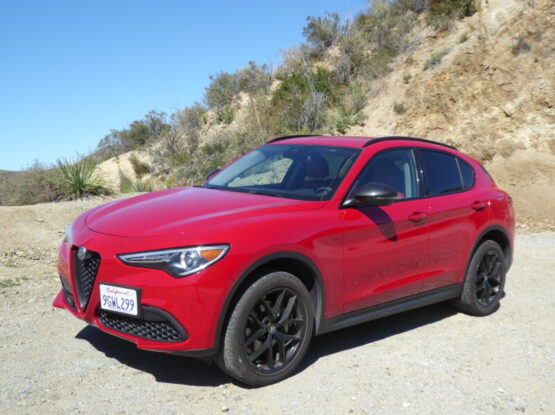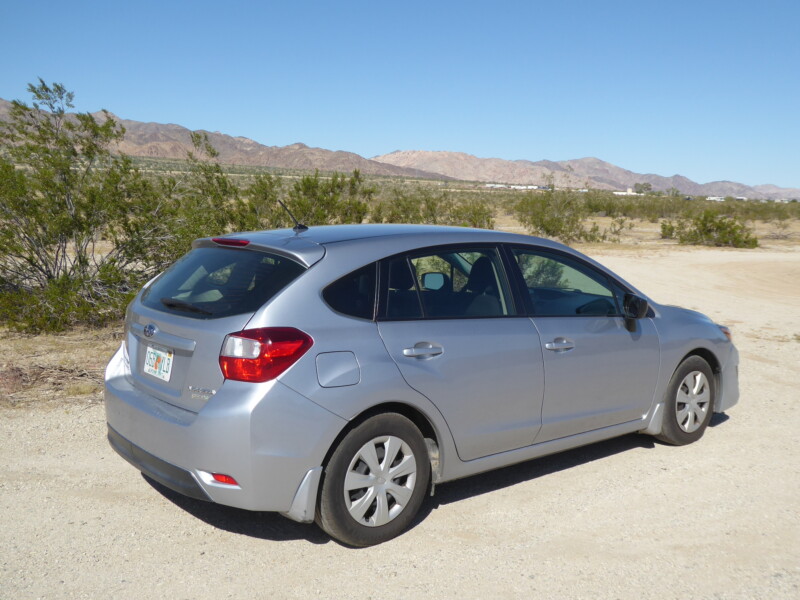


The last couple of years have seen more variety in the Hertz US rental fleet, with both models you don’t expect to see at all, such as Lexus and Acura, posher trim versions than usual and cars that whilst not necessarily showing large mileages go back more than the customary couple of years. It was also because as the rental car business recovered from the various Covid lockdowns, cars had not been pre-ordered on the scale required and short-term supply was severely disrupted by the global chip supply crisis. So Hertz, and others, had to take what they could which included sourcing pre-owned cars. Most of these have now gone, with the fleet now looking much more like you would expect in the autumn of 2023, but there are still a few cars left over from the period of unusual purchases. I came across one of these when walking the facility at LAX which even by the standards of what I have seen these past couple of years was a surprise. Parked among the other small and mid-size cars was this silver Subaru Impreza, and after doing a double-take, I realised that this was not the current model, or even the one that was superceded earlier this year, but rather the one before that. As this particular model had eluded me when new, and the car looked to be in a decent condition, at least visually, I decided that this would be the car I would take for the day. It turned out to be a 2015 model year car, with the paperwork in the glovebox suggesting that Hertz had acquired it in 2022. It was showing around 58,000 miles, though I suspect a good portion of those had been since its arrival in the rental fleet. I have driven its successor, in both hatch and saloon guises, so wondered whether this one would feel like a real step backwards of whether in fact the model changes these days are more around a visual update and the addition of tech, not all of which we even want. Time to find out.


The Impreza gained fame and popularity in the late 1990s when the turbocharged models, suitably adapted for the forests did rather well as rally cars with the likes of the late Colin McRae and Richard Burns at the wheel. The WRX and WRX STi cars especially from the second generation, despite their rather challenging front end designs were suddenly high in the list of cars that enthusiasts wanted, and with good reason, as these cars had excellent performance and astonishing roadholding and grip at a price that was relatively affordable. With no real warning, Subaru decided to quite the WRC in the mid 2000s, though, and although a performance version of the third generation Impreza was added to the range, it never quite captured the imagination of the enthusiasts in the way the first two generations had done. Subaru’s new focus was back where they had started, with a range of cars that scored on practicality with their standard all-wheel drive being their key selling point. In Europe, sales rapidly reduced to very low volumes indeed but the strategy worked in America where, especially in the Snow Belt States, the popularity increased year after year. The fourth generation Impreza was launched in late 2011, going on sale late that year as a 2012 model year car, and it would run for five years, with the replacement appearing at the New York Auto Show in March 2016 and sales starting in the US at the very end of the year. The fourth generation car was offered in Europe, but hardly anyone bought one, especially after Subaru launched the XV Crosstrek, a sort of tougher-looking version of the hatch model with the obligatory raised ride height and lower body cladding. In the US, though, things were quite different. Here buyers had the choice of five door hatch and slightly gawky four door saloon versions of the Impreza, all with the same flat four engine and standard all-wheel drive, something unique among its competitors. Similar in size to its predecessor, this generation was lighter and stronger and new packaging resulted in more space inside thanks to a longer wheelbase.


All US market Impreza models come with the same 2.0 litre flat four engine which puts out 148 bhp and 145 lb/ft of torque. The test car was coupled with the Lineartronic CVT transmission. This is one of very few engines in production with a distinctive sound. It is a little less obvious perhaps than used to be the case, but to anyone who knows their cars, there is no question when you fire it up that this is a Subaru. Performance can best be described as just about adequate. This is definitely not a fast car, and you have to work it quite hard to get meaningful acceleration, at which point the engine gets really quite noisy. Driven in a more relaxed mode and at freeway cruising speed, it is actually quite quiet and refined sounding, thankfully, but I just felt that this car really needs more power. Subaru actually sold 1.5 litre petrol versions of the car in Europe, or at least tried to. Goodness knows how underpowered those must have felt. The CVT transmission is fairly typical of the breed, doing a reasonable job at trying to adjust in line with the movement of the accelerator pedal, but not always quite judging it well enough to avoid either a bit of jerkiness or a bit of a delay in catching up. The one saving grace came at the pumps. I covered a fairly significant 385 miles in my time with the Impreza and it only needed 9 gallons to fill it, which works out at a very commendable 42.77 mpg US or 51.1 mpg Imperial. A lot of the test mileage was done at a steady speed on the freeway so this perhaps as good as you would ever likely see, but that figure is better than I have seen from any of the Impreza’s rivals.


If you were thinking that rally heritage and that low-mounted flat four engine will make the Impreza great to drive, then prepare to be disappointed. For a start, the steering is light and really does not have much feel to it, which is great for parking but not so much for the twisty roads. And when you get to those, your hopes of fabulous handling and roadholding, with lots of grip are somewhat shattered, as there was plenty of understeer and rather too much body roll to make this feel like the Impreza of a couple of generations back. This is a car that is set-up more for comfort and here the relatively small 195/65 R15 wheels and soft suspension do endow the Subaru with quite a comfortable ride. The brakes are effective at doing their job. You get a conventional pull-up handbrake between the seats, as when this car was launched such things were rather more common than they are now. All round visibility is generally good and there is a rear-view camera.


Although Subaru have made significant improvements in recent years, the quality of their interiors has never been a particularly strength and this one is a reminder of that. It is all very usable, and indeed easy to use as the car is not saddled with all the latest complexities, but the materials used all feel rather hard and cheap and not that nice to the touch. That includes the plastic moulded steering wheel. There is a simple instrument cluster with two large dials, for speedometer and rev counter with a small trip display area in between them which includes the bar chart-tyle fuel gauge. There is fuel consumption indicator in the speedo dial. There are two column stalks, with the lights incorporated in the left hand one and there a number of buttons on the steering wheel boss for cruise control and audio repeater functions. There is a now somewhat old-school looking digital display area across the very top of the centre of the dash. Lower down is the small 6.2” touch screen for the StarLink system. In the entry level trim of my test car that was quite limited in function, really being confined to the four speaker audio unit with just AM and FM radio, but at least it was easy to use and there are a number of buttons and knobs external to the screen interface. There is no Apple Car Play or Android Auto, as these features were not that common when this car was new, but you do get Bluetooth and an AUX port and there is a CD player. Beneath this are three simple rotary dials for the air conditioning system.


The seats are trimmed in a pleasant and hard-wearing cloth. Adjustment is all manual. There is also a telescoping wheel and height adjustable seat belts, so getting a good driving position was easy. There is a surprising feeling of space here, with plenty of headroom and even enough width that you don’t feel too close to a front seat passenger.


For what is a relatively small car, there is good space in the rear seats with plenty of leg room even if the front seats are set well back. The centre console unit does come quite a way back, as is the case with so many cars these days, so a middle seat occupant will not feel there is as much space as the outer seat occupants would declare but even so this is quite a roomy car for its class. There is no central armrest and nor are there map pockets but there are bins on the doors shaped to hold a bottle.


The boot is also a reasonable size. It is nice and regular in shape and there are some retaining nets to either side. You don’t get a load cover, though. Under the floor there is a space-saver and there is some space around it for a few odds and ends. The rear seat backrests are asymmetrically split and simply drop down to create a flat load bay. There is ample provision inside the passenger compartment for odds and ends with a good-sized glovebox, pockets on the doors, a recess in front of the gearlever, an armrest cubby and some of the recesses in the centre console unit.


The 2015 Subaru Impreza was available as a sedan or hatchback in 2.0i, 2.0i Premium and 2.0i Limited trim levels. The hatchback additionally came in 2.0i Sport Premium and 2.0i Sport Limited trims. The Impreza 2.0i came as standard with 15-inch steel wheels, a rear spoiler (hatchback), full power accessories, keyless entry, air-conditioning, cruise control, cloth upholstery, a height-adjustable driver seat, a manual tilt-and-telescoping steering wheel, a rearview camera, 60/40-split-folding rear seatbacks, a trip computer, Bluetooth phone and audio connectivity, a 6.2-inch touchscreen interface and a four-speaker sound system with a CD player, USB/iPod integration, HD radio, an auxiliary audio input and smartphone integration with Aha, Pandora and iHeartRadio. The Impreza 2.0i Premium adds 16-inch alloy wheels, a rear stabilizer bar, body-colour exterior mirrors, chrome interior door handles, an adjustable front centre armrest, a cargo cover (hatchback) and a six-speaker sound system. The optional Alloy Wheel package added 17-inch wheels and a leather-wrapped steering wheel and shift knob. The optional All-Weather package (included as standard with the manual transmission) adds heated mirrors, a windshield wiper de-icer and heated front seats. The 2.0i Limited includes all of the above extras, and adds automatic headlights, foglights, chrome exterior trim, automatic climate control, leather upholstery, a rear centre armrest and a 7-inch touchscreen interface with swipe/scroll capability, satellite radio, voice controls, dual USB ports and text-to-voice messaging functionality. Options include keyless entry and ignition, a navigation system, adaptive cruise control, a forward collision mitigation system with automatic braking, lane departure warning and steering-responsive foglights that enhance corner illumination when turning. The 2.0i Sport Premium adds roof rails, foglights, body-colour rocker panel extensions and sport fabric upholstery to the regular Premium equipment list, and it includes the Alloy Wheel and All-Weather package items as standard. Its 17-inch wheels also have a darker “gunmetal gray” finish. Meanwhile, the 2.0i Sport Limited bundles the Sport Premium model’s additional features with the amenities of the 2.0i Limited (including automatic climate control and leather upholstery), and it adds a special silver-accented front grille. Options for the Sport Limited mirror those for the regular Limited. A sunroof is a stand-alone option on all Premium and Limited trims.


I started this test not just in wondering whether the Impreza is a good car, but also to what extent if you go back a generation or two, you are getting a noticeably worse car. let’s answer the second question first. Honestly, I really don’t think you are. Did this 2015 model feel significantly worse to drive, or sit in than the next generation model? Simple answer: No. For sure, it does not have all the added safety and ADAS features that Subaru have added in recent times, but some of those are things none of us want and actively turn off, so you’re not missing out on much that is truly significant. The fifth generation Impreza came on a new platform, and Subaru made bold claims, as all manufacturers are wont to do, but in reality, I did not think the driving experience here was very different from that of the newer car. Even the looks did not change that much from fourth to fifth, so don’t be misled into thinking that the new car is going to be vastly superior. Because I struggled to see how it is. So that raises the question about whether the Impreza is a good car or not. I can see the appeal, especially if you live in a place where the all-wheel drive system would be more than just useful but perhaps essential in the winter months, but in all other respects, this is just a relatively roomy mid-sized hatch competing in a sector bursting with competent rivals. A stronger engine and a better transmission would go a long way to improving things here, though the fuel economy was impressive, but this is not a car that stands out from behind the wheel and the rather low-rent interior quality feels disappointing by the standards of the mid 10s. By no means is this a bad car, but unless you need the all-wheel drive, I think you can do better with a Mazda 3 or Honda Civic, and possibly quite a few of the other rivals in this class. The Subaru faithful will disagree and in America, that’s enough for a strong sales performance, but it does rather explain why in Europe, with the exception of Switzerland, sales of the Impreza are so small.