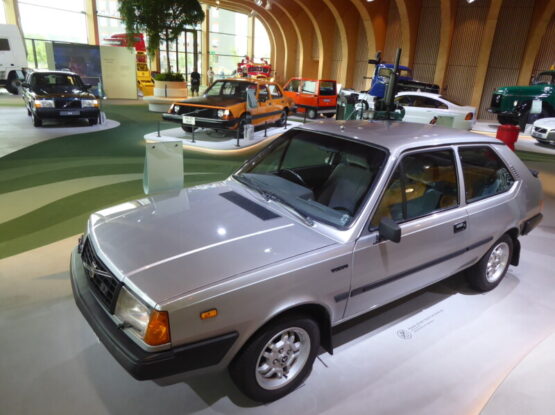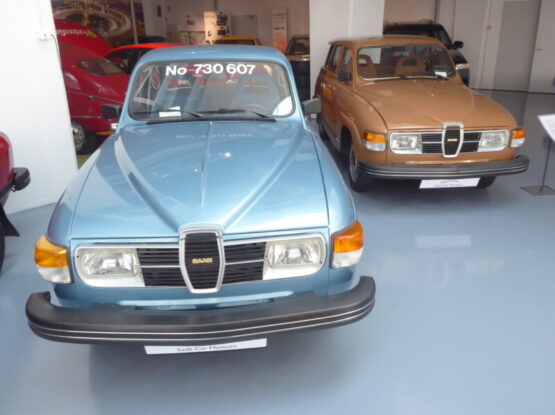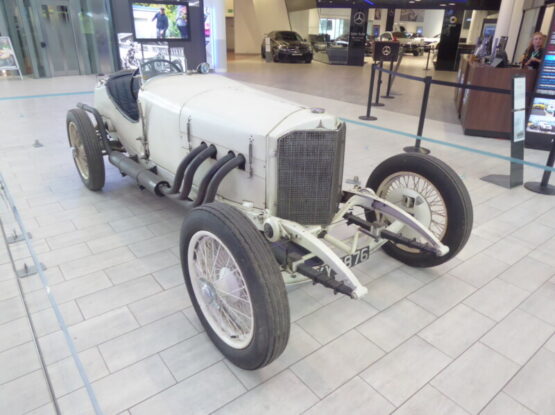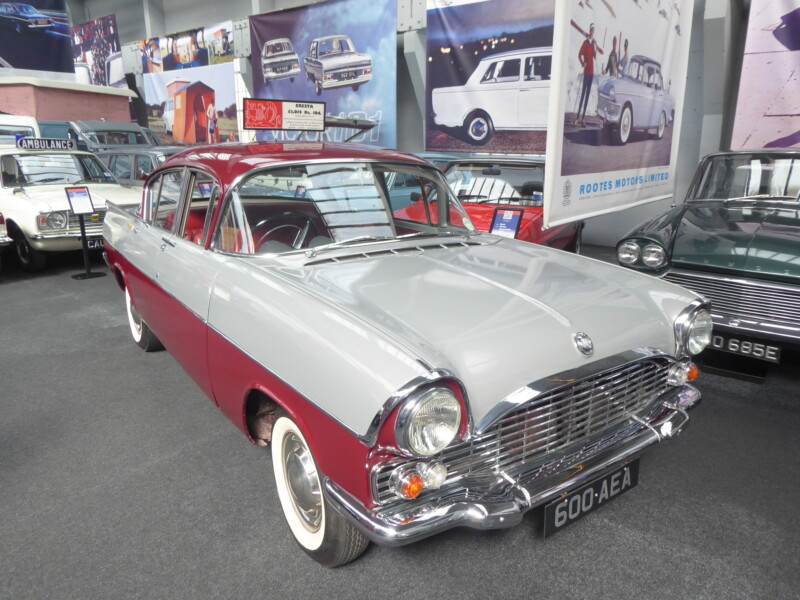
A welcome addition to the collection of UK motor museums, the Great British Car Journey opened finally opened its doors in May 2021. It was a difficult start as the nation was in and out of Covid lockdowns at the time, which had added significant delay from when news of this new museum had first emerged in the winter of 2019/20, making us all wonder if the venture would actually get out of the starting blocks at all. But persistence and patience paid off and the doors were finally opened, albeit for a while on a carefully controlled basis. The museum is largely the inspiration of a gent called Richard Usher who made his money from his Auto Windscreen business, and more recently who owned the Blyton Park race circuit. He had steadily been acquiring a large collection of British cars, few of which were particularly valuable but which hold massive nostalgic appeal for many, as they represent the sort of cars that parents and other relatives drove or even those in which we all started our own driving career. Usher’s collection was augmented when he bought a considerable number of the cars from the James Hull collection. With the acquisition of an old warehouse on the banks of the River Derwent, in Ambergate, to the north west of Derby, located on the A6, he had the right sort of facility to be able to display his collection. The museum is housed in a long rectangular building, but clever design means that it feels like you are entering different rooms to reflect specific themes or eras of the British Motor Car. As well as around 150 cars on show, there are large numbers of huge posters on the walls and hanging from the ceiling, most of which reflect period advertising. When you check in, you are handed a portable electronic device with an audio narrative which outlines the history of the British Motor Industry, with additional details on some specific cars. You can scan the QR codes by the cars for more information should you so desire. If you listen to the entire narrative, it will take you a good couple of hours to complete a tour of the displays. I suspect most people started off listening to it, but quickly abandoned it all. The audio production was good and highly informative. It was broken up into 9 Chapters, and the cars on show more or less corresponded to these, in Chapter order. Having duly opened on the 15th May 2021, I was able to fit in a visit just one week later and I published a report on what I saw.
Since that time, I’ve seen many reports and photos online and also continue to receive emails from the museum, usually with deals attached to entice me to come, so I knew that the museum and the underlying collection had evolved somewhat from Day One, so I was keen to pay a repeat visit. The opportunity came when I decided to attend the Auto Amore Italian Car day that the museum hosted, and which is reported on separately, in April 2026. When the Italian cars had largely all departed, rather than head off myself, I elected to go and tour the museum and spend a good couple of hours wallowing in nostalgia. Here is what I saw:


PRE WAR MOTORING
One of the famous “Three As” of Scotland’s early motor industry, along with Albion and Argyll, Arrol-Johnston was there right at the very beginning. George Johnston and Sir William Arrol established the Mo-Car Syndicate Ltd. in Bluevale, Glasgow, in 1897. Sir William was by then renowned for his civil engineering achievements, having been awarded contracts for the Forth Bridge, the second Tay Bridge and the metalwork of Tower Bridge. While Arrol-Johnston survived until 1931 (after merging with Aster in 1927), it remains best-known for its earliest products, the distinctive high-wheeled Dogcarts which were produced until as late as 1906. These were horseless carriages in the most literal sense, with solid-tyred carriage wheels and varnished four- or six-seater bodies, and, though their design was somewhat antiquated, they found plenty of willing buyers, especially in Scotland. The Dogcart name was carried over from the carriage-building industry, where it described a two-wheeled carriage with a back-to-back seating arrangement and a compartment under the seat for gundogs. The early models appeared in 1899 with tiller steering and a rear-mounted, horizontal, underfloor engine of 5½hp, which although a single-cylinder contained two opposed pistons. From the pistons, short rods rocked levers which in turn moved longer con-rods which rotated the crank. Before long, wheel steering and a twin-cylinder (four-piston) engine were employed, giving 10hp, and from 1901 it became a 12hp, with 108 by 165mm bore and stroke. The engine was connected to a four-speed gearbox viâ a cone clutch and Renold chain primary-drive, which in turn drove the huge rear axle by a central chain. Further equipment included a low-tension magneto and a pull-start mechanism by way of a cord connected to a crank handle. The cord ran through the floorboards to be within easy reach of the driver. These elephantine beasts of burden were rugged, torquey and low-geared, making them ideal for traversing highland gradients. Steady performers, in top gear they were said to reach 25mph. However, just eight are reckoned to survive. One feather in Arrol-Johnston’s cap was building the first car to enter the Sudan, in 1905. The six-seater Dogcart with solid wooden wheels, a sun canopy and a trailer carrying an enormous searchlight was for the use of Sir Reginald Wingate, Governor-General of the Sudan. This car was known to be among the survivors, but tragically its home, the Khalifa House Museum, has succumbed to vandalism and looting during the present Sudanese civil war. It was also in 1905 that an Arrol-Johnston won the first International Tourist Trophy Race on the Isle of Man. While that was a purpose-built 18hp racing machine of more modern and orthodox design, it retained the opposed-piston layout. Carrying the delightful early Paisley registration ‘XS 2’ – indicating that it was the second car to be registered in Paisley – this marvellously original 1902 Dogcart is thought to have been owned originally by Sir Thomas Coats, of the family behind Paisley’s Ferguslie Thread Works. Little early history is known, but it appears the Arrol-Johnston was transferred to the Isle of Bute, placed into storage in 1919, and then discovered on the island in 1942 by Tom Lightfoot, one of the 20th century’s most prominent veteran car enthusiasts, while he was serving with the Royal Navy. It is understood that he purchased it from the Bute Ship Dock Co., and presumably kept it at his home in Epsom, Surrey. Other documents point to the ownership of Norman Cole circa 1962 and Norman Ball circa 1970, prior to its acquisition in 1998 by the late Geoffrey Plaisters. It is known to have entered one London to Brighton Run in the late 1990s, plus the 2002 Glasgow-Paisley-Dumfries Arrol-Johnston Commemoration Run. Although the Arrol-Johnston has been out of use for some time following Mr. Plaister’s death, it was recently placed on loan to the Great British Car Journey museum, which oversaw its partial recommissioning.

The Horstman Super Sports Racer is one of the rarest racing cars in existence and a remarkable piece of British motor sport history. Built in Bath by Horstman Cars, a small but ambitious British manufacturer founded in 1912 by Sidney Horstman and supported by engineering talent such as Captain John Wentworth Rooke, these Horstman racing cars were designed to compete not only at Brooklands but at venues all over the UK. Only around 20 Horstman racing cars were built and this is the only known survivor. Despite its modest 1.5-litre engine producing around 40 bhp, the car weighs just 600kg and could exceed 100 mph on the Brooklands banking. In 1921, a similar Horstman finished fifth in the very first 200-mile race at Brooklands. Crucially, it was the first British car home, just behind a works Bugatti and averaged over 80 mph for more than two hours on Brooklands’ famously bumpy concrete. The driver, Douglas Hawkes, and his riding mechanic must have been made of absolute steel but Hawkes was an accomplished racer who competed twice in the Indianapolis 500 mile race.

Not surprisingly, there are a number of examples of the iconic Austin Seven here. By 1921, Herbert Austin’s was facing imminent bankruptcy. Like many of the other early car companies, Austin had produced large and costly cars since the firm’s inception and there simply was not a big enough market for the number of cars and car makers that were producing vehicles at the time. Herbert Austin’s master stroke was to produce a cheap and affordable car which did much to put Britain on wheels in the 1920s. The first Sevens were built in 1922, and were four seat open tourers. Nicknamed Chummy, the first 100 featured a 696cc four cylinder engine, which was quickly upgraded to the 747cc unit that remained until the end of production some 17 years later. The first cars had an upright edge to the doors and a sloping windscreen, but from 1924, the screen became upright and there was a sloping edge to the doors, as well as a slightly longer body. Stronger brakes came along in 1926, along with a slightly taller nickel-plated radiator grille, conventional coil ignition, a more spacious body and wider doors. An even longer and wider body arrived in 1930, as well as a stronger crankshaft and improvements to the brakes which coupled front and rear systems together so they both worked by the footbrake. In 1931 the body was restyled , with a thin ribbon-style radiator and by 1932 there was a four speed gearbox to replace the earlier three-speeder. 1933 saw the introduction of the Ruby, a car that looked more modern with its cowled radiator. There were also Pearl and Opal versions. Development continued, so in 1937 there was a move to crankshaft shell bearings in place of the white metal previously used, and the Big Seven appeared. The last Seven was made in 1939, by which time 290,000 had been produced. Aside from saloons and tourers, there had been vans and sports derivatives like the Le Mans, the supercharged Ulster and the rather cheaper Nippy. Around 11,000 Sevens survive today. A quintet of Sevens were presented here, ranging from three of the early cars, with different body styles, through to the Seven Swallow and a late model Chummy, the cheapest version of the late 1930s range.


The Austin Twelve was introduced in 1921. It was the second of Herbert Austin’s post World War I models and was in many ways a scaled-down version of his Austin Twenty, introduced in 1919. The slower-than-expected sales of the Twenty brought about this divergence from his intended one-model policy. The Twelve was announced at the beginning of November 1921 after Austin’s company had been in receivership for six months. The number twelve refers to its fiscal horse power (12.8) rather than its brake horsepower (bhp) which was initially 20 bhp (1660 cc engine), and later 27 bhp (1861 cc engine). The long-stroke engines encouraged by the tax regime, 72 × 102 mm later 72 × 114.5 mm, had much greater low-speed torque than the bhp rating suggests. Initially available as a tourer, by 1922 three body styles were offered: the four-seat tourer, the two/four-seater (both at 550 GBP) and the coupé at 675 GBP. The car enjoyed success throughout the vintage era with annual sales peaking at 14,000 in 1927. While the mechanical specification changed little (the engine increased from 1661 cc to 1861 cc in 1926), many body styles were offered with saloons becoming more popular as the twenties drew to a close. The car continued in the Austin catalogue and as a taxi option until 1939. The last cars were produced for the War Department in 1940. After the early thirties the car was referred to by the public as the Heavy Twelve to distinguish it from the other, newer, 12 tax horsepower cars in the Austin catalogue Light Twelve-Four, Light Twelve-Six etc. and received some updating. The artillery style wheels were replaced by wire wheels in 1933 and coil ignition replaced the magneto in 1935. The gearbox was provided with synchromesh between its top two ratios in 1934. The factory catalogued body range was steadily updated with the last of the no longer fashionable Weymann style fabric-covered cars in 1931 and no open tourers after 1934.

The Austin Sixteen Light Six is a British car that was made by Austin from 1927. Announced in October 1927, the first deliveries were planned for March 1928. To distinguish the car from the smaller engined models in the range a plated Austin Six script was fixed to the radiator grille. The Austin Sixteen was introduced as a medium saloon sitting within Austin’s range above the Seven and Twelve models but still much smaller than the 3.6 Litre Twenty. The six-cylinder engine was new but had similarities to the engine fitted to the Twenty with its timing chain at the rear of the block. The design was up to date with the gearbox mounted in-unit with the engine and semi elliptic springs all round for the suspension. Triplex safety glass was fitted to all front screens from March 1929. A wide range of body types was available at first but was simplified over the years. The coupés went first in 1930 followed by the Weymann type fabric saloons in 1931. In August 1933 various improvements were announced for 1934 models. The gearbox gained synchromesh on 3rd and 4th gears and an alternative larger (2511 cc) 18 hp engine was made available at no extra charge. An early automatic gearbox was available between 1934 and 1936 but few sold. A longer 120 in (3,000 mm) wheelbase chassis became an option. Of this version 5742 16s and 2630 18s were made. Further upgrades were made in 1935. The body range was simplified and now had only the 5 and 7 seat saloons. Externally the most obvious change was to the radiator surround which was painted body colour rather than chrome plated, and a small external boot was added to the rear which contained the spare wheel. Synchromesh was added to second gear. The larger engine was modified to have only four rather than eight main bearings. In 1937, the last year this car was made, the smaller engined Sixteen was dropped and pressed steel road wheels replaced the previously fitted wire wheels. Between 1935 and 1937 12,731 were produced. The car seen here is a 16/6 Carlton from 1934.

POST WAR – PRODUCTION RESUMES
The Minor was conceived in 1941. Although the Nuffield Organization was heavily involved in war work and there was a governmental ban on civilian car production, Morris Motors’ vice chairman, Miles Thomas, wanted to prepare the ground for new products to be launched as soon as the war was over. Vic Oak, the company’s chief engineer, had already brought to Thomas’ attention a promising junior engineer, Alec Issigonis, who had been employed at Morris since 1935 and specialised in suspension design but he had frequently impressed Oak with his advanced ideas about car design in general. Issigonis had come to Oak’s particular attention with his work on the new Morris Ten, which was in development during 1936/7. This was the first Morris to use unitary construction and was conceived with independent front suspension. Issigonis designed a coil-sprung wishbone system which was later dropped on cost grounds. Although the design would later be used on the MG Y-type and many other post-war MGs the Morris Ten entered production with a front beam axle. Despite his brief being to focus on the Ten’s suspension Issigonis had also drawn up a rack and pinion steering system for the car. Like his suspension design this was not adopted but would resurface in the post-war years on the MG Y-type, but these ideas proved that he was the perfect candidate to lead the design work on a new advanced small car. With virtually all resources required for the war effort, Thomas nonetheless approved the development of a new small family car that would replace the Morris Eight. Although Oak (and Morris’ technical director, Sidney Smith) were in overall charge of the project it was Issigonis who was ultimately responsible for the design, working with only two other draughtsmen. Thomas named the project ‘Mosquito’ and ensured that it remained as secret as possible, both from the Ministry of Supply and from company founder William Morris (now Lord Nuffield), who was still chairman of Morris Motors and, it was widely expected, would not look favourably on Issigonis’ radical ideas. Issigonis’ overall concept was to produce a practical, economical and affordable car for the general public that would equal, if not surpass, the convenience and design quality of a more expensive car. In later years he summed up his approach to the Minor; that he wanted to design an economy car that “the average man would take pleasure in owning, rather than feeling of it as something he’d been sentenced to” and “people who drive small cars are the same size as those who drive large cars and they should not be expected to put up with claustrophobic interiors.” Issigonis wanted the car to be as spacious as possible for its size and comfortable to drive for inexperienced motorists. Just as he would with the Mini ten years later, he designed the Mosquito with excellent roadholding and accurate, quick steering not with any pretence of making a sports car, but to make it safe and easy to drive by all. As work proceeded, there were plenty of battle to overcome, to get Issigonis’ ideas approved, and not all of them were. The production car, called the Minor was launched at the British Motor Show at Earls Court in London on October 27, 1948. At the same show Morris also launched the new Morris Oxford and Morris Six models, plus Wolseley variants of both cars, which were scaled-up versions of the new Minor, incorporating all the same features and designed with Issigonis’ input under Vic Oak’s supervision. Thus Issigonis’ ideas and design principles underpinned the complete post-war Morris and Wolseley car ranges. The original Minor MM series was produced from 1948 until 1953. It included a pair of four-seat saloons, two-door and (from 1950) a four-door, and a convertible four-seat Tourer. The front torsion bar suspension was shared with the larger Morris Oxford MO, as was the almost-unibody construction. Although the Minor was originally designed to accept a flat-4 engine, late in the development stage it was replaced by a 918 cc side-valve inline-four engine, little changed from that fitted in the 1935 Morris 8, and producing 27.5 hp and 39 lbf·ft of torque. This little engine pushed the Minor to just 64 mph but delivered 40 mpg. Brakes were four-wheel drums. Early cars had a painted section in the centre of the bumpers to cover the widening of the production car from the prototypes. This widening of 4 inches is also visible in the creases in the bonnet. Exports to the United States began in 1949 with the headlamps removed from within the grille surround to be mounted higher on the wings to meet local safety requirements. In 1950 a four-door version was released, initially available only for export, and featuring from the start the headlamps faired into the wings rather than set lower down on either side of the grille. The raised headlight position became standard on all Minors in time for 1951. From the start, the Minor had semaphore-type turn indicators, and subsequent Minor versions persisted with these until 1961 An Autocar magazine road test in 1950 reported that these were “not of the usual self-cancelling type, but incorporate[d] a time-basis return mechanism in a switch below the facia, in front of the driver”. It was all too easy for a passenger hurriedly emerging from the front passenger seat to collide with and snap off a tardy indicator “flipper” that was still sticking out of the B-pillar, having not yet been safely returned by the time-basis return mechanism to its folded position. Another innovation towards the end of 1950 was a water pump (replacing a gravity dependent system), which permitted the manufacturer to offer an interior heater “as optional equipment”. When production of the first series ended, just over a quarter of a million had been sold, 30 per cent of them the convertible Tourer model. In 1952, the Minor line was updated with an Austin-designed 803 cc overhead valve A-series engine, replacing the original side-valve unit. The engine had been designed for the Minor’s main competition, the Austin A30, but became available as Austin and Morris were merged into the British Motor Corporation. The new engine felt stronger, though all measurements were smaller than the old. The 52 second drive to 60 mph was still calm, with 63 mph as the top speed. Fuel consumption also rose to 36 mpg. An estate version was introduced in 1952, known as the Traveller (a Morris naming tradition for estates, also seen on the Mini). The Traveller featured an external structural ash (wood) frame for the rear bodywork, with two side-hinged rear doors. The frame was varnished rather than painted and a highly visible feature of the body style. Commercial models, marketed as the Morris Quarter Ton Van and Pick-up were added in May 1953. Rear bodies of the van versions were all steel. The 4-seat convertible and saloon variants continued as well. The car was again updated in 1956 when the engine was increased in capacity to 948 cc. The two-piece split windscreen was replaced with a curved one-piece one and the rear window was enlarged. In 1961 the semaphore-style trafficators were replaced by the flashing direction indicators, these were US-style red at the rear (using the same bulb filament as the brake lamp) and white at the front (using a second brighter filament in the parking lamp bulb) which was legal in the UK and many export markets at the time (such as New Zealand). An upmarket car based on the Minor floorpan using the larger BMC B-Series engine was sold as the Riley One-Point-Five/Wolseley 1500 beginning in 1957: versions of this Wolseley/Riley variant were also produced by BMC Australia as the Morris Major and the Austin Lancer. In December 1960 the Morris Minor became the first British car to sell more than 1,000,000 units. To commemorate the achievement, a limited edition of 350 two-door Minor saloons (one for each UK Morris dealership) was produced with distinctive lilac paintwork and a white interior. Also the badge name on the side of the bonnet was modified to read “Minor 1,000,000” instead of the standard “Minor 1000”. The millionth Minor was donated to the National Union of Journalists, who planned to use it as a prize in a competition in aid of the union’s Widow and Orphan Fund. The company, at the same time, presented a celebratory Minor to London’s Great Ormond Street Hospital for Sick Children, but this car was constructed of cake.The final major upgrades to the Minor were made in 1962. Although the name Minor 1000 was retained, the changes were sufficient for the new model to be given its own ADO development number. A larger version of the existing A-Series engine had been developed in conjunction with cylinder head specialist Harry Weslake for the then new ADO16 Austin/Morris 1100 range. This new engine used a taller block than did the 948 cc unit, with increased bore and stroke bringing total capacity up to 1,098 cc. Although fuel consumption suffered moderately at 38 mpg, the Minor’s top speed increased to 77 mph with noticeable improvements in low-end torque, giving an altogether more responsive drive. Other changes included a modified dashboard layout with toggle switches, textured steel instrument binnacle, and larger convex glove box covers. A different heater completed the interior upgrade, whilst the larger combined front side/indicator light units, common to many BMC vehicles of the time, were fitted to the front wings. These now included a separate bulb and amber lens for indicators while larger tail lamp units also included amber rear flashers. During the life of the Minor 1000 model, production declined. The last Convertible/Tourer was manufactured on 18 August 1969, and the saloon models were discontinued the following year. Production of the more practical Traveller and commercial versions ceased in 1972, although examples of all models were still theoretically available from dealers with a surplus of unsold cars for a short time afterwards. 1,619,857 Minors of all variants were ultimately sold and to be seen here were a number of cars including one of the rare Minor Million cars made in 1961 to celebrate the fact that this was the first British car to sell a million examples.


The Austin Sixteen (also Austin 16) is a 2.2-litre motor car that was built by Austin from 1945 until 1949. It was the first ‘new’ car to be produced by Austin following the end of the Second World War. Apart from the name, it shared nothing with the pre war Austin 16. Whilst it used a brand new 4-cylinder 2199 cc, overhead-valve engine—the first to be used in an Austin car, it in fact used the chassis and body of the pre-war Austin 12, which continued to be produced, alongside the other pre-war saloons the 8 hp and the 10 hp. The number Sixteen was not an indication of the actual power output of the engine but rather the result of a calculation used to determine the excise duty (road tax) payable for the vehicle. The engine in fact produced 67 bhp at 3800 rpm. The car shared a number of features with the famed London Taxi, one of which was the built-in hydraulic jacking system operated from a pump located under the bonnet. The Sixteen had a healthy turn of speed for its day with a maximum quoted speed of 75 mph (121 km/h). In the bitterly cold winter of 1947 Alan Hess and a team of drivers with 3 Austin Sixteen vehicles undertook a publicity run on behalf of the Austin Motor Company to visit seven Northern European Capitals in seven days. Despite extraordinary travel difficulties caused by heavy snow, the vehicles completed the adventure successfully, and the story is related in Alan Hess’s book, Gullible’s Travels. Steering was by a cam and lever system which provided a dual ratio to ease parking. Suspension was all elliptic (overslung in front, underslung at the rear) with rigid beam axles all controlled by Luvax-Girling double acting hydraulic shock absorbers—a transverse torsion bar linking both pairs. Brakes by Girling were mechanical using a wedge and roller system in 11 inch drums with twin leading shoes in the front drums

The Morris Minor was already well established when rival Austin launched their competitor, the A30 Saloon of 1952. That was also the year that Austin and Morris merged to become the British Motor Corporation, so suddenly the two cars that had been conceived to compete against each other were stablemates. Except BMC did not work like that. Separate dealer chains remained in place, as they would do for a further 30 years, and whilst this may sound inefficient now, it has to be noted that brand loyalty was such that there were plenty of people would only consider an Austin say, and not a Morris, or vice versa. The A30 was smaller than the Minor and at £507, at launch, it was also £60 cheaper. The body structure was designed by T.K. Garrett, who had been an aeronautical engineer before joining Austin. It was of fully stressed monocoque chassis-less construction, which made it lighter and stiffer than most contemporary vehicles, the first Austin to be made in this way. Inside there were individual seats at the front and a bench at the rear covered in PVC with an option of leather facings on the seats. Evidence of economy was seen in only having a single windscreen wiper, central combined stop/tail/numberplate lamp and a sun visor in front of the driver only. A passenger-side wiper and sun visor, and a heater were available as optional extras. Even so, it sold well, and 223,264 examples were built. The A30 was replaced by the Austin A35 in 1956 with the new name reflecting the larger and more powerful 34 hp A-Series engine, which gave the car a slightly higher top speed and better acceleration, though much of this came as a result of different gearbox ratios. The A30 had the first three ratios close together then a big gap to top, whereas in the A35, the ratios were better spaced and gave a higher speed in third gear. That top speed was 72 mph and 0 – 60 acceleration times are just over 30 seconds, so this remains a very slow car by modern standards. The A35 was very similar in appearance to the A30, and is best recognised by its larger rear window aperture and a painted front grille, with chrome horse-shoe surround, instead of the chrome grille featured on the A30. The semaphore trafficators were replaced with present-day front- and rear-mounted flashing light indicators. A slightly easier to operate remote-control gear-change was provided. Like the A30, the A35 was offered as a two- or four-door saloon or two-door “Countryman” estate and also as a van. The latter model continued in production through to 1968. A rare coupe utility (pickup) version was also produced in 1956, with just 477 sold. Drawings were made for a sports tourer, but no prototype was actually built. The A35 passenger cars were replaced by the new body shape A40 Farina models in 1959 but the estate car version continued until 1962 and van until 1968. These days they are popular as an affordable classic. Their simple mechanicals, good availability of some parts (not bodywork, though) and pert looks give them widespread appeal. There was a neat example of a 4 door A35 here.


Launched initially as a four-seat convertible, the A90 Atlantic made its début at the 1948 Earls Court Motor Show in London, with production models built between spring 1949 and late 1950, the range was later augmented when a two-door coupé, marketed as the A90 Atlantic Sports Saloon, followed a year later. It had been previewed at the 1949 Motor Show and was in production at Longbridge between 1950 and 1952. The Atlantic was one of the first post-war cars engineered from scratch by Austin, and was said to be styled from a thumbnail sketch by Leonard Lord, then Chairman of Austin, though in truth the styling was more likely the work of resident Italian Austin stylist Dick Burzi. The car was almost certainly influenced by a 1946 Pininfarina-bodied Alfa Romeo cabriolet, which just happened to end up at the Longbridge factory in mid-1947, a few months before the light blue 16 hp sports prototype made its first appearance in the experimental department and on nearby roads around the factory. A rare edition was a coachbuilt estate car, regularly seen in the 1950s used by a convent in Leith, Scotland. The car had a lifting rear door, and sported then unusual curved perspex roof panels. With the then Government edict of “Export or die” and steel allocated only to those who generated much needed dollar revenue, the Atlantic was designed specifically to appeal to North American tastes (certain aspects look like a 1949 Mercury and the bonnet brightwork looks similar to the Pontiac Chieftains of this era). The car featured up-to-the-minute detailing, with a wrap around windscreen, composed of a flat glass centre section with, tiny curved end panels. The front wings (fenders) sported twin ‘Flying A’ hood ornaments and swept down to a rounded tail, with spats enclosing the rear wheels. A centrally mounted third, main beam, headlight was built into the letter-box style air intake grille, and the then unheard of luxury of hydraulically powered windows and hood (convertible top), “flashing indicators” rather than trafficators, (for the United States market at least) and the option of EKCO or HMV Autocrat radios. The range-topping Austin was offered in a variety of “jewelescent” colours with names like ‘seafoam green’ and ‘desert gold’ but few of these brave new metallics were sold in the UK market. The convertible, a three window, drophead coupe had a simple fabric top, without rear quarter lights, which butted up to the rear of a rather thick windscreen header rail. The fixed head, five window, Sports Saloon, could be had with its roof painted or covered in fabric. This gave it the popular ‘drophead or cabriolet’ look; all the style with no leaks. Many photographs of this car are wrongly titled, due to observers confusing the fabric covered hardtop for a convertible. As its final party trick, the centre section of the three piece, wrap-around, rear window, could be lowered into the boot, for added ventilation by a remote winder above the front windscreen. Few people in the car’s native Britain would have ever seen anything like the futuristically-styled Atlantic before, and certainly not from a conservative mainstream manufacturer like Austin. The radical Atlantic suffered, however, from the dramatically new Jaguar XK120, also launched at the 1948 Motor Show. Out of a total production run of 7,981, 3,597 were exported, 350 of which were to the US. This low level of sales in the US was despite a huge focus by Austin, including a successful attempt at breaking 63 stock car records at the Indianapolis Motor Speedway in April 1949 by Alan Hess, Charles Goodacre and Dennis Buckley) and a US$1000 price reduction in 1949, the four-cylinder 2.7-litre couldn’t compare in power output to native V8 engines — although, for its time, performance was strong. A few were also used in civilian versions of the Austin Champ. The car did see more success in former British Colonies, Europe, Scandinavia and Australasia.

Paramount Cars was a British company which produced the Paramount automobile between 1950 and 1956. Founded by WA Hudson and S Underwood from Derbyshire, the company initially manufactured cars in Swadlincote with production moving shortly after to Melbourne (again in Derbyshire) and then to Leighton Buzzard. Two models were produced, the Paramount Ten and the Paramount 1½-Litre. The Paramount had an aluminium over wood frame body with BMW like grille and was mounted on a separate tubular steel chassis with front transverse and rear semi elliptical leaf springs. It was originally intended to have Alvis engine and suspension but to reduce cost the production versions used Ford 10 components including the 1172 cc side valve engines, but fitted with twin SU carburettors, which resulted in poor performance. The car was listed in both 2 and 4 seat versions. In 1953, the company was bought by Camden Motors and production moved to Leighton Buzzard and the Ford Consul 1,508 cc engine was an option in a longer chassis as also was a Wade or Shorrock supercharger. The price was now an uncompetitive £1009 and production ceased in 1956 after about 70 cars had been made. After the end of car production the remaining chassis were sold off and several were fitted with Rochdale glass fibre bodies.


Jaguar stunned the world with the XK120 that was the star of the Earls Court Motor Show in 1948. Seen in open two seater form, the car was a testbed and show car for the new Jaguar XK engine. The display car was the first prototype, chassis number 670001. It looked almost identical to the production cars except that the straight outer pillars of its windscreen would be curved on the production version. The roadster caused a sensation, which persuaded Jaguar founder and design boss William Lyons to put it into production. Beginning in 1948, the first 242 cars wore wood-framed open 2-seater bodies with aluminium panels. Production switched to the 112 lb heavier all-steel in early 1950. The “120” in the name referred to the aluminium car’s 120 mph top speed, which was faster with the windscreen removed. This made it the world’s fastest production car at the time of its launch. Indeed, on 30 May 1949, on the empty Ostend-Jabbeke motorway in Belgium, a prototype XK120 timed by the officials of the Royal Automobile Club of Belgium achieved an average of runs in opposing directions of 132.6 mph with the windscreen replaced by just one small aeroscreen and a catalogued alternative top gear ratio, and 135 mph with a passenger-side tonneau cover in place. In 1950 and 1951, at a banked oval track in France, XK120 roadsters averaged over 100 mph for 24 hours and over 130 mph for an hour, and in 1952 a fixed-head coupé took numerous world records for speed and distance when it averaged 100 mph for a week. Roadsters were also successful in racing and rallying. The first production roadster, chassis number 670003, was delivered to Clark Gable in 1949. The XK120 was ultimately available in two open versions, first as an open 2-seater described in the US market as the roadster (and designated OTS, for open two-seater, in America), and from 1953 as a drophead coupé (DHC); as well as a closed, or fixed head coupé (FHC) from 1951. A smaller-engined version with 2-litres and 4 cylinders, intended for the UK market, was cancelled prior to production.

This 403 is an example of the second body design produced by Bristol Cars. First seen on the 401 model, which replaced the first ever Bristol model, the 400, a program of updates saw the car morph into the 403 (the 402 having been an open topped version of the 401) and this car was then produced between 1953 and 1955, the third of the eventual five series of Bristols powered by the BMW-derived pushrod straight-six engine. It replaced both the Bristol 401 and 402 in 1953 and whilst it retained much the same styling as the 401, the new 403 featured many mechanical improvements compared to its predecessor. The 1971 cc six-cylinder engine was modified through the use of bigger valves and larger main bearings with a diameter of 54 mm as against 51 mm on the 400 and 401, which increased the power output to 100 hp as against 85 hp in the 401. The acceleration was markedly improved: the 403 could reach 60 mph in 13.4 seconds as against 16.4 seconds for the 401. The 403 had a top speed of 104 mph. To cope with this increased power, an anti-roll bar was fitted on the front suspension and improved drum brakes known as “Alfins” (Aluminium finned) were fitted. Early models had them on all wheels, but Bristol thought the car was over-braked and they were thus restricted to the front wheels on later 403s. The 403 was the last Bristol to feature a BMW-style radiator grille. It is also noteworthy for having two extra headlamps at the side, almost pre-dating the adoption of the four-headlamp layout in larger cars (Bristol themselves adopted it with the 411 in the late 1960s).


The Jowett Javelin was an executive car produced from 1947 to 1953. The model went through five variants coded PA to PE. The designation changed to coincide with the London Motor Show in November but actually engineering design changes occurred frequently during the total production run, as and when required. The car was designed by Gerald Palmer during World War II and was intended to be a major leap forward from the relatively staid designs of pre-war Jowetts. Just over 23,000 units were produced. The new Javelin, not yet in full production, made its first public appearance on Saturday 27 July 1946 in a cavalcade to celebrate 60 years of the British Motor Industry organised by the SMMT. Started by the King in Regent’s Park the cavalcade passed through Marble Arch around London’s West End and Piccadilly Circus and back up to Regent’s Park. Series production was not fully under way until November 1947. In a 1949 road test report The Times’ correspondent welcomed the Javelin’s good performance and original design. The engine mounted ahead of the front axle briskly accelerates (to nearly 80 mph) a body which could carry six persons. The moderate size of the engine, the car’s light weight and good streamlining all contribute to its excellent performance. Controls were all light to operate and it was a restful car to drive. The flat four overhead valve engine of 1486 cc with a compression ratio of 7.2:1 was water-cooled and had an aluminium block and wet cylinder liners. It developed 50 bhp at 4100 rpm (52.5 bhp in the case of the PE) giving the car a maximum speed of 77 mph (124 km/h) and a 0-50 mph (80 km/h) time of 13.4 seconds. Two Zenith carburettors were fitted and PA and PB versions had hydraulic tappets. The radiator was behind the engine. A four-speed gearbox with column change was used. Early cars had gearboxes made by the Henry Meadows company. Later, Jowett made the gearboxes, but the decision to make the gearboxes in-house proved to be a costly mistake. Even though Jowett had some experience in transmission manufacturing, the project went disastrously wrong; powertrain-less bodies stacked up in the assembly line because of problems in gearbox production. The horizontally opposed engine is very low immediately behind the grille and in front of the radiator. Design features included aerodynamic styling with the headlights faired into the wings and, for the time, a steeply sloped, curved windscreen, a first for a British production car. The body was of pressed steel, incorporating a box-section chassis, and was made for Jowett by Briggs Motor Bodies in their Doncaster factory. The suspension used torsion-bars on all wheels (independent at the front) and internal gear-and-pinion steering. PA and PB models had mixed Girling hydraulic brakes at the front and mechanical braking at the rear. Later versions were fully hydraulic. The PA was available in only one version although cloth or leather seats were an option. The PB was available with a “de luxe” option with leather seats and walnut dashboard among other improvements. The “standard” car was simplified, retaining the metal dasboard from the PA series and basic vinyl seats were introduced. The two tier model range was continued until the end of production. The car had a wheelbase of 102 in (2,591 mm) and a track of 51 in (1,295 mm). Overall the car was 14 ft (4.3 m) long, 5 ft (1.5 m) wide and weighed about 1 tonne depending on model and year. The car was expensive, costing £819 at launch. The Jowett was competing against cars such as the Jaguar 1½ litre (£953), Lanchester LD10 (£927), Riley RM 1½ litre (£863) and the Singer Super 12 (£768). A de-luxe saloon version tested by The Motor magazine in 1953 had a top speed of 82.4 mph (132.6 km/h) and could accelerate from 0-60 mph in 20.9 seconds. A fuel consumption of 29.1 mpg imperial (9.7 L/100 km; 24.2 mpg‑US) was recorded. The test car cost £1207 including taxes. An early example won in its class at the 1949 Monte Carlo Rally, and another won the 2-litre touring-car class at the Spa 24-hour race in the same year. In the 1952 International RAC Rally a Javelin again won its class and also took the “Best Closed Car” award. A privately entered Javelin won the 1953 International Tulip Rally outright.

An important car not just for Standard, but also for generating significant export revenue, the Vanguard was launched in 1948, the first all new British design produced after the war. It replaced all the pre-war models, production of which had restarted in 1946. The fastback styling of the first models aped American designs of the era leaving little doubt where it was intended to sell the car. As well as the fastback saloon and estate models, a pick-up was offered for the Australian market. The Phase 2 came along at the Geneva Motor Show in March 1953. Not so much a new model as an extensive re-design, keeping the same front end but with a contemporary Ponton, three-box design “notch-back” design, which provided 50% more luggage space and improved rear visibility. Mechanically there were few changes, and the design was produced for a couple of years, including, from 1954 with the option of a diesel engine, the first British car to do so. The third phase Vanguard, launched in 1955 would be very different.

The extensively redesigned Oxford Series II was announced in May 1954. It was given a new shape directly foreshadowing the BMC ADO17 and, following the formation of BMC, notably getting the Austin-designed B-Series OHV straight-4. Styling was entirely new though the rounded body maintained a family resemblance to the Morris Minor. Sales remained strong when the Series III arrived in 1956, with around 87,000 sold. A 2.6-litre six-cylinder 7-inches longer Morris Isis version was announced 12 July 1955 with a saloon or Traveller estate body.

This imposing car is a Daimler DE36. Daimler DE was a series of chassis made by the Daimler Company from 1946 to 1953. DE chassis were the basis for Daimler’s largest and most expensive cars at the time. There were two versions: the short-wheelbase DE 27 with the Daimler Twenty-seven six cylinder engine, and the long-wheelbase DE 36, the last Daimler Straight-Eight, with the Thirty-six straight-eight engine. Daimler DEs, especially the DE 36 Straight-Eight, was sold to royalty and heads of state around the world, including British royalty under the royal warrant that Daimler had held since 1900. The DE chassis was also the basis for the DC ambulance chassis on which coachbuilders Barker and Hooper built five hundred units of the Daimler DC 27 Ambulance. A variant of the DC chassis became the DH chassis, on which fifty DH 27 limousines were built for Daimler Hire. The DE chassis was designed by Daimler chief engineer C. M. Simpson. It was based on a separate steel frame, which was the conventional practice at the time. This allowed customers to order a rolling chassis and have a body custom-built to their own specifications by a coachbuilder. The side rails of the frame were reinforced by x-braced crossmembers. The rear wheels were driven through a Hotchkiss drive system modified with control arms linking the rear axle casing to pivot points on the frame located directly above the true pivot of the leaf springs. These arms controlled the lateral movement of the rear axle without distorting the normal action of the springs, and allowed freedom in the vertical and longitudinal directions. Final drive was by hypoid gears, replacing the worm drive that had been used on final drives in Daimler cars since 1910. The rear track was 63 inches (1,600 mm) wide. Tyres were 8.00 x 17 all around. Based on the design used with the DB 18 chassis, the front wheels were suspended independently of each other by pairs of control arms, of which the lower arms were of the wide-based wishbone type and were supported by coil springs mounted to the frame. The upper arm was shorter than the lower and operated Luvax-Girling dampers. The track rods were pivoted to swing at the same radius as the suspension links. The front dampers were connected to each other by an anti-roll bar. The front track was 60 inches (1,524 mm) wide. The steering used Marles roller gear but, instead of the kingpin being inclined to create castor angle as was conventional, the hub centre was placed behind the kingpin centres. This was done to improve the controllability of the car. Braking was by Girling hydro-mechanical brakes, with hydraulic brakes at the front wheels and mechanical brakes at the rear wheels. These were assisted by a Clayton-Dewandre servo motor. The bodywork available through Daimler included electrically operated windows and central divider, interior lights that were switched on when a door or the boot lid was opened, and warning lights on the rear wings that were on while the boot was open. The DE 36 was the last Daimler Straight-Eight and the last British motor car with a straight-eight engine to be made available to the public It was offered in saloon, limousine and drophead coupe body styles. In addition to British royalty, Daimler sold DE 36s to the royalty of Afghanistan, Ethiopia, the Netherlands, Monaco, Saudi Arabia, and Thailand. 205 DE 36 chassis were built. Production ended in 1953.

Designed in the U.S. and patterned from a concept car, the NXI (Nash Experimental International), that was built by Detroit-based independent designer William J. Flajole for Nash-Kelvinator, this was designed as the second car in a two car family, for “Mom taking the kids to school or shopping or for Dad to drive to the railroad station to ride to work”. This “commuter/shopping car” bore a resemblance to the big Nash models of the era, but the scale was tiny as the Met’s wheelbase was shorter than a Volkswagen Beetle’s. The NXI design study had incorporated many innovative features, and attempted to make use of interchangeable front and rear components (the symmetrical door skins were the only interchangeable items that made it into production). Although more complex, the new vehicle also incorporated Nash’s advanced single-unit monocoque construction. It had been displayed at a number of “surviews” (survey/previews), commencing on 4 January 1950 at the Waldorf-Astoria Hotel, New York, to gauge the reaction of the American motoring public to a car of this size, the results of which convinced Nash that there was indeed a market for such a car, if it could be built at a competitive price. A series of prototypes followed that incorporated many of the improvements requested, including roll-up glass side windows, a more powerful engine, and a column-mounted gearlever with bench seat (rather than bucket-type seats with floor change of the concept car). The model was named NKI (for Nash-Kelvinator International), and it featured revised styling incorporating a hood blister and rear wheel cutouts. Nash was positioning this new product for the emerging postwar market for “personal use” autos, and also saw it as a means of Nash to overseas markets. However, Mason and Nash management calculated that it would not be viable to build such a car from scratch in the U.S. because the tooling costs would have been prohibitive. The only cost-effective option was to build overseas using existing mechanical components (engine, transmission, rear end, suspension, brakes, electrical), leaving only the tooling cost for body panels and other unique components. Nash Motors negotiated with several European companies, and on October 5, 1952, announced that they had selected the Austin Motor Company (by then part of BMC) and Fisher & Ludlow (which also became part of BMC in September 1953, later operating under the name Pressed Steel Fisher), both based in Birmingham and vicinity. Fisher & Ludlow would produce the bodywork, while the mechanicals would be provided, as well as final assembly undertaken, by the Austin Motor Company. This was the first time an American-designed car, to be exclusively marketed in North America, had been entirely built in Europe. It became a captive import – a foreign-built vehicle sold and serviced by Nash (and later by American Motors) through its dealer distribution system. It is believed that the first pre-production prototype was completed by Austin on December 2, 1952. In all, five pre-production prototypes were built by Austin Motors and tested prior to the start of production. The total tooling cost amounted to US$1,018,475.94, which was a fraction of the tooling cost for a totally U.S.-built vehicle. The styling for all Nash vehicles at that time was an amalgam of designs from Pininfarina of Italy and the in-house Nash design team. The different models from Ambassador down to the Metropolitan utilised very similar design features (fully enclosed front wheels, notched “pillow” style door pressing, bar style grille etc.). Whilst Nash used the fact that styling was by Pininfarina in their advertising for their larger models, Pininfarina refused to allow his name to be associated with the Metropolitan as he felt it would damage his reputation with other Italian car companies to be linked to such a small car. The new Metropolitan was made in two body designs: convertible and hardtop. All came with several standard features that were optional on most cars of the era. Among these factory-installed benefits for customers were a map light, electric wipers, a cigar lighter, and even a “continental-type” rear-mounted spare tyre with cover. To give a “luxury” image to the interior, “Bedford cord” upholstery trimmed with leather was used (similar to larger Nash vehicles). An AM radio, “Weather Eye” heater, and whitewall tyres were offered as optional extras for the U.S. market. (It is unlikely that a Metropolitan could have been purchased without a heater and radio, as all vehicles left the factory with both items fitted.) The cars were small, with an 85 in wheelbase, an overall length of just 149.5 in and a gross weight of only 1,785 lb for the Convertible and 1,825 lb for the Hardtop, thus making the Metropolitan smaller than the Volkswagen Beetle. Power came from an OHV 1,200 cc straight-4 Austin ‘A40′ series engine as used in the Austin A40 Devon/Dorset) driving the rear wheels through a three-speed manual transmission. The new model was initially to be called the “NKI Custom”, but the name was changed to “Metropolitan” just two months before its public release. New chrome nameplates with the “Metropolitan” name were made to fit into the same holes as the “NKI Custom” script on the passenger side front fender. Nash dealers had to rebadge the early cars that came with the “NKI Custom” name, but some factory manuals had already been prepared and distributed to service departments with the NKI name. Initial reviews of the Metropolitan were mixed. However, owners of the cars reported that the “Metropolitan is a good thing in a small package”. Automotive industry veteran and the largest publisher of automotive books at the time, Floyd Clymer, took several Metropolitans through his tests. He “abused” a 1954 Metropolitan convertible and “got the surprise of my life” with its “performance was far better than I expected”, that he “felt very safe in the car”, and that “it may well be that Nash has started a new trend in American motoring. Perhaps the public is now getting ready to accept a small car”. Clymer also took a 1957 Metropolitan hardtop through a gruelling 2,912 mi road test that even took him 14,100 ft up Pikes Peak. He summed up his experience that “I can not praise the Metropolitan too highly. It is a fascinating little car to drive, its performance is far better than one would expect, and the ride is likewise more than expected”. It was not all good, of course, with Motor Trend magazine describing the backseat as “a joke”. Performance, whilst pedestrian by today’s standards, with a 0 to 60 mph time over 19.3 seconds and a top speed in excess of 70 mph was far better that of the rival VW, but at 60 mph, a common American cruising speed at the time, the Metropolitan was revving at 4300 rpm, which shortened engine life, whereas the Volkswagen could travel at the same speed at only 3000 rpm. Road & Track ’s testers also said that the car had “more than its share of roll and wallow on corners” and there was “little seat-of-the-pants security when the rear end takes its time getting back in line.” The lack of any form of opening for the boot also attracted plenty of complaints. Production at Austin’s Longbridge factory started in October 1953. The initial order was for 10,000 units, with an option to increase the order if sales were sufficient. The first examples badged as Nash went on sale on March 19, 1954 in the U.S. and Canada. Autocar said that “at a production rate of less than 400 cars a week … it was hardly going to be a runaway best seller.” In surveys, Americans had affirmed a desire for economy cars, but in practice they bought the Metropolitan in relatively small numbers. Although Nash merged with Hudson in 1954, and marketed the car as a Hudson Metropolitan in 1955, “demand never took off from the original level”, primarily because the Metropolitan was slow by North American standards. In the first month of sales, 862 Metropolitans were sold in U.S. and Canada, while in the first six months a total of 7,042 were sold. A further order was placed with Austin. After the first 10,000 cars were built, the engine was changed to a B-Series, but still of 1,200 cc, as used in the Austin A40 Cambridge. Other modifications that were incorporated at this time were a new gearbox, and hydraulic actuation for the clutch. The change to a new engine and gearbox added 50 lb to the weight. November 1955 saw the start of Metropolitan Series III (NK3) production. A redesign at this time saw the Metropolitan’s B-Series engine increased in capacity to 1,498 cc, as used in the Austin A50 Cambridge. Polished stainless steel sweep-spears on the body sides allowed a new two-tone finish to be incorporated, which had the cosmetic effect of lowering, slimming and lengthening the car. The grille was also redesigned, and the bonnet had its non-functional hood scoop removed. American Motors changed the designation to “Metropolitan 1500” to differentiate it from the earlier 1,200 cc models. The interior was also changed to incorporate a “houndstooth” check material for the seats trimmed with white vinyl. The dashboard was also now painted black, rather than the body color as was the case for Series I and II Metropolitans. In September 1957, AMC announced that it was dropping the Nash and Hudson brand names. The Metropolitan was subsequently marketed under the “Metropolitan” name only, and sold through Rambler dealers. January 1959 saw the start of Metropolitan Series IV (NK4) production. This major redesign saw the addition of an external bootlid, at last. By this time, the engine had been upgraded by increasing the compression ratio from 7.2:1 to 8.3:1 giving an output of 55 bhp, as used in the Austin A55 Cambridge). The additional features added 15 lb (6.8 kg) to the weight. Sales rose to 22,209 units in 1959, the Metropolitan’s best-selling year, promoting it to second place behind Volkswagen in sales of cars imported to the U.S. American Motors’ advertising made much of this ranking, while omitting mention that the Volkswagen outsold the Metropolitan by 5½ to 1. Production ceased in April 1961, though sales of the existing inventory continued until March 1962. Approximately 95,000 Metropolitans were sold in the United States and Canada, making it one of the top-selling cars to be imported into those countries at the time, and its sales in 1959 helped to spur the introduction of the Big Three’s (General Motors, Ford, and Chrysler) new compact models. In October 1956, Austin obtained permission from American Motors to sell the Metropolitans in overseas countries where AMC did not have a presence. The early brochures for the Austin Metropolitans used a reversed photograph to show an apparently right hand drive (RHD) car parked in an English country town because only left hand drive vehicles were available at the time the photos were taken. From December 1956, production of Austin Metropolitans began, and from April 2, 1957, approximately 9,400 additional units were sold in overseas markets that included the United Kingdom. List prices for the UK Series III models were £713 17s 0d for the Hardtop and £725 2s 0d for the Convertible. An estimated 1,200 Metropolitans were sold in the UK in four years, though some have claimed far more than this were sold here. Markedly American, the styling was considered outlandish compared with the more sober British-styled models in the British Motor Corporation lineup. Only Series III and Series IV Metropolitans were produced for sale in the UK. UK Series III sales ran from April 1957 to February 1959. Series IV models, were sold from September 1960 to February 1961. The Metropolitan was not available for UK sales between February 1959 and September 1960, since all production during that time was for US & Canadian dealers. When sales in the UK resumed they were sold through Austin dealers at listed prices of £707 6s 8d for the Hardtop and £732 2s 6d for the Convertible. Austin was dropped from the name, which now became simply “Metropolitan”, and the cars carried no Austin badges although they had Austin Company chassis plates. Despite this the car remained known, by trade and public alike, as the Austin Metropolitan. In May 1960, Car Mart Ltd. (a large Austin dealership in London) presented Princess Margaret with a specially prepared Metropolitan finished in black with gold trim and gold leather interior as a wedding present. It was stolen in London in February 1961.

The Frisky car project was conceived by Captain Raymond Flower, racing driver and Managing Director of the Cairo Motor Co Ltd., Nuffield distributors in Egypt. Flower operated the company with his two brothers, Derek and Neville, all of whom were part of the brewing dynasty of Flower & Sons of Stratford on Avon. From February 1955, under the auspices of the Cairo Motor Company, a number of projects for the manufacture of cars in Egypt under the general name of Phoenix, were mooted in the press, possibly as a way of gaining favour with the government of President Nasser. However, as the relationship between Egypt and Britain deteriorated with the onset of the Suez Crisis in 1956, little of substance materialised. As the potential for manufacture within Egypt dissipated, Raymond Flower took his idea of a small, mass produced, economical lightweight car for every-man to manufacturers in the UK, eventually reaching agreement with Henry Meadows Ltd to proceed with the project. The Meadows company was a well-established supplier of automotive, marine and industrial engines and was a part of the Associated British Engineering Company. Gordon Bedson, formerly a design engineer for Kieft Cars and the Vickers aircraft company, had joined Meadows as Export Sales Manager in 1954. Bedson, whose work at Kieft had included the design of their first sports car, and who had also designed a saloon car prototype for the Phoenix project, was called upon to bring his design experience to the Meadows car alongside Keith Peckmore, a project engineer who had also joined Meadows from Kieft. Commencing around July 1956, in a back room at the Meadows factory, a prototype vehicle, nicknamed The Bug was constructed and developed. This small, four-wheeled, two-seater, utilized a moulded fibreglass shell with gull-wing doors and a Villiers air-cooled 250 cc two-cylinder engine fitted to a brazed ladder-type chassis. To make a differential unnecessary, the car used a very narrow rear track, with drive to the solid rear axle by roller chain. The car was fitted with a four-speed motorcycle manual gearbox, with reverse obtained by running the engine backwards through the Dynastart unit. Whilst The Bug was under development, the Italian coachbuilding company Vignale of Turin, was commissioned by Flower to design the bodywork for the production version, a task they allocated to Giovanni Michelotti. On 5 December 1956, The Bug which had been taken to Oulton Park motor racing circuit, commenced a seven-day 24-hours a day test run, completing 4,000 miles with a fastest lap of 54.91 mph . Although The Bug had nothing to do with the Egyptian Phoenix project, because of the attendance of Raymond Flower at the circuit with his Phoenix SR150 sports racer and an embargo on the use of the Meadows name in connection with The Bug, Press reports of the test run erroneously referred to the Meadows project as the Phoenix minicar or Phoenix Frisky. The disclosure of the Meadows company involvement and the correct nomenclature Meadows Frisky was announced by the press on 11 March 1957 just prior to the Geneva Motor Show. The press release included information about the Oulton Park test run and information about the involvement of Raymond Flower in the project and Michelotti in the design. The release also stated that the Frisky would be priced at “under £400”. Vignale delivered the body of the new car directly to the Geneva show. As this left no time to install the engine, it was displayed separately in front of the car. The design retained the gull-wing door concept from The Bug and the car attracted widespread interest and acclaim. Two of these bodies were produced by Vignale,however it quickly became clear that the design would be too expensive for mass production and so work began on completely redesigning the car in time for the Earls Court Motor Show in October. In June 1957, a new subsidiary of the Meadows company – Henry Meadows (Vehicles) Ltd was registered in anticipation of the production of the car. Amongst the design changes that took place before October were the replacement of the gull-wing doors with a more conventional suicide door type and the fitting of a larger Villiers engine of 324 cc. Immediately before the show it was reported that the prototype had now covered over 100,000 miles and pre-show publicity stated that there would be two cars on show, the Frisky Saloon and the Friskysport, a convertible version. Brochures displaying artists impressions of both vehicles were printed. However at the show, only one design, the convertible Meadows Friskysport appeared. Once again this new design met with an enthusiastic reception from the press. Reports from the show stated that the car was “not yet in full production”, in fact, production of the car did not commence until five months later in March 1958. In February 1958 a controlling interest in Henry Meadows (Vehicles) Ltd. was acquired by the Flower Group of companies. Raymond Flower was appointed chairman and managing director. In September 1958 production of the Friskysport was taken over by The Marston Group of Companies; they acquired a controlling interest in Henry Meadows (Vehicles) Ltd and the name of the production company was changed to Frisky Cars Ltd. The Marston Group were a diverse range of interests including car dealerships, caravan manufacture, vehicle body manufacture and Regency Covers Ltd., who were at the time the largest manufacturers of car seat covers in the country. The Chairman of the newly formed Frisky Cars Ltd was Henry R Stone. Raymond, Neville, and Derek Flower were made directors. Distribution of the car was to be handled by The Arneston Motor Company Ltd. London, which belonged to Henry Stone. The franchise was also taken up by other companies of his such as The Pointer Motor Co. of Norwich. In September 1958, it was announced that production of the Friskysport was “being supplemented by a hard-top”. This “hard-top” car, a saloon version of the Friskysport named The Frisky Coupe went into production in August and made its public début at the 1958 Earls Court Motor show in October. Alongside were two other new models, The Frisky Family Three and The Frisky Sprint. The three-wheel Family Three was classed as a motorcycle combination for tax and driving licence purposes. The production versions of the Friskysport and Frisky Coupe were very similar and used identical chassis, but there are differences to the bodywork. Early versions of the Friskysport are fitted with a separate chrome Reliant Sabre windscreen frame, they have a detachable tail section and dummy air intake scoops just behind the doors whilst later cars have the same lower body as the Coupe. The Friskysport has overriders, whilst the Coupe has plain bumpers. The Coupe initially used the Friskysport body with an integral, glassed-on roof and steel framed front windscreen, until the Family Three one-piece body became available in 1959, which was then used for both cars. The Frisky Family Three was basically a three-wheeled version of the coupe fitted with a smaller Villiers 9E engine and MacPherson strut front suspension. Having three wheels instead of four meant the car qualified for lower vehicle excise duty and also meant that it could be driven with a motorcycle licence. It entered production in about February 1959. The Friskysprint was a prototype sports racing car built at the Meadows factory and said to be capable of 90 mph. Press reports stated that on production versions the front suspension and probably the chassis and running gear would be made at the Vickers–Armstrongs (Aircraft) factory at South Marston. The prototype was finished in the American national racing colours of white with a blue stripe. It featured two bucket seats and a three-cylinder air-cooled 492 cc Excelsior engine mounted transversely in the frame with final drive by roller chain. Unlike all other Friskys, the rear axle was full width and fitted with a differential. The car was also independently sprung using a swing axle layout. It was expected to sell for between £675 and £750 including purchase tax. The Friskysprint never reached production and Gordon Bedson who designed and built the prototype left to join Lightburn in Australia the following spring to produce the Zeta Sports. The Friskysprint and Zeta Sports had some similarities in styling but were otherwise unconnected and despite Lightburn advertising to the contrary, Giovanni Michelotti was not involved in the design of either car. In June 1959 Frisky Cars Ltd experienced financial difficulties, and an order was made by Hills Fibre Glass Developments, who produced the bodies for the Frisky, for a debt of £3,500. Despite being in poor health at the time Henry Stone vigorously defended the order and with the support of his employees and all the other creditors put forward an alternative plan. Because of the insistence of the creditor, the judge, Mr Justice Valsey, had no alternative but to grant the order saying that “he did so with some regret”. All production ceased and the company was wound up. In August 1959, Mr C. J. Wright a Wolverhampton business man with garage and haulage interests, bought the stock, jigs, tools, fixtures and fittings, along with the rights to manufacture and the trade name of Frisky from the Official Receiver. He formed a new company Frisky Cars (1959) Ltd and he and E F Wright became directors. A Mr G A Stuart was made general Manager. The company announced that they hoped to restart production in September at Fallings Park with a target of 30 three-wheeled cars a week, also that a deluxe version would follow and that it was hoped the Friskysprint would be built later. Also announced was the intention to build a new production plant on a 30-acre site in Penkridge but this never happened. In September 1959 a new version of the Family Three was announced. The Frisky Family Three Mk2, dropped the MacPherson strut front suspension of the original car replacing it with the Dubonnet system used on the Friskysport. The chassis was lengthened to allow the engine to be moved back out of the cabin and it was now offered with the choice of either a 250 cc or 328 cc Excelsior Talisman twin engines giving the advantage of an Albion gearbox with a true reverse gear. Twin front seats replaced the original bench seats and production commenced in early 1960. In October 1960, a new model, The Frisky Prince was shown at the Earls Court Motor Show. This was basically a re-bodied Family Three with front hung doors. Around the same time, a deal was done with a company called Middlesbrough Motorcraft and kits to build your own Frisky became available from them. Anthony Brindle, who had become joint managing director of Frisky Cars took part in a publicity run attempting to visit five European capitals, Paris, Luxembourg, Brussels, Amsterdam and London not spending more than £5 on fuel. A four-wheel version of the Prince was announced for 1961 but never reached production. In February 1961 the company was purchased by Mr R Bird, the chairman of Petbow Ltd. of Sandwich, Kent. Petbow were one of the world’s largest manufacturers of engine-driven power plant, including welding and generating equipment. All Frisky production and stocks were moved from the Meadows factory and a production line within Petbow’s existing factory was set up. Unfortunately the Frisky Prince, with strong competition from the BMC Mini, was not proving popular and chassis problems meant increasing time was spent rectifying customers’ cars rather than producing new ones; despite valiant efforts by staff and management all work ceased towards the end of 1961 so bringing to an end the production of the Frisky car.

The Jensen 541 was first exhibited at the London Motor Show in October 1953, and production started in 1954. The 541 used fibreglass bodywork mounted on a steel chassis and was fitted with a straight-six engine, three SU carburettor version of the 4-litre Austin engine and four speed transmission with optional Laycock de Normanville overdrive. The body consisted of three major mouldings and the entire front was rear hinged and could be raised for engine access. The doors were aluminium. Suspension was independent at the front using coil springs with a Panhard rod located rigid axle and leaf springs at the rear. A choice of wire spoked or steel disc wheels with centre lock fitting was offered. At first the car had servo assisted 11 in drum brakes but from 1956, the newly introduced 541 Deluxe version featured Dunlop disc brakes both front and rear—the first British four seater thus equipped. It was also a luxurious car with the well equipped interior featuring leather seats as standard. The individual seats in front separated by a high transmission tunnel and the rear seats had a small centre armrest and could also be tilted forwards to increase luggage space. Standard colours (1955) were black, ivory, imperial crimson, moonbeam grey, Boticelli blue, deep green and Tampico beige. By employing lightweight materials, Jensen managed to make the car significantly lighter than their contemporary Interceptor model, with a dry weight of 1,220 kg (2,690 lb) as against the older design’s 1,370 kg (3,020 lb). Performance benefitted. In 1957 the 541 R was introduced, and in 1960 the 541 S arrived with wider bodywork and revised grill styling. Production of the Jensen 541 ended in 1959 and the 541 S early 1963 when the range was replaced by the C-V8.

The Land Rover was conceived by the Rover Company in 1947 during the aftermath of World War II. Before the war Rover had produced luxury cars which were not in demand in the immediate post-war period and raw materials were strictly rationed to those companies building construction or industrial equipment, or products that could be widely exported to earn crucial foreign exchange for the country. Also, Rover’s original factory in Coventry had been bombed during the war, forcing the company to move into a huge “shadow factory” built just before the war in Solihull near Birmingham, previously used to construct Bristol Hercules aircraft engines. This factory was now empty but starting car production there from scratch would not be financially viable. Plans for a small, economical car known as the M Type were drawn up, and a few prototypes made, but would be too expensive to produce. Maurice Wilks, Rover’s chief designer came up with a plan to produce a light agricultural and utility vehicle, of a similar concept to the Willys Jeep used in the war, but with an emphasis on agricultural use. He was possibly inspired by the Standard Motor Company, who faced similar problems and were producing the highly successful Ferguson TE20 tractor in their shadow factory in Coventry. More likely, he used his own experience of using an army-surplus Jeep on his farm in Anglesey, North Wales. His design added a power take-off (PTO) feature since there was a gap in the market between jeeps and tractors (which offered the feature but were less flexible as transport). The original Land Rover concept (a cross between a light truck and a tractor) is similar to the Unimog, which was developed in Germany during this period. The first prototype had a distinctive feature — the steering wheel was mounted in the middle of the vehicle. It hence became known as the “centre steer”. It was built on a Jeep chassis and used the engine and gearbox out of a Rover P3 saloon car. The bodywork was handmade out of an aluminium/magnesium alloy called Birmabright, to save on steel, which was closely rationed. The choice of colour was dictated by military surplus supplies of aircraft cockpit paint, so early vehicles only came in various shades of light green. The first pre-production Land Rovers were being developed in late 1947 by a team led by engineer Arthur Goddard. Tests showed this prototype vehicle to be a capable and versatile machine. The PTO drives from the front of the engine and from the gearbox to the centre and rear of the vehicle allowed it to drive farm machinery, exactly as a tractor would. It was also tested ploughing and performing other agricultural tasks. However, as the vehicle was readied for production, this emphasis on tractor-like usage decreased and the centre steering proved impractical in use. The steering wheel was mounted off to the side as normal, the bodywork was simplified to reduce production time and costs and a larger engine was fitted, together with a specially designed transfer gearbox to replace the Jeep unit. The result was a vehicle that didn’t use a single Jeep component and was slightly shorter than its American inspiration, but wider, heavier, faster and still retained the PTO drives. The Land Rover was designed to only be in production for two or three years to gain some cash flow and export orders for the Rover Company so it could restart up-market car production. Once car production restarted, however, it was greatly outsold by the off-road Land Rover, which developed into its own brand that remains successful today. Many of the defining and successful features of the Land Rover design were in fact the result of Rover’s drive to simplify the tooling required for the vehicle and to use the minimum amount of rationed materials. As well as the aluminium alloy bodywork (which has been retained throughout production despite it now being more expensive than a conventional steel body due to its ideal properties of light weight and corrosion resistance) other examples include the distinctive flat body panels with only simple, constant-radius curves (originally used because they could be cut and formed by hand from aluminium sheet on a basic jig) and the sturdy box-section ladder chassis, which on series vehicles was made up from four strips of steel welded at each side to form a box, thus cutting down on the complex operations required when making a more conventional U- or I-section frame. Land Rover entered production in 1948 with what has later been termed the Series I. This was launched at the Amsterdam Motor Show. It was designed for farm and light industrial use, with a steel box-section chassis and an aluminium body. Originally the Land Rover was a single model offering, which from 1948 until 1951 used an 80-inch wheelbase and a 1.6-litre petrol engine producing around 50 bhp. The four-speed gearbox from the Rover P3 was used, with a new two-speed transfer box. This incorporated an unusual four-wheel-drive system, with a freewheel unit (as used on several Rover cars of the time). This disengaged the front axle from the manual transmission on the overrun, allowing a form of permanent 4WD. A ring-pull mechanism in the driver’s footwell allowed the freewheel to be locked to provide more traditional 4WD. This was a basic vehicle: tops for the doors and a roof (canvas or metal) were optional extras. In 1950, the lights moved from a position behind the grille to protruding through the grille. From the beginning it was realised that some buyers would want a Land Rover’s abilities without the spartan interiors. In 1949, Land Rover launched a second body option called the “Station Wagon”, fitted with a body built by Tickford, a coachbuilder known for their work with Rolls-Royce and Lagonda. The bodywork was wooden-framed and had seating for seven people. Tickford was well equipped in comparison with the standard Land Rover, having leather seats, a heater, a one-piece laminated windscreen, a tin-plate spare wheel cover, some interior trim and other options. The wooden construction made them expensive to build. The Tickford was taxed as a private car, which attracted high levels of Purchase Tax unlike the original Land Rover. As a result, fewer than 700 Tickfords were sold, and all but 50 were exported. In 1952 and 1953, a larger 2.0-litre petrol engine was fitted. This engine has Siamese bores, meaning that there are no water passages for cooling between the cylinders. During 1950, the unusual semi-permanent 4WD system was replaced with a more conventional setup, with drive to the front axle being taken through a simple dog clutch. Around this time the Land Rover’s legal status was also clarified. As mentioned above, the Land Rover was originally classed as a commercial vehicle, meaning it was free from purchase tax. However, this also meant it was limited to a speed of 30 mph on British roads. After an appeal to the Law Lords after an owner was charged with exceeding this limit, the Land Rover was classified as a “multi-purpose vehicle” which was only to be classed as a commercial vehicle if used for commercial purposes. The 1954 model year brought major changes. The 80-inch wheelbase model was replaced by an 86-inch wheelbase model, and a 107-inch wheelbase “pick up” version was introduced. The extra wheelbase was added behind the cab area to provide additional load space. In mid-1954 the “spread bore” petrol engine was introduced (from engines 5710xxxx), allowing better cooling between the cylinders. This had been introduced in the Rover car the year before. The engine was modified again in 1955 (from engine 1706xxxxx), sometimes known as the ‘later’ spread bore. September 1955 saw the introduction of the first five-door model, on the 107-inch chassis known as the “station wagon” with seating for up to ten people. The 86-inch station wagon was a three-door, seven-seater. The new station wagons were very different from the previous Tickford model, being built with simple metal panels and bolt-together construction instead of the complex wooden structure of the older Station Wagon. They were intended to be used both as commercial vehicles as people-carriers for transporting workmen to remote locations, as well as by private users. Like the Tickford version, they came with basic interior trim and equipment such as roof vents and interior lights. The Station Wagons saw the first expansion of the Land Rover range. Station Wagons were fitted with a “Safari Roof” which consisted of a second roof skin fitted on top of the vehicle. This kept the interior cool in hot weather and reduced condensation in cold weather. Vents fitted in the roof allowed added ventilation to the interior. While they were based on the same chassis and drivetrains as the standard vehicles, Station Wagons carried different chassis numbers, special badging, and were advertised in separate brochures. Unlike the original Station Wagon, the new in-house versions were highly popular. In mid-1956 the wheelbases were extended by 2 inches to 88 inches and 109 inches and the front chassis cross-member was moved an inch forward, to accommodate the new diesel engine, to be an option the following year. This change was made to all models with the exception of the 107 Station Wagon, which would never be fitted with a diesel engine, and would eventually be the last series I in production. These dimensions were to be used on all Land Rovers for the next 25 years. In 1957 a brand new 2.0-litre diesel engine was introduced that, despite the similar capacity, was not related to the petrol engines used. The petrol engines of the time used the rather out-dated inlet-over-exhaust valve arrangement; the diesel used the more modern overhead valve layout. This diesel engine was one of the first high-speed diesels developed for road use, producing 52 hp at 4,000 rpm.

Donald Healey had been producing a range of expensive sports cars from the 1940s, cars such as the Silverstone, the Abbott and the Farnham. For the 1952 London Motor Show, he produced a new design, which was called the Healey Hundred, based on Austin A90 mechanicals, which he intended to produce in-house at his small car company in Warwick. It was one of the stars of the 1952 Show, and it so impressed Leonard Lord, the Managing Director of Austin, who was looking for a replacement to the unsuccessful A90. that Lord struck a deal with Healey on the spot, to build it in quantity. Bodies made by Jensen Motors would be given Austin mechanical components at Austin’s Longbridge factory. The car was renamed the Austin-Healey 100, in reference to the fact that the car had a top speed of 100 mph. Production got under way in 1953, with Austin-Healey 100s being finished at Austin’s Longbridge plant alongside the A90 and based on fully trimmed and painted body/chassis units produced by Jensen in West Bromwich—in an arrangement the two companies previously had explored with the Austin A40 Sports. By early 1956, production was running at 200 cars a month, 150 of which were being sold in California. Between 1953 and 1956, 14,634 Austin-Healey 100s were produced, the vast majority of them, as was the case for most cars in this post war era, going for export. The car was replaced by an updated model in 1956, called the 100-6. It had a longer wheelbase, redesigned bodywork with an oval shaped grille, a fixed windscreen and two occasional seats added (which in 1958 became an option with the introduction of the two-seat BN6 produced in parallel with the 2+2 BN4), and the engine was replaced by one based on the six-cylinder BMC C-Series engine. In 1959, the engine capacity was increased from 2.6 to 2.9 litres and the car renamed the Austin-Healey 3000. Both 2-seat and 2+2 variants were offered. It continued in this form until production ceased in late 1967. The Big Healey, as the car became known after the 1958 launch of the much smaller Austin-Healey Sprite, is a popular classic now. You come across the 3000 models more frequently than the 100s, as they accounted for more than 60% of all Big Healey production, and that is what was here.

Known officially as the Sprite, it was announced to the press in Monte Carlo by the British Motor Corporation on 20 May 1958, just before that year’s Monaco Grand Prix. It was intended to be a low-cost model that “a chap could keep in his bike shed”, yet be the successor to the sporting versions of the pre-war Austin Seven. The Sprite was designed by the Donald Healey Motor Company, with production being undertaken at the MG factory at Abingdon. It first went on sale at a price of £669, using a tuned version of the Austin A-Series engine and as many other components from existing cars as possible to keep costs down. It was produced for a little over 3 years before being replaced by a Mark 2 version, which was then joined by a badge-engineered MG version, the Midget, reviving a model name used by MG from the late 1920s through to the mid 1950s. Enthusiasts often refer to Sprites and the later Midgets collectively as “Spridgets.” The first Sprite quickly became affectionately known as the “frogeye” in the UK and the “bugeye” in the US, because its headlights were prominently mounted on top of the bonnet, inboard of the front wings. The car’s designers had intended that the headlights could be retracted, with the lenses facing skyward when not in use; a similar arrangement was used many years later on the Porsche 928. But cost cutting by BMC led to the flip-up mechanism being deleted, therefore the headlights were simply fixed in a permanently upright position, giving the car its most distinctive feature. The body was styled by Gerry Coker, with subsequent alterations by Les Ireland following Coker’s emigration to the US in 1957. The car’s distinctive frontal styling bore a strong resemblance to the defunct American 1951 Crosley Super Sport. The problem of providing a rigid structure to an open-topped sports car was resolved by Barry Bilbie, Healey’s chassis designer, who adapted the idea provided by the Jaguar D-type, with rear suspension forces routed through the bodyshell’s floor pan. The Sprite’s chassis design was the world’s first volume-production sports car to use unitary construction, where the sheet metal body panels (apart from the bonnet) take many of the structural stresses. The original metal gauge (thickness of steel) of the rear structure specified by Bilbie was reduced by the Austin Design Office during prototype build, however during testing at MIRA (Motor Industry Research Association) distortion and deformation of the rear structure occurred and the original specification was reinstated. The two front chassis legs projecting forward from the passenger compartment mean the shell is not a full monocoque. The front sheet-metal assembly, including the bonnet (hood) and wings, was a one-piece unit, hinged from the back, that swung up to allow access to the engine compartment. The 43 bhp, 948 cc OHV engine (coded 9CC) was derived from the Austin A35 and Morris Minor 1000 models, also BMC products, but upgraded with twin 11⁄8 inch SU carburettors which gave it 43 hp at 5200 rpm and 52 lb/ft at 3300 rpm. When tested by “The Motor” magazine in 1958. It had a top speed of 82.9 mph and could accelerate from 0-60 mph in 20.5 seconds. Fuel consumption of 43 mpg was recorded. The rack and pinion steering was derived from the Morris Minor 1000 and the front suspension from the Austin A35. The front suspension was a coil spring and wishbone arrangement, with the arm of the Armstrong lever shock absorber serving as the top suspension link. The rear axle was both located and sprung by quarter-elliptic leaf springs, again with lever-arm shock absorbers and top links. There were no exterior door handles; the driver and passenger were required to reach inside to open the door. There was also no boot lid, owing to the need to retain as much structural integrity as possible, and access to the spare wheel and luggage compartment was achieved by tilting the seat-backs forward and reaching under the rear deck, a process likened to potholing by many owners, but which resulted in a large space available to store soft baggage. The BMC Competition Department entered Austin Healey Sprites in major international races and rallies, their first major success coming when John Sprinzel and Willy Cave won their class on the 1958 Alpine Rally. Private competitors also competed with much success in Sprites. Because of its affordability and practicality, the Austin Healey Sprite was developed into a formidable competition car, assuming many variants by John Sprinzel, Speedwell and WSM. The Sebring Sprite became the most iconic of the racing breed of Austin Healey Sprites. Many owners use their Austin Healey Sprites in competition today, fifty years after its introduction. 48,987 “frogeye” Sprites were made and the car remains popular to this day.

Surprisingly late-on in the British microcar boom of the 1950s, Berkeley’s only three-wheeler model was not introduced until September 1959. It was an instant success in the UK where three-wheelers could legally be driven on a motorcycle licence, so were suitable for a motorcyclist with family. Another advantage was that the purchase and road tax fees for three-wheelers cost considerably less than four-wheeled vehicles. Thus at its launch, the T60 only cost £400. They were fitted with the 328 cc Excelsior Talisman engine like the older SE328, and the four speed and reverse type VR gearbox, and were available as both soft and hardtops. The chassis plate, mounted on the bulkhead above the brake master cylinder, was the printed SE328 type but with ‘T60’ stamped in the chassis number block along with the chassis number. Chassis numbers run from 1 to approximately 1800. The first 600 cars (approximately) had a bench seat with an umbrella-type pull handbrake and aluminium reinforcement sections in the punt body section. Cars thereafter had steel punt chassis sections, bucket seats and a floor-mounted handbrake lever. In their road test of October 1959, The Motor Cycle magazine described the car as “a fascinating, front-wheel-drive sports car which combines economy with liveliness and superb cornering.” Drive was still to the front wheels through a four-speed gearbox, but a trailing arm replaced the swing axle independent suspension of the four-wheeled cars. The very last cars had a revised ‘unit’ front and rear suspension layout, presumably to stop the bridge over the differential from breaking and the rear damper top mount detaching itself from the car. The T60/4 was produced from October 1960 and are mechanically and outwardly similar to the late T60. It was the same length and width as the standard T60, but differed in having extra room in the back for two seats, the additional space being created by a revised rear body moulding, thus creating proper seats in the back for two children. The rear bench seat was fastened to the car and the centre backrest had a bulge in it because of the revised rear wheel arch. The Car was available in both soft-top and hardtop forms. These cars used the revised front and rear suspension layouts used on the very late T60s. The T60/4 had its own series of chassis numbers, prefixed “T60.4” and followed by a serial number. About 50 were made. Both variants of T60 were in production at the time the company was declared insolvent in December 1960.

Austin pedal cars were made in England by Austin Motor Company Limited. Available models were the Junior Forty (J40) and the Pathfinder. The J40 Roadster was based on the 1948 A40 Devon and Dorset. The Pathfinder Special was based on the Jameison OHV 750 Austin Seven racing car of the late 1930’s. From the sales brochure for the Austin J40 Pedal Car: Factory (32K)”Austin J40 cars are made in a specially constructed factory at Bargoed in South Wales. Here, in good conditions with the guidance of an experienced rehabilitation officer and under the supervision of a doctor, disabled Welsh miners are able to find a new interest in life and do a job of work that is both useful and congenial. There are employment facilities at this factory for 250 men.” The pedal car factory opened on July 5, 1949 and was called the Austin Junior Car Factory. It was actually paid for by Government funds and it was run on a not-for-profit basis and purely for the employment of the disabled coal miners. The factory had a floor area of 24,500 square feet and was tooled up by the Sheet Metal Planning Department. Production started of with the Pathfinder and it was planned to build 250 a week, but unfortunately this figure was never reached. After a year the Pathfinder was dropped and was replaced in 1950 by the J40. The cars were made from scrap off-cuttings of metal from the Longbridge Austin motor car factory and were built and painted the same way as the motor cars themselves. The J40 was a very well equipped toy of excellent quality and was probably the best pedal car on the market at the time. It featured real working headlights and horn, detachable wheels with Dunlop pneumatic tires, real like facia panel and leather cloth seating. It had an opening bonnet and boot and also a lot of good quality chrome, namely both bumpers, hub caps, grille, boot handle, and centre bonnet moulding with the Flying A ornament. It was later dropped because of a change in the law. It was claimed people could injure themselves on the mounted bonnet badges if they rolled on to the front of a car. The J40 sold for £27 plus £6 added purchase tax, while the Pathfinder cost 20 pounds plus 5 pounds purchase tax. At the time the average working man would have to save 2 or 3 weeks full wages to buy a J40. The J40 was primarily intended for the American market but it also established its own export markets in Denmark and Canada. The Austin pedal cars eventually were to be found in homes around the world. The Austin pedal cars were used for many purposes. They were used to teach road safety to school children and appeared in many road safety films. Pedal cars were fitted to roundabouts at fairs. These cars had two steering wheels and did not have any pedals. Some were single-mounted on coin-operated rides. Some pedal cars were later converted to gas engine power. Some of the gas-powered cars had the bodies “stretched” to make room for taller drivers. There was a total production of 32,098 Austin J40 pedal cars. Production stopped in September 1971. These are highly collectible and a new company – now based at Bicester – is refurbishing them.

BMC, BRITISH LEYLAND and OTHER BRITISH COMPANIES
The consolidation of the British motor industry started well before the Second World War, with the Nuffied Group owning Morris, Riley and Wolseley and Standard buying a bankrupt Triumph up. It was in 1952 when Austin and Morris came together to form the BMC organisation that dominated the UK sales charts. However, rationalising the products and the factories where they were built proved to be mission impossible for a series of corporate leaders and the scene was set for the company’s ultimate failure, but not before further mergers would take place. Standard-Triumph and Leyland would come together in 1961 not long after Jaguar had rescued Daimler. By 1968 all these groups, and Rover had merged to form British Leyland who had a vast range of cars and far too many assembly plants. Donald Stokes tried valiantly to rationalise, but with little success and for a while sales of the cars held up strongly. With more disposable income and the number of families buying a second car on the increase, the market was strong not just for the cars of British Leyland but also for many of Britain’s specialist manufacturer and the products of a number of them were also included in this Chapter.
Needless to say, such an important car as the Mini is well represented here. Early cars from the first few months of production are particularly sought after these days, changing hands for what seems like improbable sums of money, and with values in excess of £50k for truly pristine original cars, then restoration is actually viable, so you do often see one of the 1959 cars at shows. They have a number of differences from the later cars where things were changes quite quickly as a result of further testing and owner experiences.


Along with the Morris Mini Traveller. the Austin Mini Countryman was a two-door estate car with double “barn”-style rear doors. Both were built on a slightly longer chassis of 84 inches (2.1 m) compared to 80.25 inches (2.038 m) for the saloon. The early Morris Mini Traveller and Austin Mini Countryman cars had an internal fuel tank located on the left hand side of the rear load area. This is identifiable by the fuel filler cap being on the left hand side of the car just below the rear window. In October 1961 the fuel tank was relocated to the underneath of the car and the filler cap was moved to low down on the right hand side of the car – the same configuration that was already in use on the Mini Van. From the start of production both models had a decorative, non-structural, ash wood trim on the rear body, in the style of a pre-war shooting-brake. This gave the car a similar appearance to the larger Morris Minor Traveller and gave rise to these cars simply being called a woodie. It is a popular misconception that the difference between the Traveller and the Countryman is the wood trim. An all steel version of both the Traveller and the Countryman without the wood trim was launched for export markets in April 1961 and for the home market in October 1962, but the woodie version remained more popular. In October 1967 the Mk2 version was launched with the same changes as the saloon. Approximately 108,000 Austin Mini Countrymans and 99,000 Morris Mini Travellers were built. Variations of this model were also built in South Africa, by Innocenti in Italy and by Industria de Montagem de Automoveis in Portugal. The models were replaced by the Clubman Estate in the autumn of 1969.

In 1969, now under the ownership of British Leyland, the Mini was given a facelift by stylist Roy Haynes, who had previously worked for Ford. The restyled version was called the Mini Clubman, and had a squarer frontal look, using the same indicator/sidelight assembly as the Austin Maxi. The Mini Clubman was intended to replace the upmarket Riley and Wolseley versions, and a new model, dubbed the 1275 GT, was slated as the replacement for the 998 cc Mini Cooper, the 1,275 cc Mini Cooper S continuing alongside the 1275 GT years until 1971. The Clubman Estate replaced the Countryman and Traveller. The original “round-front” design remained in production alongside the Clubman and 1275 GT. Production of the Clubman and 1275 GT got off to a slow start because the cars incorporated “lots of production changes” including the relocation of tooling from the manufacturer’s Cowley plant to the Longbridge plant: very few cars were handed over to customers before the early months of 1970. Early domestic market Clubmans were still delivered on cross-ply tyres despite the fact that by 1970 radials had become the norm for the car’s mainstream competitors. By 1973 new Minis were, by default, being shipped with radial tyres, though cross-plies could be specified by special order, giving British buyers a price saving of £8. The most significant update after this came in 1976, when the engine was upgraded to the 1100cc A Series unit, cloth seat trim was made standard and the wiper functions were moved to a column stalk. The Clubman models were deleted in 1980, effectively replaced by the Metro, and they are relatively rare these days.


This elegant looking Mini was built in 1989 to mark the 30th anniversary of the model. Based on the Mini Mayfair, it had the standard 998 cc and was mechanically identical to the normal production cars. It could be distinguished by its chrome bumpers and grille, coachlines and 1959-1989 crests, whilst inside there was half leather/lightning cloth upholstery with red piping. Additional equipment included Minilite-style wheels, a security coded stereo and a leather-bound copy of Rob Golding’s book (“Mini”). Of the 3,000 produced for the UK, 2,000 were in Cherry Red and 1,000 were Black; 2,800 were manual and 200 had an automatic gearbox. 600 were made with an optional sun roof.


The Mini was the model that refused to die, with sales continuing after the launch of the Metro in 1980, and gathering momentum again in the 1990s, thanks in no small part to interest from Japan and because Rover Group decided to produce some more Cooper models. The first series of Cooper cars had been discontinued in 1971, replaced by the cheaper to build 1275GT, but when a limited edition model was produced in 1990, complete with full endorsement from John Cooper, the model was a sell out almost overnight, which prompted the decision to make it a permanent addition to the range. A number of refinements were made during the 90s, with fuel injection adding more power, a front mounted radiator and more sound deadening making the car quieter and new seats adding more comfort and a new dash making the car look less spartan inside.


Second of the Issigonis trio of space efficient front wheel drives was the ADO16 family of cars, which was first seen in August 1962 as the Morris 1100. A four door saloon, with styling that had been influenced by Pininfarina, this car applied the same principles as had been seen in the Mini of three years earlier, but in a larger package, creating plenty of space for 4 or even 5 adults and with more luggage room. Power came from a 1098cc version of the proven A Series engine, which gave it a lively (for the time!) performance and the combination of a long wheelbase and innovative hydrolastic suspension gave it a particularly comfortable ride. A sporting MG model, with twin carburettors was added to the range before the year was out. In 1963 an Austin model appeared, identical to the Morris in all but grille and tail end treatment, and then Wolseley, Riley and even Vanden Plas models were added to the range in 1965 and 1966, as well as Countryman and Traveller estate versions of the Austin and Morris. The Vanden Plas Princess model came out in the autumn of 1965, applying the sort of levels of equipment and luxury finish that were usually found on large cars to something much smaller. Despite the lofty price tag, there was a definite market for these cars, many of which had relatively gentle use when new, so there are a few survivors. Mark 2 models were launched in 1967 with the option of a 1300 engine, and a slightly less spartan interior. The car became Britain’s best seller, a position it held until 1972, We had a mark 2 Morris 1100 when I was little, It was my mother’s first car, finished in Connaught Green, and I remember it for being very comfortable, and far more spacious than the Mini we bought to replace it. Along with the Wolseley and MG versions, the Riley received the 1275cc engine in 1967 and with twin carburettors was quite brisk for their day. Combine that with good handling (this was an era when front wheel drive was good and rear wheel drive was not!), and the cars were popular with enthusiasts, though you do not see many these days. The Riley was the first version to be deleted, as BMC phased the brand out. The MG and Riley versions were replaced by the 1300GT. Sold in Austin and Morris versions, these cars had a vinyl roof and rostyle wheels to give them the looks to match the performance delivered by the twin carburettor A Series 1275cc engine, and they were popular for a little while, with few direct rivals in the market. There were a couple of them on show at this event. In the autumn of 1971, a Mark 3 model was launched. There were few significant differences here apart from some trim details. The model ranges were gradually reduced, but the car stayed in production until well into 1974, many months after its replacement, the Allegro had been launched. The car is notorious for rust problems, which is one reason why relatively few of the model have survived, and you always see far fewer of these than the admittedly longer running Mini, or even the Morris Minor which the car was intended to replace. Seen here were two complete cars, an MG 1300 Mark 2 and an Austin 1300 GT.


A unique piece of BMC history – a restored ‘skeleton’ example of the Austin 1100 Countryman – is also now on display here, having been lent to the museum by The 1100 Club. The skeleton body of the unique vehicle is designed to show the electric motors which control the movement of front and rear seats, demonstrating its carrying capacity to the full. The arrival at Great British Car Journey follows the end of an eight-year search by the club for a new home for the car following the closure of its former home, Stondon Motor Museum in 2015. Since the museum’s closure the car has been in storage, only being brought out by the club for shows and exhibitions. During this time, members of the Essex branch of The 1100 Club restored the rare model to its former glory. Originally produced by Austin to demonstrate the still unique BMC engine and transmission layout at the 1966 Geneva Motor Show, the car also appeared the following year at the 1967 Earls Court Motor Show on a turntable alongside a fully bodied version. At the end of the show the Austin 1100 skeleton car was put into storage at the British Motor Museum at Gaydon before being purchased by The 1100 Club in 1998 and subsequently displayed at Stondon Motor Museum in Bedfordshire.


Final version of the popular T Series sports car was the TF, launched on the 15 October 1953. Although it looked quite a bit different, this was really just a facelifted TD, fitted with the TD Mark II engine, headlights faired into the wings, a sloping radiator grille concealing a separate radiator, and a new pressurised cooling system along with a simulated external radiator cap. This XPAG engine’s compression ratio had been increased to 8.1:1 and extra-large valves with stronger valve springs and larger carburettors increased output to 57.5 bhp at 5,500 rpm. In mid-1954 the engine capacity was increased by 17 per cent to 1466 cc and designated XPEG. The bore was increased to 72 mm and compression raised to 8.3:1 giving 63 bhp at 5,000 rpm and a 17 per cent increase in torque. The car was now designated TF1500, and externally distinguished by a cream background enamel nameplate on both sides of the bonnet, placed just to the rear of the forward bonnet-release buttons. Production ended at chassis number TF10100 on 4 April 1955 after 9,602 TFs had been manufactured, including two prototypes and 3,400 TF1500s. A number of replica models have been built in more recent years, with the Naylor of the mid 1980s being perhaps the best known.

Launched in October 1962, the MGB was produced for the next 18 years and it went on to become Britain’s best selling sports car and these days it has to be one of the most popular classics there is. When first announced, the MGB was an innovative, modern design, with a monocoque structure instead of the traditional body-on-frame construction used on both the MGA and MG T-types and the MGB’s rival, the Triumph TR series, though components such as the brakes and suspension were developments of the earlier 1955 MGA and the B-Series engine had its origins back in 1947. The lightweight design reduced manufacturing costs while adding to overall vehicle strength, and with a 95hp 3-bearing 1798cc engine under the bonnet, performance was quite respectable with a 0–60 mph time of just over 11 seconds. The car was rather more civilised than its predecessor, with wind-up windows now fitted as standard, and a comfortable driver’s compartment offered plenty of legroom. The roadster was the first of the MGB range to be produced. The body was a pure two-seater but a small rear seat was a rare option at one point. By making better use of space the MGB was able to offer more passenger and luggage accommodation than the earlier MGA while being 3 inches shorter overall. The suspension was also softer, giving a smoother ride, and the larger engine gave a slightly higher top speed. The four-speed gearbox was an uprated version of the one used in the MGA with an optional (electrically activated) overdrive transmission. A five-bearing engine was introduced in 1964 and a number of other modifications crept into the specification. In late 1967, sufficient changes were introduced for the factory to define a Mark II model. Alterations included synchromesh on all 4 gears with revised ratios, an optional Borg-Warner automatic gearbox, a new rear axle, and an alternator in place of the dynamo with a change to a negative earth system. To accommodate the new gearboxes there were significant changes to the sheet metal in the floorpan, and a new flat-topped transmission tunnel. US market cars got a new safety padded dashboard, but the steel item continued for the rest of the world. Rostyle wheels were introduced to replace the previous pressed steel versions in 1969 and reclining seats were standardised. 1970 also saw a new front grille, recessed, in black aluminium. The more traditional-looking polished grille returned in 1973 with a black “honeycomb” insert. Further changes in 1972 were to the interior with a new fascia. To meet impact regulations, in late 1974, the chrome bumpers were replaced with new, steel-reinforced black rubber bumpers, the one at the front incorporating the grille area as well, giving a major restyling to the B’s nose, and a matching rear bumper completed the change. New US headlight height regulations also meant that the headlamps were now too low. Rather than redesign the front of the car, British Leyland raised the car’s suspension by 1-inch. This, in combination with the new, far heavier bumpers resulted in significantly poorer handling. For the 1975 model year only, the front anti-roll bar was deleted as a cost-saving measure (though still available as an option). The damage done by the British Leyland response to US legislation was partially alleviated by revisions to the suspension geometry in 1977, when a rear anti-roll bar was made standard equipment on all models. US emissions regulations also reduced horsepower. In March 1979 British Leyland started the production of black painted limited edition MGB roadsters for the US market, meant for a total of 500 examples. Due to a high demand of the limited edition model, production ended with 6682 examples. The United Kingdom received bronze painted roadsters and a silver GT model limited editions. The production run of homemarket limited edition MGBs was split between 421 roadsters and 579 GTs. Meanwhile, the fixed-roof MGB GT had been introduced in October 1965, and production continued until 1980, although export to the US ceased in 1974. The MGB GT sported a ground-breaking greenhouse designed by Pininfarina and launched the sporty “hatchback” style. By combining the sloping rear window with the rear deck lid, the B GT offered the utility of a station wagon while retaining the style and shape of a coupe. This new configuration was a 2+2 design with a right-angled rear bench seat and far more luggage space than in the roadster. Relatively few components differed, although the MGB GT did receive different suspension springs and anti-roll bars and a different windscreen which was more easily and inexpensively serviceable. Although acceleration of the GT was slightly slower than that of the roadster, owing to its increased weight, top speed improved by 5 mph to 105 mph because of better aerodynamics. 523,826 examples of the MGB of all model types were built, and although many of these were initially sold new in North America, a lot have been repatriated here.


The Triumph Vitesse was introduced on 25 May 1962, reusing a name previously used by the pre-Second World War Triumph Motor Company from 1936–38, and was an in-line 6-cylinder performance version of the Triumph Herald small saloon. The Herald had been introduced on 22 April 1959 and was a 2-door car styled by the Italian designer Giovanni Michelotti. Within two years, Triumph began to give thought to a sports saloon based on the Herald and using their 6-cylinder engine. Michelotti was again approached for styling, and he came up with a car that used almost all body panels from the Herald, combined with a new front end with a slanted 4-headlamp design. Standard-Triumph fitted a 1596 cc version of their traditional straight-6 derived from the engine used in the Standard Vanguard Six, but with a smaller bore diameter of 66.75 mm, compared with the 74.7 mm bore on the Vanguard, equipped with twin Solex B32PIH semi-downdraught carburettors. These were soon replaced by B321H carburettors, as the accelerator pumps proved a problem. The curious observer will notice a “seam” on the cylinder block between the third & fourth cylinders revealing the design beginnings from the 803 cc Standard SC engine block, first used in the Standard Eight of 1953. The gearbox was strengthened and upgraded to closer (more sporting) gear ratios, and also offered with optional Laycock De Normanville ‘D-type’ overdrive with a 20% higher ratio for the top gear (the equivalent change from 3rd to 4th in a standard transmission), giving more relaxed and economical cruising at the expense of slight oil drag from the pump in the overdrive unit. Models fitted with overdrive had a chrome badge with “Overdrive” in italic text on the left side of the boot opposite the Vitesse 6 chrome script badge on the right. Synchromesh was present on 2nd, 3rd and 4th gears. The rear axle was changed to a slightly uprated differential, but retaining the same 4.11:1 ratio and flange sizes as the Herald. Front disc brakes were standard as were larger rear brake drums, and the Herald fuel tank was enlarged, retaining the reserve feature (essentially a curved pickup pipe that could be rotated to dip into the last few centimetres of fuel) of the smaller Herald tank. The front suspension featured uprated springs to cope with the extra weight of the new engine, but the rear suspension was almost the same as on the Herald—a swing-axle transverse-leaf system which quickly proved inadequate for the relatively powerful Vitesse. The chassis looked outwardly similar to the early Heralds but in fact was substantially re-designed and strengthened, especially around the differential mountings, improvements which were immediately passed through to Herald production. The dash and instrument panel of the earliest Vitesse was the same as the Herald, with a single speedo dial featuring fuel and temperature gauge insets. The Vitesse was available in convertible and saloon forms; a coupé never got beyond the prototype stage. The separate chassis construction of the car meant that no additional strengthening to chassis or body was considered necessary for the convertible model, the only concession being additional door catches to prevent the doors opening during hard cornering. The gearboxes of all the Vitesse and GT6 models were a weak point being derived from the earlier Heralds. The increased power caused accelerated wear on the bearing and forward end of the main shaft which would eventually wear through the hardened surface, leading to large amounts of play between the input and main shafts. This was characterised by growling gear noise on acceleration and deceleration in 1st, 2nd and 3rd getting high in each gear as the torque transmission from the lay shaft moved further from the rear of the box where the bearing support was intact. Repair involved either a new mainshaft or metal spraying/stellite repair. Some engineers suggested repairs were more long lived than a new shaft as the technology 10-20 and more years after manufacture meant that the repaired mainshaft had better specifications that new old stock. The remote lever construction suffered from the same regular bushing wear as the herald spitfire etc where sloppy gearchange and rattling can be cured (easy diy job) with a kit of new parts. A handful of Vitesse estates also were assembled to special order at Standard-Triumph’s Service Depot at Park Royal in West London. The interior was much improved over the Herald; wooden door cappings were added to match the wooden dashboard and the car featured slightly better seats and door trims. Optional extras included a vinyl/fabric, (Britax Weathershield), sunroof on saloon models. Exterior trim was also improved with an elongated stainless steel trim piece which extended further down the body than the Herald, including a Vitesse specific piece of trim rearward of the petrol filler cap and satin-silver anodised alloy bumper cappings replacing the white rubber Herald items. In September 1963 the Vitesse received its first facelift, when the dashboard was revised with a full range of Smith instruments instead of the large single dial from the Herald (large speedometer and cable driven tachometer flanked by smaller 2 inch fuel and temperature gauges). From September 1965, at commission number HB27986, the twin Solex carburettors were replaced by twin Stromberg CD 150 carburettors. Power output increased from the original 70 bhp at 5,000 rpm and torque of 92.5 lb/ft (125 Nm), enough to provide a useful performance boost and making the car a more flexible performer. There was a claimed, although somewhat optimistic increase of 13–14 bhp, and the motoring magazine tested top speed rose to 91 mph (146 km/h), with the 0–80 mph (0–129 km/h) time decreasing from 46.6 seconds to just 33.6 seconds. The Vitesse 6 sold extremely well for Triumph, and was by some way the most popular Vitesse sold during the model’s lifetime. The car was well liked for its performance and reasonable fuel economy, and the well-appointed interior. The exceptionally small turning circle was also liked by users. With its ability to perform as well as many sports cars, but with room for a family, the Vitesse had few rivals for the price. The convertible in particular was virtually unique in the marketplace; another genuine four-seater sporting convertible would not reappear from a British manufacturer until the Triumph Stag several years later. In September 1966 Triumph upgraded the engine to 1998 cc, in line with the new Triumph GT6 coupé, and relaunched the Vitesse as the Vitesse 2-Litre. Power was increased to 95 bhp, endowing the new car with a claimed 0–60 mph time of just under 12 seconds, and lifting top speed to 104 mph (167 km/h). (The 2-Litre was advertised by Triumph as “The Two Seater Beater”). The performance increase was welcome, but it highlighted the deficiencies of the rear suspension. Other detail modifications for the 2-litre, included a stronger clutch, all synchromesh gearbox, larger front brakes (still without a servo), and a stronger differential with a slightly higher 3.89:1 ratio. Wider & stronger 4.5-inch wheel rims were fitted, but radial-ply tyres were still optional, at extra cost. There was a satin silver anodised aluminium-alloy cowling above the new reversing light, and badges on the side of the bonnet and in the centre of the grille read 2 litre. The Vitesse boot badge was retained as italic script but lost the 6 of the earlier model – replacing that with the rectangular 2 litre badge and with a chrome strip underlining the Vitesse badge. Cars with overdrive had a separate badge on the cowling above the number plate/reversing light. Inside the car, the seats were greatly improved, with softer (more plush) covering and a better back-rest shape which slightly improved rear-seat knee-room. A new leather-covered three-spoke steering wheel was also added. The Vitesse Mk I was sold until 1968. The Vitesse Mark 2 was launched in October 1968 as the final update to the Vitesse range. Essentially intended to be Triumph’s answer to growing criticism of the rear suspension, the Mark 2 was fitted with a redesigned layout using new lower wishbones and Rotoflex half-shaft couplings. This system, also shared with the new GT6 MKII (GT6+ in the US market), and the first GT6 MkIIIs, tamed the wayward handling and endowed the Vitesse with more firm, progressive roadholding. The solid swing axles of the Herald and earlier Vitesses had camber changes of some 15 degrees from the limits of travel. By adding the lower wishbone and the divided drive shaft whilst retaining the transverse leaf spring as the top link, this camber change was reduced to about 5 degrees. While this was a considerable improvement, it was still a system that struggled to keep up with a really good link-located live axle (such as Triumph would introduce on the Toledo, 1500TC and later Dolomite saloons). There were other improvements: the engine was tweaked once more to provide 104 bhp, cutting the 0–60 mph time to just over 11 seconds and providing a top speed of over 100 mph (160 km/h). The main changes were to the valve timing, to give earlier opening and later closing of the inlet valves compared with the earlier 2-litre engine. (38/78 btdc/atdc for the Mk2 vs 30/60 for the 2 litre). Design changes to the cylinder head allowed for increased inlet valve diameters and better porting. Another major difference in the cylinder head removed the “step” in earlier 1600 and 2 litre incarnations. This meant that in the earlier cars the head studs on the right (manifold) side were short and ended under the manifolds, necessitating unbolting the (hot) manifolds and dropping them back to retorque the studs after a head gasket replacement. The MKII head was full width so all the studs were accessible. The inlet manifolds of the mkII were shorter than the 2 litre to keep inlet tract length the same. The Stromberg carburetors were also changed from 150 CD to 150 CDS, the S referring to the use of a spring between the dashpot cover and piston. The exterior featured a new grille with 3 sets of horizontal elements that were also used (in longer form) in the herald 13/60, Rostyle wheel trims and silver painted steel rear panel, (described by Triumph as “ceramic”), and the interior was upgraded once more in order to share parts with the new Herald 13/60, although there were significant differences between the two models; the inclusion of a tachometer being an obvious one, the provision of a larger ash tray in the Vitesse not quite so obvious. A new colour range was offered for the Mark 2 models. The aluminium cowling above the reversing light gained an oblong chromed VITESSE badge, and the separate chromed Mazak TRIUMPH letters on the bonnet and the boot lid were also deleted. The badges on the bonnet sides were changed to read Mk2 instead of 2 litre. Cars with overdrive had a small badge that fitted below the new rectangular Triumph boot badge. This was the ultimate Vitesse, a saloon or convertible with performance superior to the MGB and the Sunbeam Alpine sports car (in both acceleration and top speed) but with four seats and a large boot. Contemporary testing in the UK press listed the Vitesse’s 0-70 mph time as 15.0 seconds against 17.9 for both the MGBGT and the Sunbeam Alpine Series IV, and standing-quarter-mile times were 18.1, 19.5, and 19.0 respectively. The Vitesse sold well until its withdrawal in July 1971, seven months before the new Triumph Dolomite saloon entered the performance luxury sector for Triumph. Although the Vitesse was an older model, it proved to be more reliable than its replacement, due to its simpler and more proven engine design


Earliest model here bearing Rover badging was a P4, sometimes known as the “Auntie” Rover. The P4 had a long production run, and thanks to its sturdy construction, survival rates are quite good, making them a popular classic these days. Like many manufacturers, when production resumed after the Second World War, Rover continued making the same cars as they had been producing before hostilities had broken out. The first new car that they announced was the P4 model, known as the 75. It was launched at the Earls Court Motor Show in September 1949, to replace all previous models and then continued in production until 1964, though the car underwent lots of change under the skin in those 15 years. Designed by Gordon Bashford, the car went into production in 1949 as the 6-cylinder 2.1-litre Rover 75. It featured unusual modern styling in stark contrast with the outdated Rover P3 model 75 which it replaced. Gone were the traditional radiator, separate headlamps and external running boards. In their place were a chromium grille, recessed headlamps and a streamlined body the whole width of the chassis. The car’s styling was derived from the then controversial 1947 Studebakers. The Rover executives purchased two such vehicles and fitted the body from one of them to a prototype P4 chassis to create a development mule. In James Taylor’s highly regarded book ‘Rover P4 – The Complete Story’ he advised that this vehicle was affectionately known as the ‘Roverbaker’ hybrid. Another, at the time minor, distinctive feature but this one did not catch-on was the centrally mounted light in the grille where most other manufacturers of good quality cars provided a pair, one fog and one driving light often separately mounted behind the bumper. Known, unkindly, as the “Cyclops eye” it was discontinued in the new grille announced 23 October 1952. The earliest cars used a more powerful version of the Rover engine from the 1948 Rover P3 75, a 2103 cc straight-6 engine now with chromium plated cylinder bores, an aluminium cylinder head with built-in induction manifold and a pair of horizontal instead of downdraught carburettors. A four-speed manual transmission was used with a column-mounted gear lever which was replaced by a floor-mounted mechanism in September 1953. At first the gearbox only had synchromesh on third and top but it was added to second gear as well in 1953. A freewheel clutch, a traditional Rover feature, was fitted to cars without overdrive until mid-1959, when it was removed from the specifications, shortly before the London Motor Show in October that year. The cars had a separate chassis with independent suspension by coil springs at the front and a live axle with half-elliptical leaf springs at the rear. The brakes on early cars were operated by a hybrid hydro-mechanical system but became fully hydraulic in 1950. Girling disc brakes replaced drums at the front from October 1959. The complete body shells were made by the Pressed Steel company and featured aluminium/magnesium alloy (Birmabright) doors, boot lid and bonnets until the final 95/110 models, which were all steel to reduce costs. The P4 series was one of the last UK cars to incorporate rear-hinged “suicide” doors. After four years of the one model policy Rover returned to a range of the one car but three different sized engines when in September 1953 they announced a four-cylinder Rover 60 and a 2.6-litre Rover 90. A year later, an enlarged 2230cc engine was installed in the 75, and an updated body was shown with a larger boot and a bigger rear window and the end of the flapping trafficators, with redesigned light clusters. Further detailed changes would follow. Announced 16 October 1956, the 105R and 105S used a high-output, 8.5:1 compression version of the 2.6 litres engine used in the 90. The higher compression was to take advantage of the higher octane fuel that had become widely available. This twin-SU carburettor engine produced 108 hp. Both 105 models also featured the exterior changes of the rest of the range announced a month earlier. The 105S featured separate front seats, a cigar lighter, chromed wheel trim rings and twin Lucas SFT 576 spotlamps. To minimise the cost of the 105R, these additional items were not standard, however they were provided on the (higher priced) 105R De Luxe. The 105R featured a “Roverdrive” automatic transmission. This unit was designed and built by Rover and at the time was the only British-built automatic transmission. Others had bought in units from American manufacturers such as Borg-Warner. This unit was actually a two-speed automatic (Emergency Low which can be selected manually and Drive) with an overdrive unit for a total of three forward gears. The 105S made do with a manual transmission and Laycock de Normanville overdrive incorporating a kick-down control. The 105S could reach a top speed of 101 mph. Production of the 105 line ended in 1958 for the 105R and 1959 for the manual transmission 105S, 10,781 had been produced, two-thirds with the manual transmission option. For 1959 the manual model was described simply as a 105 and the trim and accessory level was reduced to match the other models.In 1959, the engines were upgraded again, with the 80 replacing the 60 and the 100 replacing the 90 and the 105. The four cylinder cars were not particularly popular, though and in September they were replaced by the six cylinder 95. Final model was the 110, which took its place at the top of the range until production ceased, a few months after the very different P6 model 2000 had come along.

The Riley One-Point-Five and similar Wolseley 1500 were produced from 1957 to 1965. They utilised the Morris Minor floorpan, suspension and steering but were fitted with the larger 1,489 cc B-Series engine and MG Magnette gearbox. The two models were differentiated by nearly 20 bhp, the Riley having twin SU carburettors giving it the more power at 68 bhp. The Wolseley was released in April 1957 and the Riley was launched in November, directly after the 1957 London Motor Show. The Series II was released in May 1960. The most notable external difference was the hidden boot and bonnet hinges. Interior storage was improved with the fitting of a full width parcel shelf directly beneath the fascia. The Series III was introduced in October 1961, featuring revisions to the grille and rear lights. In October 1962 the cars received the more robust crank, bearing and other details of the larger 1,622 cc unit now being fitted in the Austin Cambridge and its “Farina” styled clones. Unlike the Farina models, however, the Wolseley 1500 and Riley One-Point-Five retained the 1,489cc engine size with which they had been launched back in 1957. Production ended in 1965 with 39,568 Rileys and 103,394 Wolseleys made

By the mid 1950s, the BMC organisation was well established, and it dominated the UK market with a 39% share. Plans were made for a complete new range of cars that would encompass all the marques: Austin, Morris, MG, Riley and Wolseley. Italian stylist Pininfarina was commissioned to design them. The first model to appear was the A40, launched early in 1958. There were no examples of that model here, but there were several of the range that followed. which are often referred to as the Farina Saloons. BMC took the decision to produce a very similar looking model with each of the 5 marque’s badges attached. They were released over a period of months, starting in late 1958 with the Wolseley 15/60. This was followed by the A55 Cambridge Mark II, the Morris Oxford Series V, the MG Magnette Series III and the Riley 4/68. The same basic body style was applied to all, with just trim differences, and in the case of the MG and Riley, more powerful engines thanks to a twin carburettor set up under the bonnet, introducing the world to the concept of “badge engineering”. Whilst the styling was something of an amalgam of Italian glamour and a touch of Americana, with prominent tail fins, under the skin the cars were very conventional. Whilst some may have been disappointed that BMC had not been more adventurous, this was an era when home car maintenance was an established part of the suburban landscape, so simplicity was not completely unwelcome. The familiar 1.5-litre B-Series engine, four-speed manual and straightforward rear-wheel drive gave it solid appeal to many middle-class buyers, especially those horrified by the black magic of the newly launched front-drive Mini. All 5 cars were four-door saloons, with estate versions offered of the Austin and Morris. A facelift was applied to them all in late 1961, when the tail fins were toned down and an enlarged 1622cc B Series engine found its way under the bonnet, with more power, new names came in for the Wolseley which became the 16/60 and the Austin which adopted the A60 Cambridge name. It was the Wolseley 16/60 that was on show here.

Also here was the Riley version. The Riley 4 / Sixty Eight and Riley 4 / Seventy Two are cars produced by BMC from 1959 to 1969, under the Riley marque. They are closely related to the Pinin Farina-designed MG Magnette Mark III and Wolseley 15/60 and the simpler Austin A55 Cambridge Mark II, Morris Oxford V pair, sharing the MG’s rear styling and engine (with a milder cam). This Riley was the most expensive car in that series. This model’s introduction, using the same engine, did not affect production of the smaller-bodied 1½-litre Riley One-Point-Five sports saloon which continued until 1965. Launched in April 1959, the 4 / Sixty Eight was the last of the five B series BMC Pininfarina cars to be released. The Riley used the twin-carburettor B-Series straight-4 engine in the form already familiar to drivers of the MG Magnette III, producing 64 bhp. This was 6 hp more than the similar Wolseley 15/60. From the outside the car was distinguished from its siblings by a Riley grille on the front and (apart from the MG with which it shared its tail treatment) slightly less acute tail fins at the back. Inside, the fascia was relatively well equipped: this was the only one of the five cars to come with a rev counter as standard equipment. It was intended to be the most luxurious of the Farina-styled B-series cars and was priced accordingly. A brief road test was published under the headline: “Comfort not Sacrificed to Appearance in New Riley”. The motoring correspondent of The Times reported the more expensive Riley shared a similar specification with the MG Magnette Mark III but the Riley had different points of styling and its very full equipment list included a tachometer. The driver sat upright and gained a sense of mastery of the car steering from the well-furnished interior which had the right combination of leather, walnut veneer and pile carpet. Gear changing was easy through a well-placed central lever. Just before the 1961 Motor Show, in October, the car became the 4/Seventy-Two. Closely related again was the 16/60 update to the Wolseley car. The engine was now 1622 cc, and Riley again got the twin-carb version with 68 hp. It also used an improved suspension with anti-roll bars. The wheelbase was 1 in (25.4 mm) longer, through the moving of the back axle rearwards, and the front track was increased by 2 inches (5 cm). These modifications to the wheel locations were made at the same time to all the BMC Farina saloons, and were seen as an answer to criticism of the indifferent road holding of the 1959 cars. Borg Warner automatic transmission became an option in the Riley at the same time, making the Riley the first mass-produced car in Europe to adopt the Borg-Warner 35 system following Borg-Warner’s establishment of a plant at Letchworth to produce a transmission package that ten years earlier had been developed for US applications. Further modifications to the suspension a year later included ‘recambering the rear springs’ to improve ride and roadholding, but from the outside there was little to distinguish the later Rileys from the models as they had appeared in 1959, and the car continued very little changed until its withdrawal in 1969. The 4/72’s main competitor, appearing in 1963, was the Humber Sceptre from the Rootes Group – with an 85 hp engine, 6-speed manual (four direct ratios plus overdrive 3rd and 4th) or 3-speed automatic (post 1965) and a more modern interior it thoroughly trounced the 4/72 in reviews of the period.


The ADO17, launched initially as the Austin 1800, in October 1964, was the third of a trio of cars masterminded by Issigonis which espoused his basic beliefs of space efficiency no undue fripperies. He often said that it was the car of which he was most proud. The market took a different view. One problem was that it was half a class larger than the most obvious rivals, such as the Ford Cortina and Vauxhall Victor, which meant that instead of replacing the Austin Cambridge, as originally intended, it ended up supplementing it in the range. Undeniably spacious, within a very compact footprint, the car was also rather basic looking inside, with a thin ribbon speedo set in a very narrow strip of dashboard, with a full width parcel shelf underneath (with an awkward umbrella handbrake sprouting somewhere to the left of the column. A Morris version, identical bar the badging arrived two years later. In 1968, a Mark 2 model was launched with revised styling front and back, a new dash panel and the option of a twin carb 1798 cc engine from the MGB in an S version. This was a few months after a more luxurious Wolseley 18/85 had been added to the range. The Mark 3 came out in Spring 1972, and as well as further set of cosmetic changes, the newly created 6 cylinder version of the E series engine was offered in the 2200 model. Seen here was a mark 2 Morris 1800S.

With the ADO17 Austin/Morris 1800 cars having ended up two classes above the volume selling 1100/1300 cars, BL needed a true mid-sized car, and that is where ADO15 came in. Developed during the mid 1960s, the car eventually made its debut as the Maxi on 1st May 1969. Promoted as the “5 of everything” car, it had 5 doors, 5 gears (both unusual in the market in those days) as well as 5 seats. It also featured a brand new engine, the 1500cc E Series, which was not really up to the task. It was also saddled with what by common consent was one of the most recalcitrant gearchanges ever inflicted on a production car, with a lever operated by rods which had to be carefully lined up to persuade the next gear to engage. That aside, the car had huge potential and a vast amount of space in a footprint that measures less than 14 feet in length. A revised version was launched in the autumn of 1970, with a cable operated gearchange and the option of a more powerful and torquey 1750cc engine. Sadly, apart from adding the twin carburettor HLS version to the range in 1972, that was about all that BL did to the design in the next 10 years. Talk about starving a model of its full potential. The last few cars were branded Series 2 and had new bumpers and interior trim, but that was about it. What a wasted opportunity! This is a late model Austin Maxi 2.

The success of Ford’s Cortina did not pass unnoticed, and by 1968, when British Leyland was formed as a merger of BMC and British Motor Holdings and the new management realised that apart from the soon to be launched Maxi, there were no new models under development, it was decided to give priority to a mid-sized car that would replace the elderly Minor and Farina saloons and take the Ford head on in the quest for sales. Conceived,. designed and put into production in record quick time, of just 18 months, the Marina was launched in the spring of 1971. An utterly conventional car, with rear wheel drive, and simple proven mechanicals using the familiar A and B Series engines, the model was launched as a 2 door Coupe and 4 door Saloon. Unusually, the Coupe was cheaper than the Saloon, which should have given the Morris something of an advantage over the Dagenham rival, who charged quite a premium for a Capri over a Cortina. However, the Marina had one attribute which completely eluded the Ford, certainly in its more powerful guises: terminal understeer. It is understood that when the British press got the chance to drive the car some while before launch, they all complained bitterly about this and the dire consequences that could follow, but BL management assured them that this would be fixed for the production cars. It was not, and a usually loyal press struggled to contain their disappointment in what they wrote in early Road Tests. About 30,000 cars were built like this before a revised suspension design was deployed and gradually the early cars were tamed somewhat. This weakness not withstanding, the Marina quickly picked up sales, and although it hardly ever outsold the Cortina in any given month, it became a strong performer in the UK Sales Charts, all the more so when an Estate model was added to the range in the autumn of 1972. The Marina was only intended to have a short life, very much like contemporary Ford products which were replaced every 4 or so years, but by the mid 1970s, BL had run out of money and had to be rescued by the British Government. That meant that there were no funds for an all new car, so the proposed ADO77 replacement model was cancelled, and the Marina was simply facelifted in the autumn of 1975 to create the Series 2, with revised suspension, new seats, a new dash to create more room for the front passenger, and upgraded equipment levels and then updated again in the autumn of 1978 when the new 1700cc O Series engines were ready to replace the venerable B series unit. As the 70s went on, the Marina’s limitations in the face of more modern competition not just from Ford, but Vauxhall’s Cavalier, the Car of the Year winning hatchback Chrysler’s Alpine, a whole slew of Japanese rivals such as the Datsun Bluebird and Toyota Carina as well as the Renault R12 and VW Passat made life ever more difficult for the car, and it was only significant fleet sales from a sector which still largely held a “Buy British” policy and something of a fear of the costs of front wheel drive cars which kept the car earning money for its maker, and meant that when the model was replaced by the Ital in mid 1980, over 800,000 had been made. Since then, of course, the Marina has become the butt of many a joke, and famously has been destroyed several times by Top Gear. However, there are fans of the car, and a few hundred have still survived.


What can be said about the Allegro that has not already been aired? Codenamed ADO67, the car was launched on 15th May 1973, as a replacement for the ADO16 range, which had for many years been Britain’s best seller. A BL management who managed to combine arrogance with naivete and a certain lack of vision confidently asserted that the Allegro would continue in this position at the top of the sales charts. It did not. Build quality of the early cars was random, and frequently plain unacceptable, and despite being bigger than the car that it replaced, there was no more space in it. But the Series 2 models, which arrived in the Autumn of 1975 fixed that offering up to 6″ more legroom, and with better quality trim, and a conventional round steering wheel rather than the unusual Quartic one of the launch cars, the reality is that the Allegro was rather better than its reputation then (and now) would suggest. For sure, it was somewhat outclassed by the VW Golf, but that was considerably more costly model for model, but there were several aspects where it could match or beat an Escort or a Viva. The E series engined 1500 and 1750 cars, with standard 5 speed gearboxes were never as popular as imagined, the market not really being ready for the idea of a large engined small car, but anyone who did buy a 1750SS or the later HL had a very brisk car indeed on their hands. By the late 70s, with a whole slew of much newer models on offer from every single competitor, the car, although better built and with a nicer interior finish, was simply too old fashioned for most people. It is testament to marketing and the skills of the dealers that the car continued to sell into the Eighties in the volumes that it did.


By the time of the launch of the ADO71 cars on 29th March 1975, British Leyland was in public ownership and there jad been yet another study as to how the Group was going to go forward, ratioanlising most of the product overlaps in what was still a large and sprawling range. The ADO71 cars had been eagerly awaited, as a replacement for the venerable “Land Crab”. This was an era when there were very few spy photos of prototypes published (or leaked) unlike today, so it was quite a shock to discover the bold new wedge styling that Harris Mann had proposed on the new car. I do recall – and now I can confess – getting hold of a couple of brochures for the car some weeks before launch, as my parents were in the process of buying a new Mini, and I spotted them on the shelf in the dealer’s office. At launch, the car was called the 18-22 Series, and came in Austin, Morris and Wolseley versions, with the 1798cc B Series and 2226cc E Series engines carried over. In this guise, the model last only until September before the range was revised and a new name was adopted, Princess. Not surprisingly, there are very few of the pre-Princess cars still left. In September 1975, the model was rechristened the Princess, and was sold with the same choice of 1800 or 2200cc engines, in HL and HLS trim. Princess 2 arrived in the summer of 1978 when the venerable B Series engines were replaced by the all new O Series unit, offered in 1700 and 2000cc guises. Minor changes to the trim and decor were made at this time.


The Triumph Toledo was introduced in August 1970 as a cheaper version of the Triumph 1300, which was at the same time replaced by the Triumph 1500. The Toledo, like the front-wheel drive 1500, came with a new split grille at the front, but instead of the 1500s twin round headlamps, it had single rectangular units set in a grey plastic grille. The rear end was like that of the 1300 except for the tail lights, which were of a simpler, flat-faced design. The biggest change for the Toledo was a move to rear-wheel drive and live rear axle (still with coil springs), in the interest of simplicity and low production costs. The interior was also cheaper, with wood confined to a dashboard consisting of a simple plank with holes drilled for the quite basic instrumentation but the interior was a cut above most other small cars at a time when black plastic was commonplace. Initially, the Toledo was only available as a two-door saloon with the 1296 cc engine Standard SC engine of 58 bhp. Drum brakes were fitted all round and there was no overdrive or automatic option available. In March 1971 a 4-door “special export” version was launched at the Geneva Motor Show, featuring a 1500 cc engine in single and twin carburettor “TC” form producing 61 and 64 bhp, respectively. From late August 1971 the four-door model was also available on the home market. The four-door Toledo featured the same side body pressings as the Triumph 1300. The interior furnishings were in most respects indistinguishable between the two versions, but buyers of the four-door car received two extra ashtrays in each of the extra doors. Radial ply tyres were specified in place of the cross-plies offered on the two-door car, compensating for the additional 50 kg (approx) of weight involved in installing the extra doors. The two-door model differed very little from the more popular four-door model in overall appearance, the two-door featured non-wraparound front and rear bumpers (although this would change in 1973 to full wraparound bumpers), whilst the four-door featured wraparound bumpers from the start. Two front bumper under-riders were fitted to the two-door model; however these were deleted on later cars from around late 1972 / early 1973. The specification gradually improved over the years. In October 1972 front disc brakes were fitted as standard on both models and a heated rear window became standard equipment by late 1973 / early 1974. In March 1975 the two-door version was dropped: the four-door model continued in production for another year, but in improved specification form. The existing Triumph Herald three-rail type gearbox was replaced with a Triumph Spitfire 1500 type single-rail gearbox and the car was fitted with a new clutch. The new look Toledo was also fitted with side body trims, new look black type front grille (replacing the silver type front grille) and a stainless trim was added to the side roof guttering. The specification again improved; standard equipment now included a rear-view dipping mirror, fasten seat belt warning light, reclining front seats (previously an option), twin reversing lights (also previously an option), cigar lighter, hazard warning lights and a driver’s exterior door mirror. A laminated windscreen, front head rests and brushed nylon seat facings were optional extras. The Toledo was finally replaced by the Dolomite 1300 and 1500 in March 1976. Total production was 119,182 cars, making it one of Triumph’s best-selling small saloon cars.


The Triumph 1500 is a small front-wheel drive car that was produced from 1970 to 1973. In 1973 it was revised as the Triumph 1500TC becoming rear-wheel drive. Production ended in 1976, by which time it had been replaced by the Triumph Dolomite. Whilst retaining the front-wheel drive of the Triumph 1300, the body featured a restyled nose, a lengthened tail, twin headlights, horizontally mounted rear light clusters and a larger boot. The interior was also restyled featuring a new design of dashboard and door cards but retaining the wooden door cappings. The size of the Standard SC engine was increased to 1,493 cc with a single SU carburettor and had a power output of 61 bhp. The suspension used coil springs all round and was independent at the front, incorporating a dead-beam rear axle at the back, which represented something of a technological retreat from the all-independent suspension offered by the 1300. In 1972 the power output was increased to 65 bhp with an uprated carburettor and inlet manifold. These later cars also had a silver nose badge. Earlier cars had a black nose badge. The car was capable of reaching a top speed of 87 mph (140 km/h) and could accelerate from 0–60 mph in 16.5 seconds. In October 1973, the 1500 was renamed the 1500TC. It retained the same 1493 cc engine (now with twin SU carburettors) mated to the rear wheel drive drivetrain from the recently introduced Triumph Dolomite. The interior and exterior styling remained largely the same. The 1500TC can be identified by the “1500TC” bootlid badge and the black centres on the wheel trims, which were blue on the 1500. The 1500TC was replaced by the Dolomite 1500/1500HL in March 1976.


Representing Triumph’ small sports car, the Spitfire, was this 1500 model. Based on the chassis and mechanicals of the Triumph Herald, the Spitfire was conceived as a rival to the Austin-Healey Sprite and MG Midget, which were launched a year earlier. The Triumph soon found a strong following, with many preferring it to the BMC cars which in time would become in-house stablemates. Mark II models arrived in 1965 and a more comprehensive facelift in 1967 with the distinctive “bone in mouth” front grille necessitated by US bumper height regulations also brought changes, but it was with the Mark IV that the greatest number of alterations would come about. The Mark IV featured a completely re-designed cut-off rear end, giving a strong family resemblance to the Triumph Stag and Triumph 2000 models, both of which were also Michelotti-designed. The front end was also cleaned up, with a new bonnet pressing losing the weld lines on top of the wings from the older models, and the doors were given recessed handles and squared-off glass in the top rear corner. The interior was much improved: a proper full-width dashboard was provided, putting the instruments ahead of the driver rather than over the centre console. This was initially black plastic however was replaced with wood in 1973. An all-new hardtop was also available, with rear quarter-lights and a flatter rear screen. By far the most significant change, however, was to the rear suspension, which was de-cambered and redesigned to eliminate the unfortunate tendencies of the original swing-axle design. The Triumph GT6 and Triumph Vitesse had already been modified, and the result on all these cars was safe and progressive handling even at the limit. The 75 hp engine was now rated at 63 hp (for UK market employing the 9:1 compression ratio and twin SU HS2 carburettors; the less powerful North American version still used a single Zenith Stromberg carburettor and an 8.5:1 compression ratio) due to the German DIN system; the actual output was the same for the early Mark IV. However, it was slightly slower than the previous Mark III due to carrying more weight, and employing a taller 3.89:1 final drive as opposed to the earlier 4.11:1. The engine continued at 1296 cc, but in 1973 was modified with larger big-end bearings to rationalise production with the TR6 2.5 litre engines, which somewhat decreased its “revvy” nature; there was some detuning, to meet new emissions laws, which resulted in the new car being a little tamer. With the overall weight also increasing to 1,717 lb (779 kg) the performance dropped as a consequence, 0 to 60 mph now being achieved in 15.8 seconds and the top speed reducing to 90 mph. The overall fuel economy also dipped to 32mpg. The gearbox gained synchromesh on its bottom gear. The Mark IV went on sale in the UK at the end of 1970 with a base price of £735. In 1973 in the United States and Canada, and 1975 in the rest of the world, the 1500 engine was used to make the Spitfire 1500. Although in this final incarnation the engine was rather rougher and more prone to failure than the earlier units, torque was greatly increased by increasing the cylinder stroke to 87.5 mm (3.44 in), which made it much more drivable in traffic. While the rest of the world saw 1500s with the compression ratio reduced to 8.0:1, the American market model was fitted with a single Zenith-Stromberg carburettor and a compression ratio reduced to 7.5:1 to allow it to run on lower octane unleaded fuel, and after adding a catalytic converter and exhaust gas recirculating system, the engine only delivered 53 bhp with a slower 0–60 time of 16.3 seconds. The notable exception to this was the 1976 model year, where the compression ratio was raised to 9.1:1. This improvement was short-lived, however, as the ratio was again reduced to 7.5:1 for the remaining years of production. In the UK the 9:1 compression ratio, less restrictive emissions control equipment, and the Type HS2 SU carburettors now being replaced with larger Type HS4 models, led to the most powerful variant to date. The 1500 Spitfire now produced 71hp (DIN) at 5500 rpm, and produced 82 lb/ft of torque at 3000 rpm. Top speed was now at the magical 100 mph mark, and 0 to 60 mph was reached in 13.2 seconds. Fuel economy was reduced to 29mpg. Further improvements to the suspension followed with the 1500 included longer swing axles and a lowered spring mounting point for more negative camber and a wider rear track. The wider, lower stance gave an impressive skid pad result of 0.87g average. This put the Spitfire head and shoulders over its competition in handling. The American market Spitfire 1500 is easily identified by the big plastic over-riders and wing mounted reflectors on the front and back wings. The US specification models up to 1978 still had chrome bumpers, but on the 1979 and 1980 models these were replaced by black rubber bumpers with built-in over-riders. Chassis extensions were also fitted under the boot to support the bumpers. Detail improvements continued to be made throughout the life of the Mark IV, and included reclining seats with “chequered brushed nylon centre panels” and head restraints, introduced for domestic market cars early in 1977 along with a new set of column stalk operated minor controls (as fitted already in the TR7) replacing the old dashboard mounted knobs and switches. Also added for the model’s final years were a wood dash, hazard flashers and an electric screen washer, in place of the previous manual pump operated ones. Options such as the hard top, tonneau cover, map light and overdrive continued to be popular, but wire wheels ceased to be available. The 1980 model was the last and the heaviest of the entire run, weighing 1,875 lb (850.5 kg). Base prices for the 1980 model year was £3,631 in the UK. The last Spitfire, an Inca Yellow UK-market model with hardtop and overdrive, rolled off the assembly line at Canley in August 1980, shortly before the factory closed. It was never sold and is now displayed at the museum at Gaydon.

Contemporary Triumph marketing advertised the GT6 as being developed from the “race winning Le Mans Spitfires” to capitalise on their aesthetic similarities, whereas the Le Mans Spitfires and the GT6 were actually two entirely separate development programmes (the GT programme pre-dating the racing programme). However, the marketing spin was so successful that many people erroneously believed the Le Mans Spitfires to actually be GT6s. The production car was introduced in 1966 and called the Triumph GT6. The new body was a sleek fastback design with an opening rear hatch which gave the GT6 the nickname “Poor man’s E-Type”. It was really a 2-seater, but a small extra rear seat could be ordered if required and was large enough for small children. The family resemblance to the Spitfire Mk II was strong, the longer 6-cylinder engine necessitated a new bonnet top with a power bulge and the doors were provided with opening quarter light windows and squared-off glass in the top rear corner. The 6-cylinder engine was tuned to develop 95 bhp at 5000 rpm, and produced 117 lb·ft of torque at 3000 rpm. The increased power necessitated certain changes to the Spitfire mechanics; the radiator was new and mounted further forward in the car and the gearbox was the stronger unit from the Vitesse, with optional overdrive. Front springs were uprated to cope with the extra weight of the new engine. The overall vehicle weight unladed was 1,904 lb (864 kg). The interior of the GT6 was well equipped; a wooden dashboard housed a full complement of instruments, with carpets and heater included as standard. The new car had some very strong selling points. The new engine provided a 106 mph top speed and 0–60 mph in 12 seconds, a little better than the MGB GT. Moreover, the unit was comparatively smooth and tractable, in marked contrast to the MG’s rather harsh 4-cylinder engine. Fuel economy was very reasonable for the period at 20mpg, and the interior well up to the competition. The only major criticism was of its rear suspension; the GT6 inherited the swing-axle system from the Spitfire, which in turn was copied from the Herald small saloon. In the saloon it was tolerated, in the little Spitfire it was not liked and in the powerful GT6 it was heavily criticised. Triumph had done nothing to improve the system for the GT6 and the tendency to break away if the driver lifted off the power mid-corner was not helped at all by the increased weight at the front of the car. The handling was most bitterly criticised in the USA, an important export market for Triumph, where they were traditionally very strong. Similar criticism was being levelled at the Vitesse saloon, which shared the GT6’s engine and its handling problems. Triumph realised that they needed to find an answer to the handling problem, if only to maintain their reputation in the USA. Their response came with the 1969 model year, with the introduction of the GT6 Mk II, known in the States as the GT6+. The rear suspension was significantly re-engineered using reversed lower wishbones and Rotoflex driveshaft couplings, taming the handling and turning the Triumph into an MGB beater. The Vitesse was also modified, but the Spitfire had to wait until 1970 for any improvements to be made. There were other changes for the Mk II; the front bumper was raised (in common with the Spitfire Mk.3) to conform to new crash regulations, necessitating a revised front end, and side vents were added to the front wings and rear pillars. Under the bonnet, the engine was uprated to develop 104 bhp with a new cylinder head, camshaft, and manifolds. Performance improved to 107 mph but perhaps more noteworthy the 0–60 mph time dropped to 10 seconds. The fuel economy was also improved to 25 mpg. The interior was updated with a new dashboard and better ventilation, a two-speed heater fan and a black headlining. Overdrive remained a popular option for the manual transmission. A further update to the Series 3 came in the autumn of 1970, at the same time as the Spitfire Mark IV was launched, but sales remained low and the car was deleted in the autumn of 1973 with production having reached 40,926 examples.


There was one example of the TR6, my favourite of all the TRs here. By the mid 1960s, money was tight, so when it came to replacing the TR4 and TR5 models, Triumph were forced into trying to minimise the costs of the redesign, which meant that they kept the central section of the old car, but came up with new bodywork with the front and back ends were squared off, reportedly based on a consultancy contract involving Karmann. The resulting design, which did look modern when it was unveiled in January 1969 has what is referred to as a Kamm tail, which was very common during 1970s era of cars and a feature on most Triumphs of the era. All TR6 models featured inline six-cylinder engines. For the US market the engine was carburetted, as had been the case for the US-only TR250 engine. Like the TR5, the TR6 was fuel-injected for other world markets including the United Kingdom, hence the TR6PI (petrol-injection) designation. The Lucas mechanical fuel injection system helped the home-market TR6 produce 150 bhp at model introduction. Later, the non-US TR6 variant was detuned to 125 bhp for it to be easier to drive, while the US variant continued to be carburetted with a mere 104 hp. Sadly, the Lucas injection system proved somewhat troublesome, somewhat denting the appeal of the car. The TR6 featured a four-speed manual transmission. An optional overdrive unit was a desirable feature because it gave drivers close gearing for aggressive driving with an electrically switched overdrive which could operate on second, third, and fourth gears on early models and third and fourth on later models because of constant gearbox failures in second at high revs. Both provided “long legs” for open motorways. TR6 also featured semi-trailing arm independent rear suspension, rack and pinion steering, 15-inch (380 mm) wheels and tires, pile carpet on floors and trunk/boot, bucket seats, and a full complement of instrumentation. Braking was accomplished by disc brakes at the front and drum brakes at the rear. A factory steel hardtop was optional, requiring two people to fit it. TR6 construction was fundamentally old-fashioned: the body was bolted onto a frame instead of the two being integrated into a unibody structure; the TR6 dashboard was wooden (plywood with veneer). Other factory options included a rear anti-roll bar and a limited-slip differential. Some say that the car is one of Leyland’s best achievements, but a number of issues were present and remain because of poor design. As well as the fuel injection problems, other issues include a low level radiator top-up bottle and a poor hand-brake. As is the case with other cars of the era, the TR6 can suffer from rust issues, although surviving examples tend to be well-cared for. The TR6 can be prone to overheating. Many owners fit an aftermarket electric radiator fan to supplement or replace the original engine-driven fan. Also the Leyland factory option of an oil cooler existed. Despite the reliability woes, the car proved popular, selling in greater quantity than any previous TR, with 94,619 of them produced before production ended in mid 1976. Of these, 86,249 were exported and only 8,370 were sold in the UK. A significant number have since been re-imported, as there are nearly 3000 of these much loved classics on the road and a further 1300 on SORN, helped by the fact that parts and services to support ownership of a TR6 are readily available and a number of classic car owners’ clubs cater for the model.

Whilst the TR6 had been a careful update of the Michelotti designed TR4 and 5 models, with a new front and rear end disguising the model’s origins, when the next and what turned out to be final TR model was launched in January 1975, it really was all new. A dramatic Harris Mann wedge shaped was shock enough for the purists, but the fact that at launch it only came as a Fixed Head Coupe was almost too much for some to bear. In the end, though. more TR7s were sold than any other TR model, so it really cannot have been all that bad even if the car had a somewhat bumpy existence, moving production plant from Speke, Liverpool where the early cars were made, to Canley, Coventry in 1978 and then finally to the Rover Solihull plant in 1980. An open topped model did join the range in 1980 and small numbers of factory built TR8s with the 135 bhp Rover V8 engine under the bonnet were made, but the proposed 2+2 Lynx model, and a version with the 16 valve Dolomite Sprint engine and the 2 litre O Series unit never made production. The car was launched in the United States in January 1975, with its UK home market debut in May 1976. The UK launch was delayed at least twice because of high demand for the vehicle in the US, with final sales of new TR7s continuing into 1982. The TR7 was characterised by its “wedge” shape, which was commonly advertised as: “The Shape of Things to Come”, and by a swage line sweeping down from the rear wing to just behind the front wheel. It had an overall length of 160 inches, width of 66 inches, wheelbase of 85 inches and height of 49.5 inches, and a kerbside weight of 2205 pounds, exactly 1000 kg. During development, the TR7 was referred to by the code name “Bullet”.The original full size model wore MG logos because it was styled at Longbridge, which was not a Triumph factory. Power was provided by a 105 bhp 1,998 cc eight-valve four-cylinder engine that shared the same basic design as the Triumph Dolomite Sprint engine, mounted in-line at the front of the car. Drive was to the rear wheels via a four-speed gearbox initially with optional five-speed manual gearbox, or three-speed automatic from 1976. The front independent suspension used coil spring and damper struts and lower single link at the front, and at the rear was a four-link system, again with coil springs. There were front and rear anti roll bars, with disc brakes at the front and drums at the rear. The interior trim was revised in March 1977, with the broadcord seat covers being replaced with red or green “tartan” check inserts with black leather effect vinyl edging, which looks so very period. now The tartan trim was also reflected in the door cards in padded matching red or green tartan cloth inserts in the black leather effect vinyl. A number of other detailed changes were made, partly to ensure commonality of parts in future models, such as the Convertible and the TR8, and also based on what else was available from the corporate parts bin. Badging changed a number of times, but there were no other significant alterations before the end of production in 1981. In total approximately 115,000 TR7 models were built which includes 28,864 soft top/convertibles, and approximately 2,800 TR8 models.


The Daimler Majestic DF316/7 and DF318/9 luxury saloon was launched by the Daimler Company of Coventry in July 1958 and was in production until 1962. Edward Turner had been appointed Chief Executive of BSA Automotive in 1957 and promised new products, this car was to carry his new V8 engine still under development. The six-cylinder, four-door saloon, with new three-speed Borg Warner automatic transmission, power steering and vacuum-servo assisted four-wheel disc brakes was mechanically up-to-date for its time, but it had a heavy coachbuilt body of outdated construction on a separate chassis which kept the car’s mass well above more modern designs and made it difficult to manoeuvre, despite the modern steering. The styling was already becoming outdated when the car appeared and became increasingly dated as lighter cars with monocoque construction appeared during the Majestic’s production run. When announced in July 1958, the Majestic replaced the automatic version of the One-O-Four which continued in production with the pre-selector gearbox. An evolution of the preceding One-O-Four, the Majestic, like all new Daimlers following 1937’s New Fifteen, was designed around that same massive cruciform-braced box-section chassis equipped with André Girling’s design of coil-sprung independent front suspension with a well-located hypoid bevel driven ‘live’ rear axle using semi-elliptic springs. The Majestic’s four-wheel Lockheed-servo-assisted Dunlop disc brakes were regarded as a first for a British production car. It was the first saloon car without any claim to a sportscar nature to be equipped with disc brakes. An emergency or handbrake was provided by fitting special pads to the rear brake discs which were operated by cables and rods. The engine, slightly larger than the One-O-Four’s, was an inline six of 3.8 litres (3794 cc), based on previous Daimler sixes with pushrod operated overhead valves and retaining the 107.95 mm stroke, but with the bore increased to 86.36 mm from the 82.55 mm of the One-O-Four, giving a power output of over 147 bhp at 4,400 rpm and produced 209 lb/ft (283 Nm) of torque at 2,800 rpm. The Majestic had a maximum speed of around 162 km/h (101 mph). To help with the increase in the bore, the cylinder block was considerably enlarged to allow for the fitting of completely new liners: dry liners as present on the One-O-Four were absent on the Majestic. The Borg-Warner transmission required repositioning of the starter motor and consequent modifications to the crankcase and cylinder block castings. The crankshaft has four main bearings, integral balance weights and a torsional vibration damper mounted at the front. The top of the radiator was lowered 2 inches from the One-o-Four’s. The styling of the Majestic is similar to, but wider and with smoother lines than the One-O-Four model it replaced. Interior width was increased by approximately 4 inches by extending the sides to the edge of the car. The handsome body is massive with a conventional high waistline —the doors later seemed to be high with narrow windows— and a rounded rear window. There are two standard-sized headlamps at the front extremities with Daimler’s usual pair of fog lamps or driving lights just above low-set bumpers. There are plain disc wheels. The usual Daimler luxury fittings included: heating and ventilating equipment, windscreen washer, cigar lighter, lockable glove compartment, two courtesy lights when any door is opened, special reading lights for passengers, spring-balanced lid for the luggage compartment which is illuminated when the car sidelights are in use, etc.

The Jaguar E Type was introduced, initially for export only, in March 1961. The domestic market launch came four months later in July 1961. The cars at this time used the triple SU carburetted 3.8-litre six-cylinder Jaguar XK6 engine from the XK150S. Earlier built cars utilised external bonnet latches which required a tool to open and had a flat floor design. These cars are rare and more valuable. After that, the floors were dished to provide more leg room and the twin bonnet latches moved to inside the car. The 3.8-litre engine was increased to 4,235 cc in October 1964. The 4.2-litre engine produced the same power as the 3.8-litre (265 bhp) and same top speed (150 mph), but increased torque approximately 10% from 240 to 283 lb/ft. Acceleration remained pretty much the same and 0 to 60 mph times were around 6.4 seconds for both engines, but maximum power was now reached at 5,400 rpm instead of 5,500 rpm on the 3.8-litre. That all meant better throttle response for drivers that did not want to shift down gears. The 4.2-litre’s block was completely redesigned, made longer to accommodate 5 mm (0.20 in) larger bores, and the crankshaft modified to use newer bearings. Other engine upgrades included a new alternator/generator and an electric cooling fan for the radiator. Autocar road tested a UK spec E-Type 4.2 fixed head coupé in May 1965. The maximum speed was 153 mph, the 0–60 mph time was 7.6 seconds and the 1⁄4 mile from a standing start took 15.1 seconds. They summarised it as “In its 4.2 guise the E-Type is a fast car (the fastest we have ever tested) and offers just about the easiest way to travel quickly by road.”. Motor magazine road tested a UK spec E-Type 4.2 fixed head coupé in Oct 1964. The maximum speed was 150 mph, the 0–60 mph time was 7 seconds and the 1⁄4 mile time was 14.9 seconds. They summarised it as “The new 4.2 supersedes the early 3.8 as the fastest car Motor has tested. The absurd ease which 100 mph can be exceeded in a 1⁄4 mile never failed to astonish. 3,000 miles (4,828 km) of testing confirms that this is still one of the world’s outstanding cars”. All E-Types featured independent coil spring rear suspension designed and developed by R J Knight with torsion bar front ends, and four wheel disc brakes, in-board at the rear, all were power-assisted. The Coventry engineers spared nothing with regards to high automotive technology in braking. Like several British car builders of the middle and late 1950s, the four-wheel disc brakes were also used in that era by Austin-Healey, MG,putting the British far ahead of Ferrari, Maserati, Alfa Romeo, Porsche, and Mercedes-Benz. Even Lanchester tried an abortive attempt to use copper disc brakes in 1902. Jaguar was one of the first vehicle manufacturers to equip production cars with 4 wheel disc brakes as standard from the XK150 in 1958. The Series 1 (except for late 1967 models) can be recognised by glass-covered headlights (up to 1967), small “mouth” opening at the front, signal lights and tail-lights above bumpers and exhaust tips under the number plate in the rear. 3.8-litre cars have leather-upholstered bucket seats, an aluminium-trimmed centre instrument panel and console (changed to vinyl and leather in 1963), and a Moss four-speed gearbox that lacks synchromesh for first gear (“Moss box”) on all except very last cars. 4.2-litre cars have more comfortable seats, improved brakes and electrical systems, and,obviously, an all-synchromesh Jaguar designed four-speed gearbox. 4.2-litre cars also have a badge on the boot proclaiming “Jaguar 4.2 Litre E-Type” (3.8 cars have a simple “Jaguar” badge). Optional extras included chrome spoked wheels and a detachable hard top for the OTS. When leaving the factory the car was originally fitted with Dunlop 6.40 × 15-inch RS5 tyres on 15 × 5K wire wheels (with the rear fitting 15 × 5K½ wheels supplied with 6.50 X15 Dunlop Racing R5 tyres in mind of competition). Later Series One cars were fitted with Dunlop 185 – 15 SP41 or 185 VR 15 Pirelli Cinturato as radial ply tyres. A 2+2 version of the fastback coupé was added in 1966. The 2+2 offered the option of an automatic transmission. The body is 9 in (229 mm) longer and the roof angles are different. The roadster and the non 2+2 FHC (Fixed Head Coupé) remained as two-seaters. Less widely known, right at the end of Series 1 production, but prior to the transitional “Series 1½” referred to below, a small number of Series 1 cars were produced with open headlights. These Series 1 cars had their headlights modified by removing the covers and altering the scoops they sit in, but these Series 1 headlights differ in several respects from those later used in the Series 1½ (or 1.5), the main being they are shorter at 143 mm from the Series 1½ at 160 mm. Production dates on these machines vary but in right-hand drive form production has been verified as late as July 1968. They are not “rare” in the sense of the build of the twelve lightweights, but they are certainly uncommon; they were not produced until January 1967 and given the foregoing information that they were produced as late as July 1968, it appears that there must have been an overlap with the Series 1.5 production, which began in August 1967 as model year 1968 models. These calendar year/model year Series 1 E-Types are identical to other 4.2-litre Series 1 examples in every respect except for the open headlights; all other component areas, including the exterior, the interior, and the engine compartment are the same, with the same three SU carburettors, polished aluminium cam covers, centre dash toggle switches, etc. Following the Series 1 there was a transitional series of cars built in 1967–68 as model year 1968 cars, unofficially called “Series 1½.” Due to American pressure the new features were not just open headlights, but also different switches (black rocker switches as opposed to the Series 1 toggle switches), de-tuning for emissions (using two Zenith-Stromberg carburettors instead of the original three SUs) for US models, ribbed cam covers painted black except for the top brushed aluminium ribbing, bonnet frames on the OTS that have two bows, and other changes. Series 1½ cars also have twin cooling fans and adjustable seat backs. The biggest change between 1961–1967 Series 1 E-Types and the 1968 Series 1.5 was the reduction in the number of carburettors from 3 to just 2 (North America), resulting in a loss in horsepower. Series 2 features were gradually introduced into the Series 1, creating the unofficial Series 1½ cars, but always with the Series 1 body style. A United States federal safety law affecting 1968 model year cars sold in the US was the reason for the lack of headlight covers and change in dash switch design in the “Series 1.5” of 1968. An often overlooked change, one that is often “modified back” to the older style, is the wheel knock-off “nut.” US safety law for 1968 models also forbade the winged-spinner knockoff, and any 1968 model year sold in the US (or earlier German delivery cars) should have a hexagonal knockoff nut, to be hammered on and off with the assistance of a special “socket” included with the car from the factory. This hexagonal nut carried on into the later Series 2 and 3. The engine configuration of the US Series 1.5s was the same as is found in the Series 2. An open 3.8-litre car, actually the first such production car to be completed, was tested by the British magazine Motor in 1961 and had a top speed of 149.1 mph and could accelerate from 0 to 60 mph in 7.1 seconds. A fuel consumption of 21.3 mpg was recorded. The test car cost £2,097 including taxes.The cars submitted for road test by the motoring journals of the time (1961) such as Motor, Autocar and Autosport magazines were prepared by the Jaguar works. This work entailed engine balancing and subtle tuning work such as gas-flowing checking the cylinder heads but otherwise production built engines. Both of the well-known 1961 road test cars: the E-Type coupé Reg. No. 9600 HP and E-Type Convertible Reg. No. 77 RW, were fitted with Dunlop Racing Tyres on test, which had a larger rolling diameter and lower drag coefficient. This goes some way to explaining the 150 mph (240 km/h) maximum speeds that were obtained under ideal test conditions. The maximum safe rev limit for standard 6-cylinder 3.8-litre E-Type engines is 5,500 rpm. The later 4.2-Litre units had a red marking on the rev counter from just 5,000 rpm. Both 3.8 test cars may have approached 6,000 rpm in top gear when on road test, depending on final drive ratio. Production numbers were as follows: 15,490 of the 3.8s, 17,320 of the 4.2s and 10,930 of the 2+2s. And by body style there were 15,442 of the FHC, 17,378 of the OTS and 5,500 of the 2+2, making a total of 38,419 of the Series 1 car.


From 1972 Jaguar’s 5.3-litre V12 engine was available in the XJ range, and for the Daimler version a name used by the company from 1926 to 1938 was revived. Sir William Lyons had retired from Jaguar in 1972 and the new chairman was FRW (Lofty) England. Lofty England had been a Daimler apprentice from 1927 to 1932 and taken second place in the first ever RAC rally driving a 30/40 hp Daimler Double-Six and so he decreed that the new V12 Daimler would be known as Double-Six. Unlike the Jaguar, the twelve-cylinder Daimler had the same radiator grill as its six-cylinder sibling, and externally only the badges distinguished them. The Double-Six followed the same changes as the Sovereign from Series I to Series III, although the Sovereign name was transferred to Jaguar, the Double-Six name remained with Daimler throughout Series III production, which continued until 1992. In late 1972, the particularly well-equipped Double-Six Vanden Plas appeared. On a 4 inches (100 mm) longer wheelbase, this model also received a black vinyl roof to set it apart. A two-door notchback coupé (aka two-door saloon) was offered in the Double-Six Series II range from 1975 to 1977, as an addition to the four-door notchback saloon. It was marketed as the Daimler Double-Six two door. When Jaguar re-engineered the XJ40 (the successor to the Series III) to take a 6.0-litre version of the V12 engine, under the model designation XJ81, a new Double-Six was also produced, being manufactured between 1993 and 1994. In the latter year, along with the other XJ models, it was facelifted under the X305 designation and continued to be produced until the V12 engine was dropped in 1997.


The Invader was the last car made by the Gilbern company. Introduced in July 1969, it was based on the Genie but with improved chassis and larger brakes. The front suspension now came from the MGC and the chassis was strengthened. It took the brand further up- market with fittings such as electric windows and walnut-veneered dashboard. The Invader was available as a complete car and from 1970 an estate version was also produced. Automatic or manual transmission with overdrive were available. It was updated to the Mk II version in 1971. In September 1972, a Mk III version was released, which had a Ford Cortina front suspension and was restyled front and rear. The engine was the higher tune unit from the Ford Capri 3000GT. The body was produced using new moulds and was both wider and lower than that of the earlier Invader, with the tack was extended by four inches. The wider axle led to wheel spats being added to the sides of the car. At the back the live rear axle was located by trailing links and a Panhard rod: adjustable shock absorbers were fitted all round. It was only available as a factory-built car and cost £2,693 in 1972, which was a lot of money. That proved to be the car’s ultimate downfall, and production ceased in 1973 after 603 had been made. The survival rate of Gilbern models is very high.


Needing little in the way of an introduction is the iconic Morgan and there was a lovely example of this long-running car here.

ROOTES GROUP
The Rootes Group was another combination of what had started out as separate marques: Hillman, Humber, Sunbeam and Singer, a plan master-minded by the Rootes brothers, Billy and Reggie, who were a finance and a sales specialist respectively. Hillman was the volume brand, but as the cars were also positioned as slightly more expensive (and better finished) than Fords or Austin and Morris, they never sold as strongly. By the 1950s, the Singer had become little more than a badge-engineered and posher Hillman whilst the Sunbeam was the sporting part of the Group and Humber the luxurious one. Rootes sold out to Chrysler in the mid 60s, and then starved of investment the model range aged, leading to its eventual acquisition by Peugeot in 1978.
The Minx sold between 1945 and 1947 had the same 1185 cc side-valve engine, the same wheelbase and virtually the same shape as the prewar Minx. This postwar Minx became known as the Minx Mark I (or Minx Phase I).This was the first Minx with a protruding boot (trunk) that nodded to the Ponton, three-box design by then replacing the ‘flat back’ look, inherited from models that had debuted in the 1930s. Between 1947 and 1948, Hillman offered a modified version they called the Minx Mark II. A much more modern looking Minx, the Mark III, was sold from 1948. Three different body styles were offered initially, these being saloon, estate car and drophead coupé (convertible). Beneath the metal, however, and apart from updated front suspension, little had changed: the Mark III retained the 1185 cc side-valve engine of its predecessor. Claimed power output, at 35 bhp, was also unchanged. However, in 1949 the old engine was bored out and compression ratio increased, for the Minx Mark IV, to 1265 cc, and power output increased by 7 per cent to 37.5 bhp. A Mark IV saloon tested by The Motor magazine in 1949 had a top speed of 67 mph and could accelerate from 0–60 mph in 39.7 seconds. A fuel consumption of 32.1 mpg was recorded. The test car cost £505 including taxes, the price including radio (£36), over-riders (£5) and heater (£18). The Mark V, introduced in 1951, featured side chromium trim and a floor mounted handbrake. The Mark VI of 1953 featured a new grille, revised combustion chambers and a two-spoke steering wheel. A fourth body variation was added, badged as the Hillman Minx Californian, a two-door hard-top coupé with, slightly unusually, a b-pillar that wound down out of sight along with the rear side window to give an unbroken window line when all windows were fully opened: the rear window assembly was of a three-piece wrap-around form. The wheelbase and overall length of the car remained the same as those of the four-door saloon and convertible permutations. The Mark VII, also introduced in 1953, featured longer rear mudguards and a bigger boot. For the Mark VIII, in 1954, a new ohv 1390 cc engine was installed. This engine, two years later, went into the first of the new “Audax series” Minxes. Seen here was the stylish Hillman Minx Californian


The Alpine was derived from the Sunbeam-Talbot 90 Saloon, and has become colloquially known as the “Talbot” Alpine. It was a two-seater sports roadster initially developed for a one-off rally car by Bournemouth Sunbeam-Talbot dealer George Hartnell. It had its beginnings as a 1952 Sunbeam-Talbot drophead coupé. Announced in March 1953 it received its name following Sunbeam-Talbot saloons successes in the Alpine Rally during the early 1950s. On its first competitive outing, the July 1953 Coupe des Alpes, the new car won the Coupe des Dames (Sheila van Damm) and, without loss of any marks, four Coupes des Alpes driven by Stirling Moss, John Fitch, G Murray-Frame and Sheila van Damm. The car has a four-cylinder 2,267 cc (138.3 cu in) engine from the saloon, but with a raised compression ratio. However, since it was developed from the saloon platform, it suffered from rigidity compromises despite extra side members in the chassis. The gearbox ratios were changed, and from 1954 an overdrive unit became standard. The gear-change lever was column-mounted. A true open 2-seater, there were no external door handles or wind-up windows. The Alpine Mark I and Mark III (no Mark II was made) were hand-built – as was the 90 drophead coupé – at Thrupp & Maberly coachbuilders from 1953 to 1955, and remained in production for only two years. Of the 1582 automobiles produced, 961 were exported to the USA and Canada, 445 stayed in the UK, and 175 went to other world markets. In 2000 it was estimated that perhaps as few as 200 had survived. The Sunbeam Alpine Mk 1 Special was based on the 2267 cc Mk 1 Sunbeam Talbot motor, with alloy rocker cover and Siamese exhaust ports (cylinders 2 and 3). These motors developed a reputed 97.5 bhp at 4,500 rpm, mainly by raising the compression ratio to 8.0:1 and incorporating a special induction manifold with a twin choke Solex 40 P.I.I carburettor. The motors of the Sunbeam Alpine Team Cars (MKV 21–26) were configured the same as the Sunbeam Alpine Mk I Special, with further tuning by ERA to raise power to 106 bhp. Very few of these cars are ever seen on the big screen. However, a sapphire blue Alpine featured prominently in the 1955 Alfred Hitchcock film To Catch a Thief starring Cary Grant and Grace Kelly. More recently, the American PBS show History Detectives tried to verify that an Alpine roadster owned by a private individual was the actual car used in that movie. Although the Technicolor process could “hide” the car’s true colour, and knowing that the car was shipped back from Monaco to the US for use in front of a rear projection effect, the car shown on the programme was ultimately proven not to be the film car upon comparison of the vehicle identification numbers. A Mk I model also appears in the 1957 British horror film Night Of The Demon.

Replacing the Sunbeam-Talbot 90s were the first cars to bear the Rapier name and the first of the “Audax” range of light cars produced by the Rootes Group. Announced at the London Motor Show in October 1955, it preceded its Hillman Minx and Singer Gazelle counterparts which were not introduced until 1956. The Rapier was a four-seat, two door hardtop coupé, and although designed “in house” by the Rootes Group, it was inspired, via the Raymond Loewy design organisation, by the new-generation Studebaker coupés of 1953. The styling of the Series I Rapier was undertaken by the design firm of Raymond Loewy Associates and showed a great deal of influence of Raymond Loewy’s 1953 Studebaker Hawk (itself an acclaimed design). Available in a range of two-tone colour schemes typical of the period, it had a steering column gear change, leather trim and an overdrive as standard fittings. Vinyl trim was an option in the UK and standard in certain export territories. Rapier bodies were built by Pressed Steel, shipped to Thrupp & Maberly in north London where they were painted and trimmed, then shipped again to the Rootes assembly plant at Ryton-on-Dunsmore near Coventry where the engines, transmission and running gear were fitted. This complex situation persisted until late 1963 when the Series IV was introduced. The Rapier’s 1,390 cc engine was essentially the same as that fitted to the Hillman Minx but with a raised compression ratio (8:1 instead of 7:1), a Zenith DIF 36 carburettor and revised inlet and exhaust manifolds. In this form it developed 62.5 bhp at 5000 rpm. A column change, four speed transmission with overdrive on third and top was included in the price as a standard feature. From October 1956, directly as a result of experience gained in international rallying by Rootes’ competition department, the Rapier was fitted with the updated R67 engine on which the Stromberg carburettor was replaced by twin Zenith 36 WIP carburettors on a new inlet manifold. This engine produced 67.5 bhp at 5000 rpm, the effect of which was to reduce the Rapier’s 0-60 mph time by almost 1 second and increase its top speed by 3 mph. In competition, a Rapier driven by Peter Harper finished in fifth place in the 1958 Monte Carlo Rally. In total, 7,477 units were produced of this initial version of the Sunbeam Rapier. It was discontinued in 1958 on the introduction of the Series II, which was announced on 6 February 1958, available in hardtop and convertible forms. Rootes arranged for nine of the new cars to be in Monte Carlo for the press to try at the end of the 1958 Monte Carlo Rally. The traditional Sunbeam radiator grille was reintroduced, albeit shortened and widened and the spaces at its sides were filled with horizontal side grilles. The two-tone lower body colour scheme of the Series I was discontinued in favour of a broad full length flash in the same colour as the roof, but the most obvious change was the appearance on the rear wings of pronounced fins. The interior of the Series II was little changed from that of the Series I, except that a floor gear change replaced the column change, a modification, developed on the works Series I rally cars. To keep costs down, the leather upholstery, standard on the Series I, was discontinued in favour of vinyl and overdrive became an extra cost option. An improvement in the Series II though, was its more powerful engine. Referred to as the Rallymaster, it had an increased capacity of 1,494 cc. The capacity increase combined with a higher compression ratio of 8.5:1 and larger inlet and exhaust valves to raise the power output to 73 bhp at 5,200 rpm. Autocar quoted the top speed as 91 mph with a 0-60 mph time of 20.2 seconds. Also as a direct result of competition experience, the Series II was fitted with larger front brakes and a recirculating ball steering box instead of the worm and nut box of the Series I. The Series II was discontinued in favour of the Series III in 1959 after 15,151 units (hardtop and convertible) had been built. The Series III was introduced in September 1959. Rootes made subtle changes to the car’s body which individually were insignificant but when combined, considerably altered its appearance. For example, the number of horizontal bars in each of the side grilles was increased from three to four and the boot lid acquired an oblong number plate recess and surround in place of the square one of the earlier cars. The most striking change was the redesigned side flash, now narrower and lower down the side of the car with the Rapier script on its rear end. The most subtle change, however, was a reduction in thickness of the windscreen pillars and a lowering of the scuttle line to give a 20% increase in windscreen area. Inside the Series III the changes were more evident. Rootes stylists completely redesigned the seats and interior panels and specified that they be trimmed in single colour vinyl with contrasting piping. For the first time, deep pile carpets were fitted as standard in the foot-wells (previous versions had rubber mats). The steering wheel, control knobs and switches were in black plastic instead of beige. The dashboard, instead of being, as in the earlier cars, padded metal and plastic, was covered in burr walnut veneer surmounted by a padded crash roll fitted with black-faced British Jaeger instruments. Mechanically, the Series III benefited from the design of the Sunbeam Alpine sports car with which it shared its engine. Although the engine’s displacement was still 1,494 cc, it was fitted with a new eight-port aluminium cylinder head with an increased compression ratio and redesigned valves, and used a new, sportier camshaft. The twin Zenith carburettors from the Series II remained but were mounted on a new water heated inlet manifold. The result of these changes was a power increase of 5 bhp to 78 bhp at 5400 rpm. Gearbox changes included higher second, third and top gear ratios, and a reduced angle of gear lever movement to make for shorter lever travel and snappier changes. New front disc brakes significantly improved the Rapier’s braking capability and widened its front track to give greater stability and improved road-holding. The Series III, of which 15,368 units were built (hardtop and convertible) gave way to the Series IIIA in April 1961, which was was announced with the Series II Sunbeam Alpine 1,592 cc engine. Externally and internally the Series IIIA was identical to the Series III. The improvements were directed solely at improving the durability of the car. To this end, engine capacity was increased and a stiffer crankshaft fitted. To increase reliability, the crankshaft incorporated larger diameter connecting rod bearings which called for modifications to the connecting rods and gudgeon pins. Modified oil and water pumps completed the engine changes. As a result, power output increased from 78 bhp to 80.25 bhp at 5,100 rpm and torque increased from 84 lb·ft at 3500 rpm to 88.2 ft·lbf at 3,900 rpm.In addition, the Series IIIA included many detail changes such as an increased diameter front anti-roll bar which greatly improved roadholding, a redesigned clutch bell housing, a revised clutch assembly with nine pressure springs instead of six and a redesigned air cleaner assembly. Inside the car a fresh-air heater, hitherto available only at extra cost, became a standard fitting. All of these changes combined to make the Series IIIA subtly different from its predecessor and to give the Sunbeam Rapier a new lease of life in the showroom. Maximum speed for the Series IIIA was lower than the Series III at 90 mph. It also took longer than the Series III to get to 60 mph (19.3 seconds) but its engine was far more durable. In mid 1963, the Series IIIA convertible was discontinued but the hardtop soldiered on until October 1963 when it was replaced by the Series IV. When production of the Series IIIA ceased, 17,354 units had been built. Late in 1963, Rootes were set to drop the Rapier. It was no longer the mainstay of the competitions department because Rootes had directed its competitive effort towards the Hillman Imp and the Sunbeam Tiger. In fact a totally new Series IV Rapier had been designed, prototypes built and testing completed, and then the Rootes Group changed its mind! The new Series IV Rapier became the Mark I Humber Sceptre and the old Series IIIA Rapier was redesigned, hopefully to give it a new lease of life as a touring saloon rather than a sports coupé. The most obvious difference was the change to 13-inch road wheels in common with the rest of Rootes’ light car range. This meant that the stainless steel wheel trims of earlier Rapiers were replaced by Rootes corporate hub caps and rim finishers. At the front, the car was redesigned to make it look more up-to-date. A new bonnet made the front look lower and flatter and the front wings were modified to accept extensions housing alloy side grilles and sidelights with amber turn indicators. The traditional Sunbeam grille, already stylised for the Series II, was further modified to give a lower, more square shape with a pronounced convex profile. New headlamp rims were fitted, in fact Sunbeam Alpine items but chromed for the Rapier, and a new front bumper using the same shape and profile as the rest of the Light Car range. At the back, a new full width number plate plinth appeared with a new Light Car range bumper. To give a more open look from the side, the frames were removed from the side windows. Finally, small badges fitted at the bottom of each front wing and on the boot lid proclaimed each car to be a “Series IV”. Inside, a new dash, still in walnut veneer, but with the glove box raised into the dash itself allowed the inclusion of a proper storage shelf on each side of the car. Instrumentation and controls were much as before except that the heater switches and ashtray were now housed in a console in front of the gear lever. To aid driver comfort, an adjustable steering column was fitted along with new front seats which allowed more fore and aft adjustment and for the first time, included backrest adjustment. In common with the rest of the light car range, the Rapier’s front suspension was re-engineered to replace the half king pin on each side of the car with a sealed for life ball joint. All other suspension joints became either sealed for life or were rubber bushed thereby eliminating every grease point on the car. Gearing was adjusted overall to compensate for the smaller wheels and the front brake discs were reduced in size so that they would fit inside the wheels. A brake servo became standard and the spring and damper settings were adjusted to give a softer ride. A new diaphragm clutch and new clutch master cylinder brought lighter and more progressive clutch operation. The 1,592 cc engine from the Series IIIA was unchanged but the twin Zenith carburettors finally gave way to a single twin-choke Solex 32PAIA in the interests of serviceability. The effect of the new carburettor was to increase power to 84 bhp and torque to 91 lb·ft at 3,500 rpm. In October 1964, along with the rest of the light car range, the Series IV received the new Rootes all synchromesh gearbox, a change which coincided with the introduction of a new computerised chassis numbering system. When production of the Series IV ceased in 1965, 9700 units had been built. Pending completion of the new Fastback Rapier, Rootes decided to have one more go at updating the Sunbeam Rapier. In September 1965 they introduced the Series V version which looked exactly like the Series IV inside and out except for badges on wings and boot which now said “1725”, revealing a re-developed engine, although the actual capacity was 1,724 cc. Rootes redesigned the Rapier’s four cylinder engine to increase the capacity, with a new five main bearing crankshaft, making the unit stronger and smoother. This engine would be developed for many subsequent models. In the Series V Rapier the engine developed 91 hp at 5,500 rpm. To further update the car, they changed its polarity from positive to negative earth and fitted an alternator in place of the dynamo. They also devised a new twin pipe exhaust system so that the new engine could breathe more easily. The effect of these changes was to increase the Rapier’s maximum speed to 95 mph and reduce its time from rest to 60 mph to 14.1 seconds. However, for all its improvements, the Series V just did not sell. By the time it was discontinued in June 1967, only 3,759 units had been built, making it the rarest of all the “Series” Sunbeam Rapiers. Seen here was a Series III Fixed Head model.

A new Hawk was announced in May 1957, which had a completely new body with unitary construction which it would go on to share with the 1958 Humber Super Snipe. The new model was, like its predecessors, a large car. For the first time an estate variant was available from the factory – the Hawk estate had the largest unitary bodyshell of any British-built car up to that point, a status it retained until the Jaguar Mark X was launched in 1961. The 2267 cc engine was carried over, though with modifications to the distributor mounting, and other details; and an automatic transmission, the Borg Warner D.G. model, was now available. The body was styled in Rootes’ own studios and featured more glass than previous models, with wrap-around front windscreen, which gave it a considerable resemblance to a base model 1955 Chevrolet 4-door sedan. The missing rear quarter-lights were returned in Series IV. The estate version featured a horizontally split tailgate—the lower half opening downwards (to provide an extra length of luggage-platform if necessary) and the upper half upwards. The fuel-filler cap was concealed behind the offside rear reflector. There were several revisions during the car’s life, each resulting in a new Series number. When production ended in 1967, with no replacement, the market for large estate cars was effectively handed over to Volvo, who for many years had virtually no rivals (Citroen and Triumph may choose to disagree, of course!)

Known internally at Rootes as the “Apex” project, the Imp was to be the group’s first post-Second World War small car. Its main rival on the home market was the BMC Mini, which preceded the Imp by almost four years. Launched in May 1963, much was expected of this promising small car, which was all-new and which was built in a new factory in Linwood in Scotland, far away from the rest of the Rootes Group’s facilities in the Coventry area. Conceived as a direct competitor to the BMC’s Mini, it adopted a different approach to packaging, with a space-saving rear-engine and rear-wheel-drive layout to allow as much luggage and passenger capacity as possible in both the rear and the front of the car. It used a unique opening rear hatch to allow luggage to be put into the back seat rest. In addition to its 875 cc all-aluminium power unit, adapted by Rootes from a Coventry Climax FWMA fire pump engine it was the first mass-produced British car to have an engine in the back and the first car to use a diaphragm spring clutch. The baulk-ring synchromesh unit for the transaxle compensated for the speeds of gear and shaft before engagement, which the Mini had suffered from during its early production years. It incorporated many design features which were uncommon in cars until the late 1970s such as a folding rear bench seat, automatic choke and gauges for temperature, voltage and oil pressure. At launch it was considered advanced for the time, but reliability problems quickly harmed its reputation, which led to the Rootes Group being taken over by Chrysler Europe in 1967. Over the life of the car, Rootes (and later Chrysler UK) produced four body styles. The original saloon was introduced in May 1963 and ran through to the end of production in 1976. It has an opening rear window, making it effectively a hatchback. The opening rear window was intended to make it easier to load the small luggage area behind the fold-down rear seat. The fold-down nature of the rear seat was itself unusual in small car design at the time, being more often associated with larger upmarket estate cars. In 1965 a van badged as the “Commer Imp” was introduced. A coupe, the Imp Californian, was introduced in 1967 at the same time as the van’s pressings were used to create an estate car, badged “Hillman Husky”. Several estate car prototypes using the saloon body with extended rooflines were tried, but never offered to the public. Instead, buyers choosing the estate had to settle for a van-derived car with somewhat unusual styling. Both the van and estate ceased production in 1970. In an attempt to interest a wider public when sales figures fell well short of the intended 100,000 cars per annum, several badge-engineered derivatives, such as the luxury Singer Chamois (launched October 1964), and the Sunbeam Sport (launched October 1966), with a more powerful twin-carburettor engine, were offered with varying degrees of success. For marketing reasons the Singer variants were sold as Sunbeams in many export markets, even before May 1970 when the Singer marque was discontinued altogether by Chrysler UK. In some markets, such as France, the “Sunbeam” name was used on all British Rootes products, including the Imp and the Husky.The coupe bodyshell is similar to the standard body but features a more shallow-raked windscreen and rear window which, unlike that on the standard bodied cars, can not be opened. The attempt at a more sporty design did not translate into better acceleration or top speed figures and the aerodynamics of the standard saloon are actually slightly better. The new body style made its first appearance at the Paris Motor Show in October 1967, with the introduction of the sporting Sunbeam Stiletto. The coupe body had also appeared, with less powerful engines, in the Hillman Imp Californian announced in January 1967 and the more luxurious Singer Chamois coupe. Production continued to 1976, and around 440,00 units were sold, a far cry from the figures achieved by the Mini, which sold at about 10 times that rate. Seen here were was a Husky estate


The Chamois was the luxury version of the Hillman Imp, added to the range in the autumn of 1964, just over a year after the launch of the Hillman versions. It was updated during the 1960s inline with the Imp versions and was deleted in 1970 when the Singer name was phased out.


The Sceptre MK III, introduced in 1967, was a derivative of the Rootes Arrow design and was the best-appointed version of this model offered by Rootes. It continued Humber’s tradition of building luxury cars and featured wood-veneer fascia, complete instrumentation, adjustable steering column, vinyl roof and extra brightwork on the wheel arches and rear panel. The MK III had a more powerful version of the 1,725 cc engine with twin carburettors giving 87 bhp. The manual-gearbox model featured either the D-type or the later J-type Laycock De Normanville overdrive, with the J-type fitted from chassis numbers L3 onwards starting in July 1972. As with all models in the Arrow range, an automatic gearbox was an option. A closer ratio G-type gearbox was fitted to later Sceptres, using the J-type overdrive. An estate car variant of the Sceptre was introduced at the London Motor Show in October 1974. It featured a built-in roof rack and a carpeted loading floor protected by metal strips and illuminated by an additional interior light. Washer and wiper were provided for the rear window, a rare feature on UK-market estate cars of the time. The Sceptre was discontinued in September 1976, along with the Humber and Hillman marque names. From that time, all models in the Chrysler UK range were branded as Chryslers. Production of the MK III totaled 43,951 units

By 1967 Rootes’ “Arrow” range was ready. As well as the Hillman Hunter, the range also included a new generation of Sunbeam Rapiers, with fastback coupé bodies and a sporty image. Like the earlier Series I to Series V models, it was a two-door pillarless hardtop. The Arrow Rapier – or Fastback, as it came to be known – launched in October 1967, was a four-seat coupé based on the chassis of the Hillman Hunter Estate. Although the Rapier used the tail lamps from the Hunter Estate and rear valance from the Hunter Saloon, the rest of its superstructure was unique. The Rapier used the Rootes four-cylinder, five-bearing 1,725 cc engine, which was tilted slightly to the right to enable a lower bonnet line, in common with the other Arrow models. With its twin Stromberg 150CD carburettors the engine produced 88 hp at 5200 rpm. Overdrive was standard with the manual gearbox, and Borg-Warner automatic transmission was an optional extra. The Fastback Rapier continued almost unchanged until 1976, when it was discontinued without a replacement. During its lifetime it formed the basis for the more powerful Sunbeam Rapier H120, introduced in October 1968 and identifiable by its boot-lid spoiler and black front grille: it shared its Holbay Engineering-tuned 110 hp engine (with twin Weber carburettors) with the Hillman Hunter GLS. The Rapier was also the basis for the slightly cheaper but similarly bodied, single-carburettor Sunbeam Alpine Fastback introduced in October 1969. Rapier running gear (though not the estate chassis) was also used in the Humber Sceptre MkIII, Hillman GT and Hillman Hunter GT models from the Arrow range. Between 1967 and 1969, the Rapier was built at Ryton-on-Dunsmore, but from 1969 until its demise in 1976, it was built at Rootes’ Hillman Imp factory at Linwood in Scotland. In all, 46,204 units were built (including Rapier, H120 and Alpine versions). Maximum speed of the Rapier was 103 mph (166 km/h) and it could reach 60 mph (97 km/h) from rest in 12.8 seconds. The Sunbeam Alpine Fastback, introduced in October 1969, was essentially a Rapier with a simplified specification, developed to fill a gap in the Arrow range above the Singer Vogue. It used the same 1,725 cc (105.3 cu in) engine as the Hillman Hunter which, fitted with a single Stromberg 150CD carburettor, developed 74 hp at 5500 rpm. Transmission options included overdrive on cars with a manual gearbox or a Borg-Warner automatic transmission. The Alpine, though well equipped, was less sporty in style than the Rapier. It had a wooden dashboard with fewer instruments, instead of the Rapier’s cowled plastic one, and wood instead of metal on the transmission tunnel. There were also different wheel trims, no aluminium sill finishers (nor the polished ones of the H120) and no vinyl trim on its C-pillars. Above all at £1086 in the UK it was significantly (for the time) cheaper than the £1200 Rapier. Maximum speed of the Alpine was 91 mph (146 km/h) and it could reach 60 mph (97 km/h) from rest in 14.6 seconds. The Fastback Alpine was discontinued in 1975, before the Rapier and H120. To produce a faster version of the Fastback Rapier, Rootes developed the H120. Based on the Rapier, the H120 had a more powerful version of the 1,725 cc engine specially developed by Holbay Engineering. It produced 108 hp at 5,200 rpm ,163nm at 4000rpm and was fitted with a special cylinder head, high lift camshaft, tuned length four-branch exhaust manifold, special distributor and twin Weber 40DCOE carburetters. The H120 had a close ratio gearbox, a heavy duty overdrive, and a high ratio rear axle. To add to its sporty image, the H120 had wider Rostyle wheels, broad side flashes, polished sill covers, a matt black radiator grille and a new boot lid incorporating a faired-in spoiler. To further distinguish the model from others in the range, it had H120 badges on the front wings and in the centre of the grille. Maximum speed of the H120 was 106 mph (171 km/h) and it could reach 60 mph (97 km/h) from standstill in 11.1 seconds. The H120 was discontinued with the Fastback Rapier in 1976

Sitting below the Hunter in the Hillman range of the 1970s was the Avenger, a conventionally engineered small saloon that competed with the Ford Escort and Vauxhall Viva. 1250 and 1500cc models from launch were upgraded to 1300 and 1600cc in the autumn of 1973 and these garnered the majority of sales, but they are not the cars that have survived in the greatest numbers. The ones that you most often see now are the Tiger models. Named to evoke memories of the Sunbeam Tiger, the Avenger Tiger concept began as a publicity exercise. Avenger Super (four-door) cars were modified by the Chrysler Competitions Centre under Des O’ Dell and the Tiger model was launched in March 1972. Modifications included the 1500 GT engine with an improved cylinder head with enlarged valves, twin Weber carburettors and a compression ratio of 9.4:1. The engine now developed 92.5 bhp at 6,100 rpm. The suspension was also uprated, whilst brakes, rear axle, and gearbox are directly from the GT. The cars were all painted in a distinctive yellow called Sundance and they featured a bonnet bulge, whilst a rear spoiler and side stripes were standard, set off with “Avenger Tiger” lettering on the rear quarters. They are also distinguished by the fact that have rectangular headlights. Road test figures demonstrated a 0–60 mph time of 8.9 seconds and a top speed of 108 mph, which beat the rival Ford Escort Mexico, but fuel consumption was heavy. All Avenger Tigers were assembled by the Chrysler Competitions Centre and production figures are vague but around 200 of the initial Mark 1 seems likely. In October 1972, Chrysler unveiled the more “productionised” Mark 2 Tiger. The Avenger GL bodyshell with four round headlights was used. Mechanically identical to the earlier cars, the bonnet bulge was lost although the bonnet turned matt black, and there were changes to wheels and seats. These cars went on sale at £1,350. Production was around 400. These were available in a bright red colour called Wardance as well as the earlier Sundance, both with black detailing.

FORD and VAUXHALL
The next Chapter concentrates on the cars of US-owned Ford GB and Vauxhall. It was during the 1960s and 1970s that both marques started to gain significant market share. Both applied the same techniques that had brought them success in their domestic markets, with a carefully considered array of different trims and more importantly, a culture which believed in short model cycles with constant updates and refreshes. During the 60s, the average model cycle of a Ford or Vauxhall was 4 years whereas BMC’s products were much slower to change, and in a market where increasing numbers of customers wanted “the latest product” that counted for a lot. Vauxhall had a huge problem with rust which was not shaken off until the late 70s, by which time they were selling the same cars as German brand Opel, and Ford had overtaken British Leyland to lead the market. Although many of their models were now being built outside the UK, they were still perceived as British, which was important for acceptance in the all-important company car market.
Well known now, thanks to a starring role in the Harry Potter films is the Anglia 105E, a model that Ford launched in October 1959. It was a basic car, even in the better selling De Luxe version, so it was not surprising that Ford introduced a more powerful and luxurious model from 1962, the 123E Anglia Super. It had a larger 1198 cc engine and other refinements. Towards the end of the run Ford experimented with two colours of metallic paint on the Anglia, “Blue Mink” and “Venetian Gold”. 250 were made in the Blue and 500 were made in the Gold. Anglia saloons were provided with various levels of trim. The base model was the Standard, and this sported no chromework, painted rear light surrounds, steel slatted grille and limited interior trim. The deluxe had a chrome side strip, chrome rear lights, glovebox lid, sun visor and full width chrome radiator grille while the top of the range, also seen here, was the Super, which had twin chrome side strips, contrasting coloured roof and side flash, plusher interior trim, together with the 1198 cc engine and a gearbox with synchromesh on first gear.

Using the project name of “Archbishop”, management at Ford of Britain in Dagenham created a family-sized car which they could sell in large numbers. The chief designer was Roy Brown Jr., the designer of the Edsel, who had been banished to Dagenham following the failure of that car. The car was designed to be economical, cheap to run and easy and inexpensive to produce in Britain. The front-wheel drive configuration used by Ford of Germany for the new Ford Taunus P4, a similarly sized model, was rejected in favour of traditional rear-wheel drive layout. Aimed at buyers of the Morris Oxford Farina and Vauxhall Victor, the car was launched as the Consul Cortina was launched on 20 September 1962. with a 1,198 cc three-bearing engine, which was an enlarged version of the 997 cc engine then fitted in the Ford Anglia. A few months later, in January 1963, the Cortina Super was announced with a five-bearing 1,498 cc engine. Versions of the larger engine found their way into subsequent variations, including the Cortina GT which appeared in spring 1963 with lowered suspension and engine tuned to give a claimed output of 78 bhp ahead of the 60 bhp claimed for the Cortina 1500 Super. The engines used across the Mark I range were of identical design, differing only in capacity and setup. The formula used was a four-cylinder pushrod design that came to be known as the “pre-crossflow” version as both inlet and exhaust ports were located on the same side of the head. The most powerful version of this engine (used in the GT Cortina) was 1,498 cc and produced 78 bhp. This engine contained a different camshaft profile, a different cast of head featuring larger ports, tubular exhaust headers and a Weber double barrel carburettor. Advertising of the revised version, which appeared at the London Motor Show in October 1964, and which dropped the Consul name from its official designation, made much of the newly introduced “Aeroflow” through-flow ventilation, evidenced by the extractor vents on the rear pillars. A subsequent test on a warm day involving the four different Cortina models manufactured between 1964 and 1979 determined that the air delivery from the simple eyeball outlets on the 1964 Mark I Cortina was actually greater than that on the Mark II, the Mark III or the Mark IV. The dashboard, instruments and controls were revised, for the second time, having already been reworked in October 1963 when round instruments replaced the strip speedometer with which the car had been launched: twelve years later, however, the painted steel dashboard, its “knobs scattered all over the place and its heater controls stuck underneath as a very obvious afterthought” on the 1964 Mark I Cortina was felt to have aged much less well than the car’s ventilation system. It was also in 1964 that front disc brakes became standard across the range. The Mark 1 Cortina was available as a two-door and four-door saloon, as well as in five-door estate (from March 1963) forms. Standard, Deluxe, Super, and GT trims were offered but not across all body styles. Early Standard models featured a simple body coloured front grille, earning it the nickname ‘Ironbar’. Since this version cost almost the same as the better equipped Deluxe it sold poorly and is very rare today. Options included heater and bench seat with column gearchange. Super versions of the estates offered the option of simulated wood side and tailgate trim. In an early example of product placement many examples of the brand new Cortina featured as “Glamcabs” in the comedy film Carry On Cabby.


The second incarnation of the Cortina was designed by Roy Haynes, and launched on 18 October 1966, four years after the original Cortina. Although the launch was accompanied by the slogan “New Cortina is more Cortina”, the car, at 168 in long, was fractionally shorter than before. Its 2 1⁄2 inches of extra width and curved side panels provided more interior space. Again, two-door and four-door saloons were offered with base, Deluxe, Super, GT and, later, 1600E trims available, but again, not across all body styles and engine options. A few months after the introduction of the saloon versions, a four-door estate was launched, released on the UK market on 15 February 1967: much was made at the time of its class topping load capacity. Other improvements included a smaller turning circle, softer suspension, self-adjusting brakes and clutch together with the availability on the smaller-engined models, for the UK and some other markets, of a new five bearing 1,300 cc engine. A stripped-out 1,200 cc version running the engine of the Ford Anglia Super was also available for certain markets where the 1,300 cc engine attracted a higher rate of tax. The 1,500 cc engines were at first carried over, but were discontinued in July 1967 as a new engine was on its way. A month later, in August, the 1,300 received a new crossflow cylinder head design, making it more efficient, while a crossflow 1,600 replaced the 1,500. The new models carried additional “1300” or “1600” designations at the rear. The Cortina Lotus continued with its own unique engine, although for this generation it was built in-house by Ford themselves. The Cortina was Britain’s most popular new car in 1967, achieving the goal that Ford had been trying to achieve since it set out to create the original Cortina back in 1962. Period reviews were favourable concerning both the styling and performance. For 1969, the Mark II range was given subtle revisions, with separate “FORD” block letters mounted on the bonnet and boot lids, a blacked out grille and chrome strips on top and below the taillights running the full width of the tail panel marking them out.

The Mark I Ford Escort was introduced in the UK at the end of 1967, making its show debut at Brussels Motor Show in January 1968, replacing the successful, long-running Anglia. The car was presented in continental Europe as a product of Ford’s European operation. Escort production commenced at the Halewood plant in England during the closing months of 1967, and for left hand drive markets during September 1968 at the Ford plant in Genk. Initially the continental Escorts differed slightly from the UK built ones under the skin. The front suspension and steering gear were differently configured and the brakes were fitted with dual hydraulic circuits; also the wheels fitted on the Genk-built Escorts had wider rims. At the beginning of 1970, continental European production transferred to a new plant on the edge of Saarlouis, West Germany. The Escort was a commercial success in several parts of western Europe, but nowhere more than in the UK, where the national best seller of the 1960s, BMC’s Austin/Morris 1100 was beginning to show its age while Ford’s own Cortina had grown, both in dimensions and in price, beyond the market niche at which it had originally been pitched. In June 1974, six years into the car’s UK introduction, Ford announced the completion of the two millionth Ford Escort, a milestone hitherto unmatched by any Ford model outside the US. It was also stated that 60% of the two million Escorts had been built in Britain. In West Germany cars were built at a slower rate of around 150,000 cars per year, slumping to 78,604 in 1974 which was the last year for the Escort Mark I. Many of the German built Escorts were exported, notably to Benelux and Italy; from the West German domestic market perspective the car was cramped and uncomfortable when compared with the well-established and comparably priced Opel Kadett, and it was technically primitive when set against the successful imported Fiat 128 and Renault 12. Subsequent generations of the Escort made up some of the ground foregone by the original model, but in Europe’s largest auto-market the Escort sales volumes always came in well behind those of the General Motors Kadett and its Astra successor. The Escort had conventional rear-wheel drive and a four-speed manual gearbox, or three-speed automatic transmission. The suspension consisted of MacPherson strut front suspension and a simple live axle mounted on leaf springs. The Escort was the first small Ford to use rack-and-pinion steering. The Mark I featured contemporary styling cues in tune with its time: a subtle Detroit-inspired “Coke bottle” waistline and the “dogbone” shaped front grille – arguably the car’s main stylistic feature. Similar Coke bottle styling featured in the larger Cortina Mark III (also built in West Germany as the Taunus) launched in 1970. Initially, the Escort was sold as a two-door saloon (with circular front headlights and rubber flooring on the “De Luxe” model). The “Super” model featured rectangular headlights, carpets, a cigar lighter and a water temperature gauge. A two-door estate was introduced at the end of March 1968 which, with the back seat folded down, provided a 40% increase in maximum load space over the old Anglia 105E estate, according to the manufacturer. The estate featured the same engine options as the saloon, but it also included a larger, 7 1⁄2-inch-diameter clutch, stiffer rear springs and in most configurations slightly larger brake drums or discs than the saloon. A panel van appeared in April 1968 and the 4-door saloon (a bodystyle the Anglia was never available in for UK market) in 1969. Underneath the bonnet was the Kent Crossflow engine in 1.1 and 1.3 litre versions. A 940 cc engine was also available in some export markets such as Italy and France. This tiny engine remained popular in Italy, where it was carried over for the Escort Mark II, but in France it was discontinued during 1972. There was a 1300GT performance version, with a tuned 1.3 L Crossflow (OHV) engine with a Weber carburettor and uprated suspension. This version featured additional instrumentation with a tachometer, battery charge indicator, and oil pressure gauge. The same tuned 1.3 L engine was also used in a variation sold as the Escort Sport, that used the flared front wings from the AVO range of cars, but featured trim from the more basic models. Later, an “executive” version of the Escort was produced known as the “1300E”. This featured the same 13″ road wheels and flared wings of the Sport, but was trimmed in an upmarket, for that time, fashion with wood trim on the dashboard and door cappings. A higher performance version for rallies and racing was available, the Escort Twin Cam, built for Group 2 international rallying. It had an engine with a Lotus-made eight-valve twin camshaft head fitted to the 1.5 L non-crossflow block, which had a bigger bore than usual to give a capacity of 1,557 cc. This engine had originally been developed for the Lotus Elan. Production of the Twin Cam, which was originally produced at Halewood, was phased out as the Cosworth-engined RS1600 (RS denoting Rallye Sport) production began. The most famous edition of the Twin Cam was raced on behalf of Ford by Alan Mann Racing in the British Saloon Car Championship in 1968 and 1969, sporting a full Formula 2 Ford FVC 16-valve engine producing over 200 hp. The Escort, driven by Australian driver Frank Gardner went on to comfortably win the 1968 championship. The Mark I Escorts became successful as a rally car, and they eventually went on to become one of the most successful rally cars of all time. The Ford works team was practically unbeatable in the late 1960s / early 1970s, and arguably the Escort’s greatest victory was in the 1970 London to Mexico World Cup Rally, co-driven by Finnish legend Hannu Mikkola and Swedish co-driver Gunnar Palm. This gave rise to the Escort Mexico (1598cc “crossflow”-engined) special edition road versions in honour of the rally car. Introduced in November 1970, 10,352 Mexico Mark I’s were built. In addition to the Mexico, the RS1600 was developed with 1,601 cc Cosworth BDA which used a Crossflow block with a 16-valve Cosworth cylinder head, named for “Belt Drive A Series”. Both the Mexico and RS1600 were built at Ford’s Advanced Vehicle Operations (AVO) facility located at the Aveley Plant in South Essex. As well as higher performance engines and sports suspension, these models featured strengthened bodyshells utilising seam welding in places of spot welding, making them more suitable for competition. After updating the factory team cars with a larger 1701 cc Cosworth BDB engine in 1972 and then with fuel injected BDC, Ford also produced an RS2000 model as an alternative to the somewhat temperamental RS1600, featuring a 2.0 litre Pinto (OHC) engine. This also clocked up some rally and racing victories; and pre-empted the hot hatch market as a desirable but affordable performance road car. Like the Mexico and RS1600, this car was produced at the Aveley plant. Seen here were the 1300E as well as the RS2000.


Production of the Capri began on 14 December 1968 in Ford’s Dagenham plant in the UK and on 16 December 1968 at the Cologne plant in West Germany, before its unveiling in January 1969 at the Brussels Motor Show, and sales starting the following month. The intention was to reproduce in Europe the success Ford had had with the North American Ford Mustang; to produce a European pony car. It was mechanically based on the Cortina and built in Europe at the Dagenham and Halewood plants in the United Kingdom, the Genk plant in Belgium, and the Saarlouis and Cologne plants in Germany. The car was named Colt during its development stage, but Ford was unable to use the name, as it was trademarked by Mitsubishi. Although a fastback coupé, Ford wanted the Capri Mk I to be affordable for a broad spectrum of potential buyers. To help achieve that, it was available with a variety of engines. The British and German factories produced different line-ups. The continental model used the Ford Taunus V4 engine in 1.3, 1.5 and 1.7 litre displacements, while the British versions were powered by the Ford Kent straight-four in 1.3 and 1.6 litre forms. The Ford Essex V4 engine 2.0 litre (British built) and Cologne V6 2.0 litre (German built) served as initial range-toppers. At the end of the year, new sports versions were added: the 2300 GT in Germany, using a double-barrel carburettor with 125 PS, and in September 1969 the 3000 GT in the UK, with the Essex V6, capable of 138 hp. Under the new body, the running gear was very similar to the 1966 Cortina. The rear suspension employed a live axle supported on leaf springs with short radius rods. MacPherson struts were featured at the front in combination with rack and pinion steering which employed a steering column that would collapse in response to a collision. The initial reception of the car was broadly favourable.The range continued to be broadened, with another 3.0 variant, the Capri 3000E introduced from the British plant in March 1970, offering “more luxurious interior trim”. Sales in other global markets got underway with the Capri reaching Australia in May 1969 and in April 1970 it was released in the North American and South African markets. These versions all used the underpowered Kent 1.6 engine although a Pinto straight-four 2.0 litre replaced it in some markets in 1971. The Capri proved highly successful, with 400,000 cars sold in its first two years. Ford revised it in 1972. It received new and more comfortable suspension, enlarged tail-lights and new seats. Larger headlamps with separate indicators were also fitted, with quad headlamps now featured on the 3000GXL model. The Kent engines were replaced by the Ford Pinto engine and the previously UK-only 3000 GT joined the German line-up. In the UK the 2.0 litre V4 remained in use. In 1973, the Capri saw the highest sales total it would ever attain, at 233,000 vehicles: the 1,000,000th Capri, an RS 2600, was completed on 29 August. A replacement model, the Capri II was launched in February 1974.


In the late 1960s, Ford set about developing the third-generation Cortina,the Mark III, which would be produced in higher volumes than before, following the recent merger of Ford of Britain and Ford of Germany into the modern-day Ford of Europe. The car marked the convergence of the German Taunus and British Cortina platforms with only minor differences between the two, hence the car’s internal name TC1, standing for Taunus-Cortina. It was also the last European car engineered by Harley Copp as Vice President Engineering and head of Brentwood, before he returned to Detroit. Ford UK originally wanted to call it something other than Cortina, but the name stuck. Although the Mark III looked significantly larger than the boxier Mark II Cortina, it was actually the same overall length, but 4 inches wider. Within the overall length, a wheelbase lengthened by more than 3 inches (76 mm) also contributed to the slightly more spacious interior. The Mark III Cortina was inspired by the contemporary “coke bottle” design language which had emanated from Detroit – the car sported similar fluted bonnet and beltline design elements to the North American Mercury Montego and Ford LTD of the same era. It replaced both the Mark II Cortina and the larger, more expensive Ford Corsair, offering more trim levels and the option of larger engines than the Mark II Cortina. The Mark III’s continental European sister car – the Taunus TC – was subtly different in appearance, with longer front indicators, different door skins and rear wing pressings that toned down the drooping beltline in order to lose the “coke-bottle” appearance of the Cortina. The MacPherson strut front suspension was replaced with more conventional double A-arm suspension which gave the Mark III a much softer ride on the road’ but did give the larger engines distinct understeer. Trim levels for the Mark III Cortina were Base, L, XL, GT and GXL. The early Mark III Cortinas came with the same 1,300 and 1,600 cc engines as the Mark II Cortinas, except for the 1,600 cc GXL. These engines are known as the Kent, crossflow engine or OHV engine. There was also the introduction of the 2000 cc engine, the single overhead cam engine, now known as the pinto engine. SOHC. The OHV Kent unit was fitted with a single choke carburettor and was used for the early models up to GT trim, the SOHC twin choke carburettor Pinto unit was used for the GT and GXL models. The GXL was also offered in 1,600 in the later Cortina Mark IIIs. In left-hand drive markets, the 1,600 cc OHC was replaced by a twin-carb OHV (Kent) unit not offered in the home market, in order to distinguish it from the competing Taunus which only came with the OHC Pinto engine. 2.0 litre variants used a larger version of the 1,600 cc Pinto unit and were available in all trim levels except base. Base, L and XL versions were available as a five-door estate. Although no longer than its predecessor, the Mark III was a heavier car, reflecting a trend towards improving secondary safety by making car bodies more substantial. Weight was also increased by the stout cross-member incorporated into the new simplified front suspension set-up, and by the inclusion of far more sound deadening material which insulated the cabin from engine and exhaust noise, making the car usefully quieter than its predecessor, though on many cars the benefit was diminished by high levels of wind noise apparently resulting from poor door fit around the windows. Four-speed manual transmissions were by now almost universally offered in the UK for this class of car, and contemporary road tests commented on the rather large gap between second and third gear, and the resulting temptation to slip the clutch when accelerating through the gears in the smaller-engined cars: it was presumably in tacit acknowledgment of the car’s marginal power-to-weight ratio that Ford no longer offered the automatic transmission option with the smallest 1,298 cc-engined Cortina. Four headlights and Rostyle wheels marked out the GT and GXL versions, while the GXL also had bodyside rub strips, a vinyl roof and a brushed aluminium and black boot lid panel on the GXLs, while the GTs had a black painted section of the boot with a chrome trim at either site sloping dashboard with deeply recessed dials and all coil suspension all round. In general styling and technical make up, many observed that the Mark III Cortina aped the Vauxhall Victor FD of 1967. The Cortina went on sale on 23 October 1970, but sales got off to a particularly slow start because of production difficulties that culminated with a ten-week strike at Ford’s plant between April and June 1971, which was at the time reported to have cost production of 100,000 vehicles, equivalent to almost a quarter of the output for a full year. During 1971 the spring rates and damper settings were altered along with the front suspension bushes which reduced the bounciness of the ride and low speed ride harshness which had generated press criticism at the time of the Cortina Mark III’s launch. Volumes recovered, and with the ageing Austin/Morris 1100/1300 now losing out to various newer models, the Cortina was Britain’s top selling car in 1972, closely followed by the Escort. It remained the UK’s top selling car until 1976 when it overtaken by the Mk2 Escort. In late 1973 the Cortina Mark III was given a facelift. The main difference was the dashboard and clocks, no longer did it slope away from the driver’s line of sight. But shared the same dash and clocks as the later Mark IV and Mark V Cortinas, upgraded trim levels and revised grilles, rectangular headlights for the XL, GT and the new 2000E (the “E” standing for executive), which replaced the GXL. The 1.3 litre Kent engine was carried over but now, 1.6 litre models all used the more modern 1.6 litre SOHC engine. Whilst the TD Cortina still had double A-arm suspension with coils at the front and a four-link system at the rear, handling was improved. The 2000E reverted to the classy treatment offered by the 1600E and later Mark IV/V Ghia models instead of the faux wood-grain trim offered by the GXL. The 2000E was also available as an estate version. The cars were replaced by the Mark IV in the autumn of 1976.


Announced 2 October 1957, this is probably the best-known Cresta these days. It mimicked the American fashion for tail-fins, wrap-around windows and white-wall tyres, taking its cues from the 1957 model Buick Special announced twelve months before the Cresta, though understated compared to the Cadillacs and Buicks of the time. All factory-built PAs were four-door saloons: the estate cars were converted by Friary of Basingstoke, Hampshire and are rare today. The PA Cresta had independent front suspension using coil springs and an anti-roll bar with a rigid axle and semi-elliptic leaf springs at the rear. The Lockheed brakes used 9 in drums all round. Carried over from the last of the E series cars, the 2,262 cc six-cylinder engine had pushrod-operated overhead valves and a compression ratio of 7.8:1 (a low compression 6.8:1 version was available); it produced 82.5 bhp at 4,400 rpm. A single Zenith carburettor was used. The transmission had three forward speeds. It was well equipped with leather and nylon upholstery for its bench front and rear seats and woven pile carpet. A heater was fitted as standard. The radio remained an option on the home market. Other options included fog lamps, reversing light, locking filler cap and external mirrors. In order to keep the front floor clear to seat six people the handbrake lever was mounted under the dashboard and the gearchange lever was column mounted. The car could be ordered painted in either single or two tone colours. In August 1959 the Cresta was given a facelift, with a new, larger, grille and the replacement of the three piece rear window with a single wrap around screen. The previous ribbed roof panel was replaced with a smoothly contoured version (with structural revisions to the C pillars and rear parcel shelf area to retain structural strength). The Vauxhall flutes on the front wings finally disappeared, replaced by a straight chrome side moulding which was also the division point for the two tone colour scheme. Further changes came in August 1960 with the introduction of a new engine of square dimensions with a redesigned, longer, cylinder block and a capacity of 2651cc. A further increase in compression ratio to 8.0:1 and larger valves in wedge shaped combustion chambers contributed to a power output of 95bhp at 4,600rpm. Increased diameter wheels allowed larger brakes to be fitted, but these were still of the drum type (Ford had introduced front disc brakes as an option on the rival Zephyr/Zodiac models in September 1960 and would make them standard in June 1961). Externally, there was a redesign of the rear lights, with shallower units replacing the elongated oval ones of the previous versions. The direction indicators, previously in the rear tail fins were now incorporated in the main lamp unit and the fins were now solid with a V for Vauxhall badge. The rear bumper was now a higher mounted straight topped design. The front sidelights and direction indicators, previously separate were now in a combined housing and there were redesigned wheel trims and hub caps. Inside, a redesigned fascia with a padded top and a horizontal speedometer was featured. In October 1961 the final updates to the PA series were made. Front disc brakes became an optional extra (four months after Ford had made them standard on the Zephyr/Zodiac). Separate front seats became an option to the standard bench and there was now wood trim to the fascia and door cappings. The PA Cresta continued in production in this form until replaced by the PB series in October 1962.


Vauxhall followed up the FA Series with the FB Victor in the autumn of 1961. Among many changes was a substantial improvement regarding rust protection. Quite in contrast to its “junky” predecessor, it was considered a solidly built, well-proportioned vehicle. It was widely exported, although sales in the US ended after 1961 when Pontiac, Oldsmobile and Buick came up with home-grown compact models of their own, with the all-new GM “Y” platform Consequently, the FB only achieved sales of 328,000 vehicles by the time it was replaced in 1964. The body styling owed nothing to any US GM influence. Mechanically, the main change was the option of a 4-speed all-synchromesh transmission with floor change but the previously used 3-speed all-synchro column change unit was still fitted as standard. The engine was also revised with higher compression ratio and revised manifolding increasing the power output to 49.5 bhp. This gave the model a top speed of 76.2 mph and could accelerate from 0–60 mph in 22.6 seconds, and slightly better fuel consumption at 32.2 mpg. In September 1963 the engine was enlarged from 1508 to 1594 cc. The increased capacity coincided with a further increase in the compression ratio of the standard engine from 8.1:1 to 8.5:1, reflecting the continuing increase in the average octane level of “premium grade” fuel offered in the UK, now to 97 (RON). 1963 was also the year when front disc brakes with larger 14 in wheels became an option. Models with the larger engine had a revised frontal treatment with a block style grille element and revised parking lights at either lower extreme of the grille. A Vynide-covered bench front seat was standard on the base model and Super Victor but individual seats were standard on the De Luxe and optional on the lower-priced cars. Other options included a heater, fog lamps, radio, screen washers, reversing light and seat belts. Estate and “sporty” VX 4/90 models were also offered, and it is this latter which is seen here.


Launched in 1963, as a competitor to the Morris 1100 and Ford Anglia, the Viva was utterly conventional in design and was Vauxhall’s first serious step into the compact car market after the Second World War, and the marque’s first new small car since 1936. Offered only as a two door saloon, the new car was powered by a 1,057 cc overhead valve, four cylinder, front-mounted engine driving the rear wheels, it was comparable in size and mechanical specifications with the new Opel Kadett released a year earlier in continental Europe. The Viva and Kadett were sold alongside each other in many markets. The HA set new standards in its day for lightweight, easy to operate controls, a slick short gearchange, lightweight steering and clutch pedal, good all-round visibility and relatively nippy performance. It was one of the first cars to be actively marketed towards women, perhaps as a result of these perceived benefits for them. The Viva was initially launched in Standard and Deluxe versions, identifiable by their simple horizontal slatted metal grilles. Minor changes in September 1964 included improved seats and more highly geared steering. A more luxurious SL variant appeared in June 1965. Engines were available in two states of tune: entry level models came with a power output of 44 bhp, while the Viva 90, introduced in October 1965, had a higher 9:1 compression ratio and produced 54 bhp. 90 models came with front disc brakes, while SLs featured contrasting bodyside flashes, a criss-cross chrome plated front grille, full wheel covers, three-element round tail lights and better interior trim. During its first ten months, over 100,000 HA Vivas were made, and by 1966 the HA had chalked up over 306,000 sales, proving that Vauxhall had made a successful return to the small-car market, which they had abandoned following the Second World War. In common with other Vauxhall models of the period, the HA, suffered severely from corrosion problems. One of the main problem areas being the cappings along the top side edges of the luggage compartment badly corroding and allowing water to enter, consequently leading to severe structural corrosion in the luggage-compartment floor area. As with a lot of other British cars of that period, many Vivas failed to survive long term, so it was good to see one.


Rather rarer is the Victor 101 FC, with an Estate model on show. These are the least often seen of any Victor type, partly because the car was only produced for three years, from 1964 to 1967. Looking quite different to the FB, the FC was the first Vauxhall to use curved side-window glass, allowing greater internal width: the Estate derivative was noted as being especially capacious for its class. Nevertheless, the public at the time regarded it as a qualitative downgrade after the pleasantly styled, conservative FB. As a countermeasure the FC Victor was marketed as the Victor 101, the name arising from the claim that there were ‘101 improvements’ over the FB. Bench or separate front seating was offered, with three-speed column-change gearbox or the optional four-speed floor change. A ‘Powerglide’ two-speed automatic transmission was also available. Another US feature was that the optional radio was incorporated into the bright-metal dashboard trim. An innovative styling cue, which was adopted four years later by the Audi 100, was the incorporation of the side and indicator lamps in the front bumper, as had been common practice in the US for many years. The sculpted bumpers were, for the first time in the UK, contiguous with the body styling. The overall look of the car was unique in GM, with its slab sides outlined with brightwork seam covers incorporating the door handles. This, with the full width grille incorporating the headlights, was more reminiscent of the Lincoln Continental. The FC (101) was the last Victor to have an engine with push rods and rockers operating the overhead valves. As with the rest of the running gear, the sporting VX 4/90 was developed from the FB series and offered an alloy head, higher compression ratio, twin-Zenith 34IV carburettors, stiffer suspension and additional instruments. Vauxhall took the VX4/90 seriously enough to offer an optional limited-slip differential, but few cars were ordered with it: the VX4/90 was, by this time, largely overshadowed by the less expensive Ford Cortina GT, which also had a higher profile in race and rally competitions. All Victors sported a different grille treatment for 1967, a final-year facelift that was standard Vauxhall practice at the time. This had a more finished and upmarket look with sturdier bars rather than the cheaper looking criss-cross element on earlier cars. The waistline chrome strip was also thinner.Victor FC models had racked up 238,000 sales by late 1967 when the ‘Coke bottle’-shaped FD replaced it.


The HB Series Viva was launched in October 1966. It inherited the engines, but little else, from the first Viva, the HA. It was a larger car than the HA, featuring coke bottle styling, modelled after American GM models such as the Chevrolet Impala/Caprice of the period. It featured the same basic engine as the HA, but enlarged to 1159 cc, but with the added weight of the larger body the final drive gearing was reduced from 3.9 to 1 to 4.1 to keep the nippy performance (except the SL90 which retained the 3.9 diff having the power to cope with the higher ratio). An automatic Viva HB was offered from February 1967, fitted with the ubiquitous Borg Warner Type 35 system. Cars of this size featuring automatic transmission were still unusual owing to the amount of power the transmission systems absorbed: in a heartfelt if uncharacteristically blunt piece of criticism a major British motoring journal later described Viva HBs with automatic transmission as “among the slowest cars on the road”. The HB used a completely different suspension design from the HA, having double-wishbone and coil springs with integrated telescopic dampers at the front, and trailing arms and coil springs at the rear. Lateral location and anti-squat of the rear axle was achieved using upper trailing arms mounted at approximately 45° fixed to lugs at the top of the differential. Both front and rear could also be fitted with optional anti-roll bars. The HB set new standards for handling in its class as a result of the adoption of this suspension design, where many of its contemporaries stuck with leaf springs and MacPherson struts. This encouraged the development of more powerful Viva models. First to appear was the Brabham SL/90 HB that was purported to have been developed with the aid of world racing champion Jack Brabham. Brabham models were marked out externally by distinctive lateral black stripes at the front of the bonnet that curved down the wings and then headed back to end in a taper at the front doors. The Brabham model differed from the standard Viva SL/90 in having a different cam-shaft, uprated suspension with anti-roll bars, different exhaust manifolds, and a unique twin-carb manifold, as well as differing interior trim. This model is almost impossible to find today. Not quite so rare is the top of the range model which was first seen in February 1968, the Viva GT. This car featured the 2 litre twin carb overhead camshaft engines from the larger Vauxhall Victor. It was distinguished by having a black bonnet with twin louvres and significant changes to the interior. Initially all the cars were white, but later GTs came in different colours. Fast for sure, the car was not as thoroughly developed as it needed to be, and the car was not really the desirable sports saloon that Vauxhall envisaged. A revised version produced in 1970 for the final months of HB production was much better, and these are the most desirable version of the range, if you can find one. 566,391 Viva HBs were produced. Whilst the body design had improved after Vauxhall’s poor reputation with corrosion on previous models, and the HB had better underbody protection, UK cars were still prone to rusting through the front wings in the area behind the headlights where water, mud and salt could accumulate. This ongoing problem with salt on UK roads affected many makes and models, not just the Viva, but Vauxhall’s ongoing poor reputation for corrosion undoubtedly contributed to the development of bolt-on wings and wheel-arch liners in subsequent generations of family passenger cars. There are not many HB Vivas left.


The final car to bear the Victor name, and the last Vauxhall to be designed independently of Opel, was the FE Series, and this was launched in March 1972. This was a time when labour relations in the UK motor industry were poor and strikes were an almost constant feature, so there were very few launch cars and most of the publicity material used drawings rather than photos. The FE Series cars appeared substantially larger than their predecessors, but in fact were no wider and only 2 inches longer with much of the extra length accounted for by larger bumpers. Nevertheless, a higher cabin and improved packaging enabled the manufacturer to boast of 1.5 inches more leg room in the front and no less than 4 inches of extra leg room in the back, with virtually no loss of luggage capacity. Useful increases in headroom and shoulder-level cabin width were also achieved through the use of differently shaped side panels and windows. The engines were carried over from the FD range although enlarged to 1759 cc and 2279 cc. For a short period, the straight-six engine was used in the Ventora and 3300SL models, the latter effectively a Victor Estate with lesser trim than the luxury Ventora. Most cars in this class featured manual transmission and with the FE Vauxhall belatedly fell into line with their principal market competitors by including a four-speed gearbox – available only at extra cost on the old Victor FD – as standard equipment. The FE’s extra weight presumably made this development irresistible. The four-speed transmission used the same box and ratios across the range, from the 1759 cc Victor to the torquey 3294 cc Ventora-badged version. Contemporary road tests of the four-cylinder cars commented adversely on the wide gap – highlighted on the mountain roads included in the Portuguese route chosen for the car’s press launch – between second and third gears. Although the architecture of the suspension remained as before, numerous detailed modifications were made to counter criticism of the old model. Changes included an anti-roll bar as standard equipment on all but the entry-level models, and stiffer springs at the back, intended to compensate for the Victor’s tendency to understeer. At the front the springing remained soft by the standards of the time: the track was widened by 1.7 inches and wheel geometry modified to incorporate “anti-dive action”, improvements intended to address the Victor’s tendency to wallow, which by then was attracting criticism from performance-oriented commentators. The FE Victor shared its floorpan with the Opel Rekord but retained a distinct bodyshell, its own suspension and rack-and-pinion steering as opposed to the Rekord’s recirculating ball unit. The front end incorporated the then advanced detail of having the slim bumper bisect the grille, with a third of the grille and the side-lights (on quad headlamp models) below the bumper line. Despite the absence of shared body panels anywhere that they could be seen, detailed investigation disclosed that minor assemblies such as the door locks and the wiper mechanisms were shared with the Opel Rekord D. World energy crises, falling exports and an increasingly muddled image led to Vauxhall’s decline during the early 1970s, such that sales of the FE slumped to 55,000 units before it was transformed to the VX series in January 1976. The changes introduced then were intended to position the car more clearly in the range over the newly introduced, and more expensive Cavalier, with a more powerful 1800cc engine and upgraded trim being among the modifications made. In this guise, the VX Series lived on nearly another 3 years before finally being replaced by the Carlton in the autumn of 1978.


After a gap of three years with no new models emerging from Vauxhall there was much excitement on the release of a modern looking small hatchback, the Chevette, first seen in March 1975. Although some were disappointed that this was not an all-new design, but an adaptation of the Opel Kadett which had been on sale for 18 months, the reality was that the Vauxhall version of the global T Car program, which saw versions of the car produced with Isuzu, Holden and Chevrolet badges as well, was a worthy entrant in the class and it sold strongly, especially as the range expanded to include two and four door saloons, an estate and even a van. Like most cars of the era, though, only the ultra sporting HS2300 models are reasonably common among classic car circles these days, so it was nice to see one of the regular L Hatch models here.


The Fiesta Fly was a conversion of Ford’s first ever front wheel drive supermini which was first seen in 1981. Designed by David McMullan, it had a permanently welded-shut boot, with a plastic sill fitted to prevent the car from needing to be repainted. The production history of the Fiesta Fly is not clear; but the common claim that only 20 or so cars were built is probably untrue. It is believed that this figure refers to the number built by Crayford, rather than the number built in total. What is known is that Dorset-based firm F. English Coachwork Division bought the rights to produce the Fiesta Fly sometime in 1982, and Autocar reported in September 1983 that about 100 Fiesta Fly conversions had been produced. It is believed that F English built around 200 Fiesta Flys, with 83 known to survive. Crayford also reportedly built two Fiesta Flys based on the Mk2 Fiesta. It was possible to purchase any production Fiesta model in Fiesta Fly form, not just the 1300 and XR2 models as is often reported.


From inception, Ford in the UK and Ford in Germany produced their own ranges of cars, and in markets where both were sold, they competed against each other. It was only with the Consul and Granada that were launched in the spring of 1972 that they finally arrived at a single model range that would be offered to customers. But even then, there were differences between the UK-market Dagenham built and European market Cologne built cars, with the British Pinto 2 litre and Essex 3 litre V6 engines under the bonnet of UK market cars and the 1.7 and 2 litre V4 engines that had been used in the high end Taunus models continuing in the continental cars. A two door model that was added to the range in March 1973 was never offered to British customers, but was developed as there was still a significant market for large saloons with just two doors in Germany (the Mark 2 Granada was offered with 2 doors as well), and there was a Coupe. This one did eventually come to the UK, in 1974, when it was launched as the top of the range 3.0 Ghia model, with just about every conceivable item of equipment included as standard, and the first Ford to bear the Ghia badging that would be systematically applied to every range in the next couple of years. A Saloon version with Ghia badging followed later in the year, and this sold more strongly, so the Ghia Coupe was never a big seller, and is quite rare now. This is a top of the range Granada 3.0 GXL.


After a four-year gestation period, the new front-wheel drive Cavalier was introduced on 26 August 1981. Unlike the previous generation, the Cavalier II had no styling or engineering difference from its Opel sister the Ascona C, differing only in badging and trim. On its launch, it offered class-leading levels of fuel economy and performance which had previously been unseen in this size of car. Sales began the following month. The GM Family II engine – used on all but the base 1.3L model, was manufactured by Holden’s Fishermans Bend, Australia factory. This model was part of GM’s family of compact J-cars, along with the new Opel Ascona, the Australian Holden Camira, the Brazilian Chevrolet Monza, the Japanese Isuzu Aska, and the North American Chevrolet Cavalier, Pontiac Sunbird, Buick Skyhawk, Oldsmobile Firenza (which made use of a Vauxhall nameplate from the 1970s), and Cadillac Cimarron. In the United Kingdom, the new Cavalier was a huge success and challenged the supremacy of the Ford Cortina as the company car of choice. Indeed, it went on sale only a year before the Cortina was discontinued. By 1982, Ford and Vauxhall had an effective two-horse race at the top of this sector on the British market, as sales of the Talbot Alpine (previously a Chrysler until Peugeot took over the European operations of Chrysler) had tailed off by 1981, while British Leyland was winding down production of the Austin Ambassador hatchback and Morris Ital saloon and estate in preparation for the launch of an all-new car (which would be sold as the Austin Montego) by 1984. Popular foreign competitors at the time included the Renault 18, which had arrived on the British market in December 1978. The MK2 Cavalier also debuted in the same year as the MK2 Volkswagen Passat. Following the British public’s reluctance to embrace the Ford Sierra’s radical styling in 1982, the Cavalier overtook the Sierra in sales and outsold the Sierra in 1984 and again in 1985, although the Sierra had comfortably outsold it in 1983. The Sierra narrowly outsold it in 1986, and a facelift for the Sierra at the start of 1987 helped Ford build a wide lead at the top of the large family car sector as nearly 140,000 Sierras were sold that year, while Cavalier sales fell below 100,000. By the time the second generation Cavalier was discontinued to make way for the third generation model in October 1988, the Sierra was almost twice as popular. It was Britain’s second best selling car (behind the Ford Escort) in 1984 and 1985, and at its peak, this version of the Cavalier came with the choice of 1.3 or 1.6 L engines derived from the smaller Vauxhall Astra (also sold as the Opel Kadett), while for 1983 a 1.8 L engine was launched, which had electronic fuel injection. A diesel of 1.6 L was added about the same time, while the 1.8 L was supplemented by a 2.0 L for the 1987 model year. Perhaps surprisingly, it was narrowly beaten to the European Car of the Year award for 1982 by the Renault 9, with third place going to the Mark II Volkswagen Polo. This model was produced as a two-door or four-door saloon and five-door hatchback. An estate version followed in October 1983, based on the Holden Camira estate with rear body panels imported from Australia. It was originally only available with the 1.6 S engine in Base, L, and GL models, and proved a slow seller. For 1985 the diesel was also made available, but the Estate still only represented about 7 percent of Cavalier sales in 1985 and 1986. The slow selling two-door saloon was dropped from the Cavalier range by October 1982 and the Birmingham Motor Show, although it remained part of the Ascona range in other markets. A convertible, based on the two-door and converted by Hammond & Thiede in Germany, was subsequently offered. The Thatcher government in the United Kingdom created a tax break at 1.8 L, with any company car having a larger engine than this attracting higher personal benefit taxes, thus effectively giving the Cavalier an advantage over its rivals soon after its launch. On its launch, the MK2 Cavalier was well received by the motoring press, and like its predecessor was the catalyst for another surge in Vauxhall sales. In 1981, just over 33,000 MK1 and MK2 Cavaliers had been sold in the UK, although it was still Britain’s seventh best selling car. A year later, sales more than trebled to over 100,000 cars as Britain’s fifth best selling car. In 1983, it attained more than 127,000 sales (some 7% of the new car market) and was the fourth best selling car, although it still trailed behind the new Ford Sierra. For 1984 and 1985, however, it was Britain’s second best selling car, with more than 130,000 sales each year, comfortably outselling the fifth-place Sierra. In 1986, it was narrowly outsold by the Sierra, which then underwent a major facelift and became available as a saloon for the first time, and gained a wide sales lead over the Cavalier for the next two years. Mirroring changes being made to the Opel Ascona C, an updated Cavalier debuted in late 1984 (for the 1985 model year) which saw all models gain the “eggcrate” grille from the CD model, modified rear lamp clusters with darkened detailing, new steering wheels, larger steering column stalk switches, upgraded equipment, new upholstery options and different instrument graphics — some of these changes came direct from the recently introduced Kadett E/Astra Mark 2. Engine options were further expanded, with the fuel injected 1.8L engine now being available on GL trim. Late 1986 saw the range updated for the second time before its eventual replacement by the Vectra A/Mk3 model in 1988, with new body-colour front grilles and rear lamp clusters revised again in a style similar to the larger Senator model together with further improvements to equipment levels. A new 2.0L version of the Family II engine became available on CD, SRi and GLS trim, whilst the availability of the fuel injected 1.8L unit was extended down to L trim. The SRi model was now available with the uprated 20SEH engine, which had 130 hp and could exceed 120 mph (193 km/h). This had the same engine as the Astra GTE 8v (20SEH), though it was more powerful owing to a better exhaust route. The last version of the Cavalier Mark II to be launched was the Cavalier Calibre. Based on the SRi130 with styling from Aston Martin/Tickford and the bodykit, sports suspension and exhaust being produced by Irmscher, it was a limited production run of only 500 cars. The car came with a very high specification including a trip computer, Recaro seats, power windows and power steering. When released in 1987, it cost around £13,000. Vauxhall sold 807,624 examples of the second generation Cavalier between 1981 and 1988. By December 1989, it was the third most common model of car on British roads, although these government statistics mostly calculated each car by its generation rather than by different nameplate, with pre and post facelifted versions of an unchanged basic design (for example the Ford Sierra) being counted separately. In August 2006, Auto Express named it as the country’s sixth most scrapped car of the last 30 years, with just 6,343 (fewer than 1%) still on the road. The only car to cease production after the Cavalier Mark II, and which disappeared at a greater rate, was the Skoda Estelle (which was withdrawn from sale in 1990). By December 2009, that figure had fallen to a mere 1,289

By 1978, Ford Europe was working on a new mid-range model to replace the Cortina/Taunus during the early 1980s, working under the codename “Project Toni”. Ford had confirmed during 1981, a year before the Sierra’s official launch, that its new mid-range car would carry the Sierra name, signalling the end of the Taunus and Cortina nameplates after 43 years and nine generations respectively 20 years and five generations. In September that year, it had unveiled the Probe III concept car at the Frankfurt Motor Show, hinting at what the new car would look like when the final product was unveiled 12 months later. At first, many found the design blob-like and difficult to accept after being used to the sharp-edged, straight-line three-box styling of the Taunus/Cortina, and it was nicknamed “the jellymould”. The shape served a purpose though, producing a drag coefficient of 0.34, a significant improvement over the boxy outgoing Taunus’s/Cortina’s 0.45. This aerodynamic design was key for reducing fuel consumption according to Ford, and was even used as compensation for the V6-engines. The interior was more conventional, although Ford took a page from BMW by angling the center of the dashboard towards the driver. Sales were slow in the first months – the situation being exacerbated by heavy discounting by Ford dealers of surplus Cortina stock from the autumn of 1982 onwards, with more than 11,000 new Cortinas being registered in 1983. However in 1983, its first full year of sales, the Sierra managed nearly 160,000 sales in Britain, outsold only by the smaller Escort. Ford had also launched the more conservatively designed Escort-based Orion saloon that year, which found favour with buyers who would otherwise have been the Sierra’s target customers. In West Germany, it was proving very popular from an early stage; within months of its launch, it was reportedly achieving treble the number of sales that the Taunus had been attaining – though in West Germany, the Taunus had not been quite as popular or iconic as its Cortina equivalent had been in Britain. It was later in the Sierra’s life that the styling began to pay off; ten years after its introduction, the Sierra’s styling was not nearly as outdated as its contemporaries, even though all major competitors were newer designs, though the Sierra had been tweaked on several occasions and many new engines had been added. The most notable changes came at the autumn of 1987, with a major facelift and the addition of a 4-door saloon (UK: Sapphire). As other manufacturers adopted similar aerodynamic styling, the Sierra looked more normal. At its peak, it was Britain’s second best selling car in 1983, 1988 and 1989, and was still Britain’s fifth best selling car in 1992. Its best year was 1989, when more than 175,000 were sold. However, it was outsold by the Vauxhall Cavalier in MK2 form during 1984 and 1985, and then from 1990 until its demise by the MK3 Cavalier. Nevertheless, it comfortably outsold its second key rival, the Austin Montego, which was launched in April 1984. Between 1985 and 1988, the Sierra faced fresh competition in Europe from the likes of the Renault 21 and Peugeot 405, while Japanese carmaker Nissan was producing its Bluebird model in Britain from 1986. Early versions suffered from crosswind stability problems, which were addressed in 1985 with the addition of “strakes” (small spoilers) on the rear edge of the rubber seals of the rear-most side windows. These shortcomings saw a lot of press attention, and contributed to early slow sales, when it was outsold by its key rival the Vauxhall Cavalier in 1984 and 1985. Other rumours that the car hid major crash damage (in part true, as the new bumper design sprung back after minor impact and couldn’t be “read” to interpret major damage) also harmed the car’s reputation. This reached near-hysterical heights in its early months on sale, with UK press making a report that Ford would reintroduce the previous Cortina model out of desperation. These reports were swiftly denied by Ford. However, sales began to rise during 1983, and it finished as Britain’s second best selling car behind the Escort. After being outsold by the Cavalier for the next two years, it regained its lead of the market sector in Britain during 1986, and a refreshed range (with more engine options as well as the introduction of a saloon) enjoyed a surge in sales from 1987, though the MK3 Cavalier finally outsold it in 1990. Even in 1992, the Sierra was still Britain’s fifth best selling car. It was nicknamed “the salesman’s spaceship” on account of its status as a popular fleet car in Britain. In contrast to the Sierra’s groundbreaking exterior design, the drivetrain was quite outdated as it was adopted from the outgoing Taunus/Cortina. Engines and gearbox wear upgraded, but the Sierra maintained the rear-wheel drive configuration. Most competitors were already switched to front-wheel drive around that time. Ford claimed however this set-up was required to offer V6-engines, which had to contribute to the Sierra’s driving comfort. New for the Sierra was a diesel engine, although the engine itself wasn’t new at all. Similar to the Ford Granada, Ford used an “Indenor”-engine which was designed by Peugeot in the 1950s. While the Granada was offered with 1.9, 2.1 and 2.5 diesels, the Sierra unit had a displacement of 2,3 litre. This engine was replaced only in 1989 by an all-new 1.8 liter turbodiesel, developed by Ford itself. The Sierra had a four-speed manual gearbox as standard, with a five-speed as option but standard on the 2.3D and 2.3 V6. At a time when the rival Vauxhall Cavalier was offered with a five-speed, this led to some critics commenting that the Sierra was somewhat underpowered. In the mid-1980s, many smaller cars (some even two segments smaller) featured five-speed gearboxes as standard. One of the most striking design features of the Sierra was its closed front panel instead of a grille, which was later also to be found on the 1985 Ford Taurus. The air intake was situated below the front bumper, making the Sierra a so-called ‘bottom breather’. The headlights were integrated in this front panel while the indicators were mounted in the bumper within a combined unit with the foglights. However, this set-up was only present on the top-of-the-line “Ghia”-trim as well on the later introduced XR4i sportmodel. The other Sierra models had a more traditional front end with a two-bar grille between the headlights, being unpainted on the base model. These models had the indicators in the bumper as well, although being slimmer but wider and without the foglights. Both the Ghia and XR4i had wide headlights with two lenses while the other models had smaller lights with a single lens. For the 1985 model year, all the lower-spec models, except the base model, adopted the Ghia and XR4i’s front grille and headlight treatment. However, the second lens of the lower-spec models had no actual light within it. On the Ghia and XR4i this lens contained additional high beam lamps. The South-African XR8 model’s front end was similar to the XR4i’s but featured a small grille between the headlights. The rear lights of the Ghia, as well as the very early XR4i’s, were the same shape and layout as other models, but featured tiny horizontal black strakes on the lenses to give the impression that they were smoked. The car was replaced by the Mondeo in Europe in April 1993, though stocks lasted for about two years afterwards. The Sierra remained a popular second-hand buy and common sight on British roads until well beyond the year 2000.


The Astra name originated with the Vauxhall-badged version of the first front-wheel drive Opel Kadett, which had been launched in 1979 as the Opel Kadett D. This model, which went on sale in March 1980, replaced the Vauxhall Viva in the UK. The last rear-wheel drive Kadett had also formed the basis of the Vauxhall Chevette, which remained in production until 1984. The Astra was Vauxhall’s first model to have front wheel drive. Not all trim levels were available with all body styles. Confusingly, in the British market both the Kadett D and the Astra were sold through separate marketing operations, with overlapping lineups that competed directly with each other. By 1982 this anomaly had been sorted out and the Opel lineup was limited to the well-equipped five-door Berlina (1.3S or 1.6S) and the sporty 1.6 SR, leaving most of the market to the Vauxhall-badged cars. As the consolidation of Opel and Vauxhall dealerships was completed, the Opel badged versions were eventually phased out entirely. Production began at Opel’s West German plant at Bochum in August 1979, with British deliveries of the Opel Kadett commencing in November 1979, four months before the Vauxhall-badged versions were launched. The overhead-camshaft engine (not 1200) was a huge leap forward from the earlier generation of small engines used in Vauxhall and Opel cars in terms of power, economy and refinement. It was initially available in 1300 and 1600 forms, and later an 1800 fuel-injected version was added, used in the Mk 1 Astra GTE model, introduced in 1983. This version of the Astra was an alternative to the Ford Escort XR3, Volkswagen Golf GTI and Fiat Strada 105TC. The car featured a new unified engine for Vauxhall/Opel, featuring an all-aluminium head, overhead camshaft and hydraulic valve lifters, and it quickly became popular with buyers. A 1200 cc version which used the older Opel OHV engine was also available. There were three body styles for the first generation Astra: hatchback, saloon, and estate, all available with two or four side doors. The saloons were styled exactly like the hatchbacks, except for a different rear window above a boot lid; from the side they looked almost indistinguishable from the hatchback, with no protruding notch at the rear. The saloon version was replaced by the Belmont saloon based on the Astra MK2 in early 1986. The white 1800 GTE was the first UK car to be ‘colour-coded’ with body trim that matched the base colour of the car, this included wheel arch extensions, front side and rear lower skirts, mirror covers, bumpers and even the alloy wheels were painted white. The black, silver and red versions of the GTE also had colour-coding but had the more conventional black bumpers and silver painted alloy wheels. There was also a van version which was badged as the Bedford Astra – the Bedford brand at that time being used for GM’s commercial vehicles in Britain and a few continental European markets. Unlike the previous Opel T-Car, no Coupé was offered. Early versions of the Astra were imported from the Opel factories in Germany and Belgium, with production beginning at Vauxhall’s Ellesmere Port plant on 16 November 1981. Sales of this first Astra were strong, and gave Vauxhall a much-needed boost in the small family car sector after several years of declining sales with the Viva HC. It soon overtook the Austin Allegro as Britain’s second most popular small family car, although it was still a long way behind the Ford Escort in terms of sales success. The original Astra was awarded What Car?’s ‘Car of the Year’ for 1980. However, it was pipped to the European Car of the Year award by the Lancia Delta


Codenamed “Erika”, the third generation Escort was launched in September 1980. The car, Ford Europe’s second front-wheel drive model, was originally meant to be called the “Ford Erika”, but ended up retaining the Escort name. Some say this was due to British consumers’ reluctance to let go of the “Escort” badge (as the first two generations of Escort had been among Britain’s most popular cars, with the Mk II being Britain’s best selling car in 1976), and some say that the Germans were concerned with the song Erika, which was a famous battlemarch of the German armed forces during World War II. The North American Escort introduced at this time was a distantly related derivative. Sales in the United Kingdom increased, and by 1982 it had overtaken the ageing Cortina as the nation’s best-selling car, beginning an eight-year run as Britain’s best selling car. Unlike the Mark II, which had essentially been a reskin of the original 1968 platform, the Mark III was a completely new design, and was conceived as a hi-tech, high-efficiency vehicle which would compete with the Volkswagen Golf and Honda Civic – considered at the time the class benchmarks. The Mark III was therefore a major engineering and stylistic departure from the two previous models; the biggest changes being the adoption of front-wheel drive, the new hatchback body and the all-new CVH overhead camshaft engines. The suspension was fully independent all around, departing from the archaic leaf spring arrangement found on its predecessors and the bodyshell was on average, 75kg lighter than that of the Mk II, yet Ford claimed was stiffer than the outgoing car. Ford however, was conscious that loyal customers of the previous generation Escorts may be deterred by the Mk III’s advanced design, and hence the car was marketed in the United Kingdom with the strapline “Simple is Efficient”. It was Ford Europe’s second front-wheel drive model launch, the first being the smaller Fiesta in 1976. The car used Ford’s contemporary design language of the period with the black louvred radiator grille and straked rear lamp clusters, as well as introducing the aerodynamic “bustle-back” bootlid stump (trademarked by Ford as Aeroback) which would be further developed in the forthcoming Sierra and Scorpio; the stump was proven to reduce the car’s aerodynamic drag co-efficient significantly, which was a class-leading 0.38 at launch. New were the overhead camshaft CVH engines in 1.3 L and 1.6 L formats, with the older Ford Kent-based “Valencia” engine from the Fiesta powering the 1.1 L derivative, although there was a short-lived 1.1 version of the CVH engine sold in certain markets before it was discontinued in 1982. The Escort Mark III was voted European Car of the Year in 1981, fighting off stiff competition from Italy’s Fiat Panda and British Leyland’s Austin Metro. From launch, the car was available in base (Popular), L, GL, Ghia and XR3 trim. As was common for Ford during this period, there were different dashboard mouldings for “high” and “low” series trim levels. GL and above models had a slush-moulded dashboard with ‘soft feel’ covering, and faux chrome embellishment. Base and L specification models had a ‘hard feel’ injection moulded dashboard with fewer holes for switches – the base dashboard was a sub-variation of this which omitted the centre air vents, glovebox, side demister vents and speaker grille and only a two-position blower fan switch. These lead-in models were extremely basic even for their time; in addition to the aforementioned dashboard, they came with just partial door cards with no armrests, vinyl seats (cloth was an optional extra), and no rear parcel tray or push button tailgate release. Consequently, these models sold very poorly and most buyers opted for at least the L specification. From mid-1982, a five-speed manual gearbox was introduced across the range. This was now standard on the 1.6 L versions and could be specified as an option on most 1.3 L engines. A selection of features was available, either as standard fitment or optional extras depending on model, including a tilt-and-slide sunroof, central locking, and electric windows. All models except for base and L were fitted with a check-light system for low fuel, low oil, low coolant, low screenwash, and worn out brake pads. Power steering was not available on European Escorts although it was available on the US Escort. The 1983 model year saw the Ford ATX three-speed automatic transmission (developed primarily for the US version) becoming available on the 1.6 L engine, and the base models now had cloth seat trim as standard. The Escort estate was initially only available with three doors, but a five-door version was introduced in 1983. In that year, a saloon version of the Escort, the Orion, was launched. It used the same mechanicals as the hatchback, but had a more upmarket image and was not available with the smaller 1.1 L engine. It was also directed at buyers of the earlier Cortina, which had ceased production in 1982, with its Sierra successor not available as a saloon at the time. However, the car attracted criticism from the motoring press at launch due to its suspension, with positive camber on the front wheels and negative camber at the rear, giving rise to the Mark III’s infamous “knock-kneed” stance. The Mark III soon had a reputation for a harsh, unforgiving ride. In September 1983 the revised suspension mounts from the Escort-based Orion and the larger Sierra steering rack were introduced as running changes for the 1984 model year which also coincided with other minor upgrades across the range, which included revised trim and steering wheels, new style badging and improved sound systems across the range, whilst the austere base models were finally given the “L” specification dashboard and improved seat trim. Another engine, introduced in August 1983, was the diesel engine. Developed in Dagenham, it was remarkably economical for its time, and still is to this day, managing over 70 mpg. It was available on the L and GL models. However, the performance was worse than the 1.1 L petrol version, with only 54 bhp and a top speed of barely 90 mph (140 km/h) – which prompted Ford to eventually enlarge the engine to 1.8 L some years later in the facelifted Escort. The Mk III model (1980–1986), was the most common type of car on British roads in December 1989, with almost 1,500,000 examples registered. A convertible version, made by coachbuilder Karmann, appeared the same year as the five-door estate (1983). It was the first drop-top car produced by Ford Europe since the Corsair of the 1960s. The Escort Cabriolet was initially available in both XR3i and Ghia specification, but the Ghia variant was later dropped.


The Mark 2 Astra was launched on 17 October 1984. It used the same range of engines and running gear as the Mark 1, but with a completely restyled body with better aerodynamics. It was voted 1985 European Car of the Year. Long-lived, the Mark 2 was available in estate, hatchback, saloon and cabriolet versions. The saloon was launched in January 1986 and sold as the Vauxhall Belmont; this trend to brand saloon models independently of hatchbacks was also used by other manufacturers of the period, with examples including the Ford Orion and the Volkswagen Jetta. However, this strategy was mostly unsuccessful, as this was Vauxhall’s only attempt at badging its hatchback-based saloon as a separate model, and Ford rebadged its Orion range as Escorts in September 1993. In 1987 a special one off “design exercise” based on a 1986 1.8 GTE was built by the Ellesmere Port factory to celebrate its 25th (Silver) Anniversary. The Astra GTE “Quicksilver” was first shown at the British International Motor show in 1987 and displayed in the Ellesmere Port showroom throughout the Plant’s “Silver Anniversary” year. Bertone built 6,764 cabriolets from 1987 to 1993. These came as 1.6 (with 82 bhp) and 2-litre (115 bhp) GTEs, the latter available with powered roof and electric windows. These cars are praised for their shake-free shells and their looks. The Mark 2 Astra sold well in the UK, and although it was never able to outsell the Ford Escort, it came closer than any other similar-sized car to achieving this.

Now rare are examples of the first generation Transit which was introduced in October 1965, taking over directly from the Thames 400E. This generation had the longest production run of any Transit to date, staying largely unaltered for 12 years until the major facelift of 1978, with overall production lasting for over 20 years before finally being replaced by the all-new VE6 platform in 1986. The van was produced initially at Ford’s Langley facility in Berkshire, England (a former Second World War aircraft factory which had produced Hawker Hurricane fighters), but demand outstripped the capability of the plant, and production was moved to Southampton until closure in 2013 in favour of the Turkish factory. Transits were also produced in Ford’s Genk factory in Belgium and also Turkey. Transits were produced in Amsterdam for the local market from the mid-1970s until the end of 1981. This factory had ample capacity, since the Ford Transcontinental produced there had little success (total production 8000 in 6 years). Although the Transit sold well in the Netherlands, it was not enough to save the factory, which closed in December 1981. The Transit was introduced to replace the Ford Thames 400E, a small mid-engined forward control van noted for its narrow track which was in competition with similar-looking but larger vehicles from the BMC J4 and J2 vans and Rootes Group’s Commer PB ranges. In a UK market segment then dominated by the Bedford CA, Ford’s Thames competitor, because of its restricted load area, failed to attract fleet users in sufficient numbers. Ford switched to a front-engined configuration, as did the 1950s by Bedford with their well-regarded CA series vans. Henry Ford II’s revolutionary step was to combine the engineering efforts of Ford of Britain and Ford of Germany to create a prototype for the Ford of Europe of today—previously the two subsidiaries had avoided competing in one another’s domestic markets but had been direct competitors in other European markets. The Transit was a departure from the European commercial vehicles of the day with its American-inspired styling—its broad track gave it a huge advantage in carrying capacity over comparable vehicles of the day. Most of the Transit’s mechanical components were adapted from Ford’s car range of the time. Another key to the Transit’s success was the sheer number of different body styles: panel vans in long and short wheelbase forms, pick-up truck, minibuses, crew-cabs to name but a few. The engines used in the UK were the Essex V4 for the petrol-engined version in 1.7 litre and 2.0 litre capacities. By using relatively short V-4 engines Ford were able to minimise the additional length necessitated to place the engine ahead of the driver. Another popular development under the bonnet was the equipping of the van with an alternator at time when the UK market competitors expected buyers to be content with a dynamo. A 43 bhp diesel engine sourced from Perkins was also offered. As this engine was too long to fit under the Transit’s stubby nose, the diesel version featured a longer bonnet – which became nicknamed as the “pig snout”. The underpowered Perkins proved unpopular, and was replaced by Ford’s own York unit in 1972. For mainland Europe the Transit had the German Ford Taunus V4 engine in Cologne 1.3, 1.5, and 1.7- or Essex 2.0-litre versions. The diesel version’s long nose front was also used to accommodate the Ford 3.0 litre Ford Essex V6 engine (UK) for high performance applications such as vans supplied to police and ambulance services. In Australia, in 1973, to supplement the two Essex V4 engines that were available the Transit was released with the long-nose diesel front used to accommodate an inline 6-cylinder engine derived from the Ford Falcon. The Metropolitan Police reported on this vehicle in 1972 via a Scotland Yard spokesman that ‘Ford Transits are used in 95 per cent of bank raids. With the performance of a car, and space for 1.75 tonnes of loot, the Transit is proving to be the perfect getaway vehicle…’, describing it as ‘Britain’s most wanted van’. The adoption of a front beam axle in place of a system incorporating independent front suspension that had featured on its UK predecessor might have been seen as a backward step by some, but on the road commentators felt that the Transit’s wider track and longer wheelbase more than compensated for the apparent step backwards represented by Ford’s suspension choices. Drivers appreciated the elimination of the excessive noise, smell and cabin heat that resulted from placing the driver above or adjacent to the engine compartment in the Thames 400E and other forward control light vans of the 1950s and early 1960s. The Transit was also assembled in South Africa between 1967 and 1974, the last Transit to be sold in that country until 2013, when a fully imported model was introduced. A facelifted version was introduced in 1977 and would continue until early 1986 when an all-new model was introduced.

THE 1970s
There was more of a mix of cars here to represent the 1970s, a period characterised by sustained periods of industrial unrest which had profound effects on the British motor industry. Steadily sales of imported vehicles rose, with many being attracted by the high levels of equipment and promises of reliability from a growing number of Japanese cars. Britain’s major car maker, British Leyland ran out of money in 1974 and had to be bailed out by the government. Despite evidence of some excellent engineering, every new model was afflicted by build quality and reliability problems that meant that not only did the cars not appeal in export markets, but they continued to lose market share at home. And a lack of funds meant that there were few new models.
An enduring classic that has far more appeal now than when it was new (not an uncommon story) is the Jensen Interceptor, launched as a replacement for the rather gawky looking CV8 of the early 1960s. After a false start when a car with the same name was shown in 1965, which received a massive “thumbs down”, Jensen went to Italy to find a new stylist for another attempt. They ended up with Carozzeria Touring, who produced a stunning looking grand tourer which, although sharing some styling cues with other models that they had designed, had a style all of its own, and they then approached another, Vignale, to build the bodies before they would be shipped back to West Bromwich for final assembly. As with the CV8, motive power came from a large Chrysler V8 engine, which gave the car effortless performance, and a somewhat prodigious thirst. The original specification included electric windows, reclining front seats, a wood rimmed steering wheel, radio with twin speakers, reversing lights and an electric clock. Power steering was included as standard from September 1968. The Mark II was announced in October 1969, with slightly revised styling around the headlamps, front grille and bumper and revised rear lights. The interior was substantially revised in order to meet US regulations, and air conditioning was an option. The Mark III, introduced in 1971, revised the front grille, headlamp finishers and bumper treatment again. It had GKN alloy wheels and air conditioning as standard, and revised seats. It was divided into G-, H-, and J-series depending on the production year. The 6.3 litre engine was superseded by the 7.2 litre in 1971. A Convertible version was premiered in 1974,. but just 267 were built, and then in 1975 a Coupe model was shown, effectively a fixed roof version of the Convertible, just 60 of which were made as by this time, the company had fallen on hard times due to the then world-wide recession, and massive and costly reliability problems with its Jensen-Healey sports car. It was placed into receivership and the receivers allowed production to be wrapped up using the available cache of parts. Production of the Interceptor ended in 1976. Enthusiasm for the car remained, though, so in the late 1980s, a group of investors stepped in and re-launched production of the Interceptor, as the Series 4, back as a low-volume hand built and bespoke affair, marketed in a similar way to Bristol, with a price (£70,000 and more) to match. Though the body remained essentially the same as the last of the main production run of series 3; the engine was a much smaller Chrysler supplied 5.9 litre unit which used more modern controls to reduce emissions comparatively and still produce about 230 hp. In addition, the interior was slightly re-designed with the addition of modern “sports” front seats as opposed to the armchair style of the earlier models, as well as a revised dashboard and electronics. The then owner sold up in 1990 to an engineering company believed to be in a stronger position to manufacture the car which lasted until 1993 with approximately 36 cars built, and while work commenced on development of a Series 5 Interceptor, once again receivers were called in and the company was liquidated. Even that was not quite the end of the story, as the Jensen specialist based at Cropredy Bridge has made a business out of rebuilding original Interceptors using modern components, with a General Motors supplied 6.2 litre LS3 engine and transmission from a Chevrolet Corvette. In May 2010, Jensen International Automotive was set up, with the financial backing and know-how of Carphone Warehouse founder and chairman Charles Dunstone who joined its board of directors. A small number of Jensen Interceptor Ss, which had started production under a previous company, are being completed by Jensen International Automotive (JIA), in parallel with JIA’s own production of the new Jensen Interceptor R; deliveries of the latter started at the beginning of 2011.

Successor to the E Type was the XJ-S, launched in September 1975, and to a not universally approving public. This was a very different sort of sporting Jaguar, more boulevard cruiser than sports car, even though the car had plenty of appeal with its smooth V12 engine which gave it genuine 150 mph performance. Press reports were favourable, but a thirsty V12 and a car with inconsistent build quality and styling that not everyone warmed to meant that sales were slow, and they got slower as the decade passed, leading questions to be asked as to whether the car should continue. As well as sorting the saloon models, Jaguar’s Chairman, John Egan, put in place a program to improve the XJ-S as well, which also benefitted from the HE engine in early 1981. A Cabrio model and the option of the new 3.6 litre 6 cylinder engine from 1984 widened the sales appeal, and the volumes of cars being bought started to go up. A fully open Convertible, launched in 1988 was the model many had been waiting for, and by this time, although the design was over 10 years old, it was now brimming with appeal to many. 1991 saw an extensive facelift which changed the styling details as well as incorporating the latest mechanical changes from the Jaguar parts bin, making the XJS (the hyphen had been dropped from the name in 1990) a truly desirable car. Seen here were both pre- and post-facelift models as well as one of the rare TWR-converted XJR-S cars. These were made between 1988 and 1993 by the newly formed JaguarSport, a separate company owned in a ratio of 50:50 by Jaguar and TWR Group Limited specialising in developing high performance Jaguar sports cars. The car had a distinctive body kit, special alloy wheels, a unique suspension system utilising modified coil springs and Bilstein shocks, a luxurious interior with Connolly Autolux leather along with walnut wood trim, and handling improvements. The first 100 of these cars were named “Celebration Le Mans” to commemorate Jaguar’s 1988 win at the 24 Hours of Le Mans and were only sold in the UK. Between 1988 and 1989, a total of 326 XJR-S cars were produced with the 5.3 litres engine with a power output of 318 bhp. After September 1989, the displacement of the engine was increased to 5,993 cc and it was now equipped with Zytek fuel injection and engine management system. This was different from the standard 6.0-litre engine used in the late XJS models and was unique to this model. The power output was raised to 334 bhp at 5,250 rpm and 495 Nm (365 lb/ft) of torque at 3,650 rpm due to a higher compression ratio of 11.0:1, a new forgedsteel crankshaft, increased bore and forged alloy pistons. A modified air intake system and a low loss dual exhaust system was also standard on the model. The engine was mated to the 3-speed GM400 automatic transmission utilising a recalibrated valve body and had faster shift times. The car was equipped with Dunlop D40 M2 tyres for better grip. These modifications resulted in a top speed of 260 km/h (160 mph). A total of 787 coupés and 50 convertible XJR-S were built for the world market.

“A British car to beat the world”. So read the billboards when the Austin Metro was revealed in October 1980. We had waited a long time for this car. There were many false starts, with thoughts first turning to how to replace the Mini going back to the late 1960s, but for various reasons, every effort had been cancelled. Fortunately, that extended to the ADO88 prototype which got to quite an advanced state of development in 1978, but which received less than favourable feedback at customer clinics. A hasty redesign was conducted. Despite carrying over the A Series engines, albeit in modified A+ guise, as BL had nothing else suitable an no money to develop an alternative, and that meant the 4 speed in-sump gearbox came with it, the little Metro has an immediate hit. It looked good, with pert, modern looks, and with a large hatchback, and some innovative ideas on how to maximise the use of space, this was a roomy car that Britain could indeed be proud of. That a young lady who came to prominence in the months following launch, the future Princess Diana, could be seen driving around in one probably helped still further. Five models were available at launch: 1.0, 1.0L, the economy-oriented 1.0 HLE, 1.3S and 1.3 HLS, and the cars were available in a wide range of bright and attractive colours, including a greater percentage of metallic paints than were typically offered to buyers of cars in this class. My parents bought a 1.0L in the summer of 1983, as a replacement for our Mini, and the car was a massive improvement in just about every respect. Unlike previous BL cars, this model was not dogged with build quality and reliability issues, though, sadly it did have the same propensity to rust as they did, but it took several years before that would become obvious. Before that happened, the range was expanded with the introduction of cheaper City and City X models, a top spec Vanden Plans and then the sporting MG version. There was a lot of angst about this last one, as the purists all bemoaned the fact that it was not a “real” MG, as it was a family hatchback not a sports car (conveniently ignoring the MG 1100/1300 saloons of the 1960s), but it soon became apparent that this little car was a blast to drive, and something quite special with its red trim, including red seat belts and a liberal splashing of octagon logos around the car. A wilder Turbo model followed at the end of 1982, reflecting the craze for every manufacturer to bolt one on to every car that they could find to create a series of often rather unruly and lag-prone but fast machines. Although a lot of work was done in the mid 80s on developing what should have been another world class replacement (the AR6, the prototype for which is also hidden away at Gaydon), a lack of funds meant that for the next 7 years, all that happened was a lot of tweaking of the trim, and specification and the incorporation of a pair of rear doors to create a 5 door model. This was at a time when the competition stood far from still, with the Fiat Uno and Peugeot 205 upping the ante in early 1983, Vauxhall joining the fray with the Nova mid year, a facelifted Fiesta with a five speed gearbox arriving later that year, a new Renault R5 the following year, along with several Japanese rivals coming out every 4 years. It all made the Metro look increasingly elderly, and also small, compared to all its rivals.

The MG Metro was launched in May 1982, to more than a few howls of protest from MG purists who decried the fact that it was not a proper sports car. It was, however, a well-considered upgrade on the more prosaic Austin models, and it proved popular from the outset. Styling touches included MG badging, liberal use of red inside – even the seat belts – and different wheel trims. Mechanically there were alterations, too. The changes between the MG engine (taken directly from the Mini Cooper) and the standard 1275 included a modified cylinder head, with larger valves and improved porting, altered cam profile and larger carburettor leading to a 20% increase in BHP to 72 bhp. At the October 1982 Birmingham Motor Show the MG Metro Turbo variant was first shown. With a quoted bhp of 93, 0–60 mph in 8.9 seconds, and top speed of 115 mph (185 km/h) this car had few direct competitors at the time, although the growing demand for “hot hatches” meant that it soon had a host of competitors including the Ford Fiesta XR2, Peugeot 205 GTI and Renault 5 GT Turbo. This model had a few addition modifications bolted on over the normally aspirated MG model to give an additional 21 bhp. Aside from the turbocharger and exhaust system itself, and what was (at the time) a relatively sophisticated boost delivery and control system, the MG Turbo variant incorporated stiffer suspension (purportedly with engineering input from Lotus), and an uprated crankshaft of nitrided steel and sodium-cooled exhaust valves. Both MG variants were given a “sporty” interior with red seat belts, red carpets and a sports-style steering wheel. The Turbo also benefitted from an LCD boost pressure gauge. The Turbo also received alloy wheels, black wheel arch extensions, blacked out trim, a rear spoiler surrounding the windshield, and prominent “TURBO” decals. While it retained rear drums, the front disc brakes were changed to ventilated units. The later MG variants were emblazoned with the MG logo both inside and out, which only served to fuel claims of badge engineering from some of the more steadfast MG enthusiasts. Others believed that this sentiment was unfounded, particularly in the case of the turbo variant, due to the undeniably increased performance and handling when compared to the non-MG models. From 1983, the MG badge also found its way onto higher performance versions of the Maestro, and shortly afterwards it was adopted for higher performance versions of the Montego. Sadly, there are relatively few survivors.

This is a splendid early Fiesta XR2. The XR2 was the first truly sporting Fiesta, as the earlier S badged cars were mechanically the same as the other models in the range and even the Supersport was offered in Europe for the 1980 model year, used the regular 1.3 litre Kent Crossflow engine. It was well enough received, though, to convince Ford to introduce in October 1981 their second XR-badged model, following the October 1980 launch of the Escort XR3. The XR2 featured a 90 bhp 1.6 litre engine and is easily identified from the black plastic trim which was added to the exterior and interior. The small square headlights were replaced with larger circular ones resulting in the front indicators being moved into the bumper to accommodate the change. With a quoted performance of 0–60 mph in 9.3 seconds and a 105 mph top speed, the XR2 hot hatch became a cult car beloved of boy racers throughout the 1980s meaning that very few have survived. This one was in fabulous condition.


Originally designed as part of the Great Brits Minis (along with David Bowie’s chromed Mini, Natasha Caine’s bullion Mini, Kate Moss’s Spider Web Mini and the ‘Design a Mini’ competition winner Mark ward’s clock cogs mini), the 84 striped, 24 colour car (I believe 2 were made) appeared at the 1997 Tokyo Motor Show, and inspired a run of limited edition minis. 300 UK cars were made, with a total of 1800 worldwide. The Paul Smith mini is one of the best equipped limited edition Minis, and in the UK, was only available in Paul Smith Blue. This colour is reputed to be the colour of the shirt that Paul Smith was wearing at the meeting with the rover designers, and when asked what colour he wanted the car, he tore a section off his shirt!! (How true this story is is unknown, but is one we have heard for years in the mini community, and we like it!!) The Japanese spec cars were also available in Old English White, and Anthracite Black, together with air conditioning. The Paul Smith Mini was designed to mimic a Paul Smith Suit. It had a conservative appearance, but had a bright twist! Several parts were given the ‘Paul Smith’ treatment and were coloured in bright Citrus Green. These parts were the rocker cover, HT leads, inside the glove box, the petrol tank and the boot board. The Paul Smith Mini was available from May 1998 at a cost of £10225 on the road. Although the Paul Smith was one of the most luxurious production minis ever made, initially sales were, allegedly, not very good, and rumour has it that after the 300 UK cars were made, only a few hundred of the remaining 1500 export models were ever made, although this has never been proven.


1980s and 1990s – RESHAPING THE INDUSTRY
It was March 1983 when LM10, the new mid-sized Austin-Rover Group car was finally revealed. Design work on this one had started back in the mid 70s, even before the Metro, but the decision had been taken to prioritise the smaller car, with the result that by the time the Maestro appeared, it already looked a bit old-fashioned. There was no doubting its roominess, though, which was achieved partly because this was an attribute that BL always focused on, and also because it was a physically larger car than many of its rivals, straddling the C-segment cars like the Golf and Escort and the larger D-Segment machines such as the Sierra and Cavalier. Delayed it may have been, but the new engine for the more potent models was still not ready, so the first 1600cc cars came with the R Series unit, a hasty update on the E Series, which lasted only a year or so. 1300cc models still had the A+ unit, and still had the four speed gearbox, or the 3+E in the case of the 1.3 HLE economy model, which was disappointing as five speed units were at least an option on all the car’s rivals. The British press gave it a cautious welcome, but you could tell that they were a little disappointed. No amount of promoting the talking dashboard, a new technology gimmick was going to get over that, sadly. Nor was the fact that there was a lively MG version which hit the streets a few months later. Installation of the new S series engines in 1984, the announcement of the 2 litre MG version (which was widely praised as being a very good car) and upgraded trim over the years did little to change the car’s image and reputation, and although sales were steady, they never got close to the volumes an over-optimistic maker had forecast at launch.


The Reliant SS1 was a brave effort, but which never delivered on the potential of the concept. When word leaked out in the early 1980s, that Reliant was developing a small two seater sports car, everyone got rather excited. But the result was something of a disappointment, with rather gawky lines penned and not that much driving fun thanks to the (cheap to acquire) Ford CVH engines under the bonnet. Whilst the upgrade to the 1800cc turbo Nissan engine addressed the relative lack of go, the real problem was that a low volume manufacturer could not compete against one of the automotive giants and one of these, Toyota, launched a mid-engined rival even before the Reliant could establish itself

The Caterham story is one of continual development, a four decade process of honing Colin Chapman’s original design, which is now 60 years old. Since 1973, when Graham Nearn’s Caterham cars took over the rights and manufacture of the fly-weight sportscars, it’s grown more power, better engines, more sophistication in both suspension and powertrains, as well – in some cases – as more space inside and certainly more creature comforts, all while preserving the original character. Caterham completed 42 of the heavier and not that well thought of Series 4 cars before deciding to concentrate on the classic Series 3 design, with a simple space frame chassis clothed in aluminium and glassfibre. At the time of the S3, the power unit was from Ford, with the Crossflow unit developing 84 bhp in GT form with a twin choke carburettor, though twin Webers were never far away. Sevens had started out with Ford side valve power, before the 948cc BMC A Series unit found its way into the car, followed by Ford’s new 1340cc and 1498cc engines, before the head redesign put the intake and the exhaust on opposite sides. When Ford discontinued the Kent engine in 1976, it caused something of a difficulty for Caterham, as this also meant the end of the Twin Cam and the BDR engines, of which Caterham had bought 500 in preceding years, and whilst the final pushrod engines came from South Africa, eventually the supply ran out and a new supplier was needed. At first the firm turned to Vauxhall’s 2 litre unit for the higher powered cars but when the found out that Rover were developing a new and sophisticated twin cam engine, which turned out to be the K Series unit, a deal was struck and the first K Series engined Caterhams appeared in 1991, once the multi-point injection version was available (the single point would have required a bonnet bulge which Caterham did not want). To get round the relative lack of torque, Caterham developed their own close ratio 6 speed gearbox which was lighter than the Ford unit they had been using, and which could cope with larger capacity and more powerful K Series units as Rover made them available. Caterham continued to develop the car throughout the 90s, starting to make their own steering racks among other changes. By the time the K Series and the 240 bhp Vauxhall engines in the HPC car came along, the interior had become plusher with a long cockpit option and a wider variant, the SV. There were now proper bucket seats instead of those with a plywood backrest and in 1996 the handbrake moved from under the dash to the transmission tunnel. This required extra tubing in the chassis, which made it 80% stiffer. The front suspension had gained a proper top wishbone and separate anti-roll bar, but the biggest change came with the adoption of de Dion rear suspension. The move was occasioned by a need to keep the rear wheels linked and parallel to each other, yet still as simple as possible, though the engineers harboured a desire for a fully independent rear end, which finally came about with the CSR version in 2004. This change improved the ride massively on bumpy roads and makes the car feel more planted. The collapse of Rover in 2005 meant the end for the K Series, so there was a switch back to Ford power, using the Sigma engine, which happily fits under the bonnet – something that few modern engines do as they are now often simply too tall. Adding more power is a law of diminishing returns with a Caterham, thanks to the aerodynamics, though there are now an array of different power outputs offered, but the most recent change was a new entry level model, which uses a 660cc Suzuki turbo triple, with a live axle and a similar power to weight ratio to the classic single carb Ford powered models of 30 years ago. However, these days you can get carpets, leather seats and full weather gear if you upgrade to an S pack. Caterham plan to continue to develop the car for as long as they can. To date they have built around 16,000 examples, and it is said that were you to gather 100 models together, you would not find two the same, even though, colour apart, many cars look very similar at a quick glance.

TVR replaced their long-running shape with something really quite radical looking in early 1980. with the Tasmin, and there was a relatively early version of these “wedge” era TVRs here. During the 1970s, when Martin Lilley started to look where to take the Blackpool based company next, he noted that Lotus appeared to have reinvented itself with the Elite, Eclat and Esprit, losing much of the kit-car image in the process, and he thought he needed to do something similar. He needed a new design language, so he contacted Oliver Winterbottom who had done the Elite/Eclat for the Norfolk firm, hoping for something new. The wedge-shaped design that Winterbottom created was produced in 1977, and a prototype was created the following year, before the new car’s launch very early in 1980. Based on the Taimar, but with very different wedge styling, the car was not exactly received with massive enthusiasm. The styling looked a bit like yesterday’s car, as the wedge era was on the wane, and the car’s price pitched it against cars like the Porsche 924 Turbo. Development of the new car had drained TVR’s finances, which led to Lilley ceding control of the company in 1981 to Peter Wheeler. The convertible that followed helped matters a bit, whereas the 2 litre 200 and the 2+2 model did not, but in 1983, TVR announced a revised version with the potent Rover 3.5 litre V8 under the bonnet, in lieu of the 2.8 litre Ford Essex unit, and it transformed the car. It was just what was needed, and over the next few years, a series of ever more potent models, with ever wilder styling came into the range. By 1986, the 450SEAC boasted 340 bhp, making this something of a supercar.


The Type 75 Elite, announced in 1974, was the first of a new generation of Lotus cars which represented a concerted push up-market. The imposition of VAT had effectively killed off the market for the range of models that Lotus had hitherto produced as kit cars, and the only way to stay profitable was to produce something which could sold at higher prices. So whilst Lotus would tell you that the Elite was a replacement for the Lotus Elan Plus 2, it was more accurate to say that it was a rival for cars like the Reliant Scimitar GTE and Lancia Beta HPE. The styling was quite unlike anything that Lotus had produced before, with distinctive wedge lines penned by Oliver Winterbottom which hid the fact that the bodies were produced out of two separate glassfibre moulds and they had to join up in the middle around the waistline. The shooting brake style, with a hatchback as well as the fact that the Elite had 4 seats made it reasonably practical. luggage compartment. Mechanically there were fewer surprise. It was front engined with rear wheel drive, and had 4-wheel independent suspension using coil springs. The Elite was Lotus’ first car to use the 907 aluminium-block 4-valve, DOHC, four-cylinder, 1973cc, developing 155 bhp. which had previously been used in the Jensen-Healeys, where all the reliability issues had been found) The 907 engine ultimately became the foundation for the 2.0 litre and 2.2 litre Lotus Esprit powerplants, the naturally aspirated 912 and the turbocharged 910. The Elite was fitted with a 4 or 5 speed gearbox and from January 1976 automatic transmission was optional. The Elite had a claimed drag co-efficient of 0.30 and at the time of launch it was the world’s most expensive four cylinder car. Elites were available in 4 main specification variations, 501, 502, 503, and later on 504. The 501 was the ‘base’ version. The 502 added air conditioning, the 503 had power steering and the 504 added automatic transmission. The Elite was the basis for a coupe model, the Eclat which was launched in October 1975. Facelifted versions of both came in 1980, with a larger 2.2 litre engine and refinements to the trim. The Elite would live a couple of years in this form, but market interest shifted to the Coupe and when this was given a more significant revision a couple of years later, and a new name of Excel, the Elite was dropped from the range. Although 2535 of them were made, they are rare these days, so it was nice to see this 503 model.


Aston Martin was facing financial pressure in the mid-1970s and needed something to bring in some much-needed funds. Traditionally Aston Martin had worked on 2+2 sports cars but the Lagonda was a four-door saloon. As soon as it was introduced, it attracted hundreds of deposits and boosted Aston Martin’s cash reserves. The 1976 wedge-shaped styling contrasted sharply with other cars of its day. After the production of seven Series 1 cars, the Lagonda was designed from the ground up in 1976 by William Towns as an extreme interpretation of the classic 1970s “folded paper” style. It was an unconventional design practice for the company. With famous contemporaries like the Lamborghini Countach, Lotus Esprit, and DMC DeLorean, the Lagonda is frequently named among the most striking wedge-shaped designs. The Lagonda combined striking styling with a premium leather interior and (for the day), advanced instrumentation. Coupled to a Chrysler three-speed “TorqueFlite” automatic transmission, its four-cam carburettorV8 provided poor fuel economy, affected little by the change to fuel injection in the Series 3. Throughout the history of the marque, the hand-built Lagonda was amongst the most expensive luxury saloons in the world. The only other production cars to approach its price were the Rolls-Royce Silver Spirit/Silver Spur and the Bentley Mulsanne. The Lagonda was the first production car to use a digital instrument panel. The development cost for the electronics alone on the Lagonda came to four times as much as the budget for the whole car. The Series 3 used cathode ray tubes for the instrumentation, which proved even less reliable than the original model’s light-emitting diode (LED) display. It was named by Bloomberg Businessweek as one of the 50 ugliest cars of the last 50 years[8] and Time magazine included it in its “50 Worst Cars of All Time”, describing it as a mechanical “catastrophe” with electronics that would be impressive if they ever worked. A number of iterations of the Lagonda were produced: the original Series 1 and the wedge-shaped Series 2, 3, and 4. A total of 645 cars were produced in its 12-year production run. The 1st Series Lagonda was essentially just a four-door version of the Aston Martin V8. The wedge-shaped Lagonda V8 saloon was launched in 1976 at the London Motor Show and was a total contrast to the 1974 model, sharing little but the engine. Deliveries of the Lagonda did not commence until 1979. Series 2 cars were originally fitted with digital LCD dashboards and touch button controls but these features were abandoned in 1980. The Lagonda retailed at £49,933 in 1980, significantly more than a Ferrari 400 or Maserati Kyalami but less than a Rolls-Royce Corniche. The car commenced sales in the US from 1982 with minor regulatory amendments to the front bumper and airdam. The Series 3 was produced for only one year with 75 units manufactured. All had fuel injected engines. Cathode ray tube instrumentation was later changed to a vacuum fluorescent display system and shared exterior styling with the Series 2. The Series 4 was launched at the Geneva Motor Show in March 1987, having been extensively restyled by the car’s original designer William Towns. Sharp edges were rounded off and the pop-up headlights were replaced with three headlights on each side of the grille. The side swage line (or character line) was removed and 16-inch wheels were introduced. With production of around one car per week, 105 cars were manufactured through January 1990. 72 of the Series 4 cars were built with left-hand drive.


Production of the model now known as the Defender began in 1983 as the Land Rover 110, a name which reflected the 110-inch (2,800 mm) length of the wheelbase. The Land Rover 90, with 93-inch (2,362 mm) wheelbase, and Land Rover 127, with 127-inch (3,226 mm) wheelbase, soon followed. Superficially there is little to distinguish the post-1983 vehicles from the Series III Land Rover. A full-length bonnet, revised grille, plus the fitting of wheel arch extensions to cover wider-track axles are the most noticeable changes. Initially the conservative engineering department insisted that the Land Rover was also available with a part-time 4WD system familiar to derivatives produced since 1949. However, the part-time system failed to sell and was quickly dropped from the options list by 1984. While the engine and other body panels carried over from the Series III, mechanically the 90 and 110 were modernised, including: Coil springs, offering a more compliant ride and improved axle articulation; A permanent four-wheel-drive system derived from the Range Rover, featuring a two-speed transfer gearbox with a lockable centre differential; A modernised interior; A taller one-piece windscreen; A new series of progressively more powerful and modern engines. The 110 was launched in 1983, and the 90 followed in 1984. From 1984, wind-up windows were fitted (Series models and very early 110s had sliding panels), and a 2.5-litre 68 bhp diesel engine was introduced. This was based on the earlier 2.3-litre engine, but had a more modern fuel-injection system as well as increased capacity. A low compression version of the 3.5-litre V8 Range Rover engine improved performance. It was initially available in the 110 with a Range Rover LT95 four-speed transmission with integral transfer case and vacuum operated differential lock, then later in conjunction with a high strength “Santana” five-speed transmission. This period saw Land Rover market the utility Land Rover as a private recreational vehicle. While the basic pick-up, 4×4 and van versions were still working vehicles, the County 4x4s were sold as multi-purpose family vehicles, featuring improved interior trim and more comfortable seats. This change was reflected in Land Rover starting what had long been common practice in the car industry — detail changes and improvements to the County model from year to year in order to attract new buyers and to encourage existing owners to trade in for a new vehicle. These changes included different exterior styling graphics and colour options, and the introduction of new options, such as radio-cassette players, Rostyle wheels, headlamp wash and wipe systems, as well as accessories such as surfboard carriers and bike racks. The switch from leaf spring to coil spring suspension was a key part of the new model’s success. It offered improved off-road ability, load capacity, handling and ride comfort. From 1983, Land Rover introduced a third wheelbase to its utility line-up, a 127-inch (3,226 mm) wheelbase vehicle designed to accommodate larger, heavier loads than the 110. Called the “Land Rover 127”, it was designed specifically with use by utility companies in mind, as well as military usage. In its standard form, it is a four-door six-seater consisting of the front half of a 110 4×4, and the rear of a 110 high-capacity pick up (HCPU). Logic was that this allowed a workcrew and their equipment to be carried in one vehicle at the same time. The 127 could carry up to a 1.4 tonnes (1.4 long tons; 1.5 short tons) payload, compared to the 1.03 tonnes (1.01 long tons; 1.14 short tons) payload of the 110 and the 0.6 tonnes (0.59 long tons; 0.66 short tons) of the 90. Land Rover 127s were built on a special production line, and all started life as 110 4×4 chassis (the model was initially marketed as the 110 crew cab, before the more logical 127 name was adopted). These were then cut in two and the 17 inches (432 mm) of extra chassis length welded on before the two original halves were reunited. These models did not receive their own dedicated badging like the other two models: instead they used the same metal grille badges as used on the Series III 109 V8 models, that simply said “Land-Rover”. Although the standard body-style was popular, the 127 was a common basis for conversion to specialist uses, such as mobile workshops, ambulances, fire engines and flatbed transports. In South Africa, the Land Rover assembly plant offered a 127 4×4 with seating for 15. Land Rover also offered the 127 as a bare chassis, with just front bodywork and bulkhead, for easy conversion. Initially held back by the low power of the Land Rover engines (other than the thirsty petrol V8 engine), the 127 benefitted from the improvements to the line-up, and by 1990 was only available with the two highest power engines, the 134 bhp 3.5-litre V8 petrol, and the 85 bhp 2.5-litre turbo diesel The original 110 of 1983 was available with the same engine line-up as the Series III vehicles it replaced, namely 2.25-litre petrol and diesel engines, and a 3.5-litre V8 petrol unit, although a small number of 3.2-litre V8s were produced. In 1981 the 2.25 l engines were upgraded from three- to five-crankshaft bearings in preparation for the planned increases in capacity and power. The five bearing version was known as the 2.3 litre to differentiate it despite having the same displacement. The 2.5-litre version of the diesel engine, displacing 2,495 cc and producing 68 bhp, was introduced in both the 110 and the newly arrived 90. This was a long-stroke version of the venerable 2.25-litre unit, fitted with updated fuel injection equipment and a revised cylinder head for quieter, smoother and more efficient running. A timing belt also replaced the older engine’s chain. Despite these improvements the engine was underpowered and unrefined in comparison with the competition. In 1985 the petrol units were upgraded. An enlarged four-cylinder engine was introduced. This 83 bhp engine shared the same block and cooling system (as well as other ancillary components) as the diesel unit. Unlike the diesel engine, this new 2.5-litre petrol engine retained the chain-driven camshaft of its 2.25-litre predecessor. At the same time, the 114 bhp V8 was also made available in the 90- the first time a production short-wheelbase Land Rover had been given V8 power. The V8 on both models was now mated to an all-new five-speed LT85 manual gearbox. The year 1986 saw improvements in engines to match the more advanced offerings by Japanese competitors. The “Diesel Turbo” engine was introduced in September, a lightly turbocharged version of the existing 2.5-litre diesel, with several changes to suit the higher power output, including a re-designed crankshaft, teflon-coated pistons and nimonic steel exhaust valves to cope with the higher internal temperatures. Similarly, an eight-bladed cooling fan was fitted, together with an oil cooler. The changes for the turbo diesel were kept as slight as possible, in the aim of making the car saleable in Land Rover’s traditional export markets across the globe. The 2.5 diesel, 2.5 petrol and Turbo Diesel engines all shared the same block castings and other components such as valve-gear and cooling system parts, allowing them to be built on the same production line. The Turbo Diesel produced 85 bhp, a 13% increase over the naturally aspirated unit, and a 31.5% increase in torque to 150 lb/ft (203 Nm) at 1800 rpm. Externally, turbo diesel vehicles differed from other models only by having an air intake grille in the left-hand wing to supply cool air to the turbo. Early turbo-diesel engines gained a reputation for poor reliability, with major failures to the bottom-end and cracked pistons. A revised block and improved big end bearings were introduced in 1988, and a re-designed breather system in 1989. These largely solved the engine’s problems, but it remained (like many early turbo-diesels) prone to failure if maintenance was neglected. At the same time that the Turbo Diesel was introduced, the V8 engine was upgraded. Power was increased to 134 bhp, and SU carburettors replaced the Zenith models used on earlier V8s. The new vehicles with their more modern engines, transmissions, and interiors reversed the huge decline in sales that took place in the 1980s (a 21% fall in a single year, 1980–1981). This growth was mainly in the domestic UK market and Europe. African, Australian and Middle-Eastern sales failed to recover significantly – Land Rover had not been immune to the poor reputation caused by poor build quality and unreliability which had afflicted the rest of British Leyland, of which Land Rover was still part. In these markets Japanese vehicles such as the Toyota Landcruiser and Nissan Patrol gradually took over what had been a lucrative export market for Land Rover for decades. Meanwhile, the company itself adopted more modern practices, such as using marketing campaigns to attract new buyers who would not previously have been expected to buy a Land Rover. The operation was streamlined, with most of the satellite factories in the West Midlands that built parts for the Land Rover being closed and production brought into the Solihull factory, which was expanded. To maximise sales in Europe, Land Rover set up the Special Vehicles Division, which handled conversions, adaptations and limited production volume versions. The bulk of the division’s work was the construction of stretched-wheelbase mobile workshops and crew carriers for British and European utility companies, often including six-wheel-drive conversions, but more unusual projects were undertaken, such as the construction of an amphibious Land Rover 90 used by the company as part of its sponsorship of Cowes Week from 1987 to 1990. The Special Projects Division also handled specialised military contracts, such as the building of a fleet of 127-inch (3,226 mm) V8-powered Rapier missile launchers for the British Army. The Rapier system actually consisted of three Land Rovers: a 127 which carried the launching and aiming equipment, and two 110s which carried the crew and additional equipment.

Twenty-five years after the introduction of the original Range Rover, the second-generation was introduced for the 1995 model year, based on the 8 inches (20 centimetres) longer chassis of the old LWB model, and with an updated version of the Rover V8 engine. There was also the option of a 2.5-litre BMW six-cylinder turbo-diesel with a Bosch injection pump. This was the first diesel injection with electronic controls in a Land Rover, before common rails were introduced. This was a result of BMW’s subsequent ownership of Rover Group and hence the Land Rover brand. The new model offered more equipment and premium trims, positioning the vehicle more strongly above the Land Rover Discovery than the old original, to meet the increased competition in the SUV marketplace. This model was the last to feature the Rover V8 and interior leather supplied by Connolly who went out of business in 2002. It was the first model to feature Satellite Navigation as an option. The car never found the same level of enthusiasm as the model it replaced.


When news of Project YY, a new mid-sized car started to filter out, another joint Honda-Rover development, it was assumed that once again each would adopt their own body style. Honda was first to market, by some months, with their Concerto, and when the Rover 200 Series as the new 5 door hatch models were called, were then revealed in the autumn of 1989, there was much disappointment expressed that it seemed that Rover had merely changed the details of lights, bumpers and grille, as well putting their own touches to the interior. They had also put their brand new K Series 1.4 litre engine under the bonnet, though, and once the press and then the public got to drive the new car, any thoughts that this might be another dull Japanese car were dispelled, as it was evident that this was a cracking new car in every respect. Only high prices counted against it, but look past that, and the choice between a Rover 214 with a 92 bhp engine and sweet five speed gearbox and a quality interior, or a Ford Escort 1.4 saddled with the rough and crude 75 1.4 litre CVH engine and a decidedly mass-market feeling interior pointed in the Rover’s favour every time. The 216 model retained a Honda engine, but with 125 bhp, this was unbelievably rapid for the class. The 4 door saloon version, the 400, followed a few months later, and then Rover added their own unique 3 door body style, as well as the option of a 2 litre model for a hot hatch to rival the Golf GTi and 309 GTi.


Although the Rover 800 had sold well, by the mid 90s, it was in need of replacement. The relationship with Honda, which had helped to create it, as well as the slightly smaller and cheaper Honda 600 was over, as new owners BMW had their own ideas of what to do with the marque that it is alleged that they sometimes referred rather unkindly to as “The English Patient”. Three new designs were produced under the guidance of Richard Woolley; a large saloon codenamed Flagship, a smaller vehicle (with the codename of Eric), and the 75. Of these only the 75 concept progressed. The initial aim had been to re-skin the Rover 600, but following the BMW takeover it was quickly decided that this platform would not be re-used but replaced by an entirely new model. Work on the new model, codenamed R40, progressed well with little operational interference from BMW; the styling received an enthusiastic response from the management and both companies believed the classical look would be the ideal direction for Rover. Revolutionary new design processes were adopted, including the 3D virtual reality assembly simulation “ebuild” techniques, ensuring the car would achieve class leading build quality when series production started. Under the lauded styling were to be a range of petrol and diesel engines from 1.8- to 2.5-litre sizes. Petrol engines would use the much praised Rover 4-cylinder K series in 1.8-litre guise and the quad cam KV6, offered in either short-stroke 2.0 or revised 2.5-litre formats. The 2.0-litre was later dropped on introduction of the 1.8-litre turbo for emissions purposes. Transmissions on all models would be either the Getrag 283 5-speed manual, supplied from the company’s new facility in Bari, Italy, or the JATCO 5-speed automatic unit—one of the first transverse engine deployments made with this feature. Braking would be in the form of all-round discs, complemented with a Bosch 5.7 4-channel ABS system and electronic brake force distribution. The parking brake was a cable operated drum integral within the rear discs. Suspension was to be a MacPherson strut arrangement at the front, anchored by lower alloy L-arms. The wide spacing of the mounting points, compliant bushings and a perimeter subframe gave the model a cushioned yet precise ride with relaxed handling that could be tuned for different markets or model derivatives such as the later MG ZT. The rear suspension, after a period of uncertainty during development, was eventually a version of BMW’s Z-Axle arrangement first featured on the 1988 Z1 sports car. At the time of the launch, there had been speculation within the media that the Rover 75 used the BMW 5-Series platform, perhaps due to the overall size of the model, the apparent presence of a transmission tunnel and the use of the parent company’s rear suspension system, but this was in fact not the case: Rover engineers had used the concept of incorporating a central tunnel which had been explored by BMW as part of their own research into front-wheel-drive chassis design. As the 75 took shape, this core engineering was passed over to Rover and evolved into the Rover 75 structure. The tunnel concept, along with the rear suspension system, was also used by the Rover engineers for the design of the Mini. The Rover 75 was premiered at the 1998 British Motor Show, and it attracted praise for its styling and design integrity. Although some labelled its styling as too “retro”, suggesting it had been designed with an older buyer in mind, and was not sporting enough when compared to the competition, it received far more praise than the Jaguar S Type which debuted at the same time. The 75 went on to win a series of international awards including various “most beautiful car” awards, including one in Italy. Assembly originally took place at Cowley but in 2000, following the sale of the company by BMW to Phoenix Venture Holdings, production was moved to Longbridge. 2001 saw the introduction of the Rover 75 Tourer (developed alongside the saloon but never authorised for production by BMW), swiftly followed by the MG ZT and MG ZT-T, more sporting interpretations of the model, differentiated by modified, sporting chassis settings and colour and trim derivatives. Between 2000 and 2003, there were few changes to the range: the most significant was the replacement of the 2-litre V6 engine by a low-pressure-turbocharged version of the 1.8-litre 4-cylinder engine, which benefited British company car drivers, taxed on carbon dioxide emissions. A customisation programme, Monogram, was launched, allowing buyers to order their car in a wider range of exterior paint colours and finishes, different interior trims and with optional extras installed during production In early 2004 Rover facelifted the design of the 75 to look less retro and more European. Changes were restricted to bolt-on components and some technical upgrades. At the front was a new, more angular bumper fitted with a mesh lower grille, bigger door mirrors, one-piece headlights with halogen projectors fitted as standard, revamped front and side indicators and fog lights as well as a larger yet sleeker chrome grille on top. The rear also featured a more modern bumper with a new chrome boot handle. The middle-specification Club trim was dropped, and on Connoisseur trim light oak wood took the place of the original walnut, which remained standard fitment on the entry-level Classic trim. Rover also added a new trim to the range called Contemporary which featured revised fittings such as larger alloy wheels, body colour exterior accents, black oak wood trim and sports seats as well as an altered equipment tally. The instrumentation and its back-lighting were modernised, the console texture finish was upgraded and the seat bolsters revised to offer more support. Access to the rear seats was improved and leg-room increased. Production of this range continued until the collapse of MG-Rover in April 2005. The 75 developed an almost fanatical following among many of its owners, and although even the newest model is now over 10 years old, many have hung onto their cars. They were well built, and have proved reliable and long-lasting, so there are still plenty around.


The second generation 400 Series, codenamed Theta or HH-R, was launched in the summer of 1995 as a hatchback and later a saloon. This time it was based on the Honda Domani, which had been released in Japan in 1992, and was sold as part of the European Honda Civic range in five-door hatchback form. There were more styling differences than had been the case with the R8 cars, and once again, general consensus was that Rover had done a better job that their Japanese partner. Power came from the well rated 1.4 and 1.6-litre K-Series, with the 1.6-litre Honda D series SOHC used with the automatic gearbox, and the 2.0 litre Rover T Series petrol engines, as well as a 2.0-litre L-Series turbodiesels from the more luxurious 600 Series were also available. Some months after launching the hatchback, Rover added a three box saloon to the range, a style which would not be duplicated by Honda.. Although not a bad car, the problem was that it sat awkwardly between two different sectors of the market, with pricing reflecting its upmarket ambitions, but passenger space suggesting it was really a Golf/Astra/Escort rival. It never quite captured the imagination and sales success of the R8 predecessor.


In the autumn of 1999, the 400 Series was facelifted (under the codename Oyster) and renamed as the Rover 45, as a parallel update to the one applied to the smaller 200 which morphed into the 25. The 1.4, 1.6 and 1.8-litre petrol and 2.0-litre diesel engines were carried over from the 400 Series, but the 2.0 four-cylinder petrol unit was replaced by a 2.0-litre V6 from the larger Rover 75 – although this power unit was only available on saloon versions. The 45 came equipped with the better seating of the 75 and whilst the 400 models handled very well, the suspension was tuned to give much better controlled ride characteristics with quicker steering. The 45 was available with Continuously Variable Transmission (CVT) supplied by the German manufacturer ZF Sachs AG which had previously been used in the MGF. This particular design of CVT consisted of an oil-cooled laminated steel belt (with external oil cooler) running on variable pulleys. MG Rover had many CVT failures returned to the supplier. Rover’s own manual gearbox factory had been retained by BMW during the sale which created MG Rover. After buying its own gearbox designs from BMW for a time MG Rover eventually sourced an alternative supplier and later Rover 25/45 models up to 1.6-litre were fitted with Ford gearboxes. The revised model boasted improved equipment levels, comfortable interior and reduced prices, compared with the preceding 400 badged models. While the asking price was now in line with other small family cars, the Rover 45 began to lose market share. Being based on the 1992 Honda Domani, the 45 was by now an outdated car compared with contemporary offerings from other marques. A facelift in the spring of 2004 was MG Rover’s last effort to boost sales of the Rover 45, including a new front and rear end, a re-designed dash, revised suspension settings, improved equipment and lower prices, some of these changes were necessitated by the end of Domani production in Japan, as Honda refused to continue the supply of certain parts. Production of the car stopped in April 2005 due to MG Rover’s bankruptcy. Honda swiftly terminated the licensing agreement with MG Rover and removed the remaining tooling and assembly lines for the car from Longbridge prior to its sale to Nanjing Automotive.

A facelifted version of the Rover 200, renamed the Rover 25 (internal codename Jewel) was launched in autumn 1999. This version used similar frontal styling to the larger 75 model. The chassis was uprated to give sportier handling with the suspension and steering setup from 200vi and a number of safety improvements and interior changes were made. Even so, the 25 was instantly recognisable as a reworked 200 Series. The 1.4, 1.6 and 1.8 litre K series petrol engines as well as the 2.0 litre L series diesel were all carried over from the previous range. CVT automatic gearboxes were carried over from the R3 200, with ‘Steptronic’ (later ‘Stepspeed’ post-BMW demerger) semi-automatic system available from late 2000. R65 manual gearboxes were again carried over but were later superseded by Ford ‘IB5’ units in mid-2003. The Rover 25 also saw the introduction, from autumn 2000, of the 16V twin-cam version of the 1.1 L K-Series engine, replacing the 1.1 single-cam 8-valve K-Series engine previously found in the Rover 211i. This development saw power boosted from 59 to 74 bhp.


Less than a year after the Rover 25 was launched, BMW sold the Rover Group to the Phoenix consortium for a token £10. By the summer of 2001, the newly named MG Rover Group introduced a sporty version of the Rover 25: the MG ZR. It had modified interior and exterior styling, as well as sports suspension, to give the car the look of a “hot” hatchback. The largest engine in the range was the 1.8 VVC 160 PS unit, which had a top speed of 130 mph . It was frequently Britain’s best-selling “hot hatch”. By 2004, the age of the Rover 25 / MG ZR’s interior design in particular was showing, so MG Rover gave the cars an exterior restyle to make them look more modern. The majority of changes however were focussed on the interior, which featured a completely new layout and fascia design. Production of both cars was suspended in April 2005 when the company went into administration. In March 2005 the 25 won the “Bargain of the Year Award” at the prestigious Auto Express Used Car Honours: “The compact hatchback was recognised by the judges for the availability and affordability that help make five-year old examples an attractive purchase proposition.”

The success of the Mulsanne Turbo and Turbo R brought new life to Bentley, changing the position of the preceding 15 years where sales of the marque’s badge-engineered Rolls Royce cars had been only a very small percentage of the company’s sales. The obvious next step would be further to enhance the distinctive sporting nature of the Bentley brand and move away from a Bentley that was merely a re-badged Rolls Royce. Bentley appointed stylists John Heffernan and Ken Greenley to come up with ideas for a new, distinctive, Bentley coupé. The fibreglass mock up was displayed at the 1984 Geneva Motor Show in Rolls-Royce’s “Project 90″ concept of a future Bentley coupé. The concept was met with an enthusiastic reception, but the Project 90 design was largely shelved as the company began to work towards a replacement for the Rolls-Royce Corniche. During this process, Graham Hull, chief stylist in house at Rolls Royce, suggested the designs before the board for the Corniche, would suit a Bentley coupé better. From this point it was decided the Corniche could continue as it was, and efforts would once again be channelled into a new Bentley coupé. In 1986 Graham Hull produced a design rendering of a new Bentley coupé which became the Continental R. Based on the Rolls Royce SZ platform (which was an evolution of the SY platform), an aerodynamically shaped coupé body had been styled. John Heffernan and Ken Greenley were officially retained to complete the design of the Continental R. They had run the Automotive Design School at the Royal College of Art and headed up their own consultancy, International Automotive Design, based in Worthing, Southern England. Greenley and Heffernan liaised constantly throughout the styling process with Graham Hull. The interior was entirely the work of Graham Hull and the small in house styling team at Rolls Royce. The shape of the car was very different from the somewhat slab sided four door SZ Rolls-Royce and Bentley vehicles of the time and offered a much improved 0.37 coefficient of drag. The Continental R also featured roof-cut door frames, a necessity to allow easier access into the car which had a lower roof line than its 4-door contemporaries. A subtle spoiler effect was also a feature of the rear. The finished car is widely acknowledged as a very cleverly styled vehicle, disguising its huge dimensions (The Continental R is around 4” longer than a 2013 long wheelbase Mercedes S Class) and a very well proportioned, extremely attractive, car. The “Continental” designation recalls the Bentley Continental of the post-war period. The “R” was meant to recall the R Type Bentleys from the 1950s as well as the Turbo R of the 1980s and 90’s where the “R” refers to “roadholding”. 1504 Continental R and 350 Continental T models were made before production finally ceased in 2003. The revival of the Bentley marque following the introduction of the Bentley Mulsanne Turbo, and then the Continental R, is widely acknowledged to have saved Rolls Royce Motor cars and formed the groundwork which led to the buyout and parting of the Rolls Royce and Bentley brands in 1998. Bentley was once again capable of standing alone as a marque in its own right.

When new, the Silver Shadow was considered a big car, but looking at this one, it does not seem quite so massive any more.The Silver Shadow was produced from 1965 to 1976, and the Silver Shadow II from 1977 to 1980. Initially, the model was planned to be called “Silver Mist”, a natural progression from its predecessor Silver Cloud. The name was changed to “Silver Shadow” after realising that “Mist” is the German word for manure, rubbish, or dirt. The design was a major departure from its predecessor, the Silver Cloud; although several styling cues from the Silver Cloud were modified and preserved, as the automobile had sold well. The John Polwhele Blatchley design was the firm’s first single bow model. The original Shadow was 3 1⁄2 inches narrower and 7 inches shorter than the car it replaced, but nevertheless managed to offer increased passenger and luggage space thanks to more efficient packaging made possible by unitary construction. Aside from a more modern appearance and construction, the Silver Shadow introduced many new features such as disc rather than drum brakes, and independent rear suspension, rather than the outdated live axle design of previous cars. The Shadow featured a 172 hp 6.2 litre V8 from 1965 to 1969, and a 189 hp 6.75 ltire V8 from 1970 to 1980. Both powerplants were coupled to a General Motors-sourced Turbo Hydramatic 400 automatic gearbox, except on pre-1970 right-hand-drive models, which used the same 4-speed automatic gearbox as the Silver Cloud (also sourced from General Motors, the Hydramatic). The car’s most innovative feature was a high-pressure hydropneumatic suspension system licensed from Citroën, with dual-circuit braking and hydraulic self-levelling suspension. At first, both the front and rear of the car were controlled by the levelling system; the front levelling was deleted in 1969 as it had been determined that the rear levelling did almost all the work. Rolls-Royce achieved a high degree of ride quality with this arrangement. In 1977, the model was renamed the Silver Shadow II in recognition of several major changes, most notably rack and pinion steering; modifications to the front suspension improved handling markedly. Externally, the bumpers were changed from chrome to alloy and rubber starting with the late 1976 Silver Shadows. These new energy absorbing bumpers had been used in the United States since 1974, as a response to tightening safety standards there. Nonetheless, the bumpers on cars sold outside of North America were still solidly mounted and protruded 2 in less. Also now made standard across the board was the deletion of the small grilles mounted beneath the headlamps. Outside of North America, where tall kerbs and the like demanded more ground clearance, a front skirt was also fitted to the Silver Shadow II and its sister cars. In 1979 75 Silver Shadow II cars were specially fitted to commemorate the 75th anniversary of the company with the original red “RR” badges front and rear, pewter/silver paint, grey leather with red piping, scarlet red carpets, and a silver commemorative placard on the inside of the glove box door. 33 75th anniversary cars were designated for and shipped to the North American market. 8425 examples of the Shadow II were made, which, when added to the total of over 16,000 of the first generation cars made this the biggest selling Rolls Royce of all time. This is a Series 2 car.

Attracting lots of interest, as ever, was this Delorean DMC12. It is now over 35 years since this striking Northern Ireland built car entered production, but it still pulls the crowds, thanks in no small part, I am sure, to the gullwing doors, and its starring role in “Back to the Future”. The DeLorean story goes back to October 1976, when the first prototype was completed by American automotive chief engineer William T. Collins, formerly chief engineer at Pontiac. Originally, the car was intended to have a centrally-mounted Wankel rotary engine. The engine selection was reconsidered when Comotor production ended, and the favoured engine became Ford’s “Cologne V6.” Eventually the French/Swedish PRV (Peugeot-Renault-Volvo) fuel injected V6 was selected. Also the engine location moved from the mid-engined location in the prototype to a rear-engined installation in the production car. The chassis was initially planned to be produced from a new and untested manufacturing technology known as elastic reservoir moulding (ERM), which would lighten the car while presumably lowering its production costs. This new technology, for which DeLorean had purchased patent rights, was eventually found to be unsuitable. These and other changes to the original concept led to considerable schedule pressures. The entire car was deemed to require almost complete re-engineering, which was turned over to engineer Colin Chapman, founder and owner of Lotus Cars. Chapman replaced most of the unproven material and manufacturing techniques with those then employed by Lotus, like the steel backbone chassis. DeLorean required $175 million to develop and build the motor company. Convincing Hollywood celebrities such as Johnny Carson and Sammy Davis, Jr. to invest in the firm, DeLorean eventually built the DMC-12 in a factory in Dunmurry, Northern Ireland, a neighbourhood a few miles from Belfast city centre. Construction on the factory began in October 1978, and although production of the DMC-12 was scheduled to start in 1979, engineering problems and budget overruns delayed production until early 1981. By that time, the unemployment rate was high in Northern Ireland and local residents lined up to apply for jobs at the factory. The workers were largely inexperienced, but were paid premium wages and supplied with the best equipment available. Most quality issues were solved by 1982 and the cars were sold from dealers with a one-year, 12,000-mile warranty and an available five-year, 50,000-mile service contract. The DeLorean Motor Company went bankrupt in late 1982 following John DeLorean’s arrest in October of that year on drug trafficking charges. He was later found not guilty, but it was too late for the DMC-12 to remain in production. Approximately 100 partially assembled DMCs on the production line were completed by Consolidated International (now known as Big Lots). The remaining parts from the factory stock, the parts from the US Warranty Parts Centre, as well as parts from the original suppliers that had not yet been delivered to the factory were all shipped to Columbus, Ohio in 1983–1984. A company called KAPAC sold these parts to retail and wholesale customers via mail order. In 1997, DeLorean Motor Company of Texas acquired this inventory. There had also been a long-standing rumour that the body stamping dies were dumped into the ocean to prevent later manufacture. Evidence later emerged that the dies were used as anchors for nets at a fish farm in Ards Bay, Connemara, Ireland. About 9,200 DMC-12s were produced between January 1981 and December 1982. Almost a fifth of these were produced in October 1981. About a thousand 1982 models were produced between February and May 1982, and all of these cars had the VINs changed after purchase by Consolidated to make them appear as 1983 models. The survival rate of the cars is good.


In 1987, a new version of the mid-engined Esprit was unveiled, incorporating rounder styling cues given by designer Peter Stevens (who later designed the McLaren F1). A new Lotus patented process was introduced to create the new body, called the VARI (Vacuum Assisted Resin Injection) process, which offered more advantages than the previous hand laid process. Kevlar reinforcement was added to the roof and sides for roll-over protection, resulting in an increase of the Esprit’s torsional rigidity by 22 percent. Giugiaro is said to have liked the restyling, claiming it was perhaps too close to his original design. The Stevens styled cars retained the mechanical components of the previous High Compression Esprit and Turbo Esprit, but introduced a stronger Renault transaxle, which necessitated a move to outboard rear brakes. However, the MY 1988 North American Esprit Turbo kept its Citroën SM type transaxle and the Bosch K-Jetronic fuel injection system used in the previous model year. The car’s Type 910 engine retained 215 bhp and 220 lb·ft, but decreased its zero to sixty from 5.6 seconds to a varied time between 5.4 – 5.1 seconds and a top speed of over 150 mph. The exterior style changes were accompanied by a redesign of the interior, allowing a little more space for the occupants. The Stevens styled Esprit is often known by its project code of X180. In 1989, the Esprit was again improved with the GM multi-port, electronic fuel injection system and the addition of a water to air intercooler, which Lotus has named the Chargecooler, producing the SE (Special Equipment). This inline-four engine was known as the Type 910S. Horsepower was pushed up to 264 with 280 available on overboost and zero to sixty miles per hour times reduced to 4.7 seconds with a top speed of over 160 mph. Several modifications were made to the body kit as well, like side skirts which are parallel to the body, five air ducts in the front air dam, wing mirrors from the Citroën CX and the addition of a rear wing. Along with the SE, Lotus produced the little seen Esprit S, a midrange turbocharged car offering fewer appointments and 228 hp, as well as the standard turbo still offering 215 hp . The N/A and lower-powered turbo were cancelled after 1990, and the S in 1991. Another unusual variant was a two-litre “tax special” developed for the Italian market, fitted with an intercooled and turbocharged version of a new 1,994 cc version of the venerable 900-series four-cylinder engine. Equipped with SE trim, this appeared in December 1991 and produced 243 PS at 6,250 rpm. Beginning in the autumn of 1996, this engine became available in other markets as well. The Esprit was a popular and successful addition to the American IMSA Bridgestone Supercar Championship and as a result Lotus produced the SE-based X180R, with horsepower bumped to 300 and with racing appointments. The Sport 300 was a derivative of the X180R sold in Europe, which included many modifications. These are known as the fastest of the four-cylinder Esprits and among the most desirable. In 1993, another exterior and interior revamp of the car resulted in the S4 which was the first model to include power steering. The exterior redesign was done by Julian Thompson, which included a smaller rear spoiler placed halfway up the rear decklid. Other major changes were to the front and rear bumpers, side skirts and valence panels. New five spoke alloy wheels were also included in the redesign. The S4 retained the same horsepower as the SE at 264 hp.The S4 was succeeded in 1994 by the S4s (S4 sport), which upped power to 300 bhp and 290 lb·ft of torque, improving all-around performance while retaining the comfort of the previous version. Top speed was increased to 168 mph, skidpad increased to 0.91g, an increased slalom of 61.7 mph and a 0-60 mph time of 4.6 seconds. Although the engine kept its 2.2-litre capacity, many modifications were added to improve engine performance. Some of the changes were enlarged inlet ports, cylinder head modifications, a re-calibrated ECM and a revised turbocharger. The most visible external styling changes was the addition of a larger rear wing taken from the Sport 300. In 1996 the Esprit V8 used Lotus’ self-developed all-aluminium, twin-turbocharged (Garrett T25/60 turbos) 90-degree V-8, Code-named Type 918, in front of the same Renault transmission as before with no Chargecooler. Derek Bell developed an uprated gearbox that overcame a lot of the gearbox problems with a much thicker single piece input shaft. The Type 918 engine was detuned from a potential 500 bhp to 350 bhp to prevent gearbox damage due to the fragility of the Renault UN-1 transmission. In period tests, zero to sixty miles per hour came in at 4.4 seconds and top speeds of over 175 mph were achieved. Produced alongside V8 models was the GT3, a turbocharged four-cylinder car with the type 920 2.0 litre chargecooled and turbocharged engine which had been used only in Italian market cars previously. In 1998 the V8 range was split into SE and GT specifications, both cars with a much changed interior configuration, both offering similar performance with the SE being the more luxurious of the two. The ultimate incarnation of the Esprit came in 1999 with the Sport 350. Only 50 were made, each offering 350 horsepower (per the name) and various engine, chassis and braking improvements, like the addition of AP Racing brakes, stiffer springs and a revised ECU. Several visual changes were made as well, including the addition of a large carbon fibre rear wing on aluminium uprights in place of the standard fibreglass rear wing. By this time the Esprit could reach 60 mph in 4.3 seconds as well as reaching 0-100 mph in less than 10 seconds, and weighed 1,300 kg (2,866 lb) as a result of many modifications. Thereafter, Lotus made little development aside from minor cosmetic changes including a switch to four round tail lights for the 2002 model year. Esprit production ceased in February 2004 after a 28 year production run. A total of 10,675 Esprits were produced.

The Peel P50 is a three-wheeled microcar originally made from 1962 to 1965 by the Peel Engineering Company on the Isle of Man, and then from 2010 to present. It was listed in the 2010 Guinness World Records as the smallest production car ever made. The original model has no reverse gear, but a handle at the rear allows the very lightweight car to be maneuvered physically when required. Designed as a city car, it was advertised in the 1960s as capable of seating “one adult and a shopping bag.” The vehicle’s only door was on its left side and equipment included a single windscreen wiper and one headlight. Standard colours were Daytona White, Dragon Red, and Dark Blue. The 1963 model retailed for £199 when new. The company produced 50 P50s, of which 27 are known to still exist, one of which was sold for a record US$176,000 at a Sotheby’s auction in March 2016. In 2010 Peel Engineering Ltd. in England reinstated manufacturing of the P50 and Trident models from its premises in Sutton-in-Ashfield, England. Externally this car is very similar to the original, with the same dimensions and kerb weight as the original, but with mechanical differences in the suspension, steering, and drive-train, and a fully functioning reverse gear, ensuring they are road-legal under modern-day laws. Production included petrol models with a 49 cc four-stroke engine and electric models with an electric moped motor and gelled-electrolyte batteries. The top speed of both cars is about 28 mph (45 km/h). At 54 in (137 cm) long and 39 in (99 cm) wide and with an unladen weight of 130 pounds (59 kg), as of 2021 the P50 holds the record as the smallest car ever to go into production. The Peel P50’s diminutive size and width means that it can quite easily fit through doorways and enter buildings, as demonstrated by Jeremy Clarkson where, during a 2007 episode of Top Gear, he drove a blue P50 through the BBC’s Television Centre. He later proceeded to create the P45, a 1 seater car smaller than the original P50 model. However, his invention never made it into production or in the World Guinness Book of Records, even though it was fully street legal and qualified as a car, with four wheels. The original P50 used a 3 cu in (49.2 cc) DKW single-cylinder engine, which gave it a top speed of approximately 61 km/h (38 mph), and was equipped with a three-speed manual transmission that had no reverse. Consequently, turning in a confined area could be achieved only by pushing, or lifting the car using the handle on the rear and physically pulling it round. The makers and users claim fuel consumption of 100 mpg‑imp (2.8 L/100 km; 83 mpg‑US). In 1963, as a publicity stunt, a Peel P50 was taken to the top of Blackpool Tower in the lift and driven around the observation balcony. At least one prototype, the Peel P55 Saloon Scooter, has also survived. Unlike the production Peel P50 (along with all developments and replicas thereof), this prototype used the less stable layout of a single wheel at the front and two at the back. Approximately 47 Peel P50s were sold at £299 each. On 15 February 2013 at the Bruce Weiner RM Auction a genuine 1964 Peel P50 (Registration number ARX 37B) achieved in excess of US$120,000 (£80,000). In 2011 businessmen Gary Hillman and Faizal Khan went to the Dragons’ Den asking for £80,000. They got the investment and started a new company to put their revised models into production. Three replica models were available initially: Gas, Eco and Fun. The line was later reduced to two: the Petrol and Electric models. These are hand-built to order in Sutton-in-Ashfield by Micro Car Specialists for the domestic and export markets. In 2018 it was reported that Peel Engineering sells around fifteen P50s annually, plus ten or so continuations of its bigger sister, the two-seat bubblecar Peel Trident. The conventional piston engined P50 is more requested in the UK, priced at £14,879 – whereas greater demand for the Peel comes from the US, where the electric model (at £13,679) helps owners to comply with emissions regulations.

These days, with true globalisation of the motor industry, one of the largest makers of cars in the UK is Japanese giant Toyota, and there of their cars were show here. The Carina E from 1992 is important as this is the first model that was made at the Burnaston factory, just a few miles away from this museum. Joining it is the latest Corolla which is also made here and there was a Mirai, the pioneering hydrogen-powered model that is only available in the UK on a very restricted basis because of the limited refuelling infrastructure.


Tucked away at the far end of the museum is this, the “Jam Roll,” a historic 1929 20 hp Rolls-Royce presented to Lord Baden-Powell, the founder of the Scouting movement. The car was presented to Lord Baden-Powell along with a caravan named “Eccles” at the 1929 World Jamboree to celebrate the 21st anniversary of Scouting. It was nicknamed “Jam Roll” in recognition of its connection to the Jamboree.

DRIVE THE CARS
An additional attraction at the site is the fact that there is quite a sizeable fleet of cars that you can drive. You can’t take them far – just a circuit on site – and you are accompanied, but this has proved to be a popular activity. Cars are selected from the collection and they are rotated in and out, so if there is a particular model you are hoping to drive, you need to check on the venue’s web site. There are various bundled deals and special offers, too, which will make this a bit more affordable. You also need to be aware that this feature is only available on certain days and not when there is an event on, so whilst I could see all the cars that are currently available to drive, there was sadly no chance of a last minute decision to actually drive them. Some of the cars were duplicates of models I had seen inside the museum.
Austin A60 Cambridge

Austin Metro


Dutton Surf: The original Dutton company was a maker of kits that ran from 1970 to 1989. Few of the products from this era have survived. After leaving the kit-car business, Tim Dutton operated as a consultant, but returned to the automobile-making business in 1995 with the Dutton Mariner and Dutton Commander, amphibious cars based on the Ford Fiesta and Suzuki Samurai. The Dutton Surf, based on the current Suzuki Jimny, was introduced in 2005. Tim Dutton is now a record holder as the only person to have crossed the English Channel twice in an amphibious car.

Ford Cortina 80: This is a Cortina 80, sometimes known as the Mark V. It was announced on 24 August 1979. Officially the programme was code named Teresa, although externally it was marketed as “Cortina 80”, but the Mark V tag was given to it immediately on release by the press, insiders and the general public. Largely an update to the Mark IV, it was really a step between a facelift and a rebody. The Mark V differentiated itself from the Mark IV by having revised headlights with larger turn indicators incorporated (which were now visible on the side too), a wider slatted grille said to be more aerodynamically efficient, a flattened roof, larger glass area, slimmer C-pillars with revised vent covers, larger slatted tail lights (on saloon models) and upgraded trim. Improvements were also made to the engine range, with slight improvements to both fuel economy and power output compared to the Mark IV. The 2.3 litre V6 engine was given electronic ignition and a slight boost in power output to 116 bhp, compared to the 108 bhp of the Mark IV. Ford also claimed improved corrosion protection on Mark V models; as a result, more Mark Vs have survived; however, corrosion was still quite a problem. The estate models combined the Mark IV’s bodyshell (which was initially from the 1970 Ford Taunus) with Mark V front body pressings. A pick-up (“bakkie”) version was also built in South Africa. These later received a longer bed and were then marketed as the P100. Variants included the Base, L, GL, and Ghia (all available in saloon and estate forms), together with Base and L spec 2-door sedan versions (this bodystyle was available up to Ghia V6 level on overseas markets). The replacement for the previous Mark IV S models was an S pack of optional extras which was available as an upgrade on most Mark V models from L trim level upwards. For the final model year of 1982 this consisted of front and rear bumper overriders, sports driving lamps, an S badge on the boot, tachometer, 4 spoke steering wheel, revised suspension settings, front gas shock absorbers,’Sports’ gear lever knob, sports road wheels, 185/70 SR x 13 tyres and Fishnet Recaro sports seats (optional). Various “special editions” were announced, including the Calypso and Carousel. The final production model was the Crusader special edition which was available as a 1.3 litre, 1.6 litre, and 2.0 litre saloons or 1.6 litre and 2.0 litre estates. The Crusader was a final run-out model in 1982, along with the newly introduced Sierra. It was the best-specified Cortina produced to date and 30,000 were sold, which also made it Ford’s best-selling special edition model. Another special edition model was the Cortina Huntsman, of which 150 were produced. By this time, the Cortina was starting to feel the competition from a rejuvenated Vauxhall, which with the 1981 release Cavalier J-Car, was starting to make inroads on the Cortina’s traditional fleet market, largely helped by the front wheel drive benefits of weight. Up to and including 1981, the Cortina was the best selling car in Britain. Even during its final production year, 1982, the Cortina was Britain’s second best selling car and most popular large family car. On the continent, the Taunus version was competing with more modern and practical designs like the Talbot Alpine, Volkswagen Passat, and Opel Ascona. The very last Cortina – a silver Crusader – rolled off the Dagenham production line on 22 July 1982 on the launch of the Sierra, though there were still a few leaving the forecourt as late as 1987, with one final unregistered Cortina GL leaving a Derbyshire dealership in 2005. The last Cortina built remains in the Ford Heritage Centre in Dagenham, Essex, not far from the factory where it was assembled.


Hillman Imp Super
 x
x
MG Montego


Mini

Morris Minor Tourer

Reliant Robin Estate: In 1989, Reliant revived the Robin name, producing a new and totally revamped Robin featuring a new fibreglass body featuring a hatchback, with later an estate and van joining the range. The Rialto continued in production alongside the new Robin until 1998 as purely a cheaper model in saloon, estate and van models also. Later on in production, the Robin received new, 12 inch wheels, improved brakes (from the original mini) and an improved interior with new dials and interior trim. Reliant also started offering an unleaded engine (shown by having a green rocker cover) which features hardened exhaust valve seats. As well as this, the new models joined the range with the LX, SLX, BRG, and Royale models. Royale and BRG models were top of the range and cost over £9,000. New colours such as metallic silver, British racing green, royal blue and nightfire red were used, along with a range of retro-style optional extras such as minilite alloy wheels and jaguar custom seat patterns, which then became available on all Robin models. The Robin received another facelift in 1999, with the design executed by Andy Plumb, chief designer at Reliant at that time. This final version was launched boasting the biggest changes since the original launch, with completely new panels and Vauxhall Corsa front lamps. It was the first Robin to be designed with the use of a computer. An electric and a diesel version along with a pickup variant were conceptualised, but never made. A hatchback van was manufactured.In 2000, it was announced the final Reliant Robin would be built after 65 limited editions were made. It was named the “Reliant Robin 65” and had a very high specification. All 65s had gold metallic paint, red and grey leather seats, red carpets, walnut dashboards, white dials, minilite alloy wheels, premium stereo systems, electronic ignitions and gold plaques on the dashboards which were individually numbered and bore the original owner’s engraved name. The selling price was £10,000. The last Reliant Robin produced was given away by The Sun newspaper in a Valentine’s Day competition in 2001

Talbot Avenger:
In September 1976, the Avenger was rebadged as a Chrysler. It also gained a comprehensive facelift which included a new frontal treatment and a new dashboard. Both treatments looked similar to those of the Chrysler Alpine. The greatest change was at the rear where, on the saloons, the distinctive “hockey-stick” rear lamp clusters were dropped in favour of a straight “light-bar” arrangement. The top of the former “hockey-sticks” had metal plates in their place, whilst the fuel cap was moved from the rear to the right hand side of the car. Three trim levels were available, LS, GL (known as ‘Super’ in certain markets) and GLS—the GLS being only available in a high-compression 1.6 L form. From the beginning of production in 1970, the Avenger’s bodyshell components had been manufactured at Linwood, and then transported south to Ryton on the component trains used to move materials for the Hillman Imp north to Linwood. Following the Imp’s discontinuation in 1976, the Avenger production line was moved from Ryton to Linwood where it was produced until the end of its UK production life., whilst Ryton was switched over to producing the Simca-based Chrysler Alpine and later the Talbot Solara. Following the collapse of Chrysler Europe in 1978, and its takeover by PSA Peugeot Citroën, the Avenger was re-badged with the resurrected Talbot brand with the Avenger remaining in production alongside the hatchback-only Horizon to meet the demand which remained for traditional saloons and estates in this sector. Unlike newer Talbot models such as the Horizon, the Avenger retained the Chrysler “Pentastar” badge, instead of the Talbot logo featuring a letter “T” inside a circle – this was because Chrysler had retained the rights to the Avenger model after the sale of Chrysler Europe to PSA, who only had purchased the rights to the Simca-based Alpine and Horizon. The Sunbeam was afforded a minor facelift in Autumn 1980 with revised headlights and grille now featuring the round Talbot logo. Production continued until the middle of 1981, when PSA closed the Linwood production plant and concentrated all British production at the Ryton plant. The Avenger was discontinued with no direct replacement – the Peugeot 305, introduced in 1977, was the closest car to the Avenger’s size in PSA’s lineup; although the slightly larger Talbot Solara (a saloon version of the Alpine/Simca 1307) had been introduced shortly before the Avenger’s demise.

Vauxhall Astra 1

JUST VISITING
After the majority of the Italian cars had gone, the car park gradually filled with a much more diverse collection of cars, most of them relatively new every day drivers, but a couple of cars did stand out:
Mini Jet Black: The Mini Jet Black is a special edition classic Mini launched in January 1988, alongside the Red Hot, and was based on the Mini City. Featuring all-black paint, red coachlines, and unique “Jet Black” logos, approximately 6,000 were sold, with 2,000 in the UK. It was equipped with a 998cc A-Series engine, tinted glass, and black velour seats with red piping. It included tinted glass as standard, which was unique for this level of trim at the time. The Jet Black was sold in the UK and international markets including Japan and Taiwan. Some export models were fitted with alloy wheels.


Rover P5: Beloved of Government Ministers, who kept the car in service long after production had ceased in 1973, thanks to an amount of stock-piling, and now a much loved classic, the P5 is a quintessentially British motor car. Launched in late 1958, it was a partial replacement for the then 10 year old P4 model, but also an extension of the Rover range further upmarket. Early cars were known as the 3 litre, as they had It was powered by a 2,995 cc straight-6 engine which used an overhead intake valve and side exhaust valve, an unusual arrangement inherited from the Rover P4. In this form, output of 115 bhp was claimed. An automatic transmission, overdrive on the manual, and Burman power steering were optional with overdrive becoming standard from May 1960. Stopping power came originally from a Girling brake system that employed 11″drums all round, but this was a heavy car and by the time of the London Motor Show in October 1959 Girling front-wheel power discs brakes had appeared on the front wheels. The suspension was independent at the front using wishbones and torsion bars and at the rear had a live axle with semi-elliptic leaf springs. A Mark I-A line, introduced in September 1961, featured a minor restyle with added front quarter windows, intended to “assist the dashboard ventilation”. Under the skin, the 1A featured modifications to the engine mountings and the automatic transmission and hydrosteer variable ratio power steering as an option. By 1962, when production of the original Mark I series ended, 20,963 had been produced. The Mark II version was introduced in 1962. It featured more power,129 hp, from the same 3 litre engine and an improved suspension, while dropping the glass wind deflectors from the top of the window openings which also, on the front doors, now featured “quarterlight” windows. The most notable addition to the range was the option of the Coupé body style launched in autumn 1962. Unlike most coupés, which tend to be two-door versions of four-door saloons, this retained the four doors and was of the same width and length as the saloon, but featured a roofline lowered by two and a half inches along with thinner b-pillars, giving it the look of a hardtop. Hydrosteer was standard on the Coupe and optional on the Saloon. Production of the Mark II ended in 1965, by which time 5,482 coupés and 15,676 saloons had been produced. The Mark III was presented at the London Motor Show in October 1965, described at the time as “even more luxuriously trimmed and furnished”. It was again available in two 4-door body styles, coupé and saloon. The Mark III used the same engine as its predecessor, but it now produced 134 hp. Externally it could be distinguished by the full-length trim strip along the body and Mark III badging; internally it replaced the rear bench seat with two individually moulded rear seats, making it more comfortable to ride in for four occupants but less so for five. A total of 3,919 saloons and 2,501 coupés had been sold by the time production ended in 1967. The final iteration of the P5 appeared in September 1967. Now powered by the 3,528 cc Rover V8 engine also used in the P6 model 3500, the car was badged as the “3.5 Litre”, and commonly known as the 3½ Litre. The final letter in the “P5B” model name came from Buick, the engine’s originator. Rover did not have the budget or time to develop such engines, hence they chose to redevelop the lightweight aluminium concept Buick could not make successful. They made it considerably stronger, which added some weight but still maintained the engine’s light and compact features. The Borg Warner Type-35 automatic transmission, hydrosteer variable ratio power steering and front Lucas fog lights were now standard. Output of 160 bhp was claimed along with improved torque. When compared to its predecessor, the aluminium engine enabled the car to offer improved performance and fuel economy resulting both from the greater power and the lesser weight of the power unit. The exterior was mostly unchanged, apart from bold ‘3.5 Litre’ badging, a pair of fog lights which were added below the head lights, creating a striking 4 light array, and the fitting of chrome Rostyle wheels with black painted inserts. The P5B existed as both the 4-door coupe and saloon body style until end of production. Production ended in 1973, by when 9099 coupés and 11,501 saloons had been built.

It was great to get the chance to see the museum for a second time, not just because when I first visited we were still under Covid restrictions, but also because five years on I wanted to see how it had evolved. Whilst the essence of the collection and the displays and indeed most of the cars were as before, there were some new additions, and of course cars had been moved around. Some of the display cars are currently on the fleet you can drive, and with some more cars parked up at the back, I can see that the collection will continue to evolve, which is just what keep people coming back to visit any museum. Word has got out quite quickly about the quality of this collection and the museum is already mentioned in the same breath as some of the more established British car museums, and deseverdly so, as this is a remarkable assembly of cars that were once so familiar all presented in an interesting way.
More details can be found at the museum’s own website: https://www.greatbritishcarjourney.com/