Having enjoyed an Italian themed day at The Great British Car Journey, the relatively recent addition to the motor museum collection of the UK which celebrates the sort of everyday British vehicles with which many of is grew up, when I realised I would be passing by following another visit to The Motorist (reported on separately), I had a look to see if there might be another themed event scheduled. And sure enough, there was. For French cars. I have learned that this theme can go one of two ways, either with a wonderful display of the slightly eccentric Gallic machinery from yesterday, when Citroen and Renault in particular, did things differently, or it could be a collection of more recent performance and often modified hot hatches. With a Plan B in mind for the rest of the day, I made arrangements to stay locally and see what turned up onsite. I was delighted to find that it was very much the former of the two categories of French car that dominated, with an impressive array of cars you rarely see in the UK building up during the morning. Here is what kept me interested and onsite for some considerable time:
CITROEN

1934 saw the introduction of the Citroen’s revolutionary and mould-shattering front-wheel-drive semi-monocoque Citroën Traction Avant. The Traction endured a troubled and prolonged birth process, however, and was part of an ambitious investment programme which involved, also in 1934, the bankruptcy of the business, and its acquisition by Citroën’s principal creditor. The patron himself died in 1935. In this troubled situation, availability of the larger Rosalies (although re-engined with a turned-around version of the new Traction’s OHV four-cylinder engines) continued till 1938: it is only through the distorting prism of subsequent events that its reputation has been diminished when set against the technical brilliance of its successor. There were three examples of the Traction Avant here. Produced for over 20 years, many different versions were made during that time, all with the same styling outline, but with power outputs ranging from 7 to 15CV, and different wheelbases, as well as some with Coupe and Convertible body styles. There was even one model with a large opening tailgate, the Commerciale.


Sales of the 2CV were reinvigorated by the 1974 oil crisis. The 2CV after this time became as much a youth lifestyle statement as a basic functional form of transport. This renewed popularity was encouraged by the Citroën “Raid” intercontinental endurance rallies of the 1970s where customers could participate by buying a new 2CV, fitted with a “P.O.” kit (Pays d’Outre-mer—overseas countries), to cope with thousands of miles of very poor or off-road routes. Because of new emission standards, in 1975 power was reduced from 28 hp to 25 hp. The round headlights were replaced by square ones, adjustable in height. A new plastic grille was fitted. In July 1975, a base model called the 2CV Spécial was introduced with the 435 cc engine. Between 1975 and 1990 under the name of AZKB “2CV Spécial” a drastically reduced trim basic version was sold, at first only in yellow and with an untreated black roof. Slimmer bumpers with stick-on tape rather than plastic strips and no overriders were fitted. It also had the earlier round headlights, last fitted in 1974. In order to keep the price as low as possible, Citroën removed the third side window, the ashtray, and virtually all trim from the car, while that which remained was greatly simplified, such as simple vinyl-clad door cards and exposed door catches rather than the plastic moulded trims found on the 2CV Club. Other 2CVs shared their instruments with the Dyane and H-Van but the Spécial had a much smaller square speedometer also incorporating the fuel gauge, originally fitted to the 2CV in the mid-1960s and then discontinued. The model also had a revised (and cheaper-to-make) plastic version of the 1960s two-spoke steering wheel instead of the one-spoke item from the Dyane, as found on the Club. From the 1978 Paris Motor Show the Spécial regained third side windows, and was available in red and white; beginning in mid-1979 the 602 cc engine was installed. In June 1981 the Spécial E arrived; this model had a standard centrifugal clutch and particularly low urban fuel consumption. By 1980 the boost to 2CV sales across Europe delivered by the 1973 Energy Crisis had begun to wear off and there was a whole new generation of superminis and economy cars available from European and Japanese manufacturers. Citroën itself now had the Visa available. Peak annual production for 2CVs was reached in 1974 (163,143 cars) but by 1980 this had dropped to 89,994 and by 1983 would stand at just 59,673. Nonetheless the car remained profitable for PSA to produce on account of its tooling and set-up costs being amortised many years before and it could share major parts with more popular or profitable models such as the Visa and Acadiane. As part of this rationalisation in 1981 the Spécial was fitted as standard with the 602 cc engine, although the 435 cc version remained available to special order in some European countries until stocks were used up. Also in 1981 a yellow 2CV6 was driven by James Bond (Roger Moore) in the 1981 film For Your Eyes Only. The car in the film was fitted with the flat-4 engine from a Citroën GS which more than doubled the power. In one scene the ultra light 2CV tips over and is quickly righted by hand. Citroën launched a special edition 2CV “007” to coincide with the film; it was fitted with the standard engine and painted yellow with “007” on the front doors and fake bullet hole stickers. In 1982 all 2CV models got inboard front disc brakes, which also used LHM fluid instead of conventional brake fluid—the same as was found in the larger Citroën models with hydropneumatic suspension. In late 1986 Citroën introduced the Visa’s replacement, the AX. This was widely regarded as a superior car to the Visa and took many of the remaining 2CV sales in France following its introduction. From 1986 to 1987 2CV production fell by 20 per cent to just 43,255 cars. Of that total over 12,500 went to West Germany and 7212 went to the UK. France was now the third-largest market for 2CVs, taking 7045 cars that year. It was estimated that Citroën was now selling the 2CV at a loss in the French market, but that it was still profitable in other European countries. The peak of 2CV sales in the United Kingdom would be reached in 1986, thanks to the introduction of the popular Dolly special edition (see below)—7520 new 2CVs were registered in Britain that year. This year saw the discontinuation of the Club, which was by then the only 2CV model to retain the rectangular headlamps. This left the Spécial as the only regular 2CV model, alongside the more fashion-orientated Dolly, Charleston and the other special editions. In 1988, production ended in France after 40 years. The factory at Levallois-Perret had been the global centre for 2CV production since 1948 but was outdated, inefficient and widely criticised for its poor working conditions. The last French-built 2CV was made on February 25. In recognition of the event, the last 2CV built at Levallois was a basic Spécial in a non-standard grey colour—the same shade as worn by the very first 2CVs. Production of the 2CV would continue at the smaller-capacity but more modern Mangualde plant in Portugal. In 1989 the first European emission standards were introduced voluntarily by a number of European nations, ahead of the legal deadline of July 1992. This meant that the 2CV was withdrawn from sale in Austria, Denmark, Italy, Spain, Sweden, Switzerland and The Netherlands—the latter one of the car’s largest remaining markets. That year the three leading markets for the 2CV were West Germany (7866), France (5231) and the UK (3200). The last 2CV was built at Mangualde on 27 July 1990—it was a specially-prepared Charleston model. Only 42,365 2CVs were built in Portugal in the two years following the end of French production. Portuguese-built cars, especially those from when production was winding down, have a reputation in the UK for being much less well made and more prone to corrosion than those made in France. According to Citroën, the Portuguese plant was more up-to-date than the one in Levallois near Paris, and Portuguese 2CV manufacturing was to higher quality standards. As of October 2016, 3,025 remained in service in the UK.


The 2CV-based delivery vans introduced in the spring of 1951 differed from the sedan from the B-pillar onwards by having a box-like, spacious cargo area that could be loaded through two gullwing doors at the rear. The van was named “Fourgonnette” by Citroën. In France and Switzerland, these vehicles were often to be found at the post office and small businesses, while in Germany the possibility of acquiring a mobile home at a reasonable price was the decisive factor for buyers. Technically, this variant went through almost the same development steps as the sedan. Production of the delivery van, also known as the “box duck”, was discontinued in mid-1978. At about the same time, the high-roof variant of the Dyane, the Acadiane, took its place.


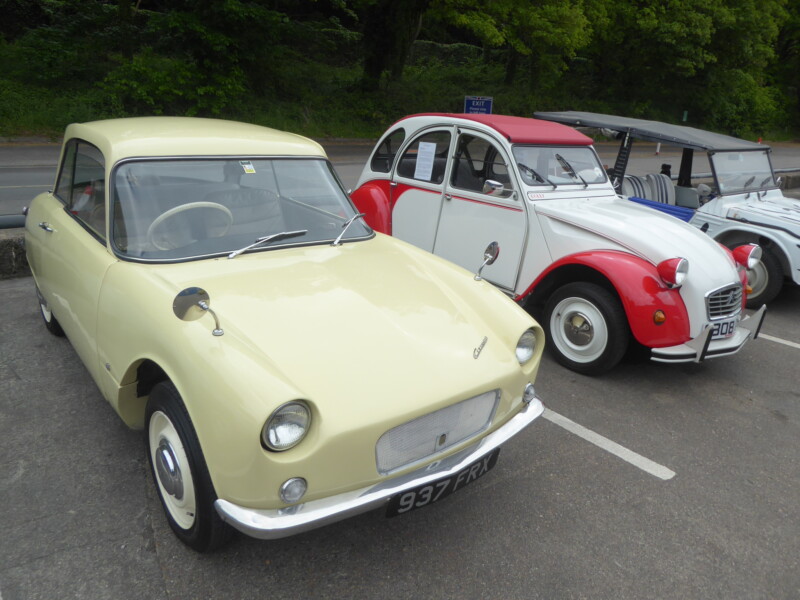
The Citroën Bijou is a small coupé manufactured by Citroën at the premises they had occupied since 1925 in Slough, England, from 1959 until 1964. It was based on the same platform chassis as the Citroën 2CV, sharing its advanced independent front to rear interconnected suspension. The car’s appearance was thought to be more in line with the conservative taste of British consumers than the utilitarian 2CV. The body was made of fibreglass, and the car featured the two-cylinder 425 cc 12 bhp engine also seen in the 2CV. Only 210 were produced, plus two prototypes. It incorporated some components from the DS, most noticeably the single-spoke steering wheel. It was designed by Peter Kirwan-Taylor, known as the stylist of the elegant 1957 Lotus Elite, another fibreglass-bodied car. Bijou bodies were initially moulded by a company called “Whitson & Co”, close to Citroën’s Slough premises,[3] but it later proved necessary to transfer this work to another supplier. Disappointing sales levels for the UK’s own Citroën seem to have been down to the Bijou’s price, which at the time of the 1959 motor show was £674. At this time the British market was acutely price sensitive, and buyers could choose a Ford Popular with four seats and a much larger engine for £494. The Bijou’s more modern styling gave it a higher top speed and lower cruising fuel consumption than the equivalent 2CV; however, the greater weight of the bodywork had an adverse impact on the car’s more general performance, especially its acceleration. The Bijou was considered expensive by the testers. It was also more expensive than the Austin Mini, but the Bijou was supposed to be more distinguished. As of 2013, nearly 150 Bijous were on the 2CVGB club register, but fewer than 40 are still on the roads.


Launched on its home market in August 1967, the Dyane was, of course, a development of the Citroën 2CV, and was intended as an answer to the increasingly popular Renault 4, which after its introduction in 1961 had affected 2CV sales. The Renault 4 incorporated many ideas copied from the Citroën Traction Avant, but on a smaller scale. Like the Renault 4, the Dyane was designed from the outset as a hatchback with some other styling differences, such as conventional round headlamps set into the front wings with a squared stainless steel trim ring – as opposed to the old-fashioned separate units found on the 2CV – and stainless steel wheel embellishments as standard. It was often asserted that the Dyane was intended to replace the 2CV, and although this had been the original idea, by the time the car was launched it was positioned to fill a small niche between the manufacturer’s 2CV and Ami models. The 2CV had been developed and, in 1948, launched at a time of austerity and low wages. More than twenty years later, with the much more modern Renault 4 selling strongly against the Citroën offerings, it was thought that buyers must be ready for a less aggressively basic approach. During the years since 1948 production technology had become more streamlined, as auto-industry wages grew ahead of the overall growth in the French economy, and production of the 2CV was, by the standard of more recent models, a very labour-intensive process. At the time of the Dyane’s development, the Citroën design department was busy on updates of the key DS and Ami models: design of the Dyane was therefore initially subcontracted to the Panhard design department, Panhard’s non-military business having in 1965 been absorbed into Citroën’s car business. The Panhard team under Louis Bioner (who had designed every Panhard model introduced between the late 1920s and the mid 1960s) produced a proposal that at a detailed level proved controversial with Citroën’s design chief, Robert Opron: the car was significantly reworked ahead of launch. The Dyane’s Panhard associations are also reflected in its name, Panhard having registered a copyright on the name Dyane along with Dyna, Dynavia and Dynamic. At launch the car was offered with two levels of equipment and trim: The Basic “Luxe” and the slightly better equipped “Confort”. The “Confort” version was differentiated from the outside through the inclusion of hub-caps on the wheels. The spare wheel and jack were mounted in a special cradle under the bonnet rather than both simply being placed loose on the floor of the luggage area at the back. The interior of the “Confort” was slightly less basic, with plastic moulded door panels rather than flat, vinyl covered hardboard. The steering wheel was less “rustic” than that which the less expensive “Luxe” version of the Dyane shared with the Citroën 2CV. The extra 615 francs in the 1967 domestic market listed price for the Dyane “Confort” represented a supplement of just over 10% when compared to the list price for the more basic “Luxe”. As with the 2CV, the engine was air-cooled, with a hemispherical combustion chamber and flat-topped pistons. and for the first five months only the 2CV’s 425cc engine was fitted. The “Dyane 6” was announced at the Brussels Motor Show in January 1968, fitted with the Ami’s 602cc M4 engine. This came with an advertised maximum output of 28 bhp, supporting a claimed top speed of 71 mph, which was a useful improvement over the 21 bhp of power and the claimed top speed of 100 km/h (62 mph) with which the Dyane had been launched. The 602cc engined Dyane did not replace the original 425cc engined car. However, two months later, in March 1968, the 425cc unit was replaced, in a car now described as the “Dyane 4”, by an improved 435cc engine providing 26 bhp. The extra power came from changes including not merely the slightly claimed cylinder dimensions, as well as an extra 2 mm of carburettor diameter and a raised compression ratio. Although there was a price to be paid in terms of higher fuel consumption, the listed top speed went up to 105 km/h (66 mph) and acceleration was measurably less anæmic. In September 1968 the M4 was replaced by an improved 602cc engine featuring higher compression pistons and forced induction from the engine fan giving slightly more power. As with the 2CV and Ami, cooling air was ducted straight to the heater, giving excellent demisting and heating. Mechanical contact-breakers were mounted at the front of the camshaft and located behind the cooling fan. The Fan was mounted on a tapered shaft and secured with a bolt at the bottom of a deep tube (the top of which engaged the starter handle). As the location of the points was not obvious to the uninformed, there were often neglected. The Coil fired both cylinders simultaneously (wasting one spark) and the spark plug wear was faster than it ought to have been; 6000 miles was not uncommon for a spark plug. Cylinder heads were held on with three studs and barrels slipped over the pistons. No cylinder-head gasket was used, and since the wings unbolted in a few minutes, it was possible to remove the cylinder heads and barrels, change the pistons or piston-rings and reassemble the top end very quickly, using only a few tools. The Dyane was based on the same platform chassis as the 2CV, sharing its advanced independent front to rear interconnected suspension. This comprised a central springing unit, running fore-and-aft in a tube on each side; each suspension arm on that side was linked to the spring, by a tie-rod and a ‘knife-edge’ pivot-pin. Early cars did not have conventional shock absorbers. The squeak you hear from most 2CVs and Dyanes as they go by over bumps is due to lack of lubrication either inside the spring tubes or to the ‘knife-edges’. The front hubs kingpins need to be greased every 600 miles. Since this is often overlooked, the king-pins can be prone to wear, although some movement is acceptable. During the Dyane’s first full year of production, supported by the interest and marketing activity generated by new-car launch, 98,769 Dyanes were produced which meant that it was indeed produced, even at this stage, in greater volumes than the 2CV with just 57,473 cars produced. In 1969 the Dyane was again produced at a higher rate, this time with 95,434 units as against 72,044 for the older car. However, the 2CV refused to die, and with 121,096 2CVs produced in 1970, the older car was back in front. The Dyane soldiered on, with French production rates remaining more than respectable, for more than another decade. However, the Dyane’s annual volumes would never again beat those of the 2CV and the car was deleted in 1980, several years before its older brother ended production. Few further changes were made, though from 1969, the Dyane 6 did gain a third side window, and a new grille was fitted from 1976. Minor trim updates were made, but the car remained resolutely utilitarian, and even the limited edition models such as the Code D’Azur of 1978 could not get away from the fact, not that enthusiastic owners really wanted anything else. 1,443,583 examples were made, but survival rates are low, and this car is far rarer than the 2CV.


Final version of these small air-cooled Citroens was a rather splendid Acadiane Van. This was derived from the Dyane and only available in left-hand drive, produced from 1977 to 1987. Production totalled 253,393 before being replaced by the Visa-based C15. Why Acadiane? Well, as Citroën had already used the prefix AK for its light commercials, so it was an obvious pun to name the AK Dyane “Acadiane”. There was no connection beyond the pun with the French-speaking region of Louisiana that is home to Cajun (Acadiane) cooking. The Acadiane differed from the Dyane on which it was based in having heavier-duty suspension, a slightly altered chassis and a rear-brake limiter whose action was dependent on the load. The Acadiane was also fitted with wind-down windows in the driver’s and passenger’s doors. The Dyane car had horizontally-sliding windows. The payload was approximately 500 kg (1,100 lb), but handling was impaired when fully loaded. The Acadiane was available in commercial (two-seater) form or as a “Mixte”, with sliding rear windows and a removable rear bench seat. Citroën and many other manufacturers continue to this day (Berlingo et al.) with the option of rear seats in a vehicle clearly designed as a commercial. The Mixte version also had a passenger sun visor, missing in the more basic commercial version. In line with many Citroën light commercials, the roof of the rear bodywork was corrugated to add extra rigidity at little cost. The Acadiane cruised on the flat comfortably and economically at 55 mph. Top gear in the four-speed box was usually referred to as overdrive. This had been so since the earliest days of the 2CV. In most circumstances it was best used as such. Progress could be maintained in top, but further acceleration was unlikely. As the motor thrived on revs, third made a perfectly good gear to get up to 80 km/h.

There was also an example of the uber-cool Méhari here. Much like the way the 1959 Mini became the 1964 Mini Moke, this small Citroen was based on an existing model, in this case, the 2CV/Dyane. 144,953 Méharis were built between the car’s French launch in May 1968 and 1988 when production ceased. A méhari is a type of fast-running dromedary camel, which can be used for racing or transport. A méhariste was a French Armée d’Afrique and Army of the Levant cavalryman that used these camels. The Méhari was based on the Citroën Dyane 6, and had a body made of ABS plastic with a soft-top. It also employed the 602 cc flat twin engine shared with the 2CV6 and Citroën Ami and because the standard Méhari weighed just 535 kg (1,179 lb), performance was respectable though very far from brisk. The vehicle also had the interconnected fully independent long-travel 2CV suspension used by all of the Citroën ‘A-Series’ vehicles. The colour was integrated into the ABS plastic material in production, and as a utilitarian vehicle, the options chart was quite limited. Only the Vert Montana remained in the catalogue for all the 18 years of production. Except for Azur blue, the official names of colours all refer to desert regions. Ultraviolet rays from the Sun impact the colourfastness of ABS plastic, so unrestored cars have a faded appearance. New bodies for restorations are only supplied in white colour, and now require painting on top of a specialist primer. A four-wheel drive version of the Méhari was produced from 1980 to 1983 and had excellent off-road qualities, due to the lightness of the vehicle. Unlike the earlier four wheel drive 2CV Sahara, which had two engines, this car only had one. Only 1300 were produced and so these cars are now both rare and highly sought after. The Méhari was sold in the United States in 1969 and 1970, where the vehicle was classified as a truck. As trucks had far more lenient National Highway Traffic Safety Administration safety standards than passenger cars in the US, the Méhari did not have seat belts. The Mehari did have limited sales success. Budget Rent-A-Car bought a number of them and offered them as rentals in Hawaii. Hearst Castle, in San Simeon, California, used them as groundskeeper cars. The cars had some differences from those sold elsewhere, with an altered front panel with larger 7″ sealed-beam headlamps being the most obvious.

It is hard to imagine just how revolutionary this car must have seemed when it was unveiled at the Paris Show in 1955. 18 years in secret development as the successor to the Traction Avant, the DS 19 stole the show, and within 15 minutes of opening, 743 orders were taken. By the end of the first day, that number had risen to 12,000. Contemporary journalists said the DS pushed the envelope in the ride vs. handling compromise possible in a motor vehicle. To a France still deep in reconstruction after the devastation of World War II, and also building its identity in the post-colonial world, the DS was a symbol of French ingenuity. It also posited the nation’s relevance in the Space Age, during the global race for technology of the Cold War. Structuralist philosopher Roland Barthes, in an essay about the car, said that it looked as if it had “fallen from the sky”. An American advertisement summarised this selling point: “It takes a special person to drive a special car”. Because they were owned by the technologically aggressive tyre manufacturer Michelin, Citroën had designed their cars around the technically superior radial tyre since 1948, and the DS was no exception. The car featured a novel hydropneumatic suspension including an automatic levelling system and variable ground clearance, developed in-house by Paul Magès. This suspension allowed the DS to travel quickly on the poor road surfaces common in France. In addition, the vehicle had power steering and a semi-automatic transmission (the transmission required no clutch pedal, but gears still had to be shifted by hand though the shift lever controlled a powered hydraulic shift mechanism in place of a mechanical linkage, and a fibreglass roof which lowered the centre of gravity and so reduced weight transfer. Inboard front brakes (as well as independent suspension) reduced unsprung weight. Different front and rear track widths and tyre sizes reduced the unequal tyre loading, which is well known to promote understeer, typical of front-engined and front-wheel drive cars. As with all French cars, the DS design was affected by the tax horsepower system, which effectively mandated very small engines. Unlike the Traction Avant predecessor, there was no top-of-range model with a powerful six-cylinder engine. Citroën had planned an air-cooled flat-6 engine for the car, but did not have the funds to put the prototype engine into production. The 1955 DS19 was 65% more expensive than the car it replaced, the Citroën Traction Avant. This did impact potential sales in a country still recovering economically from World War II, so a cheaper submodel, the Citroën ID, was introduced in 1957. The ID shared the DS’s body but was less powerful and luxurious. Although it shared the engine capacity of the DS engine (at this stage 1,911 cc), the ID provided a maximum power output of only 69 hp compared to the 75 hp claimed for the DS19. Power outputs were further differentiated in 1961 when the DS19 acquired a Weber-32 twin bodied carburettor, and the increasing availability of higher octane fuel enabled the manufacturer to increase the compression ratio from 7.5:1 to 8.5:1. A new DS19 now came with a promised 83 hp of power. The ID19 was also more traditional mechanically: it had no power steering and had conventional transmission and clutch instead of the DS’s hydraulically controlled set-up. Initially the basic ID19 was sold on the French market with a price saving of more than 25% against the DS, although the differential was reduced at the end of 1961 when the manufacturer quietly withdrew the entry level ID19 “Normale” from sale. An estate version was introduced in 1958. It was known by various names in different markets: Break in France, Safari and Estate in the UK, Wagon in the US, and Citroën Australia used the terms Safari and Station-Wagon. It had a steel roof to support the standard roof rack. ‘Familiales’ had a rear seat mounted further back in the cabin, with three folding seats between the front and rear squabs. The standard Break had two side-facing seats in the main load area at the back. During the 20 year production life, improvements were made on an ongoing basis. In September 1962, the DS was restyled with a more aerodynamically efficient nose, better ventilation and other improvements. It retained the open two headlamp appearance, but was available with an optional set of driving lights mounted on the front bumpers. A more luxurious Pallas trim came in for 1965 Named after the Greek goddess Pallas, this included comfort features such as better noise insulation, a more luxurious (and optional leather) upholstery and external trim embellishments. The cars were complex, and not always totally reliable, One of the issues that emerged during long term use was addressed with a change which came in for 1967. The original hydropneumatic system used a vegetable oil liquide hydraulique végétal (LHV), similar to that used in other cars at the time, but later switched to a synthetic fluid liquide hydraulique synthétique (LHS). Both of these had the disadvantage that they are hygroscopic, as is the case with most brake fluids. Disuse allows water to enter the hydraulic components causing deterioration and expensive maintenance work. The difficulty with hygroscopic hydraulic fluid was exacerbated in the DS/ID due to the extreme rise and fall in the fluid level in the reservoir, which went from nearly full to nearly empty when the suspension extended to maximum height and the six accumulators in the system filled with fluid. With every “inhalation” of fresh moisture- (and dust-) laden air, the fluid absorbed more water. For the 1967 model year, Citroën introduced a new mineral oil-based fluid liquide hydraulique minéral (LHM). This fluid was much less harsh on the system. LHM remained in use within Citroën until the Xantia was discontinued in 2001. LHM required completely different materials for the seals. Using either fluid in the incorrect system would completely destroy the hydraulic seals very quickly. To help avoid this problem, Citroën added a bright green dye to the LHM fluid and also painted all hydraulic elements bright green. The former LHS parts were painted black. All models, including the Safari and ID, were upgraded at the same time. The hydraulic fluid changed to the technically superior LHM (Liquide Hydraulique Minéral) in all markets except the US and Canada, where the change did not take place until January 1969, due to local regulations. Rarest and most collectable of all DS variants, a convertible was offered from 1958 until 1973. The Cabriolet d’Usine (factory convertible) were built by French carrossier Henri Chapron, for the Citroën dealer network. It was an expensive car, so only 1,365 were sold. These DS convertibles used a special frame which was reinforced on the side-members and rear suspension swing arm bearing box, similar to, but not identical to the Break/Safari frame.


There were quite a number of CX models here. Although it was perhaps not as radical a product as the DS, which it replaced had been, this was still something of a futuristic looking car when it was revealed in 1974. Indeed, it is considered by some enthusiasts as the last “real Citroën” before Peugeot took control of the company in 1976, and as history has now shown, is, it was to be the final successful model of the “big Citroën” era, which began in 1934, as Citroën sold nearly 1.2 million CXs during its 16 years of production. The CX’s flowing lines and sharp Kamm tail were designed by auto stylist Robert Opron, resembling its precursor the GS. Citroën had been using a Wind tunnel for many years, and the CX was designed to perform well in aerodynamic drag, with a low coefficient of drag (Cd in English; CX in French) of 0.36. Despite its fastback lines, the model was never sold as a hatchback, even though many of its rivals adopted this during the 1970s, and Citroen thus modified their own GS late in its life. Mechanically, the car was one of the most modern of its time, combining Citroën’s unique hydro-pneumatic integral self-levelling suspension, speed-adjustable DIRAVI power steering (first introduced on the Citroën SM), and a uniquely effective interior design that did away with steering column stalks, allowing the driver to reach all controls while both hands remained on the steering wheel. The CX suspension’s ability to soak up large undulations and yet damp out rough surfaces was extraordinary, with a consistent ride quality, empty, or fully laden. The suspension was attached to sub frames that were fitted to the body through flexible mountings, to improve even more the ride quality and to reduce road noise. “Car” magazine described the sensation of driving a CX as hovering over road irregularities, much like a ship traversing above the ocean floor. This suspension was used under license by Rolls-Royce on the Silver Shadow. The Mercedes-Benz 450SEL 6.9 was not built under license, but copied the Hydropneumatic suspension principles after the less effective Mercedes-Benz 600 Air suspension installation. The CX was conceived to be a rotary-engined car—with several negative consequences. The CX engine bay is small because rotary engines are compact, but the Comotor three-rotor rotary engine was not economical and the entire rotary project was scrapped the year the CX was introduced, and Citroen went bankrupt in 1974, partly due to a series of investments like Comotor that didn’t result in profitable products. Production versions of the CX were always powered by a modest inline 4 cylinder engine, transversely mounted. This saved space and allowed the CX to be 8″ shorter than the DS. At launch in 1974, the CX was rushed to market, with some teething troubles. Some very early models did not have power steering which made the car difficult and heavy to drive – the CX carries 70% of its weight over the front wheels. Initially there was a choice between three differently powered versions. The “Normale” CX car came with a 1985 cc version of the four cylinder engine from the predecessor model with a claimed maximum output of 102 PS, which was slightly more than had been available from the engine when fitted in the DS. The “Economique” version of the car (reflecting the continuing impact of the 1973 oil price shock) came with the same engine as the “Normale”, but the gear ratios were changed, along with the final drive ratio, giving rise to a 7 km/h (4 mph) reduction in top speed in return for usefully improved fuel economy. More performance came from the “CX 2200”, fitted with a 2175 cc version of the engine and a twin carburettor, resulting in a claimed maximum output of 112 PS. This was rather less than was available in the top spec DS23 EFi which featured a relatively powerful 141 PS fuel-injected 2.3-litre engine. The later 2200 improved on this, and eventually the same 2347 cc unit as used in the DS) arrived, originally only in the long wheel-base Prestige, but a regular CX 2400 arrived at the 1976 Paris Salon, to replace the CX 2200. By this time, Citroen had added a capacious Estate model to the range, called Safari, and a 2.2 litre Diesel powered model – important even in the mid 1970s in France – was also offered. Despite the challenging finances of Citroën at the time of launch, the CX was entered in numerous rally driving events, like Tour du Senegal and Paris-Dakar, winning 5 events outright. Most notable among these was in the 17,500 mile 1977 London–Sydney Marathon road race in which Paddy Hopkirk, driving a CX 2400 sponsored by Citroën’s Australian concessionaire, staged a come-from-behind sprint to obtain third place. The CX was initially a huge success in Europe, more than 132,000 being produced in 1978. It found customers beyond the loyal Citroën DS customer base and brought the technology of the advanced, but somewhat impractical, Citroën SM to the masses. Evolution of the car after this was gradual. More power came in 1977, with the CX GTi which received a modern Bosch L-Jetronic injection system, generating 128 PS, and there was a standard five speed gearbox, and in early 1978, the diesel engine was enlarged to 2.,5 litres. A five speed gearbox was available. A very mild facelift in 1979 saw the Douvrin 2 litre engines that were used in the rival Renault R20 fitted under the bonnet to create the CX Reflex and Athena. In 1981, factory rustproofing and a fully automatic transmission to replace the former semi-automatic gearbox were added. In 1984, the addition of a turbo to the 2.5 litre diesel engine made the CX Turbo-D 2.5 the fastest diesel sedan in the world, able to reach speeds up to 195 km/h (121 mph). In 1985, the GTi Turbo, with a top speed of over 220 km/h (137 mph), finally gave the CX the powerful engine that finally used the full capabilities of the chassis. A facelift later that year was an attempt to keep the car in the public eye, but its sales had peaked long ago, back in 1978, and better trim, a revised interior and new plastic bumpers were not going to help a 10 year old design in the face of stiff market competition. Just 35,000 units were produced in 1986 and 1987. There were few further changes for the rest of the CX’s life, with its successor, the XM appearing in early 1989. Production of the Estate models continued until 1991, by which time 1,170,645 CXs had been sold. There are far fewer survivors than there are of the DS family.


The C15 was based on the Citroën Visa (discontinued 1988), and mainly used a 1769 cc XUD or 1868 cc (DW8 on late models), naturally aspirated (non turbo) diesel engine. Until the early 1990s, it was also available with a petrol PSA TU engine. At the time of introduction, the engines were the 60 PS XUD (C15D) or the 47 PS 1124 cc petrol TU1 (C15E). The diesel engines also powered vehicles several classes larger. Both Bosch and Lucas/CAV/Roto diesel injection systems were used. The TU petrol-engined versions were sold until the beginning of the 1990s. The engines and drivetrains were taken from the Citroën Visa lineup. While the car was mostly the same as a regular Citroën Visa ahead of the B-pillar, the cargo area was unique. The C15 had a lengthened wheelbase, and a sturdier rear axle shared with the Peugeot 305 Break and Citroën BX since it had to carry heavier loads than the Visa. The very curved sides of the windscreen, enabled the use of a very large single wiper on the long narrow windscreen, without it catching the windscreen seal. The shape of the bumper and plastic trim on the front of the van, like those of the Visa car, were designed to aerodynamically reduce the deposition of dirt on the headlights, and to reduce the risk of stone chips to the headlights, bonnet and windscreen. The heating and ventilation system, (even though it used only a water control valve for temperature control and not air mixing), could provide cold air from fascia side vents, to the face while warming the car. The central directable fascia vents could be pointed directly at the windscreen in front of the driver, to blow hot air to keep it clear in extreme misting conditions. There was also an additional mid-level vent. The C15 also had height adjustable halogen headlights, and multi speed/intermittent front wipers, which was better than most commercial vehicles of the time. As well as standard van configuration, the vehicle later became available with rear side windows and a rear seat, (a layout which had been pioneered in the 2CV), which can be seen as a forerunner to today’s compact utility vehicles such as the Ford Transit Connect, Opel/Vauxhall Combo, Peugeot Partner/Citroën Berlingo and Renault Kangoo. The C15 was also available without the rear bodywork, as a chassis only model. This encouraged various conversions such as the campervan called the RomaHome built by British company Island Plastics. This small camper was suitable for two people. Rare pickup truck versions were also made. By December 2005, when it was discontinued in most countries, production had reached 1,181,471


Despite the fact that 2,315,739 BXs were built during its 12-year production run, and the car sold well, these are getting increasingly scarce, even in France. The rather angular hatchback was designed by Marcello Gandini of Bertone, based on his unused design for the British 1977 Reliant FW11 concept and his 1979 Volvo Tundra concept car. It was the second car to benefit from the merger of Peugeot and Citroën in 1976, the first being the Citroën Visa launched in 1978. The BX shared its platform with the more conventional 405 that appeared in 1987, except the rear suspension which is from a Peugeot 305 Break. Among the features that set the car apart from the competition was the traditional Citroën hydropneumatic self-levelling suspension, extensive use of plastic body panels (bonnet, tailgate, bumpers), and front and rear disc brakes. The BX dispensed with the air cooled, flat four engine which powered the GS, and replaced it with the new PSA group XY, TU and XU series of petrol engines in 1360 cc, 1580 cc and, from 1984, 1905 cc displacements. In some countries, a weaker, 80 PS version of the 1580cc engine was badged as the BX15E instead of BX16. A 1124 cc engine, in the 11TE, very unusual in a car of this size, was also available in countries where car tax was a direct function of engine capacity, such as Ireland, Italy, Portugal and Greece. The 11TE model was seen by foreign motoring press as slow and uncomfortable. It was fitted to the cars made from 1988 to 1993 and produced 55 hp. The 1.1 and 1.4 models used the PSA X engine (known widely as the “Douvrin” or “Suitcase Engine”), the product of an earlier Peugeot/Renault joint venture, and already fitted in the Peugeot 104 and Renault 14. The 1.6 version was the first car to use the all-new short-stroke XU-series engine. It was produced in a new engine plant at Trémery built specifically for this purpose, and was later introduced in a larger 1.9-litre version and saw long service in a variety of Peugeots and Citroëns. The XUD diesel engine version was launched in November 1983. The diesel and turbo diesel models were to become the most successful variants, they were especially popular as estates and became the best selling diesel car in Britain in the late 1980s. Despite being launched on the continent in the autumn of 1982, it wasn’t launched onto the British market until August 1983, initially only with 1.4 and 1.6 petrol engines, although further engine options and the estate model would arrive later, and it would go onto become one of the most popular foreign-built cars here during the second half of the 1980s. A year after the launch of the hatchback model, an estate version was made available. In 1984 power steering became optional, welcome particularly in the diesel models. In the late 1980s, a four-wheel drive system and turbodiesel engines were introduced. In 1986 the MK2 BX was launched. The interior and dashboard was redesigned to be more conventional-looking than the original, which used Citroën’s idiosyncratic “satellite” switchgear, and “bathroom scale” speedometer. These were replaced with more conventional stalks for light and wipers and analogue instruments. The earlier GT (and Sport) models already had a “normal” speedometer and tachometer. The exterior was also slightly updated, with new more rounded bumpers, flared wheelarches to accept wider tyres, new and improved mirrors and the front indicators replaced with larger clear ones which fitted flush with the headlights. The elderly Douvrin engine was replaced by the newer TU-series engine on the 1.4 litre models, although it continued to be installed in the tiny BX11 until 1992. 1988 saw the launch of the BX Turbo Diesel, which was praised by the motoring press. The BX diesel was already a strong seller, but the Turbo model brought new levels of refinement and performance to the diesel market, which brought an end to the common notion that diesel cars were slow and noisy. Diesel Car magazine said of the BX “We can think of no other car currently on sale in the UK that comes anywhere near approaching the BX Turbo’s combination of performance, accommodation and economy”. In 1989, the BX range had further minor revisions and specification improvements made to it, including smoked rear lamp units, new wheeltrims and interior fabrics. Winning many Towcar of the Year awards, the BX was renowned as a tow car (as was its larger sister, the CX), especially the diesel models, due to their power and economy combined with the self levelling suspension. The biggest problem of the BX was its variable build quality, compared to its competition. In 1983, one quarter of the production needed “touchups” before they could be shipped, though later models were more solid. The last BX was sold around 1994, by which time its successors had already been launched. It had been partially replaced by the smaller ZX in early 1991, but its key replacement was the slightly larger Xantia that went on sale at the beginning of 1993.

Next up was the AX. Development of this model started in 1983, and was initially also going to form the basis of a sister model from Talbot to replace the Samba; however, the falling popularity of the Talbot brand – coupled with the huge success of the new Peugeot 205 – had led to Peugeot deciding to axe it by the time the Citroën AX was launched, and so the Talbot version never made it into production. The car was available on the left-hand drive continental markets from its launch on 2 October 1986, as a three-door hatchback with 1.0, 1.1 and 1.4-litre TU-series belt driven OHC engines. A range of five-door models was added in 1987 and a 1.4 litre diesel engine was introduced in 1988. The latter was replaced by a 1.5 litre unit in September 1994. The right-hand drive version for the UK market was launched in August 1987, initially only as a three-door hatchback, with a five-door version joining the range a year later, effectively replacing the five-door Citroën Visa, which was discontinued that year. With the final demise of the classic Citroën 2CV in 1990, the AX became the smallest model in the Citroën range. The very earliest cars had an issue with gear shifters falling off; this was rectified by the time the AX reached export markets. It was initially backed by a memorable television advertising campaign filmed in China, starring actress Janet Mas and an elderly gentleman, whose character was simply known as Mr. Wong. The car was very economical, largely because of excellent aerodynamics for its class of car (drag coefficient of 0.31) and a very light weight of 640 kg (1,411 lb) for the basic version. This was due to the extensive use of plastic panels in non-load bearing areas and varying the thicknesses of steel in the bodyshell to be the minimum needed to take required loads. Another target for the engineers was lowering friction in the engines. The AX has fully independent suspension with unusually long wheel travel. It also optionally used self-coloured plastic bumpers. This technology came from the PSA Peugeot-Citroën / Renault / French government ECO 2000 project. The production version was much more conservative than the original ‘one box’ design prototype, that was closer to the Eco 2000 styling after negative reactions in focus groups. The “one-box” city car eventually came to market with the Renault Twingo, launched in 1992. In 1989, a naturally aspirated diesel AX, using the 1360 cc all aluminium alloy TUD engine, managed a figure of 2.7 litres/100 km (100 mpg), totalling over 1,000 miles from Dover to Barcelona. This was the longest ever distance travelled on 10 gallons of fuel and earned it a place in the Guinness Book of Records as the most economical production car. Also available was a 4×4 variant, but with limited success when compared to the rival Fiat Panda 4×4. The AX 4×4 was only available with five doors and was not sold in the United Kingdom. The first performance version was the limited-run AX Sport from 1987, with a 1.3 engine and twin carburettors producing 95 bhp, wearing iconic white steel wheels (5,5″ x 13″) which resembled those on its brother, the Peugeot 205 Rallye. The AX Sport used Solex ADDHE 40 carburettors until late 1988 and was then replaced with Weber DCOM 40s, just like the 205 Rallye 1,3. The AX Sport had a shorter inlet manifold than the 205 Rallye, to save room in the smaller engine compartment. In phase 2 guise the Sport was available in other colours and with optional GT wheels and rear spoiler. Later, the AX 14GT, with a single-carburettor 85 bhp 1.4 engine also found in the Peugeot 205 XS, was introduced. From 1991, this model utilised fuel injection to coincide with the revamp of the entire range and to coincide with tougher 1992 EU emission regulations that introduced exhaust catalytic converters. Late 1991 saw the range revised, with a heavily facelifted tailgate and interior being the most notable changes. The front turn signals were now clear, and the Citroën logo was moved to the center of the bonnet. The much maligned dashboard was replaced by a more conservative design. The following year saw the introduction of the most powerful AX variant, the 100 bhp GTi. The GT was sold alongside the GTi for a few months, but was eventually phased out. New models were also introduced, such as the Forte, Spree, Elation and Dimension. In January 1995, the Citroën AX Echo was launched, with a top speed of 110 mph (180 km/h). Its closest competitor, the Peugeot 106 Ski, (that shared components with the AX), was outsold by the Echo. From June 1996, following the introduction of the Saxo, the range was slimmed-down, with production of the AX ending in December 1998, after a 12-year production run. It had been withdrawn from the UK market during the first half of 1997, following the demise of right-hand drive production. A total of 2,425,138 AXs were produced.


Launched on 23 May 1989, the XM was the modern iteration of the Big Citroën, a flagship saloon replacement for the Citroën CX. It went on sale in its native France immediately afterwards, and was available in right-hand drive on the UK market from October 1989. The XM estate was launched in the spring of 1991, until which time the estate version of the CX remained in production. The XM inherited a loyal global customer base of executive class customers and a clear brand image, but did not enjoy the commercial success and iconic status of its predecessors, the CX and the DS, which both raised the bar of automotive performance for other manufacturers. With total sales over its lifetime of just 330,000 units in 11 years, and the fact that its replacement Citroën C6 was not launched until the end of 2005 (despite being scheduled for launch in 2001), the XM might be considered a failure. By the second half of the 1990s, sales were in sharp decline, but Citroën did not end production of the car until 2000. There were many advances, most apparently designed to counteract the main criticisms of its predecessor. The CX leaned in corners, so the XM had active electronic management of the suspension; the CX rusted, so the XM had a partially galvanised body shell (many surviving XMs have very little corrosion); the CX was underpowered, so the XM offered the option of a 3.0 L V6 engine – the first V6 in a Citroën since the Maserati-engined SM ceased production in the mid 1970s. When the estate model joined the line-up, Citroën had a competitor at almost every level with most other similar-sized European cars. Ventilation was markedly more effective in the XM. Rear accommodation in the XM was improved over the CX in both width, legroom and height. In particular the rear passengers were seated higher than those in the front in order to afford a good view out, important for a vehicle which would operate in French government service. The XM shared a floorpan with the Peugeot 605, and the two models fared similarly in both teething problems and market acceptance. Unlike the 605 sedan design, the XM was a liftback design – a feature thought to be desirable in certain European markets – perhaps uniquely, it featured an additional glass panel that could lift with the tailgate but when shut, isolated the passenger compartment, to mimic the feel of a salon car. In mid-1994, the XM was revised in order to improve competitiveness. This did not materially impact sales. All models were fitted with driver’s airbag (signalling the end of the single-spoke steering wheel), belt-pretensioners, a redesigned dashboard and upper door casings. The suspension was redesigned to reduce roll, pitch and dive. Most noticeable was the adoption of a passive rear-steering system similar to that on the Citroën Xantia. This sharpened the “steering without inducing a nervous twitch.” Power output on the turbocharged motor was increased to 150 bhp from 145 bhp at 4400 rpm. This allowed the car to develop more torque at much lower revs. The important 50–70 acceleration time was 8 seconds compared to the Ford Scorpio 2.0 16V Ghia’s 17 seconds. The view of CAR magazine was that this engine “provides unusually swift access to effortless power … it delivers progressively with commendably little fuss; that this 2.0 turbo is as refined as it is muscular makes the XM’s performance all the more creditable”. XM was intended to compete against prestige vehicles like the Audi 100 and BMW’s 5 Series in a sector that accounted for 14.2% of the European market. It also competed with cars from mainstream brands including the Ford Scorpio and Opel Omega. Citroën was quoted as saying that the car was supposed to “take what Citroën means and make it acceptable”. The car’s initial reception was positive. Some six months after its launch, The XM won the prestigious European Car of the Year award for 1990 (gaining almost twice as many votes as the second, the Mercedes-Benz SL) and went on to win a further 14 major awards within a year of its launch. The anticipated annual sales of 450 cars a day in the first full year of production, or 160,000 units a year, never materialized. Sales never reached this ambitious level (higher than even its popular predecessor) for a variety of reasons. Like the CX, the XM did not have the worldwide distribution of competitors from BMW, Audi, and Mercedes-Benz. Also, it was launched only a year before a major global recession began, impacting negatively on car sales across the world; a notable example being the UK, where more than 2.3 million new cars were registered in 1989, but that figure fell to less than 1.6 million in 1991 (a drop of more than 30% in just two years). In Japan the XM was sold through Mazda’s Eunos dealership chain, part of an effort to minimize the appearance of Japan’s automobile market being closed to imports. It was also offered by Citroën’s traditional importer Seibu Motor, who kept selling the XM by themselves after the Eunos brand was discontinued in 1996. The market for executive cars made by volume manufacturers (Ford, Opel, etc.) was on the verge of decline as customers opted for offerings from more prestigious marques, a trend which saw Ford pull out of this market sector in 1998 and Opel in 2003. Customers were placing a higher priority on speed and handling rather than ride comfort which was Citroën’s specialty. The XM was underdeveloped at launch which resulted in reliability problems; the vehicle as designed was inconsistent in its abilities. The XM’s styling was also controversial and alienated those who desired a more conventional three box sedan. Peugeot introduced an XM competitor, the very similar Peugeot 605 that also sold weakly. Most subjective of all was the matter of the XM not living up to the expectations created by its forerunner the Citroën DS, despite that car having been launched in an era of national markets, of different demands and standards, an era when there was more scope for large advances in engineering and design than were possible in 1989. Export markets experienced lower sales from the outset, partly due to the XM’s pricing. The least expensive XM was nearly 50% more expensive at the time of launch than the corresponding CX. Whilst strong at first home market sales also declined, after the mechanical issues of the first few model years became known. By early 1993, the XM was viewed as an “underachiever”. Initial sales in the UK were at 3,500 units a year, making it Citroën’s weakest seller. The 2.0-litre petrol engined variants were viewed as being the least competitive. As a result, Citroën restructured the range such that all but the base model petrols were fitted with low-inertia Garret turbochargers to add an extra 15 bhp. This made the cars more powerful than more expensive competitors such as the Rover 820, Vauxhall Carlton and Ford Granada 2.0 GLX. After a run of 11 years, production finally ended in June 2000, with 337,000 made. By 1998, Citroën had confirmed that it would soon be discontinuing the XM and replacing it with an all-new model. At the Geneva Motor Show in March 1999, it unveiled the C6 Lignage concept car, which was scheduled for launch in 2001. In the event, the XM’s successor – the C6 – did not go on sale until late 2005 and was even less successful.


The Xantia replaced the earlier Citroën BX (which straddled both small and large family car segments), and maintained the high level of popularity of that model, but brought the car more into the mainstream to compete harder with its rivals, such as the Ford Mondeo, Nissan Primera, Rover 600, Toyota Carina E and Opel Vectra/Vauxhall Cavalier. Sales commenced in March 1993. The car was built from November 1992 to October 2002 in France, totalling almost ten years, including the facelift in December 1997. It signalled that Citroën had learned from the reception given to the staid Citroën ZX, introduced two years earlier, and criticised by contemporary journalists for its lack of traditional Citroën flair, in engineering and design. Citroën addressed these concerns in the Xantia. The Xantia also used the traditional Citroën hydropneumatic suspension system, which was pioneered by the older DS. It was initially only available as a hatchback (notchback) (Berline), but an estate (station wagon) (Break) version, built by Heuliez, appeared in September 1995. Inline with PSA Group policy, the Peugeot 406, launched two years later, used the same floorpan, core structure and engines as the Xantia. The Hydractive suspension system was not carried over, and the 406 utilised a more traditional spring suspension. Sales in the United Kingdom were strong, and even though it was never able to match the volume of British favourites, such as the Ford Mondeo or Vauxhall Vectra, the car did help Citroën establish a strong foothold in the business car market in the United Kingdom.


Once a common sight, the Citroen ZX, seen here in Estate guise, is quite a rarity. The Citroën GS had been a ground breaking and radical new model in the small family car market on its launch in 1970, scooping the European Car of the Year award, and was facelifted in 1979 and gained a hatchback which saw it transformed into the GSA. However, such was the success of the larger BX after its 1982 launch, that PSA decided to delay the launch of an immediate replacement for the GSA when it was finally discontinued in 1986. Development work began on a new C segment hatchback, which was originally expected to be launched as the Citroën FX at the beginning of the 1990s. Although the Rally Raid version of the ZX debuted during 1990, the ZX was officially launched on the left hand drive continental markets on 16 March 1991, with British sales beginning in May that year, initially only with petrol engines. The diesel ZX went on sale later in 1991. The sales target was about 230,000 vehicles/year (with half of that outside of France). It went on sale in New Zealand in the beginning of 1993, as a five door in 1.6 Aura or Turbodiesel trim, with the naturally aspirated diesel and Volcane GTi (1.9) models joining a few weeks later. New Zealand’s unleaded petrol was of a low octane rating, meaning that initially only uncatalyzed cars were on offer. In January 1994, the estate of the ZX debuted, and went on sale in May, shortly followed by a mid cycle facelift. The first examples of the ZX had been produced in 1990, with the three door Rally Raid model being the winner of the Paris-Dakar, which started just after Christmas. The first prototypes of the ZX had actually debuted at the Baja Aragon on 20 July 1990. Drag resistance ranged from Cds 0.30 to 0.33. The launch of the ZX marked the return of Citroën into the C sector of the car market; it had discontinued the GSA in 1986 with no immediate replacement, largely due to the success of the larger BX. However, Citroën had decided to phase out the BX between 1990 and 1993, by at first launching a smaller model, and then adding a larger model (the Xantia) to its range. The ZX’s interior space and value received praise from critics and consumers. Of particular note was the rear seat arrangement; it was mounted on a sliding platform that allowed the seat to be moved rearwards to increase rear legroom, or forwards to increase cargo space. Unfortunately, only the seat backs folded down on models so fitted. Lower specification models with fully folding and removable seats had more ultimate capacity. The ZX specification was good for its class, with most models getting power steering, electric windows, electric sunroof, a driver’s side (and sometimes passenger’s side) airbag and anti-lock braking system as either optional or standard equipment. It was competitively priced though, unlike the Mark III Volkswagen Golf, which was priced at a relative premium from its launch later in August 1991. It also reached the market a few months before the new version of the Opel/Vauxhall Astra. The familiar range of PSA powertrains drove the front wheels of a seemingly conventionally designed chassis. At the front was a standard MacPherson strut layout with anti-roll bar, while the rear used the PSA Peugeot-Citroën fully independent trailing arm/torsion bar set up that was first introduced on the estate of the Peugeot 305. However, PSA’s chassis engineers employed some unusual features, including passive rear wheel steering (by means of specially designed compliance bushes in the rear suspension), and in house developed and constructed shock absorbers. At high mileages, this is prone to wear off the axle mounting bushes, which is easily fixed. It is also prone to wear in the rear axle trailing arm bearings, which then wear the trailing arm axle tubes, requiring an expensive rebuild or a replacement axle assembly. The diesel and larger capacity petrol engines are canted as far back as possible in the engine bay, in an effort to put as much weight as possible behind the front axle line, also reducing the centre of gravity, while improving weight distribution and minimising understeer. At the time of its launch, the ZX range consisted of a collection of four very individual trim levels; the base model was the “Reflex” aimed at young people, next was the “Avantage” aimed at families, and then there was the luxury “Aura” series. The final series was the relatively sporting “Volcane” series, with lowered (and hard) suspension. The “Volcane” TD was one of the first diesel hot hatches. Over time, further models were introduced including the “Furio”, a cheaper sports model, a 16 valve engined high performance derivative and many special editions.


The Citroën Saxo was a supermini produced by the French manufacturer Citroën from 1996 to 2004. It was sold in Japan as the Citroën Chanson, because Honda had registered the “Saxo” name. As a badge engineered variant of the Peugeot 106 (which itself was a development of the Citroën AX), the major difference being interiors and body panels. Production ended in 2004, when it was replaced with the Citroën C2 and Citroën C3. All engines were from the PSA TU engine series that powered the Peugeot 205 from 1988 and the Citroën AX, and had their roots before that with the OHC PSA X engine various other PSA cars used, such as the Citroën Visa, Peugeot 104 and early Peugeot 205. The range included five petrol engines and one diesel engine, all naturally aspirated. Although the quoted power outputs are low in comparison to modern small hatchbacks, or even to other hatchbacks of the time, the kerb weight was generally very low, with even the range-topping VTS having a kerb weight of just 935 kg (2,061 lb), with other smaller engine models (except the diesel) being around 100 kg lighter than this. This meant a high power to weight ratio resulting in decent acceleration and made the car suitable for city driving. Aside from the VTS which had 16 valves, all engines were the older SOHC units which meant relatively low city MPG figures. Even the popular 1.1i engine would struggle to achieve more than 35 to 40mpg in town when driven carefully. The real world consumption between the smaller engines and the nippy 1.4i Westcoast/Furio variant was hardly noticeable, however the insurance premiums were. The early 1.0i was quite under powered, with the 1.1i being considered much better, since it was nearly 200cc larger and had roughly 30% more torque. There were three sport models of the Saxo: the Westcoast, later replaced by the Furio which featured a 1.4I 8V 75PS engine with a top speed of 175 km/h (109 mph), and a 0-62.5 mph (0–100 km/h) time of 11.2 seconds; the VTR MK1 (1997–1999) featured a 1.6I 8V 90PS engine with a top speed of 187 km/h (116 mph) and a 0-62.5 mph (0–100 km/h) time of 10.0 seconds. The VTR MK2 (1999–2003) featured a 1.6I 8V 98PS engine with a top speed of 193 km/h (120 mph) and a 0-62.5 mph (0–100 km/h) time of 9.4 seconds; the VTS 16V featured a 1.6I 120PS engine with a top speed of 205 km/h (127 mph), and a 0 to 60 mph time of 7.8 seconds. The VTS MK1 (1997–1999) and MK2 (1999–2003) shared similar performance, although the MK2 was slightly slower due to it being marginally heavier. These models included 247 mm (9.7 in) vented front brake discs, with the VTR and VTS also having rear brake discs (solid 247 mm (9.7 in) discs). Also, a different style of control arms and struts was used for the suspension. The VTS had a 22 mm (0.9 in) master brake cylinder, and the VTR and Westcoast/Furio had a 19 mm (0.7 in). The VTS had a 19 mm (0.7 in) front anti roll bar and 22 mm (0.9 in) rear anti roll bar, while the VTR and Westcoast/Furio had a 19 mm (0.7 in) front and 21 mm (0.8 in) or sometimes 19 mm (0.7 in) rear antiroll bar. In addition, all the sports models featured a unique bodykit to the other models, commonly known as the “VT” bodykit. In 1997 the Saxo’s three speed automatic gearbox was combined with the 1.6i 8V 90PS engine which was available on the Saxo SX and VSX. Then, in the end of 1997, the 1.6i automatic was replaced with a 1.4i 75PS engine. The 1.6i was more powerful with a top speed of 176 km/h (109MPH) compared with the 1.4’s top speed of 103 mph (166 km/h). Citroën carried on using the 1.4i engine on the facelift Saxo Automatic in 1999. Due to the C3 having a 1.4i automatic gearbox, the Saxo Automatic came to an end in March 2002, whilst the manual models were still sold right up to the end of 2003. The equipment list was generally sparse, with budget models having drivers airbag, seat belt pre tensioners, cassette player, heated rear screen and tinted windows, and early Mark Ones with keypad immobilisers and a clock in place of a tachometer and three stud wheels, much like the AX. Further up the list sunroofs, PAS, Electric windows, ultrasonic alarm, passenger airbag, CD player, tachometer, front fog lights, bodykits, colour coded mirror caps and alloy wheels were added, to name a few. Although MK2 Saxos were generally better equipped than their older counterparts, the interiors were still dated in comparison to other small hatchbacks of the time, such as the Vauxhall Corsa, with many of the centre console controls originating from the older model of the Citroën AX. The 1.6L VTR and VTS Saxos were the best equipped, with both gaining rear disc brakes as opposed to drum brakes, and ABS as standard for the VTS and an optional extra on all other 1.6-litre models. Few special models were released throughout the Saxo’s life, most notably the “Open Scandal”, a Saxo with a full length sliding canvas roof. Other special editions added certain extras to the lower end model, such as sunroofs or PAS. Notable models are the Westcoast up to 1999 and the Furio to 2003, as they incorporated the standard Saxo bodykit found on the VTR and VTS with a more insurance friendly 1.4-litre engine. The Westcoast is not to be confused with the Eastcoast, which was only available in the 1.0L and later 1.1L engines. The Eastcoast also did not incorporate the “VT” bodykit. Air conditioning was never an option on right hand drive Saxos because the blower motor was mounted in the bulk head on the driver’s side. As a result, there was insufficient space available to accommodate the evaporator, except by first ducting the air flow to the passenger’s side and then at the expense of the glove box. Although an after market kit was available that did exactly this, the resultant pressure loss made the system noisy and ineffective. The blower motor could also not be easily relocated, since the windscreen wiper motor was mounted in the passenger’s side space. In September 1999, the Saxo received a style makeover, commonly branded as a Mark II, with the major differences being more modern styled headlights, bonnets and grilles to replace the square style on the MK1 and multipoint injection replacing the single point on the 1.1-liter engines. In September 2000, it was a Euro NCAP sufferer of poor results, along with its twin, the 106. Power steering became standard on all but the very basic models. More subtle changes were alterations to the rear lights (the indicator sections are more “white”) and the engine control unit moved from a single plug to three plugs. The old three-stud wheel layout, as used on the Citroën AX, was also dropped. There was also a minor facelift, during the first phase of the car’s production, in line with the then current releases by Citroën, moving towards a rounder look. While the exterior was markedly altered, little changed inside the vehicle. The dashboard and glovebox arrangement remained the same with the possibility of installing a passenger-side airbag in some high range models. By 2003, some buyers were more attracted to the spacious, and practical five-door C3. However, the 1.6 VTR and VTS models remained popular. The Saxo finally finished production in September 2003, when the three-door C2 was launched. Its twin, the Peugeot 106, also ceased production at this time. By the end of the Saxo’s production life, its design was seven years old.

The Citroën C2 is a supermini car which was made from August 2003 until October 2009. It is a three-door hatchback with a front-engine, front-wheel-drive layout and was produced at the Aulnay factory on the outskirts of Paris. Along with the Citroën C3, the C2 replaced the popular, but ageing Citroën Saxo. The C2 and C3 have relatively different designs however retain the same dashboard, allowing Citroën to sell cars in different submarkets of the supermini class. The C2 was designed by Donato Coco. The C3 was originally designed as a larger “family-friendly vehicle”, with its five doors, whereas the C2 aimed to project a “young driver” image with two doors and flatter styling. The C2 was discontinued in October 2009, and replaced by the Citroën DS3 in January 2010. Unlike the Saxo, with 2 of 5 stars from Euro NCAP, the C2 achieved 4 out of 5 stars. Unlike its sister models, the Citroën C1 and C3, the C2 was seen as a victim of poor advertising. According to many in the motoring press, it was the most neglected model in the Citroën lineup in terms of promotion. In comparison, the C1 and the C3, on which the C2 is based, were both well presented in the media. Despite that, the Citroën C2 was awarded the “Best European Hatchback of 2003” in September 2003. The LX model was the “no-frills” version of the C2 and came with basic equipment, including black plastic bumpers and no fog lamps. The L model, produced from 2003 to 2005, came with black lower bumper and door handles, CD player, rear-seat modulation, and no fog lamps. The Design included body coloured bumpers and electric windows. The SX was the luxury spec. It featured ‘bumper colour coded paint’ and air conditioning, the latter of which increases the 1.1 SX’s 0–100 km/h time by 4.5 seconds to 17.2 seconds. The Furio, VTR and VTS are continuations of the sports models which made the C2’s predecessor, the Saxo, famous as an affordable “pocket rocket”. The Furio has the same sports body kit as the more expensive VTR and VTS models but lacks their alloy wheels. Earlier models of the Furio had 15″ Coyote alloys, but these were later replaced with wheel trims from the end of 2003 onwards. The VTR also has a 103 PS (102 bhp) engine, whereas the VTS, the premium sports model, has a 118 PS (116 bhp) engine capable of accelerating from 0 to 100 km/h (62 mph) in 8.0 seconds. This was somewhat sluggish by contemporary hot hatch standards but was designed to be more insurance friendly. Other additions that helped the VTS model achieve a low insurance rating (in the United Kingdom) were security-based including deadlocks and a Thatcham Category 1 alarm system which includes perimeter and volumetric detection as well as an engine immobiliser. The limited-edition model GT, introduced in September 2004, offered a sporty body kit, with bright red, blue, silver and black paintwork and unique white alloy wheels. All GTs have a numbered certificate to show their authenticity. Only 2,500 were made, exclusive to the United Kingdom. In 2006, there were a number of small revisions to the C2. Externally the car looks identical save minor changes to alloy wheels (on the VTR), half colour coded door mirrors, clear side indicator lenses, and white indicator rear lenses. Internal changes saw a new stereo with vehicle computer integration and some cosmetic changes to the driver displays and centre console. The previous models ran two integrated electrical systems. The popular CAN BUS (Controller Area Network, by Bosch) and PSA’s proprietary VAN BUS (Vehicle Area Network). In 2006, PSA dumped the VAN BUS system for an all CAN-BUS system, giving it better functionality and compatibility with more component manufacturers. This required some of the electrical components to be replaced, explaining why the displays, radio/CD and some other electronic equipment were changed. The VTR Sensodrive and VTS manual were the two petrol options available for the Australian C2. April 2007 saw Citroën Europe announcing a facelift for its C2 model, which had received a minor update in November 2006. The 2009 C2 featured a larger front bumper and restyled grille with a chrome surround. The trim specifications remain in line with the range of 2008. Levels remained unchanged.

Citroën marketed the C3 Pluriel from 2003 to 2010 as a convertible with five open top variations, hence the name, which derives from the French word for “plural.” The name Pluriel is related to the English word plural. This model was developed as a turnkey project by Italdesign. It was exclusively assembled in Spain. The Pluriel can be configured as a hatchback with a multi-layer insulated top; a full-length landaulet, operable partially or to the back window or any stage in between, with a buffet minimizing wind deflector over the windshield; a fixed profile convertible, with the roof open to the back window, the roof assembly folds into a well in the trunk floor; a full convertible where roof side rails are unlatched and removed. and as a roadster pick up, where the back seats fold to a pickup like bed with a drop-down tailgate. The roof tended to let in water. The C3 Pluriel was introduced in July 2003, and was originally offered with a choice of a 1.4 or a 1.6 L petrol engine, and a 1.4 L diesel engine. The 1.6 L petrol came fitted, as standard, with an automated manual gearbox. The Pluriel was withdrawn in July 2010. Roof operation became a point of criticism, with operation as a convertible requiring the roof rails be left behind without foul weather recourse. The Pluriel was criticized for its roof design on the Top Gear special The Worst Car in the History of the World. In October 2013, Top Gear Magazine placed the C3 Pluriel on its list of “The 13 worst cars of the last 20 years”, describing the car as “useful as a chocolate teapot.”


MATRA
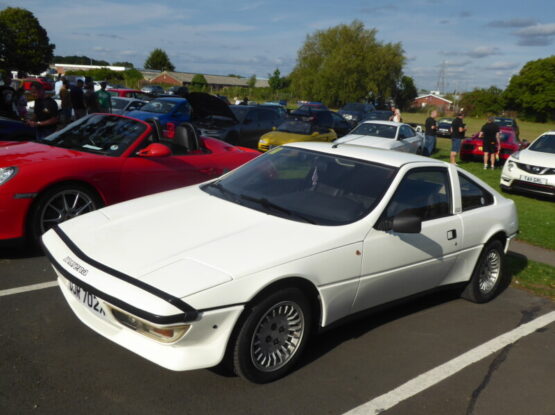
To replace the M530, Matra worked in cooperation with the automaker Simca. Designed by the Greek, Antonis Volanis, the new car was marketed as Matra-Simca Bagheera to highlight the link, except for the final production year 1980, when it was re-badged Talbot-Matra Bagheera after Chrysler Europe’s demise and subsequent takeover by PSA. Named after the panther from The Jungle Book, the Bagheera was created using stock Simca components, including the engines, gearbox and suspension elements, but unlike the front wheel drive Simca 1100 and 1307 cars it shared them with, it was a mid-engined car. The Bagheera’s body was made of polyester, mounted on a steel structure. It was formed in the shape of a sleek hatchback, with a rear hatch that allowed access to the engine mounted behind the passenger compartment. There was only one row of seats, but it featured an unusual combination of three abreast, one of the few three-passenger sports cars ever made. When launched in 1973, the Bagheera was only available with a 4 cylinder 1294cc engine. In 1975, the range grew to include a 1442cc version of the same engine. The Bagheera is also notable as one of the few manufacturers in the world to have developed a “U engine” for this vehicle. As Matra engineers believed the Bagheera could use a more powerful unit, they created a unique construction out of two 1.3 litre Simca engines, joined side-by-side by a common pan unit, the two crankshafts being linked by chain. This resulted in a 2.6 litre 8-cylinder unit, producing 168 bhp. However, Chrysler Europe was unwilling to pursue the project due to the developing fuel crises as well as its own financial problems. Thus, the U8-powered Bagheera remained as a prototype and only three units were ever built. In 1976, the Bagheera underwent a major restyling, with basically only the rear hatch unchanged, producing the Bagheera type II. Another change took place in 1978, when the dashboard was replaced again, and in 1979 the Bagheera was given conventional door handles in lieu of the previous “hidden” ones. Production of the Bagheera ended in 1980, when it was replaced by Matra Murena, with 47,802 Bagheeras built in total. Very few Bagheeras remain in existence today, as they suffered badly from quality issues (the Bagheera won the ADAC Silberne Zitrone = “Silver Lemon” award in 1975 for the poorest quality car of that moment) and extensive body rot. Though the polyester panels couldn’t rust, the underlying steel chassis had almost no protection. Matra learned from this and fully galvanised the Bagheera’s successor.


PEUGEOT
The Peugeot 203 was the first new design that Peugeot produced after WW2. The car was exhibited at the Paris Motor Show in 1947, but by then had already been under development for more than five years. Volume manufacturing was initially hampered by strikes and shortages of materials, but production got under way late in 1948, with buyers taking delivery of 203s from early 1949. During its twelve-year production run nearly 700,000 203s of all variants rolled off the assembly line in Sochaux, France. Between the demise of the 202 in 1949 and the launch of the 403 in 1955, the 203 was the only model produced by Peugeot. The majority of the 203s were saloon bodied, but Estate Coupe and Cabrio versions were offered as well.


The 304 was introduced to the public at the Paris Motor Show in September 1969. Peugeot, which had always been a financially prudent company, saw a gap in the mid-size car market in France, Italy and the rest of Western Europe. By using the smaller 204’s midsection, development costs were minimized resulting in a higher profit margin because of the higher pricing structure in the larger, better equipped market. The 304’s main competitors on its home market came from Renault and Simca, with Citroen noticeably absent from this sector at the launch. The 304 was a success for Peugeot and was noted for several advanced features under its Pininfarina styled exterior. With its independent suspended front-wheel-drive drivetrain and disc brakes, it rode and handled better than most of its contemporaries, including some cars in higher price brackets.The chassis served Peugeot well and lasted for approximately 24 years adapted to derivative models. There was a distinct upmarket feel to the 304, its handsome lines were well suited to postwar Europe’s newly affluent middle classes who desired roomy, advanced and stylish cars to park in their driveways. At about this time the Autoroutes were opening up France and car manufacturers around Europe knew that any car launched hence, would need to add an ability to travel at high speeds, in relative comfort with sure-footed handling to its lineup in order to compete. The 304 fulfilled this brief and became one of the best-selling cars in its market segment., with 1, 178.423 produced. Coupe and Convertible models were part of the range, but these constituted a relatively small percentage of total sales. The saloon model was deleted in the summer of 1979, but the estate remained until spring 1980, both cars replaced by the Peugeot 305.


First of the 05 generation cars was the 305, and a few of these were here. During the mid 1970s, the motoring press speculated that a new Peugeot would soon arrive, in order to update the company’s model lineup, in an attempt to make the Peugeot more internationally appealing. Since Peugeot had only recently discontinued their long-running 404 model, many people thought that the purpose of the new car would to fill the gap, previously occupied by the 404, between the 304 and 504 models, to compete against cars like the Ford Cortina/Taunus and Renault 12. It therefore would have been natural for the new car to be called the 405, commencing a new “05” generation of Peugeot models. The car was to be developed from and use the running gear from the smaller 304, but in terms of size and price, it was to succeed the already-defunct 404, especially considering that the top model in the new range would cost more than the entry-level 504, and that the 304 would remain in production some time after the new car was introduced. Instead of being called the 405, the new car was called the 305. When it made its press début in November 1977, the motoring press were initially confused as to why it was called a 305 rather than a 405, but it sold well anyway. It was similar in size to its French competitor the Renault 18, which was launched around the same time. Across Europe it competed with cars like the Ford Cortina/Taunus, Vauxhall Cavalier/Opel Ascona and Simca 1307/Chrysler Alpine. The Peugeot 305 was unveiled in November 1977, and was initially available as a four-door saloon with a choice of two petrol engines: a 1,290 cc, 65 PS (64 hp) unit for the GL and GR models or a 1,472 cc, 74 PS (73 hp) for the top-specification SR model. Four months later Peugeot announced the 305 GRD, discreetly identified from the outside by the letters “GRD” on the left side of the boot lid, and powered by a 1,548 cc diesel unit incorporating an aluminium engine block with an overhead camshaft along with a Bosch injector pump, and offering up to 50 PS (49 hp). At Paris 1980, the sportier 305 S with twin carburettors and 89 PS (88 hp) was introduced. After the 1982 facelift, the top model became the GTX, with 105 PS). The 305 was the first of the “05” generation of Peugeots, a generation which survived until the end of 605 production in 1999. Despite the performance limitations of the smaller engine, the gearbox in all 305s was excellent, with extremely precise and light gear changes. The 305 combined a front-wheel-drive car with an excellent and durable gearbox. On the downside, there was no fifth gear provided but, especially at motorway speeds, the four gears gave the 305 the maximum power it needed in fourth. Peugeot was reported to have said that the car had no difficulty reaching 95 mph (153 km/h) if pushed to the limit. Its key competitors were the Ford Escort, Volkswagen Golf & Opel Kadett/Vauxhall Astra, but it was actually considerably larger than most other cars in its class. In fact, it was almost as large as the Ford Cortina, Opel Ascona/Vauxhall Cavalier & Fiat 132. Power came from 1.3 litre or 1.5 litre petrol and 1.55 litre diesel engines and later, after the facelift, the 1.5 litre was replaced by a 1.6 litre and a Peugeot 1.9 petrol and XUD diesel engine were added. These were the same as used in the Talbot Horizon, a model acquired in 1979 when Peugeot took over Chrysler’s European division and rebranded it as Talbot. The facelifted ‘series 2’ models arrived at the Paris Salon in late 1982, to keep the 305 competitive with newer designs like the Ford Sierra and the new version of the Vauxhall Cavalier/Opel Ascona. They had revised frontal styling, new improved front suspension and steering, a new dashboard and a modified under bonnet and subframe layout to allow the new generation of XU series engines with 5-speed gearbox to be fitted. Thus switching from the Mini type in-sump gearbox arrangement used also in the 204 and 304 to the now-universal end-on gearbox configuration (pioneered by Fiat in the 1960s Autobianchi Primula), of front-wheel drive with a transverse engine and a gearbox on the end of the engine and unequal-length drive shafts. However, the GL / GR and van models continued to use the earlier XL/XR series engines with four-speed gearbox for a few more years. Sales of the 305 were strong in France and most other countries where the car was sold, In Britain, its original competitors were the Ford Cortina MK4, Vauxhall Cavalier MK1 and Morris Marina. It was launched around the same time as its key French rival, the Renault 18. Later in its production life, it was competing with newer rivals including the Ford Sierra, MK2 Vauxhall Cavalier, Austin Montego, Renault 21 and the British-built Nissan Bluebird. In 1979, the 305 won 1979 the What Car? Car of the Year in the United Kingdom, although it was largely overlooked by the motoring press for that year’s European Car of the Year award, who voted the Chrysler/Simca Horizon as the winner, the Fiat Ritmo/Strada in second place and the Audi 80 in third place. The body was done by Italian stylist Pininfarina and was completely new. It was all-steel monocoque which strongly resembled the BMW 3 Series of the time. The design is based on Peugeot’s ‘VSS’ prototype safety vehicle, which Peugeot created to improve car safety. This meant that the car had front and rear crumple zones, side impact protection, a protected fuel tank and bolt-on front wings. Three bodystyles were available, consisting of a conventional three-box four-door sedan, a five-door station wagon, and a three-door panel van. A series of aerodynamic research studies called VERA (Véhicule Économe de Recherche Appliquée, “applied research in economical vehicles”) was also begun in 1981. The diesel VERA was significantly lightened (from 925 to 750 kg or 2,040 to 1,650 lb) and made more aerodynamic. A large rear wing, skirts covering parts of the rear wheels, and deeply scalloped sections behind the front wheels were all noticeable. The Cx was reduced from 0.44 to 0.319, helping lower fuel consumption between 33 and 38 percent. At the 1982 Geneva Salon the VERA 02, with a 1,362 cc turbodiesel, was shown, and the more radical VERA Plus followed later in 1982 – this was no more than a thinly veiled Peugeot 309 prototype. The 305 estate marked the debut of the now standard PSA Peugeot Citroën rear suspension layout. This is fully independent using trailing arms. It is very compact and was designed to minimise suspension intrusion into the wide flat loadspace, while providing excellent ride and handling. This was later developed (in other Peugeots) to use torsion bars instead of the 305’s horizontal coil springs, and it was a key ingredient of the success of the Peugeot 205. The torsion bars system was very similar to those used by Renault and Simca for many years previously. Production of saloons ceased in 1988, following the launch of the slightly larger and more powerful Peugeot 405, which was a much stronger seller in the United Kingdom. Production of 305 estates and vans ceased in 1989. The diesel engine fitted to the phase 2 305 was capable of over 50 mpg (Imp). The engine at the time was regarded as the best diesel around where most other engines notably those from Volkswagen and British Leyland sounded agricultural in comparison.


Next in the 05 generation was the 505, which had a long production life, as it was built from 1979 to 1992 in Sochaux, as well as being manufactured in various other countries including Argentina (by Sevel from 1981 to 1995), China, Indonesia and Nigeria. 1,351,254 505s were produced between 1978 and 1999 with 1,116,868 of these being saloons, but there are very few of them left in the UK, or even Europe (Africa is a different matter, of course!). Officially unveiled on 16 May 1979, the 505 was the replacement for the 504 with which it shared many of its underpinnings. It was originally available only as a saloon. There was a long wait for the estate, which when it did come included an eight-passenger Familiale version, both being seen at the 1982 Geneva Motor Show. The 505’s styling, a collaboration between Pininfarina and Peugeot’s internal styling department, is very similar to that of its smaller brother the 305. The original interior was designed by Paul Bracq, generally more well known for his work for Mercedes-Benz and BMW. The UK launch came in October 1979. The 505 was the last of Peugeot’s rear-wheel drive cars, with a front engine, mounted longitudinally. The suspension system included MacPherson struts and coil springs at front and semi-trailing arms with coil springs at rear, with a body-mounted rear differential and four constant-velocity joints. Station wagons (and most sedans built in Argentina) had instead a live-axle rear suspension, with Panhard rod and coil springs. Stabiliser bars were universal at front but model-dependent at rear. The car used disc brakes at the front, and either disc or drum brakes at the rear, depending on the model. The steering was a rack and pinion system, which was power assisted on most models. The first cars came with the familiar 2 litre carburettor and the Douvrin injected petrol engines and a 2.1 litre diesel. This latter was gradually upgraded to larger and more powerful units and a GTi model, the first Peugeot to bear the name was launched in 1984. Later Peugeot would add a Turbo 4 cylinder unit and the 2.7 litre Douvrin V6 engine, to give the car a more luxurious feel which it needed when it took over from the 604 as the marque’s flagship. The Break (Estate) and Familiale versions were quite different from saloons. The wheelbase was also longer, to help make it one of the most spacious in the market, at 2,900 mm (114 in). This was, not coincidentally, the same exact wheelbase as had been used on both the 404 and 504 estate derivatives. The Familiale (family estate), with its third row of bench seats (giving a total of eight forward-facing seats), was popular with larger families and as a taxi. The two rows of rear seats could be folded to give a completely flat load area, with 1.94 cubic metres of load capacity. The total load carrying capacity is 590 kg (1,301 lb). When released, it was hailed as a luxury touring wagon. The Familiale was marketed as the “SW8” in the United States, for “station wagon, eight seats.” The 505 was praised by contemporary journalists for its ride and handling, especially on rough and unmade roads; perhaps one reason for its popularity in less developed countries; – “Remember that the 505´s predecessor, the 504, had an outstanding ride. It took a British-market model on a hard charging drive across the green lanes of the Chilterns. The impacts were well suppressed and the car veritably floated over the undulations and potholes. I concluded that the 505 is as good as the 504 (but no better).” The 505 also had good ground clearance; if it wasn’t enough though, Dangel offered a taller four-wheel drive version of the 505 estate equipped with either the intercooled turbodiesel 110 hp engine or the 130 hp 2.2 L petrol engine. The four-wheel drive 505 also had shorter gear ratios. The interior styling was viewed positively in contemporary reviews: “Having settled into the 505’s neat cockpit one notices how handsomely styled it all would appear to be. The tweed seats and brown trim look smart and less confrontational than offerings from a certain other French marque.” But the ergonomics were criticised too: “The ashtray was competitively sized but is placed directly behind the gear stick. For British market cars, this will be a constant nuisance while our continental cousins will consider the placement quite logical and natural.” The range was given a facelift, including an all new interior, in 1986, but European Peugeot 505 production began to wind down following the launch of the smaller Peugeot 405 in 1987. Saloon production came to a halt in 1989, when Peugeot launched its new flagship 605 saloon, while the estate remained in production until 1992 – although plans for an estate version of the 605 never materialised. The 605 was in production for a decade but never matched the popularity of the 505. In some countries such as France and Germany, the 505 estate was used as an ambulance, a funeral car, police car, military vehicle and as a road maintenance vehicle. There were prototypes of 505 coupés and 505 trucks, and in France many people have modified 505s into pickup trucks themselves.


Before the 205, Peugeot was considered the most conservative of France’s “big three” car manufacturers, producing large saloons such as the 504 and 505, although it had entered the modern supermini market in 1973 with the Peugeot 104. The genesis of the 205 lay within Peugeot’s takeover in 1978 of Chrysler’s European divisions Simca and the former Rootes Group, which had the necessary expertise in making small cars including the Simca 1100 in France and Hillman Imp in Britain. It was around this time that Peugeot began to work on the development of a new supermini for the 1980s. It was launched on 24 February 1983, and was launched in right-hand drive form for the UK market in September that year. Shortly after its launch, it was narrowly pipped to the European Car of the Year award by the similar sized Fiat Uno, but ultimately (according to the award organizers) it would enjoy a better image and a longer high market demand than its Italian competitor. It was one of five important small cars to be launched onto the European market within a year of each other: the other four were the Uno, the second generation Ford Fiesta, the original Opel Corsa (sold as the Vauxhall Nova on the British market) and the original Nissan Micra. Its launch also closely followed that of the Austin Metro and Volkswagen Polo Mk2. The styling of the 205 is often thought to be a Pininfarina design, although Gerard Welter claims that it is an in-house design; Pininfarina only styled the Cabriolet. It is often credited as the car that turned Peugeot’s fortunes around. The fully independent suspension used the now standard PSA Peugeot Citroën layout that had debuted in the Peugeot 305 estate. A key ingredient of the success of the 205, it had MacPherson struts at the front and trailing arms with torsion bars at the rear. The rear suspension was very compact, designed to minimise suspension intrusion into the boot, giving a wide flat loadspace, while providing excellent ride and handling. Early 205s used the X petrol engine [n 1] from the older Peugeot 104, although these were later (1987–1988) replaced with the newer XU and TU-series engines, which were of PSA design. Engines ranged in displacement from 954 cc to 1905 cc, in carburettor or fuel injected versions. The diesel models employed the PSA XUD engine, lifted from the Citroën BX which was introduced in September 1982. These engines had a capacity of 1769 cc (XUD7) and 1905 cc (XUD9) and are closely related to the XU5 and XU9 petrol engines in the BX16 and BX19 of the time. The diesel engines were world-beating and so petrol-like that many buyers were won over by petrol car performance combined with diesel economy. For instance, the 205 GRD (1.8 Diesel, 59 bhp, 78 lb/ft (105.8 Nm)) was as fast as, yet smoother than, the 205 GR (1.4 Petrol, 59 bhp, 78 lb/ft (105.8 Nm)), due to the engine developing peak torque at much lower rpm, while using much less fuel. There were various versions intended for commercial use, such as the two-seater XA-series. There was also the “205 Multi”, a tall-bodied special version on XA or XE-basis built by independent coachbuilders like Gruau and Durisotti. Gruau called their XA-based two-seater version the “VU”, while the five-seat XE-based version was called the “VP”. Durisotti began building the 205 Multi in 1986; it was called the “205 Multi New Look”. The 205 was an instant hit, and its styling was echoed in every Peugeot model that was to follow. The exterior styling was never facelifted or significantly altered in its 15-year production run. There was a dashboard redesign for the 1988 model year, and in late 1990 the 205 received new door design and cards, clear front indicators, new ‘smoked’ rear light clusters, single point petrol injection and catalytic converters were introduced, to meet the new 1992 pollution limits. These updates came at a crucial time, as 1990 also saw the arrival of a completely new French competitor, the Renault Clio, while the Rover Metro and Volkswagen Polo were also heavily updated, and Ford had already replaced its Fiesta with a third generation model. Still, the 205 was still widely regarded in the motoring press as the benchmark car in this sector by 1990. At the beginning of 1993, Peugeot launched the 306, which officially replaced the 309; the arrival of this car also diminished the 205’s role (and its sales figures) in the Peugeot range, as had the arrival of the smaller 106 in September 1991 – although the final demise of the 205 was still some years away. The engines were continuously updated, with the new TU engines introduced in 1988. In 1991, the 205 dTurbo was launched with a powerful turbocharged version of the 1,769 cc xud diesel engine. After several years of gradually declining sales, the Peugeot 205 was discontinued in the United Kingdom in 1996. The Peugeot 205 was still offered in the “Sacré Numéro” and “Génération” models until the end of the production in 1998. The last models were GLD 1.8 configuration and were sold in Argentina. Most of the later European versions were only sold in France. Due to the pressure from the market, with buyers wanting a Peugeot supermini in the mould of the 205 again, the company finally built a direct replacement in the 206, which was launched in 1998. 5,278,050 Peugeot 205s have been sold, and a significant percentage of them were still in circulation as of 2009. By 2014, there were still as many as 14,000 on the road in the United Kingdom, compared to the peak high of 374,773 in 1994. With potentially as many 400,000 sales in the UK, it became the best selling car ever sold by Peugeot in the UK – although its success was emulated a few years later by the larger 306 and later by the 206. It also helped boost the popularity of the Peugeot brand there, and was at least a factor in Peugeot’s decision to phase out the Talbot brand in the mid 1980s when launching new models to be built at the former Rootes Group plant near Coventry and the former Simca plant at Poissy.


A cabriolet version of the 205, known as the CJ (or CT in France), was designed and partially assembled by Pininfarina of Italy. A CTi version, with the same plastic arches and wheels as the 1.6 GTI was also available. Only minor changes were made to the car in the next few years, with the most obvious visual change being the switch to grey bumpers and trim from black ones in 1990, along with revised lights. A new dashboard had been incorporated across the entire 205 range a couple of years before this. Sales of the GTI in the UK in the early 1990s were badly hit by soaring insurance premiums, brought about by high theft and ‘joyriding’ of cars of this sort. Increasingly stringent emissions regulations meant the 1.6 GTi went out of production in 1992, while the 1.9 litre was sold for a couple more years thanks to re-engineering of the engine to enable it to work properly with a catalytic converter, which dropped power to 122 bhp. Many of them had a hard life, but there are some nice original cars out there and people are starting to spend serious money in restoring them.


The 309 had been conceived as Projet C28 as a replacement for the Talbot Horizon, and as a result its development had been performed by the former Chrysler/Simca wing of PSA. Styling was the responsibility of the former Chrysler-Rootes design studios in Coventry, whilst much of the engineering was done at the Simca site at Poissy in France. The only stipulation from PSA management was that the new car had to use as much existing architecture as possible; hence the use of a stretched Peugeot 205 floorpan and door shells, whilst the Simca engines and transmissions from the Horizon were also carried over. The 309’s design was presaged by the 1982 Peugeot VERA Plus (followed by the VERA Profil in 1985), which were aerodynamic studies developed by Peugeot at the time. The VERA Plus claimed a Cw of only 0.22. Many of the aerodynamic features from the VERA studies found their way into later production Peugeots. Production in France began at the former Simca plant in Poissy in the end of summer 1985, with the first French customers getting their cars in October of that year; but it was decided that RHD models would be built at the Ryton plant near Coventry, which had previously been owned by the Rootes Group and then Chrysler Europe before Peugeot took it over in 1978. The first 309 for the British market rolled off the production line at Ryton in October 1985, and sales began the beginning of 1986, although left-hand drive sales of the Poissy built models began in France in October 1985. The only bodywork available originally was the five-door hatchback. The 309 was not intended to replace Peugeot’s own model, the 305, but the out of step model number (the next small family car after the 305 should have been named “306” which eventually launched in 1993) was intended to distance it from the larger 305 in the marketplace and to reflect the car’s Simca origins. It was also the first Peugeot badged hatchback of this size. With the Talbot brand being phased out on passenger cars, the 309 would succeed the Talbot Horizon. Peugeot had been considering a new Talbot Samba based on the forthcoming Citroën AX supermini, but the success of the Peugeot 205 meant that there was little need for a third supermini within the PSA combine, and so the Samba was discontinued in 1986 with no replacement. The larger Alpine hatchback and Solara saloons were also axed in 1986, a year before Peugeot began production of the similar sized 405, successor to the 305. The 309’s slightly awkward styling (especially when compared with the 205 and 405 of the same era) was due to the decision to reuse the door shells from the 205. The 309 was also originally intended to be differentiated from Peugeot as a Talbot, and was designed “inhouse”. Other Peugeot cars of the time were designed by the famed Italian design house Pininfarina, up until the introduction of the 206 in 1998. The notched hatchback design bears an unintentional similarity to the Dodge Shadow and Plymouth Sundance, which were also developed (entirely separately and cut down from a larger [Chrysler K-Car] platform rather than stretched from a smaller one) to replace the Horizon in North America. The initial engine line up in the United Kingdom market consisted of the chain driven Simca derived 1118 cc (E1A) and 1294 cc (G1A) overhead valve petrol units from the Horizon, and Peugeot provided 1580/1905 cc petrol belt driven overhead camshaft XU units. Spanish-built cars also used the 1442 cc (Y2) and 1592 cc (J2) “Poissy engine”, as seen previously in the Simca 1307 and Solara as well as the Horizon, instead of the 1580 cc OHC. In July 1986 the first diesels arrived, the 1905 cc, 65 PS PSA XUD engined GLD, GRD, followed by the SRD in 1987. Certain export markets also received a 60 PS 1769-cc version of this engine from the beginning. In France, the smaller diesel option only arrived in 1992. With 305 sales dropping considerably, the 309 range was expanded considerably in February 1987, when the three-door bodystyle was added. In line with Peugeot’s naming policy of the time, five-door models generally have equipment levels beginning with the letter G, while three-doors begin with the letter X. Other important new models was the XU 1905 cc-engined high performance GTI version of the 309; this quickly established itself as one of the class leading hot hatch of its time, thanks to very quick acceleration and a better balanced chassis set-up than the already-excellent handling Peugeot 205 GTI. Other new versions in 1987 were the new Automatic (only with five doors) and the XA and XAD two-seater vans which arrived in February. Largely due to its partially British origins, the Peugeot 309 became a popular choice in the United Kingdom, and in 1987, it was joined on the production line by the larger 405. The 309’s successor, the 306, was also built at Ryton, as was the 206, which was the last vehicle in production there when the plant closed in December 2006. The summer of 1989 saw the introduction of the Phase 2 Peugeot 309. It revised the design of the rear, lowering the boot lip, changing the rear lights to a more ‘smoked style’ and making slight alterations to the front radiator grille. Also, an updated interior was required to address severe criticisms levelled at the Phase 1’s, Talbot designed multi piece dashboard which was prone to developing squeaks and rattles. The GTi models received a colour coded one piece rear spoiler as opposed to the Phase 1’s outdated rubber spoiler which, by then, harked back to early 1980s design. Quite importantly a modified gearbox called ‘BE3’ was introduced, a revision of the original ‘BE1’ unit, placing reverse in the “down and to the right” position behind fifth gear, as opposed to the earlier “up and to the left” position next to first gear. Retrospectively, the ‘BE3’ gearboxes are slightly less prone to failure than their earlier counterparts. This was also when Peugeot gradually phased in their, all new, belt driven TU Series overhead camshaft engines, in 1,124 cc and 1,360 cc forms, eventually replacing the trusty Simca units during 1992. The GTi 16 model, featuring the XU9J4 engine from the 405 Mi16, was also introduced at this time; however, these were only sold in mainland Europe. Towards the end of 1992, production of the 309 began to wind down in anticipation for the launch of the new Peugeot 306, returning Peugeot to their normal numbering scheme. In July 1993, the 309 lineup was severely reduced and only the two Vital (petrol or diesel) models remained on sale until December. In total, 1,635,132 Peugeot 309s were built between 1985 and 1993. As of 2018, only 481 Peugeot 309s remained on the roads in the United Kingdom, with another 1,378 registered being kept off the road as SORN.


Launched in September 1991, the 106 was Peugeot’s entry level offering throughout its production life, and was initially sold only as a three door hatchback, with a five door hatchback joining the range in the beginning of 1992. The “10” line of Peugeot superminis had commenced in 1972 with the launch of the 104, one of the first modern European superminis. The 104 was effectively replaced by the Peugeot 205 in 1983, but remained in production for some markets until 1988. There was no “105”. The 106 was introduced as a three door hatchback in continental Europe in September 1991, and two months later in the United Kingdom. The initial engine range had 1.0, 1.1 and 1.4 petrol engines, as well as a 1.5 diesel. The early 1.0 and 1.1s were carburetted, but were replaced with fuel injection after a year due to EC emissions requirements. The 106 was updated in July 1996, with changes including the introduction of side impact bars and availability of driver and passenger airbags for the first time, with the new 1.6 GTI joining the range as the spiritual successor to the hugely popular and highly regarded 205 GTI, which had been discontinued in 1994. In January 1996, the Peugeot 106 also formed the basis for the near identical looks and size Citroën Saxo. Marketed as having “fewer frills, more thrills”, the Rallye version had trademark steel wheels painted white. Power steering, central locking, and electric windows were omitted to keep the weight down to 825 kilograms. There were pre and post facelift versions of the 106 Rallye known to enthusiasts as S1 and S2 models, with the latter having a 103bhp 1.6 litre (TU5J2) engine in place of the original high revving Rallye specific 1.3 100bhp (TU2J2) engine fitted to pre facelift cars. Contrary to some sources, the S1 models did not share the same engine with the 205 Rallye and AX Sport, which used a carburettor TU24 engine. The dimensions of the aluminium S1 block resemble those of the 1.4 iron block with slightly lowered capacity to comply with the rules of the lower French rally classes at the time.(Under 1.300cc) The S1 (TU2J2)and S2 (TU5J2) were fuel injected, employing Magneti Marelli multi point fuel injection systems. The S1 Rallye were designed as a homologation special to compete in the 1300cc rally class. It featured a four cylinder, 8 valve, high compression engine with an aggressive cam profile designed to come ‘on song’ between 5400 and the 7200rpm redline. This engine coupled to a short ratio five speed gearbox made the 1.3 more of a sprinter than a cruiser. 70mph on the motorway was a noisy 4,000rpm in fifth gear, but given enough tarmac, the little 1.3 would redline in top gear at 115mph. The 106 was competitive in racing, but also made a practical small family car. All cars had steel wheels, and Rallye decals and seat coverings featuring a one or three colour flash, which again varied between early and late cars. With facelift came new top model named Peugeot 106 GTI with 1.6 litre 16 valves engine that produce 120hp. It came with new exterior body kit and new wheels. On some markets in Europe, it was badged S16 or Rallye. Production ceased in 2003. The 106’s successor, the Peugeot 107, along with rebadged versions, Citroën C1 and Toyota Aygo, was launched two years later in June 2005, as a joint venture with Toyota.


The 306 was developed between 1990 and 1992 for a launch at the beginning of 1993. It was a replacement for the Peugeot 309 (which had broken with Peugeot’s normal ascending numbering system partly due to it being released before the older and larger Peugeot 305 was axed). Concept versions of the 306 were first seen around the end of 1990, although the motoring press initially reported that it was going to replace the smaller 205. However, by the end of 1991, Peugeot had confirmed that the new car was going to replace the 309, as well as some versions of the 205, which was going to remain in production for several more years, despite the launch of the entry-level 106 supermini in September 1991. Mechanically, the 306 is virtually identical to the Citroën ZX, which was launched two years before the 306: both cars use the same floorpan and core structure. The 306, with its attractive Peugeot 205 derived Pininfarina styling, was a more successful car than its twin. The Citroën Berlingo and Peugeot Partner were also built on the same platform. The chassis used by the 306 and ZX was also used in the ZX’s replacement, the Citroën Xsara. The sharing of platforms between Peugeot and Citroën has been parent company PSA Peugeot Citroën policy since the late 1970s, after the Peugeot takeover of the then bankrupt Citroën in the wake of the 1974 oil crisis. The first example was the Peugeot 104-based Citroën Visa and Citroën LNA (and the Talbot Samba). The 306 was released in March 1993 as a 3- and 5-door hatchback, with saloon and cabriolet models being introduced a year later. The Phase 1 model was known as the N3 in Australia and was introduced in 1994. A bewildering array of different model types were offered during the life of the Phase 1 model, including Genoa, XSS, XT, XRdt and XLd. Later were added various ‘performance’ models, such as the S16, XSi and GTI-6 (petrol) and the D-Turbo S (diesel). All variants of the 306, with the exception of the GTI-6 and cabriolet models, were priced very competitively. The initial petrol engines used were proven four-cylinder units, which had gained a solid reputation in Peugeot models such as the 205, 309 and 405. At first, all mainstream models were powered by derivatives of the TU series 8-valve engine, in 1.1-, 1.4- and 1.6-litre guises. The 1.1 was dropped quickly, but the 1.4 and particularly the 1.6 variants sold well, the latter offering a good balance between performance and economy. Three larger-capacity units were available, but restricted to automatic and performance models. These engines were developments of the larger XU series units which had been used in the 205 GTi 1.9, and larger 405 models. A 1.8-litre version powered cars with both manual (not many 1.8 manuals were produced) and automatic transmission, while two versions of the 2.0-litre engine in 8- and 16-valve guises powered the XSi and S16 models respectively. In Australia, the only engines available were the 1.8 and 2.0 L engines. Peugeot had an excellent reputation for its diesel engines, and the 306 was originally offered with the XUD series diesel engine in both normally aspirated and turbocharged forms. This engine was initially a 1769 cc unit, but its capacity was soon enlarged to 1905 cc. The turbocharged version quickly gained a reputation for being a good match for the exceptional handling of the 306. Not only did its outright performance match many similarly sized petrol cars – almost certainly a first for an affordable mainstream diesel – but the carefully designed installation ensured its considerable extra weight did not upset the car’s handling. The Indirect Injection XUD Diesel that uses the Ricardo Comet combustion chamber design, is popular for conversion to run on vegetable oil, as long as the Bosch Fuel System is fitted to the engine. The familiar range of PSA powertrains drove the front wheels of a conventionally designed chassis. At the front was a standard MacPherson strut layout with anti-roll bar, while the rear used the PSA Peugeot-Citroën independent trailing arm/torsion bar set up that was first introduced on the Peugeot 305 estate. However, PSA’s chassis engineers employed some unusual features, including passive rear wheel steering, though less than on the ZX, (by means of specially designed compliance bushes in the rear suspension), and in-house developed and constructed shock absorbers. At high mileages this is prone to wear of the axle mounting bushes which is easily fixed. It is also prone to wear in the rear axle trailing arm bearings, which then wear the trailing arm axle tubes, requiring an expensive rebuild or a replacement axle assembly. The diesel and larger capacity petrol engines are canted as far back as possible in the engine bay, in an effort to put as much weight as possible behind the front axle line, also reducing the centre of gravity, while improving weight distribution and minimising understeer. Trim levels were XN, XL, XR, XT and XS; XN being the most basic, and XT the highest specification. The XT was available in 5-door only, with the XR, XN and XL available in 3-door too. The D-Turbo and XSi were available in both 3- and 5-door, the XS and S16 only available in 3-door. There were no longer “X/G” designations (“X” indicating a 3-door, “G” indicating a 5-door). A diesel model could be identified with the addition of “d” after the spec level, and a turbodiesel with the addition of “dt”. There were special edition versions too, badged “Alpine” from 1994. (3-door only). Sedan specification was marked as SN, SL, SR, and ST. The sedan model, for many motorists provided an alternative to the domination of the car markets by hatchbacks. Peugeot created a D-Turbo “hot hatch” version, which was essentially a petrol XS model with the diesel unit installed. The 306 was not the first mainstream affordable performance diesel, with that plaudit arguably going to the MkII VW Golf GTD of the mid-1980s. However, the 306 D-turbo was the first to be commercially successful and sell in significant numbers, and this success effectively created the market for such performance oriented diesel cars. It was a popular seller in all its various phases throughout the life of the car.[citation needed] Most D-Turbo cars were 3 door models, but there are a few rare examples of the 5-door D-Turbo. The D-Turbo and XS variants were fitted as standard with front fog lights, body-coloured bumpers with deeper spoilers, sports seats and different steering wheel, and a wider, chromed exhaust tailpipe; 14-inch alloy wheels were an optional extra. The models fitted somewhere between the XR and XT variants in terms of standard equipment. The XSi 8v 2.0 Petrol had the addition of subtle side skirts. 15-inch five spoke alloy wheels were available as an option when the model was launched, and became standard shortly after. The S16 (for ‘soupape-16′, or ’16-valve’) was a 3-door Phase 1-only model, replaced with the more powerful GTI-6 in 1996. The engines in both cars were 16-valve XU-series units with Magnetti Marelli fuel injection and produced excellent power and torque outputs for the time. As well as gaining a close-ratio 6-speed gearbox over the S16’s 5-speed, the GTI-6 had more power courtesy of a reworked 167 bhp XU10J4RS engine replacing the S16’s 155 bhp XU10J4 ACAV, and some subtle chassis revisions. As well as being more powerful, the GTI-6 engine had more flexible power delivery with more mid-range torque than that in the S16, and the new gearbox made it easier to use the engine more effectively. The GTI-6 was introduced as a Phase 1 model and was to last until the end of 2000. It received Phase 2 and 3 cosmetic and electrical updates alongside the rest of the range, but the engine and mechanical specification remained largely unchanged.The 306 underwent the only major revamp of its life in May 1997, with the launch of the “Phase 2” version (N5 in Australia). The basic shape remained the same, but lights, grille and bumpers were redesigned in an effort to bring the styling into line with the new, more rounded, Peugeot family look established with the Peugeot 406. Indicator lamps were now incorporated into the headlamp unit and the new style “block filled” Peugeot lion logo was adopted. The Phase 2 also saw the addition of an estate version. A new-style typeface for the car’s model number was adopted on the tailgate, removing the black plastic backing. There were also some changes to the dashboard layout, including a digital odometer, and trim quality which freshened up the car in the face of increasingly stiff competition from other manufacturers. New engines were also offered, with both 1.8 and 2.0 petrol engines gaining 16-valve cylinder heads together with modest power increases. At this time, the previous trim designations were replaced by L, LX & GLX for the UK market. XS, XSi and GTI-6 models continued as before, but with the Phase 2 headlight, grille, bumper and other cosmetic updates alongside the rest of the range. Cars from 1998 onwards (1999 model year) received further enhancements, including an aluminium-effect centre console on certain versions and a chrome Peugeot logo on the steering wheel. Other updates included removal of the black strip on the bootlid, colour-coded bumpers on some models and new upholstery in the cabin. New models also appeared in Phase 2 trim. Models from mid-1999 saw further improvements and exterior modifications, including clear lenses on the headlamps, round and clear lensed foglamps, complete colour-coding of the exterior trim, removal of the black plastic strip on the lower edge of the tailgate, flush glass seal to rear windscreen, a redesigned tailgate rear badge, different rear wiper and new paint colours. Interior upgrades were more minor, with the gearknob becoming rounder and silver topped, while the instrument binnacle received a silver background and white instrument needles in place of the previous red versions. XSi, XT and D Turbo models all received the GTi-6’s bodykit and interior styling additions but not the cyclone alloy wheels. In the diesel variants, the ageing XUD engine was replaced by the newer, HDi engine, which featured common rail injection. Some base models made use of the DW8 normally aspirated diesel engine. Almost all models included ABS and multiple airbags as standard equipment. Rain sensitive automatic windscreen wipers were also standard on all but the base spec. The hatchback 306 was discontinued in 2001 to make way for its replacement, the Peugeot 307. The cabriolet and estate variants both remained on sale until 2002. The slow–selling saloon was axed from the United Kingdom market in 1999, but it was still available in the rest of Europe until 2002.

The 406 coupé, launched at the 1996 Paris Motor Show, was both designed and manufactured by Italian design studio Pininfarina, with choices of a 2.0 L four cylinder engine or a 3.0 L V6, and halfway through 2001, a 2.2 L HDi diesel engine. The coupé has the same platform and suspension as saloon and estate but with some upgrades to enhance ride handling. All models had a wider track of 16mm from coupé specific rims and additional 36mm at the rear from different spindle and lower control arm. Ride height is lowered 16mm. V6 also received a 26mm front strut brace and 305mm Brembo 4-pot calipers front brakes. Interior had the same dashboard, centre console and steering wheel as saloon and estate. It had five gauge instrument panel with chrome rings on all models. A total of 107,633 coupés were made.


The 607 was launched in October 1999, to replace the discontinued 605. It used its predecessor’s chassis but had an all-new, more modern exterior design. The engine range (2.2 and 3.0 petrol, and 2.2 diesel) was completely new. Built in Sochaux until March 2009, the assembly of the 607 was transferred to PSA’s Rennes plant in July the same year as production was being wound down. Equipment levels were high, with all models getting air conditioning, CD player, electric windows, 8 airbags, anti-lock braking system, tyre-pressure monitor, and central locking as standard. Available was AMVAR nine-stage electronic damping control. In France, its home market, the 607 was often chosen for official government use. The 607 was restyled in November 2004, with the most notable modifications being the new front end and the 2.7 HDi V6 engine, rated at 204 PS/ 201 bhp, with a new six-speed automatic gearbox, which became also available on the V6 petrol model. The 2.0 and 2.2 diesel engines increased in output and included a 6-speed transmission, like the newly introduced Peugeot 407. During 2008, the 607 was withdrawn from the United Kingdom, marking the end of right-hand drive 607s.


The Peugeot RCZ is a car designed by French car brand Peugeot and assembled in Austria by Magna Steyr from 2009 until 2015. It is a sports coupé with a 2+2 seating layout and a front-engine, front-wheel-drive layout. This car was officially presented in 2009 at the Frankfurt Motor Show. The RCZ won numerous awards, the most important of which are five times the best sports car award by Diesel Car magazine and the 2010 coupe award by Top Gear. The vehicle was showcased as the 308 RCZ concept car at the 2007 Frankfurt Auto Show. The RCZ was developed as a showcase concept car but after receiving considerable critical acclaim, Peugeot put the RCZ into production, retaining much from the concept. The RCZ has a double-bubble roof inspired by Zagato. The RCZ was formally introduced at the Frankfurt Auto Show in 2009 and launched into production late 2009. The vehicle was available in almost 80 countries by 2013. Petrol engines are based on Prince series while diesel is part of the HDi series. The RCZ was developed under code name “T75”. The 30,000th RCZ was assembled in June 2011. The 50,000th RCZ was built on 14 February 2013 and was painted red. After a production period of almost six years, the last Peugeot RCZ was assembled in the Magna Steyr Graz plant in September 2015.


The 208 GTi was introduced in September 2012 as the performance model of the first-generation 208. Previously, it was showcased as a concept model in March 2012. Based on the three-door 208, the variant weighs 1,160 kg (2,557 lb), which is 90 kg (198 lb) lighter than the 207 GTi. Compared to the standard 208, the front and rear tracks have been widened 10 mm (0.4 in) and 20 mm (0.8 in). Fitted with 17-inch alloy wheels with 205/45 tyre size, the 208 GTi is also equipped with a larger 302 mm (11.9 in) disc brakes at the front, cooled by functional vents. Its suspension has also been upgraded and the steering recalibrated appropriately. The 208 GTi is fitted with a 1.6 litre turbo (1,598 cc) four cylinder in line turbo petrol Prince engine producing 200 PS (197 bhp) at 5,800 rpm and 275 Nm (203 lb/ft) of torque at 1,700 rpm, and is fitted with a six-speed manual transmission. The GTi’s Prince engine is shared with the Peugeot RCZ, several Mini and various Citroëns. This first GTi model has since been replaced by the 208 GTi by PeugeotSport which is directly derived from the limited edition ’30ème Anniversaire Edition’ which put out 208 bhp with revised suspension and an optional two tone paint along with a facelift of the original bumpers and other small changes. Although a high-performance 208 R was planned for the lineup, it was never released. It would have been positioned above the 208 GTi.

RENAULT
By the early 1960s, Renault was building a series of small cars, like the hatchback Renault R4 and the slightly larger rear engined Renault Dauphine. They had built a much larger model, the Frégate, between 1951–1960, but with a modest production total of 163,383 units, it had not been replaced. A number of design studies were produced, as with people gaining more money after the lean years of the 1950s, it was clear that there was a market for large family cars in France, which rivals Citroen, with their DS and Peugeot with the 404 were dominating. Renault conceived a car that would be a bit smaller, and quite a bit cheaper than the Citroen, aiming at a gap in that marque’s model range. Whether they knew it or not at the time is unclear but we no know that Citroen themselves were planning to fill the gap between the 2CV/Ami and the much larger ID and DS. It was called Projet F, but when they got word of what Renault were planning, Citroen cancelled their car. That left the field clear for Renault. Under the skin, the layout of the R16 actually owed quite a lot of the much older Citroën Traction Avant – front-wheel drive, engine mounted inline behind the transmission. torsion bar suspension, and column mounted gearlever. In addition the car had an aluminium engine and an electric cooling fan, both technical innovations. The big innovation, however, was the modern, practical bodystyle – introducing the hatchback to the mid size family segment. This allowed the interior to be immensely flexible, and could be configured in seven different ways. This body style was halfway between a saloon and an estate, and, before the term hatchback was coined, journalists struggled to describe it. A review in the English Motoring Illustrated in May 1965 stated: “The Renault Sixteen can thus be described as a large family car but one that is neither a four door saloon and nor is it quite an estate. But, importantly, it is a little different.” One peculiarity of the R16, and the later Renault R5, is that the two back wheel axles shafts are not in-line. The left wheelbase is 70 mm (2.76 in) longer than the right wheelbase, to accommodate the torsion bar suspension. This and the soft front seats gives the car a particularly smooth ride even over big bumps. The suspension had the longest travel on a car of this size; if the handbrake was applied and reverse gear engaged, the rear bumper would rise about one foot. The engine was mounted north-south in the front, behind the gearbox/transaxle. This contributed to the handling and balance of this car by keeping the weight closer to the centre of the car. Traditional front drive layouts are either east-west or in some cases north-south but with the engine in front of the transmission. Although this north-south/forward gearbox layout gave excellent handling, servicing access to the engine was so difficult that the Renault 16’s successor, the Renault 20, kept the north-south layout but put the engine ahead of the gearbox. Gear changing was performed by means of a column-mounted lever which allowed for a more spacious front cabin, Column changes were fairly rare by the 1960s, but the design was forced on Renault by the position of the transmission in front of the engine. Pre-launch publicity was extensive, with semi-authorised media leaks. The French magazine ” L’Auto-Journal” had reported details of the car, in an exclusive report, towards the end of 1963. During October 1964, timed to coincide with the Paris Motor Show, Renault distributed photographs of its innovative new family car, still at this stage described simply as the forthcoming “Renault 1500”, for publication as “scoop” pictures in various magazines. It was only two months later that the car, now officially named a “Renault 16”, was approved for sale by the French homologation authorities. The car was shown to the world’s press in a presentation on the Côte-d’Azur in the first few days of January 1965. Series production started in March 1965 at the company’s recently completed Sandouville plant, a few kilometres to the east of Le Havre. The car had its formal launch in March 1965 at the Geneva Motor Show, and was made available for sale to the public during June 1965. Equipment levels were high for the price. Initially, Renault sold the R16 with just a 1470cc petrol engine in Grand Luxe (GL) and Super specifications, for both of which 55 PS (54 hp) was claimed. The Renault R16 was voted European Car of the Year by a board of European motoring journalists in 1966. It was the third year of the accolade’s existence, and the Renault 16 was the first French winner of the award. Demand was strong right from the word go. Minor changes were made for 1967, when ventilation and heating were both improved, and the dashboard was redesigned. An automatically operated choke became available. These early cars are very rare now. They are most easily identified by the slightly ovoid shaped rear lights. At the Geneva Motor Show in March 1968, Renault presented a more powerful model, the 1565cc TS which could top 100 mph. It also featured an all-new instrument panel that included a tachometer and water temperature gauge, and many other new features including two-speed windscreen wipers, a heated rear window, passenger reading light, and optional powered windows. An automatic transmission version, designated the Renault 16 TA, was introduced a year later at the 1969 Geneva Motor Show. Other changes included giving the other R16 models the same wheels and brakes as the TS, and that model got standard reversing lights mounted beneath the tail-lights. The other models had them available as an optional extra. Renault started to assemble the car in Australia, to get around the punitive import restrictions in that country. By this time, the model had been launched in the US market as well. The 16 had no major competitors until the arrival of the Alec Issigonis designed Austin Maxi in 1969, but the BL car remained barely known outside the UK, whereas the Renault found favour across Europe. In 1970, racing driver Stirling Moss exclaimed: “There is no doubt that the Renault 16 is the most intelligently engineered automobile I have ever encountered and I think that each British motorcar manufacturer would do well to purchase one just to see how it is put together”. In 1971, the R16 underwent a mild revamp. Among the most obvious changes were new rectangular taillights. The Grand Luxe and Super were replaced by the L and TL specifications, both of which gained the same 1565cc engine as the TS (but with the cylinder head from the 1470cc). The TA was discontinued and an automatic transmission was made available as an option across the whole R16 range. The top-line model was the TX, launched at the Paris Motor Show in October 1973, featuring an enlarged 1647cc version of the TS engine, coupled with a 5-speed manual transmission, still operated by a column change. The specification included power windows for the front doors and central door locking, one of the first family cars in Europe to feature such equipment. The TX was distinguishable from other R16s by its four rectangular headlights. One more visual change was to come, in 1974 when the aluminium grille of all the other models was replaced by a black plastic one. By now, the car was over 10 years old and new rivals had appeared on the market, such as VW’s Passat (though it did not receive a hatchback until 1977) and the Chrysler Alpine. Renault came up with a cheaper version of the larger R30 model, the R20 in late 1975 as the planned replacement, but they kept the R16 in production right through until January 1980. It was not until 1989, when a hatchback version of the R21 joined the saloon model that Renault would have another hatch model of this size in their range. The R16 had been a great success, with 1,845,959 R16s produced during a production run of 15 years. The car sold well in most of Europe, winning praise for its spacious and comfortable interior. Retired Renault styling chief Patrick le Quément made no secret of his admiration for the R16 — and incorporated a subtle tribute to its “bird-beak” grille in the corporate look he devised for models such as the Laguna, Mégane and Scénic that the company launched in the 1990s. Sadly, the R16 suffered from rust problems like most other cars of the period, and so there are not many left.


The Renault R5 was styled by Michel Boué, who designed the car in his spare time, outside of his normal duties. When Renault executives learned of Boué’s work, they were so impressed by his concept they immediately authorized a formal development programme. The R5 was launched in January 1972, going on sale in Europe that year, but not reaching the UK until 1973. It was well received and narrowly missed out on the 1973 European Car of the Year award, which was instead given to the Audi 80. The R5 borrowed mechanicals from the similarly popular Renault 4, using a longitudinally-mounted engine driving the front wheels with torsion bar suspension. OHV engines were borrowed from the Renault 4 and larger Renault 8: there was a choice, at launch, between 782 cc and 956 cc according to price level. A “5TS/5LS” with the 1,289 cc engine from the Renault 12 was added from April 1974. As on the Renault 4, entry level Renault 5s had their engine sizes increased to 845 cc in 1976 and at the top of the range later models had the engine sizes expanded to 1,397 cc. It was one of the first modern superminis, which capitalised on the new hatchback design, developed by Renault in the mid 1960s on its larger R16. It was launched a year after the booted version of the Fiat 127, and during the same year that the 127 became available with a hatchback. Within five years, a number of rival manufacturers – namely Ford, General Motors and Volkswagen – had launched a similar car. The Renault 5 was targeted at cost conscious customers, and the entry level “L” version came with the same 782 cc power plant as the cheaper Renault 4 and drum brakes on all four wheels. In 1972 it was priced in France at below 10,000 francs. However, for many export markets the entry level version was excluded from the range and front wheel disc brakes were offered on the more powerful 956 cc “Renault 5TL” along with such attractions under the bonnet and an alternator, and in the cabin reclining back rests for the front seats. From outside the “TL” was differentiated from the “L” by a thin chrome strip below the doors. The early production R5 used a dashboard-mounted gearshift, linked by a rod which ran over the top of the engine to a single bend where the rod turned downwards and linked into the gearbox, which was positioned directly in front of the engine. A floor-mounted lever employing a cable linkage replaced this arrangement in 1973. An automatic version, with the larger 1,289 cc engine, was added in early 1978. At the time, the automatic usually represented just under five percent of overall Renault 5 production. Door handles were formed by a cut-out in the door panel and B-pillar. The R5 was one of the first cars produced with plastic (polyester and glass fibre) bumpers, which came from a specialist Renault factory at Dreux. These covered a larger area of potential contact than conventional car bumpers of the time and survived low speed parking shunts without permanently distorting. This helped the car gain a reputation as an “outstanding city car”, and bumpers of this type subsequently became an industry standard. The R5’s engine was set well back in the engine bay, behind the gearbox, allowing the stowage of the spare wheel under the bonnet/hood, an arrangement that freed more space for passengers and luggage within the cabin. The GTL version, added in 1976, featured a 1,289cc engine tuned for economy rather than performance and was distinguished from earlier versions by thick polyester protection panels along the sides. A five-door R5 was added to the range in 1979, making it one of the first cars of its size to feature four passenger doors. The three-speed Automatic, which received equipment similar to the R5 GTL but with a 1,289 cc 55 bhp engine, a vinyl roof, and the TS’ front seats, also became available with five-door bodywork. In March 1981 the automatic received a somewhat more powerful 1.4 litre engine, which paradoxically increased both performance and fuel economy at all speeds.


Effectively a coupe version of the Renault R12 saloon, there were two distinct models, the R15 and R17, both launched at the same time, a the 1971 Paris Show. The main visual differences between the two cars were their headlight configuration (the 15 had two rectangular headlights whereas the 17 had four round headlights) and their rear side windows. The R15 TL had the same 1289cc engine as the R12, whereas the R15 TS and R17 TL had a more powerful 1565cc engine from the Renault R16 TL and the top of the range R17TS had more power from its fuel injected engine – 109 bhp, rather than 90bhp and a five speed gearbox. At the 1974 Paris Motor Show, the R17TS was renamed the “17 Gordini”. This new name was an attempt to fill the gap left by the recently discontinued Renault 12 Gordini, nothing was changed beyond the badging. There was a minor facelift announced in March 1976, most noticeable on the grille of the 15, where the chrome edge surround was replaced with a body-coloured one: the headlights were enlarged and brought forward to a position approximately flush with the surround. The grille of the 17 also lost its chrome surround, although on both cars the partially chrome front bumper now curved up at the edges to roughly half-way up the height of the grille. The R15 and R17 remained in production until summer 1979 when they were both replaced by the Renault Fuego.


Renault had replaced its R5 supermini with a completely redesigned model (which had similar styling to the 1972 original) in 1984, but soon afterwards began working on an all-new supermini to take the company into the 1990s. It was eventually decided that the new car would feature a name designation, rather than the numeric model designations which Renault had traditionally used – this would be adopted across the entire Renault range by 1995. Cars like the Fuego coupe (launched in 1980) had been an exception to this rule, and the last “numeric” Renault was the 19, launched in 1988, and by the end of 1996 the numeric model designations had completely disappeared from the Renault range in Western Europe. The Clio was introduced at the Paris Motor Show in June 1990 and sales in France and the rest of the continent began then, although sales in right-hand drive Britain did not begin until March 1991. The Clio was the replacement to the hugely successful Renault 5, although this car remained in production until 1996 at a factory in Slovenia, where some versions of the Clio were later built. The Clio’s suspension and floorpan were largely the same as the R5, which was derived from the R9 saloon of 1981 and R11 hatchback of 1983 – not that of the original 1972 Renault 5, despite the later R5 visually resembling the original model. The suspension uses half-width torsion bars (full-width on higher spec models) with trailing arms at the rear, and coil sprung MacPherson struts, attached to a thick pressed steel subframe at the front. The engine range available at launch included 1.2 L and 1.4 L E-type “Energy” petrol inline-four engines (first seen in the Renault 19) and 1.7 L and 1.9 L diesel engines, both based on the F-type unit. The petrol engines gradually had their carburettors replaced with electronic fuel injection systems by the end of 1992, in order to conform to ever stricter pollutant emission regulations brought in by the EEC. A minor trim facelift occurred after only a year of being on sale. A new “smooth” version of the Renault diamond badge (the previous “ribbed” badge was being phased out at the time) and a new front seat design were the only changes. The altered design did not constitute a new “phase”. In March 1994 (at the Geneva Motor Show), the phase two model was launched, with small updates to the exterior and interior of the Clio. Most noticeable was the change in the front grille from two metal ribs to a single colour-coded slat. The bump strips were made slightly larger and rounder and had the car’s trim level badge incorporated into them. The badges on the tailgate strip were moved up onto the tailgate itself and the tailgate strip was given a carbon fibre look. The rear light clusters were given a slightly more rounded bubble shape, giving the Clio a more modern look. The clusters, however, are physically interchangeable with phase ones’. In May 1996, with the arrival of the phase three facelifted Clio, the 1.2 L Energy engine was replaced by the 1,149 cc D7F MPi (multi point injection) DiET engine, first used in the Renault Twingo; for some time also, versions were available with the older 1239 cc “Cléon” unit from the original Twingo. The cylinder head design on the 1.4 L E-type was also slightly altered for the phase three models in a bid for better fuel economy. This resulted in the engines producing slightly less power than their earlier versions. The phase three Clios have a slightly more noticeable update than the phase twos. The phase three has different, more rounded headlights, incorporating the turn signal in the unit with the headlight, and the bonnet curves more around the edges of the lights. The tailgate incorporates a third brake light and a new script “Clio” name badge, following the same typeface as contemporary Renaults. Some mechanical improvements were also made, as well as the introduction of side impact bars and airbags, which were now common features on mainstream cars across Europe. Renault also released a hot hatch version of the Clio in 1991. It was aesthetically very similar, but with the addition of an 110 PS 1.8 L eight-valve engine, side skirts and disc brakes on all wheels. This, with multi-point fuel injection, was badged as the RSi. From 1991 a lighter tuned version of this 1.8 litre engine (with single-point injection) joined the earlier 1.7 used in the very luxurious Baccara version which was sold in some continental European markets. In addition to this reasonably powerful engine, the Baccara has a luxurious interior with much leather and wood, as well as power windows, locks, etc. The Baccara was renamed “Initiale” in 1997, in line with other Renaults, differing from the Baccara mainly in the wheel design. During 1991, a fuel injected 1.8 L 16-valve engine producing 137 PS (which had debuted on the Renault 19) capable of propelling the car to 209 km/h (130 mph) was introduced to the Clio engine range, known simply as the Clio 16S in France (S for “soupapes”, the French word for valves), and Clio 16V in export markets. It was the successor to the Renault 5 GT Turbo, which was discontinued that year as the R5 range was pruned back. As well as having a higher top speed than a regular Clio, the 16S sports wider plastic front wings, an offset bonnet vent, wider rear arches and uprated suspension and brakes, and colour-coded front mirrors and bumpers. The RSi side skirts were omitted, however. Inside, the 16V model has an extended instrument panel that houses dials for engine oil pressure, oil temperature, and oil level (which only indicates on engine start). The seats are also more supportive to match the sporting nature of the model. The non-catalyzed versions, still available in some markets, offer 100 kW (140 PS) and marginally higher performance with top speeds up to 212 km/h (132 mph) and the 0–100 km/h (62 mph) time dropping from 8 to 7.8 seconds. In December 1990, the Clio was voted European Car of the Year for 1991, and soon became one of Europe’s best-selling cars, as well as the first Renault to be consistently among the top-10 best sellers in the United Kingdom, where it was selling in excess of 50,000 units a year by 1995. UK sales were helped by a famous television advertising campaign by Publicis shot in France, featuring the two main characters of Papa and Nicole, played by Max Douchin and Estelle Skornik respectively. From 1991 to 1993, trim levels were identical in every European country. Starting in 1993, trim levels designations became more varied across the various markets. The car was sold as the Renault Lutecia (from Lutetia, the Latin name for Paris) in Japan, as “Clio” was used there by Honda for one of their domestic marketing networks.


From the first generation Clio family was this Clio Williams. Renault launched the Clio Williams in 1993 as a limited edition of 3,800 cars (1,300 more than they needed for homologation purposes) with each car bearing a numbered plaque on the dash. These sold out so quickly that Renault ended up building 1,600 more. After the first series, due to the demand, Renault built the Williams 2 and 3, with more than 12,000 eventually being built. However, many new road cars were directly converted to race cars and when damaged replaced with another converted road car, which means that the actual number of road cars is significantly lower than the figures suggest. The car was named after the then Renault-powered Formula One team WilliamsF1, though Williams had nothing to do with the design or engineering of this Clio. The modifications to the Clio 16S on which it was based were the work of Renault Sport, Renault’s motorsport division. Nevertheless, this car had a Formula One link by being the sport’s Safety Car in 1996. The naturally aspirated 1,998 cc DOHC 4 valves per cylinder fed by Multipoint fuel injection Inline-four engine, was rated at 147 PS (145 bhp) at 6,100 rpm and 175 Nm (129 lb/ft) at 4,500 rpm of torque. It has a top speed of 215 km/h (134 mph) equipped with performance-tuned ride and handling. Renault later released the Williams 2 and Williams 3 special editions, much to the chagrin of those owners who had been assured of the exclusivity of the “original” Williams. One common mistake people can make is thinking that the 2.0 16V (F7R) used in the Williams is simply a bored out 1.8 16V (F7P), whereas, in reality the large engine had different size valves, cams, stroked crank and engine oil cooler. Other differences between the Williams and the Clio 16S it is based on include a wider front track with wishbones similar, but not the same as the Renault 19, wider Speedline alloys, uprated (JC5) gearbox, bespoke four-to-one manifold, firmer suspension, and some cosmetic differences on the exterior and interior. The differences between the three versions of the Williams were largely a reflection of phase changes across the Clio range, e.g. the gradual addition of enhanced safety features and cosmetic variations. Other than this, the Williams 1 and 2 had no sunroof and were painted in 449 Sports Blue. The final Williams 3 was painted in a slightly brighter shade of blue (432 Monaco Blue) and finally gained a sunroof which had long been standard on virtually all previous Clios. The original Williams was the lightest of the three, lacking the electrics necessary for the sunroof or the mirrors, and was the only one to support a metal plaque stating the build number. Respected motoring journalists consistently rate the Williams as one of the very best hot hatches ever made,[citation needed] regardless of era. Its many accolades included 3rd place in EVO magazine’s “Greatest front-wheel-drive car ever” feature in 2006 behind the newer Clio 182 Trophy and Honda Integra Type-R and 6th place in EVO’s Car Of The Decade feature in 2004. The Renault Clio Williams was and still is a very popular rally car. The basic racing version (Gr.N) had racing suspension, different engine management, and a more free flowing exhaust. Power output was around 165 PS. Roll cage was made by Matter France. Bucket seats were made by Sabelt. The next step up was the Gr.A car, which was fitted with 16″ Speedline 2012 rims (with optional extractors), further improvements on suspension and more tuned engine producing between 205–220 PS. Front brakes were also updated with 323 mm discs and four-pot Alcon brake calipers. The final evolution was the Renault Clio Williams Maxi kit-car with wider arches and 17″ Speedline 2012 rims and improved Proflex suspension. Sodemo engine was further tuned to 250–265 PS.


The Renault Mégane (French pronunciation: [meɡan]), also spelled without the acute accent as Megane, especially in languages other than French, and also known as the Renault Megavan for an LCV in Ireland, as the Renault Scala in Iran and as the Renault Mégane Grandcoupé for the saloon in Israel, Palestinian Authority and Serbia for certain generations, is a small family car produced by the French car manufacturer Renault for the 1996 model year, and was the successor to the Renault 19. The Mégane has been offered in three- and five-door hatchback, saloon, coupé, convertible and estate bodystyles at various points in its lifetime, and having been through four generations is now in its fifth incarnation. The first generation was largely based on its predecessor, the 19, and utilized modified versions of that car’s drivetrain and chassis. The second and third generations were based on the Renault–Nissan C platform. The fourth generation is based on the CMF-CD platform, as used by the Renault Talisman and Renault Scénic. The Mégane entered its third generation in 2008, with another totally different design being used; the saloon version of the Mégane became known as the Renault Fluence for this generation, and it was introduced in 2009. The fourth-generation Mégane was launched in 2015, with sales commencing in 2016. In 2021, Renault revealed a battery electric version known as the Megane E-Tech Electric, which takes on a crossover exterior design. Development of the X64 began at the beginning of 1990, with the first sketches of X64 programme being drawn during the first six months of 1990. Very quickly, several themes were outlined and developed into four small scale (1/5) models by September 1990. The Mégane name, meaning “eyeglasses” in Japanese, was coined by Manfred Gotta. The designs retained were developed around four themes. Theme A: a six light version, evoking the Laguna; Theme B: a model with a markedly cuneiform line; Theme C: another design with ellipse shaped glasswork and rear notch; Theme D: a model with the same elliptical glazing and rounded rear. In March 1991, all four styling proposals were developed into full scale (1:1). Theme C by Michel Jardin was chosen by Le Quement and frozen for production in April 1992. The first prototypes were built and presented to management in December 1992. Approximately 432 prototypes were built (at Rueil assembly) and destroyed during development. In June 1993, Renault purchased production tooling for the X64, with the first test unit being assembled at the Douai plant in October 1994, and pre production units being constructed from December 1994 to the middle of 1995. The Mégane I was unveiled in September 1995, at the Frankfurt Motor Show, as a replacement for the Renault 19. The car was essentially a reskin of its predecessor, and carried over the 19’s floorpan, engines, transmissions and chassis design, albeit with much modification. Taking its name from a Renault concept car shown in 1988, the Mégane further developed the new corporate styling theme introduced by Patrick Le Quément on the Laguna, most notably the “bird beak” front grille – a styling cue borrowed from the Renault 16 of the 1960s. Renault decided to add an acute accent to the vehicle name (Mégane), in order to assert its European identity, in a context of growing competition of newer car manufacturers coming from Japan. As with the 19 and the 11 before it, the Mégane was produced at Renault’s Douai plant in northern France starting in July 1995, and at the Spanish plant of Palencia. Market launch began on 15 November 1995 in France, and 15 December 1995 for the coupé. Sales in the United Kingdom commenced in April 1996. Safety was a key focus of the Mégane I, Renault’s first car reflecting their new focus of selling on safety. It featured a pillar mounted three-point seatbelt for the middle rear occupant (replacing the common ‘lap strap’), standard front belt pre tensioners and load limiters, driver’s airbag (passenger airbag from 1996) and an impressive safety structure – a specification ahead of all rivals in 1995, e.g. VW Golf Mk 3, Opel Astra F, Ford Escort etc. Some features, such as the three-point middle belt, had debuted on the Renault 19 safety concept vehicle (and this feature entered production on the Renault Laguna before the Mégane). The car also benefited from Renault’s first “System for Restraint and Protection” (SRP), essentially a system of careful optimisation of occupant restraint by interaction of the seat, seatbelt, pretensioner, load limiter and airbag. The Mégane I achieved a best in class four star crash test rating in the 1998 round of testing by Euro NCAP. November 1996 saw the introduction of the Mégane Scénic compact MPV. Power came from the Renault E type (“Energy”) engine in 1.4 L and 1.6 L, and the F-type unit in both 1.9 L diesel and 2.0 L petrol forms, although this time around there was a wider variety of 16 valve derivatives. A 1.9 L diesel engine in both normally aspirated and turbocharged forms was also available. Renault also produced a limited number of Renaultsport edition Phase 1’s with the Renaultsport bodywork; however, these were very rare. The Renaultsport kit was available to purchase for a short time direct from Renault France, but has now been discontinued, thus their value has increased. The estate version of the original Mégane was only available in LHD form, with no RHD variants built. This could be due to the greater popularity of the Scenic in those markets, limiting the potential sales of a compact estate. The estate was added with the facelift of 1999, although pre-facelifted Mégane estates were sold from September 1998 in Turkey, where it was manufactured by Oyak-Renault. In Japan, Renault was formerly licensed by Yanase Co., Ltd., but in 1999 Renault acquired a stake in Japanese automaker Nissan. As a result of Renault’s purchase, Yanase canceled its licensing contract for all Renault models sold in Japan, including, but not limited to, the Mégane I, in 2000, and Nissan took over as the sole licensee for Renault cars. A mild facelift in spring 1999 gave the Mégane I a modified grille, more advanced safety features and upgraded equipment, and 16 valve engines were used across the range. An Estate body style was also launched in mainland Europe with the facelift. The production continued for the Latin America Market, where it was sold alongside the Mégane II line at a considerably lower price until 2011.


Development of the second generation of Clio, (designated X65) commenced in 1991, just one year after the May 1990 launch of the first generation Clio. The initial development stage was led by Jean Terramorsi but switched head development as time and development stages went on. Pierre Beuzit became project manager of the program in 1992, and then in December 1993 a final design developed under the leadership of Patrick Le Quément was subsequently approved for pre production. In the first quarter of 1994 Renault rented a 129,600-square-foot building in Saint-Quentin-en-Yvelines, west of Paris, employing more than 600 people from both Renault itself and all of its suppliers. Renault’s Guyancourt technical centre became the main hub for development of the platform at this time, becoming responsible for the chassis, suspension and drivetrain. New concepts such as making panels out of unusual materials to save in weight and repair costs were proposed, for example, the front wings were made of plastic (following criticisms of corrosion/rusting on the Clio 1 and based on technology developed for the Renault Espace) and the bonnet was made out of aluminum in some production versions for weight reduction to combat fuel costs. Forty separate teams were created, each responsible for a section of the car. In February 1997, management moved its predicted market launch by nearly a month from the 15th March 1998 to the 11th April 1998. Around the same time as this pushback, prototyping had almost been completed and pre-production units began to be constructed at Flins for final tweaks and improvements. The second generation of the Clio was officially launched on April 11, 1998, with Renault’s marketing campaign emphasizing its curvaceous design, new safety features, and superior driving experience to its predecessor’s. At launch, 4 different engine sizes and configurations were available. A 1.2L 8V (60 hp) engine which was typically available in the entry-level trims, a 1.4L 8V (75 hp) engine, and a 1.6L 16V (90 hp) engine for those who wanted a sportier driving experience. There were 3 different trim levels, the RN, RT an RXE. They represented the base spec, mid range spec and high spec models. The RN was the entry-level trim with essential features only, like manual windows and a simple radio. The RT/E offered more comfort features, like power windows, central locking, and higher quality seats and door cards. The RXE was the highest spec trim at launch, and came with features such as air conditioning, alloy wheels and 60W stereo systems. In 1999, Renault launched the Clio Renault Sport 172 (also known as Clio R.S. for short), with 172 hp produced by a 2.0L 16-valve engine, it could reach a top speed of 220 km/h (137 mph). This was named the Clio Renault Sport 172 in the UK – 172 coming from the DIN method metric horsepower measurement. The standard Clio RTE powered with by the 1.2 54 hp engine could reach 160 km/h (99 mph).[citation needed] The top-of-the-range Clio, however, was the 2001 mid-engine, rear-wheel drive Clio V6 Renault Sport, originally engineered by Tom Walkinshaw Racing for a one-make racing series, which placed a 230 hp (169 kW) 3.0L V6 engine, sourced from the Renault Laguna, behind the front seats, with a top speed of 235 km/h (146 mph). Production was at the TWR factory in Sweden. Clio V6 production over three years was approximately 1513 vehicles with 256 sold in the UK. Renault at this time also launched two new engine configurations, A version equipped with a new 1.6L 16-valve engine, along with a refined 1.9L 8-valve turbo-diesel. They used these engines to push their new “warm hatch” variants – the Si (Sports injection) and RSI (RenaultSport injection) trims. Whilst the 172 and V6 became the flagship performance models under RenaultSport, the Si and RSI were much lesser-known variants aimed at offering sporty styling and enhanced features at a more accessible price point. Both models today are considered rare, with the Si spec being exceptionally rare. Unlike the RSI, which benefitted from the brand new 1.6 16V engine, the Si occupied an extremely unusual position in the lineup – It combined the styling an features of a performance model whilst using a diesel powertrain – a choice which was uncommon at the time as diesels were known for economy, not performance. As a result, the Si saw extremely limited production (under 8,000 units globally) which lasted just over 1 year before being pulled off the market entirely. Both trim levels featured body coloured bumpers, white instrument dials and alloy wheels, on top of all other standard and options that the highest trim Clio’s came with. The Clio Si, whilst being less powerful with the new 1.9L dTi diesel engine, also carried all of the sporty design clues as the RSI did but with the addition of bucket seats in the front, and an electric back tilt sunroof. Both of these models came with ABS, alloy wheels, both driver and passenger airbags, 60w RDS radios, rear spoilers and heat reflecting windscreens as standard options. After this time, all the older petrol engines were upgraded to more powerful and more economical 16-valve versions. Later on in 2000, a few minor changes were made to the Clio range, which included revised specification levels, a new instrument cluster, and a passenger airbag fitted as standard for all models. In 2004, Phase 3 followed starting on a 53 Plate, this was just some small changes to bring it up to date. The front bumper was changed giving it a wide lower grille and the foglights were bulged out at the side (cars not equipped with foglights remained using the older ph2 bumper), the upper grille was changed and the headlights (which previously had black background) became grey. The 15-inch alloy wheels were changed and became a 15-inch version of the facelift 172 model on Dynamique and Extreme models. Clear side repeaters were added, as was a colourcoded rear spoiler (again on Dynamique spec cars). In the South American market, the facelifted Clio continued to use the dashboard of the 1998 model and was never updated, except for the Colombian 2008 model that included the same interior of the European version with little changes, and continued having the same exterior as the phase II model. On the inside the pattern on the seats was changed for a simpler one, and the dials were changed to do away with the fuel and water temperature needles and featured a larger screen that included a digital version of these gauges as well as the mileage and trip computer. Climate control equipped cars were given a vent in the back of the glove box so it could be climate controlled. Under the bonnet a new 100 PS dCi engine was available (the 1.2 16v also received a new engine developed with Nissan). Rear discs were fitted on 1.6 16v models and DCi 100 models equipped with ESP. On this second facelift, the Clio Renault Sport’s power was improved to 182 PS (in the UK, the designation R.S. 182 was adopted). For the first time there were two options in chassis stiffness for the R.S. model. the standard Settings (different from the non-sport models), and CUP badge chassis, 20 mm lower, larger stabilizer bars, and stiffer suspension with dark graphite alloy wheels. At the 2006 Paris International Agricultural Show, Renault exhibited a Hi-Flex Clio II with a 1.6 L 16-valve engine. This vehicle, which addresses the Brazilian market, features Renault-developed flex-fuel technology, with a highly versatile engine that can run on fuel containing a blend of petrol and ethanol in any proportion (0% to 100% of either). The Phase 4 Clio II, known as the Clio Campus, was introduced in 2006 and had a restyled rear end, the number plate moving from boot to bumper, and a better specification on all models. This car stopped being sold in the UK in late 2008, and a revised front end was then released in April 2009 (Phase 5)


A rather different sort of Renault is this Renault Clio V6 Renault Sport, to give the car its full and rather cumbersome name. This was a rear mid-engine, rear-wheel-drive layout hot hatch based on the Renault Clio launched in 2001, very much in the same style as the earlier mid-engined R5 Turbo models of the 1980s. Designed by Renault, the Phase 1 models were built by Tom Walkinshaw Racing and Phase 2 were designed and helped by Porsche and built by Renault Sport in Dieppe. The Clio V6 was based on the Clio Mk II, though it shared very few parts with that car. The 3.0 litre 60° V6 engine, sourced from the PSA group. It was the ES9J unit as used in the Peugeot 406, 407 and 607, and the Citroen C 5 and not the one that Renault used in the 3 litre Laguna engine, which had an PRV (Peugeot, Renault & Volvo) an earlier development 90° V based on a V8 that never was. For this car it was upgraded to around 227 bhp and placed in the middle of the vehicle where the more ordinary Clios have rear seats – making this car a two-seater hot hatch. In order to accommodate the radical change from front-engine, front-wheel drive hatchback to mid-engine, rear-wheel drive two-seater quasi-coupé, the car had to be extensively reworked structurally, leading to the Phase 1 version being some 300 kg (660 lb) heavier than the sportiest “regular” Clio, the 172 Cup. Due to this, even though the V6 model had significantly more power, it was not remarkably faster in a straight line accelerating to legal road speeds than the 172 Cup – accelerating to 60 mph in 6.2 seconds compared to the Cup’s 6.7 seconds – though its maximum speed was significantly higher at 146 mph compared to 138 mph. Opinions varied on the handling, but many found it very twitchy and the car soon a gained a reputation for breaking away with little warning. That was largely addressed by the Phase 2 cars which were launched in 2003. The front end took on the same sort of new design as had been applied to the regular models. The engine was upgraded, to make the Phase 2 Clio V6 the most powerful serial produced hot hatch in the world with 255 bhp exceeding the 247 bhp of the Alfa Romeo 147 GTA and the 222 bhp SEAT León Cupra R. Based on the Phase 1 engine, its extra performance was helped with assistance from Porsche and although the Phase 2 gained even more weight, the result was a a reduced 0–60 mph run at 5.9 seconds and a top speed of 153 mph. Though based on a utilitarian hatchback, the Clio V6 was not a practical family car. With an average fuel consumption of 24 mpg, this resulted in an empty fuel tank in just over 300 miles. The loss of the back seats and most of the boot space, due to the engine placement, resulted in a severe restriction in luggage space – there was only a small space in the front where the engine used to be, suitable for a holdall or week-end groceries, a small netted area behind the seats plus a small stash area under the tailgate. The enhanced steering made tight manoeuvring a little challenging, the turning circle being a rather awkward 13 m (42.7 ft) – around three car lengths – turning what might normally be a three-point turn into a five-point turn. Standard equipment in the car was good, this was not a stripped-out special, and it included rain sensing windscreen wipers, automatic headlights, air conditioning, and six speakers and CD changer. The Phase 2 Clio V6 retailed for £27,125 in the United Kingdom, until it was withdrawn from sale in 2005 coinciding with a facelift for the Clio range. The Phase 2 was received far more enthusiastically by the ever-critical UK press. These days there is no doubting the fact that this is a modern classic.


The original Twingo was launched in April 1993, was sold in Europe’s LHD markets until August 2007, and received intermediate restylings in 1998, 2000 and 2004. Designed under the direction of Patrick Le Quément, Renault’s chief designer, the car derived a concept developed through the W60 project when Gaston Juchet was Renault’s chief designer. The project was aimed at replacing the Renault 4 with a minivan model. Le Quément chose a Jean-Pierre Ploué design to develop the production version. Le Quément stretched the original prototype and added an unconventional front end layout resembling a “smile”. The interior equipment was mounted on a central console to free space. Renault had participated in the 1981 to 1984 ‘Mono-Box’ ECO 2000 car project, along with PSA Peugeot Citroën and the French Government. The Twingo I’s electronic centrally mounted instrument panel had a speedometer, fuel gauge, clock, odometer, and trip recorder controlled via a stalk-located button. A strip of warning lights was located behind the steering wheel. The rear seat featured a sliding mechanism to enable either increased boot space or more rear-seat legroom. The boot parcel shelf was attached to the inside of the tailgate, and lifted with the tailgate – or could clip back against the rear window when not required. All engines were replaced with an 8 valve 1.15-litre 60 hp unit. A 16 valve 75 hp version was added in 2000. Manufactured at the Flins Renault Factory from the time of its launch until 28 June 2007, the Twingo I was also manufactured in Taiwan, Spain, Colombia and Uruguay from 1999 to 2002, remaining in production until 8 June 2012 in Colombia, by the Sofasa conglomerate, strictly for the South American market. In April 1993, the Twingo launched with only one trim level, and four exterior colours: coral red, Indian yellow, coriander green, and ultramarine blue. The car retailed at a price of 55,000FF (approximately €8,400). In June 1994, new exterior colours were introduced along with minor interior changes, as well as optional electric windows and mirrors, and locks with remote keyless entry. Four months later, the Twingo Easy model was launched, with an automated manual gearbox. In September 1995, the first of many special Twingo editions launched, while inbuilt airbags become optional. In July 1996, a new 1149 cc engine (from the Clio) was fitted to replace the previous engine from the Renault 5. Alongside the new engine came the Twingo Matic model, equipped with a 3-speed automatic gearbox. Also, various improvements were made including the addition of a third brake light. Two years later, the Twingo underwent its first major restyling revisions to the interior and dashboard. The front and rear lights were revised, and front orange indicator lights were merged into the headlamp housing. The front of the car is reinforced for added safety in a frontal impact. Two months later, the top of the range Twingo Initiale model launched. In September 2000, the Twingo underwent its second major restyling. Additions included larger 14″ wheels, revised door trims with larger door pockets, a black trunk opener lever (instead of shiny silver), and cup holders in front of the gearstick. December 2000, a new 1.2-litre 16v engine launched, with 75 bhp. In April 2001, a new automated manual gearbox launched, called Quickshift. Additional revisions followed in September 2002, including new interior trims and wheel covers. In Japan, Renault was formerly licensed by Yanase Co., Ltd., but in 1999, Renault purchased a stake in Japanese auto-maker Nissan after Nissan had faced financial troubles following the collapse of the Japanese asset price bubble in 1991 and subsequent Lost Decade. As a result of Renault’s purchase of interest, Yanase cancelled its licensing contract with Renault in the spring of 2000, and Nissan Motor Co., Ltd took over as the sole licensee, hence sales of the Twingo I in Japan were transferred from Yanase Store locations to Nissan Red Stage Store locations. September 2004 marked the third major Twingo revision. The Renault logo was fitted to the boot lid, side rubbing strips were added and a new range of exterior colours launched. On 28 June 2007, Twingo I production ended in France, being replaced by the Twingo II. On 30 June 2007 2,478,648 units from the Twingo I were produced. The Renault Twingo I production went on into Colombia until 8 June 2012. In total there were over 2.6 million units of the first-generation Twingo produced. Among those seen here were one from coachbuilder Lecoq, a Twingo Coupe, as well as a Twingo Benetton from ‘96, with multi-coloured pop interior.


Viewed as a modern classic these days, there were a couple of Avantime models present on the Sunday. Designed and manufactured by Matra, between 2001 and 2003, this one-box design without B-pillars was styled by Patrick Le Quément and was supposed to combine the space of an estate with the style of a 2+2 coupé. It was conceived by Philippe Guédon, head of the automotive division at Matra, who “believed that the children of Espace owners remained loyal to the car even after they had grown up and left home. As a result, the renowned estate was gaining a generation of new drivers.” It used the Espace as a base, which imposed some constraints, such as the central instrument display, but the marketeers turned that into something they called a part of the innovative character of the whole vehicle. The one-box design eliminated B-pillars and featured an aluminium structure, aluminium panels for the greenhouse and a full sunroof of strengthened heat-reflecting glass. The interior featured four seats each with built-in seatbelts and Bridge of Weir leather. To facilitate access to the rear seats, two long doors featured a double parallel-opening hinge system (marketed as “double-kinematic”) that maximized access with minimal outswing of the doors. Front side windows lowered automatically when either of the front seats folded forward to further facilitate entry to the rear two seats. Windows featured power-deployable sunshades, and the H-points of the rear two seats were higher than the forward two seats, giving the Avantime “theatre seating.” The luggage compartment featured a retaining system using retractable straps, and all Avantimes featured a two-tone look created by the exposed aluminium of the greenhouse. The windows and panoramic sunroof could open automatically via a single, headliner mounted control, to give the Avantime an ‘open air’ mode. The Avantime was first shown in February 1999 in concept form at a press launch in the Louvre, and one month later to the public at the Geneva Auto Show — where it was referred to as a “Coupéspace” — and went into production two years later, after the subsequent engineering of the pillarless roof to meet safety standards. The Avantime’s sales were poor. The car’s fortunes were not helped by the introduction of the Renault Vel Satis (another large, upmarket Renault) around the same time. When Matra decided to pull out of the automotive production business in 2003 (partly as a result of the financial loss incurred by the poor sales of the Avantime), Renault chose to discontinue the Avantime rather than move its production elsewhere. 8,557 were built from 2001 to 2003.

The Mégane II was launched in September 2002 for the 2003 model year, and marked a completely new fresh start. The two cars bear very little resemblance, the new vehicle having been inspired by the manufacturer’s new design language first seen in the Avantime. The new Mégane was voted European Car of the Year for 2003, fighting off stiff competition from Japan’s Mazda3 and PSA’s Citroën C3, and achieved a five star safety rating in the Euro NCAP crash tests, the first small family car to do so. The Mégane II and the Laguna were both showcases for a great deal of innovative technologies Renault launched at the beginning of the 2000s; the Renault Card keyless ignition system, standard on the Mégane II, was a first in this class and has since been widely adopted. Similarly, the option of a panoramic glass sunroof is another area in which Renault led where others followed. In June 2003, the first ever live crash test using a real driver rather than a crash test dummy featuring the Mégane II was conducted by Top Gear. The Mégane II sedan was assembled in Iran by Pars Khodro from 2008 to 2013. In Brazil, Renault launched a flex fuel version, called “Hi-Flex”, which is able to run either with unleaded petrol or ethanol. Like the Brazilian Scénic and Clio versions, the Mégane’s engine can work with any mix of petrol and ethanol, due to the use of an electronic control module. The flex version has a 16V 110 hp, 115 hp with ethanol, 1.6-litre inline-four engine developed and produced in Brazil, but the 2.0-litre, French-built engine can not be run on ethanol. As with the previous Mégane, the range of models is wide; there is a three and five door hatchback available, named “Sport Hatch” and “Hatch” respectively, there is a four-door saloon/sedan (Sport Saloon), a five-door estate (Sport Tourer / Grandtour), and to replace both the Mégane Coupe and Convertible, a new retractable hardtop coupe designed by Karmann. Unlike the previous model, the estate version was sold in RHD for the first time. Unlike its predecessor, the Mégane II was not licensed by Yanase Co., Ltd. for the Japanese market, as Renault had acquired a stake in Nissan when the Mégane I was still in production. Instead, the Mégane II was licensed by Nissan Motor Co., Ltd. and sold exclusively through Nissan Red Stage Store locations. The RenaultSport (RS) versions of the three door and five door Mégane hatchbacks were introduced, equipped with a turbocharged petrol 2.0 L 16v engine producing 225 PS and Turbocharged diesel 2.0L dCi 16V engine producing 175 PS. Along with the engine, changes were made to the front and rear suspension geometry to improve handling, and the model features a deeper, wider front bumper. The Mégane Renault Sport competes in the hot hatch segment of the market. The Hatchback model was revised at Motor Show Brussels in January 2006, the Wagon and Convertible model was debut at Geneva Motor Show in March 2006, with changes in interior trim (e.g. a new revised instrument cluster with the speedometer moved to the right and the tachometer moved to the left), specification levels and most notably, a new front nose. A new front suspension system borrowed from the Mégane 2.0 225 PS was adopted, improving the driving performance. Also, the Nissan Sentra B16 is based on the platform from 2006 of the Renault Mégane. During its first full year of sales, the Mégane II topped the French sales charts, with 198,874 registered in 2003. It has also sold very well in Britain, being the nation’s fourth most popular car in 2005 and the nation’s fifth most popular car in 2004 and 2006. In 2007, it dipped to eighth place, with just over 55,000 examples being sold


There were a couple of examples of car from the latest Renault range here, the coupe SUV Rafale and the acclaoimed all-electric R5 E-Tech.


RENAULT-ALPINE
Oldest of the Renault-Alpine models that I saw here was an A110. This was introduced as an evolution of the A108. Like other road-going Alpines, the 1961 A110 used many Renault parts – including engines. But while the preceding A108 was designed around Dauphine components, the A110 was updated to use R8 parts. Unlike the A108, which was available first as a cabriolet and only later as a coupé, the A110 was delivered first with “Berlinetta” bodywork and then as a cabriolet. The main visible difference with the A108 coupé was a restyling of the rear body to fit the larger engine, which gave the car a more aggressive look. Like the A108, the A110 featured a steel backbone chassis with fibreglass body. The A110 was originally available with 1.1 litre R8 Major or R8 Gordini engines. The Gordini engine delivered 95 hp at 6,500 rpm. The A110 achieved most of its fame in the early 1970s as a victorious rally car. After winning several rallies in France in the late 1960s with iron-cast R8 Gordini engines the car was fitted with the aluminium-block Renault 16 TS engine. With two dual-chamber Weber 45 carburettors, the TS engine delivered 125 hp at 6,000 rpm. This allowed the production 1600S to reach a top speed of 210 km/h (130 mph). The longer wheelbase 2+2 Alpine GT4, originally considered a version of the A108, was updated with A110 engines and mechanicals, now being marketed as the “A110 GT4”. The car reached international fame during the 1970–1972 seasons when it participated in the newly created International Championship for Manufacturers, winning several events around Europe and being considered one of the strongest rally cars of its time. Notable performances from the car included victory in the 1971 Monte Carlo Rally with Swedish driver Ove Andersson. With the buy-out of Alpine by Renault complete, the International Championship was replaced by the World Rally Championship for 1973, at which time Renault elected to compete with the A110. With a team featuring Bernard Darniche, Jean-Pierre Nicolas and Jean-Luc Thérier as permanent drivers and “guest stars” like Jean-Claude Andruet (who won the 1973 Monte Carlo Rally) the A110 won most races where the works team was entered, making Alpine the first World Rally Champion. Later competition-spec A110s received engines of up to 1.8 litres. As well as being built at Alpine’s Dieppe factory, A110 models were constructed by various other vehicle manufacturers around the world. The Alpine A110 was produced in Mexico under the name “Dinalpin”, from 1965 to 1974, by Diesel Nacional (DINA), which also produced Renault vehicles. The Alpine A110 was also produced in Bulgaria under the name “Bulgaralpine”, from 1967 to 1969, by a cooperative formed between SPC Metalhim and ETO Bulet, whose collaboration also resulted in the production of the Bulgarrenault. In 1974 the mid-engined Lancia Stratos, the first car designed from scratch for rally racing, was operational and homologated. At the same time, it was obvious that the tail-engined A110 had begun reaching the end of its development. The adoption of fuel injection brought no performance increase. On some cars, a DOHC 16-valve head was fitted to the engine, but it proved unreliable. Chassis modification, like the use of an A310 double wishbone rear suspension, homologated with the A110 1600SC, also failed to increase performance. On the international stage, the Stratos proved to be the “ultimate weapon”, making the A110, as well as many other rally cars, soon obsolete. The A110 is still seen in events such as the Rallye Monte-Carlo Historique and there was a nice example here.


The GTA was the first car launched by Alpine under Renault ownership (though Alpine had been affiliated with Renault for many years, with its earlier models using many Renault parts). It effectively updated the design of its predecessor, the Alpine A310, updating that car’s silhouette with modern design features like body-integrated bumpers and a triangular C pillar with large rear windshield. It used the PRV V6 engine in a rear-engined layout, with extensive use of Polyester plastics and fibreglass for the body panels making it considerably lighter and quicker than rivals such as the Porsche 944. It was one of the most aerodynamic cars of its time, the naturally aspirated version achieved a world record 0.28 drag coefficient in its class. The GTA name, used to denote the entire range of this generation, stood for “Grand Tourisme Alpine” but in most markets the car was marketed as the Renault Alpine V6 GT or as the Renault Alpine V6 Turbo. In Great Britain it was sold simply as the Renault GTA, Rather than being cast in a single piece as for the preceding A310, the new Alpine’s body was cast in a large number of small separate panels. This required a major overhaul of the Alpine plant, leaving only the sandblasting machinery intact. The car was also considerably more efficient to manufacture, with the time necessary to build a finished car dropping from 130 to 77 hours – still a long time, but acceptable for a small-scale specialty car. The PRV engine in the naturally aspirated model was identical to the version used in the Renault 25, a 2849 cc unit producing 160 hp. Also available was the smaller (2.5 litres) turbocharged model. The central backbone chassis (with outriggers for side impact protection) was built by Heuliez and then transferred to Dieppe – aside from the body, most of the car was subcontracted to various suppliers. At the time of introduction, daily production was ten cars. This soon dropped considerably, as the somewhat less than prestigious Renault had a hard time in the sports car marketplace. The average production for the six full years of production was just above 1000 per annum, or just above three per day. The first model introduced was the naturally aspirated V6 GT, which entered production in November 1984, although press photos had been released in September 1984. The car was first shown at the 1985 Amsterdam Rai, immediately after which it also went on sale. In July 1985 the Europa Cup model appeared; this limited edition model was intended for a single-make racing championship and 69 cars were built (54 in 1985 and 15 more in 1987). In September 1985 the turbo model followed, which increased the power of the PRV unit to 200 PS. At the 1986 Birmingham Show the right-hand-drive version was presented and UK sales, as the Renault GTA, commenced. In early 1987 a catalysed version appeared, with fifteen less horsepower. This meant that the Turbo could finally be sold in Switzerland, and later in other European countries such as Germany and the Netherlands when they adopted stricter legislation. The catalysed model had lower gearing in fourth and fifth gears, in order to somewhat mask its power deficit. In 1988 anti-lock brakes became available. For the 1989 model year the Mille Miles version appeared. With the non-catalysed engine, this model heralded a re-focus on the Alpine name. The Renault logo was gone from the car, with an alpine logo up front and a large “Alpine” print appearing between the taillights. However, as the name ‘Alpine’ could not be used in the UK the name Alpine was removed from cars destined for the UK; there was no large print at the back of these cars and a UK specific logo was fitted to the front of the car. The Mille Miles, a limited edition of 100 cars, also featured a special dark red metallic paintjob, polished aluminium wheels, and a large silver grey triangular stripe with the Alpine “A” across the left side of the front. In February 1990 the limited edition Le Mans arrived, this car had a more aggressive body kit with polyester wheel arch extensions and a one piece front with smaller headlights. Wheels were 3 piece BBS style produced by ACT, 8×16″ front & 10×17″ rear. Many of these changes were adopted for the succeeding A610. The regular V6 GT and V6 Turbo ended production during 1990, while the Le Mans version continued to be produced until February 1991. 325 of these were built in total. Also in 1990, Renault was forced to install the less powerful catalysed engine in cars destined for the home market, leading to grumbling amongst Alpine enthusiasts about the loss of power (down to 185 PS) while the 25 Turbo saloon actually gained power when it became catalysed. In response Danielson SA, a famous French tuner, created an upgraded version of the Le Mans with 210 PS.


SIMCA
The Simca 1000, or Simca Mille in French, is a small, boxy rear-engined four-door saloon, manufactured for 18 years by French automaker Simca, from 1961 to 1978. The origins of the Simca 1000 do not lie in France but in Italy. Simca’s President-director general, Henri Pigozzi, had been born in Turin and had known Fiat’s founder, Giovanni Agnelli, from 1922 until Agnelli’s death in 1945. Fiat would remain Simca’s dominant share holder until 1963. Pigozzi remained a regular visitor to Fiat’s vast Turin operation throughout his time as the head of Simca, and when Pigozzi visited, he was as an honoured friend. Following the launch in 1955 of the well received Fiat 600, Fiat’s development department, still headed up by the designer-engineer Dante Giacosa, set about planning for its successor. The replacement foreseen would be a little larger and more powerful than the current car, reflecting growing prosperity in Italy at the time. Two projects were run in parallel: “Project 119” was for a two-door successor, building on the strengths of the current model, while “Project 122” was for a more radically differentiated four door successor. The entrance to the inner sanctum of Fiat’s Development Department would have been blocked to most visitors, but Pigozzi’s privileged relationship with the Agnellis opened even these doors, and during the late 1950s he took a particular interest in the department. It became clear that Pigozzi’s intentions to extend the Simca range further down, in the small car market segment, aligned closely with Fiat’s projects “119” and “122”, intended to build a presence up-market from the small ( 3.22 m (10.6 ft) long) Fiat 600. Pigozzi obtained the agreement of the Fiat directors to select one of the six different rather boxy four-door clay models and mock-ups that then comprised the output of “Project 122” to be developed into Simca’s new small car. The head of the Simca styling department, Mario Revelli de Beaumont, was born in Rome in 1907. He had transferred from General Motors in 1955. Dividing his time between Fiat’s Industrial Design Centre at Turin and Simca’s Styling Centre at Poissy, Revelli de Beaumont spent the two years between 1959 and 1961 working with Fiat’s Felice Mario Boano, developing the Simca 1000 to production readiness. Although the surviving prototypes differ in detail, the basic architecture and boxy shape of the car had evidently been “right first time” and the Simca 1000 of 1961 is entirely recognizable as the model that Pigozzi had selected from Fiat’s “Project 122”. In the meantime, in Italy the Fiat 600 continued to sell strongly and there was little sense of urgency about investing to replace it. Management evidently decided that a four-door replacement for the 600 would represent too big a jump from the existing car. However, in 1964 the fruits of “Project 119” became public with the launch of the Fiat 850. The “Simca Mille” (as the car is called in French) was inexpensive and, at the time of launch, quite modern, with a brand-new inline-four water-cooled “Poissy engine” of (at this stage) 944 cc. Production began on 27 July 1961, with the official unveiling taking place in the context of a high-profile publicity campaign at the Paris Motor Show on 10 October 1961. At the launch Pigozzi, for obvious reasons, placed great stress on the extent to which the new car marked a landmark achievement for an increasingly independent Simca, and the company’s new Development Department at Poissy, while omitting to mention that the Simca 1000 was the product of close collaboration with the company’s majority shareholder, Fiat. Initially, cars could be ordered in one of three colours (red/rouge tison, egg-shell blue/bleu pervenche or off-white/gris-princesse). However, the show stand featured two additional body colours and the range of colours available to customers was soon expanded. The company’s marketing strategy was characteristically imaginative, and having acquired a Paris taxi business in 1958, in November 1961 Simca replaced 50 of that company’s Simca Ariane based taxis with 50 much smaller (but evidently spacious enough for the relatively short journeys normally undertaken by taxi) Simca 1000s: thus the stylish little car, often with iconic Paris landmarks in the background, quickly became a familiar sight on the capital’s roads. Pictures of Simca 1000s working as Paris taxis turned up in the press. It was nevertheless made clear that this was not a permanent change and after a few months the red and black Simca 1000 taxis were removed from circulation and replaced with more conventionally sized taxis. The Simca 1000 was also seen in a number of export markets, with left- or right-hand-drive. Already by June 1963 it had found its way to South Africa, where it was sold alongside Chryslers, Dodges, and Plymouths. In the United States, the 1000 sedan was on sale for the 1963 model year, with the Coupé following in 1965. Use of the RR layout was a first for Simca, although leading auto-makers in France and Germany had been applying it to mainstream small cars for more than a decade. In addition to the rear engine, the fuel tank of the Simca 1000 was located in the rear, behind the rear passenger seat. This gave the car a 35/65 front/rear weight distribution, with an extremely light and nimble front end and a responsive oversteer on curvy roads. The interior was considered “surprisingly” spacious for this class of car, with plenty of space for four, although the luggage locker under the front hood/bonnet offered only limited space: unlike the similarly configured competitor Renault Dauphine and Renault 8 (and Simca’s own prototypes for the Simca 1000) which stowed their spare wheels flat underneath the front luggage locker, the Simca 1000 had its spare wheel stowed vertically in the front luggage compartment, just behind the front bumper. The driver enjoyed an excellent view out: the speedometer pod and minor controls positioned ahead of the driver were basic, although the manufacturer stressed that the glass covering the speedometer was angled to minimize reflections. Over the course of time, the 1000 (whose name was pronounced “mille” in French) was available in a number of versions featuring different equipment levels and variations of the original Type 315 engine. In 1963 the poverty spec Simca 900 was released. In spite of the name change, it also had the 944 cc engine with 36 PS, but the 1000 now gained three more horsepower. In 1966 only the 900C was available, equipped with the more powerful iteration of the 315. In October 1968 the low cost Simca 4 CV (marketed in France as the Sim’4) appeared, powered by a 777 cc unit providing 31 PS (DIN), and very competitively priced. The bare bones Sim’4 used the hubcaps from the earlier generation while receiving smaller bumper overriders without rubber inserts; a “4CV” badge on the right rear fender also helped identify the model. Twelve months after introduction, power was increased somewhat, to 33 PS. Being very cheap in the second-hand market, the Sim’4 was a perfect starting point for creating Simca Rallye replicas and very few remain in original condition. The 1000 engine was updated simultaneously with the 4CV model’s upgrade in October 1968 and was now called the type 349. At the top end of the range, the 1118 cc unit from the larger Simca 1100 was added for the 1969 model year (the Simca 1000 was marketed in the US as Simca 1118). The engine was again expanded to 1294cc in 1971 and fitted to 1000 in 1972. Apart from the standard manual transmission, some versions could be fitted with a three-speed semiautomatic developed by Ferodo. The car underwent a light facelift first shown at the 1968 Paris Motor Show (for the 1969 model year): new hubcaps, redesigned bumpers, bigger headlamps, and square taillights. The high-specification versions were offered in the British market with a walnut dashboard decor. In 1977, the model was revised for the last time, gaining the new names of 1005/1006 (depending on the specifications), to put it in line with the newer Simca 1307 and its derivatives. Production stopped in 1978 without a direct replacement.

The 1100 was the result of “Project 928”, started in 1962, finalized by engineers Philippe Grundeler and Charles Scales. The design was a result of Simca’s market research in the early 1960s, which showed the increasing popularity of front wheel drive cars that provided better utilization of space and comfort in small cars. In Spring 1962, Simca organised a 1966–67 launch of a new range of front wheel drive cars with saloons, estates cars and light commercial vehicles to be included, all fitting into France’s 6CV tax class – between the Simca Mille and Simca 1300. Both transverse and longitudinal engine placement were tested, and in 1963 the transverse-engine design was approved. The Simca 1100 was one of the first designs outside Fiat to feature a transverse engine with an end-on gearbox and unequal length driveshafts (now near-universal amongst small cars), a possible result of Fiat influence as a major shareholder. In 1963, Chrysler took a controlling interest in Simca, approving the project in 1964, with a production target of summer 1967. The short timetable included developing a new transmission, and using a larger version of the rear engined rear wheel drive Simca Mille (Simca 1000) “Poissy engine”, displacing 1118 cc (the Mille used a 1.0 litre engine, the 1500 a 1.5 litre engine). When first shown on Sardinia and at the Paris Auto Show in 1967, the 1100 was advanced in design, featuring a hatchback with folding rear seats, disc brakes, rack and pinion steering, an independent front (double wishbone) and rear (trailing arm) suspension using torsion bars. Numerous permutations were available, with a manual, automatic and semi-automatic transmission. The engine was slanted to allow for a lower bonnet; and the engine, gearbox, and suspension were carried on a subframe to allow the unibody to be relatively unstressed. The body was welded to the frame, not bolted. The 1100 was reportedly studied closely by Volkswagen when the latter company was designing its Volkswagen Golf, after making rear-engined, rear-wheel-drive vehicles. The 1100 was (along with the pricier Renault 16 & Austin Maxi), one of the first hatchback designs, with a folding rear seat and in three and five-door variations. Different equipment levels were defined as LS, GL, GLS and “Special” tags. Three- and five-door estate cars were also included in the range. The car was fitted with Simca Type 315 petrol OHV “Poissy engines” with 944, 1118, and 1294 cc variants, depending on year and market. A “stroked” 1118 cc engine displacing 1.2 litres was introduced in 1971 to the UK market as the Simca 1204. It was also sold in the US in limited quantities. In 1974, the sporty TI appeared with the 1294 cc engine (82 PS), at the time when the car also saw a cosmetic redesign. Based on the 1100 chassis, the Matra engineering firm created a crossover derivation named Matra Rancho. The 1100 had a four-speed manual gearbox and room for five people. There was also a three-speed semi-automatic gearbox that required manual shifting but used an electronically activated clutch. The 1100s transmission configuration was the same as the one introduced by Fiat on the 1964 Autobianchi Primula, in that it was transverse and axial with the engine giving the “engine on one side, transmission on the other” layout copied on almost all “hatchbacks” and front wheel drive vehicles throughout the world ever since. In France, the 1100 was very successful, achieving best-seller status, but it was less competitive in non-European export markets. Perhaps the car with the strongest claim to be the first “Hot Hatch” was the Simca 1100 Ti which was available on sale in 1974 with 82hp (up over 40% from 58hp of the standard models) which dramatically improved performance and sent the top speed over 100mph for the first time to 105mph and a 0-60mph time of 12 seconds. Based on the 1100 Special introduced in 1970, distinguishing features of this performance version were its six-headlamp and foglight arrangement, front disc brakes, front and rear spoilers, alloy wheels, matte black grille and single colour paint scheme (red), items which would be adopted by the many Hot Hatches that would follow. Based on the Simca 1100 range introduced in 1967, the front wheel drive hatchback was a top seller throughout Europe and said to have inspired VW to replace its rear-engined range with a new front-engine product range including the Polo and Golf. Another early hot hatch was the Renault 5 Alpine (called Gordini in the UK due to Chrysler owning the Alpine model name there) which first went on sale in May 1976 and also pre-dated sales of the Volkswagen Golf GTi, by two months. The 1100Ti was never sold in RHD in the UK. Three LCV versions with van, pick up and High Top Van bodystyles were also available. In France and most European markets these were sold as the “Simca 1100 Fourgonnette”. In the UK the high-roof van was called the Simca VF2 (short for “Voiture Fourgonnette”), and was sold from December 1972. The regular low-roof van was called the VF1, while an even higher roofed version introduced for 1978 became the VF3. The pick-up model arrived in December 1975. Commercial versions lasted until the spring of 1985, three years after the 1100 passenger car models had been removed from the market. In the United Kingdom, commercial models assumed the Dodge nameplate after 1976 and were called Talbots after 1979. The commercial models were sold as ‘Simca Fixaren’ (“the fixer”) in Sweden, where they were fitted with a 66 PS version of the 1.3 litre engine. In addition to the dedicated van models, there was also a two-seater commercial version of the three-door hatchback available to French customers from December 1976. This, the 50 PS 1100 AS (for Affaires et Societés, businesses and companies) qualified for a considerably lower tax rate.


NON FRENCH CARS
This Daf 55 was in the main event. It is Dutch, not French but does have a Renault engine which is perhaps why it was allowed in the main event, and it is certainly rare these days. The DAF 55 is a small family car produced by the Dutch company DAF from December 1967 to September 1972. At that time it was replaced with the DAF 66. All 55s featured the unique Variomatic belt-driven continuously variable transmission, with no manual transmission available. This feature of all DAF cars was very unusual for its class at the time. The 55 was available as a 2-door saloon, a 3-door estate, and a 2-door coupé. The 55 was developed to be a more powerful version of the 1966 DAF 44. The redesign was extensive, and featured the following major changes: Because the 44’s two-cylinder DAF-designed boxer engine was at the end of its development, DAF partnered with Renault to build a 50 bhp version of their 1108 cc water-cooled inline-four Cléon engine, dubbed the B110; The front suspension was changed from the 44’s transverse leaf spring setup to longitudinally mounted torsion bars. At the rear, the 44’s swing axle layout incorporating the Variomatic transmission was retained; For added safety a dual circuit brake system was fitted. All models also featured front disc brakes as opposed to the 44’s drum brakes; The front panel was changed to provide room and airflow to the radiator. The rest of the car featured detail trim changes to set it apart from the lesser 44. All this heightened performance to a 136 km/h top speed, and made for a more practical car. The saloon was launched at the end of 1967, with the coupe version launched three months later, in March 1968. The coupe was overall more elegant than the saloon, featuring a lower and gently sloping roof line, pillarless doors and a more upscale interior featuring reclining seats, carpet instead of the saloon’s rubber mats and fake wood on the dashboard. Although the roof line turned it from a 4-seater into a 2+2, the coupe was a very successful model; 1 in 8 DAF 55s sold was a coupe. In September 1968 the estate version became available. In August 1969 there was a minor facelift of the whole model range and a delivery version became available, essentially a 55 estate without a rear seat. After the DAF 55 having been successful in the 1968 London-Sydney Marathon, the dealer option ‘Marathon’ package was introduced. The multi-tier package meant that the dealer could fit an optical package with alloy wheels and interior parts, an uprated suspension, parts to upgrade the B110 engine to 65 bhp, or all of the above. In 1971 the factory version of this package was introduced, simply called the 55 Marathon. This did not feature an upgraded suspension, and had a 63 bhp 1108 cc engine, the BR110. This raised the top speed to 145 km/h. The 55 Marathon featured wider steel wheels, exterior striping and a brake booster was added for safety and comfort. The Marathon was available as a saloon or a coupe. In 1971 the coupe received normal doors with pillars, since the earlier pillarless design proved to be leaky and noisy at speed. The DAF factory was very involved in motorsport, to show the world that the Variomatic transmission was reliable as well as sporty. The 55 relieved the 44 in the works rally program, and had various successes. A 55 won the 1968 Alpine Rally, and in late 1968 Rob Slotemaker finished 17th out of 100 contestants in the gruelling 16500 km London-Sydney Marathon. This remarkable success inspired the later ‘Marathon’ range offered by DAF. Because of the Variomatic and its function as a limited slip differential it was also popular with many privateers in the rally world. Jan de Rooy, of Paris Dakar fame, built his own 4-wheel drive version, with a mid mounted Ford BDA engine coupled to a special Variomatic and campaigned it with great success on the international rallycross theatre throughout the early 1970s. In total 164,231 DAF 55s were built.


There were a few interesting but not French cars here and these were directed to the overflow carpark at the back of the site.
Aston Martin V8 Vantage: By the mid 1960s, Aston Martin’s customers had been clamouring for an eight-cylinder car, so Aston Martin designed a larger car. The engine was not ready, however, so in 1967 the company released the DBS with the straight-six Vantage engine from the DB6. Two years later, Tadek Marek’s V8 was ready, and Aston released the DBS V8. Though the body and name was shared with the six-cylinder DBS, the V8 sold for much more. The body was a modern reinterpretation of the traditional Aston Martin look, with a squared-off grille and four headlights (though some consider the styling derivative of the early Ford Mustang). Distinguishing features of the V8 model are the larger front air dam and lack of wire wheels, though some six-cylinder DBS cars also used the V8’s alloy wheels. The tail lights were taken from the Hillman Hunter. A road test report of the time noted that the car had gained 250 lb in weight with the fitting of the V8 in place of the previously used six-cylinder unit, despite the manufacturer’s assurance that the engine weighed only 30 lb more than the older straight-six. Other contributions to the weight gain included heavier ventilated brake discs, air conditioning, fatter tyres, a new and stronger ZF gearbox as well as some extra bodywork beneath the front bumper. Marek’s V8 engine displaced 5,340 cc and used Bosch fuel injection. Output was not officially released, but estimates centre around 315 hp. The DBS V8 could hit 60 mph in 5.9 seconds and had a top speed of nearly 160 mph. 402 DBS V8s were built. In April 1972, the DBS V8 became just the Aston Martin V8 as the six-cylinder DBS was dropped, leaving just this car and the six-cylinder Vantage in production. The V8 became known as the AM V8, a model retroactively referred to as the Series 2 V8 to separate it from later models. Visual differences included twin quartz headlights and a mesh grille, a front design which was to last until the end of production in 1989. AM V8 cars, produced from May 1972 through July 1973, used a similar engine to the DBS V8, albeit with Bosch fuel injection rather than the earlier carburettors. Just 288 Series 2 cars were built. Although David Brown had left the company, he had overseen development of this model. The first 34 cars still carried leftover “DBS V8” badging. The car switched back to Weber carburettors for the Series 3 in 1973, ostensibly to help the car pass new stricter emissions standards in California but most likely because Aston Martin was unable to make the Bosch fuel injection system work correctly. These cars are distinguished by a taller bonnet scoop to accommodate four twin-choke (two-barrel) Weber carbs. The car produced 310 hp and could reach 60 mph in 6.1 seconds with an automatic transmission or 5.7 with a manual. Performance suffered with emissions regulations, falling to 288 hp in 1976. The next year, a more powerful “Stage 1” engine with new camshafts and exhaust brought it up to 305 hp. Production of Series 3 cars lasted from 1973 through October 1978, but was halted for all of 1975. 967 examples were produced in this time. While earlier V8 cars have louvers cut into the little panel mounted beneath the rear windshield, the Series 3 and later cars instead have a small lip at the bottom of this panel, just ahead of the leading edge of the bootlid. The “Oscar India” specification was introduced in October 1978 at the Birmingham International Motor Show. Visually, the former scoop on the bonnet gave way to a closed “power bulge”, while a spoiler was integrated into the tail. Most Oscar India cars were equipped with a Chrysler “Torqueflite” three-speed automatic transmission, with wood trim fitted for the first time since the DB2/4 of the 1950s. Just 352 Oscar India models were built from 1978 through 1985. The power of the now de-smogged engines kept dropping on American market cars, down to a low of 245 hp in the early eighties. The convertible “Volante” was introduced in June 1978, but featured the Series 4 bonnet a few months before the coupé received the Oscar India update. The Volante Series 1 weighs 70 kg (155 lb) more than the coupé, due to the necessity of reinforcing the frame. US market cars received much larger bumpers beginning with the 1980 model year, adding weight and somewhat marring the car’s lines. Owners of US-specified cars often modify them to have the slimmer European bumpers. By 1981, the success of the Volante meant that the coupé model was only built on individual demand. The fuel-injected Series 5 cars were introduced in January 1986 at the New York International Auto Show. The compact Weber/Marelli system no longer needed the space of the previous carburettors, so the bonnet bulge was virtually eliminated. 405 Series 5 cars were built before production ceased in 1989. The Volante Series 2 received the same changes; 216 were built.

Dacia Duster: An example of the latest generation Duster, this was parked up by the entrance to the car park and was serving as a car for the officials of the day.

Ford Capri: The Capri Mk III was referred to internally as “Project Carla”, and although little more than a substantial update of the Capri II, it was often referred to as the Mk III. The first cars were available in March 1978, but failed to halt a terminal decline in sales. The concept of a heavily facelifted Capri II was shown at the 1976 Geneva show: a Capri II with a front very similar to the Escort RS2000 (with four headlamps and black slatted grille), and with a rear spoiler, essentially previewed the model some time before launch. The new styling cues, most notably the black “Aeroflow” grille (first used on the Mk I Fiesta) and the “sawtooth” rear lamp lenses echoed the new design language being introduced at that time by Ford of Europe’s chief stylist Uwe Bahnsen across the entire range. Similar styling elements were subsequently introduced in the 1979 Cortina 80, 1980 Escort Mk III and the 1981 Granada Mk IIb. In addition, the Mk III featured improved aerodynamics, leading to improved performance and economy over the Mk II and the trademark quad headlamps were introduced. At launch the existing engine and transmission combinations of the Capri II were carried over, with the 3.0 S model regarded as the most desirable model although the softer, more luxurious Ghia derivative with automatic, rather than manual transmission, was the bigger seller of the two V6-engined models. Ford began to focus their attention on the UK Capri market as sales declined, realising the car had something of a cult following there. Unlike sales of the contemporary 4-door Cortina, Capri sales in Britain were to private buyers who would demand less discounts than fleet buyers allowing higher margins with the coupé. Ford tried to maintain interest in 1977 with Ford Rallye Sport, Series X, “X Pack” options from the performance oriented RS parts range. Although expensive and slow selling these proved that the press would enthusiastically cover more developed Capris with higher performance. In early 1982, the Essex 3.0 V6 which had been the range topper since September 1969 was dropped, while a new sporty version debuted at the Geneva Motor Show, called the 2.8 Injection. The new model was the first regular model since the RS2600 to use fuel injection. Power rose to a claimed 160 PS, even though tests showed the real figure was closer to 150 PS, giving a top speed of 210 km/h (130 mph), but the car still had a standard four-speed gearbox. The Capri 2.8 Injection breathed new life into the range and kept the car in production 2–3 years longer than Ford had planned. The four-speed gearbox was replaced with a five-speed unit early on – at the same time Ford swapped the dated looking chequered seats for more luxurious looking velour trim. A more substantial upgrade was introduced in 1984 with the Capri Injection Special. This development used half leather seating and included a limited slip differential. Externally the car could be easily distinguished by seven spoke RS wheels (without the customary “RS” logo since this was not an RS vehicle) and colour-coded grille and headlamp surrounds. At the same time the 2.0 Capri was rationalised to one model, the 2.0 S, which simultaneously adopted a mildly modified suspension from the Capri Injection. The 1.6 model was also reduced to a single model, the 1.6 LS. The car was finally deleted at the end of 1986, 1.9 million cars having been made over 18 years, and having been sold only in the UK for the final months of production.

MG MGA: The MGA replaced the long running T Series sports cars and presented a complete styling break from MG’s earlier sports cars. Announced on 26 September 1955, the car was officially launched at the Frankfurt Motor Show. A total of 101,081 units were sold through the end of production in July 1962, the vast majority of the 58.750 cars made were exported. Only 5869 cars were sold on the home market, the lowest percentage of any British car. It was replaced by the MGB. The MGA design dates back to 1951, when MG designer Syd Enever created a streamlined body for George Philips’ TD Le Mans car. The problem with this car was the high seating position of the driver because of the limitations of using the TD chassis. A new chassis was designed with the side members further apart and the floor attached to the bottom rather than the top of the frame sections. A prototype was built and shown to the BMC chairman Leonard Lord. He turned down the idea of producing the new car as he had just signed a deal with Donald Healey to produce Austin-Healey cars two weeks before. Falling sales of the traditional MG models caused a change of heart, and the car, initially to be called the UA-series, was brought back. As it was so different from the older MG models it was called the MGA, the “first of a new line” to quote the contemporary advertising. There was also a new engine available, therefore the car did not have the originally intended XPAG unit but was fitted with the BMC corporate B-Series type allowing a lower bonnet line. The MGA convertible had no exterior door handles, however the coupe did. It was a body-on-frame design and used the straight-4 1489cc “B series” engine from the MG Magnette saloon driving the rear wheels through a 4-speed gearbox. Suspension was independent with coil springs and wishbones at the front and a rigid axle with semi-elliptic springs at the rear. Steering was by rack and pinion. The car was available with either wire-spoked or steel-disc road wheels. The 1489 cc engine fitted with twin H4 type SU Carburettors produced 68 hp at first, but was soon uprated to 72 hp. Lockheed hydraulic drum brakes were used on all wheels. A high-performance Twin-Cam model was added for 1958. It used a high-compression (9.9:1 later 8.3:1) DOHC aluminium cylinder head version of the B-Series engine producing 108 hp. Due to detonation problems, a 100 bhp low-compression version was introduced later. Four-wheel disc brakes by Dunlop were fitted, along with Dunlop peg drive knock-off steel wheels similar to wheels used on racing Jaguars, unique to the Twin-Cam and “DeLuxe” MGA 1600 and 1600 MkII roadsters. These wheels and chassis upgrades were used on a small number of the “DeLuxe” models built after Twin-Cam production came to a halt. Aside from the wheels, the only outside identifier was a “Twin-Cam” logo near the vent aside the bonnet. A careful look at the rear wheel vents would also reveal another feature unique to Twin-Cam and DeLuxe: those 4 wheel Dunlop disc brakes . The temperamental engine was notorious for warranty problems during the course of production, and sales dropped quickly. The engine suffered from detonation and burnt oil. Most of the problems with the Twin-Cam engine were rectified with the low-compression version, but by then the damage had been done. Many restored Twin-Cams are running more reliably today than they ever did during production. The Twin-Cam was dropped in 1960 after 2,111 had been produced. Production ended in April 1960, but had slowed to a trickle long before. In May 1959 the standard cars also received an updated engine, now at 1588 cc producing 79.5 bhp . At the front disc brakes were fitted, but drums remained in the rear. Externally the car was very similar to the 1500 with differences including: amber or white (depending on market) front turn indicators shared with white parking lamps, separate stop/tail and turn lamps in the rear, and 1600 badging on the boot and the cowl. 31,501 of these were produced in less than three years. A number of 1600 De Luxe versions were produced with leftover special wheels and four-wheel disc brakes of the departed Twin-Cam, or using complete modified Twincam chassis left redundant by the discontinuance of that model. Seventy roadsters and 12 coupés were built. The engine size was increased again to 1622 cc by increasing the bore from 75.4 mm to 76.2 mm for the 1961 Mark II MGA. The cylinder head was also revised with larger valves and re-engineered combustion chambers. Horsepower increased to 90 bhp. It also had a higher ratio 4:1 rear axle, which made for more relaxed high-speed driving. An inset grille and Morris Mini tail lamps appearing horizontally below the deck lid were the most obvious visual changes. 8,198 Mark II roadsters and 521 coupés were built. As with the 1600 De Luxe, there were also some Mark II De Luxe versions; 290 roadsters and 23 coupés were produced.


SOME OF THE BRITISH CAR JOURNEY VEHICLES
Parked up outside were a number of vehicles belonging to the museum. Some were in a covered shed and are, I believe, among those on offer for people to test drive, whilst a further collection were on one side of the rear car park and looked like recent acquisitions, awaiting some cleaning and restoration work.
Daimler DE27: Daimler DE was a series of chassis made by the Daimler Company from 1946 until 1953. DE chassis were the basis for Daimler’s largest and most expensive cars at the time. There were two versions: the short-wheelbase DE 27 with the Daimler Twenty-seven straight-six engine, and the long-wheelbase DE 36, the last Daimler Straight-Eight, with the Thirty-six straight-eight engine. Daimler DEs, especially the DE 36 Straight-Eight, was sold to royalty and heads of state around the world, including British royalty under the royal warrant that Daimler had held since 1900. The DE chassis was also the basis for the DC ambulance chassis on which coachbuilders Barker and Hooper built five hundred units of the Daimler DC 27 Ambulance. A variant of the DC chassis became the DH chassis, on which fifty DH 27 limousines were built for Daimler Hire. The DE chassis was designed by Daimler chief engineer C. M. Simpson. It was based on a separate steel frame, which was the conventional practice at the time. This allowed customers to order a rolling chassis and have a body custom-built to their own specifications by a coachbuilder. The side rails of the frame were reinforced by x-braced crossmembers. The rear wheels were driven through a Hotchkiss drive system modified with control arms linking the rear axle casing to pivot points on the frame located directly above the true pivot of the leaf springs. These arms controlled the lateral movement of the rear axle without distorting the normal action of the springs, and allowed freedom in the vertical and longitudinal directions. Final drive was by hypoid gears, replacing the worm drive that had been used on final drives in Daimler cars since 1910. The rear track was 63 inches (1,600 mm) wide. Tyres were 8.00 x 17 all around. Based on the design used with the DB 18 chassis, the front wheels were suspended independently of each other by pairs of control arms, of which the lower arms were of the wide-based wishbone type and were supported by coil springs mounted to the frame. The upper arm was shorter than the lower and operated Luvax-Girling dampers. The track rods were pivoted to swing at the same radius as the suspension links. The front dampers were connected to each other by an anti-roll bar. The front track was 60 inches (1,524 mm) wide. The steering used Marles roller gear but, instead of the kingpin being inclined to create castor angle as was conventional, the hub centre was placed behind the kingpin centres. This was done to improve the controllability of the car. Braking was by Girling hydro-mechanical brakes, with hydraulic brakes at the front wheels and mechanical brakes at the rear wheels. These were assisted by a Clayton-Dewandre servo motor. The bodywork available through Daimler included electrically operated windows and central divider, interior lights that were switched on when a door or the boot lid was opened, and warning lights on the rear wings that were on while the boot was open. The DE 27 was positioned between the DB 18 and the DE 36 Straight-Eight. It used the Twenty-seven engine and the short-wheelbase DE chassis. Production ended in 1953. The Twenty-seven straight-six engine was developed for use in the Daimler Armoured Car and was later used in the DE 27, the DC 27 ambulance, and the DH 27 hire limousine. The engine had its cylinders cast together with the upper crankcase and featured a four-bearing crankshaft with counterbalancing weights. The big end bearings were flanged over the sides of the crankshaft to locate the rods against the crank webs, which reduced engine noise. The DE 27 chassis weighed 35 long hundredweight (1,778 kg; 3,920 lb) and had a wheelbase of 138.4 inches (3,515 mm). Its fluid capacities were 20 imperial gallons (91 L; 24 US gal) for petrol, 17.5 imperial pints (9.9 L; 21.0 US pt) for oil, and 31 imperial pints (17.6 L; 37.2 US pt) for coolant.

Morris Minor Tourer: The Minor was conceived in 1941. Although the Nuffield Organization was heavily involved in war work and there was a governmental ban on civilian car production, Morris Motors’ vice chairman, Miles Thomas, wanted to prepare the ground for new products to be launched as soon as the war was over. Vic Oak, the company’s chief engineer, had already brought to Thomas’ attention a promising junior engineer, Alec Issigonis, who had been employed at Morris since 1935 and specialised in suspension design but he had frequently impressed Oak with his advanced ideas about car design in general. Issigonis had come to Oak’s particular attention with his work on the new Morris Ten, which was in development during 1936/7. This was the first Morris to use unitary construction and was conceived with independent front suspension. Issigonis designed a coil-sprung wishbone system which was later dropped on cost grounds. Although the design would later be used on the MG Y-type and many other post-war MGs the Morris Ten entered production with a front beam axle. Despite his brief being to focus on the Ten’s suspension Issigonis had also drawn up a rack and pinion steering system for the car. Like his suspension design this was not adopted but would resurface in the post-war years on the MG Y-type, but these ideas proved that he was the perfect candidate to lead the design work on a new advanced small car. With virtually all resources required for the war effort, Thomas nonetheless approved the development of a new small family car that would replace the Morris Eight. Although Oak (and Morris’ technical director, Sidney Smith) were in overall charge of the project it was Issigonis who was ultimately responsible for the design, working with only two other draughtsmen. Thomas named the project ‘Mosquito’ and ensured that it remained as secret as possible, both from the Ministry of Supply and from company founder William Morris (now Lord Nuffield), who was still chairman of Morris Motors and, it was widely expected, would not look favourably on Issigonis’ radical ideas. Issigonis’ overall concept was to produce a practical, economical and affordable car for the general public that would equal, if not surpass, the convenience and design quality of a more expensive car. In later years he summed up his approach to the Minor; that he wanted to design an economy car that “the average man would take pleasure in owning, rather than feeling of it as something he’d been sentenced to” and “people who drive small cars are the same size as those who drive large cars and they should not be expected to put up with claustrophobic interiors.” Issigonis wanted the car to be as spacious as possible for its size and comfortable to drive for inexperienced motorists. Just as he would with the Mini ten years later, he designed the Mosquito with excellent roadholding and accurate, quick steering not with any pretence of making a sports car, but to make it safe and easy to drive by all. As work proceeded, there were plenty of battle to overcome, to get Issigonis’ ideas approved, and not all of them were. The production car, called the Minor was launched at the British Motor Show at Earls Court in London on October 27, 1948. At the same show Morris also launched the new Morris Oxford and Morris Six models, plus Wolseley variants of both cars, which were scaled-up versions of the new Minor, incorporating all the same features and designed with Issigonis’ input under Vic Oak’s supervision. Thus Issigonis’ ideas and design principles underpinned the complete post-war Morris and Wolseley car ranges. The original Minor MM series was produced from 1948 until 1953. It included a pair of four-seat saloons, two-door and (from 1950) a four-door, and a convertible four-seat Tourer. The front torsion bar suspension was shared with the larger Morris Oxford MO, as was the almost-unibody construction. Although the Minor was originally designed to accept a flat-4 engine, late in the development stage it was replaced by a 918 cc side-valve inline-four engine, little changed from that fitted in the 1935 Morris 8, and producing 27.5 hp and 39 lbf·ft of torque. This little engine pushed the Minor to just 64 mph but delivered 40 mpg. Brakes were four-wheel drums. Early cars had a painted section in the centre of the bumpers to cover the widening of the production car from the prototypes. This widening of 4 inches is also visible in the creases in the bonnet. Exports to the United States began in 1949 with the headlamps removed from within the grille surround to be mounted higher on the wings to meet local safety requirements. In 1950 a four-door version was released, initially available only for export, and featuring from the start the headlamps faired into the wings rather than set lower down on either side of the grille. The raised headlight position became standard on all Minors in time for 1951. From the start, the Minor had semaphore-type turn indicators, and subsequent Minor versions persisted with these until 1961 An Autocar magazine road test in 1950 reported that these were “not of the usual self-cancelling type, but incorporate[d] a time-basis return mechanism in a switch below the facia, in front of the driver”. It was all too easy for a passenger hurriedly emerging from the front passenger seat to collide with and snap off a tardy indicator “flipper” that was still sticking out of the B-pillar, having not yet been safely returned by the time-basis return mechanism to its folded position. Another innovation towards the end of 1950 was a water pump (replacing a gravity dependent system), which permitted the manufacturer to offer an interior heater “as optional equipment”. When production of the first series ended, just over a quarter of a million had been sold, 30 per cent of them the convertible Tourer model. In 1952, the Minor line was updated with an Austin-designed 803 cc overhead valve A-series engine, replacing the original side-valve unit. The engine had been designed for the Minor’s main competition, the Austin A30, but became available as Austin and Morris were merged into the British Motor Corporation. The new engine felt stronger, though all measurements were smaller than the old. The 52 second drive to 60 mph was still calm, with 63 mph as the top speed. Fuel consumption also rose to 36 mpg. An estate version was introduced in 1952, known as the Traveller (a Morris naming tradition for estates, also seen on the Mini). The Traveller featured an external structural ash (wood) frame for the rear bodywork, with two side-hinged rear doors. The frame was varnished rather than painted and a highly visible feature of the body style. Commercial models, marketed as the Morris Quarter Ton Van and Pick-up were added in May 1953. Rear bodies of the van versions were all steel. The 4-seat convertible and saloon variants continued as well. The car was again updated in 1956 when the engine was increased in capacity to 948 cc. The two-piece split windscreen was replaced with a curved one-piece one and the rear window was enlarged. In 1961 the semaphore-style trafficators were replaced by the flashing direction indicators, these were US-style red at the rear (using the same bulb filament as the brake lamp) and white at the front (using a second brighter filament in the parking lamp bulb) which was legal in the UK and many export markets at the time (such as New Zealand). An upmarket car based on the Minor floorpan using the larger BMC B-Series engine was sold as the Riley One-Point-Five/Wolseley 1500 beginning in 1957: versions of this Wolseley/Riley variant were also produced by BMC Australia as the Morris Major and the Austin Lancer. In December 1960 the Morris Minor became the first British car to sell more than 1,000,000 units. To commemorate the achievement, a limited edition of 350 two-door Minor saloons (one for each UK Morris dealership) was produced with distinctive lilac paintwork and a white interior. Also the badge name on the side of the bonnet was modified to read “Minor 1,000,000” instead of the standard “Minor 1000”. The millionth Minor was donated to the National Union of Journalists, who planned to use it as a prize in a competition in aid of the union’s Widow and Orphan Fund. The company, at the same time, presented a celebratory Minor to London’s Great Ormond Street Hospital for Sick Children, but this car was constructed of cake.The final major upgrades to the Minor were made in 1962. Although the name Minor 1000 was retained, the changes were sufficient for the new model to be given its own ADO development number. A larger version of the existing A-Series engine had been developed in conjunction with cylinder head specialist Harry Weslake for the then new ADO16 Austin/Morris 1100 range. This new engine used a taller block than did the 948 cc unit, with increased bore and stroke bringing total capacity up to 1,098 cc. Although fuel consumption suffered moderately at 38 mpg, the Minor’s top speed increased to 77 mph with noticeable improvements in low-end torque, giving an altogether more responsive drive. Other changes included a modified dashboard layout with toggle switches, textured steel instrument binnacle, and larger convex glove box covers. A different heater completed the interior upgrade, whilst the larger combined front side/indicator light units, common to many BMC vehicles of the time, were fitted to the front wings. These now included a separate bulb and amber lens for indicators while larger tail lamp units also included amber rear flashers. During the life of the Minor 1000 model, production declined. The last Convertible/Tourer was manufactured on 18 August 1969, and the saloon models were discontinued the following year. Production of the more practical Traveller and commercial versions ceased in 1972, although examples of all models were still theoretically available from dealers with a surplus of unsold cars for a short time afterwards. 1,619,857 Minors of all variants were ultimately sold.

Austin A60 Cambridge: By the mid 1950s, the BMC organisation was well established, and it dominated the UK market with a 39% share. Plans were made for a complete new range of cars that would encompass all the marques: Austin, Morris, MG, Riley and Wolseley. Italian stylist Pininfarina was commissioned to design them. The first model to appear was the A40, launched early in 1958. There were no examples of that model here, but there were several of the range that followed. which are often referred to as the Farina Saloons. BMC took the decision to produce a very similar looking model with each of the 5 marque’s badges attached. They were released over a period of months, starting in late 1958 with the Wolseley 15/60. This was followed by the A55 Cambridge Mark II, the Morris Oxford Series V, the MG Magnette Series III and the Riley 4/68. The same basic body style was applied to all, with just trim differences, and in the case of the MG and Riley, more powerful engines thanks to a twin carburettor set up under the bonnet, introducing the world to the concept of “badge engineering”. Whilst the styling was something of an amalgam of Italian glamour and a touch of Americana, with prominent tail fins, under the skin the cars were very conventional. Whilst some may have been disappointed that BMC had not been more adventurous, this was an era when home car maintenance was an established part of the suburban landscape, so simplicity was not completely unwelcome. The familiar 1.5-litre B-Series engine, four-speed manual and straightforward rear-wheel drive gave it solid appeal to many middle-class buyers, especially those horrified by the black magic of the newly launched front-drive Mini. All 5 cars were four-door saloons, with estate versions offered of the Austin and Morris. A facelift was applied to them all in late 1961, when the tail fins were toned down and an enlarged 1622cc B Series engine found its way under the bonnet, with more power, new names came in for the Wolseley which became the 16/60 and the Austin which adopted the A60 Cambridge name

Reliant Regal: Following the launch of the Mk I in 1953, the Regal passed through many revisions in a short period, with the “first generation” using the original wooden frame and discrete-panel bodywork design through to the 1961 Mk VI. The Mk II was introduced in 1954 with a mostly similar design to the Mk1, though it can be distinguished by an updated windshield. The Mk III was introduced in 1956 with a heavily updated design and featured an all-fibreglass body for the first time. This was followed by the Mk IV in 1958, the Mk V in 1959 and the Mk VI in 1960. In 1962, Reliant introduced the Mk VII, code named “TW7” (Three Wheeler 7). This version featured a new OHV Reliant engine (based on a reverse-engineered all-alloy version of the 803cc Standard SC engine used in the discontinued Standard Eight, a new steel chassis and bonded shell design for the body, fully updated visual styling, and was badged based on their number of wheels/bhp. The Regal 3/25, was sold from 1962 to 1968, with a 600cc engine produced 25 bhp (actually 598cc/24 bhp). In 1969, the Regal 3/30 was introduced with a 700cc engine that produced 30 bhp (actually 701cc / 29 bhp). The Regal 21E and Regal 21E 700 were also sold. The 21E version was fitted with 21 extras, which were otherwise available as optional extras to the standard car. These extras included a spot light, a fog light, chrome plated bumper over-riders, sun visors, an oil gauge, outer wheel trims and metallic paint. In 1973, the Regal was replaced by the Reliant Robin (code named “TW8”). Regals MkI–MkII had aluminium bodies and 747-cc side-valve engines. However, during the 1950s, the price of aluminium increased markedly across Europe. In response, Reliant developed an expertise in making panels of glass fibre which piece by piece replaced the aluminium panels, until the 1956 Mark 3 Regal featured a wholly glass fibre body. Unlike Panhard, who responded to the increased cost of aluminium by substituting heavier steel panels, Reliant’s choice of the glass fibre technology ensured that the Regal was able to retain its advantageous light weight, with the resulting ability to use smaller, lower powered and therefore cheaper and more economical engines. The Regal Mk VI was the last Regal to be powered by a side-valve engine, as by 1962 Reliant had developed their own all aluminium 600 cc OHV engine that was fitted into the new Regal 3/25. The Regal 3/25 (TW7) version was introduced in October 1962 and was available as a saloon, van, estate and pickup. The estate version was essentially a van (and badged as a Supervan) but with rear side windows and fold down, removable rear seats. Unlike previous Regals, this no longer had a wooden frame and instead had a unitary construction body of reinforced fibreglass. Fibreglass was moulded in two major units (outer and inner) and then bonded together and bolted to a steel chassis. Meanwhile, on 25 April 1968, a year before BMC celebrated their 2,000,000th Mini, Reliant sales director T.H.Scott personally drove the 50,000th Regal 3/25 off the assembly line at Reliant’s Tamworth plant. A few months later, in August 1968, the 701 cc engine introduced in the Reliant Rebel the previous autumn found its way into the Regal. For the three-wheeler, the compression ratio was lowered to 7.5:1, reducing the power to a claimed 29.5 bhp from the Rebel’s 35 bhp. Nevertheless, this still represented a useful increase over the 26 bhp claimed for the 600 cc unit which the 701 replaced.

Austin 3 Litre: The Austin 3 litre sat at the top of the non-premium part of the British Leyland range, acting as a replacement not just for the Austin Westminster, but also the Wolseley 6/110 and even the Vanden Plas Princess 3 litre. It was premiered at the 1967 Earls Court Motor Show, but production did not start until well into 1968, by which the model had been slightly restyled with twin circular headlights replacing the oblong units of the launch car. Sharing the centre body section with the established ADO17 Austin/Morris 1800 range, the car was elongated at both ends, providing a much larger boot at the back, and space for the 3 litre inline 6 cylinder C Series engine to be installed in the front. Unlike the 1800cc cars, this one was rear wheel drive. Initial reviews were luke warm, at best, and sales were sluggish. They did not get any better as the months went by, and production ceased in 1971 after just 8600 cars had been made. Few have survived, as many met their fate on the banger racing circuit where the immense strength of the body was a real asset, but those which have – and an impressive total of seven of them were on show here – are thought of more fondly now than they were when new. Martin Buckley, well known for his love of slightly off-beat classics, is a particular fan.

Hillman Imp Super: Known internally at Rootes as the “Apex” project, the Imp was to be the group’s first post-Second World War small car. Its main rival on the home market was the BMC Mini, which preceded the Imp by almost four years. Launched in May 1963, much was expected of this promising small car, which was all-new and which was built in a new factory in Linwood in Scotland, far away from the rest of the Rootes Group’s facilities in the Coventry area. Conceived as a direct competitor to the BMC’s Mini, it adopted a different approach to packaging, with a space-saving rear-engine and rear-wheel-drive layout to allow as much luggage and passenger capacity as possible in both the rear and the front of the car. It used a unique opening rear hatch to allow luggage to be put into the back seat rest. In addition to its 875 cc all-aluminium power unit, adapted by Rootes from a Coventry Climax FWMA fire pump engine it was the first mass-produced British car to have an engine in the back and the first car to use a diaphragm spring clutch. The baulk-ring synchromesh unit for the transaxle compensated for the speeds of gear and shaft before engagement, which the Mini had suffered from during its early production years. It incorporated many design features which were uncommon in cars until the late 1970s such as a folding rear bench seat, automatic choke and gauges for temperature, voltage and oil pressure. At launch it was considered advanced for the time, but reliability problems quickly harmed its reputation, which led to the Rootes Group being taken over by Chrysler Europe in 1967. Over the life of the car, Rootes (and later Chrysler UK) produced four body styles. The original saloon was introduced in May 1963 and ran through to the end of production in 1976. It has an opening rear window, making it effectively a hatchback. The opening rear window was intended to make it easier to load the small luggage area behind the fold-down rear seat. The fold-down nature of the rear seat was itself unusual in small car design at the time, being more often associated with larger upmarket estate cars. In 1965 a van badged as the “Commer Imp” was introduced. A coupe, the Imp Californian, was introduced in 1967 at the same time as the van’s pressings were used to create an estate car, badged “Hillman Husky”. Several estate car prototypes using the saloon body with extended rooflines were tried, but never offered to the public. Instead, buyers choosing the estate had to settle for a van-derived car with somewhat unusual styling. Both the van and estate ceased production in 1970. In an attempt to interest a wider public when sales figures fell well short of the intended 100,000 cars per annum, several badge-engineered derivatives, such as the luxury Singer Chamois (launched October 1964), and the Sunbeam Sport (launched October 1966), with a more powerful twin-carburettor engine, were offered with varying degrees of success. For marketing reasons the Singer variants were sold as Sunbeams in many export markets, even before May 1970 when the Singer marque was discontinued altogether by Chrysler UK. In some markets, such as France, the “Sunbeam” name was used on all British Rootes products, including the Imp and the Husky.The coupe bodyshell is similar to the standard body but features a more shallow-raked windscreen and rear window which, unlike that on the standard bodied cars, can not be opened. The attempt at a more sporty design did not translate into better acceleration or top speed figures and the aerodynamics of the standard saloon are actually slightly better. The new body style made its first appearance at the Paris Motor Show in October 1967, with the introduction of the sporting Sunbeam Stiletto. The coupe body had also appeared, with less powerful engines, in the Hillman Imp Californian announced in January 1967 and the more luxurious Singer Chamois coupe. Production continued to 1976, and around 440,00 units were sold, a far cry from the figures achieved by the Mini, which sold at about 10 times that rate.

Chrysler Avenger: In September 1976, the Avenger was rebadged as a Chrysler. It also gained a comprehensive facelift which included a new frontal treatment and a new dashboard. Both treatments looked similar to those of the Chrysler Alpine. The greatest change was at the rear where, on the saloons, the distinctive “hockey-stick” rear lamp clusters were dropped in favour of a straight “light-bar” arrangement. The top of the former “hockey-sticks” had metal plates in their place, whilst the fuel cap was moved from the rear to the right hand side of the car. Three trim levels were available, LS, GL (known as ‘Super’ in certain markets) and GLS—the GLS being only available in a high-compression 1.6 L form. From the beginning of production in 1970, the Avenger’s bodyshell components had been manufactured at Linwood, and then transported south to Ryton on the component trains used to move materials for the Hillman Imp north to Linwood. Following the Imp’s discontinuation in 1976, the Avenger production line was moved from Ryton to Linwood where it was produced until the end of its UK production life., whilst Ryton was switched over to producing the Simca-based Chrysler Alpine and later the Talbot Solara. Following the collapse of Chrysler Europe in 1978, and its takeover by PSA Peugeot Citroën, the Avenger was re-badged with the resurrected Talbot brand with the Avenger remaining in production alongside the hatchback-only Horizon to meet the demand which remained for traditional saloons and estates in this sector. Unlike newer Talbot models such as the Horizon, the Avenger retained the Chrysler “Pentastar” badge, instead of the Talbot logo featuring a letter “T” inside a circle – this was because Chrysler had retained the rights to the Avenger model after the sale of Chrysler Europe to PSA, who only had purchased the rights to the Simca-based Alpine and Horizon. The Sunbeam was afforded a minor facelift in Autumn 1980 with revised headlights and grille now featuring the round Talbot logo. Production continued until the middle of 1981, when PSA closed the Linwood production plant and concentrated all British production at the Ryton plant. The Avenger was discontinued with no direct replacement – the Peugeot 305, introduced in 1977, was the closest car to the Avenger’s size in PSA’s lineup; although the slightly larger Talbot Solara (a saloon version of the Alpine/Simca 1307) had been introduced shortly before the Avenger’s demise.

Vauxhall Astra: The Astra name originated with the Vauxhall-badged version of the first front-wheel drive Opel Kadett, which had been launched in 1979 as the Opel Kadett D. This model, which went on sale in March 1980, replaced the Vauxhall Viva in the UK. The last rear-wheel drive Kadett had also formed the basis of the Vauxhall Chevette, which remained in production until 1984. The Astra was Vauxhall’s first model to have front wheel drive. Not all trim levels were available with all body styles. Confusingly, in the British market both the Kadett D and the Astra were sold through separate marketing operations, with overlapping lineups that competed directly with each other. By 1982 this anomaly had been sorted out and the Opel lineup was limited to the well-equipped five-door Berlina (1.3S or 1.6S) and the sporty 1.6 SR, leaving most of the market to the Vauxhall-badged cars. As the consolidation of Opel and Vauxhall dealerships was completed, the Opel badged versions were eventually phased out entirely. Production began at Opel’s West German plant at Bochum in August 1979, with British deliveries of the Opel Kadett commencing in November 1979, four months before the Vauxhall-badged versions were launched. The overhead-camshaft engine (not 1200) was a huge leap forward from the earlier generation of small engines used in Vauxhall and Opel cars in terms of power, economy and refinement. It was initially available in 1300 and 1600 forms, and later an 1800 fuel-injected version was added, used in the Mk 1 Astra GTE model, introduced in 1983. This version of the Astra was an alternative to the Ford Escort XR3, Volkswagen Golf GTI and Fiat Strada 105TC. The car featured a new unified engine for Vauxhall/Opel, featuring an all-aluminium head, overhead camshaft and hydraulic valve lifters, and it quickly became popular with buyers. A 1200 cc version which used the older Opel OHV engine was also available. There were three body styles for the first generation Astra: hatchback, saloon, and estate, all available with two or four side doors. The saloons were styled exactly like the hatchbacks, except for a different rear window above a boot lid; from the side they looked almost indistinguishable from the hatchback, with no protruding notch at the rear. The saloon version was replaced by the Belmont saloon based on the Astra MK2 in early 1986. The white 1800 GTE was the first UK car to be ‘colour-coded’ with body trim that matched the base colour of the car, this included wheel arch extensions, front side and rear lower skirts, mirror covers, bumpers and even the alloy wheels were painted white. The black, silver and red versions of the GTE also had colour-coding but had the more conventional black bumpers and silver painted alloy wheels. There was also a van version which was badged as the Bedford Astra – the Bedford brand at that time being used for GM’s commercial vehicles in Britain and a few continental European markets. Unlike the previous Opel T-Car, no Coupé was offered. Early versions of the Astra were imported from the Opel factories in Germany and Belgium, with production beginning at Vauxhall’s Ellesmere Port plant on 16 November 1981. Sales of this first Astra were strong, and gave Vauxhall a much-needed boost in the small family car sector after several years of declining sales with the Viva HC. It soon overtook the Austin Allegro as Britain’s second most popular small family car, although it was still a long way behind the Ford Escort in terms of sales success. The original Astra was awarded What Car?’s ‘Car of the Year’ for 1980. However, it was pipped to the European Car of the Year award by the Lancia Delta

Ford Cortina 80: This is a Cortina 80, sometimes known as the Mark V. It was announced on 24 August 1979. Officially the programme was code named Teresa, although externally it was marketed as “Cortina 80”, but the Mark V tag was given to it immediately on release by the press, insiders and the general public. Largely an update to the Mark IV, it was really a step between a facelift and a rebody. The Mark V differentiated itself from the Mark IV by having revised headlights with larger turn indicators incorporated (which were now visible on the side too), a wider slatted grille said to be more aerodynamically efficient, a flattened roof, larger glass area, slimmer C-pillars with revised vent covers, larger slatted tail lights (on saloon models) and upgraded trim. Improvements were also made to the engine range, with slight improvements to both fuel economy and power output compared to the Mark IV. The 2.3 litre V6 engine was given electronic ignition and a slight boost in power output to 116 bhp, compared to the 108 bhp of the Mark IV. Ford also claimed improved corrosion protection on Mark V models; as a result, more Mark Vs have survived; however, corrosion was still quite a problem. The estate models combined the Mark IV’s bodyshell (which was initially from the 1970 Ford Taunus) with Mark V front body pressings. A pick-up (“bakkie”) version was also built in South Africa. These later received a longer bed and were then marketed as the P100. Variants included the Base, L, GL, and Ghia (all available in saloon and estate forms), together with Base and L spec 2-door sedan versions (this bodystyle was available up to Ghia V6 level on overseas markets). The replacement for the previous Mark IV S models was an S pack of optional extras which was available as an upgrade on most Mark V models from L trim level upwards. For the final model year of 1982 this consisted of front and rear bumper overriders, sports driving lamps, an S badge on the boot, tachometer, 4 spoke steering wheel, revised suspension settings, front gas shock absorbers,’Sports’ gear lever knob, sports road wheels, 185/70 SR x 13 tyres and Fishnet Recaro sports seats (optional). Various “special editions” were announced, including the Calypso and Carousel. The final production model was the Crusader special edition which was available as a 1.3 litre, 1.6 litre, and 2.0 litre saloons or 1.6 litre and 2.0 litre estates. The Crusader was a final run-out model in 1982, along with the newly introduced Sierra. It was the best-specified Cortina produced to date and 30,000 were sold, which also made it Ford’s best-selling special edition model. Another special edition model was the Cortina Huntsman, of which 150 were produced. By this time, the Cortina was starting to feel the competition from a rejuvenated Vauxhall, which with the 1981 release Cavalier J-Car, was starting to make inroads on the Cortina’s traditional fleet market, largely helped by the front wheel drive benefits of weight. Up to and including 1981, the Cortina was the best selling car in Britain. Even during its final production year, 1982, the Cortina was Britain’s second best selling car and most popular large family car. On the continent, the Taunus version was competing with more modern and practical designs like the Talbot Alpine, Volkswagen Passat, and Opel Ascona. The very last Cortina – a silver Crusader – rolled off the Dagenham production line on 22 July 1982 on the launch of the Sierra, though there were still a few leaving the forecourt as late as 1987, with one final unregistered Cortina GL leaving a Derbyshire dealership in 2005. The last Cortina built remains in the Ford Heritage Centre in Dagenham, Essex, not far from the factory where it was assembled.

Morris Ital: The Ital was given the design code ADO73 F/L (as internally it was considered a facelift of the Series 2 Marina (ADO73) launched in 1976) and was first launched on 1 July 1980. It took its name from Giorgetto Giugiaro’s Italdesign studio, who had been employed by BL to manage the reengineering of the Morris Marina, a car which had been produced by the company since 1971. BL’s advertising emphasised the car’s connection with the Italian design house, which had not had a direct role in the styling of the new car, which had been handled in-house by Harris Mann. Italdesign had been involved in a consultancy role to help design new tooling and assembly methods and work out how to integrate the altered parts of the new car into the existing Marina production chain. This is why, despite bearing the studio’s name, the Ital is absent from lists of the styling jobs handled by the firm. It was originally planned to brand the car as the Morris Marina Ital, but for most markets the Marina name was dropped on the orders of Michael Edwardes and only the Ital name was used. The Ital had revised exterior styling, but retained the Marina’s 1.3 and 1.7 litre petrol engines and rear-wheel drive chassis. The dashboard and interior of the Marina were also carried over largely unaltered, including the main fascia panel which faced ‘away’ from the driver. The Marina’s coupé variant was not produced in Ital form, but the four door saloon, five door estate and pick up and van versions were carried over from the Marina range. From October 1980, an automatic version of the Ital was available with the 2.0 litre O-Series power unit, as the range topping 2.0HLS. Only about 1,000 2.0HLS models were sold so due to this and their short production run, the 2.0HLS is now the rarest Ital model. In November 1981 all HL and HLS models were fitted with upgraded interior trim. Finally, in September 1982, a revised Ital range was introduced. The L and 2.0 litre models were dropped and the HL and HLS were replaced by the SL and SLX models. Front suspension was changed to telescopic front dampers across the range and parabolic rear springs were also fitted, together with additional soundproofing and improved trim. Thus cropped, the range now consisted of the 1.3 SL and SLX saloon, 1.3 SL estate, 1.7 SLX saloon, and the 1.7 SL saloon and estate. The saloon models were dropped in February 1984, with the estate models remaining in production until the summer of that year.

Austin Metro 1.3L: “A British car to beat the world”. So read the billboards when the Austin Metro was revealed in October 1980. We had waited a long time for this car. There were many false starts, with thoughts first turning to how to replace the Mini going back to the late 1960s, but for various reasons, every effort had been cancelled. Fortunately, that extended to the ADO88 prototype which got to quite an advanced state of development in 1978, but which received less than favourable feedback at customer clinics. A hasty redesign was conducted. Despite carrying over the A Series engines, albeit in modified A+ guise, as BL had nothing else suitable an no money to develop an alternative, and that meant the 4 speed in-sump gearbox came with it, the little Metro has an immediate hit. It looked good, with pert, modern looks, and with a large hatchback, and some innovative ideas on how to maximise the use of space, this was a roomy car that Britain could indeed be proud of. That a young lady who came to prominence in the months following launch, the future Princess Diana, could be seen driving around in one probably helped still further. Five models were available at launch: 1.0, 1.0L, the economy-oriented 1.0 HLE, 1.3S and 1.3 HLS, and the cars were available in a wide range of bright and attractive colours, including a greater percentage of metallic paints than were typically offered to buyers of cars in this class. My parents bought a 1.0L in the summer of 1983, as a replacement for our Mini, and the car was a massive improvement in just about every respect. Unlike previous BL cars, this model was not dogged with build quality and reliability issues, though, sadly it did have the same propensity to rust as they did, but it took several years before that would become obvious. Before that happened, the range was expanded with the introduction of cheaper City and City X models, a top spec Vanden Plans and then the sporting MG version. There was a lot of angst about this last one, as the purists all bemoaned the fact that it was not a “real” MG, as it was a family hatchback not a sports car (conveniently ignoring the MG 1100/1300 saloons of the 1960s), but it soon became apparent that this little car was a blast to drive, and something quite special with its red trim, including red seat belts and a liberal splashing of octagon logos around the car. A wilder Turbo model followed at the end of 1982, reflecting the craze for every manufacturer to bolt one on to every car that they could find to create a series of often rather unruly and lag-prone but fast machines. Although a lot of work was done in the mid 80s on developing what should have been another world class replacement (the AR6, the prototype for which is also hidden away at Gaydon), a lack of funds meant that for the next 7 years, all that happened was a lot of tweaking of the trim, and specification and the incorporation of a pair of rear doors to create a 5 door model. This was at a time when the competition stood far from still, with the Fiat Uno and Peugeot 205 upping the ante in early 1983, Vauxhall joining the fray with the Nova mid year, a facelifted Fiesta with a five speed gearbox arriving later that year, a new Renault R5 the following year, along with several Japanese rivals coming out every 4 years. It all made the Metro look increasingly elderly, and also small, compared to all its rivals.


Ford Fiesta: Ford updated the Fiesta in August 1983 with a revised front end and interior, and a bootlid mirroring the swage lines from the sides of the car. The 1.3 L OHV engine was dropped, being replaced in 1984 by a CVH powerplant of similar capacity, itself superseded by the lean burn 1.4 L two years later. The 957 and 1,117 cc Kent/Valencia engines continued with only slight alterations and for the first time a Fiesta diesel was produced with a 1,600 cc engine adapted from the Escort. The new CTX continuously variable transmission, also fitted in the Fiat Uno, eventually appeared early in 1987 on 1.1 L models only. The second generation Fiesta featured a different dashboard on the lower-series trim levels compared to the more expensive variants. The recently launched XR2 model was thoroughly updated with a larger bodykit. It also featured a 96 bhp 1.6 litre CVH engine as previously seen in the Ford Escort XR3, and five-speed gearbox rather than the four-speed gearbox which had been used on the previous XR2 and on the rest of the Fiesta range. The engine was replaced by a lean-burn variant in 1986 which featured a revised cylinder head and carburettor; it was significantly cleaner from an environmental viewpoint but was slightly less powerful as a result with 95 bhp.

Mini Italian Job: One of a vast array of limited edition Mini models produced in the 1980s and 90s, the Italian Job cars were inspired by the 1969 film “The Italian Job”. These cars were made to look like Coopers though they were based on the Mayfair and only produced only 50 hp from their 1275cc engines. They came in four colours: Flame Red, Metallic British Racing Green, Diamond White and Electric Blue. All featured body-coloured wing mirrors, white grilles, black bumpers and there were special decals, with bonnet stripes, “Italian Job” badge, crossed Italian and British flag decals. Inside there was black tweed a three-spoke steering wheel with an Italian flag on the steering wheel and front seats. Equipment included tinted glass, twin driving lamps, opening rear quarter windows. Production totalled 1,000 for the UK and 750 for Italy.


Austin Maestro: The Austin Maestro is a five-door hatchback small family car (and two-door van derivative) that was produced from 1982 to 1986 by British Leyland, and from 1986 until 1994 by Rover Group, as a replacement for the Austin Maxi and Austin Allegro, with the van version replacing the corresponding van derivative of the Morris Ital. The car was produced at Morris’ former Oxford plant, also known as Cowley, with 605,000 units sold. Today, the redeveloped factory builds the BMW Mini. An MG-branded performance version was sold as the MG Maestro from 1983 until 1991. Although later models were sometimes referred to as the Rover Maestro, the model never wore the Rover badge. The Austin Montego saloon was a variant of the Maestro. British Leyland was created in 1975 when the bankrupt British Leyland Motor Corporation was nationalised. In 1977 the South African-born corporate troubleshooter, Michael Edwardes, was recruited as chairman to sort out the troubled firm. Part of Edwardes’ plan was to introduce a completely new range of mass-market models to replace the current offerings, designed and built using state-of-the-art technology. The new range eventually decided upon consisted of a new vehicle for each of the small, lower-medium and upper-medium market segments. The first of these cars to be launched was the Austin Metro in 1980. The new cars for the lower and upper medium segments were to share a platform, with various trim and styling differences to distinguish the two different models. The two models would in effect replace four existing vehicles in the British Leyland range – the Maestro would simultaneously replace both the Austin Allegro and Maxi, whilst the Montego replaced the Austin Ambassador and Morris Ital, these latter two having been recent facelifts of the Princess and Morris Marina. Since all but the Allegro were made at the Cowley plant, this rationalization would give the cost benefits of production automation and flexibility. This common platform was given the project name LC10, using the Leyland Cars project sequence (LC8 became the Austin Mini Metro on its launch in 1980, LC9 became the Triumph Acclaim when it was launched in 1981). Preliminary design work for LC10 began in 1977, with production scheduled to begin around 1980 – which would have seen it go on sale around the same time as the Ford Escort MK3 and the original Vauxhall Astra. LC10 was styled by Ian Beech under the direction of BL designer David Bache. Two main body variations were provided: a five-door hatchback and a four-door notchback. It was a departure from previous front-wheel drive cars from the company in dispensing with the famous Issigonis transmission-in-sump powertrain that had been pioneered in the Mini. Coupled to the A- and R-series powerplants was an end-on transmission (as pioneered by Fiat with the Autobianchi Primula), bought from Volkswagen. The sophisticated Hydragas suspension system used on previous BL models was sacrificed on cost grounds, with a conventional MacPherson strut system at the front and a Volkswagen Golf-style torsion beam at the rear being used instead – but with long travel rising rate springs. While easier to build, this suspension did compromise load space. Prototypes were even tested with actual Golf suspension components. This may have led to the early cars being prone to front wheel bearing issues. The Maestro was larger and heavier than the first VW Golf. It was decided that the five-door hatchback version would be engineered first. It was given its own project designation, LM10, with this version to be launched as the Austin Maestro. The name “Maestro” had been a finalist when the Austin Metro was being named, with the third choice (“Match”) never picked up. The booted notchback version was to follow and it was designated as LM11, although its development was to diverge from the original path, it was later launched as the Austin Montego on its launch in April 1984, following British Leyland’s decision to discontinue the Morris marque. Production began in November 1982, and the car was officially launched on 1 March 1983. The wheelbase was 2,510 mm (8 ft 3 in), and the length was 4,050 mm (13 ft 3 in). The Maestro incorporated many novel and pioneering features for its class. It had a bonded laminated windscreen, homofocal headlamps, body-coloured plastic bumpers, an electronic engine management system, adjustable front seat belt upper anchorage positions, an asymmetrically split rear seat, and a 12,000-mile (19,300 km) service interval. The MG and Vanden Plas versions had solid-state instrumentation with digital speedometer and vacuum fluorescent analogue displays for tachometer, fuel and temperature gauges, trip computer and a voice synthesis warning and information system. The analogue instrument pod fitted to lower models was later used in the Range Rover from 1985 onwards. The Maestro was launched in March 1983. In its summing up of the new car the Consumers’ Association, in the June edition of its Which? journal, described it as roomy, comfortable, and nice to drive, and said “If you are considering buying one now, our advice, based on our first impressions, is to go ahead”. In January 1984, after testing the car, they concluded: “In comparison with opposition of a similar price and body size, the Maestro has a clear advantage on room for passengers, with few cars equalling it for comfort either in the front or back”. They also considered it to be a serious rival to the higher-segment Vauxhall Cavalier and Ford Sierra, apart from its smaller boot space. The original lineup consisted of the 1.3-litre base, L, and HLE models, the 1.6-litre L, HLS, and Vanden Plas, and the sporty MG Maestro. The HLE model had a somewhat downtuned engine and received Volkswagen’s “monstrously long-geared” 3+E transmission to maximize fuel economy, at the cost of severe performance loss. To further up the HLE’s economy game, it was fitted with an econometer and the same black rubber fins along the sides of the rear windshield as was the MG Maestro. The base model forwent the other versions’ plastic bumpers, instead being fitted with black-painted steel units. The plastic bumpers were the first of their kind, being made from polybutylene terephthalate (PBT), allowing them to be painted and then oven cured at the same high temperature as the car’s steel body. The 1.6 HLS and Vanden Plas received a 4+E gearbox (a five-speed with a particularly long top gear), while the MG’s closer ratio five-speed box derived from that of the Golf GTi. A trip computer with a voice synthesizer was standard on the MG and Vanden Plas models, with the Vanden Plas also benefitting from bronze-tinted windows, power locks, and power windows for the front doors. The car was a reasonable success, but not as much as beleaguered BL had hoped. It was Britain’s sixth best selling car in 1983 and 1984, with more than 80,000 sales in its second year. After the “boom” years of 1986 and 1987, Maestro sales went into decline. An early reputation for poor build quality and unreliability did not help. The biggest problems centred around the 1.6-litre R-series engine, which was a hurriedly modified BMC E-series engine from the Austin Maxi because the under-developed S-series unit was not yet ready for production. R-series units suffered from hot starting problems and premature crankshaft failure. This was particularly evident in the MG Maestro 1600, which was included in the original 1983 model range but discontinued the following year. The new S-series engine eventually appeared in July 1984, and was fitted to all existing 1.6-litre Maestros. The new S-series engine also came fitted with electronic ignition. At the same time, some minor equipment upgrades were made across the range. The 1.3-litre base model gained head restraints, a passenger door mirror and a radio. The 1.3-litre HLE, 1.6-litre automatic and 1.6 HLS all gained a radio-cassette player. In October 1984, there were more equipment upgrades made across the range. The 1.3 base models gained reclining front seats, door bins, locking fuel filler caps and clocks. The L models gained cloth door trim, upgraded upholstery, and remote-adjustable driver’s side door mirrors; the 1.6 Ls gained five-speed gearboxes. The 1.3 HLEs gained five-speed “4+E” gearboxes with overdrive fifth gear ratios, side mouldings, tweed cloth upholstery and remotely adjustable passenger’s side door mirrors. The HLS and 1.6 automatics gained tinted glass, central locking, electric front windows, velour upholstery and upgraded radio-cassette players. The MG Maestros gained electronic fuel-injected 115 bhp versions of the 2-litre O-series engine, uprated suspension and ventilated front disc brakes, colour-keyed exterior trim, tinted glass, central locking and leather-trimmed steering wheels. The new MG Maestro offered much better performance and refinement than its predecessor. Also in October 1984, the existing Maestro line-up was joined by the 1.3 HL and 1.6 HL. These models fitted between the L and HLE models. August 1985 saw the arrival of the 1.3 City and 1.3 City X. The 1.3 City was similar to the previous 1.3 base model. The 1.3 City X added full carpeting, cloth upholstery, head restraints, a rear parcel shelf, a radio and a manually operated choke. These models also did without the plastic bumpers, having more conventional steel bumpers with plastic end caps similar to the Maestro van. The original dashboard was of a multi-piece construction, and gained a reputation for being flimsy and prone to squeaks and rattles, so in February 1986, this was replaced with the more conventional dashboard from the Montego and in the change the voice synthesis unit (prone to reliability issues) was dropped. At the same time more minor equipment upgrades were made across the range. The City X gained door bins and rear wash-wipe. The L and LE gained tweed trim. The HL and automatic gained velour trim and additional brightwork. The Vanden Plas gained leather trim and uprated electronic stereo system. BL was sold to British Aerospace in 1988, when the Austin badges were discontinued. The range was sustained by the noisy but economical direct injection naturally aspirated Perkins diesel unit launched the previous year. However, without a turbo this model was rather slow. The diesel had already been available in the Maestro van since 1986. The MG Maestro Turbo, fitted with a turbocharged version of the 2.0 fuel-injected engine from the MG Maestro EFi, was unveiled at the Motor Show in October 1988 and went on sale on 17 March 1989. It was one of the fastest production hatchbacks in the world with a top speed of 129 mph (208 km/h), making it faster than the Ford Escort XR3i and RS Turbo, as well as the Volkswagen Golf GTI. After the launch of the new Rover 200 in October 1989, the Maestro was repositioned as a budget entry level model, with only the base specification models remaining in production while the MG variants were discontinued in 1991. Production had peaked at more than 101,000 units in 1983, and as late as 1989 nearly 60,000 were made. Most sales were in the United Kingdom, where it peaked as the sixth best selling car with more than 80,000 sales in 1984, but by 1989 sales had halved and it was the 19th best seller. However, production figures fell to 38,762 for 1990, more than halving the following year to 18,450. 1991 was also the year that the MG-badged versions finished production, their place effectively being filled in the Rover range by faster versions of the 200-series hatchback. In 1992 the 81 bhp high revving Rover MDi / Perkins Prima turbo diesel unit from the Montego was launched, in the now reduced Maestro range (after the launch of the Rover 200/400), as a Clubman with steel bumpers or DLX with plastic bumpers. The turbo improved refinement, as well as performance, at no cost to fuel economy. It was very competitively priced, it was about the same price as the Rover Metro and Peugeot 205 non-turbo diesel superminis that were a size smaller. The only other engine option was the elderly 1.3-litre A series. In 1993, What Car? buyers’ guide section said: “Yes, its old, but nowadays it’s also very cheap. Popularity of noisy but economical and surprisingly rapid turbodiesel is what keeps this roomy car going.” Also in 1993, the Automobile Association road tested the turbo diesel. Their verdict: “You’re hardly likely to buy a Maestro diesel to improve your street cred! For turning heads, the 218/418 diesel is a much better proposition. However, disinterested passengers love the back seat, while the driver can relish the model’s marked reluctance to visit filling stations. Here’s a hatchback for buyers who are really serious about the substance rather than the image – and with a price tag that’s thousands of pounds lower than most of its rivals (shown in our comparison chart), you start saving even before your first forecourt stop. Unless you’re averse to gearchanging, this unpretentious Maestro turbo-diesel, at its competitive price, can’t seriously be faulted.” In 1993, however, production fell to just over 7,000 units and in its final year, 1994, just over 4,000 were produced, the last one rolling off the production line in December. The chassis development for the Maestro and Montego’s rear suspension was used as a basis for later Rover cars, and was well regarded. In 1994, the Maestro finished in 26th place in the JD Power Survey broadcast by Top Gear. This clearly left the model above more recently appeared competitors such as the Volkswagen Golf (52nd), Vauxhall Astra (59th) and the Ford Escort (61st). In September 1995 production was transferred to Varna, Bulgaria, in complete knock down (CKD) kit form. Around 2,000 vehicles were produced before the company (Rodacar AD) ceased production in April 1996 due to high import costs of the components and little demand for the cars. The majority of the Maestros produced were exported to other countries, including the UK. A small number of these were sold by Apple 2000 Ltd of Bury St Edmunds, and registered on an “N” prefix. In 1997, Parkway Services of Ledbury, Herefordshire, purchased a batch of 621 Maestro cars and vans in CKD kit form. These had been stored at Cowley, Oxfordshire, since their production in mid-1996, when they became surplus to requirements. The company built up the cars and converted the majority of them to RHD form using up Rover’s supply of parts. The National Database for Motoring Insurance has records of models registered between “R” and “51” number plates, meaning the overall period of Maestro availability, new in the United Kingdom, was from 1983 to 2001. In 1998 the Maestro was relaunched in the UK, by Wheeler International Ltd. Sold by Apple 2000 in Bury St Edmunds, Maestros were imported from Bulgaria and sold in the UK, France & Spain, these were the last factory examples available for sale. On 10 February 2001 in The Independent’s Edition of Your Money, Apple 2000 and the Maestro were Featured on the front page. In the Motoring section James Ruppert reports “FANCY a brand new Maestro?” you can have one for just £4299 and all remaining cars are appropriately finished in black. The tooling was then sold to First Automobile Works (FAW) in China, where the Maestro was available to the Chinese motoring market in both hatchback and van models. A new addition to the range was the FAW Lubao CA6410 – a Maestro hatch with a Montego front end. A handful of Chinese-made parts were imported into Britain whilst these cars were in production, which itself ended in 2005.


MG Montego: The Austin Montego is a British family car that was produced by British Leyland from 1984 until 1988, and then by Rover Group from 1988 until 1995. The Montego was the replacement for both the rear-wheel drive Morris Ital and the front-wheel drive Austin Ambassador ranges to give British Leyland an all-new competitor for the Ford Sierra and Vauxhall Cavalier. On its launch, it was sold as both an Austin and an MG. It was the last car to be launched under the Austin marque, and from 1988 it was sold without a marque, following the phasing out of the Austin name. The Montego started life as a four-door notchback variant of project LC10. Development on the new model, intended to succeed both the Morris Marina and the Princess ranges by the turn of the 1980s, had begun in 1977 but ultimately the new car was not launched until seven years after development had started; in the meantime, the Marina had been updated and rebadged as the Morris Ital from 1980, whilst the Princess had been updated as the Austin Ambassador in 1982. The Honda-based Triumph Acclaim had also been introduced in 1981 largely as a stop-gap to keep potential buyers interested in BL products until both the Montego and the Rover 200 series were launched in 1984. The Austin Maestro emerged as the five-door hatchback variant. When the designs diverged, the Montego became project LM11 (the Maestro being LM10), and remained based on a lengthened version of the LC10s Volkswagen Golf style front MacPherson strut / rear twist beam chassis. The Montego received different front and rear styling following the replacement of designer David Bache with Roy Axe. It also featured body-coloured bumpers (as did the Maestro), and front wipers which hid themselves under the bonnet when parked. The Montego offered many improvements over the Maestro, many of which were later incorporated into the latter, such as a new SOHC engine (the S-series), and a more robust dashboard. As with the Maestro, there was a high-performance MG version which again used the solid-state instrument cluster, trip computer, and synthesised voice for the information and warning systems. The dashboard fitted to the Montego was superior to that originally designed for the Maestro and featured a rally-style tachometer, a service indicator and a representation of the car showing open doors, lights left on, etc. The estate version was competitively priced and achieved useful sales volumes in the UK and, perhaps more surprisingly, in France. An estate variant, with larger luggage capacity than its competitors, two additional rear-facing child seats and self-levelling suspension, also styled by Roy Axe, followed shortly and received instant acclaim, winning the company a Design Council award. There were originally plans to name it the Rover 400 series, and pre–production cars in Warwickshire were seen bearing “ROVER” badges, and badged as 413i, 416i, 420 and 420i. The unrelated 400 series launched in April 1990 while from 1995, a decade after the Montego was introduced, the 416i and 420i names would be used, but on the unrelated second-generation Rover 400 series, by that time, the Montego was already out of production. The Montego was launched on 25 April 1984. It was initially available as a four-door saloon only, filling the gap in the range left by the discontinuation of the Morris Ital saloon two months earlier. However, it would be produced alongside the Ital estate until that model was discontinued in August 1984. The estate variant was launched at the British International Motor Show in October of that year. The 150 bhp MG turbocharged variant was released in early 1985 as the fastest production MG ever with a 0–60 mph time of 7.3 seconds, and a top speed of 126 mph (203 km/h). The Vanden Plas version featured leather seats, walnut veneer and features such as electric windows, central locking and power door mirrors. Like the Maestro, the Montego suffered from its overly long development phase, which had been begun in 1975 and which was hampered throughout by the industrial turmoil that plagued both British Leyland and Austin Rover Group during this period. The Ryder Report had recommended the costly modernization of both the Longbridge and Cowley factories, and since Longbridge was to come on stream first – the Austin Metro was put in production first, even though its design had been started after the Maestro/Montego. As a direct result of this delay, the two cars were now stylistically out of step, having been styled by several different designers – Ian Beech, David Bache and Roger Tucker had all contributed to the Montego’s styling. Ultimately, both the Maestro and Montego had been compromised by the use of a single platform (using common doors) to create two vehicles that served in different size classes – a mistake that BMC/BL had made before with the Austin 1800 and the Austin Maxi in the 1960s. When Roy Axe, installed to replace David Bache as Austin Rover’s director of design in 1982, viewed both cars in prototype form he recommended that they be scrapped and the whole styling exercise restarted; but the development cycle had progressed too far for this to be economically viable. Instead, Axe was forced to make last minute changes – so to make the Maestro-derived centre section blend with the Montego’s longer wheelbase, the rear wheel arches were accentuated and plastic trim pieces were added to the tops of the doors to disguise the drooping belt line. The trims however were made from a plastic that faded quickly with age, and were poorly fitting. Like many BL cars before it, early Montegos suffered from build quality and reliability problems which badly damaged the car’s reputation amongst the public. In some ways, the technology was ahead of its time, notably the solid-state instrumentation and engine management systems, but the “talking” dashboard fitted to high-end models (and initially used to promote the Montego as an advanced high-tech offering) was prone to irritating faults and came to be regarded as something of an embarrassment by BL and the British press. This feature was discontinued after a short period. There were also problems with the early sets of body-coloured bumpers which tended to crack in cold weather at the slightest impact. The S-Series engine (although far superior to the R-Series it replaced), was also prone top end oil leakage. Like the Maestro, the gear linkage on the VW-sourced transmissions was also a source of problems. The Montego was heavily dependent on its home British market for sales, and in particular the lucrative fleet sector where it competed directly with both the Ford Sierra and General Motors’ Vauxhall Cavalier (Opel Ascona C). By virtue of their wealthy American parent companies, and their much deeper market penetration into continental Europe compared to BL, both Ford and Vauxhall could afford to offer deep discounts to fleets to increase sales and market share. Also, thanks to Britain’s membership of the European Economic Community, both Ford and General Motors could import cars tariff-free from their continental plants to take advantage of exchange rate fluctuations and further undercut BL. This practice greatly damaged sales of the Montego, and its smaller Maestro sister, and only compounded the early issues with build quality and reliability. Development on the Montego continued. A replacement was proposed by Roy Axe in 1986, which would have been the existing Montego core structure clothed with new outer panels to mimic the design language set by the recently launched Rover 800-series, and would have been designated the Rover 400-series. This concept, designated AR16 and planned to go into production around 1989, would have also spawned a five-door hatchback version (designated AR17) to increase Rover’s options in its rivalry with the Ford Sierra and Vauxhall Cavalier. The AR16/17 concepts were however abandoned in November 1988[7] due to lack of funds, and a facelift to the existing car (designated AR9) released in 1988 enhanced its appeal, which was buoyed up by both the Perkins-engined diesel model, and the seven-seater version of the “Countryman” estate. The 2-litre turbodiesel (often known by its Perkins designation ‘Prima’) was a development of the O-Series petrol engine already used in the range. The diesel saloon won a CAR magazine ‘giant test’ against the Citroën BX (1.8 XUDT), the then new Peugeot 405 (1.8 XUDT) and Audi 80 (1.6) turbo diesels. They rated the 405 the best car, followed by the BX and then the Montego, with the Audi coming in last. “But if people buy diesels, and turbo diesel for their economy, the winner has to be the Montego. …its engine is – even when roundly thrashed – more than 10% more economical than the rest. For those isolated moments when cost control is not of the essence, the Montego is a car you can enjoy too. The steering and driving position are quite excellent. …the suspension as ‘impressively refined’. It is silent over rough bumps, poised and well damped.” The turbo diesel became a favourite of the RAF for officer transport. Car Mechanics Magazine ran a de-mobbed RAF officer transport Montego bought from a Ministry of Defence auction in 1996. The facelift also saw the phasing out of the Austin name. These late-1980s models had a badge resembling the Rover Viking longship, but it was not identical, nor did the word “Rover” ever appear on the cars. Though the car failed to match its rivals, such as the Volkswagen Passat, the car sold well to the likes of the Ford Sierra and Vauxhall Cavalier. By the early 1990s, the Montego was terminally aged and its popularity was dwindling, although this was offset by the popularity of new cars like the second generation Rover 200 series, and its saloon equivalent, the Rover 400 Series. Saloon production finished in early 1993 on the launch of the Rover 600 Series. The estate continued until December 1994, almost a year after Rover’s takeover by BMW. The second generation Rover 400 Series was launched shortly afterwards as a hatchback and a saloon, further filling the gaps in the Rover range left by the phasing-out of the Montego. In its final year, What Car? magazine said “Austin Rover’s once ‘great white hope’, Montego matured into a very decent car — but nobody noticed”. The chassis development for the Montego and Maestro’s rear suspension was used as a basis for later Rover cars, and was well regarded. Montegos continued to be built in small numbers in CKD form at the Cowley plant in Oxford until 1994, when production finally ended. The last car was signed by all those that worked on it, and is now on display at the British Heritage Motor Centre in Gaydon, Warwickshire. A total of 546,000 Austin/Rover Montegos and 23,000 MG Montegos were produced, with Britain by far being the biggest market for the car. In all, 436,000 Montegos were sold in the UK between 1984 and 1995. In August 2006, a survey by Auto Express revealed that the Montego was Britain’s eighth-most scrapped car of the last 30 years, with just 8,988 still in working order. Contributing to this, areas of the bodywork that were to be covered by plastic trim (such as the front and rear bumpers) were left unpainted and thus unprotected. In addition, pre-1989 models fitted with the A and S-series engines cannot run on unleaded petrol without the cylinder head being converted or needing fuel additives. This led to many owners simply scrapping the cars, as leaded petrol was removed from sale in Britain after 1999, and by 2003 most petrol stations had stopped selling LRP (lead replacement petrol) due to falling demand as the number of cars requiring it declined.


Rover 213/216: A matter of weeks after launching the Montego, Rover came up with another family saloon, this one slightly smaller, but positioned to be a more premium entry, complete with Rover badging. The second result of the joint venture with Honda, this time the UK company had a little more input into the car than the first one, the Triumph Acclaim of 1981 which had emerged as little more than a Honda Ballade with Triumph badges on it. The new car here, whilst maintaining the same basic silhouette as the new latest Ballade looked different from the Honda, and the more powerful models had the Group’s new S Series 1600cc engine under the bonnet. Less powerful models still had the Honda 1342cc unit, but that was no bad thing as this was a smooth and refined engine. The trim was made more deliberately premium looking, in accordance with the Rover badging. I drove a number of 213 and 216 models as rental cars when I was waiting for my first company car to arrive, and they were very agreeable indeed, with the only demerit being that they were tight on space in the rear seats and the boot. The car sold well over a 5 year life, but with even the fuel injected Vitesse version not being that sporting a model, there was little to attract the enthusiast, which is probably one reason why the survival rate of these SD3 Rovers is lower even than the Montego.


Rover Metro: In May 1990, a heavily revised Metro was revealed, with the model adopting full Rover badging. The looks had been modernised, but it was what had been done under the bonnet that was far more significant, with the relatively new K-Series engine finding a home in both 1100 and 1400cc guises. Combined with a five speed gearbox in more costly models, and a new trim that looked decidedly up-market for a small car, suddenly the Metro was back in contention, and that year, the model won high praise and just about every comparison test there was. The MGs were no more, but there was a 1.4 GTi car at the top of the range, and there was even a (very low volume) Cabrio for a while. Sadly, though, with development funds still next to non-existent, the car stayed in production for too long. By 1997, the basic design was 17 years old, and it was the fact that it had the safety standards more akin to cars of 1980 than 1997 that finally finished it off, with a disastrous NCAP safety test which deterred all but the very faithful form buying it.

Ford Escort 92: Stung by the criticism of the original Mark V (which was still a decent seller despite motoring press criticism of its styling, ride and handling), Ford facelifted the Escort and Orion in September 1992, giving the revised cars a new grille, bonnet and, in the Escort convertible and hatchback’s case, a new rear end. A new 1.6 L 16-valve 90 bhp Zetec engine was introduced, replacing the previous CVH. Fuel injection was now standard on all petrol models, and Ford introduced a four-wheel-drive variant of the RS2000, offering much improved handling over its front-wheel-drive cousins. A first for the Escort also saw the introduction of all disc brakes on all four wheels as standard on all RS2000 and XR3i models. Also new for 1993 were 1.3 L and 1.4 L CFi petrol engines and 1.8 L diesel engines. In September 1993, after a decade of use, the Orion name was retired and the saloon took on the Escort badge. The XR3i was discontinued several months later, at the beginning of 1994. The crash structure of the Escort and Orion was also improved for the 1993 model year as part of the facelift, featuring side impact bars, a reinforced safety cage, improved crumple zones and front seat-belt pretensioners and for the 1994 model year airbags were added to the Escort range when the Orion name was dropped. This Escort was the first European Ford after the Mondeo to feature an airbag; shortly afterwards a driver’s airbag became standard across the whole Ford range, with many other models having a passenger airbag as at least optional equipment. Production ended in 1995, although stocks including the Escort, Escort L, Ghia and Si continued through 1996 and finished in 1997.

Ford Escort 95: The Ford Escort was revised in January 1995, although it was still based on the previous model. This version had new front lights, bonnet, front wings, front and rear bumpers, wing mirrors, door handles and 4 different front radiator grilles (slats, honeycomb, circles and chrome). At the rear, the Ford logo moved from the right to the centre of the boot, except for the van and some convertible models, while the Escort badge had also changed. The interior of the car was hugely revised too following heavy criticism of the original 1990 car which featured low quality plastics for its interior mouldings – the car now featured an all new dashboard arrangement of competitive quality. However, the underlying car was now five years old and most of its rivals were either new or to be imminently replaced. The two entry level engines were revised – the 1.3 L received the latest (and final) version of Valencia pushrod engine – the Endura-E from the recently launched Mk IV Fiesta and Ka, whilst the 1.4L CVH was replaced by the updated CVH-PTE unit. There were no changes to either the venerable 1.8 diesel or the 1.6/1.8 Zetec units at the top end of the range. The improved iB5 version of the venerable BC-series transmission was also later introduced as a running change. Dynamically, the handling and ride were also much improved with revised suspension set up from that on the previous Mark V models. The sporty “Si” model had slightly stiffer suspension than the Encore, LX and Ghia variants, although the Si was otherwise the same as the LX with some additional standard, mainly cosmetic, enhancements such as front and rear spoilers (which were also available as options on the LX), sports seats and white-faced dashboard instruments. Some special trim levels of the Escort include: Calypso Cabriolet, Freedom, Serenade, Cabaret and Mexico. The RS2000 models ceased production in June 1996, and were the last Escorts ever to wear the famous RS badge. The RS badge did not resurface until the Focus RS arrived in 2002. A new Ghia X model was introduced around 1996, which included air conditioning and a 6 CD autochanger as standard. Although the equipment of the Ghia below it was reduced, it was now more affordable. The last “standard” model to be introduced in 1997 was the GTi – the only GTi-badged Ford to ever be sold in Europe. This used the same existing 115 PS 1.8 L Zetec-E engine found in other cars in the range, but included a body kit borrowed from the now cancelled RS2000 model, part-leather seats plus the standard fitment of ABS. The GTi was available in 3- and 5-door hatchback and estate bodystyles. In Chile, to avoid confusion with the US-market Escort which was being sold alongside it, this generation was sold as the “EuroEscort” for several years. In 1998, Ford announced an all-new car, the Focus, which replaced the Escort and superseded the “Escort” name that had been in use for 30 years. The Escort range was cut down to just “Flight” and “Finesse” editions, and sold for a further two years in parallel with the Focus. In the United Kingdom, all engines except the 1.6 L petrol and 1.8 L turbo diesel were dropped, as were the three-door hatchback, four-door saloon and cabriolet bodystyles. The range was also condensed in mainland Europe, New Zealand, South Africa, and South America. The Flight cost £10,380 and offered electric front windows, a three-speed fan and a cassette player. For an additional £1,000 the Finesse added alloy wheels, air conditioning, a CD player, fog lamps and metallic paint. The more competitive prices managed to keep European Escort sales going until the last one rolled off the Halewood assembly line in July 2000, although remaining stocks were sold into 2001, making it the last Ford car to be assembled there. The plant was transferred to Jaguar that year for the new X-Type saloon, and following the later merger with Land Rover and the sale of the plant to Tata, Ford now only has a small presence at Halewood – retaining the transmission works at the site.

Rover Streetwise: The Rover Streetwise was an attempt by Rover to appeal to younger drivers. Despite having modernised the existing models in 1999 with a facelift creatiing the 25, (and the 45) even with the boost of the new and well received 75 models, by the turn of the century, Rover was suffering falling sales and a tarnished brand after the sale of Rover to the Phoenix consortium in 2000 by BMW. Although new models were in the planning stages, the 25 and 45 models would be at least 10 years old before the new models were launched. Phoenix owned the rights to the MG brand, and had marketed the ZR, ZS & ZT with reasonable success, restyling the existing 25, 45 and 75 models. With the MG brand proving popular, attention was turned to the Rover brand. The Rover-badged cars had a rather staid image, and were commonly associated with elderly motorists. Thus, MG Rover attempted to appeal to a younger market. MG Rover decided to design a car for a niche market, and chose the ‘Urban on-roader’ look, similar to the Audi A6 Allroad, Škoda Octavia Scout, Volvo XC70 & Volkswagen Polo Fun/CrossPolo. The tough-looking Streetwise was designed as a two-wheel drive urban car with 4×4 looks. The Streetwise had a higher ride height than the basic 25, and although it shared many of the common characteristics of the 25, it was visually different with large impact absorbing grey or black plastic bumpers. Unlike the rest of the Rover and MG range, the Streetwise bumpers were not colour-coded. The front indicator and fog lights were redesigned to complement the circular headlamps, and most models came with chunky 16-inch wheels as standard. To extend the load space, the Streetwise was fitted with multi-purpose roof bars, which also served to distinguish the Streetwise from the ZR and the 25. The Streetwise offered a choice of sporty interiors, available in four or five seats. The standard four seats had two separate rear seats and a separating centre console, and were half leather body-hugging seats. All models came with standard front electric windows, driver’s airbag, PAS, and ABS. The S & SE models came with leather steering wheel, gear knob and air conditioning. The electric window switch had been relocated next to the handbrake, with new-style rocker switch, in a circular design with chrome effect plastic in the middle. Other subtle changes included a riveted chrome effect plastic loop round the base of the gear lever, and a restyled blue dash dials. All Streetwises came with Trafficmaster, an early warning device to warn the drivers of congested routes, and CD player as standard. The Streetwise also came with rear parking sensors, as an option or as standard on higher models. The model was still current when production of all cars stopped on that fateful 15th April 2005.


This was an enjoyable morning, with plenty to see, and a greater variety of French cars than perhaps I had been expecting, with more in the way of older classics. There is quite a program of themed events taking place at the Great British Car Journey now, with full details on their website. On the evidence of the couple I have attended, and the pictures I have seen online of many I have not been able to get to, I would say that they are well worth putting in the diary if you are in the area.