That the three Caffeine & Machine locations are still popular is not in doubt, as the fact that available tickets for the weekend slots, especially in the summer months, frequently sell out. During the week, though, things tend to be somewhat quieter. To try to generate extra interest, for some time now, there have been various themed evenings held. Many of these focus on the sort of cars that come here in quantity anyway – so JDM, Porsche and the other modified German performance and enthusiast cars – but over the course of a few months there is a cycle through quite a lot of different themes. Despite repeated suggestions to the organiser team that, certainly in the case of Italian cars, they would get a far better turn-out if they worked with the various Italian car clubs, Caffeine & Machine continually ignore this, believing that their branding is strong enough to fill their locations. I‘ve been to several of their Italian themed events, some for all marques and others focused on one or two, and almost without exception, the number of themed cars is disappointing, the themed cars frequently outnumbered by non-themed moderns. Further compounding the challenge of making these events a success is the fact that they often announce them with only a few days notice. The Monday evening in question here is a perfect example. Billed as “Fiat v Abarth” night, there were only a few days notice, no communication beyond their own emails, and the result should surprise no-one: a dismal attendance. I only went as my diary logistics had me in the area. So here is what I found:

ABARTH
Both the West Midlands and East Midlands Abarth Clubs picked up on the event, and announced it to their members, and in both cases, their supporting dealers, DC Edginton and Research Garage did come along in support. I believe a few people had been and left by the time I arrived, but by Abarth standards, this was a thin attendance.
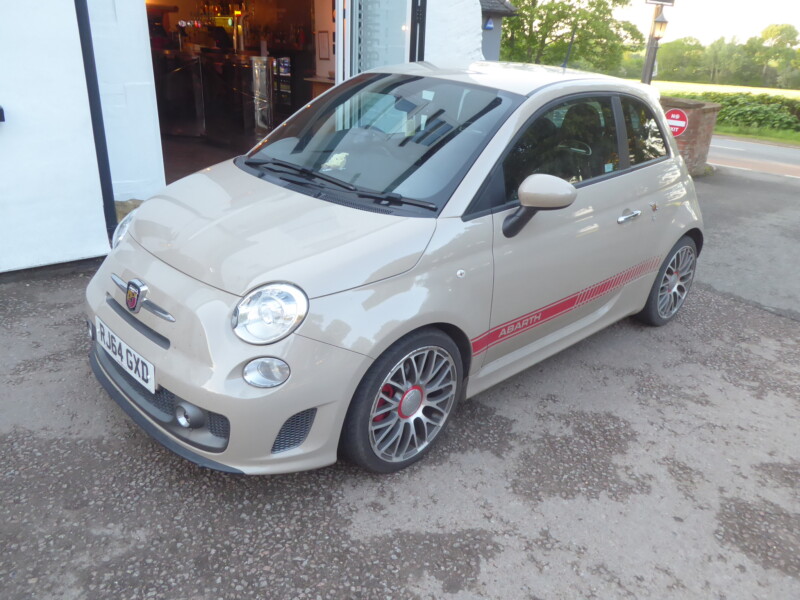
Having used the legendary 695 badging from the 1960s on the Tributo cars, at the 2012 Geneva Show, Abarth dusted off the 595 name that had been used on the less powerful of the Nuova 500 based cars of the same generation, and created two new versions which we should think of as Series 2 cars, the 595 Turismo and Competizione, both of which could be bought in either closed or open top C guise, with either the 5 speed manual or robotised automated gearshifts. Both models had the 160 bhp engine as standard. Effectively they were a replacement for the Esseesse kit, and it meant that the cars were produced complete at the factory, rather than needing the dealer to undertake the upgrade (and the associated paperwork), though Abarth did not withdraw the Esseesse kits from the market for some while. Turismo, as the name suggests was aimed slightly less extreme in intent, featuring standard leather upholstery, upgraded dampers and climate control, Xenon headlights and Alutex interior details. The sportier Abarth 595 Competizione replaced the leather seats with Sabelt cloth sport seats and Alutex with aluminium, while adding p-cross-drilled brakes and the Record Monza dual-mode exhaust.


Rumours started to circulate towards the end of 2014 that Abarth were going to upgrade the Competizione model, so as better to bridge the gap between the Turismo and the 190 bhp 695 Biposto that had been added to the range earlier in the year. It was Geneva 2015 when the result was finally shown to an expectant fan base. Most exciting news was that thanks to a bigger Garrett Turbo, the engine had been tweaked to 180 bhp, and with reduced CO2 emissions. A standard spec that included Koni Dampers, Brembo brakes, Xenon lights, Sabelt seats, Climate Control, parking sensors as well as other refinements that had been added like the TFT instrument display all proved very compelling, so not long after the first cars reached the UK in June of 2015, I found temptation too hard to resist, and as is well documented here, swapped my 2010 car for one of these. At the time I ordered it, Cordolo Red, a tri-coat pearlescent paint which shimmers in bright sunlight looked set to become one of the most popular colours of the lot, even though it is a cost option. Indeed, the Launch Edition models were all offered either in this colour or Scorpion Black, with black wheels. Surprisingly, the colour was not carried over to the Series 4 cars.

What is known as the Series 4 version of the familiar 595 reached the markets in the middle of 2016. After rumours had circulated all winter following the launch of the facelifted Fiat 500 last year, Abarth finally unveiled the Series 4 at the end of May 2016. Initially, we were told that the cars would not be available in the UK until September, but that came forward somewhat, with dealers all receiving demo cars in June, and the first customers taking delivery in July. Three regular production versions of both the closed car and the open-topped C were initially available, all badged 595, and called Custom, Turismo and Competizione, as before, though numerous limited edition models have since appeared and in most case disappeared. The most significant changes with the Series 4 are visual, with a couple of new colours, including the much asked for Modena Yellow and a different red, called Abarth Red, which replaces both the non-metallic Officina and – slightly surprisingly – the tri-coat pearlescent Cordolo Red. as well as styling changes front and rear. The jury is still out on these, with many, me included, remaining to be convinced. At the front, the new air intake does apparently allow around 15 – 20 % more air in and out, which will be welcome, as these cars do generate quite a lot of heat under the bonnet. Competizione models for the UK retain the old style headlights, as they have Xenon lights as standard, whereas the Custom and Turismo cars have reshaped units. At the back, there are new light clusters and a new rear bumper and diffuser. Inside, the most notable change is the replacement of the Blue & Me system with a more modern uConnect Audio set up, which brings a new colour screen to the dash. Mechanically, there is an additional 5 bhp on the Custom (now 145) and Turismo (now 165 bhp) and the option of a Limited Slip Diff for the Competizione, which is likely to prove a popular option. Details of the interior trim have changed, with a filled-in glovebox like the US market cars have always had, and electric windows switches that are like the US ones, as well as a part Alcantara trim to the steering wheel in Competizione cars.


In 2018 Abarth produced the 695 Rivale, a celebration of Fiat’s partnership with Riva, which has already seen a special Riva version of the 500,. Described as being “the most sophisticated Abarth ever”, it is available either as a hatch or a cabriolet, with both of them featuring a two-tone Riva Sera Blue and Shark Grey paintwork. The Rivale is adorned with an aquamarine double stripe, satin chrome finish on the door handles and satin chrome moulding on the tailgate, various aesthetic elements inspired by the Riva 56 Rivale yachts and ‘695 Rivale’ logos, joined by Brembo Brakes, Koni suspension, and 17-inch Supersport alloy wheels. Enhancing the nautical theme the new 695 Rivale features either a carbon fibre or mahogany dashboard, black mats with blue inserts, blue leather seats and door panels, carbon fibre kick plates, special steering wheel wrapped in blue and black leather and with a mahogany badge, blue leather instrument panel cover, and mahogany gear lever knob and kick plate. These are joined by the standard Uconnect infotainment with a 7-inch display, which is compatible with Android Auto and Apple CarPlay, and there is also a hand-written numbered plate that can be customised with the mane of the customer’s yacht on request. Powering the 695 Rivale is the same 1.4-litre turbocharged engine that makes 180PS (177hp) and 184lb/ft of torque, that features in the 595 Competizione, allowing it to go from rest to 100km/h (62mph) in 6.7 seconds and up to a top speed of 225km/h (140mph). This is a regular model in the range, but confusingly, there is also the Abarth 695 Rivale 175 Anniversary, created to celebrate 175 years of the Riva brand. Just 350 of these were produced, half of them the hatch and the other half cabriolets. These featured 17-inch alloy wheels with a special pattern, celebratory badge on the outside, hand-crafted details such as the two-tone colour – blue and black hand-stitched leather seats with a celebratory logo stitched onto the headrest, carbon dashboard silk screen printed with special logo, numbered plate. Standard Rivale cars arrived in the UK in April 2018, and quite a few have been sold. They always attract lots of interest when they do appear.

The Punto Evo was launched at the 2010 Geneva Show, with the cars reaching UK buyers in the summer of that year, and it incorporated many of the changes which had been seen a few months earlier on the associated Fiat models, the visual alterations being the most obvious, with the car taking on the nose of the associated Fiat, but adapted to make it distinctively Abarth, new rear lights and new badging. There was more to it than this, though, as under the bonnet, the T-Jet unit was swapped for the 1.4 litre Multi-Air, coupled to a 6 speed gearbox, which meant that the car now had 165 bhp at its disposal. Eventually, Abarth offered an Esseesse kit for these cars, though these are exceedingly rare. For those in the know – which never seemed to be that many people – this was a really capable and desirable car, and the owners love them, lamenting the fact that the model had quite a short production life and has not been replaced. The final Punto model was the SuperSport. Easily identified by the distinctive black bonnet, just 199 of the SuperSport versions were built, of which around 120 are registered on UK roads. These cars had many of the options from the Punto Evo included as standard. Power came from the the 1.4-litre MultiAir turbo engine, tuned to produce 178bhp and 199lb ft of torque, up from 165 of the standard Punto Evo, giving the SuperSport a 0-62 time of 7.5 seconds and a top speed of over 132mph. To help put the power down, the SuperSport was fitted with wider 18″ wheels and optional Koni FSD dampers. Standard equipment included the Blue&Me infotainment system with steering wheel controls, automatic climate control and a popular option was the ‘Abarth Corsa by Sabelt’ sports leather seats. The SuperSport was available in the same colours as the regular Punto Evo, which means white, grey, black and red.


Research Garage had brought along a couple of new cars, including the recently launched all-electric 600e.

ALFA ROMEO
When I saw this car pull in, I assumed it was the one recently acquired by Neil “Curly” Potter, but no, the plate was different this is in fact one of the other three examples believed to be in the UK.


FIAT
Follow on to the Cinquecento was the Seicento, and that was represented here by the Sporting version, debuting in 1997. It did not differ much from its predecessor, retaining the same engines, chassis and general dimensions, although it did gain a minor 9 cm in length (total length of 3.34 m). At launch, the Seicento was available with three trim levels; a basic ‘S’ with black bumpers and spartan equipment and initially the 899 cc 39 PS FIAT 100 series engine; an ‘SX’ model, a slight upgrade over the ‘S’ with colour-coded bumpers, electric windows, central locking and a sunroof – which was also available as a ‘Citymatic’ with a clutchless manual gearchange – and a ‘Sporting’ with the larger FIAT FIRE series 1108 cc 55 PS engine, 20 mm (0.8 in) lower suspension and anti-roll bars added. Cosmetically, this version gained 13″ alloy wheels, sports seats. An Abarth styling kit was also available with a body kit with optional Abarth 14″ wheels a close-ratio gearbox, sill kick plates, embroidered headrests, leather gear stick and steering wheel, colour highlighted trim in the bumpers, side skirts and a spoiler also available. Both the sporting and the Abarths were available with ABS, air-conditioning and power steering but due to cost not very many owners took up the options. In 1999, the FIRE engine was used in the special ‘Suite’ version, which came with air-conditioning. A special edition ‘Soleil’ model was available in some markets, which was based on the ‘SX’ model but came with a full-length electrically-folding fabric roof. In 2001, after the update, all cars were given clear indicator lenses, with the Sporting model getting a restyled bodykit. Power steering was still an option, in lower end Seicentos. A ‘Michael Schumacher’ edition of the Sporting, with ABS and the Abarth styling kit, was also launched at this time to celebrate the Ferrari driver’s Formula One success, This model was almost identical to the Abarth kit with the exception of chrome gear stick surrounds and Michael’s signature on the boot lid and side skirt. A limited edition plate and number was also on the passenger door. In 2004, the model was withdrawn from the UK market, and production of RHD models ceased, following the arrival of the new and more practical Panda. The LHD model was facelifted, gaining a new design for the wheel rims and the introduction of the new Fiat logo to the rear. In 2005, the name Seicento was replaced by 600 (on the occasion of the 50th anniversary of the first edition, in 1955) together with some changes in the front and in versions donations: now the name Fiat is written on the seats. The new versions now were named “Class” and “50 anniversary”, thus reminding the strict relationship between this model and the previous one. Production continued until 2010 by which time over 1.33 million units had been built.

The second generation Panda, codenamed Tipo 169, first appeared in 2003. In its development phase, the new Panda was originally intended to be called “Gingo”. However, this name was considered to be too similar to the Renault Twingo, so Fiat decided to continue with the Panda name, although it has almost no direct engineering link to the original 1980 car. Successor to the Fiat Seicento, the new model also effectively replaced the old Panda after 23 years of production, although the Seicento itself proved still popular and remained in production. Like the Seicento, the Panda was manufactured only in Tychy, Poland, by Fiat Auto Poland. The high-bodied Panda took clear styling cues from mini MPVs and mini SUVs, especially the second generation Fiat Multipla. Its long high positioned vertical tail lights are in particular reminiscent of much larger cars (especially estate cars) from the likes of Volvo, although Fiat started using smaller versions of this style of lights on the 1994 Italdesign Giugiaro Fiat Punto. The Panda won the European Car of the Year award in 2004. The financially troubled Fiat needed the new Panda to be a success, and indeed it was, selling half a million units by October 2005. It sold particularly well in Italy (over half of the cars produced were sold in Italy), being seen as closer to a spiritual successor to the Fiat 500 than a replacement for either the Seicento or the old Panda. Fiat expanded the range with diesel and 4X4 versions, and the decided to add a sporting model. It is widely believed that this sporting version was going to be the car to reintroduce the Abarth brand, but a last minute declaration (unbroken for now, but rumours suggest it may well be rescinded) that Abarth models do not have 4 or 5 doors meant that it was branded the 100HP instead. The Panda 100 HP was launched in 2004, a few months after the debut of the second generation Panda, and it was the sporty model in the range, with its 1.4-litre 16-valve FIRE petrol engine tuned to develop 100 PS (99 bhp) through a six-speed manual transmission. It differs from other Pandas by being equipped with 4-wheel disc brakes, tinted windows, and sports styled front and rear bumpers. The Panda 100 HP features a unique suspension setup with modified springs, dampers, bushes and compliance giving a considerably firmer ride. Performance was far livelier than the other models in the range, with 0–100 km/h acceleration in 9.5 secs and a maximum speed of 185 km/h (115 mph), fuel consumption at 6.5 L/100 km (43.5 mpg) in the EU combined cycle and 154 g/km of CO2 emissions. It was available in black, white, red, metallic blue, and metallic grey while a “Pandamonium Pack” which added red disc brakes, decals and colour-coded wing mirrors was an optional extra. Due to tightening emissions regulations, Fiat halted all Panda 100HP production in July 2010.

The Grande Punto, codenamed Project 199, was unveiled at the 2005 Frankfurt Motor Show and went on sale later on that year. Again styled by Giugiaro, the car is based on the Fiat Small platform developed in joint venture with Opel-General Motors. Whilst the model shares some of its name with the previous Punto, a large number of its components are new, including a new chassis and body shell. The engines are the Fiat 1.2 8v Fire (65 PS), a new 1.4 8v Fire (77 PS) and the 1.4 16v StarJet (95 PS). Four MultiJet diesel engines are also available: two 1.3 16v units (75 PS and 90 PS, the latter with a variable geometry turbocharger) and two 1.9 with 120 PS and 130 PS, all of them with diesel particulate filter. The 1.9 diesel was replaced with the new 1.6 MultiJet starting the end of 2008. All the engines are Euro IV compliant. In 2007, a new 1.4 16v T-Jet turbocharged petrol engine, 120 PS, became available. At the 2007 Frankfurt Motor Show, Fiat introduced 155 PS an Abarth version by Abarth & C S.p.A. It was branded as an Abarth rather than Fiat. The car’s nose, headlights and front grille look reminiscent of the Maserati Coupé (both were designed by Giorgetto Giugiaro of ItalDesign).

The Punto Evo, a facelift version of the Grande Punto, was presented in September 2009 at the Frankfurt Motor Show. It received a new front end, in addition to revised rear lights, and a new interior. It has two new engines, a 1.3 L second generation Multijet diesel and a 1.4 L petrol engine with the MultiAir technology. It also features a new navigation system integrated to the Blue&Me system called Blue&Me–TomTom. It was sold until 2012 when a second facelift saw the car renamed again, as just plain Punto.

The Fiat 124 Spider (Type 348) is a front-engine, rear-drive, two-passenger roadster manufactured by Mazda for FCA, having debuted at the 2015 LA Auto Show for model year 2016. Largely based on the fourth generation Mazda MX-5 Miata roadster, and manufactured alongside the MX-5 at Mazda’s Hiroshima plant, the 124 shares its platform, mechanicals, interior and top mechanism with the MX-5 — it is distinguished by an FCA engineered and manufactured turbocharged Multiair engine, uniquely tuned shock absorbers, unique exterior styling and slightly increased length and cargo capacity over the MX-5. In May 2012, Mazda and Alfa Romeo — at the time a subsidiary of the Fiat Group, now Stellantis — announced a joint venture to manufacture a common rear wheel drive platform. The companies would “develop two differentiated, distinctly styled, iconic and brand specific, lightweight roadsters featuring rear wheel drive”, with the two variants offering proprietary engines unique to each brand. In December 2014, FCA’s Sergio Marchionne determined Alfa Romeos would be manufactured only in Italy, saying “some things belong to a place. Alfa belongs to Italy,” adding “I remain committed to that architecture, with our powertrain. I’m not sure it will be with Alfa. But it will be with one of our brands.” At the time, Alfa Romeos were manufactured only in Italy, while Fiats were manufactured in Italy, but also globally — from Tychy, Poland, to Toluca, Mexico. With their prior agreement in place — for FCA to market a roadster based on the MX-5 to be manufactured by Mazda at its Hiroshima factory — FCA conceived of marketing a Fiat badged variant in lieu of the Alfa Romeo variant. In August 2016, FCA formally announced the Fiat 124 Spider based on the Mazda ND platform. In December 2016, the Detroit News said “in partnering with Mazda’s MX-5 Miata to resurrect the classic Fiat 124 Spider, Fiat Chrysler not only gained a halo sports car for its struggling Italian brand, but likely saved the most celebrated small sports car of the past 25 years (the MX-5)” — citing the markedly increased cost of developing a new car at the time and “the costliest wave of government regulation since the 1970s.” The 124 Spider was powered by Fiat’s 1.4 litre MultiAir turbocharged inline-four, producing 140 PS (138 bhp) and 240 Nm (177 lb/ft) of torque in European specification—and 160 bhp and 184 lb/ft (249 Nm) of torque in North American specification.[4] The 124 manual transmission is from the third generation MX-5’s six speed transmission to cope with the turbo’s torque. Multiair is a hydraulically actuated variable valve timing (VVT) engine technology enabling “cylinder by cylinder, stroke by stroke” control of intake air directly via a gasoline engine’s inlet valves. Developed by Fiat Powertrain Technologies, the technology bypasses a primary engine inefficiency: pumping losses caused by restriction of the intake passage by the throttle plate, used to regulate air feeding the cylinders. At the 124’s debut, Fiat marketed a 124 Spider Anniversary edition, with 124 units carrying the designation—to commemorate the 50th anniversary of original 124 Sport Spider. Including features of the 124 Spider Lusso Plus trim, the edition also includes chromed mirrors, red ‘124’ badge on the front grille, interior numbered plaque, red exterior and black leather interior. In January 2019, FCA announced the Fiat 124 Spider was to be withdrawn from the market in the United Kingdom with immediate effect. The Abarth 124 Spider continued to be sold, but this too was withdrawn from the UK market in April 2019. On December 23, 2020, Stellantis announced the 124 Spider and 500 were to be withdrawn from their North American model lineup after the 2020 model year and would not return for 2021, as is the situation with 500L. These models were expected to sell into 2021 until stock depletion.


As well as the Abarth version, Research also had the Fiat version of the 600. This will be available not just as an electric car but also a petrol-hybrid.

In pure numbers terms, then Abarth beat Fiat hands down, which is what you would probably have expected. But those numbers were very low by the standards of the Abarth community. Whilst I did enjoy the chance to sit and have a lengthy chat with one of the Abarth West Midlands owners, over a beer and a burger, this has to count as a less than successful evening, especially as there were only a handful of non-themed cars present. If I had made a special journey, I would have been pretty disappointed. I assume that Caffeine & Machine are not, as they have been offered help with promoting Italian themed and Abarth events and continue to eschew that help. With events as thinly attended as this, and such little notice given I can’t see the Abarth clubs bothering to promote these events in the future and that is a shame as the potential is there for a good evening with friends, cars and affordable and tasty food. What a shame!