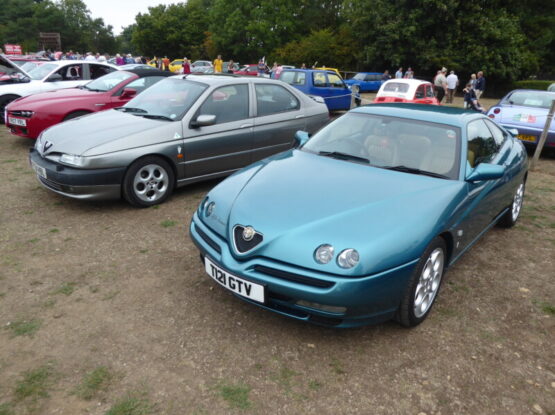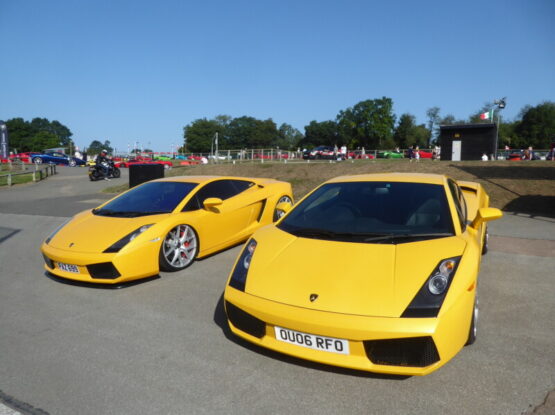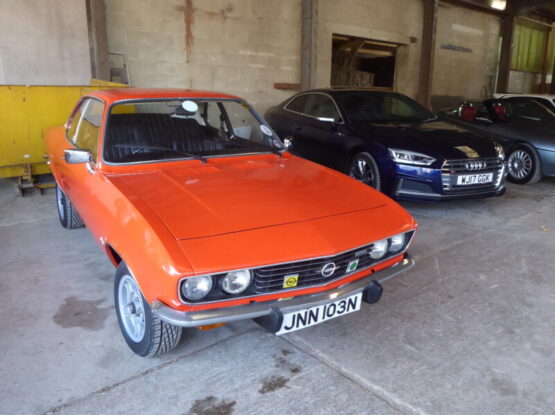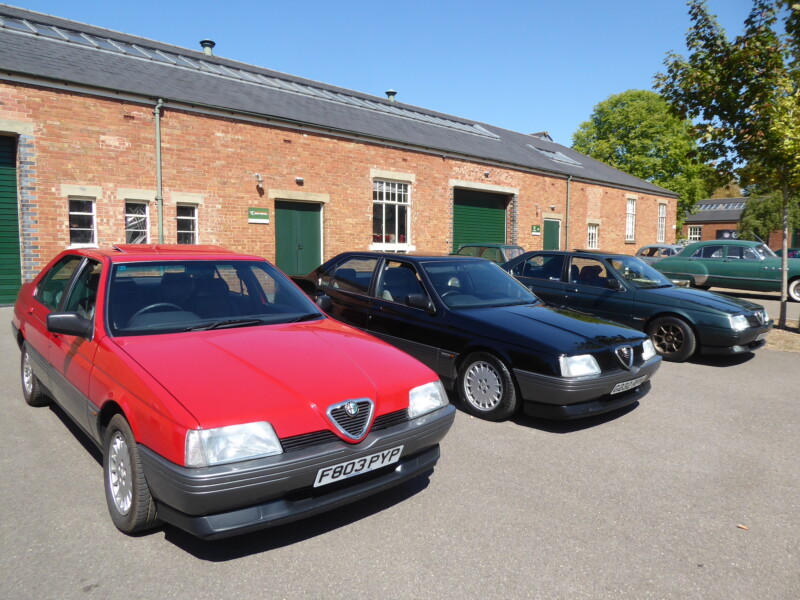
Although sales volumes of Alfa Romeo models in the UK are currently not that high, this is a marque that engenders a passion almost like no other. And the Alfa Romeo Owners Club (AROC) is the nationwide organisation that brings many of those owners together. Split into a series of Regional clubs which between cover the whole country, facilitating meet-ups between owners and devotees of the brand is a large part of what the Club does these days. Each Regional Group pulls together its own program of events for the year, but there are also a series of larger gatherings, with National Alfa Day being by far the biggest. Held in the pretty much the middle of the country, at the Bicester Heritage site, many owners see that as the absolute “must do” event of the year, and more than a few willingly travel long distances so they can attend. The 2024 event had been the biggest yet, and was the occasion for the Club to mark its 60th anniversary, so many wondered how this could be bettered for 2025. Certainly in numbers of cars and tickets sold it was very much at the same level – over 1500 Alfa and around 2500 tickets is a major achievement for any single marque Club but those are the numbers for the 2025 event. Luckily the site can cope! The only challenge is that the track, which is a hugely popular part of the day, has a much lower capacity and those who did not get their bookings in early were left watching from the sidelines or arranging to get a passenger ride. With the exception of the Covid era when numbers attending had to be quite severely limited, the event is always open to non members and non owners. I attended both the 2023 and 2024 events and loved them, so had no hesitation of inking the 2025 iteration onto my schedule as soon as the date was confirmed.
For a lot of people, the fun starts the evening before, and certainly I’ve stayed at local hotels and woken up to find a whole load of Alfa models in the car park. This year, as was the case in 2024, the Italian Auto Moto Club (IAMC) arranged their Millets Miglia event at Millets Farm for the day before – quite deliberately, to give those in the area a second event to attend over the weekend – and that meant that I and a few friends were in the area for the Saturday night. We booked in at the Mollie’s Diner on the A420 for both an evening meal and an overnight stay, so year, once again there were Alfa in the car park of where I was staying before getting to the event itself.
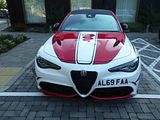
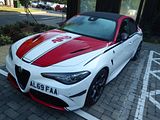
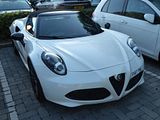

With a few friends deciding to meet us at the hotel in the morning, so they could convoy in together, it was of course inevitable that we would spend some time with cameras out, taking photos.
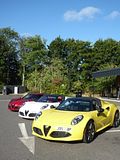


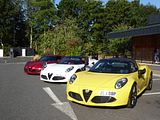

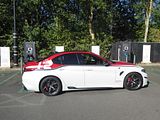
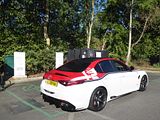
Although 1500 cars is a lot to get into the site, the marshalls are very efficient, so once the “gates” are open, cars move quickly. The more modern Alfa models are parked out on the grass, whilst the older cars each have their own area dotted around what is known as the Technical Site. Most model types were in the same place as last year, which does make it easier and quicker to get everyone in situ, but there are some changes, associated with any special displays and of course the selection of what goes in one of the large hangers. Alfa GB support the event and they had some of their latest models here which people could not just sit in but also take on a short test drive. There was a whole program of events through the day with groups of cars being called forward to take to the track. Mid-afternoon saw the award of a whole series of prizes. Selecting winners must have been almost mission impossible!
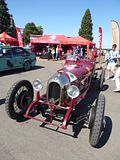
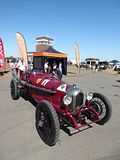
RL SS
The Alfa Romeo RL was produced between 1922 and 1927. It was Alfa’s first sport model after World War I, designed in 1921 by Giuseppe Merosi. It had a straight-6 engine with overhead valves, and came in three different versions: Normale, Turismo and Sport. A total of 2,640 RLs were made. The RLTF (Targa Florio) was the race version of the RL. It weighed half as much as the standard production models, despite the engine having seven main bearings instead of four and double carburetors. It was used among the 1923 Alfa race team, which had drivers like Ugo Sivocci, Antonio Ascari, Giulio Masetti and Enzo Ferrari. Sivocci’s car had a green cloverleaf symbol on a white background; when he won the 1923 Targa Florio, that symbol was to become the Alfa team’s good luck token. Five[6][circular reference] different RLSS were entered in the first Mille Miglia in 1927, but only two completed the race. This is a 1923 car.


6C 1750
In the mid-1920s, Alfa’s RL was considered too large and heavy, so a new development began. The 2-litre formula that had led to Alfa Romeo winning the Automobile World Championship in 1925, changed to 1.5-litre for the 1926 season. The 6C 1500 was introduced in 1925 at the Milan Motor Show and production started in 1927, with the P2 Grand Prix car as starting point. Engine capacity was now 1487 cc, against the P2’s 1987 cc, while supercharging was dropped. The first versions were bodied by James Young and Touring. In 1928, a 6C Sport was released, with a dual overhead camshafts engine. Its sport version won many races, including the 1928 Mille Miglia. Total production was 3000 (200 with DOHC engine). Ten copies of a supercharged (compressore) Super Sport variant were also made. The more powerful 6C 1750 was introduced in 1929 in Rome. The car had a top speed of 95 mph, a chassis designed to flex and undulate over wavy surfaces, as well as sensitive geared-up steering. It was produced in six series between 1929 and 1933. The base model had a single overhead cam; Super Sport and Gran Sport versions had double overhead cam engines. Again, a supercharger was available. Most of the cars were sold as rolling chassis and bodied by coachbuilders such as Zagato, and Touring. Additionally, there were 3 examples built with James Young bodywork. In 1929, the 6C 1750 won every major racing event it was entered, including the Grands Prix of Belgium, Spain, Tunis and Monza, as well as the Mille Miglia was won with Giuseppe Campari and Giulio Ramponi, the Brooklands Double Twelve and the Ulster TT was won also, in 1930 it won again the Mille Miglia and Spa 24 Hours. Total production was 2635.


750/101 GIULIETTA
Following the 1900 family, Alfa’s next new model range would be cheaper and aimed at capturing some of the market from middle class buyers. Known as Giulietta, the 750 and later 101 Series were a series of family-sized cars made from 1954 to 1965, and Alfa Romeo’s first, successful, foray into the 1.3-litre class. There were none of these original cars here that I photographed.
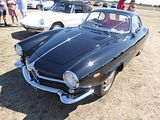
There were, however, some of the later and rarer Giulietta models here. This is the Giulietta Sprint Speciale, the earlier version of a car which was produced between 1957 and 1965, latterly with Giulia badging. Just 1,366 examples were made. The first cars were fitted with the 1,290cc Giulietta engine and then in 1963 this was replaced by the more powerful 1,570cc Giulia unit. The SS, or Sprint Speciale series was never intended to be a volume car and it was considerably more expensive than the other models in the Giulietta and Giulia ranges. It certainly looked special, with streamlined bodywork which bore a marked resemblance to some of the marque’s earlier competition designs, particularly the famous Disco Volante sports-racer, not to mention the BAT 9 show car. With an all-up weight of under 950kgs, a five-speed gearbox and an output of 112bhp (in Giulia form) these were excellent road cars and were equally used in competition. They don’t come up for sale very often, and needless to say, the price tag is not small when they do.


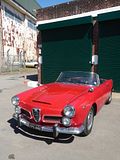
Along with the equally pretty Coupe model, this started out as part of the Giulietta range, but in later life adopted Giulia badging. This is the more commonly seen of the pair, the lovely Giulia Spider 1600. Alfa had followed up the 1950 launch of the 1900 Berlina with a smaller model, the Giulietta. Known as the Type 750 and later 101 Series, the Giulietta evolved into a family of models. The first to be introduced was the Giulietta Sprint 2+2 coupé at the 1954 Turin Motor Show. Designed by Franco Scaglione at Bertone, it was produced at the coachbuilder’s Grugliasco plant near Turin. A year later, at the Turin Motor Show in April 1955, the Sprint was joined by the 4-door saloon Berlina. In mid 1955, the open two-seat Giulietta Spider, featuring convertible bodywork by Pininfarina, and it was one of these achingly pretty cars that was to be seen here. Alfa replaced the Giulietta with the Giulia in 1962, but as the Coupe and Spider were not ready, the Giulietta based models were kept in production, and renamed as Giulia. They gained a larger 1600cc engine, and this meant that the bonnet needed to be raised a little to accommodate the new unit, so the easy recognition beyond Giulietta and Giulia Spiders is whether there is a flat bonnet or one with a slight hump and a vent in it.

2000/2600
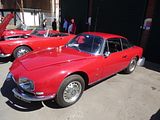
The 2600, or 106 Series, were an evolution of the model first seen in 1958 as a replacement for the 1900, and called the 2000 and known internally as the 102 Series. This was the time when Alfa was still in transition from being a maker of exclusive coachbuilt and racing cars to one that offered volume production models. The 102 Series were never likely to be big sellers, in a world that was still recovering economically from the ravages of the Second World War, but the range was an important flagship, nonetheless. The 2000 models ran for 4 years, from 1958 to 1962, at which point they were updated, taking on the name of 106 Series, with minor styling changes being accompanied by a larger 2600cc engine under the bonnet. As with the 2000 models, the new 2600 cars were sold in Berlina (Saloon), Sprint (Coupe) and Spider (Convertible) versions, along with a dramatically styled SZ Coupe from Italian styling house Zagato and a rebodied Berlina from OSI, all of them with an inline twin overhead cam six cylinder engine of 2.6 litres, the last Alfas to offer this configuration. Just 6999 of the Sprint models were made and 2255 Spiders, very few of which were sold new in the UK where they were exceedingly expensive thanks to the dreaded Import Duty which made them much more costly than an E Type. Many of the parts were unique to these cars, so owning one now is far harder than the more plentiful 4 cylinder Alfas of the era. Whilst the rather square styling of the Berlina, which won it relatively few friends when new and not a lot more in recent times means that there are few of these versions to be seen, the Sprint and Spider models do appear from time to time, and market interest in the cars is now starting to accelerate, with values rise accordingly. Seen here were the regular Coupe, the Spider and the 2600 Zagato.



105 SERIES
First of the all-new Giulia models to appear was the Berlina, launched in 1962. The styling was quite straight forward, but great attention was paid to detail. The engine bay, cabin and boot were all square shaped. But the grille, the rooflines and details on the bonnet and boot made for an integrated design from bumper to bumper. Thanks to Alfa Romeo using a wind tunnel during its development, the Giulia was very aerodynamic with a drag coefficient of Cd=0.34, which was particularly low for a saloon of the era and not a bad figure even for cars of today. Couple that with the fact that Alfa Romeo was one of the first manufacturers to put a powerful engine in a light-weight car (it weighed about 1,000 kilograms) and thanks to an array of light alloy twin overhead camshaft four-cylinder engine, similar to that of the earlier Giulietta models range, the car had a lively performance which bettered that of many sports cars of the day. The Tipo 105.14 was the first model, with a 1,570 cc Twin Cam engine with single down-draft carburettor generating 91 hp at 6500 rpm. The “TI” nomenclature referred to a class of Italian saloon car racing known as “Turismo Internazionale”, and had previously been applied to higher-performance versions of the 1900 and Giulietta saloons in the 1950s. However, for the Giulia saloon, the Ti was at first the only version available, and later, with the introduction of the TI Super and Super, the TI became the base version for the 1,600 cc engine class. The steering column gearchange (the only one in the Giulia range) was replaced with a floor change for 1964 (Tipo 105.08). Right hand drive cars, available from 1964, only ever had a floor change (Tipo 105.09). Brakes were by drums all around at first. Discs were introduced later, first at the front, and later all around. A brake servo was not fitted at first, but was introduced in later cars. The steering wheel featured the only horn ring ever in the Giulia range. The dashboard with a strip speedo is a notable feature, as is the steering wheel with a horn ring. The Giulia TI was phased out in 1968 and re-introduced as the austerity model 1600 S. Tipo 105.16 was a special racing model introduced in 1963. Quadrifoglio Verde stickers on the front wings were a distinguishing feature. Only 501 were made for homologation and today it is very rare and desirable. The 1,570 cc engine was fitted with two double-choke horizontal Weber 45DCOE carburettors for 110 hp at 6500 rpm. The body was lightened and a floor gearchange was fitted as standard, as were alloy wheels of very similar appearance to the standard steel ones of the TI. The TI’s instrument cluster with its strip speedometer was replaced with a three-instrument binnacle comprising speedometer, tachometer and a multi-gauge instrument (fuel, water temperature, oil temperature and pressure) – these instruments were similar to those fitted to the contemporary Giulia Sprint and Sprint Speciale coupes and Spider convertibles. The steering wheel was a three-spoke item with centre hornpush, also similar to that of the more sporting models. Braking was by discs all around, although the first cars used drums and early disc models lacked a servo which was introduced later. The police cars seen in The Italian Job were of this type. Tipo 105.06 was an austerity model made from 1964 to 1970 with a 1,290 cc single-carburettor engine for 77 hp at 6000 rpm. Four-speed gearbox with floor change fitted as standard (the 1300 was the only Giulia model not fitted with a five-speed gearbox). Though the engine was given a 105 series type number, it was basically the engine from the 101 series Giulietta Ti. This model appears not to have been exported to many markets outside Italy, if at all. Braking was by discs all around, without a servo at first, later with a servo. Tipo 105.26 was introduced in 1965. It transferred the technology from the racing TI Super to a road car, to make the most successful Giulia saloon. 1,570 cc engine with two double-choke Weber 40DCOE carburettors for a milder, but torquier tune than the TI Super – 97 hp at 5500 rpm. There was a new dashboard with two large round instruments (speedo and tacho) and clock, a sportier steering wheel with three aluminium spokes and centre horn push, similar to that of the Ti Super, later changed for one with the horn pushes in the spokes. All-around disc brakes with servo were fitted as standard from the outset. The serpent crest of the Sforza family appears in a badge on the C-pillar and is a distinguishing feature of the Super. For 1968, there was a suspension update, including revised geometry and a rear anti-roll bar. The wheels were changed in size from 5J x 15 to 5J x 14, and tyres from 155/15 to 165/14. For 1970, updates included dual-circuit brakes, centre-mounted handbrake lever to replace under-dash “umbrella handle”, larger external doorhandles, and top-hinged pedals (the latter in left hand drive models only; right hand drive continued with bottom-hinged pedals to the end of production). In 1972, Tipo 105.26 was rationalised into the Giulia 1.3 – Giulia 1.6 range. Tipo 105.39 built from 1965 to 1972. Right hand drive model replaced in 1970 by the 1300 Super. 1,290 cc engine with single down-draft carburettor for 81 hp at 6000 rpm. Unlike the re-deployed 101-series Giulietta engine of the austerity-model 1300, the 1300 ti motor was a 105 series engine, basically that of the sportier GT1300 Junior coupe with different camshaft timing (but the same camshafts) and induction system. Five-speed gearbox. Three-spoke bakelite steering wheel with plastic horn push covering the centre and spokes. Dashboard initially with strip speedo like that of the TI. For 1968, updates included a dashboard based on that of the Super, but with a simpler instrument binnacle, still featuring two large round instruments (speedo and tacho) and a separate fuel gauge, and the same suspension, wheel and tire updates applied to the Giulia Super in the same year. For 1970, updates included dual-circuit brakes, centre handbrake, larger external doorhandles and top-hinged pedals (on left hand drive cars only), again as applied to the Super for that year. Tipo 105.85 was basically a Giulia TI re-introduced in 1968 as a lower-level model to come between the 1300 and 1300 ti on one hand, and the Super on the other. It had a re-interpretation of the 1,570 cc single-carburettor engine for 94 hp at 5500 rpm and similar trim to the 1300 ti. Replaced in 1970 by the 1300 Super which offered similar performance in a lower tax bracket. The last cars from 1970 featured the top-hinged pedals, centre handbrake and dual-circuit brakes as for the Super and 1300 ti. Tipo 115.09 was introduced in 1970. It was basically a 1300 ti fitted with the engine from the GT 1300 Junior coupe that featured two double-choke horizontal carburettors; the engine actually had the GT 1300 Junior type number. This model was rationalised into the Giulia Super 1.3 – Giulia Super 1.6 range in 1972. In 1972 a rationalisation of the Giulia range saw the Super 1300 (Tipo 115.09) and the Super (Tipo 105.26) re-released as the Super 1.3 and Super 1.6. The two models featured the same equipment, interior and exterior trim, differing only in engine size and final drive ratio. The 1300 ti was dropped. A small Alfa Romeo badge on the C-pillar is a distinguishing feature, as are hubcaps with exposed wheel nuts. In December 1972 Alfa-Romeo South Africa released the 1600 Rallye. This locally developed more powerful 1600 cc version of the 1300 Super used the 1300’s single-headlight body shell. The car was largely ready for competition and was only planned to be built in limited numbers, and was fitted with racing-style rear-view mirrors, rally lamps, fully adjustable seats, and a limited-slip differential. Claimed power was 125 hp. The Giulia Super range was re-released in 1974 as the Nuova Super range, including the Giulia Nuova Super 1300 and 1600 This featured a new black plastic front grille and a flat boot lid without the characteristic centre spine. Otherwise the cars differed little from their Giulia Super predecessors and bore the same Tipo numbers with an S suffix. A Nuova Super fitted with a Perkins 1,760 cc diesel with 54 hp at 4000 rpm, was the firm’s first attempt at diesel power. The same Perkins diesel was used also in Alfa Romeo F12 van. The diesel version was slow, 138 km/h (86 mph), and the engine somehow unsuitable for a sport sedan so it was not big seller, only around 6500 examples were made in 1976 and the car was not sold in the UK. Production of the Giulia ceased in 1977. There are relatively few of these cars in the UK, and many of these are left hand drive models which have been re-imported relatively recently, or have been converted for historic racing, so it was good to see a nice road-going model here.


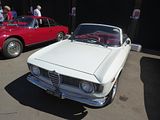
The first car was called the Alfa Romeo Giulia Sprint GT, and was revealed at a press event held at the then newly opened Arese plant on 9 September 1963, and displayed later the same month at the Frankfurt Motor Show. In its original form the Bertone body is known as scalino (step) or “step front”, because of the leading edge of the engine compartment lid which sat 1/4 an inch above the nose of the car. The Giulia Sprint GT can be distinguished from the later models by a number of features including: Exterior badging: Alfa Romeo logo on the front grille, a chrome script reading “Giulia Sprint GT” on the boot lid, and rectangular “Disegno di Bertone” badges aft of the front wheel arches; flat, chrome grille in plain, wide rectangular mesh without additional chrome bars; single-piece chrome bumpers; no overriders. Inside the cabin the padded vinyl dashboard was characterised by a concave horizontal fascia, finished in grey anti-glare crackle-effect paint. Four round instruments were inset in the fascia in front of the driver. The steering wheel was non-dished, with three aluminium spokes, a thin bakelite rim and a centre horn button. Vinyl-covered seats with cloth centres and a fully carpeted floor were standard, while leather upholstery was an extra-cost option. After initially marketing it as a four-seater, Alfa Romeo soon changed its definition of the car to a more realistic 2+2. The Giulia Sprint GT was fitted with the 1,570 cc version of Alfa Romeo’s all-aluminium twin cam inline four (78 mm bore × 82 mm stroke), which had first debuted on the 1962 Giulia Berlina. Breathing through two twin-choke Weber 40 DCOE 4 carburettors, on the Sprint GT this engine produced 105 hp at 6,000 rpm. Like all subsequent models, the Sprint GT was equipped with an all-synchromesh 5-speed manual transmission. The braking system comprised four Dunlop disc brakes and a vacuum servo. The rear brakes featured an unusual arrangement with the slave cylinders mounted on the axle tubes, operating the calipers by a system of levers and cranks. According to Alfa Romeo the car could reach a top speed of “over 180 km/h (112 mph)”. In total 21,902 Giulia Sprint GT were produced from 1963 to 1965, when the model was superseded by the Giulia Sprint GT Veloce. Of these 2,274 were right hand drive: 1,354 cars fully finished in Arese, and 920 shipped in complete knock-down kit form for foreign assembly. For 1966, the Giulia Sprint GT was replaced by the Alfa Romeo Giulia Sprint GT Veloce, which was very similar but featuring a number of improvements: a revised engine—slightly more powerful and with more torque—better interior fittings and changes to the exterior trim. Alongside the brand new 1750 Spider Veloce which shared its updated engine the Sprint GT Veloce was introduced at the 36th Geneva Motor Show in March 1966, and then tested by the international specialist press in Gardone on the Garda Lake. Production had began in 1965 and ended in 1968. The Giulia Sprint GT Veloce can be most easily distinguished from other models by the following features: badging as per Giulia Sprint GT, with the addition of round enamel badges on the C-pillar—a green Quadrifoglio (four-leaf clover) on an ivory background—and a chrome “Veloce” script on the tail panel; black mesh grille with three horizontal chrome bars; the grille heart has 7 bars instead of 6; stainless steel bumpers, as opposed to the chromed mild steel bumpers on the Giulia Sprint GT. The bumpers are the same shape, but are made in two pieces (front) and three pieces (rear) with small covers hiding the joining rivets. Inside the main changes from the Giulia Sprint GT were imitation wood dashboard fascia instead of the previous anti-glare grey finish, front seats revised to a mild “bucket” design, and a dished three aluminium spoke steering wheel, with a black rim and horn buttons through the spokes. The Veloce’s type 00536 engine, identical to the Spider 1600 Duetto’s, featured modifications compared to the Giulia Sprint GT’s type 00502—such as larger diameter exhaust valves. As a result it produced 108 hp at 6,000 rpm, an increase of 3 hp over the previous model, and significantly more torque. The top speed now exceeded 185 km/h (115 mph). Early Giulia Sprint GT Veloces featured the same Dunlop disc brake system as the Giulia Sprint GT, while later cars substituted ATE disc brakes as pioneered on the GT 1300 Junior in 1966. The ATE brakes featured an handbrake system entirely separate from the pedal brakes, using drum brakes incorporated in the rear disc castings. Though the Sprint GT Veloce’s replacement—the 1750 GT Veloce—was introduced in 1967, production continued throughout the year and thirty final cars were completed in 1968. By then total Giulia Sprint GT Veloce production amounted to 14,240 examples. 1,407 of these were right hand drive cars, and 332 right hand drive complete knock-down kits. The Alfa Romeo 1750 GT Veloce (also known as 1750 GTV) appeared in 1967 along with the 1750 Berlina sedan and 1750 Spider. The same type of engine was used to power all three versions; this rationalisation was a first for Alfa Romeo. The 1750 GTV replaced the Giulia Sprint GT Veloce and introduced many updates and modifications. Most significantly, the engine capacity was increased to 1779 cc displacement. Peak power from the engine was increased to 120 hp at 5500 rpm. The stroke was lengthened from 82 to 88.5 mm over the 1600 engine, and a reduced rev limit from 7000 rpm to 6000 rpm. Maximum torque was increased to 137 lb·ft at 3000 rpm. A higher ratio final drive was fitted (10/41 instead of 9/41) but the same gearbox ratios were retained. The result was that, on paper, the car had only slightly improved performance compared to the Giulia Sprint GT Veloce, but on the road it was much more flexible to drive and it was easier to maintain higher average speeds for fast touring. For the United States market, the 1779 cc engine was fitted with a fuel injection system made by Alfa Romeo subsidiary SPICA, to meet emission control laws that were coming into effect at the time. Fuel injection was also featured on Canadian market cars after 1971. Carburettors were retained for other markets. The chassis was also significantly modified. Tyre size went to 165/14 from 155/15 and wheel size to 5 1/2J x 14 instead of 5J x 15, giving a wider section and slightly smaller rolling diameter. The suspension geometry was also revised, and an anti-roll bar was fitted to the rear suspension. ATE disc brakes were fitted from the outset, but with bigger front discs and calipers than the ones fitted to GT 1300 Juniors and late Giulia Sprint GT Veloces. The changes resulted in significant improvements to the handling and braking, which once again made it easier for the driver to maintain high average speeds for fast touring. The 1750 GTV also departed significantly from the earlier cars externally. New nose styling eliminated the “stepped” bonnet of the Giulia Sprint GT, GTC, GTA and early GT 1300 Juniors and incorporated four headlamps. For the 1971 model year, United States market 1750 GTV’s also featured larger rear light clusters (there were no 1970 model year Alfas on the US market). Besides the chrome “1750” badge on the bootlid, there was also a round Alfa Romeo badge. Similar Quadrofoglio badges to those on the Giulia Sprint GT Veloce were fitted on C pillars, but the Quadrofoglio was coloured gold instead of green. The car also adopted the higher rear wheelarches first seen on the GT 1300 Junior. The interior was also much modified over that of earlier cars. There was a new dashboard with large speedometer and tachometer instruments in twin binnacles closer to the driver’s line of sight. The instruments were mounted at a more conventional angle, avoiding the reflections caused by the upward angled flat dash of earlier cars. Conversely, auxiliary instruments were moved to angled bezels in the centre console, further from the driver’s line of sight than before. The new seats introduced adjustable headrests which merged with the top of the seat when fully down. The window winder levers, the door release levers and the quarterlight vent knobs were also restyled. The remote release for the boot lid, located on the inside of the door opening on the B-post just under the door lock striker, was moved from the right hand side of the car to the left hand side. The location of this item was always independent of whether the car was left hand drive or right hand drive. Early (Series 1) 1750 GTV’s featured the same bumpers as the Giulia Sprint GT Veloce, with the front bumper modified to mount the indicator / sidelight units on the top of its corners, or under the bumper on US market cars. The Series 2 1750 GTV of 1970 introduced other mechanical changes, including a dual circuit braking system (split front and rear, with separate servos). The brake and clutch pedals on left hand drive cars were also of an improved pendant design, instead of the earlier floor-hinged type. On right hand drive cars the floor-hinged pedals were retained, as there was no space for the pedal box behind the carburettors. Externally, the series 2 1750 GTV is identified by new, slimmer bumpers with front and rear overriders. The combined front indicator and sidelight units were now mounted to the front panel instead of the front bumper, except again on the 1971-72 US/Canadian market cars. The interior was slightly modified, with the seats retaining the same basic outline but following a simpler design. 44,269 1750 GTVs were made before their replacement came along. That car was the 2000GTV. Introduced in 1971, together with the 2000 Berlina sedan and 2000 Spider, the 2 litre cars were replacements for the 1750 range. The engine displacement was increased to 1962 cc. Oil and radiator capacities remained unchanged. The North American market cars had fuel injection, but everyone else retained carburettors. Officially, both versions generated the same power, 130 hp at 5500 rpm. The interior trim was changed, with the most notable differences being the introduction of a separate instrument cluster, instead of the gauges installed in the dash panel in earlier cars. Externally the 2000 GTV is most easily distinguished by its grille with horizontal chrome bars, featuring protruding blocks forming the familiar Alfa heart in outline, smaller hubcaps with exposed wheel nuts, optional aluminium alloy wheels of the same size as the standard 5. 1/2J × 14 steel items, styled to the “turbina” design first seen on the alloy wheels of the Alfa Romeo Montreal, and the larger rear light clusters first fitted to United States market 1750 GTV’s were standard for all markets. From 1974 on, the 105 Series coupé models were rationalised and these external features became common to post-1974 GT 1300 Junior and GT 1600 Junior models, with only few distinguishing features marking the difference between models. 37,459 2000 GTVs were made before production ended and these days they are very sought after with prices having sky-rocketed in recent years.
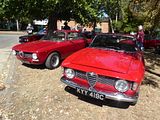
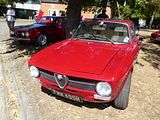


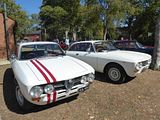


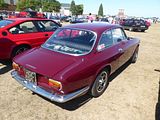
Based on the Coupe, but with a model designation of its own, was the GTC, a stunningly pretty open topped model which was only produced for a year in 1965, in very limited numbers making them rare today with a total production of just 1000 cars in right and left hand drive versions. Only 99 were made for the British and South African market. It was based on the Giulia Sprint GT, with the cabriolet modification carried out by Touring of Milan. Besides the cabriolet top, a distinguishing feature is the dashboard finished in black instead of grey crackle. The model was badged with a script reading “Giulia Sprint GTC” on the bootlid. To restore some of the bodyshell rigidity lost by removing the fixed roof and pillars, Carrozzeria Touring added reinforcement to several areas of the bodyshell. Through the production life of the model, several modifications to the reinforcement applied were made by Touring, apparently in an effort to improve the stiffening achieved. Carrozzeria Touring was in financial trouble when the Giulia Sprint GTC went into production. The company went out of business shortly after production of this model ended.


Alfa replaced the Giulia-based Spider model with an all-new design which finally made its debut in 1966 together with the Giulia Sprint GT Veloce at an event organised in Gardone Riviera. With its boat tailed styling, it quickly found favour, even before taking a starring role in the film “The Graduate”. The original 1600cc engine was replaced by a more powerful 1750cc unit at the same time as the change was made to the rest of the range, and the car continued like this until 1970, when the first significant change to the exterior styling was introduced on the 1750 Spider Veloce, with the original’s distinctive elongated round tail changed to a more conventional cut-off tail, called the “Kamm tail”, as well as improving the luggage space. Numerous other small changes took place both inside and out, such as a slightly different grille, new doorhandles, a more raked windscreen, top-hinged pedals and improved interior trim. 1971 saw the Spider Veloce get a new, larger powerplant—a 1962 cc, 132 hp unit—and consequently the name was changed from 1750 Spider Veloce to 2000 Spider Veloce. The 1600 Spider restarted production a year later as the Spider 1600 Junior, and was visually identical to the 1300. 1974 saw the introduction of the rare, factory request, Spider-Targa. Based upon the Spider, it featured a Porsche style solid rear window and lift out roof panels, all made out of black GRP type material. Less than 2,000 models of such type were ever made and was the only part solid roof Spider until the introduction of the factory crafted hard top. The 1300 and 2000 cars were modified in 1974 and 1975 respectively to include two small seats behind the front seats, becoming a “two plus two” four seater. The 1300 model was discontinued in 1977. Also, between 1974 and 1976, the early-style stainless-steel bumpers were discontinued and replaced with black, rubber-clad units to meet increasingly stringent North American crash requirements. 4,557 examples of the 1300 Junior were made and 4,848 of the 1600 Junior as well as 16,320 2000 Spider Veloces and 22,059 of 2000 Spider Veloce US version. There were also 4,027 1750 Spider Veloces produced.
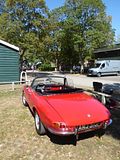
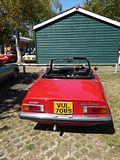


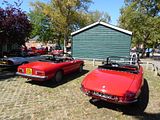


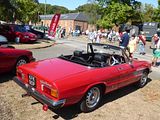
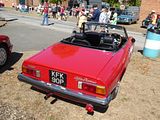
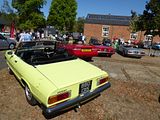

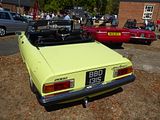

The Series 3 Spider was previewed in North America for the 1982 model year with the introduction of 2.0 litre Bosch electronic fuel injection to replace the SPICA mechanical injection. The Spider underwent a major styling revamp in 1983, which saw the introduction of black rubber front and rear bumpers. The front bumper incorporated the grille and a small soft rubber spoiler was added to the trunk lid. The change altered the exterior appearance of the car considerably and was not universally praised by enthusiasts. Various other minor mechanical and aesthetic modifications were also made, and the 1600 car (never available in North America) dropped the “Junior” name. The Quadrifoglio Verde (Green Cloverleaf) model was introduced in 1986, with many aesthetic tweaks, including sideskirts, mirrors, new front and rear spoilers, hard rubber boot mounted spoilers with integral 3rd stoplight, unique 15″ alloys and optional removable hardtop. Different interior trim included blood red carpets and grey leather seats with red stitching. The QV was offered in only 3 colours: red, silver and black. It was otherwise mechanically identical to the standard Spider Veloce model, with a 1962 cc double overhead cam, four-cylinder engine (twin two-barrel carburettors in Europe; North American models retained the Bosch L-Jetronic fuel injection introduced for the 1982 model year except that the VVT mechanism was now L-Jet activated) and five-speed manual transmission. The interior was revised with a new centre console, lower dash panels (to meet U.S. regulations) and a single monopod gauge cluster (with electronic gauges). For the North American market a model dubbed the Graduate was added in tribute to the car’s famous appearance in the 1967 film, The Graduate, starring Dustin Hoffman. The Graduate was intended as a less expensive “entry-level” Alfa. While it had the same engine and transmission as the Quadrifoglio and Veloce, it lacked the alloy wheels and luxury features of the other two models. The Graduate model had manual windows, basic vinyl seats, a vinyl top, and steel wheels as standard. Air conditioning and a dealer-installed radio were the only options. It first appeared in 1985 in North America and continued until 1990. Minor changes occurred from 1986 to 89, including new paint colours, a centre high mount stop lamp midway through 1986 for North American models, a move away from the fade-prone brown carpet and new turn signal levers. Some 1988 models featured automatic seatbelts that extended from a large device between the front seats.
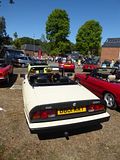

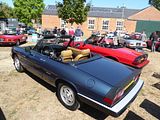

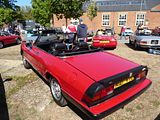

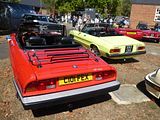
The S4, the final major change to the long running Spider came in 1990, and mechanically, the biggest different was the use of Bosch Motronic electronic fuel injection with an electric fan. Externally, the Spider lost its front under-bumper spoiler and the rather ungainly rear boot spoiler of the S3, and picked up 164-style rear lights stretching across the width of the car as well as plastic bumpers the same colour as the car. This also marked the first generation of the car with automatic transmission, as well as on-board diagnostics capabilities. The car had remained in production largely thanks to continued demand in North America, though this market had to wait until 1991 for the changes to appear on their cars. European markets were offered a car with a 1600cc engine and carburettors as well as the 2 litre injected unit. Production finally ended in 1993, with an all new model, the 916 Series Spider appearing a year later. The S4 car was not officially sold in the UK, but plenty have found their way to our shores since then.

A10/F12 SERIES
Many people will be unaware that Alfa Romeo have produced Vans in their past. The first the Autotutto was launched back in 1954, and it was updated three times in the following 11 years before being replaced with by the Giulia engined Alfa Romeo F12 and A12 vans in 1967. The front of the vehicle was updated with wider chrome and mesh grille, and the 1,290 cc Alfa Romeo Twin Cam engine was updated now having 52 hp. The front-engined van had four-speed gearbox and front-wheel drive. In 1973 an inline-four 1,760 cc Perkins diesel was also offered, with 50 hp. This same engine was also available in the Giulia Berlina from 1976. The van had top speed of around 115 km/h (71 mph). The front brakes were discs and rear ones drums. Abandoning the use of a model name, “F” denoted a furgone, or van, “A” depicted an autocarro or light truck, while “12” indicated the carrying capacity of 12 quintali (1 quintale = 100 kg (220 lb)). Motor Ibérica took over of FADISA in 1967, this company made Ebro trucks and these FADISA trucks were merged to this same division. As a result, the Alfa Romeo F12 was named as Ebro F-100 in Spain and after the facelift it was sold as the F-108. In 1987 Nissan Motors took control of Motor Ibérica and Ebro trucks were renamed “Nissan Trade”. They continued to be made until the beginning of the 2000s at the Ávila plant in Spain. Between 1967 and 1971 a “light” A11 or F11 version was also available. This has a lighter payload and a lower horsepower rating. All Alfa Romeo vans were facelifted in 1977 with a new black plastic radiator grille, and chrome badging was replaced with black adhesive stickers. Production stopped in 1983. The total production of all A11, A12, F11, and F12 was around 17,300 units.


1750/2000
The 1750 and 2000 Berlina models are largely ignored these days in favour of the GTV models, and whereas you would also say the Coupe cars are genuinely pretty whereas the Berlina is, in its own rather boxy way, more of an elegant car, it still seems a shame to me that this car is so little known outside Alfa enthusiast circles. With the commercially unsuccessful 2600 Berlina out of production, Alfa’s only Saloon car of the mid 1960s was the Giulia, and it was clear that they needed something larger to compete against the Ford Corsair, BMW 2000 and Lancia Flavia, the result being the 1750 Berlina which as introduced in Italy in January 1968, along with the 1750 engined versions of the established GT Veloce Coupé and Spider Veloce. Based on the Giulia saloon, which continued in production, and indeed would outlast its larger sibling, the 1750 had a longer wheelbase and revised external panels, but it shared many of the same internal panels and the windscreen. The revisions were carried out by Bertone, and while it resembled the Giulia some of that vehicle’s distinctive creases were smoothed out, and there were significant changes to the trim details. The car’s taillights were later used on the De Tomaso Longchamp. The new car had a 1,779 cc twin-carb engine which produced 116 hp with the help of twin carburettors on European cars and SPICA fuel injection in the US. There was a hydraulic clutch. In 1971, the 1750 Berlina was fitted with an experimental three-speed ZF automatic gearbox. The model designation was 1750A Berlina. The automatic gearbox wasn’t well-suited to the four-cylinder motor due to baulky shifting and ill-chosen gear ratio. Because of this, its fuel consumption was frighteningly high and acceleration was a bit too slow. According to official Alfa Romeo archives, just 252 of these were produced with very few surviving to this day. During 1971 the 1750 series was superceded across the Alfa Romeo range by the 2000 series; creating, in this case, the 2000 Berlina. Key difference was a larger engine, bored and stroked out to 1,962 cc. With two carburettors, this 2 litre Alfa Romeo Twin Cam engine produced 130 hp, giving a top speed of 200 km/h (124 mph) and 0-100 km/h (62 mph) acceleration took 9 seconds. The gearbox was a 5-speed manual though the 3-speed automatic was also offered. A different grille distinguishes the 2000 from 1750, and the lights were also changed. The 1750 had 7 inch diameter outboard headlights, whereas on the 2000 all four units were of 5 3/4 inch diameter. The tail light clusters were also of a simpler design on the 1750. In USA this engine was equipped with mechanical fuel injection.. A direct replacement for the car in the 1.8-litre saloon class came that same year, in the form of the all-new Alfa Romeo Alfetta, though the two models ran in parallel for the next five years and it was only in 1977 with the launch of the Alfetta 2000, that the 2000 Berlina was finally discontinued. version, replaced the 2000 Berlina. Total sales of the 1750/2000 amounted to 191,000 units over a 10 year production life, 89,840 of these being 2000 Berlinas, of which just 2.200 units were fitted with the automatic gearbox. You don’t see these cars that often.


MONTREAL
There were several examples of the striking Montreal here. During the 1950s, Alfa had undergone a fairly fundamental transformation from producing cars designed for racing or very high-end sports touring road machines, in small quantities, to being a manufacturer of more affordable cars, albeit with a sporting bias to their dynamics. But the desire to produce something exclusive and expensive was not completely lost, and indeed it was re-manifest in the next Alfa to be seen here, the very lovely Montreal. First seen as a concept car in 1967 at Expo 67, the car was initially displayed without any model name, but the public took to calling it the Montreal. It was a 2+2 coupe using the 1.6-litre engine of the Alfa Romeo Giulia TI and the short wheelbase chassis of the Alfa Romeo Giulia Sprint GT, with a body designed by Marcello Gandini at Bertone. One of the two concept cars built for Expo 67 is displayed in the Alfa Romeo Historical Museum in Arese, Italy, while the other is in museum storage. Reaction to the concept was sufficiently encouraging that Alfa decided to put the car into production. The result, the Tipo 105.64, was shown at the 1970 Geneva Motor Show and was quite different from the original, using a 2593 cc 90° dry-sump lubricated V8 engine with SPICA (Società Pompe Iniezione Cassani & Affini) fuel injection that produced around 200 PS (197 hp), coupled to a five-speed ZF manual gearbox and a limited-slip differential. This engine was derived from the 2-litre V8 used in the 33 Stradale and in the Tipo 33 sports prototype racer; its redline was set at 7,000 rpm, unheard of for a V8 at that time. The chassis and running gear of the production Montreal were taken from the Giulia GTV coupé and comprised double wishbone suspension with coil springs and dampers at the front and a live axle with limited slip differential at the rear.Since the concept car was already unofficially known as The Montreal, Alfa Romeo kept the model name in production. Stylistically, the most eye catching feature was the car’s front end with four headlamps partly covered by unusual “grilles”, that retract when the lights are switched on. Another stylistic element is the NACA duct on the bonnet. The duct is actually blocked off since its purpose is not to draw air into the engine, but to optically hide the power bulge. The slats behind the doors contain the cabin vents, but apart from that only serve cosmetic purposes. Paolo Martin is credited for the prototype instrument cluster. The Montreal was more expensive to buy than the Jaguar E-Type or the Porsche 911. When launched in the UK it was priced at £5,077, rising to £5,549 in August 1972 and to £6,999 by mid-1976. Production was split between the Alfa Romeo plant in Arese and Carrozzeria Bertone’s plants in Caselle and Grugliasco outside Turin. Alfa Romeo produced the chassis and engine and mechanicals and sent the chassis to Caselle where Bertone fitted the body. After body fitment, the car was sent to Grugliasco to be degreased, partly zinc coated, manually spray painted and have the interior fitted. Finally, the car was returned to Arese to have the engine and mechanicals installed. It is worth noting that because of this production method, there is not necessarily any correspondence between chassis number, engine number and production date. The Montreal remained generally unchanged until it was discontinued in 1977. By then, production had long ceased already as Alfa were struggling to sell their remaining stock. The total number built was around 3900. None of them were sold in Montreal, Quebec since Alfa did not develop a North American version to meet the emission control requirements in the United States & Canada. The car was both complex and unreliable which meant that many cars deteriorated to a point where they were uneconomic to restore. That position has changed in the last couple of years, thankfully, with the market deciding that the car deserves better, and prices have risen to you whereas a good one would have been yours for £20,000 only a couple of years ago, you would now likely have to pay more than double that.


ALFASUD
There were a number of examples of the AlfaSud here this time. These characterful small cars evoke a very positive reaction, with many people wistfully recollecting one that they, or their parents, owned back in the 1970s, but observing that the car, whilst divine to drive, simply rusted away almost before your very eyes. There are a lot more of these cars left in the UK than you might imagine, but most of them are on SORN, needing massive restorations that may or may not ever happen. That should not detract from the splendour of the models on show at this event. Alfa Romeo had explored building a smaller front wheel drive car in the 1950s but it was not until 1967 that firm plans were laid down for an all-new model to fit in below the existing Alfa Romeo range. It was developed by Austrian Rudolf Hruska, who created a unique engineering package, clothed in a body styled by Giorgetto Giugiaro of ItalDesign. The car was built at a new factory at Pomigliano d’Arco in southern Italy, hence the car’s name, Alfa Sud (Alfa South). January 18, 1968, saw the registration at Naples of a new company named “Industria Napoletana Costruzioni Autoveicoli Alfa Romeo-Alfasud S.p.A.”. 90% of the share capital was subscribed by Alfa Romeo and 10% by Finmeccanica, at that time the financial arm of the government controlled IRI. Construction work on the company’s new state sponsored plant at nearby Pomigliano d’Arco began in April 1968, on the site of an aircraft engine factory used by Alfa Romeo during the war. The Alfasud was shown at the Turin Motor Show three years later in 1971 and was immediately praised by journalists for its styling. The four-door saloon featured an 1,186 cc Boxer water-cooled engine with a belt-driven overhead camshaft on each cylinder head. It also featured an elaborate suspension setup for a car in its class (MacPherson struts at the front and a beam axle with Watt’s linkage at the rear). Other unusual features for this size of car were four-wheel disc brakes (with the front ones being inboard) and rack and pinion steering. The engine design allowed the Alfasud a low bonnet line, making it very aerodynamic (for its day), and in addition gave it a low centre of gravity. As a result of these design features, the car had excellent performance for its engine size, and levels of roadholding and handling that would not be equaled in its class for another ten years. Despite its two-box shape, the Alfasud did not initially have a hatchback. Some of the controls were unorthodox, the lights, turn indicators, horn, wipers and heater fan all being operated by pulling, turning or pushing the two column stalks. In November 1973 the first sport model joined the range, the two-door Alfasud ti—(Turismo Internazionale, or Touring International).Along with a 5-speed gearbox, it featured a more powerful version of the 1.2 engine, brought to 67 hp by adopting a Weber twin-choke carburettor; the small saloon could reach 160 km/h. Quad round halogen headlamps, special wheels, a front body-colour spoiler beneath the bumper and rear black one around the tail distinguished the “ti”, while inside there were a three-spoke steering wheel, auxiliary gauges, leatherette/cloth seats, and carpets in place of rubber mats. In 1974, Alfa Romeo launched a more upscale model, the Alfasud SE. The SE was replaced by the Alfasud L (Lusso) model introduced at the Bruxelles Motor Show in January 1975. Recognisable by its bumper overriders and chrome strips on the door sills and on the tail, the Lusso was better appointed than the standard Alfasud (now known as “normale”), with such features as cloth upholstery, headrests, padded dashboard with glove compartment and optional tachometer. A three-door estate model called the Alfasud Giardinetta was introduced in May 1975. It had the same equipment of the Alfasud “L”. It was never sold in the UK and these models are particularly rare now. The Lusso model was produced until 1976, by then it was replaced with the new Alfasud 5m (5 marce, five speed) model, the first four-door Alfasud with a five-speed gearbox. Presented at the March 1976 Geneva Motor Show, it was equipped like the Lusso it replaced. In late 1977 the Alfasud Super replaced the range topping four-door “5m”; it was available with both the 1.2- and 1.3-litre engines from the “ti”, though both equipped with a single-choke carburettor.The Super introduced improvements both outside, with new bumpers including large plastic strips, and inside, with a revised dashboard, new door cards and two-tone cloth seats. Similar upgrades were applied to the Giardinetta. In May 1978 the Sprint and “ti” got new engines, a 78 hp 1.3 (1,350 cc) and a 84 hp 1.5 (1,490 cc), both with a twin-choke carburettor. At the same time the Alfasud ti received cosmetic updates (bumpers from the Super, new rear spoiler on the boot lid, black wheel arch extensions and black front spoiler) and was upgraded to the revised interior of the Super. The 1.3 and 1.5 engines were soon made available alongside the 1.2 on the Giardinetta and Super, with a slightly lower output compared to the sport models due to a single-choke carburettor. All Alfasuds were upgraded in 1980 with plastic bumpers, new instrument panel, headlamps and rear lights as well as other revisions. The Ti version was now fitted with a twin-carburettor version of the 1490 cc engine that had been fitted to the Sprint the previous year, developing 95 bhp A three-door hatchback was added to the range in 1981 in either SC or Ti trim and the two-door Ti and Giardinetta were deleted from most markets around this time. Belatedly in 1982 the four-door cars were replaced by five-door versions as by now, most of its competitors were producing a hatchback of this size, although some also produced a saloon alternative. The range was topped by the five-door Gold Cloverleaf, featuring the 94 hp engine from the Ti and enhanced interior trim. In 1983 an attempt to keep pace with the hot hatchback market, the final version of the Alfasud Ti received a tuned 1490 cc engine developing 105 PS Now named Quadrifoglio Verde (Green Cloverleaf) this model was also fitted with Michelin low profile TRX tyres on metric rims as well as an enhanced level of equipment. The five-door Alfasud saloons were replaced by the 33 models in 1983. The 33 was an evolution of the AlfaSud’s floorpan and running gear, including minor suspension changes and a change from four-wheel disc brakes to front disc and rear drum brakes to reduce costs. The three-door versions continued for a further year before being replaced by the unsuccessful Alfa Romeo Arna a joint venture between Alfa Romeo and Nissan.
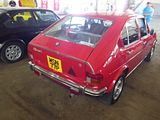
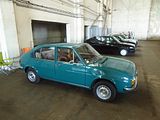


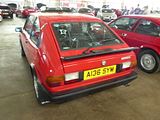
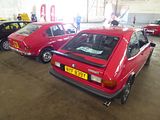


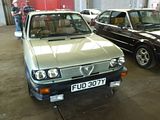


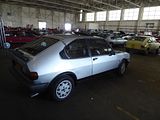

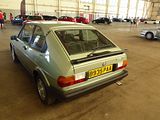

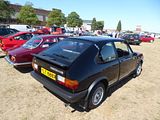

There was a much longer wait for a Coupe version of the AlfaSud than there had been for the larger Alfetta, the Alfasud Sprint being presented to the press in September 1976 in Baia Domizia and shown at the Turin Motor Show in November some five years after the launch of the saloon. Designed by Giorgetto Giugiaro like the AlfaSud, whose mechanicals it was based on, it had a lower, more angular design, featuring a hatchback, although there were no folding rear seats. The AlfaSud Sprint was assembled together with the AlfaSud in the Pomigliano d’Arco plant, located in southern Italy—hence the original “Sud” moniker. Under the Alfasud Sprint’s bonnet there was a new version of the AlfaSud’s 1186 cc four-cylinder boxer engine, stroked to displace 1,286 cc, fed by a twin-choke carburettor and developing 75 hp at 6,000 rpm. Mated to the flat-four was a five-speed, all-synchromesh gearbox. The interior was upholstered in dark brown Texalfa leatherette and tartan cloth. Options were limited to alloy wheels, a quartz clock and metallic paint. In May 1978 the AlfaSud Sprint underwent its first updates, both cosmetic and technical. Engine choice was enlarged to two boxers, shared with the renewed AlfaSud ti, a 78 hp 1.3 (1,350 cc) and a 84 hp 1.5 (1,490 cc); the earlier 1286 cc unit was not offered anymore, remaining exclusive to the AlfaSud. Outside many exterior details were changed from chrome to matte black stainless steel or plastic, such as the wing mirrors, window surrounds and C-pillar ornaments; the B-pillar also received a black finish, the side repeaters changed position and became square, and the front turn signals switched from white to amber lenses. In the cabin the seats had more pronounced bolsters and were upholstered in a new camel-coloured fabric. Just one year later, in June 1979, another engine update arrived and the AlfaSud Sprint became the AlfaSud Sprint Veloce. Thanks to double twin-choke carburettors (each choke feeding a single cylinder) and a higher compression ratio engine output increased to 85 hp and 94 hp, respectively for the 1.3 and 1.5. In February 1983 Alfa Romeo updated all of its sports cars; the Sprint received a major facelift. Thereafter the AlfaSud prefix and Veloce suffix were abandoned, and the car was known as Alfa Romeo Sprint; this also in view of the release of the Alfa Romeo 33, which a few months later replaced the AlfaSud family hatchback. The Sprint also received a platform upgrade, which was now the same as that of the Alfa Romeo 33; this entailed modified front suspension, brakes mounted in the wheels instead of inboard like on the AlfaSud, and drum brakes at the rear end. Three models made up the Sprint range: 1.3 and 1.5, with engines and performance unchanged from the AlfaSud Sprint Veloce, and the new 1.5 Quadrifoglio Verde—1.5 Cloverleaf in the UK. A multitude of changes were involved in the stylistic refresh; there were a new grille, headlamps, wing mirrors, window surrounds and C-pillar ornaments. Bumpers went from chrome to plastic, and large plastic protective strips were added to the body sides; both sported coloured piping, which was grey for 1.3 cars, red for the 1.5 and green for the 1.5 Quadrifoglio. At the rear new trapezoidal tail light assemblies were pieced together with the license plate holder by a black plastic fascia, topped by an Alfa Romeo badge—never present on the AlfaSud Sprint. In the cabin there were new seats with cloth seating surfaces and Texalfa backs, a new steering wheel and changes to elements of the dashboard and door panels. Sprint 1.3 and 1.5 came with steel wheels with black hubcaps from the AlfaSud ti. The newly introduced 1.5 Quadrifoglio Verde sport variant was shown at the March 1983 Geneva Motor Show. Its engine was the 1,490 cc boxer, revised to put out 104 hp at 6,000 rpm; front brake discs were vented and the gearing shorter. In addition to the green bumper piping, also specific to the Quadrifoglio were a green instead of chrome scudetto in the front grille, a rear spoiler and 8-hole grey painted alloy wheels with metric Michelin TRX 190/55 tyres. Inside a three-spoke leather-covered steering wheel, green carpets and sport seats in black cloth with green embroidery. In November 1987 the Sprint was updated for the last time; the 1.3 variant was carried over, while the 1.5 engine was phased out and the 1.5 QV was superseded by the 116 hp Sprint 1.7 Quadrifoglio Verde. The 1,286 cc engine was directly derived from the 33 1.7 Quadrifoglio Verde, and could propel the Sprint from 0 to 100 km/h in 9.3 seconds; to cope with the increased engine power, the 1.7 QV adopted vented brake discs upfront. the coloured piping and side plastic strips were deleted, and the Quadrifoglio had alloy wheels of a new design. A fuel injected and 3-way Catalytic converter-equipped 1.7 variant, with an engine again derived from a 33, was added later for sale in specific markets. There were a total of 116,552 Sprints produced during its lifespan, which lasted from 1976 to 1989. 15 of these formed the basis of the Australian-built Giocattolo sports car, which used a mid-mounted Holden 5.0 group A V8 engine. The Sprint had no direct predecessor or successor.




ALFETTA
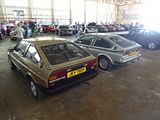
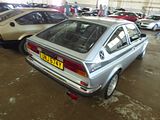
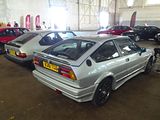
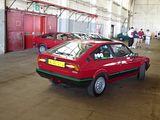
Taking its name from the successful Formula One car of 1951, the Type 159, was the Alfetta, and there were several of these to be seen here. The 116 Series Alfetta was launched in 1972, equipped with a 1.8-litre four-cylinder. It was a three-box, four-door saloon (Berlina in Italian) with seating for five designed in-house by Centro Stile Alfa Romeo; the front end was characterised by twin equally sized headlamps connected to a central narrow Alfa Romeo shield by three chrome bars, while the tail lights were formed by three square elements. At the 1975 Brussels Motor Show Alfa Romeo introduced the 1,594 cc 08 PS Alfetta 1.6 base model, easily recognizable by its single, larger round front headlights. Meanwhile, the 1.8-litre Alfetta was rebadged Alfetta 1.8 and a few months later mildly restyled, further set apart from the 1.6 by a new grille with a wider central shield and horizontal chrome bars. Engines in both models were Alfa Romeo Twin Cams, with two overhead camshafts, 8-valves and two double-barrel carburettors. Two years later the 1.6 was upgraded to the exterior and interior features of the 1.8. In 1977 a 2.0-litre model was added. Launched at the March Geneva Motor Show, the Alfetta 2000 replaced the long running 115 Series Alfa Romeo 2000. This range-topping Alfetta was 10.5 cm (4.1 in) longer than the others, owing to a redesigned front end with square headlights and larger bumpers with polyurethane inserts; the rectangular tail light clusters and C-pillar vents were also different. Inside there were a new dashboard, steering wheel and upholstery materials. Just a year later, in July 1978, the two-litre model was updated becoming the Alfetta 2000 L. Engine output rose from 122 PS to 130 PS; inside, the upholstery was changed again and dashboard trim went from brushed aluminium to simulated wood. The 2000 received fuel injection in 1979. A turbodiesel version was introduced in late 1979, the Alfetta Turbo D, whose engine was supplied by VM Motori. Apart from a boot lid badge, the Turbo D was equipped and finished like the top-of-the-line 2000 L both outside and inside. Therefore, it received a tachometer—very unusual in diesels of this era, but no standard power steering, in spite of the additional 100 kg (220 lb) burden over the front axle. The turbodiesel, a first on an Alfa Romeo’s passenger car, was of 2.0 litres and produced 82 PS. The Alfetta Turbo D was sold mostly in Italy and in France, as well as a few other continental European markets where the tax structure suited this model. It was never offered in the UK. In 1981 Alfa Romeo developed in collaboration with the University of Genoa a semi-experimental Alfetta version, fitted with a modular variable displacement engine and an electronic engine control unit. Called Alfetta CEM (Controllo Elettronico del Motore, or Electronic Engine Management), it was shown at the Frankfurt Motor Show. The 130 PS 2.0-litre modular engine featured fuel injection and ignition systems governed by an engine control unit, which could shut off two of four cylinders as needed in order to reduce fuel consumption. An initial batch of ten examples were assigned to taxi drivers in Milan, to verify operation and performance in real-world situations. According to Alfa Romeo during these tests cylinder deactivation was found to reduce fuel consumption by 12% in comparison to a CEM fuel-injected engine without variable displacement, and almost by 25% in comparison to the regular production carburetted 2.0-litre. After the first trial, in 1983 a small series of 1000 examples was put on sale, offered to selected clients; 991 examples were produced. Despite this second experimental phase, the project had no further developments. In November 1981 the updated “Alfetta ’82” range was launched, comprising 1.6, 1.8, 2.0 and 2.0 Turbo Diesel models. All variants adopted the bodyshell and interior of the 2.0-litre models; standard equipment became richer. All Alfettas had black plastic rubbing strips, side sill mouldings, tail light surround and hubcaps; the 2000 sported a satin silver grille and a simulated mahogany steering wheel rim. July 1982 saw the introduction of the range topping Alfetta Quadrifoglio Oro (meaning Gold Cloverleaf, a trim designation already used on the Alfasud), which took the place of the discontinued 2000 L. The Quadrifoglio Oro was powered by a 128 PS version of the usual 1962 cc engine, equipped with the SPICA mechanical fuel injection used on US-spec Alfettas; standard equipment included several digital and power-assisted accessories like a trip computer, check control panel and electrically adjustable seats. Visually the Quadrifoglio Oro was distinguished by twin round headlights, concave alloy wheels, and was only available in metallic grey or brown with brown interior plastics and specific beige velour upholstery. In March 1983 the Alfetta received its last facelift; the exterior was modernised with newly designed bumpers (integrating a front spoiler and extending to the wheel openings), a new grille, lower body plastic cladding, silver hubcaps and, at the rear, a full width grey plastic fascia supporting rectangular tail lights with ribbed lenses and the number plate. The C-pillar ventilation outlets were moved to each side of the rear screen. Inside there were a redesigned dashboard and instrumentation, new door panels and the check control panel from the Quadrifoglio Oro on all models. Top of the range models adopted an overhead console, which extended for the full length of the roof and housed three reading spot lamps, a central ceiling light, and controls for the electric windows. Alongside the facelift two models were introduced: the 2.4 Turbo Diesel, replacing the previous 2.0-litre, and a renewed Quadrifoglio Oro, equipped with electronic fuel injection. Thanks to the Bosch Motronic integrated electronic fuel injection and ignition the QO had the same 130 PS output of the carburetted 2.0, while developing more torque and being more fuel efficient. In April 1984 the successor of the Alfetta debuted, the larger Alfa Romeo 90. At the end of the year the Alfetta Berlina went out of production, after nearly 450,000 had been made over a 12-year production period.


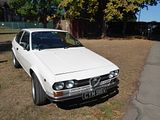
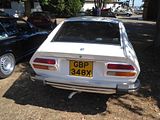
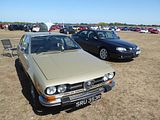
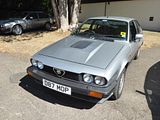
As was still the practice in the 1970s, Alfa followed up the launch of the Alfetta Berlina with a very pretty coupe. Styled by Giugiaro, this car, initially called the GT, and premiered in the autumn of 1974, looked completely unlike the saloon on which it was based. The first cars had 1.8 litre four cylinder engines and there was one of those on show. In 1976 the range was expanded both up and down with a 1.6 and a 2.0 model, the latter adopting the legendary GTV name. A rare SE model from this period was part of the display, complete with period vinyl roof (look closely), and although the pain does appear a bit like a lot of older Alfa reds, having gone rather pink, this was the actual shade when the car was new. In 1981, with the 2.5 litre V6 engine that had been developed for the ill-fated Alfa 6 luxury saloon available, Alfa was able to create a true rival for the 2.8 litre Capri with the GTV6. A facelift modernised the look of the car with plastic bumpers front and rear and a new interior looked rather better as well as being more ergonomically logical. There was a good mix of the earlier chrome bumpered and later plastic bumpered models, the last with 2.0 and 2.5 GTV6 versions both represented. There was also a car sporting 3.0 badging and right hand drive. This is a South African car. From 1974 South African Alfetta’s were manufactured at Alfa Romeo’s own Brits plant. South Africa was one of two markets to have a turbocharged GTV6, with a Garrett turbocharger and a NACA intake. An estimated 750 were assembled before all production ceased in 1986. The South African range included a 3.0 litre GTV-6, predating the international debut of the factory’s 3.0 litre engine in 1987 (for the Alfa 75). and 212 of these were built in South Africa for racing homologation. The last 6 GTV-6 3.0’s were fuel injected. To this day, the GTV-6 remains the quintessential Alfa Romeo for South Africans. The model is celebrating its 50th anniversary this year and there were a particularly impressive number of cars here to mark that fact.








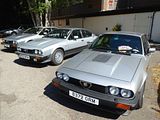

GIULIETTA
Slotting into the range below the Alfetta was the 116 series Giulietta, and there was just one of these cars, a late model. This Giulietta was introduced in November 1977 and while it took its name from the original Giulietta of 1954 to 1965, it was a new design based on the Alfa Romeo Alfetta chassis (including its rear mounted transaxle). While it was a conventional three-box saloon/sedan body style, a defining point of difference was at the rear, where there was a short boot, and a small aerodynamic spoiler, integrated into the body. The Giulietta was only offered in saloon form, but there were several estate/station wagon conversions made. First out was Moretti, whose conversion appeared in the first half of 1978. At launch, two models were available: Giulietta 1.3, with an oversquare 95 PS 1357 cc engine, and Giulietta 1.6, with a 109 PS 1570 cc engine, both Alfa Romeo Twin Cam inline-fours fed by two twin-choke carburettors. In April 1979, just under two years later, Giulietta 1.8 with a 122 PS 1,779 cc engine was added, and in May of the following year the Giulietta Super with a 2-litre engine (1,962 cc, 130 PS appeared. In summer of 1981, the Giulietta received a minor facelift, externally and internally, while the engines remained the same. The car got plastic protection around the lower body, while interior modifications included a new steering wheel and new seats. The instrument panel and the centre armrest were also modified. The Autodelta-produced Giulietta 2.0 Turbo Autodelta (175 PS) was introduced at the 1982 Paris motor show. This special version had a turbocharged 1,962 cc engine. The production Giulietta Turbodelta version had 170 PS and a KKK turbocharger coupled with two double-barrel Weber carburettors. All turbo versions were black with red interior; only 361 were produced. In the same year, the Giulietta 2.0 Ti and turbodiesel (VM) 1995 cc version with 82 PS were also introduced, going on sale in early 1983. In 1982, Alfetta and Giulietta turbodiesels achieved seven world speed records over 5/10/25/50 thousand kilometres and 5/10/25 thousand miles at Nardò (Lecce). While one of the quickest diesels in its category at the time, the Giulietta was rather costly and suffered from a very forward weight distribution (56.9 per cent over the front wheels). In late 1983, the “84” Giulietta (Series 3) was presented, with minor differences in appearance, bumpers were redesigned and the dashboard was significantly re-designed, the instruments changed slightly and the rear seat in some versions changed its form. Mechanically it was basically the same, with minor modifications to the brake booster and inlet manifold on some versions. The largest market for the Giulietta was South Africa, where a very successful TV advertising campaign by Alfa Romeo produced good sales between 1981 and 1984. Central to this campaign was emphasis of the Giulietta’s new ‘aerodynamic’ line, which was carried over to the 75, and then the 33. The Giulietta was the ‘last hurrah’ for Alfa in South Africa before the appearance of the 164 and 156 models in the 1990s. In 1985, after around 380,000 Giuliettas had been built, it was replaced by the Alfa Romeo 75, which used much of the Alfetta/Giulietta underpinnings.
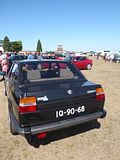

SIX
On its launch in 1979, the Alfa 6 was the flagship of the Alfa Romeo range. The four-door body was fairly conventional and used a similar style to the existing Alfa Romeo Alfetta, and in fact both vehicles share a great number of parts, including door panels; Design work on the 6 was done prior to the Alfa Romeo Alfetta, but the fuel crisis of 1973 delayed further development and led to the 6’s belated 1979 debut. The styling was not particularly aerodynamic but the drag coefficient was a somewhat respectable 0.41. Power came from an all-new 2.5 V6 engine which generated 158 PS at 5600 rpm using a total of six carburettors and a single, belt driven camshaft in each cylinder head. Power steering, power windows, central locking, electric wing mirrors and a 25% limited slip differential were standard, making the Alfa 6 competitively priced compared to similar saloons of that time where such equipment typically was a costly extra. The car was also designed to set new standards in safety; for example it featured a shock sensor in the boot which would cut off the fuel supply in the event of a crash. UK sales did not start until the autumn of 1980. In 1983, the car was revamped, with single rectangle headlights replacing the twin round units, new bumpers, a new grille and new trim around the rear lights. Minor interior changes were also carried out, whilst mechanically the engine’s troublesome six carburettors were replaced by Bosch L-Jetronic fuel injection, with the power remaining at 158 PS. This revamp also saw the introduction of two new engines, a 2.0 version of the existing V6 engine (which retained the carburettors and was specific for the Italian market, where engines larger than two litres were heavily taxed) and a 2.5 litre VM 5 cylinder turbodiesel. Sales petered out in 1985. The car was not a success even in its native Italy, with just 12.070 built in total.


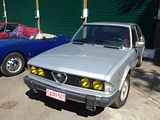

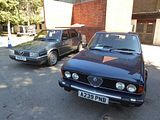
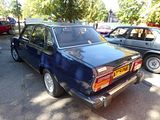


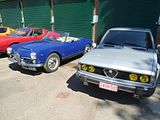


33
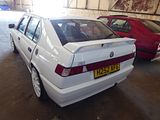
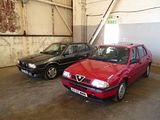
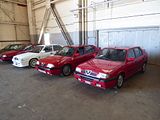
Follow on to the much-loved AlfaSud was the Alfa 33. Despite the low survival rate, believe it or not, the 33 is actually the best selling Alfa in history, with just under a million of them sold between 1983 and 1994. One reason why precious few seem to have survived is that the 33 struggled even new to gain the affections of the enthusiasts in the way that the model’s predecessor, the AlfaSud, did, so when rust and old age came on, the vast majority of the cars were simply scrapped. There were two distinct generations of the 33. The first ran from 1983 until 1990 and then a major facelift was applied with new front and rear styling to bring the looks more into line with the new 164. A mild facelift was applied to the first 905 series cars in late 1986. Exterior alterations were limited to clear indicator lens, wheel covers and alloy wheels of new design, the adoption of side skirts on all models, and a new front grille. Two-tone paint schemes were discontinued. There were more significant changes inside, with a more conventionally designed dashboard and steering wheel, which superseded the innovative moveable instrument binnacle. All 1.5 variants now had the 105 PS engine from the now discontinued 1.5 QV; a TI (Turismo Internazionale) trim level was exclusive to the front-wheel drive 1.5 hatchback. Changes were made to the suspension, brakes and gearbox, with closer-spaced ratios. A new 1,712 cc 116 bhp engine was introduced on the 1.7 Quadrifoglio Verde, which replaced the 1.5 QV. The 1.7 engine was developed from the 1.5 by enlarging bore and stroke; it also used new cylinder heads, incorporating hydraulic tappets. To cope with the increased power the new QV was equipped with vented front brake discs. The 1.7 QV looked close to its predecessor, but had lost the grey mid-body stripe and gained new alloy wheels, wind deflectors on the front windows, more pronounced side skirts and a rear body-colour spoiler on the boot lid. Inside it featured a leather-covered steering wheel, red carpets, and leatherette-backed sport seats upholstered in a grey/black/red chequered cloth. Diesel models were offered in some continental markets, but these were not sold in the UK, where only 1.5 and 1.7 Green Cloverleaf hatchback models were sold, as well as a market-specific 1.7 Sportwagon estate; all three were also available in “Veloce” versions, outfitted by Alfa Romeo GB with a colour-matching Zender body kit.

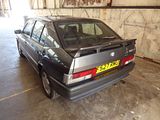

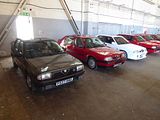




90
The Alfa Romeo 90 (Type 162A) is an executive car produced between 1984 and 1987. Designed by Bertone and introduced at the 1984 Turin Motor Show, the 90 was pitched between the Alfa Romeo Giulietta (nuova) and the Alfa Romeo Alfa 6, both of which were soon discontinued after the 90’s launch. The car used the Alfetta chassis (including its rear mounted transaxle) and took its engines from the larger Alfa 6. The bodywork was similar to both, albeit modernised. One notable feature of the 90’s design was a small chin spoiler which extended above a certain speed to aid engine cooling. Its angular lines with integrated bumpers gave the car a neat look consistent with the period, however the aerodynamics suffered with a drag coefficient of Cd=0.37. The cars design was conservative, inside and out, with perhaps the only unusual element being the U-shaped parking brake lever. The 90 was well equipped, including electric front windows and electrically adjustable seats as standard. The luxurious Gold Cloverleaf (Quadrifoglio Oro) model had electric rear windows, a trip computer, power steering, central locking, metallic paint and a digital instrument panel as standard. The passenger fascia included a slot for an optional briefcase, made by Valextra. The external finish was very similar across the board, it being near impossible to tell the different models apart from appearance alone. The 90 was made only as a sedan but in 1985 Carrozzeria Marazzi developed an Alfa 90 Station Wagon prototype at the behest of Italian motoring magazine Auto Capital; only two cars were made. The Alfa 90 has a longitudinal front engine, a rear mounted gearbox with differential lock and independent front suspension wishbones with torsion bar springs and rear De Dion tube. It has disc brakes on all four wheels, the rear brakes are mounted inboard. Five engines were available: two Alfa Romeo Twin Cam engines; 1,779 cc and 1,962 cc and two fuel injected Alfa Romeo V6 engines: 1,996 cc or 2,492 cc, and finally a 2,393 cc turbodiesel made by VM Motori. The carburettor fours have twin Dell’Ortos with manual chokes, while the 1,962 cc was also available in a fuel injected model which also incorporated a novel variable valve timing system. The fuel injected engine has the same maximum power but offered somewhat less torque; this was perhaps more than made up for with a 20 percent improvement in fuel economy. The 2.0 V6 version was dedicated to the Italian market, where up to 1993 cars with engines over 2.0-litres were subjected to a doubled 38% VAT. It was equipped with an innovative engine control unit and electronic injection system named CEM (Controllo Elettronico del Motore), developed by Alfa Romeo subsidiary SPICA. It manages the opening time of the injectors and the ignition depending on the angle of the butterfly valves, with one throttle body per cylinder unlike on the Bosch L-Jetronic used on the 2.5 V6. V6 cars receive a double-plate clutch while the four-cylinders rely on a single-plate unit. The 90 was revamped in 1986 with many minor changes throughout, the most obvious exterior change being a new grille with smaller horizontal slants. A total of 56,428 cars were sold over the four years of production. It is believed that just 10 of these cars remain in the UK and at any one time, most of them are on SORN so they are a very rare sighting indeed.


75
2025 marks the 40th anniversary of the Alfa 75 and to mark the occasion, it was hope to assemble 40 examples of the model here, all parked together. That target was not quite reached, but the event was not far off. The Alfa 75 was the last Alfa model to be developed before the company was bought by Fiat. It was introduced in May 1985, to replace the 116 Series Giulietta with which it shared many components. It was named to celebrate Alfa’s 75th year of production. The body, designed by head of Alfa Romeo Centro Stile Ermanno Cressoni, was styled in a striking wedge shape, tapering at the front with square headlights and a matching grille. The 75 was only ever sold as a four door saloon, though at the 1986 Turin Auto Salon, a prototype 75 estate was to be seen, an attractive forerunner of the later 156 Sportwagon. This version was, however, never listed for sale, being cancelled after Fiat took control of Alfa Romeo. The car, dubbed the 75 Turbo Wagon, was made by Italian coachbuilder Rayton Fissore using a 75 Turbo as the basis. Two estate versions were to be found at the later 1987 Geneva Motor Show; one was this Turbo Wagon and the other was a 2.0 litre version named the Sportwagon. The 75 featured some unusual technical features, most notably the fact that it was almost perfectly balanced from front to rear. This was achieved by using transaxle schema — mounting the standard five-speed gearbox in the rear connected to the rear differential (rear-wheel drive). The front suspension was a torsion bar and shock absorber combination and the rear an expensive de Dion tube assembled with shock absorbers; these designs were intended to optimize the car’s handling; moreover the rear brake discs were fitted at the centre of the rear axle, near the gearbox-differential group. The engine crankshaft was bolted directly to the two-segment driveshaft which ran the length of the underside from the engine block to the gearbox, and rotated at the speed of the engine. The shaft segments were joined with elastomeric ‘doughnuts’ to prevent vibration and engine/gearbox damage. The 2.0 litre Twin Spark and the 3.0 Litre V6 were equipped with a limited slip differential. The 75 featured a then-advanced dashboard-mounted diagnostic computer, called Alfa Romeo Control, capable of monitoring the engine systems and alerting the drivers of potential faults. The 75 engine range at launch featured four-cylinder 1.6, 1.8 and 2.0 litre petrol carburettor engines, a 2.0 litre intercooled turbodiesel made by VM Motori, and a 2.5 litre fuel injected V6. In 1986, the 75 Turbo was introduced, which featured a fuel-injected 1779 cc twin-cam engine using Garrett T3 turbocharger, intercooler and oil cooler. In 1987, a 3.0 litre V6 was added to the range and the 2.0 lire Alfa Romeo Twin Cam engine was redesigned to have now two spark plugs per cylinder, the engine was named as Twin Spark. With fuel injection and variable valve timing this engine produced 146 hp. This was the first production engine to use variable valve timing. In North America, where the car was known as the Milano, only the 2.5 and 3.0 V6s were available, from 1987 to 1989. The North American 2.5-litres were fundamentally different from their European counterparts. Due to federal regulations, some modifications were required. Most noticeable from the outside were the ‘America’ bumpers, with the typical rubber accordions in them. Furthermore, these bumpers had thick (and heavy) shock-absorbing material inside them and in addition, they were mounted to the vehicle on shock absorbers. To accommodate these shock absorbers, the ‘America’-bodies were slightly different from the European ones. The North American cars also had different equipment levels (depending on the version: Milano Silver, Milano Gold or Milano Platinum). electrically adjustable outside mirrors, electrically reclining seats and cruise control were usually optional in Europe. The car was also available with a 3-speed ZF automatic gearbox option for the 2.5 V6. Other, more common options such as electrically operated rear windows and an A/C system were standard in the USA. The USA-cars also had different upholstery styles and of course different dashboard panels also indicating speed in mph, oil pressure in psi and coolant temperature in degrees F, and as a final touch the AR control was different, including a seat belt warning light. The European-spec 2.5 V6 (2.5 6V Iniezione or 2.5QV) was officially sold only between 1985 and 1987, although some of them were not registered until 1989. Relatively few of them were sold (about 2800 units), especially when the 155 PS 1.8 Turbo was launched, which in some countries was cheaper in taxes because of its lower displacement. To create a bigger space between the V6 and the inline fours, the 2.5 was bored out to 2959 cc’s to deliver 188 PS and this new engine was introduced as the 3.0 America in 1987. As its type designation suggests, the 3.0 only came in the US-specification, with the impact-bumpers and in-boot fuel tank. However, the European ‘America’s’ were not equipped with side-markers or the door, bonnet and boot lid fortifications. Depending on the country of delivery, the 3.0 America could be equipped with a catalytic converter. In 1988 engines were updated again, the 1.8 litre carburettor version was replaced with fuel injected 1.8 i.e. and new bigger diesel engine was added to the range. In the end of 1989 the 1.6 litre carburettor version was updated to have fuel injection and 1990 the 1.8 Turbo and 3.0i V6 got some more power and updated suspension. The 3.0 V6 was now equipped with a Motronic system instead of an L-Jetronic. The 1.8 Turbo was now also available in ‘America’-spec, but strangely enough not available for the USA market. The 3.0 V6 did make it to the United States, and was sold as Milano Verde. The UK never particularly warmed to the 75 when it was new, but its reputation has got ever stronger as the car ages.







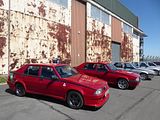
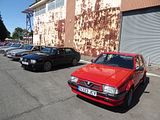


Perhaps the best known Alfa 75 is this one, which appeared in Episode 3, Series 11 of Top Gear in 2008, in which the three presenters were tasked with buying an Alfa Romeo for under £1000. Jeremy Clarkson bought this car for just £450, highlighting its rear-mounted gearbox for improved weight distribution, limited-slip differential, and distinctive in-board rear brakes. Clarkson notably praised its 3.0-litre Busso V6 engine, calling it “one of the best engines ever to go into mass production.” Throughout the episode, the car faced several challenges, including a track day at Rockingham Motor Speedway, a calendar photoshoot, and the Auto Italia Stanford Hall Concours, for which Clarkson personally repainted it in a memorable shade he called ‘Skoda Green’. Today, the car still wears much of Clarkson’s original paintwork and battle scars from its TV adventures. Following its appearance on Top Gear, the Alfa Romeo 75 has been meticulously maintained during 11 years of current ownership, with approximately £4,500 invested mechanically. Important work has included a cam belt service, a new clutch, and a gearbox rebuild. With just over 51,000 miles on the clock, the car came up for auction at the 2024 Silverstone Festival. Offered with a comprehensive history file, original handbooks, stamped service book, old MOT records, and a detailed DVLA ownership history. The sale included replacement doors and bonnet for those interested in returning it to standard specification. It fetched £12.075 and since then has appeared at a number of events.
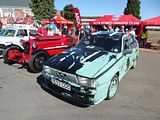
164
I was delighted to see that the larger 164 was also represented here, as I had the pleasure of driving one for 4 years and 160,000 miles and to this day, it is the car I regret parting with more than any other of the fleet that I have owned over the years. When I bought mine, Alfa were selling a very small number of cars per month in the UK, so they were never that common, and sadly, survival rates are very low. Most people who know anything about the history of the 164 will be aware that this is one of the four so-called Type 4 cars, a joint venture involving Alfa Romeo, Fiat, Lancia and Saab. In 1978 these four marques agreed to each develop an executive saloon based on a shared platform to compete against the likes of the Ford Granada and Opel Rekord (Vauxhall Carlton) as well as more premium saloons by BMW and Mercedes-Benz in the form of the 5-Series and E-Class, respectively. Alfa’s Project 164 started life as Project 154 and was completed in 1981, then still under Alfa Romeo. A year later, that project morphed into the 164 based on the Type Four platform. This new model was designed by Enrico Fumia of Pininfarina, with a wedge shape that afforded it a leading drag coefficient of Cd=0.30. The design would later influence the rest of the Alfa Romeo range starting in 1990 with the major redesign of the 33 and culminating with the 155, and Pininfarina also adapted it (much to the maker’s chagrin) for the 1987 Peugeot 405 and the 1989 Peugeot 605 saloons. Initial testing of the 164’s dynamic elements (engine and drivetrain) began in 1984, where mules based on the then contemporary Giulietta were used. In 1985, the first pre-production 164’s were put through their paces on the road. Heavily disguised, with many false panels and even a false nose design (borrowing heavily from the then equally undeveloped 155), sporting 4 round headlamps, these vehicle mules served to test the 164 for the gruelling 1 million kilometre static and road testing demanded of the design. In 1986 and 1987, the first 150 164’s were given their pre-production testing. In terms of engineering demands, these exceeded every Alfa before, and by quite a substantial margin. In Morocco, desert testing saw 5 grey 164 Twinsparks and V6’s undergo the equivalent of the Paris-Dakar rally. Road conditions varied from good tarmac to off-road conditions, and accelerometers confirmed the superiority of the 164 in terms of passenger comfort. This data was cross-confirmed in the engineering laboratory with a sophisticated dummy in the driver’s seat, with accelerometers both in its seat, and in its ears to mimic that of the semi-circular canals of the ear. The Twinspark and the V6 underwent handling trials at Arese. The Twinspark displayed very mature driving manners at the limit, with minimal skid. The V6 displayed a 25% increase in at-the-limit skid, a natural consequence of its greater nose weight. ABS testing confirmed that the Twinspark has superior braking to the V6. Brake linings of the 164’s were run at maximum braking until they literally glowed with heat, and displayed no deviation in form. The 164 was the first Alfa to feature slotted double-walled disc brakes. At no point were the discs drilled to release excess heat, the original design being demonstrated to be excellent. Sound production was tested in an anechoic chamber, the car being subjected to stress and road noise testing, with instruments and with live subjects at the wheel, on a specially designed rig. Electromagnetic stability of the complex electronic system was also tested, in an anechoic chamber equipped with EM emitters (radar). The 164 engines were run to destruction, the Twinspark proving to be the most robust, and with the longest possible engine life. The V6 displayed only 10% shorter overall engine life. All this testing meant that by the time the production car, called the 164 was unveiled at the 1987 Frankfurt Motor Show – the last model to be developed while the Alfa Romeo was still a fully independent company, even though the launch was a few months after the takeover by Fiat – that the car was far more thoroughly developed and tested than any Alfa preceding it. There were plenty of innovations in the build, too, thanks to the extensive use of galvanised steel for the frame and various body panels for the first time in the brand’s history. Moreover, the car featured advanced electronics thanks to the most complex wiring harness fitted to any Alfa Romeo. For example: it had three onboard computers (one for air conditioning, one for instrumentation, and one for the engine management); air conditioning and instrument functions shared a multiple-mode coded Zilog Z80-class microcontroller for dashboard functioning). The instrumentation included a full range of gauges including an advanced check-panel.. The car was a sensation at launch. For a start, it looked fantastic thanks to Enrico Fumia of Pininfarina’ design. The first 1:1 scale model of the car had been produced in 1982 and design cues had been publicly revealed on the Alfa Romeo Vivace concept car, which was exhibited at the 1986 Turin Motorshow that went on to influence the design of the Alfa Romeo GTV and Spider (916 series) launched in 1993, but the result was distinctive and elegant and very different from any of its rivals, or indeed any of the other Tipo 4 cars. The 164 became the first Alfa to benefit from extensive use of computer aided design, used to calculate structural stresses that resulted in a very rigid but still relatively lightweight chassis. Although sharing the same platform as that of the Lancia Thema, Fiat Croma and Saab 9000, by virtue of the fact that it was the last of the four to enter production, it featured unique front suspension geometry and the most distinctive styling of the lot. In fact, for example, the other cars all shared identical side door panels. Though still voluminous, the 164 had the tightest aperture to the boot, which had a 510-Litre capacity. The interior was spacious and modern, available with standard velour seating or leather trim depending on the model. Its dashboard continued the avantgarde design of the exterior with a centre dashboard that was dominated by a large number of seemingly identical buttons arranged in rows. Air-direction within the ventilation system was controlled by a pair of servomechanisms, which were constructed using notoriously fragile plastic gears that were prone to failure. Depending on the model, the 164 could feature automatic climate control and electronically controlled damping suspension – the latter, for example, in the sports-oriented Quadrifoglio Verde (“Green Cloverleaf “) and 164S models. This suspension actively reduced damping in response to conditions to provide a dynamic compromise between road holding and comfort. At launch, the original 164 range comprised three models: a 148 bhp 2.0 Twin Spark, the 192 bhp 3.0i V6 12-valve and a 2.5 Turbodiesel (badged “TD”). It took a year before the first cars reached the UK and the first eighteen months saw only the 3 litre model offered. The bigger selling 2.0 TS arrived in the summer of 1990, just before the range was expanded by the 4-cylinder 2.0i Turbo, the sports-oriented 3.0i V6 Quadrifoglio Verde (badged “QV” or “S”) and North American export versions that included the luxury-oriented 164 L (“L” for Lusso) and the 164 S (in essence, the “QV”). Apart from minor running production upgrades, the next change came in 1993 with the launch of the 164 Super. Key differences on the outside consisted of larger bumpers with chrome trimmings added to the upper edge and revised headlights with a slimmer profile. Inside, there were revised instruments and a centre console that featured more delineated switchgear. The range was now also bolstered by a 3.0 V6 24V with a 24-valve engine upgrade and the 3.0 V6 Quadrifoglio 4 (badged “Q4”), which was the most powerful and sole all wheel drive variant built. Production ended in late 1997, with a gap of nearly two years before the replacement model would go on sale.
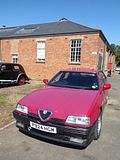


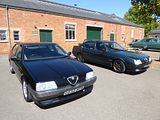


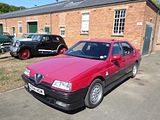
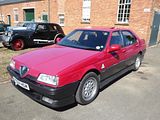


SZ and RZ
It was more than 10 years after the Montreal had ceased production before Alfa offered another high-end and costly Coupe model, and the result, seen for the first time in 1989, could hardly have been more different than its forebear. That car had been praised for its looks, whereas this one, the SZ, and cruelly nicknamed “Il Mostro”, was almost wilfully, well, “different”. First seen at the 1989 Geneva Show, the car was also first shown simply as a concept, called the ES-30, for Experimental Sports car 3 litre. It was produced by Zagato. Robert Opron of the Fiat design studio was responsible for the initial sketches while Antonio Castellana was largely responsible for the final styling details and interior. Only the ‘Z’ logo of Zagato was kept. The car possessed unusual headlights positioned in a trio on each side – a styling used more subtly on later Alfa Romeos in the 2000s. Mechanically and engine-wise, the car was based on the Alfa 75, production being carried out by Zagato at Terrazzano di Rho near the Alfa factory in Arese. The thermoplastic injection moulded composite body panels were produced by Italian company Carplast and French company Stratime Cappelo Systems. The suspension was taken from the Alfa 75 Group A/IMSA car, and modified by Giorgio Pianta, engineer and team manager of the Lancia and Fiat rally works team. A hydraulic damper system was made by Koni. The SZ was originally equipped with Pirelli P Zero tyres (front 205/55 ZR 16, rear 225/50 ZR 16) and is able to sustain over 1.1 G in cornering, some drivers have measured a cornering force of 1.4 G, which remains an excellent performance figure. Low volume production got underway late in 1989, and over the next three years, 1036 were built, slightly more than planned. With the exception of a black car made for Zagato, all of them were red. Subsequently a convertible version, the RZ (for Roadster Zagato), was produced from 1992 until December 1994. Although almost identical to look at the two cars had completely different body panels save for the front wings and boot. The RZ had a revised bumper and door sills to give better ground clearance and the bonnet no longer featured the aggressive ridges. Three colours were available as standard: black, yellow and red, with black and yellow being the more popular choices. Yellow and red cars got a black leather interior and black cars burgundy. Although the interior layout was almost unchanged from the SZ, the RZ had a painted central console that swept up between the seats to conceal the convertible roof storage area. 350 units were planned but production was halted after 252 units when the Zagato factory producing the cars for Alfa Romeo went in to receivership, a further 32 cars were then completed under the control of the receivers before production finished at 284 units. Of those final three were painted silver with burgundy interior and another pearlescent white.
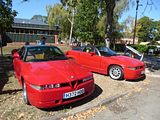
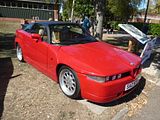

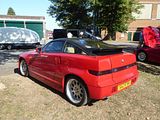
155
The 155 was one of a series of cars built by the Fiat Group on a shared platform, the so called Tipo 3 or Tipo Tre, which sat under the Fiat Tipo, and Lancia Delta 2, as well as the Fiat Coupe. Built to replace the rear wheel drive 75, the 155 was somewhat larger in dimension than its predecessor. The 155 was designed by Italian design house I.DE.A Institute which achieved an exceptional drag coefficient of 0.29, and the rather boxy design gave the car a sizeable boot, as well. The single most significant technical change from the 75 was the change to a front-wheel drive layout. This new configuration gave cost and packaging benefits but many Alfa die-hards and the automotive press lamented the passing of the “purer” rear-wheel drive layout on a car from this sporting marque. Not even the availability of the 155 Q4, which had a 2.0-litre turbocharged engine and a permanent four-wheel drive powertrain, both derived from the Lancia Delta Integrale; making the car essentially a Lancia Delta Integrale with a different body was enough to win the sceptics over. Reception of the model was generally lukewarm. The 75 had been conceived prior to Fiat’s acquisition of the Alfa brand, so as “the last real Alfa” it cast rather a shadow over the 155; the loss of rear-wheel drive was frequently cited as the main cause of the disappointment. Nevertheless, the 155 was entered in Touring Car racing and was successful in every major championship it entered, which gradually improved its image. Belatedly, the factory introduced a wider version in 1995 (the “wide-body”) which as well as a wider track and revised steering based on racing experience or requirements, also brought in new 16-valve engines for the 1.8 and 2.0-litre whilst retaining the 2.5 V6 and making some improvements to cabin materials and build quality. There were several Sport Packs available, including a race-inspired body kit (spoiler and side skirts) and black or graphite-coloured 16-inch Speedline wheels. The more genteel could opt for the Super which came with wood inserts in the cabin and silver-painted alloy wheels. With this version, the 155 really came good. When production ceased in 1998, following the launch of the 156, 192,618 examples had been built.
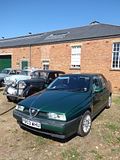


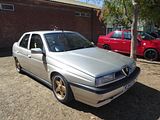

916 SERIES GTV/SPIDER
The 916 Series cars were conceived to replace two very different models in the Alfa range. First of these was the open topped 105 Series Spider which had been in production since 1966 and by the 1990s was long overdue a replacement. Alfa decided to combine a follow on to the Alfetta GTV, long out of production, with a new Spider model, and first work started in the late 1980s. The task was handed to Pininfarina, and Enrico Fumia’s initial renderings were produced in September 1987, with the first clay models to complete 1:1 scale model made in July 1988. Fumia produced something rather special. Clearly an Italian design, with the Alfa Romeo grille with dual round headlights, recalling the Audi-based Pininfarina Quartz, another design produced by Enrico Fumia back in 1981, the proposal was for a car that was low-slung, wedge-shaped with a low nose and high kicked up tail. The back of the car is “cut-off” with a “Kamm tail” giving improved aerodynamics. The Spider would share these traits with the GTV except that the rear is rounded, and would feature a folding soft-top with five hoop frame, which would completely disappear from sight under a flush fitting cover. An electric folding mechanism would be fitted as an option. Details included a one-piece rear lamp/foglamp/indicator strip across the rear of the body, the minor instruments in the centre console angled towards the driver. The exterior design was finished in July 1988. After Vittorio Ghidella, Fiat’s CEO, accepted the design, Alfa Romeo Centro Stile under Walter de Silva was made responsible for the completion of the detail work and also for the design of the interiors, as Pininfarina’s proposal was not accepted. The Spider and GTV were to be based on the then-current Fiat Group platform, called Tipo Due, in this case a heavily modified version with an all new multilink rear suspension. The front suspension and drivetrain was based on the 1992 Alfa Romeo 155 saloon. Chief engineer at that time was Bruno Cena. Drag coefficient was 0.33 for the GTV and 0.38 for the Spider. Production began in late 1993 with four cars, all 3.0 V6 Spiders, assembled at the Alfa Romeo Arese Plant in Milan. In early 1994 the first GTV was produced, with 2.0 Twin Spark engine. The first premiere was then held at the Paris Motor Show in 1994. The GTV and Spider were officially launched at the Geneva Motor Show in March 1995 and sales began the same year. The cars were well received. At launch, many journalists commented that Alfa had improved overall build quality considerably and that it came very close to equalling its German rivals. I can vouch for that, as I owned an early GTV for eighteen months, and it was a well built and reliable car. In 1997 a new engine, a 24-valve 3.0 litre V6, was available for the GTV along with bigger, 12.0 inch brakes and red four-pot calipers from Brembo. The console knobs were changed from round central to rectangle ones and to a three-spoke steering wheel. Some versions were upgraded with different front bumper mesh to bring the wind noise down to 74 dBA. In May 1998 the cars were revamped for the first time, creating the Phase 2 models. Most of the alterations were inside. The interior was changed with new centre console, painted letters on skirt seals, changed controls and switches arrangement and different instrument cluster. Outside, the main changes included chrome frame around the grille and colour-coded side skirts and bumpers. A new engine was introduced, the 142 hp 1.8 Twin Spark, and others were changed: the 2.0 Twin Spark was updated with a modular intake manifold with different length intakes and a different plastic cover. Power output of the 2.0 TS was raised to 153 hp. Engines changed engine management units and have a nomenclature of CF2. The dashboard was available in two new colours in addition to the standard black: Red Style and Blue Style, and with it new colour-coded upholstery and carpets. The 3.0 24V got a six-speed manual gearbox as standard and the 2.0 V6 TB engine was now also available for the Spider. August 2000 saw the revamp of engines to comply with new emission regulations, Euro3. The new engines were slightly detuned, and have a new identification code: CF3. 3.0 V6 12V was discontinued for the Spider and replaced with 24V Euro3 version from the GTV. 2.0 V6 Turbo and 1.8 T.Spark were discontinued as they did not comply with Euro3 emissions. By the 2001-2002 model year, only 2 engines were left, the 2.0 Twin.Spark and 3.0 V6 24V, until the Phase 3 engine range arrived. The Arese plant, where the cars had been built, was closing and, in October 2000, the production of GTV/Spider was transferred to Pininfarina Plant in San Giorgio Canavese in Turin. In 2003 there was another and final revamp, creating the Phase 3, also designed in Pininfarina but not by Enrico Fumia. The main changes were focused on the front with new 147-style grille and different front bumpers with offset numberplate holder. Change to the interior was minimal with different centre console and upholstery pattern and colours available. Instrument illumination colour was changed from green to red. Main specification change is an ASR traction control, not available for 2.0 TS Base model. New engines were introduced: 163 bhp 2.0 JTS with direct petrol injection and 237 bhp 3.2 V6 24V allowing a 158 mph top speed. Production ceased in late 2004, though some cars were still available for purchase till 2006. A total of 80,747 cars were made, and sales of the GTV and Spider were roughly equal. More V6 engined GTVs than Spiders were made, but in 2.0 guise, it was the other way round with the open model proving marginally more popular.

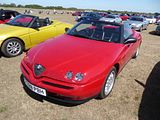
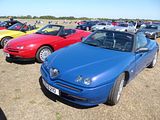
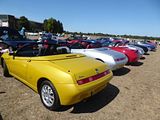

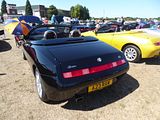


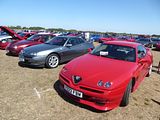


145/146
When it came to replacing the 33, Alfa decided that they needed not just a five door hatch, but a three door as well, just as had been offered with the AlfaSud. The three door model, the Alfa Romeo 145 (Tipo 930A) was first to appear, making its debut on static display at the April 1994 Turin Motor Show and then at the Paris Motor Show in July. A simultaneous European commercial launch was planned for 9 September, but it was delayed until October. It was only in April 1992 that work had begun on a second car, the 146 or Tipo 930B, derived from and to be sold alongside the 145; with its more traditionally Alfa Romeo style it was aimed at a different clientele, that of the outgoing Alfa Romeo 33. The 146 premiéred in November 1994 at the Bologna Motor Show and went on sale in May 1995. The two cars shared design plans and interior components from the B-pillar forwards, but with very different looking rear ends. Based, as they were, on the Fiat Group’s Tipo Due (Type Two) platform, the 145 and 146 had a unibody structure, front MacPherson strut and rear trailing arm suspensions. A peculiarity of these cars is that they were designed to be fitted with both longitudinal engines (the older Boxers) and with transverse engines (the diesels and the Twin Spark). The former were mounted in the same configuration as on the 33 or Alfasud, that is longitudinally overhanging the front axle with the gearbox towards the cabin; the latter in the conventional transverse position with the gearbox to the left side. All engines were coupled to 5-speed manual transmissions. Steering was rack and pinion, with standard hydraulic power assistance. At launch the engine line-up for both cars comprised a 1.9-litre inline-four turbo diesel and the boxer petrol engines from the 33, in 1.3 8-valve, 1.6 8-valve and range topping 1.7 16-valve flat four forms. Depending on the market, the engines were available in either or both base and better equipped L (for “Lusso”) trim levels; L trim standard equipment was richer on larger engined cars. Flagship sport models with the two-litre 16-valve Twin Spark inline-four engine from the Alfa Romeo 155 arrived a year after the début: the 145 Quadrifoglio and 146 ti. Each of the two-litre versions had a unique trim level; both included richer standard equipment than L trims, like ABS, leather-wrapped steering wheel and shifter knob and available Recaro sport seats. The 145 Quadrifoglio (145 Cloverleaf in the UK), launched at the September 1995 Frankfurt Motor Show and on sale from October,had deep body-colour side skirts with “green cloverleaf” badges and 5-hole alloy wheels. The 146 ti went on sale in February 1996. It came with painted side skirts, a boot spoiler and 12-hole alloy wheels. Two-litre cars were equipped with stiffer suspension, uprated all-disk braking system, ABS, wider, lower-profile tires and ‘quick-rack’ direct steering (also seen on the 155, GTV and Spider) which improved responsiveness, but also compromised the turning circle. The sporty suspension set-up was harsher than many others in its category at the time, but this was in line with the Fiat Group’s marketing of Alfa Romeo as a sporting brand and it is said to have resulted in class leading handling. From January 1997 all the boxer engines were phased out in favour of 1.4, 1.6 and 1.8 versions of the Twin Spark 16-valve engine.1.8-litre cars adopted the sport chassis, steering and brakes of the Quadrifoglio/ti, and also offered some of their optional equipment such as the sport seats. At the same time the interior was updated: a new air conditioning system, a redesigned dashboard an upholstered insert were fitted. Outside changes were minor: new wheel covers and alloy wheels and a wider choice of paint colours. In late 1997 Alfa Romeo introduced the Junior, a trim level targeted at young buyers that combined the sport styling and chassis setup of the range topping models with the affordable entry-level 1.4 powertrain, later with 1.6 engine too. Based on the 1.4 L, Junior cars were distinguished by the Quadrifoglio’s side skirts with “Junior” badges, specific 15 inch alloy wheels, and by the stainless steel exhaust tip (as well as, on the 146, the boot spoiler) from the ti. A year later 1.8 and 2.0 Twin Spark engines received the updates first introduced on the Alfa Romeo 156; thanks to variable length intake manifolds the two powertrains gained 4-5 PS and reached peak torque at engine speeds some 500 rpm lower. At the Geneva Motor Show in March 1999 Alfa Romeo introduced the restyled ’99 line-up for both models. The new common rail direct injection 1.9 JTD turbo diesel replaced the 1.9 TD. The main changes outside were new, body-colour bumpers with round fog lights and narrow protection strips; the interior got new upholstery and detail trim changes such as chrome vent surrounds. Optional side airbags complemented the already available passenger and standard driver airbags. The Junior trim level was discontinued, in favour of “pack sport” option package that included side skirts, rear spoiler, alloy wheels, leather-wrapped steering wheel and sport seats, all standard features on the two-litre models. A second “pack lusso” package offered leather steering wheel, velour upholstery and mahogany wood trim. In September of the next year, at the Paris Motor Show the all-new Alfa Romeo 147 was presented Eventually, in 2000, the 145/146 cars were superseded by the all-new 147, which was a far bigger commercial success, with its acclaimed styling front end and improved quality. Still, many enthusiasts feel that it lost a little of the special feel and Alfa Romeo that the 145 had. 221,037 145s and 233,295 146s were built. There are depressingly few survivors of either model in the UK, so it was nice to see both the 145 and 146 represented here.
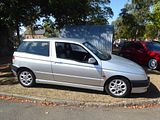
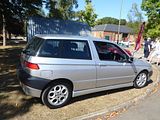


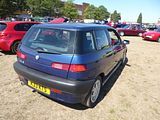

156
When the 156 was launched in 1997, things looked very bright for Alfa. Striking good looks were matched by a driving experience that the press reckoned was better than any of its rivals. The car picked up the Car of the Year award at the end of the year. and when it went on sale in the UK in early 1998, waiting lists soon stretched out more than 12 months. Reflecting the way the market was going, Alfa put a diesel engine under the bonnet, launched a (not very good, it has to be admitted) automated transmission with the SeleSpeed, added a very pretty if not that commodious an estate model they called Sport Wagon and then added a top spec 3.2 litre GTA with its 250 bhp engine giving it a performance to outrun all its rivals. And yet, it did not take long before the press turned on the car, seduced by the latest 3 Series once more, citing build quality issues which were in fact far from universal. The 156 received a very minor facelift in 2002 and a more significant one in late 2003 with a new front end that was a clue to what would come with the car’s successor. Production ceased in 2005.



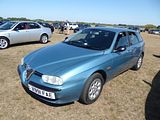


A significant addition to the 156 range came in 2000 with the introduction of the Sportwagon station wagon or estate bodystyle, debuting at the Geneva Motor Show. The new bodystyle was in development from 1998 by Stola under the project code ‘932 AF’. According to Stola’s records the initial considered name was “Powerwagon”. While not a core part of the company’s range, estate versions of the Alfasud and 33 – the first to carry the name Sportwagon – were produced and a 75 Sportwagon was shown at Geneva, but became an early victim of the Fiat takeover. The Sportwagon was also available with Boge-Nivomat self-levelling hydropneumatic rear suspension. The Sportwagon was marketed as a lifestyle estate without large carrying capacity. The Sportwagon bodystyle filled a gap in the market that Alfa Romeo had distanced themselves from since the 33 SportWagon of the 1980s.


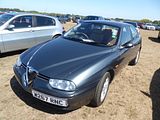

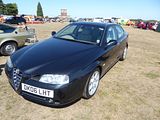
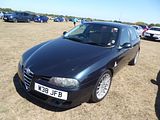
The Crosswagon Q4 was launched in 2004 with a crossover look and enhanced off-road capabilities. The Crosswagon’s ride height was raised further compared to the Sportwagon Q4, giving the car better approach and departure angles; at 1,497 mm (58.9 in) it was 6.5 cm (2.6 in) taller than a standard 156. Tall-sidewall all-season tyres on 17 inch wheels were standard. The only available engine was 1.9 M-Jet diesel rated at 150 PS (148 bhp). The Crosswagon was made to look more like an all-terrain vehicle by unique front and rear bumpers and door sills with steel inserts. After the introduction of the 159 in 2005 the Crosswagon remained in production, and in 2007 it was the last 156 model to be discontinued. The car was never sold in the UK when new and this is believed to be the only example in the UK.


The 156 GTA cars were launched at the Frankfurt Motor Show in September 2001. Named after the Alfa Romeo GTA from the 1960s, the letters GTA meaning Gran Turismo Alleggerita (English: lightened Grand Tourer). 2,973 berlinas and 1,678 Sportwagons were built until the GTA production stopped in October 2005 as the 156 gave way to the Alfa Romeo 159. The GTA came with the 3.2 litre Bussone V6 engine (The big Busso, so called after legendary Ferrari engineer Giuseppe Busso), the largest capacity version of the much loved V6 engine. With a 93 mm bore and a 78 mm stroke giving it a capacity of 3,179 cc, it generated 250 PS (247 hp) and 220 lb/ft of torque. After market Alfa Romeo specialist Autodelta produced performance versions up to 3.7 litres and 400 PS. The European Touring Car Championship winning 156 GTA was however running a 2.0 litre 4-cylinder 300 PS engine due to class regulations. The GTA variants were equipped with either a six-speed manual transmission or six-speed Selespeed (paddles in steering wheel, hydraulically operated robotised) gearbox, had a lowered and stiffened suspension, a distinctive body kit, wider rear arches and leather interior. The suspension was specifically made for the GTA by Fiat Research Centre and Fiat Auto Design and Development Department. Steering was also made faster, only 1.7 turns from lock to lock compared to 2.1 in normal models. The GTA had also larger brakes (Brembo), with 12″ front discs and 10.8″ at the rear. The front discs were later upgraded to 13 ” to cope with the performance potential. Even though the name suggests a light car, the GTA isn’t any lighter than other 156s, as it was actually 91 kilograms (201 lb) heavier than the 2.5 litre V6 engined version. The GTA did not get the Giugiaro designed facelift introduced to the 156 in 2002, but continued with the acclaimed Walter de Silva design to the very end of production.
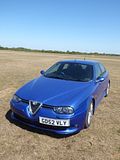

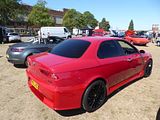


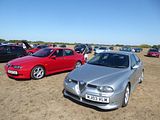
166
Alfa followed the 156 a couple of years later, in late 1998, with a larger saloon, the 166, hoping to receive the same sort of acclaim with this executive car which was a direct replacement for the 164. It was not forthcoming. For a start, the styling with its drooping and very small headlamps and pointed nose was quite unlike anything else on the market at the time. Part of the difficulty came from the fat that the car had been designed some years before its launch and then put on the back burner as the 156 was given priority. The 166 was initially available with a 155 PS 2.0-litre Twin Spark, a 190 PS 2.5 V6, a 220 PS 3.0 V6 and in some markets a 205 PS V6 2.0 Turbo petrol engine along with a diesel powered L5 2.4 10v common rail turbodiesel version with 136 PS, 140 PS and 150 PS (148 hp) output. The 2.0 TS model used a 5-speed manual gearbox, whilst the 2.5 and 3.0 had the option of a Sportronic automatic gearbox. The 3.0 V6, L5 2.4 and V6 Turbo were otherwise supplied with a six-speed manual gearbox. The top models were named “Super”, and included MOMO leather interior, 17″ alloy wheels, rain sensitive wipers, cruise control, climate control and ICS (Integrated Control System) with colour screen. Options included xenon headlamps, GSM connectivity and satellite navigation. Suspension systems comprised double wishbones at the front and a multi-link setup for the rear. Though the car’s handling characteristics, engine range and elegant exterior design received praise from many, including Top Gear’s Jeremy Clarkson, it did not become a strong seller to rival the dominant German brands, in the European executive car sector. In September 2003, the 166 underwent a substantial revamp, with the début at the Frankfurt Motor Show. As well as upgrades to the chassis, interior, and the engine range, the styling was substantially altered. The new front end resembled the also recently revamped 156, and lost its famous drooping headlights. The 2.0 V6 Turbo model was dropped because of marketing problems, the V6 2.5 was re-rated at 188 PS and a 3.2 litre V6 with 240 PS was introduced. Both the 3.2 litre and the 2.0 Twin Spark models now featured the six-speed manual gearbox, whilst the 3.0 model was retained, but made available only in Sportronic form. In the diesel sector, the L5 2.4 was re-engineered with Multi-Jet technology which allows up to 5 injections per cycle, second stage common rail, with maximum injection pressure of 1400 bar and 4 valves per cylinder, to output a class leading 175 PS, but these changes made little impact on sales volumes. In October 2005, the Alfa Romeo 166 was officially withdrawn from sale in markets for RHD. Sales of the 166 never grew as Alfa had hoped, following the facelift in September 2003, and the additional lack of a diesel engine in the United Kingdom, Australian, and Irish markets limited its reach into company car sectors. In June 2007, production of the 166 effectively ended, with no direct successor. In September 2008, the platform was sold to the Chinese state run manufacturer GAC Group. In total, less than 100,000 units were made.


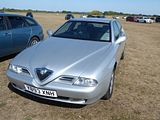


147
The 166 may have failed to hit the jackpot, but the next Alfa certainly did. This was the 147, launched at the 2000 Turin Motor Show as a replacement for the 145 and 146 hatchbacks, and based on the running gear of the larger 156 saloon. Designed by Walter de’Silva and Wolfgang Egger, the 147 received considerable praise for its styling on launch, later it was awarded with some styling awards. It was available initially with 1.6, 2.0, petrol engines and a 1.9-litre diesel engine. A sequential, paddle operated ‘Selespeed’ transmission was available from launch. Two trim levels were available, Turismo and Lusso. The 147 was the first Alfa Romeo to feature dual-zone climate control and electronic traction control. Although some thought the car had lost of some of the Alfa magic, it was well received and was awarded the Car of the Year trophy a few weeks after launch. The entire 147 range was revamped in 2004, with the exterior styling changed considerably to be more reminiscent of the new 159 and Brera models, and Alfa Romeo Visconti concept car, most notably for its more aggressive look, with a new front grille, new headlights, new rear lights and the interior was updated on all models besides the GTA version. A new more powerful diesel engine arrived and suspension was also tweaked. In 2006, the 147 1.9 JTD Q2 version was launched, which featured a front Torsen limited slip differential. Alfa Romeo presented a new limited edition 147 called Ducati Corse at the 2007 Bologna Motor Show. The car came equipped with a 170 PS (68 hp) JTD diesel engine and Q2, a front Torsen limited slip differential. The 147 was in production for ten years, making it one of the oldest small family cars on sale in Europe at the time of its replacement by the Alfa Romeo Giulietta in late May 2010. In total around 580,000 cars were made.


Having a rather short production life was the GTA version of the 147. Launched in 2002. this car was intended to compete with the most sporting Golf and Focus models of the day. as well as injecting more potency into a range which always seemed like it needed more power. Fitted with a 3.2 V6 engine which produced 247 bhp, the 147GTA was the most powerful hot hatch available at the time, and the modifications to the body, including lower sills and wider wheel arches, if anything, made it look even better rather than endowing it with the sort of “after market look” that can afflict some high end performance versions of regular family cars. Performance figures were impressive, with the car able to achieve a top speed of 153 mph. It had a widened body by 15 mm at each side to accommodate the 225/45R17 tyres. Most models had a 6-speed manual transmissions; whilst a smaller number of other models used the semi automatic Selespeed system. Production ran through to 2004 and in total 5,029 147 GTAs were built, 1004 of which were Selespeeds. Only around 300 came to the UK, so this was never a common sighting on British roads.


159
Replacement for the much loved 156 was the 159. The Alfa Romeo 159 had a troubled development, being designed in the midst of the Fiat-General Motors joint venture which was terminated in 2005. Originally, the 159 was intended to use GM’s Epsilon platform; however, late during its development it was changed to the GM/Fiat Premium platform. The Premium platform was more refined and expensive, being intended for E-segment executive cars such as an Alfa Romeo 166 successor but that never materialised, so Alfa Romeo attempted to recoup some of the platform development costs with the 159. General Motors originally planned Cadillac, Buick and Saab models for this platform but ending up discarded them over cost concerns. Unfortunately, the 159’s late transition to what was fundamentally made as an E-segment platform resulted in the 159 having excessive weight, a problem shared by its sisters, the Alfa Romeo Brera coupe and Spider convertible. The 159 was designed by Giorgetto Giugiaro in collaboration with the Centro Stile Alfa Romeo. The nose featured a traditional Alfa Romeo V-shaped grille and bonnet, and cylindrical head light clusters. Similar to its coupé counterpart, front of the car was influenced by the Giugiaro designed 2002 Brera Concept. Several exterior design cues were intended to make the car appear larger, supposedly to appeal to potential buyers in the United States; however, the 159 was never exported to that region. The interior featured styling treatments familiar from earlier cars, including the 156, such as deeply recessed instruments which are angled towards the driver. Alfa Romeo intended for the 159 to compete more directly with BMW, Mercedes-Benz and Audi by using higher quality interior materials; however, it has been said that Alfa Romeo misjudged their brand’s positioning relative to the more well-known German luxury automakers. Several levels of trim were available, depending on market. Four trim levels: Progression, Distinctive, Exclusive and Turismo Internazionale (TI) featured across Europe. In the UK there were three levels of trim: Turismo, Lusso and Turismo Internazionale (TI). A Sportwagon variant was introduced at the Geneva Motor Show in 2006. The 159’s size made it considerably more comfortable than the 156 due to its larger, roomy interior. However, the considerable growth in dimensions deterred many 156 owners from considering the 159 as a direct replacement model, and something seemed to be lost in the character of the new car. Initially offered with a choice of 1.9 and 2,2 litre 4 cylinder and 3.2 litre V6 petrol engines and 1.9 and 2.4 litre diesel units, and an optional four wheel drive system. An automatic gearbox option for the 2.4 JTDM diesel model was also launched in late 2006, and later extended to other versions. In 2007 a four-wheel drive diesel model was released and the 2.4-litre diesel engines’ power output increased to 210 hp, with a newly reintroduced TI trim level also available as an option. For model year 2008 the mechanics and interiors of the 159 were further developed. The 3.2 litre V6 model was offered in front wheel drive configuration, achieving a top speed of 160 mph. All model variants came with Alfa’s electronic “Q2” limited slip differential. As a result of newly introduced aluminium components, a 45 kilograms (99 lb) weight reduction was achieved. For 2009, Alfa introduced a new turbocharged petrol engine badged as “TBi”. This 1742 cc unit had direct injection and variable valve timing in both inlet and exhaust cams. This new engine had 200 PS (197 hp) and would eventually replace the GM-derived 2.2 and 1.9 JTS units. In 2010, all petrol engines except for the 1750 TBi were retired, ending the use of General Motors-based engines in the 159. The only remaining diesel engines were the 136 PS and 170 PS 2.0 JTDm engines. In 2011, the 159 was powered only by diesel engines. In the UK, Alfa Romeo stopped taking orders for the 159 on 8 July 2011. Production for all markets ceased at the end of 2011, after 240,000 had been built.






GT
Rather than replacing the 916 Series GTV with a single model, Alfa elected to produce two successors., The more commodious of the two, the GT, was the first to appear, making its debut in March 2003 at the Geneva Motor Show, finally going on sale in early 2004. It was built at the Pomigliano plant, alongside the 147 and 159. The GT was based on the Alfa 156 platform, which was also used for the 147, providing the 2-door coupé with genuine five-passenger capacity. It was styled by Bertone. Most mechanicals were taken directly from the 156/147 using the same double wishbone front suspension and MacPherson rear setup. The interior was derived form the smaller hatchback 147 and shared many common parts. The GT shared the same dash layout and functions, the climate control system as well as having a similar electrical system. Some exterior parts were taken from 147 with the same bonnet, wing mirrors and front wings (from 147 GTA). The engine range included both a 1.8 TS, and 2.0 JTS petrol engine, a 1.9 MultiJet turbodiesel, and a top-of-the-range 240 bhp 3.2 V6 petrol. There were few changes during the GT’s production life. In 2006 Alfa introduced a 1.9 JTD Q2 version with a limited slip differential, and also added a new trim level called Black Line. In 2008 Alfa introduced the cloverleaf model as a limited edition complete with new trim levels, lowered suspension, body kit, 18 inch alloy wheels and was only available in the colours black, Alfa red, or blue. with 1.8 and 2.0 litre petrol engines as well as the 1.9 litre Multijet turbo diesel. The GT was acclaimed for its attractive styling and purposeful good looks, in 2004 being voted the world’s most beautiful coupe in the annual ‘World’s Most Beautiful Automobile’ (L’Automobile più Bella del Mondo) awards. The car sold reasonably well, with 80,832 units being produced before the model was deleted in 2010.




BRERA/SPIDER
The other 916 series replacement cars were the Brera and Spider models, and there were a lot of them here. Visually similar to the 159 models at the front, the Brera and Spider boasted unique styling from the A pillars rearwards. They were offered with the same range of engines as the 159, and thanks to that strong, but rather heavy platform on which they were built, even the 3.2 litre V6 cars were more Grand Tourer than rapid sports car. Pininfarina was responsible for both models. The Brera was first to market, in 2005, with the Spider following in 2006. Production of both ceased in late 2010, by which time 12,488 units of the Spider and 21,786 units of the Brera had been built. It will be very surprising if these do not attain classic status, and the consequent rise in values, though that has not happened yet.







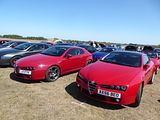
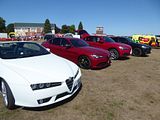


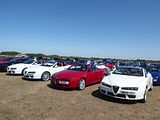

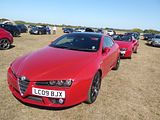


8C
Although I am sure there are those who would beg to differ, my contention is that car styling in the twentyfirst century has gone through a period which will not be viewed particularly positively in years to come, with a myriad of forgettable designs and more recently plenty which in trying to be distinctive are just downright ugly. There have been a few high points, though, and top of that list for me must be the Alfa 8C Competizione, a lone example of which was to be seen here. As well as the looks, this car also has noise on its side, with a sound track which must rate as one of the best of recent times. So that is two boxes ticket for me. The press saw it rather differently, and were rather critical of the car when it was new, but for me, finding plenty to fault with the way the car drove. First seen as a concept car at the Frankfurt Motor Show in 2003, the concept was conceived as a reminder for people who were perhaps slightly disillusioned with contemporary Alfa products that the company could still style something as striking in the 21st century as it had been able to do in the 1950s and 1960s. Public reaction was very positive, but Fiat Group Execs were very focused on Ferrari and Maserati and they were not entirely convinced that a car like this was appropriate as it could encroach on those brands’ territory. It was only in 2006, with new management in place that it is decided that a limited production run of just 500 cars would give the once proud marque something of a boost. Announcement of the production version, visually little different from the 2003 concept car was made at the 2006 Paris Show, and it was soon evident that Alfa could have sold far more than 500 cars To turn the concept into reality, Alfa used a shortened Maserati Quattroporte platform with a central steel section, subframes front and rear and main outer panels that were all made from carbon fibre, with the result that the complete car weighed 300 kg less than the GranTurismo. Final assembly was carried out by Maserati, with the cars being built between 2007 and 2010. Competiziones (Coupes) first, and then 500 Spiders. Just 40 of the Competizione models came to the UK. Most of them were sent to the US, so this car is exceptionally rare and is much sought after by collectors. They were fearsomely expensive when new, listing for around £150,000, but prices have never dipped far below this, so anyone who bought one, should they ever feel the need to sell it, is not going to lose money on the car.

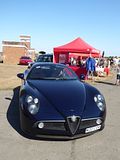


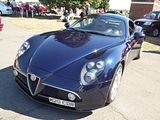
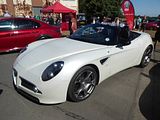

MiTo
The Alfa Romeo MiTo (Type 955) is a front-wheel drive, three-door supermini designed by Centro Stile Alfa Romeo and presented in 2008 at Castello Sforzesco in Milan with an international introduction at the British Motor Show in 2008. The new car was provisionally named the “Junior”. In November 2007, Alfa Romeo launched a European public naming competition; the winner from each country to win an Alfa Romeo Spider or an Alfa Romeo mountain bike. The winning name was “Furiosa”, which scored well in Italy, France, United Kingdom and Germany, but not in Spain. In 2008, Alfa Romeo announced “MiTo” as the official name, a portmanteau of Milano (Milan) & Torino (Turin), because it was designed in the former and was assembled in the latter. The name is also a play on the Italian word “mito”, meaning “myth” or “legend”. The MiTo is front-wheel drive, with a system allowing the driver to choose three driving settings: Dynamic, Normal, and All-Weather. The system, marketed as “Alfa DNA,” tunes the behaviour of the engine, brakes, steering, suspension and gearbox. The MiTo also features LED tail lights and 250-litre (8.8 cu ft) of luggage space. The MiTo also features a Q2 electronic differential on the front wheels, which is active with the DNA switch in Dynamic position, and allows for faster and tighter cornering without loss of traction. In 2010 a new transmission for the MiTo was unveiled at the 2010 Geneva Motor Show, the six-speed TCT which is produced by Fiat Powertrain Technologies in Verrone (TCT Dual Dry Clutch Transmission). Magneti Marelli delivers the control system which integrates BorgWarner’s hydraulic actuation module into its own power and transmission control units. It can handle torque inputs of up to 350 N⋅m (258 lbf⋅ft) In Geneva was also unveiled Blue&Me–TomTom, this new system integrates TomTom navigation to the Blue&Me infotelematic system. At its launch the MiTo featured low-displacement turbocharged petrol and diesel engines. Also, a power limited 78 bhp naturally aspirated engine variant is produced to meet the new Italian legislation for young people. MiTo got new electro-hydraulic valve control system Multiair engines from September 2009. MultiAir engines will increase power (up to 10%) and torque (up to 15%), as well as a considerable reduction in consumption levels (up to 10%) and CO2 emissions (up to 10%), of particulates (up to 40%) and NOx (up to 60%). This new engine is available with 104 bhp,133 bhp and 168 bhp power ratings. All multiair versions have start-stop system as standard. In October 2009 was unveiled a dual fuel MiTo version, this version can run with LPG (Liquefied petroleum gas) or petrol, with this engine MiTo has range of 1,200 km (750 miles). The LPG version is made in collaboration with Landi Renzo. In Summer 2010 Alfa introduced the Dual Dry Clutch Transmission called Alfa TCT ( i.e. Twin Clutch Transmission ). From model year 2011 the start-stop system came as standard on all versions. At the 2011 Frankfurt Motor Show, AR introduced two new engines for the MiTo – The 0.9 L I2 TwinAir and a new low emission 85 PS version of the 1.3 JTD diesel engine. The Quadrifoglio Verde (green four-leaf clover) has traditionally been the highest line of Alfa Romeo models. The car (see Alfa Romeo in motorsport article for the history of this emblem) version of Mito was presented at the 2009 Frankfurt Motor Show. The QV version has the new 1.4 litres (1,368 cc) Turbo Multiair inline-four engine 168 bhp at 5500 rpm and 250 Nm (184 lb/ft) of torque at 2500 rpm, with newly engineered suspension, steering and new six-speed C635 gearbox developed by Fiat Powertrain Technologies (FPT). Its specific output of 124 PS per litre was highest in its segment at that time. The new multiair technology allows fuel consumption of 6 l/100 km (47 mpg) in EU combined driving and CO2 emissions of 139 g/km. QV had bigger 305 mm front brake discs and exclusive 18″ alloy wheels as standard and Sabelt carbon fibre backed bucket seats as an option. From 2014 QV was now available with TCT robotised gearbox which brought down the 0–100 km/h time to 7.3 s. With the 2016 facelift, the QV was renamed as the Veloce. For model year 2014, the MiTo got a new 105 PS 0.9 L Turbo TwinAir engine, new chrome-plated grille, new Anthracite grey colour and new burnished front light clusters. The car interior was also updated with new upholsteries, three new dashboards looks, as well as the new Uconnect 5.0 infotainment systems. The engine range now consists two turbo diesel engines (the updated E5+ 85 PS 1.3 L JTDM and the 120 PS 1.6 L JTDM) and five petrol engines: the 70 PS 1.4, the 78 PS 1.4, the 135 PS 1.4 MultiAir Turbo (with manual or Alfa TCT Dual Dry Clutch Transmission) and the 170 PS 1.4 MultiAir Turbo. The range has also 120 HP 1.4 LPG Turbo option. Debuting at the 2016 2016 Geneva Motor Show, the revised Mito featured a facelifted front fascia with a new updated brand logo and new lettering. Trim line up was changed to Mito, Super and Veloce. A new body colour and new rims designs also became available. The previous MiTo QV became the Mito Veloce, available with 170 PS engine and TCT transmission. The MiTo was marketed across a single generation from 2008 to 2018, sharing the Fiat Small platform with the Fiat Grande Punto. Production reached 293,428 at FCA’s Mirafiori plant.

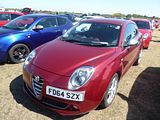





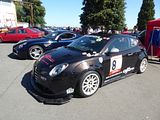
GIULIETTA
Replacing the 147, the Alfa Romeo Giulietta (Type 940) is a five door hatchback positioned as a sporty and luxury car. Production started near the end of 2009 and the model was introduced at the March 2010 Geneva Motor Show. The Giulietta was placed second in the 2011 European Car of the Year awards. The platform used in the Fiat Group’s Compact, successor of the C-platform (base for Fiat Stilo, Fiat Bravo and Lancia Delta). Practically this was an all-new modular platform, only the central front part coming from the previous C-platform, but that part is modified also. Fiat Group used around 100 million euros to developing it. Mistakenly the journalists called the C-Evo platform, but Fiat never called on this name. It has a longer wheelbase, shorter overhangs and an advanced new type of MacPherson strut front suspension and multi-link rear suspension. Depending on the market and trim level, 16, 17, or 18-inch wheels are available. Available tire sizes are 205/55 R16, 225/45 R17, and 225/40 R18. The wheels use a 5-hole pattern with a 110 mm bolt circle. The length of the Giulietta is around 4.3 metres (14 ft). Only a five-door body is available for sale. In a viability plan forwarded to the US Government in February 2009, Chrysler (a partner of Alfa Romeo parent company Fiat) reported that the 147 replacement would come to market as the Milano and that it could be built in the USA. However, as of early 2010 Fiat was instead planning to concentrate on bringing larger models to the US, such as the Giulia. At the 2013 Frankfurt International Motor Show Alfa Romeo presented an updated Giulietta. Trim changes include a new Uconnect infotainment system with 5″ or 6.5″ Radionav touchscreen, a new front grille, a chrome-plated frame for the fog lights, a new and more supportive seat design, new wheels (16, 17 and 18-inch), as well as new exterior colours: Moonlight Pearl, Anodizzato Blue and Bronze. A new diesel engine variant has also arrived, the two-litre JTDM 2, developing 150 PS (148 bhp) and 380 Nm (280 lb/ft). In the 2014 range, all engines comply with Euro 5+ (Euro 6-ready) emission standards. Debuting at 2016 Geneva Motor Show, New Giulietta with facelifted front resembling Giulia and with new updated brand logo and new lettering. Trim line up will be changed to Giulietta, Giulietta Super and Giulietta Veloce. New body colour, new rims designs. Previous Giulietta QV will now be changed into sporty Veloce trim available with 240 PS (237 bhp) engine and TCT transmission. Also debuting was a new 1.6 JTDm 120 PS (118 bhp) TCT diesel engine. For 2019, the Giulietta had updated engines, all Euro 6 D: a 1.4-litre 120 PS turbo petrol, a 1.6-litre 120 PS Multijet with manual or Alfa TCT automatic transmission, and a 2.0-litre 170 PS Multijet with Alfa TCT. The top of the range model was a version with 1,742 cc turbocharged TBi engine rated 235 PS (232 bhp), lowered ride height (15 mm (0.6 in) at the front and 10 mm (0.4 in) at the rear), 18-inch Spoke design alloy wheels with dark titanium finish and 225/40 R18 tyres plus 18-inch 5 hole design alloy wheels as an option; an enhanced braking system (330 mm (13.0 in) front, 278 mm (10.9 in) rear) with calipers painted Alfa red; dark tinted windows, sports kick plates, cloverleaf badges, leather and microfibre seats plus sports leather seats as an option; dark brushed aluminium dashboard. 1750 is an engine size which has its roots in Alfa Romeo’s history, with 1.75 L engines being used to power some of Alfa Romeo’s first cars. The UK version was originally marketed as the Giulietta Cloverleaf, then Quadrifoglio Verde through ’14-’15 before finally being renamed to the Veloce in 2016 until the end of production. At the 2014 Geneva Motor Show, Alfa Romeo introduced a new Quadrifoglio Verde, it has new 1,742 cc Turbo direct injection aluminium-block Inline-four engine now upgraded to 240 PS (237 bhp) at 5750 rpm and 340 Nm (251 lb/ft) at 2000 rpm of torque and Alfa TCT 6-speed twin dry clutch transmission borrowed from the Alfa Romeo 4C. With new engine the Giulietta’s flagship can exceed 240 km/h (149 mph) and accelerate from 0 to 100 km/h (62 mph) in only 6.0 seconds. This new facelifted version was premiered with a limited ‘Launch Edition’, recognizable by the black-finish on the sills all round. Available in new matt Grigio Magnesio Opaco along with Rosso Alfa and Rosso Competizione. Each car has its own numbered plaque. Around 700 units were made. Between 2010 and 2019, production reached over 400,000. In 2020, Alfa Romeo announced that they were going to axe the Giulietta and production ended on 22 December 2020 spanning 10 years of sales from a period of 2010 to 2020. In total 469,067 examples were produced until 2020.


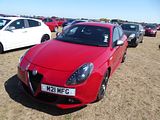
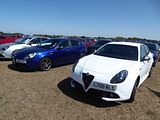
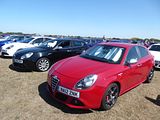


4C
The Alfa Romeo 4C is a two-seater, rear-wheel drive coupé with technology and materials derived from the Alfa Romeo 8C Competizione, with a 1750 cc turbo petrol engine with direct injection, the “Alfa TCT” twin dry clutch transmission, and the Alfa DNA dynamic control selector. The 4C concept version was unveiled in the 81st Geneva Motor Show in March 2011, followed by the Mille Miglia 2011 parade, Goodwood Festival of Speed 2011,2011 Frankfurt Motor Show. It was displayed for the first time outside in Concorso d’Eleganza Villa d’Este in 2012. Compared to the production version, it is very similar, with the biggest differences being front lights, side vents and mirrors. The Alfa Romeo 4C Concept was voted the ‘Most Beautiful Concept Car of the Year’ award by the readers of German magazine Auto Bild, and won the Auto Bild Design Award 2011. It was awarded the “Design Award for Concept Cars & Prototypes” by referendum of the public in Villa d’Este. The production car was unveiled at the 2013 Geneva Motor Show, followed by 2013 Essen ‘Techno Classica’, Goodwood Festival of Speed 2013, Moscow Raceway, 2013 Frankfurt Motor Show. The bare ‘4C000’ chassis was also shown at the 2013 Geneva Motor Show. Ordering of European models began in October 2013 at Alfa Romeo dealerships in Europe. As part of the Alfa Romeo 4C launch, Alfa Romeo Style Centre and Compagnia Ducale designed a 4C IFD (Innovative Frame Design) Bicycle, inspired by the Alfa Romeo 4C coupé. The vehicle went on sale in December 2013 and marketed in Europe, Asia and America. Production of the 4C began May 2013 at Maserati’s plant in Modena, with an expected production of up to 2500 units per year. It was the first mass-produced Alfa Romeo model to be sold in the US market since 1995 when the 164 sedan stopped being sold in the US. Production of the Alfa Romeo 4C was originally estimated to be over 1000 units per year, with an upper limit of 3500 units per year, depending on the quantity of carbon fibre chassis that can be built by the supplier Adler Plastic.Within the 3,500-unit quota, 1,000 units are earmarked for Europe. Delivery of the European Alfa Romeo 4C Launch Edition took place at Balocco (Vercelli, Italy) Test Centre. In 2018, the 4C coupe was discontinued for the North American market. The 4C Spider, however continued to be sold there for model year 2019 and model year 2020. In other markets, such as Australia and Japan, both the coupe and Spider continued. In late 2020, a new tribute-edition named the 4C Spider 33 Stradale Tributo was announced. The car was designed by Centro Stile Alfa Romeo (Style Centre) and developed by Alfa Romeo. The chassis is composed of a central carbon fibre tub, with aluminium subframes front and rear. The carbon fibre tub is produced by TTA (Tecno Tessile Adler) in Airola, as a joint venture between Adler Plastic and Lavorazione Materiali Compositi. The carbon fibre components that make up the chassis are cut using CNC technology. The entire carbon-fibre monocoque chassis (“tub”) of the car weighs 143 pounds (65 kg). Front and rear aluminium subframes combine with the tub, roof reinforcements and engine mounting to comprise the 4C chassis giving the vehicle a total chassis weight of 236 lb (107 kg) and a total vehicle curb weight of just 2,465 lb (1,118 kg). The 4C has a single carbon fibre body, similar to the body of many supercars. The outer body is made of a composite material (SMC for Sheet Moulding Compound) which is 20% lighter than steel. The stability is comparable to steel and better than aluminium. The 4C employs double wishbone suspensions at the front and MacPherson struts at the rear. The resultant weight distribution is 38% on the front and 62% on the rear axle. Wheels and tyres have different diameters and widths front and rear: 205/45 R17 front and 235/40 R18 back as standard, with optional 205/40 R18 and 235/35 R19. Both wheel options come equipped with Pirelli P Zero tyres. The 4C uses vented disc brakes on all wheels; Brembo 305 millimetres (12.0 in) on the front and 292 millimetres (11.5 in) on the rear. The car can stop from 100 km/h (62 mph) in 36 metres. To save weight and increase steering feel, the 4C has no power steering. Its centre of gravity height, at 40 centimetres (16 in) off the ground, is 7 centimetres (2.8 in) lower than that of the Lotus Elise. The 4C uses a new all-aluminium 1,742 cc inline 4 cylinder turbocharged engine producing 240 PS at 6000 rpm. The engine has been designed for minimum weight. The engine’s combined fuel consumption 6.8 l/100 km (42 mpg‑imp; 35 mpg‑US).[4] 0–62 mph (0–100 km/h) acceleration is achieved in 4.5 seconds and the top speed is 258 km/h (160 mph), the power-to-weight-ratio being just 0.267 hp/kg (8.22 lb/hp) A journalist from Quattroruote car magazine demonstrated how the 4C accelerates from 0–100 km/h (0–62 mph) faster than 4.5 seconds. In race mode, with left foot on the brake pedal, if you pull the right shift paddle the engine will rev to 3500 rpm, but if you also pull the left paddle the engine will rev to 6000 rpm and 0–100 km/h (0–62 mph) time will go down to 4.2 seconds. Italian car magazine Quattroruote published the lap time of 4C around Nürburgring. It lapped the ring in 8:04. The 4C is equipped with a six speed Alfa TCT Dual Dry Clutch Transmission, and can be operated via gearshift paddles on the steering wheel. It also has an Alfa ‘DNA’ dynamic control selector which controls the behaviour of engine, brakes, throttle response, suspension and gearbox. In addition to the modes already seen in Giulietta, the 4C has a new “Race” mode. The U.S. version of the 4C was introduced in the 2014 New York International Auto Show with the first 100 4C’s being shipped to the U.S. early July, with a total of 850 being shipped by the end of 2014. The U.S. model includes extra bracing and strengthening required to meet U.S. crash regulations (including aluminium inserts in the carbon fibre chassis), resulting in 100 kg (220 lb) of weight increase. This version also has new headlamps similar to those seen before in the 4C Spider version. In 2018, the 4C coupe was discontinued for the North American market due to US DOT NHTSA FMVSS 226 Ejection Mitigation. The regulation called for a progressive compliance date based on volume and, due to low volume, the 4C was allowed to continue until the last compliance date of 9/1/2017, thus all 2018 4C coupes in North America have build dates of 8/2017 or earlier. The 4C Spider, however continued to be sold in North America for model year 2019 and model year 2020. The Spider version of the 4C was previewed showing a pre-production prototype at the 2014 Geneva Motor Show. Sharing its engine with the Coupé version, the 4C Spider has different external parts such as the headlights, exhaust and engine hood, as well as a different roof section that features a removable roof panel. The North American spec 4C reflects a weight difference of only 22 lb (10 kg) (2,465 lbs vs. 2,487 lbs) for the Spider variant. Top speed is quoted at 257 km/h (160 mph) and acceleration from 0 to 100 km/h (62 mph) at 4.5 seconds. The 4C Launch Edition was a limited and numbered edition, unveiled at the vehicle’s launch at the 2013 Geneva Motor Show. The vehicle came in a choice of four paint colours (Rosso Alfa, Rosso Competizione tri-coat, Madreperla White tri-coat or Carrara White matte). 500 examples were reserved for Europe/ROW, 500 for North America, 88 for Australia (Rosso Alfa and Madreperla White only), 200 to Japan and 100 for the Middle East. Note that the original press release cited 500 for North America, 400 Europe, and 100 ROW; however, the plaques on actual cars suggest that more were built and are the numbers referenced above. Distinguishing features of the Launch Edition were carbon fiber trim (including headlight housings, spoiler and door mirror caps), rear aluminium extractor with dark finishing, Bi-LED headlights, dark painted 18-inch front and 19-inch rear alloy wheels, additional air intakes on the front fascia, red brake calipers, racing exhaust system, BMC air cleaner, specific calibration for shock absorbers and rear anti-roll bar, leather/fabric sports seats with parts in Alcantara and a numbered plaque. Alfa Red coloured cars got matching red stitching on the steering wheel, handbrake, mats, handles and sports seats. In Europe the vehicle went on sale for 60,000 euros including VAT. The 4C Competizione is a limited edition version of the 4C introduced in the 2018 Geneva Motor Show, finished in matte Vesuvio Grey, with carbon details on the roof, rear spoiler, mirror caps, side air vents and headlight moulding. The run reportedly consisted of 108 units. The Japanese market received 25 units, and 10 units were assigned to Australia. The US-market received no Competizione editions. The car had a very mixed reaction. The UK press hated it at launch, but owners generally disagreed and loved it. A total of 9117 were built before production ceased in 2020.








GIULIA
The Alfa Romeo Giulia is a compact executive car. Known internally as the Type 952, it was unveiled in June 2015, with market launch scheduled for February 2016, and it is the first saloon offered by Alfa Romeo after the production of the 159 ended in 2011. The Giulia is also the first mass-market Alfa Romeo vehicle in over two decades to use a longitudinal rear-wheel drive platform, since the 75 which was discontinued in 1992. The Giulia was second in 2017 European Car of the Year voting and was named Motor Trend Car of the Year for 2018. In 2018, Giulia was awarded the Compasso d’Oro industrial design award. In 2013 Fiat Chrysler Automobiles CEO Sergio Marchionne requested a clean-sheet design for the next Alfa Romeo—a rear-wheel drive sports saloon to help return the company to its roots. He appointed former technical director at Ferrari and chassis engineer for the 458 Speciale Philippe Krief as chief engineer for the Giulia, and asked him to assemble a team of ten to create the Giulia, to be designed and built in two and a half years. Krief oversaw the development of the Giulia, along with the platform that underpins it—Giorgio. This is an all-new, longitudinal-engine, rear-wheel drive platform developed by Alfa Romeo. Marco Tencone of Centro Stile Alfa Romeo at the Fiat Mirafiori factory in Turin headed the design team, with oversight from Lorenzo Ramaciotti. The Giulia had a long gestation and delayed launch due to Marchionne sending its design back to the drawing board. The new Giulia was unveiled to the press at the Museo Storico Alfa Romeo in Arese, on 24 June 2015, at an event which involved only the top-of-the-range Quadrifoglio variant and a rendition of “Nessun dorma” by Italian tenor Andrea Bocelli. The occasion coincided with the company’s 105th anniversary, and also saw the company debut a restyled logo for all future Alfa Romeo models. The Giulia uses a front-engine, rear-wheel-drive layout, targeting an even 50% front and 50% rear weight distribution. Suspension is independent all-around—double wishbone with a semi-virtual steering axis front and multilink rear. All Giulia models employ a carbon-fibre drive shaft made by Hitachi Automotive Systems, as well as aluminium alloy shock towers, suspension components, front wings, and doors. All-wheel drive is offered in non-Quadrifoglio models. The Giulia has a drag coefficient of Cd=0.28. The base Giulia, mid-level Super, and fully loaded Speciale are powered by a 200 PS (197 hp) 2-litre petrol engine, or the choice of 136 PS, 150 PS or 180 PS 2.2-litre turbo diesel engine. The base model comes with 16-inch alloys, the Super can be distinguished with 17-inch alloys and dual chrome exhaust tip for the diesel model. The Speciale has 18-inch alloys, black brake calipers, as well as leather sports seats and sporty bumpers from the Veloce. Fixed rear seat is standard on the base and Super, while the Speciale has folding rear seat. The Giulia Sprint is positioned above the base and Super model grades, but below the Ti and Veloce. In Europe, the early Giulia Sprint was powered by either the base 2.0 gasoline engine, or 180 PS 2.2-litre diesel engine. For 2020, the Sprint got the updated diesel engine with 190 PS. In North America, the Giulia Sprint was new for 2021 model year. It is the entry-level model although motored by the same engine as the Veloce. The diesel-powered Sprint was never offered in North America. The Giulia Veloce was presented at the 2016 Paris International Motor Show held in October. The Veloce offers the choice of two engines: the 2.0-litre turbo petrol and the 2.2-litre diesel inline-4 engines, both equipped with an 8-speed automatic transmission and Alfa Q4 all-wheel drive system (rear-wheel-drive in the UK). The Veloce has specific bumpers and a glossy black door trim; it has also various performance components like special rear extractor with double exhaust pipes and optional 5-spoke 19-inch alloy wheels (the 19-inch option is not available in the UK). On the interior, it has black, red or tan leather sport seats and a sports steering wheel with a suede grip, aluminium inserts on the dashboard, central tunnel, door panels and Xenon headlights. The new four-cylinder petrol engine is rated at a maximum power output of 280 PS (276 hp) at 5,250 rpm and a maximum torque of 400 Nm (295 lb/ft) at 2,250 rpm. It has MultiAir electro-hydraulic valve activation system along with “2-in-1″ ” turbocharger system and direct injection with a 200-bar high pressure system. The 210 PS (207 hp) diesel all aluminium straight-4 engine comes with MultiJet II technology and electrically operated variable geometry turbocharger. The Alfa Q4 all wheel drive system behaves like a rear-wheel drive vehicle: 100% of torque is distributed to the rear axle. As it reaches the wheel adherence limit, the system transfers up to 60% of the torque to the front axle. To ensure maximum speed of response in re-distributing torque, the system exploits a high mechanical over slippage (up to 2.5%) between the two axles, which translates into segment-beating vehicle control in terms of traction and directional stability on bends. Meanwhile, the Giulia Ti is the luxury-oriented version. It has chrome grille and window surrounds, heated steering wheel and front seats, wood panel interior, 18-inch alloy wheels, and headlight washers. Basically, it came with more features than the Sprint, but without paddle shift like in a Veloce. The North American Ti is powered by the 280 hp gasoline engine, while the European Ti was also offered with the 187 hp diesel engine. The Ti was also available with Lusso package which consists of Cannelloni leather interior, heated rear seat, and the choice of multi-spoke or optional “Y” shape 18-inch alloy wheels. With paddle shift, 19-inch 5-hole alloy wheels, sportier front and rear bumpers, the North American Ti Sport was roughly the equivalent of the Veloce, before it was officially called the Veloce for 2022 model year. The American Ti Sport Carbon or European Veloce Ti is basically the Veloce with carbon fibre mirror caps and body kits. Based on the Veloce, the Estrema was released in 2022 for 2023 model year. It came with standard active suspension, 19-inch alloy wheels, “Estrema” side emblems, Alcantara with red stitching seats, dashboard, steering wheel and shift knob, and 14-speakers Harman Kardon sound system. The Giulia Estrema is offered with either 280 PS gasoline engine, or 210 PS diesel engine matched to 8-speed automatic gearbox and Q4 all-wheel-drive system. The top-of-the-line Giulia Quadrifoglio (Italian for “four-leaf clover”) was the first model in the new Giulia range. It was unveiled in Italy in June 2015. It made its official international debut at the 2015 Frankfurt Motor Show. The Quadrifoglio is powered by an all-aluminium alloy, twin-turbocharged gasoline direct injection 90° 690T V6 engine, with a single-cylinder displacement of just under half a litre, for a total of 2,891 cc. This engine was developed for the Quadrifoglio by engineers with Ferrari background and is derived from Ferrari’s own twin-turbocharged F154 CB V8 engine, sharing the California T’s bore x stroke of 86.5 mm × 82 mm. The engine has a maximum power output of 510 PS (503 hp) at 6,500 rpm, and 600 Nm (443 lb/ft) of torque between 2,500 and 5,000 rpm. The turbochargers are single-scroll compressor IHI units integrated into the manifold, with water-charge air coolers. It has side-mounted direct and port fuel injection, and the peak turbo boost reaches up to 1.4 bar (20 psi) relative pressure. From the front, the Quadrifoglio distinguishes itself from the rest of the range by a specific front bumper — with a carbon fibre splitter and enlarged air intakes for the added radiators (additional air-to-water intercooler on the right and additional engine cooling radiator on the left) and for the brakes — and by a bonnet featuring two cooling outlets for the engine bay. The front fenders have air vents and bear Quadrifoglio badges; the side skirts are specific to the model, as are the 19-inch cast or forged alloy wheels. At the rear, a low-profile carbon fibre lip-spoiler is applied to the boot lid, and a rear diffuser makes up the lower half of the bumper, flanked by quadruple exhaust tips. Working in conjunction with the faired-in underside, the diffuser is fully functional in generating downforce — as at the front is the “Active Aero Splitter”, which lowers by 10 degrees between 100 and 230 km/h (62 and 143 mph) in Dynamic or Race modes. The manufacturer claims these active aero elements are the firsts in the Giulia’s market segment and are able to generate up to 100 kp (1 kN; 220 lbf) of downforce at 186 mph (300 km/h). The Giulia Quadrifoglio has a drag coefficient of Cd=0.31. Mechanically, this model was fitted with a torque-vectoring rear differential able to send 100% of the torque to each wheel, and an 8-speed automatic transmission manufactured by ZF, with a ZF six-speed manual transmission available as an option in European markets. A dual-clutch transmission was initially announced but was rejected. The differential was changed to a mechanical limited slip for the 2024 model year. The braking system has the option of Ceramic Composite Material (CCM) carbon-ceramic rotors, 390 mm (15 in) front and 360 mm (14 in) rear. On the interior, the dashboard is part-trimmed in leather and carbon fibre, and the engine start button is located on the multi-function steering wheel. In addition, the driver is offered the Alfa Romeo DNA [it] control selector, placed on the centre console. Driving modes include “Dynamic”, “Natural”, and “Advanced Efficiency”, and “Race” (for high performance — with louder exhaust note and all electronic stability control systems turned off). Sales have been steady but not spectacular but after nearly ten years on the market, there are quite a number on British roads now. There were a lot of them here.

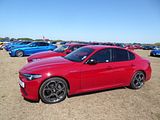
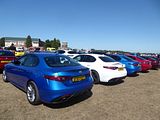


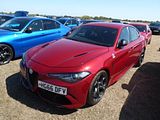
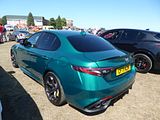
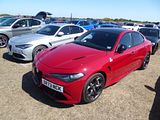


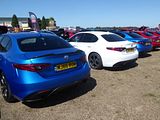


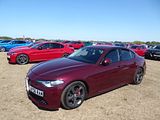


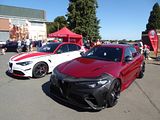
At the 2019 Geneva Motor Show the Alfa Romeo Racing limited edition was introduced, which celebrates Alfa Romeo’s legendary racing history and the entry of a new Italian driver in Formula 1 competition: Antonio Giovinazzi joining the “Alfa Romeo Racing” team together with the 2007 F1 World Champion Kimi Räikkönen. This special edition has exclusive paintwork, as a tribute to the Alfa Romeo Racing C38 Formula 1 car. It has also some stylistic details like some carbon fibre aerodynamic parts and an Akrapovič titanium exhaust system. The weight was reduced by about 28 kilograms (62 lb) from the standard Quadrifoglio, followed by a technical tune-up by Alfa Romeo engineers that has resulted more torque and power, which now amounts to 520 PS/513 bhp.




STELVIO
Preceded by Alfa Romeo’s first off-roader, the Matta, in the 1950s and the Kamal concept car in March 2003, the Stelvio is Alfa Romeo’s first production SUV. The high-performance trim of the Stelvio, the Quadrifoglio, was unveiled on 16 November 2016 at the Los Angeles Auto Show. The European versions of the Stelvio were presented at the Geneva Motor Show in March 2017. On January 18, 2017, Alfa Romeo began accepting orders for the Stelvio First Edition in the EMEA region. On November 2, 2017, the Stelvio Quadrifoglio went on sale in Italy. The Stelvio uses the same Giorgio platform already used by the Giulia, but slightly modified and raised by 22 cm (8.7 in). The Stelvio also shares the same engines and most of the mechanics, including a carbon-fibre driveshaft. In addition, its track width has increased by 2.9 cm (1.1 in) in the rear and 5.4 cm (2.1 in) in the front. It has a boot capacity of 525 L (18.5 cu ft). The boot sill is aligned with the rear bumper and cargo does not need to be lifted over a lip when being removed. There are large vehicle blind spots behind the car’s pillars. It has a 50/50 weight distribution and a drag coefficient of 0.32 (Cd). Euro NCAP classify it as a large off-road car. In order to reduce the weight of the car, aluminium is used for body panels, as well as for mechanical parts such as the suspension, brakes, and engine. The suspension, called AlfaLink, implements double wishbones in the front, and an aluminium multi-link configuration in the rear. The springs are longer than those in the Giulia, but stiffer to account for the extra weight and ride height. The driver sits nearly 20 cm (7.9 in) higher from the road than in the Giulia. The suspension is tuned for improved handling and driving dynamics, which can compromise ride quality if optional larger-diameter wheels are fitted. Rear-wheel drive as standard, the Stelvio can be optioned with an Alfa Romeo “Q4” all-wheel drive system, which can send up to 50% of power to the front in low-grip conditions. The Stelvio weighs 1,660 kg (3,660 lb) with all fluids, 145 kg (320 lb) less than an equivalent BMW X3 and 110 kg (243 lb) less than a four-cylinder Porsche Macan. The car’s braking system is designed to be less-susceptible to brake fade, which can take time for unfamiliar drivers to get used to. All models feature an 8.8-inch infotainment system with Apple Car Play and Android Auto as standard, while small tweaks have been made throughout the ranges. The car’s engine lineup is similar to that of the Giulia’s, with a turbocharged 2.0-litre inline-four and a 2.2-litre diesel inline-four. The Quadrifoglio trim level offers a 2.9 litre 690T twin-turbo 90° V6 rated at 510 PS (503 bhp), developed for Alfa Romeo by Ferrari. In Europe, consumption standards use the WLTP measuring system, which increases accuracy for consumption and emission figures. On 29 September 2017, a Quadrifoglio model set a Nürburgring lap time of 7 minutes, 51.7 seconds, the fastest for a production SUV. For the 2019 model year, diesel engines of the Stelvio were updated to meet the Euro 6d emissions standards, with AdBlue technology introduced to tackle particulates in the exhaust. Both the 150 PS (148 bhp) and 180 PS (178 bhp) versions got 10 PS (10 bhp) more from this change. In addition, Alfa Romeo introduced a new trim level for Europe: the Ti (Turismo Internazionale). Slightly different than the similarly named Stelvio Ti on sale in the United States, the Euro-spec Ti is fitted with the TBI-M 2.0-litre inline-four, mated to an eight-speed automatic transmission, with power sent to all four wheels through Alfa Romeo’s Q4 all-wheel drive system. In 2020, Alfa Romeo introduced the newly updated Stelvio in China, with both the Giulia and the Stelvio featuring updated interiors, a new 8.8-inch touchscreen for the infotainment system, which now offers a WiFi hotspot, over-the-air software upgrades, integrated emergency call function, and call assistant function. There is the new leather-wrapped multi-function steering wheel and gear lever, with revised dashboard materials. The debut for North America was in the 2019 LA Auto Show. As of 2022 in North America, the Stelvio has four distinct models. Starting with the base model Sprint, the Ti, the Veloce and the top-of-the-line Quadrifoglio. In light of the Alfa Romeo Tonale’s release, Stelvio’s range of models was condensed from seven to four. The Stelvio has been Alfa’s best-selling model in Europe for the past few years though in the UK, the Giulia has done slightly better.




TONALE
The production Tonale was originally scheduled for release in 2021, but was delayed until 2022 due to the global semiconductor shortage and Alfa Romeo management demanding better range and performance from its drivetrain. It was developed during the ownership of Fiat Chrysler Automobiles and underpinned by a heavily modified version of the SCCS crossover platform shared with the Jeep Compass. It is also the first Alfa Romeo to be equipped with an optional plug-in hybrid system, which uses a 15.5 kWh (56 MJ) lithium-ion battery to achieve 30 miles (48 km) of all-electric range. The Tonale marks the brand’s electrification effort, where Alfa Romeo will be the first brand among the 14 brands of Stellantis to go fully electric by 2027. The Tonale is marketed in the premium segment, and has been described variously as a “compact crossover”, a “compact SUV”, a “small SUV”, and a “tall hatchback”. All models of the Tonale are equipped with a 12.3-inch (31 cm) digital infotainment cluster and a 10.25-inch (26.0 cm) infotainment screen, which will run on the Uconnect 5 software suite. In addition, the Tonale will come with an NFT that records and stores data of the car’s life cycle. According to Alfa Romeo, the NFT will generate a certificate that Stellantis claims can help maintain the car’s residual value. The Verge noted that Alfa Romeo had not provided much information about what blockchain technology they intended to use for this. Jalopnik felt that digitising a car’s service history was a good idea, but that blockchain NFTs were a “bad” and “entirely unnecessary” way to achieve this. According to Alfa Romeo, the Tonale was designed to offer more driving engagement than the class average by using a very quick steering rack (2.3 turns lock-to-lock). It also features torque vectoring by braking, frequency-selective dampers as standard, and adaptive items and four-piston brakes on the range-topping Veloce. UK sales started in late 2022 and the car is starting to appear at Italian car events now.

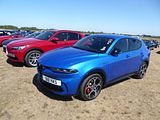
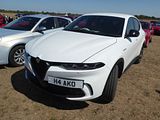
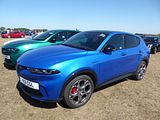
JUNIOR


NOT QUITE AN ALFA
Automotive Design and Development Ltd (ADD) was an English company responsible for the creation of the futuristic-looking Nova kit car. It was based in Southampton from 1971 to 1973 after which it moved to Accrington, Lancashire until 1975. ADD failed and the rights to the Nova were bought by Nova Cars in Mirfield, West Yorkshire in 1978, which continued until 1990. A low volume production run was made by Nova Developments in Cornwall in the 1990s and the company was sold to India-based Aerotec Nova around 1996. The car was styled by Richard Oakes with engineering by Phil Sayers, combining a fibreglass shell on a VW Beetle chassis and mechanicals. A two-seater, it was highlighted by a dramatically opening canopy that combined roof and doors into one. Licensed versions of the Nova have been built in Austria as the Ledl, in Australia as the Purvis Eureka, in France as the Défi, in Italy as the Totem and Puma, in New Zealand as the Scorpion, in South Africa as the Eagle, in Switzerland as the Gryff, in the United States as the Sterling and Sovran and in Zimbabwe as the Tarantula. There have also been numerous unlicensed copies. Some versions featured pop-up head lamps and gull-wing doors, but the basic silhouette remained the same. Versions of the Nova have appeared in a number of films, including Cannonball Run II, Death Race 2000, Winners and Sinners, Condorman and Mani Di Velluto. This one qualifies for the event as it has an AlfaSud engine.

INTERLOPERS
I was not the only person to attend who does not have an Alfa, so there was a parking area for what you might call “interlopers”. It was actually not as big as I was expecting, but needless to say there were quite a few cars here that stood out for me.
Abarth 124 Spider: The Abarth 124 Spider was developed in parallel with the Fiat model. It does cost a lot more, and there are those who think you don’t get enough extra for your money, but those who have driven it will tell you otherwise. You certainly get more power. The 1.4 MultiAir turbo unit jumps up from 138bhp to 168bhp, while torque also increases by a modest 10Nm to 250Nm, which gives it a 0-62mph time of 6.8 seconds, which is half a second quicker than the 2.0-litre Mazda MX-5. The top speed is 143mph. It weighs just 1060kg meaning a power-to-weight ratio of 158bhp-per-tonne, and with the new Record Monza exhaust system it sounds great even at idle. The Abarth version gets a stiffer suspension setup than the regular Fiat 124 Spider, with Bilstein dampers and beefed-up anti-roll bars. Bigger Brembo brakes also feature, with aluminium calipers. It can be had with a six-speed manual or six-speed automatic transmission with paddles, and the latter gets a Sport mode for quicker shifts. Many of the UK cars sport the ‘Heritage Look’ pack, which is a no-cost option. It brings a matt black bonnet and bootlid, plus red exterior trim detailing and has proved popular. The £29,565 starting price gets you standard equipment such as cruise control, climate control, Bluetooth, a DAB radio and satnav, plus Alcantara black and red (or pure black) seat trim. The automatic gearbox is a £2,035 extra, while an optional visibility pack brings LED DRLs, auto lights and wipers and rear parking sensors. Sales ceased during 2019, with around 1800 cars having been brought into the UK, so this is always going to be a rare car, and values are already increasing at a rate reflecting its desirability and the difficulty in finding one.

Chevrolet Corvette “C2”: First seen in 1963, this Corvette model introduced us to the name Sting Ray. It continued with fibreglass body panels, and overall, was smaller than the first generation. The car was designed by Larry Shinoda with major inspiration from a previous concept design called the “Q Corvette,” which was created by Peter Brock and Chuck Pohlmann under the styling direction of Bill Mitchell. Earlier, Mitchell had sponsored a car known as the “Mitchell Sting Ray” in 1959 because Chevrolet no longer participated in factory racing. This vehicle had the largest impact on the styling of this generation, although it had no top and did not give away what the final version of the C2 would look like. The third inspiration was a Mako Shark Mitchell had caught while deep-sea fishing. Production started for the 1963 model year and ended in 1967. The 1963 model was the first year for a Corvette coupé and it featured a distinctive tapering rear deck (a feature that later reappeared on the 1971 “Boattail” Buick Riviera) with, for 1963 only, a split rear window. The Sting Ray featured hidden headlamps, non-functional bonnet vents, and an independent rear suspension. Corvette chief engineer Zora Arkus-Duntov never liked the split rear window because it blocked rear vision, but Mitchell thought it to be a key part of the entire design. Maximum power for 1963 was 360 bhp, raised to 375 bhp in 1964. Options included electronic ignition, the breakerless magnetic pulse-triggered Delcotronic first offered on some 1963 Pontiac models. On 1964 models the decorative bonnet vents were eliminated and Duntov, the Corvette’s chief engineer, got his way with the split rear window changed to a full width window. Four-wheel disc brakes were introduced in 1965, as was a “big block” engine option: the 396 cu in (6.49 litre) V8. Side exhaust pipes were also optionally available in 1965, and continued to be offered through 1967. The introduction of the 425 bhp 396 cu in big block in 1965 spelled the beginning of the end for the Rochester fuel injection system. The 396 cu in option cost $292.70 while the fuel injected 327 cu in (5.36 litre) engine cost $538.00. Few people could justify spending $245.00 more for 50 bhp less, even though FI could deliver over 20 mpg on the highway and would keep delivering fuel despite high G-loading in corners taken at racing speeds. Another rare ’63 and ’64 option was the Z06 competition package, which offered stiffer suspension, bigger, multi-segment lined brakes with finned drums and more, only a couple hundred coupes and ONE convertible were factory-equipped this way in 1963. With only 771 fuel-injected cars built in 1965, Chevrolet discontinued the option at the end of the ’65 production, having introduced a less-expensive big block 396 engine rated at 425 hp in the middle of the production year and selling over 2,000 in just a few months. For 1966, Chevrolet introduced an even larger 427 cu in 7 litre Big Block version. Other options available on the C2 included the Wonderbar auto-tuning AM radio, AM-FM radio (mid-1963), air conditioning (late-1963), a telescopic steering wheel (1965), and headrests (1966). The Sting Ray’s independent rear suspension was successfully adapted for the new-for-1965 Chevrolet Corvair, which solved the quirky handling problems of that unique rear-engine compact. 1967 was the final year for the C2 generation. The 1967 model featured restyled bumper vents, less ornamentation, and back-up lamps which were on the inboard in 1966 were now rectangular and centrally located. The first use of all four taillights in red started in 1961 and was continued thru the C-2 line-up except for the 1966. The 1967 and subsequent models continuing on all Corvettes since. 1967 had the first L88 engine option which was rated at 430 bhp, but unofficial estimates place the actual output at 560 bhp or more. Only twenty such engines were installed at the factory. From 1967 (to 1969), the Holley triple two-barrel carburettor, or Tri-Power, was available on the 427 L89 (a $368 option, on top of the cost for the high-performance 427). Despite these changes, sales slipped over 15%, to 22,940 – 8,504 coupes and 14,436 convertibles.

Fiat 124 Sport Coupe: It was only a few months after the launch of the 124 Berlina (saloon), that Fiat expanded the range with a very stylish Coupe model. It was designed as a three-box, 2-door notchback coupé by Mario Boano, known for designing the bodywork on the Ferrari 250 GT “Boano”. As many parts as possible were used from the 124 saloon. Both the Coupe and the Spider and Coupé shared the same basic platform as the 124 Berlina, but the Spider had a 14 cm shorter wheelbase. There were three distinct generations, known as AC, BC and CC. The AC model began in 1967 and came with a 90PS 1438 cc twin cam, 4-speed gearbox (the option of a 5-speed item appearing in mid-’67), front and rear anti-roll bars and a torque tube rear axle. It featured a 120 mph speedo, three supplementary gauges, a faux wood steering wheel, a woodgrain dash and console top, as well as tail lights shared with the Lamborghini Espada and Iso Rivolta. 124 Sport Coupés were modern in chassis and engine design. Braking was via four 9″ disc brakes with a front/rear weight-sensitive proportioning valve. It also had a sealed cooling system, viscous fan clutch and a toothed timing belt for the twin-cam motor, the first mass-produced engine to feature this instead of the usual chain-drive. Launched in 1969, the BC featured revised styling with twin headlights and revised taillights shared with the Lamborghini Jarama. The BC was available with both the 1438 cc and later the 1608 cc engine. Other details remained similar to the AC except the interior dash now had a 140 mph or 220 km/h speedo, 9000 rpm tacho in 1608 cc models and a clock. The steering wheel now had black painted spokes and the seats had for the first time cloth inserts in the centre. There was no woodgrain inside like before (all the panels were finished in black vinyl and the gauge rims were matt black to match) and “eyeball” vents were fitted in the centre console where the AC had a decorative panel simply filling in the space for an optional radio. Options included green tinted windows, Cromodora alloy wheels with chrome centre hub cap (as per AC optional), radio, seat headrests, heated rear window, electronic ignition. At the end of the BC run air conditioning was available as an option as well. The fuel tanks were always around 46 litres. The CC Coupe arrived in 1973 with new front styling and a revised squarer rear tail with a new deeper boot lid. Taillights were changed to a vertical arrangement and the side rear windows were revised. The CC started with a small batch fitted with the 1608 cc engine, soon changing to a revised 1592 cc engine (slightly shorter stroke at 79,2 mm to create a “sub-1600” engine to fit the lower tax bracket in Italy) and an enlarged 84 mm bore creating an engine of 1756 cc. The 1592 cc and 1756 cc (sourced from the new Fiat 132, introduced in 1972) both made use of a single carburettor again (the Weber 34 DMS). In spite of this change the 1756 cc was the most powerful engine produced with 118 hp and 115 mph (185 km/h) top speed. The CC’s revised interior featured a new dashboard incorporating a lower panel on the passenger side, an alloy fascia in front of the driver and seats covered completely in cloth. There was a new vinyl-covered steering wheel rim with anodised silver spokes. The optional but not uncommon Cromodora wheels now had a revised design with no chrome centre hubcap, instead having exposed wheelnuts. These were of an 8 slot design, the earlier wheels used coming in 6 slot configuration (an 8-slot design was also current but not original to the 124 range). The car continued until 1975. There were approx 113,000 AC Coupés, 98,000 BC Coupés 1,438 cc/1,608 cc, and about 75,000 CC Coupés manufactured.

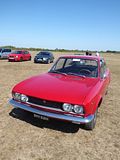


Iso Lele:
The Iso Lele (or Iso Rivolta Lele) is a grand tourer that was produced by the Italian automobile manufacturer Iso Automoveicoli S.p.A. between 1969 and 1974. The Lele, being a 2+2-seater, filled the gap between the Grifo and the Fidia while sharing its powertrain with its siblings. The styling was done by Marcello Gandini of Bertone. The car is named after Lele Rivolta, wife of Piero Rivolta (son of Iso company founder Renzo). Meant as a Christmas present for Piere Rivolta’s wife Rachelle (LeLe) Rivolta, it was decided to put the car into production to succeed the IR 300. It was first presented to the public at the 1969 New York International Auto Show and was made to compete against the Lamborghini Espada. The car was initially powered by a 300 or 350 hp General Motors V8 and was available with a 4-speed manual (later a 5-speed unit from ZF Friedrichshafen) and a 4-speed automatic transmission sourced from General Motors. In 1972, after about 125 cars had been produced, General Motors demanded that Iso pay in advance for the engines. Iso chose to replace the Chevrolet engine with Ford’s Cleveland V8 rated at 325 hp. The automatic transmission was also sourced from Ford, while the manual transmission remained unchanged. The chassis was the same Bizzarrini designed unit which had found use in Iso automobiles since the IR 300. It had an unequal-length double-wishbones front suspension with coil springs while the rear suspension consisted of a de Dion layout with a Salisbury axle unit. Disc brakes were used on all four wheels and were mounted inboard on the chassis. The rear suspension had dual trailing arms and a Watts linkage which located the De Dion axle. Koni telescopic shock absorbers and coil springs completed the unit. The Lele came with a ZF power steering which was the same unit used by Maserati and Campagnolo magnesium alloy wheels, wrapped in 215/70 VP15 Michelin XWX tyres. The interior was upholstered in leather and came with creature comforts like air conditioning and electric windows along with plush carpeting. The speedometer and tachometer were placed behind the steering column while an additional four gauges were present on the centre console which consisted of an ammeter, fuel gauge and water and oil temperature gauges. The car came with a hidden headlamp styling with popup covers partially covering the quad headlamp units when not in use. In 1973, the standard version (now known as Lele IR6) was joined by the Lele IR6 Sport, with an engine modified to generate 360 hp and only available mated to the ZF 5-speed transmission. The engine had a compression ratio of 8.6:1, had a bore and stroke of 101.6 x 88.9 mm and had a redline of 5,800 rpm. It was based on two bespoke versions made for Iso-Marlboro Formula One team drivers Howden Ganley and Nanni Galli. The variant featured removal of sound deadening components, a new dashboard and engine modifications. The angular Gandini styled body and the comfortable nature of the car did little to help sales and only 285 cars were made. About 160 Ford-engined Leles had been built by the time production wound up in 1974 due to Iso’s bankruptcy. Following the agreement with Philip Morris that led to the creation of the Iso-Marlboro brand in Formula 1, Philip Morris commissioned Iso to construct two specially modified Leles for their Formula 1 Team Drivers. Modified by Bizzarrini these two cars were stripped of creature comforts to reduce weight. The cars had subtle differences from each other and no car was identical. The cars, which were made for drivers Howden Ganley and Nanni Galli, had a unique dash layout that did not appear on any other Lele. Bizzarrini then modified the 351 Cobra Jet engine which was now rated at 360 hp (268 kW). Painted in Marlboro Red with Marlboro badges on the front fenders Ganley’s car debuted on the Iso Rivolta stand at the 1973 Geneva Auto Show. Galli’s car was painted in white. The exterior styling cues from these two cars were used to develop the Lele Sport which also had a modified version of their dash layout. Philip Morris also commissioned at least two more cars for promotional purposes to resemble the Marlboro cars given to its drivers, called the Marlboro Replicas. These cars were essentially Lele Sports with Marlboro badges on the fenders. They also retained the creature comforts removed from the original Marlboro cars. A total of 285 cars were made.


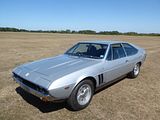


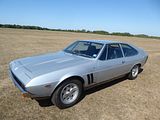
Jaguar E Type Series 3: The E-Type Series 3 was introduced in 1971, with a new 5.3 L Jaguar V12 engine, uprated brakes and standard power steering. Optionally an automatic transmission, wire wheels and air conditioning were available. The V12 was equipped with four Zenith carburettors, and as introduced produced a claimed 272 bhp, more torque, and a 0–60 mph acceleration of less than seven seconds. The short wheelbase FHC body style was discontinued, with the Series 3 available only as a convertible and 2+2 coupé. The newly used longer wheelbase now offered significantly more room in all directions. The Series 3 is easily identifiable by the large cross-slatted front grille, flared wheel arches, wider tyres, four exhaust tips and a badge on the rear that proclaims it to be a V12. The first published road test of the series 3 was in Jaguar Driver, the club magazine of the Jaguar Drivers’ Club, the only owners club to be officially sanctioned by Sir William Lyons and Jaguar themselves. The road test of a car provided by Jaguar was published ahead of all the national and international magazines. Cars for the US market were fitted with large projecting rubber bumper over-riders (in 1973 these were on front, in 1974 both front and rear) to meet local 5 mph impact regulations, but those on European models were considerably smaller. US models also have side indicator repeats on the front wings. There were also a very limited number of six-cylinder Series 3 E-Types built. These were featured in the initial sales procedure but the lack of demand stopped their production. The V12 Open Two Seater and V12 2+2 were factory fitted with Dunlop E70VR − 15-inch tyres on 15 × 6K wire or solid wheels. The final production E-Type OTS Roadster was built in June 1974. Total production was 15,290.

Jaguar XJ-S: Successor to the E Type was the XJ-S, launched in September 1975, and to a not universally approving public. This was a very different sort of sporting Jaguar, more boulevard cruiser than sports car, even though the car had plenty of appeal with its smooth V12 engine which gave it genuine 150 mph performance. Press reports were favourable, but a thirsty V12 and a car with inconsistent build quality and styling that not everyone warmed to meant that sales were slow, and they got slower as the decade passed, leading questions to be asked as to whether the car should continue. As well as sorting the saloon models, Jaguar’s Chairman, John Egan, put in place a program to improve the XJ-S as well, which also benefitted from the HE engine in early 1981. A Cabrio model and the option of the new 3.6 litre 6 cylinder engine from 1984 widened the sales appeal, and the volumes of cars being bought started to go up. A fully open Convertible, launched in 1988 was the model many had been waiting for, and by this time, although the design was over 10 years old, it was now brimming with appeal to many. 1991 saw an extensive facelift which changed the styling details as well as incorporating the latest mechanical changes from the Jaguar parts bin, making the XJS (the hyphen had been dropped from the name in 1990) a truly desirable car. Seen here were both pre- and post-facelift models as well as one of the rare TWR-converted XJR-S cars. These were made between 1988 and 1993 by the newly formed JaguarSport, a separate company owned in a ratio of 50:50 by Jaguar and TWR Group Limited specialising in developing high performance Jaguar sports cars. The car had a distinctive body kit, special alloy wheels, a unique suspension system utilising modified coil springs and Bilstein shocks, a luxurious interior with Connolly Autolux leather along with walnut wood trim, and handling improvements. The first 100 of these cars were named “Celebration Le Mans” to commemorate Jaguar’s 1988 win at the 24 Hours of Le Mans and were only sold in the UK. Between 1988 and 1989, a total of 326 XJR-S cars were produced with the 5.3 litres engine with a power output of 318 bhp. After September 1989, the displacement of the engine was increased to 5,993 cc and it was now equipped with Zytek fuel injection and engine management system. This was different from the standard 6.0-litre engine used in the late XJS models and was unique to this model. The power output was raised to 334 bhp at 5,250 rpm and 495 Nm (365 lb/ft) of torque at 3,650 rpm due to a higher compression ratio of 11.0:1, a new forgedsteel crankshaft, increased bore and forged alloy pistons. A modified air intake system and a low loss dual exhaust system was also standard on the model. The engine was mated to the 3-speed GM400 automatic transmission utilising a recalibrated valve body and had faster shift times. The car was equipped with Dunlop D40 M2 tyres for better grip. These modifications resulted in a top speed of 260 km/h (160 mph). A total of 787 coupés and 50 convertible XJR-S were built for the world market.
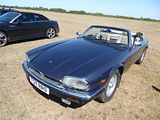
Maserati Grecale:


Mercedes-Benz 280 SL: Replacement for the 190SL cars of the 1950s were the “Pagoda” series of W113 cars. By 1955, Mercedes-Benz Technical Director Prof. Fritz Nallinger and his team held no illusions regarding the 190 SL’s lack of performance, while the high price tag of the legendary 300 SL supercar kept it elusive for all but the most affluent buyers. Thus Mercedes-Benz started evolving the 190 SL on a new platform, model code W127, with a fuel-injected 2.2 litre M127 inline-six engine, internally denoted as 220SL. Encouraged by positive test results, Nallinger proposed that the 220SL be placed in the Mercedes-Benz program, with production commencing in July 1957. However, while technical difficulties kept postponing the production start of the W127, the emerging new S-Class W112 platform introduced novel body manufacturing technology altogether. So in 1960, Nallinger eventually proposed to develop a completely new 220SL design, based on the “fintail” W 111 sedan platform with its chassis shortened by 11.8 in, and technology from the W112. This led to the W113 platform, with an improved fuel-injected 2.3 litre M127 inline-six engine and the distinctive “pagoda” hardtop roof, designated as 230 SL. The 230 SL made its debut at the prestigious Geneva Motor Show in March 1963, where Nallinger introduced it as follows: “It was our aim to create a very safe and fast sports car with high performance, which despite its sports characteristics, provides a very high degree of travelling comfort”. The W113 was the first sports car with a “safety body,” based on Bela Barényi’s extensive work on vehicle safety: It had a rigid passenger cell and designated crumple zones with impact-absorbing front and rear sections built into the vehicle structure. The interior was “rounded,” with all hard corners and edges removed, as in the W111 sedan. Production of the 230 SL commenced in June 1963 and ended on 5 January 1967. Its chassis was based on the W 111 sedan platform, with a reduced wheelbase by 11.8 in, recirculating ball steering (with optional power steering), double wishbone front suspension and an independent single-joint, low-pivot swing rear-axle with transverse compensator spring. The dual-circuit brake system had front disc brakes and power-assisted rear drum brakes. The 230 SL was offered with a 4-speed manual transmission, or an optional, very responsive fluid coupled (no torque converter) 4-speed automatic transmission, which was popular for US models. From May 1966, the ZF S5-20 5-speed manual transmission was available as an additional option, which was particularly popular in Italy. The 2,308 cc M127.II inline-six engine with 150 hp and 145 lb/ft torque was based on Mercedes-Benz’ venerable M180 inline-six with four main bearings and mechanical Bosch multi-port fuel injection. Mercedes-Benz made a number of modifications to boost its power, including increasing displacement from 2,197 cc, and using a completely new cylinder head with a higher compression ratio (9.3 vs. 8.7), enlarged valves and a modified camshaft. A fuel injection pump with six plungers instead of two was fitted, which allowed placing the nozzles in the cylinder head and “shooting” the fuel through the intake manifold and open valves directly into the combustion chambers. An optional oil-water heat exchanger was also available. Of the 19,831 230 SLs produced, less than a quarter were sold in the US. Looking identical, the 250 SL was introduced at the 1967 Geneva Motor Show. Production had already commenced in December 1966 and ended in January 1968. The short one-year production run makes the 250 SL the rarest of the W113 series cars. The 250 SL retained the stiffer suspension and sportier feel of the early SLs, but provided improved agility with a new engine and rear disc brakes. Range also improved with increased fuel tank capacity from 65 litres to 82. Like its predecessor, the 250 SL was offered with a 4-speed automatic transmission, and 4-speed or ZF 5-speed manual transmissions. For the first time, an optional limited slip differential was also available. The main change was the use of the 2,496 cc M129.II engine with a larger stroke, increased valve ports, and seven main bearings instead of four. The nominal maximum power remained unchanged at 150 hp, but torque improved from 145 lb/ft to 159 lb/ft. Resiliency also improved with a new cooling water tank (“round top”) with increased capacity and a standard oil-water heat exchanger. The 250 SL also marked the introduction of a 2+2 body style, the so-called “California Coupé”, which had only the removable hardtop and no soft-top: a small fold-down rear bench seat replaced the soft-top well between passenger compartment and boot. It is estimated that only 10% of the 250SLs that were brought into America were California Coupes. Of the 5,196 250 SLs produced, more than a third were sold in the US.The 280 SL was introduced in December 1967 and continued in production through 23 February 1971, when the W 113 was replaced by its successor, the entirely new and substantially heavier R107 350 SL. The main change was an upgrade to the 2,778 cc M130 engine with 170 hp and 180 lb/ft, which finally gave the W 113 adequate power. The performance improvement was achieved by increasing bore by 4.5 mm (0.2 in), which stretched the limits of the M180 block, and required pairwise cylinder casts without cooling water passages. This mandated an oil-cooler, which was fitted vertically next to the radiator. Each engine was now bench-tested for two hours prior to being fitted, so their power specification was guaranteed at last. The M130 marked the final evolution of Mercedes-Benz’ venerable SOHC M180 inline-six, before it was superseded by the entirely new DOHC M110 inline-six introduced with R107 1974 European 280 SL models. For some time, it was also used in the W 109 300 S-Class, where it retired the expensive 3 liter M189 alloy inline-six. Over the years, the W 113 evolved from a sports car into a comfortable grand tourer, and US models were by then usually equipped with the 4-speed automatic transmission and air conditioning. Manual transmission models came with the standard 4-speed or the optional ZF 5-speed, which was ordered only 882 times and thus is a highly sought-after original option today. In Europe, manual transmissions without air conditioning were still the predominant choice. Of the 23,885 280 SLs produced, more than half were sold in the US.

Porsche 928: The first V8 engined Porsche, the 928 was originally conceived to replace the 911, though as we all know, that did not happen, with the two complementing each other in the range during the 18 year life of the 928. By the late 1960s, Porsche had changed significantly as a company, and executives including owner Ferdinand Porsche were toying with the idea of adding a luxury touring car to the line-up. Managing Director Ernst Fuhrmann was also pressuring Ferdinand to approve development of the new model in light of concerns that the current flagship model at the time, the 911, was quickly reaching the limits of its potential. Slumping sales of the 911 seemed to confirm that the model was approaching the end of its economic life cycle. Fuhrmann envisioned the new range-topping model as being the best possible combination of a sports coupe and a luxury sedan, something well equipped and comfortable enough to be easily driven over long distances that also had the power, poise and handling prowess necessary to be driven like a sports car. This set it apart from the 911, which was intended to be an out-and-out sports car. Ordered by Ferdinand Porsche to come up with a production-feasible concept for his new model, Fuhrmann initiated a design study in 1971, eventually taking from the process the final specification for the 928. Several drivetrain layouts were considered during early development, including rear and mid-engined designs, but most were dismissed because of technical and/or legislative difficulties. Having the engine, transmission, catalytic converter(s) and exhaust all cramped into a small rear engine bay made emission and noise control more difficult, something Porsche was already facing problems with on the 911 and wanted to avoid. After deciding that the mid-engine layout didn’t allow enough room in the passenger compartment, a front engine/rear wheel drive layout was chosen. Porsche also may have feared that the U.S. government would soon ban the sale of rear-engined cars in response to the consumer concern over safety problems with the rear-engined Chevrolet Corvair. Porsche engineers wanted a large-displacement engine to power the 928, and prototype units were built with a 5-litre V8 producing close to 300 hp. Ferdinand Piëch wanted this car to use a 4.6-litre V10 based upon Audi’s five-cylinder engine. Several members of the Porsche board objected, chiefly because they wished for Porsche AG to maintain some separation from Volkswagen. The first two running prototypes of Porsche’s M28 V8 used one four-barrel carburettor, but this was just for initial testing. The cars were sold with the planned Bosch K-Jetronic fuel injection system. When increasing concern within the company over the pricing and availability of fuel during the oil crisis of the 1970s became an issue of contention, smaller engines were considered in the interest of fuel economy. A push began for the development of a 3.3 litre 180 hp powerplant they had drawn up designs for, but company engineers balked at this suggestion. Both sides finally settled on a 4.5 litre SOHC per bank 16-valve V8 producing 240 PS which they considered to have an acceptable compromise of performance and fuel economy. The finished car debuted at the 1977 Geneva Motor Show, going on sale later that year. Although it won early acclaim for its comfort and power, sales were slow. Base prices were much higher than that of the 911 model and the 928’s front-engined, water-cooled design put off many Porsche purists, not least because the design marked a major change in direction for Porsche started with the introduction of the Porsche 924 in 1976 which purists found hard to accept. Porsche utilised a transaxle in the 928 to help achieve 50/50 front/rear weight distribution, aiding the car’s balance. Although it weighed more than the difficult-to-handle 911, its more neutral weight balance and higher power output gave it similar performance on the track. The 928 was regarded as the more relaxing car to drive at the time. It came with either a five-speed dog leg manual transmission, or a Mercedes-Benz-derived automatic transmission, originally with three speeds, with four-speed from 1983 in North America and 1984 in other markets. More than 80% had the automatic transmission. Exact percentage of manual gearbox cars for entire production run is not known but it is believed to be between 15 and 20%. The body, styled by Wolfgang Möbius under guidance of Anatole Lapine, was mainly galvanised steel, but the doors, front fenders, and hood were aluminium in order to make the car more lightweight. It had a substantial luggage area accessed via a large hatchback. The new polyurethane elastic bumpers were integrated into the nose and tail and covered in body-coloured plastic; an unusual feature for the time that aided the car visually and reduced its drag. Porsche opted not to offer a convertible variant but several aftermarket modifiers offered convertible conversions, most notably Carelli, based in Orange County, CA. The Carelli conversions were sold as complete cars, with the conversion doubling the price of the car. A reported 12 units were made. The 928 qualified as a 2+2, having two small seats in the rear. Both rear seats could be folded down to enlarge the luggage area, and both the front and rear seats had sun visors for occupants. The rear seats are small (due to the prominent transmission hump) and have very little leg room; they are only suitable for adults on very short trips or children. The 928 was also the first vehicle in which the instrument cluster moved along with the adjustable steering wheel in order to maintain maximum instrument visibility. The 928 included several other innovations such as the “Weissach Axle”, a simple rear-wheel steering system that provides passive rear-wheel steering to increase stability while braking during a turn, and an unsleeved, silicon alloy engine block made of aluminium, which reduced weight and provided a highly durable cylinder bore. Porsche’s design and development efforts paid off during the 1978 European Car of the Year, where the 928 won ahead of the BMW 7 Series, and the Ford Granada. The 928 is the only sports car ever to have won this competition, which is regarded as proof of how advanced the 928 was, compared to its contemporaries. Porsche introduced a refreshed 928 S into the European market in 1980 model year. Externally, the S wore new front and rear spoilers and sported wider wheels and tyres than the older variant, but the main change for the 928 S was under the bonnet where a revised 4.7 litre engine was used. European versions debuted with 300 PS, and were upgraded to 310 PS for 1984, though it is rumoured that they typically made around 330 hp. From 1984 to 1986, the S model was called S2 in UK. These cars used Bosch LH-Jetronic fuel injection and purely electronic Bosch ignition, the same systems used on the later 32-valve cars, though without the pollution controls. North American-spec 1983 and 1984 S models used, among other differences, smaller valves, milder camshafts, smaller diameter intake manifolds, and additional pollution equipment in order to meet emissions regulations, and were limited to 234 hp as a result. Due to low grade fuel 16V low compression S engine was made for Australian market in 1985 model year. It had 9.3:1 compression ratio pistons instead of normal 10.4:1 but used same large intake, high lift cams, large valves etc. of other S engines. In 1982, two special models were available for different markets. 202 “Weissach Edition” cars were sold in North America. Unusual features were champagne gold metallic paint, matching brushed gold flat disc wheels, two-tone leather interior, a plaque containing the production number on the dash and the extremely collectible three-piece Porsche luggage set. It’s believed these cars were not made with S spoilers even though these were available in U.S. during this time period as part of the “Competition Group” option. The “Weissach Edition” option was also available for the US market 911 in 1980 model year and 924 in 1981 model year. 141 special “50th Jubilee” 928 S models were available outside the U.S. and Canada to celebrate the company’s 50-year existence as a car manufacturer. This model is also sometimes referred to as the “Ferry Porsche Edition” because his signature was embroidered into the front seats. It was painted meteor metallic and fitted with flat disc wheels, wine red leather and special striped fabric seat centres. Similar 911 and 924 specials were also made for world markets. Porsche updated the North American 928 S for 1985, replacing the 4.7 litre SOHC engine with a new 5.0 litre DOHC unit sporting four valves per cylinder and producing 288 hp. Seats were also updated to a new style, these cars are sometimes unofficially called S3 to distinguish them from 16-valve “S” models. European models kept a 4.7 litre engine, which was somewhat more powerful as standard, though lower 9.3:1 compression 32-valve engine together with catalytic converters became an option in some European countries and Australia for 1986. In 1986, revised suspension settings, larger brakes with 4-piston calipers and modified exhaust was installed on the 928S, marking the final changes to old body style cars. These were straight from the 928S4, which was slated to debut a few months later. These changes came starting from VIN 1001, which means that the first thousand ’86’s had the old brakes, but later cars had the later systems. This later 1986 model is sometimes referred to as a 19861⁄2 or 1986.5 because of these changes. The name is a little misleading as more than 3/4 of the 1986 production had these updates. The 928 S4 variant debuted in the second half of 1986 with an updated version of the 5.0 litre V8 producing 320 PS, sporting a new single-disc clutch in manual gearbox cars, larger torque converter in automatics and fairly significant styling updates which gave the car a cleaner, sleeker look. S4 was much closer to being a truly world car than previous models as only major differences for North American models were instrumentation in either kilometers or miles, lighting, front and rear bumper shocks and the availability of catalytic converters in many other markets. The Australian market version was only one with different horsepower rating at 300 PS due to preparation for possible low grade fuel. Even this was achieved without engine changes. A Club Sport variant which was up to 100 kg (220 lb) lighter became available to continental Europe and U.S. in 1988. This model was watered down version of the 1987 factory prototype which had a lightened body. Also in 1987 the factory made four white lightened manual gearbox S4 models for racecar drivers who were on their payroll at the time. These were close to same as later actual Club Sport models and can also be considered prototypes for it. An SE (sometimes called the S4 Sport due to model designation on rear bumper), a sort of halfway point between a normally equipped S4 and the more race-oriented Club Sport, became available to the UK. It’s generally believed these Porsche Motorsport-engined cars have more hp than the S4. They utilise parts which later became known as GT pistons, cams and engine ECU programs. Some of them had stronger, short geared manual gearbox. The automatic gearbox was not available. For the 1989 model year, a visible change inside was digital trip computer in dashboard. At the same time Australian models received the same 320 PS engine management setup as other markets. Porsche debuted the 928 GT in the late winter 1988/89 after dropping the slowly selling CS and SE. In terms of equipment, the GT was like the 928 SE, having more equipment than a Club Sport model but less than a 928 S4 to keep the weight down somewhat. It had the ZF 40% limited-slip differential as standard like the Club Sport and SE before it. Also like the CS and SE, the GT was only available with a manual gearbox. European 1989 CS and GT wheels had an RDK tyre pressure monitoring system as standard, which was also optional for the same year S4. For 1990 model year Porsche made RDK and a 0-100% variable ratio limited-slip called PSD (Porsche SperrDifferential) standard in both GT and S4 models for all markets. This system is much like the one from the 959 and gives the vehicle even more grip. In 1990 the S4 was no longer available with a manual gearbox. The S4 and GT variants were both cut at the end of 1991 model year, making way for the final version of the 928. The 928 GTS came for sale in late 1991. Changed bodywork, larger front brakes and a new, more powerful 5.4 litre 350 PS engine were the big advertised changes; what Porsche wasn’t advertising was the price. Loaded GTS models could eclipse US$100,000 in 1995, making them among the most expensive cars on the road at the time. This severely hampered sales despite the model’s high competency and long standard equipment list. Porsche discontinued the GTS model that year after shipping only 77 of them to the United States. Total worldwide production of 928s over an 18 year period was a little over 61,000 cars. Second-hand models’ value decreased as a result of generally high maintenance costs due largely to spare parts that are expensive to manufacture, with the result that there are fewer survivors than you might expect, though with values hardening, people are now spending the money required to restore these cars.

OTHER ONSITE CARS
A number of cars associated with the site were also evident. Whilst most of the businesses present here were closed for the day, there were a few cars parked up outside, of which these were the notable ones I photographed:
Austin 12/4 Ascot (1936): The Austin Light Twelve-Four is a car that was produced by Austin from 1933 until 1939. It was replaced in 1939 by a completely new car also called the Austin 12 which kept the same engine. The “12” in the name referred to the taxation horsepower, a British rating which controlled the annual taxation payable to use the car on the road. Austin introduced this new car in September 1932. It was made by fitting a 1535 cc side-valve, four-cylinder engine with 24 bhp output into the same chassis as they had been making since late 1930 for their six-cylinder 12/6 which was also in the same 12 hp class. This new four cylinder engine was coupled to a four-speed “crash” gearbox at first, but a new transmission with synchromesh on third and top speed appeared in 1934 and then also on second in 1935. The chassis was very conventional, with semi-elliptic leaf springs on all wheels and rigid axles front and rear. Wire wheels were fitted until 1937 when they were replaced with pressed steel ones. At launch there was a choice of a pressed steel six-light (three windows on each side) saloon called the Harley and a two-seat tourer. A second saloon style with a boot, the Ascot, was added in 1934 and the Harley was dropped in 1935. In the same year the chromium-plated radiator shell was replaced by one painted in body colour. The very early cars had their side lights mounted on the scuttle, but these soon moved to the tops of the wings. On 11 August 1936 Austin announced a major update for 1937 with the engine being moved forward on the chassis to improve passenger space. Other improvements included an adjustable steering column and the windscreen wipers moving to the scuttle from the top of the screen. The bodies became much more rounded and in 1938 an estate car was added to the model line-up and the tourer, which was still being built in the old style, was replaced by a four-door cabriolet.


Bentley 3 litre: The 3 Litre was the company’s first model, first shown in 1919 and made available to customers’ coachbuilders from 1921 to 1929. It was conceived for racing. The Bentley was very much larger than the 1368 cc Bugattis that dominated racing at the time, but double the size of engine and strength compensated for the extra weight. The 4000 lb (1800 kg) car won the 24 Hours of Le Mans in 1924, with drivers John Duff and Frank Clement, and again in 1927, this time in Super Sports form, with drivers S. C. H. “Sammy” Davis and Dudley Benjafield. Its weight, size, and speed prompted Ettore Bugatti to call it “the fastest lorry in the world.” The 3 Litre was delivered as a running chassis to the coachbuilder of the buyer’s choice. Bentley referred many customers to their near neighbour Vanden Plas for bodies. Dealers might order a short cost-saving run of identical bodies to their own distinctive design. Most bodies took the simplest and cheapest form, tourers, but as it was all “custom” coachwork there was plenty of variation. The 2,996 cc straight-4 engine was designed by ex-Royal Flying Corps engineer Clive Gallop and was technically very advanced for its time. It was one of the first production car engines with 4 valves per cylinder, dry-sump lubrication and an overhead camshaft. The four valve SOHC Hemi design, with a bevel-geared shaft drive for the camshaft, was based on the pre-war 1914 Mercedes Daimler M93654 racing engine. Just before the outbreak of the war Mercedes had placed one of the winning Grand Prix cars in their London showroom in Long Acre. At the suggestion of W.O. Bentley, then being commissioned in the Royal Naval Air Service, the vehicle was confiscated in 1915 by the British army, dismantled at Rolls-Royce and subjected to scrutiny. A notable difference to both the Mercedes and the aero engines was the cast-iron monobloc design, and the fully Aluminium enclosed camshaft, which greatly contributed to its durability. But having the valve-head and block in one-piece made for a complicated and labour intensive casting and machining. This was a feature shared during that time by the Bugattis which the car was later to compete with. The engine was also among the first with two spark plugs per cylinder, pent-roof combustion chambers, and twin carburettors. It was extremely undersquare, optimised for low-end torque, with a bore of 80 mm (3.1 in) and a stroke of 149 mm (5.9 in). Untuned power output was around 70 hp, allowing the 3 Litre to reach 80 mph. he Speed Model could reach 90 mph; the Super Sports could exceed 100 mph. A four-speed gearbox was fitted. Only the rear wheels had brakes until 1924, when four-wheel brakes were introduced. There were three main variants of the 3 litre and they became known by the colours commonly used on the radiator badge. There was a definite rule controlling badge colours but astonishingly it has since been established that given “special circumstances” the factory would indeed supply a “wrong” colour. Blue label was the standard model with 117.5 in wheelbase from 1921 to 1929 or long 130.0 in wheelbase from 1923 to 1929. The Red label used a 5.3:1 high compression engine in the 117.5 in wheelbase chassis and was made from 1924 to 1929. The Green label was made between 1924 and 1929 and was the high performance model with 6.3:1 compression ratio and short 108 in wheelbase chassis. 100 mph performance was guaranteed. As well as 3 Experimental cars, Bentley produced 1088 examples of the 3 litre, and the Speed Model numbered 513 and there were 18 Super Sports.

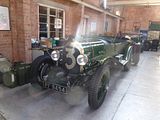
Bentley 4.5 litre: Bentley replaced the 3 Litre with a more powerful car by increasing its engine displacement to 4.5 litres. As before, Bentley supplied an engine and chassis and it was up to the buyer to arrange for their new chassis to be fitted with one of a number of body styles, most of which were saloons or tourers. Very few have survived with their four-seater coachwork intact. WO Bentley had found that success in motorsport was great publicity for the brand, and he was particularly attracted to the 2 Hours of Le Mans endurance race, the inaugural running of which took place 26–27 May 1923, attracting many drivers, mostly French. There were two foreign competitors in the first race, Frank Clement and Canadian John Duff, the latter winning the 1924 competition in his personal car, a Bentley 3 Litre. This success helped Bentley sell cars, but was not repeated, so ater two years without success, Bentley convened a group of wealthy British men, “united by their love of insouciance, elegant tailoring, and a need for speed,” to renew Bentley’s success. Both drivers and mechanics, these men, later nicknamed the “Bentley Boys”, drove Bentley automobiles to victory in several races between 1927 and 1931, including four consecutive wins at the 24 Hours of Le Mans, and forged the brands reputation. It was within this context that, in 1927, Bentley developed the Bentley 4½ Litre. Two cylinders were removed from the 6½ Litre model, reducing the displacement to 4.4 litres. At the time, the 3 Litre and the 6½ Litre were already available, but the 3 Litre was an outdated, under-powered model and the 6½ Litre’s image was tarnished by poor tyre performance. Sir Henry “Tim” Birkin, described as “the greatest British driver of his day” by W. O. Bentley, was one of the Bentley Boys. He refused to adhere strictly to Bentley’s assertion that increasing displacement is always preferable to forced induction. Birkin, aided by a former Bentley mechanic, decided to produce a series of five supercharged models for the competition at the 24 Hours of Le Mans; thus the 4½ litre Blower Bentley was born. The first supercharged Bentley had been a 3-litre FR5189 which had been supercharged at the Cricklewood factory in the winter of 1926/7. The Bentley Blower No.1 was officially presented in 1929 at the British International Motor Show at Olympia, London. The 55 copies were built to comply with 24 Hours of Le Mans regulations. Birkin arranged for the construction of the supercharged cars having received approval from Bentley chairman and majority shareholder Woolf Barnato and financing from wealthy horse racing enthusiast Dorothy Paget. Development and construction of the supercharged Bentleys was done in a workshop in Welwyn by Amherst Villiers, who also provided the superchargers. W.O. Bentley was hostile to forced induction and believed that “to supercharge a Bentley engine was to pervert its design and corrupt its performance.” However, having lost control of the company he founded to Barnato, he could not halt Birkin’s project. Although the Bentley 4½ Litre was heavy, weighing 1,625 kg (3,583 lb), and spacious, with a length of 172 in and a wheelbase of 130.0 in, it remained well-balanced and steered nimbly. The manual transmission, however, required skill, as its four gears were unsynchronised. The robustness of the 4½ Litre’s latticed chassis, made of steel and reinforced with ties, was needed to support the heavy cast iron inline-four engine. The engine was “resolutely modern” for the time. The displacement was 4,398 cc. Two SU carburettors and dual ignition with Bosch magnetos were fitted. The engine produced 110 hp for the touring model and 130 hp for the racing model. The engine speed was limited to 4,000 rpm. A single overhead camshaft actuated four valves per cylinder, inclined at 30 degrees. This was a technically advanced design at a time where most cars used only two valves per cylinder. The camshaft was driven by bevel gears on a vertical shaft at the front of the engine, as on the 3 Litre engine. The essential difference between the Bentley 4½ Litre and the Blower was the addition of a Roots-type supercharger to the Blower engine by engineer Amherst Villiers, who had also produced the supercharger. W. O. Bentley, as chief engineer of the company he had founded, refused to allow the engine to be modified to incorporate the supercharger. As a result, the supercharger was placed at the end of the crankshaft, in front of the radiator. This gave the Blower Bentley an easily recognisable appearance and also increased the car’s understeer due to the additional weight at the front. A guard protected the two carburettors located at the compressor intake. Similar protection was used, both in the 4½ Litre and the Blower, for the fuel tank at the rear, because a flying stone punctured the 3 Litre of Frank Clement and John Duff during the first 24 Hours of Le Mans, which contributed to their defeat. The crankshaft, pistons and lubrication system were special to the Blower engine. It produced 175 hp at 3,500 rpm for the touring model and 240 hp at 4,200 rpm for the racing version, which was more power than the Bentley 6½ Litre developed. Between 1927 and 1931 the Bentley 4½ Litre competed in several competitions, primarily the 24 Hours of Le Mans. The first was the Old Mother Gun at the 1927 24 Hours of Le Mans, driven as a prototype before production. Favoured to win, it instead crashed and did not finish. Its performance was sufficient for Bentley to decide to start production and deliver the first models the same year. Far from being the most powerful in the competitions, the 4½ Litre of Woolf Barnato and Bernard Rubin, raced neck and neck against Charles Weymann’s Stutz Blackhawk DV16, setting a new record average speed of 69 mph; Tim Birkin and Jean Chassagne finished fifth. The next year, three 4½ Litres finished second, third, and fourth behind another Bentley, the Speed Six, which possessed two more cylinders.The naturally aspirated 4½ Litre was noted for its good reliability. The supercharged models were not; the two Blower models entered in the 1930 24 Hours of Le Mans by Dorothy Paget, one of which was co-driven by Tim Birkin, did not complete the race. In 1930, Birkin finished second in the French Grand Prix at the Circuit de Pau behind a Bugatti Type 35. Ettore Bugatti, annoyed by the performance of Bentley, called the 4½ Litre the “fastest lorry in the world.” The Type 35 is much lighter and consumes much less petrol. Blower Bentleys consume 4 litres per minute at full speed. In November 1931, after selling 720 copies of the 4½ Litre – 655 naturally aspirated and 55 supercharged – in three different models (Tourer, Drophead Coupé and Sporting Four Seater, Bentley was forced to sell his company to Rolls-Royce for £125,175, a victim of the recession that hit Europe following the Wall Street Crash of 1929.

Buick Roadmaster (1949): The Roadmaster received its first major postwar restyling in 1949. Its wheelbase and overall length were reduced, but its weight was marginally increased. The most significant change was a much larger two-piece, curved glass windshield that the sales brochure described as like an “observation car.” It was also in 1949 that Buick introduced “VentiPorts.” Four were displayed on each of the Roadmaster and Century’s front fenders,[9] with three on the fenders of the Super and Special to denote junior level products. The sales brochure noted that VentiPorts helped ventilate the engine compartment, possibly true in early 1949, but they became non-functional sometime during the model year. The body styles were 2-door Sedanet fastback, 4-door sedan, 2-door convertible and 4-door wagon. The idea for VentiPorts grew out of a modification Buick styling chief Ned Nickles had added to his own 1948 Roadmaster. He had installed four amber lights on each side of his car’s hood wired to the distributor to flash on and off as each cylinder fired, simulating the flames from the exhaust stack of a fighter airplane. Combined with the bombsight mascot, VentiPorts put the driver in the control of an imaginary fighter airplane. Upon seeing this, Buick chief Harlow Curtice was so delighted that he ordered that (non-lighting) VentiPorts be installed on all 1949 Buicks, with the number of VentiPorts (three or four) corresponding to the relative displacement of the straight-eight engine installed. Dynaflow was now standard equipment, and engine output was increased to 150 hp through a slight increase in the compression ratio. With the now-standard Dynaflow, this contributed to giving the new Buicks a top speed of 110 mph (177 km/h). In the middle of the year, the Riviera joined the body style lineup, selling 4,314 units. Featuring power windows as standard equipment, the two-door Buick Roadmaster Riviera, along with the Cadillac Series 62 Coupe de Ville and the Oldsmobile 98 Holiday, was among the first hardtop coupes produced. The Riviera Hardtop was conceived by taking the convertible and welding a steel roof, which simplified manufacture and improved the car’s appearance. The Riviera was also notable for its popular optional “Sweepspear” chrome body side molding, which would soon become a Buick trademark. This chrome-plated strip started above the front wheel, then gently curved down nearly to the rocker panel just before the rear wheel, and then curved around the rear wheel in a quarter of a circle to go straight back to the taillight. The “Riviera trim”, as it was initially called, was also made available on the Roadmaster convertible late in the model year. With 88,130 sold, the all-time annual record for Roadmaster, the model accounted for 27% of all Buick sales, a high proportion despite its price being slightly less than a Cadillac Series 61. The 1950 restyling featured a “toothy” grille. The Sweepspear design was made standard on most body styles at the beginning of the 1950 model year, and on the station wagon and a new long-wheelbase sedan mid-year. The long-wheelbase sedan was lengthened by 4 inches (102 mm)). Like the convertibles, the Riviera and the long-wheelbase sedan came with power windows and seats as standard equipment. Roadmaster sales fell to 75,034, with Roadmaster’s share of total Buick output plummeting to 12%. For the 1951 model year, the long-wheelbase sedan was also called a Riviera, although it was not a hardtop. The regular wheelbase sedan were discontinued, alongside the Sedanet, with the fastback body style having become outdated by the turn of the decade. Styling changes were minimal in 1951 and 1952. Power steering was added as an option in 1952, and the engine rating climbed to 170 hp primarily to a new four-barrel carburetor. Sales continued to decrease to about 66,000 in 1951 and totalled 51,000 units in 1952. A new V8 engine was introduced for 1953, Buick’s Golden Anniversary year. Although the Nailhead (as it was popularly called) was nearly identical in displacement to the straight-eight Fireball (322 versus 320 cubic inches), it was 13.5 inches (340 mm) shorter, four inches (100 mm) lower, and 180 lb (82 kg) lighter, but with 188 hp, it was 11% more powerful. The compression ratio increased from 7.50:1 to 8.50:1 and torque increased from 280 to 300 lb⋅ft (380 to 407 N⋅m). The compact dimensions of the V8 engine enabled Buick to reduce Roadmaster’s wheelbase by 4.75 in (121 mm) across the line. However, styling differences behind the engine cowl, apart from the new V8 emblem hubcaps, were nonexistent. Buick also introduced a new “Twin-Turbine” Dynaflow as a companion for the V8 engine. Estimated to increase torque at the wheels by 10 percent, the new transmission provided faster and quieter acceleration at reduced engine speeds. Both power steering and power brakes were made standard. Air conditioning was a new option, and a 12-volt electrical system was adopted years before many other makes. A new body style for 1953 was the Skylark convertible. The Buick Roadmaster Skylark was one of three specialty convertibles produced in 1953 by General Motors, the other two being the Oldsmobile 98 Fiesta and the Cadillac Series 62 Eldorado. The Skylark featured open wheel wells, a drastically lowered beltline, a four-inch-chop from the standard Roadmaster’s windshield, the absence of VentiPorts, and a new Sweepspear that anticipated Buick’s 1954 styling. Kelsey-Hayes wire wheels and a solid boot cover were standard. At US$5,000 only 1,690 units were produced. The following year, and for one year only, it would become separate series built on the all-new 122 in (3,100 mm) Century chassis. This was the last year for the Roadmaster Estate, and it was the last wood-bodied station wagon mass-produced in the United States. Its body was a product of Ionia Manufacturing, which built all Buick station wagon bodies between 1946 and 1964. Priced at US$4,031, the Estate was second in price only to the Skylark, with 670 being sold. Overall, Roadmaster sales went up to 79,137.
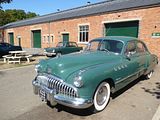


Cadillac Fleetwood Brougham (1979): For 1977, GM significantly downsized their full sized cars. The DeVille and Fleetwood Brougham rode on the same 121.5″ wheelbase and were powered by the 425 cubic inch (7.0 L) V8. This engine was basically a de-bored version of the 472/500 (7.7 L/8.2 L) V8 of previous years. Compared with the 1976 Fleetwood Sixty Special Brougham, the Fleetwood Brougham had a wheelbase 11.5″ shorter and weighed nearly 900 lb (400 kg) less. The new Fleetwood Brougham, which had lost its exclusive longer wheelbase, was now virtually identical to the lesser Sedan de Ville. Other than the name, there were only subtle exterior differences between a Fleetwood Brougham and Sedan de Ville, including a slightly reshaped B-pillar and rear side windows. The 1980 refresh eliminated this distinction. The interior of the Fleetwood was more plush and offered more features as standard.


Triumph Herald 13/60: Towards the end of the 1950s Standard-Triumph offered a range of two-seater Triumph sports cars alongside its Standard saloons, the Standard 8 and 10, powered by a small (803 cc or 948 cc) 4-cylinder engine, which by the late 1950s were due for an update. Standard-Triumph therefore started work on the Herald. The choice of the Herald name suggests that the car was originally intended to be marketed as a Standard, as it fits the model-naming scheme of the time (Ensign, Pennant and Standard itself). But by 1959 it was felt that the Triumph name had more brand equity, and the Standard name was phased out in Britain after 1963. Giovanni Michelotti was commissioned to style the car by the Standard-Triumph board, encouraged by chief engineer Harry Webster, and quickly produced designs for a two-door saloon with a large glass area that gave 93 per cent all-round visibility in the saloon variant and the “razor-edge” looks to which many makers were turning. As Fisher & Ludlow, Standard-Triumph’s body suppliers became part of an uncooperative BMC, it was decided that the car should have a separate chassis rather than adopting the newer monocoque construction. The main body tub was bolted to the chassis and the whole front end hinged forward to allow access to the engine. Every panel – including the sills and roof – could be unbolted from the car so that different body styles could be easily built on the same chassis. As an addition to the original coupé and saloon models, a convertible was introduced in 1960. The Standard Pennant’s 4-cylinder 948 cc OHV engine and 4 speed manual gearbox was used with synchromesh on the top three gears and remote gear shift and driving the rear wheels. Most of the engine parts were previously used in the Standard 8/10. The rack and pinion steering afforded the Herald a tight 25-foot turning circle. Coil and double-wishbone front suspension was fitted, while the rear suspension, a new departure for Triumph, offered “limited” independent springing via a single transverse leaf-spring bolted to the top of the final drive unit and swing axles. Instruments were confined to a single large speedometer with fuel gauge in the saloon (a temperature gauge was available as an option) on a dashboard of grey pressed fibreboard. The coupé dashboard was equipped with speedometer, fuel and temperature gauges, together with a lockable glovebox. The car had loop-pile carpeting and heater as standard. A number of extras were available including twin SU carburettors, leather seats, a wood-vaneered dashboard, Telaflo shock absorbers and paint options. In late 1958, prototype cars embarked on a test run from Cape Town to Tangiers. An account of the journey was embellished by PR at the time. However only minor changes were deemed necessary between the prototype and production cars. The new car was launched at the Royal Albert Hall in London on 22 April 1959 but was not an immediate sales success, partly owing to its relatively high cost, approaching £700 (including 45 per cent Purchase Tax). In standard single-carburettor form the 34.5 bhp car was no better than average in terms of performance. A saloon tested by The Motor magazine in 1959 was found to have a top speed of 70.9 mph and could accelerate from 0–60 mph in 31.1 seconds. A fuel consumption of 34.5 mpg was recorded. The rear suspension was criticised as yielding poor handling at the extremes of performance though the model was considered easy to drive with its good vision, light steering (smallest turning circle of any production car) and controls, and ease of repair. A Herald S variant was introduced in 1961 with a lower equipment level and less chromium than the Herald, offered in saloon form only. The 948cc Herald Coupe and Convertible models were discontinued in 1961, the 948cc Herald Saloon in 1962 and the Herald S in 1964. Standard-Triumph experienced financial difficulties at the beginning of the 1960s and was taken over by Leyland Motors Ltd in 1961. This released new resources to develop the Herald and the car was re-launched in April 1961 with an 1147 cc engine as the Herald 1200. The new model featured rubber-covered bumpers, a wooden laminate dashboard and improved seating. Quality control was also tightened up. Twin carburettors were no longer fitted to any of the range as standard although they remained an option, the standard being a single down-draught Solex carburettor. Claimed maximum power of the Herald 1200 was 39 bhp, as against the 34.5 bhp claimed for the 948 cc model. One month after the release of the Herald 1200, a 2-door estate was added to the range. Disc brakes became an option from 1962. Sales picked up despite growing competition from the BMC Mini and the Ford Anglia, with the car proving particularly popular to women drivers. The coupé was dropped from the range in late 1964 as it was by then in direct competition with the Triumph Spitfire. The Triumph Courier van, a Herald estate with side panels in place of rear side windows, was produced from 1962 until 1966, but was dropped following poor sales. Production in England ceased in mid-1964. CKD assembly by MCA in Malta continued till late 1965, at least. The Courier was powered by the 1147 cc engine. An upmarket version, the Herald 12/50, was offered from 1963 to 1967. It featured a tuned engine with a claimed output of 51 bhp in place of the previous 39, along with a sliding (Webasto) vinyl-fabric sunroof and front disc brakes as standard. The 12/50, which was offered only as a 2-door saloon, was fitted with a fine-barred aluminium grille. The power output of the 1200, which remained in production alongside the 12/50, was subsequently boosted to 48 bhp. In October 1967 the range was updated with the introduction at the London Motor Show of the Herald 13/60, which was offered in saloon, convertible and estate-bodied versions. The sun-roof remained available for the saloon as an optional extra rather than a standard feature. The front end was restyled using a bonnet similar to the Triumph Vitesse’s and the interior substantially revised though still featuring the wooden dashboard. Interior space was improved by recessing a rear armrest in each side panel. The engine was enlarged to 1296 cc, essentially the unit employed since 1965 in the Triumph 1300, fitted with a Stromberg CD150 carburettor, offering 61 bhp and much improved performance. In this form (though the 1200 saloon was sold alongside it until the end of 1970) the Herald Saloon lasted until December 1970 and the Convertible and Estate until May 1971, by which time, severely outdated in style if not performance, it had already outlived the introduction of the Triumph 1300 Saloon, the car designed to replace it and was still selling reasonably well but, because of its labour-intensive method of construction, selling at a loss.


Triumph Dolomite: The Dolomite really was the 3 Series of its day, a family sized saloon that offered a combination of luxury and sportiness that made it a cut above the average Cortina and Marina. Designed as the successor for the upmarket variants of Triumph’s front-wheel drive designs, and also to replace a sporting relative of the Herald, the 6-cylinder Triumph Vitesse, the Triumph Dolomite was unveiled at the London Motor Show in October 1971. However, due to a number of strikes and other industrial upsets, the car was not reported to be in full production until October 1972. The Dolomite used the longer bodyshell of the front wheel drive Triumph 1500, but with the majority of the running gear carried over from the rear-wheel drive Triumph Toledo. Initially, the only version available used the new slant-four 1854 cc engine, which mated an alloy OHC head to an iron block, providing 91 bhp which offered sprightly performance. This was a version of the engine that the company was already providing to Saab for use in their 99 model. The car was aimed at the then-new compact performance-luxury sector, vying for sales against cars such as the BMW 2002 and Ford Cortina GXL, and was offered with a high level of standard equipment, including twin headlamps, a clock, full instrumentation, luxury seats and carpets, a heated rear window, and a cigar lighter. Styling was similar to the Triumph 1500, with some updates such as a black painted rear panel, vinyl D-posts, and new wheel trims. The car was capable of 100 mph with 60 mph coming up in just over 11 seconds. An overdrive gearbox was soon made available as an option, offering relaxed motorway cruising and improved fuel economy, and there was also an optional automatic transmission. Although the Dolomite proved to be refined and rapid, competitors such as the BMW 2002 had a performance advantage which was costing Triumph dearly, both in terms of sales and prestige. To remedy this, Triumph unveiled the Dolomite Sprint in June 1973, although the launch had been delayed by a year; it had been due to go on sale in 1972. A team of engineers led by Spen King developed a 16-valve cylinder head with all of the valves being actuated using a single camshaft rather than the more conventional DOHC arrangement. The capacity was also increased to 1,998 cc and combined with bigger carburettors the output was upped to 127 bhp. This represented a significant power increase over the smaller 1850cc variant, however it fell short of the original target of 135 bhp Despite BL engineers being able to extract a reliable 150 bhp from test engines, the production line was unable to build the engines to the same level of quality, with production outputs being in the region of 125 bhp to 130 bhp. This led to the original model designation, the Dolomite 135, being replaced at short notice with the Sprint name. As a result of the use of this engine, the Dolomite Sprint has been claimed to be “the world’s first mass-produced multi-valve car”. While other multi-valve engines (notably the Lotus 907) were produced in volume, they were not used in mass production vehicles until after the introduction of the Dolomite Sprint. The design of the cylinder head won a British Design Council award in 1974. Performance was excellent, with 0–60 mph taking around 8.4 seconds, with a maximum speed of 119 mph. Trim was similar to the 1850, with the addition of standard alloy wheels (another first for a British production car), a vinyl roof, front spoiler, twin exhausts and lowered suspension. By now seats were cloth on the 1850, and these were also fitted to the Sprint. Due to the increase in power brought by the new engine, the rest of the driveline was upgraded to be able to withstand the extra torque. The gearbox and differential were replaced by a version of those fitted to the TR and 2000 series cars, albeit with a close ratio gearset in the gearbox. The brakes were upgraded with new pad materials at the front, and the fitment of larger drums and a load sensing valve at the rear. Other changes over the standard Dolomite included the option of a limited slip differential. The optional overdrive and automatic transmission from the 1850 model were also offered as options on the Sprint. Initial models were only offered in Mimosa Yellow, although further colours were available from 1974 on. At launch the Sprint was priced at £1740, which compared extremely well to similar cars from other manufacturers. Prospective buyers would have been hard pressed to justify the extra £1000 cost of the BMW 2002 Tii, which offered similar performance. The four-door practicality of the Sprint also made it a very attractive proposition for the young executive choosing his first company car. The press gave the Dolomite Sprint an enthusiastic reception. Motor summarised its road test (subtitled “Britain leads the way”) with glowing praise: ” …the Sprint must be the answer to many people’s prayer. It is well appointed, compact, yet deceptively roomy. Performance is there in plenty, yet economy is good and the model’s manners quite impeccable … Most important of all, it is a tremendously satisfying car to drive”. Sadly, it proved not quite so satisfying to own, as the legendary BL lack of reliability was a feature on some, but by no means all Sprints. In 1976, Triumph rationalised their range, calling all their small models, Dolomite, and using the same body shell, so the Toledo (which had maintained its stubby tail until this point) and 1500TC became the Dolomite 1300, 1500 and 1500HL respectively. With minor changes to trim and equipment, the cars continued in production until 1980.

Helped by some fabulous summer weather, which if anything was a bit too hot, this event was at least the equal of the 2023 and 2024 iterations. With so many cars here on display, with representation from pretty much every Alfa model type rom the last 60 years, this really was a fabulous treat for the Alfa enthusiast, and although there was a lot to see, there was also time to stop and talk both to friends and owners I know as well as some people I’d never spoken with before. It goes without saying that as soon as the date for 2026 is announced, this one will be going on my schedule!