

The first Peugeot cars took their numbers in strict chronological sequence, from the Type 1, but in 1929 when they got to the 201, they decided to follow a new format where the first digit would indicate the relative size of the car and the last digit would increase with each successive generation. Depending on how many models were in the range, not every number got used, with the 104 of 1972 being the first to start with a 1, for instance. When Peugeot got to models ending 08, everyone started to wonder what would happen next especially as there had been a 309, a number used when the planned Talbot Arizona had become a Peugeot at the last minute in 1985. Peugeot gave us the answer when they said that they would continue to use the 08 numbering for successive generations of car, and the model under test here was the first evidence of this. The first 308 had been a very humdrum sort of car that, although it had sold in decent quantities, was never viewed with any great affection and which outside France had always been seen as very much a class also-ran. The second generation 308, launched in 2013, promised to change all that. With much more attractive styling, and a much higher class interior, it looked like Peugeot were really trying to go for class honours rather than offering something which only the patriotic French would buy, and clearly the jurors of the Car of the Year agreed, as this car was the winner in 2014. As before, the new 308 came in five door hatch and five door estate models, with a wide variety of engines and trims. Back in 2013, diesel was de rigeur, so the initial focus was on this fuel type, though there were petrol models as well and the whole range won praise for the combination of performance and efficiency that these delivered. A mid-cycle update came in 2017 and there was a lesser update in the summer of 2020, with new trims and colours and the digital cockpit first seen in the 3008, but the essence of the car has not changed much over the years.


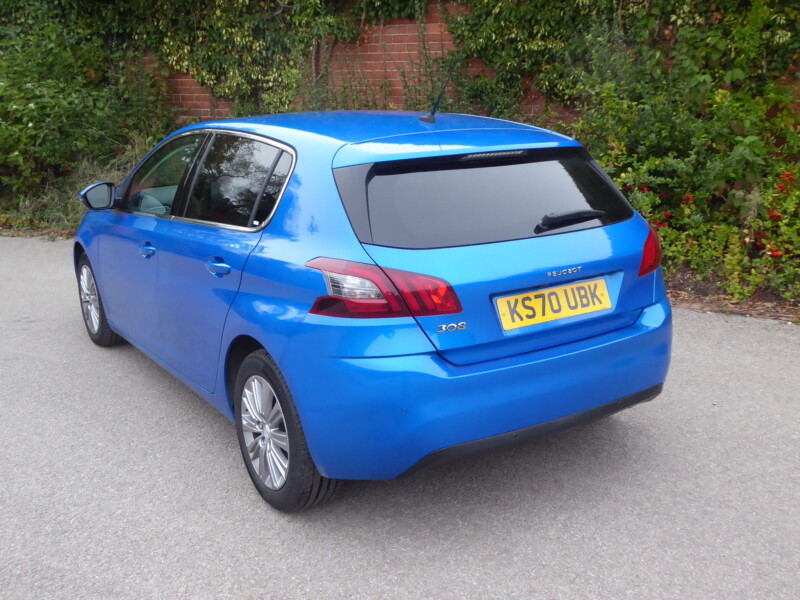
The third generation 308 was launched in March 2021, going on sale in September of that year, so I was a little surprised to find that 24 months later, it was the second generation car that Hertz had on offer at LHR. As I’d only driven an estate version of this generation, in France, back in 2014, I was quite happy to test out a second generation car, especially when I saw that it was in the very striking Bleu Vertigo colour that really does make the car look quite distinctive and in a good way. So, a win on appearance, but what would the 308 be like from behind the wheel?


Various offerings have come and gone throughout the second generation 308’s life. The petrols ranged from a 1.2-litre three-cylinder unit with 82PS and turbocharged versions with either 110PS and 131PS, to a turbocharged 1.6-litre engine. In standard form, this had upwards of 200PS, while in the most powerful GTi version, it produced a whopping 262PS. Consensus is that – wet belt nothwithstanding – the 130 bhp is the pick of the bunch. The 1.6-litre choices are fast and frenetic, and fun for those who like their speed, but they’re much thirstier, too. The diesel choices included 1.6-litre units of 100PS and 120PS, while the line-up was rounded off by a pair of 2.0-litre engines with 150PS and 180PS. Later on in 2018, the 1.6s were replaced by 1.5-litre units with either 101PS or 131PS. A conventional key is needed to start the 308. This was my second experience of the 1.2 THP Puretech engine, and just like the Mokka that I had been driving the week before, it puts out 130 bhp. There is no doubt that this is a three cylinder as the characteristic sound is evident when you start it up and to a lesser extent whilst underway. It actually generates quite a throaty noise that I found rather pleasant. It is a lusty engine with plenty of torque with the car pulling strongly especially in third gear. Refinement is good, with low noise levels especially when the car is at cruising speed on the motorway or dual carriageways The test car had the standard six-speed gearbox. I found that it was quite easy to mis-slot the lever and get the wrong gear. Sometimes the gearchange seemed quite slock but at other times it was surprisingly vague. PSA gearboxes have not been a strong suit for a while and this one was a reminder of this. Range in the car was good. In my week with the car, I covered a total of 360 miles and the 308 needed 35.3 litres to fill it up, which works out at 46.3 mpg, a decent result.


Although not class-leading, the 308 is decent enough to drive, with no bad traits. There is a problem, though, which is the diddy steering wheel set down low. Peugeot claim all sorts of advantages for this, including it apparently giving you more leverage in tight cornering. I don’t buy this nonsense for one moment, as it simply means that you have an awkward driving position. That tiny steering wheel gives you the impression that the steering is quite quick initially, it’s actually quite slow and rather numb, so you don’t always have a great idea where the steered wheels are headed. Handling is safe and secure and there are good levels of grip, though in true French fashion, there is some body roll. The ride, on the 205/55 R16 wheels of the test car was smooth, with the suspension doing its best to smooth out the less well surfaced roads that permeate the UK. The brakes worked well and the electronic handbrake generally disengages smoothly. All round visibility is OK and there is a rear-view camera to help judge the rear of the car. Lane Keep Assist was fitted and was as irritating as these systems always are, but at least it was easy to turn off with just one button.


Current Peugeot models made huge strides in interior quality compared to their predecessors and this one is no exception with some good quality materials used and a minimalist approach which certainly does not look cluttered. The design also follows recent form with the i-cockpit meaning that the instruments are set up high so you look over the steering wheel to see them. At least I could see them here with fewer problems than in the last Peugeot models I sampled. The 10” elliptical cluster is small and configurable so you can project the navigation system here should you want. There are twin column stalks which include an auto wiper and auto lights function. There is also an auto dipping feature which is useful, though it is a shame that the lights proved quite weak on dipped beam. There is a pod on the left of the wheel for the cruise control. The majority of functions are accessed via the central touch screen, which is as difficult to use on the move as any such system. The latest capacitive high definition display is quite small at just under 10” but the graphics are crisp and clear, though there were times when the system was quite slow to respond to inputs. There are lots of menus so finding what you want is not always easy. Whichever version of the 308 you go for, you’ll get the same touchscreen infotainment system. It brings together sat-nav, Bluetooth, DAB, a USB port, six speakers and Apple Carplay/Android Auto. The dual zone climate control system operates from within the screen, so the centre of the dash looks quite lonely with just an audio volume knob and a fake CD slot.


Seat upholstery is a mix of cloth and part leatherette and there is manual adjustment to get the position you want. There is quite a feeling of space with lots of headroom. Lumbar support is included which is always nice and both seats have a height adjuster. The steering wheel telescopes in/out and up/down. Whilst the seat itself is comfortable, there remains the problem of the driving position with the i-cockpit meaning that the wheel is far too low even at its highest point. And to be able to see the instruments, I had to set the wheel accordingly, down even lower than ideal. It does not feel natural and even after a week, I still hated it. Peugeot claim that owners love it, but I still see lots of complaints, and for many – me included – this alone would be an absolute deal-breaker.


Space in the rear is barely adequate with just about enough legroom if the front seats are set well back. The centre console unit does come well back, though, and there is quite a bump in the floor so a middle seat occupant will feel a little less comfortable. Headroom is also just about sufficient for all but the very tall. There is a drop-down central armrest with cup holders in the upper surface and oddments are taken care of with the map pockets on the back of the front seats and bins on the doors.


There is quite a high sill which means that the boot is usefully deep. It is a nice regular shape and in fact is one of the largest in its class, with nearly 25% more capacity than you will find in a VW Golf. There is no spare wheel, which means that there is space under the floor to stow a few other odds and ends. The rear seat backrests are asymmetrically split and simply drop down to create a much longer load platform though it the load area is not completely flat. Inside the cabin there is reasonable provision for odds and ends. The glovebox has a large lid but when you open it, you realise that there is not much space inside in. There are door pockets and an armrest cubby as well as a useful recess in front of the gearlever.


Having been on sale since 2014, there have been minor changes to the trim structure and what you get at each level throughout the car’s life, but the main trim levels have stayed fairly consistent. The last set of changes came with the late 2020 update and by this time the range had been simplified. The entry level trim is Active Premium, followed by Allure, GT and GTi, which offer an intermediate Premium trim level (excluding GTi) to meet the demands of customers looking for greater comfort, aesthetics or assistance features. Active Premium trim gives you most of what you need, including two-zone climate control, remote locking, 16” Quartz alloy wheels, powered door mirrors, four electric windows, cruise control, a leather steering wheel, rear parking sensors and automatic lights and wipers. Stepping up to Allure trim gives you 16-inch Zircon alloy wheels and also adds front foglamps, front parking sensors, front sports seats, part-leatherette upholstery, a panoramic roof and some extra chrome accents on the bodywork, as well as Connected 3D navigation with TomTom ® Live updates and the Safety Plus Pack which includes the Visio Park 1 180-degree reversing camera. Allure Premium adds adaptive cruise control and keyless entry and start. GT Line trim adds a body kit, a reversing camera and all-round LED exterior lights. The GT trim offers Peugeot Connect SOS & Assistance, 17-inch Rubis alloy wheels, Driver Sport Pack and Mistral Oxford leather effect and cloth seat trim with red overstitch detail. GT Premium adds Active Blind Spot Monitoring, Park Assist, 18-inch ‘Diamant’ alloy wheels and Alcantara cloth and leather effect seat trim with red overstitch detail. Alongside the more regular versions, a Tech Edition was introduced later. This is roughly based on Allure trim, but adds all the driver safety aids we mentioned earlier, plus a reversing camera and alcantara sports seats. The range-topping GTi is priced at £31,985 and is equipped with a Torsen limited-slip differential, 19-inch Carbone two-tone finish diamond cut alloy wheels, twin exhausts and a black rear diffuser. It also features 11mm lower ride height and red brake calipers with 380mm front discs. Inside, there is a Mistral full grain perforated leather steering wheel with red stitch detail, GTi bucket seats featuring driver and passenger electric lumbar adjustment and PEUGEOT Sport branded Alcantara ® and leather effect seat trim with red overstitch detail with massage function.


I collected this car on the day I had returned the Vauxhall Mokka and after driving it for a week, my over-riding thought was “why buy the Mokka, when this car is that much better?”. Mind you, I am not sure I would want to buy this 308 either and the biggest reason for that remains the indefensible i-Cockpit nonsense with the dinner-plate steering wheel in your lap. Even though this one presented less of an issue than on some other Peugeot models, it still irritated me and there seemed to be no gain at all from the feature. That aside, the 308 has much to commend it. It goes well, is nicely finished and has enough space in it to meet the needs of a family. There is still plenty of competition in the medium-sized hatch market and whilst this car is a worthy competitor, there are probably better options, such as the Focus and Mazda 3, though I’ve yet to drive either of them to be able to form my own conclusions. Of course, Peugeot themselves have an updated 308 and by all accounts, it is also a strong contender, even if that wretched i-Cockpit persists. I hope to find out just how good in due course.