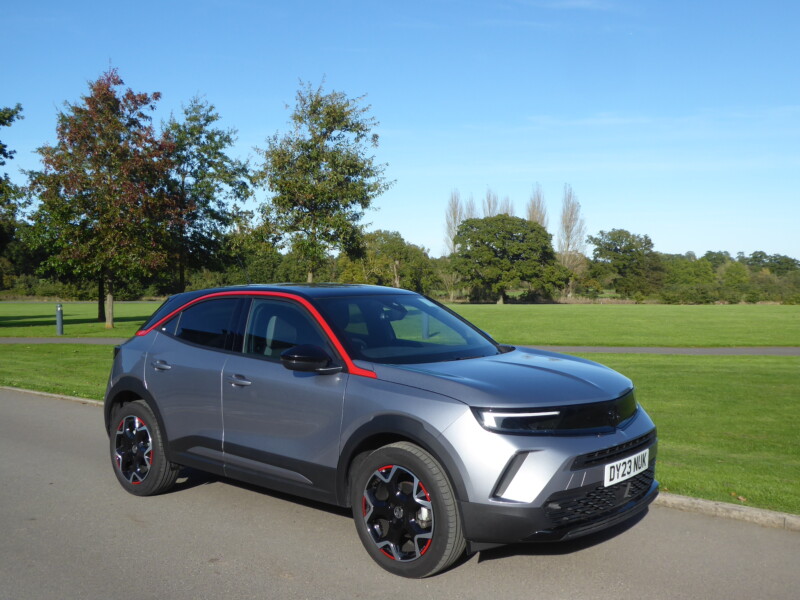


When I got my first experience of the Mokka, a small crossover that Vauxhall-Opel launched in 2012 to capitalise on the current market enthusiasm for cross-over designs and to take over from the more overtly people carrier-esque Meriva, I found out that the adage that “they don’t make bad cars any more” was not strictly true. The Mokka sold far better than it deserved to, thanks to low prices and massive discounting, but the sad reality was that this frumpy looking car was even worse from behind the wheel than it was to look at. Strangled engines, stodgy driving dynamics, a cheap feeling interior and general feeling that the car had been built down to a (low) price all made it hard to recommend. Sadly, cars like this end up in the rental fleets in some quantity, and so I got to sample more than one of them over the years before the car enthusiasts let out a loud cheer that production for Europe had ceased at the end of 2018. Wanting a fresh start in what is still one of the largest market sectors of them all, it is perhaps a surprise that the Mokka name was retained, as the second generation car, revealed in late 2020, is very different. Absolutely everything other than the name had changed, as this car is now based on the CMP platform that underpins cars such as the Peugeot 2008 and Citroen C3. The Mokka shares its mechanical components with its Peugeot-Citroen brethren, too. It does look distinct from them, though with styling which was first previewed in August 2018 by the show car Opel GT X Experimental concept. Some natty two tone paint options and splashes of colour, not always where you want it, certainly give this Mokka not just a much more modern appearance but also a visual appeal which will entice far more to go and have a look and indeed sales of the car have been strong from the outset. The rental fleets have bought plenty of them, too, so it is perhaps no surprise that when I booked a Group C car, which historically would have yielded something like a Ford Focus, I was allocated an almost new Mokka in 1.2 THP 130 PS GS spec. Interested in learning whether the all-new car really was the massive leap over its predecessor or not, I took it without trying to swap into anything else.


The Mokka is available with a choice of petrol, diesel and electric propulsion. The diesel is now very much the niche choice, meaning the majority of Mokka models now will be pure petrol or all-electric. The test car was the former. Two different power outputs are offered, with 100 or 130 PS on offer, and pleasingly as well as a little surprisingly, the car I got was the more powerful of the pair. Despite being a car of the 2020s, you still need a conventional key to start the Mokka. When the engine fires up, your ears will tell you immediately that this is a three cylinder unit, and this distinctive sound remains evident not just at idle but also at low revs. As speed builds the noise level reduces and the car is quite refined on the motorway. This was my first experience of the Peugeot-Citroen developed 1.2 THP unit that now sees service in a long list of cars and whilst major question marks remain over its long term durability thanks to the use of a wet belt, as a car to drive, it impresses. It pulls well with strong torque even from low in the rev range, meaning the Mokka, especially in this 130 PS form feels lively in a way that its predecessor just never did. The Mokka also inherits a Peugeot-Citroen gearbox – standard 6 speed manual, with an 8 speed automatic an option on the more powerful model – and whilst the gearchange is better than it used to be, this is still far from class best, with the change feeling that bit vague and loose. The gearlever knob itself is an awkward shape, too. In the week that I had the Mokka, I covered a total of 613 miles and I put it in a total of 60.7 litres which works out at 45.8 mpg, a reasonable result though far from class-best.


I don’t think the Mokka can claim class-best driving dynamics, but it is light years ahead of its predecessor. The steering is light and does not have much in the way of feel, but we are told that this what the typical buyer of a car like this wants. It does at least mean that the car is easy to manoeuvre at low speed and when parking. The handling is nothing to get excited about, but the car feels safe and secure on the road with plenty of grip and would be unlikely to surprise you if you were a bit enthusiastic on a twisty road. The test car came on 215/55 R18 wheels which seem large for a small car but are in fact not atypical these days. The ride is well-judged proving comfortable on most surfaces especially around town. The brakes did their job as required. There is, of course, an electronic handbrake, and this generally disengaged readily. Visibility was par for the course, and judging the back end of the car was helped by the standard parking sensors which you really do need as the rear window is quite narrow. There is a long list of ADAS features included in the spec, and these were no more intrusive than in any of the Mokka’s rivals.


Vauxhall have tried harder to make the Interior feel a bit special than they did with the supremely dull first generation car. Whether you like the result may depend on your taste. Along with some decent quality plastics for the main dash mouldings and door casings, there is plenty of grey weave effect plastic as an inlay, some false stitching and red plastic band that was certainly not to my liking. Full marks for effort, then but not necessarily for the result. The instrument cluster is all digital and has been designed, I would assume, to be easy to assimilate, but again here the results may not hit the spot. The sort of info imparted by traditional dials is very much at the ends of the 7” cluster, with a tiny rev counter to the left and a digital speed read out at the right, leaving plenty of space in the middle for a projection of the navigation map. The twin column stalks were mounted at an awkward angle. An auto wiper function is included, and there are also auto lights, the control for these being a rotary dial on the dash to the right of the wheel where it felt a bit buried away. The centre of the dash is dominated, as is the current way, by the touchscreen. There are some buttons associated with the audio unit which is just as well, as this means that the things you are most likely to do are at least possible, though changing the audio channel is not one of them. Apple CarPlay and Android Auto are standard across the range (a good thing as sat-nav isn’t available on all models), as well as DAB radio and Bluetooth connectivity. There is dual zone automated climate control and this still relies on buttons as opposed to being buried in the touchscreen.


The Mokka is a crossover which should mean both a higher driving position and a feeling of more space. And you will notice both of these attributes. Getting out in particular occasioned me to notice what felt like quite a high sill. And once installed, there is definitely far more generous headroom than you would get in a Corsa. I also found myself more comfortable than in that car, but that is not hard, as it had an odd driving position. This one is much better. There is a wide range of manual adjustment of the front seats, which are upholstered in the sort of not terribly nice cloth that is common on volume cars, though Vauxhall have tried to inject something here with some red colouring. The steering column telescopes in/out and up/down, so getting the right driving position was easy.


Things are not great for those in the back, perhaps a consequence of the fact that this Mokka is actually shorter than its predecessor. The doors themselves are small, meaning larger adults will find it tricky to fold themselves in. Once there, six-foot-tall passengers don’t have much headroom to spare and their knees will touch the front seats if they’re sitting behind an equally tall driver. The central rear seat is raised, which limits headroom further, but at least there’s enough space for three kids to sit side-by-side without the need to fight over elbow room – unless there are child seats involved, which will eat into the available room further. The Mokka’s relatively small rear windows mean the view out isn’t fantastic, and the dark interior fabrics can make things feel a little too dreary at times too. Occupants here have access to map pockets on the back of the front seats and some small bins on the doors and there are a pair of USB ports.


There is quite a high sill for the boot but that arises because the space is quite deep. Overall capacity is on the modest side, though, smaller than class average and in fact with only 40 litres more than you get in a Corsa. As there is no spare wheel, as the space is needed for batteries on other versions of the car, there is some useful extra stowage available under the boot floor. The rear seat backrests are asymmetrically split and simply drop down to create a much longer load platform, though it is not particularly flat. Inside the passenger compartment, things look promising, as the glovebox lid is big, but in fact there is not much usable space inside. The door pockets are large though and behind the two cupholders in the centre console, there is a small central armrest cubby though this is set well back and not that easy to access.


Vauxhall changed the names of the trim versions in April 2022, not many months after having launched the second generation Mokka, to try to simplify things (they said) and to bring it into line with similar changes elsewhere in their range. The revised petrol and diesel Mokka range now starts from the entry level Design model which is identical to outgoing SE Edition variants, but now also available with a 1.2-litre 130PS 6-speed manual and a 1.2-litre 130PS 8-speed automatic. With more choice of engines, the Mokka Design range starts from £22,265 OTR – identical to the outgoing SE Edition. Standard features on the entry level Mokka include lane departure warning, lane keep assist, speed sign recognition, auto emergency braking, cruise control, automatic lights & wipers, high beam assist, LED headlights and tail lights, Pure Panel twin 7-inch screens and Apple CarPlay and Android Auto connectivity. GS Line models replace outgoing SRi Premium variants, with the equipment level reflecting customer demand in the sector. GS Line features include the striking two-tone styling with 18-inch bi-colour alloy wheels, black roof and mirrors and sports bodykit. Climate control, keyless start and power folding door mirrors, rear parking sensors and the upgraded Pure Panel with 10-inch driver and 12-inch infotainment screens. Mokka GS Line versions now start from £24,640 OTR – £1,500 lower than before. Ultimate models are now available with a 1.2-litre 130PS 6-speed manual option, previously unavailable on the trim, with the range starting from £28,825 OTR, with Mokka Ultimate range also upgraded with Alcantara® seat trim. Ultimate versions also include keyless entry and start, IntelliLux® LED matrix adaptive headlights, advanced park assist, blind spot alert, adaptive cruise control and lane positioning assist.


There is no question that this Mokka is a massive improvement over its predecessor. But that really was not hard to achieve, as that car was the very personification of mediocre. This one is perfectly acceptable. It is still no class-leader, but at least it goes well, is decent to drive, and has styling touches which make it that bit more interesting than some of its rivals. It is certainly not as spacious as you might expect even allowing for the relatively compact dimensions, though. I still would not choose one, but at least I would no longer take as many steps as possible to avoid one. Even without such huge discounts as were needed to shift the old car, the buying public are clearly more positive than I am, as this car has been selling well, so don’t be surprised if you get one as a rental car.