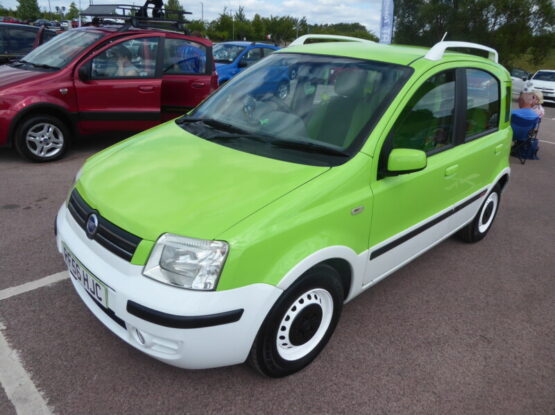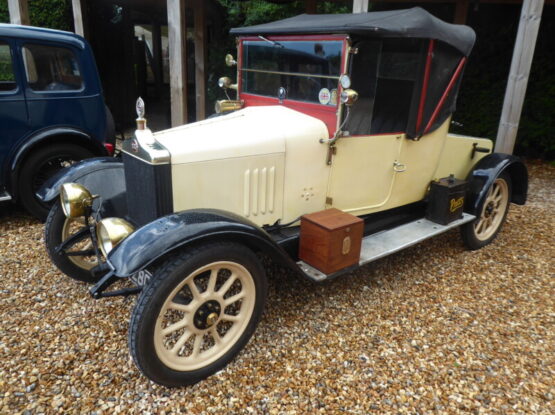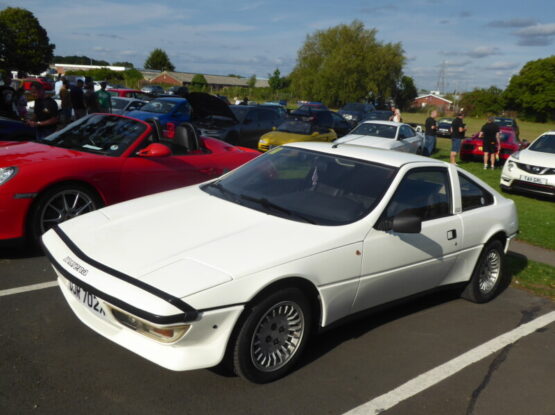
I was introduced to the evening events that are hosted at Wood Brothers’ Distillery, located near the Oxfordshire village of Bampton and backing into the back entrance of RAF Brize Norton mid-way through the 2024 season, by my good friend Jeremy Ingham, and was immediately won over by the combination of the cars that there and the relaxed and friendly atmosphere that prevailed. Like so many such events, this series of gatherings, held on the second Friday of the month were conceived by a car enthusiast who owns property with enough space to allow lots of other s to come along and display their treasured machines, with social media and word of mouth quickly spreading the word to grow the attendance. Whilst there is no shortage of other mid-week evening events in the locality, by holding this one on a Friday, it seems there is not that much direct competition, and my experience, reinforced by that of Jeremy who had been to a couple before I was able to get along is that this venue is a good draw for those with more unusual and interesting cars than some, so I was optimistic that it would return to the calendar in 2025. And it has! This is the season opener, and my diary worked well for me to be able to get there. Here is what I saw:


ABARTH
What is known as the Series 4 version of the familiar 595 reached the markets in the middle of 2016. After rumours had circulated all winter following the launch of the facelifted Fiat 500 in 2015, Abarth finally unveiled the Series 4 at the end of May 2016. Initially, we were told that the cars would not be available in the UK until September, but that came forward somewhat, with dealers all receiving demo cars in June, and the first customers taking delivery in July. Three regular production versions of both the closed car and the open-topped C were initially available, all badged 595, and called Custom, Turismo and Competizione, as before, though numerous limited edition models have since appeared and in most case disappeared. The most significant changes with the Series 4 are visual, with a couple of new colours, including the much asked for Modena Yellow and a different red, called Abarth Red, which replaces both the non-metallic Officina and – slightly surprisingly – the tri-coat pearlescent Cordolo Red. as well as styling changes front and rear. The jury is still out on these, with many, me included, remaining to be convinced. At the front, the new air intake does apparently allow around 15 – 20 % more air in and out, which will be welcome, as these cars do generate quite a lot of heat under the bonnet. Competizione models for the UK retain the old style headlights, as they have Xenon lights as standard, whereas the Custom and Turismo cars have reshaped units. At the back, there are new light clusters and a new rear bumper and diffuser. Inside, the most notable change is the replacement of the Blue & Me system with a more modern uConnect Audio set up, which brings a new colour screen to the dash. Mechanically, there is an additional 5 bhp on the Custom (now 145) and Turismo (now 165 bhp) and the option of a Limited Slip Diff for the Competizione, which is likely to prove a popular option. Details of the interior trim have changed, with a filled-in glovebox like the US market cars have always had, and electric windows switches that are like the US ones, as well as a part Alcantara trim to the steering wheel in Competizione cars.


ALFA ROMEO
The Alfa 75 was the last Alfa model to be developed before the company was bought by Fiat. It was introduced in May 1985, to replace the 116 Series Giulietta with which it shared many components. It was named to celebrate Alfa’s 75th year of production. The body, designed by head of Alfa Romeo Centro Stile Ermanno Cressoni, was styled in a striking wedge shape, tapering at the front with square headlights and a matching grille. The 75 was only ever sold as a four door saloon, though at the 1986 Turin Auto Salon, a prototype 75 estate was to be seen, an attractive forerunner of the later 156 Sportwagon. This version was, however, never listed for sale, being cancelled after Fiat took control of Alfa Romeo. The car, dubbed the 75 Turbo Wagon, was made by Italian coachbuilder Rayton Fissore using a 75 Turbo as the basis. Two estate versions were to be found at the later 1987 Geneva Motor Show; one was this Turbo Wagon and the other was a 2.0 litre version named the Sportwagon. The 75 featured some unusual technical features, most notably the fact that it was almost perfectly balanced from front to rear. This was achieved by using transaxle schema — mounting the standard five-speed gearbox in the rear connected to the rear differential (rear-wheel drive). The front suspension was a torsion bar and shock absorber combination and the rear an expensive de Dion tube assembled with shock absorbers; these designs were intended to optimise the car’s handling; moreover the rear brake discs were fitted at the centre of the rear axle, near the gearbox-differential group. The engine crankshaft was bolted directly to the two-segment driveshaft which ran the length of the underside from the engine block to the gearbox, and rotated at the speed of the engine. The shaft segments were joined with elastomeric ‘doughnuts’ to prevent vibration and engine/gearbox damage. The 2.0 litre Twin Spark and the 3.0 litre V6 were equipped with a limited slip differential. The 75 featured a then-advanced dashboard-mounted diagnostic computer, called Alfa Romeo Control, capable of monitoring the engine systems and alerting the drivers of potential faults. The 75 engine range at launch featured four-cylinder 1.6, 1.8 and 2.0 litre petrol carburettor engines, a 2.0 litre intercooled turbodiesel made by VM Motori, and a 2.5 litre fuel injected V6. In 1986, the 75 Turbo was introduced, which featured a fuel-injected 1779 cc twin-cam engine using Garrett T3 turbocharger, intercooler and oil cooler. In 1987, a 3.0 litre V6 was added to the range and the 2.0 litre Alfa Romeo Twin Cam engine was redesigned to have now two spark plugs per cylinder, the engine was named as Twin Spark. With fuel injection and variable valve timing this engine produced 146 hp. This was the first production engine to use variable valve timing. In North America, where the car was known as the Milano, only the 2.5 and 3.0 V6s were available, from 1987 to 1989. The North American 2.5-litres were fundamentally different from their European counterparts. Due to federal regulations, some modifications were required. Most noticeable from the outside were the ‘America’ bumpers, with the typical rubber accordions in them. Furthermore, these bumpers had thick (and heavy) shock-absorbing material inside them and in addition, they were mounted to the vehicle on shock absorbers. To accommodate these shock absorbers, the ‘America’-bodies were slightly different from the European ones. The North American cars also had different equipment levels (depending on the version: Milano Silver, Milano Gold or Milano Platinum). electrically adjustable outside mirrors, electrically reclining seats and cruise control were usually optional in Europe. The car was also available with a 3-speed ZF automatic gearbox option for the 2.5 V6. Other, more common options such as electrically operated rear windows and an A/C system were standard in the USA. The USA-cars also had different upholstery styles and of course different dashboard panels also indicating speed in mph, oil pressure in psi and coolant temperature in degrees F, and as a final touch the AR control was different, including a seat belt warning light. The European-spec 2.5 V6 (2.5 6V Iniezione or 2.5QV) was officially sold only between 1985 and 1987, although some of them were not registered until 1989. Relatively few of them were sold (about 2800 units), especially when the 155 PS 1.8 Turbo was launched, which in some countries was cheaper in taxes because of its lower displacement. To create a bigger space between the V6 and the inline fours, the 2.5 was bored out to 2959 cc’s to deliver 188 PS and this new engine was introduced as the 3.0 America in 1987. As its type designation suggests, the 3.0 only came in the US-specification, with the impact-bumpers and in-boot fuel tank. However, the European ‘America’s’ were not equipped with side-markers or the door, bonnet and boot lid fortifications. Depending on the country of delivery, the 3.0 America could be equipped with a catalytic converter. In 1988 engines were updated again, the 1.8 litre carburettor version was replaced with fuel injected 1.8 i.e. and new bigger diesel engine was added to the range. In the end of 1989 the 1.6 litre carburettor version was updated to have fuel injection and 1990 the 1.8 Turbo and 3.0i V6 got some more power and updated suspension. The 3.0 V6 was now equipped with a Motronic system instead of an L-Jetronic. The 1.8 Turbo was now also available in ‘America’-spec, but strangely enough not available for the USA market. The 3.0 V6 did make it to the United States, and was sold as Milano Verde. The UK never particularly warmed to the 75 when it was new, but its reputation has got ever stronger as the car ages.


The 916 Series GTV and Spider were conceived to replace two very different models in the Alfa range. First of these was the open topped 105 Series Spider which had been in production since 1966 and by the 1990s was long overdue a replacement. Alfa decided to combine a follow on to the Alfetta GTV, long out of production, with a new Spider model, and first work started in the late 1980s. The task was handed to Pininfarina, and Enrico Fumia’s initial renderings were produced in September 1987, with the first clay models to complete 1:1 scale model made in July 1988. Fumia produced something rather special. Clearly an Italian design, with the Alfa Romeo grille with dual round headlights, recalling the Audi-based Pininfarina Quartz, another design produced by Enrico Fumia back in 1981, the proposal was for a car that was low-slung, wedge-shaped with a low nose and high kicked up tail. The back of the car is “cut-off” with a “Kamm tail” giving improved aerodynamics. The Spider would share these traits with the GTV except that the rear is rounded, and would feature a folding soft-top with five hoop frame, which would completely disappear from sight under a flush fitting cover. An electric folding mechanism would be fitted as an option. Details included a one-piece rear lamp/foglamp/indicator strip across the rear of the body, the minor instruments in the centre console angled towards the driver. The exterior design was finished in July 1988. After Vittorio Ghidella, Fiat’s CEO, accepted the design, Alfa Romeo Centro Stile under Walter de Silva was made responsible for the completion of the detail work and also for the design of the interiors, as Pininfarina’s proposal was not accepted. The Spider and GTV were to be based on the then-current Fiat Group platform, called Tipo Due, in this case a heavily modified version with an all new multilink rear suspension. The front suspension and drivetrain was based on the 1992 Alfa Romeo 155 saloon. Chief engineer at that time was Bruno Cena. Drag coefficient was 0.33 for the GTV and 0.38 for the Spider. Production began in late 1993 with four cars, all 3.0 V6 Spiders, assembled at the Alfa Romeo Arese Plant in Milan. In early 1994 the first GTV was produced, with 2.0 Twin Spark engine. The first premiere was then held at the Paris Motor Show in 1994. The GTV and Spider were officially launched at the Geneva Motor Show in March 1995 and sales began the same year. The cars were well received. At launch, many journalists commented that Alfa had improved overall build quality considerably and that it came very close to equalling its German rivals. I can vouch for that, as I owned an early GTV for eighteen months, and it was a well built and reliable car. In 1997 a new engine, a 24-valve 3.0 litre V6, was available for the GTV along with bigger, 12.0 inch brakes and red four-pot calipers from Brembo. The console knobs were changed from round central to rectangle ones and to a three-spoke steering wheel. Some versions were upgraded with different front bumper mesh to bring the wind noise down to 74 dBA. In May 1998 the cars were revamped for the first time, creating the Phase 2 models. Most of the alterations were inside. The interior was changed with new centre console, painted letters on skirt seals, changed controls and switches arrangement and different instrument cluster. Outside, the main changes included chrome frame around the grille and colour-coded side skirts and bumpers. A new engine was introduced, the 142 hp 1.8 Twin Spark, and others were changed: the 2.0 Twin Spark was updated with a modular intake manifold with different length intakes and a different plastic cover. Power output of the 2.0 TS was raised to 153 hp. Engines changed engine management units and have a nomenclature of CF2. The dashboard was available in two new colours in addition to the standard black: Red Style and Blue Style, and with it new colour-coded upholstery and carpets. The 3.0 24V got a six-speed manual gearbox as standard and the 2.0 V6 TB engine was now also available for the Spider. August 2000 saw the revamp of engines to comply with new emission regulations, Euro3. The new engines were slightly detuned, and have a new identification code: CF3. 3.0 V6 12V was discontinued for the Spider and replaced with 24V Euro3 version from the GTV. 2.0 V6 Turbo and 1.8 T.Spark were discontinued as they did not comply with Euro3 emissions. By the 2001-2002 model year, only 2 engines were left, the 2.0 Twin.Spark and 3.0 V6 24V, until the Phase 3 engine range arrived. The Arese plant, where the cars had been built, was closing and, in October 2000, the production of GTV/Spider was transferred to Pininfarina Plant in San Giorgio Canavese in Turin. In 2003 there was another and final revamp, creating the Phase 3, also designed in Pininfarina but not by Enrico Fumia. The main changes were focused on the front with new 147-style grille and different front bumpers with offset numberplate holder. Change to the interior was minimal with different centre console and upholstery pattern and colours available. Instrument illumination colour was changed from green to red. Main specification change is an ASR traction control, not available for 2.0 TS Base model. New engines were introduced: 163 hp 2.0 JTS with direct petrol injection and 237 hp 3.2 V6 24V allowing a 158 mph top speed. Production ceased in late 2004, though some cars were still available for purchase till 2006. A total of 80,747 cars were made, and sales of the GTV and Spider were roughly equal. More V6 engined GTVs than Spiders were made, but in 2.0 guise, it was the other way round with the open model proving marginally more popular.


The Alfa Romeo 4C is a two-seater, rear-wheel drive coupé with technology and materials derived from the Alfa Romeo 8C Competizione, with a 1750 cc turbo petrol engine with direct injection, the “Alfa TCT” twin dry clutch transmission, and the Alfa DNA dynamic control selector. The 4C concept version was unveiled in the 81st Geneva Motor Show in March 2011, followed by the Mille Miglia 2011 parade, Goodwood Festival of Speed 2011,2011 Frankfurt Motor Show. It was displayed for the first time outside in Concorso d’Eleganza Villa d’Este in 2012. Compared to the production version, it is very similar, with the biggest differences being front lights, side vents and mirrors. The Alfa Romeo 4C Concept was voted the ‘Most Beautiful Concept Car of the Year’ award by the readers of German magazine Auto Bild, and won the Auto Bild Design Award 2011. It was awarded the “Design Award for Concept Cars & Prototypes” by referendum of the public in Villa d’Este. The production car was unveiled at the 2013 Geneva Motor Show, followed by 2013 Essen ‘Techno Classica’, Goodwood Festival of Speed 2013, Moscow Raceway, 2013 Frankfurt Motor Show. The bare ‘4C000’ chassis was also shown at the 2013 Geneva Motor Show. Ordering of European models began in October 2013 at Alfa Romeo dealerships in Europe. As part of the Alfa Romeo 4C launch, Alfa Romeo Style Centre and Compagnia Ducale designed a 4C IFD (Innovative Frame Design) Bicycle, inspired by the Alfa Romeo 4C coupé. The vehicle went on sale in December 2013 and marketed in Europe, Asia and America. Production of the 4C began May 2013 at Maserati’s plant in Modena, with an expected production of up to 2500 units per year. It was the first mass-produced Alfa Romeo model to be sold in the US market since 1995 when the 164 sedan stopped being sold in the US. Production of the Alfa Romeo 4C was originally estimated to be over 1000 units per year, with an upper limit of 3500 units per year, depending on the quantity of carbon fibre chassis that can be built by the supplier Adler Plastic.Within the 3,500-unit quota, 1,000 units are earmarked for Europe. Delivery of the European Alfa Romeo 4C Launch Edition took place at Balocco (Vercelli, Italy) Test Centre. In 2018, the 4C coupe was discontinued for the North American market. The 4C Spider, however continued to be sold there for model year 2019 and model year 2020. In other markets, such as Australia and Japan, both the coupe and Spider continued. In late 2020, a new tribute-edition named the 4C Spider 33 Stradale Tributo was announced. The car was designed by Centro Stile Alfa Romeo (Style Centre) and developed by Alfa Romeo. The chassis is composed of a central carbon fibre tub, with aluminium subframes front and rear. The carbon fibre tub is produced by TTA (Tecno Tessile Adler) in Airola, as a joint venture between Adler Plastic and Lavorazione Materiali Compositi. The carbon fibre components that make up the chassis are cut using CNC technology. The entire carbon-fibre monocoque chassis (“tub”) of the car weighs 143 pounds (65 kg). Front and rear aluminium subframes combine with the tub, roof reinforcements and engine mounting to comprise the 4C chassis giving the vehicle a total chassis weight of 236 lb (107 kg) and a total vehicle curb weight of just 2,465 lb (1,118 kg). The 4C has a single carbon fibre body, similar to the body of many supercars. The outer body is made of a composite material (SMC for Sheet Moulding Compound) which is 20% lighter than steel. The stability is comparable to steel and better than aluminium. The 4C employs double wishbone suspensions at the front and MacPherson struts at the rear. The resultant weight distribution is 38% on the front and 62% on the rear axle. Wheels and tyres have different diameters and widths front and rear: 205/45 R17 front and 235/40 R18 back as standard, with optional 205/40 R18 and 235/35 R19. Both wheel options come equipped with Pirelli P Zero tyres. The 4C uses vented disc brakes on all wheels; Brembo 305 millimetres (12.0 in) on the front and 292 millimetres (11.5 in) on the rear. The car can stop from 100 km/h (62 mph) in 36 metres. To save weight and increase steering feel, the 4C has no power steering. Its centre of gravity height, at 40 centimetres (16 in) off the ground, is 7 centimetres (2.8 in) lower than that of the Lotus Elise. The 4C uses a new all-aluminium 1,742 cc inline 4 cylinder turbocharged engine producing 240 PS at 6000 rpm. The engine has been designed for minimum weight. The engine’s combined fuel consumption 6.8 l/100 km (42 mpg‑imp; 35 mpg‑US). 0–62 mph (0–100 km/h) acceleration is achieved in 4.5 seconds and the top speed is 258 km/h (160 mph), the power-to-weight-ratio being just 0.267 hp/kg (8.22 lb/hp) A journalist from Quattroruote car magazine demonstrated how the 4C accelerates from 0–100 km/h (0–62 mph) faster than 4.5 seconds. In race mode, with left foot on the brake pedal, if you pull the right shift paddle the engine will rev to 3500 rpm, but if you also pull the left paddle the engine will rev to 6000 rpm and 0–100 km/h (0–62 mph) time will go down to 4.2 seconds. Italian car magazine Quattroruote published the lap time of 4C around Nürburgring. It lapped the ring in 8:04. The 4C is equipped with a six speed Alfa TCT Dual Dry Clutch Transmission, and can be operated via gearshift paddles on the steering wheel. It also has an Alfa ‘DNA’ dynamic control selector which controls the behaviour of engine, brakes, throttle response, suspension and gearbox. In addition to the modes already seen in Giulietta, the 4C has a new “Race” mode. The U.S. version of the 4C was introduced in the 2014 New York International Auto Show with the first 100 4C’s being shipped to the U.S. early July, with a total of 850 being shipped by the end of 2014. The U.S. model includes extra bracing and strengthening required to meet U.S. crash regulations (including aluminium inserts in the carbon fibre chassis), resulting in 100 kg (220 lb) of weight increase. This version also has new headlamps similar to those seen before in the 4C Spider version. In 2018, the 4C coupe was discontinued for the North American market due to US DOT NHTSA FMVSS 226 Ejection Mitigation. The regulation called for a progressive compliance date based on volume and, due to low volume, the 4C was allowed to continue until the last compliance date of 9/1/2017, thus all 2018 4C coupes in North America have build dates of 8/2017 or earlier. The 4C Spider, however continued to be sold in North America for model year 2019 and model year 2020. The Spider version of the 4C was previewed showing a pre-production prototype at the 2014 Geneva Motor Show. Sharing its engine with the Coupé version, the 4C Spider has different external parts such as the headlights, exhaust and engine hood, as well as a different roof section that features a removable roof panel. The North American spec 4C reflects a weight difference of only 22 lb (10 kg) (2,465 lbs vs. 2,487 lbs) for the Spider variant. Top speed is quoted at 257 km/h (160 mph) and acceleration from 0 to 100 km/h (62 mph) at 4.5 seconds. The 4C Launch Edition was a limited and numbered edition, unveiled at the vehicle’s launch at the 2013 Geneva Motor Show. The vehicle came in a choice of four paint colours (Rosso Alfa, Rosso Competizione tri-coat, Madreperla White tri-coat or Carrara White matte). 500 examples were reserved for Europe/ROW, 500 for North America, 88 for Australia (Rosso Alfa and Madreperla White only), 200 to Japan and 100 for the Middle East. Note that the original press release cited 500 for North America, 400 Europe, and 100 ROW; however, the plaques on actual cars suggest that more were built and are the numbers referenced above. Distinguishing features of the Launch Edition were carbon fiber trim (including headlight housings, spoiler and door mirror caps), rear aluminium extractor with dark finishing, Bi-LED headlights, dark painted 18-inch front and 19-inch rear alloy wheels, additional air intakes on the front fascia, red brake calipers, racing exhaust system, BMC air cleaner, specific calibration for shock absorbers and rear anti-roll bar, leather/fabric sports seats with parts in Alcantara and a numbered plaque. Alfa Red coloured cars got matching red stitching on the steering wheel, handbrake, mats, handles and sports seats. In Europe the vehicle went on sale for 60,000 euros including VAT. The 4C Competizione is a limited edition version of the 4C introduced in the 2018 Geneva Motor Show, finished in matte Vesuvio Grey, with carbon details on the roof, rear spoiler, mirror caps, side air vents and headlight moulding. The run reportedly consisted of 108 units. The Japanese market received 25 units, and 10 units were assigned to Australia. The US-market received no Competizione editions. The car had a very mixed reaction. The UK press hated it at launch, but owners generally disagreed and loved it. A total of 9117 were built before production ceased in 2020.


At the 2019 Geneva Motor Show the Alfa Romeo Racing limited edition was introduced, which celebrates Alfa Romeo’s legendary racing history and the entry of a new Italian driver in Formula 1 competition: Antonio Giovinazzi joining the “Alfa Romeo Racing” team together with the 2007 F1 World Champion Kimi Räikkönen. This special edition has exclusive paintwork, as a tribute to the Alfa Romeo Racing C38 Formula 1 car. It has also some stylistic details like some carbon fibre aerodynamic parts and an Akrapovič titanium exhaust system. The weight was reduced by about 28 kilograms (62 lb) from the standard Quadrifoglio, followed by a technical tune-up by Alfa Romeo engineers that has resulted more torque and power, which now amounts to 520 PS/513 bhp.


ASTON MARTIN
Needing little in the way of introduction, as thanks to its starring role with James Bond, this has to be one of the world’s most recognised cars, is the DB5, a couple of examples of which were on show. The DB5 was designed by the Italian coachbuilder Carrozzeria Touring Superleggera. Released in 1963, it was an evolution of the final series of DB4. The principal differences between the DB4 Series V and the DB5 are the all-aluminium engine, enlarged from 3.7 litre to 4.0litre; a new robust ZF five-speed transmission (except for some of the very first DB5s);and three SU carburettors. This engine, producing 282 bhp, which propelled the car to 145 mph, available on the Vantage version of the DB4 since March 1962, became the standard Aston Martin power unit with the launch in September 1963 of the DB5. Standard equipment on the DB5 included reclining seats, wool pile carpets, electric windows, twin fuel tanks, chrome wire wheels, oil cooler, magnesium-alloy body built to superleggera patent technique, full leather trim in the cabin and even a fire extinguisher. All models have two doors and are of a 2+2 configuration. Like the DB4, the DB5 used a live rear axle. At the beginning, the original four-speed manual (with optional overdrive) was standard fitment, but it was soon dropped in favour of the ZF five-speed. A three-speed Borg-Warner DG automatic transmission was available as well. The automatic option was then changed to the Borg-Warner Model 8 shortly before the DB6 replaced the DB5. The high-performance DB5 Vantage was introduced in 1964 featuring three Weber twin-choke 45DCOE side-draft carburettors and revised camshaft profiles, delivering greater top-end performance at the expense of overall flexibility, especially as legendary Webers are renowned as ‘full-throttle’ devices. This engine produced 315 hp. Only 65 DB5 Vantage coupés were built. Just 123 convertible DB5s were produced (also with bodies by Touring), though they did not use the typical “Volante” name until 1965. The convertible model was offered from 1963 through to 1965. Originally only 19 of the 123 DB5 Convertibles made were left-hand drive. 12 cars were originally fitted with a factory Vantage engine, and at least one further convertible was subsequently factory fitted with a DB6 specification Vantage engine. A rare factory option (actually fitted by Works Service prior to customer delivery) was a steel removable hard top. From October 1965 to October 1966, Aston Martin used the last 37 of the Aston Martin DB5 chassis’ to make another convertible model. These 37 cars were known as “Short Chassis” Volantes and were the first Aston Martins to hold the “Volante” name. Although calling it a “Short Chassis” is a bit of a misnomer as the “short” comes from comparing it to the subsequent DB6, which has a longer chassis. When compared to the DB5, it is not “short” but rather the same size, however these cars differ to the DB5 convertible models as they feature DB6 split front and rear bumpers and rear TR4 lights, as also used on the DB6. These days the DB5 is the most valuable of all the DB models from the 1960s, with many of them heading towards the £1 million pound mark.


Follow on to the DB7 was the DB9 (there has never been a car called DB8 – supposedly because people might have assumed this meant a V8 engine), and there was a nice example here. The Aston Martin DB9, designed by Marek Reichmann and Hendrik Fisker, was first shown by Aston Martin at the 2003 Frankfurt Auto Show, in coupe form. It was widely praised for the beauty of its lines. This was the first model to be built at Aston Martin’s Gaydon facility. It was built on the VH platform, which would become the basis for all subsequent Aston models. The Aston Martin DB9 was initially launched equipped with a 6.0 litre V12 engine, originally taken from the V12 Vanquish. The engine produced 420 lbf·ft of torque at 5,000 rpm and a maximum power of 444 hp at 6,000 rpm, allowing the DB9 to accelerate from 0 to 60 mph in 4.7 seconds and a top speed of 299 km/h (186 mph). The engine largely sits behind the front-axle line to improve weight distribution. Changes to the engine for the 2013 model year increased the power to 503 hp and torque to 457 lb-ft, decreasing the 0 to 60 mph time to 4.50 seconds and with a new top speed is 295 km/h (183 mph). The DB9 was available with either a six-speed conventional manual gearbox from Graziano or a six-speed ZF automatic gearbox featuring paddle-operated semi-automatic mode. The gearbox is rear-mounted and is driven by a carbon-fibre tail shaft inside a cast aluminium torque tube. The DB9 was the first Aston Martin model to be designed and developed on Ford’s aluminium VH (vertical/horizontal) platform. The body structure is composed of aluminium and composites melded together by mechanically fixed self-piercing rivets and robotic assisted adhesive bonding techniques. The bonded aluminium structure is claimed to possess more than double the torsional rigidity of its predecessor’s, despite being 25 percent lighter. The DB9 also contains anti-roll bars and double wishbone suspension, supported by coil springs. To keep the back-end in control under heavy acceleration or braking, the rear suspension has additional anti-squat and anti-lift technology. Later versions of the car also features three modes for the tuning: normal, for every-day use, sport, for more precise movement at the cost of ride comfort, and track, which furthers the effects of the sport setting. The Aston Martin DB9 Volante, the convertible version of the DB9 coupe, followed a few months later. The chassis, though stiffer, uses the same base VH platform. To protect occupants from rollovers, the Volante has strengthened windscreen pillars and added two pop-up hoops behind the rear seats. The hoops cannot be disabled and will break the car’s rear window if deployed. In an effort to improve the Volante’s ride while cruising, Aston Martin have softened the springs and lightened the anti-roll bars in the Volante, leading to a gentler suspension. The retractable roof of the Volante is made of folding fabric and takes 17 seconds to be put up or down. The Volante weighs 59 kilograms (130 pounds) more than the coupe. The coupe and Volante both share the same semi-automatic and automatic gearboxes and engine. The car was limited to 266 km/h (165 mph) to retain the integrity of the roof. Like the coupe, the original Volante has 420 lb·ft of torque at 5,000 rpm and a maximum power of 450 hp at 6,000 rpm. The 0 to 60 mph slowed to 4.9 seconds due to the additional weight. The DB9 was facelifted in July 2008, which mainly amounted to an increase in engine power, to 476 hp and a redesigned centre console. Externally, the DB9 remained virtually unchanged. For the 2013 model year revision, Aston made minor changes to the bodywork by adapting designs from the Virage, including enlarging the recessed headlight clusters with bi-xenon lights and LED daytime strips, widening the front splitter, updating the grille and side heat extractors, updating the LED rear lights with clear lenses and integrating a new rear spoiler with the boot lid. .On newer models, like the coupe’s, the Volante’s horsepower and torque increased to 517 PS (510 hp) and 457 lb·ft respectively. As a finale for the model, a more powerful DB9 was released in 2015, called the DB9 GT. This had 540 bhp and 457 lb-ft of torque at 5500 rpm, giving a 0 to 60mph time of 4.4 seconds and 0 to 100mph in 10.2 seconds, with the standing quarter mile dispatched in 12.8 to 12.9 seconds and a top speed of 183mph. Production of the DB9 ended in 2016 being replaced by its successor, the DB11.


This is a DBS. Aston Martin had used the DBS name once before on their 1967–72 grand tourer coupe. The modern car replaced the 2004 Vanquish S as the flagship of the marque, and was a V12-engined super grand tourer based on the DB9. The DBS was officially unveiled at the 2007 Pebble Beach Concours d’Elegance on 16 August 2007, which featured a brand new exterior colour (graphite grey with a blue tint) which has been dubbed “Lightning Silver”, followed by an appearance at the 2007 Frankfurt motor show. Deliveries of the DBS began in Q1 2008. The convertible version of the DBS dubbed the DBS Volante was unveiled at the 2009 Geneva Motor Show on 3 March 2009. The DBS Volante includes a motorized retractable fabric roof controlled by a button in the centre console and can fold into the compartment located behind the seats in 14 seconds after the press of the button. The roof can be opened or closed while at speeds up to 48 km/h (30 mph). Apart from the roof, changes include a new wheel design available for both the coupé and volante versions and a 2+2 seating configuration also available for both versions. Other features include rear-mounted six-speed manual or optional six-speed ‘Touchtronic 2’ automatic gearbox, Bang & Olufsen BeoSound DBS in-car entertainment system with 13 speakers. Deliveries of the DBS Volante began in Q3 2009. The model was replaced by a new generation Vanquish in 2012.


AUDI
The Audi R8, based on the Audi Le Mans quattro concept car (designed by Frank Lamberty and Julian Hoenig) first appeared at the 2003 International Geneva Motor Show and the 2003 Frankfurt International Motor Show. The R8 road car was officially launched at the Paris Auto Show on 30 September 2006. There was some confusion with the name, which the car shares with the 24 Hours of Le Mans winning R8 Le Mans Prototype (LMP). Initial models included the R8 4.2 FSI coupé (with a V8 engine) and R8 5.2 FSI coupé (with a V10 engine). Convertible models, called the Spyder by the manufacturer, were introduced in 2008, followed by the high-performance GT model introduced in 2011. The Motorsport variants of the R8 were also subsequently introduced from 2008 onwards. An all-electric version called the e-Tron started development but would only reach production stage when the second generation model would be introduced. 6-time 24 Hours of Le Mans winner Jacky Ickx described the R8 as “the best handling road car today” and the car was well received by everyone who drove it. The car received a facelift in 2012 and a new model called the V10 Plus was now added to the range. Production of the Type 42 ended in August 2015


AUSTIN
The first Austin Sevens were built in 1922, and were four seat open tourers. Nicknamed Chummy, the first 100 featured a 696cc four cylinder engine, which was quickly upgraded to the 747cc unit that remained until the end of production some 17 years later. The first cars had an upright edge to the doors and a sloping windscreen, but from 1924, the screen became upright and there was a sloping edge to the doors, as well as a slightly longer body. Stronger brakes came along in 1926, along with a slightly taller nickel-plated radiator grille, conventional coil ignition, a more spacious body and wider doors. An even longer and wider body arrived in 1930, as well as a stronger crankshaft and improvements to the brakes which coupled front and rear systems together so they both worked by the footbrake. In 1931 the body was restyled , with a thin ribbon-style radiator and by 1932 there was a four speed gearbox to replace the earlier three-speeder. 1933 saw the introduction of the Ruby, a car that looked more modern with its cowled radiator. There were also Pearl and Opal versions. Development continued, so in 1937 there was a move to crankshaft shell bearings in place of the white metal previously used, and the Big Seven appeared. The last Seven was made in 1939, by which time 290,000 had been produced. Aside from saloons and tourers, there had been vans and sports derivatives like the Le Mans, the supercharged Ulster and the rather cheaper Nippy. Around 11,000 Sevens survive today.


BMW
The first car to bear the 6 Series nomenclature was the E24, which was launched in 1976, as a replacement for the E9 model 3.0 CS and CSL coupés first produced in 1965. The 3.0 CS was almost changed by adding a few centimeters in height to make it easier for customers to get into the car. However, Bob Lutz rebelled against the decision and rough drafted an alternative version that soon became the 6 series. Production started in March 1976 with two models: the 630 CS and 633 CSi. Originally the bodies were manufactured by Karmann, but production was later taken in-house to BMW. In July 1978 a more powerful variant, the 635 CSi, was introduced that featured as standard a special close-ratio 5-speed gearbox and a single piece black rear spoiler. The bigger bore and shorter stroke facilitated max 218 hp at 5200rpm and a better torque curve. For the first year, the 635 CSi was offered in three colours (Polaris, Henna Red, Graphite), and could also be spotted by the front air dam that did not have attached fog lights. These simple cosmetic changes reportedly worked to reduce uplift on the car at high speeds by almost 15% over the non-spoiler body shape. This early model shared suspension components with the inaugural BMW 5-series, the E12. In 1979 the carburettor 630 CS was replaced with the 628 CSi with its fuel injected 2.8 litre engine taken from the BMW 528i. In 1980 the 635 CSi gained the central locking system that is also controlled from the boot. Also, the E24 body style converted from L-jetronic injection to a Bosch Motronic DME. In 1982 (Europe) and 1983 (US), the E24 changed slightly in appearance, with an improved interior and slightly modified exterior. At the same time, the 635 CSi received a new engine, a slightly smaller-bored and longer-stroked 3430 cc six to replace the former 3453 cc engine and became available with a wide-ratio 5-speed manual or an automatic. This slight change was in fact a major change as pre-1982 cars were based on the E12 5-series chassis; after mid-1982, E24s shared the improved E28 5-series chassis. The only parts that remained the same were some of the exterior body panels. E24s produced after June 1987 came with new, ellipsoid headlamps which projects beam more directly onto road surface (newly introduced E32 7-series also sporting them). The sleeker European bumpers were also discontinued. Previous cars had either a European-standard bumper or a larger, reinforced bumper to meet the US standard requiring bumpers to withstand impact at 5 mph without damage to safety-related components. 1989 was the last year for the E24 with production stopping in April. The E24 was supplanted by the considerably heavier, more complex, and more exclusive 8 Series. BMW Motorsport introduced the M 635 CSi in Europe at the Frankfurt Motor Show in 1983. It is essentially an E24 powered by the powerplant of the BMW M1 – the M88 with 286 PS). Most of the cars were equipped with special metric 415 mm diameter wheels requiring Michelin TRX tyres. A catalysed, lower compression ratio version of the car with the S38 engine (260 PS ) was introduced in the U.S. in 1987. All M6 cars came standard with a 25% rear limited slip differential. U.S. models included additional comforts that were usually optional on models sold in Europe such as Nappa leather power seats and a dedicated rear A/C unit with a centre beverage chiller. 4,088 M635CSi cars were built between 1983 and 1988 with 1,767 U.S.


The first example of the Z1 was released by BMW to the press in 1986 and later officially presented at the 1987 Frankfurt Motor Show. Initial demand was so fierce that BMW had 5,000 orders before production began. The Z1 was designed over a three-year period by an in-house division of BMW Forschung und Technik GmbH. The development of the Z1 is attributed to Ulrich Bez and his team at BMW Technik GmbH. The BMW Z1 was used to develop and debut several technologies. Z1 designer Harm Lagaay mentioned that Z1 production helped generate patents for BMW’s high-intensity discharge lamp, integrated roll-bar, door mechanism, and underbody tray. Both the engine and the five-speed manual transmission were sourced from the E30 325i. The 2.5 litre 12-valve SOHC straight-six engine sits tilted 20 degrees to the right to accommodate the low bonnet line. The engine produces 168 hp at 5,800 rpm and 164 lb·ft of torque in its original form. The rear suspension, called the Z Axle, was specially designed for the Z1 and this was one of the first BMWs to feature a multi-link design. In the 1990s, the Z Axle would be used on a variety of BMW Group vehicles, including the E36, 3 series, and the R40 Rover 75. The chassis was specially designed for the Z1 and featured a number of innovative features: removable body panels, continuously zinc welded seams, a composite undertray, and the unusual dropped doors. Parts of the car (including the engine, gearbox, and front suspension) were borrowed from the BMW E30 325i and 325Ix, but most of the Z1’s components are unique to the model, and that had the consequence of making it expensive. The body was made from plastic and could be removed completely from the chassis. The side panels and doors are made of General Electric’s XENOY thermoplastic. The hood, trunk, and roof cover are GRP components made by Seger + Hoffman AG. The car is painted in a special flexible lacquer finish developed jointly by AKZO Coatings and BMW Technik GmbH. During the Z1s launch, BMW suggested that owners purchase an additional set of body panels and change the colour of the car from time to time. The car could actually be driven with all of the panels completely removed, similar to the Pontiac Fiero. BMW noted that the body could be completely replaced in 40 minutes, although Z1 owners have reported that this may be optimistic. The entire vehicle was designed with aerodynamics in mind. Specifically, the entire undertray is completely flat and the exhaust and rear valance were designed as integral aerodynamic components to decrease turbulence and rear lift. The front end reportedly induces a high-pressure zone just forward of the front wheels to increase front-wheel traction. The Z1 has a drag coefficient of 0.36 Cd with the top up or 0.43 Cd with it down. The doors retract vertically down into the car’s body instead of swinging outward or upward. The Kaiser Darrin was the first car to have retractable doors; they slid forward into the front wings. The inspiration for these doors came from more traditional roadsters which often feature removable metal or cloth doors. Because removable doors did not fit within BMW’s design goals, the retractable doors were installed instead. The body with its high sills, offers crash protection independent of the doors, the vehicle may be legally and safely driven with the doors up or down, although this is not legal in the U.S. The windows may be operated independently of the doors, although they do retract automatically if the door is lowered. Both the window and door are driven by electric motors through toothed rubber belts and may be moved manually in an emergency. It took a while to get the Z1 into production, by which time demand had dropped considerably, perhaps due to reduced demand from speculators. In the end, BMW only produced 8,000 Z1 models. 6,443 of these were sold in BMW’s native German market. The country to receive the second-greatest number of Z1s, Italy, received less than 7% of the total sold domestically. BMW was reportedly unable to build more than 10 to 20 Z1 vehicles each day. None were initially sold in North America, although examples have been independently imported since the car’s launch. More than half of all Z1 vehicles (specifically, 4,091) were produced for the 1990 model year. Seventy-eight Z1 vehicles were reportedly used as test mules, although most were later sold without a warranty and, presumably, at a lower price. The Z1 was available in six exterior colours and four interior colours. Most (6,177) were red, black, or green with a dark grey interior. Light yellow exterior (fun-gelb in German or fun yellow in English, with 33 examples made and cars with a red interior (38 examples made) are the rarest Z1 colours. The colours swimming pool blue and oh-so-orange were reserved for the car’s designers, Bez and Lagaay. Reportedly, some 1,101 Z1 vehicles were delivered without a factory radio installed. In these vehicles, BMW AG installed an aftermarket Sony radio in its place. None of the Z1 vehicles were sold with air conditioning. The vehicle’s dashboard is very small and there was no room for both heat and cooling units. Some Z1 vehicles were converted using BMW E30 parts to have air conditioning, but reportedly the heater elements had to be removed. Although prices did drop from the new car cost of around £40,000, these have never been cheap cars to buy, and these days values are increasing again.


The M3 version of the E46 3 Series was produced in coupé and convertible body styles. The E46 M3 is powered by the S54 straight-six engine and has a 0-100 km/h (62 mph) acceleration time of 5.1 seconds for the coupe, with either the manual or SMG-II transmission. The skid pad cornering results are 0.89 g for the coupe and 0.81 g for the convertible.The top speed is electronically limited to 250 km/h (155 mph). The available transmissions were a Getrag 420G 6-speed manual transmission or a SMG-II 6-speed automated manual transmission, which was based on the Getrag 420G. The SMG-II used an electrohydraulically actuated clutch and gearshifts could be selected via the gear knob or paddles mounted on the steering wheel. The SMG-II was praised for its fast shift times and racetrack performance, but some people found its shifts to be delayed and lurching in stop-start traffic. In 2005, a special edition was introduced which used several parts from the CSL. This model was called the M3 Competition Package (ZCP) in the United States and mainland Europe, and the M3 CS in the United Kingdom. Compared to the regular M3, the Competition Package includes: 19-inch BBS alloy wheels- 19″x 8″ at the front and 19″x 9.5″ at the rear; Stiffer springs (which were carried over to the regular M3 from 12/04); Faster ratio steering rack of 14.5:1 (compared with the regular M3’s ratio of 15.4:1) as per the CSL; Steering wheel from the CSL; M-track mode for the electronic stability control, as per the CSL; The CSL’s larger front brake discs (but with the regular M3 front calipers) and rear brake calipers with larger pistons; Alcantara steering wheel and handbrake covers; The engine, gearbox and other drivetrain components are the same as the standard M3. Total production of the E46 M3 was 56,133 coupes and 29,633 convertibles. The cars were assembled at the BMW Regensburg factory in Germany and production was from September 2000 until August 2006, production totalled 85,766.

CADILLAC
This unique vehicle is a one-of-a-kind, professionally converted 1953 Cadillac camper. Originally an 8-seater limousine, it was converted in 1966 by Cullen Campers in El Cajon, California. The aluminium camper includes a full-size bed, gas stove, sink, refrigerator, and a porta-potty. The vehicle rides on a built-in air lift system and is powered by a 429cid engine. The camper’s design was influenced by the builder’s background as an interior designer for the aircraft industry.

CHEVROLET
This striking car is a 1948 Fleetline Aeroback. The Chevrolet Special Deluxe Series AH Fleetline was produced by Chevrolet from 1941 to 1952. From 1946 to 1948 it was a sub-series of the Chevrolet Fleetmaster rather than a series of the Special Deluxe and, from 1949 to 1951, it was a sub-series of both the Chevrolet Special and the Chevrolet Deluxe. In its final year it was offered only as a sub-series of the latterIn 1947, the Fleetline made up 31,86% of Chevrolet’s sales (213,938 of 671,543). For the years 1949 through 1952, the fastback was the only model offered, and Chevrolet dropped the Fleetline for 1953. The original series was produced through 1948. A redesigned Fleetline with reduced body contour and integrated rear fenders was offered for the 1949 through 1952 model years. It was referred to as a “fastback” because of its distinct sloping roof which extends through to the trunk lid. The Fleetline during the 1949 to 1950 years also has a lower look than a sedan, with the windshield being one inch shorter in height than a standard contemporary sedan. The 1949 to 1951 models were made in both four-door and two-door models, with only the lower part of the doors being interchangeable with a sedan door. The Fleetline series is currently highly collectable. Many are made into street rods, with the common Chevrolet 350 small block V8 and the 350 or 400 turbo transmission being used. However, with the turn of the new decade, the fastback designs were quickly becoming dated. Cadillac had already shed its fastbacks after the 1949 model year, while Buick, Oldsmobile and Pontiac lasted until 1951. Even by its last model year, 1952, the fastback Fleetline models was reduced to just one model, the Deluxe 2-door sedan. However, only 37,164 were produced in that model year, just about one-sixth of the 215,417 Styleline equivalents, and only a fifth of the 1950 high of 189,509.


Plenty has been written about the Corvair, following the publication of consumerist Ralph Nader’s book “Unsafe at any Speed”, even though subsequent research found that the car was no more prone to the things which the non-driving Nader alleged than many others on sale at the same time. Although the book damaged sales, that was not the only reason why the car ultimately was not that commercially successful. Until 1960, the “Big Three” domestic auto manufacturers (General Motors, Ford, and Chrysler) produced only one basic size of passenger cars: large. However, a successful modern “compact car” market segment was established in the US by the 1950 Nash Rambler. Moreover, imports from Europe, such as Volkswagen, Renault, and Fiat, showed that there was demand in the US for small cars, often as a second car or an alternative for budget-minded consumers. While the “Big Three” continued to introduce ever-larger cars during the 1950s, the newly formed American Motors Corporation (AMC) focused its business strategy on smaller-sized and fuel-efficient cars, years before there was a real need for them. The sale success of the Rambler did not go unnoticed, so during 1959 and 1960, the Big Three automakers planned to introduce their own “compact” cars. Most of these designs were scaled-down versions of the conventional American car, using four- or six-cylinder engines instead of V8s, and with bodies about 20% smaller than their standard cars. The exception to this was going to be Chevrolet’s offering, the Corvair. Led by General Manager Cole, Chevrolet designed a revolutionary new car. It was powered by an air-cooled horizontal six-cylinder 2.3 litre engine made almost entirely out of aluminium, which initially produced 80 bhp. The engine was mounted in the rear of the car, driving the rear wheels through a compact transaxle. Suspension was independent at all four wheels. There was no conventional frame, it was the first unibody built by Fisher Body. The tyres were an entirely new wide low-profile design. The styling was unconventional for Detroit: subtle and elegant, with no tailfins or chrome grille. Its engineering earned numerous patents, while Time magazine put Ed Cole and the Corvair on the cover, and Motor Trend named the Corvair as the 1960 “Car of the Year”. As well as a four door saloon, the range included a two door coupe, a convertible, and from 1961, an estate car as well as a range of light commercial vehicles including a panel van and a pick up. The Corvair’s sales exceeded 200,000 for each of its first six model years. Sales figures revealed to Chevrolet management that the Corvair was more of a specialty car than a competitor to the conventionally designed Ford Falcon or Chrysler’s Valiant. Corvair was not as competitive in the economy segment and Chevrolet began a design program that resulted in a compact car with a conventional layout, the Chevy II, for the 1962 model year. That meant that the Corvair was developed in a different way, with more emphasis put on the sporting models. so in 1962 a high performance 150 hp turbocharged “Spyder” option was added for the Monza coupes and convertibles, making the Corvair the second production automobile to come with a turbocharger as a factory option The Monza Coupe was the most popular model with 151,738 produced out of 292,531 total Corvair passenger car production for 1962. The Corvair was fast becoming the darling of the sporty car crowd. Many after-market companies offered a vast array of accessories for the Corvair, everything from imitation front grilles to serious performance upgrades such as additional carburettors, superchargers and performance exhaust and suspension upgrades. There were numerous detailed changes for 1963 and 1964. The Monza line really came into its own, as in 1963, 80% of sales were Monzas. The Convertible model counted for over 20% of all the Monzas sold. A sporty image meant big profits. In October 1964, Chevrolet presented a new Corvair, with different styling and detailed refinements to the mechanical parts, as well as fully independent rear suspension replacing the former swing axles. Saloon, coupe and convertibles were the only body styles offered, the other versions having been not renewed. Although the new car received rave reviews from journalists such as the often-critical David E Davies, sales were not that strong, and they declined every year thereafter. By 1967, the range was pruned to just the 500 and Monza Hardtop Coupes and Hardtop Sedans, and the Monza Convertible. Chevrolet was still actively marketing the Corvair in 1967, including colour print ads and an “I Love My Corvair” bumper sticker campaign by dealers, but production and sales continued to fall off drastically. Only 27,253 copies were built. In 1968, the four-door hardtop was discontinued, leaving three models—the 500 and Monza Hardtop Coupes and the Monza Convertible. All advertising was virtually stopped and sales were down to 15,400. The final model-year 1969 Corvairs were assembled almost by hand at the same plant as the Nova in Willow Run, Michigan. A total of 1,786,243 Corvairs were produced between 1960 and 1969. The phenomenal success of the Ford Mustang and that 1966 book had proved very damaging to the Corvair, and GM decided that their sporting future lay with the Camaro and for families, with the Nova. These days, there is something of a cult-following for the Corvair.


The Camaro was GM’s very definite response to the huge success of Ford’s Mustang, which had been codenamed Panther. Although there had been rumours that GM was doing something, this was an era when even the journalists were surprised. and on June 21, 1966, around 200 automotive journalists of them were when they received a telegram from General Motors stating, “…please save noon of June 28 for important SEPAW meeting. Hope you can be on hand to help scratch a cat. Details will follow…(signed) John L. Cutter – Chevrolet public relations – SEPAW secretary.” The following day, the same journalists received another General Motors telegram stating, “Society for the Eradication of Panthers from the Automotive World will hold first and last meeting on June 28…(signed) John L. Cutter – Chevrolet public relations SEPAW secretary.” These telegrams were something of a puzzle at the time. On June 28, 1966, General Motors held a live press conference in Detroit’s Statler-Hilton Hotel. It was to be the first time in history that 14 cities were connected in real time for a press conference via telephone lines. Chevrolet general manager Pete Estes started the news conference stating that all attendees of the conference were charter members of the Society for the Elimination of Panthers from the Automotive World and that this would be the first and last meeting of SEPAW. Estes then announced a new car line, project designation XP-836, with a name that Chevrolet chose in keeping with other car names beginning with the letter C such as the Corvair, Chevelle, Chevy II, and Corvette. He claimed the name, suggests the comradeship of good friends as a personal car should be to its owner and that to us, the name means just what we think the car will do… go. The Camaro name was then unveiled. Automotive press asked Chevrolet product managers, what is a Camaro? and were told it was a small, vicious animal that eats Mustangs. According to the book “The Complete Book of Camaro: Every Model Since 1967”, the name Camaro was conceived by Chevrolet merchandising manager Bob Lund and General Motors vice president Ed Rollett, while they were reading the book Heath’s French and English Dictionary by James Boïelle and by de V. Payen-Payne printed in 1936. Lund and Rollett found the word “camaro” in the French-English dictionary to mean friend, pal, or comrade. The article further repeated Estes’s statement of what the word camaro was meant to imply, that the car’s name “suggests the comradeship of good friends, as a personal car should be to its owner”. In fact, the actual French word that has that meaning is “camarade”, from which the English word “comrade” is derived, and not “camaro”. “Camaro” is not a recognised word in the French language. Be that as it may, the Camaro was first shown at a press preview in Detroit, Michigan, on September 12, 1966, and then later in Los Angeles, California, on September 19, 1966. Public introduction of the new model was on September 26, 1966. The Camaro officially went on sale in dealerships on September 29, 1966, for the 1967 model year It was an instant success. The first generation model ran for three years before an all new second generation car premiered (late) for the 1970 model year.


The third generation Corvette, which was patterned after the Mako Shark II concept car, and made its debut for the 1968 model year, then staying in production until 1982. C3 coupes featured the first use of T-top removable roof panels. The C3 introduced monikers that were later revived, such as LT-1, ZR-1, Z07 and Collector Edition. In 1978, the Corvette’s 25th anniversary was celebrated with a two-tone Silver Anniversary Edition and an Indy Pace Car replica edition of the C3. This was also the first time that a Corvette was used as a Pace Car for the Indianapolis 500. Engines and chassis components were mostly carried over from the C2, but the body and interior were new. The 350 cu in (5.7 litre) engine replaced the old 327 cu in (5.36 litre) as the base engine in 1969, but power remained at 300 bhp. 1969 was the only year for a C3 to optionally offer either a factory installed side exhaust or normal rear exit with chrome tips. The all-aluminium ZL1 engine was also new for 1969; the special big-block engine was listed at 430-hp but was reported to produce 560 hp and propelled a ZL1 through the 1/4 mile in 10.89 seconds. There was an extended production run for the 1969 model year due a lengthy labour strike, which meant sales were down on the 1970 models, to 17,316. 1970 small-block power peaked with the optional high compression, high-revving LT-1 that produced 370 bhp. The 427 big-block was enlarged to 454 cu in (7.44 litre) with a 390 bhp rating. The ZR-1 special package was an option available on the 1970 through 1972 model years, and included the LT-1 engine combined with special racing equipment. Only 53 ZR-1’s were built. In 1971, to accommodate regular low-lead fuel with lower anti-knock properties, the engine compression ratios were lowered which resulted in reduced power ratings. The power rating for the 350 cu in (5.7 litre) L48 base engine decreased from 300 to 270 hp and the optional special high performance LT1 engine decreased from 370 to 330 hp. The big-block LS6 454 was reduced from 450 to 425 bhp, though it was not used in Corvettes for 1970; it was used in the Chevelle SS. For the 1972 model year, GM moved to the SAE Net measurement which resulted in further reduced, but more realistic, power ratings than the previous SAE Gross standard. Although the 1972 model’s 350 cu in horsepower was actually the same as that for the 1971 model year, the lower net horsepower numbers were used instead of gross horsepower. The L48 base engine was now rated at 200 bhp and the optional LT1 engine was now rated at 270 bhp. 1974 models had the last true dual exhaust system that was dropped on the 1975 models with the introduction of catalytic converters requiring the use of no-lead fuel. Engine power decreased with the base ZQ3 engine producing 165 bhp, the optional L82’s output 250 bhp, while the 454 big-block engine was discontinued. Gradual power increases after 1975 peaked with the 1980 model’s optional L82 producing 230 bhp. Styling changed subtly throughout the generation until 1978 for the car’s 25th anniversary. The Sting Ray nameplate was not used on the 1968 model, but Chevrolet still referred to the Corvette as a Sting Ray; however, the 1969 (through 1976) models used the “Stingray” name as one word, without the space. In 1970, the body design was updated including fender flares, and interiors were refined, which included redesigned seats, and indication lights near the gear shift that were an early use of fibre optics . Due to government regulation, the 1973 Corvette’s chrome front bumper was changed to a 5 mph system with a urethane bumper cover. 1973 Corvettes are unique in that sense, as they are the only year where the front bumper was polyurethane and the rear retained the chrome two-piece bumper set. 1973 was also the last year chrome bumpers were used. The optional wire-spoked wheel covers were offered for the last time in 1973. Only 45 Z07 were built in 1973. From 1974 onwards both the front and rear bumpers were polyurethane. In 1974, a 5-mph rear bumper system with a two-piece, tapering urethane bumper cover replaced the Kamm-tail and chrome bumper blades, and matched the new front design from the previous year. 1975 was the last year for the convertible, (which did not return for 11 years). For the 1976 models the fibreglass floor was replaced with steel panels to provide protection from the catalytic converter’s high operating temperature. 1977 was last year the tunnelled roof treatment with vertical back window was used, in addition leather seats were available at no additional cost for the first time. The 1978 25th Anniversary model introduced the fastback glass rear window and featured a new interior and dashboard. Corvette’s 25th anniversary was celebrated with the Indy 500 Pace Car limited edition and a Silver Anniversary model featuring silver over gray lower body paint. All 1979 models featured the previous year’s pace car seats and offered the front and rear spoilers as optional equipment. 53,807 were produced for the model year, making 1979 the peak production year for all versions of the Corvette. Sales have trended downward since then. In 1980, the Corvette received an integrated aerodynamic redesign that resulted in a significant reduction in drag. After several years of weight increases, 1980 Corvettes were lighter as engineers trimmed both body and chassis weight. In mid-1981, production shifted from St. Louis, Missouri to Bowling Green, Kentucky, and several two-tone paint options were offered. The 1981 models were the last available with a manual transmission until well into the 1984 production run. In 1982, a fuel-injected engine returned, and a final C3 tribute Collectors Edition featured an exclusive, opening rear window hatch.


FERRARI
The Ferrari SF90 Stradale (Type F173) is a mid-engine PHEV (Plug-in Hybrid Electric Vehicle) sports car produced by the Italian automobile manufacturer Ferrari. The car shares its name with the SF90 Formula One car with SF90 standing for the 90th anniversary of the Scuderia Ferrari racing team and “Stradale” meaning “made for the road”. The car has a 7.9 kWh lithium-ion battery for regenerative braking, giving the car 26 km (16 mi) of electric range. The car comes with four driving modes depending on road conditions. The modes are changed by the eManettino knob present on the steering wheel. The eDrive mode runs the car only on the electric motors. The Hybrid mode runs the car on both the internal combustion engine and the electric motors and is the car’s default mode. In this mode, the car’s onboard computer (called control logic) also turns off the engine if the conditions are ideal in order to save fuel while allowing the driver to start the engine again. The Performance mode keeps the engine running in order to charge the batteries and keeps the car responsive in order for optimum performance. The Qualify mode uses the powertrain to its full potential. The control logic system makes use of three primary areas: the high-voltage controls of the car (including the batteries), the RAC-e (Rotation Axis Control-electric) torque vectoring system, and the MGUK along with the engine and gearbox. The SF90 Stradale is equipped with three electric motors, adding a combined output of 220 PS to a twin-turbocharged V8 engine rated at a power output of 780 PS at 7,500 rpm. The car is rated at a total output of 1,000 PS at 8,000 rpm and a maximum torque of 800 Nm (590 lb/ft) at 6,000 rpm. The engine is an evolution of the unit found in the 488 Pista and the upcoming F8 Tributo models. The engine’s capacity is now 3,990 cc by increasing each cylinder bore to 88 mm. The intake and exhaust of the engine have been completely modified. The cylinder heads of the engine are now narrower and the all-new central fuel injectors run at a pressure of 350 bar (5,100 psi). The assembly for the turbochargers is lower than that of the exhaust system and the engine sits 50 mm (2.0 in) lower in the chassis than the other mid-engine V8 models in order to maintain a lower centre of gravity. The engine utilises a smaller flywheel and an inconel exhaust manifold. The front wheels are powered by two electric motors (one for each wheel), providing torque vectoring. They also function as the reversing gear, as the main transmission (eight-speed dual-clutch) does not have a reversing gear. The engine of the SF90 Stradale is mated to a new 8-speed dual-clutch transmission. The new transmission is 10 kg (22 lb) lighter and more compact than the existing 7-speed transmission used by the other offerings of the manufacturer partly due to the absence of a dedicated reverse gear since reversing is provided by the electric motors mounted on the front axle. The new transmission also has a 30% faster shift time (200 milliseconds). A 16-inch curved display located behind the steering wheel displays various vital statistics of the car to the driver. The car also employs a new head-up display that would reconfigure itself according to the selected driving mode. The steering wheel is carried over from the 488 but now features multiple capacitive touch interfaces to control the various functions of the car. Other conventional levers and buttons are retained. The interior will also channel sound of the engine to the driver according to the manufacturer. The SF90 Stradale employs eSSC (electric Side Slip Control) which controls the torque distribution to all four wheels of the car. The eSSC is combined with eTC (electric Tractional Control), a new brake-by-wire system which combines the traditional hydraulic braking system and electric motors to provide optimal regenerative braking and torque vectoring. The car’s all-new chassis combines aluminium and carbon fibre to improve structural rigidity and provide a suitable platform for the car’s hybrid system. The car has a total dry weight of 1,570 kg (3,461 lb) after combining the 270 kg (595 lb) weight of the electric system. Ferrari states that the SF90 Stradale is capable of accelerating from a standstill to 100 km/h (62 mph) in 2.5 seconds, 0–200 km/h (124 mph) in 6.7 seconds and can attain a top speed of 340 km/h (211 mph). It is the fastest Ferrari road car on their Fiorano Circuit as of 2020, seven tenths of a second faster than the LaFerrari. The manufacturer claims that the SF90 Stradale can generate 390 kg (860 lb) of downforce at 250 km/h (155 mph) due to new findings in aero and thermal dynamics. The main feature of the design is the twin-part rear wing which is an application of the drag reduction system (DRS) used in Formula One. A fixed element in the wing incorporates the rear light, the mobile parts of the wing (called “shut off Gurney” by the manufacturer) integrate into the body by using electric actuators in order to maximise downforce. The SF90 Stradale uses an evolution of Ferrari’s vortex generators mounted at the front of the car. The car employs a cab-forward design in order to utilise the new aerodynamic parts of the car more effectively and in order to incorporate radiators or the cooling requirements of the hybrid system of the car. The design is a close collaboration between Ferrari Styling Centre and Ferrari engineers. The rear-end of the car carries over many iconic Ferrari Styling elements such as the flying buttresses. The engine cover has been kept as low as possible in order to maximise airflow. According to the car’s lead designer, Flavio Manzoni, the car’s design lies in between that of a spaceship and of a race car. The rear side-profile harkens back to the 1960s 330 P3/4. Deliveries in the UK started in late 2020 and so numbers here are gradually building up.


The Ferrari 296 (Type F171)is a sports car built since 2022 by the Italian company Ferrari. The 296 is a two-seater, offered as a GTB coupé and a GTS folding hard-top convertible. It is a plug-in hybrid with a rear mid-engine, rear-wheel-drive layout and its power train combines a twin-turbocharged 120-degree block-angle V6 with an electric drive fitted in between the engine and gearbox. The 296 can be driven in electric-only mode for short distances, to comply with use in urban zero-emission zones. Unveiled on 24 June 2021, the 296 is Ferrari’s first stock model with 6-cylinders other than the Dino 206 GT, 246 GT and 246 GTS cars produced by Ferrari but sold under the Dino marque. Its power pack puts out a combined 830 PS, giving the 296 a power-to-weight ratio of 560 hp/ton. The 296 GTB was presented as the first “real Ferrari with just six cylinders on it” on 24 June 2021. Previously, such models were both designed and built by Ferrari, but marketed as a new, entry-level Dino brand, below Ferrari’s exclusively V12-model policy, until 1974. The new car went on sale in 2022. The 296 in the model name reprises the original Dino’s naming scheme, indicating the engine’s displacement and the number of cylinders. GTB stands for Gran Turismo Berlinetta. It remains a current model.

FIAT
Following the success of the 500 and 600 models, Fiat introduced a slightly larger and more expensive variant, the 850 in 1964. The regular 2 door saloon was soon joined in the range by other models and they are the ones you see more often these days, not that they are exactly common now. The 850 Coupe, early and later versions of which were to be seen here was seen for the first time at the 1965 Geneva Show. As was generally the case at the time, the body looked completely different from the saloon on which it was based, but underneath it shared the same mechanicals including the the original 843 cc engine producing 47 hp, which gave it a maximum speed of 84 mph. A Spider model was launched at the same time. In order to separate the sportier variants, equipment levels were raised, with both models getting sport seats, a sport steering wheel and round speedometer; The Spider even received a completely rearranged instrument panel. The front drum brakes were replaced with disc brakes, although drum brakes remained on the rear wheels. In 1968, Fiat revised both the Spider and Coupé and gave them a stronger engine with 903 cc and 52 hp. They were called Sport Spider and Sport Coupé. The Sport Spider body stayed essentially the same, but with a restyled front, whereas the Coupe gained twin headlights at the front and a revised tail with a slight lip on the trailing edge of the engine cover. Despite its popularity, the Coupe was the first model to cease production, being deleted in 1971.


FORD
In 1961, Ford began a complete redesign on the Zephyr, under the title of “Project Panda”. As the car used the new V-series engines, the then traditional long bonnet concept created a problem until design engineer Harley Copp required that the car was both larger and had more internal space, and came up with the idea of placing the spare wheel ahead of the radiator on an angle. The result was a vehicle of similar dimensions to the North American Ford Fairlane. The Mk IV range was launched, not at an October motor show, but in early 1966 with new V-format engines, the 4 having a 1,996 cc V4 and the 2,495 cc V6 unit. The independent suspension was aided by servo-assisted disc brakes on all wheels. Criticism of the handling of early examples in the UK led to the fitting as standard of radial-ply tyres on the larger-engined version in place of the more conventional (in the UK at that time) cross-ply tyres with which all versions were shod at the 1966 launch, and the retro-fitting of radial-ply tyres to early examples addressed the tendency of the rear wheels to slide uncontrollably in wet weather, justifying in the process Ford’s investment in a new and relatively sophisticated rear suspension arrangement for the Mark IVs. Even after that a contemporary nevertheless opined that the ride involved a certain amount of ‘float’, and reported that the nose-heavy handling called for a ‘strong driver’, a problem which the more expensive Zodiac and Executive versions mitigated through the fitting as a standard feature of power assisted steering. Cost constraints precluded adding power assisted steering for the Zephyr, but during its production run the steering ratio was lowered which reduced the strength needed to change direction by increasing the number of turns between locks from 5.5 to an even higher 6.4. Another production modification for the 4-cylinder Zephyr involved redesigning the valve gear in order to eliminate the need on the early Mk IVs for frequent tappet adjustments. The size of the bonnet was emphasized by square cut styling of the wings. A practical use was found for some of the extra space in front of the driver: the spare wheel was stored, ahead of the engine, under the bonnet, freeing up space at the other end of the car for more luggage. Although large, the car, at least in its Zephyr form, was not particularly luxurious. Individual front seats were available at extra cost, but the standard front bench-seat was described by one commentator who ran the car on a long-term test as being intended for people no taller than 5 ft 8 in (1.72 m) who have the right leg 3 inches (8 cm) shorter than the left. An estate version of the Zephyr Mark IV was announced just in time for the London Motor Show in October 1966, though deliveries commenced only in January 1967. As with the earlier Zephyrs, volumes did not justify tooling up for estate production at the Dagenham plant, and the cars were instead built by E.D. Abbott Ltd of Farnham, based on part finished saloons received from Ford. The Mark IV Zephyr estates (like their more expensive Zodiac siblings) came with black vinyl-covered roof, a fashionable distinguishing feature of upmarket vehicles at the time: retention unchanged of the saloon’s rear light clusters attracted criticism, however, because of the way it narrowed the rear hatch opening at floor level when compared to the arrangements on the cheaper Ford Cortina estates.


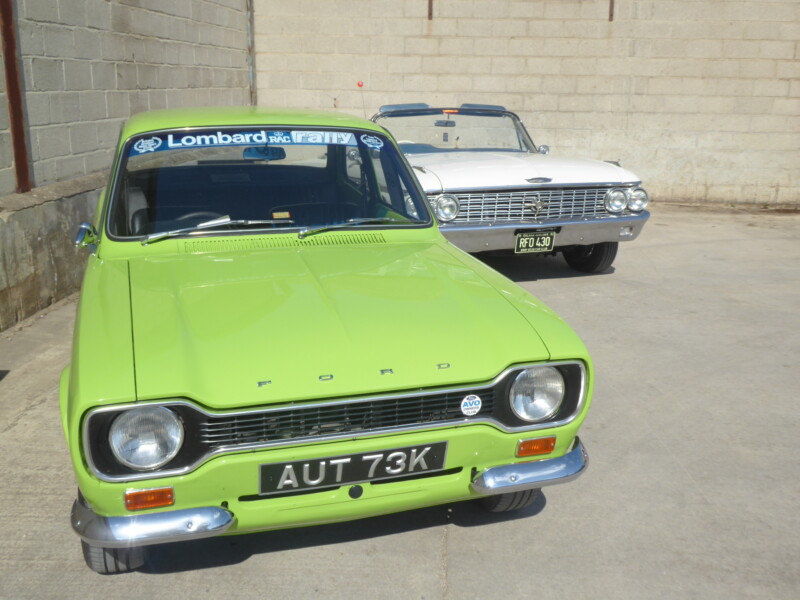
Sporting Escorts appeared only a matter of months after the launch of the regular 1100 and 1300cc cars. The first of these was a higher performance version designed for rallies and racing, the Escort Twin Cam. Built for Group 2 international rallying, it had an engine with a Lotus-made eight-valve twin camshaft head fitted to the 1.5 L non-crossflow block, which had a bigger bore than usual to give a capacity of 1,557 cc. This engine had originally been developed for the Lotus Elan. Production of the Twin Cam, which was originally produced at Halewood, was phased out as the Cosworth-engined RS1600 production began. The most famous edition of the Twin Cam was raced on behalf of Ford by Alan Mann Racing in the British Saloon Car Championship in 1968 and 1969, sporting a full Formula 2 Ford FVC 16-valve engine producing over 200 hp. The Escort, driven by Australian driver Frank Gardner went on to comfortably win the 1968 championship. The Mark I Escorts became successful as a rally car, and they eventually went on to become one of the most successful rally cars of all time with arguably the Escort’s greatest victory in the 1970 London to Mexico World Cup Rally, co-driven by Finnish legend Hannu Mikkola and Swedish co-driver Gunnar Palm. This gave rise to the Escort Mexico, which had a 1600cc “crossflow”-engined, as a special edition road version in honour of the rally car. Introduced in November 1970, 10,352 Mexico Mark I’s were built. In addition to the Mexico, the RS1600 was developed with a 1,601 cc Cosworth BDA which used a Crossflow block with a 16-valve Cosworth cylinder head, named for “Belt Drive A Series”. Both the Mexico and RS1600 were built at Ford’s Advanced Vehicle Operations (AVO) facility located at the Aveley Plant in South Essex. As well as higher performance engines and sports suspension, these models featured strengthened bodyshells utilising seam welding in places of spot welding, making them more suitable for competition. After updating the factory team cars with a larger 1701 cc Cosworth BDB engine in 1972 and then with fuel injected BDC, Ford also produced, in the autumn of 1973, an RS2000 model as an alternative to the somewhat temperamental RS1600, featuring a 2.0 litre Pinto OHC engine. This also clocked up some rally and racing victories; and pre-empted the hot hatch market as a desirable but affordable performance road car. Like the Mexico and RS1600, this car was produced at the Aveley plant.


The squarer-styled Mark II Escort appeared in January 1975. The first production models had rolled off the production lines on 2 December 1974. Unlike the first Escort (which was developed by Ford of Britain), the second generation was developed jointly between the UK and Ford of Germany. Codenamed “Brenda” during its development, it used the same mechanical components as the Mark I. The 940 cc engine was still offered in Italy where the smaller engine attracted tax advantages, but in the other larger European markets in Europe it was unavailable. The estate and van versions used the same panelwork as the Mark I, but with the Mark II front end and interior. The car used a revised underbody, which had been introduced as a running change during the last six months production of the Mark I. Rear suspension still sat on leaf springs though some contemporaries such as the Hillman Avenger had moved on to coil springs. The car came in for criticism for its lack of oddments space, with a glove compartment only available on higher end models, and its stalk-mounted horn. The “L” and “GL” models (2-door, 4-door, estate) were in the mainstream private sector, the “Sport”, “RS Mexico”, and “RS2000” in the performance market, the “Ghia” (2-door, 4-door) for a hitherto untapped small car luxury market, and “base / Popular” models for the bottom end. Panel-van versions catered to the commercial sector. The 1598 cc engine in the 1975 1.6 Ghia produced 84 hp with 92 ft·lbft torque and weighed 955 kg (2105 lb). A cosmetic update was given in 1978 with L models gaining the square headlights (previously exclusive to the GL and Ghia variants) and there was an upgrade in interior and exterior specification for some models. Underneath a wider front track was given. In 1979 and 1980 three special edition Escorts were launched: the Linnet, Harrier and Goldcrest. Production ended in Britain in August 1980, other countries following soon after.


The Ford Escort was revised in January 1995, although it was still based on the previous model. This version had new front lights, bonnet, front wings, front and rear bumpers, wing mirrors, door handles and 4 different front radiator grilles (slats, honeycomb, circles and chrome). At the rear, the Ford logo moved from the right to the centre of the boot, except for the van and some convertible models, while the Escort badge had also changed. The interior of the car was hugely revised too following heavy criticism of the original 1990 car which featured low quality plastics for its interior mouldings – the car now featured an all new dashboard arrangement of competitive quality. However, the underlying car was now five years old and most of its rivals were either new or to be imminently replaced. The two entry level engines were revised – the 1.3 L received the latest (and final) version of Valencia pushrod engine – the Endura-E from the recently launched Mk IV Fiesta and Ka, whilst the 1.4L CVH was replaced by the updated CVH-PTE unit. There were no changes to either the venerable 1.8 diesel or the 1.6/1.8 Zetec units at the top end of the range. The improved iB5 version of the venerable BC-series transmission was also later introduced as a running change. Dynamically, the handling and ride were also much improved with revised suspension set up from that on the previous Mark V models. The sporty “Si” model had slightly stiffer suspension than the Encore, LX and Ghia variants, although the Si was otherwise the same as the LX with some additional standard, mainly cosmetic, enhancements such as front and rear spoilers (which were also available as options on the LX), sports seats and white-faced dashboard instruments. Some special trim levels of the Escort include: Calypso Cabriolet, Freedom, Serenade, Cabaret and Mexico. The RS2000 models ceased production in June 1996, and were the last Escorts ever to wear the famous RS badge. The RS badge did not resurface until the Focus RS arrived in 2002. A new Ghia X model was introduced around 1996, which included air conditioning and a 6 CD autochanger as standard. Although the equipment of the Ghia below it was reduced, it was now more affordable. The last “standard” model to be introduced in 1997 was the GTi – the only GTi-badged Ford to ever be sold in Europe. This used the same existing 115 PS 1.8 L Zetec-E engine found in other cars in the range, but included a body kit borrowed from the now cancelled RS2000 model, part-leather seats plus the standard fitment of ABS. The GTi was available in 3- and 5-door hatchback and estate bodystyles. In 1998, Ford announced an all-new car, the Focus, which replaced the Escort and superseded the “Escort” name that had been in use for 30 years. The Escort range was cut down to just “Flight” and “Finesse” editions, and sold for a further two years in parallel with the Focus. In the United Kingdom, all engines except the 1.6 L petrol and 1.8 L turbo diesel were dropped, as were the three-door hatchback, four-door saloon and cabriolet bodystyles. The range was also condensed in mainland Europe, New Zealand, South Africa, and South America.

The regular second generation Focus cars were released in late 2004. An ST version followed very quickly, and for a long time, Ford maintained that was the only sporty Focus there was going to be. Finally, on December 17, 2007 Ford of Europe confirmed that a Mk 2 Focus RS would be launched in 2009, with a concept version due in mid-2008, with an upgraded Duratec ST engine with 305PS Duratec RS, gearbox, suspension, and LSD. In 2008, Ford revealed the new Focus RS in “concept” form at the British International Motor Show. Contrary to numerous rumours and speculation, the RS was announced by Ford to have a conventional FWD layout. The Duratec RS engine was upgraded to produce 301 bhp and 325 lb/ft of torque. 0 to 100 km/h (62 mph) acceleration was quoted to be under 6 seconds. The RS used a modified Volvo -engineered 2,522cc five-cylinder engine found in the Focus ST. A larger Borg Warner K16 turbo now delivers up to 20.3-psi of boost. A new air-to-air intercooler has been developed as a complement, while the forged crankshaft, silicon-aluminium pistons, graphite-coated cylinder bores, 8.5:1 compression ratio and variable valve timing also up the power output. The car remained front wheel drive, but to reduce torque steer used a Quaife Automatic Torque Biasing LSD, and a specially designed MacPherson strut suspension at the front called RevoKnuckle, which provided a lower scrub radius and kingpin offset than traditional designs while avoiding the increased weight and complexity of double wishbone and multi-link suspension setups. Ford UK claim: “It’s as close as you’ll come to driving a full-spec rally car (Ford Focus RS WRC). The production car was finally unveiled on 5 January 2009. It looked very distinctive, as at the rear a large venturi tunnel and a dramatic rear spoiler created a purposeful look. It was available in three expressive exterior colours: Ultimate Green, Performance Blue and Frozen White. The ‘Ultimate’ Green was a modern reinterpretation of the classic 1970s Ford Le Mans Green of the Ford Escort RS1600 era.


The second generation 1964 Falcon, launched in 1963, featured revised, more squared-off styling. Later in the 1964 model year, Ford’s new offering for that market was launched: the Ford Mustang, based heavily on the Falcon’s unified frame design. TV commercials now used the character Hazel as well as the Peanuts cartoon characters. The Ford Motor Company was a sponsor of the show, and also sponsored The Ford Show during the late 1950s. For the 1964 year, Ford added a Sprint Package, which gave the Falcon the Fairlane’s 260 V8, a stiffer suspension, and a louder exhaust. Because the Mustang had the same options that the Sprint had for only a small amount more, the Sprint never caught on. Even with the addition of the 289 V8 in late 1964, the Sprint was overshadowed by the Mustang, and was discontinued after 1965. The Mustang dealt Falcon sales in North America a blow from which they would never recover. Front suspension was coil springs pivot-mounted on upper arms plus double-acting absorbers. Six-cylinder cars had four-lug hubs with 13-in steel wheels. V-8 cars got five-lug wheels. For 1965, changes were minimal, including a simpler grille and revised side trim on deluxe models. Production ended on June 26, 1965, for convertible Falcons. A padded instrument panel, power steering, power brakes, a radio, a remote-control trunk release, and a parking brake warning light were optional. From 1965, the three-speed Cruise-O-Matic automatic transmission was available. Front seat belts were standard.


The 1960 Galaxie introduced all-new design with less ornamentation. A new body style was the Starliner, featuring a huge, curving rear observation window on a pillarless, hardtop bodyshell. The thin, sloping rear roof pillar featured three “star” emblems that served as the Galaxie signature badge for all 1960 – 62 models. The formal roofed 2-door hardtop was not available this year, but the roofline was used for the Galaxie 2-door pillared sedan, complete with chromed window frames. It had been the most popular body style in the line for 1959, and sales dropped off sharply. Contrary to Ford’s tradition of pie-plate round taillights, the 1960 featured “half-moon” lenses turned downward. The “A” pillar now swept backward instead of forward, making entering and exiting the car more convenient. For 1961, the bodywork was redone again, although the underpinnings were the same as for 1960. This time, the tailfins were almost gone; the small blade-like fins capped smaller versions of 1959’s “pie-plate” round taillamps once again. Performance was beginning to be a selling point, and the 1961 Galaxie offered a new 390 CID (6.4 L) version of Ford’s FE series pushrod V8, which was available with either a four-barrel carburettor or, for higher performance, three two-barrel carburettors. The latter was rated at 401 hp (gross). The 352 was downgraded in favor of the 390; it was equipped with a 2-barrel carburettor and single exhaust. The Starliner was again offered this year, and Ford promoted this model with luxury and power equipment, but it was dropped at the end of the year, as the re-introduced square-roof hardtop coupe, the Galaxie Club Victoria, took the bulk of sales. For 1962, the Galaxie name was applied to all of Ford’s full size models, as the Fairlane name was moved to a new intermediate model and Custom was temporarily retired. New top-line Galaxie 500 (two-door sedan and hardtop, four-door sedan and hardtop, and “Sunliner” convertible) models offered plusher interiors, more chrome trim outside, and a few additional luxury items over and above what was standard on the plainer Galaxie models. Base Galaxie models were available in two- and four-door sedans as well as the plain Ranch Wagon. In an effort to stimulate midseason sales, Ford introduced a group of sporty cars along with a “Lively Ones” marketing campaign. These models featured the bucket seats and console that were popularized by the Chevrolet Corvair Monza, and included a Fairlane 500 Sports Coupe, and a Falcon Futura. The full-size line was available with new bucket-seats-and-console “Lively One,” the Galaxie 500/XL (two-door hardtop and convertible). Ford stated in its sales literature that XL stood for “Xtra Lively.” The 223 cu in (3.7 L) “Mileage Maker” 6-cylinder was the base engine. The 292 cu in (4.8 L) V8 was standard on the 500/XL. The XL had sportier trim inside and out. This model was Ford’s response to Chevrolet’s Super Sport option for the big Impala, which was introduced the previous year and saw a significant rise in sales for 1962. A 406 cu in (7 L) engine was available in single four-barrel or triple-carbureted “six-barrel” form. Tailfins were gone, giving the 1962 models a more rounded, softer rear end look. Taillights were set lower into the rear panel and were partially sunken into the newly sculpted rear bumper. Outside, XL models got a thicker body side chrome spear, along with a new “Galaxie 500XL” emblem on each rear fender (including the convertible, where this badge replaced the “Sunliner” script). An oval version of the Galaxie “star” emblem replaced Ford crests on the roof sail panels on hardtops. Front fenders shapes were the same as 1961; a slightly modified flat-face grille featured a large “star”emblem in its center for all 500 and higher-priced Galaxie models. The 1962 models were overweight by comparison to the Super Duty Pontiacs with their aluminum body panels and larger-displacement engines. Therefore, late in the production run, Ford’s Experimental Garage was ordered to reduce the weight of the Galaxie. It produced 11 “lightweight Galaxies”, making use of fiberglass panels, as well as aluminium bumpers, fender aprons, and brackets; the result was a Galaxie weighing in at under 3,400 lb (1,542 kg). The base 2-door Club Sedan was 3,499 lb (1,587 kg). It was an improvement. The 1963 model was essentially unchanged save for some freshening and added trim; windshields were reshaped and a four-door hardtop 500/XL was added. A lower, fastback roofline was added mid-year to improve looks and make the big cars more competitive on the NASCAR tracks with less drag and reduced aerodynamic lift at high speed. This 1963½ model, the industry’s first official “½ year” model, was called the “sports hardtop” or “fastback” (it shared this feature with the for 1963½ Falcon). Galaxie buyers showed their preference as the new sports hardtop models handily outsold the “boxtop” square-roof models. The sports hardtop was available in both Galaxie 500, and Galaxie 500/XL trim. Mercury also received the new roofline (under the Marauder badge) in Monterey, Montclair, and Park Lane models. This year, a no-frills big Ford, priced around $100.00 below the base Galaxie sedans, was offered, badged as the Ford 300. It was offered for 1963 only, and was replaced by the Custom series in 1964. The “Swing-away” steering wheel became optional. The Fairlane’s newly enlarged “Challenger” V8 engine of 260 cu in (4.3 L) replaced the Y-block 292 cu in (4.8 L) as the entry level V8. Later in the year, the 260 was replaced with an enlarged version displacing 289 cubic inches. At the beginning of the 1963 model run, the 292 Y-block V8 was replaced as the base V8 engine with the Fairlane’s new small block 260. The 260 proved underpowered for the heavy full size Ford and was replaced midyear (coincident with the introduction of the 63 and 1/2 models) with the 289 V8. The 289 was then the largest of the “small block series” that was first used (221 cubic inch version) in the 1962 Fairlane. The 260 was offered on the Falcon Sprint and later, in mid 1964, in the early version of the 1965 Mustang. By 1965 model introduction (in the fall of 1964), the 260 (which had disappointing performance in all versions including the Sprint and Mustang) was replaced by the 289 in all models. Ford continued to offer the FE series 352 in the 1963 full size, as well as 3 versions of the 390 V8 (regular, high performance, and police). Five different transmissions were offered for 1963. A 3-speed manual column shift was standard on all models except the 406 V8, which required the heavier duty Borg-Warner 4-speed manual. A three speed manual with overdrive was optional, but rarely ordered. The two-speed Ford-O-Matic was common with the 6-cylinder and small block V-8s, while the majority of big blocks (352 and 390) were ordered with the 3-speed Cruise-O-Matic automatic transmission. The availability of several different rear end ratios, along with 5 transmissions, and 8 different engines, led to a huge number of different driveline combinations for 1963. The most produced combination for the Galaxie and Galaxie 500 was the 352 V8, with Cruise-O-Matic and the 3.0 rear end ratio. Ford’s “Club,” “Town,” and “Victoria” monikers for body styles were retired in 1963, replaced by generic labels, “2-door”,”4-door”, and “Hardtop.” Partway through this year and in limited quantities, a new 427 replaced the 406 for racing applications. It was intended to meet NHRA and NASCAR 7-liter maximum engine size rules. This engine was rated at a 425 hp gross with 2 x 4 barrel Holley carburettors and a solid lifter camshaft. Ford also made available aluminum cylinder heads as a dealer option. The 1963½ was still overweight, however. To be competitive in drag racing Ford produced 212 (around 170 from Ford Norfolk, about 20 from Ford Los Angeles) lightweight versions of the “R” code 427, in the Galaxie 500 Sport Special Tudor Fastback. Available only in Corinthian White with red vinyl interior, and with a list price of about US$4,200 (when a base Ford 300 went for US$2,324, and XL Fastback was US$3,268), these cars came stock with Borg-Warner T-10 four-speed, 4.11:1 rear axle, heavy-duty suspension and brakes, and were fitted with a fiberglass hood (a flat piece at first, late in 1963 the popular blister hood also used on the Thunderbolt), trunk, front fenders, and fender aprons, as well as aluminum bumpers and mounting brackets, transmission cases, and bellhousing. Hood springs, heater, trunk lining and mat, spare wheel and tire (and mounting bracket), trunk lid torsion bar, jack, lug wrench, one horn (of the stock two), armrests, rear ashtrays, courtesy lights, and dome light were removed to reduce weight. The first 20 cars had functional fiberglass doors, which shaved 25 lb (11 kg); these were deleted because of Ford’s concern for safety if used on the highway. The cars had all sound-deadening material removed, lightweight seats and floormats, and no options. They were not factory equipped with cold-air induction, as the Thunderbolt would be. In addition, they were built on the 45 lb (20 kg)-lighter Ford 300 chassis, originally intended for a smaller-displacement V8. In all, the 427s were 375 lb (170 kg) lighter than before (425 lb (193 kg) with the fiberglass doors). The first two lightweight Galaxies, using 289 cu in (5 L) bodies, were assembled at Wayne, Michigan, late in January 1963, to be tested at the 1963 Winternats. They were delivered to Tasca Ford (East Providence, Rhode Island) and Bob Ford (Dearborn, Michigan). Bill Lawton’s Tasca Galaxie turned the best performance, with a 12.50 pass at 116.60 mph (187.65 km/h). It was not enough against the 1963 Chevrolet Impala Z-11s in Limited Production/Stock, however. Three more were assembled from parts and tested at Ford’s Experimental Garage in Dearborn. One of the next two, the last Winternationals test cars, was prepared by Bill Stroppe in Long Beach, California, for Les Ritchey; it was featured in the July 1963 issue of Hot Rod. For all their efforts, Ford discovered the Galaxies were still too heavy, and the project was abandoned. Some of these cars competed in England, Australia and South Africa after being modified by Holman and Moody who fitted them with disc brakes and other circuit racing components. Jack Sears won the 1963 British Saloon Car Championship driving Galaxies and Cortinas and the racing Galaxies were also driven by Sir Jack Brabham, Graham Hill and other notable drivers of the period. The heavy Galaxies suffered from persistent brake failure that led to a number of crashes, and in late 1963 started using the 12-inch disc brakes from the Ford GT40 program. By this time the Lotus Cortinas were being developed and the big Galaxie became uncompetitive. Model year 1964 was the fourth and final year of this body style. Interior trim was altered, and the exterior featured a more sculpted look which was actually designed to make the car more aerodynamic for NASCAR. The formal-roof “boxtop” style was no longer available, all non-wagon models now featuring the “fastback” roof design that was the runaway best-seller in 1963. The base 300 was replaced by a line of Custom and Custom 500 models. The 289 continued as the base V8 and was standard in the XL series. XL models got new thin-shell bucket seats with chrome trim. Federal regulations now required lap-style safety belts for both front outboard occupants. The ignition switch was moved from the left side of the steering column, to the right, but otherwise the attractive instrument panel remained unchanged from ’63. The 1964 XL two-door hardtop became the best seller of any XL produced in any year. The 427 cu in (7.0 L) engine was used in 50 lightweight fiberglass-equipped cars for drag racing. These competed in North America but were still too heavy and Ford introduced the lightweight Fairlane Thunderbolt. The Ford Country Squire station wagon, while wearing “Country Squire” badging, was actually part of the Galaxie 500 line. Some Country Squires had “Galaxie 500” badging on the glovebox indicating the series name. These station wagons featured the same trims as Galaxie 500s, and were a step up from the base-model Country Sedan.


The Fairlane name was moved to Ford’s new intermediate, introduced for the 1962 model year, to bridge the gap between the compact Ford Falcon and the full-sized Galaxie, making it a competitor for GM’s A-body “senior compacts”, the Plymouth Belvedere, and the AMC Rambler. With an overall length of 197 in (5004 mm) and a wheelbase of 115.5 in (2934 mm), it was 16 in (406 mm) longer than the Falcon and 12.3 in (312 mm) shorter than the Galaxie. Wheel track varied from 53.5 in (1355 mm) to 56 in (1422 mm) depending on model and specification. Like the Falcon, the Fairlane had a unibody frame, but the body incorporated an unusual feature Ford dubbed torque boxes, four boxed structures in the lower body structure designed to absorb road shock by moving slightly in the vertical plane. Suspension was a conventional short-long arm independent arrangement in front, with Hotchkiss drive in the rear. The Fairlane was initially offered only in two-door or four-door sedan body styles. The Fairlane’s standard engine was the 170 CID (2.8 L) six, but as an option, it introduced Ford’s new, lightweight small-block Windsor V8, initially with a displacement of 221 CID (3.6 L) and 145 hp; a 260 CID (4.2 L) “Challenger” version with an advertised 164 hp was added at mid-year. The Sports Coupe option débuted mid-year and featured bucket seats and a small floor console. The trim level supplemented the Fairlane and Fairlane 500 trim levels (the 500 model had more decorative trim, such as a wider chrome stripe down the side and three bullets on the rear quarter panels). The Challenger 289 CID engine was introduced in mid-1963, with solid lifters and other performance pieces helping the engine produce an advertised 271 hp; however, it was equipped with single exhaust like the less powerful engines. This engine was coded “K” in the vehicle identification number. Exterior identification was by fender-mounted “V” badges that read “289 High Performance”. That same year, station wagons arrived, called the Ranch Wagon and Ranch Custom Wagon. All 1962 Fairlanes had “B” posts despite the popularity of the pillarless hardtop and convertible styles in that era. Ford saw the problem and introduced two pillarless hardtop coupes for 1963, in Fairlane 500 and Sports Coupe trim. For 1963 and later Sports Coupe models, the center console, which had come from the Falcon parts bin for 1962, was changed to be similar to that of the Galaxie. Sports Coupe models got a floor-mounted shift lever for the center console when Cruise-O-Matic or 4-speed manual transmissions were specified; however when the two-speed Fordomatic was ordered, the shift lever was installed on the steering column (and the console was the same without the shifter). Front-end styling for the 1963 models mimicked the big Galaxie models, but the rear end retained the small tailfins and “pieplate” tail lamp styling cues. The Squire wagon (a fake woodie) was available for 1963 only, including one model with front bucket seats. The “Swing-Away” steering wheel became an option in 1964. The 1964 and 1965, Fairlane ranges consisted of similar body styles: base Fairlane and Fairlane 500 two-door coupes and four-door sedans, and Fairlane 500 and Sports Coupe two-door hardtops. As in 1963, the Sports Coupe got its own standard “spinner” wheel covers and extra exterior brightwork. Large “Sports Coupe” scripts graced the “C” pillars. The Fairlane Squire wagon was dropped, but the standard station wagon was continued. The 221 V8 was dropped after 1963, leaving the six as the base engine and the 260 as the base V8. The “K-code” 271-horsepower 289 V8 continued into 1964, gaining dual exhausts, while a 195 hp version of the 289 with a two-barrel carburetor and hydraulic lifters was introduced. The two-speed Fordomatic continued as the automatic transmission choice for the 260 in 1964, while 289 V8s got the three-speed Cruise-O-Matic transmission option. All 1965 models featured 14-inch (360 mm) wheels as standard, in place of the earlier 13-inch (330 mm) wheels, and Fordomatic was finally phased out, leaving the Cruise-O-Matic as the only automatic available for the Fairlane. The 260 was also dropped after 1964, leaving the two-barrel 289 as the base V8. Styling-wise, in 1964, a new grille and headlight bezels were introduced, the tail fins were dropped, some chrome decorating on the side was changed, and the shape of the trunk lid changed. Styling features for 1965 included body-colour headlight bezels for the deluxe models and rectangular taillight lenses, a return to the 1962-1963 trunk lid, along with less chrome on the body and a small standup hood ornament. For 1966, the Fairlane became a long wheelbase version of the Falcon.


Drawing on inspiration from the mid-engined Ford Mustang I concept vehicle, Lee Iacocca ordered development of a new “small car” to vice-president of design at Ford, Eugene Bordinat. Bordinat tasked Ford’s three design studios (Ford, Lincoln-Mercury, and Advanced Design) to create proposals for the new vehicle. The design teams had been given five goals for the design of the Mustang: It would seat four, have bucket seats and a floor mounted shifter, weigh no more than 2,500 pounds (1,100 kg) and be no more than 180 inches (4,572 mm) in length, sell for less than $2,500, and have multiple power, comfort, and luxury options. The Lincoln–Mercury design studio ultimately produced the winning design in the intramural contest, under Project Design Chief Joe Oros and his team of L. David Ash, Gale Halderman, and John Foster. Development of the Mustang was completed in a record 18 months from September 1962 to March 1964. and Iacocca himself championed the project as Ford Division general manager. The styling is often credited to one person, and that is not accurate, as this was very much a team effort, it has been reported by those involved. To decrease developmental costs, the Mustang used chassis, suspension, and drivetrain components derived from the Ford Falcon and Fairlane. It used a unitised platform-type frame from the 1964 Falcon, and welded box-section side rails, including welded crossmembers. Although hardtop Mustangs accounted for the highest sales, durability problems with the new frame led to the engineering of a convertible first, which ensured adequate stiffness. Overall length of the Mustang and Falcon was identical, although the Mustang’s wheelbase was slightly shorter. With an overall width of 68.2 in (1,732 mm), it was 2.4 in (61 mm) narrower, yet the wheel track was nearly identical. Shipping weight, approximately 2,570 lb (1,166 kg) with the straight six-cylinder engine, was also similar to the Falcon. A fully equipped V8 model weighed approximately 3,000 lb (1,361 kg). Although most of the mechanical parts were from the Falcon, the Mustang’s body was completely different; sporting a shorter wheelbase, wider track, lower seating position and lower overall height. An industry first, the “torque box” was an innovative structural system that greatly stiffened the Mustang’s construction and helped contribute to better handling. The car was launched in 17th April 1964, as a hardtop and a convertible, with the fastback version following in August. It was an instant sensation, with demand massively exceeding supply. Since it was introduced four months before the normal start of the 1965 production year and manufactured alongside 1964 Ford Falcons and 1964 Mercury Comets, the earliest Mustangs are widely referred to as the 1964½ model. Nevertheless, all “1964½” cars were given 1965 U.S. standard VINs at the time of production, and – with limited exception to the earliest of promotional materials – were marketed by Ford as 1965 models. The low-end model hardtop used a “U-code” 170 cu in (2.8 litre) straight-6 engine borrowed from the Falcon, as well as a three-speed manual transmission and retailed for US$2,368. Standard equipment for the early 1965 Mustangs included black front seat belts, a glove box light, and a padded dash board. Production began in March 1964 and official introduction following on April 17 at the 1964 World’s Fair. V8 models got a badge on the front fender that spelled out the engine’s cubic inch displacement (“260” or “289”) over a wide “V.” This emblem was identical to the one on the 1964 Fairlane. Several changes to the Mustang occurred at the start of the “normal” 1965 model year in August 1964, about four months after its introduction. These cars are known as “late 65’s”. The engine lineup was changed, with a 200 cu in (3.3 litre) “T-code” engine that produced 120 hp. Production of the Fairlane’s “F-code” 260 cu in (4.3 litre) engine ceased when the 1964 model year ended. It was replaced with a new 200 hp “C-code” 289 cu in (4.7 litre) engine with a two-barrel carburettor as the base V8. An “A-code” 225 hp four-barrel carburettor version was next in line, followed by the unchanged “Hi-Po” “K-code” 271 hp 289. The DC electrical generator was replaced by a new AC alternator on all Fords (a way to distinguish a 1964 from a 1965 is to see if the alternator light on the dash says “GEN” or “ALT”). The Mustang GT version was introduced as the “GT Equipment Package” and included a V8 engine (most often the 225 hp 289), grille-mounted fog lamps, rocker panel stripes, and disc brakes. In the interior the GT option added a different instrument panel that included a speedometer, fuel gauge, temp. gauge, oil pressure gauge and ammeter in five round dials (the gauges were not marked with numbers, however.) A four-barrel carburettor engine was now available with any body style. Additionally, reverse lights were an option added to the car from August 1964 production. In 1965, the Shelby Mustang was born, it was available only in newly introduced fastback body version with its swept-back rear glass and distinctive ventilation louvres. The standard interior features of the 1965 Mustang included adjustable driver and passenger bucket seats, an AM radio, and a floor mounted shifter in a variety of colour options. Ford added additional interior options during the 1965 model year. The Interior Decor Group was popularly known as “Pony Interior” due to the addition of embossed running ponies on the seat fronts, and also included integral armrests, woodgrain appliqué accents, and a round gauge cluster that would replace the standard Falcon instrumentation. Also available were sun visors, a (mechanical) remote-operated mirror, a floor console, and a bench seat. Ford later offered an under-dash air-conditioning unit, and discontinued the vinyl with cloth insert seat option, offered only in early 1965 models. One option designed strictly for fun was the Rally-Pac. Introduced in 1963 after Ford’s success at that year’s Monte Carlo Rally and available on other Ford and Mercury compacts and intermediates, the Rally-Pac was a combination clock and tachometer mounted to the steering column. It was available as a factory ordered item for US$69.30. Installed by a dealer, the Rally-Pac cost US$75.95.A 14″ rim option was available for Rally-pac and GT350R vehicles widening front and rear track to 57.5″. Reproductions are presently available from any number of Mustang restoration parts sources. A compass, rear seat belts, A/C, and back-up lights were also optional. The 1966 Mustang debuted with moderate trim changes including a new grille, side ornamentation, wheel covers and filler cap. Ford’s new C-4 “cruise-o-matic” three-speed auto transmission became available for the 225 hp V8. The 289 “HiPo” K-code engine was also offered with a c4 transmission, but it had stronger internals and can be identified by the outer casing of the servo which is marked with a ‘C’. The long duration solid-lifter camshaft that allowed the high revving 289 to make the horsepower it was known for, was not friendly for a low stall speed automatic torque converter. The “HiPo” could be spotted very easily by the 1-inch-thick vibration damper, (as compared to 1/2 inch on the 225-hp version) and the absence of a vacuum advance unit on the dual point distributor. With the valve covers off, there is a large letter “K” stamped between the valve springs, along with screw in studs (vs. a pressed in stud for other 289s) for the adjustable rocker arms. A large number of new paint and interior color options, an AM/eight-track sound system, and one of the first AM/FM mono automobile radios were also offered. It also removed the Falcon instrument cluster; the previously optional features, including the round gauges and padded sun visors, became standard equipment. The Mustang would be the best-selling convertible in 1966, with 72,119 sold, beating the number two Impala by almost 2:1. The 1965 and 1966 Mustangs are differentiated by variations in the exterior, despite similar design. These variations include the emblem on the quarter-panels behind the doors. From August 1964 production, the emblem was a single vertical piece of chrome, while for 1966 models the emblem was smaller in height and had three horizontal bars extending from the design, resembling an “E”. The front intake grilles and ornaments were also different. The 1965 front grille used a “honeycomb” pattern, while the 1966 version was a “slotted” style. While both model years used the “Horse and Corral” emblem on the grille, the 1965 had four bars extending from each side of the corral, while on the 1966, these bars were removed. The 1966 model year saw introduction of ‘High Country Special’ limited edition, 333 of them were sold in Colorado, Wyoming, and Nebraska. When Ford wanted to introduce the Mustang in Germany, they discovered that Krupp company had already registered the name for a truck. The German company offered to sell the rights for US$10,000. Ford refused and removed Mustang badges from exported units, instead naming the cars as T-5 (a pre-production Mustang project name) for the German market until 1979 when Krupp copyrights expired. In 1965, Harry Ferguson Research purchased 3 Mustang notchbacks and converted them to 4×4 in an attempt to sell potential clients on their FF AWD system. A similar system was used in the Ferguson P99 Formula One car, and would go on to be featured in the Jensen FF, widely considered the first AWD passenger car. As in the Jensen FF, the AWD Mustangs also featured an ABS braking system, long before such a feature was commonplace. Ford Australia organised the importation and conversion of 1966 Mustang to right-hand-drive for the Australian market. This coincided with the launch of new XR Falcon for 1966, which was marketed as “Mustang-bred Falcon”. To set the official conversion apart from the cottage industry, the RHD Mustangs were called “Ford Australia Delivered Mustang” and had compliance plates similar to XR Falcon. About 209 were imported to Australia with 48 units were converted in 1965 while the further 161 were done in 1966. The 1967 model year Mustang was the first redesign of the original model. Ford’s designers began drawing up a larger version even as the original was achieving sales success, and while “Iacocca later complained about the Mustang’s growth, he did oversee the redesign for 1967 .” The major mechanical feature was to allow the installation of a big-block V8 engine. The overall size, interior and cargo space were increased. Exterior trim changes included concave taillights, side scoop (1967 model) and chrome (1968 model) side ornamentation, square rear-view mirrors, and usual yearly wheel and gas cap changes. The high-performance 289 option was placed behind the newer 335 hp 6.4 litre FE engine from the Ford Thunderbird, which was equipped with a four-barrel carburettor. During the mid-1968 model year, a drag racer for the street could be ordered with the optional 428 cu in (7.0 litre) Cobra Jet engine which was officially rated at 335 hp. All of these Mustangs were issued R codes on their VIN’s. The 1967 Deluxe Interior was revised, discontinuing the embossed running horse motif on the seat backs (the source for the “pony interior” nickname) in favour of a new deluxe interior package, which included special colour options, brushed aluminium (from August 1966 production) or woodgrain dash trim, seat buttons, and special door panels. The hardtop also included upholstered quarter trim panels, a carryover from the 1965-66 deluxe interior. The 1967 hardtop also had the chrome quarter trim caps, carried over from 1965-66, but these were painted to match the interior in 1968 models. The 1967 deluxe interior included stainless steel-trimmed seat back shells, similar to those in the Thunderbird. These were dropped at the end of the 1967 model year, and were not included in the woodgrain-trimmed 1968 interior. The deluxe steering wheel, which had been included in the deluxe interior for the 1965-66, became optional, and could also be ordered with the standard interior. The 1968 models that were produced from January 1968 were also the first model year to incorporate three-point lap and shoulder belts (which had previously been optional, in 1967-68 models) as opposed to the standard lap belts. The air-conditioning option was fully integrated into the dash, the speakers and stereo were upgraded, and unique centre and overhead consoles were options. The fastback model offered the option of a rear fold-down seat, and the convertible was available with folding glass windows. Gone was the Rally-Pac, since the new instrument cluster had provisions for an optional tachometer and clock. Its size and shape also precluded the installation of the accessory atop the steering column. The convenience group with four warning lights for low fuel, seat belt reminder, parking brake not released, and door ajar were added to the instrument panel, or, if one ordered the optional console and A/C, the lights were mounted on the console. Changes for the 1968 model increased safety with a two-spoke energy-absorbing steering wheel, along with newly introduced shoulder belts. Other changes included front and rear side markers, “FORD” lettering removed from hood, rearview mirror moved from frame to windscreen, a 302 cu in (4.9 litre) V8 engine was now available, and C-Stripe graphics were added. The California Special Mustang, or GT/CS, was visually based on the Shelby model and was only sold in Western states. Its sister, the ‘High Country Special’, was sold in Denver, Colorado. While the GT/CS was only available as a coupe, the ‘High Country Special’ model was available in fastback and convertible configurations during the 1966 and 1967 model years, and as a coupe for 1968. The 1968 Ford Mustang GT Fastback reached iconic status after it was featured in the 1968 film Bullitt, starring Steve McQueen. In the film, McQueen drove a modified 1968 Mustang GT 2+2 Fastback chasing a Dodge Charger through the streets of San Francisco. There were further annual updates until the model’s replacement in 1973, but with each the car got steadily bigger and less overtly sporty. Sales reduced, too, suggesting that Ford were losing their way. Mustang II did not fix that, of course, but gradually, the legendary nameplate has returned to delivering the same sort of promise as those early and much loved cars were able to do.


In 1972, a radical change occurred in the Torino and Ranchero lines. The sleek, pointy look of the previous year’s model was replaced with a larger, heavier design. Most prominent was a wide semioval grille reminiscent of a jet intake and a new body-on-frame design. Three models were still available; the now-standard 500, the new Squire with simulated woodgrain “panelling” along the flanks, and the sporty GT. Engine choices remained basically the same beginning with the 250 cubic-inch six-cylinder and a selection of V8s that ranged from the standard 302 to Cleveland and Windsor series 351s, plus the new-for-1972 400. The 385-series V8 (the 429 for 1972–73; the 460 for 1974–76) was still available. However, all suffered from lower compression ratios to better meet new emissions standards. The 351 cu in (5.8 L) Cleveland could still be obtained in tuned 4-V Cobra Jet form through 1974. A four-speed manual transmission was available on Cobra Jet-powered models GT, Squire and 500. The 1973 Ranchero had a redesigned front end to meet new federal standards for front impact protection. Aside from slight cosmetic differences, the Ranchero remained basically the same until the Torino’s final year, 1976.

The Crown Victoria saw huge success with the various law enforcement agencies in the US and indeed the continued support fo the model saw it continue in production long after a replacement car had been launched. Several of them have found their way over here.


There were also a number of recent Mustang models here, with several examples of the sixth generation car that was the first to be sold here officially by Ford and in right hand drive form, joined by the very latest seventh generation car that finally went on sale here a few months ago after a long wait following its US market launch.


GORDON KEEBLE
The Gordon-Keeble came about when John Gordon, formerly of the struggling Peerless company, and Jim Keeble got together in 1959 to make the Gordon GT car, initially by fitting a Chevrolet Corvette V8 engine, into a chassis by Peerless, for a USAF pilot named Nielsen. Impressed with the concept, a 4.6 litre Chevrolet V8 was fitted into a specially designed square-tube steel spaceframe chassis, with independent front suspension and all-round disc brakes. The complete chassis was then taken to Turin, Italy, where a body made of steel panels designed by Giugiaro was built by Bertone. The car’s four headlights were in the rare, slightly angled “Chinese eye” arrangement also used by a few other European marques, generally for high-speed cars such as Lagonda Rapide, Lancia Flaminia and Triumphs, as well as Rolls-Royce. The interior had an old luxury jet feel, with white on black gauges, toggle switches, and quilted aircraft PVC. The car was displayed on the Bertone stand at the Geneva Show in March 1960, branded simply as a Gordon. At that time problems with component deliveries had delayed construction of the prototype, which had accordingly been built at breakneck speed by Bertone in precisely 27 days. After extensive road testing the car was shipped to Detroit and shown to Chevrolet management, who agreed to supply Corvette engines and gearboxes for a production run of the car. Further development then took place, to ready for production with some alterations, the main ones being a larger 5.4 litre engine and a change from steel to a glass fibre body made by Williams & Pritchard Limited. “Production” started in 1964, but problems with suppliers occurred and before many cars were made the money ran out and the company went into liquidation. About 90 cars had been sold at what turned out to be an unrealistic price of £2798. In 1965 the company was bought by Harold Smith and Geoffrey West and was re-registered as Keeble Cars Ltd. Production resumed, but only for a short time, the last car of the main manufacturing run being made in 1966. A final example was actually produced in 1967 from spares, bringing the total made to exactly 100. The Gordon-Keeble Owners’ Club claim that over 90 examples still exist – an incredible survival rate.


HUMMER
The Hummer H1 is a full-size four-wheel-drive utility vehicle based on the M998 Humvee, which was developed by AM General when it was a subsidiary of American Motors Corporation (AMC).[2] Originally designed strictly for military use, the off-road vehicle was released to the civilian market. The civilian version was produced from 1992 through 2006 and was the first of what became the Hummer line. AM General built both the H1 and the Humvee in its Mishawaka, Indiana, facility. GM stopped marketing the H1 in the 2006 model year, but AM General continued production of the military Humvee versions through 2018. On March 22, 1983, AM General Corporation was awarded a production contract for 55,000 High Mobility Multipurpose Wheeled Vehicles (HMMWV). Nicknamed the Humvee, the vehicles were used by the U.S. military and featured in photographs from the Persian Gulf War during the early 1990s. The vehicle was also promoted by actor Arnold Schwarzenegger, who was so interested in the Humvee design that he specifically advocated for AM General to produce a civilian version of the vehicle. After the Gulf War was over, AM General modified the M998 Humvee military version for the civilian marketplace powered by 6.2 L GM Diesel V8 engine. The civilian version of the Humvee, marketed as the Hummer, went on sale in 1992. The interior was largely influenced by semi-trucks. Under a 1999 deal, General Motors bought marketing rights to the Hummer name, began marketing Hummer-branded vehicles designed by GM, and rebadged the original version built by AM General as the Hummer H1. At the time, GM began marketing the Hummer H2 that was also assembled by AM General on a modified GMC Sierra 2500HD chassis. General Motors announced that 2006 would be the last model year for the Hummer H1, with civilian market production winding down in June 2006 due to new emission regulations for diesel-engined vehicles that were to take effect in 2007. The final 2006 models had the most powerful engine and also improved fuel efficiency—about 10 mpg‑US (24 L/100 km; 12 mpg‑imp). AM General continued the production of military Humvee versions until 2018. The Hummer H1 was available in three major variants: a convertible-like soft top, a four-door hard top Sport Utility Truck, and an “Alpha Wagon” body version. Less known variants were a two-door pickup truck and a four-door slantback, which shares the same body style as the Humvee employed by the U.S. military. The convertible/soft top and the station SUV versions were the last types available to individual consumers. There were five engine types and three automatic transmission types available. Typical engine/automatic transmission combinations included: 5.7 L (350 ci) L05 gasoline V8 TBI/GM 4L80-E 4-speed; 6.2 L GM Diesel V8/GM TH400/3L80 3-speed; 6.5 L GM Diesel V8/GM 4L80-E 4-speed; 6.5 L turbo GM Diesel V8/GM 4L80-E 4-speed; 6.6 L turbo Duramax LLY V8 turbo Diesel/Allison 1000 5-speed (2006 only). The Hummer H1 shares some common driveline parts with the HMMWV. These include brakes, axles, and frame, as well as major body panels (hood, tailgate, and quarter panels) that are shared between the HMMWV and Hummer H1. All H1s and HMMWVs were produced on the same assembly line; of which the civilian H1s were painted and finished in a separate building. The H1 models feature a wide track and 86.5 in width due to the original Humvees necessity to be able to drive in the tracks left by military tanks. They can ford 30 inches (762 mm) of water and climb a 22-inch (559 mm) step. The standard 16-inch (406 mm) ground clearance is achieved by positioning driveline components high inside a wide channel in the center of the passenger compartment, meaning that despite the large interior volume, the H1 only had seating for four. Approach and departure angles are 72 and 37.5 degrees. A Central Tire Inflation System (CTIS) controls the tire air pressure allowing lower tyre pressures for off-road and higher tire pressures on-road. Other features include inboard brakes and portal gears to position drivetrain’s half shafts higher for greater ground clearance. The radiator is mounted high, sloping over the engine on a forward-hinged hood. The air intake is high, enabling the H1 to ford waist-level water. Options included magnesium-aluminum alloy or rubber inserts for run-flat tire ability. Other options include leather seats, a winch kit, and running boards. The “Alpha” was a re-engineered H1 equipped with GM’s 6.6 L Duramax Diesel and 5-speed Allison transmission. This replaced the previous GM 6.5 L diesel engine. The update program commenced in late 2002 with a production launch in the fall of 2004. To fit into the H1 engine bay, 23 engine component changes were incorporated as well as a 2.0 in (51 mm) body lift to accommodate the taller engine and its turbo housing (a prior 0.5 in (13 mm) lift had been done for MY96 to accommodate the turbo on the 6.5 L engine). The 8th digit of the VIN is 3, setting this version of the 6.6L Duramax apart from the versions used in pickup trucks. The GMT560 engine output was 300 hp and 520 lb/ft (705 Nm) of torque. The engine was equipped with cooled exhaust gas recirculation and an internal engine oil cooler, thus, requiring a 40% heat rejection increase to engine coolant. Because space was limited between the air-lift brackets that protruded from the hood, the fan system was modified by putting it directly under the cool pack and driving it through a special gearbox directly off the crankshaft damper pulley. Several other cooling system modifications were required to assist with cold starting from −30 °F (−34 °C). Other major modifications included the use of special high-strength steel in the chassis frame, a more powerful steering gear; quieter axle differentials, redesign of the geared hubs to use quieter helical gears, new induction, exhaust, and electrical power systems; and re-engineering of the fuel supply and filtration system. The Duramax engine delivered more torque at lower engine speeds than the 6.5 L, combined with a lower gearing ratio (about 44.5 to 1 in the low lock) made the vehicle more powerful. Other changes included centralized tire inflation and a new interior. Production launch was early in 2005 with vehicles built classified as model year 2006 – the 10th digit in VIN is a 6. The program was cancelled in May 2006, because sales of the nearly $129,000 vehicle had not improved, with production ending in June 2006.

JAGUAR
One of the most loved Jaguars of all time, both when it was new, and still now, is the Mark 2 saloon. Many will tell you that it is not the 3 Series BMW that “invented” the “compact sports saloon” car class, but this model, which dates back to 1959. A thorough revision of the small Jaguar saloon that had joined the range in 1955, the Mark 2 was notable in that it was the first car to use the Arabic numeral in its name, as opposed to the Roman numerals of the larger Jaguar models. At launch, the earlier model which had hitherto been known by its engine size was christened the Mark 1. Although clearly based on that car, the updated car looked significantly different, with an increase of 18% in cabin glass area greatly improving visibility. The car was re-engineered above the waistline. Slender front pillars allowed a wider windscreen and the rear window almost wrapped around to the enlarged side windows now with the familiar Jaguar D-shape above the back door and fully chromed frames for all the side windows. The radiator grille was amended and larger side, tail and fog lamps repositioned. Inside a new heating system was fitted and ducted to the rear compartment (although still notoriously ineffective). There was an improved instrument layout that became standard for all Jaguar cars until the XJ Series II of 1973. As well as the familiar 2.4 and 3.4 litre engines, what made this car particularly special was that it was also offered with the potent 220 bhp 3.8 litre unit that was fitted to the XK150 and which would later see service in the E Type. This gave the car a 0 – 60 time of around 8.5 seconds and a top speed of 125 mph. No wonder that the Mark 2 became popular as a get-away car for the criminal fraternity, and to keep up with and catch them, many police forces bought the car as well. With revised suspension and standard four wheel disc brakes, the car was effective on the track, taking plenty of class wins when new, and it is still popular in historic racing circles today. The quickest and most successful private entries came from John Coombs, a man with significant race experience who operated a large Jaguar dealership in Guildford. Coombs would undertake modifications to meet the demands of his customers, so not all the cars that he worked on are the same. Jaguar replaced the Mark 2 with simplified and slightly more cheaply finished 240 and 340 models, as an interim measure until an all-new model was ready to take over from them. The 3.8 litre disappeared from the range at this time, but in the 7 years it had been in production, it had been the best seller of the range, with around 30,000 cars produced, as compared to 28,666 of the 3.4 litre and 25,741 of the 2.4 litre model.


There was also an example of the S Type here. Having made 2 significant new car launches in 1961 at the top of the range, with the gargantuan Mark X and the E Type, for their next new model, Jaguar turned their attention lower down, believing that the Mark 2, based on design which had first launched in 1955 would need updating to keep it competitive. Sir William Lyons believed that the car would need to adopt some of the innovations that had been seen on the Mark X and the E Type, such as Jaguar’s new independent rear suspension and the triple SU carburettor version of the 3.8-litre XK engine Accordingly work started on a call which was codenamed “Utah Mk III”, (the Mark 2 having been “Utah Mk II”) and which made its public debut as the S Type. Both time and budget were limited, so rather than being an all new car, the S Type was a major redevelopment of the Mark 2. It used a mid-scale version of the Mark X independent rear suspension to replace the Mark 2’s live rear axle and featured revised styling, with the changes more obvious at the back with a longer tail giving more boot space. rear bodywork, with only minor changes to the front and a slightly flattened roofline, which is one reason why a lot of people have trouble distinguishing the car from its smaller brother. A more luxurious interior was fitted, with greater use of burr walnut and leather than was to be found in the Mark 2. The S Type was available with either 3.4 or 3.8-litre XK engines but only in twin carburettor form because the triple carburettor set-up would not fit into what was essentially still the Mark 2 engine bay. By the time of the S Type’s release in 1963, the Mark 2 was still selling strongly, despite its age, whereas the Mark X was selling less well than had been hoped, especially in its intended market of the USA, so Sir William decided to retain all three models in the Jaguar range concurrently. Sales of the S Type were relatively modest throughout its 6 year production life, with 9928 of the 3.4 litre and 15.065 of the 3.8 litre cars made.


JEEP
The Jeep Comanche (designated MJ) is a pickup truck variant of the Cherokee compact SUV (1984–1992) manufactured and marketed by Jeep for model years 1986-1992 in rear wheel (RWD) and four-wheel drive (4WD) models as well as two cargo bed lengths: six-foot (1.83 meters) and seven-foot (2.13 meters). During the mid-1980s, according to AMC chairman W. Paul Tippett Jr. “People are finding trucks a reasonable and sophisticated alternative to cars.” To satisfy the demand and to compete with Japanese competitors, both AMC and Chrysler were preparing compact pickups for the 1986 and 1987 model years (respectively). Also at this time the financial health of AMC was poor and the automaker was in need of cash as it was preparing a new line of midsize sedans (the Eagle Premier) scheduled to be produced at a factory being built in Canada (Brampton Assembly), but the best thing the company had going for it was its popular line of Jeeps and introducing a compact Jeep pickup truck in the fall of 1985 was expected to help. The Jeep Comanche was introduced in mid-August 1985, at a lavish event staged at the ballroom of the MGM Grand Hotel and Casino (currently Bally’s Las Vegas) for AMC’s over 1,500 North American dealers. American Motors included Chinese officials as part of the negotiations establishing Beijing Jeep (now Beijing Benz). The goal was to produce and sell Comanches in China through this joint venture. The new trucks were unveiled by Jose Dedeurwaerder, an engineer and international business executive with 23 years of experience with Renault, who had just been appointed as AMC’s new president. The base price of the two-wheel drive model was $7,049, making it the lowest priced Jeep model for the 1986 model year. American Motors’ Jeep designers based the Comanche MJ body, styling, engineering, and powertrain on the XJ Cherokee, which had been introduced for the 1984 model year. The Comanche had a somewhat more conventional body-on-frame design behind the cab and a removable cargo box, but retained the unibody construction of the Cherokee in the front half of the vehicle. In the United States where the Comanche and Dodge Rampage were sold they are both considered pickup trucks. By contrast, in other markets the Volkswagen Rabbit Pickup was called the Volkswagen Caddy and considered a coupe utility, not a truck because the cargo bed is an integral part of the body structure and not removable. However this is not the legal definition of truck in the United States where the Comanche, Rampage and Rabbit were all sold. Two cargo bed lengths were used; one for the seven-foot long-bed model, which appeared first in 1986, and a second, shorter version for the six-foot cargo bed, which debuted for the 1987 model year. Unlike other pickups of the time that used C-channel frames, the Comanche’s frame design (called a “Uniframe” by Jeep) under the cargo bed was fully boxed, with a large X structure centred over the rear axle. For strength, the rails were over eight inches deep (top to bottom), much deeper than conventional midsize truck frames (1983 Jeep J-10 full-size truck frame is 6.75 inches at the deepest point). This structure was pioneered by AMC for the 1971 “Cowboy” compact pickup prototype. From 1986 to 1987, the Jeep Comanche grille had ten slots in a similar configuration to the 1984-1987 Cherokee XJ, while from 1988 to 1992, this configuration changed to eight slots to match with the SUV. A new “4×4” badge, similar to those found on the Cherokee and Wagoneer models, was affixed to the upper rear of the cargo box on all the four-wheel drive models. After the Chrysler buyout of American Motors for $1.5 billion on March 9, 1987, designed to capture “the highly profitable Jeep vehicles … and 1,400 additional dealers”, the Jeep Comanche, like the similar Cherokee, received only minor changes. These were primarily to improve reliability and parts interchangeability with other Chrysler-built vehicles. The Comanche used the XJ Cherokee’s “Quadralink” front suspension, with coil springs and upper/lower control arms on a solid axle. It was argued that the coil springs allowed for greater ride comfort and axle articulation during off-road excursions. A track bar (Panhard rod) is used to keep the axle centred under the truck. Modified versions of this same basic suspension system were later used on the 1993–2004 Grand Cherokee, 1997 and newer TJ Wranglers and 1994 and newer Dodge Rams. For the rear suspension, the truck used leaf springs that are considerably longer than the Cherokee’s, which give Comanches good load-carrying capacity without creating a hard ride. The standard rear axle was the same Dana 35 used in the Cherokee, except that the Comanche mounted the leaf springs underneath the axle, as do most other trucks, and the Cherokee mounted them on top of the axle. There was also a heavy duty Metric Ton package for the long-bed models. The package included heavier-duty leaf springs and wheels, larger tires, and upgraded the rear axle to a Dana 44, which increased the stock payload (cargo) capacity from 1,400 to 2,205 pounds (635 to 1,000 kg), well above that of any other mid-size truck. The Metric Ton Comanche’s payload rating was higher than that of many full-size pickups. The inaugural 1986 model year Comanches could be equipped with one of three engines: AMC’s 2.5 L four-cylinder as standard, with General Motors’ 2.8 L V6 or Renault’s 2.1 L I4 turbo diesel available as options. In base trim the four-cylinder engine was backed by a four-speed manual transmission, with either a five-speed manual or three-speed TorqueFlite A904 automatic built by Chrysler as an option. The V6 engine was available with either the five-speed manual or the automatic, while the turbodiesel was only available with the five-speed. The V6 was the same engine used in the competing Chevrolet S-10, and equipped with a two-barrel Rochester carburettor instead of the four-cylinder’s electronic throttle-body fuel injection system the optional six-cylinder was slightly less powerful than the standard four. The V6 thus offered little performance advantage over the base engine while penalizing the owner with poorer fuel economy. In the truck’s second year on the market the V6 was replaced by AMC’s new fuel-injected 4.0 L straight-six that developed 173 hp and 220 lb/ft (298 Nm): 50% more power and 47% more torque than the previous V6. The new six-cylinder was also more fuel-efficient. The performance of the base 2.5 L engine was also improved with a new air intake, raising peak output to 121 hp and 141 lb/ft. The slow-selling turbodiesel option was dropped during the model year. Concurrent with introduction of the new straight-six a new four-speed automatic built by Aisin-Warner replaced the former Chrysler three-speed. The 30-40LE featured electronic controls with a switch on the dashboard allowing the driver to choose between two performance modes: “Power”, in which the transmission downshifts more quickly and upshifts at higher rpm during hard acceleration, and “Comfort”, in which the upshifts are made at lower engine speeds to conserve fuel and reduce engine noise and vibration. In 1988 output of the 4.0 L engine was improved slightly to 177 hp and 224 lb/ft. Chrysler purchased AMC in 1987, and by the 1991 model year adapted their own engine control electronics to replace the original Renix systems used with the 2.5 L and 4.0 L engines. Power and torque in both engines improved as a result, with the four-cylinder having an additional 9 hp and 8 lb⋅ft and the six-cylinder improving by 1 lb⋅ft and 13 hp. The 4.0 L was badged “High Output” thereafter. As a result of the power improvements the Aisin-Warner automatic transmission’s output shaft was changed from 21 splines to 23, and the “Power-Comfort” switch was deleted. The four-cylinder was no longer available with the automatic in 1991 and 1992. During the production life of the Comanche six different transmissions were offered, manufactured by Aisin, Chrysler, and Peugeot. Chrysler provided the aforementioned TorqueFlite 904 three-speed automatic in 1986 models. In addition to the aforementioned 30-40LE four-speed automatic Aisin also provided the AX-4 (four-speed), AX-5 and AX-15 (five-speed overdrive) manual transmissions. The AX-15 was phased in midway through the 1989 model year to replace the Peugeot BA10/5 five-speed that had been used behind the 4.0 L engine from its introduction in 1987. Comanches were available in either two or four-wheel-drive, with solid axles front and rear (two-wheel-drive Comanches used a simple beam axle with otherwise the same front suspension as four-wheel-drive models). Transfer cases were built by New Process Gear, and the Comanche was available with either part-time “Command-Trac” or full-time “Selec-Trac” systems. In 1986 Command-Trac transfer cases were model NP207 and Selec-Trac were NP228, both with a 2.61:1 low gear ratios. In 1987 the NP207 was replaced with the NP231 and NP228 was replaced with the NP242, both with 2.72:1 low gears. These remained the same through the rest of the Comanche’s production. The decision to phase out the Jeep Comanche “came from a combination of two factors— low sales and Chrysler’s attempts to make the Jeep brand fit into the Chrysler hierarchy of Plymouth, Dodge, and Chrysler models” with Jeep housing SUVs and Dodge making trucks. As sales dropped, the Comanche was planned for discontinuation. In 1990, the National Council of Jeep-Eagle dealers asked Chrysler to discontinue the Comanche, and allow them to sell a version of the Dodge Dakota pickup. The company decided to cease production of the Comanche on June 12, 1992, after only a few thousand more trucks rolled off the Toledo, Ohio, assembly line. A total of 190,446 Comanches were made during its production run.


JENSEN
The Jensen C-V8, a four-seater GT, was launched in October 1962, It had fibreglass bodywork with aluminium door skins, as did the preceding 541 series. All C-V8s used big-block engines sourced from Chrysler; first the 361 and then, from 1964, the 330 bhp 383 in³. Most of the cars had three-speed Chrysler Torqueflite automatic transmission, but seven Mk2 C-V8s were produced with the 6-litre engine and four-speed manual gearbox , followed by two manual Mk3s. While the great majority of C-V8s were made in right-hand drive, ten were made in left-hand drive. The car was one of the fastest production four-seaters of its era. The Mk II, capable of 136 mph, ran a quarter mile in 14.6 seconds, and accelerated from 0–60 mph in 6.7 seconds. The upgraded Mk II, introduced in October 1963, had Selectaride rear dampers and minor styling changes. Changes on the Mk III, the final version of the series which was introduced in June 1965, included a minor reduction in overall length, deeper windscreen, equal size headlamps without chrome bezels, improved interior ventilation, wood-veneer dashboard, the addition of overriders to the bumpers, and a dual-circuit braking system. The factory made two convertibles: a cabriolet, and a Sedanca that opened only above the front seats. The front of the C-V8 was styled with covered headlamps, similar to those on the Ferrari 275 GTB and Jaguar 3.8 E-type as a key element of the design. But because of concerns that they might reduce the effectiveness of the headlamps, the covers were deleted for the production cars. As a consequence the C-V8’s front-end appearance was compromised and proved controversial for decades. Owners are now starting to return their cars to the original streamlined styling intended by the car’s designer Eric Neale. The model was discontinued in 1966 after a total production run of 500. The fibreglass body, and the fact that the twin-tube frame was set in from the perimeter of the car, have contributed to the model’s comparatively high survival rate.


An enduring classic that has far more appeal now than when it was new (not an uncommon story) is the Jensen Interceptor, launched as a replacement for the rather gawky looking CV8 of the early 1960s. After a false start when a car with the same name was shown in 1965, which received a massive “thumbs down”, Jensen went to Italy to find a new stylist for another attempt. They ended up with Carozzeria Touring, who produced a stunning looking grand tourer which, although sharing some styling cues with other models that they had designed, had a style all of its own, and they then approached another, Vignale, to build the bodies before they would be shipped back to West Bromwich for final assembly. As with the CV8, motive power came from a large Chrysler V8 engine, which gave the car effortless performance, and a somewhat prodigious thirst. The original specification included electric windows, reclining front seats, a wood rimmed steering wheel, radio with twin speakers, reversing lights and an electric clock. Power steering was included as standard from September 1968. The Mark II was announced in October 1969, with slightly revised styling around the headlamps, front grille and bumper and revised rear lights. The interior was substantially revised in order to meet US regulations, and air conditioning was an option. The Mark III, introduced in 1971, revised the front grille, headlamp finishers and bumper treatment again. It had GKN alloy wheels and air conditioning as standard, and revised seats. It was divided into G-, H-, and J-series depending on the production year. The 6.3 litre engine was superseded by the 7.2 litre in 1971. A Convertible version was premiered in 1974,. but just 267 were built, and then in 1975 a Coupe model was shown, effectively a fixed roof version of the Convertible, just 60 of which were made as by this time, the company had fallen on hard times due to the then world-wide recession, and massive and costly reliability problems with its Jensen-Healey sports car. It was placed into receivership and the receivers allowed production to be wrapped up using the available cache of parts. Production of the Interceptor ended in 1976. Enthusiasm for the car remained, though, so in the late 1980s, a group of investors stepped in and re-launched production of the Interceptor, as the Series 4, back as a low-volume hand built and bespoke affair, marketed in a similar way to Bristol, with a price (£70,000 and more) to match. Though the body remained essentially the same as the last of the main production run of series 3; the engine was a much smaller Chrysler supplied 5.9 litre unit which used more modern controls to reduce emissions comparatively and still produce about 230 hp. In addition, the interior was slightly re-designed with the addition of modern “sports” front seats as opposed to the armchair style of the earlier models, as well as a revised dashboard and electronics. The then owner sold up in 1990 to an engineering company believed to be in a stronger position to manufacture the car which lasted until 1993 with approximately 36 cars built, and while work commenced on development of a Series 5 Interceptor, once again receivers were called in and the company was liquidated. Even that was not quite the end of the story, as the Jensen specialist based at Cropredy Bridge has made a business out of rebuilding original Interceptors using modern components, with a General Motors supplied 6.2 litre LS3 engine and transmission from a Chevrolet Corvette. In May 2010, Jensen International Automotive was set up, with the financial backing and know-how of Carphone Warehouse founder and chairman Charles Dunstone who joined its board of directors. A small number of Jensen Interceptor Ss, which had started production under a previous company, are being completed by Jensen International Automotive (JIA), in parallel with JIA’s own production of the new Jensen Interceptor R; deliveries of the latter started at the beginning of 2011.


LANCIA
Built in 9 series over a 10 year period, the Lambda pioneered a number of technologies that soon became commonplace in our cars. For example, it was the first car to feature a load-bearing monocoque-type body, (but without a stressed roof) and it also pioneered the use of an independent suspension (the front sliding pillar with coil springs). Vincenzo Lancia even invented a shock absorber for the car and it had excellent four wheel brakes. The narrow angle V4 engine which powered is not something which was widely copied. Approximately 11,200 Lambdas were produced. Most of them had the open Torpedo style body, but some of the last Series 8 and 9 cars had Weyman saloon bodies.


LAND ROVER
The Series III had the same body and engine options as the preceding IIa, including station wagons and the One-Ton versions. Little changed cosmetically from the IIA to the Series III. The series III is the most common series vehicle, with 440,000 of the type built from 1971 to 1985. The headlights were moved to the wings on late production IIA models from 1968/9 onward (ostensibly to comply with Australian, American and Dutch lighting regulations) and remained in this position for the series III. The traditional metal grille, featured on the series I, II and IIA, was replaced with a plastic one for the series-III model. The 2.25-litre engine had its compression raised from 7:1 to 8:1, increasing the power slightly (the high compression engine had been an optional fit on the IIa model for several years). During the series-III production run from 1971 until 1985, the 1,000,000th Land Rover rolled off the production line in 1976. For many years, a SWB Land Rover was the shortest 7-seat vehicle available in Europe. The series III saw many changes in the later part of its life as Land Rover updated the design to meet increased competition. This was the first model to feature synchromesh on all four gears, although some late H-suffix SIIA models (mainly the more expensive Station Wagons) had used the all-synchro box. In keeping with early 1970s trends in automotive interior design, both in safety and use of more advanced materials, the simple metal dashboard of earlier models was redesigned to accept a new moulded plastic dash. The instrument cluster, which was previously centrally located, was moved to the driver’s side. Long-wheelbase Series-III vehicles had the Salisbury rear axle (the differential housing and axle case are one piece) as standard, although some late SIIA 109-inch vehicles had them too. In 1980, the 2.25-litre petrol and diesel engines received five main bearing crankshafts to increase rigidity and the transmission, and axles and wheel hubs were strengthened. This was the culmination of a series of updates to the transmission that had been made since the 1960s to combat the all-too-common problem of the rear axle half-shafts breaking in heavy usage. This problem was partly due to the design of the shafts themselves. Due to the fully floating design of the rear wheel hubs, the half shafts can be removed very quickly without even having to jack the vehicle off the ground. The tendency for commercial operators to overload their vehicles exacerbated this flaw which blighted the series Land Rovers in many of their export markets and established a reputation that continues in many markets to the present day. This is despite the 1982 re-design (mainly the increase of driving-splines from 10 to 24 to reduce stress) that all but solved the problem. Also, new trim options were introduced to make the interior more comfortable if the buyer so wished (many farmers and commercial users preferred the original, non-trimmed interior). These changes culminated in April 1982 with the introduction of the “County” spec. Station Wagon Land Rovers, available in both 88-inch and 109-inch types. These had all-new cloth seats from the Leyland T-45 Lorry, soundproofing kits, tinted glass and other “soft” options designed to appeal to the leisure owner/user. Of more interest was the introduction of the High Capacity Pick Up to the 109-inch chassis. This was a pick-up truck load bay that offered 25% more cubic capacity than the standard pick-up style. The HCPU came with heavy-duty suspension and was popular with public utility companies and building contractors.


There were a large number of classic Defender models here, parked up on the verge outside the venue where they made for quite a striking display.

LOTUS
Introduced in 1967, the Elan +2 had a longer wheelbase and two rear seats and so was intended for those Lotus customers who needed space to carry (small) people in the back, without sacrificing the same basic principles which made the Elan so appealing. A fast and agile sport coupe, a number of different engines were fitted over the years, with the later models having 130 bhp and a 5 speed gearbox at their disposal, which gave a top speed of 120 mph and 0–60 acceleration of 7.9 seconds and 0-100 mph 21.8 seconds. 5,200 Elans +2 were made, with production ceasing in 1975. Fewer than 1,200 of these cars remain on the roads today. Their relative rarity, beautiful lines, impressive performance and practicality are the main factors for the rising interest on these cars among collectors.


Known internally as the Type 89, the Excel, built from 1982 to 1992, was a development of the earlier Lotus Eclat, which itself was based on the Type 75 Elite. Although a promising design, the Elite and Eclat had suffered from numerous quality control issues which were difficult for owners to accept given the price of the cars. The Excel was a concerted effort to address these, and it stood every chance of so doing, as it took advantage of the relationship with Toyota. This had started when Toyota engaged Lotus to assist with engineering work on the Supra. During this period, Toyota then became a major shareholder in Lotus. Part of the deal between the two included the use of many Toyota mechanical components in Lotus’ cars. The original Excel (aka the Eclat Excel) used the W58 manual transmission, driveshafts, rear differential, 14×7 in alloy wheels, and door handles from the Supra Mk II, which was made from 1982 to 1986. The engine was the familiar all-aluminium, DOHC 2.2 litre Lotus 912 Slant Four which was also used in the Lotus Esprit S3. During its lifetime, the Excel received two major upgrades. With the introduction of the Excel SE which had a 180 bhp engine vs the standard 160 bhp car in October 1985, the bumpers, wing and interior was changed, including a new dashboard. In October 1986 the Excel SA with automatic gearbox was introduced. Further facelifts in 1989 saw Citroën-derived mirrors, as featured on the Esprit, and 15 inch OZ alloy wheels to a similar pattern as the Esprit’s. According to Lotus records, only 1 Excel was manufactured to USA specification. The lack of release in the USA was due to the high emission regulations (which would hinder the car’s performance), and poor sales of the car in Europe.


It is now over 20 years since Lotus launched the Elise, a model which showed a return to the core values of simplicity and light-weight which were cornerstones of Colin Chapman’s philosophy when he founded the marque in 1955. The first generation Elise was produced for just over 4 years, with a replacement model, the Series 2 arriving in October 2000. It came about as the Series 1 could not be produced beyond the 2000 model production year due to new European crash sustainability regulations. Lacking the funding to produce a replacement, Lotus needed a development partner to take a share of investment required for the new car. General Motors offered to fund the project, in return for a badged and GM-engined version of the car for their European brands, Opel and Vauxhall. The result was therefore two cars, which although looking quite different, shared much under the skin: a Series 2 Elise and the Vauxhall VX220 and Opel Speedster duo. The Series 2 Elise was a redesigned Series 1 using a slightly modified version of the Series 1 chassis to meet the new regulations, and the same K-series engine with a brand new Lotus-developed ECU. The design of the body paid homage to the earlier M250 concept, and was the first Lotus to be designed by computer. Both the Series 2 Elise and the Opel Speedster/Vauxhall VX220 were built on the same production line, in a new facility at Hethel. Both cars shared many parts, including the chassis, although they had different drive-trains and power-plants. The VX220 carried the Lotus internal model identification Lotus 116, with the code name Skipton for the launch 2.2 normally aspirated version and Tornado for the 2 litre Turbo which came out in 2004. Fitted with 17 inch over the Elise’s 16 inch front wheels, the Vauxhall/Opel version ceased production in late 2005 and was replaced by the Opel GT for February 2007, with no RHD version for the United Kingdom. Whilst the first of the Series 2 cars came with the Rover K-Series engine, and that included the 111S model which had the VVC engine technology producing 160 hp, a change came about in 2005 when Lotus started to use Toyota engines. This was initially due to Lotus’ plans to introduce the Elise to the US market, meaning that an engine was needed which would comply with US emissions regulations. The selected 1.8 litre (and later 1.6 litre) Toyota units did, and the K-series did not. that MG-Rover went out of business in 2005 and engine production ceased confirmed the need for the change. Since then, Lotus have offered us track focused Elise models like the 135R and Sport 190, with 135 bhp and 192 bhp respectively, as well as the 111R, the Sport Racer, the Elise S and Elise R. In 2008 an even more potent SC model, with 218 bhp thanks to a non-intercooled supercharger was added to the range. In February 2010, Lotus unveiled a facelifted version of the second generation Elise. The new headlights are now single units; triangular in shape they are somewhat larger than the earlier lights. The cheapest version in Europe now has a 1.6 litre engine to comply with Euro 5 emissions, with the same power output as the earlier 1.8 136bhp car. Lotus has been through some difficult times in recent years, but things are looking more optimistic again, with production numbers having risen significantly in the last couple of years, after a period when next to no cars were made.

The Lotus 2-Eleven is based on the Lotus Exige S, and thus has the same Toyota 2ZZ-GE with VVTL-i, Eaton M62 Roots-type supercharger and intercooled inline-four engine. Weighing 670 kg (1,477 lb), with 252 bhp at 8,000 rpm and 242 Nm (178 lb/ft) at 7,000 rpm of torque, the 2-Eleven can sprint from 0-60 mph (97 km/h) in 3.8 seconds and has a top speed of 150 mph (241 km/h). Intended as a track day car, it cost £39,995 though for an additional £1,100 Lotus would make the car fully road legal. Slight differences exist between the track and road versions, where the track car is slightly longer, at 3,872 mm (152.4 in) and lighter at 666 kg (1,468 lb). The cars were made between 2007 and 2011.


Developed under the project name Project Eagle, this car was launched as the Evora on 22 July 2008 at the British International Motor Show. The Evora is based on the first all-new vehicle platform from Lotus Cars since the introduction of the Lotus Elise in 1995 (the Exige, introduced in 2000, and the 2006 Europa S are both derivatives of the Elise Evora was planned to be the first vehicle of three to be built on the same platform and was the first product of a five-year plan started in 2006 to expand the Lotus line-up beyond its track-specialised offerings, with the aim of making Evora a somewhat of a more practical road car that would appeal to the mainstream. As such it is a larger car than recent Lotus models Elise and its derivatives (Exige, Europa S, etc.), with an unladen weight of 1,383 kg (3,049 lb). It is currently the only Lotus model with a 2+2 configuration, although it is also offered in a two-seater configuration, referred to as the “Plus Zero” option. It is also the only 2+2 mid engined coupé on sale. The interior is larger to allow taller persons of 6’5″ to fit. The cooled boot behind the engine is large enough to fit a set of golf clubs, although Lotus Design Head Russell Carr denies that this was intentional. Lotus intends Evora to compete with different market sectors including the Porsche Cayman. The name “Evora” keeps the Lotus tradition of beginning model names with an “E”. The name is derived from the words evolution, vogue, and aura. and it of course sounds similar to Évora, which is the name of a Portuguese city and UNESCO World Heritage Site. Sales started in summer 2009, with an annual target of 2000 cars per year, with prices between £45,000 and just over £50,000. and in America from the beginning of 2010. The Evora received several accolades at its launch from the British motoring press, including: Britain’s Best Driver’s Car 2009 from Autocar and Car of the Year 2009, from Evo. Sales, however, were far from target, as the car was seen as too costly. A more powerful Evora S was launched in 2010 with a supercharged equipped 3.5-litre V6. A facelifted and more powerful Evora 400 model was unveiled at the 2015 Geneva Motor Show.

Final Lotus here was the only sports car in the current line-up, the Emira.

MARCOS
Designed by brothers Dennis and Peter Adams, this car caused something of a sensation when it was shown at the 1964 Racing Car Show. Known as the Marcos 1800, it had a glassfibre body, with a wooden chassis and was offered for sale fully built or in kit form. This was to be the design that would become familiar to sports car enthusiasts for more than 30 years, even though the original plywood chassis would later be replaced by a steel chassis and the futuristic scalloped dashboard also vanished after a few years. The plywood chassis was glued together from 386 separate pieces and was not only light and strong, but also required a minimum up front investment to construct. The extremely low Marcos required a nearly supine driving position and fixed seats, mounted lower than the floor of the car. In return, the entire pedal set could be moved fore and aft with a knob on the dashboard. If this proved not to be enough Marcos also offered optional booster pillows. This setup, with the fixed seats, remained until the end of Marcos production in late 2007. The original Marcos 1800 had a two-spoke steering wheel and a novel dash with a prominent centre console, a rather expensive design which did not survive onto the Ford-engined cars. The entire nose portion, of a long and tapered design, was hinged at the front and was held down by latches behind the front wheelwells. It used the cast-iron four-cylinder 96 hp Volvo 1778 cc B18 unit with overdrive gearbox from the Volvo P1800S enough for a 116 mph top speed and a 0-60 mph time of 8.2 seconds. Successful in competition, the rather expensive 1800 sold very slowly, and after the first 33 cars the de Dion rear suspension was replaced by a live Ford axle. The price was dropped from ₤1500 to ₤1340, but it was not enough to make the car profitable. Cars were stockpiling in 1966, and after 106 (or 99) had been built, the 1800 was replaced by the Ford-engined 1500. Normally fitted with a four-speed manual transmission a five-speed one was also available, allowing for a higher top speed. According to some sources, a few of the last cars built had the 2 litre Volvo B20 engine fitted, as did some of the racing cars. The 1800 is the only Marcos that is eligible for historic racing and as such is considerably more valuable today than later models. In 1966 the GT was changed to a pushrod inline-four Ford Kent engine of 1500 cc, in order to lower costs as the 1800 had been rather too expensive to market. The complex dash was also replaced with a flat polished wood unit, which was soon downgraded further yet to a mass-produced “wood-effect” one. Power and performance were both down on the 1800, but sales increased considerably. To hide the fact that a common Ford engine was used, Marsh replaced the rocker covers with Marcos ones and switched from Weber to Stromberg carburettors. An overbored Lawrencetune 1650 cc version was made available in 1967 (32 built) to ameliorate the power shortage, for the Marcos 1650 GT. The 1650 also had bigger disc brakes and a standard Webasto sunroof, but proved somewhat less than reliable It and the 1500 were both replaced by Ford’s new Crossflow four not much later, in late 1967. The 1600 proved to be the most popular model yet, with 192 cars built until early 1969. Weight was 740 kg (1,631 lb) and disc brakes up front were standard, although power assist was an optional extra. Production ended in October 1969 as the new steel chassis was not well suited for the crossflow engine. A new model, the 2 litre, appeared at the January 1969 London Show with the engine changed to the Ford Essex V4 engine from the Ford Corsair – while a V6 engine had already appeared at the top of the lineup in 1968. Also in 1969, the plywood chassis was gradually replaced by a square section steel one, which shortened production time and saved on cost. These steel framed cars required a lower sill panel and have reshaped rear bumpers, as well as some subtle interior differences. The wooden chassis had also begun to meet a certain amount of resistance from buyers. There seem to have been no V4-engined wooden cars made, although there is a few months overlap between the introduction dates. The V4 received most of the same standard and optional equipment (except the overdrive) and the same central bonnet bulge as did the V6 models; very few of the Marcos 2 litres still have their V4 engines, as a V6 swap is a rather quick job and makes for a much faster car than the original’s 85 hp. It was not exactly a success story, 78 2 litres were most likely built, although numbers as low as 40 have also been mentioned. New at the October 1968 London Show was the more powerful Marcos 3 litre. Fitted with the double-carb Ford Essex V6 engine and transmission from the Ford Zodiac, production beginning in January 1969. Max power was 140 bhp and aside from the badging, this car is most easily recognised by the large, central bonnet bulge necessary to clear the larger engine. The 3 litre had a four-speed manual with a Laycock-de-Normanville Overdrive for the third and fourth gears fitted. In December 1969 a twin-carburetted 3-litre Volvo B30 straight-six became available (initially only for the US), and in 1971 eleven or twelve cars were fitted with the 150 bhp Triumph 2.5-litre straight-six. These were called the Marcos 2½ litre. As the bonnet was a close fit over the various larger engines, this resulted in a corresponding variation in the bonnet design as regards changes designed to clear engine air intakes, often the only external sign of the type of engine fitted. All inline-sixes required a rather angular bulge right of centre on the bonnet to clear the carburettors. Around this time, some V6 cars begun sporting single rectangular headlights (not on US-market cars), borrowed from the Vauxhall Viva HB. Later in 1969 the six-cylinder cars, as with their four-cylinder counterparts, received the new steel chassis. Either 100 or 119 of the wood-chassied V6 cars were built. The Ford V6 version achieved over 120 mph on test and the Volvo-engined model was not far behind it, but the heavy cast-iron engines increased nose-heaviness in comparison to the four-cylinder variants. With US sales going strong, Marcos production was up to three per week and they had to invest in a bigger space in 1969. Cars for the North Americas market had Volvo’s inline-six cylinder, 3 litre engines with a standard Borg-Warner Type 35 automatic transmissions. They sat on tubular steel space frames, have a higher ride height, and no headlight covers – all of this was in order to get US road certification. Air conditioning was also listed as an option by New York-based importers Marcos International Inc. Delays and problems with the federalised cars were beginning to mount. In 1970, 27 exported cars were impounded by US Customs for supposedly not meeting federal law, causing Marcos to withdraw entirely from the US market. Together with the development costs of the Mantis and the introduction of VAT on kit cars on the horizon, Marcos had to close its doors for what turned out to be the first time. About sixty US market cars were built, some of which were brought back after the US market dried up in 1970 and converted to RHD for sale in the home market. Production of the Volvo 3 litre continued for the rest of the world, with these cars fitted with a four-speed manual transmission. Either 80 or 172 of the Volvo I6-engined Marcos were built until early 1972, with the final one destined to become the last Marcos built for the next ten years. After Marcos had run out of money the company was sold to Hebron & Medlock Bath Engineering in mid-1971. They themselves had to call in the receivers only six months later. The Rob Walker Garage Group bought the factory only to sell off everything, including some finished cars such as all six Mark 2 1600s built. Jem Marsh bought up spares and other parts at the liquidation sale and proceeded to run a company servicing existing Marcos, until he resumed production of Marcos kits in 1981. The original GT continued to be built until 1989 or 1990, being developed into its altered Mantula form. This was further developed into more powerful and aggressively-styled designs, culminating in the 1994 LM600 (which competed in the 1995 Le Mans 24-hour race).


MAZDA
The Mazda MX-6 is a front-engine, front-wheel-drive coupé manufactured and marketed by Mazda from 1987 to 1997 across two generations. Mechanically identical to the Ford Probe, the Capella/626 and its hatchback platform mate, the Ford Telstar, these cars shared the GD (1988–1992) and GE (1993–1997) platforms. The MX-6 replaced the 626 Coupé, although it continued to share the same chassis. The MX-6, 626, and Ford Probe were manufactured at joint-venture plants either by AutoAlliance in Flat Rock, Michigan, for the North American market, and by Mazda Japan for Asian and European markets. Mazda launched the second generation MX-6 using the GE platform, shared by the 626 and Ford rebadged cars, the Ford Probe and the Ford Telstar. It was released in three distinct variants worldwide, known as A-spec, E-spec, and J-spec, which relates to their destined markets – U.S., Europe, and Japan, respectively. Built from 1991 in Japan, for Australia, New Zealand, and Europe, compared to the A-spec, the E-spec has different headlights (a two-piece projector setup giving far greater lighting) and taillights, different front and rear bumpers, fog lights, wing-mirrors (power and heated), steering wheel, interior trim, and alloys as standard. The side indicator lights were mounted behind the front wheels, and no corner bumper lights were used. It also came with optional air conditioning and leather interior (standard from ’96), and the MX-6’s main act – the 4WS system (not available in the UK). The engine was the same as the U.S. version (although not limited by lower-octane fuels) – the KL-DE 2.5 DOHC V6 engine, making 165 PS and with the higher octane fuels used in Europe as standard, slightly lower mileage but with greater performance. In Australia, the MX-6 was released in November 1991. Only one trim was available. Equipped with the KL-DE 2.5 DOHC V6 engine, sunroof, 4WS, etc., with the only remaining options being leather and electric seats. September 1994 was the release of the GE2 update model. Like Mazda Australia did with the GD2, now two choices were available – the 4WS, all-options MX-6, or the 2WS version. They both had new wheels, interior trim, and steering wheel, but only the 4WS version got the sunroof, CD player, leather (which actually only became standard in late ’96), and the digital climate control. The MX-6 lasted until 1997, with the last few rolling out of dealers in 1998. The last one rolled off the assembly line on June 20, 1997.


The Mazda MX-5 (NC) is the third generation of the Mazda MX-5 manufactured from 2005 to 2015. At its introduction in 2005, it won the Car of the Year Japan Award and made Car and Driver’s 10Best list from 2006 to 2013. The NC is the first MX-5 generation to feature a retractable hardtop variant, with its roof being able to fold and unfold in 12 seconds without sacrificing trunk space. The exterior styling by Yasushi Nakamuta resembled the original design, but unlike the update from NA to NB, which was mostly a nose/tail/interior change, the NC shares no components with the NB, except for the fender-mounted turn signal lights on non-U.S. models (and rear differential internals). The chief designer of this model generation was Moray Callum. The 2003 Mazda Ibuki concept served as a preview of the new model. The suspension changed from a four-wheel double wishbone setup to a front wishbone/rear multilink setup, shared with the Mazda RX-8. Technologies including traction control and stability control were added to increase driveability. According to Car and Driver, the NC has a skidpad number of 0.90g. For the U.S., the engine was the 16-valve, 2.0 L MZR LF-VE DOHC I4, producing 170 bhp and 190 Nm (140 lb/ft) of torque coupled to either a 5-speed or a 6-speed manual transmission or 158 bhp with the optional 6-speed automatic transmission. A limited-slip differential was available with the 6-speed option. In Australia, the 2.0 L MZR was offered, rated at 158 bhp and 188 N⋅m (139 lb/ft) of torque and the 6-speed transmission and LSD are standard. In Europe, two engines were offered: the 2.0 L MZR LF-VE rated at 158 bhp and 188 Nm (139 lb/ft) of torque, coupled to the 6-speed manual transmission; and a new 1.8 L MZR L8-VE, rated at 126 bhp and 167 Nm (123 lb/ft), coupled to the 5-speed manual transmission. A six-speed automatic transmission, with steering wheel mounted paddle shifters, was optional. A test by Car and Driver magazine revealed a 0-60 mph time of 6.5 s for the 2.0 L U.S.-spec NC. Manufacturer figures for the European-spec model are: 0-100 km/h (62 mph) in 9.4 s for the 1.8 and 7.9 s for the 2.0. As of this generation, the car no longer complies with Japanese law’s maximum exterior width dimension for the mid-size vehicle tax class, making Japanese buyers liable for additional costs for ownership. In July 2006, Mazda debuted a Power Retractable Hard Top (PRHT) version of the NC with a two-piece folding hardtop, named MX-5 Roadster Coupé in Europe, Roadster Power Retractable Hard Top in Japan, and MX-5 Miata Power Retractable Hard Top in the U.S. and Canada. Designed by Webasto and constructed of polycarbonate, the top requires 12 seconds to raise or lower, and the first models were delivered to customers in late August 2006. The hardtop adds 36 kg (79 lb) to the weight of a comparably equipped soft-top, without diminishing trunk space when retracted. The PRHT omits the soft-top’s storage compartments behind the seats to accommodate the folding roof mechanism. Performance times are slightly affected with the weight increase, with the 0-100 km/h (62 mph) time increased to 9.6 s for the 1.8 and 8.2 seconds for the 2.0. Thanks to better aerodynamics, though, top speed is increased from 196 km/h (121.8 mph) to 200 km/h (124.3 mph) for the smaller-engined model and from 210 km/h (130 mph) to 215 km/h (134 mph) for the 2.0. These figures are for the European- versions. The MX-5 facelift was unveiled at the 2008 Paris Motor Show and Science Museum in London, and later at the 2009 Chicago Auto Show. The Japanese model went on sale on December 9, 2008 at Mazda and Mazda Anfini dealers. Major changes concern the restyled front which now incorporates elements from Mazda’s newer models like the larger grille and new head and fog lights. Further restyled elements include the side skirts, rear bumper and the tail lights. The soft-top Touring and Grand Touring models feature a mesh grille bordered by a chrome frame. The hardtop Roadster Coupe now features a mesh grille bordered by a chrome frame and chrome elements inside the headlamps and outer door handles. The instrument panel gained darker features and redesigned graphics for the gauges. To create more leg space in the cabin, a protrusion from the door pockets was eliminated. The 2.0 L; I4 engine was rated 167 bhp at 7,000 rpm and 190 Nm (140 lb/ft) at 5,000 rpm for the 5-speed manual transmission, 158 bhp at 6,700 rpm with the fuel cut-off at 7,200 rpm and 190 Nm (140 lb/ft) at 5,000 rpm for the automatic transmission. Engine redline was raised by 500 rpm to 7,200 rpm in manual model and fuel cut at 7,500 rpm. The suspension and gearbox have been fine-tuned; with the latter offering smoother shifts and an automatic transmission will be introduced in Europe for the first time.

MERCURY
Very rare in the UK is this 1963 Mercury Monterey Breezeway. For 1961, Mercury underwent a major transformation of its model line. In a transition from 1957 to 1960, Mercury again shared a bodyshell with a divisional counterpart, shifting from Edsel to Ford, with the Monterey becoming the equivalent of the Ford Galaxie. The Montclair and Park Lane were discontinued, shifting the Monterey from the base-trim Mercury sedan to its flagship, slotted above the newly introduced Mercury Meteor (as with the Comet, intended as an Edsel before the discontinuation of the division). One of the first examples of downsizing, by adopting a common chassis and body with Ford, the Monterey lost six inches of wheelbase, nearly two inches of width, and over 4 inches of length; dependent on powertrain, the 1961 Monterey shed over 300 pounds of curb weight. At 120 inches, the Monterey was given a 1-inch longer wheelbase than the Galaxie. The Monterey was offered in four bodystyles, including two and four-door hardtops, a four-door sedan, and a two-door convertible. Sharing its roofline with the Galaxie (except for the Starliner fastback), the Monterey differed primarily by its grille; in place of two large taillamps, Mercury used six small taillamps. While slightly more adorned than its Galaxie counterpart, the Monterey continued to adopt more subdued styling, shifting chrome trim nearly entirely to the front and rear fascias and the roofline. Shared with the Ford Galaxie, the Monterey again received the 292 cubic-inch Y-block V8 (175 hp), with the option of 352 and 390 cubic-inch FE V8s (220 hp and 300/330 hp, respectively). As before, 3-speed manual and 3-speed automatics were offered, with a 4-speed manual becoming an option. For 1962, the Monterey served as the entire full-size Mercury line, as Mercury shifted the Meteor nameplate to its all-new intermediate sedan range. The six-cylinder Monterey 6 was introduced, inheriting a 135 hp 223 cubic-inch Mileage Maker inline-6 from the Meteor. To better distinguish the Monterey, stylists added a convex grille (opposed to the flat grille used by Ford); the taillamps were added to the end of the tailfins (further reducing them in size). Intended as the Mercury counterpart of the Ford Galaxie 500XL, the Mercury S-55 was introduced as an option for two-door Monterey hardtops and convertibles, offering front bucket seats, floor-mounted shifters, and special trim. While offered with any Monterey engine, the S-55 option also offered a 405 hp 406 cubic-inch V8. For 1963, the Monterey underwent a substantial revision to its roofline, reintroducing the retractable rear window used by the 1958-1960 Continental model line and the Mercury Turnpike Cruiser. While again using the reverse-slant design, the power-window mechanism was borrowed from the station wagon line. Named “Breezeway”, the retractable rear window was standard on all non-convertible Montereys and S-55s. The front grille adopted a sharply-divided concave design, with the six-lens taillamp rear fascia making a return. As a 19631⁄2 vehicle, Mercury introduced the Mercury Marauder as a trim package for the Monterey; to better compete in racing, Mercury mated the body of the Monterey with the roofline of the Ford Galaxie hardtop. While technically a Monterey trim package, the Marauder option could be combined with the S-55 trim. The powertrain line underwent a similar revision, as the 223 six and 292 and 352 V8s were dropped, with a 250 hp 390 becoming the standard engine; a 300 hp 390 was offered, along with 385 hp and 405 hp versions of the 406 V8. As a running change during 1963, the 406 was replaced by a 427 cubic-inch V8, in 410 hp and 425 hp outputs (the latter offered only through special order). For 1964, Mercury revised its sedan offerings; while the S-55 was discontinued, the Montclair and Park Lane made their return. In another change, the Marauder fastback was introduced as a four-door hardtop (giving Mercury a second roofline distinct from Ford); while performance-oriented, all three Mercury sedans offered the Marauder roofline as an option. In line with the Ford Thunderbird, the entire front fascia became more convex, with a more closely-fitting front bumper. Coinciding with the Montclair and Park Lane, the Monterey was reintroduced as a two-door sedan; the four-door hardtop was only offered as a Marauder fastback. An all new design was debuted for 1965.


MG
As one of Britain’s most popular classic cars, it was no surprise to find several examples of the MGB here, with cars from throughout the model’s long life, both in Roadster and MGB GT guise, as well as one of the short-lived V8 engined cars. Launched in October 1962, this car was produced for the next 18 years and it went on to become Britain’s best selling sports car. When first announced, the MGB was an innovative, modern design, with a monocoque structure instead of the traditional body-on-frame construction used on both the MGA and MG T-types and the MGB’s rival, the Triumph TR series, though components such as the brakes and suspension were developments of the earlier 1955 MGA and the B-Series engine had its origins back in 1947. The lightweight design reduced manufacturing costs while adding to overall vehicle strength, and with a 95hp 3-bearing 1798cc engine under the bonnet, performance was quite respectable with a 0–60 mph time of just over 11 seconds. The car was rather more civilised than its predecessor, with wind-up windows now fitted as standard, and a comfortable driver’s compartment offered plenty of legroom. The roadster was the first of the MGB range to be produced. The body was a pure two-seater but a small rear seat was a rare option at one point. By making better use of space the MGB was able to offer more passenger and luggage accommodation than the earlier MGA while being 3 inches shorter overall. The suspension was also softer, giving a smoother ride, and the larger engine gave a slightly higher top speed. The four-speed gearbox was an uprated version of the one used in the MGA with an optional (electrically activated) overdrive transmission. A five-bearing engine was introduced in 1964 and a number of other modifications crept into the specification. In late 1967, sufficient changes were introduced for the factory to define a Mark II model. Alterations included synchromesh on all 4 gears with revised ratios, an optional Borg-Warner automatic gearbox, a new rear axle, and an alternator in place of the dynamo with a change to a negative earth system. To accommodate the new gearboxes there were significant changes to the sheet metal in the floorpan, and a new flat-topped transmission tunnel. US market cars got a new safety padded dashboard, but the steel item continued for the rest of the world. Rostyle wheels were introduced to replace the previous pressed steel versions in 1969 and reclining seats were standardised. 1970 also saw a new front grille, recessed, in black aluminium. The more traditional-looking polished grille returned in 1973 with a black “honeycomb” insert. Further changes in 1972 were to the interior with a new fascia. To meet impact regulations, in late 1974, the chrome bumpers were replaced with new, steel-reinforced black rubber bumpers, the one at the front incorporating the grille area as well, giving a major restyling to the B’s nose, and a matching rear bumper completed the change. New US headlight height regulations also meant that the headlamps were now too low. Rather than redesign the front of the car, British Leyland raised the car’s suspension by 1-inch. This, in combination with the new, far heavier bumpers resulted in significantly poorer handling. For the 1975 model year only, the front anti-roll bar was deleted as a cost-saving measure (though still available as an option). The damage done by the British Leyland response to US legislation was partially alleviated by revisions to the suspension geometry in 1977, when a rear anti-roll bar was made standard equipment on all models. US emissions regulations also reduced horsepower. In March 1979 British Leyland started the production of black painted limited edition MGB roadsters for the US market, meant for a total of 500 examples. Due to a high demand of the limited edition model, production ended with 6682 examples. The United Kingdom received bronze painted roadsters and a silver GT model limited editions. The production run of home market limited edition MGBs was split between 421 roadsters and 579 GTs. Meanwhile, the fixed-roof MGB GT had been introduced in October 1965, and production continued until 1980, although export to the US ceased in 1974. The MGB GT sported a ground-breaking greenhouse designed by Pininfarina and launched the sporty “hatchback” style. By combining the sloping rear window with the rear deck lid, the B GT offered the utility of a station wagon while retaining the style and shape of a coupe. This new configuration was a 2+2 design with a right-angled rear bench seat and far more luggage space than in the roadster. Relatively few components differed, although the MGB GT did receive different suspension springs and anti-roll bars and a different windscreen which was more easily and inexpensively serviceable. Although acceleration of the GT was slightly slower than that of the roadster, owing to its increased weight, top speed improved by 5 mph to 105 mph because of better aerodynamics. 523,826 examples of the MGB of all model types were built, and although many of these were initially sold new in North America, a lot have been repatriated here.


MG re-entered the sports car market in 1995 with the launch of the MGF Two versions of this mid-engined and affordable rival to the Mazda MX5 were offered: both of which used the 1.8 litre K-Series 16-valve engine. The cheaper of the two put out 118 hp and the more costly VVC model (by dint of its variable valve control) had 143 hp. Rover Special Projects had overseen the development of the F’s design and before finalising the styling bought-in outside contractors to determine the most appropriate mechanical configuration for the new car. Steve Harper of MGA Developments produced the initial design concept in January 1991 (inspired by the Jaguar XJR-15 and the Ferrari 250LM), before Rover’s in house design team refined the concept under the leadership of Gerry McGovern. The MGF used the Hydragas suspension, a system employing interconnected fluid and gas displacers, which gave the car a surprisingly compliant ride and which could be tuned to provide excellent handling characteristics. The MG F quickly shot to the top of the affordable sports car charts in Britain and remained there until the introduction of the MG TF in 2002. The MG F underwent a facelift in Autumn of 1999 which gave the car a revised interior as well as styling tweaks and fresh alloy wheels designs. There was also the introduction of a base 1.6 version and a more powerful 160 hp variant called the Trophy 160, which had a 0-60 mph time of 6.9 seconds. It was only produced for a limited time. An automatic version with a CVT called the Steptronic was also introduced. A comprehensive update in 2002 resulted in the MG TF, named after the MG TF Midget of the 1950s. Based upon the MG F platform but heavily redesigned and re-engineered, the most significant mechanical changes were the abandonment of Hydragas suspension in favour of conventional coil springs, the new design of the air-induction system that along with new camshafts produces more power than in MG F engines, and the torsional stiffness of the body increased by 20%. Various cosmetic changes included a revised grille, redesigned front headlights, bumpers, side air-intake grills and changes to the rear boot,. The car continued to sell well. Production was suspended when MG-Rover went out of business, but resumed again in 2007 when Nanjing built a number more.


MINI
The Mini was marketed under BMC’s two main brand names, Austin and Morris, until 1969, when it became a marque in its own right. The Morris version was known to all as “the Mini” or the “Morris Mini-Minor”. This seems to have been a play on words: the Morris Minor was a larger, well known, and successful car that continued in production, and minor is Latin for “lesser”, so an abbreviation of the Latin word for “least” – minimus – was used for the new even smaller car. One name proposed for the almost identical Austin version was Austin Newmarket, but it was sold as the Austin Seven (sometimes written as SE7EN in early publicity material – with the ‘7’ using the letter V rotated anticlockwise so it approximated the number 7), which recalled the popular small Austin 7 of the 1920s and 1930s. Until 1962, the cars appeared in North America and France as the Austin 850 and Morris 850, and in Denmark as the Austin Partner (until 1964) and Morris Mascot (until 1981). It was introduced in Australia as Morris 850 only (not “Austin”), and then later as Morris Cooper and Morris Cooper S versions, as well. The Morris name Mini (Mini-Minor) was first used for Austin’s version by BMC in 1961 when the Austin Seven was rebranded as the Austin Mini, somewhat to the surprise of the Sharp’s Commercials car company (later known as Bond Cars), who had been using the name Minicar for their three-wheeled vehicles since 1949. However, legal action was somehow averted, and BMC used the name “Mini” thereafter. In 1964, the suspension of the cars was replaced by another Moulton design, the hydrolastic system. The new suspension gave a softer ride, but it also increased weight and production cost. In 1971, the original rubber suspension reappeared and was retained for the remaining life of the Mini. From October 1965, the option of the unique Automotive Products designed four-speed automatic transmission became available. Cars fitted with this became the Mini-Matic. Slow at the outset, Mark I sales strengthened across most of the model lines in the 1960s, and production totalled 1,190,000. Ford purchased a Mini and dismantled it to see if they could offer an alternative. Ford determined that the BMC must have been losing around £30 per car, so decided to produce a larger car – the Cortina, launched in 1962 – as its competitor in the budget market. BMC insisted that the way company overheads were shared out, the Mini always made money. Larger profits came from the popular De Luxe models and from optional extras such as seat belts, door mirrors, a heater, and a radio, which would be considered necessities on modern cars, as well as the various Cooper and Cooper S models. The Mini entered into popular culture in the 1960s with well-publicised purchases by film and music stars.


Issigonis’ friend John Cooper, owner of the Cooper Car Company and designer and builder of Formula One cars, saw the potential of the Mini for competition. Issigonis was initially reluctant to see the Mini in the role of a performance car, but after John Cooper appealed to BMC management, the two men collaborated to create the Mini Cooper. The Austin Mini Cooper and Morris Mini Cooper debuted in September 1961. The 848 cc engine from the Morris Mini-Minor was given a longer stroke to increase capacity to 997 cc increasing power from 34 to 55 bhp. The car featured a race-tuned engine, twin SU carburettors, a closer-ratio gearbox and front disc brakes, uncommon at the time in a small car. One thousand units of this version were commissioned by management, intended for and designed to meet the homologation rules of Group 2 rally racing. The 997 cc engine was replaced by a shorter stroke 998 cc unit in 1964. In 1962, Rhodesian John Love became the first non-British racing driver to win the British Saloon Car Championship driving a Mini Cooper. A more powerful Mini Cooper, dubbed the “S”, was developed in tandem and released in 1963. Featuring a 1071 cc engine with a 70.61 mm bore and nitrided steel crankshaft and strengthened bottom end to allow further tuning; and larger servo-assisted disc brakes, 4,030 Cooper S cars were produced and sold until the model was updated in August 1964. Cooper also produced two S models specifically for circuit racing in the under 1,000 cc and under 1,300 cc classes respectively, rated at 970 cc and a 1,275 cc both had a 70.61 mm bore and both were also offered to the public. The smaller-engine model was not well received, and only 963 had been built when the model was discontinued in 1965. The 1,275 cc Cooper S models continued in production until 1971. Sales of the Mini Cooper were: 64,000 Mark I Coopers with 997 cc or 998 cc engines; 19,000 Mark I Cooper S with 970 cc, 1,071 cc or 1,275 cc engines; 16,000 Mark II Coopers with 998 cc engines; 6,300 Mark II Cooper S with 1,275 cc engines. There were no Mark III Coopers and 1,570 Mark III Cooper S.


The Mini Moke is a small, front-wheel-drive utility and recreational convertible, conceived and manufactured as a lightweight military vehicle by British Motor Corporation (BMC), and subsequently marketed for civilian use under the Austin, Morris, Leyland, and Moke brands. The name “Mini Moke” combines mini with moke, an archaic term for a mule. The Moke is known for its simple, straightforward, doorless design; and for its adaptability. BMC’s Cowley plant started building Mokes in January 1964, with 14,518 produced in the UK between 1964 and 1968; 26,000 were manufactured in Australia between 1966 and 1981; and 10,000 in Portugal between 1980 and 1993 when, after a nearly 30-year run, production ended. The original Moke was designed by Sir Alec Issigonis and John Sheppard. When Issigonis designed the Mini, he planned another vehicle to share the Mini’s mechanical parts, but with a more rugged body shell. This was an attempt to take a portion of the military vehicle business from Land Rover. Issigonis had previously designed the Nuffield Guppy in a failed attempt to break into that market. By 1959, BMC had working prototypes of what was codenamed “The Buckboard”, later to become the Mini Moke. These prototypes were shown to the British Army as a parachute-droppable vehicle, but poor ground clearance and a low-powered engine did not meet the most basic requirements for an off-road vehicle. Only the Royal Navy showed any interest in the Buckboard, as a vehicle for use on the decks of aircraft carriers. Early promotional material made much of the lightness of the vehicle, showing four soldiers travelling in the Moke off-road, then picking it up by its tubular bumpers and carrying it when (inevitably) its low ground-clearance proved inadequate. In a further attempt to make a viable military vehicle, a few four-wheel drive Mokes were made. This was accomplished by the addition of a second engine and transmission at the back of the vehicle with linked clutches and gear shifters, which did nothing for the ground-clearance problems. This vehicle was called “The Twini” and was shown to the US Army—again with no success. The added mechanical complexity and lack of interest by the military discouraged development beyond the prototype stage. Three of these vehicles were used by the Brazilian Army after being captured during the 1969 Rupununi Rebellion from Guyanese rebels, who had crossed the border into Brazil. During the Rhodesian Bush War there was an attempt by the Rhodesian Security Forces to create an Armoured Moke as an improvised fighting vehicle, which was seemingly unsuccessful. Originally prototyped using the engine, transmission and suspension parts from the Mini Van, the design’s small wheels and low ground clearance made it unsuitable as an off-road military vehicle. The design was subsequently adapted and sold globally for general use as a low-cost, easily maintained, lightweight recreational and utility vehicle. When BMC gave up on the idea of selling the Moke to the military, in 1963 they marketed it as a civilian vehicle, targeting farmers and light commercial applications. Several prototypes were built in 1963, one of which is still known to exist in Pinner just outside London, England. The Moke was launched onto the British market in 1964. The British Customs and Excise department decided that the Moke should be classified as a passenger car rather than as a commercial vehicle, which meant that it attracted purchase tax, reducing sales in its intended commercial market. British-made Mokes were fitted with a low-end 848 cc transverse inline-four engine, detuned to use low-octane fuel. They used the same suspension, gearbox and 10 inch wheels as the standard Mini. Originally, passenger seats, grab handles, heater, windscreen washer and a removable canvas top were optional equipment, installed by the owner. The base price was £ 405. The “Mk I” Mokes had a single windscreen wiper and a floor-mounted headlight dip switch, and the only colour available was “Spruce Green”. In 1967, the “Mk II” Moke added a passenger-side wiper. Horn and headlight controls were moved onto the indicator stalk. These later British Mokes were also available in white. The John Player & Sons cigarette company ran a team of Mokes in autocross competitions on grass tracks through 1968. These vehicles were equipped with rollover protection and used the Mini Cooper S 1275 cc engine. Despite the lack of success in selling the Mini Moke to the British Armed Forces, an unknown number (unlikely to have been more than a handful) of examples were apparently used by Land Forces Falkland Islands during the Falklands War and its immediate aftermath; the source of these vehicles is unclear. At least one commandeered civilian Mini Moke was also used by the Argentinian Forces during their occupation of the islands. The original Moke was made in Britain until 1968. Starting in 1966 the Moke was built in Australia where it was originally marketed as the Morris Mini Moke, and from 1973 as the Leyland Moke. Initially Australian Mokes had the same 10-inch wheels as British Mokes and Mini saloons but in 1968 these were replaced by 13-inch wheels with longer rear trailing arms, which made them more practical for gentle off-road or beach use than the British version. There was also a widening piece welded to the wheel arches, front and rear to allow for wider tyres and rims. The solid metal seats of the British Mokes were replaced with tubular-framed “deck-chair” seats. This variant started with a 998 cc engine, which was switched mid-production to 1,098 cc. In 1976, with the advent of new anti-pollution requirements (Australian Design Rule 27A), the locally manufactured 1,098 cc motor was replaced by an imported version of the 998 cc motor with an air pump and exhaust gas recirculation, which had been developed to meet UK (US?) anti-pollution requirements. For a brief period around 1971, Leyland Australia produced a variant referred to in Leyland literature as “Moke, special export”, but commonly called a “Californian”, which had a 1,275 cc engine and was fitted with side marker lamps and different rear lights to conform to US FMVSS standards. The fuel tank from the Austin Sprite or MG Midget was fitted beneath the rear load area, replacing the standard tank mounted in the left sidebox. The export Californian was readily recognisable by its roof and seats, trimmed in “Op-pop verve” black and white tiger-striped vinyl or “Orange Bali” vinyl, which looked rather like a fruit salad, and was briefly marketed to the “flower power” culture in the United States. The name “Californian” and the 1275 cc motor were resurrected in 1977 for Australian market Mokes with denim seat covers, more comfortable seats (which concealed the same basic frame within), spoked wheels and complex tubular bumpers (known as “roo bars”). Australian Mokes were exported to many countries and pioneered large-scale exports of Australian-made vehicles. Leyland Australia made much of these exports in its advertising. The use of Australian-made Mokes by the Israeli Army (complete with a machine-gun tripod mounted in the rear) attracted controversy and media attention. From 1975, a pickup version of the Moke was produced, with a 1.45 x 1.50 metre (55 x 59 in) drop-sided bed which protruded behind the back of the vehicle, and a cloth top over the cab area. At least two four-wheel drive Moke prototypes were manufactured by Leyland Australia in the late 1970s, but unlike the British version, these used just one engine. Leyland were planning to market this version, but Moke production in Australia ended in 1981 and all that remains of the project is one of the prototypes which is now owned by an enthusiast in Western Australia and a modified differential crownwheel with gearteeth cut in the side to drive the rear tailshaft, in the personal collection of a Melbourne Mini specialist. In 1977 a 1275 cc Cooper S-engined Moke (sponsored by Coca-Cola) was entered into the Singapore Airlines London-Sydney Marathon. The car was driven over 30,000 km (19,000 miles) over 30 days and finished in 35th place. Australian production of the Moke ended in 1981. As Australian Moke production wound down, manufacturing was transferred to British Leyland’s subsidiary in Portugal, which made 8,500 of the “Californian” Mokes in the Setúbal IMA plant between 1980 and 1984. In 1984 production was transferred to the Vendas Novas plant. Initially these Mokes were identical to late-model Australian Mokes; very soon, however, they were altered to use then-current British production Mini saloon components, including the standard-length Mini rear trailing arms and the 12–in wheels with modern low-profile tyres, which the saloon had acquired during the Moke’s absence from Europe. In April 1990, British Leyland (by then called Rover Group) sold the “Moke” name to Cagiva, a motorcycle manufacturer in Bologna, Italy. Production continued in Portugal under Cagiva’s auspices until 1993, when Cagiva transferred the tooling to their own factory in Varese, Italy with the intention of restarting production there in 1995 — which they never did, although some unfinished cars were assembled in Italy. Cagiva was made to pay a considerably higher price for the Rover-made parts than had BL’s Portuguese subsidiary, and the enterprise never made financial sense. The Cagiva-built Mokes have a new top with C-shaped openings, as well as plastic curve handles at the rear longitudinal elements of the rollover bar. Since Cagiva did not own the “Mini” name, the 2071 cars they built were sold simply as “Mokes”. This brought the total production run of Mokes and Moke derivatives to about 50,000. In 2013, in a joint venture with Jaguar Land Rover, Chinese automaker Chery Automobile started production in China of a new car called Moke. This evocation of the design is assembled and distributed by a number of companies in several countries including England, France, and the US, although ownership of the Moke trademark is disputed.


This distinctive car is actually based on the Corgi Models which were produced bearing the iconic purple Cadbury’s livery.
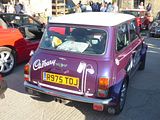

The Mini was the model that refused to die, with sales continuing after the launch of the Metro in 1980, and gathering momentum again in the 1990s, thanks in no small part to interest from Japan and because Rover Group decided to produce some more Cooper models. The first series of Cooper cars had been discontinued in 1971, replaced by the cheaper to build 1275GT, but when a limited edition model was produced in 1990, complete with full endorsement from John Cooper, the model was a sell out almost overnight, which prompted the decision to make it a permanent addition to the range. A number of refinements were made during the 90s, with fuel injection adding more power, a front mounted radiator and more sound deadening making the car quieter and new seats adding more comfort and a new dash making the car look less spartan inside. It formed part of the range until production of all Issigonis Minis ended in 2000.

MITSUBISHI
Following the successful showing of the Mitsubishi HSR and Mitsubishi HSX concept cars at the 1989 Tokyo Motor Show, Mitsubishi developed a production car which they called the 3000 GTO as a technologically advanced 2+2 seater sports coupe to compete with the Honda NSX, Mazda RX-7, Nissan 300ZX, Skyline GT-R, Subaru SVX and the Toyota Supra. They resurrected the GTO name, last used in the mid 1970s and the top spec Galant Coupe model, and the car went on to serve as Mitsubishi’s flagship for the remainder of the decade. However, despite the cachet of the badge at home, it was marketed as the Mitsubishi 3000GT and as the Dodge Stealth outside Japan; the company was concerned that connoisseurs would object to the evocative nameplate from the highly regarded Ferrari 250 GTO and Pontiac GTO being used on a Japanese vehicle. However, regardless of its badge or eventual target market, every car was built on the same production line at Mitsubishi’s plant in Nagoya, Japan. Its introduction in Japan in 1990 was unfortunately timed, as it coincided with the softening of the Japanese economy, known as the “bubble economy” which had an effect on sales. The car was packed with technology and many of Mitsubishi’s contemporary performance-enhancing technologies, such as full-time four-wheel drive, four-wheel steering, active aerodynamics featuring automatically adjusting front and rear spoilers, sport/tour exhaust modes and electronically controlled suspension (ECS). These “Active Aerodynamics” were not used on the Dodge Stealth. Visually, both the GTO/3000GT and Stealth featured pop-up headlights and noticeable “caps” on the bonnet to accommodate the ECS controllers at the top of the strut turrets. However the rest of factory body kit differed in styling with their respective badges. Most notable are the Dodge signature cross-hairs on the Stealth front bumper fascia, Ferrari inspired gills on the 3000GT rocker panels, Crescent shaped spoiler on the Stealth commonly referred to as the “Banana Wing” and front Active Aero air dam on 3000GT VR4. A mildly revised second generation car appeared in 1994. As the price increased, Mitsubishi also steadily removed some of the or costly (and gimmicky) technology features, and towards the end of production the front end was revised to incorporate fixed rather than pop up headlights. The car was phased out in 1999 for all markets apart from Japan, where it ran for another year.


MORRIS
The “bullnose” Morris Oxford is a series of motor car models produced by British manufacturer Morris from 1913 to 1926. It was named by W R Morris after the city in which he grew up and which his cars were to industrialise. William Morris’s first car was called Oxford in recognition of its home city. It was announced in The Autocar magazine in October 1912 and production began in March 1913. Because he had a limited amount of capital and was unwilling to share ownership of his business little was made in-house. Virtually all components were bought-in and assembled by Morris. It was a small car with a 1018 cc four-cylinder side-valve engine with fixed cylinder head from White & Poppe. Ignition was by a Bosch magneto. The chassis made by Rubery Owen was of pressed-steel construction and suspension was by leaf springs, semi-elliptic at the front and longer three-quarter elliptic at the rear slung above the axle. The welded single piece banjo rear axle with splined half shafts was driven by a Wrigley Worm. The front axle was of forged steel and, like the back axle assembly and the steering, was made by Wrigley. The brakes, on the rear wheels only, were the external contracting type, metal to metal, using four shoes in each drum. A White & Poppe three-forward and reverse gearbox was fitted. The Powell & Hanmer headlamps were acetylene and the side and tail lamps oil. The windscreen, by Auster Limited of Barford Street, Birmingham, like the lamps was classed as an accessory. The car got its popular name, Bullnose, from its distinctive round-topped radiator at first called the bullet nose. Most bodies, made by Raworth of Oxford, were of the two-seat open-tourer type. There was also a van version, but the chassis did not allow four-seat bodies to be fitted, as it was not strong enough and too short. It was first displayed at the Olympia Motor Show which opened 7 November 1913. The standard model remained in production unchanged. The new de luxe had a longer wheelbase, 90 in (2,300 mm), and track was now 45 in (1,100 mm). The range of bodies was now expanded from the simple two-seater to include even a limousine and a sporting car which, like the vans, had no windscreen or doors but was provided with a speedometer as a standard fitting. Its front axle and steering had been re-designed to reduce “bump-steer” and its radiator capacity increased. Grooved tyres were now supplied at the rear. The banjo back axle was no longer welded but built up from three pieces and its springs were now slung below it. The 1919 Oxford (advertised as early as September 1918) was assembled from locally made components and now took on the rather more substantial aspect of 1915’s Cowley. Longer and stronger than the old Oxford, enough to carry five passengers, the new Oxford retained the pre-war Bullnose radiator style in its larger version. From August 1919, the Cowley became the downmarket “no frills” variant with only a 2-seater body and lighter smaller tyres. The Oxford had a self-starter (an extra for the Cowley) and a better electrical system and the Oxford took and kept the Cowley’s leather upholstery. The new car’s 11.9 fiscal horsepower 1548 cc engine was made under licence in Coventry for Morris by a British branch of Hotchkiss the French ordnance company which was turning away from guns to the motor industry. The Hotchkiss engine used the Cowley’s Detroit USA Continental Motors Company design. Hotchkiss prices well undercut White and Poppe who had made Oxford engines up to that time. Morris bought Hotchkiss’s British factory in May 1923 and named it Morris Engines. When it was shown at the Scottish Motor Show in January 1920 it drew large crowds of enthusiasts all day. The chassis alone was shown and was genuinely admired for the way all transmission, everything revolving, was fully enclosed in what amounts to an oil bath, everything but the fan belt. A few weeks later after a lengthy trial of the new car The Times’ motoring reporter wrote that the car represents “a very decided advance in light car construction”. The common sense of the designers is shown in many small details but “its greatest charm is in the engine’s steam-like flexibility” and liveliness. In these respects it was the best engine the writer had ever encountered.


The Eight was produced from 1935 to 1948, inspired by the sales popularity of the similarly shaped Ford Model Y. The success of the car enabled Morris to regain its position as Britain’s largest motor manufacturer. The Eight was powered by a Morris UB series 918 cc four-cylinder side-valve engine with three bearing crankshaft and single SU carburettor with maximum power of 23.5 bhp. The gearbox was a three-speed unit with synchromesh on the top two speeds and Lockheed hydraulic brakes were fitted. Coil ignition was used in a Lucas electrical system powered by a 6 volt battery and third brush dynamo. The body which was either a saloon or open tourer was mounted on a separate channel section chassis with a 7 feet 6 inches wheelbase. The tourer could reach 58 mph and return 45 mpg; the saloons were a little slower. The chrome-plated radiator shell and honeycomb grille were dummies disguising the real one hidden behind. In September 1934 the bare chassis was offered for £95. For buyers of complete cars prices ranged from £118 for the basic two-seater to £142 for the four door saloon with “sunshine” roof and leather seats. Bumpers and indicators were £2 10 shillings (£2.50) extra. Compared with the similarly priced, but much lighter and longer established Austin 7, the 1934/35 Morris Eight was well equipped. The driver was provided with a full set of instruments including a speedometer with a built in odometer, oil pressure and fuel level gauges and an ammeter. The more modern design of the Morris was reflected in the superior performance of its hydraulically operated 8 inch drum brakes. The Morris also scored over its Ford rival by incorporating an electric windscreen wiper rather than the more old-fashioned vacuum powered equivalent, while its relatively wide 45 inch track aided directional stability on corners. The series I designation was used from June 1935 in line with other Morris models, cars made before this are known as pre-series although the official Morris Motors designation was by the model year even though they were introduced in October 1934. Of the 164,102 cars produced approximately 24,000 were tourers.


No surprise to see the evergreen Morris Minor here as this is a very popular classic. The Minor was conceived in 1941. Although the Nuffield Organization was heavily involved in war work and there was a governmental ban on civilian car production, Morris Motors’ vice chairman, Miles Thomas, wanted to prepare the ground for new products to be launched as soon as the war was over. Vic Oak, the company’s chief engineer, had already brought to Thomas’ attention a promising junior engineer, Alec Issigonis, who had been employed at Morris since 1935 and specialised in suspension design but he had frequently impressed Oak with his advanced ideas about car design in general. Issigonis had come to Oak’s particular attention with his work on the new Morris Ten, which was in development during 1936/7. This was the first Morris to use unitary construction and was conceived with independent front suspension. Issigonis designed a coil-sprung wishbone system which was later dropped on cost grounds. Although the design would later be used on the MG Y-type and many other post-war MGs the Morris Ten entered production with a front beam axle. Despite his brief being to focus on the Ten’s suspension Issigonis had also drawn up a rack and pinion steering system for the car. Like his suspension design this was not adopted but would resurface in the post-war years on the MG Y-type, but these ideas proved that he was the perfect candidate to lead the design work on a new advanced small car. With virtually all resources required for the war effort, Thomas nonetheless approved the development of a new small family car that would replace the Morris Eight. Although Oak (and Morris’ technical director, Sidney Smith) were in overall charge of the project it was Issigonis who was ultimately responsible for the design, working with only two other draughtsmen. Thomas named the project ‘Mosquito’ and ensured that it remained as secret as possible, both from the Ministry of Supply and from company founder William Morris (now Lord Nuffield), who was still chairman of Morris Motors and, it was widely expected, would not look favourably on Issigonis’ radical ideas. Issigonis’ overall concept was to produce a practical, economical and affordable car for the general public that would equal, if not surpass, the convenience and design quality of a more expensive car. In later years he summed up his approach to the Minor; that he wanted to design an economy car that “the average man would take pleasure in owning, rather than feeling of it as something he’d been sentenced to” and “people who drive small cars are the same size as those who drive large cars and they should not be expected to put up with claustrophobic interiors.” Issigonis wanted the car to be as spacious as possible for its size and comfortable to drive for inexperienced motorists. Just as he would with the Mini ten years later, he designed the Mosquito with excellent roadholding and accurate, quick steering not with any pretence of making a sports car, but to make it safe and easy to drive by all. As work proceeded, there were plenty of battle to overcome, to get Issigonis’ ideas approved, and not all of them were. The production car, called the Minor was launched at the British Motor Show at Earls Court in London on October 27, 1948. At the same show Morris also launched the new Morris Oxford and Morris Six models, plus Wolseley variants of both cars, which were scaled-up versions of the new Minor, incorporating all the same features and designed with Issigonis’ input under Vic Oak’s supervision. Thus Issigonis’ ideas and design principles underpinned the complete post-war Morris and Wolseley car ranges. The original Minor MM series was produced from 1948 until 1953. It included a pair of four-seat saloons, two-door and (from 1950) a four-door, and a convertible four-seat Tourer. The front torsion bar suspension was shared with the larger Morris Oxford MO, as was the almost-unibody construction. Although the Minor was originally designed to accept a flat-4 engine, late in the development stage it was replaced by a 918 cc side-valve inline-four engine, little changed from that fitted in the 1935 Morris 8, and producing 27.5 hp and 39 lb/ft of torque. This little engine pushed the Minor to just 64 mph but delivered 40 mpg. Brakes were four-wheel drums. Early cars had a painted section in the centre of the bumpers to cover the widening of the production car from the prototypes. This widening of 4 inches is also visible in the creases in the bonnet. Exports to the United States began in 1949 with the headlamps removed from within the grille surround to be mounted higher on the wings to meet local safety requirements. In 1950 a four-door version was released, initially available only for export, and featuring from the start the headlamps faired into the wings rather than set lower down on either side of the grille. The raised headlight position became standard on all Minors in time for 1951. From the start, the Minor had semaphore-type turn indicators, and subsequent Minor versions persisted with these until 1961. An Autocar magazine road test in 1950 reported that these were “not of the usual self-cancelling type, but incorporate[d] a time-basis return mechanism in a switch below the facia, in front of the driver”. It was all too easy for a passenger hurriedly emerging from the front passenger seat to collide with and snap off a tardy indicator “flipper” that was still sticking out of the B-pillar, having not yet been safely returned by the time-basis return mechanism to its folded position. Another innovation towards the end of 1950 was a water pump (replacing a gravity dependent system), which permitted the manufacturer to offer an interior heater “as optional equipment”. When production of the first series ended, just over a quarter of a million had been sold, 30 per cent of them the convertible Tourer model. In 1952, the Minor line was updated with an Austin-designed 803 cc overhead valve A-series engine, replacing the original side-valve unit. The engine had been designed for the Minor’s main competition, the Austin A30, but became available as Austin and Morris were merged into the British Motor Corporation. The new engine felt stronger, though all measurements were smaller than the old. The 52 second drive to 60 mph was still calm, with 63 mph as the top speed. Fuel consumption also rose to 36 mpg. An estate version was introduced in 1952, known as the Traveller (a Morris naming tradition for estates, also seen on the Mini). The Traveller featured an external structural ash (wood) frame for the rear bodywork, with two side-hinged rear doors. The frame was varnished rather than painted and a highly visible feature of the body style. Commercial models, marketed as the Morris Quarter Ton Van and Pick-up were added in May 1953. Rear bodies of the van versions were all steel. The 4-seat convertible and saloon variants continued as well. The car was again updated in 1956 when the engine was increased in capacity to 948 cc. The two-piece split windscreen was replaced with a curved one-piece one and the rear window was enlarged. In 1961 the semaphore-style trafficators were replaced by the flashing direction indicators, these were US-style red at the rear (using the same bulb filament as the brake lamp) and white at the front (using a second brighter filament in the parking lamp bulb) which was legal in the UK and many export markets at the time (such as New Zealand). An upmarket car based on the Minor floorpan using the larger BMC B-Series engine was sold as the Riley One-Point-Five/Wolseley 1500 beginning in 1957: versions of this Wolseley/Riley variant were also produced by BMC Australia as the Morris Major and the Austin Lancer. In December 1960 the Morris Minor became the first British car to sell more than 1,000,000 units. To commemorate the achievement, a limited edition of 350 two-door Minor saloons (one for each UK Morris dealership) was produced with distinctive lilac paintwork and a white interior. Also the badge name on the side of the bonnet was modified to read “Minor 1,000,000” instead of the standard “Minor 1000”. The millionth Minor was donated to the National Union of Journalists, who planned to use it as a prize in a competition in aid of the union’s Widow and Orphan Fund. The company, at the same time, presented a celebratory Minor to London’s Great Ormond Street Hospital for Sick Children, but this car was constructed of cake. The final major upgrades to the Minor were made in 1962. Although the name Minor 1000 was retained, the changes were sufficient for the new model to be given its own ADO development number. A larger version of the existing A-Series engine had been developed in conjunction with cylinder head specialist Harry Weslake for the then new ADO16 Austin/Morris 1100 range. This new engine used a taller block than did the 948 cc unit, with increased bore and stroke bringing total capacity up to 1,098 cc. Although fuel consumption suffered moderately at 38 mpg, the Minor’s top speed increased to 77 mph with noticeable improvements in low-end torque, giving an altogether more responsive drive. Other changes included a modified dashboard layout with toggle switches, textured steel instrument binnacle, and larger convex glove box covers. A different heater completed the interior upgrade, whilst the larger combined front side/indicator light units, common to many BMC vehicles of the time, were fitted to the front wings. These now included a separate bulb and amber lens for indicators while larger tail lamp units also included amber rear flashers. During the life of the Minor 1000 model, production declined. The last Convertible/Tourer was manufactured on 18 August 1969, and the saloon models were discontinued the following year. Production of the more practical Traveller and commercial versions ceased in 1972, although examples of all models were still theoretically available from dealers with a surplus of unsold cars for a short time afterwards. 1,619,857 Minors of all variants were ultimately sold.

The success of Ford’s Cortina did not pass unnoticed, and by 1968, when British Leyland was formed as a merger of BMC and British Motor Holdings and the new management realised that apart from the soon to be launched Maxi, there were no new models under development, it was decided to give priority to a mid-sized car that would replace the elderly Minor and Farina saloons and take the Ford head on in the quest for sales. Conceived,. designed and put into production in record quick time, of just 18 months, the Marina was launched in the spring of 1971. An utterly conventional car, with rear wheel drive, and simple proven mechanicals using the familiar A and B Series engines, the model was launched as a 2 door Coupe and 4 door Saloon. Unusually, the Coupe was cheaper than the Saloon, which should have given the Morris something of an advantage over the Dagenham rival, who charged quite a premium for a Capri over a Cortina. However, the Marina had one attribute which completely eluded the Ford, certainly in its more powerful guises: terminal understeer. It is understood that when the British press got the chance to drive the car some while before launch, they all complained bitterly about this and the dire consequences that could follow, but BL management assured them that this would be fixed for the production cars. It was not, and a usually loyal press struggled to contain their disappointment in what they wrote in early Road Tests. About 30,000 cars were built like this before a revised suspension design was deployed and gradually the early cars were tamed somewhat. This weakness not withstanding, the Marina quickly picked up sales, and although it hardly ever outsold the Cortina in any given month, it became a strong performer in the UK Sales Charts, all the more so when an Estate model was added to the range in the autumn of 1972. The Marina was only intended to have a short life, very much like contemporary Ford products which were replaced every 4 or so years, but by the mid 1970s, BL had run out of money and had to be rescued by the British Government. That meant that there were no funds for an all new car, so the proposed ADO77 replacement model was cancelled, and the Marina was simply facelifted in the autumn of 1975 to create the Series 2, with revised suspension, new seats, a new dash to create more room for the front passenger, and upgraded equipment levels and then updated again in the autumn of 1978 when the new 1700cc O Series engines were ready to replace the venerable B series unit. As the 70s went on, the Marina’s limitations in the face of more modern competition not just from Ford, but Vauxhall’s Cavalier, the Car of the Year winning hatchback Chrysler’s Alpine, a whole slew of Japanese rivals such as the Datsun Bluebird and Toyota Carina as well as the Renault R12 and VW Passat made life ever more difficult for the car, and it was only significant fleet sales from a sector which still largely held a “Buy British” policy and something of a fear of the costs of front wheel drive cars which kept the car earning money for its maker, and meant that when the model was replaced by the Ital in mid 1980, over 800,000 had been made. Since then, of course, the Marina has become the butt of many a joke, and famously has been destroyed several times by Top Gear. However, there are fans of the car, and a few hundred have still survived.


NISSAN
It is quite surprising to realise that the Figaro is now more than 25 years old. This well-known retro-styled fixed-profile convertible was manufactured for just one year, 1991, and originally marketed solely in Japan at their Nissan Cherry Stores. The Figaro was introduced at the 1989 Tokyo Motor Show under the slogan “Back to the Future”. The name references the title character in the play The Marriage of Figaro by Pierre Beaumarchais. Based on the Nissan Micra, the Figaro was built at Aichi Machine Industry, a special projects group which Nissan would later call “Pike Factory,” which also produced three other niche automobiles: the Be-1, Pao and S-Cargo. As a fixed-profile convertible, the upper side elements of the Figaro’s bodywork remain fixed, while its fabric soft top retracts to provide a less fully open experience than a typical convertible. The fixed-profile concept is seen on other convertibles, including the Citroën 2CV and the 1957 Fiat 500. The Figaro was marketed in four colours representing the four seasons: Topaz Mist (Autumn), Emerald Green (Spring), Pale Aqua (Summer) and Lapis Grey (Winter). Few, reportedly 2,000, were marketed in Topaz Mist. The Figaro was equipped with leather seats, air conditioning, CD player and a fixed-profile slide-back open roof. 8000 were originally available with an additional 12,000 added to production numbers to meet demand. Prospective purchasers entered a lottery to purchase a Figaro. Limited edition cars came with passenger side baskets and cup holders. A surprising number of them have been imported to the UK in recent years.

This is an S15-generation Silvia, a car not sold new in the UK, though its predecessors had been, under the name 240SX. New in 1999, the engine of the S15 now boasting 250 PS (247 bhp) at 6,400 rpm and 275 Nm; 203 lb/ft at 4,800 rpm of torque from its SR20DET Inline-four engine, thanks to a ball bearing turbocharger upgrade, as well as improved engine management system. The non-turbo SR20DE produced 165 PS. The S15 Silvia included aggressive styling inside and out, updating the previous Silvia styling in-line with modern car design trends. The body dimensions were reduced from the previous generation so that it would comply with Japanese Government compact class, which had an effect on sales of the previous model. The S15 Silvia model lineup was initially simplified to just the Spec-S and Spec-R, both models offering an “Aero” variant with a large rear wing and side skirts/valances. This generation of the Silvia was only sold in Japan, Australia and New Zealand but was available as a grey import in most other countries. In Australia and New Zealand the car was sold as the Nissan 200SX. Within the Australian domestic market (AUDM), the S15 sold in 2 trim levels as noted above; Spec-S and Spec-R – however both models featured the SR20DET motor, albeit slightly detuned from the JDM spec cars. Nissan S15s were never officially sold with the naturally aspirated SR20DE engine in Australia or New Zealand. These two models were available at Nissan showrooms until the Nissan 200SX GT was introduced in 2002, the last year of production for the S15. Main differences here were namely the wheels being finished in a silver shadow chrome, chrome interior door handles, chrome gear selector surround, “sports” metal pedal set and an updated larger rear wing. As of August 2002, Nissan stopped producing the S platform with the S15-series Nissan Silvia being the final variant. Production of the Silvia ended amidst Nissan’s efforts to reduce its myriad of platforms. The S15 Silvia was therefore the last car to hold the Silvia badge. Nissan’s worldwide sports car platform is now the FM platform, which underpins the current Fairlady Z (the 350/370Z outside Japan), as well as the 2001–present Nissan Skyline (the Infiniti G35/37 in North America).

PEUGEOT
Mindful of the success of the Golf GTi, in the class above, and how a small car with good handling could take more power, as the Mini Cooper had proved, Peugeot came up with the GTi in early 1984. The first models had a 1.6 litre XU5J engine, producing 105 PS, which was uprated in 1987 with a cylinder head with larger valves thus becoming XU5JA, which took the power output up to 115 bhp. Visually the car retained the good looks of the 3 door version of the regular models, but it featured plastic wheel arch extensions and trim, beefier front and rear bumper valances and judicious use of red badging and trim. The shell also underwent some minor changes, including larger wheel arches (to suit the larger wheels , and the suspension was redesigned and sat lower on the GTI with stiffer springs, different wishbones and a drop-linked anti-roll bar. Red was a dominant colour inside. The car was an instant hit. At the end of 1986, Peugeot followed up with a more potent model, the 1.9 GTi, whose XU9JA engine produced 128 PS. Internally the engine of this car and the 1.6 model are very similar, the main differences on 1.9 litre versions being the longer stroke, oil cooler, and some parts of the fuel injection system. The shorter stroke 1.6 litre engine is famed for being revvy and eager, while the 1.9 litre feels lazier and torquier. Outside the engine bay the main differences between the 1.6 GTi and the 1.9 GTi are half-leather seats on the 1.9 GTi vs. cloth seats and disc brakes all-round (1.9 GTi) vs. discs at the front and drum brakes at the back; as well as the 14-inch Speedline SL201 wheels on the 1.6 GTi vs. 15 inch Speedline SL299 alloys on the 1.9 GTi. The 205 is still often treated as a benchmark in group car tests of the newest GTI models or equivalent. Peugeot itself has never truly recreated this success in future GTI models, although they came very close with the highly regarded GTI-6 variant of the Peugeot 306.

PORSCHE
During the 1990s, Porsche was facing financial troubles and rumours of a proposed takeover were being spread. The signature air-cooled flat-6 of the 911 was reaching the limits of its potential as made evident by the 993. Stricter emissions regulations world wide further forced Porsche to think of a replacement of the air-cooled unit. In order to improve manufacturing processes, Porsche took the aid of leading Japanese car manufacturer Toyota whose consultants would assist in the overhaul of the Zuffenhausen manufacturing facility introducing mass production techniques which would allow Porsche to carry out production processes more efficiently. Porsche had realised that in order to keep the 911 in production, it would need radical changes. This led to the development of the 996. The sharing of development between the new 911 and the entry level Boxster model allowed Porsche to save development costs. This move also resulted in interchangeable parts between the two models bringing down maintenance costs. The Porsche 996 was a new design developed by Pinky Lai under Porsche design chief Harm Lagaay from 1992 to 1994; it was the first 911 that was completely redesigned, and carried over little from its predecessor as Porsche wanted the design team to design a 911 for the next millennium. Featuring an all new body work, interior, and the first water-cooled engine, the 996 replaced the 993 from which only the front suspension, rear multi-link suspension, and a 6-speed manual transmission were retained in revised form. The 996 had a drag coefficient of Cd=0.30 resulting from hours spent in the wind tunnel. The 996 is 185 mm (7 in) longer and 40 mm (2 in) wider than its predecessor. It is also 45% stiffer courtesy of a chassis formed from high-strength steel. Additionally, it is 50 kg (110 lb) lighter despite having additional radiators and coolant. All of the M96 engines offered in the 996 (except for the variants fitted to the Turbo and GT2/GT3 models) are susceptible to the Porsche Intermediate Shaft Bearing issue which can potentially cause serious engine failure if not addressed via a retrofit. The 996 was initially available in a coupé or a cabriolet (Convertible) bodystyle with rear-wheel drive, and later with four-wheel drive, utilising a 3.4 litre flat-6 engine generating a maximum power output of 296 bhp. The 996 had the same front end as the entry-level Boxster. After requests from the Carrera owners about their premium cars looking like a “lower priced car that looked just like theirs did”, Porsche redesigned the headlamps of the Carrera in 2002 similar to the high performance Turbo’s headlamps. The design for the initial “fried egg” shaped headlamps could be traced back to the 1997 911 GT1 race car. In 2000, Porsche introduced the 996 Turbo, equipped with a four-wheel-drive system and a 3.6-litre, twin-turbocharged and intercooled flat-six engine generating a maximum power output of 420 bhp, making the car capable of accelerating from 0–60 mph in 4.2 seconds. An X50 option which included larger turbochargers and intercoolers along with revised engine control software became available from the factory in 2002, increasing power output to 451 bhp. In 2005, Porsche introduced the Turbo S, which had the X50 option included as standard equipment, with the formerly optional Carbon fibre-reinforced Silicon Carbide (C/SiC) composite ceramic brakes (PCCB) also included as standard. In 2000, power output on the base Carrera model was increased to 300 bhp. 2001 marked the final year of production for the base Carrera 4 Coupé in narrow body format. In 2002, the standard Carrera models underwent the above-mentioned facelift. In addition, engine capacity was also increased to 3.6-litres across the range, yielding gains of 15 bhp for the naturally aspirated models. 2002 also marked the start of the production of the 996 based Targa model, with a sliding glass “green house” roof system as introduced on its predecessor. It also features a rear glass hatch which gave the driver access to the storage compartment. Also in 2002, the Carrera 4S model was first introduced.

RELIANT
Tom Karen of Ogle was asked to submit some body designs based on the Ogle Design GTS estate car experiment for a new four-seater Scimitar, the SE5 Reliant Scimitar. Managing Director Ray Wiggin, Chief Engineer John Crosthwaite and fibreglass body expert Ken Wood went to Ogle’s in Letchworth to view some mock-up body designs for the new SE5. Wiggin told Wood to proceed with a proper master. The SE5 was conceived and ready for the 1968 Motor Show in less than 12 months. For the SE5 John Crosthwaite and his team designed a completely different longer chassis frame, revised suspension, new and relocated fuel tank, a rollover bar, new cooling system, spare wheel mounted in the nose to give increased rear space and a 17+1⁄4 imperial gallons (78 L) fuel tank. When designing the chassis Crosthwaite worked closely with Ogle body stylist Peter Bailey to modify and refine the prototype. The main change introduced in the SE5 was the sports estate hatchback body shape, although other car manufacturers had also produced hatchback models. The SE5 came with the same 3.0-litre Ford Essex engine used in the SE4a/b. This gave the SE5 a claimed top speed of over 120 mph (193 km/h). A Borg-Warner 35 automatic transmission was added as an option in 1970 and by 1971, overdrive on the 4-speed manual was offered. In 1972 several improvements were included in the upgrade to SE5A, including a boost in power. The extra 7 hp and maximum engine speed raised performance and the GTE was now capable of 0–60 mph (0–97 km/h) in 8.5 seconds and top speed was raised to 121 mph (195 km/h). The SE5’s flat dashboard also gave way to a curved and moulded plastic one. The SE5A can be recognised from a SE5 at the rear by the reverse lamps which are below the bumper on the earlier model and are incorporated into the rear clusters on the later version (these were also carried over onto the SE6 and later). Badging changes included changing the “SCIMITAR” lettering from a narrow type-style to a fatter one. Directly following the announcement of the car, Autocar magazine tested a 3-litre GTE (with manual transmission) in October 1968. They reported a maximum speed of 117 mph (188 km/h) and a 0–60 mph (0–97 km/h) time of 10.7 seconds. Overall fuel consumption for the test came in at 18.5 mpg. The manufacturer’s UK market recommended retail price, including sales taxes, was £1,759. The 3-litre MG MGC GT was retailing at this time for £1,337 while Rover’s 3500 was offered for £1,791. Launch of the more directly comparable Volvo 1800ES was still four years away. 4,311 SE5s were produced. It was an instant success; GT production was cut down and the proportion of GTEs to GTs being built was four-to-one. Reliant increased its volume by 20% in the first year. The 5A model sold more than any other Scimitar, with 5105 manufactured. Princess Anne was given a manual overdrive SE5 as a joint 20th birthday present and Christmas present in November 1970 by the Queen and the Duke of Edinburgh. It was Air Force blue in colour with a grey leather interior and registered 1420 H in recognition of her position as Colonel-in-Chief of the 14th/20th Hussars. Anne subsequently owned eight other GTEs.


RENAULT
In 1999 Renault presented the first officially branded RenaultSport Clio, this was the third Clio produced by the RenaultSport division succeeding the Clio 16V and Clio Williams. This new Clio, the 172 was based on the 3 door Clio II shell however had numerous features over the standard car including wider arches, restyled bumpers, side skirts and 15-inch OZ F1 alloy wheels. Power was delivered by the F4R730 engine, a 2.0-litre 16-valve Inline 4 engine with a Variable valve timing (VVT) system via a dephaser on the intake camshaft pulley. The engine was a modified version of the F4R used in models such as the Laguna and Espace and was modified by Mecachrome to deliver a power output of 172 PS. Power was delivered to the wheels via a JC5-089 five-speed manual gearbox. The 172 also featured interior changes over the standard car including Half Leather, Half Alcantara seats embossed with the RenaultSport logo and the car also came standard with manually controlled Air Conditioning. A limited edition of the Phase 1 172 was produced and known as the Clio 172 Exclusive. This was limited to 172 units, all 172 of this “Exclusive” edition were 296 Scarab Green, featured BBS alloy wheels and a full leather interior as opposed to the half-leather half Alcantara seats featured in the standard car. In 2001 the interior and exterior of the Clio II were face-lifted, the Clio RS followed suit shortly after. This facelift of the Clio 172 included redesigned front and rear bumpers, the front bumper falling in line with the style of the face-lifted Clio II. The rear bumper was now less rounded and featured a strip of ABS plastic effectively splitting the bumper into two. The lights, bonnet and boot lid were also matched to the face-lifted Clio II. The interior was also changed to closer match that of the face-lifted Clio II, the seats were slightly revised however still featured the same Half Leather, Half Alcantara fabrics and the embossed RenaultSport logo. One new feature that the Phase 2 172 featured was automatic climate control as opposed to the manual air-conditioning featured in the Phase 1. The dashboard featured Silver interior trims and the steering wheel included a plastic insert featuring the RenaultSport logo. The gear shifter was changed from the metal ball featured on the Phase 1 to a Leather wrapped shifter with a silver coloured insert on the top. The Phase 2 172 also featured increased equipment including automatic Xenon headlights and headlight washers, Rain Sensing wipers a six-disc CD changer, and it also included side-impact airbags integrated into the seats. The 15-inch OZ F1 alloy wheels were also replaced with a 16-inch Alloy Wheel of Renault’s own design. The facelift of the 172 also brought about a number of changes to the engine of the car. A revised version of the F4R used, the F4R 736, this featured a revised cylinder head with the exhaust ports being approximately 30% smaller than those featured on the Phase 1 172. The airbox was also redesigned to be much more square than the original airbox. A revised version of the JC5 gearbox, the JC5-129 was introduced in this version of the Clio 172, which revised JC5 featured a shorter final drive to counter the increased weight of the face-lifted 172. The catalytic converter, which on the PH1 172 had been dual barrel was reduced to a single barrel and featured 2 lambda sensors, one before and one after the catalytic converter. The biggest change to the PH2 172 over the PH1 was the introduction of an electric throttle. This meant the Idle Control Valve of the PH1 was no longer required leading to a minor redesign of the intake manifold. In 2002 Renault released the 172 Cup, which bore the chassis code CB1N and was known by Renault as the “sport lightweight version”. The vast majority of cars were produced in D43 Mondial Blue (metallic) with a limited run of around 90 cars being produced in 640 Iceberg Silver (metallic). The Cup, originally built for Gr.N homologation of the Clio 172 was differentiated from the “non cup” 172 by its lack of many of the luxuries included in the regular car. Instead of the leather / Alcantara seats instead the same style seat was upholstered in a durable but low-cost fabric, the automatic Xenon headlights were replaced by manually controlled halogen units and the washer jets replaced with blanks. The rain sensing wipers and solar reflective coated windscreen were also omitted from the 172 Cup. However the car had features not before seen on a production version of the 172, which included lightweight 16-inch Speedline Turini alloy wheels, matte blue door strips, ABS plastic “Cup” front splitter and a restyled “Cup” rear spoiler. The dash strips which were silver on the regular car were painted to match the outside of the car. One of the main features of the 172 Cup was its significant weight saving, having a kerb weight of 1021 kg, making it the lightest of 172 versions produced. This was achieved by the removal of a majority of sound deadening from the car alongside thinner glass to reduce weight even further. One large difference was also the lack of air conditioning which was a standard fit component on the regular 172, which typically led to the cup producing more power due to the engine having less ancillaries to drive. This however was reintroduced as an optional extra later in the production run of the Cup. The 0–60 time of the 172 Cup was officially marketed by Renault as being 6.5 seconds; however AutoCar Magazine reportedly timed the 0–60 at 6.2 seconds which if this were the case would make the 172 Cup the second fastest road going Clio produced at the time of this article, second to only the V6. Many enthusiasts regard the 172 Cup as the last “hardcore” hot hatch due to its lack of anti-lock brakes; the car also featured modified suspension which gave it a wider track thanks to modified wishbones, the car also sat lower than standard and featured stiffer shocks and springs, the suspension geometry was revised to suit these components and to mean that the steering response was increased, this also lead to an increase in oversteer thanks to the lack of weight and revised geometry. Due to the lack of ABS the brake bias of the car was fixed by way of disconnecting the rear axle compensator, within the UK this often lead to the cars failing the MOT test, VOSA eventually issued an advisory to prevent this from happening. 2004 marked yet another refresh of the Clio II. The inserts of the headlights were changed from Black to Grey, new wheels styles were introduced and new colour options were added with others being dropped. The basic design of the car stayed the same with only minor changes. The Six-Disc CD changer was dropped as standard equipment however was still available as a cost option. This refresh marked the introduction of cruise control and Electronic Stability Program (ESP) as standard equipment. The Clio RS featured a lot more changes than the regular Clio. The engine was again revised and became the F4R 738. The difference between the F4R 738 and F4R 736 was a revised oil breather setup meaning the intake manifold found on a 172 would not fit a 182. Thanks to a number of other changes this engine produced 182 PS . This increase in power was thanks to the addition of a 4-2-1 Manifold and high flow 200 cell sports catalytic converter. The spare wheel well was removed and replaced with a flat floor to make way for the new dual exit exhaust featured on the 182. Minor revisions were made to the interior, the perforated texture of the Alcantara on the seats now featured white dots. The car also featured a new 8 spoke wheel design which came in Silver on a regular car and Anthracite on a “Cup Packed” car. The rarest optional extra available was the Carminat Sat-Nav which was fitted to very few cars. However, the unit wasn’t a popular option due to its high cost and rumoured poor performance compared to aftermarket options. The “Cup” Front Splitter and “Cup” Spoiler originally fitted to the 172 Cup made a reappearance as a cost option known as the Cup Style Pack. This was one of two cup packs available, the other being the Cup Chassis. This Cup Chassis pack included a strengthened hub with 60mm spacing on the strut bolt holes as opposed 54mm on non cup packed cars. The Cup Chassis also featured lowered suspension with stiffer shocks and springs and an anthracite version of the standard alloy wheels. The Clio 182 could also be ordered in a more race focused than ‘base’ RS model called “Cup Specification”, this was available in just two colours, J45 Racing Blue and D38 Inferno Orange, however came as Standard with the Cup Chassis and Cup Style Pack. The 182 Cup lacked the automatic Xenon headlights and headlight washer jets, climate control (rear footwell heater vents were also removed), illuminated sun visors, Solar Reflective Windscreen and Automatic Wipers. The leather / Alcantara seats were replaced with cloth items and the rear bench was downgraded to match. The engine cover and sill plates were removed and the steering wheel was downgraded to no longer include the RenaultSport Logo or rubber thumb grips. Carpet and headlining were downgraded to basic specification and even the documentation wallet was changed from faux leather to cloth. Sound deadening was removed from the 182 Cup, the horn was downgraded from a twin to single unit and the interior light no longer included a map reading function. Despite all of these reductions in specification the 182 Cup was still considerably heavier than the previous 172 Cup, meaning this version of the Clio II RS was considered one of the least desirable versions. The final version of the Clio 182 was known as the 182 Trophy. This version was based on the 182 Cup and featured the same strengthened hubs with 60 mm bolt spacing. Originally only 500 cars were to be produced for the UK market however an additional 50 were produced to be sold in Switzerland. At the time, believing there was no market for this version of the Clio, the Marketing Department of Renault France failed to order a 182 Trophy. The 182 Trophy included 16 Inch Speedline Turini Alloy wheels as seen on the 172 Cup, the Spoiler from the Clio 255 V6, Recaro Trendline seats and exclusive 727 Capsicum Red Paint with Trophy Decals lacquered onto the Side skirts. Each car had an individually numbered plaque on the base of the driver’s seat. The biggest difference however between the 182 Cup and 182 Trophy was the inclusion of Sachs Remote-Reservoir dampers. The basic principle of a Remote-Reservoir damper is that because there is a separate reservoir for the gas or oil which fills the shock they can either be of a reduced length or can house a longer rod, this means that the sizing of the shock can be optimised for the application in which it is being used. These changes definitely made a big difference to the 182 Trophy and have led to its being heralded as one of the best hot hatches of all time and it won Evo Magazine’s “People’s Performance Car of The Year” 2005, whilst also beating off rivals such as the Lamborghini Gallardo and other exotica in an Evo Magazine Group Test. AutoCar Magazine’s front cover from 5 July 2005 simply stated “World’s Greatest Hot Hatch”.


ROVER
In December 1994 the revised R6 model appeared. In the United Kingdom, Rover finally scrapped the Metro nameplate, replacing it with a new name, Rover 100, which had been adopted on continental Europe on the Rover Metro’s launch in 1990, due to the weakness of the Austin marque in Europe. The mechanics of the car remained much the same with 1.1 and 1.4 petrol engines and Hydragas suspension, but there was now the option of a Peugeot-sourced 1.5 diesel rather than the previous 1.4. The exterior was altered in an attempt to disguise the car’s age, meet the increased cooling requirements of the Peugeot motor and offer a reduced-format Rover family grille. This was achieved through fitment of new front and rear bumpers, sill covers, rear boot handle and headlamps, bonnet and grille. A variety of bolder paint colours and the use of chrome trim helped give a more upmarket appearance. The interior trim was revised to give a greater impression of quality and luxury, but since the basic architecture had remained unchanged since the original 1980 car it was considered by many as being short on space and outdated in comparison to its most modern rivals (most of which had been replaced with all-new models since the launch of the Rover Metro, and in the cases of the Ford Fiesta and Vauxhall Nova/Corsa, replaced with all-new models twice) It was criticised by the press for its lack of equipment, with front electric windows only available on the range-topping 114 GSi. Rear electric windows were never an option on the 100. Neither were Anti-Lock Brakes, Power Steering or a rev-counter (except the GTa and later manual 114 GSi models) One saving grace for the 100 was the option of full leather trim, a rarity in a small car and coupled with the standard wood veneer dashboard inserts, a tinted glass sunroof and the optional wood veneer door cappings, the 114 GSi made for traditional luxury motoring; an image Rover was trying to retain. The only safety efforts came in the form of an optional drivers airbag, an alarm, a passive engine immobiliser, a removable radio keypad, central locking and side intrusion beams. Overall, the 100 series was considered a rather typical facelift of a car which had been a class leader on launch some years earlier, only to be overtaken by newer cars including the Renault Clio, Fiat Punto and Volkswagen Polo. It was launched only a year before a heavily revised Ford Fiesta. A ‘warm’ version of the 100 called the 114 GTa was available from launch. The main differences over the 114 SLi three-door – which has the same engine – were sports seats, red seatbelts, a rev-counter, sports suspension, a slightly higher top speed, faster acceleration, GSi alloy wheels and GTa badging. It was only available as a three-door. In 1997, the Rover 100 gave a poor performance in Euro NCAP crash tests (despite the improved safety features, including side impact bars in the doors and an optional driver’s airbag, the 1970s design was showing its age) – it was at the time the only car tested to receive a one-star Adult Occupant Rating. Other small cars tested at the same time received 2 or 3 stars out of five. The passenger compartment was subjected to severe structural damage in the frontal-offset test and results showed a high risk of injury to all body regions for the driver. Meanwhile, the side impact test also showed high injury risks. The Rover 100’s dismal safety showing was not its only problem by 1997. It was fast falling behind the best cars in its sector when it came to design, build quality, refinement and specification, although it remained strong in terms of fuel economy and affordability. Unlike the Ford Fiesta, Volkswagen Polo and Vauxhall Corsa, the Rover 100 could still provide sub-£7,000 motoring. Facing a complete collapse of sales, Rover withdrew the 100 from production – marking the end of nearly 18 years of production. There was no direct replacement for the Metro/100, although the 1995 Rover 200 had been developed inside Rover Cars to serve as a replacement for the 100 as well as the previous 200 model, which was slightly larger. The 100 and 200 were sold concurrently until 1998, when the 100 was withdrawn. When the Rover 200 was facelifted in late 1999 and rebadged as the Rover 25, Rover marketed this as a supermini reflecting the continued, steady, growth of all car classes. The plan was for both the 100 and the 25 to be on the market until the launch of the true replacement for the Metro in the shape of the MINI. However, BMW’s sale of Rover put an end to those plans. BMW kept the MINI design and MG Rover’s notional successor to the Metro was the Rover 25 and its MG ZR relative. The gap left by the Metro as a true Rover city car was not filled until late 2003, when the Rover CityRover was launched – it was a 1.4 engined city car built in India alongside the Tata Indica. This model was nowhere near as popular as the Metro or even the Rover 100, and was not included in the revived product range by Nanjing Automobile following MG Rover’s bankruptcy in 2005.


The Rover 200 BRM was first shown at the 1997 Frankfurt Motor Show and the reaction from the press and public was good enough that after a year of development the production Rover 200 BRM LE was officially launched at the British Motor Show in October 1998. It was based on the range-topping Vi model but with 1960’s BRM styling cues. It used the 145 PS 1.8-litre VVC K-Series. Inside, there were red quilted leather seats and door panels, red carpet, seat belts and steering wheel. Alloy heater controls and turned aluminium trim complimented this. On the outside, there was Brooklands Green paintwork, with silver trim details, large 16″ alloys, and an exclusive woven mesh grille sat above a large orange snout in the front bumper, which was the BRM trademark nose on all of its 1960s Formula One racing cars. Technical adjustments consisted of 20 mm lower ride height over the Vi and improved damping and handling, a close-ratio gearbox with a TorSen differential further developed from the Rover 220 Turbo, reduced torque steer and improved straight-line stability. The price was £18,000, excluding extras such as air conditioning, passenger airbag and a CD player. There were only 795 built for the UK, with an additional 350 for overseas markets. The steep price was originally slashed to £16,000 and when the Rover 25 was launched, this was cut to £14,000 to get rid of vehicles still lingering in showrooms.


SKODA
The Felicia came in a variety of body styles, both for personal and professional use. The base model was a five door hatchback, and from June 1995, was accompanied by an estate, replacing the Favorit-based Forman, now redubbed as the Felicia Combi (Typ 795). There was also a coupe utility version, the Felicia Pickup, (Typ 797) and a panel van called a Felicia Vanplus. Pickup featured redesigned rear axle to increase space in cargo area. The pickup version was also imported to some countries re branded as the Volkswagen Caddy Pickup. The pick up model also had a lifestyle edition named the Felicia Fun, (Typ 796) conceived mostly for the market in Western Europe. The rear screen section hinges out into the loadbay, allowing two extra seats to be folded out, giving comfortable seating for four adults. A tonneau cover is available to cover the rear seats, which are otherwise open to the elements. A Truckman top is also available which encloses the rear seats and loadbay, making for a more practical bad weather conversion.


TOYOTA
In mid-1981, Toyota completely redesigned the Celica Supra as well as the entire Celica lineup for the 1982 model year. In Japan, the Celica XX name continued, and the Celica Supra name continued internationally. Still based on the Celica platform, there were several key differences, most notably the design of the front end and fully retractable pop-up headlights. Other differences were the inline-six rather than four-cylinder engine, as well as an increase in length and wheelbase to accommodate the larger engine. In the home market, cars fitted with the 5M engine were slightly wider, while the 2-litre models remained compliant with the Japanese width regulations, staying under 1,700 mm (66.9 in). The front suspension used Macpherson struts while the rear used a semi-trailing link design with an attachment at the rear differential. The Celica XX introduced the world’s first navigation computer. In Feb. 1981, Japanese buyers were offered an alternative to the Celica XX liftback bodystyle, called the Soarer coupé, which was now offered at two Japanese Toyota dealership networks called Toyota Store, and Toyopet Store, as the Celica XX was sold at the Toyota Corolla Store. The four-door performance saloon called the Celica Camry was realigned with the Japanese market Carina, and the Chaser performance sedan shared the Celica XX straight six, while in North America the Cressida took on that role. In the North American market, the Celica Supra was available in two distinct models. There was the “Performance Type” (P-type) and the “Luxury Type” (L-type). While being mechanically identical, they were differentiated by the available options; tyre size, wheel size, and body trim. The P-type had fibreglass fender flares over the wheel wells, while the L-type did not. The P-type was also standard with the more sporty eight-way adjustable seats. The P-type did not get the option of a leather interior until 1983. Initially, the Luxury type meant Automatic transmission, and Performance Type stood for Manual. All editions of the P-type had the same 14×7-inch aluminium alloy wheels and throughout the years the L-type had 14×5.5-inch wheels until 1985 when they were changed to a P-type styled 15×6. The L-type also had the option of a digital instrument cluster with a trip computer; some Canadian models (both L-types and P-types) had this option as well as a few rare instances of American models. The L-type cluster was easily distinguished from the P-type cluster, by the ‘ECT’ function written on the dial plate. The digital cluster featured a digital tachometer, digital speedometer, and electronic fuel level and coolant level gauges. The trip computer could calculate and display various things such as fuel economy in miles-per-gallon, estimated time of arrival (ETA), and distance remaining to destination. Supras with trip computers also came with cruise control. Excluding the 1982 model, all P-types were available with headlight washers as an option, but the L-types were never given such an option. Although gear ratios changed throughout the years, all P-types came standard with a limited-slip differential. In 1981, for the 1982 model year, in the North American market, the Celica Supra’s engine was the 2.8-litre 12-valve (two valves per cylinder) DOHC 5M-GE. Power output was 145 hp SAE net and 155 lb/ft (210 Nm) of torque. The engine used an 8.8:1 compression ratio to achieve the power and featured a vacuum advanced distributor. When the car debuted, it had a drag coefficient of Cd=0.348, a 0–60 mph acceleration time of 9.8 seconds and a 1⁄4 mile (400 m) time of 17.2-seconds at 80 mph (129 km/h). The standard transmission for this year was the W58 5-speed manual with the A43DL 4-speed automatic transmission being an option for L-types. Both transmissions featured an overdrive gear and the automatic featured a locking torque converter. The top gear in the 5-speed was its overdrive whereas the automatic transmission featured an overdrive gear that would engage at speeds over 56 km/h (35 mph). The 1982 model’s rear differential featured a 3.72:1 ratio. The Celica Supra’s four-wheel independent suspension was specially tuned and designed by Lotus and featured variable assisted power rack-and-pinion steering and MacPherson struts up front. At the rear, it had semi-trailing arm suspension with coil springs and a stabilizer bar. Braking on the Celica Supra was handled by four-wheel disc brakes. On the interior, this generation had standard power windows, power door locks, and power mirrors as well as a tilt steering wheel. The power door lock was located in the centre console next to the power mirror control. The analog dash of this model only showed a top speed of 88 mph (142 km/h) in North America. The optional automatic climate control was renovated and was now seen as a standard feature on the A60. Cruise control and a retractable map light was standard in this generation. Some options included the addition of a sunroof, two-tone paint schemes, and a five-speaker AM/FM/MPX tuner with a cassette player (Fujitsu Ten Limited). The optional cassette stereo had a 105-watt power amplifier and a seven-band graphic equalizer. The standard stereo was a five-channel AM/FM/MPX tuner. Leather interior was an option on the L-type model, but the P-type models limited to standard striped cloth interior. The AM/FM antenna was integrated into the front windshield rather than a typical external mast antenna. There was a key lock on the gas tank door (in lieu of a remote release) and the hatch and rear bumper were black regardless of exterior colour on the rest of the car. The P-type was available with an optional rear window visor above the hatch glass. The tail lights had a reverse light in the centre and the door handles opened the doors by pulling sideways. The front nose badge and B-pillar only read “Supra” for the first several months of production, but were changed to read “Celica Supra” midway through the model year. The L-type had front and rear mudflaps but P-type of this year did not. In 1982, for the 1983 model year, there were not many changes but there was an increase in power output to 150 hp and 159 lb/ft (216 Nm) of torque from the same 5M-GE engine. The only real change in the engine area was the switch from a vacuum advanced to an electronic advanced distributor, yet that did not increase the power output. Toyota switched to a 4.10:1 rear gear ratio for the P-type and a 3.73:1 for the L-type. As for the optional automatic transmission, they replaced the A43DL 4-speed with a newly designed A43DE 4-speed. It had an electronic controller that would adjust its shift pattern for a balance between performance and economy. It was the first in the industry to provide an electronically controlled transmission (ECT). This allowed the driver to choose either the “power” driving mode or “normal” driving mode at the touch of the button. The power mode provided the quickest acceleration and the normal mode provided the best all-around performance. The interior virtually had no changes, but changes to the exterior included a switch to a power mast antenna, mudflaps on all models, and the addition of headlight washers on the P-type. All B-pillar and nose badges for cars sold in North America read “Celica Supra” and only the P-type was available in two-tone colour schemes. In 1983, for the 1984 model year, the changes were significant. Power output was increased on the 5-speed models to 160 hp and 163 lb/ft (221 Nm) of torque. The increase was achieved by a mixture of a redesigned intake manifold with D-shaped intake runners and an increase in compression ratio to: 9.2:1. Another notable change in the 5-speed models was the switch to a 4.30:1 gear ratio in the rear differential. All automatic models retained the previous years power statistics, but the rear gear ratio was changed to 4.10:1. The most notable exterior changes included the switch to wraparound front turn signals, the option of either a rear wing spoiler mounted high up on the rear hatch, or rear window and quarter window louvers. Also, the tail-lights were redesigned and the hatch received a billboard “Supra” sticker instead of the smaller sticker, which was previously positioned on the right. The rear hatch and bumper was changed and received the same colour as the rest of the car (instead of the black of previous years). The door handles were also switched, opening by pulling up instead of sideways. Two-tone paint schemes also became available on both the P-type and L-type models. Some interior controls such as the steering wheel, cruise control, and door lock switch were redesigned. Toyota included a 130 mph (209 km/h) speedometer in North American models instead of the traditional 85 mph (140 km/h) speedometer and the automatic climate control display was also changed. The previous year’s cassette and equalizer stereo option was now made a standard feature. The Supra was redesigned again in 1985. Power output was marginally increased to 161 hp and torque was up to 169 lb/ft (229 Nm). All models of this year had the same amount of power (both automatic models and 5-speed models). The engine received a redesigned throttle position sensor (TPS) as well as a new EGR system and knock sensor. With the slight increase in power the Supra was able to propel itself from 0–60 mph (97 km/h) in 8.4 seconds and netted a 16.1 second quarter-mile at 85 mph (137 km/h). Other changes would be a redesigned, more integrated sunshade and spoiler on the rear hatch. The rear spoiler was changed from a one-piece to a two-piece. The option of a leather interior remained exclusive now for the P-Type. Toyota added a standard factory theft deterrent system and the outside mirrors were equipped with a defogger that activated with the rear defroster. All Supras this year received automatic-off lights that also encompassed an automatic illuminated entry and fade-out system. While 1985 was to be the last year of production of the second generation model, delays in production of the third generation model led to a surplus of second generation models. During the first half of 1986 the 1985 P-type was still offered for sale, with only minor cosmetic changes as well as the addition of a now mandatory rear-mounted third brake light on the hatch. These were all labelled officially as 1986 models. The P-type were the only model available for the 1986 model year. Production for the A60 Supra ended in December 1985 in order to make way for the upcoming A70 Supra.

In 1986, Toyota produced a completely different duo of sports coupes. The Celica changed to front-wheel drive, while the Supra kept its rear-wheel-drive platform. The engine was updated to a more powerful 3.0 200 hp in-line 6. Although only available in naturally aspirated trim in 1986, a turbocharged version of the engine was introduced in the 1987 model year. The Supra was now related mechanically to the Toyota Soarer for the Japanese market. The third-generation Supra introduced a great deal of new technology. In 1986, options available for the Supra included 3-channel ABS and TEMS which gave the driver 2 settings which affected the damper rates; a third was automatically activated at WOT, hard braking, and high speed manoeuvering. HKS also made a “TEMS Controller” to hack the system and activate it on the fly, though the controllers are now nearly impossible to find. ACIS (Acoustic Control Induction System), a method of controlling air compression pulses inside the intake piping to increase power, was also a part of the 7M-GE’s technological arsenal. All models were fitted with double wishbone suspension front and rear. A targa top was offered in all years along with a metal power sliding sunroof. The car sold well, and it is estimated that around 241,500 examples were produced.


TRIUMPH
By the mid 1960s, money was tight, so when it came to replacing the TR4 and TR5 models, Triumph were forced into trying to minimise the costs of the redesign, which meant that they kept the central section of the old car, but came up with new bodywork with the front and back ends were squared off, reportedly based on a consultancy contract involving Karmann. The resulting design, which did look modern when it was unveiled in January 1969 has what is referred to as a Kamm tail, which was very common during 1970s era of cars and a feature on most Triumphs of the era. All TR6 models featured inline six-cylinder engines. For the US market the engine was carburetted, as had been the case for the US-only TR250 engine. Like the TR5, the TR6 was fuel-injected for other world markets including the United Kingdom, hence the TR6PI (petrol-injection) designation. The Lucas mechanical fuel injection system helped the home-market TR6 produce 150 bhp at model introduction. Later, the non-US TR6 variant was detuned to 125 bhp for it to be easier to drive, while the US variant continued to be carburetted with a mere 104 hp. Sadly, the Lucas injection system proved somewhat troublesome, somewhat denting the appeal of the car. The TR6 featured a four-speed manual transmission. An optional overdrive unit was a desirable feature because it gave drivers close gearing for aggressive driving with an electrically switched overdrive which could operate on second, third, and fourth gears on early models and third and fourth on later models because of constant gearbox failures in second at high revs. Both provided “long legs” for open motorways. TR6 also featured semi-trailing arm independent rear suspension, rack and pinion steering, 15-inch wheels and tyres, pile carpet on floors and trunk/boot, bucket seats, and a full complement of instrumentation. Braking was accomplished by disc brakes at the front and drum brakes at the rear. A factory steel hardtop was optional, requiring two people to fit it. TR6 construction was fundamentally old-fashioned: the body was bolted onto a frame instead of the two being integrated into a unibody structure; the TR6 dashboard was wooden (plywood with veneer). Other factory options included a rear anti-roll bar and a limited-slip differential. Some say that the car is one of Leyland’s best achievements, but a number of issues were present and remain because of poor design. As well as the fuel injection problems, other issues include a low level radiator top-up bottle and a poor hand-brake. As is the case with other cars of the era, the TR6 can suffer from rust issues, although surviving examples tend to be well-cared for. The TR6 can be prone to overheating. Many owners fit an aftermarket electric radiator fan to supplement or replace the original engine-driven fan. Also the Leyland factory option of an oil cooler existed. Despite the reliability woes, the car proved popular, selling in greater quantity than any previous TR, with 94,619 of them produced before production ended in mid 1976. Of these, 86,249 were exported and only 8,370 were sold in the UK. A significant number have since been re-imported, as there are nearly 3000 of these much loved classics on the road and a further 1300 on SORN, helped by the fact that parts and services to support ownership of a TR6 are readily available and a number of classic car owners’ clubs cater for the model.


The TR’s smaller and cheaper brother was the Spitfire and there were a couple of examples from the later part of production. Based on the chassis and mechanicals of the Triumph Herald, the Spitfire was conceived as a rival to the Austin-Healey Sprite and MG Midget, which were launched a year earlier. The Triumph soon found a strong following, with many preferring it to the BMC cars which in time would become in-house stablemates. Mark II models arrived in 1965 and a more comprehensive facelift in 1967 with the distinctive “bone in mouth” front grille necessitated by US bumper height regulations also brought changes, but it was with the Mark IV that the greatest number of alterations would come about. The Mark IV featured a completely re-designed cut-off rear end, giving a strong family resemblance to the Triumph Stag and Triumph 2000 models, both of which were also Michelotti-designed. The front end was also cleaned up, with a new bonnet pressing losing the weld lines on top of the wings from the older models, and the doors were given recessed handles and squared-off glass in the top rear corner. The interior was much improved: a proper full-width dashboard was provided, putting the instruments ahead of the driver rather than over the centre console. This was initially black plastic however was replaced with wood in 1973. An all-new hardtop was also available, with rear quarter-lights and a flatter rear screen. By far the most significant change, however, was to the rear suspension, which was de-cambered and redesigned to eliminate the unfortunate tendencies of the original swing-axle design. The Triumph GT6 and Triumph Vitesse had already been modified, and the result on all these cars was safe and progressive handling even at the limit. The 75 hp engine was now rated at 63 hp (for UK market employing the 9:1 compression ratio and twin SU HS2 carburettors; the less powerful North American version still used a single Zenith Stromberg carburettor and an 8.5:1 compression ratio) due to the German DIN system; the actual output was the same for the early Mark IV. However, it was slightly slower than the previous Mark III due to carrying more weight, and employing a taller 3.89:1 final drive as opposed to the earlier 4.11:1. The engine continued at 1296 cc, but in 1973 was modified with larger big-end bearings to rationalise production with the TR6 2.5 litre engines, which somewhat decreased its “revvy” nature; there was some detuning, to meet new emissions laws, which resulted in the new car being a little tamer. With the overall weight also increasing to 1,717 lb (779 kg) the performance dropped as a consequence, 0 to 60 mph now being achieved in 15.8 seconds and the top speed reducing to 90 mph. The overall fuel economy also dipped to 32mpg. The gearbox gained synchromesh on its bottom gear. The Mark IV went on sale in the UK at the end of 1970 with a base price of £735. In 1973 in the United States and Canada, and 1975 in the rest of the world, the 1500 engine was used to make the Spitfire 1500. Although in this final incarnation the engine was rather rougher and more prone to failure than the earlier units, torque was greatly increased by increasing the cylinder stroke to 87.5 mm (3.44 in), which made it much more drivable in traffic. While the rest of the world saw 1500s with the compression ratio reduced to 8.0:1, the American market model was fitted with a single Zenith-Stromberg carburettor and a compression ratio reduced to 7.5:1 to allow it to run on lower octane unleaded fuel, and after adding a catalytic converter and exhaust gas recirculating system, the engine only delivered 53 bhp with a slower 0–60 time of 16.3 seconds. The notable exception to this was the 1976 model year, where the compression ratio was raised to 9.1:1. This improvement was short-lived, however, as the ratio was again reduced to 7.5:1 for the remaining years of production. In the UK the 9:1 compression ratio, less restrictive emissions control equipment, and the Type HS2 SU carburettors now being replaced with larger Type HS4 models, led to the most powerful variant to date. The 1500 Spitfire now produced 71hp (DIN) at 5500 rpm, and produced 82 lb/ft of torque at 3000 rpm. Top speed was now at the magical 100 mph mark, and 0 to 60 mph was reached in 13.2 seconds. Fuel economy was reduced to 29mpg. Further improvements to the suspension followed with the 1500 included longer swing axles and a lowered spring mounting point for more negative camber and a wider rear track. The wider, lower stance gave an impressive skid pad result of 0.87g average. This put the Spitfire head and shoulders over its competition in handling. The American market Spitfire 1500 is easily identified by the big plastic over-riders and wing mounted reflectors on the front and back wings. The US specification models up to 1978 still had chrome bumpers, but on the 1979 and 1980 models these were replaced by black rubber bumpers with built-in over-riders. Chassis extensions were also fitted under the boot to support the bumpers. Detail improvements continued to be made throughout the life of the Mark IV, and included reclining seats with “chequered brushed nylon centre panels” and head restraints, introduced for domestic market cars early in 1977 along with a new set of column stalk operated minor controls (as fitted already in the TR7) replacing the old dashboard mounted knobs and switches. Also added for the model’s final years were a wood dash, hazard flashers and an electric screen washer, in place of the previous manual pump operated ones. Options such as the hard top, tonneau cover, map light and overdrive continued to be popular, but wire wheels ceased to be available. The 1980 model was the last and the heaviest of the entire run, weighing 1,875 lb (850.5 kg). Base prices for the 1980 model year was £3,631 in the UK. The last Spitfire, an Inca Yellow UK-market model with hardtop and overdrive, rolled off the assembly line at Canley in August 1980, shortly before the factory closed. It was never sold and is now displayed at the museum at Gaydon.

Contemporary Triumph marketing advertised the GT6 as being developed from the “race winning Le Mans Spitfires” to capitalise on their aesthetic similarities, whereas the Le Mans Spitfires and the GT6 were actually two entirely separate development programmes (the GT programme pre-dating the racing programme). However, the marketing spin was so successful that many people erroneously believed the Le Mans Spitfires to actually be GT6s. The production car was introduced in 1966 and called the Triumph GT6. The new body was a sleek fastback design with an opening rear hatch which gave the GT6 the nickname “Poor man’s E-Type”. It was really a 2-seater, but a small extra rear seat could be ordered if required and was large enough for small children. The family resemblance to the Spitfire Mk II was strong, the longer 6-cylinder engine necessitated a new bonnet top with a power bulge and the doors were provided with opening quarter light windows and squared-off glass in the top rear corner. The 6-cylinder engine was tuned to develop 95 bhp at 5000 rpm, and produced 117 lb·ft of torque at 3000 rpm. The increased power necessitated certain changes to the Spitfire mechanics; the radiator was new and mounted further forward in the car and the gearbox was the stronger unit from the Vitesse, with optional overdrive. Front springs were uprated to cope with the extra weight of the new engine. The overall vehicle weight unladed was 1,904 lb (864 kg). The interior of the GT6 was well equipped; a wooden dashboard housed a full complement of instruments, with carpets and heater included as standard. The new car had some very strong selling points. The new engine provided a 106 mph top speed and 0–60 mph in 12 seconds, a little better than the MGB GT. Moreover, the unit was comparatively smooth and tractable, in marked contrast to the MG’s rather harsh 4-cylinder engine. Fuel economy was very reasonable for the period at 20mpg, and the interior well up to the competition. The only major criticism was of its rear suspension; the GT6 inherited the swing-axle system from the Spitfire, which in turn was copied from the Herald small saloon. In the saloon it was tolerated, in the little Spitfire it was not liked and in the powerful GT6 it was heavily criticised. Triumph had done nothing to improve the system for the GT6 and the tendency to break away if the driver lifted off the power mid-corner was not helped at all by the increased weight at the front of the car. The handling was most bitterly criticised in the USA, an important export market for Triumph, where they were traditionally very strong. Similar criticism was being levelled at the Vitesse saloon, which shared the GT6’s engine and its handling problems. Triumph realised that they needed to find an answer to the handling problem, if only to maintain their reputation in the USA. Their response came with the 1969 model year, with the introduction of the GT6 Mk II, known in the States as the GT6+. The rear suspension was significantly re-engineered using reversed lower wishbones and Rotoflex driveshaft couplings, taming the handling and turning the Triumph into an MGB beater. The Vitesse was also modified, but the Spitfire had to wait until 1970 for any improvements to be made. There were other changes for the Mk II; the front bumper was raised (in common with the Spitfire Mk.3) to conform to new crash regulations, necessitating a revised front end, and side vents were added to the front wings and rear pillars. Under the bonnet, the engine was uprated to develop 104 bhp with a new cylinder head, camshaft, and manifolds. Performance improved to 107 mph but perhaps more noteworthy the 0–60 mph time dropped to 10 seconds. The fuel economy was also improved to 25 mpg. The interior was updated with a new dashboard and better ventilation, a two-speed heater fan and a black headlining. Overdrive remained a popular option for the manual transmission. A further update to the Series 3 came in the autumn of 1970, at the same time as the Spitfire Mark IV was launched, but sales remained low and the car was deleted in the autumn of 1973 with production having reached 40,926 examples.


VOLKSWAGEN
There were a couple of examples of the legendary Beetle here, one of them a standard 1300 from the early 1970s and the other one somewhat modified. This is a 1971 Volkswagen Baja Bug modified to replicate the Tamiya Sand Scorcher remote control car. The vehicle features a white and blue paint scheme with prominent racing decals, including the number “506” on the doors. It is equipped with off-road tyres, a front push bar with auxiliary lights, and a rear engine cage that includes a bracket for a sand dune safety flag. This specific build was created by Jackhammer Speedshop and has appeared at UK automotive events like Wheels Day.


A car you don’t see that often now is the first generation Scirocco, a model which Volkswagen began work on during the early 1970s as the replacement for the aging Karmann Ghia coupe, and designated it the Typ 53 internally. Although the platform of the Golf was used to underpin the new Scirocco, almost every part of the car was re-engineered in favour of a new styling (penned by Giorgetto Giugiaro) which was sleeker and sportier than that of the Golf. Launched six months before the Golf, in order to resolve any teething troubles before production of the high volume hatchback started, the Scirocco went on sale in Europe in 1974 and in North America in 1975. Type 1 models featured a range of four-cylinder engines with displacements from 1.1 to 1.6 litres, with a 1.7 also offered in North America, all featuring a single-overhead camshaft and two valves per cylinder. During the production of the “Type 53”, there were subtle changes to the body and trim. On cars produced after the summer break in August 1975, the conventional two wiper system changed to a single wiper which parks on the passenger side of the windscreen, while the driver also benefitted from improved, lighter, steering linkage. In August 1977 the separate front side marker and turn signal, changed to a combination wrap-around orange lens. At the same time, behind the doors the B-pillar colour changed from body colour to black, which was thought to give the car a more pleasing profile. Other mid-life changes include the move from chrome bumpers with rubberised end caps to a plastic-coated one-piece wrap around bumper. In 1979, the one-piece “flag” style outside mirrors transitioned to a two-piece shrouded mirror. There were also special variants throughout the Type 1 production. Most distinguishable by paint schemes and trim, there were special versions called “Sidewinder”, “Sidewinder II”, “Champagne Edition”, “Champagne Edition II” and the “S”. The Champagne Edition II only came in white with black accents and a Zender front spoiler. On the NA models the 1980 “S” versions came in only three colours, Alpine White, Black and Mars Red with unique colour accents. This “S” model differed from the base model by having blacked out chrome trim, day glow additions to the exterior trim, Recaro designed sports seats, white letter tires, sport strips and a standard five-speed transmission. This was followed by the 1981 “S” versions which only came in Cosmos Silver Metallic, Cirrus Gray Metallic and Mars Red without the colour accents. Steel sunroofs were an available option, though unlike those on the second-generation Sciroccos introduced in 1982, these earlier versions only tilted open. They did not slide back but could be removed and stored in a special fabric folder and placed in the boot. Not forgetting the addition of the “Storm” models, available in two colours with a run of 250 cars in each colour.


Joining it was an example of the Golf GTi Mark 2. VW had launched the second generation Golf in August of 1983, nearly 9 years after production of the first model to bear the name had begun. This time, a GTi version was included in the product plans from the start, and the new GTi was announced in May 1984. Like the regular Golf 2, it was almost 7″ longer than the Mark 1, with 3″ extra in the wheelbase and a 2″ wider track. It was also 10% heavier, but with significantly improved aerodynamics, resulting from attention to detail which included integrated gutters and flush glass as well as more rounded styling, the cd fell from 0.42 to 0.34. Initially it was powered by the same 1781cc fuel injected engine, but there were all round disc brakes and longer suspension travel improved the ride. Competitors came snapping at its heels, though, so after 2/5 years, VW responded by giving the car 24% more power, achieved by doubling the number of valves to 16. Lower stiffer suspension and bigger front brakes were also fitted, all of which restored the Golf GTi 16V to the top of the Hot Hatch pile. For most people that is, though the 8v car retained a following thanks to its broader torque spread. This less powerful car changed from a mechanical K-Jetronic injection system to a new Digifant electronic set up in 1987 at which point the front quarterlights were deleted, and a digital instrument pack became an option on the 16v car. Power steering became standard in late 1990 and the 8v gained the interior from the 16v model. Production ran through to February 1992, by which time the Mark 3 GTi was waiting in the wings. over 600,000 were built over an 8 year period, around 10% of all Mark 2 Golf production.

The Volkswagen Polo Mk2 was produced from late 1981 until 1994. It received a major facelift in 1990 and was available in three different body styles, including a distinctive “kammback”-styled hatchback. The sedan version received the name of Volkswagen Derby. A revised Polo model (known as the Mark 2 or Mark II, internally designated Typ 86C) was introduced in October 1981, with the major change being the introduction of a new body style with a steep (almost vertical) rear window, as well a version with a diagonal rear window and a similar profile to the previous model. These two body styles were called the Hatchback and Coupé respectively, although in fact both were three-door hatchbacks. The latter was added to the range in 1983 as the radical styling of the original design was not welcomed by all. The Coupé was originally only available with the more powerful engines (55 and 75 PS), but after a mild facelift in August 1984 the base 40 PS unit was also made available. The sedan version was no longer called the Derby in all countries, and was changed to the Polo Classic on all markets from 1984. Production was expanded to Spain following Volkswagen’s takeover of SEAT in 1986. The hatchback was the lightest bodystyle, 5 kg (11 lb) lighter than the coupé and 15 kg (33 lb) lighter than the three-box sedan. 1093 cc or 1272 cc engines were available at launch. In 1986, the Polo received numerous technical improvements; amongst many other minor updates, the engines were changed to lower maintenance hydraulic tappets, new camshafts and valve gear and an automatic choke; the 1043 cc engine replaced the 1093 cc, and in some markets the 1.3-litre engine was available with fuel injection and equipped with a catalytic converter. In 1984 an all-new 1.3-litre engine was introduced, which was used in various generations of Polo until 1996. The Polo received some changes in August 1984, including a new dashboard, a bigger fuel tank, and more standard equipment. The GL was discontinued with the CL essentially taking its place. All models now received round rather than the earlier square headlights. These changes helped keep the Polo remain competitive in an increasingly competitive market, which had seen the arrival of the Opel Corsa (Vauxhall Nova in the UK) during 1982, and of three more all-new competitors – the Fiat Uno, Nissan Micra and Peugeot 205 – in 1983, as well as an updated Ford Fiesta in the same year and the new Renault 5 a year later. By the time an all-new Fiesta was launched in early 1989, the Polo was the only popular European supermini to lack a four- or five-door version, and had also gained a new competitor, the Citroen AX, which was also available with five doors by the end of the decade. Available with the 1093 cc engine the Coupé featured additions such as sporting seats trim, wheel arch extensions, rear spoiler, low profile tyres and a rev counter, as well as the round headlights which were later fitted across the range. The GL featured a 60 PS engine. In August 1982, for the 1983 model year, the first sporty Polo was introduced. The Polo Coupé GT received a 75 PS version of the 1.3-litre engine, as well as servo assisted brakes, twin headlights, a digital clock, sports seats, and a rev counter. The extra power (up by 25 percent) was the result of dished pistons containing the compression chambers, allowing for a flat cylinder head, providing higher and more even compression. While commonly referred to as a Heron head, Volkswagen called the design “HCS”, for High Compression and Squish. The carburettor remained a twin-barrel one, and the only transmission at the time of introduction was a very long-geared four-speed manual. Other special models were introduced over the rest of the period of the Mark 2 production run including models such as the Twist, Parade and Country. The UK market only ever received the 1.0, 1.1 and 1.3 versions of the Polo, but it was still one of the most popular imported cars there, frequently managing over 30,000 sales per year and peaking as the 11th best selling car there in 1983.


The Volkswagen Golf Mk3 Cabrio (or Type 1E) was introduced in 1994 for the 1995 model year, replacing the previous MK1 Rabbit based Cabriolet. It was facelifted in 1998 (mid-1999 for non-euro markets) with the front, rear, and steering wheel styling inspired by the Golf Mk4 while still maintaining the body from the Mk3 Cabrio. These Cabrios are often referred to as the Mk3.5 Cabrios. The Volkswagen Golf Cabrio was discontinued in 2002 with a special edition called “Last Edition”.

VOLVO
There was a single example of the “Amazon” Volvo here. Although costly when new, thanks to the UK’s Import Duty which applied to foreign car imports at the time, the Volvo of this era was surprisingly popular with UK buyers. The cars were tough, as strong success in rallying evidenced, but not that many have survived. There’s a complex history to this model, with lots of different numbers applied to the car during a 13 year production run. When introduced, the car was named the Amason (with an ‘s’), deriving from the fierce female warriors of Greek mythology, the Amazons. German motorcycle manufacturer Kreidler had already registered the name, and the two companies finally agreed that Volvo could only use the name domestically (i.e., within Sweden), modifying the spelling to Amazon. Subsequently, Volvo began its tri-digit nomenclature and the line became known as the 120 Series. Under prototype designation 1200, following the PV444’s internal designation as the 1100, the Amazon was released in the press in February 1956, with production initially set to begin in July of the same year, and deliveries commenced in August 1956 — under the now modified internal designation 120 series. The Amazon sedan’s ponton genre, three-box styling was inspired by US cars of the early 1950s, strongly resembling the Chrysler New Yorker sedan and the Chrysler 300C hardtop Coupe. According to designer Jan Wilsgaard, the Amazon’s styling was inspired by a Kaiser he saw at the Gothenburg harbour. The Amazon featured strong articulation front to rear, pronounced “shoulders”, and slight but visible tailfins. These features became inspiration for Peter Horbury when reconceiving Volvo’s design direction with the V70 after decades of rectilinear, slab-sided, boxy designs. The Amazon’s bodywork was constructed of phosphate-treated steel (to improve paint adhesion) and with heavy use of undercoating and anti-corrosive oil treatment. The Amazon shared the wheelbase, tall posture and high H-point seating of its predecessor, the PV. In 1959 Volvo became the world’s first manufacturer to provide front seat belts as standard equipment — by providing them on all Amazon models, including the export models — and later becoming the first car featuring three-point seat belts as standard equipment. The Amazon’s handbrake location, outboard of the driver’s seat, was intended to accommodate subsequent bench seat models with column shift transmissions — which never materialised. Buyers began to receive the first cars in February 1957, and initial models were two-tone red and black with light grey roof, light grey with a black roof, followed by a dark blue with grey roof in 1958. Further iterations included the 121, the base model with a single carburettor 66 bhp engine, the 122S introduced in 1958 as a performance model equipped with a dual carburettor 85 bhp engine. The estate version was introduced at the 1962 Stockholm Auto Show, and Volvo manufactured 73,000 examples between 1962 and 1969. The Amazon estate featured a two-piece tailgate, with the lower section folding down to provide a load surface and the upper section that hinged overhead. The vehicle’s rear licence plate, attached to the lower tailgate, could fold “up” such that when the tailgate was lowered and the vehicle in use, the plate was still visible. This idea was used by the original 1959 Mini. In recent years a similar arrangement was used on the tailgate of the Subaru Baja. In 1966 the Volvo PV ended production, replaced by the Amazon Favorit, a less expensive version of the Amazon, without exterior chrome trim, a passenger-side sun visor or cigarette lighter, and with a three-speed rather than four-speed transmission — available in black with red interior and later white or black with red interior. The newer Volvo 140 was becoming the company’s mainstream model, and the last of the four-door 120 saloons were produced in 1967, the year which saw the launch of the 123GT, which was a Model 130 with high-compression four-cylinder B18B engine (from the Volvo P1800), M41 gearbox, fully reclining seats, front fog and driving lights (on some markets), alternator, fender mounted mirrors, special steering wheel, dash with a shelf and tachometer, and other cosmetic upgrades. In 1969 the displacement of the old B18 engine was increased and the engine was called the B20. The last Amazon was manufactured on 3 July 1970. By the end of production, 234,653 four-door models, 359,917 two-door models and 73,220 station wagons had been produced, of which 60% were exported; a total of 667,791 vehicles.


AND OFF TO THE PUB
Whilst there is food on offer here, we decided that we would rather have more of a sit-down meal, and so as the number of display cars started to reduce, we headed off a couple of miles down the road to a pub, called The Trout, one of those charming British pubs located on the banks of the canal and with an extensive garden which made for a very pleasant evening. Needless to say the parking area was pretty full when we arrived but we managed to squeeze in our trio of cars, which immediately attracted some attention.


One of the cars already parked up was a Ford Sierra XR4x 4 which we had seen approach the Wood Brothers’ farm then, having been advised that as the site was full that he would have to park down the road had headed off. This was clearly where he had come!


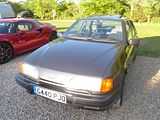
This was a most enjoyable evening. The bar has been set high by the Wood Brother’s Distillery event for their remaining events of the 2025 season as well as those of other venues. I hope to able to get along to see what else is in store during the year.