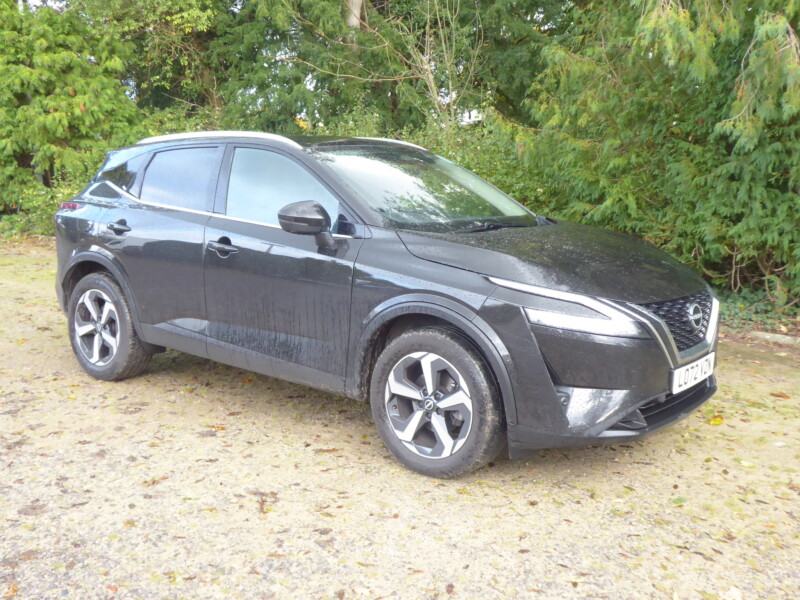


When Nissan decided to replace their medium-sized hatch, known in European markets as the Almera, with something a bit different, the car we know now as the Qashqai, I am not sure that they fully appreciated just what a smart move this would prove to be. Buoyed by good reviews, the Qashqai was an instant success, selling in far greater numbers than the Almera had achieved, and with a slew of rivals appearing in the years that followed, it became clear that Nissan had effectively redefined the family car. Despite increased competition over the years, the Nissan has continued to prove particularly popular, especially in the UK, with a regular placing in the Top 10 best-sellers almost from the get-go and by the time of the second generation model, there were month when it was Britain’s best-selling car, outdoing popular stalwarts like the Fiesta, Focus and Corsa. I sampled a number of versions of that second generation Qashqai and it was not hard to see why it was so popular, as it took all the good things from the first generation model and improved on the weaker points, with a much nicer quality interior, improved efficiency from the latest generation engines, more kit and safety equipment and a bit more space from the slightly enlarged footprint. So when it came to the third generation car, launched in early 2021 in that difficult time when the world was still generally locked down, it was no surprise that Nissan did not deviate much from what had been so successful for well over a decade. The styling was updated but still clearly identifiable as a Qashqai, the car was that bit bigger again, and it had more equipment and was more efficient and with lower emissions. Having been on sale for more than two years, I finally got my first chance to sample one when Hertz at Heathrow airport allocated me a 2022 N-Connecta model with a manual gearbox for a rental for a few days. The car was finished in Pearl Black and the weather was not photographically helpful for the entire duration of the rental, but at least I was able to drive the car enough to form an assessment of how the latest Qashqai comes across.


During the life of the first two generations of Qashqai, there were petrol and diesel engines offered with the latter selling in larger quantities than the petrol ones. But times have changed, and the third generation Qashqai lives in a world of petrol and various forms of hybrid as well as full-electric. Nissan have a completely different model, the Ariya, for those who want all-electric, but they do have petrol and petrol-hybrid options for your Qashqai. At launch, all Qashqai models come with a 1.3 litre engine, offered in two tunes, with 140 or 160 PS and a choice of front or all wheel drive. A year or so later, an innovative e-Power version was added to the range where a high-output battery combines with a 1.5-litre three-cylinder turbocharged petrol engine generating 190PS, a power generator, inverter and 140kW electric motor of similar size and power output as found in Nissan’s electric vehicles. The petrol engine generates electricity, which can be transmitted via the inverter to the battery pack, the electric motor or both, according to the driving scenario. My test car did not feature this but rather it had the 1.3 four cylinder unit in its more powerful 158 bhp (160PS) guise. There is keyless starting. With the engine fired up, it is time to get underway. This may be a small capacity engine, at just 1.3 litres but it is quite lusty and so the Qashqai goes quite well, with decent acceleration on offer especially once underway. The engine is smooth and is quite refined so noise levels especially at a steady speed on the motorway were low. The test car had a manual gearbox, and you get 6 forward ratios. Whilst the gearchange is quite slick, I found it a bit too easy to get the wrong gear on down changes, largely a consequence of the narrow gate, I suspect. I covered 471 miles in my time with this Nissan and put 49 litres of fuel in so I could return it full. That works out at 43.63 mpg. However, I suspect this is a bit of a low call, with the car perhaps not being that full on collection, as on a return journey from Bristol to Warwick, the on board trip computer declared I had averaged 49.7 mpg, a commendable figure for a petrol-engined car of this size.


As with a lot of family cars these days, the steering is very light, offering little in the way of feel, though thankfully some weight is added as you turn the wheel, meaning that when you really want to know where the steered wheels are headed, you do have some clues. Slightly surprisingly, I found this Qashqai did not feel as planted or secure on the road as I was expecting, yet there is no real reason for this, as the car follows the layout of its predecessors very closely and I did not feel that about them. The test car came on 235/55 R18 wheels, which are a little larger than those offered on entry level Qashqai models, but even so, the ride was good, proving quite smooth on the motorway and relatively unchallenged by some of the less than perfect surfaces that we all face on a daily basis now. There is a full complement of ADAS features, which helped to ensure the Qashqai was given a five str rating by NCAP on release. The Lane Keep Assist was less intrusive than in some cars I have recently driven. This version of the Qashqai includes not just parking sensors and a rear-view camera but also a 360 degree all around camera which will give you images of the front, sides and rear of the car. You can even have a fish-eye view all around, so parking up was really not hard.


The test car had the optional sunroof fitted, and this is massive, so with the cover open, it lets a lot of light into the cabin. The design of the interior is a bit flashy compared with what went before, but it uses some decent quality materials and the fit and finish is good. There is a mix of inlays, with a grainy black textured plastic used on the doors and both gloss black and silver on the dash. There is a leather wrapped steering wheel. In all but the entry level Visia model, Nissan use a full configurable 12.3” TFT screen instead of traditional dials. The result is a bit gawdy in appearance, but the information presented is easy enough to read at a glance. As well as speed, revs, fuel level and water temperature, you can choose to project navigation or traffic data into the display. Temperature and clock displays go across the top of the central area. Twin column stalks do the usual functions of indicators, wipers and lights, both of which have auto functions and there are buttons on the steering wheel boss for cruise control and some audio repeater functions. The centre of the dash contains the 12.3” touch screen (enlarged by over 3” from launch versions of the car), mounted up high at least where it is easy to see and reach, and like so many these days, there is lot going on here. Thankfully, though the dual zone climate control still has separate buttons below the unit. But just about everything else is controlled through the screen which uses NissanConnect software and offer Amazon Alexa voice control instead of Google. Navigation is part of the N-Connecta spec, as well as the audio capabilities including DAB radio and there is standard Apple car Play and Android Auto.


Upholstery even in the N-Connecta is cloth and adjustment of the front seats is all manual. There is a wide range of adjustment, so getting comfortable was easy and there was quite a feeling of space here thanks to the generous headroom. The steering column telescopes in/out and up/down, so I could get exactly the driving position I wanted.


The rear doors open wide, up to 85 degrees, which is something that will really be appreciated by those installing child seats are even just by those who value a bit of extra clearance. It certainly does mean that access is easy and thanks to the longer wheelbase of the third generation cars, there is lots of space in the rear seats, with more than enough leg room even if the front seats are set well back, though as with so many cars these days, the central console unit does come back a fair way reducing the knee room for a middle seat occupant. Headroom is generous thanks to the SUV-esque styling and the car is wide enough that three adults should fit across the car. There is a drop-down central armrest with cupholders in the upper surface and there are map pockets on the back of the front seats as well as bins on the doors. There are also two USB sockets here to complement the two in the front part of the cabin. At 504 litres, the boot is among the largest in the class. There is a false floor, which makes loading easy as this is then flush with the base of the tailgate. The space under this floor is deep enough to be useful in its own right. Remove the false floor and you have a really deep luggage area. More space yet can be created by dropping down the asymmetrically split rear seats. The resulting load area is flat. Inside the passenger compartment, there is a modestly-sized glovebox, as well as pockets on the doors, a central armrest cubby and a recess in front of the gearlever.


Nissan have retained the trim names they have been using for a few years now, to denote the different specification versions of the Qashqai. The entry-level model is called Visia. The spec here includes 17-inch steel wheels with covers, LED headlights and rear lights, Intelligent cruise control, rear parking sensors, automatic emergency braking with pedestrian and cyclist detection, Lane-departure warning, manual air-conditioning, front electric windows only and a DAB radio with Bluetooth connectivity. Building on the Visia, the Acenta Premium adds 17-inch alloy wheels (18-inch on e-Power models), an 8-inch NissanConnect infotainment display, Apple CarPlay and Android Auto, a Rear-view camera, Dual-zone climate control, Keyless entry and start, Adaptive cruise control, automatic wipers and headlights and front and rear electric windows. The mid-range Nissan Qashqai N-Connecta features 18-inch alloy wheels, a 12.3-inch digital driver’s display, a 12.3-inch infotainment system with navigation, Around View Monitor 360° camera, front parking sensors, privacy glass, interior ambient lighting, and a leather steering wheel and gear knob. Available only from 2021 to 2022, the Nissan Qashqai Premiere Edition was effectively an early Tekna-spec car, and came fitted with 18-inch diamond-cut alloy wheels, ProPILOT with Drive Assist, a 12.3-inch digital instrument cluster, a 10.8-inch head-up display, a Panoramic glass sunroof, Two-tone paintwork, a Wireless smartphone charging pad and Power-folding mirrors. The Nissan Qashqai Tekna moves the Qashqai into premium territory with a luxurious spec that includes 19-inch alloy wheels, adaptive LED headlights, ProPILOT Assist with Navi-Link, powered tailgate, heated front seats and steering wheel, wireless phone charging, Roof rails and traffic jam assist and blind-spot intervention. And finally, the range-topping Nissan Qashqai Tekna+ features 20-inch alloy wheels, quilted leather upholstery with front-seat massage, electric front seats with memory function, Bose 10-speaker sound system, Advanced i-Key with driver seat and mirror memory, tilting mirrors on reverse and a Panoramic glass roof.


My expectations for this third generation Qashqai were high, as I had been impressed by its predecessor and I was assuming this one would be even better. It is hard to put my finger on quite why, but I just felt a little disappointed. And yet, when I look at all the attributes of the car, it does not really have any weak points. For sure, it feels big now, but then just about every car seems to grow with each successive generation and that does mean that there is that bit more room in it than before. This generation is nicely finished inside, has a good standard of equipment in all apart from the entry level Visia model, and it is decent enough to drive, so there is nothing really to detract. It’s not exciting, but then nor are many of its rivals, and indeed that was not really the design point. The Qashqai has always been about no-nonsense practical family transport and against such an objective, this one hits the spot dead centre. Again. So yes, it truly deserves the market success that continues, though life is going to get tougher as not just the established competitors up their game, but a slew of Chinese rivals are waiting in the wings to tempt buyers with much lower prices. The MG HS is already here, and others are not far away. It will be interesting to see if the Qashqai can hold onto its market-leading position.