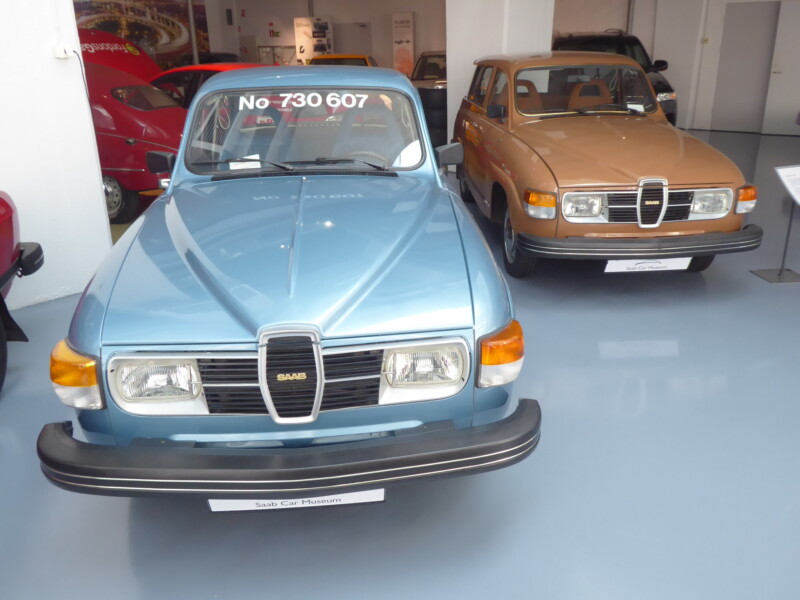
I’ll be honest and admit that when planning a week’s vacation, and deciding to explore Gothenberg and the west of Sweden, the fact that there are car museums celebrating both of the country’s car makers did influence my decision just a bit. That said, I can tell you that Gothenberg itself is a lovely city, especially in the summer sunshine which is how I experienced it, and despite all the horror stories about the cost of food and drink, I have found excellent quality at reasonable prices everywhere I’ve been on this trip. Once away from the city, the countryside is lovely, and there is refreshingly little traffic even on the main roads. Situated just over an hour north of Gothenberg, Trollhättan is about the 20th largest centre of population in Sweden, so it is not exactly a large place, but it is very pleasant and there are hotels and restaurants here so it would make a good base in its own right. I did spend time exploring the town once I had achieved my initial mission of visiting the SAAB museum.


Saab Car Museum first opened its doors in 1975. The initiator was Albert Trommer, a legendary manager of the activities for visitors at the then Saab-Scania division. The first museum premises were somewhat modest. Situated in the cellar, under the old Saab-ANA retailer facility, the museum was not at all easy to find. Many visitors found themselves at Saabs main gate on Stallbacka where they were given a copy of a map to help them find their way. But it was worth the effort it took to find the place. All the milestones were there, including the Saab 92001, “Ursaaben”. Everything was there that had been saved and hidden from the scrapyard over the years. To celebrate the Saab 50th anniversary, a completely new museum was planned in 1987 in the old roundhouse of the former NOHAB industrial estate in Trollhättan. In connection with this, Albert retired and was succeeded by Per Olof “Pelle” Rudh, seen further down together with Gunnel Ekberg from the Communications Department, who became the new manager for the museum activities. Pelle was not a complete stranger, he had, for example, been one of the top mechanics at the Saab Competition department. Many of the museum cars had been serviced for the jubilee and they were on show for media from all over the world. A Saab is to be driven, and that also applies to the cars in the museum. In an orderly manner, it should be added. In this context, the name Erik Carlsson “on the roof” should be mentioned, Saabs legendary rally driver, who won the RAC rally 3 times in a row, and also the Monte Carlo rally in 1962-63. After his active career, Erik continued working with public relations at the Saab communications department, and connection with, and involvement in, the museum has always been close to his heart. In 1997, the next significant step in the development of the Saab Car Museum took place. In celebration of Saab Automobile AB’s 50th anniversary and Saab AB’s 60th anniversary, the museum was completely renovated, doubling its exhibition space. But there was more on the agenda than just that. The launch of the new Saab 9-5 was centred in Trollhättan, starting from the museum, and used throughout the summer for this purpose. This marked a milestone for the operation, which included further product launches and activities for media, dealers, and customers. Utilizing the heritage for the future. 2005 was the next milestone. The company decided that the launch of the Saab 9-3 SportCombi should be based at the museum, and a whole new interior architecture was created. The Saab Car Museum maintains this status today. Naturally, Saab Automobile AB celebrated its 60th jubilee in 2007 with the museum as a focal point. And Saab anthusiasts from all over the world came to Trollhättan. When Saab Automobile declared bankruptcy on December 19, 2011, the future of Saab Car Museum and its collections was uncertain, since the museum and its collections were wholly owned by the company. After intensive efforts and the completion of the bidding process, the following constellation made the winning bid: the City of Trollhättan, Saabgroup, and the Marcus and Amalia Wallenberg memorial foundation made a bid of SEK 28 million. The Saab Car Museum had been saved. Saab Car Museum is now run by Innovatum Science Center AB at the request of the owners with a partial financing from the city of Trollhättan and the Västra Götaland Region.


Saalina: Saalina was a four-meter-long (13 ft) boat made by SAAB after World War II. When the war ended the interest in making fighter planes went down and SAAB needed something to use all the aluminum sheets they had stored. Kurt Sjögren thus designed an aluminium boat and 250 boats were made. However, the cost of the boats became very high since they were made like the aircraft with every rivet polished down. Then there was a problem with that the aluminium rivets did not stand seawater and quickly turned the boats into sieves.


The “Ur-SAAB”: Ursaab (lit. Proto-Saab), also known as 92001 and X9248, was the first of four prototype cars made by Saab AB, which at that time was solely an aeroplane manufacturer, leading to production of the first Saab car, the Saab 92 in 1949. The car is now in the Saab Car Museum in Trollhättan. The name “Ursaab” means “original Saab”. The model was developed by a 16-person team led by engineer Gunnar Ljungström and designer Sixten Sason. An automobile design project was started in 1945 by Saab AB, a manufacturer of warplanes, with the internal name X9248. The design project became formally known as Project 92; the 92 being next in production sequence after the Saab 91, a single engine trainer aircraft. The aim was to design a car that would compete with small German cars like Opel Kadett, VW Beetle, DKW and Adler. The target consumer price was 3200 SEK. Bror Bjurströmer, who was then head of the design department, developed a 1:25 scale sketch and the overall design specifications, which included the following: a wheelbase of 2.75 metres (108.3 in) and total length of 4.5 metres (177.2 in); employment of a monocoque design; 50% less drag than other cars; 800 kilogram maximum weight; power from a transverse-mounted two-stroke engine; and front-wheel drive. The choice of rear-hinged doors was made by Gunnar Ljungström (head of the development team) as he wanted to lessen the risk of damaging doors whilst driving out of a garage. The company made four prototypes, 92001 through to 92004, before designing the production model, the Saab 92, in 1949. Development was started in Linköping by a 16-person team led by engineer Gunnar Ljungström and designer Sixten Sason. The immediately preceding Saab production code was for an aeroplane – the Saab 91 Safir. It was for this reason that the first car project was called the Saab 92. Normally the development would have been handled by the testing workshop, but it was busy with the Saab 91 Safir and the Saab 90 Scandia. Thus the tool workshop, which had a lighter workload at that juncture, was given the assignment. The engineers responsible for making the prototype had no prior experience in making cars, and out of the 16 engineers only two had a driving licence. They needed information about the car manufacturing process, but had to simultaneously keep the project secret. A few visits were made to Nyköpings Automobilfabrik (later ANA), but as the extent of their work involved the simple installation of bodies on imported ladder frame chassis, the engineers were not able to gather as much information as they had hoped. Also, since all available literature only described how cars were made before the war, they realised that much of the manufacturing process would have to be learned on their own. Close to SAAB’s factory a junkyard provided the engineers with both parts and inspiration. They also purchased a number of cars to study, including a DKW, a Hanomag, an Opel Kadett and a Volkswagen. Structural integrity concerns led to other design decisions. The team tasked with that portion of the project was used to building aircraft where every opening was covered with a load-bearing hatch. Since this was not viable on an automobile, it was decided that the body structure should be strengthened through the use of a rear window that was as small as possible and which used a split-window design, and omission of a rear bootlid. Because the car had to have a very low drag coefficient,0.3, which even today is considered very impressive, aerodynamic tests were part of the early evaluations. Thus, the body was of novel design and, with safety in mind, it provided damage-resistance in the event of an accident. Winter driving capability was enhanced via front-wheel-drive and wide wheel arches which allowed for snow accumulation without obstruction of the wheels. Using some carpenters from Motala, a full size mock-up in alder wood was built in the spring of 1946. The model was coloured black using shoe polish. Some extra workers were recruited from Thorells Kylarfabrik in Linköping for building the steel body. Hand-shaping the 1.2 mm thick steel sheets proved to be difficult work. By summer 1946 the first prototype body was ready, hand beaten on a wooden jig. Shaping of the metal was done in Saab’s secret factory 30 metres below ground. The colour was a problem – the Managing Director wanted it painted black, but the vice MD wanted it blue. But the workshop had already purchased black paint, making it a moot point. The SAAB paint workshop did not have the capacity to handle the paint job so the builders contacted Aktiebolaget Svenska Järnvägsverkstäderna (ASJ), the Swedish railroad works in Arlöv. This firm was experienced in painting railway cars and buses. Having been told that their assistance was needed in painting a car, the company was initially reluctant to help since it was thought that the vehicle was a management car such as a DeSoto or something that would take a lot of time. However, when it was learned that the vehicle was a prototype of a new car, ASJ quickly took the job. The prototype had a borrowed 18 hp two-cylinder two-stroke engine, which was placed transversely in the front of the vehicle. The first engine and gearbox came from a DKW vehicle, but they were later replaced with an engine and gearbox designed by Gunnar Ljungström. The prototype engine blocks were made by Albinmotor. The head of the firm, Albin Larsson, was hesitant to take work since the cooling pipes in the engine block were considered to be complicated. After test driving the prototype, however, Larsson changed his mind. Ursaab was driven over 530,000 kilometers (330,000 mi), typically in utter secrecy, and usually on narrow and muddy forest roads and in early mornings or late nights. Today it is in the Saab museum in Trollhättan, with a cleaned grille and more roadworthy headlights. The name “Ursaab” means “original Saab”. The Ursaab design was improved by Sixten Sason in 1947, resulting in another prototype: the 92002. The most remarkable difference between 92001 and 92002 is the hood (bonnet). The earlier hood design and the use of a hood mechanism from an Opel Kadett made removal of the engine difficult, as one would have to turn it 90 degrees and bring out the drive package with the gearbox first. Inspired by American cars that had cascading front-ends, the redesigned hood allowed for improved access to the engine bay. After an additional four prototypes the design was ready for production as the Saab 92. Ursaab was first shown to the press on June 10, 1947 at Saab AB’s headquarters.


SAAB 92: The Saab 92 was the first production car from Saab. The design was very aerodynamic for its time, with a drag coefficient (cx or cw) of 0.30. The entire body was stamped out of one piece of sheet metal and then cut to accommodate doors and windows. Full-scale production started December 12, 1949, based on the prototype Ursaab. All of them were of the Deluxe version. A standard version was advertised, but nobody was interested in buying it so no standard versions were produced. The engine was a transversely-mounted, water-cooled two-cylinder, two-stroke 764 cc displacement, 25 bhp engine based on a DKW design, giving a top speed of 105 km/h (65 mph). The transmission had three gears, the first unsynchronised. In order to overcome the problems of oil starvation during overrun (engine braking) for the two-stroke engine, a freewheel device was fitted. The suspension was by torsion bars. All early Saab 92s were painted in a dark green colour similar to British racing green. According to some sources, Saab had a surplus of green paint from wartime production of airplanes; “All the cars were painted bottle green, a colour that became something of a trade mark for Saab cars. The underlying reason was that the armed forces had bought large quantities of a green cellulose paint for camouflage painting. However, the paint did not suit the terrain and the entire consignment of paint was sold off. Saab bought it and that was why both the aircraft and cars ended up green.” Saab’s rally history already started two weeks after the 92 was released, when Saab’s head engineer Rolf Mellde entered the Swedish Rally and came second in his class. Only 700 1950 models were made. In 1951, German VDO instruments replaced the originally-fitted American Stewart-Warner components. In 1952 Greta Molander won the ‘Coupe des Dames’ of the Monte Carlo Rally in a 92, tuned to 35 bhp. In 1953, the 92B arrived with a much larger rear window and larger luggage space (with an opening lid). It was now available in grey, blue-grey, black and green. In 1954 the Saab 92 got the new Solex 32BI carburettor and a new ignition coil giving 28 bhp. The US headlights were replaced with Hella units. Another novelty was that a textile roof (semi-cab or cabrio coach) was offered as an option. The colour maroon was also introduced this year. In 1955, it acquired an electric fuel pump and square tail lights installed in the rear fenders. The colours were grey, maroon and a new colour, moss green. The English aviation test pilot Bob Moore, who had helped to develop the Saab Tunnan (J29) jet aircraft, brought a 1955 Saab 92B back to England, when he returned, later to become the first managing director of Saab GB Ltd. This was reputedly the first-ever Saab car imported to the UK. The Saab 93 was introduced in December 1955, but both the 92B and 93 were produced at the same time, for a while. The last 92 was assembled in late 1956–early 1957. Two new colours, grey-green and beige, were available. A total of 20,128 Saab 92s were made.


SAAB 93: The Saab 93 (pronounced ninety-three) is the second production automobile that was manufactured by Saab. Styled by Sixten Sason, it was first presented on December 1, 1955. The 93 was powered by a longitudinally-mounted three-cylinder 748 cc Saab two-stroke engine giving 33 hp. The gearbox had three gears, the first unsynchronised. In order to overcome the problems of oil starvation on overrun (engine braking) for the two-stroke engine, a freewheel device was fitted. In 1957, two-point seatbelts were introduced as an option. The 93 was the first Saab to be exported from Sweden, with most exports going to the United States. A Saxomat clutch and a cabrio coach (large cloth sunroof) were available as options. On September 2, 1957, the 93B was introduced. The original two-piece windshield was also replaced with a one-piece windshield. In 1957, Erik Carlsson finished 1st in the Finland Rally in a Saab 93; in 1959, he was 1st in the Swedish Rally, also in a Saab 93. However, Saab was not the first Swedish manufacturer to win the Swedish Rally. Saab’s long-standing Swedish rival, Volvo, had beaten them consecutively in 1957 and 1958 with the PV544. In late 1959, the 93F was introduced, featuring front-hinged doors from the Saab GT750. 1960 was the last year of production for the 93. The 93 was replaced by the Saab 96, although the two models were sold side by side for the earlier part of the year. A total of 52,731 Saab 93s were made.


SAAB Sonnett: In the 1950s, Rolf Mellde—a Saab engine developer and race enthusiast—along with Lars Olov Olsson, Olle Lindkvist, and Gotta Svensson, designed a two-seat roadster prototype in a barn in Åsaka, near Trollhättan (the site of the main Saab manufacturing facility). The limited research-and-development project, with a total budget of only 75,000 Swedish kronor, first came to be known as the Saab 94 but was later renamed as the Sonett, a name derived from the Swedish phrase Så nätt den är (“how neat it is”, or more literally “it’s so neat”) by the car’s designer Sixten Sason. This name was initially rejected by Saab’s management but was eventually accepted in October 1955 when the first prototype was completed. The Sonett shares a lot of components from the 93 Saloon such as the front suspension, engine and gearbox. The engine and gearbox were rotated 180-degrees and fitted behind the front axle. This required reversing the engine’s direction of rotation which was easily achieved due to the engine being a 2-stroke unit. In order to avoid using a tubular frame chassis used by other low volume sports cars at the time, Mellde instead decided to use an advanced stressed skin-lightweight aluminium chassis that weighed less than 70 kg (154 lb). The metal sections of the chassis were riveted together, a concept used in aircraft manufacturing, while the mechanical components such as the engine, fuel tank, axles and body work were mounted directly onto the chassis. Mellde and Sason decided to use glass-reinforced plastic for the construction of the car’s body, a material which becoming more popular for automotive use at the time. In order to manufacture the body of the car from this material, Soab, a company specializing in plastics imported from the United States based in Gothenburg was hired to make the said lightweight body shell. The Sonett was introduced on 16 March 1956 at Stockholm’s Bilsalong (motor show). Featuring a three-cylinder 748 cc two-stroke engine generating 57.5 PS, the Sonett I was an advanced low-weight 600 kg (1,323 lb) racer based on aircraft design concepts. With a projected top speed of 190 km/h (120 mph), the Sonett I had the prospect of success on the European race circuit, and a production run of 2,000 units was planned for 1957. However, the competition rules changed, permitting modified production cars into the race classes which Saab had envisioned for its purpose-built Sonett, and the economic and marketing viability of the project faded. Only six cars were made between 1955 and early 1957, all right-hand drive units. The decision to build the Sonett 1 was reversed by the Saab management in early 1958 who decided to build a performance-oriented variant of the 93 Saloon called the GT 750. The original prototype, known as “No. 1” and built with a manually crafted glass-reinforced plastic (GRP, or “fiberglass”) body, served as the reference model for the other five cars. An extremely rare vehicle, only two cars exist in the United States. Chassis number 2 was in the GM Heritage Center Collection but it was sold to Saab Cars North America (SCNA) after GM’s 2009 bankruptcy. After Saab, too, went bankrupt in 2012, it was sold on to the Saab Heritage Car Museum USA in South Dakota. In September 1996, rally driver Erik Carlsson broke the Swedish record for the under–750-cc engine class with a speed of 159.4 km/h (99.0 mph) in the restored Sonett I prototype “No. 1”.


SAAB Monster: The Saab Monster was an experimental car made by Saab in 1959. This project was part of Saab’s work in motorsport and the need to derive more power from their two-stroke powerplant. The project consisted of a ‘Toreador Red’ Saab 93 with all excess weight removed, including the bonnet, which was replaced by a plastic one. The engineers then installed two transversely-mounted 748 cc two-stroke, three cylinder engines, in a ‘split in-line’ configuration, driving the front wheels through a modified clutch and gearbox assembly. The drivetrain also used two distributors and an enlarged radiator. This arrangement gave the car about 138 bhp and a top speed of 196 km/h (122 mph) (achieved at Såtenäs airfield). The low weight and the ‘drop’ or aerofoil shape of the body gave the rear end a tendency to become airborne when approaching the top speed. The amount of torque, coupled with front-wheel drive, also gave rise to severe understeer. It was the combination of immense power and poor handling that gave rise to the name ‘Monster’. Started in 1959, this project was a part of Saab’s work in motorsport and the need to derive more power from their then-standard two-stroke powerplant. During the project there was a speed record attempt but this was not recognised on account of discrepancies in scrutineering and recording. In the end, the project was terminated because it proved impractical.


SAAB Paddan (Toad): The Saab Toad, or Paddan in Swedish, was a development car Saab Automobile made in 1966 to test out the new chassis, drive train and engine for the Saab 99. On 2 April 1964, Gudmund’s day in Sweden, after several years of planning, the Saab board started Project Gudmund. This was a project to develop a new and larger car to replace the Saab 96. This new car became the Saab 99, designed by Sixten Sason, and unveiled in Stockholm on 22 November 1967. The reason for this project was to preserve secrecy during development of the new model, the Saab 99, which was the company’s first radically new body shape since the first cars made in 1947. The Toad used the body of a Saab 96, which was long enough for the purpose but had to be widened by 20 centimetres (7.9 in). This was achieved by cutting the body in half lengthwise and inserting 20 cm of steel spacer. The windscreen (windshield) and rear window clearly showed the seam. The bonnet (hood) and grille required widening in a different way, to prevent changing the appearance of the centrally-placed features, as the picture shows. Under the bonnet, the inline four engine for the future Saab 99 was mounted, developed by Triumph in coordination with Saab. It was rightly believed that the wider body would not be noticed on Sweden’s roads, where so many SAAB 96 cars were an everyday sight. This deception was successful, for a while, until test drivers allowed a grey Toad to be followed by a similarly-coloured SAAB 96, making the different proportions obvious to any observer. Four Saab Toads were made, but only one remains, in dark grey paintwork.


SAAB Catherina: The Saab Catherina is a 1964 prototype automobile, commissioned by the Swedish automaker Saab, designed by Sixten Sason and made at the workshops of the Aktiebolaget Svenska Järnvägsverkstäderna (ASJ – the Swedish Railroad Works) in Katrineholm, Sweden (hence the name). It is a red, two-seat sports car with a targa top. Sason, who was working as a freelancer for Saab, made some drawings of a small sports coupé in the early 1960s. As Saab was planning to introduce a sports car model, the company commissioned him to adopt the design for mass production. The project began in January 1963 and in May the assembly of the prototype started at the ASJ. The prototype was first displayed, however, only on 24 April 1965, at the Linköping Sports Centre. For economy reasons, the Catherina utilised many components of the contemporary Saab 96 and shared the same wheelbase, which was longer than the finally accepted design. Its unique feature was its targa top, which could be stowed in the luggage compartment of the car. Stemming from the design of an integral ‘roll bar’, it was still a new concept in the automotive industry, preceding the 1966 Porsche 911 Targa, which popularized it (and established the name). Sason also designed some other unusual features for the Catherina, such as the roof-mounted headlamps (for longer range), which were not included in the prototype because of the need to make the car fit for mass production. After test drives on the prototype it was concluded that some more development work was needed. Meanwhile, another prototype, known as Saab MFI13, was prepared by the Malmö Flygindustri (MFI) and Saab chose it as a basis for its sports car, the Saab Sonett II. The Catherina ended up on display in the SAAB museum in Trollhättan, but Sason used some of the design cues previewed in the Catherina in his later design, the mass-market Saab 99. In each book and newspaper article since the 60’s this prototype has been referred to as ‘Catherina’, but the document from ASJs archive where Sixten Sason suggested the name of the car, it states Catharina. The same name is also found on the original name badge on the dashboard that since 2008 once again was re-fitted to the car at the Saab museum.

SAAB MFI13: The Saab MFI 13 was a February 1965 prototype for the Saab 97 automobile, later known as Sonett II. It was built at the Malmö Flygindustri as they had some experience with plastic manufacturing. The body of the prototype was made of steel though. A second prototype was designed by Sixten Sason and delivered a month later by ASJ (Aktiebolaget Svenska Järnvägsverkstäderna – the Swedish Railroad Works) in Arlöv. Both cars were brought to Trollhättan for examination and the MFI car was determined to be the most suitable for further development. Both cars had the two stroke Saab Sport engine of 60 hp and were capable of 160 km/h. By spring 1966 the project 97 had advanced enough so that 24 cars could be built in Arlöv, in the south of Sweden. When series production started by the end of the year, many details had been altered: brakes, ventilation system, grille and parking lights. Prototypes were shown at both the Salon International de l’Auto (Geneva) and New York International Auto Show. In Geneva a car was available for test driving.


SAAB 96: The Saab 96 is an automobile manufactured and marketed by Saab from 1960 to January 1980, replacing the 93. The 96 featured aerodynamic two-door bodywork, four-passenger seating and at first a two-stroke, three-cylinder engine, later a four-stroke V4. Compared with its predecessor, the Saab 93, the 96 featured greater and more easily accessible storage space and a larger rear window. The front end was lengthened for 1965 models, in preparation for a new engine, and the radiator was placed ahead of the engine, rather than above and behind, a leftover from when earlier models had thermosiphon cooling. Both front and rear windows were enlarged slightly for 1968 models. The Saab 96 had a longitudinally mounted engine layout. As first designed, it had an 841 cc displacement, 38 PS three-cylinder Saab two-stroke engine. By 1965 this was increased to 40 PS. An optional 52 PS version of the engine, with triple carburettors and oil injection, was used in the Sport/Monte Carlo models. The additional power was obtained from a modified cylinder head and filled crankshaft counterweights offering higher overall compression ratio. For 1966 models, the standard 96 841 cc engine, using pre-mix oil, appeared with a three throat Solex carburettor in which the centre carburettor handled start, idle, and low speed functions, increasing the power to 42 PS. The same carburettor had been used in the Sport/Monte Carlo models. A common throttle shaft minimized carburettor synchronization problems.


In 1967, Saab began marketing the 96 V4, with the Ford Taunus V4 engine, a four-stroke 1498 cc V4 engine, originally developed for the 1962 Ford Taunus 15M. Saab’s project to source a four-stroke engine was dubbed ‘Operation Kajsa’. The two-stroke option was offered until 1968. Four-stroke engines had been tested before, between 1962 and 1964 Kjell Knutsson and Ingvar Andersson under Rolf Mellde tested three different engines: a 45 PS Lloyd Arabella of 897 cc; a 33 hp BMC A-Series 848-cc engine and a Lancia Appia engine of 1089cc and 48 hp. However Rolf Mellde’s view that Saab needed to switch to a four-stroke engine was stopped higher up by CEO Tryggve Holm. Mellde then went behind the back of Holm and made contact with Marc Wallenberg, son of Marcus Wallenberg, Saab’s major stockholder. The coup succeeded and testing could begin. The tested engines were Volvo B18, Ford V4, Triumph 1300, Lancia V4 engine, Opel, Volkswagen and Hillman Imp. The B18 was the most reliable, but the Ford V4 was not far behind and was significantly easier to fit into the engine bay of the 96. The testing was done in secrecy. Per Gillbrand took a leave of absence and said he was going to run his father’s paint shop. In reality he went to Desenzano in northern Italy with a 96 V4 prototype for testing. With five months to go before production only seven persons knew about the new engine. To maintain secrecy they rented a house west of Kristinehamn. To keep purchases of V4 specific parts secret they started a front corporation, Maskinverktyg AB (meaning Machine-Tool Company). The ordinary purchase department at Saab was oblivious to what was going on, something that caused an incident when Rune Ahlberg cancelled the orders for cables for the two-stroke engine and the purchase department called the supplier and sharply told them to keep their deliveries. In the last week of July, just before the summer holidays, information about the new engine was released to further people and they were informed that full-scale production would start in four weeks. To keep secrecy, 40 of the ordinary staff were told to report to work to fix a problem with the disc brakes. Just prior to the official introduction, a journalist noticed a lorry loaded with 96s with V4 stickers on the front bumpers. The ordinary V4 engines produced between 1967 and 1976 had 65 PS. Cars from the first year of production had engines with “Ford Motor Company” stampings. For the Swedish 1976 model year, the car – now known as the 96L – had its power reduced to 62 PS due to new Swedish emission regulations. However, the 1977-1980 models had 68 PS, due to a two-stage Solex 32TDID carburettor. The V4 96 managed 0–100 km/h in 16 seconds. In August 1975 (called “1975B” in Sweden as the less powerful engine was kept for cars marketed after the beginning of the new year, when the new emissions standards took effect), the car received new impact absorbing bumpers similar to those on the 99 and an altered bottom plate which allowed the rear seat to be moved 5 cm (2.0 in) further back. In the US, the two-stroke engine was called the “Shrike” in 1967 and 1968. Its displacement was reduced slightly for 1968, to 795 cc, to avoid emission regulations which exempted engines under 50 cu in (819 cc). The V4s used in US cars had a 1500 cc high compression engine with 73 bhp. For the 1971 model year it was switched to a 1700 cc low compression engine, so as not to lose power while meeting new emissions regulations. Stated power dropped to 65 bhp for 1972 as SAE gross figures were abandoned in favour of the lower net ratings. 1973 was the last year that the 96/95 were available in the United States. The Saab 96 and its station wagon sibling, the Saab 95, featured column mounted transmission levers. The gearbox originally had three gears, the first unsynchronised. Later, a four-speed option, with synchromesh on first gear, was offered and the three-speed was phased out. An unusual feature of the Saab drivetrain was a ‘freewheel’ (overrunning clutch). This allowed the transmission to run faster than the engine, such as when decelerating, or descending a long hill. Although such freewheels had been provided in other cars before as an economy measure, such as some early post-war Rovers and pre-war Chryslers, they were required in the Saab because of the limited lubrication in the two-stroke engine. A petroil-lubricated two-stroke requires lubrication according to its speed, but provides this lubrication according to the amount of its throttle opening. Where the engine operates at high RPM and low throttle (such as when coasting down a long hill), the lubrication provided may be inadequate. With the freewheel, a coasting engine could reduce its speed to idling, thus requiring only the small lubrication available from the closed, coasting, throttle. In certain higher-performance models and in later two-stroke models, direct injection of oil into the engine from a separate reservoir allowed lubrication to be a function of engine RPM and rendered mixing of oil with gasoline unnecessary. Freewheeling was retained in the four-stroke variant, until the end of production and in the Saab 99 with the 1709 cc Triumph engine. A minor drawback to the freewheel, particularly for drivers unfamiliar with the Saab, is that it makes engine braking unavailable although it could be manually engaged or disengaged by a control in the foot-well. Fixed wheel disengagement, using the foot, could be difficult, as it involved pulling a ‘T handle’ intended for manual operation.


SAAB 95: The Saab 95 is a seven-seater, two-door station wagon which was produced by Saab from 1959 to 1978. Initially it was based on the Saab 93 sedan, but the model’s development throughout the years followed closely that of the Saab 96 after the 93 was taken off the market in 1960. It was introduced in 1959, but because only 40 were made in 1959, production is often said to have started in 1960. The first engine was an 841 cc three-cylinder two-stroke, but from 1967 onward, it became available with the same four-stroke Ford Taunus V4 engine as used in the Saab 96, the Saab Sonett V4 and Sonett III, and the German Ford Taunus. It had a four-speed manual transmission. There was a small handle on the firewall that, when pushed, put the car into a “freewheeling” mode. This allowed the driver to coast downhill without seizing the two-stroke engine, but when power was needed the transmission would engage and the driver could power the car up hill again. As the 95 received the four-speed gearbox before the 96 (that still had the old three-speed unit) it was also used for rallying. In the US, the Saab 95 received the larger 1.7 litre V4 for the 1971 model year, as a response to tighter emissions regulations. The compression ratio was lowered to 8.0:1, meaning that the power remained at 73 hp. The Saab 95/96 remained on sale in the United States until 1973. A rear-facing folding seat was dropped with the 1976 model year, making the car a regular five-seater. For certain markets (Norway, Denmark) a special export version sedan delivery van was available without a rear seat and rear side windows. Production ended in 1978 (when only 470 examples were built). A total of 110,527 were made.


SAAB 98: The Saab 98 was an automobile built by Saab in 1974 which never reached full production. Originally it was called X14, designed by Björn Envall as a combi coupé based on the Saab 95 and using its floorpan. The prototype was assembled by Sergio Coggiola, who had already done work on the Saab Sonett III. Only a handful of test cars were built up to 1976 before the project was abandoned when Saab decided there was no room in the market for a car between the Saab 95 and Saab 99. The only surviving 98, licence plate (Swedish) AYX 330, started its life as a white Saab 95 registered on 7 September 1973. It is currently painted ‘Siena Brown’.


SAAB 99: The Saab 99 was produced from 1968 to 1984; their first foray into a larger class than the 96. While considered a large family car in Scandinavia, it was marketed as a niche compact executive car in most other markets. It was manufactured both in Sweden and Finland and was succeeded by the Saab 900, although the 99 continued to be produced alongside its successor. The Saab 90, an updated, less complex version using many 900 parts took over from the 99 in late 1984. On 2 April 1964, Gudmund’s day in Sweden, after several years of planning, the Saab board started Project Gudmund. This was a project to develop a new and larger car to take the manufacturer beyond the market for the smaller Saab 96. This new car became the Saab 99, designed by Sixten Sason and unveiled in Stockholm on November 22, 1967. The first prototypes of the 99 were built by cutting a Saab 96 lengthwise and widening it by 20 centimetres (7.9 in); this created the so-called Paddan (The toad), which was a disguise for the new project. After that phase, also as a disguise, the first 99 body shell was badged “Daihatsu” as that name could be made up out of the badging available for the Saab Sport. The 99 was not only built in Saab’s own Trollhättan Assembly – some variants were built by the Finnish Valmet Automotive in Uusikaupunki from 1969 onwards; the last five years of this production (1979-1984) was alongside the Finnish built version of the Talbot Horizon, which shared a similar high quality velour upholstery to the 99. Although Saab engineers liked the company’s existing two-stroke engine, it was decided that a four-stroke engine was necessary, and the choice was a 1.7 L (later 1.85 L) engine from Triumph. This was the same Triumph Slant-4 engine used in the Triumph Dolomite, but the Saab version was fitted with a Zenith-Stromberg CD carburettor developed specially for Saab. A number of Saab 99s were equipped with a Triumph Stag V8, but the V8 was later dropped in favour of a turbocharged unit which later powered the 99 Turbo. A three-door estate version was planned from the start, but never made it into production. In 1971 (with thoughts about a combi coupé) the work on an estate was restarted, this time as a five-door. The 99 was first shown on November 22, 1967. The first production cars came in autumn 1968, although only 4190 cars were built this year. Production increased considerably in 1969 and again in 1970 when the four-door model arrived. In 1970 the interior was also given a facelift and became more luxurious, with a new steering wheel. The exhaust system was now made of aluminium, engine mounts and drive joints were changed. In March, the 99E (also available with a three-speed automatic transmission) was introduced. It had a 1.75 L engine with electronically controlled fuel injection, giving 87 PS. In 1971 the 99 was given a larger and stronger engine, a 1.85 L engine giving 86 PS on the carburettor model and 95 PS for the fuel-injected model. The 1.75 L engine was now only available with a carburettor. Saab also introduced headlight wipers, as well as larger rear-view mirrors and an additional air inlet beneath the existing grille. The dashboard was given a redesign along with new instruments. In 1972 the 1.75 L engine was no longer available. The power of the engine was increased to 88 PS for carburettor models and 97 PS for fuel-injected models. The 2.0 L engine became available. The major change this year were new plastic bumpers that could take impacts up to 8 km/h (5 mph) and still retain their shape. The suspension was stiffened and received stronger dampers. An electrically heated driver’s seat was also introduced. In January 1972 the 99 EMS (Electronic-Manual-Special) was introduced. It was a sportier model that was originally only available in a two-door version; but became available in the wagonback body beginning in 1974 (Europe). It had stiffer suspension and also silver or copper (‘bronze’)-coloured metallic paint as option. The engine had 1985 cc displacement and Bosch D-Jetronic electronic fuel injection giving 110 PS and a top speed of 170 km/h (106 mph). For the United States, a special 99 SSE was developed to satisfy demand while the EMS was not yet available there. The SSE had a black or burled walnut vinyl roof cover and an automatic transmission (by Borg-Warner). It also had the 1.85 L Triumph engine installed. In 1973 a low-cost model called the 99L was introduced. It was a two-door with a 1.85 L engine giving 88 PS All other models had the Swedish-built 2.0 L engine, which produces 95 PS in carburetted form. The LE model had electronic fuel injection giving 110 PS. The LE model was mainly made for export. The inner ceiling was changed, as were protective bars in the doors, and a new black grille. In Northern Europe, a de-contented model called the 99 X7 was also marketed. In January 1974 the three-door hatchback Combi-coupé (marketed as a “Wagon Back” in the USA) was introduced. It was 11 cm (4.3 in) longer than the sedan. Front seats and steering wheel were new for 1974, while the EMS received an all-new, model-specific interior. Inertial reel belts were also fitted. In 1975 the brakes were improved and the hand brake now worked directly on the primary brake pads instead of on separate pads acting as drum brakes inside the brake rotor. The 99 was now available in two versions, one with a carburettor with 100 PS and a fuel-injected version using Bosch K-Jetronic fuel injection system giving 118 PS. In February a model using Zenith-Stromberg 150CDS(E) dual carburettors was introduced. It was only available for the Combi-coupé and has 108 PS. The Combi-coupé had been fitted with a unique grille in 1974; this was now applied across the range. In 1976 nothing major was changed, but a self-adjusting clutch was introduced. The engines were adapted for tougher emissions requirements and several models with an electrically heated rear window were introduced. A luxurious 4-door sedan model was available, the 99 GLE. it came with power steering, an automatic transmission, a fuel-injected engine, luxurious upholstery on the seats and an armrest in the rear seat. The five-door Combi-coupé model was also introduced. In 1977, the front light clusters and the sedan’s tail lights were enlarged. The rubber strips on the bumpers were changed. The “One Hundred series” of test-fleet Turbo cars were distributed around the world. The cars were mainly made from three- and two-door EMS models, but a few four-door and even five-door cars were also made. The four- and five-door models were tested by mostly police in Sweden, Finland and Switzerland.


In 1978 a turbocharged version of the car, the 99 Turbo, was introduced. It was only available as a Combi-coupé until the next year. The turbocharged two-litre engine produced 145 PS giving the car a top speed of 200 km/h (124 mph). The turbochargers were designed and built by Garrett AiResearch. In terms of appearance, it received distinctive alloy wheels and front and rear spoilers. The 99 Turbo repositioned Saab in the car market and it came to be regarded as an iconic and technologically significant model of its era. By early 1979, over 10,000 turbo-engined Saabs had already been built, as Saab successfully entered a new market segment. The car seen here is the prototype shown at the 1977 Frankfurt Show, and features distinctive ivory coloured paint that was not offered on the production cars, all of which were black.


Other news for 1978 included the availability of a sunroof, and the EMS became a three-door Combi-coupé in some markets. In 1979 the Combi-coupé option was discontinued for the 99, as the new Saab 900 was only available in this bodystyle. The 99 Turbo changed over to the two-door saloon bodywork although only a small number were built. The rear axle was altered, the fuel tank changed to a plastic one, new wheels were fitted, and four-door models received new bumpers similar to those of the 900. These bumpers were also installed on two-doors beginning with the 1980 model year. In 1980 the 99 was also given the new and safer seats from the Saab 900, as well as low-mounted protective strips along the sides. The spare wheel was changed to an emergency unit. The carpeting, which had been changed to rubber a few years earlier, went back to textile. In the Swedish market the twin-carb version made a return for a single year, sold as the 99 Super and only available with four doors and an automatic transmission. In 1981 the twin-carb Super was discontinued, although the 99 did gain a new engine option in its stead: the 99 GL with 100 PS was joined by the 99 GLi with 118 PS, both with four-speed manual transmissions. The GLi was a bit more luxurious and had power side mirrors. It was only sold in Northern Europe and only around 1600 were built. All 99s received a new rear seat, velour upholstery, new rear mirrors, a new steering wheel, and the 900’s front axle. In 1982 came the H engine, built by Scania at Södertälje, making it possible for all cars to run on 93 octane gasoline. The two- and four-door 99 GLs were now available with a five-speed manual transmission. The window surround trim was blacked out and the wheels were new. In 1983 a number of smaller technical and cosmetic changes were made, including a new grille similar to that of the 900 and blacked out B-pillars on two-door models. Brake pads were now asbestos-free. Five-speed-equipped 99s received low-resistance tires, which sit on wider 5½-inch rims, requiring moving the rear axle. Some further minor changes took place for 1984, including electronic ignition, lowered seats, and a more upright steering wheel. Five-speed cars also received interval wipers. This was to be the final year for the 99. It was replaced by the Saab 90 and the Saab 900. A total of 588,643 were made; this total rises to 614,003 if Saab 90 production is included.


SAAB Sonett II: In the early 1960s, Björn Karlström, an aircraft and automotive illustrator, and Walter Kern, an engineer at Massachusetts Institute of Technology, independently suggested a two-seat roadster with Saab components and a two-stroke engine called the “Shrike”. Two prototypes were developed: the Saab MFI13 by Malmö Flygindustri, and the Saab Catherina by Sixten Sason. After some modifications, the MFI13 was put into limited production (28 units) in 1966 as the Sonett II, manufactured at the Aktiebolaget Svenska Järnvägsverkstäderna (ASJ) in Arlöv. Inside Saab, it was designated model 97. A further 230 units were assembled in 1967, but as the two-stroke engine became increasingly uncompetitive in the US market, a switch to the Ford Taunus V4 engine was made in the middle of the 1967 production year, and the model was renamed the Sonett V4. Apart from the engine and related drivetrain, the Sonett II and Sonett V4 share much of their componentry. The additional weight did require some strengthening of the chassis and suspension pieces, and the wheels were half an inch wider than the four-inch units used on the Sonett II. Approximately 50 percent of the Sonett II production has survived, preserved or maintained by museums, collectors, and race enthusiasts. Like the Sonett I prototype, the Sonett II fiberglass body was bolted to a box-type chassis with an added roll-bar to support the hard top. The entire front hood section hinged forward to allow easy access to the engine, transmission, and front suspension. Equipped with a three-cylinder, two-stroke engine generating 60 PS (59 bhp), the Sonett II achieved 0 to 100 km/h (0–62 mph) time of 12.5 seconds, with a top speed of 150 km/h (93 mph). All Sonett IIs were left hand drive (LHD). Designed as a race car, the Sonett II competed successfully against other small European sports cars, including the Austin-Healey Sprite and Triumph Spitfire, in Sports Car Club of America (SCCA) races of the period.[citation needed] Due to low production volume, Sonett IIs were disqualified from certain competitions. By 1967, the two-stroke engine failed to meet US emission control standards. In 2011 a two-stroke Sonett II achieved 109 mph 175 km/h) at the Bonneville Salt Flats. Of the 28 Sonett IIs manufactured in 1966 all were equipped with 841cc three cylinder two-stroke engines. SAAB produced serial numbers 29 through 258 with the two-stroke engine, serial number 259 was the first Sonett to have the V4 engine. All Sonett II transmissions had a freewheel that could be engaged and disengaged while in motion via a pull handle down near the throttle pedal. The freewheel was required in the normal (non-oil pump engines) SAAB two stroke engines but not in the racing engines that had an oil injection system fed from a supply tank, nor in the Sonett V4 since it had a four-stroke engine with the common recirculating pressure lubrication.


SAAB Sonett V4: When Saab started using the Ford Taunus V4 engine in their 95, 96, and Monte Carlo models, an upgrade for the low-volume Sonett II became economically feasible. The Sonett V4 was introduced with a 1,500 cc Ford V4 engine in the middle of the 1967 model year starting with serial number 259. A new “bulge” hood, designed by Gunnar A. Sjögren, was required to clear the larger V4 engine, with a slight right offset to avoid obstructing the driver’s view. This asymmetrical hood shape, criticized by both the automotive press and within Saab itself, contributed to the motivation for the 1970 Sonett III redesign. The Ford V4 engine produced 65 bhp, and—combined with the car’s lightweight chassis and fiberglass construction—allowed the V4 model to accelerate from 0 to 100 km/h (0 to 62 mph) in 12.5 seconds, with a top speed of 160 km/h (99 mph). The V4’s dashboard was wrinkle finished black, unlike the wooden panel used in the Sonett II. Following the low-volume 1966–67 Sonett IIs, Saab ramped up Sonett V4 production to meet minimum SCCA requirements, assembling 70 units in the 1967 transition year, 900 units in 1968, and 640 units in the final 1969 production year—a total of 1,610 Sonett V4 vehicles. The 1969 models can be recognized by their taller seat backs and by having a lid for the glove compartment, while the heater was also made somewhat more efficient. While the Sonett V4 was assembled in Sweden, nearly the entire production was exported to the United States, with an MSRP of between US$3,200 and US$3,800. In addition to its unusual fiberglass body, the Sonett V4 featured advanced safety features for its day, including a roll bar, three-point seat belts, and high-back bucket seats to protect against whiplash injury. Sonett V4s also sported a few oddities compared to standard American sports cars like e.g. Corvette, such as front wheel drive; a freewheeling clutch that disengaged automatically whenever the accelerator pedal was no longer pressed, and a column-mounted shifter, rather than a typical floor-mounted shifter. In spite of lacklustre Saab marketing, unusual features, and quirky design, the Sonett V4 found a niche market in the US, propelled by successful SCCA racing performances of the Sonett II. Its primary competitors were British roadsters, including the MG Midget and MG MGB, the Triumph TR5, the TVR Grantura and the Austin-Healey Sprite Mark IV. The Clean Air Act of 1970 prompted engineering modifications to the Ford V4 emission control system that were difficult to reconcile with the Sonett II/V4 body style which then led to the Sonett III redesign.


SAAB Sonett III: The 1970 redesign of the Sonett V4, named the Sonett III, was initially undertaken by Sergio Coggiola, but Gunnar A. Sjögren altered it to fit the existing Sonett II chassis without expensive manufacturing-line changes. Hinged rear-window glass replaced the Sonett II/V4 rear compartment hatch door. With the mandate for a “bulge-less” hood, the engine compartment opening evolved into a small front popup panel, resulting in more limited access than in the Sonett V4. Extensive engine work required the removal of the entire front hood section. To help adapt the car to US market tastes, the Sonett III featured a floor-mounted shifter (instead of the Sonett V4 column-mounted shifter) and optional dealer-installed air conditioning. The Sonett III’s hidden headlamps were operated manually using a lever. US safety regulations required new low speed impact proof bumpers after 1972, significantly detracting from its Italian-inspired design. All Sonett III were LHD. While the 1970 and 1971 model years initially had the same 1500 cc Ford Taunus V4 engine as the Sonett V4, emission control requirements reduced the available horsepower. The model years 1971 to 1974 of the Sonett III used the 1700 cc Ford V4, but to meet increasingly strict federal regulations, net power output remained the same as the 1500 cc engine, at 65 bhp. Still, the Sonett III accelerated from 0–100 km/h (0–62 mph) in 13 seconds, and—due to a higher differential gear ratio (42 teeth on the ring gear and 9 teeth on the pinion gear) than the standard 95/96 transmission (39:8)—achieved a top speed of 165 km/h (103 mph), aided by a drag coefficient of 0.31 cd. Disappointing sales, especially during the 1973 oil crisis, led Saab to end production late in 1974. A total of 8,368 Sonett IIIs were manufactured between 1970 and 1974.


SAAB 99 Elbil Postal Van: In the mid-1970s, Saab built electric delivery vans for the postal service. Based on the Saab 99, these vans used lead-acid batteries and were designed to deliver mail. Only a couple were ever made, but they remain a famous early attempt at green delivery. It was built in 1975 and 1976. Large, heavy batteries were put in the middle of the van. Workers could slide the battery pack out like a drawer using a small cart. This made it easy to fix or swap out batteries. The van was slow and could only drive about 40 miles before it needed a charge. Saab bosses did not approve of the project. The van was never used for official mail deliveries, but it is now on display here.


SAAB 900: The Saab 900 is a mid-sized automobile which was produced from 1978 until 1998 in two generations; the first from 1978 to 1993, and the second from 1994 to 1998. The first-generation car was based on the Saab 99 chassis, though with a longer front end to meet U.S. frontal crash regulations. The 900 was produced in 2- and 4-door sedan, and 3- and 5-door hatchback configurations and, from 1986, as a cabriolet (convertible) model. The 1979 900 was available in three versions of the B-engine: The GL had the single-carb 100 PS engine, the GLs had twin carburettors for 108 PS, the EMS and GLE had Bosch jetronic fuel injection for 118 PS and the 900 Turbo produced 145 PS. The only bodywork originally available was the three or five-door hatchback style, which was seen as more modern at the time. The EMS was only available with three doors while the automatic-equipped GLE was only offered with five. Saab’s model years were generally introduced in August/September of the preceding year. The Turbo had a different grille from the naturally aspirated models, which received a design with a hexagonal central element. For the 1980 model year, all versions received the sleeker turbo-style grille. The 1980 900 also received larger taillights rather than the earlier 99 units, as well as lower, adjustable head restraints. 1980 was also the first year for a five-speed gearbox, originally only available in the EMS and the Turbo. The four-door 900 sedan was introduced in Geneva 1980, as a result of dealer pressure. This introduction corresponded with the phase-out of the old Saab B engine in favour of the lighter Saab H engine. With the introduction of the H-engine, Saab simplified the model designation on the international markets outside Scandinavia: GL for the model with the single carburettor, GLs for the models with the twin carburettor engine, GLi as designation for the models with fuel injection without turbo, and correspondingly “Turbo” for the top models with the corresponding engine. The GLE was now offered only as a better equipped four-door Sedan. Model designations in the USA became just 900 for the base model and 900S for the models with 8V i. The EMS designation was dropped. In the early 1980s, most 900s were produced in Trollhättan. However, coinciding with the introduction of the 9000, more of the 900 production took place elsewhere. The Valmet plant in Finland, referenced below under the 900c, also produced regular 900s, a total of 238,898 examples. The plant in Arlöv (now closed), near Malmö, also produced some 900s. For 1981 all models except for the GL three-door received a considerable boost in equipment, as well as broader side trims, larger luggage compartments and fuel tanks. The spare tire was moved to underneath the floor, rather than standing upright in the luggage compartment. A big change for 1982 was the introduction of Saab’s Automatic Performance Control (APC), a.k.a. boost controller for the Turbo models. The APC employed a knock sensor, allowing the engine to use different grades of gasoline without engine damage. Another new feature that year was the introduction of central locking doors (on the GLE and Turbo). The long-wheelbase 900 CD was also introduced. Asbestos-free brakes were introduced in 1983, an industry first. The front pads were semi-metallic while the rears were made from silica. The GLE model gained a new central console, while the decor strips on the bumpers of all models were made wider (necessitating wider trim pieces on the flanks as well). A new luxury package was made available on Turbo cars. Model year 1984 saw the introduction of the 16-valve DOHC B202 engine in Europe. With a turbocharger and intercooler, it could produce 175 bhp in the Turbo 16 model (less for catalyst-equipped engines). The Turbo 16 Aero [designated SPG, Special Performance Group in North American Markets] had a body kit allowing the car to reach 210 km/h (130 mph). A different grille and three-spoke steering wheel appeared across all models. The connection between the side strips and the bumpers was changed, Turbo hatchbacks received a black trim piece between the taillights, and the GLi began replacing the twin-carburetted GLs. At the 1983 Frankfurt Motor Show a two-door sedan was shown; it went on sale in January 1984, initially only as a GLi. The two-door sedan was only ever built at the Valmet plant in Finland. The dual-carburettor model (and “GLs” nomenclature) was gone for 1985. Now, the base 900 had the single-carburettor engine, while the 900i added fuel injection. Two turbocharged models were offered: The 900 Turbo had the 8-valve engine, while the Turbo 16 (also Aero) had the 16-valve intercooled unit. Wheel trims (naturally aspirated cars) and alloys (turbos) were redesigned, and the Turbos also received chromed grilles. The 8-valve turbo received an intercooler for 1986, bringing up power to 155 PS, while the 16-valve cars had hydraulic engine mounts. The eight-valve Turbo was also available as a two-door. Side marker lights at the rear of the front fenders were also added, while the 900i gained new interior fabrics. The new Saab-Scania badge was introduced, placed in the steering wheel, on the bonnet, and on the bootlid. 1986 also marked the introduction of the 16-valve 900i 16 and 900 convertible, both only for North America initially. A new grille, headlamps, front turn signal lights and “integrated” bumpers freshened the 900’s look for 1987, though the sheetmetal was largely unchanged. Several common parts for the 900 and 9000 were introduced for 1988 model year, including brakes and wheel hubs. This also meant that Saab finally abandoned the use of parking brakes which acted on the front wheels. Power steering was added on the 900i. The base 900, available with two or four doors, kept the pre-facelift appearance for 1987. Also new was the carburetted 900c. The Aero model received slightly bigger fender extensions so as to accommodate larger wheels, while the window trim was blacked out on all models. For 1988 catalytic converters became available with all fuel injected engines in Europe, all with cruise control as standard equipment[citation needed] to further help lower emissions. A water- and oil-cooled turbocharger (replacing the older oil-cooled unit) was also introduced to improve the unit’s durability. In each of the seasons 1987 and 1988, there was a special ‘one-make’ race series, in the UK, called the Saab Turbo Mobil Challenge, sponsored by Saab Great Britain and Mobil. It was run by the BARC. The eight-valve engines were phased out in 1989 and 1990, with the turbo versions having been removed in North American markets by the end of 1984; North American 900S models received the non-turbo 16-valve engine for 1986. A non-turbo 16-valve engine replaced the 8-valve FI unit in the 900i (900S in North America) as well, while the carbureted engines were dropped. In Europe the eight-valve Turbo dropped out with the 1989 model year, with the limited production 900 T8 Special built to celebrate this. 805 were built for Sweden, featuring Aero trim and equipment. The 900i 16 arrived in Europe, with 128 PS. Anti-lock brakes were introduced as well, and were standard on Turbo models. High-mounted rear brake lights appeared during 1988, and power of the catalyzed Turbo 16 Aero jumped from 160 to 175 PS. Larger pinion bearings were fitted to manual gearboxes for 1989 to improve their strength and reliability. For 1990 eight-valve engine were taken out of production while a low pressure turbo engine with 145 PS was available in European markets. ABS brakes and driver’s side airbags were standardized for all North American market cars beginning with the 1990 model year. In the spring of 1990 the naturally aspirated 900i 16 Cabriolet was added. A 2119 cc (B212) engine was introduced for 1991. This engine was available in the United States until the end of the original 900, but in most of Europe, this engine was replaced a year later with the earlier B202 because of tax regulations in many European countries for engines with a displacement of more than 2000 cc. Front seats from the 9000 were standard from 1991 on and electronically adjustable ones were available as an option. Airbags became available as an option in Europe as well, while there was also an Aero version of the Cabriolet. The Saab 900 no longer offered the mesh wheels. There was also a change in the door locks, which carried over to the 900NG. For 1992 there were mostly equipment adjustments, with ABS brakes finding their way into most of the lineup everywhere. 1993 brought no changes, and “classic” 900 production ended on 26 March 1993, with a new GM2900 platform-based 900 entering production shortly afterwards. The final classic convertibles were still sold as 1994 models, with the Special Edition commanding top dollar in the resale market even today. In all, 908,817 Saab 900s were built, including 48,888 convertibles.


Maybe Surprising, but SAAB never made a proper wagon out of the 99/900. Sixten Sason apparently sketched a 99 (two-door!) wagon early on, but they went with the Combi Coupe instead. However, sometime in 1986, Saab was close to deciding to make a Wagon version of the popular 900 models. If the production capacities at the time had made it possible, Saab would probably have introduced the Wagon version of the 900 to the market. Before that, The company’s last estate was the Ford V4-engined 95, which was produced in February 1978. In 1981, a single prototype 900 estate was built at the Trollhattan factory, but the idea was never developed beyond that. The Swedish company Nilsson Special Vehicles AB then modified two Saab 900s and converted them into Estate versions, also known as the station wagon in other parts of the world. This one is called the 900 ‘Safari’ wagon.


SAAB 9000: The Saab 9000 was produced from 1984 to 1998. Representing the company’s foray into the executive car scene, it was developed as a result of the successes of the turbocharged 99 and 900 models. The 9000 remained in production until May 1998 and it was replaced by the Saab 9-5 in late 1997, although some final cars were produced into 1998. The Saab 9000 was only available with petrol engines, in two different 5-door hatchback designs or as a 4-door notchback. Saab designed the 9000 as part of the Type Four platform in conjunction with the Italian automaker Fiat Automobiles. Fiat retailed similar derivative versions as the more basic Fiat Croma, the luxury-themed Lancia Thema, and the sports-oriented Alfa Romeo 164. Unlike the 164, which shares only the chassis, the Croma and Thema are outwardly similar to the 9000. As such, much of the bodywork appeared interchangeable between the 9000, Croma and Thema; for example, the doors. However, because Saab fitted heavier side impact protection they will not fit. Also the front of the Saab is radically different from the Italian siblings due to the much improved crash protection. Only seven parts are actually interchangeable. The 9000’s body was designed by Giorgetto Giugiaro and Saab designer Björn Envall. Despite being shorter overall than the 900 which was still produced in parallel, the 9000 has a longer wheelbase and greater interior space with 123-cu.ft. of interior space (23.5-cu.ft. in the trunk, 56.5-cu.ft. with rear seats folded), qualifying as an EPA-rated “large car”, a distinction shared only with the contemporary Rolls-Royce in America. This was achieved by installing the engine transversely to the direction of travel in the Saab 9000 (instead longitudinally as in the Saab 900). Unlike the 900 the 9000 kept the ignition switch in the more conventional steering column position rather than between the front seats. The inspiration for the seats was taken by Björn Envall from The Muppet Show’s Pigs in Space, a sketch by the late puppeteer Jim Henson. In total, 503,087 Saab 9000s were manufactured. These are divided into: 216,385 Saab 9000 CC (MY 1985-1991) 174,525 Saab 9000 CS (MY 1992-1998) 112,177 Saab 9000 CD (MY 1988-1997).


SAAB 9000 Talladega Record Cars: Although the Swedish automaker hasn’t had an official competition department or rally team since 1980, they’ve continued to evaluate their cars outside of the lab and test track. The most daring and riskiest form of testing has been their two high-profile track events at the Alabama International Motor Speedway at Talladega, now the Talladega Superspeedway, the 2.66-mile tri-oval course that is considered by many to be the world’s fastest permanent circuit: In 1986, and again in 1996, Saab–using completely stock cars randomly selected from the production lines in Trollhättan–set out to prove the durability of its cars, and in the meantime, smashed a cumulative 63 international and world speed records. The Fédération Internationale du Sport Automobile (FISA), the racing division of the international motor sports regulatory authority Fédération Internationale de L’Automobile (FIA), was tasked with inspecting three Swedish-specification, model year 1987 9000 Turbo 16s as they rolled off the assembly line, and sealing their engines and five-speed manual gearboxes to prevent tampering. These five-door cars, powered by turbocharged and intercooled 175hp, 2.0-liter four-cylinder engines, were fitted with internal roll cages and drivers’ six-point safety harnesses, and were treated to a 1,000-kilometer (621-mile) break-in period in Sweden–also monitored by FISA officials–before the cars were air-shipped to the United States for their October 7, 1986, debut. According to FIA rules, the only parts allowed for use in repairs during the run were the 81 kilograms (179 pounds) of spares they’d carry on board. The FISA-approved Talladega Superspeedway was built in 1968-1969, and its two 33-degree banked corners are joined by a straight on one side and a 16.5-degree banked corner on the other, all designed to allow a car to be driven at 137 MPH without adjusting the throttle, and to support top speeds approaching 220 MPH. Saab chose October as the month for this event because, statistically speaking, it’s that region’s driest of the year, although in both events, foul weather proved a challenge. The 9000 Turbo 16s were refuelled every 45 laps, and drivers swapped every two hours; the 32-man crew could complete a full 20,000 KM service in as few as 2 minutes, 18 seconds. “Saab Turbo–In The Long Run” took place over 20 days and 20 nights. “The main purpose of the Long Run project is to test the endurance of our cars as part of our ongoing testing program,” explained Olle Granlund, head of Saab’s engine and transmission department and the person in charge of this project. “The fact that we are, at the same time, setting out to establish international and world speed records certainly adds an extra touch of excitement, and will clearly show what can be achieved by a purely standard Saab.” With the backing of sponsors Pirelli (which provided about 400 OEM P600 tires), Garrett Turbochargers (Saab’s turbo supplier since 1976) and Shell Gasoline (which furnished about 26,400 gallons of premium fuel and TMO lubricating oil) Saab set out to demonstrate the potential of their turbocharged flagship model, as well as collect valuable technical information; if successful, Saab would also beat Ford’s 1963 record at Daytona for covering 100,000 kilometers (62,137 miles) at an average speed of 175 KPH (roughly 109 MPH), including all refueling and pit stops. This 9000’s head, water-cooled Garrett T3 turbocharger and fuel pump were replaced after 15 days after a fuel starvation issue caused a burned exhaust valve; the turbo proved unharmed. From the first day, Saab engineers, factory test drivers and star rally and race drivers (including Erik Carlsson, Anders Norstedt and Göran Johansson), about 25 in total, took turns behind the wheel all three 9000 Turbo 16s. They set out to refuel every 50 laps, and to swap drivers every other hour. To balance wear, the cars’ front tires were changed every 12 hours, with the rears being swapped out every 24, and the 20,000-kilometer normal specified service interval was honored–a pit stop that included an oil, filter and spark plug change, and could be completed by the 32-man pit crew in as little as two minutes, 18 seconds. Saab’s 1986 media information explains: “The cars were driven constantly at about 220 KPH [136.7 MPH], but the pit stops reduced the average speed to between 210 [130.5] and 215 KPH [133.6 MPH]. Each car covered a distance of 5,000 kilometers [3,107 miles] a day–which corresponds to driving from Sweden’s capital, Stockholm, to Rome and back.” Standard velour-upholstered buckets were modified to support six-point racing harness. Aside from periods of hard rain that slowed the average speed down to about 131 MPH, the only unforeseen challenge for Saab was one caused by the track itself: “After about one day, it was found that the engine was being starved of fuel when the level became low just before each refueling stop. Sufficient allowance had not been made for the steep banking, which ‘shifted’ the fuel to one side of the tank. In consequence, the fuel pump then drew in air, causing one exhaust valve to burn on each of the three test cars after 15 days. The quickest way to remedy the fault was to replace the entire cylinder head [and the fuel pump] with the spare carried in each car. In fear that pieces of the damaged valve may have damaged the turbine blades, the turbochargers were also replaced. A check at the end of the test revealed that the T3 turbochargers were virtually in perfect condition, so the replacement was unnecessary.” As a precautionary move, they cut the number of laps between refuelling to 45 to leave more gas in the tanks, and two of the three cars were treated to new front brake pads because of wear from the hourly pit stops from 130-plus to a standstill within 300 yards. NASCAR officials were on hand at all times to count and time the laps and monitor the work in the pits, and it was their detailed reports, filed to FISA officials in Paris, that became ratified for the record books. “History was made on the 16th night, when the fastest of the Saab Turbos swept past the 50,000-mile mark (80,000 KM) at an average speed of 132.782 MPH, breaking the world record set by Ford. The climax came at 8:12 p.m. on October 26, when Olle Granlund took car No. 2 into the pits after it had passed the 100,000 [KM] mark at the world record-setting average speed of 132.524 MPH,” Saab’s media information reported. All three 9000 Turbo 16s passed that mark in 21 days, the lead car breaking 21 international and two world speed records in the process. On the event’s last day, a select group of journalists were invited to participate in a few non-critical driving sessions; this concept would be expanded greatly in the future.


SAAB 9000CD: The Saab 9000 CD Sedan model was presented in Nice in January 1988. The CD was the four-door sedan body style with from beginning a slightly more aerodynamic nose which the CC get not until MY 1991. Just as in the launch of the CC variant, the 9000 CD was initially available only with the B202 turbo engine, but Saab combined it right from the start with its new “DI ignition system” At the Birmingham Motor Show in September 1988, Saab premiered the non-turbo model of the CD with the naturally aspirated 2.0-litre inline-four. For MY 1990 Saab introduced the 150 PS 2.3-litre B234 normally aspirated engine for both body shapes, the CC and CD. Since then the CD was available with the same basic engines as the CC for all MY (except the 225 PS “Aero” engine). The CD kept its old front and back till MY 1994. For MY 95 Saab redesigned the CD for the first time since its start, now wearing the front and back similar to the CS. The sedan was phased out in both the US and Europe after MY 1997. From the beginning, Saab had placed the CD above the hatchback model in terms of equipment and price. This was in keeping with the spirit of the times, which saw an expensive notchback model more as a car for business people (with or without a chauffeur) who did not need the cargo space of the CC. This is why Saab never offered the CD with a folding rear seat, which would have been at the expense of stability and peace and quiet in the interior. With the introduction of the Saab 9000 2.3 Turbo CD “Griffin” for MY 1992 as the top model of the 9000 series, Saab finally placed itself in the luxury class. The Griffin in the limited edition of 400 pieces was only available in the form of the CD and only with the 2.3 Turbo engine. In 1995, a 3.0-litre B308 V6 engine with 210 PS was introduced as standard for the CDE sedan and optional for the CSE liftback. The V6 was discontinued in the United States after one year along with the CDE model, but continued on in Europe until 1997. In some European markets, Saab revived the special model “Griffin” for MY 1995 onwards. It was only available with the V6 engine, automatic transmission and with numerous luxury appointments, such as an optional second air conditioning unit in the boot for the rear occupants and with all available electric options, special eucalyptus green paint, a separate rear-seat air conditioning system, walnut trim and rear window blinds. Total production numbers of the 4-door Saab 9000 CD/CDE: 112,177 Saab 9000 CD (MY 1988-1997) (22.3% of all produced Saab 9000).


SAAB 9000CS: Saab presented the 9000 CS (Combi Sedan), an updated version of the former CC hatchback body variant, in Europe in autumn 1991 for the 1992 model year (in the US the CS was introduced in 1993). The CS featured a lowered front fascia with new headlights, new grille, some minor changes at the doors and a substantially redesigned rear-end. Although the interior design remained basically the same, there were some minor cosmetic changes. The deeper C-pillars and stronger construction at the rear increased torsional rigidity, which the original CC design had been criticized for lacking. The new body was also designed to meet upcoming (1994) Federal side impact standards. The redesigned front and rear looked sleeker, but did not actually lower the wind resistance. However, lift was reduced, making the car more stable at high-speeds. The 9000 CS was fitted with a variety of Saab H engines. After the old B202 engine was phased out after 1993, there were in summary 8 different engine versions for the 9000 available in the upcoming years, but not all engines were offered in all markets. For an example, the B204 FPT (Full Pressure Turbo) with 185 hp was the top-of-the-range engine in some European countries where 2.3-litre engines were not offered for tax reasons. Conversely, this engine was not offered in other important markets, such as Germany or the USA. After the 1995 model year, the naturally aspirated four-cylinder engines were discontinued in the United States. A limited-edition Anniversary model was introduced in 1997 to mark Saab’s 50th anniversary, featuring leather seats embossed with the classic, aircraft-inspired Saab logo and a colour-keyed body kit. The engine type was freely selectable from the available turbocharged engines from the 1997 model year except the engine used in the Aero model. The “Anniversary” could be ordered until the end of the 9000’s production in 1998. During 1998, the “Anniversary” could be also ordered with the engine of the Aero model. The Saab 9000 CS Aero was introduced in 1993. Unveiled at the Paris Motor Show in October 1992, the new 9000 Aero was the fastest Saab automobile to date. Models with manual transmission were powered by a 225 PS version of Saab’s 2.3-litre B234 engine, with more power courtesy of a larger Mitsubishi TD04 turbocharger. Models equipped with the automatic transmission were limited to 200 PS and kept the regular turbocharged models’ Garrett T25 turbocharger. However, in markets with a ‘penalty tax’ for engines with a displacement of more than 2 litres, such as Italy, the Aero was only offered with the B202 FPT engine (185 hp). The Aero was equipped with a paint-matched body kit and spoiler, eight-way Recaro-designed heated sports seats, a sport suspension, and 16-inch three-spoke Super Aero wheels. The Aero’s in-gear acceleration was strongly emphasised; Hemmings wrote, “The 5-speed Saab 9000 Aero will streak from 50 to 75 mph faster than a Ferrari Testarossa or a Porsche Carrera 4.” The Aero was discontinued in 1997 and its engine became available for all 9000 models for 1998. Total production numbers of the 9000 CS amounted to 174,525 units (34.7% of overall production).


SAAB 900 and 9.3: The second or ‘new’ generation Saab 900 (also referred to as the GM900 or NG900 among enthusiasts) was built on GM’s GM2900 platform as a replacement for the “classic” first-generation Saab 900. This all-new 900 was produced in 1994 through 1998 model years. In mid-1998 it received over 1100 individual improvements (although some were actually introduced on the 1998 model 900), and was renamed the Saab 9-3 (in most markets; in the US the new model was introduced in 1999). Variants included 900i (4-cylinder, non-turbo), S (4-cylinder, non-turbo in the USA; sometimes turbo in other markets) and SE (4-cylinder turbo or V6) models in three-door, five-door and convertible body styles. For 1997 and 1998 only, there was also a Saab 900 Talladega, after a record-breaking endurance test in 1996, on the Talladega Superspeedway. Trim levels in “S” and “SE” models varied greatly in the models although in general SE models included Automatic Climate Control (ACC), leather interiors, wood-trimmed dashboards, and 16″ wheels. Depending on market, the NG900 was available with a choice of 2.0 L or 2.3 L Saab 16-valve DOHC engines (Saab engine codes B204 and B234) in naturally aspirated or turbocharged form (2.0 L only), as well as a 2.5 L version of GM’s European 54° V6 engine. Engine management for the turbos was by Saab Trionic 5 with Direct Ignition (SDI) and Automatic Performance Control (APC), and for non-turbos by Bosch Motronic fuel injection. A distributor-operated ignition system was provided for naturally aspirated engines in some markets. In contrast to the ‘classic’ Saab 900 with its longitudinally mounted engine and front-hinged hood (bonnet), the NG900 had a more-common transversely mounted engine with rear-hinged bonnet. The ‘Sensonic’ clutch variant (available on Turbo models only) provided a manual gear lever as in a standard manual transmission car but omitted the clutch pedal in favour of electronics which could control the clutch faster than an average driver, essentially turning it into a clutchless manual transmission. When the driver started to move the gearshift, a computer-controlled microprocessor would drive an electric motor, in turn, operating a hydraulic actuator connected to the clutch master cylinder, which used hydraulic fluid, and controlled the clutch automatically. With the car in gear but stationary, the clutch was released only when the throttle was applied. If neither brake nor gas pedal was depressed, a warning tone sounded and a message flashed on the on-board display, and if no action was taken after 7 seconds, the engine was shut off. Printed in error, a “Hill Start” function for Sensonic-equipped cars (as described in the owner’s manual under “Rolling”) was intended to assist in getting underway on hills to prevent rolling forwards or backwards. However, this feature was not implemented on any production unit. The ‘Sensonic’ clutch ceased production when the 900 model was replaced in 1998.
SAAB 9-3: The first generation 9-3 (1998–2003) is based on the GM2900 platform, changing to the GM Epsilon platform with the introduction of the second-generation car (2003–2012). Other vehicles using this platform include the Opel Vectra, Chevrolet Malibu, and Cadillac BLS. National Electric Vehicle Sweden (NEVS), Saab’s then parent company briefly assembled a few 9-3 sedans during 2013 and 2014. The car was badged as 93 starting in the 1998 model year when Saab revised the naming of the smaller car to match that of the larger 95 version. The model was marketed as 9-3, pronounced as “nine three.” The Saab 9-3 was launched in 1998 for the 1999 model year essentially as a rebadged second-generation Saab 900 (1994–1998 model) and succeeded by a redesigned 9-3 for the 2003 model year. It is not related to the Saab 93 (“ninety-three”), a car produced by Saab from 1955 until 1960. The first generation 9-3, an updated Saab 900 (NG), was launched in 1998 for the 1999 model year. It is sometimes referred to as the ‘OG’ (old generation) 9-3 and internally as body style 9400. Production ended on 8 May 2002 at the Trollhättan plant and on 25 April 2003 at the Valmet plant in Finland. Saab claimed that 1,100 changes were made between the outgoing NG 900 and the 9-3 such as revised suspension with more wheel travel and quicker steering. The 9-3 received revised styling with some models included a rear spoiler, while the underbody mounted ‘snow & gravel flaps’ were removed. It was available as a three or five-door hatchback, and as a two-door convertible. Further improvements over the Saab 900 (NG) included better crashworthiness courtesy of more extensive A-pillar reinforcements, stronger door sills and frames, redesigned and strengthened pendulum B pillars, standard dual stage torso/head side airbags, and Saab Active Head Restraints. Other changes included a bigger AC compressor, higher flow cabin ventilation system, a CAN bus based electrical architecture similar to the one in the 9-5, and a switch to a hydraulically operated convertible roof rather than an electric powered. The 9-3 was available with a new variant of the B204 engine (B204E, 154 PS), a low-pressure turbo (LPT) engine based on the B204L used in the last generation Saab 900. For the U.S. market, all 9-3s received turbocharged petrol engines with the “full pressure turbo” (B204L, 185 PS) as the standard offering, and a “HOT” (B204R, 200 hp) variant in the SE models for the 1999 model year. The 2000 model year saw a revision from SAAB’s Trionic T5.5 to Trionic 7 engine management system. The T7 based engines were the B205E, the B205L with 185 PS and the B205R HOT engine with 205 PS. The first generation 9-3 was also the first Saab available with a diesel engine, a unit also found in the Opel Vectra, Astra G, Signum, and Zafira A. A Saab innovation is the ‘Night Panel’, carried over from the Saab 900, which permits dousing of the instrument panel lighting, except for essential information, for less distraction when night driving. A total of 326,370 first-generation 9-3s were built. As with the preceding generation, convertibles were built by Valmet in Uusikaupunki, Finland. Valmet was also the only plant assembling the 9-3 Viggen, in all three body styles. After production at Saab’s main plant ended, Valmet kept producing non-Viggen hatchbacks until 2003. Altogether, Valmet built 7789 Hatchbacks of all models.


Between 1999 and 2002, Saab offered a limited edition and higher-performance version of the 9-3. The ‘Viggen’ (English: Thunderbolt) is named after the Saab 37 Viggen aircraft, and was developed by Saab with input from the Tom Walkinshaw Racing (TWR) Group. The Viggen production car draws upon the earlier 230 bhp Saab 900 Concept Coupe that had been developed by the Saab Special Vehicle Operations (SVO) group. For Saab, the team was led by Peter Leonard and John-Gustav Gudmundsson. Only 4,600 9-3 Viggen specification cars were produced. The Viggen is powered by Saab’s 2.3 L B235R engine, running at a 9.3:1 compression ratio and fitted with Nimonic valves. Initially rated at 225 PS, power later increased to 230 PS on 1.0 bar (15 psi) of boost from its Mitsubishi TD04-HL15-5 turbocharger. The cars are equipped with a higher capacity intercooler, performance-tuned ECU, flow-through muffler and tip, stiffer gearbox casing and stronger output shaft, a heavy-duty clutch and pressure plate, stiffened and lowered springs with revised spring rates, firmer dampers, as well as stronger CV joints and driveshafts. The Viggen is only available with a five-speed manual transmission, which features an electronic torque-sensing function to prevent damage to the gearbox. In 1999, the Viggen was the first 9-3 to use Saab’s Trionic 7 engine management system. The 2001 model year introduced a Traction Control System (TCS). The TCS was later made available in the SE line. The exterior of the Viggen features a larger rear wing that also located the radio antenna to the rear of the roof, aerodynamically designed bumpers and side skirts, model-specific 17-inch alloy wheels, and upgraded brakes. Paint options include Black, Metallic Silver, Steel Grey, Monte Carlo Yellow, Laser Red, and the exclusive Viggen ‘Lightning Blue’. The interior offers special bolstered and coloured leather seats and door cards in four colours: black with black inserts (‘Charcoal’), black with blue inserts (‘Deep Blue’), black with orange inserts (‘Flame Ochre’), and tan with tan inserts. Other interior features include a CD player with four or six-speaker, amplifier and CD-changer options, power moonroof, and what were initially Viggen-specific motorized and heated leather seats with the Viggen delta logo embossed in the backrest. The Viggen seats later became available in the Aero model (U.S. market ‘SE’ model) without the embossed Viggen logo. Some colors feature carbon-fibre interior trim, offered between 1999 and the middle of the 2001 model year. Cars built afterward came with a less expensive printed grey pattern for the dash and standard trim. Buyers of new Viggen models in the U.S. were offered two days of advanced driving instruction at Road Atlanta and an opportunity to dine with Saab USA executives from nearby Norcross, Georgia. A total of 4,600 Viggens were manufactured by Valmet Automotive in Finland until production ended in June 2002; of which 500 units were produced for the UK market. For 1999, 426 3-door Viggens were imported into the U.S.; of those 420 were blue, two were silver, two were Monte Carlo yellow, and two were black.


The 9-3X concept, a preview of the next-generation 9-3, premiered in January 2002 at the North American International Auto Show. Originally, the 9-3 was due to début with the Opel Vectra in October 2001, at the Frankfurt Motor Show, but in July 2001, it was announced that delays had forced General Motors to postpone the introduction. The new 9-3 was eventually launched in July 2002 for the 2003 model year. The convertible version of the second-generation 9-3 began with the MY04, and SportCombi with MY06. The new 9-3 remained an exclusively front-wheel drive powertrain at launch. The most significant aesthetic change from the previous generation cars was the elimination of the hatchback design. The second-generation 9-3 was available as a four-door saloon, an estate (introduced in late 2005 as a 2006 model, known as the SportWagon, SportCombi, or Sport-Hatch depending on the market), and a two-door convertible (introduced in 2004). It included Saab Active Head Restraints (SAHR II) to reduce whiplash and ReAxs, a feature of the rear suspension bushings which changes the toe angle to help reduce understeer under heavy braking. The new 9-3 departed from the Saab H / EcoPower engine used previously for a new 2.0 L straight-four Ecotec engine from General Motors’ for the petrol-powered models. There are three different versions of the turbocharged inline-four, with the amount of turbo boost determining the power output: 1.8t (112 kW), 2.0t (131 kW) and 2.0T (157 kW). The engines were mated with a 5-speed manual transmission or a 5-speed ‘Sentronic’ which is a traditional automatic, not to be confused with SAAB’s earlier ‘Sensonic’ which was a clutchless manual transmission that retained a conventional H-pattern shifter, but the clutch system was hydraulically actuated. In 2003 models, the standard manual transmission was a 5-speed gearbox with the 6-speed optional. The 6-speed manual was standard on US 2.0T (Vector) models. There were four trim levels: the entry-level Linear, mid-range Vector and Arc (with emphasis on sporty appeal and luxury), and a top-of-the-range Aero model. In non-US markets, any trim level except the Aero (which was exclusively available with the 210 hp 2.0T) was available with any engine the buyer opted for. However, in the US, the Linear was exclusively available with the 2.0t engine, the Arc and Vector trims were exclusively available with the 2.0T, and the Aero model offered more options, such as a sunroof, larger wheels, and a 6-speed manual while retaining the same engine as the 2.0T, the B207R. It would be given a 2.8 L turbocharged V6 in 2006. No diesel models were sold in the US, neither were the 1.8T nor any BioPower engines. The 9-3 and the Opel Vectra were the first of the global GM Epsilon platform, which was then lengthened to accommodate four new cousins, the Chevrolet Malibu/Malibu Maxx, the Pontiac G6, and the Saturn Aura. A proprietary fiber-optic electric/electronic system, the possibility of AWD (exploited from 2008 on, dubbed Saab XWD), and ReAxs were features exclusive to the 9-3. The Vector trim level was replaced with the Aero in the United States. The Arc trim level received the five-speed manual in place of the six-speed. In the UK, the 9-3 Aero 2.0T was made available with a six-speed manual transmission. The 2.2 TiD engine was replaced with the common rail 1.9 TiD engine, sourced from Fiat. The 1.9 TiD was available both as an 8-valve version with 120 PS and a 16-valve version with 150 PS. The 8V version was available exclusively with a 6-speed manual, while the 16V was also available with a 6-speed automatic. The 16V was equipped with a diesel particulate filter as standard, while it was optional on the 8V for the 2005 MY. Like the 2.2 TiD, the 1.9 TiD was not available in the US. US versions were sold with 16-inch wheels standard (17-inch for the Aero), unlike the 15-inch wheels which were previously found in the Linear version. In the United States, but not in most countries, 2005 was the last year of the Linear and Arc versions. In addition, the 6-speed manual was dropped and both the Arc and Aero received the 5-speed manual. A new 2.8-liter turbocharged V6 engine, branded as 2.8T by Saab, was introduced for the Aero. The 2006 Aero was exclusively available with the V6 in the US, replacing the 2.0T engine. In other markets, the 2006 Aero was available with both the four-cylinder 2.0T and the 6-cylinder 2.8T engine. The 2.0T had 12.3 psi maximum turbo boost pressure and produced 210 hp, while the 2.8T had 8.7 psi of boost and produced 250 hp. In certain markets, like Switzerland, a 230 hp variant of the 6-cylinder was also offered in Vector trim. In the United States, the Linear model and the 175 hp engine was dropped, thus all four-cylinder 9-3 models had the 210 hp engine. The Arc designation was discontinued, and replaced by a trim level called 2.0T, which was similar to the 2005 Arc except that Linear wheels were used. A “20 Years Edition Aero Convertible” for the American market was unveiled at the Los Angeles Auto Show in January 2006 to celebrate 20 years since the introduction of the Saab 900 convertible. All of these models were finished in metallic electric blue. The dashboard was revamped for 2007, with the Saab Information Display moved from its high-mounted position to the main instrument binnacle. The button-heavy climate control system was discontinued and replaced by the Saab 9-5 system, OnStar was re-introduced and required when Nav was ordered in North America, and the corporate GM head unit debuted, which allowed for satellite radio and MP3 CD capability. Steel Gray was also replaced with Titan Gray as an exterior color choice. For the 2007 model year, the 9-3 was also available with Biopower versions of the 1.8t and 2.0t engines, able to run on E85 as well as petrol. In the U.S. market, only the 210 hp 2.0 L 16-valve turbo engine and the 250 hp 2.8 L V6 turbo were available. The manual transmission in the 2.0T model was changed from a 5-speed to a 6-speed. A 60th Anniversary Edition was also offered for the sedan, wagon, and convertible body styles for 2007 to celebrate 60 years of SAAB. The package was available on 2.0T cars. It included unique five-spoke 17-inch alloy wheels, black leather sport seats with grey inserts and SAAB embossments on the front seats, dark walnut trim, black floormats with grey binding, front fog lamps, and a BOSE audio system with 6-disc CD changer and satellite radio. Sedan and convertible models also received trunk-lid spoilers. An Ice Blue metallic paint was offered for the edition, as well as standard SAAB paint colours. Saab claimed over 2,000 changes were made to the model year 2008 cars. Introduced at the Saab Festival in Trollhättan, Sweden on 10 June 2007, the 2008 models included new frontal styling inspired by the Saab Aero-X and Saab 9-2X, Saab’s first use of LED “signature” lighting in the revised headlamps, new door panels, a new clamshell bonnet, new rear bumper, and clear tail lamps, dubbed “ice block”. Black replaced charcoal gray as an interior color choice. Snow Silver became a new exterior color. The 2.8T V6 received a mild output boost from 250 to 255 PS. Some additional exterior modifications are available on the limited-edition XWD, 280 PS 9-3 Turbo X, presented at the Frankfurt Motor Show (9/07). The Turbo X made its North American debut at the New England Auto show in late November. Saab also released an all-wheel-drive version of the Aero, with the system dubbed “XWD”, in March 2008. A new twin-turbo diesel engine with 180 PS, dubbed 1.9 TTiD, was introduced. The TTiD engine was also available in Aero trim. The TTiD Aero marked the first time Saab had used a diesel engine in a car with the Aero designation. Offered in either Sport Sedan, or Sportcombi (wagon) body styles, the Turbo X was made to celebrate Saab’s 30 years of turbocharging. All Turbo X models were offered in metallic jet black with matte grey trim. The Turbo X is Saab’s first production car with the XWD all-wheel drive system from Haldex Traction and eLSD. It is powered by a 2.8 L V6 producing 280 PS, mated to a six-speed manual or automatic gearbox. It has larger brakes as well as stiffer springs and shocks. The dash, shift lever, and door panels have a carbon fiber look, and the turbo boost gauge draws its inspiration from the Saab 900. The 2009 9-3 series expanded the trim levels while dropping the limited-edition Turbo X saloon and estate from the lineup. The 2.0T and Aero saloon and estate models were now available with Saab’s all-wheel drive (XWD). The convertible range lacked the all-wheel-drive option. The 2009 9-3 was mostly unchanged from the 2008 model, although the Aero trim level came standard with the XWD system, eLSD, and 280-horsepower power increase, all formerly reserved for the discontinued Turbo X. In 2009, the 9-3X was launched at the Geneva Auto Show. The 9-3X is a four-wheel-drive XUV version of the 9-3 SportWagon. The new 9-3X came with two engine choices: the 1.9 L diesel (producing 180 bhp) and the 2.0 L petrol engine (producing 210 bhp). Only the 2.0 L petrol engine is equipped with the XWD, while the diesel version is available only with front-wheel-drive. For 2010, the Saab 9-3 Aero’s turbocharged V6 was eliminated. All models used the 2.0-liter turbo-4. 2010 marked the 50th anniversary of Erik Carlsson’s first win for Saab on the RAC Rally in a Saab 96. A total of 96 Aero Carlsson 9-3s were built. The 9-3 Aero Carlsson featured Saab’s cross wheel drive (XWD) system, and a turbocharged 2.8 L V6 producing 280 PS, and 400 Nm (295 lb/ft) of torque through a 6-speed “Sentronic” hydraulic automatic transmission. It could accelerate from 0-60 mph (97 km/h) in 6.9 seconds, and from 50-70 mph in 6.3 seconds. The Saab 9-3 ePower electric car was unveiled at the 2010 Paris Motor Show as Saab’s electric vehicle. The concept car is based on the 9-3 SportWagon, has a 35.5 kWh lithium-ion battery pack, a top speed of 150 km/h (93 mph), and an estimated driving range of 200 km (120 mi). Saab had scheduled to run a two-year trial with 70 ePower demonstrators in Sweden by late 2011. The new owner of the Saab estate, National Electric Vehicle Sweden, initially stated that they intended to start producing the all-electric 9-3 ePower to be launched in China by late 2013 or early 2014. The production version was slated to be unveiled at the 2014 Frankfurt Motor Show and market launch for 2015. In April 2014, NEVS began production on a batch of 200 units to be tested in Qingdao, China by mid-2014. After the test, sales were scheduled to begin in Sweden in 2015. For the 2011 model year, the single-turbo TiD diesel engines were replaced by twin-turbo diesel engines (TTiD), which increased the power output of the 8V version from 120 to 130 PS, and the 16V from 150 to 160, respectively. The 9-3 received some revisions in 2011 for the 2012 model year. Changes were in the engine range with an overall reduction in diesel and petrol engine fuel consumption of 12% and 7% respectively. An entry-level 163 hp, 2.0 L gasoline/BioPower engine was added for 9-3 saloon, estate, and 9-3X models with Saab XWD. Other changes included rear badging in line with the new Saab 9-5 saloon, ‘ice block’ style headlights, a new front bumper design, titanium metallic-effect trim around the instrument panel, gearshift, doors, and glove box. The Aero included a graphite fiber effect and contrast stitching on leather upholstery. In most markets, the car was badged ‘Griffin’. The three-spoke alloy wheel returned in 16- to 18-inch choices.


Holland-based Spyker optimistically celebrated the one-year anniversary of Saab’s independence from General Motors by releasing a limited-edition 9-3 convertible named Independence Edition. It made 366 examples of the car, one for each day of the year and an additional one to mark the start of the second year. Every Independence Edition came painted in a shade chosen as a tribute to the Dutch flag, according to Spyker, and rode on model-specific alloy wheels. The 9-3 convertible Independence Edition made its debut on 23 February 2011


On 22 February 2012, the last of final 47 Saabs were built. All those cars were 9-3 Cabriolets and 37 where ‘Independence Edition’ convertible models all of them were assembled by one of Sweden’s largest car dealers, ANA, in Trollhättan. Of the 47 cars assembled, 21 were LHD, and 26 RHD. The final Saab was a Saab 9-3 Aero Independence Edition TTiD convertible.
SAAB 9-5: The first generation 9-5 was introduced in 1997 for the 1998 model year, as the replacement of the Saab 9000. At the time, the car represented a significant development for the manufacturer. In the United States, the 9-5 was introduced in the spring of 1998, for the 1999 model year. Saab badged the model as the Saab 95, but consistently advertised it as the Saab 9-5, pronounced “nine five” rather than “ninety-five”. This model should not be confused with the Saab 95, manufactured from 1959 to 1978. The first generation 9-5 was available with sedan and station wagon body styles. Aerodynamically, the sedan’s drag coefficient is 0.29, and the station wagon’s is 0.31 (0.33 for the U.S. version). Introduced in 1999, the wagon features innovations such as floor tracks to secure cargo and a sliding load floor to make loading easier. The 9-5 was the first production vehicle to offer ventilated seats, as well as asymmetrical turbocharging in the case of the 3.0L V6 engine. The last 9-5 sedan of the first generation rolled off the Trollhättan production line at the beginning of July 2009, and the last wagon was assembled on February 1, 2010. Between the summer of 1997, when 9-5 production began, and 2010, 252,236 sedans, and 231,357 wagons were built. The total production 483,593 units, was narrowly beaten by its predecessor, the 9000, of which 503,000 were built. Production equipment for the first-generation 9-5 was sold by General Motors to BAIC Group of China in 2009.


SAAB 9-5: The second generation 9-5, built on the Global Epsilon platform was presented at the Frankfurt International Auto Show in September 2009. The vehicle had its North American debut in October 2009 at the South Florida Auto Show in Miami. On November 24, 2009, the first pre-production second generation 9-5 rolled off the Trollhättan production line. With the announcement of the sale of Saab to Spyker on January 26, 2010, the new generation Saab 9-5 was put into production at the Saab plant in Trollhättan. Full-scale production began in April 2010, with the cars appearing in dealerships on June 19, 2010. The Saab 9-5 Sedan 2.8 V6 Turbo was named Car of the Year in Singapore by “Wheels Asia”. Production of the 9-5 ended in March 2011 with Trollhättan production stopping due to the company’s failing liquidity. Total production numbers of the second-generation Saab 9-5 amounted to 11,280 units.
Saab introduced a wagon variant of the new 9-5, dubbed “SportCombi,” at the 2011 Geneva Motor Show. While several prototype vehicles and a number of pre-production SportCombis were manufactured, the official variant did not enter serial production prior to Saab’s bankruptcy in December 2011. A 9-5 liftback and a new 9-5X were also planned, as well as an overall facelift around mid-2014.

SAAB 9-4X: The Saab 9-4X is a mid-size luxury crossover SUV that was introduced at the 2010 LA Auto Show. It is based on the all-wheel-drive GM Theta Premium platform, which also forms the basis for the Cadillac SRX. Production of the 9-4X began in 2011, at General Motors’ Ramos Arizpe Assembly in Mexico, but halted before the end of that year as a result of the bankruptcy of Saab, leaving a total of 814 assembled under Saab Automobile and almost 300 by GM. The 9-4X took shape once the Saab 9-6X project was cancelled, after the divestment by General Motors of its holding in Subaru. The 9-4X replaced the larger Chevrolet TrailBlazer-based Saab 9-7X built in the U.S. that was discontinued in December 2008. The concept of the 9-4X made its debut at the 2008 North American International Auto Show. The production car is almost identical to the concept of 2008 on the exterior and similar to the second generation Saab 9-5 on the inside. The mechanical parts such as the engine, transmission, and other mechanical systems are all GM with exterior trim and lighting specific to the 9-4X. As such, a review noted specific Saab identity and “charm” as well as its flaws that included excess weight and lacklustre fuel economy, but “it is easily as compelling as the Cadillac SRX on which it is based.” The car began selling as a 2011 model year in June in the United States and in August elsewhere. A 2012 Aero version was reviewed by Road & Track in April 2011. General Motors manufactured the 9-4X and the closely related Cadillac SRX at the Ramos Arizpe, Mexico assembly plant. The 9-4X was the only Saab built in Mexico. The company announced that the 9-4X would go on sale in 2010 to bolster Saab’s position in the United States, the brand’s largest marketplace. In February 2010, GM sold Saab Automobile AB to the Dutch automobile manufacturer Spyker Cars N.V. The first unit was produced in February 2011, and it was displayed at Saab’s Museum in Trollhättan, Sweden. In November 2011, GM announced that production of the 9-4X would end, because General Motors was unwilling to provide a modern chassis and engine to a Chinese buyer that was a potential competitor to GM in China. According to information at the Saab Museum, 814 9-4X units were produced. However, an unofficial Saab 9-4X production report noted that 673 production 9-4X units along with approximately 130 test units were built, for a grand total of 803 9-4X units. Another source stated more than 1040 units were made, with almost 300 units to be sold as “preowned” through various GM dealerships


SAAB 9-2X: Subaru manufactured a badge engineered version of the second generation Impreza hatchback, marketed by Saab as the Saab 9-2X (stylized as 92X), in the North American market for 2005–2006 model years. At the time, Saab Automobile had been a fully owned subsidiary of General Motors (GM), and GM held a 20 percent stake of Subaru’s parent company, Fuji Heavy Industries. The 9-2X was nicknamed the “Saabaru”, a portmanteau of “Saab” and “Subaru”. Saab redesigned the front and rear exterior styling of the car to integrate it with Saab’s overall brand design language. Revisions included modified front fascia, fenders, hood, tailgate and rear fascia. The interior received extra acoustic insulation over the Subaru, with particular attention paid to the firewall, carpeting, roof, and rear window seals. The majority of the interior of the 9-2X is identical to the Impreza wagon. Saab offered a two-tone seat design based on the earlier (second generation) Impreza wagon, as well as the instrument cluster from that car. 2005 was the first year all-wheel drive was offered by Saab. All-wheel drive was standard on both the 9-2X and the 9-7X. Saab also specified their own front seats incorporating active head restraints, unlike the fixed headrest seats in the equivalent Impreza WRX. The rear suspension arms are aluminium, with further reduction of unsprung weight achieved by using plastic in place of heavier components, bushings unique to the Saab, and recalibrated dampers. The steering had been made more responsive and exact in the Aero by using the 2006-2007 Impreza WRX steering rack, which features a faster 15.5:1 steering ratio, more rigidly mounted steering hardware, and stiffer chassis bushings. The 9-2X is not particularly popular with Saab brand loyalists because the changes from the Subaru are mostly cosmetic. The 9-2X also won the highest IIHS safety awards. In October 2005, however, GM decided that it would sell 8.4 percent of the company to Toyota and dispose of its remaining 11.4 percent share back to Fuji in a share buyback deal. The 9-2X was discontinued after the 2006 model year with the dissolution of the partnership between Fuji and GM. 10,346 Saab 9-2Xs were manufactured during the production run, with 8,514 for 2005 and 1,832 for the 2006 model year.


SAAB 9-7X: The Saab 9-7X is a mid-size luxury SUV that was manufactured by General Motors for the American market and marketed under the Saab marque, then owned by GM. The 9-7X was first presented at the 2004 New York International Auto Show, and was available starting with the 2005 model year, as a replacement for the Oldsmobile Bravada. The Saab 9-7X was introduced in 2004 for the 2005 model year and was made by General Motors, and the 9-7X was also built on the GMT360 platform, which is the same platform that the Chevrolet TrailBlazer, GMC Envoy, Isuzu Ascender, Oldsmobile Bravada, and Buick Rainier were all built on. The 9-7X was Saab’s first-ever SUV. The Saab 9-7X was originally available in two trim levels for 2005: the Linear and the Arc. The Saab 9-7X did not offer a turbocharged engine, quite unusual for a Saab vehicle. All Saab 9-7X vehicles come with all wheel drive (2005 was the first year all wheel drive was offered by Saab), eighteen inch sport wheels, and sport tuned suspension as standard equipment. The 9-7X was built at GM’s Moraine, Ohio assembly plant. The Saab 9-7X is classified as a midsize luxury SUV. When the 2005 Saab 9-7X had been introduced, it had served as the replacement for the Oldsmobile Bravada (which was discontinued as a direct result of the Oldsmobile brand being discontinued in 2004), along with the Buick Rainier. Most of the exterior styling on the Saab 9-7X and on the Buick Rainier was a direct transfer from the discontinued Bravada, except for a front fascia designed to resemble other Saab vehicles. From 2005 to 2009, the Saab 9-7X was the second most expensive luxury SUV made by General Motors, the most expensive being the Cadillac Escalade. GM had marketed the Saab 9-7X as a direct competitor to more upmarket luxury SUVs, like the Volvo XC90 and the Volkswagen Touareg. All Saab 9-7X models came standard with side curtain airbags, leather interior, heated front seats, automatic climate control, an AM/FM radio with a CD player and Bose speakers, as well as XM Satellite Radio, and OnStar. HomeLink was standard as well. All Saab 9-7X vehicles came with all-wheel drive as standard equipment. A touchscreen navigation system was available as an optional feature. For the 2006 model year, the Linear trim level was renamed as the 4.2i, and the Arc trim level was renamed as the 5.3i. The 4.2i trim level comes with the 4.2L inline six engine, and was rated at 285 hp and 276 lb/ft (374 Nm) of torque. The 5.3L V8 engine was rated at an estimated 300 hp and 330 lb/ft (447 Nm) of torque. The Saab 9-7X equipped with the 5.3L V8 engine has the capability to tow up to 6,500 lb (2,948 kg). For the 2008 model year, the new Aero trim level was added as a more luxurious version of the Chevrolet Trailblazer SS. Both the Saab 9-7X Aero and the Chevrolet Trailblazer SS came with the 6.0L LS2 V8 engine, the same engine used in the 2005 to 2007 model of the Chevrolet Corvette modified for use in GMT360 vehicles, producing 390 hp and 400 lb/ft (542 Nm) of torque. The Saab 9-7X also came with a 4L60E four speed automatic transmission as standard equipment. Also for the 2008 model year, the Saab 9-7X with the 5.3L V8 engine was available with Displacement on Demand technology to reduce fuel consumption. Saab had made enhancements to the vehicle’s GM made chassis. Saab had also added a lower ride height, firmer springs and shock absorbers, larger brakes with steel front calipers, a strengthened frame, steering revisions and a thicker front stabilizer bar. A self leveling rear air suspension was also added. The 9-7X, along with the other GM midsize SUVs built on GM’s GMT360 platform were originally scheduled to be redesigned for the model year of 2007, but instead, GM had decided to continue the production the GMT360 SUVs and to only give them minor updates. The 9-7X as well as the other GMT360 midsize SUVs made by GM were not scheduled to be redesigned, updated, or to continue production after the 2009 model year, as a result of GM closing their Moraine, Ohio assembly plant, where the GMT360 SUVs were built on December 23, 2008. As a result, the Saab 9-7X was discontinued after the 2009 model year. Although the Saab 9-7X was developed for the North American market, the model was also sold in other countries, including Chile, Estonia, Greece, Hungary, Italy, the Netherlands, the Middle East, Sweden and Syria. Total sales were 19,286.


SAAB EV-1: The Saab EV-1, or Saab 900 Turbo EV-1, was developed by Saab in 1985 as a fully functional and roadworthy future concept car, EV-1 stands for ´Experimental Vehicle One´. It was a wedge shaped 2 + 2 sports coupé body style based on the Saab 900 Turbo 16v. The body was steel and the roof all glass. The design was made by Björn Envall, and the metal work was done by Leif Mellberg included features such as a solar powered interior cooling fan, with 66 solar cells mounted in the glass roof. This device cooled the car when parked in sunlight. The front and rear bumpers (fenders) were designed to absorb impacts and revert to their original shape. They were made of Aramid fibre (Twaron or Kevlar) reinforced composites. The side doors featured carbon-fibre side impact protection. Most of the parts were from the Saab 900 Turbo 16 and modified, but the seats came from a Chevrolet Corvette. The engine was tuned to give 285 hp (213 kW). The top speed was 270 km/h (168 mph) and 0 to 100 km/h (62 mph) acceleration took 6.9 seconds. The speedometer lights only illuminate the area around the current speed; a modified version of this feature has been incorporated as standard on later production Saab models. The windshield is wrap around and very deep and steeply inclined for the era, while the A-pillar has a much more vertical angle, providing excellent driver visibility. The EV-1 can be seen in the background of Back to the Future Part II.


SAAB 9-X: The Saab 9-X is a concept car by the Swedish car manufacturer Saab Automobile, designed by a group of ten Saab designers, including Michael Mauer (born 1962) and the project leader Anthony Lo. It was first shown in September 2001, at the Frankfurt Auto Show. The 9-X was designed to combine the qualities of a coupe, roadster, station wagon and pickup truck in the same car. The car used a four wheel drive system along with an all aluminium, 300 hp 3.0 L turbocharged V6, mated to a six speed manual transmission and 19 inch tyres. It featured fiber optic headlights, and a completely keyless ignition system.


SAAB 9-X BioHybrid: The Saab 9-X Biohybrid concept car was developed by Saab in 2008, and first shown at the Geneva Motor Show. It is based on the GM Delta platform, and was thought to give an idea of the cancelled Saab 9-1X. It has keyless entry and small cameras instead of rear-view mirrors. On the roof, there is a solar panel, like in the Saab EV-1, for charging the battery, both when driving and when parked. The headlights are automatic. A front mounted camera detects if you meet another car. The front of the car follows the design of the Saab Aero-X while the rear has a cut off look, similar to the Saab 9-X. It is powered by a direct injected, E85 flex fuel capable turbocharged inline four cylinder engine of 1.4 liters giving 200 hp at 5000 rpm and 280 Nm (207 lb/ft) at 1750-5000 rpm. Connected to the engine by a belt is GM’s BAS+ hybrid system which can provide a boost up to 19 hp. The engine is connected to a manual six speed gearbox with automatic clutch. 0–100 km/h (62 mph) is achieved in 7.9 seconds and it has a top speed of 216 km/h (134 mph). It has four seats although the headroom in the rear is somewhat restricted. As the name suggests, it runs both regular gasoline and E85. The fuel consumption (running on E85) is 6.41 litres per 100 kilometres (44.1 mpg‑imp; 36.7 mpg‑US) and the tank to wheel CO2 emissions are 105 g/km. If driven faster than 70 km/h (43 mph), the rear spoiler is extended and an underbody diffuser is deployed from the bottom of the rear bumper. When braking at speeds above 100 km/h (62 mph), the spoiler acts like an air brake and also is used to increase the downforce of the car.


SAAB 9-4X Bio-Hybrid Concept


SAAB Aero X: The Saab Aero-X is a concept car which was unveiled at the 2006 Salon International de l’Auto. It is powered by a 2.8 L twin turbocharged V6 running on pure ethanol that produces 298 kW (400 hp). The 0 to 100 km/h (62 mph) time was predicted to be 4.9 seconds and the top speed is 255 km/h (158 mph). It has a seven speed manual transmission controlled by paddles on the steering wheel. Like the later Saab Turbo X, the Aero-X has four wheel drive. The doors and windscreen are connected, so instead of using conventional doors or even gullwing doors, it uses a cockpit canopy where the entire top section of the car is opened. This offers the Aero X’s driver full 180 degree vision, and also facilitates entry and exit from its low slung cabin. The body is made of carbon fiber. The suspension is electronically controlled. Even though it is a two seat sports car, it has reasonable storage, as the rear features two storage facilities, with a conventional hatchback and sliding drawer underneath. The interior offers “clean Scandinavian interior design”. The car has no ordinary dials and buttons; instead, data is displayed on acrylic ‘clear zones’ in graphic 3D images. All interior and exterior lights utilize LEDs. Although only a concept car, it has been well received, with many fans calling for its production. Victor Muller responded on the SaabsUnited.com website, saying that it is not a priority for the company right now. “This study shows how the strength of the Saab brand heritage can inspire bold, innovative design”, said Bryan Nesbitt, the Executive Director of GM Design Europe: “As we move forward with new Saab product, we will remain focused on carefully cultivating this brand equity in the context of Scandinavian design values”. “This concept shows the exciting possibilities that are open to us as we evolve a more progressive design language for the Saab brand”, said Jan Åke Jonsson, Saab’s Managing Director. “Our designers, engineers and marketers in Sweden are ideally placed to nurture and communicate the unique DNA of the Saab brand. Their work will ensure that future product proposals express core qualities, such as progressive design, sporty performance and emotional functionality, in a way that is specific to Saab.” Elements of the cars frontal design have emerged in later Saab models, notably the design refresh of the Saab 9-3 Sports Sedan, the second generation Saab 9-5 and the Saab 9-4X. The Aero-X was rumoured to make its cinematic début in Transformers: Revenge of the Fallen, with fans speculating that it may be used for the Autobot Wheeljack. However, it was not used.


SAAB 9-X Air: The Saab 9-X Air is a concept car created by Saab Automobile. It was first shown at the 2008 Paris Motor Show. It is a convertible version of the Saab 9-X Biohybrid, with a canvas roof referred to as the “Canopy Top” by Saab. The car is a plug-in hybrid combining an E100 turbocharged engine giving 260 hp combined with two electric motors.


SAAB 9-3X Concept


There was also a display of engines here. There have been surprisingly few of these in the history of the brand.


AND OUTSIDE
When I came outside, having spent a good couple of hours taking in the contents of the museum there were a number of SAAB models parked up. Some I think were from visitors and the others were museum cars.


There was also one other Swedish car here, a rather fabulous Volvo PV544.


This is a splendid museum, well worth a visit. Like every collection, there are more cars than can be displayed at any one time, so you may see some different cars on a repeat visit. I certainly would willingly go back, not least because I so lived not just this museum but also the town and the whole area around this part of Sweden.
More information is available on the museum’s own website: https://saabcarmuseum.se/en/