It was in 2006 when Mercedes-Benz opened their flagship UK location at Brooklands, which they called Mercedes-Benz World. This was always intended to be far more than just an impressive showroom for the display and sale of new and pre-owned cars, though that is one of the things which it does offer. The idea was that there would be space for special displays of some heritage models, and whenever I have visited, there always have been, there would be meeting rooms available to host events, an on-site café and outside there would be a test track that could be used both for demo purposes but also to offer customers and prospects the chance to get behind the wheel of some of the more potent models and to experience a track, and some driver training. There’s also a short course for youngster who are tall enough but not old enough to drive a car. It quickly became very popular and has remained that way ever since. Thanks to a close liaison with the Brooklands museum, next door, there is often a sharing of some of their car park and also the track is made available to Brooklands events. I do try to pop in whenever I am at a Brooklands event, though inevitably it ends up being a rushed visit at the end of the day. That proved to be the case in 2025 after a full day of Italian Cars, just as it had been in 2024 and 2023. Here is what I saw in the time I had to run around before the site closed for the evening:
HERITAGE CARS
There are always a number of classic and heritage models on display here, usually on the ground floor. Some are actually loaned by private owners whilst the others come from Mercedes’ own extensive collection of heritage cars. They are changed around fairly regularly so an annual visit, I would expect to see some different cars from the last time I was here and that proved to be the case on his occasion.
Seemingly a permanent part of the displays here, although it does move around the site a but is this, one of a number of replicas of the 1886 Patent MotorWagen. The Benz Patent-Motorwagen (“patent motorcar”), built in 1885 by the German Karl Benz, is widely regarded as the first practical modern automobile and was the first car put into production. It was patented and unveiled in 1886. The original cost of the vehicle in 1886 was 600 imperial German marks. After developing a successful gasoline-powered two-stroke piston engine in 1873, Benz focused on developing a motorized vehicle while maintaining a career as a designer and manufacturer of stationary engines and their associated parts. The Benz Patent-Motorwagen was a motor tricycle with a rear-mounted engine. The vehicle contained many new inventions. It was constructed of steel tubing with woodwork panels. The steel-spoked wheels and solid rubber tires were Benz’s own design. Steering was by way of a toothed rack that pivoted the unsprung front wheel. Fully elliptic springs were used at the back along with a beam axle and chain drive on both sides. A simple belt system served as a single-speed transmission, varying torque between an open disc and drive disc. The first Motorwagen used the Benz 954 cc single-cylinder four-stroke engine with trembler coil ignition. This new engine produced 500 watts (2⁄3 hp) at 250 rpm in the Patent-Motorwagen, although later tests by the University of Mannheim showed it to be capable of 0.9 bhp at 400 rpm. It was an extremely light engine for the time, weighing about 100 kg (220 lb). Although its open crankcase and drip oiling system would be alien to a modern mechanic, its use of a pushrod-operated poppet valve for exhaust would be quite familiar. A large horizontal flywheel stabilized the single-cylinder engine’s power output. An evaporative carburettor was controlled by a sleeve valve to regulate power and engine speed. The first model of the Motorwagen had not been built with a carburettor, rather a basin of fuel soaked fibres that supplied fuel to the cylinder by evaporation. The vehicle was awarded the German patent number 37435, for which Karl Benz applied on 29 January 1886. Following official procedures, the date of the application became the patent date for the invention once the patent was granted, which occurred in November of that year. Benz unveiled his invention to the public on 3 July 1886, on the Ringstrasse in Mannheim. For the first time Karl Benz publicly drove the car on July 3, 1886, in Mannheim at a top speed of 16 km/h (10 mph). Benz later made more models of the Motorwagen: model number 2 had 1.5 hp engine, and model number 3 had 1.5 kW (2 hp) engine, allowing the vehicle to reach a maximum speed of approximately 16 km/h (10 mph). The chassis was improved in 1887 with the introduction of wooden-spoke wheels, a fuel tank, and a manual leather shoe brake on the rear wheels. About 25 Patent-Motorwagen were built between 1886 and 1893. Bertha Benz, Karl’s wife, whose dowry was said to have made a portion of contribution to finance the development of the Patent-Motorwagen, was aware of the need for publicity. She took the Patent-Motorwagen No. 3 and drove it on the first long-distance internal combustion automobile road trip to demonstrate its feasibility. That trip occurred in early August 1888, when she took her sons Eugen and Richard, fifteen and fourteen years old, respectively, on a ride from Mannheim through Heidelberg, and Wiesloch, to her maternal hometown of Pforzheim. In Germany, a parade of antique automobiles celebrates this historic trip of Bertha Benz every two years. On February 25, 2008, the Bertha Benz Memorial Route, following the route of Benz’s journey, was officially approved as a Tourist or Scenic Route by the German authorities as a route of industrial heritage of mankind. The 194 km (121 mi) of signposted route leads from Mannheim via Heidelberg to Pforzheim (Black Forest) and back.


Daimler Motorise Carriage: The Daimler Motorized Carriage was the first car produced by German engineers Gottlieb Daimler and Wilhelm Maybach, who founded Daimler Motoren Gesellschaft (DMG). The first car was sold in 1892. From 20 July 1872, Maybach and Daimler often worked as engineers in other companies at the same time, designing engines and accessories to engines for these companies. Finally, they worked together on the staff of the engine manufacturer, the Deutz-AG-Gasmotorenfabrik in Cologne that was half-owned by Nicolaus August Otto. In 1880 Daimler was fired by Otto and Maybach soon quit, whereupon, they began working as partners. Unknown to Otto, Daimler, and Maybach, during 1878 Karl Benz, in Mannheim, was concentrating all his efforts on creating a reliable two-stroke gas engine. Benz finished his engine on 31 December 1879, New Year’s Eve, and was granted a patent for his engine on 28 June 1880 and along with the design and sale of static engines, he began to design a vehicle that could be motorized. Maybach and Daimler built the Standuhr Engine (Grandfather Clock engine) in 1885. Their engine was adapted to the two wheeled Daimler Reitwagen and tested on the road, becoming the first internal combustion motorcycle. Later, their engine also was adapted to boats and a stagecoach. A stagecoach adapted with an engine, a precursor to an automobile that would be built by these two working together was first shown to public in November 1886, developed three months prior to the Benz Motorwagon was awarded the patent as the first true automobile, that Benz had built and tested in 1885. The precursor built by Daimler and Maybach is not classified as an automobile, however, since it was a stagecoach, a horse-drawn carriage purchased from another manufacturer, which they adapted by putting an engine onto it to move two of the wheels. In contrast, the Benz Patent Motorwagen had a chassis that was designed from the beginning as an integral part of a vehicle that would be motorized, therefore making the vehicle qualify for a patent as an invention. The Daimler-Maybach Standuhr engine soon was adapted for use in a boat they named Neckar and in 1889, Daimler and Maybach built their first automobile that did not involve adapting a horse-drawn carriage or stagecoach with their engine. This was before they formed the DMG company. There was no production in Germany, but the engine was licensed to be built in France and presented to the public in Paris in October 1889 by both inventors. The same year, Daimler’s wife, Emma Kunz, died. In 1890, they founded Daimler Motoren Gesellschaft (DMG) with the assistance of financiers Max Von Duttenhofer and William Lorenz and banker Kilian von Steiner and they sold their first automobile in 1892. Daimler fell ill and took a break from working at the company. Upon his return, he experienced difficulty—they considered automobile manufacture a bad investment—with the other stock holders that led to his resignation at the end of 1892. Maybach followed and together they continued automobile development independently. Rights to use the Daimler name were sold as well. Both returned to DMG as of 1 November 1895, Daimler as General Inspector and Maybach as chief Technical Director. This reconciliation was engineered by Daimler’s friend, F R Simms. In 1900 Daimler died and Maybach quit DMG in 1907, establishing his own business.


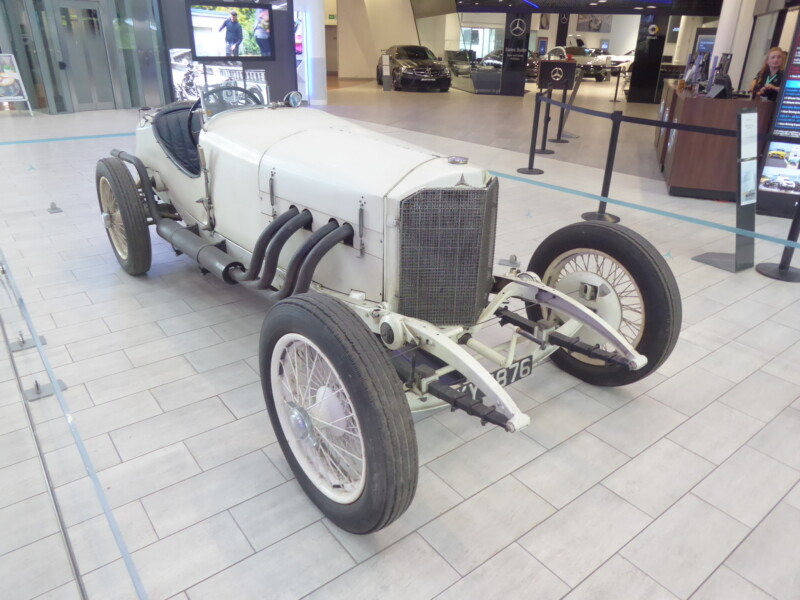
Displayed prominently by the entrance is this 1924 Mercedes 2 Litre. The first ever Targa Florio race took place in 1924 and for it, Mercedes entered three of these cars, driven by Christian Werner, who won, Christian Lautenschlager (10th) and Alfred Neubauer (15th). Today the winning car is missing, while Mercedes-Benz Heritage in Germany owns Lautenschlager’s entry. Neubauer’s car, meanwhile, was known to have been brought across to the UK and registered XY 4876 in London in 1925 and has been here ever since. In the 1950s it was bought by the late Gerald Palmer, designer of many BMC cars of the era, and it has been in his family ever since. It is only now that his daughter has decided that the car should be appreciated by a wider public and it recently arrived on display here.


500K Tourer: The Mercedes-Benz 500K (W29) is a grand touring car built by Mercedes-Benz between 1934 and 1936. First exhibited at the 1934 Berlin Motor Show. It is distinguished from the 500 sedan by the “K” for Kompressor (German for supercharger). it succeeded the Mercedes-Benz 380 introduced the previous year, It offered both a larger, more powerful engine and more opulent coachwork to meet customers’ demands for greater luxury and performance. The 500K used the same independent suspension as had been introduced on the 380, with a double wishbone front axle, double-joint swing axle at the rear, and separate wheel location, coil springs and damping, a world first. Consequently, it was a more comfortable and better handling car than Mercedes’ previous S/SS/SSK generation of roadsters from the 1920s, and offered greater appeal to buyers, particularly the growing number of well-heeled female drivers of the time. Pressing the throttle pedal fully engaged the Roots supercharger, inducing the five litre straight-eight engine to produce up to 160 hp and making the car capable of over 160 km/h (100 mph), while consuming fuel at the rate of up to 30 L/100 km (9.4 mpg‑imp; 7.8 mpg‑US) as it did so. Three different chassis and eight bodies were available for customers; the two longer “B” and “C” four-seat cabriolet versions rode on a wheelbase of 3,290 mm (129.5 in), and would later be used on other sedan and touring car models. The short “A” chassis, with a 2,980 mm (117.3 in) wheelbase, underpinned the two-seater models: the Motorway Courier, and the 1936 Special Roadster which offered the highest performance. All models featured such advanced equipment as safety glass, hydraulic brakes, and a 12-volt electrical system sufficient to bear the load of the electric windscreen wipers, door locks, and indicators. Of the combined production of the 500K (342 cars), including 29 “Special Roadsters” during its two years in production, and the later 540K (419 cars) from Sindelfingen, the deliveries were: 70 chassis without body; 28 open cars (offener Tourenwagen); 23 sedans with 4 doors (mainly 500K); 29 sedans with 2 doors (mainly 540K); 12 Coupés; 6 Autobahn cruisers (Autobahn-kurier); 58 Roadsters; 116 Cabriolets A; 296 Cabriolets B; 122 Cabriolets C.


170S Cabriolet: Launched in 1936, the 170V soon became Mercedes’ top-selling model, with over 75,000 made by 1939. Enough of the W136’s tooling survived Allied bombing during World War II (or could be recreated post-war) for it to serve as the foundation upon which the company could rebuild. By 1947 the model 170 V had resumed its place as Mercedes’ top-seller, a position it held until 1953. Most of the cars produced, and an even higher proportion of those that survive, were two or four door “Limousine” (saloon) bodied cars, but the range of different body types offered in the 1930s for the 170 V was unusually broad. A four-door “Cabrio-Limousine” combined the four doors of the four door “Limousine” with a full length foldaway canvas roof. Both the foor door bodies were also available adapted for taxi work, with large luggage racks at the back. There was a two-door two seater “Cabriolet A” and a two-door four seater “Cabriolet B” both with luggage storage behind the seats and beneath the storage location of the hood when folded (but without any external lid for accessing the luggage from outside the car). A common feature of the 170 V bodies was external storage of the spare wheel on the car’s rear panel. The two seater roadster featured a large flap behind the two seats with a thinly upholstered rear partition, and which could be used either as substantial luggage platform or as a very uncomfortable bench – the so-called mother-in-law’s seat. In addition to the wide range of passenger far bodied 170 Vs, a small commercial variant was offered, either as a flatbed truck or with a box-body on the back. Special versions of the 170 V were offered, adapted for use as ambulances or by the police, mountain rescue services and military. Production restarted in May 1946. The vehicles produced were versions of the 170 V, but in 1946 only 214 vehicles were produced and they were all light trucks or ambulances. Passenger car production resumed in July 1947, but volumes were still very low, with just 1,045 170 Vs produced that year. There was no return for the various open topped models from the 1930s. Customers for a Mercedes-Benz 170 V passenger car were restricted to the four door “Limousine” sedan/saloon bodied car. Production did ramp up during the next couple of years, and in 1949 170 V production returned to above 10,000 cars. From May 1949 the car, badged in this permutation as the Mercedes-Benz 170D, was offered with an exceptionally economical 38 PS diesel engine. The 170D was the world’s third diesel fuelled passenger car, and the first to be introduced after the war. A number of updates were made in 1950 and 1952, with more modern and more powerful engines among the changes, but with the appearance of the new Ponton bodied Mercedes-Benz 180 in 1953, the 170 models suddenly appeared very old fashioned. The 170 V was delisted in September 1953: in July 1953 the manufacturer had replaced the existing 170 S with the reduced specification 170 S-V. The car that resulted combined the slightly larger body from the 170 S with the less powerful 45 PS engine that had previously powered the 170 V. The vehicle provided reduced performance but at a reduced price, while salesmen steered more prosperous buyers to the new Ponton bodied 180. The diesel powered 170 S continued to be sold, now branded as the 170 S-D. The internal “W191” designation which had distinguished the previous 170 Ss was removed, and the 170 Ss manufactured from 1953 returned to the “W136” works designation that they had shared with the 170 V till the end of 1951. In September 1955 the last Mercedes-Benz W136, the Mercedes-Benz 170 S was withdrawn from production.


180 Ponton: The Mercedes-Benz “Ponton” series is a range of sedans / saloon car models from Mercedes-Benz, introduced starting in 1953, and subsequently nicknamed ‘Ponton’ (the German word for “pontoon”), referring to its ponton styling, a prominent styling trend that unified the previously articulated hood, body, fenders and runnings boards into a singular, often slab-sided envelope. At the time, Mercedes itself did not refer to any of its cars using the nickname. Mercedes stretched the ‘Ponton’ saloons into a range that became the automaker’s dominant production models until 1959. Mercedes-Benz emerged from World War II as a carmaker best known in the early 1950s for its expensive Mercedes-Benz 300 Adenauers and exclusive 300 S sports tourers. Both were largely handbuilt body on frame vehicles. Its low end was anchored by the dated pre-war designed 170. Seeking to expand its production, Mercedes turned toward the unibody concept to design a line of mass-produced cars. Work began in earnest on the pontons bodied cars in 1951, with a design focused on passenger comfort and safety. Head of the design team was Dr. Fritz Nallinger. Styling was headed by Karl Wilfert. Also in the design team was Béla Barényi, who conceived the passive safety (crash protection) engineering of the body. The 1953 W120 180 four-cylinder sedans were Mercedes’ second totally new series of passenger cars since World War II, following the 1951 introduction of the top of the range W186 300 “Adenauer”, and replaced the pre-war-designed W136 170 and 170 S. Contrasting very visibly with the traditional distinct fenders on that body-on-frame model and the ones before it, the ‘Pontons’ were Mercedes’ first monocoque, unitary body production models. Mercedes expanded the base Ponton model into a diversified line, developing multiple series based on the 180, by introducing more engines and stretching the body. Six-cylinder models received a longer nose, and ‘S’-models also had a longer passenger compartment, offering more legroom. A six-cylinder coupe and convertible were further derived, and a shortened floorpan of the four-cylinder sedan was also modified to serve as the structure for the W121 190 SL roadster. The ‘Ponton’ saloons were the automaker’s main production models until 1959, adding up to 80% of Mercedes-Benz car production between 1953 and 1959, with some models lasting until 1962. The first of the ‘Ponton’ models to go into production was the 1953 W120 180, 1.8 L four-cylinder, four-door sedan, available as the 180 petrol and the 180D diesel. In 1954 the W180 six-cylinder executive / luxury model 220a was added, developed mostly by stretching the W120’s body by 170 mm (6.7 in), complemented by a new rear suspension, and giving it the longer straight six M180 engine. The added length was divided between 100 mm (3.9 in) added forward of the firewall to accommodate the two cylinder larger engine, and 70 mm (2.8 in) to the rear seating area for additional legroom; the boots stayed the same. In 1956, the six-cylinder model was expanded into an entire range. The 220a gained a second carburettor and was upgraded to become the 220S, shortly joined in the line by new distinctively bodied, shorter wheelbase two-door coupe and convertible models. A third saloon series, the W105 219 was created by grafting the six-cylinder nose onto the shorter body of the four-cylinder from the firewall aft. In 1956, the four-cylinder model also received an all new, short-stroke 1.9 L petrol engine option, the W121 model 190, joined in 1958 by a 1.9 litre diesel. In 1958, the 220S models were upgraded with fuel injection, and became the W128 220 SE series. The models 180 D and 190 D received further updates in 1959 and 1961. The range was succeeded by the range of “Heckflosse” (or “Fintail”) models.


The Mercedes-Benz C111 was a series of experimental automobiles produced by Daimler-Benz in the 1960s and 1970s. The company was experimenting with new engine technologies, including Wankel engines, diesel engines, and turbochargers, and used the basic C111 platform as a testbed. Other experimental features included multi-link rear suspension, gull-wing doors and a luxurious interior with leather trim and air conditioning. The first version of the C111 was completed in 1969, and presented at the 1969 IAA in Frankfurt. The car used a fibreglass body shell and with a mid-mounted three-rotor direct fuel injected Wankel engine (code named M950F). The next C111 appeared in 1970; it was shown at the 1970 Geneva International Motor Show. It used a four-rotor engine producing 349 bhp. The car reportedly could reach a speed of 300 km/h (186 mph). The company decided not to adopt the Wankel engine and turned to diesel experiments for the second and third C111s. The C111-IID’s engine was a Mercedes-Benz OM 617, and produced 188 bhp at 4200 rpm. It was based on the Mercedes-Benz 85 kW variant of the OM 617 used in the Mercedes-Benz W 116 S-Class, but had a different turbocharger without a wastegate, which allowed an increased pressure ratio of 3.3. Daimler-Benz also added an intercooler that significantly improved the engine’s thermal efficiency. The C 111 III prototype that was completed in 1978, had a more aerodynamic bodywork that gave it an air drag coefficient of 0.195. It had a modified 3-litre version of the Mercedes-Benz OM 617 five-cylinder Diesel, now producing 228 bhp, and a BMEP of 1.68 MPa, resulting in a maximum torque of 401 Nm at 3600 min−1. It enabled the C 111 III to reach a top speed of 338 km/h (210 mph) at the Nardò Ring in 1978, and also to average a 16 l/100 km fuel consumption at an average speed of 325 km/h. The engine was fitted with an M-type inline injection pump of Bosch’s PE series with a maximum injection pressure of 40 MPa. A later 4.5 L twin KKK-turbocharged V8 version that produced 493 bhp/500 PS at 6000 rpm set another record, with an average lap-speed of 403.78 km/h (250.958 mph). This was achieved by Hans Liebold in 1 minute, 56.67 seconds on May 5, 1979. Total production was 16 cars: 13 first and second generation Wankel engined cars, two diesel engined third generation cars used in the Nardò record attempt, and a single V8 engined fourth generation car.


R129 SL: Designed in 1984, and launched in 1989, the R129 was based on the shortened floorpan of the Mercedes-Benz W124 and featured many innovative details for the time, for instance electronically controlled damping (Adaptive Damping System ADS, optional) and a hidden, automatically extending roll-over bar. The R107’s somewhat dated rear suspension with semi-trailing arms gave way to a modern multi-link axle. The number of standard features was high, with electric action for the windows, mirrors, seats and hydraulic convertible top. This car has the distinction of being the first passenger vehicle to have seat belts integrated into the seats as opposed to anchoring to the floor, B-pillar, and transmission tunnel. Initially, there were three different engines available: 300 SL with a M103 3.0 L 12-valve SOHC I6 (188 bhp), a 300 SL-24 with a M104 3.0 L 24-valve DOHC I6 (228 bhp) and the 500 SL with a M119 5.0 L 32-valve DOHC V8 (322 bhp) . These were joined in July 1992 by the 600 SL with a M120 6.0 L 48-valve DOHC V12 (389 bhp). There was a choice of 5-speed manual or 4–5 speed automatic for the six-cylinder cars; the V8 and V12 could only be ordered with a 4-speed automatic gearbox. In autumn 1993 Mercedes-Benz rearranged names and models. Also, the 300 SL and 300 SL-24 were respectively replaced by: SL 280 with a M104 2.8 L 24-valve DOHC I6 (190 bhp) and the SL 320 with a M104 3.2 L 24-valve DOHC I6 (228 bhp). Only the 280 was available with a manual gearbox. SL 500 and 600 continued with their respective engines. Starting in 1993, the cars were re-designated. For example, 500 SL became SL 500. Starting in model year 1994, Mercedes-Benz offered special SL models from time to time, such as the Mille Miglia edition cars of model year 1994 or the SL edition of model year 2000. 1994 cars had minor updates for the car and then in 1995 there was a minor facelift for the car, with the front fender vents updated to only 2 rounded slots, rather than 3 squared slots, and bumpers in body colour. The V8 and V12s were upgraded to 5 speed electronic transmission, the previous transmission was hydraulic 4-speed. A second facelift occurred in 1998 with many detailed changes applied, including new external mirrors, 17″ wheels and new bumpers. Also new were the engines, a SL 280 with a M112 2.8 L 18-valve SOHC V6 (201 bhp); SL 320 with a M112 3.2 L 18-valve SOHC V6 (221 bhp) and an SL 500 with a M113 5.0 L 24-valve SOHC V8 (302 bhp). The V12 engine remained unchanged. The car was replaced by the R230 generation SL in 2001, after 213,089 had been built. There were a number of very low volume AMG versions of the car, including this SL70 AMG. This was powered by a 7.1 litres (7,055 cc) V12 engine developing 496 PS (489 bhp) at 5,500 rpm and a maximum torque of 720 Nm (531 lb/ft) at 3,900 rpm. It was a bored out version of M120 6.0 V12 and with a longer stroke. Produced between 1996 and 1997, just 150 units were made.


Vision CLS: The Mercedes-Benz Vision CLS is a concept vehicle with a six-cylinder twin turbo diesel engine rated at 265 PS (261 hp) and 560 Nm (413 lb/ft), 7G-TRONIC seven-speed automatic transmission, Active Light System from Mercedes-Benz E-Class (W211), electrohydraulic brake system from Mercedes-Benz SL (R 230), dashboard and A-pillars upholstered in leather, soft leather upholstery on seats and door panels, oak veneer, glass roof, 470 litres of boot capacity, adaptive front airbags, window bags and side airbags, belt tensioners with adaptive belt force limiters. The vehicle was unveiled at the 2003 Frankfurt International Motor Show IAA. It was a preview of the Mercedes-Benz CLS-Class (C219), which looked extremely similar when it was released.


AMG CARS
The top floor of the building is given over to AMG cars, and there were a number of the more potent models with this badging on display here.
These days, the AMG version of the G Wagen seems to be the one you see more often than the less potent and cheaper (it’s all relative!) versions. These are definitely cars bought by the fashion conscious and those who want to make a strong statement. Part of London are littered with them, usually finished in black.


There are of course AMG versions of every model in the range, and few of them these days are subtle. Seen here was one of the more recent additions to the range, the CLE Coupe, a replacement for both the C and E Class Coupe models.


Further evidence of simplification of the range and an element of cost take out comes from the pairing of GT and SL models. Now these are very closely related with one being the open-topped car and the other the Coupe.


A number of older and rather special AMG models were also to be found in various places around the building.
Named after the British racing driver of the same name, the SLR Stirling Moss is a limited edition variant unveiled at the 2009 North American International Auto Show, which uses a speedster styling that does not include a roof or a windscreen. The car is designed by Korean designer Yoon Il-hun and is inspired by the 300 SLR race car. The interior was designed by Dutch designer Sarkis Benliyan. The SLR Stirling Moss was to be the last series of the McLaren SLR built under the partnership between Mercedes-Benz and McLaren, until McLaren announced their own final Edition of the SLR in late 2010. The supercharged 5.4-litre SLR AMG V8 engine is rated at 650 PS (641 hp). The SLR Stirling Moss could attain a top speed of 350 km/h (217 mph) with acceleration from 0 to 100 km/h (62 mph) achieved in 3 seconds. The car is approximately 200 kg (441 lb) lighter than the regular model due to carbon fibre construction and speedster styling. The SLR Stirling Moss began production in June 2009, after the SLR Roadster was discontinued in May 2009. All 75 cars planned to be produced were completed by December 2009. The SLR Stirling Moss was available only to the existing SLR owners and each car cost in excess of US$1 million


Unveiled at the 2012 LA Auto Show, with a market launch that began in June 2013. the SLS AMG Black Series is a high-performance variant of the SLS AMG Coupé inspired by the SLS AMG GT3. Notable changes over the SLS AMG include increased engine power to 631 PS/622 bhp at 7,400 rpm and decreased torque to 635 Nm (468 lb/ft) at 5,500 rpm along with increased engine redline of 8,000 rpm, fully revised high-speed valvetrain with modified camshafts, adapted cam geometry and optimised bucket tappets having a special coating which is otherwise exclusive to racing cars, modification of the intake air ducts (derestriction and adaptation to the new maximum engine speed), adaptation of the engine application and increase in peak pressure. This results in an acceleration time from 0–60 mph in 3.2 seconds (Car and Driver test) (2/10 of a second faster than the SLS AMG GT), and a top speed of 196 mph (315 km/h). The Black Series engine was, at the time, the most powerful naturally aspirated V8 engine fitted into production cars, until the debut of the Chevrolet Corvette C8 Z06. The Black Series is 70 kg (154 lb) lighter than the standard model. This is accomplished by increased use of carbon fibre in body panels, mechanical components, and the space frame. Further, a switch from steel to titanium for the exhaust system reduces weight by 13 kg (29 lb). The use of lithium-ion battery reduces weight by 8 kg (18 lb). The AMG SpeedShift DCT 7-speed sports transmission is installed 10 mm (0.39 in) lower in order to achieve a lower centre of gravity for the car and is braced against the body by gas-filled struts in order to avoid stress cycles. The transmission’s “Sport plus” and “Manual” modes have faster shifting speed than the standard model. The downshifting throttle blips are more audible. The new temporary “M” mode enables the driver to activate manual mode without having to remove a hand from the steering wheel, by pressing the “up” or “down” shift paddle once. Other notable highlights include electronically controlled AMG rear-axle differential lock with a shorter rear-axle ratio, new AMG RIDE CONTROL performance suspension (tauter basic tuning and electronically controlled two-stage damping, coil-over spring retainers to enable adjustment of wheel loads, elastokinematics 50 / 42% more rigid (front/rear axle), track width increased by 20 / 24 mm (0.79 / 0.94 in) (front/rear axle)), new wheel carriers on front axle and new front stabiliser tuning, matte black with high-sheen AMG 10-spoke light-alloy wheels in particularly light forged design with optimised strength (10 in × 19 in (250 mm × 480 mm) front, 12 in × 20 in (300 mm × 510 mm) rear), Michelin Pilot Sport Cup 2 sports tyres (275/35 R 19 front, 325/30 R 20 rear), AMG speed-sensitive steering with newly calibrated power steering characteristics, AMG ceramic brake discs (measuring 402 mm × 39 mm (15.8 in × 1.5 in) at the front and 360 mm × 32 mm (14.2 in × 1.3 in) at the rear) with increased hardness, wide flared wings with an added width of 13 mm (0.51 in) (front) and 26 mm (1.0 in) (rear) on each side, darkened headlamps and black surrounds for the rear lights, front apron and rear apron with diffuser along with side sill panels in Black Series-specific design (carbon fibre-reinforced plastic front splitter, carbon inserts in the side sills and the rear apron made of carbon fibre, enlarged air intakes with carbon-fibre flics), carbon-fibre bonnet with central air outlet, Alcantara black or Alcantara black/red interior AMG Performance steering wheel with Alcantara upholstery, metal bezel features a high-gloss black paint finish to match the high-gloss black surrounds of the air vents, Alcantara strip in anthracite across the entire width of dashboard leather with red contrasting stitching in the leather, designo leather and Alcantara upholstery (including bottom section of the dashboard, door centre panels and on the AMG sports bucket seats in Alcantara), deleted COMAND APS multimedia system replaced by a carbon-fibre trim element (COMAND APS is optionally available), AMG DRIVE UNIT, red seat belts and red contrasting stitching on the AMG sports bucket seats, the upper and lower section of the dashboard and the door panelling; floor mats with red edging and optional Bang & Olufsen BeoSound AMG surround sound system. Optional AMG Aerodynamics package includes a fixed adjustable carbon-fibre rear aerofoil as installed on the SLS AMG GT3, rear aerofoil braced by aluminium elements on a special insert on the boot lid, additional carbon-fibre flics on the front apron. New body colour choices include AMG solar beam yellow (total 7, including matte paint designo magno alanite grey). Other options include AMG carbon-fibre wing mirrors, AMG carbon-fibre engine cover, AMG Interior Carbon-Fibre package, AMG infotainment system (incl. COMAND APS, AMG Performance Media and backup camera), Media Interface. The US model went on sale in summer 2013 as 2014 model year vehicle.


The CLK 63 AMG Black Series is a high-performance version of the CLK 63 AMG coupé, produced between 2007 and 2009. 500 examples were produced in total, with 349 headed to the United States and only 120 examples built with right-hand drive. It is powered by the M156 6.2 L (6,208 cc) V8, producing 500 bhp at 6,800 rpm and 630 Nm (465 lb/ft) of torque at 5,250 rpm and uses Pirelli P-Zero Corsa tyres and features Mercedes’ SpeedShift 7G-Tronic transmission. Additional features also include a manually adjustable suspension system designed and manufactured by KW, a limited-slip differential, larger air intakes, bucket seats, 19-inch alloy wheels, and a spoiler, diffuser, and wider fenders made of carbon fibre. The rear seats have also been removed in order to save weight, and the top speed has been extended to 300 km/h (186 mph)


Available only in Coupé bodystyle, the C 63 AMG Black Series includes a modified version of C 63 AMG M156 V8 engine now generating a maximum power output of 517 PS (510 bhp) at 6,800 rpm and 620 Nm (457 lb/ft) of torque at 5,000 rpm. Performance figures include a 0–100 km/h (62 mph) acceleration time of 4.2 seconds and a top speed of 300 km/h (186 mph). Other notable features include 255/35 ZR 19 and 285/30 ZR 19 tyres, black diffuser insert shared with the SLS AMG GT3, twin tailpipes finished in chrome, AMG adjustable sports coilover suspension developed by KW with AMG rear axle differential lock, three-stage ESP, two AMG sports bucket seats, black DINAMICA microfibre upholstery on the centre panels of the seats and doors, omission of the rear bench seat (single rear seats available as option), AMG performance steering wheel upholstered in either Nappa leather or the Dinamica microfibre, steering wheel rim having flattened top and bottom sections along with aluminium shift paddles on the steering column for manual gear changes, red seat belts and red contrasting top stitching on the steering wheel, on the seats, door centre panels, armrests, on the doors, the centre console and on the shift lever gaiter along with three autonomous round dials has a three-dimensional TFT colour display. The AMG Track Package includes 255/35 R 19 front and 285/30 R 19 rear sports tyres from Dunlop, active rear-axle transmission cooling with radiator in the rear apron. The AMG Aerodynamics package includes carbon fibre flics on front apron, carbon-fibre functionally tuned front splitter and a fixed carbon-fibre rear aerofoil with an adjustable blade. China and US models went on sale in March 2012. Sales of Japanese version began in October 2011 in limited quantities (50 units produced), with delivery began in the Spring of 2012. Mercedes initially planned to build only 650 units, but after the sales success 800 units were produced.

CURRENT CARS
The current range is vast with a large number of models, even before you look at the different engine options available. As Mercedes have embarked on electrification so they have come up with purpose-designed cars on their own platform, so with a range from the EQA up to the luxury EQS in Saloon and SUV guises, they have no fewer than 7 different models, some with at least a close resemblance to their ICE brethren and others (the EQE and EQS saloon and SUV models) that look completely different. There were examples of all of them to be seen here.


The ICE cars were not forgotten either and examples of most of the models, but not all the different body styles, were also to be found on the second and first floors. There is a definite family style to all of them, but some are harder to tell apart than others – the saloon being the most similar – but the one thing that is becoming increasingly prevalent across the range is far more gaudy detailing and ever larger interior touch screens which in some cases now extend across the width of the entire car. Mercedes used to be known for bullet-proof engineering (that’s no longer true, quality here is sadly lacking on some cars) and being a bit austere, whereas now they seem to favour ever mor chintzy and tacky features. Slightly surprisingly, this does not seem to be putting buyers offer who just care about the badge, but it has definitely alienated a lot of the traditional buyers. Clearly Mercedes think they are no longer important!


RACE CARS
There are fewer race cars here than has been the case on my last couple of visits:
EQ Silver Arrow 01: The Mercedes-Benz EQ Silver Arrow 01 was the competitor for the maiden season of the Mercedes-Benz EQ Formula E Team in 2019/20 (Season 6) of the FIA Formula E Championship. The Silver Arrow 01 was piloted by Stoffel Vandoorne and Nyck de Vries. Unveiled in September 2019, the Mercedes-Benz EQ Silver Arrow 01 featured the distinct metallic silver of all Mercedes-Benz race cars. Prior to the season resuming after the COVID-19 pandemic, Mercedes brought back and updated with a special all-black base livery to join the call for diversity and stand against racism and all forms of discrimination. The drivers also wore black racing overalls. Just like all Formula E race cars, the Silver Arrow 01 features a 56-kWh battery supplied by McLaren Applied Technologies pushed to 250 kw (or 335bhp). The car could accelerate from 0-62 mph (0-100 km/h) in just 2.8 seconds, with a potential top speed of 174 mph (280 km/h). The Silver Arrow 01’s competitive race debut came at the Diriyah ePrix double race weekend. The duo started well, Vandoorne qualifying on the front row with De Vries just behind him in third. It was an eventful first race and Vandoorne still held onto a podium step with third whilst De Vries claimed sixth position, marking an impressive first race in the sport for the team. Despite a challenging qualifying for the second race, Vandoorne still managed to convert twelfth into another third position, whilst De Vries was unable to score any points. A strong performance followed in Santiago, Chile, during race two, De Vries leading a 5-6 finish after the duo qualified eighth and ninth. The third and fourth races in Mexico City and Marrakesh were disappointing for the team after the initial performances: neither driver was classified in Mexico, whilst both cars finished outside the top ten in Marrakesh, despite promising qualifying sessions from De Vries in both locations. Less than two weeks later, the season was suspended in response to the ongoing Covid-19 pandemic. The season resumed and concluded in August, with six races in nine days at the Tempelhof Airport Street Circuit in Berlin. The first race saw the team return to form, De Vries leading a 4-6 finish. Vandoorne followed this up with a fifth place in race two, though De Vries had to retire the car after yet another strong qualifying session. Race three saw neither driver score points after Vandoorne suffered a puncture and De Vries was punished after causing a collision. The latter redeemed himself in race four, scoring a fourth position after qualifying fifth. Vandoorne scored two points in the fifth race, coming from eighteenth on the grid to finish ninth. The team’s finest moment of the season, came in the final race: a 1-2 finish on the more technical extended circuit layout. This was a maiden Formula E victory for Vandoorne, after earning pole position, whilst De Vries earned his first Formula E podium after qualifying fourth. Vandoorne’s consistency led him to finishing the season ranking second in the Drivers’ Championship with 87 points, while Mercedes finished third in the Teams’ Championship, an impressive debut in a new kind of motorsport. De Vries finished eleventh with 60 points in total.


McLaren-Mercedes MP4-27: The McLaren MP4-27 is a Formula One racing car designed by Vodafone McLaren Mercedes for the 2012 Formula One season. The chassis was designed by Paddy Lowe, Neil Oatley, Tim Goss, Andrew Bailey and John Iley and was powered by a customer Mercedes-Benz engine. The car was driven by former World Champions Jenson Button and Lewis Hamilton. It was launched on 1 February at the McLaren team base in Woking, Surrey, ahead of the first winter test sessions at Jerez de la Frontera. This was the last McLaren car that Lewis Hamilton drove for the team, as he moved to the Mercedes AMG Petronas F1 Team in 2013. This was also the last McLaren Formula One car to win a race until the McLaren MCL35M did so in 2021. The car achieved 7 wins, 8 poles and third place in the Constructors’ Championship in 2012. The MP4-27’s nose (bottom) compared with that of Force India’s VJM05 (top), a more typical design of 2012-specification cars. The MP4-27 was one of three 2012 cars not to have the so-called “platypus” nose, instead opting for a gradual sloped nose. The Marussia F1 MR01 and HRT F112 also had a similar low nose; the F112 featured a less pronounced step in the nose of the car compared to others on the grid, however, incorporating the two ideas of regulation compliance into the same car. After the struggles McLaren experienced in the build-up to the 2009 and 2011 seasons, the MP4-27 demonstrated early promise in testing. This was confirmed at the first race of the season in Australia, when Lewis Hamilton and Jenson Button qualified first and second for the race, the team’s first since the 2009 European Grand Prix. Button went on to win the race, with Hamilton finishing third despite team principal Martin Whitmarsh’s admission that the team had made a mistake in calculating Button’s fuel load, forcing the 2009 World Champion to enter a “severe fuel-saving mode” on the eighth lap of the race. The car showed the best pace of the field again at the Malaysian Grand Prix, once again taking first and second in qualifying, with Hamilton on pole. Wet weather conditions during the race, however, created unpredictable results. Both cars maintained their positions until the race was stopped early in the race. After the race was restarted Button broke his front wing and fell out of the points, whilst Hamilton finished third. At the 2012 Chinese Grand Prix the Mercedes cars found pace, allowing Nico Rosberg to take his first pole and win. Button started fifth and finished second; Hamilton initially qualified second, but a gearbox change set him back to seventh before he fought through to third place. The result put Hamilton into the lead of the drivers’ standings after his third successive third place in the first three races. Button moved up to second, two points behind Hamilton. The next three races were poor for the team, especially Button as the car seemed to lose the performance advantage it held at the start of the season.[citation needed] In Bahrain, Hamilton finished in eighth and Button retired whilst running in seventh. Consequently, the team lost their lead in the constructors’ standings for the first time in 2012 to Red Bull, whilst Sebastian Vettel won the race and overtook Hamilton to lead the drivers’ standings. In Spain, Hamilton finished eighth (although he had to fight through the field after being demoted from pole position to the back of the grid when his car ran out of fuel on the in-lap) and Button finished ninth. Mark Webber won the Monaco Grand Prix, whilst Hamilton started third but finished a close fifth. Button started from twelfth and fell to fourteenth for much of the race before eventually retiring, for his third finish with no points in 2012. The car was also fitted with a much higher front wing starting from that race onwards. During the 2012 Canadian Grand Prix it brought mixed results in qualifying and the race. Hamilton qualified 2nd, while Button qualified 10th due to a tyre strategy error. Lewis Hamilton became the 7th different driver to win a race in 7 races after he finished 1st, at the same time getting a podium finish for the first time since the 2012 Chinese Grand Prix. Button continued his dismal form by finishing 16th as he struggled due to tyre problems which resulted in a complete lack of pace in a track which he won last year. However, the 2012 European Grand Prix and the 2012 British Grand Prix proved disappointing for the team once again. In Valencia, despite Lewis Hamilton’s 2nd place in qualifying, he was unable to match the pace of Vettel and Alonso in the race and then during his 2nd pit stop, the front jack failed, causing him a delayed pit-stop. To top off his day, he collided with Pastor Maldonado while battling for 3rd place and hit the wall in the closing stages of the race, ending his chances of a podium finish. Jenson Button could only managed 8th position after starting 9th, again struggling with tyres. The British Grand Prix was a nightmare for the team. Hamilton could only manage 8th, while Button qualified 18th, but was promoted to 16th due to penalties of Kamui Kobayashi and Vergne from Toro Rosso. Hamilton eventually finished 8th, while Button finished in 10th place. It became clear that the car might need significant updates before the 2012 German Grand Prix so as to improve recent poor results and get back to winning ways. However, despite the upgrades, the cars lacked grip in qualifying due to wet weather. Button outqualified Hamilton for the first time in 2012, in 7th place while Hamilton is right behind in 8th place. However, both drivers were promoted to 6th and 7th respectively due to Mark Webber’s gearbox change which resulted in a 5 place grid drop. In the race, Button who was running 2nd after the 2nd pit stop but struggled to match both Alonso’s and Vettel’s pace due to flat spotting a tyre and was overtaken by Vettel in the penultimate lap in turn 6. However, the manner which Vettel overtook is deemed to be illegal as all 4 wheels have been out of the track to overtake. Vettel was giving a time penalty, demoting him to 5th place while Button was promoted back to an impressive 2nd place. Hamilton’s 100th F1 race was disastrous. He lost a few positions after a poor start and then suffered a puncture on Lap 3, ending his chances for a points-scoring finish. But he unlapped himself by overtaking Vettel and compromising his race. He then retired on Lap 56 after a mechanical failure in his car. During the 2012 Hungarian Grand Prix, the efficiency of the upgrades finally showed as the qualifying session was held in dry weather. Lewis Hamilton recovered after the disappointment in the German GP, he was dominant in every practice and qualifying, achieving McLaren’s 150th pole position. Button qualified in 4th place. Hamilton finished the race in 1st place, while Button finished a disappointing 6th. Since then McLaren has struggled to attain consistent results due to unreliability. Hamilton qualified in pole positions in Singapore, Abu Dhabi and Brazil but was unable to translate it to victory as his car experienced mechanical failures in Abu Dhabi and Singapore and being hit by Nico Hülkenberg in Brazil, which was Hamilton’s last race for McLaren. All of this happened when Hamilton was leading the race. They also lost 2nd place to Ferrari in the Constructors’ Championship. However Hamilton still managed to achieve his last win for McLaren at the new Circuit of the Americas which was the penultimate race of the season and Button’s win at the action packed finale at the Brazilian Grand Prix proved to be a small consolation of what was to be a mixed season for them.


2016 Williams FW38 F1 car: The Williams FW38 is a Formula One racing car designed by Williams to compete in the 2016 Formula One season. The car was driven by Felipe Massa and Valtteri Bottas. During qualifying for the 2016 European Grand Prix, the FW38 set the highest ever recorded speed of a Formula One car during an official session, at 378 km/h (235 mph). During the 2016 Mexican Grand Prix, the FW38 set the second highest ever recorded speed of a Formula One car during a race, at 372.5 km/h (231.5 mph). The car proved to be competitive in the early stages of the championship, with Massa and Bottas securing points finishes for the first half of the season. However, lack of upgrades on the car meant that the team could not keep up with other teams during the later stages, such as Ferrari, Force India, and Red Bull Racing, and eventually lost 4th place in the constructors’ championship to Force India. On 17 May, two days after the Spanish Grand Prix, Williams tested a radical new rear wing design with a winglets on the side; similar to the cars from 1983-1984. The car was test driven by Alex Lynn. For the third year, Williams continued to use the Martini livery of their title sponsor. Alcohol laws meant Williams could not use their red Martini stripes in Abu Dhabi, instead using a blue livery. At the Brazilian Grand Prix, Massa’s car had his name placed on the engine cover and rear wing in place of the Martini logos.


One of the most impressive displays is this, an exploded F1 car, more precisely a 2010 W01. It’s been here for several years and it’s not hard to imagine why. Not only is it fascinating to look at, you can only guess how long it must have taken to set the display up!

This was only a short visit, but it was enough me to get a quick look at what was on display, bit not long enough to linger and really poke around all the new cars. I’ve driven quite a few of the current range, so already have experience of them. Sadly, my impressions of most of them has been largely ones of disappointment. But the heritage cars on show here are a different matter and always make the visit, however short, worthwhile.