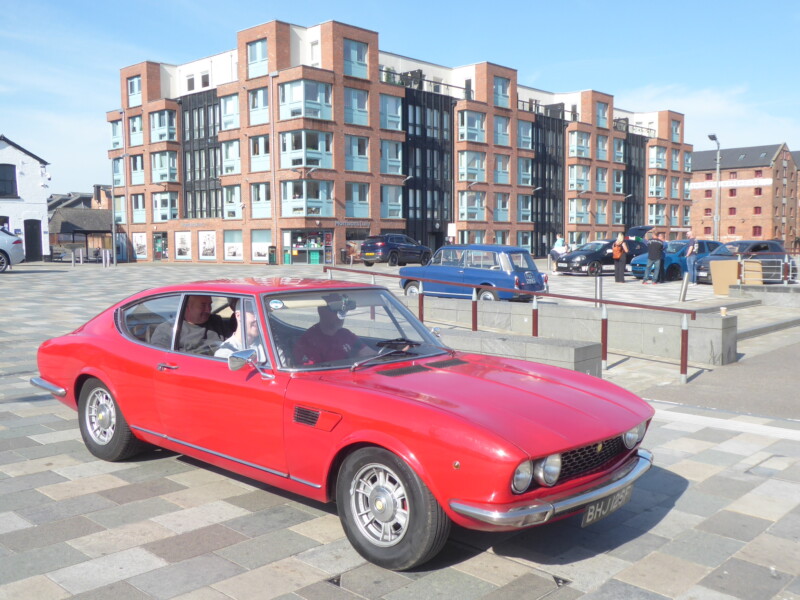
When considering event locations for the Italian Auto Moto Club’s 2025 program, whilst it was tempting simply to repeat the venues that had been used in the outgoing year, we were mindful of the fact that people do appreciate variety and so we wanted some places that we had not used before, or at least not for a few years. Gloucester Quays, the area around the restored bonded warehouses in Gloucester was one of the suggestions, as many years ago, there had been a well-received IAMC event held there, and a little more recently – though it turned out to be in 2019, there had been an Italian display here as ad adjunct to the Gloucester Goes Retro event that places cars on all four Gates of the city. Knowing how appealing the setting is for photographers, with great backdrops, and with access to food outlets and a large shopping area close by, it was one we decided to pursue. It turned out that the land is privately owned and whilst not against the idea, the landlord had a list of requirements that had to be met which seemed to become ever more onerous as the details of the event took shape. Truly they turned out to be the most difficult and owner we’ve ever had to deal with, and final approval was only given about 24 hours before the event. When we were doing set-up and talked to some of the local traders they said that there have been no events in this area for a very long time, so it is clearly not just this event for which the landlord was most particular. Thankfully, we had plenty of cars and bikes lined up ready to come just once we had the green light!

The setting itself is indeed impressive, as these pictures of the area evidence:


ABARTH
What is known as the Series 4 version of the familiar 595 reached the markets in the middle of 2016. After rumours had circulated all winter following the launch of the facelifted Fiat 500 last year, Abarth finally unveiled the Series 4 at the end of May 2016. Initially, we were told that the cars would not be available in the UK until September, but that came forward somewhat, with dealers all receiving demo cars in June, and the first customers taking delivery in July. Three regular production versions of both the closed car and the open-topped C were initially available, all badged 595, and called Custom, Turismo and Competizione, as before, though numerous limited edition models have since appeared and in most case disappeared. The most significant changes with the Series 4 are visual, with a couple of new colours, including the much asked for Modena Yellow and a different red, called Abarth Red, which replaces both the non-metallic Officina and – slightly surprisingly – the tri-coat pearlescent Cordolo Red. as well as styling changes front and rear. The jury is still out on these, with many, me included, remaining to be convinced. At the front, the new air intake does apparently allow around 15 – 20 % more air in and out, which will be welcome, as these cars do generate quite a lot of heat under the bonnet. Competizione models for the UK retain the old style headlights, as they have Xenon lights as standard, whereas the Custom and Turismo cars have reshaped units. At the back, there are new light clusters and a new rear bumper and diffuser. Inside, the most notable change is the replacement of the Blue & Me system with a more modern uConnect Audio set up, which brings a new colour screen to the dash. Mechanically, there is an additional 5 bhp on the Custom (now 145) and Turismo (now 165 bhp) and the option of a Limited Slip Diff for the Competizione, which is likely to prove a popular option. Details of the interior trim have changed, with a filled-in glovebox like the US market cars have always had, and electric windows switches that are like the US ones, as well as a part Alcantara trim to the steering wheel in Competizione cars


Many Abarth owners choose to modify their cars, some more obviously than others with everything from paint wraps to serious mechanical upgrades. Several of the cars here showed the sort of changes that owners have made. Notable among them was this one, which has a particular place in the Abarth community as it was the much loved machine of the late Adam Henry. Adam created the Modified Abarth group and was not just a great leader and friend and mentor to many but someone who made a number of changes to his car to get it do what he really wanted. He sold the car a little while before his sad passing and these day it is owned by Stuart Pugh who brings to many Abarth and Italian car gatherings for others to enjoy as much as he does.


Continuing the modified theme is this one, belonging to Gavin Jenkins, which is also far from standard, boasting well over 300 bhp and a noise all of its own! The Abarth Grande Punto debuted at the 2007 Frankfurt IAA Show, going on sale in the UK in late summer of 2008. Offering 155 bhp from its 1.4 litre T-Jet engine, coupled to a six speed gearbox, and riding on 45 profile 17″ alloys, the standard car got rave reviews from the journalists when they first tried it, and they were even more impressed by the changes wrought by the optional Esseesse kit. This increased power to 177 bhp, brought 18″ OZ lower profile wheels, whilst new springs lowered the ride height by 15-20mm, and high-performance front brake pads and cross-drilled front disc brakes helped the car to stop more quickly. The most distinctive feature of the car were the white alloy wheels, though, as owners found, keeping these clean is not a job for the uncommitted, and many have a second set of wheels that they use for grubbier conditions. Despite the positive press at launch, the car entered a very competitive sector of the market, and the combination of being relatively unknown, a limited number of dealers and the existence of established rivals from Renault and others meant that this always remained a left-field choice. The owners loved them, though, and they still do. The oldest cars have now had their 18th birthdays, and some have amassed relatively big mileages, but they are still a car for the cognoscenti.


The Punto Evo was launched at the 2010 Geneva Show, with the cars reaching UK buyers in the summer of that year, and it incorporated many of the changes which had been seen a few months earlier on the associated Fiat models, the visual alterations being the most obvious, with the car taking on the nose of the associated Fiat, but adapted to make it distinctively Abarth, new rear lights and new badging. There was more to it than this, though, as under the bonnet, the T-Jet unit was swapped for the 1.4 litre Multi-Air, coupled to a 6 speed gearbox, which meant that the car now had 165 bhp at its disposal. Eventually, Abarth offered an Esseesse kit for these cars, though these are exceedingly rare. For those in the know – which never seemed to be that many people – this was a really capable and desirable car, and the owners love them, lamenting the fact that the model had quite a short production life and has not been replaced. The final Punto model was the SuperSport. Easily identified by the distinctive black bonnet, just 199 of the SuperSport versions were built, of which around 120 are registered on UK roads. These cars had many of the options from the Punto Evo included as standard. Power came from the the 1.4-litre MultiAir turbo engine, tuned to produce 178bhp and 199lb ft of torque, up from 165 of the standard Punto Evo, giving the SuperSport a 0-62 time of 7.5 seconds and a top speed of over 132mph. To help put the power down, the SuperSport was fitted with wider 18″ wheels and optional Koni FSD dampers. Standard equipment included the Blue&Me infotainment system with steering wheel controls, automatic climate control and a popular option was the ‘Abarth Corsa by Sabelt’ sports leather seats. The SuperSport was available in the same colours as the regular Punto Evo, which means white, grey, black and red.


The Abarth 124 Spider was developed in parallel with the Fiat model. It does cost a lot more, and there are those who think you don’t get enough extra for your money, but those who have driven it will tell you otherwise. You certainly get more power. The 1.4 MultiAir turbo unit jumps up from 138bhp to 168bhp, while torque also increases by a modest 10Nm to 250Nm, which gives it a 0-62mph time of 6.8 seconds, which is half a second quicker than the 2.0-litre Mazda MX-5. The top speed is 143mph. It weighs just 1060kg meaning a power-to-weight ratio of 158bhp-per-tonne, and with the new Record Monza exhaust system it sounds great even at idle. The Abarth version gets a stiffer suspension setup than the regular Fiat 124 Spider, with Bilstein dampers and beefed-up anti-roll bars. Bigger Brembo brakes also feature, with aluminium calipers. It can be had with a six-speed manual or six-speed automatic transmission with paddles, and the latter gets a Sport mode for quicker shifts. Many of the UK cars sport the ‘Heritage Look’ pack, which is a no-cost option. It brings a matt black bonnet and bootlid, plus red exterior trim detailing and has proved popular. The £29,565 starting price gets you standard equipment such as cruise control, climate control, Bluetooth, a DAB radio and satnav, plus Alcantara black and red (or pure black) seat trim. The automatic gearbox is a £2,035 extra, while an optional visibility pack brings LED DRLs, auto lights and wipers and rear parking sensors. Sales ceased during 2019, with around 1800 cars having been brought into the UK, so this is always going to be a rare car, and values are already increasing at a rate reflecting its desirability and the difficulty in finding one.


The Abarth New 500e Scorpionissima is a performance variant that made its official debut on 22 November 2022, featuring unique scorpion-badged alloy wheels. Initially, it is being released in a Scorpionissima edition limited to 1,949 examples. Scorpionissima models will be available in a choice of Acid Green or Poison Blue colours, bearing unique side graphics and wheels. The first deliveries were scheduled for June 2023. It has a single electric traction motor that produces 114 kW (153 hp) and 235 Nm (173 lb/ft), an increase of 26.7 kW (35.8 hp) and 15 Nm (11 lb/ft) over the standard motor, and accelerates from 0 to 100 km/h (62 mph) in 7 seconds. The enhancements in power and torque output are derived from improved inverter and battery wiring, and a reduction in the final-drive ratio. The Abarth also swaps the rear drum brakes on the New 500 for discs. Three driving modes are offered: Turismo, Scorpion Street, and Scorpion Track; output power and torque are limited to 100 kW (130 hp) and 220 Nm (160 lb/ft) in Turismo. Scorpion Street maximizes regenerative braking, simulating the engine braking effect of a conventional car equipped with a manual transmission, while Scorpion Track sacrifices range for performance. In manufacturer testing at Balocco, the Abarth 500e is able to complete laps 1 second quicker than the Abarth 695. Total weight is 1,410 kg (3,110 lb), including the 295 kg (650 lb) battery. Charging hardware is carried over from the regular New 500 equipped with the larger battery, at rates up to 85 kW. The Abarth 500e has a battery with a capacity of 42.2 kWh (gross) and 37.3 kWh (net), giving the vehicle a claimed range of 264 km (164 mi) under the WLTP driving cycle with the standard 17-inch wheels; equipping the 18-inch wheels reduces range to 253 km (157 mi). Real-world mixed driving with 18-inch wheels indicated an actual range of 212 km (132 mi), with consumption of 3.4 mi/kWh.


ALFA ROMEO
The first car was called the Alfa Romeo Giulia Sprint GT, and was revealed at a press event held at the then newly opened Arese plant on 9 September 1963, and displayed later the same month at the Frankfurt Motor Show. In its original form the Bertone body is known as scalino (step) or “step front”, because of the leading edge of the engine compartment lid which sat 1/4 an inch above the nose of the car. The Giulia Sprint GT can be distinguished from the later models by a number of features including: Exterior badging: Alfa Romeo logo on the front grille, a chrome script reading “Giulia Sprint GT” on the boot lid, and rectangular “Disegno di Bertone” badges aft of the front wheel arches; flat, chrome grille in plain, wide rectangular mesh without additional chrome bars; single-piece chrome bumpers; no overriders. Inside the cabin the padded vinyl dashboard was characterised by a concave horizontal fascia, finished in grey anti-glare crackle-effect paint. Four round instruments were inset in the fascia in front of the driver. The steering wheel was non-dished, with three aluminium spokes, a thin bakelite rim and a centre horn button. Vinyl-covered seats with cloth centres and a fully carpeted floor were standard, while leather upholstery was an extra-cost option. After initially marketing it as a four-seater, Alfa Romeo soon changed its definition of the car to a more realistic 2+2. The Giulia Sprint GT was fitted with the 1,570 cc version of Alfa Romeo’s all-aluminium twin cam inline four (78 mm bore × 82 mm stroke), which had first debuted on the 1962 Giulia Berlina. Breathing through two twin-choke Weber 40 DCOE 4 carburettors, on the Sprint GT this engine produced 105 hp at 6,000 rpm. Like all subsequent models, the Sprint GT was equipped with an all-synchromesh 5-speed manual transmission. The braking system comprised four Dunlop disc brakes and a vacuum servo. The rear brakes featured an unusual arrangement with the slave cylinders mounted on the axle tubes, operating the calipers by a system of levers and cranks. According to Alfa Romeo the car could reach a top speed of “over 180 km/h (112 mph)”. In total 21,902 Giulia Sprint GT were produced from 1963 to 1965, when the model was superseded by the Giulia Sprint GT Veloce. Of these 2,274 were right hand drive: 1,354 cars fully finished in Arese, and 920 shipped in complete knock-down kit form for foreign assembly. For 1966, the Giulia Sprint GT was replaced by the Alfa Romeo Giulia Sprint GT Veloce, which was very similar but featuring a number of improvements: a revised engine—slightly more powerful and with more torque—better interior fittings and changes to the exterior trim. Alongside the brand new 1750 Spider Veloce which shared its updated engine the Sprint GT Veloce was introduced at the 36th Geneva Motor Show in March 1966, and then tested by the international specialist press in Gardone on the Garda Lake. Production had began in 1965 and ended in 1968. The Giulia Sprint GT Veloce can be most easily distinguished from other models by the following features: badging as per Giulia Sprint GT, with the addition of round enamel badges on the C-pillar—a green Quadrifoglio (four-leaf clover) on an ivory background—and a chrome “Veloce” script on the tail panel; black mesh grille with three horizontal chrome bars; the grille heart has 7 bars instead of 6; stainless steel bumpers, as opposed to the chromed mild steel bumpers on the Giulia Sprint GT. The bumpers are the same shape, but are made in two pieces (front) and three pieces (rear) with small covers hiding the joining rivets. Inside the main changes from the Giulia Sprint GT were imitation wood dashboard fascia instead of the previous anti-glare grey finish, front seats revised to a mild “bucket” design, and a dished three aluminium spoke steering wheel, with a black rim and horn buttons through the spokes. The Veloce’s type 00536 engine, identical to the Spider 1600 Duetto’s, featured modifications compared to the Giulia Sprint GT’s type 00502—such as larger diameter exhaust valves. As a result it produced 108 hp at 6,000 rpm, an increase of 3 hp over the previous model, and significantly more torque. The top speed now exceeded 185 km/h (115 mph). Early Giulia Sprint GT Veloces featured the same Dunlop disc brake system as the Giulia Sprint GT, while later cars substituted ATE disc brakes as pioneered on the GT 1300 Junior in 1966. The ATE brakes featured an handbrake system entirely separate from the pedal brakes, using drum brakes incorporated in the rear disc castings. Though the Sprint GT Veloce’s replacement—the 1750 GT Veloce—was introduced in 1967, production continued throughout the year and thirty final cars were completed in 1968. By then total Giulia Sprint GT Veloce production amounted to 14,240 examples. 1,407 of these were right hand drive cars, and 332 right hand drive complete knock-down kits. The Alfa Romeo 1750 GT Veloce (also known as 1750 GTV) appeared in 1967 along with the 1750 Berlina sedan and 1750 Spider. The same type of engine was used to power all three versions; this rationalisation was a first for Alfa Romeo. The 1750 GTV replaced the Giulia Sprint GT Veloce and introduced many updates and modifications. Most significantly, the engine capacity was increased to 1779 cc displacement. Peak power from the engine was increased to 120 hp at 5500 rpm. The stroke was lengthened from 82 to 88.5 mm over the 1600 engine, and a reduced rev limit from 7000 rpm to 6000 rpm. Maximum torque was increased to 137 lb·ft at 3000 rpm. A higher ratio final drive was fitted (10/41 instead of 9/41) but the same gearbox ratios were retained. The result was that, on paper, the car had only slightly improved performance compared to the Giulia Sprint GT Veloce, but on the road it was much more flexible to drive and it was easier to maintain higher average speeds for fast touring. For the United States market, the 1779 cc engine was fitted with a fuel injection system made by Alfa Romeo subsidiary SPICA, to meet emission control laws that were coming into effect at the time. Fuel injection was also featured on Canadian market cars after 1971. Carburettors were retained for other markets. The chassis was also significantly modified. Tyre size went to 165/14 from 155/15 and wheel size to 5 1/2J x 14 instead of 5J x 15, giving a wider section and slightly smaller rolling diameter. The suspension geometry was also revised, and an anti-roll bar was fitted to the rear suspension. ATE disc brakes were fitted from the outset, but with bigger front discs and calipers than the ones fitted to GT 1300 Juniors and late Giulia Sprint GT Veloces. The changes resulted in significant improvements to the handling and braking, which once again made it easier for the driver to maintain high average speeds for fast touring. The 1750 GTV also departed significantly from the earlier cars externally. New nose styling eliminated the “stepped” bonnet of the Giulia Sprint GT, GTC, GTA and early GT 1300 Juniors and incorporated four headlamps. For the 1971 model year, United States market 1750 GTV’s also featured larger rear light clusters (there were no 1970 model year Alfas on the US market). Besides the chrome “1750” badge on the bootlid, there was also a round Alfa Romeo badge. Similar Quadrofoglio badges to those on the Giulia Sprint GT Veloce were fitted on C pillars, but the Quadrofoglio was coloured gold instead of green. The car also adopted the higher rear wheelarches first seen on the GT 1300 Junior. The interior was also much modified over that of earlier cars. There was a new dashboard with large speedometer and tachometer instruments in twin binnacles closer to the driver’s line of sight. The instruments were mounted at a more conventional angle, avoiding the reflections caused by the upward angled flat dash of earlier cars. Conversely, auxiliary instruments were moved to angled bezels in the centre console, further from the driver’s line of sight than before. The new seats introduced adjustable headrests which merged with the top of the seat when fully down. The window winder levers, the door release levers and the quarterlight vent knobs were also restyled. The remote release for the boot lid, located on the inside of the door opening on the B-post just under the door lock striker, was moved from the right hand side of the car to the left hand side. The location of this item was always independent of whether the car was left hand drive or right hand drive. Early (Series 1) 1750 GTV’s featured the same bumpers as the Giulia Sprint GT Veloce, with the front bumper modified to mount the indicator / sidelight units on the top of its corners, or under the bumper on US market cars. The Series 2 1750 GTV of 1970 introduced other mechanical changes, including a dual circuit braking system (split front and rear, with separate servos). The brake and clutch pedals on left hand drive cars were also of an improved pendant design, instead of the earlier floor-hinged type. On right hand drive cars the floor-hinged pedals were retained, as there was no space for the pedal box behind the carburettors. Externally, the series 2 1750 GTV is identified by new, slimmer bumpers with front and rear overriders. The combined front indicator and sidelight units were now mounted to the front panel instead of the front bumper, except again on the 1971-72 US/Canadian market cars. The interior was slightly modified, with the seats retaining the same basic outline but following a simpler design. 44,269 1750 GTVs were made before their replacement came along. That car was the 2000GTV. Introduced in 1971, together with the 2000 Berlina sedan and 2000 Spider, the 2 litre cars were replacements for the 1750 range. The engine displacement was increased to 1962 cc. Oil and radiator capacities remained unchanged. The North American market cars had fuel injection, but everyone else retained carburettors. Officially, both versions generated the same power, 130 hp at 5500 rpm. The interior trim was changed, with the most notable differences being the introduction of a separate instrument cluster, instead of the gauges installed in the dash panel in earlier cars. Externally the 2000 GTV is most easily distinguished by its grille with horizontal chrome bars, featuring protruding blocks forming the familiar Alfa heart in outline, smaller hubcaps with exposed wheel nuts, optional aluminium alloy wheels of the same size as the standard 5. 1/2J × 14 steel items, styled to the “turbina” design first seen on the alloy wheels of the Alfa Romeo Montreal, and the larger rear light clusters first fitted to United States market 1750 GTV’s were standard for all markets. From 1974 on, the 105 Series coupé models were rationalised and these external features became common to post-1974 GT 1300 Junior and GT 1600 Junior models, with only few distinguishing features marking the difference between models. 37,459 2000 GTVs were made before production ended and these days they are very sought after with prices having sky-rocketed in recent years.


Alfa replaced the Giulia-based Spider model with an all-new design which finally made its debut in 1966 together with the Giulia Sprint GT Veloce at an event organised in Gardone Riviera. With its boat tailed styling, it quickly found favour, even before taking a starring role in the film “The Graduate”. The original 1600cc engine was replaced by a more powerful 1750cc unit at the same time as the change was made to the rest of the range, and the car continued like this until 1970, when the first significant change to the exterior styling was introduced on the 1750 Spider Veloce, with the original’s distinctive elongated round tail changed to a more conventional cut-off tail, called the “Kamm tail”, as well as improving the luggage space. Numerous other small changes took place both inside and out, such as a slightly different grille, new doorhandles, a more raked windscreen, top-hinged pedals and improved interior trim. 1971 saw the Spider Veloce get a new, larger powerplant—a 1962 cc, 132 hp unit—and consequently the name was changed from 1750 Spider Veloce to 2000 Spider Veloce. The 1600 Spider restarted production a year later as the Spider 1600 Junior, and was visually identical to the 1300. 1974 saw the introduction of the rare, factory request, Spider-Targa. Based upon the Spider, it featured a Porsche style solid rear window and lift out roof panels, all made out of black GRP type material. Less than 2,000 models of such type were ever made and was the only part solid roof Spider until the introduction of the factory crafted hard top. The 1300 and 2000 cars were modified in 1974 and 1975 respectively to include two small seats behind the front seats, becoming a “two plus two” four seater. The 1300 model was discontinued in 1977. Also, between 1974 and 1976, the early-style stainless-steel bumpers were discontinued and replaced with black, rubber-clad units to meet increasingly stringent North American crash requirements. 4,557 examples of the 1300 Junior were made and 4,848 of the 1600 Junior as well as 16,320 2000 Spider Veloces and 22,059 of 2000 Spider Veloce US version. There were also 4,027 1750 Spider Veloces produced.

The Series 3 Spider was previewed in North America for the 1982 model year with the introduction of 2.0 litre Bosch electronic fuel injection to replace the SPICA mechanical injection. The Spider underwent a major styling revamp in 1983, which saw the introduction of black rubber front and rear bumpers. The front bumper incorporated the grille and a small soft rubber spoiler was added to the trunk lid. The change altered the exterior appearance of the car considerably and was not universally praised by enthusiasts. Various other minor mechanical and aesthetic modifications were also made, and the 1600 car (never available in North America) dropped the “Junior” name. The Quadrifoglio Verde (Green Cloverleaf) model was introduced in 1986, with many aesthetic tweaks, including sideskirts, mirrors, new front and rear spoilers, hard rubber boot mounted spoilers with integral 3rd stoplight, unique 15″ alloys and optional removable hardtop. Different interior trim included blood red carpets and grey leather seats with red stitching. The QV was offered in only 3 colours: red, silver and black. It was otherwise mechanically identical to the standard Spider Veloce model, with a 1962 cc double overhead cam, four-cylinder engine (twin two-barrel carburettors in Europe; North American models retained the Bosch L-Jetronic fuel injection introduced for the 1982 model year except that the VVT mechanism was now L-Jet activated) and five-speed manual transmission. The interior was revised with a new centre console, lower dash panels (to meet U.S. regulations) and a single monopod gauge cluster (with electronic gauges). For the North American market a model dubbed the Graduate was added in tribute to the car’s famous appearance in the 1967 film, The Graduate, starring Dustin Hoffman. The Graduate was intended as a less expensive “entry-level” Alfa. While it had the same engine and transmission as the Quadrifoglio and Veloce, it lacked the alloy wheels and luxury features of the other two models. The Graduate model had manual windows, basic vinyl seats, a vinyl top, and steel wheels as standard. Air conditioning and a dealer-installed radio were the only options. It first appeared in 1985 in North America and continued until 1990. Minor changes occurred from 1986 to 89, including new paint colours, a centre high mount stop lamp midway through 1986 for North American models, a move away from the fade-prone brown carpet and new turn signal levers. Some 1988 models featured automatic seatbelts that extended from a large device between the front seats.


As was still the practice in the 1970s, Alfa followed up the launch of the Alfetta Berlina with a very pretty coupe. Styled by Giugiaro, this car, initially called the GT, and premiered in the autumn of 1974, looked completely unlike the saloon on which it was based. The first cars had 1.8 litre four cylinder engines and there was one of those on show. In 1976 the range was expanded both up and down with a 1.6 and a 2.0 model, the latter adopting the legendary GTV name. A rare SE model from this period was part of the display, complete with period vinyl roof (look closely), and although the pain does appear a bit like a lot of older Alfa reds, having gone rather pink, this was the actual shade when the car was new. In 1981, with the 2.5 litre V6 engine that had been developed for the ill-fated Alfa 6 luxury saloon available, Alfa was able to create a true rival for the 2.8 litre Capri with the GTV6. A facelift modernised the look of the car with plastic bumpers front and rear and a new interior looked rather better as well as being more ergonomically logical. There was a good mix of the earlier chrome bumpered and later plastic bumpered models, the last with 2.0 and 2.5 GTV6 versions both represented. There was also a car sporting 3.0 badging and right hand drive. This is a South African car. From 1974 South African Alfetta’s were manufactured at Alfa Romeo’s own Brits plant. South Africa was one of two markets to have a turbocharged GTV6, with a Garrett turbocharger and a NACA intake. An estimated 750 were assembled before all production ceased in 1986. The South African range included a 3.0 litre GTV-6, predating the international debut of the factory’s 3.0 litre engine in 1987 (for the Alfa 75). and 212 of these were built in South Africa for racing homologation. The last 6 GTV-6 3.0’s were fuel injected. To this day, the GTV-6 remains the quintessential Alfa Romeo for South Africans.


It was more than 10 years after the Montreal had ceased production before Alfa offered another high-end and costly Coupe model, and the result, seen for the first time in 1989, could hardly have been more different than its forebear. That car had been praised for its looks, whereas this one, the SZ, and cruelly nicknamed “Il Mostro”, was almost wilfully, well, “different”. First seen at the 1989 Geneva Show, the car was also first shown simply as a concept, called the ES-30, for Experimental Sports car 3 litre. It was produced by Zagato. Robert Opron of the Fiat design studio was responsible for the initial sketches while Antonio Castellana was largely responsible for the final styling details and interior. Only the ‘Z’ logo of Zagato was kept. The car possessed unusual headlights positioned in a trio on each side – a styling used more subtly on later Alfa Romeos in the 2000s. Mechanically and engine-wise, the car was based on the Alfa 75, production being carried out by Zagato at Terrazzano di Rho near the Alfa factory in Arese. The thermoplastic injection moulded composite body panels were produced by Italian company Carplast and French company Stratime Cappelo Systems. The suspension was taken from the Alfa 75 Group A/IMSA car, and modified by Giorgio Pianta, engineer and team manager of the Lancia and Fiat rally works team. A hydraulic damper system was made by Koni. The SZ was originally equipped with Pirelli P Zero tyres (front 205/55 ZR 16, rear 225/50 ZR 16) and is able to sustain over 1.1 G in cornering, some drivers have measured a cornering force of 1.4 G, which remains an excellent performance figure. Low volume production got underway late in 1989, and over the next three years, 1036 were built, slightly more than planned. With the exception of a black car made for Zagato, all of them were red. Subsequently a convertible version, the RZ (for Roadster Zagato), was produced from 1992 until December 1994. Although almost identical to look at the two cars had completely different body panels save for the front wings and boot. The RZ had a revised bumper and door sills to give better ground clearance and the bonnet no longer featured the aggressive ridges. Three colours were available as standard: black, yellow and red, with black and yellow being the more popular choices. Yellow and red cars got a black leather interior and black cars burgundy. Although the interior layout was almost unchanged from the SZ, the RZ had a painted central console that swept up between the seats to conceal the convertible roof storage area. 350 units were planned but production was halted after 252 units when the Zagato factory producing the cars for Alfa Romeo went in to receivership, a further 32 cars were then completed under the control of the receivers before production finished at 284 units. Of those final three were painted silver with burgundy interior and another pearlescent white.


The 916 Series cars were conceived to replace two very different models in the Alfa range. First of these was the open topped 105 Series Spider which had been in production since 1966 and by the 1990s was long overdue a replacement. Alfa decided to combine a follow on to the Alfetta GTV, long out of production, with a new Spider model, and first work started in the late 1980s. The task was handed to Pininfarina, and Enrico Fumia’s initial renderings were produced in September 1987, with the first clay models to complete 1:1 scale model made in July 1988. Fumia produced something rather special. Clearly an Italian design, with the Alfa Romeo grille with dual round headlights, recalling the Audi-based Pininfarina Quartz, another design produced by Enrico Fumia back in 1981, the proposal was for a car that was low-slung, wedge-shaped with a low nose and high kicked up tail. The back of the car is “cut-off” with a “Kamm tail” giving improved aerodynamics. The Spider would share these traits with the GTV except that the rear is rounded, and would feature a folding soft-top with five hoop frame, which would completely disappear from sight under a flush fitting cover. An electric folding mechanism would be fitted as an option. Details included a one-piece rear lamp/foglamp/indicator strip across the rear of the body, the minor instruments in the centre console angled towards the driver. The exterior design was finished in July 1988. After Vittorio Ghidella, Fiat’s CEO, accepted the design, Alfa Romeo Centro Stile under Walter de Silva was made responsible for the completion of the detail work and also for the design of the interiors, as Pininfarina’s proposal was not accepted. The Spider and GTV were to be based on the then-current Fiat Group platform, called Tipo Due, in this case a heavily modified version with an all new multilink rear suspension. The front suspension and drivetrain was based on the 1992 Alfa Romeo 155 saloon. Chief engineer at that time was Bruno Cena. Drag coefficient was 0.33 for the GTV and 0.38 for the Spider. Production began in late 1993 with four cars, all 3.0 V6 Spiders, assembled at the Alfa Romeo Arese Plant in Milan. In early 1994 the first GTV was produced, with 2.0 Twin Spark engine. The first premiere was then held at the Paris Motor Show in 1994. The GTV and Spider were officially launched at the Geneva Motor Show in March 1995 and sales began the same year. The cars were well received. At launch, many journalists commented that Alfa had improved overall build quality considerably and that it came very close to equalling its German rivals. I can vouch for that, as I owned an early GTV for eighteen months, and it was a well built and reliable car. In 1997 a new engine, a 24-valve 3.0 litre V6, was available for the GTV along with bigger, 12.0 inch brakes and red four-pot calipers from Brembo. The console knobs were changed from round central to rectangle ones and to a three-spoke steering wheel. Some versions were upgraded with different front bumper mesh to bring the wind noise down to 74 dBA. In May 1998 the cars were revamped for the first time, creating the Phase 2 models. Most of the alterations were inside. The interior was changed with new centre console, painted letters on skirt seals, changed controls and switches arrangement and different instrument cluster. Outside, the main changes included chrome frame around the grille and colour-coded side skirts and bumpers. A new engine was introduced, the 142 hp 1.8 Twin Spark, and others were changed: the 2.0 Twin Spark was updated with a modular intake manifold with different length intakes and a different plastic cover. Power output of the 2.0 TS was raised to 153 hp. Engines changed engine management units and have a nomenclature of CF2. The dashboard was available in two new colours in addition to the standard black: Red Style and Blue Style, and with it new colour-coded upholstery and carpets. The 3.0 24V got a six-speed manual gearbox as standard and the 2.0 V6 TB engine was now also available for the Spider. August 2000 saw the revamp of engines to comply with new emission regulations, Euro3. The new engines were slightly detuned, and have a new identification code: CF3. 3.0 V6 12V was discontinued for the Spider and replaced with 24V Euro3 version from the GTV. 2.0 V6 Turbo and 1.8 T.Spark were discontinued as they did not comply with Euro3 emissions. By the 2001-2002 model year, only 2 engines were left, the 2.0 Twin.Spark and 3.0 V6 24V, until the Phase 3 engine range arrived. The Arese plant, where the cars had been built, was closing and, in October 2000, the production of GTV/Spider was transferred to Pininfarina Plant in San Giorgio Canavese in Turin. In 2003 there was another and final revamp, creating the Phase 3, also designed in Pininfarina but not by Enrico Fumia. The main changes were focused on the front with new 147-style grille and different front bumpers with offset numberplate holder. Change to the interior was minimal with different centre console and upholstery pattern and colours available. Instrument illumination colour was changed from green to red. Main specification change is an ASR traction control, not available for 2.0 TS Base model. New engines were introduced: 163 hp 2.0 JTS with direct petrol injection and 237 hp 3.2 V6 24V allowing a 158 mph top speed. Production ceased in late 2004, though some cars were still available for purchase till 2006. A total of 80,747 cars were made, and sales of the GTV and Spider were roughly equal. More V6 engined GTVs than Spiders were made, but in 2.0 guise, it was the other way round with the open model proving marginally more popular.


Visually similar to the 159 models at the front, the Brera and Spider boasted unique styling from the A pillars rearwards. They were offered with the same range of engines as the 159, and thanks to that strong, but rather heavy platform on which they were built, even the 3.2 litre V6 cars were more Grand Tourer than rapid sports car. Pininfarina was responsible for both models. The Brera was first to market, in 2005, with the Spider following in 2006. Production of both ceased in late 2010, by which time 12,488 units of the Spider and 21,786 units of the Brera had been built. It will be very surprising if these do not attain classic status, and the consequent rise in values, though that has not happened yet.

Replacing the 147, the Alfa Romeo Giulietta (Type 940) is a five door hatchback positioned as a sporty and luxury car. Production started near the end of 2009 and the model was introduced at the March 2010 Geneva Motor Show. The Giulietta was placed second in the 2011 European Car of the Year awards. The platform used in the Fiat Group’s Compact, successor of the C-platform (base for Fiat Stilo, Fiat Bravo and Lancia Delta). Practically this was an all-new modular platform, only the central front part coming from the previous C-platform, but that part is modified also. Fiat Group used around 100 million euros to developing it. Mistakenly the journalists called the C-Evo platform, but Fiat never called on this name. It has a longer wheelbase, shorter overhangs and an advanced new type of MacPherson strut front suspension and multi-link rear suspension. Depending on the market and trim level, 16, 17, or 18-inch wheels are available. Available tire sizes are 205/55 R16, 225/45 R17, and 225/40 R18. The wheels use a 5-hole pattern with a 110 mm bolt circle. The length of the Giulietta is around 4.3 metres (14 ft). Only a five-door body is available for sale. In a viability plan forwarded to the US Government in February 2009, Chrysler (a partner of Alfa Romeo parent company Fiat) reported that the 147 replacement would come to market as the Milano and that it could be built in the USA. However, as of early 2010 Fiat was instead planning to concentrate on bringing larger models to the US, such as the Giulia. At the 2013 Frankfurt International Motor Show Alfa Romeo presented an updated Giulietta. Trim changes include a new Uconnect infotainment system with 5″ or 6.5″ Radionav touchscreen, a new front grille, a chrome-plated frame for the fog lights, a new and more supportive seat design, new wheels (16, 17 and 18-inch), as well as new exterior colours: Moonlight Pearl, Anodizzato Blue and Bronze. A new diesel engine variant has also arrived, the two-litre JTDM 2, developing 150 PS (148 bhp) and 380 Nm (280 lb/ft). In the 2014 range, all engines comply with Euro 5+ (Euro 6-ready) emission standards. Debuting at 2016 Geneva Motor Show, New Giulietta with facelifted front resembling Giulia and with new updated brand logo and new lettering. Trim line up will be changed to Giulietta, Giulietta Super and Giulietta Veloce. New body colour, new rims designs. Previous Giulietta QV will now be changed into sporty Veloce trim available with 240 PS (237 bhp) engine and TCT transmission. Also debuting was a new 1.6 JTDm 120 PS (118 bhp) TCT diesel engine. For 2019, the Giulietta had updated engines, all Euro 6 D: a 1.4-litre 120 PS turbo petrol, a 1.6-litre 120 PS Multijet with manual or Alfa TCT automatic transmission, and a 2.0-litre 170 PS Multijet with Alfa TCT. The top of the range model was a version with 1,742 cc turbocharged TBi engine rated 235 PS (232 bhp), lowered ride height (15 mm (0.6 in) at the front and 10 mm (0.4 in) at the rear), 18-inch Spoke design alloy wheels with dark titanium finish and 225/40 R18 tyres plus 18-inch 5 hole design alloy wheels as an option; an enhanced braking system (330 mm (13.0 in) front, 278 mm (10.9 in) rear) with calipers painted Alfa red; dark tinted windows, sports kick plates, cloverleaf badges, leather and microfibre seats plus sports leather seats as an option; dark brushed aluminium dashboard. 1750 is an engine size which has its roots in Alfa Romeo’s history, with 1.75 L engines being used to power some of Alfa Romeo’s first cars. The UK version was originally marketed as the Giulietta Cloverleaf, then Quadrifoglio Verde through ’14-’15 before finally being renamed to the Veloce in 2016 until the end of production. At the 2014 Geneva Motor Show, Alfa Romeo introduced a new Quadrifoglio Verde, it has new 1,742 cc Turbo direct injection aluminium-block Inline-four engine now upgraded to 240 PS (237 bhp) at 5750 rpm and 340 Nm (251 lb/ft) at 2000 rpm of torque and Alfa TCT 6-speed twin dry clutch transmission borrowed from the Alfa Romeo 4C. With new engine the Giulietta’s flagship can exceed 240 km/h (149 mph) and accelerate from 0 to 100 km/h (62 mph) in only 6.0 seconds. This new facelifted version was premiered with a limited ‘Launch Edition’, recognizable by the black-finish on the sills all round. Available in new matt Grigio Magnesio Opaco along with Rosso Alfa and Rosso Competizione. Each car has its own numbered plaque. Around 700 units were made. Between 2010 and 2019, production reached over 400,000. In 2020, Alfa Romeo announced that they were going to axe the Giulietta and production ended on 22 December 2020 spanning 10 years of sales from a period of 2010 to 2020. In total 469,067 examples were produced until 2020.


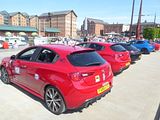


The Alfa Romeo 4C is a two-seater, rear-wheel drive coupé with technology and materials derived from the Alfa Romeo 8C Competizione, with a 1750 cc turbo petrol engine with direct injection, the “Alfa TCT” twin dry clutch transmission, and the Alfa DNA dynamic control selector. The 4C concept version was unveiled in the 81st Geneva Motor Show in March 2011, followed by the Mille Miglia 2011 parade, Goodwood Festival of Speed 2011,2011 Frankfurt Motor Show. It was displayed for the first time outside in Concorso d’Eleganza Villa d’Este in 2012. Compared to the production version, it is very similar, with the biggest differences being front lights, side vents and mirrors. The Alfa Romeo 4C Concept was voted the ‘Most Beautiful Concept Car of the Year’ award by the readers of German magazine Auto Bild, and won the Auto Bild Design Award 2011. It was awarded the “Design Award for Concept Cars & Prototypes” by referendum of the public in Villa d’Este. The production car was unveiled at the 2013 Geneva Motor Show, followed by 2013 Essen ‘Techno Classica’, Goodwood Festival of Speed 2013, Moscow Raceway, 2013 Frankfurt Motor Show. The bare ‘4C000’ chassis was also shown at the 2013 Geneva Motor Show. Ordering of European models began in October 2013 at Alfa Romeo dealerships in Europe. As part of the Alfa Romeo 4C launch, Alfa Romeo Style Centre and Compagnia Ducale designed a 4C IFD (Innovative Frame Design) Bicycle, inspired by the Alfa Romeo 4C coupé. The vehicle went on sale in December 2013 and marketed in Europe, Asia and America. Production of the 4C began May 2013 at Maserati’s plant in Modena, with an expected production of up to 2500 units per year. It was the first mass-produced Alfa Romeo model to be sold in the US market since 1995 when the 164 sedan stopped being sold in the US. Production of the Alfa Romeo 4C was originally estimated to be over 1000 units per year, with an upper limit of 3500 units per year, depending on the quantity of carbon fibre chassis that can be built by the supplier Adler Plastic.Within the 3,500-unit quota, 1,000 units are earmarked for Europe. Delivery of the European Alfa Romeo 4C Launch Edition took place at Balocco (Vercelli, Italy) Test Centre. In 2018, the 4C coupe was discontinued for the North American market. The 4C Spider, however continued to be sold there for model year 2019 and model year 2020. In other markets, such as Australia and Japan, both the coupe and Spider continued. In late 2020, a new tribute-edition named the 4C Spider 33 Stradale Tributo was announced. The car was designed by Centro Stile Alfa Romeo (Style Centre) and developed by Alfa Romeo. The chassis is composed of a central carbon fibre tub, with aluminium subframes front and rear. The carbon fibre tub is produced by TTA (Tecno Tessile Adler) in Airola, as a joint venture between Adler Plastic and Lavorazione Materiali Compositi. The carbon fibre components that make up the chassis are cut using CNC technology. The entire carbon-fibre monocoque chassis (“tub”) of the car weighs 143 pounds (65 kg). Front and rear aluminium subframes combine with the tub, roof reinforcements and engine mounting to comprise the 4C chassis giving the vehicle a total chassis weight of 236 lb (107 kg) and a total vehicle curb weight of just 2,465 lb (1,118 kg). The 4C has a single carbon fibre body, similar to the body of many supercars. The outer body is made of a composite material (SMC for Sheet Moulding Compound) which is 20% lighter than steel. The stability is comparable to steel and better than aluminium. The 4C employs double wishbone suspensions at the front and MacPherson struts at the rear. The resultant weight distribution is 38% on the front and 62% on the rear axle. Wheels and tyres have different diameters and widths front and rear: 205/45 R17 front and 235/40 R18 back as standard, with optional 205/40 R18 and 235/35 R19. Both wheel options come equipped with Pirelli P Zero tyres. The 4C uses vented disc brakes on all wheels; Brembo 305 millimetres (12.0 in) on the front and 292 millimetres (11.5 in) on the rear. The car can stop from 100 km/h (62 mph) in 36 metres. To save weight and increase steering feel, the 4C has no power steering. Its centre of gravity height, at 40 centimetres (16 in) off the ground, is 7 centimetres (2.8 in) lower than that of the Lotus Elise. The 4C uses a new all-aluminium 1,742 cc inline 4 cylinder turbocharged engine producing 240 PS at 6000 rpm. The engine has been designed for minimum weight. The engine’s combined fuel consumption 6.8 l/100 km (42 mpg‑imp; 35 mpg‑US). 0–62 mph (0–100 km/h) acceleration is achieved in 4.5 seconds and the top speed is 258 km/h (160 mph), the power-to-weight-ratio being just 0.267 hp/kg (8.22 lb/hp) A journalist from Quattroruote car magazine demonstrated how the 4C accelerates from 0–100 km/h (0–62 mph) faster than 4.5 seconds. In race mode, with left foot on the brake pedal, if you pull the right shift paddle the engine will rev to 3500 rpm, but if you also pull the left paddle the engine will rev to 6000 rpm and 0–100 km/h (0–62 mph) time will go down to 4.2 seconds. Italian car magazine Quattroruote published the lap time of 4C around Nürburgring. It lapped the ring in 8:04. The 4C is equipped with a six speed Alfa TCT Dual Dry Clutch Transmission, and can be operated via gearshift paddles on the steering wheel. It also has an Alfa ‘DNA’ dynamic control selector which controls the behaviour of engine, brakes, throttle response, suspension and gearbox. In addition to the modes already seen in Giulietta, the 4C has a new “Race” mode. The U.S. version of the 4C was introduced in the 2014 New York International Auto Show with the first 100 4C’s being shipped to the U.S. early July, with a total of 850 being shipped by the end of 2014. The U.S. model includes extra bracing and strengthening required to meet U.S. crash regulations (including aluminium inserts in the carbon fibre chassis), resulting in 100 kg (220 lb) of weight increase. This version also has new headlamps similar to those seen before in the 4C Spider version. In 2018, the 4C coupe was discontinued for the North American market due to US DOT NHTSA FMVSS 226 Ejection Mitigation. The regulation called for a progressive compliance date based on volume and, due to low volume, the 4C was allowed to continue until the last compliance date of 9/1/2017, thus all 2018 4C coupes in North America have build dates of 8/2017 or earlier. The 4C Spider, however continued to be sold in North America for model year 2019 and model year 2020. The Spider version of the 4C was previewed showing a pre-production prototype at the 2014 Geneva Motor Show. Sharing its engine with the Coupé version, the 4C Spider has different external parts such as the headlights, exhaust and engine hood, as well as a different roof section that features a removable roof panel. The North American spec 4C reflects a weight difference of only 22 lb (10 kg) (2,465 lbs vs. 2,487 lbs) for the Spider variant. Top speed is quoted at 257 km/h (160 mph) and acceleration from 0 to 100 km/h (62 mph) at 4.5 seconds. The 4C Launch Edition was a limited and numbered edition, unveiled at the vehicle’s launch at the 2013 Geneva Motor Show. The vehicle came in a choice of four paint colours (Rosso Alfa, Rosso Competizione tri-coat, Madreperla White tri-coat or Carrara White matte). 500 examples were reserved for Europe/ROW, 500 for North America, 88 for Australia (Rosso Alfa and Madreperla White only), 200 to Japan and 100 for the Middle East. Note that the original press release cited 500 for North America, 400 Europe, and 100 ROW; however, the plaques on actual cars suggest that more were built and are the numbers referenced above. Distinguishing features of the Launch Edition were carbon fiber trim (including headlight housings, spoiler and door mirror caps), rear aluminium extractor with dark finishing, Bi-LED headlights, dark painted 18-inch front and 19-inch rear alloy wheels, additional air intakes on the front fascia, red brake calipers, racing exhaust system, BMC air cleaner, specific calibration for shock absorbers and rear anti-roll bar, leather/fabric sports seats with parts in Alcantara and a numbered plaque. Alfa Red coloured cars got matching red stitching on the steering wheel, handbrake, mats, handles and sports seats. In Europe the vehicle went on sale for 60,000 euros including VAT. The 4C Competizione is a limited edition version of the 4C introduced in the 2018 Geneva Motor Show, finished in matte Vesuvio Grey, with carbon details on the roof, rear spoiler, mirror caps, side air vents and headlight moulding. The run reportedly consisted of 108 units. The Japanese market received 25 units, and 10 units were assigned to Australia. The US-market received no Competizione editions. The car had a very mixed reaction. The UK press hated it at launch, but owners generally disagreed and loved it. A total of 9117 were built before production ceased in 2020.


Preceded by Alfa Romeo’s first off-roader, the Matta, in the 1950s and the Kamal concept car in March 2003, the Stelvio is Alfa Romeo’s first production SUV. The high-performance trim of the Stelvio, the Quadrifoglio, was unveiled on 16 November 2016 at the Los Angeles Auto Show. The European versions of the Stelvio were presented at the Geneva Motor Show in March 2017. On January 18, 2017, Alfa Romeo began accepting orders for the Stelvio First Edition in the EMEA region. On November 2, 2017, the Stelvio Quadrifoglio went on sale in Italy. The Stelvio uses the same Giorgio platform already used by the Giulia, but slightly modified and raised by 22 cm (8.7 in). The Stelvio also shares the same engines and most of the mechanics, including a carbon-fibre driveshaft. In addition, its track width has increased by 2.9 cm (1.1 in) in the rear and 5.4 cm (2.1 in) in the front. It has a boot capacity of 525 L (18.5 cu ft). The boot sill is aligned with the rear bumper and cargo does not need to be lifted over a lip when being removed. There are large vehicle blind spots behind the car’s pillars. It has a 50/50 weight distribution and a drag coefficient of 0.32 (Cd). Euro NCAP classify it as a large off-road car. In order to reduce the weight of the car, aluminium is used for body panels, as well as for mechanical parts such as the suspension, brakes, and engine. The suspension, called AlfaLink, implements double wishbones in the front, and an aluminium multi-link configuration in the rear. The springs are longer than those in the Giulia, but stiffer to account for the extra weight and ride height. The driver sits nearly 20 cm (7.9 in) higher from the road than in the Giulia.[15] The suspension is tuned for improved handling and driving dynamics, which can compromise ride quality if optional larger-diameter wheels are fitted. Rear-wheel drive as standard, the Stelvio can be optioned with an Alfa Romeo “Q4” all-wheel drive system, which can send up to 50% of power to the front in low-grip conditions. The Stelvio weighs 1,660 kg (3,660 lb) with all fluids, 145 kg (320 lb) less than an equivalent BMW X3 and 110 kg (243 lb) less than a four-cylinder Porsche Macan. The car’s braking system is designed to be less-susceptible to brake fade, which can take time for unfamiliar drivers to get used to. All models feature an 8.8-inch infotainment system with Apple Car Play and Android Auto as standard, while small tweaks have been made throughout the ranges. The car’s engine lineup is similar to that of the Giulia’s, with a turbocharged 2.0-litre inline-four and a 2.2-litre diesel inline-four. The Quadrifoglio trim level offers a 2.9 litre 690T twin-turbo 90° V6 rated at 510 PS (503 bhp), developed for Alfa Romeo by Ferrari. In Europe, consumption standards use the WLTP measuring system, which increases accuracy for consumption and emission figures. On 29 September 2017, a Quadrifoglio model set a Nürburgring lap time of 7 minutes, 51.7 seconds, the fastest for a production SUV. For the 2019 model year, diesel engines of the Stelvio were updated to meet the Euro 6d emissions standards, with AdBlue technology introduced to tackle particulates in the exhaust. Both the 150 PS (148 bhp) and 180 PS (178 bhp) versions got 10 PS (10 bhp) more from this change. In addition, Alfa Romeo introduced a new trim level for Europe: the Ti (Turismo Internazionale). Slightly different than the similarly named Stelvio Ti on sale in the United States, the Euro-spec Ti is fitted with the TBI-M 2.0-litre inline-four, mated to an eight-speed automatic transmission, with power sent to all four wheels through Alfa Romeo’s Q4 all-wheel drive system. In 2020, Alfa Romeo introduced the newly updated Stelvio in China, with both the Giulia and the Stelvio featuring updated interiors, a new 8.8-inch touchscreen for the infotainment system, which now offers a WiFi hotspot, over-the-air software upgrades, integrated emergency call function, and call assistant function. There is the new leather-wrapped multi-function steering wheel and gear lever, with revised dashboard materials. The debut for North America was in the 2019 LA Auto Show. As of 2022 in North America, the Stelvio has four distinct models. Starting with the base model Sprint, the Ti, the Veloce and the top-of-the-line Quadrifoglio. In light of the Alfa Romeo Tonale’s release, Stelvio’s range of models was condensed from seven to four. The Stelvio has been Alfa’s best-selling model in Europe for the past few years though in the UK, the Giulia has done slightly better.


Perhaps surprisingly, there was only one example of the Giulia, Alfa’s well-received sports saloon that made its debut in mid 2015 as part of the marque’s 105 year celebrations, going on sale late the following year. Whilst the car remains a relatively rare sight on our roads, at Alfa events there are usually lines of them parked up.

AUTOBIANCHI
The Bianchina cars were the first Autobianchi models to be produced. Based on the Fiat 500, they were available in various configurations: Berlina (saloon), Cabriolet, Trasformabile (convertible), Panoramica (station wagon), and Furgoncino (van). The car was presented to the public on 16 September 1957 at the Museum of Science and Technology in Milan. Initially, the car was equipped with the smallest Fiat engine, air-cooled 479 cc producing 15 PS. In 1959, the engine power was increased to 17 PS and in 1960, the cabriolet version was launched. In the same year, the Trasformabile, whose engine cylinder capacity was increased to 499 cc (18 hp), was made available in a Special version with bicolour paint and an engine enhanced to 21 PS. The Trasformabile featured fixed B-pillar and partial roof, as the rest of the opening was covered with foldable fabric hood. Cabriolet version had no B-pillar. Also this was the only version to feature suicide doors. In 1962, the Trasformabile was replaced by a four-seat saloon. The engine and chassis were the same as in the Trasformabile. In 1965, a minor facelift was made. In France, the models were sold under different names: the Berlina became the Lutèce, the Familiare the Texane, and the Trasformabile was marketed as the Eden Roc. Production ceased in 1970.


FERRARI
Produced alongside the 308/328 GTB and GTS models was the Mondial, and there was one example of the car on show. Produced by Ferrari from 1980 through 1993, it replaced the 208/308 GT4. The “Mondial” name came from Ferrari’s history — the 500 Mondial race car of the early 1950s. Despite its predecessor being Bertone styled, the Mondial saw Ferrari return to Pininfarina for styling. Sold as a mid-sized coupe and, eventually a cabriolet, it was conceived as a ‘usable’ model, offering the practicality of four seats and the performance of a Ferrari. The car had a slightly higher roofline than its stablemates, with a single long door either side, offering easy access and good interior space, reasonable rear legroom while all-round visibility was excellent. The cabriolets also hold the distinction of being the only production automobile in history that has four seats, is rear mid-engined, and is a full convertible. The car body was not built as a monocoque in the same way as a conventional car. The steel outer body produced by the famous Italian coachbuilder Carrozzeria Scaglietti, in nearby Modena, was built over a lightweight steel box-section space frame. The engine cover and rear luggage compartment lids are in light alloy. The seats and interior were trimmed in Connolly hide, contrasting with the body colour. Most cars were painted rosso red, but some were black or silver, and a few were dark blue. The Mondial was the first Ferrari car where the entire engine/gearbox/rear suspension assembly is on a detachable steel subframe. This design made engine removal for a major rebuild or cylinder head removal much easier than it was on previous models. Unusually, the handbrake is situated between the driver’s seat and the inner sill. Once the handbrake is set it drops down so as, not to impede egress and ingress. Instead of the conventional “H” shift pattern, the gearbox has 1st gear situated in a “dog leg” to the left and back, behind reverse. This pattern, otherwise known as a “reverse h-gate”, allows quicker gear shifts between 2nd and 3rd gear, and also between 4th and 5th. The Mondial underwent many updates throughout production. There were four distinct iterations (8, QV, 3.2, and t), with the latter 3 having two variations each. (coupe and cabriolet). The first car was introduced as the Mondial 8 at the 1980 Geneva Auto Salon. It was the first Ferrari to depart from the company’s simple 3-digit naming scheme, and some reviews found it relatively mild, compared to other Ferraris, regarding performance, drawing criticism from some in the motoring press. It used a mid/rear-mounted Bosch K-Jetronic fuel injection V8, shared with the 308 GTBi/GTSi, mounted transversely. The engine used in the 1973 Dino 308 GT4. The K-Jetronic system is mechanical, with a high-pressure pump which streams fuel continuously to the injectors; it does not have a computer, just a few relays to handle the cold start sequence etc. The chassis was also based on the 308 GT4, but with a 3.9 inch longer wheelbase at 104.3 in. The suspension was the classic layout of unequal-length double wishbones and Koni dampers all around. Today, the Mondial 8 is considered one of the marque’s most “practical” vehicles, due to its 214 hp, proven drivetrain, four seats, and relatively low cost of maintenance (major services can be performed without removing the entire engine/transmission subframe). 703 examples were made. The first Mondial engine, although a DOHC design, used just two valves per cylinder. The 1982 Quattrovalvole or QV introduced a new four-valve head; the combustion chamber design purportedly based on the early eighties Formula 1 engine. Again, the engine was shared with the contemporary 308 GTB/GTS QV, and produced a much more respectable 240 hp. Appearance was largely as per the Mondial 8, although with red engine heads and prominent “quattrovalvole” script at the rear. 1,145 coupés built between 1982 and 1985. A new Cabriolet body style added for 1983. Body styling remained the same as the coupé variant, with the roof maintaining the ‘buttress’ design of the roof, though the Cabriolet required the rear seats to be mounted closer together laterally. The introduction of the Cabriolet saw the popularity of the Mondial rise, particularly in the American market, where the convertible body style was highly desirable. The Cabriolet has the added distinction of being the only four-seat, mid-rear engine, convertible automobile ever manufactured in regular production. 629 units were produced between 1983 and 1985, making this the rarest version of the Mondial. Like the Ferrari 328, the Mondial’s engine grew in both bore and stroke to 3,185 cc in 1985. Output was now 270 PS. The Mondial 3.2 was first presented at the 1985 Frankfurt Auto Show in September that year. Available in both Coupé and Cabriolet forms, styling refreshed with restyled and body-coloured bumpers, similar to the 328 with more integrated indicators and driving lamps, and new alloy wheels with a more rounded face. The 3.2 also boasted a major interior update, with a more ergonomic layout and a more rounded instrument binnacle. Later cars, from 1987 onwards, also sported ABS brakes. Fuel injection remained the primarily mechanical Bosch K-Jetronic (CIS) with an O2 sensor in the exhaust providing feedback to a simple computer for mixture trimming via a pulse modulated frequency valve that regulated control fuel pressure. The ignition system was Marelli Microplex, with electronic advance control and one distributor per bank of the V8. The 1988 Mondial 3.2 would be the final model year that retained the relatively low maintenance costs of the 308/328 drivetrain, allowing major service items like timing belt and clutch replacement performed with the engine/transmission package still in the car. The final Mondial evolution was 1989’s Mondial t, which was a substantially changed model. It was visually different from preceding Mondial models, the most recognizable being the redesign of the air intakes to a smaller rectangular shape. Additionally, the door-handles were of a visually different design, as were the front and rear bumpers which became body coloured. New front and rear wings cover wider tracks and are re-profiled to a fuller shape compared to previous models, which feature a rolled lip. The ‘t’ called attention to the car’s new engine/transmission layout: the previously-transverse engine mounted longitudinally while the gearbox remained transverse, thus forming a ‘t’. By adopting this layout, a longer engine could be mounted lower in the chassis, improving handling dramatically. The ‘t’ configuration was used by Ferrari’s Formula One cars of the 1980s, and would be the standard for the marque’s future mid-engined V8 cars, beginning with the 348, introduced later in the year. The transverse manual gearbox fitted with a Limited Slip Differential with a twin-plate clutch design with bevel gears driving the wheels. Later in production, a Semi-automatic transmission termed “Valeo” was available as an option; while shifting was using a traditional gear lever, the clutch was actuated automatically without a clutch pedal. The engine was up to 3405 cc and 300 hp, controlled by Bosch Motronic DME 2.5 (later DME 2.7) electronic engine management that integrated EFI and ignition control into a single computer unit. Two of these used in the car: one for each bank of the engine. Engine lubrication upgraded to a dry-sump system. The Mondial’s chassis would underpin a new generation of 2-seat Ferraris, right up to the 360, but the 2+2 Mondial would end production just four and a half years later in 1993. However, the “t” layout of the engine and transaxle, adapted from Ferrari’s Formula One cars, continues to be used in mid-engined V8 model Ferraris to date, albeit with a more sophisticated chassis. The new layout saw the engine and transmission mounted on a removable subframe; the assembly removed from the underside of the vehicle for maintenance. This process is necessary for timing belt replacement, making this a costly procedure for the owner who does not have a lift. On the other hand, the clutch was now located at the very rear of the drive train. This arrangement makes clutch replacement and service a simple, inexpensive, and readily owner-do-able proposition. The “t” was home to other Ferrari firsts: It used power assisted steering for the first time and had a 3-position electronically controlled suspension for a variable trade-off between ride quality and road holding. It also had standard ABS. Total production of the t Coupe was 858 (45 Right Hand Drive), and the t Cabriolet of 1,017 (51 Right Hand Drive, meaning that around 6000 Mondial cars were produced over those 13 years, making it one of the most numerous Ferraris.


The next V12 engined Ferrari was the 599 GTB (internal code F141) a new flagship, replacing the 575M Maranello. Styled by Pininfarina under the direction of Ferrari’s Frank Stephenson, the 599 GTB debuted at the Geneva Motor Show in February 2006. It is named for its total engine displacement (5999 cc), Gran Turismo Berlinetta nature, and the Fiorano Circuit test track used by Ferrari. The Tipo F140 C 5999 cc V12 engine produced a maximum 620 PS (612 hp), making it the most powerful series production Ferrari road car of the time. At the time of its introduction, this was one of the few engines whose output exceeded 100 hp per litre of displacement without any sort of forced-induction mechanism such as supercharging or turbocharging. Its 448 ft·lb of torque was also a record for Ferrari’s GT cars. Most of the modifications to the engine were done to allow it to fit in the Fiorano’s engine bay (the original Enzo version could be taller as it would not block forward vision due to its mid-mounted position). A traditional 6-speed manual transmission as well as Ferrari’s 6-speed called “F1 SuperFast” was offered. The Fiorano also saw the debut of Ferrari’s new traction control system, F1-Trac. The vast majority of the 599 GTB’s were equipped with the semi-automatic gearbox, with just 30 examples produced with a manual gearbox of which 20 were destined for the United States and 10 remained in Europe. The car changed little during its 6 year production, though the range did gain additional versions, with the HGTE model being the first, with a number of chassis and suspension changes aimed at making the car even sharper to drive, and then the more potent 599GTO came in 2010. With 670 bhp, this was the fastest road-going Ferrari ever made. Just 599 were made. The model was superceded by the F12 Berlinetta in 2012.


An all new design, the 458 Italia was first officially unveiled at the 2009 Frankfurt Motor Show. Once more, Ferrari advised that the model incorporated technologies developed from the company’s experience in Formula 1. The body computer system was developed by Magneti Marelli Automotive Lighting. The 458 came with a 4,499 cc V8 engine of the “Ferrari/Maserati” F136 engine family, producing 570 PS ( 562 hp) at 9,000 rpm and 540 N·m (398 lb/ft) at 6,000 rpm with 80% torque available at 3,250 rpm. The engine featured direct fuel injection, a first for Ferrari mid-engine setups in its road cars. The only transmission available was a dual-clutch 7-speed Getrag gearbox, in a different state of tune shared with the Mercedes-Benz SLS AMG. There was no traditional manual option, making this the fourth road-car after the Enzo, Challenge Stradale and 430 Scuderia not to be offered with Ferrari’s classic gated manual. The car’s suspension featured double wishbones at the front and a multi-link setup at the rear, coupled with E-Diff and F1-Trac traction control systems, designed to improve the car’s cornering and longitudinal acceleration by 32% when compared with its predecessors. The brakes included a prefill function whereby the pistons in the calipers move the pads into contact with the discs on lift off to minimise delay in the brakes being applied. This combined with the ABS and standard Carbon Ceramic brakes caused a reduction in stopping distance from 100–0 km/h (62-0 mph) to 32.5 metres. Ferrari’s official 0–100 km/h (62 mph) acceleration time was quoted as 2.9–3.0 seconds with a top speed of 340 km/h (210 mph). In keeping with Ferrari tradition the body was designed by Pininfarina under the leadership of Donato Coco, the Ferrari design director. The interior design of Ferrari 458 Italia was designed by Bertrand Rapatel, a French automobile designer. The car’s exterior styling and features were designed for aerodynamic efficiency, producing a downforce of 140 kg (309 lb) at 200 km/h. In particular, the front grille features deformable winglets that lower at high speeds, in order to offer reduced drag. The car’s interior was designed using input from former Ferrari Formula 1 driver Michael Schumacher; in a layout common to racing cars, the new steering wheel incorporates many controls normally located on the dashboard or on stalks, such as turning signals or high beams. At launch the car was widely praised as being pretty much near perfect in every regard. It did lack a fresh air version, though, but that was addressed with the launch of the 458 Spider at the 2011 Frankfurt Motor Show. This convertible variant of the 458 Italia featured an aluminium retractable hardtop which, according to Ferrari, weighs 25 kilograms (55 lb) less than a soft roof such as the one found on the Ferrari F430 Spider, and can be opened in 14 seconds The engine cover was redesigned to accommodate the retractable roof system. It had the same 0–100 km/h time as the hard-top but a lower top speed of 199 mph. It quickly became the better seller of the two versions.


Launched at the 2015 Geneva Show, the 488GTB followed the lead set by the California T in bringing turbocharging into a modern-day, mid-engined V8 Ferrari supercar for the first time. The engine is completely new when compared with its V8 stablemate, not only in components but also in feel and character. It is a twin-turbocharged 3902cc unit whilst that in the California T is 3855cc. In the 488 GTB, it produces 660bhp at 8000rpm and 560lb ft at 3000rpm. Both outputs are significant increases over the normally aspirated 4.5-litre V8 used in the 562 bhp 458 Italia and 597 bhp 458 Speciale, and also greater than the car’s biggest rival, the McLaren 650S. The torque figure of the 488 GTB is such that it also exceeds the 509lb ft at 6000rpm of the normally aspirated V12 used in the range-topping Ferrari F12 Berlinetta. The mighty new engine in the 488 GTB drives the rear wheels through a revised seven-speed dual-clutch automatic gearbox derived from the 458. It features a new ‘Variable Torque Management’ system which, Ferrari says, “unleashes the engine’s massive torque smoothly and powerfully right across the rev range”. The gear ratios are also tuned to “deliver incredibly progressive acceleration when the driver floors the throttle”. The 488 GTB can crack 0-62mph in just 3.0sec, 0-124mph in 8.4sec and reach a top speed of 205mph. Its 0-62mph and 0-124mph times match the McLaren 650S’s, but the Woking car’s top speed is slightly higher at 207mph. The engine also accounts for the ‘488’ element of the car’s name, because each of the engine’s eight cylinders is 488cc in capacity when rounded up. The GTB suffix, standing for Gran Turismo Berlinetta, is a hallmark of previous mid-engined V8 Ferraris such as the 308 GTB. Not only is the new turbo engine more potent than the 4.5-litre V8 from the 458 Italia, but it is also more economical. Combined fuel economy is rated at 24.8mpg, compared with 21.2mpg in the 458 Italia, and CO2 emissions are 260g/km – a 47g/km improvement. Ferrari’s HELE engine stop-start system features on the 488 GTB. Developments on the dynamic side include a second generation of the Side Slip Angle Control system, called SSC2. This allows the driver to oversteer without intruding, unless it detects a loss of control. The SSC2 now controls the active dampers, in addition to the F1-Trac traction control system and E-Diff electronic differential. Ferrari says the result is “more precise and less invasive, providing greater longitudinal acceleration out of corners” and flatter, more stable behaviour during “complex manoeuvres”. Learnings from the Ferrari XX programme have also been incorporated into the 488 GTB, something that Ferrari says allows all drivers and not just professionals, to make the most of its electronic and vehicle control systems. It also claims the 488 GTB is “the most responsive production model there is”, with responses comparable to a track car. The 488 GTB has lapped Ferrari’s Fiorano test track in 1min 23sec – two seconds faster than the 458 Italia, and half a second quicker than the 458 Speciale. The dimensions of the 488 GTB – it is 4568mm in length, 1952mm in width and 1213mm in height – closely match the 458 Italia from which it has evolved. Its dry weight is 1370kg when equipped with lightweight options – 40kg more than the McLaren 650S. The new look, styled at the Ferrari Styling Centre, features several new aerodynamic features that improve downforce and reduce drag. Most notable is the addition of active aerodynamics at the rear through a ‘blown’ rear spoiler, where air is channelled from the base of the glass engine cover under the spoiler. This contributes to the 50% increase in downforce over the 458 Italia. Also new is a double front spoiler, an aerodynamic underbody, a large air intake at the front that references the 308 GTB, a diffuser with active flaps, new positioning for the exhaust flaps and new-look lights. The interior has been redesigned to be made more usable, including new switchgear, air vents and instrument panel. The multi-function steering wheel remains, while the infotainment system gets a new interface and graphics. The Spider followed the closed coupe model six months later.


The Ferrari Portofino (Type F164) is a grand touring sports car. It is a two-door 2+2 hard top convertible, with a 3.9 L twin-turbo V8 engine and a 0–60 mph time of 3.5 seconds. The car is named after the village of Portofino on the “Italian Riviera” and succeeds the company’s previous V8 grand tourer, the California T. The car was unveiled at the 2017 Frankfurt Motor Show. The 2020 Ferrari Roma coupe is based on the Portofino. A convertible version of the Roma was unveiled in 2023 to replace the Portofino. The Ferrari Portofino was unveiled on the Italian Riviera in the village of Portofino at two exclusive evenings on 7 and 8 September 2017, at which Piero Ferrari, Sergio Marchionne, Sebastian Vettel, and Giancarlo Fisichella were present. It was also shown at Maranello on September 9 and 10 during the Ferrari 70th Anniversary celebration. By the end of 2017, the Portofino was unveiled in Asia, namely China and Japan, where China is said to be a big market for the car. In Japan, the vehicle was initially private-previewed in November, before its official debut in February 2018. Prices in Japan start from JPY25,300,000. Prices in the U.S. start from $215,000. In Hong Kong, the Portofino was launched in late March 2018, making it the third time in Ferrari’s history to launch a new car in the Hong Kong’s Peninsula Hotel (Enzo in 2003, followed by FF in 2010). Unlike previous occasions where the vehicle launch occurred in only one part of the ground floor lobby, the Portofino’s launch occupied the hotel’s entire ground floor area, where a few other Ferrari models were also parked outside the drop-off area, and creative lighting featuring the Ferrari’s Prancing Horse logo was also projected on the hotel’s exterior walls. A China-spec, left-hand drive model was displayed, which features a simplified Chinese menu display—a rare move for Ferrari as not all Chinese-speaking Asian regions would receive a Chinese language menu. Pricing for the Portofino in Hong Kong (as of April 2018) starts from HK$3.5M, with deliveries scheduled later in the year. A right-hand drive model was first spotted at the city’s 488 Pista launch event in late June 2018. The chassis of the Portofino is made of 12 different aluminium alloys with much of its components now being integrated. The A-pillar of its predecessor consisted of 21 separate components but it is now a single piece in the Portofino. Hollow castings allow for increased structural rigidity, increasing it by 35% over its predecessor, the Ferrari California T. Its body has drag coefficient of Cd=0.312. Weight saving has been kept in focus while the development of the Portofino was carried out. Ferrari engineers managed to shave weight from the powertrain, dashboard structure, air-conditioning and heating and electronic systems of the car resulting in a weight of 1,664 kg (3,668 lb), making the car 80 kg (176 lb) lighter than its predecessor. The engine, a 3,855 cc Ferrari F154BE twin-turbocharged V8, is the same as in the Ferrari GTC4Lusso T, but yields a slightly de-tuned power output of 592 bhp (600 PS) at 7,500 rpm and 760 Nm (561 lb/ft) of torque at 3,000 to 5,250 rpm. Changes to the engine include a 10% pressure increase in the combustion chamber, revised connecting rods and pistons and a single cast exhaust manifold. The car retains the 7-speed dual clutch transmission from its predecessor but features a new software to allow for faster gear shifts. The exhaust system has been tweaked to give the car a proper sound note while maintaining its grand touring nature, featuring an adjustable electric bypass valve that monitors the engine’s sound according to driving conditions. The Portofino can accelerate from 0–100 km/h (0–62 mph) in 3.5 seconds, 0–200 km/h (0–124 mph) in 10.8 seconds and can attain a top speed of 320 km/h (199 mph). The Portofino features optional magnetorheological dampers, a carryover from the California, with an improved software to maintain good ride quality even though having a stiffer suspension system than the California. Like the company’s V12 grand tourer 812 Superfast, the Portofino features an electrically assisted power steering. Both the suspension system and steering become increasingly responsive when the car is in sports mode. The interior of the Portofino was developed after taking input from various clients. The rear seats have increased legroom (by 5 cm) and the infotainment system is more advanced and easier to use, featuring a 10.2-inch display screen in the centre console with optional Apple CarPlay functionality, as in its predecessor. The air conditioning system has been refined as well and is now 25% faster and 50% quieter than the California’s. On 16 September 2020, Ferrari launched the Portofino M (Modificata or Modified). The power was increased to 612 bhp (620 PS) and was released in the middle of 2021.


FIAT
Known as project 110, the brief for the Nuova 500 was to create a micro-car that would not only carry on the tradition of the earlier Topolino, but which would also take sales away from the ever popular Lambretta and Vespa scooters of the day. It clearly needed to be smaller than the 600 which had been released with a conventional 4 cylinder engine. Not an easy task, but development started in 1953 and by August 1954, two designs were ready to be shown to Fiat management. They selected one, and serious development began. At first the car was referred to as the 400, as it was going to have a 400cc engine, but it was soon realised that this was just too small, so a larger 500cc air-cooled engine was developed. It was signed off in January 1956, with production starting in March 1957 in advance of a June launch. Fiat’s marketing department got busy, with hundreds of the new car taking to the streets of Turin, each with a pretty girl standing through the open sunroof that was a feature of all the early cars. The press loved it. 50 units were shipped to Britain, where the car made its debut at Brands Hatch, and again the reception was enthusiastic. But the orders just did not come in. Fiat went for a hasty rethink, relaunching the car at the Turin Show later that year. power was increased from 13 to 15 bhp, and the poverty spec was lessened a little, with headlight bezels, brightwork on the side and chrome hubcaps, a Nuova500 badge on the engine cover, winding side windows (the launch cars just had opening quarterlights) and the option of a heater fan. It was enough to get sales moving. The original car was still offered, at a lower price, called the Economy. In the first year of production, 28,452 Fiat 500s were made. Over the next 19 years, the car changed little in overall appearance, but there were a number of updates with more power and equipment added. A 500 Sport was launched in August 1958, with a more powerful version of the 499cc engine. It lost the soft top, having a ridged steel roof, to increase strength of the body. It was only available in grey with a red side flash. The first major changes came in 1960 with the 500D. This looks very similar to the Nuova, but with two key differences. One is the engine size: the D features an uprated 499 cc engine producing 17 bhp as standard, an engine which would be used right through until the end of the L in 1973; and the other is the roof: the standard D roof does not fold back as far as the roof on the Nuova, though it was also available as the “Transformable” with the same roof as the Nuova. The D still featured “suicide doors”. There were larger rear light clusters, more space in the front boot thanks to a redesign of the fuel tank and new indicators under the headlights. A year later, Fiat added a light on the rear-view mirrors and a windscreen washer, but the car still lacked a fuel gauge. Sales increased from 20,900 in 1960 to 87.000 in 1961, 132,000 in 1962 and by 1964, the last year of production, they hit 194,000 units. The D was replaced in 1965 by the 500F, which finally moved the door hinges from back to the front, owing to changes in Italian safety laws. There was a deeper windscreen and thinner door pillars, which increased the height of the car by 10mm, improving visibility for the driver. The 500F ran through to 1975, from 1968 alongside the more luxurious 500L which was added to the range in 1968. The L is easy to tell apart, with its bumper overriders. The final updates created the 500R, which incorporated many changes from the 126 under the skin of the classic shape, and in this form production continued alongside the newer 126 until 1976.


Among my favourite cars of all time are the Fiat Dino Coupe and Spider and I was pleased to see the Coupe represented here. They came about because of Enzo Ferrari’s need to homologate a V6 engine for Formula 2 racing cars. In 1965 the Commission Sportive Internationale de la FIA had drawn up new rules, to be enacted for the 1967 season. F2 engines were required to have no more than six cylinders, and to be derived from a production engine, from a road car homologated in the GT class and produced in at least 500 examples within 12 months. Since a small manufacturer like Ferrari did not possess the production capacity to reach such quotas, an agreement was signed with Fiat and made public on 1 March 1965: Fiat would produce the 500 engines needed for the homologation, to be installed in a yet unspecified GT car. The Fiat Dino was introduced as a 2-seater Spider at the Turin Motor Show in October 1966; a 2+2 Coupé version, built on a 270 mm (10.6 in) longer wheelbase, bowed a few months later at the Geneva Motor Show in March 1967. The two bodies showed very different lines, as they had been designed and were manufactured for Fiat by two different coachbuilders: the Spider by Pininfarina, and the Coupé by Bertone—where it had been sketched out by Giorgetto Giugiaro. Curiously the Spider type approval identified it as a 2+1 seater. The Spider had poorer interior trim than the Coupé, below par for its class: the dashboard was covered in vinyl, the metal-spoke steering wheel had a plastic rim, and the interior switchgear was derived from cheaper Fiat models. After a few months this issue was addressed, and Spiders produced after February 1967 had a wood-rimmed steering wheel as well as a wood trim on the dashboard like the sister Coupé car had since the beginning. Option lists for both models were limited to radio, metallic paint, leather upholstery, and for the Spider a vinyl-covered hardtop with roll-bar style stainless steel trim. The car was offered with an all-aluminium DOHC 2.0 litre V6, coupled to a 5-speed manual transmission. The same 2.0-litre engine was used in mid-engined, Ferrari-built Dino 206 GT, which was introduced in pre-production form at the 1967 Turin Motor Show and went on sale in 1968. Fiat quoted 160 PS (158 hp) for the Fiat Dino, while in 1967 Ferrari—presenting the first prototype of the Dino 206 GT—claimed 180 hp despite both engines were made by Fiat workers in Turin on the same production line, without any discrimination as to their destination. Jean-Pierre Gabriel in “Les Ferraris de Turin” notes that, “La declaration de Ferrari ne reposait sur aucun fondament technique”—Ferrari’s statement had no technical basis. The real reason for this difference was a mistake in between quotes made in SAE and BHP power output. In 1969, both Ferrari and Fiat introduced new 2.4-litre Dino models. The Fiat Dino 2400 premiered in October 1969 at the Turin Motor show; besides the larger engine, another notable improvements was independent rear suspension. The V6 now put out 180 PS, and used a cast iron instead of the previous light alloy engine block; the same engine was installed on the Dino 246 GT, Ferrari’s evolution of the 206. Whereas the original Dino was equipped with a rigid axle suspended by leaf springs and 4 shock absorbers, 2.4-litre cars used a coil-sprung independent rear suspension with 2 shock absorbers derived from the Fiat 130. Rather than engine power and absolute speed, the most important consequence of the larger displacement was a marked increase in torque, available at lower engine speeds; the Dino 2400 had much better pickup, and it was found more usable, even in city traffic. Other modifications went on to improve the car’s drivability and safety: larger diameter clutch, new dogleg ZF gearbox with revised gear ratios, wider section 205/70VR -14 tyres, and up-sized brake discs and callipers. Cosmetic changes were comparatively minor. Both models were now badged “Dino 2400”. On the coupé the previous silver honeycomb grille with the round Fiat logo on its centre had been replaced by a new black grille and a bonnet badge. A host of details were changed from chrome to matte black, namely part of the wheels, the vents on the front wings and the cabin ventilation outlets—the latter moved from next the side windows to the rear window. At the rear there were different tail lights. The spider also sported a new grille with two horizontal chrome bars, 5-bolts instead of knock-off wheels, as well as a new bumpers with rubber strips. Inside only the coupé received an entirely redesigned dashboard and new cloth seats, with optional leather seat upholstery; front seat headrests were standard on the coupé and optional on the spider. Spider and coupé bodies were produced respectively by Pininfarina and Bertone. 2.0-litre and early 2.4-litre cars were assembled by Fiat in Rivalta di Torino. Starting from December 1969 the Fiat Dino was assembled in Maranello on Ferrari’s production line, alongside the 246 GT. Between 1966 and 1969 there were 3,670 2.0-litre coupés and 1,163 2.0-litre spiders made; with only 420 built, the 2400 Spider is the rarest of the Fiat’s Dinos. Of the total 7,803 Fiat Dino produced, 74% were the popular coupés and only 26% were spiders. Spiders are worth big money now – good ones are over £100k – which means that the car is way beyond my means, but every time I see one, I go weak at the knees. To my eyes, it is one of the best looking cars ever made.


It was good to see an example of the Fiat 128 here. Named European Car of the Year in 1970, over three million were manufactured, but few are left.. Introduced in 1969, it was built in an entirely new plant in Rivalta, north-west of Turin, specifically to manufacture the car. With engineering by Dante Giacosa and engine design by Aurelio Lampredi, the 128 was noted for its relatively roomy passenger and cargo volume — enabled by a breakthrough innovation to the front-engine, front-drive layout which became the layout “adopted by virtually every other manufacturer in the world”. Front-wheel drive had previously been introduced to small, inexpensive cars with the British Mini. As engineered by Alec Issigonis, the compact arrangement located the transmission and engine sharing a single oil sump — despite disparate lubricating requirements — and had the engine’s radiator mounted to the side of the engine, away from the flow of fresh air and drawing heated rather than cool air over the engine. The layout often required the engine be removed to service the clutch. As engineered by Dante Giacosa, the 128 featured a transverse-mounted engine with unequal length drive shafts and an innovative clutch release mechanism. The layout enabled the engine and gearbox to be located side by side without sharing lubricating fluid while orienting an electrically controlled cooling fan toward fresh air flow. Fiat tested this then new engineering for a full five years in the Autobianchi Primula, Fiat’s less market-critical subsidiary, Autobianchi which allowed them to sufficiently resolve the layout’s disadvantages, including uneven side-to-side power transmission, uneven tyre wear and potential torque steer, the tendency for the power of the engine alone to steer the car under heavy acceleration. The compact and efficient layout — a transversely-mounted engine with transmission mounted beside the engine driving the front wheels through an offset final-drive and unequal-length driveshafts — subsequently became common with competitors and arguably an industry standard. The 128 used an all new 1.1 litre Fiat SOHC engine, engineered by noted engine designer Aurelio Lampredi, featuring an iron block mated to an aluminium head along with a belt-driven single overhead camshaft producing 49 hp. The 128 was styled similarly to the 124 and 125 and featured rack-and-pinion steering, front disc brakes, independent rear suspension with a transverse leaf spring, and a strut-type front suspension with integral anti-roll bar. Initially, the 128 was available as a two-door or four-door sedan. At the 1970 Turin Motor Show a three-door station wagon model called “Familiare” was added to the line-up. The car was only available with a 1116 cc engine on launch, though the two-door-only 128 Rally edition launched in 1971 used a 1,290 cc unit. Also in 1971, the Sport Coupé, an all-new coupé body on a shortened 128 platform, was unveiled at the Turin Show. At launch it was available with both existing 128 engines. The 128 range underwent a facelift in 1972, featuring a revised grille. 1974 saw the launch of the 128 Special, which used the Rally engine in a four-door sedan body. In 1975 the 128 3P (3-door) Berlinetta replaced the Sport Coupé. In 1976, the range received new bumpers, rectangular headlights, tail lights and dashboard as well as modifications to the engines. At this time, the wagon was also renamed the “Panorama”. Production of all 128s except that of the base 1,100 cc powered model ended in 1979 after the introduction of the Fiat Ritmo/Strada in 1978. In 1980 production of the small three-door station wagon Panorama was dropped from the range and 128 production finally ended in 1985.


Named after the Turin suburb where it was built, the Fiat 131 was a much more conventional car than the innovative 128 and 127 which it joined in the range. The Fiat 131 employed construction techniques and technologies typical of its day. The body was a steel monocoque. Designed and styled on the typical three-box design, with distinct boxes for the engine compartment, passenger compartment, and boot. The major mechanical components were also conventional and contemporary, but with some notable advances. The 131 employed a front engine, rear-wheel drive layout. The engines were all inline-four types, derived from those used in the outgoing 124 range, with a cast iron cylinder block and aluminium alloy cylinder head. Initially the 131 was offered only with pushrod valve gear, which offered the innovation of being the worldwide first engine with OHV valve gear and a belt driven camshaft. Only later in the model’s life came the well known double overhead camshaft (DOHC) engines which used a toothed timing belt. Fuel supply was via a single Weber ADF twin-choke carburettor. Traditional contact breaker ignition systems were used, usually with Marelli distributors. The suspension system utilised fully independent front suspension, with MacPherson struts, track control arms and anti-roll bar. The rear suspension was quite advanced (when using a solid live rear axle), in that the rear axle was controlled by double unequal length trailing arms and a panhard rod, with coil springs and direct acting dampers. This design proved far superior to many of its contemporaries, especially with vehicle stability and handling. The car’s interior offered another worldwide first in having the secondary switches in the dashboard illuminated by a central bulb somewhere in the dashboard and fibre optics from there to the switches. The Fiat 131 Mirafiori was introduced at the 55th Turin Motor Show in late October 1974. The 131 came with a choice of a 1,297 cc or 1,585 cc OHV inline-four engines, both from the engine family first introduced on the Fiat 124. Both engines were fitted with a single twin-choke Weber 32 ADF downdraught carburettor. A four-speed manual transmission was standard, with a 5-speed manual and a 3-speed torque converter automatic optional on the 1600 engine only. The initial range comprised eleven different models. There were three body styles: 2-door saloon, 4-door saloon and Familiare station wagon (Estate on the British market). Station wagons were built by SEAT in Spain, but were labelled Fiats for all non-Spanish markets. Trim levels were two; the entry-level 131 Mirafiori (also known as “Normale” or “Standard”) had single square headlamps, wheels and dished hubcap from the 124, and simplified interior furnishings. Next was the better appointed 131 Mirafiori Special (or simply “S”), which could be distinguished from the base model by its quadruple circular headlamps, specific grille, side rubbing strips, chrome window surrounds, and rubber bumper inserts. Inside it added different instrumentation with triple square dials, a padded adjustable steering wheel, cloth upholstery, and reclining seats. Additionally the more sophisticated options—such as air conditioning, tachometer, limited slip differential and vinyl roof—were exclusive to the Special. Each body style could be combined with either of the engines and trim levels—save for the Special estate which only came with the larger engine. The 131 got a minor facelift in 1978. New DOHC, or “Twin Cam” engines arrived, and these models were badged as Supermirafiori. The biggest change exterior-wise for the Series 2 was larger rectangular shaped front lights, new bumpers, new bigger rear lights and new interior trim including a chunky, single-spoked steering wheel. Later in 1978, the 2-door sporting version Racing (Mirafiori Sport in the UK) with 115 PS twin cam engine, was launched. This car had four round headlights (the inner headlights being smaller than the outer ones, unlike any other Mirafiori model produced), different grille, spoilers and extended wheel arches, and a short-throw 5 speed gearbox. The Racing had top speed of 180 km/h (110 mph). Diesel engined versions also had four round headlights (equally sized), and a noticeable (and characteristic) bump in the hood to accommodate the taller engine. The 131 was updated again in March 1981. Production of the Racing/Sport versions ceased, although these were sold well into 1982. The same 2.0 twin cam engine went to the Supermirafiori. The car received a slightly updated interior (instruments, single-piece glovebox lid), whilst lower rubbing strips found their way onto all models up to CL specification. The Supermirafiori received larger lower door cladding. Mechanically, Mirafiori versions now received overhead cam engines rather than pushrod versions; a new 1.4 litre engine and a revised 1.6 litre. Also new were the clutch and gearboxes, a tweaked suspension was also introduced and the fuel tank increased in size by three litres. In June 1981, a new sport version, the Volumetrico Abarth, was introduced to some markets, with a supercharged version of the familiar 2 litre twin-cam. This car, also known as the 2000 TC Compressore, was built in a small series (about 200 units) and could reach 190 km/h (118 mph).In 1983, the production of saloon version was discontinued, but the estate, now named 131 Maratea, remained in production with two engine choices (115 PS 2.0 TC and 72 PS 2.5 D) until 1985, when they were replaced with the Ritmo-based Regata Weekend. These last versions featured four round headlights and the by-now familiar five-bar grille. In total, 1,513,800 units were produced in Italy.


The Cinquecento, Tipo 170 in Fiat development parlance, was launched in December 1991, to replace the Fiat 126. It was the first Fiat model to be solely manufactured in the FSM plant in Tychy, Poland, which had been sold to Fiat by the Polish state, and where production of the Polish variant of the Fiat 126, the Polski Fiat 126p, was still running. It took 18 months before the new city car reached the UK, and its success proved that there was a market for very small cars after all, even though Renault had concluded that there was not sufficient demand for their Twingo which appeared around the same time. The Fiat sold well, and it was not long before it had a number of market rivals, such as the Ford Ka, Seat Arosa and Volkswagen Lupo. The smallest engine, intended for sale in Poland only, was a 704 cc OHV two-cylinder unit, delivering 31 bhp, an engine which was inherited from the 126p BIS. For the front-wheel drive Cinquecento, it underwent a major refurbishment (although the engine still employed a carburettor), which resulted, among other changes, in the crankshaft revolving in the opposite direction than in the 126p BIS! The bigger engine was the 903 cc 40 PS version of the veteran Fiat 100 OHV four-cylinder engine, which saw service in many small Fiat models, starting with the Fiat 850, and dating back to the initial 633 cc unit as introduced in the 1955 Fiat 600. It was fitted with single point fuel injection and was the base engine in most markets. Due to fiscal limitations, the displacement of this unit was limited to 899 cc in 1993, with a slight reduction of output, now producing 39 PS. In 1994, Fiat introduced the Cinquecento Sporting, featuring the 1108 cc SOHC FIRE 54 PS engine from the entry-level Punto of the same era, mated to a close-ratio 5 speed gearbox. Other additions were a drop in standard ride height, front anti-roll bar, 13″ alloy wheels, plus colour-coded bumpers and mirrors. The interior saw a tachometer added, along with sports seats, red seatbelts and a leather steering wheel and gear knob. It is the Sporting model which gave birth to a rallying trophy and a Group A Kit-Car version, and the Sporting is the version you see most often these days, and indeed, that was the variant seen here. Production of the Cinquecento ended in early 1998, when it was replaced by the Seicento.


Follow on to the Uno was the Punto, first appearing in 1993 and proving an immediate hit. Internally codenamed Project 176, the Punto was announced in September 1993 as a replacement for the ageing Fiat Uno and launched in the end of 1993 or the beginning of 1994, depending on the market. The Fiat Punto was voted European Car of the Year for 1995, defeating rival Volkswagen Polo by only 78 points. The Punto was designed by Giorgetto Giugiaro and was available as a three-door or five door hatchback, a two-door cabriolet and a three-door panel van. As with the majority of the new Fiat group models, suspension was all independent, composed of MacPherson struts at the front and trailing arms at the rear. Entry level in the Punto range were the 1.1 and 1.2 L petrol engines and the 1.7 diesel engine. The 1.2 engine’s actual capacity is 1242 cc, available in three versions. The first, was fitted in the Punto ELX 75 and produced 75 hp at 6000 rpm while the second, fitted to Punto ELX 85 produced 86 hp at 6000 rpm. The third was a 60 hp engine which eventually replaced the 1.1 54 hp engine. A Sporting model was also available with a 1.6 8v updated 128 SOHC engine, producing 88 hp, later replaced in 1997 by the 1.2 16v FIRE engine used in the 85 ELX, and a power drop to 86 hp. The top of the range model was the 136 PS 1.4 GT, using an evolution of the turbocharged 128 SOHC engine originally found in the Fiat Uno Turbo Mk II – capable of running over 200 km/h (120 mph) and reaching 100 km/h (62 mph) in 7.9 seconds, which came fitted with a five speed manual gearbox. During the years the GT was made in three different “series” with power 136 PS (1993–1995),133 PS (1995–1997) and 130 PS (1997–1999).


After the 124 Spider ended production, there was a wait of over 10 years before Fiat would produce another open-topped car. Developed between 1990 and 1994 under the project name Tipo B Spider 176, the Barchetta, a small open topped rival to the Mazda MX5 was designed by Andreas Zapatinas and Alessandro Cavazza under the supervision of Peter Barrett Davis and other car designers at the Fiat Centro Stile, and prototyping was carried out by Stola. Production began in February 1995 and lasted until June 2005, with a brief pause due to the bankruptcy of coachbuilder Maggiora. The Barchetta was based on the chassis of the Mark 1 Fiat Punto. The Barchetta has 1,747 cc DOHC petrol engine fitted with variable camshaft timing, used for the first time in a Fiat production car, after being patented in 1970. The engine has 132 PS, and with a weight of 1056 kg (2328 lb) without air conditioning can accelerate to 100 km/h in 8.9 seconds and on to a top speed of 200 km/h (124 mph). It came in various trim levels which offered different features, for example, diamond cross stitch – patterned red leather instead of the standard black leather or fabric seats, alloy wheels instead of steel wheels, or fog-lights as an option. Arguably one of the biggest external cosmetic changes was made by the addition of the third brake light, first introduced by Fiat on the Lido and Riviera in 2000, and on sub models thereafter. The bodies were welded at ILCAS in Sparone Canavese, and final assembly was done in Chivasso by the coachbuilder Maggiora. After Maggiora’s bankruptcy in 2002, Fiat relocated production of the Barchetta to its Mirafiori plant and resumed production two years later. The most notable changes were the revised front spoiler and rear bumper. Production of the car eventually stopped in June 2005, with around 57,700 cars having been built. Production of the Barchetta was limited to LHD cars only, even though the car was marketed and sold in two RHD markets, the United Kingdom and Japan.


The second generation Panda, codenamed Tipo 169, first appeared in 2003. In its development phase, the new Panda was originally intended to be called “Gingo”. However, this name was considered to be too similar to the Renault Twingo, so Fiat decided to continue with the Panda name, although it has almost no direct engineering link to the original 1980 car. Successor to the Fiat Seicento, the new model also effectively replaced the old Panda after 23 years of production, although the Seicento itself proved still popular and remained in production. Like the Seicento, the Panda was manufactured only in Tychy, Poland, by Fiat Auto Poland. The high-bodied Panda took clear styling cues from mini MPVs and mini SUVs, especially the second generation Fiat Multipla. Its long high positioned vertical tail lights are in particular reminiscent of much larger cars (especially estate cars) from the likes of Volvo, although Fiat started using smaller versions of this style of lights on the 1994 Italdesign Giugiaro Fiat Punto. The Panda won the European Car of the Year award in 2004. The financially troubled Fiat needed the new Panda to be a success, and indeed it was, selling half a million units by October 2005. It sold particularly well in Italy (over half of the cars produced were sold in Italy), being seen as closer to a spiritual successor to the Fiat 500 than a replacement for either the Seicento or the old Panda. Fiat expanded the range with diesel and 4X4 versions, and the decided to add a sporting model. It is widely believed that this sporting version was going to be the car to reintroduce the Abarth brand, but a last minute declaration (unbroken for now, but rumours suggest it may well be rescinded) that Abarth models do not have 4 or 5 doors meant that it was branded the 100HP instead. The Panda 100 HP was launched in 2004, a few months after the debut of the second generation Panda, and it was the sporty model in the range, with its 1.4-litre 16-valve FIRE petrol engine tuned to develop 100 PS (99 bhp) through a six-speed manual transmission. It differs from other Pandas by being equipped with 4-wheel disc brakes, tinted windows, and sports styled front and rear bumpers. The Panda 100 HP features a unique suspension setup with modified springs, dampers, bushes and compliance giving a considerably firmer ride. Performance was far livelier than the other models in the range, with 0–100 km/h acceleration in 9.5 secs and a maximum speed of 185 km/h (115 mph), fuel consumption at 6.5 L/100 km (43.5 mpg) in the EU combined cycle and 154 g/km of CO2 emissions. It was available in black, white, red, metallic blue, and metallic grey while a “Pandamonium Pack” which added red disc brakes, decals and colour-coded wing mirrors was an optional extra. Due to tightening emissions regulations, Fiat halted all Panda 100HP production in July 2010.


The Fiat 124 Spider (Type 348) is a front-engine, rear-drive, two-passenger roadster manufactured by Mazda for FCA, having debuted at the 2015 LA Auto Show for model year 2016. Largely based on the fourth generation Mazda MX-5 Miata roadster, and manufactured alongside the MX-5 at Mazda’s Hiroshima plant, the 124 shares its platform, mechanicals, interior and top mechanism with the MX-5 — it is distinguished by an FCA engineered and manufactured turbocharged Multiair engine, uniquely tuned shock absorbers, unique exterior styling and slightly increased length and cargo capacity over the MX-5. In May 2012, Mazda and Alfa Romeo — at the time a subsidiary of the Fiat Group, now Stellantis — announced a joint venture to manufacture a common rear wheel drive platform. The companies would “develop two differentiated, distinctly styled, iconic and brand specific, lightweight roadsters featuring rear wheel drive”, with the two variants offering proprietary engines unique to each brand. In December 2014, FCA’s Sergio Marchionne determined Alfa Romeos would be manufactured only in Italy, saying “some things belong to a place. Alfa belongs to Italy,” adding “I remain committed to that architecture, with our powertrain. I’m not sure it will be with Alfa. But it will be with one of our brands.” At the time, Alfa Romeos were manufactured only in Italy, while Fiats were manufactured in Italy, but also globally — from Tychy, Poland, to Toluca, Mexico. With their prior agreement in place — for FCA to market a roadster based on the MX-5 to be manufactured by Mazda at its Hiroshima factory — FCA conceived of marketing a Fiat badged variant in lieu of the Alfa Romeo variant. In August 2016, FCA formally announced the Fiat 124 Spider based on the Mazda ND platform. In December 2016, the Detroit News said “in partnering with Mazda’s MX-5 Miata to resurrect the classic Fiat 124 Spider, Fiat Chrysler not only gained a halo sports car for its struggling Italian brand, but likely saved the most celebrated small sports car of the past 25 years (the MX-5)” — citing the markedly increased cost of developing a new car at the time and “the costliest wave of government regulation since the 1970s.” The 124 Spider was powered by Fiat’s 1.4 litre MultiAir turbocharged inline-four, producing 140 PS (138 bhp) and 240 Nm (177 lb/ft) of torque in European specification—and 160 bhp and 184 lb/ft (249 Nm) of torque in North American specification.[4] The 124 manual transmission is from the third generation MX-5’s six speed transmission to cope with the turbo’s torque. Multiair is a hydraulically actuated variable valve timing (VVT) engine technology enabling “cylinder by cylinder, stroke by stroke” control of intake air directly via a gasoline engine’s inlet valves. Developed by Fiat Powertrain Technologies, the technology bypasses a primary engine inefficiency: pumping losses caused by restriction of the intake passage by the throttle plate, used to regulate air feeding the cylinders. At the 124’s debut, Fiat marketed a 124 Spider Anniversary edition, with 124 units carrying the designation—to commemorate the 50th anniversary of original 124 Sport Spider. Including features of the 124 Spider Lusso Plus trim, the edition also includes chromed mirrors, red ‘124’ badge on the front grille, interior numbered plaque, red exterior and black leather interior. In January 2019, FCA announced the Fiat 124 Spider was to be withdrawn from the market in the United Kingdom with immediate effect. The Abarth 124 Spider continued to be sold, but this too was withdrawn from the UK market in April 2019. On December 23, 2020, Stellantis announced the 124 Spider and 500 were to be withdrawn from their North American model lineup after the 2020 model year and would not return for 2021, as is the situation with 500L. These models were expected to sell into 2021 until stock depletion.


Fiat introduced the 2012 Punto in September 2011 at the Frankfurt Motor Show, as a facelifted version of the Punto Evo that reintroduced the Punto nomenclature (without Grande or Evo). The facelift was consisted of slighter tweaks than changing from Grande Punto to Punto Evo, keeping the revised rear lights and interior of the 2009 Punto Evo, but not on the base ‘Pop’ trim level which reverted to the older Grande Punto interior. In October 2014, Top Gear Magazine placed the Punto Pop 1.2 liter 8v 69 on its list of The Worst Cars You Can Buy Right Now, describing the car as “An outclassed elderly supermini that kicks out 126 g/km yet takes 14.4 secs to wheeze to 62 mph, and it costs more than £10k.” Production of the three-door version ended in 2015, leaving only the five-door version available in Europe. In June 2016, Fiat introduced the new Techno Pack with the 5-inch touchscreen infotainment system and cruise control. Production of the Punto ended on 7 August 2018, with no direct successor being announced.


Complementing the electric Abarth 500e was the Fiat version.


LAMBORGHINI
The Lamborghini Islero is a grand tourer produced between 1968 and 1969. It was the replacement for the 400 GT and featured the Lamborghini V12 engine. The Islero was introduced at the 1968 Geneva Auto Show alongside the Lamborghini Espada. While both automobiles featured a 2+2 coupé body style, the Islero was intended to be a more visually conservative alternative to the then-radical Espada, in keeping with the traditional style of the earlier 400 GT. The car’s namesake, Islero, was a Miura bull that killed matador Manuel Rodriguez “Manolete” on August 28, 1947. Lamborghini also produced a car named the Miura, from 1966 to 1973, while the Murcielago was named after another famous individual Miura bull. Carrozzeria Marazzi was chosen to construct the Islero’s body. This firm was chosen as it was founded by Carlo Marazzi, a former employee of the now-bankrupt Carrozzeria Touring. Touring had previously produced bodies for the 350 GT and 400 GT. The firm was staffed by former Touring employees, along with Marazzi’s sons Mario and Serafino. Ferruccio Lamborghini was rumoured to be the true designer of the body, dictating his requirements to Marazzi. The design was essentially a rebody of the 400 GT, with its good outward visibility, roomier interior, and additional soundproofing improving driver and passenger comfort compared to previous models. The Islero’s body and interior suffered from numerous deficiencies in fit and finish, some of which was corrected in the later Islero S. Lamborghini test driver Bob Wallace stated in an interview that the Islero’s quality issues were due to Carrozzeria Marazzi’s lack of resources and that Marazzi-built cars were never built to the same quality as those built at Touring. 125 Isleros were built. An updated Islero, dubbed the Islero S or Islero GTS, was released in 1969. There were quite a few styling changes, including six engine cooling vents on both front fenders (hinting at the twelve cylinders within), an enlarged hood scoop (which supplied air to the interior of the car, not the engine), slightly flared fenders, tinted windows, round side-marker lights (instead of teardrops on the original), and a fixed section in the door windows. Various other changes included slightly increased power output, larger brake discs, revised rear suspension and revamped dashboard and interior. 100 examples of the Islero S were built, bringing the production total of the Islero nameplate to 225 cars.


Lamborghini had been toying for some time with the idea of a smaller and cheaper car, powered by a V8 engine, to rival the smaller Ferraris, and the result, the Urraco, was first seen at the 1970 Turin Show. It was styled by Marcello Gandini, and engineered by Paolo Stanzani. It was launched with a 2.5 litre V8 engine, engineered to be cheaper to build, with belt-driven camshafts, situated within a steel monocoque structure suspended on McPherson struts. It reached the market before the rival Maserati Merak and Ferrari 308 GT4 Dino, which should have given it a big advantage. But it did not. For a start, it was deemed not powerful enough, so even before the difficulties of the late 1973 Fuel Crisis made things difficult, the car did not sell well at all. The solution was to add more power, and this came when the engine was enlarged to 3 litres, with four chain-driven cams, which took power from 220 bhp to 265 bhp. A roll-hoop across the back of the cabin improved rigidity, and more powerful brakes were fitted. It sold better, though never in the sort of volume that had been anticipated, and the addition of an Italian market tax special P200 did not help much, either. Just 66 of these were built, whereas 520 of the original P250 models found buyers, and 190 of the more powerful P300s added to the total before production ceased in 1979. The story did not quite end there, as in 1976 a heavily revised version, with removable targa roof panels, appeared, called the Silhouette, and both were replaced by the Jalpa in the 1980s, though neither of these sold as well as the Urraco.


The Lamborghini Gallardo is a sports car built by the Italian automotive manufacturer Lamborghini from 2003 to 2013. Named after a famous breed of fighting bull, the V10 powered Gallardo has been Lamborghini’s sales leader and stable-mate to a succession of V12 flagship models—first to the Murciélago (4,099 built between 2001 and 2010), then to the current flagship, the Aventador. The first generation of the Gallardo was powered with an even firing 4,961 cc (5.0 L) 90 degree V10 engine generating a maximum power output of 500 PS at 7500 rpm and 510 Nm (376 lb/ft) of torque at 4500 rpm. The Gallardo was offered with two choices of transmission; a conventional (H-pattern) six-speed manual transmission, and a six-speed electro-hydraulically actuated single-clutch automated manual transmission that Lamborghini called “E-gear”. The “E-gear” transmission provides gear changes more quickly than could be achieved through a manual shift. The driver shifts up and down via paddles behind the steering wheel, but can also change to an automatic mode via the gear selector located in place of the gear shift lever. The vehicle was designed by Luc Donckerwolke and was based on the 1995 Calà prototype designed by Italdesign Giugiaro. For the 2006 model year (launched in late 2005), Lamborghini introduced many changes to the car to counter some criticisms garnered from the press and owners. The exhaust system was changed to a more sporty one (including a flap to make it quieter during city driving), the suspension was revised, a new steering rack was fitted, the engine power was increased by 20 PS to a maximum of 520 PS and the biggest change was overall lower gearing ratios, especially in 1st to 5th gear. These changes gave the car a much better performance than the original and were also included in the limited edition Gallardo SE. The convertible variant of the Gallardo, called the Gallardo Spyder, was unveiled at the Los Angeles Auto Show in January 2006. It was considered by the company to be an entirely new model, with the engine having a power output of 520 PS (382 kW; 513 hp) and a low-ratio six-speed manual transmission. The Spyder has a retractable soft-top. At the 2007 Geneva Auto Show, Lamborghini unveiled the Gallardo Superleggera. The name paid tribute to the construction style of the first Lamborghini production model, the 350 GT, designed and built by Carrozzeria Touring and its emphasis on weight reduction. The Superleggera is lighter than the base model by 100 kg (220 lb) due to the use of carbon fibre panels for the rear diffuser, undertray, the rearview-mirror housings, the interior door panels, the central tunnel, engine cover; titanium wheel nuts and carbon fibre sports seats. The engine power was uprated by 10 PS courtesy of an improved intake, exhaust and ECU for a total power output of 530 PS. The 6-speed E-Gear transmission was standard on US spec models with the 6-speed manual transmission offered as a no cost option. Production of the Superleggera amounted to 618 units worldwide. Presented at the 2008 Geneva Motor Show, the Gallardo LP 560-4 was a significant update of the Gallardo, powered by a new, uneven firing5,200 cc V10 engine that produces 560 PS at 8,000 rpm and 540 Nm (398 lb/ft) of torque at 6,500 rpm. Featuring “Iniezione Diretta Stratificata” direct fuel injection system to improve efficiency; fuel consumption and CO2 emissions have been reduced by 18% despite the increase in performance. The car was redesigned, inspired by the Murciélago LP 640 and Reventón. The new engine, 40 PS more powerful than in the previous car, comes with two transmission choices: a 6-speed manual or 6-speed E-gear, the latter of which was revised to offer a Corsa mode which makes 40% quicker shifts than before and decreases traction control restrictions, a Thrust Mode launch control system was also added. Accompanied with a 20 kg (44 lb) weight reduction. All the improvements add up to a claimed performance of 0-100 km/h (62 mph) in 3.7 seconds, 0-200 km/h (124 mph) of 11.8 and a top speed of 325 km/h (202 mph). The MSRP base price was $198,000 in the US and £147,330 (including NavTrak vehicle tracking system and delivery package) in the UK. The first US car was sold in the 16th Annual Race to Erase MS charity auction for $198,000 to former True Religion Jeans co-founder/co-creator Kymberly Gold and music producer Victor Newman. The Lamborghini Gallardo LP 560-4 Spyder was unveiled at the 2008 LA Auto Show.as the replacement for the previous Gallardo Spyder. It is the convertible model of the Gallardo LP 560-4 and as such possess all of its features like the new uneven firing 5.2 L V10 engine, improved E-gear transmission and 20 kg (44 lb) weight reduction. Performance has been improved to 0-100 km/h (62 mph) in 3.8 seconds, 0-200 km/h (124 mph) of 13.1 and a top speed of 324 km/h (201 mph) In March 2010, Lamborghini announced the release of the Gallardo LP 570-4 Superleggera, a lightweight and more powerful version of the Gallardo LP 560–4 in the same vein as the previous Superleggera. With carbon fibre used extensively inside and out to reduce weight to just 1,340 kg (2,954 lb) making it the lightest road-going Lamborghini in the range. The odd firing 5.2 L V10 on the LP 570-4 gets a power bump over the standard Gallardo to 570 PS at 8,000 rpm and 540 Nm (398 lb/ft) at 6,500 rpm of torque. Performance has been improved to 0-100 km/h (62 mph) in 3.2 seconds, and a 329 km/h (204 mph) top speed. The Gallardo became Lamborghini’s best-selling model with 14,022 built throughout its production run. On 25 November 2013, the last Gallardo was rolled off the production line. The Gallardo was replaced by the Huracán in 2014.


LANCIA
The Appia was a small car that was made between 1953 and 1963, in three distinct Series. First series Appias were only offered in factory body styles, but this changed with the second and third series Appias, which were also built as a platform chassis intended for coachbuilt bodies. Towards the end of 1955 a first batch of 14 chassis based on the brand new second series Appia were built and handed over to some of the most prominent coachbuilders of the time: Allemano, Boano, Ghia Aigle, Motto, Pininfarina, Vignale and Zagato. Initially all fourteen chassis were coded Tipo 812.00, based on standard saloon mechanicals; five of were upgraded to a more powerful 53 PS engine and floor-mounted gearchange, and given the new type designation 812.01. At the April 1956 Turin Motor Show, a month after the successful introduction of the second series Appia in Geneva, five specially bodied Appias were shown: a coupé and a two-door saloon by Vignale, a coupé each from Pininfarina, Boano and Zagato. Between Spring 1956 and Spring 1957 the coachbuilders presented their one-off interpretations of the Appia at various motor shows. Later more 812.01 chassis were built, bringing the total of unique to thirteen. Of the coachbuilders who had worked on the first fourteen chassis, two were selected by Lancia to produce special Appia body styles: Pininfarina for the coupé, and Vignale for the convertible. Their nearly definitive proposals debuted at the March 1957 Geneva Motor Show, and soon went into limited series production. Built by their respective designers on chassis supplied by Lancia, these were included in Lancia’s own catalogue and regularly sold through Lancia dealerships. In the later years other variants were added to the official portfolio: Vignale’s Lusso, Zagato’s GTE and Sport, and Viotti’s Giardinetta. All of these variants were built on the 812.01 type chassis with the more powerful engine and floor change; when the third series saloon debuted its mechanical upgrades were transferred to the chassis, and the engine gained one horsepower 54 PS. In early 1960 a revised, more powerful engine was adopted thanks to a new Weber carburettor and an inlet manifold with a duct per each cylinder. In total 5,161 Appia chassis for coachbuilders were made.


The Fulvia Coupé was a compact two-door, three-box coupé introduced in 1965. Like the saloon it was designed in-house by Piero Castagnero, using a wheelbase 150 mm (5.9 in) shorter than its sedan counterpart. As the last Fulvia model to be discontinued, the coupe was ultimately replaced in 1977 by a 1.3-litre version of the Beta Coupé. The 1965–67 cars were equipped with a 1,216 cc 818.100 engine—from 1967 enlarged to 1,231 cc—producing 79 hp at 6,000 rpm. The same engines were subsequently used on the Berlina GT. The Coupé HF of 1966–67 was the competition version of the coupé, introduced later in 1965. It carried a tuned version of the 1,216 cc engine producing 87 hp at 6,000 rpm. Bodywork was lightened by removing the bumpers, using an aluminium bonnet, doors and boot lid, Plexiglas side and rear windows, and bare steel wheels without hubcaps. The Rallye 1.3 HF of 1967–69 had a new 1,298 cc engine with 100 hp at 6,400 rpm. The Rallye 1.3 of 1967–68 was an updated coupé with the 818.302 1,298 cc engine with 86 hp at 6,000 rpm. The Rallye 1.3 S of 1968–70 was an updated, more powerful Rallye 1.3 with a new 818.303 1,298 cc engine producing 91 hp at 6,000 rpm. There was also the Rallye 1.6 HF of 1969–70. Known as Fanalone (“big lamps”) because of the characteristic upsized inner pair of headlamps. The evolution of Rallye 1.3 HF, equipped with an all-new 818.540 1,584 cc engine producing 113 hp at 6,500 rpm. Other changes included negative camber front suspension geometry, with light alloy 13 inch 6J wheels; and a close ratio 5-speed gearbox and wheel arch extensions. The easiest way to distinguish this version is by the triangular holes between headlamps and grille. The Rallye 1.6 HF of 1969–70 was a works rally-spec Fanalone, produced in very limited numbers. The most powerful Fulvia with a 1,584 cc engine producing up to 130 hp depending on tune. This was the version used by the works rally team until 1974 when it was superseded in competition by the Stratos HF. 45 mm bore Solex carburettors were used that were later replaced by 45 DCOE Webers. The cam cover had a special blue stripe over the yellow paint job (HF cars had just a yellow paint job). The Series II cars first appeared in 1970. For the Coupé 1.3 S of 1970–73, there was a face-lifted body and new 5 speed gearbox with 1298 cc (818.303) engine producing 89 hp at 6000 rpm. Larger Girling callipers and pads replaced the Dunlop system fitted to 1st series cars. The Coupé 1.3 S Montecarlo of 1972–73 was a special edition based on the 1.3 S, commemorating Lancia’s victory at the 1972 Monte Carlo Rally. The livery resembled the works car, with matte black bonnet and boot lid bearing Monte Carlo rally plate-style stickers. This version used his own bodyshell with flared wheel arches, similar to the 1.6 HF bodyshell. Other accoutrements included 1.6 HF Lusso interior fittings such as bucket seats with headrests, rectangular front fog lamps, no bumpers and black single wing mirror; 4.5J steel wheels of the standard Coupé were fitted. The Coupé 1600 HF of 1970 had the face-lifted all steel body with 1,584 cc engine with Solex C42DDHF carb producing 113 hp at 6,000 rpm. The bodywork was changed from the standard 1.3 Coupé to incorporate flared wheel arches (replacing the extensions used on 1st series HFs). There was a further update creating the Coupé Series 3. This was introduced in 1974 and was mechanically the same as the earlier Series 2 1.3 S except for the addition of emission control on the Solex carburettors. Other than for “Fulvia 3” badges, it is easily recognized by its matte black grilled and headlight frame. It featured a new design of seats incorporating headrests and new white-faced instrument dials with an updated range of trim colours, materials and options. There was a Coupé 3 Montecarlo between 1974–76 which was as the earlier Montecarlo, but with Coupé 3 accoutrements. And finally there was the Safari between 1974–76. A limited edition based on the standard Coupé 3 with simplified trim and equipment, celebrating Fulvia’s participation in the Safari Rally. It came without bumpers, with matte black exterior trim, seats upholstered in denim cloth and leatherette, exterior badges on the bonnet and on the boot lid and also a special numbered plaque on the dashboard.


Considered to be part of the Beta family, though there is an awful lot about the car that is very different from the front wheel drive models was the MonteCarlo, one example of which was displayed. First conceived in 1969, with a a final design completed by 1971 by Paolo Martin at Pininfarina, what was initially known as the Fiat X1/8 Project, was originally designed as Pininfarina’s contender to replace Fiat’s 124 Coupe, but it lost out to Bertone’s cheaper design, which became the Fiat X1/9. Rather than scrap the proposal completely, it was developed further, when Fiat commissioned Pininfarina to build a 3.0 litre V6 mid-engined sports car. An X1/8 chassis was used as the start point, and developed for the first time in-house by Pininfarina and not based on any existing production car. Due to the 1973 Oil Crisis, the project was renamed X1/20 and updated to house a 2.0 litre engine. The first car to be made out of the X1/20 Project was the Abarth SE 030 in 1974. The project was passed to Lancia, and the road car was launched at the 1975 Geneva Motor Show as the Lancia Beta MonteCcarlo. It was the first car to be made completely in-house by Pininfarina. Lancia launched the MonteCarlo as a prbemium alternative to the X1/9, with the 2 litre twin cam engine rather than the X1/9’s single cam 1300. Both used a similar, based on the Fiat 128, MacPherson strut front suspension and disc brakes at both front and rear. Lancia Beta parts were limited to those from the existing Fiat/Lancia standard parts bin, the transverse mount version of the Fiat 124’s twin cam engine and the five speed gearbox and transaxle. MonteCarlos were available as fixed head “Coupés” and also as “Spiders” with solid A and B pillars, but a large flat folding canvas roof between them. Sales were slow to get started, and it soon became apparent that there were a number of problems with a reputation for premature locking of the front brakes causing particular alarm. Lancia suspended production in 1979 whilst seeking a solution, which meant that the car was not produced for nearly two years. The second generation model, known simply as MonteCarlo now, was first seen in late 1980. The braking issue was addressed by removing the servo, as well as few other careful mechanical tweaks. The revised cars also had glass panels in the rear buttresses, improving rear visibility somewhat, and there was a revised grille. In the cabin there was a new three spoke Momo steering wheel in place of the old two spoke one, as well as revamped trim and fabrics. The engine was revised, with a higher compression ratio, Marelli electronic ignition and new carburettors which produced more torque. It was not enough for sales to take off, and the model ceased production in 1982, although it took quite a while after that to shift all the stock. Just under 2000 of the Phase 2 cars were made, with 7798 MonteCarlos made in total.

Lancia launched the Delta in 1979, as what we would now think of as a “premium hatch”. Offered in 1300 and 1500cc engines, this car, which collected the prestigious “Car of the year” award a few months later, brought Italian style and an expensive feeling interior to a new and lower price point in the market than Lancia had occupied since the early days of the Fulvia some 15 years earlier. The range grew first when a model was offered using the 4 speed AP automatic transmission and then in late 1982, more powerful models started to appear, with first a 1600cc engine, and then one with fuel injection, before the introduction of the HF Turbo. All these cars kept the same appearance and were quite hard to tell apart. These were the volume models of the range, but now they are very definitely the rare ones, as it is the performance versions which have survived and are now much loved classics, even though relatively were sold when they were new, thanks to a combination of the fact that they were quite costly and that they only ever came with left hand drive. The Integrale evolved over several years, starting off as the HF Turbo 4WD that was launched in April 1986, to homologate a new rally car for Lancia who needed something to fill the void left by the cancellation of Group B from the end of 1986. The Delta HF 4X4 had a four-wheel drive system with an in-built torque-splitting action. Three differentials were used. Drive to the front wheels was linked through a free-floating differential; drive to the rear wheels was transmitted via a 56/44 front/rear torque-splitting Ferguson viscous-coupling-controlled epicyclic central differential. At the rear wheels was a Torsen (torque sensing) rear differential. It divided the torque between the wheels according to the available grip, with a maximum lockup of 70%. The basic suspension layout of the Delta 4WD remained the same as in the rest of the two-wheel drive Delta range: MacPherson strut–type independent suspension with dual-rate dampers and helicoidal springs, with the struts and springs set slightly off-centre. The suspension mounting provided more isolation by incorporating flexible rubber links. Progressive rebound bumpers were adopted, while the damper rates, front and rear toe-in and the relative angle between springs and dampers were all altered. The steering was power-assisted rack and pinion. The car looked little different from the front wheel drive models. In September 1987, Lancia showed a more sophisticated version of the car, the Lancia Delta HF Integrale 8V. This version incorporated some of the features of the Delta HF 4WD into a road car. The engine was an 8-valve 2 litre fuel injected 4-cylinder, with balancing shafts. The HF version featured new valves, valve seats and water pump, larger water and oil radiators, more powerful cooling fan and bigger air cleaner. A larger capacity Garrett T3 turbocharger with improved air flow and bigger inter-cooler, revised settings for the electronic injection/ignition control unit and a knock sensor, boosting power output to 185 bhp at 5300 rpm and maximum torque of 224 lb/ft at 3500 rpm. The HF Integrale had permanent 4-wheel drive, a front transversely mounted engine and five-speed gearbox. An epicyclic centre differential normally split the torque 56 per cent to the front axle, 44 per cent to the rear. A Ferguson viscous coupling balanced the torque split between front and rear axles depending on road conditions and tyre grip. The Torsen rear differential further divided the torque delivered to each rear wheel according to grip available. A shorter final drive ratio (3.111 instead of 2.944 on the HF 4WD) matched the larger 6.5×15 wheels to give 24 mph/1000 rpm in fifth gear. Braking and suspension were uprated to 284 mm ventilated front discs, a larger brake master cylinder and servo, as well as revised front springs, dampers, and front struts. Next update was to change the engine from 8 valves to 16. The 16v Integrale was introduced at the 1989 Geneva Motorshow, and made a winning debut on the 1989 San Remo Rally. It featured a raised centre of the bonnet to accommodate the new 16 valve engine, as well as wider wheels and tyres and new identity badges front and rear. The torque split was changed to 47% front and 53% rear. The turbocharged 2-litre Lancia 16v engine now produced 200 bhp at 5500 rpm, for a maximum speed of 137 mph and 0–100 km/h in 5.5 seconds. Changes included larger injectors, a more responsive Garrett T3 turbocharger, a more efficient intercooler, and the ability to run on unleaded fuel without modification. The first Evoluzione cars were built at the end of 1991 and through 1992. These were to be the final homologation cars for the Lancia Rally Team; the Catalytic Evoluzione II was never rallied by the factory. The Evoluzione I had a wider track front and rear than earlier Deltas. The bodyside arches were extended and became more rounded. The wings were now made in a single pressing. The front strut top mounts were also raised, which necessitated a front strut brace. The new Integrale retained the four wheel drive layout. The engine was modified to produce 210 bhp at 5750 rpm. External changes included: new grilles in the front bumper to improve the air intake for engine compartment cooling; a redesigned bonnet with new lateral air slats to further assist underbonnet ventilation; an adjustable roof spoiler above the tailgate; new five-bolt wheels with the same design of the rally cars; and a new single exhaust pipe. Interior trim was now grey Alcantara on the Recaro seats, as fitted to the earlier 16V cars; leather and air conditioning were offered as options, as well as a leather-covered Momo steering wheel. Presented in June 1993, the second Evolution version of the Delta HF Integrale featured an updated version of the 2-litre 16-valve turbo engine to produce more power, as well as a three-way catalyst and Lambda probe. A Marelli integrated engine control system with an 8 MHz clock frequency which incorporates: timed sequential multipoint injection; self-adapting injection times; automatic idling control; engine protection strategies depending on the temperature of intaken air; Mapped ignition with two double outlet coils; Three-way catalyst and pre-catalyst with lambda probe (oxygen sensor) on the turbine outlet link; anti-evaporation system with air line for canister flushing optimised for the turbo engine; new Garrett turbocharger: water-cooled with boost-drive management i.e. boost controlled by feedback from the central control unit on the basis of revs/throttle angle; Knock control by engine block sensor and new signal handling software for spark park advance, fuel quantity injected, and turbocharging. The engine now developed 215 PS as against 210 PS on the earlier uncatalysed version and marginally more torque. The 1993 Integrale received a cosmetic and functional facelift that included. new 16″ light alloy rims with 205/45 ZR 16 tyres; body colour roof moulding to underline the connection between the roof and the Solar control windows; aluminium fuel cap and air-intake grilles on the front mudguards; red-painted cylinder head; new leather-covered three-spoke MOMO steering wheel; standard Recaro seats upholstered in beige Alcantara with diagonal stitching. In its latter years the Delta HF gave birth to a number of limited and numbered editions, differing mainly in colour, trim and equipment; some were put on general sale, while others were reserved to specific markets, clubs or selected customers.


First shown at the Turin Auto Show in 1986, the Lancia Thema 8·32 (“8” standing for the number of cylinders and “32” for the number of valves) was assembled at Lancia’s S. Paolo plant in Turin. It used a 2,927 cc, Tipo F105L, Ferrari V8. This engine was based on the unit used in the Ferrari 308 and in the Ferrari Mondial Quattrovalvole, and some of the componentry was assembled by Ducati from castings made at Maranello. The engine differed from other Ferrari V8s of the time in that it was equipped with a cross-plane type crankshaft rather than the usual flat-plane crankshaft, smaller valves and different firing order: all this was to make the engine characteristics more suitable for a four-door luxury saloon. In non catalysed form the engine produced 215 PS at 6,750 rpm, and the car was capable of 0–100 km/h in 6.8 seconds and a top speed of 240 km/h (149 mph). Catalysed versions produce 205 PS which gave 0–100 km/h in 7.2 seconds and a top speed of 235 km/h (146 mph). The transmission was a 5-speed manual gearbox; there was no automatic option. The braking system used larger 294 mm vented front discs and the standard 251 mm rear ones from the other Themas. All 8·32s featured Bosch KE3 Jetronic fuel injection, ABS, ZF’s brand new Servotronic electronically controlled rack-and-pinion power steering (which varied steering wheel effort according to vehicle speed), and a retractable rear spoiler. The latter, designed to increase high speed stability, was controlled by the driver via a rotary switch on the right stalk. In closed position, it would fit flush with the boot lid. The tyres were specially developed 205/55 VR15 Goodyears on five-spoke 6J×15 alloy wheels. The car offered a handmade wood-and-Alcantara (or optional Poltrona Frau leather) interior, and was complete with similar luxury equipment as LX versions of the Thema. Stitched leather covered the entire dashboard, the steering wheel (including centre), gear and handbrake levers and booths, centre console, door panels and sun visors, while the headlining was Alcantara. A bespoke dashboard fascia housed two main instruments, six small auxiliary gauges, and triple round air conditioning vents. Like the door cappings and the lids concealing the radio and ashtray, it was veneered in matte varnish burr wood. The instrumentation had black dials with yellow hands and markings; it included water thermometer, oil thermometer and pressure gauge, and check panels for the lights and the drivetrain. The seats (and matching door panel inserts) were trimmed in beige or date brown Alcantara as standard, with black or brown leather was an optional extra. Brown interiors got colour-matching switchgear, carpets and trim. Irrespective of interior selection, Thema 8·32 buyers could choose from five paint colours, all metallics: Blizzard Blue, Winner Red, Quartz Grey, Reflex Green and Black. A double hand-painted pinstripe (the upper matched to body colour, the lower yellow) ran along the sides and the rear of the car. Besides the paint scheme, retractable spoiler and wheels, the only exterior details setting the 8·32 apart from other Themas were yellow “8·32” badges, a silver eggcrate-type grille, and twin exhaust outlets. Some notable options were automatic climate control, electrically actuated sunroof, provision for a car phone in the front armrest, and rear individual power seats. In 1988 the 8·32 received series 2 updates like other Themas, including new lights front and rear, a smaller grille badge, removal of model badging at the rear and on the side skirts, and the new side rubbing strips (previously absent on this model). There were no third series 8·32s. This version of the Thema was produced in limited numbers, with 2370 Series 1 built between 1986 and 1988 and 1601 Series 2 built between 1989 and 1992. All were left-hand drive, although one Thema 8·32 was converted to right hand drive by TAK Motor Co. in South Africa in 1987 for the MD of TAK. The Thema 8·32’s key competitors were some of the fastest saloon models of the late 1980s including the Audi 100 Quattro, BMW M535i, Ford Sierra RS Cosworth, Saab 9000 2.3 Turbo S, and the Vauxhall Lotus Carlton/Opel Lotus Omega. Road & Track described the 8·32 as one of the “one of the weirder sleepers to come out of the 1980s”. Towards the end of his life, Enzo Ferrari owned an 8·32 as his personal transport.


MASERATI
The most recent and sixth-generation of the Quattroporte was introduced in early 2013. With a 3,171 mm (124.8 in) wheelbase it is a considerably larger vehicle than any of its predecessors, to set itself apart from the smaller Ghibli, which shares its underpinnings. Engine choice includes twin-turbocharged V6 and V8 petrol engines, as well as a turbodiesel V6. Production ended in late 2023, with the last model year being 2024 and without successor.


The only other Maserati model here was my Grecale, still a rare sighting on our roads despite having been on sale for a couple of years now.


MOTOR BIKES


I was kept busy during the day, parking cars up and talking to both owners and the public as well as securing the photos that you see here, so I never quite as far as sourcing any food. Once everyone had left, I did at least get a welcome ice cream, and very good it was too!

Helped a bit by the very agreeable spring weather, everyone agreed that this was a great event. The Food Dock traders loved it, with reports of business up by around 300%, and the public loved it, too. Favourable publicity and reports locally will surely help encourage the property landlord to allow us to repeat the venture. Among the activities during the day were a series of owners being asked for impromptu interviewers to be broadcast by local radio.


Let’s hope that we’ve now cracked all the things that allow this event to be scheduled without the process challenges of this year and so it can return in 2026!