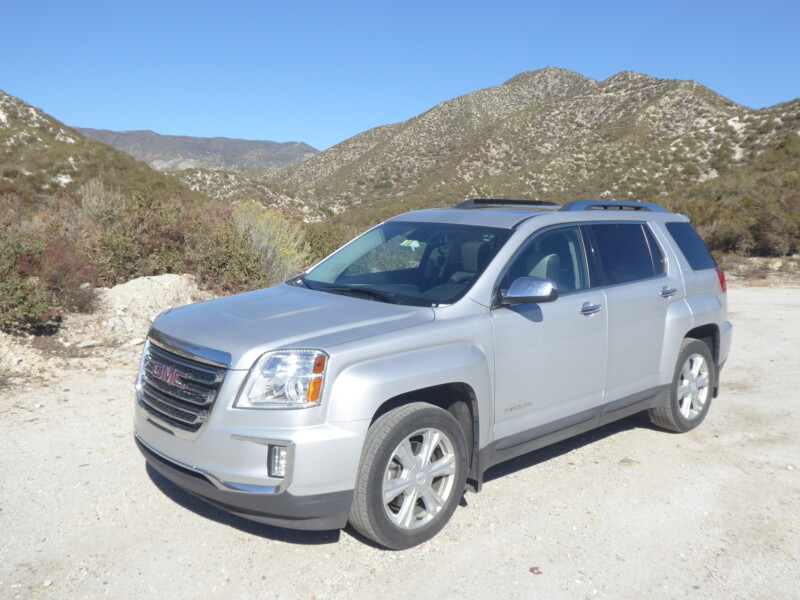


Ever since the world started to return to normal following the Covid lockdowns, the US car rental fleets have seen a far wider choice of vehicles and far more older cars, sourced as the fleets had not put in sufficient forward orders and the chip supply crisis had precluded buying everything that they now found they needed. During 2023, though, I have noticed that most of these older cars and those from different brands not usually seen on fleet have gone. There are still a few stragglers left and the car I spotted for this test is one such example. It is a first generation GMC Terrain, a machine which had eluded me when new even though there had usually been decent numbers of then on fleet ever since the car’s launch in 2010. This design has been out of production for some time, now, so when I saw it, I guessed it would be several years old. It turned out to be a 2017 model year car, the last year of production before the switch to the second generation model, a car I had sampled on my last, September 2023, trip to the US. It had covered 51k mile but was in surprisingly good condition. Seeing this as probably my only opportunity to test out another car that I had missed out on when new, I duly requested this car rather than anything newer and was pleased to find it was indeed available.


The GMC Terrain is a sister model to that doyen of the rental fleet, the Chevrolet Equinox. Smallest and cheapest vehicle in the GMC range, the Terrain made its debut in April 2009 at the New York International Auto Show, introduced as a replacement for the Pontiac Torrent, which ended production after GM shut down the Pontiac brand in 2010. Although the preceding Pontiac Torrent had the same Theta platform, the Torrent was a rebadged version of the original Chevrolet Equinox from 2005 to 2009, while GM decided to differ the look of the Chevrolet Equinox with its 2010 Terrain and still use the Theta platform. Initially offered with a choice of just two trims, SLE and SLT, GMC added a posher Denali version to the range for 2013 and a cheaper SL model for 2015. For the 2016 model year there was a mild update consisting of revised front and rear styling, chrome exhaust tips (first used on the 2013 Denali) on all models, a power dome bonnet, LED daytime running lights, new wheels, a new gear selector, a second storage shelf under the dashboard (in the place of the discontinued CD player), as well as the deletion of the door lock buttons from the dashboard, all subtle enough that the Terrain of 2017 is not really that different from the first cars of 2010. Eight years is above average for a product lifecycle these days, with all of the Terrains competitors have been revised at least once in this time.


GMC offer two different engines in the Terrain. Standard fare is a four cylinder but a lusty 301 bhp 3.6 litre V6 is optional on posher models in the range, The test car had the 2.4 litre four cylinder EcoTec unit. It puts out 182 bhp and 172 lb/ft of torque and is coupled to a standard 6 speed automatic transmission. Whilst pleasingly smooth, this engine really does not feel up to the job, as the Terrain can be quite sluggish. This was especially noticeable even on modest inclines where it was necessary to drop down 2 gears to keep reasonable momentum and that made the car really rather noisy. In more relaxed motoring actually low noise levels, thanks to extensive sound deadening is a strength of the Terrain. I covered 250 miles in my time with the Terrain and put 8.8 gallons in to fill it up, which works out at 28.4 mpg US or 33.95 mpg Imperial, a reasonable result.


Dynamically, the Terrain is pretty unremarkable. The steering is OK. There is not a lot of feel, but the system is quite light so the car is easy to manoeuvre and to position on the road. Handling is of the safe and predictable sort and there is plenty of grip, though brisker cornering does come with the price of some body roll. Standard wheels for the Terrain are 235/55 R18 and these, combined with quite soft suspension give the Terrain a comfortable ride. The brakes were effective. There is a foot pedal parking brake. Visibility is a mixed back with the very thick C pillar making things harder at oblique junctions.


The Terrain feels quite light and airy inside as there is a massive sunroof and the interior trim is a mix of pale grey and black. Although GMC is primarily known as a truck brand, the tastefully appointed interior of the GMC Terrain shows a softer side. The dashboard is styled in two graceful curves, with gauges and secondary controls treated to bright red back lighting, but look a little more closely and it is easier to spot the car’s more humble origins, so whilst not bad, it does not really feel like a true quality product, but at least the effort was there. There is a leather wrapped wheel. Details like the instrument cluster and touch screen are clues to the age of the design of this car. There are two large conventional dials with smaller fuel level and water temperature sat between, as is the trip computer display area which uses old style graphics. You can cycle through the options for this display using buttons on the steering wheel. GMC have been to the corporate parts store for the column stalks which will be familiar from other GM products. They also encompass the lights which have an auto setting as do the wipers. There are lots of buttons on the steering wheel boss for cruise control and audio repeater functions. The centre of the dash contains a 7” colour integrated touchscreen for the GM IntelliLink system, which includes Satellite XM radio and the optional navigation system as well as Bluetooth audio, Pandora and Stitcher integration. It is on a slant and is quite a stretch away from the driver. There are still some proper buttons below the screen for some commonly used functions. Below this are the buttons for the dual zone climate control.


The test car came in SLT trim which is one of the posher ones, and it also featured the optional Memory Package so that means that as well as the perforated leather upholstery, you get 8-way electric seat adjustment including lumbar support for both driver and passenger and there is a two position memory. The seats are heated. There is quite a wide range of adjustment and the SUV-like styling means that there is plenty of headroom, despite the presence of the sunroof. There are height adjustable seat belts and the column adjusts for range and reach so it was easy to get my ideal driving position.


One of the strongest features of this Terrain is the amount of space in the back, an important consideration for many buyers of this car. Yes, the centre console does come well back, as is the case with so many cars these days, but otherwise the flat floor and the generous amounts of legroom and headroom mean that this car is roomier than most of its rivals. The seats are on sliders and you can vary the backrest angle, as well. Occupants here get the benefit of a drop-down central armrest, with cupholders in the upper surface, and there are stowage nets on the back of the front seats and pockets on the doors for those smaller items that accumulate in a family car.


The boot is also a good size. Sadly, you don’t get a load area cover, which seems a bit mean but is far from uncommon in the US. There is a space saver tyre under the floor but not much in the way of extra space to tuck odds and ends. The rear seats are asymmetrically split and the seat backrest simply drops down to create a sizeable load platform, though the length is not quite flat. There is an electrically assisted tailgate which is no bad thing as it is large and heavy. Inside the front passenger compartment there is a big glovebox, a deep central armrest cubby, pockets on the doors and a recess in front of the gearlever, as well as lots of little stowage places not all of which are terribly useful for anything of any size.


The 2017 GMC Terrain is available in five trim levels: SL, SLE-1, SLE-2, SLT and Denali. Standard equipment for the base SL trim includes 18-inch alloy wheels, an auto-dimming rearview mirror, a rearview camera, cruise control, a power height-adjustable driver seat with power lumbar, a 60/40-split folding rear seat with sliding and reclining functions, a tilt-and-telescoping steering wheel, rear privacy glass, OnStar (with an onboard WiFi hotspot), Bluetooth phone (but not audio) connectivity, a 7-inch touchscreen interface and a six-speaker sound system with an auxiliary audio jack and a USB port. Move up to the SLE-1 and you get heated mirrors and satellite radio. More importantly, all-wheel drive becomes available. The SLE-2 builds upon the SLE-1, adding LED daytime running lights, automatic climate control, an eight-way power driver seat (with power lumbar), a leather-wrapped steering wheel, a Pioneer eight-speaker audio system and GM’s IntelliLink system, which includes Bluetooth audio, voice controls and compatibility with Pandora and Stitcher smartphone apps. The available Convenience package adds heated front seats and remote engine start. LED daytime running lights come standard on the SLE-2 trim level and above. The SLT comes standard with the Convenience package and adds chrome exterior accents, ambient interior lighting and perforated leather upholstery. Two Driver Alert package levels are available for the SLE-2 and SLT. The first level includes a blind-spot monitor, rear cross-traffic alert, rear parking sensors and (on the SLT only) an adjustable power liftgate. The second level adds forward-collision and lane-departure alerts. The SLT-only Memory package includes driver memory settings and an eight-way power passenger seat (with power lumbar). Also optional on SLE-2 and SLT is the Nightfall package, which includes special 18-inch wheels and various gloss-black exterior accents. The range-topping Denali has the SLT features as well as 19-inch wheels, an exclusive comfort-oriented suspension and Denali-specific exterior and interior trim. It also includes the Memory and Driver Alert I and II packages. A navigation system is optional on Terrains in the SLE-2 trim and above.


The Terrain sits in what is perhaps the most competitive sector of the US market, so it does not want for rivals which include the big-selling Toyota RAV4 and Honda CR-V, as well as Nissan’s Rogue and something from just about every major brand on the market, including the in-house Chevrolet Equinox. GM position it is a cut above the Equinox, and the different styling probably helps with that positioning at least as much as the generous equipment levels. Add in the spacious rear seat and comfortable ride and you can see why the Terrain might appeal, though the engine is the real let down. I have a feeling that if you were to select the optional V6, you could have a car here which could encourage Americans to buy from a locally owned brand as opposed to an Asian one, and many Americans have clearly done just that as this first generation Terrain is still quite a common sight on US roads. You are very unlikely to see one in the rental fleets now, though. You will find its successor there, but that car, just like the related but visually distinct third generation Equinox, is based on the GM Delta platform and is slightly smaller than this one, typically sitting in lower rental car category. I have already reviewed that one and found it pleasant but ultimately unremarkable.