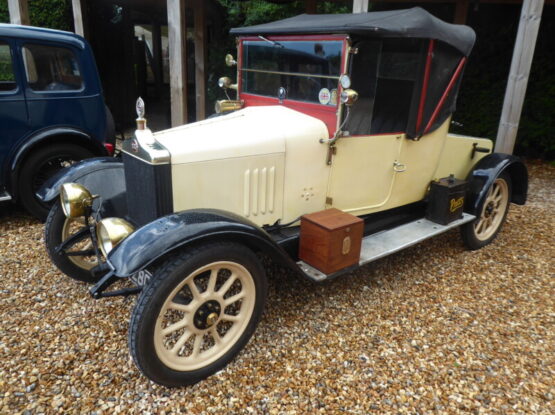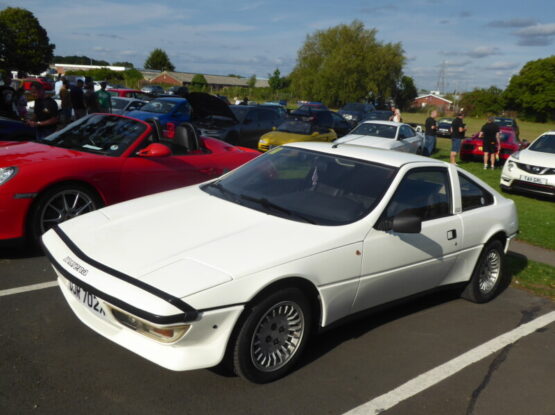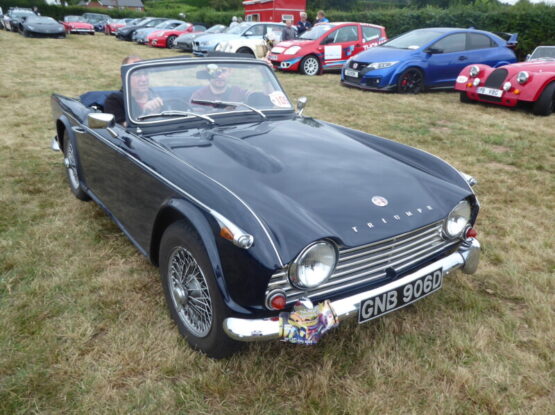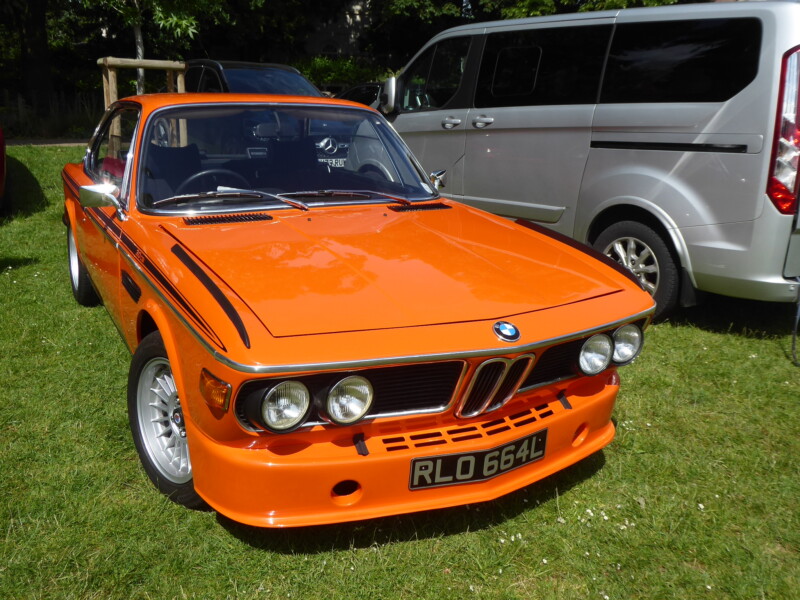
Although the car events diary for the year gets pretty full from early on as dates get announced, there are some gaps which give me the chance to make last minute decisions, often on events that I have not heard about let alone attended before, and this is one such. Called “Cars at the Spa”, as it takes place in one of England’s historic Spa towns, Royal Leamington Spa in Warwickshire, it turned out that this is far from a new addition to the calendar. Organised by the local Rotary Club, it takes place in the gardens and open space by the Pump Rooms, an expansive area with room for a few hundred cars to be displayed. On a sunny Sunday in early June, it is, as I understand it, a popular day out for not just car enthusiasts who come in significant quantity to see this added attraction to what is in any case a pleasant English country town. I decided to go along and investigate. Here is what I saw:
ARMSTRONG SIDDELEY
The Armstrong Siddeley Typhoon is a two-door, four-seat fixed-head coupé automobile produced by the British company Armstrong Siddeley from 1946 until 1949. It was based on the Armstrong Siddeley Lancaster saloon and continued the company’s theme of naming cars after Hawker Siddeley World War II aircraft. The chassis had independent front suspension using longitudinal torsion bars and a live rear axle with leaf springs. A Girling hydro-mechanical braking system was fitted, with the front drums hydraulically operated while those at the rear used rod and cable. At first the Typhoon were fitted with a 70 bhp 1991 cc, six-cylinder, overhead-valve engine, carried over from the pre-war 16 hp model, but from 1949 this changed to 2309 cc and 75 bhp by increasing the cylinder bore from 65 to 70 mm. Hydraulic tappets were fitted to most engines, but towards the end of production there was a change to solid tappets. There was a choice of manual four-speed with synchromesh on the top three ratios or pre-selector gearbox. The four-seat, two-door body was made of steel and aluminium panels fitted over a wood-and-aluminium frame with a fabric roof. The doors were rear hinged, an arrangement that got the name of suicide doors. At launch, the car cost £1214 on the UK market.


A replacement for the Whitley, the Sapphire was first seen in 1952, and extended into quite a range of different models over the next 8 years. The first model to bear the Sapphire name was the 346, introduced late in 1952 for sale in 1953 and continuing until 1958. It had a six-cylinder 3,435 cc engine with hemi-spherical combustion chambers and could have optional twin Stromberg carburettors, a £25 extra, which increased the output from 125 to 150 bhp giving a top speed in excess of 100 mph. The front suspension was independent coil springs with a rigid axle and leaf springs at the rear. The body was available as a four- or six-light (two or three windows on each side) at the same cost and with either a bench or individual front seats. The seats were finished in leather, with the dashboard and door-cappings in walnut veneer. A heater was standard. It was introduced with the choice of a Wilson electrically-controlled finger-tip four-speed pre-selector gearbox as a £30 option, or four-speed synchromesh gearbox. It became available with a Rolls-Royce four speed automatic transmission with the introduction of the Mark II in 1954. A long-wheelbase model was launched in 1955 as a limousine version which had the pre-selector gearbox as standard, however, there was an optional four-speed manual column-change gearbox available. 7,697 of the 346s were produced. Next to appear were the cheaper Sapphire 234 and 236 cars. They were identical in appearance but sold with different engines having different performance characteristics. The 234 could be purchased with wire wheels as an optional extra. The 234 was produced from 1955 to 1958 and used a four-cylinder 2,290 cc version of the 346 engine. The transmission was a manual four-speed gearbox with optional overdrive. It was a genuine 100 mph car intended for the man who liked high performance, and 803 of them were produced. The 236 was made between 1955 and 1957 and used the six-cylinder 2,310 cc engine previously seen in the Whitley. A conventional manual gearbox was available but many were fitted with a Lockheed Manumatic “clutchless” transmission. Overdrive was an option on either transmission. This car with an 85 mph maximum was intended to be a quiet, flexible, easy-to-drive saloon, and 603 were produced. In 1958, Armstrong-Siddeley showed what would turn out to be their final model, and the car seen here, the Star Sapphire. Little changed externally from the 346, the radiator grille no longer rose to the top of the bonnet, and there were other detailed changes, including concealed door hinges and the fact that the front doors now hinged at their leading edge. The six-cylinder engine was enlarged more than 16% to 3,990 cc with larger twin Stromberg carburettors as standard and power output increased to 165 bhp Perhaps more important was an increase of nearly 30% in torque at 50 mph. Big end and main bearings were now made of lead indium and a vibration damper fitted to the nose of the crankshaft. The compression ratio was raised to 7.5 to 1. The car could now lap the Lindley high speed track at 104 mph. Various suspension modifications had been carried out. Servo-assisted 12″ Girling disc brakes were now installed on the front wheels and Burman recirculating ball power steering was standardised with a turning circle reduced by 4’6″. A BorgWarner type DG automatic gearbox was fitted which incorporated a lever on the fascia to hold intermediate gear at 35, 45, 55, and 65 mph. There was an independent heater for the rear passengers and demisting slots for the rear window. All features were standard, the provision of alternatives being believed to lead to an unsatisfactory compromise. This was a high quality car, intended to rival Daimler, Jaguar and even Rolls Royce products of the era, and indeed the Star Sapphire won the £4,000 four-door coachwork class at the 1958 Earls Court Motor Show ahead of a Princess limousine and a Jaguar Mark IX. When production ceased in 1960, 902 saloons had been made, as well as 77 long-wheelbase cars, 73 of which were built as limousines (including 2 prototypes). The limousine version was made in 1960 only and had a single-carburettor engine and manual gearbox (the automatic gearbox was fitted to 12 examples). The remaining 4 chassis were used for 3 hearses and an ambulance, meaning a total of 980 Star Sapphires were produced


ASTON MARTIN
Technically the DB4 was a development of the DB Mark III it replaced but with a completely new body. The DB4’s design formed the basis for later Aston Martin classics, such as the DB4 GT Zagato, the Lagonda Rapide 4-door saloon. It was eventually replaced by the Aston Martin DB5. The lightweight superleggera (tube-frame) body was designed by Carrozzeria Touring in Milan, and its Continental looks caused a sensation on its unveiling at the 1958 London Motor Show. Although the design and construction techniques were Italian, the DB4 was the first Aston to be built at the company’s Newport Pagnell works. The 3670 cc engine, designed by Tadek Marek, was a double overhead cam straight-6, with cylinder head and block of cast R.R.50 aluminium alloy, a further development of the earlier engine. The engine was prone to overheating initially, but the 240 hp produced by the twin-SU carburettor version made buyers forgive this unfortunate trait[citation needed]. Servo-assisted disc brakes were fitted all round: early 11.5 in Dunlops were replaced by Girlings. The independent front suspension used ball-jointed wishbones, coil springs and rack-and-pinion steering. The live rear axle also used coil springs and was located by a Watt’s linkage. The normal final-drive ratio for British and European use was 3.54:1: in the United States the ratio was usually 3.77. Customers wanting a car with an especially high top speed could choose a 3.31:1 ratio. A car with the British standard 3.54 final drive ratio tested by The Motor magazine in 1960 had a top speed of 139.3 mph and could accelerate from 0-60 mph in 9.3 seconds. A fuel consumption of 17.7 mpg. The test car cost £3967 including taxes. There were five “series” of DB4. The most visible changes were the addition of window frames in Series II and the adoption of a barred (rather than eggcrate) grille in Series IV. The Series III cars differed from the earlier ones in having taillights consisting of three small lamps mounted on a chrome backing plate. Earlier cars have single-piece units and the last Series V cars of September 1962 have similar taillights but recessed. The Series V also has a taller and longer body to provide more interior space, though the diameter of the wheels was reduced to keep the overall height the same. The front of the Series V usually was of the more aerodynamic style as already used on the Vantage and GT models, a style that was later carried over to the DB5 cars. A convertible was introduced in October 1961. It featured in-house styling similar to the Touring saloon, and an extremely rare factory hardtop was also available. In total, 70 DB4 convertibles were made from a total DB4 production run of 1,110 cars. 30 of these were Series IV, with the remaining 40 belonging to the Series V. 32 of the total convertibles built (11 and 21 of the different series respectively) were equipped with the more powerful Vantage engine. Top speed for the regular version is about 136 mph.


Following the unveiling of the AMV8 Vantage concept car in 2003 at the North American International Auto Show designed by Henrik Fisker, the production version, known as the V8 Vantage was introduced at the Geneva Motor Show in 2005. The two seat, two-door coupé had a bonded aluminium structure for strength and lightness. The 172.5 inch (4.38 m) long car featured a hatchback-style tailgate for practicality, with a large luggage shelf behind the seats. In addition to the coupé, a convertible, known as the V8 Vantage Roadster, was introduced later in that year. The V8 Vantage was initially powered by a 4.3 litre quad-cam 32-valve V8 which produced 380 bhp at 7,300 rpm and 409 Nm (302 lb/ft) at 5,000 rpm. However, models produced after 2008 had a 4.7-litre V8 with 420 bhp and 470 Nm (347 lbft) of torque. Though based loosely on Jaguar’s AJ-V8 engine architecture, this engine was unique to Aston Martin and featured race-style dry-sump lubrication, which enabled it to be mounted low in the chassis for an improved centre of gravity. The cylinder block and heads, crankshaft, connecting rods, pistons, camshafts, inlet and exhaust manifolds, lubrication system and engine management were all designed in house by Aston Martin and the engine was assembled by hand at the AM facility in Cologne, Germany, which also built the V12 engine for the DB9 and Vanquish. The engine was front mid-mounted with a rear-mounted transaxle, giving a 49/51 front/rear weight distribution. Slotted Brembo brakes were also standard. The original V8 Vantage could accelerate from 0 to 60 mph in 4.8 seconds before topping out at 175 mph. In 2008, Aston Martin introduced an aftermarket dealer approved upgrade package for power and handling of the 4.3-litre variants that maintained the warranty with the company. The power upgrade was called the V8 Vantage Power Upgrade, creating a more potent version of the Aston Martin 4.3-litre V8 engine with an increase in peak power of 20 bhp to 400 bhp while peak torque increased by 10 Nm to 420 Nm (310 lb/ft). This consists of the fitting of the following revised components; manifold assembly (painted Crackle Black), valved air box, right and left hand side vacuum hose assemblies, engine bay fuse box link lead (ECU to fuse box), throttle body to manifold gasket, intake manifold gasket, fuel injector to manifold seal and a manifold badge. The V8 Vantage had a retail price of GB£79,000, US$110,000, or €104,000 in 2006, Aston Martin planned to build up to 3,000 per year. Included was a 6-speed manual transmission and leather-upholstery for the seats, dash board, steering-wheel, and shift-knob. A new 6-speed sequential manual transmission, similar to those produced by Ferrari and Lamborghini, called Sportshift was introduced later as an option. An open-topped model was added to the range in 2006 and then in the quest for more power a V12 Vantage joined the range not long after.

AUSTIN
There were several examples of the popular Seven here, and they were each very different. Herbert Austin’s masterpiece which did much to put Britain on wheels in the 1920s was first seen in 1922, as a four seat open tourer. Nicknamed Chummy, the first 100 featured a 696cc four cylinder engine, which was quickly upgraded to the 747cc unit that remained until the end of production some 17 years later. The first cars had an upright edge to the doors and a sloping windscreen, but from 1924, the screen became upright and there was a sloping edge to the doors, as well as a slightly longer body. Stronger brakes came along in 1926, along with a slightly taller nickel-plated radiator grille, conventional coil ignition, a more spacious body and wider doors. An even longer and wider body arrived in 1930, as well as a stronger crankshaft and improvements to the brakes which coupled front and rear systems together so they both worked by the footbrake. In 1931 the body was restyled , with a thin ribbon-style radiator and by 1932 there was a four speed gearbox to replace the earlier three-speeder. 1933 saw the introduction of the Ruby, a car that looked more modern with its cowled radiator. There were also Pearl and Opal versions. Development continued, so in 1937 there was a move to crankshaft shell bearings in place of the white metal previously used, and the Big Seven appeared. The last Seven was made in 1939, by which time 290,000 had been produced. Aside from saloons and tourers, there had been vans and sports derivatives like the Le Mans, the supercharged Ulster and the rather cheaper Nippy. Around 11,000 Sevens survive today


The first all new product from Austin after the war was the A40, which was launched in 1947, as the Dorset (a two door) and Devon (four door saloon). Taking some of their componentry from the pre-war Austin Eight, there was much that was all new in these cars, and sales of the Devon were strong, mostly in export markets. A range of light commercial versions were offered as well, the GV2 Panel Van, GQU2 Pickup and GK Countryman Estate car. The very early GV2 vans, introduced soon after the Devon and the Dorset were obviously based on the saloon, but in fact shared only some parts with it. The doors were the same pressings, although had different interior and exterior trim. The front end panelwork was derived from the saloon, although the front wings had larger apertures to accommodate the 17″ van wheels. The wheels were also much sturdier in design when compared to the 16″ rims fitted to the saloon. The rear bodywork was formed in aluminium, and there was a fabric centre panel in the roof. Removable rear spats covered the rear wheels, a feature shared with the pickup and van-based Countryman estate car. The grille was the mazak/chrome item found on the saloon, and the chassis and running gear, with its hydra-mechanical braking arrangement, were also shared (albeit with revised gear ratios). Early vans and cars had 5″ headlamps, but this would soon switch to Lucas 7″ units, and separate sidelights. At first glance, the A40 van seemed to change little throughout its production, a run that continued long after the contemporary Devon and Somerset saloons ceased, but in detail barely a year went by without some change being introduced by BMC, to improve the van and maintain its competitiveness. It was early in 1951 when the first batch of obvious changes were made. Most evident was a switch to a new grille assembly, painted instead of chrome. Early vans had smooth bonnets, although due to issues with cooling, extra vents were soon let in to the leading edge of the bonnet. By now the rear bodywork was in steel, including the roof panel, but still featuring separate aluminium rear wheel spats. The switch from the Devon-style dashboard to a simpler painted dash also occurred at around this time. These vans were known as the GV3 series. Late in 1951 the Devon saloon underwent a number of revisions, including a switch to a column gearchange, and hydraulic braking to all four wheels. The 17″ wheels were modified slightly, to accommodate wider brake drums, meaning that wheels for earlier vans are not interchangeable with later examples. The revised GV4 commercials followed many of the changes introduced to the saloon, in preparation for the introduction of the Somerset-type running gear due in 1952. This would be the year that the A40 Devon saloon was replaced, yet the light commercials remained in production, alongside the Somerset saloon, for many years to come. By 1953 the A40’s rear bodywork would see another update, this time integrating the rear arches into the main body of the vehicle, at the same time improving access for wheel changing. The final GV5 series van, introduced in September 1954, continued in production, alongside the new A40/A50 Cambridges, right up to 1957, meaning that the A40 vans stayed in production for ten years. Over 78,000 vans were produced, as well as 61,800 pickups and 26,500 Countryman estates. As with all light commercials, these 1/2 ton vans usually got a real hammering in the hands of the many different tradesmen that bought the 10cwt Austin van. As a result, survivors are distinctly rare on the ground, so it was nice to see this well presented example of the Pickup.


AUSTIN HEALEY
Donald Healey had been producing a range of expensive sports cars from the 1940s, cars such as the Silverstone, the Abbott and the Farnham. For the 1952 London Motor Show, he produced a new design, which was called the Healey Hundred, based on Austin A90 mechanicals, which he intended to produce in-house at his small car company in Warwick. It was one of the stars of the 1952 Show, and it so impressed Leonard Lord, the Managing Director of Austin, who was looking for a replacement to the unsuccessful A90. that Lord struck a deal with Healey on the spot, to build it in quantity. Bodies made by Jensen Motors would be given Austin mechanical components at Austin’s Longbridge factory. The car was renamed the Austin-Healey 100, in reference to the fact that the car had a top speed of 100 mph. Production got under way in 1953, with Austin-Healey 100s being finished at Austin’s Longbridge plant alongside the A90 and based on fully trimmed and painted body/chassis units produced by Jensen in West Bromwich—in an arrangement the two companies previously had explored with the Austin A40 Sports. By early 1956, production was running at 200 cars a month, 150 of which were being sold in California. Between 1953 and 1956, 14,634 Austin-Healey 100s were produced, the vast majority of them, as was the case for most cars in this post war era, going for export. The car was replaced by an updated model in 1956, called the 100-6. It had a longer wheelbase, redesigned bodywork with an oval shaped grille, a fixed windscreen and two occasional seats added (which in 1958 became an option with the introduction of the two-seat BN6 produced in parallel with the 2+2 BN4), and the engine was replaced by one based on the six-cylinder BMC C-Series engine. In 1959, the engine capacity was increased from 2.6 to 2.9 litres and the car renamed the Austin-Healey 3000. Both 2-seat and 2+2 variants were offered. It continued in this form until production ceased in late 1967. The Big Healey, as the car became known after the 1958 launch of the much smaller Austin-Healey Sprite, is a popular classic now. You come across the 3000 models more frequently than the 100s, as they accounted for more than 60% of all Big Healey production.


The Mark II to Mark IV Sprite cars were all very similar and represented the evolution of the model throughout the 1960s, The Mark II was announced at the end of May 1961. It used the same 948 cc engine with larger twin 1 1⁄4 inch SU carburettors, increasing power to 46.5 bhp. A close-ratio gearbox was fitted. The bodywork was completely revamped, with the headlights migrating to a more conventional position in the wings, either side of a full-width grille. At the rear, styling borrowed from the soon-to-be-announced MGB gave a similarly more modern look, with the added advantages of an opening boot lid and conventional rear bumper bar. The result was a much less eccentric-looking sports car, though at the expense of some 100 lbs extra weight. It followed the MG version of the car which was introduced a couple of weeks earlier as ‘the new Midget,’ reviving a model name which had been a great success for the MG Car Company in the 1930s. The Midget was to prove more popular with the public than the Sprite and by 1972 had completely supplanted it within the BMC range. In October 1962, both Sprites and Midgets were given a long-stroke 1098 cc engine. A strengthened gearbox with Porsche (baulk-ring) synchromesh was introduced to cope with the extra power – 56 bhp. Front disc brakes were also introduced at the same time and wire wheels became an option. 31,665 Mark II Sprites were made. The Mark III Sprite was also marketed as the Mark II MG Midget – differences between the two were again restricted to minor trim detailing. Although still 1098 cc, the engine had a stronger block casting, and the size of the crankshaft main bearings was increased to two inches. A new (slightly) curved-glass windscreen was introduced with hinged quarterlights and wind-up side windows. Exterior door handles were provided for the first time, with separate door locks. Though the car could now be secured, with a soft-top roof the added protection was limited. The rear suspension was modified from quarter-elliptic to semi-elliptic leaf springs, which gave a more comfortable ride for a near-negligible weight penalty as well as providing additional axle location, the upper links fitted to the quarter-elliptic models being deleted. Though scarcely sybaritic, these changes helped the Sprite and Midget compete with the recently released Triumph Spitfire. 25,905 Mark III Sprites were made. The next upgrade was presented at the London Motor Show in October 1966. Besides receiving the larger 1275 cc engine (which disappointed enthusiasts by being in a lower state of tune than that of the Mini-Cooper ‘S’), the Mark IV and its cousin the Mark III MG Midget had several changes which were more than cosmetic. Most notable is the change from a removable convertible top, which had to be stowed in the boot, to a permanently affixed, folding top of greatly improved design, which was much easier to use. Separate brake and clutch master cylinders were fitted, as car manufacturers’ thoughts began to turn to making their products safer. For the 1970 model year cast-alloy wheels were fitted and the grille was changed to resemble that fitted to the MG Midget. 22,790 Mark IV Sprites were made. The Healey connection was discontinued in 1971, so the final 1,022 Sprites built were simply Austin Sprites.

AUTO UNION
The Auto Union 1000 is a luxury compact front-wheel drive automobile manufactured by Auto Union GmbH between 1958 and 1965. It was the first (and in many markets the last) model branded as an Auto Union by the manufacturer since the 1930s; it replaced the DKW 3=6, although the latter continued in production until the end of 1959. The two cars were broadly similar, but the new car had its two-stroke engine enlarged to 981 cc yielding a 10% – 37% (depending on model) power increase. The Auto Union 1000 was an evolution of the earlier DKW F93, F94 and F94U models of the 3=6 series. Apart from the enlarged engine capacity, which now provided 44 PS in the base model, the 1000 featured the old four-ring Auto Union badge across the grille along with the Auto Union name above it, in place of the DKW badge that had adorned the nose of the earlier models, as well as a smooth boot lid. For the European market there were three distinct series of the 1000/1000S; (not including the 1000SP or 1000 engined DKW Munga); The first series was known as the “model 58” or AU1000/58, which was available as the 1000 Coupe de luxe only with the 44 PS engine. This model was available for 1958/59 only and was released in late 1957. The second series was known as the “model 60” or AU1000/60 – which, in two door form was the first model to feature the “panoramic” windscreen. The third and final series was known as the “model 62” or AU1000/62, which was an improved version of the “model 60” – featuring front disc brakes, Lubrimat, wider track rear axle, larger boot and other refinements. The first car of the “model 60” line was a 1000S Coupe chassis number 6820000001, completed at Düsseldorf on 27 July 1959. There were 25 pre-production cars built. The first production 1000/1000S was chassis number 6820000026. Over time the “model 60” 1000 series gained a four-door and Universal in the range, all produced at Düsseldorf. Production of all “model 60” second series cars was switched to the third series “model 62” on 29 September 1961. Production of the third series of 1000/1000S was gradually closed from late 1962. The final 1000 Universal was completed on 31 October 1962, and the final 1000S four door on 13 November, in both cases at Ingolstadt. The details of the final European 1000S assembled are unknown, as the final batch of production contained CKD and SKD (Completely Knocked Down and Semi Knocked Down) kits, which were assembled later, outside Germany. The final European 1000/1000S manufactured (note, not assembled) though, was a 1000S Coupe de Luxe chassis number 6820146387. In addition to the two- and four-door saloons, a “pillarless” Coupe shared the profile of the saloons apart from the absence of any fixed B pillar. A three-door station wagon version was also offered (essentially, an updated DKW F94U), now branded as the 1000 Universal, between 1959 and 1962 (1959/60/61 only for right hand drive). For the new decade, the coupe and four door was renamed Auto Union 1000S. In August 1959, an eye-catching wrap-around windscreen with vertical strip speedometer was introduced on the two door models of the “model 60” series (AU1000 limousine, AU1000 Coupe and AU1000S Coupe). Neither the windscreen nor the name changes entirely concealed the fact that at a time when competitor designs employed the modern ponton, three-box form, this Auto Union’s body along with most of its technical features descended directly from that of the Zwickau-developed DKW F9 prototype of 1938. Fortunately in 1938, the front-wheel drive DKW design had been an innovative one. The Düsseldorf plant (in the old Rheinmetall – Borsig factory) produced most of the 171,008 Auto Union 1000 cars built during the six-year model run. The pretty 1000 SP sports version continued in production for another two years, until 1965, notching up sales of 5,000 for the hard-top version and 1,640 for the cabriolet. The production of the car was extensively shown in the 1960 film “Träume, die Sie kaufen können”. The car was sold worldwide and was popular in markets where its characteristics suited the local conditions well. Export sales were especially strong in Africa and the car was well regarded for its robust and reliable construction. In countries where its sporting heritage is especially strong, such as South Africa, the car has since acquired a legendary status. In 2012, the South African artist Steve Hofmeyr released a song, “DKW” which, taking in the Auto Union 1000, expressed a nostalgia for the car as a representation of solidity and reliability. Import tariffs made the Auto Union 1000 a costly car in certain markets, and sales were slow in countries where the 1960s “Buy British” campaigns were effective. In New Zealand, for example, a 1960 Auto Union 1000S could be bought from Crosbie Motors in Invercargill for £1578 at a time when larger cars were selling for significantly less. The Auto Union 1000 also enjoyed much publicity from being prominently featured in European films of the day, such as the German musical comedy Hula-Hopp, Conny, the German Comedy Robert and Bertram and the Swedish film Mannekäng i rött. In 1970, well after the car’s production ended, an Auto Union 1000S featured as the star in the German comedy film Das kann doch unsren Willi nicht erschüttern. As with its predecessor, the DKW 3=6, the Auto Union 1000 enjoyed the attention of a number of famous owners, such as the famous aviator, Elly Beinhorn (her white and red 1958 Auto Union 1000 Coupe de luxe was named “Alwine VIII”), Hollywood film maker Billy Wilder[33] (1000SP), Big band bandleader Max Greger (1000SP), Graf von Brandenstein-Zeppelin (1000SP) and German fashion designer Katja Nieborg (1000S Coupe). In 1963, the Auto Union 1000 gave way in Europe to its successor, the contemporary-looking DKW F102 – the last model to wear either the Auto Union or DKW badges before the company was acquired by Volkswagen and the dormant Audi brand was resurrected. The 1000 was also the last Auto Union/DKW model to be produced at the Düsseldorf factory before production was moved to the company’s new plant in Ingolstadt; the old factory was sold to Auto Union’s then parent company Daimler-Benz to be converted to a Mercedes truck and van assembly plant.


BEAUFORD
Beauford is a British family run automobile company based in Biddulph, Stoke on Trent. The cars are supplied in kit form and are therefore highly customisable. Beauford are founding members of S.T.A.T.U.S. (Specialist Transport Advisory and Testing Utility Society). Originally based in Upholland, Lancashire the company later moved to Stoke on Trent. The first cars were made in 1978 and used a Mini bodyshell as the passenger compartment later replaced by a glass fibre moulding. The company has supplied over 1,500 kits. The Beauford Tourer is designed to look like a vintage car. At the front is a long bonnet with flowing wings at either side to give the appearance of a 1930s Style Grand Tourer luxury car. There are both 2 door and 4 door versions. Cars come in both open and closed bodies. With detachable hard top or convertible soft top there are also half soft-top versions. Because of the classic look of the vehicles the cars have become popular as wedding transport. They are suited to Rover V8 engines, and the M119 5 liter Mercedes Benz engine with over 300 BHP and high torque. The shell of the body is made of Glass Reinforced Plastic (GRP), and the bonnet and panels are alloys. The body is mounted on a ladder chassis. The vehicles have a long wheel base of 3.2 m (126″). A variety of power units can be fitted to the kit, including Ford, Nissan and Rover. The suspension, steering, pedal box and master cylinder can be sourced from the Ford Sierra. The manufacturer provides multiple choice in body parts such as windscreens and lights, meaning there are many unique vehicles in circulation.


BENTLEY
Bentley replaced the 3 Litre with a more powerful car by increasing its engine displacement to 4.5 litres. As before, Bentley supplied an engine and chassis and it was up to the buyer to arrange for their new chassis to be fitted with one of a number of body styles, most of which were saloons or tourers. Very few have survived with their four-seater coachwork intact. WO Bentley had found that success in motorsport was great publicity for the brand, and he was particularly attracted to the 2 Hours of Le Mans endurance race, the inaugural running of which took place 26–27 May 1923, attracting many drivers, mostly French. There were two foreign competitors in the first race, Frank Clement and Canadian John Duff, the latter winning the 1924 competition in his personal car, a Bentley 3 Litre. This success helped Bentley sell cars, but was not repeated, so after two years without success, Bentley convened a group of wealthy British men, “united by their love of insouciance, elegant tailoring, and a need for speed,” to renew Bentley’s success. Both drivers and mechanics, these men, later nicknamed the “Bentley Boys”, drove Bentley automobiles to victory in several races between 1927 and 1931, including four consecutive wins at the 24 Hours of Le Mans, and forged the brands reputation. It was within this context that, in 1927, Bentley developed the Bentley 4½ Litre. Two cylinders were removed from the 6½ Litre model, reducing the displacement to 4.4 litres. At the time, the 3 Litre and the 6½ Litre were already available, but the 3 Litre was an outdated, under-powered model and the 6½ Litre’s image was tarnished by poor tyre performance. Sir Henry “Tim” Birkin, described as “the greatest British driver of his day” by W. O. Bentley, was one of the Bentley Boys. He refused to adhere strictly to Bentley’s assertion that increasing displacement is always preferable to forced induction. Birkin, aided by a former Bentley mechanic, decided to produce a series of five supercharged models for the competition at the 24 Hours of Le Mans; thus the 4½ litre Blower Bentley was born. The first supercharged Bentley had been a 3-litre FR5189 which had been supercharged at the Cricklewood factory in the winter of 1926/7. The Bentley Blower No.1 was officially presented in 1929 at the British International Motor Show at Olympia, London. The 55 copies were built to comply with 24 Hours of Le Mans regulations. Birkin arranged for the construction of the supercharged cars having received approval from Bentley chairman and majority shareholder Woolf Barnato and financing from wealthy horse racing enthusiast Dorothy Paget. Development and construction of the supercharged Bentleys was done in a workshop in Welwyn by Amherst Villiers, who also provided the superchargers. W.O. Bentley was hostile to forced induction and believed that “to supercharge a Bentley engine was to pervert its design and corrupt its performance.” However, having lost control of the company he founded to Barnato, he could not halt Birkin’s project. Although the Bentley 4½ Litre was heavy, weighing 1,625 kg (3,583 lb), and spacious, with a length of 172 in and a wheelbase of 130.0 in, it remained well-balanced and steered nimbly. The manual transmission, however, required skill, as its four gears were unsynchronised. The robustness of the 4½ Litre’s latticed chassis, made of steel and reinforced with ties, was needed to support the heavy cast iron inline-four engine. The engine was “resolutely modern” for the time. The displacement was 4,398 cc. Two SU carburettors and dual ignition with Bosch magnetos were fitted. The engine produced 110 hp for the touring model and 130 hp for the racing model. The engine speed was limited to 4,000 rpm. A single overhead camshaft actuated four valves per cylinder, inclined at 30 degrees. This was a technically advanced design at a time where most cars used only two valves per cylinder. The camshaft was driven by bevel gears on a vertical shaft at the front of the engine, as on the 3 Litre engine. The essential difference between the Bentley 4½ Litre and the Blower was the addition of a Roots-type supercharger to the Blower engine by engineer Amherst Villiers, who had also produced the supercharger. W. O. Bentley, as chief engineer of the company he had founded, refused to allow the engine to be modified to incorporate the supercharger. As a result, the supercharger was placed at the end of the crankshaft, in front of the radiator. This gave the Blower Bentley an easily recognisable appearance and also increased the car’s understeer due to the additional weight at the front. A guard protected the two carburettors located at the compressor intake. Similar protection was used, both in the 4½ Litre and the Blower, for the fuel tank at the rear, because a flying stone punctured the 3 Litre of Frank Clement and John Duff during the first 24 Hours of Le Mans, which contributed to their defeat. The crankshaft, pistons and lubrication system were special to the Blower engine. It produced 175 hp at 3,500 rpm for the touring model and 240 hp at 4,200 rpm for the racing version, which was more power than the Bentley 6½ Litre developed. Between 1927 and 1931 the Bentley 4½ Litre competed in several competitions, primarily the 24 Hours of Le Mans. The first was the Old Mother Gun at the 1927 24 Hours of Le Mans, driven as a prototype before production. Favoured to win, it instead crashed and did not finish. Its performance was sufficient for Bentley to decide to start production and deliver the first models the same year. Far from being the most powerful in the competitions, the 4½ Litre of Woolf Barnato and Bernard Rubin, raced neck and neck against Charles Weymann’s Stutz Blackhawk DV16, setting a new record average speed of 69 mph; Tim Birkin and Jean Chassagne finished fifth. The next year, three 4½ Litres finished second, third, and fourth behind another Bentley, the Speed Six, which possessed two more cylinders.The naturally aspirated 4½ Litre was noted for its good reliability. The supercharged models were not; the two Blower models entered in the 1930 24 Hours of Le Mans by Dorothy Paget, one of which was co-driven by Tim Birkin, did not complete the race. In 1930, Birkin finished second in the French Grand Prix at the Circuit de Pau behind a Bugatti Type 35. Ettore Bugatti, annoyed by the performance of Bentley, called the 4½ Litre the “fastest lorry in the world.” The Type 35 is much lighter and consumes much less petrol. Blower Bentleys consume 4 litres per minute at full speed. In November 1931, after selling 720 copies of the 4½ Litre – 655 naturally aspirated and 55 supercharged – in three different models (Tourer, Drophead Coupé and Sporting Four Seater, Bentley was forced to sell his company to Rolls-Royce for £125,175, a victim of the recession that hit Europe following the Wall Street Crash of 1929.

Also present here was what are sometimes referred to as the “Derby” Bentley. These were produced after the acquisition of Bentley by Rolls-Royce, in 1934, at which point the focus of the brand shifted to the production of large and elegant tourers. The cars retained the famous curved radiator shape based on earlier Bentley models, but in all meaningful respects they were clearly Rolls-Royces. Although disappointing some traditional customers, they were well received by many others and even W.O. Bentley himself was reported as saying that he would “rather own this Bentley than any other car produced under that name.” The Rolls-Royce Engineer in charge of the development project, Ernest Hives (later Lord Hives), underlined the Rolls-Royce modus operandi in a memo addressed to company staff “our recommendation is that we should make the car as good as we know how and then charge accordingly.” At a time when the Ford 8 could be purchased new for £100, an early Bentley 3½ Litre cost around £1,500 (equivalent to £6400 vs. £96,000 today), putting it beyond the reach of all but the wealthiest consumers. Despite not being a car of remarkable outright performance, the car’s unique blend of style and grace proved popular with the inter-war elite and it was advertised under the legend the silent sports car. Over 70% of the cars built between 1933 and 1939 were said to have still been in existence 70 years later. Although chassis production ceased in 1939, a number of cars were still being bodied and delivered during 1940. The last few were delivered and first registered in 1941. The 3.5 litre came first. Based on an experimental Rolls-Royce project “Peregrine” which was to have had a supercharged 2¾ litre engine, the 3½ Litre was finally fitted with a less adventurous engine developed from Rolls’ straight-6 fitted to the Rolls-Royce 20/25. The Bentley variant featured a higher compression ratio, sportier camshaft profile and two SU carburettors on a crossflow cylinder head. Actual power output was roughly 110 bhp at 4500 rpm, allowing the car to reach 90 mph. The engine displaced 3669 cc with a 3¼ in (82.5 mm) bore and 4½ in (114.3 mm) stroke. A 4-speed manual transmission with synchromesh on 3rd and 4th, 4-wheel leaf spring suspension, and 4-wheel servo-assisted mechanical brakes were all common with other Rolls-Royce models. The chassis was manufactured from nickel steel, and featured a “double-dropped” layout to gain vertical space for the axles and thus keep the profiles of the cars low. The strong chassis needed no diagonal cross-bracing, and was very light in comparison to the chassis built by its contemporary competitors, weighing in at 2,510 pounds (1,140 kg) in driveable form ready for delivery to the customer’s chosen coachbuilder. 1177 of the 3½ Litre cars were built, with about half of them being bodied by Park Ward, with the remainder “dressed” by other coachbuilders like Barker, Carlton, Freestone & Webb, Gurney Nutting, Hooper, Mann Egerton, Mulliner (both Arthur and H J), Rippon, Thrupp & Maberly, James Young, Vanden Plas and Windovers in England; Figoni et Falaschi, Kellner, Saoutchik and Vanvooren in Paris; and smaller concerns elsewhere in UK and Europe. Beginning in March, 1936, a 4¼ Litre version of the car was offered as replacement for the 3½ Litre, in order to offset the increasing weight of coachwork and maintain the car’s sporting image in the face of stiff competition. The engine was bored to 3½ in (88.9 mm) for a total of 4257cc. From 1938 the MR and MX series cars featured Marles steering and an overdrive gearbox. The model was replaced in 1939 by the MkV, but some cars were still finished and delivered during 1940-1941. 1234 4¼ Litre cars were built, with Park Ward remaining the most popular coachbuilder. Many cars were bodied in steel rather than the previous, more expensive, aluminium over ash frame construction.


The Bentley Azure is a four-seater convertible grand tourer. The first version debuted in 1995 on the Bentley Continental R platform and was made until 2003. After a three-year break, a completely new version debuted in 2006 and was produced until 2010. It was powered by a significantly updated engine and based on the newer Arnage platform. The name was taken from earlier Robert Jankel sportier 2-door conversions that evolved into the Continental R.[1] The Azure debuted in March 1995 at the Geneva Motor Show on the platform of the Continental R model, which had been originally launched in 1991. Production only crept to a start, with a mere nine examples finished in the first year – in 1996, after full production had started, no less than 251 cars were finished. Pininfarina assisted in the two-year process of turning the Continental R into a full four-seater convertible, and also built the shell and soft-top at their factory in Italy, largely from parts sourced in the UK. Final assembly was then carried out at Crewe. A roll-bar was never considered, which necessitated extensive reinforcing of the chassis. At 210 in (5,340 mm) in length and 2,608 kg (5,750 lb) in weight, the Azure often surprised onlookers with its size and bulk, intended to both convey a sense of “presence” and allow for comfortable seating of four adult passengers. Power came from the company’s stalwart 6.75-litre V8, featuring a single, intercooled Garrett turbocharger and rated in the region of 365 PS (360 hp) – Rolls-Royce and Bentley did not yet give official power numbers at the time of the Azure’s introduction. By the time production began in earnest, a new engine management system from Zytek meant a slight power increase to 390 PS (385 hp) at 4,000 rpm and 750 Nm (553 lb/ft) of torque at 2,000 rpm; power was routed to the rear wheels via a modified, General Motors sourced, four-speed 4L80-E automatic transmission. With a 0-100 km/h (62 mph) acceleration time of 6.5 seconds and a top speed of 241 km/h (150 mph), the Azure was very fast for a car of its size, weight and poor aerodynamic profile. Owing to the limited space and workforce at Bentley’s Crewe factory, the Azure’s electrically powered convertible top made from thick fabric was designed and manufactured by Pininfarina, which significantly added to the vehicle’s cost. New in 1995, the Azure was priced at £215,167 – £22,590 more than the Continental R on which it was based. From 1999 until the end of production, the Azure was also available in “Mulliner” trim, which added special bespoke trim and additional equipment and allowed the buyer the option for further customisation during the build-process; pricing varied by car, as equipment could be significantly different from one to the next depending on customer requests. Just like its Rolls-Royce counterpart, towards the end of its production, it also had a final edition, called “Final series performance”, created from 2002 to 2003, only 62 were made. The Last RHD sold being Chassis no. CH01228 while the very last Azure was retained at the Crewe plant.


BMW
During the 1950s, the BMW line-up consisted of luxury cars with displacements of two litres or greater, economy cars powered by motorcycle engines, and motorcycles. With their luxury cars becoming increasingly outdated and unprofitable and their motorcycles and economy cars becoming less attractive to an increasingly affluent society, BMW needed a car in the 1.5 to 2 litre class to become competitive. Prototypes powered by a 1.6 L engine based on one bank of the BMW OHV V8 engine were built and evaluated without a convincing result. In 1960, Herbert and Harald Quandt invested heavily in BMW, and gained a controlling interest in the company.That year, the “Neue Klasse” project was begun. Led overall by Fritz Fiedler, the project had Eberhard Wolff in charge of chassis design, Wilhelm Hofmeister in charge of styling and body engineering, and Alex von Falkenhausen in charge of engine design. The team was to produce a new car with a new engine, which BMW had not done since the 303 in 1933. The prototype was introduced in September 1961 at the Frankfurt Motor Show as the BMW 1500 four-door saloon, alongside the BMW 3200 CS, the last BMW with the OHV V8. The term New Class referred to the 1.5–2–litre class from which BMW had been absent since World War II. Introduced in September 1961 at the Frankfurt Motor Show, the BMW 1500 entered regular production in October 1962 and was manufactured until December 1964. The M10 4-cylinder engine used oversquare dimensions of 82 mm bore and 71 mm stroke produced 80 hp in the BMW 1500. Contemporary reports praised the all-round visibility and the commanding driving position while recording that it was necessary to lean forward a little to engage first and third gears due to the long travel distance of the gear lever. The large 40 cm tall luggage compartment was also commended. The 1500 could accelerate to 100 km/h (62 mph) in approximately 15 seconds. The performance was at the time considered lively in view of the engine size, and although the engine needed to be worked hard in order to achieve rapid progress, it ran smoothly even at speeds above 6,000 rpm. The firm suspension and correspondingly harsh ride surprised those conditioned by the BMW 501 to anticipate a more comfort-oriented suspension setup. Notable problems that developed with the 1500 included separation of the semi-trailing arm mounts from the body, rear axle failure, and gearbox problems. These were resolved in later versions of the New Class sedan. The 1500 was replaced in 1964 by the 1600, but it was still made available in markets where capacities greater than 1500 cc incurred higher tax rates. Introduced in September 1963, the BMW 1800 was the second member of the New Class family. This model had an M10 engine with a 84 mm bore and 80 mm stroke, giving a displacement of 1,773 cc. It produced 90 hp at 5,250 rpm and 130 Nm (96 lb/ft) at 3,000 rpm. The 1800 TI (Turismo Internazionale) model featured components developed for the 1800 by the tuning company Alpina. The upgrades included dual Solex PHH side-draft carburettors and higher-compression pistons for 110 hp at 5,800 rpm and 136 Nm (100 lb/ft) at 4,000 rpm. A homologation special, the 1800 TI/SA, was introduced in 1964. The TI/SA’s engine had dual Weber DCOE-45 carburettors and a 10.5:1 compression ratio. This engine produced 130 hp at 6,100 rpm and 144 Nm (106 lb/ft) at 5,250 rpm. The TI/SA also had a Getrag five-speed gearbox, stronger anti-roll bars, and larger-diameter brake discs than the TI. 200 examples of the TI/SA were built and were only sold to licensed racing and sports drivers. An automatic transmission option was introduced in 1966 and in 1967 the 1800 was generally updated along with the 2000. The updates included interior changes (a modernized dashboard design and simpler door panels) as well as styling changes to the front grilles. In 1968 the 1,773 cc engine used in the 1800 was replaced by an engine with the 89 mm bore of the 2.0 L engine and the original 71 mm (2.8 in) stroke, which resulted in a displacement of 1,766 cc and a stroke/bore ratio of 0.798:1 (compared with the previous 1800 engine’s ratio of 0.952:1) The 1600, introduced as the replacement to the 1500 in 1964, used the 84 mm bore of the 1800 with the 1500s 71 mm stroke, resulting in a displacement of 1,573 cc, a power output of 83 hp at 5,500 rpm and 113 Nm (83 lb/ft) at 3,000 rpm. The 1600 was produced until early 1971. The engines from the 2000C and 2000CS coupes were used in the 4-door sedan body for the 2000 and 2000TI models. The 2000 sedan, released in 1965, used the 101 bhp engine from the 2000 C. The 2000TI sedan, released in 1966, used the 121 hp engine from the 2000 CS with twin Solex PHH side-draft carburettors. Intended as an upscale version of the 1800, the 2000 featured distinct wide taillights, more exterior trim, and unique rectangular headlights. The American market 2000 sedans could not have the rectangular headlights due to government regulations. A different grille with four individual round headlights, similar to the design that BMW later used in the 2500 sedan, was offered in the US. The 2000TI retained the ‘1800’ taillights and headlights. A more luxurious 2000TI-lux (later “tilux”) featured the sporty TI engine with a more high-grade interior and accessories, including a wood dashboard and optional leather seats. In 1969, BMW introduced the 2000tii (‘touring international, injected’), BMW’s first fuel-injected model, featuring Kugelfischer mechanical fuel injection. The 2000tii produced 130 hp at 5,800 rpm and 178 Nm (131 lb/ft) at 4,500 rpm. 1,952 2000tii cars were built of this final New Class sedan model.


This is a rather splendid 3.0 CSL. These two-door coupés were built for BMW by Karmann from 1968 to 1975 and were developed from the New Class-based BMW 2000 CS coupé. The first of the E9 coupés, the 2800 CS, replaced the 2000 C and 2000 CS in 1968. The wheelbase and length were increased to allow the engine bay to be long enough to accommodate the new straight-six engine code-named M30, and the front of the car was restyled to resemble the E3 saloon. The rear axle, however, remained the same as that used in the lesser “Neue Klasse” models and the rear brakes were initially drums – meaning that the 2800 saloon was a better performing car, as it was also lighter. The CS’ advantages were thus strictly optical to begin with The 2800 CS used the 2,788 cc version of the engine used in the E3 2800 saloon. The engine produced 170 hp. The 2800CS was replaced by the 3.0 CS and 3.0 CSi in 1971. The engine had been bored out to give a displacement of 2,986 cc, and was offered with a 9.0:1 compression ratio, twin carburettors, and 180 hp in the 3.0 CS or a 9.5:1 compression ratio, Bosch D-Jetronic fuel injection, and 200 hp in the 3.0 CSi. There was a 4 speed manual and an automatic transmission variant. Introduced in May 1972, the 3.0 CSL was a homologation special built to make the car eligible for racing in the European Touring Car Championship. 1,265 were built. The “L” in the designation meant leicht (light), unlike in other BMW designations, where it meant lang (long). The lightness was achieved by using thinner steel to build the unit body, deleting the trim and soundproofing, using aluminium alloy doors, bonnet, and boot lid, and using Perspex side windows. The five hundred 3.0 CSLs exported to the United Kingdom were not quite as light as the others, as the importer had insisted on retaining the soundproofing, electric windows, and stock E9 bumpers on these cars. Initially using the same engine as the 3.0 CS, the 3.0 CSL was given a very small increase in displacement to 3,003 cc by increasing the engine bore by one quarter of a millimetre. This was done in August 1972 to allow the CSL to be raced in the “over three litre” racing category, allowing for some increase in displacement in the racing cars. In 1973,the engine in the 3.0 CSL was given another, more substantial increase in displacement to 3,153 cc by increasing the stroke to 84 mm. This final version of the 3.0 CSL was homologated in July 1973 along with an aerodynamic package including a large air dam, short fins running along the front fenders, a spoiler above and behind the trailing edge of the roof, and a tall rear wing. The rear wings were not installed at the factory, but were left in the boot for installation after purchase. This was done because the wings were illegal for use on German roads. The full aero package earned the racing CSLs the nickname “Batmobile”. In 1973, Toine Hezemans won the European Touring Car Championship in a 3.0 CSL and co-drove a 3.0 CSL with Dieter Quester to a class victory at Le Mans. Hezemans and Quester had driven to second place at the 1973 German Touring Car Grand Prix at Nürburgring, being beaten only by Chris Amon and Hans-Joachim Stuck in another 3.0 CSL 3.0 CSLs would win the European Touring Car Championship again in every year from 1975 to 1979. The 3.0 CSL was raced in the IMSA GT Championship in 1975, with Sam Posey, Brian Redman, and Ronnie Peterson winning races during the season. The first two BMW Art Cars were 3.0 CSLs; the first was painted by Alexander Calder and the second by Frank Stella.


The BMW E34 is the third generation of the BMW 5 Series, which was produced from 2 November 1987, until 1996. Initially launched as a saloon in January 1988, the E34 also saw a “Touring” station wagon (estate) body style added in September 1992, a first for the 5 Series. BMW replaced the E34 with the E39 5 Series in December 1995, although E34 Touring models remained in production until June 1996. The E34 generation marked the first time all-wheel drive was incorporated into the 5 Series with the 525iX, and the first V8 engine to be used in a 5 Series. The E34 also saw the introduction of stability control (ASC), traction control (ASC+T), a 6-speed manual transmission and adjustable damping (EDC) to the 5 Series range. There was an unusually large range of engines fitted over its lifetime as nine different engine families were used. These consisted of straight-four, straight-six and V8 engines. The E34 M5 is powered by the S38 straight-six engine and was produced in saloon and wagon body styles. Development ran from July 1981 to early 1987, with the initial design proposal penned by Ercole Spada in 1982. Under the guidance of chief designer Claus Luthe, BMW based much of the design on the E32 7 Series. Following Spada’s departure from BMW and styling approval in 1983, J Mays finalized the design for production in mid-1985. Special attention was paid to aerodynamics, with the E34 basic saloon having a drag coefficient of 0.30. Series production began in November 1987.In December 1987, the E34 saloon was unveiled to global press.

Introduced in 1998 at the Geneva Motor Show, the E39 generation of the M5 was the first M5 to use a V8 engine, resulting in an increase in power output to 400 PS. It is also the first M5 to use aluminium front suspension components and a multi-link rear suspension. Production began in October 1998. Unlike its predecessors, the M5 was produced on the same assembly line as the regular 5 Series models at the Dingolfing factory in Germany. The official performance figures are 0–97 km/h (60 mph) acceleration time of 4.8 seconds and an electronically limited top speed of 250 km/h (155 mph). In testing, an unrestricted M5 reached a top speed in excess of 300 km/h (186 mph). The E39 M5 recorded a Nurburgring lap time of 8:20. The M5 received the September 2000 facelift at the same time as the standard E39 models. Changes included halogen “corona rings” in headlights (often called “Angel Eyes”), LED tail-lights and various interior upgrades. The mechanical specification was unchanged. For the subsequent two model years, changes were limited to the addition of new exterior colours (from September 2001) and the upgrade to a DVD-based navigation system (from September 2002). Production of a “Touring” E39 M5 model was evaluated by BMW, and at least one prototype was developed (in Titanium Silver with a Black Exclusive leather interior). However the Touring did not reach production, due to financial considerations. Production totalled to 20,482 cars from 1999 to 2003.

The M3 version of the E46 3 Series was produced in coupé and convertible body styles. The E46 M3 is powered by the S54 straight-six engine and has a 0-100 km/h (62 mph) acceleration time of 5.1 seconds for the coupe, with either the manual or SMG-II transmission. The skid pad cornering results are 0.89 g for the coupe and 0.81 g for the convertible.The top speed is electronically limited to 250 km/h (155 mph). The available transmissions were a Getrag 420G 6-speed manual transmission or a SMG-II 6-speed automated manual transmission, which was based on the Getrag 420G. The SMG-II used an electrohydraulically actuated clutch and gearshifts could be selected via the gear knob or paddles mounted on the steering wheel. The SMG-II was praised for its fast shift times and racetrack performance, but some people found its shifts to be delayed and lurching in stop-start traffic. In 2005, a special edition was introduced which used several parts from the CSL. This model was called the M3 Competition Package (ZCP) in the United States and mainland Europe, and the M3 CS in the United Kingdom. Compared to the regular M3, the Competition Package includes: 19-inch BBS alloy wheels- 19″x 8″ at the front and 19″x 9.5″ at the rear; Stiffer springs (which were carried over to the regular M3 from 12/04); Faster ratio steering rack of 14.5:1 (compared with the regular M3’s ratio of 15.4:1) as per the CSL; Steering wheel from the CSL; M-track mode for the electronic stability control, as per the CSL; The CSL’s larger front brake discs (but with the regular M3 front calipers) and rear brake calipers with larger pistons; Alcantara steering wheel and handbrake covers; The engine, gearbox and other drivetrain components are the same as the standard M3. Total production of the E46 M3 was 56,133 coupes and 29,633 convertibles. The cars were assembled at the BMW Regensburg factory in Germany and production was from September 2000 until August 2006, production totalled 85,766.

Also here was the Z4. This has been offered in three different generations, of which this is the first, consisting of the BMW E85 (roadster version) and BMW E86 (coupe version) sports cars. The E85/E86 generation was produced from 2002 to 2008. The E85/E86 replaced the Z3 and is the third model in the BMW Z Series. Initial models were in the roadster (E85) body style, with the coupé (E86) body style being added in 2006. As per the Z3, the E85/E86 was manufactured solely in Greer, South Carolina. The E85 was designed by Danish BMW-designer Anders Warming from mid-1998 to the summer of 1999. The coupe models were designed by Tomasz Sycha. The E85 designs were frozen on March 1, 2000. The Z4 was introduced at the Paris Motor Show in 2002, and North American models went on sale in November of the same year (as the 2003 model year). European sales began in March 2003. The Z4 Roadster was launched in 2002 with the 2.5i and 3.0i six-cylinder models. Transmission choices were a five-speed manual, six-speed manual, five-speed automatic and a six-speed SMG-II automated manual transmission. A four-cylinder model, the Z4 2.0i Roadster, was introduced for the European market in May 2005. The drag coefficient is maximum of Cd=0.35. BMW unveiled a concept coupé version of the Z4 at the 2005 Frankfurt Motor Show The design of the Z4 and Z4 coupé has variously been ascribed to Anders Warming, Chris Bangle, the controversial former BMW Head of Design, and Adrian van Hooydonk, former BMW chief designer, and BMW designer Tomasz Sycha. The design was approved in Summer of 2004 and frozen in December 2004. The company announced in 2005 that the two-door coupé would be available for production including the return of the M Coupé. The production car was introduced at the New York Auto Show in April 2006 and was available for sale in late May 2006. Thanks to its hatch design, the Z4 Coupé offers 10.1 cu ft (0.29 m3) of trunk space, compared with 8.5 cu ft (0.24 m3) for the roadster. The Coupe’s fixed roof increases torsional rigidity, resulting in a stiffness of 32,000 N⋅m (24,000 lb⋅ft) per degree of body twist on the coupe (compared to 14,500 N⋅m (10,700 lb⋅ft) per degree on the roadster), which improves turn-in and overall handling response. The roof has a “double-bubble” contour which serves as an aerodynamic aid and offers more headroom than the roadster with the soft top closed. The Coupé has a sleek fastback rear window that slopes down to an integrated spoiler which is shaped to deliver downforce to the rear axle at high-speed. The model range for the Coupé was more limited than the roadster, and consisted of the six-cylinder 3.0si and Z4 M model only. Transmission choices were a 6-speed manual and a 6-speed automatic with shift paddles mounted on the steering column. In February 2009, the BMW Z4 (E89) began production as the successor to the E85/E86.

CHEVROLET
This is a 1956 Bel Air. The story of these cars starts in 1955, when Chevrolet replaced the entire range of cars, producing what are sometimes referred to as the “Tri-Five” range, which would live for three years. Revolutionary in their day, they spawned a cult following that exists in clubs, website and even entire businesses that exclusively cater to the enthusiasts of the Tri Five automobiles. All featured a front-engine, rear-wheel-drive layout. 1955-1957 were watershed years for Chevrolet, who spent a million dollars in 1956 alone for retooling, in order to make their less expensive Bel Air models look more like a Cadillac, culminating in 1957 with their most extravagant tailfins and Cadillac inspired bumper guards. In 1955, Americans purchased 7.1 million new automobiles, including 1.7 million Chevrolets, giving the company fully 44% of the low-price market and surpassing Ford in total unit sales by 250,000. The Bel Air was an instant hit with consumers, with Base One-Fifty models starting under $1600 and featuring a six cylinder engine. The introduction of the new optional 170 hp 265ci V8, coupled with the Powerglide automatic transmission quickly earned the model the nickname “The Hot One”. In the first year of production, the oil filter was considered an option, although not having it led to significantly shorter engine life. With three basic model lines of 150, 210 and Bel Air and a range of body styles from 2 and 4 door Sedans to Coupes, Convertibles and Wagons, there were as many as 19 different Tri-five models available. The 1956 cars saw minor changes to the grille, trim and other accessories. It meant huge gains in sales for Chevrolet, who sold 104,849 Bel Air models, due in part to the new V8 engine introduced a year before. By this time, their 265cid V8 had gained popularity with hot rodders who found the engine easy to modify for horsepower gains. This wasn’t lost on Chevrolet’s engineers, who managed to up the horsepower in 1956 from 170 hp to 225 hp with optional add-ons. The average two door Bel Air in 1956 sold for $2100, which was considered a good value at the time. Prices ranging from $1665 for the 150 sedan with six cylinder engine to $2443 for the V8 equipped convertible, with Nomad models running slightly higher. Bigger changes came for 1957, including the large tailfins, “twin rocket” bonnet design, even more chrome, tri-colour paint and a choice from no less than seven different V8 engines. While in 1957, Ford outsold Chevrolet for the first time in a great while, years later the used 1957 Chevrolets would sell for hundreds more than their Ford counterparts. As the horsepower race continued, Chevrolet introduced a new version of their small block, with 283 cubic inches of displacement and 245 hp. They also introduced a limited number of Rochester fuel injected 283 engines that produced 283 hp, the first production engine to achieve 1 hp per cubic inch. For all intent and purposes, this made the 1957 Bel Air a “hot rod”, right off the production line. It was available with manual transmission only. The base 265cid engine saw an increase from 170 to 185 hp as well. While not as popular as the previous year’s offering, Chevrolet still managed to sell 1.5 million cars in 1957.

The Chevrolet Corvair 95 is a subseries of the Chevrolet Corvair line produced from 1961 until 1965. It is the general term applied to the van and pickup truck variants of the rear-engined Corvair, named for their shortened 95 in (2,413 mm) wheelbase. It was Chevrolet’s first attempt at a van as well as their first and only van-based pickup truck in North America. Chevrolet introduced the Corvair lineup for the 1960 model year as the first of a series of generations of passenger compact cars. Chevrolet introduced a more utilitarian style of vehicle the following year under the model designation “Corvair 95”. In appearance and design, the cars were similar to the competing Volkswagen Transporter, which was essentially a bus-like adaptation of the Volkswagen Beetle that moved the driver over the front wheels, known as forward control or cab-over. The air-cooled horizontally opposed Chevrolet Turbo-Air 6 engine was located in the rear of the vehicle under a slightly raised cargo floor. It was similar in principle to the 4-cylinder engine of the Volkswagen, but unusual for most contemporary cars. The 145 cu in (2,375 cc) engine developed 80 hp at 4,400 rpm. Engine size was increased to 164 cu in (2,683 cc) for the 1964 model year, raising output to 95 hp. Unlike the Corvair cars, the Corvair Greenbrier had a 95 in (2,413 mm) wheelbase, thus known as “95s.” They came standard with a three-speed manual transmission. Optional was a two-speed Corvair Powerglide automatic transmission that was different from the usual Powerglide). Chevrolet eventually made available a four-speed manual transmission. Two different bodies were available in the 95 series: the van and the truck. The base version was the panel van (Corvan) with no side or rear windows. The van was named Greenbrier and was available with trim and paint options similar to the passenger car versions of the Corvair. The Greenbrier version usually had windows all around and six doors, However, an option offered a total of eight doors that included rear center opening double doors on both sides of the vehicle. The Greenbrier seated nine people with the available third-row seat. The 95s and cars had an optional heater using gasoline from the vehicle’s tank. Chevrolet made camper kits as a dealer-installed package for the Greenbrier vans. These included a bed that covered the rear-mounted engine as well as various kitchen, cabinet, and table layouts that changed by model year. An example was the 1961 kit for $485. A Corvair 95 truck was available as a “Loadside” or “Rampside”. The Loadside was a pickup truck with a standard tailgate for accessing the cargo bed from the rear over the engine compartment. The bed included a metal panel that could be unscrewed to access the engine for major service. The cargo bay area between the engine compartment and the rear of the cab could be covered with a deck to form a level surface with the top of the engine compartment. The Loadside was produced during two model years with 2,844 made in 1961 and 369 built in 1962. The Rampside had a ramp hinged at the bottom of the cargo bay area on the right side of the vehicle. Rubber trim on the edge helped avoid scratching the paint when the ramp was lowered for loading and unloading cargo. These were used by the Bell Telephone Company because loading and unloading of cable drums was eased by the side ramp. Originally, the Corvair 95 line was meant to compete with the popular Volkswagen Type 2 on account of its rear engined air-cooled design, similar to how the standard Corvair competed with the Volkswagen Beetle. Ford had introduced the Econoline van line a year prior to the release of the Corvair 95, and Chrysler released the Dodge A100 for 1964. All of these vans were competing in the compact van segment. They also all had variants with integrated pickup truck beds, thus creating the ‘van truck’ segment, although the Corvairs ‘Rampside’ bed was exclusive to it. The forward engine design allowed a flat floor with lower deck in the rear of the vehicle for loading and unloading cargo. The rear engine design of the Corvair gave better interior space for front seat passengers due to the powertrain being unintrusive. The Ford and the Dodge however were able to better utilize existing parts due to their more conventional designs, thereby making them cheaper to produce. The rear engine also gave the Corvair 95s a higher rear load floor compared to its competition. General Motors stopped producing the Rampside and panel van versions of the Corvair in 1964, and the Greenbrier was the only remaining Corvair 95 for 1965. The Greenbrier was retained mainly for fleet orders, with 1,528 being built for its final year. Following the updated version of the standard Corvair, Chevrolet would abandon rear-engined vans in favour of conventional forward-control, front mounted, water-cooled engines with the Chevy Van/Sportvan for 1964. The truck variant would be ultimately be replaced in the lineup by the Chevrolet El Camino. Although the Corvair 95s were unsuccessful in the marketplace, passenger vans continued to evolve through full-sized vans. The similarly sized 7–8 passenger minivan would become a booming vehicle segment by the 1980s as an alternative to station wagons.

The third generation Corvette, patterned after the Mako Shark II concept car, was introduced for the 1968 model year and was in production until 1982. C3 coupes featured the first use of T-top removable roof panels. The C3 introduced monikers that were later revived, such as LT-1, ZR-1, Z07 and Collector Edition. In 1978, the Corvette’s 25th anniversary was celebrated with a two-tone Silver Anniversary Edition and an Indy Pace Car replica edition of the C3. This was also the first time that a Corvette was used as a Pace Car for the Indianapolis 500. Engines and chassis components were mostly carried over from the C2, but the body and interior were new. The 350 cu in (5.7 litre) engine replaced the old 327 cu in (5.36 litre) as the base engine in 1969, but power remained at 300 bhp. 1969 was the only year for a C3 to optionally offer either a factory installed side exhaust or normal rear exit with chrome tips. The all-aluminium ZL1 engine was also new for 1969; the special big-block engine was listed at 430-hp , but was reported to produce 560 hp and propelled a ZL1 through the 1/4 mile in 10.89 seconds. There was an extended production run for the 1969 model year due a lengthy labour strike, which meant sales were down on the 1970 models, to 17,316. 1970 small-block power peaked with the optional high compression, high-revving LT-1 that produced 370 bhp. The 427 big-block was enlarged to 454 cu in (7.44 litre) with a 390 bhp rating. The ZR-1 special package was an option available on the 1970 through 1972 model years, and included the LT-1 engine combined with special racing equipment. Only 53 ZR-1’s were built. In 1971, to accommodate regular low-lead fuel with lower anti-knock properties, the engine compression ratios were lowered which resulted in reduced power ratings. The power rating for the 350 cu in (5.7 litre) L48 base engine decreased from 300 to 270 hp and the optional special high performance LT1 engine decreased from 370 to 330 hp. The big-block LS6 454 was reduced from 450 to 425 bhp, though it was not used in Corvettes for 1970; it was used in the Chevelle SS. For the 1972 model year, GM moved to the SAE Net measurement which resulted in further reduced, but more realistic, power ratings than the previous SAE Gross standard. Although the 1972 model’s 350 cu in horsepower was actually the same as that for the 1971 model year, the lower net horsepower numbers were used instead of gross horsepower. The L48 base engine was now rated at 200 bhp and the optional LT1 engine was now rated at 270 bhp. 1974 models had the last true dual exhaust system that was dropped on the 1975 models with the introduction of catalytic converters requiring the use of no-lead fuel. Engine power decreased with the base ZQ3 engine producing 165 bhp), the optional L82’s output 250 bhp, while the 454 big-block engine was discontinued. Gradual power increases after 1975 peaked with the 1980 model’s optional L82 producing 230 bhp. Styling changed subtly throughout the generation until 1978 for the car’s 25th anniversary. The Sting Ray nameplate was not used on the 1968 model, but Chevrolet still referred to the Corvette as a Sting Ray; however, the 1969 (through 1976) models used the “Stingray” name as one word, without the space. In 1970, the body design was updated including fender flares, and interiors were refined, which included redesigned seats, and indication lights near the gear shift that were an early use of fibre optics . Due to government regulation, the 1973 Corvette’s chrome front bumper was changed to a 5-mile-per-hour (8 km/h)system with a urethane bumper cover. 1973 Corvettes are unique in that sense, as they are the only year where the front bumper was polyurethane and the rear retained the chrome two-piece bumper set. 1973 was also the last year chrome bumpers were used. The optional wire-spoked wheel covers (left) were offered for the last time in 1973. Only 45 Z07 were built in 1973. From 1974 onwards both the front and rear bumpers were polyurethane. In 1974, a 5-mph rear bumper system with a two-piece, tapering urethane bumper cover replaced the Kamm-tail and chrome bumper blades, and matched the new front design from the previous year. 1975 was the last year for the convertible, (which did not return for 11 years). For the 1976 models the fibreglass floor was replaced with steel panels to provide protection from the catalytic converter’s high operating temperature. 1977 was last year the tunnelled roof treatment with vertical back window was used, in addition leather seats were available at no additional cost for the first time. The 1978 25th Anniversary model introduced the fastback glass rear window and featured a new interior and dashboard. Corvette’s 25th anniversary was celebrated with the Indy 500 Pace Car limited edition and a Silver Anniversary model featuring silver over gray lower body paint. All 1979 models featured the previous year’s pace car seats and offered the front and rear spoilers as optional equipment. 53,807 were produced for the model year, making 1979 the peak production year for all versions of the Corvette. Sales have trended downward since then. In 1980, the Corvette received an integrated aerodynamic redesign that resulted in a significant reduction in drag. After several years of weight increases, 1980 Corvettes were lighter as engineers trimmed both body and chassis weight. In mid-1981, production shifted from St. Louis, Missouri to Bowling Green, Kentucky, and several two-tone paint options were offered. The 1981 models were the last available with a manual transmission until well into the 1984 production run. In 1982, a fuel-injected engine returned, and a final C3 tribute Collectors Edition featured an exclusive, opening rear window hatch. Seen here were both an early Convertioble and one of the later models.


The next-generation (C7) Corvette had been in development since 2007. Originally set to be introduced for the 2011 model year, its introduction was delayed for 3 years. It was finally released for the 2014 model year. Mid-engine and rear-engine layouts had been considered, but the front-engine, rear-wheel drive platform was chosen to keep production costs lower. To GM’s product planners and marketers, the fact that the Corvette had become known as an “old man’s toy” became a prime factor in developing the next generation. Studies showed that about 46 percent of Corvette buyers in 2012, through October, were 55 or older, compared with 22 percent of Audi R8 and 30 percent of Porsche 911 customers. The head of Chevy marketing, Chris Perry, acknowledges that too many people saw it as the car of “the successful plumber.” John Fitzpatrick, Corvette’s marketing manager said “It’s the old saying, ‘Nobody wants to be seen driving an old man’s car, but everybody wants to be seen driving a young man’s car. ” To counter that perception GM planned to make the new generation C7 more aspirational to younger people. Towards that end, a camouflaged version of the car was made available in the popular video game Gran Turismo 5 in November 2012. As part of the marketing effort associated with the introduction of the new generation, the 2013 Indianapolis 500 utilised a Corvette for the 12th time as its pace car. Pace car editions are planned. Sales success of the new Corvette is important to GM. The Motley Fool reports that the Corvette could be earning GM $10,000 or more in gross profit for every Corvette it sells.The 2014 Chevrolet Corvette uses an LT1 6.2 litre V8 making 455 bhp. The LT1 engine is in the Gen 5 family of small block engines, which will be used in GM vehicles as the new small V8 option. It features three technologies new to the GM V8, though widely available on other engines in the marketplace: direct injection, variable valve timing, and an active fuel management system. Fuel injectors are located under the intake manifold. The Corvette remains rear-wheel drive with the transaxle located in the rear. Transmission choices include a 7-speed manual or a 8-speed automatic with paddle shifters. The new interior includes wide-bottom seats as standard, with sportier versions with high side bolsters optional. The Corvette’s flag logo has been revised for the new car and a small casting of a stingray has been added to the car’s ornamentation. Features of the new generation’s structure include a carbon fibre bonnet and removable roof panel. The fenders, doors and rear quarter panels remain composite. At the rear of the car, the trademark round taillights have changed to a more squarish form. The underbody panels are made of “carbon-nano” composite and it makes use of a new aluminium frame which locates the four wheels an inch farther apart, front to rear and side to side. Luggage space decreased by 33% from the previous generation’s. The overall weight of the car was not announced by General Motors for many months after its first showing in January 2013. Despite the increased use of aluminium and other light weight materials, numerous publications reported that the weight would remain essentially unchanged from that of the previous generation’s. In August, 2013, the weight of the new Corvette was reported to be 3,444 lb meaning it would weigh more than the previous generation’s C6 ZR1 model (3,324 lb (1,508 kg)). The ZR1 C6 weight included a supercharger and intercooler on its 6.2 litre engine. Chevrolet announced the C7 Z06 at the 2014 Detroit Auto Show. The 2015 Z06 Corvette has 650 bhp from the supercharged LT4 aluminium 6.2L V-8 engine. The final C7 generation cars were produced in 2019.

CHRYSLER
The Chrysler Crossfire is a rear-wheel drive, two-seat sports car, marketed by Chrysler and manufactured in Germany by Karmann across the 2004 to 2008 model years. Developed during the period Chrysler and Daimler-Benz were merged, known as DaimlerChrysler, the two-seater uses the Mercedes-Benz R170 platform and shares 80% of its components with the first generation SLK. Beginning in 2001 as a concept car styled by Eric Stoddard, the Crossfire was further refined by Andrew Dyson before production started in 2003 for the 2004 model year sales. The name “Crossfire” refers to two character lines that run from front to rear along the body sides, prominently crossing below the mirrors on the door panels. Conceived during the period of Daimler Chrysler, the name also refers to the collaboration of the two companies. The Chrysler Crossfire concept car was introduced at the 2001 North American International Auto Show. The production version was unveiled at the 2002 Los Angeles Auto Show as a 2004 model and “is as faithful a translation from concept to production as any in recent memory.” The concept car was designed “to evoke a strong, passionate, emotional response. We had to retain that. We want to polarize our audience—we want people to love it or hate it.” Conceived as a two-seat halo car for the Chrysler brand, the objective was to use available components on a two-seat roadster chassis. The production car shares about 39% of its parts with Mercedes-Benz vehicles and Chrysler dealers were required to invest in special equipment, tools, and parts to be able to market the new luxury model. The rear-wheel-drive Crossfire coupe styling objective was for a “unique, almost sculptural” design. The Crossfire’s styling includes a wide stance with 19-inch rear wheels and 18-inch front wheels. Automotive journalists compared the Crossfire to American Motors’ 1965–1967 AMC Marlin. Noted journalist, Paul Leinert said the “distinctive boat-tail rear end reminds more than one observer of the old Rambler Marlin.” For example, Rob Rothwell wrote “… when I first espied the rear lines of the Chrysler Crossfire I was instantly transported back to 1965 and my favorite car of that year, the Rambler Marlin.” Motor Trend also compared the “provocative boattail theme” of the 2004 Crossfire’s sheetmetal to that of the AMC Marlin fastback. The Crossfire’s tail is “formed as the edges of the roof converge into a kind of teardrop shape, leaving the rear fenders to flare out over the rear wheels.” Chrysler said the Crossfire took inspiration from the 1930s Art Deco period and buildings such as the Chrysler Building.[18] Motor Trend cites vehicle influences from 1930s including Bugattis and Talbot Lagos. The objective for Chrysler was to “give the brand a touch of class would be a thoroughly modern, European-edged sports car in its range – something that could compete against the raft of roadsters on the market”. Furthermore, the car was to be “plush” and “refined”, rather than a “boy racer”. Chrysler executed the interior and exterior styling. All other elements of the car such as wheelbase, track, engine, transmission, chassis structure, suspension components, are shared with the R170 platform. For example, the engine bay of the Crossfire is virtually identical to the Mercedes-Benz SLK320 on the R170 platform. The seats from the Mercedes-Benz SLK320 would bolt directly into the Crossfire chassis. The dashboard layout, controls, and instruments are also similar to those on the Mercedes-Benz SLK320. The standard transmission is a 6-speed manual with an optional 5-speed automatic. Base (standard) and Limited models, originally offered beginning in the 2004 model year, were equipped with a Mercedes-Benz M112 3.2 L, 18-valve, SOHC V6 engine that was rated by Chrysler at 215 hp and 229 lb/ft (310 N⋅m) of torque. The SRT-6 models were equipped with a supercharged version of the M112 engine built by Mercedes’ performance branch, AMG. The SRT-6 models came only with the 5-speed automatic transmission, consistent with AMG cars of the same era. The 6-speed transmission used by the Chrysler Crossfire is a variant of the Mercedes sourced NSG-370. The 5-speed automatic transmission in the Crossfire (known as 5G-Tronic) is also Mercedes-sourced and a variant of the 722.6 family. The automatic transmission-equipped Crossfires achieve a better EPA fuel efficiency rating over the 6MT, mostly due to the difference in gear ratios. The Crossfire uses the recirculating ball steering system from the R170 platform. Front suspension is unequal length (SLA) double wishbone suspension with 5 point multi-link in the rear. As with the concept car, all Crossfire models used two different wheel sizes measuring 18×7.5-inch on the front and 19×9-inch on the rear. Standard all-season tires were 225/40R18 on the front and 255/35R19 on the rear. The first production Crossfire was assembled on 3 February 2003, and driven off the production line by Chrysler Group’s COO Wolfgang Bernhard in Germany. The Chrysler Crossfire’s standard features included large alloy wheels with performance-rated tires, a Becker–sourced AM/FM stereo with anti-theft system and a single-disc CD player, keyless entry with security alarm, a power-retractable rear wing spoiler, leather-trimmed seating surfaces, dual power front sports bucket seats, full instrumentation, a 3.2 L V6 engine with a manual transmission, rear-wheel-drive (RWD), a leather-wrapped and stitched steering wheel, a power-retractable cloth convertible roof (for convertible models), front floor mats, and air conditioning. Optional features included an automatic transmission, a six-speaker premium Infinity sound system with two “subwoofers” mounted directly behind each seat, a CD-based GPS navigational system, exterior paint colours, and additional interior colour choices. The original contract with Karmann to build the Crossfire was for about five years with an annual sales target of 20,000 units in the United States. Sales of the Crossfire were slow, with an average 230-day supply of the vehicles during November 2005. A small number of Crossfires were imported to the United States and Mexico in 2006 (and almost all of these were roadsters). Chrysler discontinued the Crossfire after the 2008 model year, as part of its restructuring plans.[27] The last Crossfire was assembled on 17 December 2007.

CITROEN
There was an example of the uber-cool Méhari here. Much like the way the 1959 Mini became the 1964 Mini Moke, this small Citroen was based on an existing model, in this case, the 2CV/Dyane. 144,953 Méharis were built between the car’s French launch in May 1968 and 1988 when production ceased. A méhari is a type of fast-running dromedary camel, which can be used for racing or transport. A méhariste was a French Armée d’Afrique and Army of the Levant cavalryman that used these camels. The Méhari was based on the Citroën Dyane 6, and had a body made of ABS plastic with a soft-top. It also employed the 602 cc flat twin engine shared with the 2CV6 and Citroën Ami and because the standard Méhari weighed just 535 kg (1,179 lb), performance was respectable though very far from brisk. The vehicle also had the interconnected fully independent long-travel 2CV suspension used by all of the Citroën ‘A-Series’ vehicles. The colour was integrated into the ABS plastic material in production, and as a utilitarian vehicle, the options chart was quite limited. Only the Vert Montana remained in the catalogue for all the 18 years of production. Except for Azur blue, the official names of colours all refer to desert regions. Ultraviolet rays from the Sun impact the colourfastness of ABS plastic, so unrestored cars have a faded appearance. New bodies for restorations are only supplied in white colour, and now require painting on top of a specialist primer. A four-wheel drive version of the Méhari was produced from 1980 to 1983 and had excellent off-road qualities, due to the lightness of the vehicle. Unlike the earlier four wheel drive 2CV Sahara, which had two engines, this car only had one. Only 1300 were produced and so these cars are now both rare and highly sought after. The Méhari was sold in the United States in 1969 and 1970, where the vehicle was classified as a truck. As trucks had far more lenient National Highway Traffic Safety Administration safety standards than passenger cars in the US, the Méhari did not have seat belts. The Mehari did have limited sales success. Budget Rent-A-Car bought a number of them and offered them as rentals in Hawaii. Hearst Castle, in San Simeon, California, used them as groundskeeper cars. The cars had some differences from those sold elsewhere, with an altered front panel with larger 7″ sealed-beam headlamps being the most obvious.


COLEMAN-MILNE
Coleman Milne was founded by John Coleman and Roderick Milne in 1953. At first they specialised in vehicle body repairs and horse boxes. They quickly found a niche in using those skills to create limousines and funeral hearses. In 1992 a management buy-out resulted in becoming a trading division under the holding company name of Woodall Nicholson Limited. In the 1970s and 1980s, the firm the company produced a series of specialized limousine and hearse conversions based on the Ford Granada. These vehicles were famous for extending the Ford Granada into luxury, stretched versions—such as the Dorchester and Grosvenor models—that were used extensively by funeral directors and for private hire.


DAIMLER
The Daimler Fifteen was a saloon car at the low end of Daimler Company’s range, offered between 1932 and 1937. It was the first Daimler product for more than two decades with an engine that breathed conventionally through poppet valves. Conventional valve gear had improved, superseding the former advantages of the Daimler-Knight sleeve-valve technology. The car’s name derived from its tax rating of 15 hp. The design of its 6-cylinder 1.8-litre engine was developed from the 4-cylinder 1.2-litre Lanchester Ten which was installed in Lanchester’s shorter versions of the same chassis and bodies and using the same Daimler semi-automatic transmissions. The Fifteen was the first Daimler to be offered at less than £500 since World War I. The Great Depression of the 1930s was well established and Daimler, responsible for economical BSA three-wheelers and, from 1931, the mid-price Lanchester range, went downmarket to assist sales in the austere times. In August 1934, in anticipation of the reduction in annual tax charge, the Fifteen was given a larger 2-litre engine. Again in August 1936 the engine was increased to 2.2-litres then another two years later to a full 2½-litres. The long-stroke engine’s six cylinders and upper half of the crankcase are all in one block, like the detachable cylinder head, of cast-iron. The head carries the valves and rocker gear operated by pushrods from the chain-driven camshaft running in an oil bath within the block below. The pistons are of aluminium alloy. The crankshaft runs in four bearings and has a vibration damper. Lubrication is fully forced including to the gudgeon pins. Cold starting conditions are provided for by splash lubrication to all vital parts. There are separate inlet and exhaust manifolds on the offside (left) with a hotspot. Cooling water circulates naturally to the radiator. A mechanical fuel pump delivers petrol from a tank at the back of the car. Automatic engine starting is not needed as, owing to the fluid flywheel, the engine cannot be stalled in the ordinary way. The transmission consists of the Daimler fluid flywheel and its Wilson self-changing pre-selective, four-speed gearbox. An open propeller shaft takes the power to an underslung, worm-driven back axle. The pre-selective finger-and-thumb lever for choosing gears is under the steering wheel and may be worked by the left hand. Engine, fluid flywheel and gearbox are assembled as one unit held at four points with rubber. The two back bearers are on the forward parts of the X-member of the chassis frame. The springs are all semi-elliptic and are supplied with hydraulic shock absorbers. The springs are set wide to minimise any tendency to roll. On the radius-rod-controlled front axle they are shackled forwards, flat, splayed and held out of centre. The back springs are under the axle and outside the chassis frame. Hydraulic four-wheel brakes by Lockheed are fitted with a vacuum servo. The frame passes below the rear springs to allow a low floor without wells within the floorboards. The tyres on the 19 in (480 mm) wheels have a section of 4.75 in (121 mm) A redesigned cylinder head and an increase in cubic capacity to 2003 cc by adding 10 mm to the already lengthy stroke was claimed to have improved performance by 10% to 15%. It did not affect the tax rating of the engine. The opportunity was taken to make a number of small improvements including the provision of a water pump and thermostatic control of the coolant circulation. The top gear mechanism of the gearbox was also improved to avoid a hum when the car was idling in neutral. The complete car was now stated to weigh 25.25 cwt. Wheels and tyres were now 18 in (460 mm) wheels with a tyre section of 5.5 in (140 mm). The August 1935 announcement from Daimler was that the coachwork of the standard saloons was redesigned. The swept tail of the new six-light saloon now covered the spare wheel. The new bodies were appreciably wider. The special independent assembly of the radiator and front wings was applied to the Fifteen as previously applied to the new Daimler Light Twenty announced on 12 July 1935. A number of important improvements were made to the front part of the chassis though it retained the same dimensions. Suspension and steering were changed. To reduce fore and aft movement as much as possible the front springs were lengthened and made more supple in order to bring their periodicity nearer that of the rear springs. Steering was changed to the worm and nut system. The steering column was made adjustable for reach. Centralised automatic chassis lubrication and easy jacking facilities were now installed. Various enhancements were announced in August 1936. The principal feature was the increase in engine size from 2.003 to 2.166-litres. The rear track was widened by 1½ inches but the wheel base remained the same. Fully chromium-plated bumpers were provided instead of the previous black and chromium edged type and the standardization of Magna type wheels with large section tyres helped the appearance of the car. The instrument board and other interior woodwork were redesigned. The windscreen was centrally controlled and was given dual wipers working from the bottom. The rear quarter windows were hinged to open. The upholstery was redesigned and could be had in all leather or in a combination of cloth and leather. The spare wheel was covered and there was a wide range of new colour schemes. The new range of coachwork included: Six-window saloons with either fully panelled or leather-cloth roofs and quarters as preferred; £465; Four-window sports saloon with distinctive lines; £475; A two-door four-window four-seater coupé; £465; Chassis alone; £350. The following bodies continued to be available in addition to the standard coachwork: Martin Walter Wingham four-door cabriolet £555; Tickford two-door cabriolet £550 by Salmons; Tickford four-door cabriolet £600 by Salmons

First produced in 1950, the DB18 Empress was the luxury coachbuilt version of the DB18, costing 3 times the price of the standard model. It was the most expensive medium sized Daimler ever produced. The aluminium body was made by the Royal Coachbuilders, Hooper, and was the first example of the famed “Empress” line, later to be put on larger chassis both by Daimler and Rolls Royce. Considered by many to be one of the most elegant cars ever made, 95 were produced, some 60 of which are known to the owners club.


Launched late in 1962, the Daimler V8 Saloon was essentially a rebadged Jaguar Mark 2 fitted with Daimler’s 2.5-litre 142 bhp V8 engine and drive-train, a Daimler fluted grille and rear number plate surround, distinctive wheel trims, badges, and interior details including a split-bench front seat from the Jaguar Mark 1 and a black enamel steering wheel. Special interior and exterior colours were specified. Most cars were fitted with power-assisted steering but it was optional. Automatic transmission was standard; manual, with or without overdrive, became an option in 1967. The 2.5 V8 was the first Jaguar designed car to have the Daimler badge. A casual observer, though not its driver, might mistake it for a Jaguar Mark 2. The Daimler’s stance on the road was noticeably different from a Mark 2. In April 1964 the Borg-Warner Type 35 automatic transmission was replaced by a D1/D2 type, also by Borg-Warner. A manual transmission, with or without an overdrive unit usable with the top gear, became available on British 2.5 V8 saloon in February 1967 and on export versions the following month. Cars optioned with the overdrive had the original 4.55:1 final drive ratio. In October 1967, there was a minor face-lift and re-labelling of the car to V8-250. It differed only in relatively small details: “slimline” bumpers and over-riders (shared with the Jaguar 240/340 relabelled at the same time), negative-earth electrical system, an alternator instead of a dynamo and twin air cleaners, one for each carburettor. Other new features included padding over the instrument panel, padded door cappings and ventilated leather upholstery, reclinable split-bench front seats and a heated rear window. Power steering and overdrive were optional extras. Jaguar replaced its range of saloons—the 240, the 340, the 420, and the 420G—with the XJ6 at the end of 1968. The company launched the XJ6-based Daimler Sovereign the following year to replace the Daimler saloons—the 240-based V8-250 and the 420-based Sovereign. Henceforth all new Daimlers would be re-badged Jaguars with no engineering links to the pre-1960 Daimlers.

DELOREAN
Attracting lots of interest, as ever, was this Delorean DMC12. It is now over 35 years since this striking Northern Ireland built car entered production, but it still pulls the crowds, thanks in no small part, I am sure, to the gullwing doors, and its starring role in “Back to the Future”. The DeLorean story goes back to October 1976, when the first prototype was completed by American automotive chief engineer William T. Collins, formerly chief engineer at Pontiac. Originally, the car was intended to have a centrally-mounted Wankel rotary engine. The engine selection was reconsidered when Comotor production ended, and the favoured engine became Ford’s “Cologne V6.” Eventually the French/Swedish PRV (Peugeot-Renault-Volvo) fuel injected V6 was selected. Also the engine location moved from the mid-engined location in the prototype to a rear-engined installation in the production car. The chassis was initially planned to be produced from a new and untested manufacturing technology known as elastic reservoir moulding (ERM), which would lighten the car while presumably lowering its production costs. This new technology, for which DeLorean had purchased patent rights, was eventually found to be unsuitable. These and other changes to the original concept led to considerable schedule pressures. The entire car was deemed to require almost complete re-engineering, which was turned over to engineer Colin Chapman, founder and owner of Lotus Cars. Chapman replaced most of the unproven material and manufacturing techniques with those then employed by Lotus, like the steel backbone chassis. DeLorean required $175 million to develop and build the motor company. Convincing Hollywood celebrities such as Johnny Carson and Sammy Davis, Jr. to invest in the firm, DeLorean eventually built the DMC-12 in a factory in Dunmurry, Northern Ireland, a neighbourhood a few miles from Belfast city centre. Construction on the factory began in October 1978, and although production of the DMC-12 was scheduled to start in 1979, engineering problems and budget overruns delayed production until early 1981. By that time, the unemployment rate was high in Northern Ireland and local residents lined up to apply for jobs at the factory. The workers were largely inexperienced, but were paid premium wages and supplied with the best equipment available. Most quality issues were solved by 1982 and the cars were sold from dealers with a one-year, 12,000-mile warranty and an available five-year, 50,000-mile service contract. The DeLorean Motor Company went bankrupt in late 1982 following John DeLorean’s arrest in October of that year on drug trafficking charges. He was later found not guilty, but it was too late for the DMC-12 to remain in production. Approximately 100 partially assembled DMCs on the production line were completed by Consolidated International (now known as Big Lots). The remaining parts from the factory stock, the parts from the US Warranty Parts Centre, as well as parts from the original suppliers that had not yet been delivered to the factory were all shipped to Columbus, Ohio in 1983–1984. A company called KAPAC sold these parts to retail and wholesale customers via mail order. In 1997, DeLorean Motor Company of Texas acquired this inventory. There had also been a long-standing rumour that the body stamping dies were dumped into the ocean to prevent later manufacture. Evidence later emerged that the dies were used as anchors for nets at a fish farm in Ards Bay, Connemara, Ireland. About 9,200 DMC-12s were produced between January 1981 and December 1982. Almost a fifth of these were produced in October 1981. About a thousand 1982 models were produced between February and May 1982, and all of these cars had the VINs changed after purchase by Consolidated to make them appear as 1983 models. The survival rate of the cars is good.


FERRARI
Effectively a mid-life update to the 360 Modena, the F430 debuted at the 2004 Paris Motor Show. Designed by Pininfarina, under the guidance of Frank Stephenson, the body styling of the F430 was revised from the 360 Modena, to improve its aerodynamic efficiency. Although the drag coefficient remained the same, downforce was greatly enhanced. Despite sharing the same basic Alcoa Aluminium chassis, roof line, doors and glass, the car looked significantly different from the 360. A great deal of Ferrari heritage was included in the exterior design. At the rear, the Enzo’s tail lights and interior vents were added. The car’s name was etched into the Testarossa-styled driver’s side mirror. The large oval openings in the front bumper are reminiscent of Ferrari racing models from the 60s, specifically the 156 “sharknose” Formula One car and 250 TR61 Le Mans cars of Phil Hill. Designed with soft-top-convertible. The F430 featured a 4.3 litre V8 petrol engine of the “Ferrari-Maserati” F136 family. This new power plant was a significant departure for Ferrari, as all previous Ferrari V8’s were descendants of the Dino racing program of the 1950s. This fifty-year development cycle came to an end with the entirely new unit. The engine’s output was 490 hp at 8500 rpm and 343 lb/ft of torque at 5250 rpm, 80% of which was available below 3500rpm. Despite a 20% increase in displacement, engine weight grew by only 4 kg and engine dimensions were decreased, for easier packaging. The connecting rods, pistons and crankshaft were all entirely new, while the four-valve cylinder head, valves and intake trumpets were copied directly from Formula 1 engines, for ideal volumetric efficiency. The F430 has a top speed in excess of 196 mph and could accelerate from 0 to 100 km/h in 3.9 seconds, 0.6 seconds quicker than the old model. The brakes on the F430 were designed in close cooperation with Brembo (who did the calipers and discs) and Bosch (who did the electronics package),resulting in a new cast-iron alloy for the discs. The new alloy includes molybdenum which has better heat dissipation performance. The F430 was also available with the optional Carbon fibre-reinforced Silicon Carbide (C/SiC) ceramic composite brake package. Ferrari claims the carbon ceramic brakes will not fade even after 300-360 laps at their test track. The F430 featured the E-Diff, a computer-controlled limited slip active differential which can vary the distribution of torque based on inputs such as steering angle and lateral acceleration. Other notable features include the first application of Ferrari’s manettino steering wheel-mounted control knob. Drivers can select from five different settings which modify the vehicle’s ESC system, “Skyhook” electronic suspension, transmission behaviour, throttle response, and E-Diff. The feature is similar to Land Rover’s “Terrain Response” system. The Ferrari F430 was also released with exclusive Goodyear Eagle F1 GSD3 EMT tyres, which have a V-shaped tread design, run-flat capability, and OneTRED technology. The F430 Spider, Ferrari’s 21st road going convertible, made its world premiere at the 2005 Geneva Motor Show. The car was designed by Pininfarina with aerodynamic simulation programs also used for Formula 1 cars. The roof panel automatically folds away inside a space above the engine bay. The conversion from a closed top to an open-air convertible is a two-stage folding-action. The interior of the Spider is identical to that of the coupé. Serving as the successor to the Challenge Stradale, the 430 Scuderia was unveiled by Michael Schumacher at the 2007 Frankfurt Auto Show. Aimed to compete with cars like the Porsche RS-models and the Lamborghini Gallardo Superleggera it was lighter by 100 kg/220 lb and more powerful (510 PS) than the standard F430. Increased power came from a revised intake, exhaust, and an ion-sensing knock-detection system that allows for a higher compression ratio. Thus the weight-to-power ratio was reduced from 2.96 kg/hp to 2.5 kg/hp. In addition to the weight saving measures, the Scuderia semi-automatic transmission gained improved “Superfast”, known as “Superfast2”, software for faster 60 millisecond shift-times. A new traction control system combined the F1-Trac traction and stability control with the E-Diff electronic differential. The Ferrari 430 Scuderia accelerates from 0-100 km/h in 3.6 seconds, with a top speed of 202 miles per hour. Ferrari claimed that around their test track, Fiorano Circuit, it matched the Ferrari Enzo, and the Ferrari F430’s successor, the Ferrari 458. To commemorate Ferrari’s 16th victory in the Formula 1 Constructor’s World Championship in 2008, Ferrari unveiled the Scuderia Spider 16M at World Finals in Mugello. It is effectively a convertible version of the 430 Scuderia. The engine produces 510 PS at 8500 rpm. The car has a dry weight of 1,340 kg, making it 80 kg lighter than the F430 Spider, at a curb weight of 1,440 kg (3,175 lb). The chassis was stiffened to cope with the extra performance available and the car featured many carbon fibre parts as standard. Specially lightened front and rear bumpers (compared to the 430 Scuderia) were a further sign of the efforts Ferrari was putting into this convertible track car for the road. Unique 5-spoke forged wheels were produced for the 16M’s launch and helped to considerably reduce unsprung weight with larger front brakes and callipers added for extra stopping power (also featured on 430 Scuderia). It accelerates from 0-100 km/h in 3.7 seconds, with a top speed of 315 km/h (196 mph). 499 vehicles were released beginning early 2009 and all were pre-sold to select clients

The GTC4Lusso is a successor to the Ferrari FF. Like its predecessor, the GTC4Lusso is a 3-door shooting-brake with an all-wheel drive drivetrain, and is powered by a front-mid mounted V12 engine. The GTC4Lusso’s 6,262 cc Ferrari F140 65° V12 engine is rated at 690 PS at 8,000 rpm and 697 Nm (514 lb/ft) of torque at 5,750rpm. The increase in output of the engine is due to the compression ratio raised to 13.5:1. Ferrari claims a top speed of 335 km/h (208 mph), unchanged from the FF, and a 0–100 km/h (0–62 mph) acceleration time of 3.4 seconds. The car uses an improved version (called the 4RM Evo) of Ferrari’s patented four-wheel drive system introduced on the FF, integrated with four-wheel steering into the system. Collectively, the system is called 4RM-S. The GTC4Lusso was unveiled at the 2016 Geneva Motor Show. A second version joined the range, unveiled at the 2016 Paris Motor Show. This was the GTC4Lusso T, a rear wheel drive only version of the GTC4Lusso powered by a V8 engine with lesser displacement, though the 4WS four-wheel steering system from its V12 variant is retained. The GTC4Lusso T comes with a 3,855 cc Ferrari F154 twin turbocharged V8 engine rated at 610 PS at 7,500 rpm and 760 Nm (561lb/ft) of torque at 3,000–5,250 rpm. According to the manufacturer the car can attain a top speed of over 320 km/h (199 mph) and accelerate from 0 to 100 km/h (0 to 62 mph) in 3.5 seconds. The rear features Ferrari’s signature Quad Circular Rear Lights (last seen on the F430) and the interior contains a Dual Cockpit Concept Design, separating the Driver Cockpit and the Passenger Cockpit by a central divider. The front of the car has a single grille that provides all the necessary cooling.


FIAT
Known as project 110, the brief for the Nuova 500 was to create a micro-car that would not only carry on the tradition of the earlier Topolino, but which would also take sales away from the ever popular Lambretta and Vespa scooters of the day. It clearly needed to be smaller than the 600 which had been released with a conventional 4 cylinder engine. Not an easy task, but development started in 1953 and by August 1954, two designs were ready to be shown to Fiat management. They selected one, and serious development began. At first the car was referred to as the 400, as it was going to have a 400cc engine, but it was soon realised that this was just too small, so a larger 500cc air-cooled engine was developed. It was signed off in January 1956, with production starting in March 1957 in advance of a June launch. Fiat’s marketing department got busy, with hundreds of the new car taking to the streets of Turin, each with a pretty girl standing through the open sunroof that was a feature of all the early cars. The press loved it. 50 units were shipped to Britain, where the car made its debut at Brands Hatch, and again the reception was enthusiastic. But the orders just did not come in. Fiat went for a hasty rethink, relaunching the car at the Turin Show later that year. power was increased from 13 to 15 bhp, and the poverty spec was lessened a little, with headlight bezels, brightwork on the side and chrrome hubcaps, a Nuova500 badge on the engine cover, winding side windows (the launch cars just had opening quarterlights) and the option of a heater fan. It was enough to get sales moving. The original car was still offered, at a lower price, called the Economy. In the first year of production, 28,452 Fiat 500s were made. Over the next 19 years, the car changed little in overall appearance, but there were a number of updates with more power and equipment added. A 500 Sport was launched in August 1958, with a more powerful version of the 499cc engine. It lost the soft top, having a ridged steel roof, to increase strength of the body. It was only available in grey with a red side flash. The first major changes came in 1960 with the 500D. This looks very similar to the Nuova, but with two key differences. One is the engine size: the D features an uprated 499 cc engine producing 17 bhp as standard, an engine which would be used right through until the end of the L in 1973; and the other is the roof: the standard D roof does not fold back as far as the roof on the Nuova, though it was also available as the “Transformable” with the same roof as the Nuova. The D still featured “suicide doors”. There were larger rear light clusters, more space in the front boot thanks to a redesign of the fuel tank and new indicators under the headlights. A year later, Fiat added a light on the rear-view mirrors and a windscreen washer, but the car still lacked a fuel gauge. Sales increased from 20,900 in 1960 to 87.000 in 1961, 132,000 in 1962 and by 1964, the last year of production, they hit 194,000 units. The D was replaced in 1965 by the 500F, which finally moved the door hinges from back to the front, owing to changes in Italian safety laws. There was a deeper windscreen and thinner door pillars, which increased the height of the car by 10mm, improving visibility for the driver. The 500F ran through to 1975, from 1968 alongside the more luxurious 500L which was added to the range in 1968. The L is easy to tell apart, with its bumper overriders. The final updates created the 500R, which incorporated many changes from the 126 under the skin of the classic shape, and in this form production continued alongside the newer 126 until 1976.


The first 124 Spider made its debut at the Turin Show in 1966, and continued in production until the mid 1980s, bearing its desginer, Pininfarina’s badges in later years when it remained popular in the American market. Early cars had 1400 and 1600cc engines, and these were gradually enlarged first 1800cc and then 2 litre, with fuel injection being added for more power and emissions compliance during the 1970s. Fiat spotted the potential of the car for more than just boulevard cruising, though, so in November 1972 they announced the Fiat Abarth 124 Rally, an overtly sporting version. Its main purpose was to receive FIA homologation in the special grand touring cars (Group 4) racing class, and replace the 1.6-litre Fiat Sport Spider rally car which had been campaigned. At the time, the 124 had already won the 1972 European Rally Championship at the hands of Raffaele Pinto and Gino Macaluso. The 124 Rally was added to the Sport Spider range, which included the 1600 and 1800 models; the first 500 examples produced were earmarked for the domestic Italian market. Amongst the most notable modifications over the standard spider there were independent rear suspension, engine upgrades, lightweight body panels, and a fixed hard top. In place of the usual rear solid axle, there was a Chapman-type McPherson strut independent suspension, supplemented by a longitudinal torque arm. At the front a radius rod on each side was added to the standard double wishbones. The Abarth-tuned type 132 AC 4.000 1.8-litre, twin-cam engine was brought from the standard 118 to 128 PS DIN by replacing the standard twin-choke carburettor with double vertical twin-choke Weber 44 IDF ones, and by fitting an Abarth exhaust with a dual exit exhaust The 9.8:1 compression ratio was left unchanged. The transmission was the all-synchronised 5-speed optional on the other Sport Spider models, and brakes were discs on all four corners. Despite the 20 kg (44 lb) 4-point roll bar fitted, kerb weight was 938 kg (2,068 lb), roughly 25 kg (55 lb) less than the regular 1.8-litre Sport Spider. The bonnet, boot lid and the fixed hard top were fibreglass, painted matt black, the rear window was perspex and the doors aluminium. Front and rear bumpers were deleted and replaced by simple rubber bumperettes. A single matte black wing mirror was fitted. Matte black wheel arch extensions housed 185/70 VR 13 Pirelli CN 36 tyres on 5.5 J × 13″ 4-spoke alloy wheels. Inside, the centre console, rear occasional seats, and glovebox lid were eliminated; while new features were anodised aluminium dashboard trim, a small three-spoke leather-covered Abarth steering wheel, and Recaro corduroy-and-leather bucket seats as an extra-cost option. The car carried Fiat badging front and rear, Abarth badges and “Fiat Abarth” scripts on the front wings, and Abarth wheel centre caps. Only three paint colours were available: Corsa red, white, and light blue.

FORD
The Ford Model A was the Ford Motor Company’s second market success after its predecessor, the Model T. First produced on October 20, 1927, but not introduced until December 2, it replaced the venerable Model T, which had been produced for 18 years. This new Model A (a previous model had used the name in 1903–04) was designated a 1928 model and was available in four standard colours. By February 4, 1929, one million Model As had been sold, and by July 24, two million. The range of body styles ran from the Tudor at US$500 (in grey, green, or black) to the Town Car with a dual cowl at US$1200. In March 1930, Model A sales hit three million, and there were nine body styles available. Prices for the Model A ranged from US$385 for a roadster to US$1400 for the top-of-the-line Town Car. The engine was a water-cooled L-head inline four with a displacement of 3.3 litre. This engine provided 40 bhp. Top speed was around 65 mph (105 km/h). The Model A had a 103.5 in (2,630 mm) wheelbase with a final drive ratio of 3.77:1. The transmission was a conventional unsynchronized three-speed sliding gear manual with a single speed reverse. The Model A had four-wheel mechanical drum brakes. The 1930 and 1931 models were available with stainless steel radiator cowling and headlamp housings. The Model A came in a wide variety of styles including a Coupe (Standard and Deluxe), Business Coupe, Sport Coupe, Roadster Coupe (Standard and Deluxe), Convertible Cabriolet, Convertible Sedan, Phaeton (Standard and Deluxe), Tudor Sedan (Standard and Deluxe), Town Car, Fordor (five-window standard, three-window deluxe), Victoria, Town Sedan, Station Wagon, Taxicab, Truck, and Commercial. The very rare Special Coupe started production around March 1928 and ended mid-1929. The Model A was the first Ford to use the standard set of driver controls with conventional clutch and brake pedals, throttle, and gearshift. Previous Fords used controls that had become uncommon to drivers of other makes. The Model A’s fuel tank was situated in the cowl, between the engine compartment’s fire wall and the dash panel. It had a visual fuel gauge, and the fuel flowed to the carburettor by gravity. A rear-view mirror was optional. In cooler climates, owners could purchase an aftermarket cast iron unit to place over the exhaust manifold to provide heat to the cab. A small door provided adjustment of the amount of hot air entering the cab. The Model A was the first car to have safety glass in the windshield. Model A production ended in March 1932, after 4,858,644 had been made in all body styles. Its successor was the Model B, which featured an updated inline four-cylinder engine, as well as the Model 18, which introduced Ford’s new flathead (sidevalve) V8 engine.


Ford replaced their large cars in 1956, with new models using the same names as their predecessors, Consul, Zephyr and Zodiac. The styling was all new and with a decidedly American theme to it. As before, the Consul had a 4 cylinder engine, now of 1700cc capacity and the Zephyr and Zodiac had in-line 6 cylinder units These were enlarged to 2,553 cc with power output correspondingly raised to 86 bhp. The wheelbase was increased by 3 inches to 107 inches and the width increased to 69 inches. The weight distribution and turning circle were also improved. Top speed increased to 88 mph and the fuel consumption was also improved at 28 mpg. Following a styling revision in 1959, the models are now referred to as “Highline” or “Lowline”, depending on the year of manufacture — the difference being 1.75 in being cut from the height of the roof panel. The “Highline” variant, the earlier car, featured a hemispherical instrument cluster, whereas the “Lowline” had a more rectangular panel. A two-door convertible version was offered with power-operated hood. Because of the structural weaknesses inherent in the construction of convertibles, few convertibles are known to survive, and these are particularly highly prized these days


In 1953 a much redesigned Ford Prefect was introduced alongside the similar Ford Anglia and remained in production until 1959. Externally, the Prefect can be distinguished from the Anglia by having vertical bars on the radiator grille and four doors. The old separate chassis had gone, replaced by integral construction, and coil independent front suspension supplanted the transverse leaf spring. Girling hydraulic brakes were fitted, initially 7 in (180 mm) drums but quickly increased to 8 in (200 mm) A new side-valve engine of 1172 cc engine was fitted having the same bore, stroke and layout of the previous engine, but in all other respects completely different – changes included adjustable tappets, raising the compression ratio from 6.3:1 to 7:1 and larger inlet valves, resulting in the power output increasing by 20% to 36 bhp. Inside there were separate front seats trimmed in PVC with leather as an option and two circular instruments in front of the driver one containing the speedometer and the other, fuel and water temperature gauges. De Luxe models from the second dashboard update in 1959 included glove box locks. The gear change was floor-mounted. The heater was an optional extra. The windscreen wipers were powered by the inlet manifold vacuum; when the engine was working hard, the vacuum fell away and the wipers slowed or stopped. The dashboard was revised twice; the binnacle surrounding the steering column was replaced by a central panel with twin dials towards the driver’s side in 1956; the last from 1959 had twin dials in a binnacle in front of the driver and AC ‘Vivid Arc’ speedo similar to the 1957 E-series Vauxhall Velox/Cresta and ’58/’59 PA models plus FB and EK Holdens. In 1955 an estate car version was introduced, marketed as the Ford Squire and mechanically identical to the contemporary Escort, an estate car version of the Ford Anglia 100E, but with wooden strakes and a higher trim level. The Motor magazine tested a de-luxe 100E in 1957 and recorded a top speed of 71 mph (114 km/h) and acceleration from 0-60 mph in 32.2 seconds. A “touring” fuel consumption of 33.1 miles per gallon (imperial) was recorded. On the home market it cost £658 including taxes of £220. 100,554 were made. Launched in 1959, the Prefect 107E utilized a reworked 100E body with the then-new 997 cc overhead valve engine, four-speed gearbox and ‘banjo’ style rear end from the Anglia 105E, produced to offer a four-door model until replaced by the Ford Consul Classic. 38,154 were made, most of them (in UK production) in a two-tone colour scheme and deluxe trim. Deluxe versions assembled in New Zealand had a rare ‘factory fitted’ recirculating heater (dealer fit was almost universal at the time) and plush carpet. Drum brakes of 8 in (200 mm) diameter were fitted, hydraulically operated, and the suspension was independent at the front using MacPherson struts. The rear driven axle used semi elliptic leaf springs. The steering mechanism used a worm and peg system. On test, The Motor magazine recorded a top speed of 73 mph (117 km/h) and acceleration from 0-60 mph (97 km/h) in 27.2 seconds. A “touring” fuel consumption of 36 miles per gallon (imperial) was recorded. On the home market, it cost £621, including taxes of £183. Optional extras included a heater, windscreen washers, radio and leather upholstery to replace the standard PVC.

Ford introduced a new Granada in 1977 and it was produced until April 1985 following a mild facelift which paid attention to drivetrain noise, vibration, and harshness in 1982. It was a development of the previous car, the main differences being the use of the “Cologne” V6 engine in 2.0, 2.3, and 2.8 ltire forms replacing the older “Essex” unit (which had never been offered in the Cologne-built Granadas), and the introduction of features such as air conditioning and, for the top-priced 2.8-litre versions, fuel-injection. In mainland Europe, a 1.7 litre V4 was originally available. By the time of its introduction, UK Granada production had been quietly abandoned “for some time”; UK market Granada IIs were imported from Germany. A relatively small number of vehicles were also produced with an Indenor four-cylinder diesel engine in 1.9-, 2.1- and 2.5-litre capacities. Most of these went to taxi operators, and few survive. The smallest 1.9 was quite underpowered and was soon replaced by the somewhat more powerful 2.1, which was presented as the “Granada GLD” in March 1979 at Geneva. By 1982, this was replaced by the more capable 2.5. Fuel-injected 2.8 models were originally offered with an ‘S’ pack or GL trim. In 1979, both versions were replaced by the 2.8i GLS. Today early injection models are particularly rare. The UK only received four door saloons and a commodious estate, but there was a two door saloon as well, offered to those markets who still wanted such a configuration. Although most surviving Granada Mark IIs feature the body-coloured post-facelift (1981) grille, the earlier cars came with a simple black grille regardless of body colour. This is a post 1981 facelift car.


There were a couple of examples of the Mark III Capri here, as well, The Capri Mk III was referred to internally as “Project Carla”, and although little more than a substantial update of the Capri II, it was often referred to as the Mk III. The first cars were available in March 1978, but failed to halt a terminal decline in sales. The concept of a heavily facelifted Capri II was shown at the 1976 Geneva show: a Capri II with a front very similar to the Escort RS2000 (with four headlamps and black slatted grille), and with a rear spoiler, essentially previewed the model some time before launch. The new styling cues, most notably the black “Aeroflow” grille (first used on the Mk I Fiesta) and the “sawtooth” rear lamp lenses echoed the new design language being introduced at that time by Ford of Europe’s chief stylist Uwe Bahnsen across the entire range. Similar styling elements were subsequently introduced in the 1979 Cortina 80, 1980 Escort Mk III and the 1981 Granada Mk IIb. In addition, the Mk III featured improved aerodynamics, leading to improved performance and economy over the Mk II and the trademark quad headlamps were introduced. At launch the existing engine and transmission combinations of the Capri II were carried over, with the 3.0 S model regarded as the most desirable model although the softer, more luxurious Ghia derivative with automatic, rather than manual transmission, was the bigger seller of the two V6-engined models. Ford began to focus their attention on the UK Capri market as sales declined, realising the car had something of a cult following there. Unlike sales of the contemporary 4-door Cortina, Capri sales in Britain were to private buyers who would demand less discounts than fleet buyers allowing higher margins with the coupé. Ford tried to maintain interest in 1977 with Ford Rallye Sport, Series X, “X Pack” options from the performance oriented RS parts range. Although expensive and slow selling these proved that the press would enthusiastically cover more developed Capris with higher performance. In early 1982, the Essex 3.0 V6 which had been the range topper since September 1969 was dropped, while a new sporty version debuted at the Geneva Motor Show, called the 2.8 Injection. The new model was the first regular model since the RS2600 to use fuel injection. Power rose to a claimed 160 PS, even though tests showed the real figure was closer to 150 PS, giving a top speed of 210 km/h (130 mph), but the car still had a standard four-speed gearbox. The Capri 2.8 Injection breathed new life into the range and kept the car in production 2–3 years longer than Ford had planned. The four-speed gearbox was replaced with a five-speed unit early on – at the same time Ford swapped the dated looking chequered seats for more luxurious looking velour trim. A more substantial upgrade was introduced in 1984 with the Capri Injection Special. This development used half leather seating and included a limited slip differential. Externally the car could be easily distinguished by seven spoke RS wheels (without the customary “RS” logo since this was not an RS vehicle) and colour-coded grille and headlamp surrounds. At the same time the 2.0 Capri was rationalised to one model, the 2.0 S, which simultaneously adopted a mildly modified suspension from the Capri Injection. The 1.6 model was also reduced to a single model, the 1.6 LS. The car was finally deleted at the end of 1986, 1.9 million cars having been made over 18 years, and having been sold only in the UK for the final months of production.


Ford played much the same guessing game about whether there would be an RS version of the third generation Focus as they had done with the earlier versions. Production of the regular cars started in late 2010, but it was not until the 2015 Geneva Motor Show before the production ready MKIII Ford Focus RS was unveiled. It came packing the turbocharged 2.3-litre inline-four engine found in the Mustang EcoBoost. In the Focus RS, the engine itself produces 350 hp. Power is sent to all four wheels via Ford’s all-new Torque-Vectoring All-Wheel-Drive system with a rear drive unit designed by GKN, as well as upgraded suspension and brakes. As well as that, the new Focus RS will be fitted with Drive Modes – including an industry-first Drift Mode that allows controlled oversteer drifts – and Launch Control. The RS will boast a model specific aerodynamic package that helps to differentiate it from other Focus models. The RS is capable of accelerating to 100 km/h (62 mph) in 4.7 seconds. Sales finally started in mid 2016, with long waiting lists having been created, though Ford did eventually catch up with expanded production levels allowing them to meet the demand.

Drawing on inspiration from the mid-engined Ford Mustang I concept vehicle, Lee Iacocca ordered development of a new “small car” to vice-president of design at Ford, Eugene Bordinat. Bordinat tasked Ford’s three design studios (Ford, Lincoln-Mercury, and Advanced Design) to create proposals for the new vehicle. The design teams had been given five goals for the design of the Mustang: It would seat four, have bucket seats and a floor mounted shifter, weigh no more than 2,500 pounds (1,100 kg) and be no more than 180 inches (4,572 mm) in length, sell for less than $2,500, and have multiple power, comfort, and luxury options. The Lincoln–Mercury design studio ultimately produced the winning design in the intramural contest, under Project Design Chief Joe Oros and his team of L. David Ash, Gale Halderman, and John Foster. Development of the Mustang was completed in a record 18 months from September 1962 to March 1964. and Iacocca himself championed the project as Ford Division general manager. The styling is often credited to one person, and that is not accurate, as this was very much a team effort, it has been reported by those involved. To decrease developmental costs, the Mustang used chassis, suspension, and drivetrain components derived from the Ford Falcon and Fairlane. It used a unitised platform-type frame from the 1964 Falcon, and welded box-section side rails, including welded crossmembers. Although hardtop Mustangs accounted for the highest sales, durability problems with the new frame led to the engineering of a convertible first, which ensured adequate stiffness. Overall length of the Mustang and Falcon was identical, although the Mustang’s wheelbase was slightly shorter. With an overall width of 68.2 in (1,732 mm), it was 2.4 in (61 mm) narrower, yet the wheel track was nearly identical. Shipping weight, approximately 2,570 lb (1,166 kg) with the straight six-cylinder engine, was also similar to the Falcon. A fully equipped V8 model weighed approximately 3,000 lb (1,361 kg). Although most of the mechanical parts were from the Falcon, the Mustang’s body was completely different; sporting a shorter wheelbase, wider track, lower seating position and lower overall height. An industry first, the “torque box” was an innovative structural system that greatly stiffened the Mustang’s construction and helped contribute to better handling. The car was launched in 17th April 1964, as a hardtop and a convertible, with the fastback version following in August. It was an instant sensation, with demand massively exceeding supply. Since it was introduced four months before the normal start of the 1965 production year and manufactured alongside 1964 Ford Falcons and 1964 Mercury Comets, the earliest Mustangs are widely referred to as the 1964½ model. Nevertheless, all “1964½” cars were given 1965 U.S. standard VINs at the time of production, and – with limited exception to the earliest of promotional materials – were marketed by Ford as 1965 models. The low-end model hardtop used a “U-code” 170 cu in (2.8 litre) straight-6 engine borrowed from the Falcon, as well as a three-speed manual transmission and retailed for US$2,368. Standard equipment for the early 1965 Mustangs included black front seat belts, a glove box light, and a padded dash board. Production began in March 1964 and official introduction following on April 17 at the 1964 World’s Fair. V8 models got a badge on the front fender that spelled out the engine’s cubic inch displacement (“260” or “289”) over a wide “V.” This emblem was identical to the one on the 1964 Fairlane. Several changes to the Mustang occurred at the start of the “normal” 1965 model year in August 1964, about four months after its introduction. These cars are known as “late 65’s”. The engine lineup was changed, with a 200 cu in (3.3 litre) “T-code” engine that produced 120 hp. Production of the Fairlane’s “F-code” 260 cu in (4.3 litre) engine ceased when the 1964 model year ended. It was replaced with a new 200 hp “C-code” 289 cu in (4.7 litre) engine with a two-barrel carburettor as the base V8. An “A-code” 225 hp four-barrel carburettor version was next in line, followed by the unchanged “Hi-Po” “K-code” 271 hp 289. The DC electrical generator was replaced by a new AC alternator on all Fords (a way to distinguish a 1964 from a 1965 is to see if the alternator light on the dash says “GEN” or “ALT”). The Mustang GT version was introduced as the “GT Equipment Package” and included a V8 engine (most often the 225 hp 289), grille-mounted fog lamps, rocker panel stripes, and disc brakes. In the interior the GT option added a different instrument panel that included a speedometer, fuel gauge, temp. gauge, oil pressure gauge and ammeter in five round dials (the gauges were not marked with numbers, however.) A four-barrel carburettor engine was now available with any body style. Additionally, reverse lights were an option added to the car from August 1964 production. In 1965, the Shelby Mustang was born, it was available only in newly introduced fastback body version with its swept-back rear glass and distinctive ventilation louvres. The standard interior features of the 1965 Mustang included adjustable driver and passenger bucket seats, an AM radio, and a floor mounted shifter in a variety of colour options. Ford added additional interior options during the 1965 model year. The Interior Decor Group was popularly known as “Pony Interior” due to the addition of embossed running ponies on the seat fronts, and also included integral armrests, woodgrain appliqué accents, and a round gauge cluster that would replace the standard Falcon instrumentation. Also available were sun visors, a (mechanical) remote-operated mirror, a floor console, and a bench seat. Ford later offered an under-dash air-conditioning unit, and discontinued the vinyl with cloth insert seat option, offered only in early 1965 models. One option designed strictly for fun was the Rally-Pac. Introduced in 1963 after Ford’s success at that year’s Monte Carlo Rally and available on other Ford and Mercury compacts and intermediates, the Rally-Pac was a combination clock and tachometer mounted to the steering column. It was available as a factory ordered item for US$69.30. Installed by a dealer, the Rally-Pac cost US$75.95.A 14″ rim option was available for Rally-pac and GT350R vehicles widening front and rear track to 57.5″. Reproductions are presently available from any number of Mustang restoration parts sources. A compass, rear seat belts, A/C, and back-up lights were also optional. The 1966 Mustang debuted with moderate trim changes including a new grille, side ornamentation, wheel covers and filler cap. Ford’s new C-4 “cruise-o-matic” three-speed auto transmission became available for the 225 hp V8. The 289 “HiPo” K-code engine was also offered with a c4 transmission, but it had stronger internals and can be identified by the outer casing of the servo which is marked with a ‘C’. The long duration solid-lifter camshaft that allowed the high revving 289 to make the horsepower it was known for, was not friendly for a low stall speed automatic torque converter. The “HiPo” could be spotted very easily by the 1-inch-thick vibration damper, (as compared to 1/2 inch on the 225-hp version) and the absence of a vacuum advance unit on the dual point distributor. With the valve covers off, there is a large letter “K” stamped between the valve springs, along with screw in studs (vs. a pressed in stud for other 289s) for the adjustable rocker arms. A large number of new paint and interior color options, an AM/eight-track sound system, and one of the first AM/FM mono automobile radios were also offered. It also removed the Falcon instrument cluster; the previously optional features, including the round gauges and padded sun visors, became standard equipment. The Mustang would be the best-selling convertible in 1966, with 72,119 sold, beating the number two Impala by almost 2:1. The 1965 and 1966 Mustangs are differentiated by variations in the exterior, despite similar design. These variations include the emblem on the quarter-panels behind the doors. From August 1964 production, the emblem was a single vertical piece of chrome, while for 1966 models the emblem was smaller in height and had three horizontal bars extending from the design, resembling an “E”. The front intake grilles and ornaments were also different. The 1965 front grille used a “honeycomb” pattern, while the 1966 version was a “slotted” style. While both model years used the “Horse and Corral” emblem on the grille, the 1965 had four bars extending from each side of the corral, while on the 1966, these bars were removed. The 1966 model year saw introduction of ‘High Country Special’ limited edition, 333 of them were sold in Colorado, Wyoming, and Nebraska. When Ford wanted to introduce the Mustang in Germany, they discovered that Krupp company had already registered the name for a truck. The German company offered to sell the rights for US$10,000. Ford refused and removed Mustang badges from exported units, instead naming the cars as T-5 (a pre-production Mustang project name) for the German market until 1979 when Krupp copyrights expired. In 1965, Harry Ferguson Research purchased 3 Mustang notchbacks and converted them to 4×4 in an attempt to sell potential clients on their FF AWD system. A similar system was used in the Ferguson P99 Formula One car, and would go on to be featured in the Jensen FF, widely considered the first AWD passenger car. As in the Jensen FF, the AWD Mustangs also featured an ABS braking system, long before such a feature was commonplace. Ford Australia organised the importation and conversion of 1966 Mustang to right-hand-drive for the Australian market. This coincided with the launch of new XR Falcon for 1966, which was marketed as “Mustang-bred Falcon”. To set the official conversion apart from the cottage industry, the RHD Mustangs were called “Ford Australia Delivered Mustang” and had compliance plates similar to XR Falcon. About 209 were imported to Australia with 48 units were converted in 1965 while the further 161 were done in 1966. The 1967 model year Mustang was the first redesign of the original model. Ford’s designers began drawing up a larger version even as the original was achieving sales success, and while “Iacocca later complained about the Mustang’s growth, he did oversee the redesign for 1967 .” The major mechanical feature was to allow the installation of a big-block V8 engine. The overall size, interior and cargo space were increased. Exterior trim changes included concave taillights, side scoop (1967 model) and chrome (1968 model) side ornamentation, square rear-view mirrors, and usual yearly wheel and gas cap changes. The high-performance 289 option was placed behind the newer 335 hp 6.4 litre FE engine from the Ford Thunderbird, which was equipped with a four-barrel carburettor. During the mid-1968 model year, a drag racer for the street could be ordered with the optional 428 cu in (7.0 litre) Cobra Jet engine which was officially rated at 335 hp. All of these Mustangs were issued R codes on their VIN’s. The 1967 Deluxe Interior was revised, discontinuing the embossed running horse motif on the seat backs (the source for the “pony interior” nickname) in favor of a new deluxe interior package, which included special colour options, brushed aluminium (from August 1966 production) or woodgrain dash trim, seat buttons, and special door panels. The hardtop also included upholstered quarter trim panels, a carryover from the 1965-66 deluxe interior. The 1967 hardtop also had the chrome quarter trim caps, carried over from 1965-66, but these were painted to match the interior in 1968 models. The 1967 deluxe interior included stainless steel-trimmed seat back shells, similar to those in the Thunderbird. These were dropped at the end of the 1967 model year, and were not included in the woodgrain-trimmed 1968 interior. The deluxe steering wheel, which had been included in the deluxe interior for the 1965-66, became optional, and could also be ordered with the standard interior. The 1968 models that were produced from January 1968 were also the first model year to incorporate three-point lap and shoulder belts (which had previously been optional, in 1967-68 models) as opposed to the standard lap belts. The air-conditioning option was fully integrated into the dash, the speakers and stereo were upgraded, and unique center and overhead consoles were options. The fastback model offered the option of a rear fold-down seat, and the convertible was available with folding glass windows. Gone was the Rally-Pac, since the new instrument cluster had provisions for an optional tachometer and clock. Its size and shape also precluded the installation of the accessory atop the steering column. The convenience group with four warning lights for low fuel, seat belt reminder, parking brake not released, and door ajar were added to the instrument panel, or, if one ordered the optional console and A/C, the lights were mounted on the console. Changes for the 1968 model increased safety with a two-spoke energy-absorbing steering wheel, along with newly introduced shoulder belts. Other changes included front and rear side markers, “FORD” lettering removed from hood, rearview mirror moved from frame to windscreen, a 302 cu in (4.9 litre) V8 engine was now available, and C-Stripe graphics were added. The California Special Mustang, or GT/CS, was visually based on the Shelby model and was only sold in Western states. Its sister, the ‘High Country Special’, was sold in Denver, Colorado. While the GT/CS was only available as a coupe, the ‘High Country Special’ model was available in fastback and convertible configurations during the 1966 and 1967 model years, and as a coupe for 1968. The 1968 Ford Mustang GT Fastback reached iconic status after it was featured in the 1968 film Bullitt, starring Steve McQueen. In the film, McQueen drove a modified 1968 Mustang GT 2+2 Fastback chasing a Dodge Charger through the streets of San Francisco. There were further annual updates until the model’s replacement in 1973, but with each the car got steadily bigger and less overtly sporty. Sales reduced, too, suggesting that Ford were losing their way. Mustang II did not fix that, of course, but gradually, the legendary nameplate has returned to delivering the same sort of promise as those early and much loved cars were able to do.

It took Ford 50 years to decide to bring the Mustang to the UK market in a factory right hand drive version, and the car was sold well, so perhaps no surprise to find one here.

This is from the fifth generation of the Ford F-Series is a line of pickup trucks and commercial trucks that were produced by Ford from the 1967 to 1972 model years. Built on the same platform as the fourth generation F-series trucks, the fifth generation had sharper styling lines, a larger cab, and expanded engine options. Three trim levels were available during the production of the fifth generation F-series, though the names were changed in 1970. The “Base” trim became the “Custom” and the “Custom Cab” became the “Sport Custom” joining “Ranger” as optional levels of equipment and trim. Late in production the Ranger trim level was upgraded with the additional “Ranger XLT” option. 1967 saw the Introduction of fifth-generation F-Series in 1966 for the 1967 model year. Cab is 3 inches (7.6 cm) wider than predecessor and frame is heavier. Grille, exterior trim, interior cab fittings and engine choices are unique to this year. Trim levels are “Base”, “Custom Cab”, and “Ranger”. For 1968, as federal regulations required all automotive manufacturers to install side marker reflectors or lights, Ford redesigned the hood emblems to incorporate reflectors as well as added reflectors to the rear of the bed. Interior fittings changed due to new safety standards. New versions of the FE-Series engine added (360 truck and 390). First year of factory-installed air conditioning (air conditioning was installed by the dealer before 1968). In 1969 there was a new grille design, new 302 Windsor V8 engine option. In 1970, the mid-cycle update with many detail changes including a completely new grille including wraparound front turn signals, exterior trim changes, and new side marker lights. “Sport Custom” trim replaces “Custom Cab”, and “Ranger XLT” added as top trim level.


GMC
For 1973, GM’s line of full-size trucks was redesigned and updated; internally, GM named this the “Rounded Line” generation, while the public nickname was “square body”. A tilt-steering wheel became optional. Although rear-wheel-drive Blazers were manufactured until 1982, the majority sold were four-wheel drive. As tested by Popular Science in 1973, a K5 Blazer with the 175 hp 350 V8, automatic transmission, and full-time four-wheel-drive accelerated from 0–60 mph (97 km/h) in 22.5 seconds, with an observed fuel economy of 9.648 mpg‑US (24.38 L/100 km; 11.587 mpg‑imp) at a steady 45 mph (72 km/h). With the standard 250 I6 and automatic transmission, a 1974 K5 Blazer returned fuel economy of 13.69 mpg‑US (17.18 L/100 km; 16.44 mpg‑imp) at the same speed. The 1973–75 K5 Blazers were equipped with a removable convertible top. In 1976, a half-cab design was introduced and used until 1991. The second-generation K5 models incorporated the rear hatch glass and tailgate into a single unit, which allowed the glass panel to retract inside of the tailgate by use of a manual crank mounted on the tailgate or an electric motor activated by a key-operated switch on the tailgate and a dash-mounted switch. The weight of the large glass panel was rumoured to be a liability as the manual crank gears wore prematurely and the electric motor was prone to frequent overheating and subsequent failure. This also included the electric motor drive cable which goes to the window regulator to the motor (similar in design to a speedometer cable), which usually would fail under heavy abuse. Another feature of the K5 Blazer tailgate was the safety switch connected to the electric motor which prevented the rear window from being raised if the tailgate was unlatched. The smaller S-10 Blazer, based on the compact S-10 pickups, debuted in 1983; General Motors began officially addressing the larger models as “Chevrolet Full-Size Blazer” and “GMC K-Jimmy. This one is a GMC Jimmy, the upscale corporate twin to the Chevrolet Blazer SUV. GMC introduced the Jimmy in 1970, a year after Chevrolet introduced the Blazer in 1969 as an alternative to the Ford Bronco, International Scout and the Jeep Cherokee/Wagoneer (SJ series). The Jimmy, like the Blazer, was redesigned in 1973, and shared all the Blazer’s drivetrains as well as virtues and vices. The full-size Jimmy would become the Yukon in 1992 when it was redesigned onto the GMT400 platform.

GTM
Like many low volume specialist producers, there’s quite a complex history around GTM. The firm started out creating small and relatively inexpensive kitcars in 1967, when they produced the Cox GTM, a mid-engined Mini-based machine with styling inspired by the Ferrari Dino (so it is said!). Production stopped after 5 years, and ownership of the company changed a few times over the next few years, with production of new cars, as opposbed to spares, starting again in 1980, with an updated version of the GTM Coupe. The model continued to be developed and the company took advantage of the Austin-Rover K Series engine when it became available. In 1998 they launched a new car, the Libra. Three years in development, it was a collaboration between GTM Cars directors Peter Beck & Paddy Fitch, designer Richard Oakes and suspension designer Bryn Davies. Conceived as a lightweight sports car, it uses no subframes for its suspension with all the mountings being bolted straight to the GRP monocoque tub. At the front it uses unequal length wishbones of GTM design locating uprights from the Rover Metro/100 range and a forward mounted steering rack for extra legroom. The rear suspension is an unusual double trailing arm design, bolted to the rear bulkhead and using the same uprights as the front. The engine/transmission unit is held in a frame hanging off the rear bulkhead, a frame which also locates the rear hinging engine cover which incorporates a sizeable boot which can accommodate a full size set of golf clubs. The front ‘clamshell’ conceals the radiator, battery, master cylinders etc. and also manages to stow a full size spare wheel (either 16″ or 17″). A removable roof panel can be stowed behind the seats for an open top experience. Initially launched with the 1.4 litre Rover ‘K’-Series engine, the Libra has been fitted successfully


HEALEY
The Healey Tickford is a rare, luxury sports saloon produced by the Donald Healey Motor Company between 1950 and 1954. Commissioned by Brooklands of Bond Street and clothed by the coachbuilder Tickford, it married a competition-bred chassis with a 2.4-litre (2,443cc) Riley twin-cam engine, achieving a top speed over 100 mph. Built with an aluminium body over an ash frame, it replaced the earlier perspex-windowed Healey Elliott with real glass, a proper boot, and enhanced comfort. The 104 bhp engine pushed the car to 60 mph in roughly 14.6 seconds, making it a highly desirable grand tourer for the era. Only 222 to 224 examples were ever manufactured.

HILLMAN
The Audax body was designed by the Rootes Group, but helped by the Raymond Loewy design organisation, who were involved in the design of Studebaker coupés in 1953. Announced in May 1956 the car went through a succession of annual facelifts each given a series number, replacing the mark number used on the previous Minxes. The Series I, introduced in 1956, was followed by the Series II in 1957, the Series III in 1958, the Series IIIA in 1959, the Series IIIB in 1960, the Series IIIC in 1961, the Series V in 1963 and the Series VI in 1965. There was no Series IV. Over the years the engine was increased in capacity from 1390 cc (in the Series I and II) to 1725 cc in the Series VI. A variety of manual transmissions, with column or floor change, and automatic transmissions were offered. For the automatic version, the Series I and Series II used a Lockheed Manumatic two-pedal system (really only a semi-automatic), the Series III a Smiths Easidrive, which was the first production dual-clutch transmission, while the V/VI a Borg Warner. The Series VI was fitted with an all-synchromesh gearbox. A Series III deLuxe saloon with 1494 cc engine tested by the British magazine The Motor in 1958 had a top speed of 76.9 mph (123.8 km/h) and could accelerate from 0–60 mph (97 km/h) in 25.4 seconds. A fuel consumption of 31.8 miles per imperial gallon (8.9 L/100 km; 26.5 mpg‑US) was recorded. The test car cost £794 including taxes of £265. There were Singer Gazelle and Sunbeam Rapier variants of all these Hillman Minx models and the names were again used on derivatives in the later Rootes Arrow range. Some models were re-badged in certain markets, with the Sunbeam and Humber marques used for some exports. The New Zealand importer/assembler Todd Motors created the Humber 80 and Humber 90, badge-engineered models based respectively on the Minx and Super Minx, to give Humber dealers a smaller car to sell alongside the locally assembled Hawk and Super Snipe. Although the 90 was identical to the Super Minx apart from badging, the cheaper 80 featured a horizontal bar grille design. The Humber 80 was acknowledged in the 1980s Roger Hall play Prisoners of Mother England, in which a newly arrived immigrant in New Zealand spots one and exclaims: “Humber 80? There’s no such car!” In Australia, a Series Va model was released in 1965. It was fitted with a more powerful 1592cc engine and the all-synchromesh gearbox destined for the forthcoming Series VI model. The Audax Minx was also built in Japan by Isuzu Motors as the Isuzu Hillman Minx, under licence from Rootes, between September 1956 and June 1964. Isuzu produced their own unique estate car version, the Isuzu Hillman Express, from 1958 to 1964. The car was replaced by the Arrow-bodied Minx in early 1967.


HINDUSTAN
The Hindustan Ambassador is an automobile manufactured by Indian manufacturer Hindustan Motors from 1957 to 2014. It was based on the Morris Oxford Series III by Morris Motors. On 11 February 2017, Hindustan Motors executed an agreement with Groupe PSA for the sale of the Ambassador brand, including the trademarks, for a consideration of ₹80 crore (US$8.3 million). The tie-up entailed two joint-venture agreements between the companies of the two groups. 1955 Morris Oxford Series III was launched in India in 1957 as Ambassador Mark I. In 1956 Morris Motors (then a part of British Motor Corporation) sole the rights and tooling of the Morris Oxford Series III to Hindustan Motors, as it had done for its previous Series I and Series II models which were sold by Hindustan Motors as Hindustan 14 and Landmaster. The Series III model itself was a derivative of the Morris Oxford Series II model which was developed prior to the Austin and Morris merger. The Ambassador replaced the Morris Oxford Series II based Hindustan Landmaster, which was quite similar, and the larger Hindustan Deluxe based on the Chevrolet Deluxe. Hindustan Motors Limited (HM), part of the Birla group was India’s pioneering car manufacturing company and later a flagship company of the C.K. Birla Group. The company was established just before Indian independence, in 1942 by B.M. Birla. They began operations in a small assembly plant in Port Okha near Gujarat by assembling the then Morris 10 as the Hindustan 10. In the mid-1950s, they planned to upgrade their existing Hindustan models based on the Morris Oxford Series II (Hindustan Landmaster), and eventually acquired rights for the new Morris Oxford Series III. The car initially came with a side-valve engine but was later improved with an overhead-valve engine. The Ambassador was quite innovative, with a fully enclosed monocoque chassis, making it spacious inside. The Morris MO Series models were introduced by 1949 as the Hindustan 14, with production continuing until 1954. The Landmaster based on the Morris Oxford Series II was introduced, with the same 1476 cc side valve engine, drawn from the earlier Hindustan I4. The same engine was used for the older Ambassadors Mark I from 1958 to 1960. The political influence of the Birla family helped ensure that the Ambassador was one of the few cars that were in production following the 1954 government policy of promoting an indigenous Automobile industry. It dominated the market for several decades, mostly due to its spacious size and ruggedness compared to its rivals like the Premier Padmini and Standard 10. By the early 1980s, the comparatively expensive Ambassador’s low fuel economy and poor quality began to hinder sales. It still represented more than two thirds of Indian car production, but wait lists were still at 12 months, while the Premier Padmini had a wait list nearly five years long. The Ambassador remained dominant in the official and company sectors, while also popular as a taxi, but private motorists gradually abandoned the “Amby” in the 1980s and 1990s. Production of Hindustan Ambassador at its plants outside the cities of Kolkata and Chennai ended owing to weak demand and financing problems. Prior to the cancellation, the company had sold 2,200 Ambassadors in the financial year which ended in March 2014, only a tenth of the sales of the Ambassador reached in the mid-eighties. In 2022, HM confirmed that the company was working with the French Auto maker Peugeot to bring back Ambassador in its new design whose work was already in advanced stages. Earlier in 2017 Hindustan Motors had sold the Ambassador brand to the French auto manufacturer Peugeot for Rs 80 crore. The Ambassador was briefly sold in the United Kingdom in 1992, imported as the Fullbore Mark 10. The cars were retrofitted with a heater and seat belts in order to comply with European safety legislation, but only a tiny number were ever sold and the importer went into liquidation


HONDA
Introduced at the 1965 Tokyo Motor Show, the S800 would replace the successful Honda S600 as the company’s image car and would compete with the Austin-Healey Sprite, MG Midget, Triumph Spitfire and Fiat 850 Spider. Like the S600, it was available as either a coupe or roadster and continued the advanced technology of its predecessors. The 791 cc straight-4 engine produced 70 hp at 8000 rpm, thus making this Honda’s first 100 mph automobile, but still allowing for 35 mpg. In April 1967 the car was described as the fastest production 1-litre car in the world thanks to its high revving engine (up to 10,000 rpm) and the manufacturer’s history of manufacturing powerful relatively low capacity motor-cycle engines. Early examples continued to use the chain drive and independent suspension in the rear. 752 roadsters and 242 coupés were then produced. After that Honda switched to a conventional drive-shaft, live axle rear end with four radius rods and a Panhard rod. 604 roadsters and 69 coupes were built with this setup before disc brakes replaced the front drums. In 1967, the S800 became available in Britain. By this time the model had the more conventional drive layout as stated above, with predictable handling and a firm ride. It was also cheaper than the Mini Cooper and Triumph Spitfire, in Britain. In February 1968, the S800M (aka S800MK2) was introduced with flush mounted interior door handles, side marker lights outside, dual-circuit brakes, lean burn carburetion under the bonnet and safety glass. These changes were made for the American market, but the car was never exported there officially. Production ended in May 1970 with 11,536 S800s produced. Honda did not manufacture another S roadster for nearly thirty years until the release of the S2000 for the 2000 model year.


HUMBER
The Mark III Hawk was a completely new car and was first shown at the London Motor Show in October 1948, but it still retained the earlier engine (side-valves, 1944 cc, 56 bhp at 3800 rpm) and transmission albeit with new rubber mountings. The new body was styled by the Loewy Studio and the separate headlights of the old model were gone, along with the separate front wings. The chassis was new, with coil-sprung independent front suspension replacing the previous transverse leaf spring. The body was now an integral component of the car’s structure. The rear axle was also a new design with hypoid gearing. The body could be finished in a wide range of colours, both as two-tone and metallic. The metallic finishes would be offered on all the Hawks until the model’s demise in late 1967/early 1968. When compared with the prewar style body with vestigial running boards the car’s weight was reduced by 3 cwt or 336 lb (152 kg) and the new flush-sided body gave room for the front bench seat to be three inches (76 mm) wider. The rear seat was a full five inches (130 mm) wider. Overall the car was six inches (150 mm) shorter and one and a half inches (38 mm) lower. Despite the lower height the new hypoid back axle allowed more head room in the rear seat. In the early spring of 1951 the Mark IV version arrived with a larger, 2267 cc engine incorporating, as before, an aluminium cylinder head and with a 58 instead of 56 bhp output. However, at mid range speeds around 15 per cent more power was generated. The Mark IV also used larger, 15-inch wheels. The steering was now more highly geared and was commended by commentators for its lightness when manoeuvering the car in a confined space despite 53% of the car’s 2,996 pounds (1,359 kg) being carried by the front wheels. A 2267 cc Mk IV car tested by the British magazine The Motor in 1951 had a top speed of 71.4 mph (114.9 km/h) and could accelerate from 0–60 mph (97 km/h) in 30.0 seconds. A fuel consumption of 24.2 miles per imperial gallon (11.7 L/100 km; 20.2 mpg‑US) was recorded. The test car cost £850, including taxes. The Mark V Hawk announced in September 1952 was given a larger clutch, larger rear shock absorbers, a strengthened body-frame and other minor mechanical changes. A new treatment was given to the car’s front. It was also available as a “luxury touring limousine”. A lowered bonnet line and wrap-around bumpers with over-riders distinguished this model from the Mk IV. The main change with the Mk VI, which was introduced in June 1954, was the fitting of an overhead-valve cylinder head to the engine. The rear of the body was slightly changed, which made the car longer. In 1955 an estate version with fold-down tailgate appeared. The April 1956 Mk VIA was a fairly minor upgrade, with changes mainly to the interior. A de-luxe version was added to the range. A replacement, slightly more powerful and with an entirely new body was announced in May 1957.

JAGUAR
The Jaguar Mark VII is a four-door luxury car produced from 1950 to 1956. Launched at the 1950 British International Motor Show as the successor to the Jaguar Mark V, it was called the Mark VII because there was already a Bentley Mark VI on the market. A version of the Jaguar Mark V with the XK engine had been designated as the Mark VI, but it is thought that only two were built. In its original 1950 form the Mark VII could exceed 100 mph, and in 1952 it became the first Jaguar to be made available with an optional automatic transmission. Mark VIIs were successful in racing and rallying. The Mark VII chassis came from the Jaguar Mark V and the wheelbase remained the same at 10 feet (3,048.0 mm). The new model’s body looked more streamlined, with integrated headlights and mudguards, a two-piece windscreen, and longer rear overhang. As on the Mark V, the rear wheels were partially covered by removable spats. Whereas the Mark V had a prewar pushrod engine originally developed by the Standard Motor Company, the Mark VII was powered by the newly developed XK engine. First seen in production form in the 1948 XK120, the 3442 cc DOHC straight-six provided 160 bhp, the same as in the XK120, and the saloon’s claimed top speed was over 100 mph (160 km/h). When the car was being developed, Jaguar thought it would find most of its customers overseas, mainly because UK car tax at that time penalised buyers of larger-engined cars. However it went into production just as Britain’s postwar economic austerity began to ease, and in 1951 the car’s enthusiastic reception in both the British and American markets prompted Jaguar to relocate production to larger premises, at the Browns Lane plant, which had been built for wartime production as a shadow factory and was now available for immediate use. The published performance figures for the Mark VII were based on the standard 8:1 compression ratio, but as this was unsuitable for the UK market’s low-octane Pool petrol, a 7:1 engine was optional. British motoring magazines tested the car’s performance with the higher compression ratio, using the Ostend to Brussels autoroute in Belgium, where 80 octane fuel was available. A Mark VII tested by The Motor in 1952 had a top speed of 101 mph (163 km/h), accelerated from 0–60 mph (97 km/h) in 13.7 seconds, and returned 17.6 miles per imperial gallon (16.1 L/100 km; 14.7 mpg‑US). The test car cost £1693 including taxes. In 1952 the Mark VII became the first Jaguar to be offered with an automatic transmission. By the time the model was upgraded to M specification in 1954, 20,908 had been produced. The Mark VII M was launched at the British International Motor Show in October 1954. Although the engine continued with the same capacity and 8:1 compression ratio, the introduction of new high-lift cams increased the amount of power to 190 bhp, giving the car a claimed top speed of 104 mph (167 km/h). The four-speed manual gearbox remained the standard fitting but was now constant mesh and fitted with closer ratios, while the Borg Warner automatic, hitherto available only on exported Mark VIIs, now became optional for British buyers. Larger torsion bars were fitted to the front suspension. Flasher-type traffic indicators replaced semaphore arms. Distinguishing the Mark VII M from its predecessor, circular grilles over the horns were installed below the headlights in place of the former integrated auxiliary lamps, which were moved slightly further apart up-rated and mounted on the bumper. Both bumpers now wrapped further around the sides of the car. New large tail lamps with built-in reflectors now incorporated direction indicators. New headlamps were given Le Mans type diffuser glasses. Seats were now full length and incorporated Dunlopillo. In 1956, with the advent of the Suez Crisis, Britain anticipated fuel rationing, and bubble cars appeared on the streets. Jaguar switched focus to their smaller saloons (the Mark I 2.4 had been introduced in 1955), and neither the Mark VII M nor any of its increasingly powerful but fuel-thirsty successors would match the production volumes of the original Jaguar Mark VII. Nevertheless, before it was superseded by the Mark VIII, the Mark VII M achieved 10,061 sales during its two-year production run

Although bearing a family resemblance to the earlier XK120 and XK140, the XK150, launched in the spring of 1957, was radically revised. A one-piece windscreen replaced the split screen, and the wing line no longer dropped so deeply at the doors. The widened bonnet opened down to the wings, and on the Roadster the windscreen frame was moved back 4 inches to make the bonnet longer. The XK140’s walnut dashboard was replaced by one trimmed in leather. On the early Drophead Coupés, the aluminium centre dash panel, which was discontinued after June 1958, had an X pattern engraving similar to the early 3.8 E-Type. Thinner doors gave more interior space. On the front parking lights, which were located atop the wings, a little red light reminded the driver the lights were on. Suspension and chassis were very similar to the XK140, and steering was by rack and pinion; power steering was not offered. The standard engine, the similar to the XK140, but with an new “B” type cylinder head, was the 3.4 litre DOHC Jaguar straight-6 rated at 180 SAE bhp at 5750 rpm but most cars were fitted with the SE engine whose modified cylinder head (B type) and larger exhaust valves boosted the power to 210 SAE bhp at 5500 rpm. Twin 1.75-inch (44 mm) SU HD6 carburettors were fitted. While the first XK150s were slower than their predecessors, the deficit was corrected in the spring of 1958 with a 3.4-litre “S” engine whose three 2-inch SU HD8 carburettors and straight-port cylinder head increased power to a claimed 250 SAE bhp. For 1960, the 3.4 litre engine was bored to 3.8 litres, rating this option at 220 hp in standard tune or 265 hp in “S” form. A 3.8 litre 150S could top 135 mph and go from 0–60 mph in around 7.0 seconds. Fuel economy was 18mpg. Four-wheel Dunlop 12 in disc brakes appeared for the first time although it was theoretically possible to order a car with drums. When leaving the factory the car originally fitted either 6.00 × 16 inch Dunlop Road Speed tyres as standard, or you could specify 185VR16 Pirelli Cinturato CA67 as a radial option on either 16 × 5K½ solid wheels (basic models) or 16 × 5K wire wheels. Production ended in October 1960, and totalled 2265 Roadsters, 4445 Fixed Head Coupés and 2672 Drophead Coupés.


One of the most loved Jaguars of all time, both when it was new, and still now, is the Mark 2 saloon. Many will tell you that it is not the 3 Series BMW that “invented” the “compact sports saloon” car class, but this model, which dates back to 1959. A thorough revision of the small Jaguar saloon that had joined the range in 1955, the Mark 2 was notable in that it was the first car to use the Arabic numeral in its name, as opposed to the Roman numerals of the larger Jaguar models. At launch, the earlier model which had hitherto been known by its engine size was christened the Mark 1. Although clearly based on that car, the updated car looked significantly different, with an increase of 18% in cabin glass area greatly improving visibility. The car was re-engineered above the waistline. Slender front pillars allowed a wider windscreen and the rear window almost wrapped around to the enlarged side windows now with the familiar Jaguar D-shape above the back door and fully chromed frames for all the side windows. The radiator grille was amended and larger side, tail and fog lamps repositioned. Inside a new heating system was fitted and ducted to the rear compartment (although still notoriously ineffective). There was an improved instrument layout that became standard for all Jaguar cars until the XJ Series II of 1973. As well as the familiar 2.4 and 3.4 litre engines, what made this car particularly special was that it was also offered with the potent 220 bhp 3.8 litre unit that was fitted to the XK150 and which would later see service in the E Type. This gave the car a 0 – 60 time of around 8.5 seconds and a top speed of 125 mph. No wonder that the Mark 2 became popular as a get-away car for the criminal fraternity, and to keep up with and catch them, many police forces bought the car as well. With revised suspension and standard four wheel disc brakes, the car was effective on the track, taking plenty of class wins when new, and it is still popular in historic racing circles today. The quickest and most successful private entries came from John Coombs, a man with significant race experience who operated a large Jaguar dealership in Guildford. Coombs would undertake modifications to meet the demands of his customers, so not all the cars that he worked on are the same. Jaguar replaced the Mark 2 with simplified and slightly more cheaply finished 240 and 340 models, as an interim measure until an all-new model was ready to take over from them. The 3.8 litre disappeared from the range at this time, but in the 7 years it had been in production, it had been the best seller of the range, with around 30,000 cars produced, as compared to 28,666 of the 3.4 litre and 25,741 of the 2.4 litre model.


The Series 1 E Type was introduced, initially for export only, in March 1961. The domestic market launch came four months later in July 1961. The cars at this time used the triple SU carburetted 3.8-litre six-cylinder Jaguar XK6 engine from the XK150S. Earlier built cars utilised external bonnet latches which required a tool to open and had a flat floor design. These cars are rare and more valuable. After that, the floors were dished to provide more leg room and the twin bonnet latches moved to inside the car. The 3.8-litre engine was increased to 4,235 cc in October 1964. The 4.2-litre engine produced the same power as the 3.8-litre (265 bhp) and same top speed (150 mph), but increased torque approximately 10% from 240 to 283 lb/ft. Acceleration remained pretty much the same and 0 to 60 mph times were around 6.4 seconds for both engines, but maximum power was now reached at 5,400 rpm instead of 5,500 rpm on the 3.8-litre. That all meant better throttle response for drivers that did not want to shift down gears. The 4.2-litre’s block was completely redesigned, made longer to accommodate 5 mm (0.20 in) larger bores, and the crankshaft modified to use newer bearings. Other engine upgrades included a new alternator/generator and an electric cooling fan for the radiator. Autocar road tested a UK spec E-Type 4.2 fixed head coupé in May 1965. The maximum speed was 153 mph, the 0–60 mph time was 7.6 seconds and the 1⁄4 mile from a standing start took 15.1 seconds. They summarised it as “In its 4.2 guise the E-Type is a fast car (the fastest we have ever tested) and offers just about the easiest way to travel quickly by road.”. Motor magazine road tested a UK spec E-Type 4.2 fixed head coupé in Oct 1964. The maximum speed was 150 mph, the 0–60 mph time was 7 seconds and the 1⁄4 mile time was 14.9 seconds. They summarised it as “The new 4.2 supersedes the early 3.8 as the fastest car Motor has tested. The absurd ease which 100 mph can be exceeded in a 1⁄4 mile never failed to astonish. 3,000 miles (4,828 km) of testing confirms that this is still one of the world’s outstanding cars”. All E-Types featured independent coil spring rear suspension designed and developed by R J Knight with torsion bar front ends, and four wheel disc brakes, in-board at the rear, all were power-assisted. The Coventry engineers spared nothing with regards to high automotive technology in braking. Like several British car builders of the middle and late 1950s, the four-wheel disc brakes were also used in that era by Austin-Healey, MG,putting the British far ahead of Ferrari, Maserati, Alfa Romeo, Porsche, and Mercedes-Benz. Even Lanchester tried an abortive attempt to use copper disc brakes in 1902. Jaguar was one of the first vehicle manufacturers to equip production cars with 4 wheel disc brakes as standard from the XK150 in 1958. The Series 1 (except for late 1967 models) can be recognised by glass-covered headlights (up to 1967), small “mouth” opening at the front, signal lights and tail-lights above bumpers and exhaust tips under the number plate in the rear. 3.8-litre cars have leather-upholstered bucket seats, an aluminium-trimmed centre instrument panel and console (changed to vinyl and leather in 1963), and a Moss four-speed gearbox that lacks synchromesh for first gear (“Moss box”) on all except very last cars. 4.2-litre cars have more comfortable seats, improved brakes and electrical systems, and, obviously, an all-synchromesh Jaguar designed four-speed gearbox. 4.2-litre cars also have a badge on the boot proclaiming “Jaguar 4.2 Litre E-Type” (3.8 cars have a simple “Jaguar” badge). Optional extras included chrome spoked wheels and a detachable hard top for the OTS. When leaving the factory the car was originally fitted with Dunlop 6.40 × 15-inch RS5 tyres on 15 × 5K wire wheels (with the rear fitting 15 × 5K½ wheels supplied with 6.50 X15 Dunlop Racing R5 tyres in mind of competition). Later Series One cars were fitted with Dunlop 185 – 15 SP41 or 185 VR 15 Pirelli Cinturato as radial ply tyres. A 2+2 version of the fastback coupé was added in 1966. The 2+2 offered the option of an automatic transmission. The body is 9 in (229 mm) longer and the roof angles are different. The roadster and the non 2+2 FHC (Fixed Head Coupé) remained as two-seaters. Less widely known, right at the end of Series 1 production, but prior to the transitional “Series 1½” referred to below, a small number of Series 1 cars were produced with open headlights. These Series 1 cars had their headlights modified by removing the covers and altering the scoops they sit in, but these Series 1 headlights differ in several respects from those later used in the Series 1½ (or 1.5), the main being they are shorter at 143 mm from the Series 1½ at 160 mm. Production dates on these machines vary but in right-hand drive form production has been verified as late as July 1968. They are not “rare” in the sense of the build of the twelve lightweights, but they are certainly uncommon; they were not produced until January 1967 and given the foregoing information that they were produced as late as July 1968, it appears that there must have been an overlap with the Series 1.5 production, which began in August 1967 as model year 1968 models. These calendar year/model year Series 1 E-Types are identical to other 4.2-litre Series 1 examples in every respect except for the open headlights; all other component areas, including the exterior, the interior, and the engine compartment are the same, with the same three SU carburettors, polished aluminium cam covers, center dash toggle switches, etc. Following the Series 1 there was a transitional series of cars built in 1967–68 as model year 1968 cars, unofficially called “Series 1½.” Due to American pressure the new features were not just open headlights, but also different switches (black rocker switches as opposed to the Series 1 toggle switches), de-tuning for emissions (using two Zenith-Stromberg carburettors instead of the original three SUs) for US models, ribbed cam covers painted black except for the top brushed aluminium ribbing, bonnet frames on the OTS that have two bows, and other changes. Series 1½ cars also have twin cooling fans and adjustable seat backs. The biggest change between 1961–1967 Series 1 E-Types and the 1968 Series 1.5 was the reduction in the number of carburettors from 3 to just 2 (North America), resulting in a loss in horsepower. Series 2 features were gradually introduced into the Series 1, creating the unofficial Series 1½ cars, but always with the Series 1 body style. A United States federal safety law affecting 1968 model year cars sold in the US was the reason for the lack of headlight covers and change in dash switch design in the “Series 1.5” of 1968. An often overlooked change, one that is often “modified back” to the older style, is the wheel knock-off “nut.” US safety law for 1968 models also forbade the winged-spinner knockoff, and any 1968 model year sold in the US (or earlier German delivery cars) should have a hexagonal knockoff nut, to be hammered on and off with the assistance of a special “socket” included with the car from the factory. This hexagonal nut carried on into the later Series 2 and 3. The engine configuration of the US Series 1.5s was the same as is found in the Series 2. An open 3.8-litre car, actually the first such production car to be completed, was tested by the British magazine Motor in 1961 and had a top speed of 149.1 mph and could accelerate from 0 to 60 mph in 7.1 seconds. A fuel consumption of 21.3 mpg was recorded. The test car cost £2,097 including taxes.The cars submitted for road test by the motoring journals of the time (1961) such as Motor, Autocar and Autosport magazines were prepared by the Jaguar works. This work entailed engine balancing and subtle tuning work such as gas-flowing checking the cylinder heads but otherwise production built engines. Both of the well-known 1961 road test cars: the E-Type coupé Reg. No. 9600 HP and E-Type Convertible Reg. No. 77 RW, were fitted with Dunlop Racing Tyres on test, which had a larger rolling diameter and lower drag coefficient. This goes some way to explaining the 150 mph (240 km/h) maximum speeds that were obtained under ideal test conditions. The maximum safe rev limit for standard 6-cylinder 3.8-litre E-Type engines is 5,500 rpm. The later 4.2-Litre units had a red marking on the rev counter from just 5,000 rpm. Both 3.8 test cars may have approached 6,000 rpm in top gear when on road test, depending on final drive ratio. Production numbers were as follows: 15,490 of the 3.8s, 17,320 of the 4.2s and 10,930 of the 2+2s. And by body style there were 15,442 of the FHC, 17,378 of the OTS and 5,500 of the 2+2, making a total of 38,419 of the Series 1 car.


The E-Type Series 3 was introduced in 1971, with a new 5.3 L Jaguar V12 engine, uprated brakes and standard power steering. Optionally an automatic transmission, wire wheels and air conditioning were available. The V12 was equipped with four Zenith carburettors, and as introduced produced a claimed 272 bhp, more torque, and a 0–60 mph acceleration of less than seven seconds. The short wheelbase FHC body style was discontinued, with the Series 3 available only as a convertible and 2+2 coupé. The newly used longer wheelbase now offered significantly more room in all directions. The Series 3 is easily identifiable by the large cross-slatted front grille, flared wheel arches, wider tyres, four exhaust tips and a badge on the rear that proclaims it to be a V12. The first published road test of the series 3 was in Jaguar Driver, the club magazine of the Jaguar Drivers’ Club, the only owners club to be officially sanctioned by Sir William Lyons and Jaguar themselves. The road test of a car provided by Jaguar was published ahead of all the national and international magazines. Cars for the US market were fitted with large projecting rubber bumper over-riders (in 1973 these were on front, in 1974 both front and rear) to meet local 5 mph impact regulations, but those on European models were considerably smaller. US models also have side indicator repeats on the front wings. There were also a very limited number of six-cylinder Series 3 E-Types built. These were featured in the initial sales procedure but the lack of demand stopped their production. The V12 Open Two Seater and V12 2+2 were factory fitted with Dunlop E70VR − 15-inch tyres on 15 × 6K wire or solid wheels. The final production E-Type OTS Roadster was built in June 1974. Total production was 15,290.


Although some of the older cars lived for a few months more, whilst production ramped up, the Jaguar XJ6 and Daimler Sovereign cars that were launched in 1968 were intended to replace all the saloon cars. Offered initially with a choice of 2.8 and 4.2 litre XK engines, these cars wowed the press and the public just as much as many of their predecessors had done, both for their excellence and the fact that they were priced well below their competitors. It was not long before there was a long waiting list. As if this was not enough, the new V12 engine which had first been seen in the Series 3 Jaguar E Type was slotted under the bonnet of the cars in Spring 1972, creating one of the fastest and most refined saloons available in the world. At the time, the fact that it would only average around 11 mpg was not an issue, but within 18 months, and the onset of the Yom Kippur war and the resultant fuel crisis of late 1973, suddenly these cars – desirable as they were – became rather harder to sell. A Series 2 model was launched in the autumn of 1973, with new front end styling and bumper height set to meet the requirements of the critical US market.

Successor to the E Type was the XJ-S, launched in September 1975, and to a not universally approving public. This was a very different sort of sporting Jaguar, more boulevard cruiser than sports car, even though the car had plenty of appeal with its smooth V12 engine which gave it genuine 150 mph performance. Press reports were favourable, but a thirsty V12 and a car with inconsistent build quality and styling that not everyone warmed to meant that sales were slow, and they got slower as the decade passed, leading questions to be asked as to whether the car should continue. As well as sorting the saloon models, Jaguar’s Chairman, John Egan, put in place a program to improve the XJ-S as well, which also benefitted from the HE engine in early 1981. A Cabrio model and the option of the new 3.6 litre 6 cylinder engine from 1984 widened the sales appeal, and the volumes of cars being bought started to go up. A fully open Convertible, launched in 1988 was the model many had been waiting for, and by this time, although the design was over 10 years old, it was now brimming with appeal to many. 1991 saw an extensive facelift which changed the styling details as well as incorporating the latest mechanical changes from the Jaguar parts bin, making the XJS (the hyphen had been dropped from the name in 1990) a truly desirable car. Seen here were both pre- and post-facelift models as well as one of the rare TWR-converted XJR-S cars. These were made between 1988 and 1993 by the newly formed JaguarSport, a separate company owned in a ratio of 50:50 by Jaguar and TWR Group Limited specialising in developing high performance Jaguar sports cars. The car had a distinctive body kit, special alloy wheels, a unique suspension system utilising modified coil springs and Bilstein shocks, a luxurious interior with Connolly Autolux leather along with walnut wood trim, and handling improvements. The first 100 of these cars were named “Celebration Le Mans” to commemorate Jaguar’s 1988 win at the 24 Hours of Le Mans and were only sold in the UK. Between 1988 and 1989, a total of 326 XJR-S cars were produced with the 5.3 litres engine with a power output of 318 bhp. After September 1989, the displacement of the engine was increased to 5,993 cc and it was now equipped with Zytek fuel injection and engine management system. This was different from the standard 6.0-litre engine used in the late XJS models and was unique to this model. The power output was raised to 334 bhp at 5,250 rpm and 495 Nm (365 lb/ft) of torque at 3,650 rpm due to a higher compression ratio of 11.0:1, a new forgedsteel crankshaft, increased bore and forged alloy pistons. A modified air intake system and a low loss dual exhaust system was also standard on the model. The engine was mated to the 3-speed GM400 automatic transmission utilising a recalibrated valve body and had faster shift times. The car was equipped with Dunlop D40 M2 tyres for better grip. These modifications resulted in a top speed of 260 km/h (160 mph). A total of 787 coupés and 50 convertible XJR-S were built for the world market.

The “X300” model was the first XJ produced entirely under Ford ownership, and can be considered an evolution of the outgoing XJ40 generation. Like all previous XJ generations, it featured the Jaguar independent rear suspension arrangement. The design of the X300 placed emphasis on improved build quality, improved reliability, and a return to traditional Jaguar styling elements. At the car’s launch in October 1994 at the Paris Motor Show, Jaguar marketing material made use of the phrase “New Series XJ” to describe the X300 models. The X300 series represented the result of a £200 million facilities renewal program by Ford. which included the introduction of state-of-the-art automated body welding robots manufactured by Nissan. Aesthetically, the X300 received several updates in the design refresh led by Geoff Lawson in 1991. The mostly flat bonnet of the XJ40 was replaced with a fluted, curvaceous design that accentuated the four separate round headlamps. Rear wings were reshaped to accommodate the new wrap-around rear light clusters. Also, the separate black-rubber bumper bar of the XJ40 were replaced with a fully integrated body-coloured bumper. The interior of the X300 was similar to that found in the XJ40, with some revisions. The seats were updated to have a more rounded profile, wood trim was updated with bevelled edges, and the steering wheel was redesigned. Jaguar’s V12 engine and AJ6 inline-six (AJ16) engine were both available in various X300 models, although they received significant updates. Both engines were fitted with distributorless electronic engine management systems. The Jaguar X308 first appeared in 1997 and was produced until 2003. It was an evolution of the outgoing X300 platform, and the exterior styling is nearly identical between the two generations, though there are quite a few detailed differences if you know what to look for. The major change was the under the bonnet. Having discontinued production of both the AJ16 inline-six and V12 engines, Jaguar offered only its newly designed V8 engine (named the AJ-V8.) It was available in either 3.2 or 4.0 litre forms, although certain markets, such as the United States, only received cars powered by the 4.0 litre version. The 4.0 litre version was also supercharged in certain models. Equipment levels were notably more generous than had previously been the case.


Few would have guessed that the XJS would run for over 20 years, but eventually it came time for its replacement, and the car charged with so doing was the XK8. Development began in 1992, with design work having starting earlier, in late 1991. By October 1992 a design was chosen and later frozen for production in 1993. Prototypes were built from December 1993 after the X100 was given formal approval and design patents were filed in June 1994. Development concluded in 1996, at which point the car was launched. The first-generation XK series shares its platform with the Aston Martin DB7, and both cars are derived from the Jaguar XJS, though the platform has been extensively changed. One of the revisions is the use of the second generation of Jaguar’s independent rear suspension unit, taken from the XJ40. The XK8 was available in coupé or convertible body styles and with the then new 4.0-litre Jaguar AJ-V8 engine. In 1998 the XKR was introduced with a supercharged version of the engine. 2003 the engines were replaced by the 4.2-litre AJ34 engines in both the normally aspirated and supercharged versions. Equipment levels were generous and there was a high standard of fit and finish. Both models came with all-leather interior, burl walnut trim, and side airbags. Jeremy Clarkson, during a Top Gear test-drive, likened the interior of the original XK8 to sitting inside Blenheim Palace. The model ran for 10 years before being replaced by the X150 model XK.

The Jaguar X-Type is a front-engine, all-wheel/front-wheel drive compact executive car manufactured and marketed by Jaguar Cars from 2001 to 2009 under the internal designation X400, for a single generation, in sedan/saloon and wagon/estate body styles. In addition to offering Jaguar’s first station wagon/estate in series production, the X-type would ultimately introduce its first diesel engine, four-cylinder engine and front-wheel drive configuration. The X-Type was developed during the period when Jaguar was owned by Ford as a division of its Premier Automotive Group (PAG) (1999–2010) — and marked Jaguar’s entry into the critical compact executive segment. The programme aimed to double the marque’s worldwide sales — requiring expansion of engineering resources, factory capacity, marketing capability, sales support and service. At launch, Autocar called the X-Type “the most important Jaguar ever”. The X-Type, codenamed X400, launched in 2001 to compete in the compact executive class dominated by the rear-wheel drive BMW 3 Series and Mercedes-Benz C-Class, despite Ford/Jaguar having no directly competitive platform. Instead, the X-type used a modified version of the front-drive Ford CD132 platform shared with the contemporary Ford Mondeo — with the addition of all-wheel drive (marketed as Jaguar Traction or Jaguar Traction 4) and handling and steering engineered to minimise front-wheel drive torque-steer. Initially, the X-Type was available only with all wheel drive, using a centre differential and a compact, maintenance-free viscous coupling with a default split of 60 per cent torque to the rear wheels, 40 per cent to the front wheels. Under loss of traction front or rear, the coupling could vary the front/rear torque split and could fully transfer torque to either front or rear wheels to ensure grip. For the 2004 model year, the viscous coupling was permanently deleted, removing this mechanical limited-slip function. If equipped, the electronic Dynamic Stability Control System could still reduce individual wheel spin via braking and/or decreasing engine torque. Despite the X-Type’s importance to Jaguar and Ford’s Premier Automotive Group, extensive engineering development, significant testing and differing wheelbase and track, as well as body styling from the Ford Mondeo, the X-Type’s close relationship to the Mondeo became a point of criticism. In fact, 19% of the X-Type’s origins were shared with the Mondeo, much of which were components such as HVAC units, hidden from view. As Jaguar’s first compact executive car since the Jaguar Mark 2 of 1959, the X-Type was the last Jaguar styled under the supervision of Geoff Lawson, with Wayne Burgess and Simon Butterworth as principal designers. The four door saloon launched in 2001, and the five door estate followed in January 2004, with production of both ending in July 2009. The estate offered a Cd of 0.32 in standard form and 0.33 in Sport trim. Engines included either of two V6 petrol engines: 2.5 litre or 3.0 litre. In 2002, an entry level 2.1 litre V6 front wheel drive model was added. All three engines were available with either five-speed automatic or five-speed manual gearboxes. The X-Type grille was slightly modified for both the 2004 and 2006 model years. The base petrol engine was a Jaguar-tweaked Ford Duratec V6 derived from the 2.5-litre that served in the Ford Mondeo, and the 3.0-litre V6 is essentially an adaptation of the engine from the Jaguar S-Type and Lincoln LS. Jaguar subsequently marketed the X-Type with front-wheel drive and a 2.1-litre petrol or 2.0 Turbo diesel engine. In July 2009, Jaguar announced the end of X-Type production by the end of 2009. Both saloon and estate configurations were manufactured at the Halewood Assembly Facility near Liverpool, renovated at a cost of $450 million. The X-Type was based on a modified version of the Ford CD132 platform shared with the Ford Mondeo. The X-Type was initially offered as all-wheel drive only and mated to a 2.5 litre and 3.0 litre AJ-V6 petrol engine. One notable addition to AJ-V6 engine design is the use of variable valve timing. The X-Type’s petrol engine is also set apart by the use of SFI fuel injection, four valves per cylinder and featured fracture split forged powder metal connecting rods, plus a one piece cast camshaft, and has direct acting mechanical bucket (DAMB) tappets. In 2003, the X-Type was also offered in front-wheel drive with the introduction of Jaguar’s first four-cylinder diesel engines (based on the Ford Duratorq ZSD unit from the Mondeo and Transit), and with the smaller 2.1 litre petrol V6. The six speed automatic transmission supplied on the later 2.2 litre diesel models includes Jaguar Sequential Shift. At the X-Type’s launch, standard equipment included automatic climate control; leather upholstery; eight-way power driver’s seat; 70/30 split folding rear seats; Sapele wood interior trim; tilt-and-telescope steering wheel; six-speaker, 120-watt AM/FM/CD stereo; power locks; one-touch power windows; a power tilt-and-slide glass sunroof; automatic headlights; and 16-inch alloy wheels. Later trim configurations would introduce carbon fibre dash panels and Alcantara seat surfaces. All interior wood was genuine, manufactured with veneers for the rest of the Jaguar line-up at Browns Lane’s Veneer Manufacturing Centre, including the door trim pieces on higher models, increasing the development and production costs. The estate adds a 320-watt premium Alpine sound system, wood-and-leather steering wheel, 10-way power adjustable seats for driver and front-seat passenger, electrochromic mirrors inside and out, rain-sensing windshield wipers, a programmable garage-door opener, message centre and trip computer, Reverse Park Control, and 17-inch alloy wheels. Introduced in 2004, the X-Type estate was the first Jaguar model designed by Ian Callum. From its saloon counterpart, the design revised 420 tooled parts and 58 stampings for all components rearward of the windscreen, adding 150-pounds. The design used a tailgate with independently-opening, strut-supported rear window,[14] operable by key fob or dashboard located switch; roof-mounted luggage rails in chrome or black; interior luggage tie-downs; removable luggage cover; cargo net and a cargo compartment under the rear floor with a 12-volt power outlet and below that, storage for a full-size spare tyre. The rear seats could be lowered without removing their headrests, and the cargo compartment offered 16 cubic feet up to the side windows or 24 cubic feet to the headliner, with the rear seats up — or a total of 50 cubic feet with the rear seats folded. The X-Type facelift debuted at the 2007 Canary Wharf Motorexpo, and went on sale internationally during 2008, with United Kingdom sales from March. The facelift featured revised front and rear fascias, new door mirrors with integrated turn indicator repeaters, the choice of a 2.2 litre diesel with particulate filter, and a new six speed automatic transmission with Jaguar Sequential Shift. The range continued to offer the 2.0 litre diesel, and two V6 petrol engines; 2.5 and 3.0 litre. In some European markets, the petrol engines were no longer marketed and in the UK the petrol range was gradually trimmed until only a single petrol model remained available for the final model year. In November 2000, managing director Jonathan Browning said Jaguar’s objective was to achieve annual sales of 100,000 with the car, partly by taking market share from established German rivals and partly by expanding the market segment in Jaguar’s key markets. The X-Type was Jaguar’s best selling model during almost all its production run, but sales did not meet projections, peaking at 50,000 in 2003. In the United States, the car’s primary market, sales dropped from 21,542 in 2004 to 10,941 in 2005. In the same year, Audi sold 48,922 A4s, BMW sold 106,950 3 Series, and Mercedes-Benz sold 60,658 C-Class. The X-Type’s sharing of a modified Ford Mondeo platform, which was shared with the Land Rover Freelander, a small offroader that was also produced at Halewood, became a point of criticism. Notably, the Volkswagen Passat shared its platform with its compact executive class rival, the B5 Audi A4. The X-Type’s limited powertrain choices affected its initial press reception. Initially, the X-Type was only available with six cylinder petrol engines, coupled to an all-wheel drive system, resulting in poor fuel economy, while its key German rivals, the BMW 3 Series, Audi A4, and Mercedes C-Class were sold predominantly in two wheel drive form, with four cylinder petrol or diesel engines, a critical offering in the economy conscious European market. A four-cylinder diesel option (only available with front wheel drive) was not offered in the X-Type until two years after its launch. Jeremy Clarkson, then of BBC’s Top Gear, lauded the X-Type, especially the 4×4 and sport versions. In two episodes, he demonstrated its capabilities in the snow, declaring that it “laughs in the face of the weatherman, the police and the AA, with their advice to stay at home”. With regards to the sharing of the Ford Mondeo platform, Clarkson states that this should not put you off, stating that “genetically you are 98% identical to a halibut, but it’s the 2% that makes the difference”. Other car magazine and website reviews were largely positive for the X-Type, especially during its introduction. The X-Type used only 19% of Ford Mondeo’s components, while a variety of Ford platforms, engines and components were being used by all models of the Ford Motor Company’s luxury brands in that period, namely Aston Martin, Jaguar and Lincoln. In January 2008, Jaguar director of design Ian Callum said that the X-Type “was essentially designed in Detroit and presented as close as a fait accompli to reluctant designers and engineers at Jaguar’s Whitley design centre.” Noted automotive designer Robert Cumberford called the X-Type’s styling “an unimaginable pastiche of many past Jaguars” in the June 2001 issue of Car and Driver magazine. With annual projections of 100,000 sales, the X-Type recorded a production of 350,000 over its eight-year manufacturing run. Overall, due to poor sales, Jaguar lost €4,690 per vehicle produced.

Completing the line-up of Jaguar sports car was re last of the line, the recently discontinued F Type.

JEEP
The Jeep Wrangler (YJ) is the first generation of Jeep Wrangler four-wheel drive small off-road vehicles, rebadging and succeeding Jeep’s CJ series, which was produced from 1944 to 1986. The first Wrangler (internally “YJ”) was launched in 1986 and ran through 1995. Although the new Wrangler stood out from its CJ predecessors by its square headlights, its body was a direct evolution of the preceding CJ-7, and rode on the same wheelbase. The Wrangler featured an updated interior, offered more comfort, and improved safety and handling through a revised chassis that included a wider track and a slightly lower stance. Development of a potential CJ-7 replacement was green-lit in 1982, with engineering and design work (under Chuck Mashigan) commencing. After approval earlier in 1983, a final design freeze occurred by the fall of 1983, with CJ-7-based mules being built in late 1983 and the first production body test prototypes in the spring of 1984. By late 1985, development concluded, as the transition from pilot to series production began. In February 1986, the 1987 model year Jeep Wrangler was unveiled. It entered production in March and went on sale on May 13, 1986. The Jeep YJ, sold as the Wrangler in the United States, replaced the Jeep CJ line in 1986 and was built in Brampton, Ontario, Canada, until the plant closed on April 23, 1992. Production was then moved to Toledo, Ohio, using the same plant that produced the Willys Jeeps during World War II. Jeep could not use the Wrangler name in Canada, as General Motors of Canada had used it on various trucks as a trim level and owned the rights to the name there. American Motors Corporation (AMC) had designed the new Jeep to be more comfortable on-road in an attempt to attract more daily drivers. It was a significantly new design with a wider track, slightly less ground clearance, more comfort, and improved handling. The YJ still had leaf spring suspension similar to that of the CJ – however the springs were wider, and the first Wrangler sported trackbar suspension links and anti-roll bars for improved handling and safety, making it less easy to flip by untrained or unwary drivers. Despite the new grille, the body is very similar to that of the CJ-7, and it is interchangeable with some minor modifications. The YJ was also given a larger windshield over the CJ. The YJs are easily identifiable due to the rectangular headlights and the fact that the wiper blades rest on the windshield, giving this version a distinctive look. The blades rested on the windshield due to the now wider arc of the blades to clean the larger windshield. These two changes were later removed when the TJ was launched in 1996. 632,231 YJs were built through the 1995 model year, although YJs were still sold into mid-1996, bringing the total production number to 685,071 units. The YJ used a 2.5L AMC 150 I4 or optional 4.2L AMC 258 I6 until 1990. Power outputs at the time of introduction are 117 hp for the fuel-injected four-cylinder, while the carbureted ‘six only produces 112 hp, albeit with more than fifty percent more torque than the smaller engine. Starting in 1991, a fuel-injected, 190 hp 4.0-litre AMC 242 variant replaced the AMC 258 straight-six unit. The NP207 transfer case was used only in 1987 and was replaced by the NP231. In 1988, the Sahara model debuted. The roll cage was extended in 1992 to allow for rear shoulder belts. Also, that year, the YJ switched over to an electronic speedometer, outmoding the cable speedometers on older YJs. 1992 Saharas were featured in the 1993 blockbuster film Jurassic Park. Anti-lock brakes were added as an option in 1993. An automatic transmission option for four-cylinder Wranglers came in 1994, as well as a standard center high-mounted brake light. Also, the clutch slave cylinder on manual transmission Wranglers was moved outside of the transmission’s bellhousing to allow for easier replacement. In 1995, the Dana 30 larger U-joints were used [front axle U-joints (297x) and rear pinion U-joint (1330)]. There were no 1996 model year Jeep Wranglers. The last YJs were sold as 1995 model years but featured a few new parts not seen on any earlier YJ. This included the new TJ bumpstops on the hood (rubber boots vs the traditional U-bars), reinforced tailgate hinges, and some even had rear TJ bumpers. Some also got the newly tuned straight-6 engine that was designed to run quieter in preparation for the TJ. Top options for YJ were the same as those offered on TJ. A Soft top with “half doors”, featuring soft plastic zipper windows, came standard (windows could be removed completely from these doors). Full-frame doors with conventional glass windows were optional on soft-top models. Hard tops with rear wiper and defroster were optional, but came standard with full-framed doors. The YJ featured large mirrors with manually adjustable arms on half-door models, while full-framed doors received smaller adjustable mirrors with fixed arms (which were mounted further away from the door corner, compared to the larger-style mirrors). Depending on the year and interior color, Jeeps could be had with the top colours in black, white, tan, and gray. Roll-bar padding normally matched the top colour, except for white tops.

JENSEN
The Jensen C-V8, a four-seater GT, was launched in October 1962, It had fibreglass bodywork with aluminium door skins, as did the preceding 541 series. All C-V8s used big-block engines sourced from Chrysler; first the 361 and then, from 1964, the 330 bhp 383 in³. Most of the cars had three-speed Chrysler Torqueflite automatic transmission, but seven Mk2 C-V8s were produced with the 6-litre engine and four-speed manual gearbox , followed by two manual Mk3s. While the great majority of C-V8s were made in right-hand drive, ten were made in left-hand drive. The car was one of the fastest production four-seaters of its era. The Mk II, capable of 136 mph, ran a quarter mile in 14.6 seconds, and accelerated from 0–60 mph in 6.7 seconds. The upgraded Mk II, introduced in October 1963, had Selectaride rear dampers and minor styling changes. Changes on the Mk III, the final version of the series which was introduced in June 1965, included a minor reduction in overall length, deeper windscreen, equal size headlamps without chrome bezels, improved interior ventilation, wood-veneer dashboard, the addition of overriders to the bumpers, and a dual-circuit braking system. The factory made two convertibles: a cabriolet, and a Sedanca that opened only above the front seats. The front of the C-V8 was styled with covered headlamps, similar to those on the Ferrari 275 GTB and Jaguar 3.8 E-type as a key element of the design. But because of concerns that they might reduce the effectiveness of the headlamps, the covers were deleted for the production cars. As a consequence the C-V8’s front-end appearance was compromised and proved controversial for decades. Owners are now starting to return their cars to the original streamlined styling intended by the car’s designer Eric Neale. The model was discontinued in 1966 after a total production run of 500. The fibreglass body, and the fact that the twin-tube frame was set in from the perimeter of the car, have contributed to the model’s comparatively high survival rate.


An enduring classic that has far more appeal now than when it was new (not an uncommon story) is the Jensen Interceptor, launched as a replacement for the rather gawky looking CV8 of the early 1960s. After a false start when a car with the same name was shown in 1965, which received a massive “thumbs down”, Jensen went to Italy to find a new stylist for another attempt. They ended up with Carozzeria Touring, who produced a stunning looking grand tourer which, although sharing some styling cues with other models that they had designed, had a style all of its own, and they then approached another, Vignale, to build the bodies before they would be shipped back to West Bromwich for final assembly. As with the CV8, motive power came from a large Chrysler V8 engine, which gave the car effortless performance, and a somewhat prodigious thirst. The original specification included electric windows, reclining front seats, a wood rimmed steering wheel, radio with twin speakers, reversing lights and an electric clock. Power steering was included as standard from September 1968. The Mark II was announced in October 1969, with slightly revised styling around the headlamps, front grille and bumper and revised rear lights. The interior was substantially revised in order to meet US regulations, and air conditioning was an option. The Mark III, introduced in 1971, revised the front grille, headlamp finishers and bumper treatment again. It had GKN alloy wheels and air conditioning as standard, and revised seats. It was divided into G-, H-, and J-series depending on the production year. The 6.3 litre engine was superseded by the 7.2 litre in 1971. A Convertible version was premiered in 1974,. but just 267 were built, and then in 1975 a Coupe model was shown, effectively a fixed roof version of the Convertible, just 60 of which were made as by this time, the company had fallen on hard times due to the then world-wide recession, and massive and costly reliability problems with its Jensen-Healey sports car. It was placed into receivership and the receivers allowed production to be wrapped up using the available cache of parts. Production of the Interceptor ended in 1976. Enthusiasm for the car remained, though, so in the late 1980s, a group of investors stepped in and re-launched production of the Interceptor, as the Series 4, back as a low-volume hand built and bespoke affair, marketed in a similar way to Bristol, with a price (£70,000 and more) to match. Though the body remained essentially the same as the last of the main production run of series 3; the engine was a much smaller Chrysler supplied 5.9 litre unit which used more modern controls to reduce emissions comparatively and still produce about 230 hp. In addition, the interior was slightly re-designed with the addition of modern “sports” front seats as opposed to the armchair style of the earlier models, as well as a revised dashboard and electronics. The then owner sold up in 1990 to an engineering company believed to be in a stronger position to manufacture the car which lasted until 1993 with approximately 36 cars built, and while work commenced on development of a Series 5 Interceptor, once again receivers were called in and the company was liquidated. Even that was not quite the end of the story, as the Jensen specialist based at Cropredy Bridge has made a business out of rebuilding original Interceptors using modern components, with a General Motors supplied 6.2 litre LS3 engine and transmission from a Chevrolet Corvette. In May 2010, Jensen International Automotive was set up, with the financial backing and know-how of Carphone Warehouse founder and chairman Charles Dunstone who joined its board of directors. A small number of Jensen Interceptor Ss, which had started production under a previous company, are being completed by Jensen International Automotive (JIA), in parallel with JIA’s own production of the new Jensen Interceptor R; deliveries of the latter started at the beginning of 2011.


With the demise of the Austin-Healey 3000, Donald Healey opened discussions with Jensen Motors, who had built the bodies for Healey’s Austin-Healey cars. The largest Austin Healey Car Dealer in the US, Kjell Qvale was also keen to find a replacement to the Austin-Healey 3000 then became a major shareholder of Jensen, making Donald Healey the chairman. The Jensen-Healey was designed in a joint venture by Donald Healey, his son Geoffrey, and Jensen Motors. Hugo Poole did the styling of the body, the front and back of which were later modified by William Towns to take advantage of the low profile engine and to allow cars for the U.S. market to be fitted with bumpers to meet increasing US regulations. The unitary body understructure was designed by Barry Bilbie, who had been responsible for the Austin-Healey 100, 100-6 and 3000 as well as the Sprite. It was designed to be cheap to repair, with bolt-on panels, to reduce insurance premiums. Launched in 1972 as a fast luxurious and competent convertible sports car, it was positioned in the market between the Triumph TR6 and the Jaguar E-Type. The 50/50 weight balance due to the all alloy Lotus engine led to universal praise as having excellent handling. It all looked very promising, but it was the engine which was the car’s undoing. Various engines had been tried out in the prototype stage including Vauxhall, Ford and BMW units. The Vauxhall 2.3 litre engine met United States emission requirements but did not meet the power target of 130 hp. A German Ford V6 was considered but industrial action crippled supply. BMW could not supply an engine in the volumes needed. Colin Chapman of Lotus offered, and Jensen accepted his company’s new 1973 cc Lotus 907 engine, a two-litre, dual overhead cam, 16 valve all-alloy powerplant. This multi-valve engine is the first to be mass-produced on an assembly line. This setup put out approximately 144 bhp, topping out at 119 mph and accelerating from zero to 60 mph in 8.1 seconds. The problem was that it was a brand new engine, and Lotus were effectively using Jensen-Healey to complete the development. There were numerous issues early on, which meant that warranty claims rocketed and then sales stalled, so whilst this soon became the best selling Jensen of all time, it also helped seal the fate of the company. In total 10,503 (10 prototypes, 3,347 Mk.1 and 7,146 Mk.2) were produced by Jensen Motors Ltd. A related fastback, the Jensen GT, was introduced in 1975. Values are surprisingly low these days, which is a shame, as the problems are long since ironed out, and the resulting car looks good and goes well.


JOWETT
Following the launch of the all new Jowett Javelin and its successes in competition, Jowett decided to use its power train in a sports car for export in the hope of increasing their inadequate steel allocation. The chassis only was displayed in October at the London Motor Show which opened 28 September 1949 and the complete car for the first time in New York in April 1950. Again the chassis only was given its continental launch at the Geneva Motor Show which opened 16 March 1950. It continued in production until 1954. Jowett through Lawrence Pomeroy of The Motor joined forces with ERA and they persuaded Eberan von Eberhorst, formerly with Auto Union, to come to England. He joined ERA in Dunstable and, amongst other projected development and chassis work, designed and developed what became the Jupiter’s tubular steel chassis. The suspension used soft torsion bars and anti-roll bars front and rear with independent suspension at the front. The engine was mounted very far forward ahead of the front axle line with the radiator low behind it over the gearbox. Adjustment of the anti-roll bars easily influenced oversteer and understeer to provide fine suspension tuning. On this torsionally stiff frame Reg Korner of Jowett put a steel framed aluminium drophead coupé body with a bench seat for three people. Eberan’s chassis had been designed for a closed coupé and it proved to require strengthening. The anti-roll bars were abandoned. There was no external access to the boot and the bonnet was rear hinged and opened complete with the wings. These cars were only for export, it was hoped coachbuilders would supply the local market. An initial 75 chassis were supplied to external coachbuilders such as Stabilimenti Farina, Ghia Suisse, Abbott of Farnham and others in Britain. The high cost of these, mostly handsome, bodies for what was only a 1500 c.c. car obliged Jowett to build their own complete cars. The Jowett factory made 731 Mk1 and 94 Mk1a cars. The Mk 1a came out in late 1952 with a little more power (63 bhp) and an opening lid to a boot of larger capacity. The flat four overhead valve engine of 1486 cc was more highly tuned than in the Javelin and had its compression ratio raised from 7.2:1 to 8.0:1 developing 60 bhp at 4500 rpm giving the car a maximum speed of 85 mph and a 0-50 mph time of 11.7 seconds. Two Zenith carburettors were fitted. A four speed gearbox with column change was used. The Jupiter achieved competition success with a record-breaking class win at the 1950 Le Mans 24 Hour race, a class one-two in the 1951 Monte Carlo International Rally, an outright win in the 1951 Lisbon International Rally, and a class one-two in a gruelling four-hour sports car race on the public road at Dundrod Circuit in Northern Ireland in September 1951. This was a resurrection of the famous Ulster Tourist Trophy races of 1928-1936 previously run on the 13.7-mile (22.0 km) Ards circuit. Le Mans was again class-won in 1951 and 1952, and lesser events were taken in 1952 but by 1953 newer faster cars were proving a match for the Jupiter which was after all a well-appointed touring car first and foremost.


LANCHESTER
The Lanchester Ten, also known as the LD10, produced after the Second World War was presented as a compact companion model to the Daimler range, being “craftsman built” and among the smallest ever volume-produced cars from the firm. It was initially produced with a steel six-light body by Briggs Motor Bodies of Dagenham though this body suffered from erratic deliveries by Briggs and rust problems due to the grade of steel allocated by the government for their manufacture. From September 1949 the same chassis was instead fitted with coachbuilt Barker aluminium alloy sports saloon bodywork. Other body variations included an Abbott-bodied drophead coupe and Hooper-bodied van. The four-cylinder claimed a power output of 40 bhp at 4,200 rpm. This was coupled through a fluid flywheel to an epicyclic preselector 4-speed gear box. Stopping power came from Girling mechanical brakes. The car was considered to be exceptionally smooth in operation, with reasonable performance for its time. 3030 were built between 1946 and 1951.

LAND ROVER
The Land Rover was conceived by the Rover Company in 1947 during the aftermath of World War II. Before the war Rover had produced luxury cars which were not in demand in the immediate post-war period and raw materials were strictly rationed to those companies building construction or industrial equipment, or products that could be widely exported to earn crucial foreign exchange for the country. Also, Rover’s original factory in Coventry had been bombed during the war, forcing the company to move into a huge “shadow factory” built just before the war in Solihull near Birmingham, previously used to construct Bristol Hercules aircraft engines. This factory was now empty but starting car production there from scratch would not be financially viable. Plans for a small, economical car known as the M Type were drawn up, and a few prototypes made, but would be too expensive to produce. Maurice Wilks, Rover’s chief designer came up with a plan to produce a light agricultural and utility vehicle, of a similar concept to the Willys Jeep used in the war, but with an emphasis on agricultural use. He was possibly inspired by the Standard Motor Company, who faced similar problems and were producing the highly successful Ferguson TE20 tractor in their shadow factory in Coventry. More likely, he used his own experience of using an army-surplus Jeep on his farm in Anglesey, North Wales. His design added a power take-off (PTO) feature since there was a gap in the market between jeeps and tractors (which offered the feature but were less flexible as transport). The original Land Rover concept (a cross between a light truck and a tractor) is similar to the Unimog, which was developed in Germany during this period. The first prototype had a distinctive feature — the steering wheel was mounted in the middle of the vehicle. It hence became known as the “centre steer”. It was built on a Jeep chassis and used the engine and gearbox out of a Rover P3 saloon car. The bodywork was handmade out of an aluminium/magnesium alloy called Birmabright, to save on steel, which was closely rationed. The choice of colour was dictated by military surplus supplies of aircraft cockpit paint, so early vehicles only came in various shades of light green. The first pre-production Land Rovers were being developed in late 1947 by a team led by engineer Arthur Goddard. Tests showed this prototype vehicle to be a capable and versatile machine. The PTO drives from the front of the engine and from the gearbox to the centre and rear of the vehicle allowed it to drive farm machinery, exactly as a tractor would. It was also tested ploughing and performing other agricultural tasks. However, as the vehicle was readied for production, this emphasis on tractor-like usage decreased and the centre steering proved impractical in use. The steering wheel was mounted off to the side as normal, the bodywork was simplified to reduce production time and costs and a larger engine was fitted, together with a specially designed transfer gearbox to replace the Jeep unit. The result was a vehicle that didn’t use a single Jeep component and was slightly shorter than its American inspiration, but wider, heavier, faster and still retained the PTO drives. The Land Rover was designed to only be in production for two or three years to gain some cash flow and export orders for the Rover Company so it could restart up-market car production. Once car production restarted, however, it was greatly outsold by the off-road Land Rover, which developed into its own brand that remains successful today. Many of the defining and successful features of the Land Rover design were in fact the result of Rover’s drive to simplify the tooling required for the vehicle and to use the minimum amount of rationed materials. As well as the aluminium alloy bodywork (which has been retained throughout production despite it now being more expensive than a conventional steel body due to its ideal properties of light weight and corrosion resistance) other examples include the distinctive flat body panels with only simple, constant-radius curves (originally used because they could be cut and formed by hand from aluminium sheet on a basic jig) and the sturdy box-section ladder chassis, which on series vehicles was made up from four strips of steel welded at each side to form a box, thus cutting down on the complex operations required when making a more conventional U- or I-section frame. Land Rover entered production in 1948 with what has later been termed the Series I. This was launched at the Amsterdam Motor Show. It was designed for farm and light industrial use, with a steel box-section chassis and an aluminium body. Originally the Land Rover was a single model offering, which from 1948 until 1951 used an 80-inch wheelbase and a 1.6-litre petrol engine producing around 50 bhp. The four-speed gearbox from the Rover P3 was used, with a new two-speed transfer box. This incorporated an unusual four-wheel-drive system, with a freewheel unit (as used on several Rover cars of the time). This disengaged the front axle from the manual transmission on the overrun, allowing a form of permanent 4WD. A ring-pull mechanism in the driver’s footwell allowed the freewheel to be locked to provide more traditional 4WD. This was a basic vehicle: tops for the doors and a roof (canvas or metal) were optional extras. In 1950, the lights moved from a position behind the grille to protruding through the grille. From the beginning it was realised that some buyers would want a Land Rover’s abilities without the spartan interiors. In 1949, Land Rover launched a second body option called the “Station Wagon”, fitted with a body built by Tickford, a coachbuilder known for their work with Rolls-Royce and Lagonda. The bodywork was wooden-framed and had seating for seven people. Tickford was well equipped in comparison with the standard Land Rover, having leather seats, a heater, a one-piece laminated windscreen, a tin-plate spare wheel cover, some interior trim and other options. The wooden construction made them expensive to build. The Tickford was taxed as a private car, which attracted high levels of Purchase Tax unlike the original Land Rover. As a result, fewer than 700 Tickfords were sold, and all but 50 were exported. In 1952 and 1953, a larger 2.0-litre petrol engine was fitted. This engine has Siamese bores, meaning that there are no water passages for cooling between the cylinders. During 1950, the unusual semi-permanent 4WD system was replaced with a more conventional setup, with drive to the front axle being taken through a simple dog clutch. Around this time the Land Rover’s legal status was also clarified. As mentioned above, the Land Rover was originally classed as a commercial vehicle, meaning it was free from purchase tax. However, this also meant it was limited to a speed of 30 mph on British roads. After an appeal to the Law Lords after an owner was charged with exceeding this limit, the Land Rover was classified as a “multi-purpose vehicle” which was only to be classed as a commercial vehicle if used for commercial purposes. The 1954 model year brought major changes. The 80-inch wheelbase model was replaced by an 86-inch wheelbase model, and a 107-inch wheelbase “pick up” version was introduced. The extra wheelbase was added behind the cab area to provide additional load space. In mid-1954 the “spread bore” petrol engine was introduced (from engines 5710xxxx), allowing better cooling between the cylinders. This had been introduced in the Rover car the year before. The engine was modified again in 1955 (from engine 1706xxxxx), sometimes known as the ‘later’ spread bore. September 1955 saw the introduction of the first five-door model, on the 107-inch chassis known as the “station wagon” with seating for up to ten people. The 86-inch station wagon was a three-door, seven-seater. The new station wagons were very different from the previous Tickford model, being built with simple metal panels and bolt-together construction instead of the complex wooden structure of the older Station Wagon. They were intended to be used both as commercial vehicles as people-carriers for transporting workmen to remote locations, as well as by private users. Like the Tickford version, they came with basic interior trim and equipment such as roof vents and interior lights. The Station Wagons saw the first expansion of the Land Rover range. Station Wagons were fitted with a “Safari Roof” which consisted of a second roof skin fitted on top of the vehicle. This kept the interior cool in hot weather and reduced condensation in cold weather. Vents fitted in the roof allowed added ventilation to the interior. While they were based on the same chassis and drivetrains as the standard vehicles, Station Wagons carried different chassis numbers, special badging, and were advertised in separate brochures. Unlike the original Station Wagon, the new in-house versions were highly popular. In mid-1956 the wheelbases were extended by 2 inches to 88 inches and 109 inches and the front chassis cross-member was moved an inch forward, to accommodate the new diesel engine, to be an option the following year. This change was made to all models with the exception of the 107 Station Wagon, which would never be fitted with a diesel engine, and would eventually be the last series I in production. These dimensions were to be used on all Land Rovers for the next 25 years. In 1957 a brand new 2.0-litre diesel engine was introduced that, despite the similar capacity, was not related to the petrol engines used. The petrol engines of the time used the rather out-dated inlet-over-exhaust valve arrangement; the diesel used the more modern overhead valve layout. This diesel engine was one of the first high-speed diesels developed for road use, producing 52 hp at 4,000 rpm.


The Series 2 model, the successor to the successful Series I, saw a production run from 1958 to 1961. It came in 88 in and 109 in wheelbases (normally referred to as the ‘SWB’ and ‘LWB’). This was the first Land Rover to receive the attention of Rover’s styling department. Chief Stylist David Bache produced the familiar ‘barrel side’ waistline, with a 5 in greater width to cover the vehicle’s wider tracks, as well as the improved design of the truck cab variant, introducing the curved side windows and rounded roof still used on current Land Rovers. The series II was the first vehicle to use the well-known 2.25-litre petrol engine, although the first 1,500 or so short wheelbase (SWB) models retained the 52 hp 2.0-litre petrol engine from the series I. This larger petrol engine produced 72 hp and was closely related to the 2.0-litre diesel unit still in use. This engine became the standard Land Rover unit until the mid-1980s when diesel engines became more popular. The 109-inch series II station wagon introduced a twelve-seater option on top of the standard ten-seater layout. This was primarily to take advantage of UK tax laws, by which a vehicle with 12 seats or more was classed as a bus, and was exempt from Purchase Tax and Special Vehicle Tax. This made the twelve-seater not only cheaper to buy than the 10-seater version, but also cheaper than the seven-seater 88-inch Station Wagon. The twelve-seater layout remained a highly popular body style for decades, being retained on the later series and Defender variants until 2002, when it was dropped. The unusual status of the twelve-seater remained until the end—such vehicles were classed as minibuses and thus could use bus lanes and (if registered correctly) could be exempt from the London Congestion Charge. There was some degree of overlap between series I and II production. Early series-II 88-inch vehicles were fitted with the old 2-litre petrol engine to use up existing stock from production of the series I. The 107-inch Station Wagon continued until late 1959 due to continued demand from export markets and to allow the production of series-II components to reach full level. The SII and the SIIA are very difficult to distinguish. There were some minor cosmetic changes. Body configurations available from the factory ranged from short-wheelbase soft-top to the top-of-the-line five-door station wagon. A 2.25-litre diesel was added to the engine line, which after 1967 included a 2.6-litre inline six cylinder petrol engine for the long-wheelbase models, which also had servo-assisted brakes. 811 of these were NADA (or North American Dollar Area) trucks, which were the only long-wheelbase models made for the American and Canadian markets. From February 1969 (home market), the headlamps moved into the wings on all models, and the sill panels were redesigned to be shallower a few months afterwards. The series IIA is considered by many the most hardy series model constructed. It is quite possibly also the type of classic Land Rover that features strongly in the general public’s perception of the Land Rover, from its many appearances in popular films and television documentaries set in Africa throughout the 1960s, such as Born Free. In February 1968, just a few months after the Rover Company had been subsumed, under government pressure, into the Leyland Motor Corporation, the Land Rover celebrated its twentieth birthday, with total production to date just short of 600,000, of which more than 70% had been exported. Certainly it was whilst the series IIA was in production that sales of utility Land Rovers reached their peak, in 1969–70, when sales of over 60,000 Land Rovers a year were recorded. (For comparison, the sales of the Defender have been around the 25,000 level since the 1990s.) As well as record sales, the Land Rover dominated many world markets- in Australia in the 1960s Land Rover held 90% of the 4×4 market. This figure was repeated in many countries in Africa and the Middle East. The Series 3 replaced this version in 1971.

There was also a much more recent example here, by which time the car was being sold as the Defender.

LINCOLN
For the 1961 model year the Lincoln range was consolidated into one model. Following the $60 million in losses to develop the 1958–1960 cars, all models were replaced by a new Lincoln Continental. Making its first appearance since 1948, the fourth-generation was available only as a four-door sedan and convertible until its 1966 model year refresh. The 1961 four-door sedan was listed at US$6,067 and manufactured 22,303 while the convertible was listed at US$6,713 and manufactured 2,857. The new generation was nearly 15 inches shorter overall with a 8″ shorter wheelbase over its predecessor, though heavier than its Cadillac or Imperial counterparts. Its construction and post-build quality control reflected Ford corporate management’s commitment to quality. The 1961 Lincoln Continental and its designers received a bronze medal by the Industrial Design Institute (IDI) of New York. It also won Car Life’s 1961 Engineering Excellence Award. The fourth-generation Lincoln Continental was styled by Ford design vice president Elwood Engel. In mid-1958, Lincoln was struggling against Cadillac, with its lack of profitability putting the future of the division at risk. In 1958, Engel developed a proposal for the 1961 Ford Thunderbird with staffers Howard Payne and John Orfe. While the proposal was not selected for the Thunderbird, the design interested Ford executives to the point of desiring the vehicle as a four-door Lincoln. At the time of the approval, Ford product planners had come to two conclusions critical to restoring the Lincoln Division to profitability. First, to instill design continuity, Lincoln would adopt a model cycle distinct from Ford or Mercury, moving from three years to eight or nine. Second, the 1958 Lincoln model line was too large for a standard-length sedan; consequently, the 1961 Lincoln would have to decrease its exterior footprint. The fourth-generation Lincoln Continental rode on a stretched version of the unibody platform produced for the 1961 Thunderbird, lengthened to a 123-inch wheelbase from market launch to 1963. This was then extended to 126 inches and retained until 1969. The only engine available was the 430 cu in (7.0 L) MEL V8 carried over from the Mark V. It was expanded to 462 cubic inches on 1966 models, becoming the largest-displacement engine ever used in a Ford Motor Company passenger car. A new engine, the 460 cu in (7.5 L) 385-series-based V8, took its place by 1969, shared with the Continental Mark III. All versions of the Continental were fitted with a 3-speed automatic transmission. New for 1966 was Ford’s C6 automatic, designed for use in big block, high-horsepower V8 engines. At its launch, the fourth-generation Lincoln Continental was offered solely as a four-door, as either a sedan or a convertible. For the first time on a Lincoln since 1951, rear doors were rear-hinged (suicide doors). To alert drivers of open doors, Lincoln fitted the dashboard with a “Door Ajar” warning light as seen on many modern automobiles. Latching at the B-pillar with a vacuum-operated central locking system, convertibles used an abbreviated pillar while sedans were “pillared hardtops.” In the configuration, a thin B-pillar supported the roof structure while all four doors utilized frameless door glass in the style of a hardtop or convertible; the layout would become used by several Ford Motor Company sedans during the 1960s and 1970s. In what would be the first four-door convertible from a major American manufacturer after World War II, the Lincoln Continental convertible was fitted with a power-operated top on all examples. Deriving its mechanism from the Ford Fairlane 500 Skyliner hardtop convertible, the Continental was fitted with a fabric roof that stored under a rear-hinged deck lid/filler panel. In a similar fashion as the Skyliner, to access the trunk for storage, the deck lid was opened electrically without raising or lowering the roof. Due to the overlap of the front- and rear-door window weatherstripping on the four-door convertibles (with “suicide” doors), to open the rear door when the front door was closed required that the rear-door window be slightly lowered first. This was accomplished automatically using sensors and relay-controlled logic—when the outside door latch button or inside handle was first pressed, the power-operated window lowered a few inches, then raised when the door was closed. An option for 1964–1965 was the vertically adjustable steering column. Unlike most tilt-adjustable columns that employ a lever-activated locking pivot joint just behind the steering wheel the Lincoln version employed a vacuum-actuated clamp, a dash-mounted height indicator window and a pivot point further down the column. During its production, the fourth-generation Lincoln Continental would be produced in three versions, undergoing model revisions in 1964 and 1966. The 1961 Lincoln Continental was introduced with four-door sedan and four-door convertible versions, replacing the Lincoln Premiere and Lincoln Continental Mark V. For the first time in a car manufactured in the United States, the Lincoln Continental was sold with a 2 year/ 24,000 mi (39,000 km) bumper-to-bumper warranty. California walnut veneer was used on the doors and instrument panel. For 1962, a simpler front grille design with floating rectangles and a thin centre bar replaced the heavy-gauge, Thunderbird-like, high mounted bumper of the ’61. For 1963, the Continental underwent several functional updates. The front seatbacks were modified in an effort to increase rear seat legroom. To increase luggage space, the trunklid was reshaped. In line with a number of vehicles in the United States, the electrical charging system introduced an alternator, replacing the generator.


For the 1970 model year, Lincoln introduced the fifth-generation Lincoln Continental. Building on the success of the Mark III introduced the year before, Lincoln sought to modernize the Continental for the 1970s after a nine-year production run. Although shorter in wheelbase and slightly narrower than 1958–1960 Lincolns, the addition of 5-mph bumpers make 1977–1979 Lincolns the longest automobiles ever produced by Ford Motor Company. The fifth-generation Lincoln Continental reverted back to body-on-frame construction, the first Lincoln to do so since 1957. To save on its engineering and development costs, the Continental was no longer given its own chassis, instead given a longer-wheelbase version of the Mercury Marquis chassis (stretched from 124 inches to 127 inches; 1974–1979 vehicles received a 127.2-inch wheelbase). The 1974 four-door sedan was listed at US$8,238 and 29,351 were sold. Shared with the LTD and Marquis, the Continental was equipped with coil springs at all four corners. From 1970 to 1974, the Continental was fitted with front disc and rear drum brakes; from 1975 to 1979, four-wheel disc brakes were available. The 460 cubic-inch V8 returned as the standard engine, becoming available from 1970 to 1977; from 1970 to 1972, the 460 remained exclusive to Lincoln. In an effort to increase fuel economy and comply with emissions standards, Lincoln added a 400 cubic-inch V8 for California for 1977, with the 460 remaining available in 49 states. For 1978, the 400 became standard (with the 460 as an option), with the 460 discontinued for 1979. Both engines were paired with the Ford C6 3-speed automatic transmission. In a major departure from its fourth-generation predecessor, the 1970 Lincoln Continental’s Marquis-based frame forced the sedan to abandon “suicide doors” for conventional front-hinged doors. As with its predecessor and the Mercury Marquis, the Lincoln Continental was offered as a two-door hardtop and as a four-door “pillared hardtop” sedan (B-pillar with frameless door glass). Unlike Ford or Mercury, no Lincoln two-door convertible was introduced. Shared with the Mark series, the fifth-generation Continental was equipped with vacuum-operated hidden headlamps; as a fail-safe, the headlamp doors were designed to open in the event of failure (a dashboard indicator light indicated their status). During its production, the fifth-generation Lincoln Continental was sold in two versions, with a major revision in 1975. Following the downsizing of the full-size General Motors and Chrysler product lines, the Lincoln Continental became the largest mass-market automobile produced worldwide for the 1977 model year. It was surpassed only by purpose-built limousines such as the long-wheelbase version of the Mercedes-Benz 600, the Rolls-Royce Phantom VI, and the ZIL-4104. Following the 1979 downsizing of the Ford LTD and Mercury Marquis, the Lincoln Continental was marketed as the final “traditional” or “large” sedan in the United States. For 1970, Lincoln introduced a redesigned Continental two-door, Continental four-door, and Continental Town Car; sold only as a four-door, the Town Car was distinguished by a vinyl roof. For 1971, the grille underwent a minor styling change, partially in an effort to better distinguish the Continental from the Mercury Marquis. The grille and headlight doors were redesigned, with the latter painted in body colour. Rear-wheel ABS brakes (called Sure-Trak) was optional. For 1972, several functional changes were made, as the 460 V8 decreased in compression; though intended to decrease emissions and adapt to unleaded gasoline, output dropped. The tradition of Lincoln-exclusive engines came to an end, as Mercury began use of the 460 in the Mercury Marquis and Colony Park as an option. Minor styling changes were made, as the grille and the fenders were restyled; to better separate the Continental from the Mark IV, Lincoln reintroduced chrome fender trim. For the first time since 1967, the Continental was equipped with a hood ornament. On the inside, more rear seat legroom was added. For 1973, the Lincoln Continental was brought into compliance with federal crash regulations as it was fitted with a 5-mph front bumper. While a number of vehicles underwent significant revisions to comply with the regulation, the Continental was able to meet the standard by moving its front bumper several inches forward and fitting it with rubber-tipped impact overriders. The rear bumper was modified in a similar manner, with a 2 1/2 mph rating; in total, the Continental gained nearly 5 inches in length. As a counterpart to the Continental Town Car, a two-door Continental Town Coupe was introduced. In a similar fashion as the Town Car, the Town Coupe was distinguished by its padded vinyl top. For 1974, the Lincoln Continental was given a new grille, moving from an egg-crate style to a waterfall design. As part of federal regulations, a 5-mph bumper was added to the rear, leading to a redesign of the rear bumper; the taillamps were moved from inside the bumper to above it. After 5 years on the market, Lincoln made an extensive revision to the Continental. Coinciding with the 1975 introduction of the Mercury Grand Marquis, Lincoln and Mercury sought to better visually differentiate their two flagship model lines, in spite of their mechanical commonality. As part of the revision, the Lincoln Continental was able to adopt a greater degree of styling commonality with the Continental Mark IV. For 1975, the exterior of the Lincoln Continental underwent a major revision. Although the body below the beltline saw only minor change with the taillights redesigned with vertical units, the roofline was completely restyled. To separate itself from the Mark IV, the two-door Continental/Town Coupe adopted a fully pillared roofline with a square opera window in the C-pillar. In place of the pillared hardtop shared with the Mercury Marquis and Ford LTD, the four-door Continental/Town Car adopted a wide B-pillar; to distinguish itself from the Cadillac Sixty Special Brougham; Town Cars were given the oval opera window introduced on the Mark IV. Along with the styling upgrades, 1975 Lincolns received substantial upgrades to the braking system. Designed by Bendix, the Lincoln Continental became one of the first American cars equipped with a 4-wheel disc brake system (as an option). To further improve the emissions performance of the 460 V8, the engine was fitted with catalytic converters, ending its compatibility with leaded regular gasoline. For 1976, the exterior remained essentially the same as the year before (marking the first carryover styling year for Lincoln since 1963). In an effort to price the Continental more competitively, Lincoln deleted a number of previously-standard features, making them extra cost options. For 1977, the Lincoln Continental would undergo another exterior revision. The wide Mercury-style grille was replaced by a narrower, Rolls-Royce-style radiator grille, nearly identical to the Mark V grille. Variations of such grilles would continue to front Lincolns through 1997. In another trim revision, the “Continental” script was removed from the rear fenders. For 1978, the dashboard was updated for the first time, as the Lincoln Continental adopted a revised version of the Mercury Grand Marquis dashboard. In addition to increasing parts commonality, the update was done to save weight; the plastic-frame Mercury dashboard was lighter than the previous steel-frame version. In a similar move, Lincoln redesigned the rear fender skirts, adopting a version that covered less of the rear wheels. Alongside the optional sliding glass sunroof, a fixed glass moonroof with an interior sunshade was introduced (for the first time since the 1955 Ford Skyliner). For 1979, the interior underwent further updating, as the Mercury-sourced dashboard received additional wood trim. The 460 V8 was deleted from the Lincoln/ Mark V model line entirely, leaving the 400 V8 as the sole engine.


LOTUS
This is a Type 14 Elite, the first enclosed Lotus, intended for use as a road car as well as for competition purposes. An ultra-light two-seater coupé, the Elite made its debut at the 1957 London Motor Car Show, Earls Court, as chassis #1008 , following a year in development, aided by “carefully selected racing customers”, before going on sale. The Elite’s most distinctive feature was its highly innovative fibreglass monocoque construction, in which a stressed-skin GRP unibody replaced the previously separate chassis and body components. Unlike the contemporary Chevrolet Corvette, which used fibreglass for only exterior bodywork, the Elite also used this glass-reinforced plastic material for the entire load-bearing structure of the car, though the front of the monocoque incorporated a steel subframe supporting the engine and front suspension, and there was a hoop at the windscreen for mounting door hinges and jacking the car up. The first 250 body units were made by Maximar Mouldings at Pulborough, Sussex. The body construction caused numerous early problems, until manufacture was handed over to Bristol Aeroplane Company. The resultant body was both lighter, stiffer, and provided better driver protection in the event of a crash. Sadly, the full understanding of the engineering qualities of fibreglass reinforced plastic was still several years off and the suspension attachment points were regularly observed to pull out of the fibreglass structure. The weight savings allowed the Elite to achieve sports car performance from a 75 hp 1216 cc Coventry Climax FWE all-aluminium straight-4 engine with fuel consumption at 35mpg. All production Lotus Elites were powered by the FWE engine. (Popular mythology says that cars left the factory with a variety of engines, but this is incorrect.) The FWE engine, derived from a water pump engine usually found bolted to a fire truck, was used by Lucas Electric for electrical component life testing in the presence of intense vibration. The car had independent suspension all round with transverse wishbones at the front and Chapman struts at the rear. The rear struts were so long, that they poked up in the back and the tops could be seen through the rear window. The Series 2 cars, with Bristol-built bodies, had triangulated trailing radius arms for improved toe-in control. Girling disc brakes, usually without servo assistance, of 9.5 in diameter were used, inboard at the rear. When leaving the factory the Elite originally fitted Pirelli Cinturato 155HR15 tyres. Advanced aerodynamics also made a contribution, giving the car a very low drag coefficient of 0.29 – quite low even for modern cars. This accomplishment is all the more remarkable considering the engineers did not enjoy the benefits of computer-aided design or wind tunnel testing. The original Elite drawings were by Peter Kirwan-Taylor. Frank Costin (brother of Mike, one of the co-founders of Cosworth), at that time Chief Aerodynamic Engineer for the de Havilland Aircraft Company, contributed to the final design. The SE was introduced in 1960 as a higher performance variant, featuring twin SU carburettors and fabricated exhaust manifold resulting in 85 bhp, ZF gearboxes in place of the standard “cheap and nasty” MG ones, Lucas PL700 headlamps, and a silver coloured roof. The Super 95 spec, with more power, from a higher-tuned engine with raised compression and a fiercer camshaft with 5 bearings. A very few Super 100 and Super 105 cars were made with Weber carburettors, for racing use. Among its few faults was a resonant vibration at 4000 rpm (where few drivers remained, on either street or track) and poor quality control, handicapped by overly low price (thus losing money on every car produced) and, “perhaps the greatest mistake of all”, offering it as a kit, exactly the opposite of the ideal for a quality manufacturer. Many drivetrain parts were highly stressed and required regreasing at frequent intervals. When production ended in 1963, 1030 had been built, although there are sources claiming that 1,047 were produced


The original Elan was introduced in 1962 as a roadster, although an optional hardtop was offered in 1963 and a coupé version appeared in 1965, and there were examples of all of these here. The two-seat Lotus Elan replaced the elegant, but unreliable and expensive to produce Lotus Elite. It was the first Lotus road car to use a steel backbone chassis with a fibreglass body. At 1,600 lb (726 kg), the Elan embodied the Colin Chapman minimum weight design philosophy. Initial versions of the Elan were also available as a kit to be assembled by the customer. The Elan was technologically advanced with a DOHC 1557 cc engine, 4-wheel disc brakes, rack and pinion steering, and 4-wheel independent suspension. Gordon Murray, who designed the spectacular McLaren F1 supercar, reportedly said that his only disappointment with the McLaren F1 was that he couldn’t give it the perfect steering of the Lotus Elan. This generation of the two-seater Elan was famously driven by the character Emma Peel on the 1960s British television series The Avengers. The “Lotus TwinCam” engine was based on Ford Kent Pre-Crossflow 4-cylinder 1498 cc engine, with a Harry Mundy-designed 2 valve alloy chain-driven twin-cam head. The rights to this design was later purchased by Ford, who renamed it to “Lotus-Ford Twin Cam”. It would go on to be used in a number of Ford and Lotus production and racing models.

There has only ever been one front wheel drive model with Lotus badges on it, the “M100” Elan sports car. Like many specialist produced cars of the era, there was a long wait for this car form when news first broke that it was under development to the actual release of cars people could buy. The M100 Elan story goes back to 1986 and the purchase of Lotus by General Motors which provided the financial backing to develop a new, small, affordable car in the same spirit as the original Elan, the last of which had been built in December 1972. A development prototype, the M90 (later renamed the X100) had been built a few years earlier, using a fibreglass body designed by Oliver Winterbottom and a Toyota-supplied 1.6-litre engine and transmission. Lotus was hoping to sell the car through Toyota dealerships worldwide, badged as a Lotus Toyota, but the project never came to fruition and the prototype was shelved, although Lotus’s collaboration with Toyota had some influence on the design of the Toyota MR2. The idea of a small roadster powered by an outsourced engine remained, however, and in late 1986 Peter Stevens’s design for the Type M100 was approved and work began by Lotus engineers to turn the clay styling buck into a car that could be built. This process was completed in just under three years, a remarkably short time from design to production car. The M100 Elan was conceived as a mass-market car and in particular one that would appeal to US buyers. Consequently, Lotus put an enormous effort (for such a small firm) into testing the car; over a two-year period 19 crash cars and 42 development vehicles were built, logging nearly a million test miles in locations from Arizona to the Arctic. The Elan was driven at racing speeds for 24 hours around the track at Snetterton. Finally each new car was test-driven for around 30 miles at Lotus’s Hethel factory to check for any manufacturing defects before being shipped to dealers. The choice of front-wheel drive is unusual for a sports car, but according to Lotus sales literature, “for a given vehicle weight, power and tyre size, a front wheel drive car was always faster over a given section of road. There were definite advantages in traction and controllability, and drawbacks such as torque steer, bump steer and steering kickback were not insurmountable.” This was the only front-wheel-drive vehicle made by Lotus. Every model made since the M100 Elan, such as the Lotus Elise, has been rear-wheel drive. The M100 Elan’s cornering performance was undeniable (on release the Elan was described by Autocar magazine as “the quickest point to point car available”). Press reaction was not uniformly positive, as some reviewers found the handling too secure and predictable compared to a rear-wheel-drive car. However, the Elan’s rigid chassis minimised roll through the corners and has led to its description as ‘the finest front wheel drive [car] bar none’. Unlike the naturally aspirated version, the turbocharged SE received power steering as standard, as well as tyres with a higher ZR speed rating. The M100 Elan used a 1,588 cc double overhead camshaft (DOHC) 16-valve engine, sourced from the Isuzu Gemini and extensively modified by Lotus (a third generation of this engine was later used in the Isuzu Impulse), which produced 162 hp. 0–60 acceleration time was measured by Autocar and Motor magazine at 6.5 seconds, and a top speed of 137 mph was recorded. Significant differences in the Isuzu-Lotus engine from the original include a new exhaust system, re-routed intake plumbing for better thermodynamic efficiency, improved engine suspension, and major modifications to the engine control unit to improve torque and boost response. Almost all models featured an IHI turbocharger. Two variants were available at launch, the 130 bhp Elan 1.6 (retailing at £17,850) and the 162 bhp Turbo SE (£19,850). Initial sales were disappointing, perhaps because its launch coincided with a major economic recession in the UK and USA, and perhaps also because it coincided with the cheaper Mazda MX-5 which was arguably similar in concept, though the MX-5 was quite intentionally nostalgic and old fashioned (apeing the original Elan), while the M100 was deliberately futuristic, modern and forward looking. The Elan was regarded as a good product in a bad market, but was also very expensive to make (the cost to design and produce the dashboard alone was more than the total cost of the Excel production line), and sales figures were too low to recoup its huge development costs. Altogether 3,855 Elans were built between November 1989 and July 1992, including 129 normally aspirated (non-turbo) cars. 559 of them were sold in the US, featuring a ‘stage 2 body’ which had a different rear boot spoiler arrangement together with a lengthened nose to accommodate a USA-compliant crash structure and airbag, and 16-inch wheels (optional in most markets, standard in the U.S.) instead of 15-inch as on the UK model. A limited edition of 800 Series 2 (S2) M100 Elans was released during the Romano Artioli era (produced June 1994–September 1995) when it was discovered that enough surplus engines were available to make this possible. According to Autocar magazine, the S2 addressed some of the concerns over handling, but power was reduced to 155 bhp and the 0–60 acceleration time increased to 7.5 seconds, due to the legislative requirement to fit a catalytic converter in all markets. The S2s have very similar performance to the USA vehicles, having an identical engine management system calibration and a slightly lower overall vehicle weight.


It is now over 20 years since Lotus launched the Elise, a model which showed a return to the core values of simplicity and light-weight which were cornerstones of Colin Chapman’s philosophy when he founded the marque in 1955. The first generation Elise was produced for just over 4 years, with a replacement model, the Series 2 arriving in October 2000. It came about as the Series 1 could not be produced beyond the 2000 model production year due to new European crash sustainability regulations. Lacking the funding to produce a replacement, Lotus needed a development partner to take a share of investment required for the new car. General Motors offered to fund the project, in return for a badged and GM-engined version of the car for their European brands, Opel and Vauxhall. The result was therefore two cars, which although looking quite different, shared much under the skin: a Series 2 Elise and the Vauxhall VX220 and Opel Speedster duo. The Series 2 Elise was a redesigned Series 1 using a slightly modified version of the Series 1 chassis to meet the new regulations, and the same K-series engine with a brand new Lotus-developed ECU. The design of the body paid homage to the earlier M250 concept, and was the first Lotus to be designed by computer. Both the Series 2 Elise and the Opel Speedster/Vauxhall VX220 were built on the same production line, in a new facility at Hethel. Both cars shared many parts, including the chassis, although they had different drive-trains and power-plants. The VX220 carried the Lotus internal model identification Lotus 116, with the code name Skipton for the launch 2.2 normally aspirated version and Tornado for the 2 litre Turbo which came out in 2004. Fitted with 17 inch over the Elise’s 16 inch front wheels, the Vauxhall/Opel version ceased production in late 2005 and was replaced by the Opel GT for February 2007, with no RHD version for the United Kingdom. The Elise lived on. and indeed is still in production now, some 15 years later, though there have been countless different versions produced in that time. Whilst the first of the Series 2 cars came with the Rover K-Series engine, and that included the 111S model which had the VVC engine technology producing 160 hp, a change came about in 2005 when Lotus started to use Toyota engines. This was initially due to Lotus’ plans to introduce the Elise to the US market, meaning that an engine was needed which would comply with US emissions regulations. The selected 1.8 litre (and later 1.6 litre) Toyota units did, and the K-series did not. that MG-Rover went out of business in 2005 and engine production ceased confirmed the need for the change. Since then, Lotus have offered us track focused Elise models like the 135R and Sport 190, with 135 bhp and 192 bhp respectively, as well as the 111R, the Sport Racer, the Elise S and Elise R. In 2008 an even more potent SC model, with 218 bhp thanks to a non-intercooled supercharger was added to the range. In February 2010, Lotus unveiled a facelifted version of the second generation Elise. The new headlights are now single units; triangular in shape they are somewhat larger than the earlier lights. The cheapest version in Europe now has a 1.6 litre engine to comply with Euro 5 emissions, with the same power output as the earlier 1.8 136bhp car. Lotus has been through some difficult times in recent years, but things are looking more optimistic again, with production numbers having risen significantly in the last couple of years, after a period when next to no cars were made.

MASERATI
The Sebring was based on the earlier Maserati 3500 GT, and aimed at the American Gran Turismo market, taking its name from Maserati’s 1957 racing victory at the 12 Hours of Sebring. A single two-seat spyder was built by Vignale in 1963 but did not enter production. The Series I (Tipo AM 101/S) was shown at the Salon International de l’Auto 1962 and again at the Salone dell’automobile di Torino in 1963. Employing all but the Maserati 3500’s coachwork, it could reach 137 mph and 0–60 mph in 8.5 seconds on 185×15 Pirelli Cinturato tyres. A Borg-Warner automatic transmission was available, a first for Italian automobiles. When leaving the factory it originally fitted Pirelli Cinturato 205VR15 tyres (CN72). A total of 348 Series I Sebrings were built between 1962 and 1965. The engine was updated in 1963, gaining 15PS for a total of 235 PS. The 3700 engine first appeared in 1964, although only a handful of Series I cars were thus equipped. In 1965, the modified Series II (Tipo AM 101/10) was introduced. It had lightly redesigned headlamps, modernised bumpers, new front indicators, and new side grilles replacing the lower extraction vents used hitherto. It took minor design cues from the contemporary Quattroporte. At the rear, aside from the squared off bumpers, the taillights were now mounted horizontally rather than vertically and the bootlid opening was narrowed somewhat. The Series II rode on larger 205×15 Pirelli Cinturatos. A run of 247 units were made from 1964 until 1968. Along with the 3500 engine, the 3700 and the even larger 4000 were added. The 4000 GTiS has a 4,012 cc engine producing 255 PS at 5,200 rpm. It remained in production until 1968, when financial constraints forced Maserati to drop its older models from production. No major updates took place over the last three years of production, except for a slight power gain for the 4000, now up to 265 PS. 348 units of Sebring 3.5 and 245 of 3.7 and 4.0 (combined) were made, for a total of 593 units from 1962 to 1969.


MAZDA
The Series 1 RX-7 (produced from 1978 until 1980) is commonly referred to as the “SA22C” from the first alphanumerics of the vehicle identification number. Mazda’s internal project number for what was to become the RX-7 was X605. In Japan it was introduced in March 1978, replacing the Savanna RX-3, and joined Mazda’s only other remaining rotary engine-powered products, called the Cosmo which was a two-door luxury coupé, and the Luce luxury sedan. The lead designer at Mazda was Matasaburo Maeda (前田 又三郎, Maeda Matasaburō), whose son, Ikuo, would go on to design the Mazda2 and the RX-7’s successor, the RX-8. The transition of the Savanna to a sports car appearance reflected products from other Japanese manufacturers. The advantage the RX-7 had was its minimal size and weight, and the compact rotary engine installed behind the front axle helped balance the front and rear weight distribution, which provided a low center of gravity. In Japan, sales were enhanced by the fact that the RX-7 complied with the Japanese Government dimension regulations, and Japanese buyers were not liable for yearly taxes for driving a larger car. The rotary engine had financial advantages to Japanese consumers in that the engine displacement remained below 1,500 cc, a significant determination when paying the Japanese annual road tax; this kept the obligation affordable to most buyers while having more power than the traditional engines having a straight cylinder configuration. In May 1980, Mazda introduced a limited production run of special North American models known as the Leathersport Models. This package was essentially an uprated GS model with added LS badges on each B-pillar, special stripes on the exterior, and LS-only gold anodized wheels (with polished outer face and wheel rim). All LS editions came equipped with special LS-only full brown leather upholstery, leather-wrapped steering wheel, leather-wrapped shift knob, removable sunroof, LS-specific four-speaker AM/FM stereo radio with power antenna (though listed as a six-speaker stereo, as the two rear dual voice coil speakers were counted as four speakers in total), remote power door side mirrors, and other standard GS equipment. Two primary options were also available; a three-speed JATCO 3N71B automatic transmission and air conditioning. Other GS options such as cassette tape deck, splash guards, padded center console arm rest and others could be added by the dealer. The LS model was only ever available in three different exterior colours: Aurora White, Brilliant Black, and Solar Gold. No official production records are known to exist or to have been released. This series of RX-7 had exposed steel bumpers and a high-mounted indentation-located rear license plate, called by Werner Buhrer of Road & Track magazine a “Baroque depression.” The Series 2, referred to as the FB (produced from 1981 to 1983), had integrated plastic-covered bumpers, wide black rubber body side moldings, wraparound taillights and updated engine control components. While marginally longer overall, the new model was 135 lb (61 kg) lighter in federalized trim. The four-speed manual option was dropped for 1981 as well, while the gas tank grew larger and the dashboard was redesigned, including a shorter gear stick mounted closer to the driver. In 1983, the 130 mph (209 km/h) speedometer returned for the RX-7. The GSL package provided optional four-wheel disc brakes, front ventilated (Australian model) and clutch-type rear limited-slip differential (LSD). This revision of the SA22 was known in North America as the “FB” after the US Department of Transportation mandated 17 digit Vehicle Identification Number changeover. For various other markets worldwide, the 1981–1985 RX-7 retained the ‘SA22C’ VIN prefix. In the UK, the 1978–1980 series 1 cars carried the SA code on the VIN but all later cars (1981–1983 series 2 and 1984–1985 series 3) carried the FB code and these first-generation RX-7s are known as the “FB” only in North America. In Japan, a very well appointed version similar to the export market GSL arrived late in 1982, called the SE-Limited. This model received two-tone paint, alloy wheels shaped like the Wankel rotor, all-wheel disc brakes, limited-slip differential, and a full leather interior. It also had the latest iteration of the 12A rotary engine, the RE-6PI with variable induction port system and 140 PS. In Europe, the FB was mainly noticed for having received a power increase from the 105 PS of the SA22; the 1981 RX-7 now had 115 PS on tap. European market cars also received four-wheel disc brakes as standard. The Series 3 (produced 1984–1985) featured an updated lower front fascia. North American models received a different instrument cluster. GSL package was continued into this series, but Mazda introduced the GSL-SE sub-model. The GSL-SE had a fuel injected 1,308 cc 13B RE-EGI engine rated at 135 bhp and 133 lb/ft (180 Nm). GSL-SE models had much the same options as the GSL (clutch-type rear LSD and rear disc brakes), but the brake rotors were larger, allowing Mazda to use the more common lug nuts (versus bolts), and a new bolt pattern of 4×114.3mm (4×4.5″). Also, they had upgraded suspension with stiffer springs and shocks. The external oil cooler was reintroduced, after being dropped in the 1983 model-year for the controversial “beehive” water-oil heat exchanger. The 1984 RX-7 GSL has an estimated 29 MPG (8.11 litres/100 km) highway/19 MPG (12.37 L/100 km) city. According to Mazda, its rotary engine, licensed by NSU-Wankel allowed the RX-7 GSL to accelerate from 0 to 80 km/h (50 mph) in 6.3 seconds. In 1985, Mazda introduced the RX-7 Finale in Australia. This was the last of the series and brought out in limited numbers. The Finale featured power options and a brass plaque mentioning the number the car was as well as “Last of a legend” on the plaque. The finale had special stickers and a blacked out section between the window & rear hatch. The handling and acceleration of the car were noted to be of a high caliber for its day. The RX-7 had “live axle” 4-link rear suspension with Watt’s linkage, a 50:50 front and rear weight distribution, and weighed under 1,100 kg (2,425 lb). It was the lightest generation of the RX-7 ever produced. 12A-powered models accelerated from 0–97 km/h (60 mph) in 9.2 seconds, and turned 0.779 g (7.64 m/s²) laterally on a skidpad. The 1,146 cc 12A engine was rated at 100 bhp at 6,000 rpm in North American models, allowing the car to reach speeds of over 190 km/h (120 mph). Because of the smoothness inherent in the Wankel rotary engine, little vibration or harshness was experienced at high engine speeds, so a buzzer was fitted to the tachometer to warn the driver when the 7,000 rpm redline was approaching. The 12A engine has a long thin shaped combustion chamber, having a large surface area in relation to its volume. Therefore, combustion is cool, giving few oxides of nitrogen. However, the combustion is also incomplete, so there are large amounts of partly burned hydrocarbons and carbon monoxide. The exhaust is hot enough for combustion of these to continue into the exhaust. An engine-driven pump supplies air into the exhaust to complete the burn of these chemicals. This is done in the “thermal reactor” chamber where the exhaust manifold would normally be on a conventional engine. Under certain conditions, the pump injects air into the thermal reactor and at other times air is pumped through injectors into the exhaust ports. This fresh air is needed for more efficient and cleaner-burning of the air/fuel mixture. Options and models varied from country to country. The gauge layout and interior styling in the Series 3 was only changed for the North American models. Additionally, North America was the only market to have offered the first generation of the RX-7 with the fuel-injected 13B, model GSL-SE. Sales of the first-generation RX-7 were strong, with a total of 474,565 cars produced; 377,878 (nearly eighty percent) were sold in the United States alone. Following the introduction of the first turbocharged rotary engine in the Luce/Cosmo, a similar, also fuel injected and non-intercooler 12A turbocharged engine was made available for the top-end model of the Series 3 RX-7 in Japan. It was introduced in September 1983. The engine was rated at 165 PS (JIS) at 6,500 rpm. While the peak power figures were only slightly higher than those of the engine used in the Luce/Cosmo, the new “Impact Turbo” was developed specifically to deal with the different exhaust gas characteristics of a rotary engine. Both rotor vanes of the turbine were remodelled and made smaller, and the turbine had a twenty percent higher speed than a turbo intended for a conventional engine. The Savanna Turbo was short-lived, as the next generation of the RX-7 was about to be introduced.


The MX-5 was unveiled at the Chicago Auto Show on February 10, 1989, with a price tag of US$14,000. The MX-5, with production code NA, was made available for delivery to buyers worldwide in the following dates: May 1989 (as a 1990 model) in the US and Canada; September 1, 1989 in Japan; and 1990 in Europe. An optional hardtop was made available at the same time, in sheet moulding compound (SMC). Demand initially outstripped production, fueled by enthusiastic press reviews. In Japan, the car was not badged as a Mazda, as the company was in the process of launching different marques for deluxe models, similar to Nissan’s Infiniti, Honda’s Acura and Toyota’s Lexus. Instead, the Mazda MX-5 was sold as the Eunos Roadster, and was joined by the MX-3/AZ-3/Eunos Presso (based on Japanese Mazda dealerships). The exterior dimensions and the engine displacement were also in compliance with Japanese Government compact car regulation. The body shell of the NA was all-steel with a lightweight aluminium bonnet. Overall dimensions were 3,970 mm (156 in) in length, 1,675 mm (65.9 in) in width, and 1,235 mm (48.6 in) in height. Without options, the NA weighed only 980 kg (2,160 lb). It had a drag coefficient of Cd=0.38. Suspension was an independent double wishbone on all four wheels, with an anti-roll bar at the front and rear. Four-wheel disc brakes, ventilated at the front, were behind alloy wheels with 185/60HR14 radial tyres. The base model came with stamped steel wheels from the then-current 323/Protege.The original MX-5, with standard manual transmission, came with a 1.6 L DOHC inline four-cylinder engine, producing 115 bhp at 6,500 rpm, and 136 N⋅m (100 lbf⋅ft) of torque at 5,500 rpm. The engine employs an electronic fuel injection system using a vane-type air flow meter and an electronic ignition system with a camshaft angle sensor instead of a distributor. This engine, codenamed B6ZE(RS), was specifically designed for the MX-5 and featured a lightened crankshaft, flywheel, and aluminium sump with cooling fins. An MX-5 with the optional automatic transmission had its 1.6L engine tuned to develop peak torque at lower rpm’s (136 Nm, 100 lb/ft at 4000 rpm) to better mate with the automatic transmission gearing and torque requirements. This tuning resulted in a lower peak power of 105 bhp at 6500 rpm. The standard transmission was a five-speed manual, derived from the one used in the Mazda 929/Luce (also rear-wheel drive) The gear shift was the subject of close attention during development, with engineers told to make it shift in as small a gear pattern as possible and with minimal effort. In Japan and the US, an optional automatic transmission was also offered. The Japanese and American markets also received an optional viscous limited-slip differential, although it was only available for cars with a manual transmission. To achieve the low introductory price, the base model was stripped. It had steel wheels, manual steering, roll-up windows, and no stereo or air-conditioning. Power steering, air-conditioning, and stereo were added as standard equipment in later years. The NA could reach 60 mph in 8.3 seconds and had a top speed of 203 km/h (126 mph) although Japanese market Eunos models were limited to 180 km/h (110 mph). This first generation of Miata (often referred to as the NA) included a special Limited Edition of 2000 examples in 1991, produced in British racing green with the first use of tan interior, to celebrate the highly successful launch of the MX-5 in the UK.[citation needed] These have a numbered brass plaque on the Windshield Frame and on the front of the Owners Book, and are fitted with alloy wheels from MSW (Mazda Sports Workshop) which are often mistaken for BBS, but which are entirely unique to this model. The NA with an automatic transmission reached 60 mph in 9.9 seconds and had a top speed of 181 km/h (112 mph). In 1993, 1,500 LE (Limited Edition) cars were produced. This model featured red leather interior, upgraded stereo, Nardi shift knob, leather-wrapped steering wheel, cruise control, limited-slip differential, power windows, power mirrors, power steering, air conditioning, BBS wheels, Bilstein shocks, front and rear spoilers, ABS brakes, stainless sill plates, and Harley style peanut tank door speaker trim. All 1993 LE cars came in black. For the 1994 model year, the first-generation MX-5 was freshened with the introduction of the more powerful 1,839 cc BP-ZE engine, dual airbags placed in a redesigned dashboard, the addition of a Mazda badge on the front fascia in the US and a limited-slip differential in some markets. The chassis was substantially braced to meet new side-impact standards, most visibly by adding a “track bar” between the seatbelt towers inside the car, but also to the front and rear subframes. Also, 1994 and 1995 were the only years in which Mazda offered a light metallic blue paint (Laguna Blue Mica), making these cars rare collector’s cars to some. 1994 also saw the introduction of the “R” package, a sport-themed package with Bilstein shocks, stiffer sway bars, retuned springs, subtle front and rear underbody spoilers, and a Torsen LSD. Air conditioning was optional, but the “R” package was not available with power steering, leather, or an automatic transmission. It can also be identified by a red Miata badge on the rear instead of the usual black. No body style changes were made, however. Halfway through the 1997 model year the hazard light button was changed to a black button with red symbol as opposed to the earlier red button with white symbol. The new 1,839 cc engine produced 129 bhp at 6,500 rpm and 149 Nm (110 lb/ft) of torque at 5,500 rpm, which was then increased to 133 bhp at 6,500 rpm and 155 Nm (114 lb/ft) of torque at 5,500 rpm for the 1996 model year. The base weight increased to 990 kg (2,180 lb). Performance was thus improved slightly, because the additional weight was more than offset by the extra power. In some markets such as Europe, the 1.6 L engine continued to be available as a lower-cost option, but was detuned to 89 bhp. This lower-powered model did not receive all the additional chassis bracing of the new 1.8 L. Japanese and U.S. models offered an optional Torsen LSD, which was far more durable than the previous viscous differential. There were a number of trim levels and special editions available, determined by local Mazda marketing departments. In the US, the base model was offered for US$13,995 at launch and was very basic, with manual windows, steel wheels, and without air conditioning or power steering. The “A Package” offered power steering, a leather-wrapped steering wheel, aluminium alloy wheels and cassette stereo. The “B Package” added power windows, along with cruise control and headrest speakers, while the “C Package” included a tan interior and top with leather seats. The “R Package” was for racing, and the annual special editions were formalized as “M Editions”. These included all of the luxury options from the “C Package” as well as special paint and, sometimes, special wheels. The first generation MX-5 was phased out after the 1997 model year (with the exception of 400 limited edition Berkeley models sold only in the UK in 1998 to mark the end of the NA), with the final 1,500 NAs produced for the US market being the “STO” (“Special Touring Option”) versions. In the UK, to celebrate Mazda’s 24 hours of Le Mans win, Mazda brought out a special edition of the MX-5, with the winner’s colour scheme (see Mazda 787B) and came equipped with BBR (Brodie Brittain Racing) turbo conversion; the car is one of the most sought after special edition cars of the MX-5s.

McLAREN
In June 2018, McLaren unveiled the top-of-the-line sports series variant online. The car, called the 600LT is based on the 570S and is the third McLaren production car to receive the longtail treatment. Inspired by the 675LT and the F1 GTR Longtail, the body of the car has been extended by 73.7 mm (2.9 in). The car also features enhanced aerodynamic elements such as an extended front splitter and rear diffuser, new side sills, and an aero-enhancing fixed rear wing for increased downforce. McLaren claims that 23% parts on the 600LT are new as compared to the 570S. The carbon fibre monocoque utilised in the 600LT is modified and this combined with the extensive use of carbon fibre in the roof along with the cantrails and front wings, results in a weight saving of 96 kg (212 lb) over the 570S, with the total weight amounting to 1,247 kg (2,749 lb). Another distinguishing feature of the 600LT is the lightweight titanium exhaust system which is mounted on top of the rear of the car which harks back to its original application in the Senna. The interior features sports bucket seats from the P1 and Alcantara trim but can be optioned with the much lighter bucket seats found in the Senna. The 3.8-litre twin-turbocharged V8 engine utilised in the 600LT is tuned to produce a maximum power output of 600 PS (592 bhp) (hence the 600 in the name) and 620 N⋅m (457 lb⋅ft) of torque, achieving a power-to-weight ratio of 479 PS per tonne. Performance figures and production numbers of the car remain unknown. Production of the 600LT started in October 2018. In January 2019, McLaren unveiled the convertible variant of the 600LT at the Detroit Auto Show. Due to the use of the same carbon monocoque as the other models in the 570S lineage the 600LT Spider required did not need any extra modifications to incorporate a folding hardtop roof. As a result, the Spider weighs 50 kg (110 lb) more than the coupé while maintaining the same performance statistics. The Spider has the same engine and aerodynamic components as the coupé and share the roof folding mechanism with the standard 570S Spider which can be operated at speeds upto 40 km/h (25 mph). The car can accelerate to 100 km/h (62 mph) in 2.9 seconds, to 200 km/h (124 mph) in 8.4 seconds (0.2 seconds more than the coupé) and can attain a top speed of 315 km/h (196 mph) with the roof retracted and 323 km/h (201 mph) with the roof closed. The car can achieve a dry weight of 1,297 kg (2,859 lb) when equipped with the MSO ClubSport package which includes the removal of air-conditioning and radio, titanium wheel nuts and the replacement of the standard seats with the carbon fibre seats from the Senna. The car has received rave reviews.

MERCEDES-BENZ
Replacement for the 190SL cars of the 1950s were the “Pagoda” series of W113 cars. By 1955, Mercedes-Benz Technical Director Prof. Fritz Nallinger and his team held no illusions regarding the 190 SL’s lack of performance, while the high price tag of the legendary 300 SL supercar kept it elusive for all but the most affluent buyers. Thus Mercedes-Benz started evolving the 190 SL on a new platform, model code W127, with a fuel-injected 2.2 litre M127 inline-six engine, internally denoted as 220SL. Encouraged by positive test results, Nallinger proposed that the 220SL be placed in the Mercedes-Benz program, with production commencing in July 1957. However, while technical difficulties kept postponing the production start of the W127, the emerging new S-Class W112 platform introduced novel body manufacturing technology altogether. So in 1960, Nallinger eventually proposed to develop a completely new 220SL design, based on the “fintail” W 111 sedan platform with its chassis shortened by 11.8 in, and technology from the W112. This led to the W113 platform, with an improved fuel-injected 2.3 litre M127 inline-six engine and the distinctive “pagoda” hardtop roof, designated as 230 SL. The 230 SL made its debut at the prestigious Geneva Motor Show in March 1963, where Nallinger introduced it as follows: “It was our aim to create a very safe and fast sports car with high performance, which despite its sports characteristics, provides a very high degree of travelling comfort”. The W113 was the first sports car with a “safety body,” based on Bela Barényi’s extensive work on vehicle safety: It had a rigid passenger cell and designated crumple zones with impact-absorbing front and rear sections built into the vehicle structure. The interior was “rounded,” with all hard corners and edges removed, as in the W111 sedan. Production of the 230 SL commenced in June 1963 and ended on 5 January 1967. Its chassis was based on the W 111 sedan platform, with a reduced wheelbase by 11.8 in, recirculating ball steering (with optional power steering), double wishbone front suspension and an independent single-joint, low-pivot swing rear-axle with transverse compensator spring. The dual-circuit brake system had front disc brakes and power-assisted rear drum brakes. The 230 SL was offered with a 4-speed manual transmission, or an optional, very responsive fluid coupled (no torque converter) 4-speed automatic transmission, which was popular for US models. From May 1966, the ZF S5-20 5-speed manual transmission was available as an additional option, which was particularly popular in Italy. The 2,308 cc M127.II inline-six engine with 150 hp and 145 lb/ft torque was based on Mercedes-Benz’ venerable M180 inline-six with four main bearings and mechanical Bosch multi-port fuel injection. Mercedes-Benz made a number of modifications to boost its power, including increasing displacement from 2,197 cc, and using a completely new cylinder head with a higher compression ratio (9.3 vs. 8.7), enlarged valves and a modified camshaft. A fuel injection pump with six plungers instead of two was fitted, which allowed placing the nozzles in the cylinder head and “shooting” the fuel through the intake manifold and open valves directly into the combustion chambers. An optional oil-water heat exchanger was also available. Of the 19,831 230 SLs produced, less than a quarter were sold in the US. Looking identical, the 250 SL was introduced at the 1967 Geneva Motor Show. Production had already commenced in December 1966 and ended in January 1968. The short one-year production run makes the 250 SL the rarest of the W113 series cars. The 250 SL retained the stiffer suspension and sportier feel of the early SLs, but provided improved agility with a new engine and rear disc brakes. Range also improved with increased fuel tank capacity from 65 litres to 82. Like its predecessor, the 250 SL was offered with a 4-speed automatic transmission, and 4-speed or ZF 5-speed manual transmissions. For the first time, an optional limited slip differential was also available. The main change was the use of the 2,496 cc M129.II engine with a larger stroke, increased valve ports, and seven main bearings instead of four. The nominal maximum power remained unchanged at 150 hp, but torque improved from 145 lb/ft to 159 lb/ft. Resiliency also improved with a new cooling water tank (“round top”) with increased capacity and a standard oil-water heat exchanger. The 250 SL also marked the introduction of a 2+2 body style, the so-called “California Coupé”, which had only the removable hardtop and no soft-top: a small fold-down rear bench seat replaced the soft-top well between passenger compartment and boot. It is estimated that only 10% of the 250SLs that were brought into America were California Coupes. Of the 5,196 250 SLs produced, more than a third were sold in the US.The 280 SL was introduced in December 1967 and continued in production through 23 February 1971, when the W 113 was replaced by its successor, the entirely new and substantially heavier R107 350 SL. The main change was an upgrade to the 2,778 cc M130 engine with 170 hp and 180 lb/ft, which finally gave the W 113 adequate power. The performance improvement was achieved by increasing bore by 4.5 mm (0.2 in), which stretched the limits of the M180 block, and required pairwise cylinder casts without cooling water passages. This mandated an oil-cooler, which was fitted vertically next to the radiator. Each engine was now bench-tested for two hours prior to being fitted, so their power specification was guaranteed at last. The M130 marked the final evolution of Mercedes-Benz’ venerable SOHC M180 inline-six, before it was superseded by the entirely new DOHC M110 inline-six introduced with R107 1974 European 280 SL models. For some time, it was also used in the W 109 300 S-Class, where it retired the expensive 3 liter M189 alloy inline-six. Over the years, the W 113 evolved from a sports car into a comfortable grand tourer, and US models were by then usually equipped with the 4-speed automatic transmission and air conditioning. Manual transmission models came with the standard 4-speed or the optional ZF 5-speed, which was ordered only 882 times and thus is a highly sought-after original option today. In Europe, manual transmissions without air conditioning were still the predominant choice. Of the 23,885 280 SLs produced, more than half were sold in the US.

The SLS was the first Mercedes-Benz designed and built from scratch entirely by AMG. Upon its introduction at the 2009 Frankfurt Motor Show, the SLS AMG’s 571 PS (563 bhp) M159 engine was according to AMG “the world’s most powerful naturally aspirated production series engine” ever produced. The SLS AMG was designed by Mark Fetherston to be a modern 300SL Gullwing, adopting the feature of the gull-wing doors that swing open upwards on gas struts, and must be closed manually as AMG engineers decided against the 41 kg (90 lb) of additional weight that auto-closing systems would have added to the car. In case of a roll-over, the doors can be fully detached to allow the occupants to leave the vehicle. The SLS AMG Roadster was unveiled at the 2011 Frankfurt International Motor Show, as convertible variant, with conventional doors and three-layered fabric soft top (having a magnesium, steel and aluminium construction) which opens and closes in 11 seconds, and can be operated on the move at up to 50 km/h (31 mph). The roadster’s DIN kerb weight is 40 kg (88 lb) more than the SLS AMG Coupé. Certain reinforcements were made to the roadster in order to compensate for the loss of roof which includes side skirts with greater wall thicknesses and more chambers, a dashboard cross-member is supported against the windscreen frame and centre tunnel by additional struts, a curved strut between the soft top and the tank reinforces the rear axle, a reinforcing cross-member behind the seats to support the fixed roll-over protection system. An electric version of the car, the SLS AMG Electric Drive, was presented at the 2012 Paris Motor Show, but never entered production. The more focused Black Series, with more power and reduced weight did, though, following a presentation at the 2012 Los Angeles Show. Plenty of special editions of the car did, though, culminating in the 2014 SLS AMG GT Final Edition. The SLS was replaced by the somewhat cheaper (to build and hence to buy) AMG GT which remains in production. Seen here was the SLS AMG E-Cell. Unveiled at the 2011 North American International Auto Show, the SLS AMG E-Cell is based on the SLS AMG Coupé, but is powered by four electric motors that provide a combined power output of 533 PS/526 bhp and 880 Nm (649 lb/ft). The battery is a 400 Volt lithium unit with a capacity of 48 kWh. Other features include pushrod damper struts, 402 x 39 mm (front) and 360 x 32 mm (rear) carbon ceramic brake discs. Full-LED headlamps, AMG 10-spoke light-alloy wheels with smooth-surfaced design, 265/35 R 19 (front) and 295/30 R 20 (rear) tyres, AMG Drive Unit angled towards the driver, sports seats made of quality Nappa leather in a black/white colour combination, performance leather/Alcantara steering wheel and the door linings, centre tunnel. The battery was manufactured by Deutsche Accumotive GmbH & Co. KG, a joint venture between Daimler AG and Evonik Industries AG. The drivetrain has been in development since 2010 as a result of the cooperation between Mercedes-AMG and Mercedes AMG High Performance Powertrains in Brixworth.

Final Mercedes here was the new second generation AMG GT.


MG
Replacing the J series cars was the 1934 PA. The PA and later PB replaced the J Type Midget. These 2-door sports cars used an updated version of the overhead camshaft, crossflow engine that was also used in the 1928 Morris Minor and Wolseley 10 as well as the J-type Midget of 1932 to 1934. It drove the rear wheels through a four-speed non-synchromesh gearbox. The chassis was a strengthened and slightly longer version of that used in the J-type with suspension by half-elliptic springs all round with rigid front and rear axles. Steering was initially by a Marles Weller and later a Bishop Cam system. The two-seat car had a wheelbase of 87″ and a track of 42″. Most cars were open two seaters, but streamlined Airline coupé bodies were also made. The P-type was also available as a four-seater, a car that suffered from a lack of power and poor rear ground clearance. Whereas J, K and L-type MGs differentiated between versions with the use of numbers, with 1 indicating a four-seater (the J1) and 2 a two-seater (the J2), this was not the case with the P-type (or its six-cylinder sister, the N-type Magnette), and there is no clue to the type in the name. The first version, the PA used an 847 cc engine similar to the one on the J-Type, but now with a 3-bearing crankshaft, larger camshaft and twin SU carburettors. It produced 36 bhp at 5,500 rpm. In 1935, a PA open two-seater cost £222. Around 2,000 PAs were made. In late 1936 the PA was replaced by the PB, which had a larger 939cc 43bhp engine and which is distinguished by a grille of vertical slats as opposed to the honeycomb pattern of the PA. 526 examples of the PB were made.

Whilst the TC, the first postwar MG and launched in 1945, was quite similar to the pre-war TB, sharing the same 1,250 cc pushrod-OHV engine, it had a slightly higher compression ratio of 7.4:1 giving 54.5 bhp at 5200 rpm. The makers also provided several alternative stages of tuning for “specific purposes”. It was exported to the United States, even though only ever built in right-hand drive. The export version had slightly smaller US specification sealed-beam headlights and larger twin rear lights, as well as turn signals and chrome-plated front and rear bumpers. The body of the TC was approximately 4 inches wider than the TB measured at the rear of the doors to give more cockpit space. The overall car width remained the same resulting in narrower running boards with two tread strips as opposed to the previous three. The tachometer was directly in front of the driver, while the speedometer was on the other side of the dash in front of the passenger. 10,001 TCs were produced, from September 1945 to Nov. 1949, more than any previous MG model. It cost £527 on the home market in 1947.


The post-war TC was replaced in 1950 by the TD, which combined the TC’s drivetrain, a modified hypoid-geared rear axle, the MG Y-type chassis, a familiar T-type style body and independent suspension using coil springs from the MG Y-type saloon. A 1950 road-test report described as “most striking” the resulting “transformation … in the comfort of riding”. Also lifted from the company’s successful 1¼-litre YA saloon for the TD was the (still highly geared) rack and pinion steering. In addition the TD featured smaller 15-inch disc type road wheels, a left-hand drive option and standard equipment bumpers and over-riders. The car was also 5 inches wider with a track of 50 inches. For the driver the “all-weather protection” was good by the standards of the time. For night driving, instrument illumination was “effective but not dazzling, by a pale green lighting effect”. There was still no fuel gauge, but the 12 gallon tank capacity gave a range between refuelling stops of about 300 miles and a green light on the facia flashed a “warning” when the fuel level was down to about 2½ gallons. In 1950 the TD MkII Competition Model was introduced, produced alongside the standard car, with a more highly tuned engine using an 8.1:1 compression ratio giving 57 bhp at 5,500 rpm. The higher compression ratio engine was offered with export markets in mind, and would not have been suitable for the UK, where thanks to the continued operation of wartime fuel restrictions, buyers were still limited to 72 octane “Pool petrol”. The TD MkII also featured twin fuel pumps, additional Andrex dampers, and a higher ratio rear-axle. Nearly 30,000 TDs had been produced, including about 1700 Mk II models, when the series ended in 1953 with all but 1656 exported, 23,488 of them to the US alone.


Successor to the Y Series was the Magnette ZA, announced on 15 October 1953 and debuted at the 1953 London Motor Show. Deliveries started in March 1954. Production continued until 1956, when 18,076 had been built. It was the first monocoque car to bear the MG badge. The Magnette was designed by Gerald Palmer, designer of the Jowett Javelin. It was the first appearance of the new four cylinder 1489 cc B-Series engine with twin 1¼ inch SU carburettors delivering 60 bhp driving the rear wheels through BMC’s new four speed manual gearbox with synchromesh on the top three ratios. Suspension was independent at the front using coil springs and had a live axle with half elliptic leaf springs at the rear. The steering was by rack and pinion. Hydraulically operated Lockheed 10 in (254 mm) drum brakes were fitted to front and rear wheels. When leaving the factory the Magnette ZA originally fitted the recently developed belted textile-braced, radial-ply Pirelli Cinturato 165HR14 tyres (CA67). The car had leather trimmed individual front seats and rear bench seat. The dashboard and door cappings were in polished wood. Although the heater was standard, the radio was still an optional extra. Standard body colours were black, maroon, green, and grey. The ZA was replaced by the Magnette ZB that was on announced 12 October 1956. Power was increased to 64 hp by fitting 1½ inch carburettors, increasing the compression ratio from 7.5 to 8.3, and modifying the manifold. The extra power increased the top speed to 86 mph and reduced the 0-60 mph time to 18.5 seconds. A semi-automatic transmission, marketed as Manumatic was fitted as an option on 496 1957 Magnettes. A Varitone model featured larger rear window and optional two tone paintwork, using a standard Pressed Steel body shell, the rear window opening enlarged in the Morris Motors body shop, Cowley, before painting 18,524 ZBs were built.


The MGA replaced the long running T Series sports cars and presented a complete styling break from MG’s earlier sports cars. Announced on 26 September 1955, the car was officially launched at the Frankfurt Motor Show. A total of 101,081 units were sold through the end of production in July 1962, the vast majority of the 58.750 cars made were exported. Only 5869 cars were sold on the home market, the lowest percentage of any British car. It was replaced by the MGB. The MGA design dates back to 1951, when MG designer Syd Enever created a streamlined body for George Philips’ TD Le Mans car. The problem with this car was the high seating position of the driver because of the limitations of using the TD chassis. A new chassis was designed with the side members further apart and the floor attached to the bottom rather than the top of the frame sections. A prototype was built and shown to the BMC chairman Leonard Lord. He turned down the idea of producing the new car as he had just signed a deal with Donald Healey to produce Austin-Healey cars two weeks before. Falling sales of the traditional MG models caused a change of heart, and the car, initially to be called the UA-series, was brought back. As it was so different from the older MG models it was called the MGA, the “first of a new line” to quote the contemporary advertising. There was also a new engine available, therefore the car did not have the originally intended XPAG unit but was fitted with the BMC corporate B-Series type allowing a lower bonnet line. The MGA convertible had no exterior door handles, however the coupe did. It was a body-on-frame design and used the straight-4 1489cc “B series” engine from the MG Magnette saloon driving the rear wheels through a 4-speed gearbox. Suspension was independent with coil springs and wishbones at the front and a rigid axle with semi-elliptic springs at the rear. Steering was by rack and pinion. The car was available with either wire-spoked or steel-disc road wheels. The 1489 cc engine fitted with twin H4 type SU Carburettors produced 68 hp at first, but was soon uprated to 72 hp. Lockheed hydraulic drum brakes were used on all wheels. A high-performance Twin-Cam model was added for 1958. It used a high-compression (9.9:1 later 8.3:1) DOHC aluminium cylinder head version of the B-Series engine producing 108 hp. Due to detonation problems, a 100 bhp low-compression version was introduced later. Four-wheel disc brakes by Dunlop were fitted, along with Dunlop peg drive knock-off steel wheels similar to wheels used on racing Jaguars, unique to the Twin-Cam and “DeLuxe” MGA 1600 and 1600 MkII roadsters. These wheels and chassis upgrades were used on a small number of the “DeLuxe” models built after Twin-Cam production came to a halt. Aside from the wheels, the only outside identifier was a “Twin-Cam” logo near the vent aside the bonnet. A careful look at the rear wheel vents would also reveal another feature unique to Twin-Cam and DeLuxe: those 4 wheel Dunlop disc brakes . The temperamental engine was notorious for warranty problems during the course of production, and sales dropped quickly. The engine suffered from detonation and burnt oil. Most of the problems with the Twin-Cam engine were rectified with the low-compression version, but by then the damage had been done. Many restored Twin-Cams are running more reliably today than they ever did during production. The Twin-Cam was dropped in 1960 after 2,111 had been produced. Production ended in April 1960, but had slowed to a trickle long before. In May 1959 the standard cars also received an updated engine, now at 1588 cc producing 79.5 bhp . At the front disc brakes were fitted, but drums remained in the rear. Externally the car was very similar to the 1500 with differences including: amber or white (depending on market) front turn indicators shared with white parking lamps, separate stop/tail and turn lamps in the rear, and 1600 badging on the boot and the cowl. 31,501 of these were produced in less than three years. A number of 1600 De Luxe versions were produced with leftover special wheels and four-wheel disc brakes of the departed Twin-Cam, or using complete modified Twincam chassis left redundant by the discontinuance of that model. Seventy roadsters and 12 coupés were built. The engine size was increased again to 1622 cc by increasing the bore from 75.4 mm to 76.2 mm for the 1961 Mark II MGA. The cylinder head was also revised with larger valves and re-engineered combustion chambers. Horsepower increased to 90 bhp. It also had a higher ratio 4:1 rear axle, which made for more relaxed high-speed driving. An inset grille and Morris Mini tail lamps appearing horizontally below the deck lid were the most obvious visual changes. 8,198 Mark II roadsters and 521 coupés were built. As with the 1600 De Luxe, there were also some Mark II De Luxe versions; 290 roadsters and 23 coupés were produced.


As one of Britain’s most popular classic cars, it was no surprise to find several examples of the MGB here, with cars from throughout the model’s long life, both in Roadster and MGB GT guise, as well as one of the short-lived V8 engined cars. Launched in October 1962, this car was produced for the next 18 years and it went on to become Britain’s best selling sports car. When first announced, the MGB was an innovative, modern design, with a monocoque structure instead of the traditional body-on-frame construction used on both the MGA and MG T-types and the MGB’s rival, the Triumph TR series, though components such as the brakes and suspension were developments of the earlier 1955 MGA and the B-Series engine had its origins back in 1947. The lightweight design reduced manufacturing costs while adding to overall vehicle strength, and with a 95hp 3-bearing 1798cc engine under the bonnet, performance was quite respectable with a 0–60 mph time of just over 11 seconds. The car was rather more civilised than its predecessor, with wind-up windows now fitted as standard, and a comfortable driver’s compartment offered plenty of legroom. The roadster was the first of the MGB range to be produced. The body was a pure two-seater but a small rear seat was a rare option at one point. By making better use of space the MGB was able to offer more passenger and luggage accommodation than the earlier MGA while being 3 inches shorter overall. The suspension was also softer, giving a smoother ride, and the larger engine gave a slightly higher top speed. The four-speed gearbox was an uprated version of the one used in the MGA with an optional (electrically activated) overdrive transmission. A five-bearing engine was introduced in 1964 and a number of other modifications crept into the specification. In late 1967, sufficient changes were introduced for the factory to define a Mark II model. Alterations included synchromesh on all 4 gears with revised ratios, an optional Borg-Warner automatic gearbox, a new rear axle, and an alternator in place of the dynamo with a change to a negative earth system. To accommodate the new gearboxes there were significant changes to the sheet metal in the floorpan, and a new flat-topped transmission tunnel. US market cars got a new safety padded dashboard, but the steel item continued for the rest of the world. Rostyle wheels were introduced to replace the previous pressed steel versions in 1969 and reclining seats were standardised. 1970 also saw a new front grille, recessed, in black aluminium. The more traditional-looking polished grille returned in 1973 with a black “honeycomb” insert. Further changes in 1972 were to the interior with a new fascia. To meet impact regulations, in late 1974, the chrome bumpers were replaced with new, steel-reinforced black rubber bumpers, the one at the front incorporating the grille area as well, giving a major restyling to the B’s nose, and a matching rear bumper completed the change. New US headlight height regulations also meant that the headlamps were now too low. Rather than redesign the front of the car, British Leyland raised the car’s suspension by 1-inch. This, in combination with the new, far heavier bumpers resulted in significantly poorer handling. For the 1975 model year only, the front anti-roll bar was deleted as a cost-saving measure (though still available as an option). The damage done by the British Leyland response to US legislation was partially alleviated by revisions to the suspension geometry in 1977, when a rear anti-roll bar was made standard equipment on all models. US emissions regulations also reduced horsepower. In March 1979 British Leyland started the production of black painted limited edition MGB roadsters for the US market, meant for a total of 500 examples. Due to a high demand of the limited edition model, production ended with 6682 examples. The United Kingdom received bronze painted roadsters and a silver GT model limited editions. The production run of home market limited edition MGBs was split between 421 roadsters and 579 GTs. Meanwhile, the fixed-roof MGB GT had been introduced in October 1965, and production continued until 1980, although export to the US ceased in 1974. The MGB GT sported a ground-breaking greenhouse designed by Pininfarina and launched the sporty “hatchback” style. By combining the sloping rear window with the rear deck lid, the B GT offered the utility of a station wagon while retaining the style and shape of a coupe. This new configuration was a 2+2 design with a right-angled rear bench seat and far more luggage space than in the roadster. Relatively few components differed, although the MGB GT did receive different suspension springs and anti-roll bars and a different windscreen which was more easily and inexpensively serviceable. Although acceleration of the GT was slightly slower than that of the roadster, owing to its increased weight, top speed improved by 5 mph to 105 mph because of better aerodynamics. 523,826 examples of the MGB of all model types were built, and although many of these were initially sold new in North America, a lot have been repatriated here.


MG’s latest sports car is the all-electric Cyberster.


MINI


Issigonis’ friend John Cooper, owner of the Cooper Car Company and designer and builder of Formula One cars, saw the potential of the Mini for competition. Issigonis was initially reluctant to see the Mini in the role of a performance car, but after John Cooper appealed to BMC management, the two men collaborated to create the Mini Cooper. The Austin Mini Cooper and Morris Mini Cooper debuted in September 1961. The 848 cc engine from the Morris Mini-Minor was given a longer stroke to increase capacity to 997 cc increasing power from 34 to 55 bhp. The car featured a race-tuned engine, twin SU carburettors, a closer-ratio gearbox and front disc brakes, uncommon at the time in a small car. One thousand units of this version were commissioned by management, intended for and designed to meet the homologation rules of Group 2 rally racing. The 997 cc engine was replaced by a shorter stroke 998 cc unit in 1964. In 1962, Rhodesian John Love became the first non-British racing driver to win the British Saloon Car Championship driving a Mini Cooper. A more powerful Mini Cooper, dubbed the “S”, was developed in tandem and released in 1963. Featuring a 1071 cc engine with a 70.61 mm bore and nitrided steel crankshaft and strengthened bottom end to allow further tuning; and larger servo-assisted disc brakes, 4,030 Cooper S cars were produced and sold until the model was updated in August 1964. Cooper also produced two S models specifically for circuit racing in the under 1,000 cc and under 1,300 cc classes respectively, rated at 970 cc and a 1,275 cc both had a 70.61 mm bore and both were also offered to the public. The smaller-engine model was not well received, and only 963 had been built when the model was discontinued in 1965. The 1,275 cc Cooper S models continued in production until 1971. Sales of the Mini Cooper were: 64,000 Mark I Coopers with 997 cc or 998 cc engines; 19,000 Mark I Cooper S with 970 cc, 1,071 cc or 1,275 cc engines; 16,000 Mark II Coopers with 998 cc engines; 6,300 Mark II Cooper S with 1,275 cc engines. There were no Mark III Coopers and 1,570 Mark III Cooper S

In 1969, now under the ownership of British Leyland, the Mini was given a facelift by stylist Roy Haynes, who had previously worked for Ford. The restyled version was called the Mini Clubman, and had a squarer frontal look, using the same indicator/sidelight assembly as the Austin Maxi. The Mini Clubman was intended to replace the upmarket Riley and Wolseley versions, and a new model, dubbed the 1275 GT, was slated as the replacement for the 998 cc Mini Cooper, the 1,275 cc Mini Cooper S continuing alongside the 1275 GT until 1971. The Clubman Estate replaced the Countryman and Traveller. The original “round-front” design remained in production alongside the Clubman and 1275 GT. Production of the Clubman and 1275 GT got off to a slow start because the cars incorporated “lots of production changes” including the relocation of tooling from Cowley to the Longbridge plant: so very few cars were handed over to customers before the early months of 1970. Early domestic market Clubmans were still delivered on cross-ply tyres despite the fact that by 1970 radials had become the norm for the car’s mainstream competitors. By 1973 new Minis were, by default, being shipped with radial tyres, though cross-plies could be specified by special order, giving British buyers a price saving of £8. The most significant update after this came in 1976, when the engine was upgraded to the 110cc A Series unit, cloth seat trim was made standard and the wiper functions were moved to a column stalk. The stick on “wood” trim was replaced by painted coachlines at this time. The Clubman models were deleted in 1980, effectively replaced by the Metro, and they are relatively rare these days. The 1275 GT is often incorrectly described as the “Mini Clubman 1275 GT”. The official name was always just the “Mini 1275 GT”, and it was a separate, distinct model from the Clubman (although it shared the same frontal treatment as the Mini Clubman, and was launched at the same time). It had the 1275cc A Series unit and a 4 speed gearbox, as well as larger wheels. It was also deleted in the autumn of 1980. Although moderately popular when new, it is now seen as something of a poor substitute for the Cooper models, and the survival rate is pretty low, so you don’t see them that often.


MITSUBISHI
The Mitsubishi Starion is a two-door, turbocharged four-cylinder rear-wheel drive four-seat fastback sports car manufactured and marketed by Mitsubishi from 1982 until 1989 — with badge engineered variants marketed in North America as the Conquest, under the Chrysler, Dodge, and Plymouth brands. The Starion was one of the first modern Japanese turbocharged performance automobiles with electronic fuel injection. Mitsubishi began marketing the Starion in 1982, during a period in which a number of Japanese grand tourer (GT) sports cars were available, including the Nissan Z cars, Mazda RX-7, Toyota Supra and to a lesser extent, the Honda Prelude, Isuzu Piazza and Subaru XT. The Starion was marketed in the US as the Mitsubishi Starion and badge engineered variants of it were marketed as the Dodge, Plymouth and Chrysler Conquest. In the UK it was sold as the Colt Starion. It was manufactured in two body configurations, a narrowbody and widebody; the narrower style complied with Japanese exterior dimension regulations taxing larger vehicles and engine displacement exceeding two liters. Only the narrowbody was offered through the 1985.5 model year. The introduction of the widebody also split the car into two ranges: a non-intercooled lower-horsepower car using the narrow body style and a high-performance intercooled widebody. In most markets, widebody cars were given the label of Starion ESI-R or Conquest TSi. Markets that never received the widebody had the ESI-R label, these cars had similar performance as the widebodies. Widebody cars were offered in 1986–1989 model years in the US. The Starion was featured in the 1984 movie Cannonball Run II. Mitsubishi says “Starion” is a contraction of “Star of Arion” — and refers to both a star and the mythical horse, Arion. The cover of the original Japanese Starion sales brochure, published by Mitsubishi (May 1982) carried the text: “the name STARION — derived from the combination of star and Arion, Hercules’ horse in Greek mythology, symbolizes a sense of the universe, and of power and high performance.” Several sources attribute the name to struggles by Japanese engineers to pronounce the word stallion. An early Japanese television commercial for the Starion closed with a logo of a stallion’s head with the word “Starion” below it. One translation of the voiceover says the name refers to a star and the mythical horse, Arion. The Mitsubishi Colt and Mitsubishi Eclipse featured equine names, with the Eclipse named after the champion racehorse. The Starion uses a traditional front-mounted engine with rear-wheel drive layout. Many came with a limited slip differential and anti-lock brakes (single channel, rear wheels only) as standard features. The entire chassis was derived from the previous high-performance variant of the Mitsubishi Sapporo or Mitsubishi Galant Lambda sports coupé, with a MacPherson strut suspension and sway bars that were fitted to the front and rear. Rack and pinion steering was not offered, instead gearbox steering was standard on all models. Engine capacity differed between markets. American customers received the larger SOHC Astron G54B 2.6 L engine. Most markets received the SOHC 2.0 L Sirius G63B engine, subsequently featured in DOHC form in later Mitsubishi sport compacts such as the Mitsubishi Lancer Evolution. Both the 2.0 L and the 2.6 L produced roughly the same horsepower, the larger 2.6 L did have a slight torque advantage and the 2.0L had a higher redline. Reporters of the time considered the 2.0l to be peaky and exciting, while the American market 2.6l had plenty of torque, but was less rewarding. Both engines featured computer-controlled fuel injection and turbocharging. After 1987, European Starion models were also fitted with the 2.6 L engine, as was the GSR-VR for Japan. The move to the 2.6 L in all markets was spurred by emissions restrictions around the world tightening to meet the American standards for lead in fuels. Reviews during the change were negative as many felt the car was slower, for most of these markets this was the case as the engine change also coincided with a move to the heavier body style. From 1984 until 1987 in Japan a 12-valve (two intake, one exhaust) SOHC intercooled version of the 2.0 L G63B was made available in the top-spec GSR-V (and some GSR-VR) trim grade Starions. This setup was known as the Dual Action Super Head (or DASH for short) due to its ability to activate the third intake valve above a certain RPM, thereby increasing top end response, flow and overall engine performance. Redline was increased to 7000 rpm on these models. Horsepower for the turbocharged models ranged between 145 and 200 PS depending upon which turbocharger was fitted, the presence of an intercooler, and whether the 8-valve or 12-valve head was used. A naturally aspirated version known as the GX was offered in the Japanese market, with production ending in 1983. The Starion GX was offered without power windows, air conditioning, independent rear suspension, fuel injection or power-assisted steering. Seating was a 2+2 with rear seats unsuitable for large adults. The front seats were adjustable for lumbar, angle, knee support, position and featured variable-angle side-braces. Front seat belts were located in the doors for the driver and front passenger. 1987 and later American models featured electrically operated seat belts. Newer models also featured power windows that remained powered up to 30 seconds after the engine was turned off. In Japan, some of the early cars built still featured fender-mounted mirrors in the traditional Japanese style. A five-speed manual transmission was standard in most models, however, an automatic transmission was sold as an option in some markets. Later upgrades to the model included an intercooler, five-lug wheels replacing the four-bolt wheels it had shared with the rear wheel drive Mitsubishi Galant Lambda, rear power train changes from four- to six-bolt axles, various fuel management upgrades and upgrades to the transmission. For the 1989 and 1989 model years, an optional handling package was added. Mitsubishi referred to it as the “Sports Handling Package”, option code SH. Chrysler referred to it as the “Performance Handling Package”, option code AGA. Both variants are commonly referred to as SHP. The SHP package included adjustable front and rear struts,1 inch wider wheels (from 16 x 7 to 16 x 8 front and 16 x 8 to 16 x 9 rear), and wider tires (225/50 and 245/45). The package can be retrofitted to earlier pre-widebody cars but includes converting to 5-lug hubs from the 4-lug hubs. The drag coefficient was around 0.32, superior to the Mazda RX-7 and the Nissan 300ZX upon its release. Notable aftermarket upgrades include multi-port injection (MPI) consisting of standalone engine management (programmable computers) to control individual fuel injectors, one per cylinder versus the stock PCI-ECM two injector system. Two injector systems, primary (idle injector) and secondary (boost injector) non-sequential firing (1983–1986) and sequential firing (1987–1989).


MORGAN
In spite of great interest being shown in their first car, only a few orders were taken, and Morgan decided a two-seater was needed to meet market demand. This was built in 1911, adding a bonnet, windscreen, wheel steering, and crank starting; it was displayed at the 1911 Motor Cycle Show. An agency was taken up by the Harrod’s department store in London, with a selling price of £65. The Morgan became the only car ever to appear in a shop window at Harrods. Interest in his runabout led him to patent his design and begin production. While he initially showed single-seat and two-seat versions of his runabout at the 1911 Olympia Motor Exhibition, he was convinced at the exhibition that there would be greater demand for a two-seat model. The Morgan Motor Company was registered as a limited private company only in 1912 with H.F.S. Morgan as managing director and his father, who had invested in his son’s business, as its first chairman. Other variations followed later in the year, including the first Morgan four-seater or Family Runabout. The Runabouts impressed and between their launch and the start of the First World War the various models notched up 10 British and World Records and won 24 gold medals in major reliability trials. Tax advantages meant that the early Morgans were three-wheelers and they quickly became very fashionable. 1920 saw the development of the first Aero, named in honour of the famous aviator Captain Albert Ball. Captain Ball described the exhilaration of a Morgan as the closest thing he had found to flying. It was followed by the Super Aero in 1927. Still with two gears but it was no slouch. Its 10hp engine allowed it to achieve over 70 mph on the flat and up to 40mph uphill. On the hills trials it won more than any comparable vehicle, and at Brooklands its speed earned it a one lap handicap, behind the four wheeled cars in its class. So good was the design that the 3-wheeler remained in production – relatively unchanged – until the 1930s. During this period, modifications included front wheel brakes, overhead valve V-twin engines, electric lights and starters. The three-wheeler chassis did not limit what went “on top”. Models ranged from the standard to the deluxe and included a 4-seater Family model and even a Delivery Van. Popularity peaked in 1933 with the development of the F-type, which came with a Ford engine as either a two-seater (F2) or four-seater (F4).

The Morgan Aero 8 sports car was built by Morgan Motor Company at its factory in Malvern Link from 2000 until 2018. The Aero 8 shape evolved in the traditional Morgan way of form following function and the main players were Chris Lawrence, Charles Morgan and other members of the Morgan Engineering Team, and Norman Kent of Survirn Engineering Ltd – especially for the tooling of the Aero wings.The AeroMax, Aero Supersports and Aero Coupe were designed by the firm’s designer Matthew Humphries. Matthew sent the basic design of it to Charles Morgan when he was at Coventry University and joined Morgan on a KTP programme. Radshape were heavily involved in the chassis (Graham Chapman, the current MMC Development Director was working for them at that time) and Superform with much of the body panels, both companies eventually producing for MMC when the car was launched. The Aero 8 is notable for several reasons, primarily because it is the first new Morgan design since 1964’s +4+. It was touted as Morgan’s first supercar and undertook a comprehensive development programme including endurance testing at BMW’s huge proving grounds L’Autodrome de Miramas. It does not use anti-roll bars, an oddity in a modern sporting car. It is also the first Morgan vehicle with an aluminium chassis and frame as opposed to traditional Morgan vehicles (“trads”) that have an aluminium skinned wooden body tub on a steel chassis. The engine first powering the Aero 8 was a 4.4 L BMW M62 V8 mated to a 6-speed Getrag transmission. In 2007, the Series 4 Aero 8 was released which had an upgraded 4.8 L BMW N62 V8 with an optional ZF automatic transmission. All Aero 8s are assembled at Morgan’s Malvern Link factory, where they are able to produce up to 14 cars a week (Aeros and trads). It has been criticised for its “crosseyed” look which originally was justified by the manufacturers as conferring aerodynamic benefits.The third iteration of the Aero was largely around adding the new style Mini headlamps with changes to the wings and front panels resolving the famous squint of the earlier cars. It retained the interior and mechanical platform of the Series 2. This new front design went on to be used on the new AeroMax and subsequent Aero models. Approximately 200 Series 3 models were produced. Version 4 of the Morgan Aero 8 has seen the 3rd new engine in the life of the vehicle; the BMW 4.4 V8 has been replaced with the BMW 4.8 V8 (N62B48) with 362 bhp and 370 lb/ft of torque. This 13% power increase over the previous Aero gives the new Series 4 Aero 8 a power to weight ratio of 315 bhp per tonne. While heavier BMW saloons were unable to meet emissions regulations with the 4.8l V8 the lighter Aero did meet the Euro 6 emissions standard. BMW produced a short run of engines on a prototype line for Morgan. A first for the Aero 8 also comes in the form of an optional automatic transmission; Morgan state: – ZFs 6 HP26 six speed gives even better performance than a manual gearbox due to its special lock up clutch, low power loss design and instant change characteristic. The automatic is usable either as a full automatic for more relaxed driving or in sport manual mode when the bespoke gear lever will hold the engine revs up to the maximum in each gear, increase change speed and blip the throttle to smooth down changes. In addition to these technical changes, a repositioned fuel tank (to improve the weight distribution), revised instrumentation (from cream dials with blue numerals to black with white), an increase in luggage space, revised air vents, a move to a conventional handbrake lever and air intakes and exits on the front wings distinguish the Series 4 Aero 8 from previous models.


MORRIS
The Eight was produced from 1935 to 1948, inspired by the sales popularity of the similarly shaped Ford Model Y. The success of the car enabled Morris to regain its position as Britain’s largest motor manufacturer. The Eight was powered by a Morris UB series 918 cc four-cylinder side-valve engine with three bearing crankshaft and single SU carburettor with maximum power of 23.5 bhp. The gearbox was a three-speed unit with synchromesh on the top two speeds and Lockheed hydraulic brakes were fitted. Coil ignition was used in a Lucas electrical system powered by a 6 volt battery and third brush dynamo. The body which was either a saloon or open tourer was mounted on a separate channel section chassis with a 7 feet 6 inches wheelbase. The tourer could reach 58 mph and return 45 mpg; the saloons were a little slower. The chrome-plated radiator shell and honeycomb grille were dummies disguising the real one hidden behind. In September 1934 the bare chassis was offered for £95. For buyers of complete cars prices ranged from £118 for the basic two-seater to £142 for the four door saloon with “sunshine” roof and leather seats. Bumpers and indicators were £2 10 shillings (£2.50) extra. Compared with the similarly priced, but much lighter and longer established Austin 7, the 1934/35 Morris Eight was well equipped. The driver was provided with a full set of instruments including a speedometer with a built in odometer, oil pressure and fuel level gauges and an ammeter. The more modern design of the Morris was reflected in the superior performance of its hydraulically operated 8 inch drum brakes. The Morris also scored over its Ford rival by incorporating an electric windscreen wiper rather than the more old-fashioned vacuum powered equivalent, while its relatively wide 45 inch track aided directional stability on corners. The series I designation was used from June 1935 in line with other Morris models, cars made before this are known as pre-series although the official Morris Motors designation was by the model year even though they were introduced in October 1934. Of the 164,102 cars produced approximately 24,000 were tourers.


The Series E announced in October 1938 brought a major restyle with a “waterfall” dummy grille, headlights in the wings and the running boards had gone. The car was longer, wider and heavier but the wheelbase was actually 1-inch (25 mm) shorter at 7 feet 5 inches (2.26 m). There was now an “inbuilt luggage compartment with external access” with a space available of ‘close on 5¼ cubic feet with the door closed’. There was also a parcels tray the full width of the dashboard. The “alligator” bonnet was now rear hinged making engine access poor. The engine was upgraded to the Morris USHM series, getting a new cylinder head, still side-valve however, the unit being very similar to those used in Series I and II cars. Increased power to 29 bhp was now available and the crankshaft was counterbalanced and fitted with shell-type bearings. The gearbox was now four-speed with synchromesh on second, third and top. The Lucas electrics remained at 6 volts, but now with automatic regulation of the dynamo in a two-brush system. Top speed was around 58 mph (93 km/h). The engine went on to be used, with very minor changes, in the series MM from 1948 till 1953 Morris Minor and was also adapted as an auxiliary power unit in Centurion, Conqueror and Chieftain tanks. Morris also used this engine as the basis of special Marine and Stationary power plants. Production continued through the war for the military, essential civilian use and some export. Post-war general production restarted in 1945 but there were no more tourers made in the UK


No surprise to see the evergreen Morris Minor here as this is a very popular classic. The Minor was conceived in 1941. Although the Nuffield Organization was heavily involved in war work and there was a governmental ban on civilian car production, Morris Motors’ vice chairman, Miles Thomas, wanted to prepare the ground for new products to be launched as soon as the war was over. Vic Oak, the company’s chief engineer, had already brought to Thomas’ attention a promising junior engineer, Alec Issigonis, who had been employed at Morris since 1935 and specialised in suspension design but he had frequently impressed Oak with his advanced ideas about car design in general. Issigonis had come to Oak’s particular attention with his work on the new Morris Ten, which was in development during 1936/7. This was the first Morris to use unitary construction and was conceived with independent front suspension. Issigonis designed a coil-sprung wishbone system which was later dropped on cost grounds. Although the design would later be used on the MG Y-type and many other post-war MGs the Morris Ten entered production with a front beam axle. Despite his brief being to focus on the Ten’s suspension Issigonis had also drawn up a rack and pinion steering system for the car. Like his suspension design this was not adopted but would resurface in the post-war years on the MG Y-type, but these ideas proved that he was the perfect candidate to lead the design work on a new advanced small car. With virtually all resources required for the war effort, Thomas nonetheless approved the development of a new small family car that would replace the Morris Eight. Although Oak (and Morris’ technical director, Sidney Smith) were in overall charge of the project it was Issigonis who was ultimately responsible for the design, working with only two other draughtsmen. Thomas named the project ‘Mosquito’ and ensured that it remained as secret as possible, both from the Ministry of Supply and from company founder William Morris (now Lord Nuffield), who was still chairman of Morris Motors and, it was widely expected, would not look favourably on Issigonis’ radical ideas. Issigonis’ overall concept was to produce a practical, economical and affordable car for the general public that would equal, if not surpass, the convenience and design quality of a more expensive car. In later years he summed up his approach to the Minor; that he wanted to design an economy car that “the average man would take pleasure in owning, rather than feeling of it as something he’d been sentenced to” and “people who drive small cars are the same size as those who drive large cars and they should not be expected to put up with claustrophobic interiors.” Issigonis wanted the car to be as spacious as possible for its size and comfortable to drive for inexperienced motorists. Just as he would with the Mini ten years later, he designed the Mosquito with excellent roadholding and accurate, quick steering not with any pretence of making a sports car, but to make it safe and easy to drive by all. As work proceeded, there were plenty of battle to overcome, to get Issigonis’ ideas approved, and not all of them were. The production car, called the Minor was launched at the British Motor Show at Earls Court in London on October 27, 1948. At the same show Morris also launched the new Morris Oxford and Morris Six models, plus Wolseley variants of both cars, which were scaled-up versions of the new Minor, incorporating all the same features and designed with Issigonis’ input under Vic Oak’s supervision. Thus Issigonis’ ideas and design principles underpinned the complete post-war Morris and Wolseley car ranges. The original Minor MM series was produced from 1948 until 1953. It included a pair of four-seat saloons, two-door and (from 1950) a four-door, and a convertible four-seat Tourer. The front torsion bar suspension was shared with the larger Morris Oxford MO, as was the almost-unibody construction. Although the Minor was originally designed to accept a flat-4 engine, late in the development stage it was replaced by a 918 cc side-valve inline-four engine, little changed from that fitted in the 1935 Morris 8, and producing 27.5 hp and 39 lbf·ft of torque. This little engine pushed the Minor to just 64 mph but delivered 40 mpg. Brakes were four-wheel drums. Early cars had a painted section in the centre of the bumpers to cover the widening of the production car from the prototypes. This widening of 4 inches is also visible in the creases in the bonnet. Exports to the United States began in 1949 with the headlamps removed from within the grille surround to be mounted higher on the wings to meet local safety requirements. In 1950 a four-door version was released, initially available only for export, and featuring from the start the headlamps faired into the wings rather than set lower down on either side of the grille. The raised headlight position became standard on all Minors in time for 1951. From the start, the Minor had semaphore-type turn indicators, and subsequent Minor versions persisted with these until 1961 An Autocar magazine road test in 1950 reported that these were “not of the usual self-cancelling type, but incorporate[d] a time-basis return mechanism in a switch below the facia, in front of the driver”. It was all too easy for a passenger hurriedly emerging from the front passenger seat to collide with and snap off a tardy indicator “flipper” that was still sticking out of the B-pillar, having not yet been safely returned by the time-basis return mechanism to its folded position. Another innovation towards the end of 1950 was a water pump (replacing a gravity dependent system), which permitted the manufacturer to offer an interior heater “as optional equipment”. When production of the first series ended, just over a quarter of a million had been sold, 30 per cent of them the convertible Tourer model. In 1952, the Minor line was updated with an Austin-designed 803 cc overhead valve A-series engine, replacing the original side-valve unit. The engine had been designed for the Minor’s main competition, the Austin A30, but became available as Austin and Morris were merged into the British Motor Corporation. The new engine felt stronger, though all measurements were smaller than the old. The 52 second drive to 60 mph was still calm, with 63 mph as the top speed. Fuel consumption also rose to 36 mpg. An estate version was introduced in 1952, known as the Traveller (a Morris naming tradition for estates, also seen on the Mini). The Traveller featured an external structural ash (wood) frame for the rear bodywork, with two side-hinged rear doors. The frame was varnished rather than painted and a highly visible feature of the body style. Commercial models, marketed as the Morris Quarter Ton Van and Pick-up were added in May 1953. Rear bodies of the van versions were all steel. The 4-seat convertible and saloon variants continued as well. The car was again updated in 1956 when the engine was increased in capacity to 948 cc. The two-piece split windscreen was replaced with a curved one-piece one and the rear window was enlarged. In 1961 the semaphore-style trafficators were replaced by the flashing direction indicators, these were US-style red at the rear (using the same bulb filament as the brake lamp) and white at the front (using a second brighter filament in the parking lamp bulb) which was legal in the UK and many export markets at the time (such as New Zealand). An upmarket car based on the Minor floorpan using the larger BMC B-Series engine was sold as the Riley One-Point-Five/Wolseley 1500 beginning in 1957: versions of this Wolseley/Riley variant were also produced by BMC Australia as the Morris Major and the Austin Lancer. In December 1960 the Morris Minor became the first British car to sell more than 1,000,000 units. To commemorate the achievement, a limited edition of 350 two-door Minor saloons (one for each UK Morris dealership) was produced with distinctive lilac paintwork and a white interior. Also the badge name on the side of the bonnet was modified to read “Minor 1,000,000” instead of the standard “Minor 1000”. The millionth Minor was donated to the National Union of Journalists, who planned to use it as a prize in a competition in aid of the union’s Widow and Orphan Fund. The company, at the same time, presented a celebratory Minor to London’s Great Ormond Street Hospital for Sick Children, but this car was constructed of cake. The final major upgrades to the Minor were made in 1962. Although the name Minor 1000 was retained, the changes were sufficient for the new model to be given its own ADO development number. A larger version of the existing A-Series engine had been developed in conjunction with cylinder head specialist Harry Weslake for the then new ADO16 Austin/Morris 1100 range. This new engine used a taller block than did the 948 cc unit, with increased bore and stroke bringing total capacity up to 1,098 cc. Although fuel consumption suffered moderately at 38 mpg, the Minor’s top speed increased to 77 mph with noticeable improvements in low-end torque, giving an altogether more responsive drive. Other changes included a modified dashboard layout with toggle switches, textured steel instrument binnacle, and larger convex glove box covers. A different heater completed the interior upgrade, whilst the larger combined front side/indicator light units, common to many BMC vehicles of the time, were fitted to the front wings. These now included a separate bulb and amber lens for indicators while larger tail lamp units also included amber rear flashers. During the life of the Minor 1000 model, production declined. The last Convertible/Tourer was manufactured on 18 August 1969, and the saloon models were discontinued the following year. Production of the more practical Traveller and commercial versions ceased in 1972, although examples of all models were still theoretically available from dealers with a surplus of unsold cars for a short time afterwards. 1,619,857 Minors of all variants were ultimately sold.


The success of Ford’s Cortina did not pass unnoticed, and by 1968, when British Leyland was formed as a merger of BMC and British Motor Holdings and the new management realised that apart from the soon to be launched Maxi, there were no new models under development, it was decided to give priority to a mid-sized car that would replace the elderly Minor and Farina saloons and take the Ford head on in the quest for sales. Conceived,. designed and put into production in record quick time, of just 18 months, the Marina was launched in the spring of 1971. An utterly conventional car, with rear wheel drive, and simple proven mechanicals using the familiar A and B Series engines, the model was launched as a 2 door Coupe and 4 door Saloon. Unusually, the Coupe was cheaper than the Saloon, which should have given the Morris something of an advantage over the Dagenham rival, who charged quite a premium for a Capri over a Cortina. However, the Marina had one attribute which completely eluded the Ford, certainly in its more powerful guises: terminal understeer. It is understood that when the British press got the chance to drive the car some while before launch, they all complained bitterly about this and the dire consequences that could follow, but BL management assured them that this would be fixed for the production cars. It was not, and a usually loyal press struggled to contain their disappointment in what they wrote in early Road Tests. About 30,000 cars were built like this before a revised suspension design was deployed and gradually the early cars were tamed somewhat. This weakness not withstanding, the Marina quickly picked up sales, and although it hardly ever outsold the Cortina in any given month, it became a strong performer in the UK Sales Charts, all the more so when an Estate model was added to the range in the autumn of 1972. The Marina was only intended to have a short life, very much like contemporary Ford products which were replaced every 4 or so years, but by the mid 1970s, BL had run out of money and had to be rescued by the British Government. That meant that there were no funds for an all new car, so the proposed ADO77 replacement model was cancelled, and the Marina was simply facelifted in the autumn of 1975 to create the Series 2, with revised suspension, new seats, a new dash to create more room for the front passenger, and upgraded equipment levels and then updated again in the autumn of 1978 when the new 1700cc O Series engines were ready to replace the venerable B series unit. As the 70s went on, the Marina’s limitations in the face of more modern competition not just from Ford, but Vauxhall’s Cavalier, the Car of the Year winning hatchback Chrysler’s Alpine, a whole slew of Japanese rivals such as the Datsun Bluebird and Toyota Carina as well as the Renault R12 and VW Passat made life ever more difficult for the car, and it was only significant fleet sales from a sector which still largely held a “Buy British” policy and something of a fear of the costs of front wheel drive cars which kept the car earning money for its maker, and meant that when the model was replaced by the Ital in mid 1980, over 800,000 had been made. Since then, of course, the Marina has become the butt of many a joke, and famously has been destroyed several times by Top Gear. However, there are fans of the car, and a few hundred have still survived.


The Ital was given the design code ADO73 F/L (as internally it was considered a facelift of the Series 2 Marina (ADO73) launched in 1976) and was first launched on 1 July 1980. It took its name from Giorgetto Giugiaro’s Italdesign studio, who had been employed by BL to manage the reengineering of the Morris Marina, a car which had been produced by the company since 1971. BL’s advertising emphasised the car’s connection with the Italian design house, which had not had a direct role in the styling of the new car, which had been handled in-house by Harris Mann. Italdesign had been involved in a consultancy role to help design new tooling and assembly methods and work out how to integrate the altered parts of the new car into the existing Marina production chain. This is why, despite bearing the studio’s name, the Ital is absent from lists of the styling jobs handled by the firm. It was originally planned to brand the car as the Morris Marina Ital, but for most markets the Marina name was dropped on the orders of Michael Edwardes and only the Ital name was used. The Ital had revised exterior styling, but retained the Marina’s 1.3 and 1.7 litre petrol engines and rear-wheel drive chassis. The dashboard and interior of the Marina were also carried over largely unaltered, including the main fascia panel which faced ‘away’ from the driver. The Marina’s coupé variant was not produced in Ital form, but the four door saloon, five door estate and pick up and van versions were carried over from the Marina range. From October 1980, an automatic version of the Ital was available with the 2.0 litre O-Series power unit, as the range topping 2.0HLS. Only about 1,000 2.0HLS models were sold so due to this and their short production run, the 2.0HLS is now the rarest Ital model. In November 1981 all HL and HLS models were fitted with upgraded interior trim. Finally, in September 1982, a revised Ital range was introduced. The L and 2.0 litre models were dropped and the HL and HLS were replaced by the SL and SLX models. Front suspension was changed to telescopic front dampers across the range and parabolic rear springs were also fitted, together with additional soundproofing and improved trim. Thus cropped, the range now consisted of the 1.3 SL and SLX saloon, 1.3 SL estate, 1.7 SLX saloon, and the 1.7 SL saloon and estate. The saloon models were dropped in February 1984, with the estate models remaining in production until the summer of that year.


NASH
Designed in the U.S. and patterned from a concept car, the NXI (Nash Experimental International), that was built by Detroit-based independent designer William J. Flajole for Nash-Kelvinator, this was designed as the second car in a two car family, for “Mom taking the kids to school or shopping or for Dad to drive to the railroad station to ride to work”. This “commuter/shopping car” bore a resemblance to the big Nash models of the era, but the scale was tiny as the Met’s wheelbase was shorter than a Volkswagen Beetle’s. The NXI design study had incorporated many innovative features, and attempted to make use of interchangeable front and rear components (the symmetrical door skins were the only interchangeable items that made it into production). Although more complex, the new vehicle also incorporated Nash’s advanced single-unit monocoque construction. It had been displayed at a number of “surviews” (survey/previews), commencing on 4 January 1950 at the Waldorf-Astoria Hotel, New York, to gauge the reaction of the American motoring public to a car of this size, the results of which convinced Nash that there was indeed a market for such a car, if it could be built at a competitive price. A series of prototypes followed that incorporated many of the improvements requested, including roll-up glass side windows, a more powerful engine, and a column-mounted gearlever with bench seat (rather than bucket-type seats with floor change of the concept car). The model was named NKI (for Nash-Kelvinator International), and it featured revised styling incorporating a hood blister and rear wheel cutouts. Nash was positioning this new product for the emerging postwar market for “personal use” autos, and also saw it as a means of Nash to overseas markets. However, Mason and Nash management calculated that it would not be viable to build such a car from scratch in the U.S. because the tooling costs would have been prohibitive. The only cost-effective option was to build overseas using existing mechanical components (engine, transmission, rear end, suspension, brakes, electrical), leaving only the tooling cost for body panels and other unique components. Nash Motors negotiated with several European companies, and on October 5, 1952, announced that they had selected the Austin Motor Company (by then part of BMC) and Fisher & Ludlow (which also became part of BMC in September 1953, later operating under the name Pressed Steel Fisher), both based in Birmingham and vicinity. Fisher & Ludlow would produce the bodywork, while the mechanicals would be provided, as well as final assembly undertaken, by the Austin Motor Company. This was the first time an American-designed car, to be exclusively marketed in North America, had been entirely built in Europe. It became a captive import – a foreign-built vehicle sold and serviced by Nash (and later by American Motors) through its dealer distribution system. It is believed that the first pre-production prototype was completed by Austin on December 2, 1952. In all, five pre-production prototypes were built by Austin Motors and tested prior to the start of production. The total tooling cost amounted to US$1,018,475.94, which was a fraction of the tooling cost for a totally U.S.-built vehicle. The styling for all Nash vehicles at that time was an amalgam of designs from Pininfarina of Italy and the in-house Nash design team. The different models from Ambassador down to the Metropolitan utilised very similar design features (fully enclosed front wheels, notched “pillow” style door pressing, bar style grille etc.). Whilst Nash used the fact that styling was by Pininfarina in their advertising for their larger models, Pininfarina refused to allow his name to be associated with the Metropolitan as he felt it would damage his reputation with other Italian car companies to be linked to such a small car. The new Metropolitan was made in two body designs: convertible and hardtop. All came with several standard features that were optional on most cars of the era. Among these factory-installed benefits for customers were a map light, electric wipers, a cigar lighter, and even a “continental-type” rear-mounted spare tyre with cover. To give a “luxury” image to the interior, “Bedford cord” upholstery trimmed with leather was used (similar to larger Nash vehicles). An AM radio, “Weather Eye” heater, and whitewall tyres were offered as optional extras for the U.S. market. (It is unlikely that a Metropolitan could have been purchased without a heater and radio, as all vehicles left the factory with both items fitted.) The cars were small, with an 85 in wheelbase, an overall length of just 149.5 in and a gross weight of only 1,785 lb for the Convertible and 1,825 lb for the Hardtop, thus making the Metropolitan smaller than the Volkswagen Beetle. Power came from an OHV 1,200 cc straight-4 Austin ‘A40′ series engine as used in the Austin A40 Devon/Dorset) driving the rear wheels through a three-speed manual transmission. The new model was initially to be called the “NKI Custom”, but the name was changed to “Metropolitan” just two months before its public release. New chrome nameplates with the “Metropolitan” name were made to fit into the same holes as the “NKI Custom” script on the passenger side front fender. Nash dealers had to rebadge the early cars that came with the “NKI Custom” name, but some factory manuals had already been prepared and distributed to service departments with the NKI name. Initial reviews of the Metropolitan were mixed. However, owners of the cars reported that the “Metropolitan is a good thing in a small package”. Automotive industry veteran and the largest publisher of automotive books at the time, Floyd Clymer, took several Metropolitans through his tests. He “abused” a 1954 Metropolitan convertible and “got the surprise of my life” with its “performance was far better than I expected”, that he “felt very safe in the car”, and that “it may well be that Nash has started a new trend in American motoring. Perhaps the public is now getting ready to accept a small car”. Clymer also took a 1957 Metropolitan hardtop through a gruelling 2,912 mi road test that even took him 14,100 ft up Pikes Peak. He summed up his experience that “I can not praise the Metropolitan too highly. It is a fascinating little car to drive, its performance is far better than one would expect, and the ride is likewise more than expected”. It was not all good, of course, with Motor Trend magazine describing the backseat as “a joke”. Performance, whilst pedestrian by today’s standards, with a 0 to 60 mph time over 19.3 seconds and a top speed in excess of 70 mph was far better that of the rival VW, but at 60 mph, a common American cruising speed at the time, the Metropolitan was revving at 4300 rpm, which shortened engine life, whereas the Volkswagen could travel at the same speed at only 3000 rpm. Road & Track ’s testers also said that the car had “more than its share of roll and wallow on corners” and there was “little seat-of-the-pants security when the rear end takes its time getting back in line.” The lack of any form of opening for the boot also attracted plenty of complaints. Production at Austin’s Longbridge factory started in October 1953. The initial order was for 10,000 units, with an option to increase the order if sales were sufficient. The first examples badged as Nash went on sale on March 19, 1954 in the U.S. and Canada. Autocar said that “at a production rate of less than 400 cars a week … it was hardly going to be a runaway best seller.” In surveys, Americans had affirmed a desire for economy cars, but in practice they bought the Metropolitan in relatively small numbers. Although Nash merged with Hudson in 1954, and marketed the car as a Hudson Metropolitan in 1955, “demand never took off from the original level”, primarily because the Metropolitan was slow by North American standards. In the first month of sales, 862 Metropolitans were sold in U.S. and Canada, while in the first six months a total of 7,042 were sold. A further order was placed with Austin. After the first 10,000 cars were built, the engine was changed to a B-Series, but still of 1,200 cc, as used in the Austin A40 Cambridge. Other modifications that were incorporated at this time were a new gearbox, and hydraulic actuation for the clutch. The change to a new engine and gearbox added 50 lb to the weight. November 1955 saw the start of Metropolitan Series III (NK3) production. A redesign at this time saw the Metropolitan’s B-Series engine increased in capacity to 1,498 cc, as used in the Austin A50 Cambridge. Polished stainless steel sweep-spears on the body sides allowed a new two-tone finish to be incorporated, which had the cosmetic effect of lowering, slimming and lengthening the car. The grille was also redesigned, and the bonnet had its non-functional hood scoop removed. American Motors changed the designation to “Metropolitan 1500” to differentiate it from the earlier 1,200 cc models. The interior was also changed to incorporate a “houndstooth” check material for the seats trimmed with white vinyl. The dashboard was also now painted black, rather than the body color as was the case for Series I and II Metropolitans. In September 1957, AMC announced that it was dropping the Nash and Hudson brand names. The Metropolitan was subsequently marketed under the “Metropolitan” name only, and sold through Rambler dealers. January 1959 saw the start of Metropolitan Series IV (NK4) production. This major redesign saw the addition of an external bootlid, at last. By this time, the engine had been upgraded by increasing the compression ratio from 7.2:1 to 8.3:1 giving an output of 55 bhp, as used in the Austin A55 Cambridge). The additional features added 15 lb (6.8 kg) to the weight. Sales rose to 22,209 units in 1959, the Metropolitan’s best-selling year, promoting it to second place behind Volkswagen in sales of cars imported to the U.S. American Motors’ advertising made much of this ranking, while omitting mention that the Volkswagen outsold the Metropolitan by 5½ to 1. Production ceased in April 1961, though sales of the existing inventory continued until March 1962. Approximately 95,000 Metropolitans were sold in the United States and Canada, making it one of the top-selling cars to be imported into those countries at the time, and its sales in 1959 helped to spur the introduction of the Big Three’s (General Motors, Ford, and Chrysler) new compact models. In October 1956, Austin obtained permission from American Motors to sell the Metropolitans in overseas countries where AMC did not have a presence. The early brochures for the Austin Metropolitans used a reversed photograph to show an apparently right hand drive (RHD) car parked in an English country town because only left hand drive vehicles were available at the time the photos were taken. From December 1956, production of Austin Metropolitans began, and from April 2, 1957, approximately 9,400 additional units were sold in overseas markets that included the United Kingdom. List prices for the UK Series III models were £713 17s 0d for the Hardtop and £725 2s 0d for the Convertible. An estimated 1,200 Metropolitans were sold in the UK in four years, though some have claimed far more than this were sold here. Markedly American, the styling was considered outlandish compared with the more sober British-styled models in the British Motor Corporation lineup. Only Series III and Series IV Metropolitans were produced for sale in the UK. UK Series III sales ran from April 1957 to February 1959. Series IV models, were sold from September 1960 to February 1961. The Metropolitan was not available for UK sales between February 1959 and September 1960, since all production during that time was for US & Canadian dealers. When sales in the UK resumed they were sold through Austin dealers at listed prices of £707 6s 8d for the Hardtop and £732 2s 6d for the Convertible. Austin was dropped from the name, which now became simply “Metropolitan”, and the cars carried no Austin badges although they had Austin Company chassis plates. Despite this the car remained known, by trade and public alike, as the Austin Metropolitan. In May 1960, Car Mart Ltd. (a large Austin dealership in London) presented Princess Margaret with a specially prepared Metropolitan finished in black with gold trim and gold leather interior as a wedding present. It was stolen in London in February 1961.

NISSAN
The Nissan 300ZX is a sports car that was produced across two different generations. As with all other versions of the Z, the 300ZX was sold within the Japanese domestic market under the name Fairlady Z. It was sold in Japan from 1983 to 2000 and in the United States from 1984 to 1996, the 300ZX name followed the numerical convention initiated with the original Z car, the Nissan Fairlady Z (S30), which was marketed in the U.S. as the 240Z. The addition of the “X” to the car’s name was a carryover from its predecessor, the 280ZX, to signify the presence of more luxury and comfort oriented features. The first generation 300ZX known as the Z31 model was produced from 1983 through 1989 and was a sales success becoming the highest volume Z-car for Nissan. The Z31 chassis designation was first introduced in Japan on September 16, 1983, as the Fairlady Z. Designed by Kazumasu Takagi and his team of developers, the Z31 improved aerodynamics and increased power when compared to its predecessor, the 280ZX. The newer Z-car had a drag coefficient of 0.30 and many were powered by Japan’s first mass-produced V6 engine instead of the inline-sixes of the previous Z-cars. According to Nissan, the new V6 engine was intended to uphold the sporty, six-cylinder spirit of the original Fairlady Z, but in a more compact and efficient package. All Z31s were equipped with engines that had electronic fuel injection (EFI), and all cars were rear wheel drive. There were five engine options in total: A turbocharged dual overhead cam 2.0 L straight-six (RB20DET (NICS), used in the 200ZR), a turbocharged single overhead cam 2.0 L V6 (VG20ET, found in the Japanese domestic market 200Z/ZS/ZG), a naturally aspirated single overhead cam 3.0 L V6 (VG30E, found in 300ZX), a turbocharged single overhead cam 3.0 L V6 (VG30ET, used in 300ZX Turbo) and a naturally aspirated dual overhead cam 3.0 L V6 (VG30DE, used in 300ZR). Many of the Z31s were equipped with the new VG family of V6 engines, which was Japan’s first 60-degree V6, unlike its predecessors, which used L-series I6 engines. The VG engines were found in the 200Z/ZS/ZG, 300ZX and 300ZR trims, from 2.0L to 3.0L. The VG30 engine was either a type A or type B sub-designation from 1984 to March 1987, while models from April 1987 to 1989 had a W sub-designation. The W-series engines featured redesigned water jackets for additional cooling, and fully floating piston wrist pins. Finally, these engines were equipped with self-adjusting hydraulic valve lifters. Some Z31s are equipped with the turbocharged RB20DET engine, which are the last Z-cars to use a inline-six cylinder engine; these were sold as the Fairlady Z 200ZR, of which roughly 8,283 were produced between 1985 and 1988. 200ZR’s came in two trims; 200ZR-I (base model with the ‘slicktop roof,’ crank windows, A/C, base model creature comforts, and only with a manual transmission), and 200ZR-II (t-top roof, more electronic options, and available with an optional automatic transmission). 200ZR models also came standard with the R200 limited-slip differential, white faced gauges, and ZR specific cloth upholstery. As originally released, the Z31 used black polypropylene bumper covers and body side moldings, with black front and rear spoilers. Turbo models had a hood-mounted scoop mounted off-center. All cars were fitted with a T-top roof. The Z31 body was slightly restyled in 1986 with the addition of side skirts, flared fenders, and 16-inch wheels (turbo models only). Many black plastic trim pieces were also painted to match the body color, and the hood scoop was removed. The car was given a final makeover in 1987 that included more aerodynamic bumpers, fog lamps within the front air dam, and 9004 bulb-based headlamps that replaced the outdated sealed beam headlights. The 300ZX-titled reflector in the rear was updated to a narrow set of tail lights running the entire width of the car and an LED third brake light on top of the rear hatch. This was the first car in history to have the central brake light with LED, in 1987 model year, made by Stanley Electric. The Z31 continued selling until 1989, longer than any other Z-Car at the time. Cars produced from 1984 to 1985 are referred to as “Zenki” or “Zenki-gata” models, while cars produced from 1987 to 1989 are known as “Kouki” or “Kouki-gata” models. The 1986 models are unique due to sharing some major features from both. They are sometimes referred to as “Chuki” models, but are usually grouped with the Zenki models because of the head and tail lights.


The Figaro was introduced at the 1989 Tokyo Motor Show under the slogan “Back to the Future”. The name references the title character in the play The Marriage of Figaro by Pierre Beaumarchais. Based on the Nissan Micra, the Figaro was built at Aichi Machine Industry, a special projects group which Nissan would later call “Pike Factory,” which also produced three other niche automobiles: the Be-1, Pao and S-Cargo. As a fixed-profile convertible, the upper side elements of the Figaro’s bodywork remain fixed, while its fabric soft top retracts to provide a less fully open experience than a typical convertible. The fixed-profile concept is seen on other convertibles, including the Citroën 2CV and the 1957 Fiat 500. The Figaro was marketed in four colours representing the four seasons: Topaz Mist (Autumn), Emerald Green (Spring), Pale Aqua (Summer) and Lapis Grey (Winter). Few, reportedly 2,000, were marketed in Topaz Mist. The Figaro was equipped with leather seats, air conditioning, CD player and a fixed-profile slide-back open roof. 8000 were originally available with an additional 12,000 added to production numbers to meet demand. Prospective purchasers entered a lottery to purchase a Figaro. Limited edition cars came with passenger side baskets and cup holders. A surprising number of them have been imported to the UK in recent years.

PANTHER
The Panther Kallista replaced the Panther Lima as Panther’s volume model for the 1980s. Unlike the Vauxhall-based Lima, the Kallista used Ford mechanicals, including a range of engines from 1.6 L straight-4 to 2.9 L Cologne V6. Like its predecessor, it featured styling resembling earlier Allard and Morgan cars. The later SsangYong-built models of the 1990s used a 2.0 L engine. The Kallista used an aluminium body over a purpose-built steel chassis. Performance was good, with a sprint to 60 mph (96.6 km/h) taking under 8 seconds. The Kallista was produced from 1982 through 1990 until SsangYong Motor Company released a badge engineered version in 1992 called the SsangYong Kallista. Only 78 of the SsangYong models were ever built.

PONTIAC
Grand Prix and all other full-sized Pontiacs were completely restyled for 1965 featuring more rounded bodylines with coke-bottle profiles, and a 1 in (25 mm) increase in wheelbase to 121 in (3,073 mm) (for Grand Prix, Catalina, and all Safari station wagons — Bonneville and Star Chief increased proportionally from 123 in (3,124 mm) to 124 in (3,150 mm)). While other Pontiac coupes received the semi-fastback rooflines shared with other GM divisions, Grand Prixes retained the exclusive squared-off roofline with concave rear window but a bit more rounded than the 1963 and 1964 version. This generation also introduced fender skirts over the rear wheels for an upscale look, shared with Cadillac, Buick and Oldsmobile senior models. Interiors were revised with new instrument panels featuring more walnut trim which now extended to the centre console standard with bucket seats, along with a new steering wheel with horn bars replacing the horn ring used in previous years. The standard bucket seats could be upholstered either in expanded “Morrokide” vinyl or new cloth-and-“Morrokide” trim. New for 1965 was a no-cost bench seat option with a center armrest available with either upholstery choice. The Grand Prix retained the market position as the most expensive model, offering all equipment offered on the Bonneville hardtop coupe as standard equipment, and had a listed retail price of $3,426. New options included an automatic air conditioning system called “Comfort Control”. This system, first introduced by Cadillac in 1964, was available in addition to the regular Circ-L-Aire Conditioning. Hazard flashers and seat belts were also optional. Engine offerings were revised for 1965. The standard four-barrel 389 cu in (6.4 L) V8 was uprated to 333 hp with a manual transmission or 325 hp with automatic. Optional engines included a 389 Tri-Power and 421 four-barrel — both rated at 338 hp; a 421 Tri-Power rated at 350 hp and the 421 HO Tri-Power with 376 hp. The standard three-speed and optional four-speed manual transmissions were carried over from 1964, however, a new three-speed Turbo Hydramatic transmission with torque-converter that was similar in principle to Ford’s Cruise-O-Matic and Chrysler’s TorqueFlite replaced the older three-speed fluid coupling Roto Hydramatic (along with the four-speed Super Hydramatic in Bonneville and Star Chief models). The Turbo Hydramatic also featured the now-standardized P-R-N-D-S-L shift quadrant pattern in place of the P-N-D-S-L-R setup of previous Hydramatics. A 1965 Grand Prix road test was featured in the February 1965 issue of Motor Trend magazine, which was focused on the entire Pontiac lineup receiving M/T “Car of the Year” honours for 1965. Other Pontiac road tests in that issue included a GTO convertible, Tempest Custom sedan, Catalina Vista hardtop sedan, and Bonneville hardtop coupe. The 1966 Grand Prix received only minor appearance revisions including a new more rounded split grille and new taillight trim. Inside, a revised instrument panel included a squared-off gauge panel and new Strato bucket seats in either “Morrokide” or cloth upholstery with higher seatbacks and more contoured cushions for improved lateral support. The Strato buckets were standard equipment along with a console, but a notchback bench seat with a center armrest was a no-cost option. Engine offerings were largely unchanged from 1965 except that the 338 hp Tri-Power 389 option was discontinued, leaving only the larger 421 available with the three two-barrel carb option, which was offered for the last time this year due to a new General Motors edict that banned the use of multi-carb options on all GM cars with the exception of the Chevrolet Corvette starting with the 1967 model year. Revised sheet metal with rounded yet even more pronounced Coke bottle styling highlighted the 1967 Grand Prix and other full-sized Pontiacs. A convertible was new; this lasted only for the 1967 model year. Also new to the G.P.-concealed headlights with horizontal mounting (all other full-size 1967 Pontiacs retained the vertical headlights for one more year), concealed windshield wipers, and ventless front windows on hardtop coupes. The louvered taillights were similar to those found on the GTO. “Strato” bucket seats and console were standard equipment with “Morrokide” vinyl or cloth upholstery, or a no-cost optional notchback bench seat with either trims. Other changes included a revised instrument panel and door panel trim. The 389 V8 was replaced by a new 400 cu in (6.6 L) V8 with four-barrel carburetor, dual exhausts and 350 hp. Similarly, the 421 V8 was replaced by a new 428 cu in (7.0 L) V8 rated at 360 hp or an HO version with 376 hp – both with four-barrel carburetors. Both the 400 and 428 V8s were basically bored out versions of the older 389/421 block but with various internal improvements including bigger valves and improved breathing capabilities. New this year was a dual master-cylinder braking system and optional front disc brakes along with Rally II wheels. Also new for 1967 was an energy-absorbing collapsible steering column. Plus, Pontiac added an 8-track Stereo tape player. The 1968 Grand Prix received a more pronounced “beak-nose” grille in shock-absorbent plastic and a new front bumper. The concealed headlights were carried over, and a revised rear deck/bumper with L-shaped taillights and side reflector markers to meet a new federal safety mandate were new. The convertible was discontinued, leaving only the hardtop coupe for 1968. The standard 350 hp 400 cu in (6.6 L) V8 was revised to meet the new 1968 Federal and California emission regulations. Both optional 428 cu in (7.0 L) V8s received higher power ratings of 375 hp for the base version and 390 hp for the HO. The interior trim only received minor changes from 1967 aside from revised door panels. This would be the final year for the B-bodied, full-sized Grand Prix. The 1969 Grand Prix would feature a new body using a chassis based on the shorter Pontiac A-body intermediates.

The fourth-generation Firebird amplified the aerodynamic styling initiated by the previous generation. While the live rear axle and floorpan aft of the front seats remained largely the same, ninety percent of the Firebird’s parts were all-new. Overall, the styling of the Firebird more strongly reflected the Banshee IV concept car than the 1991 “facelift” did. As with the Camaro, major improvements included standard dual airbags, four-wheel anti-lock brakes, 16-inch wheels, rack-and-pinion power steering, short/long-arm front suspension, and several non-rusting composite body panels. Throughout its fourth generation, trim levels included the V6-powered Firebird, V8-powered Formula, and Trans Am. Standard manual transmissions were the T5 five-speed manual for the V6s, Borg-Warner′s T56 six-speed manual for the V8s. The 4L60 four-speed automatic was optional for both in 1993, becoming the 4L60E with built-in electronic controls in 1994. From 1993 until 1995 (1995 non-California cars), Firebirds received a 160 hp 3.4 L V6, an enhanced version of the third-generation’s 3.1 L V6. Beginning mid-year 1995 onward, a Series II 3.8 L V6 with 200 hp became the Firebird’s sole engine. From 1993 until 1997, the sole engine for the Formula and Trans Am was the 5.7 L LT1 V8, essentially identical to the LT1 in the C4 Corvette except for more flow-restrictive intake and exhaust systems. Steering wheel audio controls were included with optional uplevel cassette or compact disc stereo systems. Beginning with 1994 model year cars, “Delco 2001”-series stereo systems replaced the previous Delco units. This revised series, also introduced for other Pontiac car lines, featured ergonomically designed control panels with larger buttons and an optional seven-band graphic equalizer. Also in 1994, the fourth-generation convertible was available; every Firebird (and Camaro) convertible featured a glass rear window with a built-in electric defroster. The 1995 models were the same as those of previous years, but traction control (ASR: acceleration slip regulation) was available for LT1 Firebirds, controlled by a switch on the console. The steering wheels in all Firebirds were also changed; their optional built-in audio controls were more closely grouped on each side. The “Trans Am GT” trim level was dropped from the lineup after its model year run in 1994. For 1995, all Trans Ams received 155-mph speedometers and Z-rated tires. 1995 was also the first year of the vented version of the Opti-Spark distributors on LT1 F-cars, addressing a common mechanical fault with the unit. The ‘transmission perform’ button was available only in the 1994 and 1995 Formula and Trans Am. This option was stopped for the 1996 and later models, but the unused connections remain available for the 1996 and 1997 Formula and Trans Am. While 1995 cars still used the OBD-I (on-board diagnostic) computer system (the last year of any American car including the F-body to use OBD-I), a majority of them had OBD-II connector ports under the dash. Firebird performance levels improved for 1996, with the establishment of the stronger 200-hp 3.8 L V6 as the new base engine, and the power rating of the LT1 increased to 285 for 1996, due to its new dual catalytic-converter exhaust system. 1996 was also the first model year of the OBD-II computer system. Optional performance enhancements were available for each Firebird trim level; the Y87 performance packages for V6s added mechanical features of the V8 setups, such as four-wheel disc brakes, faster-response steering, limited-slip rear differential, and dual tailpipes. For Formulas and Trans Ams, functional dual-inlet “Ram Air” hoods returned as part of the WS6 performance package. The optional package boosted rated horsepower from 285 to 305, and torque from 325 lb/ft to 335. Also included were 17×9-inch wheels with 275/40ZR17 tires, suspension improvements, oval-shaped dual tailpipe tips, and a WS6 badge. Bilstein shocks was a further option with the package. The 1997 model year introduced standard air conditioning, daytime running lamps (utilizing the front turn signal lamps), a digital odometer, and optional 500-watt Monsoon cassette or compact disc stereo systems to all Firebird trim levels.[66]: 907 For V6 Firebirds, a W68 sport appearance package was also introduced as a counterpart to the Camaro RS trim level. The WS6 “Ram Air” performance package was now also an option for the Formula and Trans Am convertibles, although these convertibles did not receive the 17-inch wheel-and-tire combination. There were 41 Formula convertibles and 463 Trans Am convertibles produced from 1996 until 1997 with the WS6 package. In 1997, in relation to the Camaro, the Firebird received a mid-cycle refresh for the 1998 model year. Major changes included a new hood and front fascia with dual intakes, retracting quad halogen headlights, circular turn signals and fog lamps, a front license plate pocket, lower fender air vents, unified-style lower door raised lettering for each trim level, and a new “honeycomb” rear light panel, with circular reverse lamps. In the dashboard, “next-generation” reduced-force dual airbags became standard. As before, the Formula and Trans Am again received a close derivative of the Corvette’s 5.7 L V8, the LS1 of the C5 Corvette, as the LT1 (and LT4) V8s were discontinued. The LS1 Firebirds were also equipped with an aluminum driveshaft, replacing the previous steel version, while all Firebird trim levels gained four-wheel disc brakes with dual-piston front calipers and larger rotors at each wheel, complete with a solenoid-based Bosch anti-lock system. The Formula convertible was no longer offered. Beginning in 1998 for 1999 models, a standard 16.8-gallon non-metallic fuel tank increased the potential traveling range. GM’s ASR traction control system was extended to the V6-powered Firebirds, and all LS1 (V8) and Y87 (V6) Firebirds also received a Zexel/Torsen II slip-reduction rear axle. An electronic brakeforce distribution (EBD) system replaced the old hydraulic proportioning valve for improved brake performance. An enhanced sensing and diagnostic module (SDM) recorded vehicle speed, engine rpm, throttle position, and brake use in the last five seconds prior to airbag deployment. In 1999, a Hurst shifter for variants with the 6-speed manual and a power steering cooler became options for LS1 Firebirds. In 2000, the WS6 performance package was available exclusively for the 2001 model year Trans Am coupe and convertible variants.

PORSCHE
During the 1990s, Porsche was facing financial troubles and rumours of a proposed takeover were being spread. The signature air-cooled flat-6 of the 911 was reaching the limits of its potential as made evident by the 993. Stricter emissions regulations world wide further forced Porsche to think of a replacement of the air-cooled unit. In order to improve manufacturing processes, Porsche took the aid of leading Japanese car manufacturer Toyota whose consultants would assist in the overhaul of the Zuffenhausen manufacturing facility introducing mass production techniques which would allow Porsche to carry out production processes more efficiently. Porsche had realised that in order to keep the 911 in production, it would need radical changes. This led to the development of the 996. The sharing of development between the new 911 and the entry level Boxster model allowed Porsche to save development costs. This move also resulted in interchangeable parts between the two models bringing down maintenance costs. The Porsche 996 was a new design developed by Pinky Lai under Porsche design chief Harm Lagaay from 1992 to 1994; it was the first 911 that was completely redesigned, and carried over little from its predecessor as Porsche wanted the design team to design a 911 for the next millennium. Featuring an all new body work, interior, and the first water-cooled engine, the 996 replaced the 993 from which only the front suspension, rear multi-link suspension, and a 6-speed manual transmission were retained in revised form. The 996 had a drag coefficient of Cd=0.30 resulting from hours spent in the wind tunnel. The 996 is 185 mm (7 in) longer and 40 mm (2 in) wider than its predecessor. It is also 45% stiffer courtesy of a chassis formed from high-strength steel. Additionally, it is 50 kg (110 lb) lighter despite having additional radiators and coolant. All of the M96 engines offered in the 996 (except for the variants fitted to the Turbo and GT2/GT3 models) are susceptible to the Porsche Intermediate Shaft Bearing issue which can potentially cause serious engine failure if not addressed via a retrofit. The 996 was initially available in a coupé or a cabriolet (Convertible) bodystyle with rear-wheel drive, and later with four-wheel drive, utilising a 3.4 litre flat-6 engine generating a maximum power output of 296 bhp. The 996 had the same front end as the entry-level Boxster. After requests from the Carrera owners about their premium cars looking like a “lower priced car that looked just like theirs did”, Porsche redesigned the headlamps of the Carrera in 2002 similar to the high performance Turbo’s headlamps. The design for the initial “fried egg” shaped headlamps could be traced back to the 1997 911 GT1 race car. In 2000, Porsche introduced the 996 Turbo, equipped with a four-wheel-drive system and a 3.6-litre, twin-turbocharged and intercooled flat-six engine generating a maximum power output of 420 bhp, making the car capable of accelerating from 0–60 mph in 4.2 seconds. An X50 option which included larger turbochargers and intercoolers along with revised engine control software became available from the factory in 2002, increasing power output to 451 bhp. In 2005, Porsche introduced the Turbo S, which had the X50 option included as standard equipment, with the formerly optional Carbon fibre-reinforced Silicon Carbide (C/SiC) composite ceramic brakes (PCCB) also included as standard. In 2000, power output on the base Carrera model was increased to 300 bhp. 2001 marked the final year of production for the base Carrera 4 Coupé in narrow body format. In 2002, the standard Carrera models underwent the above-mentioned facelift. In addition, engine capacity was also increased to 3.6-litres across the range, yielding gains of 15 bhp for the naturally aspirated models. 2002 also marked the start of the production of the 996 based Targa model, with a sliding glass “green house” roof system as introduced on its predecessor. It also features a rear glass hatch which gave the driver access to the storage compartment. Also in 2002, the Carrera 4S model was first introduced.

The first V8 engined Porsche, the 928 was originally conceived to replace the 911, though as we all know, that did not happen, with the two complementing each other in the range during the 18 year life of the 928. By the late 1960s, Porsche had changed significantly as a company, and executives including owner Ferdinand Porsche were toying with the idea of adding a luxury touring car to the line-up. Managing Director Ernst Fuhrmann was also pressuring Ferdinand to approve development of the new model in light of concerns that the current flagship model at the time, the 911, was quickly reaching the limits of its potential. Slumping sales of the 911 seemed to confirm that the model was approaching the end of its economic life cycle. Fuhrmann envisioned the new range-topping model as being the best possible combination of a sports coupe and a luxury sedan, something well equipped and comfortable enough to be easily driven over long distances that also had the power, poise and handling prowess necessary to be driven like a sports car. This set it apart from the 911, which was intended to be an out-and-out sports car. Ordered by Ferdinand Porsche to come up with a production-feasible concept for his new model, Fuhrmann initiated a design study in 1971, eventually taking from the process the final specification for the 928. Several drivetrain layouts were considered during early development, including rear and mid-engined designs, but most were dismissed because of technical and/or legislative difficulties. Having the engine, transmission, catalytic converter(s) and exhaust all cramped into a small rear engine bay made emission and noise control more difficult, something Porsche was already facing problems with on the 911 and wanted to avoid. After deciding that the mid-engine layout didn’t allow enough room in the passenger compartment, a front engine/rear wheel drive layout was chosen. Porsche also may have feared that the U.S. government would soon ban the sale of rear-engined cars in response to the consumer concern over safety problems with the rear-engined Chevrolet Corvair. Porsche engineers wanted a large-displacement engine to power the 928, and prototype units were built with a 5-litre V8 producing close to 300 hp. Ferdinand Piëch wanted this car to use a 4.6-litre V10 based upon Audi’s five-cylinder engine. Several members of the Porsche board objected, chiefly because they wished for Porsche AG to maintain some separation from Volkswagen. The first two running prototypes of Porsche’s M28 V8 used one four-barrel carburettor, but this was just for initial testing. The cars were sold with the planned Bosch K-Jetronic fuel injection system. When increasing concern within the company over the pricing and availability of fuel during the oil crisis of the 1970s became an issue of contention, smaller engines were considered in the interest of fuel economy. A push began for the development of a 3.3 litre 180 hp powerplant they had drawn up designs for, but company engineers balked at this suggestion. Both sides finally settled on a 4.5 litre SOHC per bank 16-valve V8 producing 240 PS which they considered to have an acceptable compromise of performance and fuel economy. The finished car debuted at the 1977 Geneva Motor Show, going on sale later that year. Although it won early acclaim for its comfort and power, sales were slow. Base prices were much higher than that of the 911 model and the 928’s front-engined, water-cooled design put off many Porsche purists, not least because the design marked a major change in direction for Porsche started with the introduction of the Porsche 924 in 1976 which purists found hard to accept. Porsche utilised a transaxle in the 928 to help achieve 50/50 front/rear weight distribution, aiding the car’s balance. Although it weighed more than the difficult-to-handle 911, its more neutral weight balance and higher power output gave it similar performance on the track. The 928 was regarded as the more relaxing car to drive at the time. It came with either a five-speed dog leg manual transmission, or a Mercedes-Benz-derived automatic transmission, originally with three speeds, with four-speed from 1983 in North America and 1984 in other markets. More than 80% had the automatic transmission. Exact percentage of manual gearbox cars for entire production run is not known but it is believed to be between 15 and 20%. The body, styled by Wolfgang Möbius under guidance of Anatole Lapine, was mainly galvanised steel, but the doors, front fenders, and hood were aluminium in order to make the car more lightweight. It had a substantial luggage area accessed via a large hatchback. The new polyurethane elastic bumpers were integrated into the nose and tail and covered in body-coloured plastic; an unusual feature for the time that aided the car visually and reduced its drag. Porsche opted not to offer a convertible variant but several aftermarket modifiers offered convertible conversions, most notably Carelli, based in Orange County, CA. The Carelli conversions were sold as complete cars, with the conversion doubling the price of the car. A reported 12 units were made. The 928 qualified as a 2+2, having two small seats in the rear. Both rear seats could be folded down to enlarge the luggage area, and both the front and rear seats had sun visors for occupants. The rear seats are small (due to the prominent transmission hump) and have very little leg room; they are only suitable for adults on very short trips or children. The 928 was also the first vehicle in which the instrument cluster moved along with the adjustable steering wheel in order to maintain maximum instrument visibility. The 928 included several other innovations such as the “Weissach Axle”, a simple rear-wheel steering system that provides passive rear-wheel steering to increase stability while braking during a turn, and an unsleeved, silicon alloy engine block made of aluminium, which reduced weight and provided a highly durable cylinder bore. Porsche’s design and development efforts paid off during the 1978 European Car of the Year, where the 928 won ahead of the BMW 7 Series, and the Ford Granada. The 928 is the only sports car ever to have won this competition, which is regarded as proof of how advanced the 928 was, compared to its contemporaries. Porsche introduced a refreshed 928 S into the European market in 1980 model year. Externally, the S wore new front and rear spoilers and sported wider wheels and tyres than the older variant, but the main change for the 928 S was under the bonnet where a revised 4.7 litre engine was used. European versions debuted with 300 PS , and were upgraded to 310 PS for 1984, though it is rumoured that they typically made around 330 hp. From 1984 to 1986, the S model was called S2 in UK. These cars used Bosch LH-Jetronic fuel injection and purely electronic Bosch ignition, the same systems used on the later 32-valve cars, though without the pollution controls. North American-spec 1983 and 1984 S models used, among other differences, smaller valves, milder camshafts, smaller diameter intake manifolds, and additional pollution equipment in order to meet emissions regulations, and were limited to 234 hp as a result. Due to low grade fuel 16V low compression S engine was made for Australian market in 1985 model year. It had 9.3:1 compression ratio pistons instead of normal 10.4:1 but used same large intake, high lift cams, large valves etc. of other S engines. In 1982, two special models were available for different markets. 202 “Weissach Edition” cars were sold in North America. Unusual features were champagne gold metallic paint, matching brushed gold flat disc wheels, two-tone leather interior, a plaque containing the production number on the dash and the extremely collectible three-piece Porsche luggage set. It’s believed these cars were not made with S spoilers even though these were available in U.S. during this time period as part of the “Competition Group” option. The “Weissach Edition” option was also available for the US market 911 in 1980 model year and 924 in 1981 model year. 141 special “50th Jubilee” 928 S models were available outside the U.S. and Canada to celebrate the company’s 50-year existence as a car manufacturer. This model is also sometimes referred to as the “Ferry Porsche Edition” because his signature was embroidered into the front seats. It was painted meteor metallic and fitted with flat disc wheels, wine red leather and special striped fabric seat centres. Similar 911 and 924 specials were also made for world markets. Porsche updated the North American 928 S for 1985, replacing the 4.7 litre SOHC engine with a new 5.0 litre DOHC unit sporting four valves per cylinder and producing 288 hp. Seats were also updated to a new style, these cars are sometimes unofficially called S3 to distinguish them from 16-valve “S” models. European models kept a 4.7 litre engine, which was somewhat more powerful as standard, though lower 9.3:1 compression 32-valve engine together with catalytic converters became an option in some European countries and Australia for 1986. In 1986, revised suspension settings, larger brakes with 4-piston calipers and modified exhaust was installed on the 928S, marking the final changes to old body style cars. These were straight from the 928S4, which was slated to debut a few months later. These changes came starting from VIN 1001, which means that the first thousand ’86’s had the old brakes, but later cars had the later systems. This later 1986 model is sometimes referred to as a 19861⁄2 or 1986.5 because of these changes. The name is a little misleading as more than 3/4 of the 1986 production had these updates. The 928 S4 variant debuted in the second half of 1986 with an updated version of the 5.0 litre V8 producing 320 PS, sporting a new single-disc clutch in manual gearbox cars, larger torque converter in automatics and fairly significant styling updates which gave the car a cleaner, sleeker look. S4 was much closer to being a truly world car than previous models as only major differences for North American models were instrumentation in either kilometers or miles, lighting, front and rear bumper shocks and the availability of catalytic converters in many other markets. The Australian market version was only one with different horsepower rating at 300 PS due to preparation for possible low grade fuel. Even this was achieved without engine changes. A Club Sport variant which was up to 100 kg (220 lb) lighter became available to continental Europe and U.S. in 1988. This model was watered down version of the 1987 factory prototype which had a lightened body. Also in 1987 the factory made four white lightened manual gearbox S4 models for racecar drivers who were on their payroll at the time. These were close to same as later actual Club Sport models and can also be considered prototypes for it. An SE (sometimes called the S4 Sport due to model designation on rear bumper), a sort of halfway point between a normally equipped S4 and the more race-oriented Club Sport, became available to the UK. It’s generally believed these Porsche Motorsport-engined cars have more hp than the S4. They utilise parts which later became known as GT pistons, cams and engine ECU programs. Some of them had stronger, short geared manual gearbox. The automatic gearbox was not available. For the 1989 model year, a visible change inside was digital trip computer in dashboard. At the same time Australian models received the same 320 PS engine management setup as other markets. Porsche debuted the 928 GT in the late winter 1988/89 after dropping the slowly selling CS and SE. In terms of equipment, the GT was like the 928 SE, having more equipment than a Club Sport model but less than a 928 S4 to keep the weight down somewhat. It had the ZF 40% limited-slip differential as standard like the Club Sport and SE before it. Also like the CS and SE, the GT was only available with a manual gearbox. European 1989 CS and GT wheels had an RDK tyre pressure monitoring system as standard, which was also optional for the same year S4. For 1990 model year Porsche made RDK and a 0-100% variable ratio limited-slip called PSD (Porsche SperrDifferential) standard in both GT and S4 models for all markets. This system is much like the one from the 959 and gives the vehicle even more grip. In 1990 the S4 was no longer available with a manual gearbox. The S4 and GT variants were both cut at the end of 1991 model year, making way for the final version of the 928. The 928 GTS came for sale in late 1991. Changed bodywork, larger front brakes and a new, more powerful 5.4 litre 350 PS engine were the big advertised changes; what Porsche wasn’t advertising was the price. Loaded GTS models could eclipse US$100,000 in 1995, making them among the most expensive cars on the road at the time. This severely hampered sales despite the model’s high competency and long standard equipment list. Porsche discontinued the GTS model that year after shipping only 77 of them to the United States. Total worldwide production of 928s over an 18 year period was a little over 61,000 cars. Second-hand models’ value decreased as a result of generally high maintenance costs due largely to spare parts that are expensive to manufacture, with the result that there are fewer survivors than you might expect, though with values hardening, people are now spending the money required to restore these cars.


The 968 was launched in 1992, renamed from the 944, as so little of the outgoing S2 remained unaltered. In addition to the numerous mechanical upgrades, the new model also received significantly evolved styling both inside and out, with a more modern, streamlined look and more standard luxury than on the 944. Production was moved from the Audi plant in Neckarsulm to Porsche’s own factory in Zuffenhausen. The 968 was powered by an updated version of the 944’s straight-four engine, now displacing 3.0 L with 104 mm bore, 88 mm stroke and producing 240 PS. Changes to the 968’s powertrain also included the addition of Porsche’s then-new VarioCam variable valve timing system, newly optimized induction and exhaust systems, a dual-mass flywheel, and updated engine management electronics among other more minor revisions. The 968’s engine was the second-largest four-cylinder ever offered in a production car up to that time. A new 6-speed manual transmission replaced the 944’s old 5-speed, and Porsche’s dual-mode Tiptronic automatic became an available option. Both the VarioCam timing system and Tiptronic transmission were very recent developments for Porsche. The Tiptronic transmission had debuted for the first time ever only 3 years prior to the debut of the 968, on the 1989 Type 964 911. The VarioCam timing system was first introduced on the 968 and would later become a feature of the Type 993 air-cooled six-cylinder engine. The 968’s styling was an evolution on that of the outgoing 944, itself styled evolutionarily from the earlier 924, but elements were borrowed from the more expensive 928 model in an attempt to create a “family resemblance” between models, and the swooping headlamp design, inspired by those of the 959, previewed similar units found later on the Type 993 911. Along with the new styling, the 968 featured numerous small equipment and detail upgrades, including a Fuba roof-mounted antenna, updated single lens tail lamps, “Cup” style 16″ alloy wheels, a wider selection of interior and exterior colours, and a slightly updated “B” pillar and rear quarter window to accommodate adhesive installation to replace the older rubber gasket installation. Because some parts are interchangeable between the 968, 944 and 924, some enthusiasts purchase those parts from Porsche parts warehouses as “upgrades” for their older models. Like the 944, the 968 was sold as both a coupe and a convertible. Much of the 968’s chassis was carried over from the 944 S2, which in itself shared many components with the 944 Turbo. Borrowed components include the Brembo-sourced four-piston brake calipers on all four wheels, aluminium semi-trailing arms and aluminium front A-arms, used in a Macpherson strut arrangement. The steel unibody structure was also very similar to that of the previous models. Porsche maintained that 80% of the car was new. From 1993 through 1995, Porsche offered a lighter-weight “Club Sport” version of the 968 designed for enthusiasts seeking increased track performance. Much of the 968’s luxury-oriented equipment was removed or taken off the options list; less sound deadening material was used, electrical windows were replaced with crank-driven units, upgraded stereo systems, A/C and sunroof were still optional as on the standard Coupe and Convertible models. In addition, Porsche installed manually adjustable lightweight Recaro racing seats rather than the standard power-operated leather buckets (also manufactured by Recaro), a revised suspension system optimised and lowered by 20 mm for possible track use, 17-inch wheels rather than the 16-inch and wider tyres, 225 front and 255 rears rather than 205 and 225 respectively. The four-spoke airbag steering wheel was replaced with a thicker-rimmed three-spoke steering wheel with no airbag, heated washer jets were replaced with non heated, vanity covers in the engine bay were deleted, as was the rear wiper. The Club Sport has no rear seats, unlike the 2+2 Coupé. Club Sports were only available in Grand Prix White, black, Speed yellow, Guards red, Riviera blue or Maritime blue. Seat backs were colour-coded to the body. Club Sport decals were standard in either black, red or white but there was a ‘delete’ option. All Club Sports had black interiors with the 944 S2 door cards. Due to the reduction in the number of electrical items the wiring loom was reduced in complexity which saved weight and also the battery was replaced with a smaller one, again reducing weight. With the no frills approach meaning less weight, as well as the optimising of the suspension, Porsche could focus media attention on the Club Sport variants fast road and track abilities. This helped to slightly bolster the flagging sales figures in the mid-1990s. The Club Sport variant achieved a ‘Performance Car Of The Year’ award in 1993 from Performance Car magazine in the UK. Club Sport models were only officially available in the UK, Europe, Japan & Australia, although “grey market” cars found their way elsewhere. The declared weight of the 968 CS is 1320 kg, ~100 kg lighter than the regular 968. Acceleration from standstill to 100 km/h is 6.3 seconds and a top speed is 260 km/h (160 mph). A UK-only version called “968 Sport”, was offered in 1994 and 1995, and was essentially a Club Sport model (and was produced on the same production line with similar chassis numbers) with electric windows, electric release boot, central locking, cloth comfort seats (different from both the standard and the Club Sport). With the added electrics the larger wiring loom was used. The Sport Variant also got back the two rear seats, again in the cloth material specific to the Sport. At £29,975, the 968 Sport was priced £5,500 lower than the standard 968, but had most of the latter’s desirable “luxuries” and consequently outsold it by a large margin (306 of the 968 Sport models compared to 40 standard 968 coupés). In 1993, Porsche Motorsports at Weissach briefly produced a turbocharged 968 Turbo S, a fairly odd naming choice for Porsche which usually reserves the added “S” moniker for models that have been tuned for more power over a “lesser” counterpart, such as with the 911 Turbo. The 968 Turbo S shared the same body and interior as the Club Sport and visually can be identified by the NACA bonnet hood scoops, adjustable rear wing and deeper front spoiler. Powered by a large 8 valve SOHC cylinder head (944 Turbo S) with 3.0 Litre 944S2 style engine block. Tests conducted in 1993 produced a 0 to 60 mph (97 km/h) of 4.7 seconds and a top speed of 282 km/h (175 mph), performance comparable to the much newer Type 996 911. It generated 305 bhp at 5600 rpm with a maximum torque of 370 lb·f) at 3000rpm. Only 16 were produced in total and only for sale in mainland Europe. Between 1992 and 1994, Porsche Motorsports Research and Development built and provided a full “Race” version (stripped out 968 Turbo S) for Porsche’s customer race teams. The 968 Turbo RS was available in two variations; a 337 bhp version using the K27 turbocharger from the Turbo S, which was built to the German ADAC GT specification (ballast added to bring the car up to the 1350 kg minimum weight limit), and an international spec version which used a KKK L41 turbocharger producing 350 bhp and was reduced to 1212 kg in weight. Only 4 were ever produced ; 1 Guards Red, 1 Speed Yellow, 1 Black and 1 White. These are the rarest 968s ever produced.

RELIANT
More of a luxury model than the SE5, the SE6 series Scimitar GT, launched in October 1975, was aimed more at the executive market. These models were two-door sports estates, again with the Ford V6 3.0 litre engine as used in the 5a with 135 bhp,: the wheelbase was increased by 4 inches and the track by 3 inches making the cars correspondingly longer and wider than their predecessors. The extra length was used to improve rear-seat legroom and access which enhanced the car’s credentials as a ‘genuine’ four-seater. The SE6 was replaced by the SE6A in late 1976. 543 SE6 models were produced. The SE6A displayed a number of changes, including Lockheed brakes and suspension revisions. An easy way to spot a 6A from a 6 is the change to orange from red reflectors on the rear extractor vents, and the 3 vertical grooves in the front bumper (in front of the wheelarches) were removed. 3877 SE6As were made – making it the most popular version of all the SE6 shape. Ford stopped making the “Essex” engine for the Capri by 1981, and production stopped completely in 1988 so one of the major differences with the SE6B was the engine. The German-built Ford “Cologne” 2.8 litre V6 was used instead (thus the chassis on the 6B differs from the 6/6A at the front) and provided similar power but rather less torque at low revs. The final drive ratio was lowered from 3.31:1 to 3.54:1 to compensate. All SE6Bs (and the SE8) were equipped with the quite troublesome Pierburg/Solex carburettored engines (many owners have changed to the Weber 38DGAS from the Essex engine) and although the battery was moved from the 6/6A position to allow for injection equipment to be fitted, none ever left the factory so fitted. Some late versions (around 1983 on) came with the galvanised chassis as standard but the exact numbers and chassis details are vague. Introduced at the 1980 Geneva Motor Show, only 437 SE6Bs were manufactured. Production ceased by 1986. But that was not the end of the story. After production at Reliant ceased, Middlebridge Scimitar Ltd. acquired the manufacturing rights to the Scimitar GTE and GTC in June 1987. This company, based in Beeston, Nottingham, produced a 2.9 litre version of the GTE with many modifications and modernisations (over 450) including electronic fuel injection and a five-speed Ford T9 gearbox.(with the Ford A4LD 4 speed auto as an option). The fifth Middlebridge Scimitar built was delivered to HRH The Princess Anne. Only 78 Scimitars (all but 3 cars in RHD) were ever produced by Middlebridge before the company went into receivership in 1990. One GTC was made, using a LHD body from Reliant which was converted by Middlebridge to RHD but the car was never completed and eventually the body and chassis were separated and sold off to new owners. The production rights were subsequently acquired by Graham Walker Ltd., which as of 2014 built Scimitars to order

RENAULT
The original Twingo was launched in April 1993, was sold in Europe’s LHD markets until August 2007, and received intermediate restylings in 1998, 2000 and 2004. Designed under the direction of Patrick Le Quément, Renault’s chief designer, the car derived a concept developed through the W60 project when Gaston Juchet was Renault’s chief designer. The project was aimed at replacing the Renault 4 with a minivan model. Le Quément chose a Jean-Pierre Ploué design to develop the production version. Le Quément stretched the original prototype and added an unconventional front end layout resembling a “smile”. The interior equipment was mounted on a central console to free space. Renault had participated in the 1981 to 1984 ‘Mono-Box’ ECO 2000 car project, along with PSA Peugeot Citroën and the French Government. The Twingo I’s electronic centrally mounted instrument panel had a speedometer, fuel gauge, clock, odometer, and trip recorder controlled via a stalk-located button. A strip of warning lights was located behind the steering wheel. The rear seat featured a sliding mechanism to enable either increased boot space or more rear-seat legroom. The boot parcel shelf was attached to the inside of the tailgate, and lifted with the tailgate – or could clip back against the rear window when not required. All engines were replaced with an 8 valve 1.15-litre 60 hp unit. A 16 valve 75 hp version was added in 2000. Manufactured at the Flins Renault Factory from the time of its launch until 28 June 2007, the Twingo I was also manufactured in Taiwan, Spain, Colombia and Uruguay from 1999 to 2002, remaining in production until 8 June 2012 in Colombia, by the Sofasa conglomerate, strictly for the South American market. In April 1993, the Twingo launched with only one trim level, and four exterior colours: coral red, Indian yellow, coriander green, and ultramarine blue. The car retailed at a price of 55,000FF (approximately €8,400). In June 1994, new exterior colours were introduced along with minor interior changes, as well as optional electric windows and mirrors, and locks with remote keyless entry. Four months later, the Twingo Easy model was launched, with an automated manual gearbox. In September 1995, the first of many special Twingo editions launched, while inbuilt airbags become optional. In July 1996, a new 1149 cc engine (from the Clio) was fitted to replace the previous engine from the Renault 5. Alongside the new engine came the Twingo Matic model, equipped with a 3-speed automatic gearbox. Also, various improvements were made including the addition of a third brake light. Two years later, the Twingo underwent its first major restyling revisions to the interior and dashboard. The front and rear lights were revised, and front orange indicator lights were merged into the headlamp housing. The front of the car is reinforced for added safety in a frontal impact. Two months later, the top of the range Twingo Initiale model launched. In September 2000, the Twingo underwent its second major restyling. Additions included larger 14″ wheels, revised door trims with larger door pockets, a black trunk opener lever (instead of shiny silver), and cup holders in front of the gearstick. December 2000, a new 1.2-litre 16v engine launched, with 75 bhp. In April 2001, a new automated manual gearbox launched, called Quickshift. Additional revisions followed in September 2002, including new interior trims and wheel covers. In Japan, Renault was formerly licensed by Yanase Co., Ltd., but in 1999, Renault purchased a stake in Japanese auto-maker Nissan after Nissan had faced financial troubles following the collapse of the Japanese asset price bubble in 1991 and subsequent Lost Decade. As a result of Renault’s purchase of interest, Yanase cancelled its licensing contract with Renault in the spring of 2000, and Nissan Motor Co., Ltd took over as the sole licensee, hence sales of the Twingo I in Japan were transferred from Yanase Store locations to Nissan Red Stage Store locations. September 2004 marked the third major Twingo revision. The Renault logo was fitted to the boot lid, side rubbing strips were added and a new range of exterior colours launched. On 28 June 2007, Twingo I production ended in France, being replaced by the Twingo II. On 30 June 2007 2,478,648 units from the Twingo I were produced. The Renault Twingo I production went on into Colombia until 8 June 2012. In total there were over 2.6 million units of the first-generation Twingo produced.


RILEY
By the 1930s, Riley had a vast array of different models on offer, something which turned against the Coventry company, as the costs of doing this got somewhat out of control, leading the firm’s bankruptcy and takeover by the Nuffield Group. Sports saloons were joined by a whole array of open tourers and two seater sports car. Rileys are probably the most popular of all vintage cars, with a decent survival rate, and the number of them here is evidence of that. It takes a marque expert to identify them all exactly. Many of the cars come under the label of a Riley Nine, one of the most successful light sporting cars produced by the British motor industry in the inter war period. It was made with a wide range of body styles between 1926 and 1938. The car was largely designed by two of the Riley brothers, Percy and Stanley. Stanley was responsible for the chassis, suspension and body and the older Percy designed the engine. The 1,087 cc four-cylinder engine had hemispherical combustion chambers with the valves inclined at 45 degrees in a crossflow head. To save the expense and complication of overhead camshafts, the valves were operated by two camshafts mounted high in the crankcase through short pushrods and rockers. The engine was mounted in the chassis by a rubber bushed bar that ran through the block with a further mount at the rear of the gearbox. Drive was to the rear wheels through a torque tube and spiral bevel live rear axle mounted on semi elliptic springs. At launch in July 1926 two body styles were available, a fabric bodied saloon called the Monaco at £285 and a fabric four-seat tourer for £235. The saloon could reach 60 mph (97 km/h) and give 40 mpg. Very quickly a further two bodies were offered, the San Remo, an artillery wheeled basic saloon and a two-seater plus dickie open tourer and there was also the option of steel panelling rather than fabric for the four-seater tourer. After the car’s 1926 launch, Mark 1 production actually started in 1927 at Percy’s engine factory, due to some resistance in the main works to the new design. It was such a critically acclaimed success that after fewer than a thousand cars had been produced the works quickly shut down side-valve production and tooled up for the new Nine in early 1928. This switch to the main factory coincided with several modernisations of the Mark 1 – the cone clutch was dropped, the gear lever and handbrake were moved from the right to the centre of the car and a Riley steering box was adopted, thus making the car the Mark II. The Mark III was a gentle update of the II at the end of 1928, evolving stronger wheels and a different arrangement of rods to the rear brakes. The Mark IV was a thorough re working of the Nine. Heavier Riley-made 6-stud hubs and axles replaced the bought-in five-stud items. A new cable braking system was introduced with larger drums. The range of bodies was further extended in 1929 with the Biarritz saloon which was a de-luxe version of the Monaco. The improved brakes were fitted using the Riley continuous cable system and if the cable stretched it could be adjusted from the driver’s seat. More body variants were added over the next few years and in 1934 a Preselector gearbox was offered for £27 extra. The range was slimmed down in 1935 to the Monaco saloon, Kestrel streamlined saloon and Lynx four-seat tourer as the works started gearing up for production of the new 12 hp model. In an attempt to keep costs down Riley entered into an agreement with Briggs bodies to produce a steel (non coach-built) body for a newly designed chassis. This new chassis was introduced in 1936 and incorporated such features as Girling rod operated brakes and a prop shaft final drive for the Nine (though the 12 hp variant retained the torque tube). The Briggs body was named the Merlin and was available alongside the last nine Kestrel variant, also built on the “Merlin” chassis. The Briggs body evolved through 1937 with a large boot extension to be called the Touring Saloon and an additional body style was added on the same chassis – the higher specified special series Monaco (a completely new design from the previous car). The final version (and last Nine model) was the 1938 Victor also available with 1496 cc engine. The Victor had the engine further forward to increase interior room, with the battery moved to the engine bay and smaller diameter wheels were fitted.


Riley introduced a more powerful car, the 12/4 in 1935. From 1936 this was known as the Riley 1½-litre, and the car would be made until 1938, with saloon, touring, and sports/racing coachwork, These cars were powered by a four-cylinder 1,496 cc “12/4 Engine” with one or two Zenith carburettors. Designed by Hugh Rose, it was based on the Riley Nine engine but with some significant changes including the cylinder block and crankcase being cast as one unit. It was advanced for its day with twin camshafts mounted high in the engine block, cross flow head on some versions, and Zenith or twin SU carburettors. Production of the engine continued until 1955 and also powered the later RMA and RME. The chassis had half-elliptic leaf springs all round and drive was to the rear wheels through either a four-speed preselector or manual gearbox. Girling rod brakes were fitted. Three different wheelbases were made and two track options of 48 in on most versions or 51 in on the 1936 Adelphi, Continental and Kestrel saloons. At launch three body styles were available: the Kestrel 4 light fastback saloon, the Falcon saloon and the Lynx open tourer. In 1936 the Kestrel became a six light, the Falcon was replaced by the Adelphi six light saloon and the Continental touring saloon was introduced. This is a 1936 Kestrel 12-4.


The Riley RM Series was the last model developed independently by Riley. RM vehicles were produced from 1945, after the Second World War, until the 1952 merger of Riley’s parent company, the Nuffield Organisation with Austin to form BMC. They were originally made in Coventry, but in 1949 production moved to the MG works at Abingdon. The RM models were marketed as the Riley 1½ Litre and the Riley 2½ Litre. There were three types of RM vehicles produced: the RMA was a large saloon, and was replaced by the updated RME, both of which had the 1.5 litre engine; the RMB was an even larger car, and was replaced by the RMF, and these cars had the 2.5 litre engine; the RMC and RMD were open topped cars produced in limited numbers, intended largely for the all important export markets, with about 500 of each being made. These were nicely produced quality cars and considered quite sporting in their day, with the sort of appeal that many years later would be inherent in a BMW. Ironically, of course, BMW now own the rights to the Riley brand.

The Elf was one of a pair of Mini based models which BMC launched in 1961, the other being the Wolseley Hornet. Both had longer, slightly finned rear wings and larger boots that gave the cars a more traditional three-box design. Wheelbase of the Elf and Hornet remained at 2.036 m (6.68 ft), whereas the overall length was increased to 3.27 m (10.7 ft). This resulted in a dry weight of 638 kg for the Elf and 618 kg for the Hornet. Front-end treatment, which incorporated each marque’s traditional upright grille design (the Hornet’s grille with a lit “Wolseley” badge), also contributed to a less utilitarian appearance. The cars had larger-diameter chrome hubcaps than the Austin and Morris Minis, and additional chrome accents, bumper overriders and wood-veneer dashboards. The Riley was the more expensive of the two cars. The name “Wolseley Hornet” was first used on 1930s saloon, coupé, sports and racing cars, while the name “Elf” recalled the Riley Sprite and Imp sports cars, also of the 1930s (Riley’s first choice of name “Imp” could not be used as Hillman had registered it). The full-width dashboard was a differentiator between the Elf and Hornet. This dashboard was the idea of Christopher Milner the Sales Manager for Riley. Both the Riley Elf’s and Wolseley Hornet’s bodies were built at Fisher & Ludlow under their “Fisholow” brandname. Plates in the engine compartment on the right side fitch plate bear evidence of this speciality. Very early Mark I versions of both cars had no overriders on the bumpers and a single piece front wing (A-panel and wing in one piece, no outside seam below scuttle panel) that was soon given up again, allegedly due to cost. The Elf’s and Hornet’s special bumper overriders first appeared in 1962. Early production Mark I’s also had a combination of leather and cloth seats whereas all later models had full leather seats. Mark I models were equipped with single leading shoe brakes on the front. Both the Elf and the Hornet went through three engine versions. Initially, they used the 848 cc 34 bhp engine with a single HS2 carburettor, changing to a single HS2 carburettor 38 bhp version of the Cooper’s 998 cc power unit in the Mark II in 1963. This increased the car’s top speed from 71 to 77 mph . Therefore, Mark II cars also came with increased braking power in the form of front drum brakes with twin leading shoes to cope with the increased power output. Both Mark I and Mark II featured four-speed gearboxes (three synchromesh gears) with rod gear change, a.k.a. “magic wand” type. Automatic gearboxes became available on the Mark II in 1965 as an option. The Mark III facelift of 1966 brought wind-up windows and fresh-air fascia vents. Concealed door hinges were introduced two years before these were seen on the mainstream Mini. The gear selecting mechanism was updated to the rod type, as seen on all later Mini type cars. Automatic gearboxes were available to the Mark III in 1967 again. Full-four synchromesh gearing was eventually introduced during 1968. 30,912 Riley Elfs and 28,455 Wolseley Hornets were built. Production of both models ceased in late 1969.

Riley revived the Kestrel name in September 1965 when they produced their version of the popular ADO16 fmaily of front wheel drive cars. The Riley, and similar Wolseley 1100 were based on the MG 1100 and had their own detailed differences, notably the grille, to help tell them apart. The Kestrel would proved to be the shortest lived of the range, as it was deleted in 1969 and with its demise, the Riley name reached the end.


ROLLS ROYCE
Follow on to the Silver Shadow was the Rolls-Royce Silver Spirit, produced from 1980 to 1997. It was the first model in the SZ series. The Silver Spur is a long-wheelbase version of the Silver Spirit, produced from 1980 to 2000. It was the first car to feature a retractable Spirit of Ecstasy. The spring-loaded mascot sank into the radiator shell if dislodged from its position. The Silver Spirit was introduced by Rolls-Royce in 1980 as the first of a new generation of company models. It formed the basis for the Flying Spur, Silver Dawn, Touring Limousine, Park Ward, and Bentley Mulsanne/Eight series. The Spirit/Spur carried over the basic design of the Silver Shadow, its 6.75 L L410 V8 engine and GM-sourced THM400 3-speed automatic gearbox, and similarly styled unitary bodywork manufactured at Pressed Steel. The Spur/Spirit continued the Silver Shadow’s emphasis on ride quality by utilising its hydropneumatic self-levelling suspension, modified with Girling automatic hydraulic ride height control system and gas-charged shock absorbers. The Silver Spirit II and Silver Spur II were refinements of the original models, introduced at the 1989 Frankfurt Motor Show. Suspension design saw the most change, with “Automatic Ride Control” introduced, a fully automatic system that adjusted dampers at all four wheels in real time. Other updates included the adoption of ABS and fuel injection as standard for all models and markets. The last Mark I Silver Spirit/Spur was chassis no KCH27798, with Mark II cars starting with 29001. The fuel injection system was now Bosch’s MK-Motronic. Originally retaining the three-speed Turbo Hydramatic GM400 transmission from earlier Spirits/Spurs, a four-speed unit (the GM 4L80E) was introduced in the winter of 1991. The size of the petrol tank was also increased, up to 107 L (24 imp gal), meaning that the car’s range was now up to well over 500 km (311 mi). Exterior and interior changes were minimal, with a considerably smaller steering wheel and two additional ventilation outlets added to the fascia mildly modernising the look up front. The Silver Spirit III and Silver Spur III were introduced in 1993, featuring engine improvements and some cosmetic updates. A new design of intake manifold and cylinder heads increased power output. The parameters of the semi-active suspension system were modified so that shock absorbers would default into “soft” ride mode when they wore out (rather than “hard” in the previous Mark II, noticeably impacting ride quality). Dual airbags were introduced inside, along with independent adjustment of the rear seats. The 1994–1995 Flying Spur was a turbocharged, higher performance version of the Silver Spur III. 134 cars were produced. The Silver Dawn is a special edition of the Silver Spur III with several additional options, such as Electronic Traction Assistance System and rear seat heaters. The radiator height is reduced by 51 mm (2 in) and the size of the Spirit of Ecstasy was reduced by 20 percent. The new front was later inherited by the Mark IV series. Silver Dawn appeared one year earlier on the American market. Designed in the autumn of 1992, the New Silver Spirit/New Silver Spur was the final revision of the Silver Spirit and Silver Spur, introduced late in 1995 as a 1996-year model. A marketing decision had been made that the cars should not get a “series IV” designation because the number four is a homonym for death in some Far Eastern languages. Major changes included the introduction of a Garrett turbocharger on all models and the replacement of the previous Bosch engine management systems with one by Zytec. Also new were updated integrated front and rear bumpers and sixteen-inch wheels. As of 1997, the long wheelbase became standard, with limousine models offered in extra-long only. Inside, a wooden column running down the centre of the dashboard was added. Silver Spirit production closed with the model year 1997, although vehicles continued to be produced through 2000 to use up Silver Spirit bodies and parts remaining in stock.


ROVER
The 1933 10 announced in the autumn of 1933 was really a new car with new underslung chassis and new 1389 cc engine. It was the first car to be developed by Rover after the Wilks brothers Spencer and younger brother Maurice joined the company. The car was relatively expensive at GBP238 – the Austin 10 was GBP168 – and reflected the new company policy of moving upmarket rather than chasing volume. The Pressed Steel body was continued but there were no more fabric bodied models. Chassis were also supplied to a wide range of external coachbuilders. The engine was flexibly mounted in the chassis to reduce vibration and a freewheel device was fitted to help gear changing on the non-synchromesh gearbox and save fuel, a 15% improvement in economy was claimed. The freewheel would continue to be a feature of some Rovers until 1959.


The first new car that Rover announced after the war was the P4 model, known as the 75. It was launched at the Earls Court Motor Show in September 1949, to replace all previous models and then continued in production until 1964, though the car underwent lots of change under the skin in those 15 years. Designed by Gordon Bashford, the car went into production in 1949 as the 6-cylinder 2.1-litre Rover 75. It featured unusual modern styling in stark contrast with the outdated Rover P3 model 75 which it replaced. Gone were the traditional radiator, separate headlamps and external running boards. In their place were a chromium grille, recessed headlamps and a streamlined body the whole width of the chassis. The car’s styling was derived from the then controversial 1947 Studebakers. The Rover executives purchased two such vehicles and fitted the body from one of them to a prototype P4 chassis to create a development mule. In James Taylor’s highly regarded book ‘Rover P4 – The Complete Story’ he advised that this vehicle was affectionately known as the ‘Roverbaker’ hybrid. Another, at the time minor, distinctive feature but this one did not catch-on was the centrally mounted light in the grille where most other manufacturers of good quality cars provided a pair, one fog and one driving light often separately mounted behind the bumper. Known, unkindly, as the “Cyclops eye” it was discontinued in the new grille announced 23 October 1952. The earliest cars used a more powerful version of the Rover engine from the 1948 Rover P3 75, a 2103 cc straight-6 engine now with chromium plated cylinder bores, an aluminium cylinder head with built-in induction manifold and a pair of horizontal instead of downdraught carburetters. A four-speed manual transmission was used with a column-mounted gear lever which was replaced by a floor-mounted mechanism in September 1953. At first the gearbox only had synchromesh on third and top but it was added to second gear as well in 1953. A freewheel clutch, a traditional Rover feature, was fitted to cars without overdrive until mid-1959, when it was removed from the specifications, shortly before the London Motor Show in October that year. The cars had a separate chassis with independent suspension by coil springs at the front and a live axle with half-elliptical leaf springs at the rear. The brakes on early cars were operated by a hybrid hydro-mechanical system but became fully hydraulic in 1950. Girling disc brakes replaced drums at the front from October 1959. The complete body shells were made by the Pressed Steel company and featured aluminium/magnesium alloy (Birmabright) doors, boot lid and bonnets until the final 95/110 models, which were all steel to reduce costs. The P4 series was one of the last UK cars to incorporate rear-hinged “suicide” doors. After four years of the one model policy Rover returned to a range of the one car but three different sized engines when in September 1953 they announced a four-cylinder Rover 60 and a 2.6-litre Rover 90. A year later, an enlarged 2230cc engine was installed in the 75, and an updated body was shown with a larger boot and a bigger rear window and the end of the flapping trafficators, with redesigned light clusters. Further detailed changes would follow. Announced 16 October 1956, the 105R and 105S used a high-output, 8.5:1 compression version of the 2.6 litres engine used in the 90. The higher compression was to take advantage of the higher octane fuel that had become widely available. This twin-SU carburettor engine produced 108 hp. Both 105 models also featured the exterior changes of the rest of the range announced a month earlier. The 105S featured separate front seats, a cigar lighter, chromed wheel trim rings and twin Lucas SFT 576 spotlamps. To minimise the cost of the 105R, these additional items were not standard, however they were provided on the (higher priced) 105R De Luxe. The 105R featured a “Roverdrive” automatic transmission. This unit was designed and built by Rover and at the time was the only British-built automatic transmission. Others had bought in units from American manufacturers such as Borg-Warner. This unit was actually a two-speed automatic (Emergency Low which can be selected manually and Drive) with an overdrive unit for a total of three forward gears. The 105S made do with a manual transmission and Laycock de Normanville overdrive incorporating a kick-down control. The 105S could reach a top speed of 101 mph. Production of the 105 line ended in 1958 for the 105R and 1959 for the manual transmission 105S, 10,781 had been produced, two-thirds with the manual transmission option. For 1959 the manual model was described simply as a 105 and the trim and accessory level was reduced to match the other models. In 1959, the engines were upgraded again, with the 80 replacing the 60 and the 100 replacing the 90 and the 105. The four cylinder cars were not particularly popular, though and in September they were replaced by the six cylinder 95. Final model was the 110, which took its place at the top of the range until production ceased, a few months after the very different P6 model 2000 had come along. These cars are popular classics these days.

SUNBEAM
The Sunbeam Tiger was a development of the Sunbeam Alpine series I, introduced by the British manufacturer Rootes in 1959. Rootes realised that the Alpine needed more power if it was to compete successfully in world markets, but lacked a suitable engine and the resources to develop one. The company approached Ferrari to redesign the standard inline-four engine, recognising the cachet that “powered by Ferrari” would likely bring. Negotiations initially went well, but ultimately failed. In 1962 racing driver and Formula 1 champion Jack Brabham proposed to Rootes competition manager Norman Garrad the idea of fitting the Alpine with a Ford V8 engine, which Garrad relayed to his son Ian, then the West Coast Sales Manager of Rootes American Motors Inc. Ian Garrad lived near Carroll Shelby’s Shelby American operation, which had done a similar V8 conversion for the British AC Cobra. According to journalist William Carroll, after measuring the Alpine’s engine bay with “a ‘precision’ instrument of questionable antecedents” – a wooden yardstick – Ian Garrad despatched his service manager Walter McKenzie to visit the local new car dealerships, looking for a V8 engine that might fit. McKenzie returned with the news that the Ford 260 V8 engine appeared to be suitable, which apart from its size advantage was relatively light at 440 lb (200 kg). Ian Garrad asked Shelby for an idea of the timescale and cost to build a prototype, which Shelby estimated to be eight weeks and $10,000. He then approached Brian Rootes, head of sales for the Rootes Group, for funding and authorisation to build a prototype, to which Brian Rootes agreed. Ian Garrad, impatient to establish whether the conversion was feasible, commissioned racing driver and fabricator Ken Miles to build another prototype as quickly as he could. Miles was provided with a budget of $800, a Series II Alpine, a Ford V8 engine and a 2-speed automatic transmission, and in about a week he had a running V8 conversion, thus proving the concept. Shelby began work on his prototype, the white car as it came to be known, in April 1963, and by the end of the month it was ready for trial runs around Los Angeles. Ian Garrad and John Panks, director of Rootes Motors Inc. of North America, tested an early version of the car and were so impressed that Panks wrote a glowing report to Brian Rootes: “we have a tremendously exciting sports car which handles extremely well and has a performance equivalent to an XX-K Jaguar … it is quite apparent that we have a most successful experiment that can now be developed into a production car.” Provisionally known as the Thunderbolt, the Shelby prototype was more polished than the Miles version, and used a Ford 4-speed manual transmission. The Ford V8 was only 3.5 inches longer than the Alpine’s 4-cylinder engine it replaced, so the primary concern was the engine’s width. Like Miles, Shelby found that the Ford V8 would only just fit into the Alpine engine bay: “I think that if the figure of speech about the shoehorn ever applied to anything, it surely did to the tight squeak in getting that 260 Ford mill into the Sunbeam engine compartment. There was a place for everything and a space for everything, but positively not an inch to spare.” All Rootes products had to be approved by Lord Rootes, who was reportedly “very grumpy” when he learned of the work that had gone into the Tiger project without his knowledge. He agreed to have the Shelby prototype shipped from America in July 1963 for him and his team to assess. He insisted on driving the car himself, and was so impressed that shortly after returning from his test drive he contacted Henry Ford II directly to negotiate a deal for the supply of Ford V8 engines. Rootes placed an initial order for 3000, the number of Tigers it expected to sell in the first year, the largest single order Ford had ever received for its engines from an automobile manufacturer. Not only did Lord Rootes agree that the car would go into production, but he decided that it should be launched at the 1964 New York Motor Show, only eight months away, despite the company’s normal development cycle from “good idea” to delivery of the final product being three to four years. Installing such a large engine in a relatively small vehicle required some modifications, although the exterior sheet metal remained essentially the same as the Alpine’s. Necessary chassis modifications included moving from the Burman recirculating ball steering mechanism to a more modern rack and pinion system. Although twice as powerful as the Alpine, the Tiger is only about 20% heavier, but the extra weight of the larger engine required some minor suspension modifications. Nevertheless, the Tiger’s front-to-back weight ratio is very similar to the Alpine’s, at 51.7/48.3 front/rear. Shortly before its public unveiling at the New York Motor Show in April 1964, the car was renamed from Thunderbolt to Tiger—the new name inspired by Sunbeam’s 1925 land-speed-record holder. Shelby had hoped to be given the contract to produce the Tiger in America, but Rootes was uneasy about the closeness of his relationship with Ford, so it was decided to build the car in England. The Rootes factory at Ryton did not have the capacity to build the Tiger, so the company contracted the job to Jensen in West Bromwich. Any disappointment Shelby may have felt was tempered by an offer from Rootes to pay him an undisclosed royalty on every Tiger built. Jensen was able to assume production of the Tiger because its assembly contract for the Volvo P1800 had recently been cancelled. An additional factor in the decision was that Jensen’s chief engineer Kevin Beattie and his assistant Mike Jones had previously worked for Rootes, and understood how the company operated. The first of 14 Jensen-built prototypes were based on the Series IV body shell, which became available at the end of 1963. The Tiger went into production in June 1964, less than a year after completion of the Shelby prototype. Painted and trimmed bodies were supplied by Pressed Steel in Oxfordshire, and the engines and gearboxes directly from Ford in America. Installing the engine required some unusual manufacturing methods, including using a sledgehammer to bash in part of the already primed and painted bulkhead to allow the engine to be slid into place. Jensen was soon able to assemble up to 300 Tigers a month, which were initially offered for sale only in North America. The first few Tigers assembled had to be fitted with a Borg-Warner 4-speed all-synchromesh manual gearbox, until Ford resolved its supply problems and was able to provide an equivalent unit as used in the Ford Mustang. Several performance modifications were available from dealers. The original 260 CID engine was considered only mildly tuned at 164 hp, and some dealers offered modified versions with up to 245 hp for an additional $250. These modifications were particularly noticeable to the driver above 60 mph (97 km/h), although they proved problematic for the standard suspension and tyres, which were perfectly tuned for the stock engine. A 1965 report in the British magazine Motor Sport concluded that “No combination of an American V8 and a British chassis could be happier.” Apart from the bigger engine the changes to the Mark II Tiger were largely cosmetic: the most obvious are the speed stripes and the “egg crate” radiator grille. Production reached 7128 cars over three distinct series. The factory only ever designated two, the Mark I and Mark II, but as the official Mark I production spanned the change in body style from the Series IV Alpine panels to the Series V panels, the later Mark I cars are generally designated Mark IA by Sunbeam Tiger enthusiasts. The Mark II Tiger, fitted with the larger Ford 289 cu in (4.7 L), was intended exclusively for export to America and was never marketed in the UK, although six right-hand drive models were sold to the Metropolitan Police for use in traffic patrols and high-speed pursuits; four more went to the owners of important Rootes dealerships. All Tigers were fitted with a single Ford two barrel carburettor. The compression ratio of the larger Mark II engine was increased from the 8.8:1 of the smaller block to 9.3:1. Other differences between the versions included upgraded valve springs (the 260 had developed a reputation for self-destructing if pushed beyond 5000 rpm), an engine-oil cooler, an alternator instead of a dynamo, a larger single dry plate hydraulically operated clutch, wider ratio transmission, and some rear-axle modifications. There were also cosmetic changes: speed stripes instead of chrome strips down the side of the car, a modified radiator grille, and removal of the headlamp cowls. All Tigers were fitted with the same 4.5 in (110 mm) wide steel disc bolt-on wheels as the Alpine IV, and Dunlop RS5 4.90 in × 13 in cross-ply tyres. The lack of space in the Tiger’s engine bay causes a few maintenance problems; the left bank of spark plugs is only accessible through a hole in the firewall, normally sealed with a rubber bung, and the oil filter was relocated from the lower left on the block to a higher position on the right-hand side, behind the alternator. The Ford V8 as fitted to the Tiger produced 164 bhp @ 4400 rpm, sufficient to give the car a 0–60 mph (97 km/h) time of 8.6 seconds and a top speed of 120 mph (190 km/h). The Girling-manufactured brakes used 9.85 in (250 mm) discs at the front and 9 in (229 mm) drums at the rear. The suspension was independent at the front, using coil springs, and at the rear had a live axle and semi-elliptic springs. Apart from the addition of a Panhard rod to better locate the rear axle, and stiffer front springs to cope with the weight of the V8 engine, the Tiger’s suspension and braking systems are identical to that of the standard Alpine. The fitting points for the Panhard rod interfered with the upright spare wheel in the boot, which was repositioned to lie horizontally beneath a false floor. The battery was moved from beneath the rear seat to the boot at the same time. The kerb weight of the car increased from the 2,220 lb (1,010 kg) of the standard Alpine to 2,653 lb (1,203 kg). In 1964, its first year of production, all but 56 of the 1649 Mark I Tigers assembled were shipped to North America, where it was priced at $3499. In an effort to increase its marketability to American buyers the car was fitted with “Powered by Ford 260” badges on each front wing beneath the Tiger logo. The Mark I was unavailable in the UK until March 1965 when it entered the market priced at £1446.It was also sold in South Africa for R3350, badged as the Sunbeam Alpine 260. A chrome strip along the sides was a quick way to distinguish the Tiger from the Alpine. Priced at $3842, the Mark II Tiger was little more than a re-engined Mark IA; by comparison, a contemporary V8 Ford Mustang sold for $2898. The larger 289 cu in (4.7 L) Ford engine improved the Tiger’s 0–60 mph (97 km/h) time to 7.5 seconds, and increased the top speed to 122 mph (196 km/h). Officially the Mark II Tiger was only available in the US, where it was called the Tiger II. By the time the Mark II car went into production Chrysler was firmly in charge of Rootes, and the “Powered by Ford” shields were replaced by “Sunbeam V-8” badges. Rootes had always been insufficiently capitalised, and losses resulting from a damaging thirteen-week strike at one of its subsidiaries, British & Light Steel Pressings, coupled with the expense of launching the Hillman Imp, meant that by 1964 the company was in serious financial difficulties. At the same time, Chrysler was looking for ways to boost its presence in Europe, and so a deal was struck in June 1964 in which Chrysler paid £12.3 million ($34.44 million) for a large stake in Rootes, although not a controlling one. As part of the agreement Chrysler committed not to acquire a majority of Rootes voting shares without the approval of the UK government, which was keen not to see any further American ownership of the UK motor industry. In 1967 Minister of Technology Anthony Wedgewood Benn approached BMH and Leyland to see if they would buy out Chrysler and Rootes and keep the company British, but neither had the resources to do so. Later that year Chrysler was allowed to acquire a controlling interest in Rootes for a further investment of £20 million. Manufacturing a car powered by a competitor’s engine was unacceptable to the new controlling owner, but Chrysler’s own 273 small-block V-8 was too large to fit under the Tiger’s bonnet without major modifications. Compounding the problem, the company’s small-block V8 engines had the distributor positioned at the rear, unlike the front-mounted distributor of the Ford V8. Chrysler’s big-block V8 had a front-mounted distributor but was significantly larger. Shortly after the takeover, Chrysler ordered that production of the Tiger was to end once Rootes’ stock of Ford V8 engines was exhausted; Jensen assembled the last Tiger on 27 June 1967. Chrysler added its pentastar logo to the car’s badging, and in its marketing literature de-emphasised the Ford connection, simply describing the Tiger as having “an American V-8 power train”. Rootes’ design director Roy Axe commented later that “The Alpine and Tiger were always oddballs in the [Rootes] range. I think they [Chrysler] didn’t understand it, or have the same interest in it as the family cars – I think it was as simple as that.” The Tiger name was resurrected in 1972 when Chrysler introduced the Avenger Tiger, a limited-edition modified Hillman Avenger intended primarily for rallying


TRIUMPH
The Triumph Renown is the name given to the large saloon car made by the Triumph Motor Company from 1949 to 1954, but it is actually part of a three-car series that includes the 1800, 2000, and Renown models. Together with the Triumph Roadster, they were the first vehicles to carry the Triumph badge following the company’s takeover by the Standard Motor Company. The cars were distinctively styled in the later 1930s vogue for Razor Edge coachwork used in the 1940s by others including Austin for its big Sheerline. The six light (featuring three side windows on each side) design and the thin C pillars at the rear of the passenger cabin anticipated the increased window areas that would become a feature of British cars during the 1960s. The car’s side profile resembled that of the contemporary Bentley Mark VI saloons, which some felt was more than a coincidence. Similar styling subsequently appeared on the smaller Triumph Mayflower. The Managing Director of the Standard Motor Company at that time, Sir John Black, commissioned the design of the Razoredge saloon. There has been much discussion over the years as to exactly which designers of that period were responsible for the styling but it is very clear from the records that Sir John drove the production forward and used the Triumph name from the prewar Triumph company that had been bought by the Standard Motor Company. The body was built by Mulliners of Birmingham in the traditional coachbuilder’s method of sheet metal over a wooden frame. The principal panels were constructed not from steel, which was in short supply in the wake of the Second World War, but from aluminium. It had been used extensively for aircraft manufacture during the war, which had taken place in a number of car plants (known at the time as “shadow factories”) in the English Midlands. By the mid-1950s, aluminium had become the more expensive metal, which may have hastened the Renown’s demise. The 1776 cc, 65 bhp engine and the gearbox for the 1800 came from the pre-war Standard Flying Fourteen (also built 1945–1948). The chassis was fabricated from tubular steel and was a lengthened 108 in (2,743 mm) version of the one on the Roadster with which it also shared its transverse leaf spring front suspension. The cars were well fitted out with leather seats and a wooden dashboard. A total of 4000 were produced. It cost £1425 including purchase tax. The 2000 Type TDA was only produced for one year and was essentially a Triumph 1800. The front independent suspension used a transverse leaf spring. The car used the larger 2088 cc four-cylinder engine with single Solex carburettor as fitted to the Standard Vanguard. The engine developed 68 bhp at 4200 rpm. The 3-speed gearbox with column shift also came from the Vanguard and had synchromesh on all the forward ratios. There was an independent suspension at the front and a solid axle and half-elliptic leaf springs in the rear. Lockheed hydraulic brakes with 9 in (229 mm) drums were fitted. 2000 were produced. The car was renamed the Renown in October 1949. It had an entirely new chassis based on the Standard Vanguard with pressed steel sections replacing the tubes previously used. The front suspension changed to coil springing. Although the 3-speed column change transmission was retained, from June 1950 an overdrive unit was offered as an option. Inside there was a new instrument layout. A Renown tested by the British magazine The Motor in 1950 had a top speed of 75.0 mph (120.7 km/h) and could accelerate from 0–60 mph (97 km/h) in 24.3 seconds. A fuel consumption of 23.9 mpg imperial (11.8 L/100 km; 19.9 mpg‑US) was recorded. The test car cost £991 including taxes. Of the 6501 produced, fewer than 100 are known to have survived. In 1951 a limousine version was announced with an extra 3 in (76 mm) in the wheelbase. A glass partition was placed behind the driver, separating the front and back of the car. A radio and heater were fitted as standard. A limousine with overdrive tested by The Motor magazine in 1952 had a top speed of 77.5 mph (124.7 km/h) slightly quicker than they had recorded two years earlier for the saloon and could accelerate from 0–60 mph (97 km/h) in 25.0 seconds. The reported fuel consumption was 21.6 mpg imperial (13.1 L/100 km; 18.0 mpg‑US). The test car cost £1440 including taxes. A total of 190 were made, of which only a few remain. The final version of the Renown used the longer-wheelbase chassis from the limousine. It is easily distinguished from the earlier cars by virtue of the push button door handles and the wider rear window. Of the 2800 produced, only 150 remain worldwide. There was no direct replacement Triumph saloon following the end of Renown production. A badge-engineered version of the Standard Vanguard Phase III intended to be called the Triumph Renown was built with a version of the upright Triumph radiator grille and the Triumph “world” badges, but shortly before the model’s launch in August 1956 it was decided to badge it as the Standard Vanguard Sportsman instead.

Launched in 1955, the TR3 was an evolution of the TR2 and not a brand new model. It was powered by a 1991 cc straight-4 OHV engine initially producing 95 bhp, an increase of 5 hp over the TR2 thanks to the larger SU-H6 carburettors fitted. This was later increased to 100 bhp at 5000 rpm by the addition of a “high port” cylinder head and enlarged manifold. The four-speed manual gearbox could be supplemented by an overdrive unit on the top three ratios, electrically operated and controlled by a switch on the dashboard. In 1956 the front brakes were changed from drums to discs, the TR3 thus becoming the first British series production car to be so fitted. The TR3 was updated in 1957, with various changes of which the full width radiator grille is the easiest recognition point and the facelifted model is commonly referred to as the Triumph “TR3A”, though unlike the later TR4 series, where the “A” suffix was adopted, the cars were not badged as such and the “TR3A” name was not used officially, Other updates included exterior door handles, a lockable boot handle and the car came with a full tool kit as standard (this was an option on the TR3). The total production run of the “TR3A” was 58,236. This makes it the third best-selling TR after the TR6 and TR7. The TR3A was so successful that the original panel moulds eventually wore out and had to be replaced. In 1959 a slightly modified version came out that had raised stampings under the bonnet and boot hinges and under the door handles, as well as a redesigned rear floor section. In addition, the windscreen was attached with bolts rather than the Dzus connectors used on the early “A” models. Partly because it was produced for less time, the original TR3 sold 13,377 examples, of which 1286 were sold within the UK; the rest being exported mainly to the USA.


Successor to the TR3a, and code named “Zest” during development, the TR4 was based on the chassis and drivetrain of the previous TR sports cars, but with a modern Michelotti styled body. The TR 4 engine was carried over from the earlier TR2/3 models, but the displacement was increased from 1991cc to 2138 cc by increasing the bore size. Gradual improvements in the manifolds and cylinder head allowed for some improvements culminating in the TR4A model. The 1991 cc engine became a no-cost option for those cars destined to race in the under-two-litre classes of the day. Some cars were fitted with vane-type superchargers, as the three main bearing engine was liable to crankshaft failure if revved beyond 6,500 rpm; superchargers allowed a TR4 to produce much more horse-power and torque at relatively modest revolutions. The standard engine produced 105 bhp but, supercharged and otherwise performance-tuned, a 2.2-litre I4 version could produce in excess of 200 bhp at the flywheel. The TR4, in common with its predecessors, was fitted with a wet-sleeve engine, so that for competition use the engine’s cubic capacity could be changed by swapping the cylinder liners and pistons, allowing a competitor to race under different capacity rules (i.e. below or above 2 litres for example). Other key improvements over the TR3 included a wider track front and rear, slightly larger standard engine displacement, full synchromesh on all forward gears, and rack and pinion steering. In addition, the optional Laycock de Normanville electrically operated overdrive Laycock Overdrive could now be selected for 2nd and 3rd gear as well as 4th, effectively providing the TR4 with a seven-speed manual close ratio gearbox. The TR4 was originally fitted with 15×4.5″ disc wheels. Optional 48-lace wire wheels could be ordered painted the same colour as the car’s bodywork (rare), stove-enamelled (matte silver with chrome spinners, most common) or in matte or polished chrome finishes (originally rare, but now more commonly fitted). The most typical tyre originally fitted was 590-15 bias ply or optional radial tires. In the US at one point, American Racing alloy (magnesium and aluminium) wheels were offered as an option, in 15×5.5″ or 15×6″ size. Tyres were a problem for original owners who opted for 60-spoke wire wheels, as the correct size radial-ply tyre for the factory rims was 155-15, an odd-sized tyre at the time only available from Michelin at considerable expense. Some original TR4 sales literature says the original radial size was 165-15. The much more common 185-15 radials were too wide to be fitted safely. As a result, many owners had new and wider rims fitted and their wheels re-laced. The new TR4 body style did away with the classical cutaway door design of the previous TRs to allow for wind-down windows (in place of less convenient side-curtains), and the angular rear allowed a boot with considerable capacity for a sports car. Advanced features included the use of adjustable fascia ventilation, and the option of a unique hard top that consisted of a fixed glass rear window (called a backlight) with an integral rollbar and a detachable, steel centre panel (aluminium for the first 500 units). This was the first such roof system on a production car and preceded by 5 years the Porsche 911/912 Targa, which has since become a generic name for this style of top. On the TR4 the rigid roof panel was replaceable with an easily folded and stowed vinyl insert and supporting frame called a Surrey Top. The entire hard top assembly is often mistakenly referred to as a Surrey Top. In original factory parts catalogues the rigid top and backlight assembly is listed as the Hard Top kit. The vinyl insert and frame are offered separately as a Surrey Top. Features such as wind-down windows were seen as a necessary step forward to meet competition and achieve good sales in the important US market, where the vast majority of TR4s were eventually sold. Dealers had concerns that buyers might not fully appreciate the new amenities, therefore a special short run of TR3As (commonly called TR3Bs) was produced in 1961 and ’62. The TR4 proved very successful and continued the rugged, “hairy-chested” image that the previous TRs had enjoyed. 40,253 cars were built during production years. Most were sold new to the US, but plenty have returned, and it is estimated that there are not far short of 900 examples of the model in the UK at present.


By the mid 1960s, money was tight, so when it came to replacing the TR4 and TR5 models, Triumph were forced into trying to minimise the costs of the redesign, which meant that they kept the central section of the old car, but came up with new bodywork with the front and back ends were squared off, reportedly based on a consultancy contract involving Karmann. The resulting design, which did look modern when it was unveiled in January 1969 has what is referred to as a Kamm tail, which was very common during 1970s era of cars and a feature on most Triumphs of the era. All TR6 models featured inline six-cylinder engines. For the US market the engine was carburetted, as had been the case for the US-only TR250 engine. Like the TR5, the TR6 was fuel-injected for other world markets including the United Kingdom, hence the TR6PI (petrol-injection) designation. The Lucas mechanical fuel injection system helped the home-market TR6 produce 150 bhp at model introduction. Later, the non-US TR6 variant was detuned to 125 bhp for it to be easier to drive, while the US variant continued to be carburetted with a mere 104 hp. Sadly, the Lucas injection system proved somewhat troublesome, somewhat denting the appeal of the car. The TR6 featured a four-speed manual transmission. An optional overdrive unit was a desirable feature because it gave drivers close gearing for aggressive driving with an electrically switched overdrive which could operate on second, third, and fourth gears on early models and third and fourth on later models because of constant gearbox failures in second at high revs. Both provided “long legs” for open motorways. TR6 also featured semi-trailing arm independent rear suspension, rack and pinion steering, 15-inch wheels and tyres, pile carpet on floors and trunk/boot, bucket seats, and a full complement of instrumentation. Braking was accomplished by disc brakes at the front and drum brakes at the rear. A factory steel hardtop was optional, requiring two people to fit it. TR6 construction was fundamentally old-fashioned: the body was bolted onto a frame instead of the two being integrated into a unibody structure; the TR6 dashboard was wooden (plywood with veneer). Other factory options included a rear anti-roll bar and a limited-slip differential. Some say that the car is one of Leyland’s best achievements, but a number of issues were present and remain because of poor design. As well as the fuel injection problems, other issues include a low level radiator top-up bottle and a poor hand-brake. As is the case with other cars of the era, the TR6 can suffer from rust issues, although surviving examples tend to be well-cared for. The TR6 can be prone to overheating. Many owners fit an aftermarket electric radiator fan to supplement or replace the original engine-driven fan. Also the Leyland factory option of an oil cooler existed. Despite the reliability woes, the car proved popular, selling in greater quantity than any previous TR, with 94,619 of them produced before production ended in mid 1976. Of these, 86,249 were exported and only 8,370 were sold in the UK. A significant number have since been re-imported, as there are nearly 3000 of these much loved classics on the road and a further 1300 on SORN, helped by the fact that parts and services to support ownership of a TR6 are readily available and a number of classic car owners’ clubs cater for the model.


What turned out to be the final TR model was launched in January 1975, and this time it really was all new. A dramatic Harris Mann wedge shaped was shock enough for the purists, but the fact that at launch it only came as a Fixed Head Coupe was almost too much for some to bear. In the end, though. more TR7s were sold than any other TR model, so it really cannot have been all that bad even if the car had a somewhat bumpy existence, moving production plant from Speke, Liverpool where the early cars were made, to Canley, Coventry in 1978 and then finally to the Rover Solihull plant in 1980. An open topped model did join the range in 1980 and small numbers of factory built TR8s with the 135 bhp Rover V8 engine under the bonnet were made, but the proposed 2+2 Lynx model, and a version with the 16 valve Dolomite Sprint engine and the 2 litre O Series unit never made production. The car was launched in the United States in January 1975, with its UK home market debut in May 1976. The UK launch was delayed at least twice because of high demand for the vehicle in the US, with final sales of new TR7s continuing into 1982. The TR7 was characterised by its “wedge” shape, which was commonly advertised as: “The Shape of Things to Come”, and by a swage line sweeping down from the rear wing to just behind the front wheel. It had an overall length of 160 inches, width of 66 inches, wheelbase of 85 inches and height of 49.5 inches, and a kerbside weight of 2205 pounds, exactly 1000 kg. During development, the TR7 was referred to by the code name “Bullet”.The original full size model wore MG logos because it was styled at Longbridge, which was not a Triumph factory. Power was provided by a 105 bhp 1,998 cc eight-valve four-cylinder engine that shared the same basic design as the Triumph Dolomite Sprint engine, mounted in-line at the front of the car. Drive was to the rear wheels via a four-speed gearbox initially with optional five-speed manual gearbox, or three-speed automatic from 1976. The front independent suspension used coil spring and damper struts and lower single link at the front, and at the rear was a four-link system, again with coil springs. There were front and rear anti roll bars, with disc brakes at the front and drums at the rear. The interior trim was revised in March 1977, with the broadcord seat covers being replaced with red or green “tartan” check inserts with black leather effect vinyl edging, which looks so very period. now The tartan trim was also reflected in the door cards in padded matching red or green tartan cloth inserts in the black leather effect vinyl. A number of other detailed changes were made, partly to ensure commonality of parts in future models, such as the Convertible and the TR8, and also based on what else was available from the corporate parts bin. Badging changed a number of times, but there were no other significant alterations before the end of production in 1981. In total approximately 115,000 TR7 models were built which includes 28,864 soft top/convertibles, and approximately 2,800 TR8 models

The TR’s smaller and cheaper brother was the Spitfire and there were a couple of examples from the later part of production. Based on the chassis and mechanicals of the Triumph Herald, the Spitfire was conceived as a rival to the Austin-Healey Sprite and MG Midget, which were launched a year earlier. The Triumph soon found a strong following, with many preferring it to the BMC cars which in time would become in-house stablemates. Mark II models arrived in 1965 and a more comprehensive facelift in 1967 with the distinctive “bone in mouth” front grille necessitated by US bumper height regulations also brought changes, but it was with the Mark IV that the greatest number of alterations would come about. The Mark IV featured a completely re-designed cut-off rear end, giving a strong family resemblance to the Triumph Stag and Triumph 2000 models, both of which were also Michelotti-designed. The front end was also cleaned up, with a new bonnet pressing losing the weld lines on top of the wings from the older models, and the doors were given recessed handles and squared-off glass in the top rear corner. The interior was much improved: a proper full-width dashboard was provided, putting the instruments ahead of the driver rather than over the centre console. This was initially black plastic however was replaced with wood in 1973. An all-new hardtop was also available, with rear quarter-lights and a flatter rear screen. By far the most significant change, however, was to the rear suspension, which was de-cambered and redesigned to eliminate the unfortunate tendencies of the original swing-axle design. The Triumph GT6 and Triumph Vitesse had already been modified, and the result on all these cars was safe and progressive handling even at the limit. The 75 hp engine was now rated at 63 hp (for UK market employing the 9:1 compression ratio and twin SU HS2 carburettors; the less powerful North American version still used a single Zenith Stromberg carburettor and an 8.5:1 compression ratio) due to the German DIN system; the actual output was the same for the early Mark IV. However, it was slightly slower than the previous Mark III due to carrying more weight, and employing a taller 3.89:1 final drive as opposed to the earlier 4.11:1. The engine continued at 1296 cc, but in 1973 was modified with larger big-end bearings to rationalise production with the TR6 2.5 litre engines, which somewhat decreased its “revvy” nature; there was some detuning, to meet new emissions laws, which resulted in the new car being a little tamer. With the overall weight also increasing to 1,717 lb (779 kg) the performance dropped as a consequence, 0 to 60 mph now being achieved in 15.8 seconds and the top speed reducing to 90 mph. The overall fuel economy also dipped to 32mpg. The gearbox gained synchromesh on its bottom gear. The Mark IV went on sale in the UK at the end of 1970 with a base price of £735. In 1973 in the United States and Canada, and 1975 in the rest of the world, the 1500 engine was used to make the Spitfire 1500. Although in this final incarnation the engine was rather rougher and more prone to failure than the earlier units, torque was greatly increased by increasing the cylinder stroke to 87.5 mm (3.44 in), which made it much more drivable in traffic. While the rest of the world saw 1500s with the compression ratio reduced to 8.0:1, the American market model was fitted with a single Zenith-Stromberg carburettor and a compression ratio reduced to 7.5:1 to allow it to run on lower octane unleaded fuel, and after adding a catalytic converter and exhaust gas recirculating system, the engine only delivered 53 bhp with a slower 0–60 time of 16.3 seconds. The notable exception to this was the 1976 model year, where the compression ratio was raised to 9.1:1. This improvement was short-lived, however, as the ratio was again reduced to 7.5:1 for the remaining years of production. In the UK the 9:1 compression ratio, less restrictive emissions control equipment, and the Type HS2 SU carburettors now being replaced with larger Type HS4 models, led to the most powerful variant to date. The 1500 Spitfire now produced 71hp (DIN) at 5500 rpm, and produced 82 lb/ft of torque at 3000 rpm. Top speed was now at the magical 100 mph mark, and 0 to 60 mph was reached in 13.2 seconds. Fuel economy was reduced to 29mpg. Further improvements to the suspension followed with the 1500 included longer swing axles and a lowered spring mounting point for more negative camber and a wider rear track. The wider, lower stance gave an impressive skid pad result of 0.87g average. This put the Spitfire head and shoulders over its competition in handling. The American market Spitfire 1500 is easily identified by the big plastic over-riders and wing mounted reflectors on the front and back wings. The US specification models up to 1978 still had chrome bumpers, but on the 1979 and 1980 models these were replaced by black rubber bumpers with built-in over-riders. Chassis extensions were also fitted under the boot to support the bumpers. Detail improvements continued to be made throughout the life of the Mark IV, and included reclining seats with “chequered brushed nylon centre panels” and head restraints, introduced for domestic market cars early in 1977 along with a new set of column stalk operated minor controls (as fitted already in the TR7) replacing the old dashboard mounted knobs and switches. Also added for the model’s final years were a wood dash, hazard flashers and an electric screen washer, in place of the previous manual pump operated ones. Options such as the hard top, tonneau cover, map light and overdrive continued to be popular, but wire wheels ceased to be available. The 1980 model was the last and the heaviest of the entire run, weighing 1,875 lb (850.5 kg). Base prices for the 1980 model year was £3,631 in the UK. The last Spitfire, an Inca Yellow UK-market model with hardtop and overdrive, rolled off the assembly line at Canley in August 1980, shortly before the factory closed. It was never sold and is now displayed at the museum at Gaydon.


Contemporary Triumph marketing advertised the GT6 as being developed from the “race winning Le Mans Spitfires” to capitalise on their aesthetic similarities, whereas the Le Mans Spitfires and the GT6 were actually two entirely separate development programmes (the GT programme pre-dating the racing programme). However, the marketing spin was so successful that many people erroneously believed the Le Mans Spitfires to actually be GT6s. The production car was introduced in 1966 and called the Triumph GT6. The new body was a sleek fastback design with an opening rear hatch which gave the GT6 the nickname “Poor man’s E-Type”. It was really a 2-seater, but a small extra rear seat could be ordered if required and was large enough for small children. The family resemblance to the Spitfire Mk II was strong, the longer 6-cylinder engine necessitated a new bonnet top with a power bulge and the doors were provided with opening quarter light windows and squared-off glass in the top rear corner. The 6-cylinder engine was tuned to develop 95 bhp at 5000 rpm, and produced 117 lb·ft of torque at 3000 rpm. The increased power necessitated certain changes to the Spitfire mechanics; the radiator was new and mounted further forward in the car and the gearbox was the stronger unit from the Vitesse, with optional overdrive. Front springs were uprated to cope with the extra weight of the new engine. The overall vehicle weight unladed was 1,904 lb (864 kg). The interior of the GT6 was well equipped; a wooden dashboard housed a full complement of instruments, with carpets and heater included as standard. The new car had some very strong selling points. The new engine provided a 106 mph top speed and 0–60 mph in 12 seconds, a little better than the MGB GT. Moreover, the unit was comparatively smooth and tractable, in marked contrast to the MG’s rather harsh 4-cylinder engine. Fuel economy was very reasonable for the period at 20mpg, and the interior well up to the competition. The only major criticism was of its rear suspension; the GT6 inherited the swing-axle system from the Spitfire, which in turn was copied from the Herald small saloon. In the saloon it was tolerated, in the little Spitfire it was not liked and in the powerful GT6 it was heavily criticised. Triumph had done nothing to improve the system for the GT6 and the tendency to break away if the driver lifted off the power mid-corner was not helped at all by the increased weight at the front of the car. The handling was most bitterly criticised in the USA, an important export market for Triumph, where they were traditionally very strong. Similar criticism was being levelled at the Vitesse saloon, which shared the GT6’s engine and its handling problems. Triumph realised that they needed to find an answer to the handling problem, if only to maintain their reputation in the USA. Their response came with the 1969 model year, with the introduction of the GT6 Mk II, known in the States as the GT6+. The rear suspension was significantly re-engineered using reversed lower wishbones and Rotoflex driveshaft couplings, taming the handling and turning the Triumph into an MGB beater. The Vitesse was also modified, but the Spitfire had to wait until 1970 for any improvements to be made. There were other changes for the Mk II; the front bumper was raised (in common with the Spitfire Mk.3) to conform to new crash regulations, necessitating a revised front end, and side vents were added to the front wings and rear pillars. Under the bonnet, the engine was uprated to develop 104 bhp with a new cylinder head, camshaft, and manifolds. Performance improved to 107 mph but perhaps more noteworthy the 0–60 mph time dropped to 10 seconds. The fuel economy was also improved to 25 mpg. The interior was updated with a new dashboard and better ventilation, a two-speed heater fan and a black headlining. Overdrive remained a popular option for the manual transmission. A further update to the Series 3 came in the autumn of 1970, at the same time as the Spitfire Mark IV was launched, but sales remained low and the car was deleted in the autumn of 1973 with production having reached 40,926 examples.


Envisioned as a luxury sports car, the Stag was designed to compete directly with the Mercedes-Benz SL. It started as a styling experiment, cut and shaped from a 1963–4 Triumph 2000 pre-production saloon, which had also been styled by Michelotti, and loaned to him by Harry Webster, Director of Engineering at Triumph. Their agreement was that if Webster liked the design, Triumph could use the prototype as the basis of a new Triumph model. Harry Webster, who was a long time friend of Giovanni Michelotti, whom he called “Micho”, loved the design and took the prototype back to England. The end result, a two-door drop head (convertible), had little in common with the styling of its progenitor 2000, but retained the suspension and drive line. Triumph liked the Michelotti design so much that they propagated the styling lines of the Stag into the new Mark 2 2000/2500 saloon and estate. The initial Stag design was based around the saloon’s 2.5-litre six cylinder engine, but Harry Webster intended the Stag, large saloons and estate cars to use a new Triumph-designed overhead cam 2.5-litre fuel injected V8. Under the direction of Harry Webster’s successor, Spen King in 1968, the new Triumph OHC 2.5 PI V8 was enlarged to 2997 cc to increase torque. To meet emission standards in the USA, a key target market, the troublesome mechanical fuel injection was dropped in favour of dual Zenith-Stromberg 175 CDSE carburettors. A key aim of Triumph’s engineering strategy at the time was to create a family of engines of different size around a common crankshaft. This would enable the production of power plants of capacity between 1.5 and 4 litres, sharing many parts, and hence offering economies of manufacturing scale and of mechanic training. A number of iterations of this design went into production, notably a slant four-cylinder engine used in the later Triumph Dolomite and Triumph TR7, and a variant manufactured by StanPart that was initially used in the Saab 99. The Stag’s V8 was the first of these engines into production. Sometimes described as two four-cylinder engines Siamesed together, it is more correct to say that the later four-cylinder versions were half a Stag engine. It has sometimes been alleged that Triumph were instructed to use the proven all-aluminium Rover V8, originally designed by Buick, but claimed that it would not fit. Although there was a factory attempt by Triumph to fit a Rover engine, which was pronounced unsuccessful, the decision to go with the Triumph V8 was probably driven more by the wider engineering strategy and by the fact that the Buick’s different weight and torque characteristics would have entailed substantial re-engineering of the Stag when it was almost ready to go on sale. Furthermore Rover, also owned by British Leyland, could not necessarily have supplied the numbers of V8 engines to match the anticipated production of the Stag anyway. As in the Triumph 2000 model line, unitary construction was employed, as was fully independent suspension – MacPherson struts in front, semi-trailing arms at the rear. Braking was by front disc and rear drum brakes, while steering was power-assisted rack and pinion. Although other bodystyles were envisaged, these never made production, so all Stags were four-seater convertible coupés. For structural rigidity – and to meet new American rollover standards of the time – the Stag required a B-pillar “roll bar” hoop connected to the windscreen frame by a T-bar. A removable hardtop was a popular factory option for the early Stags, and was later supplied as a standard fitment. The car was launched one year late in 1970, to a warm welcome at the various international auto shows. Sadly, it rapidly acquired a reputation for mechanical unreliability, usually in the form of overheating. These problems arose from a variety of causes, all of which are now well understood, and for which solutions have been identified, but at the time, they really hurt the reputation and hence sales of the car. They ranged from late changes to the engine which gave rise to design features that were questionable from an engineering perspective, the choice of materials which necessitated the use of antifreeze all year round, the engine’s use of long, simplex roller link chains, which would first stretch and then often fail inside fewer than 25,000 miles; the arrangement of the cylinder head fixing studs, half of which were vertical and the other half at an angle causing sideways forces which caused premature failure of the cylinder head gaskets. and poor quality production from a plant troubled with industrial unrest and poor quality control. At the time, British Leyland never provided a budget sufficient to correct the few design shortcomings of the Triumph 3.0 litre OHC V8, and the dealers did not help matters. The Stag was always a relatively rare car. British Leyland had around 2,500 UK dealers when the Stag was on sale and a total of around 19,000 were sold in the UK. Thus the average dealer sold only seven or eight Stags during the car’s whole production run, or roughly one car per year. This meant that few dealers saw defective Stags often enough to recognise and diagnose the cause of the various problems. Many owners simply replaced the engine altogether, often with the Rover V8, Ford Essex V6, or even the Triumph 6-cylinder engine around which the car was originally designed. Perhaps thanks to such a reputation for its unreliable engine, only 25,877 cars were produced between 1970 and 1977. Of this number, 6780 were export models, of which 2871 went to the United States. The majority of cars were fitted with a Borg-Warner 3-speed automatic transmission. The other choice was a derivative of the ancient Triumph TR2 gearbox which had been modified and improved over the years for use in the TR series of sports cars. Other than the choice of transmissions there were very few factory-installed options. On early cars buyers could choose to have the car fitted with just the soft-top, just the hard-top (with the hood storage compartment empty) or with both. Later cars were supplied with both roofs. Three wheel styles were offered. The standard fitments were steel wheels with Rostyle “tin-plate” trims. Five-spoke alloy wheels were an option, as were a set of traditional steel spoke wheels with “knock-off”‘ hubcaps. The latter were more commonly found on Stags sold in North America on Federal Specification vehicles. Electric windows, power steering and power-assisted brakes were standard. Options included air conditioning, a luggage rack, uprated Koni shock absorbers, floor mats and Lucas Square Eight fog lamps, and a range of after-market products, most of which were dealer installed as optional accessories could also be fitted. Rather unusually for a 4-seat touring car, the accessory list included a sump protector plate that was never produced. This was probably included as a slightly “gimmicky” tribute to Triumph’s rallying successes. Nowadays, the Stag is seen in a very different light, with lots of very enthusiastic and knowledgeable owners who enjoy the good points of this attractive looking car and who revel in the fact that the market has not yet boosted prices into the unaffordable category, as one day will surely happen.


Towards the end of the 1950s Standard-Triumph offered a range of two-seater Triumph sports cars alongside its Standard saloons, the Standard 8 and 10, powered by a small (803 cc or 948 cc) 4-cylinder engine, which by the late 1950s were due for an update. Standard-Triumph therefore started work on the Herald. The choice of the Herald name suggests that the car was originally intended to be marketed as a Standard, as it fits the model-naming scheme of the time (Ensign, Pennant and Standard itself). But by 1959 it was felt that the Triumph name had more brand equity, and the Standard name was phased out in Britain after 1963. Giovanni Michelotti was commissioned to style the car by the Standard-Triumph board, encouraged by chief engineer Harry Webster, and quickly produced designs for a two-door saloon with a large glass area that gave 93 per cent all-round visibility in the saloon variant and the “razor-edge” looks to which many makers were turning. As Fisher & Ludlow, Standard-Triumph’s body suppliers became part of an uncooperative BMC, it was decided that the car should have a separate chassis rather than adopting the newer monocoque construction. The main body tub was bolted to the chassis and the whole front end hinged forward to allow access to the engine. Every panel – including the sills and roof – could be unbolted from the car so that different body styles could be easily built on the same chassis. As an addition to the original coupé and saloon models, a convertible was introduced in 1960. The Standard Pennant’s 4-cylinder 948 cc OHV engine and 4 speed manual gearbox was used with synchromesh on the top three gears and remote gear shift and driving the rear wheels. Most of the engine parts were previously used in the Standard 8/10. The rack and pinion steering afforded the Herald a tight 25-foot turning circle. Coil and double-wishbone front suspension was fitted, while the rear suspension, a new departure for Triumph, offered “limited” independent springing via a single transverse leaf-spring bolted to the top of the final drive unit and swing axles. Instruments were confined to a single large speedometer with fuel gauge in the saloon (a temperature gauge was available as an option) on a dashboard of grey pressed fibreboard. The coupé dashboard was equipped with speedometer, fuel and temperature gauges, together with a lockable glovebox. The car had loop-pile carpeting and heater as standard. A number of extras were available including twin SU carburettors, leather seats, a wood-vaneered dashboard, Telaflo shock absorbers and paint options. In late 1958, prototype cars embarked on a test run from Cape Town to Tangiers. An account of the journey was embellished by PR at the time. However only minor changes were deemed necessary between the prototype and production cars. The new car was launched at the Royal Albert Hall in London on 22 April 1959 but was not an immediate sales success, partly owing to its relatively high cost, approaching £700 (including 45 per cent Purchase Tax). In standard single-carburettor form the 34.5 bhp car was no better than average in terms of performance. A saloon tested by The Motor magazine in 1959 was found to have a top speed of 70.9 mph and could accelerate from 0–60 mph in 31.1 seconds. A fuel consumption of 34.5 mpg was recorded. The rear suspension was criticised as yielding poor handling at the extremes of performance though the model was considered easy to drive with its good vision, light steering (smallest turning circle of any production car) and controls, and ease of repair. A Herald S variant was introduced in 1961 with a lower equipment level and less chromium than the Herald, offered in saloon form only. The 948cc Herald Coupe and Convertible models were discontinued in 1961, the 948cc Herald Saloon in 1962 and the Herald S in 1964. Standard-Triumph experienced financial difficulties at the beginning of the 1960s and was taken over by Leyland Motors Ltd in 1961. This released new resources to develop the Herald and the car was re-launched in April 1961 with an 1147 cc engine as the Herald 1200. The new model featured rubber-covered bumpers, a wooden laminate dashboard and improved seating. Quality control was also tightened up. Twin carburettors were no longer fitted to any of the range as standard although they remained an option, the standard being a single down-draught Solex carburettor. Claimed maximum power of the Herald 1200 was 39 bhp, as against the 34.5 bhp claimed for the 948 cc model. One month after the release of the Herald 1200, a 2-door estate was added to the range. Disc brakes became an option from 1962. Sales picked up despite growing competition from the BMC Mini and the Ford Anglia, with the car proving particularly popular to women drivers. The coupé was dropped from the range in late 1964 as it was by then in direct competition with the Triumph Spitfire. The Triumph Courier van, a Herald estate with side panels in place of rear side windows, was produced from 1962 until 1966, but was dropped following poor sales. Production in England ceased in mid-1964. CKD assembly by MCA in Malta continued till late 1965, at least. The Courier was powered by the 1147 cc engine. An upmarket version, the Herald 12/50, was offered from 1963 to 1967. It featured a tuned engine with a claimed output of 51 bhp in place of the previous 39, along with a sliding (Webasto) vinyl-fabric sunroof and front disc brakes as standard. The 12/50, which was offered only as a 2-door saloon, was fitted with a fine-barred aluminium grille. The power output of the 1200, which remained in production alongside the 12/50, was subsequently boosted to 48 bhp. In October 1967 the range was updated with the introduction at the London Motor Show of the Herald 13/60, which was offered in saloon, convertible and estate-bodied versions. The sun-roof remained available for the saloon as an optional extra rather than a standard feature. The front end was restyled using a bonnet similar to the Triumph Vitesse’s and the interior substantially revised though still featuring the wooden dashboard. Interior space was improved by recessing a rear armrest in each side panel. The engine was enlarged to 1296 cc, essentially the unit employed since 1965 in the Triumph 1300, fitted with a Stromberg CD150 carburettor, offering 61 bhp and much improved performance. In this form (though the 1200 saloon was sold alongside it until the end of 1970) the Herald Saloon lasted until December 1970 and the Convertible and Estate until May 1971, by which time, severely outdated in style if not performance, it had already outlived the introduction of the Triumph 1300 Saloon, the car designed to replace it and was still selling reasonably well but, because of its labour-intensive method of construction, selling at a loss.


The Triumph Vitesse was introduced on 25 May 1962, reusing a name previously used by the pre-Second World War Triumph Motor Company from 1936–38, and was an in-line 6-cylinder performance version of the Triumph Herald small saloon. The Herald had been introduced on 22 April 1959 and was a 2-door car styled by the Italian designer Giovanni Michelotti. Within two years, Triumph began to give thought to a sports saloon based on the Herald and using their 6-cylinder engine. Michelotti was again approached for styling, and he came up with a car that used almost all body panels from the Herald, combined with a new front end with a slanted 4-headlamp design. Standard-Triumph fitted a 1596 cc version of their traditional straight-6 derived from the engine used in the Standard Vanguard Six, but with a smaller bore diameter of 66.75 mm, compared with the 74.7 mm bore on the Vanguard, equipped with twin Solex B32PIH semi-downdraught carburettors. These were soon replaced by B321H carburettors, as the accelerator pumps proved a problem. The curious observer will notice a “seam” on the cylinder block between the third & fourth cylinders revealing the design beginnings from the 803 cc Standard SC engine block, first used in the Standard Eight of 1953. The gearbox was strengthened and upgraded to closer (more sporting) gear ratios, and also offered with optional Laycock De Normanville ‘D-type’ overdrive with a 20% higher ratio for the top gear (the equivalent change from 3rd to 4th in a standard transmission), giving more relaxed and economical cruising at the expense of slight oil drag from the pump in the overdrive unit. Models fitted with overdrive had a chrome badge with “Overdrive” in italic text on the left side of the boot opposite the Vitesse 6 chrome script badge on the right. Synchromesh was present on 2nd, 3rd and 4th gears. The rear axle was changed to a slightly uprated differential, but retaining the same 4.11:1 ratio and flange sizes as the Herald. Front disc brakes were standard as were larger rear brake drums, and the Herald fuel tank was enlarged, retaining the reserve feature (essentially a curved pickup pipe that could be rotated to dip into the last few centimetres of fuel) of the smaller Herald tank. The front suspension featured uprated springs to cope with the extra weight of the new engine, but the rear suspension was almost the same as on the Herald—a swing-axle transverse-leaf system which quickly proved inadequate for the relatively powerful Vitesse. The chassis looked outwardly similar to the early Heralds but in fact was substantially re-designed and strengthened, especially around the differential mountings, improvements which were immediately passed through to Herald production. The dash and instrument panel of the earliest Vitesse was the same as the Herald, with a single speedo dial featuring fuel and temperature gauge insets. The Vitesse was available in convertible and saloon forms; a coupé never got beyond the prototype stage. The separate chassis construction of the car meant that no additional strengthening to chassis or body was considered necessary for the convertible model, the only concession being additional door catches to prevent the doors opening during hard cornering. The gearboxes of all the Vitesse and GT6 models were a weak point being derived from the earlier Heralds. The increased power caused accelerated wear on the bearing and forward end of the main shaft which would eventually wear through the hardened surface, leading to large amounts of play between the input and main shafts. This was characterised by growling gear noise on acceleration and deceleration in 1st, 2nd and 3rd getting high in each gear as the torque transmission from the lay shaft moved further from the rear of the box where the bearing support was intact. Repair involved either a new mainshaft or metal spraying/stellite repair. Some engineers suggested repairs were more long lived than a new shaft as the technology 10-20 and more years after manufacture meant that the repaired mainshaft had better specifications that new old stock. The remote lever construction suffered from the same regular bushing wear as the herald spitfire etc where sloppy gearchange and rattling can be cured (easy diy job) with a kit of new parts. A handful of Vitesse estates also were assembled to special order at Standard-Triumph’s Service Depot at Park Royal in West London. The interior was much improved over the Herald; wooden door cappings were added to match the wooden dashboard and the car featured slightly better seats and door trims. Optional extras included a vinyl/fabric, (Britax Weathershield), sunroof on saloon models. Exterior trim was also improved with an elongated stainless steel trim piece which extended further down the body than the Herald, including a Vitesse specific piece of trim rearward of the petrol filler cap and satin-silver anodised alloy bumper cappings replacing the white rubber Herald items. In September 1963 the Vitesse received its first facelift, when the dashboard was revised with a full range of Smith instruments instead of the large single dial from the Herald (large speedometer and cable driven tachometer flanked by smaller 2 inch fuel and temperature gauges). From September 1965, at commission number HB27986, the twin Solex carburettors were replaced by twin Stromberg CD 150 carburettors. Power output increased from the original 70 bhp at 5,000 rpm and torque of 92.5 lb/ft (125 Nm), enough to provide a useful performance boost and making the car a more flexible performer. There was a claimed, although somewhat optimistic increase of 13–14 bhp, and the motoring magazine tested top speed rose to 91 mph (146 km/h), with the 0–80 mph (0–129 km/h) time decreasing from 46.6 seconds to just 33.6 seconds. The Vitesse 6 sold extremely well for Triumph, and was by some way the most popular Vitesse sold during the model’s lifetime. The car was well liked for its performance and reasonable fuel economy, and the well-appointed interior. The exceptionally small turning circle was also liked by users. With its ability to perform as well as many sports cars, but with room for a family, the Vitesse had few rivals for the price. The convertible in particular was virtually unique in the marketplace; another genuine four-seater sporting convertible would not reappear from a British manufacturer until the Triumph Stag several years later. In September 1966 Triumph upgraded the engine to 1998 cc, in line with the new Triumph GT6 coupé, and relaunched the Vitesse as the Vitesse 2-Litre. Power was increased to 95 bhp, endowing the new car with a claimed 0–60 mph time of just under 12 seconds, and lifting top speed to 104 mph (167 km/h). (The 2-Litre was advertised by Triumph as “The Two Seater Beater”). The performance increase was welcome, but it highlighted the deficiencies of the rear suspension. Other detail modifications for the 2-litre, included a stronger clutch, all synchromesh gearbox, larger front brakes (still without a servo), and a stronger differential with a slightly higher 3.89:1 ratio. Wider & stronger 4.5-inch wheel rims were fitted, but radial-ply tyres were still optional, at extra cost. There was a satin silver anodised aluminium-alloy cowling above the new reversing light, and badges on the side of the bonnet and in the centre of the grille read 2 litre. The Vitesse boot badge was retained as italic script but lost the 6 of the earlier model – replacing that with the rectangular 2 litre badge and with a chrome strip underlining the Vitesse badge. Cars with overdrive had a separate badge on the cowling above the number plate/reversing light. Inside the car, the seats were greatly improved, with softer (more plush) covering and a better back-rest shape which slightly improved rear-seat knee-room. A new leather-covered three-spoke steering wheel was also added. The Vitesse Mk I was sold until 1968. The Vitesse Mark 2 was launched in October 1968 as the final update to the Vitesse range. Essentially intended to be Triumph’s answer to growing criticism of the rear suspension, the Mark 2 was fitted with a redesigned layout using new lower wishbones and Rotoflex half-shaft couplings. This system, also shared with the new GT6 MKII (GT6+ in the US market), and the first GT6 MkIIIs, tamed the wayward handling and endowed the Vitesse with more firm, progressive roadholding. The solid swing axles of the Herald and earlier Vitesses had camber changes of some 15 degrees from the limits of travel. By adding the lower wishbone and the divided drive shaft whilst retaining the transverse leaf spring as the top link, this camber change was reduced to about 5 degrees. While this was a considerable improvement, it was still a system that struggled to keep up with a really good link-located live axle (such as Triumph would introduce on the Toledo, 1500TC and later Dolomite saloons). There were other improvements: the engine was tweaked once more to provide 104 bhp, cutting the 0–60 mph time to just over 11 seconds and providing a top speed of over 100 mph (160 km/h). The main changes were to the valve timing, to give earlier opening and later closing of the inlet valves compared with the earlier 2-litre engine. (38/78 btdc/atdc for the Mk2 vs 30/60 for the 2 litre). Design changes to the cylinder head allowed for increased inlet valve diameters and better porting. Another major difference in the cylinder head removed the “step” in earlier 1600 and 2 litre incarnations. This meant that in the earlier cars the head studs on the right (manifold) side were short and ended under the manifolds, necessitating unbolting the (hot) manifolds and dropping them back to retorque the studs after a head gasket replacement. The MKII head was full width so all the studs were accessible. The inlet manifolds of the mkII were shorter than the 2 litre to keep inlet tract length the same. The Stromberg carburetors were also changed from 150 CD to 150 CDS, the S referring to the use of a spring between the dashpot cover and piston. The exterior featured a new grille with 3 sets of horizontal elements that were also used (in longer form) in the herald 13/60, Rostyle wheel trims and silver painted steel rear panel, (described by Triumph as “ceramic”), and the interior was upgraded once more in order to share parts with the new Herald 13/60, although there were significant differences between the two models; the inclusion of a tachometer being an obvious one, the provision of a larger ash tray in the Vitesse not quite so obvious. A new colour range was offered for the Mark 2 models. The aluminium cowling above the reversing light gained an oblong chromed VITESSE badge, and the separate chromed Mazak TRIUMPH letters on the bonnet and the boot lid were also deleted. The badges on the bonnet sides were changed to read Mk2 instead of 2 litre. Cars with overdrive had a small badge that fitted below the new rectangular Triumph boot badge. This was the ultimate Vitesse, a saloon or convertible with performance superior to the MGB and the Sunbeam Alpine sports car (in both acceleration and top speed) but with four seats and a large boot. Contemporary testing in the UK press listed the Vitesse’s 0-70 mph time as 15.0 seconds against 17.9 for both the MGBGT and the Sunbeam Alpine Series IV, and standing-quarter-mile times were 18.1, 19.5, and 19.0 respectively. The Vitesse sold well until its withdrawal in July 1971, seven months before the new Triumph Dolomite saloon entered the performance luxury sector for Triumph. Although the Vitesse was an older model, it proved to be more reliable than its replacement, due to its simpler and more proven engine design


Launched at the same time as the Rover 2000 was Triumph’s large saloon car, also called 2000. A replacement for the long running Standard Vanguard, this was the more sporting of the duo, with a subtly different appeal from the Rover. Between them, the cars defined a new market sector in the UK, promising levels of comfort and luxury hitherto associated with larger Rover and Jaguar models, but with usefully lower running costs and purchase prices, all in a modern package. Both added more powerful models to their range, with Rover going down the twin carburettor route, whilst in 1967, Triumph installed a larger 2.5 litre engine and the then relatively new fuel injection system, creating the 2.5PI, which is what was to be seen here. This Lucas system was not renowned for its reliability in the early days, but it did make the car rapid and refined. A facelift in 1969 brought new styling front and rear, which turned out to be a taster for a new grand tourer model which would emerge a few months later, and in this Mark 2 guise, the car was sold until 1977, in both saloon and estate guises. A mid range model, with twin carburettors but the larger engine, the 2500TC was introduced in 1974 and the 2500S arrived in 1975 with more power but also carb fed, to replace the troublesome and thirsty PI. These are the most sought after models now.


The Dolomite really was the 3 Series of its day, a family sized saloon that offered a combination of luxury and sportiness that made it a cut above the average Cortina and Marina. Designed as the successor for the upmarket variants of Triumph’s front-wheel drive designs, and also to replace a sporting relative of the Herald, the 6-cylinder Triumph Vitesse, the Triumph Dolomite was unveiled at the London Motor Show in October 1971. However, due to a number of strikes and other industrial upsets, the car was not reported to be in full production until October 1972. The Dolomite used the longer bodyshell of the front wheel drive Triumph 1500, but with the majority of the running gear carried over from the rear-wheel drive Triumph Toledo. Initially, the only version available used the new slant-four 1854 cc engine, which mated an alloy OHC head to an iron block, providing 91 bhp which offered sprightly performance. This was a version of the engine that the company was already providing to Saab for use in their 99 model. The car was aimed at the then-new compact performance-luxury sector, vying for sales against cars such as the BMW 2002 and Ford Cortina GXL, and was offered with a high level of standard equipment, including twin headlamps, a clock, full instrumentation, luxury seats and carpets, a heated rear window, and a cigar lighter. Styling was similar to the Triumph 1500, with some updates such as a black painted rear panel, vinyl D-posts, and new wheel trims. The car was capable of 100 mph with 60 mph coming up in just over 11 seconds. An overdrive gearbox was soon made available as an option, offering relaxed motorway cruising and improved fuel economy, and there was also an optional automatic transmission. Although the Dolomite proved to be refined and rapid, competitors such as the BMW 2002 had a performance advantage which was costing Triumph dearly, both in terms of sales and prestige. To remedy this, Triumph unveiled the Dolomite Sprint in June 1973, although the launch had been delayed by a year; it had been due to go on sale in 1972. A team of engineers led by Spen King developed a 16-valve cylinder head with all of the valves being actuated using a single camshaft rather than the more conventional DOHC arrangement. The capacity was also increased to 1,998 cc and combined with bigger carburettors the output was upped to 127 bhp. This represented a significant power increase over the smaller 1850cc variant, however it fell short of the original target of 135 bhp Despite BL engineers being able to extract a reliable 150 bhp from test engines, the production line was unable to build the engines to the same level of quality, with production outputs being in the region of 125 bhp to 130 bhp. This led to the original model designation, the Dolomite 135, being replaced at short notice with the Sprint name. As a result of the use of this engine, the Dolomite Sprint has been claimed to be “the world’s first mass-produced multi-valve car”. While other multi-valve engines (notably the Lotus 907) were produced in volume, they were not used in mass production vehicles until after the introduction of the Dolomite Sprint. The design of the cylinder head won a British Design Council award in 1974. Performance was excellent, with 0–60 mph taking around 8.4 seconds, with a maximum speed of 119 mph. Trim was similar to the 1850, with the addition of standard alloy wheels (another first for a British production car), a vinyl roof, front spoiler, twin exhausts and lowered suspension. By now seats were cloth on the 1850, and these were also fitted to the Sprint. Due to the increase in power brought by the new engine, the rest of the driveline was upgraded to be able to withstand the extra torque. The gearbox and differential were replaced by a version of those fitted to the TR and 2000 series cars, albeit with a close ratio gearset in the gearbox. The brakes were upgraded with new pad materials at the front, and the fitment of larger drums and a load sensing valve at the rear. Other changes over the standard Dolomite included the option of a limited slip differential. The optional overdrive and automatic transmission from the 1850 model were also offered as options on the Sprint. Initial models were only offered in Mimosa Yellow, although further colours were available from 1974 on. At launch the Sprint was priced at £1740, which compared extremely well to similar cars from other manufacturers. Prospective buyers would have been hard pressed to justify the extra £1000 cost of the BMW 2002 Tii, which offered similar performance. The four-door practicality of the Sprint also made it a very attractive proposition for the young executive choosing his first company car. The press gave the Dolomite Sprint an enthusiastic reception. Motor summarised its road test (subtitled “Britain leads the way”) with glowing praise: ” …the Sprint must be the answer to many people’s prayer. It is well appointed, compact, yet deceptively roomy. Performance is there in plenty, yet economy is good and the model’s manners quite impeccable … Most important of all, it is a tremendously satisfying car to drive”. Sadly, it proved not quite so satisfying to own, as the legendary BL lack of reliability was a feature on some, but by no means all Sprints. In 1976, Triumph rationalised their range, calling all their small models, Dolomite, and using the same body shell, so the Toledo (which had maintained its stubby tail until this point) and 1500TC became the Dolomite 1300, 1500 and 1500HL respectively. With minor changes to trim and equipment, the cars continued in production until 1980.


TVR
TVR replaced their long-running shape with something really quite radical looking in early 1980. with the Tasmin, and there was a relatively early version of these “wedge” era TVRs here. During the 1970s, when Martin Lilley started to look where to take the Blackpool based company next, he noted that Lotus appeared to have reinvented itself with the Elite, Eclat and Esprit, losing much of the kit-car image in the process, and he thought he needed to do something similar. He needed a new design language, so he contacted Oliver Winterbottom who had done the Elite/Eclat for the Norfolk firm, hoping for something new. The wedge-shaped design that Winterbottom created was produced in 1977, and a prototype was created the following year, before the new car’s launch very early in 1980. Based on the Taimar, but with very different wedge styling, the car was not exactly received with massive enthusiasm. The styling looked a bit like yesterday’s car, as the wedge era was on the wane, and the car’s price pitched it against cars like the Porsche 924 Turbo. Development of the new car had drained TVR’s finances, which led to Lilley ceding control of the company in 1981 to Peter Wheeler. The convertible that followed helped matters a bit, whereas the 2 litre 200 and the 2+2 model did not, but in 1983, TVR announced a revised version with the potent Rover 3.5 litre V8 under the bonnet, in lieu of the 2.8 litre Ford Essex unit, and it transformed the car. It was just what was needed, and over the next few years, a series of ever more potent models, with ever wilder styling came into the range. By 1986, the 450SEAC boasted 340 bhp, making this something of a supercar.


The Chimaera was originally intended to replace the Griffith but sufficient demand for both of the models led TVR continuing them. In 1994, TVR introduced the Chimaera 500, a high performance derivative of the Chimaera. The BorgWarner T5 manual transmission replaced the Rover LT77 unit on the rest of the range. A new alternator, power steering and a single Vee belt were fitted to improve reliability. The 4.3 litre engine option was replaced by the 4.0 litre High Compression option. The Chimaera was mildly updated in 1996. Updates included a rear bumper shared with the Cerbera, push button doors with the buttons located under the wing mirrors, a boot lid shared with the Cerbera and the replacement of the front mesh grille with a horizontal bar. The GKN differential was also replaced by a BTR unit. A 4.5 litre model was added to the lineup in 1997. It was originally intended to be fitted with the AJP8 V8 engine but due to the engine not being ready on time, a bored version of the Rover V8 was used instead. In 1998, the rear light styling and the number plate mounting angle was updated while the base 4.0 litre model was discontinued. In 2001, the Chimaera was again facelifted and now featured the Griffith’s headlights as well as seats from the Cerbera. The Chimaera was succeeded by the Tamora in 2002.


The Cerbera was first shown as a prototype at the 1994 Birmingham Show, entering production in 1996. The name derives from Cerberus the three-headed beast of Greek legend that guarded the entrance of Hades. This was the third car manufactured by TVR under the leadership of Peter Wheeler, and it represented three firsts for the Wheeler-led company: the first hard-top—the Griffith and the Chimaera were both convertibles; the first 2+2—TVRs were traditionally two-seaters; the first to be driven by TVR’s own engines—historically, TVR had purchased engines from mainstream manufacturers like Rover, Ford and Triumph. Prior to the Cerbera, TVR had purchased V8 engines from Rover and then tuned them for their own use. When Rover was purchased by BMW, Peter Wheeler did not want to risk problems should the Germans decide to stop manufacturing the engine. In response, he engaged the services of race engineer Al Melling to design a V8 engine that TVR could manufacture in-house and even potentially offer for sale to other car-makers. In an interview for the television programme Top Gear, Wheeler explained “Basically, we designed the engine as a race engine. It was my idea at the time that if we wanted to expand, we ought to make something that we could sell to other people. We’ve ended up with a 75-degree V8 with a flat-plane crank. The bottom-half of the engine to the heads is exactly as you would see in current Formula One engines.” Wheeler was quoted at the time of the car’s launch as saying that the combination of light weight and high power was too much for a road car, a quote which ensured much free publicity in the press. Enthusiasts still argue about whether this was a typical example of Wheeler’s legendary frankness, or an equally typical example of his PR chief Ben Samuelson’s knack for saving on advertising costs by creating a story. The result was dubbed the “Speed Eight” (official designation ‘AJP8’) after Al Melling, John Ravenscroft and Peter Wheeler, a 4.2 litre V8 producing 360 hp and gave the Cerbera a top speed of 185 mph (297 km/h). A 4.5 litre version of the engine was later offered with 420 hp. The AJP8 has one of the highest specific outputs of any naturally aspirated V8 in the automotive world at 83.3 hp/litre for the 4.2 and 93.3 hp/litre for the 4.5. Later models of the 4.5 litre engine had the ‘Red Rose’ option, which increased output to 440 bhp (97.7 hp/litre) when fuelled with super-unleaded (high octane) and the driver pushed the unmarked button on the dashboard which altered the engine mapping to suit. In some cases, real-world outputs for production V8s (4.5 in particular) were down from TVRs quoted output. Some of these have seen some form of modification (ECU, induction, exhaust etc.) to bring the power back up to the factory quoted output. One of the attractions of the V8 Cerberas for many owners was the loud backfire produced on overrun, particularly at low speeds. In fact this was the result of an argument at the factory between one of TVR’s executives and the engineers mapping the engine. The engineers wanted to map out this “irregularity” to improve fuel efficiency and CO2 emissions, whilst the executive insisted it was exactly the kind of thing owners would like. In the end a compromise was reached in which the popping and banging remained on the 4.5 litre cars. With the success of the Speed Eight program, Wheeler also undertook the design of a “Speed Six” engine to complement it. This engine also made its debut in the Cerbera but was a 4.0 litre inline slant six design with four valves per cylinder to the Speed Eight’s two. In service however it gained a reputation for unreliability and many engines had to be rebuilt. The car itself was designed from the start as a four-seater. The rear seats are smaller than the front, a design commonly referred to as a “2+2”. However, the interior is designed so that the passenger seat can slide farther forward than the driver’s seat. This allows more room for the person sitting behind the front passenger. TVR have referred to this as a “3+1” design. TVR maintained its tradition of building cars that were not only exceptionally powerful but also very light for their size and power output. The Cerbera’s weight was quoted by TVR at 1100 kilograms, although customers claimed the weight varied between 1,060 kg (2,337 lb) and 1,200 kg (2,646 lb). The dashboard was designed especially for the Cerbera and uses a two-spar steering wheel as opposed to the typical three-spar previously found in most TVRs. The reason for this is that minor instruments are located on a small panel below the steering wheel and a third spar in the wheel would have made them difficult to read. Like all TVRs of the Peter Wheeler era, the Cerbera had a long-travel throttle to compensate for the lack of electronic traction-control and very sharp steering. The V8 powered cars were two turns from lock to lock and the Speed Six car was 2.4 turns. This made it easier for experienced drivers to maintain or regain control of the car in the event of a loss of traction but some less experienced drivers complained that it made the cars feel “twitchy” and more responsive than they would otherwise have preferred. In 2000, TVR changed the styling of the car slightly by modifying the headlights to more closely resemble those seen in the TVR Tuscan. The “facelift” features were available with all three engine configurations. In addition, the cars equipped with the 4.5 litre engine were offered with the “lightweight” option, reducing the overall weight through the use of lighter body panels and a slightly reworked interior. The final car was made in 2006

VAUXHALL
Launched in 1963, as a competitor to the Morris 1100 and Ford Anglia, the Viva was utterly conventional in design and was Vauxhall’s first serious step into the compact car market after the Second World War, and the marque’s first new small car since 1936. Offered only as a two door saloon, the new car was powered by a 1,057 cc overhead valve, four cylinder, front-mounted engine driving the rear wheels, it was comparable in size and mechanical specifications with the new Opel Kadett released a year earlier in continental Europe. The Viva and Kadett were sold alongside each other in many markets. The HA set new standards in its day for lightweight, easy to operate controls, a slick short gearchange, lightweight steering and clutch pedal, good all-round visibility and relatively nippy performance. It was one of the first cars to be actively marketed towards women, perhaps as a result of these perceived benefits for them. The Viva was initially launched in Standard and Deluxe versions, identifiable by their simple horizontal slatted metal grilles. Minor changes in September 1964 included improved seats and more highly geared steering. A more luxurious SL variant appeared in June 1965. Engines were available in two states of tune: entry level models came with a power output of 44 bhp, while the Viva 90, introduced in October 1965, had a higher 9:1 compression ratio and produced 54 bhp. 90 models came with front disc brakes, while SLs featured contrasting bodyside flashes, a criss-cross chrome plated front grille, full wheel covers, three-element round tail lights and better interior trim. During its first ten months, over 100,000 HA Vivas were made, and by 1966 the HA had chalked up over 306,000 sales, proving that Vauxhall had made a successful return to the small-car market, which they had abandoned following the Second World War. In common with other Vauxhall models of the period, the HA, suffered severely from corrosion problems. One of the main problem areas being the cappings along the top side edges of the luggage compartment badly corroding and allowing water to enter, consequently leading to severe structural corrosion in the luggage-compartment floor area. As with a lot of other British cars of that period, many Vivas failed to survive long term, so it was good to see one.


The HB Series Viva was launched in October 1966. It inherited the engines, but little else, from the first Viva, the HA. It was a larger car than the HA, featuring coke bottle styling, modelled after American GM models such as the Chevrolet Impala/Caprice of the period. It featured the same basic engine as the HA, but enlarged to 1159 cc, but with the added weight of the larger body the final drive gearing was reduced from 3.9 to 1 to 4.1 to keep the nippy performance (except the SL90 which retained the 3.9 diff having the power to cope with the higher ratio). An automatic Viva HB was offered from February 1967, fitted with the ubiquitous Borg Warner Type 35 system. Cars of this size featuring automatic transmission were still unusual owing to the amount of power the transmission systems absorbed: in a heartfelt if uncharacteristically blunt piece of criticism a major British motoring journal later described Viva HBs with automatic transmission as “among the slowest cars on the road”. The HB used a completely different suspension design from the HA, having double-wishbone and coil springs with integrated telescopic dampers at the front, and trailing arms and coil springs at the rear. Lateral location and anti-squat of the rear axle was achieved using upper trailing arms mounted at approximately 45° fixed to lugs at the top of the differential. Both front and rear could also be fitted with optional anti-roll bars. The HB set new standards for handling in its class as a result of the adoption of this suspension design, where many of its contemporaries stuck with leaf springs and MacPherson struts. This encouraged the development of more powerful Viva models. First to appear was the Brabham SL/90 HB that was purported to have been developed with the aid of world racing champion Jack Brabham. Brabham models were marked out externally by distinctive lateral black stripes at the front of the bonnet that curved down the wings and then headed back to end in a taper at the front doors. The Brabham model differed from the standard Viva SL/90 in having a different cam-shaft, uprated suspension with anti-roll bars, different exhaust manifolds, and a unique twin-carb manifold, as well as differing interior trim. This model is almost impossible to find today. Not quite so rare is the top of the range model which was first seen in February 1968, the Viva GT. This car featured the 2 litre twin carb overhead camshaft engines from the larger Vauxhall Victor. It was distinguished by having a black bonnet with twin louvres and significant changes to the interior. Initially all the cars were white, but later GTs came in different colours. Fast for sure, the car was not as thoroughly developed as it needed to be, and the car was not really the desirable sports saloon that Vauxhall envisaged. A revised version produced in 1970 for the final months of HB production was much better, and these are the most desirable version of the range, if you can find one. 566,391 Viva HBs were produced. Whilst the body design had improved after Vauxhall’s poor reputation with corrosion on previous models, and the HB had better underbody protection, UK cars were still prone to rusting through the front wings in the area behind the headlights where water, mud and salt could accumulate. This ongoing problem with salt on UK roads affected many makes and models, not just the Viva, but Vauxhall’s ongoing poor reputation for corrosion undoubtedly contributed to the development of bolt-on wings and wheel-arch liners in subsequent generations of family passenger cars. There are not many HB Vivas left.


Now rare, the second generation Senator was the car that used to instill fear into many a motorway traveller, as this car was a popular issue with the police. The second generation Senator arrived in the spring of 1987, a long wheelbase version of the Opel Omega. There was no Monza equivalent. In the UK, they were sold with Vauxhall badging. There were various versions of the Senator B: twelve valve 2.5 litre and 3.0 litre sized engines were released in 1987 along with a luxury “CD” model with the 3.0 litre engine. The CD version boasted Electronic adjustable suspension, “ERC” for the first time in a mass produced European car. air conditioning, heated seats also in the backseat, genuine walnut panels, leather covered centre console, trip computer and cruise control. The cars were available with either five speed manual or four speed automatic gearboxes. A digitally controlled 4-speed automatic from Aisin-Warner equipped with three different switching programs Sport, Economy and Winter. It was also equipped with torque delay at each shift, called “torque retard” for not notable gear changes. In winter mode the car starts on the third gear and switches immediately to fourth as soon as possible to prevent spinning wheels and instability. This mode remains to the speed of 80 km/h and then automatically switches off. The gearbox also had built-in diagnostic system and emergency program. Later Lexus and Volvo used similar versions of this transmission. As a luxury car, there were many options but much was also standard, option was leather seats and heated seats both front and rear, electronic air conditioning including refrigerator in the glove box. LCD instrumentation was an option, digital electronic power steering ZF-Servotronic, the same as in the BMW 7 Series, was standard, as was a new front axle design which allowed the axle to slide under the car in a crash and thus increasing the length of the deformation zone and prevent deformation of the footwell. The 3.0 24V was equipped with BBS styled multispoke alloy wheels made by Ronal. A 24 valve 3.0 litre was introduced in 1989, generating 201 bhp compared with 175 bhp for the older twelve valve version. This model was very popular with the police force in the United Kingdom, with several cars being supplied to upgraded police specification. The main feature of the new engine was a “Dual Ram” system, increasing torque at low engine speeds by means of a redirected air flow system engaged at 4,000 rpm. For 1990 the 2.5 litre was replaced by a 2.6 litre Dual Ram, and the 3.0 litre twelve valve was deleted from the range in 1992. CD versions of the 2.6 litre, and a 24 valve 3.0 litre were available up to the model’s withdrawal in 1993. With the second generation Omega presented at the end of 1993, and available for sale from March 1994, Opel considered that it was sufficiently represented in the upper end of the market by the top specification Omega B. Production of the Opel Senator B ended in the Autumn/Fall of 1993 with a disappointing 69,943 cars produced since the car’s launch six and a half years earlier. Annual production had slumped from 14,007 in 1990 to 5,952 in 1992, with only 2,688 cars produced in 1993. Opel tuners Irmscher introduced a 4-litre version of the Senator and it went on sale in Germany only in late 1990. Power increased to 272 PS, it was equipped with a body kit and alloy wheels, while the car’s interior benefitted from buffalo hide, added wood panels, and lots of power equipment. That is what was to be seen here.


VOLKSWAGEN
There were a couple of examples of the iconic Beetle here.


The first generation of the Volkswagen Type 2 with the split windshield, informally called the Microbus, Splitscreen, or Splittie among modern fans, was produced from 8 March 1950 through the end of the 1967 model year. From 1950 to 1956, the T1 (not called that at the time) was built in Wolfsburg; from 1956, it was built at the completely new Transporter factory in Hanover. Like the Beetle, the first Transporters used the 1100 Volkswagen air-cooled engine, an 1,131 cc 24 bhp, air-cooled flat-four-cylinder ‘boxer’ engine mounted in the rear. This was upgraded to the 1200 – an 1,192 cc 30 bhp in 1953. A higher compression ratio became standard in 1955; while an unusual early version of the 40 bhp engine debuted exclusively on the Type 2 in 1959. Any 1959 models that retain that early engine today are true survivors. Since the engine was totally discontinued at the outset, no parts were ever made available. The early versions of the T1 until 1955 were often called the “Barndoor” (retrospectively called T1a since the 1990s), owing to the enormous rear engine cover, while the later versions with a slightly modified body (the roofline above the windshield is extended), smaller engine bay, and 15″ roadwheels instead of the original 16″ ones are nowadays called the T1b (again, only called this since the 1990s, based on VW’s retrospective T1,2,3,4 etc. naming system.). From the 1964 model year, when the rear door was made wider (same as on the bay-window or T2), the vehicle could be referred to as the T1c. 1964 also saw the introduction of an optional sliding door for the passenger/cargo area instead of the outwardly hinged doors typical of cargo vans. In 1962, a heavy-duty Transporter was introduced as a factory option. It featured a cargo capacity of 1,000 kg (2,205 lb) instead of the previous 750 kg (1,653 lb), smaller but wider 14″ roadwheels, and a 1.5 litre 42 bhp DIN engine. This was so successful that only a year later, the 750 kg, 1.2 L Transporter was discontinued. The 1963 model year introduced the 1500 engine – 1,493 cc as standard equipment to the US market at 51 bhp DIN with an 83 mm bore, 69 mm stroke, and 7.8:1 compression ratio. When the Beetle received the 1.5 litre engine for the 1967 model year, its power was increased to 54 bhp DIN. German production stopped after the 1967 model year; however, the T1 still was made in Brazil until 1975, when it was modified with a 1968–79 T2-style front end, and big 1972-vintage taillights into the so-called “T1.5” and produced until 1996. The Brazilian T1s were not identical to the last German models (the T1.5 was locally produced in Brazil using the 1950s and 1960s-era stamping dies to cut down on retooling, alongside the Beetle/Fusca, where the pre-1965 body style was retained), though they sported some characteristic features of the T1a, such as the cargo doors and five-stud 205 mm (8.1 in) Pitch Circle Diameter rims. Wheel tracks varied between German and Brazilian production and with 14-inch, 15-inch and 16-inch wheel variants but commonly front track varied from 1290 mm to 1310 mm and rear track from 1370 mm to 1390 mm. Among American enthusiasts, it is common to refer to the different models by the number of their windows. The basic Kombi or Bus is the 11-window (a.k.a. three-window bus because of three side windows) with a split windshield, two front cabin door windows, six rear side windows, and one rear window. The DeLuxe model featured eight rear side windows and two rear corner windows, making it the 15-window (not available in Europe). Meanwhile, the sunroof DeLuxe with its additional eight small skylight windows is, accordingly, the 23-window. From the 1964 model year, with its wider rear door, the rear corner windows were discontinued, making the latter two the 13-window and 21-window respectively. The 23- and later 21-window variants each carry the nickname “Samba” or in Australia, officially “Alpine”. The Volkswagen Samba, in the United States also known as Sunroof Deluxe, was the most luxurious version of the T1. Volkswagen started producing Sambas in 1951. In the USA Volkswagen vans were informally classified according to the number of windows they had. This particular model had 23 and later 21 windows including eight panoramic windows in the roof (the 23 window version had additional curved windows in the rear corners). To distinguish it from the normal Volkswagen van the name Samba was coined. Instead of a sliding door at the side the Samba had two pivot doors. In addition the Samba had a fabric sunroof. At that time Volkswagen advertised with the idea of using the Samba to make tourist trips through the Alps. Sambas were painted standard in two colours. Usually, the upper part was coloured white. The two colored sections were separated by a decorative strip. Further the bus had a so-called “hat”: at the front of the van the roof was just a little longer than the car itself to block the sun for the driver. The windows had chrome tables and the van had a more comprehensive dashboard than the normal T1. When Volkswagen started producing the successor of the T1 (the T2) the company also stopped producing the Samba so there are no Sambas in later versions of the Transporter.


On display were several examples of the second generation of VW’s versatile van range, first seen in late 1967. It was built in Germany until 1979. In Mexico, the Volkswagen Kombi and Panel were produced from 1970 to 1994. Models before 1971 are often called the T2a (or “Early Bay”), while models after 1972 are called the T2b (or “Late Bay”). This second-generation Type 2 lost its distinctive split front windshield, and was slightly larger and considerably heavier than its predecessor. Its common nicknames are Breadloaf and Bay-window, or Loaf and Bay for short. At 1.6 litres and 47 bhp DIN, the engine was also slightly larger. The battery and electrical system was upgraded to 12 volts, making it incompatible with electric accessories from the previous generation. The new model also did away with the swing axle rear suspension and transfer boxes previously used to raise ride height. Instead, half-shaft axles fitted with constant velocity joints raised ride height without the wild changes in camber of the Beetle-based swing axle suspension. The updated Bus transaxle is usually sought after by off-road racers using air-cooled Volkswagen components. The T2b was introduced by way of gradual change over three years. The first models featured rounded bumpers incorporating a step for use when the door was open (replaced by indented bumpers without steps on later models), front doors that opened to 90° from the body, no lip on the front guards, unique engine hatches, and crescent air intakes in the D-pillars (later models after the Type 4 engine option was offered, have squared off intakes). The 1971 Type 2 featured a new, 1.6 litre engine with dual intake ports on each cylinder head and was DIN-rated at 50 bhp. An important change came with the introduction of front disc brakes and new roadwheels with brake ventilation holes and flatter hubcaps. Up until 1972, front indicators are set low on the nose rather than high on either side of the fresh air grille – giving rise to their being nicknamed “Low Lights”. 1972’s most prominent change was a bigger engine compartment to fit the larger 1.7- to 2.0-litre engines from the Volkswagen Type 4, and a redesigned rear end which eliminated the removable rear apron and introduced the larger late tail lights. The air inlets were also enlarged to accommodate the increased cooling air needs of the larger engines. In 1971 the 1600cc Type 1 engine as used in the Beetle, was supplemented with the 1700cc Type 4 engine – as it was originally designed for the Type 4 (411 and 412) models. European vans kept the option of upright fan Type 1 1600 engine but the 1700 Type 4 became standard for US spec models. In the Type 2, the Type 4 engine, or “pancake engine”, was an option for the 1972 model year onward. This engine was standard in models destined for the US and Canada. Only with the Type 4 engine did an automatic transmission become available for the first time in the 1973 model year. Both engines were 1.7 L, DIN-rated at 66 bhp with the manual transmission and 62 bhp with the automatic. The Type 4 engine was enlarged to 1.8 L and 67 bhp DIN for the 1974 model year and again to 2.0 L and 70 bhp DIN for the 1976 model year. The two-litre option appeared in South African manufactured models during 1976, originally only in a comparably well-equipped “Executive” model. The 1978 2.0 L now featured hydraulic valve lifters, eliminating the need to periodically adjust the valve clearances as on earlier models. The 1975 and later U.S. model years received Bosch L-Jetronic electronic fuel injection as standard equipment; 1978 was the first year for electronic ignition, utilising a hall effect sensor and digital controller, eliminating maintenance-requiring contact-breaker points. As with all Transporter engines, the focus in development was not on power, but on low-end torque. The Type 4 engines were considerably more robust and durable than the Type 1 engines, particularly in Transporter service. In 1972, exterior revisions included relocated front turn indicators, squared off and set higher in the valance, above the headlights. Also, square-profiled bumpers, which became standard until the end of the T2 in 1979, were introduced in 1973. Crash safety improved with this change because of a compressible structure behind the front bumper. This meant that the T2b was capable of meeting US safety standards for passenger cars of the time, though not required of vans. The “VW” emblem on the front valance became slightly smaller. Later model changes were primarily mechanical. By 1974, the T2 had gained its final shape. Very late in the T2’s design life, during the late 1970s, the first prototypes of Type 2 vans with four-wheel drive (4WD) were built and tested.


The Volkswagen Type 3 is a compact car manufactured and marketed by Volkswagen from 1961 to 1973. Introduced at the 1961 Frankfurt International Motor Show, the IAA, the Type 3 was marketed as the Volkswagen 1500 and later as the Volkswagen 1600, in two-door notchback, fastback, and station wagon body styles, the latter marketed as the Squareback in the United States. The Type 3 diversified Volkswagen’s product range beyond the existing models—the Type 1 Beetle, Type 14 Karmann Ghia, and Type 2 vans and pickups—while retaining Volkswagen’s hallmark engineering features: the air-cooled rear-engine, rear-wheel drive train, body-on-chassis construction (with a backbone chassis integrated into the car’s floorpan), as well as torsion bar front and rear suspension. Despite using the Beetle’s 2.40 m (94 in) wheelbase, the Type 3 was conceived as a larger car, offering a larger engine and increased cargo and passenger volume—the latter from its increased length and width as well as from its slab-sided Ponton styling, maximising the platform’s footprint. The Type 3 emulated major features of the Type 1 Beetle, using a low-profile version of Volkswagen’s rear-engined, four-cylinder air-cooled engine, as well as body-on-chassis construction (the body bolts to a frame that includes the floor pan), retaining the same wheelbase while using more contemporary, slab-sided Ponton styling, in contrast to the Type 1’s articulated fenders and running boards. VW finalized the design by 1959, with prototypes ready for testing by 1960. Secrecy was so tight that VW denied they were preparing a new design at the 1960 Geneva Auto Show. In 1961, VW announced the new line as the “VW 1500”. Production began in August 1961, a month before launch, of the Volkswagen 1500 Notchback, encompassing three-box styling in a Notchback saloon body. Production of the Karmann Ghia 1500 (also known as the Type 34 Karmann Ghia) with a coupé body commenced in November 1961, and deliveries started in January 1962. The station wagon/estate-bodied Variant (marketed as the Squareback in the US) followed, with the first cars produced in February 1962. Twelve prototype convertibles based on the 1500 Notchback were also built, but never entered production. The Fastback, or TL version, a fastback coupé, arrived in August 1965, along with the 1600 engine. Volkswagen’s intention was that this model should replace the Notchback, which is what happened in the UK market. However, in other markets, including the German domestic market, the number of customers preferring the older Notchback shaped car was higher than foreseen; both the Notchback and Fastback ultimately remained in production until July 1973. Type 3s were made in a variety of trim levels with different features for different markets. Top end models featured more chrome, more bright trim, and full carpeting, and were available with a fully automatic transmission starting in mid-1968. Factory-installed gasoline powered heaters were an option available in some markets. Air conditioning and radios were never factory-installed, but were often available as dealer-installed options. Volkswagen of America began marketing the Type 3 Squarebacks and Fastbacks for the 1966 model year, but never imported the Notchback or Type 34 Karmann Ghia. The Type 3 competed in the market with the Chevrolet Corvair that had been previously introduced in the United States in 1960, which incorporated a six-cylinder, rear-mounted air-cooled engine in notchback and station wagon body style, as well as a compact van and pickup derived from the platform. It also competed in the US with the Renault 8, which also offered a rear engine and rear drive sedan. A unique feature of all four Type 3 models was that configuration of the flat 4 engine gave the cars both front and rear luggage volumes, a fact highlighted in VW’s advertising. For the 1968 model year, the Type 3 1600E (Einspritzung) models were the first mass-produced automobiles with electronic fuel injection available as optional equipment. This marked the introduction of the Bosch D-Jetronic fuel injection, which was available only in VW Type 3s for its first two years. The 1600 cc D-Jetronic fuel injection engine was standard equipment for all Type 3s sold in the US for model years 1968 to 1973, but single and dual carb engines remained as available options for many markets around the world until the end of Type 3 production. In mid-1968, a three-speed, fully automatic transaxle became available. With the automatic came a CV-jointed independent rear suspension (IRS), replacing the swing axle (also IRS) set-up. This was only available in conjunction with the dual carb 1600 cc Type 3 engine. For 1969, the CV-jointed rear axle became standard with both automatic and manual transmissions, and the automatic transmission was also offered combined with the D-Jetronic 1600 cc fuel injection engine. The swing axle rear suspension remained available for some markets that had poorer quality roads. Type 3 models received a facelift in 1970, with a revised front end, its nose extended by 115 mm (4.5 in) adding 1.5 cu ft (42 L) to the luggage capacity.[9] At the same time, Type 3s received revised square-section bumpers (with integral rubber strips in some markets), as well as larger tail lamps and front indicators. Volkswagen offered the Type 3 in a lower trim level in Europe, marketed as the 1600A. In the US, and for 1973 only, Volkswagen offered two trim levels of the Type 3 Fastback, marketed as the Type 3 Sedan and Type 3 Basic Compact. The Basic Compact trim level featured reduced content, including limited color and upholstery availability; deletion of exterior belt line chrome trim, clock, and electric-heated rear window defogger; and using painted vent window frames, a black cardboard front trunk liner over the gas tank without a liner on the sides of the trunk or over the firewall, and plain vinyl door panels without door pockets and rubber mats in lieu of interior carpet. While the Type 3 was a more modern design, it never reached the same level of popularity as the Beetle. As Volkswagen started to produce front-wheel drive water-cooled designs, production on the Type 3 ended in 1973 at the Wolfsburg plant. The Wolfsburg production facilities were then retooled to build the Golf, known as the Rabbit in the US, which eventually replaced the Type 1 as Volkswagen’s best-selling sedan. Production of the Type 3 moved to VW’s new Emden plant, which was retooled later in 1973 to build the first-generation Passat (also marketed as the Dasher).

A heavily redesigned “Type 2” Scirocco (internally designated Typ 53B) went on sale in 1981, although it remained on the A1 platform. The second generation Scirocco, still assembled on behalf of Volkswagen by Karmann of Osnabrück (in the same factory as the first generation Scirocco), was first shown at the 1981 Geneva Motor Show in March that year. Designed by Volkswagen’s own internal design team, the new car featured increased front and rear headroom, increased luggage space and a reduction in the coefficient of drag. One feature of the Type 2 was the location of the rear spoiler midway up the glass on the rear hatch. A mid-cycle update occurred in 1984, which included minor changes over the 1982 model: removal of the outlined “SCIROCCO” script from the rear hatch (below the spoiler), a redesigned air conditioning compressor, and a different brake master cylinder with in-line proportioning valves and a brake light switch mounted to the pedal instead of on the master cylinder. Halfway through the 1984 model year, a new space-saver spare wheel was added, that provided room for a larger fuel tank (with a second “transfer” fuel pump). Leather interior, power windows and mirrors, air conditioning, and a manual sunroof were options for all years. The 1984 model year saw the return of two windshield wipers (vs the large single wiper), absent since the 1976 models. Eleven different engines were offered in the Type 2 Scirocco over the production run, although not all engines were available in all markets. These engines included both carburettor and fuel injection engines. Initially all models had eight-valve engines. A 16-valve head was developed by tuner Oettinger in 1981, with the modification adopted by Volkswagen when they showed a multi-valve Scirocco at the 1983 Frankfurt Motor Show. It went on sale in Germany and a few other markets in July 1985, with a catalysed model arriving in 1986. Displacements ranged from 1.3 litres up to 1.8 litres. Power ranged from 60 PS to 112 PS for the 8 valve engines and either 129 PS or 139 PS for the 16 valve engines. Numerous trim levels existed, depending on the model year and market, and included the L, CL, GL, LS, GLS, GLI, GT, GTI, GTL, GTS, GTX, GT II, Scala, GT 16V and GTX 16V. Special limited edition models including the White Cat (Europe), Tropic (Europe), Storm (UK), Slegato (Canada), and Wolfsburg Edition (USA and Canada) were also produced. These special models typically featured unique interior/exterior colour combinations, special alloy wheels and had special combinations of options such as leather, multi-function trip computer and/or power windows as standard. Scirocco sales continued until 1992 in Germany, the UK, and some other European markets. The Scirocco was briefly joined but effectively replaced by the Corrado in the VW line-up.


This proved to be a really nice event, with a number of cars here that I’ve not seen at other events in the area. It was not just me who thought it good, as one of my Bristol friends had brough along his parents (who live much more locally) and another Coventry-based friend who likes his cars but who has not yet really sussed out events to go to also came long and he enjoyed I too. I would willingly come along again in 2026 though it will depend on what else is in the diary on the date that the organisers pick.