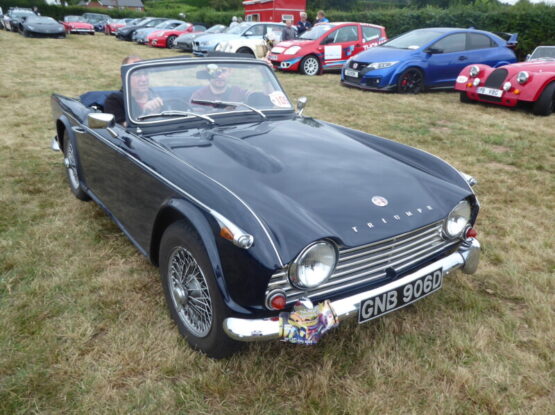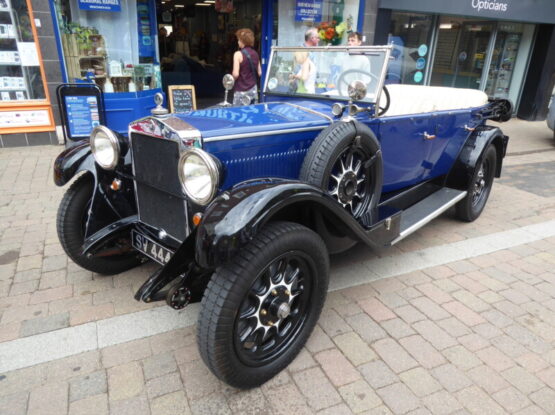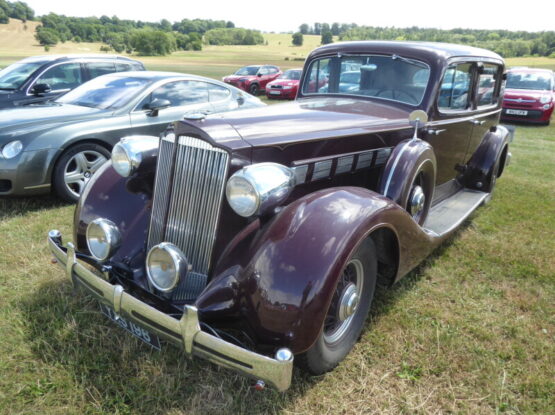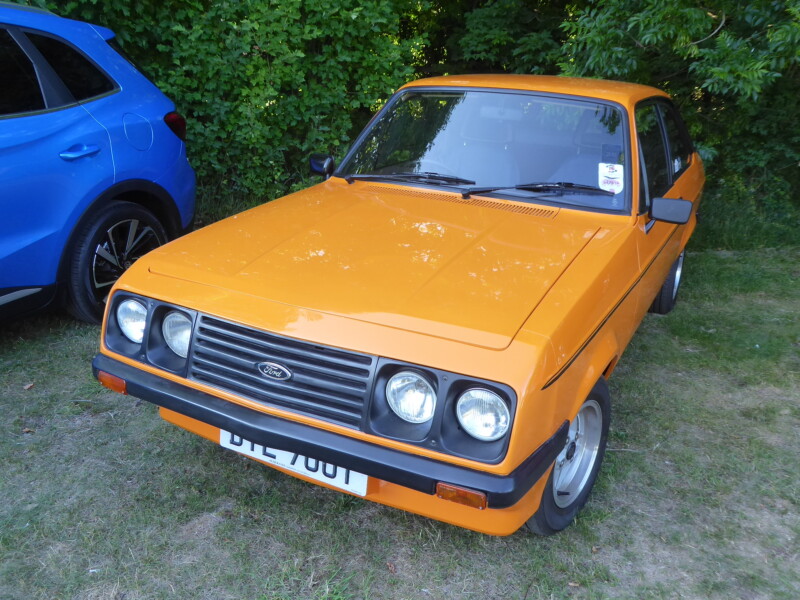
Having enjoyed the May 2025 edition of Wheels on Wednesday at the Avoncroft Museum, I was pleased to discover that my diary and whereabouts would make it possible to attend again in June, for another visit to this site as well as to take in the wide variety of cars that seem to attend. Whilst there are event regulars at what is now a very established summer mid-week evening program of events that take place from May to August, there are also plenty of cars that arrive having not been seen here before, so this event always makes for an interesting evening out. The Avoncroft Museum is situated a few minutes off junction 5 of the M5, so it is slightly further away than the Spetchley Park site that had been the home of Wheels on Wednesday since conception, but, as I found out last month, this one has more charm to it, as it is not just one large open field. There are space limitations so you do need to book in advance, or risk the event being sold out. but there is also a car park for the more modern cars which can be used by those who did not secure a ticket for the main displays. The June 2025 event was blessed with some lovely evening sunshine so there was indeed a very strong turnout. Here is what I saw:
ABARTH
What is known as the Series 4 version of the familiar 595 reached the markets in the middle of 2016. After rumours had circulated all winter following the launch of the facelifted Fiat 500 last year, Abarth finally unveiled the Series 4 at the end of May 2016. Initially, we were told that the cars would not be available in the UK until September, but that came forward somewhat, with dealers all receiving demo cars in June, and the first customers taking delivery in July. Three regular production versions of both the closed car and the open-topped C were initially available, all badged 595, and called Custom, Turismo and Competizione, as before, though numerous limited edition models have since appeared and in most case disappeared. The most significant changes with the Series 4 are visual, with a couple of new colours, including the much asked for Modena Yellow and a different red, called Abarth Red, which replaces both the non-metallic Officina and – slightly surprisingly – the tri-coat pearlescent Cordolo Red. as well as styling changes front and rear. The jury is still out on these, with many, me included, remaining to be convinced. At the front, the new air intake does apparently allow around 15 – 20 % more air in and out, which will be welcome, as these cars do generate quite a lot of heat under the bonnet. Competizione models for the UK retain the old style headlights, as they have Xenon lights as standard, whereas the Custom and Turismo cars have reshaped units. At the back, there are new light clusters and a new rear bumper and diffuser. Inside, the most notable change is the replacement of the Blue & Me system with a more modern uConnect Audio set up, which brings a new colour screen to the dash. Mechanically, there is an additional 5 bhp on the Custom (now 145) and Turismo (now 165 bhp) and the option of a Limited Slip Diff for the Competizione, which is likely to prove a popular option. Details of the interior trim have changed, with a filled-in glovebox like the US market cars have always had, and electric windows switches that are like the US ones, as well as a part Alcantara trim to the steering wheel in Competizione cars.


ALVIS
This is a 1936 Speed 20, perhaps the epitome of pre-war sporting elegance. Beautifully made and bristling with technical innovations such as independent front suspension, all-synchro gearbox and servo-assisted brakes, the car went through four versions, SA to SD, between 1932 and 1936 before being replaced by the Speed 25 in 1937. Engine size grew from 2.5 to 2.7 litres, culminating in the 3.5-litre unit in the Speed 25, capable of a smooth and silent 100mph and widely regarded as the best Alvis ever built. The SD model came out in 1936 and had the SC’s larger 2.7-litre engine (good for an easy 90mph) improved steering and suspension, stiffened chassis and twin electric fuel pumps plus slightly wider bodywork. The low-slung chassis endowed the car with tremendous handling and grip for its day: “’When cornering it is not only free from rolling – the low build sees to that – but the layout is such that it clings to the intended path at quite unexpected speeds, and when centrifugal force does eventually produce a skid, it is of the rear wheels only and easily controlled,” observed Motor Sport’s tester. Motor magazine was equally enthusiastic: “The new Alvis Speed 20 is the type of car which looks right, feels right and is right. From the driver’s point of view, the controls are all just where they are required and the power, speed and acceleration provided by the silky six-cylinder engine are a real eye-opener to anyone accustomed to driving about in more ordinary motor cars.” Although the car was available in rolling chassis form to receive a coachbuilt body of the owner’s choosing, the majority of customers plumped for the handsome Charlesworth Saloon bodywork. By the time production came to an end in late 1936, just 1,165 Speed 20’s of all types had been built and all are increasingly sought-after today.


ASTON MARTIN
Follow on to the DB7 was the DB9 (there has never been a car called DB8 – supposedly because people might have assumed this meant a V8 engine), and there was a nice example here. The Aston Martin DB9, designed by Marek Reichmann and Hendrik Fisker, was first shown by Aston Martin at the 2003 Frankfurt Auto Show, in coupe form. It was widely praised for the beauty of its lines. This was the first model to be built at Aston Martin’s Gaydon facility. It was built on the VH platform, which would become the basis for all subsequent Aston models. The Aston Martin DB9 was initially launched equipped with a 6.0 litre V12 engine, originally taken from the V12 Vanquish. The engine produced 420 lbf·ft of torque at 5,000 rpm and a maximum power of 444 hp at 6,000 rpm, allowing the DB9 to accelerate from 0 to 60 mph in 4.7 seconds and a top speed of 299 km/h (186 mph). The engine largely sits behind the front-axle line to improve weight distribution. Changes to the engine for the 2013 model year increased the power to 503 hp and torque to 457 lb-ft, decreasing the 0 to 60 mph time to 4.50 seconds and with a new top speed is 295 km/h (183 mph). The DB9 was available with either a six-speed conventional manual gearbox from Graziano or a six-speed ZF automatic gearbox featuring paddle-operated semi-automatic mode. The gearbox is rear-mounted and is driven by a carbon-fibre tail shaft inside a cast aluminium torque tube. The DB9 was the first Aston Martin model to be designed and developed on Ford’s aluminium VH (vertical/horizontal) platform. The body structure is composed of aluminium and composites melded together by mechanically fixed self-piercing rivets and robotic assisted adhesive bonding techniques. The bonded aluminium structure is claimed to possess more than double the torsional rigidity of its predecessor’s, despite being 25 percent lighter. The DB9 also contains anti-roll bars and double wishbone suspension, supported by coil springs. To keep the back-end in control under heavy acceleration or braking, the rear suspension has additional anti-squat and anti-lift technology. Later versions of the car also features three modes for the tuning: normal, for every-day use, sport, for more precise movement at the cost of ride comfort, and track, which furthers the effects of the sport setting. The Aston Martin DB9 Volante, the convertible version of the DB9 coupe, followed a few months later. The chassis, though stiffer, uses the same base VH platform. To protect occupants from rollovers, the Volante has strengthened windscreen pillars and added two pop-up hoops behind the rear seats. The hoops cannot be disabled and will break the car’s rear window if deployed. In an effort to improve the Volante’s ride while cruising, Aston Martin have softened the springs and lightened the anti-roll bars in the Volante, leading to a gentler suspension. The retractable roof of the Volante is made of folding fabric and takes 17 seconds to be put up or down. The Volante weighs 59 kilograms (130 pounds) more than the coupe. The coupe and Volante both share the same semi-automatic and automatic gearboxes and engine. The car was limited to 266 km/h (165 mph) to retain the integrity of the roof. Like the coupe, the original Volante has 420 lb·ft of torque at 5,000 rpm and a maximum power of 450 hp at 6,000 rpm. The 0 to 60 mph slowed to 4.9 seconds due to the additional weight. The DB9 was facelifted in July 2008, which mainly amounted to an increase in engine power, to 476 hp and a redesigned centre console. Externally, the DB9 remained virtually unchanged. For the 2013 model year revision, Aston made minor changes to the bodywork by adapting designs from the Virage, including enlarging the recessed headlight clusters with bi-xenon lights and LED daytime strips, widening the front splitter, updating the grille and side heat extractors, updating the LED rear lights with clear lenses and integrating a new rear spoiler with the boot lid. .On newer models, like the coupe’s, the Volante’s horsepower and torque increased to 517 PS (510 hp) and 457 lb·ft respectively. As a finale for the model, a more powerful DB9 was released in 2015, called the DB9 GT. This had 540 bhp and 457 lb-ft of torque at 5500 rpm, giving a 0 to 60mph time of 4.4 seconds and 0 to 100mph in 10.2 seconds, with the standing quarter mile dispatched in 12.8 to 12.9 seconds and a top speed of 183mph. Production of the DB9 ended in 2016 being replaced by its successor, the DB11.

AUDI
Still well-regarded over 40 years since its launch is the Quattro, a legend which transformed rallying and brought the idea of four wheel drive as a performance benefit to the market. The idea for a high-performance four-wheel-drive car was proposed by Audi’s chassis engineer, Jörg Bensinger, in 1977, when he found that the Volkswagen Iltis could outperform any other vehicle in snow, no matter how powerful. Bensinger’s idea was to start developing an Audi 80 variant in co-operation with Walter Treser, Director of Pre-Development.. Following an unveiling on 1st March 1980, Audi released the original Quattro to European customers in late 1980, with the car featuring Audi’s quattro permanent four-wheel drive system (hence its name), and the first to mate four-wheel drive with a turbocharged engine. The original engine was the 2,144 cc in-line-5-cylinder 10 valve SOHC, with a turbocharger and intercooler. It produced 197 bhp propelling the Quattro from 0 to 100 km/h in 7.1 seconds, and reaching a top speed of over 220 km/h (137 mph). The engine was eventually modified to a 2,226 cc inline-5 10 valve, still producing 197 bhp, but with peak torque lower in the rev-range. In 1989, it was then changed to a 2,226 cc inline-5 20v DOHC setup producing 217 bhp, now with a top speed of 230 km/h (143 mph) Audi Quattros are referred to among owners and enthusiasts by their engine codes, to differentiate between the earlier and later versions: the earliest 2144 cc 10v being the “WR” engine, the 2226 cc 10v being the “MB” engine, and the later 20v being the “RR” engine. Hence, Quattro models may be referred to as either the WR Quattro, MB Quattro, and RR or “20v” Quattro, respectively. Quattro car production was 11,452 vehicles over the period 1980–1991, and through this 11 year production span, despite some touch-ups, there were no major changes in the visual design of the vehicle. For the 1983 model year, the dash was switched from an analogue instrument cluster, to a green digital LCD electronic instrument cluster. This was later changed in 1988 to an orange LCD electronic instrument cluster. The interior was redesigned in 1984, and featured a whole new dash layout, new steering wheel design, and new centre console design, the switches around the instrument panel were also redesigned at this time. In 1985 the dash changed slightly with harder foam and lost a diagonal stripe, the dash switches were varied slightly and the diff lock pull knob gave way to a two-position turning knob with volt and oil temp digital readouts. External styling received very little modification during its production run. Originally, the car had a flat fronted grille featuring four separate headlamp lenses, one for each of the low and high beam units. This was altered for the 1983 model year, and replaced with combined units featuring a single lens, but housing twin reflectors. This was changed again, for the 1985 model year, in what has become known as the ‘facelift model’ and included such alterations as a new sloping front grille, headlights, and trim and badging changes. Max speed was 124 mph. The RR 20v Quattro also featured a new three spoke steering wheel design, leather covering for door arm rests, gloveboxes, centre console and door pockets. There was also a full length leather-wrapped centre console running all the way to the rear seats. The 20v was also the first Ur-Q to have “quattro” script interior with partial leather seats. The floor on the drivers side had a bulge due to dual catalytic exhaust setup. The different models may be distinguished by the emblems on their boot lids: the WR had a vinyl ‘quattro’ decal or a brushed aluminium effect plastic emblem, the MB had chrome plated ‘audi’, ‘audi rings’ and ‘quattro’ emblems, whilst the RR had only chrome plated ‘audi rings’. The rear suspension was altered early on with geometry changes and removal of the rear anti-roll bar to reduce a tendency for lift-off oversteer. For the 1984 facelift, the wheel size went from 6×15-inch with 205/60-15 tyres to 8×15-inch wheels with 215/50-15 tyres. At the same time the suspension was lowered 20 mm with slightly stiffer springs for improved handling. For 1987, the Torsen centre differential was used for the first time, replacing the manual centre differential lock. The last original Audi Quattro was produced on 17 May 1991, more than two years after the first models of the new Audi Coupe range (based on the 1986 Audi 80) had been produced.

The Audi R8, based on the Audi Le Mans quattro concept car (designed by Frank Lamberty and Julian Hoenig) first appeared at the 2003 International Geneva Motor Show and the 2003 Frankfurt International Motor Show. The R8 road car was officially launched at the Paris Auto Show on 30 September 2006. There was some confusion with the name, which the car shares with the 24 Hours of Le Mans winning R8 Le Mans Prototype (LMP). Initial models included the R8 4.2 FSI coupé (with a V8 engine) and R8 5.2 FSI coupé (with a V10 engine). Convertible models, called the Spyder by the manufacturer, were introduced in 2008, followed by the high-performance GT model introduced in 2011. The Motorsport variants of the R8 were also subsequently introduced from 2008 onwards. An all-electric version called the e-Tron started development but would only reach production stage when the second generation model would be introduced. 6-time 24 Hours of Le Mans winner Jacky Ickx described the R8 as “the best handling road car today” and the car was well received by everyone who drove it. The car received a facelift in 2012 and a new model called the V10 Plus was now added to the range. Production of the Type 42 ended in August 2015

This is the second generation R8. Launched at the 2015 Geneva Motor Show and is based on the Modular Sports System platform shared with the Lamborghini Huracan. The development of the Type 4S commenced in late 2013 and was completed in late 2014. Initial models included the all-electric e-Tron and the V10 5.2 FSI along with the V10 plus. Unlike its predecessor, there was no manual transmission available and the entry-level V8 trim was also dropped. In 2016, the convertible (Spyder) variant was added to the line up which was initially available in the base V10 trim. In mid-2017, the high performance V10 plus Spyder was added to the range. A rear-wheel-drive model called the R8 RWS was introduced. In 2018, the R8 received a mid-cycle refresh with mechanical and exterior changes. The newer and more aggressive design language carried over from famous Audi models of the past and its appearance is slightly more angular up front. Some of the aerodynamic features such as the front aeroblades are shared with the Lamborghini Huracàn. The refreshed model had substantial performance improvements over its predecessor. The base R8 got a power boost from 532 hp to 562 hp, while the V10 Plus was renamed V10 Performance Quattro and the engine saw a power increase by 10 hp, now up to 612 hp.


AUSTIN
The Morris Minor was already well established when rival Austin launched their competitor, the A30 Saloon of 1952. That was also the year that Austin and Morris merged to become the British Motor Corporation, so suddenly the two cars that had been conceived to compete against each other were stablemates. Except BMC did not work like that. Separate dealer chains remained in place, as they would do for a further 30 years, and whilst this may sound inefficient now, it has to be noted that brand loyalty was such that there were plenty of people would only consider an Austin say, and not a Morris, or vice versa. The A30 was smaller than the Minor and at £507, at launch, it was also £60 cheaper. The body structure was designed by T.K. Garrett, who had been an aeronautical engineer before joining Austin. It was of fully stressed monocoque chassis-less construction, which made it lighter and stiffer than most contemporary vehicles, the first Austin to be made in this way. Inside there were individual seats at the front and a bench at the rear covered in PVC with an option of leather facings on the seats. Evidence of economy was seen in only having a single windscreen wiper, central combined stop/tail/numberplate lamp and a sun visor in front of the driver only. A passenger-side wiper and sun visor, and a heater were available as optional extras. Even so, it sold well, and 223,264 examples were built. The A30 was replaced by the Austin A35 in 1956 with the new name reflecting the larger and more powerful 34 hp A-Series engine, which gave the car a slightly higher top speed and better acceleration, though much of this came as a result of different gearbox ratios. The A30 had the first three ratios close together then a big gap to top, whereas in the A35, the ratios were better spaced and gave a higher speed in third gear. That top speed was 72 mph and 0 – 60 acceleration times are just over 30 seconds, so this remains a very slow car by modern standards. The A35 was very similar in appearance to the A30, and is best recognised by its larger rear window aperture and a painted front grille, with chrome horse-shoe surround, instead of the chrome grille featured on the A30. The semaphore trafficators were replaced with present-day front- and rear-mounted flashing light indicators. A slightly easier to operate remote-control gear-change was provided. Like the A30, the A35 was offered as a two- or four-door saloon or two-door “Countryman” estate and also as a van. The latter model continued in production through to 1968. A rare coupe utility (pickup) version was also produced in 1956, with just 477 sold. Drawings were made for a sports tourer, but no prototype was actually built. The A35 passenger cars were replaced by the new body shape A40 Farina models in 1959 but the estate car version continued until 1962 and van until 1968. These days they are popular as an affordable classic. Their simple mechanicals, good availability of some parts (not bodywork, though) and pert looks give them widespread appeal


Launched at the 1949 London Motor Show was the A40 Sports, a four-passenger, aluminium-bodied convertible version of the Austin A40 – carrying an Austin of England nameplate, bearing Austin’s Flying A hood ornament, and designed and manufactured in conjunction with Jensen Motors. Production did not begin until November 1950 for model year 1951. By the time production ended in 1953, about 4,011 examples had been produced. As one in a series of collaborations between Austin and Jensen Motors of West Bromwich, the A40 Sports originated when Austin’s chairman Leonard Lord saw the Jensen Interceptor and requested that Jensen develop a body that could use the A40 mechanicals. The resulting body-on-frame A40 Sports was designed by Eric Neale, a stylist who had joined Jensen in 1946 after working at Wolseley Motors. During production, A40 Sports bodies were built by Jensen and transported to Austin’s Longbridge plant for final assembly. As per Lord’s intention, the A40 Sports was based on the mechanicals of the Austin A40 Devon, though the centre section of the chassis was boxed to provide rigidity for the open body. The A40 Sports also employed a twin-SU carburettor version of the 1.2 litre engine producing 46 bhp rather than 42 bhp Gear selection was originally via a floor-mounted lever. Steering was worm and roller type, front suspension was independent coil springs with rigid beam axle and semi-elliptic leaf springs at the rear. Production of the A40 Sports occurred in two series. The initial GD2 Series began in November 1950 and featured a floor gear change and dashboard identical to that of the Devon. The later GD3 Series began production in August 1951 and ended in April 1953, featuring a steering-column gear change, full hydraulic brakes, and a revised dash with a centred instrument panel The A40 Sports had trouble maintaining 60 to 65 miles per hour cruising speeds – despite a top speed of 77.8 mph as recorded by the British magazine The Motor in 1951 – and could accelerate from 0–60 mph in 25.6 seconds. Tests achieved a fuel consumption of 29.3 mpg. In the United States – initially targeted as its primary market – the A40 was priced at about $2,200. It was listed at about £818 in the UK,at a time when a mainstream middle market six-cylinder saloon, the Vauxhall Velox, was offered for £550 and Austin’s own A40 saloon was offered for slightly more than £500.


The A99 Westminster appeared in 1959 with new Pinin Farina-designed bodywork. Pininfarina had also re-styled Austin’s compact A40 and mid-sized A55 Cambridge ranges the year before. Under the bonnet was the 2.9 L (2912 cc) C-Series straight-6 engine with twin SU carburettors from the Austin-Healey 3000. This engine produced 103 hp in Westminster tune. A three-speed all-synchromesh manual gearbox with a Borg-Warner overdrive unit was fitted as standard, or a Borg-Warner automatic transmission as an option. Power-assisted Lockheed brakes with 10.75 in (273 mm) discs on the front wheels were also new. An A99 saloon with automatic transmission was tested by the British magazine The Motor in 1960 and they recorded a top speed of 98.1 mph, acceleration from 0–60 mph in 17.9 seconds and a fuel consumption of 23.0 mpg imperial (12.3 L/100 km; 19.2 mpg‑US). The test car cost £1219 including taxes. The manual car cost £1148. A specially trimmed A99 was sold as the Princess 3-Litre, (note, not an “Austin” Princess – Austin was removed from Princess badging in August 1957 on the larger Princess IV) and later under the Vanden Plas marque as the Vanden Plas Princess. A Wolseley version, the 6/99, was also produced. Production ended in 1961 with the introduction of the larger A110. 15,162 A99s were built. The final major update arrived in 1961 with the A110 Westminster. This version had an extended (by 2 in/51 mm) wheelbase, which allowed more space in the rear compartment as well as improving the roadholding, a floor-mounted gear lever. 13 in wheels were substituted in 1964’s Mark II models. Wolseley produced a 6/110 version, and there was a Vanden Plas Princess Mark II with the C-Series engine, now uprated to 120 bhp. The same basic body was also used for a Rolls-Royce-engined Vanden Plas Princess, and the body even formed part of a prototype Bentley. The Westminster range was finally replaced by the Austin 3-Litre in 1968. 26,105 A110s were built.


“A British car to beat the world”. So read the billboards when the Austin Metro was revealed in October 1980. We had waited a long time for this car. There were many false starts, with thoughts first turning to how to replace the Mini going back to the late 1960s, but for various reasons, every effort had been cancelled. Fortunately, that extended to the ADO88 prototype which got to quite an advanced state of development in 1978, but which received less than favourable feedback at customer clinics. A hasty redesign was conducted. Despite carrying over the A Series engines, albeit in modified A+ guise, as BL had nothing else suitable an no money to develop an alternative, and that meant the 4 speed in-sump gearbox came with it, the little Metro has an immediate hit. It looked good, with pert, modern looks, and with a large hatchback, and some innovative ideas on how to maximise the use of space, this was a roomy car that Britain could indeed be proud of. That a young lady who came to prominence in the months following launch, the future Princess Diana, could be seen driving around in one probably helped still further. Five models were available at launch: 1.0, 1.0L, the economy-oriented 1.0 HLE, 1.3S and 1.3 HLS, and the cars were available in a wide range of bright and attractive colours, including a greater percentage of metallic paints than were typically offered to buyers of cars in this class. My parents bought a 1.0L in the summer of 1983, as a replacement for our Mini, and the car was a massive improvement in just about every respect. Unlike previous BL cars, this model was not dogged with build quality and reliability issues, though, sadly it did have the same propensity to rust as they did, but it took several years before that would become obvious. Before that happened, the range was expanded with the introduction of cheaper City and City X models, a top spec Vanden Plas and then the sporting MG version. There was a lot of angst about this last one, as the purists all bemoaned the fact that it was not a “real” MG, as it was a family hatchback not a sports car (conveniently ignoring the MG 1100/1300 saloons of the 1960s), but ti soon became apparent that this little car was a blast to drive, and something quite special with its red trim, including red seat belts and a liberal splashing of octagon logos around the car. A wilder Turbo model followed at the end of 1982, reflecting the craze for every manufacturer to bolt one on to every car that they could find to create a series of often rather unruly and lag-prone but fast machines. Although a lot of work was done in the mid 80s on developing what should have been another world class replacement (the AR6, the prototype for which is also hidden away at Gaydon), a lack of funds meant that for the next 7 years, all that happened was a lot of tweaking of the trim, and specification and the incorporation of a pair of rear doors to create a 5 door model. This was at a time when the competition stood far from still, with the Fiat Uno and Peugeot 205 upping the ante in early 1983, Vauxhall joining the fray with the Nova mid year, a facelifted Fiesta with a five speed gearbox arriving later that year, a new Renault R5 the following year, along with several Japanese rivals coming out every 4 years. It all made the Metro look increasingly elderly, and also small, compared to all its rivals.


AUSTIN HEALEY
Donald Healey had been producing a range of expensive sports cars from the 1940s, cars such as the Silverstone, the Abbott and the Farnham. For the 1952 London Motor Show, he produced a new design, which was called the Healey Hundred, based on Austin A90 mechanicals, which he intended to produce in-house at his small car company in Warwick. It was one of the stars of the 1952 Show, and it so impressed Leonard Lord, the Managing Director of Austin, who was looking for a replacement to the unsuccessful A90. that Lord struck a deal with Healey on the spot, to build it in quantity. Bodies made by Jensen Motors would be given Austin mechanical components at Austin’s Longbridge factory. The car was renamed the Austin-Healey 100, in reference to the fact that the car had a top speed of 100 mph. Production got under way in 1953, with Austin-Healey 100s being finished at Austin’s Longbridge plant alongside the A90 and based on fully trimmed and painted body/chassis units produced by Jensen in West Bromwich—in an arrangement the two companies previously had explored with the Austin A40 Sports. By early 1956, production was running at 200 cars a month, 150 of which were being sold in California. Between 1953 and 1956, 14,634 Austin-Healey 100s were produced, the vast majority of them, as was the case for most cars in this post war era, going for export. The car was replaced by an updated model in 1956, called the 100-6. It had a longer wheelbase, redesigned bodywork with an oval shaped grille, a fixed windscreen and two occasional seats added (which in 1958 became an option with the introduction of the two-seat BN6 produced in parallel with the 2+2 BN4), and the engine was replaced by one based on the six-cylinder BMC C-Series engine. In 1959, the engine capacity was increased from 2.6 to 2.9 litres and the car renamed the Austin-Healey 3000. Both 2-seat and 2+2 variants were offered. It continued in this form until production ceased in late 1967. The Big Healey, as the car became known after the 1958 launch of the much smaller Austin-Healey Sprite, is a popular classic now. You come across the 3000 models more frequently than the 100s, as they accounted for more than 60% of all Big Healey production.

The Mark II to Mark IV Sprite cars were all very similar and represented the evolution of the model throughout the 1960s, The Mark II was announced at the end of May 1961. It used the same 948 cc engine with larger twin 1 1⁄4 inch SU carburettors, increasing power to 46.5 bhp. A close-ratio gearbox was fitted. The bodywork was completely revamped, with the headlights migrating to a more conventional position in the wings, either side of a full-width grille. At the rear, styling borrowed from the soon-to-be-announced MGB gave a similarly more modern look, with the added advantages of an opening boot lid and conventional rear bumper bar. The result was a much less eccentric-looking sports car, though at the expense of some 100 lbs extra weight. It followed the MG version of the car which was introduced a couple of weeks earlier as ‘the new Midget,’ reviving a model name which had been a great success for the MG Car Company in the 1930s. The Midget was to prove more popular with the public than the Sprite and by 1972 had completely supplanted it within the BMC range. In October 1962, both Sprites and Midgets were given a long-stroke 1098 cc engine. A strengthened gearbox with Porsche (baulk-ring) synchromesh was introduced to cope with the extra power – 56 bhp. Front disc brakes were also introduced at the same time and wire wheels became an option. 31,665 Mark II Sprites were made. The Mark III Sprite was also marketed as the Mark II MG Midget – differences between the two were again restricted to minor trim detailing. Although still 1098 cc, the engine had a stronger block casting, and the size of the crankshaft main bearings was increased to two inches. A new (slightly) curved-glass windscreen was introduced with hinged quarterlights and wind-up side windows. Exterior door handles were provided for the first time, with separate door locks. Though the car could now be secured, with a soft-top roof the added protection was limited. The rear suspension was modified from quarter-elliptic to semi-elliptic leaf springs, which gave a more comfortable ride for a near-negligible weight penalty as well as providing additional axle location, the upper links fitted to the quarter-elliptic models being deleted. Though scarcely sybaritic, these changes helped the Sprite and Midget compete with the recently released Triumph Spitfire. 25,905 Mark III Sprites were made. The next upgrade was presented at the London Motor Show in October 1966. Besides receiving the larger 1275 cc engine (which disappointed enthusiasts by being in a lower state of tune than that of the Mini-Cooper ‘S’), the Mark IV and its cousin the Mark III MG Midget had several changes which were more than cosmetic. Most notable is the change from a removable convertible top, which had to be stowed in the boot, to a permanently affixed, folding top of greatly improved design, which was much easier to use. Separate brake and clutch master cylinders were fitted, as car manufacturers’ thoughts began to turn to making their products safer. For the 1970 model year cast-alloy wheels were fitted and the grille was changed to resemble that fitted to the MG Midget. 22,790 Mark IV Sprites were made. The Healey connection was discontinued in 1971, so the final 1,022 Sprites built were simply Austin Sprites.


BMW
BMW E21 is the first generation of the BMW 3 Series compact executive car, produced by from 1975 to 1981. Most E21s were sold as 2-door compact sedans, however a Baur cabriolet was also available. Under the direction of its 51% percent shareholder, Herbert Quandt, BMW decided upon a replacement for their aging 02 Series. Paul Bracq, Director of Design at BMW from 1970 to 1974, is credited with setting the design direction of the E21. In July 1975, BMW’s Board of Management first presented this new model series in the Munich Olympic Stadium for public appraisal. The frontal view of the new car was dominated by the BMW trademark kidney grille standing out clearly from the radiator cover. The styling of the new car bore a resemblance to the BMW E12 5 Series. The wedge shape of the two-door model was distinctive, extending all the way to the unusually high rear end. In response to criticism of the tail design, a black plastic trim panel between the tail lights was added. Like many other BMW models, the C-pillar of the E21 features a Hofmeister kink. The cockpit design of the E21 marked the introduction of a new design concept, with the centre console and central dashboard area angled towards the driver. This feature has become part of BMW’s interior design philosophy for many years. As a sign of passive safety, all edges and control elements within the interior were rounded off and padded. The suspension incorporated rack and pinion steering and MacPherson strut suspension at the front, and semi-trailing arm type independent suspension at the rear. The rear suspension design causes camber changes, which can introduce “snap oversteer” at the handling limits, and the car was castigated repeatedly for this (now, of course, the press would shout in joy about such an attribute! The power assisted brakes were discs on the front wheels, while the rear wheels had drum brakes. Initially, a Getrag four-speed manual was the standard transmission fitment. Five-speed overdrive Getrag gearboxes were fitted as standard in 1980, but close ratio ‘sport’ gearboxes were available at the car’s release as an option. Alternatively, purchasers could opt for the ZF 3 HP-22 three-speed automatic transmission. At the E21’s release, three models were available: with 316 (1.6-litre), 318 (1.8-litre) and 320 (2.0-litre) versions of the BMW M10 4-cylinder engine. To differentiate between models, the 320 model came with dual headlights, while the 316 and 318 had single headlights. The fuel-injected 320i was introduced at the end of 1975. It featured the M10 4-cylinder engine with Bosch K-Jetronic fuel injection, and a limited slip differential was available as an option. At the 1977 International Auto Show in Frankfurt, BMW unveiled its new variants of the E21, featuring the new straight-6 M20 engines (which were initially called “M60”). BMW had invested DM 110 million the M20 engine series. The 4-cylinder 320 model was replaced with the 320/6, featuring a 2.0 version of the M20 engine. The 323i model was introduced, featuring 2.3 litre with 141 hp, which gave the 323i a top speed of 200 km/h (124 mph). The braking system was also upgraded, with the 323i featuring disc brakes on all wheels. Options include power steering, a 5-speed close-ratio ‘dogleg’ sport gearbox, and 25% limited slip differential. For the 1980 model year, the four-cylinder models were upgraded: the 1.8 litre carburetted M10 unit was revised to produce 89 hp and entered the market in the updated 316, while a fuel-injected version of the 1.8 litre M10 was introduced in the 318i model (which replaced the carburetted 318 as the mid-range model). The 320is model (USA only) was released in 1980 using a 1.8 litre version of the M10. The “S Package” featured Recaro sport seats, a modified dash with no air conditioning (A/C could be added by the dealer), upgraded suspension components that included a rear anti-roll bar and a larger front anti-roll bar, a 5-speed transmission and limited-slip differential, cross-spoke alloy wheels, an upgraded tool kit, a dual operation manual sunroof, an AM/FM Blaupunkt radio with cassette player, fog lights, a 3-spoke leather-wrapped steering wheel and leather shift knob, a front air dam, a “delete” of the alphanumeric 320i markers on the rear boot lid and a limited colour palate of white, silver or black. Just 2,500 320is were produced. In 1981, the economy model 315 was introduced as a reaction to the second “oil crisis” in late 1979. More spartan than the other E21 models, it was the last E21 to be built and shared production with the E30.

The BMW E30 is the second generation of BMW 3 Series, which was produced from 1982 to 1994 and replaced the E21 3 Series, and was the car which really saw the popularity of the 3 Series increase dramatically. . Development of the E30 3 Series began in July 1976, with styling being developed under chief designer Claus Luthe with exterior styling led by Boyke Boyer. In 1978, the final design was approved, with design freeze (cubing process) being completed in 1979. BMW’s launch film for the E30 shows the design process including Computer-aided design (CAD), crash testing and wind-tunnel testing. The car was released at the end of November 1982. Externally, the E30’s appearance is very similar to twin headlight versions of its E21 predecessor, however there are various detail changes in styling to the E30. Major differences to the E21 include the interior and a revised suspension, the latter to reduce the oversteer for which the E21 was criticised. At launch, the car had a 2 door style like its predecessor and just four engines, all of them petrol: the 316 and 318 four cylinder units and the 320 and 323i 6 cylinders. This last was soon upgraded to a 2.5 litre unit. Diesel models were added during the 80s and there was an all-wheel drive 325iX option for continental European markets. In addition to the 2 door saloon and Baur convertible body styles of its E21 predecessors, the E30 became available by early 1984 as a four-door sedan and later a five-door station wagon (marketed as “Touring”). The Touring body style began life as a prototype built by BMW engineer Max Reisböck in his friend’s garage in 1984 and began production in 1987. The factory convertible version began production in 1985, with the Baur convertible conversions remaining available alongside it. Following the launch of the E36 3 Series in 1990, the E30 began to be phased out.

Also was the monstrous XM, a car that was not really intended for Europe, as it is too big (and vulgar) for our roads and tastes. Needless to say, they are a mercifully rare sight here!

CADILLAC
In 1985, Fleetwood models used a new front-wheel-drive C-body platform, sharing the 110.8 inches (2,810 mm) wheelbase with GM’s other C-body cars, the DeVille, Buick Electra, and Oldsmobile Ninety-Eight. The Fleetwood Brougham continued to use the RWD platform, (which was redesignated as “D-body” for 1985) through 1986. As had been the case since the 1977 model year, there were little more than trim differences between the Fleetwood and the DeVille. For 1985, the Fleetwood was actually a de Ville trim option, rather than a separate model. The optional d’Elegance package, added tufted-button seating among other niceties for the FWD Fleetwood sedan. The Fleetwood coupe had been dropped after the 1986 model year, but returned in 1989. The Fleetwood coupe for 1989–1992 was not popular with model year production in 1989: 4,108, 1990: 2,438, 1991: 894, and for 1992: a mere 443. Cadillac offered the Fleetwood Sixty Special for model years 1987–1988, using a stretched 115.8 inches (2,940 mm) version of the new C-body platform – as well as the Fleetwood Series 75 for model years 1985–1987, using a 134.4 inches (3,410 mm) stretched version of the same platform. The aluminum 4.1 L HT-4100 V8 was replaced by the 4.5 L HT-4500 for 1988. The engine displacement was increased for 1991 to the 4.9 L HT-4900. The Fleetwood line was redesigned for the 1989 model year to include skirted rear wheels. The Fleetwood coupe remained on the 110.8 in (2,810 mm) wheelbase, while the sedan’s wheelbase increased by 3 inches (76 millimetres). The slightly revised Fleetwood coupe, with extended front and rear styling, was sold from 1989 and ended in 1992. Power was increased to 180 hp from the same 4.5 L engine for 1990 through the use of a dual-stage intake manifold and other changes. It was replaced by the 200 hp 4.9 L HT-4900 for 1991. The Fleetwood nameplate departed the front-drive lineup for 1993 (as Fleetwood was transferred to the new rear-drive replacement for the 1992 Brougham). Instead, the Sixty Special nameplate was used on the front-wheel-drive model for 1993. A total of 5,292 Sixty Specials were built during 1993, including 688 with the optional “Ultra” package that featured “22-way” adjustable front seats, designed in Italy by Giorgetto Giugiaro. This seating package had been standard on the Sixty Special since 1989, but in 1993, it became a $3,550 option. While it was based upon the DeVille, the Sixty Special included eleven items as standard equipment, while those eleven items were optional at extra cost on DeVilles. There were options for the Sixty Special, that were unavailable on the DeVille, such as “Memory Seat” for the driver with two recall settings, an “Exit” button” when pushed automatically powered the driver seat all the way rearward, and dual front seat power recliners. Both the Fleetwood and DeVille were coded as C-bodies in the fourth digit of the VIN. The fifth digit coded the DeVille as “D” (with the later Touring Sedan becoming “T”), the Fleetwood as “B”, and the Fleetwood Sixty Special as “S”. The Sixty Special became the “G” code for 1991, and switched back to “B” for its 1993 run. For 1993, the Cadillac Fleetwood was reintroduced as a rear-wheel-drive sedan, replacing the 1987–1992 Brougham as the largest Cadillac sedan.

General Motors unveiled a coupe concept version of the CTS, along with the new CTS-V performance sedan, at the 2008 North American International Auto Show in Detroit. In November 2009, the production version was presented in a press release. The coupe went into production in spring 2010 for sale in August of that year as a 2011 model. The design of the production model is very similar to the concept, still without a B-pillar. The standard engine was a 3.6L direct injected V6 rated at 304 hp. Like the sedan, both six-speed manual and automatic transmissions, in either rear-wheel drive or all-wheel drive configurations, were available. A CTS-V Coupe was also introduced at the 2010 North American International Auto Show in Detroit. It was Cadillac’s first coupe since the Eldorado, which was discontinued in 2002. Along with the CTS sedan, the coupe received a slight facelift for the 2012 model year, including a new grille design. The CTS Coupe was discontinued after the 2014 model year, while the CTS-V Coupe remained in production for the 2015 model year.

CHEVROLET
First seen in 1963, this Corvette model introduced us to the name Sting Ray. It continued with fibreglass body panels, and overall, was smaller than the first generation. The car was designed by Larry Shinoda with major inspiration from a previous concept design called the “Q Corvette,” which was created by Peter Brock and Chuck Pohlmann under the styling direction of Bill Mitchell. Earlier, Mitchell had sponsored a car known as the “Mitchell Sting Ray” in 1959 because Chevrolet no longer participated in factory racing. This vehicle had the largest impact on the styling of this generation, although it had no top and did not give away what the final version of the C2 would look like. The third inspiration was a Mako Shark Mitchell had caught while deep-sea fishing. Production started for the 1963 model year and ended in 1967. The 1963 model was the first year for a Corvette coupé and it featured a distinctive tapering rear deck (a feature that later reappeared on the 1971 “Boattail” Buick Riviera) with, for 1963 only, a split rear window. The Sting Ray featured hidden headlamps, non-functional bonnet vents, and an independent rear suspension. Corvette chief engineer Zora Arkus-Duntov never liked the split rear window because it blocked rear vision, but Mitchell thought it to be a key part of the entire design. Maximum power for 1963 was 360 bhp, raised to 375 bhp in 1964. Options included electronic ignition, the breakerless magnetic pulse-triggered Delcotronic first offered on some 1963 Pontiac models. On 1964 models the decorative bonnet vents were eliminated and Duntov, the Corvette’s chief engineer, got his way with the split rear window changed to a full width window. Four-wheel disc brakes were introduced in 1965, as was a “big block” engine option: the 396 cu in (6.49 litre) V8. Side exhaust pipes were also optionally available in 1965, and continued to be offered through 1967. The introduction of the 425 bhp 396 cu in big block in 1965 spelled the beginning of the end for the Rochester fuel injection system. The 396 cu in option cost $292.70 while the fuel injected 327 cu in (5.36 litre) engine cost $538.00. Few people could justify spending $245.00 more for 50 bhp less, even though FI could deliver over 20 mpg on the highway and would keep delivering fuel despite high G-loading in corners taken at racing speeds. Another rare ’63 and ’64 option was the Z06 competition package, which offered stiffer suspension, bigger, multi-segment lined brakes with finned drums and more, only a couple hundred coupes and ONE convertible were factory-equipped this way in 1963. With only 771 fuel-injected cars built in 1965, Chevrolet discontinued the option at the end of the ’65 production, having introduced a less-expensive big block 396 engine rated at 425 hp in the middle of the production year and selling over 2,000 in just a few months. For 1966, Chevrolet introduced an even larger 427 cu in 7 litre Big Block version. Other options available on the C2 included the Wonderbar auto-tuning AM radio, AM-FM radio (mid-1963), air conditioning (late-1963), a telescopic steering wheel (1965), and headrests (1966). The Sting Ray’s independent rear suspension was successfully adapted for the new-for-1965 Chevrolet Corvair, which solved the quirky handling problems of that unique rear-engine compact. 1967 was the final year for the C2 generation. The 1967 model featured restyled bumper vents, less ornamentation, and back-up lamps which were on the inboard in 1966 were now rectangular and centrally located. The first use of all four taillights in red started in 1961 and was continued thru the C-2 line-up except for the 1966. The 1967 and subsequent models continuing on all Corvettes since. 1967 had the first L88 engine option which was rated at 430 bhp, but unofficial estimates place the actual output at 560 bhp or more. Only twenty such engines were installed at the factory. From 1967 (to 1969), the Holley triple two-barrel carburettor, or Tri-Power, was available on the 427 L89 (a $368 option, on top of the cost for the high-performance 427). Despite these changes, sales slipped over 15%, to 22,940 – 8,504 coupes and 14,436 convertibles.

CITROEN
It is hard to imagine just how revolutionary this car must have seemed when it was unveiled at the Paris Show in 1955. 18 years in secret development as the successor to the Traction Avant, the DS 19 stole the show, and within 15 minutes of opening, 743 orders were taken. By the end of the first day, that number had risen to 12,000. Contemporary journalists said the DS pushed the envelope in the ride vs. handling compromise possible in a motor vehicle. To a France still deep in reconstruction after the devastation of World War II, and also building its identity in the post-colonial world, the DS was a symbol of French ingenuity. It also posited the nation’s relevance in the Space Age, during the global race for technology of the Cold War. Structuralist philosopher Roland Barthes, in an essay about the car, said that it looked as if it had “fallen from the sky”. An American advertisement summarised this selling point: “It takes a special person to drive a special car”. Because they were owned by the technologically aggressive tyre manufacturer Michelin, Citroën had designed their cars around the technically superior radial tyre since 1948, and the DS was no exception. The car featured a novel hydropneumatic suspension including an automatic levelling system and variable ground clearance, developed in-house by Paul Magès. This suspension allowed the DS to travel quickly on the poor road surfaces common in France. In addition, the vehicle had power steering and a semi-automatic transmission (the transmission required no clutch pedal, but gears still had to be shifted by hand though the shift lever controlled a powered hydraulic shift mechanism in place of a mechanical linkage, and a fibreglass roof which lowered the centre of gravity and so reduced weight transfer. Inboard front brakes (as well as independent suspension) reduced unsprung weight. Different front and rear track widths and tyre sizes reduced the unequal tyre loading, which is well known to promote understeer, typical of front-engined and front-wheel drive cars. As with all French cars, the DS design was affected by the tax horsepower system, which effectively mandated very small engines. Unlike the Traction Avant predecessor, there was no top-of-range model with a powerful six-cylinder engine. Citroën had planned an air-cooled flat-6 engine for the car, but did not have the funds to put the prototype engine into production. The 1955 DS19 was 65% more expensive than the car it replaced, the Citroën Traction Avant. This did impact potential sales in a country still recovering economically from World War II, so a cheaper submodel, the Citroën ID, was introduced in 1957. The ID shared the DS’s body but was less powerful and luxurious. Although it shared the engine capacity of the DS engine (at this stage 1,911 cc), the ID provided a maximum power output of only 69 hp compared to the 75 hp claimed for the DS19. Power outputs were further differentiated in 1961 when the DS19 acquired a Weber-32 twin bodied carburettor, and the increasing availability of higher octane fuel enabled the manufacturer to increase the compression ratio from 7.5:1 to 8.5:1. A new DS19 now came with a promised 83 hp of power. The ID19 was also more traditional mechanically: it had no power steering and had conventional transmission and clutch instead of the DS’s hydraulically controlled set-up. Initially the basic ID19 was sold on the French market with a price saving of more than 25% against the DS, although the differential was reduced at the end of 1961 when the manufacturer quietly withdrew the entry level ID19 “Normale” from sale. An estate version was introduced in 1958. It was known by various names in different markets: Break in France, Safari and Estate in the UK, Wagon in the US, and Citroën Australia used the terms Safari and Station-Wagon. It had a steel roof to support the standard roof rack. ‘Familiales’ had a rear seat mounted further back in the cabin, with three folding seats between the front and rear squabs. The standard Break had two side-facing seats in the main load area at the back. During the 20 year production life, improvements were made on an ongoing basis. In September 1962, the DS was restyled with a more aerodynamically efficient nose, better ventilation and other improvements. It retained the open two headlamp appearance, but was available with an optional set of driving lights mounted on the front bumpers. A more luxurious Pallas trim came in for 1965 Named after the Greek goddess Pallas, this included comfort features such as better noise insulation, a more luxurious (and optional leather) upholstery and external trim embellishments. The cars were complex, and not always totally reliable, One of the issues that emerged during long term use was addressed with a change which came in for 1967. The original hydropneumatic system used a vegetable oil liquide hydraulique végétal (LHV), similar to that used in other cars at the time, but later switched to a synthetic fluid liquide hydraulique synthétique (LHS). Both of these had the disadvantage that they are hygroscopic, as is the case with most brake fluids. Disuse allows water to enter the hydraulic components causing deterioration and expensive maintenance work. The difficulty with hygroscopic hydraulic fluid was exacerbated in the DS/ID due to the extreme rise and fall in the fluid level in the reservoir, which went from nearly full to nearly empty when the suspension extended to maximum height and the six accumulators in the system filled with fluid. With every “inhalation” of fresh moisture- (and dust-) laden air, the fluid absorbed more water. For the 1967 model year, Citroën introduced a new mineral oil-based fluid liquide hydraulique minéral (LHM). This fluid was much less harsh on the system. LHM remained in use within Citroën until the Xantia was discontinued in 2001. LHM required completely different materials for the seals. Using either fluid in the incorrect system would completely destroy the hydraulic seals very quickly. To help avoid this problem, Citroën added a bright green dye to the LHM fluid and also painted all hydraulic elements bright green. The former LHS parts were painted black. All models, including the Safari and ID, were upgraded at the same time. The hydraulic fluid changed to the technically superior LHM (Liquide Hydraulique Minéral) in all markets except the US and Canada, where the change did not take place until January 1969, due to local regulations. Rarest and most collectable of all DS variants, a convertible was offered from 1958 until 1973. The Cabriolet d’Usine (factory convertible) were built by French carrossier Henri Chapron, for the Citroën dealer network. It was an expensive car, so only 1,365 were sold. These DS convertibles used a special frame which was reinforced on the side-members and rear suspension swing arm bearing box, similar to, but not identical to the Break/Safari frame.


The Visa is rare now, even in France, as despite the fact that Citroën built 1,254,390 examples of the model between 1978 and 1988, the model is all but extinct everywhere. There was a very long gestation to this car, which goes all the way back to 1965, when Robert Opron worked on the Citroën G-mini prototype and projet EN101, a replacement for the 2CV, using the flat twin engine from the 2CV. It was supposed to launch in 1970. The advanced space efficient designs with very compact exterior dimensions and an aerodynamic drag co-efficient Cd of 0.32, were axed because of adverse feedback from potential clients. With Citroën’s small car range all getting somewhat elderly, the decision was taken to try again, with the Citroën Prototype Y which was planned to replace the 2CV based Citroën Ami that dated back to 1960 in the early seventies. This was originally developed in co-operation with Fiat, built on the lessons from the Citroën G-mini and EN101 projects. It used the then new and advanced Fiat 127 platform, that used a transverse front wheel drive engine, with an end on gearbox layout that Fiat had pioneered in the 1960s. When co-operation with Fiat ended, a new Citroën designed platform was planned. After the takeover of Citroën by Peugeot in the wake of the 1974 oil crisis, the renamed “Projet VD (Voiture Diminuée)” became the Citroën Visa, incorporating the floor pan and advanced 104 engine, with its transmission (under the engine) and chassis. It was the first new model under the platform-sharing policy of PSA Peugeot Citroën that continues today. The earlier Citroën LN had just been a facelift of the Peugeot 104Z “Shortcut” with a re-engine and transmission from the Citroën Dyane. Eventually, in 1984, the original Citroën platform design from “Project Y” emerged as the Oltcit Club in Romania, using a Citroën Visa flat-twin engine and Citroën GS based gearbox, and Citroën GS flat-four engine and gearbox, and was also sold in Western Europe as the flat-four only Citroën Axel to recoup money that Citroën had invested in Romania, which the communist government could not repay. This project was problematic for Citroën due to build quality issues, only 60,184 cars were made, even though the base models were priced below the 2CV in Western Europe. The Axel was never sold in the UK. The five-door Citroën Visa and the three-door Axel look very similar, but there is no part interchangeable between these two Citroën models. The Visa entered a crowded market, with supermini competitors including the Chrysler Sunbeam, Mk1 Renault 5, Mk1 Ford Fiesta, Vauxhall Chevette, Mk1 VW Polo and Fiat 127. Though it was launched as a supermini, it was about the same length (3725mm) and height (1430mm), but slightly narrower at 1526mm than a Volkswagen Golf Mk1, which was in the next class up. It was part of a ‘between sizes’ policy that Citroën also followed with the BX. From its launch in September 1978, the front-wheel drive Visa was available in “Spécial” and “Club” models with a mapped electronic ignition 652 cc, 2-cylinder and a “Super” (later “Super E”) model (called the 11RE after 1984), with the advanced Peugeot 1,124 cc Douvrin engine / PSA X engine, a four-cylinder “Suitcase engine” — all aluminium alloy, chain driven overhead cam, with gearbox in the sump, sharing engine oil, mounted almost on its side. The 1124 cc was as economical as the Citroën 2CV-derived twin, but with much better performance. Later on it had 1,219 cc (Super X) and then 954 cc (10E after 1984) and 1,360 cc (1983 Visa GT and 14TRS after 1985) versions of the same engine. The ergonomic design of the Visa controls used a Citroën “PRN Satellite” (P=Pluie – Rain, R=Route – Road, N=Nuit – Night) which gave access on one cylindrical unit to wipers, washers, horn, indicators, headlamps and flashers, all mounted a finger’s reach away from the steering wheel. The heat and ventilation control sliders that moved in arcs, were on the other side of the steering wheel, also within closer reach than usual. In 1982 the Visa underwent a major external restyling, designed by Heuliez, to look more mainstream. It kept the original interior and “PRN Satellite” controls until 1985 when, along with the Citroën BX, it was updated with a new bulkier dashboard, instruments and switchgear that made the car feel smaller inside. Stalk switchgear like contemporary Peugeots added self-cancelling indicators, but it kept the original monospoke steering wheel. It had very soft, but well damped, long travel, fully independent suspension with coil-sprung MacPherson struts at the front and coil sprung trailing arms at the rear, that caused it to have a soft ride like the Citroën 2CV, but without such extreme roll angles. CAR magazine made the Visa diesel one of its top ten models on the market for two years running in the mid-1980s (January 1986 and 1987), for its versatility (higher models in the range had split rear seats which could be lifted-out to give an almost van-like luggage capacity); ride comfort (“like a limousine”); its ability to maintain high average speeds due to high levels of grip; and value for money. It was also particularly aerodynamically stable at high speeds for a relatively light, narrow and tall car. It would remain unperturbed by cross-winds and truck bow waves at motorway speeds. It also had at the middle ‘R’ trim level and above, (currently unfashionable), but practical, grey plastic side rubbing strips, to protect against car park damage. The very curved sides of the windscreen, enabled the use of a very large single wiper on the long narrow windscreen, without fouling the windscreen seal. The front of the revised car, was designed to aerodynamically reduce the deposition of dirt on the headlights, and to reduce the risk of stone chips to the headlights, bonnet and windscreen. The heating and ventilation system, (even though it used only a water control valve for temperature control and not air mixing), could provide cold air from fascia side vents, to the face while warming the car. The central directable fascia vents could be heated and angled, so that they could be pointed directly at the windscreen in front of the driver, to keep it clear in extreme misting conditions. There was also an additional mid level vent, to blow air between the front seats to the back of the car. The rear parcel shelf was in two hinged sections, one in the car, the other on the tailgate, to allow objects that were slightly too tall to still fit without removing the shelf. When carrying larger loads, the part of the shelf attached to the tailgate could be folded up, and fixed with the elasticated support strings, to protect the rear window and heated rear screen elements. Long time CAR magazine columnist George Bishop, actually bought one with his own money. Before the advent of the diesel model, the electronic ignition (mechanical and vacuum controlled), 1124cc high compression engined Super E, (later renamed 11RE) with high gearing, was the best seller in the range. It was better equipped than the base 1.0 litre Austin Metro and Ford Fiesta it was priced against, having height adjustable halogen headlights, intermittent rear wash-wipe and multi-speed / intermittent front wipers, heated rear window, removable split folding rear seats, as well as five doors when its main competitors in the UK only had three, (the five-door Metro was launched in 1985, the five-door mark three Fiesta launched in 1989). A five speed gearbox was optional, when the base model competitors could only be had with a four speed. Most 1980s base model hatchback economy cars did without halogen headlights and rear wash-wipes, even heated rear windows could be optional. The 1984 launched 954cc 10E model was a direct competitor on specification to the Metro and Fiesta, but significantly undercut them on price. A four-door convertible version, with the doors and window frames remaining intact, of the 11RE was also produced in the Heuliez factory from 1984. This was heavier and slower than the hatchback that it was based on. In spring 1984 the very successful diesel version was added. The Visa 17D and 17RD used the famously rugged and refined, class-leading 1,769 cc XUD diesel and transmission from the Peugeot 205. It also capably powered the Peugeot 405, which was two classes larger, and made light work of powering the lightweight Visa. It had too wide a track for the original engine compartment and wings, so the front wings were extended with large black plastic wheel arch panels. The spare wheel that in smaller petrol engine versions, was mounted on top of the flat or near horizontal engine, was bolted to the otherwise flat boot floor — compromising luggage space. In continental Europe, a basic diesel van the ‘Visa Enterprise’ was sold that used the normal Visa bodyshell with the rear doors welded shut. It mounted a spacesaver spare wheel under the bonnet, over the diesel engine. Some diesel hatchbacks there, also used this arrangement. At the Paris Salon 1984, for model year 1985, the 1.4 litre TRS was presented. This version was produced for two years (1985–1987), shared its engine with the Citroën BX14. Even though it received a favourable review by CAR magazine who felt it was a better performance/economy compromise than the 11RE, it wasn’t very successful, due to being squeezed by the Visa Diesel and the extremely competitively priced BX 14. Between 1985 and 1987 the 1.1 litre petrol and 1.7 litre diesel “Leader” special editions were marketed. In the latter half of the eighties a 55 PS catalysed version of the 1,360 cc engine was added for markets with stricter emissions standards. No automatic gearbox version was produced.


Next up was the AX. Development of this model started in 1983, and was initially also going to form the basis of a sister model from Talbot to replace the Samba; however, the falling popularity of the Talbot brand – coupled with the huge success of the new Peugeot 205 – had led to Peugeot deciding to axe it by the time the Citroën AX was launched, and so the Talbot version never made it into production. The car was available on the left-hand drive continental markets from its launch on 2 October 1986, as a three-door hatchback with 1.0, 1.1 and 1.4-litre TU-series belt driven OHC engines. A range of five-door models was added in 1987 and a 1.4 litre diesel engine was introduced in 1988. The latter was replaced by a 1.5 litre unit in September 1994. The right-hand drive version for the UK market was launched in August 1987, initially only as a three-door hatchback, with a five-door version joining the range a year later, effectively replacing the five-door Citroën Visa, which was discontinued that year. With the final demise of the classic Citroën 2CV in 1990, the AX became the smallest model in the Citroën range. The very earliest cars had an issue with gear shifters falling off; this was rectified by the time the AX reached export markets. It was initially backed by a memorable television advertising campaign filmed in China, starring actress Janet Mas and an elderly gentleman, whose character was simply known as Mr. Wong. The car was very economical, largely because of excellent aerodynamics for its class of car (drag coefficient of 0.31) and a very light weight of 640 kg (1,411 lb) for the basic version. This was due to the extensive use of plastic panels in non-load bearing areas and varying the thicknesses of steel in the bodyshell to be the minimum needed to take required loads. Another target for the engineers was lowering friction in the engines. The AX has fully independent suspension with unusually long wheel travel. It also optionally used self-coloured plastic bumpers. This technology came from the PSA Peugeot-Citroën / Renault / French government ECO 2000 project. The production version was much more conservative than the original ‘one box’ design prototype, that was closer to the Eco 2000 styling after negative reactions in focus groups. The “one-box” city car eventually came to market with the Renault Twingo, launched in 1992. In 1989, a naturally aspirated diesel AX, using the 1360 cc all aluminium alloy TUD engine, managed a figure of 2.7 litres/100 km (100 mpg), totalling over 1,000 miles from Dover to Barcelona. This was the longest ever distance travelled on 10 gallons of fuel and earned it a place in the Guinness Book of Records as the most economical production car. Also available was a 4×4 variant, but with limited success when compared to the rival Fiat Panda 4×4. The AX 4×4 was only available with five doors and was not sold in the United Kingdom. The first performance version was the limited-run AX Sport from 1987, with a 1.3 engine and twin carburettors producing 95 bhp, wearing iconic white steel wheels (5,5″ x 13″) which resembled those on its brother, the Peugeot 205 Rallye. The AX Sport used Solex ADDHE 40 carburettors until late 1988 and was then replaced with Weber DCOM 40s, just like the 205 Rallye 1,3. The AX Sport had a shorter inlet manifold than the 205 Rallye, to save room in the smaller engine compartment. In phase 2 guise the Sport was available in other colours and with optional GT wheels and rear spoiler. Later, the AX 14GT, with a single-carburettor 85 bhp 1.4 engine also found in the Peugeot 205 XS, was introduced. From 1991, this model utilised fuel injection to coincide with the revamp of the entire range and to coincide with tougher 1992 EU emission regulations that introduced exhaust catalytic converters. Late 1991 saw the range revised, with a heavily facelifted tailgate and interior being the most notable changes. The front turn signals were now clear, and the Citroën logo was moved to the center of the bonnet. The much maligned dashboard was replaced by a more conservative design. The following year saw the introduction of the most powerful AX variant, the 100 bhp GTi. The GT was sold alongside the GTi for a few months, but was eventually phased out. New models were also introduced, such as the Forte, Spree, Elation and Dimension. In January 1995, the Citroën AX Echo was launched, with a top speed of 110 mph (180 km/h). Its closest competitor, the Peugeot 106 Ski, (that shared components with the AX), was outsold by the Echo. From June 1996, following the introduction of the Saxo, the range was slimmed-down, with production of the AX ending in December 1998, after a 12-year production run. It had been withdrawn from the UK market during the first half of 1997, following the demise of right-hand drive production. A total of 2,425,138 AXs were produced.


De DION BOUTON
Oldest car here by some margin was this 1900 De Dion-Bouton 3.5 hp motorette (light car/voiturette). Built in France, it is a frequent participant in the annual London to Brighton Veteran Car Run.


FERRARI
An all new design, the 458 Italia was first officially unveiled at the 2009 Frankfurt Motor Show. Once more, Ferrari advised that the model incorporated technologies developed from the company’s experience in Formula 1. The body computer system was developed by Magneti Marelli Automotive Lighting. The 458 came with a 4,499 cc V8 engine of the “Ferrari/Maserati” F136 engine family, producing 570 PS ( 562 hp) at 9,000 rpm and 540 N·m (398 lb/ft) at 6,000 rpm with 80% torque available at 3,250 rpm. The engine featured direct fuel injection, a first for Ferrari mid-engine setups in its road cars. The only transmission available was a dual-clutch 7-speed Getrag gearbox, in a different state of tune shared with the Mercedes-Benz SLS AMG. There was no traditional manual option, making this the fourth road-car after the Enzo, Challenge Stradale and 430 Scuderia not to be offered with Ferrari’s classic gated manual. The car’s suspension featured double wishbones at the front and a multi-link setup at the rear, coupled with E-Diff and F1-Trac traction control systems, designed to improve the car’s cornering and longitudinal acceleration by 32% when compared with its predecessors. The brakes included a prefill function whereby the pistons in the calipers move the pads into contact with the discs on lift off to minimise delay in the brakes being applied. This combined with the ABS and standard Carbon Ceramic brakes caused a reduction in stopping distance from 100–0 km/h (62-0 mph) to 32.5 metres. Ferrari’s official 0–100 km/h (62 mph) acceleration time was quoted as 2.9–3.0 seconds with a top speed of 340 km/h (210 mph). In keeping with Ferrari tradition the body was designed by Pininfarina under the leadership of Donato Coco, the Ferrari design director. The interior design of Ferrari 458 Italia was designed by Bertrand Rapatel, a French automobile designer. The car’s exterior styling and features were designed for aerodynamic efficiency, producing a downforce of 140 kg (309 lb) at 200 km/h. In particular, the front grille features deformable winglets that lower at high speeds, in order to offer reduced drag. The car’s interior was designed using input from former Ferrari Formula 1 driver Michael Schumacher; in a layout common to racing cars, the new steering wheel incorporates many controls normally located on the dashboard or on stalks, such as turning signals or high beams. At launch the car was widely praised as being pretty much near perfect in every regard. It did lack a fresh air version, though, but that was addressed with the launch of the 458 Spider at the 2011 Frankfurt Motor Show. This convertible variant of the 458 Italia featured an aluminium retractable hardtop which, according to Ferrari, weighs 25 kilograms (55 lb) less than a soft roof such as the one found on the Ferrari F430 Spider, and can be opened in 14 seconds The engine cover was redesigned to accommodate the retractable roof system. It had the same 0–100 km/h time as the hard-top but a lower top speed of 199 mph. It quickly became the better seller of the two versions.

The Ferrari Portofino (Type F164) is a grand touring sports car. It is a two-door 2+2 hard top convertible, with a 3.9 L twin-turbo V8 engine and a 0–60 mph time of 3.5 seconds. The car is named after the village of Portofino on the “Italian Riviera” and succeeds the company’s previous V8 grand tourer, the California T. The car was unveiled at the 2017 Frankfurt Motor Show. The 2020 Ferrari Roma coupe is based on the Portofino. A convertible version of the Roma was unveiled in 2023 to replace the Portofino. The Ferrari Portofino was unveiled on the Italian Riviera in the village of Portofino at two exclusive evenings on 7 and 8 September 2017, at which Piero Ferrari, Sergio Marchionne, Sebastian Vettel, and Giancarlo Fisichella were present. It was also shown at Maranello on September 9 and 10 during the Ferrari 70th Anniversary celebration. By the end of 2017, the Portofino was unveiled in Asia, namely China and Japan, where China is said to be a big market for the car. In Japan, the vehicle was initially private-previewed in November, before its official debut in February 2018. Prices in Japan start from JPY25,300,000. Prices in the U.S. start from $215,000. In Hong Kong, the Portofino was launched in late March 2018, making it the third time in Ferrari’s history to launch a new car in the Hong Kong’s Peninsula Hotel (Enzo in 2003, followed by FF in 2010). Unlike previous occasions where the vehicle launch occurred in only one part of the ground floor lobby, the Portofino’s launch occupied the hotel’s entire ground floor area, where a few other Ferrari models were also parked outside the drop-off area, and creative lighting featuring the Ferrari’s Prancing Horse logo was also projected on the hotel’s exterior walls. A China-spec, left-hand drive model was displayed, which features a simplified Chinese menu display—a rare move for Ferrari as not all Chinese-speaking Asian regions would receive a Chinese language menu. Pricing for the Portofino in Hong Kong (as of April 2018) starts from HK$3.5M, with deliveries scheduled later in the year. A right-hand drive model was first spotted at the city’s 488 Pista launch event in late June 2018. The chassis of the Portofino is made of 12 different aluminium alloys with much of its components now being integrated. The A-pillar of its predecessor consisted of 21 separate components but it is now a single piece in the Portofino. Hollow castings allow for increased structural rigidity, increasing it by 35% over its predecessor, the Ferrari California T. Its body has drag coefficient of Cd=0.312. Weight saving has been kept in focus while the development of the Portofino was carried out. Ferrari engineers managed to shave weight from the powertrain, dashboard structure, air-conditioning and heating and electronic systems of the car resulting in a weight of 1,664 kg (3,668 lb), making the car 80 kg (176 lb) lighter than its predecessor. The engine, a 3,855 cc Ferrari F154BE twin-turbocharged V8, is the same as in the Ferrari GTC4Lusso T, but yields a slightly de-tuned power output of 592 bhp (600 PS) at 7,500 rpm and 760 Nm (561 lb/ft) of torque at 3,000 to 5,250 rpm. Changes to the engine include a 10% pressure increase in the combustion chamber, revised connecting rods and pistons and a single cast exhaust manifold. The car retains the 7-speed dual clutch transmission from its predecessor but features a new software to allow for faster gear shifts. The exhaust system has been tweaked to give the car a proper sound note while maintaining its grand touring nature, featuring an adjustable electric bypass valve that monitors the engine’s sound according to driving conditions. The Portofino can accelerate from 0–100 km/h (0–62 mph) in 3.5 seconds, 0–200 km/h (0–124 mph) in 10.8 seconds and can attain a top speed of 320 km/h (199 mph). The Portofino features optional magnetorheological dampers, a carryover from the California, with an improved software to maintain good ride quality even though having a stiffer suspension system than the California. Like the company’s V12 grand tourer 812 Superfast, the Portofino features an electrically assisted power steering. Both the suspension system and steering become increasingly responsive when the car is in sports mode. The interior of the Portofino was developed after taking input from various clients. The rear seats have increased legroom (by 5 cm) and the infotainment system is more advanced and easier to use, featuring a 10.2-inch display screen in the centre console with optional Apple CarPlay functionality, as in its predecessor. The air conditioning system has been refined as well and is now 25% faster and 50% quieter than the California’s. On 16 September 2020, Ferrari launched the Portofino M (Modificata or Modified). The power was increased to 612 bhp (620 PS) and was released in the middle of 2021.


FIAT
Known as project 110, the brief for the Nuova 500 was to create a micro-car that would not only carry on the tradition of the earlier Topolino, but which would also take sales away from the ever popular Lambretta and Vespa scooters of the day. It clearly needed to be smaller than the 600 which had been released with a conventional 4 cylinder engine. Not an easy task, but development started in 1953 and by August 1954, two designs were ready to be shown to Fiat management. They selected one, and serious development began. At first the car was referred to as the 400, as it was going to have a 400cc engine, but it was soon realised that this was just too small, so a larger 500cc air-cooled engine was developed. It was signed off in January 1956, with production starting in March 1957 in advance of a June launch. Fiat’s marketing department got busy, with hundreds of the new car taking to the streets of Turin, each with a pretty girl standing through the open sunroof that was a feature of all the early cars. The press loved it. 50 units were shipped to Britain, where the car made its debut at Brands Hatch, and again the reception was enthusiastic. But the orders just did not come in. Fiat went for a hasty rethink, relaunching the car at the Turin Show later that year. power was increased from 13 to 15 bhp, and the poverty spec was lessened a little, with headlight bezels, brightwork on the side and chrome hubcaps, a Nuova500 badge on the engine cover, winding side windows (the launch cars just had opening quarterlights) and the option of a heater fan. It was enough to get sales moving. The original car was still offered, at a lower price, called the Economy. In the first year of production, 28,452 Fiat 500s were made. Over the next 19 years, the car changed little in overall appearance, but there were a number of updates with more power and equipment added. A 500 Sport was launched in August 1958, with a more powerful version of the 499cc engine. It lost the soft top, having a ridged steel roof, to increase strength of the body. It was only available in grey with a red side flash. The first major changes came in 1960 with the 500D. This looks very similar to the Nuova, but with two key differences. One is the engine size: the D features an uprated 499 cc engine producing 17 bhp as standard, an engine which would be used right through until the end of the L in 1973; and the other is the roof: the standard D roof does not fold back as far as the roof on the Nuova, though it was also available as the “Transformable” with the same roof as the Nuova. The D still featured “suicide doors”. There were larger rear light clusters, more space in the front boot thanks to a redesign of the fuel tank and new indicators under the headlights. A year later, Fiat added a light on the rear-view mirrors and a windscreen washer, but the car still lacked a fuel gauge. Sales increased from 20,900 in 1960 to 87.000 in 1961, 132,000 in 1962 and by 1964, the last year of production, they hit 194,000 units. The D was replaced in 1965 by the 500F, which finally moved the door hinges from back to the front, owing to changes in Italian safety laws. There was a deeper windscreen and thinner door pillars, which increased the height of the car by 10mm, improving visibility for the driver. The 500F ran through to 1975, from 1968 alongside the more luxurious 500L which was added to the range in 1968. The L is easy to tell apart, with its bumper overriders. The final updates created the 500R, which incorporated many changes from the 126 under the skin of the classic shape, and in this form production continued alongside the newer 126 until 1976.

FORD
Well known now, thanks to a starring role in the Harry Potter films is the Anglia 105E, a model that Ford launched in October 1959. It was a basic car, even in the better selling De Luxe version, so it was not surprising that Ford introduced a more powerful and luxurious model from 1962, the 123E Anglia Super. It had a larger 1198 cc engine and other refinements. Towards the end of the run Ford experimented with two colours of metallic paint on the Anglia, “Blue Mink” and “Venetian Gold”. 250 were made in the Blue and 500 were made in the Gold. Anglia saloons were provided with various levels of trim. The base model was the Standard, and this sported no chromework, painted rear light surrounds, steel slatted grille and limited interior trim. The deluxe had a chrome side strip, chrome rear lights, glovebox lid, sun visor and full width chrome radiator grille while the top of the range, also seen here, was the Super, which had twin chrome side strips, contrasting coloured roof and side flash, plusher interior trim, together with the 1198 cc engine and a gearbox with synchromesh on first gear.


The squarer-styled Escort Mark II version appeared in January 1975. The first production models had rolled off the production lines on 2 December 1974. Unlike the first Escort (which was developed by Ford of Britain), the second generation was developed jointly between the UK and Ford of Germany. Codenamed “Brenda” during its development, it used the same mechanical components as the Mark I. The 940 cc engine was still offered in Italy where the smaller engine attracted tax advantages, but in the other larger European markets in Europe it was unavailable. The estate and van versions used the same panelwork as the Mark I, but with the Mark II front end and interior. The car used a revised underbody, which had been introduced as a running change during the last six months production of the Mark I. Rear suspension still sat on leaf springs though some contemporaries such as the Hillman Avenger had moved on to coil springs. The car came in for criticism for its lack of oddments space, with a glove compartment only available on higher end models, and its stalk-mounted horn. The “L” and “GL” models (2-door, 4-door, estate) were in the mainstream private sector, the “Sport”, “RS Mexico”, and “RS2000” in the performance market, the “Ghia” (2-door, 4-door) for a hitherto untapped small car luxury market, and “base / Popular” models for the bottom end. Panel-van versions catered to the commercial sector. The 1598 cc engine in the 1975 1.6 Ghia produced 84 hp with 92 ft·lbft torque and weighed 955 kg (2105 lb). A cosmetic update was given in 1978 with L models gaining the square headlights (previously exclusive to the GL and Ghia variants) and there was an upgrade in interior and exterior specification for some models. Underneath a wider front track was given. In 1979 and 1980 three special edition Escorts were launched: the Linnet, Harrier and Goldcrest. Production ended in Britain in August 1980, other countries following soon after


A sporting version of Ford’s front wheel drive Escort was announced at the same time as the “cooking” 1.1, 1.,3 and 1,6 litre cars in October 1980. This was the XR3, and it came initially with a carb fed 1.6 litre engine generating 105 bhp and had a four speed gearbox. Fuel injection finally arrived in October 1982 (creating the XR3i), eight months behind the limited edition (8,659 examples), racetrack-influenced RS 1600i. The Cologne-developed RS received a more powerful engine with 115 PS, thanks to computerised ignition and a modified head as well as the fuel injection. For 1983, the XR3i was upgraded to 115bhp thanks to the use of fuel injection and a five speed transmission had been standardised. Both variants proved very popular, getting a significant percentage of Escort sales and also as a slightly more affordable alternative to a Golf GTi. For those for whom the performance was not quite enough, Ford had an answer, withe the RS Turbo. This 132 PS car was shown in October 1984, as a top of the range car, offering more power than the big-selling XR3i and the limited production RS1600i. Going on sale in the spring of 1985, it proved to be somewhat of a disappointment, with the chassis coming in for severe criticism. The RS Turbo Series 1 was only marketed in a few European nations as production was limited to 5,000 examples, all in white. They were well equipped, with the alloy wheels from the limited production RS 1600i, Recaro seats, and a limited slip differential. One car only was finished in black; it was built especially for Lady Diana. Ford facelifted the entire Escort range in January 1986, and a few months later, a revised Series 2 RS Turbo emerged, which adopted the styling changes of the less potent models, and the new dashboard, as well as undergoing a mechanical revision and the addition of more equipment including anti-lock brakes. The Series 2 cars were available in a wider range of colours.


In order to spike public interest in the new Sierra even more, Ford introduced the sporty XR4i model in 1983. The XR4i was a logical extension of the range of hot Ford models, consisting of the Fiesta XR2 and the Escort XR3. The XR4i was only offered with three doors, but it was different from the standard three-door versions, since the XR4i body had an additional window pillar. It also had a huge biplane rear spoiler that clearly testified to the fact that this sporty Sierra was a child of the ‘80s. The Sierra XR4i not only looked good – it drove well too. The 2.8-litre Cologne V6 engine with Bosch K-Jetronic mechanical injection could produce 150 horsepower. That was nothing crazy, but let’s not forget that those were different times, and the Sierra weighed about the same as a new Fiesta does today (≈1,200 kg), so those 150 bhp allowed it to go from 0 to 100 km/h in 8 seconds and hit a top speed of over 200 km/h. The XR4i was only produced for a few years – until 1985. And during that time, Ford sold 25,662 of these sporty cars. And the most interesting thing is that from 1985 to 1989, it was continued in the United States as the Merkur XR4Ti. European brands like Audi, BMW and Mercedes were becoming more and more popular in the United States at that time, so Ford decided to experiment and try to sell European models in America as if they were better, German-quality, Fords. The idea was not successful – the European Fords were pricey, and the history of the Merkur marque (‘Merkur’ means `Mercury’ in German) ended that same year of 1989. The Merkur was different from the European XR4i – it had a smaller, 2.3-litre, 4-cylinder engine, but it was turbocharged, so it had a higher power output of 170 horsepower. In five years, 42,464 Merkur XR4Tis were sold in the US, which was much less than Ford had planned. Meanwhile, Sierra sales in Europe had already taken off in 1985, so Ford decided to replace the XR4i with the newer XR4x4. As the name implies, it had four-wheel drive, and differently than the XR4i, a five-door hatchback came as standard (and an estate was even introduced later). This was a good move, since the five-door body style expanded the range of potential customers. There was also a three-door version of the XR4x4, but very few were produced. Incidentally, that additional pillar was abandoned in the three-door version in 1985, and from then on, all of the three-door models had the same design, with ‘normal’ side windows. The biplane spoiler was sacrificed after it was decided that five-door hatchback buyers wouldn’t understand it.


The Sierra RS Cosworth model. a very sporting version of Ford’s upper-medium sized family car, was built by Ford Europe from 1986 to 1992, the result of a Ford Motorsport project with the purpose of producing an outright winner for Group A racing in Europe. The project was defined in the spring of 1983 by Stuart Turner, then recently appointed head of Ford Motorsport in Europe, who had realised right away that Ford was no longer competitive in this area. Turner got in touch with Walter Hayes, at the time the vice-president of public relations at Ford, to get support for the project. Hayes had earlier been the driving force behind the development of the Ford GT40 that won Le Mans in 1966, and the Cosworth DFV engine that brought Ford 154 victories and 12 world championships in Formula One during the 1960s and 1970s. Hayes found the project very appealing and promised his full support. Turner then invited Ken Kohrs, vice-president of development, to visit Ford’s longtime partner, the automotive company Cosworth, where they were presented a project developed on Cosworth’s own initiative, the YAA engine. This was a twin cam, 16-valve engine based on Ford’s own T88 engine block, better known as the Pinto. This prototype proved an almost ideal basis for the engine Turner needed to power his Group A winner. Therefore, an official request for a turbocharged version (designated Cosworth YBB) capable of 180 HP on the street and 300 HP in race trim, was placed. Cosworth answered positively, but they put up two conditions: the engine would produce not less than 204 HP in the street version, and Ford had to accept no fewer than 15,000 engines. Turner’s project would only need about 5,000 engines, but Ford nevertheless accepted the conditions. The extra 10,000 engines would later become one of the reasons Ford also chose to develop a four door, second generation Sierra RS Cosworth. To find a suitable gearbox proved more challenging. The Borg-Warner T5, also used in the Ford Mustang, was chosen, but the higher revving nature of the Sierra caused some problems. Eventually Borg-Warner had to set up a dedicated production line for the gearboxes to be used in the Sierra RS Cosworth. Many of the suspension differences between the standard Sierra and the Cosworth attributed their development to what was learned from racing the turbocharged Jack Roush IMSA Merkur XR4Ti in America and Andy Rouse’s successful campaign of the 1985 British Saloon Car Championship. Much of Ford’s external documentation for customer race preparation indicated “developed for the XR4Ti” when describing parts that were Sierra Cosworth specific. Roush’s suspension and aerodynamics engineering for the IMSA cars was excellent feedback for Ford. Some production parts from the XR4Ti made their way into the Cosworth such as the speedometer with integral boost gauge and the motorsport 909 chassis stiffening plates. In April 1983, Turner’s team decided on the recently launched Sierra as a basis for their project. The Sierra filled the requirements for rear wheel drive and decent aerodynamic drag. A racing version could also help to improve the unfortunate, and somewhat undeserved, reputation that Sierra had earned since the introduction in 1982. Lothar Pinske, responsible for the car’s bodywork, demanded carte blanche when it came to appearance in order to make the car stable at high speed. Experience had shown that the Sierra hatchback body generated significant aerodynamic lift even at relatively moderate speed. After extensive wind tunnel testing and test runs at the Nardò circuit in Italy, a prototype was presented to the project management. This was based on an XR4i body with provisional body modifications in fibreglass and aluminium. The car’s appearance raised little enthusiasm. The large rear wing caused particular reluctance. Pinske insisted however that the modifications were necessary to make the project successful. The rear wing was essential to retain ground contact at 300 km/h, the opening between the headlights was needed to feed air to the intercooler and the wheel arch extensions had to be there to house wheels 10” wide on the racing version. Eventually, the Ford designers agreed to try to make a production version based on the prototype. In 1984, Walter Hayes paid visits to many European Ford dealers in order to survey the sales potential for the Sierra RS Cosworth. A requirement for participation in Group A was that 5,000 cars were built and sold. The feedback was not encouraging. The dealers estimated they could sell approximately 1,500 cars. Hayes did not give up, however, and continued his passionate internal marketing of the project. As prototypes started to emerge, dealers were invited to test drive sessions, and this increased the enthusiasm for the new car. In addition, Ford took some radical measures to reduce the price on the car. As an example, the car was only offered in three exterior colours (black, white and moonstone blue) and one interior colour (grey). There were also just two equipment options: with or without central locking and electric window lifts. The Sierra RS Cosworth was first presented to the public at the Geneva Motor Show in March 1985, with plans to release it for sale in September and closing production of the 5,000 cars in the summer of 1986. In practice, it was launched in July 1986. 5545 were manufactured in total of which 500 were sent to Tickford for conversion to the Sierra three-door RS500 Cosworth. The vehicles were manufactured in right hand drive only, and were made in Ford’s Genk factory in Belgium. Exactly 500 RS500s were produced, all of them RHD for sale in the UK only – the biggest market for this kind of Ford car. It was originally intended that all 500 would be black, but in practice 56 white and 52 moonstone blue cars were produced.To broaden the sales appeal, the second generation model was based on the 4 door Sierra Sapphire body. It was launched in 1988, and was assembled in Genk, Belgium, with the UK-built Ford-Cosworth YBB engine. Cylinder heads on this car were early spec 2wd heads and also the “later” 2wd head which had some improvements which made their way to the 4X4 head. Suspension was essentially the same with some minor changes in geometry to suit a less aggressive driving style and favour ride over handling. Spindles, wheel offset and other changes were responsible for this effect. Approximately 13,140 examples were produced during 1988-1989 and were the most numerous and lightest of all Sierra Cosworth models. Specifically the LHD models which saved weight with a lesser trim level such as manual rear windows and no air conditioning. In the UK, the RHD 1988-1989 Sierra Sapphire RS Cosworth is badged as such with a small “Sapphire” badge on the rear door window trims. All 1988-1989 LHD models are badged and registered as a Sierra RS Cosworth with no Sapphire nomenclature at all. “Sapphire” being viewed as a Ghia trim level that saw power rear windows, air conditioning and other minor options. Enthusiasts of the marque are mindful of this and will describe the LHD cars by their body shell configuration, 3 door or 4 door. As the Sapphire Cosworth was based on a different shell to the original three-door Cosworth, along with its more discreet rear wing, recorded a drag co-efficient of 0.33, it registered slightly better performance figures, with a top speed of 150 mph and 0-60 of 6.1 seconds, compared to the original Cosworth. In January 1990, the third generation Sierra RS Cosworth was launched, this time with four wheel drive. As early as 1987, Mike Moreton and Ford Motorsport had been talking about a four wheel drive Sierra RS Cosworth that could make Ford competitive in the World Rally Championship. The Ferguson MT75 gearbox that was considered an essential part of the project wasn’t available until late 1989 however. Ford Motorsport’s desire for a 3-door “Motorsport Special” equivalent to the original Sierra RS Cosworth was not embraced. The more discreet 4-door version was considered to have a better market potential. It was therefore decided that the new car should be a natural development of the second generation, to be launched in conjunction with the face lift scheduled for the entire Sierra line in 1990. The waiting time gave Ford Motorsport a good opportunity to conduct extensive testing and demand improvements. One example was the return of the bonnet louvres. According to Ford’s own publicity material, 80% of the engine parts were also modified. The improved engine was designated YBJ for cars without a catalyst and YBG for cars with a catalyst. The latter had the red valve cover replaced by a green one, to emphasise the environmental friendliness. Four wheel drive and an increasing amount of equipment had raised the weight by 100 kg, and the power was therefore increased to just about compensate for this. The Sierra RS Cosworth 4×4 received, if possible, an even more flattering response than its predecessors and production continued until the end of 1992, when the Sierra was replaced by the Mondeo. The replacement for the Sierra RS Cosworth was not a Mondeo however, but the Escort RS Cosworth. This was to some extent a Sierra RS Cosworth clad in an “Escort-like” body. The car went on sale in May 1992, more than a year after the first pre-production examples were shown to the public, and was homologated for Group A rally in December, just as the Sierra RS Cosworth was retired. It continued in production until 1996. The Sierra and Sapphire Cosworths were undoubted performance bargains when new, but they also gained a reputation both for suffering a lot of accidents in the hands of the unskilled and also for being among the most frequently stole cars of their generation. These days, though, there are some lovely and treasured examples around and indeed you are far more likely to see a Cosworth version of the Sierra than one of the volume selling models.


The next generation Escort and Orion arrived in September 1990 with an all-new bodyshell and a simplified torsion beam rear suspension (instead of the Mark III’s fully independent layout). Initially the 1.3 L HCS, 1.4 L and 1.6 L CVH petrol and 1.8 L diesel units were carried over from the old model. This model however was poorly received by the motoring press, and was panned by journalists for its mediocre driving dynamics and unremarkable styling. The engines which had been carried over from the previous generation largely unmodified were also heavily criticised for their poor refinement. In early 1992, an all new Zetec 16-valve engine was launched bringing improved driveability, while also marking the return of the XR3i which was available with two versions of the 1.8 L Zetec engine. The 150 PS RS2000 also appeared in the autumn of 1991 with a 16v version of the Sierra’s I4 2.0 L engine and also improved ride and handling meaning that this version of the Escort finally delivered on the road. Specifications, however, were also higher than before. The Escort was now available with items such as power steering, electric windows, central locking, electronic antilock brakes, and air conditioning. Some of these options were even available on some of the entry-level models. The first of many facelifts appeared in the autumn of 1992 and by the time production ended in 1998, Ford had made the car reasonably competitive. The stinging criticism clearly did hit home, as their next all new car, the Mondeo, was everything that this Escort had not been!


The Ford Escort was revised in January 1995, although it was still based on the previous model. This version had new front lights, bonnet, front wings, front and rear bumpers, wing mirrors, door handles and 4 different front radiator grilles (slats, honeycomb, circles and chrome). At the rear, the Ford logo moved from the right to the centre of the boot, except for the van and some convertible models, while the Escort badge had also changed. The interior of the car was hugely revised too following heavy criticism of the original 1990 car which featured low quality plastics for its interior mouldings – the car now featured an all new dashboard arrangement of competitive quality. However, the underlying car was now five years old and most of its rivals were either new or to be imminently replaced. The two entry level engines were revised – the 1.3 L received the latest (and final) version of Valencia pushrod engine – the Endura-E from the recently launched Mk IV Fiesta and Ka, whilst the 1.4L CVH was replaced by the updated CVH-PTE unit. There were no changes to either the venerable 1.8 diesel or the 1.6/1.8 Zetec units at the top end of the range. The improved iB5 version of the venerable BC-series transmission was also later introduced as a running change. Dynamically, the handling and ride were also much improved with revised suspension set up from that on the previous Mark V models. The sporty “Si” model had slightly stiffer suspension than the Encore, LX and Ghia variants, although the Si was otherwise the same as the LX with some additional standard, mainly cosmetic, enhancements such as front and rear spoilers (which were also available as options on the LX), sports seats and white-faced dashboard instruments. Some special trim levels of the Escort include: Calypso Cabriolet, Freedom, Serenade, Cabaret and Mexico. The RS2000 models ceased production in June 1996, and were the last Escorts ever to wear the famous RS badge. The RS badge did not resurface until the Focus RS arrived in 2002. A new Ghia X model was introduced around 1996, which included air conditioning and a 6 CD autochanger as standard. Although the equipment of the Ghia below it was reduced, it was now more affordable. The last “standard” model to be introduced in 1997 was the GTi – the only GTi-badged Ford to ever be sold in Europe. This used the same existing 115 PS 1.8 L Zetec-E engine found in other cars in the range, but included a body kit borrowed from the now cancelled RS2000 model, part-leather seats plus the standard fitment of ABS. The GTi was available in 3- and 5-door hatchback and estate bodystyles. In 1998, Ford announced an all-new car, the Focus, which replaced the Escort and superseded the “Escort” name that had been in use for 30 years. The Escort range was cut down to just “Flight” and “Finesse” editions, and sold for a further two years in parallel with the Focus. In the United Kingdom, all engines except the 1.6 L petrol and 1.8 L turbo diesel were dropped, as were the three-door hatchback, four-door saloon and cabriolet bodystyles. The range was also condensed in mainland Europe, New Zealand, South Africa, and South America.

Ford played much the same guessing game about whether there would be an RS version of the third generation Focus as they had done with the earlier versions. Production of the regular cars started in late 2010, but it was not until the 2015 Geneva Motor Show before the production ready MKIII Ford Focus RS was unveiled. It came packing the turbocharged 2.3-litre inline-four engine found in the Mustang EcoBoost. In the Focus RS, the engine itself produces 350 hp. Power is sent to all four wheels via Ford’s all-new Torque-Vectoring All-Wheel-Drive system with a rear drive unit designed by GKN, as well as upgraded suspension and brakes. As well as that, the new Focus RS will be fitted with Drive Modes – including an industry-first Drift Mode that allows controlled oversteer drifts – and Launch Control. The RS will boast a model specific aerodynamic package that helps to differentiate it from other Focus models. The RS is capable of accelerating to 100 km/h (62 mph) in 4.7 seconds. Sales finally started in mid 2016, with long waiting lists having been created, though Ford did eventually catch up with expanded production levels allowing them to meet the demand.

Drawing on inspiration from the mid-engined Ford Mustang I concept vehicle, Lee Iacocca ordered development of a new “small car” to vice-president of design at Ford, Eugene Bordinat. Bordinat tasked Ford’s three design studios (Ford, Lincoln-Mercury, and Advanced Design) to create proposals for the new vehicle. The design teams had been given five goals for the design of the Mustang: It would seat four, have bucket seats and a floor mounted shifter, weigh no more than 2,500 pounds (1,100 kg) and be no more than 180 inches (4,572 mm) in length, sell for less than $2,500, and have multiple power, comfort, and luxury options. The Lincoln–Mercury design studio ultimately produced the winning design in the intramural contest, under Project Design Chief Joe Oros and his team of L. David Ash, Gale Halderman, and John Foster. Development of the Mustang was completed in a record 18 months from September 1962 to March 1964. and Iacocca himself championed the project as Ford Division general manager. The styling is often credited to one person, and that is not accurate, as this was very much a team effort, it has been reported by those involved. To decrease developmental costs, the Mustang used chassis, suspension, and drivetrain components derived from the Ford Falcon and Fairlane. It used a unitised platform-type frame from the 1964 Falcon, and welded box-section side rails, including welded crossmembers. Although hardtop Mustangs accounted for the highest sales, durability problems with the new frame led to the engineering of a convertible first, which ensured adequate stiffness. Overall length of the Mustang and Falcon was identical, although the Mustang’s wheelbase was slightly shorter. With an overall width of 68.2 in (1,732 mm), it was 2.4 in (61 mm) narrower, yet the wheel track was nearly identical. Shipping weight, approximately 2,570 lb (1,166 kg) with the straight six-cylinder engine, was also similar to the Falcon. A fully equipped V8 model weighed approximately 3,000 lb (1,361 kg). Although most of the mechanical parts were from the Falcon, the Mustang’s body was completely different; sporting a shorter wheelbase, wider track, lower seating position and lower overall height. An industry first, the “torque box” was an innovative structural system that greatly stiffened the Mustang’s construction and helped contribute to better handling. The car was launched in 17th April 1964, as a hardtop and a convertible, with the fastback version following in August. It was an instant sensation, with demand massively exceeding supply. Since it was introduced four months before the normal start of the 1965 production year and manufactured alongside 1964 Ford Falcons and 1964 Mercury Comets, the earliest Mustangs are widely referred to as the 1964½ model. Nevertheless, all “1964½” cars were given 1965 U.S. standard VINs at the time of production, and – with limited exception to the earliest of promotional materials – were marketed by Ford as 1965 models. The low-end model hardtop used a “U-code” 170 cu in (2.8 litre) straight-6 engine borrowed from the Falcon, as well as a three-speed manual transmission and retailed for US$2,368. Standard equipment for the early 1965 Mustangs included black front seat belts, a glove box light, and a padded dash board. Production began in March 1964 and official introduction following on April 17 at the 1964 World’s Fair. V8 models got a badge on the front fender that spelled out the engine’s cubic inch displacement (“260” or “289”) over a wide “V.” This emblem was identical to the one on the 1964 Fairlane. Several changes to the Mustang occurred at the start of the “normal” 1965 model year in August 1964, about four months after its introduction. These cars are known as “late 65’s”. The engine lineup was changed, with a 200 cu in (3.3 litre) “T-code” engine that produced 120 hp. Production of the Fairlane’s “F-code” 260 cu in (4.3 litre) engine ceased when the 1964 model year ended. It was replaced with a new 200 hp “C-code” 289 cu in (4.7 litre) engine with a two-barrel carburettor as the base V8. An “A-code” 225 hp four-barrel carburettor version was next in line, followed by the unchanged “Hi-Po” “K-code” 271 hp 289. The DC electrical generator was replaced by a new AC alternator on all Fords (a way to distinguish a 1964 from a 1965 is to see if the alternator light on the dash says “GEN” or “ALT”). The Mustang GT version was introduced as the “GT Equipment Package” and included a V8 engine (most often the 225 hp 289), grille-mounted fog lamps, rocker panel stripes, and disc brakes. In the interior the GT option added a different instrument panel that included a speedometer, fuel gauge, temp. gauge, oil pressure gauge and ammeter in five round dials (the gauges were not marked with numbers, however.) A four-barrel carburettor engine was now available with any body style. Additionally, reverse lights were an option added to the car from August 1964 production. In 1965, the Shelby Mustang was born, it was available only in newly introduced fastback body version with its swept-back rear glass and distinctive ventilation louvres. The standard interior features of the 1965 Mustang included adjustable driver and passenger bucket seats, an AM radio, and a floor mounted shifter in a variety of colour options. Ford added additional interior options during the 1965 model year. The Interior Decor Group was popularly known as “Pony Interior” due to the addition of embossed running ponies on the seat fronts, and also included integral armrests, woodgrain appliqué accents, and a round gauge cluster that would replace the standard Falcon instrumentation. Also available were sun visors, a (mechanical) remote-operated mirror, a floor console, and a bench seat. Ford later offered an under-dash air-conditioning unit, and discontinued the vinyl with cloth insert seat option, offered only in early 1965 models. One option designed strictly for fun was the Rally-Pac. Introduced in 1963 after Ford’s success at that year’s Monte Carlo Rally and available on other Ford and Mercury compacts and intermediates, the Rally-Pac was a combination clock and tachometer mounted to the steering column. It was available as a factory ordered item for US$69.30. Installed by a dealer, the Rally-Pac cost US$75.95.A 14″ rim option was available for Rally-pac and GT350R vehicles widening front and rear track to 57.5″. Reproductions are presently available from any number of Mustang restoration parts sources. A compass, rear seat belts, A/C, and back-up lights were also optional. The 1966 Mustang debuted with moderate trim changes including a new grille, side ornamentation, wheel covers and filler cap. Ford’s new C-4 “cruise-o-matic” three-speed auto transmission became available for the 225 hp V8. The 289 “HiPo” K-code engine was also offered with a c4 transmission, but it had stronger internals and can be identified by the outer casing of the servo which is marked with a ‘C’. The long duration solid-lifter camshaft that allowed the high revving 289 to make the horsepower it was known for, was not friendly for a low stall speed automatic torque converter. The “HiPo” could be spotted very easily by the 1-inch-thick vibration damper, (as compared to 1/2 inch on the 225-hp version) and the absence of a vacuum advance unit on the dual point distributor. With the valve covers off, there is a large letter “K” stamped between the valve springs, along with screw in studs (vs. a pressed in stud for other 289s) for the adjustable rocker arms. A large number of new paint and interior color options, an AM/eight-track sound system, and one of the first AM/FM mono automobile radios were also offered. It also removed the Falcon instrument cluster; the previously optional features, including the round gauges and padded sun visors, became standard equipment. The Mustang would be the best-selling convertible in 1966, with 72,119 sold, beating the number two Impala by almost 2:1. The 1965 and 1966 Mustangs are differentiated by variations in the exterior, despite similar design. These variations include the emblem on the quarter-panels behind the doors. From August 1964 production, the emblem was a single vertical piece of chrome, while for 1966 models the emblem was smaller in height and had three horizontal bars extending from the design, resembling an “E”. The front intake grilles and ornaments were also different. The 1965 front grille used a “honeycomb” pattern, while the 1966 version was a “slotted” style. While both model years used the “Horse and Corral” emblem on the grille, the 1965 had four bars extending from each side of the corral, while on the 1966, these bars were removed. The 1966 model year saw introduction of ‘High Country Special’ limited edition, 333 of them were sold in Colorado, Wyoming, and Nebraska. When Ford wanted to introduce the Mustang in Germany, they discovered that Krupp company had already registered the name for a truck. The German company offered to sell the rights for US$10,000. Ford refused and removed Mustang badges from exported units, instead naming the cars as T-5 (a pre-production Mustang project name) for the German market until 1979 when Krupp copyrights expired. In 1965, Harry Ferguson Research purchased 3 Mustang notchbacks and converted them to 4×4 in an attempt to sell potential clients on their FF AWD system. A similar system was used in the Ferguson P99 Formula One car, and would go on to be featured in the Jensen FF, widely considered the first AWD passenger car. As in the Jensen FF, the AWD Mustangs also featured an ABS braking system, long before such a feature was commonplace. Ford Australia organised the importation and conversion of 1966 Mustang to right-hand-drive for the Australian market. This coincided with the launch of new XR Falcon for 1966, which was marketed as “Mustang-bred Falcon”. To set the official conversion apart from the cottage industry, the RHD Mustangs were called “Ford Australia Delivered Mustang” and had compliance plates similar to XR Falcon. About 209 were imported to Australia with 48 units were converted in 1965 while the further 161 were done in 1966. The 1967 model year Mustang was the first redesign of the original model. Ford’s designers began drawing up a larger version even as the original was achieving sales success, and while “Iacocca later complained about the Mustang’s growth, he did oversee the redesign for 1967 .” The major mechanical feature was to allow the installation of a big-block V8 engine. The overall size, interior and cargo space were increased. Exterior trim changes included concave taillights, side scoop (1967 model) and chrome (1968 model) side ornamentation, square rear-view mirrors, and usual yearly wheel and gas cap changes. The high-performance 289 option was placed behind the newer 335 hp 6.4 litre FE engine from the Ford Thunderbird, which was equipped with a four-barrel carburettor. During the mid-1968 model year, a drag racer for the street could be ordered with the optional 428 cu in (7.0 litre) Cobra Jet engine which was officially rated at 335 hp. All of these Mustangs were issued R codes on their VIN’s. The 1967 Deluxe Interior was revised, discontinuing the embossed running horse motif on the seat backs (the source for the “pony interior” nickname) in favor of a new deluxe interior package, which included special colour options, brushed aluminium (from August 1966 production) or woodgrain dash trim, seat buttons, and special door panels. The hardtop also included upholstered quarter trim panels, a carryover from the 1965-66 deluxe interior. The 1967 hardtop also had the chrome quarter trim caps, carried over from 1965-66, but these were painted to match the interior in 1968 models. The 1967 deluxe interior included stainless steel-trimmed seat back shells, similar to those in the Thunderbird. These were dropped at the end of the 1967 model year, and were not included in the woodgrain-trimmed 1968 interior. The deluxe steering wheel, which had been included in the deluxe interior for the 1965-66, became optional, and could also be ordered with the standard interior. The 1968 models that were produced from January 1968 were also the first model year to incorporate three-point lap and shoulder belts (which had previously been optional, in 1967-68 models) as opposed to the standard lap belts. The air-conditioning option was fully integrated into the dash, the speakers and stereo were upgraded, and unique center and overhead consoles were options. The fastback model offered the option of a rear fold-down seat, and the convertible was available with folding glass windows. Gone was the Rally-Pac, since the new instrument cluster had provisions for an optional tachometer and clock. Its size and shape also precluded the installation of the accessory atop the steering column. The convenience group with four warning lights for low fuel, seat belt reminder, parking brake not released, and door ajar were added to the instrument panel, or, if one ordered the optional console and A/C, the lights were mounted on the console. Changes for the 1968 model increased safety with a two-spoke energy-absorbing steering wheel, along with newly introduced shoulder belts. Other changes included front and rear side markers, “FORD” lettering removed from hood, rearview mirror moved from frame to windscreen, a 302 cu in (4.9 litre) V8 engine was now available, and C-Stripe graphics were added. The California Special Mustang, or GT/CS, was visually based on the Shelby model and was only sold in Western states. Its sister, the ‘High Country Special’, was sold in Denver, Colorado. While the GT/CS was only available as a coupe, the ‘High Country Special’ model was available in fastback and convertible configurations during the 1966 and 1967 model years, and as a coupe for 1968. The 1968 Ford Mustang GT Fastback reached iconic status after it was featured in the 1968 film Bullitt, starring Steve McQueen. In the film, McQueen drove a modified 1968 Mustang GT 2+2 Fastback chasing a Dodge Charger through the streets of San Francisco. There were further annual updates until the model’s replacement in 1973, but with each the car got steadily bigger and less overtly sporty. Sales reduced, too, suggesting that Ford were losing their way. Mustang II did not fix that, of course, but gradually, the legendary nameplate has returned to delivering the same sort of promise as those early and much loved cars were able to do.


GILBERN
The Invader was the last car made by the company. Introduced in July 1969, it was based on the Genie but with improved chassis and larger brakes. The front suspension now came from the MGC and the chassis was strengthened. It took the brand further up- market with fittings such as electric windows and walnut-veneered dashboard. The Invader was available as a complete car and from 1970 an estate version was also produced. Automatic or manual transmission with overdrive were available. It was updated to the Mk II version in 1971. In September 1972, a Mk III version was released, which had a Ford Cortina front suspension and was restyled front and rear. The engine was the higher tune unit from the Ford Capri 3000GT. The body was produced using new moulds and was both wider and lower than that of the earlier Invader, with the tack was extended by four inches. The wider axle led to wheel spats being added to the sides of the car. At the back the live rear axle was located by trailing links and a Panhard rod: adjustable shock absorbers were fitted all round. It was only available as a factory-built car and cost £2,693 in 1972, which was a lot of money. That proved to be the car’s ultimate downfall, and production ceased in 1973 after 603 had been made.


HONDA
The S2000 was first alluded to at the 1995 Tokyo Motor Show, with the Honda Sport Study Model (SSM) concept car, a rear-wheel-drive roadster powered by a 2.0 litre inline 4-cylinder engine and featuring a rigid ‘high X-bone frame’ which Honda claimed improved the vehicle’s rigidity and collision safety. The concept car was constructed with aluminium body panels and featured a 50:50 weight distribution. The SSM appeared at many automotive shows for several years afterwards, hinting at the possibility of a production version, which Honda finally announced in 1999. It featured a front mid-engine, rear-wheel-drive layout with power being delivered by a 1,997 cc inline 4-cylinder DOHC-VTEC engine. The engine produced outputs of 237–247 hp, and 153–161 lb/ft depending on the target market., and it was mated to a six-speed manual transmission and Torsen limited slip differential. The S2000 achieved what Honda claimed as “the world’s top level, high performance 4-cylinder naturally aspirated engine”. Features included independent double wishbone suspension, electrically assisted steering and integrated roll hoops. The compact and lightweight engine, mounted entirely behind the front axle, allowed the S2000 to achieve a 50:50 front/rear weight distribution and lower rotational inertia. An electrically powered vinyl top with internal cloth lining was standard, with an aluminium hardtop available as an optional extra. Although the S2000 changed little visually during its production run, there were some alterations, especially in 2004, at which point production of the S2000 moved to Suzuka. The facelifted car introduced 17 in wheels and Bridgestone RE-050 tyres along with a retuned suspension to reduce oversteer. The spring rates and shock absorber damping were altered and the suspension geometry modified to improve stability by reducing toe-in changes under cornering loads. The subframe has also received a revision in design to achieve a high rigidity. In the gearbox the brass synchronisers were replaced with carbon fibre. In addition, cosmetic changes were made to the exterior with new front and rear bumpers, revised headlight assemblies, new LED tail-lights, and oval-tipped exhausts. Although all the cosmetic, suspension and most drivetrain upgrades were included on the Japanese and European S2000s, they retained the 2.0l F20C engine and remained designated as an AP1. A number of special editions were made, such as the more track-oriented Club Racer version offered in the US in 2007/8 and the Type S for Japan in 2008/9. The UK received a GT for 2009, which featured a removable hard-top and an outside temperature gauge. The S2000 Ultimate Edition (continental Europe) and GT Edition 100 (UK) were limited versions of the S2000 released to commemorate the end of production. Both included Grand Prix White body colour, removable hard top, graphite-coloured alloy wheels, red leather interior with red colouring for stitching on the gear lever gaiter. The Ultimate Edition was unveiled at the 2009 Geneva Motor Show and went on sale in March 2009. The GT Edition 100 was a limited run of 100 units released for the UK market. In addition to the Ultimate Edition’s specification, it featured a black S2000 badge and a numbered plaque on the kick-plate indicating which vehicle in the series it was. The car was never replaced, as Honda decided to head off in the same direction as Toyota, producing a series of very dull appliance-like cars that focused on low emissions and dependability but of no appeal to the sort of enthusiast who bought (and probably kept!) an S2000.

IMPERIAL
With future sales forecasts likely to remain low, Chrysler had planned on discontinuing the Imperial at the end of the 1973 model year. While image and appearance were an important part of luxury car appeal, without sales Chrysler could not afford to build an Imperial with a unique bodyshell. Yet without one, it would be difficult to compete with rivals Cadillac and Lincoln. For 1974, the Crown Coupe nameplate returned as the most expensive model to compete with the Cadillac Eldorado and the Continental Mark IV with a list price of $7,856. A front-end design envisioned for the next Imperial penned by Chrysler/Imperial exterior studio senior stylist Chet Limbaugh came to the attention of Elwood Engel. It featured a “waterfall” grille with thin vertical chrome bars separated by a body-coloured band running through the centre, which started on top of the nose and flowed down. Engel showed the design to Chrysler president John J. Riccardo and convinced him to use it on an Imperial. To save money the 1974 model would use the same body panels as the Chrysler New Yorker except for the front end clip and trunk lid. This meant that for the first time as a separate marque, the Imperial would share the same wheelbase as a production Chrysler. With the full effects of the 1973 oil crisis being solidly felt, a bad year for both the U.S. economy and its auto industry was in store for 1974 – cruel timing for Chrysler’s 50th anniversary year. The 1974 Imperial was the first regular American passenger car to offer 4-wheel disc brakes since the 1949–1954 Chrysler Imperials, the 1950–1952 Crosleys and the 1965-on Chevrolet Corvettes. The “by Chrysler” script was removed from the car for 1974. The Imperial’s electronic ignition system was a U.S. market first, as was the optional car alarm. In addition to the two regular LeBaron models, a 50th Anniversary 2-door LeBaron Crown Coupe was also produced. Finished in Golden Fawn, only 57 were built. While total sales were down from 1973, Chrysler was pleased with the 14,483 Imperials produced, given the poor economy in 1974 and a retail price of $7,230 for the sedan. A bolder waterfall grille appeared in 1975, one of the few changes for the model year. The front bumper received slots to aid in engine cooling, and a few other detail improvements were made. This was to be the last model year of the independent Imperial marque, with only 8,830 1975 models sold. This year they brought back the Crown name. Offered only as a coupe, and the major difference is the Crown Coupe came with an opera window compared to the LeBaron regular coupe window. The last Imperial, a black LeBaron hardtop, rolled out of the factory on 12 June 1975. However, only the name disappeared, as the same basic car was offered rather more cheaply, less some of the Imperial’s features, as the Chrysler New Yorker Brougham for model years 1976 through 1978. With divisional cost-savings having forced the Imperial to share basically everything but some trim and badging with the Chrysler New Yorker (and the same platform as all Chryslers and full-sized Dodges and Plymouths), justifying the price differential over a high-end New Yorker had proven increasingly hard for prospective customers, given that the four-door hardtop was listed at $9,046. Compounding this the costs of maintaining and marketing a separate poorly selling marque became too high for the limited return.


JAGUAR
Successor to the E Type was the XJ-S, launched in September 1975, and to a not universally approving public. This was a very different sort of sporting Jaguar, more boulevard cruiser than sports car, even though the car had plenty of appeal with its smooth V12 engine which gave it genuine 150 mph performance. Press reports were favourable, but a thirsty V12 and a car with inconsistent build quality and styling that not everyone warmed to meant that sales were slow, and they got slower as the decade passed, leading questions to be asked as to whether the car should continue. As well as sorting the saloon models, Jaguar’s Chairman, John Egan, put in place a program to improve the XJ-S as well, which also benefitted from the HE engine in early 1981. A Cabrio model and the option of the new 3.6 litre 6 cylinder engine from 1984 widened the sales appeal, and the volumes of cars being bought started to go up. A fully open Convertible, launched in 1988 was the model many had been waiting for, and by this time, although the design was over 10 years old, it was now brimming with appeal to many. 1991 saw an extensive facelift which changed the styling details as well as incorporating the latest mechanical changes from the Jaguar parts bin, making the XJS (the hyphen had been dropped from the name in 1990) a truly desirable car. Seen here were both pre- and post-facelift models as well as one of the rare TWR-converted XJR-S cars. These were made between 1988 and 1993 by the newly formed JaguarSport, a separate company owned in a ratio of 50:50 by Jaguar and TWR Group Limited specialising in developing high performance Jaguar sports cars. The car had a distinctive body kit, special alloy wheels, a unique suspension system utilising modified coil springs and Bilstein shocks, a luxurious interior with Connolly Autolux leather along with walnut wood trim, and handling improvements. The first 100 of these cars were named “Celebration Le Mans” to commemorate Jaguar’s 1988 win at the 24 Hours of Le Mans and were only sold in the UK. Between 1988 and 1989, a total of 326 XJR-S cars were produced with the 5.3 litres engine with a power output of 318 bhp. After September 1989, the displacement of the engine was increased to 5,993 cc and it was now equipped with Zytek fuel injection and engine management system. This was different from the standard 6.0-litre engine used in the late XJS models and was unique to this model. The power output was raised to 334 bhp at 5,250 rpm and 495 Nm (365 lb/ft) of torque at 3,650 rpm due to a higher compression ratio of 11.0:1, a new forgedsteel crankshaft, increased bore and forged alloy pistons. A modified air intake system and a low loss dual exhaust system was also standard on the model. The engine was mated to the 3-speed GM400 automatic transmission utilising a recalibrated valve body and had faster shift times. The car was equipped with Dunlop D40 M2 tyres for better grip. These modifications resulted in a top speed of 260 km/h (160 mph). A total of 787 coupés and 50 convertible XJR-S were built for the world market.


Few would have guessed that the XJS would run for over 20 years, but eventually it came time for its replacement, and the car charged with so doing was the XK8. Development began in 1992, with design work having starting earlier, in late 1991. By October 1992 a design was chosen and later frozen for production in 1993. Prototypes were built from December 1993 after the X100 was given formal approval and design patents were filed in June 1994. Development concluded in 1996, at which point the car was launched. The first-generation XK series shares its platform with the Aston Martin DB7, and both cars are derived from the Jaguar XJS, though the platform has been extensively changed. One of the revisions is the use of the second generation of Jaguar’s independent rear suspension unit, taken from the XJ40. The XK8 was available in coupé or convertible body styles and with the then new 4.0-litre Jaguar AJ-V8 engine. In 1998 the XKR was introduced with a supercharged version of the engine. 2003 the engines were replaced by the 4.2-litre AJ34 engines in both the normally aspirated and supercharged versions. Equipment levels were generous and there was a high standard of fit and finish. Both models came with all-leather interior, burl walnut trim, and side airbags. Jeremy Clarkson, during a Top Gear test-drive, likened the interior of the original XK8 to sitting inside Blenheim Palace. The model ran for 10 years before being replaced by the X150 model XK.

The second generation of the XK debuted in 2005 at the Frankfurt Motor Show in Germany, styled by Jaguar’s chief designer Ian Callum. The X150’s grille was designed to recall the 1961 E-Type. The XK is an evolution of the Advanced Lightweight Coupé (ALC) introduced at the 2005 North American International Auto Show. The XK features a bonded and riveted aluminium chassis shared with the XJ and body panels, both a first for a Jaguar grand tourer. Compared to the XK (X100), the XK (X150) is 61.0 mm (2.4 in) wider and is 162.6 mm (6.4 in) longer. It is also 91 kg (200 lb) lighter resulting in performance and fuel consumption improvements. Unlike the X100, the X150 has no wood trim on the interior offered as standard equipment. The interior featured steering column mounted shift paddles. A more powerful XKR version having a supercharged variant of the engine was introduced in 2007. The XK received a facelift in 2009, with minor alterations to front and rear lights and bumper designs, together with the introduction of a new 5.0-litre V8 for both the naturally aspirated XK and the supercharged XKR. The interior also received some changes, in particular the introduction of the XF style rotary gear selector mated to the new ZF automatic transmission. The XK received a second and more minor facelift in 2011 with new front bumper and light design, which was presented at the New York Auto Show. A higher performance variant of the XKR, the XKR-S, was introduced at the Geneva Motor Show in 2012. The XKR-S gained an additional 40 bhp over the XKR bringing the 0-60 mph acceleration time down to 4.4 seconds and the top speed up to 300 km/h (186 mph). A convertible version of the XKR-S was introduced in 2012. Production of the XK ended in July 2014 without a replacement model.

LEA FRANCIS

LOTUS
The Type 75 Elite, announced in 1974, was the first of a new generation of Lotus cars which represented a concerted push up-market. The imposition of VAT had effectively killed off the market for the range of models that Lotus had hitherto produced as kit cars, and the only way to stay profitable was to produce something which could sold at higher prices. So whilst Lotus would tell you that the Elite was a replacement for the Lotus Elan Plus 2, it was more accurate to say that it was a rival for cars like the Reliant Scimitar GTE and Lancia Beta HPE. The styling was quite unlike anything that Lotus had produced before, with distinctive wedge lines penned by Oliver Winterbottom which hid the fact that the bodies were produced out of two separate glassfibre moulds and they had to join up in the middle around the waistline. The shooting brake style, with a hatchback as well as the fact that the Elite had 4 seats made it reasonably practical. luggage compartment. Mechanically there were fewer surprise. It was front engined with rear wheel drive, and had 4-wheel independent suspension using coil springs. The Elite was Lotus’ first car to use the 907 aluminium-block 4-valve, DOHC, four-cylinder, 1973cc, developing 155 bhp. which had previously been used in the Jensen-Healeys, where all the reliability issues had been found) The 907 engine ultimately became the foundation for the 2.0 litre and 2.2 litre Lotus Esprit powerplants, the naturally aspirated 912 and the turbocharged 910. The Elite was fitted with a 4 or 5 speed gearbox and from January 1976 automatic transmission was optional. The Elite had a claimed drag co-efficient of 0.30 and at the time of launch it was the world’s most expensive four cylinder car. Elites were available in 4 main specification variations, 501, 502, 503, and later on 504. The 501 was the ‘base’ version. The 502 added air conditioning, the 503 had power steering and the 504 added automatic transmission. The Elite was the basis for a coupe model, the Eclat which was launched in October 1975. Facelifted versions of both came in 1980, with a larger 2.2 litre engine and refinements to the trim. The Elite would live a couple of years in this form, but market interest shifted to the Coupe and when this was given a more significant revision a couple of years later, and a new name of Excel, the Elite was dropped from the range. Although 2535 of them were made, they are rare these days, so it was nice to see this 503 model.


It is now over 20 years since Lotus launched the Elise, a model which showed a return to the core values of simplicity and light-weight which were cornerstones of Colin Chapman’s philosophy when he founded the marque in 1955. The first generation Elise was produced for just over 4 years, with a replacement model, the Series 2 arriving in October 2000. It came about as the Series 1 could not be produced beyond the 2000 model production year due to new European crash sustainability regulations. Lacking the funding to produce a replacement, Lotus needed a development partner to take a share of investment required for the new car. General Motors offered to fund the project, in return for a badged and GM-engined version of the car for their European brands, Opel and Vauxhall. The result was therefore two cars, which although looking quite different, shared much under the skin: a Series 2 Elise and the Vauxhall VX220 and Opel Speedster duo. The Series 2 Elise was a redesigned Series 1 using a slightly modified version of the Series 1 chassis to meet the new regulations, and the same K-series engine with a brand new Lotus-developed ECU. The design of the body paid homage to the earlier M250 concept, and was the first Lotus to be designed by computer. Both the Series 2 Elise and the Opel Speedster/Vauxhall VX220 were built on the same production line, in a new facility at Hethel. Both cars shared many parts, including the chassis, although they had different drive-trains and power-plants. The VX220 carried the Lotus internal model identification Lotus 116, with the code name Skipton for the launch 2.2 normally aspirated version and Tornado for the 2 litre Turbo which came out in 2004. Fitted with 17 inch over the Elise’s 16 inch front wheels, the Vauxhall/Opel version ceased production in late 2005 and was replaced by the Opel GT for February 2007, with no RHD version for the United Kingdom. Whilst the first of the Series 2 cars came with the Rover K-Series engine, and that included the 111S model which had the VVC engine technology producing 160 hp, a change came about in 2005 when Lotus started to use Toyota engines. This was initially due to Lotus’ plans to introduce the Elise to the US market, meaning that an engine was needed which would comply with US emissions regulations. The selected 1.8 litre (and later 1.6 litre) Toyota units did, and the K-series did not. that MG-Rover went out of business in 2005 and engine production ceased confirmed the need for the change. Since then, Lotus have offered us track focused Elise models like the 135R and Sport 190, with 135 bhp and 192 bhp respectively, as well as the 111R, the Sport Racer, the Elise S and Elise R. In 2008 an even more potent SC model, with 218 bhp thanks to a non-intercooled supercharger was added to the range. In February 2010, Lotus unveiled a facelifted version of the second generation Elise. The new headlights are now single units; triangular in shape they are somewhat larger than the earlier lights. The cheapest version in Europe now has a 1.6 litre engine to comply with Euro 5 emissions, with the same power output as the earlier 1.8 136bhp car. Lotus has been through some difficult times in recent years, but things are looking more optimistic again, with production numbers having risen significantly in the last couple of years, after a period when next to no cars were made.

Lotus replaced their entire sports car range at the end of 2021 with the Emira, and with production having ramped up during the last couple of years there are now a good number of them around, so you do regularly see them at events like this.

MASERATI
The Merak was introduced at the 1972 Paris Auto Show, over a year after the Bora, a car whose front part of the bodyshell up to the doors, it shares. The front ends are differenced mainly by the use of dual chrome bumpers in place of twin trapezoidal grilles, but the similarities end at the B-pillar. Unlike its bigger sister the Merak doesn’t have a true, fully glassed fastback, but rather a cabin ending abruptly with a vertical rear window and a flat, horizontal engine bonnet pierced by four series of ventilation slats. Giugiaro completed the vehicle’s silhouette by adding open flying buttresses, visually extending the roofline to the tail. The main competitors of the Merak were the similarly Italian, mid-engined, 3-litre and 2+2 Dino 308 GT4 and Lamborghini Urraco P250. However unlike its transverse V8-engined rivals the Merak used a more compact V6, that could therefore be mounted longitudinally. Having been designed during the Citroën ownership of Maserati, certain Citroën hydropneumatic systems were used in the Merak, as for the Bora. These included the braking system and the clutch which were both hydraulically assisted and operated, and the pop-up headlights were hydraulically actuated. After 1976, when the French manufacturer gave up control of Maserati, the Citroën-derived parts were gradually replaced by more conventional systems. In 1977 Alejandro de Tomaso purchased Maserati and the Bora was discontinued after a production run of less than 600 cars, while the Merak remained on sale for six more years. The Merak’s V6 engine descended from the 2.7 litre Tipo C.114 originally designed by Giulio Alfieri in 1967 for use in the Citroën SM, that was bored out to 91.6 mm to displace 2,965 cc. It was a chain-driven double overhead camshaft, 12-valve unit featuring an unusual 90° angle between the cylinder banks. The lubrication system used a wet sump and an oil cooler. This V6 did not end its days on the Merak: it was later modified and made into the first ever production twin-turbocharged engine in the Biturbo, ending its career in the 1990s Ghibli after reaching the highest specific output of any production engine at the time. The powerplant was mounted longitudinally behind the passenger compartment, and joined through a single-plate dry clutch to a 5-speed, all synchromesh Citroën transaxle gearbox and a limited-slip differential. The original Merak’s three-litre engine produced 190 PS at 6000 rpm. Three twin-choke Weber carburettors (one 42 DCNF 31 and two 42 DCNF 32) fed the engine, and the compression ratio was 8.75:1. Maserati declared a top speed of over 240 km/h (149 mph). Early Meraks (1972 to 1975) were fitted with the Citroën SM’s dashboard, characterised by oval instrument gauges inset in a brushed metal fascia and a single-spoke steering wheel. 630 were made up to 1974. The lightened and more powerful Merak SS (Tipo AM122/A) was introduced at the 41st Geneva Motor Show in March 1975, although it did not enter production until the next year. It featured a 50 kg weight reduction and a 30 PS power increase to 220 PS (217 hp), thanks to the adoption of three larger 44 DCNF 44 carburettors and a higher 9:1 compression ratio. The SS was recognisable from a black grille between the pop-up headlights. A Maserati-designed upper fascia with round instruments and a four-spoke steering wheel replaced the previous SM-derived interior furniture. Later cars were bestowed with the full driver-oriented dashboard and three-spoke padded steering wheel of the Maserati Bora. The US-spec version of the Merak SS also saw a return to traditional hydraulics, eliminating the last of the Citroen high pressure system. 1000 units of the SS had been made by 1983, when all Merak production ceased. A third version of the Merak was made, In November 1977 at the Turin Auto Show, De Tomaso launched the Merak 2000 GT (Tipo AM122/D), which was basically a Merak with a smaller two-litre powerplant. It was built almost exclusively for the Italian market, where a newly introduced law strongly penalised cars with engine capacity over 2000 cc by subjecting them to a 38% Value Added Tax against the usual 19% VAT. The Merak’s competitors already offered similar two-litre models, specifically the Urraco P200 and Dino 208 GT4. The Merak 2000 GT featured a 1,999 cc engine generating 170 PS (168 hp) at 7000 rpm. Colour choice was limited to two shades: metallic light blue or gold. The two-litre cars were also distinguished by a black tape stripe running just below the mid-body character line, matte black bumpers in place of the usual chrome and the absence of the front spoiler, available as an optional. The SS’s front bonnet with the grille between the headlights was used on 2000 GTs. When production ended in 1983 just 200 Meraks 2000 GT had been made. Although a total of 1830 Merak models were made, they are rare cars now. Their low values meant that when they went wrong, which they inevitably did, it was not economic to repair or restore them, and a large number have been scrapped, which is a pity, as this is a great looking car.


McLAREN
In June 2018, McLaren unveiled the top-of-the-line sports series variant online. The car, called the 600LT is based on the 570S and is the third McLaren production car to receive the longtail treatment. Inspired by the 675LT and the F1 GTR Longtail, the body of the car has been extended by 73.7 mm (2.9 in). The car also features enhanced aerodynamic elements such as an extended front splitter and rear diffuser, new side sills, and an aero-enhancing fixed rear wing for increased downforce. McLaren claims that 23% parts on the 600LT are new as compared to the 570S. The carbon fibre monocoque utilised in the 600LT is modified and this combined with the extensive use of carbon fibre in the roof along with the cantrails and front wings, results in a weight saving of 96 kg (212 lb) over the 570S, with the total weight amounting to 1,247 kg (2,749 lb). Another distinguishing feature of the 600LT is the lightweight titanium exhaust system which is mounted on top of the rear of the car which harks back to its original application in the Senna. The interior features sports bucket seats from the P1 and Alcantara trim but can be optioned with the much lighter bucket seats found in the Senna. The 3.8-litre twin-turbocharged V8 engine utilised in the 600LT is tuned to produce a maximum power output of 600 PS (592 bhp) (hence the 600 in the name) and 620 N⋅m (457 lb⋅ft) of torque, achieving a power-to-weight ratio of 479 PS per tonne. Performance figures and production numbers of the car remain unknown. Production of the 600LT started in October 2018. In January 2019, McLaren unveiled the convertible variant of the 600LT at the Detroit Auto Show. Due to the use of the same carbon monocoque as the other models in the 570S lineage the 600LT Spider required did not need any extra modifications to incorporate a folding hardtop roof. As a result, the Spider weighs 50 kg (110 lb) more than the coupé while maintaining the same performance statistics. The Spider has the same engine and aerodynamic components as the coupé and share the roof folding mechanism with the standard 570S Spider which can be operated at speeds upto 40 km/h (25 mph). The car can accelerate to 100 km/h (62 mph) in 2.9 seconds, to 200 km/h (124 mph) in 8.4 seconds (0.2 seconds more than the coupé) and can attain a top speed of 315 km/h (196 mph) with the roof retracted and 323 km/h (201 mph) with the roof closed. The car can achieve a dry weight of 1,297 kg (2,859 lb) when equipped with the MSO ClubSport package which includes the removal of air-conditioning and radio, titanium wheel nuts and the replacement of the standard seats with the carbon fibre seats from the Senna. The car has received rave reviews.

MERCEDES-BENZ
With prices of the classic Pagoda model having risen to unaffordable for most people attention has started to switch to it successor, the R107 SL range, which had a long production life, being the second longest single series ever produced by the automaker, after the G-Class. The R107 and C107 took the chassis components of the mid-size Mercedes-Benz W114 model and mated them initially to the M116 and M117 V8 engines used in the W108, W109 and W111 series. The SL variant was a 2-seat convertible/roadster with standard soft top and optional hardtop and optional folding seats for the rear bench. The SLC (C107) derivative was a 2-door hardtop coupe with normal rear seats. The SLC is commonly referred to as an ‘SL coupe’, and this was the first time that Mercedes-Benz had based a coupe on an SL roadster platform rather than on a saloon, replacing the former saloon-based 280/300 SE coupé in Mercedes lineup. The SLC was replaced earlier than the SL, with the model run ending in 1981, with a much larger model, the 380 SEC and 500SEC based on the new S class. Volume production of the first R107 car, the 350 SL, started in April 1971 alongside the last of the W113 cars; the 350 SLC followed in October. The early 1971 350SL are very rare and were available with an optional 4 speed fluid coupling automatic gearbox. In addition, the rare 1971 cars were fitted with Bosch electronic fuel injection. Sales in North America began in 1972, and cars wore the name 350 SL, but had a larger 4.5L V8 with 3 speed auto (and were renamed 450 SL for model year 1973); the big V8 became available on other markets with the official introduction of the 450 SL/SLC on non-North American markets in March 1973. US cars sold from 1972 through 1975 used the Bosch D Jetronic fuel injection system, an early electronic engine management system. From July 1974 both SL and SLC could also be ordered with a fuel-injected 2.8L straight-6 as 280 SL and SLC. US models sold from 1976 through 1979 used the Bosch K Jetronic system, an entirely mechanical fuel injection system. All US models used the 4.5 litre engine, and were called 450 SL/SLC. In September 1977 the 450 SLC 5.0 joined the line. This was a homologation version of the big coupé, featuring a new all-aluminium five-litre V8, aluminium alloy bonnet and boot-lid, and a black rubber rear spoiler, along with a small front-lip spoiler. The 450SLC 5.0 was produced in order to homologate the SLC for the 1978 World Rally Championship. Starting in 1980, the 350, 450 and 450 SLC 5.0 models (like the 350 and 450 SL) were discontinued in 1980 with the introduction of the 380 and 500 SLC in March 1980. At the same time, the cars received a very mild makeover; the 3-speed automatic was replaced by a four-speed unit, returning to where the R107 started in 1971 with the optional 4 speed automatic 350SL. The 280, 380 and 500 SLC were discontinued in 1981 with the introduction of the W126 series 380 and 500 SEC coupes. A total of 62,888 SLCs had been manufactured over a ten-year period of which just 1,636 were the 450 SLC-5.0 and 1,133 were the 500 SLC. Both these models are sought by collectors today. With the exception of the SL65 AMG Black Series, the SLC remains the only fixed roof Mercedes-Benz coupe based on a roadster rather than a sedan. Following the discontinuation of the SLC in September 1981, the 107 series continued initially as the 280, 380 and 500 SL. At this time, the V8 engines were re-tuned for greater efficiency, lost a few hp and consumed less fuel- this largely due to substantially higher (numerically lower) axle ratios that went from 3.27:1 to 2.47:1 for the 380 SL and from 2.72:1 to 2.27:1 for the 500 SL. From September 1985 the 280 SL was replaced by a new 300 SL, and the 380 SL by a 420 SL; the 500 SL continued and a 560 SL was introduced for certain extra-European markets, notably the USA, Australia and Japan. Also in 1985, the Bosch KE Jetronic was fitted. The KE Jetronic system varied from the earlier, all mechanical system by the introduction of a more modern engine management “computer”, which controlled idle speed, fuel rate, and air/fuel mixture. The final car of the 18 years running 107 series was a 500 SL painted Signal red, built on August 4, 1989; it currently resides in the Mercedes-Benz museum in Stuttgart.

Designed in 1984, and launched in 1989, the R129 was based on the shortened floorpan of the Mercedes-Benz W124 and featured many innovative details for the time, for instance electronically controlled damping (Adaptive Damping System ADS, optional) and a hidden, automatically extending roll-over bar. The R107’s somewhat dated rear suspension with semi-trailing arms gave way to a modern multi-link axle. The number of standard features was high, with electric action for the windows, mirrors, seats and hydraulic convertible top. This car has the distinction of being the first passenger vehicle to have seat belts integrated into the seats as opposed to anchoring to the floor, B-pillar, and transmission tunnel. Initially, there were three different engines available: 300 SL with a M103 3.0 L 12-valve SOHC I6 (188 bhp), a 300 SL-24 with a M104 3.0 L 24-valve DOHC I6 (228 bhp) and the 500 SL with a M119 5.0 L 32-valve DOHC V8 (322 bhp) . These were joined in July 1992 by the 600 SL with a M120 6.0 L 48-valve DOHC V12 (389 bhp). There was a choice of 5-speed manual or 4–5 speed automatic for the six-cylinder cars; the V8 and V12 could only be ordered with a 4-speed automatic gearbox. In autumn 1993 Mercedes-Benz rearranged names and models. Also, the 300 SL and 300 SL-24 were respectively replaced by: SL 280 with a M104 2.8 L 24-valve DOHC I6 (190 bhp) and the SL 320 with a M104 3.2 L 24-valve DOHC I6 (228 bhp). Only the 280 was available with a manual gearbox. SL 500 and 600 continued with their respective engines. Starting in 1993, the cars were re-designated. For example, 500 SL became SL 500. Starting in model year 1994, Mercedes-Benz offered special SL models from time to time, such as the Mille Miglia edition cars of model year 1994 or the SL edition of model year 2000. 1994 cars had minor updates for the car and then in 1995 there was a minor facelift for the car, with the front fender vents updated to only 2 rounded slots, rather than 3 squared slots, and bumpers in body colour. The V8 and V12s were upgraded to 5 speed electronic transmission, the previous transmission was hydraulic 4-speed. A second facelift occurred in 1998 with many detailed changes applied, including new external mirrors, 17″ wheels and new bumpers. Also new were the engines, a SL 280 with a M112 2.8 L 18-valve SOHC V6 (201 bhp); SL 320 with a M112 3.2 L 18-valve SOHC V6 (221 bhp) and a SL 500 with a M113 5.0 L 24-valve SOHC V8 (302 bhp). The V12 engine remained unchanged. The car was replaced by the R230 generation SL in 2001, after 213,089 had been built.

MERCURY
For 1961, Mercury underwent a major transformation of its model line. In a transition from 1957 to 1960, Mercury again shared a bodyshell with a divisional counterpart, shifting from Edsel to Ford, with the Monterey becoming the equivalent of the Ford Galaxie. The Montclair and Park Lane were discontinued, shifting the Monterey from the base-trim Mercury sedan to its flagship, slotted above the newly introduced Mercury Meteor (as with the Comet, intended as an Edsel before the discontinuation of the division). One of the first examples of downsizing, by adopting a common chassis and body with Ford, the Monterey lost six inches of wheelbase, nearly two inches of width, and over 4 inches of length; dependent on powertrain, the 1961 Monterey shed over 300 pounds of curb weight. At 120 inches, the Monterey was given a 1-inch longer wheelbase than the Galaxie. The Monterey was offered in four bodystyles, including two and four-door hardtops, a four-door sedan, and a two-door convertible. Sharing its roofline with the Galaxie (except for the Starliner fastback), the Monterey differed primarily by its grille; in place of two large taillamps, Mercury used six small taillamps. While slightly more adorned than its Galaxie counterpart, the Monterey continued to adopt more subdued styling, shifting chrome trim nearly entirely to the front and rear fascias and the roofline. Shared with the Ford Galaxie, the Monterey again received the 292 cubic-inch Y-block V8 (175 hp), with the option of 352 and 390 cubic-inch FE V8s (220 hp and 300/330 hp, respectively). As before, 3-speed manual and 3-speed automatics were offered, with a 4-speed manual becoming an option. For 1962, the Monterey served as the entire full-size Mercury line, as Mercury shifted the Meteor nameplate to its all-new intermediate sedan range. The six-cylinder Monterey 6 was introduced, inheriting a 135 hp 223 cubic-inch Mileage Maker inline-6 from the Meteor. To better distinguish the Monterey, stylists added a convex grille (opposed to the flat grille used by Ford); the taillamps were added to the end of the tailfins (further reducing them in size). Intended as the Mercury counterpart of the Ford Galaxie 500XL, the Mercury S-55 was introduced as an option for two-door Monterey hardtops and convertibles, offering front bucket seats, floor-mounted shifters, and special trim. While offered with any Monterey engine, the S-55 option also offered a 405 hp 406 cubic-inch V8. For 1963, the Monterey underwent a substantial revision to its roofline, reintroducing the retractable rear window used by the 1958-1960 Continental model line and the Mercury Turnpike Cruiser. While again using the reverse-slant design, the power-window mechanism was borrowed from the station wagon line. Named “Breezeway”, the retractable rear window was standard on all non-convertible Montereys and S-55s. The front grille adopted a sharply-divided concave design, with the six-lens taillamp rear fascia making a return. As a 19631⁄2 vehicle, Mercury introduced the Mercury Marauder as a trim package for the Monterey; to better compete in racing, Mercury mated the body of the Monterey with the roofline of the Ford Galaxie hardtop. While technically a Monterey trim package, the Marauder option could be combined with the S-55 trim. The powertrain line underwent a similar revision, as the 223 six and 292 and 352 V8s were dropped, with a 250 hp 390 becoming the standard engine; a 300 hp 390 was offered, along with 385 hp and 405 hp versions of the 406 V8. As a running change during 1963, the 406 was replaced by a 427 cubic-inch V8, in 410 hp and 425 hp outputs (the latter offered only through special order). For 1964, Mercury revised its sedan offerings; while the S-55 was discontinued, the Montclair and Park Lane made their return. In another change, the Marauder fastback was introduced as a four-door hardtop (giving Mercury a second roofline distinct from Ford); while performance-oriented, all three Mercury sedans offered the Marauder roofline as an option. In line with the Ford Thunderbird, the entire front fascia became more convex, with a more closely-fitting front bumper. Coinciding with the Montclair and Park Lane, the Monterey was reintroduced as a two-door sedan; the four-door hardtop was only offered as a Marauder fastback


MG
Whilst the TC, the first postwar MG and launched in 1945, was quite similar to the pre-war TB, sharing the same 1,250 cc pushrod-OHV engine, it had a slightly higher compression ratio of 7.4:1 giving 54.5 bhp at 5200 rpm. The makers also provided several alternative stages of tuning for “specific purposes”. It was exported to the United States, even though only ever built in right-hand drive. The export version had slightly smaller US specification sealed-beam headlights and larger twin rear lights, as well as turn signals and chrome-plated front and rear bumpers. The body of the TC was approximately 4 inches wider than the TB measured at the rear of the doors to give more cockpit space. The overall car width remained the same resulting in narrower running boards with two tread strips as opposed to the previous three. The tachometer was directly in front of the driver, while the speedometer was on the other side of the dash in front of the passenger. 10,001 TCs were produced, from September 1945 to Nov. 1949, more than any previous MG model. It cost £527 on the home market in 1947.

As one of Britain’s most popular classic cars, it was no surprise to find several examples of the MGB here, with cars from throughout the model’s long life, both in Roadster and MGB GT guise, as well as one of the short-lived V8 engined cars. Launched in October 1962, this car was produced for the next 18 years and it went on to become Britain’s best selling sports car. When first announced, the MGB was an innovative, modern design, with a monocoque structure instead of the traditional body-on-frame construction used on both the MGA and MG T-types and the MGB’s rival, the Triumph TR series, though components such as the brakes and suspension were developments of the earlier 1955 MGA and the B-Series engine had its origins back in 1947. The lightweight design reduced manufacturing costs while adding to overall vehicle strength, and with a 95hp 3-bearing 1798cc engine under the bonnet, performance was quite respectable with a 0–60 mph time of just over 11 seconds. The car was rather more civilised than its predecessor, with wind-up windows now fitted as standard, and a comfortable driver’s compartment offered plenty of legroom. The roadster was the first of the MGB range to be produced. The body was a pure two-seater but a small rear seat was a rare option at one point. By making better use of space the MGB was able to offer more passenger and luggage accommodation than the earlier MGA while being 3 inches shorter overall. The suspension was also softer, giving a smoother ride, and the larger engine gave a slightly higher top speed. The four-speed gearbox was an uprated version of the one used in the MGA with an optional (electrically activated) overdrive transmission. A five-bearing engine was introduced in 1964 and a number of other modifications crept into the specification. In late 1967, sufficient changes were introduced for the factory to define a Mark II model. Alterations included synchromesh on all 4 gears with revised ratios, an optional Borg-Warner automatic gearbox, a new rear axle, and an alternator in place of the dynamo with a change to a negative earth system. To accommodate the new gearboxes there were significant changes to the sheet metal in the floorpan, and a new flat-topped transmission tunnel. US market cars got a new safety padded dashboard, but the steel item continued for the rest of the world. Rostyle wheels were introduced to replace the previous pressed steel versions in 1969 and reclining seats were standardised. 1970 also saw a new front grille, recessed, in black aluminium. The more traditional-looking polished grille returned in 1973 with a black “honeycomb” insert. Further changes in 1972 were to the interior with a new fascia. To meet impact regulations, in late 1974, the chrome bumpers were replaced with new, steel-reinforced black rubber bumpers, the one at the front incorporating the grille area as well, giving a major restyling to the B’s nose, and a matching rear bumper completed the change. New US headlight height regulations also meant that the headlamps were now too low. Rather than redesign the front of the car, British Leyland raised the car’s suspension by 1-inch. This, in combination with the new, far heavier bumpers resulted in significantly poorer handling. For the 1975 model year only, the front anti-roll bar was deleted as a cost-saving measure (though still available as an option). The damage done by the British Leyland response to US legislation was partially alleviated by revisions to the suspension geometry in 1977, when a rear anti-roll bar was made standard equipment on all models. US emissions regulations also reduced horsepower. In March 1979 British Leyland started the production of black painted limited edition MGB roadsters for the US market, meant for a total of 500 examples, but due to a high demand, production ended with 6682 examples. The United Kingdom received bronze painted roadsters and a silver GT model limited editions. The production run of home market limited edition MGBs was split between 421 roadsters and 579 GTs. Meanwhile, the fixed-roof MGB GT had been introduced in October 1965, and production continued until 1980, although export to the US ceased in 1974. The MGB GT sported a ground-breaking greenhouse designed by Pininfarina and launched the sporty “hatchback” style. By combining the sloping rear window with the rear deck lid, the B GT offered the utility of a station wagon while retaining the style and shape of a coupe. This new configuration was a 2+2 design with a right-angled rear bench seat and far more luggage space than in the roadster. Relatively few components differed, although the MGB GT did receive different suspension springs and anti-roll bars and a different windscreen which was more easily and inexpensively serviceable. Although acceleration of the GT was slightly slower than that of the roadster, owing to its increased weight, top speed improved by 5 mph to 105 mph because of better aerodynamics. 523,826 examples of the MGB of all model types were built, and although many of these were initially sold new in North America, a lot have been repatriated here.

The 1961 Midget resurrected the name that was used by MG for their smallest car, the M Type, in the late 20s, was the Midget announced in 1961, and was essentially a slightly more expensive badge-engineered version of the MkII Austin-Healey Sprite. The original ‘Frogeye’ Sprite had been introduced specifically to fill the gap in the market left by the end of production of the MG T-type Midget as its replacement, the MGA had been a significantly larger and more expensive car with greater performance. Many existing MG enthusiast and buyers turned to the Sprite to provide a modern low-cost sports car and so a badge-engineered MG version reusing the Midget name made sense. The new Midget differed from the Sprite only in its grille design, badging, colour options and having both leather seats and more external chrome trim as standard to justify its higher purchase price. Mechanically the car was identical to its Austin-Healey counterpart, retaining the rear suspension using quarter-elliptic leaf springs and trailing arms from the ‘Frogeye’. The engine was initially a 948 cc A-Series with twin SU carburettors producing 46 hp at 5500 rpm and 53 lb/ft at 3000 rpm. Brakes were 7″ drums all round. A hard top, heater, radio and luggage rack were available as factory-fitted extras. In October 1962 the engine was increased to 1098 cc, raising the output to 56 hp at 5500 rpm and 62 lb/ft at 3250 rpm, and disc brakes replaced the drums at the front. Wire spoked wheels became available. The doors had no external handles or locks and the windows were sliding Perspex side-screens. A heater was still an optional extra. The car sold well, with 16,080 of the small-engined version and 9601 of the 1098 being made before the arrival in 1964 of the Mark II. Externally the main changes were to the doors, which gained wind-up windows, swivelling quarter lights, external handles and separate locks. The windscreen also gained a slight curvature and was retained in a more substantial frame. The hood, though modified, continued to have a removable frame that had to be erected before the cover was put on. The rear springs were replaced by more conventional semi-elliptic types which gave a better ride. The engine block was strengthened and larger main bearings were fitted, increasing the power to 59 hp at 5750 rpm and torque to 65 lbf·ft at 3500 rpm. A total of 26,601 were made. 1967 saw the arrival of the Mark III. The engine now grew to 1275 cc using the development seen on the Mini-Cooper ‘S’. Enthusiasts were disappointed that this was a detuned version of the 76-bhp Cooper ‘S’ engine, giving only 65 hp at 6000 rpm and 72 lbf·ft at 3000 rpm. A reduced compression ratio of 8.8:1 was used instead of the 9.75:1 employed on the Cooper S engine. The Midget used the 12G940 cylinder head casting that was common to other BMC 1300 cars, whereas the Cooper ‘S’ had a special head with not only larger inlet, but also larger exhaust valves; however, these exhaust valves caused many ‘S’ heads to fail through cracking between the valve seats. The detuned engine was used for reasons of model range placement – with the Cooper ‘S’ spec engine, the Midget would have been faster than the more expensive MGB. The hydraulic system gained a separate master cylinder for the clutch. The hood was now permanently attached to the car, with an improved mechanism making it much easier to use. Minor facelift changes were made to the body trim in late 1969 with the sills painted black, a revised recessed black grille, and squared off taillights as on the MGB. The 13″ “Rostyle” wheels were standardised, but wire-spoked ones remained an option. The square-shaped rear wheel arches became rounded in January 1972 and later that year a Triumph steering rack was fitted, giving a gearing that was somewhat lower than earlier Midgets. A second exhaust silencer was also added in 1972. Alternators were fitted instead of dynamos from 1973 onwards. Many consider the round-arch Midgets with chrome bumpers produced for model years 1972 and 1974 to be the most desirable. These round-arch cars started leaving the Abingdon factory in late 1971. Between 1966 and the 1969 face lift, 22,415 were made, and a further 77,831 up to 1974. In late 1974, to meet US federal regulations, large black plastic bumpers (usually called rubber bumpers, despite not actually being rubber) were added to the front and rear and the ride height was increased. The increased ride height affected handling, and an anti-roll bar was added to help with higher centre of gravity. The A-Series engine was replaced by the 1493 cc unit from the Triumph Spitfire with a modified Morris Marina gearbox with synchromesh on all four gears. The increased displacement of the new engine was better able to cope with the increasing emission regulations. Although the horsepower ratings were similar, at 65 bhp, the 1493 cc engine produced more torque. The increased output combined with taller gear ratios resulted in faster acceleration and a top speed of just over 100 mph. In the US market British Leyland struggled to keep engine power at acceptable levels, as the engines were loaded with air pumps, EGR valves and catalytic converters to keep up with new US and California exhaust emission control regulations. The home market’s dual SU HS4 carbs were swapped for a single Zenith-Stromberg 150 CD4 unit, and the power fell to 50 bhp at 5000 rpm and 67 lb-ft of torque at 2500 rpm. The round rear-wheel arches were now square again, to increase the body strength. The last car was made on 7 December 1979, after 73,899 of the 1500 model had been made, with the last 500 home-market cars painted black.


In mid 2001, an MG version of the 45 had been launched, called the ZS, which gave MG a range of 3 different models as well as the TF sports car. The view of the press was that the suspension and steering alterations completely transformed the car, but this model was in a difficult part of the market, compared to the smaller ZR and is found fewer buyers. Those who did sample the ZS, especially in ZS 180 guise with the 2.5 litre KV6 got an absolutely cracking car though. It sported a V6 with all the aural benefits when all its rivals had 4 cylinder turbo engines. Later cars were facelifted to distinguish them more clearly from the Rover 45, with elements of the X Power bodykit being made standard.

MINI
Issigonis’ friend John Cooper, owner of the Cooper Car Company and designer and builder of Formula One cars, saw the potential of the Mini for competition. Issigonis was initially reluctant to see the Mini in the role of a performance car, but after John Cooper appealed to BMC management, the two men collaborated to create the Mini Cooper. The Austin Mini Cooper and Morris Mini Cooper debuted in September 1961. The 848 cc engine from the Morris Mini-Minor was given a longer stroke to increase capacity to 997 cc increasing power from 34 to 55 bhp. The car featured a race-tuned engine, twin SU carburettors, a closer-ratio gearbox and front disc brakes, uncommon at the time in a small car. One thousand units of this version were commissioned by management, intended for and designed to meet the homologation rules of Group 2 rally racing. The 997 cc engine was replaced by a shorter stroke 998 cc unit in 1964. In 1962, Rhodesian John Love became the first non-British racing driver to win the British Saloon Car Championship driving a Mini Cooper. A more powerful Mini Cooper, dubbed the “S”, was developed in tandem and released in 1963. Featuring a 1071 cc engine with a 70.61 mm bore and nitrided steel crankshaft and strengthened bottom end to allow further tuning; and larger servo-assisted disc brakes, 4,030 Cooper S cars were produced and sold until the model was updated in August 1964. Cooper also produced two S models specifically for circuit racing in the under 1,000 cc and under 1,300 cc classes respectively, rated at 970 cc and a 1,275 cc both had a 70.61 mm bore and both were also offered to the public. The smaller-engine model was not well received, and only 963 had been built when the model was discontinued in 1965. The 1,275 cc Cooper S models continued in production until 1971. Sales of the Mini Cooper were: 64,000 Mark I Coopers with 997 cc or 998 cc engines; 19,000 Mark I Cooper S with 970 cc, 1,071 cc or 1,275 cc engines; 16,000 Mark II Coopers with 998 cc engines; 6,300 Mark II Cooper S with 1,275 cc engines. There were no Mark III Coopers and 1,570 Mark III Cooper S.


This is an example of the Paul Smith Mini. These were produced in March 1998, based on the Mini Cooper, powered by the familiar 1,275 cc engine. They were all painted in Paul Smith Blue, though some Japanese market cars were available in Black and White, Outside there was a chrome grille, handles, and bumpers and a green Great Britain isle badge on grille as well as a 24ct gold enamelled “Paul Smith” bonnet badge and Paul Smith rear window sticker. Inside you got Black leather trim, a Paul Smith-scripted instrument graphics; Citrus Green glovebox interior, petrol tank and solid boot liner. There were Charcoal grey Minilite alloy wheels, two spotlamps, Special “Paul Smith” denim jack & tool bag 300 were made foe the UK and 1,500 for the rest of the world. Paul Smith also designed a one-off Mini with 86 different-coloured stripes.


The Mini Moke is a small, front-wheel-drive utility and recreational convertible, conceived and manufactured as a lightweight military vehicle by British Motor Corporation (BMC), and subsequently marketed for civilian use under the Austin, Morris, Leyland, and Moke brands. The name “Mini Moke” combines mini with moke, an archaic term for a mule. The Moke is known for its simple, straightforward, doorless design; and for its adaptability. BMC’s Cowley plant started building Mokes in January 1964, with 14,518 produced in the UK between 1964 and 1968; 26,000 were manufactured in Australia between 1966 and 1981; and 10,000 in Portugal between 1980 and 1993 when, after a nearly 30-year run, production ended. The original Moke was designed by Sir Alec Issigonis and John Sheppard. When Issigonis designed the Mini, he planned another vehicle to share the Mini’s mechanical parts, but with a more rugged body shell. This was an attempt to take a portion of the military vehicle business from Land Rover. Issigonis had previously designed the Nuffield Guppy in a failed attempt to break into that market. By 1959, BMC had working prototypes of what was codenamed “The Buckboard”, later to become the Mini Moke. These prototypes were shown to the British Army as a parachute-droppable vehicle, but poor ground clearance and a low-powered engine did not meet the most basic requirements for an off-road vehicle. Only the Royal Navy showed any interest in the Buckboard, as a vehicle for use on the decks of aircraft carriers. Early promotional material made much of the lightness of the vehicle, showing four soldiers travelling in the Moke off-road, then picking it up by its tubular bumpers and carrying it when (inevitably) its low ground-clearance proved inadequate. In a further attempt to make a viable military vehicle, a few four-wheel drive Mokes were made. This was accomplished by the addition of a second engine and transmission at the back of the vehicle with linked clutches and gear shifters, which did nothing for the ground-clearance problems. This vehicle was called “The Twini” and was shown to the US Army—again with no success. The added mechanical complexity and lack of interest by the military discouraged development beyond the prototype stage. Three of these vehicles were used by the Brazilian Army after being captured during the 1969 Rupununi Rebellion from Guyanese rebels, who had crossed the border into Brazil. During the Rhodesian Bush War there was an attempt by the Rhodesian Security Forces to create an Armoured Moke as an improvised fighting vehicle, which was seemingly unsuccessful. Originally prototyped using the engine, transmission and suspension parts from the Mini Van, the design’s small wheels and low ground clearance made it unsuitable as an off-road military vehicle. The design was subsequently adapted and sold globally for general use as a low-cost, easily maintained, lightweight recreational and utility vehicle. When BMC gave up on the idea of selling the Moke to the military, in 1963 they marketed it as a civilian vehicle, targeting farmers and light commercial applications. Several prototypes were built in 1963, one of which is still known to exist in Pinner just outside London, England. The Moke was launched onto the British market in 1964. The British Customs and Excise department decided that the Moke should be classified as a passenger car rather than as a commercial vehicle, which meant that it attracted purchase tax, reducing sales in its intended commercial market. British-made Mokes were fitted with a low-end 848 cc transverse inline-four engine, detuned to use low-octane fuel. They used the same suspension, gearbox and 10 inch wheels as the standard Mini. Originally, passenger seats, grab handles, heater, windscreen washer and a removable canvas top were optional equipment, installed by the owner. The base price was £ 405. The “Mk I” Mokes had a single windscreen wiper and a floor-mounted headlight dip switch, and the only colour available was “Spruce Green”. In 1967, the “Mk II” Moke added a passenger-side wiper. Horn and headlight controls were moved onto the indicator stalk. These later British Mokes were also available in white. The John Player & Sons cigarette company ran a team of Mokes in autocross competitions on grass tracks through 1968. These vehicles were equipped with rollover protection and used the Mini Cooper S 1275 cc engine. Despite the lack of success in selling the Mini Moke to the British Armed Forces, an unknown number (unlikely to have been more than a handful) of examples were apparently used by Land Forces Falkland Islands during the Falklands War and its immediate aftermath; the source of these vehicles is unclear. At least one commandeered civilian Mini Moke was also used by the Argentinian Forces during their occupation of the islands. The original Moke was made in Britain until 1968. Starting in 1966 the Moke was built in Australia where it was originally marketed as the Morris Mini Moke, and from 1973 as the Leyland Moke. Initially Australian Mokes had the same 10-inch wheels as British Mokes and Mini saloons but in 1968 these were replaced by 13-inch wheels with longer rear trailing arms, which made them more practical for gentle off-road or beach use than the British version. There was also a widening piece welded to the wheel arches, front and rear to allow for wider tyres and rims. The solid metal seats of the British Mokes were replaced with tubular-framed “deck-chair” seats. This variant started with a 998 cc engine, which was switched mid-production to 1,098 cc. In 1976, with the advent of new anti-pollution requirements (Australian Design Rule 27A), the locally manufactured 1,098 cc motor was replaced by an imported version of the 998 cc motor with an air pump and exhaust gas recirculation, which had been developed to meet UK (US?) anti-pollution requirements. For a brief period around 1971, Leyland Australia produced a variant referred to in Leyland literature as “Moke, special export”, but commonly called a “Californian”, which had a 1,275 cc engine and was fitted with side marker lamps and different rear lights to conform to US FMVSS standards. The fuel tank from the Austin Sprite or MG Midget was fitted beneath the rear load area, replacing the standard tank mounted in the left sidebox. The export Californian was readily recognisable by its roof and seats, trimmed in “Op-pop verve” black and white tiger-striped vinyl or “Orange Bali” vinyl, which looked rather like a fruit salad, and was briefly marketed to the “flower power” culture in the United States. The name “Californian” and the 1275 cc motor were resurrected in 1977 for Australian market Mokes with denim seat covers, more comfortable seats (which concealed the same basic frame within), spoked wheels and complex tubular bumpers (known as “roo bars”). Australian Mokes were exported to many countries and pioneered large-scale exports of Australian-made vehicles. Leyland Australia made much of these exports in its advertising. The use of Australian-made Mokes by the Israeli Army (complete with a machine-gun tripod mounted in the rear) attracted controversy and media attention. From 1975, a pickup version of the Moke was produced, with a 1.45 x 1.50 metre (55 x 59 in) drop-sided bed which protruded behind the back of the vehicle, and a cloth top over the cab area. At least two four-wheel drive Moke prototypes were manufactured by Leyland Australia in the late 1970s, but unlike the British version, these used just one engine. Leyland were planning to market this version, but Moke production in Australia ended in 1981 and all that remains of the project is one of the prototypes which is now owned by an enthusiast in Western Australia and a modified differential crownwheel with gearteeth cut in the side to drive the rear tailshaft, in the personal collection of a Melbourne Mini specialist. In 1977 a 1275 cc Cooper S-engined Moke (sponsored by Coca-Cola) was entered into the Singapore Airlines London-Sydney Marathon. The car was driven over 30,000 km (19,000 miles) over 30 days and finished in 35th place. Australian production of the Moke ended in 1981. As Australian Moke production wound down, manufacturing was transferred to British Leyland’s subsidiary in Portugal, which made 8,500 of the “Californian” Mokes in the Setúbal IMA plant between 1980 and 1984. In 1984 production was transferred to the Vendas Novas plant. Initially these Mokes were identical to late-model Australian Mokes; very soon, however, they were altered to use then-current British production Mini saloon components, including the standard-length Mini rear trailing arms and the 12–in wheels with modern low-profile tyres, which the saloon had acquired during the Moke’s absence from Europe. In April 1990, British Leyland (by then called Rover Group) sold the “Moke” name to Cagiva, a motorcycle manufacturer in Bologna, Italy. Production continued in Portugal under Cagiva’s auspices until 1993, when Cagiva transferred the tooling to their own factory in Varese, Italy with the intention of restarting production there in 1995 — which they never did, although some unfinished cars were assembled in Italy. Cagiva was made to pay a considerably higher price for the Rover-made parts than had BL’s Portuguese subsidiary, and the enterprise never made financial sense. The Cagiva-built Mokes have a new top with C-shaped openings, as well as plastic curve handles at the rear longitudinal elements of the rollover bar. Since Cagiva did not own the “Mini” name, the 2071 cars they built were sold simply as “Mokes”. This brought the total production run of Mokes and Moke derivatives to about 50,000. In 2013, in a joint venture with Jaguar Land Rover, Chinese automaker Chery Automobile started production in China of a new car called Moke. This evocation of the design is assembled and distributed by a number of companies in several countries including England, France, and the US, although ownership of the Moke trademark is disputed.

MORGAN


First referred to in 2011, and launched in production spec in 2012, the Three Wheeler has been a huge success for Morgan, and for a while the company simply could not build them fast enough. Relatively affordable, compared to the other products in the range, this fun machine has a 2 litre S&S engine coupled to an MX-5 gearbox, and a weight of 550 kg, which is enough to give it a top speed of around 115 mpg and a 0- 60 time of less than 5 seconds.


In March this year, Morgan released a new model, called the SuperSport, to replace the Plus Six. The design of the Supersport is a further development of the Midsummer special model based on the Plus Six, introduced in summer 2024. Technically, the Supersport is based on a further developed platform (CXV) of the predecessor model. The body is handcrafted from aluminium. The roof is available as either a carbon fiber composite hardtop or a mohair folding roof. The Supersport has removable side windows and a boot. Compared to the Plus Six, the car is longer, wider and taller, but the wheelbase is the same. The manufacturer states the kerb weight as 1,170 kg (2,580 lb). The Supersport is powered by the B58 six-cylinder inline petrol engine familiar from the predecessor model. It achieves a maximum output of 340 hp and a maximum torque of 500 Nm. The vehicle is said to accelerate from 0 to 60 mph in 3.9 seconds, and the top speed is stated as 166 mph (267 km/h). An 8-speed automatic transmission from ZF transmits the power to the rear wheels. Sales started immediately, but this would be the first time many would have seen the car – and this one came as the factory demonstrator – for real.


MORRIS
No surprise to see the evergreen Morris Minor here as this is a very popular classic. The Minor was conceived in 1941. Although the Nuffield Organization was heavily involved in war work and there was a governmental ban on civilian car production, Morris Motors’ vice chairman, Miles Thomas, wanted to prepare the ground for new products to be launched as soon as the war was over. Vic Oak, the company’s chief engineer, had already brought to Thomas’ attention a promising junior engineer, Alec Issigonis, who had been employed at Morris since 1935 and specialised in suspension design but he had frequently impressed Oak with his advanced ideas about car design in general. Issigonis had come to Oak’s particular attention with his work on the new Morris Ten, which was in development during 1936/7. This was the first Morris to use unitary construction and was conceived with independent front suspension. Issigonis designed a coil-sprung wishbone system which was later dropped on cost grounds. Although the design would later be used on the MG Y-type and many other post-war MGs the Morris Ten entered production with a front beam axle. Despite his brief being to focus on the Ten’s suspension Issigonis had also drawn up a rack and pinion steering system for the car. Like his suspension design this was not adopted but would resurface in the post-war years on the MG Y-type, but these ideas proved that he was the perfect candidate to lead the design work on a new advanced small car. With virtually all resources required for the war effort, Thomas nonetheless approved the development of a new small family car that would replace the Morris Eight. Although Oak (and Morris’ technical director, Sidney Smith) were in overall charge of the project it was Issigonis who was ultimately responsible for the design, working with only two other draughtsmen. Thomas named the project ‘Mosquito’ and ensured that it remained as secret as possible, both from the Ministry of Supply and from company founder William Morris (now Lord Nuffield), who was still chairman of Morris Motors and, it was widely expected, would not look favourably on Issigonis’ radical ideas. Issigonis’ overall concept was to produce a practical, economical and affordable car for the general public that would equal, if not surpass, the convenience and design quality of a more expensive car. In later years he summed up his approach to the Minor; that he wanted to design an economy car that “the average man would take pleasure in owning, rather than feeling of it as something he’d been sentenced to” and “people who drive small cars are the same size as those who drive large cars and they should not be expected to put up with claustrophobic interiors.” Issigonis wanted the car to be as spacious as possible for its size and comfortable to drive for inexperienced motorists. Just as he would with the Mini ten years later, he designed the Mosquito with excellent roadholding and accurate, quick steering not with any pretence of making a sports car, but to make it safe and easy to drive by all. As work proceeded, there were plenty of battle to overcome, to get Issigonis’ ideas approved, and not all of them were. The production car, called the Minor was launched at the British Motor Show at Earls Court in London on October 27, 1948. At the same show Morris also launched the new Morris Oxford and Morris Six models, plus Wolseley variants of both cars, which were scaled-up versions of the new Minor, incorporating all the same features and designed with Issigonis’ input under Vic Oak’s supervision. Thus Issigonis’ ideas and design principles underpinned the complete post-war Morris and Wolseley car ranges. The original Minor MM series was produced from 1948 until 1953. It included a pair of four-seat saloons, two-door and (from 1950) a four-door, and a convertible four-seat Tourer. The front torsion bar suspension was shared with the larger Morris Oxford MO, as was the almost-unibody construction. Although the Minor was originally designed to accept a flat-4 engine, late in the development stage it was replaced by a 918 cc side-valve inline-four engine, little changed from that fitted in the 1935 Morris 8, and producing 27.5 hp and 39 lb/ft of torque. This little engine pushed the Minor to just 64 mph but delivered 40 mpg. Brakes were four-wheel drums. Early cars had a painted section in the centre of the bumpers to cover the widening of the production car from the prototypes. This widening of 4 inches is also visible in the creases in the bonnet. Exports to the United States began in 1949 with the headlamps removed from within the grille surround to be mounted higher on the wings to meet local safety requirements. In 1950 a four-door version was released, initially available only for export, and featuring from the start the headlamps faired into the wings rather than set lower down on either side of the grille. The raised headlight position became standard on all Minors in time for 1951. From the start, the Minor had semaphore-type turn indicators, and subsequent Minor versions persisted with these until 1961. An Autocar magazine road test in 1950 reported that these were “not of the usual self-cancelling type, but incorporate[d] a time-basis return mechanism in a switch below the facia, in front of the driver”. It was all too easy for a passenger hurriedly emerging from the front passenger seat to collide with and snap off a tardy indicator “flipper” that was still sticking out of the B-pillar, having not yet been safely returned by the time-basis return mechanism to its folded position. Another innovation towards the end of 1950 was a water pump (replacing a gravity dependent system), which permitted the manufacturer to offer an interior heater “as optional equipment”. When production of the first series ended, just over a quarter of a million had been sold, 30 per cent of them the convertible Tourer model. In 1952, the Minor line was updated with an Austin-designed 803 cc overhead valve A-series engine, replacing the original side-valve unit. The engine had been designed for the Minor’s main competition, the Austin A30, but became available as Austin and Morris were merged into the British Motor Corporation. The new engine felt stronger, though all measurements were smaller than the old. The 52 second drive to 60 mph was still calm, with 63 mph as the top speed. Fuel consumption also rose to 36 mpg. An estate version was introduced in 1952, known as the Traveller (a Morris naming tradition for estates, also seen on the Mini). The Traveller featured an external structural ash (wood) frame for the rear bodywork, with two side-hinged rear doors. The frame was varnished rather than painted and a highly visible feature of the body style. Commercial models, marketed as the Morris Quarter Ton Van and Pick-up were added in May 1953. Rear bodies of the van versions were all steel. The 4-seat convertible and saloon variants continued as well. The car was again updated in 1956 when the engine was increased in capacity to 948 cc. The two-piece split windscreen was replaced with a curved one-piece one and the rear window was enlarged. In 1961 the semaphore-style trafficators were replaced by the flashing direction indicators, these were US-style red at the rear (using the same bulb filament as the brake lamp) and white at the front (using a second brighter filament in the parking lamp bulb) which was legal in the UK and many export markets at the time (such as New Zealand). An upmarket car based on the Minor floorpan using the larger BMC B-Series engine was sold as the Riley One-Point-Five/Wolseley 1500 beginning in 1957: versions of this Wolseley/Riley variant were also produced by BMC Australia as the Morris Major and the Austin Lancer. In December 1960 the Morris Minor became the first British car to sell more than 1,000,000 units. To commemorate the achievement, a limited edition of 350 two-door Minor saloons (one for each UK Morris dealership) was produced with distinctive lilac paintwork and a white interior. Also the badge name on the side of the bonnet was modified to read “Minor 1,000,000” instead of the standard “Minor 1000”. The millionth Minor was donated to the National Union of Journalists, who planned to use it as a prize in a competition in aid of the union’s Widow and Orphan Fund. The company, at the same time, presented a celebratory Minor to London’s Great Ormond Street Hospital for Sick Children, but this car was constructed of cake. The final major upgrades to the Minor were made in 1962. Although the name Minor 1000 was retained, the changes were sufficient for the new model to be given its own ADO development number. A larger version of the existing A-Series engine had been developed in conjunction with cylinder head specialist Harry Weslake for the then new ADO16 Austin/Morris 1100 range. This new engine used a taller block than did the 948 cc unit, with increased bore and stroke bringing total capacity up to 1,098 cc. Although fuel consumption suffered moderately at 38 mpg, the Minor’s top speed increased to 77 mph with noticeable improvements in low-end torque, giving an altogether more responsive drive. Other changes included a modified dashboard layout with toggle switches, textured steel instrument binnacle, and larger convex glove box covers. A different heater completed the interior upgrade, whilst the larger combined front side/indicator light units, common to many BMC vehicles of the time, were fitted to the front wings. These now included a separate bulb and amber lens for indicators while larger tail lamp units also included amber rear flashers. During the life of the Minor 1000 model, production declined. The last Convertible/Tourer was manufactured on 18 August 1969, and the saloon models were discontinued the following year. Production of the more practical Traveller and commercial versions ceased in 1972, although examples of all models were still theoretically available from dealers with a surplus of unsold cars for a short time afterwards. 1,619,857 Minors of all variants were ultimately sold.


Morris Oxford is a series of motor car models produced by Morris Motors of the United Kingdom, from the 1913 bullnose Oxford to the Farina Oxfords V and VI. The manufacture of Morris’s Oxford cars, named by W R Morris after the university town in which he grew up, would turn Oxford into an industrial city. From 1913 to mid-1935 Oxford cars grew in size and quantity. In 1923 they with the Cowley cars were 28.1 per cent of British private car production. In 1925 Morris sold near double the number and they represented 41 per cent of British production. The model name was recycled in 1948 and lasted almost another 23 years through to 1971 but in this time the market sector and engine-size remained nearly constant between 1476 cc and 1622 cc. Aside from the Oxford Sixes and the Oxford Empire models all Oxfords since 1918 have been 12 or 14 HP cars of about 1500 to 1800 cc. The Oxford was updated for 1957 with a new fluted bonnet and small rear fins and an optional two-tone paint scheme all announced on 18 October 1956. Inside the bench seats trimmed in leather remained but the instrument cluster was revised and a new dished steering wheel fitted. The engine now produced 55 bhp following an increase in compression ratio though the top speed and acceleration remained the same. A semi-automatic, two pedal, “Manumatic” transmission with centrifugal clutch with vacuum operation coupled to gear changes was optional. Independent front-suspension with forward torsion bars continued to promise “above average comfort” for the car’s occupants. The ‘woody’ Series III Traveller was replaced by the Series IV in 1957, though the saloon remained in production until 1959, when the Series V styled by Carrozzeria Pinin Farina (later Pininfarina) was introduced. 58,117 Series III and Series IV Oxfords were built. Motor magazine tested a Series III manumatic equipped saloon in 1957 recording a top speed of 74.4 mph (119.7 km/h), virtually unchanged from the Series II and acceleration from 0–60 mph in 30.5 seconds, adversely affected by the Manumatic option. Fuel consumption of 27.0 mpg imperial (10.5 L/100 km; 22.5 mpg‑US) was found. The test car cost £898 including taxes of £300


PEUGEOT
Mindful of the success of the Golf GTi, in the class above, and how a small car with good handling could take more power, as the Mini Cooper had proved, Peugeot came up with the GTi in early 1984. The first models had a 1.6 litre XU5J engine, producing 105 PS, which was uprated in 1987 with a cylinder head with larger valves thus becoming XU5JA, which took the power output up to 115 bhp. Visually the car retained the good looks of the 3 door version of the regular models, but it featured plastic wheel arch extensions and trim, beefier front and rear bumper valances and judicious use of red badging and trim. The shell also underwent some minor changes, including larger wheel arches (to suit the larger wheels , and the suspension was redesigned and sat lower on the GTI with stiffer springs, different wishbones and a drop-linked anti-roll bar. Red was a dominant colour inside. The car was an instant hit. At the end of 1986, Peugeot followed up with a more potent model, the 1.9 GTi, whose XU9JA engine produced 128 PS. Internally the engine of this car and the 1.6 model are very similar, the main differences on 1.9 litre versions being the longer stroke, oil cooler, and some parts of the fuel injection system. The shorter stroke 1.6 litre engine is famed for being revvy and eager, while the 1.9 litre feels lazier and torquier. Outside the engine bay the main differences between the 1.6 GTi and the 1.9 GTi are half-leather seats on the 1.9 GTi vs. cloth seats and disc brakes all-round (1.9 GTi) vs. discs at the front and drum brakes at the back; as well as the 14-inch Speedline SL201 wheels on the 1.6 GTi vs. 15 inch Speedline SL299 alloys on the 1.9 GTi. The 205 is still often treated as a benchmark in group car tests of the newest GTI models or equivalent. Peugeot itself has never truly recreated this success in future GTI models, although they came very close with the highly regarded GTI-6 variant of the Peugeot 306.

PORSCHE
The 356 was created by Ferdinand “Ferry” Porsche (son of Dr. Ing. Ferdinand Porsche, founder of the German company), who founded the Austrian company with his sister, Louise. Like its cousin, the Volkswagen Beetle (which Ferdinand Porsche Senior had designed), the 356 was a four-cylinder, air-cooled, rear-engine, rear-wheel-drive car utilising unitised pan and body construction. The chassis was a completely new design as was the 356’s body which was designed by Porsche employee Erwin Komenda, while certain mechanical components including the engine case and some suspension components were based on and initially sourced from Volkswagen. Ferry Porsche described the thinking behind the development of the 356 in an interview with the editor of Panorama, the PCA magazine, in September 1972. “….I had always driven very speedy cars. I had an Alfa Romeo, also a BMW and others. ….By the end of the war I had a Volkswagen Cabriolet with a supercharged engine and that was the basic idea. I saw that if you had enough power in a small car it is nicer to drive than if you have a big car which is also overpowered. And it is more fun. On this basic idea we started the first Porsche prototype. To make the car lighter, to have an engine with more horsepower…that was the first two seater that we built in Carinthia (Gmünd)”. The first 356 was road certified in Austria on June 8, 1948, and was entered in a race in Innsbruck where it won its class. Porsche re-engineered and refined the car with a focus on performance. Fewer and fewer parts were shared between Volkswagen and Porsche as the ’50’s progressed. The early 356 automobile bodies produced at Gmünd were handcrafted in aluminium, but when production moved to Zuffenhausen, Germany in 1950, models produced there were steel-bodied. Looking back, the aluminium bodied cars from that very small company are what we now would refer to as prototypes. Porsche contracted with Reutter to build the steel bodies and eventually bought the Reutter company in 1963. The Reutter company retained the seat manufacturing part of the business and changed its name to Recaro. Little noticed at its inception, mostly by a small number of auto racing enthusiasts, the first 356s sold primarily in Austria and Germany. It took Porsche two years, starting with the first prototype in 1948, to manufacture the first 50 automobiles. By the early 1950s the 356 had gained some renown among enthusiasts on both sides of the Atlantic for its aerodynamics, handling, and excellent build quality. The class win at Le Mans in 1951 was clearly a factor. It was always common for owners to race the car as well as drive them on the streets. They introduced the four-cam racing “Carrera” engine, a totally new design and unique to Porsche sports cars, in late 1954. Increasing success with its racing and road cars brought Porsche orders for over 10,000 units in 1964, and by the time 356 production ended in 1965 approximately 76,000 had been produced. The 356 was built in four distinct series, the original (“pre-A”), followed by the 356 A, 356 B, and then finally the 356 C. To distinguish among the major revisions of the model, 356’s are generally classified into a few major groups. 356 coupés and “cabriolets” (soft-top) built through 1955 are readily identifiable by their split (1948 to 1952) or bent (centre-creased, 1953 to 1955) windscreens. In late 1955 the 356 A appeared, with a curved windshield. The A was the first road going Porsche to offer the Carrera 4 cam engine as an option. In late 1959 the T5 356 B appeared; followed by the redesigned T6 series 356 B in 1962. The final version was the 356 C, little changed from the late T6 B cars but with disc brakes to replace the drums

The Porsche 912 is a sports car produced for the 1965 through 1969 model years. An entry-level variant of the 911, it was also offered in compact 2+2 Coupé and Targa body styles. The nimble-handling 912 was fitted with a 1.6-liter air cooled flat-4 from the last of the 356s, slightly detuned to 102 SAE horsepower at 5800 rpm. The 912’s high-efficiency boxer engine, low drag, and low weight allow it to get up to 30 miles per US gallon (7.8 L/100 km; 36 mpg‑imp). Initially priced at US$4,700 (equivalent to $46,900 in 2024), more than 32,000 912s were built from April 1965 to July 1969. Sales of the 912 initially outpaced the 911 (introduced in 1964), boosting the manufacturer’s total production until success of the 911 was assured. The 4-cylinder 914 superseded the 912 for the 1970 through 1975 model years. In 1976, The 912 enjoyed a one-year revival with the U.S.-only 912E powered by the 914-derived 2.0-liter VW “Type 4” flat 4 with Bosch L-Jetronic fuel injection delivering 90 SAE horsepower at 4900 rpm. Just 2,092 912E Coupés were built from May 1975 to July 1976, when the 912E was superseded by the 924. In the early 1960s, Porsche planned to discontinue the Type 356, which would leave the newly introduced Type 911, with its more powerful six-cylinder powerplant, as the company’s sole product. Concerned that the considerable price increase of the 911 over the 356 would cost the company sales and narrow its brand appeal, in 1963 Porsche executives decided to introduce a new four-cylinder entry-level model based on the 911. Like that vehicle with its internal factory designation of “901”, the four-cylinder 912 was originally known at the company by a number with a zero in the middle, but the “902” designation was never used publicly. (“912” as a project number was used after 1968 to indicate the 12 cylinder flat opposed engine developed for Porsche 917 racing car. In 1963, Porsche assigned Dan Schwartz, later Chief Departmental Manager for Development, Mechanics, a project to oversee design and construction of a new horizontally opposed four-cylinder engine for the 902, utilizing components from the new 901 six-cylinder engine, that would produce higher performance than the overhead valve 356SC engine while being less costly and complex than the overhead cam 356 Carrera 2 engine. Another option explored by Claus von Rücker was to increase displacement of the 356 Type 616 engine to 1.8-liters, add Kugelfischer fuel injection, and modify both valve and cooling systems. Considering performance, cost, and scheduling, Porsche discontinued both of these design projects, and instead developed a third option, to tailor the 1.6-liter Type 616 engine to the 902. Before 911 production commenced in 1964, the Porsche Vehicle Research Department had set aside chassis numbers 13328, 13329, 13330, 13352, and 13386 through 13397 for research testing of the 902; research vehicle Serial Number 13394 is the oldest 902 known to exist today. In production form, the Type 912 combined a 911 chassis / bodyshell with the 1.6L, four-cylinder, push-rod Type 616/36 engine, based upon the Type 616/16 engine used in the Type 356SC of 1964–1965. With a lower compression ratio and new Solex carburetors, the Type 616/36 engine produced five less horsepower than the 616/16, but delivered about the same maximum torque at 3,500 rpm versus 4,200 rpm for the 616/16. Compared to the 911, the resulting production Type 912 vehicle demonstrated superior weight distribution, handling, and range. To bring 912 pricing close to the 356, Porsche also removed some features standard on the 911. As production of the 356 concluded in 1965, on April 5, 1965, Porsche officially began production of the 912 coupé.[6] Styling, performance, quality construction, reliability, and price made the 912 a very attractive buy to both new and old customers, and it substantially outsold the 911 during the first few years of production. Porsche produced nearly 30,000 912 coupé units and about 2500 912 Targa body style units (Porsche’s patented variation of a cabriolet) during a five-year manufacturing run. Production of the Targa, complete with removable roof and heavy transparent plastic rear windows openable with a zipper (later called ‘Version I’ by Porsche and the ‘soft-window Targa’ by enthusiasts), commenced in December 1966 as a 1967 model. In January 1968, Porsche also made available a Targa ‘Version II’ option (‘hard window Targa’) with fixed glass rear window, transforming the Targa into a coupé with removable roof. The 912 was also made in a special version for the German autobahn police (Polizei) and for the Dutch police (Rijkspolitie); the 100,000th Porsche car was a 912 Targa for the police of Baden-Württemberg, the home state of Porsche. In the April 1967 edition, the Porsche factory’s Christophorus Magazine noted: “On 21 December 1966, Porsche celebrated a particularly proud anniversary. The 100,000th Porsche, a 912 Targa outfitted for the police, was delivered.” Porsche executives decided that after the 1969 model year, continuation of 912 production would not be viable, due to both internal and external factors. First, production facilities used for the 912 were reallocated to a new 914–6, a six-cylinder high performance version of the Porsche 914, Porsche-Volkswagen joint effort vehicle. Second, the 911 platform had returned to Porsche’s traditional three performance-level ladder, including a base model 911T, a fuel-injected 911E, and a most powerful 911S, with pricing largely in line with market expectations. Third, more stringent United States engine emission control regulations also had a bearing on the decision; Ferry Porsche stated “It would have taken some trouble to prepare the 912 for the new exhaust rules, and with the arrival of the 914 we would have had three different engines to keep current. That was too many.” After a six-year absence, the 912 was re-introduced to North America for the 1976 model year as the 912E (internal factory designation 923) to fill the entry-level position left vacant by the discontinuation of the 914, while the new 924 – another Porsche-Volkswagen joint effort vehicle and the 914’s official replacement – was being finalized and put into production. During the production run of May 1975 to July 1976, Porsche manufactured 2,099 of the 912E (E=Einspritzung), targeted only to the US market. By comparison, 10,677 (4,784 US) 911’s were built for the 1976 model year. At $10,845 MSRP, the 912E was $3,000 less than the 911S. The VW “Type 4” engine was originally made for the 1.7 litre VW 411/412. The 912E uses a Porsche-designed 2.0 liter revision of the engine with a longer 71mm stroke crankshaft, new rod bearings and new pistons to increase the cylinder bore to 94mm. Power output was 90 SAE horsepower. The 912E’s Bosch L-Jetronic / Air Flow Controlled system was later adapted for the 911. The 912E has a 20+ gallon fuel tank, 30 mpg and 600-mile range. The 912E has the same chassis as the 911 and therefore handles much like the 911. But with less power and less weight behind the rear axle, the 912E is more forgiving and less prone to sudden oversteer than the 911. The E was the only 912 offered with a corrosion-resistant galvanized chassis, and is the most comfortable version of the 912. The interior is the same as the 911, though some pieces were extra cost options including two of the five gauges. 14-inch Fuchs alloy wheels was a popular option; “Cookie-Cutter” alloy wheels were also available (it was rare to see a 912E with the standard 15-inch steel wheels). Other options were electric sunroof, 923/02 anti-slip differential, electric antenna (located on the passenger side front fender), power door mirrors, power windows, headlight washers, H1 headlamps. Air conditioning was a popular dealer-installed option. As a stopgap, the 912E was the single instance of “planned obsolescence” in Porsche history. With only 2,092 built, its one year-only model run, and the desirable qualities inherited from contemporary 911s, the 912E is one of the more collectible four-cylinder Porsches.


The 911 continued to evolve throughout the 1960s and early 1970s, though changes initially were quite small. The SC appeared in the autumn of 1977, proving that any earlier plans there had been to replace the car with the front engined 924 and 928 had been shelved. The SC followed on from the Carrera 3.0 of 1967 and 1977. It had the same 3 litre engine, with a lower compression ratio and detuned to provide 180 PS . The “SC” designation was reintroduced by Porsche for the first time since the 356 SC. No Carrera versions were produced though the 930 Turbo remained at the top of the range. Porsche’s engineers felt that the weight of the extra luxury, safety and emissions equipment on these cars was blunting performance compared to the earlier, lighter cars with the same power output, so in non-US cars, power was increased to 188 PS for 1980, then finally to 204 PS. However, cars sold in the US market retained their lower-compression 180 PS engines throughout. This enabled them to be run on lower-octane fuel. In model year 1980, Porsche offered a Weissach special edition version of the 911 SC, named after the town in Germany where Porsche has their research centre. Designated M439, it was offered in two colours with the turbo whale tail & front chin spoiler, body colour-matched Fuchs alloy wheels and other convenience features as standard. 408 cars were built for North America. In 1982, a Ferry Porsche Edition was made and a total of 200 cars were sold with this cosmetic package. SCs sold in the UK could be specified with the Sport Group Package (UK) which added stiffer suspension, the rear spoiler, front rubber lip and black Fuchs wheels. In 1981 a Cabriolet concept car was shown at the Frankfurt Motor Show. Not only was the car a true convertible, but it also featured four-wheel drive, although this was dropped in the production version. The first 911 Cabriolet debuted in late 1982, as a 1983 model. This was Porsche’s first cabriolet since the 356 of the mid-1960s. It proved very popular with 4,214 sold in its introductory year, despite its premium price relative to the open-top targa. Cabriolet versions of the 911 have been offered ever since. 911 SC sales totalled 58,914 cars before the next iteration, the 3.2 Carrera, which was introduced for the 1984 model year. Coupe models outsold the Targa topped cars by a big margin.

In February 2021, Porsche introduced the 992’s GT3 version. Like most other GT3 Porsches, it is intended for mixed usage with a more track-focused setup. It uses the same 4.0 litre naturally aspirated flat-6 as the 991.2, and producing over 510 PS (503 hp). It reaches 100 km/h (62 mph) in 3.4 seconds while the top speed is 320 km/h (199 mph). The 992 GT3 recently set a lap time at Nürburgring Nordschleife with a time of 6:55.34 minutes. Unlike the standard model, the GT3 features a large rear spoiler with larger air vents, a bigger diffuser, two large exhaust connections, bucket seats in its interior, and an optional roll cage. The GT3 uses a 7-speed PDK or a 6-speed manual instead of the 7-speed manual or 8-speed PDK used in other models.

The commercially very significant Boxster was also represented here. Grant Larson’s design, inspired by the 356 Cabriolet, Speedster, and 550 Spyder, stimulated a commercial turnaround for Porsche. Through consultation with Toyota. Porsche began widely sharing parts among models and slashed costs. By October 1991 following a visit to the Tokyo Motor Show, Porsche in dire straits, began to devise solutions to succeed the poor selling 928 and incoming 968 (a heavy update of the 944). In February 1992, Porsche began development of a successor to the 928 (mildly updated for 1992) and recently released 968. By June 1992, out of 4 proposals based on dual collaboration between the 986 and 996 (993 successor) design teams, a proposal by Grant Larson and Pinky Lai was chosen by Harm Lagaay. In August 1992, a decision was made to develop the concept into a show vehicle, in time for the 1993 North American International Auto Show. After garnering widespread acclaim from the press and public upon presentation of the Boxster Concept in January 1993, the final production 986 production exterior design by Larson was frozen in March 1993. However, by the second half of 1993, difficulties arose with fitment of some components, resulting in lengthening of the hood and requiring another design freeze by fourth quarter of that year. Prototypes in 968 bodies were built to test the mid-engine power train of the 986 by the end of 1993, with proper prototypes surfacing in 1994. Pilot production began in the second half of 1995, ahead of series production in mid-1996. The Boxster was released ahead of the 996. The 986 Boxster had the same bonnet, front wings, headlights, interior and engine architecture as the 996. All 986 and 987 Boxsters use the M96, a water-cooled, horizontally opposed (“flat”), six-cylinder engine. It was Porsche’s first water-cooled non-front engine. In the Boxster, it is placed in a mid-engine layout, while in the 911, the classic rear-engine layout was used. The mid-engine layout provides a low center of gravity, a near-perfect weight distribution, and neutral handling. The engines had a number of failures, resulting in cracked or slipped cylinder liners, which were resolved by a minor redesign and better control of the casting process in late 1999. A failure for these early engines was a spate of porous engine blocks, as the manufacturer had difficulty in the casting process. In addition to causing problems with coolant and oil systems mingling fluids, it also resulted in Porsche’s decision to repair faulty engines by boring out the cast sleeves on the cylinders where defects were noted in production and inserting new sleeves rather than scrapping the engine block. Normally, the cylinder walls are cast at the same time as the rest of the engine, this being the reason for adopting the casting technology. The model received a minor facelift in 2002. The plastic rear window was replaced by a smaller glass window. The interior received a glove compartment, new electro-mechanical hood and trunk release mechanism (with an electronic emergency release in the fuse box panel) and an updated steering wheel. Porsche installed a reworked exhaust pipe and air intake. In addition, the front headlight’s amber indicators were replaced with clear indicators. The rear light cluster was also changed with translucent grey turn signals replacing the amber ones. The side marker lights on the front wings were changed as well from amber to clear, except on American market cars where they remained amber. The bumpers were also changed slightly for a more defined, chiselled appearance, and new wheel designs were made available. The second generation of the Boxster debuted at the 2004 Paris Motor Show

In 2021, Porsche unveiled the 718 Cayman GT4 RS, the first Cayman to receive the RS treatment which is usually reserved for the 911 models. With a 4.0 naturally aspirated flat-six derived from the 911 GT3, it puts out 500 PS (490 bhp) and 450 Nm (330 lb/ft) with an rpm limit of 9,000rpm, which allows it to sprint from 0–100 km/h (0–62 mph) in just 3.4 seconds. It generates 25% more downforce than the GT4 variant, through a swan-neck attachment fixed rear wing. The GT4 RS lapped the Nürburgring Nordschleife 23 seconds faster than the GT4. There is a hefty price premium over the GT4 model. An open-topped 718 Boxster RS Spyder model followed a few months later, mechanically the same, just with the different body.


RENAULT
Generally painted in bright colours, just like the 1972 original, the R5 EV is starting to become a noticeable sight on our roads.


RILEY
The Riley RM Series was the last model developed independently by Riley. RM vehicles were produced from 1945, after the Second World War, until the 1952 merger of Riley’s parent company, the Nuffield Organisation with Austin to form BMC. They were originally made in Coventry, but in 1949 production moved to the MG works at Abingdon. The RM models were marketed as the Riley 1½ Litre and the Riley 2½ Litre. There were three types of RM vehicles produced: the RMA was a large saloon, and was replaced by the updated RME, both of which had the 1.5 litre engine; the RMB was an even larger car, and was replaced by the RMF, and these cars had the 2.5 litre engine; the RMC and RMD were open topped cars produced in limited numbers, intended largely for the all important export markets, with about 500 of each being made. These were nicely produced quality cars and considered quite sporting in their day, with the sort of appeal that many years later would be inherent in a BMW. Ironically, of course, BMW now own the rights to the Riley brand.

SAAB
The Saab 99 was produced from 1968 to 1984; their first foray into a larger class than the 96. While considered a large family car in Scandinavia, it was marketed as a niche compact executive car in most other markets. It was manufactured both in Sweden and Finland and was succeeded by the Saab 900, although the 99 continued to be produced alongside its successor. The Saab 90, an updated, less complex version using many 900 parts took over from the 99 in late 1984. On 2 April 1964, Gudmund’s day in Sweden, after several years of planning, the Saab board started Project Gudmund. This was a project to develop a new and larger car to take the manufacturer beyond the market for the smaller Saab 96. This new car became the Saab 99, designed by Sixten Sason and unveiled in Stockholm on November 22, 1967. The first prototypes of the 99 were built by cutting a Saab 96 lengthwise and widening it by 20 centimetres (7.9 in); this created the so-called Paddan (The toad), which was a disguise for the new project. After that phase, also as a disguise, the first 99 body shell was badged “Daihatsu” as that name could be made up out of the badging available for the Saab Sport. The 99 was not only built in Saab’s own Trollhättan Assembly – some variants were built by the Finnish Valmet Automotive in Uusikaupunki from 1969 onwards; the last five years of this production (1979-1984) was alongside the Finnish built version of the Talbot Horizon, which shared a similar high quality velour upholstery to the 99. Although Saab engineers liked the company’s existing two-stroke engine, it was decided that a four-stroke engine was necessary, and the choice was a 1.7 L (later 1.85 L) engine from Triumph. This was the same Triumph Slant-4 engine used in the Triumph Dolomite, but the Saab version was fitted with a Zenith-Stromberg CD carburettor developed specially for Saab. A number of Saab 99s were equipped with a Triumph Stag V8, but the V8 was later dropped in favour of a turbocharged unit which later powered the 99 Turbo. A three-door estate version was planned from the start, but never made it into production. In 1971 (with thoughts about a combi coupé) the work on an estate was restarted, this time as a five-door. The 99 was first shown on November 22, 1967. The first production cars came in autumn 1968, although only 4190 cars were built this year. Production increased considerably in 1969 and again in 1970 when the four-door model arrived. In 1970 the interior was also given a facelift and became more luxurious, with a new steering wheel. The exhaust system was now made of aluminium, engine mounts and drive joints were changed. In March, the 99E (also available with a three-speed automatic transmission) was introduced. It had a 1.75 L engine with electronically controlled fuel injection, giving 87 PS. In 1971 the 99 was given a larger and stronger engine, a 1.85 L engine giving 86 PS on the carburettor model and 95 PS for the fuel-injected model. The 1.75 L engine was now only available with a carburettor. Saab also introduced headlight wipers, as well as larger rear-view mirrors and an additional air inlet beneath the existing grille. The dashboard was given a redesign along with new instruments. In 1972 the 1.75 L engine was no longer available. The power of the engine was increased to 88 PS for carburettor models and 97 PS for fuel-injected models. The 2.0 L engine became available. The major change this year were new plastic bumpers that could take impacts up to 8 km/h (5 mph) and still retain their shape. The suspension was stiffened and received stronger dampers. An electrically heated driver’s seat was also introduced. In January 1972 the 99 EMS (Electronic-Manual-Special) was introduced. It was a sportier model that was originally only available in a two-door version; but became available in the wagonback body beginning in 1974 (Europe). It had stiffer suspension and also silver or copper (‘bronze’)-coloured metallic paint as option. The engine had 1985 cc displacement and Bosch D-Jetronic electronic fuel injection giving 110 PS and a top speed of 170 km/h (106 mph). For the United States, a special 99 SSE was developed to satisfy demand while the EMS was not yet available there. The SSE had a black or burled walnut vinyl roof cover and an automatic transmission (by Borg-Warner). It also had the 1.85 L Triumph engine installed. In 1973 a low-cost model called the 99L was introduced. It was a two-door with a 1.85 L engine giving 88 PS All other models had the Swedish-built 2.0 L engine, which produces 95 PS in carburetted form. The LE model had electronic fuel injection giving 110 PS. The LE model was mainly made for export. The inner ceiling was changed, as were protective bars in the doors, and a new black grille. In Northern Europe, a de-contented model called the 99 X7 was also marketed. In January 1974 the three-door hatchback Combi-coupé (marketed as a “Wagon Back” in the USA) was introduced. It was 11 cm (4.3 in) longer than the sedan. Front seats and steering wheel were new for 1974, while the EMS received an all-new, model-specific interior. Inertial reel belts were also fitted. In 1975 the brakes were improved and the hand brake now worked directly on the primary brake pads instead of on separate pads acting as drum brakes inside the brake rotor. The 99 was now available in two versions, one with a carburettor with 100 PS and a fuel-injected version using Bosch K-Jetronic fuel injection system giving 118 PS. In February a model using Zenith-Stromberg 150CDS(E) dual carburettors was introduced. It was only available for the Combi-coupé and has 108 PS. The Combi-coupé had been fitted with a unique grille in 1974; this was now applied across the range. In 1976 nothing major was changed, but a self-adjusting clutch was introduced. The engines were adapted for tougher emissions requirements and several models with an electrically heated rear window were introduced. A luxurious 4-door sedan model was available, the 99 GLE. it came with power steering, an automatic transmission, a fuel-injected engine, luxurious upholstery on the seats and an armrest in the rear seat. The five-door Combi-coupé model was also introduced. In 1977, the front light clusters and the sedan’s tail lights were enlarged. The rubber strips on the bumpers were changed. The “One Hundred series” of test-fleet Turbo cars were distributed around the world. The cars were mainly made from three- and two-door EMS models, but a few four-door and even five-door cars were also made. The four- and five-door models were tested by mostly police in Sweden, Finland and Switzerland. In 1978 a turbocharged version of the car, the 99 Turbo, was introduced. It was only available as a Combi-coupé until the next year. The turbocharged two-litre engine produced 145 PS giving the car a top speed of 200 km/h (124 mph). The turbochargers were designed and built by Garrett AiResearch. In terms of appearance, it received distinctive alloy wheels and front and rear spoilers. The 99 Turbo repositioned Saab in the car market and it came to be regarded as an iconic and technologically significant model of its era. By early 1979, over 10,000 turbo-engined Saabs had already been built, as Saab successfully entered a new market segment. Other news for 1978 included the availability of a sunroof, and the EMS became a three-door Combi-coupé in some markets. In 1979 the Combi-coupé option was discontinued for the 99, as the new Saab 900 was only available in this bodystyle. The 99 Turbo changed over to the two-door saloon bodywork although only a small number were built. The rear axle was altered, the fuel tank changed to a plastic one, new wheels were fitted, and four-door models received new bumpers similar to those of the 900. These bumpers were also installed on two-doors beginning with the 1980 model year. In 1980 the 99 was also given the new and safer seats from the Saab 900, as well as low-mounted protective strips along the sides. The spare wheel was changed to an emergency unit. The carpeting, which had been changed to rubber a few years earlier, went back to textile. In the Swedish market the twin-carb version made a return for a single year, sold as the 99 Super and only available with four doors and an automatic transmission. In 1981 the twin-carb Super was discontinued, although the 99 did gain a new engine option in its stead: the 99 GL with 100 PS was joined by the 99 GLi with 118 PS, both with four-speed manual transmissions. The GLi was a bit more luxurious and had power side mirrors. It was only sold in Northern Europe and only around 1600 were built. All 99s received a new rear seat, velour upholstery, new rear mirrors, a new steering wheel, and the 900’s front axle. In 1982 came the H engine, built by Scania at Södertälje, making it possible for all cars to run on 93 octane gasoline. The two- and four-door 99 GLs were now available with a five-speed manual transmission. The window surround trim was blacked out and the wheels were new. In 1983 a number of smaller technical and cosmetic changes were made, including a new grille similar to that of the 900 and blacked out B-pillars on two-door models. Brake pads were now asbestos-free. Five-speed-equipped 99s received low-resistance tires, which sit on wider 5½-inch rims, requiring moving the rear axle. Some further minor changes took place for 1984, including electronic ignition, lowered seats, and a more upright steering wheel. Five-speed cars also received interval wipers. This was to be the final year for the 99. It was replaced by the Saab 90 and the Saab 900. A total of 588,643 were made; this total rises to 614,003 if Saab 90 production is included.


STANDARD
This is a 1948 Flying Standard Twelve Tourer. The Flying 12 replaced the earlier 12 and the Light Flying 12 was a sportier version. The 12 and 14hp Standards were introduced in 1936, although revised in 1938 with a notchback instead of fastback appearance. After the war, they bounced back in 1945 with three-inch wider bodies giving more interior space. These sidevalve machines; were simply-engineered but robust. The 12 had a 1609cc engine while the more desirable 14 boasted 1776cc. The vast majority of 12s and 14s appeared as saloons, although drophead coupés and estates were also available. This was one of the last made before Standard adopted a “one model policy” later in 1948 with the launch of the Vanguard.


SUBARU
Subaru introduced the “New Age” Impreza, the second generation car, to Japan in August 2000, and it arrived in Europe towards the end of that year. Larger in size compared to the previous iteration, the sedan increased its width by 40 millimetres (1.6 in), while the wagon notably increased by just 5 millimetres (0.2 in)—placing the two variants in different Japanese classification categories. The coupe body style from the first generation did not reappear for the new series, and the off-road appearance package that included contrasting-coloured bumpers did carry over forward. Marketed as a separate model line, this North America-only variant was, as before, badged the Outback Sport. Naturally aspirated flat-four (boxer) engines comprised the 1.5-litre EJ15, the 1.6-litre EJ16, the 2.0-litre EJ20, and the 2.5-litre EJ25. Turbocharged versions of the 2.0- and 2.5-litre engines were offered in the WRX and WRX STI models. STI models featured a more powerful 2.0-litre (2.5-litre outside of the Japanese market) turbocharged engine. WRX models featured a 2.0-litre turbocharged boxer engine until 2005, after which they switched to the 2.5-litre turbocharged engine. As with the first generation, the turbocharged STI variants were available in numerous specifications with a myriad of limited edition variants sold. The bug-eyed styling was not well received, and Subaru had two further attempts at the front end, neither of which was entirely successful, either, but enthusiasts were happy to overlook the gawky looks because the way the car drove. Subaru issued yearly updates to the STI, tweaking cosmetics and equipment levels, and also improving performance and handling. The car was replaced in 2007 by the third generation Impreza, widely regarded as inferior in many ways to this version.


Also here was the third generation Impreza 3rd gen WRX. Subaru debuted the turbocharged WRX performance variant of the third generation series alongside the mainstream naturally aspirated models on 2 April 2007. For this generation, most markets adopted the abbreviated name “WRX”, although the Japanese, North American and UK markets retained the full “Subaru Impreza WRX” title. The 2.5-litre EJ255 engine is largely unchanged internally. The main change is the airflow efficiency of the heads. Changes in the engine compartment consist primarily of a fourth generation Legacy GT style intake manifold and intercooler. The TD04 turbo remains from the previous generation, however it has been adjusted to fit the new intake design. Power output consists of 227 bhp and 320 Nm (236 lb/ft) from its 2.5-litre engine. It was offered in either a five-speed manual, or 4 speed automatic. The five-speed manual transmission was changed to the same found in the fourth-generation Legacy GT. The rear limited slip differential has been discarded in exchange for the new VDC (Vehicle Dynamics Control) system. The weight of the car also has been reduced and gives the WRX a 0 to 100 km/h (0 to 62 mph) time of 5.8 seconds. In contrast, curb weight of the standard Impreza model is around 27.2 kg (60 lb) heavier. For the US market, the WRX was offered in “base”, Premium, and Limited trim levels. In Australia, the WRX is available as a sedan or hatchback. An optional premium package adds the satellite navigation with DVD player and 7-inch screen, leather upholstery and a sunroof. In response to criticism that the third generation WRX suspension is too soft, and needing to keep on par with rival car companies new releases, Subaru issued several changes in 2008 for the 2009 model year, known in the UK as the WRX-S. The EJ255 engine received an output boost to 265 bhp and 331 Nm (244 lb/ft) of torque by swapping the previous TD04 turbocharger to an IHI VF52. This led to the car now achieving a 0–60 mph time of 4.7 seconds, as tested by Car and Driver. In addition, the updated model received altered springs/struts, sway bars, and Dunlop summer tires to improve handling. Exterior cosmetic changes included the 2008 WRX Premium aero package, STi spoiler (Hatchback only), updated grill with WRX badge, and darker Gunmetal colored wheels as standard equipment. Interior changes consisted of aluminium pedals, silver trim around the shifter, red stitching on the shift boot and seats, and a red WRX logo embroidered on the driver and passenger seat. Further changes in 2010 (for the 2011 model year) saw the WRX gain the wide-body shell from the STI, as well as the addition of quad muffler tips with diffuser. The new model gains 15 kg (33 lb). Firmer rear sub-frame bushings and wider 17-inch wheels contribute to improved traction.

The Subaru Pleo is a kei car marketed by the Japanese automaker Subaru from 1998 to 2018. The Pleo is taller than conventional kei car hatchbacks, but shorter than the definitive microvan, the Suzuki Wagon R, and was available with a variety of 658 cc I4 engines: SOHC, DOHC, and supercharged in two different trim levels. It competed with the Honda Life, Daihatsu Move, and the Mitsubishi Toppo in the tall wagon segment of kei cars in Japan. The name “pleo” is Latin meaning “to fill” or “to fulfill.” The first-generation Pleo first went on sale in Japan on October 9, 1998, replacing the Vivio (a conventional kei car hatchback), when Japanese regulations dictated a size change in the kei car tax bracket, and every kei car model from every make was redesigned as a result. The car was available with three variations of the EN07 engine; a naturally aspirated one with 46 PS, a sporty supercharged one with 64 PS, and also a “mildcharged” version which aimed for power characteristics similar to those of a one-liter car. The mildcharged version has a supercharger (with lower boost pressure) and 60 PS. The original television advertisement for the Pleo broadcast nationally across Japan throughout the fourth quarter of 1998 featured a hip hop remix for the aria Un bel dì vedremo from the opera Madama Butterfly by Italian composer Giacomo Puccini as its background music. The Vivio continued to be sold alongside the Pleo until the Vivio was discontinued on October 31. In June 1999, Subaru launched a retro-styled and better equipped edition of the Pleo, called the Nesta. This has a whole new front design, including new fenders, to accommodate a chromed grille and (twin) round headlights. It featured the entire engine range of the Pleo. In October, a sporty edition was launched, called the LS. At the 1999 Tokyo Motor Show, an LPG-powered prototype with a modernized version of the Nesta’s front end was shown, with the name “Pleo Nicot,” (stylized as NiCOT) although it was not to enter production for another year. In December, an Le edition was launched. In May 2000, Subaru launched a G Edition of the Pleo Nesta. In October, the first facelifted edition was launched. In December, the cheery-looking model called the Pleo Nicot was finally launched. Using single round headlights and a small smile-shaped grille, it used the Nesta’s model-specific front fenders in a more modern way. The only engine option was the (gasoline-powered) mildcharged version. In May 2001, a more upgraded sporty version of the Pleo was launched, called the RS. This model is sometimes called the RM. In October, a second facelifted edition was launched. In January 2002, the L Plus Package and F Special editions were both launched. In May, three four-wheel drive editions, the RS Limited II, the LS Limited and the F Limited, were launched to commemorate Subaru 4WD’s fortieth anniversary. In October, a third facelifted edition was launched. In May 2003, four editions of the Pleo, the FS Limited, the FS Special, the L Special and the Nesta GS Special, were launched. In June, the RS Limited and LS Limited were both facelifted. Meanwhile, a new edition of the Pleo, the L Special Color Selection, was launched. The R2, was introduced on December 8. After 2003, the Pleo was sold alongside the R2. As of January 2004, the supercharged engines were no longer available, leaving only the naturally aspirated version as the Pleo was repositioned beneath Subaru’s newer kei class offerings. The mildcharged option returned twelve months later, only to disappear definitely in June 2006, after the Stella’s introduction. In June 2007, the F model was discontinued. The discontinuation left the Van A model as the only trim level. In December 2009, the Pleo was discontinued.


TOYOTA
The MR2 derived from a 1976 Toyota design project with the goal of a car which would be enjoyable to drive, yet still provide good fuel economy – not necessarily a sports car. Design work began in 1979 when Akio Yoshida from Toyota’s testing department started to evaluate alternatives for engine placement and drive method, finalising a mid-transverse engine placement. Toyota called the 1981 prototype SA-X. From its original design, the car evolved into a sports car, and further prototypes were tested both in Japan and in the US. Significant testing was performed on race circuits including Willow Springs, where former Formula One driver Dan Gurney tested the car. All three generations were in compliance with Japanese government regulations concerning exterior dimensions and engine displacement. The MR2 appeared around the same time as the Honda CR-X, the Nissan EXA, the VW Scirocco from Europe, and the Pontiac Fiero and Ford EXP from North America. Toyota debuted its SV-3 concept car in October 1983 at the Tokyo Motor Show, gathering press and audience publicity. The car was scheduled for a Japanese launch in the second quarter of 1984 under the name MR2. Toyota introduced the first-generation MR2 in 1984, designating it the model code “W10”. When fitted with the 1.5-litre 3A engine, it was known as the “AW10”. Likewise, the 1.6-litre 4A version is identified by the “AW11” code. The MR2’s suspension and handling were designed by Toyota with the help of Lotus engineer Roger Becker. Toyota’s cooperation with Lotus during the prototype phase can be seen in the AW11, and it owes much to Lotus’s sports cars of the 1960s and 1970s. Toyota’s active suspension technology, called TEMS, was not installed. With five structural bulkheads, the MR2 was quite heavy for a two-seater of its size. Toyota employed the naturally aspirated 4A-GE 1,587 cc inline-four engine, a DOHC four-valve-per-cylinder motor, borrowed from the E80 series Corolla. This engine was also equipped with Denso electronic port fuel injection and T-VIS variable intake geometry, giving the engine a maximum power output of 112 hp in the US, 128 hp in the UK, 116 or 124 PS (114 or 122 hp) in Europe (with or without catalytic converter), 118 hp in Australia and 130 PS (128 hp) in Japan. Japanese models were later detuned to 120 PS (118 hp). A five-speed manual transmission was standard, with a four-speed automatic available as an option. In 1986 (1988 for the US market), Toyota introduced a supercharged engine for the MR2. Based on the same block and head, the 4A-GZE was equipped with a small Roots-type supercharger and a Denso intercooler. T-VIS was eliminated and the compression ratio was lowered to 8:1. It produced 145 hp at 6,400 rpm and 186 N⋅m; 137 lb⋅ft (19 kg⋅m) of torque at 4,400 rpm and accelerated the car from 0 to 100 km/h (62 mph) in 6.5 to 7.0 seconds. The supercharger was belt-driven but actuated by an electromagnetic clutch, so that it would not be driven except when needed, increasing fuel economy. Curb weight increased to as much as 2,494 lb (1,131 kg) for supercharged models, due to the weight of the supercharger equipment and a new, stronger transmission. A fuel selector switch was also added in some markets, to allow the car to run on regular unleaded fuel if required to. In addition to the new engine, the MR2 SC was also equipped with stiffer springs, and received special “tear-drop” aluminium wheels. The engine cover had two raised vents (only one of which was functional) that visually distinguished it from the naturally aspirated models. It was also labelled “SUPER CHARGER” on the rear trunk and body mouldings behind both doors. This model was never offered outside of the Japanese and North American markets, although some cars were privately imported to other countries. Toyota made detailed changes to the car every year until replacing it with a second generation model in 1989.


In October 1993, Toyota launched the sixth-generation Celica. The styling of the new model was acclaimed by most publications as “Supra-esque” with four round headlights and also had a visual resemblance to the Soarer introduced in 1991. Celicas were available in either notchback coupe or liftback form, the convertible would come later. New safety equipment in the form of driver (and then later passenger) airbags were standard in most markets, and anti-lock brakes were available on all models. Many Celicas also sported CFC-free air conditioning. Engine choices and model trims varied by market. The UK received ST and GT models initially, with the 3 door liftback being the only bodystyle offered. It was not long before the GT-Four version joined the range. This ST205 version was to be the most powerful Celica produced to date, producing 239 bhp in export guise from an updated 3S-GTE engine. Influenced strongly by Toyota Team Europe, Toyota’s factory team in the World Rally Championship, the final version of the GT-Four included improvements such as an all-aluminium bonnet to save weight, four-channel ABS (with G-force sensor), an improved turbocharger (incorrectly known by enthusiasts as the CT20B), and Super Strut Suspension. The 2500 homologation cars built to allow Toyota to enter the GT-Four as a Group A car in the World Rally Championship also sported extras such as all of the plumbing required to activate an anti-lag system, a water spray bar for the intercooler’s front heat exchanger, a water injection system for detonation protection, a hood spoiler mounted in front of the windscreen to stop hood flex at high speed and the standard rear spoiler mounted on riser blocks. The car proved to be quite competitive in the 1995 World Championship. However, the team was banned from competition for a year after the car’s single victory due to turbocharger fixing – a device that meant there was no air path restriction on the intake – when the jubilee clip was undone this would flick back into place so as to go un-noticed by inspectors. Toyota has always claimed that they knew nothing of the fix – but opponents say it was one very cleverly engineered device. In some respects this car is a true sports car; in order to qualify for rallying it has a lot of special features and a unique strut arrangement. The fourth-generation convertible was introduced in 1994. Built off of the GT coupe, the conversion took place in the ASC facility in Rancho Dominguez, California. The vehicle arrived in the US as a partially assembled vehicle. At ASC, the roof was removed and a three-layer insulated and power-operated top was installed, producing a vehicle that was virtually water and windproof. In August 1995, minor changes were given to all Japanese market Celica Liftback models, and the SS-III was added into the line up. All models received new rear combination lamps, and if fitted, the new style rear spoiler. The front drive models received new a front bumper design. The SS-III came with standard Super Strut Suspension and side aerodynamic rocker panels. The GT-Four also got side rocker panels, restyled rear spoiler, and new alloys. In January 1996, facelift was given to the Japanese market Celica convertible. The 1996 Celica for export market received the same front restyling as the Japanese models, although the tail lights were untouched. The new front bumper has two smaller sections on each side of a smaller air dam as opposed to a single large air dam in previous models. Also new were optional side skirts to improve its aerodynamic efficiency, as well as a redesigned rear spoiler. The North American GT and Australian ZR models came with standard fog lights, and the ST and SX models without the optional fog lights had black grills fill in their place. To celebrate 25 years of Celica, the SS-I and SS-III Special Edition were released in Japan, and the 25th Anniversary ST Limited and GT convertible marked this occasion in the US. These Special Edition models have special emblems on the front fenders, and the inside on the rear view mirror hanger, and the name Celica was printed on the front seats as well. For 1997, the only change in the North American Celica was the discontinuation of the GT coupe. Another minor change was given to Japanese market Celicas in December 1997. Projector headlights were optional for all models. The 3S-GE engine on the SS-II and SS-III received VVT-i, the SS-III was given a BEAMS tuned 3S-GE engine. WRC style high rear spoiler returned on the GT-Four and also standard on the SS-III. In 1998, the underpowered ST model was discontinued in the US, leaving only GT models. In addition, the GT notchback coupe returned after a year’s absence. In the UK, Toyota released the SR based on the 1.8 ST. The SR has full body kit, mesh grille, 16-inch alloys, and upgraded sound system. The US Celica line up was simplified even further in 1999 by eliminating all coupes, leaving only the GT liftback and GT convertible. The GT-Four was still offered in Japan. Also in early 1999, Toyota released pictures of their XYR concept car, which would soon become the next Celica, launched later that year.


The third-generation MR2 was marketed as the Toyota MR-S in Japan, Toyota MR2 Spyder in the US, and the Toyota MR2 Roadster in Europe. Also known as the Midship Runabout-Sports, the newest MR2 took a different approach than its predecessor, most obviously becoming a convertible and receiving the ‘Spyder’ marketing nomenclature. The first prototype of MR-S appeared in 1997 at the Tokyo Motor Show. The MR2 Spyder chief engineer Harunori Shiratori said, “First, we wanted true driver enjoyment, blending good movement, low inertia and light weight. Then, a long wheelbase to achieve high stability and fresh new styling; a mid-engine design to create excellent handling and steering without the weight of the engine up front; a body structure as simple as possible to allow for easy customizing, and low cost to the consumer.” The only engine available for the ZZW30 was the all-aluminium alloy 1ZZ-FED, a 1.8 litre Inline-four engine. Like its predecessors, it used DOHC and 4 valves per cylinder. The intake camshaft timing was adjustable via the VVT-i system, which was introduced earlier on the 1998 MR2 in some markets. Unlike its predecessors, however, the engine was placed onto the car the other way round, with the exhaust manifold towards the rear of the car instead of towards the front. The maximum power of 138 bhp at 6,400 rpm and 126 lb/ft (171 Nm) of torque at 4,400 rpm was quite a drop from the previous generation, but thanks to the lightness of the car it could still move quite quickly, accelerating from 0 to 100 km/h (62 mph) in 6.8 to 8.7 seconds depending on the transmission option, the Sequential Manual being unable to launch and shift as quickly as the clutch operated manual. Curb weight is 996 kg (2,195 lb) for manual transmission models. In addition to the 5-speed manual transmission, a 6-speed manual or 5-speed Sequential Manual Transmission (SMT) was also available starting in 2002. The SMT was a standard feature in Australian market; however, air conditioning was optional. After 2003, a 6-speed SMT was an option. The SMT had no conventional H-pattern shift lever or clutch pedal. The driver could shift gears by tapping the shift lever forward or backward or by pressing steering-wheel mounted buttons. Clutch engagement is automatic, and the car will automatically shift to second and then first gear when stopping. Cruise control was never offered with the manual transmission, but was standard for SMT-equipped cars. The MR2 Spyder featured a heated glass rear window. A hard top was also available from Toyota in Japan and Europe. Production ended in 2007 and there was no direct successor

In July 1999, Toyota began production of the seventh-generation Celica, with European sales beginning late that year. It closely resembled the XYR concept with the exception of the front bumper and rear spoiler, while omitting the previously available coupe body style. The 2000 model year Celica was an element of Toyota Project Genesis, an effort to bring younger buyers to the marque in the United States. Toyota took time to lighten the car and lower cost wherever possible. Power window and door lock controls were placed in the center console so only 1 set was necessary for both doors. Initial sunroofs were made of polymer plastic instead of the traditional glass. This generation was assembled by Kanto Auto Works at its Higashi-Fuji plant in Susono, Shizuoka Prefecture, Japan. The Celica came in only one Liftback body style with the choice of two different engines. The ZZT230 was powered by a relatively economical 1.8 L 4-cylinder 140 hp 1ZZ-FE engine and the ZZT231 powered by a higher-performance 1.8 L 4-cylinder 192 hp (in Europe and Japan) 2ZZ-GE version, co-developed with Yamaha, the latter featuring a two-step variable valve lift control in conjunction with its variable valve timing. In 2004, CNNMoney.com rated the Celica as one of the best cars to purchase for fuel economy. Exporting of the Celica ceased in July 2005. However, until mid-May, customers could still order one, although it was advised they took action before that time ended. The last Celica was rolled off production line on 21 April 2006, after 36 years and seven generations. In its last year, the Celica was only officially sold in Japan. There has been no direct successor to the Celica, however, the Scion tC (exclusive to North America) is seen by some people as the spiritual successor to the Celica.

TRABANT
The Trabant was the result of a planning process which had intended to design a three-wheeled motorcycle. In German, a trabant is an astronomical term for a moon (or other natural satellite) of a celestial body. The first of the Trabants left the VEB Sachsenring Automobilwerke Zwickau factory in Saxony on 7 November 1957. It was a relatively advanced car when it was formally introduced the following year, with front wheel drive, unitary construction and independent suspension. The Trabant’s greatest shortcoming was its engine. By the late 1950s many small Western cars (such as the Renault) had cleaner, more-efficient four-stroke engines, but budgetary constraints and raw-materials shortages mandated an outdated (but inexpensive) two-stroke engine in the Trabant. It was technically equivalent to the West German Lloyd automobile, a similarly sized car with an air-cooled, two-cylinder four-stroke engine. The Trabant had a front, transversely-mounted engine and front-wheel drive in an era when many European cars were using rear-mounted engines or front-mounted engines with rear-wheel drive. Its greatest drawback was its largely unchanged production; the car’s two-stroke engine made it obsolete by the 1970s, limiting exports to Western Europe. The Trabant’s air-cooled, 500 cc engine—upgraded to 600cc in 1962–63—was derived from a pre-war DKW design with minor alterations during its production run. The first Saab car had a larger (764cc), water-cooled, two-cylinder two-stroke engine. Wartburg, an East German manufacturer of larger sedans, also used a water-cooled, three-cylinder, 1,000 cc two-stroke DKW engine. The original Trabant, introduced in 1958, was the P50. Trabant’s base model, it shared a large number of interchangeable parts with the latest 1.1s. The 500 cc, 18 hp P50 evolved into a 20 hp version with a fully synchronized gearbox in 1960, and received a 23 hp, 600 cc engine in 1962 as the P60. The updated P601 was introduced in 1964. It was essentially a facelift of the P60, with a different front fascia, bonnet, roof and rear and the original P50 underpinnings. The model remained nearly unchanged until the end of its production except for the addition of 12V electricity, rear coil springs and an updated dashboard for later models. The Trabant’s designers expected production to extend until 1967 at the latest, and East German designers and engineers created a series of more-sophisticated prototypes intended to replace the P601; several are on display at the Dresden Transport Museum. Each proposal for a new model was rejected by the East German government due to shortages of the raw materials required in larger quantities for the more-advanced designs. As a result, the Trabant remained largely unchanged for more than a quarter-century. Also unchanged was its production method, which was extremely labour-intensive. The Trabant 1100 (also known as the P1100) was a 601 with a better-performing 1.05-litre, 45HP VW Polo engine. With a more-modern look (including a floor-mounted gearshift), it was quieter and cleaner than its predecessor. The 1100 had front disc brakes, and its wheel assembly was borrowed from Volkswagen. It was produced between from 1989 to 1991, in parallel with the two-stroke P601. Except for the engine and transmission, many parts from older P50s, P60s and 601s were compatible with the 1100. In mid-1989, thousands of East Germans began loading their Trabants with as much as they could carry and drove to Hungary or Czechoslovakia en route to West Germany on the “Trabi Trail”. Many had to get special permission to drive their Trabants into West Germany, since the cars did not meet West German emissions standards and polluted the air at four times the European average. A licensed version of the Volkswagen Polo engine replaced the Trabant’s two-stroke engine in 1989, the result of a trade agreement between East and West Germany. The model, the Trabant 1.1, also had minor improvements to its brake and signal lights, a renovated grille, and MacPherson struts instead of a leaf-spring-suspended chassis. When the 1.1 began production in May 1990, the two German states had already agreed to reunification. By April 1991 3.7 million vehicles had been produced. However, it soon became apparent that there was no place for the Trabant in a reunified German economy; its inefficient, labour-intensive production line survived on government subsidies. The Trabant ceased production in 1991, and the Zwickau factory in Mosel (where the Trabant 1.1 was manufactured) was sold to Volkswagen AG.

TRIUMPH
Envisioned as a luxury sports car, the Stag was designed to compete directly with the Mercedes-Benz SL. It started as a styling experiment, cut and shaped from a 1963–4 Triumph 2000 pre-production saloon, which had also been styled by Michelotti, and loaned to him by Harry Webster, Director of Engineering at Triumph. Their agreement was that if Webster liked the design, Triumph could use the prototype as the basis of a new Triumph model. Harry Webster, who was a long time friend of Giovanni Michelotti, whom he called “Micho”, loved the design and took the prototype back to England. The end result, a two-door drop head (convertible), had little in common with the styling of its progenitor 2000, but retained the suspension and drive line. Triumph liked the Michelotti design so much that they propagated the styling lines of the Stag into the new Mark 2 2000/2500 saloon and estate. The initial Stag design was based around the saloon’s 2.5-litre six cylinder engine, but Harry Webster intended the Stag, large saloons and estate cars to use a new Triumph-designed overhead cam 2.5-litre fuel injected V8. Under the direction of Harry Webster’s successor, Spen King in 1968, the new Triumph OHC 2.5 PI V8 was enlarged to 2997 cc to increase torque. To meet emission standards in the USA, a key target market, the troublesome mechanical fuel injection was dropped in favour of dual Zenith-Stromberg 175 CDSE carburettors. A key aim of Triumph’s engineering strategy at the time was to create a family of engines of different size around a common crankshaft. This would enable the production of power plants of capacity between 1.5 and 4 litres, sharing many parts, and hence offering economies of manufacturing scale and of mechanic training. A number of iterations of this design went into production, notably a slant four-cylinder engine used in the later Triumph Dolomite and Triumph TR7, and a variant manufactured by StanPart that was initially used in the Saab 99. The Stag’s V8 was the first of these engines into production. Sometimes described as two four-cylinder engines Siamesed together, it is more correct to say that the later four-cylinder versions were half a Stag engine. It has sometimes been alleged that Triumph were instructed to use the proven all-aluminium Rover V8, originally designed by Buick, but claimed that it would not fit. Although there was a factory attempt by Triumph to fit a Rover engine, which was pronounced unsuccessful, the decision to go with the Triumph V8 was probably driven more by the wider engineering strategy and by the fact that the Buick’s different weight and torque characteristics would have entailed substantial re-engineering of the Stag when it was almost ready to go on sale. Furthermore Rover, also owned by British Leyland, could not necessarily have supplied the numbers of V8 engines to match the anticipated production of the Stag anyway. As in the Triumph 2000 model line, unitary construction was employed, as was fully independent suspension – MacPherson struts in front, semi-trailing arms at the rear. Braking was by front disc and rear drum brakes, while steering was power-assisted rack and pinion. Although other bodystyles were envisaged, these never made production, so all Stags were four-seater convertible coupés. For structural rigidity – and to meet new American rollover standards of the time – the Stag required a B-pillar “roll bar” hoop connected to the windscreen frame by a T-bar. A removable hardtop was a popular factory option for the early Stags, and was later supplied as a standard fitment. The car was launched one year late in 1970, to a warm welcome at the various international auto shows. Sadly, it rapidly acquired a reputation for mechanical unreliability, usually in the form of overheating. These problems arose from a variety of causes, all of which are now well understood, and for which solutions have been identified, but at the time, they really hurt the reputation and hence sales of the car. They ranged from late changes to the engine which gave rise to design features that were questionable from an engineering perspective, the choice of materials which necessitated the use of antifreeze all year round, the engine’s use of long, simplex roller link chains, which would first stretch and then often fail inside fewer than 25,000 miles; the arrangement of the cylinder head fixing studs, half of which were vertical and the other half at an angle causing sideways forces which caused premature failure of the cylinder head gaskets. and poor quality production from a plant troubled with industrial unrest and poor quality control. At the time, British Leyland never provided a budget sufficient to correct the few design shortcomings of the Triumph 3.0 litre OHC V8, and the dealers did not help matters. The Stag was always a relatively rare car. British Leyland had around 2,500 UK dealers when the Stag was on sale and a total of around 19,000 were sold in the UK. Thus the average dealer sold only seven or eight Stags during the car’s whole production run, or roughly one car per year. This meant that few dealers saw defective Stags often enough to recognise and diagnose the cause of the various problems. Many owners simply replaced the engine altogether, often with the Rover V8, Ford Essex V6, or even the Triumph 6-cylinder engine around which the car was originally designed. Perhaps thanks to such a reputation for its unreliable engine, only 25,877 cars were produced between 1970 and 1977. Of this number, 6780 were export models, of which 2871 went to the United States. The majority of cars were fitted with a Borg-Warner 3-speed automatic transmission. The other choice was a derivative of the ancient Triumph TR2 gearbox which had been modified and improved over the years for use in the TR series of sports cars. Other than the choice of transmissions there were very few factory-installed options. On early cars buyers could choose to have the car fitted with just the soft-top, just the hard-top (with the hood storage compartment empty) or with both. Later cars were supplied with both roofs. Three wheel styles were offered. The standard fitments were steel wheels with Rostyle “tin-plate” trims. Five-spoke alloy wheels were an option, as were a set of traditional steel spoke wheels with “knock-off”‘ hubcaps. The latter were more commonly found on Stags sold in North America on Federal Specification vehicles. Electric windows, power steering and power-assisted brakes were standard. Options included air conditioning, a luggage rack, uprated Koni shock absorbers, floor mats and Lucas Square Eight fog lamps, and a range of after-market products, most of which were dealer installed as optional accessories could also be fitted. Rather unusually for a 4-seat touring car, the accessory list included a sump protector plate that was never produced. This was probably included as a slightly “gimmicky” tribute to Triumph’s rallying successes. Nowadays, the Stag is seen in a very different light, with lots of very enthusiastic and knowledgeable owners who enjoy the good points of this attractive looking car and who revel in the fact that the market has not yet boosted prices into the unaffordable category, as one day will surely happen.


Towards the end of the 1950s Standard-Triumph offered a range of two-seater Triumph sports cars alongside its Standard saloons, the Standard 8 and 10, powered by a small (803 cc or 948 cc) 4-cylinder engine, which by the late 1950s were due for an update. Standard-Triumph therefore started work on the Herald. The choice of the Herald name suggests that the car was originally intended to be marketed as a Standard, as it fits the model-naming scheme of the time (Ensign, Pennant and Standard itself). But by 1959 it was felt that the Triumph name had more brand equity, and the Standard name was phased out in Britain after 1963. Giovanni Michelotti was commissioned to style the car by the Standard-Triumph board, encouraged by chief engineer Harry Webster, and quickly produced designs for a two-door saloon with a large glass area that gave 93 per cent all-round visibility in the saloon variant and the “razor-edge” looks to which many makers were turning. As Fisher & Ludlow, Standard-Triumph’s body suppliers became part of an uncooperative BMC, it was decided that the car should have a separate chassis rather than adopting the newer monocoque construction. The main body tub was bolted to the chassis and the whole front end hinged forward to allow access to the engine. Every panel – including the sills and roof – could be unbolted from the car so that different body styles could be easily built on the same chassis. As an addition to the original coupé and saloon models, a convertible was introduced in 1960. The Standard Pennant’s 4-cylinder 948 cc OHV engine and 4 speed manual gearbox was used with synchromesh on the top three gears and remote gear shift and driving the rear wheels. Most of the engine parts were previously used in the Standard 8/10. The rack and pinion steering afforded the Herald a tight 25-foot turning circle. Coil and double-wishbone front suspension was fitted, while the rear suspension, a new departure for Triumph, offered “limited” independent springing via a single transverse leaf-spring bolted to the top of the final drive unit and swing axles. Instruments were confined to a single large speedometer with fuel gauge in the saloon (a temperature gauge was available as an option) on a dashboard of grey pressed fibreboard. The coupé dashboard was equipped with speedometer, fuel and temperature gauges, together with a lockable glovebox. The car had loop-pile carpeting and heater as standard. A number of extras were available including twin SU carburettors, leather seats, a wood-vaneered dashboard, Telaflo shock absorbers and paint options. In late 1958, prototype cars embarked on a test run from Cape Town to Tangiers. An account of the journey was embellished by PR at the time. However only minor changes were deemed necessary between the prototype and production cars. The new car was launched at the Royal Albert Hall in London on 22 April 1959 but was not an immediate sales success, partly owing to its relatively high cost, approaching £700 (including 45 per cent Purchase Tax). In standard single-carburettor form the 34.5 bhp car was no better than average in terms of performance. A saloon tested by The Motor magazine in 1959 was found to have a top speed of 70.9 mph and could accelerate from 0–60 mph in 31.1 seconds. A fuel consumption of 34.5 mpg was recorded. The rear suspension was criticised as yielding poor handling at the extremes of performance though the model was considered easy to drive with its good vision, light steering (smallest turning circle of any production car) and controls, and ease of repair. A Herald S variant was introduced in 1961 with a lower equipment level and less chromium than the Herald, offered in saloon form only. The 948cc Herald Coupe and Convertible models were discontinued in 1961, the 948cc Herald Saloon in 1962 and the Herald S in 1964. Standard-Triumph experienced financial difficulties at the beginning of the 1960s and was taken over by Leyland Motors Ltd in 1961. This released new resources to develop the Herald and the car was re-launched in April 1961 with an 1147 cc engine as the Herald 1200. The new model featured rubber-covered bumpers, a wooden laminate dashboard and improved seating. Quality control was also tightened up. Twin carburettors were no longer fitted to any of the range as standard although they remained an option, the standard being a single down-draught Solex carburettor. Claimed maximum power of the Herald 1200 was 39 bhp, as against the 34.5 bhp claimed for the 948 cc model. One month after the release of the Herald 1200, a 2-door estate was added to the range. Disc brakes became an option from 1962. Sales picked up despite growing competition from the BMC Mini and the Ford Anglia, with the car proving particularly popular to women drivers. The coupé was dropped from the range in late 1964 as it was by then in direct competition with the Triumph Spitfire. The Triumph Courier van, a Herald estate with side panels in place of rear side windows, was produced from 1962 until 1966, but was dropped following poor sales. Production in England ceased in mid-1964. CKD assembly by MCA in Malta continued till late 1965, at least. The Courier was powered by the 1147 cc engine. An upmarket version, the Herald 12/50, was offered from 1963 to 1967. It featured a tuned engine with a claimed output of 51 bhp in place of the previous 39, along with a sliding (Webasto) vinyl-fabric sunroof and front disc brakes as standard. The 12/50, which was offered only as a 2-door saloon, was fitted with a fine-barred aluminium grille. The power output of the 1200, which remained in production alongside the 12/50, was subsequently boosted to 48 bhp. In October 1967 the range was updated with the introduction at the London Motor Show of the Herald 13/60, which was offered in saloon, convertible and estate-bodied versions. The sun-roof remained available for the saloon as an optional extra rather than a standard feature. The front end was restyled using a bonnet similar to the Triumph Vitesse’s and the interior substantially revised though still featuring the wooden dashboard. Interior space was improved by recessing a rear armrest in each side panel. The engine was enlarged to 1296 cc, essentially the unit employed since 1965 in the Triumph 1300, fitted with a Stromberg CD150 carburettor, offering 61 bhp and much improved performance. In this form (though the 1200 saloon was sold alongside it until the end of 1970) the Herald Saloon lasted until December 1970 and the Convertible and Estate until May 1971, by which time, severely outdated in style if not performance, it had already outlived the introduction of the Triumph 1300 Saloon, the car designed to replace it and was still selling reasonably well but, because of its labour-intensive method of construction, selling at a loss.

TVR
The Griffith was the first of the modern generation TVRs. First seen as a concept at the 1990 British Motor Show, it wowed the crowds sufficiently that unlike the Show Cars of precediing years, may of which were never seen again, Peter Wheeler and his small team in Blackpool immediately set about preparing it for production. It took until mid 1992 before they were ready. Like its forerunner namesakes, the Griffith 200 and Griffith 400, the modern Griffith was a lightweight (1048 kg) fibreglass-bodied, 2-door, 2-seat sports car with a V8 engine. Originally, it used a 4.0 litre 240 hp Rover V8 engine, but that could be optionally increased to a 4.3 litre 280 hp unit, with a further option of big-valve cylinder heads. In 1993, a TVR-developed 5.0 litre 340 hp version of the Rover V8 became available. All versions of the Griffith used the Lucas 14CUX engine management system and had a five-speed manual transmission. The car spawned a cheaper, and bigger-selling relative, the Chimaera, which was launched in 1993. 602 were sold in the first year and then around 250 cars a year were bought throughout the 90s, but demand started to wane, so iIn 2000, TVR announced that the Griffith production was going to end. A limited edition run of 100 Special Edition (SE) cars were built to mark the end of production. Although still very similar to the previous Griffith 500 model, the SE had a hybrid interior using the Chimaera dashboard and Cerbera seats. Noticeably, the rear lights were different along with different door mirrors, higher powered headlights and clear indicator lenses. Some also came with 16-inch wheels. Each car came with a numbered plaque in the glove box including the build number and a Special Edition Badge on its boot. All cars also had a unique signature in the boot under the carpet. The SEs were built between 2000 and 2002, with the last registered in 2003. A register of the last 100 SEs can be found at TVR Griffith 500 SE Register. These days, the Griffith remains a much loved classic and to celebrate the car, the owners have a meet called “The Griff Growl.”


The Tuscan was launched in 2000, by which time there had been a series of what we think of as the modern era TVRs produced for nearly a decade, the Chimaera, Griffith and Cerbera. The Tuscan did not replace any of them, but was intended to help with the company’s ambitious push further up market to become a sort of Blackpool-built alternative to Ferrari. It did not lack the styling for the task, and unlike the preceding models with their Rover V8 engines, the new car came with TVR’s own engine, a straight six unit of 3.6 litre capacity putting out 360 bhp. The Tuscan was intended to be the grand tourer of the range, perfectly practical for everyday use, though with only two seats, no ABS, no airbags and no traction control, it was a tough sell on wet days in a more safety conscious world, but at least there was a removable targa top roof panel for those days when the sun came out. The car may have lacked the rumble of a V8, but when pushed hard, the sound track from the engine was still pretty special, and the car was faster than the Cerbera, but sadly, the car proved less than reliable, which really started to harm TVR’s reputation, something which would ultimately prove to be its undoing.

VOLKSWAGEN
Oldest VW here was an example of the classic Beetle.

The Volkswagen Golf Mk1 is the first generation of a small family car manufactured and marketed by Volkswagen. It was noteworthy for signalling Volkswagen’s shift of its major car lines from rear-wheel drive and rear-mounted air-cooled engines to front-wheel drive with front-mounted, water-cooled engines that were often transversely-mounted. The Golf Mk1 received VW model designation Type 17. Production started in March 1974, and sales officially began in May 1974. By this time Giugiaro’s rectangular headlamps and wide tail-lamps had given way to round headlamps and much narrower rear lamps. On these earliest cars the lower horizontal bodyline running under the tail-lamps on the rear hatch dropped down in the location of the rear license plate. This feature has been dubbed “Swallowtail” by some Golf enthusiasts. The surface between the raised sides on the bonnet on early cars also blended smoothly into the leading edge. The Golf was not the first example of Giugiaro’s work for Volkswagen to reach production. His design for the first generation Passat was released in 1973, and the first generation Scirocco, a Giugiaro design prepared concurrently with the Golf, was released months ahead of the Golf. From October 2, 1974 to January 14, 1975 two Golf Mk1s were driven over 30,500 km (19,000 mi) from Fairbanks, Alaska to Tierra del Fuego as a test of their durability. The right-hand drive Golf went on sale in Britain in October 1974. For the 1975 sales year it was the 14th best selling car in Britain with more than 19,000 units sold. In 1981 the facelifted Golf GTI was voted Car of the Year by What Car? magazine, ahead of all-new models like the Austin Metro and MK3 Ford Escort. In its final sales year of 1983 it sold more than 25,000 units and was Britain’s 14th best selling car despite being almost 10 years old. Air conditioning became available as an option on the domestic market in August 1975. The ability to retrofit the system, together with installing a larger battery, was offered to owners of existing cars. In December 1975 a minor styling revision deleted the Swallowtail line on the rear hatch, replacing it with a simple straight horizontal body-line. The bonnet also received a transverse line connecting the two raised sides across the front edge of the panel. The Golf was introduced to Japan in 1975, where it was imported by the Yanase dealership chain. Its exterior dimensions and engine displacement were in compliance with Japanese Government dimension regulations. The Golf Mk1 was runner-up for European Car of the Year in 1975, losing to the Citroën CX. A minor exterior revision in December 1978 replaced the narrow front and rear bumpers with moulded units that wrapped around the sides of the car. Another minor facelift in 1980 saw the adoption of wider rear lamp clusters and a new dashboard with a more modern-looking instrument display featuring LED warning lights. US versions also received rectangular headlights. This was the last major update before the MK1 was replaced by the MK2 Golf in most markets in September 1983 and in the British market in March 1984. The Golf was West Germany’s best selling new car for much of its production life, and was among the most successful cars in the whole of Europe during its nine-year production run.


Conceived as a replacement for the popular Beetle Cabrio, and at the time unique in the market place, a convertible version of the Golf was presented to Volkswagen’s management by coachbuilder Wilhelm Karmann GmbH as early as 1976. This early prototype lacked the roll-over bar of the later version, and had a flat body line in the rear, where the soft top folded down below the sill level. The production version of the convertible Golf was designated Type 155. In Europe and Canada it was called the Golf Cabriolet, while in the United States it was sold as the Rabbit Convertible until 1985, when it was also renamed “Cabriolet”. The Cabriolet was sold from 1980 to 1993. It had a reinforced body, a transverse roll-over bar, and a high level of trim. From stamping to final assembly the Mk1 Cabriolet was built entirely at the Karmann factory. Volkswagen supplied engines, suspension, and interior trim for Karmann to install. The tops, of vinyl or cloth, were heavily insulated, with a heated glass rear window. The top was raised and lowered manually until 1991, when it became electrically operated. The body of the Cabriolet did not change through the entire production run except for a larger fuel tank. It kept the pre-1980 style of rear lamp clusters. A space saver spare wheel was fitted from the outset, including 1978 pre-production models, unlike the saloon which did not adopt this until 1984. All Cabriolets from 1988 on left the factory fitted with a “Clipper” bodykit that featured smooth body-coloured bumpers, wheel-arch extensions, and side skirts. Prior to the 1984 model year the highest standard specification Cabriolet was the GLI, which was essentially a GTI in all but name. It was only in late 1983 with the introduction of the 1984 model that an officially badged GTI version of the cabriolet finally became available.


VW had launched the second generation Golf in August of 1983, nearly 9 years after production of the first model to bear the name had begun. This time, a GTi version was included in the product plans from the start, and the new GTi was announced in May 1984. Like the regular Golf 2, it was almost 7″ longer than the Mark 1, with 3″ extra in the wheelbase and a 2″ wider track. It was also 10% heavier, but with significantly improved aerodynamics, resulting from attention to detail which included integrated gutters and flush glass as well as more rounded styling, the cd fell from 0.42 to 0.34. Initially it was powered by the same 1781cc fuel injected engine, but there were all round disc brakes and longer suspension travel improved the ride. Competitors came snapping at its heels, though, so after 2/5 years, VW responded by giving the car 24% more power, achieved by doubling the number of valves to 16. Lower stiffer suspension and bigger front brakes were also fitted, all of which restored the Golf GTi 16V to the top of the Hot Hatch pile. For most people that is, though the 8v car retained a following thanks to its broader torque spread. This less powerful car changed from a mechanical K-Jetronic injection system to a new Digifant electronic set up in 1987 at which point the front quarterlights were deleted, and a digital instrument pack became an option on the 16v car. Power steering became standard in late 1990 and the 8v gained the interior from the 16v model. Production ran through to February 1992, by which time the Mark 3 GTi was waiting in the wings. over 600,000 were built over an 8 year period, around 10% of all Mark 2 Golf production.

The third generation Passat was introduced in March 1988 in Europe, 1990 in North America, and 1995 in South America. The lack of a grille made the car’s front end styling reminiscent of older, rear-engined Volkswagens, such as the 411, and also doubled as a modern styling trend. The styling was developed from the 1981 aerodynamic (cd 0.25) Auto 2000 concept car. At the time, it was the first transverse engine layout Passat to be built on a Volkswagen-designed platform, rather than sharing one with an Audi saloon. The car, although designated B3 in Volkswagen’s platform nomenclature, was based largely on the A platform as used for the smaller Golf model, but was stretched in all directions, and therefore had no connection with the B3 series Audi 80, launched two years earlier. Many components are shared directly between these vehicles. This generation of Passat was sold as a four-door saloon or a five-door estate, with the Passat not being sold as a hatchback from this point onwards. It was marketed under the Passat name in all markets; in North America, this was a first. The fuel-injected petrol engines gave better performance and refinement than the carburettor units previously used. They were mounted transversely, and the floorpan was engineered to accept Volkswagen’s ‘Syncro’ four-wheel drive system. Engine options were the 2.0-litre 16-valve engine in the GL model, 1.8-litre engine in the CL model (not available in North America, all CLs, GLs, and GLSs had the 2.0 16v), The 1.8 8v 112 bhp PB engine from the Golf GTi was also used in the Passat GT model. Volkswagen’s new 2.8-litre VR6 engine (also used in the Golf and Corrado) in the GLX/GLS model (introduced in 1991 in Europe and 1992 in North America), and the G60 engine (only available on the Syncro model in Canada for the North American market). The VR6 engine gave the top-of-the-range Passat a top speed of 224 kilometres per hour (139 mph). The 1.9-litre and the 1.6-litre diesel engine were also available as options. The B3 Passat was heavily facelifted in 1993, and despite being designated B4, it was not an all-new model.

VOLVO
First introduced in 2004, Volvo’s S60 R used a Haldex computer controlled all-wheel-drive system mated to a 300 PS/ 400 Nm (300 lb/ft) inline-5 which sends 95 percent of the torque to the front wheels under normal driving conditions and can send up to 30 percent to the rear wheels as necessary. The 2004–2005 models came with a 6-speed manual transmission, or an available 5-speed automatic which allowed only 258 lb/ft (350 Nm) torque in 1st and 2nd gears. The 2006–2007 models came with a 6-speed manual or 6-speed automatic transmission (which was no longer torque-restricted). Other aspects which set the R apart from standard S60s were the large Brembo front and rear four-piston brakes, 18-inch 5-spoke “Pegasus” wheels (available as an upgrade to the standard 17-inch wheels of the same design), blue faced “R” gauges, standard HID headlights, as well as the Four-C suspension system. Semi-active suspension with Four-C (a short name for “Continuously Controlled Chassis Concept”) allows the user to select from three modes: Comfort, Sport, and Advanced. “Comfort” attempts to soften the car over bumps, while “Advanced” firms the suspension considerably and gives more aggressive throttle response – a setting Volvo implies is for use on the race track. This is accomplished through a drive by wire throttle, allowing the same pedal travel to result in different performance when the appropriate mode is selected, electronically controlled shock absorbers that can adjust themselves 500 times a second, and a complex series of sensors throughout the body of the vehicle. Volvo collaborated with high-tech system developer Ohlins Racing AB and shock absorber manufacturer Monroe for the self-adjusting shock absorbers. The R had three themed interior colour options with upholstery in soft leather supplied by Bridge of Weir, and they were Nordkapp (dark blue) or Gobi (light tan). A third choice was offered as a natural leather option, Atacama (dark orange), available for an additional charge. The natural leather choice was said to have the thickness and feel of a baseball glove. The small trunk lid spoiler that was standard on the S60 R created a 20% increased downforce at the rear wheels at high speeds compared to the standard S60s. The S60 Rs have a 0.29 Drag coefficient, compared to the standard S60’s 0.28, due to the larger lower front bumper spoiler to support the secondary intercooler. Another Volvo factory option for only the S60 R was a body kit which included front bumper splitters, side skirts and a rear valance, colour matched to the body. The body kit was only available with certain body colours and in certain markets. The S60 R continued the tradition of “R” cars for Volvo beginning in 1995 with the introduction of the 850 T-5 R.

THE AVONCROFT MUSEUM
This is an Open Air Museum and at its core are around 30 preserved buildings, which have all been sourced from the surrounding area and which represent the sort of thing you would typically have seen in rural Worcestershire in days gone by, with a mix of farm buildings, and those which you would have seen in the country town. They are dotted around an extensive site so there is a real feeling of space.

Highlight for the photographers is of course the old windmill which forms a great back-drop for photographers.


I enjoyed this evening very much like I had enjoyed my previous visit here. Wheels on Wednesday does have other venues for some of the 2025 events, with Churchfields Farm, nearer to Worcester being the venue for the next gathering, but there will be a return here before the end of the season and I just hope my diary will allow me to come along.