Unlike the majority of car events in the UK, and indeed around the world, the London Concours does not take place at a weekend. This three-day celebration of some of the most exclusive and special cars ever is held from a Tuesday to Thursday, at the Honourable Artillery Company’s impressive location which you find just off Moorgate in the heart of central London. Whilst the timing will not work for everyone, the idea is that this is something that people who work in the City can easily get to, perhaps after work. I am lucky, as although I live in Bristol, work calls for me to be in London quite a lot, so I’ve not generally had issues in managing to pay a visit. For 2025, though, there did seem to be a problem and that was the weather. The forecast for all three days looked pretty dreadful, and I was apprehensive about booking a ticket and turning up only to find a load of car covers. This meant I left it until the very last minute before deciding which was going to be the best option, and thankfully, I got lucky. Whilst the sun did not shine, nor did it rain, so I was able to enjoy the 2025 edition of this now well-established event. Here is what I saw.
PARKED UP OUTSIDE
Just before reaching the entrance gate, I spotted this Koenigsegg, just parked on the side of the street, with surprisingly few people paying any attention to a car whose value is a seven figure sum. It was still there some hours later, when I emerged from the event, but by this time, it had gained a parking ticket on the windscreen. This is chassis number 084 and is the Agera N. Originally it was a standard Agera but it was sent back to the factory in 2015 to be upgraded into an Agera R with One:1 Mirrors, One:1 Agera RS headlights, and an Agera RS exhaust system.


THE CONCOURS CARS
The core of the event, as the name suggests, is a Concours, which comprises a series of separate Classes. These change every year and to some extent are derived when the organisers see what cars they have been offered for the event. There are 9 separate classes and the cars in each are grouped together, covering the central area of the site, with the exception of the cricket square right in the middle.
50 YEARS of the FERRARI V8 ENGINE
2019 Ferrari 488 Pista Spider: The 488 was a landmark car for the brand – it was the first turbocharged mid-engined Ferrari since the F40. Its performance came from courtesy of its 3.9 litre twin-turbo V8. The Pista further amplified the intensity, with 710 bhp, 568 lb/ft of torque, revised aerodynamics and a 91kg lighter kerbweight. It could hit 652 mph in 2.85 seconds and 211 mph. This one owner, 12,000 mile example has been driven extensively though Europe with jaunts to the Swiss Alps, Dolomites, Monaco and Italy including a trip back to Maranello. In 2024 it travelled to Croatia with the GRRC and heading to Sardinia and Corsica later this year.


2003 Ferrari 360 Modena: Ferrari’s 360 Modena was a bold new styling language for the brand and this car in particular was the personal choice of someone with a fine taste in Maranello machinery – rock legend Eric Clapton. One of just 352 right hand drive UK 360 Modena, it’s been with the present owner for three years. They have recently added a third of the current 7,500 miles with a road trip to Italy to celebrate the car’s 20th birthday. Its factory options include a Challenge grille, Scuderia wingshields, a Becker CD changer and an upgraded sound system. It’s also fitted with a leather roof lining and red calipers and the only aftermarket changes are a Tubi Style sports exhaust and a Refine Detail paint protection film. Last year the car was mechanically revamped by AV engineering and it took part in the Concours of Elegance’s Thirty under Thirty competition.


1978 Ferrari 308 GTB: Ferrari returned to Pininfarina to replace the Dino 246GT and Fioravanti’s wedge would form a lineage that continued to the end of the millennium. Power came from a 255 bhp 2.9 litre V8 – enough for 0-60 in around 7 seconds and 157 mph. Some cars had glassfibre bodies but steel was standard from 1977. This example was sold to sales director for BMW Concessionaires TKM, Chris Tennant, via Cooper Leicester and Tony Willis, who now looks after the Maranello Concessionaires archive. Extras included a full-sized spare, a front spoiler, foglights and air con.


1977 Ferrari Dino 308 GT4: The first road-going V8 Ferrari followed on from the 246 GT Dino and with its angular Bertone lines, it was poorly received at first. Marcello Gandini’s shape was controversial for a Ferrari but on trend for the time and it has since developed a following all of its own. This car was acquired by the owner in 1998 and he’s mainly done the servicing himself, keeping a journal of all the work and parts. A specialist did an engine and gearbox rebuild in 2008. This car has covered 94.260 miles. It has been taken to France several times and is also used for track days and competitive sprinting, winning its class in a sprint in 2003.


1988 Ferrari 328 GTS: The 308 replacement was more an evolution of tried and tested mechanicals. Introduced in 1985, it carried over the V8 architecture but with 3.2 litres and mechanical injection. Horsepower hit 266 bhp and 0-60 mph dropped to 6 seconds. Pininfarina revisited the design with 16 inch alloys, body coloured bumpers, a reshaped front spoiler and air dam, integrated foglights and a smoothed out rear deck. Inside saw improved ergonomics and a higher quality finish. From 1987, Ferrari began galvanising the body panels. With other improvements, this made the 328 one of the easier Ferrari models to look after. The GTS accounted for 82% of the production, with a mere 1344 GTB models being built.


1990 Ferrari Mondial 3.4t: With Porsche proving that you could have true sports car performance and everyday usability, Ferrari developed the Mondial as a 208/308 GT4 replacement. However, whilst is predecessor had a far sportier side, this 2 + 2 was more luxurious and spacious. It also marked a return to Pininfarina. The engine, located in a rear mid-engined format, followed the development of the 308/328/348 and their V8s. the Mondial 8 launched in 1980 made 214 bhp and an 8.2 0-60 time. By the time the final version went off sale in 1993, the t for transversal, packed 300 bhp. This particular example is an original UK rhd car and it has done around 56,000 miles.
1996 Ferrari 355 GTS: The F355 is seen as the first of the truly modern Ferraris, along with the 456 and the 550 Maranello. Then CEO, Luca di Montezemelo, wanted customers to use their cars more often, rather than leave them in garages, or workshops waiting to be fixed. Thus the 355 was designed to be far easier to use regularly, fix and maintain with plenty of space for everyday use. The 3.5 litre naturally aspirated V8, with five valves per cylinder made 375 bhp and could hit 60 mph in 4.6 seconds and 183 mph. This example is a rare Motronic 2.7 ECU car with an airbag and of just 14 produced in 1996. It also has a Capristo exhaust. The owner has had it for 10 years and covered 17,400 miles.


2009 Ferrari 430 Scuderia: Developed under the guidance of Michael Schumacher, the 430 Scuderia promised ultimate track-day thrills. A strict diet shaved 100kg from the standard car via a Lexan rear screen, extensive use of carbon fibre, lightweight racing seats and more. Higher compression, a tuned ECU and revised intake and titanium exhaust systems gave the 4.3 litre V8 and extra 20 bhp. The F1 SuperFast 2 automated manual gearbox had super-swift shifts and the electronic e-diff and F1-Trac intelligent traction control made it a cornering monster. This example was first supplied to Gordon Murray via Graypaul Nottingham and the current owner is only the second custodian.


2013 Ferrari 458 Italia Spider: The 458 was the last of a certain breed of Ferrari – and what a way to say goodbye to the era of naturally aspirated V8 mid-engined cars. Unlike its F430 predecessor, the 458 was a clean sheet design and it brought several firsts to the brand, most notably the direct fuel injection for the 4.5 litre engine. The F136 V8 had 562 bhp with 398 lb/ft of torque meaning the car could hit 62 mph in 3.4 seconds and 202 mph. The 458 was one of the last to be designed by Pininfarina. It was also the first mainstream Ferrari to be offered without a manual option, although the Getrag auto offered super-sharp shifts. The Spider arrived two years after the Berlinetta’s 2009 debut and featured a retractable hard-top. This example was delivered to the UK and has several bespoke factory options.


2020 Ferrari F8 Tributo: After decades of excellence, the writing was on the wall for Ferrari’s mid-engined V8s – meeting emissions targets using a hybrid set-up necessitated a move to six cylinders. Thus the F8 Tributo waved goodbye to eight cylinders – and in the most spectacular way. The 3.9 litre twin turbo V8 was plucked from the 488 Pista and modified with 488 Challenge racing-car derived rev sensors for turbo efficiency plus a revised exhaust system to develop 710 bhp. It could hit 0- 60 in 2.9 seconds and top out at 211 mph. This car was ordered via Stratsone Wilmslow and the owner was able to find a suitable numberplate.


An overall winner of each class selected, which in this case was the 488 Pista Spider and two highly commended awards were made, here going to the 360 Modena and the 308 GTB.
THE HYPERCARS
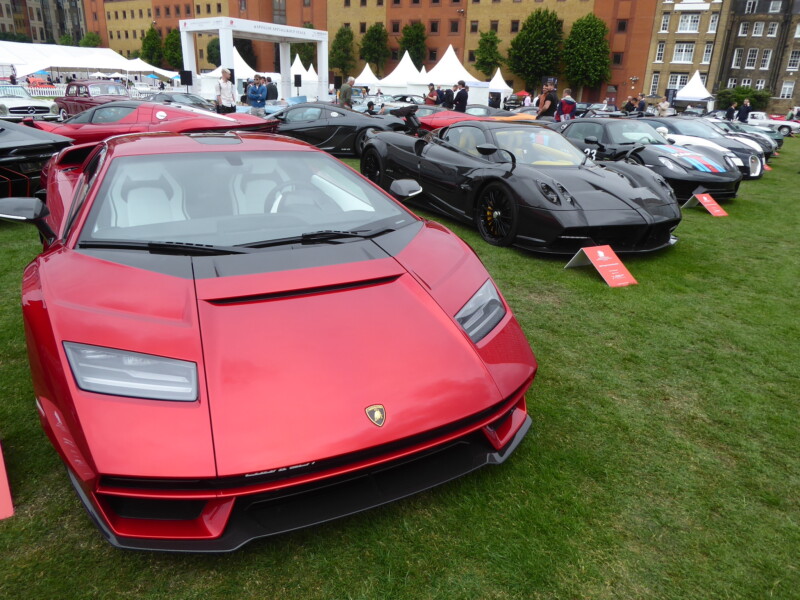
2016 Lamborghini Centenario: To celebrate founder Ferruccio’s 100th anniversary, Lamborghini created something truly special, the Aventador-based Centenario. Its 6.5 litre V12 was drastically reworked to become the marque’s most powerful engine of its type, at 769 bhp. The Centenario also has rear-wheel steering and active aerodynamics. It lived up to Lamborghini lore when it came to performance – it could hit 217 mph having zipped past 60 mph in just 2.8 seconds. Just 40 examples were built – 20 coupe and 20 roadster – and each was sold before launch for around $2m. This particular car is the only one in the UK.


2010 Bugatti Veyron Grand Sport: The Veyron was built from obsession and engineering fanaticism and it redefined the possibilities of the automobile. At its heart was an 8.0 litre quad turbo W16 with 1001 bhp and 922 lb/ft of torque. Allied to all-wheel drive, the Veyron could hit 0 – 62 mph in 2.5 seconds and its top speed of 253 mph made it the fastest car in the world in 2005. Forming part of the Gurdev Singh Collection, this Grand Sport features Pebble Beach Blue exposed carbonfibre and Antigua White percentile paint. Polished accents and bespoke wheels complete the look while cabin boasts Indigo Blue leather and white stitching.


2024 Gordon Murray Automotive T.50: The T.50 is Gordon Murray’s spiritual successor to the McLaren F1. He wanted to perfect the few area of the F1 that he was not totally happy with whilst taking advantage of three decades of tech advances, to design the most driver-centric supercar ever. The Cosworth 4.0 litre V12 is matched to an XTrac six speed manual box. Due to obsessive weight saving, the car sits at just 979kg and also has an active fan to increase the efficiency of the diffuser, inspired by Murray’s Brabham BT46B. Chassis 11 has a unique Goodwood Blue exterior with Athol Blue alcantara trim and an orange leather driver’s seat.


2014 Koenigsegg One:1: Koenigsegg has always pushed the boundaries of physics but the One:1 was arguably its biggest challenge – to achieve a perfect power-to-weight ratio. Based on the Agera RS, but heavily modified, the One:1’s revised 5.0 litre twin turbo V8 put out 1341 hp, equivalent to one megawatt. The weight was 1341 kg and so the One:1 name. As such, it claimed to be the world’s first megacar. It could hit 62 mph in 2.8 seconds and 249 mph in 49 seconds with its top speed somewhere north of 277 mph. The car used a carbonfibre monocoque with an integrated fuel tank, a Triplex damper system with variable ride height and stiffness and active aerodynamics. Just seven examples of the One:1 were built.


2015 Ferrari LaFerrari: The LaFerrari was not only the ultimate Ferrari but the brand’s first hybrid, too. Its HY-KERS electric motor was matched to a 6.3 litre V12 for 950 bhp and 664 lb/ft of torque giving a 2.7 second 0 – 60 time and a 217 mph top speed. The hybrid system’s main purpose was to provide an instant torque fill and to regenerate energy under braking and deceleration. This was all encased in a carbon fibre monocoque designed by Ferrari’s F1 engineers. As with the F1 cars, the LaFerrari pushed the boundaries of aerodynamic know-how, its active aerodynamics automatically adapted to speed and cornering forces. In total 499 coupe and 210 Aperta were built.


2015 McLaren P1 HDK: With production restricted to just 375 cars, the hybrid McLaren P1 is already a limited production hypercar. This version is an even rarer example, however, the P2 HDK. It is one of just 9 examples built by British engineering specialist, Lanzante, fitted with the high downforce kit. During the production of the original F1, McLaren offered the HDK upgrade to owners seeking the style and enhanced high-speed downforce of the F1 GTR models. The P1 HDK echoes this design with a deeper front splitter, side skirts and a fixed high-level rear wing. This car is finished in Ueno grey paying homage to the F1 GTR that wone the 1995 le Mans 24 Hours race.


2015 Porsche 918 ‘Martini’ Spyder: Porsche’s 918 Spyder was a technical masterclass. At its heart was the LMP2-derived 4.6 litre V8. It was augmented with a 129 bhp front-axle motor and a 156 bhp rear-axle motor for a combined 887 bhp and 944 lb/ft of torque. These provided AWD traction and instant torque fill plus 12 – 18 miles of silent electric running. The 918’s carbonfibre reinforced polymer monocoque kept the weight down to 1634 kg. the car could hit 214 mph and 0 – 60 mph in 2.6 seconds. It was also one of the first to set a sub 7 minute time at the Nurburgring, flashing around the circuit in 6 minutes 57 seconds.


2019 McLaren Senna: McLaren’s mission with the Senna was to create the purest synchronicity between driver and machine by optimising aerodynamics, weight reduction and performance to build the ultimate road-legal track day car. Based on a lightweight development of the P1’s carbonfibre tub, the Senna used a fettled 720S 4.0 litre twin turbo V8. Carbonfibre featured everywhere. Aerodynamics informed its distinctive look and the car could make 800kg plus of downforce at 155 mph. Top speed was 208 mph and its 0 – 62 time was 2.8 seconds while the key metric was power to weight – 658 bhp per tonne.


2020 Pagani Huayra Roadster: Pagani redesigned and optimised almost the entire Huayra coupe package to create the roadster. At just 1280 kg, it was lighter than the coupe by 80 kg. Its Mercedes-AMG built 6.0 litre twin turbo v12 delivered 764 bhp and 737 lb/ft via an XTRA seven speed automated manual. New turbochargers and engine mapping gave a wider powerband and improved response. Unlike the original car’s active aerodynamics, the Roadster used revised aero channels and subtle fixed aerodynamic aids. It could romp to 62 mph in 3.1 seconds and carry on to 205 mph plus. Just 100 examples were produced.


2021 Aston Martin Speedster: Aston Martin may be best known for its luxurious GTs, but now and then it comes up with something truly bonkers. The Speedster was one such example, maybe the craziest Aston ever. Essentially, take a twin turbo V12 with 691 bhp and shoehorn it into a short wheelbase two seater with no roof, windows or windscreen. Its styling was inspired by the 1950s DBR1, incorporating elements of the modern Vantage. Much of the Vantage would donate its aluminium bonded chassis but getting the 5.2 litre engine to fit meant grafting on the front of the DBS Superleggera. It could hit 62 mph in 3.5 seconds and has a top speed limited to 182 mph. A mere 88 were built.


2022 Lamborghini Countach LPI 800-4: Arguably one of the most controversial hypercars of recent years? Marcello Gandini, designer of the original Countach to which this car paid tribute, is certainly not a fan. The LP800-4 was far more than just an exterior reskin – it was a further development of the hybrid technology brought it in with the Sian FKP37 of 2019. It combined a 770 bhp 6.5 litre V12 with a 48V 34 bhp electric motor for a total of 803 bhp. Regenerative braking energy was stored in a supercapacitor for added lightness. The car could hit 62 mph in 2.8 seconds and twice that in 8.6 seconds before topping out at 221 mph.


2024 Ferrari SP3 Daytona: Built to commemorate Ferrari’s podium lock-out at the 1967 Daytona 24 Hours, this thoroughly modern hypercar takes inspiration from sports prototypes of the era, in particular the 330 P3/4, 312P and 512S. It is an exercise in “passive aero” without recourse to active flaps or wings. It can produce 230 kg of downforce at 125 mph, a remarkable figure sans a rear wing. The carbonfibre monocoque houses and 812 Competizione derived 6.5 litre v12. It produces 829 bhp at 9250 rpm, with 514 l/ft of torque at 7250 rpm courtesy of a revised intake and exhaust plus reworked internals. The SP3 Daytona can sprint to 62 mph in 2.85 seconds and top out at 211 mph. Just 599 were built.


2024 Maserati MCXtrema: A track-only hypercar based on the MC20 GT2 racing car, the MCXtrema has been described as offering the speed of a GT3 with an extra 200 bhp but the usability of a GT4 car. the 3.0 litre twin turbo Nettuno V6 produces 730 bhp and 538 lb/ft of torque, nestled in a carbonfibre monocoque and body that have been honed for ultimate track performance without the need to subscribe to any category’s regulations. Weighing just 1300kg, this car has been honed by multiple endurance racing champion and Maserati test driver Andrea Bertolini to provide the optimum usability with the minimalist interior offering all the adjustability a driver would ever need but in a logical ergonomic form. This particular example is the only one of the 62 MCXtrema produced that came to the UK. Its already taken part in several track events with plenty more planned.


2024 Pagani Utopia C10: The Utopia is all about emotive feel and raw performance. Central to that is the Mercedes-AMG 6.0 litre twin turbo V12 with 864 bhp, 811 lb/ft of torque and a dearth of battery assistance. It’s teamed with either a seven speed gated manual transmission or an Xtrac seven speed automated manual. The car has forged aluminium wheels, titanium exhaust and suspension parts and a lightweight carbon-composite body and chassis. Unlike other hypercars, the Utopia features no active aerodynamic systems. It can sprint to 62 mph in around three seconds and hit more than 217 mph with a power to weight ratio of 675 bhp/tonne. This particular Utopia, finished in Arancio St Tropez, is serial number 60 to mark the owners’ birthday and the 64th model built.


Winner here was the Lamborghini Centenario, with Highly Commended going to the Bugatti Veyron Grand Sport and the GMA T50.
70 YEARS of the MERCEDES-BENZ SL
2012 Mercedes-Benz SLS AMG: Developed with F1’s David Coulthard, the SLS boasted the world’s most powerful naturally aspirated engine. It was a sharper more track orientated replacement for the SLR and had signature gullwing doors. Its 6.2 litre hand-built AMG V8 engine was modified in 120 plus ways over the C63 AMG’s M156. The SLS could hit 62 mph in 3.8 seconds and 196 mph, courtesy of 563 bhp and 479 lb/ft of torque. A seven speed dual clutch auto sent the power to the road. This special order one-off is Night Black Magno, a colour not available on the SLS. Delivered new to Qatar, it has a carbon engine bay and every carbon option possible.


1957 Mercedes-Benz 300 SL Roadster: This 300SL had a starry first owner to match its high profile status as one of the fastest cars of the day. Actress Anne Jeffreys bought it in April 1957 and kept it until 1980. Her family held into the car until the end of 1999 when it was brought back to Europe. Its next owner as the Netherlands Chris Kruizinga. He had it restored in silver grey metallic with a blue retrim, before selling it in 2010 to Georg Dengler of Germany. Gerald Davidson acquired the car in 2016 and gave it to Gullwing expert Martin Cushway for sensitive mechanical improvements such as an alternator/generator conversion to a dynamo, a multi-blade cooling fan and a stainless steel exhaust. The current owner, who acquired the car in 2021, has replaced the gearbox and now the 300SL is a regular sight at Goodwood track day. It is also a regular on European rallies with the German 300SL Club and the MB Club UK.

1997 Mercedes-Benz SL500: The R129 SL was a true technical masterpiece when it was launched in 1989 and a huge step forward over its popular R107 predecessor. Bruno Sacco’s design was clean and elegant and novel engineering advances included the world’s first fully automatic soft-top, with a removable hardtop, too. It had pop-up roll bars, ABS was standard and adaptive damping worked in real time while traction control and electronic stability control were also key safety advances. The 322bhp V8 pushed the SL500 to60 mph in 6.0 seconds and 155 mph. The current owner has enjoyed this example for 18 years, for everything from commuting to a family trip to France.


1955 Mercedes-Benz 300 SL Gullwing: Mercedes-Benz’ attempt to tap into the US sports car market produced arguably the world’s first supercar. Fuel injection helped its 3.0 litre straight six make 215 bhp initially and later on 240 bhp. Its SuperLeicht (SL) tubular spaceframe saw the use of gullwing doors to compensate for the high structural sills and weight of just 1295 kg. Performance was truly sensational: 160 mpg and an 8.8 second 0 – 60 mph time. Just 1400 coupe were built from 1954 to 1957. First acquired in 1988, this car has not been seen in public for 30 plus years. It’s recently received a light recommissioning ready to return to the road.


1960 Mercedes-Benz 190 SL: The 190SL offered a 300S aesthetic but without the price tag. Its 1.9 litre four pot made 104 bhp and would later be used in the W120 and W121 and its floor pan was actually a shortened version of the W121 saloon. Over eight years, 25,882 examples were built. This 190SL came with a hardtop and was delivered to Denmark. In the 1908s it was sourced by Sherman Oaks Classics in LA and repainted black. The current owner acquired it in 1998, brought it to the UK, and set about restoring it alongside Lux Classics. It won Best of Show at the 2010 MB SL Club Day at Sandringham and has graced many shows since.


1966 Mercedes-Benz 230 SL ‘Pagoda’: The W113 SL arguably defined how we view the SL today. Introduced in 1963, it offered a more sporting feel than the underpowered 190SL but without the high cost of the 300SL. The mixture of six cylinder surge, excellent handling and sharp Paul Bracq lines made it an instant hit. Whilst the early 2.3 litre 230SLs offered revvy sportiness, the car would eventually morph into a comfortable cruiser via the 2.5 litre 250SL and the 2.8 litre 280 SL. Famous owners ranged from Juan Manuel Fangio and Striling Moss to Charlton Heston, Sophia Loren, John Lennon and Tony Curtis.
1979 Mercedes-Benz 350 SL: The hugely successful R107 was in production for 18 years. With the R113 SL Pagoda proving very popular Stateside, Mercedes threw its all into making the R107 even more US friendly. This informed the styling, engine choices and emissions focus – and the firm was rewarded with even more success. The 3.5 litre M116 V8 powered 350SL offered 197 bhp and 211 lb/ft of torque. It came with a four of five speed manual or three speed auto. The car made way for the 380SL in 1980, so this 1979 car is one of the last of the “early era” R107s built. The owner found it at the Beaulieu Autojumble. Having been restored by a prior owner it was in such good condition that he was unable to walk away.


2004 Mercedes-Benz SL55 AMG: Following on from the R129 SL, the R230 had its work cut out. The closer post-2000 integration of AMG into Mercedes-Benz meant that the new SL would get the kind of powerful engines unthinkable outside the closed doors of AMG’s bespoke service. Part of the first year lineup, the SL55AMG used a 493 bhp 5.4 supercharged V8 that could deliver 516 lb/ft of torque from as little as 2650 rpm. As standard it was limited to 155 mph but 186 mph was available for an extra fee. Maybe even 208 mph. This particular car is unique. It was delivered directly from Mercedes-Benz in Germany in Porsche Seal Grey Metallic for an additional €11,000.


2007 Mercedes-Benz McLaren SLR 722: To celebrate Stirling Moss and Denis Jenkinson’s victory on the 1955 Mille Miglia in a Mercedes-Benz 300SLR, the 722 special edition – named for the 300SLR’s start time – brought a host of upgrades to the SLR. More power (617bhp), lower weight and revised aero meant it could hit 0 – 62 mph in 3.6 seconds. A mere 150 were built. This particular car was ordered in SLR 722-exclusive Crystal Antimony Grey Metallic over a black leather and Alcantara interior. It has had only two California owners from new and was optioned with XL driver and passenger seats. It currently has 3200 miles on the clock.


2013 Mercedes-Benz SL63 AMG: The R231 was more than and R230 refresh. It was redesigned with more tech and power and less weight. The Sl65AMG had a hand-built 5.5 litre twin turbo V8 with 530 bhp and 590 lb/ft of torque. The AMG Performance Package took this to 557 bhp and 664 lb/ft. Sprinting from 0 – 60 took around 4.0 seconds and while the standard car was limited to 155 mph, the AMG Performance Package upped this to 186 mph. the AMG Speedshift MCT have quicker shifts than ever plus multiple driver modes. Thanks to extensive use of aluminium throughout the body, the R231 SL65 was around 165 kg lighter than the previous model. The Active Body Control hydraulic suspension was revised and lighter forged wheels and carbon ceramic brakes were an option. The owner of this car has had it from new.


From this collection, the judges picked the SLS as the winner and highly commended the 300SL Roadster and the 1997 500SL.
THE WILDCARDS
1961 Maserati 3500 GT: Maserati’s road cars had been barely contained racing machines until the launch of the 3500GT. Touring’s Superleggera construction encased a 350S-derived straight six that made 217 bhp or 239 bhp with Lucas mechanical fuel injection. This Blu Sera car was sold in Milan in early 1964 before going to the US. It stayed in California for 50 years, coming to the UK in 2012 with two other 3500s courtesy of Coldplay’s Guy Berryman. It was then sold to Craig Jones who restored it over a 300 hour period. In 2021 it was sold to the current owner who uses it for touring with recent trips including Scotland’s NC500 and multiple trips through Europe. A full drivetrain restoration was completed last year.


1963 Peel P50: The smallest car made had a very big character. Built in the Isle of Man from 1962 to 1965, it had a 49cc DKW single cylinder two stroke engine with 4.2 bhp. It measures just 137 cm in length, 99cm in width and 139cm in height and weighed a mere59pg. It could reach 38 mph and do 100 mpg. There were a few caveats: it had space for only one person and a small bag. There is no heater or suspension and in the rain you’d have to operate the wiper yourself. Still, you were unlikely to struggle to find a parking space. Around 47 examples were produced in period but hand-built replicas were made available in the 2010s. These had a choice of petrol or electric propulsion.


1996 Jaguar XJS Celebration: The Celebration arrived in 1995 to mark both the end of XJS production at Browns Lane and Jaguar’s 60th anniversary. It featured embossed leapers on the seats, a gold bonnet badge and 16” diamond-turned aero sport wheels. Registered in January 1996, no 224845 was one of the last XJS cars built. It boasts Ice Blue metallic paint a Navy soft top and magnolia leather. Supplied new by Perry’s Jaguar of Huddersfield, it was part of a private collection for some years before being purchased for Jaguar’s Heritage Collection at the British Motor Museum. The car has only done 22,000 miles. Its current owner bought it in April 2021. He’s since carried out extensive detailing to bring it up to concours standard, returning the underside to as-new condition.


1963 Alfa Romeo Giulia SS: This Giulia SS lived in Italy for many decades, remaining in the second owner’s family for over 40 years. It arrived in the UK via the Bonhams’ Goodwood Sale where it was snapped up by racing legend Rob Lamplough who owned it for five years. The current keeper commissioned a bare metal respray by DTR of Surrey but with a brief to retain original features including Securit glass, window stickers and manufacturing labels. After 1280 hours of restoration wizardry, it was all set for the 2024 London Concours but “failed to proceed” on the day thus missing its debut. DTR took it back for a no-holds barred engine rebuild and now it is here.


1967-68 Con-Ferr Meyers Manx: This dune buggy is a Hollywood legend. It had a major role in the 1968 Thomas Crown Affair and the movie’s star, Steve McQueen, played a major role in customising it for the film. It received bespoke bodywork with sunken lights and a wrap-around screen and a 2.7 litre Chevy Corvair engine with 140 – 180 bhp – a lot for a car weighing so little. After the film wrapped, it was sold on to a dealer and it would spend many years bombing around the beaches of Hawaii. Along the way, its engine and transaxle were replaced. After two decades in storage, it was restored to its original spec, including the Corvair engine.


1969 Rolls-Royce Phantom VI: The Phantom VI was the last Rolls Royce with a separate chassis to be built at the marque’s Willesden London coachworks. It was powered by a 6230cc V8 engine with twin SU carburettors, coupled to a four speed automatic gearbox. This particular Phantom VI was once owned by luxury store Harrods. Prior to joining the fleet of eight limousines used exclusively for the transport of visiting VIPs, dignitaries and royalty, it underwent an extensive mechanical and body restoration to the highest standards and was refinished in Harrods’ Green with a basket-weave side effect and a tan roof. SC Gordon Ltd subsequently fitted it with green leather trim, a TV, VHS player, fax machine, wine cooler, cocktail cabinet, three telephones and a custom headlining screen-printed with the iconic Harrods logo.


1984 Ferrari Mondial Quattrovalvole: The Mondial broadened Ferrari’s appeal in a new way. Previously the preserve of V12 GT flagships, the model offered 2 + 2 seating with the more sporting verve of the 308-derived V8. There were several upgrades over its life and 1982’s Quattrovalvole had four valves per cylinder and Bosch K-Jetronic injection which helped the 2.9 litre mid-mounted V8 produce 240 bhp. A true slice of Maranello magic but with a usable boot and rear space. This unrestored 23,000 mile car was sold new by HR Owen. It later spent six years in Northern Ireland before returning to London in 2000. The current owner has cared for it for 20 years.


1993 Jaguar Lister XJ40: This XJ40 was taken to Lister in the early 1990s by Douglas Hall, son of then Newcastle United FC owner, Sir John Hall. He specified a 7.0 litre twin supercharged V12 and a manual box along with a custom interior. Lister owner Laurence Pearce took him to le Mans in the car. Hall asked what it would cost to go racing at le Mans and then wrote a £500k cheque. This seed money financed the Lister Storm project which went on to race in Hall’s beloved NUFC colours. Note the XJ40 Lister’s “Magpies” colour fade on the sill. Now owned by Petroleum & Co the car is soon to star in a short film in which two boys steal the car from a London gangster and take it on a night out. It will be released later this year.


1994 Lancia Delta HF Integrale Evolution II Giallo Ginestra: Lancia’s Delta won World Rally Championships by the hatful back in the day. The HF 4WD morphed into the Integrale with each evolution requiring ever more exciting homologation specials. The final one boasted 212 bhp due to a Garret Turbo and revised engine management. One of just 220 Giallo Ginestra specials, this 66,300km car is finished in Broom Yellow. It has been with one owner from new, first as a family daily driver and in more recent times as part of a wider collection.


1997 Maserati Ghibli Cup: To reinvigorate Maserati when Fiat took over in the mid 1990s, it created a Ghibli II one-make series. The Ghibli Open Cup ran for a season in 1995 but in 1996 it was cancelled after just two rounds. This inspired the Ghibli Cup road car, based on the Italian market 2.0 litre twin turbo V6. It made 325 bhp, the highest output per litre for over a decade. It also had a much sportier suspension setup, Speedline alloys and a carbonfibre interior. Just 60 were built, 26 coming to the UK. This car is the only Verde Foreste Ghibli Cup ever made. After residing in a shed for ten years, it was restored by Meridien Maserati in 2023/24.


2016 Volkswagen XL1: Ferdinand Piech was known to push boundaries and while his Bugatti Veyron pet project was hardly an environmentally friendly machine, the VW XL1 showed that he also had efficiency in mind. Development started in 2002, with the aim of building a car that could cover 100km on a litre of fuel – or 235 mpg. By the time it reached production in 2015, the project had cost €250m. Just 250 were made and 50 were kept by the factory. The carbon fibre chassis, magnesium wheels and carbon brakes kept weight down to 795kg whilst its 0.189 drag coefficient – a record for a production car – helped it cleave the air efficiently. Power came from a 47 bhp 800cc two cylinder diesel assisted by a 27 bhp electric motor and the official fuel consumption was 313 mpg.


From this Class, the winner was the Maserati 3500GT and Highly Commended were the Peel P50 and the Jaguar XJS.
THE YOUNGTIMERS
1989 Porsche 911 Turbo SE Flachbau: Inspired by the 911-derived Le Mans cars, a stream of customers sought to replicate the streamlined look with their road models. From 1981 – 88 you could order a 911 Turbo with a flat nose (“Flacnbau”) and 50 were built for the UK with an uprated 330 bhp engine and a four speed manual box. In 1989 it was available as a factory model other than to special order and called the Turbo SE. It had an upgraded five speed G50 box, dual exit exhaust and limited slip differential. This is one of just 15 and one of seven right hand drive cars. Originally a press demonstrator, it was painted the Sonderwunsch colour called Minerva Blue with white Fuchs wheels. In 1998 it was acquired by David Jones, inventor of the Grand Theft Auto game and it remained in his collection for a decade. The car has been with the current owner since 2017. It has never been restored and remains original at 16,000 miles.


1990 Mercedes-Benz 560 SEL AMG: What could you do if the accomplished S Class exec express was not quite fast enough? Give it to AMG! With just 50 – 100 being built, these conversions were very rare. The focus was the reworked 6.0 litre M117 V* which had 385 bhp and 410 lb/ft of torque. AMG also upgraded the cooling, box and diff and offered stiffer and lowered suspension, reinforced subframes and bushings, bigger brakes and heavy duty dampers. Suitably equipped, it could hit 60 mph in around 5.0 seconds and go on to 180 mph plus – faster than a Testarossa or a 911 Turbo, but with luxury seating for four.


1991 Vauxhall Lotus Carlton: The legendary Lotus Carlton had the performance of a Testarossa but with four doors, a big boot and a Vauxhall badge. Its outrageous power came from a 377 bhp 3.6 litre twin turbo straight six tuned by Lotus to propel the car to 170 mph. This example’s owner restored it over five years, other than the paint. He found it by chance, rusty and neglected in a garage. Several items were no longer available, but via online forums he got mirrors, bonnet insulation, rubber trims and door handles plus cabin trim. He refitted the body himself, rebuilt the engine and refitted the dash, an amazing achievement considering he is not a professional restorer.


1987 Audi Ur Quattro: With its huge impact on both rallying and how we perceive high-performance cars, few models upset the proverbial apple cart quite like the Quattro. Its sure-footed 4×4 drive helped the 197 bhp 2.1 litre UR-Quattro hit 60 mph in 7.1 seconds and 137 mph. Soon every maker from Ford to Ferrari was experimenting with four wheel drive. The current owner has had this car since 1993. It was first used as a “rapid response” doctor, hence its four point harness. In 2005 it was restored and upgraded with a high-lift camshaft and gas-flowed head while the Mitsubishi ECU was fettled to allow a bar of manifold turbo pressure. It now makes just under 300 bhp.


1988 BMW M3 Cabriolet (E30): With just 786 made, the M3 E30 drop-top is one of the rarest BMW M cars. The standard model was a Touring Car legend, but in order to homologate ever more potent racing versions, it needed to sell in larger numbers. A Cabriolet helped to swell its popularity. Top down, it allowed even more enjoyment of the engine shrieking to 7250 rpm. It could hit 60 mph in less than 8.0 seconds and sprint on to 149 mph. It was the first fabric roofed M car and whilst it would sell in only limited numbers, all subsequent era M3 cars have had a convertible version. This car has covered just 7,500 miles. Finished in Macau Blue Metallic over grey Nappa leather, it was supplied by BMW main dealer Schmoldt & Axmann in Germany.

1991 Mercedes-Benz 190E AMG 3.2: The 190E was designed to bring Mercedes-Benz prestige to a younger audience. It proved hugely popular with just under 1.9 million built over 11 years. In 1986, AMG offered a 234 bhp 3.2 litre upgrade to the 190E 2.6’s straight six. All out it would do more than 150 mph and hit 0 – 62 mpg in 7.4 seconds. This car began life as a Japanese market 2.6 litre 190E and in 1992 it received the full 3.2 conversion, AMG bodykit, interior modifications and suspension. It even has the AMG-branded instrumentation with a 300 km/h speedometer and 10,000 rpm tacho.


1993 Porsche 964 3.3 Turbo: Having ditched plans for a 911 Turbo replacement for economic reasons, Porsche instead introduced this model as the flagship for the new-for-1989 964 era. It used a revised version of the outgoing 930 Turbo’s proven mechanicals and produced 320 bhp. This particular car had a bare-metal respray by Southam Bodies in 2020 and a complete engine rebuild carried out by Northway Porsche in 2024. Modifications include a bigger turbo, upgraded wastegate, Cargraphic exhaust, Bilstein suspension, RS Style door cars, three spoke RS steering wheel and an RS rear screen.


1994 Alpina B10 4.0 E34: The M30 straight six had been a stalwart of Alpina’s upgrade regime for nearly a decade, but when BMW ceased making it, Alpina chose to go the V8 route. The B10 4.0 was, along with the 7 series based B11, the brand’s first V8. Alpina fitted higher compression Mahle pistons, a modified intake and a reprogrammed Motronic ECU giving 315 bhp and higher torque. Either a six speed manual or five speed auto box were available and the car had Bilstein suspension, a new front spoiler and Alpina alloys. Just 49 were built, each capable of 0-60 in 6.5 seconds. The owner found this B10 in a field, where it had been left for 15 years. It turned out to be one two right hand drive UK examples. Seven years ago he started a restoration with new panels, floors and everything rebuilt.


1995 Audi RS2 Avant: the RS2 was born of Ferdinand Piech’s desire for a truly fast estate. The 80 Avant-based RS2 was built on the same Porsche line that had sired the 959. Audi’s five cylinder 20v motor was fitted with a larger turbocharger, beefed up intercooler, higher flow injectors, new camshaft, freer flowing induction and exhaust and revised ECU resulting in 311 bhp. The RS2 had Porsche developed brakes and suspension along with 4WD and it delivered 0 – 60 in 4.8 seconds and 163 mph. Its 1.5 second time to 30 mph was faster than a McLaren F1. This particular car was acquired from its first German owner and it remains original other than lower suspension and custom mats.


2001 BMW Z3 M: The Z3M started life as an engineers’ what if. They felt the Z3 could take more power as a coupe. A prototype with an E30 M3 engine was approved, with its reworked suspension and brakes, widened rear track and reinforced rear subframe. The 1995 – 2001 cars used the 321 bhp E36 M3 unit while the 2002 – 2003 cars had the 325 bhp E46 M3. Of the 168 rhd cars made with this engine, just three are in this colour. It came with an AC Schnitzer exhaust and short-shift gearlever. The owner has had it for 20 years and It now features upgraded engine internals and Bilstein suspension. It is used for driving events as well as shows.


Winning car here was the Porsche 911 Flachbau, and the Highly Commended cars were the Mercedes 560SEL and the Lotus Carlton.
THE FAST FORDS
1986 Ford RS200: Ford had a long and proud rallying history and in the 1980s it built this mid-engined 4WD car to conquer the WRC. The 18 litre engine made 250 bhp in road trim and up to 450 bhp in rally spec. The Group B ban meant that the RS200 never achieved its aim but it did win the British Rally Championship. One of 15 built to RHD rally spec, this car spent its first 30 years largely in storage. The present owner got it on 1100 miles and has doubled that since. It is regularly used during the summer and it joined 29 other examples at the Silverstone Festival in 2023 for a bid to get the most RS200s in one place.


1972 Ford Capri Perana V8: Ford’s South African division needed something mighty for touring car racing, so it turned to local tuner Basil Green Motors to create the Capri Perana. With a 30 ci Windor V8, the lightweight car won 12 of 13 races in 1971. In the end it was effectively banned from Group 5. With 280 bhp and upgraded mechanicals all round, the road car could hit 60 mph in less than 6.0 seconds and top out at 140 mph plus. Fewer than 500 were built and only a tiny number went abroad. This car was once owned by South African World Heavyweight boxing champion Gerrie Coetzee. It’s just had a nut and bolt restoration with all work excluding the respray undertaken by the current owner.


2005 Ford GT: To celebrate 100 years in 2003, Ford wanted to do something special and the GT – the spiritual successor to the GT40 – was the result. After four years of R&D, a concept was shown at the 2002 Detroit Auto Show. Just 15 months later, in June 2003, three production spec cars were shown at the Centennial Celebration. A supercharged 5.4 litre V8 engine boasting 550 bhp and 500 lb/ft of torque resulted in a top speed of 205 mph and a 3.5 second sprint to 60 mph. Between 2005 and 2006, 4036 examples were built with just 101 coming to Europe, and 28 of these to the UK. This particular car is in original spec with exception of a side exhaust.


1965 Ford Lotus Cortina Mk1: In a 1960s bid to shake off its staid image and break into the world of motorsport and performance cars, Ford of Britain partnered with Colin Chapman of Lotus Cars. The resultant saloon featured a 1.6 litre twin cam with Lotus aluminium head, close ratio gearbox and aluminium panels. Around 3000 were built and it went on to win the British Touring Car Championship. This particular car is the later Type III Aeroflow with the longer ratio 2000E ‘box, leaf sprung rear axle, revised dahs and self-adjusting rear drum brakes. It boasts the full set of aluminium panels. It had a total engine, transmission and body restoration in 2015.


1968 Ford GT40: With its efforts at Le Mans finally paying off in 1966, Ford turned to producing a road-going version of the GT40, the Mark III. Launched in 1967, it featured a detuned 289ci or 302 ci V8, a slightly more civilised interior, a raised ride height, bumperettes and stowage for touring. However, its $18,500 price and different look to the race car limited sales to just seven. This GT40’s first owner was Sir Max Aitken, who passed it to Brian Auger in 1973. He painted it white with blue stripes. A new owner acquired the car in 1981 and placed it in the National Motor Museum where it stayed until 2011. The current owner set about restoring it via CKL Developments, returning it to its original maroon paint along the way. The Ford has since been seen at concours events such as Villa d’Este, Amelia Island and Pebble Beach, as well as making regular appearances at Goodwood.
1968 Shelby Mustang GT500KR: Built by Shelby American as an upgrade package, the “Kin of the Road” GT500KR was the most powerful Mustang available. Output of its “335 bhp” 428 Cobra jet V8 was in reality closer to 400 bhp. It had a glassfibre hood as well as upgraded suspension and brakes and could do 0 – 60 in about 6.0 seconds. 1571 fastbacks and 517 drop-tops were built between late 1967 and the end of 1967. This particular car is one of 1053 built in 1968, one of 513 with an auto, one of 96 in Acapulco Blue, one of 63 with a 35 TractionLok rear axle and the only one shipped to Belgium. The current owner – the car’s fourth – acquired it in 2017.


1980 Ford Capri 3.0S X-Pack: The X Pack program featured factory-approved performance upgrades approved by Ford’s Special Vehicle Engineering division. This particular Capri started out as a standard 3.0S but was enhanced with numerous X-Pack options such as the Series X wide bodykit, RS lowered suspension, 7.5inch RS wheels, a RS rear spoiler and triple 42 Weber carbs. When finished it was a £10,300 car with upgrades accounting for half of that. The current owner bought the car in 2008. He carried out a full body restoration with a Ric Wood 205 bhp 3.4 litre Essex engine. It I snow finished in Midnight Blue metallic with split-rim alloys, a Janpseed exhaust and Bilstein dampers.


1986 Ford Sierra RS Cosworth: The Sierra Cosworth was built to dominate Group A touring cars. Its Cosworth head on a Ford Pinto block produced 204 bp in road trim but 500 bhp plus for racing and aftermarket tuning, The Cosworth soon became a folk hero – with a few tweaks it could better Ferrari and Porsche exotica. This particular model, the 171st built, has been with its current keeper since June 1992. The unchipped engine is original and the car served as the owner’s daily driver early on. It has had some bodywork restoration, a few cosmetic changes and tech upgrades. The original dash has been replaced and additional gauges fitted.


1996 Ford Escort RS Cosworth: The Blue Oval had invested significant funds into the bespoke RS200 Group B Rally car. So when Group B was cancelled, it found itself without anything to take on the mighty Lancia Delta in the WRC. As such, it developed the Escort RS Cosworth using a shortened Sierra Cosworth 4×4 platform and Karmann built body loosely based on the Mark IV Escort. Only the doors and roof were stock, while the bodykit and wing made this the first mass-production car to produce downforce front and rear. It made 224 bhp from its turbocharged 2.0 litre four cylinder engine and while it did not win the WRC, it did take several national championships. On the road, it became a folk hero. This example is a “small turbo” model, introduced in 1994. One of 104 in Auralis Blue, it features black leather trim and has only done 16,500 miles.


2021 Ford GT Carbon Edition: Celebrating 50 years since it 1966 Le Mans win, Ford took victory in the LM GTE-pro in 2016 with a new GT. The car imbued the original model’s design cues in a teardrop shape inspired by LMP1 endurance racing cars. It used a 647 bhp 3.5 litre twin-turbo Ecoboost V6. With a carbon fibre monocoque attached to aluminium front and rear subframes, carbon fibre bodywork, pushrod suspension and optional carbon fibre wheels, the GT was state of the art. All out, the GT could hit 216 mph, having blasted through the 0 – 60 sprint in a mere 3.0 seconds. It was so quick it took little more than twice that to reach 100 mph with 170 mph taking just 21.4 seconds from rest.


Winning this class was the RS200 and the highly commended cars were the Capri Perana and the 2005 Ford GT.
THE DREAM CARS
1993 Bugatti EB110 SS: True to Bugatti’s legend for building cars of the utmost performance and luxury and thanks to marque saviour Romano Artioli, 110 years after Ettore’s birth, the EB110 was born. Bringing together many immense talents of the Italian supercar world, the quad turbocharged 3.5 litre V12 model made553 bhp in standard form and 603 bhp in Super Sport trim. All-wheel drive rocketed it to 60 mph in 3/14 seconds and on to 200.6 mph. This car is one of 51 SS models and 18 known to the Bugatti Club. It wears VIN 0001 and was built for the Royal Family of Brunei. It has been with its current owner since 2007.


1998 Porsche 911 GT1: Genuinely a race car for the road, the 911 GT1 was built to homologate Porsche’s return to GT1 endurance racing. Its mid-mounted 3.2 litre twin turbo flat six was derived from the all-conquering Group C 962 prototype. While the chassis used the 993 era’s front crash structure, the rest of the car was bespoke, with an aluminium and carbon fibre monocoque overlaid with Kevlar and carbon body panels. Its 536 bhp and 443 lb/ft of torque were enough for 205 mph and 0 – 60 time of 3.7 seconds. The GT1 would struggle to keep pace with the F1 and CLK GTR in 1996 but it would win le Mans in 1998. This particular “Strassenversion” which was originally finished in Pastel Yellow starred in YouTube series LoveCars with Tiff Needell.


1989 Porsche 930 Turbo S: This 930 Turbo S is one of around 25 built by the Special Wishes department of Porsche. Its first owner was Californian Porsche team owner, Kerry Morse. Changes include the rear arch vents, deeper air dam with integrated vertical oil-cooler, bigger K27 turbo and intercooler adding 30 bhp to give 300 bhp, lower sports suspension and a wider rear track. The car was restored in 2018-19 by Germany’s Freislinger Motorsport, whose owner Manfred Freislinger registered it for his own use in August 2019. It was then sold to a UK collector in 2020 and Harry Metcalfe of Evo and Harry’s garage fame bought it via The Hairpin Company in 2021. The Turbo S now puts out 400 bhp due to an increased capacity of 3.4 litres, different cams and 934 race heads with much bigger valves and inlet/exhaust tracts.


1983 Ferrari 512 BBi: Enzo Ferrari had resisted using 12 cylinders in a mid-engined configuration but the enduring appeal of the Lamborghini Miura and the insistence of the engineers finally saw him acquiesce with the 1973 365 GT4 BB. The Fioravanti styled 512BBi was the last in the Berlinetta Boxer line-up and refinements over earlier cars including Bosch K-Jetronic fuel injection and upgraded electronic ignition. It was the least powerful of the three versions with an emissions regulated 340 bhp but it still had a 160 mph top speed. Just 1007 were built between 1981 and 1984. This car is finished in Chiaro Blue with Crema leather and was first delivered by HR Owen. It was optioned with cloth inserts, a leather headliner and black bottom coachwork. It has covered 43,000 miles.


1985 Ferrari 288 GTO: With Lamborghini and Porsche unleashing every faster machinery, Maranello needed to fight back with something special – an icon car that would stand at the very top of the range. The 288 GTO was the result – and it sired a new line of ultimate Ferrari models which included the F40 and F50. Power came from a 400 bhp twin turbo V8. There was potential for endurance racing but Group B’s collapse meant that the 288 GTO would never race. It did become one of the most sought-after road-going Ferrari models ever, though. Just 272 examples were built between 1984 and 1986 and this example was first delivered to Italy.


1985 Porsche 959: While often said to be built for Group B racing the 959 as designed to be the halo car for a new range of models to replace the 911. Group B simply offered a great way to advance development. The 959 had active aerodynamics, sequential twin turbos, dynamically variable torque split, adjustable suspension and more – all ahead of their time and ultimately so costly that Porsche lost money of each car built and canned the 911 Turbo replacement. The 450 bhp 2.85 litre water-cooled flat six meant that the 959 could hit 60 mph in 3.6 seconds and top out at 198 mph. This car is one of two Ruby Red prototypes and one of seven overall. It was used for electronic and hot weather testing.


1986 Lamborghini Countach 5000QV: The 5000Qv represented the final major mechanical upgrade for the Countach. The engine was enlarged to 5167cc and given four valves per cylinder – quattrovalvole in Italian. Lamborghini built 610 Qvs – the most powerful production Countach – of which 544 had carburettors. Six Webers helped kick out 449 bhp and 369 lb/ft of torque. The car could hit 0 – 60 in 4.8 seconds and a 185 mph top speed. Production ran until 1988 when the Qv was replaced with the 25th Anniversary Edition. This particular car, finished in special-order Blu Acapulco with a cream interior, special-order blue dashboard and Alpine CD player was driven to Italy in 2023 and another trip is planned for later this year.


1992 Jaguar XJ220: The svelte XJ220 has all three Jaguar attributes: grace, pace and space. The Keith Hellet penned shaped was extensively wind tunnel tested and even today the figures seem huge: the 3.5 litre six cylinder twin turbo produces 542 bhp at 7200 rpm. Its aluminium honeycomb chassis used bonded panels to keep the weight down to 1500 kg which meant that it could hit 0 – 60 mph in 3.6 seconds and spring on to 212.3 mph, making it the world’s fastest production car in 1992. Just 281 were built out of a proposed total of 350. This XJ220 was first delivered to Sir Elton John who kept it for 900 miles and 9 years. It then passed through a series of keepers before the current owner bought it in 2010.


1995 McLaren F1: The brief was to create the ultimate driver’s car. Gordon Murray and his team obliged, building a focused machine that prioritised light weight and driving purity. The 1138 kg three-seater F1 was among the first production cars to use a carbonfibre monocoque for lightness and rigidity. Its 618 bhp 6.1 litre BMW V12 gave a 0 – 60 time of 3.2 seconds and a top speed of 240.1 mph, making it the world’s fastest car. The 39th of the 64 F1 production cars built, chassis 046 was ordered by racing driver Ray Bellim. He kept it for several years before selling it to Juan Barazi. Since 2012 it has been with its current owner who has returned it to its original unique colour of Genesis Blue Metallic.


2001 Lamborghini Diablo 6.0 VT: The final fling for the Diablo was launched as a stopgap whilst the model’s cancelled replacement, the Canto, was reworked to become the Murcielago. The 6.0 VT was upgraded over the old 5.7 with a wider front track, overhauled trim and electronics and a subtle refresh in carbonfibre for the Gandini styling. Specified in Giallo Orion, this car was a demonstrator for HR Owen. One of around 12 examples in the Uk, it is the current owner’s second Diablo/ It’s enjoyed many European road trips, first with Damon Hill on the 2001 Gumball Rally and most recentl returning to Sant’Agata along with 20 other Diablo owners in 2024.


2008 Lamborghini Murciélago LP640: As the first entirely new car built under Audi ownership, the Murcielago was a bold step for Lmaborghini. Under the Donckerwolke body lay a 573 bhp 6.2 litre V12 allied to all-wheel drive and an e-Gear semi auto or a manual box. The car could hit 62 mph in 3.8 seconds and go on to 207 mph. New for 2006. The LP640 brought a 6.5 litre engine and 631 bhp, exterior styling revisions plus suspension and e-Gear upgrades with carbon ceramic brakes now an option. This particular car was once owned by Elngand cricketer and former Top Gear presenter Freddie Flintoff. It now belongs to @grigiogt on Instagram.


The judges picked the Bugatti EB110SS as the class winner and Highly Commended the Porsche 911 GT1 and the 930 Turbo S
LEGENDARY AC CARS
1967 AC 428 Frua Spyder: The 428 Frua body was designed in Turin by Pietro Frua, using an extended Cobra chassis. Armed with the Cobra’s 427ci Ford V8, it could hit 0 – 60 mph in 5.4 seconds and 145 mph. Chassis no CF3 was one of three prototypes but the only car with a manual ‘box. It was the AC Cars demonstrator and owned by MD Derek Hurlock for four years. It also featured in a BP advert and was used by Donald Pleasance in the film “Arthur! Arthur!” The car went to a US collector and was restored by Connecticut’s Vantage Motors in 2005. It returned to the UK in 2020 with the current owner and is tended to by AC Heritage.


1927 AC Royal Saloon: As with many luxury car brands, AC struggled in the wake of the 1929 economic crash. Its new owners had a plan to revitalise the brand with quality bespoke models. The Royal used AC’s smooth and reliable 2.0 litre straight six and elegant bodies from coachbuilders such as Whittingham & Mitchel and Mulliner. The interior was the height of luxury with Connolly leather, deep pile carpets and polished mahogany or walnut dashboards. Fewer than 100 would roll out of the factory between 1932 and 1940. The only example of this type of body left, this car’s coachbuilder is unknown. It was acquired by the owner in 1987 and following a two year restoration has been in regular use.


1962 AC Ace 2.6 Ruddspeed: It was racing driver and tuner Ken Rudd who persuaded AC to adopt Ford’s 2.6 litre straight six in 1961. Only 37 so-engined Aces were built. Chassis RS 5017 has a stage five Ruddspeed tuned engine with a Raymond Mays 12-port aluminium head and triple Weber carbs. It develops 180 bhp plus. With its all-aluminium bodywork, it weighs only 864 kg and so does 0-60 in 6.0 seconds. It was delivered new in October 1962. After three changes of owner, it was sold Andrew Ross in 1973. From 1978 it lay unused for 21 years until Adrian Hamilton rescued it in 1999 and restored it. The current owner since 2012 did a bare metal respray in 2015. The car has covered fewer than 27,000 miles.


1935 AC 16/80: The bodywork of the Duke of Richmond’s 16/80 was designed by his grandfather, Freddie March , complete with trademark double scuttle front and slab tank. This particular 2.0 litre straight six cars was AC’s two seater prototype. It was rallied pre-war and raced at Brooklands and Donington. Whilst the motor was not quite as powerful as its rivals, it offered a smooth delivery. The car became known for its reliability leading to it becoming a popular competition choice. It produced around 80 bhp and could do 80 mph. the Duke discovered the 16/80 at auction and late drove it at the 2017 Members’ Meeting. It has been a regular at Goodwood events ever since including taking Bernie Ecclestone up the estate’s hillclimb. Freddie March’s company, Kevill-Davies & March, was contracted to build the bodywork for the 16/80 and 23 examples were produced.


1954 AC Aceca ‘Bluebird’: This Aceca is the original prototype, built in 1954 for the Earls Court Motor Show. The car’s first owner was land and water speed record holder, Donald Campbell who changed it from Dark Blue to Bluebird Blue and had it for nearly three years. The current owner since 2014 raced it at Goodwood and put it through a four year restoration, using some of the original paint from Campbell’s Bluebird K7. Now nicknamed “AC Bluebird”, the Aceca has competed in the Mille Miglia and Ennstal Classic. The car still has its original 100B Bristol drivetrain and the owner pledges to race and rally it for years to come.


1964 AC Cobra Roadster: GPG4C was first delivered by Tommy Atkins’ High Efficiency Motors Racing team in 1964. It was raced by the likes of Roy Salvadori, Roger Mac, Chris Amon, Bob Bondurant and Roy Pike at Goodwood, among others. In the 1970s, the Cobra competed in national events via Shaun Jackson before entering the stewardship of the Agg family. The current owner acquired the car in 1995 and has raced in every season since. Notable results include a third place finish at the 200 Six Hours and eight victories at the Spa GT race. The AC has also won the International GT Trophy race at Silverstone Classic in 2017. The car has also been a regular competitor at the Goodwood Revival with many podiums and a win for Ollie Bryamt and Darren Turner in 2021.


1965 AC Cobra 289: This Cobra 289 is one of only 45 right hand drive cars built for the UK, hence why it is known as an AC Cobra and not a Shelby Cobra. Its first owner, Julian Moultyon, used it around town. It was later owned by Willie Green and racing driver Gerry Marshall. John L Hopkins acquired it and had it painted red but a full restoration with its new owner in 2001 returned it to its original white hue. In 2013 an engine rebuild prepared it for a new life of long-distance rallies. In the years since, it has been used on the Targa Florio Classic, Modena Cento Oro, Tour Britannia and the Bernina Gran Turismo. In 2013 it became the first Cobra to be shown at Concorso d’Eleganza at Villa d’Este.

1967 AC Acedes Mk15 (Model 67): AC may be best known for nimble roadsters and the thunderous Cobra, but the firm built “invalid carriages”, too. The Model 67 was an interim between the old aluminium bodied Model 57 and the better known Model 70. It used the Villiers engine and running gear from the Model 57 but had the more modern AC designed glassfibre body. The Model 70 used the same shape (but with wheelarches) yet with a much improved Steyr-Puch 493cc engine. Although visually similar, the Model 67 and 70 are very different underneath. This AC Acedes Mk15/Model 67 is the only road-going examples known to exist from 5928 produced. The current owner’s father bought it in the 1980s with the aim of fitting a Formula First sourced Ford CVH engine to “wind up Cobra drivers”. That project never came to pass and the car sat in a field from 1997 to 2011. A chance comment spurred his son into action with a restoration project, which took 11 years. The body has been repaired and repainted and the engine rebuilt by Villiers guru, Alf Snell. Most other components have been repaired and replaced.


1983 AC 3000ME: The origins of the 3000ME project are based in Lola. Staffers Peter Bohanna and Robin Stables worked on a mid-engined two seater sports car called Diablo in their spare time and in 1972 it appeared at the London Motor Show. AC bought the project and developed it into the 3000ME. 104 were built over ten years. Its 138 bhp 3.0 litre Ford Essex V6 meant it could hit 60 mph in 8.5 seconds. This car, the penultimate example built, is owned by Peter Bohanna’s son. It has been fully restored by specialists in the UK and the work has had plenty of support from the AC 3000ME Owners Club.


1993 AC Ace Brooklands: The Ace Brooklands was produced in two main iterations in the 1990s, marking a revival of the Ace nameplate. Its genesis can be traced to the 1986 Ford-powered AWD “Ace of Spades” concept and a significantly redeveloped prototype designed by International Automotive Design (IAD) in 1991. The production car was launched in 1993. It featured an aluminium roadster body and a 4.9 litre Ford V8 shared with the contemporary AC Cobra and produced around 225 bhp. Key to its identity was its production at AC’s then new factory located within the historic Brooklands race track in Surrey. Around 46 were manufactured. This car is chassis no. 21, fully restored by the owner.


Winner here was the splendid AC 427 and the Highly Commended choices were the 1927 AC Royal and the Ace Ruddspeed.
ART IN MOTION
1952 Mercedes-Benz 220A: Hiro Yamagata is known as one of the foremost restorers of the 220 Cabriolet – he’s worked on more than 30, paying tenacious attention to the bodywork, interior woodwork and trim However, these are not cars for the road, they are art pieces. Once the bodies are finished in white matte acrylic and their surfaces roughened as a primer coat, Yamagata applies a unique artwork as part of his Earthly Paradise series. His cars have been displayed at the Los Angeles Municipal Art Gallery, the 1995 Venice Biennale and on a European museum tour that lasted until 1997. The series was also the subject of a book introduced by poet Allen Ginsberg. This particular, the “Rose Garden”, was owned by Californian car scene stalwart and Mercedes Benz dealer and fanatic Vincent Mandzak – also known as Vinnie the Car Guy to his friends and clientele – for many years.

1981 Renault R4 Plein Air by BEV: The 4 Plein Air arrived in the late 1960s as an open-topped version of the R4. This particular car has unique features including artwork by Dudley Edwards of the 1960s Binder, Edwards and Vaughan (BEV) art movement. The trio painted psychedelic designs on cars, buildings and furniture, too. Recently designed paint by Edwards follows a line of BEV designs commissioned by 1960 cars including The Beatles and The Kinks. Projects ranged from Paul McCartney’s piano to Tara Browne’s AC Cobra. BEV also painted Lord Johnon Carnaby Street and murals in Paul McCartney and Ringo Starr’s homes. This car contains many further features such as a Champagne bucket and a picnic set under the teak rear deck. It also has heated seats, teak flooring and a removable Marshall sound system.


2022 Toyota Yaris GR: The Yaris GR channelled the spirit of the World Rally Championship into an affordable road car. Its mixture of turbocharged three cylinder motor and four wheel drive made it a very popular pocket-rocket. It was purchased to create an artwork for permanent display at Papple Steading, with the intent to mix contemporary art with a traditionally fuelled car. Lanzante prepared the Yaris and the owner is a patron of London-based Venezuelan visual artist Jaime Gill. The Toyota was shipped to Barcelona and designed with a palette of shapes and colours reflecting the landscape of East Lothian in Scotland. Toni Chincilla painted this Yaris using 11 different colours with a clear-coat. Final finishing and detailing were finished in Lanzante’s Hampshire facility, before the car’s return to Scotland.

RESTORATION SHOWCASE
A new addition to the event was a collection of cars which reflect the skill and expertise in the UK’s Restoration sector. Master craftsmen and some of their stunning achievements, as well as some work in progress was on show here, with some of the cars taken to the stage for a presentation on just what had been involved in getting them to the amazing state in which they are now presented.
Although classic Jaguars are a Turner Classics specialty, the company is hugely experienced in the restoration of all marques to concours standard. Turner Classics brought along a 1964 Series 1 E Type Jaguar that has had a full nut and bolt restoration totalling in excess of 2000 hours and which has been finished in its original colour, Opalescent Maroon. Turner Classics also brought along a 1972 Maserati Bora, one of only 568 manufactured and which has also had a nut and bolt restoration extending to over 1500 hours. This car was awarded the top prize for this category.

This Lamborghini Islero GT, which was awarded a Highly Commended, has undergone a comprehensive restoration by marque specialist Furlonger Cars. Furlonger stripped the car entirely and faithfully restored every element to the very finest of detail. The car has been refinished in the period combination of Verde Metallizzato over tan, in homage to the Islero of Ferruccio’s brother, Eduardo Lamborghini.


Hilton & Moss as established itself as a leading authority in restorations. This fantastic Mercedes-Benz 190SL is fresh from a no expense spared, nut and bolt restoration, carried out by the expert Hilton & Moss team. Consisting of more than 3000 hours over a 3 year period this is arguably one of the finest W121 models in existence. It is a matching numbers example that retains its data card correct specification of DB180G Silver Grey over a 1079 Red leather interior. It was Highly Commended by the judges here.


Founded in 2008, Thornley Kelham restores and modifies classics to concours-winning standards. At this year’s event, two cars showcased the spectrum of the company’s expertise.. First, an early production Porsche 911S – representing the kind of historically significant vehicle that arrives for restoration. The second car is a finished masterpiece from Thornley Kelham’s European Collection – the 911 European RS, a lightweight high performance creation inspired by the 2.7 RS and the 997 GT3 RS 4.0. The European Collection features reimagined 356 and 911, Jaguar XK and Lancia Aurelia restorations each crafted with exceptional attention to The Design, The Details and The Drive.


Romance of Rust was founded by Lance McCormack (ex MPW) in West London in 1990. He first saw this Citroen SM in 1975 as a boy. Forty years later he and his team carried out a sympathetic restoration including the preservation of the original leather interior. Today the car remains a cherished classic with only 52,000 miles on the clock.


THEMED DAYS – MERCEDES-BENZ
Each of the three days of this event has a theme, with some of the display used for cars which will only be in attendance for the one day. For several years, the Thursday, the last day of the event, has been dedicated to Supercars, with Drivers Union generally amassing a large number of supercars that are parked up around the site, and these are the cars I have seen. However, this time I attended on the Wednesday and the theme for this day was Mercedes, to complement the Concours class for 70 years of the SL. There was quite a varied collection of different Mercedes-Benz models here from the early 1905s to much more recent.

This is a W188 300S, a two-door luxury sports tourer produced between 1951 and 1958. The company’s most expensive and exclusive automobiles, the elegant, hand-built 300 S (1951-1954) and its successor 300 Sc (1955-1958) were the pinnacle of the Mercedes line of their era. The pair’s conservative styling belied their technological advances, sharing numerous design innovations and mechanical components with the iconic Mercedes-Benz 300 SL “Gullwing”, including engine, suspension, and chassis. The hand-built two-door 300 S (W188) was Mercedes-Benz’s top-end vehicle on its introduction at the Paris Salon in October 1951. It was available as a 2-seat roadster, 2+2 coupé, and cabriolet (with landau bars, officially Cabriolet A). Although mechanically similar to the contemporary 300 (W186), the additional craftsmanship, visual elegance, and 50% higher price tag elevated the W188 to the apex of its era’s luxury cars. The 300 S was fitted with a high-performance version of the W186’s 2996 cc overhead cam, aluminium head M189 straight-6. Designed to give reliable service under prolonged hard use, the engine featured deep water jackets, an innovative diagonal head-to-block joint that allowed for oversized intake and exhaust valves, thermostatically controlled oil cooling, copper-lead bearings, and a hardened crankshaft. Triple Solex carburettors and 7.8:1 compression and raised maximum output to 150 hp at 5000 rpm. From July 1952 to August 1955, a total of 216 Coupés, 203 Cabriolet As, and 141 Roadsters were produced. The 300 SC appeared in 1955, featuring upgrades to both its engine and suspension. Following the high-performance 300SL Gullwing’s lead a year earlier, the SC’s inline-six received a version of its mechanical direct fuel-injection, which delivered a slightly detuned 173 hp at 5400 rpm. Mercedes-Benz’s “low-pivot” independent suspension was fitted in the rear. Only a pair of chrome strips on either side of the hood visually distinguished it from its precursor. Prices rose to DM 36,500, and 98 Coupés, 49 Cabriolet As, and 53 Roadsters were built through April 1958.


The Mercedes-Benz “Ponton” series is a range of sedans / saloon car models from Mercedes-Benz, introduced starting in 1953, and subsequently nicknamed ‘Ponton’ (the German word for “pontoon”), referring to its ponton styling, a prominent styling trend that unified the previously articulated hood, body, fenders and runnings boards into a singular, often slab-sided envelope. At the time, Mercedes itself did not refer to any of its cars using the nickname. Mercedes stretched the ‘Ponton’ saloons into a range that became the automaker’s dominant production models until 1959. Mercedes-Benz emerged from World War II as a carmaker best known in the early 1950s for its expensive Mercedes-Benz 300 Adenauers and exclusive 300 S sports tourers. Both were largely handbuilt body on frame vehicles. Its low end was anchored by the dated pre-war designed 170. Seeking to expand its production, Mercedes turned toward the unibody concept to design a line of mass-produced cars. Work began in earnest on the pontons bodied cars in 1951, with a design focused on passenger comfort and safety. Head of the design team was Dr. Fritz Nallinger. Styling was headed by Karl Wilfert. Also in the design team was Béla Barényi, who conceived the passive safety (crash protection) engineering of the body. The 1953 W120 180 four-cylinder sedans were Mercedes’ second totally new series of passenger cars since World War II, following the 1951 introduction of the top of the range W186 300 “Adenauer”, and replaced the pre-war-designed W136 170 and 170 S. Contrasting very visibly with the traditional distinct fenders on that body-on-frame model and the ones before it, the ‘Pontons’ were Mercedes’ first monocoque, unitary body production models. Mercedes expanded the base Ponton model into a diversified line, developing multiple series based on the 180, by introducing more engines and stretching the body. Six-cylinder models received a longer nose, and ‘S’-models also had a longer passenger compartment, offering more legroom. A six-cylinder coupe and convertible were further derived, and a shortened floorpan of the four-cylinder sedan was also modified to serve as the structure for the W121 190 SL roadster. The ‘Ponton’ saloons were the automaker’s main production models until 1959, adding up to 80% of Mercedes-Benz car production between 1953 and 1959, with some models lasting until 1962. The first of the ‘Ponton’ models to go into production was the 1953 W120 180, 1.8 L four-cylinder, four-door sedan, available as the 180 petrol and the 180D diesel. In 1954 the W180 six-cylinder executive / luxury model 220a was added, developed mostly by stretching the W120’s body by 170 mm (6.7 in), complemented by a new rear suspension, and giving it the longer straight six M180 engine. The added length was divided between 100 mm (3.9 in) added forward of the firewall to accommodate the two cylinder larger engine, and 70 mm (2.8 in) to the rear seating area for additional legroom; the boots stayed the same. In 1956, the six-cylinder model was expanded into an entire range. The 220a gained a second carburettor and was upgraded to become the 220S, shortly joined in the line by new distinctively bodied, shorter wheelbase two-door coupe and convertible models. A third saloon series, the W105 219 was created by grafting the six-cylinder nose onto the shorter body of the four-cylinder from the firewall aft. In 1956, the four-cylinder model also received an all new, short-stroke 1.9 L petrol engine option, the W121 model 190, joined in 1958 by a 1.9 litre diesel. In 1958, the 220S models were upgraded with fuel injection, and became the W128 220 SE series. The models 180 D and 190 D received further updates in 1959 and 1961. The range was succeeded by the range of “Heckflosse” (or “Fintail”) models.


Replacement for the 190SL cars of the 1950s were the “Pagoda” series of W113 cars. By 1955, Mercedes-Benz Technical Director Prof. Fritz Nallinger and his team held no illusions regarding the 190 SL’s lack of performance, while the high price tag of the legendary 300 SL supercar kept it elusive for all but the most affluent buyers. Thus Mercedes-Benz started evolving the 190 SL on a new platform, model code W127, with a fuel-injected 2.2 litre M127 inline-six engine, internally denoted as 220SL. Encouraged by positive test results, Nallinger proposed that the 220SL be placed in the Mercedes-Benz program, with production commencing in July 1957. However, while technical difficulties kept postponing the production start of the W127, the emerging new S-Class W112 platform introduced novel body manufacturing technology altogether. So in 1960, Nallinger eventually proposed to develop a completely new 220SL design, based on the “fintail” W 111 sedan platform with its chassis shortened by 11.8 in, and technology from the W112. This led to the W113 platform, with an improved fuel-injected 2.3 litre M127 inline-six engine and the distinctive “pagoda” hardtop roof, designated as 230 SL. The 230 SL made its debut at the prestigious Geneva Motor Show in March 1963, where Nallinger introduced it as follows: “It was our aim to create a very safe and fast sports car with high performance, which despite its sports characteristics, provides a very high degree of travelling comfort”. The W113 was the first sports car with a “safety body,” based on Bela Barényi’s extensive work on vehicle safety: It had a rigid passenger cell and designated crumple zones with impact-absorbing front and rear sections built into the vehicle structure. The interior was “rounded,” with all hard corners and edges removed, as in the W111 sedan. Production of the 230 SL commenced in June 1963 and ended on 5 January 1967. Its chassis was based on the W 111 sedan platform, with a reduced wheelbase by 11.8 in, recirculating ball steering (with optional power steering), double wishbone front suspension and an independent single-joint, low-pivot swing rear-axle with transverse compensator spring. The dual-circuit brake system had front disc brakes and power-assisted rear drum brakes. The 230 SL was offered with a 4-speed manual transmission, or an optional, very responsive fluid coupled (no torque converter) 4-speed automatic transmission, which was popular for US models. From May 1966, the ZF S5-20 5-speed manual transmission was available as an additional option, which was particularly popular in Italy. The 2,308 cc M127.II inline-six engine with 150 hp and 145 lb/ft torque was based on Mercedes-Benz’ venerable M180 inline-six with four main bearings and mechanical Bosch multi-port fuel injection. Mercedes-Benz made a number of modifications to boost its power, including increasing displacement from 2,197 cc, and using a completely new cylinder head with a higher compression ratio (9.3 vs. 8.7), enlarged valves and a modified camshaft. A fuel injection pump with six plungers instead of two was fitted, which allowed placing the nozzles in the cylinder head and “shooting” the fuel through the intake manifold and open valves directly into the combustion chambers. An optional oil-water heat exchanger was also available. Of the 19,831 230 SLs produced, less than a quarter were sold in the US. Looking identical, the 250 SL was introduced at the 1967 Geneva Motor Show. Production had already commenced in December 1966 and ended in January 1968. The short one-year production run makes the 250 SL the rarest of the W113 series cars. The 250 SL retained the stiffer suspension and sportier feel of the early SLs, but provided improved agility with a new engine and rear disc brakes. Range also improved with increased fuel tank capacity from 65 litres to 82. Like its predecessor, the 250 SL was offered with a 4-speed automatic transmission, and 4-speed or ZF 5-speed manual transmissions. For the first time, an optional limited slip differential was also available. The main change was the use of the 2,496 cc M129.II engine with a larger stroke, increased valve ports, and seven main bearings instead of four. The nominal maximum power remained unchanged at 150 hp, but torque improved from 145 lb/ft to 159 lb/ft. Resiliency also improved with a new cooling water tank (“round top”) with increased capacity and a standard oil-water heat exchanger. The 250 SL also marked the introduction of a 2+2 body style, the so-called “California Coupé”, which had only the removable hardtop and no soft-top: a small fold-down rear bench seat replaced the soft-top well between passenger compartment and boot. It is estimated that only 10% of the 250SLs that were brought into America were California Coupes. Of the 5,196 250 SLs produced, more than a third were sold in the US.The 280 SL was introduced in December 1967 and continued in production through 23 February 1971, when the W 113 was replaced by its successor, the entirely new and substantially heavier R107 350 SL. The main change was an upgrade to the 2,778 cc M130 engine with 170 hp and 180 lb/ft, which finally gave the W 113 adequate power. The performance improvement was achieved by increasing bore by 4.5 mm (0.2 in), which stretched the limits of the M180 block, and required pairwise cylinder casts without cooling water passages. This mandated an oil-cooler, which was fitted vertically next to the radiator. Each engine was now bench-tested for two hours prior to being fitted, so their power specification was guaranteed at last. The M130 marked the final evolution of Mercedes-Benz’ venerable SOHC M180 inline-six, before it was superseded by the entirely new DOHC M110 inline-six introduced with R107 1974 European 280 SL models. For some time, it was also used in the W 109 300 S-Class, where it retired the expensive 3 liter M189 alloy inline-six. Over the years, the W 113 evolved from a sports car into a comfortable grand tourer, and US models were by then usually equipped with the 4-speed automatic transmission and air conditioning. Manual transmission models came with the standard 4-speed or the optional ZF 5-speed, which was ordered only 882 times and thus is a highly sought-after original option today. In Europe, manual transmissions without air conditioning were still the predominant choice. Of the 23,885 280 SLs produced, more than half were sold in the US.


Most imposing was this example of the 600 model, a high-end large luxury sedan and limousine produced by Mercedes-Benz from 1963 to 1981. Generally, the short-wheel-base (SWB) models were designed to be owner-driven, the long-wheel-base (LWB), often incorporating a central divider with power window, by a chauffeur. The forerunner of the modern Maybach marque, the 600 “Grosser Mercedes” (“Grand Mercedes”) succeeded the Type 300 “Adenauer” as the company’s flagship and most expensive model. Positioned well above the 300-series Mercedes-Benz W112. Its few competitors included certain models of Rolls-Royce and Bentley, the Cadillac Fleetwood 75, stretched Lincoln Continental Lehmann-Peterson, and the Chrysler Imperial Crown Ghia. The 600 marked the last super-luxury model the brand produced in an unbroken line with its demise in 1981 since the model 60 hp Simplex from 1903. The 600 came in two main variants: a short wheelbase 4-door sedan, available with a power divider window separating the front seats from the rear bench seat, although most were built without this feature; along wheelbase 4-door Pullman limousine (with two additional rear-facing seats separated from the driver compartment by a power divider window, of which 304 were built), and a 6-door limousine (with two forward-facing jump-seats at the middle two doors and a rear bench-seat). A number of the Pullman limousines were made as landaulets, with a convertible top over the rear passenger compartment. Two versions of the convertible roof were made- long roof, and short roof. Of them, the short roof, which opens only above the last, third row of seats, is the more common version. Rarer, especially by the 6 door Landaulets, is the long roof, called- Presidential Roof. In all, 59 Pullman Landaulets were produced, and of them, only 26 were 6 door landaulets. And of these 26, only very few- 9, were 6 doors Landaulets with the long Presidential type opening roof. One of these 9 cars was used by the former Yugoslavian president Josip Broz Tito. Landaulets like these were notably used also by the German government, as during the 1965 state visit of Queen Elizabeth II. Also the Vatican, in addition to a elongated Mercedes 300 type D, 4 door convertible, have used for the Pope, specially ordered 4 door Pullman Convertible, which now resides in the Mercedes Benz Factory Museum. Production of the Landaulet versions of 600 model, ended in 1980. Mercedes also made two coupés, one as a gift for retiring long-time Mercedes chief designer Rudolf Uhlenhaut, and the other to Fritz Nallinger. head of Research and development centre of Mercedes in the 50s and 60s. These cars had a wheelbase 22 cm (8.6 inches) shorter than the SWB sedan. A third was much later constructed by 600 experts and restorers Karl Middelhauve & Associates of Wausau, Wisconsin from a SWB sedan. Karl Middelhauve has also created a pair of matching Chevrolet El Camino-style coupes from 600 SWB sedans. One of them has a Vortech supercharger. Some purists question the reason for modifying a classic such as an original 600 into a modified vehicle, while other purists think Karl is extending function in the true spirit of the “Grosser” Mercedes. A single example of a SWB 4-door landaulet, combining the handling of a short-wheelbase with the qualities of a landaulet, was built by Mercedes in 1967 for former racing driver Count von Berckheim. The 600’s great size, weight, and numerous hydraulically driven amenities required more power than Mercedes’ largest engine at that time, the 3-litre 6-cylinder M189, could produce. A new V8 with more than twice the capacity was developed, the 6.3 L M100. It featured single overhead camshafts (SOHC) and Bosch mechanical fuel injection. It developed 300 Hp, however the total usable output was 250 Hp as 50 Hp was used to power the hydraulic convenience system. The 600’s complex 150-bar (2,176 psi) hydraulic pressure system powered the automobile’s windows, seats, sun-roof, boot lid, and automatically closing doors. Adjustable air suspension delivered excellent ride quality and sure handling over any road surface. Production began in 1964 and continued through to 1981. During this time, production totalled 2,677 units, comprising 2,190 Saloons, 304 Pullmans, 124 6-door Pullmans and 59 Landaulets.


The Mercedes range of the 1960s was quite complex, with body styles and mechanical updates proceeding at a different rate, and even by referring to the cars by their internal development codes (the “W” number), they are still quite hard to define unambiguously. In the W111 family, the Coupe was the first to appear, a replacement for the two-door W120 “Ponton” models, and work on it began in 1957. Since most of the chassis and drivetrain were to be unified with the sedan, the scope was focused on the exterior styling. Some of the mockups and prototypes show that Mercedes-Benz attempted to give the two-door car a front styling almost identical to what would be realised in the Pagoda (W113), but ultimately favoured the work of engineer Paul Bracq. The rear featured small tailfins, subtle compared to the fintails’ and evocative of the later squarish styling of the W108/W109. Production began in late 1960, with the coupe making its debut at the 75th anniversary of the opening of Mercedes-Benz Museum in Stuttgart in February of the next year. The convertible followed at the Frankfurt Auto Show a few months later. Almost identical to the coupe, its soft-top roof folded into a recess behind the rear seat and was covered by a tightly fitting leather “boot” in the same colour as the seats. Unlike the previous generation of two-door ponton series, the 220SE designation was used for both the coupe and convertible; both received the same version of the 2195 cc M127 engine. Options included a sliding sunroof for the coupe, automatic transmission, power steering, and individual rear seats. In March 1962, Mercedes-Benz released the exclusive two-door M189-powered 300SE. Like the 300 sedan, it was based on the W111 chasis but shared both Daimler’s top-range 2996 cc fuel-injected engine and the unique W112 chassis designation, efforts on Mercedes’ part to distance it from the maker’s modest W110 and W111 lineups and link it to the prestigious W188 300S two-door luxury sports tourer. It was distinguished by a chrome strip, and featured air suspension and a higher level of interior trim and finish. In summer of 1965, Mercedes-Benz launched replacements for both W111 and W112 sedans, the W108 and W109 respectively. With the tailfin fashion well eroded by the mid 1960s, the new design was based on the restrained W111 coupe, widened and squared off. Work on a future new chassis that would fully replace the Ponton-derived W111/W112 and W108/W109 was well under way. With a concept car of the first S-Class shown in 1967, Daimler declined to develop a two-door W108/W109 vehicle, instead continuing production of the aging W111/W112 with modest changes. The 220SE was superseded in early autumn 1965 by the 250SE, which featured the new 2496cc M129 engine. Producing 150 hp. it gave the vehicle a significant improvement in top speed, to 120 mph. Visibly the only changes affected the new 14-inch rims, which came with new hub cabs and beauty rings accommodating the larger disk brakes and new rear axle from the W108 family. In November 1967 the 250 SE was superseded by the 280 SE. It was powered by the new 2778 cc M130 engine, which produced 160 hp. The top speed was hardly affected, but acceleration improved to 10.5 seconds. Inside the car received a wood veneer option on the dashboard and other minor changes, including door lock buttons and different heater levers. The hubcaps were changed yet again to a new one piece wheelcover, and the exterior mirror was changed. Despite its smaller engine, the 280 SE could outperform the early 1950s M189 powered 300 SE, resulting in the more expensive model’s retirement. The coupe and cabriolet retained their shared model model designation until replaced by a new-generation chassis in 1968. A final model was added in August 1969, the 280 SE 3.5. The car was fitted with the brand-new M116 3499 cc V8. It produced 200 hp, and had a top speed of 130 mph and a 0-100 km/h at 9.5 seconds. To accommodate the large engine, the car’s front grille was widened; front and rear bumpers were also modified with the addition of rubber strips. The rear lenses changed to a flatter cleaner design. This change was carried across the standard 280 SE. As the top of its range, the 280 SE 3.5 is seen as an ideological successor to the W112 300 SE, though it lacked the W112’s air suspension. The last 280 SE was produced in January 1971, with the 280 SE 3.5 ending in July. The total production over the decade was: 220 SEb – 16,902, 250 SE – 6,213, 280 SE – 5,187, and 280 SE 3.5 – 4,502 units. Not including 3,127 W112 300 SE models, the grand total of 2-door W111 models was 32,804 of which 7,456 were convertibles. These days the cars are much sought after and prices, especially for the convertible, are high and still rising.


The Mercedes “Rote Sau” (German for “Red Pig”) is a legendary 1971 race car. Built by AMG, it was a heavy, luxury S-Class sedan. It shocked the racing world by winning its class and placing second overall at the 1971 Spa 24-hour race. Here is how AMG transformed a luxury car into a monster race car. AMG bored out the standard 6.3-litre V8 engine to 6.8 litres. This increased the power from 250 to about 428 horsepower. The team removed heavy luxury items like wood trim and sound-deadening material. They also replaced heavy steel doors with lightweight aluminum. Fans called the big, bright-red car the “Red Pig” (or “Rote Sau”) because it was large and heavy compared to the nimble sports cars it raced against. Unfortunately, the original car no longer exists. Mercedes and AMG later sold it to an aerospace company to test aircraft tires, where it was eventually scrapped. Today, Mercedes showcases an official replica at their museum in Stuttgart, Germany. There have been a number of other replicas built.


With prices of the classic Pagoda model having risen to unaffordable for most people attention has started to switch to it successor, the R107 SL range, which had a long production life, being the second longest single series ever produced by the automaker, after the G-Class. The R107 and C107 took the chassis components of the mid-size Mercedes-Benz W114 model and mated them initially to the M116 and M117 V8 engines used in the W108, W109 and W111 series. The SL variant was a 2-seat convertible/roadster with standard soft top and optional hardtop and optional folding seats for the rear bench. The SLC (C107) derivative was a 2-door hardtop coupe with normal rear seats. The SLC is commonly referred to as an ‘SL coupe’, and this was the first time that Mercedes-Benz had based a coupe on an SL roadster platform rather than on a saloon, replacing the former saloon-based 280/300 SE coupé in Mercedes lineup. The SLC was replaced earlier than the SL, with the model run ending in 1981, with a much larger model, the 380 SEC and 500SEC based on the new S class. Volume production of the first R107 car, the 350 SL, started in April 1971 alongside the last of the W113 cars; the 350 SLC followed in October. The early 1971 350SL are very rare and were available with an optional 4 speed fluid coupling automatic gearbox. In addition, the rare 1971 cars were fitted with Bosch electronic fuel injection. Sales in North America began in 1972, and cars wore the name 350 SL, but had a larger 4.5L V8 with 3 speed auto (and were renamed 450 SL for model year 1973); the big V8 became available on other markets with the official introduction of the 450 SL/SLC on non-North American markets in March 1973. US cars sold from 1972 through 1975 used the Bosch D Jetronic fuel injection system, an early electronic engine management system. From July 1974 both SL and SLC could also be ordered with a fuel-injected 2.8L straight-6 as 280 SL and SLC. US models sold from 1976 through 1979 used the Bosch K Jetronic system, an entirely mechanical fuel injection system. All US models used the 4.5 litre engine, and were called 450 SL/SLC. In September 1977 the 450 SLC 5.0 joined the line. This was a homologation version of the big coupé, featuring a new all-aluminium five-litre V8, aluminium alloy bonnet and boot-lid, and a black rubber rear spoiler, along with a small front-lip spoiler. The 450SLC 5.0 was produced in order to homologate the SLC for the 1978 World Rally Championship. Starting in 1980, the 350, 450 and 450 SLC 5.0 models (like the 350 and 450 SL) were discontinued in 1980 with the introduction of the 380 and 500 SLC in March 1980. At the same time, the cars received a very mild makeover; the 3-speed automatic was replaced by a four-speed unit, returning to where the R107 started in 1971 with the optional 4 speed automatic 350SL. The 280, 380 and 500 SLC were discontinued in 1981 with the introduction of the W126 series 380 and 500 SEC coupes. A total of 62,888 SLCs had been manufactured over a ten-year period of which just 1,636 were the 450 SLC-5.0 and 1,133 were the 500 SLC. Both these models are sought by collectors today. With the exception of the SL65 AMG Black Series, the SLC remains the only fixed roof Mercedes-Benz coupe based on a roadster rather than a sedan. Following the discontinuation of the SLC in September 1981, the 107 series continued initially as the 280, 380 and 500 SL. At this time, the V8 engines were re-tuned for greater efficiency, lost a few hp and consumed less fuel- this largely due to substantially higher (numerically lower) axle ratios that went from 3.27:1 to 2.47:1 for the 380 SL and from 2.72:1 to 2.27:1 for the 500 SL. From September 1985 the 280 SL was replaced by a new 300 SL, and the 380 SL by a 420 SL; the 500 SL continued and a 560 SL was introduced for certain extra-European markets, notably the USA, Australia and Japan. Also in 1985, the Bosch KE Jetronic was fitted. The KE Jetronic system varied from the earlier, all mechanical system by the introduction of a more modern engine management “computer”, which controlled idle speed, fuel rate, and air/fuel mixture. The final car of the 18 years running 107 series was a 500 SL painted Signal red, built on August 4, 1989; it currently resides in the Mercedes-Benz museum in Stuttgart.

The W116 was the first Mercedes to be known officially by the title “S Class”, although sometimes it is now applied to the car’s predecessor as well, since it was also called – among other things – the 280SE. The ‘new’ S-class generation development began in 1966, which was only a year after the launch of the W108/09. This was the first Mercedes saloon to feature the brand new corporate styling theme which was to be continued until 1993 when the 190 was discontinued. The design, finalised in December 1969 was a dramatic leap forward, with more masculine lines that combined to create an elegant and sporty character. The basic design concept carried through the themes originally introduced on the R107 SL-Class roadster, especially the front and rear lights. As for the SL, the W116 received the ridged lamp covers which kept dirt accumulation at bay; this was to remain a Mercedes-Benz design theme into the 21st century. The W116 was Friedrich Geiger’s last design for Mercedes-Benz; his career had started with the Mercedes-Benz 500K in 1933. The car was presented in September 1972. The model range initially included two versions of the M110 engine (Straight-six with 2746 cc displacement)—the 280 S (using a Solex carburetor) and the 280 SE (using Bosch D-Jetronic injection), plus the 350 SE, powered by the M116 engine (V8 with 3499 cc displacement). After the 1973 Fuel Crisis, a long-wheelbase version of the 280 was added to the lineup. Half a year later, in early 1973, two new models powered by the M117 engine (V8 with 4520 cc displacement) were added to the range—the 450 SE and the 450 SEL (with a 100 mm longer body). The 450 had 225 PS in most markets, federalised cars offered 190 hp while Swedish market cars had an EGR-valve and 200 PS until 1976. The 450s received a plusher interior as well, with velour or leather seats rather than the checkered cloth of the lesser models. The door insides were also of a different design, being pulled up around the windows. The most notable W116 was the high-performance, limited-production 450 SEL 6.9, which was introduced in 1975. This model boasted by far the largest engine installed in a post-war Mercedes-Benz (and any non-American production automobile) up to that time, and also featured self-levelling hydropneumatic suspension. The 300 SD sedan (American market only) had a turbocharged 3.0-litre inline-five diesel engine developed from the C111 experimental vehicle. In September 2013, a 1979 W116 300 SD was campaigned in the 24 Hours of Lemons at Carolina Motorsports Park, where it completed 166 laps at an average speed of 54.8 MPH. It won the highest prize of the event, the Index of Effluency. Other than mild issues relating to brake and tire wear, no mechanical issues were encountered. After numerous modifications to handling, the car was again run in February 2014 at Barber Motorsports park in Birmingham, AL. It placed 44th, but turned 281 laps at an average pace of 59.6 MPH. One of the key advantages of the 300 SD is its exceptional fuel economy on track, where it burns just 2.5 GPH (Roughly 18MPG). In July 2014 it placed first in class at Sebring. It is still active in the series. The 450 SE was named the European Car of the Year in 1974, even though the W116 range was first introduced at the Paris Motor Show in October 1972. The W116 range became the first production car to use an electronic four-wheel multi-channel anti-lock braking system (ABS) from Bosch as an option from 1978 on. Production totalled 473,035 units. The W116 was succeeded by the W126 S-Class in 1979

The Mercedes-Benz W124 is a range of executive cars made by Daimler-Benz from 1984 to 1997. The range included numerous body configurations, and though collectively referred to as the W-124, official internal chassis designations varied by body style: saloon (W 124); estate (S 124); coupé (C 124); cabriolet (A 124); limousine (V 124); rolling chassis (F 124); and long-wheelbase rolling chassis (VF 124). From 1993, the 124 series was officially marketed as the E-Class. The W 124 followed the 123 series from 1984 and was succeeded by the W 210 E-Class (saloons, estates, rolling chassis) after 1995, and the C 208 CLK-Class (coupés, and cabriolets) in 1997. In North America, the W124 was launched in early November 1985 as a 1986 model and marketed through the 1995 model year. Series production began at the beginning of November 1984, with press presentation on Monday, 26 November 1984 in Seville, Spain, and customer deliveries and European market launch starting in January 1985. The W124 was a mid-sized vehicle platform, which entered planning in the autumn of 1976 under development Hans Scherenberg. In July 1977, the W124 program officially began, with R&D commencing work under newly appointed Werner Breitschwerdt. In April 1978, decisions were made to base it on the Mercedes-Benz W201 model program. By April 1979, a package plan was completed for the program, laying out the guidelines of the project. During the winter of 1980–1981, the final exterior for the W124 program was completed, chosen as the leading proposal by design director Bruno Sacco, and approved by the board of management in early 1981. By mid-1982, the first prototypes reflective of the production design, were assembled and sent to testing. In March 1984, pilot production commenced and development of the sedan concluded with engineering sign-off. Front suspension used a separate spring and damper with a rubber top mount. The rear suspension of the W124 featured the Mercedes multi-link axle introduced in 1982 with the Mercedes W201 and which is now standard on many modern cars. Estate cars (and optionally, saloons and coupés) had Citroën-like rear self-levelling suspension with suspension struts rather than shock absorbers, gas-filled suspension spheres to provide damping and an under bonnet pressurizing pump. Unlike the traditional Citroën application, the Mercedes suspension system had a fixed ride height and employed rear coil springs to maintain the static ride height when parked. The W124 was the first Mercedes series to be fitted with the iconic 15-hole, flat-faced alloy wheels characteristic of Mercedes-Benz cars of the 1980s and 1990s. The alloy wheels were nicknamed ‘Gullideckel’ or manhole covers, because they resemble manhole or drainage covers in Germany, which are consistently round in shape with a series of 15- or 16-holes around the outer edge, often within a concentric ring. Gullideckel wheels in a variety of diameter and offset specifications were later incorporated into the facelift versions of the W126 S-Class, R107 SL and W201 190E series, and were also the ‘non-option’ wheel on the R129 SL-Class roadster. Much of the 124’s engineering and many of its features were advanced automotive technology at its introduction, incorporating innovations that have been adopted throughout the industry. It had one of the lowest coefficient of drag (Cd) of any vehicle of the time (0.28 for the 200/200D model for the European market with 185/65 R15 tyres) due to its aerodynamic body, that included plastic molding for the undercarriage to streamline airflow beneath the car, reducing fuel consumption and wind noise. It had a single windscreen wiper that had an eccentric mechanism at its base that extended the wiper’s reach to the top corners of the windscreen (more than if it had travelled in a simple arc). The saloon/sedan, coupés and convertibles had optional rear headrests that would fold down remotely to improve rearward visibility when required. This feature was not available for the T-model because of its specific layout (no space to store the retractable headrests), but the estate serially came with a “neighbour-friendly” rear door that was pulled in the shut-position silently and automatically by a sensor-controlled servomotor. This allowed the use of a tighter fitting rear gate, minimizing the cabin noise in the T-model – sometimes an area of concern for station wagons. The estate cars (chassis designation S124) came in 5 or 7-seat models, the 7-seater having a rear-facing bench seat that folded flush luggage compartment cover and an optional (in the US until 1994) retractable cargo net. To provide a flat loading floor with the seat folded down, the T-model’s rear seat squab was mounted about 10 cm (3.9 in) higher than in saloons, robbing rear seat passengers of some head room. The S124 estate continued in production alongside the new W210 until the S210 estate launched more than a year later. A two-door coupé version was also built, with the chassis designation C124. The E 320, E 220, and E 200 cabriolets ceased production in 1997. Indian assembly (in a joint-venture with Telco called Mercedes-Benz India) began in March 1995. Offered with five-cylinder diesel engines built by Mercedes’ Indian partner Bajaj Tempo, the W124 was replaced there in December 1997. The pre-facelift models from 1985 to 1993 used the model designations: 200/200 T (carburettor), 200 E/200 TE (originally intended for Italian market due to Italy’s tax rates on cars larger than 2 liters; available in Germany since September 1988),[ 200 CE, 230 E/230 TE, 230 CE, 260 E (saloon only), 300 E/TE, 300 CE, 300 E-24/300 CE-24/300 TE-24 valve, 400 E (not in the UK), & 500 E (LHD only in the UK). Diesel models consisted of the following designations; the 200 D/200 TD (not in the UK), 250 D/250 TD and the 300 D/300 TD. Facelift models produced from 1993 to 1996 used the following model designations: E 200, E 220, E 280, E 320, E 420 (not in the UK) & E 500 (LHD only in the UK). Both saloon and estate versions of the facelifted model carried the same model designation on their boot lid, i.e. the T was no longer used for estate versions. In the UK post-facelift diesels were E 250 Diesel (saloon only) and E 300 Diesel (saloon & estate) models. The W124 was also offered as a long wheelbase saloon targeted for taxi companies, but the more luxury equipped version was also used as a limousine .Daimler lists November 1984 as the start of production for the series but also lists 1985 as part of preproduction for any specific early model. No regular deliveries occurred in 1984.

Designed in 1984, and launched in 1989, the R129 was based on the shortened floorpan of the Mercedes-Benz W124 and featured many innovative details for the time, for instance electronically controlled damping (Adaptive Damping System ADS, optional) and a hidden, automatically extending roll-over bar. The R107’s somewhat dated rear suspension with semi-trailing arms gave way to a modern multi-link axle. The number of standard features was high, with electric action for the windows, mirrors, seats and hydraulic convertible top. This car has the distinction of being the first passenger vehicle to have seat belts integrated into the seats as opposed to anchoring to the floor, B-pillar, and transmission tunnel. Initially, there were three different engines available: 300 SL with a M103 3.0 L 12-valve SOHC I6 (188 bhp), a 300 SL-24 with a M104 3.0 L 24-valve DOHC I6 (228 bhp) and the 500 SL with a M119 5.0 L 32-valve DOHC V8 (322 bhp) . These were joined in July 1992 by the 600 SL with a M120 6.0 L 48-valve DOHC V12 (389 bhp). There was a choice of 5-speed manual or 4–5 speed automatic for the six-cylinder cars; the V8 and V12 could only be ordered with a 4-speed automatic gearbox. In autumn 1993 Mercedes-Benz rearranged names and models. Also, the 300 SL and 300 SL-24 were respectively replaced by: SL 280 with a M104 2.8 L 24-valve DOHC I6 (190 bhp) and the SL 320 with a M104 3.2 L 24-valve DOHC I6 (228 bhp). Only the 280 was available with a manual gearbox. SL 500 and 600 continued with their respective engines.Starting in 1993, the cars were re-designated. For example, 500 SL became SL 500. Starting in model year 1994, Mercedes-Benz offered special SL models from time to time, such as the Mille Miglia edition cars of model year 1994 or the SL edition of model year 2000. 1994 cars had minor updates for the car and then in 1995 there was a minor facelift for the car, with the front fender vents updated to only 2 rounded slots, rather than 3 squared slots, and bumpers in body colour. The V8 and V12s were upgraded to 5 speed electronic transmission, the previous transmission was hydraulic 4-speed. A second facelift occurred in 1998 with many detailed changes applied, including new external mirrors, 17″ wheels and new bumpers. Also new were the engines, a SL 280 with a M112 2.8 L 18-valve SOHC V6 (201 bhp); SL 320 with a M112 3.2 L 18-valve SOHC V6 (221 bhp) and a SL 500 with a M113 5.0 L 24-valve SOHC V8 (302 bhp). The V12 engine remained unchanged. The car was replaced by the R230 generation SL in 2001, after 213,089 had been built. There were a number of very low volume AMG versions of the car, including this SL70 AMG. This was powered by a 7.1 litres (7,055 cc) V12 engine developing 496 PS (489 bhp) at 5,500 rpm and a maximum torque of 720 Nm (531 lb/ft) at 3,900 rpm. It was a bored out version of M120 6.0 V12 and with a longer stroke. Produced between 1996 and 1997, just 150 units were made.


The Mercedes-Benz G-Class, colloquially known as the G-Wagon or G-Wagen (as an abbreviation of Geländewagen), is a four-wheel drive luxury SUV sold by Mercedes-Benz. Originally developed as a military off-roader, later more luxurious models were added to the line. In certain markets, it was sold under the Puch name as Puch G until 2000. The G-Class is characterised by its boxy styling and body-on-frame construction. It uses three fully locking differentials, making it one of the few passenger vehicles to have such a feature. Despite the introduction of an intended replacement, the unibody SUV Mercedes-Benz GL-Class in 2006, the G-Class is still in production and is one of the longest-produced vehicles in Daimler’s history, with a span of 46 years; only the Unimog surpasses it. In 2018, Mercedes-Benz introduced the second-generation W463 with heavily revised chassis, powertrain, body, and interior. In 2023, Mercedes-Benz announced plans to launch a smaller version of the G-Class, named “little G”—though no definitive date was given for the launch. The 400,000th unit was built on 4 December 2020. The success of the second-generation W463 led to the 500,000th unit milestone three years later in April 2023. The 500,000th model was a special one-off model with agave green paintwork, black front end, and amber turn signal indicators in tribute to the iconic 1979 press release photo of a jumping W460 240 GD. The G-class was developed as a military vehicle from a suggestion by the Shah of Iran Mohammad Reza Pahlavi to Mercedes and was later offered as a civilian vehicle in 1979. In this military role the vehicle was sometimes referred to as the “Wolf”. The Peugeot P4 was a variant made under licence in France with a Peugeot engine. The first military in the world to use it was the Argentine Army (Ejército Argentino) beginning in 1981 with the military model 461, at least one of these was captured in the Falklands and subsequently served with the Royal Air Force. The development of the G-Class started in 1972 with a cooperative agreement between Daimler-Benz and Steyr-Daimler-Puch in Graz, Austria. Mercedes-Benz engineers in Stuttgart were in charge of design and testing, while the team in Graz developed the production plans. The first wooden model was presented to Daimler-Benz management in 1973, with the first drivable prototype beginning various testing including German coalfields, the Sahara Desert, and the Arctic Circle in 1974. Construction commenced on a new production facility in Graz, where the new cross-country vehicle would be assembled nearly entirely by hand in 1975, with production of the “G Model” beginning in Graz in 1979. In 1980, the Vatican took delivery of a specially made G-Wagen outfitted with a clear thermoplastic top which served as the Popemobile. The “Papa G” later took up permanent residence at the Mercedes-Benz Museum in Stuttgart, Germany. The first major refinements were introduced in 1981, including an automatic transmission, air conditioning, an auxiliary fuel tank, protective headlamp grilles, and a cable winch. Fuel injection became available in 1982, when the 230 GE was introduced in Turin, along with more comfortable and supportive front seats, auxiliary heating, wider tires and fender flares. For 1985, differential locks, central door locking and a tachometer became standard. By 1986, over 50,000 G Models had been produced. The G-Wagen was facelifted in 1990. In 1989, for the 10th anniversary of the G Model, a new model variant with permanent 4-wheel drive, a wood-trimmed interior and optional Anti-lock Braking System (ABS) debuted at the Frankfurt International Motor Show. Production began the following April. For 1992, production began on a new sub-series for professional users. The civilian model began to offer cruise control, a stainless-steel spare-tire cover, running boards and Burl Walnut wood interior trim. In the same year, the 100,000th G Model was built in Graz and in 1994, the model line was officially renamed the G-Class. Ventilated front disc brakes and a driver’s air bag became standard. In 1996 the automatic transmission became an electronically controlled 5-speed unit and headlamp washers, cruise control, and a front passenger’s air bag were added. In 1998, the range-topping G 500 with a 300 PS V8 was introduced for series production. For 1999 a limited run of V8 powered “G 500 Classic” special editions marked the model’s 20th anniversary. A multifunction steering wheel was added to all models. Later in the year, the new G 55 AMG debuted as the most powerful G-Class yet, with 354 hp. The U.S. market launch of the G-Class took place in 2001. New alloy wheels, a chrome grille and body-colour bumpers plus a more luxurious cabin were introduced. New dynamic control systems included the Electronic Stability Program (ESP), Brake Assist, and the four-wheel Electronic Traction System (4 ETS). The G 55 AMG was upgraded in 2004 with a supercharged V8 engine developing 480 PS. The W460 was introduced at a press event held at the off-road proving ground in Toulon, France, and went on sale in September 1979 with three engine choices and five body variants. Over the next decade, the engine and transmission choices were expanded or updated along with more and more optional extra cost creature comforts (air conditioning, automatic transmission, power windows, etc.). The G-Wagen gained its global fame in 1980 when Mercedes-Benz built a Popemobile based on 230 G cabriolet during the first visit of Pope John Paul II in Germany. Mercedes-Benz never officially exported the G-Wagen to the United States because it was considered more of a utilitarian vehicle and didn’t fit the American perception of what Mercedes-Benz was. During the 1980s, the grey import specialists brought the W460 to the United States and modified them to meet the US regulations. In 1988, the new federal law, Motor Vehicle Safety Compliance Act, closed the loopholes and tightened up the regulations for grey imports, making it more difficult and more expensive for the registered importers to federalise the W460 in a very small number. The other issue was severely underpowered engines in the 230 GE, 280 GE, and 300 GD models might not have appealed to the American market as was the case with the Mercedes-Benz 380 SEL in the early 1980s. The 200 GE was built specifically for Italian markets and other markets where a heavy tax penalty was incurred for engines larger than 2 litres. The 300 GD was the most popular model while the 280 GE was the most powerful. Despite the availability of turbocharged diesel engines in other Mercedes-Benz vehicles, one was never fitted to the W460. The rarest W460 variants were the Italian market 200 GE Cabriolet with 64 total units produced, 230 GE 2.6 Brabus (1989–?), the 280 GE AMG, and the 560 GE (1993). Brabus increased the engine displacement of the 2.3-litre four-cylinder inline engine to 2.6 litres, increasing the power to 153 bhp. AMG modified the 2.8-litre six-cylinder inline petrol engine for more power, 180 bhp. Only two units of the 560 GE were built in 1993 as part of a feasibility study that resulted in a limited series of the W463 500 GE for 1993–1994 and the W463 G 500 from 1998 on

The Mercedes-Benz C209/A209 is the second generation CLK-Class, and was launched in 2002 with production starting in June. The car was available in both hardtop coupé (C209) and in soft-top convertible form (A209), with a choice of petrol and diesel engines. At introduction, a 2.6-litre V6, a 3.2-litre V6, a 3.5-litre V6, 5.0-litre V8, 5.4-litre V8 petrol engines, and a 2.1 4 cylinder diesel 2.7L inline-5 diesel and a 3.0 v6 diesel engine with a decent 6.5 sec 0-60 figure were all available. Fuel economy wise between the 2.7 and the 3.0 the v6 was the better option due to a much better performance figure and negligible fuel economy difference. In 2010, the CLK lineup was discontinued and replaced by the C207 E-Class coupé and A207 E-Class convertible.

Available only in Coupé bodystyle, the C 63 AMG Black Series includes a modified version of C 63 AMG M156 V8 engine now generating a maximum power output of 517 PS (510 bhp) at 6,800 rpm and 620 Nm (457 lb/ft) of torque at 5,000 rpm. Performance figures include a 0–100 km/h (62 mph) acceleration time of 4.2 seconds and a top speed of 300 km/h (186 mph). Other notable features include 255/35 ZR 19 and 285/30 ZR 19 tyres, black diffuser insert shared with the SLS AMG GT3, twin tailpipes finished in chrome, AMG adjustable sports coilover suspension developed by KW with AMG rear axle differential lock, three-stage ESP, two AMG sports bucket seats, black DINAMICA microfibre upholstery on the centre panels of the seats and doors, omission of the rear bench seat (single rear seats available as option), AMG performance steering wheel upholstered in either Nappa leather or the Dinamica microfibre, steering wheel rim having flattened top and bottom sections along with aluminium shift paddles on the steering column for manual gear changes, red seat belts and red contrasting top stitching on the steering wheel, on the seats, door centre panels, armrests, on the doors, the centre console and on the shift lever gaiter along with three autonomous round dials has a three-dimensional TFT colour display. The AMG Track Package includes 255/35 R 19 front and 285/30 R 19 rear sports tyres from Dunlop, active rear-axle transmission cooling with radiator in the rear apron. The AMG Aerodynamics package includes carbon fibre flics on front apron, carbon-fibre functionally tuned front splitter and a fixed carbon-fibre rear aerofoil with an adjustable blade. China and US models went on sale in March 2012. Sales of Japanese version began in October 2011 in limited quantities (50 units produced), with delivery began in the Spring of 2012. Mercedes initially planned to build only 650 units, but after the sales success 800 units were produced.

SPECIALIST SHOWCASE
Also present are a number of dealers and other specialists who have their own display areas, mostly around the perimeter of the site. Most of these come to this event year after year and between them, they always seem to have some lovely cars on show which complement the concours cars very well.
AC


ALPINE
Still seeking to grow brand awareness and now with more than one model type to offer, Alpine had a stand here with some of their latest models on show.
Creating lots of interest was the A290. This is based on the acclaimed Renault R5 EV and is also an all-electric offering, but with added performance and some styling changes which are almost too subtle for the car to standout like you would want. It is a car I really want to try for myself. On looks alone, it is a winner to my eyes.


There was a second one elsewhere in the event, as well.

Also here was the established A110.


The Alpine A110 R (which stands for “Radical”) is a track-focused version that debuted on 4 October 2022, featuring a redesigned body kit and a more aggressive chassis setup. It has been lightened and received performance upgrades, which helps it accelerate from 0 to 100 km/h in 3.9 seconds and can reach a top speed of 285 km/h. The A110 R features a generous use of carbon fiber components, contributing to a weight reduction of 34 kilograms (75 pounds) and bringing the total weight down to 1,082 kilograms (2,385 pounds). Among the carbon fiber components are the hood with dual air ducts, the 18-inch wheels, the engine cover, and the Sabelt Track monocoque seats. Performance improvements include a 0 to 62 mph (100 km/h) sprint time of 3.9 seconds, which is three-tenths of a second faster than the A110 S, and a top speed of 177 mph (285 km/h). Additionally, the A110 R features a stiffer suspension setup with adjustable dampers, allowing the ground clearance to be lowered by 10 millimeters (0.4 inches), and Brembo brakes with improved cooling. The dual exhaust system has been upgraded with a double wall produced using 3D printing to better isolate exhaust gases. In 2024, Alpine revealed the A110R Ultime, which they announced would be the final all petrol-powered Alpine. It featured even more excessive carbon fibre components. Power was upgraded to 345bhp and performance upgrades resulted in a 0 to 62 mph (100 km/h) sprint time of 3.8 seconds. The top speed was maintained at 177 mph (285 km/h), only 110 A110 Ultimes were built, 15 of which were the bespoke LeBleu Editions.


ASTON MARTIN
There were a number of Aston Martin models here, with the combination of both the factory’s own stand as well as one from marque specialist Nicholas Mee.
Needing little in the way of introduction, as thanks to its starring role with James Bond, this has to be one of the world’s most recognised cars, is the DB5, a couple of examples of which were on show. The DB5 was designed by the Italian coachbuilder Carrozzeria Touring Superleggera. Released in 1963, it was an evolution of the final series of DB4. The principal differences between the DB4 Series V and the DB5 are the all-aluminium engine, enlarged from 3.7 litre to 4.0litre; a new robust ZF five-speed transmission (except for some of the very first DB5s);and three SU carburettors. This engine, producing 282 bhp, which propelled the car to 145 mph, available on the Vantage version of the DB4 since March 1962, became the standard Aston Martin power unit with the launch in September 1963 of the DB5. Standard equipment on the DB5 included reclining seats, wool pile carpets, electric windows, twin fuel tanks, chrome wire wheels, oil cooler, magnesium-alloy body built to superleggera patent technique, full leather trim in the cabin and even a fire extinguisher. All models have two doors and are of a 2+2 configuration. Like the DB4, the DB5 used a live rear axle. At the beginning, the original four-speed manual (with optional overdrive) was standard fitment, but it was soon dropped in favour of the ZF five-speed. A three-speed Borg-Warner DG automatic transmission was available as well. The automatic option was then changed to the Borg-Warner Model 8 shortly before the DB6 replaced the DB5. The high-performance DB5 Vantage was introduced in 1964 featuring three Weber twin-choke 45DCOE side-draft carburettors and revised camshaft profiles, delivering greater top-end performance at the expense of overall flexibility, especially as legendary Webers are renowned as ‘full-throttle’ devices. This engine produced 315 hp. Only 65 DB5 Vantage coupés were built. Just 123 convertible DB5s were produced (also with bodies by Touring), though they did not use the typical “Volante” name until 1965. The convertible model was offered from 1963 through to 1965. Originally only 19 of the 123 DB5 Convertibles made were left-hand drive. 12 cars were originally fitted with a factory Vantage engine, and at least one further convertible was subsequently factory fitted with a DB6 specification Vantage engine. A rare factory option (actually fitted by Works Service prior to customer delivery) was a steel removable hard top. These days the DB5 is the most valuable of all the DB models from the 1960s, with many of them heading towards the £1 million pound mark.


From October 1965 to October 1966, Aston Martin used the last 37 of the Aston Martin DB5 chassis’ to make another convertible model. These 37 cars were known as “Short Chassis” Volantes and were the first Aston Martins to hold the “Volante” name. Although calling it a “Short Chassis” is a bit of a misnomer as the “short” comes from comparing it to the subsequent DB6, which has a longer chassis. When compared to the DB5, it is not “short” but rather the same size, however these cars differ to the DB5 convertible models as they feature DB6 split front and rear bumpers and rear TR4 lights, as also used on the DB6


After a production run of over 20 years, Aston came up with a new body shape for the 1988 Birmingham Motor Show, and called the new car the Virage. Initially announced solely as a close coupe, it was not long before an open-topped model was added to the range and then in 1993, these were joined by the high-performance Vantage. The name of the base model was changed to V8 Coupé in 1996. The V8-powered model was intended as the company’s flagship model, with the 6-cylinder DB7, introduced in 1994, positioned below it as an entry-level model. Although the DB7 became available with a V12 engine and claimed a performance advantage, the Virage remained the exclusive, expensive and hand-built flagship of the Aston Martin range. It was replaced in 2000 with the Vanquish. By the end of the 2000 model year, 1,050 cars in total had been produced


Aston Martin produced four versions of the Vanquish Zagato, a collaboration between Aston Martin and the coachbuilding company Zagato, comprising such body styles as the coupe, convertible, shooting brake, and “Speedster”. Aston Martin introduced a concept version of Vanquish Zagato at the May 2016 edition of the Concorso d’Eleganza Villa d’Este. On June 21, 2016, Aston Martin announced plans to produce a Vanquish Zagato coupe in a limited series of 99 units. The first vehicles were delivered in early 2017. Aston Martin debuted the convertible version—called the Vanquish Zagato Volante—at the 2016 edition of the Pebble Beach Concours d’Elegance; deliveries also began in 2017 and 99 units were produced. At the 2017 edition of the Pebble Beach Concours d’Elegance, Aston Martin unveiled the Vanquish Zagato Speedster, a roadster version of the car; 28 units were manufactured. In August 2017, Aston Martin announced the final model of the series, the shooting brake, of which 99 were produced. In comparison to the normal Vanquish, the Zagato incorporates a larger grille with integrated fog lamps, a more prominent rear spoiler and circular tail-lights. The car seen here is the Shooting Brake.


The latest and still current Aston Martin Vantage was unveiled on 21 November 2017 with production starting in June 2018, replacing the previous model which had been in production for 12 years. It introduced a new styling direction but this was not universally well received and the car had a hefty price increase over its predecessor. Muted press enthusiasm did not help and sales have been disappointing. Aston Martin have continued to develop the model with a number of new versions introduced, to try to improve demand. The Vantage AMR is a track-focused variant of the Vantage. The main highlight of the model is the replacement of the ZF 8-speed automatic transmission with a dog-leg Graziano Trasmissioni 7-speed manual transmission previously used on the V12 Vantage S. The AMR also comes with a driver-selectable AMSHIFT system which controls the throttle during gear shifting. A new limited-slip differential ensures linear delivery of power. The power-band of the engine is wider and the unit is designed to deliver 625 Nm (461 lb/ft) of torque from 2,000 rpm to 5,000 rpm. The use of a manual transmission and carbon-ceramic brakes reduce the weight by 95 kg (209 lb). New adaptive dampers with the section of Sport, Sport + and Track modes improve handling. Performance figures include a 0–97 km/h (60 mph) acceleration time of 3.9 seconds, half a second more than the standard Vantage while the top speed remains the same as the standard model. Visual changes include 20-inch forged wheels as available on the Rapide AMR, new carbon fibre side vents and cooling vents present on the hood a sports exhaust system with quad tailpipes and racing bucket seats. Production of the AMR will be limited to 200 units worldwide. Available exterior colours for the AMR include Sabiro Blue, Pnyx Black, China Grey and White Stone. The final 59 cars will be finished in a Sterling Green exterior colour with Lime accents and will pay homage to the 1959 24 Hours of LeMans victory of Aston Martin. Once the production of the AMR ceases, the 7-speed manual transmission will become available on the standard Vantage. The vehicle went on sale in May 2019, with delivery set to begin in Q4 2019. Revealed in February 2020, the Vantage Roadster is a convertible version of the V8 Coupe with a fabric roof. The roof claimed to be the fastest of any automotive automatic convertible system, takes 6.7 seconds to lower and 6.8 seconds to raise and can be operated at speeds of up to 50 km/h (31 mph). The Vantage Roadster has a dry weight of 1,628 kg (3,589 lb). The F1 Edition is a version of the V8 Coupe and V8 Roadster commemorating Aston Martin’s return to Formula One after 61 years. The car features a fixed rear wing at the back, increased engine power to 535 PS (528 bhp), a top speed of 314 km/h (195 mph), new 21-inch wheel rims, and a 0–100 km/h (0–62 mph) acceleration time of 3.5 seconds. The car is available in three colours: Aston Martin Racing Green, Jet Black, and Lunar White. A convertible version called the Roadster is also available. Delivery began in May 2021.


Also here was the DBX, Aston’s take on the executive SUV and the new Vanquish, replacement for the thunderous DBS Superleggera.


The Aston Martin Valkyrie (also known by its code-names as AM-RB 001 and Nebula) is a limited production hybrid sports car collaboratively built by British automobile manufacturers Aston Martin, Red Bull Racing Advanced Technologies and several other parties. The sports car is a product of collaboration between Aston Martin and Red Bull Racing to develop a track-oriented car entirely usable and enjoyable as a road car, conceived by Adrian Newey, Andy Palmer, Christian Horner, and Simon Spoule. Adrian Newey, who is Red Bull Racing’s Chief Technical Officer, aided in the design of the car. The original codename was Nebula, an acronym for Newey, Red Bull and Aston Martin. The name AM-RB 001 was chosen as the final codename, and was decided since Aston Martin and Red Bull Racing had collaborated all throughout the project. AM stands for Aston Martin, and RB stands for Red Bull. 001 may be a reference to it being the first production car the two have collaborated on. In March 2017, Aston Martin revealed that the car would be named Valkyrie, after the Norse mythological figures. According to Red Bull, the name was chosen to continue the tradition of “V” nomenclature of Aston Martin’s automobiles and to distinguish the vehicle as a high-performance car (the “V” was used as the distinguishing factor). The Aston Martin Valhalla, which is known as “Son of Valkyrie”, likewise has its origin in the mythological location Valhalla. A show car was initially unveiled to the public in order to give the public an idea of its design. The design was in a near-production-ready form. The exterior of the car is extremely aerodynamic for a sports car, with an extensively open underfloor, that works on the principle of the Bernoulli and Venturi effects and is capable of producing 18,000 N (1,800 kgf) of downforce at high speed (See Ground effect (cars)). Gaps on top of the car (for example, above the front axle and the roof intake) and a large front splitter aid in generating downforce. The wheels are also designed to manage the airflow and be as light as possible at the same time. The interior design was leaked online on 20 June 2017 and gave a preview of the car’s design. The interior has no gauge cluster, but rather a collection of screens. By the left and right corners are the screens for the camera side mirrors. One screen sits at the top of the center console, which may have a collection of live vehicle information, and regular vehicle controls, but this is not confirmed. A screen is used on the race-inspired steering wheel and acts as the driver gauge cluster. Dials and switches sit beside the wheel screen to allow for easier changes without driving interruption. The seats, formed from hollow carbon fibre straight into interior perimeter, are bucket variants, and have two seat belts for each car seat. Because of the extremely small interior and doors (which are practically roof-only hatches), each seat is designed specifically for the owner’s body shape through 3D scanning. A removable steering wheel provides slightly more space for entry and exit. In February 2017, Aston Martin revealed most of the vehicle’s specifications. The final specifications were revealed later in the year. Several manufacturers (other than Aston Martin and Red Bull) have taken part in the Valkyrie’s construction, those being Cosworth, Ricardo, Rimac Automobili, Multimatic, Alcon, Integral Powertrain Ltd, Bosch, Surface Transforms, Wipac, HPL Prototypes and Michelin. The car contains a 6.5-litre naturally-aspirated V12 engine tailored by Cosworth, which produces around 746 kW (1,000 hp) at 10,500 rpm, with a redline of 11,100 rpm. This will make it the most powerful naturally-aspirated engine ever to be fitted to a production road car. With a KERS-style boost system akin to those fitted to F1 cars, the Aston Martin Valkyrie’s hybrid system has been developed by two main technical partners; Integral Powertrain Ltd, who supplied the bespoke electric motor, and Rimac for the lightweight hybrid battery system. As a result, the full hybrid system contributes an additional 120 kW (160 bhp) of power and a further 280 Nm of available torque with the certified max power output of Aston Martin Valkyrie standing at 865 kW (1,160 hp) @ 10,500rpm. Equally, with the full hybrid system, peak torque will stand at 900 Nm (664 lb/⋅ft) @ 6,000 rpm. At the same time the power output figures were released, the weight was announced to be 1,030 kg (2,271 lb), surpassing the intended 1:1 power-to-weight ratio with 840 kW (1,126 hp) per ton. The car can accelerate to 100 km/h (62 mph) from a standstill in a time of 2.6 seconds. The exhausts exit at the top of the car, near the engine, similar to those of Formula One cars and the Porsche 918 Spyder. Bosch supplies the Valkyrie’s ECU, traction control system, and ESP. The braking system is provided by Alcon and Surface Transforms. The front and rear lights are manufactured by Wipac. The car has all-carbon fibre bodywork and is installed with a carbon fibre Monocell from manufacturer Multimatic. Michelin supplies the Valkyrie with the company’s high-performance Sport Cup 2 tyres, having sizes of 265/35-ZR20 at the front and 325/30-ZR21 at the rear. The wheels are constructed out of lightweight magnesium alloy (20 in (510 mm) front, 21 in (530 mm) rear) with race-spec centre-lock wheel nuts to reduce mass. In 2020, after Red Bull Racing’s Red Bull Racing RB16 had its first shakedown in Silverstone Circuit, drivers Max Verstappen and Alexander Albon drove the car around the track.


BENTLEY


BUGATTI
The Bugatti Veyron EB 16.4 is a mid-engine sports car, designed and developed in Germany by the Volkswagen Group and Bugatti and manufactured in Molsheim, France, by French automobile manufacturer Bugatti. It was named after the racing driver Pierre Veyron. The original version has a top speed of 407 km/h (253 mph). It was named the 2000s Car of the Decade by the BBC television programme Top Gear. The standard Veyron also won Top Gear’s Best Car Driven All Year award in 2005. The Super Sport version of the Veyron is one of the fastest street-legal production cars in the world, with a top speed of 431.072 km/h (267.856 mph). The Veyron Grand Sport Vitesse was the fastest roadster in the world, reaching an averaged top speed of 408.84 km/h (254.04 mph) in a test on 6 April 2013. The Veyron’s chief designer was Hartmut Warkuß, with the exterior being designed by Jozef Kabaň of Volkswagen. Much of the engineering work was conducted under the guidance of chief technical officer Wolfgang Schreiber. The Veyron includes a sound system designed and built by Burmester Audiosysteme. In May 1998, Volkswagen AG acquired the rights to use the Bugatti logo and the trade name Bugatti Automobiles S.A.S. To succeed the EB 110 model produced under the previous ownership, the automaker quickly released a series of concept cars whose technological advancements would culminate in the form of the Veyron 16.4. Between October 1998 and September 1999, Bugatti introduced a series of Giugiaro-designed concept vehicles, each with permanent four-wheel drive and powered by the Volkswagen-designed W18 engine. The first car, the EB 118, was a 2-door luxury coupé presented at the 1998 Paris Motor Show. The next car, the EB218, was a 4-door saloon presented at the 1999 Geneva Motor Show. The third and final car, the 18/3 Chiron, was a mid-engine sports car presented at the 1999 International Motor Show in Frankfurt. In October 1999, Bugatti unveiled a fourth concept car at the Tokyo Motor Show. The EB 18/4 Veyron was a mid-engine sports car styled in-house under the direction of Hartmut Warkuß. In 2000, a modified version, the EB 16/4 Veyron, was displayed at motor shows in Detroit, Geneva, and Paris. Rather than the three-bank W18 engine of the four previous concept cars, the EB 16/4 featured the four-bank W16 engine architecture installed in every production example of the Veyron. The decision to start production of the car was made by the Volkswagen Group in 2001. The first roadworthy prototype was completed in August 2003. It is identical to the later series variant, except for a few details. In the transition from development to series production, considerable technical problems had to be addressed, repeatedly delaying production until September 2005. The Veyron EB 16.4 is named in honour of Pierre Veyron, a Bugatti development engineer, test driver and company race driver who, with co-driver Jean-Pierre Wimille, won the 1939 24 Hours of Le Mans while driving a Bugatti. The “EB” refers to Bugatti founder Ettore Bugatti and the “16.4” refers to the engine’s 16 cylinders and quad-turbochargers. Several special variants have been produced. In December 2010, Bugatti began offering prospective buyers the ability to customise exterior and interior colours by using the Veyron 16.4 Configurator application on the marque’s official website. The Bugatti Veyron was discontinued in late 2014, but special edition models continued to be produced until 2015.


FERRARI


Fans who wanted to see what Ferrari would do next did not have too long to wait, as the next hypercar, the F50 appeared 4 years later, in 1995. This could almost be seen as a Formula 1 car for the road, as this mid-engined two seat roadster with a removable hardtop had a 4.7 litre naturally aspirated 60-valve V12 engine that was developed from the 3.5 litre V12 used in the 1990 Ferrari 641 Formula One car. Only 349 cars were made, of which 301 were red. Just 4 of them were black, making it, along with silver the least produced colour of the limited palate offered. The last F50 was produced in July 1997. These days this is the rarest of the quintet.


FORD


JAGUAR


LAMBORGHINI
In its turn, the Diablo gave way to the Murcielago in 2001. Taking its name from the Spanish for “bat”, this was Lamborghini’s first new design in eleven years and more importantly, the brand’s first new model under the ownership of German parent company Audi, which was manifest in a much higher level of quality and reliability. The Murcielago was styled by Peruvian-born Belgian Luc Donckerwolke, Lamborghini’s head of design from 1998 to 2005. Initially it was only available as a Coupe. The Murciélago was an all-wheel drive, mid-engined supersports car. With an angular design and an exceptionally low slung body, the highest point of the roof is just under 4 feet above the ground. One of the vehicle’s most distinguishing features are its scissor doors. which lends to the extreme image. First-generation Murciélagos, produced between 2001 and 2006, were powered by a Lamborghini V12 that traces its roots back to the company’s beginnings in the 1960s. The rear differential is integrated with the engine itself, with a viscous coupling centre differential providing drive to the front wheels. Power is delivered through a 6-speed manual transmission. The Murciélago suspension uses an independent double-wishbone design, and bodywork features carbon fiber, steel and aluminium parts. The rear spoiler and the active air intakes integrated into the car’s shoulders are electromechanically controlled, deploying automatically only at high speeds in an effort to maximise both aerodynamic and cooling efficiency. The first generation cars were produced between 2001 and 2006, and known simply as Murciélago, sometimes Murciélago VT. Their V12 engines produced just under 580 PS (572 hp), and powered the car to 100 km/h (62 mph) in 3.8 seconds. Subsequent versions incorporated an alphanumeric designation to the name Murciélago, which indicated their engine configuration and output. However, the original cars are never referred to as “LP 580s”. The Murciélago Roadster was introduced in 2004. Primarily designed to be an open top car, it employed a manually attached soft roof as cover from adverse weather, but a warning on the windshield header advised the driver not to exceed 100 mph (160 km/h) with the top in place. The designer used the B-2 stealth bomber, the Wally 118 WallyPower yacht, and architect Santiago Calatrava’s Ciutat de les Arts i les Ciències in Valencia, Spain as his inspiration for the roadster’s revised rear pillars and engine cover. In March 2006, Lamborghini unveiled a new version of its halo car at the Geneva Motor Show: the Murciélago LP 640. The new title incorporated the car’s name, along with an alphanumeric designation which indicated the engine’s orientation (Longitudinale Posteriore), along with the newly updated power output. With displacement now increased to 6.5 litres, the new car made 640 PS ( 631 hp) at 8000 rpm. The Murciélago’s exterior received a minor facelift. Front and rear details were revised, and side air intakes were now asymmetrical with the left side feeding an oil cooler. A new single outlet exhaust system incorporated into the rear diffuser, modified suspension tuning, revised programming and upgraded clutch for the 6-speed “e-Gear” automated sequential transmission with launch control rounded out the performance modifications. Interior seating was also re-shaped to provide greater headroom, and a new stereo system formed part of the updated dashboard. Optional equipment included Carbon fibre-reinforced Silicon Carbide (C/SiC) ceramic composite brakes, chrome paddle shifters and a glass engine cover. At the 2006 Los Angeles Auto Show, Lamborghini announced that the roadster version of the Murciélago would also be updated to LP 640 status. At the 2009 Geneva Motor Show, Lamborghini unveiled the ultimate version of the Murciélago, the LP 670–4 SuperVeloce. The SV moniker had previously appeared on the Diablo SV, and Miura. SV variants are more extreme and track-oriented, and are released at the end of each model’s production run. The SuperVeloce’s V12 produced 670 PS (661 hp) at 8000 rpm and 660 N·m (490 lbf·ft) of torque at 6500 rpm, thanks to revised valve timing and upgraded intake system. The car’s weight was also reduced by 100 kg (220 lb) through extensive use of carbon fibre inside and out. A new lighter exhaust system was also used. As a result of the extensive weight loss, the SV had a power-to-weight ratio of 429 bhp/ton. Also standard were the LP 640’s optional 15-inch carbon-ceramic disc brakes with 6 piston calipers. The original production plan for the SV was limited to 350 cars, but in fact only 186 LP 670-4s were produced before the factory had to make room for the new Aventador production line. Numbered cars 1–350 do not represent the order in which cars were manufactured. Only 5-6 were made with manual transmission. Production of the Murciélago ended on November 5, 2010, with a total run of 4,099 cars. Its successor, the Aventador, was released at the 2011 Geneva Motor Show.


Two generations on and we come to the new Revuelto which was launched last year and deliveries of which are slowly getting underway.

McLAREN
In June 2018, McLaren unveiled the top-of-the-line sports series variant online. The car, called the 600LT is based on the 570S and is the third McLaren production car to receive the longtail treatment. Inspired by the 675LT and the F1 GTR Longtail, the body of the car has been extended by 73.7 mm (2.9 in). The car also features enhanced aerodynamic elements such as an extended front splitter and rear diffuser, new side sills, and an aero-enhancing fixed rear wing for increased downforce. McLaren claims that 23% parts on the 600LT are new as compared to the 570S. The carbon fibre monocoque utilised in the 600LT is modified and this combined with the extensive use of carbon fibre in the roof along with the cantrails and front wings, results in a weight saving of 96 kg (212 lb) over the 570S, with the total weight amounting to 1,247 kg (2,749 lb). Another distinguishing feature of the 600LT is the lightweight titanium exhaust system which is mounted on top of the rear of the car which harks back to its original application in the Senna. The interior features sports bucket seats from the P1 and Alcantara trim but can be optioned with the much lighter bucket seats found in the Senna. The 3.8-litre twin-turbocharged V8 engine utilised in the 600LT is tuned to produce a maximum power output of 600 PS (592 bhp) (hence the 600 in the name) and 620 N⋅m (457 lb⋅ft) of torque, achieving a power-to-weight ratio of 479 PS per tonne. Performance figures and production numbers of the car remain unknown. Production of the 600LT started in October 2018. In January 2019, McLaren unveiled the convertible variant of the 600LT at the Detroit Auto Show. Due to the use of the same carbon monocoque as the other models in the 570S lineage the 600LT Spider required did not need any extra modifications to incorporate a folding hardtop roof. As a result, the Spider weighs 50 kg (110 lb) more than the coupé while maintaining the same performance statistics. The Spider has the same engine and aerodynamic components as the coupé and share the roof folding mechanism with the standard 570S Spider which can be operated at speeds upto 40 km/h (25 mph). The car can accelerate to 100 km/h (62 mph) in 2.9 seconds, to 200 km/h (124 mph) in 8.4 seconds (0.2 seconds more than the coupé) and can attain a top speed of 315 km/h (196 mph) with the roof retracted and 323 km/h (201 mph) with the roof closed. The car can achieve a dry weight of 1,297 kg (2,859 lb) when equipped with the MSO ClubSport package which includes the removal of air-conditioning and radio, titanium wheel nuts and the replacement of the standard seats with the carbon fibre seats from the Senna. The car has received rave reviews.

MORGAN
Morgan Cars had a stand here and were showing two relatively new additions to the range. After production of the previous 3-Wheeler model was discontinued at the end of 2021, Morgan presented the Super 3 on 24 February 2022. It is available in Europe, the Middle East and the United States. The vehicle is built in Malvern, Worcestershire. The Super 3 is based on the CX-Generation platform also used by the Plus Four and Plus Six. Compared to the previous model, the chassis increases stability and allows additional space for the occupants. Only two small windscreens serve as wind protection for the passengers. A soft top is not available. All assemblies in the cockpit are dustproof and are protected against water to IP64 standards. The seats are not adjustable; The pedals and the steering column can be adjusted according to the driver’s requirements. Fully digital instruments with a classic look are installed in the cockpit. A naturally-aspirated three-cylinder petrol engine with a displacement of 1,496 cc and an output of 117 hp powers the roadster, which weighs 635 kg (1,400 lb) when dry. The engine is installed longitudinally and hidden under a bonnet in front of the passenger compartment. The drive is transmitted through a Mazda-sourced, 5-speed manual transmission to the single rear wheel. The Super 3 takes seven seconds to reach 0 to 60 mph and the top speed is given as 130 mph (209 km/h).


In March this year, Morgan released a new model, called the SuperSport, to replace the Plus Six. The design of the Supersport is a further development of the Midsummer special model based on the Plus Six, introduced in summer 2024. Technically, the Supersport is based on a further developed platform (CXV) of the predecessor model. The body is handcrafted from aluminium. The roof is available as either a carbon fiber composite hardtop or a mohair folding roof. The Supersport has removable side windows and a boot. Compared to the Plus Six, the car is longer, wider and taller, but the wheelbase is the same. The manufacturer states the kerb weight as 1,170 kg (2,580 lb). The Supersport is powered by the B58 six-cylinder inline petrol engine familiar from the predecessor model. It achieves a maximum output of 340 hp and a maximum torque of 500 Nm. The vehicle is said to accelerate from 0 to 60 mph in 3.9 seconds, and the top speed is stated as 166 mph (267 km/h). An 8-speed automatic transmission from ZF transmits the power to the rear wheels. Sales started immediately, but this would be the first time many would have seen the car – and this one came as the factory demonstrator – for real.


Also here was an example of the other car in the current range, the latest Plus Four.


PAGANI
The Pagani Huayra is a mid-engine sports car produced by Italian sports car manufacturer Pagani, superseding the company’s previous offering, the Zonda. It is named after Wayra Tata, the Quechua (indigenous South American) wind god. The Huayra was named “The Hypercar of the Year 2012” by Top Gear magazine. On 11th February 2015 it was reported that the Pagani Huayra had been sold out. The Huayra was limited to just 100 units as part of Pagani’s agreement with engine supplier Mercedes-AMG. The Pagani Huayra was officially debuted online with several pictures in a press release on the 25th January 2011. The official world debut was at the headquarters of Pirelli in Milan in February 2011. The Huayra has a top speed of about 383 km/h (238 mph) and it has a 0-97 km/h (60 mph) acceleration time of 2.8 seconds. Using Pirelli tyres, the Pagani Huayra is capable of 1.66 g of lateral acceleration. The Pagani Huayra uses a seven-speed sequential gearbox and a single disc clutch. The choice not to use a dual-clutch was due to the increase in weight of over 70 kg (154 lb), thus negating any advantage of the faster gear changes in a double-clutch transmission. As a result, the transmission weighs 96 kg (212 lb). The car is equipped with Brembo brake calipers, rotors and pads. The calipers have six pistons at the front and four at the rear. The rotors are drilled carbon ceramic, 380 mm (15.0 in) in diameter and 34 mm (1.3 in) thick. The Huayra uses a 6.0 L (5,980 cc) twin-turbocharged M158 60° V12 engine developed by Mercedes-AMG specially for the Huayra, which has a power output of 740 PS (730 bhp) at 5,800 rpm and 1,000 Nm (738 lb/ft) of torque at 2,250-4,500 rpm. The engine has been designed at the request of Pagani to reduce turbo lag and improve response, achieved with smaller turbochargers, a different intercooler configuration and re-programmed ECU settings. Like many high-performance cars, the Huayra uses dry sump lubrication. This has several key benefits including guaranteeing oil flow even when the car is subjected to extreme lateral acceleration, preventing “oil surge” which allows the engine to operate more efficiently while the lack of an oil pan allows mounting the engine lower, lowering the car’s centre of gravity and improving handling. The fuel consumption of the Huayra is 10 mpg‑US (23.5 L/100 km; 12.0 mpg‑imp) in city and 14 mpg‑US (16.8 L/100 km; 16.8 mpg‑imp) in highway (EPA testing). A water/oil heat exchanger reduces engine warm-up times on cold days and helps maintain a stable temperature for refrigerants and lubricants. To minimise the use of pipes and fittings (and the overall weight of the vehicle), the coolant expansion tank is mounted directly on the engine. Intercooler fins act as an expansion tank circuit at low temperatures. The titanium exhaust system was designed and built by MHG-Fahrzeugtechnik. Hydroformed joints were developed to reduce back pressure and ensure a free flow exhaust. Titanium reduces the weight of the exhaust system while the Inconel silencers improve reliability in the most exposed parts of the exhaust at high temperatures. The entire system weighs less than 10 kg (22 lb). The Pagani Huayra is different from its predecessor in that it incorporates active aerodynamics. It is capable of changing the height of the front from the ground and independently operating four flaps placed at the rear and front of the car. The behaviour of the flaps is managed by a dedicated control unit that is fed information from systems such as the ABS and ECU, which pass on information about the car’s speed, yaw rate, lateral acceleration, steering angle and throttle position. This is intended to achieve minimal drag coefficient or maximum downforce depending on the situation. The Huayra’s designer Horacio Pagani states that it has a variable drag coefficient of between .31 and .37. The system also prevents excess body roll in the corners by raising the “inside” flaps (i.e. the left ones in a left-handed corner and vice versa), increasing the downforce on that side of the car. The rear flaps also act as an airbrake. Under hard braking, both the front suspension and the two rear flaps are raised to counter-act weight transfer to the front wheels and keep the whole car stable, for instance when entering a corner. Air from the radiator is extracted through an arch in the bonnet at an angle that is designed not to affect the streamline around the body. The side air intakes behind the front wheels create a low pressure zone, resulting in downforce. The Huayra BC is a track focused version of the Huayra which was unveiled at the 2016 Geneva Motor Show. The Huayra BC is named after the late Benny Caiola, a friend of Horacio Pagani, and the first Pagani customer. The Huayra BC has an improved version of the standard Huayra’s 6.0 L twin-turbocharged V12 engine having a power output of 764 PS (754 bhp) at 5900 rpm as well as 1,000 Nm (738 lb/ft) at 2500-5600 rpm of torque. The dry weight is reduced by 132 kg (291 lb) to just 1,218 kg (2,685 lb), thanks to the use of a new material called ‘carbon triax’ which Pagani claims is 50% lighter and 20% stronger than regular carbon fibre, giving the car a power-to-weight ratio of 1.62 kg (3.57 lb) per horsepower. The Huayra BC comes with a lighter titanium exhaust system, new aluminium alloy wheels, and a stripped out interior. The tires are Pirelli P-Zero Corsas that feature 12 different rubber compounds, and the suspension and wishbones are made of aeronautical grade aluminum, known as Avional. The Huayra BC also has a new front bumper with a front splitter and winglets, deeper side skirts, and an air diffuser that stretches the entire width of the rear bumper with a large rear wing. The car could be ordered with an optional roof scoop. All of the exterior components in the car are used to optimize downforce and drag. The Huayra BC uses an Xtrac 7-speed sequential manual transmission. Pagani has stuck with a single-clutch gearbox because it weighs 40% less than double-clutch gearboxes. Pagani planned to make 20 units of the Huayra BC, which were all sold out. In reality, Pagani drastically overproduced the Huayra BC, producing 30 units instead of the promised 20, to the irritation of some owners. After 2 years of development, the Huayra Roadster was officially unveiled at the 2017 Geneva Motor Show. The over-all appearance of the car has changed, with the most obvious being the removable top (hence the Roadster name). This part of the vehicle is also its key element. The design of the rear is also different, with new eyelid-like fixed flaps that continue with the design and eventually end on the rear lights. The rear engine cover also has a new shape to adapt to the roadster form and now has vents for efficient cooling. The wheels are unique and specifically constructed for the car. The car has conventional doors instead of the Gull-wing doors of the coupé as they are impossible to fit on an open top car while maintaining the low weight. The vehicle utilises the same twin-turbocharged M158 V12 engine as the coupé, but it now has a total power output of 764 PS (754 hp) at 6,200 rpm and 1,000 Nm (738 lb/ft) of torque at 2,400 rpm. All of this power is delivered to the rear wheels via a 7-speed automated manual transmission by Xtrac. The car now uses a hydraulic and electronic activation system with carbon synchronizers. Bosch has also contributed in the construction of the car and the car uses their ECU system. The weight is now 70 kg (154 lb) lighter, for a total of 1,280 kg (2,820 lb), making it the first roadster lighter than the coupe version. Only 100 will be made, all of which have already been sold. The tyre supplier is Pirelli, with P-Zero tyres. The tyre have a white narrow outline, resembling those of an F1 race car. Pagani has also used a new material for the Roadster called carbon triax, which is a tri-axis fiberglass meshed with carbon-fibre power bands. Pagani states that the car produces 816 kg (1,800 lb) of downforce or 1.8 lateral G-force. This figure is unproven, but if true, Pagani will have set a new record. Introduced in July 2019, the Huayra Roadster BC, often mistakenly called the Huayra BC Roadster, is the track-oriented version of the Roadster. It shares few aerodynamic parts as present on the BC and has a modified version of the 6.0-litre twin-turbocharged V12 engine rated at 802 PS (791 bhp) and 1,050 Nm (774.5 lb/ft) of torque. The 7-speed Xtrac sequential gearbox with single clutch used on the roadster is 35% lighter than a contemporary dual-clutch gearbox. The Huayra Roadster BC sits at 1,250 kg (2,756 lb) which is slightly heavier than the coupe, with a dry weight of 1,218 kg (2,685 lb). It is 30 kg (66 lb) lighter than the Huayra Roadster 1,280 kg (2,822 lb). The monocoque of the Roadster BC is constructed of carbon-titanium HP62 material to keep weight low and make the construction rigid. The Roadster BC is claimed to generate 500 kg (1,102 lb) of downforce at 280 km/h (174 mph) due to its large fixed rear wing and aerodynamic elements. In addition to movable active Aero elements, the titanium exhaust incorporates flaps in the catalytic converters to divert exhaust gases over the underfloor elements like a Formula 1 car’s blown diffuser. Production of the Huayra Roadster BC will be limited to 40 units only. Introduced in February 2020, the Imola is named after the Autodromo Internazionale Enzo e Dino Ferrari (Imola Circuit), where it underwent 16,000km of high-speed testing. It is the most powerful street-legal variant of the Huayra, using the same Mercedes-AMG V12 tuned to 838 PS (827 hp) and 1,100 Nm (811 lb/ft). Weight saving measures such as a new carbon fibre blend and lightweight paint application have reduced the Imola’s dry weight to 1,246 kg (2,747 lb). Exterior changes from the standard Huayra include a large seven-section diffuser, a large roof scoop, a shark fin, more pronounced side skirts and a wide fixed rear wing with an integrated stoplight. Six Imola were built: 5 for customers and 1 prototype for Horacio Pagani. On December 16, 2020, Pagani introduced the Huayra Tricolore, was built to celebrate the 60th Anniversary of Frecce Tricolori, Italy’s aerobatic team. The Tricolore uses a twin-turbo 6.0-liter V12 engine sourced from Mercedes-AMG which has been tuned to produce 829 horsepower and 811 pound-feet of torque, which is 38bhp and 37lb ft more than the power and torque produced by a standard Huayra BC engine. The car is only available in roadster form and shares much of the bodywork of the Roadster BC. It is unpainted except for a clear blue lacquer, and red, white, and green stripes from the nose along the top of the car’s surface. Inside, the Tricolore is equipped with white and blue leather seats with Italian flag stripes, and the Tricolori logo is embroidered into the headrests. The Pitot tube mounted on the nose of the car, a metal measuring device that’s typically uses on planes to measure air speed, is a unique feature of the Tricolore. The production is limited to three customer units as its predecessor and priced at €5,500,000+taxes ($6.7 Million+taxes) each. In reality, there will be four Huayra Tricolore: 3 customer cars and 1 prototype owned by the company. The first two customer cars have been delivered, as of early 2022. One car went to a customer in Stuttgart, Germany, while another went to a customer in Wisconsin, USA (but delivered through Pagani of Dallas). In March 2021, Pagani introduced the Huayra R, a track-only version of the Huayra and the successor of the Pagani Zonda R. The Huayra R uses the “Pagani V12-R”, a version of the 6.0 L naturally aspirated Mercedes-Benz V12 engine built from the ground up by HWA AG to produce 850 PS (838 bhp) at 8,250 rpm as well as 750 Nm (553 lb/ft) of torque at 5,500 rpm to 8300 rpm, and a redline at 9,000 rpm. The Huayra R has a 6-speed sequential transmission newly developed for the car, and various weight saving measures have resulted in a lower dry weight of 1,050 kg (2,315 lb). Pagani plans a limited 30-car production run for the Huayra R, similar to the limited 15-car production run of the track-only version of the Pagani Zonda, the Zonda R. It will cost €2.6mln + taxes (around $3.1mln + taxes). On June 16, 2022, Pagani introduced the Huayra Codalunga, a 5 units limited version of the Huayra, to pay homage to the lines of racecars from the 1960s, like the Porsche 917 (Horacio’s favorite car).[36] Prices started at €7mln+tax (around $7.36mln+tax) with all 5 units being sold before its unveiling. This car was the result of a special project by Pagani Grandi Complicazioni. On November 23, 2023, Pagani introduced the Imola Roadster, the convertible version of the Pagani Imola but inspired by the Huayra R. The Imola Roadster uses the same Mercedes-AMG V12, 6.0-liter twin-turbo engine to produce 850 PS (838 hp) at 5,600 rpm as well as 1,100 Nm (553 lb/ft) of torque from 3,600 to 5,600 rpm. Production of the Imola Roadster will be limited to 8 units only. In December 2017, Pagani introduced the Huayra Lampo in partnership with Lapo Elkann of Garage Italia Customs. The car is inspired by the Fiat Turbina concept introduced in 1954. This particular Huayra gets the ‘Tempesta’ pack too: larger front openings, plus new aero elements on the front splitter and sills. In July 2024, Pagani introduced a one-off version of the Huayra called the Huayra Epitome, which was developed by Pagani Grandi Complicazioni. It is powered by a twin-turbocharged 6.0-liter V-12 engine sourced from Mercedes-AMG that develops 852 horsepower and 811 pound-feet of torque, and revs to 6,700 rpm mated to a seven-speed manual transmission.

PORSCHE

In 2003, Porsche introduced the Porsche 911 GT3 RS, an even more track-focused version of the 996 GT3. RS is short for the German RennSport, translating to “racing sport” in English. The “RS” moniker, and the characteristic lightweight blue or red wheels and “GT3 RS” side stickers link the 996 GT3 RS to historically important Porsches such as the Carrera 2.7 RS of the early 1970s. The 996 GT3 RS is lighter than the 996 GT3 thanks to a polycarbonate rear window, and a carbon fibre hood & rear wing. Porsche Ceramic Composite Brake (PCCB) Carbon fibre-reinforced Silicon Carbide (C/SiC) ceramic composite brakes, which are also more heat and fade resistant than the cast iron units fitted as standard, were optional. The 996 GT3 RS has a slightly different engine specification to the 996 GT3. The cylinder heads of the 996 GT3 RS have reshaped intake and exhaust ports for race homologation. Porsche claim the same 381 hp power output as the standard GT3, but Porsche’s control dyno showed a jump to nearly 400 hp. The RS also has progressive springs rather than linear. The dampers are uprated and are between 10 and 15 percent stiffer than the 996 GT3 in bounce and rebound. The wheel carriers are totally redesigned to maximize the improved dynamic camber control. The suspension top mounts can be turned 120 degrees to a cup car position. Both front and rear control arms are adjustable. The RS is 3 mm (0.1 in) lower than the 996 GT3. The rear wing delivers 35 kg (77 lb) of downforce at 200 km/h (120 mph). The RS has ram air ducts on the engine bay which force air into the intake with 18 mb (18 hPa) of pressure at 300 km/h (190 mph), and this is enough to create an excess power output of 15 hp. This additional power output cannot be homologated since the official engine output figures are certified on a dynamometer. The 996 GT3 RS had a production run from 2003 to 2005. Only 140 right hand drive cars were built by Porsche and 113 of those were officially imported into the UK. The 996 GT3 RS was not sold in the United States or Canada. Automobile magazines claim the 996 GT3 RS can accelerate from 0–97 km/h (0–60 mph) in about 4.3 seconds, maintains over 1.0g on the skidpad, and has a top speed of around 306 km/h (190 mph). The RS completed a lap of the Nürburgring 7:43, four seconds faster than the 996 GT2, the top-of-the-line 996 variant of the time.


Porsche unveiled the facelifted 991.2 GT3 at the 2017 Geneva Motor Show. Extensive changes were made to the engine allowing for a 9,000 rpm redline from the 4.0 litre flat-six engine derived from Porsche 911 GT3 R and Cup racing cars. The engine has a power output of 500 PS (493 bhp) and 460 Nm (339 lb/ft) of torque. Porsche’s focus was on reducing internal friction to improve throttle response. Compared to the 991.1, the rear spoiler is 0.8 inch taller and located farther back to be more effective resulting in a 20% increase in downforce. There is a new front spoiler and changes to the rear suspension along with larger ram air ducts. The car generates 154 kg (340 lb) of downforce at top speed. The 991.2 GT3 brought back the choice between a manual transmission or a PDK dual clutch transmission. Performance figures include a 0-60 mph acceleration time of 3.8 seconds (3.2 seconds for the PDK version) and a quarter mile time of 11.6 seconds. The GT3 can attain a top speed of 319 km/h (198 mph).


Also here was the latest addition to the range, the all-electric Macan. By all accounts, it is a good car, but buyers are still preferring the soon to cease production ICE version.

TRIUMPH
Well, sort of……. No-one knew what this was, me included. There is a little info online if you search on Butterfield W&P TR3. It is a one-off based on a 1958 Triumph TR3 with a body built by Williams and Pritchard for a Richard Butterfield. The request was for a custom aerodynamic, coupe-style body. It was built for racing. It has a sleek, low nose and an enclosed cockpit.


Grateful that I dodged the rather challenging weather that afflicted some of the three days of this event, I did enjoy it. What really appeals is that the Concours Classes are different every year, and you don’t know what they are going to be until a few weeks before the event opens. For sure this is not a huge event, which you can see in a couple of hours, so it might be hard to justify an expensive trip to London if this was all you were going to do in the day (but this is London, there are plenty of other attractions!) but for anyone who can make it, then I consider this one of those “must do” events of the year and the beauty of the mid-week timing is that it does not clash with any other car events, unlike most weekend ones in the summer. Just as long as I can fix the work diary to be in London, then I will be good to go for the 2026 Concours.