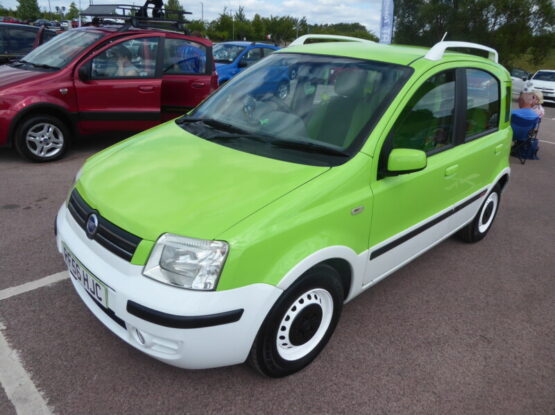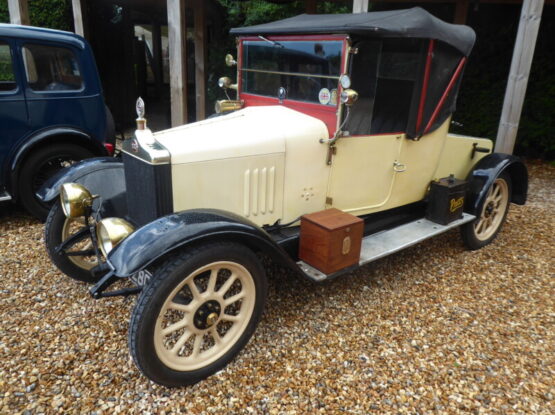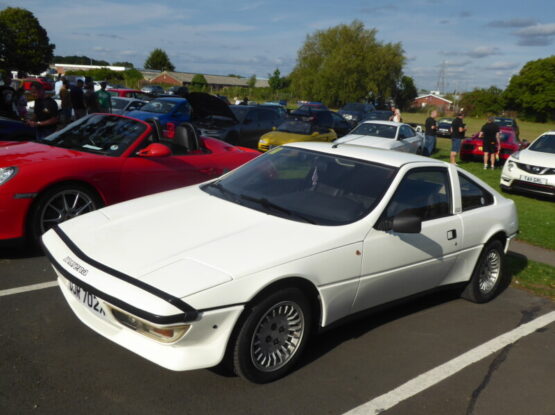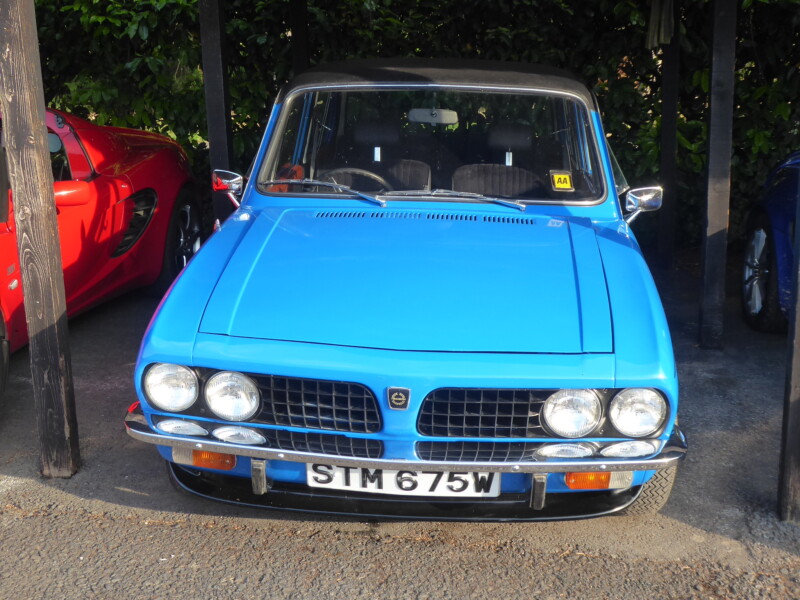
Most of the mid-week evening events are on a monthly cycle during the summer months, following a format such as “second Thursday” or “last Friday”, so it is relatively easy to keep track of when they all take place, though, of course, as none of the ones that I attend are particularly close to home, whether I can attend does depend very much on where I have been working and what is in my diary during the mid to late afternoon on the day in question. I’ve learned to my cost that some of them do in reality start mid-afternoon and arriving after 6om runs the risk of meeting a line of cars exiting, s opposed to joining one queuing to enter. The well-established “Cars in the Valley” held at Shelsley Walsh, on the third Thursday evening of the month is one that does not officially start until 6pm, though I have found that if I arrive around that time, the venue is often surprisingly well populated. However, cars do typically stay until mid-evening, so although it is just under an hour and half to get there from home, it is worth attending, especially when you factor in the quality and variety of cars that typically attend. I don’t manage to make all the series during the season, but I do usually make most of them, so the June 2025 visit was not first of the year. A little quieter than sometimes, perhaps, here are the cars I though of note:
AC
Launched by AC Cars at the 1999 London Motor Show, a new chapter in the Cobra history was written with the Mk. IV Cobra Carbon Road Series (CRS). The CRS is based upon the chassis and power train of its aluminium bodied brother, the Superblower, that shares the lineage of the 4inch ladder chassis of the 427 MK3 of the sixties, but with a very modern twist of boasting an all carbon-fibre body that was the result of collaboration between AC and Kid Jensen Racing, the successful F3000 team. ‘ The CRS features a 5.0L V8 fuel injected engine. This develops 225 BHP@4200rpm which delivers a power-to-weight ratio of 211 bhp/ton. Performance is electrifying with 0-60 reached in well under 5.5 seconds. The Cobra uses the same 5 speed manual transmission as found in the Superblower, Hydratrak limited slip differential, independent front and rear suspension, rack and pinion steering and disc brakes all round (4-pot AP racing brakes and ventilated discs at the front) which makes the CRS, in all respects, a true cobra’. This is 1 of 37 manufactured by AC Cars Group at the Brooklands Factory.


ALFA ROMEO
The Alfa Romeo 4C is a two-seater, rear-wheel drive coupé with technology and materials derived from the Alfa Romeo 8C Competizione, with a 1750 cc turbo petrol engine with direct injection, the “Alfa TCT” twin dry clutch transmission, and the Alfa DNA dynamic control selector. The 4C concept version was unveiled in the 81st Geneva Motor Show in March 2011, followed by the Mille Miglia 2011 parade, Goodwood Festival of Speed 2011,2011 Frankfurt Motor Show. It was displayed for the first time outside in Concorso d’Eleganza Villa d’Este in 2012. Compared to the production version, it is very similar, with the biggest differences being front lights, side vents and mirrors. The Alfa Romeo 4C Concept was voted the ‘Most Beautiful Concept Car of the Year’ award by the readers of German magazine Auto Bild, and won the Auto Bild Design Award 2011. It was awarded the “Design Award for Concept Cars & Prototypes” by referendum of the public in Villa d’Este. The production car was unveiled at the 2013 Geneva Motor Show, followed by 2013 Essen ‘Techno Classica’, Goodwood Festival of Speed 2013, Moscow Raceway, 2013 Frankfurt Motor Show. The bare ‘4C000’ chassis was also shown at the 2013 Geneva Motor Show. Ordering of European models began in October 2013 at Alfa Romeo dealerships in Europe. As part of the Alfa Romeo 4C launch, Alfa Romeo Style Centre and Compagnia Ducale designed a 4C IFD (Innovative Frame Design) Bicycle, inspired by the Alfa Romeo 4C coupé. The vehicle went on sale in December 2013 and marketed in Europe, Asia and America. Production of the 4C began May 2013 at Maserati’s plant in Modena, with an expected production of up to 2500 units per year. It was the first mass-produced Alfa Romeo model to be sold in the US market since 1995 when the 164 sedan stopped being sold in the US. Production of the Alfa Romeo 4C was originally estimated to be over 1000 units per year, with an upper limit of 3500 units per year, depending on the quantity of carbon fibre chassis that can be built by the supplier Adler Plastic.Within the 3,500-unit quota, 1,000 units are earmarked for Europe. Delivery of the European Alfa Romeo 4C Launch Edition took place at Balocco (Vercelli, Italy) Test Centre. In 2018, the 4C coupe was discontinued for the North American market. The 4C Spider, however continued to be sold there for model year 2019 and model year 2020. In other markets, such as Australia and Japan, both the coupe and Spider continued. In late 2020, a new tribute-edition named the 4C Spider 33 Stradale Tributo was announced. The car was designed by Centro Stile Alfa Romeo (Style Centre) and developed by Alfa Romeo. The chassis is composed of a central carbon fibre tub, with aluminium subframes front and rear. The carbon fibre tub is produced by TTA (Tecno Tessile Adler) in Airola, as a joint venture between Adler Plastic and Lavorazione Materiali Compositi. The carbon fibre components that make up the chassis are cut using CNC technology. The entire carbon-fiber monocoque chassis (“tub”) of the car weighs 143 pounds (65 kg). Front and rear aluminium subframes combine with the tub, roof reinforcements and engine mounting to comprise the 4C chassis giving the vehicle a total chassis weight of 236 lb (107 kg) and a total vehicle curb weight of just 2,465 lb (1,118 kg). The 4C has a single carbon fibre body, similar to the body of many supercars. The outer body is made of a composite material (SMC for Sheet Moulding Compound) which is 20% lighter than steel. The stability is comparable to steel and better than aluminium. The 4C employs double wishbone suspensions at the front and MacPherson struts at the rear. The resultant weight distribution is 38% on the front and 62% on the rear axle. Wheels and tyres have different diameters and widths front and rear: 205/45 R17 front and 235/40 R18 back as standard, with optional 205/40 R18 and 235/35 R19. Both wheel options come equipped with Pirelli P Zero tyres. The 4C uses vented disc brakes on all wheels; Brembo 305 millimetres (12.0 in) on the front and 292 millimetres (11.5 in) on the rear. The car can stop from 100 km/h (62 mph) in 36 metres. To save weight and increase steering feel, the 4C has no power steering. Its center of gravity height, at 40 centimetres (16 in) off the ground, is 7 centimetres (2.8 in) lower than that of the Lotus Elise. The 4C uses a new all-aluminium 1,742 cc inline 4 cylinder turbocharged engine producing 240 PS at 6000 rpm. The engine has been designed for minimum weight. The engine’s combined fuel consumption 6.8 l/100 km (42 mpg‑imp; 35 mpg‑US).[4] 0–62 mph (0–100 km/h) acceleration is achieved in 4.5 seconds and the top speed is 258 km/h (160 mph), the power-to-weight-ratio being just 0.267 hp/kg (8.22 lb/hp) A journalist from Quattroruote car magazine demonstrated how the 4C accelerates from 0–100 km/h (0–62 mph) faster than 4.5 seconds. In race mode, with left foot on the brake pedal, if you pull the right shift paddle the engine will rev to 3500 rpm, but if you also pull the left paddle the engine will rev to 6000 rpm and 0–100 km/h (0–62 mph) time will go down to 4.2 seconds. Italian car magazine Quattroruote published the lap time of 4C around Nürburgring. It lapped the ring in 8:04. The 4C is equipped with a six speed Alfa TCT Dual Dry Clutch Transmission, and can be operated via gearshift paddles on the steering wheel. It also has an Alfa ‘DNA’ dynamic control selector which controls the behavior of engine, brakes, throttle response, suspension and gearbox. In addition to the modes already seen in Giulietta, the 4C has a new “Race” mode. The U.S. version of the 4C was introduced in the 2014 New York International Auto Show with the first 100 4C’s being shipped to the U.S. early July, with a total of 850 being shipped by the end of 2014. The U.S. model includes extra bracing and strengthening required to meet U.S. crash regulations (including aluminium inserts in the carbon fiber chassis), resulting in 100 kg (220 lb) of weight increase. This version also has new headlamps similar to those seen before in the 4C Spider version. In 2018, the 4C coupe was discontinued for the North American market due to US DOT NHTSA FMVSS 226 Ejection Mitigation. The regulation called for a progressive compliance date based on volume and, due to low volume, the 4C was allowed to continue until the last compliance date of 9/1/2017, thus all 2018 4C coupes in North America have build dates of 8/2017 or earlier. The 4C Spider, however continued to be sold in North America for model year 2019 and model year 2020. The Spider version of the 4C was previewed showing a pre-production prototype at the 2014 Geneva Motor Show. Sharing its engine with the Coupé version, the 4C Spider has different external parts such as the headlights, exhaust and engine hood, as well as a different roof section that features a removable roof panel. The North American spec 4C reflects a weight difference of only 22 lb (10 kg) (2,465 lbs vs. 2,487 lbs) for the Spider variant. Top speed is quoted at 257 km/h (160 mph) and acceleration from 0 to 100 km/h (62 mph) at 4.5 seconds. The 4C Launch Edition was a limited and numbered edition, unveiled at the vehicle’s launch at the 2013 Geneva Motor Show. The vehicle came in a choice of four paint colours (Rosso Alfa, Rosso Competizione tri-coat, Madreperla White tri-coat or Carrara White matte). 500 examples were reserved for Europe/ROW, 500 for North America, 88 for Australia (Rosso Alfa and Madreperla White only), 200 to Japan and 100 for the Middle East. Note that the original press release cited 500 for North America, 400 Europe, and 100 ROW; however, the plaques on actual cars suggest that more were built and are the numbers referenced above. Distinguishing features of the Launch Edition were carbon fiber trim (including headlight housings, spoiler and door mirror caps), rear aluminium extractor with dark finishing, Bi-LED headlights, dark painted 18-inch front and 19-inch rear alloy wheels, additional air intakes on the front fascia, red brake calipers, racing exhaust system, BMC air cleaner, specific calibration for shock absorbers and rear anti-roll bar, leather/fabric sports seats with parts in Alcantara and a numbered plaque. Alfa Red coloured cars got matching red stitching on the steering wheel, handbrake, mats, handles and sports seats. In Europe the vehicle went on sale for 60,000 euros including VAT. The 4C Competizione is a limited edition version of the 4C introduced in the 2018 Geneva Motor Show, finished in matte Vesuvio Grey, with carbon details on the roof, rear spoiler, mirror caps, side air vents and headlight moulding. The run reportedly consisted of 108 units. The Japanese market received 25 units, and 10 units were assigned to Australia. The US-market received no Competizione editions. The car had a very mixed reaction. The UK press hated it at launch, but owners generally disagreed and loved it. A total of 9117 were built before production ceased in 2020.

The other Alfa model I spotted here was an example of the still-current Giulia.

ALPINE
The Alpine A110 is a rear mid-engine, rear-wheel-drive sports car introduced by French car manufacturer Alpine at the 87th Geneva International Motor Show in March 2017. Deliveries began in late 2017 for Continental European markets and in 2018 for the UK, Japan and Australia. Both its name and design refer back to the original Alpine A110 that was produced from 1961 to 1977. Based on an all-aluminium construction, the A110 is powered by a Nissan-derived 1.8-litre turbocharged gasoline direct injection 4 valves per cylinder inline-four engine mated to a 7-speed dual-clutch transmission manufactured by Getrag. Developed by Renault–Nissan and reworked by Alpine engineers, the engine has an output of 252 PS at 6,000 rpm and 320 Nm (236 lb/ft) of torque at 2,000–5,000 rpm. According to Alpine, the A110 can accelerate from 0 to 100 km/h (0 to 62 mph) in 4.5 seconds, and has an electronically limited top speed of 250 km/h (155 mph). The A110 was initially available in three trims: Pure, Première, and Legende. The Pure cars, the base trim, have 17-inch alloy wheels. The Première trim cars are technically the launch edition models limited to 1,955 units and were equipped with amenities such as forged alloy wheels, quilted leather Sabelt bucket sports seats, a reversing camera, and metallic blue exterior colour as standard. The Legende trim cars come with six-way adjustable sports seats, black or brown leather interior upholstery, an upgraded hi-fi sound system, and specially designed wheels exclusive to this trim. All of the three trims share the same powertrain and transmission. For the 2020 model year, The Pure trim level was replaced by the Alpine A110, with no other badging. The Légende was replaced by the Alpine A110 GT which employed the same engine as the A110 S.

ALVIS
Launched in August 1936, the Alvis Speed 25 was designed to take advantage of Britain’s rapidly improving road network. Marrying sportscar-like performance to an impressive degree of refinement, the newcomer’s sophisticated chassis layout incorporated independent transverse-leaf front suspension, a four-speed all synchromesh gearbox and large-diameter four-wheel drum brakes. Featuring a balanced seven-bearing crankshaft and novel spring-cluster overhead valve gear, its triple SU carburettor fed 3571cc straight-six engine was quoted as developing 108bhp @ 3,800rpm. A notably smooth and flexible unit, it endowed the model with near 100mph performance. Principally bodied by Charlesworth (Sports Saloon / Drophead Coupe) or Cross & Ellis (Tourer), the Alvis Speed 25 stole sales from both the Bentley 4.25 litre and Lagonda LG45 alike. Only in production from 1936 to 1940, just 391 cars are thought to have left the Holyhead Road factory. Supplied new via B. Waterhouse & Sons Ltd of Bradford (or so its locally issued ‘CKW 91’ number plate would imply), chassis 14591 began life as a Charlesworth-bodied Sports Saloon. Surviving World War Two, the Alvis was registered to Hinde & Lewis of Wolverhampton on 25th October 1948. Acquired by Henry Winfield Ltd of Hemel Hempstead on 12th August 1954, the Speed 25 SC remained with them until January 1965 when it was sold to Colin Holloway of Surrey. A keen member of the Alvis Owners Club and Vintage Sports Car Club, Mr Holloway attended numerous events aboard ‘CKW 91’ as well as using it as an everyday car. Invited to represent Alvis in an ‘All Makes’ parade at Brooklands, the Speed 25 SC underwent some bodywork renovation and a colour change from Blue to Blue over Black during 1969. Laid-up in a barn some six years later due to a cracked exhaust manifold, ‘CKW 91’ entered the current ownership during October 2002. Relocating to the vendor’s North Yorkshire workshop after slumbering for decades, the Alvis was completely dismantled. Shot blasted and repainted, the chassis was fitted with a new petrol tank and wheel bearings and also had its back axle, suspension and brakes refurbished. The original engine was overhauled via a crankshaft regrind, re-metalled bearings and fresh pistons etc. The associated ancillaries were rejuvenated too. A comprehensive rewire was carried out and the four-speed all synchromesh gearbox found to need nothing more than an oil change. On examination the Charlesworth Sports Saloon body proved to be in a very sorry state with rotten woodwork, badly corroded aluminium door pillars and the wings being held on with many wood screws to gain a purchase in the decaying timber frame. The decision was taken to have a new drop-head body crafted by The Carrosserie Company (UK) Ltd which they also painted and installed. The upholstery was renewed and a new lined hood fitted. All the brightwork was re-chromed. The total cost of the restoration was in excess of £140,000. Accompanying paperwork encompasses two continuation buff logbooks and assorted restoration photographs.


ASTON MARTIN
Following the unveiling of the AMV8 Vantage concept car in 2003 at the North American International Auto Show designed by Henrik Fisker, the production version, known as the V8 Vantage was introduced at the Geneva Motor Show in 2005. The two seat, two-door coupé had a bonded aluminium structure for strength and lightness. The 172.5 inch (4.38 m) long car featured a hatchback-style tailgate for practicality, with a large luggage shelf behind the seats. In addition to the coupé, a convertible, known as the V8 Vantage Roadster, was introduced later in that year. The V8 Vantage was initially powered by a 4.3 litre quad-cam 32-valve V8 which produced 380 bhp at 7,300 rpm and 409 Nm (302 lb/ft) at 5,000 rpm. However, models produced after 2008 had a 4.7-litre V8 with 420 bhp and 470 Nm (347 lbft) of torque. Though based loosely on Jaguar’s AJ-V8 engine architecture, this engine was unique to Aston Martin and featured race-style dry-sump lubrication, which enabled it to be mounted low in the chassis for an improved centre of gravity. The cylinder block and heads, crankshaft, connecting rods, pistons, camshafts, inlet and exhaust manifolds, lubrication system and engine management were all designed in house by Aston Martin and the engine was assembled by hand at the AM facility in Cologne, Germany, which also built the V12 engine for the DB9 and Vanquish. The engine was front mid-mounted with a rear-mounted transaxle, giving a 49/51 front/rear weight distribution. Slotted Brembo brakes were also standard. The original V8 Vantage could accelerate from 0 to 60 mph in 4.8 seconds before topping out at 175 mph. In 2008, Aston Martin introduced an aftermarket dealer approved upgrade package for power and handling of the 4.3-litre variants that maintained the warranty with the company. The power upgrade was called the V8 Vantage Power Upgrade, creating a more potent version of the Aston Martin 4.3-litre V8 engine with an increase in peak power of 20 bhp to 400 bhp while peak torque increased by 10 Nm to 420 Nm (310 lb/ft). This consists of the fitting of the following revised components; manifold assembly (painted Crackle Black), valved air box, right and left hand side vacuum hose assemblies, engine bay fuse box link lead (ECU to fuse box), throttle body to manifold gasket, intake manifold gasket, fuel injector to manifold seal and a manifold badge. The V8 Vantage had a retail price of GB£79,000, US$110,000, or €104,000 in 2006, Aston Martin planned to build up to 3,000 per year. Included was a 6-speed manual transmission and leather-upholstery for the seats, dash board, steering-wheel, and shift-knob. A new 6-speed sequential manual transmission, similar to those produced by Ferrari and Lamborghini, called Sportshift was introduced later as an option. An open-topped model was added to the range in 2006 and then in the quest for more power a V12 Vantage joined the range not long after. There were no fewer than 18 different versions of the car produced over its model life


BMW
The M3 version of the E46 3 Series was produced in coupé and convertible body styles. The E46 M3 is powered by the S54 straight-six engine and has a 0-100 km/h (62 mph) acceleration time of 5.1 seconds for the coupe, with either the manual or SMG-II transmission. The skid pad cornering results are 0.89 g for the coupe and 0.81 g for the convertible.The top speed is electronically limited to 250 km/h (155 mph). The available transmissions were a Getrag 420G 6-speed manual transmission or a SMG-II 6-speed automated manual transmission, which was based on the Getrag 420G.[58] The SMG-II used an electrohydraulically actuated clutch and gearshifts could be selected via the gear knob or paddles mounted on the steering wheel. The SMG-II was praised for its fast shift times and racetrack performance, but some people found its shifts to be delayed and lurching in stop-start traffic. In 2005, a special edition was introduced which used several parts from the CSL. This model was called the M3 Competition Package (ZCP) in the United States and mainland Europe, and the M3 CS in the United Kingdom. Compared to the regular M3, the Competition Package includes: 19-inch BBS alloy wheels- 19″x 8″ at the front and 19″x 9.5″ at the rear; Stiffer springs (which were carried over to the regular M3 from 12/04); Faster ratio steering rack of 14.5:1 (compared with the regular M3’s ratio of 15.4:1) as per the CSL; Steering wheel from the CSL; M-track mode for the electronic stability control, as per the CSL; The CSL’s larger front brake discs (but with the regular M3 front calipers) and rear brake calipers with larger pistons; Alcantara steering wheel and handbrake covers; The engine, gearbox and other drivetrain components are the same as the standard M3. Total production of the E46 M3 was 56,133 coupes and 29,633 convertibles. The cars were assembled at the BMW Regensburg factory in Germany and production was from September 2000 until August 2006, production totalled 85,766.

The M3 model of the E90/E92/E93 3 Series range was powered by the BMW S65 V8 engine and was produced in sedan, convertible and coupé body styles. The E9x is the first and only standard production M3 powered by a V8 engine as its successor would revert to using a straight 6 engine. In the standard M3, the S65 engine rated at 420 PS (414 bhp) at 8,300 rpm and 400 Nm (295 lb/ft) at 3,900 rpm. Initially, the M3 was produced with a 6-speed manual transmission. In April 2008, the E90/E92/E93 M3 became the first BMW to be available with a dual-clutch transmission when the 7-speed Getrag “M-DCT” transmission was introduced as an option. The official 0 to 100 km/h (62 mph) acceleration times for the coupé and sedan are 4.6 seconds with the DCT transmission (4.8 seconds with the manual transmission) and 5.1 seconds for the convertible. The E90 and E92 versions received many positive reviews, including “the greatest all-around car in the world”, “the finest car on the market, period” and “the best, most complete car in the world”. The first body style to be introduced was the coupé, which was previewed at the 2007 Geneva Motor Show and introduced in production form at the 2007 Frankfurt Motor Show on 12 September. The coupé version uses a carbon fibre roof to reduce weight and lower the centre of gravity. In 2010, the coupé and convertible versions received a minor facelift, which included revised LED tail-lights and minor interior trim pieces but it did not get the updated headlights from the regular series. The E93 convertible version was introduced shortly after the coupé and uses a power retractable hardtop. The leather seats in the convertible version are treated with a coating to reflect sunlight, in order to reduce their tendency to become uncomfortably hot with the top down. A sedan version was introduced in 2008 and was the second (along with the E36) M3 by generation to be produced in a 4-door body style. The sedan has the same drivetrain and similar external styling as the coupé, however the lack of a carbon fibre roof contributes to a weight increase of 10 kg (22 lb) compared to an identically equipped coupé. The official kerb weights for the 2008 European-specification models (with manual transmission) are 1,580 kg (3,483 lb) for the coupé, 1,605 kg (3,538 lb) for the sedan and 1,810 kg (3,990 lb) for the convertible. Total production of the E9x M3 was 40,092 coupés, 16,219 convertibles and 9,674 sedans. Production of sedan models finished in 2011, with coupés remaining in production until July 5, 2013.

BROADSPEED
The Broadspeed GT 2+2 is a Mini-based fastback-styled motor vehicle designed by Tony Bloor, Broadspeed’s sales manager. It was introduced into the UK market in 1966 and continued in production until 1968, when Broadspeed’s factory in Birmingham was scheduled for demolition to make way for a new ring road. By then 28 cars had been built, 16 of them reportedly exported to Spain. Broadspeed had become well known in the early 1960s for its successful BMC Mini racing team, and for producing a variety of road and race-tuning packages for BMC engines. The GT was the company’s first and only foray into car manufacturing. Cars and Car Conversions magazine characterised the car as “more the ultimate in conversion than a complete new car” after their test drive. The conversion was achieved by cutting off the rear section of a standard Mini and reducing the door pillars in height by about 2 inches (5.1 cm). Then a fibreglass fastback was bonded to the car in place of the missing rear section, adding about 4 inches (10 cm) to its overall length, and the engine tuned. The interior was upgraded by the installation of a replacement fascia with additional auxiliary gauges and Restall bucket seats in the front. The new rear seat was designed to fold down to allow access to the boot, as there was no boot lid in the new rear end. The boot was significantly smaller than that of the standard Mini owing to the presence of two fuel tanks, giving the car a range of 300 miles (480 km). Autocar magazine described the end product of the conversion as “masquerading as a sort of scaled down DB6 Aston Martin”. The Broadspeed GT was offered in four versions, with the lightweight GTS being top of the range. There was a choice of three engines: 848 cc, 998 cc Mini Cooper engine and 1275 cc Mini Cooper S engine. Prices ranged from £799 for the basic 848 cc engined car to £1,500 for the 1275 cc version.


CATERHAM
The Caterham story is one of continual development, a four decade process of honing Colin Chapman’s original design, which is now 60 years old. Since 1973, when Graham Nearn’s Caterham cars took over the rights and manufacture of the fly-weight sportscars, it’s grown more power, better engines, more sophistication in both suspension and powertrains, as well – in some cases – as more space inside and certainly more creature comforts, all while preserving the original character. Caterham completed 42 of the heavier and not that well thought of Series 4 cars before deciding to concentrate on the classic Series 3 design, with a simple space frame chassis clothed in aluminium and glassfibre. At the time of the S3, the power unit was from Ford, with the Crossflow unit developing 84 bhp in GT form with a twin choke carburettor, though twin Webers were never far away. Sevens had started out with Ford side valve power, before the 948cc BMC A Series unit found its way into the car, followed by Ford’s new 1340cc and 1498cc engines, before the head redesign put the intake and the exhaust on opposite sides. When Ford discontinued the Kent engine in 1976, it caused something of a difficulty for Caterham, as this also meant the end of the Twin Cam and the BDR engines, of which Caterham had bought 500 in preceding years, and whilst the final pushrod engines came from South Africa, eventually the supply ran out and a new supplier was needed. At first the firm turned to Vauxhall’s 2 litre unit for the higher powered cars but when the found out that Rover were developing a new and sophisticated twin cam engine, which turned out to be the K Series unit, a deal was struck and the first K Series engined Caterhams appeared in 1991, once the multi-point injection version was available (the single point would have required a bonnet bulge which Caterham did not want). To get round the relative lack of torque, Caterham developed their own close ratio 6 speed gearbox which was lighter than the Ford unit they had been using, and which could cope with larger capacity and more powerful K Series units as Rover made them available. Caterham continued to develop the car throughout the 90s, starting to make their own steering racks among other changes. By the time the K Series and the 240 bhp Vauxhall engines in the HPC car came along, the interior had become plusher with a long cockpit option and a wider variant, the SV. There were now proper bucket seats instead of those with a plywood backrest and in 1996 the handbrake moved from under the dash to the transmission tunnel. This required extra tubing in the chassis, which made it 80% stiffer. The front suspension had gained a proper top wishbone and separate anti-roll bar, but the biggest change came with the adoption of de Dion rear suspension. The move was occasioned by a need to keep the rear wheels linked and parallel to each other, yet still as simple as possible, though the engineers harboured a desire for a fully independent rear end, which finally came about with the CSR version in 2004. This change improved the ride massively on bumpy roads and makes the car feel more planted. The collapse of Rover in 2005 meant the end for the K Series, so there was a switch back to Ford power, using the Sigma engine, which happily fits under the bonnet – something that few modern engines do as they are now often simply too tall. Adding more power is a law of diminishing returns with a Caterham, thanks to the aerodynamics, though there are now an array of different power outputs offered, but the most recent change was a new entry level model, which uses a 660cc Suzuki turbo triple, with a live axle and a similar power to weight ratio to the classic single carb Ford powered models of 30 years ago. However, these days you can get carpets, leather seats and full weather gear if you upgrade to an S pack. Caterham plan to continue to develop the car for as long as they can. To date they have built around 16,000 examples, and it is said that were you to gather 100 models together, you would not find two the same, even though, colour apart, many cars look very similar at a quick glance.

CITROEN
Development of the AX started in 1983, and was initially also going to form the basis of a sister model from Talbot to replace the Samba; however, the falling popularity of the Talbot brand – coupled with the huge success of the new Peugeot 205 – had led to Peugeot deciding to axe it by the time the Citroën AX was launched, and so the Talbot version never made it into production. The car was available on the left-hand drive continental markets from its launch on 2 October 1986, as a three-door hatchback with 1.0, 1.1 and 1.4-litre TU-series belt driven OHC engines. A range of five-door models was added in 1987 and a 1.4 litre diesel engine was introduced in 1988. The latter was replaced by a 1.5 litre unit in September 1994. The right-hand drive version for the UK market was launched in August 1987, initially only as a three-door hatchback, with a five-door version joining the range a year later, effectively replacing the five-door Citroën Visa, which was discontinued that year. With the final demise of the classic Citroën 2CV in 1990, the AX became the smallest model in the Citroën range. The very earliest cars had an issue with gear shifters falling off; this was rectified by the time the AX reached export markets. It was initially backed by a memorable television advertising campaign filmed in China, starring actress Janet Mas and an elderly gentleman, whose character was simply known as Mr. Wong. The car was very economical, largely because of excellent aerodynamics for its class of car (drag coefficient of 0.31) and a very light weight of 640 kg (1,411 lb) for the basic version. This was due to the extensive use of plastic panels in non-load bearing areas and varying the thicknesses of steel in the bodyshell to be the minimum needed to take required loads. Another target for the engineers was lowering friction in the engines. The AX has fully independent suspension with unusually long wheel travel. It also optionally used self-coloured plastic bumpers. This technology came from the PSA Peugeot-Citroën / Renault / French government ECO 2000 project. The production version was much more conservative than the original ‘one box’ design prototype, that was closer to the Eco 2000 styling after negative reactions in focus groups. The “one-box” city car eventually came to market with the Renault Twingo, launched in 1992. In 1989, a naturally aspirated diesel AX, using the 1360 cc all aluminium alloy TUD engine, managed a figure of 2.7 litres/100 km (100 mpg), totalling over 1,000 miles from Dover to Barcelona. This was the longest ever distance travelled on 10 gallons of fuel and earned it a place in the Guinness Book of Records as the most economical production car. Also available was a 4×4 variant, but with limited success when compared to the rival Fiat Panda 4×4. The AX 4×4 was only available with five doors and was not sold in the United Kingdom. The first performance version was the limited-run AX Sport from 1987, with a 1.3 engine and twin carburettors producing 95 bhp, wearing iconic white steel wheels (5,5″ x 13″) which resembled those on its brother, the Peugeot 205 Rallye. The AX Sport used Solex ADDHE 40 carburettors until late 1988 and was then replaced with Weber DCOM 40s, just like the 205 Rallye 1,3. The AX Sport had a shorter inlet manifold than the 205 Rallye, to save room in the smaller engine compartment. In phase 2 guise the Sport was available in other colours and with optional GT wheels and rear spoiler. Later, the AX 14GT, with a single-carburettor 85 bhp 1.4 engine also found in the Peugeot 205 XS, was introduced. From 1991, this model utilised fuel injection to coincide with the revamp of the entire range and to coincide with tougher 1992 EU emission regulations that introduced exhaust catalytic converters. Late 1991 saw the range revised, with a heavily facelifted tailgate and interior being the most notable changes. The front turn signals were now clear, and the Citroën logo was moved to the center of the bonnet. The much maligned dashboard was replaced by a more conservative design. The following year saw the introduction of the most powerful AX variant, the 100 bhp GTi. The GT was sold alongside the GTi for a few months, but was eventually phased out. New models were also introduced, such as the Forte, Spree, Elation and Dimension. In January 1995, the Citroën AX Echo was launched, with a top speed of 110 mph (180 km/h). Its closest competitor, the Peugeot 106 Ski, (that shared components with the AX), was outsold by the Echo. From June 1996, following the introduction of the Saxo, the range was slimmed-down, with production of the AX ending in December 1998, after a 12-year production run. It had been withdrawn from the UK market during the first half of 1997, following the demise of right-hand drive production. A total of 2,425,138 AXs were produced.

FERRARI
It was with the 360 Modena that sales of Ferrari models really took off, with unprecedented volumes of the car being sold. The 360 Modena was launched in 1999, named after the town of Modena, the birthplace of Enzo Ferrari. A major innovation in this all new model came from Ferrari’s partnership with Alcoa which resulted in an entirely new all-aluminium space-frame chassis that was 40% stiffer than the F355 which had utilised steel. The design was 28% lighter despite a 10% increase in overall dimensions. Along with a lightweight frame the new Pininfarina body styling deviated from traditions of the previous decade’s sharp angles and flip-up headlights. The new V8 engine, common to all versions, was of 3.6 litre capacity with a flat plane crankshaft, titanium connecting rods and generates 400 bhp Despite what looks like on paper modest gains in reality the power to weight ratio was significantly improved on over the F355, this was due to the combination of both a lighter car and more power. The 0 to 100 km/h acceleration performance improved from 4.6 to 4.3 seconds. The first model to be rolled out was the 360 Modena, available as a manual, or an F1 electrohydraulic manual. Next up was an open car. The 360 was designed with a Spider variant in mind; since removing the roof of a coupe reduces the torsional rigidity, the 360 was built for strength in other areas. Ferrari designers strengthened the sills, stiffened the front of the floorpan and redesigned the windscreen frame. The rear bulkhead had to be stiffened to cut out engine noise from the cabin. The convertible’s necessary dynamic rigidity is provided by additional side reinforcements and a cross brace in front of the engine. Passenger safety is ensured by a strengthened windscreen frame and roll bars. The 360 Spider displays a curvilinear waistline. The fairings imply the start of a roof, and stable roll bars are embedded in these elevations. Due to use of light aluminium construction throughout, the Spider weighs in only 60 kg heavier than the coupé. As with the Modena version, its 3.6 litre V8 with 400 bhp is on display under a glass cover. The engine — confined in space by the convertible’s top’s storage area — acquires additional air supply through especially large side grills. The intake manifolds were moved toward the center of the engine between the air supply conduits in the Spider engine compartment, as opposed to lying apart as with the Modena. In terms of performance, the 0-60 mph time was slightly slower at 4.4 seconds due to the slight weight increase, and the top speed was reduced from 189 to 180 mph. Despite the car’s mid-mounted V8 engine, the electrically operated top is able to stow into the compartment when not in use. The convertible top was available in black, blue, grey and beige. The transformation from a closed top to an open-air convertible is a two-stage folding-action that has been dubbed “a stunning 20 second mechanical symphony”. The interior of the Spider is identical to that of the coupé.

Effectively a mid-life update to the 360 Modena, the F430 debuted at the 2004 Paris Motor Show. Designed by Pininfarina, under the guidance of Frank Stephenson, the body styling of the F430 was revised from the 360 Modena, to improve its aerodynamic efficiency. Although the drag coefficient remained the same, downforce was greatly enhanced. Despite sharing the same basic Alcoa Aluminium chassis, roof line, doors and glass, the car looked significantly different from the 360. A great deal of Ferrari heritage was included in the exterior design. At the rear, the Enzo’s tail lights and interior vents were added. The car’s name was etched into the Testarossa-styled driver’s side mirror. The large oval openings in the front bumper are reminiscent of Ferrari racing models from the 60s, specifically the 156 “sharknose” Formula One car and 250 TR61 Le Mans cars of Phil Hill. Designed with soft-top-convertible. The F430 featured a 4.3 litre V8 petrol engine of the “Ferrari-Maserati” F136 family. This new power plant was a significant departure for Ferrari, as all previous Ferrari V8’s were descendants of the Dino racing program of the 1950s. This fifty-year development cycle came to an end with the entirely new unit. The engine’s output was 490 hp at 8500 rpm and 343 lb/ft of torque at 5250 rpm, 80% of which was available below 3500rpm. Despite a 20% increase in displacement, engine weight grew by only 4 kg and engine dimensions were decreased, for easier packaging. The connecting rods, pistons and crankshaft were all entirely new, while the four-valve cylinder head, valves and intake trumpets were copied directly from Formula 1 engines, for ideal volumetric efficiency. The F430 has a top speed in excess of 196 mph and could accelerate from 0 to 100 km/h in 3.9 seconds, 0.6 seconds quicker than the old model. The brakes on the F430 were designed in close cooperation with Brembo (who did the calipers and discs) and Bosch (who did the electronics package),resulting in a new cast-iron alloy for the discs. The new alloy includes molybdenum which has better heat dissipation performance. The F430 was also available with the optional Carbon fibre-reinforced Silicon Carbide (C/SiC) ceramic composite brake package. Ferrari claims the carbon ceramic brakes will not fade even after 300-360 laps at their test track. The F430 featured the E-Diff, a computer-controlled limited slip active differential which can vary the distribution of torque based on inputs such as steering angle and lateral acceleration. Other notable features include the first application of Ferrari’s manettino steering wheel-mounted control knob. Drivers can select from five different settings which modify the vehicle’s ESC system, “Skyhook” electronic suspension, transmission behaviour, throttle response, and E-Diff. The feature is similar to Land Rover’s “Terrain Response” system. The Ferrari F430 was also released with exclusive Goodyear Eagle F1 GSD3 EMT tyres, which have a V-shaped tread design, run-flat capability, and OneTRED technology. The F430 Spider, Ferrari’s 21st road going convertible, made its world premiere at the 2005 Geneva Motor Show. The car was designed by Pininfarina with aerodynamic simulation programs also used for Formula 1 cars. The roof panel automatically folds away inside a space above the engine bay. The conversion from a closed top to an open-air convertible is a two-stage folding-action. The interior of the Spider is identical to that of the coupé. Serving as the successor to the Challenge Stradale, the 430 Scuderia was unveiled by Michael Schumacher at the 2007 Frankfurt Auto Show. Aimed to compete with cars like the Porsche RS-models and the Lamborghini Gallardo Superleggera it was lighter by 100 kg/220 lb and more powerful (510 PS) than the standard F430. Increased power came from a revised intake, exhaust, and an ion-sensing knock-detection system that allows for a higher compression ratio. Thus the weight-to-power ratio was reduced from 2.96 kg/hp to 2.5 kg/hp. In addition to the weight saving measures, the Scuderia semi-automatic transmission gained improved “Superfast”, known as “Superfast2”, software for faster 60 millisecond shift-times. A new traction control system combined the F1-Trac traction and stability control with the E-Diff electronic differential. The Ferrari 430 Scuderia accelerates from 0-100 km/h in 3.6 seconds, with a top speed of 202 miles per hour. Ferrari claimed that around their test track, Fiorano Circuit, it matched the Ferrari Enzo, and the Ferrari F430’s successor, the Ferrari 458. To commemorate Ferrari’s 16th victory in the Formula 1 Constructor’s World Championship in 2008, Ferrari unveiled the Scuderia Spider 16M at World Finals in Mugello. It is effectively a convertible version of the 430 Scuderia. The engine produces 510 PS at 8500 rpm. The car has a dry weight of 1,340 kg, making it 80 kg lighter than the F430 Spider, at a curb weight of 1,440 kg (3,175 lb). The chassis was stiffened to cope with the extra performance available and the car featured many carbon fibre parts as standard. Specially lightened front and rear bumpers (compared to the 430 Scuderia) were a further sign of the efforts Ferrari was putting into this convertible track car for the road. Unique 5-spoke forged wheels were produced for the 16M’s launch and helped to considerably reduce unsprung weight with larger front brakes and callipers added for extra stopping power (also featured on 430 Scuderia). It accelerates from 0-100 km/h in 3.7 seconds, with a top speed of 315 km/h (196 mph). 499 vehicles were released beginning early 2009 and all were pre-sold to select clients

Also here was an example of the 458 Speciale, one of a long line of specially engineered cars added to complement the “regular” V8 models that started with the 100 units of the 348 Speciale produced in 1992, and followed up by the 360 Challenge Stradale, the 430 Scuderia and the 16M. In essence they are all about adding power and shedding weight. In simplistic terms, the road to the Speciale can be summed up in four words: more power, less weight. There are other, more detailed changes, too, obviously, but those are the cornerstones around which everything else is shaped. The normally aspirated, flat-plane crank V8 retains its 4497cc swept capacity but receives new cam geometry with higher valve lift, shorter inlet manifolds and different pistons providing a higher compression ratio. Internal friction is reduced, through the use of uprated materials and the upshot is 597bhp (up from 562bhp) generated at the engine’s 9000rpm limit. Torque is the same, at 398lb ft, still delivered at 6000rpm. The engine is mated to a seven-speed, dual-clutch gearbox whose upshifts, we were told at the launch of such gearboxes, are all but instant. That’s still true, but Ferrari has improved the response time to a pull on the lever and made the engine rev-match more quickly on downshifts to reduce the time that those take. The engine’s changes shave 8kg from the car’s overall weight – the exhaust is all aluminium and the intake is carbonfibre. Those 8kg form part of a claimed 90kg total saving at 1395kg now, versus 1485kg for a 458 Italia. Of this 90kg, 12kg is contributed by lighter, forged wheels, 13kg comes from bodywork and window changes (lighter glass all round and Lexan for the engine cover), and 20kg comes from the cabin. There are two flaps on the Speciale’s front valance, one either side of the prancing horse badge in its centre. Below 106mph these flaps remain closed, which diverts air towards the radiators. Above that speed, the radiators get quite enough cool air, thanks very much, so the flaps open, which reduces drag. Then, above 137mph, they move again, lowering to shift downforce to the rear of the car, in turn adjusting the balance 20 per cent rearward in order to promote high-speed cornering stability. At the rear, meanwhile, there is a new diffuser (the exhausts have been rerouted to make the most of its central section). Movable flaps in the diffuser adjust, but this time they are dependent not only on speed but also on steering angle and throttle or brake position. When lowered, the flaps stall the path of air into the diffuser and improve the Cd by 0.03. When raised, the diffuser adds downforce as it should. Bodywork changes, though, also bring some aerodynamic improvements, you’ll not be surprised to hear, with lessons applied from the LaFerrari and FXX programmes. In the front valance and under the rear diffuser, there are flaps that open at speed to reduce drag and improve downforce. Finally, there are new Michelin Pilot Sport Cup 2 tyres in a unique compound – rather a sticky one, we suspect – plus new calibration for the adaptive dampers. The carbon-ceramic brake discs also use a new compound. 499 of them were built and they sold out very quickly.


FORD
There were a couple of examples of the Mustang here, one from the sixth generation, the first to be sold here in right hand drive and also one from the previous fifth generation.


FRAZER-NASH
The Frazer Nash Le Mans Replica, and its evolution, the Frazer Nash Le Mans Replica Mk2, is a sports car, designed, developed and built by British manufacturer Frazer Nash, between 1949 and 1954.


HONDA
In December 2007, Acura announced plans to launch a NSX successor by 2010, based on the styling of the front V10-engined Acura ASCC (Advanced Sports Car Concept). Despite prototypes being tested for production, just a year later, Honda announced that plans had been cancelled due to poor economic conditions. Instead, in March 2010, Honda unveiled the HSV-010 GT for participation in the Japanese SuperGT Championship. This car never reached production as a street-legal car. Reports that Honda was again developing a successor to the NSX remerged in April 2011. By December 2011, Honda officially announced a second generation NSX concept, which was unveiled the following month at the 2012 North American International Auto Show as the Acura NSX Concept. The production model was displayed three years later at the 2015 North American International Auto Show, for sale in 2016. Although the original name was retained, this time it was defined as “New Sports eXperience”. Unlike the first generation NSX which was manufactured in Japan, the new NSX was designed and engineered in Marysville, Ohio, at Honda’s plant, led by chief engineer Ted Klaus. The new NSX has a hybrid electric powertrain, with a 3.5 L twin-turbocharged V6 engine and three electric motors, two of which form part of the “SH-AWD” all wheel drive drivetrain, altogether capable of close to 600 hp. The transmission is a 9-speed dual-clutch automatic. Its body utilizes a space frame design—which is made from aluminium, ultra-high-strength steel, and other rigid and lightweight materials, some of which are the world’s first applications. The first production vehicle with VIN #001 was auctioned off by Barrett Jackson on 29 January 2016. NASCAR team owner Rick Hendrick won the auction with a bid for US$1,200,000. The entire bid was donated to the charities Pediatric Brain Tumor Foundation and Camp Southern Ground. The first NSX rolled off the line in Ohio on 27 May 2016. Hendrick was there to drive it off. The first sales of the new NSX were registered in the second half of 2016

JAGUAR
The Series 1 E Type was introduced, initially for export only, in March 1961. The domestic market launch came four months later in July 1961. The cars at this time used the triple SU carburetted 3.8-litre six-cylinder Jaguar XK6 engine from the XK150S. Earlier built cars utilised external bonnet latches which required a tool to open and had a flat floor design. These cars are rare and more valuable. After that, the floors were dished to provide more leg room and the twin bonnet latches moved to inside the car. The 3.8-litre engine was increased to 4,235 cc in October 1964. The 4.2-litre engine produced the same power as the 3.8-litre (265 bhp) and same top speed (150 mph), but increased torque approximately 10% from 240 to 283 lb/ft. Acceleration remained pretty much the same and 0 to 60 mph times were around 6.4 seconds for both engines, but maximum power was now reached at 5,400 rpm instead of 5,500 rpm on the 3.8-litre. That all meant better throttle response for drivers that did not want to shift down gears. The 4.2-litre’s block was completely redesigned, made longer to accommodate 5 mm (0.20 in) larger bores, and the crankshaft modified to use newer bearings. Other engine upgrades included a new alternator/generator and an electric cooling fan for the radiator. Autocar road tested a UK spec E-Type 4.2 fixed head coupé in May 1965. The maximum speed was 153 mph, the 0–60 mph time was 7.6 seconds and the 1⁄4 mile from a standing start took 15.1 seconds. They summarised it as “In its 4.2 guise the E-Type is a fast car (the fastest we have ever tested) and offers just about the easiest way to travel quickly by road.”. Motor magazine road tested a UK spec E-Type 4.2 fixed head coupé in Oct 1964. The maximum speed was 150 mph, the 0–60 mph time was 7 seconds and the 1⁄4 mile time was 14.9 seconds. They summarised it as “The new 4.2 supersedes the early 3.8 as the fastest car Motor has tested. The absurd ease which 100 mph can be exceeded in a 1⁄4 mile never failed to astonish. 3,000 miles (4,828 km) of testing confirms that this is still one of the world’s outstanding cars”. All E-Types featured independent coil spring rear suspension designed and developed by R J Knight with torsion bar front ends, and four wheel disc brakes, in-board at the rear, all were power-assisted. The Coventry engineers spared nothing with regards to high automotive technology in braking. Like several British car builders of the middle and late 1950s, the four-wheel disc brakes were also used in that era by Austin-Healey, MG,putting the British far ahead of Ferrari, Maserati, Alfa Romeo, Porsche, and Mercedes-Benz. Even Lanchester tried an abortive attempt to use copper disc brakes in 1902. Jaguar was one of the first vehicle manufacturers to equip production cars with 4 wheel disc brakes as standard from the XK150 in 1958. The Series 1 (except for late 1967 models) can be recognised by glass-covered headlights (up to 1967), small “mouth” opening at the front, signal lights and tail-lights above bumpers and exhaust tips under the number plate in the rear. 3.8-litre cars have leather-upholstered bucket seats, an aluminium-trimmed centre instrument panel and console (changed to vinyl and leather in 1963), and a Moss four-speed gearbox that lacks synchromesh for first gear (“Moss box”) on all except very last cars. 4.2-litre cars have more comfortable seats, improved brakes and electrical systems, and,obviously, an all-synchromesh Jaguar designed four-speed gearbox. 4.2-litre cars also have a badge on the boot proclaiming “Jaguar 4.2 Litre E-Type” (3.8 cars have a simple “Jaguar” badge). Optional extras included chrome spoked wheels and a detachable hard top for the OTS. When leaving the factory the car was originally fitted with Dunlop 6.40 × 15-inch RS5 tyres on 15 × 5K wire wheels (with the rear fitting 15 × 5K½ wheels supplied with 6.50 X15 Dunlop Racing R5 tyres in mind of competition). Later Series One cars were fitted with Dunlop 185 – 15 SP41 or 185 VR 15 Pirelli Cinturato as radial ply tyres. A 2+2 version of the fastback coupé was added in 1966. The 2+2 offered the option of an automatic transmission. The body is 9 in (229 mm) longer and the roof angles are different. The roadster and the non 2+2 FHC (Fixed Head Coupé) remained as two-seaters. Less widely known, right at the end of Series 1 production, but prior to the transitional “Series 1½” referred to below, a small number of Series 1 cars were produced with open headlights. These Series 1 cars had their headlights modified by removing the covers and altering the scoops they sit in, but these Series 1 headlights differ in several respects from those later used in the Series 1½ (or 1.5), the main being they are shorter at 143 mm from the Series 1½ at 160 mm. Production dates on these machines vary but in right-hand drive form production has been verified as late as July 1968. They are not “rare” in the sense of the build of the twelve lightweights, but they are certainly uncommon; they were not produced until January 1967 and given the foregoing information that they were produced as late as July 1968, it appears that there must have been an overlap with the Series 1.5 production, which began in August 1967 as model year 1968 models. These calendar year/model year Series 1 E-Types are identical to other 4.2-litre Series 1 examples in every respect except for the open headlights; all other component areas, including the exterior, the interior, and the engine compartment are the same, with the same three SU carburettors, polished aluminium cam covers, center dash toggle switches, etc. Following the Series 1 there was a transitional series of cars built in 1967–68 as model year 1968 cars, unofficially called “Series 1½.” Due to American pressure the new features were not just open headlights, but also different switches (black rocker switches as opposed to the Series 1 toggle switches), de-tuning for emissions (using two Zenith-Stromberg carburettors instead of the original three SUs) for US models, ribbed cam covers painted black except for the top brushed aluminium ribbing, bonnet frames on the OTS that have two bows, and other changes. Series 1½ cars also have twin cooling fans and adjustable seat backs. The biggest change between 1961–1967 Series 1 E-Types and the 1968 Series 1.5 was the reduction in the number of carburettors from 3 to just 2 (North America), resulting in a loss in horsepower. Series 2 features were gradually introduced into the Series 1, creating the unofficial Series 1½ cars, but always with the Series 1 body style. A United States federal safety law affecting 1968 model year cars sold in the US was the reason for the lack of headlight covers and change in dash switch design in the “Series 1.5” of 1968. An often overlooked change, one that is often “modified back” to the older style, is the wheel knock-off “nut.” US safety law for 1968 models also forbade the winged-spinner knockoff, and any 1968 model year sold in the US (or earlier German delivery cars) should have a hexagonal knockoff nut, to be hammered on and off with the assistance of a special “socket” included with the car from the factory. This hexagonal nut carried on into the later Series 2 and 3. The engine configuration of the US Series 1.5s was the same as is found in the Series 2. An open 3.8-litre car, actually the first such production car to be completed, was tested by the British magazine Motor in 1961 and had a top speed of 149.1 mph and could accelerate from 0 to 60 mph in 7.1 seconds. A fuel consumption of 21.3 mpg was recorded. The test car cost £2,097 including taxes.The cars submitted for road test by the motoring journals of the time (1961) such as Motor, Autocar and Autosport magazines were prepared by the Jaguar works. This work entailed engine balancing and subtle tuning work such as gas-flowing checking the cylinder heads but otherwise production built engines. Both of the well-known 1961 road test cars: the E-Type coupé Reg. No. 9600 HP and E-Type Convertible Reg. No. 77 RW, were fitted with Dunlop Racing Tyres on test, which had a larger rolling diameter and lower drag coefficient. This goes some way to explaining the 150 mph (240 km/h) maximum speeds that were obtained under ideal test conditions. The maximum safe rev limit for standard 6-cylinder 3.8-litre E-Type engines is 5,500 rpm. The later 4.2-Litre units had a red marking on the rev counter from just 5,000 rpm. Both 3.8 test cars may have approached 6,000 rpm in top gear when on road test, depending on final drive ratio. Production numbers were as follows: 15,490 of the 3.8s, 17,320 of the 4.2s and 10,930 of the 2+2s. And by body style there were 15,442 of the FHC, 17,378 of the OTS and 5,500 of the 2+2, making a total of 38,419 of the Series 1 car.


Few would have guessed that the XJS would run for over 20 years, but eventually it came time for its replacement, and the car charged with so doing was the XK8. Development began in 1992, with design work having starting earlier, in late 1991. By October 1992 a design was chosen and later frozen for production in 1993. Prototypes were built from December 1993 after the X100 was given formal approval and design patents were filed in June 1994. Development concluded in 1996, at which point the car was launched. The first-generation XK series shares its platform with the Aston Martin DB7, and both cars are derived from the Jaguar XJS, though the platform has been extensively changed. One of the revisions is the use of the second generation of Jaguar’s independent rear suspension unit, taken from the XJ40. The XK8 was available in coupé or convertible body styles and with the then new 4.0-litre Jaguar AJ-V8 engine. In 1998 the XKR was introduced with a supercharged version of the engine. 2003 the engines were replaced by the 4.2-litre AJ34 engines in both the normally aspirated and supercharged versions. Equipment levels were generous and there was a high standard of fit and finish. Both models came with all-leather interior, burl walnut trim, and side airbags. Jeremy Clarkson, during a Top Gear test-drive, likened the interior of the original XK8 to sitting inside Blenheim Palace. The model ran for 10 years before being replaced by the X150 model XK.

LOTUS
The original Elan was introduced in 1962 as a roadster, although an optional hardtop was offered in 1963 and a coupé version appeared in 1965, and there were examples of all of these here. The two-seat Lotus Elan replaced the elegant, but unreliable and expensive to produce Lotus Elite. It was the first Lotus road car to use a steel backbone chassis with a fibreglass body. At 1,600 lb (726 kg), the Elan embodied the Colin Chapman minimum weight design philosophy. Initial versions of the Elan were also available as a kit to be assembled by the customer. The Elan was technologically advanced with a DOHC 1557 cc engine, 4-wheel disc brakes, rack and pinion steering, and 4-wheel independent suspension. Gordon Murray, who designed the spectacular McLaren F1 supercar, reportedly said that his only disappointment with the McLaren F1 was that he couldn’t give it the perfect steering of the Lotus Elan. This generation of the two-seater Elan was famously driven by the character Emma Peel on the 1960s British television series The Avengers. The “Lotus TwinCam” engine was based on Ford Kent Pre-Crossflow 4-cylinder 1498 cc engine, with a Harry Mundy-designed 2 valve alloy chain-driven twin-cam head. The rights to this design were later purchased by Ford, who renamed it to “Lotus-Ford Twin Cam”. It would go on to be used in a number of Ford and Lotus production and racing models.


There has only ever been one front wheel drive model with Lotus badges on it, the “M100” Elan sports car. Like many specialist produced cars of the era, there was a long wait for this car form when news first broke that it was under development to the actual release of cars people could buy. The M100 Elan story goes back to 1986 and the purchase of Lotus by General Motors which provided the financial backing to develop a new, small, affordable car in the same spirit as the original Elan, the last of which had been built in December 1972. A development prototype, the M90 (later renamed the X100) had been built a few years earlier, using a fibreglass body designed by Oliver Winterbottom and a Toyota-supplied 1.6-litre engine and transmission. Lotus was hoping to sell the car through Toyota dealerships worldwide, badged as a Lotus Toyota, but the project never came to fruition and the prototype was shelved, although Lotus’s collaboration with Toyota had some influence on the design of the Toyota MR2. The idea of a small roadster powered by an outsourced engine remained, however, and in late 1986 Peter Stevens’s design for the Type M100 was approved and work began by Lotus engineers to turn the clay styling buck into a car that could be built. This process was completed in just under three years, a remarkably short time from design to production car. The M100 Elan was conceived as a mass-market car and in particular one that would appeal to US buyers. Consequently, Lotus put an enormous effort (for such a small firm) into testing the car; over a two-year period 19 crash cars and 42 development vehicles were built, logging nearly a million test miles in locations from Arizona to the Arctic. The Elan was driven at racing speeds for 24 hours around the track at Snetterton. Finally each new car was test-driven for around 30 miles at Lotus’s Hethel factory to check for any manufacturing defects before being shipped to dealers. The choice of front-wheel drive is unusual for a sports car, but according to Lotus sales literature, “for a given vehicle weight, power and tyre size, a front wheel drive car was always faster over a given section of road. There were definite advantages in traction and controllability, and drawbacks such as torque steer, bump steer and steering kickback were not insurmountable.” This was the only front-wheel-drive vehicle made by Lotus. Every model made since the M100 Elan, such as the Lotus Elise, has been rear-wheel drive. The M100 Elan’s cornering performance was undeniable (on release the Elan was described by Autocar magazine as “the quickest point to point car available”). Press reaction was not uniformly positive, as some reviewers found the handling too secure and predictable compared to a rear-wheel-drive car. However, the Elan’s rigid chassis minimised roll through the corners and has led to its description as ‘the finest front wheel drive [car] bar none’. Unlike the naturally aspirated version, the turbocharged SE received power steering as standard, as well as tyres with a higher ZR speed rating. The M100 Elan used a 1,588 cc double overhead camshaft (DOHC) 16-valve engine, sourced from the Isuzu Gemini and extensively modified by Lotus (a third generation of this engine was later used in the Isuzu Impulse), which produced 162 hp. 0–60 acceleration time was measured by Autocar and Motor magazine at 6.5 seconds, and a top speed of 137 mph was recorded. Significant differences in the Isuzu-Lotus engine from the original include a new exhaust system, re-routed intake plumbing for better thermodynamic efficiency, improved engine suspension, and major modifications to the engine control unit to improve torque and boost response. Almost all models featured an IHI turbocharger. Two variants were available at launch, the 130 bhp Elan 1.6 (retailing at £17,850) and the 162 bhp Turbo SE (£19,850). Initial sales were disappointing, perhaps because its launch coincided with a major economic recession in the UK and USA, and perhaps also because it coincided with the cheaper Mazda MX-5 which was arguably similar in concept, though the MX-5 was quite intentionally nostalgic and old fashioned (apeing the original Elan), while the M100 was deliberately futuristic, modern and forward looking. The Elan was regarded as a good product in a bad market, but was also very expensive to make (the cost to design and produce the dashboard alone was more than the total cost of the Excel production line), and sales figures were too low to recoup its huge development costs. Altogether 3,855 Elans were built between November 1989 and July 1992, including 129 normally aspirated (non-turbo) cars. 559 of them were sold in the US, featuring a ‘stage 2 body’ which had a different rear boot spoiler arrangement together with a lengthened nose to accommodate a USA-compliant crash structure and airbag, and 16-inch wheels (optional in most markets, standard in the U.S.) instead of 15-inch as on the UK model. A limited edition of 800 Series 2 (S2) M100 Elans was released during the Romano Artioli era (produced June 1994–September 1995) when it was discovered that enough surplus engines were available to make this possible. According to Autocar magazine, the S2 addressed some of the concerns over handling, but power was reduced to 155 bhp and the 0–60 acceleration time increased to 7.5 seconds, due to the legislative requirement to fit a catalytic converter in all markets. The S2s have very similar performance to the USA vehicles, having an identical engine management system calibration and a slightly lower overall vehicle weight.


It is now over 25 years since Lotus launched the Elise, a model which showed a return to the core values of simplicity and light-weight which were cornerstones of Colin Chapman’s philosophy when he founded the marque in 1955. The first generation Elise was produced for just over 4 years, with a replacement model, the Series 2 arriving in October 2000. It came about as the Series 1 could not be produced beyond the 2000 model production year due to new European crash sustainability regulations. Lacking the funding to produce a replacement, Lotus needed a development partner to take a share of investment required for the new car. General Motors offered to fund the project, in return for a badged and GM-engined version of the car for their European brands, Opel and Vauxhall. The result was therefore two cars, which although looking quite different, shared much under the skin: a Series 2 Elise and the Vauxhall VX220 and Opel Speedster duo. The Series 2 Elise was a redesigned Series 1 using a slightly modified version of the Series 1 chassis to meet the new regulations, and the same K-series engine with a brand new Lotus-developed ECU. The design of the body paid homage to the earlier M250 concept, and was the first Lotus to be designed by computer. Both the Series 2 Elise and the Opel Speedster/Vauxhall VX220 were built on the same production line, in a new facility at Hethel. Both cars shared many parts, including the chassis, although they had different drive-trains and power-plants. The VX220 carried the Lotus internal model identification Lotus 116, with the code name Skipton for the launch 2.2 normally aspirated version and Tornado for the 2 litre Turbo which came out in 2004. Fitted with 17 inch over the Elise’s 16 inch front wheels, the Vauxhall/Opel version ceased production in late 2005 and was replaced by the Opel GT for February 2007, with no RHD version for the United Kingdom. The Elise lived on. and indeed production only ceased at the end of 2021 and there have been countless different versions produced in that time. Whilst the first of the Series 2 cars came with the Rover K-Series engine, and that included the 111S model which had the VVC engine technology producing 160 hp, a change came about in 2005 when Lotus started to use Toyota engines. This was initially due to Lotus’ plans to introduce the Elise to the US market, meaning that an engine was needed which would comply with US emissions regulations. The selected 1.8 litre (and later 1.6 litre) Toyota units did, and the K-series did not. that MG-Rover went out of business in 2005 and engine production ceased confirmed the need for the change. Since then, Lotus have offered us track focused Elise models like the 135R and Sport 190, with 135 bhp and 192 bhp respectively, as well as the 111R, the Sport Racer, the Elise S and Elise R. In 2008 an even more potent SC model, with 218 bhp thanks to a non-intercooled supercharger was added to the range. In February 2010, Lotus unveiled a facelifted version of the second generation Elise. The new headlights are now single units; triangular in shape they are somewhat larger than the earlier lights. The cheapest version in Europe now has a 1.6 litre engine to comply with Euro 5 emissions, with the same power output as the earlier 1.8 136bhp car.


In 2004, the Series 2 Exige was introduced. It features a naturally aspirated 1.8 L 16-valve DOHC Toyota/Yamaha engine that is rated at 190 bhp with the Toyota engine designation of 2ZZ-GE. Compared to the Series 2 Elise, it has a front splitter, a fibreglass hardtop roof with roof scoop, a rear engine cover, and rear spoiler. The sole purpose of these aerodynamic additions to the base Elise is to create more downforce (almost 45 kg (100 lb) of downforce at 161 km/h (100 mph) in the Exige versus 5.9 kg (13 lb) at 100 mph in the Elise). In February 2005, Lotus announced a limited production run of 50 Exiges, using the Toyota engine with a supercharger. This increased the power output to 243 bhp. These models were only available in yellow or black, representing the colours of Lotus Sport, and are badged 240R. They have a projected 0 – 60 mph time of 3.9 seconds and 0-161 km/h (100 mph) of 9.9 seconds, with a top speed of 249 km/h (155 mph). The North American Exige was unveiled at the Los Angeles Auto Show in January 2006. According to Lotus, the standard Exige Series 2 model weighs 2,016 lb (914 kg). In February 2006, Lotus announced the Exige S model which used a supercharged Toyota 2ZZ-GE engine rated at 220 bhp The S was also made available in North American markets as a 2007 model. According to Lotus, the Exige S model, weighing 2,057 lb (933 kg), has the following specifications: In 2008, the Exige S was replaced by the Exige S 240. Power output increased by 9% over the outgoing model to 240 bhp. The S 240 also received upgraded AP Racing brakes from the Exige Cup 240 and a larger roof scoop utilised by the Exige Cup 255. 0–60 mph times improved to 4.0 seconds. The S 240 base manufacturer suggested retail price was $65,690. The Exige S 260 produced an additional 7% power output over the S 240 resulting in 256 bhp. Even with a full fuel tank, extensive use of weight-saving materials such as carbon fiber reduced the vehicle’s gross weight to 916 kg (2,020 lb) compared to 942 kg (2,077 lb) in the S 240. It can accelerate from 0–60 mph in 4.0 seconds. After 2009, both the S 240 and S 260 received distinctively new and enlarged rear spoilers mounted to the rear clam instead of the motor bay cover. Countless limited edition models were produced, as well. A third generation car was launched in 2012.


At the Frankfurt 2011 Show, the 2012 version of the Exige S was announced. It features a supercharged 3.5 litre V6 engine (from the Evora S) rated at 345 hp. In 2013, a roadster version was introduced with only minor changes to the design for the removable top. The engine and performance were virtually unchanged from the coupe. To accommodate the V6 engine, the new model is approximately 25 cm (9.8 inches) longer and 5 cm (2.0 in) wider (exterior bodywise) than the model with the inline-four engine, being 4,052 mm (159.5 inches) long, 1,802 mm (70.9 in) wide (not counting the mirrors) and 1,153 mm (45.4 in) tall. The drag coefficient is 0.433. Since that time there have been a bewildering array of different versions and you need to be a real marque expert to tell them all apart. The policy has worked, though, as sales have remained steady whilst Lotus try to amass the finances to develop any all new models. The Exige V6 Cup is a track oriented version of the Exige S while the Exige CupR is the track-only version of Exige V6 Cup. The Exige V6 Cup is offered for sale in the United States as a track only car. If purchased, US Lotus Dealers will only provide a bill of sale instead of a title. The vehicles were unveiled at the 2013 Autosport International motor show. Limited to 50 examples, the Lotus Exige 360 Cup was revealed on 14 August 2015. The car is powered by a 3.5-liter supercharged Toyota V6 delivering 355 hp. The Lotus Exige Sport 380 is a track focused and more powerful version of the Lotus Exige lineup. It was unveiled on 23 November 2016. Lotus’ CEO, Jean-Marc Gales describes it as, “The Exige Sport 380 is so good, that it is no longer the best in class, it’s now in a class of its own”, and it fulfills this statement by taking on some of the powerful and expensive super cars both on the track and the streets. The 3.5-litre, super-charged V6 engine is now uprated and produces 375 hp and 410 Nm (302 lb/ft) of torque with a 6500 rpm red line achieved by revised supercharger and ECU. It can accelerate from 0 to 60 mph in 3.5 seconds and has a top speed of 178 mph (286 km/h). The interior is also stripped out and features necessary driver aids. The Exige Sport 380 weighs 1,076 kg (2,372 lb), thanks to the extensive use of carbon fibre on the exterior as well as the interior, the application of polycarbonate windows instead of traditional glass windows and a newly designed rear transom panel which features two rear lights instead of four.The Lotus Exige Cup 380 is a more hardcore variant of the Exige Sport 380. Performance of the car remains the same as the Sport 380 but it features more aero components and a larger rear wing to produce more downforce at high speeds. The Exige Cup 380 generates 200 kg (441 lb) of downforce at its maximum speed of 175 mph (282 km/h); the top speed is reduced due to excess downforce and more drag. It features a more stripped out interior in order to save weight and other light weight carbon fiber components, Lotus states a lowest possible dry weight of only 1,057 kg (2,330 lb). On 9 November 2017, Lotus unveiled the most powerful version of the Exige to date called the Exige Cup 430, producing 430 PS (424 hp) and using the Evora GT430’s powertrain, modified to fit in the smaller Exige. The car body can produce 220 kg (485 lb) of downforce. The Cup 430 is 19 kg (42 lb) lighter than the Sport 380 due to the use of carbon fibre in body panels and interior and a titanium exhaust. The gearbox allows quicker gearshifts than the previous model. The Cup 430 is not offered with an automatic gearbox. The Lotus Exige Cup 430 is capable of covering the Hethel circuit in 1 minute 24.8 seconds – the fastest production car to lap the circuit – 1.2 seconds faster than the road going Lotus 3-Eleven.

MERCEDES-BENZ
The W126-generation S Class premiered in September 1979 at the Frankfurt IAA Show, with sales starting in Europe in March 1980 and October 1980 for the UK. Following the debut of the 1970s generation W116 (which also included the limited-production Mercedes-Benz 450 SEL 6.9), Mercedes-Benz began plans for the next-generation S-Class model in October 1973. Codenamed “project W126,” the project aimed to provide an improved ride, better handling, and improved fuel efficiency, to help retain the model’s marketing position. Mercedes-Benz made fuel efficiency a goal (named “Energy Program”), in the large V8 engined versions of the S-Class. The W126 design team, led by Mercedes-Benz’s Bruno Sacco, sought to produce a car that was more aerodynamic than the previous model. The application of lighter materials and alloys combined with thorough wind tunnel testing to reduce overall drag meant the car consumed about 10% less fuel than its predecessor. The W126 featured the first seatbelt pretensioners. After six years of development, the W126 was introduced at the Internationale Automobil-Ausstellung (International Motor Show, or IAA) in Frankfurt on September 1979. The initial rsnge featured seven models in standard (S S-KLasse-Vergaser, SE S-Klasse-Einspritzmotor, SD S-Klasse-Diesel) and long (SEL, SDL) wheelbase sedan body styles: the 280 S/SE/SEL, 380 SE/SEL, 500 SE/SEL and 300 SD. The long-wheelbase (SEL) variants were internally codenamed V126. In 1981, the coupé version C126 (SEC, acronym for S-Klasse-Einspritzmotor-Coupé) of the W126 S-Class premiered at the IAA with the 500 SEC model. In 1981, Wheels Magazine selected the W126 model 380 SE as its Car of the Year. Although the top of range Mercedes-Benz 450 SEL 6.9 of the previous generation was not directly replaced, the W126 carried forward the hydropneumatic suspension of the 6.9 as an option on the 500 SEL and later on 420 SEL and 560 SEL models. Four years after the introduction of the fuel-efficiency “Energieskonzept” (Energy Concept) in 1981, the model range was extensively revised. In September 1985, again at the IAA in Frankfurt, the revised model range was introduced. Apart from visual changes to the bumpers, side covers and larger 15-inch wheels with a new design on the hubcaps and alloys (optional), there where technical upgrades as well as revised engines available. A new generation of inline-six petrol and diesel engines and new 4.2- and 5.5-litre V8s were added, and other engines were revised. The W126 generation was replaced by the W140 in 1991. Over the twelve years,1979-1991, W126 S-Class production reached 892,123 — including 818,063 sedans and 74,060 coupés.


The R170 Mercedes-Benz SLK-Class is the first generation of the Mercedes-Benz SLK-Class range of compact luxury roadsters produced by Mercedes-Benz between 1996 and 2004. SLK stands for the company’s design mission to create a sportlich (sporty), leicht (light) and kurz (compact) roadster, and is based on a shortened platform of the W202 Mercedes C-Class. The R170 Mercedes SLK is based on the SLK I Concept and SLK II Concept, which is a two-seater roadster concept car that features a folding metal electro-hydraulic roof, dubbed ‘vario-roof’ by Mercedes, and takes 25 seconds to operate. A German design patent was filed on 30 September 1993, with the final production version of the SLK introduced at the Turin Motor Show on 22 April 1996. The R170 SLK is based on the W202 C-Class platform, sharing many drivetrain and chassis components, as well as using a shortened version of the floor pan. The wheelbase is also identical to the wheelbase of the 190SL and 300SL, at 2,400 mm (94 in). The platform of the R170 Mercedes SLK is also used by the Chrysler Crossfire, which shares 80% of its components with the car. The SLK 200 was exported and sold exclusively to Italy, Netherlands, Portugal, Turkey, and Greece, and was only available with the Getrag five-speed manual transmission in most countries. After the 2000 facelift, the SLK 200 Kompressor was introduced to the worldwide market, replacing the SLK 200. The SLK 32 AMG was introduced in 2001, designed to rival the BMW M Roadster and Porsche Boxster S. The car featured the same M112 engine as in the SLK 320, but has a helical twin-screw supercharger and water-to-air intercooler. The SLK 32 AMG introduced Mercedes’ new ‘SpeedShift’ 5G-Tronic (automatic) transmission, that allow for manual shifting of the gears, and faster automatic downshifts before overtaking. There was no manual transmission option available for the SLK 32 AMG. The SLK 32 AMG features a more angular steering wheel, AMG instrument dials, an updated front and rear bumper with larger air intakes, and larger brakes; from 300 mm (12 in), upgraded to 334 mm (13 in) in diameter. SLK 32 production started from January 2001, to March 2004. A total of 4,333 were produced; 979 were sold in Germany, 2,056 were imported to the US, and 263 to the UK. It was replaced by the Mercedes R171 SLK in 2004.

The R230, introduced in 2001, continues the evolution of R129 with smoother body design and new peanut-shaped headlamp design. The fifth-generation SL-Class featured a ‘Vario Roof’ retractable hardtop, as introduced on the 1996 SLK Class: Active Body Control (ABC) active suspension system, Keyless Go keyless entry and smart key, and Sensotronic Brake Control (SBC) electro-hydraulic power brake system. The SBC proved troublesome, and was later disabled by Mercedes-Benz in a large recall campaign due to the difficulties in modulating the brake effort. In 2006, R230 received a minor cosmetic update and revised engine options. The R230 SL underwent a significant facelift in 2008 featuring new and revised engines and a new front end that evokes the classic 300 SL with a large grille featuring a prominent 3-pointed star and twin “power domes” on the bonnet, the car also features new headlights with an optional “Intelligent Light System” and a new speed sensitive steering system. The SL 63 AMG replaced the SL 55 AMG. A high-performance version of R230, SL 65 AMG Black Series, was offered as a coupe only body type. A total of 169,433 SL R230s were ever produced. The most common model is SL500 (~100,000 units). The rarest is SL65 AMG with only 3,055 units (350 of which SL65 AMG Black Series).

MG
The 1961 Midget resurrected the name that was used by MG for their smallest car, the M Type, in the late 20s, was the Midget announced in 1961, and was essentially a slightly more expensive badge-engineered version of the MkII Austin-Healey Sprite. The original ‘Frogeye’ Sprite had been introduced specifically to fill the gap in the market left by the end of production of the MG T-type Midget as its replacement, the MGA had been a significantly larger and more expensive car with greater performance. Many existing MG enthusiast and buyers turned to the Sprite to provide a modern low-cost sports car and so a badge-engineered MG version reusing the Midget name made sense. The new Midget differed from the Sprite only in its grille design, badging, colour options and having both leather seats and more external chrome trim as standard to justify its higher purchase price. Mechanically the car was identical to its Austin-Healey counterpart, retaining the rear suspension using quarter-elliptic leaf springs and trailing arms from the ‘Frogeye’. The engine was initially a 948 cc A-Series with twin SU carburettors producing 46 hp at 5500 rpm and 53 lb/ft at 3000 rpm. Brakes were 7″ drums all round. A hard top, heater, radio and luggage rack were available as factory-fitted extras. In October 1962 the engine was increased to 1098 cc, raising the output to 56 hp at 5500 rpm and 62 lb/ft at 3250 rpm, and disc brakes replaced the drums at the front. Wire spoked wheels became available. The doors had no external handles or locks and the windows were sliding Perspex side-screens. A heater was still an optional extra. The car sold well, with 16,080 of the small-engined version and 9601 of the 1098 being made before the arrival in 1964 of the Mark II. Externally the main changes were to the doors, which gained wind-up windows, swivelling quarter lights, external handles and separate locks. The windscreen also gained a slight curvature and was retained in a more substantial frame. The hood, though modified, continued to have a removable frame that had to be erected before the cover was put on. The rear springs were replaced by more conventional semi-elliptic types which gave a better ride. The engine block was strengthened and larger main bearings were fitted, increasing the power to 59 hp at 5750 rpm and torque to 65 lbf·ft at 3500 rpm. A total of 26,601 were made. 1967 saw the arrival of the Mark III. The engine now grew to 1275 cc using the development seen on the Mini-Cooper ‘S’. Enthusiasts were disappointed that this was a detuned version of the 76-bhp Cooper ‘S’ engine, giving only 65 hp at 6000 rpm and 72 lbf·ft at 3000 rpm. A reduced compression ratio of 8.8:1 was used instead of the 9.75:1 employed on the Cooper S engine. The Midget used the 12G940 cylinder head casting that was common to other BMC 1300 cars, whereas the Cooper ‘S’ had a special head with not only larger inlet, but also larger exhaust valves; however, these exhaust valves caused many ‘S’ heads to fail through cracking between the valve seats. The detuned engine was used for reasons of model range placement – with the Cooper ‘S’ spec engine, the Midget would have been faster than the more expensive MGB. The hydraulic system gained a separate master cylinder for the clutch. The hood was now permanently attached to the car, with an improved mechanism making it much easier to use. Minor facelift changes were made to the body trim in late 1969 with the sills painted black, a revised recessed black grille, and squared off taillights as on the MGB. The 13″ “Rostyle” wheels were standardised, but wire-spoked ones remained an option. The square-shaped rear wheel arches became rounded in January 1972 and later that year a Triumph steering rack was fitted, giving a gearing that was somewhat lower than earlier Midgets. A second exhaust silencer was also added in 1972. Alternators were fitted instead of dynamos from 1973 onwards. Many consider the round-arch Midgets with chrome bumpers produced for model years 1972 and 1974 to be the most desirable. These round-arch cars started leaving the Abingdon factory in late 1971. Between 1966 and the 1969 face lift, 22,415 were made, and a further 77,831 up to 1974.


In advance of the all-new MX5 rival that was still some way off production, MG decided to re-enter the open topped sports car market in 1992 when they launched the MGR V8, which combined new body panels with the standard MGB body shell to create an updated MGB model. The suspension was only slightly updated, sharing the leaf spring rear of the MGB. The boot lid and doors were shared with the original car, as were the rear drum brakes. The engine was the 3.9-litre version of the aluminium Rover V8, similar to the one previously used in the MGB GT V8. A limited-slip differential was also fitted. The interior featured veneered burr elm woodwork and Connolly Leather. The engine produced 190 bhp at 4,750 rpm, achieving 0–60 mph in 5.9 seconds, which was fast but largely due to the rear drum brakes and rear leaf springs, the RV8 was not popular with road testers at the time. A large proportion of the limited production went to Japan – 1579 of the 2000 produced. Only 330 RV8s were sold initially in the UK, but several hundred (possibly as many as 700) of these cars were re-imported back to the UK and also Australia between 2000–2010 with a peak number of 485 registered at the DVLA in the UK.


MG re-entered the sports car market in 1995 with the launch of the MGF Two versions of this mid-engined and affordable rival to the Mazda MX5 were offered: both of which used the 1.8 litre K-Series 16-valve engine. The cheaper of the two put out 118 hp and the more costly VVC model (by dint of its variable valve control) had 143 hp. Rover Special Projects had overseen the development of the F’s design and before finalising the styling bought-in outside contractors to determine the most appropriate mechanical configuration for the new car. Steve Harper of MGA Developments produced the initial design concept in January 1991 (inspired by the Jaguar XJR-15 and the Ferrari 250LM), before Rover’s in house design team refined the concept under the leadership of Gerry McGovern. The MGF used the Hydragas suspension, a system employing interconnected fluid and gas displacers, which gave the car a surprisingly compliant ride and which could be tuned to provide excellent handling characteristics. The MG F quickly shot to the top of the affordable sports car charts in Britain and remained there until the introduction of the MG TF in 2002. The MG F underwent a facelift in Autumn of 1999 which gave the car a revised interior as well as styling tweaks and fresh alloy wheels designs. There was also the introduction of a base 1.6 version and a more powerful 160 hp variant called the Trophy 160, which had a 0-60 mph time of 6.9 seconds. It was only produced for a limited time. An automatic version with a CVT called the Steptronic was also introduced. A comprehensive update in 2002 resulted in the MG TF, named after the MG TF Midget of the 1950s. Based upon the MG F platform but heavily redesigned and re-engineered, the most significant mechanical changes were the abandonment of Hydragas suspension in favour of conventional coil springs, the new design of the air-induction system that along with new camshafts produces more power than in MG F engines, and the torsional stiffness of the body increased by 20%. Various cosmetic changes included a revised grille, redesigned front headlights, bumpers, side air-intake grills and changes to the rear boot,. The car continued to sell well. Production was suspended when MG-Rover went out of business, but resumed again in 2007 when Nanjing built a number more.

MINI
Issigonis’ friend John Cooper, owner of the Cooper Car Company and designer and builder of Formula One cars, saw the potential of the Mini for competition. Issigonis was initially reluctant to see the Mini in the role of a performance car, but after John Cooper appealed to BMC management, the two men collaborated to create the Mini Cooper. The Austin Mini Cooper and Morris Mini Cooper debuted in September 1961. The 848 cc engine from the Morris Mini-Minor was given a longer stroke to increase capacity to 997 cc increasing power from 34 to 55 bhp. The car featured a race-tuned engine, twin SU carburettors, a closer-ratio gearbox and front disc brakes, uncommon at the time in a small car. One thousand units of this version were commissioned by management, intended for and designed to meet the homologation rules of Group 2 rally racing. The 997 cc engine was replaced by a shorter stroke 998 cc unit in 1964. In 1962, Rhodesian John Love became the first non-British racing driver to win the British Saloon Car Championship driving a Mini Cooper. A more powerful Mini Cooper, dubbed the “S”, was developed in tandem and released in 1963. Featuring a 1071 cc engine with a 70.61 mm bore and nitrided steel crankshaft and strengthened bottom end to allow further tuning; and larger servo-assisted disc brakes, 4,030 Cooper S cars were produced and sold until the model was updated in August 1964. Cooper also produced two S models specifically for circuit racing in the under 1,000 cc and under 1,300 cc classes respectively, rated at 970 cc and a 1,275 cc both had a 70.61 mm bore and both were also offered to the public. The smaller-engine model was not well received, and only 963 had been built when the model was discontinued in 1965. The 1,275 cc Cooper S models continued in production until 1971. Sales of the Mini Cooper were: 64,000 Mark I Coopers with 997 cc or 998 cc engines; 19,000 Mark I Cooper S with 970 cc, 1,071 cc or 1,275 cc engines; 16,000 Mark II Coopers with 998 cc engines; 6,300 Mark II Cooper S with 1,275 cc engines. There were no Mark III Coopers and 1,570 Mark III Cooper S.

MITSUBISHI
The Lancer platform was redesigned in 1996, and along with it, the Evolution. The engine and transaxle were rotated 180° to better balance the weight and eliminate torque steer. There were two versions available, the RS and GSR. The RS version was produced as a competition car with a limited-slip front differential and a friction-type LSD at the rear. It also came with GLX seats and a choice of either 15-inch or 16-inch (41 cm) OZ lightweight racing wheels. The RS also had wind-up windows, optional air conditioning in some models, and a few extra brace bars to strengthen the chassis, one behind the front grille and another across the boot floor, and an aluminum rear strut tower brace. The GSR and the RS shared a new twin-scroll turbocharger which helped to improve response and increase power to 280 PS (276 hp) at 6,500 rpm and 353 Nm (260 lb/ft) torque at 3,000 rpm. Mitsubishi’s new Active Yaw Control appeared as a factory standard on the GSR model, which used steering, throttle input sensors and g sensors to computer-hydraulically control torque split individually to the rear wheels. Mitsubishi had planned to produce only 6,000 Evolution IVs, which were completely sold out just three days after its release. The Evolution IV can be distinguished by its two large fog lights in the front bumper (option on RS version), and the newly designed tail lights on the rear, which became a standard design to Evolution V, which would become yet another trademark of the Evolution series, note the RS has no light mounts on the boot/trunk for further weight saving. This new generation was slightly heavier than previous Evo’s—the GSR in particular due to the added technology systems—but to counter this, the car produced even more power—the weight of the RS being 1,260 kg (2,778 lb) and the GSR being 1,345 kg (2,965 lb) (sunroof model 1,370 kg (3,020 lb)). Much of the technical improvements for this generation were also used in the second-generation Mitsubishi RVR originally sold only in Japan but since exported to Australia and New Zealand. The Evolution IV was the last model to be considered “compact” according to Japanese dimension regulations. RS – “Rally Sport” – Shortened close-ratio 5-speed transmission, minimal interior, front worm-gear LSD and rear 1.5-way LSD, front end crossbar, 15-inch steel rims, Lancer GLXi Front Seats (non-bucket seats), manual windows and mirrors. (Optional: manual air conditioning, PIAA front fog lights, anti-lock brakes, Lamco-Mitsubishi boost gauge.). GSR – “Gran Sport Racing” – 5-speed manual transmission, AYC (Active Yaw Control), anti-lock brakes, black-red Recaro front bucket seats, Driver and Passenger-side Airbag, full auto air conditioner, Single DIN AM/FM/Cassette Stereo player with rear windscreen integrated antenna, PIAA front fog lights, power windows, 16-inch OZ Racing F1 wheels, rear windscreen wiper, optional: sunroof, Lamco-Mitsubishi boost gauge, 5-inch (13 cm) Double DIN TV Tuner/CD Player head unit.

The Mitsubishi Lancer Evolution VIII appeared in 2003 this time sporting 17″ grey Enkei wheels, Brembo brakes and Bilstein shocks to handle traction and a 5-speed manual gearbox with 280 PS. Originally a one off model, sales were so successful in the U.S. that by 2005 it was available in four trims: the standard GSR model in Japan, the RS, 5-speed gearbox, and standard wheels (lacking excess components, such as interior map lights, power windows/doors, and radio), the SSL (with a sunroof, trunk mounted subwoofer, and leather seats) All of which had chrome head and taillight housings, and the MR, which came with a revised front limited-slip differential, aluminium MR shift knob, handbrake with carbon fibre handle, 17 inch BBS wheels, aluminum roof, and a 6-speed manual gearbox. The new Evolution Mr also sported Black housing taillights and headlights. The Mitsubishi Lancer Evolution VIII MR used slick-response Bilstein shocks for improved handling. The aluminium roof panel and other reductions in body weight have lowered the centre of gravity to produce more natural roll characteristics. Detail improvements have also been made to Mitsubishi’s own electronic four-wheel drive, to the ACD 5 + Super AYC 6 traction control, and to the Sports ABS systems. The Lancer Evolution VIII displayed at the 2003 Tokyo Motor Show took the MR designation traditionally reserved for Mitsubishi Motors high-performance models (first used for the Galant GTO). Other parts on the MR include BBS alloy wheels, the aforementioned Bilstein shocks, and an aluminium roof. In the United Kingdom, many special Evolutions were introduced, including the 260, FQ300, FQ320, FQ340, and FQ400 variants. They came with 260, 305, 325, 345, and 405 hp. The FQ-400, sold through Ralliart UK, produced 411 PS at 6,400 rpm and maximum torque of 481 Nm (355 lb/ft) at 5,500 rpm, from its 1,997 cc 4G63 inline-four engine, the result of special modifications by United Kingdom tuning firms Rampage Tuning, Owen Developments, and Flow Race Engines. At 202.8 hp per litre, it has one of the highest specific outputs per litre of any road car engine. With a curb weight of 1,450 kg (3,197 lb), it achieves 0–60 mph in 3.5 seconds, 0–100 mph (161 km/h) in 9.1 seconds, 1⁄4 mile (402 m) in 12.1 seconds at 117 mph (188 km/h), and a top speed of 175 mph (282 km/h) while costing £48,000. BBC’s television series Top Gear demonstrated that the stock FQ-400 could keep up with a Lamborghini Murciélago around a test track. The Stig recorded a Top Gear Power Lap Time of 1 minute and 24.8 seconds (damp track), 1.1 seconds slower than the Murciélago’s time of 1 minute 23.7 seconds (dry track). In a similar test conducted by Evo magazine, the Evolution was able to lap the Bedford Autodrome faster than an Audi RS4 and a Porsche 911 Carrera 4S. The Lancer Evolution VIII was also the first Evolution to be sold in the United States of America, spurred by the success of the Subaru Impreza WRX which had been released there just the year prior. The Evolution VIII found its true competition in the Subaru Impreza WRX STI model the same year as the Evolution VIII’s US introduction. With its 2.0 litre, 271 hp engine, the 2003 Evolution VIII was capable of achieving a 0–100 km/h (62 mph) time of 5.1 seconds. However, the internal components for the American versions were largely stripped-down versions of the specifications for the Japanese Lancer Evolution VIII. No US-spec Evolution model prior to the Evo X has active yaw control, including the 2006 Evolution IX. The American 2003 and 2004 GSRs are without the helical limited-slip front differential and 6-speed manual transmission. The 2004 US spec RS models, however, do have a front helical limited-slip differential. All 2003, 2004 and 2005 RS and GSR models have the Japanese Evolution VII’s 5-speed transmission. The MR edition was introduced to the US in 2005, with ACD and the only model with a 6-speed transmission. The 2005 US spec RS and GSR have the ACD standard, and the front helical limited-slip differential is now standard on all models. The boost, timing, and tuning are also significantly lower than its Japanese counterpart, allowing it to adhere to the strict emissions regulations of the United States. Starting in 2005, the US model Evos were also fitted with a 5500 rpm limit on launching in 1st gear to protect the drivetrain. Most Evolution VIIIs have a carbon fibre rear spoiler with matching body-colour endplates. Furthermore, the US versions of the Lancer Evolution VIII 2003–2005 were given bulkier rear bumpers than their Japanese counterparts to accommodate US safety laws in the form of the metal rear crash bar. All Evos have lightweight aluminium front fenders and hoods. The basic RS Edition does not come with power windows, locks, or mirrors, an audio system, rear wing, sound deadening material, map lamps or an anti-lock braking system. All Evo VIII RS models sold in the US have an air conditioning system. The 2005 MR/RS editions came with an aluminium roof. Additionally, Evolution VIII MR Editions come equipped with a 6-speed transmission, Bilstein shocks, optional graphite grey color (unique to the Evolution VIII MR), optional BBS wheels and an optional vortex generator. The MR Edition also received engine updates and reliability changes, the engine updates include larger turbo diameter mouth, updated cam profiles, lighter balance shafts and changed from single wastegate solenoid to dual solenoid. Exterior changes included HID headlights, updated tail lights, and MR rear badging. Interior updates included black suede Recaro seats with higher side bolsters, carbon look dash trim, and MR badging on centre console. Mechanical changes saw S-AWC rear diff changes, a larger oil cooler core, ion coated piston rings, reinforced cylinder head and 5 layer head gasket compared to the 3 layer. The car seen here is an Evo VIII MR FQ 340.

MORGAN
This is an example of the “Flat Rad”, the name given to the first of the 4-wheeled cars, produced from 1935. and more correctly called the 4-4. The first cars had the sliding pillar suspension of the three-wheeler plus an underslung live rear axle sitting over Z-section cross-section chassis side rails, carried in leaf springs. The first cars had a 34 bhp 1122 Coventry Climax four cylinder engine, a crossflow with overhead inlet and side exhaust valves. In competition form it had a slightly smaller capacity of 1098cc and it put out a healthy 50 – 60 bhp. The car enjoyed considerable success with a lightened car winning the Tourist Trophy in 1937 on handicap and in 1938 if finished second in class at Le mans. In 1939, Morgan changed to the 1267 cc overhead valve Standard Special engine which was both lighter and more powerful. Post was the name was changed to Plus 4 and in 1950 the engine was replaced by the much larger 2088cc 68 bhp Standard engine from the Vanguard and the body was revised to be slightly wider and roomier. The bodies were made of steel over a wooden frame. three different styles were offered: a two seater, a four seat tourer and a drophead coupe. This last was more sophisticated with a fixed windscreen frame sliding windows and a three position hood. The first of the cowled radiator cars arrived in 1953.


NISSAN
It is quite surprising to realise that the Figaro is now more than 25 years old. This well-known retro-styled fixed-profile convertible was manufactured for just one year, 1991, and originally marketed solely in Japan at their Nissan Cherry Stores. The Figaro was introduced at the 1989 Tokyo Motor Show under the slogan “Back to the Future”. The name references the title character in the play The Marriage of Figaro by Pierre Beaumarchais. Based on the Nissan Micra, the Figaro was built at Aichi Machine Industry, a special projects group which Nissan would later call “Pike Factory,” which also produced three other niche automobiles: the Be-1, Pao and S-Cargo. As a fixed-profile convertible, the upper side elements of the Figaro’s bodywork remain fixed, while its fabric soft top retracts to provide a less fully open experience than a typical convertible. The fixed-profile concept is seen on other convertibles, including the Citroën 2CV and the 1957 Fiat 500. The Figaro was marketed in four colours representing the four seasons: Topaz Mist (Autumn), Emerald Green (Spring), Pale Aqua (Summer) and Lapis Grey (Winter). Few, reportedly 2,000, were marketed in Topaz Mist. The Figaro was equipped with leather seats, air conditioning, CD player and a fixed-profile slide-back open roof. 8000 were originally available with an additional 12,000 added to production numbers to meet demand. Prospective purchasers entered a lottery to purchase a Figaro. Limited edition cars came with passenger side baskets and cup holders. A surprising number of them have been imported to the UK in recent years.

Released on July 2002 in Japan at reorganized Nissan Japanese dealerships called Nissan Blue Stage, and August 20, 2002 in the US., the 350Z coupé was available in 5 trim packages: ‘350Z’ (Base), ‘Enthusiast’, ‘Performance’, ‘Touring’, and ‘Track’ editions. In Europe, only the ‘Track’ trim was available, although it was badged and marketed as ‘350Z’. The Base model did not include a VLSD or Traction Control and was only available with cloth seats. It did not include cruise control, nor power or heated seats. The Enthusiast model came with traction control, a VLSD, and cruise control. The Performance model came with bigger 18-inch wheels, front air dam, rear spoiler, optional Brembo brakes, and VDC instead of Traction Control. Touring was made more of the luxury model. It had power, leather, heated seats, VDC, a VLSD, xenon headlamps, optional Brembos, 18-inch wheels, and optional GPS. The Track model included Brembo brakes, front air dam, rear spoiler, traction control, cloth seats, 18-inch wheels, VLSD, and optional GPS. In 2004 Nissan introduced the 350Z Roadster with an electrically retractable soft-top roof. In the U.S. market the car was available in two trim packages (Enthusiast and Touring), while in Europe, the same versions as the coupé were offered. Nissan added the Grand Touring (GT) trim to the Roadster trim packages for 2005. In 2005 Nissan launched a 35th Anniversary edition, with a revised exterior and interior. Early 2005 model-year 35th anniversary edition models were equipped with the original VQ35DE with 287 hp and automatic transmission. In January 2005, Nissan introduced the 35th Anniversary 6-speed manual models and Track models (mid-year introduction), which included the updated VQ35DE 300 hp Rev-up engine and new updated CD009 manual transmission. As well as minor changes to suspension tuning and parts. For the 2006 model year, the 350Z received changes for its mid-cycle facelift. The VQ35DE 300 hp Rev-up engine that was introduced mid-year 2005 on the Track and 35th Anniversary Edition with 6-speed manual transmission models was offered for every trim level that had a manual transmission option. The VQ35DE with 287 hp continued to be offered with only the 5-speed automatic. Additions included bi-xenon projectors, a revised front fascia, new LED rear lights, changes to the interior trim and speed sensitive steering. Touring and Grand Touring models had radio-steering controls standard, MP3 CD compatibility, and Satellite Radio became an available option. For the 2007 model year, the 350Z was again moderately revised. The VQ35DE V6 was replaced with a new VQ35HR V6. It produced 306 hp at 6800 rpm with 268 ft·lb at 4800 rpm using the revised SAE certified power benchmark. The VQ35HR had a raised redline to 7500 rpm and more torque across the rpm range. The bonnet was redesigned with a bulge reminiscent of the original 240Z to accommodate the raised deck height of the new VQ35HR. In the US, trim levels were narrowed down to 350Z (base), Enthusiast, Touring, and Grand Touring, while in Europe the same trim levels remained. Bluetooth was added for the 2007 model year. The car was replaced by the 370Z for the 2009 model year. It has never found quite the same levels of enthusiasm that greeted – and have stayed with – the 350Z.

Also here was an example of the long-lived R35 generation GT-R.

PEUGEOT
Before the 205, Peugeot was considered the most conservative of France’s “big three” car manufacturers, producing large saloons such as the 504 and 505, although it had entered the modern supermini market in 1973 with the Peugeot 104. The genesis of the 205 lay within Peugeot’s takeover in 1978 of Chrysler’s European divisions Simca and the former Rootes Group, which had the necessary expertise in making small cars including the Simca 1100 in France and Hillman Imp in Britain. It was around this time that Peugeot began to work on the development of a new supermini for the 1980s. It was launched on 24 February 1983, and was launched in right-hand drive form for the UK market in September that year. Shortly after its launch, it was narrowly pipped to the European Car of the Year award by the similar sized Fiat Uno, but ultimately (according to the award organizers) it would enjoy a better image and a longer high market demand than its Italian competitor. It was one of five important small cars to be launched onto the European market within a year of each other: the other four were the Uno, the second generation Ford Fiesta, the original Opel Corsa (sold as the Vauxhall Nova on the British market) and the original Nissan Micra. Its launch also closely followed that of the Austin Metro and Volkswagen Polo Mk2. The styling of the 205 is often thought to be a Pininfarina design, although Gerard Welter claims that it is an in-house design; Pininfarina only styled the Cabriolet. It is often credited as the car that turned Peugeot’s fortunes around. The fully independent suspension used the now standard PSA Peugeot Citroën layout that had debuted in the Peugeot 305 estate. A key ingredient of the success of the 205, it had MacPherson struts at the front and trailing arms with torsion bars at the rear. The rear suspension was very compact, designed to minimise suspension intrusion into the boot, giving a wide flat loadspace, while providing excellent ride and handling. Early 205s used the X petrol engine [n 1] from the older Peugeot 104, although these were later (1987–1988) replaced with the newer XU and TU-series engines, which were of PSA design. Engines ranged in displacement from 954 cc to 1905 cc, in carburettor or fuel injected versions. The diesel models employed the PSA XUD engine, lifted from the Citroën BX which was introduced in September 1982. These engines had a capacity of 1769 cc (XUD7) and 1905 cc (XUD9) and are closely related to the XU5 and XU9 petrol engines in the BX16 and BX19 of the time. The diesel engines were world-beating and so petrol-like that many buyers were won over by petrol car performance combined with diesel economy. For instance, the 205 GRD (1.8 Diesel, 59 bhp, 78 lb/ft (105.8 Nm)) was as fast as, yet smoother than, the 205 GR (1.4 Petrol, 59 bhp, 78 lb/ft (105.8 Nm)), due to the engine developing peak torque at much lower rpm, while using much less fuel. There were various versions intended for commercial use, such as the two-seater XA-series. There was also the “205 Multi”, a tall-bodied special version on XA or XE-basis built by independent coachbuilders like Gruau and Durisotti. Gruau called their XA-based two-seater version the “VU”, while the five-seat XE-based version was called the “VP”. Durisotti began building the 205 Multi in 1986; it was called the “205 Multi New Look”. The 205 was an instant hit, and its styling was echoed in every Peugeot model that was to follow. The exterior styling was never facelifted or significantly altered in its 15-year production run. There was a dashboard redesign for the 1988 model year, and in late 1990 the 205 received new door design and cards, clear front indicators, new ‘smoked’ rear light clusters, single point petrol injection and catalytic converters were introduced, to meet the new 1992 pollution limits. These updates came at a crucial time, as 1990 also saw the arrival of a completely new French competitor, the Renault Clio, while the Rover Metro and Volkswagen Polo were also heavily updated, and Ford had already replaced its Fiesta with a third generation model. Still, the 205 was still widely regarded in the motoring press as the benchmark car in this sector by 1990. At the beginning of 1993, Peugeot launched the 306, which officially replaced the 309; the arrival of this car also diminished the 205’s role (and its sales figures) in the Peugeot range, as had the arrival of the smaller 106 in September 1991 – although the final demise of the 205 was still some years away. The engines were continuously updated, with the new TU engines introduced in 1988. In 1991, the 205 dTurbo was launched with a powerful turbocharged version of the 1,769 cc xud diesel engine. After several years of gradually declining sales, the Peugeot 205 was discontinued in the United Kingdom in 1996. The Peugeot 205 was still offered in the “Sacré Numéro” and “Génération” models until the end of the production in 1998. The last models were GLD 1.8 configuration and were sold in Argentina. Most of the later European versions were only sold in France. Due to the pressure from the market, with buyers wanting a Peugeot supermini in the mould of the 205 again, the company finally built a direct replacement in the 206, which was launched in 1998. 5,278,050 Peugeot 205s have been sold, and a significant percentage of them were still in circulation as of 2009. By 2014, there were still as many as 14,000 on the road in the United Kingdom, compared to the peak high of 374,773 in 1994. With potentially as many 400,000 sales in the UK, it became the best selling car ever sold by Peugeot in the UK – although its success was emulated a few years later by the larger 306 and later by the 206. It also helped boost the popularity of the Peugeot brand there, and was at least a factor in Peugeot’s decision to phase out the Talbot brand in the mid 1980s when launching new models to be built at the former Rootes Group plant near Coventry and the former Simca plant at Poissy. Seen here was a 205 Roland Garros, a luxury limited-edition hot hatchback and cabriolet launched in 1989 to celebrate Peugeot’s sponsorship of the French Open tennis tournament. Based on the spirited 205 XS, it featured an 85 bhp 1.360L engine, distinctive metallic green paint, and white leather accents.


Mindful of the success of the Golf GTi, in the class above, and how a small car with good handling could take more power, as the Mini Cooper had proved, Peugeot came up with the GTi in early 1984. The first models had a 1.6 litre XU5J engine, producing 105 PS, which was uprated in 1987 with a cylinder head with larger valves thus becoming XU5JA, which took the power output up to 115 bhp. Visually the car retained the good looks of the 3 door version of the regular models, but it featured plastic wheel arch extensions and trim, beefier front and rear bumper valances and judicious use of red badging and trim. The shell also underwent some minor changes, including larger wheel arches (to suit the larger wheels , and the suspension was redesigned and sat lower on the GTI with stiffer springs, different wishbones and a drop-linked anti-roll bar. Red was a dominant colour inside. The car was an instant hit. At the end of 1986, Peugeot followed up with a more potent model, the 1.9 GTi, whose XU9JA engine produced 128 PS. Internally the engine of this car and the 1.6 model are very similar, the main differences on 1.9 litre versions being the longer stroke, oil cooler, and some parts of the fuel injection system. The shorter stroke 1.6 litre engine is famed for being revvy and eager, while the 1.9 litre feels lazier and torquier. Outside the engine bay the main differences between the 1.6 GTi and the 1.9 GTi are half-leather seats on the 1.9 GTi vs. cloth seats and disc brakes all-round (1.9 GTi) vs. discs at the front and drum brakes at the back; as well as the 14-inch Speedline SL201 wheels on the 1.6 GTi vs. 15 inch Speedline SL299 alloys on the 1.9 GTi. The 205 is still often treated as a benchmark in group car tests of the newest GTI models or equivalent. Peugeot itself has never truly recreated this success in future GTI models, although they came very close with the highly regarded GTI-6 variant of the Peugeot 306.

Also here was the slightly smaller and later 106, in rally car guise.

PORSCHE
The 356 was created by Ferdinand “Ferry” Porsche (son of Dr. Ing. Ferdinand Porsche, founder of the German company), who founded the Austrian company with his sister, Louise. Like its cousin, the Volkswagen Beetle (which Ferdinand Porsche Senior had designed), the 356 was a four-cylinder, air-cooled, rear-engine, rear-wheel-drive car utilising unitised pan and body construction. The chassis was a completely new design as was the 356’s body which was designed by Porsche employee Erwin Komenda, while certain mechanical components including the engine case and some suspension components were based on and initially sourced from Volkswagen. Ferry Porsche described the thinking behind the development of the 356 in an interview with the editor of Panorama, the PCA magazine, in September 1972. “….I had always driven very speedy cars. I had an Alfa Romeo, also a BMW and others. ….By the end of the war I had a Volkswagen Cabriolet with a supercharged engine and that was the basic idea. I saw that if you had enough power in a small car it is nicer to drive than if you have a big car which is also overpowered. And it is more fun. On this basic idea we started the first Porsche prototype. To make the car lighter, to have an engine with more horsepower…that was the first two seater that we built in Carinthia (Gmünd)”. The first 356 was road certified in Austria on June 8, 1948, and was entered in a race in Innsbruck where it won its class. Porsche re-engineered and refined the car with a focus on performance. Fewer and fewer parts were shared between Volkswagen and Porsche as the ’50’s progressed. The early 356 automobile bodies produced at Gmünd were handcrafted in aluminium, but when production moved to Zuffenhausen, Germany in 1950, models produced there were steel-bodied. Looking back, the aluminium bodied cars from that very small company are what we now would refer to as prototypes. Porsche contracted with Reutter to build the steel bodies and eventually bought the Reutter company in 1963. The Reutter company retained the seat manufacturing part of the business and changed its name to Recaro. Little noticed at its inception, mostly by a small number of auto racing enthusiasts, the first 356s sold primarily in Austria and Germany. It took Porsche two years, starting with the first prototype in 1948, to manufacture the first 50 automobiles. By the early 1950s the 356 had gained some renown among enthusiasts on both sides of the Atlantic for its aerodynamics, handling, and excellent build quality. The class win at Le Mans in 1951 was clearly a factor. It was always common for owners to race the car as well as drive them on the streets. They introduced the four-cam racing “Carrera” engine, a totally new design and unique to Porsche sports cars, in late 1954. Increasing success with its racing and road cars brought Porsche orders for over 10,000 units in 1964, and by the time 356 production ended in 1965 approximately 76,000 had been produced. The 356 was built in four distinct series, the original (“pre-A”), followed by the 356 A, 356 B, and then finally the 356 C. To distinguish among the major revisions of the model, 356’s are generally classified into a few major groups. 356 coupés and “cabriolets” (soft-top) built through 1955 are readily identifiable by their split (1948 to 1952) or bent (centre-creased, 1953 to 1955) windscreens. In late 1955 the 356 A appeared, with a curved windshield. The A was the first road going Porsche to offer the Carrera 4 cam engine as an option. In late 1959 the T5 356 B appeared; followed by the redesigned T6 series 356 B in 1962. The final version was the 356 C, little changed from the late T6 B cars but with disc brakes to replace the drums. This one is one of many replica and recreation cars that have been made.


The 911 continued to evolve throughout the 1960s and early 1970s, though changes initially were quite small. The SC appeared in the autumn of 1977, proving that any earlier plans there had been to replace the car with the front engined 924 and 928 had been shelved. The SC followed on from the Carrera 3.0 of 1967 and 1977. It had the same 3 litre engine, with a lower compression ratio and detuned to provide 180 PS . The “SC” designation was reintroduced by Porsche for the first time since the 356 SC. No Carrera versions were produced though the 930 Turbo remained at the top of the range. Porsche’s engineers felt that the weight of the extra luxury, safety and emissions equipment on these cars was blunting performance compared to the earlier, lighter cars with the same power output, so in non-US cars, power was increased to 188 PS for 1980, then finally to 204 PS. However, cars sold in the US market retained their lower-compression 180 PS engines throughout. This enabled them to be run on lower-octane fuel. In model year 1980, Porsche offered a Weissach special edition version of the 911 SC, named after the town in Germany where Porsche has their research centre. Designated M439, it was offered in two colours with the turbo whale tail & front chin spoiler, body colour-matched Fuchs alloy wheels and other convenience features as standard. 408 cars were built for North America. In 1982, a Ferry Porsche Edition was made and a total of 200 cars were sold with this cosmetic package. SCs sold in the UK could be specified with the Sport Group Package (UK) which added stiffer suspension, the rear spoiler, front rubber lip and black Fuchs wheels. In 1981 a Cabriolet concept car was shown at the Frankfurt Motor Show. Not only was the car a true convertible, but it also featured four-wheel drive, although this was dropped in the production version. The first 911 Cabriolet debuted in late 1982, as a 1983 model. This was Porsche’s first cabriolet since the 356 of the mid-1960s. It proved very popular with 4,214 sold in its introductory year, despite its premium price relative to the open-top targa. Cabriolet versions of the 911 have been offered ever since. 911 SC sales totalled 58,914 cars before the next iteration, the 3.2 Carrera, which was introduced for the 1984 model year. Coupe models outsold the Targa topped cars by a big margin.


During the 1990s, Porsche was facing financial troubles and rumours of a proposed takeover were being spread. The signature air-cooled flat-6 of the 911 was reaching the limits of its potential as made evident by the 993. Stricter emissions regulations world wide further forced Porsche to think of a replacement of the air-cooled unit. In order to improve manufacturing processes, Porsche took the aid of leading Japanese car manufacturer Toyota whose consultants would assist in the overhaul of the Zuffenhausen manufacturing facility introducing mass production techniques which would allow Porsche to carry out production processes more efficiently. Porsche had realised that in order to keep the 911 in production, it would need radical changes. This led to the development of the 996. The sharing of development between the new 911 and the entry level Boxster model allowed Porsche to save development costs. This move also resulted in interchangeable parts between the two models bringing down maintenance costs. The Porsche 996 was a new design developed by Pinky Lai under Porsche design chief Harm Lagaay from 1992 to 1994; it was the first 911 that was completely redesigned, and carried over little from its predecessor as Porsche wanted the design team to design a 911 for the next millennium. Featuring an all new body work, interior, and the first water-cooled engine, the 996 replaced the 993 from which only the front suspension, rear multi-link suspension, and a 6-speed manual transmission were retained in revised form. The 996 had a drag coefficient of Cd=0.30 resulting from hours spent in the wind tunnel. The 996 is 185 mm (7 in) longer and 40 mm (2 in) wider than its predecessor. It is also 45% stiffer courtesy of a chassis formed from high-strength steel. Additionally, it is 50 kg (110 lb) lighter despite having additional radiators and coolant. All of the M96 engines offered in the 996 (except for the variants fitted to the Turbo and GT2/GT3 models) are susceptible to the Porsche Intermediate Shaft Bearing issue which can potentially cause serious engine failure if not addressed via a retrofit. The 996 was initially available in a coupé or a cabriolet (Convertible) bodystyle with rear-wheel drive, and later with four-wheel drive, utilising a 3.4 litre flat-6 engine generating a maximum power output of 296 bhp. The 996 had the same front end as the entry-level Boxster. After requests from the Carrera owners about their premium cars looking like a “lower priced car that looked just like theirs did”, Porsche redesigned the headlamps of the Carrera in 2002 similar to the high performance Turbo’s headlamps. The design for the initial “fried egg” shaped headlamps could be traced back to the 1997 911 GT1 race car. In 2000, Porsche introduced the 996 Turbo, equipped with a four-wheel-drive system and a 3.6-litre, twin-turbocharged and intercooled flat-six engine generating a maximum power output of 420 bhp, making the car capable of accelerating from 0–60 mph in 4.2 seconds. An X50 option which included larger turbochargers and intercoolers along with revised engine control software became available from the factory in 2002, increasing power output to 451 bhp. In 2005, Porsche introduced the Turbo S, which had the X50 option included as standard equipment, with the formerly optional Carbon fibre-reinforced Silicon Carbide (C/SiC) composite ceramic brakes (PCCB) also included as standard. In 2000, power output on the base Carrera model was increased to 300 bhp. 2001 marked the final year of production for the base Carrera 4 Coupé in narrow body format. In 2002, the standard Carrera models underwent the above-mentioned facelift. In addition, engine capacity was also increased to 3.6-litres across the range, yielding gains of 15 bhp for the naturally aspirated models. 2002 also marked the start of the production of the 996 based Targa model, with a sliding glass “green house” roof system as introduced on its predecessor. It also features a rear glass hatch which gave the driver access to the storage compartment. Also in 2002, the Carrera 4S model was first introduced.

In 2003, Porsche introduced the Porsche 911 GT3 RS, an even more track-focused version of the 996 GT3. RS is short for the German RennSport, translating to “racing sport” in English. The “RS” moniker, and the characteristic lightweight blue or red wheels and “GT3 RS” side stickers link the 996 GT3 RS to historically important Porsches such as the Carrera 2.7 RS of the early 1970s. The 996 GT3 RS is lighter than the 996 GT3 thanks to a polycarbonate rear window, and a carbon fibre hood & rear wing. Porsche Ceramic Composite Brake (PCCB) Carbon fibre-reinforced Silicon Carbide (C/SiC) ceramic composite brakes, which are also more heat and fade resistant than the cast iron units fitted as standard, were optional. The 996 GT3 RS has a slightly different engine specification to the 996 GT3. The cylinder heads of the 996 GT3 RS have reshaped intake and exhaust ports for race homologation. Porsche claim the same 381 hp power output as the standard GT3, but Porsche’s control dyno showed a jump to nearly 400 hp. The RS also has progressive springs rather than linear. The dampers are uprated and are between 10 and 15 percent stiffer than the 996 GT3 in bounce and rebound. The wheel carriers are totally redesigned to maximize the improved dynamic camber control. The suspension top mounts can be turned 120 degrees to a cup car position. Both front and rear control arms are adjustable. The RS is 3 mm (0.1 in) lower than the 996 GT3. The rear wing delivers 35 kg (77 lb) of downforce at 200 km/h (120 mph). The RS has ram air ducts on the engine bay which force air into the intake with 18 mb (18 hPa) of pressure at 300 km/h (190 mph), and this is enough to create an excess power output of 15 hp. This additional power output cannot be homologated since the official engine output figures are certified on a dynamometer. The 996 GT3 RS had a production run from 2003 to 2005. Only 140 right hand drive cars were built by Porsche and 113 of those were officially imported into the UK. The 996 GT3 RS was not sold in the United States or Canada.


Porsche introduced the 991 GT3 at the Geneva Motor Show in 2013. The 991 GT3 features a new 3.8 litre multi-point electronic indirect injection flat-six engine developing 469 hp at 8,250 rpm, a Porsche Doppelkupplung (PDK) double-clutch gearbox and rear-wheel steering. The engine is based on the unit fitted in the 991 Carrera S, but shares only a few common parts. All other components, particularly the crankshaft and valve train, were specially adapted or developed for the 991 GT3. For example, the 991 GT3’s engine uses titanium connecting rods attached to forged pistons, in order to allow the engine to reach up to 9,000 rpm. The dual-clutch gearbox is another feature specially developed for the 991 GT3, based on sequential manual transmissions used in racing cars. The 911 GT3 is claimed to be able to accelerate from 0–97 km/h (0–60 mph) in 3.5 seconds or less, and 400 m (the quarter mile) in 11.2 seconds at 203 km/h (126 mph). The GT3 has a claimed top speed of 325 km/h (202 mph). The lap time on the Nürburgring Nordschleife is 7 minutes and 25 seconds.


The 968 was launched in 1992, renamed from the 944, as so little of the outgoing S2 remained unaltered. In addition to the numerous mechanical upgrades, the new model also received significantly evolved styling both inside and out, with a more modern, streamlined look and more standard luxury than on the 944. Production was moved from the Audi plant in Neckarsulm to Porsche’s own factory in Zuffenhausen. The 968 was powered by an updated version of the 944’s straight-four engine, now displacing 3.0 L with 104 mm bore, 88 mm stroke and producing 240 PS. Changes to the 968’s powertrain also included the addition of Porsche’s then-new VarioCam variable valve timing system, newly optimized induction and exhaust systems, a dual-mass flywheel, and updated engine management electronics among other more minor revisions. The 968’s engine was the second-largest four-cylinder ever offered in a production car up to that time. A new 6-speed manual transmission replaced the 944’s old 5-speed, and Porsche’s dual-mode Tiptronic automatic became an available option. Both the VarioCam timing system and Tiptronic transmission were very recent developments for Porsche. The Tiptronic transmission had debuted for the first time ever only 3 years prior to the debut of the 968, on the 1989 Type 964 911. The VarioCam timing system was first introduced on the 968 and would later become a feature of the Type 993 air-cooled six-cylinder engine. The 968’s styling was an evolution on that of the outgoing 944, itself styled evolutionarily from the earlier 924, but elements were borrowed from the more expensive 928 model in an attempt to create a “family resemblance” between models, and the swooping headlamp design, inspired by those of the 959, previewed similar units found later on the Type 993 911. Along with the new styling, the 968 featured numerous small equipment and detail upgrades, including a Fuba roof-mounted antenna, updated single lens tail lamps, “Cup” style 16″ alloy wheels, a wider selection of interior and exterior colours, and a slightly updated “B” pillar and rear quarter window to accommodate adhesive installation to replace the older rubber gasket installation. Because some parts are interchangeable between the 968, 944 and 924, some enthusiasts purchase those parts from Porsche parts warehouses as “upgrades” for their older models. Like the 944, the 968 was sold as both a coupe and a convertible. Much of the 968’s chassis was carried over from the 944 S2, which in itself shared many components with the 944 Turbo. Borrowed components include the Brembo-sourced four-piston brake calipers on all four wheels, aluminium semi-trailing arms and aluminium front A-arms, used in a Macpherson strut arrangement. The steel unibody structure was also very similar to that of the previous models. Porsche maintained that 80% of the car was new. From 1993 through 1995, Porsche offered a lighter-weight “Club Sport” version of the 968 designed for enthusiasts seeking increased track performance. Much of the 968’s luxury-oriented equipment was removed or taken off the options list; less sound deadening material was used, electrical windows were replaced with crank-driven units, upgraded stereo systems, A/C and sunroof were still optional as on the standard Coupe and Convertible models. In addition, Porsche installed manually adjustable lightweight Recaro racing seats rather than the standard power-operated leather buckets (also manufactured by Recaro), a revised suspension system optimised and lowered by 20 mm for possible track use, 17-inch wheels rather than the 16-inch and wider tyres, 225 front and 255 rears rather than 205 and 225 respectively. The four-spoke airbag steering wheel was replaced with a thicker-rimmed three-spoke steering wheel with no airbag, heated washer jets were replaced with non heated, vanity covers in the engine bay were deleted, as was the rear wiper. The Club Sport has no rear seats, unlike the 2+2 Coupé. Club Sports were only available in Grand Prix White, black, Speed yellow, Guards red, Riviera blue or Maritime blue. Seat backs were colour-coded to the body. Club Sport decals were standard in either black, red or white but there was a ‘delete’ option. All Club Sports had black interiors with the 944 S2 door cards. Due to the reduction in the number of electrical items the wiring loom was reduced in complexity which saved weight and also the battery was replaced with a smaller one, again reducing weight. With the no frills approach meaning less weight, as well as the optimising of the suspension, Porsche could focus media attention on the Club Sport variants fast road and track abilities. This helped to slightly bolster the flagging sales figures in the mid-1990s. The Club Sport variant achieved a ‘Performance Car Of The Year’ award in 1993 from Performance Car magazine in the UK. Club Sport models were only officially available in the UK, Europe, Japan & Australia, although “grey market” cars found their way elsewhere. The declared weight of the 968 CS is 1320 kg, ~100 kg lighter than the regular 968. Acceleration from standstill to 100 km/h is 6.3 seconds and a top speed is 260 km/h (160 mph). A UK-only version called “968 Sport”, was offered in 1994 and 1995, and was essentially a Club Sport model (and was produced on the same production line with similar chassis numbers) with electric windows, electric release boot, central locking, cloth comfort seats (different from both the standard and the Club Sport). With the added electrics the larger wiring loom was used. The Sport Variant also got back the two rear seats, again in the cloth material specific to the Sport. At £29,975, the 968 Sport was priced £5,500 lower than the standard 968, but had most of the latter’s desirable “luxuries” and consequently outsold it by a large margin (306 of the 968 Sport models compared to 40 standard 968 coupés). In 1993, Porsche Motorsports at Weissach briefly produced a turbocharged 968 Turbo S, a fairly odd naming choice for Porsche which usually reserves the added “S” moniker for models that have been tuned for more power over a “lesser” counterpart, such as with the 911 Turbo. The 968 Turbo S shared the same body and interior as the Club Sport and visually can be identified by the NACA bonnet hood scoops, adjustable rear wing and deeper front spoiler. Powered by a large 8 valve SOHC cylinder head (944 Turbo S) with 3.0 Litre 944S2 style engine block. Tests conducted in 1993 produced a 0 to 60 mph (97 km/h) of 4.7 seconds and a top speed of 282 km/h (175 mph), performance comparable to the much newer Type 996 911. It generated 305 bhp at 5600 rpm with a maximum torque of 370 lb·f) at 3000rpm. Only 16 were produced in total and only for sale in mainland Europe. Between 1992 and 1994, Porsche Motorsports Research and Development built and provided a full “Race” version (stripped out 968 Turbo S) for Porsche’s customer race teams. The 968 Turbo RS was available in two variations; a 337 bhp version using the K27 turbocharger from the Turbo S, which was built to the German ADAC GT specification (ballast added to bring the car up to the 1350 kg minimum weight limit), and an international spec version which used a KKK L41 turbocharger producing 350 bhp and was reduced to 1212 kg in weight. Only 4 were ever produced ; 1 Guards Red, 1 Speed Yellow, 1 Black and 1 White. These are the rarest 968s ever produced.

Much rumoured for some time, the Cayman GT4 was officially launched at the 2015 Geneva Show, positioned to sit between the Cayman GTS and the 911 GT3. By the time of the official unveiling, the car was supposedly sold out many times over, though more recently it has become apparent that at least some Porsche dealers have been holding onto cars claiming that the first purchaser changed their mind, and then offering them to those who did not get one of the allocation a year ago, at vastly inflated prices. If true, this is very sharp practice indeed, but seems to be the sort to tricks that are becoming increasingly common as enthusiasts are being fleeced in the name of extra profit. For a starting price of around £65,000 in the UK, the lucky customer would get a car which used used a stiffened and strengthened Cayman bodyshell as a starting point, but lowered by 30mm . Porsche say that in fitting as many GT parts as possible, they did not make it out of a Cayman GTS, but rather they produced an entry-level mid-engined GT3 car. That sounds like PR spin to me, as of course the car does use an awful lot of parts from the regular Cayman. However, plenty is changed, too. There is a reworked version of the Carrera S’s 3.8-litre flat six engine, producing 380bhp at 7400rpm and 310lb ft at 4750-6000rpm, hooked up to a modified version of the Cayman GTS’s six-speed manual gearbox. A PDK dual-clutch automatic was considered but rejected, meaning the Cayman GT4 is manual only. This is enough to mean that the 0-62mph sprint takes 4.4sec and the top speed is 183mph, with combined fuel economy of 27.4mpg and CO2 emissions rated at 238g/km. The front axle and suspension are borrowed from the 911 GT3 and the rear axle and forged aluminium double wishbone suspension are completely new. Dampers are taken from the 911 GT3. The electric steering system from the 911 GT3 does make it onto the Cayman GT4 but is given new software. Stopping power is provided by standard steel brakes, or optional carbon-ceramics from the 911 GT3. The forged 20in alloy wheels were new and are shod with Michelin Pilot Sport Cup 2 tyres. The rear 295/30 ZR20 tyres are bespoke, but the front 245/35 ZR20s were borrowed from the 911 GT3 as they were “a perfect match”. design-wise, the goal was to create a “zero lift car”, but thanks to the extensive aerodynamic and cooling package on the car – which includes a front splitter, a larger front grille and increased frontal air intakes, side air intakes, not one but two rear spoilers and a fully functional diffuser – the Cayman GT4 produces as much downforce at speed (100kg) as the 911 GT3. Every single part on the Cayman GT4 has a functional use. Other design features include “cool” black glass on the front and rear lights, blackened twin central exhausts and quality stitching on the twin lightweight bucket seats, taken from the 918 Spyder, as small details adding to that ‘want factor’.Despite all the extra equipment, the Cayman GT4 weighs no more than a Cayman GTS, tipping the scales at 1340kg dry. You could delete items such as the sat-nav and air-con to save weight, but few customers did, just as with the 911 GT3 RS were just 2% of buyers deleted the air-con. Inside, the steering wheel was new. The sports seats were trimmed in both leather and Alcantara. Standard equipment included bi-xenon headlights, a sports exhaust system, a Sport Chrono Package with dynamic engine mounts, the Porsche Torque Vectoring system, a mechanical limited-slip differential at the rear and the Porsche Stability Management system. On the options list were items such as carbonfibre-reinforced, plastic-backed seats for the two-seat interior. These weigh just 15kg each and were inspired by the 918 Spyder. A customised version of the Sport Chrono Package was offered, as is a Club Sport Package. Initially it was declared that production would be very limited, but Porsche soon relented and far more were built than had originally been declared.

RENAULT
This is the Renault Clio V6 Renault Sport, to give the car its full and rather cumbersome name. This was a rear mid-engine, rear-wheel-drive layout hot hatch based on the Renault Clio launched in 2001, very much in the same style as the earlier mid-engined R5 Turbo models of the 1980s. Designed by Renault, the Phase 1 models were built by Tom Walkinshaw Racing and Phase 2 were designed and helped by Porsche and built by Renault Sport in Dieppe. The Clio V6 was based on the Clio Mk II, though it shared very few parts with that car. The 3.0 litre 60° V6 engine, sourced from the PSA group. It was the ES9J unit as used in the Peugeot 406, 407 and 607, and the Citroen C 5 and not the one that Renault used in the 3 litre Laguna engine, which had an PRV (Peugeot, Renault & Volvo) an earlier development 90° V based on a V8 that never was. For this car it was upgraded to around 227 bhp and placed in the middle of the vehicle where the more ordinary Clios have rear seats – making this car a two-seater hot hatch. In order to accommodate the radical change from front-engine, front-wheel drive hatchback to mid-engine, rear-wheel drive two-seater quasi-coupé, the car had to be extensively reworked structurally, leading to the Phase 1 version being some 300 kg (660 lb) heavier than the sportiest “regular” Clio, the 172 Cup. Due to this, even though the V6 model had significantly more power, it was not remarkably faster in a straight line accelerating to legal road speeds than the 172 Cup – accelerating to 60 mph in 6.2 seconds compared to the Cup’s 6.7 seconds – though its maximum speed was significantly higher at 146 mph compared to 138 mph. Opinions varied on the handling, but many found it very twitchy and the car soon a gained a reputation for breaking away with little warning. That was largely addressed by the Phase 2 cars which were launched in 2003. The front end took on the same sort of new design as had been applied to the regular models. The engine was upgraded, to make the Phase 2 Clio V6 the most powerful serial produced hot hatch in the world with 255 bhp exceeding the 247 bhp of the Alfa Romeo 147 GTA and the 222 bhp SEAT León Cupra R. Based on the Phase 1 engine, its extra performance was helped with assistance from Porsche and although the Phase 2 gained even more weight, the result was a a reduced 0–60 mph run at 5.9 seconds and a top speed of 153 mph. Though based on a utilitarian hatchback, the Clio V6 was not a practical family car. With an average fuel consumption of 24 mpg, this resulted in an empty fuel tank in just over 300 miles. The loss of the back seats and most of the boot space, due to the engine placement, resulted in a severe restriction in luggage space – there was only a small space in the front where the engine used to be, suitable for a holdall or week-end groceries, a small netted area behind the seats plus a small stash area under the tailgate. The enhanced steering made tight manoeuvring a little challenging, the turning circle being a rather awkward 13 m (42.7 ft) – around three car lengths – turning what might normally be a three-point turn into a five-point turn. Standard equipment in the car was good, this was not a stripped-out special, and it included rain sensing windscreen wipers, automatic headlights, air conditioning, and six speakers and CD changer. The Phase 2 Clio V6 retailed for £27,125 in the United Kingdom, until it was withdrawn from sale in 2005 coinciding with a facelift for the Clio range. The Phase 2 was received far more enthusiastically by the ever-critical UK press. These days there is no doubting the fact that this is a modern classic.


ROVER
It is hard to imagine now just how excited people were when this dramatically different looking Rover burst onto the scene in July 1976. These days it takes a very extreme supercar for most car enthusiasts to get truly animated, but back then, a 3.5 litre V8 engined 5 seater British hatchback was all it took, and it was no surprise that the model collected the “Car of the Year” award later in 1976, fending off the second placed Ford Fiesta and the new Audi 100. Replacing both the Rover P6 and the big Triumphs which had been launched at the 1963 Motor Show and updated only in detail since then, this new David Bache styled car, with more than a hint of Ferrari Daytona in its profile really was something very different indeed to look at, even if underneath it was more of a clever update of proven mechanicals, with the 3.5 litre V8 engine carried over from its predecessor. Early press reports suggested that the car was as good to drive as it was to behold, and quickly there were long waiting lists as Rover struggled to produce the car fast enough in an all-new manufacturing facility in Solihull. Sadly, it did not take too long before it became apparent that although the car had been a long time in gestation, there were a number of design and manufacturing quality issues, quite apart form the extra ones that were inflicted by a still very truculent and strike-prone workforce. These frustrations did little to quell demand, though, which increased when the promised 6 cylinder models arrived in the autumn of 1977. 2300 and 2600 models sported a new 6 cylinder engine and were the more obvious replacement for the big Triumph and the Rover 2200 than the V8 car had been. BL’s next move was to take the car up market with the launch of the V8S in 1979 which was available in a rather bright Triton Green metalllic paint and a choice of gold or silver alloy wheels, as well having a far higher standard level of equipment. It was replaced by the even more luxurious Vanden Plas model in late 1980. More significant was a facelift which came in early 1982. A revised rear window line was aimed at improving the rather limited rear visibility and finally a rear wiper was fitted, this having been excluded from the earlier cars as it had been deemed unnecessary by a BL management who still thought that they knew better than the customers who clamoured for one) and the bumpers and lights were altered, along with significant interior trim and equipment changes. A few weeks later, a cheaper 4 cylinder 2000 model appeared, with the O Series engine under the bonnet, aimed at the all important fleet market and later that year it was joined by a diesel version, using the VM Motor engine, creating the 90 bhp 2400SD. The real joy though was the car revealed at the 1982 British Motor Show, the Vitesse, which boasted fuel injection and 190 bhp to give the car better performance, and with a new front and rear spoiler, the looks to suggest that this was an Autobahn-stormer to rival BMW and Mercedes. Of course, the other reason for the Vitesse was so as to homologate some of the changes for what turned out to be a less than successful career on the race track. It was this which led to the final handful of Vitesse models having a further power upgrade with the TwinPlenum versions, and these are the most highly prized cars of the lot these days. That said, values of SD1 remain very low, with the result that the majority of the cars have been scrapped as they are economic to restore. You see more Vitesse models than anything else so it was nice to see here that there are other models still around.


In May 1990, a heavily revised Metro was revealed, with the model adopting full Rover badging. The looks had been modernised, but it was what had been done under the bonnet that was far more significant, with the relatively new K-Series engine finding a home in both 1100 and 1400cc guises. Combined with a five speed gearbox in more costly models, and a new trim that looked decidedly up-market for a small car, suddenly the Metro was back in contention, and that year, the model won high praise and just about every comparison test there was. The MGs were no more, but there was a 1.4 GTi car at the top of the range, and there was even a (very low volume) Cabrio for a while. Sadly, though, with development funds still next to non-existent, the car stayed in production for too long. By 1997, the basic design was 17 years old, and it was the fact that it had the safety standards more akin to cars of 1980 than 1997 that finally finished it off, with a disastrous NCAP safety test which deterred all but the very faithful form buying it.


SUBARU
This is a P1 version of the first generation Impreza. To counter the grey imports of high-performance Japanese variants, Subaru UK commissioned Prodrive to produce a limited edition of 1,000 two-door cars in Sonic Blue, called the WRX “P1”. Released in March 2000, they were taken from the STI Type R lines and used for the P1. The car was the only coupé version of the WRX STI GC chassis to receive ABS. In order to allow for ABS, the DCCD was dropped. Engine output was boosted to 276 bhp, and the suspension optimised for British roads. Options were available from Subaru consisting of four-piston front brake calipers, electric Recaro seats, 18-inch wheels and a P1 stamped backbox. The P1, or Prodrive One, is echoed in the name of the Prodrive P2 concept car. They are among the most sought after of all Subaru Impreza models now.

Subaru introduced the “New Age” Impreza, the second generation car, to Japan in August 2000, and it arrived in Europe towards the end of that year. Larger in size compared to the previous iteration, the sedan increased its width by 40 millimetres (1.6 in), while the wagon notably increased by just 5 millimetres (0.2 in)—placing the two variants in different Japanese classification categories. The coupe body style from the first generation did not reappear for the new series, and the off-road appearance package that included contrasting-coloured bumpers did carry over forward. Marketed as a separate model line, this North America-only variant was, as before, badged the Outback Sport. Naturally aspirated flat-four (boxer) engines comprised the 1.5-litre EJ15, the 1.6-litre EJ16, the 2.0-litre EJ20, and the 2.5-litre EJ25. Turbocharged versions of the 2.0- and 2.5-litre engines were offered in the WRX and WRX STI models. STI models featured a more powerful 2.0-litre (2.5-litre outside of the Japanese market) turbocharged engine. WRX models featured a 2.0-litre turbocharged boxer engine until 2005, after which they switched to the 2.5-litre turbocharged engine. As with the first generation, the turbocharged STI variants were available in numerous specifications with a myriad of limited edition variants sold. The bug-eyed styling was not well received, and Subaru had two further attempts at the front end, neither of which was entirely successful, either, but enthusiasts were happy to overlook the gawky looks because the way the car drove. Subaru issued yearly updates to the STI, tweaking cosmetics and equipment levels, and also improving performance and handling. The car was replaced in 2007 by the third generation Impreza, widely regarded as inferior in many ways to this version.

TOYOTA
The Yaris GR has proved very popular among enthusiasts and there are often several examples of this modern classic to seen at events. Today was no exception.

TRIUMPH
The Dolomite really was the 3 Series of its day, a family sized saloon that offered a combination of luxury and sportiness that made it a cut above the average Cortina and Marina. Designed as the successor for the upmarket variants of Triumph’s front-wheel drive designs, and also to replace a sporting relative of the Herald, the 6-cylinder Triumph Vitesse, the Triumph Dolomite was unveiled at the London Motor Show in October 1971. However, due to a number of strikes and other industrial upsets, the car was not reported to be in full production until October 1972. The Dolomite used the longer bodyshell of the front wheel drive Triumph 1500, but with the majority of the running gear carried over from the rear-wheel drive Triumph Toledo. Initially, the only version available used the new slant-four 1854 cc engine, which mated an alloy OHC head to an iron block, providing 91 bhp which offered sprightly performance. This was a version of the engine that the company was already providing to Saab for use in their 99 model. The car was aimed at the then-new compact performance-luxury sector, vying for sales against cars such as the BMW 2002 and Ford Cortina GXL, and was offered with a high level of standard equipment, including twin headlamps, a clock, full instrumentation, luxury seats and carpets, a heated rear window, and a cigar lighter. Styling was similar to the Triumph 1500, with some updates such as a black painted rear panel, vinyl D-posts, and new wheel trims. The car was capable of 100 mph with 60 mph coming up in just over 11 seconds. An overdrive gearbox was soon made available as an option, offering relaxed motorway cruising and improved fuel economy, and there was also an optional automatic transmission. Although the Dolomite proved to be refined and rapid, competitors such as the BMW 2002 had a performance advantage which was costing Triumph dearly, both in terms of sales and prestige. To remedy this, Triumph unveiled the Dolomite Sprint in June 1973, although the launch had been delayed by a year; it had been due to go on sale in 1972. A team of engineers led by Spen King developed a 16-valve cylinder head with all of the valves being actuated using a single camshaft rather than the more conventional DOHC arrangement. The capacity was also increased to 1,998 cc and combined with bigger carburettors the output was upped to 127 bhp. This represented a significant power increase over the smaller 1850cc variant, however it fell short of the original target of 135 bhp Despite BL engineers being able to extract a reliable 150 bhp from test engines, the production line was unable to build the engines to the same level of quality, with production outputs being in the region of 125 bhp to 130 bhp. This led to the original model designation, the Dolomite 135, being replaced at short notice with the Sprint name. As a result of the use of this engine, the Dolomite Sprint has been claimed to be “the world’s first mass-produced multi-valve car”. While other multi-valve engines (notably the Lotus 907) were produced in volume, they were not used in mass production vehicles until after the introduction of the Dolomite Sprint. The design of the cylinder head won a British Design Council award in 1974. Performance was excellent, with 0–60 mph taking around 8.4 seconds, with a maximum speed of 119 mph. Trim was similar to the 1850, with the addition of standard alloy wheels (another first for a British production car), a vinyl roof, front spoiler, twin exhausts and lowered suspension. By now seats were cloth on the 1850, and these were also fitted to the Sprint. Due to the increase in power brought by the new engine, the rest of the driveline was upgraded to be able to withstand the extra torque. The gearbox and differential were replaced by a version of those fitted to the TR and 2000 series cars, albeit with a close ratio gearset in the gearbox. The brakes were upgraded with new pad materials at the front, and the fitment of larger drums and a load sensing valve at the rear. Other changes over the standard Dolomite included the option of a limited slip differential. The optional overdrive and automatic transmission from the 1850 model were also offered as options on the Sprint. Initial models were only offered in Mimosa Yellow, although further colours were available from 1974 on. At launch the Sprint was priced at £1740, which compared extremely well to similar cars from other manufacturers. Prospective buyers would have been hard pressed to justify the extra £1000 cost of the BMW 2002 Tii, which offered similar performance. The four-door practicality of the Sprint also made it a very attractive proposition for the young executive choosing his first company car. The press gave the Dolomite Sprint an enthusiastic reception. Motor summarised its road test (subtitled “Britain leads the way”) with glowing praise: ” …the Sprint must be the answer to many people’s prayer. It is well appointed, compact, yet deceptively roomy. Performance is there in plenty, yet economy is good and the model’s manners quite impeccable … Most important of all, it is a tremendously satisfying car to drive”. Sadly, it proved not quite so satisfying to own, as the legendary BL lack of reliability was a feature on some, but by no means all Sprints. In 1976, Triumph rationalised their range, calling all their small models, Dolomite, and using the same body shell, so the Toledo (which had maintained its stubby tail until this point) and 1500TC became the Dolomite 1300, 1500 and 1500HL respectively. With minor changes to trim and equipment, the cars continued in production until 1980.


TVR
The Cerbera was first shown as a prototype at the 1994 Birmingham Show, entering production in 1996. The name derives from Cerberus the three-headed beast of Greek legend that guarded the entrance of Hades. This was the third car manufactured by TVR under the leadership of Peter Wheeler, and it represented three firsts for the Wheeler-led company: the first hard-top—the Griffith and the Chimaera were both convertibles; the first 2+2—TVRs were traditionally two-seaters; the first to be driven by TVR’s own engines—historically, TVR had purchased engines from mainstream manufacturers like Rover, Ford and Triumph. Prior to the Cerbera, TVR had purchased V8 engines from Rover and then tuned them for their own use. When Rover was purchased by BMW, Peter Wheeler did not want to risk problems should the Germans decide to stop manufacturing the engine. In response, he engaged the services of race engineer Al Melling to design a V8 engine that TVR could manufacture in-house and even potentially offer for sale to other car-makers. In an interview for the television programme Top Gear, Wheeler explained “Basically, we designed the engine as a race engine. It was my idea at the time that if we wanted to expand, we ought to make something that we could sell to other people. We’ve ended up with a 75-degree V8 with a flat-plane crank. The bottom-half of the engine to the heads is exactly as you would see in current Formula One engines.” Wheeler was quoted at the time of the car’s launch as saying that the combination of light weight and high power was too much for a road car, a quote which ensured much free publicity in the press. Enthusiasts still argue about whether this was a typical example of Wheeler’s legendary frankness, or an equally typical example of his PR chief Ben Samuelson’s knack for saving on advertising costs by creating a story. The result was dubbed the “Speed Eight” (official designation ‘AJP8’) after Al Melling, John Ravenscroft and Peter Wheeler, a 4.2 litre V8 producing 360 hp and gave the Cerbera a top speed of 185 mph (297 km/h). A 4.5 litre version of the engine was later offered with 420 hp. The AJP8 has one of the highest specific outputs of any naturally aspirated V8 in the automotive world at 83.3 hp/litre for the 4.2 and 93.3 hp/litre for the 4.5. Later models of the 4.5 litre engine had the ‘Red Rose’ option, which increased output to 440 bhp (97.7 hp/litre) when fuelled with super-unleaded (high octane) and the driver pushed the unmarked button on the dashboard which altered the engine mapping to suit. In some cases, real-world outputs for production V8s (4.5 in particular) were down from TVRs quoted output. Some of these have seen some form of modification (ECU, induction, exhaust etc.) to bring the power back up to the factory quoted output. One of the attractions of the V8 Cerberas for many owners was the loud backfire produced on overrun, particularly at low speeds. In fact this was the result of an argument at the factory between one of TVR’s executives and the engineers mapping the engine. The engineers wanted to map out this “irregularity” to improve fuel efficiency and CO2 emissions, whilst the executive insisted it was exactly the kind of thing owners would like. In the end a compromise was reached in which the popping and banging remained on the 4.5 litre cars. With the success of the Speed Eight program, Wheeler also undertook the design of a “Speed Six” engine to complement it. This engine also made its debut in the Cerbera but was a 4.0 litre inline slant six design with four valves per cylinder to the Speed Eight’s two. In service however it gained a reputation for unreliability and many engines had to be rebuilt. The car itself was designed from the start as a four-seater. The rear seats are smaller than the front, a design commonly referred to as a “2+2”. However, the interior is designed so that the passenger seat can slide farther forward than the driver’s seat. This allows more room for the person sitting behind the front passenger. TVR have referred to this as a “3+1” design. TVR maintained its tradition of building cars that were not only exceptionally powerful but also very light for their size and power output. The Cerbera’s weight was quoted by TVR at 1100 kilograms, although customers claimed the weight varied between 1,060 kg (2,337 lb) and 1,200 kg (2,646 lb). The dashboard was designed especially for the Cerbera and uses a two-spar steering wheel as opposed to the typical three-spar previously found in most TVRs. The reason for this is that minor instruments are located on a small panel below the steering wheel and a third spar in the wheel would have made them difficult to read. Like all TVRs of the Peter Wheeler era, the Cerbera had a long-travel throttle to compensate for the lack of electronic traction-control and very sharp steering. The V8 powered cars were two turns from lock to lock and the Speed Six car was 2.4 turns. This made it easier for experienced drivers to maintain or regain control of the car in the event of a loss of traction but some less experienced drivers complained that it made the cars feel “twitchy” and more responsive than they would otherwise have preferred. In 2000, TVR changed the styling of the car slightly by modifying the headlights to more closely resemble those seen in the TVR Tuscan. The “facelift” features were available with all three engine configurations. In addition, the cars equipped with the 4.5 litre engine were offered with the “lightweight” option, reducing the overall weight through the use of lighter body panels and a slightly reworked interior. The final car was made in 2006.

The Tuscan was launched in 2000, by which time there had been a series of what we think of as the modern era TVRs produced for nearly a decade, the Chimaera, Griffith and Cerbera. The Tuscan did not replace any of them, but was intended to help with the company’s ambitious push further up market to become a sort of Blackpool-built alternative to Ferrari. It did not lack the styling for the task, and unlike the preceding models with their Rover V8 engines, the new car came with TVR’s own engine, a straight six unit of 3.6 litre capacity putting out 360 bhp. The Tuscan was intended to be the grand tourer of the range, perfectly practical for everyday use, though with only two seats, no ABS, no airbags and no traction control, it was a tough sell on wet days in a more safety conscious world, but at least there was a removable targa top roof panel for those days when the sun came out. The car may have lacked the rumble of a V8, but when pushed hard, the sound track from the engine was still pretty special, and the car was faster than the Cerbera, but sadly, the car proved less than reliable, which really started to harm TVR’s reputation, something which would ultimately prove to be its undoing.

VAUXHALL
The front-wheel drive Opel Corsa was first launched in September 1982. It went on sale first in France, Italy, and Spain – markets where small cars represented from 34 to 43 percent of sales. Built-in Zaragoza, Spain, the first Corsas were three-door hatchback and two-door saloon models, with four-door and five-door versions arriving in 1984. In certain markets, commercial “van” models were also sold, with or without rear windows depending on local requirements. In mainland Europe, the saloon versions were known as the “Corsa TR” until May 1985 and received an egg-crate grille rather than the four slits used on hatchbacks. The saloons were intended to appeal to customers of the Opel Kadett C and its sister the Vauxhall Chevette who still desired a traditional 3-box sedan shape – but it did not sell particularly well in most of Europe but were popular in Spain and Portugal, among other markets. While only taking ten percent of French Corsa sales during the car’s first half-year, the TR represented half of all Corsas sold in Spain. The basic trim level was called just the Corsa, which was followed by the Corsa Luxus, Corsa Berlina, and the sporty Corsa SR. The SR receives a spoiler which surrounds the rear window, alloy wheels, checkered sport seats, and a somewhat more powerful 70 PS engine. Six years later, the Corsa received a facelift, which included a new front fascia and some other minor changes. The models were called LS, GL, GLS, and GT. The Corsa A was known in the United Kingdom market as the Vauxhall Nova (as it was considered that Corsa sounded too much like “coarser”), where it was launched in April 1983, following a seven-month-long union dispute due to British workers being angry about the car not being built there, in contrast to the rival Ford Fiesta, Austin Metro and Talbot Samba. In addition, there was also a dispute about the disparity of import tariffs, as while cars exported from Spain to the European Community were subject to tariffs of only 4.4 per cent, those exported in the other direction were subject to tariffs as high as 36.7 per cent. Power first came from 1.0 L 45 hp, 1.2 L 55 hp, and 1.3 L 70 hp petrol engines. (The first engines were all equipped with carburettors; fuel injection came later, but never for the 1.0.) The engines were based on the well proven Family II design, except for the 1.0 L and early 1.2 L engines, which were based on the OHV unit from the Kadett C. There was also an Isuzu-built, 67 PS 1.5 L turbo diesel engine available, which was also used in the Isuzu Gemini at around the same time. The diesel joined the line up in May 1987, at the Frankfurt Motor Show, along with the sporty GSi. The engines and most of the mechanical componentry were derived from those used in the Astra/Kadett. In September 1987 the Corsa received a light facelift, with a new grille that was now the same on hatchbacks and sedans, an updated interior, and other slight changes. For the 1989 model year, the 1.3 was bored out to 1.4 liters. Power remained the same, although torque increased. A rare “Sport” model was produced in 1985 to homologate for the sub 1,300 cc class of Group A for the British Rally Championship. These Sport models were white and came with unique vinyl decals, a 13SB engine with twin Weber 40 DCOE carburettors, an optional bespoke camshaft, a replacement rear silencer, and few luxuries. This gave 93 hp and a top speed of 112 mph (180 km/h) with a 0–60 mph time of 8.9 seconds. These are by far the rarest models (500 produced) and thus acquire a high market price if one does become available. A 1.6 L multi point fuel-injected engine with 101 PS at 5600 rpm (98 PS in the catalysed version) and capable of 186 km/h (116 mph) was added to the Corsa/Nova at the 1987 Frankfurt Motor Show, giving decent performance and being badged as a GSi (“Nova GTE” in pre-facelift models in the United Kingdom, later models were all called GSi). The GSi’s engine mapping had been carried out by Opel tuning specialists Irmscher. A model with the 82 PS 1.4 L multi-point fuel-injected engine, which was otherwise mechanically identical to the GSi, also became available as the Nova SRi in the United Kingdom. In January 1988, a turbocharged version of the Isuzu diesel engine was introduced, with power increased to 67 PS. The design was freshened in September 1990, with new bumpers, headlights, grille, and interior, but it was clearly recognisable as a gentle makeover of an early 1980s design when it had to compete with the latest two all-new superminis in Europe – the Peugeot 106 and the Renault Clio. The car was finally replaced in the spring of 1993. Nearly 500,000 Novas were sold in Britain over its ten years on sale. In its best year, 1989, it was Britain’s seventh best selling car with more than 70,000 sales, but by February 2016, only 1,757 were still on the road.


VOLKSWAGEN
A popular classic now, this was a nice example of the first generation Golf GTi. The model was first seen at the Frankfurt Motor Show in 1975. The idea behind it was rather straightforward – take a basic-transportation economy car and give it a high-performance package, making it practical and sporty. It was one of the first small cars to adopt mechanical fuel injection, which meant that the 1588cc engine put out 110 bhp, a big increase on what was available in the regular Golf models, which, in conjunction with a light weight of just 810 kg, gave it a top speed of around 100 mph and a 0 – 60 time of 9 seconds, impressive figures in their day. Volkswagen initially built the GTI only for the home market of West Germany, but launched it onto the British market in 1977 in left-hand drive form, with a right-hand drive version finally becoming available in 1979 as demand and competition increased. Many regard the Golf GTI Mk1 as the first “hot hatch” on the market, it was in fact preceded by the Autobianchi A112 Abarth in 1971, although it would prove to be far more popular than the earlier car in the UK market since the A112 Abarth was never available in RHD. It also competed with a number of quick small saloons including the Ford Escort RS2000. When the Escort switched to front-wheel drive and a hatchback for the third generation model in 1980, Ford launched a quick XR3 model which was comparable to the Golf GTI in design and performance. The Golf GTI was among the first “hot hatch” with mass market appeal, and many other manufacturers since have created special sports models of their regular volume-selling small hatchbacks. Within a few years of its launch, it faced competitors including the Fiat Ritmo, Ford Escort XR3/XR3i, Renault 5 GT Turbo and Vauxhall Astra/Opel Kadett GTE. A five speed gearbox became available in 1981 and in 1982, the engine was enlarged to 1780cc, which increased the available power a little. The car proved popular in the UK from the outset, with over 1500 being sold in 1979. Although the subsequent recession saw new car sales fall considerably during 1980 and 1981, sales of the Golf GTI reached nearly 5,000 in 1981. This also came in spite of the arrival of a popular new British-built competitor – the Ford Escort XR3. By 1983, the GTI accounted for more than 25% of total Golf sales (some 7,000 cars).

A heavily redesigned “Type 2” Scirocco (internally designated Typ 53B) went on sale in 1981, although it remained on the A1 platform. The second generation Scirocco, still assembled on behalf of Volkswagen by Karmann of Osnabrück (in the same factory as the first generation Scirocco), was first shown at the 1981 Geneva Motor Show in March that year. Designed by Volkswagen’s own internal design team, the new car featured increased front and rear headroom, increased luggage space and a reduction in the coefficient of drag. One feature of the Type 2 was the location of the rear spoiler midway up the glass on the rear hatch. A mid-cycle update occurred in 1984, which included minor changes over the 1982 model: removal of the outlined “SCIROCCO” script from the rear hatch (below the spoiler), a redesigned air conditioning compressor, and a different brake master cylinder with in-line proportioning valves and a brake light switch mounted to the pedal instead of on the master cylinder. Halfway through the 1984 model year, a new space-saver spare wheel was added, that provided room for a larger fuel tank (with a second “transfer” fuel pump). Leather interior, power windows and mirrors, air conditioning, and a manual sunroof were options for all years. The 1984 model year saw the return of two windshield wipers (vs the large single wiper), absent since the 1976 models. Eleven different engines were offered in the Type 2 Scirocco over the production run, although not all engines were available in all markets. These engines included both carburettor and fuel injection engines. Initially all models had eight-valve engines. A 16-valve head was developed by tuner Oettinger in 1981, with the modification adopted by Volkswagen when they showed a multi-valve Scirocco at the 1983 Frankfurt Motor Show. It went on sale in Germany and a few other markets in July 1985, with a catalysed model arriving in 1986. Displacements ranged from 1.3 litres up to 1.8 litres. Power ranged from 60 PS to 112 PS for the 8 valve engines and either 129 PS or 139 PS for the 16 valve engines. Numerous trim levels existed, depending on the model year and market, and included the L, CL, GL, LS, GLS, GLI, GT, GTI, GTL, GTS, GTX, GT II, Scala, GT 16V and GTX 16V. Special limited edition models including the White Cat (Europe), Tropic (Europe), Storm (UK), Slegato (Canada), and Wolfsburg Edition (USA and Canada) were also produced. These special models typically featured unique interior/exterior colour combinations, special alloy wheels and had special combinations of options such as leather, multi-function trip computer and/or power windows as standard. Scirocco sales continued until 1992 in Germany, the UK, and some other European markets. The Scirocco was briefly joined but effectively replaced by the Corrado in the VW line-up.


I also enjoy my visits to Shelsley Walsha and this one was no exception. A nice mix of event regulars as well as some cars I’ve not seen here before, plenty of friendly people with whom to talk, and the historic setting combine to make for a great evening out. Let’s hope the diary works again for the July 2025 event here.