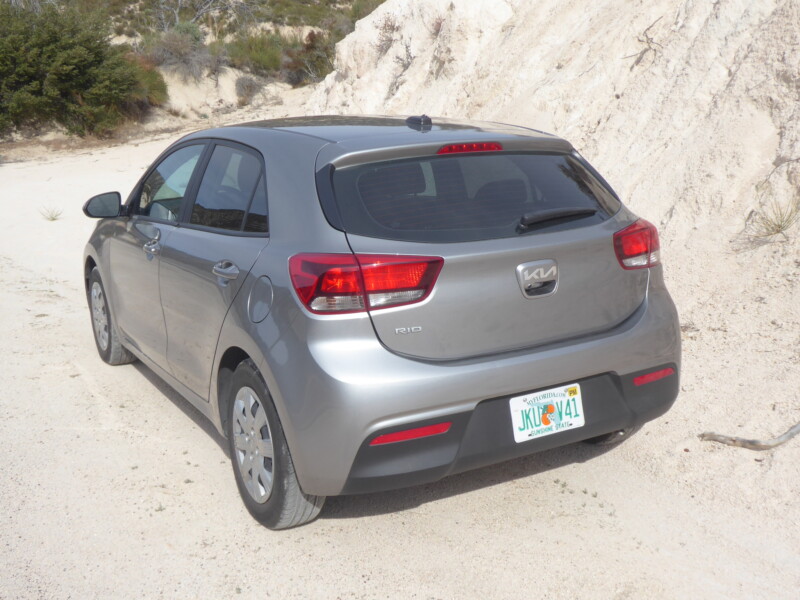


It can’t have escaped the notice of anyone who has been on a plane that, as a generalisation, Americans seem to travel with far more luggage than other nations. And that need for extra space extends to when travelling by car, so this is a country which popularised the (large) SUV. These vehicle are a relatively recent phenomenon, and before they became popular and pretty universal, then car manufacturers around the world offered not just estate cars but also hatchback versions of their traditional saloon and coupe models to offer more space and versatility So it always surprises me that to American buyers never really embraced the hatchback in the way that the rest of the world did. Many of these model types are either simply not sold on the US market or sell in relatively small quantities compared to the saloon model. This is, after all, the market which buys roughly ten times as many VW Jetta saloons as Golf hatchbacks. The one exception to the “saloons rule” has been the very smallest of cars, the sub-compact sector, where many of the manufacturers who had offerings – and a few years ago, this was most of the volume brands – had both a small saloon and a hatch equivalent. Korean giant is one such example. Whilst in Europe, their small Rio model is seen as a hatchback, in the US you see far more sedan versions than the five door and more versatile variant. Indeed, whilst the Rio Sedan is a relatively common sight in the US rental fleets, the hatch model is rarely seen. Arriving at the Hertz LAX facility early on a Saturday morning and needing a car to get to a Cars and Coffee morning, I spotted a Rio Hatch parked up in a spot where I could just take it without to ask about availability, so with memories fresh from testing the sedan version on my last trip to the US in September, I decided to renew my acquaintance with the car for a second opinion.


A conventional key is needed to start this Kia. All Rio models have the same 1.6 litre four cylinder engine which puts out 120 bhp. That might not sound like a lot, but the Kia is relatively light so in practice, it proves sufficient to deliver quite a lively performance. Perhaps more importantly, the engine is smooth and refined, though when you work it hard, it can get a bit noisy. There is no manual option these days, so every Rio has Kia’s continuously variable transmission, which may not sound entirely like Good News, but this is one of the better ones, working quite well in combination with the engine. I covered 149 miles in my day with this Kia and put 3.8 gallons in to refill it which works out at 39.2 mpg US or 46.85 mpg Imperial, not quite as good as the figure I achieved from the saloon, but that could be explained by how full the tank was on each car rather than any other reason.


Whilst this Kia is not as much fun to drive as the late lamented Mazda 2 or Ford Fiesta, it’s actually not bad. The steering has some feel to it and is well weighted so not only have you got some sense as to where the steered wheels are headed but the car is light when it comes to parking up. Handling is nice and tidy and with good levels of grip you could hustle it along the canyon roads where I took the car with surprising ease. It comes on some of the smallest wheels of current production cars, 185/65 R15, and these help to give this car a pliant and comfortable ride. There is a conventional pull-up handbrake fitted between the seats. All round visibility is not and there is a rear-view camera now better integrated into the design of the rear end than used to be the case.


The interior of this model was identical to the saloon I drove a couple of months earlier. Yes, there are lots of plastics here but they are of decent quality and so with gunmetal inserts to provide some colour and texture contrast, this does not look or feel like a stripped out budget special. The overall design is quite neat and unassuming. The steering wheel is a moulded plastic item, but it was pleasant enough to hold. The instrument cluster is very traditional with two large dials for speedometer and rev counter with smaller fuel level and water temperature inset. There are trip computer details presented between the dials. Two column stalks feature, which incorporate the lights, with an auto function, on the left hand one. There are buttons for cruise control and audio repeater functions on the steering wheel boss. A simple 8” touch screen is mounted up high between the central air vents and this is used primarily for the four speaker audio system, which includes HD and Satellite XM radio. You also get Bluetooth, Apple Car Play and Android Auto. With important functions still operated by separate buttons beneath the unit, it is very easy to use unlike more modern systems. Beneath this are three rotary dials for the air conditioning system.


Seats are trimmed in a patterned cloth. They are manually adjustable, though only the driver gets a height adjuster. The steering wheel goes up and down but does not telescope in/out and there are height adjustable seat belts, so most should be able to find a driving position to suit. I certainly did. Even with the seat set to its lowest position it felt like you were sitting higher than in some cars, which is not necessarily a bad thing, as this helps with visibility.


There is ample space in the rear of the Rio for a small family, though if you are trying to get three adults in, that may prove a bit too much of a squeeze. If the front seats are set well back, then legroom will be a bit tight, too, but set them further forward and things will be fine. Children should certainly find the Rio spacious enough. Not surprisingly, given the low price, there are fewer features than you get in more costly cars so there is no central armrest but there is one map pocket and there are some rather small door pockets.

For such a small car, the boot is a good size. It is a nice regular shape and is quite deep, so you should be able to make the most of the available cubic inches. There is a space saver under the boot floor which fits in a well with little space around it for any odds and ends. The rear seat backrests are asymmetrically split and just drop down but the newly extended space is not flat. Inside the passenger compartment there is a decently sized glovebox as well as pockets on the doors, a recess in front of the gearlever and quite a deep armrest cubby though this is set well back making it a little awkward to access especially if you have the front seat well forward as I do.


For the US market, the 2022 Kia Rio is available in two trims: LX and S. Both feature the same 120 bhp 1.6-litre four-cylinder engine paired with a continuously variable automatic transmission (CVT) and front-wheel drive. The Rio LX comes exclusively in sedan form. Standard features include a 3.5-inch driver information display in the gauge cluster, an 8-inch touch screen, wireless Android Auto, wireless Apple CarPlay, Bluetooth, a four-speaker audio system, a 12-volt outlet, a USB port, cloth upholstery, a six-way manually adjustable driver’s seat, a rearview camera and 15-inch steel wheels. Available as either a sedan or a hatchback, the S adds satellite radio, an additional USB port, cruise control, a 60/40-split-folding rear bench, adjustable rear-seat headrests and remote keyless entry. A 4.2-inch driver information display, push-button start, automatic climate control, LED headlights with automatic high beams, driver-attention monitoring, forward collision warning, forward automatic emergency braking, pedestrian detection, lane-departure warning, lane-keep assist, a rear-seat alert, automatic high-beam headlights and 15-inch alloy wheels are available.


A few years ago there was quite a choice of cars in this category on the US market, which included the Fiesta, Yaris, Honda Fit, Chevrolet Sonic, Mazda 2, Nissan Versa Note and Hyundai Accent. None of those are offered now, so the Rio Hatch is more or less in a class of two, with just the truly unpleasant Mitsubishi left, and in sedan guise, the Nissan Versa. Manufacturers say there is no demand in the US for small cars, but the honest truth is that there are also very small profit margins and this is probably more of a reason for them leaving the sector. Kis have already said they will be next to exit, so when this Rio reaches the end of its production cycle in the coming months, it will not be directly replaced, with Kia sales people pointing you at the larger Soul as their entry level product. I am guessing that the rental car companies will end up with a booking category which will more or less guarantee you an upgrade to a bigger car, too, but for now, whilst the Rio is around, fear not as this is a pretty decent car, just one with compact dimensions.