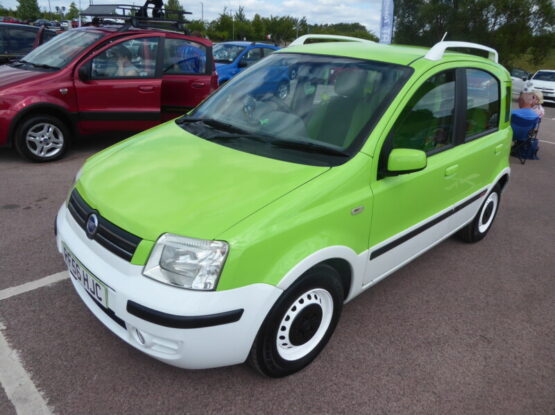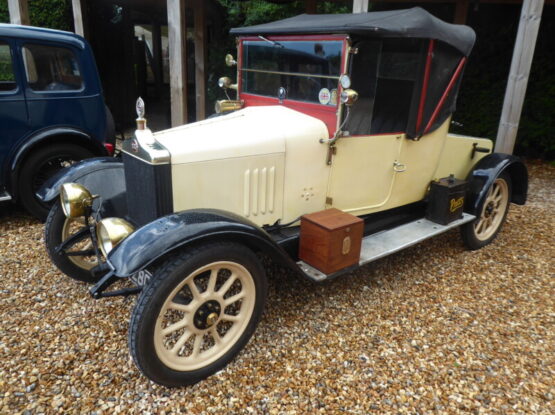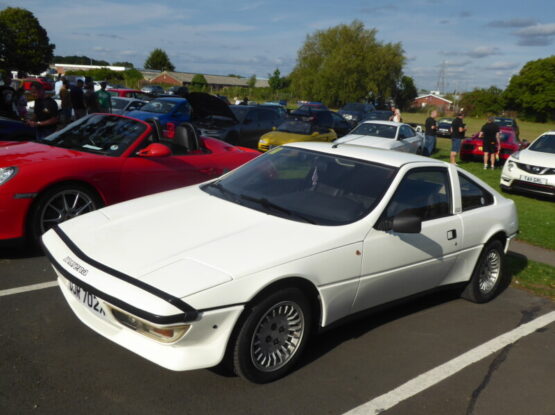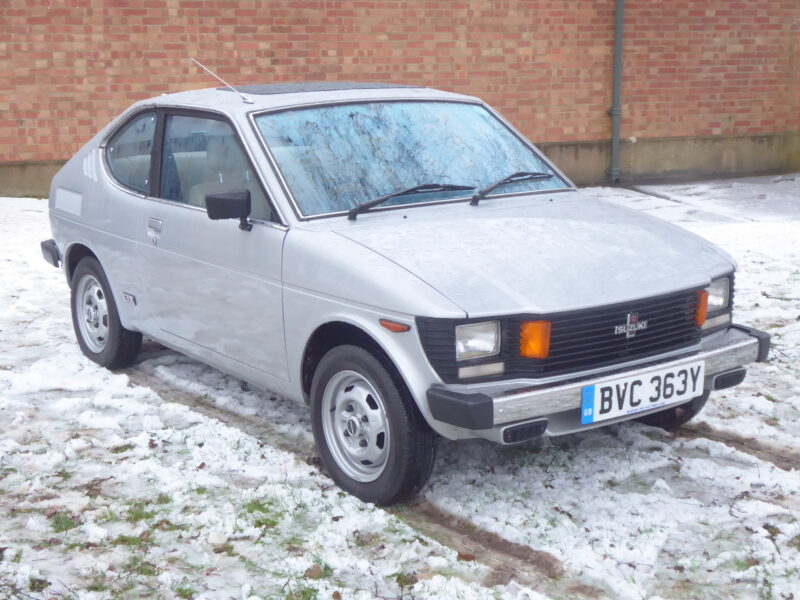
The expansive Bicester Heritage site is now a major car events venue in the UK, taking advantage of the fact that the are in the middle of the country and easy to get, being situated only a few miles off the M40. Having tried a number of different even types during a given year, they have now settled on three big “Sunday Scrambles” as their core of a year’s program, with these events scheduled for early January, late April and early October. Relentless prices increases with every event – this one is now £28.00 per person, whereas it was £23.00 a year ago, and just £8:00 five years ago – do not seem to have deterred people as the tickets sell out usually within a day or two of being released. The event character has changed quite significantly, too, so what used to be like a super-sized Breakfast Club for individuals with mainly pre-1990 cars and a space for Car Clubs has now become much more about Supercars and hordes and hordes of YouTubers. Manufacturers often get in on the act, supplying their latest cars for display, too. Whilst I personally regret the direction the event has gone it, its enduring popularity suggest that event at the ambitious pricing there is plenty of demand for the event as currently constituted. I decided to attend the January 2025 event as soon as the tickets were released back in October 2024, not knowing what the weather would do, as indeed no-one could know. The storm that had caused the postponement or rescheduling of most of the New Year’s Day events was passed, as my visit to the Brooklands event on the following Saturday showed, when it was dry but with a bitingly cold wind. But head a bit further north and that wind when meant that when some damp was in the air, it fell as snow. I went to bed on the Saturday evening in a hotel at the other side of Bicester with snow having been falling steadily and settling on the ground, wondering just I would wake up to. The answer was a wet mess that was starting to thaw and no emails saying that the event was cancelled. So I cleared the car off and made the short journey across town to find a queue of other hopefuls and a very white and increasingly wet site, where the marshalls were trying to park as may cars as possible on areas that were tarmac underneath. As people trudged through the snow, the wet mess got even more of a challenge. And soon my feet and part way up my legs were soaked, but there were cars to see and I was not going to miss out, despite the discomfort (and cold!). Here are the highlights of the event:
ABARTH
What is known as the Series 4 version of the familiar 595 reached the markets in the middle of 2016. After rumours had circulated all winter following the launch of the facelifted Fiat 500 last year, Abarth finally unveiled the Series 4 at the end of May 2016. Initially, we were told that the cars would not be available in the UK until September, but that came forward somewhat, with dealers all receiving demo cars in June, and the first customers taking delivery in July. Three regular production versions of both the closed car and the open-topped C were initially available, all badged 595, and called Custom, Turismo and Competizione, as before, though numerous limited edition models have since appeared and in most case disappeared. The most significant changes with the Series 4 are visual, with a couple of new colours, including the much asked for Modena Yellow and a different red, called Abarth Red, which replaces both the non-metallic Officina and – slightly surprisingly – the tri-coat pearlescent Cordolo Red. as well as styling changes front and rear. The jury is still out on these, with many, me included, remaining to be convinced. At the front, the new air intake does apparently allow around 15 – 20 % more air in and out, which will be welcome, as these cars do generate quite a lot of heat under the bonnet. Competizione models for the UK retain the old style headlights, as they have Xenon lights as standard, whereas the Custom and Turismo cars have reshaped units. At the back, there are new light clusters and a new rear bumper and diffuser. Inside, the most notable change is the replacement of the Blue & Me system with a more modern uConnect Audio set up, which brings a new colour screen to the dash. Mechanically, there is an additional 5 bhp on the Custom (now 145) and Turismo (now 165 bhp) and the option of a Limited Slip Diff for the Competizione, which is likely to prove a popular option. Details of the interior trim have changed, with a filled-in glovebox like the US market cars have always had, and electric windows switches that are like the US ones, as well as a part Alcantara trim to the steering wheel in Competizione cars
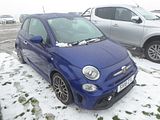
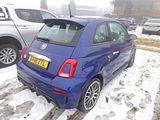


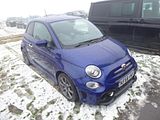
The Abarth 124 Spider was developed in parallel with the Fiat model. It does cost a lot more, and there are those who think you don’t get enough extra for your money, but those who have driven it will tell you otherwise. You certainly get more power. The 1.4 MultiAir turbo unit jumps up from 138bhp to 168bhp, while torque also increases by a modest 10Nm to 250Nm, which gives it a 0-62mph time of 6.8 seconds, which is half a second quicker than the 2.0-litre Mazda MX-5. The top speed is 143mph. It weighs just 1060kg meaning a power-to-weight ratio of 158bhp-per-tonne, and with the new Record Monza exhaust system it sounds great even at idle. The Abarth version gets a stiffer suspension setup than the regular Fiat 124 Spider, with Bilstein dampers and beefed-up anti-roll bars. Bigger Brembo brakes also feature, with aluminium calipers. It can be had with a six-speed manual or six-speed automatic transmission with paddles, and the latter gets a Sport mode for quicker shifts. Many of the UK cars sport the ‘Heritage Look’ pack, which is a no-cost option. It brings a matt black bonnet and bootlid, plus red exterior trim detailing and has proved popular. The £29,565 starting price gets you standard equipment such as cruise control, climate control, Bluetooth, a DAB radio and satnav, plus Alcantara black and red (or pure black) seat trim. The automatic gearbox is a £2,035 extra, while an optional visibility pack brings LED DRLs, auto lights and wipers and rear parking sensors. Sales ceased during 2019, with around 1800 cars having been brought into the UK, so this is always going to be a rare car, and values are already increasing at a rate reflecting its desirability and the difficulty in finding one.


AJD
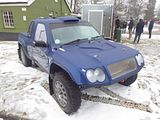
This unusual looking vehicle is an AJD Off Road Milner R5, a full space frame off-road race car. It features a lightweight fiberglass body shell and fully independent suspension. It is a permanent 4-wheel drive vehicle. Various engine options are available, including a rear-mounted 5.5-liter LSV8 engine or a V8 Chevrolet LS7 race engine. It uses a 6-speed sequential gearbox from Quaife. This model has won several championships and events, including the Goodwood Festival of Speed Offroad Arena shootout.
ALFA ROMEO
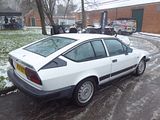
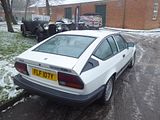
As was still the practice in the 1970s, Alfa followed up the launch of the Alfetta Berlina with a very pretty coupe. Styled by Giugiaro, this car, initially called the GT, and premiered in the autumn of 1974, looked completely unlike the saloon on which it was based. The first cars had 1.8 litre four cylinder engines and there was one of those on show. In 1976 the range was expanded both up and down with a 1.6 and a 2.0 model, the latter adopting the legendary GTV name. A rare SE model from this period was part of the display, complete with period vinyl roof (look closely), and although the pain does appear a bit like a lot of older Alfa reds, having gone rather pink, this was the actual shade when the car was new. In 1981, with the 2.5 litre V6 engine that had been developed for the ill-fated Alfa 6 luxury saloon available, Alfa was able to create a true rival for the 2.8 litre Capri with the GTV6. A facelift modernised the look of the car with plastic bumpers front and rear and a new interior looked rather better as well as being more ergonomically logical. There was a good mix of the earlier chrome bumpered and later plastic bumpered models, the last with 2.0 and 2.5 GTV6 versions both represented. There was also a car sporting 3.0 badging and right hand drive. This is a South African car. From 1974 South African Alfetta’s were manufactured at Alfa Romeo’s own Brits plant. South Africa was one of two markets to have a turbocharged GTV6, with a Garrett turbocharger and a NACA intake. An estimated 750 were assembled before all production ceased in 1986. The South African range included a 3.0 litre GTV-6, predating the international debut of the factory’s 3.0 litre engine in 1987 (for the Alfa 75). and 212 of these were built in South Africa for racing homologation. The last 6 GTV-6 3.0’s were fuel injected. To this day, the GTV-6 remains the quintessential Alfa Romeo for South Africans.
It was great to see the fabulous Alfa 164 here. I love these cars with my affection stemming from the fact that I had the pleasure of driving one for 4 years and 160,000 miles and to this day, it is the car I regret parting with more than any other of the fleet that I have owned over the years. When I bought mine, Alfa were selling a very small number of cars per month in the UK, so they were never that common, and sadly, survival rates are very low. Most people who know anything about the history of the 164 will be aware that this is one of the four so-called Type 4 cars, a joint venture involving Alfa Romeo, Fiat, Lancia and Saab. In 1978 these four marques agreed to each develop an executive saloon based on a shared platform to compete against the likes of the Ford Granada and Opel Rekord (Vauxhall Carlton) as well as more premium saloons by BMW and Mercedes-Benz in the form of the 5-Series and E-Class, respectively. Alfa’s Project 164 started life as Project 154 and was completed in 1981, then still under Alfa Romeo. A year later, that project morphed into the 164 based on the Type Four platform. This new model was designed by Enrico Fumia of Pininfarina, with a wedge shape that afforded it a leading drag coefficient of Cd=0.30. The design would later influence the rest of the Alfa Romeo range starting in 1990 with the major redesign of the 33 and culminating with the 155, and Pininfarina also adapted it (much to the maker’s chagrin) for the 1987 Peugeot 405 and the 1989 Peugeot 605 saloons. Initial testing of the 164’s dynamic elements (engine and drivetrain) began in 1984, where mules based on the then contemporary Giulietta were used. In 1985, the first pre-production 164’s were put through their paces on the road. Heavily disguised, with many false panels and even a false nose design (borrowing heavily from the then equally undeveloped 155), sporting 4 round headlamps, these vehicle mules served to test the 164 for the gruelling 1 million kilometre static and road testing demanded of the design. In 1986 and 1987, the first 150 164’s were given their pre-production testing. In terms of engineering demands, these exceeded every Alfa before, and by quite a substantial margin. In Morocco, desert testing saw 5 grey 164 Twinsparks and V6’s undergo the equivalent of the Paris-Dakar rally. Road conditions varied from good tarmac to off-road conditions, and accelerometers confirmed the superiority of the 164 in terms of passenger comfort. This data was cross-confirmed in the engineering laboratory with a sophisticated dummy in the driver’s seat, with accelerometers both in its seat, and in its ears to mimic that of the semi-circular canals of the ear. The Twinspark and the V6 underwent handling trials at Arese. The Twinspark displayed very mature driving manners at the limit, with minimal skid. The V6 displayed a 25% increase in at-the-limit skid, a natural consequence of its greater nose weight. ABS testing confirmed that the Twinspark has superior braking to the V6. Brake linings of the 164’s were run at maximum braking until they literally glowed with heat, and displayed no deviation in form. The 164 was the first Alfa to feature slotted double-walled disc brakes. At no point were the discs drilled to release excess heat, the original design being demonstrated to be excellent. Sound production was tested in an anechoic chamber, the car being subjected to stress and road noise testing, with instruments and with live subjects at the wheel, on a specially designed rig. Electromagnetic stability of the complex electronic system was also tested, in an anechoic chamber equipped with EM emitters (radar). The 164 engines were run to destruction, the Twinspark proving to be the most robust, and with the longest possible engine life. The V6 displayed only 10% shorter overall engine life. All this testing meant that by the time the production car, called the 164 was unveiled at the 1987 Frankfurt Motor Show – the last model to be developed while the Alfa Romeo was still a fully independent company, even though the launch was a few months after the takeover by Fiat – that the car was far more thoroughly developed and tested than any Alfa preceding it. There were plenty of innovations in the build, too, thanks to the extensive use of galvanised steel for the frame and various body panels for the first time in the brand’s history. Moreover, the car featured advanced electronics thanks to the most complex wiring harness fitted to any Alfa Romeo. For example: it had three onboard computers (one for air conditioning, one for instrumentation, and one for the engine management); air conditioning and instrument functions shared a multiple-mode coded Zilog Z80-class microcontroller for dashboard functioning). The instrumentation included a full range of gauges including an advanced check-panel.. The car was a sensation at launch. For a start, it looked fantastic thanks to Enrico Fumia of Pininfarina’ design. The first 1:1 scale model of the car had been produced in 1982 and design cues had been publicly revealed on the Alfa Romeo Vivace concept car, which was exhibited at the 1986 Turin Motorshow that went on to influence the design of the Alfa Romeo GTV and Spider (916 series) launched in 1993, but the result was distinctive and elegant and very different from any of its rivals, or indeed any of the other Tipo 4 cars. The 164 became the first Alfa to benefit from extensive use of computer aided design, used to calculate structural stresses that resulted in a very rigid but still relatively lightweight chassis. Although sharing the same platform as that of the Lancia Thema, Fiat Croma and Saab 9000, by virtue of the fact that it was the last of the four to enter production, it featured unique front suspension geometry and the most distinctive styling of the lot. In fact, for example, the other cars all shared identical side door panels. Though still voluminous, the 164 had the tightest aperture to the boot, which had a 510-Litre capacity. The interior was spacious and modern, available with standard velour seating or leather trim depending on the model. Its dashboard continued the avantgarde design of the exterior with a centre dashboard that was dominated by a large number of seemingly identical buttons arranged in rows. Air-direction within the ventilation system was controlled by a pair of servomechanisms, which were constructed using notoriously fragile plastic gears that were prone to failure. Depending on the model, the 164 could feature automatic climate control and electronically controlled damping suspension – the latter, for example, in the sports-oriented Quadrifoglio Verde (“Green Cloverleaf “) and 164S models. This suspension actively reduced damping in response to conditions to provide a dynamic compromise between road holding and comfort. At launch, the original 164 range comprised three models: a 148 bhp 2.0 Twin Spark, the 192 bhp 3.0i V6 12-valve and a 2.5 Turbodiesel (badged “TD”). It took a year before the first cars reached the UK and the first eighteen months saw only the 3 litre model offered. The bigger selling 2.0 TS arrived in the simmer of 1990, just before the range was expanded by the 4-cylinder 2.0i Turbo, the sports-oriented 3.0i V6 Quadrifoglio Verde (badged “QV” or “S”) and North American export versions that included the luxury-oriented 164 L (“L” for Lusso) and the 164 S (in essence, the “QV”). Apart from minor running production upgrades, the next change came in 1993 with the launch of the 164 Super. Key differences on the outside consisted of larger bumpers with chrome trimmings added to the upper edge and revised headlights with a slimmer profile. Inside, there were revised instruments and a centre console that featured more delineated switchgear. The range was now also bolstered by a 3.0 V6 24V with a 24-valve engine upgrade and the 3.0 V6 Quadrifoglio 4 (badged “Q4”), which was the most powerful and sole all wheel drive variant built. Production ended in late 1997, with a gap of nearly two years before the replacement model would go on sale.


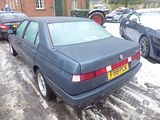

Replacement for the much loved 156 was the 159. The Alfa Romeo 159 had a troubled development, being designed in the midst of the Fiat-General Motors joint venture which was terminated in 2005. Originally, the 159 was intended to use GM’s Epsilon platform; however, late during its development it was changed to the GM/Fiat Premium platform. The Premium platform was more refined and expensive, being intended for E-segment executive cars such as an Alfa Romeo 166 successor but that never materialised, so Alfa Romeo attempted to recoup some of the platform development costs with the 159. General Motors originally planned Cadillac, Buick and Saab models for this platform but ending up discarded them over cost concerns. Unfortunately, the 159’s late transition to what was fundamentally made as an E-segment platform resulted in the 159 having excessive weight, a problem shared by its sisters, the Alfa Romeo Brera coupe and Spider convertible. The 159 was designed by Giorgetto Giugiaro in collaboration with the Centro Stile Alfa Romeo. The nose featured a traditional Alfa Romeo V-shaped grille and bonnet, and cylindrical head light clusters. Similar to its coupé counterpart, front of the car was influenced by the Giugiaro designed 2002 Brera Concept. Several exterior design cues were intended to make the car appear larger, supposedly to appeal to potential buyers in the United States; however, the 159 was never exported to that region. The interior featured styling treatments familiar from earlier cars, including the 156, such as deeply recessed instruments which are angled towards the driver. Alfa Romeo intended for the 159 to compete more directly with BMW, Mercedes-Benz and Audi by using higher quality interior materials; however, it has been said that Alfa Romeo misjudged their brand’s positioning relative to the more well-known German luxury automakers. Several levels of trim were available, depending on market. Four trim levels: Progression, Distinctive, Exclusive and Turismo Internazionale (TI) featured across Europe. In the UK there were three levels of trim: Turismo, Lusso and Turismo Internazionale (TI). A Sportwagon variant was introduced at the Geneva Motor Show in 2006. The 159’s size made it considerably more comfortable than the 156 due to its larger, roomy interior. However, the considerable growth in dimensions deterred many 156 owners from considering the 159 as a direct replacement model, and something seemed to be lost in the character of the new car. Initially offered with a choice of 1.9 and 2,2 litre 4 cylinder and 3.2 litre V6 petrol engines and 1.9 and 2.4 litre diesel units, and an optional four wheel drive system. An automatic gearbox option for the 2.4 JTDM diesel model was also launched in late 2006, and later extended to other versions. In 2007 a four-wheel drive diesel model was released and the 2.4-litre diesel engines’ power output increased to 210 hp, with a newly reintroduced TI trim level also available as an option. For model year 2008 the mechanics and interiors of the 159 were further developed. The 3.2 litre V6 model was offered in front wheel drive configuration, achieving a top speed of 160 mph. All model variants came with Alfa’s electronic “Q2” limited slip differential. As a result of newly introduced aluminium components, a 45 kilograms (99 lb) weight reduction was achieved. For 2009, Alfa introduced a new turbocharged petrol engine badged as “TBi”. This 1742 cc unit had direct injection and variable valve timing in both inlet and exhaust cams. This new engine had 200 PS (197 hp) and would eventually replace the GM-derived 2.2 and 1.9 JTS units.In 2010, all petrol engines except for the 1750 TBi were retired, ending the use of General Motors-based engines in the 159. The only remaining diesel engines were the 136 PS and 170 PS 2.0 JTDm engines. In 2011, the 159 was powered only by diesel engines. In the UK, Alfa Romeo stopped taking orders for the 159 on 8 July 2011. Production for all markets ceased at the end of 2011, after 240,000 had been built.

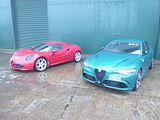
The Alfa Romeo 4C is a two-seater, rear-wheel drive coupé with technology and materials derived from the Alfa Romeo 8C Competizione, with a 1750 cc turbo petrol engine with direct injection, the “Alfa TCT” twin dry clutch transmission, and the Alfa DNA dynamic control selector. The 4C concept version was unveiled in the 81st Geneva Motor Show in March 2011, followed by the Mille Miglia 2011 parade, Goodwood Festival of Speed 2011,2011 Frankfurt Motor Show. It was displayed for the first time outside in Concorso d’Eleganza Villa d’Este in 2012. Compared to the production version, it is very similar, with the biggest differences being front lights, side vents and mirrors. The Alfa Romeo 4C Concept was voted the ‘Most Beautiful Concept Car of the Year’ award by the readers of German magazine Auto Bild, and won the Auto Bild Design Award 2011. It was awarded the “Design Award for Concept Cars & Prototypes” by referendum of the public in Villa d’Este. The production car was unveiled at the 2013 Geneva Motor Show, followed by 2013 Essen ‘Techno Classica’, Goodwood Festival of Speed 2013, Moscow Raceway, 2013 Frankfurt Motor Show. The bare ‘4C000’ chassis was also shown at the 2013 Geneva Motor Show. Ordering of European models began in October 2013 at Alfa Romeo dealerships in Europe. As part of the Alfa Romeo 4C launch, Alfa Romeo Style Centre and Compagnia Ducale designed a 4C IFD (Innovative Frame Design) Bicycle, inspired by the Alfa Romeo 4C coupé. The vehicle went on sale in December 2013 and marketed in Europe, Asia and America. Production of the 4C began May 2013 at Maserati’s plant in Modena, with an expected production of up to 2500 units per year. It was the first mass-produced Alfa Romeo model to be sold in the US market since 1995 when the 164 sedan stopped being sold in the US. Production of the Alfa Romeo 4C was originally estimated to be over 1000 units per year, with an upper limit of 3500 units per year, depending on the quantity of carbon fibre chassis that can be built by the supplier Adler Plastic.Within the 3,500-unit quota, 1,000 units are earmarked for Europe. Delivery of the European Alfa Romeo 4C Launch Edition took place at Balocco (Vercelli, Italy) Test Centre. In 2018, the 4C coupe was discontinued for the North American market. The 4C Spider, however continued to be sold there for model year 2019 and model year 2020. In other markets, such as Australia and Japan, both the coupe and Spider continued. In late 2020, a new tribute-edition named the 4C Spider 33 Stradale Tributo was announced. The car was designed by Centro Stile Alfa Romeo (Style Centre) and developed by Alfa Romeo. The chassis is composed of a central carbon fibre tub, with aluminium subframes front and rear. The carbon fibre tub is produced by TTA (Tecno Tessile Adler) in Airola, as a joint venture between Adler Plastic and Lavorazione Materiali Compositi. The carbon fibre components that make up the chassis are cut using CNC technology. The entire carbon-fiber monocoque chassis (“tub”) of the car weighs 143 pounds (65 kg). Front and rear aluminium subframes combine with the tub, roof reinforcements and engine mounting to comprise the 4C chassis giving the vehicle a total chassis weight of 236 lb (107 kg) and a total vehicle curb weight of just 2,465 lb (1,118 kg). The 4C has a single carbon fibre body, similar to the body of many supercars. The outer body is made of a composite material (SMC for Sheet Moulding Compound) which is 20% lighter than steel. The stability is comparable to steel and better than aluminium. The 4C employs double wishbone suspensions at the front and MacPherson struts at the rear. The resultant weight distribution is 38% on the front and 62% on the rear axle. Wheels and tyres have different diameters and widths front and rear: 205/45 R17 front and 235/40 R18 back as standard, with optional 205/40 R18 and 235/35 R19. Both wheel options come equipped with Pirelli P Zero tyres. The 4C uses vented disc brakes on all wheels; Brembo 305 millimetres (12.0 in) on the front and 292 millimetres (11.5 in) on the rear. The car can stop from 100 km/h (62 mph) in 36 metres. To save weight and increase steering feel, the 4C has no power steering. Its centre of gravity height, at 40 centimetres (16 in) off the ground, is 7 centimetres (2.8 in) lower than that of the Lotus Elise. The 4C uses a new all-aluminium 1,742 cc inline 4 cylinder turbocharged engine producing 240 PS at 6000 rpm. The engine has been designed for minimum weight. The engine’s combined fuel consumption 6.8 l/100 km (42 mpg‑imp; 35 mpg‑US). 0–62 mph (0–100 km/h) acceleration is achieved in 4.5 seconds and the top speed is 258 km/h (160 mph), the power-to-weight-ratio being just 0.267 hp/kg (8.22 lb/hp) A journalist from Quattroruote car magazine demonstrated how the 4C accelerates from 0–100 km/h (0–62 mph) faster than 4.5 seconds. In race mode, with left foot on the brake pedal, if you pull the right shift paddle the engine will rev to 3500 rpm, but if you also pull the left paddle the engine will rev to 6000 rpm and 0–100 km/h (0–62 mph) time will go down to 4.2 seconds. Italian car magazine Quattroruote published the lap time of 4C around Nürburgring. It lapped the ring in 8:04. The 4C is equipped with a six speed Alfa TCT Dual Dry Clutch Transmission, and can be operated via gearshift paddles on the steering wheel. It also has an Alfa ‘DNA’ dynamic control selector which controls the behavior of engine, brakes, throttle response, suspension and gearbox. In addition to the modes already seen in Giulietta, the 4C has a new “Race” mode. The U.S. version of the 4C was introduced in the 2014 New York International Auto Show with the first 100 4C’s being shipped to the U.S. early July, with a total of 850 being shipped by the end of 2014. The U.S. model includes extra bracing and strengthening required to meet U.S. crash regulations (including aluminium inserts in the carbon fiber chassis), resulting in 100 kg (220 lb) of weight increase. This version also has new headlamps similar to those seen before in the 4C Spider version. In 2018, the 4C coupe was discontinued for the North American market due to US DOT NHTSA FMVSS 226 Ejection Mitigation. The regulation called for a progressive compliance date based on volume and, due to low volume, the 4C was allowed to continue until the last compliance date of 9/1/2017, thus all 2018 4C coupes in North America have build dates of 8/2017 or earlier. The 4C Spider, however continued to be sold in North America for model year 2019 and model year 2020. The Spider version of the 4C was previewed showing a pre-production prototype at the 2014 Geneva Motor Show. Sharing its engine with the Coupé version, the 4C Spider has different external parts such as the headlights, exhaust and engine hood, as well as a different roof section that features a removable roof panel. The North American spec 4C reflects a weight difference of only 22 lb (10 kg) (2,465 lbs vs. 2,487 lbs) for the Spider variant. Top speed is quoted at 257 km/h (160 mph) and acceleration from 0 to 100 km/h (62 mph) at 4.5 seconds. The 4C Launch Edition was a limited and numbered edition, unveiled at the vehicle’s launch at the 2013 Geneva Motor Show. The vehicle came in a choice of four paint colours (Rosso Alfa, Rosso Competizione tri-coat, Madreperla White tri-coat or Carrara White matte). 500 examples were reserved for Europe/ROW, 500 for North America, 88 for Australia (Rosso Alfa and Madreperla White only), 200 to Japan and 100 for the Middle East. Note that the original press release cited 500 for North America, 400 Europe, and 100 ROW; however, the plaques on actual cars suggest that more were built and are the numbers referenced above. Distinguishing features of the Launch Edition were carbon fiber trim (including headlight housings, spoiler and door mirror caps), rear aluminium extractor with dark finishing, Bi-LED headlights, dark painted 18-inch front and 19-inch rear alloy wheels, additional air intakes on the front fascia, red brake calipers, racing exhaust system, BMC air cleaner, specific calibration for shock absorbers and rear anti-roll bar, leather/fabric sports seats with parts in Alcantara and a numbered plaque. Alfa Red coloured cars got matching red stitching on the steering wheel, handbrake, mats, handles and sports seats. In Europe the vehicle went on sale for 60,000 euros including VAT. The 4C Competizione is a limited edition version of the 4C introduced in the 2018 Geneva Motor Show, finished in matte Vesuvio Grey, with carbon details on the roof, rear spoiler, mirror caps, side air vents and headlight moulding. The run reportedly consisted of 108 units. The Japanese market received 25 units, and 10 units were assigned to Australia. The US-market received no Competizione editions. The car had a very mixed reaction. The UK press hated it at launch, but owners generally disagreed and loved it. A total of 9117 were built before production ceased in 2020.

Also here was the still current and well-regarded Giulia saloon.
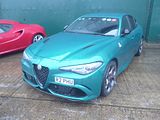
ALPINE
The Alpine A110 is a rear mid-engine, rear-wheel-drive sports car introduced by French car manufacturer Alpine at the 87th Geneva International Motor Show in March 2017. Deliveries began in late 2017 for Continental European markets and in 2018 for the UK, Japan and Australia. Both its name and design refer back to the original Alpine A110 that was produced from 1961 to 1977. Based on an all-aluminium construction, the A110 is powered by a Nissan-derived 1.8-litre turbocharged gasoline direct injection 4 valves per cylinder inline-four engine mated to a 7-speed dual-clutch transmission manufactured by Getrag. Developed by Renault–Nissan and reworked by Alpine engineers, the engine has an output of 252 PS at 6,000 rpm and 320 Nm (236 lb/ft) of torque at 2,000–5,000 rpm. According to Alpine, the A110 can accelerate from 0 to 100 km/h (0 to 62 mph) in 4.5 seconds, and has an electronically limited top speed of 250 km/h (155 mph). The A110 was initially available in three trims: Pure, Première, and Legende. The Pure cars, the base trim, have 17-inch alloy wheels. The Première trim cars are technically the launch edition models limited to 1,955 units and were equipped with amenities such as forged alloy wheels, quilted leather Sabelt bucket sports seats, a reversing camera, and metallic blue exterior colour as standard. The Legende trim cars come with six-way adjustable sports seats, black or brown leather interior upholstery, an upgraded hi-fi sound system, and specially designed wheels exclusive to this trim. All of the three trims share the same powertrain and transmission. For the 2020 model year, The Pure trim level was replaced by the Alpine A110, with no other badging. The Légende was replaced by the Alpine A110 GT which employed the same engine as the A110 S.

ALVIS
The Alvis Fourteen also known as TA 14 was the first car to be produced by major defence contractor Alvis cars after World War II. The entire car factory had been destroyed on the night of Thursday 14 November 1940. Announced in November 1946 it was made until 1950 when its postwar austerity 1900 cc engine was replaced by the 2993 cc 26.25 HP Alvis Three Litre or TA 21 The Fourteen was available as a four-door sports saloon built for Alvis by Mulliners of Birmingham but there were also Tickford and Carbodies drophead versions. When compared with the 12/70 car it replaced the interior is 4 inches wider and the distance between rear-seat armrests is increased almost 5 inches. The 1892 cc engine is a slightly larger-bore version of the one used in the 12/70 and produced 65 bhp It is fitted with a single SU type H4 -inch side-draught carburettor. Inlet valves have been enlarged. The triplex chain drive has been given an automatic tensioner. The engine’s exhaust system has been extensively revised and the direction of flow of cooling water around the engine has been substantially changed. The bodies were mounted on an updated pre-war Alvis 12/70 chassis that was widened and lengthened but retained the rigid-axle leaf spring suspension. Employing Silentbloc bushes (except at the front of the front springs to maintain steering precision) it is controlled by double acting Armstrong hydraulic dampers. Hypoid bevel final drive was fitted for the first time and greatly reduced the height of the transmission tunnel. Steering is by Marles with a spring spoked steering wheel. Mechanically operated brakes are two-leading-shoe type by Girling. Disc wheels replaced the 12/70’s wire wheels and are fitted with larger tyres.
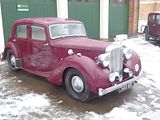
The Alvis Three Litre, TC 21 was produced between 1953 and 1955. An updated version of the Three Litre TA 21, it was available as a 4-door saloon and, in its later TC 21/100 form, also as a 2-door drophead coupé. The TC 21 was available as four-door saloon but, unlike its TA 21 predecessor, no drophead version was offered. The bodies were made for Alvis by Mulliners (Birmingham). A sunshine roof remained standard as did “separately adjustable front seats; heater and air-conditioning unit; Trico windscreen washers” drawing the comment from Autocar “In detail fittings . . . this car leaves little to be desired”. Later TC 21s have chromium-plated window frames. The 2,993 cc engine was upgraded to produce 100 bhp by modifying the cylinder head and fitting twin SU carburettors. Suspension was the same as the TA 21, independent at the front using coil springs with leaf springs at the rear. The 11 in (279 mm) drum brakes using a Lockheed system were also retained. However this update found few buyers during a very difficult year for the British Motor Industry and though it remained in the catalogue and continued to be advertised it was in practice replaced by the Grey Lady. The TC.21/100 or Grey Lady announced 20 October 1953 came with a guarantee of a speed of 100 mph resulting from an improved exhaust system and an engine compression ratio raised from 7:1 to 8:1 to take advantage of the availability of better petrol. The final drive ratio was raised from 4.09:1 to 3.77:1. A paired front fog lamp and matching driving lamp became a standard fitting. The bonnet gained air scoops and wire wheels were fitted to try to enliven the car’s image. A heater was fitted as standard but a radio remained an expensive option. Four door saloon and drophead coupé versions were offered. Nevertheless, just 18 months later the Times’ Motoring Correspondent tested and reported on the Grey Lady under the headline “Few Concessions to Fashion Trends”. His opening gambit was that this Alvis was now one of the few British cars that did not look American and, he said, there was little concession to the cult of streamlining beyond the two air scoops in the bonnet. He wrote that spacious internal headroom and wire wheels completed that picture. It was noted the instruments were not in front of the driver but in the centre of the dashboard (instrument panel) and so the speedometer was apt to be masked by the driver’s left hand. However the front seats were comfortable and rear seat passengers received padding on the wheel arches surmounted by armrests. Leather upholstery, pile carpets and walnut facings for the dashboard and lower parts of the window frames completed the traditional picture. He did however say that “the driver who is sensitive to the “feel” of his car will enjoy every moment of his motoring irrespective of the traffic” and reported the car’s behaviour on corners was extremely stable though potholes like those caused by recessed manhole covers proved very heavy going for the springing. A Graber-bodied coupe on a TC 21/100 chassis was exhibited at the London Motor Show in October 1955. The similar TC 108G entered limited production the following year.

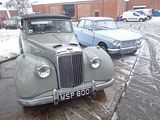

ASTON MARTIN
Follow on to the DB7 was the DB9 (there has never been a car called DB8 – supposedly because people might have assumed this meant a V8 engine), and there was a nice example here. Designed by Marek Reichmann and Hendrik Fisker, the DB9 was first shown at the 2003 Frankfurt Auto Show, in coupe form. It was widely praised for the beauty of its lines. This was the first model to be built at Aston Martin’s Gaydon facility. It was built on the VH platform, which would become the basis for all subsequent Aston models. The Aston Martin DB9 was initially launched equipped with a 6.0 litre V12 engine, originally taken from the V12 Vanquish. The engine produced 420 lbf·ft of torque at 5,000 rpm and a maximum power of 444 hp at 6,000 rpm, allowing the DB9 to accelerate from 0 to 60 mph in 4.7 seconds and a top speed of 299 km/h (186 mph). The engine largely sits behind the front-axle line to improve weight distribution. Changes to the engine for the 2013 model year increased the power to 503 hp and torque to 457 lb-ft, decreasing the 0 to 60 mph time to 4.50 seconds and with a new top speed is 295 km/h (183 mph). The DB9 was available with either a six-speed conventional manual gearbox from Graziano or a six-speed ZF automatic gearbox featuring paddle-operated semi-automatic mode. The gearbox is rear-mounted and is driven by a carbon-fibre tail shaft inside a cast aluminium torque tube. The DB9 was the first Aston Martin model to be designed and developed on Ford’s aluminium VH (vertical/horizontal) platform. The body structure is composed of aluminium and composites melded together by mechanically fixed self-piercing rivets and robotic assisted adhesive bonding techniques. The bonded aluminium structure is claimed to possess more than double the torsional rigidity of its predecessor’s, despite being 25 percent lighter. The DB9 also contains anti-roll bars and double wishbone suspension, supported by coil springs. To keep the back-end in control under heavy acceleration or braking, the rear suspension has additional anti-squat and anti-lift technology. Later versions of the car also features three modes for the tuning: normal, for every-day use, sport, for more precise movement at the cost of ride comfort, and track, which furthers the effects of the sport setting. The Aston Martin DB9 Volante, the convertible version of the DB9 coupe, followed a few months later. The chassis, though stiffer, uses the same base VH platform. To protect occupants from rollovers, the Volante has strengthened windscreen pillars and added two pop-up hoops behind the rear seats. The hoops cannot be disabled and will break the car’s rear window if deployed. In an effort to improve the Volante’s ride while cruising, Aston Martin have softened the springs and lightened the anti-roll bars in the Volante, leading to a gentler suspension. The retractable roof of the Volante is made of folding fabric and takes 17 seconds to be put up or down. The Volante weighs 59 kilograms (130 pounds) more than the coupe. The coupe and Volante both share the same semi-automatic and automatic gearboxes and engine. The car was limited to 266 km/h (165 mph) to retain the integrity of the roof. Like the coupe, the original Volante has 420 lb·ft of torque at 5,000 rpm and a maximum power of 450 hp at 6,000 rpm. The 0 to 60 mph slowed to 4.9 seconds due to the additional weight. The DB9 was facelifted in July 2008, which mainly amounted to an increase in engine power, to 476 hp and a redesigned centre console. Externally, the DB9 remained virtually unchanged. For the 2013 model year revision, Aston made minor changes to the bodywork by adapting designs from the Virage, including enlarging the recessed headlight clusters with bi-xenon lights and LED daytime strips, widening the front splitter, updating the grille and side heat extractors, updating the LED rear lights with clear lenses and integrating a new rear spoiler with the boot lid. .On newer models, like the coupe’s, the Volante’s horsepower and torque increased to 517 PS (510 hp) and 457 lb·ft respectively. As a finale for the model, a more powerful DB9 was released in 2015, called the DB9 GT. This had 540 bhp and 457 lb-ft of torque at 5500 rpm, giving a 0 to 60mph time of 4.4 seconds and 0 to 100mph in 10.2 seconds, with the standing quarter mile dispatched in 12.8 to 12.9 seconds and a top speed of 183mph. Production of the DB9 ended in 2016 being replaced by its successor, the DB11.

The latest and still current Aston Martin Vantage was unveiled on 21 November 2017 with production starting in June 2018, replacing the previous model which had been in production for 12 years. It introduced a new styling direction but this was not universally well received and the car had a hefty price increase over its predecessor. Muted press enthusiasm did not help and sales have been disappointing. Aston Martin have continued to develop the model with a number of new versions introduced, to try to improve demand. The Vantage AMR is a track-focused variant of the Vantage. The main highlight of the model is the replacement of the ZF 8-speed automatic transmission with a dog-leg Graziano Trasmissioni 7-speed manual transmission previously used on the V12 Vantage S. The AMR also comes with a driver-selectable AMSHIFT system which controls the throttle during gear shifting. A new limited-slip differential ensures linear delivery of power. The power-band of the engine is wider and the unit is designed to deliver 625 Nm (461 lb/ft) of torque from 2,000 rpm to 5,000 rpm. The use of a manual transmission and carbon-ceramic brakes reduce the weight by 95 kg (209 lb). New adaptive dampers with the section of Sport, Sport + and Track modes improve handling. Performance figures include a 0–97 km/h (60 mph) acceleration time of 3.9 seconds, half a second more than the standard Vantage while the top speed remains the same as the standard model. Visual changes include 20-inch forged wheels as available on the Rapide AMR, new carbon fibre side vents and cooling vents present on the hood a sports exhaust system with quad tailpipes and racing bucket seats. Production of the AMR will be limited to 200 units worldwide. Available exterior colours for the AMR include Sabiro Blue, Pnyx Black, China Grey and White Stone. The final 59 cars will be finished in a Sterling Green exterior colour with Lime accents and will pay homage to the 1959 24 Hours of LeMans victory of Aston Martin. Once the production of the AMR ceases, the 7-speed manual transmission will become available on the standard Vantage. The vehicle went on sale in May 2019, with delivery set to begin in Q4 2019. Revealed in February 2020, the Vantage Roadster is a convertible version of the V8 Coupe with a fabric roof. The roof claimed to be the fastest of any automotive automatic convertible system, takes 6.7 seconds to lower and 6.8 seconds to raise and can be operated at speeds of up to 50 km/h (31 mph). The Vantage Roadster has a dry weight of 1,628 kg (3,589 lb). The F1 Edition is a version of the V8 Coupe and V8 Roadster commemorating Aston Martin’s return to Formula One after 61 years. The car features a fixed rear wing at the back, increased engine power to 535 PS (528 bhp), a top speed of 314 km/h (195 mph), new 21-inch wheel rims, and a 0–100 km/h (0–62 mph) acceleration time of 3.5 seconds. The car is available in three colours: Aston Martin Racing Green, Jet Black, and Lunar White. A convertible version called the Roadster is also available. Delivery began in May 2021.

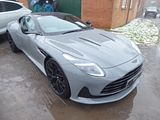
From the current range were the DB12 and the DBX, Aston’s offering in the uber-expensive SUV sector of the market.


AUDI
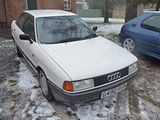
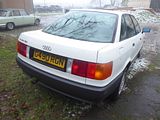
In September 1986, Audi released a new Typ 89 Audi 80 for the 1987 model year on the European market and introduced it elsewhere within a year. It was based on a new platform which broke the relationship between the 80 and the Volkswagen Passat, the corresponding third generation of which used the transverse-engined Volkswagen B3 platform, whilst Audi stuck with the longitudinal front wheel drive layout for the B3-series 80. Production codes were Typ 89 from 1987 to 1989, and Typ 8A from 1990 onwards (in line with a restructuring of many VW platform designations). It introduced a new aerodynamic look and a fully zinc coated galvanised bodyshell. Unlike its predecessor, the B3 was marketed worldwide only as the Audi 80 or Audi 90. Initially, Audi transferred existing powertrain concepts to the new model although fuel injection was now available for some engines. A range of new petrol and diesel inline four-cylinder engines became available to European customers along with the procon-ten safety system which became standard fitment from 1991. Procon-ten was a notable safety feature comprising a series of hidden steel cables routed behind the gearbox, attached to the steering wheel and front seatbelt inertia reels. In the event of a front impact, the engine and gearbox are forced rearwards, pulling on these cables. This action simultaneously pulls the steering wheel into the dashboard to prevent the driver colliding with it while tightening the front seatbelts. This innovation was a precursor to the airbag, which became popular on mass produced cars during the 1990s after being patented by Mercedes-Benz in 1982. In 1987, the Audi 90 was reintroduced as an upmarket, more luxurious variant of the 80. To begin with it would again feature a choice of 10-valve inline five-cylinder petrol engines, and could be specified with or without quattro. The 90 differs visually to the 80 by a full width tail-light panel; headlights which featured additional high-beam lights and a slightly different front grille. Indicator lamps were moved from beside the headlights to the bumpers next to the fog lights, which were standard fitment on the 90. Brightwork surrounds for the windows, tops of the bumpers and side rubbing strips were also standard. Interiors were upgraded over the 80 featuring velour seat coverings and a slightly more generous level of equipment. The then range-topping 2.2E offered a boot spoiler, alloy wheels, leather steering wheel and sports front seats. Switchable ABS was standard on quattro versions. From 1989 to 1991 the Audi 90 offered the first 20-valve engine from Audi since the turbocharged engine used in the Audi Sport Quattro. This new 2.3L engine produced 170 PS and featured in the front wheel drive 20V, 20V Sport and four-wheel drive 20V quattro derivatives. The non-quattro 20V models were 120 kg lighter. Externally, Sport versions of the 90 were visually distinguished by the deletion of brightwork in favour of satin black window surrounds, bumper cappings and thinner side mouldings. A raised aluminium boot spoiler, lowered suspension and uprated brakes were fitted as standard, Speedline wheels were also standard fitment in the UK. In October 1988 a Coupé version based on the 80/90 appeared, called simply the Audi Coupé (typ 8B). This had completely different three-door liftback bodywork and replaced the earlier, B2-based Coupé which had been manufactured into early 1988. This version remained in production until 1996, in parallel with the succeeding B4 generation Audi 80. A convertible was planned from the beginning but did not appear until May 1991 as the Audi Cabriolet. This model remained in production until 2000 and was optically aligned with the B4 Audi 80 from its introduction


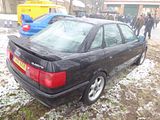
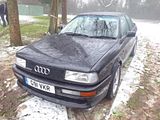
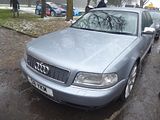
Audi introduced the S8 4.2 quattro into the European market in 1996. The S8 followed the naming convention of other high-performance Audi “S” models, such as the Audi A6-derived S6. In some markets such as the UK, the S8 was only available with the automatic transmission. Cosmetically, Audi differentiated the S8 from the A8 with solid aluminium alloy door mirror housings, chrome-effect beltline and lower front grille trim, and polished twin exhaust pipes, along with subtle “S8” badging. 14-way power adjustable and heated sports front seats with memory function were fitted as were heated rear seats. Standard alloy wheels were 18-inch cast aluminium alloy “Avus” six-spoke style. After the 1999 facelift, 20-inch polished nine-spoke RS wheels became an option. In 2002, 18-inch nine-spoke RS wheels became a no-cost option. At the same time of the A8’s facelift in late 1999, the S8 received the same cosmetic upgrades. This update marked the release of the S8 to the North American market. Production of the D2 series S8 ended in September 2002. The D2 series S8 featured an uprated, 335 hp version of the 4.2-litre V8 with four valves per cylinder. From late 1999, Audi increased this to five valves per cylinder with power increased to 355 hp and 430 Nm (317 lb/ft). From launch in 1996, European-market models came standard with a six-speed manual transmission. A sports-recalibrated version of the ZF 5HP24 five-speed tiptronic automatic, featuring “Dynamic Shift Programme” (DSP) was released a year later and was the only transmission available in most other markets. A retuned, 20-millimetre (0.8 in) lowered sports suspension included a 30 percent stiffer spring rate and 40 percent more compression damping in the shock absorbers. Speed-sensitive “servotronic” power assisted steering was also standard. The brakes featured a Bosch 5.3 anti-lock braking system (ABS), with electronic brakeforce distribution (EBD), and worked radially ventilated front discs. From 2002, an upgraded Bosch 5.7 electronic stability programme became standard fitment.

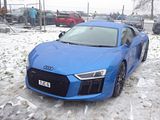
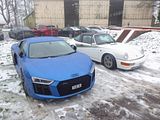
This is the second generation R8. Launched at the 2015 Geneva Motor Show and is based on the Modular Sports System platform shared with the Lamborghini Huracan. The development of the Type 4S commenced in late 2013 and was completed in late 2014. Initial models included the all-electric e-Tron and the V10 5.2 FSI along with the V10 plus. Unlike its predecessor, there was no manual transmission available and the entry-level V8 trim was also dropped. In 2016, the convertible (Spyder) variant was added to the line up which was initially available in the base V10 trim. In mid-2017, the high performance V10 plus Spyder was added to the range. A rear-wheel-drive model called the R8 RWS was introduced. In 2018, the R8 received a mid-cycle refresh with mechanical and exterior changes. The newer and more aggressive design language carried over from famous Audi models of the past and it’s appearance is slightly more angular up front. Some of the aerodynamic features such as the front aeroblades are shared with the Lamborghini Huracàn. The refreshed model had substantial performance improvements over its predecessor. The base R8 got a power boost from 532 hp to 562 hp, while the V10 Plus was renamed V10 Performance Quattro and the engine saw a power increase by 10 hp, now up to 612 hp. Production ceased a few months ago.
AUSTIN
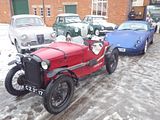
There were several examples of the popular Seven here, and they were each very different. Herbert Austin’s masterpiece which did much to put Britain on wheels in the 1920s was first seen in 1922, as a four seat open tourer. Nicknamed Chummy, the first 100 featured a 696cc four cylinder engine, which was quickly upgraded to the 747cc unit that remained until the end of production some 17 years later. The first cars had an upright edge to the doors and a sloping windscreen, but from 1924, the screen became upright and there was a sloping edge to the doors, as well as a slightly longer body. Stronger brakes came along in 1926, along with a slightly taller nickel-plated radiator grille, conventional coil ignition, a more spacious body and wider doors. An even longer and wider body arrived in 1930, as well as a stronger crankshaft and improvements to the brakes which coupled front and rear systems together so they both worked by the footbrake. In 1931 the body was restyled , with a thin ribbon-style radiator and by 1932 there was a four speed gearbox to replace the earlier three-speeder. 1933 saw the introduction of the Ruby, a car that looked more modern with its cowled radiator. There were also Pearl and Opal versions. Development continued, so in 1937 there was a move to crankshaft shell bearings in place of the white metal previously used, and the Big Seven appeared. The last Seven was made in 1939, by which time 290,000 had been produced. Aside from saloons and tourers, there had been vans and sports derivatives like the Le Mans, the supercharged Ulster and the rather cheaper Nippy. Around 11,000 Sevens survive today
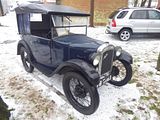
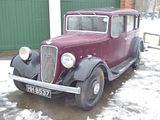
This is a 1936 18/6 York. Part of the revised Austin range introduced for the 1935 season, the six-cylinder 16hp and 18hp cars could be had in standard or long wheelbase guises and with a choice of Westminster, Chalfont, York or Hertford saloon coachwork. A six-light design mounted on the extended chassis, the York model boasted a Pytchley sliding roof, low floor, wide doors, large windows and separately adjustable front seats. Equipped with all-round semi-elliptic leaf-sprung suspension and four-wheel drum brakes, the 18hp variant was powered by a 2511cc sidevalve straight-six allied to four-speed manual transmission. Although no sportscar, it was reputedly capable of 65mph and 20mpg. Priced at £328, the 18hp York Saloon was available in Royal Blue, Maroon, Westminster Green, Black or Ash Grey, while its interior could be trimmed in Hide, Bedford Cord or Moquette upholstery (occasional seats were a £7 10s 0d extra). Well regarded machines, the six-cylinder 16hp and 18hp cars are thought to have accounted for 12,731 sales between 1935 and 1937. Though, today survivors are few and far between.
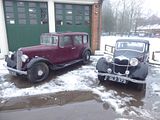
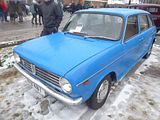
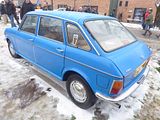
The Austin Maxi is a medium-sized, 5-door hatchback family car that was produced by Austin and later British Leyland between 1969 and 1981. Despite its practical design and remarkable space efficiency (it is shorter, narrower and lower than the sixth generation Ford Fiesta), the Maxi never came close to reaching its projected sales targets. Just under half a million were built over a 12 year period. BL management decisions involving the Maxi had significant knock-on effects to the rest of the car line-up. BL marketing decreed that the Maxi should be the only car in the range to feature a hatchback. This stance prevented the Austin Allegro and Princess models gaining hatchbacks despite those designs being capable of receiving them. The Maxi (code name ADO14) was the last car designed under the British Motor Corporation (BMC) before it was incorporated into the new British Leyland group, and the last production car designed by famed designer Alec Issigonis. It was the first car to be launched by British Leyland. Originally, under BMC’s plan for its new model range, which it had been developing since 1965, the Maxi was to have been called the “Austin 1500” on its spring 1969 launch, and a saloon version the “Morris 1500” was to follow in the autumn. However, upon the merger of BMC and Leyland the new management abandoned the four-door saloon notchback and developed the Morris Marina instead. The Marina, launched in April 1971, was a rear-wheel drive car available as a saloon, coupe or estate. The new chairman Lord Stokes decided to also change the hatchback’s name to the Maxi in homage to the Mini of 10 years earlier. All Maxis were produced at the Cowley plant in Oxford, although the E-Series engines were made at a new factory at Cofton Hackett neighbouring Longbridge. The Maxi was launched in Oporto, Portugal, on 24 April 1969, in a blaze of publicity; it was one of the first cars to appear on the BBC’s new car programme Wheelbase. Underneath the Maxi’s practical and spacious bodyshell lay an all-new front-wheel drive chassis, which was interlinked with an innovative five-speed manual transmission; the fifth gear was another rarity on family cars in 1969 and one which many manufacturers did not adopt until more than a decade later. The gear selector suffered from notorious problems with its control linkage, especially in early models which had a cable-operated linkage prone to cable stretch and other problems. These were noted by autotesters such as Vicar in Today’s Driver (1969), who wrote: “This is probably a good idea that just needs a little bit of working on.” This criticism actually came as a result of a road test two months before the car officially went on sale. The later rod linkage was less problematic. All models were prone to problems brought on by the “cogs in the sump” layout, whereby the gearbox and engine shared a common oil supply. The clutch oil seal was also prone to leakage. Power came from a 1,485 cc E-Series petrol engine which would later be used in other British Leyland products, such as the Austin Allegro. The 1750 and twin-carburettor 1750 HL models, added to the range in 1971, offered good performance by the standards of the era, with a top speed of 97 mph (156 km/h), while the smaller-engine version could exceed 90 mph (140 km/h). Despite the new platform, the Maxi’s styling suffered from the decision to save tooling costs by re-using door panels from the Austin 1800 “Landcrab”, which gave the Maxi an unusually long wheelbase in relation to its length, coupled with the fact that the carried-over doors made the Maxi resemble a scaled down version of the 1800 (and the Austin 3-Litre, which also used the same doors). This design was by then five years old, at a time when curvaceous American-inspired “coke bottle” styling (typified by contemporaries such as the Ford Cortina Mk III and Hillman Avenger) was very much in vogue, contrasting sharply with the Maxi’s obviously mid-1960s looks. Another styling ambition for the car was a four-door saloon version, to compete directly with the Ford Cortina. A prototype was built, badged as a Morris, but it was not put into production, since the booted extension made the Maxi almost the same size as the 1800 model, which was itself replaced in March 1975 by the 18-22 series models (renamed the Princess soon after its launch). Also worthy of note is that the Maxi was voted the least stolen car in 1971 and 1972. In Australia, owing to recently increased local content assembly tariffs which would have resulted in the Maxi being uneconomic to build, Leyland Motor Corporation of Australia developed in the UK the Morris Nomad, a hybrid utilizing the Maxi’s E-series engine/transmission and rear tailgate, fitted to the Morris 1100 body which was already being assembled in that country. For a short while the Nomad (under the Austin name) was exported to New Zealand and offered alongside the locally assembled Maxi. The Maxi featured a spacious interior, comfortable passenger accommodation, competitive prices and reasonable running costs. It was let down by a dull interior and poor build quality, although it was not as notorious for its failings as the Austin Allegro and Morris Marina were during the 1970s. The Maxi had several rivals during the 1970s, including the Volkswagen Passat (1973) and Chrysler Alpine (1975), although its best-selling rivals from Ford and Vauxhall did not produce a hatchback until the early 1980s. One unusual feature of this car was that the rear seat back, as well as folding forward as in a conventional hatchback, also folded back. In combination with fully-reclining front seats, this gave satisfactory, if spartan, sleeping accommodation. Towards the end of the Maxi’s life, in 1980, a lightly revised model was marketed as the “Maxi 2”, although by now sales were declining and a new car to succeed the Allegro and Maxi was being developed. Its launch was delayed by the extra investment required to develop the Austin Metro, launched in October 1980. On 8 July 1981, the Austin Maxi’s 12-year production run came to an end. Its replacement, the Austin Maestro, which also replaced the smaller Allegro, was introduced in March 1983. Shortly after the Maxi’s demise, BL met the demand for a larger family hatchback by revamping the Princess and renaming it the Austin Ambassador, although this was a short-lived model which only lasted until 1984, when the Austin Montego was launched. This completed BL’s rationalisation, as it now had just one model competing in this market sector, whereas the Maxi had been one of three designs competing in a sector of the market which had been led by the Ford Cortina. The Maxi production lines at Cowley were taken over by production of the Triumph Acclaim, which was launched in October 1981.


AUSTIN HEALEY
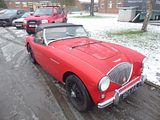
There were just a couple of examples of the “Big Healey” here, one of Britain’s most popular classics. Donald Healey had been producing a range of expensive sports cars from the 1940s, cars such as the Silverstone, the Abbott and the Farnham. For the 1952 London Motor Show, he produced a new design, which was called the Healey Hundred, based on Austin A90 mechanicals, which he intended to produce in-house at his small car company in Warwick. It was one of the stars of the 1952 Show, and it so impressed Leonard Lord, the Managing Director of Austin, who was looking for a replacement to the unsuccessful A90. that Lord struck a deal with Healey on the spot, to build it in quantity. Bodies made by Jensen Motors would be given Austin mechanical components at Austin’s Longbridge factory. The car was renamed the Austin-Healey 100, in reference to the fact that the car had a top speed of 100 mph. Production got under way in 1953, with Austin-Healey 100s being finished at Austin’s Longbridge plant alongside the A90 and based on fully trimmed and painted body/chassis units produced by Jensen in West Bromwich—in an arrangement the two companies previously had explored with the Austin A40 Sports. By early 1956, production was running at 200 cars a month, 150 of which were being sold in California. Between 1953 and 1956, 14,634 Austin-Healey 100s were produced, the vast majority of them, as was the case for most cars in this post war era, going for export. The car was replaced by an updated model in 1956, called the 100-6. It had a longer wheelbase, redesigned bodywork with an oval shaped grille, a fixed windscreen and two occasional seats added (which in 1958 became an option with the introduction of the two-seat BN6 produced in parallel with the 2+2 BN4), and the engine was replaced by one based on the six-cylinder BMC C-Series engine. In 1959, the engine capacity was increased from 2.6 to 2.9 litres and the car renamed the Austin-Healey 3000. Both 2-seat and 2+2 variants were offered. It continued in this form until production ceased in late 1967. The Big Healey, as the car became known after the 1958 launch of the much smaller Austin-Healey Sprite, is a popular classic now. You come across the 3000 models more frequently than the 100s, as they accounted for more than 60% of all Big Healey production
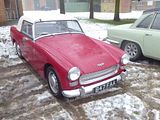
The Mark II to Mark IV cars were all very similar and represented the evolution of the model throughout the 1960s, The Mark II was announced at the end of May 1961. It used the same 948 cc engine with larger twin 1 1⁄4 inch SU carburettors, increasing power to 46.5 bhp. A close-ratio gearbox was fitted. The bodywork was completely revamped, with the headlights migrating to a more conventional position in the wings, either side of a full-width grille. At the rear, styling borrowed from the soon-to-be-announced MGB gave a similarly more modern look, with the added advantages of an opening boot lid and conventional rear bumper bar. The result was a much less eccentric-looking sports car, though at the expense of some 100 lbs extra weight. It followed the MG version of the car which was introduced a couple of weeks earlier as ‘the new Midget,’ reviving a model name which had been a great success for the MG Car Company in the 1930s. The Midget was to prove more popular with the public than the Sprite and by 1972 had completely supplanted it within the BMC range. In October 1962, both Sprites and Midgets were given a long-stroke 1098 cc engine. A strengthened gearbox with Porsche (baulk-ring) synchromesh was introduced to cope with the extra power – 56 bhp. Front disc brakes were also introduced at the same time and wire wheels became an option. 31,665 Mark II Sprites were made. The Mark III Sprite was also marketed as the Mark II MG Midget – differences between the two were again restricted to minor trim detailing. Although still 1098 cc, the engine had a stronger block casting, and the size of the crankshaft main bearings was increased to two inches. A new (slightly) curved-glass windscreen was introduced with hinged quarterlights and wind-up side windows. Exterior door handles were provided for the first time, with separate door locks. Though the car could now be secured, with a soft-top roof the added protection was limited. The rear suspension was modified from quarter-elliptic to semi-elliptic leaf springs, which gave a more comfortable ride for a near-negligible weight penalty as well as providing additional axle location, the upper links fitted to the quarter-elliptic models being deleted. Though scarcely sybaritic, these changes helped the Sprite and Midget compete with the recently released Triumph Spitfire. 25,905 Mark III Sprites were made. The next upgrade was presented at the London Motor Show in October 1966. Besides receiving the larger 1275 cc engine (which disappointed enthusiasts by being in a lower state of tune than that of the Mini-Cooper ‘S’), the Mark IV and its cousin the Mark III MG Midget had several changes which were more than cosmetic. Most notable is the change from a removable convertible top, which had to be stowed in the boot, to a permanently affixed, folding top of greatly improved design, which was much easier to use. Separate brake and clutch master cylinders were fitted, as car manufacturers’ thoughts began to turn to making their products safer. For the 1970 model year cast-alloy wheels were fitted and the grille was changed to resemble that fitted to the MG Midget. 22,790 Mark IV Sprites were made. The Healey connection was discontinued in 1971, so the final 1,022 Sprites built were simply Austin Sprites.
BEDFORD
The Bedford CF is a range of full-size panel vans produced by Bedford – the commercial vehicles division of Vauxhall. The van was introduced in 1969 to replace the CA model, and was sized to compete directly with the Ford Transit, which had entered production four years earlier. Its design was similar to its American counterpart, the Chevrolet Van (1971–1995). Bedford was a General Motors subsidiary, and in some markets outside the United Kingdom and Ireland the CF was sold through Opel dealers as the Opel Bedford Blitz from 1973 on when the original Opel Blitz was phased out. In other markets such as in Norway the CF retained its original name. The CF was notable for being the last vehicle solely designed by Vauxhall when it was discontinued in 1986 (the last Vauxhall passenger car had been the HC Viva which had ceased production in 1979); with all Vauxhall cars by that point being essentially rebranded Opels. The Bedford brand continued on certain badge engineered light vans from Isuzu and Suzuki, before being retired in 1991 in favour of Vauxhall or Opel. Introduced in November 1969 to replace the 17-year-old Bedford CA, the CF van variants soon became some of the most popular light commercial vehicles on British roads. The CF could be specified with a hinged door in the side panel directly behind the passenger door, and it was generally with this layout that the van was also commonly used as a base vehicle for a caravanette. The engine was the well-proven Slant Four engine which had been introduced for the Vauxhall FD Victor models in 1967. Apart from an increased engine capacity from 1,598 cc to 1,759 cc and from 1,975 cc to 2,279 cc in 1972, the power units remained unchanged. A four-cylinder 1.8 L (1,760 cc) Perkins diesel engine could be specified for an extra £130 (1969), while a larger 2,523 cc version was used for heavier versions. These units were rated at 50 and 61 PS DIN. In 1976, a 2,064 cc overhead valve (OHV) diesel engine from Opel replaced the outdated Perkins units. In Australasian markets, the CF could be optioned with Holden six-cylinder units, in 2,850 cc and 3,310 cc forms. This was as an answer to the rival Ford Transit range, which in Australia used six-cylinder engines from the Ford Falcon. The Bedford used the same basic suspension lay-out as the Vauxhall Victor, though married to greater wheel arch clearances and calibrated for greater weight carrying capacity. The front independent suspension featured a double wishbone layout with coil springs and telescopic shock absorbers, while the rear wheels were suspended by a combination involving a live axle and traditional long single-leaf springs. Several different manual transmissions were used: the Vauxhall three-speed, four-speed, Bedford four-speed, ZF four-speed, ZF five-speed, and the General Motors automatic. The Laycock type of overdrive was available to order or on the later Vauxhall four-speed models. There were three CF1 body styles. A standard panel van which was intended to rival the Ford Transit; the special van body (essentially a self-contained cab with a general-purpose chassis onto which a wide range of custom-built bodies or beds could be built), and the Dormobile (caravanette). There was a major facelift in 1980 and a second one in 1984.


BENTLEY
The Bentley Mulsanne is a large (performance) luxury saloon produced by Bentley Motors from 1980 until 1992, though derivative models including the Continental T and Azure continued in production into the 2000s. Contrary to its predecessors, the Bentley Mulsanne was given an actual name instead of a letter, but otherwise started as another standard rebadged Rolls-Royce, the Silver Spirit. However, with the launch of the ‘Brooklands’ version, and the 1982 Mulsanne Turbo – with 50 percent more horsepower – the Mulsanne began the rebuild of an appealing individual Bentley brand image. The Mulsanne was named after the Mulsanne straight, a section at the Circuit de la Sarthe in which refers to the Bentley’s success at the 24 Hours of Le Mans between 1924 and 1930. In 1980, the Rolls-Royce Silver Shadow and the Bentley T-series were replaced by the RR Silver Spirit and, as with prior models, a Bentley-badged equivalent. This time however, it was given a name: the “Mulsanne”. This was derived from Bentley’s motorsport history, which included five victories at the 24 Hours of Le Mans between 1924 and 1930. The ‘Mulsanne Straight’ is the stretch of Le Mans’ race-course where cars reach their highest speeds. The Mulsanne initially shared the same carburetted 6,750 cc Rolls-Royce V8 engine with aluminium alloy cylinder heads with the Silver Spirit, carried over from the Silver Shadow II and Bentley T2. In 1982 however, a turbocharged version with much more power and torque was also introduced – for Bentley only – in the Mulsanne Turbo. From 1986, the two SU carburettors were replaced by Bosch fuel injection on all cars. All Mulsannes use a 3-speed automatic transmission. The Mulsanne Turbo was launched at the Geneva Motor Show in 1982 and produced until 1985. A Garrett AiResearch turbocharger provided a 50% increase in engine power – something not seen on a Bentley in half a century. The interior sported the usual highly polished, walnut veneered fascia, blemish-free leather upholstery, and pure wool for the carpets and headlining. A total of 498 standard wheelbase and 18 long-wheelbase Mulsanne Turbos were built, until they were replaced by the Bentley Turbo R in 1985, which used a fuel injected version of the same 63⁄4 litre V8 engine since 1987. The Mulsanne S was introduced in 1987. Although this model lacked its turbocharger, many of its other details were similar to the Turbo R, including that car’s alloy wheels and interior, and the suspension was firmed up for a more sporting ride. The rectangular headlamps from the 1980s gave way to quad round units for 1989, and the model was produced until 1992.
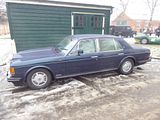
The Arnage, a twin of the Rolls-Royce-branded sibling, the Silver Seraph, was introduced in the Spring of 1998, the first entirely new designs for the two marques since 1980. This is a large car: over 5.4 metres (212 in) long, 1.9 metres (75 in) wide, and has a kerb weight of more than 2.5 metric tonnes. For a brief period it was the most powerful and fastest four-door saloon on the market. In a complete switch from tradition, whilst these cars had bodies built at the Crewe factory, the then owner, Vickers, decided that the car would be powered by engines built elsewhere. A number of potential engines were examined, including the GM Premium V engine, and a Mercedes-Benz V8 engine, before, in late 1994, Vickers selected a pair of BMW power plants. It was decided that the Rolls-Royce model would use BMW’s naturally aspirated V12 engine while the more-sporting Bentley model would use a special twin-turbo version of the 4.4-litre BMW V8, which was developed by Vickers subsidiary, Cosworth Engineering. On its introduction in the spring of 1998, the Arnage was available as a single model with the this 4,398cc twin turbo developing some 354 PS (349 bhp) and 420 lb·ft. During the takeover battle in 1998 between BMW and Volkswagen Group for ownership of Rolls Royce and Bentley Motors, BMW had threatened to stop supply of their engines if Volkswagen Group won. While the threat was later withdrawn in conjunction with BMW acquiring the right to manufacture the Rolls Royce marque at a new location, it was clear that Volkswagen could not accept the business and reputation risks associated with having their rival as a long-term business partner. Furthermore, customers were nervous about engine and part availability (of which there turned out to be no issue) and orders for new cars dropped precipitously. Volkswagen’s response was to prepare the old pushrod 6.75-litre 16-valve engine from the Turbo R for the Arnage, designed for the lighter and smaller BMW 32-valve V8 unit. Coupled with an outdated 4-speed automatic, the engine was extremely thirsty, and would not meet government-imposed emissions standards without hasty modifications. The revised version of the car was launched as the Arnage Red Label in October 1999. At the same time, but without the fanfare, Bentley made several minor modifications to the original BMW engined cars, and designated them as the “Arnage Green Label” for the 2000 model year. As part of the modification process, both Red and Green Label cars received stiffer body shells and larger wheels and brakes. The stiffer body shell was needed because of the extra weight of the British engine. The larger brakes were needed for the same reason. Despite the larger brakes, braking performance worsened with the extra weight of the 6.75 engine. The braking performance of the ’99 Green Label from 70–0 was 172 feet while the later Arnage T’s performance was 182 feet from the same speed. The PR department at Bentley pointed to customer demand as the driving force behind the reversion to the old two valve per cylinder 6.75-litre unit for the Red Label. This explanation appears to have been acceptable to all but a few of the motoring press who welcomed the return of the old unit after criticising the BMW motor as at best insipid and, at worst, underpowered. In reality, the outgoing BMW-powered Arnage was technically more modern, considerably more fuel efficient, and had 32 valves with double overhead camshafts, twin-turbo and Bosch engine management technology – as opposed to 16-valve, single turbo and a pushrod motor with less advanced engine management. The Red Label’s increase in motive power shaved less than a second of the zero to 60 mph time. However, the BMW twin turbo unit remained noticeably more agile and responsive from a driver’s perspective, due to its more responsive DOHC engine, better weight balance(maintaining a 51.1/48.9 weight distribution) and almost 600 lb (270 kg) lower curb weight. Ultimately the Green Label was more reliable and significantly less expensive to service in the long term. The key limiting factor of the BMW engine’s output was the ZF 5HP30 transmission which was not rated to handle more than the 413 lb·ft torque that the twin turbo engine was tuned to produce. In total only seven Arnage Green Label units were built, all of which were left-hand-drive versions. There was a final series of vehicles built in 2000 with the 4.4-litre BMW engine designated the Arnage Birkin, of which 52 units were produced and are distinguishable by their three-dial as opposed to five-dial instrument centre dashboard configuration. A long-wheelbase version of the Red Label was launched at the North American International Auto Show in 2001. The Green Label ended production in 2000. The Red Label models were replaced in 2002. In 2001, the Arnage RL, a long-wheelbase model, 9.8 in longer than the Arnage, was launched, the extra length added to the car at its rear doors and its C-pillar. With the standard Arnage model, the rear wheel wells butt up against the rear door frames, but with the RL they are a few inches further back. The overall effect is a larger rear area inside the car. Available only as a bespoke “Mulliner” model, each RL was customised to the desires of the buyer. The RL, however, was also the first of a new series of Arnages which would finally cure the Bentley Arnage of the reliability and performance deficiencies experienced following its forced deprivation of the modern BMW engines it was designed to use. The RL would also present a credible challenge to BMW’s attempts to revive the Rolls-Royce brand with its planned new model, the Phantom. The RL’s introduction saw the introduction of an entirely reworked version of the 6.75-litre V8 engine. Where the engine used in the Red Label was a quickly and less-than-completely-satisfactorily modified version of the Turbo RT’s unit, the RL featured an entirely reworked version of the old 6.75-litre V8. More than half of the engine’s parts were completely new, with Bosch Motronic ME7.1.1 engine management replacing the old Zytek system, and two small Garrett T3 turbochargers replacing the single large T4. This new engine developed 405 PS (399 bhp) and 616 lb·ft, and was said to be capable of meeting all future emissions requirements. Finally, the Arnage was powered by a modern twin-turbo unit with state-of-the-art electronic management system similar to the originally Cosworth-BMW unit developed for the Arnage in 1998. Perhaps ironically, what was essentially a new engine developed by Volkswagen Group engineers for the RL in 2001, was now producing the same sort of power as the original BMW V8 4.4 engine used in the first Arnage in 1998. Unfortunately, the development and testing of the revisions to the new engine were rushed by VW to meet regulatory requirements. As a result, the camshafts are prone to failure requiring extensive repair work to remedy In 2002, Bentley updated the Red Label as the series two Arnage R. This model was launched to contrast the Arnage T, which was developed to be more sporting. The Arnage R features two Garrett T3 turbochargers, as with the RL.The Arnage T, also from 2002, was claimed to be the most powerful roadgoing Bentley at its launch at the Detroit Motor Show. As with the Arnage R, there were twin-turbochargers, but tuned to develop 465 PS (459 bhp) and 645 lbf·ft. The Arnage T’s 0–60 mph time is 5.5 seconds; a top speed of 170 mph was claimed. The Arnage range was facelifted in 2005, with a front end resembling that of the new Continental GT. Production of the Arnage ceased in 2009. .

BMW
BMW E21 is the first generation of the BMW 3 Series compact executive car, produced by from 1975 to 1981. Most E21s were sold as 2-door compact sedans, however a Baur cabriolet was also available. Under the direction of its 51% percent shareholder, Herbert Quandt, BMW decided upon a replacement for their aging 02 Series. Paul Bracq, Director of Design at BMW from 1970 to 1974, is credited with setting the design direction of the E21. In July 1975, BMW’s Board of Management first presented this new model series in the Munich Olympic Stadium for public appraisal. The frontal view of the new car was dominated by the BMW trademark kidney grille standing out clearly from the radiator cover. The styling of the new car bore a resemblance to the BMW E12 5 Series. The wedge shape of the two-door model was distinctive, extending all the way to the unusually high rear end. In response to criticism of the tail design, a black plastic trim panel between the tail lights was added. Like many other BMW models, the C-pillar of the E21 features a Hofmeister kink. The cockpit design of the E21 marked the introduction of a new design concept, with the centre console and central dashboard area angled towards the driver. This feature has become part of BMW’s interior design philosophy for many years. As a sign of passive safety, all edges and control elements within the interior were rounded off and padded. The suspension incorporated rack and pinion steering and MacPherson strut suspension at the front, and semi-trailing arm type independent suspension at the rear. The rear suspension design causes camber changes, which can introduce “snap oversteer” at the handling limits, and the car was castigated repeatedly for this (now, of course, the press would shout in joy about such an attribute! The power assisted brakes were discs on the front wheels, while the rear wheels had drum brakes. Initially, a Getrag four-speed manual was the standard transmission fitment. Five-speed overdrive Getrag gearboxes were fitted as standard in 1980, but close ratio ‘sport’ gearboxes were available at the car’s release as an option. Alternatively, purchasers could opt for the ZF 3 HP-22 three-speed automatic transmission. At the E21’s release, three models were available: with 316 (1.6-litre), 318 (1.8-litre) and 320 (2.0-litre) versions of the BMW M10 4-cylinder engine. To differentiate between models, the 320 model came with dual headlights, while the 316 and 318 had single headlights. The fuel-injected 320i was introduced at the end of 1975. It featured the M10 4-cylinder engine with Bosch K-Jetronic fuel injection, and a limited slip differential was available as an option. At the 1977 International Auto Show in Frankfurt, BMW unveiled its new variants of the E21, featuring the new straight-6 M20 engines (which were initially called “M60”). BMW had invested DM 110 million the M20 engine series. The 4-cylinder 320 model was replaced with the 320/6, featuring a 2.0 version of the M20 engine. The 323i model was introduced, featuring 2.3 litre with 141 hp, which gave the 323i a top speed of 200 km/h (124 mph). The braking system was also upgraded, with the 323i featuring disc brakes on all wheels. Options include power steering, a 5-speed close-ratio ‘dogleg’ sport gearbox, and 25% limited slip differential. For the 1980 model year, the four-cylinder models were upgraded: the 1.8 litre carburetted M10 unit was revised to produce 89 hp and entered the market in the updated 316, while a fuel-injected version of the 1.8 litre M10 was introduced in the 318i model (which replaced the carburetted 318 as the mid-range model). The 320is model (USA only) was released in 1980 using a 1.8 litre version of the M10. The “S Package” featured Recaro sport seats, a modified dash with no air conditioning (A/C could be added by the dealer), upgraded suspension components that included a rear anti-roll bar and a larger front anti-roll bar, a 5-speed transmission and limited-slip differential, cross-spoke alloy wheels, an upgraded tool kit, a dual operation manual sunroof, an AM/FM Blaupunkt radio with cassette player, fog lights, a 3-spoke leather-wrapped steering wheel and leather shift knob, a front air dam, a “delete” of the alphanumeric 320i markers on the rear boot lid and a limited colour palate of white, silver or black. Just 2,500 320is were produced. In 1981, the economy model 315 was introduced as a reaction to the second “oil crisis” in late 1979. More spartan than the other E21 models, it was the last E21 to be built and shared production with the E30.


The BMW E28 was produced from 1981 to 1988 and replaced the E12 5 Series. The E28 has a self-supporting body that is welded to the body platform. The passenger cell is a safety passenger cell with deformation elements both in the front and rear of the vehicle. Unlike its E12 predecessor and E34 successor, the E28 has a rear-hinged bonnet. The boot has a volume of 460 litres. Most models have a fuel tank capacity of 70 L with some models having a smaller tank of 63 litres. The kerb weight is 1,140–1,410 kg (2,513–3,109 lb). Cruise control, an ‘on-board computer’ (to display trip information) and a “check control” panel (to alert the driver about fluid levels and lighting faults) were introduced to the 5 Series on the E28. The glazing is made of single-pane safety glass, the windscreen has laminated glass. As part of developing the air-conditioning system for the E28, several of the BMW engineers in charge of this program drove a previous generation E12 5 Series during the middle of summer in Texas. The E12 528i was painted black with a black interior, and driven 500 mi (805 km) in one day.The styling was developed under BMW’s chief designer Claus Luthe, with development of the E28 beginning in 1975. At the time that BMW was designing the E28, the company had only one computer, which was used for payroll management and spare parts logistics. Wolfgang Matschinsky and his team borrowed that computer to perform the calculations necessary to develop the new drivetrain and chassis. This was due to the fact that the addition of an ABS system necessitated a redesign from the previous model due to excessive vibrations under heavy braking. The four models available at the launch of the E28 were the 518, 520i, 525i and 528i, with the 518 using a straight-four petrol engine and the other three models using a straight-six petrol engine. Over the course of the E28 model, the following models were added: the 524d and 524td using diesel engines, the 518i (a fuel-injected version of the 518), the 525e/528e as fuel-economy models, and the upper-specification 533i, 535i, M535i, and M5 models. Production ceased at the end of 1987 in readiness for the E34 generation. A total of 722,328 cars were built.
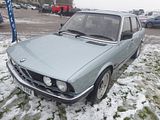


The BMW E30 is the second generation of BMW 3 Series, which was produced from 1982 to 1994 and replaced the E21 3 Series, and was the car which really saw the popularity of the 3 Series increase dramatically. . Development of the E30 3 Series began in July 1976, with styling being developed under chief designer Claus Luthe with exterior styling led by Boyke Boyer. In 1978, the final design was approved, with design freeze (cubing process) being completed in 1979. BMW’s launch film for the E30 shows the design process including Computer-aided design (CAD), crash testing and wind-tunnel testing. The car was released at the end of November 1982. Externally, the E30’s appearance is very similar to twin headlight versions of its E21 predecessor, however there are various detail changes in styling to the E30. Major differences to the E21 include the interior and a revised suspension, the latter to reduce the oversteer for which the E21 was criticised. At launch, the car had a 2 door style like its predecessor and just four engines, all of them petrol: the 316 and 318 four cylinder units and the 320 and 323i 6 cylinders. This last was soon upgraded to a 2.5 litre unit. Diesel models were added during the 80s and there was an all-wheel drive 325iX option for continental European markets. In addition to the 2 door saloon and Baur convertible body styles of its E21 predecessors, the E30 became available by early 1984 as a four-door sedan and later a five-door station wagon (marketed as “Touring”). The Touring body style began life as a prototype built by BMW engineer Max Reisböck in his friend’s garage in 1984 and began production in 1987. The factory convertible version began production in 1985, with the Baur convertible conversions remaining available alongside it. Following the launch of the E36 3 Series in 1990, the E30 began to be phased out.
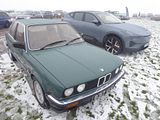
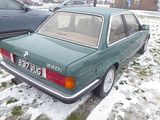


BUGATTI
Many would tell you that this is THE classic Bugatti, the Type 35 and there was a nice example here. The Type 35 was phenomenally successful, winning over 1,000 races in its time. It took the Grand Prix World Championship in 1926 after winning 351 races and setting 47 records in the two prior years. At its height, Type 35s averaged 14 race wins per week. Bugatti won the Targa Florio for five consecutive years, from 1925 through 1929, with the Type 35. The original model, introduced at the Grand Prix of Lyon on August 3, 1924, used an evolution of the 3-valve 1991 cc overhead cam straight-8 engine first seen on the Type 29. Bore was 60 mm and stroke was 88 mm as on many previous Bugatti models. 96 examples were produced. This new powerplant featured five main bearings with an unusual ball bearing system. This allowed the engine to rev to 6000 rpm, and 90 hp was reliably produced. Solid axles with leaf springs were used front and rear, and drum brakes at back, operated by cables, were specified. Alloy wheels were a novelty, as was the hollow front axle for reduced unsprung weight. A second feature of the Type 35 that was to become a Bugatti trademark was passing the springs through the front axle rather than simply U-bolting them together as was done on their earlier cars. A less expensive version of the Type 35 appeared in May, 1925. The factory’s Type 35A name was ignored by the public, who nicknamed it “Tecla” after a famous maker of imitation jewellery. The Tecla’s engine used three plain bearings, smaller valves, and coil ignition like the Type 30. While this decreased maintenance requirements, it also reduced output. 139 of the Type 35As were sold. The Type 35C featured a Roots supercharger, despite Ettore Bugatti’s disdain for forced induction. Output was nearly 128 hp with a single Zenith carburettor. Type 35Cs won the French Grand Prix at Saint-Gaudens in 1928, and at Pau in 1930. Fifty examples left the factory. The final version of the Type 35 series was the Type 35B of 1927. Originally named Type 35TC, it shared the 2.3 litre engine of the Type 35T but added a large supercharger like the Type 35C. Output was 138 hp, and 45 examples were made. A British Racing Green Type 35B driven by William Grover-Williams won the 1929 French Grand Prix at Le Mans.

CADILLAC
The 1959 Cadillac is remembered for its huge sharp tailfins with dual bullet tail lights, two distinctive rooflines and roof pillar configurations, new jewel-like grille patterns and matching deck lid beauty panels. In 1959 the Series 62 had become the Series 6200. De Villes and 2-door Eldorados were moved from the Series 62 to their own series, the Series 6300 and Series 6400 respectively, though they all, including the 4-door Eldorado Brougham (which was moved from the Series 70 to Series 6900), shared the same 130 in wheelbase. New mechanical items were a “scientifically engineered” drainage system and new shock absorbers. All Eldorados were characterised by a three-deck, jewelled, rear grille insert, but other trim and equipment features varied. The Seville and Biarritz models had the Eldorado name spelled out behind the front wheel opening and featured broad, full-length body sill highlights that curved over the rear fender profile and back along the upper beltline region. Engine output was an even 345 hp from the 390 cu in (6.4 litre) engine. Standard equipment included power brakes, power steering, automatic transmission, back-up lamps, two-speed wipers, wheel discs, outside rearview mirror, vanity mirror, oil filter, power windows, six way power seats, heater, fog lamps, remote control deck lid, radio and antenna with rear speaker, power vent windows, air suspension, electric door locks and license frames. The Eldorado Brougham also came with air conditioning, automatic headlight dimmer, and a cruise control standard on the Seville and Biarritz trim lines. For 1960, the year that this Fleetwood Eldorado was made, the styling was toned down a little. General changes included a full-width grille, the elimination of pointed front bumper guards, increased restraint in the application of chrome trim, lower tailfins with oval shaped nacelles and front fender mounted directional indicator lamps. External variations on the Seville two-door hardtop and Biarritz convertible took the form of bright body sill highlights that extended across the lower edge of fender skirts and Eldorado lettering on the sides of the front fenders, just behind the headlamps. Standard equipment included power brakes, power steering, automatic transmission, dual back-up lamps, windshield wipers, two-speed wipers, wheel discs, outside rearview mirror, vanity mirror, oil filter, power windows, six-way power seats, heater, fog lamps, Eldorado engine, remote control trunk lock, radio with antenna and rear speaker, power vent windows, air suspension, electric door locks, license frames, and five whitewall tyres. Technical highlights were finned rear drums and an X-frame construction. Interiors were done in Chadwick cloth or optional Cambray cloth and leather combinations. The last Eldorado Seville was built in 1960. The idea of a large car finished in pink now is simply unthinkable, but the colour goes quite well with the style here. These 59 and 60 Cadillacs attract lots of interest from collectors and the public and this one was no exception.
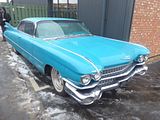
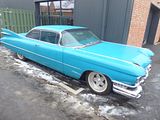

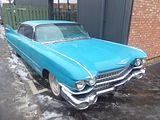

CHEVROLET
The C2 generation Corvette was launched in 1963. This model introduced us to the name Sting Ray. It continued with fibreglass body panels, and overall, was smaller than the first generation. The car was designed by Larry Shinoda with major inspiration from a previous concept design called the “Q Corvette,” which was created by Peter Brock and Chuck Pohlmann under the styling direction of Bill Mitchell. Earlier, Mitchell had sponsored a car known as the “Mitchell Sting Ray” in 1959 because Chevrolet no longer participated in factory racing. This vehicle had the largest impact on the styling of this generation, although it had no top and did not give away what the final version of the C2 would look like. The third inspiration was a Mako Shark Mitchell had caught while deep-sea fishing. Production started for the 1963 model year and ended in 1967. The 1963 model was the first year for a Corvette coupé and it featured a distinctive tapering rear deck (a feature that later reappeared on the 1971 “Boattail” Buick Riviera) with, for 1963 only, a split rear window. The Sting Ray featured hidden headlamps, non-functional bonnet vents, and an independent rear suspension. Corvette chief engineer Zora Arkus-Duntov never liked the split rear window because it blocked rear vision, but Mitchell thought it to be a key part of the entire design. Maximum power for 1963 was 360 bhp, raised to 375 bhp in 1964. Options included electronic ignition, the breakerless magnetic pulse-triggered Delcotronic first offered on some 1963 Pontiac models. On 1964 models the decorative bonnet vents were eliminated and Duntov, the Corvette’s chief engineer, got his way with the split rear window changed to a full width window. Four-wheel disc brakes were introduced in 1965, as was a “big block” engine option: the 396 cu in (6.49 litre) V8. Side exhaust pipes were also optionally available in 1965, and continued to be offered through 1967. The introduction of the 425 bhp 396 cu in big block in 1965 spelled the beginning of the end for the Rochester fuel injection system. The 396 cu in option cost $292.70 while the fuel injected 327 cu in (5.36 litre) engine cost $538.00. Few people could justify spending $245.00 more for 50 bhp less, even though FI could deliver over 20 mpg on the highway and would keep delivering fuel despite high G-loading in corners taken at racing speeds. Another rare ’63 and ’64 option was the Z06 competition package, which offered stiffer suspension, bigger, multi-segment lined brakes with finned drums and more, only a couple hundred coupes and ONE convertible were factory-equipped this way in 1963. With only 771 fuel-injected cars built in 1965, Chevrolet discontinued the option at the end of the ’65 production, having introduced a less-expensive big block 396 engine rated at 425 hp in the middle of the production year and selling over 2,000 in just a few months. For 1966, Chevrolet introduced an even larger 427 cu in 7 litre Big Block version. Other options available on the C2 included the Wonderbar auto-tuning AM radio, AM-FM radio (mid-1963), air conditioning (late-1963), a telescopic steering wheel (1965), and headrests (1966). The Sting Ray’s independent rear suspension was successfully adapted for the new-for-1965 Chevrolet Corvair, which solved the quirky handling problems of that unique rear-engine compact. 1967 was the final year for the C2 generation. The 1967 model featured restyled bumper vents, less ornamentation, and back-up lamps which were on the inboard in 1966 were now rectangular and centrally located. The first use of all four taillights in red started in 1961 and was continued thru the C-2 line-up except for the 1966. The 1967 and subsequent models continuing on all Corvettes since. 1967 had the first L88 engine option which was rated at 430 bhp, but unofficial estimates place the actual output at 560 bhp or more. Only twenty such engines were installed at the factory. From 1967 (to 1969), the Holley triple two-barrel carburettor, or Tri-Power, was available on the 427 L89 (a $368 option, on top of the cost for the high-performance 427). Despite these changes, sales slipped over 15%, to 22,940 – 8,504 coupes and 14,436 convertibles.
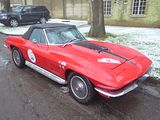
CITROEN
Launched on 23 May 1989, the XM was the modern iteration of the Big Citroën, a flagship saloon replacement for the Citroën CX. It went on sale in its native France immediately afterwards, and was available in right-hand drive on the UK market from October 1989. The XM estate was launched in the spring of 1991, until which time the estate version of the CX remained in production. The XM inherited a loyal global customer base of executive class customers and a clear brand image, but did not enjoy the commercial success and iconic status of its predecessors, the CX and the DS, which both raised the bar of automotive performance for other manufacturers. With total sales over its lifetime of just 330,000 units in 11 years, and the fact that its replacement Citroën C6 was not launched until the end of 2005 (despite being scheduled for launch in 2001), the XM might be considered a failure. By the second half of the 1990s, sales were in sharp decline, but Citroën did not end production of the car until 2000. There were many advances, most apparently designed to counteract the main criticisms of its predecessor. The CX leaned in corners, so the XM had active electronic management of the suspension; the CX rusted, so the XM had a partially galvanised body shell (many surviving XMs have very little corrosion); the CX was underpowered, so the XM offered the option of a 3.0 L V6 engine – the first V6 in a Citroën since the Maserati-engined SM ceased production in the mid 1970s. When the estate model joined the line-up, Citroën had a competitor at almost every level with most other similar-sized European cars. Ventilation was markedly more effective in the XM. Rear accommodation in the XM was improved over the CX in both width, legroom and height. In particular the rear passengers were seated higher than those in the front in order to afford a good view out, important for a vehicle which would operate in French government service. The XM shared a floorpan with the Peugeot 605, and the two models fared similarly in both teething problems and market acceptance. Unlike the 605 sedan design, the XM was a liftback design – a feature thought to be desirable in certain European markets – perhaps uniquely, it featured an additional glass panel that could lift with the tailgate but when shut, isolated the passenger compartment, to mimic the feel of a salon car. In mid-1994, the XM was revised in order to improve competitiveness. This did not materially impact sales. All models were fitted with driver’s airbag (signalling the end of the single-spoke steering wheel), belt-pretensioners, a redesigned dashboard and upper door casings. The suspension was redesigned to reduce roll, pitch and dive. Most noticeable was the adoption of a passive rear-steering system similar to that on the Citroën Xantia. This sharpened the “steering without inducing a nervous twitch.” Power output on the turbocharged motor was increased to 150 bhp from 145 bhp at 4400 rpm. This allowed the car to develop more torque at much lower revs. The important 50–70 acceleration time was 8 seconds compared to the Ford Scorpio 2.0 16V Ghia’s 17 seconds. The view of CAR magazine was that this engine “provides unusually swift access to effortless power … it delivers progressively with commendably little fuss; that this 2.0 turbo is as refined as it is muscular makes the XM’s performance all the more creditable”. XM was intended to compete against prestige vehicles like the Audi 100 and BMW’s 5 Series in a sector that accounted for 14.2% of the European market. It also competed with cars from mainstream brands including the Ford Scorpio and Opel Omega. Citroën was quoted as saying that the car was supposed to “take what Citroën means and make it acceptable”. The car’s initial reception was positive. Some six months after its launch, The XM won the prestigious European Car of the Year award for 1990 (gaining almost twice as many votes as the second, the Mercedes-Benz SL) and went on to win a further 14 major awards within a year of its launch. The anticipated annual sales of 450 cars a day in the first full year of production, or 160,000 units a year, never materialized. Sales never reached this ambitious level (higher than even its popular predecessor) for a variety of reasons. Like the CX, the XM did not have the worldwide distribution of competitors from BMW, Audi, and Mercedes-Benz. Also, it was launched only a year before a major global recession began, impacting negatively on car sales across the world; a notable example being the UK, where more than 2.3 million new cars were registered in 1989, but that figure fell to less than 1.6 million in 1991 (a drop of more than 30% in just two years). In Japan the XM was sold through Mazda’s Eunos dealership chain, part of an effort to minimize the appearance of Japan’s automobile market being closed to imports. It was also offered by Citroën’s traditional importer Seibu Motor, who kept selling the XM by themselves after the Eunos brand was discontinued in 1996. The market for executive cars made by volume manufacturers (Ford, Opel, etc.) was on the verge of decline as customers opted for offerings from more prestigious marques, a trend which saw Ford pull out of this market sector in 1998 and Opel in 2003. Customers were placing a higher priority on speed and handling rather than ride comfort which was Citroën’s specialty. The XM was underdeveloped at launch which resulted in reliability problems; the vehicle as designed was inconsistent in its abilities. The XM’s styling was also controversial and alienated those who desired a more conventional three box sedan. Peugeot introduced an XM competitor, the very similar Peugeot 605 that also sold weakly. Most subjective of all was the matter of the XM not living up to the expectations created by its forerunner the Citroën DS, despite that car having been launched in an era of national markets, of different demands and standards, an era when there was more scope for large advances in engineering and design than were possible in 1989. Export markets experienced lower sales from the outset, partly due to the XM’s pricing. The least expensive XM was nearly 50% more expensive at the time of launch than the corresponding CX. Whilst strong at first home market sales also declined, after the mechanical issues of the first few model years became known. By early 1993, the XM was viewed as an “underachiever”. Initial sales in the UK were at 3,500 units a year, making it Citroën’s weakest seller. The 2.0-litre petrol engined variants were viewed as being the least competitive. As a result, Citroën restructured the range such that all but the base model petrols were fitted with low-inertia Garret turbochargers to add an extra 15 bhp. This made the cars more powerful than more expensive competitors such as the Rover 820, Vauxhall Carlton and Ford Granada 2.0 GLX. After a run of 11 years, production finally ended in June 2000, with 337,000 made. By 1998, Citroën had confirmed that it would soon be discontinuing the XM and replacing it with an all-new model. At the Geneva Motor Show in March 1999, it unveiled the C6 Lignage concept car, which was scheduled for launch in 2001. In the event, the XM’s successor – the C6 – did not go on sale until late 2005 and was even less successful.
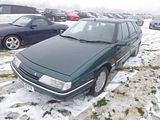
The Citroën Saxo was a supermini produced by the French manufacturer Citroën from 1996 to 2004. It was sold in Japan as the Citroën Chanson, because Honda had registered the “Saxo” name. As a badge engineered variant of the Peugeot 106 (which itself was a development of the Citroën AX), the major difference being interiors and body panels. Production ended in 2004, when it was replaced with the Citroën C2 and Citroën C3. All engines were from the PSA TU engine series that powered the Peugeot 205 from 1988 and the Citroën AX, and had their roots before that with the OHC PSA X engine various other PSA cars used, such as the Citroën Visa, Peugeot 104 and early Peugeot 205. The range included five petrol engines and one diesel engine, all naturally aspirated. Although the quoted power outputs are low in comparison to modern small hatchbacks, or even to other hatchbacks of the time, the kerb weight was generally very low, with even the range-topping VTS having a kerb weight of just 935 kg (2,061 lb), with other smaller engine models (except the diesel) being around 100 kg lighter than this. This meant a high power to weight ratio resulting in decent acceleration and made the car suitable for city driving. Aside from the VTS which had 16 valves, all engines were the older SOHC units which meant relatively low city MPG figures. Even the popular 1.1i engine would struggle to achieve more than 35 to 40mpg in town when driven carefully. The real world consumption between the smaller engines and the nippy 1.4i Westcoast/Furio variant was hardly noticeable, however the insurance premiums were. The early 1.0i was quite under powered, with the 1.1i being considered much better, since it was nearly 200cc larger and had roughly 30% more torque. There were three sport models of the Saxo: the Westcoast, later replaced by the Furio which featured a 1.4I 8V 75PS engine with a top speed of 175 km/h (109 mph), and a 0-62.5 mph (0–100 km/h) time of 11.2 seconds; the VTR MK1 (1997–1999) featured a 1.6I 8V 90PS engine with a top speed of 187 km/h (116 mph) and a 0-62.5 mph (0–100 km/h) time of 10.0 seconds. The VTR MK2 (1999–2003) featured a 1.6I 8V 98PS engine with a top speed of 193 km/h (120 mph) and a 0-62.5 mph (0–100 km/h) time of 9.4 seconds; the VTS 16V featured a 1.6I 120PS engine with a top speed of 205 km/h (127 mph), and a 0 to 60 mph time of 7.8 seconds. The VTS MK1 (1997–1999) and MK2 (1999–2003) shared similar performance, although the MK2 was slightly slower due to it being marginally heavier. These models included 247 mm (9.7 in) vented front brake discs, with the VTR and VTS also having rear brake discs (solid 247 mm (9.7 in) discs). Also, a different style of control arms and struts was used for the suspension. The VTS had a 22 mm (0.9 in) master brake cylinder, and the VTR and Westcoast/Furio had a 19 mm (0.7 in). The VTS had a 19 mm (0.7 in) front anti roll bar and 22 mm (0.9 in) rear anti roll bar, while the VTR and Westcoast/Furio had a 19 mm (0.7 in) front and 21 mm (0.8 in) or sometimes 19 mm (0.7 in) rear antiroll bar. In addition, all the sports models featured a unique bodykit to the other models, commonly known as the “VT” bodykit. In 1997 the Saxo’s three speed automatic gearbox was combined with the 1.6i 8V 90PS engine which was available on the Saxo SX and VSX. Then, in the end of 1997, the 1.6i automatic was replaced with a 1.4i 75PS engine. The 1.6i was more powerful with a top speed of 176 km/h (109MPH) compared with the 1.4’s top speed of 103 mph (166 km/h). Citroën carried on using the 1.4i engine on the facelift Saxo Automatic in 1999. Due to the C3 having a 1.4i automatic gearbox, the Saxo Automatic came to an end in March 2002, whilst the manual models were still sold right up to the end of 2003. The equipment list was generally sparse, with budget models having drivers airbag, seat belt pre tensioners, cassette player, heated rear screen and tinted windows, and early Mark Ones with keypad immobilisers and a clock in place of a tachometer and three stud wheels, much like the AX. Further up the list sunroofs, PAS, Electric windows, ultrasonic alarm, passenger airbag, CD player, tachometer, front fog lights, bodykits, colour coded mirror caps and alloy wheels were added, to name a few. Although MK2 Saxos were generally better equipped than their older counterparts, the interiors were still dated in comparison to other small hatchbacks of the time, such as the Vauxhall Corsa, with many of the centre console controls originating from the older model of the Citroën AX. The 1.6L VTR and VTS Saxos were the best equipped, with both gaining rear disc brakes as opposed to drum brakes, and ABS as standard for the VTS and an optional extra on all other 1.6-litre models. Few special models were released throughout the Saxo’s life, most notably the “Open Scandal”, a Saxo with a full length sliding canvas roof. Other special editions added certain extras to the lower end model, such as sunroofs or PAS. Notable models are the Westcoast up to 1999 and the Furio to 2003, as they incorporated the standard Saxo bodykit found on the VTR and VTS with a more insurance friendly 1.4-litre engine. The Westcoast is not to be confused with the Eastcoast, which was only available in the 1.0L and later 1.1L engines. The Eastcoast also did not incorporate the “VT” bodykit. Air conditioning was never an option on right hand drive Saxos because the blower motor was mounted in the bulk head on the driver’s side. As a result, there was insufficient space available to accommodate the evaporator, except by first ducting the air flow to the passenger’s side and then at the expense of the glove box. Although an after market kit was available that did exactly this, the resultant pressure loss made the system noisy and ineffective. The blower motor could also not be easily relocated, since the windscreen wiper motor was mounted in the passenger’s side space. In September 1999, the Saxo received a style makeover, commonly branded as a Mark II, with the major differences being more modern styled headlights, bonnets and grilles to replace the square style on the MK1 and multipoint injection replacing the single point on the 1.1-liter engines. In September 2000, it was a Euro NCAP sufferer of poor results, along with its twin, the 106. Power steering became standard on all but the very basic models. More subtle changes were alterations to the rear lights (the indicator sections are more “white”) and the engine control unit moved from a single plug to three plugs. The old three-stud wheel layout, as used on the Citroën AX, was also dropped. There was also a minor facelift, during the first phase of the car’s production, in line with the then current releases by Citroën, moving towards a rounder look. While the exterior was markedly altered, little changed inside the vehicle. The dashboard and glovebox arrangement remained the same with the possibility of installing a passenger-side airbag in some high range models. By 2003, some buyers were more attracted to the spacious, and practical five-door C3. However, the 1.6 VTR and VTS models remained popular. The Saxo finally finished production in September 2003, when the three-door C2 was launched. Its twin, the Peugeot 106, also ceased production at this time. By the end of the Saxo’s production life, its design was seven years old.
CRAYFORD
Crayford had hardly got into their stride with the Mk.1 convertible, only around fifty had been built on C & D registrations, when Ford told Crayford there would be an “all new” Cortina for the October 1966 Motor Show. Crayford did not want to wait up to a year to develop a Mk.2 Cortina Crayford, so they asked Ford if they could supply a car now for development work, but they were told that no pre production cars where available and, in any case, the car was top secret untill press day at the Motor Show. They did however agree to ship, in great secrecy, a Mk.2 two-door shell and all the parts in kit form. Crayford’s directors and staff then began building the car at the Westerham factory and with only two weeks to go Director Jeff Smith set about converting the car into a Crayford convertible, virtually single-handed, working night and day on the project. The result was, that when the show opened on press day, The Ford Motor Company had on their stand No.143, an entire range of six, all new, Cortina saloons and GT’s – but not far away on stand No.173, surrounded by a bevy of trendy dolly girls dressed in black and white chequered mini dresses, was a shiny metallic blue mink Crayford Cortina Mk.2 with a white pvc hood. This car has been in the long term ownership of our magazine publisher John Peters and is registered SOO 661D, it still has many unique pre production features, see our gallery on the home page. The public never realised fully how this dual launch was achieved. Crayford followed up a year later at the Earls Court Motor Show with an upmarket and expensive Mk.2 Cortina Cabriolet, this had a smaller hood that sat deeper into the car around a much smaller rear seat, suitable only for children, in effect it made the normal 5 seater convertible into a two plus two car. The Corsair cabriolet even had an inner headlining for extra comfort. Being a shorter hood it was capable of one-man-operation and the car also had a longer metal rear deck than the 5 seater convertible. Crayford soon had a full order book and made two, sometimes three a week with a total production run of over 400 convertibles and a handful of cabriolets, which like all Crayford cabriolets had to be built in Cologne, Germany under licence. Crayford further developed their Mk.2 Cortina with a tiny number of two door pillerless hardtops. These looked very much like the then current Lancia Flavia coupe with an all glass top profile and very slim roof pillars, back and front. It was rumoured to have two Cortina windscreens, one for the front and one for the back, but this is not true. It may be that only five where built on GT base cars and one was even a Lotus Cortina based. An even further development were the Crayford Mk.2 saloons, with big engine conversions that took the legendry Jeff Uren 3 litre Savage Cortina head-on. One yellow car was delivered new in both options, ie it was a 3litre V6 engined convertible. The roofless chassis wasn’t really up to the job. Most desirable are the 40-plus Lotus Cortina Crayford convertibles, mainly standard green and white, with one, a special order built at Lotus, in black – the owner did not want a resprayed car converted. Today around 126 survive on the club register.

De TOMASO
Designed by American Tom Tjaarda, and unlike the Mangusta, which employed a steel backbone chassis, the Pantera was a steel monocoque design, the first instance of De Tomaso using this construction technique. The Pantera logo included a version of Argentina’s flag turned on its side with a T-shaped symbol that was the brand used by De Tomaso’s Argentinian cattle ranching ancestors. The car made its public debut in Modena in March 1970 and was presented at the 1970 New York Motor Show a few weeks later. Approximately a year later the first production Panteras were sold, and production was increased to three per day. The curious slat-backed seats which had attracted comment at the New York Show were replaced by more conventional body-hugging sports-car seats in the production cars: leg-room was generous but the pedals were off-set and headroom was insufficient for drivers above approximately 6 ft. Reflecting its makers’ transatlantic ambitions, the Pantera came with an abundance of standard features which appeared exotic in Europe, such as electric windows, air conditioning and even “doors that buzz when … open”. By the time the Pantera reached production, the interior was in most respects well sorted, although resting an arm on the central console could lead to inadvertently activating the poorly located cigarette lighter. The first 1971 Panteras were powered by a Ford 351 cu in (5.8 litre) V8 engine that produced a severely underrated 330 hp. Stock dynos over the years proved that power was more along the lines of about 380 hp. The high torque provided by the Ford engine reduced the need for excessive gear changing at low speeds: this made the car much less demanding to drive in urban conditions than many of the locally built competitor products. The ZF transaxle used in the Mangusta was also used for the Pantera: a passenger in an early Pantera recorded that the mechanical noises emanating from the transaxle were more intrusive than the well restrained engine noise. Power-assisted four-wheel disc brakes and rack and pinion steering were all standard equipment on the Pantera. The 1971 Pantera could accelerate to 60 mph in 5.5 seconds. In the summer of 1971, a visitor to the De Tomaso plant at Modena identified two different types of Pantera awaiting shipment, being respectively the European and American versions. From outside, the principal differences were the larger tail lamps on the cars destined for America, along with addition of corner marker lamps. The visitor was impressed by the large number of cars awaiting shipment; but in reality, spending the best part of a year under dust covers in a series of large hangars probably did nothing for the cash-flow of the business or the condition of some of the cars by the time they crossed the Atlantic. Late in 1971, Ford began importing Panteras for the American market to be sold through its Lincoln Mercury dealers. The first 75 cars were simply European imports and are known for their “push-button” door handles and hand-built Carrozzeria Vignale bodies. A total of 1,007 Panteras reached the United States that first year. These cars were poorly built, and several Panteras broke down during testing on Ford’s test track. Early crash testing at UCLA showed that safety cage engineering was not very well understood in the 1970s. Rust-proofing was minimal on these early cars, and the quality of fit and finish was poor, with large amounts of body solder being used to cover body panel flaws. Notably, Elvis Presley once fired a gun at his Pantera after it would not start. An L model (“Lusso”) was added in 1972 and a GTS version in 1974, but it was not enough and Ford ended their importation to the US in 1975, having sold around 5,500 cars. De Tomaso continued to build the car in ever-escalating forms of performance and luxury for almost two decades for sale in the rest of the world. A small number of Panteras were imported to the US by grey market importers in the 1980s, notably Panteramerica and AmeriSport. After 1974, Ford US discontinued the Cleveland 351 engine, but production continued in Australia until 1982. De Tomaso started sourcing their V8s from Australia once the American supplies dried up. These engines were tuned in Switzerland and were available with a range of outputs up to 360 PS. The chassis was completely revised in 1980, beginning with chassis number 9000. From May 1980 the lineup included the GT5, which had bonded and riveted-on fibreglass wheelarch extensions and from November 1984 the GT5S model which had blended arches and a distinctive wide-body look. The GT5 also incorporated better brakes, a more luxurious interior, much larger wheels and tires and the fibreglass body kit also included an air dam and side skirts. Production of the wide body GT5 (and similarly equipped narrow body GTS models) continued until 1985, when the GT5-S replaced the GT5. Although the factory has not made its records available, an analysis based on Vehicle Identification Numbers by the Pantera Owners Club of America (POCA) late model (9000 series) registrar has shown that fewer than 252 GT5 Panteras were likely to have been built. The GT5-S featured single piece flared steel fenders instead of the GT5’s riveted-on fibreglass flares, and a smaller steel front air dam. The ‘S’ in the GT5-S name stood for “steel”. Otherwise the GT5-S was largely identical to the GT5. The POCA 9000 series registrar’s VIN analysis indicates that fewer than 183 GT5-S Panteras were built. Concurrent GTS production continued, on a custom order and very limited basis, until the late 1980s. The car continued to use a Ford V8 engine, although in 1988, when the supply of Ford 351 Cleveland engines from Australia ran out, De Tomaso began installing Ford 351 Windsor engines in the Pantera instead. For 1990 the 351 was changed to the Ford 302 cu in (4942 cc, commonly called a “5.0”). Incorporating a Marcello Gandini facelift, suspension redesign, partial chassis redesign and the new, smaller engine, the Pantera 90 Si model was introduced in 1990. Only 38 90 Si models were sold before the Pantera was finally phased out in 1993 to make way for the radical, carbon-fibre-bodied Guarà. Some say 41 were built (with the last one not finished until 1996), of which four were targa models. The targas were converted by Pavesi directly off the production lines. In all, about 7,200 Panteras were built.




DODGE
This is an example of the recently discontinued Challenger, a long-lived model which evoked memories of the early 70s muscle cars, and one of my favourite of recent American cars.
FERRARI
Introduced at the 1985 Frankfurt Show alongside the Mondial 3.2 series, the Ferrari 328 GTB and GTS (Type F106) were the successors to the Ferrari 308 GTB and GTS which had first been seen in October 1975. While mechanically still based on the 308 GTB and GTS respectively, small modifications were made to the body style and engine, most notably an increase in engine displacement to 3185 cc for increased power and torque output. As had been the case for a generation of the smaller Ferraris, the model name referred to the total cubic capacity of the engine, 3.2 litres, and 8 for the number of cylinders. Essentially the new model was a revised and updated version of the 308 GTS, which had survived for eight years without any radical change to the overall shape, albeit with various changes to the 3-litre engine. The 328 model presented a softening of the wedge profile of its predecessor, with a redesigned nose that had a more rounded shape, which was complemented by similar treatment to the tail valance panel. The revised nose and tail sections featured body colour bumpers integral with the valance panels, which reflected the work done concurrently to present the Mondial 3.2 models, with which they also shared a similar radiator grille and front light assembly layout. Thus all the eight-cylinder cars in the range shared fairly unified front and rear aspects, providing a homogeneous family image. The exhaust air louvres behind the retractable headlight pods on the 308 series disappeared, coupled with an increase in the size of the front lid radiator exhaust air louvre, which had been introduced on the 308 Quattrovalvole models, whilst a new style and position of exterior door catch was also provided. The interior trim also had a thorough overhaul, with new designs for the seat panel upholstery and stitching, revised door panels and pulls, together with more modern switchgear, which complemented the external updating details. Optional equipment available was air conditioning, metallic paint, Pirelli P7 tyres, a leather dashboard, leather headlining to the removable roof panel plus rear window surround, and a rear aerofoil (standard on Japanese market models). In the middle of 1988 ABS brakes were made available as an option, which necessitated a redesign of the suspension geometry to provide negative offset. This in turn meant that the road wheel design was changed to accommodate this feature. The original flat spoke “star” wheels became a convex design, in the style as fitted to the 3.2 Mondial models, whether ABS was fitted or not. The main European market 328 GTS models had a tubular chassis with a factory type reference F 106 MS 100. Disc brakes, with independent suspension via wishbones, coil springs, and hydraulic shock absorbers, were provided all round, with front and rear anti roll bars. There were various world market models, each having slight differences, with right and left hand drive available. The V8 engine was essentially of the same design as that used in the 308 Quattrovalvole model, with an increase in capacity to 3185 cc. The engine retained the Bosch K-Jetronic fuel injection system of its predecessor, but was fitted with a Marelli MED 806 A electronic ignition system, to produce a claimed power output of 270 bhp at 7000 rpm. As with the preceding 308 models the engine was mounted in unit with the all synchromesh five-speed manual transmission assembly, which was below, and to the rear of the engine’s sump. The 328 GTS continued in production for four years, until replaced by the 348 ts model in the autumn of 1989, during which time 6068 examples were produced, GTS production outnumbering the GTB (1344 produced) version almost five to one.
Launched in May 1994 as an evolution of the Ferrari 348, just about everything was changed, and improved for the F355, seen here in Berlinetta and Targa formats. Design emphasis for the F355 was placed on significantly improved performance, but driveability across a wider range of speeds and in different environments such as low-speed city traffic was also addressed, as the Honda NS-X had proved that you could make a supercar that could be lived with every day. Apart from the displacement increase from 3.4 to 3.5 litres, the major difference between the V8 engine in the 348 and F355 was the introduction of a 5-valve cylinder head. This new head design allowed for better intake permeability and resulted in an engine that was considerably more powerful, producing 375 hp. The longitudinal 90° V8 engine was bored 2mm over the 348’s engine, resulting in the small increase in displacement. The F355 had a Motronic system controlling the electronic fuel injection and ignition systems, with a single spark plug per cylinder, resulting in an unusual 5 valves per cylinder configuration. This was reflected in the name, which did not follow the formula from the previous decades of engine capacity in litres followed by number of cylinders such as the 246 = 2.4 litres and 6 cylinders and the 308 of 3.0 litres and 8 cylinders. For the F355, Ferrari used engine capacity followed by the number of valves per cylinder (355 = 3.5 litres engine capacity and 5 valves per cylinder) to bring the performance advances introduced by a 5 valve per cylinder configuration into the forefront. 5. The frame was a steel monocoque with tubular steel rear sub-frame with front and rear suspensions using independent, unequal-length wishbones, coil springs over gas-filled telescopic shock absorbers with electronic control servos and anti-roll bars. The car allows selection between two damper settings, “Comfort” and “Sport”. Ferrari fitted all road-going F355 models with Pirelli tires, size 225/40ZR 18 in front and 265/40 ZR 18 in the rear. Although the F355 was equipped with power-assisted steering (intended to improve low-speed driveability relative to the outgoing 348), this could optionally be replaced with a manual steering rack setup by special order. Aerodynamic designs for the car included over 1,300 hours of wind tunnel analysis. The car incorporates a Nolder profile on the upper portion of the tail, and a fairing on the underbody that generates downforce when the car is at speed. These changes not only made the car faster but also much better to drive, restoring Ferrari to the top of the tree among its rivals. At launch, two models were available: the coupe Berlinetta and the targa topped GTS, which was identical to the Berlinetta apart from the fact that the removable “targa-style” hard top roof could be stored behind the seats. The F355 would prove to be last in the series of mid-engined Ferraris with the Flying Buttress rear window, a lineage going back to the 1965 Dino 206 GT, unveiled at the Paris Auto Show. The Spider (convertible) version came later in the year. In 1997 the Formula One style paddle gear shift electrohydraulic manual transmission was introduced with the Ferrari 355 F1 adding £6,000 to the dealer asking price. This system promised faster gearchanges and allowed the driver to keep both hands on the steering wheel, It proved to be very popular and was the beginning of the end for the manual-transmission Ferrari. Ferrari produced 4,871 road-going Berlinetta models, of which 3,829 were 6-speed and 1,042 were F1 transmissions. The Spider proved to be the second-most popular F355 model, with a total production of 3,717 units, of which 2,664 were produced with the 6-speed transmission and another 1,053 produced with the F1 transmission. A total of 2,577 GTS models were produced, with 2,048 delivered with the 6-speed transmission and another 529 with the F1 transmission. This was the last GTS targa style model produced by Ferrari. This made a total production run of 11,273 units making the F355 the most-produced Ferrari at the time, though this sales record would be surpassed by the next generation 360 and later, the F430.

Firmly placed in Ferrari’s history as one of their finest big GTs, the 550 Maranello’s combination of stylish Pininfarina lines and front mounted 12-cylinder engine meant this car had the potential to become an instant classic, following in the footsteps of its forebear, the 365 GTB/4 ‘Daytona’, and if you look at the way the prices are steading to go, it’s clear that the potential is being realised. Launched in 1996, and with modern styling cues, a 5.5 litre V12 engine producing around 485bhp and a reported top speed of 199mph, the 550 Maranello was a serious motor car. A less frenetic power delivery, the six speed manual box and excellent weight distribution were all factors in the 550 becoming the perfect European Grand Tourer. Ferrari updated the car to create the 575M. Launched in 2002, it is essentially an updated 550 Maranello featuring minor styling changes from Pininfarina. The 575M was replaced by the 599 GTB in the first half of 2006. Updates from the 550 included a redesigned interior and substantial mechanical improvements, including bigger brake discs, a larger and more powerful engine, improved weight distribution, refined aerodynamics and fluid-dynamics along with an adaptive suspension set-up (the four independent suspensions are also controlled by the gearbox, to minimize pitch throughout the 200-milliseconds shift time). Two six-speed transmissions were available, a conventional manual gearbox and, for the first time on a Ferrari V12, Magneti Marelli’s “F1” automated manual gearbox. The 575 model number refers to total engine displacement in cc, whilst the ‘M’ is an abbreviation of modificata (“modified”).

Effectively a mid-life update to the 360 Modena, the F430 debuted at the 2004 Paris Motor Show. Designed by Pininfarina, under the guidance of Frank Stephenson, the body styling of the F430 was revised from the 360 Modena, to improve its aerodynamic efficiency. Although the drag coefficient remained the same, downforce was greatly enhanced. Despite sharing the same basic Alcoa Aluminium chassis, roof line, doors and glass, the car looked significantly different from the 360. A great deal of Ferrari heritage was included in the exterior design. At the rear, the Enzo’s tail lights and interior vents were added. The car’s name was etched into the Testarossa-styled driver’s side mirror. The large oval openings in the front bumper are reminiscent of Ferrari racing models from the 60s, specifically the 156 “sharknose” Formula One car and 250 TR61 Le Mans cars of Phil Hill. Designed with soft-top-convertible. The F430 featured a 4.3 litre V8 petrol engine of the “Ferrari-Maserati” F136 family. This new power plant was a significant departure for Ferrari, as all previous Ferrari V8’s were descendants of the Dino racing program of the 1950s. This fifty-year development cycle came to an end with the entirely new unit. The engine’s output was 490 hp at 8500 rpm and 343 lb/ft of torque at 5250 rpm, 80% of which was available below 3500rpm. Despite a 20% increase in displacement, engine weight grew by only 4 kg and engine dimensions were decreased, for easier packaging. The connecting rods, pistons and crankshaft were all entirely new, while the four-valve cylinder head, valves and intake trumpets were copied directly from Formula 1 engines, for ideal volumetric efficiency. The F430 has a top speed in excess of 196 mph and could accelerate from 0 to 100 km/h in 3.9 seconds, 0.6 seconds quicker than the old model. The brakes on the F430 were designed in close cooperation with Brembo (who did the calipers and discs) and Bosch (who did the electronics package),resulting in a new cast-iron alloy for the discs. The new alloy includes molybdenum which has better heat dissipation performance. The F430 was also available with the optional Carbon fibre-reinforced Silicon Carbide (C/SiC) ceramic composite brake package. Ferrari claims the carbon ceramic brakes will not fade even after 300-360 laps at their test track. The F430 featured the E-Diff, a computer-controlled limited slip active differential which can vary the distribution of torque based on inputs such as steering angle and lateral acceleration. Other notable features include the first application of Ferrari’s manettino steering wheel-mounted control knob. Drivers can select from five different settings which modify the vehicle’s ESC system, “Skyhook” electronic suspension, transmission behaviour, throttle response, and E-Diff. The feature is similar to Land Rover’s “Terrain Response” system. The Ferrari F430 was also released with exclusive Goodyear Eagle F1 GSD3 EMT tyres, which have a V-shaped tread design, run-flat capability, and OneTRED technology. The F430 Spider, Ferrari’s 21st road going convertible, made its world premiere at the 2005 Geneva Motor Show. The car was designed by Pininfarina with aerodynamic simulation programs also used for Formula 1 cars. The roof panel automatically folds away inside a space above the engine bay. The conversion from a closed top to an open-air convertible is a two-stage folding-action. The interior of the Spider is identical to that of the coupé. Serving as the successor to the Challenge Stradale, the 430 Scuderia was unveiled by Michael Schumacher at the 2007 Frankfurt Auto Show. Aimed to compete with cars like the Porsche RS-models and the Lamborghini Gallardo Superleggera it was lighter by 100 kg/220 lb and more powerful (510 PS) than the standard F430. Increased power came from a revised intake, exhaust, and an ion-sensing knock-detection system that allows for a higher compression ratio. Thus the weight-to-power ratio was reduced from 2.96 kg/hp to 2.5 kg/hp. In addition to the weight saving measures, the Scuderia semi-automatic transmission gained improved “Superfast”, known as “Superfast2”, software for faster 60 millisecond shift-times. A new traction control system combined the F1-Trac traction and stability control with the E-Diff electronic differential. The Ferrari 430 Scuderia accelerates from 0-100 km/h in 3.6 seconds, with a top speed of 202 miles per hour. Ferrari claimed that around their test track, Fiorano Circuit, it matched the Ferrari Enzo, and the Ferrari F430’s successor, the Ferrari 458. To commemorate Ferrari’s 16th victory in the Formula 1 Constructor’s World Championship in 2008, Ferrari unveiled the Scuderia Spider 16M at World Finals in Mugello. It is effectively a convertible version of the 430 Scuderia. The engine produces 510 PS at 8500 rpm. The car has a dry weight of 1,340 kg, making it 80 kg lighter than the F430 Spider, at a curb weight of 1,440 kg (3,175 lb). The chassis was stiffened to cope with the extra performance available and the car featured many carbon fibre parts as standard. Specially lightened front and rear bumpers (compared to the 430 Scuderia) were a further sign of the efforts Ferrari was putting into this convertible track car for the road. Unique 5-spoke forged wheels were produced for the 16M’s launch and helped to considerably reduce unsprung weight with larger front brakes and callipers added for extra stopping power (also featured on 430 Scuderia). It accelerates from 0-100 km/h in 3.7 seconds, with a top speed of 315 km/h (196 mph). 499 vehicles were released beginning early 2009 and all were pre-sold to select clients.

The Ferrari FF (FF meaning “Ferrari Four”, for four seats and four-wheel drive, the Type F151) is a grand tourer presented by Ferrari on March 1, 2011 at the Geneva Motor Show as a successor to the 612 Scaglietti and is Ferrari’s first production four-wheel drive model. The body style has been described as a shooting-brake, a type of sporting hatchback/estate car with two doors. With a top speed of f 335 km/h (208 mph) and it accelerates from 0 to 100 km/h (62 mph) in 3.7 seconds, Ferrari stated that the FF was the world’s fastest four-seat automobile upon its release to the public. At the time of its reveal, the Ferrari FF had the largest road-going Ferrari engine ever produced: an F140 EB 6,262 cc naturally aspirated direct injected 65° V12, which produced 660 PS (485 kW; 651 hp) at 8,000 rpm and 683 N⋅m (504 lb⋅ft) of torque at 6000 rpm. The FF is equipped with a 7-speed dual-clutch transmission and paddle shift system similar to the California, the 458 Italia, and the Ferrari F12berlinetta. The new four-wheel drive system, engineered and patented by Ferrari, is called 4RM: it is around 50% lighter than a conventional system, and provides power intelligently to each of the four wheels as needed. It functions only when the manettino dial on the steering wheel is in the “comfort” or “snow” positions, leaving the car most often in the traditional rear wheel drive layout. Ferrari’s first use of 4RM was in a prototype created in the end of the 80s, called 408 4RM (abbreviation of “4.0 litre, 8 cylinder, 4 Ruote Motrici”, meaning “four-wheel drive”). This system is based around a second, simple, gearbox (gears and other components built by Carraro Engineering), taking power from the front of the engine. This gearbox (designated “power take off unit”, or PTU) has only two forward gears (2nd and 4th) plus reverse (with gear ratios 6% taller than the corresponding ratios in the main gearbox), so the system is only active in 1st to 4th gears. The connection between this gearbox and each front wheel is via independent Haldex-type clutches, without a differential. Due to the difference in ratios “the clutches continually slip” and only transmit, at most, 20% of the engine’s torque. A detailed description of the system (based on a conversation with Roberto Fedeli, Ferrari’s technical director) has been published. The FF shares the design language of contemporary Ferraris, including the pulled-back headlights of the 458 Italia, and the twin circular taillights seen on the 458 as well as the 599 GTB Fiorano. Designed under the direction of Lowie Vermeersch, former Design Director at Pininfarina, and Flavio Manzoni, Ferrari’s Styling Centre, work on the shooting brake concept initially started following the creation of the Sintesi show car of 2007. Distinctive styling elements inclubde a large egg-crate grille, defined side skirts, and four exhaust tips. The shooting brake configuration is a departure from the conventional wedge shape of modern Ferraris, and the FF has been likened to the similarly-shaped 1962 Ferrari 250 GT SWB Drogo race car. The combination of hatchback-like shooting-brake design and collapsible rear seats gives the Ferrari FF a boot capacity of between 16 and 28 cu ft. Luxury is the main element of the interior and the use of Leather is incorporated throughout, just like the predecessors of the FF. Creature comforts like premium air conditioning, GPS navigation system, carpeting and sound system are also used. An updated version. called the GTC4 Lusso was launched in 2016 by which 2291 examples had been built.
Also here was the Ferrari 812 Superfast. Known internally as the Type F152M, this is a front mid-engine, rear-wheel-drive grand tourer that made its debut at the 2017 Geneva Motor Show. The 812 Superfast is the successor to the F12berlinetta. The 812 Superfast has a 6,496 cc F140 GA V12, an enlarged version of the 6.3-litre engine used in the F12berlinetta. It generates a power output of 800 PS (789 bhp) at 8,500 rpm and 718 Nm (530 lb/ft) of torque at 7,000 rpm. According to Ferrari in 2018, the 812 Superfast’s engine was, at the time, the most powerful naturally aspirated production car engine ever made. It does not feature turbocharging or hybrid technology.

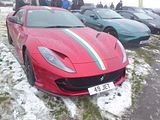
FIAT
Known for being the car which really put Italy on wheels, the Topolino was one of the smallest cars in the world at the time of its production. Launched in 1937, three versions were produced until 1955, all with only minor mechanical and cosmetic changes. It was equipped with a 569 cc four-cylinder, side-valve, water-cooled engine mounted in front of the front axle, which meant that it was a full-scale car rather than a cyclecar. The radiator was located behind the engine which made possible a lowered aerodynamic nose profile at a time when competitors had a flat, nearly vertical grille. The shape of the car’s front allowed exceptional forward visibility. The rear suspension initially used quarter-elliptic rear springs, but buyers frequently squeezed four or five people into the nominally two-seater car, and in later models the chassis was extended at the rear to allow for more robust semi-elliptic springs. With horsepower of about 13 bhp, its top speed was about 53 mph and it could achieve about 48 mpg. The target price given when the car was planned was 5,000 lire. In the event the price at launch was 9,750 lire, though the decade was one of falling prices in several part of Europe and later in the 1930s the Topolino was sold for about 8,900 lire. Despite being more expensive than first envisioned, the car was competitively priced and nearly 520,000 were sold. Nowadays the car seen here is known as the 500A, and this shares its body with the later 500 Model B, but the later car had more power, a heady 16 hp. It was made between 1948 and 1949. The Model A was offered as a 2-door coupé, 2-door cabriolet and a 2-door van, while the Model B also introduced a 3-door estate under the name 500 B Giardinetta (“estate car”). The 500 Model C was introduced in 1949 with a restyled body and the same engine as Model B, and was offered in 2-door coupé, 2-door cabriolet, 3-door estate and 2-door van versions. In 1952, the Giardinetta was renamed the Belvedere (“A turret or other raised structure offering a pleasant view of the surrounding area”, referring to its sunroof). The Model C was produced until 1955.


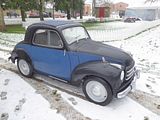
FORD
The Ford Model T was produced by the Ford Motor Company from October 1, 1908, to May 26, 1927. It is generally regarded as the first affordable automobile, which made car travel available to middle-class Americans. The relatively low price was partly the result of Ford’s efficient fabrication, including assembly line production instead of individual handcrafting. It was mainly designed by an American (Childe Harold Wills) and two Hungarian engineers (Joseph A. Galamb, Eugene Farkas). The Model T was colloquially known as the “Tin Lizzie”, “Leaping Lena” or “flivver”. The Ford Model T was named the most influential car of the 20th century in the 1999 Car of the Century competition, ahead of the BMC Mini, Citroën DS, and Volkswagen Beetle. Ford’s Model T was successful not only because it provided inexpensive transportation on a massive scale, but also because the car signified innovation for the rising middle class and became a powerful symbol of the United States’ age of modernization. With 15 million sold, it was the most sold car in history before being surpassed by the Volkswagen Beetle in 1972, and still stood eighth on the top-ten list, as of 2012.
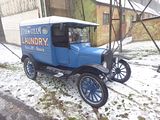
As with its predecessor, the Mark II had a successful rallying career. All models of the Mark I were carried over to the Mark II, though the Mexico gained the RS badge and had its engine changed to a 1.6 L (1,593 cc) OHC Pinto instead of the OHV. A “Sport” model was also produced using the 1.6 L Crossflow. A new model was released, the RS1800, which had a naturally aspirated 1,833 cc Cosworth BDE DOHC 4 valves per cylinder with a 32/36 DGAV Weber carburettor inline-four engine, producing 117 PS at 6000 rpm and 171 Nm (126 lb/ft) of torque at 3750 rpm. It was essentially a special created for rallying. The works rally cars were highly specialised machines. Bodyshells were heavily strengthened and characterised by the wide wheelarch extensions, and fitment of four large spotlights for night stages. The Cosworth BDE engine was replaced with 2.0 L BDG and gave up to 250 bhp with Cosworth-made aluminium block by 1979. It was complemented by a strengthened transmission, five-speed straight-cut ZF gearbox, five-linked suspension and more minor modifications. The RS1800 was re-homologated with the aluminium block on 2 April 1977 as the 1975 cc Group-4 Escort RS. This was after the FIA removed the 100-off rule from Appendix J 1976 and banned modifications approved under the previous rules for groups 2 and 4, effective from the end of 1977. The Mark II Escort continued its predecessor’s run on the RAC Rally, winning every year from 1975 to 1979 and racing in a variety of other events around the world. In the 1979 season of the World Rally Championship, Björn Waldegård took the drivers’ title, Hannu Mikkola was runner-up and Ari Vatanen finished the year in fifth place, all driving Escort RS1800s. These drivers’ successes throughout the year gave Ford the manufacturers’ title, the only time the company had achieved this until the 2006 season, when Marcus Grönholm and Mikko Hirvonen won the title for Ford in Ford Focus RS WRC 06. Vatanen won the drivers’ title in 1981, again at the wheel of an RS1800. This victory came despite the arrival on the WRC scene of the four-wheel drive Audi Quattro. Ford placed in the top three in the manufacturers’ championship for the sixth year in a row. The 2.0 L RS2000 version, with its distinctively slanted polyurethane nose, and featuring the Pinto engine from the Cortina, was announced in the UK in March 1975[and introduced in Germany in August 1975,[39] being reportedly produced in both countries. It provided a claimed 110 bhp and a top speed of 110 mph (177 km/h). For acceleration to 100 km/h (62.5 mph) a time of 8.9 seconds[39] was claimed by the manufacturers. The 2.0 L engine was also easily retro-fitted into the Mark I, along with the Ford Sierra’s five-speed gearbox, for rallying and other sports.
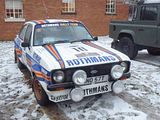
Final representative of the Cortina range was this Cortina 80, sometimes known as the Mark V. It was announced on 24 August 1979. Officially the programme was code named Teresa, although externally it was marketed as “Cortina 80”, but the Mark V tag was given to it immediately on release by the press, insiders and the general public. Largely an update to the Mark IV, it was really a step between a facelift and a rebody. The Mark V differentiated itself from the Mark IV by having revised headlights with larger turn indicators incorporated (which were now visible on the side too), a wider slatted grille said to be more aerodynamically efficient, a flattened roof, larger glass area, slimmer C-pillars with revised vent covers, larger slatted tail lights (on saloon models) and upgraded trim. Improvements were also made to the engine range, with slight improvements to both fuel economy and power output compared to the Mark IV. The 2.3 litre V6 engine was given electronic ignition and a slight boost in power output to 116 bhp, compared to the 108 bhp of the Mark IV. Ford also claimed improved corrosion protection on Mark V models; as a result, more Mark Vs have survived; however, corrosion was still quite a problem. The estate models combined the Mark IV’s bodyshell (which was initially from the 1970 Ford Taunus) with Mark V front body pressings. A pick-up (“bakkie”) version was also built in South Africa. These later received a longer bed and were then marketed as the P100. Variants included the Base, L, GL, and Ghia (all available in saloon and estate forms), together with Base and L spec 2-door sedan versions (this bodystyle was available up to Ghia V6 level on overseas markets). The replacement for the previous Mark IV S models was an S pack of optional extras which was available as an upgrade on most Mark V models from L trim level upwards. For the final model year of 1982 this consisted of front and rear bumper overriders, sports driving lamps, an S badge on the boot, tachometer, 4 spoke steering wheel, revised suspension settings, front gas shock absorbers,’Sports’ gear lever knob, sports road wheels, 185/70 SR x 13 tyres and Fishnet Recaro sports seats (optional). Various “special editions” were announced, including the Calypso and Carousel. The final production model was the Crusader special edition which was available as a 1.3 litre, 1.6 litre, and 2.0 litre saloons or 1.6 litre and 2.0 litre estates. The Crusader was a final run-out model in 1982, along with the newly introduced Sierra. It was the best-specified Cortina produced to date and 30,000 were sold, which also made it Ford’s best-selling special edition model. Another special edition model was the Cortina Huntsman, of which 150 were produced. By this time, the Cortina was starting to feel the competition from a rejuvenated Vauxhall, which with the 1981 release Cavalier J-Car, was starting to make inroads on the Cortina’s traditional fleet market, largely helped by the front wheel drive benefits of weight. Up to and including 1981, the Cortina was the best selling car in Britain. Even during its final production year, 1982, the Cortina was Britain’s second best selling car and most popular large family car. On the continent, the Taunus version was competing with more modern and practical designs like the Talbot Alpine, Volkswagen Passat, and Opel Ascona. The very last Cortina – a silver Crusader – rolled off the Dagenham production line on 22 July 1982 on the launch of the Sierra, though there were still a few leaving the forecourt as late as 1987, with one final unregistered Cortina GL leaving a Derbyshire dealership in 2005. The last Cortina built remains in the Ford Heritage Centre in Dagenham, Essex, not far from the factory where it was assembled.
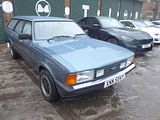

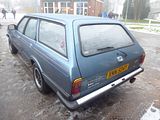
The Ford Mondeo I (first generation) is a mid-size car that was produced by Ford, beginning on 23 November 1992, with sales beginning on 22 March 1993. It is also known as the Mk I Mondeo; the 1996 facelift versions are usually designated Mk II. Available as a four-door saloon, a five-door hatchback, and a five-door estate, all models for the European market were produced at Ford’s plant in the Belgian city of Genk. Instigated in 1986 (just before its Sierra predecessor received a major facelift), the design of the car cost Ford US$6 billion. It was one of the most expensive new-car programmes ever. The Mondeo was significant as its design and marketing were shared between Ford USA in Dearborn and Ford of Europe. Its codename while under development reflected thus: CDW27 signified that it straddled the C and D size classes and was a “world car”. The head of the Mondeo project was John Oldfield, headquartered at Ford Dunton in Essex. A large proportion of the high development cost was due to the Mondeo being a completely new design, sharing very little, if anything, with the Ford Sierra. Unlike the Sierra, the Mondeo is front-wheel drive in its most common form, with a rarer four-wheel drive version available on the Mk I car only. Over-optimistically, the floor pan was designed to accept virtually any conceivable drivetrain, from a transverse inline-four engine to a longitudinal V-8.[citation needed] This resulted in a hugely intrusive and mostly disused bellhousing cover and transmission tunnel. Resultingly the front interior, especially the footwells, feels more cramped than would be expected from a vehicle of this size. The Mondeo featured new manual and automatic transmissions and sophisticated suspension design, which give it class-leading handling and ride qualities, and subframes front and rear to give it executive car refinement. The automatic transmission featured electronic control with sport and economy modes plus switchable overdrive. By 1989, Ford had confirmed that it would be launching an all-new front-wheel drive car to replace the Sierra within the next four years, although it had not yet decided whether the Sierra name would continue or be replaced, with some subsequent reports even hinting that the Cortina name could make a comeback, having been axed in 1982 when replaced by the Sierra. Several prototypes were tested that year, but the launch of the Nissan Primera in 1990 prompted Ford to make a number of major alterations to the final product, as it saw the new competitor from Nissan to be the benchmark car in this sector, having previously identified the Honda Accord as the class leader. The car was launched in the midst of turbulent times at Ford of Europe, when the division was haemorrhaging hundreds of millions of dollars,[citation needed] and had gained a reputation in the motoring press for selling products which had been designed by accountants rather than engineers. The fifth-generation Escort and third-generation Orion of 1990 was the zenith of this cost-cutting/high-price philosophy, which was by then beginning to backfire on Ford, with the cars being slated for their substandard ride and handling, though a facelift in 1992 had seen things improve a little. The Sierra had sold well, but not as well as the all-conquering Cortina before it, and in Britain, it had been overtaken in the sales charts by the newer Vauxhall Cavalier. Previously loyal customers were already turning to rival European and Japanese products, and by the time of the Mondeo’s launch, the future of Europe as a Ford manufacturing base was hanging in the balance. The new car had to be good, and it had to sell. It was unveiled to the public on 23 November 1992, although sales would not begin for another four months. At this stage, Ford confirmed that the new car would feature a completely new name and would be called the Mondeo. Safety was a high priority in the Mondeo design, with a driver’s side airbag (it was the first-ever car sold from the beginning with a driver’s airbag in all of its versions, which helped it achieve the European Car of the Year title for 1994), side-impact bars, seat belt pretensioners, and antilock braking systems (higher models) as standard features. Other features for its year included adaptive damping, self-leveling suspension (top estate models), traction control (V6 and 4WD versions), and heated front windscreen, branded Quickclear. The interiors were usually well-appointed, featuring velour trim, an arm rest with CD and tape storage, central locking (frequently remote), power windows (all round on higher models), power mirrors, illuminated entry, flat-folding rear seats, etc. Higher-specification models had leather seats, trip computers, electric sunroof, CD changer, and alloy wheels.Intended as a world car, it replaced the Ford Sierra in Europe, the Ford Telstar in a large portion of Asia and other markets, while the Ford Contour and Mercury Mystique replaced the Ford Tempo and Mercury Topaz in North America. Despite being billed as a world car, the only external items the Mondeo shared initially with the Contour were the windscreen, front windows, front mirrors and door handles. Thus, the CDW27 project turned out not to be a true world car in the sense that the original Ford Focus and newer Fords developed under the “One Ford” policy turned out to be—that being one design per segment for the world. In May 1994, a revised model line up was introduced as part of Ford launching a new 24v V6 engine version in the 24v and Ghia trim levels. Minor changes were made to the estate roof luggage rails design, the fuel flap/boot release handle surround was removed, the drivers under dash glove box lid was removed and black bumper paint details changed to be full body colour on all models, thinner 3 piece side door strips replaced the previous wide mouldings on some models. A revised MTX75 gearbox has hydraulic clutch operation and an electronic speedometer and gearbox sensor, replacing the cable operation of the earlier clutch and speedometer. The security of the cars was improved with the introduction of the PATS system with transponders fitted to each of the 3 car keys issued ( 1 red key is a master) and coded to the ECU immobiliser system. Optional infra-red remote locking is made available on most models and standard on the Ghia. The premium sound system head unit with sub woofer was dropped as an option. The Aspen replaced the “Base” model, but retained the basic features and were the only models to have manual winding front windows. The 24v model was introduced as a budget performance version, with sports seats, 15” steel wheels and trims with 205/55 tyres, red transparent centre rear panel (saloon only) but otherwise only has an LX interior and exterior specification level. The Ghia interior was updated with new fabric and wood effect dashboard and centre console fascias and front door pull inserts, replacing the grey ones of the previous Ghia model. 15” alloy wheels as seen on the Scorpio were fitted with 205/55 tyres replacing the previous 5 spoke 14” alloys with 195/60 tyres. A new Chrome surround front grille is added and a transparent red rear centre panel replaces the dark panel (saloon only), to distinguish the model from the lower spec cars. Headlamp wash is dropped from the standard specification and made an optional extra. Further changes came in September 1995. A Ghia X model is introduced featuring nearly all the options available on the previous Ghia model, including leather seats and centre armrest (but retaining fabric on the interior door cards), headlamp wash, cruise control and fuel computer. The Ghia model is downgraded with 15” steel wheels and multi-spoke wheel trims and some interior comforts are removed and only available as extras. The 24v model was dropped and a Si 24v model added. The 2.0 Si short ratio MTX75 gearbox is quietly replaced by the standard 2.0 unit as customers feedback stated it was too noisy on the motorway. New 2 piece elliptoid side mouldings were introduced in line with other Ford models, replacing the linear 3 piece versions, along with a new front wing with the side indicator located lower down inline with the new door mouldings. The mid-cycle facelift, launched in October 1996, had three of the original Mondeo’s biggest criticisms addressed: its bland styling, the poor headlight performance, the reflectors of which quickly yellowed, and the cramped rear legroom. The lowering of specification levels around that time (e.g. air conditioning and alloy wheels became optional on the UK Ghia models) may have indicated a desire by Ford to cut costs and recoup some of the considerable sums invested in the original design. These specification levels were improved again in 1998 as the Mondeo approached replacement. The facelift left only the doors, the roof, and the rear quarter panels on the estate the same as the original model. Even the extractor vents on the rear doors were replaced by a panel bearing the name Mondeo. The most notable change was the introduction of the grille and larger, wraparound lighting units. The saloon version featured some distinctive rear lights. These incorporated an additional reflector panel that extended around the top and the side of the rear wings. Unlike the iterations seen on the heavily facelifted Scorpio and Mk IV Fiesta during the previous year, this facelift was well received. The interior was also mildly revised, though the basic dashboard architecture was the same as before. Safety specification was improved, with the car gaining a full-sized driver airbag in place of the smaller ‘euro-bag’ fitted in the Mk I Mondeo. The Mk II gained a ‘flagged’ three-star rating in EuroNCAP testing, which was average for rivals of its time (the same as the Vauxhall Vectra, better than the Citroën Xantia and Peugeot 406, and worse than the Nissan Primera). The cars’ structure suffered excessive footwell intrusion in the frontal impact and a disturbing B-pillar displacement in the side test. The Zetec engine was thoroughly revised in 1998. The updated version was far more refined at high revolutions, addressing a common criticism of it. The first generation Mondeo was replaced in 2000, by the larger second generation; in the United States and Canada, the Contour/Mystique were replaced by the Fusion and fourth-generation Taurus and fourth-generation Sable.

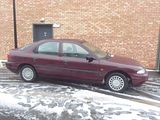


Original GT40 cars are rare indeed, but almost since their production ended, there have been many companies offering replica versions, and there was one of these here, a GTD 40, one of many different replica versions of the original Ford GT40 of the mid 1960s. As with many of these specialist manufacturers, there is quite a complex story behind the marque. G T Racing has a history dating back to 1985 for specialist vehicle design and builds, starting with high quality customer vehicles to specific chassis and body designs. Working for another quality GT40 car manufacturer, G T Developments between 1988-1994 built over 380 built cars. Forming MDA in 1994 the customer list grew for individual car builds with more demanding levels of accuracy and design improvement. MDA GT40 LTD was started in 2003 and many more cars were produced. As a result of the 2008 recession, MDA GT40 LTD closed its doors due to economic pressure. Since then the company has still supplied GT40 parts to existing customers and owners of other GT40 models and other Race car owners under the name of G T Racing.
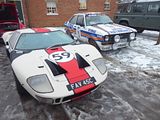
The development of the second generation GT at Ford was a very secretive operation–according to design director Chris Svensson, “a handful of twelve people, including some key engineers, had access to the [design studio]”. This secrecy was maintained inside Ford and to the press until its 2015 unveiling at the North American Auto Show. The design of the new GT began with its aerodynamics package, which was closely related to the ultimate focus of the design team of creating a successful Le Mans race car. Low downforce and aerodynamic efficiency were of primary importance in the development of the exterior of the car, and this drove designers to pursue a ‘teardrop profile’ as often seen in LMP1 cars. The powertrain of the new GT, therefore, became a secondary criterion to the external design and aerodynamic performance of the car. Although a V8 and even a V12 engine were both considered, it was ultimately decided to use Ford’s EcoBoost V6 engine due to the degrees of freedom that the compact engine gave designers. The intent behind the design was for the overall look of the second generation GT to be recognizable as a part of the GT line, which meant, for example, a cut back front nose piece, circular tail lights, and raised twin exhaust pipes. There was no explicit requirement for luxury or practicality in the design of the road car, which is the reason behind the car’s negligible cargo space and spartan interior. The interior seating position was fixed to provide additional space for the bodywork and teardrop exterior shape. Like its predecessor, the new Ford GT is only offered as a 2-door coupe with the mid-rear layout, for the purpose of improved stability by keeping the centre of gravity near the middle. The new GT’s weight distribution is 43% front and 57% rear. Unlike the first generation car, the new GT has butterfly doors that no longer include a piece integrated into the roof. The car is powered by a 3,496 cc twin-turbocharged Ford EcoBoost V6 engine rated at 647 bhp (656 PS) and 550 lb/ft (746 Nm) of torque. For the 2020 model year and beyond, this power output rating was increased to 660 bhp (669 PS). The engine shares many components with the F-150’s 3.5 L V6 engine including the cylinder heads, block and dual fuel system. Notable differences include larger turbochargers, an aluminium intake manifold, a custom dry sump lubrication system, unique camshafts and higher strength rotating and timing drive components. The engine is paired to a Getrag 7DCL750 7-speed dual-clutch transmission. Underpinning the new GT is a carbon fiber monocoque bolted to aluminium front and rear subframes covered in carbon fibre body panels. The windshield of the vehicle is made of Gorilla Glass manufactured by Corning, which is also used for manufacturing smartphone screens. The Gorilla Glass is used to reduce the weight of the vehicle by allowing for a thinner windscreen with the same strength as a normal glass windscreen. The GT employs a four-stage external dry sump oil pump and has an oil capacity of 15.3 US quarts (14.5 L). The new GT uses a pushrod suspension system, which move the primary components of the suspension inboard and provide space for the large aerodynamic elements in the bodywork of the car. The suspension is hydraulically adjustable, and the ride height can drop from 4.7 inches (120 mm) in comfort mode to 2.8 inches (70 mm) in Track or Vmax modes. These drive modes also dynamically adjust the dampening component of the suspension, which consists of two springs stacked in series. In Track and Vmax modes, one of these springs is completely locked to increase the overall spring rate of the system. The car also has a front-axle lifting system for clearing road obstacles and steep entry angles. The new GT is the second Ford vehicle to feature optional carbon fibre wheels, after the Shelby Mustang GT350R. In addition to improved strength and rigidity, these wheels weigh 2 lb (1 kg) less than their forged aluminium counterparts. The wheels have a diameter of 20 inches at the front and rear and come equipped with Michelin Pilot Sport Cup 2 tyres with codes of 245/35 R 20 for the front and 325/30 R 20 for the rear. The brakes are ventilated carbon-ceramic discs made by Brembo, with six-piston calipers at the front and four-piston calipers at the rear. The most prominent exterior features of the new GT are the open airflow tunnels built into the rear fenders of the car, referred to as the ‘flying buttresses’. These large aerodynamic elements, enabled by the compact V6 engine and pushrod suspension design, channel air around the teardrop-shaped cockpit over the rear spoiler for increased downforce. The front end of the GT features a GT40-inspired cutaway nose and vents in the hood that pass oncoming air over the top of the car. The rear features a large diffuser and hollow circular tail lights that expel air taken in by vents built into the flying buttresses. The active rear spoiler of the GT can adjust and adapt to different driving conditions and modes depending on how much downforce is needed. In Track mode, a gurney flap will extend from the trailing edge of the wing to further increase downforce, and the wing will flip vertical to help stop the car under heavy braking. The new GT has a claimed top speed of 216 mph (348 km/h), and has a power to weight ratio of 0.43 hp per kilogram. In steady-state cornering on a skidpad, the GT can achieve 1.11 g of lateral acceleration, and the car is capable of braking from 70 mph (113 km/h) to a stop in 145 ft (44 m). Production began in December 2016 and is scheduled to continue through 2022, with a planned production rate of one car per day at Multimatic’s low-volume assembly facility in Markham, Ontario, Canada. Approximately two hundred 2017 and 2018 year production cars were recalled to fix potential hydraulic leaking and fire risk. The cars produced for the 2017 and 2018 model years are allocated through Ford Performance’s vehicle allocation process. The cars produced for the 2019 model year were primarily for buyers unsuccessful in the initial selection process, and the cars produced for the 2020 model year are for new customers.
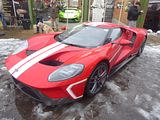
Drawing on inspiration from the mid-engined Ford Mustang I concept vehicle, Lee Iacocca ordered development of a new “small car” to vice-president of design at Ford, Eugene Bordinat. Bordinat tasked Ford’s three design studios (Ford, Lincoln-Mercury, and Advanced Design) to create proposals for the new vehicle. The design teams had been given five goals for the design of the Mustang: It would seat four, have bucket seats and a floor mounted shifter, weigh no more than 2,500 pounds (1,100 kg) and be no more than 180 inches (4,572 mm) in length, sell for less than $2,500, and have multiple power, comfort, and luxury options. The Lincoln–Mercury design studio ultimately produced the winning design in the intramural contest, under Project Design Chief Joe Oros and his team of L. David Ash, Gale Halderman, and John Foster. Development of the Mustang was completed in a record 18 months from September 1962 to March 1964. and Iacocca himself championed the project as Ford Division general manager. The styling is often credited to one person, and that is not accurate, as this was very much a team effort, it has been reported by those involved. To decrease developmental costs, the Mustang used chassis, suspension, and drivetrain components derived from the Ford Falcon and Fairlane. It used a unitised platform-type frame from the 1964 Falcon, and welded box-section side rails, including welded crossmembers. Although hardtop Mustangs accounted for the highest sales, durability problems with the new frame led to the engineering of a convertible first, which ensured adequate stiffness. Overall length of the Mustang and Falcon was identical, although the Mustang’s wheelbase was slightly shorter. With an overall width of 68.2 in (1,732 mm), it was 2.4 in (61 mm) narrower, yet the wheel track was nearly identical. Shipping weight, approximately 2,570 lb (1,166 kg) with the straight six-cylinder engine, was also similar to the Falcon. A fully equipped V8 model weighed approximately 3,000 lb (1,361 kg). Although most of the mechanical parts were from the Falcon, the Mustang’s body was completely different; sporting a shorter wheelbase, wider track, lower seating position and lower overall height. An industry first, the “torque box” was an innovative structural system that greatly stiffened the Mustang’s construction and helped contribute to better handling. The car was launched in 17th April 1964, as a hardtop and a convertible, with the fastback version following in August. It was an instant sensation, with demand massively exceeding supply. Since it was introduced four months before the normal start of the 1965 production year and manufactured alongside 1964 Ford Falcons and 1964 Mercury Comets, the earliest Mustangs are widely referred to as the 1964½ model. Nevertheless, all “1964½” cars were given 1965 U.S. standard VINs at the time of production, and – with limited exception to the earliest of promotional materials – were marketed by Ford as 1965 models. The low-end model hardtop used a “U-code” 170 cu in (2.8 litre) straight-6 engine borrowed from the Falcon, as well as a three-speed manual transmission and retailed for US$2,368. Standard equipment for the early 1965 Mustangs included black front seat belts, a glove box light, and a padded dash board. Production began in March 1964 and official introduction following on April 17 at the 1964 World’s Fair. V8 models got a badge on the front fender that spelled out the engine’s cubic inch displacement (“260” or “289”) over a wide “V.” This emblem was identical to the one on the 1964 Fairlane. Several changes to the Mustang occurred at the start of the “normal” 1965 model year in August 1964, about four months after its introduction. These cars are known as “late 65’s”. The engine lineup was changed, with a 200 cu in (3.3 litre) “T-code” engine that produced 120 hp. Production of the Fairlane’s “F-code” 260 cu in (4.3 litre) engine ceased when the 1964 model year ended. It was replaced with a new 200 hp “C-code” 289 cu in (4.7 litre) engine with a two-barrel carburettor as the base V8. An “A-code” 225 hp four-barrel carburettor version was next in line, followed by the unchanged “Hi-Po” “K-code” 271 hp 289. The DC electrical generator was replaced by a new AC alternator on all Fords (a way to distinguish a 1964 from a 1965 is to see if the alternator light on the dash says “GEN” or “ALT”). The Mustang GT version was introduced as the “GT Equipment Package” and included a V8 engine (most often the 225 hp 289), grille-mounted fog lamps, rocker panel stripes, and disc brakes. In the interior the GT option added a different instrument panel that included a speedometer, fuel gauge, temp. gauge, oil pressure gauge and ammeter in five round dials (the gauges were not marked with numbers, however.) A four-barrel carburettor engine was now available with any body style. Additionally, reverse lights were an option added to the car from August 1964 production. In 1965, the Shelby Mustang was born, it was available only in newly introduced fastback body version with its swept-back rear glass and distinctive ventilation louvres. The standard interior features of the 1965 Mustang included adjustable driver and passenger bucket seats, an AM radio, and a floor mounted shifter in a variety of colour options. Ford added additional interior options during the 1965 model year. The Interior Decor Group was popularly known as “Pony Interior” due to the addition of embossed running ponies on the seat fronts, and also included integral armrests, woodgrain appliqué accents, and a round gauge cluster that would replace the standard Falcon instrumentation. Also available were sun visors, a (mechanical) remote-operated mirror, a floor console, and a bench seat. Ford later offered an under-dash air-conditioning unit, and discontinued the vinyl with cloth insert seat option, offered only in early 1965 models. One option designed strictly for fun was the Rally-Pac. Introduced in 1963 after Ford’s success at that year’s Monte Carlo Rally and available on other Ford and Mercury compacts and intermediates, the Rally-Pac was a combination clock and tachometer mounted to the steering column. It was available as a factory ordered item for US$69.30. Installed by a dealer, the Rally-Pac cost US$75.95.A 14″ rim option was available for Rally-pac and GT350R vehicles widening front and rear track to 57.5″. Reproductions are presently available from any number of Mustang restoration parts sources. A compass, rear seat belts, A/C, and back-up lights were also optional. The 1966 Mustang debuted with moderate trim changes including a new grille, side ornamentation, wheel covers and filler cap. Ford’s new C-4 “cruise-o-matic” three-speed auto transmission became available for the 225 hp V8. The 289 “HiPo” K-code engine was also offered with a c4 transmission, but it had stronger internals and can be identified by the outer casing of the servo which is marked with a ‘C’. The long duration solid-lifter camshaft that allowed the high revving 289 to make the horsepower it was known for, was not friendly for a low stall speed automatic torque converter. The “HiPo” could be spotted very easily by the 1-inch-thick vibration damper, (as compared to 1/2 inch on the 225-hp version) and the absence of a vacuum advance unit on the dual point distributor. With the valve covers off, there is a large letter “K” stamped between the valve springs, along with screw in studs (vs. a pressed in stud for other 289s) for the adjustable rocker arms. A large number of new paint and interior color options, an AM/eight-track sound system, and one of the first AM/FM mono automobile radios were also offered. It also removed the Falcon instrument cluster; the previously optional features, including the round gauges and padded sun visors, became standard equipment. The Mustang would be the best-selling convertible in 1966, with 72,119 sold, beating the number two Impala by almost 2:1. The 1965 and 1966 Mustangs are differentiated by variations in the exterior, despite similar design. These variations include the emblem on the quarter-panels behind the doors. From August 1964 production, the emblem was a single vertical piece of chrome, while for 1966 models the emblem was smaller in height and had three horizontal bars extending from the design, resembling an “E”. The front intake grilles and ornaments were also different. The 1965 front grille used a “honeycomb” pattern, while the 1966 version was a “slotted” style. While both model years used the “Horse and Corral” emblem on the grille, the 1965 had four bars extending from each side of the corral, while on the 1966, these bars were removed. The 1966 model year saw introduction of ‘High Country Special’ limited edition, 333 of them were sold in Colorado, Wyoming, and Nebraska. When Ford wanted to introduce the Mustang in Germany, they discovered that Krupp company had already registered the name for a truck. The German company offered to sell the rights for US$10,000. Ford refused and removed Mustang badges from exported units, instead naming the cars as T-5 (a pre-production Mustang project name) for the German market until 1979 when Krupp copyrights expired. In 1965, Harry Ferguson Research purchased 3 Mustang notchbacks and converted them to 4×4 in an attempt to sell potential clients on their FF AWD system. A similar system was used in the Ferguson P99 Formula One car, and would go on to be featured in the Jensen FF, widely considered the first AWD passenger car. As in the Jensen FF, the AWD Mustangs also featured an ABS braking system, long before such a feature was commonplace. Ford Australia organised the importation and conversion of 1966 Mustang to right-hand-drive for the Australian market. This coincided with the launch of new XR Falcon for 1966, which was marketed as “Mustang-bred Falcon”. To set the official conversion apart from the cottage industry, the RHD Mustangs were called “Ford Australia Delivered Mustang” and had compliance plates similar to XR Falcon. About 209 were imported to Australia with 48 units were converted in 1965 while the further 161 were done in 1966. The 1967 model year Mustang was the first redesign of the original model. Ford’s designers began drawing up a larger version even as the original was achieving sales success, and while “Iacocca later complained about the Mustang’s growth, he did oversee the redesign for 1967 .” The major mechanical feature was to allow the installation of a big-block V8 engine. The overall size, interior and cargo space were increased. Exterior trim changes included concave taillights, side scoop (1967 model) and chrome (1968 model) side ornamentation, square rear-view mirrors, and usual yearly wheel and gas cap changes. The high-performance 289 option was placed behind the newer 335 hp 6.4 litre FE engine from the Ford Thunderbird, which was equipped with a four-barrel carburettor. During the mid-1968 model year, a drag racer for the street could be ordered with the optional 428 cu in (7.0 litre) Cobra Jet engine which was officially rated at 335 hp. All of these Mustangs were issued R codes on their VIN’s. The 1967 Deluxe Interior was revised, discontinuing the embossed running horse motif on the seat backs (the source for the “pony interior” nickname) in favor of a new deluxe interior package, which included special colour options, brushed aluminium (from August 1966 production) or woodgrain dash trim, seat buttons, and special door panels. The hardtop also included upholstered quarter trim panels, a carryover from the 1965-66 deluxe interior. The 1967 hardtop also had the chrome quarter trim caps, carried over from 1965-66, but these were painted to match the interior in 1968 models. The 1967 deluxe interior included stainless steel-trimmed seat back shells, similar to those in the Thunderbird. These were dropped at the end of the 1967 model year, and were not included in the woodgrain-trimmed 1968 interior. The deluxe steering wheel, which had been included in the deluxe interior for the 1965-66, became optional, and could also be ordered with the standard interior. The 1968 models that were produced from January 1968 were also the first model year to incorporate three-point lap and shoulder belts (which had previously been optional, in 1967-68 models) as opposed to the standard lap belts. The air-conditioning option was fully integrated into the dash, the speakers and stereo were upgraded, and unique center and overhead consoles were options. The fastback model offered the option of a rear fold-down seat, and the convertible was available with folding glass windows. Gone was the Rally-Pac, since the new instrument cluster had provisions for an optional tachometer and clock. Its size and shape also precluded the installation of the accessory atop the steering column. The convenience group with four warning lights for low fuel, seat belt reminder, parking brake not released, and door ajar were added to the instrument panel, or, if one ordered the optional console and A/C, the lights were mounted on the console. Changes for the 1968 model increased safety with a two-spoke energy-absorbing steering wheel, along with newly introduced shoulder belts. Other changes included front and rear side markers, “FORD” lettering removed from hood, rearview mirror moved from frame to windscreen, a 302 cu in (4.9 litre) V8 engine was now available, and C-Stripe graphics were added. The California Special Mustang, or GT/CS, was visually based on the Shelby model and was only sold in Western states. Its sister, the ‘High Country Special’, was sold in Denver, Colorado. While the GT/CS was only available as a coupe, the ‘High Country Special’ model was available in fastback and convertible configurations during the 1966 and 1967 model years, and as a coupe for 1968. The 1968 Ford Mustang GT Fastback reached iconic status after it was featured in the 1968 film Bullitt, starring Steve McQueen. In the film, McQueen drove a modified 1968 Mustang GT 2+2 Fastback chasing a Dodge Charger through the streets of San Francisco. There were further annual updates until the model’s replacement in 1973, but with each the car got steadily bigger and less overtly sporty. Sales reduced, too, suggesting that Ford were losing their way. Mustang II did not fix that, of course, but gradually, the legendary nameplate has returned to delivering the same sort of promise as those early and much loved cars were able to do.
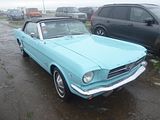
A rare sighting in the UK, as it is not sold here, is this Bronco Sport, a mid-sized SUV that shares much o the underpinnings of the Escape/Kuga.
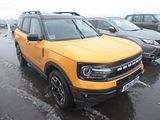
GROUP C DISPLAY
One of the announced attractions of the event was a special display of Group C Cars. There were in the end only three of them here – two being well, known, the Jaguar and Porsche 956 and the other rather less so, the Nissan.

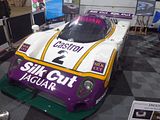
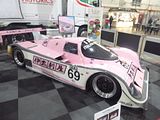
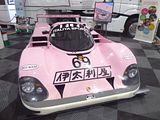
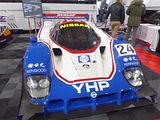
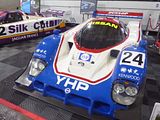
HONDA
It is now more than thirty years since Honda stunned the world with a true Ferrari-beater. Its origins go back all the way to 1984, when Honda commissioned the Italian car designer Pininfarina to design the HP-X (Honda Pininfarina eXperimental), which had a mid-mounted C20A 2.0 L V6 configuration. After Honda committed to the project, management informed the engineers that the new car would have to be as fast as anything coming from Italy and Germany .The HP-X concept car evolved into a prototype called the NS-X, which stood for “New”, “Sportscar” and “eXperimental”. The NS-X prototype and eventual production model were designed by a team led by Chief Designer Ken Okuyama and Executive Chief Engineer Shigeru Uehara, who subsequently were placed in charge of the S2000 project. The original performance target for the NS-X was the Ferrari 328, and later the 348 as the design neared completion. Honda intended the NS-X to meet or exceed the performance of the Ferrari, while offering targeted reliability and a lower price point. For this reason, the 2.0L V6 of the HP-X was abandoned and replaced with a more powerful 3.0L VTEC V6 engine. The bodywork design had been specifically researched by Okuyama and Uehara after studying the 360 degree visibility inside an F-16 fighter jet cockpit. Thematically the F-16 came into play in the exterior design as well as establishing the conceptual goals of the NSX. In the F-16 and other high performance craft such as unlimited hydroplanes, single seat race cars etc. the cockpit is located far forward on the body and in front of the power plant. This “cab-forward” layout was chosen early in the NSX’s design to optimise visibility while the long tail design enhanced high speed directional stability. The NS-X was designed to showcase several Honda automotive technologies, many derived from its F1 motor-sports program. The NS-X was the first production car to feature an all-aluminium monocoque body, incorporating a revolutionary extruded aluminium alloy frame, and suspension. The use of aluminium in the body alone saved nearly 200 kg in weight over the steel equivalent, while the aluminium suspension saved an additional 20 kg; a suspension compliance pivot helped maintain wheel alignment changes at a near zero value. Other notable features included an independent, 4-channel anti-lock brake system; titanium connecting rods in the engine to permit reliable high-rpm operation; an electric power steering system; Honda’s proprietary VTEC variable valve timing system (a first in the US) and, in 1995, the first electronic throttle control fitted to a Honda. With a robust motorsports division, Honda had significant development resources at its disposal and made extensive use of them. Respected Japanese Formula One driver Satoru Nakajima, for example, was involved with Honda in the NS-X’s early on track development at Suzuka race circuit, where he performed many endurance distance duties related to chassis tuning. Brazilian Formula One World Champion Ayrton Senna, for whom Honda had powered all three of his world championship-winning Formula One race cars before his death in 1994, was considered Honda’s main innovator in convincing the company to stiffen the NSX chassis further after initially testing the car at Honda’s Suzuka GP circuit in Japan. Senna further helped refine the original NSX’s suspension tuning and handling spending a whole day test driving prototypes and reporting his findings to Honda engineers after each of the day’s five testing sessions. Senna also tested the NSX at the Nurburgring and other tracks. The suspension development program was far-ranging and took place at the Tochigi Proving Grounds, the Suzuka circuit, the 179-turn Nurburgring Course in Germany, HPCC, and Hondas newest test track in Takasu, Hokkaido. Honda automobile dealer Bobby Rahal (two-time CART PPG Cup and 1986 Indianapolis 500 champion) also participated in the car’s development. The production car made its first public appearances as the NS-X at the Chicago Auto Show in February 1989, and at the Tokyo Motor Show in October 1989 to positive reviews. Honda revised the vehicle’s name from NS-X to NSX before final production and sale. The NSX went on sale in Japan in 1990 at Honda Verno dealership sales channels, supplanting the Honda Prelude as the flagship model. The NSX was marketed under Honda’s flagship Acura luxury brand starting in 1991 in North America and Hong Kong. It sent shockwaves through the industry, as the car was considerably better than the Ferrari 348 in just about every respect. But that was not the end of the story, of course. While the NSX always was intended to be a world-class sports car, engineers had made some compromises in order to strike a suitable balance between raw performance and daily driveability. For those NSX customers seeking a no-compromise racing experience, Honda decided in 1992 to produce a version of the NSX specifically modified for superior on-track performance at the expense of customary creature comforts. Thus, the NSX Type R (or NSX-R) was born. Honda chose to use its moniker of Type R to designate the NSX-R’s race-oriented design. In 1995, a Targa model was released, the NSX-T, which allowed customers to experience fresh air thanks to two removable targa top panels. The original NSX body design received only minor modifications from Honda in the new millennium when in 2002 the original pop-up headlamps were replaced with fixed xenon HID headlamp units. There was just one of these much admired cars here.
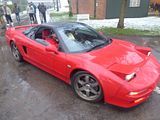

Based on the Honda J-VX concept car unveiled at the 1997 Tokyo Motor Show, the Insight was introduced in Japan in November 1999 as the first production vehicle to feature Honda’s Integrated Motor Assist system. In the following month, December 1999, Insight became the first hybrid available in North America, followed seven months later by the Toyota Prius. The Insight featured optimised aerodynamics and a lightweight aluminium structure to maximize fuel efficiency and minimize emissions. In addition to its hybrid drive system, the Insight was small, light and streamlined — with a drag-coefficient of 0.25. The petrol engine is a 67 hp 1.0 litre, ECA series 3-cylinder unit providing lean burn operation with an air-to-fuel ratio that can reach 25.8 to 1. The engine utilises lightweight aluminium, magnesium, and plastic to minimize weight. The electrical motor assist adds another 10 kW (13 hp) and a maximum of 36 pound-feet (49 Nm) of torque when called on, with the aim to boost performance to the level of a typical 1.5 L petrol engine. It also acts as a generator during deceleration and braking to recharge the vehicle’s batteries, and as the Insight’s starter motor. (This improves fuel efficiency and extends the lifetime and fade resistance of the brakes, without adding unsprung weight). When the car is not moving, for example at a stop light, the engine shuts off. Power steering is electric, reducing accessory drag. The Insight uses the first generation of Honda’s Integrated Motor Assist (IMA) hybrid technology. (The next generation, used in the Honda Civic Hybrid, is much more space-efficient.) The Insight’s electric assist is an ultrathin 60 mm (about 2.4 inches) brushless 10-kW electric motor located on the crankshaft. Located behind the seats are a series of commercial grade “D” sized NiMH batteries wired to provide a nominal 144 V DC. During heavy acceleration, the NiMH batteries drive the electric motor, providing additional power; during deceleration, the motor acts as a generator and recharges the batteries using a process called regenerative braking. A computer control module regulates how much power comes from the internal combustion engine, and how much from the electric motor; in the CVT variant, it also finds the optimal gear ratio. The digital displays on the dashboard display fuel consumption instantaneously. On the manual transmission up and down arrows suggest when to shift gears. Dashboard gauges monitor the current battery status, instantaneous fuel consumption, and mode of the electric motor — standby, engine assist or charging the batteries. High pressure, low rolling resistance tires and the use of low viscosity “0W-20” synthetic oil enhance fuel economy. The original Insight had a conventional manual transmission. Starting with the 2001 model, a CVT variant of the Insight was available; the CVT is similar to that used in the Honda Civic Hybrid and the Honda Logo. A traditional transmission shifts between a fixed set of engine-to-wheel ratios; however, a CVT allows for an infinite set of ratios between its lowest gear and its highest. A feature shared by the two hybrids (and now appearing in others) is the ability to automatically turn off the engine when the vehicle is at a stop (and restart it upon movement). Since it is more powerful than most starters of conventional cars, the Insight’s electric motor can start the engine nearly instantaneously. The Integrated Motor Assist is run by an “Intelligent Power Unit (IPU)”, a desktop computer-sized box. The Intelligent Power Unit, the Power control Unit, the Electronic Control Unit, the vehicle’s batteries, dc-to-dc converter and a high-voltage inverter are all located under the cargo floor of the vehicle, behind the seats. Honda increased the vehicle’s fuel efficiency using aluminium and plastic extensively to reduce the vehicle’s weight. The basic structure is a new, lightweight aluminium monocoque, reinforced in key areas with aluminium extrusions joined at cast aluminium lugs. Stamped aluminium panels are welded onto this structure to form an extremely light and rigid platform for the drivetrain and suspension. The Insight has a body weight less than half that of the contemporary Civic 3-door, with increased torsional rigidity by 38% and bending rigidity by 13%. Honda built the Insight with aluminum front brake calipers and rear brake drums, and with a largely aluminium suspension, in addition to standard aluminium wheels; reducing the ratio of un-sprung to sprung weight as well as the total weight. The fuel tank is plastic; the engine mounts were aluminium; and the exhaust is a small, thin wall pipe. Its compact spare is also aluminium. The Insight weighed 1,847 lb (838 kg) in manual transmission form without air conditioning, 1,878 lb (852 kg) with manual transmission and air conditioning, or 1,964 lb (891 kg) with CVT and air conditioning. Insight has a coefficient of drag of 0.25e. The absence of a rear seat allows the body to taper just behind the driver and the rear track is 110 mm narrower than the front track. The CVT-equipped Insight is classified as a super-low emissions vehicle. The Insight features low emissions: the California Air Resources Board gave the 5-speed model a ULEV rating, and the CVT model earned a SULEV rating – the 5-speed model’s lean-burn ability traded increased efficiency for slightly higher NOx emissions. The Insight was assembled at the Honda factory in Suzuka, Japan, where the Honda NSX and the Honda S2000 were also assembled. At the 2003 Tokyo Motor Show, Honda introduced the concept car Honda IMAS, an extremely fuel-efficient and lightweight hybrid car made of aluminium and carbon fibre, which was perceived by most observers to be the future direction where the Insight was heading. With its aluminium body and frame, the Insight was an expensive car to produce and was never designed for high-volume sales. Instead, it was designed to be a real world test car for hybrid technology and a gauge to new consumer driving habits. With an aerodynamic fuel-saving shape similar to the Audi A2, and some unconventional body colors it was a bit more than mainstream car buyers could handle, preferring more conservative styles. Production halted announced in May 2006, with plans announced to replace Insight with a new hybrid car, smaller than the eighth generation Civic, but not earlier than in 2009. Ahead of this announcement, Honda stopped selling Insight in the UK, for example, as early as December 2005. To fill the market niche void, in 2002 Honda rolled out a hybrid version of the Honda Civic – Honda Civic Hybrid, followed by Toyota’s redesign of the Prius in 2003 as a 2004 model. Total global cumulative sales for the first generation Insight were 17,020 units. Honda had originally planned to sell 6,500 Insights each year of production.
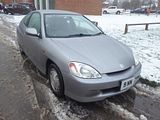
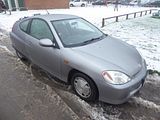
The fourth generation Integra was introduced in Japan on April 13, 2001 and produced from July 2001 to July 2006. For North America (United States and Canada), it was introduced as the Acura RSX in accordance with Acura’s new alphabetical naming scheme. It also had an entirely new engine, the K-series. The Integra came in two models in the United States, the RSX and the RSX Type-S boasting the K20A2 engine from 2002 to 2004, while the 2005 and 2006 RSX-S came with a K20Z1. The RSX was sold as a Honda Integra in Japan and Australia, markets where Acura did not exist. In March 2006, Honda announced that the Integra would be discontinued in June after its final 300 cars were sold, due to the shrinkage of the coupe market. The reaction of the consumers towards the discontinuation, however, forced Honda to extend production until July 2006 and produce 150 more Integras. The Acura RSX was discontinued as well, as the RSX did not fit within the confines of Acura’s re-structured market strategy. This left the Acura TSX as Acura’s entry-level vehicle. Also, the introduction of the similarly powerful and less expensive 2006 model-year Honda Civic Si was there to fill in the gap left by the RSX. The DC5 Type R (Japanese market only) comes standard with a K20A 220 hp 2.0 litre DOHC i-VTEC four-cylinder engine. The “i” in i-VTEC stands for intelligent VTEC, which employs VTC (Variable Timing Control) to advance or retard the intake cam timing within a 50 degree range. The Integra Type R comes equipped with Recaro seats, four-piston Brembo front brakes, a close ratio six-speed manual transmission, a limited-slip differential, variable back-pressure exhaust system, and a stiffer suspension..

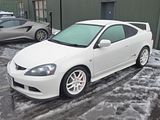
ISUZU
The Isuzu VehiCROSS (UGS250) is a compact SUV from Isuzu. Produced from 1997 through 2001 (Japanese market 1997–1999; US market 1999–2001), it shares many of its components with the Trooper, including both its 3.2 L and 3.5 L V6 engine that produces 215 bhp at 5400 rpm and 230 lb/ft (312 Nm) of torque at 3000 rpm. The vehicle also features the Torque on Demand (TOD) 4-wheel-drive system produced by BorgWarner. It is a small, sporty 2-door crossover vehicle with aggressive external styling, including short overhangs, an aggressive forward stance, titanium “teeth” in the grille, a black hood-insert, and black plastic cladding over the entire lower half of the vehicle. The US VehiCROSS came equipped with 16″ polished wheels in 1999 and 18″ chrome wheels during the remainder of production. The Japanese version came equipped with 16″ alloys with chrome centre caps. The VehiCROSS combined a computer-controlled AWD system for on-road driving and a low-gear 4WD system for off-road driving. The Japanese version offered a 2WD non TOD or 4WD TOD option. The US-only constant 4WD TOD, with 12 independent sensors for detecting wheel spin and capable of redirecting power to the wheels with the most traction, gives the VehiCROSS a high level of traction on wet and icy roads. It also has a high level of performance for its height. While possessing on-road nimbleness, its body-on-frame truck construction, suspension and 4WD gearing make it very capable off-road. It appears that Isuzu revisited a limited production approach they used in the mid-1960s with the dramatic 117 Coupe and the later Isuzu Piazza to produce an exclusive two door vehicle. Japanese sales were limited by the fact that the exterior width dimensions were not in compliance with Japanese Government dimension regulations, and the engine displacement obligated Japanese drivers for higher levels of annual road tax. The vehicle had a base price of $28,900. The VehiCROSS was originally unveiled as a concept vehicle at the 1993 Tokyo International Auto Show. Its ultimate Japanese production release in 1997 was notable in that the production vehicle arrived with very few design changes and in a very short time. This feat was accomplished through the use of inexpensive ceramic body-stamping dies and the reuse of readily-available Isuzu parts. The truck was intended to showcase Isuzu’s off-road technology, and is one of the few vehicles to ship with monotube shocks with external heat-expansion chambers, a technology normally reserved for off-road motorcycle racing. Motor Trend featured the VehiCROSS on its May 1999 cover, and included it in its “Top 10 Sport Utilities” for Most Unique Styling. Four Wheeler featured the VehiCROSS as the “First Runner Up” for Four Wheeler of the Year in 2000 behind the Tahoe Z71; when pitted against: Chevrolet Tahoe Z71, GMC Yukon, Nissan Xterra, Ford Excursion and Mitsubishi Montero Sport. The VehiCROSS scored highest of all 6 Mechanically, for Trail Performance and Highway Performance. Both a concept four-door version (VX-4) and a roadster (VX-O2) were shown at the 2000 Los Angeles International Auto Show, but neither reached production. Both of these concepts were donated to the Petersen Automotive Museum in Los Angeles in late 2008. Both were later returned to Isuzu when the Petersen Museum renovated. Isuzu had to destroy the vehicles for legal reasons in 2017. Sales were intentionally limited, with only 5,958 vehicles being produced between 1997 and 2001; 1,805 were produced for the domestic Japanese market and the remaining 4,153 sold in the United States


JAGUAR
The Series 1 E Type was introduced, initially for export only, in March 1961. The domestic market launch came four months later in July 1961. The cars at this time used the triple SU carburetted 3.8-litre six-cylinder Jaguar XK6 engine from the XK150S. Earlier built cars utilised external bonnet latches which required a tool to open and had a flat floor design. These cars are rare and more valuable. After that, the floors were dished to provide more leg room and the twin bonnet latches moved to inside the car. The 3.8-litre engine was increased to 4,235 cc in October 1964. The 4.2-litre engine produced the same power as the 3.8-litre (265 bhp) and same top speed (150 mph), but increased torque approximately 10% from 240 to 283 lb/ft. Acceleration remained pretty much the same and 0 to 60 mph times were around 6.4 seconds for both engines, but maximum power was now reached at 5,400 rpm instead of 5,500 rpm on the 3.8-litre. That all meant better throttle response for drivers that did not want to shift down gears. The 4.2-litre’s block was completely redesigned, made longer to accommodate 5 mm (0.20 in) larger bores, and the crankshaft modified to use newer bearings. Other engine upgrades included a new alternator/generator and an electric cooling fan for the radiator. Autocar road tested a UK spec E-Type 4.2 fixed head coupé in May 1965. The maximum speed was 153 mph, the 0–60 mph time was 7.6 seconds and the 1⁄4 mile from a standing start took 15.1 seconds. They summarised it as “In its 4.2 guise the E-Type is a fast car (the fastest we have ever tested) and offers just about the easiest way to travel quickly by road.”. Motor magazine road tested a UK spec E-Type 4.2 fixed head coupé in Oct 1964. The maximum speed was 150 mph, the 0–60 mph time was 7 seconds and the 1⁄4 mile time was 14.9 seconds. They summarised it as “The new 4.2 supersedes the early 3.8 as the fastest car Motor has tested. The absurd ease which 100 mph can be exceeded in a 1⁄4 mile never failed to astonish. 3,000 miles (4,828 km) of testing confirms that this is still one of the world’s outstanding cars”. All E-Types featured independent coil spring rear suspension designed and developed by R J Knight with torsion bar front ends, and four wheel disc brakes, in-board at the rear, all were power-assisted. The Coventry engineers spared nothing with regards to high automotive technology in braking. Like several British car builders of the middle and late 1950s, the four-wheel disc brakes were also used in that era by Austin-Healey, MG,putting the British far ahead of Ferrari, Maserati, Alfa Romeo, Porsche, and Mercedes-Benz. Even Lanchester tried an abortive attempt to use copper disc brakes in 1902. Jaguar was one of the first vehicle manufacturers to equip production cars with 4 wheel disc brakes as standard from the XK150 in 1958. The Series 1 (except for late 1967 models) can be recognised by glass-covered headlights (up to 1967), small “mouth” opening at the front, signal lights and tail-lights above bumpers and exhaust tips under the number plate in the rear. 3.8-litre cars have leather-upholstered bucket seats, an aluminium-trimmed centre instrument panel and console (changed to vinyl and leather in 1963), and a Moss four-speed gearbox that lacks synchromesh for first gear (“Moss box”) on all except very last cars. 4.2-litre cars have more comfortable seats, improved brakes and electrical systems, and, obviously, an all-synchromesh Jaguar designed four-speed gearbox. 4.2-litre cars also have a badge on the boot proclaiming “Jaguar 4.2 Litre E-Type” (3.8 cars have a simple “Jaguar” badge). Optional extras included chrome spoked wheels and a detachable hard top for the OTS. When leaving the factory the car was originally fitted with Dunlop 6.40 × 15-inch RS5 tyres on 15 × 5K wire wheels (with the rear fitting 15 × 5K½ wheels supplied with 6.50 X15 Dunlop Racing R5 tyres in mind of competition). Later Series One cars were fitted with Dunlop 185 – 15 SP41 or 185 VR 15 Pirelli Cinturato as radial ply tyres. A 2+2 version of the fastback coupé was added in 1966. The 2+2 offered the option of an automatic transmission. The body is 9 in (229 mm) longer and the roof angles are different. The roadster and the non 2+2 FHC (Fixed Head Coupé) remained as two-seaters. Less widely known, right at the end of Series 1 production, but prior to the transitional “Series 1½” referred to below, a small number of Series 1 cars were produced with open headlights. These Series 1 cars had their headlights modified by removing the covers and altering the scoops they sit in, but these Series 1 headlights differ in several respects from those later used in the Series 1½ (or 1.5), the main being they are shorter at 143 mm from the Series 1½ at 160 mm. Production dates on these machines vary but in right-hand drive form production has been verified as late as July 1968. They are not “rare” in the sense of the build of the twelve lightweights, but they are certainly uncommon; they were not produced until January 1967 and given the foregoing information that they were produced as late as July 1968, it appears that there must have been an overlap with the Series 1.5 production, which began in August 1967 as model year 1968 models. These calendar year/model year Series 1 E-Types are identical to other 4.2-litre Series 1 examples in every respect except for the open headlights; all other component areas, including the exterior, the interior, and the engine compartment are the same, with the same three SU carburettors, polished aluminium cam covers, center dash toggle switches, etc. Following the Series 1 there was a transitional series of cars built in 1967–68 as model year 1968 cars, unofficially called “Series 1½.” Due to American pressure the new features were not just open headlights, but also different switches (black rocker switches as opposed to the Series 1 toggle switches), de-tuning for emissions (using two Zenith-Stromberg carburettors instead of the original three SUs) for US models, ribbed cam covers painted black except for the top brushed aluminium ribbing, bonnet frames on the OTS that have two bows, and other changes. Series 1½ cars also have twin cooling fans and adjustable seat backs. The biggest change between 1961–1967 Series 1 E-Types and the 1968 Series 1.5 was the reduction in the number of carburettors from 3 to just 2 (North America), resulting in a loss in horsepower. Series 2 features were gradually introduced into the Series 1, creating the unofficial Series 1½ cars, but always with the Series 1 body style. A United States federal safety law affecting 1968 model year cars sold in the US was the reason for the lack of headlight covers and change in dash switch design in the “Series 1.5” of 1968. An often overlooked change, one that is often “modified back” to the older style, is the wheel knock-off “nut.” US safety law for 1968 models also forbade the winged-spinner knockoff, and any 1968 model year sold in the US (or earlier German delivery cars) should have a hexagonal knockoff nut, to be hammered on and off with the assistance of a special “socket” included with the car from the factory. This hexagonal nut carried on into the later Series 2 and 3. The engine configuration of the US Series 1.5s was the same as is found in the Series 2. An open 3.8-litre car, actually the first such production car to be completed, was tested by the British magazine Motor in 1961 and had a top speed of 149.1 mph and could accelerate from 0 to 60 mph in 7.1 seconds. A fuel consumption of 21.3 mpg was recorded. The test car cost £2,097 including taxes.The cars submitted for road test by the motoring journals of the time (1961) such as Motor, Autocar and Autosport magazines were prepared by the Jaguar works. This work entailed engine balancing and subtle tuning work such as gas-flowing checking the cylinder heads but otherwise production built engines. Both of the well-known 1961 road test cars: the E-Type coupé Reg. No. 9600 HP and E-Type Convertible Reg. No. 77 RW, were fitted with Dunlop Racing Tyres on test, which had a larger rolling diameter and lower drag coefficient. This goes some way to explaining the 150 mph (240 km/h) maximum speeds that were obtained under ideal test conditions. The maximum safe rev limit for standard 6-cylinder 3.8-litre E-Type engines is 5,500 rpm. The later 4.2-Litre units had a red marking on the rev counter from just 5,000 rpm. Both 3.8 test cars may have approached 6,000 rpm in top gear when on road test, depending on final drive ratio. Production numbers were as follows: 15,490 of the 3.8s, 17,320 of the 4.2s and 10,930 of the 2+2s. And by body style there were 15,442 of the FHC, 17,378 of the OTS and 5,500 of the 2+2, making a total of 38,419 of the Series 1 car.

The E-Type Series 3 was introduced in 1971, with a new 5.3 L Jaguar V12 engine, uprated brakes and standard power steering. Optionally an automatic transmission, wire wheels and air conditioning were available. The V12 was equipped with four Zenith carburettors, and as introduced produced a claimed 272 bhp, more torque, and a 0–60 mph acceleration of less than seven seconds. The short wheelbase FHC body style was discontinued, with the Series 3 available only as a convertible and 2+2 coupé. The newly used longer wheelbase now offered significantly more room in all directions. The Series 3 is easily identifiable by the large cross-slatted front grille, flared wheel arches, wider tyres, four exhaust tips and a badge on the rear that proclaims it to be a V12. The first published road test of the series 3 was in Jaguar Driver, the club magazine of the Jaguar Drivers’ Club, the only owners club to be officially sanctioned by Sir William Lyons and Jaguar themselves. The road test of a car provided by Jaguar was published ahead of all the national and international magazines. Cars for the US market were fitted with large projecting rubber bumper over-riders (in 1973 these were on front, in 1974 both front and rear) to meet local 5 mph impact regulations, but those on European models were considerably smaller. US models also have side indicator repeats on the front wings. There were also a very limited number of six-cylinder Series 3 E-Types built. These were featured in the initial sales procedure but the lack of demand stopped their production. The V12 Open Two Seater and V12 2+2 were factory fitted with Dunlop E70VR − 15-inch tyres on 15 × 6K wire or solid wheels. The final production E-Type OTS Roadster was built in June 1974. Total production was 15,290.
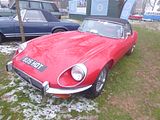
The Jaguar C-X75 is a hybrid-electric, 2-seat, concept car produced by British automobile manufacturer Jaguar Cars in partnership with the derivative of the Formula One team, Williams Advanced Engineering, which debuted at the 2010 Paris Motor Show. The powertrain of the C-X75 concept is rated at 778 hp through four YASA electric motors, each of which drives one of the four wheels. The batteries driving these motors are recharged using two diesel-fed micro gas turbines instead of a conventional four-stroke engine. It was described as a design study that would influence future design and technology. In May 2011 Jaguar announced a limited production of the C-X75 from 2013 to 2015, with a compact, forced induction petrol engine combined with electric motors instead of the micro gas turbines in the concept car. A maximum of 250 cars were planned to be built in partnership with Williams Advanced Engineering. The production version was expected to have an all-electric range of 50 km (31 miles). In December 2012, the company announced the cancellation of production due to the Great Recession. Five developmental prototypes were produced in the production car specifications in 2013. The car was featured in the 2015 film Spectre, the twenty-fourth James Bond film in which seven cars were supplied to the filmmakers. In terms of performance, Jaguar envisioned a goal of their future sports car reaching 330 km/h (205 mph) and accelerating from 0 to 100 km/h (0 to 62 mph) in 2.9 seconds and 80 to 145 km/h (50 to 90 mph) in 2.3 seconds. It is powered by four 145 kW (194 hp) electric motors – one for each wheel – which have a total of 780 hp and a total torque output of 1,600 Nm (1,180 lb/ft). Inherent in the drivetrain is the ability to independently drive each wheel across the full speed range, known as Torque Vectoring. Each motor weighs 50 kg (110 lb). The micro gas turbines from Bladon Jets generate enough electricity to extend the range of the car to 900 km (559 miles) while producing 28 grams of CO2 per kilometre on the EU test cycle. While running solely on battery power, the C-X75 has an all-electric range of 110 km (68 miles). Among other advantages, the micro turbines used in the C-X75 can be run on a range of fuels including diesel, biofuels, compressed natural gas and liquid petroleum gas. The 15 kWh lithium-ion battery pack weighs 185 kg (408 lb). Jaguar estimated an average carbon emission of 28 g/km on European test cycle, however, the carbon emission is around 150 g/km if the turbines are running. Jaguar also focused on the aerodynamics in order to improve performance. For example, the carbon-fibre rear diffuser that guides airflow from under the car creates down-force, and includes an active aerofoil that is lowered automatically as speed increases, creating over 200 kg (440 lb) of downforce at 321 km/h (199 mph). Moreover, the C-X75 features an extruded and bonded, aerospace-inspired, aluminium chassis, saving weight and improving sustainability and performance. In May 2011 Jaguar unveiled plans to produce the C-X75; the company had planned to produce a maximum of 250 cars in partnership with Williams Advanced Engineering. The decision was part of a £5 billion investment plan, announced by Jaguar Land Rover (JLR) in March 2011 at the Geneva Motor Show, to launch 40 “significant new products” over the next five years. The model was scheduled to be built from 2013 until 2015, although it had not yet been decided where the production would take place. The C-X75 was to be built without the micro-turbines, instead, the production version would use a downsized, forced induction petrol engine, with one electric motor at each axle. In order to create a lightweight strong structure, the chassis was planned to be made of carbon-fibre, and the engine was to be mid-mounted for optimum weight distribution and to retain the concept’s silhouette. The C-X75 production version was expected to deliver CO2 emissions of less than 99 g/km, a sub-three second 0–60 mph acceleration time, a top speed in excess of 320 km/h (200 mph) and a reduced all-electric range of 50 km (31 miles) as compared to the 110 km (68 miles) for the concept car. In December 2012, Jaguar’s Global Brand Director announced the cancellation of production due to the Great Recession, as the carmaker considered that “it seems the wrong time to launch an £800,000 to £1 million supercar”. The company expected to take advantage of part of the investment in the C-X75 development by using the C-X75 technology in future Jaguar cars. The Jaguar F-Type and the Jaguar I-Pace were heavily influenced from the C-X75 and carried over many design cues and technological features from it. Jaguar announced its decision to continue working on five prototypes to be developed until May 2013. These prototypes featured a 1.6-litre turbocharged and supercharged inline-4 engine coupled with two YASA electric motors placed on each axle of the car. The powertrain had a combined power output of 850 hp, with the combustion engine alone generating 502 hp at 10,000 rpm, and helped the car achieve speeds up to 200 mph (322 km/h) in testing, with a theoretical maximum of 220 mph (354 km/h). Up to three of these prototypes were then sold at auction, while one went to a future Jaguar museum, and one was kept by Jaguar for running demonstrations. One of these prototypes was also featured in the 2015 James Bond film, Spectre. A Jaguar C-X75 (painted in dark orange) appears in the 2015 James Bond film Spectre as Mr. Hinx’s car (licensed ROMA 860K). It takes part in a car chase around Rome against James Bond, who drives an Aston Martin DB10. Jaguar supplied seven examples to the filmmakers. Although the cars are visually faithful to the original C-X75 concept, they are mechanically unrelated. According to JLR Special Vehicle Operations chief John Edwards, the cars are “constructed around a spaceframe built to World Rally Championship spec” and powered by a dry sump V8 engine. Although this new appearance of the C-X75 led to speculation that production plans for the car were being revived, Edwards was quoted as saying “The film was an opportunity to showcase C-X75, but it doesn’t mean a change in strategy.” The car was built in collaboration with Williams Advanced Engineering. There is confusion of how many C-X75 exist. WAE (who worked on the cars) say on their website that six stunt cars were commissioned and seven cars were produced. However an official photo taken by Jaguar shows only 6 cars to exist. Kaaimans International (who are selling one of the cars), says only 4 stunt cars had been produced. Furthermore, this is an agreed upon number by the car’s designer, Ian Callum, in a two part article where he states four were built specifically for the film. However, in the book Bond Cars: The Definitive History it says there are 7 cars but doesn’t distinguish between V8-powered stunt cars and the engineering prototypes. Octane also agrees on 7 cars along with a Top Gear magazine article that states “They built seven. Two are ‘star cars’, cosmetically perfect specimens with proper glitzy interiors; the other five are grafters, used for skidding about and doing the fun stuff”.

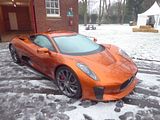
A Jaguar sports car you can buy, well, until recently, is the F type. Sadly, production has ceased and there is no prospect of a replacement.

LAMBORGHINI
In its turn, the Diablo gave way to the Murcielago in 2001. Taking its name from the Spanish for “bat”, this was Lamborghini’s first new design in eleven years and more importantly, the brand’s first new model under the ownership of German parent company Audi, which was manifest in a much higher level of quality and reliability. The Murcielago was styled by Peruvian-born Belgian Luc Donckerwolke, Lamborghini’s head of design from 1998 to 2005. Initially it was only available as a Coupe. The Murciélago was an all-wheel drive, mid-engined supersports car. With an angular design and an exceptionally low slung body, the highest point of the roof is just under 4 feet above the ground. One of the vehicle’s most distinguishing features are its scissor doors. which lends to the extreme image. First-generation Murciélagos, produced between 2001 and 2006, were powered by a Lamborghini V12 that traces its roots back to the company’s beginnings in the 1960s. The rear differential is integrated with the engine itself, with a viscous coupling centre differential providing drive to the front wheels. Power is delivered through a 6-speed manual transmission. The Murciélago suspension uses an independent double-wishbone design, and bodywork features carbon fiber, steel and aluminium parts. The rear spoiler and the active air intakes integrated into the car’s shoulders are electromechanically controlled, deploying automatically only at high speeds in an effort to maximise both aerodynamic and cooling efficiency. The first generation cars were produced between 2001 and 2006, and known simply as Murciélago, sometimes Murciélago VT. Their V12 engines produced just under 580 PS (572 hp), and powered the car to 100 km/h (62 mph) in 3.8 seconds. Subsequent versions incorporated an alphanumeric designation to the name Murciélago, which indicated their engine configuration and output. However, the original cars are never referred to as “LP 580s”. The Murciélago Roadster was introduced in 2004. Primarily designed to be an open top car, it employed a manually attached soft roof as cover from adverse weather, but a warning on the windshield header advised the driver not to exceed 100 mph (160 km/h) with the top in place. The designer used the B-2 stealth bomber, the Wally 118 WallyPower yacht, and architect Santiago Calatrava’s Ciutat de les Arts i les Ciències in Valencia, Spain as his inspiration for the roadster’s revised rear pillars and engine cover. In March 2006, Lamborghini unveiled a new version of its halo car at the Geneva Motor Show: the Murciélago LP 640. The new title incorporated the car’s name, along with an alphanumeric designation which indicated the engine’s orientation (Longitudinale Posteriore), along with the newly updated power output. With displacement now increased to 6.5 litres, the new car made 640 PS ( 631 hp) at 8000 rpm. The Murciélago’s exterior received a minor facelift. Front and rear details were revised, and side air intakes were now asymmetrical with the left side feeding an oil cooler. A new single outlet exhaust system incorporated into the rear diffuser, modified suspension tuning, revised programming and upgraded clutch for the 6-speed “e-Gear” automated sequential transmission with launch control rounded out the performance modifications. Interior seating was also re-shaped to provide greater headroom, and a new stereo system formed part of the updated dashboard. Optional equipment included Carbon fibre-reinforced Silicon Carbide (C/SiC) ceramic composite brakes, chrome paddle shifters and a glass engine cover. At the 2006 Los Angeles Auto Show, Lamborghini announced that the roadster version of the Murciélago would also be updated to LP 640 status. At the 2009 Geneva Motor Show, Lamborghini unveiled the ultimate version of the Murciélago, the LP 670–4 SuperVeloce. The SV moniker had previously appeared on the Diablo SV, and Miura. SV variants are more extreme and track-oriented, and are released at the end of each model’s production run. The SuperVeloce’s V12 produced 670 PS (661 hp) at 8000 rpm and 660 N·m (490 lbf·ft) of torque at 6500 rpm, thanks to revised valve timing and upgraded intake system. The car’s weight was also reduced by 100 kg (220 lb) through extensive use of carbon fibre inside and out. A new lighter exhaust system was also used. As a result of the extensive weight loss, the SV had a power-to-weight ratio of 429 bhp/ton. Also standard were the LP 640’s optional 15-inch carbon-ceramic disc brakes with 6 piston calipers. The original production plan for the SV was limited to 350 cars, but in fact only 186 LP 670-4s were produced before the factory had to make room for the new Aventador production line. Numbered cars 1–350 do not represent the order in which cars were manufactured. Only 5-6 were made with manual transmission. Production of the Murciélago ended on November 5, 2010, with a total run of 4,099 cars. Its successor, the Aventador, was released at the 2011 Geneva Motor Show.

The Aventador has been a huge success for Lamborghini. It was first seen at the 2011 Geneva Show, with the full name of Aventador LP700-4 Coupe, the numbers denoting the output of 700 bhp from the all-new V12 engine and the 4 meaning four wheel drive, something which has featured on every Aventador since. The launch price was £250,000 but even so within a month, Lamborghini had a year’s worth of orders, and within a year, 1000 had been built. In November 2012 a Roadster version arrived, which was very similar to the Coupe, but with a lift-out roof panel. A suite of mechanical changes came at this point, with a cylinder deactiviation technology helping to improve fuel consumption and cut emissions. To mark half a century of car production, in April 2013, the LP720-4 50th Anniversary was launched, with 100 units available. As well as the extra 20 bhp, these had a mildly redesigned nose and tail, special paintwork and unique interior trim. A Roadster version followed in December 2014, the LP 700-4 Pirelli Edition. This did not have the extra power, but did feature two tone paint, unique wheels and a transparent engine cover, with the engine bay finished in carbon fibre. Lamborghini turned up the wick in march 2015 with the LP750-4 SuperVeloce, or SV for short, which featured and extra 50 bhp and a 50 kg weight reduction largely thanks to the use of more carbon fibre. A Roadster version followed a few months later.

The Lamborghini Huracán (Spanish for “hurricane”; [uɾaˈkan]) is a sports car replacing the previous V10 offering, the Gallardo. The Huracán was revealed online in December 2013, making its worldwide debut at the 2014 Geneva Auto Show, and was released in the market in the second quarter of 2014. The Huracán’s name (huracán being the Spanish word for hurricane) is inspired by a Spanish fighting bull. Historic Spanish fighting bulls have traditionally provided the names of most Lamborghini car models. Huracán was a bull known for its courage that fought in 1879. The Huracán maintains the 5.2-litre naturally aspirated Audi/Lamborghini V10 engine with an additional 0.2 litres, compared to the Gallardo, tuned to generate a maximum power output of 602 bhp/610 PS. To ensure its balance and performance, the car is mid-engined. The engine has both direct fuel injection and multi-point fuel injection. It combines the benefits of both of these systems; it is the first time this combination is used in a V10 engine. To increase its efficiency, the Huracán’s engine also includes a start-stop system. The firing order of the engine is 1, 6, 5, 10, 2, 7, 3, 8, 4, 9. This is printed on a metal plate on the top of the engine, as with all other Lamborghini models. The drag coefficient of Cd=0.39 was undisclosed until 2021. The LP 610-4 designation comes from the car having 610 PS and four-wheel drive, while LP stands for “Longitudinale Posteriore”, which refers to the longitudinal mid-rear engine position. Changes from the Gallardo include full LED illumination, a 12.3 inch full-colour TFT instrument panel, fine napa leather and Alcantara interior upholstery, redesigned dashboard and central tunnel, Iniezione Diretta Stratificata (IDS, essentially an adapted version of parent Audi’s Fuel Stratified Injection) direct and indirect gasoline injections, engine Stop & Start technology, EU6 emissions regulation compliance, Lamborghini Doppia Frizione (LDF) 7-speed dual-clutch transmission with 3 modes (STRADA, SPORT and CORSA), 20-inch wheels, carbon-ceramic braking system, optional Lamborghini Dynamic Steering variable steering system and MagneRide electromagnetic damper control. The main competitors of the Huracán include the McLaren 650S (as well as the 720S), the Audi R8, the Ferrari 458 Speciale and the 488 GTB. Extra options that increase the price of the car include interior enhancements, special paint schemes, improved suspension, and a lifting system, as well as multiple components optionally available in carbon fibre, rather than aluminium. The convertible variant of the Huracán LP 610-4 was revealed at the Frankfurt Motor Show on 14 September 2015. The 5.2-litre naturally-aspirated V10 engine is the same as the coupé and generates a maximum power output of 602 bhp/610 PS. Acceleration from 0 to 100 km/h (62 mph) takes 3.4 seconds and the top speed is 323 km/h (201 mph). It has the same 7-speed Lamborghini Doppia Frizione (LDF) dual-clutch transmission as that of the coupé. The Spyder has a dry weight of 1,542 kg (3,400 lb) which is 120 kg (265 lb) more than the coupé due to chassis reinforcing components. The Spyder has a CO2 emission of about 280 g/km. Unveiled at the 2016 Geneva Motor Show, the Huracán LP 580-2 is a lower cost derivative of the Huracán LP 610-4 that differs mostly in having the 5.2 L V10 engine detuned to 572 bhp/580 PS and 533 Nm (393 lb/ft) of torque along with having a rear wheel drive drivetrain instead of the all-wheel drive drivetrain found in the standard Huracán. Lamborghini claims the car will accelerate from 0–100 km/h (0–62 mph) in 3.4 seconds and 0–200 km/h (0–124 mph) in 10.1 seconds. The top speed is claimed to be as high as 320 km/h (199 mph). It also features slight visual differences to the standard variant of the car – with a different front fascia and larger air vents at the rear of the car for improved brake cooling. The seven-speed dual-clutch transmission is the same as used in the standard LP 610–4. The base level LP 580-2 costs US$201,100, about US$40,000 less than the base level LP 610–4. A convertible variant of the Huracán LP 580-2 was unveiled at the Los Angeles Auto Show on 16 November 2016. The 5.2-litre naturally-aspirated V10 engine is the same as in the coupé, and generates a maximum power output of 572 bhp/580 PS. 0 to 100 km/h (62 mph) takes 3.6 seconds and the top speed is 320 km/h (199 mph). A track oriented variant of the Huracán, called the Performante, was unveiled at the 2017 Geneva Motor Show. The Performante underwent various exterior changes with the most noticeable being the front and rear bumpers. Carbon fibre is used for the bumpers and the side skirts. An adjustable carbon fibre rear wing has been added to increase downforce. The position of the exhaust has also been changed, and is now just a bit above the rear diffuser. The interior also underwent noticeable changes, now sporting new seats and a new digital speedometer (similar to that of the Aventador SV’s speedometer). The Performante’s 5.2-litre V10 has been tuned to have a power output of 631 bhp/640 PS at 8,000 rpm and 601 Nm (443 lb/ft) of torque at 6,500 rpm. The weight has also decreased by 40 kg (88 lb), courtesy of the forged aluminium and forged carbon fibre body components (first used in the construction of the Sesto Elemento). All the new aero components on the car have active aerodynamic capability and help keep the car stable at high speeds. The Performante is capable of accelerating from 0–100 km/h (0–62 mph) in 2.9 seconds, 0–200 km/h (0–124 mph) in 8.9 seconds. It also has a theoretical top speed of 325 km/h (200 mph). The car has been stiffened by 10% with new springs, roll bars, and radial axial arm bushings. The magnetorheological suspension has been reworked to give a driver a serious track experience. The Lamborghini Dynamic Steering has been re-calibrated. The Performante utilises Lamborghini’s new ALA (Aerodinamica Lamborghini Attiva) system, which is said to be 80% lighter than regular sports car hydraulic systems. According to Lamborghini, ALA is also said to provide 750% more downforce than the standard Huracán. The Lamborghini Huracán Performante Spyder was unveiled at the 2018 Geneva Motor Show. It takes much of the styling inspiration from the coupé and the outgoing LP 610-4 Spyder. The Spyder is identical to the coupé from performance and technological standpoint, but the acceleration time from 0–60 mph has risen by one-tenth of a second and stands at 3.1 seconds while the 0–200 km/h (0–124 mph) has risen by four-tenths of a second and stands at 9.3 seconds. Due to the loss of the roof, the Spyder weighs 125 kg (276 lb) more than the coupé due to chassis reinforcing components. Top speed remains the same as well and stands at 325 km/h (202 mph). Deliveries of the Spyder began in the fourth quarter of 2018. The Huracán received a mid-cycle update in 2019, now being called the Huracán Evo. It now shares its engine and some of the technology with the Performante variant. The updated version of the Huracán has a more aggressive design language, the new front bumper has integrated aeroblades for improved downforce along with the rear styling inspired by the Performante variant, having the same rear diffuser, exhaust pipe position and radiators. A new ducktail spoiler improves downforce by 5 times as compared to the outgoing model. The engine is shared with the Performante and generates 631 bhp/640 PS at 8,000 rpm and 601 Nm (443 lb/ft) of torque at 6,500 rpm. The exhaust system is more refined and has titanium intake valves. This allows the car to achieve a 0–60 mph) acceleration time of 2.9 seconds, 0–200 km/h (0–124 mph) acceleration time of 9 seconds and a top speed of 325 km/h (202 mph). The car has a braking distance from 100–0 km/h (62–0 mph) of 104 ft (32 m). The Huracán Evo has a rear-wheel steering system for improved handling and a torque vectoring system. A new central processing unit controls the various functions of the car and monitors various settings. The control system is controlled by the new infotainment system (via an 8.4 inch touchscreen) dubbed the Lamborghini Dinamica Veicolo Integrata which has integrated both Apple CarPlay and Android Auto. The infotainment system predicts the driving modes by a feed forward logic. The feed forward logic works by sensors monitoring the lateral, longitudinal and vertical accelerations, as well as roll, pitch and yaw rate to predict the best possible driving mode for the driver. The magnetorheological suspension is also revised and now uses electromagnetic current to adjust the suspension system in accordance with the driving mode. The transmission system from the outgoing model is retained which transfers power to all four wheels. A new Ego mode allows the driver to change driving settings to their own preference. The Huracán Evo Spyder was introduced online in February 2019. The Spyder has the same enhancements as the coupé but is 100 kg (220 lb) heavier due to the addition of chassis reinforcement components owing to the loss of the roof. The car has the same canvas folding soft top as the outgoing model which takes 17 seconds for operation and is operable at speeds up to 50 km/h (31 mph). The Spyder can accelerate to 100 km/h (62 mph) in 3.1 seconds from a standstill, to 200 km/h (124 mph) in 9.3 seconds and can attain a top speed of 325 km/h (202 mph). A rear-wheel drive variant of the Evo debuted in January 2020, replacing the LP 580–2. The front splitter has been reshaped and generates more airflow, which is directed to the revised diffuser. Unique to the RWD model is P-TCS (Performance Traction Control System) that ensures that torque is not cut off abruptly; Lamborghini claims this increases oversteer by 30 percent compared to the LP 580–2. The engine is detuned and is now rated at 602 bhp/610 PS. Due to the detuned engine, the car is slower than the standard Huracán Evo accelerating to 100 km/h (62 mph) in 3.3 seconds while having the same top speed. The car also receives a unique paint option, Giallo Belenus, along with a matching interior upholstered in leather and microsuede. A convertible version of the rear-wheel drive variant of the Evo was showcased in May 2020, replacing the LP 580-2 Spyder. Like the Coupé variant, the convertible has a power output of 602 bhp/610 PS. The convertible has a 0– 60 mph acceleration time of 3.5 seconds and has a claimed top speed of 323 km/h (201 mph). Unveiled on April 12, 2022, The Huracán Tecnica sits between the EVO RWD and the track-focused STO. It is 6.1 cm (2.4 in) longer than the EVO, but is the same height and width. It uses the naturally-aspirated V10 engine from the STO and has a top speed of 325 km/h (202 mph) and an acceleration time of 0–100 km/h (0–62 mph) in 3.2 seconds. According to Lamborghini, the Tecnica’s aerodynamic changes increase downforce 35 percent and reduce drag by 20 percent compared to the EVO. It is expected that production will end in 2024.
In June 2019, Lamborghini introduced an off-road concept sports car based on the Huracán Evo called the Huracán Sterrato. The ground clearance of the car was increased by 47 mm (2 in) with the car’s front approach improved by 1% and the departure angle enhanced by 6.5%. The wheel track is also increased by 30 mm (1 in) and the Sterrato has new wide body fender flares with integrated air-intakes for improved airflow for the brakes. The car is fitted with 20-inch wheels with special tyres for increased grip during off-roading. The car also comes with a reinforced frame and integrated skidpads for protection against debris. Fog lights fitted at the front and a roof rack complete the aggressive exterior appearance. The engine is shared with the Huracán Evo and has the same output as the Evo. The LDVI (Lamborghini Dinamica Veicolo Integrata) system is modified and now comes with predictive logic, conceived as a sophisticated central processing unit that controls every aspect of the car’s behaviour, perfectly integrating dynamic systems to anticipate driver actions and needs, translating them into a perfect driving dynamic. The production version of the Huracán Sterrato was unveiled at Art Basel in Miami on 30 November 2022. It is an all-terrain variant of the Hurácan. Changes over other variants include a 1.7-inch higher ground clearance, revamped suspension with greater travel, widened front and rear track, LED lights mounted to the front bumper, additional protective underbody sills, and Bridgestone all-terrain tires. In addition, it features a unique Rally mode, which optimizes the suspension and all-wheel drive system for driving on gravel, dirt, and sand. In November 2022, Lamborghini confirmed that the Hurácan Sterrato will be the last non-hybrid model to be launched. Special versions of the Sterrato are the Alpha, limited to 50 units (2023), and the Sterrato All-Terrain Ad Personam (revealed in April 2024 at the Milan Design Week), which was limited to 12 units in four different finishes: NEVE (snow), SABBIA (sand), BOSCO (green track), and TERRA (gravel). All have a matte black look for the roof and rear bonnet, along with the roof rails and cross bars. The total production of Sterratos was 1,499 examples.



The Lamborghini Urus is a high performance luxury SUV manufactured by Italian automobile manufacturer Lamborghini. It was introduced in December 2017 as a 2018 model year production vehicle. The Urus is the first Lamborghini SUV and five-door vehicle in the modern era (under the ownership of Volkswagen Group), and the second SUV in the brand’s history after the LM002, which was produced between 1986 and 1993. Built on the Volkswagen Group MLB Evo platform, the Urus shares many components with other Volkswagen Group luxury SUVs, such as the Audi Q7, Bentley Bentayga, Porsche Cayenne, and Volkswagen Touareg. With a top speed of 312 km/h (194 mph), the Urus SE is the fastest production SUV in the world. The name comes from the urus, the ancestor of modern domestic cattle, also known as the aurochs. The Lamborghini Urus concept was unveiled at the 2012 Beijing Auto Show on 23 April 2012. Later, the SUV was also shown at Pebble Beach in 2012. Powered by a 5.2-litre V10 engine shared with the Gallardo, the engine generated a theoretical maximum power output of 600 PS (592 bhp) and was accompanied with an all-wheel-drive system. The sharp-lined exterior design of the SUV takes heavy influence from the company’s V12 flagship, the Aventador. Previously, Lamborghini had trademarked the name “Urus” before the introduction of the Lamborghini Estoque at the 2008 Paris Motor Show, and automotive news blogs Jalopnik and Autoblog believed that the name would be applied to what was eventually found to be the Estoque. On 4 December 2017, the Urus was unveiled at Lamborghini’s Sant’Agata Bolognese headquarters, making it the brand’s first SUV since the LM002. The production version of the SUV received major changes to the exterior and featured a different powertrain than that of the concept. Production of the new Urus started at Lamborghini’s refreshed Sant’Agata facility, ahead of first deliveries in early 2018 with a targeted sales volume of around 3,500 a year. However, Lamborghini had to expand their factory in Sant’Agata Bolognese to meet the higher demand. In July 2020, the company announced the 10,000th unit of the Urus. In 2022, Lamborghini hit a major milestone by producing 20,000 of these SUVs, making the Urus the company’s best-selling model in the shortest time.

LAND ROVER
The first-generation Range Rover was produced between 1969 and 1996. It was available only in a 2-door body until 1981. (Before then, 4-door models had been produced by specialist firms). Unlike other 4x4s such as the Jeep Wagoneer, the original Range Rover was not designed as a luxury vehicle. It was up-market compared to preceding Land Rover models, but the early Range Rovers had fairly basic, utilitarian, interiors with vinyl seats and plastic dashboards that were designed to be washed down with a hose. Convenience features such as power steering, carpeted floors, air conditioning, cloth/leather seats, and wooden interior trim were fitted later. The Range Rover was a body-on-frame design with a box section ladder type chassis, like the contemporary Series Land Rovers. The Range Rover used coil springs as opposed to leaf springs, permanent four-wheel drive, and four-wheel disc brakes. The Range Rover was originally powered by various Rover V8 engines and diesel engines. Originally, the Range Rover was fitted with a detuned 130 hp version of the Buick-derived Rover V8 engine. In 1984, the engine was fitted with Lucas fuel injection, boosting power to 155 bhp. The 3.5-litre (3,528 cc) engine was bored out to a displacement of 3.9 litres for the 1990 model year, and 4.2-litre in 1992 for the 108-inch Long Wheelbase Vogue LSE (County LWB [long wheelbase] in North America). One of the first significant changes came in 1981, with the introduction of a four-door body. Shortly after twin thermo fan technology was introduced to reduce significant overheating problems 1970s models experienced in Australia. In 1988, LR introduced a 2.4-litre turbodiesel (badged Vogue Turbo D) with 112 bhp, manufactured by Italian VM Motori. The same engine was available in the Rover SD1 passenger car. The diesel project was codenamed project Beaver. During the project, 12 world records were broken, including the fastest diesel off-roader to reach 100 mph (160 km/h), and the furthest a diesel off-roader has travelled in 24 hours. In 1990 project Otter was unveiled. This was a mildly tuned 2.5-litre, 119 bhp version of the ‘Beaver’ 2.4. In 1992, Land Rover finally introduced their own diesel engines in the Range Rover, beginning with the 111 bhp 200TDi, first released in the Land Rover Discovery and following in 1994, the 300 TDi, again with 111 bhp. The first generation was known as the Range Rover until almost the end of its production when Land Rover introduced the name Range Rover Classic to distinguish it from its successors. The original model served as the basis for the 1989 introduced 1st generation Discovery (directly based on the standard (short) wheelbase Range Rover), and for the 2nd generation Range Rover, based on the LWB chassis of the Classic.

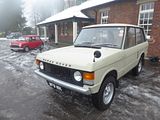
LE ZEBRE
The yellow car on the left is a 1914 Le Zèbre Type C with the registration number BF-5393. The car on the right with the registration number V8091 is also a Le Zèbre Type C. Le Zèbre cars were known for their robustness, reliability, and low running costs. They were selected as liaison vehicles by the French Army during the First World War due to their “go-anywhere” capabilities. The Type C model was a two-seater torpedo body style with a 785cc four-cylinder engine. The company’s slogan was “cheaper to buy and run than a horse”.
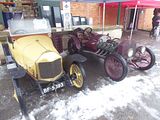
LISTER-JAGUAR

LOTUS
The Type 75 Elite, announced in 1974, was the first of a new generation of Lotus cars which represented a concerted push up-market. The imposition of VAT had effectively killed off the market for the range of models that Lotus had hitherto produced as kit cars, and the only way to stay profitable was to produce something which could sold at higher prices. So whilst Lotus would tell you that the Elite was a replacement for the Lotus Elan Plus 2, it was more accurate to say that it was a rival for cars like the Reliant Scimitar GTE and Lancia Beta HPE. The styling was quite unlike anything that Lotus had produced before, with distinctive wedge lines penned by Oliver Winterbottom which hid the fact that the bodies were produced out of two separate glassfibre moulds and they had to join up in the middle around the waistline. The shooting brake style, with a hatchback as well as the fact that the Elite had 4 seats made it reasonably practical. luggage compartment. Mechanically there were fewer surprise. It was front engined with rear wheel drive, and had 4-wheel independent suspension using coil springs. The Elite was Lotus’ first car to use the 907 aluminium-block 4-valve, DOHC, four-cylinder, 1973cc, developing 155 bhp. which had previously been used in the Jensen-Healeys, where all the reliability issues had been found) The 907 engine ultimately became the foundation for the 2.0 litre and 2.2 litre Lotus Esprit powerplants, the naturally aspirated 912 and the turbocharged 910. The Elite was fitted with a 4 or 5 speed gearbox and from January 1976 automatic transmission was optional. The Elite had a claimed drag co-efficient of 0.30 and at the time of launch it was the world’s most expensive four cylinder car. Elites were available in 4 main specification variations, 501, 502, 503, and later on 504. The 501 was the ‘base’ version. The 502 added air conditioning, the 503 had power steering and the 504 added automatic transmission. The Elite was the basis for a coupe model, the Eclat which was launched in October 1975. Facelifted versions of both came in 1980, with a larger 2.2 litre engine and refinements to the trim. The Elite would live a couple of years in this form, but market interest shifted to the Coupe and when this was given a more significant revision a couple of years later, and a new name of Excel, the Elite was dropped from the range. Although 2535 of them were made, they are rare these days, so it was nice to see this 503 model.


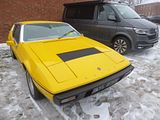
In 1987, a new version of the mid-engined Esprit was unveiled, incorporating rounder styling cues given by designer Peter Stevens (who later designed the McLaren F1). A new Lotus patented process was introduced to create the new body, called the VARI (Vacuum Assisted Resin Injection) process, which offered more advantages than the previous hand laid process. Kevlar reinforcement was added to the roof and sides for roll-over protection, resulting in an increase of the Esprit’s torsional rigidity by 22 percent. Giugiaro is said to have liked the restyling, claiming it was perhaps too close to his original design. The Stevens styled cars retained the mechanical components of the previous High Compression Esprit and Turbo Esprit, but introduced a stronger Renault transaxle, which necessitated a move to outboard rear brakes. However, the MY 1988 North American Esprit Turbo kept its Citroën SM type transaxle and the Bosch K-Jetronic fuel injection system used in the previous model year. The car’s Type 910 engine retained 215 bhp and 220 lb·ft, but decreased its zero to sixty from 5.6 seconds to a varied time between 5.4 – 5.1 seconds and a top speed of over 150 mph. The exterior style changes were accompanied by a redesign of the interior, allowing a little more space for the occupants. The Stevens styled Esprit is often known by its project code of X180. In 1989, the Esprit was again improved with the GM multi-port, electronic fuel injection system and the addition of a water to air intercooler, which Lotus has named the Chargecooler, producing the SE (Special Equipment). This inline-four engine was known as the Type 910S. Horsepower was pushed up to 264 with 280 available on overboost and zero to sixty miles per hour times reduced to 4.7 seconds with a top speed of over 160 mph. Several modifications were made to the body kit as well, like side skirts which are parallel to the body, five air ducts in the front air dam, wing mirrors from the Citroën CX and the addition of a rear wing. Along with the SE, Lotus produced the little seen Esprit S, a midrange turbocharged car offering fewer appointments and 228 hp, as well as the standard turbo still offering 215 hp . The N/A and lower-powered turbo were cancelled after 1990, and the S in 1991. Another unusual variant was a two-litre “tax special” developed for the Italian market, fitted with an intercooled and turbocharged version of a new 1,994 cc version of the venerable 900-series four-cylinder engine. Equipped with SE trim, this appeared in December 1991 and produced 243 PS at 6,250 rpm. Beginning in the autumn of 1996, this engine became available in other markets as well. The Esprit was a popular and successful addition to the American IMSA Bridgestone Supercar Championship and as a result Lotus produced the SE-based X180R, with horsepower bumped to 300 and with racing appointments. The Sport 300 was a derivative of the X180R sold in Europe, which included many modifications. These are known as the fastest of the four-cylinder Esprits and among the most desirable. In 1993, another exterior and interior revamp of the car resulted in the S4 which was the first model to include power steering. The exterior redesign was done by Julian Thompson, which included a smaller rear spoiler placed halfway up the rear decklid. Other major changes were to the front and rear bumpers, side skirts and valence panels. New five spoke alloy wheels were also included in the redesign. The S4 retained the same horsepower as the SE at 264 hp.The S4 was succeeded in 1994 by the S4s (S4 sport), which upped power to 300 bhp and 290 lb·ft of torque, improving all-around performance while retaining the comfort of the previous version. Top speed was increased to 168 mph, skidpad increased to 0.91g, an increased slalom of 61.7 mph and a 0-60 mph time of 4.6 seconds. Although the engine kept its 2.2-litre capacity, many modifications were added to improve engine performance. Some of the changes were enlarged inlet ports, cylinder head modifications, a re-calibrated ECM and a revised turbocharger. The most visible external styling changes was the addition of a larger rear wing taken from the Sport 300. In 1996 the Esprit V8 used Lotus’ self-developed all-aluminium, twin-turbocharged (Garrett T25/60 turbos) 90-degree V-8, Code-named Type 918, in front of the same Renault transmission as before with no Chargecooler. Derek Bell developed an uprated gearbox that overcame a lot of the gearbox problems with a much thicker single piece input shaft. The Type 918 engine was detuned from a potential 500 bhp to 350 bhp to prevent gearbox damage due to the fragility of the Renault UN-1 transmission. In period tests, zero to sixty miles per hour came in at 4.4 seconds and top speeds of over 175 mph were achieved. Produced alongside V8 models was the GT3, a turbocharged four-cylinder car with the type 920 2.0 litre chargecooled and turbocharged engine which had been used only in Italian market cars previously. In 1998 the V8 range was split into SE and GT specifications, both cars with a much changed interior configuration, both offering similar performance with the SE being the more luxurious of the two. The ultimate incarnation of the Esprit came in 1999 with the Sport 350. Only 50 were made, each offering 350 horsepower (per the name) and various engine, chassis and braking improvements, like the addition of AP Racing brakes, stiffer springs and a revised ECU. Several visual changes were made as well, including the addition of a large carbon fibre rear wing on aluminium uprights in place of the standard fibreglass rear wing. By this time the Esprit could reach 60 mph in 4.3 seconds as well as reaching 0-100 mph in less than 10 seconds, and weighed 1,300 kg (2,866 lb) as a result of many modifications. Thereafter, Lotus made little development aside from minor cosmetic changes including a switch to four round tail lights for the 2002 model year. Esprit production ceased in February 2004 after a 28 year production run. A total of 10,675 Esprits were produced.

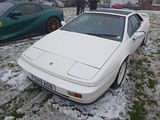
From the current range were examples of the Emira sports car and the all-electric Eletre SUV.


MASERATI
Still acclaimed as one of the best-looking saloons ever produced is this car, the fifth generation Quattroporte, a couple of which were on show. Around 25,000 of these cars were made between 2004 and 2012, making it the second best selling Maserati of all time, beaten only by the cheaper BiTurbo of the 1980s. The Tipo M139 was unveiled to the world at the Frankfurt Motor Show on 9 September 2003, with production starting in 2004. Exterior and interior design was done by Pininfarina, and the result was widely acclaimed to be one of the best looking saloons not just of its time, but ever, an opinion many would not disagree with even now. Built on an entirely new platform, it was 50 cm (19.7 in) longer than its predecessor and sat on a 40 cm (15.7 in) longer wheelbase. The same architecture would later underpin the GranTurismo and GranCabrio coupés and convertibles. Initially it was powered by an evolution of the naturally aspirated dry sump 4.2-litre V8 engine, mounted on the Maserati Coupé, with an improved output of 400 PS . Due to its greater weight compared to the Coupé and Spyder, the 0-62 mph (0–100 km/h) time for the Quattroporte was 5.2 seconds and the top speed 171 mph (275 km/h). Initially offered in only one configuration, equipped with the DuoSelect transmission, the gearbox was the weak point of the car, receiving most of the criticism from the press reviews. Maserati increased the range at the 2005 Frankfurt Motor Show, with the launch of the Executive GT and Sport GT trim levels. The Executive GT came equipped with a wood-rimmed steering wheel, an alcantara suede interior roof lining, ventilated, adaptive, massaging rear seats, rear air conditioning controls, veneered retractable rear tables, and curtain shades on the rear windows. The exterior was distinguished by 19 inch eight-spoke ball-polished wheels and chrome mesh front and side grilles. The Quattroporte Sport GT variant offered several performance upgrades: faster shifting transmission and firmer Skyhook suspensions thanks to new software calibrations, seven-spoke 20 inch wheels with low-profile tyres, cross-drilled brake rotors and braided brake lines. Model-specific exterior trim included dark mesh front and side grilles and red accents to the Trident badges, as on vintage racing Maseratis. Inside there were aluminium pedals, a sport steering wheel and carbon fibre in place of the standard wood inserts. A new automatic transmission was presented at the 2007 Detroit Motor Show, marketed as the Maserati Quattroporte Automatica. As all three trim levels were offered in both DuoSelect and Automatica versions, the lineup grew to six models. The Quattroporte Sport GT S was introduced at the 2007 Frankfurt Motor Show. Taking further the Sport GT’s focus on handling, this version employed Bilstein single-rate dampers in place of the Skyhook adaptive system. Other changes from the Sport GT comprised a lowered ride height and 10 mm wider 295/30 rear tyres, front Brembo iron/aluminium dual-cast brake rotors and red-painted six piston callipers. The cabin was upholstered in mixed alcantara and leather, with carbon fibre accents; outside the door handles were painted in body colour, while the exterior trim, the 20 inch wheels and the exhaust pipes were finished in a “dark chrome” shade. After Images of a facelifted Quattroporte appeared on the Internet in January 2008; the car made its official début at the 2008 Geneva Motor Show. Overseen by Pininfarina, the facelift brought redesigned bumpers, side sills and side mirrors, a convex front grille with vertical bars instead of horizontal, new headlights and tail lights with directional bi-xenon main beams and LED turn signals. Inside there was a new navigation and entertainment system. All Quattroporte models now used the ZF automatic transmission, the DuoSelect being discontinued. The 4.2-litre Quattroporte now came equipped with single-rate damping comfort-tuned suspension and 18 inch wheels. Debuting alongside it was the Quattroporte S, powered by a wet-sump 4.7-litre V8, the same engine of the Maserati GranTurismo S, with a maximum power of 424 bhp and maximum torque of 361 lb·ft. In conjunction with the engine, the braking system was upgraded to cross-drilled discs on both axles and dual-cast 360 mm rotors with six piston callipers at the front. Skyhook active damping suspension and 19 inch V-spoke wheels were standard. Trim differences from the 4.2-litre cars were limited to a chrome instead of titanium-coloured front grille. The Quattroporte Sport GT S was premièred at the North American International Auto Show in January 2009. Its 4.7-litre V8 produced 440 PS (434 hp), ten more than the Quattroporte S, thanks to revised intake and to a sport exhaust system with electronically actuated bypass valves. Other mechanical changes were to the suspensions, where as on the first Sport GT S single-rate dampers took place of the Skyhook system, ride height was further lowered and stiffer springs were adopted. The exterior was distinguished by a specific front grille with convex vertical bars, black headlight bezels, red accents to the Trident badges, the absence of chrome window trim, body colour door handles and black double oval exhaust pipes instead of the four round ones found on other Quattroporte models. Inside veneers were replaced by “Titan Tex” composite material and the cabin was upholstered in mixed Alcantara and leather. This means that there are quite a number of different versions among the 25,256 units produced, with the early DuoSelect cars being the most numerous.

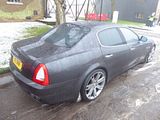
McLAREN
The MP4 12C was the first ever production car wholly designed and built by McLaren, and their first production road car produced since the McLaren F1, which ended production in 1998. McLaren started developing the car in 2007 and secretly purchased a Ferrari 360 to use as a test mule. The mule called MV1 was used to test the 3.8-litre twin-turbocharged V8 engine. The car also featured side vents for additional cooling which were later incorporated in the final production model. Later in the year, the company purchased an Ultima GTR to test the braking system and suspension components, that mule was called the MV2. The space frame and body of that car were modified in order to accommodate the new components. Later another prototype was purchased which was another Ferrari 360 dubbed the MV3 which was used to test the exhaust system. McLaren then built two prototypes themselves called CP1 and CP2 incorporating the Carbon Monocell monocoque which were used for testing the heat management system and performance. The MP4-12C features a carbon fibre composite chassis, and is powered by a longitudinally-mounted Rear mid-engine, rear-wheel-drive layout McLaren M838T 3.8 litre twin-turbocharged V8 engine, developing approximately 600 PS (592 bhp) at 7500 rpm and around 600 N⋅m (443 lbf⋅ft) of torque at 5600 rpm. The car makes use of Formula 1-sourced technologies such as “brake steer”, where the inside rear wheel is braked during fast cornering to reduce understeer. Power is transmitted to the wheels through a seven-speed dual-clutch transmission. The entire drivetrain is the first to be entirely designed and produced in house by McLaren. The chassis is based around a F1 style one-piece carbon fibre tub, called the Carbon MonoCell, weighing only 80 kg (176 lb). The MonoCell is made in a single pressing by using a set of patented processes, using Bi-Axial and Tri-Axial carbon fibre multi-axial fabrics produced by Formax UK Ltd. with the MonoCell manufactured by Carbo Tech in Salzburg, Austria. This has reduced the time required to produce a MonoCell from 3,000 hours for the F1 and 500 hours for the Mercedes-Benz SLR McLaren, to 4 hours for the MP4-12C. The McLaren MP4-12C utilizes a unique hydraulic configuration to suspend the vehicle as opposed to more traditional coil springs, dampers and anti-roll bars. What McLaren has called “ProActive Chassis Control,” the system consists of an array of high and low pressure valves interconnected from both left to right and front to back, and the typical anti-roll bars were omitted entirely. When high pressure meets high pressure under roll conditions, stiffness results; and subsequently when high pressure meets low under heave and warp, more give is allowed, ultimately providing a firmer, competent suspension setup in spirited driving, and a very plush, compliant and comfortable ride when moving at slower, constant speeds. The car has a conventional two side-by-side seating arrangement, unlike its predecessor the McLaren F1 which featured an irregular three seat formation (front centre, two behind either side). To make up for this however, the car’s central console is narrower than in other cars, seating the driver closer to the centre. Interior trim and materials can be specified in asymmetric configuration – known as “Driver Zone”. The final car was unveiled to the public on 9 September 2009 before the company’s launch in 2010. A convertible version of the car called the MP4-12C Spider, as added to the range in 2012. The name’s former prefix ‘MP4’ has been the chassis designation for all McLaren Formula 1 cars since 1981. ‘MP4′ stands for McLaren Project 4 as a result of the merger between Ron Dennis’ Project 4 organisation with McLaren. The ’12’ refers to McLaren’s internal Vehicle Performance Index through which it rates key performance criteria both for competitors and for its own cars. The criteria combine power, weight, emissions, and aerodynamic efficiency. The coalition of all these values delivers an overall performance index that has been used as a benchmark throughout the car’s development. The ‘C’ refers to Carbon, highlighting the application of carbon fibre technology to the future range of McLaren sports cars. At the end of 2012, the name of the MP4-12C was reduced to 12C – that name is usually used when referring to the coupe. The open-top version now being called the 12C Spider.
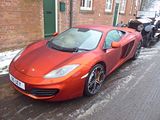
A heavily revised version of the MP12-4C was announced in February 2014, called the 650S, with revised bodywork, upgraded engine and other technical improvements. In April 2014, McLaren announced the end of production of the 12C. The 650S is the core model in the Super Series, designed and developed to give the enthusiast driver the ultimate in luxury, engagement and excitement. Fitted with the award-winning 3.8-litre twin turbo V8 engine producing 650PS (641bhp) and 678Nm (500lb ft) of torque, it is a no compromise open-top high performance supercar with optimised levels of performance, handling and driver enjoyment. The secret of its success is its carbon fibre MonoCell chassis, which needs no extra strengthening to provide the necessary rigidity or safety when developing a convertible. This keeps any weight increase to a minimum, meaning the McLaren 650S Spider offers all the enjoyment and driver appeal of the fixed-roof sibling – but with the added appeal of roof-down driving. The 650S Spider is fitted with an electrically retractable hard top, which can be automatically raised or lowered on the move in less than 17 seconds. Building on the success of the MP4 12C, with which it shares much, the 650S series, first seen at the 2014 Geneva Show has proved very popular, helping to establish the brand as a serious rival to the established supercar players. Production ended when the even faster (and costlier( 720S arrived in 2017.
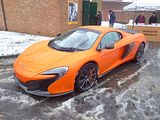

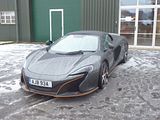
In June 2018, McLaren unveiled the top-of-the-line sports series variant online. The car, called the 600LT is based on the 570S and is the third McLaren production car to receive the longtail treatment. Inspired by the 675LT and the F1 GTR Longtail, the body of the car has been extended by 73.7 mm (2.9 in). The car also features enhanced aerodynamic elements such as an extended front splitter and rear diffuser, new side sills, and an aero-enhancing fixed rear wing for increased downforce. McLaren claims that 23% parts on the 600LT are new as compared to the 570S. The carbon fibre monocoque utilised in the 600LT is modified and this combined with the extensive use of carbon fibre in the roof along with the cantrails and front wings, results in a weight saving of 96 kg (212 lb) over the 570S, with the total weight amounting to 1,247 kg (2,749 lb). Another distinguishing feature of the 600LT is the lightweight titanium exhaust system which is mounted on top of the rear of the car which harks back to its original application in the Senna. The interior features sports bucket seats from the P1 and Alcantara trim but can be optioned with the much lighter bucket seats found in the Senna. The 3.8-litre twin-turbocharged V8 engine utilised in the 600LT is tuned to produce a maximum power output of 600 PS (592 bhp) (hence the 600 in the name) and 620 N⋅m (457 lb⋅ft) of torque, achieving a power-to-weight ratio of 479 PS per tonne. Performance figures and production numbers of the car remain unknown. Production of the 600LT started in October 2018. In January 2019, McLaren unveiled the convertible variant of the 600LT at the Detroit Auto Show. Due to the use of the same carbon monocoque as the other models in the 570S lineage the 600LT Spider required did not need any extra modifications to incorporate a folding hardtop roof. As a result, the Spider weighs 50 kg (110 lb) more than the coupé while maintaining the same performance statistics. The Spider has the same engine and aerodynamic components as the coupé and share the roof folding mechanism with the standard 570S Spider which can be operated at speeds upto 40 km/h (25 mph). The car can accelerate to 100 km/h (62 mph) in 2.9 seconds, to 200 km/h (124 mph) in 8.4 seconds (0.2 seconds more than the coupé) and can attain a top speed of 315 km/h (196 mph) with the roof retracted and 323 km/h (201 mph) with the roof closed. The car can achieve a dry weight of 1,297 kg (2,859 lb) when equipped with the MSO ClubSport package which includes the removal of air-conditioning and radio, titanium wheel nuts and the replacement of the standard seats with the carbon fibre seats from the Senna. The car has received rave reviews.
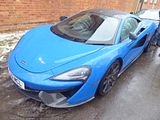
The McLaren GT is the company’s first dedicated grand tourer and is based on the same platform underpinning the 720S with the addition of a carbon fibre rear deck topped by a glazed tailgate creating significantly greater storage capacity. The GT was first announced at the 2019 Geneva Motor Show, but full details of the car were not released until May 15 of the same year. The GT features a new variation of the 3,994 cc twin-turbocharged M840T V8 engine found in the 720S. Having a new dedicated codename of M840TE, the new engine has smaller turbochargers that deliver lower peak performance than its Super Series variant but greater low RPM-performance and responsiveness. The GT has a rated power output of 620 PS at 7,000 rpm, and the maximum torque is 465 lb/ft (630 Nm) at 5,500 rpm. The suspension system in the GT is also derived from the system in the 720S. The car utilizes double wishbones at the front and rear axles, and a modified version of the ProActive Chassis Control II active damping system called Proactive Damping Control. The company claims that the GT has a top speed of 326.7 km/h (203 mph), it can accelerate from 0–60 mph in 3.1 seconds, and 0–200 km/h (0–124 mph) in 9 seconds. The McLaren GT features 150 litres of storage space at the front and 420 litres in the rear, accommodating a full-sized set of golf clubs. Napa leather is standard upholstery, but drivers can also choose from a softer hide made by Bridge of Weir Leather in Scotland or in the future, cashmere. The new comfort seats have increased shoulder padding and back support, with electrical adjustment and heating as standard on Pioneer and Luxe models. A 7-inch touchscreen mounted in the centre controls a revamped infotainment system and is supplemented by a 12.3-inch driver information display which changes in layout depending on whether Comfort, Sport or Track mode is selected.
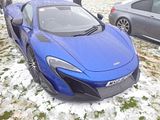
The 720S – a complete replacement for the 650S – was a star of the 2017 Geneva Show, and it was clear on looking at it, that the Woking firm really is increasingly a serious threat to Ferrari’s supercar supremacy, even before learning that total sales in just five years of production had passed 10,000 units. The 720S was presented as the firm’s new core model and the first of 15 new-generation McLarens, half of which will be hybrids, promised by 2022 under CEO Mike Flewitt’s ambitious Track 22 development plan. The 720S obeys all existing McLaren design rules. It is a two-seat supercar based on an all-carbonfibre tub, with aluminium space frames carrying the front and rear suspension, and it is powered by a twin turbo V8. However, within that envelope, it has been redesigned and updated in every detail. The exterior introduces a new ‘double skin’ door construction that eliminates the need for the prominent side air scoops previously thought essential in supercar design, while the engine grows to 4.0 litres, up from 3.8-litres, and now produces 710bhp. McLaren has further developed its carbonfibre chassis tub and upper structure, taking lessons from previous models, including the P1. Now dubbed Monocage II, the structure is cited as the key to the 720S’s 1283kg dry weight, which undercuts all competitors and beats that of its predecessor by 18kg. Monocage II’s stiffness has allowed McLaren’s designers to give the 720S remarkably thin A-pillars, a deep windscreen, B-pillars set well back and slim, glazed C-pillars, all of which contribute to first-class all-round visibility for the driver. The body panels are made either of carbonfibre or superformed aluminium, and their novel shape plays a key role in the 720S’s impressive aerodynamic performance. Low down at the front there are anti-lift aero blades reminiscent of those on the P1, while ultra-compact LED headlights fit into frontal ‘eye sockets’ that allow room for vents to feed the air conditioning and oil cooler. The body sides incorporate channels, formed by two skins and flowing past the dihedral doors, so cooling air can be directed along the body into the engine bay, uninterrupted by turbulence and resulting in a 15% improvement in cooling airflow. On the outer, lower part of the doors, there are F1-inspired blades that direct air away from the front wheel arches, assisting downforce and cutting drag. A big under-body diffuser at the rear sweeps up from the 720S’s flat floor almost to its rear wing, where the two elements frame the ultra-thin LED tail-lights. Because the top of the 720S’s engine is a remarkable 120mm lower than that of the 650S, the car also has a low, teardrop-shaped engine cover that allows an uninterrupted flow of air over the roof to the hydraulically actuated rear wing, which has a DRS drag reduction setting for optimal straight-line performance, an Aero setting for downforce in corners and a Brake setting (which sets the wing a steep 56deg from the horizontal) to increase drag and improve chassis balance under heavy braking. The result, says McLaren, is that the wing has 30% more downforce and its aero efficiency (the ratio of downforce to drag) is doubled. McLaren claims “new heights of performance” from its expanded turbo V8, now re-engineered for a capacity of 3994cc, thanks to a 3.6mm lengthening of its stroke. The engine also has lighter pistons and conrods and a stiffer, lightened crank, plus twin-scroll turbochargers with faster-spooling turbines, capable of spinning at 145,000rpm, and electronically controlled wastegates. In total, 41% of the engine’s components are new. A cast aluminium air intake system, visible through the mesh engine cover, feeds extra air to the more potent engine that now uses two injectors per cylinder. But rather than simply pumping in more fuel, the improved injection system gives more accurate metering, which helps to cut CO2 emissions by around 10%, to a class-leading 249g/km. Combined economy falls by a similar percentage to 26.4mpg. The 720S’s peak output of 710bhp is produced at 7000rpm, while maximum torque of 568lb ft is delivered at 5500rpm. The engine, longitudinally mounted behind the occupants, drives as before through a seven-speed dual-clutch automatic gearbox mounted end-on to the engine, but McLaren says further refinement of its control software brings smoother gearchanges at low speeds and faster, sharper shifts at higher speeds. The launch control has also been improved, and as before, there are three driving modes — Comfort, Sport and Track — that govern both engine and dynamics. The chassis weight savings, allied to other reductions in mass, including 2kg from the brakes, 3kg from the electrics and 1.5kg from the airboxes, contribute as much to the 720S’s enhanced performance as its 11% power increase. The power-to-weight ratio is now 553bhp per tonne (up 15%) and, according to McLaren, beats the best in the segment. As a result, McLaren claims a “crushing” 0-60mph time of just 2.8sec, 0-124mph in 7.8sec and a top speed of 212mph. The 720S will also dispatch a standing quarter-mile in 10.3sec, representing a blistering performance for a pure road car. To accompany the performance, the 720S has a carefully engineered engine note which can be further enhanced with an optional, louder, sports exhaust system. Despite its performance potential, McLaren is adamant that its new car is as easily handled by ordinary drivers as it is by experts, with throttle response calibrated to provide “the optimum blend of immediate reaction and progressive comfort”. Although only five years old, McLaren’s all-independent system of front and rear double wishbones has been completely re-engineered, both to allow wheel geometry changes and, thanks to a redesign of the uprights and wishbones, to cut unsprung mass by 16kg. The 720S has an updated version of the Proactive chassis control electronics used by the 650S. The system features hydraulically interlinked dampers at each corner that remove the need for anti-roll bars, but the big improvement for the 720S’s system, which is dubbed PCCII, results from new software developed during a six-year collaboration with the University of Cambridge and using sophisticated information gathered by 12 new sensors and accelerometers. The result is even better contact between the tyres and the road surface. The system can assess conditions and adjust the suspension every five milliseconds. It also includes a Variable Drift function, which allows you to slide the car without losing control, and McLaren Brake Steer, pioneered in F1, which enhances agility in corners and traction out of them by braking separate wheels. McLaren engineers have retained electro-hydraulic steering for the 720S, despite rivals’ adoption of electric only systems, because they still feel it gives superior “clarity of feel”. Brakes are large, ventilated carbon-ceramic discs and the tyres are specially developed Pirelli P Zeros, 245/35 ZR19s at the front (up from the 650S’s 235s) and 305/30 ZR20s at the rear. McLaren claims a 6% increase in mechanical grip, which is about the same advantage as fitting track-focused Pirelli Corsas to a 650S. Although the 720S closely follows the outgoing 650S in its major dimensions, there are differences between them. The thin pillars, the depth of the windscreen and the all-round glass give a commanding view to all points that modern supercar drivers will find surprising. The redesigned interior surfaces have been ‘pushed away’ from the occupants as much as possible, to further enhance the feeling of space. Unlock the door and various instrument and courtesy lights go through a welcome sequence as the mirrors unfold. Opening the door also triggers an elaborate sequence on the upright TFT screen which changes its configuration according to driving mode. The driver can also ‘declutter’ the instruments, for example when on a track, via a special Slim mode. There’s a central 8.0 in infotainment screen on the centre console, with ventilation settings carried along the bottom. The layout of switches, most of which are machined from aluminium, is simple. Standard cabin trim and seats are plush but, as with previous models, colour and trim material upgrades are available. McLaren has already begun taking orders, with the first cars due to be delivered in May. The entry price in the UK was £207,900. All 400 units of the Launch Edition version were sold even before the general public saw the car though many of these then hit the pre-owned market quite quickly, traded in once owners could take delivery of a car in the spec that they really wanted. McLaren’s goal is to sell around 1200 – 1500 720S models a year.
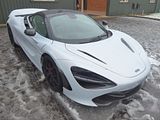
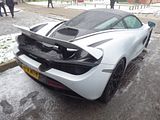
The McLaren 750S is the successor to the 720S and is scheduled to be McLaren Automotive’s final model to be solely powered by an internal combustion engine. Essentially a facelifted version of the 720S, it features redesigned front and rear ends and an increase in power to 750 PS. The 750S is also 30 kg (66 lbs) lighter than the 720S. According to McLaren, about 30 percent of the parts have been updated compared to the 720S. Other mechanical changes include a redesigned converging center-exit exhaust system, larger air intakes, 15% shorter transmission final-drive ratio, and a quicker steering ratio. On the interior, a new 8-inch Apple CarPlay-enabled infotainment system was added.
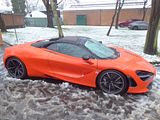

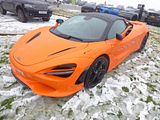
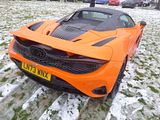
MERCEDES-BENZ
The W116 was the first Mercedes to be known officially by the title “S Class”, although sometimes it is now applied to the car’s predecessor as well, since it was also called – among other things – the 280SE. The ‘new’ S-class generation development began in 1966, which was only a year after the launch of the W108/09. This was the first Mercedes saloon to feature the brand new corporate styling theme which was to be continued until 1993 when the 190 was discontinued. The design, finalised in December 1969 was a dramatic leap forward, with more masculine lines that combined to create an elegant and sporty character. The basic design concept carried through the themes originally introduced on the R107 SL-Class roadster, especially the front and rear lights. As for the SL, the W116 received the ridged lamp covers which kept dirt accumulation at bay; this was to remain a Mercedes-Benz design theme into the 21st century. The W116 was Friedrich Geiger’s last design for Mercedes-Benz; his career had started with the Mercedes-Benz 500K in 1933. The car was presented in September 1972. The model range initially included two versions of the M110 engine (Straight-six with 2746 cc displacement)—the 280 S (using a Solex carburetor) and the 280 SE (using Bosch D-Jetronic injection), plus the 350 SE, powered by the M116 engine (V8 with 3499 cc displacement). After the 1973 Fuel Crisis, a long-wheelbase version of the 280 was added to the lineup. Half a year later, in early 1973, two new models powered by the M117 engine (V8 with 4520 cc displacement) were added to the range—the 450 SE and the 450 SEL (with a 100 mm longer body). The 450 had 225 PS in most markets, federalised cars offered 190 hp while Swedish market cars had an EGR-valve and 200 PS until 1976. The 450s received a plusher interior as well, with velour or leather seats rather than the checkered cloth of the lesser models. The door insides were also of a different design, being pulled up around the windows. The most notable W116 was the high-performance, limited-production 450 SEL 6.9, which was introduced in 1975. This model boasted by far the largest engine installed in a post-war Mercedes-Benz (and any non-American production automobile) up to that time, and also featured self-levelling hydropneumatic suspension. The 300 SD sedan (American market only) had a turbocharged 3.0-litre inline-five diesel engine developed from the C111 experimental vehicle. In September 2013, a 1979 W116 300 SD was campaigned in the 24 Hours of Lemons at Carolina Motorsports Park, where it completed 166 laps at an average speed of 54.8 MPH. It won the highest prize of the event, the Index of Effluency. Other than mild issues relating to brake and tire wear, no mechanical issues were encountered. After numerous modifications to handling, the car was again run in February 2014 at Barber Motorsports park in Birmingham, AL. It placed 44th, but turned 281 laps at an average pace of 59.6 MPH. One of the key advantages of the 300 SD is its exceptional fuel economy on track, where it burns just 2.5 GPH (Roughly 18MPG). In July 2014 it placed first in class at Sebring. It is still active in the series. The 450 SE was named the European Car of the Year in 1974, even though the W116 range was first introduced at the Paris Motor Show in October 1972. The W116 range became the first production car to use an electronic four-wheel multi-channel anti-lock braking system (ABS) from Bosch as an option from 1978 on. Production totalled 473,035 units. The W116 was succeeded by the W126 S-Class in 1979
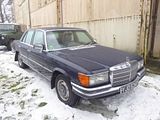

The Mercedes-Benz CLK DTM is a 2-door DTM touring car constructed by the German car manufacturer Mercedes-Benz, that debuted in the 2000 DTM season, and competed until the end of the 2003 season. It was based on the standard Mercedes-Benz CLK-Class (C208) road car then later the CLK-Class (C209). For the 2000 DTM season, Mercedes-Benz committed to entering eight cars split between four cars from the Works HWA Team, and two cars each from the semi-Works Persson and Rosberg outfits. HWA, in turn, sub-divided its operations into two parallel squads. The first ran two D2 Telekom-sponsored cars for Bernd Schneider and Thomas Jäger, the second fielding two Warsteiner-backed cars for Klaus Ludwig, and Marcel Fässler. In March 2002, Mercedes-Benz announced a revised version of the CLK DTM now based on the CLK-Class (C209), at the Geneva Motor Show with Bernd Schneider and Jean Alesi. The car won the 2003 DTM season.

Also here was an example of the first generation AMG GT.
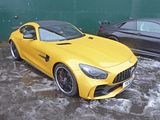

MINI
With the larger Metro being redesigned in 1990 to take the new K-Series engine, the Mini became the sole recipient of the classic A-Series engine with transmission-in-sump layout. The engine mounting points were moved forward to take 1275 cc power units, and includes the later Horizontal Integral Float version of the SU carb, and also the single-point fuel-injection version, which came out in November 1991. The 998 cc power units were discontinued. Early, carburetted Coopers had a catalytic converter and produce 60 hp/61 PS at 5500 rpm. Power crept up to 62 hp/63 PS at 5700 rpm for the fuel injected model. An internal bonnet release was fitted from 1992. By 1991, the Cooper represented forty percent of Mini sales in the home market; the main export market was Japan. Production ended in August 1996 as the Mark VII replaced it. As well as the standard cars there were numerous special edition models produced during this period.
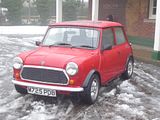
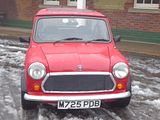
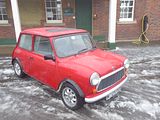
MITSUBISHI
Mitsubishi launched the second generation Mirage to Japan in 1983, again splitting the range into Mirage (three- and five-door hatchback, plus four-door sedan) and Lancer Fiore (four-door sedan) models. A station wagon version of the Mirage was added in 1985, with a four-wheel drive wagon available from the fall of 1986 with the 1.8-liter gasoline engine.[30] Many export markets sold the hatchbacks as Mirage or Colt, with the sedan and wagon commonly badged Lancer. This wagon model went on to become very popular in both the commercial and private sectors overseas as well as in Japan. C10-series chassis numbers denote front-wheel-drive models, while C30-series numbers are for four-wheel-drive versions (only station wagons). Uprated engines were deployed into the series; 1.3- and 1.5-liter Orion gasoline engines replaced the previous 1.2- and 1.4-liter Orion units. Mitsubishi also released variants fitted with the 1.6 and 1.8-liter Sirius gasoline powerplants, and for the first time a 1.8-liter Sirius diesel was added. The 1.6-liter Sirius engine also included a turbocharged variant with between 105 PS and 125 PS, featuring the latest in computer control engine technology including electronic fuel injection. Power differed for cars with catalyzers, or for markets with lower octane fuel. Some European markets received a smaller 1.2-liter “tax special” as well, with 55 PS. The car received a very mild facelift in early 1986, along with some new engine options for the Japanese domestic market. This included a fuel-injected version of a new 1.5-liter engine from the Saturn family, the G31B. The transmissions were updated at the same time. In October 1986, the sedans and hatchbacks were rebadged “Mirage NOW” for the Japanese market. The change included better equipment and a revised lineup, going from the basic XF via the better equipped XL to the mildly sporty X1 X on top. The X1 X featured an Italvolanti steering wheel and alloy wheels by Porsche Design. Also new was the competitively priced and comprehensively equipped Marion version, only available in the three-door body with the 1.3-liter engine, aimed specifically at young female buyers. Meanwhile, the Van received additional safety equipment such as a laminated front windshield and ELR belts, while the 1500 CX Wagon gained power steering and bronze window tint. The second generation Mirage hatchback was replaced in October 1987; the sedans were replaced in January 1988. The Wagon and Van versions were kept in production with some minor updates until 1991, as there was no station wagon of the third generation Mirage and Lancer. The diesel engine remained the 1.8-liter 4D65 (also available with four-wheel drive) while the petrol 4G13 and 4G15 were updated with the same new twelve-valve heads as were used on the third generation Mirage beginning in 1989. Power outputs climbed by 12 horsepower for both petrol versions, to 79 and 85 PS in Japanese trim. The Mirage was available in Europe as the Colt in 1200 L, EL, and GL trims (mostly three-door models only, but a five-door GL was sold in some markets), as the 1300 GL three- and five-door, 1500 GLX three- and five-door, and as the 1800 L/EL/GL (diesel) three- or five-door. The Lancer sedan was available in the same trim levels as the hatchback model (including the 1200 engine), while the wagon versions were available as 1500 GLX and 1800 GL diesel only. The three-door Colt Turbo was also sold in Europe, with the 125 PS 1.6-liter ECI engine. The Colt Turbo fared badly in competition with its European GTi-class competitors, with period testers criticizing Mitsubishi for not doing much more than adding a turbocharger, spoilers, and fat tires. It was not a thorough engineering job and the car was not able to fully handle the ample power made available. Some markets also received the 4WD Wagon with the larger 1.8-liter engine, although the diesel-powered 4WD remained available to Japanese customers only. Versions equipped with catalytic converters first became available in Europe in 1985, at the same time as the wagon was introduced. The two-seater commercial type was sold in the Netherlands simply as the “Mitsubishi Wagon”, whereas the better equipped passenger version was called the Lancer Station Wagon.
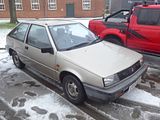
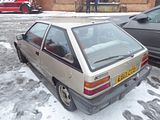
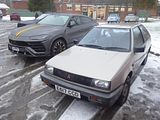
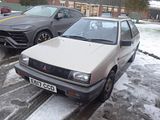
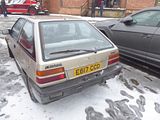
MORRIS
This is a Morris Bullnose Special. The original car was known for its high performance, reportedly capable of over 90 m.p.h. on the road. It achieved “fastest time of the day” at the 1924 Thetford Speed Trials. The vehicle seen here is a replica.
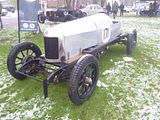
No surprise to see the evergreen Morris Minor here as this is a very popular classic. The Minor was conceived in 1941. Although the Nuffield Organization was heavily involved in war work and there was a governmental ban on civilian car production, Morris Motors’ vice chairman, Miles Thomas, wanted to prepare the ground for new products to be launched as soon as the war was over. Vic Oak, the company’s chief engineer, had already brought to Thomas’ attention a promising junior engineer, Alec Issigonis, who had been employed at Morris since 1935 and specialised in suspension design but he had frequently impressed Oak with his advanced ideas about car design in general. Issigonis had come to Oak’s particular attention with his work on the new Morris Ten, which was in development during 1936/7. This was the first Morris to use unitary construction and was conceived with independent front suspension. Issigonis designed a coil-sprung wishbone system which was later dropped on cost grounds. Although the design would later be used on the MG Y-type and many other post-war MGs the Morris Ten entered production with a front beam axle. Despite his brief being to focus on the Ten’s suspension Issigonis had also drawn up a rack and pinion steering system for the car. Like his suspension design this was not adopted but would resurface in the post-war years on the MG Y-type, but these ideas proved that he was the perfect candidate to lead the design work on a new advanced small car. With virtually all resources required for the war effort, Thomas nonetheless approved the development of a new small family car that would replace the Morris Eight. Although Oak (and Morris’ technical director, Sidney Smith) were in overall charge of the project it was Issigonis who was ultimately responsible for the design, working with only two other draughtsmen. Thomas named the project ‘Mosquito’ and ensured that it remained as secret as possible, both from the Ministry of Supply and from company founder William Morris (now Lord Nuffield), who was still chairman of Morris Motors and, it was widely expected, would not look favourably on Issigonis’ radical ideas. Issigonis’ overall concept was to produce a practical, economical and affordable car for the general public that would equal, if not surpass, the convenience and design quality of a more expensive car. In later years he summed up his approach to the Minor; that he wanted to design an economy car that “the average man would take pleasure in owning, rather than feeling of it as something he’d been sentenced to” and “people who drive small cars are the same size as those who drive large cars and they should not be expected to put up with claustrophobic interiors.” Issigonis wanted the car to be as spacious as possible for its size and comfortable to drive for inexperienced motorists. Just as he would with the Mini ten years later, he designed the Mosquito with excellent roadholding and accurate, quick steering not with any pretence of making a sports car, but to make it safe and easy to drive by all. As work proceeded, there were plenty of battle to overcome, to get Issigonis’ ideas approved, and not all of them were. The production car, called the Minor was launched at the British Motor Show at Earls Court in London on October 27, 1948. At the same show Morris also launched the new Morris Oxford and Morris Six models, plus Wolseley variants of both cars, which were scaled-up versions of the new Minor, incorporating all the same features and designed with Issigonis’ input under Vic Oak’s supervision. Thus Issigonis’ ideas and design principles underpinned the complete post-war Morris and Wolseley car ranges. The original Minor MM series was produced from 1948 until 1953. It included a pair of four-seat saloons, two-door and (from 1950) a four-door, and a convertible four-seat Tourer. The front torsion bar suspension was shared with the larger Morris Oxford MO, as was the almost-unibody construction. Although the Minor was originally designed to accept a flat-4 engine, late in the development stage it was replaced by a 918 cc side-valve inline-four engine, little changed from that fitted in the 1935 Morris 8, and producing 27.5 hp and 39 lbf·ft of torque. This little engine pushed the Minor to just 64 mph but delivered 40 mpg. Brakes were four-wheel drums. Early cars had a painted section in the centre of the bumpers to cover the widening of the production car from the prototypes. This widening of 4 inches is also visible in the creases in the bonnet. Exports to the United States began in 1949 with the headlamps removed from within the grille surround to be mounted higher on the wings to meet local safety requirements. In 1950 a four-door version was released, initially available only for export, and featuring from the start the headlamps faired into the wings rather than set lower down on either side of the grille. The raised headlight position became standard on all Minors in time for 1951. From the start, the Minor had semaphore-type turn indicators, and subsequent Minor versions persisted with these until 1961 An Autocar magazine road test in 1950 reported that these were “not of the usual self-cancelling type, but incorporate[d] a time-basis return mechanism in a switch below the facia, in front of the driver”. It was all too easy for a passenger hurriedly emerging from the front passenger seat to collide with and snap off a tardy indicator “flipper” that was still sticking out of the B-pillar, having not yet been safely returned by the time-basis return mechanism to its folded position. Another innovation towards the end of 1950 was a water pump (replacing a gravity dependent system), which permitted the manufacturer to offer an interior heater “as optional equipment”. When production of the first series ended, just over a quarter of a million had been sold, 30 per cent of them the convertible Tourer model. In 1952, the Minor line was updated with an Austin-designed 803 cc overhead valve A-series engine, replacing the original side-valve unit. The engine had been designed for the Minor’s main competition, the Austin A30, but became available as Austin and Morris were merged into the British Motor Corporation. The new engine felt stronger, though all measurements were smaller than the old. The 52 second drive to 60 mph was still calm, with 63 mph as the top speed. Fuel consumption also rose to 36 mpg. An estate version was introduced in 1952, known as the Traveller (a Morris naming tradition for estates, also seen on the Mini). The Traveller featured an external structural ash (wood) frame for the rear bodywork, with two side-hinged rear doors. The frame was varnished rather than painted and a highly visible feature of the body style. Commercial models, marketed as the Morris Quarter Ton Van and Pick-up were added in May 1953. Rear bodies of the van versions were all steel. The 4-seat convertible and saloon variants continued as well. The car was again updated in 1956 when the engine was increased in capacity to 948 cc. The two-piece split windscreen was replaced with a curved one-piece one and the rear window was enlarged. In 1961 the semaphore-style trafficators were replaced by the flashing direction indicators, these were US-style red at the rear (using the same bulb filament as the brake lamp) and white at the front (using a second brighter filament in the parking lamp bulb) which was legal in the UK and many export markets at the time (such as New Zealand). An upmarket car based on the Minor floorpan using the larger BMC B-Series engine was sold as the Riley One-Point-Five/Wolseley 1500 beginning in 1957: versions of this Wolseley/Riley variant were also produced by BMC Australia as the Morris Major and the Austin Lancer. In December 1960 the Morris Minor became the first British car to sell more than 1,000,000 units. To commemorate the achievement, a limited edition of 350 two-door Minor saloons (one for each UK Morris dealership) was produced with distinctive lilac paintwork and a white interior. Also the badge name on the side of the bonnet was modified to read “Minor 1,000,000” instead of the standard “Minor 1000”. The millionth Minor was donated to the National Union of Journalists, who planned to use it as a prize in a competition in aid of the union’s Widow and Orphan Fund. The company, at the same time, presented a celebratory Minor to London’s Great Ormond Street Hospital for Sick Children, but this car was constructed of cake. The final major upgrades to the Minor were made in 1962. Although the name Minor 1000 was retained, the changes were sufficient for the new model to be given its own ADO development number. A larger version of the existing A-Series engine had been developed in conjunction with cylinder head specialist Harry Weslake for the then new ADO16 Austin/Morris 1100 range. This new engine used a taller block than did the 948 cc unit, with increased bore and stroke bringing total capacity up to 1,098 cc. Although fuel consumption suffered moderately at 38 mpg, the Minor’s top speed increased to 77 mph with noticeable improvements in low-end torque, giving an altogether more responsive drive. Other changes included a modified dashboard layout with toggle switches, textured steel instrument binnacle, and larger convex glove box covers. A different heater completed the interior upgrade, whilst the larger combined front side/indicator light units, common to many BMC vehicles of the time, were fitted to the front wings. These now included a separate bulb and amber lens for indicators while larger tail lamp units also included amber rear flashers. During the life of the Minor 1000 model, production declined. The last Convertible/Tourer was manufactured on 18 August 1969, and the saloon models were discontinued the following year. Production of the more practical Traveller and commercial versions ceased in 1972, although examples of all models were still theoretically available from dealers with a surplus of unsold cars for a short time afterwards. 1,619,857 Minors of all variants were ultimately sold.
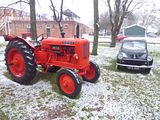
NEOM
In December 2020, Zak Brown announced McLaren’s interest in entering Formula E once the company’s battery supplier contract has expired. In January the following year, McLaren signed an option to enter the championship for 2022. McLaren announced the acquisition of the Mercedes-EQ Formula E Team in May 2022 and debuted in the 2022–23 season as NEOM McLaren Formula E Team using Nissan’s EV powertrain. René Rast, who last raced in the 2020–21 season with Audi Sport ABT Schaeffler, and Jake Hughes were signed as drivers for the team.


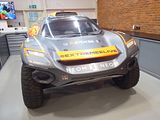
In 2022, NEOM also announced a strategic partnership with McLaren Racing to become the title partner of the NEOM McLaren Extreme E Team racing team as well, bringing two all-electric race series’ together for the first time under the banner of ‘NEOM McLaren Electric Racing’.

NIO
The Nio EP9 is a battery-powered, two-seat sports car manufactured by RML Group on behalf of Chinese electric car company Nio, not assisted by their Formula E racing division. The name EP9 stands for Electric Performance 9. Developed and built in 18 months, the EP9 debuted at the Saatchi Gallery in London, England. Six EP9s have been sold to Nio investors for £2,500,000 each. Nio has announced that ten additional EP9s will be sold to the general public. However, it is not a road-legal vehicle, and none of the 16-production model EP9s were ever registered for road use. The EP9 is purely designed for track use only and does not comply with the laws and regulations to be registered in China. None of the 16-production model EP9s were ever exported and registered for road use outside China so far. Each of the EP9’s wheels has its own motor and transmission. Each motor has 250 kW (335.25 hp), giving the car a total power output of 1 MW (1,341 hp; 1,360 PS). The EP9 is both all-wheel drive, and individual-wheel drive. The car has an advanced torque vectoring system that can adjust the power output to each wheel. The EP9’s battery can last up to 427 km (265 miles) before it needs to be charged. Recharging takes 45 minutes, and battery replacement takes 8 minutes as the batteries need to be removed when recharged. The car is equipped with an active suspension, including a ride height controller that makes 200 calculations per second. The car’s brakes are developed and constructed by U.K manufacture Alcon. The car’s chassis construction is all carbon fibre, and is based on the FIA Le Mans Prototype regulations. The exterior is also made of the same material. The vehicle’s batteries weigh 635 kg (1,400 lb). All of the carbon fibre in the car, in total, weighs 364 kg (802 lb). The total weight of the car is 1,735 kg (3,825 lb). The EP9 can accelerate from 0 to 100 km/h (62 mph) in 2.7 seconds, 200 km/h (124 mph) in 7.1 seconds, and 300 km/h (186 mph) in 15.9 seconds, as demonstrated by Richard Hammond in The Grand Tour. The car can achieve a top speed of 313 km/h (194 mph). The EP9 can also brake at a very short distance, as Richard Hammond (who had compared its acceleration to two vehicles he had famously crashed, a Rimac Concept One and the jet-powered dragster) demonstrated at the Eboladrome. The car is somewhat capable of autonomous driving, which it did when the car set a record for fastest autonomous driving at the Circuit of the Americas. However, this was only possible because it was configured to drive autonomously. The EP9’s chief designer was David Hilton, who was also Nio’s former senior design director. The EP9’s rear wing is adjustable between three settings: parked, low-drag, and high-downforce. The EP9 produces 24,000 newtons (5,395 lbs or 2447 kg) of downforce at 240 km/h (149 mph), similar to a Formula One car, allowing the EP9 to corner at 3.0g. The interior, like the exterior and chassis, is made entirely of carbon fibre. There are four screens: one on the driver’s side of the dashboard, one on the passenger’s side of the dashboard, one on the centre console, and one on the steering wheel. Dashboard screens – Both screens display performance data, but differ in function. The passenger-side screen displays only four measurements: the car’s top speed, lap time, and lateral G-forces, and the driver’s heart rate. The centre console screen displays performance data, lap times, and a track map with the car’s current position. The steering wheel screen: the steering wheel is a simplified version of Nio’s Formula E racing wheel, and is built by the same company. The EP9 set the record for the fastest lap by an electric vehicle for the Circuit of the Americas, Shanghai International Circuit and the Circuit Paul Ricard tracks. It also set the record for the fastest lap by an autonomous vehicle at the Circuit of the Americas track.
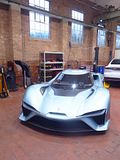

NISSAN/DATSUN
Although not many of the Datsun 240Z were sold in the UK, or indeed Europe, this car proved phenomenally popular in the US, and was really the beginning of the end for the British sports cars which American buyers had been buying in large quantities throughout the 1960s. Known internally as the Nissan S30, and sold in Japan as the Nissan Fairlady Z, the car we call the the Datsun 240Z, and the later 260Z and 280Z was the first generation of Z GT two-seat coupe, produced by Nissan from 1969 to 1978. It was designed by a team led by Yoshihiko Matsuo, the head of Nissan’s Sports Car Styling Studio. With strong performance from the 2.4 litre engine, and excellent ride and handling from the four-wheel independent suspension, the car was good to drive, In the United States, Datsun priced the 240Z within $200 of the MGB-GT, and dealers soon had long waiting lists for the “Z”. Its modern design, relatively low price, and growing dealer network compared to other imported sports cars of the time (Jaguar, BMW, Porsche, etc.), made it a major success for the Nissan Motor Corporation, which at the time sold cars in North America under the name Datsun. As a “halo” car, the 240Z broadened the image of Japanese car-makers beyond their econobox success. The car was updated to the 260Z in 1975, when a larger 2.6 litre engine was used.

Released on July 2002 in Japan at reorganized Nissan Japanese dealerships called Nissan Blue Stage, and August 20, 2002 in the US., the 350Z coupé was available in 5 trim packages: ‘350Z’ (Base), ‘Enthusiast’, ‘Performance’, ‘Touring’, and ‘Track’ editions. In Europe, only the ‘Track’ trim was available, although it was badged and marketed as ‘350Z’. The Base model did not include a VLSD or Traction Control and was only available with cloth seats. It did not include cruise control, nor power or heated seats. The Enthusiast model came with traction control, a VLSD, and cruise control. The Performance model came with bigger 18-inch wheels, front air dam, rear spoiler, optional Brembo brakes, and VDC instead of Traction Control. Touring was made more of the luxury model. It had power, leather, heated seats, VDC, a VLSD, xenon headlamps, optional Brembos, 18-inch wheels, and optional GPS. The Track model included Brembo brakes, front air dam, rear spoiler, traction control, cloth seats, 18-inch wheels, VLSD, and optional GPS. In 2004 Nissan introduced the 350Z Roadster with an electrically retractable soft-top roof. In the U.S. market the car was available in two trim packages (Enthusiast and Touring), while in Europe, the same versions as the coupé were offered. Nissan added the Grand Touring (GT) trim to the Roadster trim packages for 2005. In 2005 Nissan launched a 35th Anniversary edition, with a revised exterior and interior. Early 2005 model-year 35th anniversary edition models were equipped with the original VQ35DE with 287 hp and automatic transmission. In January 2005, Nissan introduced the 35th Anniversary 6-speed manual models and Track models (mid-year introduction), which included the updated VQ35DE 300 hp Rev-up engine and new updated CD009 manual transmission. As well as minor changes to suspension tuning and parts. For the 2006 model year, the 350Z received changes for its mid-cycle facelift. The VQ35DE 300 hp Rev-up engine that was introduced mid-year 2005 on the Track and 35th Anniversary Edition with 6-speed manual transmission models was offered for every trim level that had a manual transmission option. The VQ35DE with 287 hp continued to be offered with only the 5-speed automatic. Additions included bi-xenon projectors, a revised front fascia, new LED rear lights, changes to the interior trim and speed sensitive steering. Touring and Grand Touring models had radio-steering controls standard, MP3 CD compatibility, and Satellite Radio became an available option. For the 2007 model year, the 350Z was again moderately revised. The VQ35DE V6 was replaced with a new VQ35HR V6. It produced 306 hp at 6800 rpm with 268 ft·lb at 4800 rpm using the revised SAE certified power benchmark. The VQ35HR had a raised redline to 7500 rpm and more torque across the rpm range. The bonnet was redesigned with a bulge reminiscent of the original 240Z to accommodate the raised deck height of the new VQ35HR. In the US, trim levels were narrowed down to 350Z (base), Enthusiast, Touring, and Grand Touring, while in Europe the same trim levels remained. Bluetooth was added for the 2007 model year. The car was replaced by the 370Z for the 2009 model year. It has never found quite the same levels of enthusiasm that greeted – and have stayed with – the 350Z.
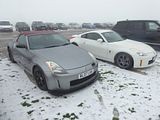
PEUGEOT
Before the 205, Peugeot was considered the most conservative of France’s “big three” car manufacturers, producing large saloons such as the 504 and 505, although it had entered the modern supermini market in 1973 with the Peugeot 104. The genesis of the 205 lay within Peugeot’s takeover in 1978 of Chrysler’s European divisions Simca and the former Rootes Group, which had the necessary expertise in making small cars including the Simca 1100 in France and Hillman Imp in Britain. It was around this time that Peugeot began to work on the development of a new supermini for the 1980s. It was launched on 24 February 1983, and was launched in right-hand drive form for the UK market in September that year. Shortly after its launch, it was narrowly pipped to the European Car of the Year award by the similar sized Fiat Uno, but ultimately (according to the award organizers) it would enjoy a better image and a longer high market demand than its Italian competitor. It was one of five important small cars to be launched onto the European market within a year of each other: the other four were the Uno, the second generation Ford Fiesta, the original Opel Corsa (sold as the Vauxhall Nova on the British market) and the original Nissan Micra. Its launch also closely followed that of the Austin Metro and Volkswagen Polo Mk2. The styling of the 205 is often thought to be a Pininfarina design, although Gerard Welter claims that it is an in-house design; Pininfarina only styled the Cabriolet. It is often credited as the car that turned Peugeot’s fortunes around. The fully independent suspension used the now standard PSA Peugeot Citroën layout that had debuted in the Peugeot 305 estate. A key ingredient of the success of the 205, it had MacPherson struts at the front and trailing arms with torsion bars at the rear. The rear suspension was very compact, designed to minimise suspension intrusion into the boot, giving a wide flat loadspace, while providing excellent ride and handling. Early 205s used the X petrol engine [n 1] from the older Peugeot 104, although these were later (1987–1988) replaced with the newer XU and TU-series engines, which were of PSA design. Engines ranged in displacement from 954 cc to 1905 cc, in carburettor or fuel injected versions. The diesel models employed the PSA XUD engine, lifted from the Citroën BX which was introduced in September 1982. These engines had a capacity of 1769 cc (XUD7) and 1905 cc (XUD9) and are closely related to the XU5 and XU9 petrol engines in the BX16 and BX19 of the time. The diesel engines were world-beating and so petrol-like that many buyers were won over by petrol car performance combined with diesel economy. For instance, the 205 GRD (1.8 Diesel, 59 bhp, 78 lb/ft (105.8 Nm)) was as fast as, yet smoother than, the 205 GR (1.4 Petrol, 59 bhp, 78 lb/ft (105.8 Nm)), due to the engine developing peak torque at much lower rpm, while using much less fuel. There were various versions intended for commercial use, such as the two-seater XA-series. There was also the “205 Multi”, a tall-bodied special version on XA or XE-basis built by independent coachbuilders like Gruau and Durisotti. Gruau called their XA-based two-seater version the “VU”, while the five-seat XE-based version was called the “VP”. Durisotti began building the 205 Multi in 1986; it was called the “205 Multi New Look”. The 205 was an instant hit, and its styling was echoed in every Peugeot model that was to follow. The exterior styling was never facelifted or significantly altered in its 15-year production run. There was a dashboard redesign for the 1988 model year, and in late 1990 the 205 received new door design and cards, clear front indicators, new ‘smoked’ rear light clusters, single point petrol injection and catalytic converters were introduced, to meet the new 1992 pollution limits. These updates came at a crucial time, as 1990 also saw the arrival of a completely new French competitor, the Renault Clio, while the Rover Metro and Volkswagen Polo were also heavily updated, and Ford had already replaced its Fiesta with a third generation model. Still, the 205 was still widely regarded in the motoring press as the benchmark car in this sector by 1990. At the beginning of 1993, Peugeot launched the 306, which officially replaced the 309; the arrival of this car also diminished the 205’s role (and its sales figures) in the Peugeot range, as had the arrival of the smaller 106 in September 1991 – although the final demise of the 205 was still some years away. The engines were continuously updated, with the new TU engines introduced in 1988. In 1991, the 205 dTurbo was launched with a powerful turbocharged version of the 1,769 cc xud diesel engine. After several years of gradually declining sales, the Peugeot 205 was discontinued in the United Kingdom in 1996. The Peugeot 205 was still offered in the “Sacré Numéro” and “Génération” models until the end of the production in 1998. The last models were GLD 1.8 configuration and were sold in Argentina. Most of the later European versions were only sold in France. Due to the pressure from the market, with buyers wanting a Peugeot supermini in the mould of the 205 again, the company finally built a direct replacement in the 206, which was launched in 1998. 5,278,050 Peugeot 205s have been sold, and a significant percentage of them were still in circulation as of 2009. By 2014, there were still as many as 14,000 on the road in the United Kingdom, compared to the peak high of 374,773 in 1994. With potentially as many 400,000 sales in the UK, it became the best selling car ever sold by Peugeot in the UK – although its success was emulated a few years later by the larger 306 and later by the 206. It also helped boost the popularity of the Peugeot brand there, and was at least a factor in Peugeot’s decision to phase out the Talbot brand in the mid 1980s when launching new models to be built at the former Rootes Group plant near Coventry and the former Simca plant at Poissy.
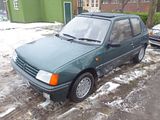
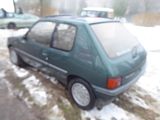
Mindful of the success of the Golf GTi, in the class above, and how a small car with good handling could take more power, as the Mini Cooper had proved, Peugeot came up with the GTi in early 1984. The first models had a 1.6 litre XU5J engine, producing 105 PS, which was uprated in 1987 with a cylinder head with larger valves thus becoming XU5JA, which took the power output up to 115 bhp. Visually the car retained the good looks of the 3 door version of the regular models, but it featured plastic wheel arch extensions and trim, beefier front and rear bumper valances and judicious use of red badging and trim. The shell also underwent some minor changes, including larger wheel arches (to suit the larger wheels , and the suspension was redesigned and sat lower on the GTI with stiffer springs, different wishbones and a drop-linked anti-roll bar. Red was a dominant colour inside. The car was an instant hit. At the end of 1986, Peugeot followed up with a more potent model, the 1.9 GTi, whose XU9JA engine produced 128 PS. Internally the engine of this car and the 1.6 model are very similar, the main differences on 1.9 litre versions being the longer stroke, oil cooler, and some parts of the fuel injection system. The shorter stroke 1.6 litre engine is famed for being revvy and eager, while the 1.9 litre feels lazier and torquier. Outside the engine bay the main differences between the 1.6 GTi and the 1.9 GTi are half-leather seats on the 1.9 GTi vs. cloth seats and disc brakes all-round (1.9 GTi) vs. discs at the front and drum brakes at the back; as well as the 14-inch Speedline SL201 wheels on the 1.6 GTi vs. 15 inch Speedline SL299 alloys on the 1.9 GTi. The 205 is still often treated as a benchmark in group car tests of the newest GTI models or equivalent. Peugeot itself has never truly recreated this success in future GTI models, although they came very close with the highly regarded GTI-6 variant of the Peugeot 306.
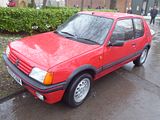


POLESTAR
Polestar have Bicester as their UK centre of operations so they have not just a showroom here but also a large fleet of demo cars. The Polestar 3 and 4 models have recently been added to the range and there were a number of these parked up outside, as well as a Polestar 3 I found elsewhere on site.
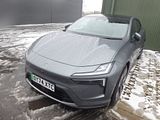


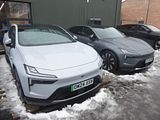
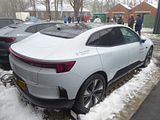
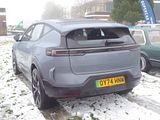
Also here, having made its world debut at the Goodwood Festival of Sped back in the summer was the Polestar Concept BST – the acronym short for ‘beast’, and not, as you might have guessed, the time used in British ‘summer’. What you’re looking at is a shell, a vision of what’s to come if Polestar were to – in the words of Polestar boss Thomas Ingenlath – “go mad”. That was the instruction to Polestar designers and this is what they came up with. Cleary spun off a Polestar 6, the Concept BST features a vented bonnet, a front splitter, some flared arches, 22in extra-wide wheels and an ‘extreme’ rear wing. Clearly inspired by the world of motorsport, it’s shod in grey and gets the obligatory side graphics. The two-seater gets the same bespoke bonded aluminium structure which underpins the Polestar Performance Architecture (PPA), and is – we’re told – super lightweight and super stiff. The PPA is the basis of the Polestar 5, an all-electric four-door GT. That car is of course capable of 872bhp and 664lb ft torque. Polestar isn’t able to confirm any power details for the Concept BST because… it’s not even a prototype. It’s a pretty idea, created for the purposes of standing with its SUV and Roadster siblings on the stand at Goodwood Festival of Speed, specifically the Polestar 3 and the Polestar 4 (which sit on an entirely different platform), and the Polestar 6 Concept (PPA). Polestar reminds us the 5 will launch next year (2025) and the 6 will follow in 2026. Whether or not the BST will be slated for production is yet to be confirmed. Demands for information were met with a not-especially-cryptic: “We have a history of taking concepts and keeping them true-to-form through to production. We’ve got a history… but it’s too early to confirm.” It’s not as mad as the Synergy, but if we’re hoping for a production version of either, the Concept BST is a more likely wager. What is most likely, however, is the application of – in Polestar’s words – the “ultra-performance moniker” ‘BST’ to existing models in the line-up. “This car is a demonstration of how far we can push our performance brand – Polestar turned up to 11 if you will – and a demonstration of how we could apply the BST formula to our line up in the future,” said Ingenlath.


PORSCHE
The 911 continued to evolve throughout the 1960s and early 1970s, though changes initially were quite small. The SC appeared in the autumn of 1977, proving that any earlier plans there had been to replace the car with the front engined 924 and 928 had been shelved. The SC followed on from the Carrera 3.0 of 1967 and 1977. It had the same 3 litre engine, with a lower compression ratio and detuned to provide 180 PS . The “SC” designation was reintroduced by Porsche for the first time since the 356 SC. No Carrera versions were produced though the 930 Turbo remained at the top of the range. Porsche’s engineers felt that the weight of the extra luxury, safety and emissions equipment on these cars was blunting performance compared to the earlier, lighter cars with the same power output, so in non-US cars, power was increased to 188 PS for 1980, then finally to 204 PS. However, cars sold in the US market retained their lower-compression 180 PS engines throughout. This enabled them to be run on lower-octane fuel. In model year 1980, Porsche offered a Weissach special edition version of the 911 SC, named after the town in Germany where Porsche has their research centre. Designated M439, it was offered in two colours with the turbo whale tail & front chin spoiler, body colour-matched Fuchs alloy wheels and other convenience features as standard. 408 cars were built for North America. In 1982, a Ferry Porsche Edition was made and a total of 200 cars were sold with this cosmetic package. SCs sold in the UK could be specified with the Sport Group Package (UK) which added stiffer suspension, the rear spoiler, front rubber lip and black Fuchs wheels. In 1981 a Cabriolet concept car was shown at the Frankfurt Motor Show. Not only was the car a true convertible, but it also featured four-wheel drive, although this was dropped in the production version. The first 911 Cabriolet debuted in late 1982, as a 1983 model. This was Porsche’s first cabriolet since the 356 of the mid-1960s. It proved very popular with 4,214 sold in its introductory year, despite its premium price relative to the open-top targa. Cabriolet versions of the 911 have been offered ever since. 911 SC sales totalled 58,914 cars before the next iteration, the 3.2 Carrera, which was introduced for the 1984 model year. Coupe models outsold the Targa topped cars by a big margin.
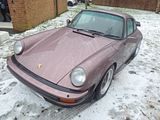

It was only really with the launch in 1989 of the 964 that a truly “new” model would appear. Designed by Benjamin Dimson in 1986, it featured significant styling revisions over previous 911 models, most prominently the more integrated bumpers. The 964 was considered to be 85% new as compared to its predecessor. The first 964s available in 1989 were all wheel drive equipped “Carrera 4” models; Porsche added the rear wheel drive Carrera 2 variant to the range in 1990. Both variants were available as a coupe, Targa or Cabriolet. The 964 Carrera was the last generation sold with the traditional removable Targa roof until the 2011 991. A new naturally aspirated engine called the M64 was used for 964 models, with a flat-6 displacement of 3.6 litres. Porsche substantially revised the suspension, replacing torsion bars with coil springs and shock absorbers. Power steering and ABS brakes were added to the 911 for the first time; both were standard. The exterior bumpers and fog lamps became flush with the car for better aerodynamics. A new electric rear spoiler raised at speeds above 50 mph and lowered down flush with the rear engine lid at lower speeds. A revised interior featured standard dual airbags beginning in 1990 for all North American production cars. A new automatic climate control system provided improved heating and cooling. Revised instrumentation housed a large set of warning lights that were tied into the car’s central warning system, alerting the driver to a possible problem or malfunction.


Replacing the 964, the 993 models were first seen in October 1993, with production starting a few weeks later. Its arrival marked the end of air-cooled 911 models. The 993 was much improved over, and quite different from its predecessor. According to Porsche, every part of the car was designed from the ground up, including the engine and only 20% of its parts were carried over from the previous generation. Porsche refers to the 993 as “a significant advance, not just from a technical, but also a visual perspective.” Porsche’s engineers devised a new light-alloy subframe with coil and wishbone suspension (an all new multi-link system), putting behind the previous lift-off oversteer and making significant progress with the engine and handling, creating a more civilised car overall providing an improved driving experience. The 993 was also the first 911 to receive a six speed transmission. The 993 had several variants, as its predecessors, varying in body style, engines, drivetrains and included equipment. Power was increased by the addition of the VarioRam system, which added additional power, particularly in the mid-ranges, and also resulted in more throttle noise at higher revs; as a consequence, resulted in a 15% increase in power over its predecessor. The external design of the Porsche 993, penned by English designer Tony Hatter, retained the basic body shell architecture of the 964 and other earlier 911 models, but with revised exterior panels, with much more flared wheel arches, a smoother front and rear bumper design, an enlarged retractable rear wing and teardrop mirrors. A major change was the implementation of all alloy multi-link rear suspension attached to an alloy sub frame, a completely new design derived from the 989, a four-door sedan which never went into production. The system later continued in the 993’s successor, the 996, and required the widening of the rear wheel arches, which gave better stability. The new suspension improved handling, making it more direct, more stable, and helping to reduce the tendency to oversteer if the throttle was lifted during hard cornering, a trait of earlier 911s. It also reduced interior noise and improved ride quality. The 993 was the first generation of the 911 to have a 6-speed manual transmission included as standard; its predecessors had 4 or 5-speed transmissions. In virtually every situation, it was possible to keep the engine at its best torque range above 4,500 rpm. The Carrera, Carrera S, Cabriolet and Targa models (rear wheel drive) were available with a “Tiptronic” 4-speed automatic transmission, first introduced in the 964. From the 1995 model year, Porsche offered the Tiptronic S with additional steering wheel mounted controls and refined software for smoother, quicker shifts. Since the 993’s introduction, the Tiptronic is capable of recognising climbs and descents. The Tiptronic equipped cars suffer as compared to the manual transmission equipped cars in both acceleration and also top speed, but the differences are not much notable. Tiptronic cars also suffered a 55 lb (25 kg) increase in weight. The 993’s optional all wheel drive system was refined over that of the 964. Porsche departed from the 964’s setup consisting of three differentials and revised the system based on the layout from its 959 flagship, replacing the centre differential with a viscous coupling unit. In conjunction with the 993’s redesigned suspension, this system improved handling characteristics in inclement weather and still retained the stability offered by all wheel drive without having to suffer as many compromises as the previous all-wheel-drive system. Its simpler layout also reduced weight, though the four wheel drive Carrera 4 weighs 111 lb (50 kg) more than its rear wheel drive counterpart (at 3,131 lb (1,420 kg) vs. 3,020 lb (1,370 kg)). Other improvements over the 964 include a new dual-flow exhaust system, larger brakes with drilled discs, and a revised power steering. A full range of models arrived before the arrival of the 996 generation in 1998.
During the 1990s, Porsche was facing financial troubles and rumours of a proposed takeover were being spread. The signature air-cooled flat-6 of the 911 was reaching the limits of its potential as made evident by the 993. Stricter emissions regulations world wide further forced Porsche to think of a replacement of the air-cooled unit. In order to improve manufacturing processes, Porsche took the aid of leading Japanese car manufacturer Toyota whose consultants would assist in the overhaul of the Zuffenhausen manufacturing facility introducing mass production techniques which would allow Porsche to carry out production processes more efficiently. Porsche had realised that in order to keep the 911 in production, it would need radical changes. This led to the development of the 996. The sharing of development between the new 911 and the entry level Boxster model allowed Porsche to save development costs. This move also resulted in interchangeable parts between the two models bringing down maintenance costs. The Porsche 996 was a new design developed by Pinky Lai under Porsche design chief Harm Lagaay from 1992 to 1994; it was the first 911 that was completely redesigned, and carried over little from its predecessor as Porsche wanted the design team to design a 911 for the next millennium. Featuring an all new body work, interior, and the first water-cooled engine, the 996 replaced the 993 from which only the front suspension, rear multi-link suspension, and a 6-speed manual transmission were retained in revised form. The 996 had a drag coefficient of Cd=0.30 resulting from hours spent in the wind tunnel. The 996 is 185 mm (7 in) longer and 40 mm (2 in) wider than its predecessor. It is also 45% stiffer courtesy of a chassis formed from high-strength steel. Additionally, it is 50 kg (110 lb) lighter despite having additional radiators and coolant. All of the M96 engines offered in the 996 (except for the variants fitted to the Turbo and GT2/GT3 models) are susceptible to the Porsche Intermediate Shaft Bearing issue which can potentially cause serious engine failure if not addressed via a retrofit. The 996 was initially available in a coupé or a cabriolet (Convertible) bodystyle with rear-wheel drive, and later with four-wheel drive, utilising a 3.4 litre flat-6 engine generating a maximum power output of 296 bhp. The 996 had the same front end as the entry-level Boxster. After requests from the Carrera owners about their premium cars looking like a “lower priced car that looked just like theirs did”, Porsche redesigned the headlamps of the Carrera in 2002 similar to the high performance Turbo’s headlamps. The design for the initial “fried egg” shaped headlamps could be traced back to the 1997 911 GT1 race car. In 2000, Porsche introduced the 996 Turbo, equipped with a four-wheel-drive system and a 3.6-litre, twin-turbocharged and intercooled flat-six engine generating a maximum power output of 420 bhp, making the car capable of accelerating from 0–60 mph in 4.2 seconds. An X50 option which included larger turbochargers and intercoolers along with revised engine control software became available from the factory in 2002, increasing power output to 451 bhp. In 2005, Porsche introduced the Turbo S, which had the X50 option included as standard equipment, with the formerly optional Carbon fibre-reinforced Silicon Carbide (C/SiC) composite ceramic brakes (PCCB) also included as standard. In 2000, power output on the base Carrera model was increased to 300 bhp. 2001 marked the final year of production for the base Carrera 4 Coupé in narrow body format. In 2002, the standard Carrera models underwent the above-mentioned facelift. In addition, engine capacity was also increased to 3.6-litres across the range, yielding gains of 15 bhp for the naturally aspirated models. 2002 also marked the start of the production of the 996 based Targa model, with a sliding glass “green house” roof system as introduced on its predecessor. It also features a rear glass hatch which gave the driver access to the storage compartment. Also in 2002, the Carrera 4S model was first introduced.
The 997 GT3 RS was first announced in early 2006 as a homologation version of the GT3 RSR racing car for competition events like Sebring and the 24 Hours of Le Mans. The drivetrain of the RS is based on the 911 GT3, except for the addition of a lightweight flywheel and closer gear ratios for further improved response under acceleration. Unlike the GT3, the RS is built on the body and chassis of the 911 Carrera 4 and Turbo, and accordingly has a wider rear track for better cornering characteristics on the track. Visually, the RS is distinguished by its distinctive colour scheme – bright orange or green with black accents, which traces its roots to the iconic Carrera RS of 1973. The plastic rear deck lid is topped by a wide carbon-fibre rear wing. The front airdam has been fitted with an aero splitter to improve front downforce and provide more cooling air through the radiator. The European version of the RS is fitted with lightweight plexiglass rear windows and a factory-installed roll cage. Production of the first generation 997 GT3 RS ended in 2009, with worldwide production estimated to be under 2,000 vehicles. In August 2009, Porsche announced the second generation of the 997 GT3 RS with an enlarged 3.8-litre engine having a power output of 450 PS (444 hp), a modified suspension, dynamic engine mounts, new titanium sport exhaust, and modified lightweight bodywork. In April 2011, Porsche announced the third generation of the 997 GT3 RS with an enlarged 4.0-litre engine having a power output of 500 PS (493 hp), Porsche designed the GT3 RS 4.0 using lightweight components such as bucket seats, carbon-fibre bonnet and front wings, and poly carbonate plastic rear windows for weight reduction, while using suspension components from the racing version. Other characteristics include low centre of gravity, a large rear wing and an aerodynamically optimised body. The lateral front air deflection vanes, a first on a production Porsche, increase downforce on the front axle. Aided by a steeply inclined rear wing, aerodynamic forces exert an additional 190 kg, enhancing the 911 GT3 RS 4.0’s grip to the tarmac. The GT3 RS 4.0 weighs 1,360 kg.
The 991 introduced in 2012 is an entirely new platform, only the third since the original 911. Porsche revealed basic information on the new Carrera and Carrera S models on 23 August 2011. The Carrera is powered by a 350 hp 3.4-litre engine. The Carrera S features a 3.8-litre engine rated at 400 hp. A Power Kit (option X51) is available for the Carrera S, increasing power output to 430 hp. The new 991’s overall length grows by 56 mm (2.2 in) and wheelbase grows by 99 mm (3.9 in) (now 96.5 in.) Overhangs are trimmed and the rear axle moves rearward at roughly 76 mm (3 in) towards the engine (made possible by new 3-shaft transmissions whose output flanges are moved closer to the engine). There is a wider front track (51 mm (2 in) wider for the Carrera S). The design team for the 991 was headed by Michael Mauer. At the front, the new 991 has wide-set headlights that are more three-dimensional. The front fender peaks are a bit more prominent, and wedgy directionals now appear to float above the intakes for the twin coolant radiators. The stretched rear 3/4 view has changed the most, with a slightly more voluminous form and thin taillights capped with the protruding lip of the bodywork. The biggest and main change in the interior is the center console, inspired by the Carrera GT and adopted by the Panamera. The 991 is the first 911 to use a predominantly aluminium construction. This means that even though the car is larger than the outgoing model, it is still up to 50 kilograms (110 lb) lighter. The reduced weight and increased power means that both the Carrera and Carrera S are appreciably faster than the outgoing models. The 0–60 mph acceleration time for the manual transmission cars are 4.6 seconds for the Carrera and 4.3 seconds for the Carrera S. When equipped with the PDK transmission, the two 991 models can accelerate from 0–97 km/h in 4.4 seconds and 4.1 seconds. With the optional sports chrono package, available for the cars with the PDK transmission, the 991 Carrera can accelerate from 0–97 km/h in as little as 4.2 seconds and the Carrera S can do the same in 3.9 seconds. Apart from the reworked PDK transmission, the new 991 is also equipped with an industry-first 7-speed manual transmission. On vehicles produced in late 2012 (2013 model year) Rev Matching is available on the 7-speed manual transmission when equipped with the Sport Chrono package. Rev-Matching is a new feature with the manual transmission that blips the throttle during downshifts (if in Sport Plus mode). Also, the 7th gear cannot be engaged unless the car is already in 5th or 6th gear. One of Porsche’s primary objectives with the new model was to improve fuel economy as well as increase performance. In order to meet these objectives, Porsche introduced a number of new technologies in the 911. One of the most controversial of these is the introduction of electromechanical power steering instead of the previous hydraulic steering. This steering helps reduce fuel consumption, but some enthusiasts feel that the precise steering feedback for which the 911 is famous is reduced with the new system.[citation needed] The cars also feature an engine stop/start system that turns the engine off at red lights, as well as a coasting system that allows the engine to idle while maintaining speed on downhill gradients on highways. This allows for up to a 16% reduction in fuel consumption and emissions over the outgoing models. The new cars also have a number of technologies aimed at improving handling. The cars include a torque vectoring system (standard on the Carrera S and optional on the Carrera) which brakes the inner wheel of the car when going into turns. This helps the car to turn in quicker and with more precision. The cars also feature hydraulic engine mounts (which help reduce the inertia of the engine when going into turns) as part of the optional sports chrono package. Active suspension management is standard on the Carrera S and optional on the Carrera. This helps improve ride quality on straights while stiffening the suspension during aggressive driving. The new 991 is also equipped with a new feature called Porsche Dynamic Chassis Control (PDCC). Porsche claims that this new feature alone has shaved 4 seconds off the standard car’s lap time around the Nürburgring. PDCC helps the car corner flat and is said to improve high-speed directional stability and outright lateral body control, but according to several reviews, the car is more prone to understeer when equipped with this new technology. In January 2013, Porsche introduced the all-wheel-drive variants of the Carrera models. The ‘4’ and ‘4S’ models are distinguishable by wider tyres, marginally wider rear body-work and a red-reflector strip that sits in between the tail-lights. In terms of technology, the 4 and 4S models are equipped with an all-new variable all-wheel-drive system that sends power to the front wheels only when needed, giving the driver a sense of being in a rear-wheel-drive 911. In May 2013, Porsche announced changes to the model year 2014 911 Turbo and Turbo S models, increasing their power to 513 hp on the ‘Turbo’, and 552 hp on the ‘Turbo S’, giving them a 0–97 km/h acceleration time of 3.2 and 2.9 seconds, respectively. A rear-wheel steering system has also been incorporated on the Turbo models that steers the rear wheels in the opposite direction at low speeds or the same direction at high speeds to improve handling. During low-speed manoeuvres, this has the virtual effect of shortening the wheelbase, while at high speeds, it is virtually extending the wheelbase for higher driving stability and agility. In January 2014, Porsche introduced the new model year 2015 Targa 4 and Targa 4S models. These new models come equipped with an all-new roof technology with the original Targa design, now with an all-electric cabriolet roof along with the B-pillar and the glass ‘dome’ at the rear. In September 2015, Porsche introduced the second generation of 991 Carrera models at the Frankfurt Motor Show. Both Carrera and Carrera S models break with previous tradition by featuring a 3.0-litre turbocharged 6-cylinder boxer engine, marking the first time that a forced induction engine has been fitted to the base models within the 911 range
In October 2017, Porsche announced the 911 Carrera T (Touring), offering the base Carrera drivetrain but with shorter rear axle ratio, mechanical differential lock, PASM Sport lowered suspension, Sport Chrono package and sports exhaust as standard. Additional features include a reduced sound insulation, light-weight glass side/rear windows, Sport-Tex seats, a shortened shift lever, deletion of the rear seats and communication system (with their re-addition available as a no-cost option), Carrera S wheels, as well as optional rear-wheel steering, PDK transmission and bucket seats.
Porsche unveiled the facelifted 991.2 GT3 at the 2017 Geneva Motor Show. Extensive changes were made to the engine allowing for a 9,000 rpm redline from the 4.0 litre flat-six engine derived from Porsche 911 GT3 R and Cup racing cars. The engine has a power output of 500 PS (493 bhp) and 460 Nm (339 lb/ft) of torque. Porsche’s focus was on reducing internal friction to improve throttle response. Compared to the 991.1, the rear spoiler is 0.8 inch taller and located farther back to be more effective resulting in a 20% increase in downforce. There is a new front spoiler and changes to the rear suspension along with larger ram air ducts. The car generates 154 kg (340 lb) of downforce at top speed. The 991.2 GT3 brought back the choice between a manual transmission or a PDK dual clutch transmission. Performance figures include a 0-97 km/h (60 mph) acceleration time of 3.8 seconds (3.2 seconds for the PDK version) and a quarter mile time of 11.6 seconds. The GT3 can attain a top speed of 319 km/h (198 mph).
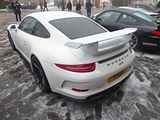
The RS version of the 991 GT3 was launched at the 2015 Geneva Motor Show, and featured in first drive articles in the press a few weeks later, with cars reaching the UK in the summer and another series of universally positive articles duly appearing. It had very big shoes to fill, as the 997 GT3 RS model was rated by everyone lucky enough to get behind the wheel, where the combination of extra power and reduced weight made it even better to drive than the standard non-RS version of the car. A slightly different approach was taken here, with the result weighing just 10kg less than the GT3. It is based on the extra wide body of the 991 Turbo. Compared to the 991 GT3, the front wings are now equipped with louvres above the wheels and the rear wings now include Turbo-like intakes, rather than an intake below the rear wing. The roof is made from magnesium a bonnet, whilst the front wings, rear deck and rear spoiler all in carbonfibre-reinforced plastic (CFRP), the rear apron is in a new polyurethane-carbonfibre polymer and polycarbonate glazing is used for the side and rear windows. The wider body allows the RS’s axle tracks to grow, to the point where the rear track is some 72mm wider than that of a standard 3.4-litre Carrera and the tyres are the widest yet to be fitted to a road-going 911. A long-throw crankshaft made of extra-pure tempered steel delivers the 4mm of added piston stroke necessary to take the GT3’s 3.8-litre flat six out to 3996cc . The engine also uses a new induction system, breathing through the lateral air intakes of the Turbo’s body rather than through the rear deck cover like every other 911. This gives more ram-air effect for the engine and makes more power available at high speeds. It results in an output of 500 bhp and 339 lb/ft of torque. A titanium exhaust also saves weight. The suspension has been updated and retuned, with more rigid ball-jointed mountings and helper springs fitted at the rear, while Porsche’s optional carbon-ceramic brakes get a new outer friction layer. Which is to say nothing of the RS’s biggest advancement over any other 911: downforce. The rear wing makes up to 220kg of it, while the front spoiler and body profile generates up to 110kg. In both respects, that’s double the downforce of the old 997 GT3 RS 4.0. The transmission is PDK only. The result is a 0-62 mph time of just 3.3 seconds, some 0.6 seconds quicker than the 997 GT3 RS 4.0 and 0-124 mph (0-200kmh) in 10.9 seconds. The 991 GT3 RS also comes with functions such as declutching by “paddle neutral” — comparable to pressing the clutch with a conventional manual gearbox –- and Pit Speed limiter button. As with the 991 GT3, there is rear-axle steering and Porsche Torque Vectoring Plus with fully variable rear axle differential lock. The Nürburgring Nordschleife time is 7 minutes and 20 seconds. The interior includes full bucket seats (based on the carbon seats of the 918 Spyder), carbon-fibre inserts, lightweight door handles and the Club Sport Package as standard (a bolted-on roll cage behind the front seats, preparation for a battery master switch, and a six-point safety harness for the driver and fire extinguisher with mounting bracket). Needless to say, the car was an instant sell out, even at a starting price of £131,296.

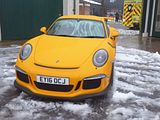

In February 2021, Porsche introduced the 992’s GT3 version. Like most other GT3 Porsches, it is intended for mixed usage with a more track-focused setup. It uses the same 4.0 litre naturally aspirated flat-6 as the 991.2, and producing over 510 PS (503 hp). It reaches 100 km/h (62 mph) in 3.4 seconds while the top speed is 320 km/h (199 mph). The 992 GT3 recently set a lap time at Nürburgring Nordschleife with a time of 6:55.34 minutes. Unlike the standard model, the GT3 features a large rear spoiler with larger air vents, a bigger diffuser, two large exhaust connections, bucket seats in its interior, and an optional roll cage. The GT3 uses a 7-speed PDK or a 6-speed manual instead of the 7-speed manual or 8-speed PDK used in other models.
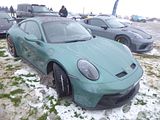
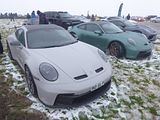
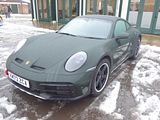
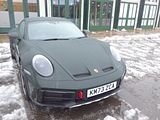

Perhaps the rarest (in the UK) Porsche design to be seen here is the 914, a model born of a joint need that Porsche had for a replacement for the 912, and Volkswagen’s desire for a new range-topping sports coupe to replace the Karmann Ghia. At the time, the majority of Volkswagen’s developmental work was handled by Porsche, part of a setup that dated back to Porsche’s founding; Volkswagen needed to contract out one last project to Porsche to fulfill the contract, and decided to make this that project. Ferdinand Piëch, who was in charge of research and development at Porsche, was put in charge of the 914 project. Originally intending to sell the vehicle with a flat four-cylinder engine as a Volkswagen and with a flat six-cylinder engine as a Porsche, Porsche decided during development that having Volkswagen and Porsche models sharing the same body would be risky for business in the American market, and convinced Volkswagen to allow them to sell both versions as Porsches in North America. On March 1, 1968, the first 914 prototype was presented. However, development became complicated after the death of Volkswagen’s chairman, Heinz Nordhoff, on April 12, 1968. His successor, Kurt Lotz, was not connected with the Porsche dynasty and the verbal agreement between Volkswagen and Porsche fell apart. In Lotz’s opinion, Volkswagen had all rights to the model, and no incentive to share it with Porsche if they would not share in tooling expenses. With this decision, the price and marketing concept for the 914 had failed before series production had begun. As a result, the price of the chassis went up considerably, and the 914/6 ended up costing only a bit less than the 911T, Porsche’s next lowest price car. The 914/6 sold quite poorly while the much less expensive 914/4 became Porsche’s top seller during its model run, outselling the Porsche 911 by a wide margin with over 118,000 units sold worldwide. Volkswagen versions originally featured an 80 PS fuel-injected 1.7 L flat-4 engine based on the Volkswagen air-cooled engine. Porsche’s 914/6 variant featured a carburettor 110 PS 2.0 litre flat-6 engine from the 1969 911T, placed amidships in front of a version of the 1969 911’s “901” gearbox configured for a mid-engine car. Karmann manufactured the rolling chassis at their plant, completing Volkswagen production in-house or delivering versions to Porsche for their final assembly. 914/6 models used lower gear ratios and high brake gearing in order to try to overcome the greater weight of the 6 cylinder engine along with higher power output. Suspension, brakes, and handling were otherwise the same. A Volkswagen-Porsche joint venture, Volkswagen of America, handled export to the U.S., where both versions were badged and sold as Porsches, except in California, where they were sold in Volkswagen dealerships. The four-cylinder cars were sold as Volkswagen-Porsches at European Volkswagen dealerships. Slow sales and rising costs prompted Porsche to discontinue the 914/6 variant in 1972 after producing 3,351 of them; its place in the lineup was filled by a variant powered by a new 100 PS 2.0 litre, fuel-injected version of Volkswagen’s Type 4 engine in 1973. For 1974, the 1.7 L engine was replaced by a 85 PS 1.8 litre, and the new Bosch L-Jetronic fuel injection system was added to American units to help with emissions control. 914 production ended in 1976. The 2.0 litre flat-4 engine continued to be used in the 912E, which provided an entry-level model until the 924 was introduced.


The 924 was originally another joint project of Volkswagen and Porsche created by the Vertriebsgesellschaft (VG), the joint sales and marketing company funded by Porsche and VW to market and sell sports cars, For Volkswagen, it was intended to be that company’s flagship coupé sports car and was dubbed “Project 425” during its development. For Porsche, it was to be its entry-level sports car replacing the 914. At the time, Volkswagen lacked a significant internal research and design division for developing sports cars; further, Porsche had been doing the bulk of the company’s development work anyway, per a deal that went back to the 1940s. In keeping with this history, Porsche was contracted to develop a new sporting vehicle with the caveat that this vehicle must work with an existing VW/Audi inline-four engine. Porsche chose a rear-wheel drive layout and a rear-mounted transaxle for the design to help provide 48/52 front/rear weight distribution; this slight rear weight bias aided both traction and brake balance. The 1973 oil crisis, a series of automobile-related regulatory changes enacted during the 1970s and a change of directors at Volkswagen made the case for a Volkswagen sports car less striking and the 425 project was put on hold. After serious deliberation at VW, the project was scrapped entirely after a decision was made to move forward with the cheaper, more practical, Golf-based Scirocco model instead. Porsche, which needed a model to replace the 914, made a deal with Volkswagen leadership to buy the design back. The deal specified that the car would be built at the ex-NSU factory in Neckarsulm located north of the Porsche headquarters in Stuttgart, Volkswagen becoming the subcontractor. Hence, Volkswagen employees would do the actual production line work (supervised by Porsche’s own production specialists) and that Porsche would own the design. It became one of Porsche’s best-selling models, and the relative cheapness of building the car made it both profitable and fairly easy for Porsche to finance. The original design used an Audi-sourced four-speed manual transmission from a front wheel drive car but now placed and used as a rear transaxle. It was mated to VW’s EA831 2.0 litre 4 cylinder engine, subsequently used in the Audi 100 and the Volkswagen LT van (common belief is that ‘the engine originated in the LT van’, but it first appeared in the Audi car and in 924 form has a Porsche-designed cylinder head). The 924 engine used Bosch K-Jetronic fuel injection, producing 125 bhp in European cars, but a rather paltry 95 bhp for the US market models, though this was improved to 110 hp in mid-1977 with the introduction of a catalytic converter, which reduced the need for power-robbing smog equipment. The four-speed manual was the only transmission available for the initial 1976 model, later this was replaced by a five-speed dog-leg unit. An Audi three-speed automatic was offered starting with the 1977.5 model. In 1980 the five-speed transmission was changed to a conventional H-pattern, with reverse now on the right beneath fifth gear. Porsche made small improvements to the 924 each model year between 1977 and 1985, but nothing major was changed on non-turbo cars. Porsche soon recognised the need for a higher-performance version of the 924 that could bridge the gap between the basic 924s and the 911s. Having already found the benefits of turbochargers on several race cars and the 1975 911 turbo, Porsche chose to use this technology for the 924, eventually introducing the 924 turbo as a 1978 model. Porsche started with the same Audi-sourced VW EA831 2.0 litre engine, designed an all new cylinder head (which was hand assembled at Stuttgart), dropped the compression to 7.5:1 and engineered a KKK K-26 turbocharger for it. With 10 psi boost, output increased to 170 hp. The 924 turbo’s engine assembly weighed about 65 lb more, so front spring rates and anti-roll bars were revised. Weight distribution was now 49/51 compared to the original 924 figure of 48/52 front to rear. In order to help make the car more functional, as well as to distinguish it from the naturally aspirated version, Porsche added an NACA duct in the bonnet and air intakes in the badge panel in the nose, 15-inch spoke-style alloy wheels, four-wheel disc brakes with five-stud hubs and a five-speed transmission. Forged 16-inch flat wheels of the style used on the 928 were optional, but fitment specification was that of the 911 which the 924 shared wheel offsets with. Internally, Porsche called it the “931” (left hand drive) and “932” (right hand drive). The turbocharged VW EA831 engine allowed the 924’s performance to come surprisingly close to that of the 911 SC (180 bhp), thanks in part to a lighter curb weight, but it also brought reliability problems.This was in part due to the fact that the general public did not know how to operate, or care for, what is by today’s standards a primitive turbo setup. A turbocharger cooled only by engine oil led to short component life and turbo-related seal and seat problems. To fix the problems, Porsche released a revised 924 turbo series 2 (although badging still read “924 turbo”) in 1979. By using a smaller turbocharger running at increased boost, slightly higher compression of 8:1 and an improved fuel injection system with DITC ignition triggered by the flywheel, reliability improved and power rose to 177 hp. In 1984, VW decided to stop manufacturing the engine blocks used in the 2.0 litre 924, leaving Porsche with a predicament. The 924 was considerably cheaper than its 944 stablemate, and dropping the model left Porsche without an affordable entry-level option. The decision was made to equip the narrower bodied 924 with a slightly detuned version of the 944’s 163 bhp 2.5 litre straight four, upgrading the suspension but retaining the 924’s early interior. The result was 1986’s 150 bhp 924S. In 1988, the 924S’ final year of production, power increased to 160 bhp matching that of the previous year’s Le Mans spec cars and the base model 944, itself detuned by 3 bhp. This was achieved using different pistons which raised the S’ compression ratio from 9.7:1 to 10.2:1, the knock-on effect being an increase in the octane rating, up from 91 RON to 95. This made the 924S slightly faster than the base 944 due to its lighter weight and more aerodynamic body. With unfavourable exchange rates in the late 1980s, Porsche decided to focus its efforts on its more upmarket models, dropping the 924S for 1989 and the base 944 later that same year.

There were several 944 models here, too. Whilst its precursor, the 924, had received largely positive reviews, it was criticised by many including Porsche enthusiasts for its Audi-sourced engine and although the Turbo model had increased performance, this model carried a high price, which caused Porsche to decide to develop the 924, as they had with generations of the 911. They re-worked the platform and a new all-alloy 2.5 litre inline-four engine, that was, in essence, half of the 928’s 5.0 litre V8, although very few parts were actually interchangeable. Not typical in luxury sports cars, the four-cylinder engine was chosen for fuel efficiency and size, because it had to be fitted from below on the Neckarsulm production line. To overcome roughness caused by the unbalanced secondary forces that are typical of four-cylinder engines, Porsche included two counter-rotating balance shafts running at twice engine speed. Invented in 1904 by British engineer Frederick Lanchester, and further developed and patented in 1975 by Mitsubishi Motors, balance shafts carry eccentric weights which produce inertial forces that balance out the unbalanced secondary forces, making a four-cylinder engine feel as smooth as a six-cylinder. The engine was factory-rated at 150 hp in its U.S. configuration. Revised bodywork with wider wheel arches, similar to that of the 924 Carrera GT, a fresh interior and upgrades to the braking and suspension systems rounded out the major changes and Porsche introduced the car as the 944 in 1982. It was slightly faster (despite having a poorer drag co-efficient than the 924), the 944 was better equipped and more refined than the 924; it had better handling and stopping power, and was more comfortable to drive. The factory-claimed 0-60 mph time of less than 9 seconds and a top speed of 130 mph which turned out to be somewhat pessimistic, In mid-1985, the 944 underwent its first significant changes. These included : a new dash and door panels, embedded radio antenna, upgraded alternator, increased oil sump capacity, new front and rear cast alloy control arms and semi-trailing arms, larger fuel tank, optional heated and powered seats, Porsche HiFi sound system, and revisions in the mounting of the transaxle to reduce noise and vibration. The “cookie cutter” style wheels used in the early 944s were upgraded to new “phone dial” style wheels (Fuchs wheels remained an option). 1985 model year cars incorporating these changes are sometimes referred to as “1985B”, “85.5” or “1985½” cars. For the 1987 model year, the 944 Motronic DME was updated, and newly incorporated anti-lock braking and air bags. Because of the ABS system, the wheel offset changed and Fuchs wheels were no longer an option. In early 1989 before the release of the 944S2, Porsche upgraded the 944 from the 2.5 to a 2.7 litre engine, with a rated 162 hp and a significant increase in torque. For the 1985 model year, Porsche introduced the 944 Turbo, known internally as the 951. This had a turbocharged and intercooled version of the standard car’s engine that produced 220 PS at 6000 rpm. In 1987, Car and Driver tested the 944 Turbo and achieved a 0-60 mph time of 5.9 seconds. The Turbo was the first car using a ceramic port liner to retain exhaust gas temperature and new forged pistons and was also the first vehicle to produce identical power output with or without a catalytic converter. The Turbo also featured several other changes, such as improved aerodynamics, notably an integrated front bumper. This featured the widest turn signals (indicators) fitted to any production car, a strengthened gearbox with a different final drive ratio, standard external oil coolers for both the engine and transmission, standard 16 inch wheels (optional forged Fuchs wheels), and a slightly stiffer suspension (progressive springs) to handle the extra weight. The Turbo’s front and rear brakes were borrowed from the Porsche 911, with Brembo 4-piston fixed calipers and 12-inch discs as ABS also came standard. Engine component revisions, more than thirty in all, were made to the 951 to compensate for increased internal loads and heat. Changes occurred for the 1987 model year. On the interior, the 1987 944 Turbo for North America became the first production car in the world to be equipped with driver and passenger side air bags as standard equipment. A low oil level light was added to the dash as well as a 180 mph (290 km/h) speedometer as opposed to the 170 mph speedometer on the 1986 model Turbos. Also included is the deletion of the transmission oil cooler, and a change in suspension control arms to reduce the car’s scrub radius. The engine remained the same M44/51 as in the 1986 model. In 1988, Porsche introduced the Turbo S. The 944 Turbo S had a more powerful engine (designation number M44/52) with 250 hp and 258 lb·ft torque (standard 944 Turbo 220 hp and 243 lb·ft. This higher output was achieved by using a larger K26-8 turbine housing and revised engine mapping which allowed maintaining maximum boost until 5800 rpm, compared to the standard 944 Turbo the boost would decrease from 1.75 bar at 3000 rpm to 1.52 bar at 5800 rpm. Top speed was factory rated at 162 mph. The 944 Turbo S’s suspension had the “M030” option consisting of Koni adjustable shocks front and rear, with ride height adjusting threaded collars on the front struts, progressive rate springs, larger hollow rear anti-roll/torsion bars, harder durometer suspension bushings, larger hollow anti-roll/torsion bars at the front, and chassis stiffening brackets in the front frame rails. The air conditioning dryer lines are routed so as to clear the front frame brace on the driver’s side. The 944 Turbo S wheels, known as the Club Sport design, were 16-inch Fuchs forged and flat-dished, similar to the Design 90 wheel. Wheel widths were 7 inches in the front, and 9 inches in the rear with 2.047 in offset; sizes of the Z-rated tyres were 225/50 in the front and 245/45 in the rear. The front and rear fender edges were rolled to accommodate the larger wheels. The manual transmission featured a higher friction clutch disc setup, an external cooler, and a limited slip differential with a 40% lockup setting. The Turbo S front brakes were borrowed from the Porsche 928 S4, with larger Brembo GT 4-piston fixed calipers and 12-inch discs; rear Brembo brakes remained the same as a standard Turbo. ABS also came standard. The 944 Turbo S interior featured power seats for both driver and passenger, where the majority of the factory-built Turbo S models sported a “Burgundy plaid” (Silver Rose edition) but other interior/exterior colours were available. A 10-speaker sound system and equalizer + amp was a common option with the Turbo S and S/SE prototypes. Only the earlier 1986, 250 bhp prototypes featured a “special wishes custom interior” options package. In 1989 and later production, the ‘S’ designation was dropped from the 944 Turbo S, and all 944 Turbos featured the Turbo S enhancements as standard, however the “M030” suspension and the Club Sport wheels were not part of that standard. The 944 Turbo S was the fastest production four cylinder car of its time. For the 1987 model year, the 944S “Super” was introduced, featuring a high performance normally aspirated, dual-overhead-cam 16-valve 190 PS version of the 2.5 litre engine (M44/40) featuring a self-adjusting timing belt tensioner. This marked the first use of four-valve-per-cylinder heads and DOHC in the 944 series, derived from the 928 S4 featuring a redesigned camshaft drive, a magnesium intake tract/passages, magnesium valve cover, larger capacity oil sump, and revised exhaust system. The alternator capacity was 115 amps. The wheel bearings were also strengthened and the brake servo action was made more powerful. Floating 944 calipers were standard, but the rear wheel brake circuit pressure regulator from the 944 turbo was used. Small ’16 Ventiler’ script badges were added on the sides in front of the body protection mouldings. Performance was quoted as 0 – 100 km/h in 6.5 seconds and a 144 mph top speed due to a 2857 lb weight. It also featured an improved programmed Bosch Digital Motronic 2 Computer/DME with dual knock sensors for improved fuel performance for the higher 10.9:1 compression ratio cylinder head. Like the 944 Turbo, the 944S received progressive springs for greater handling, Larger front and rear anti-roll bars, revised transmission and gearing to better suit the 2.5 litre DOHC higher 6800 rpm rev limit. Dual safety air bags, limited-slip differential, and ABS braking system were optional on the 944S. A Club Sport touring package (M637) was available as was the lightweight 16 inch CS/Sport Fuch 16×7 and 16×9 forged alloy wheels. This SC version car was raced in Canada, Europe and in the U.S. IMSA Firehawk Cup Series. Production was only during 1987 and 1988. It was superseded in 1989 by the ‘S2’ 944 edition. The 1987 944S power-to-weight ratio was such that it was able to accelerate from 0 to 62 mph in 6.5 seconds thus matching the acceleration of its newer larger displacement 3.0 litre 944 S2 sibling. In 1989 the 944S2 was introduced, powered by a 211 PS normally aspirated, dual-overhead-cam 16-valve 3.0 litre version of the 944S engine, the largest production 4-cylinder engine of its time. The 944S2 also received a revised transmission and gearing to better suit the 3.0 litre M44/41 powerplant. The 944S2 had the same rounded nose and a rear valance found on the Turbo model. This was the first example of the use of an integrated front bumper, where the fender and hood profiles would merge smoothly with the bumper, a design feature that has only now seen widespread adoption on the 1990 onward production cars. Performance was quoted as 0-60 mph in 6.0 seconds with a top speed of 240 km/h (150 mph) via manual transmission. A Club Sport touring package (M637) was also available. Dual air bags (left hand drive models), limited-slip differential and ABS were optional. Series 90 16-inch cast alloy wheels were standard equipment. In 1989, Porsche released the 944 S2 Cabriolet, a first for the 944 line that featured the cabriolet body built by ASC-American Sunroof Company at Weinsberg Germany. The first year of production included sixteen 944 S2 Cabriolet for the U.S. market. For the 1990 model year, Porsche produced 3,938 944 S2 Cabriolets for all markets including right-hand drive units for the United Kingdom, Australia and South Africa. This car was raced, including the British championship that was called the Porsche Motorsport Championship. Production was during 1989, 1990, and 1991. The 944 S2 power-to-weight ratio was such that it was able to accelerate from 0 to 60 mph in 6.5 seconds. In February 1991, Porsche released the 944 Turbo Cabriolet, which combined the Turbo S’s 250 hp engine with the cabriolet body built by ASC-American Sunroof Company at Weinsberg Germany. Porsche initially announced that 600 would be made; ultimately 625 were built, 100 of which were right-hand drive for the United Kingdom, Japanese, Australian, and South African market. None were imported to the U.S. and The Americas. In early 1990, Porsche engineers began working on what they had intended to be the third evolution of the 944, the S3. As they progressed with the development process, they realised that so many parts were being changed that they had produced an almost entirely new vehicle. Porsche consequently shifted development from the 944 S/S2 to the car that would replace the 944 entirely, the 968. The 944’s final year of production was 1991. A grand total 163,192 cars in the 944 family were produced between 1982 and 1991. This made it the most successful car line in Porsche’s history until the introductions of the Boxster and 997 Carrera.

There were a number of the larger 928 model here, too. The first V8 engined Porsche, it was originally conceived to replace the 911, though as we all know, that did not happen, with the two complementing each other in the range during the 18 year life of the 928. By the late 1960s, Porsche had changed significantly as a company, and executives including owner Ferdinand Porsche were toying with the idea of adding a luxury touring car to the line-up. Managing Director Ernst Fuhrmann was also pressuring Ferdinand to approve development of the new model in light of concerns that the current flagship model at the time, the 911, was quickly reaching the limits of its potential. Slumping sales of the 911 seemed to confirm that the model was approaching the end of its economic life cycle. Fuhrmann envisioned the new range-topping model as being the best possible combination of a sports coupe and a luxury sedan, something well equipped and comfortable enough to be easily driven over long distances that also had the power, poise and handling prowess necessary to be driven like a sports car. This set it apart from the 911, which was intended to be an out-and-out sports car. Ordered by Ferdinand Porsche to come up with a production-feasible concept for his new model, Fuhrmann initiated a design study in 1971, eventually taking from the process the final specification for the 928. Several drivetrain layouts were considered during early development, including rear and mid-engined designs, but most were dismissed because of technical and/or legislative difficulties. Having the engine, transmission, catalytic converter(s) and exhaust all cramped into a small rear engine bay made emission and noise control more difficult, something Porsche was already facing problems with on the 911 and wanted to avoid. After deciding that the mid-engine layout didn’t allow enough room in the passenger compartment, a front engine/rear wheel drive layout was chosen. Porsche also may have feared that the U.S. government would soon ban the sale of rear-engined cars in response to the consumer concern over safety problems with the rear-engined Chevrolet Corvair. Porsche engineers wanted a large-displacement engine to power the 928, and prototype units were built with a 5-litre V8 producing close to 300 hp. Ferdinand Piëch wanted this car to use a 4.6-litre V10 based upon Audi’s five-cylinder engine. Several members of the Porsche board objected, chiefly because they wished for Porsche AG to maintain some separation from Volkswagen. The first two running prototypes of Porsche’s M28 V8 used one four-barrel carburettor, but this was just for initial testing. The cars were sold with the planned Bosch K-Jetronic fuel injection system. When increasing concern within the company over the pricing and availability of fuel during the oil crisis of the 1970s became an issue of contention, smaller engines were considered in the interest of fuel economy. A push began for the development of a 3.3 litre 180 hp powerplant they had drawn up designs for, but company engineers balked at this suggestion. Both sides finally settled on a 4.5 litre SOHC per bank 16-valve V8 producing 240 PS which they considered to have an acceptable compromise of performance and fuel economy. The finished car debuted at the 1977 Geneva Motor Show, going on sale later that year. Although it won early acclaim for its comfort and power, sales were slow. Base prices were much higher than that of the 911 model and the 928’s front-engined, water-cooled design put off many Porsche purists, not least because the design marked a major change in direction for Porsche started with the introduction of the Porsche 924 in 1976 which purists found hard to accept. Porsche utilised a transaxle in the 928 to help achieve 50/50 front/rear weight distribution, aiding the car’s balance. Although it weighed more than the difficult-to-handle 911, its more neutral weight balance and higher power output gave it similar performance on the track. The 928 was regarded as the more relaxing car to drive at the time. It came with either a five-speed dog leg manual transmission, or a Mercedes-Benz-derived automatic transmission, originally with three speeds, with four-speed from 1983 in North America and 1984 in other markets. More than 80% had the automatic transmission. Exact percentage of manual gearbox cars for entire production run is not known but it is believed to be between 15 and 20%. The body, styled by Wolfgang Möbius under guidance of Anatole Lapine, was mainly galvanised steel, but the doors, front fenders, and hood were aluminium in order to make the car more lightweight. It had a substantial luggage area accessed via a large hatchback. The new polyurethane elastic bumpers were integrated into the nose and tail and covered in body-coloured plastic; an unusual feature for the time that aided the car visually and reduced its drag. Porsche opted not to offer a convertible variant but several aftermarket modifiers offered convertible conversions, most notably Carelli, based in Orange County, CA. The Carelli conversions were sold as complete cars, with the conversion doubling the price of the car. A reported 12 units were made. The 928 qualified as a 2+2, having two small seats in the rear. Both rear seats could be folded down to enlarge the luggage area, and both the front and rear seats had sun visors for occupants. The rear seats are small (due to the prominent transmission hump) and have very little leg room; they are only suitable for adults on very short trips or children. The 928 was also the first vehicle in which the instrument cluster moved along with the adjustable steering wheel in order to maintain maximum instrument visibility. The 928 included several other innovations such as the “Weissach Axle”, a simple rear-wheel steering system that provides passive rear-wheel steering to increase stability while braking during a turn, and an unsleeved, silicon alloy engine block made of aluminium, which reduced weight and provided a highly durable cylinder bore. Porsche’s design and development efforts paid off during the 1978 European Car of the Year, where the 928 won ahead of the BMW 7 Series, and the Ford Granada. The 928 is the only sports car ever to have won this competition, which is regarded as proof of how advanced the 928 was, compared to its contemporaries. Porsche introduced a refreshed 928 S into the European market in 1980 model year. Externally, the S wore new front and rear spoilers and sported wider wheels and tyres than the older variant, but the main change for the 928 S was under the bonnet where a revised 4.7 litre engine was used. European versions debuted with 300 PS , and were upgraded to 310 PS for 1984, though it is rumoured that they typically made around 330 hp. From 1984 to 1986, the S model was called S2 in UK. These cars used Bosch LH-Jetronic fuel injection and purely electronic Bosch ignition, the same systems used on the later 32-valve cars, though without the pollution controls. North American-spec 1983 and 1984 S models used, among other differences, smaller valves, milder camshafts, smaller diameter intake manifolds, and additional pollution equipment in order to meet emissions regulations, and were limited to 234 hp as a result. Due to low grade fuel 16V low compression S engine was made for Australian market in 1985 model year. It had 9.3:1 compression ratio pistons instead of normal 10.4:1 but used same large intake, high lift cams, large valves etc. of other S engines. In 1982, two special models were available for different markets. 202 “Weissach Edition” cars were sold in North America. Unusual features were champagne gold metallic paint, matching brushed gold flat disc wheels, two-tone leather interior, a plaque containing the production number on the dash and the extremely collectible three-piece Porsche luggage set. It’s believed these cars were not made with S spoilers even though these were available in U.S. during this time period as part of the “Competition Group” option. The “Weissach Edition” option was also available for the US market 911 in 1980 model year and 924 in 1981 model year. 141 special “50th Jubilee” 928 S models were available outside the U.S. and Canada to celebrate the company’s 50-year existence as a car manufacturer. This model is also sometimes referred to as the “Ferry Porsche Edition” because his signature was embroidered into the front seats. It was painted meteor metallic and fitted with flat disc wheels, wine red leather and special striped fabric seat centres. Similar 911 and 924 specials were also made for world markets. Porsche updated the North American 928 S for 1985, replacing the 4.7 litre SOHC engine with a new 5.0 litre DOHC unit sporting four valves per cylinder and producing 288 hp. Seats were also updated to a new style, these cars are sometimes unofficially called S3 to distinguish them from 16-valve “S” models. European models kept a 4.7 litre engine, which was somewhat more powerful as standard, though lower 9.3:1 compression 32-valve engine together with catalytic converters became an option in some European countries and Australia for 1986. In 1986, revised suspension settings, larger brakes with 4-piston calipers and modified exhaust was installed on the 928S, marking the final changes to old body style cars. These were straight from the 928S4, which was slated to debut a few months later. These changes came starting from VIN 1001, which means that the first thousand ’86’s had the old brakes, but later cars had the later systems. This later 1986 model is sometimes referred to as a 19861⁄2 or 1986.5 because of these changes. The name is a little misleading as more than 3/4 of the 1986 production had these updates. The 928 S4 variant debuted in the second half of 1986 with an updated version of the 5.0 litre V8 producing 320 PS, sporting a new single-disc clutch in manual gearbox cars, larger torque converter in automatics and fairly significant styling updates which gave the car a cleaner, sleeker look. S4 was much closer to being a truly world car than previous models as only major differences for North American models were instrumentation in either kilometers or miles, lighting, front and rear bumper shocks and the availability of catalytic converters in many other markets. The Australian market version was only one with different horsepower rating at 300 PS due to preparation for possible low grade fuel. Even this was achieved without engine changes. A Club Sport variant which was up to 100 kg (220 lb) lighter became available to continental Europe and U.S. in 1988. This model was watered down version of the 1987 factory prototype which had a lightened body. Also in 1987 the factory made four white lightened manual gearbox S4 models for racecar drivers who were on their payroll at the time. These were close to same as later actual Club Sport models and can also be considered prototypes for it. An SE (sometimes called the S4 Sport due to model designation on rear bumper), a sort of halfway point between a normally equipped S4 and the more race-oriented Club Sport, became available to the UK. It’s generally believed these Porsche Motorsport-engined cars have more hp than the S4. They utilise parts which later became known as GT pistons, cams and engine ECU programs. Some of them had stronger, short geared manual gearbox. The automatic gearbox was not available. For the 1989 model year, a visible change inside was digital trip computer in dashboard. At the same time Australian models received the same 320 PS engine management setup as other markets. Porsche debuted the 928 GT in the late winter 1988/89 after dropping the slowly selling CS and SE. In terms of equipment, the GT was like the 928 SE, having more equipment than a Club Sport model but less than a 928 S4 to keep the weight down somewhat. It had the ZF 40% limited-slip differential as standard like the Club Sport and SE before it. Also like the CS and SE, the GT was only available with a manual gearbox. European 1989 CS and GT wheels had an RDK tyre pressure monitoring system as standard, which was also optional for the same year S4. For 1990 model year Porsche made RDK and a 0-100% variable ratio limited-slip called PSD (Porsche SperrDifferential) standard in both GT and S4 models for all markets. This system is much like the one from the 959 and gives the vehicle even more grip. In 1990 the S4 was no longer available with a manual gearbox. The S4 and GT variants were both cut at the end of 1991 model year, making way for the final version of the 928. The 928 GTS came for sale in late 1991. Changed bodywork, larger front brakes and a new, more powerful 5.4 litre 350 PS engine were the big advertised changes; what Porsche wasn’t advertising was the price. Loaded GTS models could eclipse US$100,000 in 1995, making them among the most expensive cars on the road at the time. This severely hampered sales despite the model’s high competency and long standard equipment list. Porsche discontinued the GTS model that year after shipping only 77 of them to the United States. Total worldwide production of 928s over an 18 year period was a little over 61,000 cars. Second-hand models’ value decreased as a result of generally high maintenance costs due largely to spare parts that are expensive to manufacture, with the result that there are fewer survivors than you might expect, though with values hardening, people are now spending the money required to restore these cars.
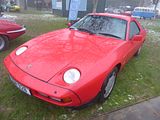

The Porsche 904 is an automobile which was produced by Porsche in Germany in 1964 and 1965. This coupe, manufactured from 1963 to 1965, was street-legal under road traffic laws, allowing it to be driven not only on race tracks but also on public roads. The car was used by the factory team in the Sports Car World Championship from 1964 to 1966. Additionally, numerous private teams raced the Porsche 904 in these international series as well as in national championships, such as the German Automobile Circuit Championship, specifically in the 2-liter GT class. The Porsche 904 achieved significant success, winning the 2-liter GT category in the Manufacturer’s World Championship in 1964 and 1965, and it also won the prototype class in 1964. After having withdrawn from Formula One at the end of the 1962 season, Porsche focused again on sportscar racing. The 904 debuted late in 1963, for the 1964 racing season, as a successor to the 718, which had been introduced in 1957. Porsche designed the GTS variant to compete in the FIA-GT class at various international racing events. The street-legal version debuted in 1964 in order to comply with group 3 appendix J homologation regulations requiring a minimum of 100 road-going variants be sold by the factory. Porsche produced one-hundred and six 904s at four or five a day with a list price of US$7245 (FOB Stuttgart). Orders far exceeded the one hundred car requirement to satisfy homologation rules and more cars could have been sold. The 904 marked the beginning of a series of sportscars that culminated in the dominant 917.
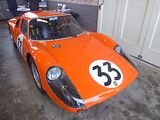
Much rumoured for some time, the Cayman GT4 was officially launched at the 2015 Geneva Show, positioned to sit between the Cayman GTS and the 911 GT3. By the time of the official unveiling, the car was supposedly sold out many times over, though more recently it has become apparent that at least some Porsche dealers have been holding onto cars claiming that the first purchaser changed their mind, and then offering them to those who did not get one of the allocation a year ago, at vastly inflated prices. If true, this is very sharp practice indeed, but seems to be the sort to tricks that are becoming increasingly common as enthusiasts are being fleeced in the name of extra profit. For a starting price of around £65,000 in the UK, the lucky customer would get a car which used used a stiffened and strengthened Cayman bodyshell as a starting point, but lowered by 30mm . Porsche say that in fitting as many GT parts as possible, they did not make it out of a Cayman GTS, but rather they produced an entry-level mid-engined GT3 car. That sounds like PR spin to me, as of course the car does use an awful lot of parts from the regular Cayman. However, plenty is changed, too. There is a reworked version of the Carrera S’s 3.8-litre flat six engine, producing 380bhp at 7400rpm and 310lb ft at 4750-6000rpm, hooked up to a modified version of the Cayman GTS’s six-speed manual gearbox. A PDK dual-clutch automatic was considered but rejected, meaning the Cayman GT4 is manual only. This is enough to mean that the 0-62mph sprint takes 4.4sec and the top speed is 183mph, with combined fuel economy of 27.4mpg and CO2 emissions rated at 238g/km. The front axle and suspension are borrowed from the 911 GT3 and the rear axle and forged aluminium double wishbone suspension are completely new. Dampers are taken from the 911 GT3. The electric steering system from the 911 GT3 does make it onto the Cayman GT4 but is given new software. Stopping power is provided by standard steel brakes, or optional carbon-ceramics from the 911 GT3. The forged 20in alloy wheels were new and are shod with Michelin Pilot Sport Cup 2 tyres. The rear 295/30 ZR20 tyres are bespoke, but the front 245/35 ZR20s were borrowed from the 911 GT3 as they were “a perfect match”. design-wise, the goal was to create a “zero lift car”, but thanks to the extensive aerodynamic and cooling package on the car – which includes a front splitter, a larger front grille and increased frontal air intakes, side air intakes, not one but two rear spoilers and a fully functional diffuser – the Cayman GT4 produces as much downforce at speed (100kg) as the 911 GT3. Every single part on the Cayman GT4 has a functional use. Other design features include “cool” black glass on the front and rear lights, blackened twin central exhausts and quality stitching on the twin lightweight bucket seats, taken from the 918 Spyder, as small details adding to that ‘want factor’. Despite all the extra equipment, the Cayman GT4 weighs no more than a Cayman GTS, tipping the scales at 1340kg dry. You could delete items such as the sat-nav and air-con to save weight, but few customers did, just as with the 911 GT3 RS were just 2% of buyers deleted the air-con. Inside, the steering wheel was new. The sports seats were trimmed in both leather and Alcantara. Standard equipment included bi-xenon headlights, a sports exhaust system, a Sport Chrono Package with dynamic engine mounts, the Porsche Torque Vectoring system, a mechanical limited-slip differential at the rear and the Porsche Stability Management system. On the options list were items such as carbonfibre-reinforced, plastic-backed seats for the two-seat interior. These weigh just 15kg each and were inspired by the 918 Spyder. A customised version of the Sport Chrono Package was offered, as is a Club Sport Package. Initially it was declared that production would be very limited, but Porsche soon relented and far more were built than had originally been declared.


The 718 Cayman GT4 and 718 Spyder (previously named the Boxster Spyder) were revealed in June 2019. Both are differentiated from less powerful models by more aggressive bodywork, including a lower stance, new front bumper, a large new diffuser, and exhaust pipes that are spaced farther apart. The GT4 also features larger side intakes and an adjustable wing, the latter of which helps it generate up to 150 kg (330 lb) of downforce, 50 percent more than its predecessor. Both have a naturally aspirated 4.0-litre flat-6 derived from the 992’s 3.0-litre 9A2EVO engine, which is rated at 414 bhp at 7,600 rpm and 420 Nm (310 lb/ft) of torque at 5,000–6,800 rpm. The engine has cylinder deactivation, a first for Porsche. Porsche claims a top speed of 304 km/h (189 mph) for the GT4, and 301 km/h (187 mph) for the Spyder. The front suspension and brakes are borrowed from the 911 GT3, and the adaptive dampers, ABS and stability-control programming are borrowed from the 911 GT3 RS. The anti-roll bar end links, camber and toe can be manually adjusted, but the ride height–3 cm (1.2 in) lower than a standard 718–is fixed. Both are around 15 kg heavier than the GTS models. Sales commenced in the spring of 2020. For the 2021 model year, the GT4 and Spyder became available with the 7-speed PDK dual-clutch transmission as an option. It reduces the acceleration time of 0-60 mph from 4.3 seconds to 3.7 seconds. In March of 2023, Porsche announced that 718 GT4 and Spyder Models would cease production as of the 2024 model year.

In 2021, Porsche unveiled the 718 Cayman GT4 RS, the first Cayman to receive the RS treatment which is usually reserved for the 911 models. With a 4.0 naturally aspirated flat-six derived from the 911 GT3, it puts out 500 PS (490 bhp) and 450 Nm (330 lb/ft) with an rpm limit of 9,000rpm, which allows it to sprint from 0–100 km/h (0–62 mph) in just 3.4 seconds. It generates 25% more downforce than the GT4 variant, through a swan-neck attachment fixed rear wing. The GT4 RS lapped the Nürburgring Nordschleife 23 seconds faster than the GT4. There is a hefty price premium over the GT4 model.


RENAULT
Viewed as a modern classic these days, there was an example of the quirky Avantime model here. Designed and manufactured by Matra, between 2001 and 2003, this one-box design without B-pillars was styled by Patrick Le Quément and was supposed to combine the space of an estate with the style of a 2+2 coupé. It was conceived by Philippe Guédon, head of the automotive division at Matra, who “believed that the children of Espace owners remained loyal to the car even after they had grown up and left home. As a result, the renowned estate was gaining a generation of new drivers.” It used the Espace as a base, which imposed some constraints, such as the central instrument display, but the marketeers turned that into something they called a part of the innovative character of the whole vehicle. The one-box design eliminated B-pillars and featured an aluminium structure, aluminium panels for the greenhouse and a full sunroof of strengthened heat-reflecting glass. The interior featured four seats each with built-in seatbelts and Bridge of Weir leather. To facilitate access to the rear seats, two long doors featured a double parallel-opening hinge system (marketed as “double-kinematic”) that maximized access with minimal outswing of the doors. Front side windows lowered automatically when either of the front seats folded forward to further facilitate entry to the rear two seats. Windows featured power-deployable sunshades, and the H-points of the rear two seats were higher than the forward two seats, giving the Avantime “theatre seating.” The luggage compartment featured a retaining system using retractable straps, and all Avantimes featured a two-tone look created by the exposed aluminium of the greenhouse. The windows and panoramic sunroof could open automatically via a single, headliner mounted control, to give the Avantime an ‘open air’ mode. The Avantime was first shown in February 1999 in concept form at a press launch in the Louvre, and one month later to the public at the Geneva Auto Show — where it was referred to as a “Coupéspace” — and went into production two years later, after the subsequent engineering of the pillarless roof to meet safety standards. The Avantime’s sales were poor. The car’s fortunes were not helped by the introduction of the Renault Vel Satis (another large, upmarket Renault) around the same time. When Matra decided to pull out of the automotive production business in 2003 (partly as a result of the financial loss incurred by the poor sales of the Avantime), Renault chose to discontinue the Avantime rather than move its production elsewhere. 8,557 were built from 2001 to 2003.
ROLLS ROYCE
The Rolls-Royce Phantom II was the third and last of Rolls-Royce’s 40/50 hp models, replacing the New Phantom in 1929. It used an improved version of the New Phantom engine in an all-new chassis. A “Continental” version, with a short wheelbase and stiffer springs, was offered. The Phantom II used a refinement of the New Phantom’s 7.7 L (7,668 cc) pushrod-OHV straight-6 engine with a new crossflow cylinder head. Unlike on previous 40/50 hp models, the engine was bolted directly to the 4-speed manual transmission. Synchromesh was added on gears 3 and 4 in 1932 and on gear 2 in 1935. Power was transmitted to the rear wheels using an open driveshaft, a hypoid bevel final drive, and Hotchkiss drive, replacing the torque tube from a remotely mounted gearbox used on earlier 40/50 hp models. The chassis of the Phantom II was completely new. The front axle was mounted on semi-elliptical leaf springs as on earlier 40/50 hp models, but the rear axle was now also mounted on semi-elliptical springs instead of cantilever springs. This, along with the drivetrain changes, allowed the frame to be lower than before, improving the handling. The 4-wheel servo-assisted brakes from the Phantom I were continued, and the Bijur centralized lubrication system from the Springfield-built Phantom I was included on all Phantom II chassis. The standard wheelbase of the Phantom II was 150 inches (3,800 mm). A 144 inches (3,700 mm) short-wheelbase chassis was also available. Only the chassis and mechanical parts were made by Rolls-Royce. The body was made and fitted by a coachbuilder selected by the owner. Some of the most famous coachbuilders who produced bodies for Rolls-Royce cars are Park Ward, Brewster, Thrupp & Maberly, Mulliner, Carlton, Windovers, and Hooper. Outside the UK, cars were bodied in Australia by Martin & King, Italy by Castagna, Spain by Baltasar Fiol, Germany by Erdmann und Rossi, Sweden by Nordberg, Belgium by Van den Plas (Bruxelles,) The Netherlands by Van Rijswijk, France by Saoutchik, Kellner, Binder and Gaston Grümmer, and the United States by Brewster and F.R. Wood. A total of 1,681 Phantom II chassis of all types were built.

The Rolls-Royce Phantom III was the final large pre-war Rolls-Royce. Introduced in 1936, it replaced the Phantom II, and it was the only V12 Rolls-Royce until the 1998 introduction of the Silver Seraph. It is the first of the three V12-powered Rolls-Royce Phantoms, with the 2003-2017 Rolls-Royce Phantom VII and 2018- Rolls-Royce Phantom VIII being the other two. 727 V12 Phantom III chassis were constructed from 1936 to 1939, and approximately 650 have survived. Although chassis production ceased in 1939 (with one final chassis being built in 1940), cars were still being bodied and delivered in 1940 and 1941. Though the rolling chassis was completed in 1941, the last car was not delivered with a body to its owner until 1947. The Phantom III was the last car that Henry Royce worked on – he died, aged 70, a year into the Phantom III’s development. In 1934, with Rolls-Royce newly in control of W.O. Bentley’s firm and looking to leap forward in engine development, the company acquired 1934 Cadillac V-16 #5100024, and shipped it to England for study. Bentley himself spent more than 10,000 miles behind its wheel across Europe and came away impressed. His evaluation fed directly into the next wave of Rolls-Royce engine designs and development of Phantom III. The III is powered by an aluminium-alloy V12 engine of 7.32L, having a bore of 82.5 mm and a stroke of 114.3 mm. It is a pushrod engine with overhead valves operated by a single camshaft in the valley between the cylinder banks. Early cars had hydraulic tappets or a unique system of eccentric bushings in each rocker that was actuated by a small hydraulic piston; the eccentric bushing ensured zero valve-lash at the rocker/valve interface. This system was changed to solid adjustable tappets in 1938. The Phantom III is unusual for its twin ignition systems, with two distributors, two coils and 24 spark plugs. A twin SU electric pump provides petrol. Wire wheels are fitted as standard, but many cars carry Ace wheel discs, which were fitted to improve cosmetics and to reduce the time taken to clean the wire wheels after use. The car features onboard jacking and a one-shot chassis lubrication system, operated by a lever inside the driver’s compartment. Independent front suspension by a coil spring-based system is complemented by a carryover semi-elliptical spring unit in the rear. The car has a 4-speed manual transmission with synchromesh on gears 2, 3 and 4. An overdrive gearbox was added in 1938, the ratio change being contained in the gearbox rather than in a separate unit. The car has 4-wheel servo-assisted brakes applied by cable (using a servo made under licence from Hispano-Suiza). The radiator shell is of Staybrite steel. The sheer bulk of the car is reflected in its performance figures. An example tested in 1938 by The English Autocar magazine returned a top speed of 87½ mph (140 km/h) and a 0 – 60 mph time of 16.8 seconds. The overall fuel consumption quoted from that road test was 28 litres per 100 kilometres (10 mpg‑imp; 8.4 mpg‑US). Only the chassis and mechanical parts were made by Rolls-Royce. Car bodies were constructed and fitted by coachbuilders selected by owners or dealers, who might have cars built for showroom stock. Some famous coachbuilders who produced bodies for Rolls-Royce cars are Barker, Park Ward, Mulliner, Hooper and Thrupp & Maberly. Body types and limousines included saloons, coupés, and convertibles. A handful of used cars have been converted to hearses and shooting brakes. The car seen here is a Sedanca de Ville and has an HJ Mulliner body.
When new, the Silver Shadow was considered a big car, but looking at this one, it does not seem quite so massive any more.The Silver Shadow was produced from 1965 to 1976, and the Silver Shadow II from 1977 to 1980. Initially, the model was planned to be called “Silver Mist”, a natural progression from its predecessor Silver Cloud. The name was changed to “Silver Shadow” after realising that “Mist” is the German word for manure, rubbish, or dirt. The design was a major departure from its predecessor, the Silver Cloud; although several styling cues from the Silver Cloud were modified and preserved, as the automobile had sold well. The John Polwhele Blatchley design was the firm’s first single bow model. The original Shadow was 3 1⁄2 inches narrower and 7 inches shorter than the car it replaced, but nevertheless managed to offer increased passenger and luggage space thanks to more efficient packaging made possible by unitary construction. Aside from a more modern appearance and construction, the Silver Shadow introduced many new features such as disc rather than drum brakes, and independent rear suspension, rather than the outdated live axle design of previous cars. The Shadow featured a 172 hp 6.2 litre V8 from 1965 to 1969, and a 189 hp 6.75 ltire V8 from 1970 to 1980. Both powerplants were coupled to a General Motors-sourced Turbo Hydramatic 400 automatic gearbox, except on pre-1970 right-hand-drive models, which used the same 4-speed automatic gearbox as the Silver Cloud (also sourced from General Motors, the Hydramatic). The car’s most innovative feature was a high-pressure hydropneumatic suspension system licensed from Citroën, with dual-circuit braking and hydraulic self-levelling suspension. At first, both the front and rear of the car were controlled by the levelling system; the front levelling was deleted in 1969 as it had been determined that the rear levelling did almost all the work. Rolls-Royce achieved a high degree of ride quality with this arrangement. In 1977, the model was renamed the Silver Shadow II in recognition of several major changes, most notably rack and pinion steering; modifications to the front suspension improved handling markedly. Externally, the bumpers were changed from chrome to alloy and rubber starting with the late 1976 Silver Shadows. These new energy absorbing bumpers had been used in the United States since 1974, as a response to tightening safety standards there. Nonetheless, the bumpers on cars sold outside of North America were still solidly mounted and protruded 2 in less. Also now made standard across the board was the deletion of the small grilles mounted beneath the headlamps. Outside of North America, where tall kerbs and the like demanded more ground clearance, a front skirt was also fitted to the Silver Shadow II and its sister cars. In 1979 75 Silver Shadow II cars were specially fitted to commemorate the 75th anniversary of the company with the original red “RR” badges front and rear, pewter/silver paint, grey leather with red piping, scarlet red carpets, and a silver commemorative placard on the inside of the glove box door. 33 75th anniversary cars were designated for and shipped to the North American market. 8425 examples of the Shadow II were made, which, when added to the total of over 16,000 of the first generation cars made this the biggest selling Rolls Royce of all time
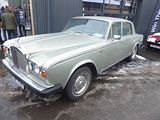
ROVER
Now a much loved classic, the P5 is a quintessentially British motor car. Launched in late 1958, it was a partial replacement for the then 10 year old P4 model, but also an extension of the Rover range further upmarket. Early cars were known as the 3 litre, as they had It was powered by a 2,995 cc straight-6 engine which used an overhead intake valve and side exhaust valve, an unusual arrangement inherited from the Rover P4. In this form, output of 115 bhp was claimed. An automatic transmission, overdrive on the manual, and Burman power steering were optional with overdrive becoming standard from May 1960. Stopping power came originally from a Girling brake system that employed 11″ drums all round, but this was a heavy car and by the time of the London Motor Show in October 1959 Girling front-wheel power discs brakes had appeared on the front wheels. The suspension was independent at the front using wishbones and torsion bars and at the rear had a live axle with semi-elliptic leaf springs. A Mark I-A line, introduced in September 1961, featured a minor restyle with added front quarter windows, intended to “assist the dashboard ventilation”. Under the skin, the 1A featured modifications to the engine mountings and the automatic transmission and hydrosteer variable ratio power steering as an option. By 1962, when production of the original Mark I series ended, 20,963 had been produced. The Mark II version was introduced in 1962. It featured more power, 129 hp, from the same 3 litre engine and an improved suspension, while dropping the glass wind deflectors from the top of the window openings which also, on the front doors, now featured “quarterlight” windows. The most notable addition to the range was the option of the Coupé body style launched in autumn 1962. Unlike most coupés, which tend to be two-door versions of four-door saloons, this retained the four doors and was of the same width and length as the saloon, but featured a roofline lowered by two and a half inches along with thinner b-pillars, giving it the look of a hardtop. Hydrosteer was standard on the Coupe and optional on the Saloon. Production of the Mark II ended in 1965, by which time 5,482 coupés and 15,676 saloons had been produced. The Mark III was presented at the London Motor Show in October 1965, described at the time as “even more luxuriously trimmed and furnished”. It was again available in two 4-door body styles, coupé and saloon. The Mark III used the same engine as its predecessor, but it now produced 134 hp. Externally it could be distinguished by the full-length trim strip along the body and Mark III badging; internally it replaced the rear bench seat with two individually moulded rear seats, making it more comfortable to ride in for four occupants but less so for five. A total of 3,919 saloons and 2,501 coupés had been sold by the time production ended in 1967. The final iteration of the P5 appeared in September 1967. Now powered by the 3,528 cc Rover V8 engine also used in the P6 model 3500, the car was badged as the “3.5 Litre”, and commonly known as the 3½ Litre. The final letter in the “P5B” model name came from Buick, the engine’s originator. Rover did not have the budget or time to develop such engines, hence they chose to redevelop the lightweight aluminium concept Buick could not make successful. They made it considerably stronger, which added some weight but still maintained the engine’s light and compact features. The Borg Warner Type-35 automatic transmission, hydrosteer variable ratio power steering and front Lucas fog lights were now standard. Output of 160 bhp was claimed along with improved torque. When compared to its predecessor, the aluminium engine enabled the car to offer improved performance and fuel economy resulting both from the greater power and the lesser weight of the power unit. The exterior was mostly unchanged, apart from bold ‘3.5 Litre’ badging, a pair of fog lights which were added below the head lights, creating a striking 4 light array, and the fitting of chrome Rostyle wheels with black painted inserts. The P5B existed as both the 4-door coupe and saloon body style until end of production, and there was one of each here. Production ended in 1973, by when 9099 coupés and 11,501 saloons had been built.


SAAB
The Saab 900 is a front-engine, front-wheel-drive mid-size car with a longitudinally mounted, 45-degree slanted, inline four-cylinder engine, double wishbone front suspension and beam-axle rear suspension. It was originally introduced on 12 May 1978, for the 1979 model year. Sales commenced in the fall of 1978. Like its predecessor the 99, the 900 contained a number of unusual design features that distinguish it from most other cars. First, the B-engine, that was installed “backwards”, with power delivered from the crank at the front of the car. Second, the transmission, technically a transaxle, bolted directly to the bottom of the engine to form the oil pan (albeit with separate oil lubrication). Thus, power from the crank would be delivered out of the engine at the front, then transferred down and back to the transmission below, via a set of chain-driven primary gears. In similar fashion, Mini’s also had their gearbox mounted directly below the engine; however, the Mini gearbox and engine shared the same oil, whereas the Saab 900 (and 99) gearboxes contained a separate sump for engine oil. Refined over several decades of two-digit Saab models, the 900’s double wishbone suspension design provided excellent handling and road feel. The rear suspension comprised a typical beam axle design, stabilized with a Panhard rod. However, the attachment points between the axle and chassis made up an unusual configuration that, in essence, consists of two Watt’s linkages at either end of the axle: A lower control arm attaches the axle to the bottom of the vehicle, while an upper link attaches at the top but faces towards the rear, unlike a typical four-link design with both lower and upper links facing forward. Early models did not have sway bars; they began appearing on certain models in 1985, and, in U.S. and possibly other markets, became standard on all trim levels by the late 1980s. The sway bars decreased body roll, but at the expense of some ride comfort and when driven aggressively, increased inside wheel spin. The front and rear bars’ diameters were unchanged throughout the model’s run.The 900 has a deeply curved windshield, providing the best driver visibility. The dashboard was curved to enable easy reach of all controls, and featured gauges lit up from the front.[citation needed] Saab engineers placed all controls and gauges in the dashboard according to their frequency of use and/or importance so that the driver need only divert their gaze from the road for the shortest possible time and by the smallest angle. This is why, for example, the oft-used radio is placed so high in the dashboard. In keeping with the paradigm of its predecessor, the 99 model, the 900 employed a door design unique in automotive manufacturing, with an undercutting sweep to meet the undercarriage, forming a tight, solid unit when the door was closed. This feature also eliminated the stoop in the cabin at the footing of the door, as seen in automobiles of other manufacturers, thereby preventing water and debris from collecting and possibly entering the cabin or initiating corrosion, as well as enabling passengers to enter and exit the cabin without need to step over several inches of ledge. The 900 underwent minor cosmetic design changes for 1987, including restyled front end and bumpers that went from a vertical to a more sloped design. To save money, Saab kept the basic undercarriage more or less unchanged throughout the 900’s production run. The Saab 900 could be ordered with different options. One highly sought-after option was called the Aero or, as it was known in the U.S. “Special Performance Group” (SPG). The Aero/SPG incorporated (depending on the market and model year) a body skirt; a sport-suspension (1987+) that included shorter, stiffer springs, stiffer shocks, and sway bars; leather seats; premium stereo; and air conditioning. Each of these features could also be ordered independently from Saab’s Accessories Catalog for fitment to standard models. The 1979 900 was available in three versions of the B-engine: The GL had the single-carb 100 PS engine, the GLs had twin carburettors for 108 PS, the EMS and GLE had Bosch jetronic fuel injection for 118 PS and the 900 Turbo produced 145 PS. The only bodywork originally available was the three or five-door hatchback style, which was seen as more modern at the time. The EMS was only available with three doors while the automatic-equipped GLE was only offered with five. Saab’s model years were generally introduced in August/September of the preceding year.The Turbo had a different grille from the naturally aspirated models, which received a design with a hexagonal central element. For the 1980 model year, all versions received the sleeker turbo-style grille. The 1980 900 also received larger taillights rather than the earlier 99 units, as well as lower, adjustable head restraints.1980 was also the first year for a five-speed gearbox, originally only available in the EMS and the Turbo. The four-door 900 sedan was introduced in Geneva 1980, as a result of dealer pressure. This introduction corresponded with the phase-out of the old Saab B engine in favor of the lighter Saab H engine. With the introduction of the H-engine, Saab simplified the model designation on the international markets outside Scandinavia: GL for the model with the single carburettor, GLs for the models with the twin carburettor engine, GLi as designation for the models with fuel injection without turbo, and correspondingly “Turbo” for the top models with the corresponding engine. The GLE was now offered only as a better equipped four-door Sedan. Model designations in the USA became just 900 for the base model and 900S for the models with 8V i. The EMS designation was dropped. In the early 1980s, most 900s were produced in Trollhättan. However, coinciding with the introduction of the 9000, more of the 900 production took place elsewhere. The Valmet plant in Finland, referenced below under the 900c, also produced regular 900s, a total of 238,898 examples. The plant in Arlöv (now closed), near Malmö, also produced some 900s. For 1981 all models except for the GL three-door received a considerable boost in equipment, as well as broader side trims, larger luggage compartments and fuel tanks. The spare tire was moved to underneath the floor, rather than standing upright in the luggage compartment. A big change for 1982 was the introduction of Saab’s Automatic Performance Control (APC), a.k.a. boost controller for the Turbo models. The APC employed a knock sensor, allowing the engine to use different grades of gasoline without engine damage. Another new feature that year was the introduction of central locking doors (on the GLE and Turbo). The long-wheelbase 900 CD was also introduced. Asbestos-free brakes were introduced in 1983, an industry first. The front pads were semi-metallic while the rears were made from silica. The GLE model gained a new central console, while the decor strips on the bumpers of all models were made wider (necessitating wider trim pieces on the flanks as well). A new luxury package was made available on Turbo cars. 1985 Saab 900 CD, a limited production version with a longer wheelbase and stretched rear doors. Model year 1984 saw the introduction of the 16-valve DOHC B202 engine in Europe. With a turbocharger and intercooler, it could produce 175 hp in the Turbo 16 model (less for catalyst-equipped engines). The Turbo 16 Aero [designated SPG, Special Performance Group in North American Markets] had a body kit allowing the car to reach 210 km/h (130 mph). A different grille and three-spoke steering wheel appeared across all models. The connection between the side strips and the bumpers was changed, Turbo hatchbacks received a black trim piece between the taillights, and the GLi began replacing the twin-carburetted GLs. At the 1983 Frankfurt Motor Show a two-door sedan was shown; it went on sale in January 1984, initially only as a GLi. The two-door sedan was only ever built at the Valmet plant in Finland. The dual-carburettor model (and “GL” nomenclature) was gone for 1985. Now, the base 900 had the single-carburettor engine, while the 900i added fuel injection. Two turbocharged models were offered: The 900 Turbo had the 8-valve engine, while the Turbo 16 (also Aero) had the 16-valve intercooled unit. Wheel trims (naturally aspirated cars) and alloys (turbos) were redesigned, and the Turbos also received chromed grilles. The 8-valve turbo received an intercooler for 1986, bringing up power to 155 PS while the 16-valve cars had hydraulic engine mounts. The eight-valve Turbo was also available as a two-door. Side marker lights at the rear of the front fenders were also added, while the 900i gained new interior fabrics. The new Saab-Scania badge was introduced, placed in the steering wheel, on the bonnet, and on the bootlid. 1986 also marked the introduction of the 16-valve 900i 16 and 900 convertible, both only for North America initially. A new grille, headlamps, front turn signal lights and so-called “integrated” bumpers freshened the 900’s look for 1987, though the sheetmetal was largely unchanged. Several common parts for the 900 and 9000 were introduced for 1988 model year, including brakes and wheel hubs. This also meant that Saab finally abandoned the use of parking brakes which acted on the front wheels. Power steering was added on the 900i. The base 900, available with two or four doors, kept the pre-facelift appearance for 1987. Also new was the carburetted 900c. The Aero model received slightly bigger fender extensions so as to accommodate larger wheels, while the window trim was blacked out on all models. For 1988 catalytic converters became available with all fuel injected engines in Europe, all with cruise control as standard equipment to further help lower emissions. A water- and oil-cooled turbocharger (replacing the older oil-cooled unit) was also introduced to improve the unit’s durability. In each of the seasons 1987 and 1988, there was a special ‘one-make’ race series, in the UK, called the Saab Turbo Mobil Challenge, sponsored by Saab Great Britain and Mobil. It was run by the BARC. The eight-valve engines were phased out in 1989 and 1990, with the turbo versions having been removed in North American markets by the end of 1984; North American 900S models received the non-turbo 16-valve engine for 1986. A non-turbo 16-valve engine replaced the 8-valve FI unit in the 900i (900S in North America) as well, while the carbureted engines were dropped. In Europe the eight-valve Turbo dropped out with the 1989 model year, with the limited production 900 T8 Special built to celebrate this. 805 were built for Sweden, featuring Aero trim and equipment. The 900i 16 arrived in Europe, with 128 PS. Anti-lock brakes were introduced as well, and were standard on Turbo models. High-mounted rear brake lights appeared during 1988, and power of the catalyzed Turbo 16 Aero jumped from 160 to 175 PS. Larger pinion bearings were fitted to manual gearboxes for 1989 to improve their strength and reliability. For 1990 eight-valve engine were taken out of production while a low pressure turbo engine with 145 PS was available in European markets. ABS brakes and driver’s side airbags were standardized for all North American market cars beginning with the 1990 model year. In the spring of 1990 the naturally aspirated 900i 16 Cabriolet was added. A 2119 cc (B212) engine was introduced for 1991. This engine was available in the United States until the end of the original 900, but in most of Europe, this engine was replaced a year later with the earlier B202 because of tax regulations in many European countries for engines with a displacement of more than 2000 cc. Front seats from the 9000 were standard from 1991 on and electronically adjustable ones were available as an option. Airbags became available as an option in Europe as well, while there was also an Aero version of the Cabriolet. The Saab 900 no longer offered the mesh wheels. There was also a change in the door locks, which carried over to the 900NG. For 1992 there were mostly equipment adjustments, with ABS brakes finding their way into most of the lineup everywhere. 1993 brought no changes, and “classic” 900 production ended on 26 March 1993, with a new GM2900 platform-based 900 entering production shortly afterwards. The final classic convertibles were still sold as 1994 models, with the Special Edition commanding top dollar in the resale market even today. In all, 908,817 Saab 900s were built, including 48,888 convertibles.

SUBARU
Subaru introduced the “New Age” Impreza, the second generation car, to Japan in August 2000, and it arrived in Europe towards the end of that year. Larger in size compared to the previous iteration, the sedan increased its width by 40 millimetres (1.6 in), while the wagon notably increased by just 5 millimetres (0.2 in)—placing the two variants in different Japanese classification categories. The coupe body style from the first generation did not reappear for the new series, and the off-road appearance package that included contrasting-coloured bumpers did carry over forward. Marketed as a separate model line, this North America-only variant was, as before, badged the Outback Sport. Naturally aspirated flat-four (boxer) engines comprised the 1.5-litre EJ15, the 1.6-litre EJ16, the 2.0-litre EJ20, and the 2.5-litre EJ25. Turbocharged versions of the 2.0- and 2.5-litre engines were offered in the WRX and WRX STI models. STI models featured a more powerful 2.0-litre (2.5-litre outside of the Japanese market) turbocharged engine. WRX models featured a 2.0-litre turbocharged boxer engine until 2005, after which they switched to the 2.5-litre turbocharged engine. As with the first generation, the turbocharged STI variants were available in numerous specifications with a myriad of limited edition variants sold. The bug-eyed styling was not well received, and Subaru had two further attempts at the front end, neither of which was entirely successful, either, but enthusiasts were happy to overlook the gawky looks because the way the car drove. Subaru issued yearly updates to the STI, tweaking cosmetics and equipment levels, and also improving performance and handling. The car was replaced in 2007 by the third generation Impreza, widely regarded as inferior in many ways to this version.
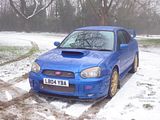
SUZUKI
The Suzuki Cervo is a kei car manufactured by Suzuki Motor Corporation. Introduced in 1976 as the successor to the Suzuki Fronte Coupé, the Cervo name was originally affixed to a kei sports coupe, and then to models derived from the Suzuki Alto. For export, Suzuki transformed the Cervo into the SC100, first introduced in April 1978. It had its European premiere in February 1979, at Amsterdam’s AutoRAI. The SC100 was known in the UK by the nickname “Whizzkid”. The three-cylinder engine was replaced by a rear-mounted 970 cc four-cylinder F10A engine (later used in the SJ410) developing 47 PS. The top speed was 142.8 km/h (89 mph) in a contemporary test. The body differed from the Cervo’s in that the windshield was not as steeply raked, necessitating a different doorframe and side window as well. Square headlights were used in European markets, with either round or square ones used elsewhere. In European markets the grille incorporated the chunky indicator lenses, which were normally positioned in a space underneath the bumper – these openings were blanked with plastic grilles. In the UK it was only available as the lavishly equipped SC100 GX, while in other countries it was also offered as a CX or the more luxurious CX-G. The GX, with a cigar lighter, reclining front seats, and independent all-round suspension, sold for £2,400 upon introduction (the slightly larger Alto of the same period sold for £3375). The marketing campaign was further helped by an enthusiastic owner, the late LJK Setright, long-time CAR magazine columnist. Other markets included the Netherlands, Hong Kong, South Africa, New Zealand and several Latin American countries. It was sold in Europe from 1979 to 1982, when production ended. There was only one model change, when dashboard and column switches were modified in January 1980. With demand always outstripping supply, British importer Heron Suzuki sold 4696 SC100s in Britain, where the car has since then gained minor classic status.[citation needed] Nimag sold 3290 SC100s in the Netherlands, while the 1299 remaining cars were delivered to New Zealand, South Africa, and Latin America. This production includes the Chilean SS80 version. As of mid 2014, there were 96 “Whizzkids” registered with the Driver and Vehicle Licensing Agency (DVLA) in the UK.
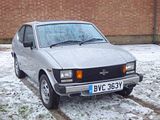
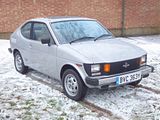
TALBOT
There was a nice example of the Sunbeam Lotus here. The first ones were black and silver and the later ones, with a revised flush plastic grille were two tone blue and silver. The Sunbeam started off life as a Chrysler, launched in 1977, as the long awaited replacement for the Hillman Imp, production of which had ended a year earlier. Based on a cut-down version of the Avenger chassis, this neat looking hatch was initially offered with a choice of 1.0, 1.3 and 1.6 litre 4 cylinder engines and it retained rear wheel drive at a time when all the rivals were switching front wheel drive This was a move forced upon its maker by the lack of capital to do anything else, but whilst it was not great for space efficiency, it would have an advantage when it came to the sporting versions and indeed for what would turn out to be a very successful career in motorsport. The sporting road cars hit the market in 1979, and these are the only examples of the Sunbeam that you tend to see these days. By the time they hit the market, the Chrysler badging had gone, as a consequence of the sale of Chrysler’s European business to Peugeot-Citroen in the summer of 1978 meant that by mid 1979 a new name was required. The old Talbot branding was dusted off and overnight the cars all became Talbots. The first potent Sunbeam to appear had been the Ti, a sort of modern day version of the Avenger Tiger, with a 110 bhp twin carb 1600cc engine under the bonnet. It went on sale in the spring of 1979, as an appetiser for something more special, which had been unveiled at the Geneva Show in March, a few weeks earlier. The Sunbeam Lotus was the fruits of Chrysler’s commission to sports car manufacturer and engineering company Lotus to develop a strict rally version of the Sunbeam. The resulting ‘”Sunbeam Lotus” was based on the Sunbeam 1.6 GLS, but fitted with stiffer suspension, a larger anti-roll bar and a larger transmission tunnel. The drivetrain comprised an enlarged 2172 cc version of the Lotus 1973 cc 907 engine, a 16 valve slant four engine (the Sunbeam version being type 911, similar to the “Lotus 912”), along with a ZF gearbox, both mounted in the car at Ludham Airfield, close to the Lotus facility in Hethel, Norfolk, where the almost-complete cars were shipped from Linwood. Final inspection, in turn, took place in Stoke, Coventry. In road trim, the Lotus type 911 engine produced 150 bhp at 5,750rpm and 150 lb/ft of torque at 4,500rpm. In rallying trim this was increased to 250 bhp Production cars were not actually ready for deliveries to the public until after the mid-year rebranding, and thus became the “Talbot Sunbeam Lotus”. At first these were produced mostly in black and silver, although later models came in a moonstone blue and silver (or black) scheme. The car saw not only enthusiastic press reviews, but also much success in the World Rally Championship – in 1980, Henri Toivonen won the 29th Lombard RAC Rally in one, and, in 1981, the Sunbeam Lotus brought the entire manufacturer’s championship to Talbot. There is an enthusiastic following for Sunbeam Lotus cars these days.

TOYOTA
The Toyota Century is a lineup of full-size luxury cars and limousines produced mainly for the Japanese market, serving as Toyota’s flagship car within Japan; globally the unrelated Lexus LS series is Toyota’s flagship luxury model. Production of the Century began in 1967, and the model received only minor changes until redesigns in 1997 and 2018. The Century derived its name from the 100th birthday of Sakichi Toyoda (born 14 February 1867), the founder of Toyota Industries. It is often used by the Imperial House of Japan, the Prime Minister of Japan, senior Japanese government leaders, and high-level executive businessmen. The Century is comparable in purpose to the Austin Princess/Daimler DS420, Cadillac Series 70, Mercedes-Maybach, Hongqi, Rolls-Royce Phantom, and Russian ZIS/ZIL limousines. The first-generation Century was available with only a V8 engine (the third post-war Japanese-built sedan so-equipped) at its introduction in 1967 until a full platform redesign in 1997. The second generation was only installed with a Toyota-designed and -built V12, an engine bespoke to the Century, until 2018, when the power-train reverted to a V8 with the addition of Toyota’s hybrid technology. While the Century is a premium, full-size luxury sedan, it is not available at Japanese Lexus dealerships; it can only be purchased at specifically identified Toyota Store locations. The gold phoenix logo used throughout is called the Hō’ō (鳳凰) or Fushichō (不死鳥) from Sinospheric mythology, representing the Imperial House of Japan, and the image can be found throughout Asia, such as the Kinkaku-ji in Kyoto. The exterior styling of the Century has, with some modifications, remained unchanged since its introduction, primarily due to its perception as denoting conservative success. Its appearance is iconic in Asian countries and is usually painted black. The closest Japanese competitor was the Nissan President, with a similar status reputation although, during the 1960s and 1970s, the high market positioning was also shared with the Mitsubishi Debonair. In the 1970s, two other Japanese competitors introduced large sedans — the Isuzu Statesman de Ville and the Mazda Roadpacer (both derived from General Motors-Australia products) — which were short-lived. The Century received a complete redesign in April 1997, although the new model was visually very similar to the previous generation. This model is powered by a 5.0 L 1GZ-FE V12, rated at 276 bhp in Japanese models and 295 bhp at 5200 rpm in export models. Torque was rated at 460 Nm (340 lb/ft) at 4000 rpm for both Japanese and export versions. It was initially equipped with a 4-speed A342E automatic, until a 6-speed “intelligent” transmission arrived in 2005. The suspension was upgraded to double wishbone control arms for the front and rear wheels with airbag support springs. The Century remains the first and only Japanese front-engine, rear-wheel-drive production car equipped with a V12, and it has Toyota’s first V12 engine. This generation no longer offered a selection of level of equipment preferred, and has either a floor-mounted or column-mounted transmission selector. From 2003 through 2004, the V12 engine was briefly offered with the ability to use CNG fuel. Toyota began limited official exports of the G50 Century to Europe and other Asian markets including China and the Middle East in November 1998, positioning it as an executive car for company and government officials. About 100 left-hand drive cars were produced for export, with some going to the United States for promotional and testing purposes. Several were in use as corporate cars for Toyota’s North American executives. As of 2023, the G50 remains the only generation of the Century sedan to have officially been exported and sold outside of Japan. The Century was Toyota’s most luxurious model at its inception in 1967, and maintained this status throughout the 20th century. Today, it is positioned above the Lexus line-up, and is the most luxurious and prestigious Toyota. In contrast to other luxurious cars (such as the Maybach or Rolls-Royce), the Century has not been positioned and marketed as a sign of wealth or excess. Marketing literature states roughly that, “the Century is acquired through persistent work, the kind that is done in a plain but formal suit.” Like other cars in the top of the luxury class, the Century is designed with the rear passengers in mind. Hence, the rear seats recline and the front passenger seat (in right-hand drive cars only) has a fold-down centre section so that a passenger in the back may stretch their feet forward. The rear seats are equipped with a massage system. The doors are equipped with a soft-close mechanism, allowing the door to pull itself completely closed electrically when the latch makes contact with the striker. The Century was priced at ¥11,445,000 – approximately US$100,000. In comparison, the base price for the full-size luxury 2008 Lexus LS 460 is approximately ¥10,000,000, with the LS 600h L at ¥15,000,000 (US$125,800). The second generation Century was discontinued on 4 February 2017, after almost 20 years of production. 9,573 vehicles were built from 1996 (the launch year was 1997) to the final figure of 100 cars in 2016.


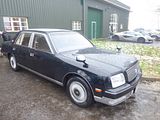
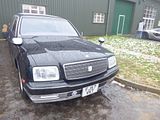
There was an example of the all-new LandCruiser that is about to go on sale as well as an early 1980s J60 model. The Land Cruiser 60 series was produced from 1980 through 1990, for most markets but the Cumana Plant in Venezuela continued production until 1992 for their local market. It is a front engine, four-door wagon which can seat five to eight people. The 60 series was available in the following exterior colours: Alpine White, Brown, Desert Beige, Freeborn Red, Royal Blue; and in the following metallic exterior colours: Charcoal Gray, Cognac, Gray-Blue, Rootbeer, Sky Blue, Stardust Silver. In 1980 the 60 series was introduced. While still retaining the rugged off-road characteristics of previous Land Cruisers, the 60 was designed to better compete in the emerging sport utility vehicle market. The 60 was given a variety of creature comforts like air conditioning, a rear heater and an upgraded interior. The FJ60’s “2F” petrol engine was left unchanged from the “40” series while the six-cylinder 4.0 L 2H and the four-cylinder 3.4 L 3B diesel engines were added to the lineage. Less equipped versions were also available in many markets. In Europe this model was sold as the Land Cruiser Wagon Van. In 1981, Land Cruiser sales surpassed 1 million and a high-roof version was introduced. The 60 series was introduced to South Africa when a stock Land Cruiser competed in the Toyota 1000 km Desert Race in the punishing wilds of Botswana. For 1982 a 5-speed gearbox was introduced. In 1985 the direct-injection 12H-T turbo-diesel engine was introduced. For 1988, the petrol engine was upgraded in some countries to a 4.0 L 3F-E EFI engine or to a 4.0 L 3F carburettor engine. The FJ62G VX-Series was introduced, allowing the Land Cruiser to be sold in Japan as a passenger vehicle. In US-specs, the 3F-E produces 155 hp. In 1992 the last FJ62 with a 4.0 L 3F carburettor engine was built in Venezuela which was the only country producing the vehicles after production ended in Japan in 1990.
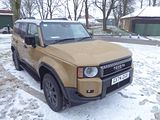

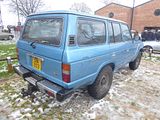
TRABANT
This is a definite one-off, the only V8 Trabant van in the world. Based on the P50, this 1963 vehicle is registered in the UK as historic having been imported from Germany over 3 years ago. It was originally built in Belgium over 20 years ago. The metallic grey paintwork is impressive enough, but it is the 3.5 Litre V8 Rover engine with 3 speed automatic gearbox and a narrowed Volvo rear axle which really make it something rather different.
TRACTORS
The other special display here was one of tractors, with each matched to a car from the same manufacturer.


TRIUMPH
The Triumph Vitesse was introduced on 25 May 1962, reusing a name previously used by the pre-Second World War Triumph Motor Company from 1936–38, and was an in-line 6-cylinder performance version of the Triumph Herald small saloon. The Herald had been introduced on 22 April 1959 and was a 2-door car styled by the Italian designer Giovanni Michelotti. Within two years, Triumph began to give thought to a sports saloon based on the Herald and using their 6-cylinder engine. Michelotti was again approached for styling, and he came up with a car that used almost all body panels from the Herald, combined with a new front end with a slanted 4-headlamp design. Standard-Triumph fitted a 1596 cc version of their traditional straight-6 derived from the engine used in the Standard Vanguard Six, but with a smaller bore diameter of 66.75 mm, compared with the 74.7 mm bore on the Vanguard, equipped with twin Solex B32PIH semi-downdraught carburettors. These were soon replaced by B321H carburettors, as the accelerator pumps proved a problem. The curious observer will notice a “seam” on the cylinder block between the third & fourth cylinders revealing the design beginnings from the 803 cc Standard SC engine block, first used in the Standard Eight of 1953. The gearbox was strengthened and upgraded to closer (more sporting) gear ratios, and also offered with optional Laycock De Normanville ‘D-type’ overdrive with a 20% higher ratio for the top gear (the equivalent change from 3rd to 4th in a standard transmission), giving more relaxed and economical cruising at the expense of slight oil drag from the pump in the overdrive unit. Models fitted with overdrive had a chrome badge with “Overdrive” in italic text on the left side of the boot opposite the Vitesse 6 chrome script badge on the right. Synchromesh was present on 2nd, 3rd and 4th gears. The rear axle was changed to a slightly uprated differential, but retaining the same 4.11:1 ratio and flange sizes as the Herald. Front disc brakes were standard as were larger rear brake drums, and the Herald fuel tank was enlarged, retaining the reserve feature (essentially a curved pickup pipe that could be rotated to dip into the last few centimetres of fuel) of the smaller Herald tank. The front suspension featured uprated springs to cope with the extra weight of the new engine, but the rear suspension was almost the same as on the Herald—a swing-axle transverse-leaf system which quickly proved inadequate for the relatively powerful Vitesse. The chassis looked outwardly similar to the early Heralds but in fact was substantially re-designed and strengthened, especially around the differential mountings, improvements which were immediately passed through to Herald production. The dash and instrument panel of the earliest Vitesse was the same as the Herald, with a single speedo dial featuring fuel and temperature gauge insets. The Vitesse was available in convertible and saloon forms; a coupé never got beyond the prototype stage. The separate chassis construction of the car meant that no additional strengthening to chassis or body was considered necessary for the convertible model, the only concession being additional door catches to prevent the doors opening during hard cornering. The gearboxes of all the Vitesse and GT6 models were a weak point being derived from the earlier Heralds. The increased power caused accelerated wear on the bearing and forward end of the main shaft which would eventually wear through the hardened surface, leading to large amounts of play between the input and main shafts. This was characterised by growling gear noise on acceleration and deceleration in 1st, 2nd and 3rd getting high in each gear as the torque transmission from the lay shaft moved further from the rear of the box where the bearing support was intact. Repair involved either a new mainshaft or metal spraying/stellite repair. Some engineers suggested repairs were more long lived than a new shaft as the technology 10-20 and more years after manufacture meant that the repaired mainshaft had better specifications that new old stock. The remote lever construction suffered from the same regular bushing wear as the herald spitfire etc where sloppy gearchange and rattling can be cured (easy diy job) with a kit of new parts. A handful of Vitesse estates also were assembled to special order at Standard-Triumph’s Service Depot at Park Royal in West London. The interior was much improved over the Herald; wooden door cappings were added to match the wooden dashboard and the car featured slightly better seats and door trims. Optional extras included a vinyl/fabric, (Britax Weathershield), sunroof on saloon models. Exterior trim was also improved with an elongated stainless steel trim piece which extended further down the body than the Herald, including a Vitesse specific piece of trim rearward of the petrol filler cap and satin-silver anodised alloy bumper cappings replacing the white rubber Herald items. In September 1963 the Vitesse received its first facelift, when the dashboard was revised with a full range of Smith instruments instead of the large single dial from the Herald (large speedometer and cable driven tachometer flanked by smaller 2 inch fuel and temperature gauges). From September 1965, at commission number HB27986, the twin Solex carburettors were replaced by twin Stromberg CD 150 carburettors. Power output increased from the original 70 bhp at 5,000 rpm and torque of 92.5 lb/ft (125 Nm), enough to provide a useful performance boost and making the car a more flexible performer. There was a claimed, although somewhat optimistic increase of 13–14 bhp, and the motoring magazine tested top speed rose to 91 mph (146 km/h), with the 0–80 mph (0–129 km/h) time decreasing from 46.6 seconds to just 33.6 seconds. The Vitesse 6 sold extremely well for Triumph, and was by some way the most popular Vitesse sold during the model’s lifetime. The car was well liked for its performance and reasonable fuel economy, and the well-appointed interior. The exceptionally small turning circle was also liked by users. With its ability to perform as well as many sports cars, but with room for a family, the Vitesse had few rivals for the price. The convertible in particular was virtually unique in the marketplace; another genuine four-seater sporting convertible would not reappear from a British manufacturer until the Triumph Stag several years later. In September 1966 Triumph upgraded the engine to 1998 cc, in line with the new Triumph GT6 coupé, and relaunched the Vitesse as the Vitesse 2-Litre. Power was increased to 95 bhp, endowing the new car with a claimed 0–60 mph time of just under 12 seconds, and lifting top speed to 104 mph (167 km/h). (The 2-Litre was advertised by Triumph as “The Two Seater Beater”). The performance increase was welcome, but it highlighted the deficiencies of the rear suspension. Other detail modifications for the 2-litre, included a stronger clutch, all synchromesh gearbox, larger front brakes (still without a servo), and a stronger differential with a slightly higher 3.89:1 ratio. Wider & stronger 4.5-inch wheel rims were fitted, but radial-ply tyres were still optional, at extra cost. There was a satin silver anodised aluminium-alloy cowling above the new reversing light, and badges on the side of the bonnet and in the centre of the grille read 2 litre. The Vitesse boot badge was retained as italic script but lost the 6 of the earlier model – replacing that with the rectangular 2 litre badge and with a chrome strip underlining the Vitesse badge. Cars with overdrive had a separate badge on the cowling above the number plate/reversing light. Inside the car, the seats were greatly improved, with softer (more plush) covering and a better back-rest shape which slightly improved rear-seat knee-room. A new leather-covered three-spoke steering wheel was also added. The Vitesse Mk I was sold until 1968. The Vitesse Mark 2 was launched in October 1968 as the final update to the Vitesse range. Essentially intended to be Triumph’s answer to growing criticism of the rear suspension, the Mark 2 was fitted with a redesigned layout using new lower wishbones and Rotoflex half-shaft couplings. This system, also shared with the new GT6 MKII (GT6+ in the US market), and the first GT6 MkIIIs, tamed the wayward handling and endowed the Vitesse with more firm, progressive roadholding. The solid swing axles of the Herald and earlier Vitesses had camber changes of some 15 degrees from the limits of travel. By adding the lower wishbone and the divided drive shaft whilst retaining the transverse leaf spring as the top link, this camber change was reduced to about 5 degrees. While this was a considerable improvement, it was still a system that struggled to keep up with a really good link-located live axle (such as Triumph would introduce on the Toledo, 1500TC and later Dolomite saloons). There were other improvements: the engine was tweaked once more to provide 104 bhp, cutting the 0–60 mph time to just over 11 seconds and providing a top speed of over 100 mph (160 km/h). The main changes were to the valve timing, to give earlier opening and later closing of the inlet valves compared with the earlier 2-litre engine. (38/78 btdc/atdc for the Mk2 vs 30/60 for the 2 litre). Design changes to the cylinder head allowed for increased inlet valve diameters and better porting. Another major difference in the cylinder head removed the “step” in earlier 1600 and 2 litre incarnations. This meant that in the earlier cars the head studs on the right (manifold) side were short and ended under the manifolds, necessitating unbolting the (hot) manifolds and dropping them back to retorque the studs after a head gasket replacement. The MKII head was full width so all the studs were accessible. The inlet manifolds of the mkII were shorter than the 2 litre to keep inlet tract length the same. The Stromberg carburetors were also changed from 150 CD to 150 CDS, the S referring to the use of a spring between the dashpot cover and piston. The exterior featured a new grille with 3 sets of horizontal elements that were also used (in longer form) in the herald 13/60, Rostyle wheel trims and silver painted steel rear panel, (described by Triumph as “ceramic”), and the interior was upgraded once more in order to share parts with the new Herald 13/60, although there were significant differences between the two models; the inclusion of a tachometer being an obvious one, the provision of a larger ash tray in the Vitesse not quite so obvious. A new colour range was offered for the Mark 2 models. The aluminium cowling above the reversing light gained an oblong chromed VITESSE badge, and the separate chromed Mazak TRIUMPH letters on the bonnet and the boot lid were also deleted. The badges on the bonnet sides were changed to read Mk2 instead of 2 litre. Cars with overdrive had a small badge that fitted below the new rectangular Triumph boot badge. This was the ultimate Vitesse, a saloon or convertible with performance superior to the MGB and the Sunbeam Alpine sports car (in both acceleration and top speed) but with four seats and a large boot. Contemporary testing in the UK press listed the Vitesse’s 0-70 mph[clarification needed] time as 15.0 seconds against 17.9 for both the MGBGT and the Sunbeam Alpine Series IV, and standing-quarter-mile times were 18.1, 19.5, and 19.0 respectively. The Vitesse sold well until its withdrawal in July 1971, seven months before the new Triumph Dolomite saloon entered the performance luxury sector for Triumph. Although the Vitesse was an older model, it proved to be more reliable than its replacement, due to its simpler and more proven engine design

Launched at the same time as the Rover 2000 was Triumph’s large saloon car, also called 2000. A replacement for the long running Standard Vanguard, this was the more sporting of the duo, with a subtly different appeal from the Rover. Between them, the cars defined a new market sector in the UK, promising levels of comfort and luxury hitherto associated with larger Rover and Jaguar models, but with usefully lower running costs and purchase prices, all in a modern package. Both added more powerful models to their range, with Rover going down the twin carburettor route, whilst in 1967, Triumph installed a larger 2.5 litre engine and the then relatively new fuel injection system, creating the 2.5PI, which is what was to be seen here. This Lucas system was not renowned for its reliability in the early days, but it did make the car rapid and refined. A facelift in 1969 brought new styling front and rear, which turned out to be a taster for a new grand tourer model which would emerge a few months later, and in this Mark 2 guise, the car was sold until 1977, in both saloon and estate guises. A mid range model, with twin carburettors but the larger engine, the 2500TC was introduced in 1974 and the 2500S arrived in 1975 with more power but also carb fed, to replace the troublesome and thirsty PI. These are the most sought after models now.


TVR
The Cerbera was first shown as a prototype at the 1994 Birmingham Show, entering production in 1996. The name derives from Cerberus the three-headed beast of Greek legend that guarded the entrance of Hades. This was the third car manufactured by TVR under the leadership of Peter Wheeler, and it represented three firsts for the Wheeler-led company: the first hard-top—the Griffith and the Chimaera were both convertibles; the first 2+2—TVRs were traditionally two-seaters; the first to be driven by TVR’s own engines—historically, TVR had purchased engines from mainstream manufacturers like Rover, Ford and Triumph. Prior to the Cerbera, TVR had purchased V8 engines from Rover and then tuned them for their own use. When Rover was purchased by BMW, Peter Wheeler did not want to risk problems should the Germans decide to stop manufacturing the engine. In response, he engaged the services of race engineer Al Melling to design a V8 engine that TVR could manufacture in-house and even potentially offer for sale to other car-makers. In an interview for the television programme Top Gear, Wheeler explained “Basically, we designed the engine as a race engine. It was my idea at the time that if we wanted to expand, we ought to make something that we could sell to other people. We’ve ended up with a 75-degree V8 with a flat-plane crank. The bottom-half of the engine to the heads is exactly as you would see in current Formula One engines.” Wheeler was quoted at the time of the car’s launch as saying that the combination of light weight and high power was too much for a road car, a quote which ensured much free publicity in the press. Enthusiasts still argue about whether this was a typical example of Wheeler’s legendary frankness, or an equally typical example of his PR chief Ben Samuelson’s knack for saving on advertising costs by creating a story. The result was dubbed the “Speed Eight” (official designation ‘AJP8’) after Al Melling, John Ravenscroft and Peter Wheeler, a 4.2 litre V8 producing 360 hp and gave the Cerbera a top speed of 185 mph (297 km/h). A 4.5 litre version of the engine was later offered with 420 hp. The AJP8 has one of the highest specific outputs of any naturally aspirated V8 in the automotive world at 83.3 hp/litre for the 4.2 and 93.3 hp/litre for the 4.5. Later models of the 4.5 litre engine had the ‘Red Rose’ option, which increased output to 440 bhp (97.7 hp/litre) when fuelled with super-unleaded (high octane) and the driver pushed the unmarked button on the dashboard which altered the engine mapping to suit. In some cases, real-world outputs for production V8s (4.5 in particular) were down from TVRs quoted output. Some of these have seen some form of modification (ECU, induction, exhaust etc.) to bring the power back up to the factory quoted output. One of the attractions of the V8 Cerberas for many owners was the loud backfire produced on overrun, particularly at low speeds. In fact this was the result of an argument at the factory between one of TVR’s executives and the engineers mapping the engine. The engineers wanted to map out this “irregularity” to improve fuel efficiency and CO2 emissions, whilst the executive insisted it was exactly the kind of thing owners would like. In the end a compromise was reached in which the popping and banging remained on the 4.5 litre cars. With the success of the Speed Eight program, Wheeler also undertook the design of a “Speed Six” engine to complement it. This engine also made its debut in the Cerbera but was a 4.0 litre inline slant six design with four valves per cylinder to the Speed Eight’s two. In service however it gained a reputation for unreliability and many engines had to be rebuilt. The car itself was designed from the start as a four-seater. The rear seats are smaller than the front, a design commonly referred to as a “2+2”. However, the interior is designed so that the passenger seat can slide farther forward than the driver’s seat. This allows more room for the person sitting behind the front passenger. TVR have referred to this as a “3+1” design. TVR maintained its tradition of building cars that were not only exceptionally powerful but also very light for their size and power output. The Cerbera’s weight was quoted by TVR at 1100 kilograms, although customers claimed the weight varied between 1,060 kg (2,337 lb) and 1,200 kg (2,646 lb). The dashboard was designed especially for the Cerbera and uses a two-spar steering wheel as opposed to the typical three-spar previously found in most TVRs. The reason for this is that minor instruments are located on a small panel below the steering wheel and a third spar in the wheel would have made them difficult to read. Like all TVRs of the Peter Wheeler era, the Cerbera had a long-travel throttle to compensate for the lack of electronic traction-control and very sharp steering. The V8 powered cars were two turns from lock to lock and the Speed Six car was 2.4 turns. This made it easier for experienced drivers to maintain or regain control of the car in the event of a loss of traction but some less experienced drivers complained that it made the cars feel “twitchy” and more responsive than they would otherwise have preferred. In 2000, TVR changed the styling of the car slightly by modifying the headlights to more closely resemble those seen in the TVR Tuscan. The “facelift” features were available with all three engine configurations. In addition, the cars equipped with the 4.5 litre engine were offered with the “lightweight” option, reducing the overall weight through the use of lighter body panels and a slightly reworked interior. The final car was made in 2006.
VOLKSWAGEN
Conceived as a replacement for the popular Beetle Cabrio, and at the time unique in the market place, a convertible version of the Golf was presented to Volkswagen’s management by coachbuilder Wilhelm Karmann GmbH as early as 1976. This early prototype lacked the roll-over bar of the later version, and had a flat body line in the rear, where the soft top folded down below the sill level. The production version of the convertible Golf was designated Type 155. In Europe and Canada it was called the Golf Cabriolet, while in the United States it was sold as the Rabbit Convertible until 1985, when it was also renamed “Cabriolet”. The Cabriolet was sold from 1980 to 1993. It had a reinforced body, a transverse roll-over bar, and a high level of trim. From stamping to final assembly the Mk1 Cabriolet was built entirely at the Karmann factory. Volkswagen supplied engines, suspension, and interior trim for Karmann to install. The tops, of vinyl or cloth, were heavily insulated, with a heated glass rear window. The top was raised and lowered manually until 1991, when it became electrically operated. The body of the Cabriolet did not change through the entire production run except for a larger fuel tank. It kept the pre-1980 style of rear lamp clusters. A space saver spare wheel was fitted from the outset, including 1978 pre-production models, unlike the saloon which did not adopt this until 1984. All Cabriolets from 1988 on left the factory fitted with a “Clipper” bodykit that featured smooth body-coloured bumpers, wheel-arch extensions, and side skirts. Prior to the 1984 model year the highest standard specification Cabriolet was the GLI, which was essentially a GTI in all but name. It was only in late 1983 with the introduction of the 1984 model that an officially badged GTI version of the cabriolet finally became available.

VW had enjoyed considerable success with the Scirocco, a front wheel drive Hatch that was based on the Golf, and offered a stylish modern alternative to the Ford Capri and Opel Manta. the second generation car did not quite the same favour as the first, but even so there was eager anticipation of what was initially thought would be the third generation car. But as VW looked to push the model further upmarket, they opted for a new name, choosing Corrado for the car, which debuted in 1988. Although the new car’s floorpan was based on that of the Mark 2 Golf/Jetta, there had been a plan that the model would actually replace the Porsche 944. That idea came to nought and the car, built by Karmann, as the Scirocco had been, took its place in the VW range, alongside the Scirocco which remained in production for a further three years. All Corrados were front-wheel drive and featured petrol engines, the car debuting with two engine choices: a 1.8 litre 16-valve inline-four with 136 hp and a troublesome supercharged 1.8 litre eight-valve inline-four, marketed as the G60 and delivering 160 hp. The Corrado G60 was named for the G-Lader with which it was equipped, a scroll supercharger whose interior resembles the letter “G”. Volkswagen introduced two new engines for 1992. The first was a naturally-aspirated 2.0 litre 16-valve 136 bhp inline-four, basically a further development of the 1.8 litre engine; this engine was not made available to the North American market. The second was the 12-valve VR6 engine, which came in two variants: a 2.8 litre 179 bhp model for the US and Canadian markets and a 2.9 litre 187 bhp version for the European market. Upon revising the engine, VW updated the styling with a new front grille and foglamps. With the introduction of the VR6 engine, the G60 engine disappeared from the North American market after 1992 and European market in 1993. The VR6 engine provided a compromise between both V-shaped and straight engines by placing the two cylinder banks at an angle of 15° with a single cylinder head. This design allowed engineers to fit a six-cylinder engine into roughly the same space that was previously occupied by four-cylinder engines, while closely approaching the smoothness of a straight-six design. By the time it was launched, VW had updated the Golf to the Mark 3,and some elements of its A3 platform was introduced on the Corrado with the VR6 announcement, including the suspension components, the rear axle assembly and some parts of the A3’s ‘plus’ type front axle assembly. The subsequent wider front wheel-track of the Corrado VR6 necessitated the fitting of new front wings with wider wheel arches and liners along with a new front bumper assembly. Together with a new raised-style bonnet to accommodate the VR6 engine, these body improvements were carried across the model range. A 2.0 litre eight-valve model with 115 hp was produced in Europe in 1995. A UK-only limited production model, the Corrado Storm, was also sold. Some discreet “Storm” badging, a colour-keyed front grille, an additional Storm badge on the gear gaiter surround (an upgrade from the standard Karmann badge), 15 inch BBS “Solitude” alloy wheels, and standard fitment of some previously optional items (such as the leather heated front seats) were all that differentiated this model from the base Corrado VR6. Only 500 were produced: 250 in Classic Green with a cream leather interior, and 250 in Mystic Blue, a colour unique to the Storm, with a black leather interior. The Storm models are the most desirable of all these days. Production ended in 1995. Although the car was much praised for its handling, and the VR6 engine was sublime, t was costly, Karmann’s build quality was patchy and those who experienced the G60 versions had more than their fair share of reliability issues (A colleague of mine had at least 4 superchargers blow in the first 60,000 miles). All told, 97,521 Corrados were produced.

VOLVO
Along with the earlier PV444, the PV544 was made by Volvo from 1947 to 1966. During World War II’s early stages, Volvo had decided that a new, smaller car that could deliver good fuel economy would assure the company’s future. A raw materials shortage during the war drove home the point that an automobile should be smaller, and also complicated Volvo’s ability to mass-produce the product. In 1944, when the car was finally introduced to a car-hungry public, response was very positive and orders poured in from the Swedish population. It was another three years though, until 1947, before series production began. The PV quickly earned a reputation for being strong and rugged, although the design was considered outdated from early on. The PV444 was Volvo’s first uni-body car. Its body structure was influenced by the 1939 Hanomag 1,3 litre, which was purchased and studied by Volvo engineers. It was also the first Volvo in almost 20 years to come with a 4-cylinder engine. The first PV444s were powered by a 40 PS 1.4 litre inline-four engine designated the B4B, with three main bearings, overhead valves, and a single downdraft carburettor. The power of this engine increased to 44 PS in October 1950, and to 51 PS in October 1955. US models, beginning to appear in the US in early 1956, received an uprated version called the B14A which was given twin side-draft 1½ in S.U. carburettors for a total of 70 hp. Most early US sales were limited to Texas and southern California. American customers also had the option of European delivery, in which case they could also get a cheaper model with the basic B4B engine. By the 1957 model year, engine displacement was increased to 1.6 litres and both single downdraft- B16A and twin side-draught carburetted B16B versions were offered. Fuel economy was quite above average for cars sold in the United States. Performance, particularly with the twin carburettor configuration, was brisk. The combination of performance and durability won over many two-seat sports car drivers, allowing them a pleasurable drive in the entire family’s company if desired and the car enjoyed considerable success in motorsport. In 1958, the PV544 was phased in. Subtle differences with the PV444 included the introduction of a curved one-piece windscreen to replace the two panes of flat glass, larger taillights, and a ribbon-type speedometer. The 444’s 3-speed manual transmission was also supplanted by a 4-speed unit in the 544. The next significant change occurred in 1962, when the B16 was replaced by Volvo’s new B18 engine, initially developed for the P1800 sports car introduced the previous year. This 1.8 litre engine had five main bearings. Again single and twin carburettor versions were offered, designated B18A and B18D, respectively. Also in 1962, Volvo changed from 6- to 12-volt electrical systems. In 1963 Volvo began producing the 544 at their new Canadian Dartmouth/Halifax plant, the first Volvo plant to be located outside of Sweden. The PV544 was also made as an estate (wagon) version, the Duett, initially designated the P445 and later the P210. The 544 received incremental mechanical revisions and trim changes until its final production year of 1965. Exactly 440,000 units were built during the 18-year run. The car had so endeared itself to its owners that Volvo ran self-deprecating advertisements in late 1965 and early 1966 imploring PV owners not to be angry with the company.

The Volvo 200 series replaced the 140 and 160 series and was produced by Volvo Cars from 1974 to 1993, with more than 2.8 million units sold worldwide. Like the Volvo 140, it was designed by Jan Wilsgaard. It overlapped production of the Volvo 700 series introduced in 1982. As the 240 remained popular, only the 260 was displaced by the 700 series — which Volvo marketed alongside the 240 for another decade. The 700 series was replaced a year before the 240 was discontinued. Production of the 240 ended on 14 May 1993 after nearly 20 years. The Volvo 240 and 260 series were introduced in the autumn of 1974, and was initially available as six variations of the 240 Series (242L, 242DL, 242GT, 244DL, 244GL, 245L and 245DL) and two variations of the 260 Series (264DL and 264GL). The 240 Series was available in sedan (with two or four doors) or station wagon, however the 260 Series was available as a coupé (262C Bertone), four-door sedan, or station wagon. The 200 looked much like the earlier 140 and 164 Series, for they shared the same body shell and were largely the same from the cowl rearward. However, the 200 incorporated many of the features and design elements tried in the Volvo VESC ESV in 1972, which was a prototype experiment in car safety. The overall safety of the driver and passengers in the event of a crash was greatly improved with very large front and rear end crumple zones. Another main change was to the engines, which were now of an overhead-cam design. The 260 series also received a V6 engine in lieu of the 164’s inline-six. The 200 Series had MacPherson strut type front suspension, which increased room around the engine bay, while the rear suspension was a modified version of that fitted to the 140 Series. The steering was greatly improved with the installation of rack-and-pinion steering, with power steering fitted as standard to the 244GL, 264DL and 264GL, and there were some modifications made to the braking system. The front end of the car was also completely restyled – that being the most obvious change which made the 200 Series distinguishable from the earlier 140 and 160 Series. Other than all the changes mentioned above, the 200 Series was almost identical to the 140 and 160 Series from the bulkhead to the very rear end. In 1978, a facelift meant a redesigned rear end for sedans, with wraparound taillights and a trunk opening with a lower lip. The dashboard was derived from the safety fascia introduced for the 1973 140-series – but was changed again for the 1981 model year with the instrument pod made considerably larger and the radio repositioned near the top of the dashboard. All models were available with a choice of four-speed manual or a three-speed automatic transmission. Overdrive was also optional on the manual 244GL, while a five-speed manual gearbox was optional on the 264GL and 265GL. In the autumn of 1975 (for the 1976 model year in America), the 265 DL estate became available alongside the existing range, and this was the first production Volvo estate to be powered by a six-cylinder engine. The choice of gearbox was also greatly improved, with overdrive now available as an option in all manual models except the base-model 242L and 245L. As before, the 3-speed automatic was optional in every model. The B21A engine gained three horsepower; a new steering wheel and gearknob were also introduced. At the 1976 Paris Motor Show Bertone first showed the stretched 264 TE, a seven-seater limousine on a 3,430 mm (135 in) wheelbase, although it had entered production earlier. The raw bodies were sent from Sweden to Grugliasco for lengthening, reinforcing, and finishing. Carl XVI Gustav of Sweden used one, as did much of East Germany’s political leadership. For 1977 the B19A engine with 90 PS replaced the old B20A in most markets, although it soldiered on for another two years in some places. This is also when the sportier 242 GT arrived. In 1978 the grille was altered, now with a chrome surround. Rear view mirrors were now black, while the front seats were changed as were the emblems, while interval wipers were introduced. 1978s were also the first 240s to receive new paint, unlike the earlier model years which rusted very badly. 1979 brought a full facelift front and rear. The GLE was added while the L was cancelled, and the six-cylinder diesel arrived late in the year. For 1980, the sporty GLT arrived, replacing the GT. For 1981 there was yet another new grille, while the station wagons received new, wraparound taillights. The B21A gained some four horsepower, now 106 PS, while the carburetted B23A with 112 PS was introduced in some markets. The Turbo arrived, while six-cylinder models now had a more powerful 2.8-litre engine. Incremental improvements were made almost every year of the production run. One of the major improvements was the introduction of the oxygen sensor in North America in late 1976, which Volvo called Lambda Sond and developed in conjunction with Bosch. It added a feedback loop to the K-Jetronic fuel injection system already in use, which allowed fine-tuning of the air and fuel mixture and therefore produced superior emissions, driveability and fuel economy. For the 1983 model year, Volvo dropped the DL and GLE labels, selling the cars simply as 240s. Buyers protested and the grades returned for 1984. A new manual gearbox also arrived for 1984, while a four-speed automatic option was available in the GL. GLT and Turbo versions received a taller grille. About one-third of all 240s sold were estate models, which featured very large cargo space of 41 cubic feet. They could be outfitted with a rear-facing foldable jumpseat in the passenger area, making them a seven-passenger vehicle. The last 200 produced was a blue station wagon built to the Italian specification and named the “Polar Italia”, currently displayed at the Volvo World Museum.
No question, the weather really affected this event, and it’s hardly a surprise. I mean, who is going to dig out a cherished classic and drive on slushy snowy roads that you know have been treated with salt? That as many people came as they did is quite a surprise, as I am sur ethe organisers were fearful, when they awoke to find all that fresh show, of a impending disaster of an event on their hands. When thus happens, especially in the winter months, you just have to remember all the times when the weather was actually good enough to go ahead, and you quickly realise that is almost all of the time. So yes, it did a long time to dry out my shoes, but otherwise, this was a second event for 2025 and a second one I was glad to attend. Looking at the diary. It may be the only Scramble of 2025 that I attend, but le’t s how things pan out during the year.