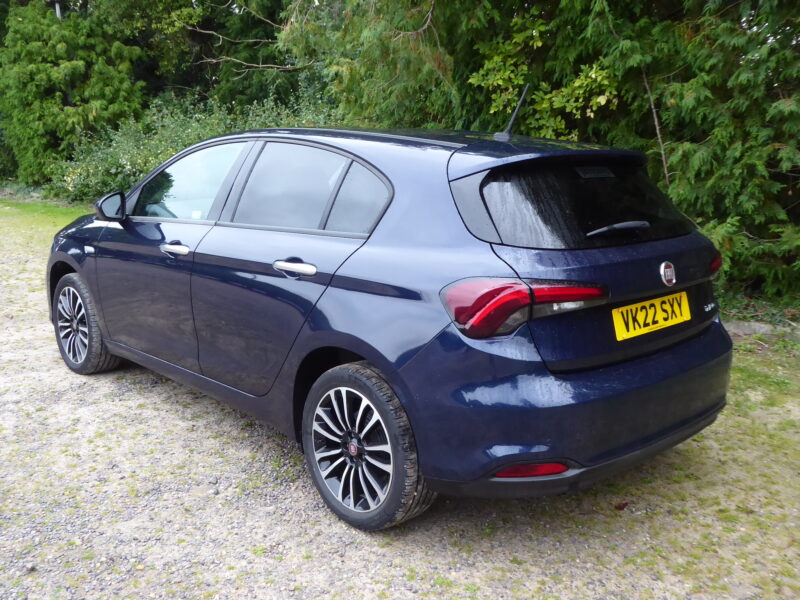


Whilst Western European markets, and in particular the home country of Italy, remain very important to Fiat they are by no means the only countries that matter and which deliver the company’s total sales performance. Latin America has long been a stronghold, with products developed and built there that we just don’t see in Europe, and the company was early into the burgeoning Chinese market. It also has a very strong presence in Southern Europe, with Fiat models claiming the top sales spot in Turkey year after year. The car we know as the Tipo was originally developed for those Southern European markets, with the first version of the car, known as the Aegea being a conventional three-box saloon to replace the Linea saloon that would be built locally in Turkey. It made its debut at the Istanbul Motor Show in May 2015. Some months after its launch there, the car appeared in Western Europe, initially as a saloon but at the 2016 Geneva Show, a five door hatch and a capacious estate were added to the range, which would also be a reprise of the Tipo name. The idea was that the car would fill the gap left when the Bravo had been discontinued a few years previously. It was promoted heavily on value, with the fact that it was built in low-cost Turkey and designed with affordability in mind meaning that Fiat could offer a C-Segment car at close to B-Segment prices before Dacia really got in on the same act. The hope was that the combination of low prices and some Latin style would prove enticing to a significant number of buyers. Outside Italy, it did not really seem that it was and the Tipo has remained a relatively rare sighting on the roads. I sampled a Tipo in estate format back in early 2017 and found a generally pleasant if slightly unremarkable car that scored on roominess and in particular on value. Whilst Fiat have made some changes since then, with new safety and equipment features being added to ensure the car remains in-line with regulations and market expectations and the engines have been revised, with only petrol models now offered, the Tipo of 2023 is not that different from the Tipo I drove several years earlier. It was definitely time for a reassessment and my chance came when I was allocated one as loan car when the Abarth went back for some work to be done following its annual service and MoT. I was quite pleased to get something different from what is generally only a small fleet of loan cars, as my guess had been that I would get another, or even the same 500X. But no, this time they had a Tipo for me, giving me the chance to try something different. One thing was the same as the day I had the 500X though, and that was the weather. If anything, it was worse, with a torrential downpour on the way home, and whilst it did dry up a little, this was not a good day for doing photos of a dark blue coloured car, so there are not many and they are not as good as I would like! Question is, was the car any good?


As with the 500X, Fiat has changed the engines available in the Tipo over time, to ensure continued compliance with European regulations and to try to minimise the CO2 output. That means that the only unit offered to UK buyers since the late 2020 update is the 1.0 litre 3 cylinder Firefly engine that sees service in all the rest of the range as well. 1.0 litre might not sound much for a car that in the past would have felt under-engined with anything smaller than a 1.6, but in practice, with 100 bhp on offer, it does perform perfectly adequately. As with most small capacity engines, though, you do have to work it hard. This one came with a manual gearbox, and slightly surprisingly, there were only 5 forward ratios. They are well spaced, though and do enable you to get the best out of the car. The gearchange quality proved slick and rather than better than some Fiat gearboxes of yore. There is that characteristic 3 cylinder thrum when you start the car, something you do with a conventional key, but once underway the noise reduces and this is quite a refined car on the motorway.


I found the steering to be far too light, a common complaint these days. Whilst it makes the Tipo very easy to manoeuvre there really is not much feel to it, so you don’t have that much of a sensation as to exactly where the steered wheels are pointed. That said, the handling seemed perfectly OK for a car that will be bought for reasons of practicality rather than driving pleasure and there was plenty of grip and no much in the way of body roll. I suspect that like most of its ilk it will understeer when pushed, but my limited testing did not explore this aspect. More importantly, perhaps, the ride is good. The car comes on 225/65 R17 wheels. The brakes felt a bit mushy, but push harder on the pedal and they did their job just fine. There is a conventional pull-up handbrake between the seats. All-round visibility presented few issues and the car had both front and rear parking sensors. A whole sled of ADAS features have been added, and we will come to some of those presently.


The interior of the Tipo does not follow the overall style of the 500-badged models, even though it clearly shares some of the same individual componentry. Although Fiat have made some effort to make this feel better than a budget car, it has not really succeeded. There is plenty of hard plastic here that cannot be disguised just because there is a leather-wrapped steering wheel and some alcantara panels on the doors. Many have been very vocal in complaining that this is way off the overall visual appeal of other similarly sized cars, but they are generally considerable more costly, and the savings have to come from somewhere. There is a simple instrument cluster, using the now common-place digital dials. There is a central speedometer with a digital repeater in its centre. The rev counter and fuel gauges use a systems of illuminating dots to make their indications. There are chunky twin column stalks for the indicators, lights and wipers, these latter two both having an auto function. The centre of the steering wheel has rather a lot of buttons on it, used for cruise control, audio repeaters and trip selections. Mounted high in the centre of the dash is the uConnect system. Although more basic than the feature-laden systems you get in cars like a Golf, this is widely regarded as being one of the easiest to use, with a responsive touch screen and clear graphics. The audio element includes DAB radio, and Apple Car Play and Android Auto. Beneath are the buttons for the standard automated climate control. There are lots of warning systems here, including speed limit recognition which is useful and Lane Keep Assist, which generally is not. I drove the Tipo in some very heavy rain and was advised “front braking blinded” which was not exactly reassuring, but this pertained not to the front brakes but to the electronic safety feature which applies the brakes if an obstacle is detected. There were plenty of other things to flash up warnings and bong at me, as is increasingly the way these days.


Seat upholstery is all cloth, as you might expect, but it was among the nicer types that you find in cheaper cars these days. There is plenty of adjustment for the front seats, and not surprisingly this is all manual, except for the lumbar support which was electrically operated. The seat itself proved comfortable and there was a decent feeling of space. The steering column telescopes in/out as well as up/down, so getting a good driving position was easy.


The rear seat area of the Tipo is quite spacious for what is a relatively compact car. There should be sufficient legroom even if the front seats are set well back and headroom is also more than ample. Three adults could fit in across the seat though as with all cars of this size, it would be a bit cosy. You don’t get a central armrest but there are map pockets on the back of the front seats and stowage bins on the doors. The boot is a nice regular shape, and is a little larger than many of the Tipo’s rivals. It is quite deep which means that there is something of a lip over which items have to be loaded. There is a space saver under the boot floor in a well which leaves little space for any other items to be tucked in around it. The rear seat backs are asymmetrically split and just drop down to create a much larger luggage area and it is almost flat from end to end. There is reasonable provision for odds and ends in the cabin with a good sized glovebox, door bins and a well in front of the gearlever.


Fiat introduced some new trim versions as part of the late 2020 model update. Initially, there were three, the entry level car, the Life and the Cross. A few months later, in mind 2021. A Sport model was added but this proved short-lived and by 2022 we were back to the three again. At this point, the estate version was discontinued in the UK, leaving just the hatch, all with the same engine. Equipment levels are quite good across the range. The entry level Tipo receives LED daytime running lights, rear parking sensors, driver drowsiness monitoring, intelligent speed assist, traffic sign recognition, lane keep assist, autonomous emergency braking, cruise control, active grille shutter, electrically adjustable door mirrors, steering wheel with audio controls, 16-inch wheels, heated rear window and six airbags. Tipo Life adds adaptive cruise control, automatic climate control, 17-inch alloy wheels, tinted rear windows, seven-inch digital cluster, fog lights, electrically-adjustable and heated door mirrors, leather steering wheel and gear stick, electric lumbar support for driver’s seat, full LED headlights, rear LED lights, rain and dusk sensors, automatic high beam, electrochromic rearview mirror, seven-inch touchscreen with DAB, Bluetooth, USB port, Apple Carplay and Android Auto. The entry level Tipo receives LED daytime running lights, rear parking sensors, driver drowsiness monitoring, intelligent speed assist, traffic sign recognition, lane keep assist, autonomous emergency braking, cruise control, active grille shutter, electrically adjustable door mirrors, steering wheel with audio controls, 16-inch wheels, heated rear window and six airbags. Tipo Life adds adaptive cruise control, automatic climate control, 17-inch alloy wheels, tinted rear windows, seven-inch digital cluster, fog lights, electrically-adjustable and heated door mirrors, leather steering wheel and gear stick, electric lumbar support for driver’s seat, full LED headlights, rear LED lights, rain and dusk sensors, automatic high beam, electrochromic rearview mirror, seven-inch touchscreen with DAB, Bluetooth, USB port, Apple Carplay and Android Auto. Tipo Cross, with its raised ride height, receives over and above Tipo Life a different grille design, 17-inch alloy wheels, dedicated silver front and rear skid plates, side skirts and roof rails, black wheel arches, rear seat armrest, rear USB socket, rear view camera, front parking sensors, satellite navigation integration and height adjustable passenger seat and full-size spare wheel.
The Tipo is coming to the end of its production cycle and it would seem unlikely to be replaced, and that’s a shame, as there’s still room in the market for a family-sized hatchback with a bit of Italian style and brio. This car never quite managed to deliver that in the way that its predecessors did, as when it was conceived, the priorities were more around meeting the needs of Southern Europe where affordability was a higher priority. That means that the Tipo has had a hard time in markets like the UK, with mostly negative press comment perhaps unfairly expecting it to be as good as a Golf or a Ceed without acknowledging the fact that it was priced more like a Polo. Over time, the prices increased to narrow this gap and that really has not helped, so the Tipo remains a relatively rare sight on our roads. My experience of this car and indeed the Estate model I drove a few years ago suggests it deserved a better reception than that even if it was never likely to be accoladed as a class leader.