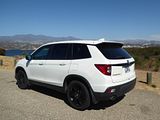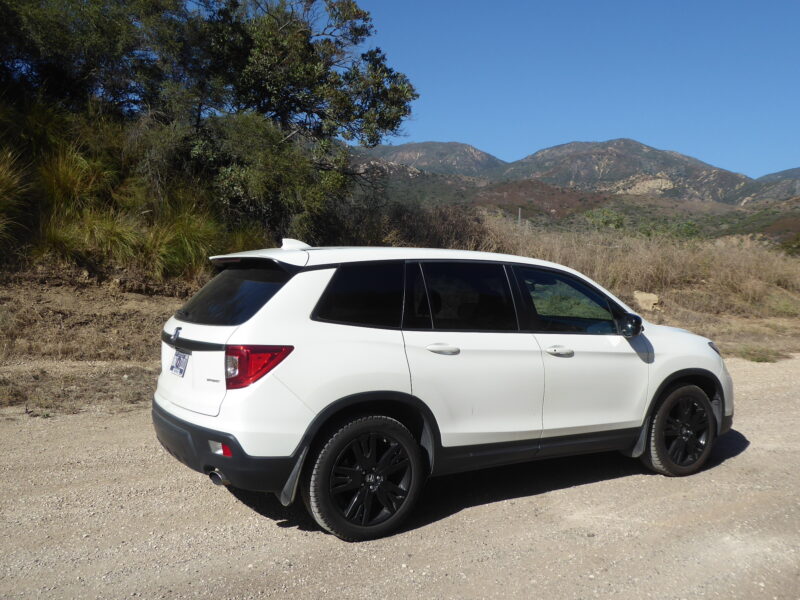


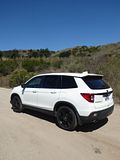


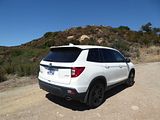
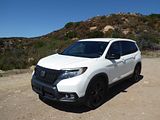

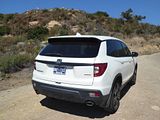


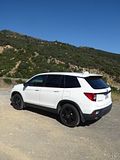


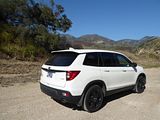
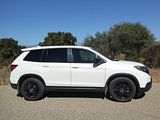
Honda was one of the first to offer a family-sized SUV model, the hugely successful CR-V back in 1995, and since that time have added both larger and smaller models of this genre to their range, which in the US means the compact HR-V and the three-row full-sized Pilot, and there are others available to other markets such as the even smaller BR-V that Mexicans can buy. That is fewer than the options offered by some of their rivals, though, so perhaps it should not have been a surprise when an additional model was announced at the 2018 Los Angele Auto show, sitting between the CR-V and Pilot, and aimed at the likes of the Kia Sorento, Hyundai Santa Fe and Ford Edge. The car has been designed in the US and is built in Alabama. Honda decided to raid the list of model names they had used before, and slightly curiously, as this isn’t a name bursting with positive equity, they called it the Passport. The last Honda Passport was a rebadged Isuzu from the 1990s that lasted less than a decade before getting axed. Perhaps Honda figured enough time has passed that few people will remember that trucky SUV. Either that or it knows Americans like comeback stories. Essentially, the reborn Passport is a shorter and taller Honda Pilot, which is certainly a good place to start. As I found out when I got to sample one a few years ago, the Pilot is one of the best three-row crossover SUVs right now. Because it’s shorter, the Passport doesn’t have a third-row seat like the Pilot does. Instead, it dedicates more interior space for its second-row passengers. Honda also made the Passport a little more off-road capable thanks to a higher ground clearance and better approach and departure angles.


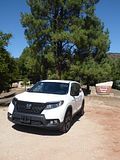
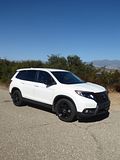

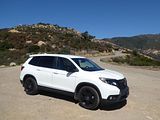
Honda models have long been hard to source in the rental fleets, being almost completely absent for several years. However, in the post-Covid and on-going chip supply era, there are all manner of vehicles that you don’t usually see that have been acquired and put on fleet, including quite a few Honda models. Indeed, since travel to the US resumed just under a couple of years ago, I’ve been able to sample more or less the complete range, with just the Passport eluding me. I had spotted a couple of them on fleet at LAX, but they were always reserved for someone else. However on my first day of my September 2023 trip, I spotted one parked up in the Gold area and rushed to grab the keys before anyone else took a fancy to it. It turned out to be a 209 model and was in Sport trim, which is the cheapest of the four on offer. I’ve driven most of the Passport’s rivals now, so was interested to see how this one would compare with a class of cars all of which are not quite accomplished.
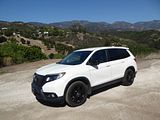


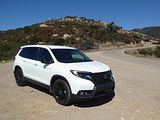
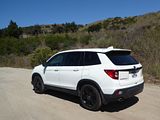
Every Passport comes with the same 3.5-litre V6 that is used in the Pilot, with 280 bhp and 262 lb/ft torque and a nine-speed automatic transmission. Front-wheel drive is standard on the Sport, EX-L and Touring. All-wheel drive is standard on the Elite and optional on the other three trim levels. There is keyless starting, as has become pretty common-place these days and, much to American driver’s chagrin, there is also Stop/Start, though you can disable this feature. The performance stats will tell you that this is one of the liveliest cars in its class, with a quoted 0 – 60 time of under 7 seconds, but my testing suggested that it felt that bit more eager than it actually is. For sure the car is smooth and refined, and noise levels are generally very low, making this a refined cruiser, but when the need is for a burst of acceleration, it is definitely available from any point in the rev range. That 9-speed gearbox is well matched to the engine and gear changes are very smooth indeed. The gear selector itself is of the push-button type and there is full manual control available using the paddles if you want. I covered a total of 325 miles in my time with the Passport. It took 11.3 gallons to fill it, which works out at 28.76 mpg US or 34.36 mpg Imperial. The trip computer declared 30.3 mpg suggesting that – not unusually – the car ended up being returned rather more full than it had been on collection.


The steering was far too light for my tastes, which whilst make the Passport easy to manoeuvre did mean that it was harder to have true confidence on the corners. There’s no denying the Passport is a high-riding and heavy SUV. Still, it manages to feel lighter and nimbler than most other rival SUVs. You can make quick lane changes with ease, and it is easy to drive around turns. Although stiffer than the set-up in the related Pilot, the relatively soft suspension meant that there was a certain amount of body roll, too and whilst grip was good, the Passport is not quite as good to drive as say a Mazda CX-5, probably the benchmark car of this type, though it is somewhat smaller than the Passport. That soft suspension does mean that even with the large 245/45 R20 wheels, the ride is soft and pillowy. Honda gave the Passport’s suspension roughly 1 inch more ground clearance and a shorter rear overhang compared to the Pilot, which would probably give it a little more in the way of off-road capability, though this was something that I did not test out, and probably few owners would, either. The brakes offer a consistent feel and are easy to modulate. Under hard braking, the pedal feels a bit squishy. I did find the foot pedal parking brake rather got in the way. All-round visibility was generally good, and I appreciated the massive door mirrors. There is a full suite of ADAS features, some of which are more useful than others. The Lane Keep Assist system was less frustrating than many of its type.

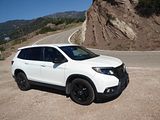


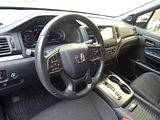
Fit and finish is the hallmark of Honda, and the Passport is no different. The materials and assembly quality are high for a non-luxury vehicle. The soft-touch plastics on the dash combine with high-gloss black trim and gunmetal inlays along with matt-finish secondary controls certainly all feel good, though they do make it a bit sombre looking. The panel gaps are small and even. The instrument cluster comprises electronic dials with a symmetrical design which sees half moon shaped dials at each end of the cluster for water temperature and fuel level, a strip rev counter across the top and a central digital display area which includes the speedometer and the trip computer displays. The graphics are clear and it is easy to read and take in at a glance. There are two column stalks, with lights incorporated on the left hand stalk. The usual sort of buttons are to be found on the steering wheel boss for cruise control and audio repeater. The centre of the dash contains the touch screen. There are no associated buttons, so you have to use the repeater functions on the wheel or the screen itself. In the entry level Sport trim of the test car, you only get AM/FM radio. A cable is needed, and provided, wired in for Apple Car Play or Android Auto functions. Beneath this unit are the buttons for the tri-zone climate control which did a good job at regulating cabin temperature.


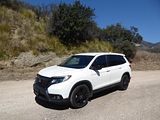
As perhaps befits an SUV-style body there is a bit of a step-up experienced when getting in the Passport. The doors open nice and wide. Once installed, there are cloth seats which, in Sport trim are manually adjusted. Only the driver’s seat gets a height adjuster. The steering column telescopes in/out and up/down with quite a wide range of adjustment. Whilst there is plenty of space, with particularly generous headroom, I found it hard to get truly comfortable. Even at its lowest setting, the seat positioning feels high, but then that is sort of the point of an SUV. There was notable buffeting if driving with the window open.


There is plenty of space in the rear of the Passport. The rear seats are on sliders, but even when set well forward and with the front seats set well back, there is ample leg room for occupants here. Headroom is also particularly generous and you could easily get away with sitting three adults in the back in comfort. There is a central armrest, but you don’t get cupholders and there is only one seat-back map pocket. There are stowage bins on the doors and there are separate climate control settings for those sitting here.


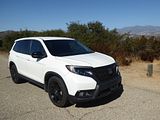

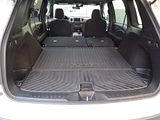
The Passport scores highly for carrying stuff. Yes, the tailgate is really quite heavy and it is not electrically assisted, and yes there is quite a lift to get stuff up into the boot, but capacity here is good. The Passport is only bested by the Toyota 4Runner in cargo capacity, and by a small margin. The official figures say 41.2 cubic feet behind the second row and a max volume of about 77.9 cubic feet. The boot is a nice regular shape and it is particularly wide. There is a useful stowage well under the floor. There was no sign of a load cover, which I always regret in US market cars. The rear seat backrests are asymmetrically split and just drop down to create a long flat load area. he multitude of interior storage bins come in handy for just about any use you’ll have. The Passport has large door pockets, decent-size cupholders, a configurable small-item storage within the centre console, and an abundance of shelves and cubbies. You will be hard-pressed to fill them all. There’s a place for all personal items and then some.



The Passport is available in four trim levels: Sport, EX-L, Touring and Elite. Every Passport comes with Honda’s 3.5-litre V6 with 280 bhp and 262 lb/ft torque and a nine-speed automatic transmission. Front-wheel drive is standard on the Sport, EX-L and Touring. All-wheel drive is standard on the Elite and optional on the other three trim levels. Standard feature highlights for the Sport include 20-inch wheels, LED headlights, tri-zone automatic climate control, keyless access and ignition, lane keeping assist, adaptive cruise control, forward collision warning, Bluetooth, a 5-inch central display and a seven-speaker audio system. In addition to the Sport features, the EX-L adds a power liftgate, a sunroof, leather upholstery, heated and power-adjustable front seats, blind-spot monitoring, Apple CarPlay and Android Auto compatibility, extra USB ports, satellite radio and an upgraded 8-inch touchscreen. The Touring is a bit more comfortable and versatile thanks to features such as heated rear seats, a 10-speaker sound system, a hands-free liftgate, front and rear parking sensors, a 115-volt power outlet and integrated navigation. With pretty much all the equipment the Passport has to offer, the Elite trim adds to the Touring trim level with auto-dimming side mirrors, ventilated front seats, a heated steering wheel, LED interior lighting and a wireless smartphone charging pad.

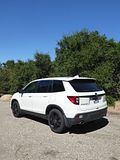


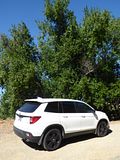
The Passport is a very competent car, with plenty of strengths and no significant weak points. Indeed, I would place it as a class leader. The Passport goes well, is quite relaxing to drive, is generally comfortable, well finished, spacious for five people and plenty of luggage. For sure Sport trim feels a bit stripped out, but you can get the features you would probably want if you got up a trim or tow. The Passport truly is just the sort of car that an awful lot of people – at least in the US, where size matters – simply need, but truth be told, it’s not really the sort of car that anyone is going to feel that they really want. This genre of car just is not like that. Everyone needs it, but few will truly want it! And I you are at the rental car counter and you want a car of this type, then you should probably grab it, too.