

Within the General Motors portfolio of brands, GMC is perhaps the hardest one to characterise. Whilst Cadillac is definitely the luxury brand, Buick the premium one and Chevrolet the everyday and value one, GMC seems to be more difficult to pigeon-hole. It certainly has a long history, going all the way back to 1902, and from the 1920s, now part of the General Motors empire, it was positioned as the provider of trucks and utility vehicles. And that is the sector of the market where it competes today, but then, so does Chevrolet and ever since the 1920s the products from these two brands have been pretty similar, in some cases distinguished only by badging and trim. GM tried to say that whilst Chevrolet trucks were aimed at the private buyer, GMCs were aimed at commercial and business buyers, and yet they also maintain that GMC is a sort of “premium” spec and their products are more costly than the equivalent Chevy, which you would have thought is the wrong way round for commercial versus private buyers. Things got more complex from 2009 when GM decided to close down Pontiac and so GMC started to be used for a range of crossover and SUVs that previously would have had Pontiac badging. That certainly gave GMC dealers a wider range of product to sell, as in addition to the Sierra and Canyon trucks and the massive Yukon SUV that is a close relative of the Chevy Tahoe and Silverado, they now got a large crossover, the Acadia and a mid-sized one, the Terrain. Stepping in to replace the Pontiac Torrent the 2009 Terrain was a close relative of the second generation Chevy Equinox, and unlike the rest of the GMC range, this one had completely different styling compared to the car on which it was based. Although this was on sale for eight model years, I never managed to sample one, despite the fact that reasonable numbers of them were in the Hertz fleet for most of that time. Just as the third generation Equinox shifted to a different platform and the car actually went down in size (creating room for a model between it and the larger Traverse), so the second generation Terrain also moved to the Delta platform.


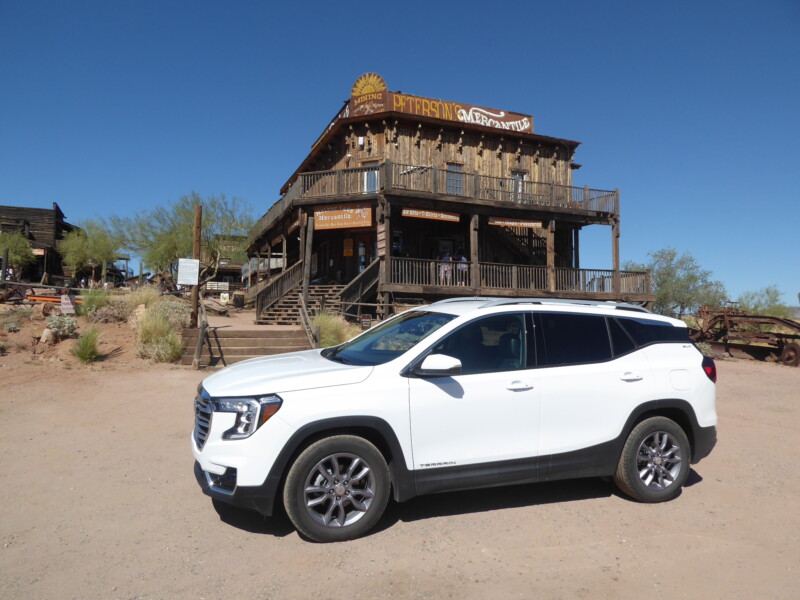
First seen at the 2017 North American International Auto Show in Detroit in January, the new Terrain went on sale in the summer of that year as a 2018 car. Once again, it featured styling that is completely different to the Equinox. Opinions on design will always vary, of course, but I think most people would agree that this is the better looking car of the pair avoiding the rather odd droopy rear end roof line of the Equinox. At launch there were three different engines, including a diesel (which was quickly dropped) and a number of different trims. GMC have continually evolved these and there was a (delayed, thanks to Covid) mid-cycle update that made subtle styling tweaks as well as new tech and equipment for 2022, but in essence the Terrain of 2023 is still essentially the same car as it was when introduced back in 2017. Whilst I got to sample a this generation Equinox very early in its mode cycle, the Terrain continued to elude me, but finally, on the last day of my stay in Phoenix, I found a number parked up in the area from which I could simply choose a car and go, so I decided to try one.


All models of Terrain get the same 1.5 litre turbo 4 cylinder engine. Recent models had power boosted by 5 bhp to give a total of 175 bhp, and there is a standard nine-speed automatic gearbox, with buttons that you press or pull on the dash below the infotainment unit. That 175 bhp is a little less than you will find in most of the Terrain’s competitors. In gentle motoring, all is fine and the Terrain seems perfectly OK in keeping up with the traffic flow, but if you want meaningful acceleration you will need to work the car quite hard and the engine you thought was smooth and refined gets significantly noisier as you make it do more work. Published acceleration figures quote a 0 – 60 time of well over 9 seconds which by modern standards is pretty slow. The theory is that GMC optimised this car for economy, but if you work it hard, then that may not prove to the case. I covered 123 miles in my time with the Terrain and put 3.93 gallons in to fill it which worked out at 31.3 mpg US or 37.39 mpg Imperial, which is good but not that impressive. At least on the freeway at a steady speed, the Terrain was pleasingly quiet and refined, but take it on steeper inclines and it was less relaxing.


Those steeper and twistier roads also revealed that this is no driver’s car. There is not much in the way of feel to the steering which is light and relatively lifeless, good for manoeuvring and city parking. Steering effort does weight up nicely at highway speeds, imparting more confidence and a sense of stability perhaps but this is not a car to trouble the Mazda CX-5. The same goes for handling and roadholding: perfectly safe and predictable and with decent levels of grip, with body roll kept in check. It’s not sporty, but the Terrain remains stable and composed through turns at reasonably high speeds, but this is a car optimised more for comfort than enjoyment. And thankfully, on most surfaces, ride comfort is what you do get. The Terrain SLT comes on 225/60 R18 wheels, which are on the small and higher profile side of normal these days and that means that you generally get a ride that copes well with the variety of surfaces from smooth freeway to slightly coarser backroads. The brakes bite smoothly and evenly, with a good relationship between pedal pressure and actual stopping power. I had some issues with visibility. Parking up is not a problem as there is a rear-view camera but the kicked up third side window means there is a really large blind area at oblique junctions which proved challenging on occasions. There are a number of ADAS systems included in the standard spec and the only one which occasioned my notice was a rather over-eager front collision warning system.


GMC have made an effort to try to create a slightly different looking interior compared to what is fast becoming the universal sort of design, but they’ve only partially succeeded. There are a variety of materials used, some of which are soft touch but there are plenty of harder plastics, too and there is a horrid sort of grained inlay that only American brands seem to be capable of conceiving. The steering wheel is leather-wrapped and it has a heating element within it. The instrument cluster is pretty conventional, with two large outer dials for speedometer and rev counter and then two smaller ones for fuel level and water temperature set in the upper area between them leaving the lower area for trip computer displays. There are two column stalks, with lights, which include an auto function on the left hand one. There are buttons on the wheel spoke for audio repeater and cruise control. Als on the dash is the gear selector which has a mix of buttons to push, for N and P and buttons to pull for D and R – not perhaps the most intuitive setup. The centre of the dash contains the integrated 8” colour touch screen, set between the two central air vents, which runs the latest version of GM’s MyLink software. Functions here are somewhat limited to audio, which does include XM Satellite radio, with other stuff, including navigation needing Apple Car Play or Android Auto which was easy enough to setup and perhaps easier to use than GMs own menu structure. There are still knobs and buttons for common audio functions The Terrain offers a 4G LTE Wi-Fi hotspot standard. Setup is easy, but coverage isn’t much better than with a typical mobile phone. Beneath this unit are two dials and a series of buttons for the dual zone automated climate control.


With SLT trim you get leather seats and these are electrically adjustable in all the usual ways. They are also heated and there is cushion-only or cushion-and-seatback heating, which is a nice feature. Whilst relatively flat in shape, the seat was firm and so proved comfortable to sit on. With low seat bolsters and wide-opening doors, getting in and out will prove easy for most drivers and passengers. There’s also plenty of seat adjustment and the telescoping steering column mean that a wide ranging of driving positions are available.


Space in the back is generally good and there is plentiful legroom even with the front seats set well back. There is also generous headroom thanks to the SUV styling. The only concern here is that the central console unit comes well back, so a middle seat occupant might find that they need to splay their legs somewhat. There is a drop-down armrest with cupholders in the upper surface and occupants here have a couple of USB ports, map pockets on the back of the front seats and bins on the doors to stow their odds and ends.


The tailgate is electrically assisted which is probably no bad thing give how large and heavy it is. Boot capacity is decent, though some of the Terrain’s rivals do offer that bit more space. The central area is quite long and there are useful stowage wells at either side between the wheel arch and rear of the car. Access should be quite easy as there is no sill to speak of. There is a useful underfloor stowage area. The rear seat backrests are asymmetrically split and drop down to give a long and flat load space. One party trick is that the front passenger seat will also fold flat, so there really is space for some very long items here, with an available length of over 8 feet. Sadly, you don’t get a load area cover. Inside the cabin as well as a good sized glovebox and both a central armrest cubby and door pockets there is a big stowage area at the front of the central console and more space available under the console unit as well as a small recess in the dash over the glovebox. Overall, there are plenty of places here for odds and ends.


The 2023 GMC Terrain comes in four trims: SLE, SLT, AT4 and Denali. All are outfitted with the same 175 bhp four-cylinder engine and a nine-speed automatic transmission. Front-wheel drive is standard in the SLE and SLT trims, while all-wheel drive is available. The AT4 and Denali trims are all-wheel-drive only. Standard features in the base SLE include cloth upholstery, manually adjustable front seats, a 7-inch touch screen, wireless Apple CarPlay, wireless Android Auto, Bluetooth, four USB ports, satellite radio, a six-speaker stereo, a Wi-Fi hot spot, push-button start and automatic climate control. The Terrain also comes standard with forward collision warning, pedestrian detection, forward automatic emergency braking, lane-departure warning, lane-keep assist, automatic high-beam headlights, a rearview camera and a rear-seat alert. Available features include heated front seats, an 8-inch touch screen, navigation, dual-zone automatic climate control, remote start, a power liftgate, blind-spot monitoring, rear cross-traffic alert, rear parking sensors, a safety alert seat, adaptive cruise control, roof rails and a sunroof. The Terrain SLT gains leather upholstery, heated and power-adjustable front seats, a heated steering wheel, an 8-inch touch screen, dual-zone automatic climate control, remote start, ambient interior lighting, a 120-volt household-style power outlet, a hands-free power liftgate, fog lights, roof rails and 18-inch wheels. Additional options include front parking sensors, a surround-view camera system, a head-up display and a seven-speaker stereo. The AT4 trim adds a skid plate, 17-inch wheels and black exterior accents. Most options carry over unchanged. The range-topping Denali trim includes all the SLT features, plus an 8-inch digital instrument cluster display, a seven-speaker stereo, wireless device charging, navigation, front and rear parking sensors, blind-spot monitoring, rear cross-traffic alert, a head-up display, a safety alert seat and 19-inch wheels. In addition to a few of the previous options, this trim is available with ventilated front seats, heated rear seats and hands-free parking assist.


If you like the design of the Terrain, then by all means go for it. The only significant weakness of the 2023 Terrain is the engine. Whilst in gentle motoring, one-up, it proved fine, if the car were laden with people and luggage then it really would struggle in a way that few of its rivals would do. Other than that, whilst there is nothing that really stands out, there is also nothing much that counts as poor, but there are a couple of problems: the Terrain sits in one of the most competitive sectors of the market and as a long list of rivals and almost all of them are pretty good, with class standards continuing to improve, and with the Terrain being one of the oldest designs in the sector, it does feel that the rivals have out-classed it, notably such models as the Honda CR-V. Hyundai Tucson and Kia Sportage and for the keener driver, the Mazda CX-5 all being cars I would pick over the Terrain. The second issue is price. If you do insist on a GM product, them the closely related Chevrolet Equinox is essentially the same car for a whole load less money. Yes, it really is the epitome of the rental car fleet these days, and no, it really does not have any stand-out features, either, but unless you are particularly sold on the design of the Terrain, it probably represents a better buy. At the rental car counter, of course, the two would cost the same, but then so would those other rivals, and given the choice, it would be one of those I would pick.