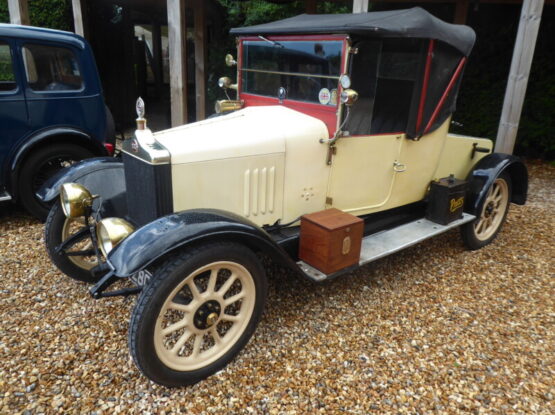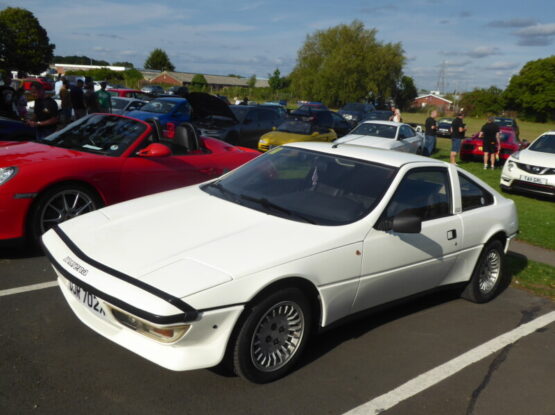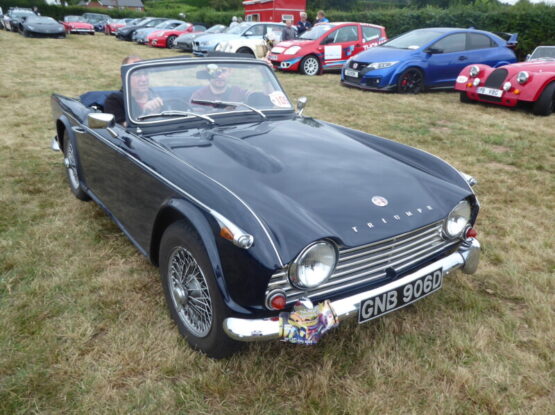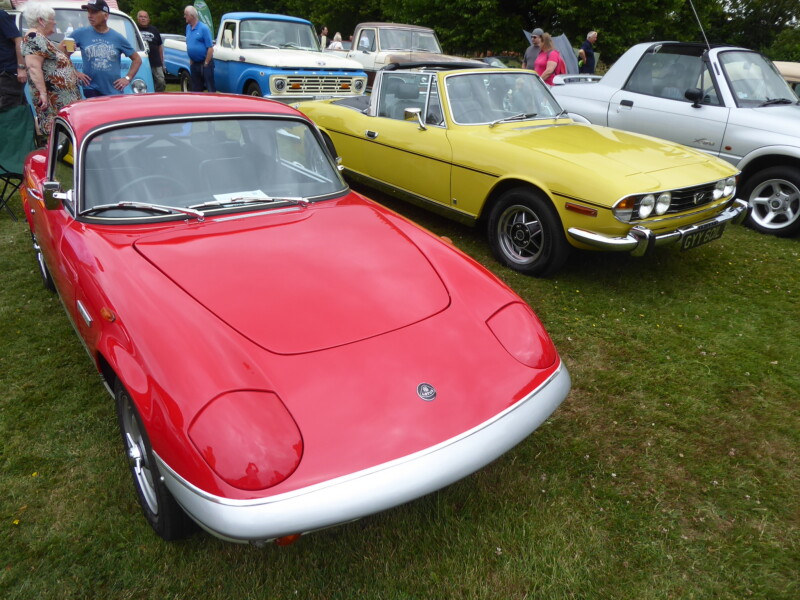
I’ve been aware of the Baston Car and Bike Show for quite a while, but have never managed to go and see it for myself as the date has always clashed with something else, generally rather more local. But in 2025, there was a nice spare weekend in my diary just whilst this long-running event would take place, so I decided to head north to go and investigate. It is held at Grimsthorpe Castle, a venue now perhaps better known as the home of the Festival of the Unexceptional, which will be taking place barely a month after this one. It is an expansive site, so even knowing that there would be several hundred cars and bikes on show, I expected it to feel like there was room for more and yet, the venue still felt pleasantly full. The event comprises a mix of Car Club displays and singletons and there are some dealers and traders to add further interest. That all meant that there was lots to see, as the highlights, shown in this report, will evidence:
ABARTH
Having used the legendary 695 badging from the 1960s on the Tributo cars, at the 2012 Geneva Show, Abarth dusted off the 595 name that had been used on the less powerful of the Nuova 500 based cars of the same generation, and created two new versions which we should think of as Series 2 cars, the 595 Turismo and Competizione, both of which could be bought in either closed or open top C guise, with either the 5 speed manual or robotised automated gearshifts. Both models had the 160 bhp engine as standard. Effectively they were a replacement for the Esseesse kit, and it meant that the cars were produced complete at the factory, rather than needing the dealer to undertake the upgrade (and the associated paperwork), though Abarth did not withdraw the Esseesse kits from the market for some while. Turismo, as the name suggests was aimed slightly less extreme in intent, featuring standard leather upholstery, upgraded dampers and climate control, Xenon headlights and Alutex interior details. The sportier Abarth 595 Competizione replaced the leather seats with Sabelt cloth sport seats and Alutex with aluminium, while adding p-cross-drilled brakes and the Record Monza dual-mode exhaust.


What is known as the Series 4 version of the familiar 595 reached the markets in the middle of 2016. After rumours had circulated all winter following the launch of the facelifted Fiat 500 last year, Abarth finally unveiled the Series 4 at the end of May 2016. Initially, we were told that the cars would not be available in the UK until September, but that came forward somewhat, with dealers all receiving demo cars in June, and the first customers taking delivery in July. Three regular production versions of both the closed car and the open-topped C were initially available, all badged 595, and called Custom, Turismo and Competizione, as before, though numerous limited edition models have since appeared and in most case disappeared. The most significant changes with the Series 4 are visual, with a couple of new colours, including the much asked for Modena Yellow and a different red, called Abarth Red, which replaces both the non-metallic Officina and – slightly surprisingly – the tri-coat pearlescent Cordolo Red. as well as styling changes front and rear. The jury is still out on these, with many, me included, remaining to be convinced. At the front, the new air intake does apparently allow around 15 – 20 % more air in and out, which will be welcome, as these cars do generate quite a lot of heat under the bonnet. Competizione models for the UK retain the old style headlights, as they have Xenon lights as standard, whereas the Custom and Turismo cars have reshaped units. At the back, there are new light clusters and a new rear bumper and diffuser. Inside, the most notable change is the replacement of the Blue & Me system with a more modern uConnect Audio set up, which brings a new colour screen to the dash. Mechanically, there is an additional 5 bhp on the Custom (now 145) and Turismo (now 165 bhp) and the option of a Limited Slip Diff for the Competizione, which is likely to prove a popular option. Details of the interior trim have changed, with a filled-in glovebox like the US market cars have always had, and electric windows switches that are like the US ones, as well as a part Alcantara trim to the steering wheel in Competizione cars.


Abarth announced two limited edition models in the autumn of 2020 and one of these was here. This is the 595 Yamaha Monster Edition and Emma Woods’ car here was an example of that. One of two limited production (or Collector Edition, as Abarth have called them) cars released in September of 2020, this was the cheaper of the pair.. It was inspired by the MotoGP superbike, while the more expensive Scorpioneoro that was released at the same time was designed, so we are told. Based on the 165 bhp Turismo and like the Scorpioneoro, this limited-edition car gets new Abarth sports seats, albeit with blue finishes and the ‘Monster Energy Yamaha MotoGP’ logo on the head restraints. The blue lining contrasts with the black dashboard, while the numbered plate denoting the car’s special-edition status is placed on the central tunnel. Other features include the flat-bottomed steering wheel, sport button and the Record Monza exhaust with active valve. There’s a specially designed braking system, too, which complements the Koni rear suspension. That itself is fitted with Frequency Selective Damping (FSD) technology designed to improve the ride and handling characteristics of the car. 2000 were produced globally.

The Punto Evo was launched at the 2010 Geneva Show, with the cars reaching UK buyers in the summer of that year, and it incorporated many of the changes which had been seen a few months earlier on the associated Fiat models, the visual alterations being the most obvious, with the car taking on the nose of the associated Fiat, but adapted to make it distinctively Abarth, new rear lights and new badging. There was more to it than this, though, as under the bonnet, the T-Jet unit was swapped for the 1.4 litre Multi-Air, coupled to a 6 speed gearbox, which meant that the car now had 165 bhp at its disposal. Eventually, Abarth offered an Esseesse kit for these cars, though these are exceedingly rare. For those in the know – which never seemed to be that many people – this was a really capable and desirable car, and the owners love them, lamenting the fact that the model had quite a short production life and has not been replaced. The final Punto model was the SuperSport. Easily identified by the distinctive black bonnet, just 199 of the SuperSport versions were built, of which around 120 are registered on UK roads. These cars had many of the options from the Punto Evo included as standard. Power came from the the 1.4-litre MultiAir turbo engine, tuned to produce 178bhp and 199lb ft of torque, up from 165 of the standard Punto Evo, giving the SuperSport a 0-62 time of 7.5 seconds and a top speed of over 132mph. To help put the power down, the SuperSport was fitted with wider 18″ wheels and optional Koni FSD dampers. Standard equipment included the Blue&Me infotainment system with steering wheel controls, automatic climate control and a popular option was the ‘Abarth Corsa by Sabelt’ sports leather seats. The SuperSport was available in the same colours as the regular Punto Evo, which means white, grey, black and red.


The Abarth 124 Spider was developed in parallel with the Fiat model. It does cost a lot more, and there are those who think you don’t get enough extra for your money, but those who have driven it will tell you otherwise. You certainly get more power. The 1.4 MultiAir turbo unit jumps up from 138bhp to 168bhp, while torque also increases by a modest 10Nm to 250Nm, which gives it a 0-62mph time of 6.8 seconds, which is half a second quicker than the 2.0-litre Mazda MX-5. The top speed is 143mph. It weighs just 1060kg meaning a power-to-weight ratio of 158bhp-per-tonne, and with the new Record Monza exhaust system it sounds great even at idle. The Abarth version gets a stiffer suspension setup than the regular Fiat 124 Spider, with Bilstein dampers and beefed-up anti-roll bars. Bigger Brembo brakes also feature, with aluminium calipers. It can be had with a six-speed manual or six-speed automatic transmission with paddles, and the latter gets a Sport mode for quicker shifts. Many of the UK cars sport the ‘Heritage Look’ pack, which is a no-cost option. It brings a matt black bonnet and bootlid, plus red exterior trim detailing and has proved popular. The £29,565 starting price gets you standard equipment such as cruise control, climate control, Bluetooth, a DAB radio and satnav, plus Alcantara black and red (or pure black) seat trim. The automatic gearbox is a £2,035 extra, while an optional visibility pack brings LED DRLs, auto lights and wipers and rear parking sensors. Sales ceased during 2019, with around 1800 cars having been brought into the UK, so this is always going to be a rare car, and values are already increasing at a rate reflecting its desirability and the difficulty in finding one.


ALFA ROMEO
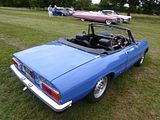
Alfa replaced the Giulia-based Spider model with an all-new design which finally made its debut in 1966 together with the Giulia Sprint GT Veloce at an event organised in Gardone Riviera. With its boat tailed styling, it quickly found favour, even before taking a starring role in the film “The Graduate”. The original 1600cc engine was replaced by a more powerful 1750cc unit at the same time as the change was made to the rest of the range, and the car continued like this until 1970, when the first significant change to the exterior styling was introduced on the 1750 Spider Veloce, with the original’s distinctive elongated round tail changed to a more conventional cut-off tail, called the “Kamm tail”, as well as improving the luggage space. Numerous other small changes took place both inside and out, such as a slightly different grille, new doorhandles, a more raked windscreen, top-hinged pedals and improved interior trim. 1971 saw the Spider Veloce get a new, larger powerplant—a 1962 cc, 132 hp unit—and consequently the name was changed from 1750 Spider Veloce to 2000 Spider Veloce. The 1600 Spider restarted production a year later as the Spider 1600 Junior, and was visually identical to the 1300. 1974 saw the introduction of the rare, factory request, Spider-Targa. Based upon the Spider, it featured a Porsche style solid rear window and lift out roof panels, all made out of black GRP type material. Less than 2,000 models of such type were ever made and was the only part solid roof Spider until the introduction of the factory crafted hard top. The 1300 and 2000 cars were modified in 1974 and 1975 respectively to include two small seats behind the front seats, becoming a “two plus two” four seater. The 1300 model was discontinued in 1977. Also, between 1974 and 1976, the early-style stainless-steel bumpers were discontinued and replaced with black, rubber-clad units to meet increasingly stringent North American crash requirements. 4,557 examples of the 1300 Junior were made and 4,848 of the 1600 Junior as well as 16,320 2000 Spider Veloces and 22,059 of 2000 Spider Veloce US version. There were also 4,027 1750 Spider Veloces produced.


During the 1950s, Alfa had undergone a fairly fundamental transformation from producing cars designed for racing or very high-end sports touring road machines, in small quantities, to being a manufacturer of more affordable cars, albeit with a sporting bias to their dynamics. But the desire to produce something exclusive and expensive was not completely lost, and indeed it was re-manifest in the next Alfa to be seen here, the very lovely Montreal. First seen as a concept car in 1967 at Expo 67, the car was initially displayed without any model name, but the public took to calling it the Montreal. It was a 2+2 coupe using the 1.6-litre engine of the Alfa Romeo Giulia TI and the short wheelbase chassis of the Alfa Romeo Giulia Sprint GT, with a body designed by Marcello Gandini at Bertone. One of the two concept cars built for Expo 67 is displayed in the Alfa Romeo Historical Museum in Arese, Italy, while the other is in museum storage. Reaction to the concept was sufficiently encouraging that Alfa decided to put the car into production. The result, the Tipo 105.64, was shown at the 1970 Geneva Motor Show and was quite different from the original, using a 2593 cc 90° dry-sump lubricated V8 engine with SPICA (Società Pompe Iniezione Cassani & Affini) fuel injection that produced around 200 PS (197 hp), coupled to a five-speed ZF manual gearbox and a limited-slip differential. This engine was derived from the 2-litre V8 used in the 33 Stradale and in the Tipo 33 sports prototype racer; its redline was set at 7,000 rpm, unheard of for a V8 at that time. The chassis and running gear of the production Montreal were taken from the Giulia GTV coupé and comprised double wishbone suspension with coil springs and dampers at the front and a live axle with limited slip differential at the rear.Since the concept car was already unofficially known as The Montreal, Alfa Romeo kept the model name in production. Stylistically, the most eye catching feature was the car’s front end with four headlamps partly covered by unusual “grilles”, that retract when the lights are switched on. Another stylistic element is the NACA duct on the bonnet. The duct is actually blocked off since its purpose is not to draw air into the engine, but to optically hide the power bulge. The slats behind the doors contain the cabin vents, but apart from that only serve cosmetic purposes. Paolo Martin is credited for the prototype instrument cluster. The Montreal was more expensive to buy than the Jaguar E-Type or the Porsche 911. When launched in the UK it was priced at £5,077, rising to £5,549 in August 1972 and to £6,999 by mid-1976. Production was split between the Alfa Romeo plant in Arese and Carrozzeria Bertone’s plants in Caselle and Grugliasco outside Turin. Alfa Romeo produced the chassis and engine and mechanicals and sent the chassis to Caselle where Bertone fitted the body. After body fitment, the car was sent to Grugliasco to be degreased, partly zinc coated, manually spray painted and have the interior fitted. Finally, the car was returned to Arese to have the engine and mechanicals installed. It is worth noting that because of this production method, there is not necessarily any correspondence between chassis number, engine number and production date. The Montreal remained generally unchanged until it was discontinued in 1977. By then, production had long ceased already as Alfa were struggling to sell their remaining stock. The total number built was around 3900. None of them were sold in Montreal, Quebec since Alfa did not develop a North American version to meet the emission control requirements in the United States & Canada. The car was both complex and unreliable which meant that many cars deteriorated to a point where they were uneconomic to restore. That position has changed in the last couple of years, thankfully, with the market deciding that the car deserves better, and prices have risen to you whereas a good one would have been yours for £20,000 only a couple of years ago, you would now likely have to pay more than double that.


ALPINA
The B3 3.3 version of the E46 3 Series was launched in saloon form at the 1999 Geneva Show, with the coupe following at Frankfurt later in the year., the Touring at Geneva in 2000 and finally a convertible at the 2000 Birmingham Show It had an engine which was based on that of the US spec M3 unit. but enlarged with longer bore and stroke, as well as a different cylinder head and lighter pistons, giving it an output of 280 bhp. A six speed Getrag manual box was standard with a five speed Switchtronic unit an option. The suspension was uprated with stiffer dampers. Outside the changes were subtle with larger spoilers front and rear the only clue if the customer opted not to have the marque’s distinctive pin-striping. Inside there were the usual Alpina touches including sports seats in Alpina stitched leather and bespoke instruments. In 2002, Alpina updated the car to the 3.3S, with a more powerful 305 bhp of the same engine. Most of these cars were based on the post-facelift E46.

ALVIS
Conceived in 1956, and launched as the TD21, this was quite a departure from the lovely, but rather “post-war” TC21. However, on its arrival in dealer’s showrooms, it quickly set about changing established views of the Alvis. Following the loss of coachbuilders Mulliner and Tickford (who were now tied to other companies), Alvis turned to the Swiss coachbuilder, Graber whose tradition of producing sleek, modern and very elegant saloons and dropheads proved a good fit in terms of the way Alvis saw their future. Graber first presented this new style to the Alvis board in late 1957 who were very impressed with the Swiss company’s flowing design and commissioned the body to be built on the new TD chassis. To ease logistical problems, Park Ward of London, built the Graber designed bodies in the UK. The Alvis Three Litre TD21 Series I was produced between the end of 1958 and April 1962, and was powered by the TC’s 2993 cc engine, uprated by 15bhp to 115 as a result of an improved cylinder head design and an increased compression ratio. A new four-speed gearbox from the Austin-Healey 100 was incorporated, while the suspension remained similar to the cars predecessor, independent at the front using coil springs and leaf springs at the rear, but the track was increased slightly and a front anti-roll bar added. From 1959 the all drum brake set up was changed to discs at the front retaining drums at the rear. In April 1962, the car was upgraded with four wheel Dunlop disc brakes in place of the disc/drum combination, aluminium doors, a five-speed ZF gearbox and pretty recessed spotlights either side of the grille, these improvements coming together to create the TD21 Series II. The car would be updated in 1963 to create the TE21, with its distinctive dual headlights proving a recognition point, and the later TF21, continuing in production until 1967 at which point Alvis ceased car manufacture.


ARIEL
The Ariel Atom is a road-legal high performance open-wheel car made by the British Ariel Motor Company based in Crewkerne, Somerset, England, and under license in North America by TMI Autotech, Inc. at Virginia International Raceway in Alton, Virginia. The Atom began as a student project by Coventry University transport design student Niki Smart. Known then as the LSC (Lightweight Sports Car), it was developed at the university in 1996 with input and funding from various automotive industry members, including British Steel and TWR. Ariel Motor Company boss Simon Saunders was a senior lecturer whose responsibility for the project was primarily as financial manager and design critic for Smart, whom he described as “The best all-round design student I’ve ever seen.” The car was first shown publicly at the British International Motor Show at the NEC in Birmingham in October 1996. The Ariel Atom features a prominently visible chassis (i.e., an exoskeleton, no roof or windows, a small optional windscreen) and a drag coefficient of 0.40 There have been eight Ariel Atom generations to date: Ariel Atom, Ariel Atom 2, Ariel Atom 3 (including the Ariel Atom 3 Mugen Limited Edition and Honda Racing Edition – of which only one was made) Ariel Atom 3.5, Ariel Atom 3S, Ariel Spec:Race Atom, Ariel Atom 500 V8 Limited Edition (only 25 to be made), and the Ariel Atom 4. The limited production Ariel Atom 500 V8 featured a 500 bhp V8 engine. The Ariel Atom 4 uses a turbocharged 2.0 litre engine, also used in the Honda Civic Type R, with 3-stage boost.

ASTON MARTIN
Follow on to the DB7 was the DB9 (there has never been a car called DB8 – supposedly because people might have assumed this meant a V8 engine), and there was a nice example here. The Aston Martin DB9, designed by Marek Reichmann and Hendrik Fisker, was first shown by Aston Martin at the 2003 Frankfurt Auto Show, in coupe form. It was widely praised for the beauty of its lines. This was the first model to be built at Aston Martin’s Gaydon facility. It was built on the VH platform, which would become the basis for all subsequent Aston models. The Aston Martin DB9 was initially launched equipped with a 6.0 litre V12 engine, originally taken from the V12 Vanquish. The engine produced 420 lbf·ft of torque at 5,000 rpm and a maximum power of 444 hp at 6,000 rpm, allowing the DB9 to accelerate from 0 to 60 mph in 4.7 seconds and a top speed of 299 km/h (186 mph). The engine largely sits behind the front-axle line to improve weight distribution. Changes to the engine for the 2013 model year increased the power to 503 hp and torque to 457 lb-ft, decreasing the 0 to 60 mph time to 4.50 seconds and with a new top speed is 295 km/h (183 mph). The DB9 was available with either a six-speed conventional manual gearbox from Graziano or a six-speed ZF automatic gearbox featuring paddle-operated semi-automatic mode. The gearbox is rear-mounted and is driven by a carbon-fibre tail shaft inside a cast aluminium torque tube. The DB9 was the first Aston Martin model to be designed and developed on Ford’s aluminium VH (vertical/horizontal) platform. The body structure is composed of aluminium and composites melded together by mechanically fixed self-piercing rivets and robotic assisted adhesive bonding techniques. The bonded aluminium structure is claimed to possess more than double the torsional rigidity of its predecessor’s, despite being 25 percent lighter. The DB9 also contains anti-roll bars and double wishbone suspension, supported by coil springs. To keep the back-end in control under heavy acceleration or braking, the rear suspension has additional anti-squat and anti-lift technology. Later versions of the car also features three modes for the tuning: normal, for every-day use, sport, for more precise movement at the cost of ride comfort, and track, which furthers the effects of the sport setting. The Aston Martin DB9 Volante, the convertible version of the DB9 coupe, followed a few months later. The chassis, though stiffer, uses the same base VH platform. To protect occupants from rollovers, the Volante has strengthened windscreen pillars and added two pop-up hoops behind the rear seats. The hoops cannot be disabled and will break the car’s rear window if deployed. In an effort to improve the Volante’s ride while cruising, Aston Martin have softened the springs and lightened the anti-roll bars in the Volante, leading to a gentler suspension. The retractable roof of the Volante is made of folding fabric and takes 17 seconds to be put up or down. The Volante weighs 59 kilograms (130 pounds) more than the coupe. The coupe and Volante both share the same semi-automatic and automatic gearboxes and engine. The car was limited to 266 km/h (165 mph) to retain the integrity of the roof. Like the coupe, the original Volante has 420 lb·ft of torque at 5,000 rpm and a maximum power of 450 hp at 6,000 rpm. The 0 to 60 mph slowed to 4.9 seconds due to the additional weight. The DB9 was facelifted in July 2008, which mainly amounted to an increase in engine power, to 476 hp and a redesigned centre console. Externally, the DB9 remained virtually unchanged. For the 2013 model year revision, Aston made minor changes to the bodywork by adapting designs from the Virage, including enlarging the recessed headlight clusters with bi-xenon lights and LED daytime strips, widening the front splitter, updating the grille and side heat extractors, updating the LED rear lights with clear lenses and integrating a new rear spoiler with the boot lid. .On newer models, like the coupe’s, the Volante’s horsepower and torque increased to 517 PS (510 hp) and 457 lb·ft respectively. As a finale for the model, a more powerful DB9 was released in 2015, called the DB9 GT. This had 540 bhp and 457 lb-ft of torque at 5500 rpm, giving a 0 to 60mph time of 4.4 seconds and 0 to 100mph in 10.2 seconds, with the standing quarter mile dispatched in 12.8 to 12.9 seconds and a top speed of 183mph. Production of the DB9 ended in 2016 being replaced by its successor, the DB11.


Following the unveiling of the AMV8 Vantage concept car in 2003 at the North American International Auto Show designed by Henrik Fisker, the production version, known as the V8 Vantage was introduced at the Geneva Motor Show in 2005. The two seat, two-door coupé had a bonded aluminium structure for strength and lightness. The 172.5 inch (4.38 m) long car featured a hatchback-style tailgate for practicality, with a large luggage shelf behind the seats. In addition to the coupé, a convertible, known as the V8 Vantage Roadster, was introduced later in that year. The V8 Vantage was initially powered by a 4.3 litre quad-cam 32-valve V8 which produced 380 bhp at 7,300 rpm and 409 Nm (302 lb/ft) at 5,000 rpm. However, models produced after 2008 had a 4.7-litre V8 with 420 bhp and 470 Nm (347 lbft) of torque. Though based loosely on Jaguar’s AJ-V8 engine architecture, this engine was unique to Aston Martin and featured race-style dry-sump lubrication, which enabled it to be mounted low in the chassis for an improved centre of gravity. The cylinder block and heads, crankshaft, connecting rods, pistons, camshafts, inlet and exhaust manifolds, lubrication system and engine management were all designed in house by Aston Martin and the engine was assembled by hand at the AM facility in Cologne, Germany, which also built the V12 engine for the DB9 and Vanquish. The engine was front mid-mounted with a rear-mounted transaxle, giving a 49/51 front/rear weight distribution. Slotted Brembo brakes were also standard. The original V8 Vantage could accelerate from 0 to 60 mph in 4.8 seconds before topping out at 175 mph. In 2008, Aston Martin introduced an aftermarket dealer approved upgrade package for power and handling of the 4.3-litre variants that maintained the warranty with the company. The power upgrade was called the V8 Vantage Power Upgrade, creating a more potent version of the Aston Martin 4.3-litre V8 engine with an increase in peak power of 20 bhp to 400 bhp while peak torque increased by 10 Nm to 420 Nm (310 lb/ft). This consists of the fitting of the following revised components; manifold assembly (painted Crackle Black), valved air box, right and left hand side vacuum hose assemblies, engine bay fuse box link lead (ECU to fuse box), throttle body to manifold gasket, intake manifold gasket, fuel injector to manifold seal and a manifold badge. The V8 Vantage had a retail price of GB£79,000, US$110,000, or €104,000 in 2006, Aston Martin planned to build up to 3,000 per year. Included was a 6-speed manual transmission and leather-upholstery for the seats, dash board, steering-wheel, and shift-knob. A new 6-speed sequential manual transmission, similar to those produced by Ferrari and Lamborghini, called Sportshift was introduced later as an option. An open-topped model was added to the range in 2006 and then in the quest for more power a V12 Vantage joined the range not long after. There were no fewer than 18 different versions of the car produced over its model life


This version of the Vanquish started life as the Project AM310 Concept that was unveiled at the 2012 Concorso D’Eleganza at Villa D’Este on the shores of Lake Como, Italy. The concept car was based on the fourth generation VH platform. It included a tweaked version of Aston Martin’s familiar grille and headlight design and a more pronounced bulge in the bonnet – with the real One-77-inspired flourishes saved for the sides and the rear, the side vents run almost to the door handles (from One-77), new rear light design from One-77, and a 5.9-litre V12 engine that produced 550 PS. Aston Martin later announced that the concept would be put into production as the all new Aston Martin Vanquish. The exterior styling of the Vanquish is an evolution of the DBS with many styling cues such as the elongated side strakes being inspired by the Aston Martin One-77. The boot lid included an integrated rear spoiler designed to look as if it is impossible to make; this was done on the orders of Aston Martin Chief Executive, Dr. Ulrich Bez. The car has an exposed carbon fibre side skirt showing its all carbon fibre body. The Vanquish uses the new VH Generation IV platform which is lighter and uses more carbon fibre components than the VH Generation II platform used in the DBS. The car featured an all new interior based on the one found in the exclusive One-77. The standard interior was trimmed in hand stitched leather and alcantara and was available in a range of colours. The centre console features an revised infotainment system over the one found in the DBS. The car was available as either a 2-seater or 2+2. The Vanquish used an upgraded version of Aston Martin’s flagship 5.9-litre AM11 V12 engine called the AM28 with a power output of 565 bhp at 6,750 rpm and torque of 457 lb/ft at 5,500 rpm. The Vanquish can accelerate from 0 to 100 km/h (62 mph) in 4.1 seconds, and has a top speed of 295 km/h (183 mph). Like most Aston Martins, the engine is front mid-mounted for better weight distribution, with the power going to the rear wheels. The Vanquish has 51/49 front/rear weight distribution, and a kerb weight of 1,739 kg (3,834 lb). It uses a fully catalysed stainless steel exhaust system with active bypass valves. The Vanquish uses an updated Touchtronic II six-speed automatic gearbox. It was the first Aston Martin model to be available with launch control. The combined space of cabin and a boot that, at 368 litres, is more than 60% larger than that of the DBS. The brakes are ventilated carbon ceramic discs, 398 mm (15.7 in) six-piston callipers in the front and 360 mm (14.2 in) four-piston callipers in the rear. The suspension is a lightweight aluminium front subframe with hollow castings with independent double wishbones incorporating anti-dive geometry, coil springs, anti-roll bar, and monotube adaptive dampers in the front and independent double wishbones with anti-squat and anti-lift geometry, coil springs, anti-roll bar, and monotube adaptive dampers in the rear. It has a three-stage adjustable adaptive damping system including normal, sport and track modes. The tyres are Pirelli P Zeros, 255/ZR20 in the front and 305/30 ZR20 in the rear. The vehicle was unveiled in the London Film Museum, Covent Garden, followed by 2012 Monterey Car Week. Deliveries to UK and Continental Europe began in late 2012. In August 2014, Aston Martin revealed technical modifications to the Vanquish. The changes include a new eight-speed Touchtronic III gearbox and upgraded AM29 V12 engine that produces 568 bhp and torque of 465 lb/ft. The changes greatly enhanced performance, with an acceleration of 0 to 100 km/h (62 mph) in 3.6 seconds, and a top speed of 324 km/h (201 mph). In 2013, Aston Martin unveiled a convertible version of the Vanquish, called Volante. The Volante includes a full carbon fibre body, triple-skin lightweight fabric roof, 50% larger boot than its predecessor and the third generation Brembo 398 mm × 36 mm front and 360 mm × 32 mm CCM rear Carbon Ceramic Matrix (CCM) brake discs with six-piston front and four-piston rear brake callipers (from the One-77). The Vanquish Volante is 13% torsionally stiffer than the outgoing DBS Volante. The carbon fibre-skin of the Vanquish Volante was created by the engineering team at Aston Martin. The vehicle was unveiled at the 2013 Pebble Beach Concours d’Elegance. Deliveries to Europe began in late 2013. On 16 November 2016, Aston Martin announced the new Vanquish S model. The Vanquish S features the same AM29 V12 engine, with power now increased to 595 bhp, and a new aerodynamic package. The Vanquish S can accelerate from 0 to 100 km/h (62 mph) in 3.5 seconds, and the top speed remains unchanged at 201 mph (324 km/h). The starting price at launch was £199,950 and deliveries started in December 2016. Aston Martin also unveiled a convertible version of the Vanquish S called the Vanquish S Volante in 2017.

AUDI
In October 1988, and after a brief hiatus for the Audi Coupé, a new three-door Coupé was introduced in Europe. This generation is known internally as the Typ 8B and is basically a Typ 89 saloon with a modified rear suspension and a new front suspension system which previewed what was to come in the B4 Audi 80. When introduced it was only available with either the ten- or twenty-valve 2.3E engine, which was later joined by the 115 PS 2.0E and a number of other versions. In February 1989 a 20-valve version of the 2.0-liter five-cylinder engine went on sale in Italy. This was the only version of the Coupé sold in Italy, where cars of over two liters suffer a high tax penalty. It was not offered anywhere besides Italy and Portugal as it was never fitted with a catalytic converter. The engine produces 160 PS and this model was built until July 1991. Another export-market special built during the same period was an uncatalyzed, fuel injected 112 PS 1.8-liter inline-four. A naturally aspirated, 136 PS 2.2E was also sold in some markets until late 1991, including the United Kingdom and Spain. In September 1990 the sporty S2 Coupé was introduced, followed one year later by a more luxury-oriented 2.8-liter V6 version. The Coupé received similar updates to the B4 Audi 80 and remained in production until December 1996. The Coupé did not have a direct replacement but was effectively succeeded by the first-generation Audi TT coupé (and roadster), sold between 1998 and 2006.

Also from the B3 family was the 80 Cabriolet. This version was planned from the beginning but did not appear until May 1991 as the Audi Cabriolet. This model remained in production until 2000 and was optically aligned with the B4 Audi 80 from its introduction. It was offered with a variety of engines. The car proved popular.

The Audi R8, based on the Audi Le Mans quattro concept car (designed by Frank Lamberty and Julian Hoenig) first appeared at the 2003 International Geneva Motor Show and the 2003 Frankfurt International Motor Show. The R8 road car was officially launched at the Paris Auto Show on 30 September 2006. There was some confusion with the name, which the car shares with the 24 Hours of Le Mans winning R8 Le Mans Prototype (LMP). Initial models included the R8 4.2 FSI coupé (with a V8 engine) and R8 5.2 FSI coupé (with a V10 engine). Convertible models, called the Spyder by the manufacturer, were introduced in 2008, followed by the high-performance GT model introduced in 2011. The Motorsport variants of the R8 were also subsequently introduced from 2008 onwards. An all-electric version called the e-Tron started development but would only reach production stage when the second generation model would be introduced. 6-time 24 Hours of Le Mans winner Jacky Ickx described the R8 as “the best handling road car today” and the car was well received by everyone who drove it. The car received a facelift in 2012 and a new model called the V10 Plus was now added to the range. Production of the Type 42 ended in August 2015


This is the second generation R8. Launched at the 2015 Geneva Motor Show and is based on the Modular Sports System platform shared with the Lamborghini Huracan. The development of the Type 4S commenced in late 2013 and was completed in late 2014. Initial models included the all-electric e-Tron and the V10 5.2 FSI along with the V10 plus. Unlike its predecessor, there was no manual transmission available and the entry-level V8 trim was also dropped. In 2016, the convertible (Spyder) variant was added to the line up which was initially available in the base V10 trim. In mid-2017, the high performance V10 plus Spyder was added to the range. A rear-wheel-drive model called the R8 RWS was introduced. In 2018, the R8 received a mid-cycle refresh with mechanical and exterior changes. The newer and more aggressive design language carried over from famous Audi models of the past and its appearance is slightly more angular up front. Some of the aerodynamic features such as the front aeroblades are shared with the Lamborghini Huracàn. The refreshed model had substantial performance improvements over its predecessor. The base R8 got a power boost from 532 hp to 562 hp, while the V10 Plus was renamed V10 Performance Quattro and the engine saw a power increase by 10 hp, now up to 612 hp.


AUSTIN
“A British car to beat the world”. So read the billboards when the Austin Metro was revealed in October 1980. We had waited a long time for this car. There were many false starts, with thoughts first turning to how to replace the Mini going back to the late 1960s, but for various reasons, every effort had been cancelled. Fortunately, that extended to the ADO88 prototype which got to quite an advanced state of development in 1978, but which received less than favourable feedback at customer clinics. A hasty redesign was conducted. Despite carrying over the A Series engines, albeit in modified A+ guise, as BL had nothing else suitable an no money to develop an alternative, and that meant the 4 speed in-sump gearbox came with it, the little Metro has an immediate hit. It looked good, with pert, modern looks, and with a large hatchback, and some innovative ideas on how to maximise the use of space, this was a roomy car that Britain could indeed be proud of. That a young lady who came to prominence in the months following launch, the future Princess Diana, could be seen driving around in one probably helped still further. Five models were available at launch: 1.0, 1.0L, the economy-oriented 1.0 HLE, 1.3S and 1.3 HLS, and the cars were available in a wide range of bright and attractive colours, including a greater percentage of metallic paints than were typically offered to buyers of cars in this class. My parents bought a 1.0L in the summer of 1983, as a replacement for our Mini, and the car was a massive improvement in just about every respect. Unlike previous BL cars, this model was not dogged with build quality and reliability issues, though, sadly it did have the same propensity to rust as they did, but it took several years before that would become obvious. Before that happened, the range was expanded with the introduction of cheaper City and City X models, a top spec Vanden Plas and then the sporting MG version. There was a lot of angst about this last one, as the purists all bemoaned the fact that it was not a “real” MG, as it was a family hatchback not a sports car (conveniently ignoring the MG 1100/1300 saloons of the 1960s), but ti soon became apparent that this little car was a blast to drive, and something quite special with its red trim, including red seat belts and a liberal splashing of octagon logos around the car. A wilder Turbo model followed at the end of 1982, reflecting the craze for every manufacturer to bolt one on to every car that they could find to create a series of often rather unruly and lag-prone but fast machines. Although a lot of work was done in the mid 80s on developing what should have been another world class replacement (the AR6, the prototype for which is also hidden away at Gaydon), a lack of funds meant that for the next 7 years, all that happened was a lot of tweaking of the trim, and specification and the incorporation of a pair of rear doors to create a 5 door model. This was at a time when the competition stood far from still, with the Fiat Uno and Peugeot 205 upping the ante in early 1983, Vauxhall joining the fray with the Nova mid year, a facelifted Fiesta with a five speed gearbox arriving later that year, a new Renault R5 the following year, along with several Japanese rivals coming out every 4 years. It all made the Metro look increasingly elderly, and also small, compared to all its rivals.


AUTOBIANCHI
The Autobianchi A112 was a supermini, developed using a shrunken version of the contemporary Fiat 128’s platform and whose mechanicals subsequently underpinned the Fiat 127. It was introduced in November 1969, as a replacement for the Bianchina and Primula, and was built until 1986, when it made way for the more modern Autobianchi Y10 (branded in most export markets as the Lancia Y10). Over 1.2 million A112s were produced in Autobianchi’s Milan factory. The A112 was available only with a 3-door body. It was offered with the OHV engine of 903 cc from the Fiat 850 capable of attaining 42 PS. The Autobianchi represented the first appearance of this engine in a front-engine, front-wheel drive configuration which would later become familiar to a wider range of drivers in the top selling Fiat 127 and its derivatives. Claimed power increased to 47 PS in 1971, but without any mechanical changes having taken place. The A112 reached a very particular market; by 1984 female buyers represented 35% of A112 owners and about a third were in the 18-24 age range. In September 1971 the A112 E (“E” for Elegant, which also became its name after the 1973 facelift) was introduced. This featured improved seats, higher grade trimming and equipment, as well as a five-speed gearbox later in life. The mechanics were originally identical to the regular version, now referred to as the Normale, but from 1975 until 1977 the Normale’ received a less powerful engine. A performance edition “Abarth” was introduced too. In March 1973 the A112 received a makeover. The grille was new, with a larger mesh, and the bumpers were now of rubber with chrome insert (although the Normale retained the old metal bumpers with rubber strips). A new style of alloys were also available, and the seats and dashboard underwent some changes. The Abarth received a new chess pattern upholstery. In 1975 the third series arrived. The insides in the rear were recontoured, so that the car now became a five-seater (instead of four). The easiest way to spot a third series is that it received new, much larger vents on the C-pillars, as well as redesigned taillights – with integrated reversing lights on the Elegant and Abarth. The Abarth also received a new larger 1050 cc engine (“70HP”), while the Normale’s output dropped to 42 PS in July 1975. All engines were still pushrod units, derived from the old tipo 100 engine first introduced in the Fiat 600. In 1976, due to new emissions standards, the Elegant lost two horsepower, now down to 45 PS. Third series Normales still received metal bumpers, but from now on they were painted black (instead of being chromed) and no longer had a rubber strip. This was the last model to have the diamond shaped turn signals on the front fenders, with later models receiving more orthodox rectangular ones. In November 1977 the “Nuova A112” (new A112) was introduced: The most obvious difference is a slightly taller roof, with a marked edge around the sides. This improved interior habitability considerably. Autobianchi also at this time modified the upmarket version branded as the “A112 Elegant” with an engine enlarged to 965 cc, now promising 48 PS and improved torque. Later, there were also “A112 Elite” and “A112 LX” versions which received even more comfortable equipment. The 903 cc engine of the lesser A112 Normale remained unchanged. In July 1979 the car underwent another styling modification, receiving large black plastic cladding on the rear, surrounding new taillights, and new side trim and bumpers. The grille was also new, and there was black plastic wheelarches to link all of the plastic parts together. The extractor vents behind the rear side windows were also larger, of black plastic, and wrapped around the pillar. In terms of transmissions, a five-speed transmission now became available on certain models. The fifth gear was an overgear, while the ratios of the four lower speeds and the final gearing remained unchanged. The front turn signals were moved from the front of the fenders to a spot just in front of the leading edge of the doors, while a small badge denoting the trim level appeared in the turn signal’s old place. The Normale now became the Junior, and the Elite version was added, a notch above the Elegant in the lineup. There were some very light modifications to the interior. A large, rollback canvas sunroof became available on the Junior, and a rear window wiper became optional across the range. Aside from the new transmission there were no notable mechanical changes. Power outputs remained at 42, 48, and 70 PS. The Abarth also received the new five-speed gearbox, as well as new alloy wheels and foglights as standard. A lot of the plastic excesses of the fifth series were reversed for the sixth series, which was introduced in the autumn of 1982. New smoother bumpers, removal of the wheelarch trim, and a less heavy grille treatment brought back some of the original elegance of the A112, while the interior was also completely renovated. Another new version arrived, the top-of-the-line LX, which featured tinted windows, velvet seat trimming, power windows, metallic paintwork, and a digital clock amongst other creature comforts. Mechanically, the LX was identical to the Elite, with the five-speed transmission and 965 cc engine. The Elegant version was discontinued, with the Elite taking its position in the lineup. The sixth series also received new body-coloured vents on the C-pillar, and the front corner lights were incorporated into the top of the bumper. The seventh series, presented in 1984, only saw minor changes, largely remaining the same as the sixth. The taillights were again redesigned and were now joined by a reflective strip. The rear license plate was relocated to the bumper and the dashboard received modifications, more noticeable in the better equipped Elite and LX versions. The Abarth received standard front foglights, which were optional on the other versions. The Abarth also has red seatbelts. While the Junior retained small hubcaps, and the Abarth received alloys, the rest of the range now received full-face hubcaps. The front corner lights were now white, instead of orange as before. The engines remained as before, all models except the lowest-priced Junior now used five-speed transmissions. By this time, only France, Italy and Israel still used the “Autobianchi” badge; all others had switched to calling the car a Lancia. At the time of the seventh series introduction, a total of 1,115,000 A112s had been built. As the new Autobianchi Y10 was introduced in 1985, the A112 range was cut down considerably, with only the Junior remaining on sale as a low-priced alternative. It was no longer called Junior, however, now being marketed simply as the “Autobianchi A112”. Other than the name change, there were no design changes to the car. Production continued into 1986, at which point 1,254,178 Autobianchi A112s had been built. The most interesting version was the A112 Abarth, introduced in September 1971 at the same time as the Elegant. It was prepared by the motorsports division of the Fiat Group, at first with a 982 cc engine, obtained by increasing the stroke, coupled to a sportive exhaust, a twin carburettor, and a different camshaft. In 1975, displacement was increased to 1,050 cc, while power climbed from 58 HP to 70 HP at 6600 rpm, for a weight of only 700 kg (1,540 lb). The two engines were offered in parallel until production of the smaller unit ended in late 1976. The 1975 model was also the first A112 to use a 5-speed manual gearbox. These changes turned the A112 into a nervous machine, much admired by young performance enthusiasts. The car was entered in various rallying events throughout Europe and even spawned a one-make trophy: the Campionato A112 Abarth spanned eight editions, from 1977 to 1984, and adopted contemporary Group 1 rules, which meant nearly-stock cars. Some famous Italian rally drivers, including Attilio Bettega, Fabrizio Tabaton and Gianfranco Cunico, were among the winners of the championship. The increasing popularity of the A112 in historic rallies and hillclimbs led to the reintroduction of a one-make trophy, called Trofeo A112 Abarth, in 2010. Abarths have often led hard lives, having been preferred by young owners with aggressive driving styles!


BMW
The 1600-2, as the first “02 Series” BMW was designated, was an entry-level BMW, and was smaller, less expensive, and less well-appointed than the New Class Sedan on which it was based. BMW’s design director Wilhelm Hofmeister assigned the two-door project to staff designers Georg Bertram and Manfred Rennen. The 9.1 in shorter length and wheelbase and lighter weight of the two-door sedan made it more suitable than the original New Class sedan for sporting applications. As a result, the two door sedan became the basis of the sporting 02 Series. The 1600-2 (the “-2” meaning “2-door”) made its debut at the Geneva Show in March 1966 and was sold until 1975, with the designation being simplified to “1602” in 1971. The 1.6 litre M10 engine produced 84 hp at 5,700 rpm and 96 lb·ft. A high performance version, the 1600 TI, was introduced in September 1967. With a compression ratio of 9.5:1 and the dual Solex PHH side-draft carburettor system from the 1800 TI, the 1600 TI produced 110 hp at 6,000 rpm. Also introduced in September 1967 was a limited-production cabriolet, which would be produced by Baur from 1967 through 1971. A hatchback 1600 Touring model was introduced in 1971 but was discontinued in 1972. It was what came next which was more significant. Helmut Werner Bönsch, BMW’s director of product planning, and Alex von Falkenhausen, designer of the M10 engine, each had a two litre engine installed in a 1600-2 for their respective personal use. When they realised they had both made the same modification to their own cars, they prepared a joint proposal to BMW’s board to manufacture a two litre version of the 1600-2. At the same time, American importer Max Hoffman was asking BMW for a sporting version of the 02 series that could be sold in the United States. As per the larger coupe and 4-door saloon models, the 2.0 engine was sold in two states of tune: the base single-carburettor 2002 producing 101 hp and the dual-carburettor high compression 2002 ti producing 119 hp.In 1971, the Baur cabriolet was switched from the 1.6 litre engine to the 2.0 litre engine to become the 2002 cabriolet, the Touring hatchback version of the 02 Series became available with all engine sizes available in the 02 Series at the time and the 2002 tii was introduced as the replacement for the 2002 ti. The 2002 tii used the fuel-injected 130 hp engine from the 2000 tii, which resulted in a top speed of 185 km/h (115 mph). A 2002 tii Touring model was available throughout the run of the tii engine and the Touring body, both of which ended production in 1974. The 2002 Turbo was launched at the 1973 Frankfurt Motor Show. This was BMW’s first turbocharged production car and the first turbocharged car since General Motors’ brief offerings in the early 1960s. It produced 170 hp. The 2002 Turbo used the 2002 tii engine with a KKK turbocharger and a compression ratio of 6.9:1 in order to prevent engine knocking. Kugelfischer mechanical fuel injection was used, with a sliding throttle plate instead of the usual throttle butterfly. The 2002 Turbo was introduced just before the 1973 oil crisis, therefore only 1,672 were built. The 1802 was introduced in 1971 and was available with either the original 2-door sedan body or the 3-door Touring hatchback introduced that year. Production of the Touring model continued until 1974, with the 1802 sedan ending production the following year. The 1502, an economy model with an engine displacement of 1573 cc was introduced in 1975. This engine had a lower compression ratio of 8.0:1, therefore standard-octane petrol could be used. While the rest of the 02 Series was replaced in 1975 by the E21 3 Series, the 1502 was continued until 1977.

The first car to bear the 6 Series nomenclature was the E24, which was launched in 1976, as a replacement for the E9 model 3.0 CS and CSL coupés first produced in 1965. The 3.0 CS was almost changed by adding a few centimeters in height to make it easier for customers to get into the car. However, Bob Lutz rebelled against the decision and rough drafted an alternative version that soon became the 6 series. Production started in March 1976 with two models: the 630 CS and 633 CSi. Originally the bodies were manufactured by Karmann, but production was later taken in-house to BMW. In July 1978 a more powerful variant, the 635 CSi, was introduced that featured as standard a special close-ratio 5-speed gearbox and a single piece black rear spoiler. The bigger bore and shorter stroke facilitated max 218 hp at 5200rpm and a better torque curve. For the first year, the 635 CSi was offered in three colours (Polaris, Henna Red, Graphite), and could also be spotted by the front air dam that did not have attached fog lights. These simple cosmetic changes reportedly worked to reduce uplift on the car at high speeds by almost 15% over the non-spoiler body shape. This early model shared suspension components with the inaugural BMW 5-series, the E12. In 1979 the carburettor 630 CS was replaced with the 628 CSi with its fuel injected 2.8 litre engine taken from the BMW 528i. In 1980 the 635 CSi gained the central locking system that is also controlled from the boot. Also, the E24 body style converted from L-jetronic injection to a Bosch Motronic DME. In 1982 (Europe) and 1983 (US), the E24 changed slightly in appearance, with an improved interior and slightly modified exterior. At the same time, the 635 CSi received a new engine, a slightly smaller-bored and longer-stroked 3430 cc six to replace the former 3453 cc engine and became available with a wide-ratio 5-speed manual or an automatic. This slight change was in fact a major change as pre-1982 cars were based on the E12 5-series chassis; after mid-1982, E24s shared the improved E28 5-series chassis. The only parts that remained the same were some of the exterior body panels. E24s produced after June 1987 came with new, ellipsoid headlamps which projects beam more directly onto road surface (newly introduced E32 7-series also sporting them). The sleeker European bumpers were also discontinued. Previous cars had either a European-standard bumper or a larger, reinforced bumper to meet the US standard requiring bumpers to withstand impact at 5 mph without damage to safety-related components. 1989 was the last year for the E24 with production stopping in April. The E24 was supplanted by the considerably heavier, more complex, and more exclusive 8 Series. BMW Motorsport introduced the M 635 CSi in Europe at the Frankfurt Motor Show in 1983. It is essentially an E24 powered by the powerplant of the BMW M1 – the M88 with 286 PS). Most of the cars were equipped with special metric 415 mm diameter wheels requiring Michelin TRX tyres. A catalysed, lower compression ratio version of the car with the S38 engine (260 PS ) was introduced in the U.S. in 1987. All M6 cars came standard with a 25% rear limited slip differential. U.S. models included additional comforts that were usually optional on models sold in Europe such as Nappa leather power seats and a dedicated rear A/C unit with a centre beverage chiller. 4,088 M635CSi cars were built between 1983 and 1988 with 1,767 U.S.


The BMW E28 was produced from 1981 to 1988 and replaced the E12 5 Series. The E28 has a self-supporting body that is welded to the body platform. The passenger cell is a safety passenger cell with deformation elements both in the front and rear of the vehicle. Unlike its E12 predecessor and E34 successor, the E28 has a rear-hinged bonnet. The boot has a volume of 460 litres. Most models have a fuel tank capacity of 70 L with some models having a smaller tank of 63 litres. The kerb weight is 1,140–1,410 kg (2,513–3,109 lb). Cruise control, an ‘on-board computer’ (to display trip information) and a “check control” panel (to alert the driver about fluid levels and lighting faults) were introduced to the 5 Series on the E28. The glazing is made of single-pane safety glass, the windscreen has laminated glass. As part of developing the air-conditioning system for the E28, several of the BMW engineers in charge of this program drove a previous generation E12 5 Series during the middle of summer in Texas. The E12 528i was painted black with a black interior, and driven 500 mi (805 km) in one day. The styling was developed under BMW’s chief designer Claus Luthe, with development of the E28 beginning in 1975. At the time that BMW was designing the E28, the company had only one computer, which was used for payroll management and spare parts logistics. Wolfgang Matschinsky and his team borrowed that computer to perform the calculations necessary to develop the new drivetrain and chassis. This was due to the fact that the addition of an ABS system necessitated a redesign from the previous model due to excessive vibrations under heavy braking. The four models available at the launch of the E28 were the 518, 520i, 525i and 528i, with the 518 using a straight-four petrol engine and the other three models using a straight-six petrol engine. Over the course of the E28 model, the following models were added: the 524d and 524td using diesel engines, the 518i (a fuel-injected version of the 518), the 525e/528e as fuel-economy models, and the upper-specification 533i, 535i, M535i, and M5 models. Production ceased at the end of 1987 in readiness for the E34 generation. A total of 722,328 cars were built.


The M3 version of the E46 3 Series was produced in coupé and convertible body styles. The E46 M3 is powered by the S54 straight-six engine and has a 0-100 km/h (62 mph) acceleration time of 5.1 seconds for the coupe, with either the manual or SMG-II transmission. The skid pad cornering results are 0.89 g for the coupe and 0.81 g for the convertible.The top speed is electronically limited to 250 km/h (155 mph). The available transmissions were a Getrag 420G 6-speed manual transmission or a SMG-II 6-speed automated manual transmission, which was based on the Getrag 420G. The SMG-II used an electrohydraulically actuated clutch and gearshifts could be selected via the gear knob or paddles mounted on the steering wheel. The SMG-II was praised for its fast shift times and racetrack performance, but some people found its shifts to be delayed and lurching in stop-start traffic. In 2005, a special edition was introduced which used several parts from the CSL. This model was called the M3 Competition Package (ZCP) in the United States and mainland Europe, and the M3 CS in the United Kingdom. Compared to the regular M3, the Competition Package includes: 19-inch BBS alloy wheels- 19″x 8″ at the front and 19″x 9.5″ at the rear; Stiffer springs (which were carried over to the regular M3 from 12/04); Faster ratio steering rack of 14.5:1 (compared with the regular M3’s ratio of 15.4:1) as per the CSL; Steering wheel from the CSL; M-track mode for the electronic stability control, as per the CSL; The CSL’s larger front brake discs (but with the regular M3 front calipers) and rear brake calipers with larger pistons; Alcantara steering wheel and handbrake covers; The engine, gearbox and other drivetrain components are the same as the standard M3. Total production of the E46 M3 was 56,133 coupes and 29,633 convertibles. The cars were assembled at the BMW Regensburg factory in Germany and production was from September 2000 until August 2006, production totalled 85,766.

BOND
The Bond Equipe is an English 2+2 sports car, manufactured by Bond Cars Ltd from 1963 to 1970. It was the first 4-wheeled vehicle from Bond Cars. The original Equipe, the GT, was based on the Triumph Herald chassis with a fastback fibreglass body and also utilised further Triumph parts including the Herald windscreen/scuttle assembly and doors, together with a Spitfire engine. The September 1964 GT4S model saw revisions to the body with twin headlights and an opening rear boot. It was powered by the same, mildly tuned (63 bhp, later increased to 67 bhp), 1147 cc Standard SC engine used in the Triumph Spitfire. The engine was switched to the 75 bhp 1296 cc version in April 1967, just one month after the Spitfire itself had undergone the same upgrade, the revised model being identified as the GT4S 1300. An increase in claimed output of 12% resulted. At the same time the front disc brakes were enlarged and the design of the rear suspension (one component not carried over unmodified from the Triumph Spitfire) received “attention”. The GT4S was joined by the 2-litre GT with a larger smoother body directly before the London Motor Show in October 1967. This model was based on the similar Triumph Vitesse chassis and used its 1998 cc 95 bhp six-cylinder engine. The 2-litre GT was available as a closed coupé and, later, as a convertible. The car was capable of 100 mph (161 km/h) with respectable acceleration. Horsepower and suspension improvements were made in line with Triumph’s Mark 2 upgrade of the Vitesse in Autumn 1968, and the convertible was introduced at the same time. Production: Bond Equipe GT 2+2: April 1963 – October 1964; 451 (including 7 known pre-production cars); Bond Equipe GT 4S: September 1964 – January 1967; 1934; Bond Equipe GT 4S 1300: February 1967 – August 1970; 571; Bond Equipe 2-Litre Mark I Saloon (incl. the 2 litre convertible prototype): August 1967 – September 1968; 591; Bond Equipe 2-Litre Mark II Saloon and Convertible: September 1968 – October 1970; 841; Total Equipe Production = 4389 (including one known Mk.3 prototype made by Reliant Motor Co. at Tamworth). Production finished at the end of July 1970 when Reliant, which had acquired Bond in February 1969, closed the factory. The last remaining vehicles were finally completed by the end of October 1970 with chassis no. V/10/5431 being the last Equipe 2 Litre Mark II Saloon produced.

The Bond Bug was built from 1970 to 1974. Following the purchase of Bond Cars Ltd., Reliant commissioned Tom Karen of Ogle Design to design a fun car. The Bond Bug was based on chief engineer John Crosthwaite’s newly designed chassis and some Reliant Regal running gear. The original concept was explored by chopping down a production Regal vehicle, the rear of the car being shortened to end over the rear axle. The engine is the front-mounted 700 cc (later uprated to 750 cc) Reliant light-alloy four-cylinder unit, developed from the Austin 7, and which protruded into the passenger cabin. At launch 29 bhp was claimed for the less expensive 700 and 700E models. The more up-market 700ES incorporates a redesigned cylinder head which permitted the compression ratio to be increased from 7.35:1 to 8.4:1. This provided a power increase to 31 bhp as well as improved torque for the then range-topping 700ES. The Bond Bug 700ES also offers more supportive seats as well as more padding over the engine cowl, twin mudflaps, an ashtray, a rubber front bumper and a spare wheel. The car enjoyed an upbeat launch, at which Reliant’s Ray Wiggin stated: “The fact it has three wheels is quite incidental. It’s a new form of transport. So now, in fact, we think it’s going to appeal to a much wider section of the market than we originally envisaged.” The Bug was available in a bright orange tangerine colour, although six white Bugs were produced for a Rothmans cigarette promotion – one of which was also used in an advertisement for Cape Fruit. Only three Rothmans bugs are known to exist. In contrast to the image of three-wheeled Reliants as being slow, the Bond Bug was capable of 76 mph, in excess of the UK 70 mph national speed limit, and comparable to small saloon cars such as the basic 850 cc Mini (72 mph) and the Hillman Imp (80 mph). However, it could not match the speed of the Mini Cooper S (96 mph) or larger saloons such as the Ford Cortina Mark III (104 mph). The Bond Bug was sold as being fun to drive, with the low seating position giving a similar exaggerated impression of speed as in a go-kart, while the actual speed was similar to that reached by high performance cars only a few years earlier (indeed, earlier versions of the Lotus 7 had a top speed of 76 mph/122 km/h right up until 1968, and their trim level, e.g. side curtains instead of windows, was also similar). The Bug was, however, no cheaper than more practical cars. It cost £629, while a basic 850 cc Mini, a four-seater much faster round corners but with considerably inferior acceleration, cost £620. Production ceased in 1974, after 2270 had been built. The car’s fame was helped by a distinctive Corgi Toys die-cast toy car, and it has a dedicated following today.


BRM
BRM are based just a few miles away in Bourne, so it was quite natural to have a special display here of cars celebrating some of their back catalogue of racing machinery. This special celebration promised to contain a 20-strong line-up of historic racing cars. Around 10 iconic BRM cars took part in live running demonstrations. The display included the BRM P15 V16, the championship-winning BRM P25, the BRM P83 H16, and classic F1 machinery like the P261 and visitors experienced live engine start-ups featuring BRM’s famous V16, V8, and V12 engines.


BUICK
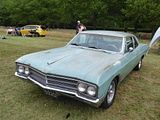
Beginning with the 1964 model year, the Skylark trim level had enough sales to merit its own separate line. Along with the lower-priced Special from which it was derived, the model would move to a new 115 in (2,921 mm) wheelbase intermediate-size chassis shared with the Oldsmobile F-85, Pontiac Tempest, and new Chevrolet Chevelle. Both Buicks had a length of 203.5 in (5,169 mm). The standard 215-cubic-inch displacement, aluminum-block V8 engine was discontinued (and the associated tooling eventually sold to the British manufacturer Rover, who produced it as the Rover V8 engine until 2006). In its place was a new 225-cubic-inch (3.7 L) all-cast-iron V6 with a Rochester 1-barrel carburettor that generated 155 hp at 4400 rpm. It is an enlarged version of the prior 198 cubic inches (3,240 cm3) V6 introduced for the 1962 model year. The basic V8 option was a 300-cubic-inch, with cast-iron block, aluminum heads, and a Rochester 2-barrel carburettor that generated 210 hp at 4600 rpm. A high performance version was offered with 11:1 compression and a 4-barrel carburettor, generating 250 hp (190 kW). The V6 and V8 were of similar design and shared the same bore and stroke. A long-throw Hurst shifter was available for the four-speed manual transmission. For the 1965 model, cast-iron blocks and heads were used for all engines. For the first time, a four-door sedan was offered in addition to the two-door convertible, two-door sedan, and hardtop coupe. Specials and Special Deluxes only came in pillared coupe versions. All Skylarks would have higher levels of exterior and interior trim than the Special and Special Deluxe from which they were derived. The sedan would come with cloth-and-vinyl seats standard, with an all-vinyl “Cordaveen” interior optional. All-vinyl bucket seats were standard on the convertible and optional on the hardtop coupe. The Skylark Coupe had a lower, more road-hugging profile than the other models. Buick’s traditional VentiPorts were integrated into the front half rub strip that ran the entire length of the vehicle, with later versions appearing vertically stacked as on the Buick Wildcat. Inspired by the sales success of the Pontiac GTO, a Gran Sport option became available in mid-1965, offered as a coupe, hardtop or convertible. The Gran Sport featured Buick’s 401-cubic-inch “Nailhead” V8 with a Carter 4-barrel carburettor that produced 325 hp at 4400 rpm, listed as 400 cubic inches in sales literature to elude a General Motors limit of 400 cubic inches in intermediate-sized cars. Unique Gran Sport badging, a heavy-duty radiator, and dual exhaust were also added. In the 1966 model year, the pillared four-door sedan was replaced by a four-door hardtop. The 1966 two-door Skylark was available with the optional 340-cubic-inch “Wildcat 375”, engine which produced 260 hp and 365 lb/ft (495 Nm) torque with a 4-barrel Carter carb. The four-door sedan would rejoin the lineup for the 1967 model year, making a total of five Skylark body styles. The 225 V6 was standard on the two-door sedan, the 300-cubic-inch V8 on all other models, but the four-door hardtop sedan, which came with a 340-cubic-inch V8 engine using a Rochester two-barrel carburettor and producing 220 hp at 4400 rpm. In 1967 Skylarks included the federally-mandated safety equipment as other U.S. market passenger cars, including a dual-circuit hydraulic brake system, energy-absorbing steering column and wheel, four-way hazard flashers, shoulder belt mounting points for outboard front passengers, softer interior surfaces, and recessed controls on the instrument panel. The Gran Sport became the Gran Sport 400 to reflect the new, marginally smaller but more modern big-block engine and to set it apart from the new Gran Sport 340, a lower cost model using the 340-cubic-inch V8, available only as a two-door hardtop coupe. The car was completely redesigned for 1968.
CADILLAC
The 1959 Cadillac is remembered for its huge sharp tailfins with dual bullet tail lights, two distinctive rooflines and roof pillar configurations, new jewel-like grille patterns and matching deck lid beauty panels. In 1959 the Series 62 had become the Series 6200. De Villes and 2-door Eldorados were moved from the Series 62 to their own series, the Series 6300 and Series 6400 respectively, though they all, including the 4-door Eldorado Brougham (which was moved from the Series 70 to Series 6900), shared the same 130 in wheelbase. New mechanical items were a “scientifically engineered” drainage system and new shock absorbers. All Eldorados were characterised by a three-deck, jewelled, rear grille insert, but other trim and equipment features varied. The Seville and Biarritz models had the Eldorado name spelled out behind the front wheel opening and featured broad, full-length body sill highlights that curved over the rear fender profile and back along the upper beltline region. Engine output was an even 345 hp from the 390 cu in (6.4 litre) engine. Standard equipment included power brakes, power steering, automatic transmission, back-up lamps, two-speed wipers, wheel discs, outside rearview mirror, vanity mirror, oil filter, power windows, six way power seats, heater, fog lamps, remote control deck lid, radio and antenna with rear speaker, power vent windows, air suspension, electric door locks and license frames. The Eldorado Brougham also came with air conditioning, automatic headlight dimmer, and a cruise control standard on the Seville and Biarritz trim lines. For 1960, the year that this Fleetwood Eldorado was made, the styling was toned down a little. General changes included a full-width grille, the elimination of pointed front bumper guards, increased restraint in the application of chrome trim, lower tailfins with oval shaped nacelles and front fender mounted directional indicator lamps. External variations on the Seville two-door hardtop and Biarritz convertible took the form of bright body sill highlights that extended across the lower edge of fender skirts and Eldorado lettering on the sides of the front fenders, just behind the headlamps. Standard equipment included power brakes, power steering, automatic transmission, dual back-up lamps, windshield wipers, two-speed wipers, wheel discs, outside rearview mirror, vanity mirror, oil filter, power windows, six-way power seats, heater, fog lamps, Eldorado engine, remote control trunk lock, radio with antenna and rear speaker, power vent windows, air suspension, electric door locks, license frames, and five whitewall tyres. Technical highlights were finned rear drums and an X-frame construction. Interiors were done in Chadwick cloth or optional Cambray cloth and leather combinations. The last Eldorado Seville was built in 1960. The idea of a large car finished in pink now is simply unthinkable, but the colour goes quite well with the style here. These 59 and 60 Cadillacs attract lots of interest from collectors and the public and this one was no exception.


The Cadillac Calais was produced from 1965 to 1976. The Division renamed its entry-level Series 62 as the “Calais” in 1965, after the French port city, derived from the Greek mythological figure Calais. The Calais was identical in styling and mechanics to the better-equipped, more expensive Cadillac de Ville. No convertible model was offered in the Calais line. The Calais name would be reused for future models of other GM divisions: the Oldsmobile Cutlass Calais, Holden Calais (VE) and Holden Calais (VF). In 1965, Calais tailfins were canted slightly downward, and sharp, distinct body lines were featured. The rear bumper was straight and the rear lamp clusters were vertical. The headlight pairs were vertical, permitting a wide grille. Side windows were curved and frameless. Perimeter frame construction allowed positioning of the engine forward in the frame, thus lowering the transmission hump and increasing interior room. Like the De Ville, the Calais was available as a 2- or 4-door hardtop as well as a “formal-roof” 4-door sedan, which was a hybrid with frameless, hardtop-like windows, but with a pillar between them. The primary differences between the Calais and the De Ville were trim levels and standard equipment. While the De Ville was delivered with such standard amenities as AM/FM radio, power windows, and 2-way power seats, the Calais had hand-cranked windows and manual seat adjusters as standard, with the radio and power windows being US$165 and US$119 options, respectively. Other standard equipment on the Calais included power brakes; power steering; automatic transmission; cornering lights; dual back-up lights; windshield washers and dual speed wipers; full wheel covers; remote controlled outside rear view mirror; visor vanity mirror; oil filter; five tubeless blackwall tyres; heater; defroster; lamps for glove and rear passenger compartments and front and rear seat belts. Unlike the De Ville, the Calais did not offer leather seating areas and vinyl roof trim was not offered initially. A high-grade cloth and vinyl, similar to what was seen on top-line GM C platform-based Buick Electras and Oldsmobile 98s, was standard. Another item not initially available on the Calais was the Cadillac-exclusive “firemist” paint, an extra-cost high gloss metallic paint. Cadillac, always General Motors’ technology leader, offered most De Ville options on the Calais, such as Twilight Sentinel and the GuideMatic headlight dimmer. In 1965, the new Turbo-Hydramatic automatic transmission, standard on the 1964 De Ville, but not the lower-priced Series 62, became standard throughout the Cadillac line, including the Calais. The 340 hp 429 cu in (7.0 L) V8 also remained the standard engine. Pricing of the Cadillac Calais started at just under US$5,000, almost US$1,000 (or about 25%) more than the Electra 225 and Oldsmobile 98, and about US$500) more than the top-line Buick Riviera. In 1966, changes included a somewhat coarser mesh for the radiator grille insert, which was became divided by a thick, bright metal horizontal center bar housing rectangular parking lamps at the outer ends. Separate rectangular side marker lamps replaced the integral grille extension designs. There was generally less chrome on all Cadillac models this year. Cadillac “firsts” this season included variable ratio steering and optional front seats with carbon cloth heating pads built into the cushions and seatbacks. Comfort and convenience innovations were headrests, reclining seats and an AM/FM stereo system. Automatic level control was available. Engineering improvements made to the perimeter frame increased ride and handling ease. Newly designed piston and oil rings and a new engine mounting system and patented quiet exhaust were used. Head rests became an option. The Calais was extensively restyled for 1967. Prominent styling features were given a powerful frontal appearance with “forward-leaning” front end, long sculptured body lines, and redefined rear fenders that had more than just a hint of tail fins in them. The full-width forward-thrust “eggcrate” grille was flanked by dual stacked headlights for the third consecutive year. The squarer cornered grille insert had blades that seemed to emphasize its vertical members and it appeared both above the bumper and through a horizontal slot cut into it. Rectangular parking lamps were built into the outer edges of the grille. Rear end styling revisions were highlighted by metal divided taillamps and a painted lower bumper section. For 1967, power windows became standard on the Calais line, although power seats were still optional even in the 1970s models. Coupes got a new roofline, inspired by the Florentine show car created for the 1964 New York World’s Fair, that gave rear seat passengers added privacy. As on that show car, the quarter window glass retracted rearward into a sail panel. New standard Calais features included non-glare rear-view mirror, electric clock, Automatic Climate Controls, padded dashboard, Hazard Warning system, outboard seatbelt retractors and rear cigarette lighters in all styles. A slide-out fuse box and safety front seat back lock for two-door models were additional Cadillac advances for the 1967 model year. Technical improvements included a revised engine valve train, different carburetor, Mylar printed circuit instrument panel, re-tuned body mounts, and a new engine fan with clutch for quieter operation. An energy absorbing steering column became optional. 1967 was the last model year for pillared sedans. For 1968, grilles had an insert with finer mesh and step down outer section which held the rectangular parking lights slightly higher than before. Front and rear side marker lights were mandatory, beginning this year. Rear end styling was modestly altered with the deck lid having more of a rake. The hood was re-designed to accommodate recessed windshield wiper-washers, which became three speed as standard. Of 20 exterior paint colour combinations, 14 were totally new. On the inside, enriched appointments included molded inner door panels with illuminated reflectors and a selection of 147 upholstery combinations, 76 in cloth, 67 in leather and four in vinyl. New standard features included a Light Group, a Mirror Group, a trip odometer and an ignition key warning buzzer. Like all other Cadillacs, the Calais received the 472 cu in (7.7 L) OHV V8 in 1968. 1968 was also the last year for the “stacked” dual headlights, which were replaced with horizontal dual headlights in 1969. 1968 was also the last year for vent windows. Shoulder belts became standard for both driver and right front passenger seating positions on all Cadillacs (except convertibles) built effective January 1, 1968. In 1969, the Calais was restyled. A new front fender treatment similar to the Eldorado helped to emphasize a stronger horizontal design line. Rear quarters were extended to give the car a longer look. Dual horizontal headlamps were positioned in the outboard step down areas of the all-new grille. The roofline was squarer and the rear deck and bumper more sculptured. A new ventilation system eliminated the need for vent windows, which provided a longer sleeker look and improved visibility. New standard features included front centre seat armrests. Front seat headrests were mandatory and the ignition switch was moved from the instrument panel to the steering column, which locked both the steering wheel and transmission selector lever when the key was removed. In 1970, a facelift included a new grille with 13 vertical blades set against a delicately cross-hatched rectangular opening. The bright metal headlamp surrounds were bordered with body colour to give a more refined look. Narrow vertical taillamps were seen again and had smaller bottom lenses extending downward in the bumper. Standard wheel covers and winged crest fender tip emblems were new. Exterior distinctions came from a Calais signature script above the rear end of the horizontal belt molding just ahead of the taillight dividers and from the use of small square back-up light lenses set into the lower bumper as opposed to the long rectangular lenses used on the De Ville. The Cadillac crest on the hood and decklid was slightly larger and the traditional ‘V’ emblem beneath the crest was removed from both the Calais and De Ville this year, not to return until 1972.

The ninth generation Eldorado, introduced for 1971, was substantially redesigned, growing two inches in length, six in wheelbase and featuring standard fender skirts, all of which gave the car a much heavier appearance than the previous generation. The 500 cu in (8.2 L) V8 engine remained an Eldorado exclusive. This 126.3 in (3,208 mm) wheelbase Eldorado would run through 1978, with major facelifts for 1973, 1974, and 1975. A record 27,368 Eldorados were sold during the 1971 model year. An Eldorado convertible was also offered for 1971, the first in the line since 1966. Door glass remained frameless, and the hardtop rear quarter windows were deleted, replaced by a fixed “opera window” in the widened “C” pillar. A stand-up wreath and crest hood ornament was new this year. Inside, there was a redesigned instrument panel and new seat configurations. A fiber-optic “lamp monitor” system, which displayed the functionality of the headlamps, taillamps, parking lamps, turn signals and brakelights was mounted on each front fender and the shelf below the rear window. Changes were minimal for 1972, the most noticeable exterior change was a new ‘Eldorado’ script, replacing the block ‘Eldorado’ lettering on the front fenders and trunk lid. Sales for 1972 increased to 40,074. In 1973, the Eldorado was removed from the Fleetwood series and reestablished as its own series. The 1973 models received a major facelift, featuring a massive eggcrate grille, new front and rear bumpers, decklid, rear fenders and taillamps. Interiors featured new “soft pillow” door panels, with larger, sturdier pull-straps. The rear “lamp monitor” display which showed the driver the function of the turn signal, brake and taillamps, was relocated (except on the convertible) from the rear shelf, to the headliner just above the rear window. The Cadillac Eldorado was chosen as the official pace car for the Indianapolis 500 in 1973. Cadillac produced 566 of these special pace car convertibles. Thirty-three were used at the track during the race week, with the remainder distributed to U.S. Cadillac dealers, with one per dealership. Sales of the Eldorado coupe and convertible soared to 51,451, the highest total for the model during the 1970s and over a sixth of all Cadillac sales for 1973. The lengthened wheelbase reduced performance relative to contemporary premium personal luxury cars, but offered comfortable seating for six adults rather than just four. For 1974, the Eldorado featured a redesigned rear bumper with vertical chrome fender extensions, housing rear reflector/sidemarker lamps. This new bumper was designed to meet the new 5 mile impact federal design regulation. Other styling changes included new horizontal taillamps and backup lights placed beneath the trunk lid, a new fine mesh grille with Cadillac script on the header and new standard wheel covers. Inside, there was a redesigned two-tier, curved instrument panel, marketed in sales literature as “space age” and shared with all 1974 Cadillacs. A new quartz-controlled digital clock, an “information band” of warning lights, and the fuel gauge ran horizontally along the upper tier of this new instrument panel. Electronic fuel injection was a new option for 1975. The Eldorado received another facelift, with new rectangular headlamps, egg-crate grille, front bumper, full rear wheel openings sans fender skirts and sharper, angular lines resulting in a sleeker appearance, more reminiscent of the 1967–70 models. Along with the regular sunroof, a tinted Astroroof with sliding sunshade was another newly available option for 1975. After years of diminishing sales, Cadillac announced that 1976 would be the final year for the Eldorado convertible, which was heavily promoted by General Motors as “the last American convertible”. Some 14,000 would be sold, with many customers purchasing multiple cars as investments. The final 200 convertibles were designated as “Bicentennial Edition” commemorating America’s 200th birthday. All 200 of these cars were identical, painted white with a dual red/blue pinstripe along the upper bodyside and inside, a commemorative plaque was mounted on the dashboard. When Cadillac reintroduced the Eldorado convertible for the 1984 model year, several customers who had purchased 1976 Eldorado convertibles as investments, felt they had been deceived and launched an unsuccessful class action lawsuit against General Motors. Having received a major facelift the previous year, the 1976 Eldorado received only minor styling changes, including a new grille, a small Cadillac script on the hood face, revised taillamp lenses and new black painted wheel covers. For 1977, the Eldorado again received a new grille with a finer crosshatch pattern. New vertical taillamps were relocated from below the trunk lid to the chrome bumper-fender extensions. New “Eldorado” block lettering appeared on the hood face, and new rectangular side marker lights with similar block lettering replaced the “Eldorado” script on the rear fenders. Inside, there was a new, two-spoke steering wheel with rectangular horn pad. The convertible was dropped (although Custom Coach of Lima, Ohio converted a few 1977 and 1978 Eldorados into convertibles using salvaged parts from earlier models). The mammoth 500 cu in. (8.2L) V8 of 1970–76 was replaced by a new 425 cu in. (7L) V8 with 180 bhp available in all 1977 Cadillacs, except the Seville. A new grille was the only obvious change for 1978; the Eldorado would be completely redesigned and downsized for 1979.

CHEVROLET
This is a 1956 Bel Air. The story of these cars starts in 1955, when Chevrolet replaced the entire range of cars, producing what are sometimes referred to as the “Tri-Five” range, which would live for three years. Revolutionary in their day, they spawned a cult following that exists in clubs, website and even entire businesses that exclusively cater to the enthusiasts of the Tri Five automobiles. All featured a front-engine, rear-wheel-drive layout. 1955-1957 were watershed years for Chevrolet, who spent a million dollars in 1956 alone for retooling, in order to make their less expensive Bel Air models look more like a Cadillac, culminating in 1957 with their most extravagant tailfins and Cadillac inspired bumper guards. In 1955, Americans purchased 7.1 million new automobiles, including 1.7 million Chevrolets, giving the company fully 44% of the low-price market and surpassing Ford in total unit sales by 250,000. The Bel Air was an instant hit with consumers, with Base One-Fifty models starting under $1600 and featuring a six cylinder engine. The introduction of the new optional 170 hp 265ci V8, coupled with the Powerglide automatic transmission quickly earned the model the nickname “The Hot One”. In the first year of production, the oil filter was considered an option, although not having it led to significantly shorter engine life. With three basic model lines of 150, 210 and Bel Air and a range of body styles from 2 and 4 door Sedans to Coupes, Convertibles and Wagons, there were as many as 19 different Tri-five models available. The 1956 cars saw minor changes to the grille, trim and other accessories. It meant huge gains in sales for Chevrolet, who sold 104,849 Bel Air models, due in part to the new V8 engine introduced a year before. By this time, their 265cid V8 had gained popularity with hot rodders who found the engine easy to modify for horsepower gains. This wasn’t lost on Chevrolet’s engineers, who managed to up the horsepower in 1956 from 170 hp to 225 hp with optional add-ons. The average two door Bel Air in 1956 sold for $2100, which was considered a good value at the time. Prices ranging from $1665 for the 150 sedan with six cylinder engine to $2443 for the V8 equipped convertible, with Nomad models running slightly higher. Bigger changes came for 1957, including the large tailfins, “twin rocket” bonnet design, even more chrome, tri-colour paint and a choice from no less than seven different V8 engines. While in 1957, Ford outsold Chevrolet for the first time in a great while, years later the used 1957 Chevrolets would sell for hundreds more than their Ford counterparts. As the horsepower race continued, Chevrolet introduced a new version of their small block, with 283 cubic inches of displacement and 245 hp. They also introduced a limited number of Rochester fuel injected 283 engines that produced 283 hp, the first production engine to achieve 1 hp per cubic inch. For all intent and purposes, this made the 1957 Bel Air a “hot rod”, right off the production line. It was available with manual transmission only. The base 265cid engine saw an increase from 170 to 185 hp as well. While not as popular as the previous year’s offering, Chevrolet still managed to sell 1.5 million cars in 1957.

This is a Nova. The 1968 Chevy II models were fully-redesigned with an extensive restyle on a longer 111-inch wheelbase that gave Chevrolet’s compacts a chassis that was just one inch shorter than that of the midsize Chevelle coupe. The station wagon and hardtop sport coupe were discontinued, the former in line with an industry trend which left AMC the only American maker of compact station wagons until Chrysler rejoined the market in 1976 (the 1966–70 Ford Falcon wagon was actually midsize, using a bodyshell identical to the Fairlane wagon’s). One notable change was the front subframe assembly — as compared with Ford, Chrysler and AMC, in whose cars the entire front suspension was integrated with the bodyshell, a separate subframe housing the powertrain and front suspension (similar to the front part of the frame of GM’s full-size, full-framed vehicles) replaced the earlier style. Although the front subframe design was unique for the Nova, the Camaro introduced a year earlier was the first to incorporate such a design; the redesigned Nova was pushed a year ahead to 1968 instead of 1969. The sales brochure claimed 15 powertrain choices for coupes and a dozen for sedans. Options included power brakes and steering, Four-Season or Comfort-Car air conditioning, rear shoulder belts, and head restraints. There were a few Chevrolet Novas built with the 194 ci (3.1 L), the same motor that had been used in the previous generations of the Chevy II. Sales of the 1968 Chevy II Nova fell by half. In 1969 Chevrolet dropped the Chevy II portion of its compact car’s name; it was now known simply as the Chevrolet Nova. The 153 cu in (2.51 L) four-cylinder engine was offered between 1968 and 1970, then was dropped due to lack of interest (besides its other usage in the Jeep DJ-5A a.k.a. the Postal Jeep or a marine/industrial engine) and to clear the field for the Vega. Far more popular were the 250 cu in (4.1 L) six-cylinder and the base 307 cu in (5.03 L) V8, which replaced the 283 cu in (4.64 L) V8 offered in previous years. Several units were produced with the 327 cu in (5.36 L), 275 hp, engine, four-barrel quadrajet carb and four-speed Saginaw transmission with a heavy-duty 12-bolt positraction rear as a “towing option’ package. At mid-year, a semi-automatic transmission based on the Powerglide called the Torque-Drive (RPO MB1) was introduced as a low-cost option (~$100 less than the Powerglide) for clutchless motoring. The Torque-Drive transmission was only offered with the four and six-cylinder engines. The two-speed Powerglide was still the only fully-automatic transmission available with most engines, as the more desirable three-speed Turbo-Hydramatic was only available with the largest V8 engines. The Nova Super Sport was transformed from a trim option to a performance package for 1968. One of the smallest muscle cars ever fielded by Detroit, the Nova SS now included a 295 hp 350 cu in (5.7 L) V8 engine along with a heavy-duty suspension and other performance hardware, priced at US$312. Optional V8 engines included two versions of the big-block 396 cu in (6.5 L) rated at 350 bhp and 375 bhp at 5600 rpm and 415 lb/ft (563 Nm) at 3600 rpm of torque, which went for US$348. Both engines were offered with a choice of transmissions including the M-21 close-ratio four-speed manual, the heavy-duty M-22 “Rock Crusher” four-speed manual, or the three-speed Turbo-Hydramatic 400 automatic transmission. A total of 5,571 SS coupés were produced for 1968. Novas sported the SS badge until 1976. Front disc brakes were optional on the 1968 Nova SS. The Nova continued to evolve with significant changes on an annual basis thereafter.


The Chevrolet Astro is a minivan that was manufactured and marketed by the Chevrolet division of General Motors from 1985 to 2005. Sold alongside the GMC Safari, the Astro was marketed in multiple configurations, including passenger van and cargo van. The Astro and Safari used a rear-wheel-drive chassis; all-wheel drive became an option in 1990. For its entire production, the Astro and Safari were produced by Baltimore Assembly in Baltimore, Maryland; the vans would be the final model line produced by the facility. In total, approximately 3.2 million Astros and Safaris were produced from 1985 through 2005. The Astro and Safari were introduced for the 1985 model year as the first minivan from General Motors. While marketed as a response to the first-generation Chrysler minivans, GM selected a rear-wheel drive layout, sizing the Astro and Safari closely to the short-wheelbase Chevrolet G10 van. Similar to the Ford Aerostar, to reduce production costs, GM adapted light-truck powertrain components; engines and transmissions were sourced from the Chevrolet S-10, allowing for a towing capacity of up to 5,500 lb (2,500 kg). Prior to its use on a minivan, the Astro nameplate was used twice by General Motors; in 1967 (for the Chevrolet Astro 1 concept car) and from 1969 until 1987 (on the GMC Astro COE semitractor). GMC sourced the Safari nameplate from Pontiac (used by the latter to denote station wagons). As GMC was half of the Pontiac/GMC Division (later including Buick), from 1985 through 1989, both GMC and Pontiac Safaris were simultaneously offered through the same dealership network. Initial advertising boasted that it was a vehicle that will “make you realize that life is too big for a minivan,” referring to the Chrysler minivans. The van can have a seating configuration between two and eight passengers. Engine choices ranged from a 98 hp 2.5L four-cylinder to a 200 hp 4.3L V6, depending on options and model year. The 4-cylinder engine was only offered in short-length, rear-wheel-drive cargo vans, as well as passenger vans for 1985 only; it was dropped after 1990. For 1985, the 4.3L V6 (RPO LB1) used a 4-barrel carburetor. For 1986, throttle body fuel injection (TBI) was used. For 1992 and later years, a central port injection was used. Much like the second-generation F-body 1970–1981 and X-body vehicles, the Astro/Safari (internally designated as the M-body for RWD models or L-body for AWD models)[4] had a bolt-on subframe. For the M-van, the front suspension shared most components with the GM B-body station wagon (Chevrolet Caprice, Oldsmobile Custom Cruiser and larger variants of the Pontiac Safari and Buick Estate Wagon) with a leaf-spring rear suspension. The lower ball joints were larger than their B-body counterparts (similar to the 1977–96 Cadillac D platform vehicles; e.g., Fleetwood limousines). These ball joints were later used in the final Chevrolet Caprice 9C1 (police package) cars manufactured in 1995 and 1996. They also shared many mechanical similarities to the GMT 325/330 mid-size S/T pickups and utility vehicles. Digital dashboards were offered in the first-generation Astro; this option did not continue after 1995. 1989 was the final year that the BorgWarner T-5 manual transmission was made available. All subsequent models were equipped with 700R4/4L60 automatic transmissions through 1993. In 1990, a new all-wheel drive (AWD) system (the first U.S.-built minivan to do so), designed and developed by FF Developments (FFD), was made optional. The AWD models had a lower fuel economy: 17 miles per gallon on the highway versus 20 to 21 miles per gallon for rear-wheel-drive vans. AWD Astros used a BorgWarner 4472 transfer case. The 1990 model year also introduced a new analog dashboard and the Hydroboost braking system, a system using the same accessory belt-driven pump to supply the power steering and brakes. In mid-1990, an extended body option, sharing its wheelbase with the shorter version, also became available. In 1992, a new optional door form was introduced, colloquially known as Dutch doors. This form was two bi-parting doors with a flip-up window above. Previously, Astro and Safari vans were equipped only with bi-parting doors. An optional 4.3L V6 (RPO L35) engine with central port injection and a balance shaft was phased in. In 1993, the electronically controlled 4L60E 4-speed automatic transmission with overdrive became standard as the sole transmission offering. As with many other 1993 model year GM vehicles, Scotchgard fabric protection also became a standard feature on Astro vans equipped with cloth seats. 1994 saw the addition of three new exterior paint colours. These colours were Indigo Blue Metallic (#39), Light Quasar Blue Metallic (#20), and Medium Quasar Blue Metallic (#80). The Astro and Safari also received centre high mount stop lamps for 1994, which had been mandated on light trucks for the model year. A second generation model arrived for 1995.

CITROEN
Despite the fact that 2,315,739 BXs were built during its 12-year production run, and the car sold well, these are getting increasingly scarce, even in France. The rather angular hatchback was designed by Marcello Gandini of Bertone, based on his unused design for the British 1977 Reliant FW11 concept and his 1979 Volvo Tundra concept car. It was the second car to benefit from the merger of Peugeot and Citroën in 1976, the first being the Citroën Visa launched in 1978. The BX shared its platform with the more conventional 405 that appeared in 1987, except the rear suspension which is from a Peugeot 305 Break. Among the features that set the car apart from the competition was the traditional Citroën hydropneumatic self-levelling suspension, extensive use of plastic body panels (bonnet, tailgate, bumpers), and front and rear disc brakes. The BX dispensed with the air cooled, flat four engine which powered the GS, and replaced it with the new PSA group XY, TU and XU series of petrol engines in 1360 cc, 1580 cc and, from 1984, 1905 cc displacements. In some countries, a weaker, 80 PS version of the 1580cc engine was badged as the BX15E instead of BX16. A 1124 cc engine, in the 11TE, very unusual in a car of this size, was also available in countries where car tax was a direct function of engine capacity, such as Ireland, Italy, Portugal and Greece. The 11TE model was seen by foreign motoring press as slow and uncomfortable. It was fitted to the cars made from 1988 to 1993 and produced 55 hp. The 1.1 and 1.4 models used the PSA X engine (known widely as the “Douvrin” or “Suitcase Engine”), the product of an earlier Peugeot/Renault joint venture, and already fitted in the Peugeot 104 and Renault 14. The 1.6 version was the first car to use the all-new short-stroke XU-series engine. It was produced in a new engine plant at Trémery built specifically for this purpose, and was later introduced in a larger 1.9-litre version and saw long service in a variety of Peugeots and Citroëns. The XUD diesel engine version was launched in November 1983. The diesel and turbo diesel models were to become the most successful variants, they were especially popular as estates and became the best selling diesel car in Britain in the late 1980s. Despite being launched on the continent in the autumn of 1982, it wasn’t launched onto the British market until August 1983, initially only with 1.4 and 1.6 petrol engines, although further engine options and the estate model would arrive later, and it would go onto become one of the most popular foreign-built cars here during the second half of the 1980s. A year after the launch of the hatchback model, an estate version was made available. In 1984 power steering became optional, welcome particularly in the diesel models. In the late 1980s, a four-wheel drive system and turbodiesel engines were introduced. In 1986 the MK2 BX was launched. The interior and dashboard was redesigned to be more conventional-looking than the original, which used Citroën’s idiosyncratic “satellite” switchgear, and “bathroom scale” speedometer. These were replaced with more conventional stalks for light and wipers and analogue instruments. The earlier GT (and Sport) models already had a “normal” speedometer and tachometer. The exterior was also slightly updated, with new more rounded bumpers, flared wheelarches to accept wider tyres, new and improved mirrors and the front indicators replaced with larger clear ones which fitted flush with the headlights. The elderly Douvrin engine was replaced by the newer TU-series engine on the 1.4 litre models, although it continued to be installed in the tiny BX11 until 1992. 1988 saw the launch of the BX Turbo Diesel, which was praised by the motoring press. The BX diesel was already a strong seller, but the Turbo model brought new levels of refinement and performance to the diesel market, which brought an end to the common notion that diesel cars were slow and noisy. Diesel Car magazine said of the BX “We can think of no other car currently on sale in the UK that comes anywhere near approaching the BX Turbo’s combination of performance, accommodation and economy”. In 1989, the BX range had further minor revisions and specification improvements made to it, including smoked rear lamp units, new wheeltrims and interior fabrics. Winning many Towcar of the Year awards, the BX was renowned as a tow car (as was its larger sister, the CX), especially the diesel models, due to their power and economy combined with the self levelling suspension. The biggest problem of the BX was its variable build quality, compared to its competition. In 1983, one quarter of the production needed “touchups” before they could be shipped, though later models were more solid. The last BX was sold around 1994, by which time its successors had already been launched. It had been partially replaced by the smaller ZX in early 1991, but its key replacement was the slightly larger Xantia that went on sale at the beginning of 1993.


Once a common sight, the Citroen ZX, seen here in 5 door Hatch guise, is quite a rarity. The Citroën GS had been a ground breaking and radical new model in the small family car market on its launch in 1970, scooping the European Car of the Year award, and was facelifted in 1979 and gained a hatchback which saw it transformed into the GSA. However, such was the success of the larger BX after its 1982 launch, that PSA decided to delay the launch of an immediate replacement for the GSA when it was finally discontinued in 1986. Development work began on a new C segment hatchback, which was originally expected to be launched as the Citroën FX at the beginning of the 1990s. Although the Rally Raid version of the ZX debuted during 1990, the ZX was officially launched on the left hand drive continental markets on 16 March 1991, with British sales beginning in May that year, initially only with petrol engines. The diesel ZX went on sale later in 1991. The sales target was about 230,000 vehicles/year (with half of that outside of France). It went on sale in New Zealand in the beginning of 1993, as a five door in 1.6 Aura or Turbodiesel trim, with the naturally aspirated diesel and Volcane GTi (1.9) models joining a few weeks later. New Zealand’s unleaded petrol was of a low octane rating, meaning that initially only uncatalyzed cars were on offer. In January 1994, the estate of the ZX debuted, and went on sale in May, shortly followed by a mid cycle facelift. The first examples of the ZX had been produced in 1990, with the three door Rally Raid model being the winner of the Paris-Dakar, which started just after Christmas. The first prototypes of the ZX had actually debuted at the Baja Aragon on 20 July 1990. Drag resistance ranged from Cds 0.30 to 0.33. The launch of the ZX marked the return of Citroën into the C sector of the car market; it had discontinued the GSA in 1986 with no immediate replacement, largely due to the success of the larger BX. However, Citroën had decided to phase out the BX between 1990 and 1993, by at first launching a smaller model, and then adding a larger model (the Xantia) to its range. The ZX’s interior space and value received praise from critics and consumers. Of particular note was the rear seat arrangement; it was mounted on a sliding platform that allowed the seat to be moved rearwards to increase rear legroom, or forwards to increase cargo space. Unfortunately, only the seat backs folded down on models so fitted. Lower specification models with fully folding and removable seats had more ultimate capacity. The ZX specification was good for its class, with most models getting power steering, electric windows, electric sunroof, a driver’s side (and sometimes passenger’s side) airbag and anti-lock braking system as either optional or standard equipment. It was competitively priced though, unlike the Mark III Volkswagen Golf, which was priced at a relative premium from its launch later in August 1991. It also reached the market a few months before the new version of the Opel/Vauxhall Astra. The familiar range of PSA powertrains drove the front wheels of a seemingly conventionally designed chassis. At the front was a standard MacPherson strut layout with anti-roll bar, while the rear used the PSA Peugeot-Citroën fully independent trailing arm/torsion bar set up that was first introduced on the estate of the Peugeot 305. However, PSA’s chassis engineers employed some unusual features, including passive rear wheel steering (by means of specially designed compliance bushes in the rear suspension), and in house developed and constructed shock absorbers. At high mileages, this is prone to wear off the axle mounting bushes, which is easily fixed. It is also prone to wear in the rear axle trailing arm bearings, which then wear the trailing arm axle tubes, requiring an expensive rebuild or a replacement axle assembly. The diesel and larger capacity petrol engines are canted as far back as possible in the engine bay, in an effort to put as much weight as possible behind the front axle line, also reducing the centre of gravity, while improving weight distribution and minimising understeer. At the time of its launch, the ZX range consisted of a collection of four very individual trim levels; the base model was the “Reflex” aimed at young people, next was the “Avantage” aimed at families, and then there was the luxury “Aura” series. The final series was the relatively sporting “Volcane” series, with lowered (and hard) suspension. The “Volcane” TD was one of the first diesel hot hatches. Over time, further models were introduced including the “Furio”, a cheaper sports model, a 16 valve engined high performance derivative and many special editions.

The Citroën Saxo was a supermini produced by the French manufacturer Citroën from 1996 to 2004. It was sold in Japan as the Citroën Chanson, because Honda had registered the “Saxo” name. As a badge engineered variant of the Peugeot 106 (which itself was a development of the Citroën AX), the major difference being interiors and body panels. Production ended in 2004, when it was replaced with the Citroën C2 and Citroën C3. All engines were from the PSA TU engine series that powered the Peugeot 205 from 1988 and the Citroën AX, and had their roots before that with the OHC PSA X engine various other PSA cars used, such as the Citroën Visa, Peugeot 104 and early Peugeot 205. The range included five petrol engines and one diesel engine, all naturally aspirated. Although the quoted power outputs are low in comparison to modern small hatchbacks, or even to other hatchbacks of the time, the kerb weight was generally very low, with even the range-topping VTS having a kerb weight of just 935 kg (2,061 lb), with other smaller engine models (except the diesel) being around 100 kg lighter than this. This meant a high power to weight ratio resulting in decent acceleration and made the car suitable for city driving. Aside from the VTS which had 16 valves, all engines were the older SOHC units which meant relatively low city MPG figures. Even the popular 1.1i engine would struggle to achieve more than 35 to 40mpg in town when driven carefully. The real world consumption between the smaller engines and the nippy 1.4i Westcoast/Furio variant was hardly noticeable, however the insurance premiums were. The early 1.0i was quite under powered, with the 1.1i being considered much better, since it was nearly 200cc larger and had roughly 30% more torque. There were three sport models of the Saxo: the Westcoast, later replaced by the Furio which featured a 1.4I 8V 75PS engine with a top speed of 175 km/h (109 mph), and a 0-62.5 mph (0–100 km/h) time of 11.2 seconds; the VTR MK1 (1997–1999) featured a 1.6I 8V 90PS engine with a top speed of 187 km/h (116 mph) and a 0-62.5 mph (0–100 km/h) time of 10.0 seconds. The VTR MK2 (1999–2003) featured a 1.6I 8V 98PS engine with a top speed of 193 km/h (120 mph) and a 0-62.5 mph (0–100 km/h) time of 9.4 seconds; the VTS 16V featured a 1.6I 120PS engine with a top speed of 205 km/h (127 mph), and a 0 to 60 mph time of 7.8 seconds. The VTS MK1 (1997–1999) and MK2 (1999–2003) shared similar performance, although the MK2 was slightly slower due to it being marginally heavier. These models included 247 mm (9.7 in) vented front brake discs, with the VTR and VTS also having rear brake discs (solid 247 mm (9.7 in) discs). Also, a different style of control arms and struts was used for the suspension. The VTS had a 22 mm (0.9 in) master brake cylinder, and the VTR and Westcoast/Furio had a 19 mm (0.7 in). The VTS had a 19 mm (0.7 in) front anti roll bar and 22 mm (0.9 in) rear anti roll bar, while the VTR and Westcoast/Furio had a 19 mm (0.7 in) front and 21 mm (0.8 in) or sometimes 19 mm (0.7 in) rear antiroll bar. In addition, all the sports models featured a unique bodykit to the other models, commonly known as the “VT” bodykit. In 1997 the Saxo’s three speed automatic gearbox was combined with the 1.6i 8V 90PS engine which was available on the Saxo SX and VSX. Then, in the end of 1997, the 1.6i automatic was replaced with a 1.4i 75PS engine. The 1.6i was more powerful with a top speed of 176 km/h (109MPH) compared with the 1.4’s top speed of 103 mph (166 km/h). Citroën carried on using the 1.4i engine on the facelift Saxo Automatic in 1999. Due to the C3 having a 1.4i automatic gearbox, the Saxo Automatic came to an end in March 2002, whilst the manual models were still sold right up to the end of 2003. The equipment list was generally sparse, with budget models having drivers airbag, seat belt pre tensioners, cassette player, heated rear screen and tinted windows, and early Mark Ones with keypad immobilisers and a clock in place of a tachometer and three stud wheels, much like the AX. Further up the list sunroofs, PAS, Electric windows, ultrasonic alarm, passenger airbag, CD player, tachometer, front fog lights, bodykits, colour coded mirror caps and alloy wheels were added, to name a few. Although MK2 Saxos were generally better equipped than their older counterparts, the interiors were still dated in comparison to other small hatchbacks of the time, such as the Vauxhall Corsa, with many of the centre console controls originating from the older model of the Citroën AX. The 1.6L VTR and VTS Saxos were the best equipped, with both gaining rear disc brakes as opposed to drum brakes, and ABS as standard for the VTS and an optional extra on all other 1.6-litre models. Few special models were released throughout the Saxo’s life, most notably the “Open Scandal”, a Saxo with a full length sliding canvas roof. Other special editions added certain extras to the lower end model, such as sunroofs or PAS. Notable models are the Westcoast up to 1999 and the Furio to 2003, as they incorporated the standard Saxo bodykit found on the VTR and VTS with a more insurance friendly 1.4-litre engine. The Westcoast is not to be confused with the Eastcoast, which was only available in the 1.0L and later 1.1L engines. The Eastcoast also did not incorporate the “VT” bodykit. Air conditioning was never an option on right hand drive Saxos because the blower motor was mounted in the bulk head on the driver’s side. As a result, there was insufficient space available to accommodate the evaporator, except by first ducting the air flow to the passenger’s side and then at the expense of the glove box. Although an after market kit was available that did exactly this, the resultant pressure loss made the system noisy and ineffective. The blower motor could also not be easily relocated, since the windscreen wiper motor was mounted in the passenger’s side space. In September 1999, the Saxo received a style makeover, commonly branded as a Mark II, with the major differences being more modern styled headlights, bonnets and grilles to replace the square style on the MK1 and multipoint injection replacing the single point on the 1.1-liter engines. In September 2000, it was a Euro NCAP sufferer of poor results, along with its twin, the 106. Power steering became standard on all but the very basic models. More subtle changes were alterations to the rear lights (the indicator sections are more “white”) and the engine control unit moved from a single plug to three plugs. The old three-stud wheel layout, as used on the Citroën AX, was also dropped. There was also a minor facelift, during the first phase of the car’s production, in line with the then current releases by Citroën, moving towards a rounder look. While the exterior was markedly altered, little changed inside the vehicle. The dashboard and glovebox arrangement remained the same with the possibility of installing a passenger-side airbag in some high range models. By 2003, some buyers were more attracted to the spacious, and practical five-door C3. However, the 1.6 VTR and VTS models remained popular. The Saxo finally finished production in September 2003, when the three-door C2 was launched. Its twin, the Peugeot 106, also ceased production at this time. By the end of the Saxo’s production life, its design was seven years old.


DAIMLER
Launched late in 1962, the Daimler V8 Saloon was essentially a rebadged Jaguar Mark 2 fitted with Daimler’s 2.5-litre 142 bhp V8 engine and drive-train, a Daimler fluted grille and rear number plate surround, distinctive wheel trims, badges, and interior details including a split-bench front seat from the Jaguar Mark 1 and a black enamel steering wheel. Special interior and exterior colours were specified. Most cars were fitted with power-assisted steering but it was optional. Automatic transmission was standard; manual, with or without overdrive, became an option in 1967. The 2.5 V8 was the first Jaguar designed car to have the Daimler badge. A casual observer, though not its driver, might mistake it for a Jaguar Mark 2. The Daimler’s stance on the road was noticeably different from a Mark 2. In April 1964 the Borg-Warner Type 35 automatic transmission was replaced by a D1/D2 type, also by Borg-Warner. A manual transmission, with or without an overdrive unit usable with the top gear, became available on British 2.5 V8 saloon in February 1967 and on export versions the following month. Cars optioned with the overdrive had the original 4.55:1 final drive ratio. In October 1967, there was a minor face-lift and re-labelling of the car to V8-250. It differed only in relatively small details: “slimline” bumpers and over-riders (shared with the Jaguar 240/340 relabelled at the same time), negative-earth electrical system, an alternator instead of a dynamo and twin air cleaners, one for each carburettor. Other new features included padding over the instrument panel, padded door cappings and ventilated leather upholstery, reclinable split-bench front seats and a heated rear window. Power steering and overdrive were optional extras. Jaguar replaced its range of saloons—the 240, the 340, the 420, and the 420G—with the XJ6 at the end of 1968. The company launched the XJ6-based Daimler Sovereign the following year to replace the Daimler saloons—the 240-based V8-250 and the 420-based Sovereign. Henceforth all new Daimlers would be re-badged Jaguars with no engineering links to the pre-1960 Daimlers.

The Daimler DS420, also known as the Daimler Limousine, is a limousine made by the Daimler Company between 1968 and 1992. The car was designed for official use and it was popular with chauffeur services, hoteliers and undertakers. It was used as an official state car in many countries. No other limousine model has been delivered to more reigning monarchs than the DS420, and the car is still used by the royal houses of the United Kingdom, Sweden, Denmark, and Luxembourg. The Daimler Company was purchased by Jaguar Cars in 1960, which itself was bought by the British Motor Corporation (BMC) in 1966 and became part of the larger British Leyland conglomerate in 1968. BMC and Jaguar each had their own limousines before merging operations: the Vanden Plas Princess and the Daimler DR450, respectively. Rather than build two competing products, they decided to consolidate limousine production to a single model under the Daimler marque. Most of the engineering of the DS420 would be carried out by Jaguar, the new model to share parts such as the engine, gearbox, and suspension with the Jaguar 420G. Production of the DS420 was announced in June 1968, with the cars being built at the Vanden Plas works in Kingsbury. The short designation DS420 was in accordance with earlier Daimler designations where the first letter stood for Daimler, the second letter was part of an alphabetical sequence (i.e. the predecessor was “DR”, thus the successor was “DS”), and “420” referred to the 4.2-litre displacement of the XK engine. The DS420 was built on the floorpan of Jaguar’s 420G flagship model with the Jaguar wheelbase extended 21 in (533 mm). The front styling was like the contemporary Daimler Sovereign with the traditional Daimler fluted grille and the headlights of the Jaguar 420G. The new limousine also shared the 420G’s twin ten-US-gallon (38 L) fuel tanks set in each of the rear wings, each with its own electric SU pump selected by a dashboard-mounted switch. The driver sat on a fixed full-width bench seat in a relatively upright position with no more allowance for the driver’s size or shape than 2.75 inches (7 cm) of telescopic adjustment to the column of the low-set steering wheel.[4] The passengers were seated behind a bulkhead with a sliding window that separated them from the driver’s compartment. Three of the six passengers sat facing forward on a bench seat over 6 feet (1.8 m) in width, while the other three sat on occasional folding seats. In comparison to a Rolls-Royce Phantom VI, the DS420’s wheelbase was 4 inches (10 cm) shorter, its body 12 inches (30 cm) shorter, it was approximately 350 kilograms (770 lb) lighter, and its engine had only about two-thirds the displacement of the Rolls-Royce V8. As such, the Daimler was less expensive than a Rolls-Royce, less than half the price of the long-wheelbase Silver Wraith II. Originally, the cars were built at the Vanden Plas works in Kingsbury Lane, London, from body shells made by Park Sheet Metal Company, assembling panels supplied by Motor Panels of Coventry, and by Pressed Steel Fisher. Early limousines bore the “Daimler Vanden Plas” designation on tread plates and workshop manuals. The Kingsbury plant was closed in 1979 and production moved to Jaguar in Coventry, where it continued until 1992. The move to Coventry also brought the second and most extensive facelift in the car’s life, when larger bumpers and a revised rear number-plate frame were fitted. The previous facelift had occurred in 1972 modernizing the window arrangement for the rear passengers. This involved a change from the previous design’s division glass design (split between one vertically sliding portion and one fixed pane) to one single window that could slide up and down. It also addressed the corrosion issue of earlier cars (which was related to the division glass), slightly changed the dimensions of the grille, exterior badge placement, and reduced the amount of woodwork in the interior. The third and final facelift came in 1987, with the change to new, plastic-coated bumpers and minor changes to the interior. This last model, known as the “Mk IV”, was produced until 1992, when Jaguar/Daimler ceased production of their last coach-built limousine. The factory also supplied part-bodies to external coach-builders to allow them to construct hearses. Delivered vehicles varied from very basic models, with manually operated windows, to a model—reportedly produced in 1984 for the use of Jaguar boss John Egan—that was outfitted as a mobile boardroom, complete with a TV, computer, printer, and cocktail cabinet. The DS420 had an extensive list of additional options. Private owners tended to fully option their cars, while the service industry, including the funeral trade and limousine companies, tended to want few options. Until the early 1980s, after their purchase by Hertz, Daimler Hire was one of the largest clients. Daimler Hire cars were offered as limousine transportation, as well as for state and official use. Most Daimler Hire cars were well equipped with options, including electric division window, air conditioning, matching leather interiors, and the bonnet flag mount for ceremonial use. The DS420 had a fascia very similar to contemporary Mark X and 420G Jaguars retaining the old-fashioned steering column and pencil-thin steering wheel. Two cars were built in landaulette bodywork by the factory. Apparently neither have survived. By 1992, the DS420 was the only model in the Jaguar range still using the XK engine, along with other parts of the drive train and suspension; and, although the car still appealed to its traditional customers, production was no longer economical. The last DS420, registered L420 YAC, was built in Browns Lane towards the end of 1992 and is the last production car built to have an XK engine installed. This is in the care of the Jaguar Daimler Heritage Trust. No direct replacement was produced by Jaguar, although coach builders have adapted the Daimler version of the XJ6.


Although some of the older cars lived for a few months more, whilst production ramped up, the Jaguar XJ6 and Daimler Sovereign cars that were launched in 1968 were intended to replace all the saloon cars. Offered initially with a choice of 2.8 and 4.2 litre XK engines, these cars wowed the press and the public just as much as many of their predecessors had done, both for their excellence and the fact that they were priced well below their competitors. It was not long before there was a long waiting list. As if this was not enough, the new V12 engine which had first been seen in the Series 3 Jaguar E Type was slotted under the bonnet of the cars in Spring 1972, creating one of the fastest and most refined saloons available in the world. At the time, the fact that it would only average around 11 mpg was not an issue, but within 18 months, and the onset of the Yom Kippur war and the resultant fuel crisis of late 1973, suddenly these cars – desirable as they were – became rather harder to sell. A Series 2 model was launched in the autumn of 1973, with new front end styling and bumper height set to meet the requirements of the critical US market

The “X300” model was the first XJ produced entirely under Ford ownership, and can be considered an evolution of the outgoing XJ40 generation. Like all previous XJ generations, it featured the Jaguar independent rear suspension arrangement. The design of the X300 placed emphasis on improved build quality, improved reliability, and a return to traditional Jaguar styling elements. At the car’s launch in October 1994 at the Paris Motor Show, Jaguar marketing material made use of the phrase “New Series XJ” to describe the X300 models. The X300 series represented the result of a £200 million facilities renewal program by Ford. which included the introduction of state-of-the-art automated body welding robots manufactured by Nissan. Aesthetically, the X300 received several updates in the design refresh led by Geoff Lawson in 1991. The mostly flat bonnet of the XJ40 was replaced with a fluted, curvaceous design that accentuated the four separate round headlamps. Rear wings were reshaped to accommodate the new wrap-around rear light clusters. Also, the separate black-rubber bumper bar of the XJ40 were replaced with a fully integrated body-coloured bumper. The interior of the X300 was similar to that found in the XJ40, with some revisions. The seats were updated to have a more rounded profile, wood trim was updated with bevelled edges, and the steering wheel was redesigned. Jaguar’s V12 engine and AJ6 inline-six (AJ16) engine were both available in various X300 models, although they received significant updates. Both engines were fitted with distributorless electronic engine management systems. The Jaguar X308 first appeared in 1997 and was produced until 2003. It was an evolution of the outgoing X300 platform, and the exterior styling is nearly identical between the two generations, though there are quite a few detailed differences if you know what to look for. The major change was the under the bonnet. Having discontinued production of both the AJ16 inline-six and V12 engines, Jaguar offered only its newly designed V8 engine (named the AJ-V8.) It was available in either 3.2 or 4.0 litre forms, although certain markets, such as the United States, only received cars powered by the 4.0 litre version. The 4.0 litre version was also supercharged in certain models. Equipment levels were notably more generous than had previously been the case.

De TOMASO
Designed by American Tom Tjaarda, and unlike the Mangusta, which employed a steel backbone chassis, the Pantera was a steel monocoque design, the first instance of De Tomaso using this construction technique. The Pantera logo included a version of Argentina’s flag turned on its side with a T-shaped symbol that was the brand used by De Tomaso’s Argentinian cattle ranching ancestors. The car made its public debut in Modena in March 1970 and was presented at the 1970 New York Motor Show a few weeks later. Approximately a year later the first production Panteras were sold, and production was increased to three per day. The curious slat-backed seats which had attracted comment at the New York Show were replaced by more conventional body-hugging sports-car seats in the production cars: leg-room was generous but the pedals were off-set and headroom was insufficient for drivers above approximately 6 ft. Reflecting its makers’ transatlantic ambitions, the Pantera came with an abundance of standard features which appeared exotic in Europe, such as electric windows, air conditioning and even “doors that buzz when … open”. By the time the Pantera reached production, the interior was in most respects well sorted, although resting an arm on the central console could lead to inadvertently activating the poorly located cigarette lighter. The first 1971 Panteras were powered by a Ford 351 cu in (5.8 litre) V8 engine that produced a severely underrated 330 hp. Stock dynos over the years proved that power was more along the lines of about 380 hp. The high torque provided by the Ford engine reduced the need for excessive gear changing at low speeds: this made the car much less demanding to drive in urban conditions than many of the locally built competitor products. The ZF transaxle used in the Mangusta was also used for the Pantera: a passenger in an early Pantera recorded that the mechanical noises emanating from the transaxle were more intrusive than the well restrained engine noise. Power-assisted four-wheel disc brakes and rack and pinion steering were all standard equipment on the Pantera. The 1971 Pantera could accelerate to 60 mph in 5.5 seconds. In the summer of 1971, a visitor to the De Tomaso plant at Modena identified two different types of Pantera awaiting shipment, being respectively the European and American versions. From outside, the principal differences were the larger tail lamps on the cars destined for America, along with addition of corner marker lamps. The visitor was impressed by the large number of cars awaiting shipment; but in reality, spending the best part of a year under dust covers in a series of large hangars probably did nothing for the cash-flow of the business or the condition of some of the cars by the time they crossed the Atlantic. Late in 1971, Ford began importing Panteras for the American market to be sold through its Lincoln Mercury dealers. The first 75 cars were simply European imports and are known for their “push-button” door handles and hand-built Carrozzeria Vignale bodies. A total of 1,007 Panteras reached the United States that first year. These cars were poorly built, and several Panteras broke down during testing on Ford’s test track. Early crash testing at UCLA showed that safety cage engineering was not very well understood in the 1970s. Rust-proofing was minimal on these early cars, and the quality of fit and finish was poor, with large amounts of body solder being used to cover body panel flaws. Notably, Elvis Presley once fired a gun at his Pantera after it would not start. An L model (“Lusso”) was added in 1972 and a GTS version in 1974, but it was not enough and Ford ended their importation to the US in 1975, having sold around 5,500 cars. De Tomaso continued to build the car in ever-escalating forms of performance and luxury for almost two decades for sale in the rest of the world. A small number of Panteras were imported to the US by grey market importers in the 1980s, notably Panteramerica and AmeriSport. After 1974, Ford US discontinued the Cleveland 351 engine, but production continued in Australia until 1982. De Tomaso started sourcing their V8s from Australia once the American supplies dried up. These engines were tuned in Switzerland and were available with a range of outputs up to 360 PS. The chassis was completely revised in 1980, beginning with chassis number 9000. From May 1980 the lineup included the GT5, which had bonded and riveted-on fibreglass wheelarch extensions and from November 1984 the GT5S model which had blended arches and a distinctive wide-body look. The GT5 also incorporated better brakes, a more luxurious interior, much larger wheels and tires and the fibreglass body kit also included an air dam and side skirts. Production of the wide body GT5 (and similarly equipped narrow body GTS models) continued until 1985, when the GT5-S replaced the GT5. Although the factory has not made its records available, an analysis based on Vehicle Identification Numbers by the Pantera Owners Club of America (POCA) late model (9000 series) registrar has shown that fewer than 252 GT5 Panteras were likely to have been built. The GT5-S featured single piece flared steel fenders instead of the GT5’s riveted-on fibreglass flares, and a smaller steel front air dam. The ‘S’ in the GT5-S name stood for “steel”. Otherwise the GT5-S was largely identical to the GT5. The POCA 9000 series registrar’s VIN analysis indicates that fewer than 183 GT5-S Panteras were built. Concurrent GTS production continued, on a custom order and very limited basis, until the late 1980s. The car continued to use a Ford V8 engine, although in 1988, when the supply of Ford 351 Cleveland engines from Australia ran out, De Tomaso began installing Ford 351 Windsor engines in the Pantera instead. For 1990 the 351 was changed to the Ford 302 cu in (4942 cc, commonly called a “5.0”). Incorporating a Marcello Gandini facelift, suspension redesign, partial chassis redesign and the new, smaller engine, the Pantera 90 Si model was introduced in 1990. Only 38 90 Si models were sold before the Pantera was finally phased out in 1993 to make way for the radical, carbon-fibre-bodied Guarà. Some say 41 were built (with the last one not finished until 1996), of which four were targa models. The targas were converted by Pavesi directly off the production lines. In all, about 7,200 Panteras were built.


DODGE
Never officially sold in the UK, a reasonable number of Dodge’s retro-styled muscle car, the Challenger have arrived here. This is my favourite of the trio of Mustang, Camaro and Challenger. Production recently ended after 16 years.

FERRARI
The provisional 330 America was replaced in January 1964 by the new 330 GT 2+2. It was first shown at the Brussels Show, early that year. It was much more than a re-engined 250, however, with a sharper nose and tail, quad headlights, and a wide grille. Power output remained the same at 300 PS. The wheelbase was 50 mm (2.0 in) longer, but Koni adjustable shock absorbers improved handling. A dual-circuit Dunlop braking system was used with discs all around, though it separated brakes front to back rather than diagonally as on modern systems. When leaving the factory the 330 GT originally fitted Pirelli Cinturato 205VR15 tyres (CN72). The 1965 Series II version featured a five-speed gearbox instead of the overdrive four-speed of the prior year. Other changes included the switch back to a dual-light instead of quad-light front, alloy wheels, and the addition of optional air conditioning and power steering. Prior to the introduction of the ‘Series II’ 330 GTs, a series of 125 ‘interim’ cars were produced, with the quad-headlight external configuration of the Series I cars, but with the five-speed transmission and ‘suspended’ foot pedals of the ‘Series II’ cars. 625 Series I (including 125 ‘interim’ cars) and 455 Series II 330 GT 2+2 cars had been built when the car was replaced by the 365 GT 2+2 in 1967.[6] Production of the smaller 330 GTC and GTS models overlapped with the GT 2+2 for more than a year.


The 308 GTB was launched at the Paris Motor Show in 1975 as a direct replacement for the Dino 246. Designed by Pininfarina with sweeping curves and aggressive lines, the 308 has gone on to become one of the most recognised Ferraris of all time. Fitted with a 2.9 litre DOHC V8 engine fed by four Webber 40DCNF Carburettors, the power output of 255bhp was sufficient to propel the 308 from 0 to 60mph in 6.5 seconds and on to a top speed of 159 mph. Tougher emissions standards in the 1980s challenged Ferrari more than many other marques. In 1980, fuel injection was adopted for the first time on the 308 GTB and GTS models, and power dropped quite noticeably from 240 bhp to 214bhp. Two years later, at the 1982 Paris Motor Show, Ferrari launched the 308 quattrovalvole, in GTB and GTS form. The main change from the 308 GTBi/GTSi it succeeded were the 4-valves per cylinder—hence its name, which pushed output back up to 240 hp restoring some of the performance lost to the emission control equipment. The new model could be recognised by the addition of a slim louvred panel in the front lid to aid radiator exhaust air exit, power operated mirrors carrying a small enamel Ferrari badge, a redesigned radiator grille with rectangular driving lights on each side, and rectangular (in place of round) side repeaters. The interior also received some minor updates, such as a satin black three spoke steering wheel with triangular centre; cloth seat centres became available as an option to the standard full leather. Available included metallic paint, a deep front spoiler, air conditioning, wider wheels, 16-inch Speedline wheels with Pirelli P7 tyres, and a satin black roof aerofoil (standard on Japanese market models). Apart from the 32-valve cylinder heads, the V8 engine was essentially of the same design as that used in the 308 GTSi model. The gear and final drive ratios were altered to suit the revised characteristics of the four valves per cylinder engine. One other significant benefit of the QV four valve heads was the replacement of the non-QV models sodium valves which have been known to fail at the joint between the head and the stem. Bosch K-Jetronic fuel injection and Marelli Digiplex electronic ignition were carried over from the GTBi/GTSi. The car was produced in this form until the launch of the 328 models in the autumn of 1985 which had larger 3.2 litre engines and a number of styling changes. 308 GTB models are becoming increasingly sought after, with prices rising steadily and quite steeply.


Produced alongside the 308/328 GTB and GTS models was the Mondial, and there were a couple of examples of the car on show. Produced by Ferrari from 1980 through 1993, it replaced the 208/308 GT4. The “Mondial” name came from Ferrari’s history — the 500 Mondial race car of the early 1950s. Despite its predecessor being Bertone styled, the Mondial saw Ferrari return to Pininfarina for styling. Sold as a mid-sized coupe and, eventually a cabriolet, it was conceived as a ‘usable’ model, offering the practicality of four seats and the performance of a Ferrari. The car had a slightly higher roofline than its stablemates, with a single long door either side, offering easy access and good interior space, reasonable rear legroom while all-round visibility was excellent. The cabriolets also hold the distinction of being the only production automobile in history that has four seats, is rear mid-engined, and is a full convertible. The car body was not built as a monocoque in the same way as a conventional car. The steel outer body produced by the famous Italian coachbuilder Carrozzeria Scaglietti, in nearby Modena, was built over a lightweight steel box-section space frame. The engine cover and rear luggage compartment lids are in light alloy. The seats and interior were trimmed in Connolly hide, contrasting with the body colour. Most cars were painted rosso red, but some were black or silver, and a few were dark blue. The Mondial was the first Ferrari car where the entire engine/gearbox/rear suspension assembly is on a detachable steel subframe. This design made engine removal for a major rebuild or cylinder head removal much easier than it was on previous models. Unusually, the handbrake is situated between the driver’s seat and the inner sill. Once the handbrake is set it drops down so as, not to impede egress and ingress. Instead of the conventional “H” shift pattern, the gearbox has 1st gear situated in a “dog leg” to the left and back, behind reverse. This pattern, otherwise known as a “reverse h-gate”, allows quicker gear shifts between 2nd and 3rd gear, and also between 4th and 5th. The Mondial underwent many updates throughout production. There were four distinct iterations (8, QV, 3.2, and t), with the latter 3 having two variations each. (coupe and cabriolet). The first car was introduced as the Mondial 8 at the 1980 Geneva Auto Salon. It was the first Ferrari to depart from the company’s simple 3-digit naming scheme, and some reviews found it relatively mild, compared to other Ferraris, regarding performance, drawing criticism from some in the motoring press. It used a mid/rear-mounted Bosch K-Jetronic fuel injection V8, shared with the 308 GTBi/GTSi, mounted transversely. The engine used in the 1973 Dino 308 GT4. The K-Jetronic system is mechanical, with a high-pressure pump which streams fuel continuously to the injectors; it does not have a computer, just a few relays to handle the cold start sequence etc. The chassis was also based on the 308 GT4, but with a 3.9 inch longer wheelbase at 104.3 in. The suspension was the classic layout of unequal-length double wishbones and Koni dampers all around. Today, the Mondial 8 is considered one of the marque’s most “practical” vehicles, due to its 214 hp, proven drivetrain, four seats, and relatively low cost of maintenance (major services can be performed without removing the entire engine/transmission subframe). 703 examples were made. The first Mondial engine, although a DOHC design, used just two valves per cylinder. The 1982 Quattrovalvole or QV introduced a new four-valve head; the combustion chamber design purportedly based on the early eighties Formula 1 engine. Again, the engine was shared with the contemporary 308 GTB/GTS QV, and produced a much more respectable 240 hp. Appearance was largely as per the Mondial 8, although with red engine heads and prominent “quattrovalvole” script at the rear. 1,145 coupés built between 1982 and 1985. A new Cabriolet body style added for 1983. Body styling remained the same as the coupé variant, with the roof maintaining the ‘buttress’ design of the roof, though the Cabriolet required the rear seats to be mounted closer together laterally. The introduction of the Cabriolet saw the popularity of the Mondial rise, particularly in the American market, where the convertible body style was highly desirable. The Cabriolet has the added distinction of being the only four-seat, mid-rear engine, convertible automobile ever manufactured in regular production. 629 units were produced between 1983 and 1985, making this the rarest version of the Mondial. Like the Ferrari 328, the Mondial’s engine grew in both bore and stroke to 3,185 cc in 1985. Output was now 270 PS. The Mondial 3.2 was first presented at the 1985 Frankfurt Auto Show in September that year. Available in both Coupé and Cabriolet forms, styling refreshed with restyled and body-coloured bumpers, similar to the 328 with more integrated indicators and driving lamps, and new alloy wheels with a more rounded face. The 3.2 also boasted a major interior update, with a more ergonomic layout and a more rounded instrument binnacle. Later cars, from 1987 onwards, also sported ABS brakes. Fuel injection remained the primarily mechanical Bosch K-Jetronic (CIS) with an O2 sensor in the exhaust providing feedback to a simple computer for mixture trimming via a pulse modulated frequency valve that regulated control fuel pressure. The ignition system was Marelli Microplex, with electronic advance control and one distributor per bank of the V8. The 1988 Mondial 3.2 would be the final model year that retained the relatively low maintenance costs of the 308/328 drivetrain, allowing major service items like timing belt and clutch replacement performed with the engine/transmission package still in the car. The final Mondial evolution was 1989’s Mondial t, which was a substantially changed model. It was visually different from preceding Mondial models, the most recognizable being the redesign of the air intakes to a smaller rectangular shape. Additionally, the door-handles were of a visually different design, as were the front and rear bumpers which became body coloured. New front and rear wings cover wider tracks and are re-profiled to a fuller shape compared to previous models, which feature a rolled lip. The ‘t’ called attention to the car’s new engine/transmission layout: the previously-transverse engine mounted longitudinally while the gearbox remained transverse, thus forming a ‘t’. By adopting this layout, a longer engine could be mounted lower in the chassis, improving handling dramatically. The ‘t’ configuration was used by Ferrari’s Formula One cars of the 1980s, and would be the standard for the marque’s future mid-engined V8 cars, beginning with the 348, introduced later in the year. The transverse manual gearbox fitted with a Limited Slip Differential with a twin-plate clutch design with bevel gears driving the wheels. Later in production, a Semi-automatic transmission termed “Valeo” was available as an option; while shifting was using a traditional gear lever, the clutch was actuated automatically without a clutch pedal. The engine was up to 3405 cc and 300 hp, controlled by Bosch Motronic DME 2.5 (later DME 2.7) electronic engine management that integrated EFI and ignition control into a single computer unit. Two of these used in the car: one for each bank of the engine. Engine lubrication upgraded to a dry-sump system. The Mondial’s chassis would underpin a new generation of 2-seat Ferraris, right up to the 360, but the 2+2 Mondial would end production just four and a half years later in 1993. However, the “t” layout of the engine and transaxle, adapted from Ferrari’s Formula One cars, continues to be used in mid-engined V8 model Ferraris to date, albeit with a more sophisticated chassis. The new layout saw the engine and transmission mounted on a removable subframe; the assembly removed from the underside of the vehicle for maintenance. This process is necessary for timing belt replacement, making this a costly procedure for the owner who does not have a lift. On the other hand, the clutch was now located at the very rear of the drive train. This arrangement makes clutch replacement and service a simple, inexpensive, and readily owner-do-able proposition. The “t” was home to other Ferrari firsts: It used power assisted steering for the first time and had a 3-position electronically controlled suspension for a variable trade-off between ride quality and road holding. It also had standard ABS. Total production of the t Coupe was 858 (45 Right Hand Drive), and the t Cabriolet of 1,017 (51 Right Hand Drive, meaning that around 6000 Mondial cars were produced over those 13 years, making it one of the most numerous Ferraris.

It was with the 360 Modena that sales of Ferrari models really took off, with unprecedented volumes of the car being sold. The 360 Modena was launched in 1999, named after the town of Modena, the birthplace of Enzo Ferrari. A major innovation in this all new model came from Ferrari’s partnership with Alcoa which resulted in an entirely new all-aluminium space-frame chassis that was 40% stiffer than the F355 which had utilised steel. The design was 28% lighter despite a 10% increase in overall dimensions. Along with a lightweight frame the new Pininfarina body styling deviated from traditions of the previous decade’s sharp angles and flip-up headlights. The new V8 engine, common to all versions, was of 3.6 litre capacity with a flat plane crankshaft, titanium connecting rods and generates 400 bhp Despite what looks like on paper modest gains in reality the power to weight ratio was significantly improved on over the F355, this was due to the combination of both a lighter car and more power. The 0 to 100 km/h acceleration performance improved from 4.6 to 4.3 seconds. The first model to be rolled out was the 360 Modena, available as a manual, or an F1 electrohydraulic manual. Next up was an open car. The 360 was designed with a Spider variant in mind; since removing the roof of a coupe reduces the torsional rigidity, the 360 was built for strength in other areas. Ferrari designers strengthened the sills, stiffened the front of the floorpan and redesigned the windscreen frame. The rear bulkhead had to be stiffened to cut out engine noise from the cabin. The convertible’s necessary dynamic rigidity is provided by additional side reinforcements and a cross brace in front of the engine. Passenger safety is ensured by a strengthened windscreen frame and roll bars. The 360 Spider displays a curvilinear waistline. The fairings imply the start of a roof, and stable roll bars are embedded in these elevations. Due to use of light aluminium construction throughout, the Spider weighs in only 60 kg heavier than the coupé. As with the Modena version, its 3.6 litre V8 with 400 bhp is on display under a glass cover. The engine — confined in space by the convertible’s top’s storage area — acquires additional air supply through especially large side grills. The intake manifolds were moved toward the center of the engine between the air supply conduits in the Spider engine compartment, as opposed to lying apart as with the Modena. In terms of performance, the 0-60 mph time was slightly slower at 4.4 seconds due to the slight weight increase, and the top speed was reduced from 189 to 180 mph. Despite the car’s mid-mounted V8 engine, the electrically operated top is able to stow into the compartment when not in use. The convertible top was available in black, blue, grey and beige. The transformation from a closed top to an open-air convertible is a two-stage folding-action that has been dubbed “a stunning 20 second mechanical symphony”. The interior of the Spider is identical to that of the coupé.


Firmly placed in Ferrari’s history as one of their finest big GTs, the 550 Maranello’s combination of stylish Pininfarina lines and front mounted 12-cylinder engine meant this car had the potential to become an instant classic, following in the footsteps of its forebear, the 365 GTB/4 ‘Daytona’, and if you look at the way the prices are steading to go, it’s clear that the potential is being realised. Launched in 1996, and with modern styling cues, a 5.5 litre V12 engine producing around 485bhp and a reported top speed of 199mph, the 550 Maranello was a serious motor car. A less frenetic power delivery, the six speed manual box and excellent weight distribution were all factors in the 550 becoming the perfect European Grand Tourer. Ferrari updated the car to create the 575M. Launched in 2002, it is essentially an updated 550 Maranello featuring minor styling changes from Pininfarina. The 575M was replaced by the 599 GTB in the first half of 2006. Updates from the 550 included a redesigned interior and substantial mechanical improvements, including bigger brake discs, a larger and more powerful engine, improved weight distribution, refined aerodynamics and fluid-dynamics along with an adaptive suspension set-up (the four independent suspensions are also controlled by the gearbox, to minimize pitch throughout the 200-milliseconds shift time). Two six-speed transmissions were available, a conventional manual gearbox and, for the first time on a Ferrari V12, Magneti Marelli’s “F1” automated manual gearbox. The 575 model number refers to total engine displacement in cc, whilst the ‘M’ is an abbreviation of modificata (“modified”).


Effectively a mid-life update to the 360 Modena, the F430 debuted at the 2004 Paris Motor Show. Designed by Pininfarina, under the guidance of Frank Stephenson, the body styling of the F430 was revised from the 360 Modena, to improve its aerodynamic efficiency. Although the drag coefficient remained the same, downforce was greatly enhanced. Despite sharing the same basic Alcoa Aluminium chassis, roof line, doors and glass, the car looked significantly different from the 360. A great deal of Ferrari heritage was included in the exterior design. At the rear, the Enzo’s tail lights and interior vents were added. The car’s name was etched into the Testarossa-styled driver’s side mirror. The large oval openings in the front bumper are reminiscent of Ferrari racing models from the 60s, specifically the 156 “sharknose” Formula One car and 250 TR61 Le Mans cars of Phil Hill. Designed with soft-top-convertible. The F430 featured a 4.3 litre V8 petrol engine of the “Ferrari-Maserati” F136 family. This new power plant was a significant departure for Ferrari, as all previous Ferrari V8’s were descendants of the Dino racing program of the 1950s. This fifty-year development cycle came to an end with the entirely new unit. The engine’s output was 490 hp at 8500 rpm and 343 lb/ft of torque at 5250 rpm, 80% of which was available below 3500rpm. Despite a 20% increase in displacement, engine weight grew by only 4 kg and engine dimensions were decreased, for easier packaging. The connecting rods, pistons and crankshaft were all entirely new, while the four-valve cylinder head, valves and intake trumpets were copied directly from Formula 1 engines, for ideal volumetric efficiency. The F430 has a top speed in excess of 196 mph and could accelerate from 0 to 100 km/h in 3.9 seconds, 0.6 seconds quicker than the old model. The brakes on the F430 were designed in close cooperation with Brembo (who did the calipers and discs) and Bosch (who did the electronics package),resulting in a new cast-iron alloy for the discs. The new alloy includes molybdenum which has better heat dissipation performance. The F430 was also available with the optional Carbon fibre-reinforced Silicon Carbide (C/SiC) ceramic composite brake package. Ferrari claims the carbon ceramic brakes will not fade even after 300-360 laps at their test track. The F430 featured the E-Diff, a computer-controlled limited slip active differential which can vary the distribution of torque based on inputs such as steering angle and lateral acceleration. Other notable features include the first application of Ferrari’s manettino steering wheel-mounted control knob. Drivers can select from five different settings which modify the vehicle’s ESC system, “Skyhook” electronic suspension, transmission behaviour, throttle response, and E-Diff. The feature is similar to Land Rover’s “Terrain Response” system. The Ferrari F430 was also released with exclusive Goodyear Eagle F1 GSD3 EMT tyres, which have a V-shaped tread design, run-flat capability, and OneTRED technology. The F430 Spider, Ferrari’s 21st road going convertible, made its world premiere at the 2005 Geneva Motor Show. The car was designed by Pininfarina with aerodynamic simulation programs also used for Formula 1 cars. The roof panel automatically folds away inside a space above the engine bay. The conversion from a closed top to an open-air convertible is a two-stage folding-action. The interior of the Spider is identical to that of the coupé. Serving as the successor to the Challenge Stradale, the 430 Scuderia was unveiled by Michael Schumacher at the 2007 Frankfurt Auto Show. Aimed to compete with cars like the Porsche RS-models and the Lamborghini Gallardo Superleggera it was lighter by 100 kg/220 lb and more powerful (510 PS) than the standard F430. Increased power came from a revised intake, exhaust, and an ion-sensing knock-detection system that allows for a higher compression ratio. Thus the weight-to-power ratio was reduced from 2.96 kg/hp to 2.5 kg/hp. In addition to the weight saving measures, the Scuderia semi-automatic transmission gained improved “Superfast”, known as “Superfast2”, software for faster 60 millisecond shift-times. A new traction control system combined the F1-Trac traction and stability control with the E-Diff electronic differential. The Ferrari 430 Scuderia accelerates from 0-100 km/h in 3.6 seconds, with a top speed of 202 miles per hour. Ferrari claimed that around their test track, Fiorano Circuit, it matched the Ferrari Enzo, and the Ferrari F430’s successor, the Ferrari 458. To commemorate Ferrari’s 16th victory in the Formula 1 Constructor’s World Championship in 2008, Ferrari unveiled the Scuderia Spider 16M at World Finals in Mugello. It is effectively a convertible version of the 430 Scuderia. The engine produces 510 PS at 8500 rpm. The car has a dry weight of 1,340 kg, making it 80 kg lighter than the F430 Spider, at a curb weight of 1,440 kg (3,175 lb). The chassis was stiffened to cope with the extra performance available and the car featured many carbon fibre parts as standard. Specially lightened front and rear bumpers (compared to the 430 Scuderia) were a further sign of the efforts Ferrari was putting into this convertible track car for the road. Unique 5-spoke forged wheels were produced for the 16M’s launch and helped to considerably reduce unsprung weight with larger front brakes and callipers added for extra stopping power (also featured on 430 Scuderia). It accelerates from 0-100 km/h in 3.7 seconds, with a top speed of 315 km/h (196 mph). 499 vehicles were released beginning early 2009 and all were pre-sold to select clients

The next V12 engined Ferrari was the 599 GTB (internal code F141) a new flagship, replacing the 575M Maranello. Styled by Pininfarina under the direction of Ferrari’s Frank Stephenson, the 599 GTB debuted at the Geneva Motor Show in February 2006. It is named for its total engine displacement (5999 cc), Gran Turismo Berlinetta nature, and the Fiorano Circuit test track used by Ferrari. The Tipo F140 C 5999 cc V12 engine produced a maximum 620 PS (612 hp), making it the most powerful series production Ferrari road car of the time. At the time of its introduction, this was one of the few engines whose output exceeded 100 hp per litre of displacement without any sort of forced-induction mechanism such as supercharging or turbocharging. Its 448 ft·lb of torque was also a record for Ferrari’s GT cars. Most of the modifications to the engine were done to allow it to fit in the Fiorano’s engine bay (the original Enzo version could be taller as it would not block forward vision due to its mid-mounted position). A traditional 6-speed manual transmission as well as Ferrari’s 6-speed called “F1 SuperFast” was offered. The Fiorano also saw the debut of Ferrari’s new traction control system, F1-Trac. The vast majority of the 599 GTB’s were equipped with the semi-automatic gearbox, with just 30 examples produced with a manual gearbox of which 20 were destined for the United States and 10 remained in Europe. The car changed little during its 6 year production, though the range did gain additional versions, with the HGTE model being the first, with a number of chassis and suspension changes aimed at making the car even sharper to drive, and then the more potent 599GTO came in 2010. With 670 bhp, this was the fastest road-going Ferrari ever made. Just 599 were made. The model was superceded by the F12 Berlinetta in 2012.

After a gap of some years, Ferrari added a 4 seater V8 model to the range at the 2008 Paris Motor Show, with the California. According to industry rumours, the California originally started as a concept for a new Maserati, but the resulting expense to produce the car led the Fiat Group to badge it as a Ferrari in order to justify the high cost of purchase; the company denies this, however. The California heralded a number of firsts for Ferrari: the first front engined Ferrari with a V8; te first to feature a 7-speed dual-clutch transmission; the first with a folding metal roof; the first with multi-link rear suspension; and the first with direct petrol injection. Bosch produced the direct injection system. The engine displaces 4,297 cc, and used direct injection. It delivered 453 bhp at 7,750 rpm; its maximum torque produced was 358 lb/ft at 5,000 rpm. The resulting 106 bhp per litre of engine displacement is one of the highest for a naturally aspirated engine, as other manufacturers have used supercharging or turbocharging to reach similar power levels. Ferrari spent over 1,000 hours in the wind tunnel with a one-third-scale model of the California perfecting its aerodynamics. With the top up, the California has a drag coefficient of Cd=0.32, making it the most aerodynamic Ferrari ever made until the introduction of the Ferrari F12 Berlinetta. Throughout the California’s production, only 3 cars were built with manual transmission, including one order from the UK. On 15 February 2012, Ferrari announced an upgrade, which was lighter and more powerful. Changes include reducing body weight by 30 kg (66 lb), increased power by output of 30 PS and 11 lb/ft, acceleration from 0–100 km/h (62 mph) time reduced to 3.8 seconds, introduction of Handling Speciale package and elimination of the manual transmission option. The car was released at the 2012 Geneva Motor Show as a 2012 model in Europe. To give the clients a more dynamic driving experience, an optional HS (Handling Speciale) package was developed as part of the update. It can be recognised by a silver coloured grille and ventilation blisters behind the front wheel wells. The HS package includes Delphi MagneRide magnetorheological dampers controlled by an ECU with 50% faster response time running patented Ferrari software, stiffer springs for more precise body control and a steering rack with a 9 per cent quicker steering ratio (2.3 turns lock to lock as opposed to the standard rack’s 2.5). A more substantive update came in 2014, with the launch of the California T. It featured new sheetmetal, a new interior, a revised chassis and a new turbocharged powertrain.

An all new design, the 458 Italia was first officially unveiled at the 2009 Frankfurt Motor Show. Once more, Ferrari advised that the model incorporated technologies developed from the company’s experience in Formula 1. The body computer system was developed by Magneti Marelli Automotive Lighting. The 458 came with a 4,499 cc V8 engine of the “Ferrari/Maserati” F136 engine family, producing 570 PS ( 562 hp) at 9,000 rpm and 540 N·m (398 lb/ft) at 6,000 rpm with 80% torque available at 3,250 rpm. The engine featured direct fuel injection, a first for Ferrari mid-engine setups in its road cars. The only transmission available was a dual-clutch 7-speed Getrag gearbox, in a different state of tune shared with the Mercedes-Benz SLS AMG. There was no traditional manual option, making this the fourth road-car after the Enzo, Challenge Stradale and 430 Scuderia not to be offered with Ferrari’s classic gated manual. The car’s suspension featured double wishbones at the front and a multi-link setup at the rear, coupled with E-Diff and F1-Trac traction control systems, designed to improve the car’s cornering and longitudinal acceleration by 32% when compared with its predecessors. The brakes included a prefill function whereby the pistons in the calipers move the pads into contact with the discs on lift off to minimise delay in the brakes being applied. This combined with the ABS and standard Carbon Ceramic brakes caused a reduction in stopping distance from 100–0 km/h (62-0 mph) to 32.5 metres. Ferrari’s official 0–100 km/h (62 mph) acceleration time was quoted as 2.9–3.0 seconds with a top speed of 340 km/h (210 mph). In keeping with Ferrari tradition the body was designed by Pininfarina under the leadership of Donato Coco, the Ferrari design director. The interior design of Ferrari 458 Italia was designed by Bertrand Rapatel, a French automobile designer. The car’s exterior styling and features were designed for aerodynamic efficiency, producing a downforce of 140 kg (309 lb) at 200 km/h. In particular, the front grille features deformable winglets that lower at high speeds, in order to offer reduced drag. The car’s interior was designed using input from former Ferrari Formula 1 driver Michael Schumacher; in a layout common to racing cars, the new steering wheel incorporates many controls normally located on the dashboard or on stalks, such as turning signals or high beams. At launch the car was widely praised as being pretty much near perfect in every regard. It did lack a fresh air version, though, but that was addressed with the launch of the 458 Spider at the 2011 Frankfurt Motor Show. This convertible variant of the 458 Italia featured an aluminium retractable hardtop which, according to Ferrari, weighs 25 kilograms (55 lb) less than a soft roof such as the one found on the Ferrari F430 Spider, and can be opened in 14 seconds The engine cover was redesigned to accommodate the retractable roof system. It had the same 0–100 km/h time as the hard-top but a lower top speed of 199 mph. It quickly became the better seller of the two versions.

The Ferrari F12berlinetta (Type F152) is a front mid-engine, rear-wheel-drive grand tourer which debuted at the 2012 Geneva Motor Show, and replaces the 599 grand tourer. The naturally aspirated 6.3 litre Ferrari V12 engine used in the F12berlinetta has won the 2013 International Engine of the Year Award in the Best Performance category and Best Engine above 4.0 litres. The F12berlinetta was named “The Supercar of the Year 2012” by car magazine Top Gear. The F12berlinetta was replaced by the 812 Superfast in 2017.


Launched at the 2015 Geneva Show, the 488GTB followed the lead set by the California T in bringing turbocharging into a modern-day, mid-engined V8 Ferrari supercar for the first time. The engine is completely new when compared with its V8 stablemate, not only in components but also in feel and character. It is a twin-turbocharged 3902cc unit whilst that in the California T is 3855cc. In the 488 GTB, it produces 660bhp at 8000rpm and 560lb ft at 3000rpm. Both outputs are significant increases over the normally aspirated 4.5-litre V8 used in the 562 bhp 458 Italia and 597 bhp 458 Speciale, and also greater than the car’s biggest rival, the McLaren 650S. The torque figure of the 488 GTB is such that it also exceeds the 509lb ft at 6000rpm of the normally aspirated V12 used in the range-topping Ferrari F12 Berlinetta. The mighty new engine in the 488 GTB drives the rear wheels through a revised seven-speed dual-clutch automatic gearbox derived from the 458. It features a new ‘Variable Torque Management’ system which, Ferrari says, “unleashes the engine’s massive torque smoothly and powerfully right across the rev range”. The gear ratios are also tuned to “deliver incredibly progressive acceleration when the driver floors the throttle”. The 488 GTB can crack 0-62mph in just 3.0sec, 0-124mph in 8.4sec and reach a top speed of 205mph. Its 0-62mph and 0-124mph times match the McLaren 650S’s, but the Woking car’s top speed is slightly higher at 207mph. The engine also accounts for the ‘488’ element of the car’s name, because each of the engine’s eight cylinders is 488cc in capacity when rounded up. The GTB suffix, standing for Gran Turismo Berlinetta, is a hallmark of previous mid-engined V8 Ferraris such as the 308 GTB. Not only is the new turbo engine more potent than the 4.5-litre V8 from the 458 Italia, but it is also more economical. Combined fuel economy is rated at 24.8mpg, compared with 21.2mpg in the 458 Italia, and CO2 emissions are 260g/km – a 47g/km improvement. Ferrari’s HELE engine stop-start system features on the 488 GTB. Developments on the dynamic side include a second generation of the Side Slip Angle Control system, called SSC2. This allows the driver to oversteer without intruding, unless it detects a loss of control. The SSC2 now controls the active dampers, in addition to the F1-Trac traction control system and E-Diff electronic differential. Ferrari says the result is “more precise and less invasive, providing greater longitudinal acceleration out of corners” and flatter, more stable behaviour during “complex manoeuvres”. Learnings from the Ferrari XX programme have also been incorporated into the 488 GTB, something that Ferrari says allows all drivers and not just professionals, to make the most of its electronic and vehicle control systems. It also claims the 488 GTB is “the most responsive production model there is”, with responses comparable to a track car. The 488 GTB has lapped Ferrari’s Fiorano test track in 1min 23sec – two seconds faster than the 458 Italia, and half a second quicker than the 458 Speciale. The dimensions of the 488 GTB – it is 4568mm in length, 1952mm in width and 1213mm in height – closely match the 458 Italia from which it has evolved. Its dry weight is 1370kg when equipped with lightweight options – 40kg more than the McLaren 650S. The new look, styled at the Ferrari Styling Centre, features several new aerodynamic features that improve downforce and reduce drag. Most notable is the addition of active aerodynamics at the rear through a ‘blown’ rear spoiler, where air is channelled from the base of the glass engine cover under the spoiler. This contributes to the 50% increase in downforce over the 458 Italia. Also new is a double front spoiler, an aerodynamic underbody, a large air intake at the front that references the 308 GTB, a diffuser with active flaps, new positioning for the exhaust flaps and new-look lights. The interior has been redesigned to be made more usable, including new switchgear, air vents and instrument panel. The multi-function steering wheel remains, while the infotainment system gets a new interface and graphics. The Spider followed the closed coupe model six months later.


The F8 Tributo was a surprise newcomer at the 2019 Geneva Show, and the successor to the 488 GTB and the most powerful mid-engined V8 berlinetta in the history of the brand. The new Ferrari F8 Tributo is powered by the company’s twin-turbo 3.9-litre V8 engine, here tuned to produce 710 bhp and 568lb/ft (770Nm) of peak torque. The numbers are the exact same with the special 488 Pista. Ferrari claims that the new F8 Tributo is capable of a 0-62mph (100km/h) in 2.9 seconds, with 0-124mph (200km/h) in 7.8 seconds before hitting a top speed of 211mph (340km/h). It’s not a secret that the new F8 Tributo is the latest evolution of the aluminium 458 platform, with Ferrari saying that their latest mid-engine berlinetta is “a bridge to a new design language”. The new supercar blends in new design elements with aero features such as an S-Duct at the front, which on its own increases downforce by 15 percent compared to a standard 488 GTB. The rear end of Ferrari’s McLaren 720S rival marks the return of the classic Ferrari twin light clusters, while the engine cover is now made out of Lexan and features louvres to extract hot air and remind us of the iconic F40. The chassis of the new F8 Tributo employs Ferrari’s latest version of the Side Slip Angle Control traction management system, which aims to make sliding the car around manageable even for the less experienced drivers. The changes over the 488 GTB are less prominent once you look inside the cabin; the layout of the redesigned dashboard remains the same as before, only now there are completely new door panels and a centre console, as well as a new steering wheel design. The passenger gets a 7-inch touchscreen display. First deliveries of the new Ferrari F8 Tributo started earlier in 2020 and production ceased in 2022.


The Ferrari Portofino (Type F164) is a grand touring sports car. It is a two-door 2+2 hard top convertible, with a 3.9 L twin-turbo V8 engine and a 0–60 mph time of 3.5 seconds. The car is named after the village of Portofino on the “Italian Riviera” and succeeds the company’s previous V8 grand tourer, the California T. The car was unveiled at the 2017 Frankfurt Motor Show. The 2020 Ferrari Roma coupe is based on the Portofino. A convertible version of the Roma was unveiled in 2023 to replace the Portofino. The Ferrari Portofino was unveiled on the Italian Riviera in the village of Portofino at two exclusive evenings on 7 and 8 September 2017, at which Piero Ferrari, Sergio Marchionne, Sebastian Vettel, and Giancarlo Fisichella were present. It was also shown at Maranello on September 9 and 10 during the Ferrari 70th Anniversary celebration. By the end of 2017, the Portofino was unveiled in Asia, namely China and Japan, where China is said to be a big market for the car. In Japan, the vehicle was initially private-previewed in November, before its official debut in February 2018. Prices in Japan start from JPY25,300,000. Prices in the U.S. start from $215,000. In Hong Kong, the Portofino was launched in late March 2018, making it the third time in Ferrari’s history to launch a new car in the Hong Kong’s Peninsula Hotel (Enzo in 2003, followed by FF in 2010). Unlike previous occasions where the vehicle launch occurred in only one part of the ground floor lobby, the Portofino’s launch occupied the hotel’s entire ground floor area, where a few other Ferrari models were also parked outside the drop-off area, and creative lighting featuring the Ferrari’s Prancing Horse logo was also projected on the hotel’s exterior walls. A China-spec, left-hand drive model was displayed, which features a simplified Chinese menu display—a rare move for Ferrari as not all Chinese-speaking Asian regions would receive a Chinese language menu. Pricing for the Portofino in Hong Kong (as of April 2018) starts from HK$3.5M, with deliveries scheduled later in the year. A right-hand drive model was first spotted at the city’s 488 Pista launch event in late June 2018. The chassis of the Portofino is made of 12 different aluminium alloys with much of its components now being integrated. The A-pillar of its predecessor consisted of 21 separate components but it is now a single piece in the Portofino. Hollow castings allow for increased structural rigidity, increasing it by 35% over its predecessor, the Ferrari California T. Its body has drag coefficient of Cd=0.312. Weight saving has been kept in focus while the development of the Portofino was carried out. Ferrari engineers managed to shave weight from the powertrain, dashboard structure, air-conditioning and heating and electronic systems of the car resulting in a weight of 1,664 kg (3,668 lb), making the car 80 kg (176 lb) lighter than its predecessor. The engine, a 3,855 cc Ferrari F154BE twin-turbocharged V8, is the same as in the Ferrari GTC4Lusso T, but yields a slightly de-tuned power output of 592 bhp (600 PS) at 7,500 rpm and 760 Nm (561 lb/ft) of torque at 3,000 to 5,250 rpm. Changes to the engine include a 10% pressure increase in the combustion chamber, revised connecting rods and pistons and a single cast exhaust manifold. The car retains the 7-speed dual clutch transmission from its predecessor but features a new software to allow for faster gear shifts. The exhaust system has been tweaked to give the car a proper sound note while maintaining its grand touring nature, featuring an adjustable electric bypass valve that monitors the engine’s sound according to driving conditions. The Portofino can accelerate from 0–100 km/h (0–62 mph) in 3.5 seconds, 0–200 km/h (0–124 mph) in 10.8 seconds and can attain a top speed of 320 km/h (199 mph). The Portofino features optional magnetorheological dampers, a carryover from the California, with an improved software to maintain good ride quality even though having a stiffer suspension system than the California. Like the company’s V12 grand tourer 812 Superfast, the Portofino features an electrically assisted power steering. Both the suspension system and steering become increasingly responsive when the car is in sports mode. The interior of the Portofino was developed after taking input from various clients. The rear seats have increased legroom (by 5 cm) and the infotainment system is more advanced and easier to use, featuring a 10.2-inch display screen in the centre console with optional Apple CarPlay functionality, as in its predecessor. The air conditioning system has been refined as well and is now 25% faster and 50% quieter than the California’s. On 16 September 2020, Ferrari launched the Portofino M (Modificata or Modified). The power was increased to 612 bhp (620 PS) and was released in the middle of 2021.


FIAT
In 1987, the second generation Fiorino (project code: Type 146) was released, based on the Brazilian Uno-derived Fiat Duna sedan. While similar in appearance to the European Uno, the Duna had a more robust chassis and was more suitable as the basis for a commercial vehicle. The new Fiorino was available in panel van (Fiorino Cargo), passenger (Fiorino Panorama), and pickup body styles. European sales commenced in 1988. In Venezuela, the pickup version was sold as the Premio Pickup, linking it to the related sedan model. The original pickup version (1988-1992) was sold as the Uno Pickup in Brazil but later joined the Fiorino lineup. The Fiorino sold over 250,000 units in the European market by the end of 2000. The Fiorino ceased to be imported to the United Kingdom in 2001, a year after production for European export had ceased. The original engines available were the 1301 cc Fiasa petrol engine, producing 68 hp, and the 1.7-liter diesel with 60 hp. In 1989 the Brazilian-made Fiorino became the first vehicle to be fitted with a new 1.5-liter derivative of the long running Fiasa engine. This undersquare engine produces 67.2 hp and 118 Nm (87 lb/ft) at the time of introduction. In Europe, this was also available with a three-way catalyst and fuel injection, a version which produced 75 hp at 5600 rpm. Continental European buyers could also get the 128-based 1.1-litre engine, producing 54 hp at 5500 rpm. In European markets, the phase I Fiorino pickup was only available with the diesel engine. In 1992, a facelifted Fiorino debuted with styling inspired by the Fiat Tipo. It also received a re-engineered platform, a new interior, and optional cleaner engines. The diesel was modified with a new induction system and injector pump, making for smoother running and cleaner emissions at the cost of a small power loss – down two horsepower, to 58 hp. Catalyzed versions received a marginally smaller fuel tank, at 52 L (13.7 US gal) rather than 54 L (14.3 US gal), to provide space for the converter. In 1994, a new version based on the Fiat Mille platform debuted. While the front design remained initially unchanged, it sat on a longer wheelbase and the new rear side panels had single side windows (or single blank pressings) rather than the multiple divisions of the original model. The gas cap was now covered by an integrated flap, rather than being exposed as before. European-market diesels now received exhaust gas recirculation to meet new emissions standards, although power remained at 58 hp. Petrol versions received the 1.4-liter “Tipo” engine, although Brazilian buyers were also offered the option of a one-litre model to suit that country’s tax structure. The one-liter engine produces 56.1 hp at 6000 rpm, providing a top speed of 138 km/h (86 mph) and a 500 kg (1,102 lb) payload. The catalyzed 1.4-liter engine, as sold in Europe, develops 68 hp. The phase III version was assembled in the Minas Gerais plant and remained on sale in Brazil, Paraguay, Argentina, and Chile until the end of 2013, in anticipation of the requirement for dual SRS airbags and ABS brakes in the Brazilian market from 2014 onwards. The last facelift for the European market included a grille without a horizontal bar and took place in 1997. The phase III Fiorinos received another new grille for 2001, which was updated again in 2002 as Fiat’s five-bar logo was replaced with the new centenary, wreath-style logo. ABS and driver SRS airbag had been available as extra-cost options for the second generation Fiorino from the end of 1998 to 2001, but since the dashboard could not fit a passenger airbag without extensive changes, it was more cost-effective to phase it out and replace it with a newer model. The second-generation Fiorino was also assembled in Argentina by Sevel Argentina. Over 1,000,000 Fiorinos have been sold in South America. In 2004, a facelifted version was released with the Fiat Doblò front style. In 2009, Fiat introduced a new version with the red Fiat logo on the front. Brazilian production of the second generation of Fiorino ended in December 2013 when the new generation (based on the platform of the new Brazilian Fiat Uno) was unveiled. The Fiorino had been the leader of the segment in Brazil for 23 consecutive years. A total of 981,922 Fiorinos was built in Betim, Brazil: 775,620 Cargo/Panorama and 206,302 pick-ups.


Follow on to the Uno was the Punto, first appearing in 1993 and proving an immediate hit. Internally codenamed Project 176, the Punto was announced in September 1993 as a replacement for the ageing Fiat Uno and launched in the end of 1993 or the beginning of 1994, depending on the market. The Fiat Punto was voted European Car of the Year for 1995, defeating rival Volkswagen Polo by only 78 points. The Punto was designed by Giorgetto Giugiaro and was available as a three-door or five door hatchback, a two-door cabriolet and a three-door panel van. As with the majority of the new Fiat group models, suspension was all independent, composed of MacPherson struts at the front and trailing arms at the rear. Entry level in the Punto range were the 1.1 and 1.2 L petrol engines and the 1.7 diesel engine. The 1.2 engine’s actual capacity is 1242 cc, available in three versions. The first, was fitted in the Punto ELX 75 and produced 75 hp at 6000 rpm while the second, fitted to Punto ELX 85 produced 86 hp at 6000 rpm. The third was a 60 hp engine which eventually replaced the 1.1 54 hp engine. A Sporting model was also available with a 1.6 8v updated 128 SOHC engine, producing 88 hp, later replaced in 1997 by the 1.2 16v FIRE engine used in the 85 ELX, and a power drop to 86 hp. The top of the range model was the 136 PS 1.4 GT, using an evolution of the turbocharged 128 SOHC engine originally found in the Fiat Uno Turbo Mk II – capable of running over 200 km/h (120 mph) and reaching 100 km/h (62 mph) in 7.9 seconds, which came fitted with a five speed manual gearbox. During the years the GT was made in three different “series” with power 136 PS (1993–1995),133 PS (1995–1997) and 130 PS (1997–1999).

Representing Fiat’s family sized cars was this 3 door Stilo. Developed as the Tipo 192, this C-segment mode was launched in November 2001, at the Bologna Motor Show, to replace the Fiat Bravo/Brava, with the Stilo MultiWagon following in 2002, a successor to the Bravo and Brava hatches and the Marea Weekend. Originally, its petrol engines were the 1242 cc DOHC 16 valve engine also powering the Punto and Lancia Ypsilon with an output of 80 PS combined with a 6 speed manual gearbox, a 103 PS, 1.6 litre with a 5 or 6 speed manual gearbox, a 133 PS 1.8 litre with a 5 speed manual gearbox and a 170 PS 5 cylinder, 2.4 litre engine combined with Fiat’s Selespeed 5 speed semi-automatic gearbox, similar to the gearbox used on the Alfa Romeo 147 and Alfa Romeo 156. An 8 valve, 1.9 JTD unit with 80 PS, 100 PS, 116 PS, 120 PS or 16 valve 140 PS and 150 PS diesel unit were/are also available. The Stilo’s styling received mixed reviews, with many journalists and enthusiasts criticising it as being too bland and too German-looking (somewhat ironically as the styling of the preceding Bravo and Brava had been criticised for being too “Italian”). Critics also attacked the car’s excessive weight and its semi-independent rear torsion beam suspension / twist-beam rear suspension, (like a previous generation Volkswagen Golf), which was seen as a step backwards from the acclaimed fully independent rear suspension used in the Bravo/Brava, and which resulted in handling many found uninspired and uninvolving. Although the Bravo/Brava IRS was prone to suspension bush wear. The engine range, particularly the 1.2 litre petrol, was also criticised for being underpowered. The car’s fuel economy was also seen as poor for its class, a result of the car’s heavy weight and the transmission, which used very long gear ratios. Another point of criticism was the Selespeed gearbox, which was seen as too slow in its reactions and particularly inappropriate for the high-powered Abarth version. In the UK, different trim levels available were: Active, Active Aircon, Blue, Dynamic, Sporting, Abarth, GT, Prestigio, Xbox limited edition, Michael Schumacher and the Schumacher GP, with general modifications by British car specialists, Prodrive. Sales were sluggish from the start, and only got worse. As the model range aged, the range of available options was reduced. The Stilo was originally offered in some markets with a radar guided cruise control option; it included sensors in the front bumper and rear of the car to adjust the speed of the car according to other vehicles’ speed. This was soon dropped as it became apparent that other interferences were creating undesired results for the driver. A keyless entry, named ‘Easy Go’, push button start, similar in function to Citroen’s, Mercedes’ and BMW MINI’s systems, was also an available option. For 2006, the Stilo was updated with a new front grille, different seat fabric, a relocation of the electric mirror controls from the window control console to just behind the gear stick. The entry models also had the centre arm-rest removed (which when in the downward position prevented comfortable use of the handbrake as in the Audi A3) and the deletion of the rear air vent. The model was replaced in 2007 by the new Bravo, another sales disappointment. There is some interest in the stylish 3 door models these days, with Schumacher cars like this one the most commonly seen, but the 5 doors have sunk almost without trace.


FORD
When the Model 40 and the new B were introduced February 9, 1933, revisions of the car were substantial, especially considering how important the 1932 change had been. For its second year, the wheelbase was stretched, from 106 in (2692 mm) to 112 in (2845 mm) on a new crossmember frame. The grille was revised, gaining a pointed forward slope at the bottom which resembled either a spade, a Medieval shield, or possibly the 1932 Packard Light Eight in general outline anyway. Both the grille and hood louvers curved down and forward. The overall design and grille were inspired by the English Ford Model Y. Streamlining was further accentuated by the new hood which now covered the cowl, giving an impression of more length. In addition, there were more rounded and skirted fenders and new, elegantly bowed bumpers. Headlamp support bars were no longer in use, and there were new wire wheels. The cars got a new dashboard with instruments set in an oval insert in front of the driver. There was a glove box on the passenger side. Closed Deluxe models received heavy DI-NOC (PVC) woodgraining[a] on dash and window frames, and there were deeper seat cushions. There were 10 body styles (14 if standard and Deluxe trim levels are counted separately). Now, all were available for V-8s and the Model B, which thus got Deluxe models, too. Convertible Coupes and Victoria came in Deluxe trim only, and the most expensive car in the line, the “woody”, as a Standard only. It cost US$590 with the four-cylinder engine. The cars gained about 3 percent in weight, compensated for with more powerful engines, as on the V-8 with its 15 percent increase in power.

The 1934 Ford (the Model 40B) was not as substantial a model year change as the previous two years had been. Noticeable changes included a flatter grille with a wider surround and fewer bars, straight hood louvers, two handles on each side of the hood, smaller head lights and cowl lamps, and a reworked logo. The bare metal dash insert was replaced by painted steel. V‑8 output was again increased, this time to 85 hp, and the four-cylinder Model B engine was in its last year, as was the Victoria body style; nevertheless, there were fourteen body options, the Tudor being top-seller. The standard three-window coupe was deleted. Deluxes had pinstriping, again twin (chromed) horns, and twin back lights. Inside, they got more elaborate wood graining. The 1934 Ford V-8 is well-known for having been the vehicle in which the notorious Depression-era bandits Bonnie Parker and Clyde Barrow were ambushed and killed. Barrow preferred to steal the powerful Ford V-8, and was driving a 1934 sedan on May 23, 1934, when a heavily armed law enforcement posse opened fire and riddled the pair with bullets and buckshot in Bienville Parish, Louisiana.

Ford replaced their large cars in 1956, with new models using the same names as their predecessors, Consul, Zephyr and Zodiac. The styling was all new and with a decidedly American theme to it. As before, the Consul had a 4 cylinder engine, now of 1700cc capacity and the Zephyr and Zodiac had in-line 6 cylinder units These were enlarged to 2,553 cc with power output correspondingly raised to 86 bhp. The wheelbase was increased by 3 inches to 107 inches and the width increased to 69 inches. The weight distribution and turning circle were also improved. Top speed increased to 88 mph and the fuel consumption was also improved at 28 mpg. Following a styling revision in 1959, the models are now referred to as “Highline” or “Lowline”, depending on the year of manufacture — the difference being 1.75 in being cut from the height of the roof panel. The “Highline” variant, the earlier car, featured a hemispherical instrument cluster, whereas the “Lowline” had a more rectangular panel. A two-door convertible version was offered with power-operated hood. Because of the structural weaknesses inherent in the construction of convertibles, few convertibles are known to survive, and these are particularly highly prized these days


The Ford Thames 400E is a commercial vehicle that was made by Ford UK and introduced in 1957. Production of the range continued until September 1965, by which time a total of 187,000 had been built. Publicity for the model included hiring the Cy Laurie band to make the promotional film short ‘Band Wagon’, in 1958, preserved in the ‘Ford Film and Video Collection’ at the National Motor Museum, Beaulieu. By the mid 1950s, Ford lagged well behind the competition in the light commercial market. The model still on offer until 1957 was the trusty but antiquated Fordson E83W, released in 1938. Studies were therefore made of the competition in this sector, with the Morris Commercial 10 cwt and 15/20 cwt models, of prewar design; Austin 10 cwt, and later their 25 cwt; Trojan 15 cwt van; and the Bedford 10/12 cwt model all coming in for scrutiny. Taking a design lead from the US parent, a well overdue new 10 / 12 / 15 cwt (1,100 / 1,300 / 1,700 lb; 510 / 610 / 760 kg) range was therefore decided upon, to be of the forward control type all based on the same ‘outrigger’ chassis. With regard to this ‘outrigger chassis’, Cab and chassis windscreen variants, (subsequently described as ‘open’ back) differed from the van, estate car, and express bus body models, (subsequently described as ‘closed’ back) models by the addition of an extra rear crossmember to support the spare wheel carrier and to close the rear ends of the chassis horns. On the ‘closed’ back models the nature of the rear bodywork meant the rear crossmember could be omitted for this purpose. Another subtle difference between the ‘open’ back models Vs. ‘closed’ back models was the method of body attachment to the chassis. On ‘open’ back models the rear chassis outriggers were designed to accept customers’ own coachwork either attached via welded cleats or bolted directly. This bodywork be it a pickup buck or say an ambulance body typically added extra stability to the rear chassis however should not be considered essential because the chassis design is constructed so as to be sturdy enough without. To promote ease of conversion, ‘open’ back models had cab bodywork that bolted to the chassis and could therefore be removed easily during the conversion process giving better access to the chassis under. On ‘closed’ back models this flexibility for conversion was not considered necessary as customers buying an enclosed van type vehicle were unlikely to require access to the chassis in a similar fashion as ‘open’ back purchasers. More likely modification of the bodywork undertaken by ‘closed’ back purchasers would constitute removal of roof panels for elevating sections or the addition of windows as can be seen in many motor caravan conversions for example. As a result, it was decided that steel bodywork and cab sections could be welded directly to the chassis in places mainly for ease of construction and consequently adding additional stability to the chassis in a similar fashion to that of a coachbuilder converting an ‘open’ model. It should be stressed that this welded bodywork was not essential for maintaining acceptable levels of torsional chassis strength, the chassis design of the ‘closed’ back models should not be considered as ‘unitary’ for this reason. The correct definition in this case is a ‘body reinforced separate chassis’. A wheelbase of 84 inches (2,100 mm) was chosen, upon which was accommodated a van body of 180 cubic feet (5.1 m3) capacity, After some discussion, independent front suspension was sanctioned, but not of the MacPherson strut type which Dagenham had pioneered in the monocoque passenger car applications for which it had been specifically designed in the first place. This system was considered, but its inclusion in the forward control, forward entrance van would, primarily because of the strut height, have placed serious restrictions on cab design particularly in respect of entry. Instead, a system of coil springs and transverse wishbones was agreed upon. An ideal engine and transmission existed amongst Dagenham’s passenger car range, this being the Consul’s 1703 cc ohv engine, with its associated three speed gearbox with synchromesh between the upper two ratios and a column gearchange mechanism, and the two pinion differential three quarter floating final drive. The low compression (6.9: 1) version of this engine, developing 53 bhp at 4400 rpm was chosen, with the Consul’s regular high compression cylinder head (7.8:1) being optional on the new van, A further option was to be the Perkins 4/99 diesel, this being a 1.6 litre four cylinder unit producing only 42 bhp, therefore somewhat marginal from a performance viewpoint but offering useful long term economies over the petrol engine. From January 1963 an improved version of the 1703 cc engine was introduced for the range being uprated to 55 bhp in low compression form, while for premium petrol users a high compression head was offered which gave this Zephyr 4-derived unit an output of 58 bhp. A four-speed all synchromesh gearbox was also available from this time, and if fitted a heavy duty back axle with a four-pinion differential was specified. Production commenced in September 1957, with the model being announced as the Thames 400E series. A bold Thames nameplate appeared on the front beneath which was a circular emblem containing the appropriate figure identifying the vehicle’s capacity class. The new model quickly met with widespread approval, and passenger transport use was soon being catered for with the availability of an 8/10 seater estate car derivative, and a 12-seat minibus based on the 15 cwt model. The success of the estate car variant was such that it later became available in a De Luxe configuration, complete with chrome plated overriders for its front bumper, chrome side mouldings and window trims, and dual exterior mirrors. In March 1965, when the D series trucks were introduced, all commercial vehicle models took the Ford name so the 400E then appeared with a Ford nameplate on the front panel. The range did not continue in this guise for very long, the last models being built in August 1965 pending the introduction of a new range of vans which had been tested and developed since about 1963 under the codename of Redcap.

Well known now, thanks to a starring role in the Harry Potter films is the Anglia 105E, a model that Ford launched in October 1959. It was a basic car, even in the better selling De Luxe version, so it was not surprising that Ford introduced a more powerful and luxurious model from 1962, the 123E Anglia Super. It had a larger 1198 cc engine and other refinements. Towards the end of the run Ford experimented with two colours of metallic paint on the Anglia, “Blue Mink” and “Venetian Gold”. 250 were made in the Blue and 500 were made in the Gold. Anglia saloons were provided with various levels of trim. The base model was the Standard, and this sported no chromework, painted rear light surrounds, steel slatted grille and limited interior trim. The deluxe had a chrome side strip, chrome rear lights, glovebox lid, sun visor and full width chrome radiator grille while the top of the range, also seen here, was the Super, which had twin chrome side strips, contrasting coloured roof and side flash, plusher interior trim, together with the 1198 cc engine and a gearbox with synchromesh on first gear.

In 1961, Ford began a complete redesign on the Zephyr, under the title of “Project Panda”. As the car used the new V-series engines, the then traditional long bonnet concept created a problem until design engineer Harley Copp required that the car was both larger and had more internal space, and came up with the idea of placing the spare wheel ahead of the radiator on an angle. The result was a vehicle of similar dimensions to the North American Ford Fairlane. The Mk IV range was launched, not at an October motor show, but in early 1966 with new V-format engines, the 4 having a 1,996 cc V4 and the 2,495 cc V6 unit. The independent suspension was aided by servo-assisted disc brakes on all wheels. Criticism of the handling of early examples in the UK led to the fitting as standard of radial-ply tyres on the larger-engined version in place of the more conventional (in the UK at that time) cross-ply tyres with which all versions were shod at the 1966 launch, and the retro-fitting of radial-ply tyres to early examples addressed the tendency of the rear wheels to slide uncontrollably in wet weather, justifying in the process Ford’s investment in a new and relatively sophisticated rear suspension arrangement for the Mark IVs. Even after that a contemporary nevertheless opined that the ride involved a certain amount of ‘float’, and reported that the nose-heavy handling called for a ‘strong driver’, a problem which the more expensive Zodiac and Executive versions mitigated through the fitting as a standard feature of power assisted steering. Cost constraints precluded adding power assisted steering for the Zephyr, but during its production run the steering ratio was lowered which reduced the strength needed to change direction by increasing the number of turns between locks from 5.5 to an even higher 6.4. Another production modification for the 4-cylinder Zephyr involved redesigning the valve gear in order to eliminate the need on the early Mk IVs for frequent tappet adjustments. The size of the bonnet was emphasized by square cut styling of the wings. A practical use was found for some of the extra space in front of the driver: the spare wheel was stored, ahead of the engine, under the bonnet, freeing up space at the other end of the car for more luggage. Although large, the car, at least in its Zephyr form, was not particularly luxurious. Individual front seats were available at extra cost, but the standard front bench-seat was described by one commentator who ran the car on a long-term test as being intended for people no taller than 5 ft 8 in (1.72 m) who have the right leg 3 inches (8 cm) shorter than the left. An estate version of the Zephyr Mark IV was announced just in time for the London Motor Show in October 1966, though deliveries commenced only in January 1967. As with the earlier Zephyrs, volumes did not justify tooling up for estate production at the Dagenham plant, and the cars were instead built by E.D. Abbott Ltd of Farnham, based on part finished saloons received from Ford. The Mark IV Zephyr estates (like their more expensive Zodiac siblings) came with black vinyl-covered roof, a fashionable distinguishing feature of upmarket vehicles at the time: retention unchanged of the saloon’s rear light clusters attracted criticism, however, because of the way it narrowed the rear hatch opening at floor level when compared to the arrangements on the cheaper Ford Cortina estates.

The squarer-styled Escort Mark II version appeared in January 1975. The first production models had rolled off the production lines on 2 December 1974. Unlike the first Escort (which was developed by Ford of Britain), the second generation was developed jointly between the UK and Ford of Germany. Codenamed “Brenda” during its development, it used the same mechanical components as the Mark I. The 940 cc engine was still offered in Italy where the smaller engine attracted tax advantages, but in the other larger European markets in Europe it was unavailable. The estate and van versions used the same panelwork as the Mark I, but with the Mark II front end and interior. The car used a revised underbody, which had been introduced as a running change during the last six months production of the Mark I. Rear suspension still sat on leaf springs though some contemporaries such as the Hillman Avenger had moved on to coil springs. The car came in for criticism for its lack of oddments space, with a glove compartment only available on higher end models, and its stalk-mounted horn. The “L” and “GL” models (2-door, 4-door, estate) were in the mainstream private sector, the “Sport”, “RS Mexico”, and “RS2000” in the performance market, the “Ghia” (2-door, 4-door) for a hitherto untapped small car luxury market, and “base / Popular” models for the bottom end. Panel-van versions catered to the commercial sector. The 1598 cc engine in the 1975 1.6 Ghia produced 84 hp with 92 lb/ft torque and weighed 955 kg (2105 lb). A cosmetic update was given in 1978 with L models gaining the square headlights (previously exclusive to the GL and Ghia variants) and there was an upgrade in interior and exterior specification for some models. Underneath a wider front track was given. In 1979 and 1980 three special edition Escorts were launched: the Linnet, Harrier and Goldcrest. Production ended in Britain in August 1980, other countries following soon after.


The Capri Mk III was referred to internally as “Project Carla”, and although little more than a substantial update of the Capri II, it was often referred to as the Mk III. The first cars were available in March 1978, but failed to halt a terminal decline in sales. The concept of a heavily facelifted Capri II was shown at the 1976 Geneva show: a Capri II with a front very similar to the Escort RS2000 (with four headlamps and black slatted grille), and with a rear spoiler, essentially previewed the model some time before launch. The new styling cues, most notably the black “Aeroflow” grille (first used on the Mk I Fiesta) and the “sawtooth” rear lamp lenses echoed the new design language being introduced at that time by Ford of Europe’s chief stylist Uwe Bahnsen across the entire range. Similar styling elements were subsequently introduced in the 1979 Cortina 80, 1980 Escort Mk III and the 1981 Granada Mk IIb. In addition, the Mk III featured improved aerodynamics, leading to improved performance and economy over the Mk II and the trademark quad headlamps were introduced. At launch the existing engine and transmission combinations of the Capri II were carried over, with the 3.0 S model regarded as the most desirable model although the softer, more luxurious Ghia derivative with automatic, rather than manual transmission, was the bigger seller of the two V6-engined models. Ford began to focus their attention on the UK Capri market as sales declined, realising the car had something of a cult following there. Unlike sales of the contemporary 4-door Cortina, Capri sales in Britain were to private buyers who would demand less discounts than fleet buyers allowing higher margins with the coupé. Ford tried to maintain interest in 1977 with Ford Rallye Sport, Series X, “X Pack” options from the performance oriented RS parts range. Although expensive and slow selling these proved that the press would enthusiastically cover more developed Capris with higher performance. In early 1982, the Essex 3.0 V6 which had been the range topper since September 1969 was dropped, while a new sporty version debuted at the Geneva Motor Show, called the 2.8 Injection. The new model was the first regular model since the RS2600 to use fuel injection. Power rose to a claimed 160 PS, even though tests showed the real figure was closer to 150 PS, giving a top speed of 210 km/h (130 mph), but the car still had a standard four-speed gearbox. The Capri 2.8 Injection breathed new life into the range and kept the car in production 2–3 years longer than Ford had planned. The four-speed gearbox was replaced with a five-speed unit early on – at the same time Ford swapped the dated looking chequered seats for more luxurious looking velour trim. A more substantial upgrade was introduced in 1984 with the Capri Injection Special. This development used half leather seating and included a limited slip differential. Externally the car could be easily distinguished by seven spoke RS wheels (without the customary “RS” logo since this was not an RS vehicle) and colour-coded grille and headlamp surrounds. At the same time the 2.0 Capri was rationalised to one model, the 2.0 S, which simultaneously adopted a mildly modified suspension from the Capri Injection. The 1.6 model was also reduced to a single model, the 1.6 LS. The car was finally deleted at the end of 1986, 1.9 million cars having been made over 18 years, and having been sold only in the UK for the final months of production.


Final representative of the Cortina range was this Cortina 80, sometimes known as the Mark V. It was announced on 24 August 1979. Officially the programme was code named Teresa, although externally it was marketed as “Cortina 80”, but the Mark V tag was given to it immediately on release by the press, insiders and the general public. Largely an update to the Mark IV, it was really a step between a facelift and a rebody. The Mark V differentiated itself from the Mark IV by having revised headlights with larger turn indicators incorporated (which were now visible on the side too), a wider slatted grille said to be more aerodynamically efficient, a flattened roof, larger glass area, slimmer C-pillars with revised vent covers, larger slatted tail lights (on saloon models) and upgraded trim. Improvements were also made to the engine range, with slight improvements to both fuel economy and power output compared to the Mark IV. The 2.3 litre V6 engine was given electronic ignition and a slight boost in power output to 116 bhp, compared to the 108 bhp of the Mark IV. Ford also claimed improved corrosion protection on Mark V models; as a result, more Mark Vs have survived; however, corrosion was still quite a problem. The estate models combined the Mark IV’s bodyshell (which was initially from the 1970 Ford Taunus) with Mark V front body pressings. A pick-up (“bakkie”) version was also built in South Africa. These later received a longer bed and were then marketed as the P100. Variants included the Base, L, GL, and Ghia (all available in saloon and estate forms), together with Base and L spec 2-door sedan versions (this bodystyle was available up to Ghia V6 level on overseas markets). The replacement for the previous Mark IV S models was an S pack of optional extras which was available as an upgrade on most Mark V models from L trim level upwards. For the final model year of 1982 this consisted of front and rear bumper overriders, sports driving lamps, an S badge on the boot, tachometer, 4 spoke steering wheel, revised suspension settings, front gas shock absorbers,’Sports’ gear lever knob, sports road wheels, 185/70 SR x 13 tyres and Fishnet Recaro sports seats (optional). Various “special editions” were announced, including the Calypso and Carousel. The final production model was the Crusader special edition which was available as a 1.3 litre, 1.6 litre, and 2.0 litre saloons or 1.6 litre and 2.0 litre estates. The Crusader was a final run-out model in 1982, along with the newly introduced Sierra. It was the best-specified Cortina produced to date and 30,000 were sold, which also made it Ford’s best-selling special edition model. Another special edition model was the Cortina Huntsman, of which 150 were produced. By this time, the Cortina was starting to feel the competition from a rejuvenated Vauxhall, which with the 1981 release Cavalier J-Car, was starting to make inroads on the Cortina’s traditional fleet market, largely helped by the front wheel drive benefits of weight. Up to and including 1981, the Cortina was the best selling car in Britain. Even during its final production year, 1982, the Cortina was Britain’s second best selling car and most popular large family car. On the continent, the Taunus version was competing with more modern and practical designs like the Talbot Alpine, Volkswagen Passat, and Opel Ascona. The very last Cortina – a silver Crusader – rolled off the Dagenham production line on 22 July 1982 on the launch of the Sierra, though there were still a few leaving the forecourt as late as 1987, with one final unregistered Cortina GL leaving a Derbyshire dealership in 2005. The last Cortina built remains in the Ford Heritage Centre in Dagenham, Essex, not far from the factory where it was assembled.


This is a splendid early Fiesta XR2. The XR2 was the first truly sporting Fiesta, as the earlier S badged cars were mechanically the same as the other models in the range and even the Supersport was offered in Europe for the 1980 model year, used the regular 1.3 litre Kent Crossflow engine. It was well enough received, though, to convince Ford to introduce in October 1981 their second XR-badged model, following the October 1980 launch of the Escort XR3. The XR2 featured a 90 bhp 1.6 litre engine and is easily identified from the black plastic trim which was added to the exterior and interior. The small square headlights were replaced with larger circular ones resulting in the front indicators being moved into the bumper to accommodate the change. With a quoted performance of 0–60 mph in 9.3 seconds and a 105 mph top speed, the XR2 hot hatch became a cult car beloved of boy racers throughout the 1980s meaning that very few have survived. This one was in fabulous condition.


Ford updated the Fiesta in August 1983 with a revised front end and interior, and a bootlid mirroring the swage lines from the sides of the car. The 1.3 L OHV engine was dropped, being replaced in 1984 by a CVH powerplant of similar capacity, itself superseded by the lean burn 1.4 L two years later. The 957 and 1,117 cc Kent/Valencia engines continued with only slight alterations and for the first time a Fiesta diesel was produced with a 1,600 cc engine adapted from the Escort. The new CTX continuously variable transmission, also fitted in the Fiat Uno, eventually appeared early in 1987 on 1.1 L models only. The second generation Fiesta featured a different dashboard on the lower-series trim levels compared to the more expensive variants. The recently launched XR2 model was thoroughly updated with a larger bodykit. It also featured a 96 bhp 1.6 litre CVH engine as previously seen in the Ford Escort XR3, and five-speed gearbox rather than the four-speed gearbox which had been used on the previous XR2 and on the rest of the Fiesta range. The engine was replaced by a lean-burn variant in 1986 which featured a revised cylinder head and carburettor; it was significantly cleaner from an environmental viewpoint but was slightly less powerful as a result with 95 bhp.


The fourth version of the Ford Escort was launched in March 1986, with only a small number of changes. Although popularly regarded as a fourth generation model (and is popularly known as the “Mark IV”), internally within Ford it was regarded as a Mark III facelift and consequently carried the codename ‘Erika-86’. It was instantly recognisable as an updated version of the previous model, taking styling cues from the recently introduced Scorpio/Granada III – with a smooth style nose and the “straked” rear lamp clusters smoothed over. Internally the car had a revised interior, with new door cards, a completely new dashboard, switchgear and instrumentation, although the check-light system for low fuel, low oil, low coolant, low screenwash, and worn out brake pads was dropped. Optional new features included a mechanical anti‐lock braking system (standard on RS Turbo models), a fuel computer on fuel-injected models, and a heated windscreen. The main mechanical changes were the introduction of a ‘lean-burn’ 1.4 L CVH engine (replacing the previous 1.3 CVH) . A 1.3 L version of the Valencia overhead valve engine was introduced for the Popular and L specification models, in addition to the existing 1.1L version. A new subframe for mounting the powertrain was introduced to combat earlier criticisms of drivetrain refinement of the original car, as well as more tweaking to the suspension settings to address the long standing issues with the Escort’s damping and handling characteristics. Initially Chubb AVA lock barrels were fitted to the facelifted 1986 models but these were soon changed over to the Tibbe type as with the Ford Orion. These changes were welcome at a time when the Escort was faced with a host of new competitors; General Motors had brought out a new version of the Opel Kadett/Vauxhall Astra 18 months earlier, shortly after Volkswagen had introduced the Mk II Golf and British Leyland had launched the Austin Maestro, while the British-built Peugeot 309 had gone on sale just weeks before the updated Escort. All-new competitors from Fiat and Renault were just two years away. In 1987, an LX trim designation was introduced, situated between the L and GL models. That same year, the commercial line-up was expanded with a sedan delivery version of the 3-door station wagon bodyshell (with filled in rear windows and no back seats) known as the “Combi”, which sat below the existing van versions. The 1989 model year cars saw major changes to the engine line up, with the diesel engine being enlarged to 1.8 L. The entry level 1.1 L and 1.3 L models were updated with the redesigned HCS version of the Valencia engine developed for the Mk III Fiesta. On the 1.6 L CVH injection engines, a Ford developed electronic fuel injection system replaced the Bosch K-Jetronic fuel injection system in the XR3i and Orion Ghia injection. Other changes for the ’89 were the slightly altered front grille aperture (which was now common to both the Escort and Orion) whilst the Escort badge at the rear changed to look more modern as well as some minor trim revisions and equipment upgrades on all models – “L” models now had tinted glass and a sunroof as standard. Ford gave the Escort‐based Orion saloon a similar makeover. Carried over from the previous range was the 3-speed automatic which was ultimately replaced late in the production run with a variant of the CTX stepless gearbox as first used in the Fiesta a couple of years earlier. The 1990 model year saw equipment levels across the range improved substantially, with all but the base Popular models being fitted with a sunroof as standard, and the GL gaining electric windows and mirrors. Spring 1990 saw the final revisions – the Popular now gained a radio cassette and a 5-speed gearbox, whilst catalytic converters and central point fuel injection were now available on the 1.4 and 1.6 CVH engines.


A sporting version of Ford’s front wheel drive Escort was announced at the same time as the “cooking” 1.1, 1.,3 and 1,6 litre cars in October 1980. This was the XR3, and it came initially with a carb fed 1.6 litre engine generating 105 bhp and had a four speed gearbox. Fuel injection finally arrived in October 1982 (creating the XR3i), eight months behind the limited edition (8,659 examples), racetrack-influenced RS 1600i. The Cologne-developed RS received a more powerful engine with 115 PS, thanks to computerised ignition and a modified head as well as the fuel injection. For 1983, the XR3i was upgraded to 115bhp thanks to the use of fuel injection and a five speed transmission had been standardised. Both variants proved very popular, getting a significant percentage of Escort sales and also as a slightly more affordable alternative to a Golf GTi. For those for whom the performance was not quite enough, Ford had an answer, with the the RS Turbo. This 132 PS car was shown in October 1984, as a top of the range car, offering more power than the big-selling XR3i and the limited production RS1600i. Going on sale in the spring of 1985, it proved to be somewhat of a disappointment, with the chassis coming in for severe criticism. The RS Turbo Series 1 was only marketed in a few European nations as production was limited to 5,000 examples, all in white. They were well equipped, with the alloy wheels from the limited production RS 1600i, Recaro seats, and a limited slip differential.


A completely new Fiesta, codenamed BE-13 was unveiled at the end of 1988 and officially went on sale in February 1989. The car was based on a new platform ditching the old car’s rear beam axle for a semi-independent torsion beam arrangement and looked radically different, addressing the principal weakness of the previous generation – the lack of a 5-door derivative, something that was by then available in its major rivals such as the Fiat Uno, Peugeot 205 and 106 and Opel Corsa/Vauxhall Nova. The other main change was to the running gear – the improved HCS (High Compression Swirl) version of the Kent/Valencia powerplant. The CVH units from the second generation were carried over largely unmodified. The diesel engine was enlarged to a 1.8L capacity. As for sports models, the XR2i was launched in August 1989 with an eight-valve CVH (standing for “compound valve-angle hemispherical combustion chamber”) engine with 104 PS. This was the first Fiesta to have a fuel-injected engine. This was then replaced by a Zetec 16 valve version in 1992, which also saw the RS Turbo being supplanted by the RS1800 as the CVH engine was being phased out. The RS1800 shared its 1.8 litre Zetec fuel-injected engine with the 130 bhp version of the then current Ford Escort XR3i and had a top speed of 125 mph. The XR2i name was also dropped in early 1994, and the insurance-friendly “Si” badge appeared in its place on a slightly less sporty-looking model with either the 1.4 L PTE (a development of the CVH) or the 1.6 L Zetec engine. The sporting Fiesta models of this generation were not well regarded so survivors are relatively few, which means it was good to see this XR2i here.


The Sierra RS Cosworth model. a very sporting version of Ford’s upper-medium sized family car, was built by Ford Europe from 1986 to 1992, the result of a Ford Motorsport project with the purpose of producing an outright winner for Group A racing in Europe. The project was defined in the spring of 1983 by Stuart Turner, then recently appointed head of Ford Motorsport in Europe, who had realised right away that Ford was no longer competitive in this area. Turner got in touch with Walter Hayes, at the time the vice-president of public relations at Ford, to get support for the project. Hayes had earlier been the driving force behind the development of the Ford GT40 that won Le Mans in 1966, and the Cosworth DFV engine that brought Ford 154 victories and 12 world championships in Formula One during the 1960s and 1970s. Hayes found the project very appealing and promised his full support. Turner then invited Ken Kohrs, vice-president of development, to visit Ford’s longtime partner, the automotive company Cosworth, where they were presented a project developed on Cosworth’s own initiative, the YAA engine. This was a twin cam, 16-valve engine based on Ford’s own T88 engine block, better known as the Pinto. This prototype proved an almost ideal basis for the engine Turner needed to power his Group A winner. Therefore, an official request for a turbocharged version (designated Cosworth YBB) capable of 180 HP on the street and 300 HP in race trim, was placed. Cosworth answered positively, but they put up two conditions: the engine would produce not less than 204 HP in the street version, and Ford had to accept no fewer than 15,000 engines. Turner’s project would only need about 5,000 engines, but Ford nevertheless accepted the conditions. The extra 10,000 engines would later become one of the reasons Ford also chose to develop a four door, second generation Sierra RS Cosworth. To find a suitable gearbox proved more challenging. The Borg-Warner T5, also used in the Ford Mustang, was chosen, but the higher revving nature of the Sierra caused some problems. Eventually Borg-Warner had to set up a dedicated production line for the gearboxes to be used in the Sierra RS Cosworth. Many of the suspension differences between the standard Sierra and the Cosworth attributed their development to what was learned from racing the turbocharged Jack Roush IMSA Merkur XR4Ti in America and Andy Rouse’s successful campaign of the 1985 British Saloon Car Championship. Much of Ford’s external documentation for customer race preparation indicated “developed for the XR4Ti” when describing parts that were Sierra Cosworth specific. Roush’s suspension and aerodynamics engineering for the IMSA cars was excellent feedback for Ford. Some production parts from the XR4Ti made their way into the Cosworth such as the speedometer with integral boost gauge and the motorsport 909 chassis stiffening plates. In April 1983, Turner’s team decided on the recently launched Sierra as a basis for their project. The Sierra filled the requirements for rear wheel drive and decent aerodynamic drag. A racing version could also help to improve the unfortunate, and somewhat undeserved, reputation that Sierra had earned since the introduction in 1982. Lothar Pinske, responsible for the car’s bodywork, demanded carte blanche when it came to appearance in order to make the car stable at high speed. Experience had shown that the Sierra hatchback body generated significant aerodynamic lift even at relatively moderate speed. After extensive wind tunnel testing and test runs at the Nardò circuit in Italy, a prototype was presented to the project management. This was based on an XR4i body with provisional body modifications in fibreglass and aluminium. The car’s appearance raised little enthusiasm. The large rear wing caused particular reluctance. Pinske insisted however that the modifications were necessary to make the project successful. The rear wing was essential to retain ground contact at 300 km/h, the opening between the headlights was needed to feed air to the intercooler and the wheel arch extensions had to be there to house wheels 10” wide on the racing version. Eventually, the Ford designers agreed to try to make a production version based on the prototype. In 1984, Walter Hayes paid visits to many European Ford dealers in order to survey the sales potential for the Sierra RS Cosworth. A requirement for participation in Group A was that 5,000 cars were built and sold. The feedback was not encouraging. The dealers estimated they could sell approximately 1,500 cars. Hayes did not give up, however, and continued his passionate internal marketing of the project. As prototypes started to emerge, dealers were invited to test drive sessions, and this increased the enthusiasm for the new car. In addition, Ford took some radical measures to reduce the price on the car. As an example, the car was only offered in three exterior colours (black, white and moonstone blue) and one interior colour (grey). There were also just two equipment options: with or without central locking and electric window lifts. The Sierra RS Cosworth was first presented to the public at the Geneva Motor Show in March 1985, with plans to release it for sale in September and closing production of the 5,000 cars in the summer of 1986. In practice, it was launched in July 1986. 5545 were manufactured in total of which 500 were sent to Tickford for conversion to the Sierra three-door RS500 Cosworth. The vehicles were manufactured in right hand drive only, and were made in Ford’s Genk factory in Belgium. Exactly 500 RS500s were produced, all of them RHD for sale in the UK only – the biggest market for this kind of Ford car. It was originally intended that all 500 would be black, but in practice 56 white and 52 moonstone blue cars were produced.To broaden the sales appeal, the second generation model was based on the 4 door Sierra Sapphire body. It was launched in 1988, and was assembled in Genk, Belgium, with the UK-built Ford-Cosworth YBB engine. Cylinder heads on this car were early spec 2wd heads and also the “later” 2wd head which had some improvements which made their way to the 4X4 head. Suspension was essentially the same with some minor changes in geometry to suit a less aggressive driving style and favour ride over handling. Spindles, wheel offset and other changes were responsible for this effect. Approximately 13,140 examples were produced during 1988-1989 and were the most numerous and lightest of all Sierra Cosworth models. Specifically the LHD models which saved weight with a lesser trim level such as manual rear windows and no air conditioning. In the UK, the RHD 1988-1989 Sierra Sapphire RS Cosworth is badged as such with a small “Sapphire” badge on the rear door window trims. All 1988-1989 LHD models are badged and registered as a Sierra RS Cosworth with no Sapphire nomenclature at all. “Sapphire” being viewed as a Ghia trim level that saw power rear windows, air conditioning and other minor options. Enthusiasts of the marque are mindful of this and will describe the LHD cars by their body shell configuration, 3 door or 4 door. As the Sapphire Cosworth was based on a different shell to the original three-door Cosworth, along with its more discreet rear wing, recorded a drag co-efficient of 0.33, it registered slightly better performance figures, with a top speed of 150 mph and 0-60 of 6.1 seconds, compared to the original Cosworth. In January 1990, the third generation Sierra RS Cosworth was launched, this time with four wheel drive. As early as 1987, Mike Moreton and Ford Motorsport had been talking about a four wheel drive Sierra RS Cosworth that could make Ford competitive in the World Rally Championship. The Ferguson MT75 gearbox that was considered an essential part of the project wasn’t available until late 1989 however. Ford Motorsport’s desire for a 3-door “Motorsport Special” equivalent to the original Sierra RS Cosworth was not embraced. The more discreet 4-door version was considered to have a better market potential. It was therefore decided that the new car should be a natural development of the second generation, to be launched in conjunction with the face lift scheduled for the entire Sierra line in 1990. The waiting time gave Ford Motorsport a good opportunity to conduct extensive testing and demand improvements. One example was the return of the bonnet louvres. According to Ford’s own publicity material, 80% of the engine parts were also modified. The improved engine was designated YBJ for cars without a catalyst and YBG for cars with a catalyst. The latter had the red valve cover replaced by a green one, to emphasise the environmental friendliness. Four wheel drive and an increasing amount of equipment had raised the weight by 100 kg, and the power was therefore increased to just about compensate for this. The Sierra RS Cosworth 4×4 received, if possible, an even more flattering response than its predecessors and production continued until the end of 1992, when the Sierra was replaced by the Mondeo. The replacement for the Sierra RS Cosworth was not a Mondeo however, but the Escort RS Cosworth. This was to some extent a Sierra RS Cosworth clad in an “Escort-like” body. The car went on sale in May 1992, more than a year after the first pre-production examples were shown to the public, and was homologated for Group A rally in December, just as the Sierra RS Cosworth was retired. It continued in production until 1996. The Sierra and Sapphire Cosworths were undoubted performance bargains when new, but they also gained a reputation both for suffering a lot of accidents in the hands of the unskilled and also for being among the most frequently stole cars of their generation. These days, though, there are some lovely and treasured examples around and indeed you are far more likely to see a Cosworth version of the Sierra than one of the volume selling models.


The next generation Escort and Orion arrived in September 1990 with an all-new bodyshell and a simplified torsion beam rear suspension (instead of the Mark III’s fully independent layout). Initially the 1.3 L HCS, 1.4 L and 1.6 L CVH petrol and 1.8 L diesel units were carried over from the old model. This model however was poorly received by the motoring press, and was panned by journalists for its mediocre driving dynamics and unremarkable styling. The engines which had been carried over from the previous generation largely unmodified were also heavily criticised for their poor refinement. In early 1992, an all new Zetec 16-valve engine was launched bringing improved driveability, while also marking the return of the XR3i which was available with two versions of the 1.8 L Zetec engine. The 150 PS RS2000 also appeared in the autumn of 1991 with a 16v version of the Sierra’s I4 2.0 L engine and also improved ride and handling meaning that this version of the Escort finally delivered on the road. Specifications, however, were also higher than before. The Escort was now available with items such as power steering, electric windows, central locking, electronic antilock brakes, and air conditioning. Some of these options were even available on some of the entry-level models. The first of many facelifts appeared in the autumn of 1992 and by the time production ended in 1998, Ford had made the car reasonably competitive. The stinging criticism clearly did hit home, as their next all new car, the Mondeo, was everything that this Escort had not been!

The Ford Escort RS Cosworth is a sports derivative and rally homologation special of the fifth generation European Ford Escort. It was designed to qualify as a Group A car for the World Rally Championship, in which it competed between 1993 and 1998. It was available as a road car from 1992–96 in very limited numbers. Ford developed the car around the chassis and mechanicals of its spiritual predecessor, the Sierra Cosworth to accommodate the larger Cosworth engine and transmission, whilst clothing it in Escort body panels to make it resemble the standard car. Designed under the guidance of Rod Mansfield and John Wheeler of Ford’s SVO department, the styling was carried out during 1989, a year before the standard Escort was launched, by Stephen Harper at MGA Developments in Coventry. The spoiler was added by Frank Stephenson, who originally proposed a three-deck piece. The body tooling was created by coachbuilders Karmann at their facility in Rheine, Germany, where the cars were manufactured. Changes were made to the engine management system and a new turbocharger was fitted. Permanent four wheel drive with a 34/66% front/rear split came courtesy of an uprated five speed gearbox as used in the Sierra Cosworth. Recaro sports seats came as a standard fitment. Later production models were available without the oversize tail spoiler although by far the majority were still ordered with it. Like its Sierra predecessor, they are commonly nicknamed “Cossie” by enthusiasts. The car’s top speed was 150 mph, which rivalled lower-end supercars including the Audi Quattro, BMW M3, Nissan 300ZX and Toyota Supra, and comfortably outperformed traditional “hot hatchbacks” like the Volkswagen Golf GTI. It was much faster than the 126 mph which the Escort RS2000 and earlier Escort RS Turbo were capable of. Two versions were produced. The initial 2,500 units were “homologation specials” used to get the FIA accreditation for entry into the World Rally Championship. They were fitted with a Garrett T3/T04B turbocharger. Among these initial units, a handful were badged as Motorsport versions, these lacked certain refinements such as a sunroof and sound deadening. The initial cars included features that, although they made the Cosworth a more effective car, did not enhance it as a road vehicle, and once the rules were satisfied Ford attempted to make the car less temperamental and easier to drive under normal conditions. The second generation, starting production from late 1994, were fitted with a Garrett T25 turbocharger, a smaller unit which reduced turbo lag and increased usability in everyday driving situations. With these later models, the ‘whale tail’ spoiler became a delete option. . The Escort Cosworth was a rare car, with 7,145 vehicles produced from the start of production on 19 February 1992 until the last car rolled out of the factory on 12 January 1996.


The Ford Escort was revised in January 1995, although it was still based on the previous model. This version had new front lights, bonnet, front wings, front and rear bumpers, wing mirrors, door handles and 4 different front radiator grilles (slats, honeycomb, circles and chrome). At the rear, the Ford logo moved from the right to the centre of the boot, except for the van and some convertible models, while the Escort badge had also changed. The interior of the car was hugely revised too following heavy criticism of the original 1990 car which featured low quality plastics for its interior mouldings – the car now featured an all new dashboard arrangement of competitive quality. However, the underlying car was now five years old and most of its rivals were either new or to be imminently replaced. The two entry level engines were revised – the 1.3 L received the latest (and final) version of Valencia pushrod engine – the Endura-E from the recently launched Mk IV Fiesta and Ka, whilst the 1.4L CVH was replaced by the updated CVH-PTE unit. There were no changes to either the venerable 1.8 diesel or the 1.6/1.8 Zetec units at the top end of the range. The improved iB5 version of the venerable BC-series transmission was also later introduced as a running change. Dynamically, the handling and ride were also much improved with revised suspension set up from that on the previous Mark V models. The sporty “Si” model had slightly stiffer suspension than the Encore, LX and Ghia variants, although the Si was otherwise the same as the LX with some additional standard, mainly cosmetic, enhancements such as front and rear spoilers (which were also available as options on the LX), sports seats and white-faced dashboard instruments. Some special trim levels of the Escort include: Calypso Cabriolet, Freedom, Serenade, Cabaret and Mexico. The RS2000 models ceased production in June 1996, and were the last Escorts ever to wear the famous RS badge. The RS badge did not resurface until the Focus RS arrived in 2002. A new Ghia X model was introduced around 1996, which included air conditioning and a 6 CD autochanger as standard. Although the equipment of the Ghia below it was reduced, it was now more affordable. The last “standard” model to be introduced in 1997 was the GTi – the only GTi-badged Ford to ever be sold in Europe. This used the same existing 115 PS 1.8 L Zetec-E engine found in other cars in the range, but included a body kit borrowed from the now cancelled RS2000 model, part-leather seats plus the standard fitment of ABS. The GTi was available in 3- and 5-door hatchback and estate bodystyles. In 1998, Ford announced an all-new car, the Focus, which replaced the Escort and superseded the “Escort” name that had been in use for 30 years. The Escort range was cut down to just “Flight” and “Finesse” editions, and sold for a further two years in parallel with the Focus. In the United Kingdom, all engines except the 1.6 L petrol and 1.8 L turbo diesel were dropped, as were the three-door hatchback, four-door saloon and cabriolet bodystyles. The range was also condensed in mainland Europe, New Zealand, South Africa, and South America.


The Ford Mondeo I (first generation) is a mid-size car that was produced by Ford, beginning on 23 November 1992, with sales beginning on 22 March 1993. It is also known as the Mk I Mondeo; the 1996 facelift versions are usually designated Mk II. Available as a four-door saloon, a five-door hatchback, and a five-door estate, all models for the European market were produced at Ford’s plant in the Belgian city of Genk. Instigated in 1986 (just before its Sierra predecessor received a major facelift), the design of the car cost Ford US$6 billion. It was one of the most expensive new-car programmes ever. The Mondeo was significant as its design and marketing were shared between Ford USA in Dearborn and Ford of Europe. Its codename while under development reflected thus: CDW27 signified that it straddled the C and D size classes and was a “world car”. The head of the Mondeo project was John Oldfield, headquartered at Ford Dunton in Essex. A large proportion of the high development cost was due to the Mondeo being a completely new design, sharing very little, if anything, with the Ford Sierra. Unlike the Sierra, the Mondeo is front-wheel drive in its most common form, with a rarer four-wheel drive version available on the Mk I car only. Over-optimistically, the floor pan was designed to accept virtually any conceivable drivetrain, from a transverse inline-four engine to a longitudinal V-8. This resulted in a hugely intrusive and mostly disused bellhousing cover and transmission tunnel. Resultingly the front interior, especially the footwells, feels more cramped than would be expected from a vehicle of this size. The Mondeo featured new manual and automatic transmissions and sophisticated suspension design, which give it class-leading handling and ride qualities, and subframes front and rear to give it executive car refinement. The automatic transmission featured electronic control with sport and economy modes plus switchable overdrive. By 1989, Ford had confirmed that it would be launching an all-new front-wheel drive car to replace the Sierra within the next four years, although it had not yet decided whether the Sierra name would continue or be replaced, with some subsequent reports even hinting that the Cortina name could make a comeback, having been axed in 1982 when replaced by the Sierra. Several prototypes were tested that year, but the launch of the Nissan Primera in 1990 prompted Ford to make a number of major alterations to the final product, as it saw the new competitor from Nissan to be the benchmark car in this sector, having previously identified the Honda Accord as the class leader. The car was launched in the midst of turbulent times at Ford of Europe, when the division was haemorrhaging hundreds of millions of dollars, and had gained a reputation in the motoring press for selling products which had been designed by accountants rather than engineers. The fifth-generation Escort and third-generation Orion of 1990 was the zenith of this cost-cutting/high-price philosophy, which was by then beginning to backfire on Ford, with the cars being slated for their substandard ride and handling, though a facelift in 1992 had seen things improve a little. The Sierra had sold well, but not as well as the all-conquering Cortina before it, and in Britain, it had been overtaken in the sales charts by the newer Vauxhall Cavalier. Previously loyal customers were already turning to rival European and Japanese products, and by the time of the Mondeo’s launch, the future of Europe as a Ford manufacturing base was hanging in the balance. The new car had to be good, and it had to sell. It was unveiled to the public on 23 November 1992, although sales would not begin for another four months. At this stage, Ford confirmed that the new car would feature a completely new name and would be called the Mondeo. Safety was a high priority in the Mondeo design, with a driver’s side airbag (it was the first-ever car sold from the beginning with a driver’s airbag in all of its versions, which helped it achieve the European Car of the Year title for 1994), side-impact bars, seat belt pretensioners, and antilock braking systems (higher models) as standard features. Other features for its year included adaptive damping, self-levelling suspension (top estate models), traction control (V6 and 4WD versions), and heated front windscreen, branded Quickclear. The interiors were usually well-appointed, featuring velour trim, an arm rest with CD and tape storage, central locking (frequently remote), power windows (all round on higher models), power mirrors, illuminated entry, flat-folding rear seats, etc. Higher-specification models had leather seats, trip computers, electric sunroof, CD changer, and alloy wheels. Intended as a world car, it replaced the Ford Sierra in Europe, the Ford Telstar in a large portion of Asia and other markets, while the Ford Contour and Mercury Mystique replaced the Ford Tempo and Mercury Topaz in North America. Despite being billed as a world car, the only external items the Mondeo shared initially with the Contour were the windscreen, front windows, front mirrors and door handles. Thus, the CDW27 project turned out not to be a true world car in the sense that the original Ford Focus and newer Fords developed under the “One Ford” policy turned out to be—that being one design per segment for the world. In May 1994, a revised model line up was introduced as part of Ford launching a new 24v V6 engine version in the 24v and Ghia trim levels. Minor changes were made to the estate roof luggage rails design, the fuel flap/boot release handle surround was removed, the drivers under dash glove box lid was removed and black bumper paint details changed to be full body colour on all models, thinner 3 piece side door strips replaced the previous wide mouldings on some models. A revised MTX75 gearbox has hydraulic clutch operation and an electronic speedometer and gearbox sensor, replacing the cable operation of the earlier clutch and speedometer. The security of the cars was improved with the introduction of the PATS system with transponders fitted to each of the 3 car keys issued ( 1 red key is a master) and coded to the ECU immobiliser system. Optional infra-red remote locking is made available on most models and standard on the Ghia. The premium sound system head unit with sub woofer was dropped as an option. The Aspen replaced the “Base” model, but retained the basic features and were the only models to have manual winding front windows. The 24v model was introduced as a budget performance version, with sports seats, 15” steel wheels and trims with 205/55 tyres, red transparent centre rear panel (saloon only) but otherwise only has an LX interior and exterior specification level. The Ghia interior was updated with new fabric and wood effect dashboard and centre console fascias and front door pull inserts, replacing the grey ones of the previous Ghia model. 15” alloy wheels as seen on the Scorpio were fitted with 205/55 tyres replacing the previous 5 spoke 14” alloys with 195/60 tyres. A new Chrome surround front grille is added and a transparent red rear centre panel replaces the dark panel (saloon only), to distinguish the model from the lower spec cars. Headlamp wash is dropped from the standard specification and made an optional extra. Further changes came in September 1995. A Ghia X model is introduced featuring nearly all the options available on the previous Ghia model, including leather seats and centre armrest (but retaining fabric on the interior door cards), headlamp wash, cruise control and fuel computer. The Ghia model is downgraded with 15” steel wheels and multi-spoke wheel trims and some interior comforts are removed and only available as extras. The 24v model was dropped and a Si 24v model added. The 2.0 Si short ratio MTX75 gearbox is quietly replaced by the standard 2.0 unit as customers feedback stated it was too noisy on the motorway. New 2 piece elliptoid side mouldings were introduced in line with other Ford models, replacing the linear 3 piece versions, along with a new front wing with the side indicator located lower down inline with the new door mouldings. The mid-cycle facelift, launched in October 1996, had three of the original Mondeo’s biggest criticisms addressed: its bland styling, the poor headlight performance, the reflectors of which quickly yellowed, and the cramped rear legroom. The lowering of specification levels around that time (e.g. air conditioning and alloy wheels became optional on the UK Ghia models) may have indicated a desire by Ford to cut costs and recoup some of the considerable sums invested in the original design. These specification levels were improved again in 1998 as the Mondeo approached replacement. The facelift left only the doors, the roof, and the rear quarter panels on the estate the same as the original model. Even the extractor vents on the rear doors were replaced by a panel bearing the name Mondeo. The most notable change was the introduction of the grille and larger, wraparound lighting units. The saloon version featured some distinctive rear lights. These incorporated an additional reflector panel that extended around the top and the side of the rear wings. Unlike the iterations seen on the heavily facelifted Scorpio and Mk IV Fiesta during the previous year, this facelift was well received. The interior was also mildly revised, though the basic dashboard architecture was the same as before. Safety specification was improved, with the car gaining a full-sized driver airbag in place of the smaller ‘euro-bag’ fitted in the Mk I Mondeo. The Mk II gained a ‘flagged’ three-star rating in EuroNCAP testing, which was average for rivals of its time (the same as the Vauxhall Vectra, better than the Citroën Xantia and Peugeot 406, and worse than the Nissan Primera). The cars’ structure suffered excessive footwell intrusion in the frontal impact and a disturbing B-pillar displacement in the side test. The Zetec engine was thoroughly revised in 1998. The updated version was far more refined at high revolutions, addressing a common criticism of it. The first generation Mondeo was replaced in 2000, by the larger second generation; in the United States and Canada, the Contour/Mystique were replaced by the Fusion and fourth-generation Taurus and fourth-generation Sable.


The regular second generation Focus cars were released in late 2004. An ST version followed very quickly, and for a long time, Ford maintained that was the only sporty Focus there was going to be. Finally, on December 17, 2007 Ford of Europe confirmed that a Mk 2 Focus RS would be launched in 2009, with a concept version due in mid-2008, with an upgraded Duratec ST engine with 305PS Duratec RS, gearbox, suspension, and LSD. In 2008, Ford revealed the new Focus RS in “concept” form at the British International Motor Show. Contrary to numerous rumours and speculation, the RS was announced by Ford to have a conventional FWD layout. The Duratec RS engine was upgraded to produce 301 bhp and 325 lb/ft of torque. 0 to 100 km/h (62 mph) acceleration was quoted to be under 6 seconds. The RS used a modified Volvo -engineered 2,522cc five-cylinder engine found in the Focus ST. A larger Borg Warner K16 turbo now delivers up to 20.3-psi of boost. A new air-to-air intercooler has been developed as a complement, while the forged crankshaft, silicon-aluminium pistons, graphite-coated cylinder bores, 8.5:1 compression ratio and variable valve timing also up the power output. The car remained front wheel drive, but to reduce torque steer used a Quaife Automatic Torque Biasing LSD, and a specially designed MacPherson strut suspension at the front called RevoKnuckle, which provided a lower scrub radius and kingpin offset than traditional designs while avoiding the increased weight and complexity of double wishbone and multi-link suspension setups. Ford UK claim: “It’s as close as you’ll come to driving a full-spec rally car (Ford Focus RS WRC). The production car was finally unveiled on 5 January 2009. It looked very distinctive, as at the rear a large venturi tunnel and a dramatic rear spoiler created a purposeful look. It was available in three expressive exterior colours: Ultimate Green, Performance Blue and Frozen White. The ‘Ultimate’ Green was a modern reinterpretation of the classic 1970s Ford Le Mans Green of the Ford Escort RS1600 era.


Ford played much the same guessing game about whether there would be an RS version of the third generation Focus as they had done with the earlier versions. Production of the regular cars started in late 2010, but it was not until the 2015 Geneva Motor Show before the production ready MKIII Ford Focus RS was unveiled. It came packing the turbocharged 2.3-litre inline-four engine found in the Mustang EcoBoost. In the Focus RS, the engine itself produces 350 hp. Power is sent to all four wheels via Ford’s all-new Torque-Vectoring All-Wheel-Drive system with a rear drive unit designed by GKN, as well as upgraded suspension and brakes. As well as that, the new Focus RS will be fitted with Drive Modes – including an industry-first Drift Mode that allows controlled oversteer drifts – and Launch Control. The RS will boast a model specific aerodynamic package that helps to differentiate it from other Focus models. The RS is capable of accelerating to 100 km/h (62 mph) in 4.7 seconds. Sales finally started in mid 2016, with long waiting lists having been created, though Ford did eventually catch up with expanded production levels allowing them to meet the demand.

Drawing on inspiration from the mid-engined Ford Mustang I concept vehicle, Lee Iacocca ordered development of a new “small car” to vice-president of design at Ford, Eugene Bordinat. Bordinat tasked Ford’s three design studios (Ford, Lincoln-Mercury, and Advanced Design) to create proposals for the new vehicle. The design teams had been given five goals for the design of the Mustang: It would seat four, have bucket seats and a floor mounted shifter, weigh no more than 2,500 pounds (1,100 kg) and be no more than 180 inches (4,572 mm) in length, sell for less than $2,500, and have multiple power, comfort, and luxury options. The Lincoln–Mercury design studio ultimately produced the winning design in the intramural contest, under Project Design Chief Joe Oros and his team of L. David Ash, Gale Halderman, and John Foster. Development of the Mustang was completed in a record 18 months from September 1962 to March 1964. and Iacocca himself championed the project as Ford Division general manager. The styling is often credited to one person, and that is not accurate, as this was very much a team effort, it has been reported by those involved. To decrease developmental costs, the Mustang used chassis, suspension, and drivetrain components derived from the Ford Falcon and Fairlane. It used a unitised platform-type frame from the 1964 Falcon, and welded box-section side rails, including welded crossmembers. Although hardtop Mustangs accounted for the highest sales, durability problems with the new frame led to the engineering of a convertible first, which ensured adequate stiffness. Overall length of the Mustang and Falcon was identical, although the Mustang’s wheelbase was slightly shorter. With an overall width of 68.2 in (1,732 mm), it was 2.4 in (61 mm) narrower, yet the wheel track was nearly identical. Shipping weight, approximately 2,570 lb (1,166 kg) with the straight six-cylinder engine, was also similar to the Falcon. A fully equipped V8 model weighed approximately 3,000 lb (1,361 kg). Although most of the mechanical parts were from the Falcon, the Mustang’s body was completely different; sporting a shorter wheelbase, wider track, lower seating position and lower overall height. An industry first, the “torque box” was an innovative structural system that greatly stiffened the Mustang’s construction and helped contribute to better handling. The car was launched in 17th April 1964, as a hardtop and a convertible, with the fastback version following in August. It was an instant sensation, with demand massively exceeding supply. Since it was introduced four months before the normal start of the 1965 production year and manufactured alongside 1964 Ford Falcons and 1964 Mercury Comets, the earliest Mustangs are widely referred to as the 1964½ model. Nevertheless, all “1964½” cars were given 1965 U.S. standard VINs at the time of production, and – with limited exception to the earliest of promotional materials – were marketed by Ford as 1965 models. The low-end model hardtop used a “U-code” 170 cu in (2.8 litre) straight-6 engine borrowed from the Falcon, as well as a three-speed manual transmission and retailed for US$2,368. Standard equipment for the early 1965 Mustangs included black front seat belts, a glove box light, and a padded dash board. Production began in March 1964 and official introduction following on April 17 at the 1964 World’s Fair. V8 models got a badge on the front fender that spelled out the engine’s cubic inch displacement (“260” or “289”) over a wide “V.” This emblem was identical to the one on the 1964 Fairlane. Several changes to the Mustang occurred at the start of the “normal” 1965 model year in August 1964, about four months after its introduction. These cars are known as “late 65’s”. The engine lineup was changed, with a 200 cu in (3.3 litre) “T-code” engine that produced 120 hp. Production of the Fairlane’s “F-code” 260 cu in (4.3 litre) engine ceased when the 1964 model year ended. It was replaced with a new 200 hp “C-code” 289 cu in (4.7 litre) engine with a two-barrel carburettor as the base V8. An “A-code” 225 hp four-barrel carburettor version was next in line, followed by the unchanged “Hi-Po” “K-code” 271 hp 289. The DC electrical generator was replaced by a new AC alternator on all Fords (a way to distinguish a 1964 from a 1965 is to see if the alternator light on the dash says “GEN” or “ALT”). The Mustang GT version was introduced as the “GT Equipment Package” and included a V8 engine (most often the 225 hp 289), grille-mounted fog lamps, rocker panel stripes, and disc brakes. In the interior the GT option added a different instrument panel that included a speedometer, fuel gauge, temp. gauge, oil pressure gauge and ammeter in five round dials (the gauges were not marked with numbers, however.) A four-barrel carburettor engine was now available with any body style. Additionally, reverse lights were an option added to the car from August 1964 production. In 1965, the Shelby Mustang was born, it was available only in newly introduced fastback body version with its swept-back rear glass and distinctive ventilation louvres. The standard interior features of the 1965 Mustang included adjustable driver and passenger bucket seats, an AM radio, and a floor mounted shifter in a variety of colour options. Ford added additional interior options during the 1965 model year. The Interior Decor Group was popularly known as “Pony Interior” due to the addition of embossed running ponies on the seat fronts, and also included integral armrests, woodgrain appliqué accents, and a round gauge cluster that would replace the standard Falcon instrumentation. Also available were sun visors, a (mechanical) remote-operated mirror, a floor console, and a bench seat. Ford later offered an under-dash air-conditioning unit, and discontinued the vinyl with cloth insert seat option, offered only in early 1965 models. One option designed strictly for fun was the Rally-Pac. Introduced in 1963 after Ford’s success at that year’s Monte Carlo Rally and available on other Ford and Mercury compacts and intermediates, the Rally-Pac was a combination clock and tachometer mounted to the steering column. It was available as a factory ordered item for US$69.30. Installed by a dealer, the Rally-Pac cost US$75.95.A 14″ rim option was available for Rally-pac and GT350R vehicles widening front and rear track to 57.5″. Reproductions are presently available from any number of Mustang restoration parts sources. A compass, rear seat belts, A/C, and back-up lights were also optional. The 1966 Mustang debuted with moderate trim changes including a new grille, side ornamentation, wheel covers and filler cap. Ford’s new C-4 “cruise-o-matic” three-speed auto transmission became available for the 225 hp V8. The 289 “HiPo” K-code engine was also offered with a c4 transmission, but it had stronger internals and can be identified by the outer casing of the servo which is marked with a ‘C’. The long duration solid-lifter camshaft that allowed the high revving 289 to make the horsepower it was known for, was not friendly for a low stall speed automatic torque converter. The “HiPo” could be spotted very easily by the 1-inch-thick vibration damper, (as compared to 1/2 inch on the 225-hp version) and the absence of a vacuum advance unit on the dual point distributor. With the valve covers off, there is a large letter “K” stamped between the valve springs, along with screw in studs (vs. a pressed in stud for other 289s) for the adjustable rocker arms. A large number of new paint and interior color options, an AM/eight-track sound system, and one of the first AM/FM mono automobile radios were also offered. It also removed the Falcon instrument cluster; the previously optional features, including the round gauges and padded sun visors, became standard equipment. The Mustang would be the best-selling convertible in 1966, with 72,119 sold, beating the number two Impala by almost 2:1. The 1965 and 1966 Mustangs are differentiated by variations in the exterior, despite similar design. These variations include the emblem on the quarter-panels behind the doors. From August 1964 production, the emblem was a single vertical piece of chrome, while for 1966 models the emblem was smaller in height and had three horizontal bars extending from the design, resembling an “E”. The front intake grilles and ornaments were also different. The 1965 front grille used a “honeycomb” pattern, while the 1966 version was a “slotted” style. While both model years used the “Horse and Corral” emblem on the grille, the 1965 had four bars extending from each side of the corral, while on the 1966, these bars were removed. The 1966 model year saw introduction of ‘High Country Special’ limited edition, 333 of them were sold in Colorado, Wyoming, and Nebraska. When Ford wanted to introduce the Mustang in Germany, they discovered that Krupp company had already registered the name for a truck. The German company offered to sell the rights for US$10,000. Ford refused and removed Mustang badges from exported units, instead naming the cars as T-5 (a pre-production Mustang project name) for the German market until 1979 when Krupp copyrights expired. In 1965, Harry Ferguson Research purchased 3 Mustang notchbacks and converted them to 4×4 in an attempt to sell potential clients on their FF AWD system. A similar system was used in the Ferguson P99 Formula One car, and would go on to be featured in the Jensen FF, widely considered the first AWD passenger car. As in the Jensen FF, the AWD Mustangs also featured an ABS braking system, long before such a feature was commonplace. Ford Australia organised the importation and conversion of 1966 Mustang to right-hand-drive for the Australian market. This coincided with the launch of new XR Falcon for 1966, which was marketed as “Mustang-bred Falcon”. To set the official conversion apart from the cottage industry, the RHD Mustangs were called “Ford Australia Delivered Mustang” and had compliance plates similar to XR Falcon. About 209 were imported to Australia with 48 units were converted in 1965 while the further 161 were done in 1966. The 1967 model year Mustang was the first redesign of the original model. Ford’s designers began drawing up a larger version even as the original was achieving sales success, and while “Iacocca later complained about the Mustang’s growth, he did oversee the redesign for 1967 .” The major mechanical feature was to allow the installation of a big-block V8 engine. The overall size, interior and cargo space were increased. Exterior trim changes included concave taillights, side scoop (1967 model) and chrome (1968 model) side ornamentation, square rear-view mirrors, and usual yearly wheel and gas cap changes. The high-performance 289 option was placed behind the newer 335 hp 6.4 litre FE engine from the Ford Thunderbird, which was equipped with a four-barrel carburettor. During the mid-1968 model year, a drag racer for the street could be ordered with the optional 428 cu in (7.0 litre) Cobra Jet engine which was officially rated at 335 hp. All of these Mustangs were issued R codes on their VIN’s. The 1967 Deluxe Interior was revised, discontinuing the embossed running horse motif on the seat backs (the source for the “pony interior” nickname) in favor of a new deluxe interior package, which included special colour options, brushed aluminium (from August 1966 production) or woodgrain dash trim, seat buttons, and special door panels. The hardtop also included upholstered quarter trim panels, a carryover from the 1965-66 deluxe interior. The 1967 hardtop also had the chrome quarter trim caps, carried over from 1965-66, but these were painted to match the interior in 1968 models. The 1967 deluxe interior included stainless steel-trimmed seat back shells, similar to those in the Thunderbird. These were dropped at the end of the 1967 model year, and were not included in the woodgrain-trimmed 1968 interior. The deluxe steering wheel, which had been included in the deluxe interior for the 1965-66, became optional, and could also be ordered with the standard interior. The 1968 models that were produced from January 1968 were also the first model year to incorporate three-point lap and shoulder belts (which had previously been optional, in 1967-68 models) as opposed to the standard lap belts. The air-conditioning option was fully integrated into the dash, the speakers and stereo were upgraded, and unique center and overhead consoles were options. The fastback model offered the option of a rear fold-down seat, and the convertible was available with folding glass windows. Gone was the Rally-Pac, since the new instrument cluster had provisions for an optional tachometer and clock. Its size and shape also precluded the installation of the accessory atop the steering column. The convenience group with four warning lights for low fuel, seat belt reminder, parking brake not released, and door ajar were added to the instrument panel, or, if one ordered the optional console and A/C, the lights were mounted on the console. Changes for the 1968 model increased safety with a two-spoke energy-absorbing steering wheel, along with newly introduced shoulder belts. Other changes included front and rear side markers, “FORD” lettering removed from hood, rearview mirror moved from frame to windscreen, a 302 cu in (4.9 litre) V8 engine was now available, and C-Stripe graphics were added. The California Special Mustang, or GT/CS, was visually based on the Shelby model and was only sold in Western states. Its sister, the ‘High Country Special’, was sold in Denver, Colorado. While the GT/CS was only available as a coupe, the ‘High Country Special’ model was available in fastback and convertible configurations during the 1966 and 1967 model years, and as a coupe for 1968. The 1968 Ford Mustang GT Fastback reached iconic status after it was featured in the 1968 film Bullitt, starring Steve McQueen. In the film, McQueen drove a modified 1968 Mustang GT 2+2 Fastback chasing a Dodge Charger through the streets of San Francisco. There were further annual updates until the model’s replacement in 1973, but with each the car got steadily bigger and less overtly sporty. Sales reduced, too, suggesting that Ford were losing their way. Mustang II did not fix that, of course, but gradually, the legendary nameplate has returned to delivering the same sort of promise as those early and much loved cars were able to do.

In November 1993, the Mustang debuted its first major redesign in fifteen years. Code-named “SN95” by the automaker, it was based on an updated version of the rear-wheel drive Fox platform called “Fox-4.” The new styling by Patrick Schiavone incorporated several styling cues from earlier Mustangs. For the first time since its introduction 1964, a notchback coupe model was not available. The door windows on the coupe were once again frameless; however, the car had a fixed “B” pillar and rear windows. The base model came with a 3.8 OHV V6 3.8 L (232 cu in) engine rated at 145 bhp in 1994 and 1995, or 150 bhp (1996–1998), and was mated to a standard 5-speed manual transmission or optional 4-speed automatic. Though initially used in the 1994 and 1995 Mustang GTS, GT and Cobra, Ford retired the 302 cid pushrod small-block V8 after nearly 30 years of use, replacing it with the newer Modular 4.6 L (281 cu in) SOHC V8 in the 1996 Mustang GT. The 4.6 L V8 was initially rated at 215 bhp, 1996–1997, but was later increased to 225 bhp in 1998. For 1999, the Mustang was reskinned with Ford’s New Edge styling theme with sharper contours, larger wheel arches, and creases in its bodywork, but its basic proportions, interior design, and chassis remained the same as the previous model. The Mustang’s powertrains were carried over for 1999, but benefited from new improvements. The standard 3.8 L V6 had a new split-port induction system, and was rated at 190 bhp 1999–2000, while the Mustang GT’s 4.6 L V8 saw an increase in output to 260 bhp (1999–2004), due to a new head design and other enhancements. In 2001, the 3.8 L was increased to 193 bhp. In 2004, a 3.9 L variant of the Essex engine replaced the standard 3.8 L mid year with an increase of 3 ft/lb (4 Nm) of torque as well as NVH improvements. There were also three alternate models offered in this generation: the 2001 Bullitt, the 2003 and 2004 Mach 1, as well as the 320 bhp 1999 and 2001, and 390 bhp 2003 and 2004 Cobra.

There were a number of examples of more recent Mustang models here, from the generation that was officially sold here from 2015 on and its immediate predecessor.


GILBERN
The Invader was the last car made by the company. Introduced in July 1969, it was based on the Genie but with improved chassis and larger brakes. The front suspension now came from the MGC and the chassis was strengthened. It took the brand further up- market with fittings such as electric windows and walnut-veneered dashboard. The Invader was available as a complete car and from 1970 an estate version was also produced. Automatic or manual transmission with overdrive were available. It was updated to the Mk II version in 1971. In September 1972, a Mk III version was released, which had a Ford Cortina front suspension and was restyled front and rear. The engine was the higher tune unit from the Ford Capri 3000GT. The body was produced using new moulds and was both wider and lower than that of the earlier Invader, with the tack was extended by four inches. The wider axle led to wheel spats being added to the sides of the car. At the back the live rear axle was located by trailing links and a Panhard rod: adjustable shock absorbers were fitted all round. It was only available as a factory-built car and cost £2,693 in 1972, which was a lot of money. That proved to be the car’s ultimate downfall, and production ceased in 1973 after 603 had been made.

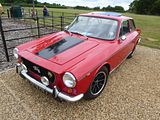
HILLMAN
The original Minx was announced to the public 1 October 1931. It was straightforward and conventional with a pressed-steel body on separate chassis and 30 bhp 1185 cc engine producing cushioned power. It was upgraded with a four-speed transmission in 1934 and a styling upgrade, most noticeably a slightly V-shaped grille. For 1935 the range was similar except that synchromesh was added to all forward gears and this Minx became the first mass-produced car with an all-synchromesh gearbox. it was designed by Rootes’ technical director Captain John Samuel Irving (1880-1953), designer of Sunbeam aero engines and Sunbeam’s Golden Arrow’ in conjunction with Alfred Herbert Wilde (1891–1930), recently chief engineer of Standard and designer of the Standard Nine. The 1936 model had a new name, the Minx Magnificent, and a restyle with a much more rounded body. The chassis was stiffened and the engine moved forwards to give more passenger room. The rear panel, previously vertical, was now set at a sloping angle, and the manufacturers offered the option of a folding luggage grid attached to the rear panel for “two pounds, seven shillings and sixpence” (slightly under £2.40) painted. A Commer-badged estate car was added to the range. This one dates from 1932.


The Super Minx was announced in October 1961,and was intended to give Rootes, and particularly its Hillman marque, an expanded presence in the upper reaches of the family car market. It has been suggested that the Super Minx design was originally intended to replace, and not merely to supplement, the standard Minx, but was found to be too big for that purpose. An estate car joined the range in May 1962, and a two-door convertible in June 1962. The convertible never sold in significant numbers: the last one was made in June 1964. At launch, the car was powered by the Rootes 62 bhp 1,592 cc unit, which had first appeared late in 1953 with a 1,390 cc capacity. The original Super Minx had the cast-iron cylinder head version of the engine, though on later cars the cylinder head was replaced with an aluminium one. Suspension was independent at the front using coil springs with anti-roll bar and at the rear had leaf springs and a live axle. Un-assisted 9 in Lockheed drum brakes were fitted. The steering used a recirculating ball system and was as usual at the time not power assisted. Standard seating, trimmed in Vynide, used a bench type at the front with individual seats as an option. A heater was fitted but a radio remained optional. The car could be ordered in single colour or two tone paint. The four-speed manual transmission featured synchromesh on the top three ratios from the start and had a floor lever: “Smiths Easidrive” automatic transmission was option. A year after the car was launched a Mark II version was presented, in October 1962, with greasing points eliminated, larger front disc brakes and a revised axle ratio. For buyers of the automatic transmission cars, 1962 was the year that the Smiths Easidrive option was replaced by the Borg-Warner 35 transmission. In 1964, with the launch of the Super Minx Mark III, the wrap-around rear window gave way to a new “six-light” design with extra side windows aft of the rear side doors. Engine capacity was increased to 1,725 cc for the Super Minx Mark IV launched at the London Motor Show in October 1965. The car was replaced by the Arrow range (Hunter) in late 1966.

HONDA
The Honda CR-X was completely redesigned by late 1987 for the 1988 model year. The wheelbase increased 4 in (102 mm) overall, length increased by 3.2 in (81 mm) and width is nearly 2 in (51 mm) wider than the previous model. The suspension was completely redesigned. Honda abandoned the original torsion bar in the front and beam axle with trailing link in the rear in favor of a 4-wheel double-wishbone suspension. The larger design and revised suspension brought improvements in handling as well passenger and cargo space versus the previous generation. The CR-X received a mild refresh for the 1990 model year. The VTEC equipped models also received a makeover with updated bumpers, lights, hood, brakes, suspension and dashboard design amongst other features. Additionally, some of these design changes were added to the concurrent non-VTEC models. One of the options for the Japanese Domestic Market (JDM) CR-X was a glass roof, a fixed glass panel which stretched from the top of the windshield to the top of the hatch opening. Relatively common in Japan, these are sought-after models in other markets. Outside of North America, the second generation CR-X was available with a 1.5-litre SOHC 4-cylinder engine or an updated version of the 1.6-litre DOHC 4-cylinder (ZC) engine. Many of these were fitted with fuel injection as standard. In September 1989, Honda added the 1.6-litre 16-valve DOHC VTEC 4-cylinder B16A engine to the lineup outside of North America. The VTEC (variable valve timing and lift electronic control) engine provided increased power at high RPMs while still allowing low fuel consumption and better idling at low RPMs. The B16A produced 150 PS in the European 1.6i-VT model (where the engine bore the designation B16A1) and 160 PS in the JDM SiR model. The CR-X was the second car to receive a DOHC VTEC engine, shortly after the Honda Integra XSi. The CR-X equipped with the 1.6-litre DOHC 4-cylinder engine or the 1.6-litre DOHC VTEC 4-cylinder engine came with a different bonnet since the twin-cam engines were taller and required additional bonnet clearances in comparison to the SOHC engines. The 1.6-litre DOHC engine was only slightly taller than the 1.6-litre SOHC engine and required a different bonnet with a bump on one side which offered the additional necessary clearance to clear the cam gear cover. Cars equipped with a 1.6-litre DOHC VTEC 4-cylinder engine came with a bonnet that was raised across most of the engine bay to offer additional overall clearance for the taller engine. In some LHD European markets, there was also the option of the D14A1 engine with automatic gearbox which featured twin carburettors. The third generation car arrived in late 1991.


JAGUAR
Successor to the C Type was the D Type. Although it shared many of its mechanical components with the C-Type, including the basic straight-6 XK engine design, initially of 3.4 litres and later enlarged to 3.8 litres in the late fifties, the structure of the car was radically different. The innovative monocoque construction brought aviation industry technology to competition car design, together with an aeronautical understanding of aerodynamic efficiency. The structural design, revolutionary at the time, applied aeronautical technology. The “tub”, or cockpit section, was of monocoque construction, mostly comprising sheets of aluminium alloy. Its elliptical shape and comparatively small cross-section provided torsional rigidity and reduced drag. To the front bulkhead was attached an aluminium tubing subframe for the engine, steering assembly, and front suspension. Rear suspension and final drive were mounted to the rear bulkhead. Fuel was carried in the tail and the designers followed aviation practice by specifying a deformable Marston Aviation Division bag in place of a conventional tank. The aerodynamic bodywork was largely the work of Malcolm Sayer, who had joined Jaguar following a stint with the Bristol Aeroplane Company during the Second World War and later worked on the C-Type. For the D-Type, he insisted on a minimal frontal area. To reduce the XK engine’s height, Jaguar’s chief engineer, William Haynes, and former Bentley engineer, Walter Hassan, developed dry sump lubrication, and it has been said that the car’s frontal area was also a consideration in canting the engine at 8½° from the vertical (which necessitated the offset bonnet bulge). Philip Porter, in his book Jaguar Sports Racing Cars, says that “[a] more likely reason was to provide extra space for the ram pipes feeding the three twin-choke Weber carburettors.” Reducing underbody drag contributed to the car’s high top speed; for the long Mulsanne Straight at Le Mans, a fin was mounted behind the driver for aerodynamic stability. For the 1955 season, factory cars were fitted with a longer nose, which lengthened the car by 7½ inches and further increased maximum speed; and the headrest fairing and aerodynamic fin were combined as a single unit that smoothed the aerodynamics and saved weight. Mechanically, many features were shared with the outgoing C-Type. Its front and rear suspension and innovative all-round disc brakes were retained, as was the XK engine. Apart from the new lubrication system, the engine was further revised as development progressed during the D-Type’s competition life. Notably in 1955 larger valves were introduced, together with asymmetrical cylinder heads to accommodate them. Jaguar D-Types fielded by a team under the leadership of Jaguar’s racing manager Lofty England were expected to perform well in their debut at the 1954 24 Hours of Le Mans race. In the event, the cars were hampered by fuel starvation caused by problems with the fuel filters, necessitating pit stops for their removal, after which the entry driven by Duncan Hamilton and Tony Rolt speeded up to finish less than a lap behind the winning Ferrari. The D-Type’s aerodynamic superiority is evident from its maximum speed of 172.8 mph on the Mulsanne Straight compared with the 4.9 litre Ferrari’s 160.1 mph. For 1955 the cars were modified with long-nose bodywork and engines uprated with larger valves. At Le Mans, they proved competitive with the Mercedes-Benz 300 SLRs, which had been expected to win. Mike Hawthorn’s D-Type had a narrow lead over Juan Manuel Fangio’s Mercedes when another Mercedes team car was involved in the most catastrophic accident in motorsport history.Driver Pierre Levegh and more than 80 spectators lost their lives, while many more were injured. Mercedes withdrew from the race. Jaguar opted to continue, and the D-Type driven by Hawthorn and Ivor Bueb went on to win. Mercedes withdrew from motorsport at the end of the 1955 season, and Jaguar again entered Le Mans in 1956. Although only one of the three factory-entered cars finished, in sixth place, the race was won by a D-Type entered by the small Edinburgh-based team Ecurie Ecosse and driven by Ron Flockhart and Ninian Sanderson, beating works teams from Aston Martin and Scuderia Ferrari. In America, the Cunningham team raced several D-Types. In 1955, for example, a 1954 works car on loan to Cunningham won the Sebring 12 Hours in the hands of Mike Hawthorn and Phil Walters, and in May 1956 the team’s entries for Maryland’s Cumberland national championship sports car race included four D-Types in Cunningham’s white and blue racing colours. Driven by John Fitch, John Gordon Benett, Sherwood Johnston and team owner Briggs Cunningham, they finished fourth, fifth, seventh and eighth, respectively. Although Jaguar withdrew from motorsport at the end of the 1956 season, 1957 proved to be the D-Type’s most successful year. Jaguar D-Types took five of the top six places at Le Mans; Ecurie Ecosse, with considerable support from Jaguar, and a 3.8-litre engine, again took the win, and also second place. This was the best result in the D-Type’s racing history. Rules for the 1958 Le Mans race limited engine sizes to three litres for sports racing cars, which ended the domination of the D-Type with its 3.8-litre XK engine. Jaguar developed a three-litre version to power D-Types in the 1958, 1959 and 1960 Le Mans races but it was unreliable, and by 1960 it no longer produced sufficient power to be competitive. The D-Type’s success waned as support from Jaguar decreased and the cars from rival manufacturers became more competitive. Although it continued to be one of the cars to beat in club racing and national events, the D-Type never again achieved a podium finish at Le Mans. By the early 1960s it was obsolete. Total D-Type production is thought to have included 18 factory team cars, 53 customer cars, and 16 XKSS versions. A 1955 car was sold at Sothebys in 2016 for £19,8 million, making it the most valuable British car ever.


The Jaguar XKSS is a road-going version of the Jaguar D-Type racing car, initially built in 1957. Only 16 were built and sold at the time. Nine chassis were destroyed in a factory fire in 1957 before they could be completed. In 2016 Jaguar announced that a small production run of nine “continuation” XKSS reproductions would be hand-built to the original specifications to complete the originally scheduled run of 25. Following Jaguar’s withdrawal from competition at the end of the 1956 season, a number of completed and partly completed D-types remained unsold at the Browns Lane factory. In an attempt to recoup some of the investment made in building unused chassis, and to exploit the lucrative American market for high-performance European sports cars, Sir William Lyons decided to convert a number of them to road-going specification. Structural changes would include the removal of the bulkhead creating a single driver’s cockpit, elimination of the large fin behind the driver, and addition of a passenger side door. In addition, numerous changes were required to be made for cosmetic, comfort and legal reasons to turn a basic D-type, a race car design, into a street-legal passenger car. These included creating a full two-abreast interior; adding a full-width, chrome-surrounded windscreen; adding sidescreens to both driver and passenger doors; creating a rudimentary, folding, fabric roof; adding chromed front and rear bumpers; and mounting XK140 rear light clusters high on the wings; and adding thin chrome strips to the edges of the front light fairings. By early 1957 a total of 16 of the planned production run of 25 XKSS’s had been completed at Jaguar’s Browns Lane plant. On the evening of 12 February a fire broke out, destroying the remaining nine in mid-production. All of the destroyed vehicles had been destined for North America. Most of the previously built 16 XKSSs were also sold in the US. In March 2016, Jaguar announced that it would be completing the original 25 car order by hand-building the remaining nine XKSS roadsters to the exact original specification, and assigning them the chassis numbers of the destroyed cars. The “continuation” reproductions were expected to sell for more than £1 million each.

Although bearing a family resemblance to the earlier XK120 and XK140, the XK150, launched in the spring of 1957, was radically revised. A one-piece windscreen replaced the split screen, and the wing line no longer dropped so deeply at the doors. The widened bonnet opened down to the wings, and on the Roadster the windscreen frame was moved back 4 inches to make the bonnet longer. The XK140’s walnut dashboard was replaced by one trimmed in leather. On the early Drophead Coupés, the aluminium centre dash panel, which was discontinued after June 1958, had an X pattern engraving similar to the early 3.8 E-Type. Thinner doors gave more interior space. On the front parking lights, which were located atop the wings, a little red light reminded the driver the lights were on. Suspension and chassis were very similar to the XK140, and steering was by rack and pinion; power steering was not offered. The standard engine, the similar to the XK140, but with an new “B” type cylinder head, was the 3.4 litre DOHC Jaguar straight-6 rated at 180 SAE bhp at 5750 rpm but most cars were fitted with the SE engine whose modified cylinder head (B type) and larger exhaust valves boosted the power to 210 SAE bhp at 5500 rpm. Twin 1.75-inch (44 mm) SU HD6 carburettors were fitted. While the first XK150s were slower than their predecessors, the deficit was corrected in the spring of 1958 with a 3.4-litre “S” engine whose three 2-inch SU HD8 carburettors and straight-port cylinder head increased power to a claimed 250 SAE bhp. For 1960, the 3.4 litre engine was bored to 3.8 litres, rating this option at 220 hp in standard tune or 265 hp in “S” form. A 3.8 litre 150S could top 135 mph and go from 0–60 mph in around 7.0 seconds. Fuel economy was 18mpg. Four-wheel Dunlop 12 in disc brakes appeared for the first time although it was theoretically possible to order a car with drums. When leaving the factory the car originally fitted either 6.00 × 16 inch Dunlop Road Speed tyres as standard, or you could specify 185VR16 Pirelli Cinturato CA67 as a radial option on either 16 × 5K½ solid wheels (basic models) or 16 × 5K wire wheels. Production ended in October 1960, and totalled 2265 Roadsters, 4445 Fixed Head Coupés and 2672 Drophead Coupés.

The Series 1 E Type was introduced, initially for export only, in March 1961. The domestic market launch came four months later in July 1961. The cars at this time used the triple SU carburetted 3.8-litre six-cylinder Jaguar XK6 engine from the XK150S. Earlier built cars utilised external bonnet latches which required a tool to open and had a flat floor design. These cars are rare and more valuable. After that, the floors were dished to provide more leg room and the twin bonnet latches moved to inside the car. The 3.8-litre engine was increased to 4,235 cc in October 1964. The 4.2-litre engine produced the same power as the 3.8-litre (265 bhp) and same top speed (150 mph), but increased torque approximately 10% from 240 to 283 lb/ft. Acceleration remained pretty much the same and 0 to 60 mph times were around 6.4 seconds for both engines, but maximum power was now reached at 5,400 rpm instead of 5,500 rpm on the 3.8-litre. That all meant better throttle response for drivers that did not want to shift down gears. The 4.2-litre’s block was completely redesigned, made longer to accommodate 5 mm (0.20 in) larger bores, and the crankshaft modified to use newer bearings. Other engine upgrades included a new alternator/generator and an electric cooling fan for the radiator. Autocar road tested a UK spec E-Type 4.2 fixed head coupé in May 1965. The maximum speed was 153 mph, the 0–60 mph time was 7.6 seconds and the 1⁄4 mile from a standing start took 15.1 seconds. They summarised it as “In its 4.2 guise the E-Type is a fast car (the fastest we have ever tested) and offers just about the easiest way to travel quickly by road.”. Motor magazine road tested a UK spec E-Type 4.2 fixed head coupé in Oct 1964. The maximum speed was 150 mph, the 0–60 mph time was 7 seconds and the 1⁄4 mile time was 14.9 seconds. They summarised it as “The new 4.2 supersedes the early 3.8 as the fastest car Motor has tested. The absurd ease which 100 mph can be exceeded in a 1⁄4 mile never failed to astonish. 3,000 miles (4,828 km) of testing confirms that this is still one of the world’s outstanding cars”. All E-Types featured independent coil spring rear suspension designed and developed by R J Knight with torsion bar front ends, and four wheel disc brakes, in-board at the rear, all were power-assisted. The Coventry engineers spared nothing with regards to high automotive technology in braking. Like several British car builders of the middle and late 1950s, the four-wheel disc brakes were also used in that era by Austin-Healey, MG,putting the British far ahead of Ferrari, Maserati, Alfa Romeo, Porsche, and Mercedes-Benz. Even Lanchester tried an abortive attempt to use copper disc brakes in 1902. Jaguar was one of the first vehicle manufacturers to equip production cars with 4 wheel disc brakes as standard from the XK150 in 1958. The Series 1 (except for late 1967 models) can be recognised by glass-covered headlights (up to 1967), small “mouth” opening at the front, signal lights and tail-lights above bumpers and exhaust tips under the number plate in the rear. 3.8-litre cars have leather-upholstered bucket seats, an aluminium-trimmed centre instrument panel and console (changed to vinyl and leather in 1963), and a Moss four-speed gearbox that lacks synchromesh for first gear (“Moss box”) on all except very last cars. 4.2-litre cars have more comfortable seats, improved brakes and electrical systems, and, obviously, an all-synchromesh Jaguar designed four-speed gearbox. 4.2-litre cars also have a badge on the boot proclaiming “Jaguar 4.2 Litre E-Type” (3.8 cars have a simple “Jaguar” badge). Optional extras included chrome spoked wheels and a detachable hard top for the OTS. When leaving the factory the car was originally fitted with Dunlop 6.40 × 15-inch RS5 tyres on 15 × 5K wire wheels (with the rear fitting 15 × 5K½ wheels supplied with 6.50 X15 Dunlop Racing R5 tyres in mind of competition). Later Series One cars were fitted with Dunlop 185 – 15 SP41 or 185 VR 15 Pirelli Cinturato as radial ply tyres. A 2+2 version of the fastback coupé was added in 1966. The 2+2 offered the option of an automatic transmission. The body is 9 in (229 mm) longer and the roof angles are different. The roadster and the non 2+2 FHC (Fixed Head Coupé) remained as two-seaters. Less widely known, right at the end of Series 1 production, but prior to the transitional “Series 1½” referred to below, a small number of Series 1 cars were produced with open headlights. These Series 1 cars had their headlights modified by removing the covers and altering the scoops they sit in, but these Series 1 headlights differ in several respects from those later used in the Series 1½ (or 1.5), the main being they are shorter at 143 mm from the Series 1½ at 160 mm. Production dates on these machines vary but in right-hand drive form production has been verified as late as July 1968. They are not “rare” in the sense of the build of the twelve lightweights, but they are certainly uncommon; they were not produced until January 1967 and given the foregoing information that they were produced as late as July 1968, it appears that there must have been an overlap with the Series 1.5 production, which began in August 1967 as model year 1968 models. These calendar year/model year Series 1 E-Types are identical to other 4.2-litre Series 1 examples in every respect except for the open headlights; all other component areas, including the exterior, the interior, and the engine compartment are the same, with the same three SU carburettors, polished aluminium cam covers, center dash toggle switches, etc. Following the Series 1 there was a transitional series of cars built in 1967–68 as model year 1968 cars, unofficially called “Series 1½.” Due to American pressure the new features were not just open headlights, but also different switches (black rocker switches as opposed to the Series 1 toggle switches), de-tuning for emissions (using two Zenith-Stromberg carburettors instead of the original three SUs) for US models, ribbed cam covers painted black except for the top brushed aluminium ribbing, bonnet frames on the OTS that have two bows, and other changes. Series 1½ cars also have twin cooling fans and adjustable seat backs. The biggest change between 1961–1967 Series 1 E-Types and the 1968 Series 1.5 was the reduction in the number of carburettors from 3 to just 2 (North America), resulting in a loss in horsepower. Series 2 features were gradually introduced into the Series 1, creating the unofficial Series 1½ cars, but always with the Series 1 body style. A United States federal safety law affecting 1968 model year cars sold in the US was the reason for the lack of headlight covers and change in dash switch design in the “Series 1.5” of 1968. An often overlooked change, one that is often “modified back” to the older style, is the wheel knock-off “nut.” US safety law for 1968 models also forbade the winged-spinner knockoff, and any 1968 model year sold in the US (or earlier German delivery cars) should have a hexagonal knockoff nut, to be hammered on and off with the assistance of a special “socket” included with the car from the factory. This hexagonal nut carried on into the later Series 2 and 3. The engine configuration of the US Series 1.5s was the same as is found in the Series 2. An open 3.8-litre car, actually the first such production car to be completed, was tested by the British magazine Motor in 1961 and had a top speed of 149.1 mph and could accelerate from 0 to 60 mph in 7.1 seconds. A fuel consumption of 21.3 mpg was recorded. The test car cost £2,097 including taxes.The cars submitted for road test by the motoring journals of the time (1961) such as Motor, Autocar and Autosport magazines were prepared by the Jaguar works. This work entailed engine balancing and subtle tuning work such as gas-flowing checking the cylinder heads but otherwise production built engines. Both of the well-known 1961 road test cars: the E-Type coupé Reg. No. 9600 HP and E-Type Convertible Reg. No. 77 RW, were fitted with Dunlop Racing Tyres on test, which had a larger rolling diameter and lower drag coefficient. This goes some way to explaining the 150 mph (240 km/h) maximum speeds that were obtained under ideal test conditions. The maximum safe rev limit for standard 6-cylinder 3.8-litre E-Type engines is 5,500 rpm. The later 4.2-Litre units had a red marking on the rev counter from just 5,000 rpm. Both 3.8 test cars may have approached 6,000 rpm in top gear when on road test, depending on final drive ratio. Production numbers were as follows: 15,490 of the 3.8s, 17,320 of the 4.2s and 10,930 of the 2+2s. And by body style there were 15,442 of the FHC, 17,378 of the OTS and 5,500 of the 2+2, making a total of 38,419 of the Series 1 car.


The Series 2 E Type introduced a number of design changes, largely due to U.S. National Highway Traffic and Safety Administration mandates. The most distinctive exterior feature is the absence of the glass headlight covers, which affected several other imported cars, such as the Citroën DS, as well. Unlike other cars, this step was applied worldwide for the E-Type. Other hallmarks of Series 2 cars are a wrap-around rear bumper, larger front indicators and tail lights re-positioned below the bumpers, and an enlarged grille and twin electric fans to aid cooling. Additional U.S.-inspired changes included a steering lock which moved the ignition switch to the steering column, replacing the dashboard mounted ignition and push button starter, the symmetrical array of metal toggle switches replaced with plastic rockers, and a collapsible steering column to absorb impact in the event of an accident. New seats allowed the fitment of head restraints, as required by U.S. law beginning in 1969. The engine is easily identified visually by the change from smooth polished cam covers to a more industrial “ribbed” appearance. It was de-tuned in the US with twin two-barrel Strombergs replacing three SUs. Combined with larger valve clearances horsepower was reduced from 265 to 246 and torque from 283 to 263. Air conditioning and power steering were available as factory options. Production totalled 13,490 of all types, with 4885 of the FHC, 5,326 of the 2+2 and 8,628 of the OTS model.


The E-Type Series 3 was introduced in 1971, with a new 5.3 L Jaguar V12 engine, uprated brakes and standard power steering. Optionally an automatic transmission, wire wheels and air conditioning were available. The V12 was equipped with four Zenith carburettors, and as introduced produced a claimed 272 bhp, more torque, and a 0–60 mph acceleration of less than seven seconds. The short wheelbase FHC body style was discontinued, with the Series 3 available only as a convertible and 2+2 coupé. The newly used longer wheelbase now offered significantly more room in all directions. The Series 3 is easily identifiable by the large cross-slatted front grille, flared wheel arches, wider tyres, four exhaust tips and a badge on the rear that proclaims it to be a V12. The first published road test of the series 3 was in Jaguar Driver, the club magazine of the Jaguar Drivers’ Club, the only owners club to be officially sanctioned by Sir William Lyons and Jaguar themselves. The road test of a car provided by Jaguar was published ahead of all the national and international magazines. Cars for the US market were fitted with large projecting rubber bumper over-riders (in 1973 these were on front, in 1974 both front and rear) to meet local 5 mph impact regulations, but those on European models were considerably smaller. US models also have side indicator repeats on the front wings. There were also a very limited number of six-cylinder Series 3 E-Types built. These were featured in the initial sales procedure but the lack of demand stopped their production. The V12 Open Two Seater and V12 2+2 were factory fitted with Dunlop E70VR − 15-inch tyres on 15 × 6K wire or solid wheels. The final production E-Type OTS Roadster was built in June 1974. Total production was 15,290.

LAMBORGHINI
Which small boy (and perhaps car loving girl) did not lust after a Countach back in the 1970s and 1980s. A dramatic looking car, this was the stuff of dreams that you would only ever see at the London or NEC Motor Shows. Countach first made an appearance, as a concept in 1971, but it was 1973 before the production car made its debut, and despite unfortunate timing with fuel shortages and a recession, and a number of financial problems for its maker, the car sold well throughout its production life. The Countach entered production as the LP400 with a 3929 cc engine delivering 370 hp. The first production Countach was delivered to an Australian in 1974. Externally, little had altered from the final form of the prototype except at the rear, where conventional lights replaced the futuristic light clusters of the prototype. The styling had become rather more aggressive than Gandini’s original conception, with the required large air scoops and vents to keep the car from overheating, but the overall shape was still very sleek. The original LP400 rode on the quite narrow tyres of the time, but their narrowness and the slick styling meant that this version had the lowest drag coefficient of any Countach model. The emblems at the rear simply read “Lamborghini” and “Countach”, with no engine displacement or valve arrangement markings as is found on later cars. By the end of 1977, the company had produced 158 Countach LP400s. In 1978, a new LP400 S model was introduced. Though the engine was slightly downgraded from the LP400 model (350 bhp), the most radical changes were in the exterior, where the tyres were replaced with 345/35R15 Pirelli P7 tyres; the widest tyres available on a production car at the time, and fibreglass wheel arch extensions were added, giving the car the fundamental look it kept until the end of its production run. An optional V-shaped spoiler was available over the rear deck, which, while improving high-speed stability, reduced the top speed by at least 16 km/h (10 mph). Most owners ordered the wing. The LP400 S handling was improved by the wider tyres, which made the car more stable in cornering. Aesthetically, some prefer the slick lines of the original, while others prefer the more aggressive lines of the later models, beginning with the LP400 S. The standard emblems (“Lamborghini” and “Countach”) were kept at the rear, but an angular “S” emblem was added after the “Countach” on the right side. 1982 saw another improvement, this time giving a bigger, more powerful 4754 cc engine. The bodywork was unaltered, however the interior was given a refresh. This version of the car is sometimes called the 5000 S, which may cause confusion with the later 5000 QV. 321 of these cars were built. Two prototypes of the 1984 Countach Turbo S were built by Lamborghini, of which one is known to exist. The Turbo S weighed 1,515 kg (3,340 lb), while its 4.8 litre twin-turbo V12 had a claimed maximum power output of 758 PS and a torque output of 876 N·m (646 lb·ft), giving the car an acceleration of 0–100 km/h (0–62 mph) in 3.7 seconds and a top speed of 335 km/h (208 mph). A turbo adjuster, located beneath the steering wheel, could be used to adjust the boost pressure from 0.7 bar to 1.5 bar at which the engine performed its maximum power output. The Turbo S has 15″ wheels with 255/45 tyres on the front and 345/35 on the rear. In 1985 the engine design evolved again, as it was bored and stroked to 5167 cc and given four valves per cylinder—quattrovalvole in Italian, hence the model’s name, Countach 5000 Quattrovalvole or 5000 QV in short. The carburettors were moved from the sides to the top of the engine for better breathing—unfortunately this created a hump on the engine deck, reducing the already poor rear visibility to almost nothing. Some body panels were also replaced by Kevlar. In later versions of the engine, the carburettors were replaced with fuel injection. Although this change was the most notable on the exterior, the most prominent change under the engine cover was the introduction of fuel injection, with the Bosch K-Jetronic fuel injection, providing 414 bhp, rather than the six Weber carburettors providing 455 bhp. As for other markets, 1987 and 1988 model Quattrovalvoles received straked sideskirts. 610 cars were built.

The Lamborghini Huracán (Spanish for “hurricane”; [uɾaˈkan]) is a sports car replacing the previous V10 offering, the Gallardo. The Huracán was revealed online in December 2013, making its worldwide debut at the 2014 Geneva Auto Show, and was released in the market in the second quarter of 2014. The Huracán’s name (huracán being the Spanish word for hurricane) is inspired by a Spanish fighting bull. Historic Spanish fighting bulls have traditionally provided the names of most Lamborghini car models. Huracán was a bull known for its courage that fought in 1879. The Huracán maintains the 5.2-litre naturally aspirated Audi/Lamborghini V10 engine with an additional 0.2 litres, compared to the Gallardo, tuned to generate a maximum power output of 602 bhp/610 PS. To ensure its balance and performance, the car is mid-engined. The engine has both direct fuel injection and multi-point fuel injection. It combines the benefits of both of these systems; it is the first time this combination is used in a V10 engine. To increase its efficiency, the Huracán’s engine also includes a start-stop system. The firing order of the engine is 1, 6, 5, 10, 2, 7, 3, 8, 4, 9. This is printed on a metal plate on the top of the engine, as with all other Lamborghini models. The drag coefficient of Cd=0.39 was undisclosed until 2021. The LP 610-4 designation comes from the car having 610 PS and four-wheel drive, while LP stands for “Longitudinale Posteriore”, which refers to the longitudinal mid-rear engine position. Changes from the Gallardo include full LED illumination, a 12.3 inch full-colour TFT instrument panel, fine napa leather and Alcantara interior upholstery, redesigned dashboard and central tunnel, Iniezione Diretta Stratificata (IDS, essentially an adapted version of parent Audi’s Fuel Stratified Injection) direct and indirect gasoline injections, engine Stop & Start technology, EU6 emissions regulation compliance, Lamborghini Doppia Frizione (LDF) 7-speed dual-clutch transmission with 3 modes (STRADA, SPORT and CORSA), 20-inch wheels, carbon-ceramic braking system, optional Lamborghini Dynamic Steering variable steering system and MagneRide electromagnetic damper control. The main competitors of the Huracán include the McLaren 650S (as well as the 720S), the Audi R8, the Ferrari 458 Speciale and the 488 GTB. Extra options that increase the price of the car include interior enhancements, special paint schemes, improved suspension, and a lifting system, as well as multiple components optionally available in carbon fibre, rather than aluminium. The convertible variant of the Huracán LP 610-4 was revealed at the Frankfurt Motor Show on 14 September 2015. The 5.2-litre naturally-aspirated V10 engine is the same as the coupé and generates a maximum power output of 602 bhp/610 PS. Acceleration from 0 to 100 km/h (62 mph) takes 3.4 seconds and the top speed is 323 km/h (201 mph). It has the same 7-speed Lamborghini Doppia Frizione (LDF) dual-clutch transmission as that of the coupé. The Spyder has a dry weight of 1,542 kg (3,400 lb) which is 120 kg (265 lb) more than the coupé due to chassis reinforcing components. The Spyder has a CO2 emission of about 280 g/km. Unveiled at the 2016 Geneva Motor Show, the Huracán LP 580-2 is a lower cost derivative of the Huracán LP 610-4 that differs mostly in having the 5.2 L V10 engine detuned to 572 bhp/580 PS and 533 Nm (393 lb/ft) of torque along with having a rear wheel drive drivetrain instead of the all-wheel drive drivetrain found in the standard Huracán. Lamborghini claims the car will accelerate from 0–100 km/h (0–62 mph) in 3.4 seconds and 0–200 km/h (0–124 mph) in 10.1 seconds. The top speed is claimed to be as high as 320 km/h (199 mph). It also features slight visual differences to the standard variant of the car – with a different front fascia and larger air vents at the rear of the car for improved brake cooling. The seven-speed dual-clutch transmission is the same as used in the standard LP 610–4. The base level LP 580-2 costs US$201,100, about US$40,000 less than the base level LP 610–4. A convertible variant of the Huracán LP 580-2 was unveiled at the Los Angeles Auto Show on 16 November 2016. The 5.2-litre naturally-aspirated V10 engine is the same as in the coupé, and generates a maximum power output of 572 bhp/580 PS. 0 to 100 km/h (62 mph) takes 3.6 seconds and the top speed is 320 km/h (199 mph). A track oriented variant of the Huracán, called the Performante, was unveiled at the 2017 Geneva Motor Show. The Performante underwent various exterior changes with the most noticeable being the front and rear bumpers. Carbon fibre is used for the bumpers and the side skirts. An adjustable carbon fibre rear wing has been added to increase downforce. The position of the exhaust has also been changed, and is now just a bit above the rear diffuser. The interior also underwent noticeable changes, now sporting new seats and a new digital speedometer (similar to that of the Aventador SV’s speedometer). The Performante’s 5.2-litre V10 has been tuned to have a power output of 631 bhp/640 PS at 8,000 rpm and 601 Nm (443 lb/ft) of torque at 6,500 rpm. The weight has also decreased by 40 kg (88 lb), courtesy of the forged aluminium and forged carbon fibre body components (first used in the construction of the Sesto Elemento). All the new aero components on the car have active aerodynamic capability and help keep the car stable at high speeds. The Performante is capable of accelerating from 0–100 km/h (0–62 mph) in 2.9 seconds, 0–200 km/h (0–124 mph) in 8.9 seconds. It also has a theoretical top speed of 325 km/h (200 mph). The car has been stiffened by 10% with new springs, roll bars, and radial axial arm bushings. The magnetorheological suspension has been reworked to give a driver a serious track experience. The Lamborghini Dynamic Steering has been re-calibrated. The Performante utilises Lamborghini’s new ALA (Aerodinamica Lamborghini Attiva) system, which is said to be 80% lighter than regular sports car hydraulic systems. According to Lamborghini, ALA is also said to provide 750% more downforce than the standard Huracán. The Lamborghini Huracán Performante Spyder was unveiled at the 2018 Geneva Motor Show. It takes much of the styling inspiration from the coupé and the outgoing LP 610-4 Spyder. The Spyder is identical to the coupé from performance and technological standpoint, but the acceleration time from 0–60 mph has risen by one-tenth of a second and stands at 3.1 seconds while the 0–200 km/h (0–124 mph) has risen by four-tenths of a second and stands at 9.3 seconds. Due to the loss of the roof, the Spyder weighs 125 kg (276 lb) more than the coupé due to chassis reinforcing components. Top speed remains the same as well and stands at 325 km/h (202 mph). Deliveries of the Spyder began in the fourth quarter of 2018. The Huracán received a mid-cycle update in 2019, now being called the Huracán Evo. It now shares its engine and some of the technology with the Performante variant. The updated version of the Huracán has a more aggressive design language, the new front bumper has integrated aeroblades for improved downforce along with the rear styling inspired by the Performante variant, having the same rear diffuser, exhaust pipe position and radiators. A new ducktail spoiler improves downforce by 5 times as compared to the outgoing model. The engine is shared with the Performante and generates 631 bhp/640 PS at 8,000 rpm and 601 Nm (443 lb/ft) of torque at 6,500 rpm. The exhaust system is more refined and has titanium intake valves. This allows the car to achieve a 0–60 mph) acceleration time of 2.9 seconds, 0–200 km/h (0–124 mph) acceleration time of 9 seconds and a top speed of 325 km/h (202 mph). The car has a braking distance from 100–0 km/h (62–0 mph) of 104 ft (32 m). The Huracán Evo has a rear-wheel steering system for improved handling and a torque vectoring system. A new central processing unit controls the various functions of the car and monitors various settings. The control system is controlled by the new infotainment system (via an 8.4 inch touchscreen) dubbed the Lamborghini Dinamica Veicolo Integrata which has integrated both Apple CarPlay and Android Auto. The infotainment system predicts the driving modes by a feed forward logic. The feed forward logic works by sensors monitoring the lateral, longitudinal and vertical accelerations, as well as roll, pitch and yaw rate to predict the best possible driving mode for the driver. The magnetorheological suspension is also revised and now uses electromagnetic current to adjust the suspension system in accordance with the driving mode. The transmission system from the outgoing model is retained which transfers power to all four wheels. A new Ego mode allows the driver to change driving settings to their own preference. The Huracán Evo Spyder was introduced online in February 2019. The Spyder has the same enhancements as the coupé but is 100 kg (220 lb) heavier due to the addition of chassis reinforcement components owing to the loss of the roof. The car has the same canvas folding soft top as the outgoing model which takes 17 seconds for operation and is operable at speeds up to 50 km/h (31 mph). The Spyder can accelerate to 100 km/h (62 mph) in 3.1 seconds from a standstill, to 200 km/h (124 mph) in 9.3 seconds and can attain a top speed of 325 km/h (202 mph). A rear-wheel drive variant of the Evo debuted in January 2020, replacing the LP 580–2. The front splitter has been reshaped and generates more airflow, which is directed to the revised diffuser. Unique to the RWD model is P-TCS (Performance Traction Control System) that ensures that torque is not cut off abruptly; Lamborghini claims this increases oversteer by 30 percent compared to the LP 580–2. The engine is detuned and is now rated at 602 bhp/610 PS. Due to the detuned engine, the car is slower than the standard Huracán Evo accelerating to 100 km/h (62 mph) in 3.3 seconds while having the same top speed. The car also receives a unique paint option, Giallo Belenus, along with a matching interior upholstered in leather and microsuede. A convertible version of the rear-wheel drive variant of the Evo was showcased in May 2020, replacing the LP 580-2 Spyder. Like the Coupé variant, the convertible has a power output of 602 bhp/610 PS. The convertible has a 0– 60 mph acceleration time of 3.5 seconds and has a claimed top speed of 323 km/h (201 mph). Unveiled on April 12, 2022, The Huracán Tecnica sits between the EVO RWD and the track-focused STO. It is 6.1 cm (2.4 in) longer than the EVO, but is the same height and width. It uses the naturally-aspirated V10 engine from the STO and has a top speed of 325 km/h (202 mph) and an acceleration time of 0–100 km/h (0–62 mph) in 3.2 seconds. According to Lamborghini, the Tecnica’s aerodynamic changes increase downforce 35 percent and reduce drag by 20 percent compared to the EVO. It is expected that production will end in 2024.

LANCIA
The Fulvia Coupé was a compact two-door, three-box coupé introduced in 1965. Like the saloon it was designed in-house by Piero Castagnero, using a wheelbase 150 mm (5.9 in) shorter than its sedan counterpart. As the last Fulvia model to be discontinued, the coupe was ultimately replaced in 1977 by a 1.3-litre version of the Beta Coupé. The 1965–67 cars were equipped with a 1,216 cc 818.100 engine—from 1967 enlarged to 1,231 cc—producing 79 hp at 6,000 rpm. The same engines were subsequently used on the Berlina GT. The Coupé HF of 1966–67 was the competition version of the coupé, introduced later in 1965. It carried a tuned version of the 1,216 cc engine producing 87 hp at 6,000 rpm. Bodywork was lightened by removing the bumpers, using an aluminium bonnet, doors and boot lid, Plexiglas side and rear windows, and bare steel wheels without hubcaps. The Rallye 1.3 HF of 1967–69 had a new 1,298 cc engine with 100 hp at 6,400 rpm. The Rallye 1.3 of 1967–68 was an updated coupé with the 818.302 1,298 cc engine with 86 hp at 6,000 rpm. The Rallye 1.3 S of 1968–70 was an updated, more powerful Rallye 1.3 with a new 818.303 1,298 cc engine producing 91 hp at 6,000 rpm. There was also the Rallye 1.6 HF of 1969–70. Known as Fanalone (“big lamps”) because of the characteristic upsized inner pair of headlamps. The evolution of Rallye 1.3 HF, equipped with an all-new 818.540 1,584 cc engine producing 113 hp at 6,500 rpm. Other changes included negative camber front suspension geometry, with light alloy 13 inch 6J wheels; and a close ratio 5-speed gearbox and wheel arch extensions. The easiest way to distinguish this version is by the triangular holes between headlamps and grille. The Rallye 1.6 HF of 1969–70 was a works rally-spec Fanalone, produced in very limited numbers. The most powerful Fulvia with a 1,584 cc engine producing up to 130 hp depending on tune. This was the version used by the works rally team until 1974 when it was superseded in competition by the Stratos HF. 45 mm bore Solex carburettors were used that were later replaced by 45 DCOE Webers. The cam cover had a special blue stripe over the yellow paint job (HF cars had just a yellow paint job). The Series II cars first appeared in 1970. For the Coupé 1.3 S of 1970–73, there was a face-lifted body and new 5 speed gearbox with 1298 cc (818.303) engine producing 89 hp at 6000 rpm. Larger Girling callipers and pads replaced the Dunlop system fitted to 1st series cars. The Coupé 1.3 S Montecarlo of 1972–73 was a special edition based on the 1.3 S, commemorating Lancia’s victory at the 1972 Monte Carlo Rally. The livery resembled the works car, with matte black bonnet and boot lid bearing Monte Carlo rally plate-style stickers. This version used his own bodyshell with flared wheel arches, similar to the 1.6 HF bodyshell. Other accoutrements included 1.6 HF Lusso interior fittings such as bucket seats with headrests, rectangular front fog lamps, no bumpers and black single wing mirror; 4.5J steel wheels of the standard Coupé were fitted. The Coupé 1600 HF of 1970 had the face-lifted all steel body with 1,584 cc engine with Solex C42DDHF carb producing 113 hp at 6,000 rpm. The bodywork was changed from the standard 1.3 Coupé to incorporate flared wheel arches (replacing the extensions used on 1st series HFs). There was a further update creating the Coupé Series 3. This was introduced in 1974 and was mechanically the same as the earlier Series 2 1.3 S except for the addition of emission control on the Solex carburettors. Other than for “Fulvia 3” badges, it is easily recognized by its matte black grilled and headlight frame. It featured a new design of seats incorporating headrests and new white-faced instrument dials with an updated range of trim colours, materials and options. There was a Coupé 3 Montecarlo between 1974–76 which was as the earlier Montecarlo, but with Coupé 3 accoutrements. And finally there was the Safari between 1974–76. A limited edition based on the standard Coupé 3 with simplified trim and equipment, celebrating Fulvia’s participation in the Safari Rally. It came without bumpers, with matte black exterior trim, seats upholstered in denim cloth and leatherette, exterior badges on the bonnet and on the boot lid and also a special numbered plaque on the dashboard.

The Beta Spyder was also here. First seen in 1976, this was effectively an open-topped version of the Coupe, the Spyder was designed by Pininfarina but actually built by Zagato, which is why it was known as the Zagato in America. The Spyder used the Coupé’s shorter wheelbase and featured a targa top roof panel, a roll-over bar and folding rear roof.. Early models did not have a cross-member supporting the roof between the tops of the A to B pillars. Later models had fixed cross-members. It was initially powered by either the 1600 or 1800 twin-cam engine, later being replaced by the new 1.6 and 2.0. It never received the IE or VX engines. There were fuel injected engines for the US market. Lancia spelt the name with a “y” rather than an “i” possibly to differentiate the car from the Alfa Romeo Spider, though most people tend to use the “Spider” spelling these days. 9390 examples were built.


Lancia launched the Delta in 1979, as what we would now think of as a “premium hatch”. Offered in 1300 and 1500cc engines, this car, which collected the prestigious “Car of the year” award a few months later, brought Italian style and an expensive feeling interior to a new and lower price point in the market than Lancia had occupied since the early days of the Fulvia some 15 years earlier. The range grew first when a model was offered using the 4 speed AP automatic transmission and then in late 1982, more powerful models started to appear, with first a 1600cc engine, and then one with fuel injection, before the introduction of the HF Turbo. All these cars kept the same appearance and were quite hard to tell apart. These were the volume models of the range, but now they are very definitely the rare ones, as it is the performance versions which have survived and are now much loved classics, even though relatively were sold when they were new, thanks to a combination of the fact that they were quite costly and that they only ever came with left hand drive. The Integrale evolved over several years, starting off as the HF Turbo 4WD that was launched in April 1986, to homologate a new rally car for Lancia who needed something to fill the void left by the cancellation of Group B from the end of 1986. The Delta HF 4X4 had a four-wheel drive system with an in-built torque-splitting action. Three differentials were used. Drive to the front wheels was linked through a free-floating differential; drive to the rear wheels was transmitted via a 56/44 front/rear torque-splitting Ferguson viscous-coupling-controlled epicyclic central differential. At the rear wheels was a Torsen (torque sensing) rear differential. It divided the torque between the wheels according to the available grip, with a maximum lockup of 70%. The basic suspension layout of the Delta 4WD remained the same as in the rest of the two-wheel drive Delta range: MacPherson strut–type independent suspension with dual-rate dampers and helicoidal springs, with the struts and springs set slightly off-centre. The suspension mounting provided more isolation by incorporating flexible rubber links. Progressive rebound bumpers were adopted, while the damper rates, front and rear toe-in and the relative angle between springs and dampers were all altered. The steering was power-assisted rack and pinion. The car looked little different from the front wheel drive models. In September 1987, Lancia showed a more sophisticated version of the car, the Lancia Delta HF Integrale 8V. This version incorporated some of the features of the Delta HF 4WD into a road car. The engine was an 8-valve 2 litre fuel injected 4-cylinder, with balancing shafts. The HF version featured new valves, valve seats and water pump, larger water and oil radiators, more powerful cooling fan and bigger air cleaner. A larger capacity Garrett T3 turbocharger with improved air flow and bigger inter-cooler, revised settings for the electronic injection/ignition control unit and a knock sensor, boosting power output to 185 bhp at 5300 rpm and maximum torque of 224 lb/ft at 3500 rpm. The HF Integrale had permanent 4-wheel drive, a front transversely mounted engine and five-speed gearbox. An epicyclic centre differential normally split the torque 56 per cent to the front axle, 44 per cent to the rear. A Ferguson viscous coupling balanced the torque split between front and rear axles depending on road conditions and tyre grip. The Torsen rear differential further divided the torque delivered to each rear wheel according to grip available. A shorter final drive ratio (3.111 instead of 2.944 on the HF 4WD) matched the larger 6.5×15 wheels to give 24 mph/1000 rpm in fifth gear. Braking and suspension were uprated to 284 mm ventilated front discs, a larger brake master cylinder and servo, as well as revised front springs, dampers, and front struts. Next update was to change the engine from 8 valves to 16. The 16v Integrale was introduced at the 1989 Geneva Motorshow, and made a winning debut on the 1989 San Remo Rally. It featured a raised centre of the bonnet to accommodate the new 16 valve engine, as well as wider wheels and tyres and new identity badges front and rear. The torque split was changed to 47% front and 53% rear. The turbocharged 2-litre Lancia 16v engine now produced 200 bhp at 5500 rpm, for a maximum speed of 137 mph and 0–100 km/h in 5.5 seconds. Changes included larger injectors, a more responsive Garrett T3 turbocharger, a more efficient intercooler, and the ability to run on unleaded fuel without modification. The first Evoluzione cars were built at the end of 1991 and through 1992. These were to be the final homologation cars for the Lancia Rally Team; the Catalytic Evoluzione II was never rallied by the factory. The Evoluzione I had a wider track front and rear than earlier Deltas. The bodyside arches were extended and became more rounded. The wings were now made in a single pressing. The front strut top mounts were also raised, which necessitated a front strut brace. The new Integrale retained the four wheel drive layout. The engine was modified to produce 210 bhp at 5750 rpm. External changes included: new grilles in the front bumper to improve the air intake for engine compartment cooling; a redesigned bonnet with new lateral air slats to further assist underbonnet ventilation; an adjustable roof spoiler above the tailgate; new five-bolt wheels with the same design of the rally cars; and a new single exhaust pipe. Interior trim was now grey Alcantara on the Recaro seats, as fitted to the earlier 16V cars; leather and air conditioning were offered as options, as well as a leather-covered Momo steering wheel. Presented in June 1993, the second Evolution version of the Delta HF Integrale featured an updated version of the 2-litre 16-valve turbo engine to produce more power, as well as a three-way catalyst and Lambda probe. A Marelli integrated engine control system with an 8 MHz clock frequency which incorporates: timed sequential multipoint injection; self-adapting injection times; automatic idling control; engine protection strategies depending on the temperature of intaken air; Mapped ignition with two double outlet coils; Three-way catalyst and pre-catalyst with lambda probe (oxygen sensor) on the turbine outlet link; anti-evaporation system with air line for canister flushing optimised for the turbo engine; new Garrett turbocharger: water-cooled with boost-drive management i.e. boost controlled by feedback from the central control unit on the basis of revs/throttle angle; Knock control by engine block sensor and new signal handling software for spark park advance, fuel quantity injected, and turbocharging. The engine now developed 215 PS as against 210 PS on the earlier uncatalysed version and marginally more torque. The 1993 Integrale received a cosmetic and functional facelift that included. new 16″ light alloy rims with 205/45 ZR 16 tyres; body colour roof moulding to underline the connection between the roof and the Solar control windows; aluminium fuel cap and air-intake grilles on the front mudguards; red-painted cylinder head; new leather-covered three-spoke MOMO steering wheel; standard Recaro seats upholstered in beige Alcantara with diagonal stitching. In its latter years the Delta HF gave birth to a number of limited and numbered editions, differing mainly in colour, trim and equipment; some were put on general sale, while others were reserved to specific markets, clubs or selected customers.

LOTUS
The original Elan was introduced in 1962 as a roadster, although an optional hardtop was offered in 1963 and a coupé version appeared in 1965, and there were examples of all of these here. The two-seat Lotus Elan replaced the elegant, but unreliable and expensive to produce Lotus Elite. It was the first Lotus road car to use a steel backbone chassis with a fibreglass body. At 1,600 lb (726 kg), the Elan embodied the Colin Chapman minimum weight design philosophy. Initial versions of the Elan were also available as a kit to be assembled by the customer. The Elan was technologically advanced with a DOHC 1557 cc engine, 4-wheel disc brakes, rack and pinion steering, and 4-wheel independent suspension. Gordon Murray, who designed the spectacular McLaren F1 supercar, reportedly said that his only disappointment with the McLaren F1 was that he couldn’t give it the perfect steering of the Lotus Elan. This generation of the two-seater Elan was famously driven by the character Emma Peel on the 1960s British television series The Avengers. The “Lotus TwinCam” engine was based on Ford Kent Pre-Crossflow 4-cylinder 1498 cc engine, with a Harry Mundy-designed 2 valve alloy chain-driven twin-cam head. The rights to this design was later purchased by Ford, who renamed it to “Lotus-Ford Twin Cam”. It would go on to be used in a number of Ford and Lotus production and racing models.


Introduced in 1967, the Elan +2 had a longer wheelbase and two rear seats and so was intended for those Lotus customers who needed space to carry (small) people in the back, without sacrificing the same basic principles which made the Elan so appealing. A fast and agile sport coupe, a number of different engines were fitted over the years, with the later models having 130 bhp and a 5 speed gearbox at their disposal, which gave a top speed of 120 mph and 0–60 acceleration of 7.9 seconds and 0-100 mph 21.8 seconds. 5,200 Elans +2 were made, with production ceasing in 1975. Fewer than 1,200 of these cars remain on the roads today. Their relative rarity, beautiful lines, impressive performance and practicality are the main factors for the rising interest on these cars among collectors.


In 1987, a new version of the mid-engined Esprit was unveiled, incorporating rounder styling cues given by designer Peter Stevens (who later designed the McLaren F1). A new Lotus patented process was introduced to create the new body, called the VARI (Vacuum Assisted Resin Injection) process, which offered more advantages than the previous hand laid process. Kevlar reinforcement was added to the roof and sides for roll-over protection, resulting in an increase of the Esprit’s torsional rigidity by 22 percent. Giugiaro is said to have liked the restyling, claiming it was perhaps too close to his original design. The Stevens styled cars retained the mechanical components of the previous High Compression Esprit and Turbo Esprit, but introduced a stronger Renault transaxle, which necessitated a move to outboard rear brakes. However, the MY 1988 North American Esprit Turbo kept its Citroën SM type transaxle and the Bosch K-Jetronic fuel injection system used in the previous model year. The car’s Type 910 engine retained 215 bhp and 220 lb·ft, but decreased its zero to sixty from 5.6 seconds to a varied time between 5.4 – 5.1 seconds and a top speed of over 150 mph. The exterior style changes were accompanied by a redesign of the interior, allowing a little more space for the occupants. The Stevens styled Esprit is often known by its project code of X180. In 1989, the Esprit was again improved with the GM multi-port, electronic fuel injection system and the addition of a water to air intercooler, which Lotus has named the Chargecooler, producing the SE (Special Equipment). This inline-four engine was known as the Type 910S. Horsepower was pushed up to 264 with 280 available on overboost and zero to sixty miles per hour times reduced to 4.7 seconds with a top speed of over 160 mph. Several modifications were made to the body kit as well, like side skirts which are parallel to the body, five air ducts in the front air dam, wing mirrors from the Citroën CX and the addition of a rear wing. Along with the SE, Lotus produced the little seen Esprit S, a midrange turbocharged car offering fewer appointments and 228 hp, as well as the standard turbo still offering 215 hp . The N/A and lower-powered turbo were cancelled after 1990, and the S in 1991. Another unusual variant was a two-litre “tax special” developed for the Italian market, fitted with an intercooled and turbocharged version of a new 1,994 cc version of the venerable 900-series four-cylinder engine. Equipped with SE trim, this appeared in December 1991 and produced 243 PS at 6,250 rpm. Beginning in the autumn of 1996, this engine became available in other markets as well. The Esprit was a popular and successful addition to the American IMSA Bridgestone Supercar Championship and as a result Lotus produced the SE-based X180R, with horsepower bumped to 300 and with racing appointments. The Sport 300 was a derivative of the X180R sold in Europe, which included many modifications. These are known as the fastest of the four-cylinder Esprits and among the most desirable. In 1993, another exterior and interior revamp of the car resulted in the S4 which was the first model to include power steering. The exterior redesign was done by Julian Thompson, which included a smaller rear spoiler placed halfway up the rear decklid. Other major changes were to the front and rear bumpers, side skirts and valence panels. New five spoke alloy wheels were also included in the redesign. The S4 retained the same horsepower as the SE at 264 hp.The S4 was succeeded in 1994 by the S4s (S4 sport), which upped power to 300 bhp and 290 lb·ft of torque, improving all-around performance while retaining the comfort of the previous version. Top speed was increased to 168 mph, skidpad increased to 0.91g, an increased slalom of 61.7 mph and a 0-60 mph time of 4.6 seconds. Although the engine kept its 2.2-litre capacity, many modifications were added to improve engine performance. Some of the changes were enlarged inlet ports, cylinder head modifications, a re-calibrated ECM and a revised turbocharger. The most visible external styling changes was the addition of a larger rear wing taken from the Sport 300. In 1996 the Esprit V8 used Lotus’ self-developed all-aluminium, twin-turbocharged (Garrett T25/60 turbos) 90-degree V-8, Code-named Type 918, in front of the same Renault transmission as before with no Chargecooler. Derek Bell developed an uprated gearbox that overcame a lot of the gearbox problems with a much thicker single piece input shaft. The Type 918 engine was detuned from a potential 500 bhp to 350 bhp to prevent gearbox damage due to the fragility of the Renault UN-1 transmission. In period tests, zero to sixty miles per hour came in at 4.4 seconds and top speeds of over 175 mph were achieved. Produced alongside V8 models was the GT3, a turbocharged four-cylinder car with the type 920 2.0 litre chargecooled and turbocharged engine which had been used only in Italian market cars previously. In 1998 the V8 range was split into SE and GT specifications, both cars with a much changed interior configuration, both offering similar performance with the SE being the more luxurious of the two. The ultimate incarnation of the Esprit came in 1999 with the Sport 350. Only 50 were made, each offering 350 horsepower (per the name) and various engine, chassis and braking improvements, like the addition of AP Racing brakes, stiffer springs and a revised ECU. Several visual changes were made as well, including the addition of a large carbon fibre rear wing on aluminium uprights in place of the standard fibreglass rear wing. By this time the Esprit could reach 60 mph in 4.3 seconds as well as reaching 0-100 mph in less than 10 seconds, and weighed 1,300 kg (2,866 lb) as a result of many modifications. Thereafter, Lotus made little development aside from minor cosmetic changes including a switch to four round tail lights for the 2002 model year. Esprit production ceased in February 2004 after a 28 year production run. A total of 10,675 Esprits were produced.

There has only ever been one front wheel drive model with Lotus badges on it, the “M100” Elan sports car. Like many specialist produced cars of the era, there was a long wait for this car form when news first broke that it was under development to the actual release of cars people could buy. The M100 Elan story goes back to 1986 and the purchase of Lotus by General Motors which provided the financial backing to develop a new, small, affordable car in the same spirit as the original Elan, the last of which had been built in December 1972. A development prototype, the M90 (later renamed the X100) had been built a few years earlier, using a fibreglass body designed by Oliver Winterbottom and a Toyota-supplied 1.6-litre engine and transmission. Lotus was hoping to sell the car through Toyota dealerships worldwide, badged as a Lotus Toyota, but the project never came to fruition and the prototype was shelved, although Lotus’s collaboration with Toyota had some influence on the design of the Toyota MR2. The idea of a small roadster powered by an outsourced engine remained, however, and in late 1986 Peter Stevens’s design for the Type M100 was approved and work began by Lotus engineers to turn the clay styling buck into a car that could be built. This process was completed in just under three years, a remarkably short time from design to production car. The M100 Elan was conceived as a mass-market car and in particular one that would appeal to US buyers. Consequently, Lotus put an enormous effort (for such a small firm) into testing the car; over a two-year period 19 crash cars and 42 development vehicles were built, logging nearly a million test miles in locations from Arizona to the Arctic. The Elan was driven at racing speeds for 24 hours around the track at Snetterton. Finally each new car was test-driven for around 30 miles at Lotus’s Hethel factory to check for any manufacturing defects before being shipped to dealers. The choice of front-wheel drive is unusual for a sports car, but according to Lotus sales literature, “for a given vehicle weight, power and tyre size, a front wheel drive car was always faster over a given section of road. There were definite advantages in traction and controllability, and drawbacks such as torque steer, bump steer and steering kickback were not insurmountable.” This was the only front-wheel-drive vehicle made by Lotus. Every model made since the M100 Elan, such as the Lotus Elise, has been rear-wheel drive. The M100 Elan’s cornering performance was undeniable (on release the Elan was described by Autocar magazine as “the quickest point to point car available”). Press reaction was not uniformly positive, as some reviewers found the handling too secure and predictable compared to a rear-wheel-drive car. However, the Elan’s rigid chassis minimised roll through the corners and has led to its description as ‘the finest front wheel drive [car] bar none’. Unlike the naturally aspirated version, the turbocharged SE received power steering as standard, as well as tyres with a higher ZR speed rating. The M100 Elan used a 1,588 cc double overhead camshaft (DOHC) 16-valve engine, sourced from the Isuzu Gemini and extensively modified by Lotus (a third generation of this engine was later used in the Isuzu Impulse), which produced 162 hp. 0–60 acceleration time was measured by Autocar and Motor magazine at 6.5 seconds, and a top speed of 137 mph was recorded. Significant differences in the Isuzu-Lotus engine from the original include a new exhaust system, re-routed intake plumbing for better thermodynamic efficiency, improved engine suspension, and major modifications to the engine control unit to improve torque and boost response. Almost all models featured an IHI turbocharger. Two variants were available at launch, the 130 bhp Elan 1.6 (retailing at £17,850) and the 162 bhp Turbo SE (£19,850). Initial sales were disappointing, perhaps because its launch coincided with a major economic recession in the UK and USA, and perhaps also because it coincided with the cheaper Mazda MX-5 which was arguably similar in concept, though the MX-5 was quite intentionally nostalgic and old fashioned (apeing the original Elan), while the M100 was deliberately futuristic, modern and forward looking. The Elan was regarded as a good product in a bad market, but was also very expensive to make (the cost to design and produce the dashboard alone was more than the total cost of the Excel production line), and sales figures were too low to recoup its huge development costs. Altogether 3,855 Elans were built between November 1989 and July 1992, including 129 normally aspirated (non-turbo) cars. 559 of them were sold in the US, featuring a ‘stage 2 body’ which had a different rear boot spoiler arrangement together with a lengthened nose to accommodate a USA-compliant crash structure and airbag, and 16-inch wheels (optional in most markets, standard in the U.S.) instead of 15-inch as on the UK model. A limited edition of 800 Series 2 (S2) M100 Elans was released during the Romano Artioli era (produced June 1994–September 1995) when it was discovered that enough surplus engines were available to make this possible. According to Autocar magazine, the S2 addressed some of the concerns over handling, but power was reduced to 155 bhp and the 0–60 acceleration time increased to 7.5 seconds, due to the legislative requirement to fit a catalytic converter in all markets. The S2s have very similar performance to the USA vehicles, having an identical engine management system calibration and a slightly lower overall vehicle weight.

The first Exige was launched in 2000 and was effectively a closed coupe version of the Elise. It was fitted with a naturally aspirated 1.8 litre Rover K Series Inline-four engine in VHPD (Very High Performance Derivative) tune. It produces 177 bhp at 7,800 rpm in standard form. There was also a “track spec” version with 192 bhp available. The car has a five-speed manual gearbox, and a claimed top speed of 219 km/h (136 mph). 0–60 mph was achieved in 4.7 seconds and 0–100 km/h (62 mph) in 4.9 seconds. The first Exige used the round, less aggressive headlights of the first generation Elise, although the Elise was updated soon after the introduction of the Exige. The Series 1 was built until 2002, and 604 examples were made. It was not replaced until the Series 2 of 2004.

Developed under the project name Project Eagle, this car was launched as the Evora on 22 July 2008 at the British International Motor Show. The Evora is based on the first all-new vehicle platform from Lotus Cars since the introduction of the Lotus Elise in 1995 (the Exige, introduced in 2000, and the 2006 Europa S are both derivatives of the Elise Evora was planned to be the first vehicle of three to be built on the same platform and was the first product of a five-year plan started in 2006 to expand the Lotus line-up beyond its track-specialised offerings, with the aim of making Evora a somewhat of a more practical road car that would appeal to the mainstream. As such it is a larger car than recent Lotus models Elise and its derivatives (Exige, Europa S, etc.), with an unladen weight of 1,383 kg (3,049 lb). It is currently the only Lotus model with a 2+2 configuration, although it is also offered in a two-seater configuration, referred to as the “Plus Zero” option. It is also the only 2+2 mid engined coupé on sale. The interior is larger to allow taller persons of 6’5″ to fit. The cooled boot behind the engine is large enough to fit a set of golf clubs, although Lotus Design Head Russell Carr denies that this was intentional. Lotus intends Evora to compete with different market sectors including the Porsche Cayman. The name “Evora” keeps the Lotus tradition of beginning model names with an “E”. The name is derived from the words evolution, vogue, and aura. and it of course sounds similar to Évora, which is the name of a Portuguese city and UNESCO World Heritage Site. Sales started in summer 2009, with an annual target of 2000 cars per year, with prices between £45,000 and just over £50,000. and in America from the beginning of 2010. The Evora received several accolades at its launch from the British motoring press, including: Britain’s Best Driver’s Car 2009 from Autocar and Car of the Year 2009, from Evo. Sales, however, were far from target, as the car was seen as too costly. A more powerful Evora S was launched in 2010 with a supercharged equipped 3.5-litre V6. A facelifted and more powerful Evora 400 model was unveiled at the 2015 Geneva Motor Show.

MASERATI
The Maserati GranTurismo and GranCabrio (Tipo M145) are a series of a grand tourers produced from 2007 to 2019. They succeeded the 2-door V8 grand tourers offered by the company, the Maserati Coupé, and Spyder. The GranTurismo set a record for the most quickly developed car in the auto industry, going from design to production stage in just nine months. The reason being that Ferrari, after selling off Maserati to the Fiat Chrysler Group, took the designs of the proposed replacement of the Maserati Coupé and after some modifications, launched it as the Ferrari California. Unveiled at the 2007 Geneva Motor Show, the GranTurismo has a drag coefficient of 0.33. The model was initially equipped with a 4.2-litre V8 engine developed in conjunction with Ferrari. The engine generates a maximum power output of 405 PS and is equipped with a 6-speed ZF automatic transmission. The 2+2 body was derived from the Maserati M139 platform, also shared with the Maserati Quattroporte V, with double-wishbone front suspension and a multilink rear suspension. The grand tourer emphasises comfort in harmony with speed and driver-enjoyment. The better equipped S variant was unveiled at the 2008 Geneva Motor Show and features the enlarged 4.7-litre V8 engine shared with the Alfa Romeo 8C Competizione, rated at 440 PS at 7,000 rpm and 490 Nm (361 lb/ft) of torque at 4,750 rpm. At the time of its introduction, it was the most powerful road-legal Maserati offered for sale (excluding the homologation special MC12). The engine is mated to the 6-speed automated manual shared with the Ferrari F430. With the transaxle layout weight distribution improved to 47% front and 53% rear. The standard suspension set-up is fixed-setting steel dampers, with the Skyhook adaptive suspension available as an option along with a new exhaust system, and upgraded Brembo brakes. The seats were also offered with various leather and Alcantara trim options. The upgrades were made to make the car more powerful and more appealing to the buyers while increasing performance, with acceleration from 0–100 km/h (0–62 mph) happening in 4.9 seconds and a maximum speed of 295 km/h (183 mph). Aside from the power upgrades, the car featured new side skirts, unique 20-inch wheels unavailable on the standard car, a small boot lip spoiler, and black headlight clusters in place of the original silver. The variant was available in the North American market only for MY2009 with only 300 units offered for sale. The GranTurismo MC is the racing version of the GranTurismo S developed to compete in the FIA GT4 European Cup and is based on the Maserati MC concept. The car included a 6-point racing harness, 120 litre fuel tank, 380 mm (15.0 in) front and 326 mm (12.8 in) rear brake discs with 6-piston calipers at the front and 4-piston calipers at the rear, 18-inch racing wheels with 305/645/18 front and 305/680/18 rear tyres, carbon fibre bodywork and lexan windows throughout along with a race interior. All the weight-saving measures lower the weight to about 3,000 lb (1,361 kg). The car shares the 4.7-litre V8 engine from the GranTurismo S but is tuned to generate a maximum power output of 450 PS along with the 6-speed automated manual transmission. The GranTurismo MC was unveiled at the Paul Ricard Circuit in France. It went on sale in October, 2009 through the Maserati Corse programme. 15 GranTurismo MC racecars were developed, homologated for the European Cup and National Endurance Series, one of which was taken to be raced by GT motorsport organization Cool Victory in Dubai in January, 2010. Introduced in 2008, the GranTurismo MC Sport Line is a customisation programme based on the GranTurismo MC concept. Changes include front and rear carbon-fibre spoilers, carbon-fibre mirror housings and door handles, 20-inch wheels, carbon-fibre interior (steering wheel rim, paddle shifters, instrument panel, dashboard, door panels), stiffer springs, shock absorbers and anti-roll bars with custom Maserati Stability Programme software and 10 mm (0.4 in) lower height than GranTurismo S. The programme was initially offered for the GranTurismo S only, with the product line expanded to all GranTurismo variants and eventually all Maserati vehicles in 2009. Replacing both the GranTurismo S and S Automatic, the Granturismo Sport was unveiled in March 2012 at the Geneva Motor Show. The revised 4.7L engine is rated at 460 PS. The Sport features a unique MC Stradale-inspired front fascia, new headlights and new, sportier steering wheel and seats. The ZF six-speed automatic gearbox is now standard, while the six-speed automated manual transaxle is available as an option. The latter has steering column-mounted paddle-shifters, a feature that’s optional with the automatic gearbox. New redesigned front bumper and air splitter lowers drag coefficient from Cd=0.33 to 0.32. In September 2010, Maserati announced plans to unveil a new version of the GranTurismo – the MC Stradale – at the 2010 Paris Motor Show. The strictly two-seat MC Stradale is more powerful than the GranTurismo at 450 PS, friction reduction accounts for the increase, says Maserati, due to the strategic use of “diamond-like coating”, an antifriction technology derived from Formula 1, on wear parts such as the cams and followers. It is also 110 kg lighter (1,670 kg dry weight) from the GranTurismo, and more aerodynamic than any previous GranTurismo model – all with the same fuel consumption as the regular GranTurismo. In addition to two air intakes in the bonnet, the MC Stradale also receives a new front splitter and rear air dam for better aerodynamics, downforce, and improved cooling of carbon-ceramic brakes and engine. The body modifications make the car 48 mm (2 in) longer. The MC Race Shift 6-speed robotised manual gearbox (which shares its electronics and some of its hardware from the Ferrari 599 GTO) usually operates in an “auto” mode, but the driver can switch this to ‘sport’ or ‘race’ (shifting happening in 60 milliseconds in ‘race’ mode), which affects gearbox operations, suspension, traction control, and even the sound of the engine. The MC Stradale is the first GranTurismo to break the 300 km/h (186 mph) barrier, with a claimed top speed of 303 km/h (188 mph). The push for the Maserati GranTurismo MC Stradale came from existing Maserati customers who wanted a road-legal super sports car that looked and felt like the GT4, GTD, and Trofeo race cars. It has been confirmed by the Maserati head office that only 497 units of 2-seater MC Stradales were built in total from 2011 to 2013 in the world, Europe: 225 units, China: 45 units, Hong Kong: 12, Taiwan: 23 units, Japan: 33 units, Oceania: 15 units and 144 units in other countries. US market MC’s do not have the “Stradale” part of the name, and they are sold with a fully automatic six-speed transmission rather than the one available in the rest of the world. US market cars also do not come with carbon fibre lightweight seats like the rest of the world. The MC Stradale’s suspension is 8% stiffer and the car rides slightly lower than the GranTurismo S following feedback from racing drivers who appreciated the better grip and intuitive driving feel of the lower profile. Pirelli has custom-designed extra-wide 20-inch P Zero Corsa tyres to fit new flow-formed alloy wheels. The Brembo braking system with carbon-ceramic discs weighs around 60% less than the traditional system with steel discs. The front is equipped with 380 x 34 mm ventilated discs, operated by a 6 piston caliper. The rear discs measure 360 x 32 mm with four-piston calipers. The stopping distance is 33 m at 100 km/h (62 mph) with an average deceleration of 1.2g. At the 2013 Geneva Motor Show, an update to the GranTurismo MC Stradale was unveiled. It features an updated 4.7 litre V8 engine rated at 460 PS at 7,000 rpm and 520 Nm (384 lb/ft) of torque at 4,750 rpm, as well as the MC Race Shift 6-speed robotized manual gearbox which shifts in 60 milliseconds in ‘race’ mode. The top speed is 303 km/h (188 mph). All models were built at the historic factory in viale Ciro Menotti in Modena. A total of 28,805 GranTurismos and 11,715 units of the convertible were produced. The final production example of the GranTurismo, called Zéda, was presented painted in a gradient of blue, black and white colours.


As a former owner of the Ghibli, I was pleased to see a couple of examples here. The Ghibli marked Maserati’s comeback in the mid-size luxury car segment after two decades of absence, since the last of the Biturbo family saloons went out of production in 1994; it served as a key model in Maserati’s plan of expanding its lineup to cover all segments in the luxury car market. Assembly of the Ghibli took place alongside that of the Quattroporte VI at the new Giovanni Agnelli Plant in Grugliasco near Turin, Italy. On September 24, 2019, the 100,000th Ghibli rolled off the production line as announced by Maserati. The Ghibli was introduced at the 2013 Shanghai Auto Show and marked Maserati’s entry into the mid-size executive car market as being positioned below the Quattroporte. The Ghibli is the first car to be underpinned by the Maserati M156 platform and was the company’s best seller until the Levante crossover SUV was launched. The company sold 6,000 units of the car in its first year into the market, which alone exceeded the best sales figures for Maserati for 2008, which was 9,000 cars sold in total consisting of different models. The number increased to 22,500 in 2013 and 36,448 in 2014. It continued to increase in 2015 due to the delay in the Levante’s launch. The Ghibli also marks the return of the name in the US market as the Biturbo based Ghibli (AM336) was not available for sale there. The Ghibli, which is based on a shorter wheelbase than the flagship Quattroporte, uses a steel monocoque chassis with additional subframes with the front subframe made of aluminium. Tested weight distribution for the diesel version stands at 51/49 front/rear. The diesel engine in the Ghibli, developed under Ferrari engine specialist Paulo Martinelli, is based on the V6 diesel unit found in the Jeep Grand Cherokee. The engine is exclusive to the European market only. A ZF 8HP transmission powers the rear wheels as used by all the major competition except Mercedes-Benz. Both the Ghibli and the Quattroporte share the same suspension although the Skyhook suspension is optional on the former. An optional Koni adaptive sport suspension is also available. From the 2018 model year, the Ghibli can be optioned with one of two new trims, namely GranSport and GranLusso, all of which relate to the interior of the car with the GranSport trim featuring an aggressive front bumper. A facelifted Maserati Ghibli and new, hybrid version were unveiled online on 16 July 2020. Production was phased out in 2024.

Third Maserati here was my Grecale.

MAZDA
The Mazda MX-6 is a front-engine, front-wheel-drive coupé manufactured and marketed by Mazda from 1987 to 1997 across two generations. Mechanically identical to the Ford Probe, the Capella/626 and its hatchback platform mate, the Ford Telstar, these cars shared the GD (1988–1992) and GE (1993–1997) platforms. The MX-6 replaced the 626 Coupé, although it continued to share the same chassis. The MX-6, 626, and Ford Probe were manufactured at joint-venture plants either by AutoAlliance in Flat Rock, Michigan, for the North American market, and by Mazda Japan for Asian and European markets. Mazda launched the second generation MX-6 using the GE platform, shared by the 626 and Ford rebadged cars, the Ford Probe and the Ford Telstar. It was released in three distinct variants worldwide, known as A-spec, E-spec, and J-spec, which relates to their destined markets – U.S., Europe, and Japan, respectively. Built from 1991 in Japan, for Australia, New Zealand, and Europe, compared to the A-spec, the E-spec has different headlights (a two-piece projector setup giving far greater lighting) and taillights, different front and rear bumpers, fog lights, wing-mirrors (power and heated), steering wheel, interior trim, and alloys as standard. The side indicator lights were mounted behind the front wheels, and no corner bumper lights were used. It also came with optional air conditioning and leather interior (standard from ’96), and the MX-6’s main act – the 4WS system (not available in the UK). The engine was the same as the U.S. version (although not limited by lower-octane fuels) – the KL-DE 2.5 DOHC V6 engine, making 165 PS and with the higher octane fuels used in Europe as standard, slightly lower mileage but with greater performance. In Australia, the MX-6 was released in November 1991. Only one trim was available. Equipped with the KL-DE 2.5 DOHC V6 engine, sunroof, 4WS, etc., with the only remaining options being leather and electric seats. September 1994 was the release of the GE2 update model. Like Mazda Australia did with the GD2, now two choices were available – the 4WS, all-options MX-6, or the 2WS version. They both had new wheels, interior trim, and steering wheel, but only the 4WS version got the sunroof, CD player, leather (which actually only became standard in late ’96), and the digital climate control. The MX-6 lasted until 1997, with the last few rolling out of dealers in 1998. The last one rolled off the assembly line on June 20, 1997.


McLAREN
A heavily revised version of the MP12-4C was announced in February 2014, called the 650S, with revised bodywork, upgraded engine and other technical improvements. In April 2014, McLaren announced the end of production of the 12C. The 650S is the core model in the Super Series, designed and developed to give the enthusiast driver the ultimate in luxury, engagement and excitement. Fitted with the award-winning 3.8-litre twin turbo V8 engine producing 650PS (641bhp) and 678Nm (500lb ft) of torque, it is a no compromise open-top high performance supercar with optimised levels of performance, handling and driver enjoyment. The secret of its success is its carbon fibre MonoCell chassis, which needs no extra strengthening to provide the necessary rigidity or safety when developing a convertible. This keeps any weight increase to a minimum, meaning the McLaren 650S Spider offers all the enjoyment and driver appeal of the fixed-roof sibling – but with the added appeal of roof-down driving. The 650S Spider is fitted with an electrically retractable hard top, which can be automatically raised or lowered on the move in less than 17 seconds. Building on the success of the MP4 12C, with which it shares much, the 650S series, first seen at the 2014 Geneva Show has proved very popular, helping to establish the brand as a serious rival to the established supercar players. Production ended when the even faster (and costlier) 720S arrived in 2017.

The McLaren 570S is a sports car designed and manufactured by the British car manufacturer McLaren Automotive, produced from 2015 until 2021. It was unveiled at the 2015 New York International Auto Show. The car is powered by a new iteration of the 3.8-litre twin-turbocharged V8 engine already used in the 650S and P1, designated M838T E with thirty per cent of the parts redesigned. It delivers 562 hp and 443 lb/ft (601 Nm) of torque through a 7-speed dual-clutch transmission developed by Graziano Trasmissioni, as it is arranged in the car as a rear-mid engine configuration, The car can accelerate from 0–62 mph (0–100 km/h) in 3.2 seconds and can achieve a top speed of 204 mph (328 km/h). A total dry weight of 2,989 lb (1,356 kg) and maximum weight of 3,201 lb (1,452 kg) gives the 570S a power to weight ratio of 428 PS per tonne delivering a fuel economy of 25.5 miles per imperial gallon (11.1 L/100 km; 21.2 mpg‑US) and CO2 emissions of 249 g/km. McLaren focused on delivering “day-to-day usability and driveability” against the most sporting model options in its range with increased luggage space, greater interior storage and leather upholstery options. The car is designed with aerodynamics in mind and the teardrop shaped cockpit helps achieve that objective. The rear of the car is inspired by the P1 and borrows the slim LED tail lights and diffuser styling from the flagship sports car. The car features dihedral doors, a trademark of McLaren as featured on its ultimate and super series cars. At the 2015 Shanghai Motor Show, the entry level McLaren Sports Series car named 540C was unveiled with 533 hp (540 PS) and 540 Nm (398 lb/ft) of torque. This new entry-level model focuses on “day-to-day usability and driveability” even more than that of the 570S with improved city driving and ride quality. The car can accelerate from 0–60 mph (0–97 km/h) in 3.4 seconds and has a top speed of 199 mph (320 km/h). The 540C is cheaper than the 570S and went on sale shortly after its Shanghai debut. The 540C is not available in the US due to McLaren wanting to focus on the more powerful 570S model for the US market. At the 2016 Geneva Motor Show, McLaren presented another addition to the Sport Series and 570 line up, dubbed the 570GT. The 570GT is the less track focused, and more road trip worthy version of the 570S. The 570GT sports a side opening cargo hatch above the mid-mounted engine for additional cargo space in place of the engine cover of the 570S, slightly softer suspension settings and improved sound insulation. The 570GT went through a facelift at the start of 2018 which added ceramic brakes as standard and steel as a free option. The convertible version of the 570S was unveiled at the 2017 Goodwood Festival of Speed event. It borrows the roof folding mechanism from the Super Series line-up. The two-piece aluminium roof folds into a compartment located behind the seats of the car leaving the rear buttress in place. The roof folding mechanism takes 30 seconds to fold and unfold and is operable at speeds up to 48 km/h (30 mph). Unlike the 12C Spider and the 650S Spider, the 570S spider required no significant reengineering for the folding roof mechanism because of the carbon monocell used in the 570S. As a result, the 570S Spider is only 46 kg (101 lb) heavier than the coupe. The drivetrain of the Spider remains identical to that of the coupe which results in similar performance to the coupé counterpart with the roof up. The Spider has new forged aluminium wheels and three special launch colours namely Vega Blue, Sicilian Yellow and Ventura Orange. Deliveries of the Spider began in late 2017.

In June 2018, McLaren unveiled the top-of-the-line sports series variant online. The car, called the 600LT is based on the 570S and is the third McLaren production car to receive the longtail treatment. Inspired by the 675LT and the F1 GTR Longtail, the body of the car has been extended by 73.7 mm (2.9 in). The car also features enhanced aerodynamic elements such as an extended front splitter and rear diffuser, new side sills, and an aero-enhancing fixed rear wing for increased downforce. McLaren claims that 23% parts on the 600LT are new as compared to the 570S. The carbon fibre monocoque utilised in the 600LT is modified and this combined with the extensive use of carbon fibre in the roof along with the cantrails and front wings, results in a weight saving of 96 kg (212 lb) over the 570S, with the total weight amounting to 1,247 kg (2,749 lb). Another distinguishing feature of the 600LT is the lightweight titanium exhaust system which is mounted on top of the rear of the car which harks back to its original application in the Senna. The interior features sports bucket seats from the P1 and Alcantara trim but can be optioned with the much lighter bucket seats found in the Senna. The 3.8-litre twin-turbocharged V8 engine utilised in the 600LT is tuned to produce a maximum power output of 600 PS (592 bhp) (hence the 600 in the name) and 620 N⋅m (457 lb⋅ft) of torque, achieving a power-to-weight ratio of 479 PS per tonne. Performance figures and production numbers of the car remain unknown. Production of the 600LT started in October 2018. In January 2019, McLaren unveiled the convertible variant of the 600LT at the Detroit Auto Show. Due to the use of the same carbon monocoque as the other models in the 570S lineage the 600LT Spider required did not need any extra modifications to incorporate a folding hardtop roof. As a result, the Spider weighs 50 kg (110 lb) more than the coupé while maintaining the same performance statistics. The Spider has the same engine and aerodynamic components as the coupé and share the roof folding mechanism with the standard 570S Spider which can be operated at speeds upto 40 km/h (25 mph). The car can accelerate to 100 km/h (62 mph) in 2.9 seconds, to 200 km/h (124 mph) in 8.4 seconds (0.2 seconds more than the coupé) and can attain a top speed of 315 km/h (196 mph) with the roof retracted and 323 km/h (201 mph) with the roof closed. The car can achieve a dry weight of 1,297 kg (2,859 lb) when equipped with the MSO ClubSport package which includes the removal of air-conditioning and radio, titanium wheel nuts and the replacement of the standard seats with the carbon fibre seats from the Senna. The car has received rave reviews.


The McLaren GT is the company’s first dedicated grand tourer and is based on the same platform underpinning the 720S with the addition of a carbon fibre rear deck topped by a glazed tailgate creating significantly greater storage capacity. The GT was first announced at the 2019 Geneva Motor Show, but full details of the car were not released until May 15 of the same year. The GT features a new variation of the 3,994 cc twin-turbocharged M840T V8 engine found in the 720S. Having a new dedicated codename of M840TE, the new engine has smaller turbochargers that deliver lower peak performance than its Super Series variant but greater low RPM-performance and responsiveness. The GT has a rated power output of 620 PS at 7,000 rpm, and the maximum torque is 465 lb/ft (630 Nm) at 5,500 rpm. The suspension system in the GT is also derived from the system in the 720S. The car utilizes double wishbones at the front and rear axles, and a modified version of the ProActive Chassis Control II active damping system called Proactive Damping Control. The company claims that the GT has a top speed of 326.7 km/h (203 mph), it can accelerate from 0–60 mph in 3.1 seconds, and 0–200 km/h (0–124 mph) in 9 seconds. The McLaren GT features 150 litres of storage space at the front and 420 litres in the rear, accommodating a full-sized set of golf clubs. Napa leather is standard upholstery, but drivers can also choose from a softer hide made by Bridge of Weir Leather in Scotland or in the future, cashmere. The new comfort seats have increased shoulder padding and back support, with electrical adjustment and heating as standard on Pioneer and Luxe models. A 7-inch touchscreen mounted in the centre controls a revamped infotainment system and is supplemented by a 12.3-inch driver information display which changes in layout depending on whether Comfort, Sport or Track mode is selected.


MERCEDES-BENZ
Oldest of the Mercedes models here was this 190SL. Produced between May 1955 and February 1963, having first been seen in prototype at the 1954 New York Auto Show, this was designed as a more affordable sports car than the exclusive and rather pricey 300SL, sharing its basic styling, engineering, detailing, and fully independent suspension. While both cars had double wishbones in front and swing axles at the rear, the 190 SL did not use the 300 SL’s purpose-built W198 tubular spaceframe. Instead, it was built on a shortened monocoque R121 platform modified from the W120 saloon. The 190 SL was powered by a new, slightly oversquare 105 PS Type M121 1.9 litre four cylinder engine. Based on the 300 SL’s straight six, it had an unchanged 85 mm bore and 4.3 mm reduced 83.6 mm stroke, was fitted with twin-choke dual Solex carburettors, and produced 120 gross hp. In detuned form, it was later used in the W120 180 and W121 190 models. Both the 190 SL and the 300 SL were replaced by the Mercedes-Benz 230SL in 1963.

Replacement for the 190SL cars of the 1950s were the “Pagoda” series of W113 cars. By 1955, Mercedes-Benz Technical Director Prof. Fritz Nallinger and his team held no illusions regarding the 190 SL’s lack of performance, while the high price tag of the legendary 300 SL supercar kept it elusive for all but the most affluent buyers. Thus Mercedes-Benz started evolving the 190 SL on a new platform, model code W127, with a fuel-injected 2.2 litre M127 inline-six engine, internally denoted as 220SL. Encouraged by positive test results, Nallinger proposed that the 220SL be placed in the Mercedes-Benz program, with production commencing in July 1957. However, while technical difficulties kept postponing the production start of the W127, the emerging new S-Class W112 platform introduced novel body manufacturing technology altogether. So in 1960, Nallinger eventually proposed to develop a completely new 220SL design, based on the “fintail” W 111 sedan platform with its chassis shortened by 11.8 in, and technology from the W112. This led to the W113 platform, with an improved fuel-injected 2.3 litre M127 inline-six engine and the distinctive “pagoda” hardtop roof, designated as 230 SL. The 230 SL made its debut at the prestigious Geneva Motor Show in March 1963, where Nallinger introduced it as follows: “It was our aim to create a very safe and fast sports car with high performance, which despite its sports characteristics, provides a very high degree of travelling comfort”. The W113 was the first sports car with a “safety body,” based on Bela Barényi’s extensive work on vehicle safety: It had a rigid passenger cell and designated crumple zones with impact-absorbing front and rear sections built into the vehicle structure. The interior was “rounded,” with all hard corners and edges removed, as in the W111 sedan. Production of the 230 SL commenced in June 1963 and ended on 5 January 1967. Its chassis was based on the W 111 sedan platform, with a reduced wheelbase by 11.8 in, recirculating ball steering (with optional power steering), double wishbone front suspension and an independent single-joint, low-pivot swing rear-axle with transverse compensator spring. The dual-circuit brake system had front disc brakes and power-assisted rear drum brakes. The 230 SL was offered with a 4-speed manual transmission, or an optional, very responsive fluid coupled (no torque converter) 4-speed automatic transmission, which was popular for US models. From May 1966, the ZF S5-20 5-speed manual transmission was available as an additional option, which was particularly popular in Italy. The 2,308 cc M127.II inline-six engine with 150 hp and 145 lb/ft torque was based on Mercedes-Benz’ venerable M180 inline-six with four main bearings and mechanical Bosch multi-port fuel injection. Mercedes-Benz made a number of modifications to boost its power, including increasing displacement from 2,197 cc, and using a completely new cylinder head with a higher compression ratio (9.3 vs. 8.7), enlarged valves and a modified camshaft. A fuel injection pump with six plungers instead of two was fitted, which allowed placing the nozzles in the cylinder head and “shooting” the fuel through the intake manifold and open valves directly into the combustion chambers. An optional oil-water heat exchanger was also available. Of the 19,831 230 SLs produced, less than a quarter were sold in the US. Looking identical, the 250 SL was introduced at the 1967 Geneva Motor Show. Production had already commenced in December 1966 and ended in January 1968. The short one-year production run makes the 250 SL the rarest of the W113 series cars. The 250 SL retained the stiffer suspension and sportier feel of the early SLs, but provided improved agility with a new engine and rear disc brakes. Range also improved with increased fuel tank capacity from 65 litres to 82. Like its predecessor, the 250 SL was offered with a 4-speed automatic transmission, and 4-speed or ZF 5-speed manual transmissions. For the first time, an optional limited slip differential was also available. The main change was the use of the 2,496 cc M129.II engine with a larger stroke, increased valve ports, and seven main bearings instead of four. The nominal maximum power remained unchanged at 150 hp, but torque improved from 145 lb/ft to 159 lb/ft. Resiliency also improved with a new cooling water tank (“round top”) with increased capacity and a standard oil-water heat exchanger. The 250 SL also marked the introduction of a 2+2 body style, the so-called “California Coupé”, which had only the removable hardtop and no soft-top: a small fold-down rear bench seat replaced the soft-top well between passenger compartment and boot. It is estimated that only 10% of the 250SLs that were brought into America were California Coupes. Of the 5,196 250 SLs produced, more than a third were sold in the US.The 280 SL was introduced in December 1967 and continued in production through 23 February 1971, when the W 113 was replaced by its successor, the entirely new and substantially heavier R107 350 SL. The main change was an upgrade to the 2,778 cc M130 engine with 170 hp and 180 lb/ft, which finally gave the W 113 adequate power. The performance improvement was achieved by increasing bore by 4.5 mm (0.2 in), which stretched the limits of the M180 block, and required pairwise cylinder casts without cooling water passages. This mandated an oil-cooler, which was fitted vertically next to the radiator. Each engine was now bench-tested for two hours prior to being fitted, so their power specification was guaranteed at last. The M130 marked the final evolution of Mercedes-Benz’ venerable SOHC M180 inline-six, before it was superseded by the entirely new DOHC M110 inline-six introduced with R107 1974 European 280 SL models. For some time, it was also used in the W 109 300 S-Class, where it retired the expensive 3 liter M189 alloy inline-six. Over the years, the W 113 evolved from a sports car into a comfortable grand tourer, and US models were by then usually equipped with the 4-speed automatic transmission and air conditioning. Manual transmission models came with the standard 4-speed or the optional ZF 5-speed, which was ordered only 882 times and thus is a highly sought-after original option today. In Europe, manual transmissions without air conditioning were still the predominant choice. Of the 23,885 280 SLs produced, more than half were sold in the US.


With prices of the classic Pagoda model having risen to unaffordable for most people attention has started to switch to it successor, the R107 SL range, which had a long production life, being the second longest single series ever produced by the automaker, after the G-Class. The R107 and C107 took the chassis components of the mid-size Mercedes-Benz W114 model and mated them initially to the M116 and M117 V8 engines used in the W108, W109 and W111 series. The SL variant was a 2-seat convertible/roadster with standard soft top and optional hardtop and optional folding seats for the rear bench. The SLC (C107) derivative was a 2-door hardtop coupe with normal rear seats. The SLC is commonly referred to as an ‘SL coupe’, and this was the first time that Mercedes-Benz had based a coupe on an SL roadster platform rather than on a saloon, replacing the former saloon-based 280/300 SE coupé in Mercedes lineup. The SLC was replaced earlier than the SL, with the model run ending in 1981, with a much larger model, the 380 SEC and 500SEC based on the new S class. Volume production of the first R107 car, the 350 SL, started in April 1971 alongside the last of the W113 cars; the 350 SLC followed in October. The early 1971 350SL are very rare and were available with an optional 4 speed fluid coupling automatic gearbox. In addition, the rare 1971 cars were fitted with Bosch electronic fuel injection. Sales in North America began in 1972, and cars wore the name 350 SL, but had a larger 4.5L V8 with 3 speed auto (and were renamed 450 SL for model year 1973); the big V8 became available on other markets with the official introduction of the 450 SL/SLC on non-North American markets in March 1973. US cars sold from 1972 through 1975 used the Bosch D Jetronic fuel injection system, an early electronic engine management system. From July 1974 both SL and SLC could also be ordered with a fuel-injected 2.8L straight-6 as 280 SL and SLC. US models sold from 1976 through 1979 used the Bosch K Jetronic system, an entirely mechanical fuel injection system. All US models used the 4.5 litre engine, and were called 450 SL/SLC. In September 1977 the 450 SLC 5.0 joined the line. This was a homologation version of the big coupé, featuring a new all-aluminium five-litre V8, aluminium alloy bonnet and boot-lid, and a black rubber rear spoiler, along with a small front-lip spoiler. The 450SLC 5.0 was produced in order to homologate the SLC for the 1978 World Rally Championship. Starting in 1980, the 350, 450 and 450 SLC 5.0 models (like the 350 and 450 SL) were discontinued in 1980 with the introduction of the 380 and 500 SLC in March 1980. At the same time, the cars received a very mild makeover; the 3-speed automatic was replaced by a four-speed unit, returning to where the R107 started in 1971 with the optional 4 speed automatic 350SL. The 280, 380 and 500 SLC were discontinued in 1981 with the introduction of the W126 series 380 and 500 SEC coupes. A total of 62,888 SLCs had been manufactured over a ten-year period of which just 1,636 were the 450 SLC-5.0 and 1,133 were the 500 SLC. Both these models are sought by collectors today. With the exception of the SL65 AMG Black Series, the SLC remains the only fixed roof Mercedes-Benz coupe based on a roadster rather than a sedan. Following the discontinuation of the SLC in September 1981, the 107 series continued initially as the 280, 380 and 500 SL. At this time, the V8 engines were re-tuned for greater efficiency, lost a few hp and consumed less fuel- this largely due to substantially higher (numerically lower) axle ratios that went from 3.27:1 to 2.47:1 for the 380 SL and from 2.72:1 to 2.27:1 for the 500 SL. From September 1985 the 280 SL was replaced by a new 300 SL, and the 380 SL by a 420 SL; the 500 SL continued and a 560 SL was introduced for certain extra-European markets, notably the USA, Australia and Japan. Also in 1985, the Bosch KE Jetronic was fitted. The KE Jetronic system varied from the earlier, all mechanical system by the introduction of a more modern engine management “computer”, which controlled idle speed, fuel rate, and air/fuel mixture. The final car of the 18 years running 107 series was a 500 SL painted Signal red, built on August 4, 1989; it currently resides in the Mercedes-Benz museum in Stuttgart.


Mercedes-Benz introduced the W123 four-door versions on 29 January 1976. While there were some technical similarities to their predecessors, the new models were larger in wheelbase and exterior dimensions. The styling was also updated, although stylistic links with the W114 / W115 were maintained. Initially, all models except 280/280E featured quad unequal-size round headlights and the latter large rectangular units. When facelifted, these units became standard across the range. All W115 engines were carried over, with the 3-litre 5-cylinder diesel model being renamed from “240D 3.0” to “300D” (as it had already been called before in North American markets). The only new engine was the 250’s 2,525 cc inline-six (Type M123, a short-stroke version of the 2.8-litre six Type M110) that replaced the old 2,496 cc Type M114 “six”. In the spring of 1976, a Coupé version was introduced on a shorter wheelbase than the saloon (106.7 in versus 110.0 in). This W123C/CE was available as a 230C (later 230CE) and as a 280C/CE in most markets; in North America there were additional 300CD versions with naturally aspirated, later turbocharged 3-litre diesel engines. In North America, buyers favored diesel engines for upmarket cars, while CAFE legislation meant that Mercedes-Benz North America had to lower their corporate average fuel economy. This led to the introduction of a few diesel models only sold in the United States. It is a tribute to the car’s instant popularity – and possibly to the caution built into the production schedules – that nine months after its introduction, a black market had developed in Germany for Mercedes-Benz W123s available for immediate delivery. Customers willing to order new cars from their local authorised dealer for the recommended list price faced waiting times in excess of twelve months. Meanwhile, models that were barely used and were available almost immediately commanded a premium over the new price of around DM 5,000. From August 1976, long-wheelbase versions (134.8 in) were produced. These were available as 7/8 seater saloons with works bodies or as a chassis with complete front body clip, the latter serving as the base for ambulance and hearse bodies by external suppliers like Binz or Miesen. These “Lang” versions could be ordered as 240D, 300D and 250 models. At the Frankfurt Auto Show in September, 1977 the W123T estate was introduced; the T in the model designation stood for “Touring and Transport”. All engines derivative except “200TD” were available in the range. T production began in March, 1978 in Mercedes’ Bremen factory. It was the first factory-built Mercedes-Benz estate, previous estates had been custom-built by external coachbuilders, such as Binz. In early 1979, the diesel models’ power output was increased; power rose from 54 hp to 59 hp in the 200D, from 64 hp to 71 hp in the 240D and from 79 hp to 87 hp in the 300D; at the same time, the 220D went out of production. The first Mercedes turbo diesel production W123 appeared in September, 1981. This was the 300 TD Turbodiesel, available with automatic transmission only. In most markets, the turbocharged 5-cylinder 3-litre diesel engine (Type OM617.95) was offered only in the T body style, while in North America it was also available in saloon and coupé guises. June 1980 saw the introduction of new four-cylinder petrol engines (Type M102). A new 2-litre four with shorter stroke replaced the old M115, a fuel-injected 2.3-litre version of this engine (in 230E/TE/CE) the old carburettor 230. Both engines were more powerful than their predecessors. In 1980/81, the carburettor 280 versions went out of production; the fuel-injected 280E continued to be offered. In September 1982, all models received a mild facelift. The rectangular headlights, previously fitted only to the 280/280E, were standardised across the board, as was power steering. Since February 1982, an optional five-speed manual transmission was available in all models (except the automatic-only 300 turbodiesel). W123 production ended in January, 1986 with 63 final T-models rolling out. Most popular single models were the 240D (455,000 built), the 230E (442,000 built), and the 200D (378,000 built). The W123 introduced innovations including ABS (optional from August, 1980), a retractable steering column and an airbag for the driver (optional from 1982). Power (vacuum servo) assisted disc brakes were standard on all W123s. Available options included MB-Tex (Mercedes-Benz Texturized Punctured Vinyl) upholstery or velour or leather upholstery, interior wood trim, passenger side exterior mirror (standard on T models), 5-speed manual transmission (European market only), 4-speed automatic transmission (standard in turbodiesel models), power windows with rear-seat switch cut-outs, vacuum powered central locking, rear-facing extra seats (estate only), Standheizung (prestart timer-controlled engine heating), self-locking differential, sun roof, air conditioning, climate control, “Alpine” horn (selectable quieter horn), headlamp wipers (European market only), Tempomat (cruise control), power steering (standard after 1982/08), seat heating, catalytic converter (available from 1984 for California only, from fall (autumn) 1984 also in Germany for the 230E of which one thousand were built). These days, the cars are very popular “youngtimer” classics, with all models highly rated.

MG
Whilst the TC, the first postwar MG and launched in 1945, was quite similar to the pre-war TB, sharing the same 1,250 cc pushrod-OHV engine, it had a slightly higher compression ratio of 7.4:1 giving 54.5 bhp at 5200 rpm. The makers also provided several alternative stages of tuning for “specific purposes”. It was exported to the United States, even though only ever built in right-hand drive. The export version had slightly smaller US specification sealed-beam headlights and larger twin rear lights, as well as turn signals and chrome-plated front and rear bumpers. The body of the TC was approximately 4 inches wider than the TB measured at the rear of the doors to give more cockpit space. The overall car width remained the same resulting in narrower running boards with two tread strips as opposed to the previous three. The tachometer was directly in front of the driver, while the speedometer was on the other side of the dash in front of the passenger. 10,001 TCs were produced, from September 1945 to Nov. 1949, more than any previous MG model. It cost £527 on the home market in 1947.

Successor to the Y Series was the Magnette ZA, announced on 15 October 1953 and debuted at the 1953 London Motor Show. Deliveries started in March 1954. Production continued until 1956, when 18,076 had been built. It was the first monocoque car to bear the MG badge. The Magnette was designed by Gerald Palmer, designer of the Jowett Javelin. It was the first appearance of the new four cylinder 1489 cc B-Series engine with twin 1¼ inch SU carburettors delivering 60 bhp driving the rear wheels through BMC’s new four speed manual gearbox with synchromesh on the top three ratios. Suspension was independent at the front using coil springs and had a live axle with half elliptic leaf springs at the rear. The steering was by rack and pinion. Hydraulically operated Lockheed 10 in (254 mm) drum brakes were fitted to front and rear wheels. When leaving the factory the Magnette ZA originally fitted the recently developed belted textile-braced, radial-ply Pirelli Cinturato 165HR14 tyres (CA67). The car had leather trimmed individual front seats and rear bench seat. The dashboard and door cappings were in polished wood. Although the heater was standard, the radio was still an optional extra. Standard body colours were black, maroon, green, and grey. The ZA was replaced by the Magnette ZB that was on announced 12 October 1956. Power was increased to 64 hp by fitting 1½ inch carburettors, increasing the compression ratio from 7.5 to 8.3, and modifying the manifold. The extra power increased the top speed to 86 mph and reduced the 0-60 mph time to 18.5 seconds. A semi-automatic transmission, marketed as Manumatic was fitted as an option on 496 1957 Magnettes. A Varitone model featured larger rear window and optional two tone paintwork, using a standard Pressed Steel body shell, the rear window opening enlarged in the Morris Motors body shop, Cowley, before painting 18,524 ZBs were built.

The MGA replaced the long running T Series sports cars and presented a complete styling break from MG’s earlier sports cars. Announced on 26 September 1955, the car was officially launched at the Frankfurt Motor Show. A total of 101,081 units were sold through the end of production in July 1962, the vast majority of the 58.750 cars made were exported. Only 5869 cars were sold on the home market, the lowest percentage of any British car. It was replaced by the MGB. The MGA design dates back to 1951, when MG designer Syd Enever created a streamlined body for George Philips’ TD Le Mans car. The problem with this car was the high seating position of the driver because of the limitations of using the TD chassis. A new chassis was designed with the side members further apart and the floor attached to the bottom rather than the top of the frame sections. A prototype was built and shown to the BMC chairman Leonard Lord. He turned down the idea of producing the new car as he had just signed a deal with Donald Healey to produce Austin-Healey cars two weeks before. Falling sales of the traditional MG models caused a change of heart, and the car, initially to be called the UA-series, was brought back. As it was so different from the older MG models it was called the MGA, the “first of a new line” to quote the contemporary advertising. There was also a new engine available, therefore the car did not have the originally intended XPAG unit but was fitted with the BMC corporate B-Series type allowing a lower bonnet line. The MGA convertible had no exterior door handles, however the coupe did. It was a body-on-frame design and used the straight-4 1489cc “B series” engine from the MG Magnette saloon driving the rear wheels through a 4-speed gearbox. Suspension was independent with coil springs and wishbones at the front and a rigid axle with semi-elliptic springs at the rear. Steering was by rack and pinion. The car was available with either wire-spoked or steel-disc road wheels. The 1489 cc engine fitted with twin H4 type SU Carburettors produced 68 hp at first, but was soon uprated to 72 hp. Lockheed hydraulic drum brakes were used on all wheels. A high-performance Twin-Cam model was added for 1958. It used a high-compression (9.9:1 later 8.3:1) DOHC aluminium cylinder head version of the B-Series engine producing 108 hp. Due to detonation problems, a 100 bhp low-compression version was introduced later. Four-wheel disc brakes by Dunlop were fitted, along with Dunlop peg drive knock-off steel wheels similar to wheels used on racing Jaguars, unique to the Twin-Cam and “DeLuxe” MGA 1600 and 1600 MkII roadsters. These wheels and chassis upgrades were used on a small number of the “DeLuxe” models built after Twin-Cam production came to a halt. Aside from the wheels, the only outside identifier was a “Twin-Cam” logo near the vent aside the bonnet. A careful look at the rear wheel vents would also reveal another feature unique to Twin-Cam and DeLuxe: those 4 wheel Dunlop disc brakes . The temperamental engine was notorious for warranty problems during the course of production, and sales dropped quickly. The engine suffered from detonation and burnt oil. Most of the problems with the Twin-Cam engine were rectified with the low-compression version, but by then the damage had been done. Many restored Twin-Cams are running more reliably today than they ever did during production. The Twin-Cam was dropped in 1960 after 2,111 had been produced. Production ended in April 1960, but had slowed to a trickle long before. In May 1959 the standard cars also received an updated engine, now at 1588 cc producing 79.5 bhp . At the front disc brakes were fitted, but drums remained in the rear. Externally the car was very similar to the 1500 with differences including: amber or white (depending on market) front turn indicators shared with white parking lamps, separate stop/tail and turn lamps in the rear, and 1600 badging on the boot and the cowl. 31,501 of these were produced in less than three years. A number of 1600 De Luxe versions were produced with leftover special wheels and four-wheel disc brakes of the departed Twin-Cam, or using complete modified Twincam chassis left redundant by the discontinuance of that model. Seventy roadsters and 12 coupés were built. The engine size was increased again to 1622 cc by increasing the bore from 75.4 mm to 76.2 mm for the 1961 Mark II MGA. The cylinder head was also revised with larger valves and re-engineered combustion chambers. Horsepower increased to 90 bhp. It also had a higher ratio 4:1 rear axle, which made for more relaxed high-speed driving. An inset grille and Morris Mini tail lamps appearing horizontally below the deck lid were the most obvious visual changes. 8,198 Mark II roadsters and 521 coupés were built. As with the 1600 De Luxe, there were also some Mark II De Luxe versions; 290 roadsters and 23 coupés were produced.


As one of Britain’s most popular classic cars, it was no surprise to find several examples of the MGB here, with cars from throughout the model’s long life, both in Roadster and MGB GT guise, as well as one of the short-lived V8 engined cars. Launched in October 1962, this car was produced for the next 18 years and it went on to become Britain’s best selling sports car. When first announced, the MGB was an innovative, modern design, with a monocoque structure instead of the traditional body-on-frame construction used on both the MGA and MG T-types and the MGB’s rival, the Triumph TR series, though components such as the brakes and suspension were developments of the earlier 1955 MGA and the B-Series engine had its origins back in 1947. The lightweight design reduced manufacturing costs while adding to overall vehicle strength, and with a 95hp 3-bearing 1798cc engine under the bonnet, performance was quite respectable with a 0–60 mph time of just over 11 seconds. The car was rather more civilised than its predecessor, with wind-up windows now fitted as standard, and a comfortable driver’s compartment offered plenty of legroom. The roadster was the first of the MGB range to be produced. The body was a pure two-seater but a small rear seat was a rare option at one point. By making better use of space the MGB was able to offer more passenger and luggage accommodation than the earlier MGA while being 3 inches shorter overall. The suspension was also softer, giving a smoother ride, and the larger engine gave a slightly higher top speed. The four-speed gearbox was an uprated version of the one used in the MGA with an optional (electrically activated) overdrive transmission. A five-bearing engine was introduced in 1964 and a number of other modifications crept into the specification. In late 1967, sufficient changes were introduced for the factory to define a Mark II model. Alterations included synchromesh on all 4 gears with revised ratios, an optional Borg-Warner automatic gearbox, a new rear axle, and an alternator in place of the dynamo with a change to a negative earth system. To accommodate the new gearboxes there were significant changes to the sheet metal in the floorpan, and a new flat-topped transmission tunnel. US market cars got a new safety padded dashboard, but the steel item continued for the rest of the world. Rostyle wheels were introduced to replace the previous pressed steel versions in 1969 and reclining seats were standardised. 1970 also saw a new front grille, recessed, in black aluminium. The more traditional-looking polished grille returned in 1973 with a black “honeycomb” insert. Further changes in 1972 were to the interior with a new fascia. To meet impact regulations, in late 1974, the chrome bumpers were replaced with new, steel-reinforced black rubber bumpers, the one at the front incorporating the grille area as well, giving a major restyling to the B’s nose, and a matching rear bumper completed the change. New US headlight height regulations also meant that the headlamps were now too low. Rather than redesign the front of the car, British Leyland raised the car’s suspension by 1-inch. This, in combination with the new, far heavier bumpers resulted in significantly poorer handling. For the 1975 model year only, the front anti-roll bar was deleted as a cost-saving measure (though still available as an option). The damage done by the British Leyland response to US legislation was partially alleviated by revisions to the suspension geometry in 1977, when a rear anti-roll bar was made standard equipment on all models. US emissions regulations also reduced horsepower. In March 1979 British Leyland started the production of black painted limited edition MGB roadsters for the US market, meant for a total of 500 examples. Due to a high demand of the limited edition model, production ended with 6682 examples. The United Kingdom received bronze painted roadsters and a silver GT model limited editions. The production run of home market limited edition MGBs was split between 421 roadsters and 579 GTs. Meanwhile, the fixed-roof MGB GT had been introduced in October 1965, and production continued until 1980, although export to the US ceased in 1974. The MGB GT sported a ground-breaking greenhouse designed by Pininfarina and launched the sporty “hatchback” style. By combining the sloping rear window with the rear deck lid, the B GT offered the utility of a station wagon while retaining the style and shape of a coupe. This new configuration was a 2+2 design with a right-angled rear bench seat and far more luggage space than in the roadster. Relatively few components differed, although the MGB GT did receive different suspension springs and anti-roll bars and a different windscreen which was more easily and inexpensively serviceable. Although acceleration of the GT was slightly slower than that of the roadster, owing to its increased weight, top speed improved by 5 mph to 105 mph because of better aerodynamics. 523,826 examples of the MGB of all model types were built, and although many of these were initially sold new in North America, a lot have been repatriated here.


The 1961 Midget resurrected the name that was used by MG for their smallest car, the M Type, in the late 20s, was the Midget announced in 1961, and was essentially a slightly more expensive badge-engineered version of the MkII Austin-Healey Sprite. The original ‘Frogeye’ Sprite had been introduced specifically to fill the gap in the market left by the end of production of the MG T-type Midget as its replacement, the MGA had been a significantly larger and more expensive car with greater performance. Many existing MG enthusiast and buyers turned to the Sprite to provide a modern low-cost sports car and so a badge-engineered MG version reusing the Midget name made sense. The new Midget differed from the Sprite only in its grille design, badging, colour options and having both leather seats and more external chrome trim as standard to justify its higher purchase price. Mechanically the car was identical to its Austin-Healey counterpart, retaining the rear suspension using quarter-elliptic leaf springs and trailing arms from the ‘Frogeye’. The engine was initially a 948 cc A-Series with twin SU carburettors producing 46 hp at 5500 rpm and 53 lb/ft at 3000 rpm. Brakes were 7″ drums all round. A hard top, heater, radio and luggage rack were available as factory-fitted extras. In October 1962 the engine was increased to 1098 cc, raising the output to 56 hp at 5500 rpm and 62 lb/ft at 3250 rpm, and disc brakes replaced the drums at the front. Wire spoked wheels became available. The doors had no external handles or locks and the windows were sliding Perspex side-screens. A heater was still an optional extra. The car sold well, with 16,080 of the small-engined version and 9601 of the 1098 being made before the arrival in 1964 of the Mark II. Externally the main changes were to the doors, which gained wind-up windows, swivelling quarter lights, external handles and separate locks. The windscreen also gained a slight curvature and was retained in a more substantial frame. The hood, though modified, continued to have a removable frame that had to be erected before the cover was put on. The rear springs were replaced by more conventional semi-elliptic types which gave a better ride. The engine block was strengthened and larger main bearings were fitted, increasing the power to 59 hp at 5750 rpm and torque to 65 lbf·ft at 3500 rpm. A total of 26,601 were made. 1967 saw the arrival of the Mark III. The engine now grew to 1275 cc using the development seen on the Mini-Cooper ‘S’. Enthusiasts were disappointed that this was a detuned version of the 76-bhp Cooper ‘S’ engine, giving only 65 hp at 6000 rpm and 72 lbf·ft at 3000 rpm. A reduced compression ratio of 8.8:1 was used instead of the 9.75:1 employed on the Cooper S engine. The Midget used the 12G940 cylinder head casting that was common to other BMC 1300 cars, whereas the Cooper ‘S’ had a special head with not only larger inlet, but also larger exhaust valves; however, these exhaust valves caused many ‘S’ heads to fail through cracking between the valve seats. The detuned engine was used for reasons of model range placement – with the Cooper ‘S’ spec engine, the Midget would have been faster than the more expensive MGB. The hydraulic system gained a separate master cylinder for the clutch. The hood was now permanently attached to the car, with an improved mechanism making it much easier to use. Minor facelift changes were made to the body trim in late 1969 with the sills painted black, a revised recessed black grille, and squared off taillights as on the MGB. The 13″ “Rostyle” wheels were standardised, but wire-spoked ones remained an option. The square-shaped rear wheel arches became rounded in January 1972 and later that year a Triumph steering rack was fitted, giving a gearing that was somewhat lower than earlier Midgets. A second exhaust silencer was also added in 1972. Alternators were fitted instead of dynamos from 1973 onwards. Many consider the round-arch Midgets with chrome bumpers produced for model years 1972 and 1974 to be the most desirable. These round-arch cars started leaving the Abingdon factory in late 1971. Between 1966 and the 1969 face lift, 22,415 were made, and a further 77,831 up to 1974.

MINI
The Mini was marketed under BMC’s two main brand names, Austin and Morris, until 1969, when it became a marque in its own right. The Morris version was known to all as “the Mini” or the “Morris Mini-Minor”. This seems to have been a play on words: the Morris Minor was a larger, well known, and successful car that continued in production, and minor is Latin for “lesser”, so an abbreviation of the Latin word for “least” – minimus – was used for the new even smaller car. One name proposed for the almost identical Austin version was Austin Newmarket, but it was sold as the Austin Seven (sometimes written as SE7EN in early publicity material – with the ‘7’ using the letter V rotated anticlockwise so it approximated the number 7), which recalled the popular small Austin 7 of the 1920s and 1930s. Until 1962, the cars appeared in North America and France as the Austin 850 and Morris 850, and in Denmark as the Austin Partner (until 1964) and Morris Mascot (until 1981). It was introduced in Australia as Morris 850 only (not “Austin”), and then later as Morris Cooper and Morris Cooper S versions, as well. The Morris name Mini (Mini-Minor) was first used for Austin’s version by BMC in 1961 when the Austin Seven was rebranded as the Austin Mini, somewhat to the surprise of the Sharp’s Commercials car company (later known as Bond Cars), who had been using the name Minicar for their three-wheeled vehicles since 1949. However, legal action was somehow averted, and BMC used the name “Mini” thereafter. In 1964, the suspension of the cars was replaced by another Moulton design, the hydrolastic system. The new suspension gave a softer ride, but it also increased weight and production cost. In 1971, the original rubber suspension reappeared and was retained for the remaining life of the Mini. From October 1965, the option of the unique Automotive Products designed four-speed automatic transmission became available. Cars fitted with this became the Mini-Matic. Slow at the outset, Mark I sales strengthened across most of the model lines in the 1960s, and production totalled 1,190,000. Ford purchased a Mini and dismantled it to see if they could offer an alternative. Ford determined that the BMC must have been losing around £30 per car, so decided to produce a larger car – the Cortina, launched in 1962 – as its competitor in the budget market. BMC insisted that the way company overheads were shared out, the Mini always made money. Larger profits came from the popular De Luxe models and from optional extras such as seat belts, door mirrors, a heater, and a radio, which would be considered necessities on modern cars, as well as the various Cooper and Cooper S models. The Mini entered into popular culture in the 1960s with well-publicised purchases by film and music stars.


The Morris Mini Traveller and Austin Mini Countryman were two-door estate cars with double “barn-style” rear doors. Both were built on a slightly longer chassis of 84 inches (2.1 m) compared to 80.25 inches (2.038 m) for the saloon. The early Morris Mini Traveller and Austin Mini Countryman cars had an internal fuel tank located on the left hand side of the rear load area. This is identifiable by the fuel filler cap being on the left hand side of the car just below the rear window. In October 1961 the fuel tank was relocated to the underneath of the car and the filler cap was moved to low down on the right hand side of the car – the same configuration that was already in use on the Mini Van. From the start of production both models had a decorative, non-structural, ash wood trim on the rear body, in the style of a pre-war shooting-brake. This gave the car a similar appearance to the larger Morris Minor Traveller and gave rise to these cars simply being called a woodie. It is a popular misconception that the difference between the Traveller and the Countryman is the wood trim, or that only wood-fitted models in the Austin and Morris ranges were respectively called Countryman and Traveller, with the plain versions simply being Estates, but neither of these is the case. An all steel version of both the Traveller and the Countryman without the wood trim was launched for export markets in April 1961 and for the home market in October 1962 at a lower cost than the versions with the wood trim. Estate versions of the Mini were then produced in both Austin Countryman and Morris Traveller variants, both available with or without the wooden framing. Some of these models also had front and rear folding seats that folded out flat in order to make a sleeping platform. In October 1967 the Mk2 version was launched with the same changes as the saloon. Approximately 108,000 Austin Mini Countrymans and 99,000 Morris Mini Travellers were built.

This City model dates from the mid 80s when Mini sales remained notable enough for the car to continue being developed (in small ways).

This elegant looking Mini was built in 1989 to mark the 30th anniversary of the model. Based on the Mini Mayfair, it had the standard 998 cc and was mechanically identical to the normal production cars. It could be distinguished by its chrome bumpers and grille, coachlines and 1959-1989 crests, whilst inside there was half leather/lightning cloth upholstery with red piping. Additional equipment included Minilite-style wheels, a security coded stereo and a leather-bound copy of Rob Golding’s book (“Mini”). Of the 3,000 produced for the UK, 2,000 were in Cherry Red and 1,000 were Black; 2,800 were manual and 200 had an automatic gearbox. 600 were made with an optional sun roof.

The Van version was launched in May 1960, a matter of weeks after the Countryman and Traveller had appeared and on whose extended platform this light commercial was based. The shape was the same as those Estate models, but clearly without the side windows or a rear seat. It proved popular in 1960s Britain as a cheaper alternative to the car:, as it was classed as a commercial vehicle and as such carried no sales tax. A set of simple stamped steel slots served in place of a more costly chrome grille. The Mini Van was renamed as the Mini 95 in 1978, the number representing the gross vehicle weight of 0.95 tons. 521,494 were built, but few survive.

A pick-up truck 11 ft (3.4 m) in total length was built on the longer Mini Van platform, with an open-top rear cargo area and a tailgate. The factory specified the weight of the pick-up as less than 1,500 lb (680 kg) with a full 6 imperial gallons (27 L; 7.2 US gal) tank of fuel. As with the van, the pick-up also had a stamped metal grille for airflow into the engine compartment. The Pickup was basic, although the factory brochure described a “fully equipped Mini Pick-up is also available which includes a recirculatory heater”. Passenger-side sun visor, seat belts, laminated windscreen, tilt tubes and cover were also available at extra cost. Like the van, the pick-up was renamed as the Mini 95 in 1978. A total of 58,179 Mini pick-up models were built.


MITSUBISHI
Known in the UK as the Galant Sapporo, this was the top of the range when launched in 1987. It was a version of the more familiar Galant that had premiered in 1984 and used the hardtop sedan bodywork, where it received a six-window design unlike for its Japanese market counterparts. It was marketed under different names; “Galant Σ” or “Eterna Σ” (Sigma) in Japan, “Sapporo” in Europe, and in the US as “Galant Σ” (1988 model year) followed by plain “Sigma” (1989 to 1990 model years). The “Galant Σ” was released for the 1988 model year, but the “Sigma” version with updated alloy wheels began US sales in August 1988 for the 1989 model year and continued until 1990. These cars were available with a 3.0-liter V6 (North America, only with automatic transmission) or 2.4-liter four-cylinder engines (Europe) in the export. In the domestic Japanese market the hardtops received 2.0-litre fours, or the smaller 2.0-litre 6G71 V6 engine from 1986, shared with the Mitsubishi Debonair limousine. For the top-of-the-line VR models, an intercooled turbo-charged 4G63T “Sirius Dash 3×2” engine that automatically switched between two and three valves per cylinder depending upon throttle response and therefore allowing both economy and performance, was fitted, along with self-levelling suspension, climate-controlled air-conditioning, blue velour interior, steering wheel-controlled audio functions, and 15-inch alloy wheels. From 1985, the powerplant was renamed “Cyclone Dash 3×2”. The hardtop range continued to be available until 1990 as Mitsubishi’s most luxurious offering in most export markets, until the Sigma/Diamante replaced it. It also continued on sale in Japan, but only as the Eterna Sigma after a facelift in May 1989. In Japan the hardtop was available with a 1.8-liter four at the bottom of the range and with the large 3.0-liter V6 in the top “Duke” version after this makeover. The European market Sapporo took its bow at the 1987 Frankfurt Motor Show; the large 2.4-liter 4G64 “Sirius” four-cylinder producing 129 PS at 5,000 rpm (124 PS for the catalyzed version).


Following the successful showing of the Mitsubishi HSR and Mitsubishi HSX concept cars at the 1989 Tokyo Motor Show, Mitsubishi developed a production car which they called the 3000 GTO as a technologically advanced 2+2 seater sports coupe to compete with the Honda NSX, Mazda RX-7, Nissan 300ZX, Skyline GT-R, Subaru SVX and the Toyota Supra. They resurrected the GTO name, last used in the mid 1970s and the top spec Galant Coupe model, and the car went on to serve as Mitsubishi’s flagship for the remainder of the decade. However, despite the cachet of the badge at home, it was marketed as the Mitsubishi 3000GT and as the Dodge Stealth outside Japan; the company was concerned that connoisseurs would object to the evocative nameplate from the highly regarded Ferrari 250 GTO and Pontiac GTO being used on a Japanese vehicle. However, regardless of its badge or eventual target market, every car was built on the same production line at Mitsubishi’s plant in Nagoya, Japan. Its introduction in Japan in 1990 was unfortunately timed, as it coincided with the softening of the Japanese economy, known as the “bubble economy” which had an effect on sales. The car was packed with technology and many of Mitsubishi’s contemporary performance-enhancing technologies, such as full-time four-wheel drive, four-wheel steering, active aerodynamics featuring automatically adjusting front and rear spoilers, sport/tour exhaust modes and electronically controlled suspension (ECS). These “Active Aerodynamics” were not used on the Dodge Stealth. Visually, both the GTO/3000GT and Stealth featured pop-up headlights and noticeable “caps” on the bonnet to accommodate the ECS controllers at the top of the strut turrets. However the rest of factory body kit differed in styling with their respective badges. Most notable are the Dodge signature cross-hairs on the Stealth front bumper fascia, Ferrari inspired gills on the 3000GT rocker panels, Crescent shaped spoiler on the Stealth commonly referred to as the “Banana Wing” and front Active Aero air dam on 3000GT VR4. A mildly revised second generation car appeared in 1994. As the price increased, Mitsubishi also steadily removed some of the or costly (and gimmicky) technology features, and towards the end of production the front end was revised to incorporate fixed rather than pop up headlights. The car was phased out in 1999 for all markets apart from Japan, where it ran for another year.

This is a Lancer Evo VI, of the type which was produced between January 1999 and February 2001. Based on the Lancer saloon, the Evo kept pace with changes to that model, so the Evo IV, seen in 1996 had been a new model compared to the first three Evo generations. Evo IV, V and VI were all broadly similar with detailed changes coming with each new iteration. The Evolution VI’s changes mainly focused on cooling and engine durability. It received a larger intercooler, larger oil cooler, and new pistons, along with a titanium-aluminide turbine wheel for the RS model, which was a first in a production car. The Evolution VI received new bodywork yet again, with the most easily noticeable change being within the front bumper where the huge fog lights were reduced in size and moved to the corners for better airflow. A new model was added to the GSR and RS lineup; known as the RS2, it was an RS with a few of the GSR’s options. Another limited-edition RS was known as the RS Sprint, an RS tuned by Ralliart in the UK to be lighter and more powerful with 330 hp. Yet another special edition Evolution VI was released in December 1999: the Tommi Mäkinen Edition, named after Finnish rally driver Tommi Mäkinen who had won Mitsubishi four WRC drivers championships. It featured a different front bumper, Red/Black Recaro seats (with embossed T. Mäkinen logo), 17″ Enkei white wheels, a leather Momo steering wheel and shift knob, a titanium turbine that spooled up more quickly, front upper strut brace, lowered ride height (with tarmac stages in mind), and a quicker steering ratio. Amongst other colours, the Evo VI came in either red (Tommi Mäkinen Edition only), white, blue, black or silver with optional special decals, replicating Tommi Mäkinen’s rally car’s colour scheme. This car is also sometimes referred to as an Evolution 6½, Evolution 6.5, or TME for short. There were two “standard” models. The RS – “rally sport” had a close-ratio 5-speed, minimal interior, rally suspension, Rear 1.5 Way LSD as opposed to AYC, (Shortened close-ratio 5-speed transmission, Optional Enkei Wheels, Optional Recaro Seats, Optional Air Conditioner, Optional Brembo brakes, Optional power windows). The GSR came with a 5-speed, gauge pack, AYC (Active Yaw Control), Anti-Lock Braking System, Recaro front bucket and rear seat, auto air-conditioner, double-din audio, power windows, Brembo brakes. The Tommi Mäkinen Edition Models also came in RS and GSR guise. The RS was the same as the standard RS with close-ratio 5-speed, lowered ride height, Tommi Mäkinen Edition front bumper, and titanium turbine (same option with standard RS) and the GSR was the same as the standard GSR with lowered ride height, Tommi Mäkinen Edition front bumper, Red/Black Recaro seats (with embossed T. Mäkinen logo), 17″ Enkei white wheels and titanium turbine. These cars were fearsomely expensive to run, and as such, you don’t see them very often any more.

MORGAN

First referred to in 2011, and launched in production spec in 2012, the Three Wheeler has been a huge success for Morgan, and for a while the company simply could not build them fast enough. Relatively affordable, compared to the other products in the range, this fun machine has a 2 litre S&S engine coupled to an MX-5 gearbox, and a weight of 550 kg, which is enough to give it a top speed of around 115 mpg and a 0- 60 time of less than 5 seconds.


MORRIS
No surprise to see the evergreen Morris Minor here as this is a very popular classic. The Minor was conceived in 1941. Although the Nuffield Organization was heavily involved in war work and there was a governmental ban on civilian car production, Morris Motors’ vice chairman, Miles Thomas, wanted to prepare the ground for new products to be launched as soon as the war was over. Vic Oak, the company’s chief engineer, had already brought to Thomas’ attention a promising junior engineer, Alec Issigonis, who had been employed at Morris since 1935 and specialised in suspension design but he had frequently impressed Oak with his advanced ideas about car design in general. Issigonis had come to Oak’s particular attention with his work on the new Morris Ten, which was in development during 1936/7. This was the first Morris to use unitary construction and was conceived with independent front suspension. Issigonis designed a coil-sprung wishbone system which was later dropped on cost grounds. Although the design would later be used on the MG Y-type and many other post-war MGs the Morris Ten entered production with a front beam axle. Despite his brief being to focus on the Ten’s suspension Issigonis had also drawn up a rack and pinion steering system for the car. Like his suspension design this was not adopted but would resurface in the post-war years on the MG Y-type, but these ideas proved that he was the perfect candidate to lead the design work on a new advanced small car. With virtually all resources required for the war effort, Thomas nonetheless approved the development of a new small family car that would replace the Morris Eight. Although Oak (and Morris’ technical director, Sidney Smith) were in overall charge of the project it was Issigonis who was ultimately responsible for the design, working with only two other draughtsmen. Thomas named the project ‘Mosquito’ and ensured that it remained as secret as possible, both from the Ministry of Supply and from company founder William Morris (now Lord Nuffield), who was still chairman of Morris Motors and, it was widely expected, would not look favourably on Issigonis’ radical ideas. Issigonis’ overall concept was to produce a practical, economical and affordable car for the general public that would equal, if not surpass, the convenience and design quality of a more expensive car. In later years he summed up his approach to the Minor; that he wanted to design an economy car that “the average man would take pleasure in owning, rather than feeling of it as something he’d been sentenced to” and “people who drive small cars are the same size as those who drive large cars and they should not be expected to put up with claustrophobic interiors.” Issigonis wanted the car to be as spacious as possible for its size and comfortable to drive for inexperienced motorists. Just as he would with the Mini ten years later, he designed the Mosquito with excellent roadholding and accurate, quick steering not with any pretence of making a sports car, but to make it safe and easy to drive by all. As work proceeded, there were plenty of battle to overcome, to get Issigonis’ ideas approved, and not all of them were. The production car, called the Minor was launched at the British Motor Show at Earls Court in London on October 27, 1948. At the same show Morris also launched the new Morris Oxford and Morris Six models, plus Wolseley variants of both cars, which were scaled-up versions of the new Minor, incorporating all the same features and designed with Issigonis’ input under Vic Oak’s supervision. Thus Issigonis’ ideas and design principles underpinned the complete post-war Morris and Wolseley car ranges. The original Minor MM series was produced from 1948 until 1953. It included a pair of four-seat saloons, two-door and (from 1950) a four-door, and a convertible four-seat Tourer. The front torsion bar suspension was shared with the larger Morris Oxford MO, as was the almost-unibody construction. Although the Minor was originally designed to accept a flat-4 engine, late in the development stage it was replaced by a 918 cc side-valve inline-four engine, little changed from that fitted in the 1935 Morris 8, and producing 27.5 hp and 39 lbf·ft of torque. This little engine pushed the Minor to just 64 mph but delivered 40 mpg. Brakes were four-wheel drums. Early cars had a painted section in the centre of the bumpers to cover the widening of the production car from the prototypes. This widening of 4 inches is also visible in the creases in the bonnet. Exports to the United States began in 1949 with the headlamps removed from within the grille surround to be mounted higher on the wings to meet local safety requirements. In 1950 a four-door version was released, initially available only for export, and featuring from the start the headlamps faired into the wings rather than set lower down on either side of the grille. The raised headlight position became standard on all Minors in time for 1951. From the start, the Minor had semaphore-type turn indicators, and subsequent Minor versions persisted with these until 1961 An Autocar magazine road test in 1950 reported that these were “not of the usual self-cancelling type, but incorporate[d] a time-basis return mechanism in a switch below the facia, in front of the driver”. It was all too easy for a passenger hurriedly emerging from the front passenger seat to collide with and snap off a tardy indicator “flipper” that was still sticking out of the B-pillar, having not yet been safely returned by the time-basis return mechanism to its folded position. Another innovation towards the end of 1950 was a water pump (replacing a gravity dependent system), which permitted the manufacturer to offer an interior heater “as optional equipment”. When production of the first series ended, just over a quarter of a million had been sold, 30 per cent of them the convertible Tourer model. In 1952, the Minor line was updated with an Austin-designed 803 cc overhead valve A-series engine, replacing the original side-valve unit. The engine had been designed for the Minor’s main competition, the Austin A30, but became available as Austin and Morris were merged into the British Motor Corporation. The new engine felt stronger, though all measurements were smaller than the old. The 52 second drive to 60 mph was still calm, with 63 mph as the top speed. Fuel consumption also rose to 36 mpg. An estate version was introduced in 1952, known as the Traveller (a Morris naming tradition for estates, also seen on the Mini). The Traveller featured an external structural ash (wood) frame for the rear bodywork, with two side-hinged rear doors. The frame was varnished rather than painted and a highly visible feature of the body style. Commercial models, marketed as the Morris Quarter Ton Van and Pick-up were added in May 1953. Rear bodies of the van versions were all steel. The 4-seat convertible and saloon variants continued as well. The car was again updated in 1956 when the engine was increased in capacity to 948 cc. The two-piece split windscreen was replaced with a curved one-piece one and the rear window was enlarged. In 1961 the semaphore-style trafficators were replaced by the flashing direction indicators, these were US-style red at the rear (using the same bulb filament as the brake lamp) and white at the front (using a second brighter filament in the parking lamp bulb) which was legal in the UK and many export markets at the time (such as New Zealand). An upmarket car based on the Minor floorpan using the larger BMC B-Series engine was sold as the Riley One-Point-Five/Wolseley 1500 beginning in 1957: versions of this Wolseley/Riley variant were also produced by BMC Australia as the Morris Major and the Austin Lancer. In December 1960 the Morris Minor became the first British car to sell more than 1,000,000 units. To commemorate the achievement, a limited edition of 350 two-door Minor saloons (one for each UK Morris dealership) was produced with distinctive lilac paintwork and a white interior. Also the badge name on the side of the bonnet was modified to read “Minor 1,000,000” instead of the standard “Minor 1000”. The millionth Minor was donated to the National Union of Journalists, who planned to use it as a prize in a competition in aid of the union’s Widow and Orphan Fund. The company, at the same time, presented a celebratory Minor to London’s Great Ormond Street Hospital for Sick Children, but this car was constructed of cake. The final major upgrades to the Minor were made in 1962. Although the name Minor 1000 was retained, the changes were sufficient for the new model to be given its own ADO development number. A larger version of the existing A-Series engine had been developed in conjunction with cylinder head specialist Harry Weslake for the then new ADO16 Austin/Morris 1100 range. This new engine used a taller block than did the 948 cc unit, with increased bore and stroke bringing total capacity up to 1,098 cc. Although fuel consumption suffered moderately at 38 mpg, the Minor’s top speed increased to 77 mph with noticeable improvements in low-end torque, giving an altogether more responsive drive. Other changes included a modified dashboard layout with toggle switches, textured steel instrument binnacle, and larger convex glove box covers. A different heater completed the interior upgrade, whilst the larger combined front side/indicator light units, common to many BMC vehicles of the time, were fitted to the front wings. These now included a separate bulb and amber lens for indicators while larger tail lamp units also included amber rear flashers. During the life of the Minor 1000 model, production declined. The last Convertible/Tourer was manufactured on 18 August 1969, and the saloon models were discontinued the following year. Production of the more practical Traveller and commercial versions ceased in 1972, although examples of all models were still theoretically available from dealers with a surplus of unsold cars for a short time afterwards. 1,619,857 Minors of all variants were ultimately sold.

NISSAN
In February 1972, the Datsun 620 was released and was in production until 1979. It was a regular cab truck (a longer “King Cab” [Nissan’s trademark for their extended cab trucks] version was released in 1977) and two wheelbases were offered, for a total of six different models. There was also a delivery van version, offered only in Japan. Naturally, there were bare chassis models, and many importers installed locally made flat decks. There was also the U620, which is a crew cab “Utility” version. It uses a shorter, fully integrated bed for comfortably seating four people. The U620 was essentially a 620 pickup from the doors forward, with the bed and rear end being the only difference. Nissan continued the strong rhythms and styling of its previous vehicles, with a shoulder “wing line” or “Bullet Side” accent running alongside the vehicle. In most of the world the 620 was equipped with the J15, producing 77 hp and a claimed top speed of 135 km/h (84 mph). A 2.2 litre diesel engine with 66 hp was later made available in many markets. The 620 was also the first Datsun pickup truck to be available with a longer “King Cab” passenger compartment (called “Custom” in Japan). This used the bed from the normal 620 truck, but has a cabin stretched by 24 cm (10 in), all placed on the longer wheelbase. The 620 was redesigned slightly for 1978, with changes to grille and front bumper. The suspension was also revised, increasing track at both ends by 30 mm (1.2 in). This also marked a name change in South Africa, where it had been sold simply as the Datsun One-Ton Pick-Up, to “Datsun 680”. A four-door crew cab variant was also offered in some markets.

The original Micra (chassis name K10) was introduced onto the Japanese market in October 1982 as a challenger to the Honda City, Daihatsu Charade, Suzuki Cultus, and Toyota Starlet. It was intended to replace the Nissan Cherry as the company’s competitor in the supermini sector, as the Cherry model sold in Europe had progressively become larger with each successive generation. In Japan, it was exclusive to Nissan Cherry store locations, as the Japanese market Cherry was renamed March, benefiting from engineering contributions from Nissan’s 1966 acquisition of the Prince Motor Company, who originally developed the outgoing Cherry. The Micra had particularly low fuel consumption made possible by a specially developed engine only used in the Micra, an uncommonly high gearing, and a particularly low weight: only 630 kg (1,389 lb) in early European trim. The low weight target necessitated a minimum of insulation, meaning that early Micras were quite loud. Japanese owners benefitted from the engine below 1000cc when it came time to pay the annual road tax obligation. The body style was originally designed for Fiat as a replacement for the Fiat 127, but Fiat then adopted the Giugiaro-styled Uno instead.It was introduced in the European market in June 1983, and in Canada in 1984 for the 1985 model year (replacing the slightly larger Nissan Pulsar hatchbacks). Because the Micra was launched during Nissan’s rebranding effort to systematically phase out the Datsun name, a small “Datsun” (ダットサン, Dattosan) appeared on the tailgate for the first two years, and in some European markets, the car was known as the “Datsun-Nissan Micra”. The Datsun badges had disappeared completely by the end of 1984. The Micra was initially available with an extremely refined all-aluminium MA10S SOHC engine. European market cars developed 50 PS (49 hp) or 55 PS (54 hp) in the high compression version coupled with the five-speed option. It was also available with either automatic (called “Nissanmatic”), four-speed or five-speed gearbox. Both the automatic and five-speed manual gearboxes were unusual in a supermini at this time. The Nissanmatic model originally had a 60 PS (59 bhp) version of the 1-liter engine. It was one of several important small cars to be launched onto the European market during 1983. Also launched that year were the Fiat Uno, Peugeot 205, Vauxhall Nova (a Britain-only model which had been launched across Europe the previous year as the Opel Corsa) and the second generation of the Ford Fiesta. It sold well in Britain, being launched there in June 1983 and peaking at more than 50,000 sales for the year in 1989, and was one of the most popular imported cars of its era. The model was revised in June 1985, identifiable by a restyled tailgate and larger rear lamp clusters. The Japanese market saw the debut of the first Micra Turbo/MA10ET, where Nissan grafted a turbocharger to the small 1.0 L engine. This version was never sold in Europe, where the only engines ever available were the 1.0 and 1.2 units. The 1.2, with the larger MA12 1.2 L engine with an electronically controlled carburettor with 57 PS (56 hp), arrived in late 1987. A non-catalyzed version produced 60 PS. Another facelift came in March 1989, which consisted of some minor upgrades such as deeper bumpers, a new front grille, minor interior details, and headlight changes. This was also when the five-door hatchback version was introduced in Europe, shortly before Ford launched the third-generation Fiesta which also offered a 5-door model for the first time. The Micra’s chassis spawned a number of variations. The Be-1 (BK10), launched at the Tokyo Motor Show in 1985 (but not sold until 1987), was a limited edition model with a more rounded bodyshape, and only 10,000 were sold. In 1987, the canvas-topped, retro-looking hatchback Pao (パオ) (PK10) was launched (also at the Tokyo Motor Show) and sold to the public in 1989; 51,657 units were sold. The canvas-topped Figaro (フィガロ) (FK10) coupé was unveiled at the same show in 1989, but not released until 1991. Because demand for the Figaro exceeded the 20,000 vehicles built, Nissan sold the car by lottery: winners could place orders for the car. Despite being a JDM-only model, the Figaro is one of the most imported models of the K10 derivatives; its popularity among numerous celebrity owners helped it earn cult status. The K10 ceased production on 21 December 1992, although its replacement had gone into production some months earlier. During its lifetime, the Micra gained a good reputation for reliability and economy. In 1995, it topped the small car class in a reliability survey of four to six-year-old cars undertaken by the German Automobile Association (ADAC), with 7.5 recorded breakdowns per 1,000 vehicles for four-year-old Micras and 11.5 for six-year-old cars: this compared with 8.0 breakdowns per 1,000 cars for four-year-old Volkswagen Polos and 15.3 for six-year-old Polos. (The class loser was the Fiat Uno with 20.7 breakdowns per 1,000 for four-year-old cars and 37.3 for six-year-old Unos. In the longer term, the Micra would also go on to achieve a much higher survival rate than many of its competitors.) In 1988, Nissan launched a limited 10,000-unit run of its homologated (certified) Nissan 1989 Micra Super Turbo (EK10GFR/GAR). Both this and the 1988 Micra R (EK10FR) featured the same highly advanced sequential compound charged (supercharger plus turbocharger) engine in an all-aluminium straight-four 930 cc eight-valve MA09ERT unit that produced 110 PS (108 hp) at 6400 rpm. This car came with either a 3-speed automatic or 5-speed manual gearbox with viscous limited slip differential, as well as options such as air conditioning and electric mirrors. The Micra Super Turbo still holds the crown for the fastest production Micra in Nissan’s history, with factory performance figures of 7.7 seconds to go from 0 to 100 km/h (62 mph) and 15.5 seconds to run a quarter-mile. It has a top speed of 180 km/h (112 mph) (the maximum allowed to Japanese production cars at the time) and continued to be built until December 1991.


The Nissan NX is a front wheel drive 2-door sports car and was, loosely, an evolution of the Nissan Pulsar NX/Nissan EXA sold from 1987 to 1990 and the Nissan Sunny Coupe lines of the 1970s and 1980s, merging the Nissan B13 and N14 lineages. The NX was released in Japan in 1990. The NX1600 was based on the standard 1.6-litre Sentra (engine code GA16DE), and the NX2000 was based on the 2.0 L SE-R model (engine code SR20DE). Most models were fitted with T-Tops, whilst the remainder were hardtops. Constructed in Japan, it was sold from 1991 to 1993 in the US (mainly competing with the Mazda MX-3, Isuzu Piazza, Toyota MR2, and Honda Civic Del Sol). It was produced for a few more years for other countries. Its body was designed at NDI (Nissan Design International) in San Diego under the direction of NDI President Jerry Hirshberg, Blue Studio Chief Designer Allan Flowers, and staff designers Bruce Campbell and Doug Wilson. The NX2000 model included some mechanical improvements over its SE-R sibling in the form of larger brakes and more aggressive tires on wider 6″ wheels (195/55VR-14 with 14×6″ wheels vs. the 185/60HR-14 with 14×5.5″ wheels and tires in the SE-R). The NX2000 brakes are a common aftermarket upgrade for B13 Sentra SE-Rs. The NX2000 also had a centre armrest, a larger two-core radiator, and slightly lower ride height compared to the SE-R. However, the T-top roof in the NX2000 along with the mechanical upgrades made it slightly heavier than the SE-R. The NX2000, with its light weight, stiff chassis, and limited-slip differential, was considered one of the best-handling front-wheel-drive cars of the time. In 1992, Road & Track magazine included the NX2000 in a test of the world’s best-handling cars against such competition as the Acura NSX, Porsche 911, Nissan 300ZX, Mazda Miata, and Lotus Elan. The cars were sold in Europe from spring 1991 but were very pricey (initially) and found few buyers.


The second-generation Primera was launched in Japan at the end of 1995 and in Europe in the autumn of 1996. Unique in its class, the new Primera featured multi-link front and multi-link beam rear suspension. As before, in Europe the Primera was sold with 1.6 L and 2.0 L petrol engines and a 2.0 L diesel, with hatchback, saloon and estate bodystyles. While the estate was now based on the Primera’s platform, it was assigned a model code of WP11. In Japan, the Primera was initially offered with the SR18DE, SR20DE and SR20VE engines, and initially only as a sedan; these models (including the British-built UK GT models for sale in Japan) were slightly narrower at 1,695 mm (66.7 in) to remain within the Japanese compact class tax bracket. The hatchback assembled in the United Kingdom was available only with the SR20DE engine and automatic transmission and began production from November 1997, a captive import known as the Primera UK GT. Estate began production from September 1997. Alongside the original Primera, the Nissan Primera Camino was launched as a badge engineered model for different dealer networks. The models for Japan also introduced a CVT automatic transmission during the P11 series, including a six-speed tiptronic version in the M6 G-V and Autech edition wagons and Te-V saloon. The Te-V was equipped with SR20VE and CVT M6 transmissions only. Nissan continued selling the Primera in the United States as the Infiniti G20 from 1998 until 2002, when it was replaced by a rebadged version of the Nissan Skyline V35 as the Infiniti G35. The G20 used the same grille and rear lamp alterations from the Primera Camino. In 1998, Nissan New Zealand released a limited edition Primera SMX with association with Steve Millen (Stillen Sports Parts). Features include cross drilled brakes, Eibach springs and a more aggressive body kit. The engine received minor modifications including a free-flow exhaust and a K&N air filter, bumping power up to 160 PS/158 hp. There were a total of 26 (including the prototype numbered 000) made in five colour choices (the prototype was the only white one made). This was because until 1998 (due to lifting of import tariffs on cars) Nissan had an automotive assembly operation in New Zealand, and for a short time between 1997 and 1998 the P11 Primera was assembled in Wiri, Auckland. The locally assembled models were all fitted with the 150 PS SR20DE engine and were available in four different trim levels: S, SE, SES, and SEL. The Japanese-made Primeras which replaced it received the one-piece chrome grille (from the Primera Camino) and US-style taillights; the new trim levels were GX and GXE. To celebrate the two victories in 1998, Nissan UK released a limited edition of 400 GTSE models, with 16″ AZEV alloy wheels, two tone “flip” ChromaFlair “Mystic” green paint, following the special theme to the interior which featured full leather seating with green piping seats, steering wheel and a Momo gearknob. To celebrate the 1999 “clean sweep”, they released a limited edition GTLE model with 16″ multi spoke Enkei alloy wheels, a full leather interior with silver piping, a Momo gearknob and a colour choice of Flame Red, Kuro Black, Starburst Silver, and Nordic Blue. In August 1999, Nissan gave the Primera a facelift, giving it a more modern front end with clear style headlamps featuring projector units, instead of the traditional Fresnel lens type. Nissan also introduced their “corporate identity” front, with the “flying wing” grille. The new code name for this model was “P11-144”. Along with the exterior changes, improved specification levels were present; with the entry-level models such as the “S” featuring automatic climate control, driver, passenger, and side airbags. Further up the model range, other features were seen such as xenon headlamps. A new “lean burn” 1.8 L petrol engine, the QG18DE was added to the range. This facelift was not generally applied outside Europe and was not available in Japan when Nissan “formalized” the fronts of other Primeras and Caminos instead, bringing them into line with the look of the American model of Infiniti. 2000 saw the introduction of the STCC (Swedish Touring Car Championship) limited edition model for the Scandinavian markets. Based on the Sport model, it was lowered 25 mm (1.0 in), and was also equipped with headlight “goggles” and a larger wing. 1,000 cars were built. Production ended in June 2002.


Released on July 2002 in Japan at reorganized Nissan Japanese dealerships called Nissan Blue Stage, and August 20, 2002 in the US., the 350Z coupé was available in 5 trim packages: ‘350Z’ (Base), ‘Enthusiast’, ‘Performance’, ‘Touring’, and ‘Track’ editions. In Europe, only the ‘Track’ trim was available, although it was badged and marketed as ‘350Z’. The Base model did not include a VLSD or Traction Control and was only available with cloth seats. It did not include cruise control, nor power or heated seats. The Enthusiast model came with traction control, a VLSD, and cruise control. The Performance model came with bigger 18-inch wheels, front air dam, rear spoiler, optional Brembo brakes, and VDC instead of Traction Control. Touring was made more of the luxury model. It had power, leather, heated seats, VDC, a VLSD, xenon headlamps, optional Brembos, 18-inch wheels, and optional GPS. The Track model included Brembo brakes, front air dam, rear spoiler, traction control, cloth seats, 18-inch wheels, VLSD, and optional GPS. In 2004 Nissan introduced the 350Z Roadster with an electrically retractable soft-top roof. In the U.S. market the car was available in two trim packages (Enthusiast and Touring), while in Europe, the same versions as the coupé were offered. Nissan added the Grand Touring (GT) trim to the Roadster trim packages for 2005. In 2005 Nissan launched a 35th Anniversary edition, with a revised exterior and interior. Early 2005 model-year 35th anniversary edition models were equipped with the original VQ35DE with 287 hp and automatic transmission. In January 2005, Nissan introduced the 35th Anniversary 6-speed manual models and Track models (mid-year introduction), which included the updated VQ35DE 300 hp Rev-up engine and new updated CD009 manual transmission. As well as minor changes to suspension tuning and parts. For the 2006 model year, the 350Z received changes for its mid-cycle facelift. The VQ35DE 300 hp Rev-up engine that was introduced mid-year 2005 on the Track and 35th Anniversary Edition with 6-speed manual transmission models was offered for every trim level that had a manual transmission option. The VQ35DE with 287 hp continued to be offered with only the 5-speed automatic. Additions included bi-xenon projectors, a revised front fascia, new LED rear lights, changes to the interior trim and speed sensitive steering. Touring and Grand Touring models had radio-steering controls standard, MP3 CD compatibility, and Satellite Radio became an available option. For the 2007 model year, the 350Z was again moderately revised. The VQ35DE V6 was replaced with a new VQ35HR V6. It produced 306 hp at 6800 rpm with 268 ft·lb at 4800 rpm using the revised SAE certified power benchmark. The VQ35HR had a raised redline to 7500 rpm and more torque across the rpm range. The bonnet was redesigned with a bulge reminiscent of the original 240Z to accommodate the raised deck height of the new VQ35HR. In the US, trim levels were narrowed down to 350Z (base), Enthusiast, Touring, and Grand Touring, while in Europe the same trim levels remained. Bluetooth was added for the 2007 model year. The car was replaced by the 370Z for the 2009 model year. It has never found quite the same levels of enthusiasm that greeted – and have stayed with – the 350Z.

This is an R34 generation Skyline GT-R. The GF-BNR34 (R34) Skyline GT-R, GT-R V·Spec and GT-R V·Spec N1 models were introduced in January 1999. The R34 GT-R was shorter (from front to rear), and the front overhang was reduced as compared to its predecessor. The valve covers were painted glossy red (colour code Cherry Red Effect Z24 or X1020), as opposed to black in previous models. A new feature on the R34 GT-R is a 5.8″ LCD multifunction display on the center of the dashboard, which shows seven different live readings of engine and vehicle statistics such as turbocharger pressure (1.2 bar max), oil and water temperature, among others. The GT-R V·Spec model added two extra features to the display: intake and exhaust gas temperatures. Nismo Multi-function Displays (MFD) could be bought at an extra cost, they included a lap timer, G-Force meter and an increase in boost pressure measurement to 2 bar. The R34 GT-R was made shorter in response to customer concerns who thought the R33 was too bulky. Like the R33, the new R34 GT-R V·Spec (Victory Specification) models come equipped with the ATTESA E-TS Pro system and an Active LSD at the rear, while standard GT-R models come with the non-Pro system and a conventional mechanical differential. The V·Spec model also had firmer suspension and lower ground clearance, thanks to front and side splitters, as well as a rear carbon fibre air diffuser, designed to keep air flowing smoothly under the car. At the time of the R34’s introduction, like the R32 and R33, Nissan introduced an R34 V·Spec N1 model. The R34 V·Spec N1 was equipped similar to the R32 and R33 N1 models – a homologation special. It was sold without air conditioning, audio equipment, rear wiper, or boot lining, but ABS remained. The new R34 N1 was also given the new R34 N1 engine. Only 38 known R34 V·Spec N1 models were produced from the factory, 12 of which Nismo used for Super Taikyu racing. The rest were sold to various customers, mostly racing teams and tuning garages. The V·Spec version was also imported into the UK with a number of modifications carried out on these 80 cars. These included 3 additional oil coolers, revised ECU map, full Connolly leather interior, underbody diffusers, stiffer suspension, active rear limited slip differential, extra display feature on the in car display. In additional to the UK, 10 were sold to Hong Kong and Singapore, and 5 to New Zealand although with different changes for their respective markets. In October 2000, Nissan introduced the V·Spec II, replacing the V·Spec. The V·Spec II has increased stiffness in the suspension (even stiffer than the original V·Spec) and had larger rear brake rotors. It also comes equipped with a carbon fibre bonnet equipped with a NACA duct, which is lighter than the aluminium that all other GT-R bonnets are made from. Also different on the V·Spec II was an iridium center console and aluminium pedals. The seats were upholstered with black cloth rather than the gray cloth used on previous R34 GT-R models, and the amber turn lenses were replaced with white versions. With the exception of the carbon fibre bonnet, the standard trim level GT-R also received these updates. A total of 18 V·Spec II N1 were built. A total of 1855 V·Spec II were built for Japan, with an additional 2 being sold for the New Zealand market. The V·Spec N1 was replaced with the V·Spec II N1. The same changes applied to the V·Spec N1 were applied to the V·Spec II N1, with the exception of the V·Spec II carbon bonnet which was now unpainted. In May 2001, the M·Spec was introduced. It was based on the V-Spec II, but had special “Ripple control” dampers, revised suspension set up, stiffer rear sway bar and a leather interior with heated front seats. The ‘M’ on the M·Spec stood for Mizuno who is the chief engineer of Nissan. The only other change was the removal of the carbon fibre bonnet which was replaced with the standard aluminium bonnet. In February 2002, Nissan launched a final production model of the R34 GT-R called the Skyline GT-R V·Spec II Nür and the Skyline GT-R M·Spec Nür. The Nür was named after the famous German Nürburgring racetrack, where the Skyline was developed. In total 1,003 units R34 GT-R Nür(s) were produced, 718 were V·Spec II Nürs’ and 285 were M·Spec Nürs’. The Nür model featured an improved RB26DETT based on the N1 racing engine. The standard turbochargers were upgraded to larger versions with a slight increase in boost and the ceramic blades were replaced with steel versions. This has increased lag, but the turbo’s durability was improved while being able to handle a bigger boost increase. The V·Spec II Nür is based on the regular V·Spec II model, and the M·Spec Nür was based on the regular M·Spec model. Other than the addition of the Nür engine, the Nür models also included a different colour of stitching on the interior trim, as well as a speedometer reading up to 300 km/h (186 mph), gold valve covers instead of red and a gold VIN plate instead of silver. Due to Japanese car industry norms at the time, the car was advertised as having 276 bhp but it actually had over 330 bhp when it left the factory. In 1999, during Nissan’s testing session at the Nürburgring Nordscheleife. Unofficially the GT-R R34 ran a 7:52 minute lap around the track, driven by Nissan’s test driver Kazuo Shimizu. The car broke the GT-R R33’s record which was the fastest road-legal series production vehicle and second fastest road-legal production vehicle around the track at the time.

OPEL
The Kadett C, which was the third generation of the Opel Kadett, was released in August 1973, and was Opel’s version of the General Motors’ “T-Car”. It was the last small Opel to feature rear-wheel drive, and remained in production at Opel’s Bochum plant until July 1979, by which time Opel had produced 1,701,076. Of these, 52% had been exported outside West Germany, most of them to markets in other parts of western Europe. In other world markets however, various badge engineered versions of the Kadett C remained in production as late as the mid 1990s under other GM brand names. The body of the Kadett C was seen as being less lumpy and better proportioned than that of the Kadett B. In terms of overall dimensions, however, the two were actually very similar. Most customers opted for the “Limousine” bodied saloon/sedan car which came with two doors. A four-door “Limousine” was produced mostly for export to markets where cars of this size with only two doors encountered customer resistance. In West Germany itself, however, the small family car market continued to be dominated and defined by Volkswagen for whom two doors in a small family car was still quite sufficient: the four door Kadett C is remembered in Germany as an “export special”. The Limousine body accounted for just under 63% of the Opel Kadett Cs produced. A further 11% were three door estate-bodied cars badged, following Opel tradition, as the Kadett Caravan, with the two-door coupés accounting for slightly under 10%.Publicity of the time, possibly originating with Mercedes-Benz, indicated that in order to minimize the risk of fire in the event of collision, the safest position for a car’s fuel tank was above the rear axle between the passenger cabin and the boot/trunk, and this is where the Kadett C “Limousine” and “Coupé” had their fuel tanks fitted, accessible for replenishment via the (unexpectedly, hinged,) extractor vent on the car’s right-side C-pillar. On the “Caravan” bodied estate car the fuel tank was a flatter shape, and was positioned under the rear cargo area. At the end of May 1975 the “Kadett City” was added to the range. This was a three door hatchback intended to compete on price (though not on space efficiency) with the Ford Fiesta, launched in Germany in the same month. The concept had first originated on the Kadett C’s Vauxhall sister car the Chevette which was launched first. The unique panelwork for the Kadett City was in fact produced at Vauxhall’s Ellesmere Port plant and exported to Bochum for assembly into finished bodyshells. The Kadett City sat on the same wheelbase as the other Kadett Cs, but the rear overhang was shortened. The fuel tank was positioned under the floor of the luggage compartment at the back, as on the Caravan bodied cars, but the fuel tank on the “Kadett City” had a capacity of only 37 litres as against 43 litres for the slightly longer “Kadett Caravan”. Both models featured rear seats that could be folded forward to give a long and relatively unimpeded load area. 263,090 “Kadett City” bodied cars were produced, representing more than 15% of the Kadett Cs produced by Opel, Germany. German production ceased in 1979 when the car was replaced by an all-new front wheel drive model.


The second, the Manta B, in Opel speak lasted far longer than the first. It was launched in August 1975. This two-door “three-box” car was mechanically based directly on the then newly redesigned Opel Ascona, but the overall design was influenced by the 1975 Chevrolet Monza. The Manta had more “sporty” styling, including a droop-snoot nose not seen on the Ascona, which was similar to the UK equivalent, the Cavalier Mk1. Engines were available ranging from the small 1.2-litre OHV engine, the 1.6-litre CIH and the 1.9-litre CIH. Also in 1976 the GT/E engine from the Manta A series was adapted into the Manta B programme spawning the GT/E Manta B series. In 1979 the GT/E had the engine replaced with the new 2.0 litre CIH and with a new designed Bosch L injection system. Power output was now 108 hp. The 1.9-litre engine gave way to the 2.0 litre S engine which was aspirated by a Varajet II carburettor. This engine was the most used engine by Opel at the time, and was to be found in several Opel Rekord cars. In 1978, a three-door hatchback version appeared to complement the existing two-door booted car. This shape was also not unique, being available on the Vauxhall Cavalier Sports Hatch variant. Both Manta versions received a facelift in 1982, which included a plastic front spoiler, sideskirts for the GT/E and GSi models, a small wing at the rear and quadruple air intakes on the grille. Also the 1.2-, 1.6- and 1.9-litre engines were discontinued and replaced by the 1.3-litre OHC engine, the 1.8-litre OHC and the 2.0-litre S and E CIH engines (although the 75 PS 1.9N continued to be available in a few markets). The GT/E was renamed and was called the GSi from 1983 (except in the UK where the GT/E name continued). Production of the Manta continued well after the equivalent Ascona and Cavalier were replaced by a front-wheel-drive model “Ascona C”. The Vauxhall Cavalier Mk1 Sportshatch and Coupe did not continue past 1981, and there were no coupe versions the MK2 Cavalier range. In 1982 the 1.8-litre Opel Family II engine from the Ascona C was fitted in the Manta B (replacing the CIH unit) making a more economical Manta B to drive. It could run 14 km per litre and use unleaded fuel. The 1.8 was very popular and was in production for 5 years (1982–1987). The 2.0S models where discontinued in 1984 and only the GSi was available with the “large” engine (GT/E in the UK). In 1986 Opel released the last Manta B model the Exclusive (1987 in the UK), giving it all of the best in equipment. Recaro seats with red cloth, grey leather like interior and the full bodypack known from the i200 models. This consisted of twin round headlights in a plastic cover, front spoiler and rear lower spoiler from Irmscher, sideskirts and the known 3 split rear spoiler of the Manta 400 (producing 80 kg (176 lb) of weight on the rear at 200 km/h). In the UK, the Exclusive GT/E models were available in colours such as Dolphin Grey with matching dark grey cloth seats with red piping. These also had the quad headlights, front spoiler but a rear bumper which housed the number plate, coupled with a black plastic strip between the rear light clusters. The rear spoiler was similar to the standard GT/E. Opel finally ceased the production of the Manta B in 1988, only producing the GSi version after 1986 (it was sold as the GT/E in the UK). Its successor, the Calibra – sold as a Vauxhall in Britain, and as an Opel everywhere else – was launched in 1989.

PEUGEOT
Mindful of the success of the Golf GTi, in the class above, and how a small car with good handling could take more power, as the Mini Cooper had proved, Peugeot came up with the GTi in early 1984. The first models had a 1.6 litre XU5J engine, producing 105 PS, which was uprated in 1987 with a cylinder head with larger valves thus becoming XU5JA, which took the power output up to 115 bhp. Visually the car retained the good looks of the 3 door version of the regular models, but it featured plastic wheel arch extensions and trim, beefier front and rear bumper valances and judicious use of red badging and trim. The shell also underwent some minor changes, including larger wheel arches (to suit the larger wheels , and the suspension was redesigned and sat lower on the GTI with stiffer springs, different wishbones and a drop-linked anti-roll bar. Red was a dominant colour inside. The car was an instant hit. At the end of 1986, Peugeot followed up with a more potent model, the 1.9 GTi, whose XU9JA engine produced 128 PS. Internally the engine of this car and the 1.6 model are very similar, the main differences on 1.9 litre versions being the longer stroke, oil cooler, and some parts of the fuel injection system. The shorter stroke 1.6 litre engine is famed for being revvy and eager, while the 1.9 litre feels lazier and torquier. Outside the engine bay the main differences between the 1.6 GTi and the 1.9 GTi are half-leather seats on the 1.9 GTi vs. cloth seats and disc brakes all-round (1.9 GTi) vs. discs at the front and drum brakes at the back; as well as the 14-inch Speedline SL201 wheels on the 1.6 GTi vs. 15 inch Speedline SL299 alloys on the 1.9 GTi. The 205 is still often treated as a benchmark in group car tests of the newest GTI models or equivalent. Peugeot itself has never truly recreated this success in future GTI models, although they came very close with the highly regarded GTI-6 variant of the Peugeot 306.


PONTIAC
This is a Star Chief from 1957. Along with an all-new body, the straight-eight was superseded by the new Strato Streak V-8 power in 1955. Typical for the 1955 Pontiacs is the design with two wide “Silver Streaks” running the length of the hood. The hood ornament “Indian” was amber plastic that lit up when the headlights were turned on. Also for 1955, the new Star Chief Safari two door hardtop wagon, which was similar to Chevrolet’s Bel Air Nomad, was introduced, shared with the Pontiac Chieftain. This variant lasted through 1957; after that the Safari name was used for all of the division’s standard four door wagons. The Safari was introduced on January 31, 1955, over three months behind the rest of the 1955s. Prices listed for the Star Chief averaged at US$2,594 and 203,404 were recorded to have been manufactured in 1955. When the storyline of I Love Lucy pointed towards a Hollywood setting in the 1954–1955 season, the characters drove (in episode 110, “California Here We Come”) to the West Coast in a red on white 1955 Star Chief convertible, that in the previous episode “Lucy Learns to Drive” was “bumped together” with a 1922 Cadillac Type V-63. Several subsequent episodes in the “Hollywood” arc also showed the vehicle. General Motors was a sponsor of the show and the Pontiac was used several times for product placement. The Safari was not quite part of the Star Chief line, as it sat on the shorter Chieftain 122 in (3,100 mm) wheelbase. It was officially part of the “27 series”, whereas the longer Star Chief received the “28 series” designation. In January 1957, some time after the rest of the new models, the four-door “Custom Safari Transcontinental” station wagon was introduced. For 1956 the design was lightly revised, with heavier looking bumpers and a vertical slash on the front door above the swage line. In 1957, the high performance Star Chief Custom Bonneville was introduced as part of its divisional head’s push to raise the marque out of the doldrums. The silver streaks running down the hood were dropped for the new “Star Flight” design. All gauges were placed in an oval on the dash and the side trim had a missile-shaped spear behind the front door. Three chrome star markings were featured on the front doors to front fenders in 1955. Three chrome star markings were featured on the trunk lid including continental kit if fitted, for 1956. Four chrome star markings were featured on the rear fender. in 1957. A new generation arrived for 1958.


For 1959, Pontiac dropped the name “Chieftain” and “Super Chief” models for its junior-level series and renamed it “Catalina”, while demoting the former top-line Star Chief to intermediate status eliminating the two door Star Chief Catalina, the only hardtop for the Star Chief was the four door hardtop and expanding the Bonneville nameplate to a senior series that included sedans, coupes, convertibles and Safari station wagons. In the lower-priced Catalina line, Pontiac division advertising placed higher emphasis on the top trimmed two- and four-door hardtops, convertible and Safari station wagons instead of the pillared two- and four-door sedan variants despite the fact that the four-door sedan was the best seller in this line. The Catalina, though it was the lowest-priced full-sized Pontiac, was priced and trimmed below the Chevrolet Impala due to GM’s overlapping price structure formula only a step below the Buick LeSabre and Oldsmobile 88 in trim and appointments but priced about $100 to $200 less. Catalinas also came standard with more amenities than Chevrolet models and included a larger and more powerful V8 engine of 389 cubic inches, compared to the Chevy’s six-cylinder or 283 and 348 cubic-inch V8s. Pontiacs also benefited from a much better automatic transmission than their Chevrolet counterparts – the four-speed Hydra-Matic – versus the Chevy’s two-speed Powerglide. Though the basic Catalina started out with a full rubber mat, it could be ordered with full carpeting, glovebox and trunk lights; dual front ashtrays, cigar lighter, glove compartment snack bar (two cup indents on the glovebox door that could be opened for use at drive-in restaurants) were standard, heater-defroster and a choice of cloth and Morrokide vinyl upholstery or expanded Morrokide (all-vinyl trim) optional. Pontiac buyers could add even more trimmings for a few dollars more by ordering the “decor group” which added full wheel covers, deluxe steering wheel, chrome pedal trim plates and more. Also offered from 1962 to 1970 on most Catalina models was the Ventura custom interior (which was a separate model from 1960 to 1961), which included the interior and exterior upgrades offered with the extra-cost decor group option plus a slightly more luxurious interior of cloth or Morrokide trims similar to the costlier Pontiac Star Chief or Executive depending on the year. Catalinas and other 1959 Pontiacs were completely restyled on a new General Motors B-body that was shared by all GM divisions from Chevrolet to Cadillac, replacing the previous A-body utilized for Pontiacs and Chevrolets that was used only for 1958. Twin tailfins, two on each side, were new and only in 1959. Styling highlights include thin-pillar rooflines and greater use of glass for increased visibility. Pillared four-door sedans feature six-window styling, while two-door hardtops were dubbed “bubbletops” due to the large wraparound bubble windshield and thin c-pillar and large rear window; four-door hardtops featured flat-blade rooflines with an overhang past the rear window. Wheelbases were 122″ for Catalina and 124″ for Star Chief and Bonneville inches, but overall length on Catalina was 7″ shorter than Bonneville and Star Chief at 213.7 inches (5,430 mm). The 1959 Pontiacs featured a “split grille”, which came about by accident when the styling studio was exploring grille design. Experimentally, a design for a conventional, full width, oval grille, containing horizontal quad headlights, was cut in two and the halves transposed. With the lights remaining at the extremities, this gave the split centre, open ended look of the ’59 Catalina. Along with the wider body came a 5″ wider chassis in which the wheels were moved out towards the fenders. This not only improved the appearance of the car but led to improvements in ride and handling – spawning the term “wide track” ride and handling which Pontiac would use in its promotional efforts for many years to come. All Pontiacs were powered by various renditions of the new 389 cubic-inch Tempest V8 (which was later renamed from 1961 as the Trophy V-8), which was basically a version of the previous 370 cubic-inch V8 with stroke increased to 3.75 inches (the 370ci was used in 1958-model Pontiacs and based on the Pontiac V8 design introduced in 1955). Catalinas came standard with a 235 hp version of the 389 with two-barrel carburettor and 8.6 to 1 compression mated to the three-speed manual transmission. When the optional four-speed Hydramatic transmission was ordered, the standard engine was 280 hp version of the same engine with higher 10.5 to 1 compression ratio. Available as a no-cost option with the Hydramatic transmission was the 215-horsepower 389 (dubbed the Economy V8) with 8.6 to 1 compression ratio which burned cheaper regular gasoline, instead of the premium and super-premium fuels required for the high-compression engines, and capable of achieving more than 20 MPG on the highway. Optionally available at extra cost were higher-power versions of the 389 V8 with four-barrel carburetion rated at 283 hp with manual gearbox or 303 hp with Hydramatic, a 4-barrel carburettor version with a horsepower rating of 318 hp, or “Tri-Power” options with triple two-barrel carburettors and 330 hp or 345 hp. For 1960, Catalina and other Pontiacs received a minor facelifting of the ’59 bodyshell with a new full-width horizontal bar grille similar to the 1930s Cord 810/812 replacing 1959’s split grille (for this year only-the split grille returned in 1961) and round taillights. Bodystyles and drivetrain offerings were unchanged from 1959. New to the option list was a “Sportable Transistor” radio that could be used in the car in place of the regular “in-dash” radio or removed from the car for use as a portable with battery power, and the upgraded trim package as a two-door or four door hardtop called the Pontiac Ventura. Also new for 1960 were the optional “Al-Fin” eight lug-nut aluminum wheels with integral brake drums that not only enhanced the car’s looks but also provided improved stopping power. Another popular option for performance enthusiasts was the “Safe-T-Track” limited slip differential. In the suspension department the front track was increased from the 59’s 63+7⁄8 in (1,620 mm) to 64 in (1,600 mm). In the engine compartment the so-called “gusher type” cooling system (with cooling liquid entering the engine over the exhaust valves, reverse of what is more normally done) was replaced by the so-called “Equa-flow” type (with conventional V-8 cooling configuration). Turn signals were standard, while the A/C was $430 and padded dash was $19. Inside, a revised instrument panel featured a new horizontal sweep speedometer along with minor changes in trim patterns. A new model was launched for 1961.


PORSCHE
The 356 was created by Ferdinand “Ferry” Porsche (son of Dr. Ing. Ferdinand Porsche, founder of the German company), who founded the Austrian company with his sister, Louise. Like its cousin, the Volkswagen Beetle (which Ferdinand Porsche Senior had designed), the 356 was a four-cylinder, air-cooled, rear-engine, rear-wheel-drive car utilising unitised pan and body construction. The chassis was a completely new design as was the 356’s body which was designed by Porsche employee Erwin Komenda, while certain mechanical components including the engine case and some suspension components were based on and initially sourced from Volkswagen. Ferry Porsche described the thinking behind the development of the 356 in an interview with the editor of Panorama, the PCA magazine, in September 1972. “….I had always driven very speedy cars. I had an Alfa Romeo, also a BMW and others. ….By the end of the war I had a Volkswagen Cabriolet with a supercharged engine and that was the basic idea. I saw that if you had enough power in a small car it is nicer to drive than if you have a big car which is also overpowered. And it is more fun. On this basic idea we started the first Porsche prototype. To make the car lighter, to have an engine with more horsepower…that was the first two seater that we built in Carinthia (Gmünd)”. The first 356 was road certified in Austria on June 8, 1948, and was entered in a race in Innsbruck where it won its class. Porsche re-engineered and refined the car with a focus on performance. Fewer and fewer parts were shared between Volkswagen and Porsche as the ’50’s progressed. The early 356 automobile bodies produced at Gmünd were handcrafted in aluminium, but when production moved to Zuffenhausen, Germany in 1950, models produced there were steel-bodied. Looking back, the aluminium bodied cars from that very small company are what we now would refer to as prototypes. Porsche contracted with Reutter to build the steel bodies and eventually bought the Reutter company in 1963. The Reutter company retained the seat manufacturing part of the business and changed its name to Recaro. Little noticed at its inception, mostly by a small number of auto racing enthusiasts, the first 356s sold primarily in Austria and Germany. It took Porsche two years, starting with the first prototype in 1948, to manufacture the first 50 automobiles. By the early 1950s the 356 had gained some renown among enthusiasts on both sides of the Atlantic for its aerodynamics, handling, and excellent build quality. The class win at Le Mans in 1951 was clearly a factor. It was always common for owners to race the car as well as drive them on the streets. They introduced the four-cam racing “Carrera” engine, a totally new design and unique to Porsche sports cars, in late 1954. Increasing success with its racing and road cars brought Porsche orders for over 10,000 units in 1964, and by the time 356 production ended in 1965 approximately 76,000 had been produced. The 356 was built in four distinct series, the original (“pre-A”), followed by the 356 A, 356 B, and then finally the 356 C. To distinguish among the major revisions of the model, 356’s are generally classified into a few major groups. 356 coupés and “cabriolets” (soft-top) built through 1955 are readily identifiable by their split (1948 to 1952) or bent (centre-creased, 1953 to 1955) windscreens. In late 1955 the 356 A appeared, with a curved windshield. The A was the first road going Porsche to offer the Carrera 4 cam engine as an option. In late 1959 the T5 356 B appeared; followed by the redesigned T6 series 356 B in 1962. The final version was the 356 C, little changed from the late T6 B cars but with disc brakes to replace the drums

The 911 traces its roots to sketches drawn by Ferdinand “Butzi” Porsche in 1959. The Porsche 911 was developed as a more powerful, larger and a more comfortable replacement for the 356, the company’s first model. The new car made its public debut at the 1963 Frankfurt Motor Show. The car was developed with the proof-of-concept twin-fan Type 745 flat-six engine, but the car presented at the auto show had a non-operational mockup of the single-fan 901 engine, receiving a working unit in February 1964. It originally was designated as the “Porsche 901” (901 being its internal project number). A total of 82 cars were built as which were badges as 901s. However, French automobile manufacturer Peugeot protested on the grounds that in France it had exclusive rights to car names formed by three numbers with a zero in the middle. Instead of selling the new model with a different name in France, Porsche changed the name to 911. Internally, the cars’ part numbers carried on the prefix 901 for years. Production began in September 1964, with the first 911s exported to the US in February 1965. The first models of the 911 had a rear-mounted 130 hp Type 901/01 flat-6 engine, in the “boxer” configuration like the 356, the engine is air-cooled and displaces 1,991 cc as compared to the 356’s four-cylinder, 1,582 cc unit. The car had four seats although the rear seats were small, thus it is usually called a 2+2 rather than a four-seater (the 356 was also a 2+2). A four or five-speed “Type 901” manual transmission was available. The styling was largely penned by Ferdinand “Butzi” Porsche, son of Ferdinand “Ferry” Porsche. Butzi Porsche initially came up with a notchback design with proper space for seating two rear passengers but Ferry Porsche insisted that the 356’s successor was to use its fastback styling. 7 prototypes were built based on Butzi Porsche’s original design and were internally called the Porsche 754 T7. Erwin Komenda, the leader of the Porsche car body construction department who initially objected, was also involved later in the design. In 1966, Porsche introduced the more powerful 911S with Type 901/02 engine having a power output of 160 PS. Forged aluminum alloy wheels from Fuchsfelge, with a 5-spoke design, were offered for the first time. In motorsport at the same time, the engine was developed into the Type 901/20 and was installed in the mid-engine 904 and 906 with an increased power output of 210 PS, as well as fuel injected Type 901/21 installed in later variants of the 906 and 910 with a power output of 220 PS. In August 1967, the A series went into production with dual brake circuits and widened (5.5J-15) wheels still fitted with Pirelli Cinturato 165HR15 CA67 tyres. and the previously standard gasoline-burning heater became optional. The Targa version was introduced. The Targa had a stainless steel-clad roll bar, as automakers believed that proposed rollover safety requirements by the US National Highway Traffic Safety Administration (NHTSA) would make it difficult for fully open convertibles to meet regulations for sale in the US, an important market for the 911. The name “Targa” came from the Targa Florio sports car road race in Sicily, Italy in which Porsche had several victories until 1973. The last win in the subsequently discontinued event was scored with a 911 Carrera RS against prototypes entered by Ferrari and Alfa Romeo. The road going Targa was equipped with a removable roof panel and a removable plastic rear window (although a fixed glass version was offered from 1968). The 110 PS 911T was also launched in 1967 with Type 901/03 engine. The 130 PS model was renamed the 911L with Type 901/06 engine and ventilated front disc brakes. The brakes had been introduced on the previous 911S. The 911R with 901/22 engine had a limited production (20 in all), as this was a lightweight racing version with thin fibreglass reinforced plastic doors, a magnesium crankcase, twin overhead camshafts, and a power output of 210 PS. A clutchless semi-automatic Sportomatic model, composed of a torque converter, an automatic clutch, and the four-speed transmission was added in Autumn 1967. It was cancelled after the 1980 model year partly because of the elimination of a forward gear to make it a three-speed. The B series went into production in August 1968, replacing the 911L model with 911E with fuel injection. It remained in production until July 1969. The 911E gained 185/70VR15 Pirelli Cinturato CN36. and 6J-15 wheels. The C series was introduced in August 1969 with an enlarged 2.2-litre engine. The wheelbase for all 911 and 912 models was increased from 2,211–2,268 mm (87.0–89.3 in), to help as a remedy to the car’s nervous handling at the limit. The overall length of the car did not change, but the rear wheels were relocated further back. Fuel injection arrived for the 911S (901/10 engine) and for a new middle model, 911E (901/09 engine). The D series was produced from Aug. 1970 to July 1971. The 2.2-litre 911E (C and D series) had lower power output of the 911/01 engine (155 PS) compared to the 911S’s Type 911/02 (180 PS, but 911E was quicker in acceleration up to 160 km/h. The E series for 1972–1973 model years (August 1971 to July 1972 production) consisted of the same models, but with a new, larger 2,341 cc engine. This is known as the “2.4 L” engine, despite its displacement being closer to 2.3 litres. The 911E (Type 911/52 engine) and 911S (Type 911/53) used Bosch mechanical fuel injection (MFI) in all markets. For 1972 the 911T (Type 911/57) was carbureted, except in the US and some Asian markets where the 911T also came with (MFI) mechanical fuel injection (Type 911/51 engine) with power increase over European models (130 hp) to 140 hp commonly known as a 911T/E. With power and torque increase, the 2.4-litre cars also got a newer, stronger transmission, identified by its Porsche type number 915. Derived from the transmission in the 908 race car, the 915 did away with the 901 transmission’s “dog-leg” style first gear arrangement, opting for a traditional H pattern with first gear up to the left, second gear underneath first, etc. The E series had the unusual oil filler behind the right side door, with the dry sump oil tank relocated from behind the right rear wheel to the front of it in an attempt to move the center of gravity slightly forward for better handling. An extra oil filler/inspection flap was located on the rear wing, for this reason it became known as an “Oil Klapper”, “Ölklappe” or “Vierte Tür (4th door)”. The F series (August 1972 to July 1973 production) moved the oil tank back to the original behind-the-wheel location. This change was in response to complaints that gas-station attendants often filled gasoline into the oil tank. In January 1973, US 911Ts were switched to the new K-Jetronic CIS (Continuous Fuel Injection) system from Bosch on Type 911/91 engine. 911S models also gained a small spoiler under the front bumper to improve high-speed stability. The cars weighed 1,050 kg (2,310 lb). The 911 ST was produced in small numbers for racing (the production run for the ST lasted from 1970 to 1971). The cars were available with engines of either 1,987 cc or 2,404 cc, having a power output of 270 PS at 8,000 rpm. Weight was down to 960 kg (2,120 lb). The cars had success at the Daytona 6 Hours, the Sebring 12 Hours, the 1000 km Nürburgring, and the Targa Florio. The G Series cars, with revised bodies and larger impact-absorbing bumpers arrived in the autumn of 1973 and would continue in production with few visual changes but plenty of mechanical ones for a further 16 years.


The 911 continued to evolve throughout the 1960s and early 1970s, though changes initially were quite small. The SC appeared in the autumn of 1977, proving that any earlier plans there had been to replace the car with the front engined 924 and 928 had been shelved. The SC followed on from the Carrera 3.0 of 1967 and 1977. It had the same 3 litre engine, with a lower compression ratio and detuned to provide 180 PS . The “SC” designation was reintroduced by Porsche for the first time since the 356 SC. No Carrera versions were produced though the 930 Turbo remained at the top of the range. Porsche’s engineers felt that the weight of the extra luxury, safety and emissions equipment on these cars was blunting performance compared to the earlier, lighter cars with the same power output, so in non-US cars, power was increased to 188 PS for 1980, then finally to 204 PS. However, cars sold in the US market retained their lower-compression 180 PS engines throughout. This enabled them to be run on lower-octane fuel. In model year 1980, Porsche offered a Weissach special edition version of the 911 SC, named after the town in Germany where Porsche has their research centre. Designated M439, it was offered in two colours with the turbo whale tail & front chin spoiler, body colour-matched Fuchs alloy wheels and other convenience features as standard. 408 cars were built for North America. In 1982, a Ferry Porsche Edition was made and a total of 200 cars were sold with this cosmetic package. SCs sold in the UK could be specified with the Sport Group Package (UK) which added stiffer suspension, the rear spoiler, front rubber lip and black Fuchs wheels. In 1981 a Cabriolet concept car was shown at the Frankfurt Motor Show. Not only was the car a true convertible, but it also featured four-wheel drive, although this was dropped in the production version. The first 911 Cabriolet debuted in late 1982, as a 1983 model. This was Porsche’s first cabriolet since the 356 of the mid-1960s. It proved very popular with 4,214 sold in its introductory year, despite its premium price relative to the open-top targa. Cabriolet versions of the 911 have been offered ever since. 911 SC sales totalled 58,914 cars before the next iteration, the 3.2 Carrera, which was introduced for the 1984 model year. Coupe models outsold the Targa topped cars by a big margin.


During the 1990s, Porsche was facing financial troubles and rumours of a proposed takeover were being spread. The signature air-cooled flat-6 of the 911 was reaching the limits of its potential as made evident by the 993. Stricter emissions regulations world wide further forced Porsche to think of a replacement of the air-cooled unit. In order to improve manufacturing processes, Porsche took the aid of leading Japanese car manufacturer Toyota whose consultants would assist in the overhaul of the Zuffenhausen manufacturing facility introducing mass production techniques which would allow Porsche to carry out production processes more efficiently. Porsche had realised that in order to keep the 911 in production, it would need radical changes. This led to the development of the 996. The sharing of development between the new 911 and the entry level Boxster model allowed Porsche to save development costs. This move also resulted in interchangeable parts between the two models bringing down maintenance costs. The Porsche 996 was a new design developed by Pinky Lai under Porsche design chief Harm Lagaay from 1992 to 1994; it was the first 911 that was completely redesigned, and carried over little from its predecessor as Porsche wanted the design team to design a 911 for the next millennium. Featuring an all new body work, interior, and the first water-cooled engine, the 996 replaced the 993 from which only the front suspension, rear multi-link suspension, and a 6-speed manual transmission were retained in revised form. The 996 had a drag coefficient of Cd=0.30 resulting from hours spent in the wind tunnel. The 996 is 185 mm (7 in) longer and 40 mm (2 in) wider than its predecessor. It is also 45% stiffer courtesy of a chassis formed from high-strength steel. Additionally, it is 50 kg (110 lb) lighter despite having additional radiators and coolant. All of the M96 engines offered in the 996 (except for the variants fitted to the Turbo and GT2/GT3 models) are susceptible to the Porsche Intermediate Shaft Bearing issue which can potentially cause serious engine failure if not addressed via a retrofit. The 996 was initially available in a coupé or a cabriolet (Convertible) bodystyle with rear-wheel drive, and later with four-wheel drive, utilising a 3.4 litre flat-6 engine generating a maximum power output of 296 bhp. The 996 had the same front end as the entry-level Boxster. After requests from the Carrera owners about their premium cars looking like a “lower priced car that looked just like theirs did”, Porsche redesigned the headlamps of the Carrera in 2002 similar to the high performance Turbo’s headlamps. The design for the initial “fried egg” shaped headlamps could be traced back to the 1997 911 GT1 race car. In 2000, Porsche introduced the 996 Turbo, equipped with a four-wheel-drive system and a 3.6-litre, twin-turbocharged and intercooled flat-six engine generating a maximum power output of 420 bhp, making the car capable of accelerating from 0–60 mph in 4.2 seconds. An X50 option which included larger turbochargers and intercoolers along with revised engine control software became available from the factory in 2002, increasing power output to 451 bhp. In 2005, Porsche introduced the Turbo S, which had the X50 option included as standard equipment, with the formerly optional Carbon fibre-reinforced Silicon Carbide (C/SiC) composite ceramic brakes (PCCB) also included as standard. In 2000, power output on the base Carrera model was increased to 300 bhp. 2001 marked the final year of production for the base Carrera 4 Coupé in narrow body format. In 2002, the standard Carrera models underwent the above-mentioned facelift. In addition, engine capacity was also increased to 3.6-litres across the range, yielding gains of 15 bhp for the naturally aspirated models. 2002 also marked the start of the production of the 996 based Targa model, with a sliding glass “green house” roof system as introduced on its predecessor. It also features a rear glass hatch which gave the driver access to the storage compartment. Also in 2002, the Carrera 4S model was first introduced.

The 991 introduced in 2012 is an entirely new platform, only the third since the original 911. Porsche revealed basic information on the new Carrera and Carrera S models on 23 August 2011. The Carrera is powered by a 350 hp 3.4-litre engine. The Carrera S features a 3.8-litre engine rated at 400 hp. A Power Kit (option X51) is available for the Carrera S, increasing power output to 430 hp. The new 991’s overall length grows by 56 mm (2.2 in) and wheelbase grows by 99 mm (3.9 in) (now 96.5 in.) Overhangs are trimmed and the rear axle moves rearward at roughly 76 mm (3 in) towards the engine (made possible by new 3-shaft transmissions whose output flanges are moved closer to the engine). There is a wider front track (51 mm (2 in) wider for the Carrera S). The design team for the 991 was headed by Michael Mauer. At the front, the new 991 has wide-set headlights that are more three-dimensional. The front fender peaks are a bit more prominent, and wedgy directionals now appear to float above the intakes for the twin coolant radiators. The stretched rear 3/4 view has changed the most, with a slightly more voluminous form and thin taillights capped with the protruding lip of the bodywork. The biggest and main change in the interior is the center console, inspired by the Carrera GT and adopted by the Panamera. The 991 is the first 911 to use a predominantly aluminium construction. This means that even though the car is larger than the outgoing model, it is still up to 50 kilograms (110 lb) lighter. The reduced weight and increased power means that both the Carrera and Carrera S are appreciably faster than the outgoing models. The 0–60 mph acceleration time for the manual transmission cars are 4.6 seconds for the Carrera and 4.3 seconds for the Carrera S. When equipped with the PDK transmission, the two 991 models can accelerate from 0–97 km/h in 4.4 seconds and 4.1 seconds. With the optional sports chrono package, available for the cars with the PDK transmission, the 991 Carrera can accelerate from 0–97 km/h in as little as 4.2 seconds and the Carrera S can do the same in 3.9 seconds. Apart from the reworked PDK transmission, the new 991 is also equipped with an industry-first 7-speed manual transmission. On vehicles produced in late 2012 (2013 model year) Rev Matching is available on the 7-speed manual transmission when equipped with the Sport Chrono package. Rev-Matching is a new feature with the manual transmission that blips the throttle during downshifts (if in Sport Plus mode). Also, the 7th gear cannot be engaged unless the car is already in 5th or 6th gear. One of Porsche’s primary objectives with the new model was to improve fuel economy as well as increase performance. In order to meet these objectives, Porsche introduced a number of new technologies in the 911. One of the most controversial of these is the introduction of electromechanical power steering instead of the previous hydraulic steering. This steering helps reduce fuel consumption, but some enthusiasts feel that the precise steering feedback for which the 911 is famous is reduced with the new system.[citation needed] The cars also feature an engine stop/start system that turns the engine off at red lights, as well as a coasting system that allows the engine to idle while maintaining speed on downhill gradients on highways. This allows for up to a 16% reduction in fuel consumption and emissions over the outgoing models. The new cars also have a number of technologies aimed at improving handling. The cars include a torque vectoring system (standard on the Carrera S and optional on the Carrera) which brakes the inner wheel of the car when going into turns. This helps the car to turn in quicker and with more precision. The cars also feature hydraulic engine mounts (which help reduce the inertia of the engine when going into turns) as part of the optional sports chrono package. Active suspension management is standard on the Carrera S and optional on the Carrera. This helps improve ride quality on straights while stiffening the suspension during aggressive driving. The new 991 is also equipped with a new feature called Porsche Dynamic Chassis Control (PDCC). Porsche claims that this new feature alone has shaved 4 seconds off the standard car’s lap time around the Nürburgring. PDCC helps the car corner flat and is said to improve high-speed directional stability and outright lateral body control, but according to several reviews, the car is more prone to understeer when equipped with this new technology. In January 2013, Porsche introduced the all-wheel-drive variants of the Carrera models. The ‘4’ and ‘4S’ models are distinguishable by wider tyres, marginally wider rear body-work and a red-reflector strip that sits in between the tail-lights. In terms of technology, the 4 and 4S models are equipped with an all-new variable all-wheel-drive system that sends power to the front wheels only when needed, giving the driver a sense of being in a rear-wheel-drive 911. In May 2013, Porsche announced changes to the model year 2014 911 Turbo and Turbo S models, increasing their power to 513 hp on the ‘Turbo’, and 552 hp on the ‘Turbo S’, giving them a 0–97 km/h acceleration time of 3.2 and 2.9 seconds, respectively. A rear-wheel steering system has also been incorporated on the Turbo models that steers the rear wheels in the opposite direction at low speeds or the same direction at high speeds to improve handling. During low-speed manoeuvres, this has the virtual effect of shortening the wheelbase, while at high speeds, it is virtually extending the wheelbase for higher driving stability and agility. In January 2014, Porsche introduced the new model year 2015 Targa 4 and Targa 4S models. These new models come equipped with an all-new roof technology with the original Targa design, now with an all-electric cabriolet roof along with the B-pillar and the glass ‘dome’ at the rear. In September 2015, Porsche introduced the second generation of 991 Carrera models at the Frankfurt Motor Show. Both Carrera and Carrera S models break with previous tradition by featuring a 3.0-litre turbocharged 6-cylinder boxer engine, marking the first time that a forced induction engine has been fitted to the base models within the 911 range


The RS version of the 991 GT3 was launched at the 2015 Geneva Motor Show, and featured in first drive articles in the press a few weeks later, with cars reaching the UK in the summer and another series of universally positive articles duly appearing. It had very big shoes to fill, as the 997 GT3 RS model was rated by everyone lucky enough to get behind the wheel, where the combination of extra power and reduced weight made it even better to drive than the standard non-RS version of the car. A slightly different approach was taken here, with the result weighing just 10kg less than the GT3. It is based on the extra wide body of the 991 Turbo. Compared to the 991 GT3, the front wings are now equipped with louvres above the wheels and the rear wings now include Turbo-like intakes, rather than an intake below the rear wing. The roof is made from magnesium a bonnet, whilst the front wings, rear deck and rear spoiler all in carbonfibre-reinforced plastic (CFRP), the rear apron is in a new polyurethane-carbonfibre polymer and polycarbonate glazing is used for the side and rear windows. The wider body allows the RS’s axle tracks to grow, to the point where the rear track is some 72mm wider than that of a standard 3.4-litre Carrera and the tyres are the widest yet to be fitted to a road-going 911. A long-throw crankshaft made of extra-pure tempered steel delivers the 4mm of added piston stroke necessary to take the GT3’s 3.8-litre flat six out to 3996cc . The engine also uses a new induction system, breathing through the lateral air intakes of the Turbo’s body rather than through the rear deck cover like every other 911. This gives more ram-air effect for the engine and makes more power available at high speeds. It results in an output of 500 bhp and 339 lb/ft of torque. A titanium exhaust also saves weight. The suspension has been updated and retuned, with more rigid ball-jointed mountings and helper springs fitted at the rear, while Porsche’s optional carbon-ceramic brakes get a new outer friction layer. Which is to say nothing of the RS’s biggest advancement over any other 911: downforce. The rear wing makes up to 220kg of it, while the front spoiler and body profile generates up to 110kg. In both respects, that’s double the downforce of the old 997 GT3 RS 4.0. The transmission is PDK only. The result is a 0-62 mph time of just 3.3 seconds, some 0.6 seconds quicker than the 997 GT3 RS 4.0 and 0-124 mph (0-200kmh) in 10.9 seconds. The 991 GT3 RS also comes with functions such as declutching by “paddle neutral” — comparable to pressing the clutch with a conventional manual gearbox –- and Pit Speed limiter button. As with the 991 GT3, there is rear-axle steering and Porsche Torque Vectoring Plus with fully variable rear axle differential lock. The Nürburgring Nordschleife time is 7 minutes and 20 seconds. The interior includes full bucket seats (based on the carbon seats of the 918 Spyder), carbon-fibre inserts, lightweight door handles and the Club Sport Package as standard (a bolted-on roll cage behind the front seats, preparation for a battery master switch, and a six-point safety harness for the driver and fire extinguisher with mounting bracket). Needless to say, the car was an instant sell out, even at a starting price of £131,296.


There were a number of examples of the still current 992-generation model here.


In February 2021, Porsche introduced the 992’s GT3 version. Like most other GT3 Porsches, it is intended for mixed usage with a more track-focused setup. It uses the same 4.0 litre naturally aspirated flat-6 as the 991.2, and producing over 510 PS (503 hp). It reaches 100 km/h (62 mph) in 3.4 seconds while the top speed is 320 km/h (199 mph). The 992 GT3 recently set a lap time at Nürburgring Nordschleife with a time of 6:55.34 minutes. Unlike the standard model, the GT3 features a large rear spoiler with larger air vents, a bigger diffuser, two large exhaust connections, bucket seats in its interior, and an optional roll cage. The GT3 uses a 7-speed PDK or a 6-speed manual instead of the 7-speed manual or 8-speed PDK used in other models.

There were several 944 models here, too. Whilst its precursor, the 924, had received largely positive reviews, it was criticised by many including Porsche enthusiasts for its Audi-sourced engine and although the Turbo model had increased performance, this model carried a high price, which caused Porsche to decide to develop the 924, as they had with generations of the 911. They re-worked the platform and a new all-alloy 2.5 litre inline-four engine, that was, in essence, half of the 928’s 5.0 litre V8, although very few parts were actually interchangeable. Not typical in luxury sports cars, the four-cylinder engine was chosen for fuel efficiency and size, because it had to be fitted from below on the Neckarsulm production line. To overcome roughness caused by the unbalanced secondary forces that are typical of four-cylinder engines, Porsche included two counter-rotating balance shafts running at twice engine speed. Invented in 1904 by British engineer Frederick Lanchester, and further developed and patented in 1975 by Mitsubishi Motors, balance shafts carry eccentric weights which produce inertial forces that balance out the unbalanced secondary forces, making a four-cylinder engine feel as smooth as a six-cylinder. The engine was factory-rated at 150 hp in its U.S. configuration. Revised bodywork with wider wheel arches, similar to that of the 924 Carrera GT, a fresh interior and upgrades to the braking and suspension systems rounded out the major changes and Porsche introduced the car as the 944 in 1982. It was slightly faster (despite having a poorer drag co-efficient than the 924), the 944 was better equipped and more refined than the 924; it had better handling and stopping power, and was more comfortable to drive. The factory-claimed 0-60 mph time of less than 9 seconds and a top speed of 130 mph which turned out to be somewhat pessimistic, In mid-1985, the 944 underwent its first significant changes. These included : a new dash and door panels, embedded radio antenna, upgraded alternator, increased oil sump capacity, new front and rear cast alloy control arms and semi-trailing arms, larger fuel tank, optional heated and powered seats, Porsche HiFi sound system, and revisions in the mounting of the transaxle to reduce noise and vibration. The “cookie cutter” style wheels used in the early 944s were upgraded to new “phone dial” style wheels (Fuchs wheels remained an option). 1985 model year cars incorporating these changes are sometimes referred to as “1985B”, “85.5” or “1985½” cars. For the 1987 model year, the 944 Motronic DME was updated, and newly incorporated anti-lock braking and air bags. Because of the ABS system, the wheel offset changed and Fuchs wheels were no longer an option. In early 1989 before the release of the 944S2, Porsche upgraded the 944 from the 2.5 to a 2.7 litre engine, with a rated 162 hp and a significant increase in torque. For the 1985 model year, Porsche introduced the 944 Turbo, known internally as the 951. This had a turbocharged and intercooled version of the standard car’s engine that produced 220 PS at 6000 rpm. In 1987, Car and Driver tested the 944 Turbo and achieved a 0-60 mph time of 5.9 seconds. The Turbo was the first car using a ceramic port liner to retain exhaust gas temperature and new forged pistons and was also the first vehicle to produce identical power output with or without a catalytic converter. The Turbo also featured several other changes, such as improved aerodynamics, notably an integrated front bumper. This featured the widest turn signals (indicators) fitted to any production car, a strengthened gearbox with a different final drive ratio, standard external oil coolers for both the engine and transmission, standard 16 inch wheels (optional forged Fuchs wheels), and a slightly stiffer suspension (progressive springs) to handle the extra weight. The Turbo’s front and rear brakes were borrowed from the Porsche 911, with Brembo 4-piston fixed calipers and 12-inch discs as ABS also came standard. Engine component revisions, more than thirty in all, were made to the 951 to compensate for increased internal loads and heat. Changes occurred for the 1987 model year. On the interior, the 1987 944 Turbo for North America became the first production car in the world to be equipped with driver and passenger side air bags as standard equipment. A low oil level light was added to the dash as well as a 180 mph (290 km/h) speedometer as opposed to the 170 mph speedometer on the 1986 model Turbos. Also included is the deletion of the transmission oil cooler, and a change in suspension control arms to reduce the car’s scrub radius. The engine remained the same M44/51 as in the 1986 model. In 1988, Porsche introduced the Turbo S. The 944 Turbo S had a more powerful engine (designation number M44/52) with 250 hp and 258 lb·ft torque (standard 944 Turbo 220 hp and 243 lb·ft. This higher output was achieved by using a larger K26-8 turbine housing and revised engine mapping which allowed maintaining maximum boost until 5800 rpm, compared to the standard 944 Turbo the boost would decrease from 1.75 bar at 3000 rpm to 1.52 bar at 5800 rpm. Top speed was factory rated at 162 mph. The 944 Turbo S’s suspension had the “M030” option consisting of Koni adjustable shocks front and rear, with ride height adjusting threaded collars on the front struts, progressive rate springs, larger hollow rear anti-roll/torsion bars, harder durometer suspension bushings, larger hollow anti-roll/torsion bars at the front, and chassis stiffening brackets in the front frame rails. The air conditioning dryer lines are routed so as to clear the front frame brace on the driver’s side. The 944 Turbo S wheels, known as the Club Sport design, were 16-inch Fuchs forged and flat-dished, similar to the Design 90 wheel. Wheel widths were 7 inches in the front, and 9 inches in the rear with 2.047 in offset; sizes of the Z-rated tyres were 225/50 in the front and 245/45 in the rear. The front and rear fender edges were rolled to accommodate the larger wheels. The manual transmission featured a higher friction clutch disc setup, an external cooler, and a limited slip differential with a 40% lockup setting. The Turbo S front brakes were borrowed from the Porsche 928 S4, with larger Brembo GT 4-piston fixed calipers and 12-inch discs; rear Brembo brakes remained the same as a standard Turbo. ABS also came standard. The 944 Turbo S interior featured power seats for both driver and passenger, where the majority of the factory-built Turbo S models sported a “Burgundy plaid” (Silver Rose edition) but other interior/exterior colours were available. A 10-speaker sound system and equalizer + amp was a common option with the Turbo S and S/SE prototypes. Only the earlier 1986, 250 bhp prototypes featured a “special wishes custom interior” options package. In 1989 and later production, the ‘S’ designation was dropped from the 944 Turbo S, and all 944 Turbos featured the Turbo S enhancements as standard, however the “M030” suspension and the Club Sport wheels were not part of that standard. The 944 Turbo S was the fastest production four cylinder car of its time. For the 1987 model year, the 944S “Super” was introduced, featuring a high performance normally aspirated, dual-overhead-cam 16-valve 190 PS version of the 2.5 litre engine (M44/40) featuring a self-adjusting timing belt tensioner. This marked the first use of four-valve-per-cylinder heads and DOHC in the 944 series, derived from the 928 S4 featuring a redesigned camshaft drive, a magnesium intake tract/passages, magnesium valve cover, larger capacity oil sump, and revised exhaust system. The alternator capacity was 115 amps. The wheel bearings were also strengthened and the brake servo action was made more powerful. Floating 944 calipers were standard, but the rear wheel brake circuit pressure regulator from the 944 turbo was used. Small ’16 Ventiler’ script badges were added on the sides in front of the body protection mouldings. Performance was quoted as 0 – 100 km/h in 6.5 seconds and a 144 mph top speed due to a 2857 lb weight. It also featured an improved programmed Bosch Digital Motronic 2 Computer/DME with dual knock sensors for improved fuel performance for the higher 10.9:1 compression ratio cylinder head. Like the 944 Turbo, the 944S received progressive springs for greater handling, Larger front and rear anti-roll bars, revised transmission and gearing to better suit the 2.5 litre DOHC higher 6800 rpm rev limit. Dual safety air bags, limited-slip differential, and ABS braking system were optional on the 944S. A Club Sport touring package (M637) was available as was the lightweight 16 inch CS/Sport Fuch 16×7 and 16×9 forged alloy wheels. This SC version car was raced in Canada, Europe and in the U.S. IMSA Firehawk Cup Series. Production was only during 1987 and 1988. It was superseded in 1989 by the ‘S2’ 944 edition. The 1987 944S power-to-weight ratio was such that it was able to accelerate from 0 to 62 mph in 6.5 seconds thus matching the acceleration of its newer larger displacement 3.0 litre 944 S2 sibling. In 1989 the 944S2 was introduced, powered by a 211 PS normally aspirated, dual-overhead-cam 16-valve 3.0 litre version of the 944S engine, the largest production 4-cylinder engine of its time. The 944S2 also received a revised transmission and gearing to better suit the 3.0 litre M44/41 powerplant. The 944S2 had the same rounded nose and a rear valance found on the Turbo model. This was the first example of the use of an integrated front bumper, where the fender and hood profiles would merge smoothly with the bumper, a design feature that has only now seen widespread adoption on the 1990 onward production cars. Performance was quoted as 0-60 mph in 6.0 seconds with a top speed of 240 km/h (150 mph) via manual transmission. A Club Sport touring package (M637) was also available. Dual air bags (left hand drive models), limited-slip differential and ABS were optional. Series 90 16-inch cast alloy wheels were standard equipment. In 1989, Porsche released the 944 S2 Cabriolet, a first for the 944 line that featured the cabriolet body built by ASC-American Sunroof Company at Weinsberg Germany. The first year of production included sixteen 944 S2 Cabriolet for the U.S. market. For the 1990 model year, Porsche produced 3,938 944 S2 Cabriolets for all markets including right-hand drive units for the United Kingdom, Australia and South Africa. This car was raced, including the British championship that was called the Porsche Motorsport Championship. Production was during 1989, 1990, and 1991. The 944 S2 power-to-weight ratio was such that it was able to accelerate from 0 to 60 mph in 6.5 seconds. In February 1991, Porsche released the 944 Turbo Cabriolet, which combined the Turbo S’s 250 hp engine with the cabriolet body built by ASC-American Sunroof Company at Weinsberg Germany. Porsche initially announced that 600 would be made; ultimately 625 were built, 100 of which were right-hand drive for the United Kingdom, Japanese, Australian, and South African market. None were imported to the U.S. and The Americas. In early 1990, Porsche engineers began working on what they had intended to be the third evolution of the 944, the S3. As they progressed with the development process, they realised that so many parts were being changed that they had produced an almost entirely new vehicle. Porsche consequently shifted development from the 944 S/S2 to the car that would replace the 944 entirely, the 968. The 944’s final year of production was 1991. A grand total 163,192 cars in the 944 family were produced between 1982 and 1991. This made it the most successful car line in Porsche’s history until the introductions of the Boxster and 997 Carrera.


The 968 was launched in 1992, renamed from the 944, as so little of the outgoing S2 remained unaltered. In addition to the numerous mechanical upgrades, the new model also received significantly evolved styling both inside and out, with a more modern, streamlined look and more standard luxury than on the 944. Production was moved from the Audi plant in Neckarsulm to Porsche’s own factory in Zuffenhausen. The 968 was powered by an updated version of the 944’s straight-four engine, now displacing 3.0 L with 104 mm bore, 88 mm stroke and producing 240 PS. Changes to the 968’s powertrain also included the addition of Porsche’s then-new VarioCam variable valve timing system, newly optimized induction and exhaust systems, a dual-mass flywheel, and updated engine management electronics among other more minor revisions. The 968’s engine was the second-largest four-cylinder ever offered in a production car up to that time. A new 6-speed manual transmission replaced the 944’s old 5-speed, and Porsche’s dual-mode Tiptronic automatic became an available option. Both the VarioCam timing system and Tiptronic transmission were very recent developments for Porsche. The Tiptronic transmission had debuted for the first time ever only 3 years prior to the debut of the 968, on the 1989 Type 964 911. The VarioCam timing system was first introduced on the 968 and would later become a feature of the Type 993 air-cooled six-cylinder engine. The 968’s styling was an evolution on that of the outgoing 944, itself styled evolutionarily from the earlier 924, but elements were borrowed from the more expensive 928 model in an attempt to create a “family resemblance” between models, and the swooping headlamp design, inspired by those of the 959, previewed similar units found later on the Type 993 911. Along with the new styling, the 968 featured numerous small equipment and detail upgrades, including a Fuba roof-mounted antenna, updated single lens tail lamps, “Cup” style 16″ alloy wheels, a wider selection of interior and exterior colours, and a slightly updated “B” pillar and rear quarter window to accommodate adhesive installation to replace the older rubber gasket installation. Because some parts are interchangeable between the 968, 944 and 924, some enthusiasts purchase those parts from Porsche parts warehouses as “upgrades” for their older models. Like the 944, the 968 was sold as both a coupe and a convertible. Much of the 968’s chassis was carried over from the 944 S2, which in itself shared many components with the 944 Turbo. Borrowed components include the Brembo-sourced four-piston brake calipers on all four wheels, aluminium semi-trailing arms and aluminium front A-arms, used in a Macpherson strut arrangement. The steel unibody structure was also very similar to that of the previous models. Porsche maintained that 80% of the car was new. From 1993 through 1995, Porsche offered a lighter-weight “Club Sport” version of the 968 designed for enthusiasts seeking increased track performance. Much of the 968’s luxury-oriented equipment was removed or taken off the options list; less sound deadening material was used, electrical windows were replaced with crank-driven units, upgraded stereo systems, A/C and sunroof were still optional as on the standard Coupe and Convertible models. In addition, Porsche installed manually adjustable lightweight Recaro racing seats rather than the standard power-operated leather buckets (also manufactured by Recaro), a revised suspension system optimised and lowered by 20 mm for possible track use, 17-inch wheels rather than the 16-inch and wider tyres, 225 front and 255 rears rather than 205 and 225 respectively. The four-spoke airbag steering wheel was replaced with a thicker-rimmed three-spoke steering wheel with no airbag, heated washer jets were replaced with non heated, vanity covers in the engine bay were deleted, as was the rear wiper. The Club Sport has no rear seats, unlike the 2+2 Coupé. Club Sports were only available in Grand Prix White, black, Speed yellow, Guards red, Riviera blue or Maritime blue. Seat backs were colour-coded to the body. Club Sport decals were standard in either black, red or white but there was a ‘delete’ option. All Club Sports had black interiors with the 944 S2 door cards. Due to the reduction in the number of electrical items the wiring loom was reduced in complexity which saved weight and also the battery was replaced with a smaller one, again reducing weight. With the no frills approach meaning less weight, as well as the optimising of the suspension, Porsche could focus media attention on the Club Sport variants fast road and track abilities. This helped to slightly bolster the flagging sales figures in the mid-1990s. The Club Sport variant achieved a ‘Performance Car Of The Year’ award in 1993 from Performance Car magazine in the UK. Club Sport models were only officially available in the UK, Europe, Japan & Australia, although “grey market” cars found their way elsewhere. The declared weight of the 968 CS is 1320 kg, ~100 kg lighter than the regular 968. Acceleration from standstill to 100 km/h is 6.3 seconds and a top speed is 260 km/h (160 mph). A UK-only version called “968 Sport”, was offered in 1994 and 1995, and was essentially a Club Sport model (and was produced on the same production line with similar chassis numbers) with electric windows, electric release boot, central locking, cloth comfort seats (different from both the standard and the Club Sport). With the added electrics the larger wiring loom was used. The Sport Variant also got back the two rear seats, again in the cloth material specific to the Sport. At £29,975, the 968 Sport was priced £5,500 lower than the standard 968, but had most of the latter’s desirable “luxuries” and consequently outsold it by a large margin (306 of the 968 Sport models compared to 40 standard 968 coupés). In 1993, Porsche Motorsports at Weissach briefly produced a turbocharged 968 Turbo S, a fairly odd naming choice for Porsche which usually reserves the added “S” moniker for models that have been tuned for more power over a “lesser” counterpart, such as with the 911 Turbo. The 968 Turbo S shared the same body and interior as the Club Sport and visually can be identified by the NACA bonnet hood scoops, adjustable rear wing and deeper front spoiler. Powered by a large 8 valve SOHC cylinder head (944 Turbo S) with 3.0 Litre 944S2 style engine block. Tests conducted in 1993 produced a 0 to 60 mph (97 km/h) of 4.7 seconds and a top speed of 282 km/h (175 mph), performance comparable to the much newer Type 996 911. It generated 305 bhp at 5600 rpm with a maximum torque of 370 lb·f) at 3000rpm. Only 16 were produced in total and only for sale in mainland Europe. Between 1992 and 1994, Porsche Motorsports Research and Development built and provided a full “Race” version (stripped out 968 Turbo S) for Porsche’s customer race teams. The 968 Turbo RS was available in two variations; a 337 bhp version using the K27 turbocharger from the Turbo S, which was built to the German ADAC GT specification (ballast added to bring the car up to the 1350 kg minimum weight limit), and an international spec version which used a KKK L41 turbocharger producing 350 bhp and was reduced to 1212 kg in weight. Only 4 were ever produced ; 1 Guards Red, 1 Speed Yellow, 1 Black and 1 White. These are the rarest 968s ever produced.

The second generation of the Boxster debuted at the 2004 Paris Motor Show with the (997) 911 and became available for sale in 2005. Revised styling included modified headlights, larger side intake vents and enlarged wheel arches to allow wheels up to 19 inches in diameter. Interior revisions included a more prominent circular theme for the instrument cluster and cooling vents. The base engine is a 2.7-litre 176 kW (239 PS; 236 hp) flat-six boxer engine, with the Boxster S getting a 3.2-litre 206 kW (280 PS; 276 hp) engine. For 2007, the base Boxster received a revised engine featuring VarioCam Plus and the Boxster S engine was upgraded from 3.2-litre to 3.4-litre. These upgrades made the Boxster series and the Cayman series equivalent in terms of power. The 987 is the last generation of the Boxster and Cayman series with hydraulic steering. The Cayman S fastback coupé (987c) was first unveiled and went on sale in late 2005. The base Cayman followed in July 2006. Both the Cayman and second generation Boxster roadster share their mid-engine platform and many components, including the front fenders and trunk lid, doors, headlights, taillights, and forward portion of the interior. Styling incorporates cues from the 356/1, the 550 Coupé and the 904 Coupé. The Cayman’s hatchback enables access to luggage areas on top of and in the back of the engine cover. The suspension design is fundamentally the same as that of the Boxster with revised settings due to the stiffer chassis with the car’s fixed roof. The Cayman S was powered by a 3.4-litre flat-six mated to a 6-speed manual transaxle, a 2.7-litre engine with a 5-speed transmission was standard for the base model. An electronically controlled 5-speed automatic (Tiptronic) was also available on the S and base models. The Boxster and Boxster S models received a facelift in 2008. Changes included an increase in engine displacement to 2.9-litre for the Boxster, incorporation of Direct Fuel Injection (DFI) for the Boxster S. Both models now came standard with a new 6-speed manual gearbox and were available with a 7-speed Porsche Doppelkupplungsgetriebe (PDK) dual clutch gearbox. Cosmetic changes included new head and tail lights, larger front air intakes with incorporated day time running lights, and an altered lower rear end flanked by twin diffusers. A facelift of the Porsche Cayman followed in February 2009. As with the Boxster, the base Cayman’s engine displacement was increased to 2.9-litre while the Cayman S gained direct injection. Both the Cayman and Cayman S maintained a 10 PS (9 hp) power advantage over their roadster sibling, the Boxster. A limited slip differential was now a factory option. The third generation, 981 series, cars arrived in March 2012.

In 2021, Porsche unveiled the 718 Cayman GT4 RS, the first Cayman to receive the RS treatment which is usually reserved for the 911 models. With a 4.0 naturally aspirated flat-six derived from the 911 GT3, it puts out 500 PS (490 bhp) and 450 Nm (330 lb/ft) with an rpm limit of 9,000rpm, which allows it to sprint from 0–100 km/h (0–62 mph) in just 3.4 seconds. It generates 25% more downforce than the GT4 variant, through a swan-neck attachment fixed rear wing. The GT4 RS lapped the Nürburgring Nordschleife 23 seconds faster than the GT4. There is a hefty price premium over the GT4 model. An open-topped 718 Boxster RS Spyder model followed a few months later, mechanically the same, just with the different body.

RELIANT
More of a luxury model than the SE5, the SE6 series Scimitar GT, launched in October 1975, was aimed more at the executive market. These models were two-door sports estates, again with the Ford V6 3.0 litre engine as used in the 5a with 135 bhp,: the wheelbase was increased by 4 inches and the track by 3 inches making the cars correspondingly longer and wider than their predecessors. The extra length was used to improve rear-seat legroom and access which enhanced the car’s credentials as a ‘genuine’ four-seater. The SE6 was replaced by the SE6A in late 1976. 543 SE6 models were produced. The SE6A displayed a number of changes, including Lockheed brakes and suspension revisions. An easy way to spot a 6A from a 6 is the change to orange from red reflectors on the rear extractor vents, and the 3 vertical grooves in the front bumper (in front of the wheelarches) were removed. 3877 SE6As were made – making it the most popular version of all the SE6 shape. Ford stopped making the “Essex” engine for the Capri by 1981, and production stopped completely in 1988 so one of the major differences with the SE6B was the engine. The German-built Ford “Cologne” 2.8 litre V6 was used instead (thus the chassis on the 6B differs from the 6/6A at the front) and provided similar power but rather less torque at low revs. The final drive ratio was lowered from 3.31:1 to 3.54:1 to compensate. All SE6Bs (and the SE8) were equipped with the quite troublesome Pierburg/Solex carburettored engines (many owners have changed to the Weber 38DGAS from the Essex engine) and although the battery was moved from the 6/6A position to allow for injection equipment to be fitted, none ever left the factory so fitted. Some late versions (around 1983 on) came with the galvanised chassis as standard but the exact numbers and chassis details are vague. Introduced at the 1980 Geneva Motor Show, only 437 SE6Bs were manufactured. Production ceased by 1986. But that was not the end of the story. After production at Reliant ceased, Middlebridge Scimitar Ltd. acquired the manufacturing rights to the Scimitar GTE and GTC in June 1987. This company, based in Beeston, Nottingham, produced a 2.9 litre version of the GTE with many modifications and modernisations (over 450) including electronic fuel injection and a five-speed Ford T9 gearbox.(with the Ford A4LD 4 speed auto as an option). The fifth Middlebridge Scimitar built was delivered to HRH The Princess Anne. Only 78 Scimitars (all but 3 cars in RHD) were ever produced by Middlebridge before the company went into receivership in 1990. One GTC was made, using a LHD body from Reliant which was converted by Middlebridge to RHD but the car was never completed and eventually the body and chassis were separated and sold off to new owners. The production rights were subsequently acquired by Graham Walker Ltd., which as of 2014 built Scimitars to order


Tamworth-based manufacturer began planning an open topped version of their popular Scimitar GTE as early as 1977, and they Ogle Design, who were also responsible for the GTE, to create a proposal. Tom Karen adapted his earlier GTE design and created a beautifully proportioned four-seater convertible with a good sized boot. From the B post back, all of the panels were new, with extra bracing introduced between the rear side panels and door hinge plates running under the dash board. The roll hoop from the GTE was retained, and for additional support this was linked to extra tubes running around the front screen creating a T bar design that would ensure the rigidity of the new body design. As the car sported a separate chassis and the extra bracing it did not suffer from the scuttle shake that can bedevil many monocoque convertibles. The hood was designed in house by adapting the hood frame from a Triumph Stag, with a bespoke cover made of mohair. A prototype car was produced in 1978, still in existence today, powered by a 3.0 Essex engine. Later Reliant replaced it with a 2.8 Cologne engine, because had Ford withdrawn their Essex engines from the European market in favour of the Cologne unit. This was slightly down on torque compared to the Essex engine, so to improve performance Reliant changed the final drive ratio from 3.31 to 3.54. The GTC, which surprisingly is lighter than the SE6B model GTE, was launched in March 1980 and was well received by the motoring press. However, in 1980 the country was heading into a recession and Reliant struggled to sell their £11,360 convertibles in great numbers. As a result, many cars were left sitting at the factory for months until owners could be found. A total of 442 production GTCs were manufactured by Reliant, 340 of which were manufactured in 1980. Just 3 were manufactured in 1981, 20 in 1982, 24 in 1983, 29 in 1984, 13 in 1985 and the final 13 in 1986. Today the GTC is a very rare sight on our roads and is possibly the most desirable of the Scimitar models.

RENAULT
The Renault 21 is a large family car produced by French automaker Renault between 1986 and 1994. It was also sold in North America initially through American Motors dealers as the Renault Medallion and later through Jeep-Eagle dealers as the Eagle Medallion. A total of 2,096,000 units were produced. The Renault 21 sedan was launched in the beginning of 1986, as the successor to the successful Renault 18, and this was followed a few months later by the seven seater station wagon, the R21 Nevada, marketed as the Savanna in the United Kingdom. In 1987, What Car? awarded the Renault 21 GTS Best Family Saloon. The Renault 21 Savanna was awarded Car of the Year, as well as Best Family Estate. Unusually, the Renault 21 was offered with disparate engine configurations. The 1.7 litre version featured a transverse engine and transmission, but Renault had no gearbox suitable for a more powerful transverse engine: accordingly, faster versions featured longitudinally mounted engines. The two versions featured (barely perceptibly) different wheel bases: the engines were all relatively compact four-cylinder units and the engine bay was large enough to accept either configuration without reducing passenger space. However, at a time when production technologies were relatively inflexible, the need to assemble differently configured engine bays on a single production line, along with the supplementary inventory requirements imposed both on Renault and on the dealership network, did compromise the Renault 21’s profitability. The Nevada/Savanna station wagon/estate version was slightly longer than the sedan, and configured with seven seats, two of those a forward-facing foldable bench seat for children (up to about age 10) that used up much of the luggage space. It had roof rack side rails as standard. First unveiled on 20 November 1985 and officially launched in February 1986, the R21 gave Renault a new competitor in this sector after eight years of the R18, which was declining in popularity after a very strong start to its commercial life. It had a razor like design, which was different from contemporary cars of the era, e.g. the Ford Sierra (with its “jelly mould” design) and the Opel Ascona (with its “J–Car” design). It was sold in right hand drive for the United Kingdom from June 1986. The car was revamped considerably in May 1989, both technically and aesthetically – the new sleeker outward appearance was similar to the also recently revamped Renault 25, and a liftback body style was also added to the range (which soon became more popular than the sedan in France) along with a sporty 2.0 L Turbo version. Of the sedans, the TXi 2.0 12v and 2.0 turbo was also available with the four-wheel-drive Quadra transmission. The Nevada wagons received four-wheel-drive in the eight-valve 2.0 and in the naturally aspirated 2.1 Diesel, as the 12-valve and the turbo were not available with this bodywork. The front-wheel-drive 21 Turbo was capable of 227 km/h (141 mph). At the 1989 Frankfurt Motor Show the fuel injected 2.2i model was introduced, originally reserved for the German market (being a different model than the earlier 2.2s built for the US) where insurance and tax regulations suited larger engines with less peak power. Injected engines were equipped by Renix engine control unit, developed by a joint venture by Renault and Bendix. This car was also available with four-wheel-drive, exclusively as a Nevada. The Renault 21 liftback and sedan petrol models ceased production in the beginning of 1994, following the launch of the all new Laguna liftback, but the diesels and the Nevada/Savanna remained on the market, until their replacement Laguna variants were launched (end of 1994 for the diesels, and end of 1995 for the Nevada/Savanna).


In 1991, a convertible bodystyle built by Karmann was first shown; only a small number of these were built with the Phase I design as it was facelifted shortly thereafter. The convertible version went on sale in the beginning of 1992; it was only available with the two most powerful engine options. Although the R19’s exterior design (which was relatively conservative, like that of the Renault 9/11) received a muted response, it was praised for its interior comfort, handling, and for being of a higher quality than previous Renaults.


You don’t see one of these very often, the Renault Sport Spider that was made in small quantities between 1996 and 1999. The idea for the Renault Spider was formulated in the early 1990s: in the midst of a revival after a difficult second half of the 1980s, Renault wanted a car to promote it as a sporting brand in much the way the Renault 5 Turbo had done a decade earlier. The Spider was intended to both serve as a racing car, in a one-make series organised by Renault, and as a road car. The first prototypes for Project W94, as it was known at the time, were completed in mid-1994 and a concept version was presented to the public at the Geneva Motor Show a year later. The concept featured several differences to the version that ultimately became the road car, most notably butterfly doors and the absence of a windshield. The car went on sale in early 1996, assembled at the Alpine factory in Dieppe. Designed from the outset as a driver’s car, the chassis was made of aluminium for its combination of low weight and substantial strength, while the actual bodywork is a plastic composite. Unusually, the Spider did not have a roof, either folding or hard-top. The gearbox and the engine were one unit transversally fixed in an oscillating hinge (an arrangement inspired by aeronautical design), which all but eradicated the interference of engine vibration with the chassis, and the pedals of the Spider were adjustable as well as the seat so the driver could achieve a better driving position. Power for the Spider came from a version of the 2-litre F7R engine from the Renault Megane Coupe, producing 148 hp. Either a windscreen or a small wind deflector was fitted, with the driver wearing a helmet in vehicles without a windscreen. Despite the promise of the design, the initial reviews were not particularly effusive and the car was expensive, so it struggled for sales. Around 1800 were made over a three year period.


RILEY
The Riley RM Series was the last model developed independently by Riley. RM vehicles were produced from 1945, after the Second World War, until the 1952 merger of Riley’s parent company, the Nuffield Organisation with Austin to form BMC. They were originally made in Coventry, but in 1949 production moved to the MG works at Abingdon. The RM models were marketed as the Riley 1½ Litre and the Riley 2½ Litre. There were three types of RM vehicles produced: the RMA was a large saloon, and was replaced by the updated RME, both of which had the 1.5 litre engine; the RMB was an even larger car, and was replaced by the RMF, and these cars had the 2.5 litre engine; the RMC and RMD were open topped cars produced in limited numbers, intended largely for the all important export markets, with about 500 of each being made. These were nicely produced quality cars and considered quite sporting in their day, with the sort of appeal that many years later would be inherent in a BMW. Ironically, of course, BMW now own the rights to the Riley brand.

ROLLS ROYCE
When new, the Silver Shadow was considered a big car, but looking at this one, it does not seem quite so massive any more. The Silver Shadow was produced from 1965 to 1976, and the Silver Shadow II from 1977 to 1980. Initially, the model was planned to be called “Silver Mist”, a natural progression from its predecessor Silver Cloud. The name was changed to “Silver Shadow” after realising that “Mist” is the German word for manure, rubbish, or dirt. The design was a major departure from its predecessor, the Silver Cloud; although several styling cues from the Silver Cloud were modified and preserved, as the automobile had sold well. The John Polwhele Blatchley design was the firm’s first single bow model. The original Shadow was 3 1⁄2 inches narrower and 7 inches shorter than the car it replaced, but nevertheless managed to offer increased passenger and luggage space thanks to more efficient packaging made possible by unitary construction. Aside from a more modern appearance and construction, the Silver Shadow introduced many new features such as disc rather than drum brakes, and independent rear suspension, rather than the outdated live axle design of previous cars. The Shadow featured a 172 hp 6.2 litre V8 from 1965 to 1969, and a 189 hp 6.75 litre V8 from 1970 to 1980. Both powerplants were coupled to a General Motors-sourced Turbo Hydramatic 400 automatic gearbox, except on pre-1970 right-hand-drive models, which used the same 4-speed automatic gearbox as the Silver Cloud (also sourced from General Motors, the Hydramatic). The car’s most innovative feature was a high-pressure hydropneumatic suspension system licensed from Citroën, with dual-circuit braking and hydraulic self-levelling suspension. At first, both the front and rear of the car were controlled by the levelling system; the front levelling was deleted in 1969 as it had been determined that the rear levelling did almost all the work. Rolls-Royce achieved a high degree of ride quality with this arrangement. In 1977, the model was renamed the Silver Shadow II in recognition of several major changes, most notably rack and pinion steering; modifications to the front suspension improved handling markedly. Externally, the bumpers were changed from chrome to alloy and rubber starting with the late 1976 Silver Shadows. These new energy absorbing bumpers had been used in the United States since 1974, as a response to tightening safety standards there. Nonetheless, the bumpers on cars sold outside of North America were still solidly mounted and protruded 2 in less. Also now made standard across the board was the deletion of the small grilles mounted beneath the headlamps. Outside of North America, where tall kerbs and the like demanded more ground clearance, a front skirt was also fitted to the Silver Shadow II and its sister cars. In 1979 75 Silver Shadow II cars were specially fitted to commemorate the 75th anniversary of the company with the original red “RR” badges front and rear, pewter/silver paint, grey leather with red piping, scarlet red carpets, and a silver commemorative placard on the inside of the glove box door. 33 75th anniversary cars were designated for and shipped to the North American market. 8425 examples of the Shadow II were made, which, when added to the total of over 16,000 of the first generation cars made this the biggest selling Rolls Royce of all time.


ROVER
The first new car that Rover announced after the war was the P4 model, known as the 75. It was launched at the Earls Court Motor Show in September 1949, to replace all previous models and then continued in production until 1964, though the car underwent lots of change under the skin in those 15 years. Designed by Gordon Bashford, the car went into production in 1949 as the 6-cylinder 2.1-litre Rover 75. It featured unusual modern styling in stark contrast with the outdated Rover P3 model 75 which it replaced. Gone were the traditional radiator, separate headlamps and external running boards. In their place were a chromium grille, recessed headlamps and a streamlined body the whole width of the chassis. The car’s styling was derived from the then controversial 1947 Studebakers. The Rover executives purchased two such vehicles and fitted the body from one of them to a prototype P4 chassis to create a development mule. In James Taylor’s highly regarded book ‘Rover P4 – The Complete Story’ he advised that this vehicle was affectionately known as the ‘Roverbaker’ hybrid. Another, at the time minor, distinctive feature but this one did not catch-on was the centrally mounted light in the grille where most other manufacturers of good quality cars provided a pair, one fog and one driving light often separately mounted behind the bumper. Known, unkindly, as the “Cyclops eye” it was discontinued in the new grille announced 23 October 1952. The earliest cars used a more powerful version of the Rover engine from the 1948 Rover P3 75, a 2103 cc straight-6 engine now with chromium plated cylinder bores, an aluminium cylinder head with built-in induction manifold and a pair of horizontal instead of downdraught carburetters. A four-speed manual transmission was used with a column-mounted gear lever which was replaced by a floor-mounted mechanism in September 1953. At first the gearbox only had synchromesh on third and top but it was added to second gear as well in 1953. A freewheel clutch, a traditional Rover feature, was fitted to cars without overdrive until mid-1959, when it was removed from the specifications, shortly before the London Motor Show in October that year. The cars had a separate chassis with independent suspension by coil springs at the front and a live axle with half-elliptical leaf springs at the rear. The brakes on early cars were operated by a hybrid hydro-mechanical system but became fully hydraulic in 1950. Girling disc brakes replaced drums at the front from October 1959. The complete body shells were made by the Pressed Steel company and featured aluminium/magnesium alloy (Birmabright) doors, boot lid and bonnets until the final 95/110 models, which were all steel to reduce costs. The P4 series was one of the last UK cars to incorporate rear-hinged “suicide” doors. After four years of the one model policy Rover returned to a range of the one car but three different sized engines when in September 1953 they announced a four-cylinder Rover 60 and a 2.6-litre Rover 90. A year later, an enlarged 2230cc engine was installed in the 75, and an updated body was shown with a larger boot and a bigger rear window and the end of the flapping trafficators, with redesigned light clusters. Further detailed changes would follow. Announced 16 October 1956, the 105R and 105S used a high-output, 8.5:1 compression version of the 2.6 litres engine used in the 90. The higher compression was to take advantage of the higher octane fuel that had become widely available. This twin-SU carburettor engine produced 108 hp. Both 105 models also featured the exterior changes of the rest of the range announced a month earlier. The 105S featured separate front seats, a cigar lighter, chromed wheel trim rings and twin Lucas SFT 576 spotlamps. To minimise the cost of the 105R, these additional items were not standard, however they were provided on the (higher priced) 105R De Luxe. The 105R featured a “Roverdrive” automatic transmission. This unit was designed and built by Rover and at the time was the only British-built automatic transmission. Others had bought in units from American manufacturers such as Borg-Warner. This unit was actually a two-speed automatic (Emergency Low which can be selected manually and Drive) with an overdrive unit for a total of three forward gears. The 105S made do with a manual transmission and Laycock de Normanville overdrive incorporating a kick-down control. The 105S could reach a top speed of 101 mph. Production of the 105 line ended in 1958 for the 105R and 1959 for the manual transmission 105S, 10,781 had been produced, two-thirds with the manual transmission option. For 1959 the manual model was described simply as a 105 and the trim and accessory level was reduced to match the other models. In 1959, the engines were upgraded again, with the 80 replacing the 60 and the 100 replacing the 90 and the 105. The four cylinder cars were not particularly popular, though and in September they were replaced by the six cylinder 95. Final model was the 110, which took its place at the top of the range until production ceased, a few months after the very different P6 model 2000 had come along. These cars are popular classics these days.

Whilst the 3 litre P5 model may have been thought of as a replacement for the top end of the long running P4 Rovers, it was really this car, the P6 model, first seen in October 1963 which was its true successor. Very different from the long-running 60/75/80/90/95/100/105/110 models, this car took some of its inspiration, it is claimed, from the Citroen DS as well as lessons learned from Rover’s Jet Turbine program of the 1950s and early 60s. It was a “clean sheet” design, carrying nothing over, and was advanced for the time with a de Dion tube suspension at the rear, four-wheel disc brakes (inboard on the rear), and a fully synchromesh transmission. The unibody design featured non-stressed panels bolted to a unit frame. The de Dion set-up was unique in that the “tube” was in two parts that could telescope, thereby avoiding the need for sliding splines in the drive shafts, with consequent stiction under drive or braking torque, while still keeping the wheels vertical and parallel in relation to the body. The Rover 2000 won industry awards for safety when it was introduced and included a carefully designed “safety” interior. One innovative feature was the prism of glass on the top of the front side lights. This allowed the driver to see the front corner of the car in low light conditions, and also confirmed that they were operative. One unique feature of the Rover 2000 was the design of the front suspension system, in which a bell crank (an L-shaped rotating bracket trailing the upper hub carrier joint) conveyed the vertical motion of the wheel to a fore-and-aft-horizontally mounted spring fastened to the rear wall of the engine compartment. A single hydraulically damped arm was mounted on the firewall for the steering. The front suspension was designed to allow as much width for the engine compartment as possible so that Rover’s Gas Turbine engine could be fitted. In the event, the engine was never used for the production vehicle, but the engine compartment width helped the accommodation of the V8 engine adopted years after the car’s initial launch for the 2000. The luggage compartment was limited in terms of usable space, because of the “base unit” construction, complex rear suspension and, in series II vehicles, the battery location. Lack of luggage space (and hence the need to re-locate the spare tyre) led to innovative options for spare tyre provision including boot lid mountings and optional Dunlop Denovo run-flat technology. The car’s primary competitor on the domestic UK market was the Triumph 2000, also released in October 1963, just one week after the Rover, and in continental Europe, it contended in the same sector as the Citroen DS which, like the initial Rover offering, was offered only with a four-cylinder engine – a deficiency which in the Rover was resolved, four years after its launch, when Rover’s compact V8 was engineered to fit into the engine bay. The Rover 2000 interior was not as spacious as those of its Triumph and Citroen rivals, especially in the back, where its sculpted two-person rear seat implied that Rover customers wishing to accommodate three in the back of a Rover should opt for the larger and older Rover 3 Litre. The first P6 used a 1,978 cc engine designed specifically for the car, which put out around 104 bhp. That was not enough to live up to the sports saloon ambitions, so Rover later developed a twin SU carburettor version with a re-designed top end and marketed the revised specification vehicles as the 2000 TC. The 2000 TC was launched in March 1966 for export markets in North America and continental Europe, relenting and making it available to UK buyers later that year. This engine generated around 124 bhp. The standard specification engines continued in production in vehicles designated as 2000 SC models. These featured the original single SU. More performance was to come. Rover saw Buick’s compact 3528 cc V8 unit that they had been looking at developing as the means of differentiating the P6 from its chief rival, the Triumph 2000. They purchased the rights to the innovative aluminium engine, and, once improved for production by Rover’s own engineers, it became an instant hit. The Rover V8 engine, as it became known, outlived its original host, the P5B, by more than thirty years. The 3500 was introduced in April 1968, one year after the Rover company was purchased by Triumph’s owner, Leyland and continued to be offered until 1977. The light metal V8 engine weighed the same as the four-cylinder unit of the Rover 2000, and the more powerful car’s maximum speed of 114 mph as well as its 10.5-second acceleration time from 0–60 mph were considered impressive, and usefully faster than most of the cars with which, on the UK market, the car competed on price and specifications. It was necessary to modify the under-bonnet space to squeeze the V8 engine into the P6 engine bay: the front suspension cross-member had to be relocated forward, while a more visible change was an extra air intake beneath the front bumper to accommodate the larger radiator. There was no longer space under the bonnet for the car’s battery, which in the 3500 retreated to a position on the right side of the boot. Nevertheless, the overall length and width of the body were unchanged when compared with the smaller-engined original P6. Having invested heavily in the car’s engine and running gear, the manufacturer left most other aspects of the car unchanged. However, the new Rover 3500 could be readily distinguished from the 2000 thanks to various prominent V8 badges on the outside and beneath the radio. The 3500 was also delivered with a black vinyl covering on the C-pillar, although this decoration later appeared also on four-cylinder cars. A 3-speed Borg Warner 35 automatic was the only transmission until the 1971 addition of a four-speed manual 3500S model, fitted with a modified version of the gearbox used in the 2000/2200. The letter “S” did not denote “Sport”, it was chosen because it stood for something specific on those cars: “Synchromesh”. However it is important to note that the 3500S was noticeably quicker than the automatic version of this car with a 0-60mph time of 9 seconds, compared with 10.1 for the standard car. Moreover, due to the fuel-guzzling nature of automatic gearboxes of this era, the manual car’s official cycle was 24mpg compared to the automatic’s 22mpg. The Series II, or Mark II as it was actually named by Rover, was launched in 1970. All variants carried the battery in the boot and had new exterior fixtures such as a plastic front air intake (to replace the alloy version), new bonnet pressings (with V8 blips even for the 4-cylinder-engined cars) and new rear lights. The interior of the 3500 and 2000TC versions was updated with new instrumentation with circular gauges and rotary switches. The old-style instrumentation with a linear speedometer and toggle switches continued on the 2000SC versions. The final changes to the P6 came in the autumn of 1973 when the 2200 SC and 2200 TC replaced the 2000 SC and TC. These cars used an enlarged 2,205 cc version of the 2000 engine, which increased power outputs to 98 and 115 bhp respectively as well as offering improved torque. The P6 was replaced by the SD1 Rover, a completely different sort of car indeed, after 322,302 cars had been built.

In May 1990, a heavily revised Metro was revealed, with the model adopting full Rover badging. The looks had been modernised, but it was what had been done under the bonnet that was far more significant, with the relatively new K-Series engine finding a home in both 1100 and 1400cc guises. Combined with a five speed gearbox in more costly models, and a new trim that looked decidedly up-market for a small car, suddenly the Metro was back in contention, and that year, the model won high praise and just about every comparison test there was. The MGs were no more, but there was a 1.4 GTi car at the top of the range, and there was even a (very low volume) Cabrio for a while. Sadly, though, with development funds still next to non-existent, the car stayed in production for too long. By 1997, the basic design was 17 years old, and it was the fact that it had the safety standards more akin to cars of 1980 than 1997 that finally finished it off, with a disastrous NCAP safety test which deterred all but the very faithful form buying it.


SAAB
The Saab 900 is a mid-sized automobile which was produced by Saab from 1978 until 1998 in two generations. The first generation from 1978 to 1993 is known as the “classic” or “OG”, and the 2nd generation from 1994 to 1998 is known as the “new generation”. The “classic” or “OG” Saab 900 was based on the Saab 99 chassis, though with a longer front end to meet U.S. frontal crash regulations. The 900 was produced in 2- and 4-door sedan, and 3- and 5-door hatchback configurations and, from 1986, as a cabriolet (convertible) model. There were single- and twin-Zenith carburettor, fuel injected, and turbocharged engines, including both Full Pressure Turbo (FPT), and, in European models during the early 1990s, Low Pressure Turbos (LPT). The Saab 900 is a front-engine, front-wheel-drive mid-size car with a longitudinally mounted, 45-degree slanted, inline four-cylinder engine, double wishbone front suspension and beam-axle rear suspension. It was originally introduced on 12 May 1978, for the 1979 model year. Sales commenced in the fall of 1978. Like its predecessor the 99, the 900 contained a number of unusual design features that distinguish it from most other cars. First, the B-engine, that was installed “backwards”, with power delivered from the crank at the front of the car. Second, the transmission, technically a transaxle, bolted directly to the bottom of the engine to form the oil pan (albeit with separate oil lubrication). Thus, power from the crank would be delivered out of the engine at the front, then transferred down and back to the transmission below, via a set of chain-driven primary gears. In similar fashion, Mini’s also had their gearbox mounted directly below the engine; however, the Mini gearbox and engine shared the same oil, whereas the Saab 900 (and 99) gearboxes contained a separate sump for engine oil. Refined over several decades of two-digit Saab models, the 900’s double wishbone suspension design provided excellent handling and road feel. The rear suspension comprised a typical beam axle design, stabilized with a Panhard rod. However, the attachment points between the axle and chassis made up an unusual configuration that, in essence, consists of two Watt’s linkages at either end of the axle: A lower control arm attaches the axle to the bottom of the vehicle, while an upper link attaches at the top but faces towards the rear, unlike a typical four-link design with both lower and upper links facing forward. Early models did not have sway bars; they began appearing on certain models in 1985, and, in U.S. and possibly other markets, became standard on all trim levels by the late 1980s. The sway bars decreased body roll, but at the expense of some ride comfort and when driven aggressively, increased inside wheel spin. The front and rear bars’ diameters were unchanged throughout the model’s run. The 900 utilized a deeply curved front windshield, providing the best driver visibility, calling attention to the marque’s aircraft legacy. Also underscoring their aircraft lineage, the 900’s dashboard was curved to enable easy reach of all controls and featured gauges lit up from the front. Saab engineers placed all controls and gauges in the dashboard according to their frequency of use and/or importance so that the driver need only divert his gaze from the road for the shortest possible time and by the smallest angle. This is why, for example, the oft-used radio is placed so high in the dashboard. In keeping with the paradigm of its predecessor, the 99 model, the 900 employed a door design unique in automotive manufacturing, with an undercutting sweep to meet the undercarriage, forming a tight, solid unit when the door was closed. This feature also eliminated the stoop in the cabin at the footing of the door, as seen in automobiles of other manufacturers, thereby preventing water and debris from collecting and possibly entering the cabin or initiating corrosion, as well as enabling passengers to enter and exit the cabin without need to step over several inches of ledge. The 900 underwent minor cosmetic design changes for 1987, including restyled front-end and bumpers that went from a vertical to a more sloped design; sheet metal body parts were unchanged. Being a small car factory, for economic reasons, Saab kept the basic undercarriage more or less unchanged throughout the 900’s production run. The Saab 900 could be ordered with different options. One highly sought-after option was called the Aero or, as it was known in the U.S. “Special Performance Group” (SPG). The Aero/SPG incorporated (depending on the market and model year) a body skirt; a sport-suspension (1987+) that included shorter, stiffer springs, stiffer shocks, and sway bars; leather seats; premium stereo; and air conditioning. Each of these features could, of course, be ordered independently from Saab’s Accessories Catalog for fitment to standard models. Another desirable UK option at this time was the fitment of very distinctive Minilite alloy wheels. Initially these had the words ‘Minilite’ and ‘Saab’ cast in raised lettering (later Saabs had a remarkably similar copy but made by Ronal). Power output varied by model year and market, but 900S and 900 Turbo models produced from 1985 and onward were fitted with a 16-valve engine, while the basic 900 kept the earlier 8-valve engine. A 1989 Saab 900 SPG, owned by Peter Gilbert of Wisconsin, was driven over a million miles before being donated to The Wisconsin Automotive Museum. Peter Gilbert claimed a million miles out of the turbocharging unit in addition to the engine itself. Saab gave Mr Gilbert a Saab 9-5 Aero. The typical Saab windshield shape is visible. The 1979 900 was available in three versions of the B-engine: The GL had the single-carb 100 PS engine, the GLs had twin carburettors for 108 PS, the EMS and GLE had Bosch jetronic fuel injection for 118 PS and the 900 Turbo produced 145 PS. The only bodywork originally available was the three or five-door hatchback style, which was seen as more modern at the time. The EMS was only available with three doors while the automatic-equipped GLE was only offered with five. Saab’s model years were generally introduced in August/September of the preceding year. The Turbo had a different grille from the naturally aspirated models, which received a design with a hexagonal central element. For the 1980 model year, all versions received the sleeker turbo-style grille. The 1980 900 also received larger taillights rather than the earlier 99 units, as well as lower, adjustable headrests up front. 1980 was also the first year for a five-speed gearbox, originally only available in the EMS and the Turbo. The four-door 900 sedan was introduced in Geneva 1980, as a result of dealer pressure. This introduction corresponded with the phase-out of the old Saab B engine in favor of the lighter Saab H engine. With the introduction of the H-engine, Saab simplified the model designation on the international markets outside Scandinavia: GL for the model with the single carburettor, GLs for the models with the twin carburettor engine, GLi as designation for the models with fuel injection without turbo, and correspondingly “Turbo” for the top models with the corresponding engine. The GLE was now offered only as a better equipped four-door Sedan. Model designations in the USA becoming just 900 for the base model and 900S for the models with 8V i. The EMS designation was dropped. In the early 1980s, most 900s were produced in Trollhättan. However, coinciding with the introduction of the 9000, more of the 900 production took place elsewhere. The Valmet plant in Finland, referenced below under the 900c, also produced regular 900s, a total of 238,898 examples. The plant in Arlöv (now closed), near Malmö, also produced some 900s. For 1981 all models except for the GL three-door received a considerable boost in equipment, as well as broader side trims, larger luggage compartments and fuel tanks. The spare tire was moved to underneath the floor, rather than standing upright in the luggage compartment. A big change for 1982 was the introduction of Saab’s Automatic Performance Control (APC), a.k.a. boost controller for the Turbo models. The APC employed a knock sensor, allowing the engine to use different grades of gasoline without engine damage. Another new feature that year was the introduction of central locking doors (on the GLE and Turbo). The long-wheelbase 900 CD was also introduced. Asbestos-free brakes were introduced in 1983, an industry first. The front pads were semi-metallic while the rears were made from silica. The GLE model gained a new central console, while the decor strips on the bumpers of all models were made wider (necessitating wider trim pieces on the flanks as well). A new luxury package was made available on Turbo cars. Model year 1984 saw the introduction of the 16-valve DOHC B202 engine in Europe. With a turbocharger and intercooler, it could produce 175 hp in the Turbo 16 model (less for catalyst-equipped engines). The Turbo 16 Aero [designated SPG, Special Performance Group in North American Markets] had a body kit allowing the car to reach 210 km/h (130 mph). A different grille and three-spoke steering wheel appeared across all models. The connection between the side strips and the bumpers was changed, Turbo hatchbacks received a black trim piece between the taillights, and the GLi began replacing the twin-carburetted GLs. At the 1983 Frankfurt Motor Show a two-door sedan was shown; it went on sale in January 1984, initially only as a GLi. The two-door sedan was only ever built at the Valmet plant in Finland. The dual-carb model (and “GL” nomenclature) was gone for 1985. Now, the base 900 had the single-carburetor engine, while the 900i added fuel injection. Two turbocharged models were offered: The 900 Turbo had the 8-valve engine, while the Turbo 16 (also Aero) had the 16-valve intercooled unit. Wheel trims (naturally aspirated cars) and alloys (turbos) were redesigned, and the Turbos also received chromed grilles. The 8-valve turbo received an intercooler for 1986, bringing up power to 155 PS, while the 16-valve cars had hydraulic engine mounts. The eight-valve Turbo was also available as a two-door. Side marker lights at the rear of the front fenders were also added, while the 900i gained new interior fabrics. The new Saab-Scania badge was introduced, placed in the steering wheel, on the bonnet, and on the bootlid. 1986 also marked the introduction of the 16-valve 900i 16 and 900 convertible, both only for North America initially. A new grille, headlights, front sidelights and so-called “integrated” bumpers freshened the 900’s look for 1987, though the sheet metal was largely unchanged. Several common parts for the 900 and 9000 were introduced for 1988 model year, including brakes and wheel hubs. This also meant that Saab finally abandoned the use of parking brakes which acted on the front wheels. Power steering was added on the 900i. The base 900, available with two or four doors, kept the pre-facelift appearance for 1987. Also new was the carburetted 900c. The Aero model received slightly bigger fender extensions so as to accommodate larger wheels, while the window trim was blacked out on all models. For 1988 catalyzed models of all fuel injected engines became available to European buyers, all with cruise control as standard to further help lower emissions. A water and oil cooled turbocharger (replacing the older oil-cooled unit) was also introduced to improve the unit’s durability. In each of the seasons 1987 and 1988, there was a special ‘one-make’ race series, in the UK, called the Saab Turbo Mobil Challenge, sponsored by Saab Great Britain and Mobil. It was run by the BARC. The eight-valve engines were phased out in 1989 and 1990, with the turbo versions having been removed in North American markets by the end of 1984; North American 900S models received the non-turbo 16-valve engine for 1986. A non-turbo 16-valve engine replaced the 8-valve FI unit in the 900i (900S in North America) as well, while the carbureted engines were dropped. In Europe the eight-valve Turbo dropped out with the 1989 model year, with the limited production 900 T8 Special built to celebrate this. 805 were built for Sweden, featuring Aero trim and equipment. The 900i 16 arrived in Europe, with 128 PS. Anti-lock brakes were introduced as well, and were standard on Turbo models. High-mounted rear brake lights appeared during 1988, and power of the catalyzed Turbo 16 Aero jumped from 160 to 175 PS. Larger pinion bearings were fitted to manual gearboxes for 1989 to improve their strength and reliability. For 1990 eight-valve engine were taken out of production while a low pressure turbo engine with 145 PS was available in European markets. ABS brakes and driver’s side airbags were standardized for all North American market cars beginning with the 1990 model year. In the spring of 1990 the naturally aspirated 900i 16 Cabriolet was added. A 2.1 litre engine was introduced for 1991. This engine was available in the United States until the end of the original 900, but in most of Europe, this engine was replaced a year later with the earlier B202 because of tax regulations in many European countries for engines with a displacement of more than 2000 cc. Front seats from the 9000 were standard from 1991 on and electronically adjustable ones were available as an option. Airbags became available as an option in Europe as well, while there was also an Aero version of the Cabriolet. The Saab 900 no longer offered the mesh wheels. There was also a change in the door locks, which carried over to the 900NG.For 1992 there were mostly equipment adjustments, with ABS brakes finding their way into most of the lineup everywhere. 1993 brought no changes, and “classic” 900 production ended on 26 March 1993, with a new GM2900 platform-based 900 entering production shortly afterwards. The final classic convertibles were still sold as 1994 models, with the Special Edition commanding top dollar in the resale market even today. In all, 908,817 Saab 900s were built, including 48,888 convertibles.

SKODA
The Škoda Felicia (Typ 781 and 791) is a B-segment car produced by the Czech carmaker Škoda Auto from 1994 to 2001. It was the last model on Škoda’s own platform, but was one of the first models to benefit from Škoda Auto’s takeover by the German company Volkswagen Group. The Felicia was a heavily reworked version of the Favorit, retaining its core structure but with new outer panelwork to give it a fresh, more modern appearance, with a redesigned front end and a wider range of VW-sourced engines. It was premiered in October 1994, on the Charles Bridge in Prague. Serial production of the hatchback began in October 1994, the Combi in June 1995, and the pick up in August 1995. Production ended in June 2001. The name Felicia was not used for the first time, resurrecting a nameplate originally used by Škoda in the 1960s for a range of two seater sports cars. As the Felicia benefited from Volkswagen input, it helped to elevate Škoda’s image in Western Europe. It heralded the first ever diesel powered Škoda, and became their first car to feature major safety and convenience features. Some SLXi models featured air conditioning and velour upholstery. Anti-lock Braking System (ABS), drivers airbag, and seat belt tensioners were also available. The Felicia made headlines in April 1998, after its high satisfaction score gave Škoda the “Best Manufacturer” accolade in that year’s J.D. Power Car Survey. Production of the Felicia ceased at the end of June 2001, one year after the launch of the Fabia. A total of 1,420,489 cars had been made (the pick up and estate models were available for sale throughout 2001), including 19,000 rebranded pick up sold as Volkswagen. The Felicia came in a variety of body styles, both for personal and professional use. The base model was a five door hatchback, and from June 1995, was accompanied by an estate, replacing the Favorit-based Forman, now redubbed as the Felicia Combi (Typ 795). There was also a coupe utility version, the Felicia Pickup, (Typ 797) and a panel van called a Felicia Vanplus. Pickup featured redesigned rear axle to increase space in cargo area. The pickup version was also imported to some countries re branded as the Volkswagen Caddy Pickup. The pick up model also had a lifestyle edition named the Felicia Fun, (Typ 796) conceived mostly for the market in Western Europe. The rear screen section hinges out into the loadbay, allowing two extra seats to be folded out, giving comfortable seating for four adults. A tonneau cover is available to cover the rear seats, which are otherwise open to the elements. A Truckman top is also available which encloses the rear seats and loadbay, making for a more practical bad weather conversion. Luggage capacity in the hatchback was 272 litres with the rear seats in the upright position, and this increased to 976 litres with the rear seats folded. For the Combi (estate version), this was 447 and 1,366 litres respectively. The Felicia and Felicia Combi received a minor facelift in January 1998. The most obvious visual change was a redesigned radiator grille and larger bumpers, but changes also included minor upgrades to the chassis and bodyshell to improve crash safety. Three years after its launch in the United Kingdom, in April 1998, the Felicia made the headlines with an excellent rating in a Top Gear customer satisfaction survey for N registered cars (sold from August 1995 to July 1996), resulting in the Škoda brand making headlines as the most satisfying brand of car to own, which helped end Skoda’s previous reputation in Britain for producing crude, and supposedly unreliable and unfashionable cars. The Felicia received high ratings for reliability, build quality and dealer service. These strong showings in motoring surveys have continued with the newer generations of Skoda models. The Felicia’s successor, the Fabia, went on sale in the United Kingdom in the beginning of 2000, but the Felicia continued to be imported there until the end of the year, by which time more than 76,000 had been sold, and by August 2011, almost 30,000 examples were still registered on the road.

The Felicia came in a variety of body styles, both for personal and professional use. The base model was a five door hatchback, and from June 1995, was accompanied by an estate, replacing the Favorit-based Forman, now redubbed as the Felicia Combi (Typ 795). There was also a coupe utility version, the Felicia Pickup, (Typ 797) and a panel van called a Felicia Vanplus. Pickup featured redesigned rear axle to increase space in cargo area. The pickup version was also imported to some countries re branded as the Volkswagen Caddy Pickup. The pick up model also had a lifestyle edition named the Felicia Fun, (Typ 796) conceived mostly for the market in Western Europe. The rear screen section hinges out into the loadbay, allowing two extra seats to be folded out, giving comfortable seating for four adults. A tonneau cover is available to cover the rear seats, which are otherwise open to the elements. A Truckman top is also available which encloses the rear seats and loadbay, making for a more practical bad weather conversion.

STANDARD
A basic model, the Standard Ensign, with 1670 cc engine, was announced in October 1957 restyled by Michelotti. The Ensign shared its body with the Vanguard Series III, but had a cheapened specification in various respects, including a mesh front grille and a simplified instrument panel and dashboard. Despite the generally lower specification, the Ensign was the first Vanguard-based car to have a four-speed gearbox. The gear lever was moved from the column to the floor, and overdrive was optional. Many were bought for company fleets and for the armed forces. Production ceased in 1961 with 18,852 examples having been produced. Production included 901 Mk II versions, produced only in 1961. An Ensign De Luxe version followed in 1962 and 1963 with a larger 2138 cc engine. Unlike the smaller-engined original version, the De Luxe was also available as an estate car. A 1670 cc Ensign was tested by the British magazine The Motor in 1958. It recorded a top speed of 77.6 mph (124.9 km/h), acceleration from 0–60 mph (97 km/h) in 24.4 seconds and a fuel consumption of 28.5 miles per imperial gallon (9.9 L/100 km; 23.7 mpg‑US). The test car cost £899 including taxes of £300. In January 1960 a diesel engined Ensign was announced, featuring the compact “P4C” 1.6 litre four-cylinder engine produced by specialists Perkins of Peterborough. Claimed output was 43 bhp (32 kW), with fuel consumption stated as “about 50 mpg” (5.6 L/100 km; 42 mpg-US)


SUBARU
In 2004, Subaru launched the Forester STi for the Japanese market only. A “sportier” version of the standard second-gen (SG) Forester, the Forester STi incorporated most of the running components from the WRX STi, with several other changes. It was never sold outside of Japan. The Forester STi exterior was modified with additions such as a redesigned front fascia with new headlights, front bumper, grille and “STi” badged covered fog lights, like those seen on the Impreza WRX STi. The rear fascia was also redesigned with revised taillights, a revised rear bumper, and an added rear spoiler. Multiple changes were made to the engine and the mechanical components of the Forester to create the Forester STi. They include the engine, which received a 2.5-litre turbocharged flat-four [block designated EJ255, not from the WRX STi which used a block designated EJ257], making 265 PS (261 bhp) and 186 lb/ft of torque. While the block was not shared with the STI, the Forester STI shared the STI’s better breathing manifold, painted in matt crinkle red, allowing it to produce more power and torque than other 2.5l EJ255 engined SG9 Foresters sold in AU/NZ from 2003-2008. A much stronger six-speed manual gearbox, from the WRX STI, a larger intercooler, and a low-back-pressure exhaust system were also added. The top three ratios of the gearbox are 14 percent taller to match the engine’s torque curve, raising the vehicle’s top speed and allowing more relaxed highway cruising at lower rpm. As the result, the 2006 Forester STi accelerates from 0–60 mph in 5.2 seconds, 0–62 mph (0–100 km/h) in 5.4 seconds, and does the quarter mile in 14.1 seconds at 97.0 mph (156.1 km/h). It can reach a top speed of 140 mph (230 km/h) and has a power to weight ratio of 174 hp per ton. To cope with the extra power made by the new engine, the Forester STi got many upgraded suspension components including STi sport springs, revised struts at each corner, and bigger anti-roll bars and cross-members. These changes resulted in a 1.2 inch lower ride height and improved resistance to torsional forces. Rolling resistance was also improved, but the higher center of gravity of the Forester still remained. The Forester STi is also equipped with a new steering rack with a quicker ratio that leads to a more deliberate turn-in. The Forester STi got 18-inch, 10-spoke alloy wheels with 225/45R-18 Bridgestone Potenza tires. Four-piston Brembo brakes, painted red, are employed on the front wheels, and two-piston Brembo are used at the rear, greatly enhancing braking performance and lowering stopping distances and fade resistance under heavy use. It also has special STi bucket seats, unique to the Forester STI, trimmed in dark grey cloth, deeply moulded for much stronger hip and torso support. A smaller leather MOMO steering wheel, and a weighted, leather shift knob with red stitching and a H-pattern 6-speed shift map

SUZUKI
The Suzuki X-90 is a rear- or four-wheel drive, two-door, two-seater offroad automobile incorporating sports car elements, manufactured and marketed by Suzuki between 1995 and 1997. Derived from the Suzuki Vitara, the X-90 featured a T-top removable roof. Replacing the Samurai in the United States market. Suzuki began marketing the X-90 in Japan toward the end of 1995, and in western markets in April 1996. The X-90 debuted as a concept car at the 1993 Tokyo Motor Show. Suzuki presented the production vehicle in 1995, and began marketing the X-90 by the end of that year in Japan, with international markets the following year. 1,348 were sold in Japan, and 7,205 X-90s were imported into the United States. Nearly two thirds of the examples delivered in the United States were sold in 1996, with sales of 2,087 the next year, and 477 in 1998. During 1996, 484 vehicles were imported into Australia. The X-90 was also imported into Europe. By the middle of 1997, the retail pricing had dropped by a quarter. No further imports occurred, and the last of the vehicles sold in 1999. The X-90 was the base vehicle for Red Bull’s advertising vehicles, which featured a 1.5 m (5′) mockup of the company’s product can mounted over the trunk. In October 2013, Top Gear Magazine placed the X-90 on its list of The 13 Worst Cars of the Last 20 Years. In March 2022, Motor Trend named the X-90 #1 on its list of the 25 worst cars of the 1990s. Towards the end of the X-90’s production run some X-90s in Europe were sold as the Suzuki Vitara X-90 Philippe Cousteau Special Edition. These featured a moulded bodykit that included a bullbar, running boards, wheel arch extensions all finished in the body colour as well as special 16 inch wheels and decals that numbered the vehicle out of 3000. The special edition was named after the French cinematographer Philippe Cousteau, despite his death occurring more than 15 years before the first X-90 was produced. The X-90 used a 1.6 litre 16 valve inline-four engine which produced 95 PS and was available with four-wheel drive or rear-wheel drive, and either a five-speed manual or an automatic transmission. The X-90 featured dual air bags, anti lock brakes, optional air conditioning, and offered a dealer-installed, six-disc CD changer.

TOYOTA
The MR2 derived from a 1976 Toyota design project with the goal of a car which would be enjoyable to drive, yet still provide good fuel economy – not necessarily a sports car. Design work began in 1979 when Akio Yoshida from Toyota’s testing department started to evaluate alternatives for engine placement and drive method, finalising a mid-transverse engine placement. Toyota called the 1981 prototype SA-X. From its original design, the car evolved into a sports car, and further prototypes were tested both in Japan and in the US. Significant testing was performed on race circuits including Willow Springs, where former Formula One driver Dan Gurney tested the car. All three generations were in compliance with Japanese government regulations concerning exterior dimensions and engine displacement. The MR2 appeared around the same time as the Honda CR-X, the Nissan EXA, the VW Scirocco from Europe, and the Pontiac Fiero and Ford EXP from North America. Toyota debuted its SV-3 concept car in October 1983 at the Tokyo Motor Show, gathering press and audience publicity. The car was scheduled for a Japanese launch in the second quarter of 1984 under the name MR2. Toyota introduced the first-generation MR2 in 1984, designating it the model code “W10”. When fitted with the 1.5-litre 3A engine, it was known as the “AW10”. Likewise, the 1.6-litre 4A version is identified by the “AW11” code. The MR2’s suspension and handling were designed by Toyota with the help of Lotus engineer Roger Becker. Toyota’s cooperation with Lotus during the prototype phase can be seen in the AW11, and it owes much to Lotus’s sports cars of the 1960s and 1970s. Toyota’s active suspension technology, called TEMS, was not installed. With five structural bulkheads, the MR2 was quite heavy for a two-seater of its size. Toyota employed the naturally aspirated 4A-GE 1,587 cc inline-four engine, a DOHC four-valve-per-cylinder motor, borrowed from the E80 series Corolla. This engine was also equipped with Denso electronic port fuel injection and T-VIS variable intake geometry, giving the engine a maximum power output of 112 hp in the US, 128 hp in the UK, 116 or 124 PS (114 or 122 hp) in Europe (with or without catalytic converter), 118 hp in Australia and 130 PS (128 hp) in Japan. Japanese models were later detuned to 120 PS (118 hp). A five-speed manual transmission was standard, with a four-speed automatic available as an option. In 1986 (1988 for the US market), Toyota introduced a supercharged engine for the MR2. Based on the same block and head, the 4A-GZE was equipped with a small Roots-type supercharger and a Denso intercooler. T-VIS was eliminated and the compression ratio was lowered to 8:1. It produced 145 hp at 6,400 rpm and 186 N⋅m; 137 lb⋅ft (19 kg⋅m) of torque at 4,400 rpm and accelerated the car from 0 to 100 km/h (62 mph) in 6.5 to 7.0 seconds. The supercharger was belt-driven but actuated by an electromagnetic clutch, so that it would not be driven except when needed, increasing fuel economy. Curb weight increased to as much as 2,494 lb (1,131 kg) for supercharged models, due to the weight of the supercharger equipment and a new, stronger transmission. A fuel selector switch was also added in some markets, to allow the car to run on regular unleaded fuel if required to. In addition to the new engine, the MR2 SC was also equipped with stiffer springs, and received special “tear-drop” aluminium wheels. The engine cover had two raised vents (only one of which was functional) that visually distinguished it from the naturally aspirated models. It was also labelled “SUPER CHARGER” on the rear trunk and body mouldings behind both doors. This model was never offered outside of the Japanese and North American markets, although some cars were privately imported to other countries. Toyota made detailed changes to the car every year until replacing it with a second generation model in 1989.


Needing little introduction, perhaps, is this car, a 2nd generation MR2. Toyota proved that the market for small affordable sports cars was far from dead when they launched the first generation MR2 in 1984. As was the trend at the time among Japanese manufacturers, models were replaced on quite a regular 4/5 year cycle, so it was little surprise when a second generation car appeared in 1989. However, this one would go on to be produced for 10 years, The overall design changed little in that time, but there were lots of small details that were refined during that time. The car was generally well received, with its “mini Ferrari” looks proving quite an attraction, as were the willing engines and the entertaining handling. There are not that many nice clean examples left now, though.


In October 1993, Toyota launched the sixth-generation Celica. The styling of the new model was acclaimed by most publications as “Supra-esque” with four round headlights and also had a visual resemblance to the Soarer introduced in 1991. Celicas were available in either notchback coupe or liftback form, the convertible would come later. New safety equipment in the form of driver (and then later passenger) airbags were standard in most markets, and anti-lock brakes were available on all models. Many Celicas also sported CFC-free air conditioning. Engine choices and model trims varied by market. The UK received ST and GT models initially, with the 3 door liftback being the only bodystyle offered. It was not long before the GT-Four version joined the range. This ST205 version was to be the most powerful Celica produced to date, producing 239 bhp in export guise from an updated 3S-GTE engine. Influenced strongly by Toyota Team Europe, Toyota’s factory team in the World Rally Championship, the final version of the GT-Four included improvements such as an all-aluminium bonnet to save weight, four-channel ABS (with G-force sensor), an improved turbocharger (incorrectly known by enthusiasts as the CT20B), and Super Strut Suspension. The 2500 homologation cars built to allow Toyota to enter the GT-Four as a Group A car in the World Rally Championship also sported extras such as all of the plumbing required to activate an anti-lag system, a water spray bar for the intercooler’s front heat exchanger, a water injection system for detonation protection, a hood spoiler mounted in front of the windscreen to stop hood flex at high speed and the standard rear spoiler mounted on riser blocks. The car proved to be quite competitive in the 1995 World Championship. However, the team was banned from competition for a year after the car’s single victory due to turbocharger fixing – a device that meant there was no air path restriction on the intake – when the jubilee clip was undone this would flick back into place so as to go un-noticed by inspectors. Toyota has always claimed that they knew nothing of the fix – but opponents say it was one very cleverly engineered device. In some respects this car is a true sports car; in order to qualify for rallying it has a lot of special features and a unique strut arrangement. The fourth-generation convertible was introduced in 1994. Built off of the GT coupe, the conversion took place in the ASC facility in Rancho Dominguez, California. The vehicle arrived in the US as a partially assembled vehicle. At ASC, the roof was removed and a three-layer insulated and power-operated top was installed, producing a vehicle that was virtually water and windproof. In August 1995, minor changes were given to all Japanese market Celica Liftback models, and the SS-III was added into the line up. All models received new rear combination lamps, and if fitted, the new style rear spoiler. The front drive models received new a front bumper design. The SS-III came with standard Super Strut Suspension and side aerodynamic rocker panels. The GT-Four also got side rocker panels, restyled rear spoiler, and new alloys. In January 1996, facelift was given to the Japanese market Celica convertible. The 1996 Celica for export market received the same front restyling as the Japanese models, although the tail lights were untouched. The new front bumper has two smaller sections on each side of a smaller air dam as opposed to a single large air dam in previous models. Also new were optional side skirts to improve its aerodynamic efficiency, as well as a redesigned rear spoiler. The North American GT and Australian ZR models came with standard fog lights, and the ST and SX models without the optional fog lights had black grills fill in their place. To celebrate 25 years of Celica, the SS-I and SS-III Special Edition were released in Japan, and the 25th Anniversary ST Limited and GT convertible marked this occasion in the US. These Special Edition models have special emblems on the front fenders, and the inside on the rear view mirror hanger, and the name Celica was printed on the front seats as well. For 1997, the only change in the North American Celica was the discontinuation of the GT coupe. Another minor change was given to Japanese market Celicas in December 1997. Projector headlights were optional for all models. The 3S-GE engine on the SS-II and SS-III received VVT-i, the SS-III was given a BEAMS tuned 3S-GE engine. WRC style high rear spoiler returned on the GT-Four and also standard on the SS-III. In 1998, the underpowered ST model was discontinued in the US, leaving only GT models. In addition, the GT notchback coupe returned after a year’s absence. In the UK, Toyota released the SR based on the 1.8 ST. The SR has full body kit, mesh grille, 16-inch alloys, and upgraded sound system. The US Celica line up was simplified even further in 1999 by eliminating all coupes, leaving only the GT liftback and GT convertible. The GT-Four was still offered in Japan. Also in early 1999, Toyota released pictures of their XYR concept car, which would soon become the next Celica, launched later that year.


The third-generation MR2 was marketed as the Toyota MR-S in Japan, Toyota MR2 Spyder in the US, and the Toyota MR2 Roadster in Europe. Also known as the Midship Runabout-Sports, the newest MR2 took a different approach than its predecessor, most obviously becoming a convertible and receiving the ‘Spyder’ marketing nomenclature. The first prototype of MR-S appeared in 1997 at the Tokyo Motor Show. The MR2 Spyder chief engineer Harunori Shiratori said, “First, we wanted true driver enjoyment, blending good movement, low inertia and light weight. Then, a long wheelbase to achieve high stability and fresh new styling; a mid-engine design to create excellent handling and steering without the weight of the engine up front; a body structure as simple as possible to allow for easy customizing, and low cost to the consumer.” The only engine available for the ZZW30 was the all-aluminium alloy 1ZZ-FED, a 1.8 litre Inline-four engine. Like its predecessors, it used DOHC and 4 valves per cylinder. The intake camshaft timing was adjustable via the VVT-i system, which was introduced earlier on the 1998 MR2 in some markets. Unlike its predecessors, however, the engine was placed onto the car the other way round, with the exhaust manifold towards the rear of the car instead of towards the front. The maximum power of 138 bhp at 6,400 rpm and 126 lb/ft (171 Nm) of torque at 4,400 rpm was quite a drop from the previous generation, but thanks to the lightness of the car it could still move quite quickly, accelerating from 0 to 100 km/h (62 mph) in 6.8 to 8.7 seconds depending on the transmission option, the Sequential Manual being unable to launch and shift as quickly as the clutch operated manual. Curb weight is 996 kg (2,195 lb) for manual transmission models. In addition to the 5-speed manual transmission, a 6-speed manual or 5-speed Sequential Manual Transmission (SMT) was also available starting in 2002. The SMT was a standard feature in Australian market; however, air conditioning was optional. After 2003, a 6-speed SMT was an option. The SMT had no conventional H-pattern shift lever or clutch pedal. The driver could shift gears by tapping the shift lever forward or backward or by pressing steering-wheel mounted buttons. Clutch engagement is automatic, and the car will automatically shift to second and then first gear when stopping. Cruise control was never offered with the manual transmission, but was standard for SMT-equipped cars. The MR2 Spyder featured a heated glass rear window. A hard top was also available from Toyota in Japan and Europe. Production ended in 2007 and there was no direct successor


TRIUMPH
Launched in 1955, the TR3 was an evolution of the TR2 and not a brand new model. It was powered by a 1991 cc straight-4 OHV engine initially producing 95 bhp, an increase of 5 hp over the TR2 thanks to the larger SU-H6 carburettors fitted. This was later increased to 100 bhp at 5000 rpm by the addition of a “high port” cylinder head and enlarged manifold. The four-speed manual gearbox could be supplemented by an overdrive unit on the top three ratios, electrically operated and controlled by a switch on the dashboard. In 1956 the front brakes were changed from drums to discs, the TR3 thus becoming the first British series production car to be so fitted. The TR3 was updated in 1957, with various changes of which the full width radiator grille is the easiest recognition point and the facelifted model is commonly referred to as the Triumph “TR3A”, though unlike the later TR4 series, where the “A” suffix was adopted, the cars were not badged as such and the “TR3A” name was not used officially, Other updates included exterior door handles, a lockable boot handle and the car came with a full tool kit as standard (this was an option on the TR3). The total production run of the “TR3A” was 58,236. This makes it the third best-selling TR after the TR6 and TR7. The TR3A was so successful that the original panel moulds eventually wore out and had to be replaced. In 1959 a slightly modified version came out that had raised stampings under the bonnet and boot hinges and under the door handles, as well as a redesigned rear floor section. In addition, the windscreen was attached with bolts rather than the Dzus connectors used on the early “A” models. Partly because it was produced for less time, the original TR3 sold 13,377 examples, of which 1286 were sold within the UK; the rest being exported mainly to the USA.

Successor to the TR3a, and code named “Zest” during development, the TR4 was based on the chassis and drivetrain of the previous TR sports cars, but with a modern Michelotti styled body. The TR 4 engine was carried over from the earlier TR2/3 models, but the displacement was increased from 1991cc to 2138 cc by increasing the bore size. Gradual improvements in the manifolds and cylinder head allowed for some improvements culminating in the TR4A model. The 1991 cc engine became a no-cost option for those cars destined to race in the under-two-litre classes of the day. Some cars were fitted with vane-type superchargers, as the three main bearing engine was liable to crankshaft failure if revved beyond 6,500 rpm; superchargers allowed a TR4 to produce much more horse-power and torque at relatively modest revolutions. The standard engine produced 105 bhp but, supercharged and otherwise performance-tuned, a 2.2-litre I4 version could produce in excess of 200 bhp at the flywheel. The TR4, in common with its predecessors, was fitted with a wet-sleeve engine, so that for competition use the engine’s cubic capacity could be changed by swapping the cylinder liners and pistons, allowing a competitor to race under different capacity rules (i.e. below or above 2 litres for example). Other key improvements over the TR3 included a wider track front and rear, slightly larger standard engine displacement, full synchromesh on all forward gears, and rack and pinion steering. In addition, the optional Laycock de Normanville electrically operated overdrive Laycock Overdrive could now be selected for 2nd and 3rd gear as well as 4th, effectively providing the TR4 with a seven-speed manual close ratio gearbox. The TR4 was originally fitted with 15×4.5″ disc wheels. Optional 48-lace wire wheels could be ordered painted the same colour as the car’s bodywork (rare), stove-enamelled (matte silver with chrome spinners, most common) or in matte or polished chrome finishes (originally rare, but now more commonly fitted). The most typical tyre originally fitted was 590-15 bias ply or optional radial tires. In the US at one point, American Racing alloy (magnesium and aluminium) wheels were offered as an option, in 15×5.5″ or 15×6″ size. Tyres were a problem for original owners who opted for 60-spoke wire wheels, as the correct size radial-ply tyre for the factory rims was 155-15, an odd-sized tyre at the time only available from Michelin at considerable expense. Some original TR4 sales literature says the original radial size was 165-15. The much more common 185-15 radials were too wide to be fitted safely. As a result, many owners had new and wider rims fitted and their wheels re-laced. The new TR4 body style did away with the classical cutaway door design of the previous TRs to allow for wind-down windows (in place of less convenient side-curtains), and the angular rear allowed a boot with considerable capacity for a sports car. Advanced features included the use of adjustable fascia ventilation, and the option of a unique hard top that consisted of a fixed glass rear window (called a backlight) with an integral rollbar and a detachable, steel centre panel (aluminium for the first 500 units). This was the first such roof system on a production car and preceded by 5 years the Porsche 911/912 Targa, which has since become a generic name for this style of top. On the TR4 the rigid roof panel was replaceable with an easily folded and stowed vinyl insert and supporting frame called a Surrey Top. The entire hard top assembly is often mistakenly referred to as a Surrey Top. In original factory parts catalogues the rigid top and backlight assembly is listed as the Hard Top kit. The vinyl insert and frame are offered separately as a Surrey Top. Features such as wind-down windows were seen as a necessary step forward to meet competition and achieve good sales in the important US market, where the vast majority of TR4s were eventually sold. Dealers had concerns that buyers might not fully appreciate the new amenities, therefore a special short run of TR3As (commonly called TR3Bs) was produced in 1961 and ’62. The TR4 proved very successful and continued the rugged, “hairy-chested” image that the previous TRs had enjoyed. 40,253 cars were built during production years. Most were sold new to the US, but plenty have returned, and it is estimated that there are not far short of 900 examples of the model in the UK at present.


Envisioned as a luxury sports car, the Stag was designed to compete directly with the Mercedes-Benz SL. It started as a styling experiment, cut and shaped from a 1963–4 Triumph 2000 pre-production saloon, which had also been styled by Michelotti, and loaned to him by Harry Webster, Director of Engineering at Triumph. Their agreement was that if Webster liked the design, Triumph could use the prototype as the basis of a new Triumph model. Harry Webster, who was a long time friend of Giovanni Michelotti, whom he called “Micho”, loved the design and took the prototype back to England. The end result, a two-door drop head (convertible), had little in common with the styling of its progenitor 2000, but retained the suspension and drive line. Triumph liked the Michelotti design so much that they propagated the styling lines of the Stag into the new Mark 2 2000/2500 saloon and estate. The initial Stag design was based around the saloon’s 2.5-litre six cylinder engine, but Harry Webster intended the Stag, large saloons and estate cars to use a new Triumph-designed overhead cam 2.5-litre fuel injected V8. Under the direction of Harry Webster’s successor, Spen King in 1968, the new Triumph OHC 2.5 PI V8 was enlarged to 2997 cc to increase torque. To meet emission standards in the USA, a key target market, the troublesome mechanical fuel injection was dropped in favour of dual Zenith-Stromberg 175 CDSE carburettors. A key aim of Triumph’s engineering strategy at the time was to create a family of engines of different size around a common crankshaft. This would enable the production of power plants of capacity between 1.5 and 4 litres, sharing many parts, and hence offering economies of manufacturing scale and of mechanic training. A number of iterations of this design went into production, notably a slant four-cylinder engine used in the later Triumph Dolomite and Triumph TR7, and a variant manufactured by StanPart that was initially used in the Saab 99. The Stag’s V8 was the first of these engines into production. Sometimes described as two four-cylinder engines Siamesed together, it is more correct to say that the later four-cylinder versions were half a Stag engine. It has sometimes been alleged that Triumph were instructed to use the proven all-aluminium Rover V8, originally designed by Buick, but claimed that it would not fit. Although there was a factory attempt by Triumph to fit a Rover engine, which was pronounced unsuccessful, the decision to go with the Triumph V8 was probably driven more by the wider engineering strategy and by the fact that the Buick’s different weight and torque characteristics would have entailed substantial re-engineering of the Stag when it was almost ready to go on sale. Furthermore Rover, also owned by British Leyland, could not necessarily have supplied the numbers of V8 engines to match the anticipated production of the Stag anyway. As in the Triumph 2000 model line, unitary construction was employed, as was fully independent suspension – MacPherson struts in front, semi-trailing arms at the rear. Braking was by front disc and rear drum brakes, while steering was power-assisted rack and pinion. Although other bodystyles were envisaged, these never made production, so all Stags were four-seater convertible coupés. For structural rigidity – and to meet new American rollover standards of the time – the Stag required a B-pillar “roll bar” hoop connected to the windscreen frame by a T-bar. A removable hardtop was a popular factory option for the early Stags, and was later supplied as a standard fitment. The car was launched one year late in 1970, to a warm welcome at the various international auto shows. Sadly, it rapidly acquired a reputation for mechanical unreliability, usually in the form of overheating. These problems arose from a variety of causes, all of which are now well understood, and for which solutions have been identified, but at the time, they really hurt the reputation and hence sales of the car. They ranged from late changes to the engine which gave rise to design features that were questionable from an engineering perspective, the choice of materials which necessitated the use of antifreeze all year round, the engine’s use of long, simplex roller link chains, which would first stretch and then often fail inside fewer than 25,000 miles; the arrangement of the cylinder head fixing studs, half of which were vertical and the other half at an angle causing sideways forces which caused premature failure of the cylinder head gaskets. and poor quality production from a plant troubled with industrial unrest and poor quality control. At the time, British Leyland never provided a budget sufficient to correct the few design shortcomings of the Triumph 3.0 litre OHC V8, and the dealers did not help matters. The Stag was always a relatively rare car. British Leyland had around 2,500 UK dealers when the Stag was on sale and a total of around 19,000 were sold in the UK. Thus the average dealer sold only seven or eight Stags during the car’s whole production run, or roughly one car per year. This meant that few dealers saw defective Stags often enough to recognise and diagnose the cause of the various problems. Many owners simply replaced the engine altogether, often with the Rover V8, Ford Essex V6, or even the Triumph 6-cylinder engine around which the car was originally designed. Perhaps thanks to such a reputation for its unreliable engine, only 25,877 cars were produced between 1970 and 1977. Of this number, 6780 were export models, of which 2871 went to the United States. The majority of cars were fitted with a Borg-Warner 3-speed automatic transmission. The other choice was a derivative of the ancient Triumph TR2 gearbox which had been modified and improved over the years for use in the TR series of sports cars. Other than the choice of transmissions there were very few factory-installed options. On early cars buyers could choose to have the car fitted with just the soft-top, just the hard-top (with the hood storage compartment empty) or with both. Later cars were supplied with both roofs. Three wheel styles were offered. The standard fitments were steel wheels with Rostyle “tin-plate” trims. Five-spoke alloy wheels were an option, as were a set of traditional steel spoke wheels with “knock-off”‘ hubcaps. The latter were more commonly found on Stags sold in North America on Federal Specification vehicles. Electric windows, power steering and power-assisted brakes were standard. Options included air conditioning, a luggage rack, uprated Koni shock absorbers, floor mats and Lucas Square Eight fog lamps, and a range of after-market products, most of which were dealer installed as optional accessories could also be fitted. Rather unusually for a 4-seat touring car, the accessory list included a sump protector plate that was never produced. This was probably included as a slightly “gimmicky” tribute to Triumph’s rallying successes. Nowadays, the Stag is seen in a very different light, with lots of very enthusiastic and knowledgeable owners who enjoy the good points of this attractive looking car and who revel in the fact that the market has not yet boosted prices into the unaffordable category, as one day will surely happen.


Towards the end of the 1950s Standard-Triumph offered a range of two-seater Triumph sports cars alongside its Standard saloons, the Standard 8 and 10, powered by a small (803 cc or 948 cc) 4-cylinder engine, which by the late 1950s were due for an update. Standard-Triumph therefore started work on the Herald. The choice of the Herald name suggests that the car was originally intended to be marketed as a Standard, as it fits the model-naming scheme of the time (Ensign, Pennant and Standard itself). But by 1959 it was felt that the Triumph name had more brand equity, and the Standard name was phased out in Britain after 1963. Giovanni Michelotti was commissioned to style the car by the Standard-Triumph board, encouraged by chief engineer Harry Webster, and quickly produced designs for a two-door saloon with a large glass area that gave 93 per cent all-round visibility in the saloon variant and the “razor-edge” looks to which many makers were turning. As Fisher & Ludlow, Standard-Triumph’s body suppliers became part of an uncooperative BMC, it was decided that the car should have a separate chassis rather than adopting the newer monocoque construction. The main body tub was bolted to the chassis and the whole front end hinged forward to allow access to the engine. Every panel – including the sills and roof – could be unbolted from the car so that different body styles could be easily built on the same chassis. As an addition to the original coupé and saloon models, a convertible was introduced in 1960. The Standard Pennant’s 4-cylinder 948 cc OHV engine and 4 speed manual gearbox was used with synchromesh on the top three gears and remote gear shift and driving the rear wheels. Most of the engine parts were previously used in the Standard 8/10. The rack and pinion steering afforded the Herald a tight 25-foot turning circle. Coil and double-wishbone front suspension was fitted, while the rear suspension, a new departure for Triumph, offered “limited” independent springing via a single transverse leaf-spring bolted to the top of the final drive unit and swing axles. Instruments were confined to a single large speedometer with fuel gauge in the saloon (a temperature gauge was available as an option) on a dashboard of grey pressed fibreboard. The coupé dashboard was equipped with speedometer, fuel and temperature gauges, together with a lockable glovebox. The car had loop-pile carpeting and heater as standard. A number of extras were available including twin SU carburettors, leather seats, a wood-vaneered dashboard, Telaflo shock absorbers and paint options. In late 1958, prototype cars embarked on a test run from Cape Town to Tangiers. An account of the journey was embellished by PR at the time. However only minor changes were deemed necessary between the prototype and production cars. The new car was launched at the Royal Albert Hall in London on 22 April 1959 but was not an immediate sales success, partly owing to its relatively high cost, approaching £700 (including 45 per cent Purchase Tax). In standard single-carburettor form the 34.5 bhp car was no better than average in terms of performance. A saloon tested by The Motor magazine in 1959 was found to have a top speed of 70.9 mph and could accelerate from 0–60 mph in 31.1 seconds. A fuel consumption of 34.5 mpg was recorded. The rear suspension was criticised as yielding poor handling at the extremes of performance though the model was considered easy to drive with its good vision, light steering (smallest turning circle of any production car) and controls, and ease of repair. A Herald S variant was introduced in 1961 with a lower equipment level and less chromium than the Herald, offered in saloon form only. The 948cc Herald Coupe and Convertible models were discontinued in 1961, the 948cc Herald Saloon in 1962 and the Herald S in 1964. Standard-Triumph experienced financial difficulties at the beginning of the 1960s and was taken over by Leyland Motors Ltd in 1961. This released new resources to develop the Herald and the car was re-launched in April 1961 with an 1147 cc engine as the Herald 1200. The new model featured rubber-covered bumpers, a wooden laminate dashboard and improved seating. Quality control was also tightened up. Twin carburettors were no longer fitted to any of the range as standard although they remained an option, the standard being a single down-draught Solex carburettor. Claimed maximum power of the Herald 1200 was 39 bhp, as against the 34.5 bhp claimed for the 948 cc model. One month after the release of the Herald 1200, a 2-door estate was added to the range. Disc brakes became an option from 1962. Sales picked up despite growing competition from the BMC Mini and the Ford Anglia, with the car proving particularly popular to women drivers. The coupé was dropped from the range in late 1964 as it was by then in direct competition with the Triumph Spitfire. The Triumph Courier van, a Herald estate with side panels in place of rear side windows, was produced from 1962 until 1966, but was dropped following poor sales. Production in England ceased in mid-1964. CKD assembly by MCA in Malta continued till late 1965, at least. The Courier was powered by the 1147 cc engine. An upmarket version, the Herald 12/50, was offered from 1963 to 1967. It featured a tuned engine with a claimed output of 51 bhp in place of the previous 39, along with a sliding (Webasto) vinyl-fabric sunroof and front disc brakes as standard. The 12/50, which was offered only as a 2-door saloon, was fitted with a fine-barred aluminium grille. The power output of the 1200, which remained in production alongside the 12/50, was subsequently boosted to 48 bhp. In October 1967 the range was updated with the introduction at the London Motor Show of the Herald 13/60, which was offered in saloon, convertible and estate-bodied versions. The sun-roof remained available for the saloon as an optional extra rather than a standard feature. The front end was restyled using a bonnet similar to the Triumph Vitesse’s and the interior substantially revised though still featuring the wooden dashboard. Interior space was improved by recessing a rear armrest in each side panel. The engine was enlarged to 1296 cc, essentially the unit employed since 1965 in the Triumph 1300, fitted with a Stromberg CD150 carburettor, offering 61 bhp and much improved performance. In this form (though the 1200 saloon was sold alongside it until the end of 1970) the Herald Saloon lasted until December 1970 and the Convertible and Estate until May 1971, by which time, severely outdated in style if not performance, it had already outlived the introduction of the Triumph 1300 Saloon, the car designed to replace it and was still selling reasonably well but, because of its labour-intensive method of construction, selling at a loss.

The Triumph Vitesse was introduced on 25 May 1962, reusing a name previously used by the pre-Second World War Triumph Motor Company from 1936–38, and was an in-line 6-cylinder performance version of the Triumph Herald small saloon. The Herald had been introduced on 22 April 1959 and was a 2-door car styled by the Italian designer Giovanni Michelotti. Within two years, Triumph began to give thought to a sports saloon based on the Herald and using their 6-cylinder engine. Michelotti was again approached for styling, and he came up with a car that used almost all body panels from the Herald, combined with a new front end with a slanted 4-headlamp design. Standard-Triumph fitted a 1596 cc version of their traditional straight-6 derived from the engine used in the Standard Vanguard Six, but with a smaller bore diameter of 66.75 mm, compared with the 74.7 mm bore on the Vanguard, equipped with twin Solex B32PIH semi-downdraught carburettors. These were soon replaced by B321H carburettors, as the accelerator pumps proved a problem. The curious observer will notice a “seam” on the cylinder block between the third & fourth cylinders revealing the design beginnings from the 803 cc Standard SC engine block, first used in the Standard Eight of 1953. The gearbox was strengthened and upgraded to closer (more sporting) gear ratios, and also offered with optional Laycock De Normanville ‘D-type’ overdrive with a 20% higher ratio for the top gear (the equivalent change from 3rd to 4th in a standard transmission), giving more relaxed and economical cruising at the expense of slight oil drag from the pump in the overdrive unit. Models fitted with overdrive had a chrome badge with “Overdrive” in italic text on the left side of the boot opposite the Vitesse 6 chrome script badge on the right. Synchromesh was present on 2nd, 3rd and 4th gears. The rear axle was changed to a slightly uprated differential, but retaining the same 4.11:1 ratio and flange sizes as the Herald. Front disc brakes were standard as were larger rear brake drums, and the Herald fuel tank was enlarged, retaining the reserve feature (essentially a curved pickup pipe that could be rotated to dip into the last few centimetres of fuel) of the smaller Herald tank. The front suspension featured uprated springs to cope with the extra weight of the new engine, but the rear suspension was almost the same as on the Herald—a swing-axle transverse-leaf system which quickly proved inadequate for the relatively powerful Vitesse. The chassis looked outwardly similar to the early Heralds but in fact was substantially re-designed and strengthened, especially around the differential mountings, improvements which were immediately passed through to Herald production. The dash and instrument panel of the earliest Vitesse was the same as the Herald, with a single speedo dial featuring fuel and temperature gauge insets. The Vitesse was available in convertible and saloon forms; a coupé never got beyond the prototype stage. The separate chassis construction of the car meant that no additional strengthening to chassis or body was considered necessary for the convertible model, the only concession being additional door catches to prevent the doors opening during hard cornering. The gearboxes of all the Vitesse and GT6 models were a weak point being derived from the earlier Heralds. The increased power caused accelerated wear on the bearing and forward end of the main shaft which would eventually wear through the hardened surface, leading to large amounts of play between the input and main shafts. This was characterised by growling gear noise on acceleration and deceleration in 1st, 2nd and 3rd getting high in each gear as the torque transmission from the lay shaft moved further from the rear of the box where the bearing support was intact. Repair involved either a new mainshaft or metal spraying/stellite repair. Some engineers suggested repairs were more long lived than a new shaft as the technology 10-20 and more years after manufacture meant that the repaired mainshaft had better specifications that new old stock. The remote lever construction suffered from the same regular bushing wear as the herald spitfire etc where sloppy gearchange and rattling can be cured (easy diy job) with a kit of new parts. A handful of Vitesse estates also were assembled to special order at Standard-Triumph’s Service Depot at Park Royal in West London. The interior was much improved over the Herald; wooden door cappings were added to match the wooden dashboard and the car featured slightly better seats and door trims. Optional extras included a vinyl/fabric, (Britax Weathershield), sunroof on saloon models. Exterior trim was also improved with an elongated stainless steel trim piece which extended further down the body than the Herald, including a Vitesse specific piece of trim rearward of the petrol filler cap and satin-silver anodised alloy bumper cappings replacing the white rubber Herald items. In September 1963 the Vitesse received its first facelift, when the dashboard was revised with a full range of Smith instruments instead of the large single dial from the Herald (large speedometer and cable driven tachometer flanked by smaller 2 inch fuel and temperature gauges). From September 1965, at commission number HB27986, the twin Solex carburettors were replaced by twin Stromberg CD 150 carburettors. Power output increased from the original 70 bhp at 5,000 rpm and torque of 92.5 lb/ft (125 Nm), enough to provide a useful performance boost and making the car a more flexible performer. There was a claimed, although somewhat optimistic increase of 13–14 bhp, and the motoring magazine tested top speed rose to 91 mph (146 km/h), with the 0–80 mph (0–129 km/h) time decreasing from 46.6 seconds to just 33.6 seconds. The Vitesse 6 sold extremely well for Triumph, and was by some way the most popular Vitesse sold during the model’s lifetime. The car was well liked for its performance and reasonable fuel economy, and the well-appointed interior. The exceptionally small turning circle was also liked by users. With its ability to perform as well as many sports cars, but with room for a family, the Vitesse had few rivals for the price. The convertible in particular was virtually unique in the marketplace; another genuine four-seater sporting convertible would not reappear from a British manufacturer until the Triumph Stag several years later. In September 1966 Triumph upgraded the engine to 1998 cc, in line with the new Triumph GT6 coupé, and relaunched the Vitesse as the Vitesse 2-Litre. Power was increased to 95 bhp, endowing the new car with a claimed 0–60 mph time of just under 12 seconds, and lifting top speed to 104 mph (167 km/h). (The 2-Litre was advertised by Triumph as “The Two Seater Beater”). The performance increase was welcome, but it highlighted the deficiencies of the rear suspension. Other detail modifications for the 2-litre, included a stronger clutch, all synchromesh gearbox, larger front brakes (still without a servo), and a stronger differential with a slightly higher 3.89:1 ratio. Wider & stronger 4.5-inch wheel rims were fitted, but radial-ply tyres were still optional, at extra cost. There was a satin silver anodised aluminium-alloy cowling above the new reversing light, and badges on the side of the bonnet and in the centre of the grille read 2 litre. The Vitesse boot badge was retained as italic script but lost the 6 of the earlier model – replacing that with the rectangular 2 litre badge and with a chrome strip underlining the Vitesse badge. Cars with overdrive had a separate badge on the cowling above the number plate/reversing light. Inside the car, the seats were greatly improved, with softer (more plush) covering and a better back-rest shape which slightly improved rear-seat knee-room. A new leather-covered three-spoke steering wheel was also added. The Vitesse Mk I was sold until 1968. The Vitesse Mark 2 was launched in October 1968 as the final update to the Vitesse range. Essentially intended to be Triumph’s answer to growing criticism of the rear suspension, the Mark 2 was fitted with a redesigned layout using new lower wishbones and Rotoflex half-shaft couplings. This system, also shared with the new GT6 MKII (GT6+ in the US market), and the first GT6 MkIIIs, tamed the wayward handling and endowed the Vitesse with more firm, progressive roadholding. The solid swing axles of the Herald and earlier Vitesses had camber changes of some 15 degrees from the limits of travel. By adding the lower wishbone and the divided drive shaft whilst retaining the transverse leaf spring as the top link, this camber change was reduced to about 5 degrees. While this was a considerable improvement, it was still a system that struggled to keep up with a really good link-located live axle (such as Triumph would introduce on the Toledo, 1500TC and later Dolomite saloons). There were other improvements: the engine was tweaked once more to provide 104 bhp, cutting the 0–60 mph time to just over 11 seconds and providing a top speed of over 100 mph (160 km/h). The main changes were to the valve timing, to give earlier opening and later closing of the inlet valves compared with the earlier 2-litre engine. (38/78 btdc/atdc for the Mk2 vs 30/60 for the 2 litre). Design changes to the cylinder head allowed for increased inlet valve diameters and better porting. Another major difference in the cylinder head removed the “step” in earlier 1600 and 2 litre incarnations. This meant that in the earlier cars the head studs on the right (manifold) side were short and ended under the manifolds, necessitating unbolting the (hot) manifolds and dropping them back to retorque the studs after a head gasket replacement. The MKII head was full width so all the studs were accessible. The inlet manifolds of the mkII were shorter than the 2 litre to keep inlet tract length the same. The Stromberg carburetors were also changed from 150 CD to 150 CDS, the S referring to the use of a spring between the dashpot cover and piston. The exterior featured a new grille with 3 sets of horizontal elements that were also used (in longer form) in the herald 13/60, Rostyle wheel trims and silver painted steel rear panel, (described by Triumph as “ceramic”), and the interior was upgraded once more in order to share parts with the new Herald 13/60, although there were significant differences between the two models; the inclusion of a tachometer being an obvious one, the provision of a larger ash tray in the Vitesse not quite so obvious. A new colour range was offered for the Mark 2 models. The aluminium cowling above the reversing light gained an oblong chromed VITESSE badge, and the separate chromed Mazak TRIUMPH letters on the bonnet and the boot lid were also deleted. The badges on the bonnet sides were changed to read Mk2 instead of 2 litre. Cars with overdrive had a small badge that fitted below the new rectangular Triumph boot badge. This was the ultimate Vitesse, a saloon or convertible with performance superior to the MGB and the Sunbeam Alpine sports car (in both acceleration and top speed) but with four seats and a large boot. Contemporary testing in the UK press listed the Vitesse’s 0-70 mph time as 15.0 seconds against 17.9 for both the MGBGT and the Sunbeam Alpine Series IV, and standing-quarter-mile times were 18.1, 19.5, and 19.0 respectively. The Vitesse sold well until its withdrawal in July 1971, seven months before the new Triumph Dolomite saloon entered the performance luxury sector for Triumph. Although the Vitesse was an older model, it proved to be more reliable than its replacement, due to its simpler and more proven engine design


TVR
The Chimaera was originally intended to replace the Griffith but sufficient demand for both of the models led TVR continuing them. In 1994, TVR introduced the Chimaera 500, a high performance derivative of the Chimaera. The BorgWarner T5 manual transmission replaced the Rover LT77 unit on the rest of the range. A new alternator, power steering and a single Vee belt were fitted to improve reliability. The 4.3 litre engine option was replaced by the 4.0 litre High Compression option. The Chimaera was mildly updated in 1996. Updates included a rear bumper shared with the Cerbera, push button doors with the buttons located under the wing mirrors, a boot lid shared with the Cerbera and the replacement of the front mesh grille with a horizontal bar. The GKN differential was also replaced by a BTR unit. A 4.5 litre model was added to the lineup in 1997. It was originally intended to be fitted with the AJP8 V8 engine but due to the engine not being ready on time, a bored version of the Rover V8 was used instead. In 1998, the rear light styling and the number plate mounting angle was updated while the base 4.0 litre model was discontinued. In 2001, the Chimaera was again facelifted and now featured the Griffith’s headlights as well as seats from the Cerbera. The Chimaera was succeeded by the Tamora in 2002.


The Griffith was the first of the modern generation TVRs. First seen as a concept at the 1990 British Motor Show, it wowed the crowds sufficiently that unlike the Show Cars of precediing years, may of which were never seen again, Peter Wheeler and his small team in Blackpool immediately set about preparing it for production. It took until mid 1992 before they were ready. Like its forerunner namesakes, the Griffith 200 and Griffith 400, the modern Griffith was a lightweight (1048 kg) fibreglass-bodied, 2-door, 2-seat sports car with a V8 engine. Originally, it used a 4.0 litre 240 hp Rover V8 engine, but that could be optionally increased to a 4.3 litre 280 hp unit, with a further option of big-valve cylinder heads. In 1993, a TVR-developed 5.0 litre 340 hp version of the Rover V8 became available. All versions of the Griffith used the Lucas 14CUX engine management system and had a five-speed manual transmission. The car spawned a cheaper, and bigger-selling relative, the Chimaera, which was launched in 1993. 602 were sold in the first year and then around 250 cars a year were bought throughout the 90s, but demand started to wane, so iIn 2000, TVR announced that the Griffith production was going to end. A limited edition run of 100 Special Edition (SE) cars were built to mark the end of production. Although still very similar to the previous Griffith 500 model, the SE had a hybrid interior using the Chimaera dashboard and Cerbera seats. Noticeably, the rear lights were different along with different door mirrors, higher powered headlights and clear indicator lenses. Some also came with 16-inch wheels. Each car came with a numbered plaque in the glove box including the build number and a Special Edition Badge on its boot. All cars also had a unique signature in the boot under the carpet. The SEs were built between 2000 and 2002, with the last registered in 2003. A register of the last 100 SEs can be found at TVR Griffith 500 SE Register. These days, the Griffith remains a much loved classic and to celebrate the car, the owners have a meet called “The Griff Growl.”


The Tuscan was launched in 2000, by which time there had been a series of what we think of as the modern era TVRs produced for nearly a decade, the Chimaera, Griffith and Cerbera. The Tuscan did not replace any of them, but was intended to help with the company’s ambitious push further up market to become a sort of Blackpool-built alternative to Ferrari. It did not lack the styling for the task, and unlike the preceding models with their Rover V8 engines, the new car came with TVR’s own engine, a straight six unit of 3.6 litre capacity putting out 360 bhp. The Tuscan was intended to be the grand tourer of the range, perfectly practical for everyday use, though with only two seats, no ABS, no airbags and no traction control, it was a tough sell on wet days in a more safety conscious world, but at least there was a removable targa top roof panel for those days when the sun came out. The car may have lacked the rumble of a V8, but when pushed hard, the sound track from the engine was still pretty special, and the car was faster than the Cerbera, but sadly, the car proved less than reliable, which really started to harm TVR’s reputation, something which would ultimately prove to be its undoing.

VAUXHALL
Announced 2 October 1957, this is probably the best-known Cresta these days. It mimicked the American fashion for tail-fins, wrap-around windows and white-wall tyres, taking its cues from the 1957 model Buick Special announced twelve months before the Cresta, though understated compared to the Cadillacs and Buicks of the time. All factory-built PAs were four-door saloons: the estate cars were converted by Friary of Basingstoke, Hampshire and are rare today. The PA Cresta had independent front suspension using coil springs and an anti-roll bar with a rigid axle and semi-elliptic leaf springs at the rear. The Lockheed brakes used 9 in drums all round. Carried over from the last of the E series cars, the 2,262 cc six-cylinder engine had pushrod-operated overhead valves and a compression ratio of 7.8:1 (a low compression 6.8:1 version was available); it produced 82.5 bhp at 4,400 rpm. A single Zenith carburettor was used. The transmission had three forward speeds. It was well equipped with leather and nylon upholstery for its bench front and rear seats and woven pile carpet. A heater was fitted as standard. The radio remained an option on the home market. Other options included fog lamps, reversing light, locking filler cap and external mirrors. In order to keep the front floor clear to seat six people the handbrake lever was mounted under the dashboard and the gearchange lever was column mounted. The car could be ordered painted in either single or two tone colours. In August 1959 the Cresta was given a facelift, with a new, larger, grille and the replacement of the three piece rear window with a single wrap around screen. The previous ribbed roof panel was replaced with a smoothly contoured version (with structural revisions to the C pillars and rear parcel shelf area to retain structural strength). The Vauxhall flutes on the front wings finally disappeared, replaced by a straight chrome side moulding which was also the division point for the two tone colour scheme. Further changes came in August 1960 with the introduction of a new engine of square dimensions with a redesigned, longer, cylinder block and a capacity of 2651cc. A further increase in compression ratio to 8.0:1 and larger valves in wedge shaped combustion chambers contributed to a power output of 95bhp at 4,600rpm. Increased diameter wheels allowed larger brakes to be fitted, but these were still of the drum type (Ford had introduced front disc brakes as an option on the rival Zephyr/Zodiac models in September 1960 and would make them standard in June 1961). Externally, there was a redesign of the rear lights, with shallower units replacing the elongated oval ones of the previous versions. The direction indicators, previously in the rear tail fins were now incorporated in the main lamp unit and the fins were now solid with a V for Vauxhall badge. The rear bumper was now a higher mounted straight topped design. The front sidelights and direction indicators, previously separate were now in a combined housing and there were redesigned wheel trims and hub caps. Inside, a redesigned fascia with a padded top and a horizontal speedometer was featured. In October 1961 the final updates to the PA series were made. Front disc brakes became an optional extra (four months after Ford had made them standard on the Zephyr/Zodiac). Separate front seats became an option to the standard bench and there was now wood trim to the fascia and door cappings. The PA Cresta continued in production in this form until replaced by the PB series in October 1962.


Launched in 1963, as a competitor to the Morris 1100 and Ford Anglia, the Viva was utterly conventional in design and was Vauxhall’s first serious step into the compact car market after the Second World War, and the marque’s first new small car since 1936. Offered only as a two door saloon, the new car was powered by a 1,057 cc overhead valve, four cylinder, front-mounted engine driving the rear wheels, it was comparable in size and mechanical specifications with the new Opel Kadett released a year earlier in continental Europe. The Viva and Kadett were sold alongside each other in many markets. The HA set new standards in its day for lightweight, easy to operate controls, a slick short gearchange, lightweight steering and clutch pedal, good all-round visibility and relatively nippy performance. It was one of the first cars to be actively marketed towards women, perhaps as a result of these perceived benefits for them. The Viva was initially launched in Standard and Deluxe versions, identifiable by their simple horizontal slatted metal grilles. Minor changes in September 1964 included improved seats and more highly geared steering. A more luxurious SL variant appeared in June 1965. Engines were available in two states of tune: entry level models came with a power output of 44 bhp, while the Viva 90, introduced in October 1965, had a higher 9:1 compression ratio and produced 54 bhp. 90 models came with front disc brakes, while SLs featured contrasting bodyside flashes, a criss-cross chrome plated front grille, full wheel covers, three-element round tail lights and better interior trim. During its first ten months, over 100,000 HA Vivas were made, and by 1966 the HA had chalked up over 306,000 sales, proving that Vauxhall had made a successful return to the small-car market, which they had abandoned following the Second World War. In common with other Vauxhall models of the period, the HA, suffered severely from corrosion problems. One of the main problem areas being the cappings along the top side edges of the luggage compartment badly corroding and allowing water to enter, consequently leading to severe structural corrosion in the luggage-compartment floor area. As with a lot of other British cars of that period, many Vivas failed to survive long term, so it was good to see one.


Soon after the Mark 2 Astra was launched, they introduced the GTE using a 1.8-litre 115 bhp lifted from the Mark 1 GTE, but this was quickly dropped in favour of a 124 bhp 2.0 litre unit due to poorer than expected performance. All GTE models featured an all electronic dash with digital speedometer. Analogue instruments were an optional extra, but were very rarely selected over the digital dash. In 1988 Vauxhall’s twin-camshaft version of the engine, the C20XE known as the “red top” (due to the red spark plug cover), was fitted to the GTE and instantly created a stir with the motoring press because of its performance. When this engine was originally released in Europe and the UK it developed 156 bhp and 150 ft lbs of torque in standard form. A few years later the GTE 16v, now subject to stricter emissions regulations, was fitted with a catalytic converter and a new exhaust manifold, which robbed the engine of 6 bhp, and 5 ft lbs of torque, and added .5 of a second to the 0–60 mph time, raising it from 7.0 seconds to 7.5 seconds. In 1990 the “leather edition” limited-edition was launched, and an allocation of around 250 examples sold only through London dealerships. This special edition came with Bordeaux paint work, and crossed spoke alloy wheels. It was also known as the “London Edition” and featured in a single sheet brochure printed in April 1990. Between the brochure being printed, and the time they hit the road the “Leather Edition” acquired some extra dealer fit decals to help them stand out further from the standard 16 valve GTE. These decals comprise a small three colour flash on the tail gate next to the GTE badge, and the same colours under the bumper strips on the sides near the rear arch. A silver strip was also added adjacent to this. The colours used were that of the GM racing teams, and once fitted these cars also became known as the “Champion” Edition. They came with Recaro seats and door cards clad in Connolly Leather.

Released in 1991, the Mark 3 Astra was essentially an evolution of the Mark 2, rather than a complete redesign. While Vauxhall had retained the Astra name, this generation was the first to be called Astra by Opel (succeeding the Kadett E), and the first to also be sold by Holden. It was offered as a three or five-door hatchback, a saloon, and an estate. A cabriolet was also offered, designed and built by Bertone. The Astra was sold as a Holden first in New Zealand in 1995, and then in Australia in 1996. The first models were imported from the UK, then later from Belgium. The Holden Astra nameplate had originally been placed on a rebadged Nissan Pulsar, first sold in Australia in 1984. Initially, the car launched with refreshed versions of the GM Family I and Family II engines from the two previous generations, but now fitted with fuel injection and catalytic converters as standard to satisfy European emissions legislation. The range was revised in late 1994, with the launch of Opel’s new Ecotec engine. For a short period, a submodel which consisted of parts from both revisions was produced. The submodel used all the new Ecotec running gear, but many parts from the previous revision were used in order to use up leftover parts. Other main changes included mildly-altered exterior styling – featuring Vauxhall’s new corporate ‘V’ front grille first seen on the 1994 Omega, a smoked grey trim panel available on all cars on the rear tailgate to smooth over the protruding rear lamp clusters, and availability of new specification models. The top Vauxhall Astra model was the three-door only GSi, powered by either the same 2.0 engine found in the Mark 2, or a new 1.8 16v petrol injected model with 124 bhp. It also featured sports bodykit and interior. The GSi ceased production in 1994 but was reintroduced in 1997, with the engine being replaced with a lower-powered but more modern ‘Ecotec’ version (2.0 16v with 134 bhp) the bodykit was slightly altered on these models – a longer rear spoiler with integrated brake light, fluted side skirts, a bonnet without vents, and removal of the GSi16v badging from the bumper and tailgate (replaced by the later chrome effect Vauxhall Astra 2.0 16v badging). The second phase GSi’s had air conditioning (and no sunroof) available as an option. In common with other car manufacturers, the early 1990s saw Vauxhall featuring safety as a selling point, and beginning to incorporate many new safety features into cheaper family cars that were previously only found on expensive luxury saloons. The Mark 3 Astra was one of the first such cars, being introduced ahead of the Volkswagen Golf and Ford Mondeo, two other cars with a similar new-found focus on safety. So, the Mark 3 saw the introduction of twin side impact bars, a toughened safety cage, a safely-designed steering wheel (with collapsible columns) and ‘body-lock’ mechanical front seat-belt pre-tensioners. After the first face-lift full-size drivers air bags became optional or standard (depending on the model). Crash tests by consumers association (as featured by BBC’s Watchdog show in 1992) and also by ADAC and Auto Express showed that the Mark 3 Astra protected better in crashes than most rivals of its time. The next generation car arrived in 1998.


Getting rare now is the Calibra, a model that GM introduced to counter the Japanese sports coupés of the late 1980s and early 1990s. Launched in 1989, it employed the running gear of the first generation Opel Vectra, which had been launched a year earlier in 1988. Calibra production was based in the Opel factory in Rüsselsheim, Germany, and the Valmet Automotive factory in Uusikaupunki, Finland, where production was consolidated in November 1995. Known in Europe as the Opel Calibra and as a Vauxhall in the UK, it was also marketed as the Chevrolet Calibra in South America and the Holden Calibra in Australia and New Zealand. The Calibra was styled by GM’s designer Wayne Cherry and the German designer, Erhard Schnell. and when launched, it was the most aerodynamic production car in the world, with a drag coefficient (Cd) of 0.26. It remained the most aerodynamic mass production car for the next 10 years, until the Honda Insight, along with the Audi A2, were launched both in 1999, with a Cd of 0.25, though the more powerful 16V, V6, 4×4 and turbo models had a worse Cd of 0.29, due to changes in their cooling system, underbody, use of spoked wheels and glass detail. As a front-wheel drive coupé based on the Vectra A chassis, its ride and handling were not significantly better than that of the large family car from which it grew. The 4WD turbo version of the car, which had independent rear suspension, featured the rear axle of the Opel Omega A with some minor alterations to it. Power was initially from 2.0 litre 8-valve 115 bhp and a Cosworth designed 16-valve fuel-injected 150 bhp four-cylinder redtop petrol engines. In 1992 a turbocharged 2.0 litre 16 valve 204 bhp engine was added to the range. With four-wheel drive, a six-speed Getrag manual transmission and a claimed top speed of 152 mph, this flagship model finally gave the Calibra the dynamics to match its looks. The Turbo model was also notable for the 5-stud wheel hubs and the extreme negative camber of its rear wheels, which is apparent even from a cursory visual inspection. In 1993 a 167 hp 2.5 litre V6 (was introduced. Available with both manual and automatic transmissions, the V6 was not as fast as the Turbo, but was rather more civilised, and proved to be more reliable as car than the complex four-wheel drive model. 1995 saw the introduction of the X20XEV Ecotec engine, a new version of the classic C20XE 16-valve or “red top” engine. This marked a reduction in power from 150 bhp to 136 bhp for the 16-valve version, although the Turbo continued with the older C20LET. Throughout the production run, several special edition models were launched. This began with the 1993 SE1, and ran through to the SE9 in 1997. These limited run editions had often unique aspects. For example, solar yellow paint on the SE2, or “Icelandic” blue on the SE6. Neither colours were found on any other Calibra. In September 1995, the Vectra A was replaced, but Calibra production continued until 1997. During its lifetime, the Calibra was much more popular in Europe, and outsold its nearest rival, the Ford Probe, which was considered to be underpowered, and very American for most European drivers, but in the UK, it failed to outsell the Rover 200 Coupé, which offered comparable performance, but without 4WD in the top–of–the–range models.

VOLKSWAGEN
The iconic Beetle was here, still instantly recognisable even though it is nearly 50 years since European production ceased.

Most stylish of the VWs here was, in my opinion, a splendidly presented Type 1 Karmann Ghia Coupe. This model debuted at the October 1953 Paris Auto Show as a styling concept created for Ghia by Luigi Segre. In the early 1950s, Volkswagen was producing its economy car, the Type 1 (Beetle), but with an increase in post-war standards of living, executives at Volkswagen proposed adding a halo car to its model range, contracting with German coachbuilder Karmann for its manufacture. Karmann in turn contracted the Italian firm Ghia, who adapted styling themes previously explored for Chrysler and Studebaker to a Beetle floorpan widened by 12 in. Virgil Exner claimed that the design was his, based on the 1953 Chrysler D’Elegance. In contrast to the Beetle’s machine-welded body with bolt-on wings, the Karmann Ghia’s body panels were butt-welded, hand-shaped, and smoothed with English pewter in a time-consuming process commensurate with higher-end manufacturers, resulting in the Karmann Ghia’s higher price. The design and prototype were well received by Volkswagen executives, and in August 1955 the first Type 14 was manufactured in Osnabrück, Germany. Public reaction to the Type 14 exceeded expectations, and more than 10,000 were sold in the first year. The Type 14 was marketed as a practical and stylish 2+2 rather than as a true sports car. As they shared engines, the Type 14’s engine displacement grew concurrently with the Type 1 (Beetle), ultimately arriving at a displacement of 1584 cc, producing 60 hp. In August 1957, Volkswagen introduced a convertible version of the Karmann Ghia. Exterior changes in 1961 included wider and finned front grilles, taller and more rounded rear taillights and headlights relocated to a higher position – with previous models and their lower headlight placement called lowlights. The Italian designer Sergio Sartorelli, designer of the larger Type 34 model, oversaw the various restylings of the Type 14. In 1970, larger taillights integrated the reversing lights and larger wrap-around indicators. Still larger and wider taillights increased side visibility. In 1972, large square-section bumpers replaced the smooth round originals. For the USA model only, 1973 modifications mandated by the National Highway Traffic Safety Administration (NHTSA) included energy-absorbing bumpers. A carpeted package shelf replaced the rear seat. In late 1974 the car was superceded by the Porsche 914 and the Golf based Scirocco.

On display were several examples of the second generation of VW’s versatile van range, first seen in late 1967. It was built in Germany until 1979. In Mexico, the Volkswagen Kombi and Panel were produced from 1970 to 1994. Models before 1971 are often called the T2a (or “Early Bay”), while models after 1972 are called the T2b (or “Late Bay”). This second-generation Type 2 lost its distinctive split front windshield, and was slightly larger and considerably heavier than its predecessor. Its common nicknames are Breadloaf and Bay-window, or Loaf and Bay for short. At 1.6 litres and 47 bhp DIN, the engine was also slightly larger. The battery and electrical system was upgraded to 12 volts, making it incompatible with electric accessories from the previous generation. The new model also did away with the swing axle rear suspension and transfer boxes previously used to raise ride height. Instead, half-shaft axles fitted with constant velocity joints raised ride height without the wild changes in camber of the Beetle-based swing axle suspension. The updated Bus transaxle is usually sought after by off-road racers using air-cooled Volkswagen components. The T2b was introduced by way of gradual change over three years. The first models featured rounded bumpers incorporating a step for use when the door was open (replaced by indented bumpers without steps on later models), front doors that opened to 90° from the body, no lip on the front guards, unique engine hatches, and crescent air intakes in the D-pillars (later models after the Type 4 engine option was offered, have squared off intakes). The 1971 Type 2 featured a new, 1.6 litre engine with dual intake ports on each cylinder head and was DIN-rated at 50 bhp. An important change came with the introduction of front disc brakes and new roadwheels with brake ventilation holes and flatter hubcaps. Up until 1972, front indicators are set low on the nose rather than high on either side of the fresh air grille – giving rise to their being nicknamed “Low Lights”. 1972’s most prominent change was a bigger engine compartment to fit the larger 1.7- to 2.0-litre engines from the Volkswagen Type 4, and a redesigned rear end which eliminated the removable rear apron and introduced the larger late tail lights. The air inlets were also enlarged to accommodate the increased cooling air needs of the larger engines. In 1971 the 1600cc Type 1 engine as used in the Beetle, was supplemented with the 1700cc Type 4 engine – as it was originally designed for the Type 4 (411 and 412) models. European vans kept the option of upright fan Type 1 1600 engine but the 1700 Type 4 became standard for US spec models. In the Type 2, the Type 4 engine, or “pancake engine”, was an option for the 1972 model year onward. This engine was standard in models destined for the US and Canada. Only with the Type 4 engine did an automatic transmission become available for the first time in the 1973 model year. Both engines were 1.7 L, DIN-rated at 66 bhp with the manual transmission and 62 bhp with the automatic. The Type 4 engine was enlarged to 1.8 L and 67 bhp DIN for the 1974 model year and again to 2.0 L and 70 bhp DIN for the 1976 model year. The two-litre option appeared in South African manufactured models during 1976, originally only in a comparably well-equipped “Executive” model. The 1978 2.0 L now featured hydraulic valve lifters, eliminating the need to periodically adjust the valve clearances as on earlier models. The 1975 and later U.S. model years received Bosch L-Jetronic electronic fuel injection as standard equipment; 1978 was the first year for electronic ignition, utilising a hall effect sensor and digital controller, eliminating maintenance-requiring contact-breaker points. As with all Transporter engines, the focus in development was not on power, but on low-end torque. The Type 4 engines were considerably more robust and durable than the Type 1 engines, particularly in Transporter service. In 1972, exterior revisions included relocated front turn indicators, squared off and set higher in the valance, above the headlights. Also, square-profiled bumpers, which became standard until the end of the T2 in 1979, were introduced in 1973. Crash safety improved with this change because of a compressible structure behind the front bumper. This meant that the T2b was capable of meeting US safety standards for passenger cars of the time, though not required of vans. The “VW” emblem on the front valance became slightly smaller. Later model changes were primarily mechanical. By 1974, the T2 had gained its final shape. Very late in the T2’s design life, during the late 1970s, the first prototypes of Type 2 vans with four-wheel drive (4WD) were built and tested.


Conceived as a replacement for the popular Beetle Cabrio, and at the time unique in the market place, a convertible version of the Golf was presented to Volkswagen’s management by coachbuilder Wilhelm Karmann GmbH as early as 1976. This early prototype lacked the roll-over bar of the later version, and had a flat body line in the rear, where the soft top folded down below the sill level. The production version of the convertible Golf was designated Type 155. In Europe and Canada it was called the Golf Cabriolet, while in the United States it was sold as the Rabbit Convertible until 1985, when it was also renamed “Cabriolet”. The Cabriolet was sold from 1980 to 1993. It had a reinforced body, a transverse roll-over bar, and a high level of trim. From stamping to final assembly the Mk1 Cabriolet was built entirely at the Karmann factory. Volkswagen supplied engines, suspension, and interior trim for Karmann to install. The tops, of vinyl or cloth, were heavily insulated, with a heated glass rear window. The top was raised and lowered manually until 1991, when it became electrically operated. The body of the Cabriolet did not change through the entire production run except for a larger fuel tank. It kept the pre-1980 style of rear lamp clusters. A space saver spare wheel was fitted from the outset, including 1978 pre-production models, unlike the saloon which did not adopt this until 1984. All Cabriolets from 1988 on left the factory fitted with a “Clipper” bodykit that featured smooth body-coloured bumpers, wheel-arch extensions, and side skirts. Prior to the 1984 model year the highest standard specification Cabriolet was the GLI, which was essentially a GTI in all but name. It was only in late 1983 with the introduction of the 1984 model that an officially badged GTI version of the cabriolet finally became available.


The Volkswagen Polo Mk2 was produced from late 1981 until 1994. It received a major facelift in 1990 and was available in three different body styles, including a distinctive “kammback”-styled hatchback. The sedan version received the name of Volkswagen Derby. A revised Polo model (known as the Mark 2 or Mark II, internally designated Typ 86C) was introduced in October 1981, with the major change being the introduction of a new body style with a steep (almost vertical) rear window, as well a version with a diagonal rear window and a similar profile to the previous model. These two body styles were called the Hatchback and Coupé respectively, although in fact both were three-door hatchbacks. The latter was added to the range in 1983 as the radical styling of the original design was not welcomed by all. The Coupé was originally only available with the more powerful engines (55 and 75 PS), but after a mild facelift in August 1984 the base 40 PS unit was also made available. The sedan version was no longer called the Derby in all countries, and was changed to the Polo Classic on all markets from 1984. Production was expanded to Spain following Volkswagen’s takeover of SEAT in 1986. The hatchback was the lightest bodystyle, 5 kg (11 lb) lighter than the coupé and 15 kg (33 lb) lighter than the three-box sedan. 1093 cc or 1272 cc engines were available at launch. In 1986, the Polo received numerous technical improvements; amongst many other minor updates, the engines were changed to lower maintenance hydraulic tappets, new camshafts and valve gear and an automatic choke; the 1043 cc engine replaced the 1093 cc, and in some markets the 1.3-litre engine was available with fuel injection and equipped with a catalytic converter. In 1984 an all-new 1.3-litre engine was introduced, which was used in various generations of Polo until 1996. The Polo received some changes in August 1984, including a new dashboard, a bigger fuel tank, and more standard equipment. The GL was discontinued with the CL essentially taking its place. All models now received round rather than the earlier square headlights. These changes helped keep the Polo remain competitive in an increasingly competitive market, which had seen the arrival of the Opel Corsa (Vauxhall Nova in the UK) during 1982, and of three more all-new competitors – the Fiat Uno, Nissan Micra and Peugeot 205 – in 1983, as well as an updated Ford Fiesta in the same year and the new Renault 5 a year later. By the time an all-new Fiesta was launched in early 1989, the Polo was the only popular European supermini to lack a four- or five-door version, and had also gained a new competitor, the Citroen AX, which was also available with five doors by the end of the decade. Available with the 1093 cc engine the Coupé featured additions such as sporting seats trim, wheel arch extensions, rear spoiler, low profile tyres and a rev counter, as well as the round headlights which were later fitted across the range. The GL featured a 60 PS engine. In August 1982, for the 1983 model year, the first sporty Polo was introduced. The Polo Coupé GT received a 75 PS version of the 1.3-litre engine, as well as servo assisted brakes, twin headlights, a digital clock, sports seats, and a rev counter. The extra power (up by 25 percent) was the result of dished pistons containing the compression chambers, allowing for a flat cylinder head, providing higher and more even compression. While commonly referred to as a Heron head, Volkswagen called the design “HCS”, for High Compression and Squish. The carburettor remained a twin-barrel one, and the only transmission at the time of introduction was a very long-geared four-speed manual. Other special models were introduced over the rest of the period of the Mark 2 production run including models such as the Twist, Parade and Country. The UK market only ever received the 1.0, 1.1 and 1.3 versions of the Polo, but it was still one of the most popular imported cars there, frequently managing over 30,000 sales per year and peaking as the 11th best selling car there in 1983.

VOLVO
Along with the earlier PV444, the PV544 was made by Volvo from 1947 to 1966. During World War II’s early stages, Volvo had decided that a new, smaller car that could deliver good fuel economy would assure the company’s future. A raw materials shortage during the war drove home the point that an automobile should be smaller, and also complicated Volvo’s ability to mass-produce the product. In 1944, when the car was finally introduced to a car-hungry public, response was very positive and orders poured in from the Swedish population. It was another three years though, until 1947, before series production began. The PV quickly earned a reputation for being strong and rugged, although the design was considered outdated from early on. The PV444 was Volvo’s first uni-body car. Its body structure was influenced by the 1939 Hanomag 1,3 litre, which was purchased and studied by Volvo engineers. It was also the first Volvo in almost 20 years to come with a 4-cylinder engine. The first PV444s were powered by a 40 PS 1.4 litre inline-four engine designated the B4B, with three main bearings, overhead valves, and a single downdraft carburettor. The power of this engine increased to 44 PS in October 1950, and to 51 PS in October 1955. US models, beginning to appear in the US in early 1956, received an uprated version called the B14A which was given twin side-draft 1½ in S.U. carburettors for a total of 70 hp. Most early US sales were limited to Texas and southern California. American customers also had the option of European delivery, in which case they could also get a cheaper model with the basic B4B engine. By the 1957 model year, engine displacement was increased to 1.6 litres and both single downdraft- B16A and twin side-draught carburetted B16B versions were offered. Fuel economy was quite above average for cars sold in the United States. Performance, particularly with the twin carburettor configuration, was brisk. The combination of performance and durability won over many two-seat sports car drivers, allowing them a pleasurable drive in the entire family’s company if desired and the car enjoyed considerable success in motorsport. In 1958, the PV544 was phased in. Subtle differences with the PV444 included the introduction of a curved one-piece windscreen to replace the two panes of flat glass, larger taillights, and a ribbon-type speedometer. The 444’s 3-speed manual transmission was also supplanted by a 4-speed unit in the 544. The next significant change occurred in 1962, when the B16 was replaced by Volvo’s new B18 engine, initially developed for the P1800 sports car introduced the previous year. This 1.8 litre engine had five main bearings. Again single and twin carburettor versions were offered, designated B18A and B18D, respectively. Also in 1962, Volvo changed from 6- to 12-volt electrical systems. In 1963 Volvo began producing the 544 at their new Canadian Dartmouth/Halifax plant, the first Volvo plant to be located outside of Sweden. The PV544 was also made as an estate (wagon) version, the Duett, initially designated the P445 and later the P210. The 544 received incremental mechanical revisions and trim changes until its final production year of 1965. Exactly 440,000 units were built during the 18-year run. The car had so endeared itself to its owners that Volvo ran self-deprecating advertisements in late 1965 and early 1966 imploring PV owners not to be angry with the company.


There was a single example of the “Amazon” Volvo here. Although costly when new, thanks to the UK’s Import Duty which applied to foreign car imports at the time, the Volvo of this era was surprisingly popular with UK buyers. The cars were tough, as strong success in rallying evidenced, but not that many have survived. There’s a complex history to this model, with lots of different numbers applied to the car during a 13 year production run. When introduced, the car was named the Amason (with an ‘s’), deriving from the fierce female warriors of Greek mythology, the Amazons. German motorcycle manufacturer Kreidler had already registered the name, and the two companies finally agreed that Volvo could only use the name domestically (i.e., within Sweden), modifying the spelling to Amazon. Subsequently, Volvo began its tri-digit nomenclature and the line became known as the 120 Series. Under prototype designation 1200, following the PV444’s internal designation as the 1100, the Amazon was released in the press in February 1956, with production initially set to begin in July of the same year, and deliveries commenced in August 1956 — under the now modified internal designation 120 series. The Amazon sedan’s ponton genre, three-box styling was inspired by US cars of the early 1950s, strongly resembling the Chrysler New Yorker sedan and the Chrysler 300C hardtop Coupe. According to designer Jan Wilsgaard, the Amazon’s styling was inspired by a Kaiser he saw at the Gothenburg harbour. The Amazon featured strong articulation front to rear, pronounced “shoulders”, and slight but visible tailfins. These features became inspiration for Peter Horbury when reconceiving Volvo’s design direction with the V70 after decades of rectilinear, slab-sided, boxy designs. The Amazon’s bodywork was constructed of phosphate-treated steel (to improve paint adhesion) and with heavy use of undercoating and anti-corrosive oil treatment. The Amazon shared the wheelbase, tall posture and high H-point seating of its predecessor, the PV. In 1959 Volvo became the world’s first manufacturer to provide front seat belts as standard equipment — by providing them on all Amazon models, including the export models — and later becoming the first car featuring three-point seat belts as standard equipment. The Amazon’s handbrake location, outboard of the driver’s seat, was intended to accommodate subsequent bench seat models with column shift transmissions — which never materialised. Buyers began to receive the first cars in February 1957, and initial models were two-tone red and black with light grey roof, light grey with a black roof, followed by a dark blue with grey roof in 1958. Further iterations included the 121, the base model with a single carburettor 66 bhp engine, the 122S introduced in 1958 as a performance model equipped with a dual carburettor 85 bhp engine. The estate version was introduced at the 1962 Stockholm Auto Show, and Volvo manufactured 73,000 examples between 1962 and 1969. The Amazon estate featured a two-piece tailgate, with the lower section folding down to provide a load surface and the upper section that hinged overhead. The vehicle’s rear licence plate, attached to the lower tailgate, could fold “up” such that when the tailgate was lowered and the vehicle in use, the plate was still visible. This idea was used by the original 1959 Mini. In recent years a similar arrangement was used on the tailgate of the Subaru Baja. In 1966 the Volvo PV ended production, replaced by the Amazon Favorit, a less expensive version of the Amazon, without exterior chrome trim, a passenger-side sun visor or cigarette lighter, and with a three-speed rather than four-speed transmission — available in black with red interior and later white or black with red interior. The newer Volvo 140 was becoming the company’s mainstream model, and the last of the four-door 120 saloons were produced in 1967, the year which saw the launch of the 123GT, which was a Model 130 with high-compression four-cylinder B18B engine (from the Volvo P1800), M41 gearbox, fully reclining seats, front fog and driving lights (on some markets), alternator, fender mounted mirrors, special steering wheel, dash with a shelf and tachometer, and other cosmetic upgrades. In 1969 the displacement of the old B18 engine was increased and the engine was called the B20. The last Amazon was manufactured on 3 July 1970. By the end of production, 234,653 four-door models, 359,917 two-door models and 73,220 station wagons had been produced, of which 60% were exported; a total of 667,791 vehicles.


Popular in its day. but certainly rare now was this Volvo 340, a model introduced in 1976. DAF had already begun development of this car as a replacement for the Volvo (previously DAF) 66. It was fitted with a 1.4 litre Renault engine in the front and DAF’s radical Variomatic continuously variable transmission unusually mounted in the rear, helping weight distribution. To add to the appeal of the car and boost its sales, Volvo adapted the M45 manual transmission from the 200 series to fit in place of the CVT, and was sold alongside the CVT models from 1979. The CVT continued to be offered but sold in ever more marginal numbers; down to 200 per year in Sweden in the late 1980s. A five-door model, the 345, was added in August 1979. The extra doors added 30 kg (66 lb); other modifications included better brakes, a slightly larger track due to wider rims, and interval wipers. During 1980 larger wrap around bumpers were introduced. In 1981 another engine option was added to the range, the Volvo designed B19, only available with the manual transmission. A revised bonnet, grille and front lamp arrangement and slightly different wings signalled a facelift in summer 1981, which also gave the car a new dashboard and revised interior. From having been mostly a DAF design, the dashboard gradually became more aligned with the design of other Volvos over the years. The overall length crept up to 4,300 mm (169 in). The third digit designating the number of doors was dropped from model designations in 1983. The more powerful 360 arrived that year with two 2.0 litre engine choices, the 95 PS B19A and the 115 PS B19E, also from Volvo. These were four-cylinders and not sixes as implied by the name; it was used to “give the new model a stronger profile in the Volvo range.” This 2-litre 360 model was available in five-door and three-door hatchback form, with four-door saloon models added in 1984. Trim levels were GL, GLE, or GLT, depending on output and specifications. In 1985, the 300 Series received a major facelift. Amongst other small changes, (optionally body coloured) wrap-around bumpers with the indicator repeaters attached to them were fitted. The taillights were also redesigned. Instrumentation changed from Smiths units to VDO. The older Volvo redblock engines in the 360 were upgraded to the low friction B200 unit. Capacities and outputs remained much the same. The carburettor version was designated B200K and the Bosch LE-Jet fuel injected version is known as the B200E. From 1987 on, incremental improvements in features and emissions control were made. The newly designed power steering from the new Volvo 480 became available as an option for the 1988 model year, while rust protection was improved with increased use of galvanized steel. Production of the 360 came to an end in 1990, while the 340 was discontinued in 1991, despite the fact it had supposedly been replaced by the Volvo 440 in 1987. The last ever car of the Volvo 300 series (a white Volvo 340) rolled off the production line on 13 March 1991, three years after the launch of the 400-series. Sales began at a low level, not helped by the absence of a manual transmission option, but gradually increased as the lineup expanded. 300-series cumulative production broke the 100,000 barrier on 12 December 1983, with the total reaching 102,000 before the end of the year. The 100,000th car, finished in white, was donated to the Dutch Red Cross. 66,207 360 sedans were built in total, along with 79,964 340 sedans, for a total of 146,171 four-door sedans in the 300-series.


WOLSELEY
The Wolseley 4/44 was introduced by the British Motor Corporation in 1952 and manufactured from 1953 until 1956. It was designed under the Nuffield Organization, but by the time it was released, Wolseley was part of BMC. Much of the design was shared with the MG Magnette ZA, which was released later in the same year. Unlike the MG, the 4/44 used the 1,250 cc XPAW engine, a version of the XPAG engine previously seen in the later MG T-type series of cars but detuned by only having a single carburettor. The power output was 46 bhp at 4800 rpm. The four-speed manual transmission had a column change. The construction was monocoque, with independent suspension at the front by coil springs and a live rear axle. The car had upmarket trim, with wooden dashboard and leather seats and a traditional Wolseley radiator grille with illuminated badge, but was expensive at £997 on the home market. An example tested by The Motor magazine had a top speed of 73 mph (117 km/h) and could accelerate from 0–60 mph (97 km/h) in 29.9 seconds. A fuel consumption of 27.6 miles per imperial gallon (10.2 L/100 km; 23.0 mpg‑US) was recorded. The 4/44 was replaced in 1956 by the similar Wolseley 15/50.

I was not disappointed by this event. For sure, it was really quite a long way to travel, especially since I made a day trip out of it, but the upside of going to a different part of the country is that you see different cars to the ones that tend to attend many of the events nearer home. It was also good to spend some time with the Abarth Club East Midlands crew, for whom this is a much more local proposition. It is definitely one to consider for the 2026 diary.