This is another of the new locations for the established and hugely popular “Wheels on Wednesday” events. Churchfields Farm is to the north of Worcester, a couple of miles off a main road and with the promise of plenty of space, a mix of hard standing and a large grass field. The first event was held here earlier in the season, and although I was not able to attend personally, the new venue seemed well received, so I was pleased when my diary permitted to come along and see for myself. I knew that there were likely to be lots of cars here – and indeed there were, on a sunny summer evening – so the venue itself was the only aspect to prove itself. How did the combination of venue and cars fare? Read on:
ABARTH
There were three Abarths here, all of them 500-based models which went on sale at the end of 2008, following a launch at the Paris Show that year. Since that time there have been a number of detailed changes to the standard cars and a lot of limited editions. Those who really know the marque can spot most of them, but some are so subtle that unless there is a badge you can see, you will not ne quite sure which version you are looking at. It used to be relatively easy, when the model was first launched, as there was only one version as shipped ex works called the 500. It had a 135 bhp 1.4 litre turbo-charged engine coupled to a five speed manual gearbox, with 16″ alloys as standard, and the option of 17″ wheels, and a colour palette comprising of two whites (BossaNova White, the standard colour, or the pearlescent Funk White), Red (Pasadoble), Pale Grey (Campovolo) or Black. If you wanted more power – 160 bhp – then you could order an Esseesse kit, which came in a large wooden crate, containing new wheels, springs, an ECU upgrade, the Monza exhaust system and badging. It was dealer fitted and could be applied at any time within the first 12 months or 10,000 miles from registration. Needless to say, it proved popular. As were many of the optional extras, with stickers for the sides, a large scorpion for the bonnet and even a chequered pattern for the roof among the personalisation options offered. Whilst a sliding glass sunroof (Skydome in Fiat/Abarth parlance) was an option from inception, fans of open air motoring had to wait until Geneva 2010 for the launch of the 500C models, with a roll-back roof which provided the best of open-topped motoring and yet still with the rigidity of the regular body style. The C bodystyle has been offered ever since, and has sold steadily, though in relatively small numbers relative to the fixed roof car. For the first few months these cars only came with the robotised manual gearbox, which limited the appeal in the eyes of some, but they also introduced us to the “bi-colore”, a series of two tone cars, with upper and lower halves of the body painted in different colours. It took us a while to get used to this, as no other production road cars had been painted like this for some time, but now this is seen as yet another of those marque defining attributes, and (perhaps with the exception of the rarely seen Rally Beige and Officina Red combination that would come for 2014) in the eyes of many this distinctive look enhances the appeal of the cars still further.

I took my Abarth along to this event. Rumours started to circulate towards the end of 2014 that Abarth were going to upgrade the Competizione model, so as better to bridge the gap between the Turismo and the 190 bhp 695 Biposto that had been added to the range earlier in the year. It was Geneva 2015 when the result was finally shown to an expectant fan base. Most exciting news was that thanks to a bigger Garrett Turbo, the engine had been tweaked to 180 bhp, and with reduced CO2 emissions. A standard spec that included Koni Dampers, Brembo brakes, Xenon lights, Sabelt seats, Climate Control, parking sensors as well as other refinements that had been added like the TFT instrument display all proved very compelling, so not long after the first cars reached the UK in June of 2015, I found temptation too hard to resist, and as is well documented here, swapped my 2010 car for one of these. At the time I ordered it, Cordolo Red, a tri-coat pearlescent paint which shimmers in bright sunlight looked set to become one of the most popular colours of the lot, even though it is a cost option. Indeed, the Launch Edition models were all offered either in this colour or Scorpion Black, with black wheels. Surprisingly, the colour was not carried over to the Series 4 cars.


What is known as the Series 4 version of the familiar 595 reached the markets in the middle of 2016. After rumours had circulated all winter following the launch of the facelifted Fiat 500 last year, Abarth finally unveiled the Series 4 at the end of May 2016. Initially, we were told that the cars would not be available in the UK until September, but that came forward somewhat, with dealers all receiving demo cars in June, and the first customers taking delivery in July. Three regular production versions of both the closed car and the open-topped C were initially available, all badged 595, and called Custom, Turismo and Competizione, as before, though numerous limited edition models have since appeared and in most case disappeared. The most significant changes with the Series 4 are visual, with a couple of new colours, including the much asked for Modena Yellow and a different red, called Abarth Red, which replaces both the non-metallic Officina and – slightly surprisingly – the tri-coat pearlescent Cordolo Red. as well as styling changes front and rear. The jury is still out on these, with many, me included, remaining to be convinced. At the front, the new air intake does apparently allow around 15 – 20 % more air in and out, which will be welcome, as these cars do generate quite a lot of heat under the bonnet. Competizione models for the UK retain the old style headlights, as they have Xenon lights as standard, whereas the Custom and Turismo cars have reshaped units. At the back, there are new light clusters and a new rear bumper and diffuser. Inside, the most notable change is the replacement of the Blue & Me system with a more modern uConnect Audio set up, which brings a new colour screen to the dash. Mechanically, there is an additional 5 bhp on the Custom (now 145) and Turismo (now 165 bhp) and the option of a Limited Slip Diff for the Competizione, which is likely to prove a popular option. Details of the interior trim have changed, with a filled-in glovebox like the US market cars have always had, and electric windows switches that are like the US ones, as well as a part Alcantara trim to the steering wheel in Competizione cars.

ALFA ROMEO
The 916 Series GTV and Spider were conceived to replace two very different models in the Alfa range. First of these was the open topped 105 Series Spider which had been in production since 1966 and by the 1990s was long overdue a replacement. Alfa decided to combine a follow on to the Alfetta GTV, long out of production, with a new Spider model, and first work started in the late 1980s. The task was handed to Pininfarina, and Enrico Fumia’s initial renderings were produced in September 1987, with the first clay models to complete 1:1 scale model made in July 1988. Fumia produced something rather special. Clearly an Italian design, with the Alfa Romeo grille with dual round headlights, recalling the Audi-based Pininfarina Quartz, another design produced by Enrico Fumia back in 1981, the proposal was for a car that was low-slung, wedge-shaped with a low nose and high kicked up tail. The back of the car is “cut-off” with a “Kamm tail” giving improved aerodynamics. The Spider would share these traits with the GTV except that the rear is rounded, and would feature a folding soft-top with five hoop frame, which would completely disappear from sight under a flush fitting cover. An electric folding mechanism would be fitted as an option. Details included a one-piece rear lamp/foglamp/indicator strip across the rear of the body, the minor instruments in the centre console angled towards the driver. The exterior design was finished in July 1988. After Vittorio Ghidella, Fiat’s CEO, accepted the design, Alfa Romeo Centro Stile under Walter de Silva was made responsible for the completion of the detail work and also for the design of the interiors, as Pininfarina’s proposal was not accepted. The Spider and GTV were to be based on the then-current Fiat Group platform, called Tipo Due, in this case a heavily modified version with an all new multilink rear suspension. The front suspension and drivetrain was based on the 1992 Alfa Romeo 155 saloon. Chief engineer at that time was Bruno Cena. Drag coefficient was 0.33 for the GTV and 0.38 for the Spider. Production began in late 1993 with four cars, all 3.0 V6 Spiders, assembled at the Alfa Romeo Arese Plant in Milan. In early 1994 the first GTV was produced, with 2.0 Twin Spark engine. The first premiere was then held at the Paris Motor Show in 1994. The GTV and Spider were officially launched at the Geneva Motor Show in March 1995 and sales began the same year. The cars were well received. At launch, many journalists commented that Alfa had improved overall build quality considerably and that it came very close to equalling its German rivals. I can vouch for that, as I owned an early GTV for eighteen months, and it was a well built and reliable car. In 1997 a new engine, a 24-valve 3.0 litre V6, was available for the GTV along with bigger, 12.0 inch brakes and red four-pot calipers from Brembo. The console knobs were changed from round central to rectangle ones and to a three-spoke steering wheel. Some versions were upgraded with different front bumper mesh to bring the wind noise down to 74 dBA. In May 1998 the cars were revamped for the first time, creating the Phase 2 models. Most of the alterations were inside. The interior was changed with new centre console, painted letters on skirt seals, changed controls and switches arrangement and different instrument cluster. Outside, the main changes included chrome frame around the grille and colour-coded side skirts and bumpers. A new engine was introduced, the 142 hp 1.8 Twin Spark, and others were changed: the 2.0 Twin Spark was updated with a modular intake manifold with different length intakes and a different plastic cover. Power output of the 2.0 TS was raised to 153 hp. Engines changed engine management units and have a nomenclature of CF2. The dashboard was available in two new colours in addition to the standard black: Red Style and Blue Style, and with it new colour-coded upholstery and carpets. The 3.0 24V got a six-speed manual gearbox as standard and the 2.0 V6 TB engine was now also available for the Spider. August 2000 saw the revamp of engines to comply with new emission regulations, Euro3. The new engines were slightly detuned, and have a new identification code: CF3. 3.0 V6 12V was discontinued for the Spider and replaced with 24V Euro3 version from the GTV. 2.0 V6 Turbo and 1.8 T.Spark were discontinued as they did not comply with Euro3 emissions. By the 2001-2002 model year, only 2 engines were left, the 2.0 Twin.Spark and 3.0 V6 24V, until the Phase 3 engine range arrived. The Arese plant, where the cars had been built, was closing and, in October 2000, the production of GTV/Spider was transferred to Pininfarina Plant in San Giorgio Canavese in Turin. In 2003 there was another and final revamp, creating the Phase 3, also designed in Pininfarina but not by Enrico Fumia. The main changes were focused on the front with new 147-style grille and different front bumpers with offset numberplate holder. Change to the interior was minimal with different centre console and upholstery pattern and colours available. Instrument illumination colour was changed from green to red. Main specification change is an ASR traction control, not available for 2.0 TS Base model. New engines were introduced: 163 hp 2.0 JTS with direct petrol injection and 237 hp 3.2 V6 24V allowing a 158 mph top speed. Production ceased in late 2004, though some cars were still available for purchase till 2006. A total of 80,747 cars were made, and sales of the GTV and Spider were roughly equal. More V6 engined GTVs than Spiders were made, but in 2.0 guise, it was the other way round with the open model proving marginally more popular.


ASTON MARTIN
Following the unveiling of the AMV8 Vantage concept car in 2003 at the North American International Auto Show designed by Henrik Fisker, the production version, known as the V8 Vantage was introduced at the Geneva Motor Show in 2005. The two seat, two-door coupé had a bonded aluminium structure for strength and lightness. The 172.5 inch (4.38 m) long car featured a hatchback-style tailgate for practicality, with a large luggage shelf behind the seats. In addition to the coupé, a convertible, known as the V8 Vantage Roadster, was introduced later in that year. The V8 Vantage was initially powered by a 4.3 litre quad-cam 32-valve V8 which produced 380 bhp at 7,300 rpm and 409 Nm (302 lb/ft) at 5,000 rpm. However, models produced after 2008 had a 4.7-litre V8 with 420 bhp and 470 Nm (347 lbft) of torque. Though based loosely on Jaguar’s AJ-V8 engine architecture, this engine was unique to Aston Martin and featured race-style dry-sump lubrication, which enabled it to be mounted low in the chassis for an improved centre of gravity. The cylinder block and heads, crankshaft, connecting rods, pistons, camshafts, inlet and exhaust manifolds, lubrication system and engine management were all designed in house by Aston Martin and the engine was assembled by hand at the AM facility in Cologne, Germany, which also built the V12 engine for the DB9 and Vanquish. The engine was front mid-mounted with a rear-mounted transaxle, giving a 49/51 front/rear weight distribution. Slotted Brembo brakes were also standard. The original V8 Vantage could accelerate from 0 to 60 mph in 4.8 seconds before topping out at 175 mph. In 2008, Aston Martin introduced an aftermarket dealer approved upgrade package for power and handling of the 4.3-litre variants that maintained the warranty with the company. The power upgrade was called the V8 Vantage Power Upgrade, creating a more potent version of the Aston Martin 4.3-litre V8 engine with an increase in peak power of 20 bhp to 400 bhp while peak torque increased by 10 Nm to 420 Nm (310 lb/ft). This consists of the fitting of the following revised components; manifold assembly (painted Crackle Black), valved air box, right and left hand side vacuum hose assemblies, engine bay fuse box link lead (ECU to fuse box), throttle body to manifold gasket, intake manifold gasket, fuel injector to manifold seal and a manifold badge. The V8 Vantage had a retail price of GB£79,000, US$110,000, or €104,000 in 2006, Aston Martin planned to build up to 3,000 per year. Included was a 6-speed manual transmission and leather-upholstery for the seats, dash board, steering-wheel, and shift-knob. A new 6-speed sequential manual transmission, similar to those produced by Ferrari and Lamborghini, called Sportshift was introduced later as an option. An open-topped model was added to the range in 2006 and then in the quest for more power a V12 Vantage joined the range not long after.

This version of the Vanquish started life as the Project AM310 Concept that was unveiled at the 2012 Concorso D’Eleganza at Villa D’Este on the shores of Lake Como, Italy. The concept car was based on the fourth generation VH platform. It included a tweaked version of Aston Martin’s familiar grille and headlight design and a more pronounced bulge in the bonnet – with the real One-77-inspired flourishes saved for the sides and the rear, the side vents run almost to the door handles (from One-77), new rear light design from One-77, and a 5.9-litre V12 engine that produced 550 PS. Aston Martin later announced that the concept would be put into production as the all new Aston Martin Vanquish. The exterior styling of the Vanquish is an evolution of the DBS with many styling cues such as the elongated side strakes being inspired by the Aston Martin One-77. The boot lid included an integrated rear spoiler designed to look as if it is impossible to make; this was done on the orders of Aston Martin Chief Executive, Dr. Ulrich Bez. The car has an exposed carbon fibre side skirt showing its all carbon fibre body. The Vanquish uses the new VH Generation IV platform which is lighter and uses more carbon fibre components than the VH Generation II platform used in the DBS. The car featured an all new interior based on the one found in the exclusive One-77. The standard interior was trimmed in hand stitched leather and alcantara and was available in a range of colours. The centre console features an revised infotainment system over the one found in the DBS. The car was available as either a 2-seater or 2+2. The Vanquish used an upgraded version of Aston Martin’s flagship 5.9-litre AM11 V12 engine called the AM28 with a power output of 565 bhp at 6,750 rpm and torque of 457 lb/ft at 5,500 rpm. The Vanquish can accelerate from 0 to 100 km/h (62 mph) in 4.1 seconds, and has a top speed of 295 km/h (183 mph). Like most Aston Martins, the engine is front mid-mounted for better weight distribution, with the power going to the rear wheels. The Vanquish has 51/49 front/rear weight distribution, and a kerb weight of 1,739 kg (3,834 lb). It uses a fully catalysed stainless steel exhaust system with active bypass valves. The Vanquish uses an updated Touchtronic II six-speed automatic gearbox. It was the first Aston Martin model to be available with launch control. The combined space of cabin and a boot that, at 368 litres, is more than 60% larger than that of the DBS. The brakes are ventilated carbon ceramic discs, 398 mm (15.7 in) six-piston callipers in the front and 360 mm (14.2 in) four-piston callipers in the rear. The suspension is a lightweight aluminium front subframe with hollow castings with independent double wishbones incorporating anti-dive geometry, coil springs, anti-roll bar, and monotube adaptive dampers in the front and independent double wishbones with anti-squat and anti-lift geometry, coil springs, anti-roll bar, and monotube adaptive dampers in the rear. It has a three-stage adjustable adaptive damping system including normal, sport and track modes. The tyres are Pirelli P Zeros, 255/ZR20 in the front and 305/30 ZR20 in the rear. The vehicle was unveiled in the London Film Museum, Covent Garden, followed by 2012 Monterey Car Week. Deliveries to UK and Continental Europe began in late 2012. In August 2014, Aston Martin revealed technical modifications to the Vanquish. The changes include a new eight-speed Touchtronic III gearbox and upgraded AM29 V12 engine that produces 568 bhp and torque of 465 lb/ft. The changes greatly enhanced performance, with an acceleration of 0 to 100 km/h (62 mph) in 3.6 seconds, and a top speed of 324 km/h (201 mph). In 2013, Aston Martin unveiled a convertible version of the Vanquish, called Volante. The Volante includes a full carbon fibre body, triple-skin lightweight fabric roof, 50% larger boot than its predecessor and the third generation Brembo 398 mm × 36 mm front and 360 mm × 32 mm CCM rear Carbon Ceramic Matrix (CCM) brake discs with six-piston front and four-piston rear brake callipers (from the One-77). The Vanquish Volante is 13% torsionally stiffer than the outgoing DBS Volante. The carbon fibre-skin of the Vanquish Volante was created by the engineering team at Aston Martin. The vehicle was unveiled at the 2013 Pebble Beach Concours d’Elegance. Deliveries to Europe began in late 2013. On 16 November 2016, Aston Martin announced the new Vanquish S model. The Vanquish S features the same AM29 V12 engine, with power now increased to 595 bhp, and a new aerodynamic package. The Vanquish S can accelerate from 0 to 100 km/h (62 mph) in 3.5 seconds, and the top speed remains unchanged at 201 mph (324 km/h). The starting price at launch was £199,950 and deliveries started in December 2016. Aston Martin also unveiled a convertible version of the Vanquish S called the Vanquish S Volante in 2017.

AUDI
This is the second generation R8. Launched at the 2015 Geneva Motor Show and is based on the Modular Sports System platform shared with the Lamborghini Huracan. The development of the Type 4S commenced in late 2013 and was completed in late 2014. Initial models included the all-electric e-Tron and the V10 5.2 FSI along with the V10 plus. Unlike its predecessor, there was no manual transmission available and the entry-level V8 trim was also dropped. In 2016, the convertible (Spyder) variant was added to the line up which was initially available in the base V10 trim. In mid-2017, the high performance V10 plus Spyder was added to the range. A rear-wheel-drive model called the R8 RWS was introduced. In 2018, the R8 received a mid-cycle refresh with mechanical and exterior changes. The newer and more aggressive design language carried over from famous Audi models of the past and its appearance is slightly more angular up front. Some of the aerodynamic features such as the front aeroblades are shared with the Lamborghini Huracàn. The refreshed model had substantial performance improvements over its predecessor. The base R8 got a power boost from 532 hp to 562 hp, while the V10 Plus was renamed V10 Performance Quattro and the engine saw a power increase by 10 hp, now up to 612 hp.

AUSTIN
With the ADO17 Austin/Morris 1800 cars having ended up two classes above the volume selling 1100/1300 cars, BL needed a true mid-sized car, and that is where ADO15 came in. Developed during the mid 1960s, the car eventually made its debut as the Maxi on 1st May 1969. Promoted as the “5 of everything” car, it had 5 doors, 5 gears (both unusual in the market in those days) as well as 5 seats. It also featured a brand new engine, the 1500cc E Series, which was not really up to the task. It was also saddled with what by common consent was one of the most recalcitrant gearchanges ever inflicted on a production car, with a lever operated by rods which had to be carefully lined up to persuade the next gear to engage. That aside, the car had huge potential and a vast amount of space in a footprint that measures less than 14 feet in length. A revised version was launched in the autumn of 1970, with a cable operated gearchange and the option of a more powerful and torquey 1750cc engine. Sadly, apart from adding the twin carburettor HLS version to the range in 1972, that was about all that BL did to the design in the next 10 years. Talk about starving a model of its full potential. The last few cars were branded Series 2 and had new bumpers and interior trim, but that was about it. What a wasted opportunity!


“A British car to beat the world”. So read the billboards when the Austin Metro was revealed in October 1980. We had waited a long time for this car. There were many false starts, with thoughts first turning to how to replace the Mini going back to the late 1960s, but for various reasons, every effort had been cancelled. Fortunately, that extended to the ADO88 prototype which got to quite an advanced state of development in 1978, but which received less than favourable feedback at customer clinics. A hasty redesign was conducted. Despite carrying over the A Series engines, albeit in modified A+ guise, as BL had nothing else suitable an no money to develop an alternative, and that meant the 4 speed in-sump gearbox came with it, the little Metro has an immediate hit. It looked good, with pert, modern looks, and with a large hatchback, and some innovative ideas on how to maximise the use of space, this was a roomy car that Britain could indeed be proud of. That a young lady who came to prominence in the months following launch, the future Princess Diana, could be seen driving around in one probably helped still further. Five models were available at launch: 1.0, 1.0L, the economy-oriented 1.0 HLE, 1.3S and 1.3 HLS, and the cars were available in a wide range of bright and attractive colours, including a greater percentage of metallic paints than were typically offered to buyers of cars in this class. My parents bought a 1.0L in the summer of 1983, as a replacement for our Mini, and the car was a massive improvement in just about every respect. Unlike previous BL cars, this model was not dogged with build quality and reliability issues, though, sadly it did have the same propensity to rust as they did, but it took several years before that would become obvious. Before that happened, the range was expanded with the introduction of cheaper City and City X models, a top spec Vanden Plas and then the sporting MG version. There was a lot of angst about this last one, as the purists all bemoaned the fact that it was not a “real” MG, as it was a family hatchback not a sports car (conveniently ignoring the MG 1100/1300 saloons of the 1960s), but ti soon became apparent that this little car was a blast to drive, and something quite special with its red trim, including red seat belts and a liberal splashing of octagon logos around the car. A wilder Turbo model followed at the end of 1982, reflecting the craze for every manufacturer to bolt one on to every car that they could find to create a series of often rather unruly and lag-prone but fast machines. Although a lot of work was done in the mid 80s on developing what should have been another world class replacement (the AR6, the prototype for which is also hidden away at Gaydon), a lack of funds meant that for the next 7 years, all that happened was a lot of tweaking of the trim, and specification and the incorporation of a pair of rear doors to create a 5 door model. This was at a time when the competition stood far from still, with the Fiat Uno and Peugeot 205 upping the ante in early 1983, Vauxhall joining the fray with the Nova mid year, a facelifted Fiesta with a five speed gearbox arriving later that year, a new Renault R5 the following year, along with several Japanese rivals coming out every 4 years. It all made the Metro look increasingly elderly, and also small, compared to all its rivals.


BMW
It was nice to see an E28 M5, the first model to bear the now legendary name. This M5 made its debut at Amsterdam Motor Show in February 1984. It was the product of demand for an automobile with the carrying capacity of a saloon, but the overall appearance of a sports car. It utilised the 535xi chassis and an evolution of the bodykit from the M535i. At its launch, the E28 M5 was the fastest production sedan in the world. The first generation M5 was hand-built in Preussenstrasse/Munich prior to the 1986 Motorsport factory summer vacation. Thereafter, M5 production was moved to Daimlerstrasse in Garching where the remainder were built by hand. Production of the M5 continued until November 1988, well after production of the E28 chassis ended in Germany in December 1987. The M5 was produced in four different versions based on intended export locations. These were the left-hand drive Euro spec, the right-hand drive UK spec, the LHD North American spec for the United States and Canada, and the RHD South African spec. The European and South African M5s used the M88/3 engine which produced 286 PS. North American 1988 models used the S38B35 engine which was equipped with a catalytic converter and produced 256 hp. With a total production of 2,191 units, the E28 M5 remains among the rarest regular production BMW Motorsport cars – after the BMW M1 (456 units), BMW E34 M5 Touring (891 units), and the BMW 850CSi (1510 units).


CHEVROLET
First seen in 1963, this Corvette model introduced us to the name Sting Ray. It continued with fibreglass body panels, and overall, was smaller than the first generation. The car was designed by Larry Shinoda with major inspiration from a previous concept design called the “Q Corvette,” which was created by Peter Brock and Chuck Pohlmann under the styling direction of Bill Mitchell. Earlier, Mitchell had sponsored a car known as the “Mitchell Sting Ray” in 1959 because Chevrolet no longer participated in factory racing. This vehicle had the largest impact on the styling of this generation, although it had no top and did not give away what the final version of the C2 would look like. The third inspiration was a Mako Shark Mitchell had caught while deep-sea fishing. Production started for the 1963 model year and ended in 1967. The 1963 model was the first year for a Corvette coupé and it featured a distinctive tapering rear deck (a feature that later reappeared on the 1971 “Boattail” Buick Riviera) with, for 1963 only, a split rear window. The Sting Ray featured hidden headlamps, non-functional bonnet vents, and an independent rear suspension. Corvette chief engineer Zora Arkus-Duntov never liked the split rear window because it blocked rear vision, but Mitchell thought it to be a key part of the entire design. Maximum power for 1963 was 360 bhp, raised to 375 bhp in 1964. Options included electronic ignition, the breakerless magnetic pulse-triggered Delcotronic first offered on some 1963 Pontiac models. On 1964 models the decorative bonnet vents were eliminated and Duntov, the Corvette’s chief engineer, got his way with the split rear window changed to a full width window. Four-wheel disc brakes were introduced in 1965, as was a “big block” engine option: the 396 cu in (6.49 litre) V8. Side exhaust pipes were also optionally available in 1965, and continued to be offered through 1967. The introduction of the 425 bhp 396 cu in big block in 1965 spelled the beginning of the end for the Rochester fuel injection system. The 396 cu in option cost $292.70 while the fuel injected 327 cu in (5.36 litre) engine cost $538.00. Few people could justify spending $245.00 more for 50 bhp less, even though FI could deliver over 20 mpg on the highway and would keep delivering fuel despite high G-loading in corners taken at racing speeds. Another rare ’63 and ’64 option was the Z06 competition package, which offered stiffer suspension, bigger, multi-segment lined brakes with finned drums and more, only a couple hundred coupes and ONE convertible were factory-equipped this way in 1963. With only 771 fuel-injected cars built in 1965, Chevrolet discontinued the option at the end of the ’65 production, having introduced a less-expensive big block 396 engine rated at 425 hp in the middle of the production year and selling over 2,000 in just a few months. For 1966, Chevrolet introduced an even larger 427 cu in 7 litre Big Block version. Other options available on the C2 included the Wonderbar auto-tuning AM radio, AM-FM radio (mid-1963), air conditioning (late-1963), a telescopic steering wheel (1965), and headrests (1966). The Sting Ray’s independent rear suspension was successfully adapted for the new-for-1965 Chevrolet Corvair, which solved the quirky handling problems of that unique rear-engine compact. 1967 was the final year for the C2 generation. The 1967 model featured restyled bumper vents, less ornamentation, and back-up lamps which were on the inboard in 1966 were now rectangular and centrally located. The first use of all four taillights in red started in 1961 and was continued thru the C-2 line-up except for the 1966. The 1967 and subsequent models continuing on all Corvettes since. 1967 had the first L88 engine option which was rated at 430 bhp, but unofficial estimates place the actual output at 560 bhp or more. Only twenty such engines were installed at the factory. From 1967 (to 1969), the Holley triple two-barrel carburettor, or Tri-Power, was available on the 427 L89 (a $368 option, on top of the cost for the high-performance 427). Despite these changes, sales slipped over 15%, to 22,940 – 8,504 coupes and 14,436 convertibles.


CITROEN
Next up was the AX. Development of this model started in 1983, and was initially also going to form the basis of a sister model from Talbot to replace the Samba; however, the falling popularity of the Talbot brand – coupled with the huge success of the new Peugeot 205 – had led to Peugeot deciding to axe it by the time the Citroën AX was launched, and so the Talbot version never made it into production. The car was available on the left-hand drive continental markets from its launch on 2 October 1986, as a three-door hatchback with 1.0, 1.1 and 1.4-litre TU-series belt driven OHC engines. A range of five-door models was added in 1987 and a 1.4 litre diesel engine was introduced in 1988. The latter was replaced by a 1.5 litre unit in September 1994. The right-hand drive version for the UK market was launched in August 1987, initially only as a three-door hatchback, with a five-door version joining the range a year later, effectively replacing the five-door Citroën Visa, which was discontinued that year. With the final demise of the classic Citroën 2CV in 1990, the AX became the smallest model in the Citroën range. The very earliest cars had an issue with gear shifters falling off; this was rectified by the time the AX reached export markets. It was initially backed by a memorable television advertising campaign filmed in China, starring actress Janet Mas and an elderly gentleman, whose character was simply known as Mr. Wong. The car was very economical, largely because of excellent aerodynamics for its class of car (drag coefficient of 0.31) and a very light weight of 640 kg (1,411 lb) for the basic version. This was due to the extensive use of plastic panels in non-load bearing areas and varying the thicknesses of steel in the bodyshell to be the minimum needed to take required loads. Another target for the engineers was lowering friction in the engines. The AX has fully independent suspension with unusually long wheel travel. It also optionally used self-coloured plastic bumpers. This technology came from the PSA Peugeot-Citroën / Renault / French government ECO 2000 project. The production version was much more conservative than the original ‘one box’ design prototype, that was closer to the Eco 2000 styling after negative reactions in focus groups. The “one-box” city car eventually came to market with the Renault Twingo, launched in 1992. In 1989, a naturally aspirated diesel AX, using the 1360 cc all aluminium alloy TUD engine, managed a figure of 2.7 litres/100 km (100 mpg), totalling over 1,000 miles from Dover to Barcelona. This was the longest ever distance travelled on 10 gallons of fuel and earned it a place in the Guinness Book of Records as the most economical production car. Also available was a 4×4 variant, but with limited success when compared to the rival Fiat Panda 4×4. The AX 4×4 was only available with five doors and was not sold in the United Kingdom. The first performance version was the limited-run AX Sport from 1987, with a 1.3 engine and twin carburettors producing 95 bhp, wearing iconic white steel wheels (5,5″ x 13″) which resembled those on its brother, the Peugeot 205 Rallye. The AX Sport used Solex ADDHE 40 carburettors until late 1988 and was then replaced with Weber DCOM 40s, just like the 205 Rallye 1,3. The AX Sport had a shorter inlet manifold than the 205 Rallye, to save room in the smaller engine compartment. In phase 2 guise the Sport was available in other colours and with optional GT wheels and rear spoiler. Later, the AX 14GT, with a single-carburettor 85 bhp 1.4 engine also found in the Peugeot 205 XS, was introduced. From 1991, this model utilised fuel injection to coincide with the revamp of the entire range and to coincide with tougher 1992 EU emission regulations that introduced exhaust catalytic converters. Late 1991 saw the range revised, with a heavily facelifted tailgate and interior being the most notable changes. The front turn signals were now clear, and the Citroën logo was moved to the center of the bonnet. The much maligned dashboard was replaced by a more conservative design. The following year saw the introduction of the most powerful AX variant, the 100 bhp GTi. The GT was sold alongside the GTi for a few months, but was eventually phased out. New models were also introduced, such as the Forte, Spree, Elation and Dimension. In January 1995, the Citroën AX Echo was launched, with a top speed of 110 mph (180 km/h). Its closest competitor, the Peugeot 106 Ski, (that shared components with the AX), was outsold by the Echo. From June 1996, following the introduction of the Saxo, the range was slimmed-down, with production of the AX ending in December 1998, after a 12-year production run. It had been withdrawn from the UK market during the first half of 1997, following the demise of right-hand drive production. A total of 2,425,138 AXs were produced.

FERRARI
Launched at the 2015 Geneva Show, the 488GTB followed the lead set by the California T in bringing turbocharging into a modern-day, mid-engined V8 Ferrari supercar for the first time. The engine is completely new when compared with its V8 stablemate, not only in components but also in feel and character. It is a twin-turbocharged 3902cc unit whilst that in the California T is 3855cc. In the 488 GTB, it produces 660bhp at 8000rpm and 560lb ft at 3000rpm. Both outputs are significant increases over the normally aspirated 4.5-litre V8 used in the 562 bhp 458 Italia and 597 bhp 458 Speciale, and also greater than the car’s biggest rival, the McLaren 650S. The torque figure of the 488 GTB is such that it also exceeds the 509lb ft at 6000rpm of the normally aspirated V12 used in the range-topping Ferrari F12 Berlinetta. The mighty new engine in the 488 GTB drives the rear wheels through a revised seven-speed dual-clutch automatic gearbox derived from the 458. It features a new ‘Variable Torque Management’ system which, Ferrari says, “unleashes the engine’s massive torque smoothly and powerfully right across the rev range”. The gear ratios are also tuned to “deliver incredibly progressive acceleration when the driver floors the throttle”. The 488 GTB can crack 0-62mph in just 3.0sec, 0-124mph in 8.4sec and reach a top speed of 205mph. Its 0-62mph and 0-124mph times match the McLaren 650S’s, but the Woking car’s top speed is slightly higher at 207mph. The engine also accounts for the ‘488’ element of the car’s name, because each of the engine’s eight cylinders is 488cc in capacity when rounded up. The GTB suffix, standing for Gran Turismo Berlinetta, is a hallmark of previous mid-engined V8 Ferraris such as the 308 GTB. Not only is the new turbo engine more potent than the 4.5-litre V8 from the 458 Italia, but it is also more economical. Combined fuel economy is rated at 24.8mpg, compared with 21.2mpg in the 458 Italia, and CO2 emissions are 260g/km – a 47g/km improvement. Ferrari’s HELE engine stop-start system features on the 488 GTB. Developments on the dynamic side include a second generation of the Side Slip Angle Control system, called SSC2. This allows the driver to oversteer without intruding, unless it detects a loss of control. The SSC2 now controls the active dampers, in addition to the F1-Trac traction control system and E-Diff electronic differential. Ferrari says the result is “more precise and less invasive, providing greater longitudinal acceleration out of corners” and flatter, more stable behaviour during “complex manoeuvres”. Learnings from the Ferrari XX programme have also been incorporated into the 488 GTB, something that Ferrari says allows all drivers and not just professionals, to make the most of its electronic and vehicle control systems. It also claims the 488 GTB is “the most responsive production model there is”, with responses comparable to a track car. The 488 GTB has lapped Ferrari’s Fiorano test track in 1min 23sec – two seconds faster than the 458 Italia, and half a second quicker than the 458 Speciale. The dimensions of the 488 GTB – it is 4568mm in length, 1952mm in width and 1213mm in height – closely match the 458 Italia from which it has evolved. Its dry weight is 1370kg when equipped with lightweight options – 40kg more than the McLaren 650S. The new look, styled at the Ferrari Styling Centre, features several new aerodynamic features that improve downforce and reduce drag. Most notable is the addition of active aerodynamics at the rear through a ‘blown’ rear spoiler, where air is channelled from the base of the glass engine cover under the spoiler. This contributes to the 50% increase in downforce over the 458 Italia. Also new is a double front spoiler, an aerodynamic underbody, a large air intake at the front that references the 308 GTB, a diffuser with active flaps, new positioning for the exhaust flaps and new-look lights. The interior has been redesigned to be made more usable, including new switchgear, air vents and instrument panel. The multi-function steering wheel remains, while the infotainment system gets a new interface and graphics. The Spider followed the closed coupe model six months later.

FIAT
Developed as the Tipo 175, the Coupe was introduced at the Brussels Motor Show in 1993. It is perhaps best remembered for its distinctive, angular design, with unique scalloped side panels. The body was designed by Chris Bangle from Centro Stile Fiat, while the interior was designed by Pininfarina, and the car media headlines in auto magazines during 1992 after several spy shots were taken revealing the car on test. On its launch in 1993, the Coupé was available with a four-cylinder, 2.0 litre 16V engine, in both turbo (190 PS) and normally aspirated (139 PS) versions. Both engines were later versions of Fiat’s twin-cam design and inherited from the Lancia Delta Integrale. 1996 brought in a 1.8 litre 131 PS 16V engine (not available in the UK), along with a 2.0-litre 5-cylinder 20V (147 PS), and a 5-cylinder 2.0-litre 20V turbo (220 PS). The turbocharged 16 and 20 valve versions were equipped with a very efficient Viscodrive limited-slip differential to counter the understeer that plagues most powerful front wheel drive cars. Additionally, the coupe featured independent suspension all round: at the front MacPherson struts and lower wishbones anchored to an auxiliary crossbeam, offset coil springs and anti-roll bar; at the rear, trailing arms mounted on an auxiliary subframe, coil springs and an anti-roll bar. The car was well received at launch, and the 5 cylinder engines just made it even better, with sales increasing slightly for a couple of years, but then they started to drop off, as Coupe models in general fell from favour. 1998 saw the release of the Limited Edition which featured red Brembo brake calipers at the front and standard red calipers at the back, a body kit, push-button start, six-speed gearbox, strut brace to make the chassis more rigid and Recaro seats with red leather inserts which offered better support than the standard 20VT seats. The LE was produced in Black, Red, Vinci Grey (metallic), Crono Grey and Steel Grey (metallic). The bodywork of the LE also benefited from titanium coloured insert around the light bezels and the wing mirrors. Each Limited Edition (‘LE’) Coupé was manufactured with a badge located by the rear-view mirror which contained that car’s unique number (it is rumoured that Michael Schumacher was the original owner of LE No. 0001, however when the question was raised to him personally he confirmed he had owned one, but a red one, while LE No. 0001 is a Crono Grey one). Originally a spokesman from Fiat stated only approximately 300 Limited Editions would be built. The final number was much higher, perhaps as many as 1400. This angered many of the owners of the original 300 cars and almost certainly impacted residual values. The original number however was quoted by a Fiat UK spokesman, so probably that number only applied to the UK market. The numbered plaque on every Coupe features enough space for 4 numbers. In 1998 the 2.0-litre 5-cylinder 20V got a Variable Inlet System which brought the power to 154 PS. The 2.0-litre 5-cylinder 20V Turbo received a 6-speed gearbox and a large, satin gloss push starter button. In addition, the sills of the Turbo version were colour matched with the body paintwork. Fiat also released the 2.0 litre 5 cylinder Turbo ‘Plus’. This model came with an option kit that made it virtually identical to the LE, except for minor interior design changes and without the unique identification badge of the LE. In 2000 Fiat released another special version of the Fiat Coupé. Featuring the 1.8-litre engine, it was only available throughout mainland Europe and marketed as an elegant and affordable edition. Fiat also made changes throughout the rest of the range: new seats, side skirts and wheels for the 2.0-litre 20V model, ‘Plus’ edition wheels on turbo models and Fiat manufactured seats on the ‘Plus’ that were virtually identical to the original Plus Recaro seats with the addition of extra airbags. The 2.0-litre 20V Turbo model is capable of accelerating from 0–100 km/h (0 to 62 mph) in 6.5 seconds and 6.3 seconds for the 20v Turbo Plus, with a top speed of 240 km/h (149 mph) or 250 km/h (155 mph) with later 6-speed gearbox. When production finally stopped in September 2000, a total number of 72,762 units had been produced. There are still well over 1000 units in the UK, so this is a Fiat which has proved durable as well as good to drive, and to look at.

FORD
Sporting Escorts appeared only a matter of months after the launch of the regular 1100 and 1300cc cars. The first of these was a higher performance version designed for rallies and racing, the Escort Twin Cam. Built for Group 2 international rallying, it had an engine with a Lotus-made eight-valve twin camshaft head fitted to the 1.5 L non-crossflow block, which had a bigger bore than usual to give a capacity of 1,557 cc. This engine had originally been developed for the Lotus Elan. Production of the Twin Cam, which was originally produced at Halewood, was phased out as the Cosworth-engined RS1600 production began. The most famous edition of the Twin Cam was raced on behalf of Ford by Alan Mann Racing in the British Saloon Car Championship in 1968 and 1969, sporting a full Formula 2 Ford FVC 16-valve engine producing over 200 hp. The Escort, driven by Australian driver Frank Gardner went on to comfortably win the 1968 championship. The Mark I Escorts became successful as a rally car, and they eventually went on to become one of the most successful rally cars of all time with arguably the Escort’s greatest victory in the 1970 London to Mexico World Cup Rally, co-driven by Finnish legend Hannu Mikkola and Swedish co-driver Gunnar Palm. This gave rise to the Escort Mexico, which had a 1600cc “crossflow”-engined, as a special edition road version in honour of the rally car. Introduced in November 1970, 10,352 Mexico Mark I’s were built. In addition to the Mexico, the RS1600 was developed with a 1,601 cc Cosworth BDA which used a Crossflow block with a 16-valve Cosworth cylinder head, named for “Belt Drive A Series”. Both the Mexico and RS1600 were built at Ford’s Advanced Vehicle Operations (AVO) facility located at the Aveley Plant in South Essex. As well as higher performance engines and sports suspension, these models featured strengthened bodyshells utilising seam welding in places of spot welding, making them more suitable for competition. After updating the factory team cars with a larger 1701 cc Cosworth BDB engine in 1972 and then with fuel injected BDC, Ford also produced, in the autumn of 1973, an RS2000 model as an alternative to the somewhat temperamental RS1600, featuring a 2.0 litre Pinto OHC engine. This also clocked up some rally and racing victories; and pre-empted the hot hatch market as a desirable but affordable performance road car. Like the Mexico and RS1600, this car was produced at the Aveley plant.

The fourth-generation Cortina was a more conventional design than its predecessor, but this was largely appreciated by fleet buyers. Generally a rebody of the Mark III, as an integration of Ford’s model range, this car was really a rebadged Ford Taunus. However, although the updated Taunus was introduced to Continental Europe in January 1976, Ford were able to continue selling the Cortina Mark III in undiminished numbers in the UK until they were ready to launch its successor as the Dagenham built Cortina Mark IV, which went on sale on 29 September 1976. Many parts were carried over, most notably the running gear. The raised driving position and the new instrument panel had, along with some of the suspension upgrades, already been introduced to the Cortina Mark III in 1975, so that from the driving position the new car looked much more familiar to owners of recent existing Cortinas than from the outside. Cinema audiences received an early glimpse of the new Cortina (or Taunus) through its appearance in the James Bond The Spy Who Loved Me 1977 film. The most obvious change was the new body, which achieved the marketing department objective of larger windows giving a better view out and a brighter feel to the cabin, but at the expense of body weight which was increased, albeit only marginally, by approximately 30 lb. Ford claimed an overall increase in window area of some 15%, with “40% better visibility” through the wider deeper back window. Regardless of how these figures were computed, there must have been substantial weight-saving gains through reduced steel usage in the design, given the unavoidable extra weight of glass. This series spawned the first Ghia top-of-the-range model, which replaced the 2000E. The 2.3 litre Ford Cologne V6 engine was introduced in 1977 as an engine above the 2.0 litre Pinto engine, already a staple of the Capri and Granada ranges. However, 2.3 litre Cortinas never sold particularly well in the UK. The Cologne V6 was certainly a much smoother and more refined power unit than the Pinto, but the V6 models were more expensive to fuel and insure and were only slightly faster, being about 0.5 seconds faster from 0–60 and having a top speed of about 109 mph compared to the 104 mph of the 2.0 litre models. The 2.0 litre Ford Cologne V6 engine continued to be offered on Taunus badged cars in parallel with the Pinto unit, and offers here an interesting comparison with the similarly sized in-line four-cylinder Pinto engine. The V6 with a lower compression ratio offered less power and less performance, needing over an extra second to reach 50 mph. It did, however, consume 12½% less fuel and was considered by motor journalists to be a far quieter and smoother unit. The 2.3 litre was available to the GL, S and Ghia variants. A 1.6 litre Ghia option was also introduced at the same time as the 2.3 litre V6 models in response to private and fleet buyers who wanted Ghia refinements with the improved fuel economy of the smaller 1.6 litre Pinto engine. Few cars were sold with the 1.6 litre engine though, the 2.0 litre Pinto was always by far the most common engine option for Ghia models. Two-door and four-door saloons and a five-door estate were offered with all other engines being carried over. However, at launch only 1.3 litre engined cars could be ordered in the UK with the two-door body, and then only with “standard” or “L” equipment packages. In practice, relatively few two-door Mark IV Cortinas were sold. In some markets, the two-door saloon was marketed as a coupe, but this was not the case in Britain. Ford already competed in the coupe sector in Europe with the Capri, which was particularly successful on the British market. There was a choice of base, L, GL, S and Ghia trims, again not universal to all engines and body styles. Rostyle wheels were fitted as standard to all Mark IV GL, S and Ghia models, with alloy wheels available as an extra cost option. The dashboard was carried over intact from the last of the Mark III Cortinas while the estate used the rear body pressings of the previous 1970 release Taunus. Despite its status as Britain’s bestselling car throughout its production run the Mark IV is now the rarest Cortina, with poor rustproofing and the model’s popularity with banger racers cited as being the main reasons for its demise.

Ford updated the Fiesta in August 1983 with a revised front end and interior, and a bootlid mirroring the swage lines from the sides of the car. The 1.3 L OHV engine was dropped, being replaced in 1984 by a CVH powerplant of similar capacity, itself superseded by the lean burn 1.4 L two years later. The 957 and 1,117 cc Kent/Valencia engines continued with only slight alterations and for the first time a Fiesta diesel was produced with a 1,600 cc engine adapted from the Escort. The new CTX continuously variable transmission, also fitted in the Fiat Uno, eventually appeared early in 1987 on 1.1 L models only. The second generation Fiesta featured a different dashboard on the lower-series trim levels compared to the more expensive variants. The recently launched XR2 model was thoroughly updated with a larger bodykit. It also featured a 96 bhp 1.6 litre CVH engine as previously seen in the Ford Escort XR3, and five-speed gearbox rather than the four-speed gearbox which had been used on the previous XR2 and on the rest of the Fiesta range. The engine was replaced by a lean-burn variant in 1986 which featured a revised cylinder head and carburettor; it was significantly cleaner from an environmental viewpoint but was slightly less powerful as a result with 95 bhp.


The Sierra RS Cosworth model. a very sporting version of Ford’s upper-medium sized family car, was built by Ford Europe from 1986 to 1992, the result of a Ford Motorsport project with the purpose of producing an outright winner for Group A racing in Europe. The project was defined in the spring of 1983 by Stuart Turner, then recently appointed head of Ford Motorsport in Europe, who had realised right away that Ford was no longer competitive in this area. Turner got in touch with Walter Hayes, at the time the vice-president of public relations at Ford, to get support for the project. Hayes had earlier been the driving force behind the development of the Ford GT40 that won Le Mans in 1966, and the Cosworth DFV engine that brought Ford 154 victories and 12 world championships in Formula One during the 1960s and 1970s. Hayes found the project very appealing and promised his full support. Turner then invited Ken Kohrs, vice-president of development, to visit Ford’s longtime partner, the automotive company Cosworth, where they were presented a project developed on Cosworth’s own initiative, the YAA engine. This was a twin cam, 16-valve engine based on Ford’s own T88 engine block, better known as the Pinto. This prototype proved an almost ideal basis for the engine Turner needed to power his Group A winner. Therefore, an official request for a turbocharged version (designated Cosworth YBB) capable of 180 HP on the street and 300 HP in race trim, was placed. Cosworth answered positively, but they put up two conditions: the engine would produce not less than 204 HP in the street version, and Ford had to accept no fewer than 15,000 engines. Turner’s project would only need about 5,000 engines, but Ford nevertheless accepted the conditions. The extra 10,000 engines would later become one of the reasons Ford also chose to develop a four door, second generation Sierra RS Cosworth. To find a suitable gearbox proved more challenging. The Borg-Warner T5, also used in the Ford Mustang, was chosen, but the higher revving nature of the Sierra caused some problems. Eventually Borg-Warner had to set up a dedicated production line for the gearboxes to be used in the Sierra RS Cosworth. Many of the suspension differences between the standard Sierra and the Cosworth attributed their development to what was learned from racing the turbocharged Jack Roush IMSA Merkur XR4Ti in America and Andy Rouse’s successful campaign of the 1985 British Saloon Car Championship. Much of Ford’s external documentation for customer race preparation indicated “developed for the XR4Ti” when describing parts that were Sierra Cosworth specific. Roush’s suspension and aerodynamics engineering for the IMSA cars was excellent feedback for Ford. Some production parts from the XR4Ti made their way into the Cosworth such as the speedometer with integral boost gauge and the motorsport 909 chassis stiffening plates. In April 1983, Turner’s team decided on the recently launched Sierra as a basis for their project. The Sierra filled the requirements for rear wheel drive and decent aerodynamic drag. A racing version could also help to improve the unfortunate, and somewhat undeserved, reputation that Sierra had earned since the introduction in 1982. Lothar Pinske, responsible for the car’s bodywork, demanded carte blanche when it came to appearance in order to make the car stable at high speed. Experience had shown that the Sierra hatchback body generated significant aerodynamic lift even at relatively moderate speed. After extensive wind tunnel testing and test runs at the Nardò circuit in Italy, a prototype was presented to the project management. This was based on an XR4i body with provisional body modifications in fibreglass and aluminium. The car’s appearance raised little enthusiasm. The large rear wing caused particular reluctance. Pinske insisted however that the modifications were necessary to make the project successful. The rear wing was essential to retain ground contact at 300 km/h, the opening between the headlights was needed to feed air to the intercooler and the wheel arch extensions had to be there to house wheels 10” wide on the racing version. Eventually, the Ford designers agreed to try to make a production version based on the prototype. In 1984, Walter Hayes paid visits to many European Ford dealers in order to survey the sales potential for the Sierra RS Cosworth. A requirement for participation in Group A was that 5,000 cars were built and sold. The feedback was not encouraging. The dealers estimated they could sell approximately 1,500 cars. Hayes did not give up, however, and continued his passionate internal marketing of the project. As prototypes started to emerge, dealers were invited to test drive sessions, and this increased the enthusiasm for the new car. In addition, Ford took some radical measures to reduce the price on the car. As an example, the car was only offered in three exterior colours (black, white and moonstone blue) and one interior colour (grey). There were also just two equipment options: with or without central locking and electric window lifts. The Sierra RS Cosworth was first presented to the public at the Geneva Motor Show in March 1985, with plans to release it for sale in September and closing production of the 5,000 cars in the summer of 1986. In practice, it was launched in July 1986. 5545 were manufactured in total of which 500 were sent to Tickford for conversion to the Sierra three-door RS500 Cosworth. The vehicles were manufactured in right hand drive only, and were made in Ford’s Genk factory in Belgium. Exactly 500 RS500s were produced, all of them RHD for sale in the UK only – the biggest market for this kind of Ford car. It was originally intended that all 500 would be black, but in practice 56 white and 52 moonstone blue cars were produced.To broaden the sales appeal, the second generation model was based on the 4 door Sierra Sapphire body. It was launched in 1988, and was assembled in Genk, Belgium, with the UK-built Ford-Cosworth YBB engine. Cylinder heads on this car were early spec 2wd heads and also the “later” 2wd head which had some improvements which made their way to the 4X4 head. Suspension was essentially the same with some minor changes in geometry to suit a less aggressive driving style and favour ride over handling. Spindles, wheel offset and other changes were responsible for this effect. Approximately 13,140 examples were produced during 1988-1989 and were the most numerous and lightest of all Sierra Cosworth models. Specifically the LHD models which saved weight with a lesser trim level such as manual rear windows and no air conditioning. In the UK, the RHD 1988-1989 Sierra Sapphire RS Cosworth is badged as such with a small “Sapphire” badge on the rear door window trims. All 1988-1989 LHD models are badged and registered as a Sierra RS Cosworth with no Sapphire nomenclature at all. “Sapphire” being viewed as a Ghia trim level that saw power rear windows, air conditioning and other minor options. Enthusiasts of the marque are mindful of this and will describe the LHD cars by their body shell configuration, 3 door or 4 door. As the Sapphire Cosworth was based on a different shell to the original three-door Cosworth, along with its more discreet rear wing, recorded a drag co-efficient of 0.33, it registered slightly better performance figures, with a top speed of 150 mph and 0-60 of 6.1 seconds, compared to the original Cosworth. In January 1990, the third generation Sierra RS Cosworth was launched, this time with four wheel drive. As early as 1987, Mike Moreton and Ford Motorsport had been talking about a four wheel drive Sierra RS Cosworth that could make Ford competitive in the World Rally Championship. The Ferguson MT75 gearbox that was considered an essential part of the project wasn’t available until late 1989 however. Ford Motorsport’s desire for a 3-door “Motorsport Special” equivalent to the original Sierra RS Cosworth was not embraced. The more discreet 4-door version was considered to have a better market potential. It was therefore decided that the new car should be a natural development of the second generation, to be launched in conjunction with the face lift scheduled for the entire Sierra line in 1990. The waiting time gave Ford Motorsport a good opportunity to conduct extensive testing and demand improvements. One example was the return of the bonnet louvres. According to Ford’s own publicity material, 80% of the engine parts were also modified. The improved engine was designated YBJ for cars without a catalyst and YBG for cars with a catalyst. The latter had the red valve cover replaced by a green one, to emphasise the environmental friendliness. Four wheel drive and an increasing amount of equipment had raised the weight by 100 kg, and the power was therefore increased to just about compensate for this. The Sierra RS Cosworth 4×4 received, if possible, an even more flattering response than its predecessors and production continued until the end of 1992, when the Sierra was replaced by the Mondeo. The replacement for the Sierra RS Cosworth was not a Mondeo however, but the Escort RS Cosworth. This was to some extent a Sierra RS Cosworth clad in an “Escort-like” body. The car went on sale in May 1992, more than a year after the first pre-production examples were shown to the public, and was homologated for Group A rally in December, just as the Sierra RS Cosworth was retired. It continued in production until 1996. The Sierra and Sapphire Cosworths were undoubted performance bargains when new, but they also gained a reputation both for suffering a lot of accidents in the hands of the unskilled and also for being among the most frequently stole cars of their generation. These days, though, there are some lovely and treasured examples around and indeed you are far more likely to see a Cosworth version of the Sierra than one of the volume selling models.

Ford played much the same guessing game about whether there would be an RS version of the third generation Focus as they had done with the earlier versions. Production of the regular cars started in late 2010, but it was not until the 2015 Geneva Motor Show before the production ready MKIII Ford Focus RS was unveiled. It came packing the turbocharged 2.3-litre inline-four engine found in the Mustang EcoBoost. In the Focus RS, the engine itself produces 350 hp. Power is sent to all four wheels via Ford’s all-new Torque-Vectoring All-Wheel-Drive system with a rear drive unit designed by GKN, as well as upgraded suspension and brakes. As well as that, the new Focus RS will be fitted with Drive Modes – including an industry-first Drift Mode that allows controlled oversteer drifts – and Launch Control. The RS will boast a model specific aerodynamic package that helps to differentiate it from other Focus models. The RS is capable of accelerating to 100 km/h (62 mph) in 4.7 seconds. Sales finally started in mid 2016, with long waiting lists having been created, though Ford did eventually catch up with expanded production levels allowing them to meet the demand.


Drawing on inspiration from the mid-engined Ford Mustang I concept vehicle, Lee Iacocca ordered development of a new “small car” to vice-president of design at Ford, Eugene Bordinat. Bordinat tasked Ford’s three design studios (Ford, Lincoln-Mercury, and Advanced Design) to create proposals for the new vehicle. The design teams had been given five goals for the design of the Mustang: It would seat four, have bucket seats and a floor mounted shifter, weigh no more than 2,500 pounds (1,100 kg) and be no more than 180 inches (4,572 mm) in length, sell for less than $2,500, and have multiple power, comfort, and luxury options. The Lincoln–Mercury design studio ultimately produced the winning design in the intramural contest, under Project Design Chief Joe Oros and his team of L. David Ash, Gale Halderman, and John Foster. Development of the Mustang was completed in a record 18 months from September 1962 to March 1964. and Iacocca himself championed the project as Ford Division general manager. The styling is often credited to one person, and that is not accurate, as this was very much a team effort, it has been reported by those involved. To decrease developmental costs, the Mustang used chassis, suspension, and drivetrain components derived from the Ford Falcon and Fairlane. It used a unitised platform-type frame from the 1964 Falcon, and welded box-section side rails, including welded crossmembers. Although hardtop Mustangs accounted for the highest sales, durability problems with the new frame led to the engineering of a convertible first, which ensured adequate stiffness. Overall length of the Mustang and Falcon was identical, although the Mustang’s wheelbase was slightly shorter. With an overall width of 68.2 in (1,732 mm), it was 2.4 in (61 mm) narrower, yet the wheel track was nearly identical. Shipping weight, approximately 2,570 lb (1,166 kg) with the straight six-cylinder engine, was also similar to the Falcon. A fully equipped V8 model weighed approximately 3,000 lb (1,361 kg). Although most of the mechanical parts were from the Falcon, the Mustang’s body was completely different; sporting a shorter wheelbase, wider track, lower seating position and lower overall height. An industry first, the “torque box” was an innovative structural system that greatly stiffened the Mustang’s construction and helped contribute to better handling. The car was launched in 17th April 1964, as a hardtop and a convertible, with the fastback version following in August. It was an instant sensation, with demand massively exceeding supply. Since it was introduced four months before the normal start of the 1965 production year and manufactured alongside 1964 Ford Falcons and 1964 Mercury Comets, the earliest Mustangs are widely referred to as the 1964½ model. Nevertheless, all “1964½” cars were given 1965 U.S. standard VINs at the time of production, and – with limited exception to the earliest of promotional materials – were marketed by Ford as 1965 models. The low-end model hardtop used a “U-code” 170 cu in (2.8 litre) straight-6 engine borrowed from the Falcon, as well as a three-speed manual transmission and retailed for US$2,368. Standard equipment for the early 1965 Mustangs included black front seat belts, a glove box light, and a padded dash board. Production began in March 1964 and official introduction following on April 17 at the 1964 World’s Fair. V8 models got a badge on the front fender that spelled out the engine’s cubic inch displacement (“260” or “289”) over a wide “V.” This emblem was identical to the one on the 1964 Fairlane. Several changes to the Mustang occurred at the start of the “normal” 1965 model year in August 1964, about four months after its introduction. These cars are known as “late 65’s”. The engine lineup was changed, with a 200 cu in (3.3 litre) “T-code” engine that produced 120 hp. Production of the Fairlane’s “F-code” 260 cu in (4.3 litre) engine ceased when the 1964 model year ended. It was replaced with a new 200 hp “C-code” 289 cu in (4.7 litre) engine with a two-barrel carburettor as the base V8. An “A-code” 225 hp four-barrel carburettor version was next in line, followed by the unchanged “Hi-Po” “K-code” 271 hp 289. The DC electrical generator was replaced by a new AC alternator on all Fords (a way to distinguish a 1964 from a 1965 is to see if the alternator light on the dash says “GEN” or “ALT”). The Mustang GT version was introduced as the “GT Equipment Package” and included a V8 engine (most often the 225 hp 289), grille-mounted fog lamps, rocker panel stripes, and disc brakes. In the interior the GT option added a different instrument panel that included a speedometer, fuel gauge, temp. gauge, oil pressure gauge and ammeter in five round dials (the gauges were not marked with numbers, however.) A four-barrel carburettor engine was now available with any body style. Additionally, reverse lights were an option added to the car from August 1964 production. In 1965, the Shelby Mustang was born, it was available only in newly introduced fastback body version with its swept-back rear glass and distinctive ventilation louvres. The standard interior features of the 1965 Mustang included adjustable driver and passenger bucket seats, an AM radio, and a floor mounted shifter in a variety of colour options. Ford added additional interior options during the 1965 model year. The Interior Decor Group was popularly known as “Pony Interior” due to the addition of embossed running ponies on the seat fronts, and also included integral armrests, woodgrain appliqué accents, and a round gauge cluster that would replace the standard Falcon instrumentation. Also available were sun visors, a (mechanical) remote-operated mirror, a floor console, and a bench seat. Ford later offered an under-dash air-conditioning unit, and discontinued the vinyl with cloth insert seat option, offered only in early 1965 models. One option designed strictly for fun was the Rally-Pac. Introduced in 1963 after Ford’s success at that year’s Monte Carlo Rally and available on other Ford and Mercury compacts and intermediates, the Rally-Pac was a combination clock and tachometer mounted to the steering column. It was available as a factory ordered item for US$69.30. Installed by a dealer, the Rally-Pac cost US$75.95.A 14″ rim option was available for Rally-pac and GT350R vehicles widening front and rear track to 57.5″. Reproductions are presently available from any number of Mustang restoration parts sources. A compass, rear seat belts, A/C, and back-up lights were also optional. The 1966 Mustang debuted with moderate trim changes including a new grille, side ornamentation, wheel covers and filler cap. Ford’s new C-4 “cruise-o-matic” three-speed auto transmission became available for the 225 hp V8. The 289 “HiPo” K-code engine was also offered with a c4 transmission, but it had stronger internals and can be identified by the outer casing of the servo which is marked with a ‘C’. The long duration solid-lifter camshaft that allowed the high revving 289 to make the horsepower it was known for, was not friendly for a low stall speed automatic torque converter. The “HiPo” could be spotted very easily by the 1-inch-thick vibration damper, (as compared to 1/2 inch on the 225-hp version) and the absence of a vacuum advance unit on the dual point distributor. With the valve covers off, there is a large letter “K” stamped between the valve springs, along with screw in studs (vs. a pressed in stud for other 289s) for the adjustable rocker arms. A large number of new paint and interior color options, an AM/eight-track sound system, and one of the first AM/FM mono automobile radios were also offered. It also removed the Falcon instrument cluster; the previously optional features, including the round gauges and padded sun visors, became standard equipment. The Mustang would be the best-selling convertible in 1966, with 72,119 sold, beating the number two Impala by almost 2:1. The 1965 and 1966 Mustangs are differentiated by variations in the exterior, despite similar design. These variations include the emblem on the quarter-panels behind the doors. From August 1964 production, the emblem was a single vertical piece of chrome, while for 1966 models the emblem was smaller in height and had three horizontal bars extending from the design, resembling an “E”. The front intake grilles and ornaments were also different. The 1965 front grille used a “honeycomb” pattern, while the 1966 version was a “slotted” style. While both model years used the “Horse and Corral” emblem on the grille, the 1965 had four bars extending from each side of the corral, while on the 1966, these bars were removed. The 1966 model year saw introduction of ‘High Country Special’ limited edition, 333 of them were sold in Colorado, Wyoming, and Nebraska. When Ford wanted to introduce the Mustang in Germany, they discovered that Krupp company had already registered the name for a truck. The German company offered to sell the rights for US$10,000. Ford refused and removed Mustang badges from exported units, instead naming the cars as T-5 (a pre-production Mustang project name) for the German market until 1979 when Krupp copyrights expired. In 1965, Harry Ferguson Research purchased 3 Mustang notchbacks and converted them to 4×4 in an attempt to sell potential clients on their FF AWD system. A similar system was used in the Ferguson P99 Formula One car, and would go on to be featured in the Jensen FF, widely considered the first AWD passenger car. As in the Jensen FF, the AWD Mustangs also featured an ABS braking system, long before such a feature was commonplace. Ford Australia organised the importation and conversion of 1966 Mustang to right-hand-drive for the Australian market. This coincided with the launch of new XR Falcon for 1966, which was marketed as “Mustang-bred Falcon”. To set the official conversion apart from the cottage industry, the RHD Mustangs were called “Ford Australia Delivered Mustang” and had compliance plates similar to XR Falcon. About 209 were imported to Australia with 48 units were converted in 1965 while the further 161 were done in 1966. The 1967 model year Mustang was the first redesign of the original model. Ford’s designers began drawing up a larger version even as the original was achieving sales success, and while “Iacocca later complained about the Mustang’s growth, he did oversee the redesign for 1967 .” The major mechanical feature was to allow the installation of a big-block V8 engine. The overall size, interior and cargo space were increased. Exterior trim changes included concave taillights, side scoop (1967 model) and chrome (1968 model) side ornamentation, square rear-view mirrors, and usual yearly wheel and gas cap changes. The high-performance 289 option was placed behind the newer 335 hp 6.4 litre FE engine from the Ford Thunderbird, which was equipped with a four-barrel carburettor. During the mid-1968 model year, a drag racer for the street could be ordered with the optional 428 cu in (7.0 litre) Cobra Jet engine which was officially rated at 335 hp. All of these Mustangs were issued R codes on their VIN’s. The 1967 Deluxe Interior was revised, discontinuing the embossed running horse motif on the seat backs (the source for the “pony interior” nickname) in favor of a new deluxe interior package, which included special colour options, brushed aluminium (from August 1966 production) or woodgrain dash trim, seat buttons, and special door panels. The hardtop also included upholstered quarter trim panels, a carryover from the 1965-66 deluxe interior. The 1967 hardtop also had the chrome quarter trim caps, carried over from 1965-66, but these were painted to match the interior in 1968 models. The 1967 deluxe interior included stainless steel-trimmed seat back shells, similar to those in the Thunderbird. These were dropped at the end of the 1967 model year, and were not included in the woodgrain-trimmed 1968 interior. The deluxe steering wheel, which had been included in the deluxe interior for the 1965-66, became optional, and could also be ordered with the standard interior. The 1968 models that were produced from January 1968 were also the first model year to incorporate three-point lap and shoulder belts (which had previously been optional, in 1967-68 models) as opposed to the standard lap belts. The air-conditioning option was fully integrated into the dash, the speakers and stereo were upgraded, and unique center and overhead consoles were options. The fastback model offered the option of a rear fold-down seat, and the convertible was available with folding glass windows. Gone was the Rally-Pac, since the new instrument cluster had provisions for an optional tachometer and clock. Its size and shape also precluded the installation of the accessory atop the steering column. The convenience group with four warning lights for low fuel, seat belt reminder, parking brake not released, and door ajar were added to the instrument panel, or, if one ordered the optional console and A/C, the lights were mounted on the console. Changes for the 1968 model increased safety with a two-spoke energy-absorbing steering wheel, along with newly introduced shoulder belts. Other changes included front and rear side markers, “FORD” lettering removed from hood, rearview mirror moved from frame to windscreen, a 302 cu in (4.9 litre) V8 engine was now available, and C-Stripe graphics were added. The California Special Mustang, or GT/CS, was visually based on the Shelby model and was only sold in Western states. Its sister, the ‘High Country Special’, was sold in Denver, Colorado. While the GT/CS was only available as a coupe, the ‘High Country Special’ model was available in fastback and convertible configurations during the 1966 and 1967 model years, and as a coupe for 1968. The 1968 Ford Mustang GT Fastback reached iconic status after it was featured in the 1968 film Bullitt, starring Steve McQueen. In the film, McQueen drove a modified 1968 Mustang GT 2+2 Fastback chasing a Dodge Charger through the streets of San Francisco. There were further annual updates until the model’s replacement in 1973, but with each the car got steadily bigger and less overtly sporty. Sales reduced, too, suggesting that Ford were losing their way. Mustang II did not fix that, of course, but gradually, the legendary nameplate has returned to delivering the same sort of promise as those early and much loved cars were able to do.

JAGUAR
The Series 2 E Type introduced a number of design changes, largely due to U.S. National Highway Traffic and Safety Administration mandates. The most distinctive exterior feature is the absence of the glass headlight covers, which affected several other imported cars, such as the Citroën DS, as well. Unlike other cars, this step was applied worldwide for the E-Type. Other hallmarks of Series 2 cars are a wrap-around rear bumper, larger front indicators and tail lights re-positioned below the bumpers, and an enlarged grille and twin electric fans to aid cooling. Additional U.S.-inspired changes included a steering lock which moved the ignition switch to the steering column, replacing the dashboard mounted ignition and push button starter, the symmetrical array of metal toggle switches replaced with plastic rockers, and a collapsible steering column to absorb impact in the event of an accident. New seats allowed the fitment of head restraints, as required by U.S. law beginning in 1969. The engine is easily identified visually by the change from smooth polished cam covers to a more industrial “ribbed” appearance. It was de-tuned in the US with twin two-barrel Strombergs replacing three SUs. Combined with larger valve clearances horsepower was reduced from 265 to 246 and torque from 283 to 263. Air conditioning and power steering were available as factory options. Production totalled 13,490 of all types, with 4885 of the FHC, 5,326 of the 2+2 and 8,628 of the OTS model.

Successor to the E Type was the XJ-S, launched in September 1975, and to a not universally approving public. This was a very different sort of sporting Jaguar, more boulevard cruiser than sports car, even though the car had plenty of appeal with its smooth V12 engine which gave it genuine 150 mph performance. Press reports were favourable, but a thirsty V12 and a car with inconsistent build quality and styling that not everyone warmed to meant that sales were slow, and they got slower as the decade passed, leading questions to be asked as to whether the car should continue. As well as sorting the saloon models, Jaguar’s Chairman, John Egan, put in place a program to improve the XJ-S as well, which also benefitted from the HE engine in early 1981. A Cabrio model and the option of the new 3.6 litre 6 cylinder engine from 1984 widened the sales appeal, and the volumes of cars being bought started to go up. A fully open Convertible, launched in 1988 was the model many had been waiting for, and by this time, although the design was over 10 years old, it was now brimming with appeal to many. 1991 saw an extensive facelift which changed the styling details as well as incorporating the latest mechanical changes from the Jaguar parts bin, making the XJS (the hyphen had been dropped from the name in 1990) a truly desirable car. Seen here were both pre- and post-facelift models as well as one of the rare TWR-converted XJR-S cars. These were made between 1988 and 1993 by the newly formed JaguarSport, a separate company owned in a ratio of 50:50 by Jaguar and TWR Group Limited specialising in developing high performance Jaguar sports cars. The car had a distinctive body kit, special alloy wheels, a unique suspension system utilising modified coil springs and Bilstein shocks, a luxurious interior with Connolly Autolux leather along with walnut wood trim, and handling improvements. The first 100 of these cars were named “Celebration Le Mans” to commemorate Jaguar’s 1988 win at the 24 Hours of Le Mans and were only sold in the UK. Between 1988 and 1989, a total of 326 XJR-S cars were produced with the 5.3 litres engine with a power output of 318 bhp. After September 1989, the displacement of the engine was increased to 5,993 cc and it was now equipped with Zytek fuel injection and engine management system. This was different from the standard 6.0-litre engine used in the late XJS models and was unique to this model. The power output was raised to 334 bhp at 5,250 rpm and 495 Nm (365 lb/ft) of torque at 3,650 rpm due to a higher compression ratio of 11.0:1, a new forgedsteel crankshaft, increased bore and forged alloy pistons. A modified air intake system and a low loss dual exhaust system was also standard on the model. The engine was mated to the 3-speed GM400 automatic transmission utilising a recalibrated valve body and had faster shift times. The car was equipped with Dunlop D40 M2 tyres for better grip. These modifications resulted in a top speed of 260 km/h (160 mph). A total of 787 coupés and 50 convertible XJR-S were built for the world market.

LAMBORGHINI
The Lamborghini Huracán (Spanish for “hurricane”; [uɾaˈkan]) is a sports car replacing the previous V10 offering, the Gallardo. The Huracán was revealed online in December 2013, making its worldwide debut at the 2014 Geneva Auto Show, and was released in the market in the second quarter of 2014. The Huracán’s name (huracán being the Spanish word for hurricane) is inspired by a Spanish fighting bull. Historic Spanish fighting bulls have traditionally provided the names of most Lamborghini car models. Huracán was a bull known for its courage that fought in 1879. The Huracán maintains the 5.2-litre naturally aspirated Audi/Lamborghini V10 engine with an additional 0.2 litres, compared to the Gallardo, tuned to generate a maximum power output of 602 bhp/610 PS. To ensure its balance and performance, the car is mid-engined. The engine has both direct fuel injection and multi-point fuel injection. It combines the benefits of both of these systems; it is the first time this combination is used in a V10 engine. To increase its efficiency, the Huracán’s engine also includes a start-stop system. The firing order of the engine is 1, 6, 5, 10, 2, 7, 3, 8, 4, 9. This is printed on a metal plate on the top of the engine, as with all other Lamborghini models. The drag coefficient of Cd=0.39 was undisclosed until 2021. The LP 610-4 designation comes from the car having 610 PS and four-wheel drive, while LP stands for “Longitudinale Posteriore”, which refers to the longitudinal mid-rear engine position. Changes from the Gallardo include full LED illumination, a 12.3 inch full-colour TFT instrument panel, fine napa leather and Alcantara interior upholstery, redesigned dashboard and central tunnel, Iniezione Diretta Stratificata (IDS, essentially an adapted version of parent Audi’s Fuel Stratified Injection) direct and indirect gasoline injections, engine Stop & Start technology, EU6 emissions regulation compliance, Lamborghini Doppia Frizione (LDF) 7-speed dual-clutch transmission with 3 modes (STRADA, SPORT and CORSA), 20-inch wheels, carbon-ceramic braking system, optional Lamborghini Dynamic Steering variable steering system and MagneRide electromagnetic damper control. The main competitors of the Huracán include the McLaren 650S (as well as the 720S), the Audi R8, the Ferrari 458 Speciale and the 488 GTB. Extra options that increase the price of the car include interior enhancements, special paint schemes, improved suspension, and a lifting system, as well as multiple components optionally available in carbon fibre, rather than aluminium. The convertible variant of the Huracán LP 610-4 was revealed at the Frankfurt Motor Show on 14 September 2015. The 5.2-litre naturally-aspirated V10 engine is the same as the coupé and generates a maximum power output of 602 bhp/610 PS. Acceleration from 0 to 100 km/h (62 mph) takes 3.4 seconds and the top speed is 323 km/h (201 mph). It has the same 7-speed Lamborghini Doppia Frizione (LDF) dual-clutch transmission as that of the coupé. The Spyder has a dry weight of 1,542 kg (3,400 lb) which is 120 kg (265 lb) more than the coupé due to chassis reinforcing components. The Spyder has a CO2 emission of about 280 g/km. Unveiled at the 2016 Geneva Motor Show, the Huracán LP 580-2 is a lower cost derivative of the Huracán LP 610-4 that differs mostly in having the 5.2 L V10 engine detuned to 572 bhp/580 PS and 533 Nm (393 lb/ft) of torque along with having a rear wheel drive drivetrain instead of the all-wheel drive drivetrain found in the standard Huracán. Lamborghini claims the car will accelerate from 0–100 km/h (0–62 mph) in 3.4 seconds and 0–200 km/h (0–124 mph) in 10.1 seconds. The top speed is claimed to be as high as 320 km/h (199 mph). It also features slight visual differences to the standard variant of the car – with a different front fascia and larger air vents at the rear of the car for improved brake cooling. The seven-speed dual-clutch transmission is the same as used in the standard LP 610–4. The base level LP 580-2 costs US$201,100, about US$40,000 less than the base level LP 610–4. A convertible variant of the Huracán LP 580-2 was unveiled at the Los Angeles Auto Show on 16 November 2016. The 5.2-litre naturally-aspirated V10 engine is the same as in the coupé, and generates a maximum power output of 572 bhp/580 PS. 0 to 100 km/h (62 mph) takes 3.6 seconds and the top speed is 320 km/h (199 mph). A track oriented variant of the Huracán, called the Performante, was unveiled at the 2017 Geneva Motor Show. The Performante underwent various exterior changes with the most noticeable being the front and rear bumpers. Carbon fibre is used for the bumpers and the side skirts. An adjustable carbon fibre rear wing has been added to increase downforce. The position of the exhaust has also been changed, and is now just a bit above the rear diffuser. The interior also underwent noticeable changes, now sporting new seats and a new digital speedometer (similar to that of the Aventador SV’s speedometer). The Performante’s 5.2-litre V10 has been tuned to have a power output of 631 bhp/640 PS at 8,000 rpm and 601 Nm (443 lb/ft) of torque at 6,500 rpm. The weight has also decreased by 40 kg (88 lb), courtesy of the forged aluminium and forged carbon fibre body components (first used in the construction of the Sesto Elemento). All the new aero components on the car have active aerodynamic capability and help keep the car stable at high speeds. The Performante is capable of accelerating from 0–100 km/h (0–62 mph) in 2.9 seconds, 0–200 km/h (0–124 mph) in 8.9 seconds. It also has a theoretical top speed of 325 km/h (200 mph). The car has been stiffened by 10% with new springs, roll bars, and radial axial arm bushings. The magnetorheological suspension has been reworked to give a driver a serious track experience. The Lamborghini Dynamic Steering has been re-calibrated. The Performante utilises Lamborghini’s new ALA (Aerodinamica Lamborghini Attiva) system, which is said to be 80% lighter than regular sports car hydraulic systems. According to Lamborghini, ALA is also said to provide 750% more downforce than the standard Huracán. The Lamborghini Huracán Performante Spyder was unveiled at the 2018 Geneva Motor Show. It takes much of the styling inspiration from the coupé and the outgoing LP 610-4 Spyder. The Spyder is identical to the coupé from performance and technological standpoint, but the acceleration time from 0–60 mph has risen by one-tenth of a second and stands at 3.1 seconds while the 0–200 km/h (0–124 mph) has risen by four-tenths of a second and stands at 9.3 seconds. Due to the loss of the roof, the Spyder weighs 125 kg (276 lb) more than the coupé due to chassis reinforcing components. Top speed remains the same as well and stands at 325 km/h (202 mph). Deliveries of the Spyder began in the fourth quarter of 2018. The Huracán received a mid-cycle update in 2019, now being called the Huracán Evo. It now shares its engine and some of the technology with the Performante variant. The updated version of the Huracán has a more aggressive design language, the new front bumper has integrated aeroblades for improved downforce along with the rear styling inspired by the Performante variant, having the same rear diffuser, exhaust pipe position and radiators. A new ducktail spoiler improves downforce by 5 times as compared to the outgoing model. The engine is shared with the Performante and generates 631 bhp/640 PS at 8,000 rpm and 601 Nm (443 lb/ft) of torque at 6,500 rpm. The exhaust system is more refined and has titanium intake valves. This allows the car to achieve a 0–60 mph) acceleration time of 2.9 seconds, 0–200 km/h (0–124 mph) acceleration time of 9 seconds and a top speed of 325 km/h (202 mph). The car has a braking distance from 100–0 km/h (62–0 mph) of 104 ft (32 m). The Huracán Evo has a rear-wheel steering system for improved handling and a torque vectoring system. A new central processing unit controls the various functions of the car and monitors various settings. The control system is controlled by the new infotainment system (via an 8.4 inch touchscreen) dubbed the Lamborghini Dinamica Veicolo Integrata which has integrated both Apple CarPlay and Android Auto. The infotainment system predicts the driving modes by a feed forward logic. The feed forward logic works by sensors monitoring the lateral, longitudinal and vertical accelerations, as well as roll, pitch and yaw rate to predict the best possible driving mode for the driver. The magnetorheological suspension is also revised and now uses electromagnetic current to adjust the suspension system in accordance with the driving mode. The transmission system from the outgoing model is retained which transfers power to all four wheels. A new Ego mode allows the driver to change driving settings to their own preference. The Huracán Evo Spyder was introduced online in February 2019. The Spyder has the same enhancements as the coupé but is 100 kg (220 lb) heavier due to the addition of chassis reinforcement components owing to the loss of the roof. The car has the same canvas folding soft top as the outgoing model which takes 17 seconds for operation and is operable at speeds up to 50 km/h (31 mph). The Spyder can accelerate to 100 km/h (62 mph) in 3.1 seconds from a standstill, to 200 km/h (124 mph) in 9.3 seconds and can attain a top speed of 325 km/h (202 mph). A rear-wheel drive variant of the Evo debuted in January 2020, replacing the LP 580–2. The front splitter has been reshaped and generates more airflow, which is directed to the revised diffuser. Unique to the RWD model is P-TCS (Performance Traction Control System) that ensures that torque is not cut off abruptly; Lamborghini claims this increases oversteer by 30 percent compared to the LP 580–2. The engine is detuned and is now rated at 602 bhp/610 PS. Due to the detuned engine, the car is slower than the standard Huracán Evo accelerating to 100 km/h (62 mph) in 3.3 seconds while having the same top speed. The car also receives a unique paint option, Giallo Belenus, along with a matching interior upholstered in leather and microsuede. A convertible version of the rear-wheel drive variant of the Evo was showcased in May 2020, replacing the LP 580-2 Spyder. Like the Coupé variant, the convertible has a power output of 602 bhp/610 PS. The convertible has a 0– 60 mph acceleration time of 3.5 seconds and has a claimed top speed of 323 km/h (201 mph). Unveiled on April 12, 2022, The Huracán Tecnica sits between the EVO RWD and the track-focused STO. It is 6.1 cm (2.4 in) longer than the EVO, but is the same height and width. It uses the naturally-aspirated V10 engine from the STO and has a top speed of 325 km/h (202 mph) and an acceleration time of 0–100 km/h (0–62 mph) in 3.2 seconds. According to Lamborghini, the Tecnica’s aerodynamic changes increase downforce 35 percent and reduce drag by 20 percent compared to the EVO. It is expected that production will end in 2024.

LOTUS
It is now over 20 years since Lotus launched the Elise, a model which showed a return to the core values of simplicity and light-weight which were cornerstones of Colin Chapman’s philosophy when he founded the marque in 1955. The first generation Elise was produced for just over 4 years, with a replacement model, the Series 2 arriving in October 2000. It came about as the Series 1 could not be produced beyond the 2000 model production year due to new European crash sustainability regulations. Lacking the funding to produce a replacement, Lotus needed a development partner to take a share of investment required for the new car. General Motors offered to fund the project, in return for a badged and GM-engined version of the car for their European brands, Opel and Vauxhall. The result was therefore two cars, which although looking quite different, shared much under the skin: a Series 2 Elise and the Vauxhall VX220 and Opel Speedster duo. The Series 2 Elise was a redesigned Series 1 using a slightly modified version of the Series 1 chassis to meet the new regulations, and the same K-series engine with a brand new Lotus-developed ECU. The design of the body paid homage to the earlier M250 concept, and was the first Lotus to be designed by computer. Both the Series 2 Elise and the Opel Speedster/Vauxhall VX220 were built on the same production line, in a new facility at Hethel. Both cars shared many parts, including the chassis, although they had different drive-trains and power-plants. The VX220 carried the Lotus internal model identification Lotus 116, with the code name Skipton for the launch 2.2 normally aspirated version and Tornado for the 2 litre Turbo which came out in 2004. Fitted with 17 inch over the Elise’s 16 inch front wheels, the Vauxhall/Opel version ceased production in late 2005 and was replaced by the Opel GT for February 2007, with no RHD version for the United Kingdom. Whilst the first of the Series 2 cars came with the Rover K-Series engine, and that included the 111S model which had the VVC engine technology producing 160 hp, a change came about in 2005 when Lotus started to use Toyota engines. This was initially due to Lotus’ plans to introduce the Elise to the US market, meaning that an engine was needed which would comply with US emissions regulations. The selected 1.8 litre (and later 1.6 litre) Toyota units did, and the K-series did not. that MG-Rover went out of business in 2005 and engine production ceased confirmed the need for the change. Since then, Lotus have offered us track focused Elise models like the 135R and Sport 190, with 135 bhp and 192 bhp respectively, as well as the 111R, the Sport Racer, the Elise S and Elise R. In 2008 an even more potent SC model, with 218 bhp thanks to a non-intercooled supercharger was added to the range. In February 2010, Lotus unveiled a facelifted version of the second generation Elise. The new headlights are now single units; triangular in shape they are somewhat larger than the earlier lights. The cheapest version in Europe now has a 1.6 litre engine to comply with Euro 5 emissions, with the same power output as the earlier 1.8 136bhp car. Lotus has been through some difficult times in recent years, but things are looking more optimistic again, with production numbers having risen significantly in the last couple of years, after a period when next to no cars were made.

MASERATI
The Merak was introduced at the 1972 Paris Auto Show, over a year after the Bora, a car whose front part of the bodyshell up to the doors, it shares. The front ends are differenced mainly by the use of dual chrome bumpers in place of twin trapezoidal grilles, but the similarities end at the B-pillar. Unlike its bigger sister the Merak doesn’t have a true, fully glassed fastback, but rather a cabin ending abruptly with a vertical rear window and a flat, horizontal engine bonnet pierced by four series of ventilation slats. Giugiaro completed the vehicle’s silhouette by adding open flying buttresses, visually extending the roofline to the tail. The main competitors of the Merak were the similarly Italian, mid-engined, 3-litre and 2+2 Dino 308 GT4 and Lamborghini Urraco P250. However unlike its transverse V8-engined rivals the Merak used a more compact V6, that could therefore be mounted longitudinally. Having been designed during the Citroën ownership of Maserati, certain Citroën hydropneumatic systems were used in the Merak, as for the Bora. These included the braking system and the clutch which were both hydraulically assisted and operated, and the pop-up headlights were hydraulically actuated. After 1976, when the French manufacturer gave up control of Maserati, the Citroën-derived parts were gradually replaced by more conventional systems. In 1977 Alejandro de Tomaso purchased Maserati and the Bora was discontinued after a production run of less than 600 cars, while the Merak remained on sale for six more years. The Merak’s V6 engine descended from the 2.7 litre Tipo C.114 originally designed by Giulio Alfieri in 1967 for use in the Citroën SM, that was bored out to 91.6 mm to displace 2,965 cc. It was a chain-driven double overhead camshaft, 12-valve unit featuring an unusual 90° angle between the cylinder banks. The lubrication system used a wet sump and an oil cooler. This V6 did not end its days on the Merak: it was later modified and made into the first ever production twin-turbocharged engine in the Biturbo, ending its career in the 1990s Ghibli after reaching the highest specific output of any production engine at the time. The powerplant was mounted longitudinally behind the passenger compartment, and joined through a single-plate dry clutch to a 5-speed, all synchromesh Citroën transaxle gearbox and a limited-slip differential. The original Merak’s three-litre engine produced 190 PS at 6000 rpm. Three twin-choke Weber carburettors (one 42 DCNF 31 and two 42 DCNF 32) fed the engine, and the compression ratio was 8.75:1. Maserati declared a top speed of over 240 km/h (149 mph). Early Meraks (1972 to 1975) were fitted with the Citroën SM’s dashboard, characterised by oval instrument gauges inset in a brushed metal fascia and a single-spoke steering wheel. 630 were made up to 1974. The lightened and more powerful Merak SS (Tipo AM122/A) was introduced at the 41st Geneva Motor Show in March 1975, although it did not enter production until the next year. It featured a 50 kg weight reduction and a 30 PS power increase to 220 PS (217 hp), thanks to the adoption of three larger 44 DCNF 44 carburettors and a higher 9:1 compression ratio. The SS was recognisable from a black grille between the pop-up headlights. A Maserati-designed upper fascia with round instruments and a four-spoke steering wheel replaced the previous SM-derived interior furniture. Later cars were bestowed with the full driver-oriented dashboard and three-spoke padded steering wheel of the Maserati Bora. The US-spec version of the Merak SS also saw a return to traditional hydraulics, eliminating the last of the Citroen high pressure system. 1000 units of the SS had been made by 1983, when all Merak production ceased. A third version of the Merak was made, In November 1977 at the Turin Auto Show, De Tomaso launched the Merak 2000 GT (Tipo AM122/D), which was basically a Merak with a smaller two-litre powerplant. It was built almost exclusively for the Italian market, where a newly introduced law strongly penalised cars with engine capacity over 2000 cc by subjecting them to a 38% Value Added Tax against the usual 19% VAT. The Merak’s competitors already offered similar two-litre models, specifically the Urraco P200 and Dino 208 GT4. The Merak 2000 GT featured a 1,999 cc engine generating 170 PS (168 hp) at 7000 rpm. Colour choice was limited to two shades: metallic light blue or gold. The two-litre cars were also distinguished by a black tape stripe running just below the mid-body character line, matte black bumpers in place of the usual chrome and the absence of the front spoiler, available as an optional. The SS’s front bonnet with the grille between the headlights was used on 2000 GTs. When production ended in 1983 just 200 Meraks 2000 GT had been made. Although a total of 1830 Merak models were made, they are rare cars now. Their low values meant that when they went wrong, which they inevitably did, it was not economic to repair or restore them, and a large number have been scrapped, which is a pity, as this is a great looking car.

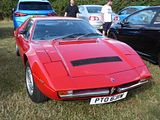


McLAREN
The McLaren 570S is a sports car designed and manufactured by the British car manufacturer McLaren Automotive, produced from 2015 until 2021. It was unveiled at the 2015 New York International Auto Show. The car is powered by a new iteration of the 3.8-litre twin-turbocharged V8 engine already used in the 650S and P1, designated M838T E with thirty per cent of the parts redesigned. It delivers 562 hp and 443 lb/ft (601 Nm) of torque through a 7-speed dual-clutch transmission developed by Graziano Trasmissioni, as it is arranged in the car as a rear-mid engine configuration, The car can accelerate from 0–62 mph (0–100 km/h) in 3.2 seconds and can achieve a top speed of 204 mph (328 km/h). A total dry weight of 2,989 lb (1,356 kg) and maximum weight of 3,201 lb (1,452 kg) gives the 570S a power to weight ratio of 428 PS per tonne delivering a fuel economy of 25.5 miles per imperial gallon (11.1 L/100 km; 21.2 mpg‑US) and CO2 emissions of 249 g/km. McLaren focused on delivering “day-to-day usability and driveability” against the most sporting model options in its range with increased luggage space, greater interior storage and leather upholstery options. The car is designed with aerodynamics in mind and the teardrop shaped cockpit helps achieve that objective. The rear of the car is inspired by the P1 and borrows the slim LED tail lights and diffuser styling from the flagship sports car. The car features dihedral doors, a trademark of McLaren as featured on its ultimate and super series cars. At the 2015 Shanghai Motor Show, the entry level McLaren Sports Series car named 540C was unveiled with 533 hp (540 PS) and 540 Nm (398 lb/ft) of torque. This new entry-level model focuses on “day-to-day usability and driveability” even more than that of the 570S with improved city driving and ride quality. The car can accelerate from 0–60 mph (0–97 km/h) in 3.4 seconds and has a top speed of 199 mph (320 km/h). The 540C is cheaper than the 570S and went on sale shortly after its Shanghai debut. The 540C is not available in the US due to McLaren wanting to focus on the more powerful 570S model for the US market. At the 2016 Geneva Motor Show, McLaren presented another addition to the Sport Series and 570 line up, dubbed the 570GT. The 570GT is the less track focused, and more road trip worthy version of the 570S. The 570GT sports a side opening cargo hatch above the mid-mounted engine for additional cargo space in place of the engine cover of the 570S, slightly softer suspension settings and improved sound insulation. The 570GT went through a facelift at the start of 2018 which added ceramic brakes as standard and steel as a free option. The convertible version of the 570S was unveiled at the 2017 Goodwood Festival of Speed event. It borrows the roof folding mechanism from the Super Series line-up. The two-piece aluminium roof folds into a compartment located behind the seats of the car leaving the rear buttress in place. The roof folding mechanism takes 30 seconds to fold and unfold and is operable at speeds up to 48 km/h (30 mph). Unlike the 12C Spider and the 650S Spider, the 570S spider required no significant reengineering for the folding roof mechanism because of the carbon monocell used in the 570S. As a result, the 570S Spider is only 46 kg (101 lb) heavier than the coupe. The drivetrain of the Spider remains identical to that of the coupe which results in similar performance to the coupé counterpart with the roof up. The Spider has new forged aluminium wheels and three special launch colours namely Vega Blue, Sicilian Yellow and Ventura Orange. Deliveries of the Spider began in late 2017

Also here was the follow-on car. the technically far more complex Artura.

MG
As one of Britain’s most popular classic cars, it was no surprise to find several examples of the MGB here, with cars from throughout the model’s long life, both in Roadster and MGB GT guise, as well as one of the short-lived V8 engined cars. Launched in October 1962, this car was produced for the next 18 years and it went on to become Britain’s best selling sports car. When first announced, the MGB was an innovative, modern design, with a monocoque structure instead of the traditional body-on-frame construction used on both the MGA and MG T-types and the MGB’s rival, the Triumph TR series, though components such as the brakes and suspension were developments of the earlier 1955 MGA and the B-Series engine had its origins back in 1947. The lightweight design reduced manufacturing costs while adding to overall vehicle strength, and with a 95hp 3-bearing 1798cc engine under the bonnet, performance was quite respectable with a 0–60 mph time of just over 11 seconds. The car was rather more civilised than its predecessor, with wind-up windows now fitted as standard, and a comfortable driver’s compartment offered plenty of legroom. The roadster was the first of the MGB range to be produced. The body was a pure two-seater but a small rear seat was a rare option at one point. By making better use of space the MGB was able to offer more passenger and luggage accommodation than the earlier MGA while being 3 inches shorter overall. The suspension was also softer, giving a smoother ride, and the larger engine gave a slightly higher top speed. The four-speed gearbox was an uprated version of the one used in the MGA with an optional (electrically activated) overdrive transmission. A five-bearing engine was introduced in 1964 and a number of other modifications crept into the specification. In late 1967, sufficient changes were introduced for the factory to define a Mark II model. Alterations included synchromesh on all 4 gears with revised ratios, an optional Borg-Warner automatic gearbox, a new rear axle, and an alternator in place of the dynamo with a change to a negative earth system. To accommodate the new gearboxes there were significant changes to the sheet metal in the floorpan, and a new flat-topped transmission tunnel. US market cars got a new safety padded dashboard, but the steel item continued for the rest of the world. Rostyle wheels were introduced to replace the previous pressed steel versions in 1969 and reclining seats were standardised. 1970 also saw a new front grille, recessed, in black aluminium. The more traditional-looking polished grille returned in 1973 with a black “honeycomb” insert. Further changes in 1972 were to the interior with a new fascia. To meet impact regulations, in late 1974, the chrome bumpers were replaced with new, steel-reinforced black rubber bumpers, the one at the front incorporating the grille area as well, giving a major restyling to the B’s nose, and a matching rear bumper completed the change. New US headlight height regulations also meant that the headlamps were now too low. Rather than redesign the front of the car, British Leyland raised the car’s suspension by 1-inch. This, in combination with the new, far heavier bumpers resulted in significantly poorer handling. For the 1975 model year only, the front anti-roll bar was deleted as a cost-saving measure (though still available as an option). The damage done by the British Leyland response to US legislation was partially alleviated by revisions to the suspension geometry in 1977, when a rear anti-roll bar was made standard equipment on all models. US emissions regulations also reduced horsepower. In March 1979 British Leyland started the production of black painted limited edition MGB roadsters for the US market, meant for a total of 500 examples, but due to a high demand, production ended with 6682 examples. The United Kingdom received bronze painted roadsters and a silver GT model limited editions. The production run of home market limited edition MGBs was split between 421 roadsters and 579 GTs. Meanwhile, the fixed-roof MGB GT had been introduced in October 1965, and production continued until 1980, although export to the US ceased in 1974. The MGB GT sported a ground-breaking greenhouse designed by Pininfarina and launched the sporty “hatchback” style. By combining the sloping rear window with the rear deck lid, the B GT offered the utility of a station wagon while retaining the style and shape of a coupe. This new configuration was a 2+2 design with a right-angled rear bench seat and far more luggage space than in the roadster. Relatively few components differed, although the MGB GT did receive different suspension springs and anti-roll bars and a different windscreen which was more easily and inexpensively serviceable. Although acceleration of the GT was slightly slower than that of the roadster, owing to its increased weight, top speed improved by 5 mph to 105 mph because of better aerodynamics. 523,826 examples of the MGB of all model types were built, and although many of these were initially sold new in North America, a lot have been repatriated here.


Built for the short lived Group B rally category, the MG 6R4 was a world away from the BL. Metro super-mini from which it took the name. Featuring a mid-mounted engine, with four wheel drive transmission enclosed in a seam welded tubular chassis, with the development entrusted to Williams Grand Prix Engineering. The car was first shown in May 1985 and was powered by a bespoke three litre V6 engine which used some of the engine architecture of the Cosworth DFV. It featured twin overhead cam shafts and four valves per cylinder, though not turbocharged as were most of its competition. Mounted south to north (backwards), in mid-ship with a permanently engaged four wheel drive, driving separate propshafts to the front and rear differentials. Most of the body was of GRP with an aluminium roof panel and steel doors. The car appeared in two guises the road going Clubman version with around 250bhp of which around 200 were sold to the public (£ 40,000) for homologation purposes, and around 20 competition cars which had an output up to 410bhp. The cars faced stiff competition in the Group B sector and despite a promising start to their programme Austin Rover withdrew, from the rallying scene at the end of 1987. Though they have since proved formidable in rallycross. Following the cancellation of the programme all parts and engines were sold to Tom Walkinshaw Racing, where upon the V6 engine reappeared with turbochargers in the Jaguar XJ220.


Rushed into production against engineers’ advice at the launch in March 1983, the original MG Maestro was under-developed. Its 1.6-litre R-series engine ran roughly, was difficult to start when warm, and its Weber twin carburettors could not be tuned by dealership workshops, who were used to SU carburettors. The R-series model was replaced in July 1984 with the short-lived S-series model which was built until October 1984 when the EFi was launched. Despite the reliability issues, more than 15,000 MG Maestro 1600s were built. After a brief interval, the MG Maestro was relaunched in October 1984 with a fuel-injected 2.0-litre O-series engine that gave considerably better performance than its predecessor. Handling and performance were both improved and gave Austin Rover its first serious rival for the Golf GTI and Escort XR3i. It had a claimed output of 115 bhp, a top speed of 115 mph (185 km/h) and a 0-60 mph time of 8.5 seconds. It was also mated with a Honda PG1 gearbox for improved gearchange, in preference to the Volkswagen box as supplied to the rest of the range. With the Rover Group only a few months away, the limited edition (500 + 5 press cars) MG Maestro Turbo (displayed at Birmingham in October 1988 and launched in early 1989) was the final car from ARG. It made use of the 2.0’s already impressive engine, but the combination of carburetor and turbocharger gave it a top speed of 128 mph (206 km/h) and a 0–60 mph time of 6.7 seconds. It was faster than the majority of its competitors, but the high performance, Tickford designed bodykit and alloys did little to disguise the fact that it was very much still a Maestro. Sales were slow, as it appeared six years after the Maestro’s launch. Production of the MG Maestro finished in 1991, as Rover had launched GTi versions of the new 200 and 400 models, though the standard Maestro remained in production until 1994.


In advance of the all-new MX5 rival that was still some way off production, MG decided to re-enter the open topped sports car market in 1992 when they launched the MGR V8, which combined new body panels with the standard MGB body shell to create an updated MGB model. The suspension was only slightly updated, sharing the leaf spring rear of the MGB. The boot lid and doors were shared with the original car, as were the rear drum brakes. The engine was the 3.9-litre version of the aluminium Rover V8, similar to the one previously used in the MGB GT V8. A limited-slip differential was also fitted. The interior featured veneered burr elm woodwork and Connolly Leather. The engine produced 190 bhp at 4,750 rpm, achieving 0–60 mph in 5.9 seconds, which was fast but largely due to the rear drum brakes and rear leaf springs, the RV8 was not popular with road testers at the time. A large proportion of the limited production went to Japan – 1579 of the 2000 produced. Only 330 RV8s were sold initially in the UK, but several hundred (possibly as many as 700) of these cars were re-imported back to the UK and also Australia between 2000–2010 with a peak number of 485 registered at the DVLA in the UK.

MG re-entered the sports car market in 1995 with the launch of the MGF Two versions of this mid-engined and affordable rival to the Mazda MX5 were offered: both of which used the 1.8 litre K-Series 16-valve engine. The cheaper of the two put out 118 hp and the more costly VVC model (by dint of its variable valve control) had 143 hp. Rover Special Projects had overseen the development of the F’s design and before finalising the styling bought-in outside contractors to determine the most appropriate mechanical configuration for the new car. Steve Harper of MGA Developments produced the initial design concept in January 1991 (inspired by the Jaguar XJR-15 and the Ferrari 250LM), before Rover’s in house design team refined the concept under the leadership of Gerry McGovern. The MGF used the Hydragas suspension, a system employing interconnected fluid and gas displacers, which gave the car a surprisingly compliant ride and which could be tuned to provide excellent handling characteristics. The MG F quickly shot to the top of the affordable sports car charts in Britain and remained there until the introduction of the MG TF in 2002. The MG F underwent a facelift in Autumn of 1999 which gave the car a revised interior as well as styling tweaks and fresh alloy wheels designs. There was also the introduction of a base 1.6 version and a more powerful 160 hp variant called the Trophy 160, which had a 0-60 mph time of 6.9 seconds. It was only produced for a limited time. An automatic version with a CVT called the Steptronic was also introduced. A comprehensive update in 2002 resulted in the MG TF, named after the MG TF Midget of the 1950s. Based upon the MG F platform but heavily redesigned and re-engineered, the most significant mechanical changes were the abandonment of Hydragas suspension in favour of conventional coil springs, the new design of the air-induction system that along with new camshafts produces more power than in MG F engines, and the torsional stiffness of the body increased by 20%. Various cosmetic changes included a revised grille, redesigned front headlights, bumpers, side air-intake grills and changes to the rear boot,. The car continued to sell well. Production was suspended when MG-Rover went out of business, but resumed again in 2007 when Nanjing built a number more.

MINI
Issigonis’ friend John Cooper, owner of the Cooper Car Company and designer and builder of Formula One cars, saw the potential of the Mini for competition. Issigonis was initially reluctant to see the Mini in the role of a performance car, but after John Cooper appealed to BMC management, the two men collaborated to create the Mini Cooper. The Austin Mini Cooper and Morris Mini Cooper debuted in September 1961. The 848 cc engine from the Morris Mini-Minor was given a longer stroke to increase capacity to 997 cc increasing power from 34 to 55 bhp. The car featured a race-tuned engine, twin SU carburettors, a closer-ratio gearbox and front disc brakes, uncommon at the time in a small car. One thousand units of this version were commissioned by management, intended for and designed to meet the homologation rules of Group 2 rally racing. The 997 cc engine was replaced by a shorter stroke 998 cc unit in 1964. In 1962, Rhodesian John Love became the first non-British racing driver to win the British Saloon Car Championship driving a Mini Cooper. A more powerful Mini Cooper, dubbed the “S”, was developed in tandem and released in 1963. Featuring a 1071 cc engine with a 70.61 mm bore and nitrided steel crankshaft and strengthened bottom end to allow further tuning; and larger servo-assisted disc brakes, 4,030 Cooper S cars were produced and sold until the model was updated in August 1964. Cooper also produced two S models specifically for circuit racing in the under 1,000 cc and under 1,300 cc classes respectively, rated at 970 cc and a 1,275 cc both had a 70.61 mm bore and both were also offered to the public. The smaller-engine model was not well received, and only 963 had been built when the model was discontinued in 1965. The 1,275 cc Cooper S models continued in production until 1971. Sales of the Mini Cooper were: 64,000 Mark I Coopers with 997 cc or 998 cc engines; 19,000 Mark I Cooper S with 970 cc, 1,071 cc or 1,275 cc engines; 16,000 Mark II Coopers with 998 cc engines; 6,300 Mark II Cooper S with 1,275 cc engines. There were no Mark III Coopers and 1,570 Mark III Cooper S.


The Mark IV was introduced in 1976, though by this stage British Leyland was working on a new small car which was widely expected to replace the Mini before much longer. It had a front rubber-mounted subframe with single tower bolts and the rear frame had some larger bushings introduced, all intended to improve the car’s mechanical refinement and to reduce noise levels. Twin column stalks for indicators and wipers were introduced, as were larger foot pedals. From 1977 onwards, the rear light clusters included reversing lights. In July 1979 the lower end of the Mini range was altered. The basic Mini 850 (which had featured in various forms since the original launch 20 years before) was withdrawn. Its place was taken by two models at slightly lower and slightly higher price points. The new base model was the Mini City, with black-painted bumpers, an untrimmed lower facia rail, part-fabric seats and wing mirror and sun visor only on the driver’s side, plus unique ‘City’ body graphics and boot badge. Above the City was the new 850 SDL (Super Deluxe), which had the same specification as the standard Mini 1000 but with the smaller engine. Reports of the Mini’s imminent demise surfaced again in 1980 with the launch of the Austin Mini-Metro (badging with the word “mini” in all lowercase). Faced with competition from a new wave of modern superminis like the Ford Fiesta, Renault 5, and Volkswagen Polo, the Mini was beginning to fall out of favour in many export markets, with the South African, Australian, and New Zealand markets all stopping production around this time. Buyers of small cars now wanted modern and practical designs, usually with a hatchback. The Metro was therefore in essence, the Mini mechanicals repackaged into a larger hatchback bodyshell. Although the Mini continued to be produced after the Metro’s launch, production volumes were reduced as British Leyland and its successor Rover Group concentrated on the Metro as its key supermini. The original Mini’s last year in the top ten of the UK’s top selling cars was 1981, as it came ninth and the Metro was fifth. The arrival of the Metro also had production of the larger Allegro pruned back before it was finally discontinued in 1982. In 1982, BL made 56,297 Minis and over 175,000 Metros. Due to their common powertrain package, the Mini received many mechanical upgrades in the early 1980s which were shared with the Metro, such as the A-Plus engine, 12-inch wheels with front disc brakes, improved soundproofing and quieter, stronger transmissions. This not only modernised the Mini but, because many of its major subassemblies were now shared with the Metro, made it very cost-effective to produce despite falling sales volumes. The next series of changes arrived in 1984 for what is sometimes referred to as the Mark V.


The Mini was the model that refused to die, with sales continuing after the launch of the Metro in 1980, and gathering momentum again in the 1990s, thanks in no small part to interest from Japan and because Rover Group decided to produce some more Cooper models. The first series of Cooper cars had been discontinued in 1971, replaced by the cheaper to build 1275GT, but when a limited edition model was produced in 1990, complete with full endorsement from John Cooper, the model was a sell out almost overnight, which prompted the decision to make it a permanent addition to the range. A number of refinements were made during the 90s, with fuel injection adding more power, a front mounted radiator and more sound deadening making the car quieter and new seats adding more comfort and a new dash making the car look less spartan inside. It formed part of the range until production of all Issigonis Minis ended in 2000

MITSUBISHI
The release of the fifth generation Mirage to Japan in October 1995 introduced a rationalized lineup as a result of the fragile post-bubble economy in Japan. Three body types were issued: first, the three-door hatchback and sedan, then in December 1995, the two-door coupé (Asti). While the sedan grew slightly in size, the hatchback and coupé shrunk modestly due the 25 mm (1 in) shorter wheelbase. It was bumped from the subcompact class to compact in the United States. Whereas the previous Mirage sedan sold in Japan featured a six-window profile, the 1995 redesign shared its styling with the Lancer except for minor differences in trim. For the Lancer, these included a different trunk lid, amber front turn signal lamps, and a restyled grille garnish. No station wagon of this generation was offered, although the previous generation wagon continued over the entire fifth generation production run. While only the sedan formed part of the Lancer range in Japan, both the coupé and sedan were labelled as Mirage and Lancer in export markets. A minor facelift arrived in 1997. Of note, the Lancer sedan featured a new grille and reshaped inner-portions of the headlamps to better differentiate it from the Mirage donor model. Both the coupé and sedan benefited from redesigned tail lamps, whereas the three-door received a redesigned front bumper incorporating a larger grille and taillights with clear tur signal. In July 1997, a classically styled version of the Mirage hatchback became available in Japan, badged Mirage Modarc. The Modarc featured chrome for the grille, side mirrors, door handles, and bumper strips; it also included fog lights and optional alloy wheels. The sedans range were also extended with arrival of the luxury Exceed trim; it featured a horizontal chrome grille and wood interior. Most of the drivetrains from the previous generation were retained to save development cost. The 1.5-liter DOHC engine was changed from the 4G91 to 4G15 in Japan – export markets remained with the 12-valve SOHC version – the V6 engine was enlarged to a 1.8-lter unit, while the 1.8-liter turbodiesel engine for the Mirage sedan was discontinued. Some high-performance models below the Lancer Evolution were also offered for this generation, despite the unfavorable economic situation. All entry-level performance models retained the older 175 PS 1.6-litre MIVEC engine, which was also exported to Hong Kong and Singapore as the Lancer MIVEC. Meanwhile, the 205 PS 1.8-litre turbocharged model was offered for both the Lancer GSR and Mirage VR-X sedans, alongside the older Libero GT station wagon until 1999. Although a new, substantially larger and more expensive generation of Lancer sedan arrived in 2000, many export markets retained the Mirage-derived model up until 2003 when Japanese manufacture concluded and Mitsubishi retired the Mirage nameplate worldwide. This is especially true of the hatchback and coupé which were not redesigned due to Mitsubishi’s financial troubles. In other markets, the newer sedan often co-existed with the old as a more premium offering. Mitsubishi eventually replaced the three-door in 2005 for Europe only with the three-door Colt—the name previously used in many export markets to denote the Mirage from 1978 onwards. A five-door variant of the Colt had earlier been released in 2002. By 2003, the only Mirage sold in Japan was the coupé, now without the Asti designation. Mitsubishi did not tender a replacement for the coupé. As before, the European market Mirage hatchback of this generation was sold as the Colt between 1996 and 2001, powered by either 1.3- or 1.6-litre engines. On the other hand, the Lancer sedan was marketed in limited markets (such as in Germany, Ireland, Greece and the Netherlands) and only fitted with a 1.3-litre engine, positioned below the mid-size Carisma. In 1999, the limited edition of Colt hatchback gained a chrome-trimmed grille insert from the Japanese-market Mirage Modrac.


MORGAN

NG
This is an NG TA, one of over a 1000 cars have been lovingly created from its offered over a number of years. There were several different versions offered: The NG TA, the original, ‘sit up and beg’ 2+2; The NG TC a two seater, cycle wing with a boat tail; The NG TD similar to the TF but with front cycle wings; the NG TF a 2+2 flared wing beauty; the NG Ascot a Marina based TF; and the NG Henley was a Sierra or Cortina based TF. Most of the cars were built on MGB mechanicals and chassis, but later cars were Ford based.

NISSAN
The Z32 version of the 300ZX was a new design, approved in final form by Nissan management on October 1, 1986 and designed by Isao Sono and Toshio Yamashita.[20] The body was wider with a rounder profile and fewer hard edges. It had a marginally increased drag coefficient of .31 compared to the Z31’s .30. Unchanged from the previous generation 300ZX was the displacement of the 2,960 cc (3.0 L) VG30 V6 engine, now with DOHC and variable valve timing (N-VCT), producing 222 bhp at 6,400 rpm and 198 lb/ft (268 Nm) at 4,800 rpm in naturally aspirated (NA) form. The twin turbocharged (TT) variant was upgraded with Garrett AiResearch parallel twin-turbochargers and dual intercoolers producing 300 bhp at 6,400 rpm and 283 lb/ft (384 Nm) of torque at 3,600 rpm. The Z32 was the first car to be marketed following the introduction of the 280 PS power ceiling imposed by JAMA that remained until 2004. Performance varied from 0-60 mph times of 5.0-6.0 seconds depending on the source, and a governed top speed of 155 mph (249 km/h). Twin Turbocharged Z32s also featured adjustable two mode suspension and the four-wheel steering systems called “Super HICAS” (High Capacity Actively Controlled Steering), first introduced on the R31 Nissan Skyline. Nissan utilized the Cray-2 supercomputer to design the new Z32 with a form of CAD software making it one of the first production cars to utilize this tool. Like previous generations, Nissan offered a 4-seater (2+2) model with the Z32. Most Z32s now featured T-tops as standard. A hardtop (Slicktop) model was available in North America, only in Naturally Aspirated guise, and in Japan was available as Naturally Aspirated as well as an extremely rare Twin Turbo model (Japan-only). All “Slicktops” were 2 seaters (2+0). In 1992, a 2-seat convertible version (produced by ASC) was introduced for the first time, in response to after-market conversions. In 1990, Motorsports International of Waco, Texas collaborated with Japanese tuning company HKS to create the SR-71 Z32. The cars were upgraded with larger Garrett turbochargers, HKS electronics and a Kaminari body kit designed for the SR-71 by Pete Brock. The SR-71 was California CARB certified and was to be sold through a select dealer network and Japanese performance tuning shops located within the United States. It was planned to build 500 cars per year through 1993. One hundred orders were already in hand. The exact number is not known. The SR-71 claimed the title of the third fastest production car in the world in 1990 for a fraction of the price of a Lamborghini Diablo and Ferrari F40 according to the designer Randy Ball.[citation needed] The base price was $65,000 for the Z32 and SR-71 conversion. In 1995 and 1996, Steve Millen Motorsports (Stillen), developed a SMZ model with Nissan North America that were sold throughout the U.S. and Canada through designated Nissan dealerships. The performance upgrades were covered by the factory warranty. Each vehicle was numbered in the engine bay and interior. A total of 104 SMZs were produced at $14,000 more than the standard Nissan Z32 Twin Turbo. American Z-car sales reached one million sales during the 1990 model year, making it at that time the best selling sports car. In America the 300ZX faced the same fate of many Japanese sports cars of the time. While the 1989 300ZX was priced at around $30,000, its final model year price increased to about $50,000. The mid-1990s marketplace trends toward SUVs and the rising Yen:Dollar ratio contributed to the end of North American 300ZX sales in 1996 with over 80,000 in sales. A Commemorative Edition for the final 300 units shipped to America included decals and certificates of authenticity. In the UK & Europe, all Z32s offered were in 2+2 TT form between 1990 and 1996 (1990-1994 for UK). They were sold through dealerships in the UK, France, Germany, Belgium and Italy. In Australia, all Z32s offered were in 2+2 NA form between 1990 to 1995. In Japan, the 300ZX continued until August 2000. The Japanese Domestic Market was offered a number of variants unavailable to the international market such as the “Version S” (Spec Model), “Version R” (Ready Model) and Slicktop Twin Turbo (the most expensive trim option only available in Version S guise). The facelift of late 1998 featured a new front fascia, tail lights, optional Xenon HID headlights, optional rear spoiler, optional BBS mesh wheels, orange rear corner lights and an instrument cluster with white dials as well as other minor changes. Early model Z32s (made pre-1994) and sold in Japan did not have Exhaust Gas Recirculation systems nor Air Injection Valve systems. All JDM Z32s used a front rebar system made out of fiberglass rather than steel (like their American Market counterparts), and also had different exhaust systems with lighter weight Catalytic Converters (with only one set on the JDM Twin Turbo model vs. two sets on the USDM Twin Turbo models). Given the lack of these regulatory items, JDM Z32s often weighed 100+lbs (45+kg) less than their American specification counterparts. The Z32 chassis underwent some changes during its production run between 1989 and 2000 (Japan) and 1990 to 1996 (US). The Z32’s extended model year sales in 1990 reached 39,290 units.

PEUGEOT
Mindful of the success of the Golf GTi, in the class above, and how a small car with good handling could take more power, as the Mini Cooper had proved, Peugeot came up with the GTi in early 1984. The first models had a 1.6 litre XU5J engine, producing 105 PS, which was uprated in 1987 with a cylinder head with larger valves thus becoming XU5JA, which took the power output up to 115 bhp. Visually the car retained the good looks of the 3 door version of the regular models, but it featured plastic wheel arch extensions and trim, beefier front and rear bumper valances and judicious use of red badging and trim. The shell also underwent some minor changes, including larger wheel arches (to suit the larger wheels , and the suspension was redesigned and sat lower on the GTI with stiffer springs, different wishbones and a drop-linked anti-roll bar. Red was a dominant colour inside. The car was an instant hit. At the end of 1986, Peugeot followed up with a more potent model, the 1.9 GTi, whose XU9JA engine produced 128 PS. Internally the engine of this car and the 1.6 model are very similar, the main differences on 1.9 litre versions being the longer stroke, oil cooler, and some parts of the fuel injection system. The shorter stroke 1.6 litre engine is famed for being revvy and eager, while the 1.9 litre feels lazier and torquier. Outside the engine bay the main differences between the 1.6 GTi and the 1.9 GTi are half-leather seats on the 1.9 GTi vs. cloth seats and disc brakes all-round (1.9 GTi) vs. discs at the front and drum brakes at the back; as well as the 14-inch Speedline SL201 wheels on the 1.6 GTi vs. 15 inch Speedline SL299 alloys on the 1.9 GTi. The 205 is still often treated as a benchmark in group car tests of the newest GTI models or equivalent. Peugeot itself has never truly recreated this success in future GTI models, although they came very close with the highly regarded GTI-6 variant of the Peugeot 306.

PORSCHE
Replacing the 964, the 993 models were first seen in October 1993, with production starting a few weeks later. Its arrival marked the end of air-cooled 911 models. The 993 was much improved over, and quite different from its predecessor. According to Porsche, every part of the car was designed from the ground up, including the engine and only 20% of its parts were carried over from the previous generation. Porsche refers to the 993 as “a significant advance, not just from a technical, but also a visual perspective.” Porsche’s engineers devised a new light-alloy subframe with coil and wishbone suspension (an all new multi-link system), putting behind the previous lift-off oversteer and making significant progress with the engine and handling, creating a more civilised car overall providing an improved driving experience. The 993 was also the first 911 to receive a six speed transmission. The 993 had several variants, as its predecessors, varying in body style, engines, drivetrains and included equipment. Power was increased by the addition of the VarioRam system, which added additional power, particularly in the mid-ranges, and also resulted in more throttle noise at higher revs; as a consequence, resulted in a 15% increase in power over its predecessor. The external design of the Porsche 993, penned by English designer Tony Hatter, retained the basic body shell architecture of the 964 and other earlier 911 models, but with revised exterior panels, with much more flared wheel arches, a smoother front and rear bumper design, an enlarged retractable rear wing and teardrop mirrors. A major change was the implementation of all alloy multi-link rear suspension attached to an alloy sub frame, a completely new design derived from the 989, a four-door sedan which never went into production. The system later continued in the 993’s successor, the 996, and required the widening of the rear wheel arches, which gave better stability. The new suspension improved handling, making it more direct, more stable, and helping to reduce the tendency to oversteer if the throttle was lifted during hard cornering, a trait of earlier 911s. It also reduced interior noise and improved ride quality. The 993 was the first generation of the 911 to have a 6-speed manual transmission included as standard; its predecessors had 4 or 5-speed transmissions. In virtually every situation, it was possible to keep the engine at its best torque range above 4,500 rpm. The Carrera, Carrera S, Cabriolet and Targa models (rear wheel drive) were available with a “Tiptronic” 4-speed automatic transmission, first introduced in the 964. From the 1995 model year, Porsche offered the Tiptronic S with additional steering wheel mounted controls and refined software for smoother, quicker shifts. Since the 993’s introduction, the Tiptronic is capable of recognising climbs and descents. The Tiptronic equipped cars suffer as compared to the manual transmission equipped cars in both acceleration and also top speed, but the differences are not much notable. Tiptronic cars also suffered a 55 lb (25 kg) increase in weight. The 993’s optional all wheel drive system was refined over that of the 964. Porsche departed from the 964’s setup consisting of three differentials and revised the system based on the layout from its 959 flagship, replacing the centre differential with a viscous coupling unit. In conjunction with the 993’s redesigned suspension, this system improved handling characteristics in inclement weather and still retained the stability offered by all wheel drive without having to suffer as many compromises as the previous all-wheel-drive system. Its simpler layout also reduced weight, though the four wheel drive Carrera 4 weighs 111 lb (50 kg) more than its rear wheel drive counterpart (at 3,131 lb (1,420 kg) vs. 3,020 lb (1,370 kg)). Other improvements over the 964 include a new dual-flow exhaust system, larger brakes with drilled discs, and a revised power steering. A full range of models arrived before the arrival of the 996 generation in 1998.

During the 1990s, Porsche was facing financial troubles and rumours of a proposed takeover were being spread. The signature air-cooled flat-6 of the 911 was reaching the limits of its potential as made evident by the 993. Stricter emissions regulations world wide further forced Porsche to think of a replacement of the air-cooled unit. In order to improve manufacturing processes, Porsche took the aid of leading Japanese car manufacturer Toyota whose consultants would assist in the overhaul of the Zuffenhausen manufacturing facility introducing mass production techniques which would allow Porsche to carry out production processes more efficiently. Porsche had realised that in order to keep the 911 in production, it would need radical changes. This led to the development of the 996. The sharing of development between the new 911 and the entry level Boxster model allowed Porsche to save development costs. This move also resulted in interchangeable parts between the two models bringing down maintenance costs. The Porsche 996 was a new design developed by Pinky Lai under Porsche design chief Harm Lagaay from 1992 to 1994; it was the first 911 that was completely redesigned, and carried over little from its predecessor as Porsche wanted the design team to design a 911 for the next millennium. Featuring an all new body work, interior, and the first water-cooled engine, the 996 replaced the 993 from which only the front suspension, rear multi-link suspension, and a 6-speed manual transmission were retained in revised form. The 996 had a drag coefficient of Cd=0.30 resulting from hours spent in the wind tunnel. The 996 is 185 mm (7 in) longer and 40 mm (2 in) wider than its predecessor. It is also 45% stiffer courtesy of a chassis formed from high-strength steel. Additionally, it is 50 kg (110 lb) lighter despite having additional radiators and coolant. All of the M96 engines offered in the 996 (except for the variants fitted to the Turbo and GT2/GT3 models) are susceptible to the Porsche Intermediate Shaft Bearing issue which can potentially cause serious engine failure if not addressed via a retrofit. The 996 was initially available in a coupé or a cabriolet (Convertible) bodystyle with rear-wheel drive, and later with four-wheel drive, utilising a 3.4 litre flat-6 engine generating a maximum power output of 296 bhp. The 996 had the same front end as the entry-level Boxster. After requests from the Carrera owners about their premium cars looking like a “lower priced car that looked just like theirs did”, Porsche redesigned the headlamps of the Carrera in 2002 similar to the high performance Turbo’s headlamps. The design for the initial “fried egg” shaped headlamps could be traced back to the 1997 911 GT1 race car. In 2000, Porsche introduced the 996 Turbo, equipped with a four-wheel-drive system and a 3.6-litre, twin-turbocharged and intercooled flat-six engine generating a maximum power output of 420 bhp, making the car capable of accelerating from 0–60 mph in 4.2 seconds. An X50 option which included larger turbochargers and intercoolers along with revised engine control software became available from the factory in 2002, increasing power output to 451 bhp. In 2005, Porsche introduced the Turbo S, which had the X50 option included as standard equipment, with the formerly optional Carbon fibre-reinforced Silicon Carbide (C/SiC) composite ceramic brakes (PCCB) also included as standard. In 2000, power output on the base Carrera model was increased to 300 bhp. 2001 marked the final year of production for the base Carrera 4 Coupé in narrow body format. In 2002, the standard Carrera models underwent the above-mentioned facelift. In addition, engine capacity was also increased to 3.6-litres across the range, yielding gains of 15 bhp for the naturally aspirated models. 2002 also marked the start of the production of the 996 based Targa model, with a sliding glass “green house” roof system as introduced on its predecessor. It also features a rear glass hatch which gave the driver access to the storage compartment. Also in 2002, the Carrera 4S model was first introduced.

RELIANT
Tom Karen of Ogle was asked to submit some body designs based on the Ogle Design GTS estate car experiment for a new four-seater Scimitar, the SE5 Reliant Scimitar. Managing Director Ray Wiggin, Chief Engineer John Crosthwaite and fibreglass body expert Ken Wood went to Ogle’s in Letchworth to view some mock-up body designs for the new SE5. Wiggin told Wood to proceed with a proper master. The SE5 was conceived and ready for the 1968 Motor Show in less than 12 months. For the SE5 John Crosthwaite and his team designed a completely different longer chassis frame, revised suspension, new and relocated fuel tank, a rollover bar, new cooling system, spare wheel mounted in the nose to give increased rear space and a 17+1⁄4 imperial gallons (78 L) fuel tank. When designing the chassis Crosthwaite worked closely with Ogle body stylist Peter Bailey to modify and refine the prototype. The main change introduced in the SE5 was the sports estate hatchback body shape, although other car manufacturers had also produced hatchback models. The SE5 came with the same 3.0-litre Ford Essex engine used in the SE4a/b. This gave the SE5 a claimed top speed of over 120 mph (193 km/h). A Borg-Warner 35 automatic transmission was added as an option in 1970 and by 1971, overdrive on the 4-speed manual was offered. In 1972 several improvements were included in the upgrade to SE5A, including a boost in power. The extra 7 hp and maximum engine speed raised performance and the GTE was now capable of 0–60 mph (0–97 km/h) in 8.5 seconds and top speed was raised to 121 mph (195 km/h). The SE5’s flat dashboard also gave way to a curved and moulded plastic one. The SE5A can be recognised from a SE5 at the rear by the reverse lamps which are below the bumper on the earlier model and are incorporated into the rear clusters on the later version (these were also carried over onto the SE6 and later). Badging changes included changing the “SCIMITAR” lettering from a narrow type-style to a fatter one. Directly following the announcement of the car, Autocar magazine tested a 3-litre GTE (with manual transmission) in October 1968. They reported a maximum speed of 117 mph (188 km/h) and a 0–60 mph (0–97 km/h) time of 10.7 seconds. Overall fuel consumption for the test came in at 18.5 mpg. The manufacturer’s UK market recommended retail price, including sales taxes, was £1,759. The 3-litre MG MGC GT was retailing at this time for £1,337 while Rover’s 3500 was offered for £1,791. Launch of the more directly comparable Volvo 1800ES was still four years away. 4,311 SE5s were produced. It was an instant success; GT production was cut down and the proportion of GTEs to GTs being built was four-to-one. Reliant increased its volume by 20% in the first year. The 5A model sold more than any other Scimitar, with 5105 manufactured. Princess Anne was given a manual overdrive SE5 as a joint 20th birthday present and Christmas present in November 1970 by the Queen and the Duke of Edinburgh. It was Air Force blue in colour with a grey leather interior and registered 1420 H in recognition of her position as Colonel-in-Chief of the 14th/20th Hussars. Anne subsequently owned eight other GTEs.

RENAULT
The “Supercinq” appeared in the autumn of 1984, with RHD models going on sale in February 1985. Its launch came within 18 months of Ford, General Motors, Peugeot, Fiat and Nissan all launching new competitors in the supermini sector. Although the bodyshell and chassis were completely new (the platform was based on that of the larger Renault 9 and 11), familiar 5 styling trademarks were retained; with the new styling being the work of Marcello Gandini. The new body was wider and longer featuring 20 percent more glass area and more interior space, with a lower drag coefficient (0.35), as well as 68.9 mpg at 56 mph in the economy models. The biggest change was the adoption of a transversely-mounted powertrain taken directly from the 9 and 11, plus a less sophisticated suspension design, which used MacPherson struts. When launched, it had the following ranges: TC, TL, GTL, Automatic forms. The entry-level TC had the 956 cc engine rated at 42 bhp, while the TL had the 1108 cc engine rated at 47 bhp, and the GTL, Automatic, TS and TSE had the 1397 cc engine rated at 59 hp for the GTL, 67 hp for the Automatic, and 71 hp for the TS and TSE). The TC and TL had a four-speed manual gearbox, while the GTL, TS and TSE had a five-speed manual gearbox (which was optional on the TL), and the Automatic had a three-speed automatic gearbox. 1987 saw the introduction of the 1721 cc F2N engine in the GTX, GTE (F3N) and Baccara (Monaco in some markets, notably the United Kingdom). Renault decided to use the naturally aspirated 1.7 litre from the Renault 9/11, which utilised multipoint fuel injection, in addition to the sports orientated 1.4 litre turbo. Under the name GTE, it produced 94 hp. Although not as fast as the turbo model, it featured the same interior and exterior appearance, as well as identical suspension and brakes. The Baccara and GTX versions also used the 1.7 engine – the former sporting a full leather interior, power steering, electric windows, sunroof, high specification audio equipment and as extras air-conditioning and On-Board Computer. The latter was effectively the same but the leather interior was an option and there were other detail changes. As with the previous generation, the 5 Turbo was again assembled at the Alpine plant in Dieppe, where forty cars per day were constructed in 1985. The model was starting to show its age by 1990, when it was effectively replaced by the Clio, which was a sales success across Europe. Production of the R5 was transferred to the Revoz factory in Slovenia when the Clio was launched. It remained on sale with only 1.1 and 1.4 litre petrol and 1.6 litre naturally aspirated diesel engines, as a minimally equipped budget choice called the Campus. until the car’s production run finally came to an end in 1996. A number of limited edition models were offered throughout the model’s life. These tended to be market specific. The “Famous Five” was produced for the UK in March 1990, just before the unveiling of the follow-on Clio. Based on the TR, it had the 55bhp 1.1 litre petrol engine, and was available with three or five doors. As well as the special stickers on the side of the car, still evident on this one, the model had reclining seats, a special two-tone upholstery, heating, quartz clock, sunroof, variable speed wipers, a Boombox Philips radio, side vents on the dashboard and tinted windows.

In 1999 Renault presented the first officially branded RenaultSport Clio, this was the third Clio produced by the RenaultSport division succeeding the Clio 16V and Clio Williams. This new Clio, the 172 was based on the 3 door Clio II shell however had numerous features over the standard car including wider arches, restyled bumpers, side skirts and 15-inch OZ F1 alloy wheels. Power was delivered by the F4R730 engine, a 2.0-litre 16-valve Inline 4 engine with a Variable valve timing (VVT) system via a dephaser on the intake camshaft pulley. The engine was a modified version of the F4R used in models such as the Laguna and Espace and was modified by Mecachrome to deliver a power output of 172 PS. Power was delivered to the wheels via a JC5-089 five-speed manual gearbox. The 172 also featured interior changes over the standard car including Half Leather, Half Alcantara seats embossed with the RenaultSport logo and the car also came standard with manually controlled Air Conditioning. A limited edition of the Phase 1 172 was produced and known as the Clio 172 Exclusive. This was limited to 172 units, all 172 of this “Exclusive” edition were 296 Scarab Green, featured BBS alloy wheels and a full leather interior as opposed to the half-leather half Alcantara seats featured in the standard car. In 2001 the interior and exterior of the Clio II were face-lifted, the Clio RS followed suit shortly after. This facelift of the Clio 172 included redesigned front and rear bumpers, the front bumper falling in line with the style of the face-lifted Clio II. The rear bumper was now less rounded and featured a strip of ABS plastic effectively splitting the bumper into two. The lights, bonnet and boot lid were also matched to the face-lifted Clio II. The interior was also changed to closer match that of the face-lifted Clio II, the seats were slightly revised however still featured the same Half Leather, Half Alcantara fabrics and the embossed RenaultSport logo. One new feature that the Phase 2 172 featured was automatic climate control as opposed to the manual air-conditioning featured in the Phase 1. The dashboard featured Silver interior trims and the steering wheel included a plastic insert featuring the RenaultSport logo. The gear shifter was changed from the metal ball featured on the Phase 1 to a Leather wrapped shifter with a silver coloured insert on the top. The Phase 2 172 also featured increased equipment including automatic Xenon headlights and headlight washers, Rain Sensing wipers a six-disc CD changer, and it also included side-impact airbags integrated into the seats. The 15-inch OZ F1 alloy wheels were also replaced with a 16-inch Alloy Wheel of Renault’s own design. The facelift of the 172 also brought about a number of changes to the engine of the car. A revised version of the F4R used, the F4R 736, this featured a revised cylinder head with the exhaust ports being approximately 30% smaller than those featured on the Phase 1 172. The airbox was also redesigned to be much more square than the original airbox. A revised version of the JC5 gearbox, the JC5-129 was introduced in this version of the Clio 172, which revised JC5 featured a shorter final drive to counter the increased weight of the face-lifted 172. The catalytic converter, which on the PH1 172 had been dual barrel was reduced to a single barrel and featured 2 lambda sensors, one before and one after the catalytic converter. The biggest change to the PH2 172 over the PH1 was the introduction of an electric throttle. This meant the Idle Control Valve of the PH1 was no longer required leading to a minor redesign of the intake manifold. In 2002 Renault released the 172 Cup, which bore the chassis code CB1N and was known by Renault as the “sport lightweight version”. The vast majority of cars were produced in D43 Mondial Blue (metallic) with a limited run of around 90 cars being produced in 640 Iceberg Silver (metallic). The Cup, originally built for Gr.N homologation of the Clio 172 was differentiated from the “non cup” 172 by its lack of many of the luxuries included in the regular car. Instead of the leather / Alcantara seats instead the same style seat was upholstered in a durable but low-cost fabric, the automatic Xenon headlights were replaced by manually controlled halogen units and the washer jets replaced with blanks. The rain sensing wipers and solar reflective coated windscreen were also omitted from the 172 Cup. However the car had features not before seen on a production version of the 172, which included lightweight 16-inch Speedline Turini alloy wheels, matte blue door strips, ABS plastic “Cup” front splitter and a restyled “Cup” rear spoiler. The dash strips which were silver on the regular car were painted to match the outside of the car. One of the main features of the 172 Cup was its significant weight saving, having a kerb weight of 1021 kg, making it the lightest of 172 versions produced. This was achieved by the removal of a majority of sound deadening from the car alongside thinner glass to reduce weight even further. One large difference was also the lack of air conditioning which was a standard fit component on the regular 172, which typically led to the cup producing more power due to the engine having less ancillaries to drive. This however was reintroduced as an optional extra later in the production run of the Cup. The 0–60 time of the 172 Cup was officially marketed by Renault as being 6.5 seconds; however AutoCar Magazine reportedly timed the 0–60 at 6.2 seconds which if this were the case would make the 172 Cup the second fastest road going Clio produced at the time of this article, second to only the V6. Many enthusiasts regard the 172 Cup as the last “hardcore” hot hatch due to its lack of anti-lock brakes; the car also featured modified suspension which gave it a wider track thanks to modified wishbones, the car also sat lower than standard and featured stiffer shocks and springs, the suspension geometry was revised to suit these components and to mean that the steering response was increased, this also lead to an increase in oversteer thanks to the lack of weight and revised geometry. Due to the lack of ABS the brake bias of the car was fixed by way of disconnecting the rear axle compensator, within the UK this often lead to the cars failing the MOT test, VOSA eventually issued an advisory to prevent this from happening. 2004 marked yet another refresh of the Clio II. The inserts of the headlights were changed from Black to Grey, new wheels styles were introduced and new colour options were added with others being dropped. The basic design of the car stayed the same with only minor changes. The Six-Disc CD changer was dropped as standard equipment however was still available as a cost option. This refresh marked the introduction of cruise control and Electronic Stability Program (ESP) as standard equipment. The Clio RS featured a lot more changes than the regular Clio. The engine was again revised and became the F4R 738. The difference between the F4R 738 and F4R 736 was a revised oil breather setup meaning the intake manifold found on a 172 would not fit a 182. Thanks to a number of other changes this engine produced 182 PS . This increase in power was thanks to the addition of a 4-2-1 Manifold and high flow 200 cell sports catalytic converter. The spare wheel well was removed and replaced with a flat floor to make way for the new dual exit exhaust featured on the 182. Minor revisions were made to the interior, the perforated texture of the Alcantara on the seats now featured white dots. The car also featured a new 8 spoke wheel design which came in Silver on a regular car and Anthracite on a “Cup Packed” car. The rarest optional extra available was the Carminat Sat-Nav which was fitted to very few cars. However, the unit wasn’t a popular option due to its high cost and rumoured poor performance compared to aftermarket options. The “Cup” Front Splitter and “Cup” Spoiler originally fitted to the 172 Cup made a reappearance as a cost option known as the Cup Style Pack. This was one of two cup packs available, the other being the Cup Chassis. This Cup Chassis pack included a strengthened hub with 60mm spacing on the strut bolt holes as opposed 54mm on non cup packed cars. The Cup Chassis also featured lowered suspension with stiffer shocks and springs and an anthracite version of the standard alloy wheels. The Clio 182 could also be ordered in a more race focused than ‘base’ RS model called “Cup Specification”, this was available in just two colours, J45 Racing Blue and D38 Inferno Orange, however came as Standard with the Cup Chassis and Cup Style Pack. The 182 Cup lacked the automatic Xenon headlights and headlight washer jets, climate control (rear footwell heater vents were also removed), illuminated sun visors, Solar Reflective Windscreen and Automatic Wipers. The leather / Alcantara seats were replaced with cloth items and the rear bench was downgraded to match. The engine cover and sill plates were removed and the steering wheel was downgraded to no longer include the RenaultSport Logo or rubber thumb grips. Carpet and headlining were downgraded to basic specification and even the documentation wallet was changed from faux leather to cloth. Sound deadening was removed from the 182 Cup, the horn was downgraded from a twin to single unit and the interior light no longer included a map reading function. Despite all of these reductions in specification the 182 Cup was still considerably heavier than the previous 172 Cup, meaning this version of the Clio II RS was considered one of the least desirable versions. The final version of the Clio 182 was known as the 182 Trophy. This version was based on the 182 Cup and featured the same strengthened hubs with 60 mm bolt spacing. Originally only 500 cars were to be produced for the UK market however an additional 50 were produced to be sold in Switzerland. At the time, believing there was no market for this version of the Clio, the Marketing Department of Renault France failed to order a 182 Trophy. The 182 Trophy included 16 Inch Speedline Turini Alloy wheels as seen on the 172 Cup, the Spoiler from the Clio 255 V6, Recaro Trendline seats and exclusive 727 Capsicum Red Paint with Trophy Decals lacquered onto the Side skirts. Each car had an individually numbered plaque on the base of the driver’s seat. The biggest difference however between the 182 Cup and 182 Trophy was the inclusion of Sachs Remote-Reservoir dampers. The basic principle of a Remote-Reservoir damper is that because there is a separate reservoir for the gas or oil which fills the shock they can either be of a reduced length or can house a longer rod, this means that the sizing of the shock can be optimised for the application in which it is being used. These changes definitely made a big difference to the 182 Trophy and have led to its being heralded as one of the best hot hatches of all time and it won Evo Magazine’s “People’s Performance Car of The Year” 2005, whilst also beating off rivals such as the Lamborghini Gallardo and other exotica in an Evo Magazine Group Test. AutoCar Magazine’s front cover from 5 July 2005 simply stated “World’s Greatest Hot Hatch”.

Also here was an example of the recently released all-electric retro-styled R5 EV.


SAAB
The Saab 9000 was produced from 1984 to 1998. Representing the company’s foray into the executive car scene, it was developed as a result of the successes of the turbocharged 99 and 900 models. The 9000 remained in production until May 1998 and it was replaced by the Saab 9-5 in late 1997, although some final cars were produced into 1998. The Saab 9000 was only available with petrol engines, in two different 5-door hatchback designs or as a 4-door notchback. Saab designed the 9000 as part of the Type Four platform in conjunction with the Italian automaker Fiat Automobiles. Fiat retailed similar derivative versions as the more basic Fiat Croma, the luxury-themed Lancia Thema, and the sports-oriented Alfa Romeo 164. Unlike the 164, which shares only the chassis, the Croma and Thema are outwardly similar to the 9000. As such, much of the bodywork appeared interchangeable between the 9000, Croma and Thema; for example, the doors. However, because Saab fitted heavier side impact protection they will not fit. Also the front of the Saab is radically different from the Italian siblings due to the much improved crash protection. Only seven parts are actually interchangeable. The 9000’s body was designed by Giorgetto Giugiaro and Saab designer Björn Envall. Despite being shorter overall than the 900 which was still produced in parallel, the 9000 has a longer wheelbase and greater interior space with 123-cu.ft. of interior space (23.5-cu.ft. in the trunk, 56.5-cu.ft. with rear seats folded), qualifying as an EPA-rated “large car”, a distinction shared only with the contemporary Rolls-Royce in America. This was achieved by installing the engine transversely to the direction of travel in the Saab 9000 (instead longitudinally as in the Saab 900). Unlike the 900 the 9000 kept the ignition switch in the more conventional steering column position rather than between the front seats. The inspiration for the seats was taken by Björn Envall from The Muppet Show’s Pigs in Space, a sketch by the late puppeteer Jim Henson. In total, 503,087 Saab 9000s were manufactured. These are divided into: 216,385 Saab 9000 CC (MY 1985-1991) 174,525 Saab 9000 CS (MY 1992-1998) 112,177 Saab 9000 CD (MY 1988-1997).


SUBARU
Now heading towards 30 years old are the first generation Impreza Turbo models. There have been seven noted versions of the WRX dating back from Subaru’s original World Rally Cross staging vehicles. Subaru adopted the name “WRX” to stand for “World Rally eXperimental” as all WRX versions (1992 to present) feature rally inspired technology, including all wheel drive, stiffened suspensions and turbocharged four cylinder engines. The STi versions were marketed with consecutive numbers. Another way to determine the version of a WRX was to look at the chassis code. All WRX sold between 1992 and 2000 have the beginning chassis code of GC8 2/4 door sedan or GF8 hatchback; this is followed by a letter from A to G. Coupe versions share the “GC” code with sedans, except in the US, where they have a separate chassis code of “GM”. In 1994, Subaru introduced Subaru Tecnica International (STi badged) versions of the WRX in Japan. These models were upgraded from the standard WRX in many categories, including blueprinted performance-tuned engines, transmissions, and suspensions. The STi versions of the WRX were immensely successful in rallies and popular among street racers but were only sold in the Japanese market. Compared to the WRX, the STi had mostly mechanical modifications. (STi prepped Subaru rally cars since 1988 including the Legacy RS, the WRX STi Version was just the first car with an actual STi badge, though with handcrafted tuning). The WRX debuted in November 1992 with 240 PS. The centre differential was a viscous coupling type, the rear limited slip differential was a viscous type. The WRX Type RA is a stripped down version of the WRX that was available in the Japanese market for people to purchase for motorsports and tuning. Targeted for race and rally, the RA versions were generally lighter in weight; featuring reduced soundproofing, manual windows, car horn delete, no air conditioning, no anti-lock brakes, and added racing features such as more robust engines, 5th injection, intercooler water spray and shorter gearing. The WRX Type RA uses a closer ratio gearbox and a three-spoke leather steering wheel from Nardi. The ra model chassis code between GC8-(000000 to 005000) are only sold to the race team by order. Close ratio transmission is anticipated race use, the gap between each gear is brought closer together and a specific close ratio transmission is used. In Europe, the WRX was introduced as the Impreza GT, and as the Impreza Turbo 2000 (UK). It came with 208 hp. A bewildering array of different versions would follow until the release of the second generation Impreza in 2000.

For the VA series WRX released in 2014 for the 2015 model year, Subaru decided to move away from marketing the WRX and WRX STI under the Impreza name. This time, the Impreza name was dropped in all markets in which the new model is named simply as the WRX, as had been the case in North America with the previous model, while in Japan it was sold as the WRX S4. The WRX and WRX STI are the performance model based on the GJ Impreza with higher output engines, firmer suspension, larger brakes, slightly resculpted body panels, lowered ride height and larger intakes. The body design also took a stronger departure from the Impreza donor model than in the past. The general WRX profile/silhouette was carried over from the Impreza, as were the front doors, trunk lid, and interior. However, the entire front end bodywork plus the rear quarter panels were unique to the WRX. The rear doors received a subtle reskin with an upwards kink and revised character line, but retained an otherwise identical shape. Subaru had promised to completely move the WRX and STI off the Impreza chassis and body to create a standalone model. The VA-body WRX is based on a modified Impreza body and chassis, with the Impreza name dropped from the WRX in all markets. For this generation, Subaru decided to not produce a WRX or WRX STI hatchback as had been previously offered. The previous generation hatchback made up approximately 50 percent of US WRX and WRX STI sales. The car had a very mixed reaction, and sold in small quantities in Europe, so these are quite rare machines.

TOYOTA
The MR2 derived from a 1976 Toyota design project with the goal of a car which would be enjoyable to drive, yet still provide good fuel economy – not necessarily a sports car. Design work began in 1979 when Akio Yoshida from Toyota’s testing department started to evaluate alternatives for engine placement and drive method, finalising a mid-transverse engine placement. Toyota called the 1981 prototype SA-X. From its original design, the car evolved into a sports car, and further prototypes were tested both in Japan and in the US. Significant testing was performed on race circuits including Willow Springs, where former Formula One driver Dan Gurney tested the car. All three generations were in compliance with Japanese government regulations concerning exterior dimensions and engine displacement. The MR2 appeared around the same time as the Honda CR-X, the Nissan EXA, the VW Scirocco from Europe, and the Pontiac Fiero and Ford EXP from North America. Toyota debuted its SV-3 concept car in October 1983 at the Tokyo Motor Show, gathering press and audience publicity. The car was scheduled for a Japanese launch in the second quarter of 1984 under the name MR2. Toyota introduced the first-generation MR2 in 1984, designating it the model code “W10”. When fitted with the 1.5-litre 3A engine, it was known as the “AW10”. Likewise, the 1.6-litre 4A version is identified by the “AW11” code. The MR2’s suspension and handling were designed by Toyota with the help of Lotus engineer Roger Becker. Toyota’s cooperation with Lotus during the prototype phase can be seen in the AW11, and it owes much to Lotus’s sports cars of the 1960s and 1970s. Toyota’s active suspension technology, called TEMS, was not installed. With five structural bulkheads, the MR2 was quite heavy for a two-seater of its size. Toyota employed the naturally aspirated 4A-GE 1,587 cc inline-four engine, a DOHC four-valve-per-cylinder motor, borrowed from the E80 series Corolla. This engine was also equipped with Denso electronic port fuel injection and T-VIS variable intake geometry, giving the engine a maximum power output of 112 hp in the US, 128 hp in the UK, 116 or 124 PS (114 or 122 hp) in Europe (with or without catalytic converter), 118 hp in Australia and 130 PS (128 hp) in Japan. Japanese models were later detuned to 120 PS (118 hp). A five-speed manual transmission was standard, with a four-speed automatic available as an option. In 1986 (1988 for the US market), Toyota introduced a supercharged engine for the MR2. Based on the same block and head, the 4A-GZE was equipped with a small Roots-type supercharger and a Denso intercooler. T-VIS was eliminated and the compression ratio was lowered to 8:1. It produced 145 hp at 6,400 rpm and 186 N⋅m; 137 lb⋅ft (19 kg⋅m) of torque at 4,400 rpm and accelerated the car from 0 to 100 km/h (62 mph) in 6.5 to 7.0 seconds. The supercharger was belt-driven but actuated by an electromagnetic clutch, so that it would not be driven except when needed, increasing fuel economy. Curb weight increased to as much as 2,494 lb (1,131 kg) for supercharged models, due to the weight of the supercharger equipment and a new, stronger transmission. A fuel selector switch was also added in some markets, to allow the car to run on regular unleaded fuel if required to. In addition to the new engine, the MR2 SC was also equipped with stiffer springs, and received special “tear-drop” aluminium wheels. The engine cover had two raised vents (only one of which was functional) that visually distinguished it from the naturally aspirated models. It was also labelled “SUPER CHARGER” on the rear trunk and body mouldings behind both doors. This model was never offered outside of the Japanese and North American markets, although some cars were privately imported to other countries. Toyota made detailed changes to the car every year until replacing it with a second generation model in 1989.

TRIUMPH
Successor to the TR3a, and code named “Zest” during development, the TR4 was based on the chassis and drivetrain of the previous TR sports cars, but with a modern Michelotti styled body. The TR 4 engine was carried over from the earlier TR2/3 models, but the displacement was increased from 1991cc to 2138 cc by increasing the bore size. Gradual improvements in the manifolds and cylinder head allowed for some improvements culminating in the TR4A model. The 1991 cc engine became a no-cost option for those cars destined to race in the under-two-litre classes of the day. Some cars were fitted with vane-type superchargers, as the three main bearing engine was liable to crankshaft failure if revved beyond 6,500 rpm; superchargers allowed a TR4 to produce much more horse-power and torque at relatively modest revolutions. The standard engine produced 105 bhp but, supercharged and otherwise performance-tuned, a 2.2-litre I4 version could produce in excess of 200 bhp at the flywheel. The TR4, in common with its predecessors, was fitted with a wet-sleeve engine, so that for competition use the engine’s cubic capacity could be changed by swapping the cylinder liners and pistons, allowing a competitor to race under different capacity rules (i.e. below or above 2 litres for example). Other key improvements over the TR3 included a wider track front and rear, slightly larger standard engine displacement, full synchromesh on all forward gears, and rack and pinion steering. In addition, the optional Laycock de Normanville electrically operated overdrive Laycock Overdrive could now be selected for 2nd and 3rd gear as well as 4th, effectively providing the TR4 with a seven-speed manual close ratio gearbox. The TR4 was originally fitted with 15×4.5″ disc wheels. Optional 48-lace wire wheels could be ordered painted the same colour as the car’s bodywork (rare), stove-enamelled (matte silver with chrome spinners, most common) or in matte or polished chrome finishes (originally rare, but now more commonly fitted). The most typical tyre originally fitted was 590-15 bias ply or optional radial tires. In the US at one point, American Racing alloy (magnesium and aluminium) wheels were offered as an option, in 15×5.5″ or 15×6″ size. Tyres were a problem for original owners who opted for 60-spoke wire wheels, as the correct size radial-ply tyre for the factory rims was 155-15, an odd-sized tyre at the time only available from Michelin at considerable expense. Some original TR4 sales literature says the original radial size was 165-15. The much more common 185-15 radials were too wide to be fitted safely. As a result, many owners had new and wider rims fitted and their wheels re-laced. The new TR4 body style did away with the classical cutaway door design of the previous TRs to allow for wind-down windows (in place of less convenient side-curtains), and the angular rear allowed a boot with considerable capacity for a sports car. Advanced features included the use of adjustable fascia ventilation, and the option of a unique hard top that consisted of a fixed glass rear window (called a backlight) with an integral rollbar and a detachable, steel centre panel (aluminium for the first 500 units). This was the first such roof system on a production car and preceded by 5 years the Porsche 911/912 Targa, which has since become a generic name for this style of top. On the TR4 the rigid roof panel was replaceable with an easily folded and stowed vinyl insert and supporting frame called a Surrey Top. The entire hard top assembly is often mistakenly referred to as a Surrey Top. In original factory parts catalogues the rigid top and backlight assembly is listed as the Hard Top kit. The vinyl insert and frame are offered separately as a Surrey Top. Features such as wind-down windows were seen as a necessary step forward to meet competition and achieve good sales in the important US market, where the vast majority of TR4s were eventually sold. Dealers had concerns that buyers might not fully appreciate the new amenities, therefore a special short run of TR3As (commonly called TR3Bs) was produced in 1961 and ’62. The TR4 proved very successful and continued the rugged, “hairy-chested” image that the previous TRs had enjoyed. 40,253 cars were built during production years. Most were sold new to the US, but plenty have returned, and it is estimated that there are not far short of 900 examples of the model in the UK at present.


By the mid 1960s, money was tight, so when it came to replacing the TR4 and TR5 models, Triumph were forced into trying to minimise the costs of the redesign, which meant that they kept the central section of the old car, but came up with new bodywork with the front and back ends were squared off, reportedly based on a consultancy contract involving Karmann. The resulting design, which did look modern when it was unveiled in January 1969 has what is referred to as a Kamm tail, which was very common during 1970s era of cars and a feature on most Triumphs of the era. All TR6 models featured inline six-cylinder engines. For the US market the engine was carburetted, as had been the case for the US-only TR250 engine. Like the TR5, the TR6 was fuel-injected for other world markets including the United Kingdom, hence the TR6PI (petrol-injection) designation. The Lucas mechanical fuel injection system helped the home-market TR6 produce 150 bhp at model introduction. Later, the non-US TR6 variant was detuned to 125 bhp for it to be easier to drive, while the US variant continued to be carburetted with a mere 104 hp. Sadly, the Lucas injection system proved somewhat troublesome, somewhat denting the appeal of the car. The TR6 featured a four-speed manual transmission. An optional overdrive unit was a desirable feature because it gave drivers close gearing for aggressive driving with an electrically switched overdrive which could operate on second, third, and fourth gears on early models and third and fourth on later models because of constant gearbox failures in second at high revs. Both provided “long legs” for open motorways. TR6 also featured semi-trailing arm independent rear suspension, rack and pinion steering, 15-inch wheels and tyres, pile carpet on floors and trunk/boot, bucket seats, and a full complement of instrumentation. Braking was accomplished by disc brakes at the front and drum brakes at the rear. A factory steel hardtop was optional, requiring two people to fit it. TR6 construction was fundamentally old-fashioned: the body was bolted onto a frame instead of the two being integrated into a unibody structure; the TR6 dashboard was wooden (plywood with veneer). Other factory options included a rear anti-roll bar and a limited-slip differential. Some say that the car is one of Leyland’s best achievements, but a number of issues were present and remain because of poor design. As well as the fuel injection problems, other issues include a low level radiator top-up bottle and a poor hand-brake. As is the case with other cars of the era, the TR6 can suffer from rust issues, although surviving examples tend to be well-cared for. The TR6 can be prone to overheating. Many owners fit an aftermarket electric radiator fan to supplement or replace the original engine-driven fan. Also the Leyland factory option of an oil cooler existed. Despite the reliability woes, the car proved popular, selling in greater quantity than any previous TR, with 94,619 of them produced before production ended in mid 1976. Of these, 86,249 were exported and only 8,370 were sold in the UK. A significant number have since been re-imported, as there are nearly 3000 of these much loved classics on the road and a further 1300 on SORN, helped by the fact that parts and services to support ownership of a TR6 are readily available and a number of classic car owners’ clubs cater for the model.


Envisioned as a luxury sports car, the Stag was designed to compete directly with the Mercedes-Benz SL. It started as a styling experiment, cut and shaped from a 1963–4 Triumph 2000 pre-production saloon, which had also been styled by Michelotti, and loaned to him by Harry Webster, Director of Engineering at Triumph. Their agreement was that if Webster liked the design, Triumph could use the prototype as the basis of a new Triumph model. Harry Webster, who was a long time friend of Giovanni Michelotti, whom he called “Micho”, loved the design and took the prototype back to England. The end result, a two-door drop head (convertible), had little in common with the styling of its progenitor 2000, but retained the suspension and drive line. Triumph liked the Michelotti design so much that they propagated the styling lines of the Stag into the new Mark 2 2000/2500 saloon and estate. The initial Stag design was based around the saloon’s 2.5-litre six cylinder engine, but Harry Webster intended the Stag, large saloons and estate cars to use a new Triumph-designed overhead cam 2.5-litre fuel injected V8. Under the direction of Harry Webster’s successor, Spen King in 1968, the new Triumph OHC 2.5 PI V8 was enlarged to 2997 cc to increase torque. To meet emission standards in the USA, a key target market, the troublesome mechanical fuel injection was dropped in favour of dual Zenith-Stromberg 175 CDSE carburettors. A key aim of Triumph’s engineering strategy at the time was to create a family of engines of different size around a common crankshaft. This would enable the production of power plants of capacity between 1.5 and 4 litres, sharing many parts, and hence offering economies of manufacturing scale and of mechanic training. A number of iterations of this design went into production, notably a slant four-cylinder engine used in the later Triumph Dolomite and Triumph TR7, and a variant manufactured by StanPart that was initially used in the Saab 99. The Stag’s V8 was the first of these engines into production. Sometimes described as two four-cylinder engines Siamesed together, it is more correct to say that the later four-cylinder versions were half a Stag engine. It has sometimes been alleged that Triumph were instructed to use the proven all-aluminium Rover V8, originally designed by Buick, but claimed that it would not fit. Although there was a factory attempt by Triumph to fit a Rover engine, which was pronounced unsuccessful, the decision to go with the Triumph V8 was probably driven more by the wider engineering strategy and by the fact that the Buick’s different weight and torque characteristics would have entailed substantial re-engineering of the Stag when it was almost ready to go on sale. Furthermore Rover, also owned by British Leyland, could not necessarily have supplied the numbers of V8 engines to match the anticipated production of the Stag anyway. As in the Triumph 2000 model line, unitary construction was employed, as was fully independent suspension – MacPherson struts in front, semi-trailing arms at the rear. Braking was by front disc and rear drum brakes, while steering was power-assisted rack and pinion. Although other bodystyles were envisaged, these never made production, so all Stags were four-seater convertible coupés. For structural rigidity – and to meet new American rollover standards of the time – the Stag required a B-pillar “roll bar” hoop connected to the windscreen frame by a T-bar. A removable hardtop was a popular factory option for the early Stags, and was later supplied as a standard fitment. The car was launched one year late in 1970, to a warm welcome at the various international auto shows. Sadly, it rapidly acquired a reputation for mechanical unreliability, usually in the form of overheating. These problems arose from a variety of causes, all of which are now well understood, and for which solutions have been identified, but at the time, they really hurt the reputation and hence sales of the car. They ranged from late changes to the engine which gave rise to design features that were questionable from an engineering perspective, the choice of materials which necessitated the use of antifreeze all year round, the engine’s use of long, simplex roller link chains, which would first stretch and then often fail inside fewer than 25,000 miles; the arrangement of the cylinder head fixing studs, half of which were vertical and the other half at an angle causing sideways forces which caused premature failure of the cylinder head gaskets. and poor quality production from a plant troubled with industrial unrest and poor quality control. At the time, British Leyland never provided a budget sufficient to correct the few design shortcomings of the Triumph 3.0 litre OHC V8, and the dealers did not help matters. The Stag was always a relatively rare car. British Leyland had around 2,500 UK dealers when the Stag was on sale and a total of around 19,000 were sold in the UK. Thus the average dealer sold only seven or eight Stags during the car’s whole production run, or roughly one car per year. This meant that few dealers saw defective Stags often enough to recognise and diagnose the cause of the various problems. Many owners simply replaced the engine altogether, often with the Rover V8, Ford Essex V6, or even the Triumph 6-cylinder engine around which the car was originally designed. Perhaps thanks to such a reputation for its unreliable engine, only 25,877 cars were produced between 1970 and 1977. Of this number, 6780 were export models, of which 2871 went to the United States. The majority of cars were fitted with a Borg-Warner 3-speed automatic transmission. The other choice was a derivative of the ancient Triumph TR2 gearbox which had been modified and improved over the years for use in the TR series of sports cars. Other than the choice of transmissions there were very few factory-installed options. On early cars buyers could choose to have the car fitted with just the soft-top, just the hard-top (with the hood storage compartment empty) or with both. Later cars were supplied with both roofs. Three wheel styles were offered. The standard fitments were steel wheels with Rostyle “tin-plate” trims. Five-spoke alloy wheels were an option, as were a set of traditional steel spoke wheels with “knock-off”‘ hubcaps. The latter were more commonly found on Stags sold in North America on Federal Specification vehicles. Electric windows, power steering and power-assisted brakes were standard. Options included air conditioning, a luggage rack, uprated Koni shock absorbers, floor mats and Lucas Square Eight fog lamps, and a range of after-market products, most of which were dealer installed as optional accessories could also be fitted. Rather unusually for a 4-seat touring car, the accessory list included a sump protector plate that was never produced. This was probably included as a slightly “gimmicky” tribute to Triumph’s rallying successes. Nowadays, the Stag is seen in a very different light, with lots of very enthusiastic and knowledgeable owners who enjoy the good points of this attractive looking car and who revel in the fact that the market has not yet boosted prices into the unaffordable category, as one day will surely happen.

VOLKSWAGEN
During the 60s and 70s VW offered (slightly) more powerful and (slightly) more luxurious versions of their by-then long-running Beetle, but they kept the original 1200cc version in production as well and it continued to sell. This is just such an example.

On display were several examples of the second generation of VW’s versatile van range, first seen in late 1967. It was built in Germany until 1979. In Mexico, the Volkswagen Kombi and Panel were produced from 1970 to 1994. Models before 1971 are often called the T2a (or “Early Bay”), while models after 1972 are called the T2b (or “Late Bay”). This second-generation Type 2 lost its distinctive split front windshield, and was slightly larger and considerably heavier than its predecessor. Its common nicknames are Breadloaf and Bay-window, or Loaf and Bay for short. At 1.6 litres and 47 bhp DIN, the engine was also slightly larger. The battery and electrical system was upgraded to 12 volts, making it incompatible with electric accessories from the previous generation. The new model also did away with the swing axle rear suspension and transfer boxes previously used to raise ride height. Instead, half-shaft axles fitted with constant velocity joints raised ride height without the wild changes in camber of the Beetle-based swing axle suspension. The updated Bus transaxle is usually sought after by off-road racers using air-cooled Volkswagen components. The T2b was introduced by way of gradual change over three years. The first models featured rounded bumpers incorporating a step for use when the door was open (replaced by indented bumpers without steps on later models), front doors that opened to 90° from the body, no lip on the front guards, unique engine hatches, and crescent air intakes in the D-pillars (later models after the Type 4 engine option was offered, have squared off intakes). The 1971 Type 2 featured a new, 1.6 litre engine with dual intake ports on each cylinder head and was DIN-rated at 50 bhp. An important change came with the introduction of front disc brakes and new roadwheels with brake ventilation holes and flatter hubcaps. Up until 1972, front indicators are set low on the nose rather than high on either side of the fresh air grille – giving rise to their being nicknamed “Low Lights”. 1972’s most prominent change was a bigger engine compartment to fit the larger 1.7- to 2.0-litre engines from the Volkswagen Type 4, and a redesigned rear end which eliminated the removable rear apron and introduced the larger late tail lights. The air inlets were also enlarged to accommodate the increased cooling air needs of the larger engines. In 1971 the 1600cc Type 1 engine as used in the Beetle, was supplemented with the 1700cc Type 4 engine – as it was originally designed for the Type 4 (411 and 412) models. European vans kept the option of upright fan Type 1 1600 engine but the 1700 Type 4 became standard for US spec models. In the Type 2, the Type 4 engine, or “pancake engine”, was an option for the 1972 model year onward. This engine was standard in models destined for the US and Canada. Only with the Type 4 engine did an automatic transmission become available for the first time in the 1973 model year. Both engines were 1.7 L, DIN-rated at 66 bhp with the manual transmission and 62 bhp with the automatic. The Type 4 engine was enlarged to 1.8 L and 67 bhp DIN for the 1974 model year and again to 2.0 L and 70 bhp DIN for the 1976 model year. The two-litre option appeared in South African manufactured models during 1976, originally only in a comparably well-equipped “Executive” model. The 1978 2.0 L now featured hydraulic valve lifters, eliminating the need to periodically adjust the valve clearances as on earlier models. The 1975 and later U.S. model years received Bosch L-Jetronic electronic fuel injection as standard equipment; 1978 was the first year for electronic ignition, utilising a hall effect sensor and digital controller, eliminating maintenance-requiring contact-breaker points. As with all Transporter engines, the focus in development was not on power, but on low-end torque. The Type 4 engines were considerably more robust and durable than the Type 1 engines, particularly in Transporter service. In 1972, exterior revisions included relocated front turn indicators, squared off and set higher in the valance, above the headlights. Also, square-profiled bumpers, which became standard until the end of the T2 in 1979, were introduced in 1973. Crash safety improved with this change because of a compressible structure behind the front bumper. This meant that the T2b was capable of meeting US safety standards for passenger cars of the time, though not required of vans. The “VW” emblem on the front valance became slightly smaller. Later model changes were primarily mechanical. By 1974, the T2 had gained its final shape. Very late in the T2’s design life, during the late 1970s, the first prototypes of Type 2 vans with four-wheel drive (4WD) were built and tested.

Conceived as a replacement for the popular Beetle Cabrio, and at the time unique in the market place, a convertible version of the Golf was presented to Volkswagen’s management by coachbuilder Wilhelm Karmann GmbH as early as 1976. This early prototype lacked the roll-over bar of the later version, and had a flat body line in the rear, where the soft top folded down below the sill level. The production version of the convertible Golf was designated Type 155. In Europe and Canada it was called the Golf Cabriolet, while in the United States it was sold as the Rabbit Convertible until 1985, when it was also renamed “Cabriolet”. The Cabriolet was sold from 1980 to 1993. It had a reinforced body, a transverse roll-over bar, and a high level of trim. From stamping to final assembly the Mk1 Cabriolet was built entirely at the Karmann factory. Volkswagen supplied engines, suspension, and interior trim for Karmann to install. The tops, of vinyl or cloth, were heavily insulated, with a heated glass rear window. The top was raised and lowered manually until 1991, when it became electrically operated. The body of the Cabriolet did not change through the entire production run except for a larger fuel tank. It kept the pre-1980 style of rear lamp clusters. A space saver spare wheel was fitted from the outset, including 1978 pre-production models, unlike the saloon which did not adopt this until 1984. All Cabriolets from 1988 on left the factory fitted with a “Clipper” bodykit that featured smooth body-coloured bumpers, wheel-arch extensions, and side skirts. Prior to the 1984 model year the highest standard specification Cabriolet was the GLI, which was essentially a GTI in all but name. It was only in late 1983 with the introduction of the 1984 model that an officially badged GTI version of the cabriolet finally became available.

VOLVO
Introduced in September 1990, the 940 was essentially a cosmetic reskin of the 740 aside from the completely redesigned rear from the C pillar back on the sedan. The new, taller trunk did diminish rearward vision but provided a larger opening to a larger boot than on the 700-series. The dashboard and seats were all new, offering a bit more headroom and the option of an integrated child booster seat in the rear. All drivetrains, and most options available in the 940 had been available in the 740, with the exception of the 780 Coupé. The 940 was more closely related to the 740 than the 760, sharing similar drivetrain choices and sheet metal from the A-pillar forward. In contrast, the 960 was an evolution of the 760. The 760 / 960 front sheet metal, independent rear suspension, dashboard, and other interior features were all exclusive to the two upscale models. The 940 estate, introduced in May 1991, was almost identical to its 740 estate predecessor. The engines options were carried over from the 740, with 8-valve 2-litre (B200) and 2.3-litre (B230) four cylinder gasoline engines, either naturally aspirated or turbocharged, as well as the familiar 2.4-litre Volkswagen six-cylinder diesel and turbodiesels being fitted. There were also 16-valve versions of the gasoline engines fitted on some 1991 and 1992 models (B204, B234, naturally aspirated). The 2-litre 16-valve engine was fitted to the 940 base model in Italy at the time of introduction, to mark it being a step up from the 740. After the 740 was discontinued, the eight-valve engine found its way into the 940 as well. The 2.3-litre turbocharged version produces 165 PS; Volvo sold a chip tuning kit called Turbo+ which boosted the power to 190 PS. In 1994, gasoline engine range was limited to 2.3 engines in Britain, but the 2.0-litre engines remained available in markets with tight tax limits, such as Italy, Belgium, and Portugal. A low-pressure turbocharged version of the B230, the B230FK, debuted in 1994 – maximum power was only up slightly over the B230FB, from 131 to 135 PS, but torque increased throughout the range and there was virtually no turbo lag due to the small size of the charger. The 155 PS turbocharged 2.0 was first presented in February 1991. Originally intended for Italy and other markets with significant taxation thresholds at two litres, it was later also installed in the British-market 940 SE. The most commonly found engines on 940s were the naturally aspirated B230FB with 131 PS (all markets but US), B230FD with 115 PS (mainly for the US market), the turbocharged B230FK and FT, and the D24TIC diesel engine with 116 PS. The share of sales for the turbodiesel were much lower for the 900-series than in earlier years. Engines were fitted with either a 5-speed (M47) or 4-speed+overdrive (M46) manual gearbox or an automatic transmission, either Aisin-Warner AW70/71/72 (3-speed+overdrive) or ZF 4HP22 (4-speed) for some B230FB (or E) and diesel engines. In 1995, the manual gearbox was replaced with a full 5-speed (M90), and the ZF was abandoned for gasoline engines and fitted only on diesels. The SE emblem denoted very different trim and engine levels in different countries. In Sweden, the 940 SE was an ordinary non-turbo 940 with some optional extras as standard, most notably painted mirrors and bumpers. In the UK it was a high trim level available with all engines (from 2.0 to 2.3 turbo). In Australia, the 940 SE was a high trim level with only the 2.3 Turbo B230FT with some extras as standard and featured, rather unusually, full painted bumpers. In Thailand the 940 SE was a Turbo (LPT) model with leather seats, ABS brakes and SRS Airbag. In the US, the 940 SE utilised the body from the 960 (different dashboard, firewall, hood, recessed windscreen wipers etc) with the four-cylinder B230FT engine, the 940 SE badge presumably chosen by Volvo in order to maintain the link between name and number of cylinders. From MY 1993 on, in Italy all 940 estates were badged “Polar” (engine B200F) or “Super Polar” (engine B200FT). Towards the end of the model cycle, certain countries (as Sweden, Germany and Switzerland) received a well equipped, limited series badged “Classic”. Production of the 940 series extended from 1990 to 1998 with a total of 246,704 units of sedan and 231,677 units of estate. The Volvo 940 is among the last in the long-running line of rear wheel drive cars from Volvo.

This venue proved to be another great choice for the ever-popular Wheels on Wednesday events. It is easy to get to and expansive with plenty of parking as well as facilities that you need like toilets and the provision of food and drink. And the cars that came were great as ever. My only slight complaint is that what started out as an evening event has, not necessarily by plan. But simply by the actions of the attendees become a mid-afternoon event and once you get a little past 6pm, you find plenty of cars leaving, which means that for those who were working during the afternoon, you have to get the proverbial skates on once parked up if you want to see cars as opposed to empty spaces. Those cars are always a mix of event regulars and some fresh ones not seen before or only rarely and that makes for a very pleasant gathering indeed. There are a few more of these events in the calendar across the 2025 locations, so let’s hope my personal schedule allows me to attend them.