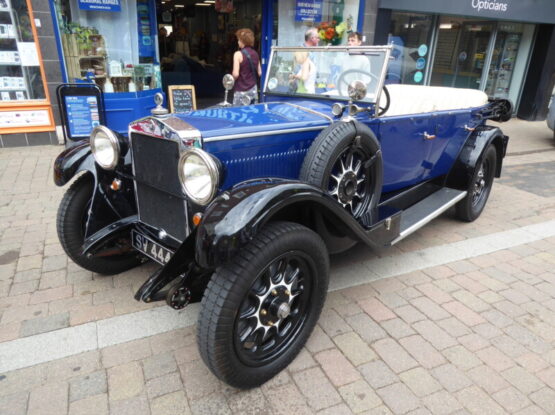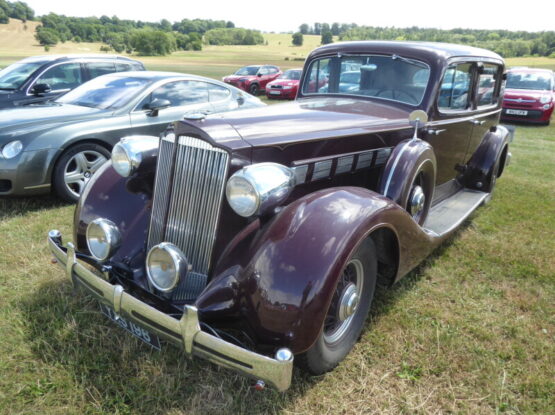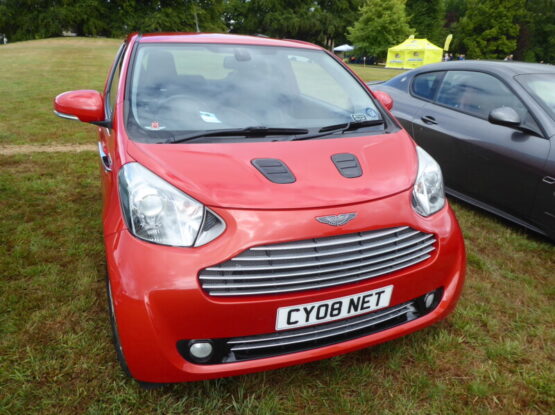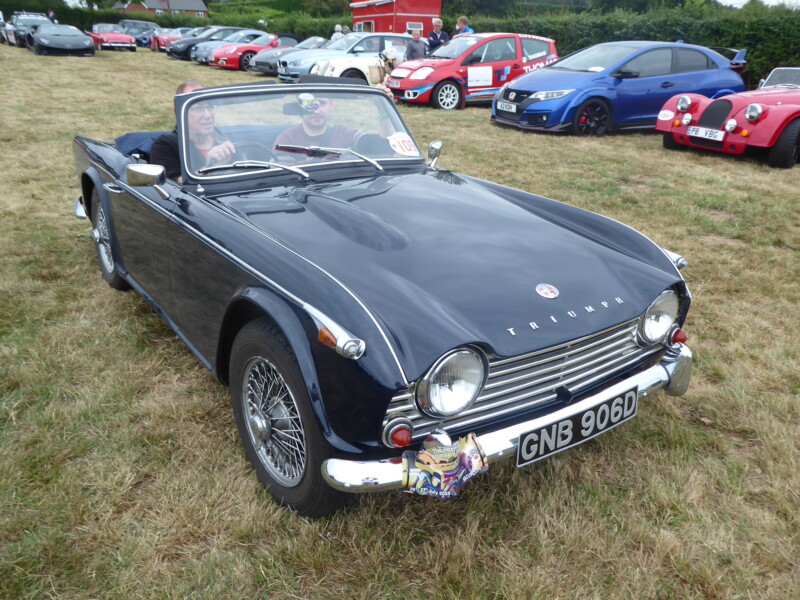
The Bromyard Speed Festival is one of those events that I’ve heard about every year for quite a while now, but from which I’ve never seen much in the way of post event content and as the date always seemed to clash with something else, have not been able to attend in person to see what it was all about. I was finally able to fix that in 2025. It turns out that this 2-day event has been run every year – apart from a Covid break – since 2016 and is designed very much as a celebration of all things automotive with a particular focus on race and rally cars. It takes place in the otherwise rather sleepy little Worcestershire town of Bromyard, one of those places which is not really on the road to anywhere, so I don’t think I ever even been to the town before let alone this event. A rather iffy weather forecast meant that I made an on the day decision to go and investigate. There is some car parking on one side of the road heading out of town, and the event itself is centred around a massive field on the other side where all the competing cars and some others were to be found. Competing? Well, as this was not a purely static event, yes, there was an element of competition, largely against the clock, for around 100 cars. That road out of town was closed off, so cars could head off at speed uphill on a timed course, and then meander back to the event down some narrow country lanes. Sadly, the spectators can’t really see much beyond the first hundred yards of the timed event, but watching the cars start was fun and there was plenty on that field to enjoy, too. Here are the cars – competing, display and just interesting cars in the car park – which caught my attention:
ABARTH
What is known as the Series 4 version of the familiar 595 reached the markets in the middle of 2016. After rumours had circulated all winter following the launch of the facelifted Fiat 500 last year, Abarth finally unveiled the Series 4 at the end of May 2016. Initially, we were told that the cars would not be available in the UK until September, but that came forward somewhat, with dealers all receiving demo cars in June, and the first customers taking delivery in July. Three regular production versions of both the closed car and the open-topped C were initially available, all badged 595, and called Custom, Turismo and Competizione, as before, though numerous limited edition models have since appeared and in most case disappeared. The most significant changes with the Series 4 are visual, with a couple of new colours, including the much asked for Modena Yellow and a different red, called Abarth Red, which replaces both the non-metallic Officina and – slightly surprisingly – the tri-coat pearlescent Cordolo Red. as well as styling changes front and rear. The jury is still out on these, with many, me included, remaining to be convinced. At the front, the new air intake does apparently allow around 15 – 20 % more air in and out, which will be welcome, as these cars do generate quite a lot of heat under the bonnet. Competizione models for the UK retain the old style headlights, as they have Xenon lights as standard, whereas the Custom and Turismo cars have reshaped units. At the back, there are new light clusters and a new rear bumper and diffuser. Inside, the most notable change is the replacement of the Blue & Me system with a more modern uConnect Audio set up, which brings a new colour screen to the dash. Mechanically, there is an additional 5 bhp on the Custom (now 145) and Turismo (now 165 bhp) and the option of a Limited Slip Diff for the Competizione, which is likely to prove a popular option. Details of the interior trim have changed, with a filled-in glovebox like the US market cars have always had, and electric windows switches that are like the US ones, as well as a part Alcantara trim to the steering wheel in Competizione cars

The Punto Evo was launched at the 2010 Geneva Show, with the cars reaching UK buyers in the summer of that year, and it incorporated many of the changes which had been seen a few months earlier on the associated Fiat models, the visual alterations being the most obvious, with the car taking on the nose of the associated Fiat, but adapted to make it distinctively Abarth, new rear lights and new badging. There was more to it than this, though, as under the bonnet, the T-Jet unit was swapped for the 1.4 litre Multi-Air, coupled to a 6 speed gearbox, which meant that the car now had 165 bhp at its disposal. Eventually, Abarth offered an Esseesse kit for these cars, though these are exceedingly rare. For those in the know – which never seemed to be that many people – this was a really capable and desirable car, and the owners love them, lamenting the fact that the model had quite a short production life and has not been replaced. The final Punto model was the SuperSport. Easily identified by the distinctive black bonnet, just 199 of the SuperSport versions were built, of which around 120 are registered on UK roads. These cars had many of the options from the Punto Evo included as standard. Power came from the the 1.4-litre MultiAir turbo engine, tuned to produce 178bhp and 199lb ft of torque, up from 165 of the standard Punto Evo, giving the SuperSport a 0-62 time of 7.5 seconds and a top speed of over 132mph. To help put the power down, the SuperSport was fitted with wider 18″ wheels and optional Koni FSD dampers. Standard equipment included the Blue&Me infotainment system with steering wheel controls, automatic climate control and a popular option was the ‘Abarth Corsa by Sabelt’ sports leather seats. The SuperSport was available in the same colours as the regular Punto Evo, which means white, grey, black and red.


The Abarth 124 Spider was developed in parallel with the Fiat model. It does cost a lot more, and there are those who think you don’t get enough extra for your money, but those who have driven it will tell you otherwise. You certainly get more power. The 1.4 MultiAir turbo unit jumps up from 138bhp to 168bhp, while torque also increases by a modest 10Nm to 250Nm, which gives it a 0-62mph time of 6.8 seconds, which is half a second quicker than the 2.0-litre Mazda MX-5. The top speed is 143mph. It weighs just 1060kg meaning a power-to-weight ratio of 158bhp-per-tonne, and with the new Record Monza exhaust system it sounds great even at idle. The Abarth version gets a stiffer suspension setup than the regular Fiat 124 Spider, with Bilstein dampers and beefed-up anti-roll bars. Bigger Brembo brakes also feature, with aluminium calipers. It can be had with a six-speed manual or six-speed automatic transmission with paddles, and the latter gets a Sport mode for quicker shifts. Many of the UK cars sport the ‘Heritage Look’ pack, which is a no-cost option. It brings a matt black bonnet and bootlid, plus red exterior trim detailing and has proved popular. The £29,565 starting price gets you standard equipment such as cruise control, climate control, Bluetooth, a DAB radio and satnav, plus Alcantara black and red (or pure black) seat trim. The automatic gearbox is a £2,035 extra, while an optional visibility pack brings LED DRLs, auto lights and wipers and rear parking sensors. Sales ceased during 2019, with around 1800 cars having been brought into the UK, so this is always going to be a rare car, and values are already increasing at a rate reflecting its desirability and the difficulty in finding one.


AC
There are so many replica and recreation examples of the Cobra that it is tempting to assume that whenever you see one, that is what it is. Occasionally, of course, the car before you is actually one of the original ones from the 1960s and that is the case with this fabulous Cobra 289. Like many British manufacturers, AC Cars had been using the Bristol straight-6 engine in its small-volume production, including its AC Ace two-seater roadster. This had a hand-built body with a steel tube frame, and aluminium body panels that were made using English wheeling machines. The engine was a pre-World War II design by BMW which by the 1960s was considered dated. In 1961 Bristol decided to cease production of its engine. In September 1961, American retired race car driver and automotive designer Carroll Shelby wrote to AC asking if they would build him a car modified to accept a V8 engine. Bristol engines for the AC Ace two-seater sports car had recently been discontinued so AC agreed, provided a suitable engine could be found. Shelby went to Chevrolet to see if they would provide him with engines, but not wanting to add competition to the Corvette they said no. However, Ford wanted a car that could compete with the Corvette and they happened to have a brand new engine which could be used in this endeavor: the Windsor 3.6-litre (221 cu in) engine – a new lightweight, thin-wall cast small-block V8. Ford provided Shelby with two engines. In January 1962 mechanics at AC Cars in Thames Ditton, Surrey designed the “AC Ace 3.6” prototype with chassis number CSX2000. AC had already made most of the modifications needed for the small-block V8 when they installed the 2.553-litre (156 cu in) inline 6 Ford Zephyr engine, including the extensive rework of the AC Ace’s front end bodywork. The only modification of the front end of the first Cobra from that of the “AC Ace 2.6” was the steering box, which had to be moved outward to clear the wider V8 engine. The most important modification was the fitting of a stronger rear differential to handle the increased engine power. A Salisbury 4HU unit with inboard disc brakes to reduce unsprung weight was chosen instead of the old E.N.V. unit. It was the same unit used on the Jaguar E-Type. After testing and modification, the engine and transmission were removed and the chassis was air-freighted to Shelby in Los Angeles on 2 February 1962, By this time the small-block’s displacement was increased to 4.7 L (289 cu in). Shelby’s team paired this engine along with a transmission into CSX2000, in less than eight hours at Dean Moon’s shop in Santa Fe Springs, California, and began road-testing. A few changes were made to the production version: The inboard brakes were moved outboard to reduce cost; the fuel tank filler was relocated from the fender to the cenre of the trunk; the trunk lid had to be shortened to accommodate this change. AC exported completed, painted, and trimmed cars (less engine and gearbox) to Shelby who then finished the cars in his workshop in Los Angeles by installing the engine and gearbox and correcting any bodywork flaws caused by the car’s passage by sea. A small number of cars were also completed on the East Coast of the US by Ed Hugus in Pennsylvania, including the first production car; CSX2001. The first 75 Cobra Mk1 models (including the prototype) were fitted with the 4.3 L (260 cu in). The remaining 51 Mk1 models were fitted with a larger version of the Windsor Ford engine, the 4.7-litre (289 cu in) V8. In late 1962, Alan Turner, AC’s chief engineer completed a major design change of the car’s front end to accommodate rack and pinion steering while still using transverse leaf spring suspension (with the leaf spring doublin as the upper suspension link). The new car entered production in early 1963 and was designated Mark II. The steering rack was borrowed from the MGB while the new steering column came from the VW Beetle. About 528 Mark II Cobras were produced from 1963 to the summer of 1965 (the last US-bound Mark II was produced in November 1964). In 1963 to keep production focused on producing cars for Shelby American Inc., the Ruddspeed Ace was discontinued. To supply cars to the European market, AC began to market and sell the Cobra in Europe. Advertisements from the time state that the Cobra was designed to meet the requirements of Shelby American Inc. Shelby experimented with a larger Ford FE engine, of 6.4 L (390 cu in) in chassis number CSX2196. Unfortunately, the car was not able to receive the development it needed, as resources were aimed at taking the crown from Ferrari in the GT class. Ken Miles drove and raced the FE-powered Mark II at Sebring and pronounced the car virtually undrivable, naming it “The Turd”. It failed to finish with the engine expiring due to damper failure. CSX2196 was revised for the showdown at Nassau which allowed a more relaxed class division of racing. This allowed the Cobras to run with a prototype Ford GT40, GM Grand Sport Corvettes and a Lola Mk6. An aluminium 6.4-litre (390 cu in) engine was used. By the end of the first lap, the Cobra had a lead of the length of the start-finish straight. However, the car failed to finish due to brake problems. A new chassis was required, developed, and designated Mark III. The new car was designed in cooperation with Ford in Detroit. A new chassis was built using 101.6 mm (4 in) main chassis tubes, up from 76.2 mm (3 in) and coil spring suspension all around (an especially significant change up front, where the previously-used transverse leaf spring had done double duty as the top link). The new car also had wide fenders and a larger radiator opening. It was powered by the “side oiler” Ford 7.0 L (427 cu in) FE engine equipped with a single 4-barrel 780 CFM Holley carburetor rated at 425 bhp at 6000 rpm and 651 N⋅m (480 lb⋅ft) at 3700 rpm of torque, which provided a top speed of 264 km/h (164 mph) in the standard model. The more powerful tune of 485 bhp with a top speed of 298 km/h (185 mph) in the semi-competition (S/C) model. Cobra Mark III production began on 1 January 1965; two prototypes had been sent to the United States in October 1964. Cars were sent to the US as unpainted rolling chassis, and they were finished in Shelby’s workshop. Unfortunately, The MK III missed homologation for the 1965 racing season and was not raced by the Shelby team. Only 56 of the 100 planned cars were produced. Of those, 31 unsold competition models were detuned and fitted with windscreens for street use. Called S/C for semi-competition, an original example can currently sell for US$1.5 million, making it one of the most valuable Cobra variants. Some Cobra 427s were actually fitted with Ford’s 7-litre (428 cu in) engine, a long stroke, smaller bore, lower cost engine, intended for road use rather than racing. The AC Cobra was a financial failure that led Ford and Carroll Shelby to discontinue importing cars from England in 1967. AC Cars kept producing the coil-spring AC Roadster with narrow fenders and a small block Ford 289. It was built and sold in Europe until late 1969.

And this is one of those more recent replica Cobra models.

ALFA ROMEO
The first car was called the Alfa Romeo Giulia Sprint GT, and was revealed at a press event held at the then newly opened Arese plant on 9 September 1963, and displayed later the same month at the Frankfurt Motor Show. In its original form the Bertone body is known as scalino (step) or “step front”, because of the leading edge of the engine compartment lid which sat 1/4 an inch above the nose of the car. The Giulia Sprint GT can be distinguished from the later models by a number of features including: Exterior badging: Alfa Romeo logo on the front grille, a chrome script reading “Giulia Sprint GT” on the boot lid, and rectangular “Disegno di Bertone” badges aft of the front wheel arches; flat, chrome grille in plain, wide rectangular mesh without additional chrome bars; single-piece chrome bumpers; no overriders. Inside the cabin the padded vinyl dashboard was characterised by a concave horizontal fascia, finished in grey anti-glare crackle-effect paint. Four round instruments were inset in the fascia in front of the driver. The steering wheel was non-dished, with three aluminium spokes, a thin bakelite rim and a centre horn button. Vinyl-covered seats with cloth centres and a fully carpeted floor were standard, while leather upholstery was an extra-cost option. After initially marketing it as a four-seater, Alfa Romeo soon changed its definition of the car to a more realistic 2+2. The Giulia Sprint GT was fitted with the 1,570 cc version of Alfa Romeo’s all-aluminium twin cam inline four (78 mm bore × 82 mm stroke), which had first debuted on the 1962 Giulia Berlina. Breathing through two twin-choke Weber 40 DCOE 4 carburettors, on the Sprint GT this engine produced 105 hp at 6,000 rpm. Like all subsequent models, the Sprint GT was equipped with an all-synchromesh 5-speed manual transmission. The braking system comprised four Dunlop disc brakes and a vacuum servo. The rear brakes featured an unusual arrangement with the slave cylinders mounted on the axle tubes, operating the calipers by a system of levers and cranks. According to Alfa Romeo the car could reach a top speed of “over 180 km/h (112 mph)”. In total 21,902 Giulia Sprint GT were produced from 1963 to 1965, when the model was superseded by the Giulia Sprint GT Veloce. Of these 2,274 were right hand drive: 1,354 cars fully finished in Arese, and 920 shipped in complete knock-down kit form for foreign assembly. For 1966, the Giulia Sprint GT was replaced by the Alfa Romeo Giulia Sprint GT Veloce, which was very similar but featuring a number of improvements: a revised engine—slightly more powerful and with more torque—better interior fittings and changes to the exterior trim. Alongside the brand new 1750 Spider Veloce which shared its updated engine the Sprint GT Veloce was introduced at the 36th Geneva Motor Show in March 1966, and then tested by the international specialist press in Gardone on the Garda Lake. Production had began in 1965 and ended in 1968. The Giulia Sprint GT Veloce can be most easily distinguished from other models by the following features: badging as per Giulia Sprint GT, with the addition of round enamel badges on the C-pillar—a green Quadrifoglio (four-leaf clover) on an ivory background—and a chrome “Veloce” script on the tail panel; black mesh grille with three horizontal chrome bars; the grille heart has 7 bars instead of 6; stainless steel bumpers, as opposed to the chromed mild steel bumpers on the Giulia Sprint GT. The bumpers are the same shape, but are made in two pieces (front) and three pieces (rear) with small covers hiding the joining rivets. Inside the main changes from the Giulia Sprint GT were imitation wood dashboard fascia instead of the previous anti-glare grey finish, front seats revised to a mild “bucket” design, and a dished three aluminium spoke steering wheel, with a black rim and horn buttons through the spokes. The Veloce’s type 00536 engine, identical to the Spider 1600 Duetto’s, featured modifications compared to the Giulia Sprint GT’s type 00502—such as larger diameter exhaust valves. As a result it produced 108 hp at 6,000 rpm, an increase of 3 hp over the previous model, and significantly more torque. The top speed now exceeded 185 km/h (115 mph). Early Giulia Sprint GT Veloces featured the same Dunlop disc brake system as the Giulia Sprint GT, while later cars substituted ATE disc brakes as pioneered on the GT 1300 Junior in 1966. The ATE brakes featured an handbrake system entirely separate from the pedal brakes, using drum brakes incorporated in the rear disc castings. Though the Sprint GT Veloce’s replacement—the 1750 GT Veloce—was introduced in 1967, production continued throughout the year and thirty final cars were completed in 1968. By then total Giulia Sprint GT Veloce production amounted to 14,240 examples. 1,407 of these were right hand drive cars, and 332 right hand drive complete knock-down kits. The Alfa Romeo 1750 GT Veloce (also known as 1750 GTV) appeared in 1967 along with the 1750 Berlina sedan and 1750 Spider. The same type of engine was used to power all three versions; this rationalisation was a first for Alfa Romeo. The 1750 GTV replaced the Giulia Sprint GT Veloce and introduced many updates and modifications. Most significantly, the engine capacity was increased to 1779 cc displacement. Peak power from the engine was increased to 120 hp at 5500 rpm. The stroke was lengthened from 82 to 88.5 mm over the 1600 engine, and a reduced rev limit from 7000 rpm to 6000 rpm. Maximum torque was increased to 137 lb·ft at 3000 rpm. A higher ratio final drive was fitted (10/41 instead of 9/41) but the same gearbox ratios were retained. The result was that, on paper, the car had only slightly improved performance compared to the Giulia Sprint GT Veloce, but on the road it was much more flexible to drive and it was easier to maintain higher average speeds for fast touring. For the United States market, the 1779 cc engine was fitted with a fuel injection system made by Alfa Romeo subsidiary SPICA, to meet emission control laws that were coming into effect at the time. Fuel injection was also featured on Canadian market cars after 1971. Carburettors were retained for other markets. The chassis was also significantly modified. Tyre size went to 165/14 from 155/15 and wheel size to 5 1/2J x 14 instead of 5J x 15, giving a wider section and slightly smaller rolling diameter. The suspension geometry was also revised, and an anti-roll bar was fitted to the rear suspension. ATE disc brakes were fitted from the outset, but with bigger front discs and calipers than the ones fitted to GT 1300 Juniors and late Giulia Sprint GT Veloces. The changes resulted in significant improvements to the handling and braking, which once again made it easier for the driver to maintain high average speeds for fast touring. The 1750 GTV also departed significantly from the earlier cars externally. New nose styling eliminated the “stepped” bonnet of the Giulia Sprint GT, GTC, GTA and early GT 1300 Juniors and incorporated four headlamps. For the 1971 model year, United States market 1750 GTV’s also featured larger rear light clusters (there were no 1970 model year Alfas on the US market). Besides the chrome “1750” badge on the bootlid, there was also a round Alfa Romeo badge. Similar Quadrofoglio badges to those on the Giulia Sprint GT Veloce were fitted on C pillars, but the Quadrofoglio was coloured gold instead of green. The car also adopted the higher rear wheelarches first seen on the GT 1300 Junior. The interior was also much modified over that of earlier cars. There was a new dashboard with large speedometer and tachometer instruments in twin binnacles closer to the driver’s line of sight. The instruments were mounted at a more conventional angle, avoiding the reflections caused by the upward angled flat dash of earlier cars. Conversely, auxiliary instruments were moved to angled bezels in the centre console, further from the driver’s line of sight than before. The new seats introduced adjustable headrests which merged with the top of the seat when fully down. The window winder levers, the door release levers and the quarterlight vent knobs were also restyled. The remote release for the boot lid, located on the inside of the door opening on the B-post just under the door lock striker, was moved from the right hand side of the car to the left hand side. The location of this item was always independent of whether the car was left hand drive or right hand drive. Early (Series 1) 1750 GTV’s featured the same bumpers as the Giulia Sprint GT Veloce, with the front bumper modified to mount the indicator / sidelight units on the top of its corners, or under the bumper on US market cars. The Series 2 1750 GTV of 1970 introduced other mechanical changes, including a dual circuit braking system (split front and rear, with separate servos). The brake and clutch pedals on left hand drive cars were also of an improved pendant design, instead of the earlier floor-hinged type. On right hand drive cars the floor-hinged pedals were retained, as there was no space for the pedal box behind the carburettors. Externally, the series 2 1750 GTV is identified by new, slimmer bumpers with front and rear overriders. The combined front indicator and sidelight units were now mounted to the front panel instead of the front bumper, except again on the 1971-72 US/Canadian market cars. The interior was slightly modified, with the seats retaining the same basic outline but following a simpler design. 44,269 1750 GTVs were made before their replacement came along. That car was the 2000GTV. Introduced in 1971, together with the 2000 Berlina sedan and 2000 Spider, the 2 litre cars were replacements for the 1750 range. The engine displacement was increased to 1962 cc. Oil and radiator capacities remained unchanged. The North American market cars had fuel injection, but everyone else retained carburettors. Officially, both versions generated the same power, 130 hp at 5500 rpm. The interior trim was changed, with the most notable differences being the introduction of a separate instrument cluster, instead of the gauges installed in the dash panel in earlier cars. Externally the 2000 GTV is most easily distinguished by its grille with horizontal chrome bars, featuring protruding blocks forming the familiar Alfa heart in outline, smaller hubcaps with exposed wheel nuts, optional aluminium alloy wheels of the same size as the standard 5. 1/2J × 14 steel items, styled to the “turbina” design first seen on the alloy wheels of the Alfa Romeo Montreal, and the larger rear light clusters first fitted to United States market 1750 GTV’s were standard for all markets. From 1974 on, the 105 Series coupé models were rationalised and these external features became common to post-1974 GT 1300 Junior and GT 1600 Junior models, with only few distinguishing features marking the difference between models. 37,459 2000 GTVs were made before production ended and these days they are very sought after with prices having sky-rocketed in recent years.

There was a much longer wait for a Coupe version of the AlfaSud than there had been for the larger Alfetta, the Alfasud Sprint being presented to the press in September 1976 in Baia Domizia and shown at the Turin Motor Show in November some five years after the launch of the saloon. Designed by Giorgetto Giugiaro like the AlfaSud, whose mechanicals it was based on, it had a lower, more angular design, featuring a hatchback, although there were no folding rear seats. The AlfaSud Sprint was assembled together with the AlfaSud in the Pomigliano d’Arco plant, located in southern Italy—hence the original “Sud” moniker. Under the Alfasud Sprint’s bonnet there was a new version of the AlfaSud’s 1186 cc four-cylinder boxer engine, stroked to displace 1,286 cc, fed by a twin-choke carburettor and developing 75 hp at 6,000 rpm. Mated to the flat-four was a five-speed, all-synchromesh gearbox. The interior was upholstered in dark brown Texalfa leatherette and tartan cloth. Options were limited to alloy wheels, a quartz clock and metallic paint. In May 1978 the AlfaSud Sprint underwent its first updates, both cosmetic and technical. Engine choice was enlarged to two boxers, shared with the renewed AlfaSud ti, a 78 hp 1.3 (1,350 cc) and a 84 hp 1.5 (1,490 cc); the earlier 1286 cc unit was not offered anymore, remaining exclusive to the AlfaSud. Outside many exterior details were changed from chrome to matte black stainless steel or plastic, such as the wing mirrors, window surrounds and C-pillar ornaments; the B-pillar also received a black finish, the side repeaters changed position and became square, and the front turn signals switched from white to amber lenses. In the cabin the seats had more pronounced bolsters and were upholstered in a new camel-coloured fabric. Just one year later, in June 1979, another engine update arrived and the AlfaSud Sprint became the AlfaSud Sprint Veloce. Thanks to double twin-choke carburettors (each choke feeding a single cylinder) and a higher compression ratio engine output increased to 85 hp and 94 hp, respectively for the 1.3 and 1.5. In February 1983 Alfa Romeo updated all of its sports cars; the Sprint received a major facelift. Thereafter the AlfaSud prefix and Veloce suffix were abandoned, and the car was known as Alfa Romeo Sprint; this also in view of the release of the Alfa Romeo 33, which a few months later replaced the AlfaSud family hatchback. The Sprint also received a platform upgrade, which was now the same as that of the Alfa Romeo 33; this entailed modified front suspension, brakes mounted in the wheels instead of inboard like on the AlfaSud, and drum brakes at the rear end. Three models made up the Sprint range: 1.3 and 1.5, with engines and performance unchanged from the AlfaSud Sprint Veloce, and the new 1.5 Quadrifoglio Verde—1.5 Cloverleaf in the UK. A multitude of changes were involved in the stylistic refresh; there were a new grille, headlamps, wing mirrors, window surrounds and C-pillar ornaments. Bumpers went from chrome to plastic, and large plastic protective strips were added to the body sides; both sported coloured piping, which was grey for 1.3 cars, red for the 1.5 and green for the 1.5 Quadrifoglio. At the rear new trapezoidal tail light assemblies were pieced together with the license plate holder by a black plastic fascia, topped by an Alfa Romeo badge—never present on the AlfaSud Sprint. In the cabin there were new seats with cloth seating surfaces and Texalfa backs, a new steering wheel and changes to elements of the dashboard and door panels. Sprint 1.3 and 1.5 came with steel wheels with black hubcaps from the AlfaSud ti. The newly introduced 1.5 Quadrifoglio Verde sport variant was shown at the March 1983 Geneva Motor Show. Its engine was the 1,490 cc boxer, revised to put out 104 hp at 6,000 rpm; front brake discs were vented and the gearing shorter. In addition to the green bumper piping, also specific to the Quadrifoglio were a green instead of chrome scudetto in the front grille, a rear spoiler and 8-hole grey painted alloy wheels with metric Michelin TRX 190/55 tyres. Inside a three-spoke leather-covered steering wheel, green carpets and sport seats in black cloth with green embroidery. In November 1987 the Sprint was updated for the last time; the 1.3 variant was carried over, while the 1.5 engine was phased out and the 1.5 QV was superseded by the 116 hp Sprint 1.7 Quadrifoglio Verde. The 1,286 cc engine was directly derived from the 33 1.7 Quadrifoglio Verde, and could propel the Sprint from 0 to 100 km/h in 9.3 seconds; to cope with the increased engine power, the 1.7 QV adopted vented brake discs upfront. the coloured piping and side plastic strips were deleted, and the Quadrifoglio had alloy wheels of a new design. A fuel injected and 3-way Catalytic converter-equipped 1.7 variant, with an engine again derived from a 33, was added later for sale in specific markets. There were a total of 116,552 Sprints produced during its lifespan, which lasted from 1976 to 1989. 15 of these formed the basis of the Australian-built Giocattolo sports car, which used a mid-mounted Holden 5.0 group A V8 engine. The Sprint had no direct predecessor or successor.

As was still the practice in the 1970s, Alfa followed up the launch of the Alfetta Berlina with a very pretty coupe. Styled by Giugiaro, this car, initially called the GT, and premiered in the autumn of 1974, looked completely unlike the saloon on which it was based. The first cars had 1.8 litre four cylinder engines and there was one of those on show. In 1976 the range was expanded both up and down with a 1.6 and a 2.0 model, the latter adopting the legendary GTV name. A rare SE model from this period was part of the display, complete with period vinyl roof (look closely), and although the pain does appear a bit like a lot of older Alfa reds, having gone rather pink, this was the actual shade when the car was new. In 1981, with the 2.5 litre V6 engine that had been developed for the ill-fated Alfa 6 luxury saloon available, Alfa was able to create a true rival for the 2.8 litre Capri with the GTV6. A facelift modernised the look of the car with plastic bumpers front and rear and a new interior looked rather better as well as being more ergonomically logical. There was a good mix of the earlier chrome bumpered and later plastic bumpered models, the last with 2.0 and 2.5 GTV6 versions both represented. There was also a car sporting 3.0 badging and right hand drive. This is a South African car. From 1974 South African Alfetta’s were manufactured at Alfa Romeo’s own Brits plant. South Africa was one of two markets to have a turbocharged GTV6, with a Garrett turbocharger and a NACA intake. An estimated 750 were assembled before all production ceased in 1986. The South African range included a 3.0 litre GTV-6, predating the international debut of the factory’s 3.0 litre engine in 1987 (for the Alfa 75). and 212 of these were built in South Africa for racing homologation. The last 6 GTV-6 3.0’s were fuel injected. To this day, the GTV-6 remains the quintessential Alfa Romeo for South Africans.


When the 156 was launched in 1997, things looked very bright for Alfa. Striking good looks were matched by a driving experience that the press reckoned was better than any of its rivals. The car picked up the Car of the Year award at the end of the year. and when it went on sale in the UK in early 1998, waiting lists soon stretched out more than 12 months. Reflecting the way the market was going, Alfa put a diesel engine under the bonnet, launched a (not very good, it has to be admitted) automated transmission with the SeleSpeed, added a very pretty if not that commodious an estate model they called Sport Wagon and then added a top spec 3.2 litre GTA with its 250 bhp engine giving it a performance to outrun all its rivals. And yet, it did not take long before the press turned on the car, seduced by the latest 3 Series once more, citing build quality issues which were in fact far from universal. The 156 received a very minor facelift in 2002 and a more significant one in late 2003 with a new front end that was a clue to what would come with the car’s successor. Production ceased in 2005. These cars are getting quite rare at events now and indeed there were only a couple of them here.


Replacement for the much loved 156 was the 159. The Alfa Romeo 159 had a troubled development, being designed in the midst of the Fiat-General Motors joint venture which was terminated in 2005. Originally, the 159 was intended to use GM’s Epsilon platform; however, late during its development it was changed to the GM/Fiat Premium platform. The Premium platform was more refined and expensive, being intended for E-segment executive cars such as an Alfa Romeo 166 successor but that never materialised, so Alfa Romeo attempted to recoup some of the platform development costs with the 159. General Motors originally planned Cadillac, Buick and Saab models for this platform but ending up discarded them over cost concerns. Unfortunately, the 159’s late transition to what was fundamentally made as an E-segment platform resulted in the 159 having excessive weight, a problem shared by its sisters, the Alfa Romeo Brera coupe and Spider convertible. The 159 was designed by Giorgetto Giugiaro in collaboration with the Centro Stile Alfa Romeo. The nose featured a traditional Alfa Romeo V-shaped grille and bonnet, and cylindrical head light clusters. Similar to its coupé counterpart, front of the car was influenced by the Giugiaro designed 2002 Brera Concept. Several exterior design cues were intended to make the car appear larger, supposedly to appeal to potential buyers in the United States; however, the 159 was never exported to that region. The interior featured styling treatments familiar from earlier cars, including the 156, such as deeply recessed instruments which are angled towards the driver. Alfa Romeo intended for the 159 to compete more directly with BMW, Mercedes-Benz and Audi by using higher quality interior materials; however, it has been said that Alfa Romeo misjudged their brand’s positioning relative to the more well-known German luxury automakers. Several levels of trim were available, depending on market. Four trim levels: Progression, Distinctive, Exclusive and Turismo Internazionale (TI) featured across Europe. In the UK there were three levels of trim: Turismo, Lusso and Turismo Internazionale (TI). A Sportwagon variant was introduced at the Geneva Motor Show in 2006. The 159’s size made it considerably more comfortable than the 156 due to its larger, roomy interior. However, the considerable growth in dimensions deterred many 156 owners from considering the 159 as a direct replacement model, and something seemed to be lost in the character of the new car. Initially offered with a choice of 1.9 and 2,2 litre 4 cylinder and 3.2 litre V6 petrol engines and 1.9 and 2.4 litre diesel units, and an optional four wheel drive system. An automatic gearbox option for the 2.4 JTDM diesel model was also launched in late 2006, and later extended to other versions. In 2007 a four-wheel drive diesel model was released and the 2.4-litre diesel engines’ power output increased to 210 hp, with a newly reintroduced TI trim level also available as an option. For model year 2008 the mechanics and interiors of the 159 were further developed. The 3.2 litre V6 model was offered in front wheel drive configuration, achieving a top speed of 160 mph. All model variants came with Alfa’s electronic “Q2” limited slip differential. As a result of newly introduced aluminium components, a 45 kilograms (99 lb) weight reduction was achieved. For 2009, Alfa introduced a new turbocharged petrol engine badged as “TBi”. This 1742 cc unit had direct injection and variable valve timing in both inlet and exhaust cams. This new engine had 200 PS (197 hp) and would eventually replace the GM-derived 2.2 and 1.9 JTS units. In 2010, all petrol engines except for the 1750 TBi were retired, ending the use of General Motors-based engines in the 159. The only remaining diesel engines were the 136 PS and 170 PS 2.0 JTDm engines. In 2011, the 159 was powered only by diesel engines. In the UK, Alfa Romeo stopped taking orders for the 159 on 8 July 2011. Production for all markets ceased at the end of 2011, after 240,000 had been built.

ALVIS
Oldest of the Alvis cars here were from the 12/50 and 12/60 series of cars, which went through a series of versions, with the last ones being made in 1932. A range of factory bodies (made by Carbodies and Cross & Ellis) could be specified in two- or four-seat form, with either open or closed bodies. The first 12/50s were produced in late 1923 for the 1924 model year. The cars from this first year of production were designated SA and SB. The SA had a 1496 cc 4-cylinder overhead valve engine in a chassis with a wheelbase of 108.5 in (2,756 mm), while the SB had a wheelbase of 112.5 in (2,858 mm). The SB was initially fitted with the 1496cc engine, but after the introduction of a 1598 cc version of the OHV engine this became the standard fitment. The engines of these early cars were carried in a subframe bolted to the relatively slender ladder chassis. The SA usually carried two-seat bodywork, typically the Super Sports 2/3-seater nicknamed “duck’s back” because of its pointed rear end, said to resemble that of a duck. The majority of SB cars carried Super Sports four-seater bodywork, but a good number were also fitted with touring bodies from the standard Alvis range. The SA and SB 12/50s were built with (twin shoed) brakes on the rear wheels only. All the 12/50s had a four speed non-synchromesh gearbox with right hand change. The clutch was a fabric-faced aluminium cone. The cars were right hand drive. The SC arrived in Autumn 1924, with the larger 1598 cc engine as standard (though the 1496 cc unit could be specified for sporting use). Most SC 12/50s were built on the longer chassis, which would be standard for the 12/50 until the end of production. Front wheel brakes were offered as an option on this model: a front axle of new design could be supplied with or without brakes. Power transmission was via a roller-bearing prop shaft of new design.The 12/50 was redesigned for the 1926 model year. From Autumn 1925 a new stronger chassis was used for the TE, which had its engine (now built around a redesigned crankcase) enlarged again to 1645 cc, and the TF of the same year with a short stroke version of the same engine, displacing 1496 cc. A single-plate clutch replaced the previous cone type, and for these and all subsequent 12/50s the engine was bolted directly to the flange-frame chassis, dispensing with the subframe of previous models. From the TE and TF models onwards four-wheel brakes were fitted as standard, single-shoe drums on the rear replacing the double-shoe drums of the previous model. The TE and was superseded for the 1927 model year by the TG. Confusingly, the short-stroke TF was replaced in the 1927 range by a car with an ‘S’ prefix: the SD. The TG was the standard ‘touring’ model, while the SD – powered by the 1496 cc engine, now fitted with a large-port cylinder head – satisfied the needs of the sporting motorist. Also available in this year was the TH, which had the gearbox and rear axle ratios of the ‘touring’ TG, but the sub-1500 cc engine of the SD. The TG and SD models were available until 1929. The TG and (very rare) TH models can be recognised by their taller radiators, with a noticeably deeper top section. Cars from the 1928 and 1929 model years also sported higher-set lamps, with horizontal crossbar, in accordance with the fashion of the time. The 12/50 was withdrawn between 1929 and 1930 when the company decided that the future lay with the front-wheel drive FD and FE models, but when these did not reach the hoped for volumes a final version of the 12/50 was announced for the 1931 model year as TJ. Fitted with the 1645 cc engine this continued in production until 1932. The ‘post-vintage’ TJ is referred to by Alvis historians as being from the ‘revival period’, and it differs from its predecessor in a number of ways, notably coil instead of magneto ignition, deep chromed radiator shell, and rear petrol tank in place of the scuttle-mounted tank on most older 12/50s. The TJ was joined in the range by a more sporting version of the same chassis, but this car was marketed not as a 12/50, but as the 12/60. The TK 12/60 was available in 1931, and the TL 12/60 in 1932. The Alvis 12/70 was announced by Alvis cars 22 September 1937. It was a four-cylinder sports saloon or 4-seater drophead coupé related to the pricier six-cylinder Alvis Silver Crest. Technical director and chief designer Smith-Clarke was fully occupied with a new factory to make Alvis’s Gnome-Rhone radial engines so the 12/70 was designed by George Lanchester and it proved to be his last automobile design. Alvis manufactured the four-cylinder 1,842 cc pushrod overhead valve engine which was similar to the engine of the Alvis Firebird but was, in fact, a new design. Its 63 hp was enough to propel the car to a top speed of about 80 mph (130 km/h). Alvis also designed and made the four-speed gearbox which had synchromesh on the top three speeds. Cam steering is by Marles and brakes by Bendix-Cowdrey. Suspension is by half-elliptic springs, those in the back are underslung, dampened by hydraulic shock absorbers. There is an easy jacking system. The standard catalogued four-door four-seater saloon or two-door four-seater drophead coupé bodywork was made for Alvis by Mulliners of Birmingham. It was described by a motoring correspondent of The Times as follows: The four-door body has four sidewindows and makes a comfortable four-seater; the doors have roll armrests and ashtrays and there is a central pull-down rest. The rear windows are “carried well back and allow a very fair view”. The doors have slip pockets and glass louvres that conform to the body’s lines. There is a cupboard in the instrument panel and the instruments and ashtray are centrally placed. There are two-way visors, independent wiper controls (left and right), a spring steering wheel and in its centre ignition, dip and switch (headlights), signalling and horn controls. There are ventilators in the scuttle, a sliding roof and a fully opening windscreen. The front seats are adjustable, the backrests will tip up and beneath them there are floor wells for the feet of the back passengers. A stabilising bumper and two horns are fitted at the front. The whole of the back panel of the car was hinged at the bottom carrying the spare wheel on its inner side and it could be made to open just past the vertical. The correspondent reported “it does not make the most convenient arrangement for luggage. In a carefully worded brief portion of a full item about a 12/70 on test a Times correspondent reported in June 1938 that he considered the price high for a Twelve but that the value was there, the quietness and smoothness of running and the firmness yet gentleness of the controls. However he did comment that in view of the ordinary (sic) springing it travelled with remarkable evenness and held the road in a most stable way. 75 mph was the greatest speed in top gear. Price as tested £435, “a drophead coupé is also made at a rather higher figure”. A total of 741 cars were manufactured until 1940, with 121 still surviving. In 1945 the 12/70 was replaced by the modernized Alvis TA 14, but much of the 12/70 lived on in this post war model. In September 1938 it was announced that more room and comfort had been given to the 12/70. The lines of the car had been improved, the floor-level lowered and the body’s extra length and width gave more head, leg and elbow room for driver and passengers. It was now easier to get into the back seat and all four seats had been redesigned to give better support. The spare wheel was moved outside the car and enclosed in a metal cover. Two handles were now provided to the boot door, one with a lock. Otherwise the specification remained the same, as did the price at £435 and that of the drophead coupé was now £445. The chassis alone cost £315.


Launched in August 1936, the Alvis Speed 25 was designed to take advantage of Britain’s rapidly improving road network. Marrying sportscar-like performance to an impressive degree of refinement, the newcomer’s sophisticated chassis layout incorporated independent transverse-leaf front suspension, a four-speed all synchromesh gearbox and large-diameter four-wheel drum brakes. Featuring a balanced seven-bearing crankshaft and novel spring-cluster overhead valve gear, its triple SU carburettor fed 3571cc straight-six engine was quoted as developing 108bhp @ 3,800rpm. A notably smooth and flexible unit, it endowed the model with near 100mph performance. Principally bodied by Charlesworth (Sports Saloon / Drophead Coupe) or Cross & Ellis (Tourer), the Alvis Speed 25 stole sales from both the Bentley 4.25 litre and Lagonda LG45 alike. Only in production from 1936 to 1940, just 391 cars are thought to have left the Holyhead Road factory. Supplied new via B. Waterhouse & Sons Ltd of Bradford (or so its locally issued ‘CKW 91’ number plate would imply), chassis 14591 began life as a Charlesworth-bodied Sports Saloon. Surviving World War Two, the Alvis was registered to Hinde & Lewis of Wolverhampton on 25th October 1948. Acquired by Henry Winfield Ltd of Hemel Hempstead on 12th August 1954, the Speed 25 SC remained with them until January 1965 when it was sold to Colin Holloway of Surrey. A keen member of the Alvis Owners Club and Vintage Sports Car Club, Mr Holloway attended numerous events aboard ‘CKW 91’ as well as using it as an everyday car. Invited to represent Alvis in an ‘All Makes’ parade at Brooklands, the Speed 25 SC underwent some bodywork renovation and a colour change from Blue to Blue over Black during 1969. Laid-up in a barn some six years later due to a cracked exhaust manifold, ‘CKW 91’ entered the current ownership during October 2002. Relocating to the vendor’s North Yorkshire workshop after slumbering for decades, the Alvis was completely dismantled. Shot blasted and repainted, the chassis was fitted with a new petrol tank and wheel bearings and also had its back axle, suspension and brakes refurbished. The original engine was overhauled via a crankshaft regrind, re-metalled bearings and fresh pistons etc. The associated ancillaries were rejuvenated too. A comprehensive rewire was carried out and the four-speed all synchromesh gearbox found to need nothing more than an oil change. On examination the Charlesworth Sports Saloon body proved to be in a very sorry state with rotten woodwork, badly corroded aluminium door pillars and the wings being held on with many wood screws to gain a purchase in the decaying timber frame. The decision was taken to have a new drop-head body crafted by The Carrosserie Company (UK) Ltd which they also painted and installed. The upholstery was renewed and a new lined hood fitted. All the brightwork was re-chromed. The total cost of the restoration was in excess of £140,000. Accompanying paperwork encompasses two continuation buff logbooks and assorted restoration photographs.


Launched in 1938, the Alvis Speed 25 SC was designed to take advantage of Britain’s rapidly improving road network. Marrying sports car like performance to limousine-esque refinement, its sophisticated chassis layout incorporated independent transverse-leaf front suspension, a four-speed all synchromesh gearbox, adjustable Luvax hydraulic shock absorbers, one-shot chassis lubrication system and vacuum-assisted drum brakes. Featuring a massive seven-bearing crankshaft and novel spring-cluster overhead valve gear, its triple SU carburettor fed 3571cc straight-six engine was quoted as developing 108bhp @ 3,800rpm. A notably smooth and flexible unit, it endowed the model with near 100mph performance. Principally bodied by Charlesworth (Sports Saloon / Drophead Coupe) or Cross & Ellis (Tourer), the Speed 25 SC stole sales from both the Bentley 4.25 litre and Lagonda LG6 alike. Despite the fact that the Charlesworth Sports Saloon was the most popular Speed 25 SC variant in period survivors are comparatively few and far between today. More expensive to restore and traditionally less valuable than their open counterparts, closed cars have all too often been subject to cannibalisation or the scrapyard. Finished in maroon metallic red with light grey leather upholstery, this particular Speed 25 SC Charlesworth Sports Saloon is known as the “Lady in Red”.


The Alvis TA 14, also called the Alvis Fourteen, was the first car that the car maker and defence contractor Alvis produced after World War II. The entire car factory had been destroyed on the night of Thursday 14 November 1940. Announced in November 1946, it was made until 1950, when its postwar austerity 1900 cc engine was replaced by the 2993 cc 26.25 HP (tax rating) Alvis Three Litre or TA 21. The Fourteen was available as a four-door sports saloon built for Alvis by Mulliners of Birmingham. Tickford and Carbodies drophead versions were also offered. When compared with the 12/70 car it replaced, the interior is 4 inches wider, and the distance between rear-seat armrests is increased by almost 5 inches. The 1892 cc engine is a slightly larger-bore version of the one used in the 12/70, and produces 65 bhp. It has a single SU type H 4-inch side-draught carburettor. The inlet valves are larger than those on the 12/70, and the triplex chain drive has the addition of an automatic tensioner. The exhaust system was extensively revised, and the direction of flow of cooling water around the engine was substantially changed. The body is mounted on an updated pre-war Alvis 12/70 chassis that is wider and longer, but retains rigid-axle leaf spring suspension. Employing Silentbloc bushes (except at the front of the front springs to maintain steering precision), it is controlled by double acting Armstrong hydraulic dampers. Hypoid bevel final drive was fitted for the first time, greatly reducing the height of the transmission tunnel. Steering is by Marles, with a spring spoked steering wheel. Mechanically operated brakes are two-leading-shoe type by Girling. Disc wheels replaced the 12/70’s wire wheels, and have larger tyres. The top speed is around 74 mph (119 km/h), and acceleration from 0 to 60 mph (97 km/h) in 22.2 seconds.


ASTON MARTIN
This is a 1934 Mark II and is affectionately known as “Hedgehog”. Unveiled at the 1934 Motor Show, the Mark II was in effect an improved Le Mans model. The 1½ litre engine could now produce 73bhp, the chassis was somewhat stiffer and the road holding was also improved. Again two chassis lengths were available, long for saloons, tourers and drophead coupes, short for 2 and 2/4 seater sports cars. The short chassis from the Mark II together with a modified engine and lightweight 2 seater body was used as Team cars and ultimately became the Ulster. The distinctive and easily identifiable feature of the Mark II are the thermostatically controlled radiator shutters. Cycle type front winds were retained which still turned with the steering. The folded hood was again moved outside the body – not so good looking perhaps but it was more roomy for the rear seat passengers. The 2/4 seater based on the shorter 8’7” chassis was the most successful and best selling of the 1.5 litre cars with 61 completed over a period a little under two years.

With the DB7, produced from September 1994 to December 2004, Aston Martin made more cars from a single model than all Astons previously made, with over 7000 built. Known internally as the NPX project, the DB7 was made mostly with resources from Jaguar and had the financial backing of the Ford Motor Company, owner of Aston Martin from 1988 to 2007. The DB7’s platform was an evolution of the Jaguar XJS’s, though with many changes. The styling started life as the still-born Jaguar F type (XJ41 – coupe / XJ42 – convertible) designed by Keith Helfet. Ford cancelled this car and the general design was grafted onto an XJS platform. The styling received modest changes by Ian Callum so that it looked like an Aston Martin. The first generation Jaguar XK-8 also uses an evolution of the XJ-S/DB7 platform and the cars share a family resemblance, though the Aston Martin was significantly more expensive and rare. The prototype was complete by November 1992, and debuted at the Geneva Motor Show in March, 1993, with the car positioned as an “entry-level” model below the hand-built V8 Virage introduced a few years earlier. With production of the Virage (soon rechristened “V8” following Vantage styling revisions) continuing at Newport Pagnell, a new factory was acquired at Bloxham, Oxfordshire that had previously been used to produce the Jaguar XJ220, where every DB7 would be built throughout its production run. The DB7 and its relatives were the only Aston Martins produced in Bloxham and the only ones with a steel unit construction inherited from Jaguar . Aston Martin had traditionally used aluminium for the bodies of their cars, and models introduced after the DB7 use aluminium for the chassis as well as for many major body parts. The convertible Volante version was unveiled at the North American International Auto Show in Detroit in 1996. Both versions have a supercharged straight-six engine that produced 335 bhp and 361 lb·ft of torque. The Works Service provided a special Driving Dynamics package, which greatly enhanced performance and handling for drivers who wanted more than what the standard configuration offered. In 1999, the more powerful DB7 V12 Vantage was introduced at the Geneva Motor Show. Its 5.9 litre, 48-valve, V12 engine produced 420 bhp and 400 lb·ft of torque. It has a compression ratio of 10.3:1. Transmissions were available with either a TREMEC T-56 six speed manual or a ZF 5HP30 five speed automatic gearbox. Aston Martin claimed it had a top speed of either 186 mph with the manual gearbox or 165 mph with the automatic gearbox, and would accelerate from 0–60 mph in 4.9 seconds. It is 4,692 mm long, 1,830 mm (72.0 in) wide, 1,243 mm (48.9 in) high, with a weight of 1,800 kg (3,968.3 lb). After the launch of the Vantage, sales of the supercharged straight-6 engine DB7 had reduced considerably and so production was ended by mid-1999. In 2002, a new variant was launched, named V12 GT or V12 GTA when equipped with an automatic transmission. It was essentially an improved version of the Vantage, its V12 engine producing 435 bhp and 410 lb·ft of torque for the manual GT, although the automatic GTA retained the 420 bhp and 400 lb·ft of torque of the standard DB7 Vantage. Additionally, the GT and GTA chassis had substantially updated suspension from the DB7 Vantage models. Aesthetically, compared to the Vantage it has a mesh front grille, vents in the bonnet, a boot spoiler, an aluminium gear lever, optional carbon fibre trim and new wheels. It also has 14.0 in front and 13.0 in rear vented disc brakes made by Brembo. When being tested by Jeremy Clarkson on Top Gear in 2003, he demonstrated the car’s ability to pull away in fourth gear and continue until it hit the rev limiter: the speedometer indicated 135 mph. Production of the GT and GTA was extremely limited, as only 190 GT’s and 112 GTA’s were produced worldwide with 17 of them shipped to the US market, for a total of 302 cars.


Following the unveiling of the AMV8 Vantage concept car in 2003 at the North American International Auto Show designed by Henrik Fisker, the production version, known as the V8 Vantage was introduced at the Geneva Motor Show in 2005. The two seat, two-door coupé had a bonded aluminium structure for strength and lightness. The 172.5 inch (4.38 m) long car featured a hatchback-style tailgate for practicality, with a large luggage shelf behind the seats. In addition to the coupé, a convertible, known as the V8 Vantage Roadster, was introduced later in that year. The V8 Vantage was initially powered by a 4.3 litre quad-cam 32-valve V8 which produced 380 bhp at 7,300 rpm and 409 Nm (302 lb/ft) at 5,000 rpm. However, models produced after 2008 had a 4.7-litre V8 with 420 bhp and 470 Nm (347 lbft) of torque. Though based loosely on Jaguar’s AJ-V8 engine architecture, this engine was unique to Aston Martin and featured race-style dry-sump lubrication, which enabled it to be mounted low in the chassis for an improved centre of gravity. The cylinder block and heads, crankshaft, connecting rods, pistons, camshafts, inlet and exhaust manifolds, lubrication system and engine management were all designed in house by Aston Martin and the engine was assembled by hand at the AM facility in Cologne, Germany, which also built the V12 engine for the DB9 and Vanquish. The engine was front mid-mounted with a rear-mounted transaxle, giving a 49/51 front/rear weight distribution. Slotted Brembo brakes were also standard. The original V8 Vantage could accelerate from 0 to 60 mph in 4.8 seconds before topping out at 175 mph. In 2008, Aston Martin introduced an aftermarket dealer approved upgrade package for power and handling of the 4.3-litre variants that maintained the warranty with the company. The power upgrade was called the V8 Vantage Power Upgrade, creating a more potent version of the Aston Martin 4.3-litre V8 engine with an increase in peak power of 20 bhp to 400 bhp while peak torque increased by 10 Nm to 420 Nm (310 lb/ft). This consists of the fitting of the following revised components; manifold assembly (painted Crackle Black), valved air box, right and left hand side vacuum hose assemblies, engine bay fuse box link lead (ECU to fuse box), throttle body to manifold gasket, intake manifold gasket, fuel injector to manifold seal and a manifold badge. The V8 Vantage had a retail price of GB£79,000, US$110,000, or €104,000 in 2006, Aston Martin planned to build up to 3,000 per year. Included was a 6-speed manual transmission and leather-upholstery for the seats, dash board, steering-wheel, and shift-knob. A new 6-speed sequential manual transmission, similar to those produced by Ferrari and Lamborghini, called Sportshift was introduced later as an option. An open-topped model was added to the range in 2006 and then in the quest for more power a V12 Vantage joined the range not long after. There were no fewer than 18 different versions of the car produced over its model life


This version of the Vanquish started life as the Project AM310 Concept that was unveiled at the 2012 Concorso D’Eleganza at Villa D’Este on the shores of Lake Como, Italy. The concept car was based on the fourth generation VH platform. It included a tweaked version of Aston Martin’s familiar grille and headlight design and a more pronounced bulge in the bonnet – with the real One-77-inspired flourishes saved for the sides and the rear, the side vents run almost to the door handles (from One-77), new rear light design from One-77, and a 5.9-litre V12 engine that produced 550 PS. Aston Martin later announced that the concept would be put into production as the all new Aston Martin Vanquish. The exterior styling of the Vanquish is an evolution of the DBS with many styling cues such as the elongated side strakes being inspired by the Aston Martin One-77. The boot lid included an integrated rear spoiler designed to look as if it is impossible to make; this was done on the orders of Aston Martin Chief Executive, Dr. Ulrich Bez. The car has an exposed carbon fibre side skirt showing its all carbon fibre body. The Vanquish uses the new VH Generation IV platform which is lighter and uses more carbon fibre components than the VH Generation II platform used in the DBS. The car featured an all new interior based on the one found in the exclusive One-77. The standard interior was trimmed in hand stitched leather and alcantara and was available in a range of colours. The centre console features an revised infotainment system over the one found in the DBS. The car was available as either a 2-seater or 2+2. The Vanquish used an upgraded version of Aston Martin’s flagship 5.9-litre AM11 V12 engine called the AM28 with a power output of 565 bhp at 6,750 rpm and torque of 457 lb/ft at 5,500 rpm. The Vanquish can accelerate from 0 to 100 km/h (62 mph) in 4.1 seconds, and has a top speed of 295 km/h (183 mph). Like most Aston Martins, the engine is front mid-mounted for better weight distribution, with the power going to the rear wheels. The Vanquish has 51/49 front/rear weight distribution, and a kerb weight of 1,739 kg (3,834 lb). It uses a fully catalysed stainless steel exhaust system with active bypass valves. The Vanquish uses an updated Touchtronic II six-speed automatic gearbox. It was the first Aston Martin model to be available with launch control. The combined space of cabin and a boot that, at 368 litres, is more than 60% larger than that of the DBS. The brakes are ventilated carbon ceramic discs, 398 mm (15.7 in) six-piston callipers in the front and 360 mm (14.2 in) four-piston callipers in the rear. The suspension is a lightweight aluminium front subframe with hollow castings with independent double wishbones incorporating anti-dive geometry, coil springs, anti-roll bar, and monotube adaptive dampers in the front and independent double wishbones with anti-squat and anti-lift geometry, coil springs, anti-roll bar, and monotube adaptive dampers in the rear. It has a three-stage adjustable adaptive damping system including normal, sport and track modes. The tyres are Pirelli P Zeros, 255/ZR20 in the front and 305/30 ZR20 in the rear. The vehicle was unveiled in the London Film Museum, Covent Garden, followed by 2012 Monterey Car Week. Deliveries to UK and Continental Europe began in late 2012. In August 2014, Aston Martin revealed technical modifications to the Vanquish. The changes include a new eight-speed Touchtronic III gearbox and upgraded AM29 V12 engine that produces 568 bhp and torque of 465 lb/ft. The changes greatly enhanced performance, with an acceleration of 0 to 100 km/h (62 mph) in 3.6 seconds, and a top speed of 324 km/h (201 mph). In 2013, Aston Martin unveiled a convertible version of the Vanquish, called Volante. The Volante includes a full carbon fibre body, triple-skin lightweight fabric roof, 50% larger boot than its predecessor and the third generation Brembo 398 mm × 36 mm front and 360 mm × 32 mm CCM rear Carbon Ceramic Matrix (CCM) brake discs with six-piston front and four-piston rear brake callipers (from the One-77). The Vanquish Volante is 13% torsionally stiffer than the outgoing DBS Volante. The carbon fibre-skin of the Vanquish Volante was created by the engineering team at Aston Martin. The vehicle was unveiled at the 2013 Pebble Beach Concours d’Elegance. Deliveries to Europe began in late 2013. On 16 November 2016, Aston Martin announced the new Vanquish S model. The Vanquish S features the same AM29 V12 engine, with power now increased to 595 bhp, and a new aerodynamic package. The Vanquish S can accelerate from 0 to 100 km/h (62 mph) in 3.5 seconds, and the top speed remains unchanged at 201 mph (324 km/h). The starting price at launch was £199,950 and deliveries started in December 2016. Aston Martin also unveiled a convertible version of the Vanquish S called the Vanquish S Volante in 2017.

The Aston Martin Rapide is a sports saloon car, built from 2010 to 2020. It has four doors and four seats. It was first presented as a concept car at the North American International Auto Show in 2006 and the production version was shown at the 2009 Frankfurt Motor Show. The Rapide name is a reference to the Lagonda Rapide, a four-door, four-seater saloon produced by Lagonda, now a part of Aston Martin. The new Rapide is the company’s first 4-door fastback saloon since the Lagonda which was discontinued in 1990. The Rapide is based on the DB9 and is underpinned by the Aston Martin VH platform. The first cars rolled off the production line in May 2010, initially built at a dedicated plant at the Magna Steyr facility in Graz, Austria. The factory initially planned to build 2,000 cars per year, but production was relocated to England in 2012 after sales did not meet production targets. The Rapide is powered by a 5,935 cc V12 engine, generating a maximum power output 477 PS and torque of 600 Nm (443 lb/ft). The car is rear-wheel drive and has a 6-speed Touchtronic II automatic transmission. The Rapide can attain a top speed of 303 km/h (188 mph), and can accelerate from 0 to 100 km/h (62 mph) in 5.2 seconds. The Rapide’s standard features include a tilt-telescoping steering wheel, bi-xenon headlamps and LED taillamps. Leather and walnut wood trim with metallic accents; power front seats with memory, cooling and heating systems; Bluetooth; satellite radio (US version only); with USB and iPod connectivity. Other standard features include a Bang & Olufsen 16-speaker sound system with two tweeters that rise from the dashboard on activation of the system. The Rapide was designed by stretching the design of the DB9 in order to accommodate an extra set of doors. Aston Martin design director, Marek Reichman has described a thoroughbred race horse as an inspiration, stating that he wanted muscles in the design to be visible through the skin. The side windows of the car were made to appear like a single unit by using a black B pillar. The roof was designed to be as low as possible so it would mimic the design language of Aston Martin’s model lineup. Due to the usage of swan doors and a low roof, the car is difficult for the accommodation of tall people. By comparison, the Porsche Panamera, a competitor of the Rapide, is 2.3 inches taller. The rear flanks of the car are wider than those on the DB9, thus smoothening the extended roof design. The rear fenders and a curvaceous design language prevent the car as being perceived as stretched. The car makes use of rear lights and diffusers from the Vantage while the front headlamps are unique to the model. Although they would find use on the later Vanquish and the facelift DB9. The Rapide S succeeded the standard Rapide in 2013. The AM11 V12 engine is upgraded and now has a power output of 558 PS and torque of 620 Nm (457 lb/ft). Performance improvements include a top speed of 306 km/h (190 mph) and acceleration from 0 to 100 km/h (62 mph) reduced to 4.9 seconds. Carbon dioxide emissions are reduced by 23g/km to 332g/km. The Rapide S received further revisions in 2014, with a new 8-speed Touchtronic III automatic transmission. It also used the AM29 V12 engine, with a power output of 560 PS and 630 Nm (465 lb/ft) of torque, resulting in an acceleration of 0 to 100 km/h (62 mph) in 4.4 seconds and an increased top speed of 327 km/h (203 mph).n June 2018, Aston Martin unveiled the high-performance iteration of the Rapide called the Rapide AMR. The 5.9-litre naturally aspirated AM29 V12 engine produces 603 PS and 630 Nm (465 lb/ft) of torque, courtesy of better air flow to the engine and new calibration software. The 8-speed automatic transmission has also received recalibration for better shift timing. The car now comes standard with Michelin Pilot Supersport tyres and 21-inch alloy wheels, the biggest wheels ever fitted to an Aston Martin. The new model features carbon ceramic braking system with six piston calipers at the front and four piston calipers at the rear featuring 400 mm and 360 mm brake rotors front and aft. The car features a new front grille, “sprout” fog lamps and side sills, rear diffuser and bootlid made from carbon fibre. The Rapide AMR can accelerate from 0–100 km/h (0–62 mph) in 4.4 seconds and can reach a claimed top speed of 330 km/h (205 mph). Interior options include a One-77 steering wheel, a personalised plaque along with logos and a variety of colour schemes. Production was limited to 210 examples only. Aston Martin opted to end its production by sub-contractor Magna Steyr in the middle of 2012, six years earlier than expected. Production of the car was also halted temporarily in May 2011. In the face of a diminishing market for luxury saloons, and to match output to shrinking sales, Aston Martin had to cut annual production from 2,000 to 1,250 in June 2011 – and was prepared to go as low as 500 annually

AUDI
Still well-regarded over 40 years since its launch is the Quattro, a legend which transformed rallying and brought the idea of four wheel drive as a performance benefit to the market. The idea for a high-performance four-wheel-drive car was proposed by Audi’s chassis engineer, Jörg Bensinger, in 1977, when he found that the Volkswagen Iltis could outperform any other vehicle in snow, no matter how powerful. Bensinger’s idea was to start developing an Audi 80 variant in co-operation with Walter Treser, Director of Pre-Development.. Following an unveiling on 1st March 1980, Audi released the original Quattro to European customers in late 1980, with the car featuring Audi’s quattro permanent four-wheel drive system (hence its name), and the first to mate four-wheel drive with a turbocharged engine. The original engine was the 2,144 cc in-line-5-cylinder 10 valve SOHC, with a turbocharger and intercooler. It produced 197 bhp propelling the Quattro from 0 to 100 km/h in 7.1 seconds, and reaching a top speed of over 220 km/h (137 mph). The engine was eventually modified to a 2,226 cc inline-5 10 valve, still producing 197 bhp, but with peak torque lower in the rev-range. In 1989, it was then changed to a 2,226 cc inline-5 20v DOHC setup producing 217 bhp, now with a top speed of 230 km/h (143 mph) Audi Quattros are referred to among owners and enthusiasts by their engine codes, to differentiate between the earlier and later versions: the earliest 2144 cc 10v being the “WR” engine, the 2226 cc 10v being the “MB” engine, and the later 20v being the “RR” engine. Hence, Quattro models may be referred to as either the WR Quattro, MB Quattro, and RR or “20v” Quattro, respectively. Quattro car production was 11,452 vehicles over the period 1980–1991, and through this 11 year production span, despite some touch-ups, there were no major changes in the visual design of the vehicle. For the 1983 model year, the dash was switched from an analogue instrument cluster, to a green digital LCD electronic instrument cluster. This was later changed in 1988 to an orange LCD electronic instrument cluster. The interior was redesigned in 1984, and featured a whole new dash layout, new steering wheel design, and new centre console design, the switches around the instrument panel were also redesigned at this time. In 1985 the dash changed slightly with harder foam and lost a diagonal stripe, the dash switches were varied slightly and the diff lock pull knob gave way to a two-position turning knob with volt and oil temp digital readouts. External styling received very little modification during its production run. Originally, the car had a flat fronted grille featuring four separate headlamp lenses, one for each of the low and high beam units. This was altered for the 1983 model year, and replaced with combined units featuring a single lens, but housing twin reflectors. This was changed again, for the 1985 model year, in what has become known as the ‘facelift model’ and included such alterations as a new sloping front grille, headlights, and trim and badging changes. Max speed was 124 mph. The RR 20v Quattro also featured a new three spoke steering wheel design, leather covering for door arm rests, gloveboxes, centre console and door pockets. There was also a full length leather-wrapped centre console running all the way to the rear seats. The 20v was also the first Ur-Q to have “quattro” script interior with partial leather seats. The floor on the drivers side had a bulge due to dual catalytic exhaust setup. The different models may be distinguished by the emblems on their boot lids: the WR had a vinyl ‘quattro’ decal or a brushed aluminium effect plastic emblem, the MB had chrome plated ‘audi’, ‘audi rings’ and ‘quattro’ emblems, whilst the RR had only chrome plated ‘audi rings’. The rear suspension was altered early on with geometry changes and removal of the rear anti-roll bar to reduce a tendency for lift-off oversteer. For the 1984 facelift, the wheel size went from 6×15-inch with 205/60-15 tyres to 8×15-inch wheels with 215/50-15 tyres. At the same time the suspension was lowered 20 mm with slightly stiffer springs for improved handling. For 1987, the Torsen centre differential was used for the first time, replacing the manual centre differential lock. The last original Audi Quattro was produced on 17 May 1991, more than two years after the first models of the new Audi Coupe range (based on the 1986 Audi 80) had been produced.

Also here was the follow on car, the Coupe of 1988. This gained nothing like the same affection as the urQuattro and the car was not very evident in motorsport when new.

The Audi R8, based on the Audi Le Mans quattro concept car (designed by Frank Lamberty and Julian Hoenig) first appeared at the 2003 International Geneva Motor Show and the 2003 Frankfurt International Motor Show. The R8 road car was officially launched at the Paris Auto Show on 30 September 2006. There was some confusion with the name, which the car shares with the 24 Hours of Le Mans winning R8 Le Mans Prototype (LMP). Initial models included the R8 4.2 FSI coupé (with a V8 engine) and R8 5.2 FSI coupé (with a V10 engine). Convertible models, called the Spyder by the manufacturer, were introduced in 2008, followed by the high-performance GT model introduced in 2011. The Motorsport variants of the R8 were also subsequently introduced from 2008 onwards. An all-electric version called the e-Tron started development but would only reach production stage when the second generation model would be introduced. 6-time 24 Hours of Le Mans winner Jacky Ickx described the R8 as “the best handling road car today” and the car was well received by everyone who drove it. The car received a facelift in 2012 and a new model called the V10 Plus was now added to the range. Production of the Type 42 ended in August 2015

AUSTIN
Oldest Austin here was an example of the diminutive Seven. Herbert Austin’s masterpiece which did much to put Britain on wheels in the 1920s was first seen in 1922, as a four seat open tourer. Nicknamed Chummy, the first 100 featured a 696cc four cylinder engine, which was quickly upgraded to the 747cc unit that remained until the end of production some 17 years later. The first cars had an upright edge to the doors and a sloping windscreen, but from 1924, the screen became upright and there was a sloping edge to the doors, as well as a slightly longer body. Stronger brakes came along in 1926, along with a slightly taller nickel-plated radiator grille, conventional coil ignition, a more spacious body and wider doors. An even longer and wider body arrived in 1930, as well as a stronger crankshaft and improvements to the brakes which coupled front and rear systems together so they both worked by the footbrake. In 1931 the body was restyled , with a thin ribbon-style radiator and by 1932 there was a four speed gearbox to replace the earlier three-speeder. 1933 saw the introduction of the Ruby, a car that looked more modern with its cowled radiator. There were also Pearl and Opal versions. Development continued, so in 1937 there was a move to crankshaft shell bearings in place of the white metal previously used, and the Big Seven appeared. The last Seven was made in 1939, by which time 290,000 had been produced. Aside from saloons and tourers, there had been vans and sports derivatives like the Le Mans, the supercharged Ulster and the rather cheaper Nippy. Around 11,000 Sevens survive today

Sitting above it in the range was the Ten, a model which Austin had launched in 1932, to plug the gap between the diminutive Seven and the larger Twelve models in their range which had been updated in early 1931. The Ten became the marque’s best seller and was produced, in a number of different versions through to 1947. A number of improvements were made to the car in the months following launch, but it was for 1937 when the first really big change came about with the launch of the almost streamlined Cambridge saloon and Conway cabriolet. Compared with the preceding cars, the passengers and engine were positioned much further forward, the back seat now being rather forward of the back axle. There were six side windows like the Sherborne and the quarter lights were fixed. Again like the Sherborne the forward doors opened rearwards. At the back there was now a compartment large enough to take a trunk as well as more luggage on the open compartment door when it was let down. A new smoother single plate spring-drive clutch was now fitted, the two friction rings carried by the centre plate were held apart by leaf springs. Other changes included Girling brakes with wedge and roller shoe expansion and balance lever compensation using operating rods in tension with automatic compensation between front and rear brakes all four of which might be applied by hand or foot. Drums were now 9 inches diameter. 16-inch steel disc wheels replaced the 18-inch wires Top speed from the 1141cc engine rose to 60 mph.

Slightly confusingly, the Six was a much larger car, as it was named after the number of cylinders rather than the horsepower, unlike the car that was branded Seven which was so named because of its HP rating. The Austin Twelve was introduced in 1921. It was the second of Herbert Austin’s post World War I models and was in many ways a scaled-down version of his Austin Twenty, introduced in 1919. The slower than expected sales of the Twenty brought about this divergence from his intended one-model policy. The Twelve was announced at the beginning of November 1921 after Austin’s company had been in receivership for six months. Twelve refers to its fiscal horse power (12.8) rather than its bhp which was 20 and later 27. The long-stroke engines encouraged by the tax regime, 72 x 102 later 72 x 114.5, had much greater low-speed torque than the bhp rating suggests. Initially available as a tourer, by 1922 three body styles were offered: the four-seat tourer, the two/four-seater (both at £550) and the coupé at £675. The car enjoyed success throughout the vintage era with annual sales peaking at 14,000 in 1927. While the mechanical specification changed little (the engine increased from 1661 cc to 1861 cc in 1926), many body styles were offered with saloons becoming more popular as the twenties drew to a close. The car continued in the Austin catalogue and as a taxi option until 1939. The last cars were produced for the War Department in 1940. After the early thirties the car was referred to by the public as the Heavy Twelve to distinguish it from the other, newer, 12HP cars in the Austin catalogue Light Twelve-Four, Light Twelve-Six etc. and received some updating. The artillery style wheels were replaced by wire wheels in 1933 and coil ignition replaced the magneto in 1935. The gearbox was provided with synchromesh between its top two ratios in 1934. The factory catalogued body range was steadily updated with the last of the no longer fashionable Weymann style fabric-covered cars in 1931 and no open tourers after 1934.


Launched at the 1949 London Motor Show was the A40 Sports, a four-passenger, aluminium-bodied convertible version of the Austin A40 – carrying an Austin of England nameplate, bearing Austin’s Flying A hood ornament, and designed and manufactured in conjunction with Jensen Motors. Production did not begin until November 1950 for model year 1951. By the time production ended in 1953, about 4,011 examples had been produced. As one in a series of collaborations between Austin and Jensen Motors of West Bromwich, the A40 Sports originated when Austin’s chairman Leonard Lord saw the Jensen Interceptor and requested that Jensen develop a body that could use the A40 mechanicals. The resulting body-on-frame A40 Sports was designed by Eric Neale, a stylist who had joined Jensen in 1946 after working at Wolseley Motors. During production, A40 Sports bodies were built by Jensen and transported to Austin’s Longbridge plant for final assembly. As per Lord’s intention, the A40 Sports was based on the mechanicals of the Austin A40 Devon, though the centre section of the chassis was boxed to provide rigidity for the open body. The A40 Sports also employed a twin-SU carburettor version of the 1.2 litre engine producing 46 bhp rather than 42 bhp Gear selection was originally via a floor-mounted lever. Steering was worm and roller type, front suspension was independent coil springs with rigid beam axle and semi-elliptic leaf springs at the rear. Production of the A40 Sports occurred in two series. The initial GD2 Series began in November 1950 and featured a floor gear change and dashboard identical to that of the Devon. The later GD3 Series began production in August 1951 and ended in April 1953, featuring a steering-column gear change, full hydraulic brakes, and a revised dash with a centred instrument panel The A40 Sports had trouble maintaining 60 to 65 miles per hour cruising speeds – despite a top speed of 77.8 mph as recorded by the British magazine The Motor in 1951 – and could accelerate from 0–60 mph in 25.6 seconds. Tests achieved a fuel consumption of 29.3 mpg. In the United States – initially targeted as its primary market – the A40 was priced at about $2,200. It was listed at about £818 in the UK,at a time when a mainstream middle market six-cylinder saloon, the Vauxhall Velox, was offered for £550 and Austin’s own A40 saloon was offered for slightly more than £500.


By the mid 1950s, the BMC organisation was well established, and it dominated the UK market with a 39% share. Plans were made for a complete new range of cars that would encompass all the marques: Austin, Morris, MG, Riley and Wolseley. Italian stylist Pininfarina was commissioned to design them. The first model to appear was the A40 which was launched in October 1958 at the London Motor Show. Although it is frequently referred to as the A40 Farina, it was only ever badged as the A40. It was only ever sold with Austin badging. At a time when Turin auto-design studios were, for the most part, consulted only by builders of expensive “exotic” cars, Austin made much of the car’s Italian styling, with both “Pinin” Farina and his son Sergio being present at the car’s UK launch. As would become apparent in later years, the car was something of a scaled-down version of the forthcoming Austin Cambridge and Morris Oxford, but without an extended boot. The A40 Farina was intended to replace the Austin A35, from which it inherited much of its running gear, and was a capacious thoroughly modern small car, with a brand new distinctive “two box” shape and generous headroom in the back seat. It was a saloon, the lower rear panel dropped like a then conventional bootlid, the rear window remaining fixed. The Countryman hatchback appeared exactly a year later in October 1959, and differed from the saloon in that the rear window was marginally smaller, to allow for a frame that could be lifted up, with its own support, while the lower panel was now flush with the floor and its hinges had been strengthened It was effectively a very small estate car with a horizontally split tailgate having a top-hinged upper door and bottom-hinged lower door. October 1959 also saw the standardisation on both cars of self-cancelling indicators and the provision of a centre interior light and, in early summer 1960, a flat lid was added over the spare wheel in the rear luggage compartment. At launch the car shared the 948 cc A-Series straight-4 used in other Austins including its A35 predecessor. The suspension was independent at the front using coil springs with a live axle and semi elliptic leaf springs at the rear. The drum brakes were a hybrid (hydromech) arrangement, hydraulically operated at the front but cable actuated at the rear. The front drums at 8 in were slightly larger than the 7 in rears. Cam and peg steering was fitted. Individual seats were fitted in the front, with a bench at the rear that could fold down to increase luggage capacity. The trim material was a vinyl treated fabric. Options included a heater, radio, windscreen washers and white-wall tyres. The gearchange lever was floor-mounted with the handbrake between the seats. The door windows were not opened by conventional winders, but pulled up and down using finger grips; a window lock position was on the door handle. An A40 Farina Mark II was introduced in 1961. It had a 3.5 in longer wheelbase to increase the space for passengers in the back seats, and the front grille and dashboard were redesigned. The Mark II had more power – (37 hp – and an SU replaced the previous Zenith carburettor but was otherwise similar mechanically. An anti-roll bar was fitted at the front. The 948 cc engine was replaced in the autumn of 1962 by a larger 1098 cc version with an output of 48 bhp. The A40 shared this engine with the Morris Minor, which was also rear-wheel drive – both models retaining the traditional north-south engine layout – and also with the recently introduced front-wheel drive, transverse-engined Morris 1100. An improved gearbox was fitted to the A40 at the same time. Further changes were minimal. However, in 1964 a new fascia with imitation wood veneer covering was fitted, the brakes also became fully hydraulic, replacing the semi cable operated rear system that the Mark I had inherited from the A35. Nevertheless, the introduction at the end of 1962 of the similarly sized Morris 1100, followed by an Austin-badged counterpart a year later, left the A40 looking cramped on the inside and outclassed in terms of road holding and ride; sales of the A40 Mark II progressed at a slower rate than had been achieved by the Mark I It remained in production until 1967.


AUSTIN HEALEY
Donald Healey had been producing a range of expensive sports cars from the 1940s, cars such as the Silverstone, the Abbott and the Farnham. For the 1952 London Motor Show, he produced a new design, which was called the Healey Hundred, based on Austin A90 mechanicals, which he intended to produce in-house at his small car company in Warwick. It was one of the stars of the 1952 Show, and it so impressed Leonard Lord, the Managing Director of Austin, who was looking for a replacement to the unsuccessful A90. that Lord struck a deal with Healey on the spot, to build it in quantity. Bodies made by Jensen Motors would be given Austin mechanical components at Austin’s Longbridge factory. The car was renamed the Austin-Healey 100, in reference to the fact that the car had a top speed of 100 mph. Production got under way in 1953, with Austin-Healey 100s being finished at Austin’s Longbridge plant alongside the A90 and based on fully trimmed and painted body/chassis units produced by Jensen in West Bromwich—in an arrangement the two companies previously had explored with the Austin A40 Sports. By early 1956, production was running at 200 cars a month, 150 of which were being sold in California. Between 1953 and 1956, 14,634 Austin-Healey 100s were produced, the vast majority of them, as was the case for most cars in this post war era, going for export. The car was replaced by an updated model in 1956, called the 100-6. It had a longer wheelbase, redesigned bodywork with an oval shaped grille, a fixed windscreen and two occasional seats added (which in 1958 became an option with the introduction of the two-seat BN6 produced in parallel with the 2+2 BN4), and the engine was replaced by one based on the six-cylinder BMC C-Series engine. In 1959, the engine capacity was increased from 2.6 to 2.9 litres and the car renamed the Austin-Healey 3000. Both 2-seat and 2+2 variants were offered. It continued in this form until production ceased in late 1967. The Big Healey, as the car became known after the 1958 launch of the much smaller Austin-Healey Sprite, is a popular classic now. You come across the 3000 models more frequently than the 100s, as they accounted for more than 60% of all Big Healey production.


BENTLEY
Oldest of the models present was this example of the 3 litre cars that were produced in the 1920s and which epitomise the classic Bentley to many people. The 3 Litre was the company’s first model, first shown in 1919 and made available to customers’ coachbuilders from 1921 to 1929. It was conceived for racing. The Bentley was very much larger than the 1368 cc Bugattis that dominated racing at the time, but double the size of engine and strength compensated for the extra weight. The 4000 lb (1800 kg) car won the 24 Hours of Le Mans in 1924, with drivers John Duff and Frank Clement, and again in 1927, this time in Super Sports form, with drivers S. C. H. “Sammy” Davis and Dudley Benjafield. Its weight, size, and speed prompted Ettore Bugatti to call it “the fastest lorry in the world.” The 3 Litre was delivered as a running chassis to the coachbuilder of the buyer’s choice. Bentley referred many customers to their near neighbour Vanden Plas for bodies. Dealers might order a short cost-saving run of identical bodies to their own distinctive design. Most bodies took the simplest and cheapest form, tourers, but as it was all “custom” coachwork there was plenty of variation. The 2,996 cc straight-4 engine was designed by ex-Royal Flying Corps engineer Clive Gallop and was technically very advanced for its time. It was one of the first production car engines with 4 valves per cylinder, dry-sump lubrication and an overhead camshaft. The four valve SOHC Hemi design, with a bevel-geared shaft drive for the camshaft, was based on the pre-war 1914 Mercedes Daimler M93654 racing engine. Just before the outbreak of the war Mercedes had placed one of the winning Grand Prix cars in their London showroom in Long Acre. At the suggestion of W.O. Bentley, then being commissioned in the Royal Naval Air Service, the vehicle was confiscated in 1915 by the British army, dismantled at Rolls-Royce and subjected to scrutiny. A notable difference to both the Mercedes and the aero engines was the cast-iron monobloc design, and the fully Aluminium enclosed camshaft, which greatly contributed to its durability. But having the valve-head and block in one-piece made for a complicated and labour intensive casting and machining. This was a feature shared during that time by the Bugattis which the car was later to compete with. The engine was also among the first with two spark plugs per cylinder, pent-roof combustion chambers, and twin carburettors. It was extremely undersquare, optimised for low-end torque, with a bore of 80 mm (3.1 in) and a stroke of 149 mm (5.9 in). Untuned power output was around 70 hp, allowing the 3 Litre to reach 80 mph. he Speed Model could reach 90 mph; the Super Sports could exceed 100 mph. A four-speed gearbox was fitted. Only the rear wheels had brakes until 1924, when four-wheel brakes were introduced. There were three main variants of the 3 litre and they became known by the colours commonly used on the radiator badge. There was a definite rule controlling badge colours but astonishingly it has since been established that given “special circumstances” the factory would indeed supply a “wrong” colour. Blue label was the standard model with 117.5 in wheelbase from 1921 to 1929 or long 130.0 in wheelbase from 1923 to 1929. The Red label used a 5.3:1 high compression engine in the 117.5 in wheelbase chassis and was made from 1924 to 1929. The Green label was made between 1924 and 1929 and was the high performance model with 6.3:1 compression ratio and short 108 in wheelbase chassis. 100 mph performance was guaranteed. As well as 3 Experimental cars, Bentley produced 1088 examples of the 3 litre, and the Speed Model numbered 513 and there were 18 Super Sports.


Also present here was what are sometimes referred to as the “Derby” Bentley. These were produced after the acquisition of Bentley by Rolls-Royce, in 1934, at which point the focus of the brand shifted to the production of large and elegant tourers. The cars retained the famous curved radiator shape based on earlier Bentley models, but in all meaningful respects they were clearly Rolls-Royces. Although disappointing some traditional customers, they were well received by many others and even W.O. Bentley himself was reported as saying that he would “rather own this Bentley than any other car produced under that name.” The Rolls-Royce Engineer in charge of the development project, Ernest Hives (later Lord Hives), underlined the Rolls-Royce modus operandi in a memo addressed to company staff “our recommendation is that we should make the car as good as we know how and then charge accordingly.” At a time when the Ford 8 could be purchased new for £100, an early Bentley 3½ Litre cost around £1,500 (equivalent to £6400 vs. £96,000 today), putting it beyond the reach of all but the wealthiest consumers. Despite not being a car of remarkable outright performance, the car’s unique blend of style and grace proved popular with the inter-war elite and it was advertised under the legend the silent sports car. Over 70% of the cars built between 1933 and 1939 were said to have still been in existence 70 years later. Although chassis production ceased in 1939, a number of cars were still being bodied and delivered during 1940. The last few were delivered and first registered in 1941. The 3.5 litre came first. Based on an experimental Rolls-Royce project “Peregrine” which was to have had a supercharged 2¾ litre engine, the 3½ Litre was finally fitted with a less adventurous engine developed from Rolls’ straight-6 fitted to the Rolls-Royce 20/25. The Bentley variant featured a higher compression ratio, sportier camshaft profile and two SU carburettors on a crossflow cylinder head. Actual power output was roughly 110 bhp at 4500 rpm, allowing the car to reach 90 mph. The engine displaced 3669 cc with a 3¼ in (82.5 mm) bore and 4½ in (114.3 mm) stroke. A 4-speed manual transmission with synchromesh on 3rd and 4th, 4-wheel leaf spring suspension, and 4-wheel servo-assisted mechanical brakes were all common with other Rolls-Royce models. The chassis was manufactured from nickel steel, and featured a “double-dropped” layout to gain vertical space for the axles and thus keep the profiles of the cars low. The strong chassis needed no diagonal cross-bracing, and was very light in comparison to the chassis built by its contemporary competitors, weighing in at 2,510 pounds (1,140 kg) in driveable form ready for delivery to the customer’s chosen coachbuilder. 1177 of the 3½ Litre cars were built, with about half of them being bodied by Park Ward, with the remainder “dressed” by other coachbuilders like Barker, Carlton, Freestone & Webb, Gurney Nutting, Hooper, Mann Egerton, Mulliner (both Arthur and H J), Rippon, Thrupp & Maberly, James Young, Vanden Plas and Windovers in England; Figoni et Falaschi, Kellner, Saoutchik and Vanvooren in Paris; and smaller concerns elsewhere in UK and Europe. Beginning in March, 1936, a 4¼ Litre version of the car was offered as replacement for the 3½ Litre, in order to offset the increasing weight of coachwork and maintain the car’s sporting image in the face of stiff competition. The engine was bored to 3½ in (88.9 mm) for a total of 4257cc. From 1938 the MR and MX series cars featured Marles steering and an overdrive gearbox. The model was replaced in 1939 by the MkV, but some cars were still finished and delivered during 1940-1941. 1234 4¼ Litre cars were built, with Park Ward remaining the most popular coachbuilder. Many cars were bodied in steel rather than the previous, more expensive, aluminium over ash frame construction.

A close relative of the Rolls Royce Silver Cloud, the S Type was first revealed in April 1955. It represented a complete redesign of the standard production car, the R Type. It was a more generously sized five- or six-seater saloon with the body manufactured in pressed steel with stressed skin construction, with the doors, bonnet and boot lid made of aluminium. The external appearance was very different, although the car still had the traditional radiator grille. Compared to the outgoing R Type, the new model had a three inch longer wheelbase, was lower of build without reducing headroom and with an enlarged luggage boot, softer suspension with electrically operated control of rear dampers, lighter steering and improved braking. The engine, still a clear descendants of the one originally used in the Rolls-Royce Twenty from 1922 to 1929, had its capacity increased to 4887cc, and a four-speed automatic gearbox was standard, with the ability to select individual ratios if desired, which was enough to give the Bentley a top speed of just over 100 mph and 0 – 60 acceleration times of around 13 seconds. Standard and from 1957, long wheelbase saloons were offered and some were sent to the coachbuilders for alternative bodies to be fitted. An upgrade in 1959, creating the S2, saw the installation of a new V8 engine, and in 1962, the S3 cars gained four round headlights. 3072 S Types were made, 145 of them with coachbuilt bodies as well as 35 of the long wheelbase cars, before the model was replaced by the new T Type in 1965.

BMW
The BMW 326 is a medium-sized sedan produced by BMW between 1936 and 1941, and again briefly, under Soviet control, after 1945. The 326 was BMW’s first four-door sedan. It had an innovative design and sold well despite its relatively high price. It also had an unusually involved afterlife. Designed by Fritz Fiedler, the 326 featured a box-section frame that could readily be adapted for derivative models. Also innovative were the torsion bar rear suspension, inspired by the dead axle suspension of the Citroën Traction Avant, and the hydraulic braking system, the first to be used on a BMW car. Styled by Peter Szymanowski, the 326 was offered as a four-door sedan and as a two- or four-door cabriolet. The 326 sedan was the first BMW available with four doors. The BMW 320, BMW 321, BMW 327, and BMW 335 were based on the 326. The streamlined form of the body contrasted with previous relatively upright BMWs: drag was presumably reduced further by including a fixed cover over the spare wheel at the back. The 1971 cc straight 6 engine was a version of the 319’s power plant, with the bore increased from 65 mm to 66 mm, and an unchanged stroke of 96 mm giving a displacement of 1,971 cc. In the 326 application, it was fed by twin 26 mm Solex carburettors to produce a claimed maximum output of 50 PS at 3750 rpm. The top speed is 115 km/h (71 mph). The four-speed gear box was supported by freewheeling on the bottom ratios and synchromesh on the top two. The 326 was introduced at the Berlin Motor Show in February 1936, the 326 was offered for sale from May of that year. The 326 was a success. By the time production was suspended in 1941, the Eisenach plant had produced 15,949 of them.


Next oldest of these was this 328, a sports car made between 1936 and 1940, with the body design credited to Peter Szymanowski, who became BMW chief of design after World War II (although technically the car was designed by Fritz Fiedler). It had a 1971cc straight 6 OHV engine and 3 solec carburettors which gave it an output of 79 bhp at 5000 rpm, and a top speed of 150 km/h, making this relatively light car ideal for motorsport. The 328 was introduced at the Eifelrennen race at the Nürburgring in 1936, where Ernst Henne drove it to win the 2.0 litre class. The 328 had more than 100 class wins in 1937, including the RAC Tourist Trophy, the Österreichische Alpenfahrt, and the La Turbie hillclimb. In 1938, the 328 won its class at Le Mans, the RAC Tourist Trophy, the Alpine Rally, and the Mille Miglia. The 328 won the RAC Rally in 1939 and came in fifth overall and first in class in the 1939 24 Hours of Le Mans. The car continued its competition career after the war, with Frank Pratt winning the 1948 Australian Grand Prix driving a 328.

BSA
The BSA Ten is a small car manufactured for BSA Cars by BSA subsidiary The Daimler Company Limited. Announced in October 1932, first deliveries were delayed until February 1933. A cheaper and less well-finished version of the Lanchester Ten with a smaller side-valve engine of BSA design, this was an offering to try to meet the market of the Great Depression. The car had a one-piece pressed-steel body with sliding roof and leather upholstery, Triplex safety glass. The car had a Daimler fluid flywheel and Wilson four-speed preselective self-changing gearbox. In 1933. you could have a chassis with standard finish £175, a four-door six-light saloon with body by Pressed Steel Company £240 with leather upholstery (Lanchester Ten £315) or a four-seater open sports car with pneumatic cushions, tonneau cover, fully adjustable flat windscreen £230. New bodies for 1934 were: Peerless coupé £268; Varsity saloon £265; Tickford Foursome £290, “the now well-known Salmons body by which the head may be easily wound right back and down by turning a handle at the side. This type of coachwork has proved its reliability over several years, it is conscientiously made and well designed and no buyer may have qualms about it. The construction provides a car which can be run practically as an open one, as completely closed or partly open with protection at the sides.”


BUICK
This is a 1917 McLaughlin Buick Speedster. McLaughlin-Buicks were uniquely built in Canada, featuring bodies paired with imported Buick rolling chassis and powertrains, making speedster conversions like this one an exceptionally rare sight.

CADILLAC
One of the rarest cars here in any form was this Cadillac Seville. It then turned out it was a Diesel which makes it super rare. The Seville, introduced in May 1975 as an early 1976 model, was Cadillac’s answer to the rising popularity of European luxury imports as Mercedes-Benz, Audi and BMW. GM planners were becoming concerned that the division’s once-vaunted image as the “standard of the world” was fading, especially among younger generations of car buyers. Over time, European luxury cars had become quite luxurious and even more expensive than the much larger Cadillacs. As market share of these imports continued to climb, it became obvious that the traditional American automotive paradigm of “bigger equals better” had begun to falter. The Seville became the smallest and most expensive model in the lineup, turning Cadillac’s traditional marketing and pricing strategy upside down. Full size design prototypes were created as early as winter of 1972–73 (wearing the tentative name LaSalle, reviving the Cadillac junior brand from 1927 to 1940). Subsequent design prototypes looked edgier (specifically a 1973 named LaScala which forwardly hinted at the 1992 Seville). Styling took strong cues from the Rolls-Royce Silver Shadow. Cadillac stylists added a crisp, angular body that set the tone for GM styling for the next decade, along with a wide track stance, giving the car a substantial, premium appearance. A wide chrome grille flanked by quadruple rectangular headlamps with narrow parking and signal lamps just below the header panel, while small wrap-around rectangular tail lamps placed at the outermost corners of the rear gave the appearance of a lower, leaner, and wider car. The taillight design was similar to that used on a rejected Coupe DeVille concept. Unibody construction included a bolt-on subframe with a rear suspension based on the rear-wheel drive 1968–74 X-body platform that underpinned a range of intermediate GM autos. It also featured a rear differential with thicker front subframe bushings similar to the second generation F platform used in the Camaro, Firebird, and the 1975–79 X-body platform. Substantial re-engineering and upgrades from these humble origins earned it the unique designation “K-body” (rather than “X-special” following the format of the A-special Chevrolet Monte Carlo/Pontiac Grand Prix and B-special Buick Riviera). Also shared with the X-body platform was part of the roof stamping and trunk floor pan (for 1973 and newer vehicles). Seville engineers chose the X-body platform instead of the originally intended to be used German Opel Diplomat in response to GM’s budget restrictions—executives felt re-engineering an Opel would be more costly. Another proposal during development was a front-wheel drive layout similar to the Cadillac Eldorado. This proposal was also rejected because of budget concerns since the transaxle used for the Eldorado was produced on a limited basis solely for the E-body (Eldorado/Toronado) and the GMC motorhome of the mid-1970s. Introduced in mid-1975 and billed as the new “internationally-sized” Cadillac, the Seville was almost 1,000 pounds (450 kg) lighter than the full-sized Deville. The Seville was thus more nimble and easy to park, as well as retaining a full complement of Cadillac features. More expensive than any other Cadillac (except the Series 75 Fleetwood factory limousines) at US$12,479, the Seville was modestly successful. It spawned several imitators including the Lincoln Versailles and the Chrysler LeBaron (Fifth Avenue after 1982). To ensure the quality of the initial production run, the first 2,000 units produced were identical in colour (Georgian silver) and options. This enabled workers to “ramp up” to building different configurations. Total 1976 Seville production was 43,772 vehicles. Early Sevilles produced between April 1975 (a total of 16,355) to the close of the 1976 model year were the first Cadillacs to use the smaller GM wheel bolt pattern (5 lugs with a 4.75 in (121 mm) bolt circle; the 2003–2009 XLR also uses this pattern). The first Sevilles shared a minority of components with the X-Body. The rear drums measured 11 in (280 mm) and were similar to the ones used with the Nova 9C1 (police option) and A-body (Chevelle, Cutlass, Regal, LeMans) intermediate station wagons. Starting with the 1977 model year, production Sevilles used the larger 5-lug bolt circle common to full-size Chevrolet passenger cars (1971–76), Cadillacs, Buicks, Oldsmobiles, Pontiacs, and half-ton Chevrolet/GMC light trucks and vans. It also received rear disc brakes, a design which would surface a year later as an option on the F-body Pontiac Trans Am. 1975–76 models included a vinyl roof, to less expensively cover the roof’s two part construction, the rear section around the C-pillar was pressed especially for Cadillac and X-body pressing was used for the forward section. Due to customer demand, a painted steel roof was offered in 1977, requiring a new full roof stamping. 1977 Seville production increased slightly to 45,060 vehicles. The last year, production increased to the first generation’s peak production, at 56,985. The engine was an Oldsmobile-sourced 350 cu in (5.7 L) V8, fitted with a Bendix analog port fuel injection system. This system gave the Seville smooth driveability and performance that was usually lacking in domestic cars of this early emissions control era. Power output was 180 hp, and fuel economy was 15 MPG in the city and 21 MPG on the highway. While standard on Seville, this EFI system was optional on the full size models starting in 1975. Performance was considered good for the era, with zero-to-60 mph (97 km/h) taking 11.5 seconds. A diesel 350 cu in (5.7 L) LF9 V8 was added in 1978. For the 1978 and 1979 model years, the Seville offered a trip computer, marketed as Tripmaster at an extra cost of $920. The fuel gauge, speedometer and clock were replaced with digital readouts. Gas-discharge display technology was selected due to greater visibility in daylight conditions. A small panel of 12 buttons allowed selection of data to be displayed, such as coolant temp, battery voltage, or fuel range. The driver could also enter initial trip data and the computer would estimate arrival time based on speed and miles remaining. The computer itself was designed around the M6800 architecture and included self-diagnostics. For the 1979 model year, Tripmaster’s hardware was improved, and the option was made available on the newly downsized Eldorado, which shared the same engine and EFI system as the Seville. Though preceded by the British 1976 Aston Martin Lagonda sedan, the Seville was the first American automobile to offer full electronic instrumentation.[citation needed] Although the 1978 Continental Mark V was available with a “Miles-To-Empty” feature (i.e., an LED readout of miles left to travel based on the fuel remaining), Lincoln did not offer full electronic instrumentation until 1980. The Tripmaster proved unpopular due to its high price, but it served successfully as an engineering test bed for future embedded electronics in GM vehicles. For 1980, an integrated LED-based MPG Sentinel display panel became standard equipment, and a VFD digital speedometer cluster was offered as optional starting in 1981.


CHEVROLET
The third generation Corvette, patterned after the Mako Shark II concept car, was introduced for the 1968 model year and was in production until 1982. C3 coupes featured the first use of T-top removable roof panels. The C3 introduced monikers that were later revived, such as LT-1, ZR-1, Z07 and Collector Edition. In 1978, the Corvette’s 25th anniversary was celebrated with a two-tone Silver Anniversary Edition and an Indy Pace Car replica edition of the C3. This was also the first time that a Corvette was used as a Pace Car for the Indianapolis 500. Engines and chassis components were mostly carried over from the C2, but the body and interior were new. The 350 cu in (5.7 litre) engine replaced the old 327 cu in (5.36 litre) as the base engine in 1969, but power remained at 300 bhp. 1969 was the only year for a C3 to optionally offer either a factory installed side exhaust or normal rear exit with chrome tips. The all-aluminium ZL1 engine was also new for 1969; the special big-block engine was listed at 430-hp , but was reported to produce 560 hp and propelled a ZL1 through the 1/4 mile in 10.89 seconds. There was an extended production run for the 1969 model year due a lengthy labour strike, which meant sales were down on the 1970 models, to 17,316. 1970 small-block power peaked with the optional high compression, high-revving LT-1 that produced 370 bhp. The 427 big-block was enlarged to 454 cu in (7.44 litre) with a 390 bhp rating. The ZR-1 special package was an option available on the 1970 through 1972 model years, and included the LT-1 engine combined with special racing equipment. Only 53 ZR-1’s were built. In 1971, to accommodate regular low-lead fuel with lower anti-knock properties, the engine compression ratios were lowered which resulted in reduced power ratings. The power rating for the 350 cu in (5.7 litre) L48 base engine decreased from 300 to 270 hp and the optional special high performance LT1 engine decreased from 370 to 330 hp. The big-block LS6 454 was reduced from 450 to 425 bhp, though it was not used in Corvettes for 1970; it was used in the Chevelle SS. For the 1972 model year, GM moved to the SAE Net measurement which resulted in further reduced, but more realistic, power ratings than the previous SAE Gross standard. Although the 1972 model’s 350 cu in horsepower was actually the same as that for the 1971 model year, the lower net horsepower numbers were used instead of gross horsepower. The L48 base engine was now rated at 200 bhp and the optional LT1 engine was now rated at 270 bhp. 1974 models had the last true dual exhaust system that was dropped on the 1975 models with the introduction of catalytic converters requiring the use of no-lead fuel. Engine power decreased with the base ZQ3 engine producing 165 bhp), the optional L82’s output 250 bhp, while the 454 big-block engine was discontinued. Gradual power increases after 1975 peaked with the 1980 model’s optional L82 producing 230 bhp. Styling changed subtly throughout the generation until 1978 for the car’s 25th anniversary. The Sting Ray nameplate was not used on the 1968 model, but Chevrolet still referred to the Corvette as a Sting Ray; however, the 1969 (through 1976) models used the “Stingray” name as one word, without the space. In 1970, the body design was updated including fender flares, and interiors were refined, which included redesigned seats, and indication lights near the gear shift that were an early use of fibre optics . Due to government regulation, the 1973 Corvette’s chrome front bumper was changed to a 5-mile-per-hour (8 km/h)system with a urethane bumper cover. 1973 Corvettes are unique in that sense, as they are the only year where the front bumper was polyurethane and the rear retained the chrome two-piece bumper set. 1973 was also the last year chrome bumpers were used. The optional wire-spoked wheel covers (left) were offered for the last time in 1973. Only 45 Z07 were built in 1973. From 1974 onwards both the front and rear bumpers were polyurethane. In 1974, a 5-mph rear bumper system with a two-piece, tapering urethane bumper cover replaced the Kamm-tail and chrome bumper blades, and matched the new front design from the previous year. 1975 was the last year for the convertible, (which did not return for 11 years). For the 1976 models the fibreglass floor was replaced with steel panels to provide protection from the catalytic converter’s high operating temperature. 1977 was last year the tunnelled roof treatment with vertical back window was used, in addition leather seats were available at no additional cost for the first time. The 1978 25th Anniversary model introduced the fastback glass rear window and featured a new interior and dashboard. Corvette’s 25th anniversary was celebrated with the Indy 500 Pace Car limited edition and a Silver Anniversary model featuring silver over gray lower body paint. All 1979 models featured the previous year’s pace car seats and offered the front and rear spoilers as optional equipment. 53,807 were produced for the model year, making 1979 the peak production year for all versions of the Corvette. Sales have trended downward since then. In 1980, the Corvette received an integrated aerodynamic redesign that resulted in a significant reduction in drag. After several years of weight increases, 1980 Corvettes were lighter as engineers trimmed both body and chassis weight. In mid-1981, production shifted from St. Louis, Missouri to Bowling Green, Kentucky, and several two-tone paint options were offered. The 1981 models were the last available with a manual transmission until well into the 1984 production run. In 1982, a fuel-injected engine returned, and a final C3 tribute Collectors Edition featured an exclusive, opening rear window hatch.


CITROEN
There is a long history to this car, but it was only really with the relaunch of the model to the UK market in 1974 when interest here took off. Sales of the 2CV were reinvigorated by the 1974 oil crisis. The 2CV after this time became as much a youth lifestyle statement as a basic functional form of transport. This renewed popularity was encouraged by the Citroën “Raid” intercontinental endurance rallies of the 1970s where customers could participate by buying a new 2CV, fitted with a “P.O.” kit (Pays d’Outre-mer—overseas countries), to cope with thousands of miles of very poor or off-road routes. Because of new emission standards, in 1975 power was reduced from 28 hp to 25 hp. The round headlights were replaced by square ones, adjustable in height. A new plastic grille was fitted. In July 1975, a base model called the 2CV Spécial was introduced with the 435 cc engine. Between 1975 and 1990 under the name of AZKB “2CV Spécial” a drastically reduced trim basic version was sold, at first only in yellow and with an untreated black roof. Slimmer bumpers with stick-on tape rather than plastic strips and no overriders were fitted. It also had the earlier round headlights, last fitted in 1974. In order to keep the price as low as possible, Citroën removed the third side window, the ashtray, and virtually all trim from the car, while that which remained was greatly simplified, such as simple vinyl-clad door cards and exposed door catches rather than the plastic moulded trims found on the 2CV Club. Other 2CVs shared their instruments with the Dyane and H-Van but the Spécial had a much smaller square speedometer also incorporating the fuel gauge, originally fitted to the 2CV in the mid-1960s and then discontinued. The model also had a revised (and cheaper-to-make) plastic version of the 1960s two-spoke steering wheel instead of the one-spoke item from the Dyane, as found on the Club. From the 1978 Paris Motor Show the Spécial regained third side windows, and was available in red and white; beginning in mid-1979 the 602 cc engine was installed. In June 1981 the Spécial E arrived; this model had a standard centrifugal clutch and particularly low urban fuel consumption. By 1980 the boost to 2CV sales across Europe delivered by the 1973 Energy Crisis had begun to wear off and there was a whole new generation of superminis and economy cars available from European and Japanese manufacturers. Citroën itself now had the Visa available. Peak annual production for 2CVs was reached in 1974 (163,143 cars) but by 1980 this had dropped to 89,994 and by 1983 would stand at just 59,673. Nonetheless the car remained profitable for PSA to produce on account of its tooling and set-up costs being amortised many years before and it could share major parts with more popular or profitable models such as the Visa and Acadiane. As part of this rationalisation in 1981 the Spécial was fitted as standard with the 602 cc engine, although the 435 cc version remained available to special order in some European countries until stocks were used up. Also in 1981 a yellow 2CV6 was driven by James Bond (Roger Moore) in the 1981 film For Your Eyes Only. The car in the film was fitted with the flat-4 engine from a Citroën GS which more than doubled the power. In one scene the ultra light 2CV tips over and is quickly righted by hand. Citroën launched a special edition 2CV “007” to coincide with the film; it was fitted with the standard engine and painted yellow with “007” on the front doors and fake bullet hole stickers. In 1982 all 2CV models got inboard front disc brakes, which also used LHM fluid instead of conventional brake fluid—the same as was found in the larger Citroën models with hydropneumatic suspension. In late 1986 Citroën introduced the Visa’s replacement, the AX. This was widely regarded as a superior car to the Visa and took many of the remaining 2CV sales in France following its introduction. From 1986 to 1987 2CV production fell by 20 per cent to just 43,255 cars. Of that total over 12,500 went to West Germany and 7212 went to the UK. France was now the third-largest market for 2CVs, taking 7045 cars that year. It was estimated that Citroën was now selling the 2CV at a loss in the French market, but that it was still profitable in other European countries. The peak of 2CV sales in the United Kingdom would be reached in 1986, thanks to the introduction of the popular Dolly special edition (see below)—7520 new 2CVs were registered in Britain that year. This year saw the discontinuation of the Club, which was by then the only 2CV model to retain the rectangular headlamps. This left the Spécial as the only regular 2CV model, alongside the more fashion-orientated Dolly, Charleston and the other special editions. In 1988, production ended in France after 40 years. The factory at Levallois-Perret had been the global centre for 2CV production since 1948 but was outdated, inefficient and widely criticised for its poor working conditions. The last French-built 2CV was made on February 25. In recognition of the event, the last 2CV built at Levallois was a basic Spécial in a non-standard grey colour—the same shade as worn by the very first 2CVs. Production of the 2CV would continue at the smaller-capacity but more modern Mangualde plant in Portugal. In 1989 the first European emission standards were introduced voluntarily by a number of European nations, ahead of the legal deadline of July 1992. This meant that the 2CV was withdrawn from sale in Austria, Denmark, Italy, Spain, Sweden, Switzerland and The Netherlands—the latter one of the car’s largest remaining markets. That year the three leading markets for the 2CV were West Germany (7866), France (5231) and the UK (3200). The last 2CV was built at Mangualde on 27 July 1990—it was a specially-prepared Charleston model. Only 42,365 2CVs were built in Portugal in the two years following the end of French production. Portuguese-built cars, especially those from when production was winding down, have a reputation in the UK for being much less well made and more prone to corrosion than those made in France. According to Citroën, the Portuguese plant was more up-to-date than the one in Levallois near Paris, and Portuguese 2CV manufacturing was to higher quality standards. As of October 2016, 3,025 remained in service in the UK.


The 2CV-based delivery vans introduced in the spring of 1951 differed from the sedan from the B-pillar onwards by having a box-like, spacious cargo area that could be loaded through two gullwing doors at the rear. The van was named “Fourgonnette” by Citroën. In France and Switzerland, these vehicles were often to be found at the post office and small businesses, while in Germany the possibility of acquiring a mobile home at a reasonable price was the decisive factor for buyers. Technically, this variant went through almost the same development steps as the sedan. Production of the delivery van, also known as the “box duck”, was discontinued in mid-1978. At about the same time, the high-roof variant of the Dyane, the Acadiane, took its place.

Despite the fact that 2,315,739 BXs were built during its 12-year production run, and the car sold well, these are getting increasingly scarce, even in France. The rather angular hatchback was designed by Marcello Gandini of Bertone, based on his unused design for the British 1977 Reliant FW11 concept and his 1979 Volvo Tundra concept car. It was the second car to benefit from the merger of Peugeot and Citroën in 1976, the first being the Citroën Visa launched in 1978. The BX shared its platform with the more conventional 405 that appeared in 1987, except the rear suspension which is from a Peugeot 305 Break. Among the features that set the car apart from the competition was the traditional Citroën hydropneumatic self-levelling suspension, extensive use of plastic body panels (bonnet, tailgate, bumpers), and front and rear disc brakes. The BX dispensed with the air cooled, flat four engine which powered the GS, and replaced it with the new PSA group XY, TU and XU series of petrol engines in 1360 cc, 1580 cc and, from 1984, 1905 cc displacements. In some countries, a weaker, 80 PS version of the 1580cc engine was badged as the BX15E instead of BX16. A 1124 cc engine, in the 11TE, very unusual in a car of this size, was also available in countries where car tax was a direct function of engine capacity, such as Ireland, Italy, Portugal and Greece. The 11TE model was seen by foreign motoring press as slow and uncomfortable. It was fitted to the cars made from 1988 to 1993 and produced 55 hp. The 1.1 and 1.4 models used the PSA X engine (known widely as the “Douvrin” or “Suitcase Engine”), the product of an earlier Peugeot/Renault joint venture, and already fitted in the Peugeot 104 and Renault 14. The 1.6 version was the first car to use the all-new short-stroke XU-series engine. It was produced in a new engine plant at Trémery built specifically for this purpose, and was later introduced in a larger 1.9-litre version and saw long service in a variety of Peugeots and Citroëns. The XUD diesel engine version was launched in November 1983. The diesel and turbo diesel models were to become the most successful variants, they were especially popular as estates and became the best selling diesel car in Britain in the late 1980s. Despite being launched on the continent in the autumn of 1982, it wasn’t launched onto the British market until August 1983, initially only with 1.4 and 1.6 petrol engines, although further engine options and the estate model would arrive later, and it would go onto become one of the most popular foreign-built cars here during the second half of the 1980s. A year after the launch of the hatchback model, an estate version was made available. In 1984 power steering became optional, welcome particularly in the diesel models. In the late 1980s, a four-wheel drive system and turbodiesel engines were introduced. In 1986 the MK2 BX was launched. The interior and dashboard was redesigned to be more conventional-looking than the original, which used Citroën’s idiosyncratic “satellite” switchgear, and “bathroom scale” speedometer. These were replaced with more conventional stalks for light and wipers and analogue instruments. The earlier GT (and Sport) models already had a “normal” speedometer and tachometer. The exterior was also slightly updated, with new more rounded bumpers, flared wheelarches to accept wider tyres, new and improved mirrors and the front indicators replaced with larger clear ones which fitted flush with the headlights. The elderly Douvrin engine was replaced by the newer TU-series engine on the 1.4 litre models, although it continued to be installed in the tiny BX11 until 1992. 1988 saw the launch of the BX Turbo Diesel, which was praised by the motoring press. The BX diesel was already a strong seller, but the Turbo model brought new levels of refinement and performance to the diesel market, which brought an end to the common notion that diesel cars were slow and noisy. Diesel Car magazine said of the BX “We can think of no other car currently on sale in the UK that comes anywhere near approaching the BX Turbo’s combination of performance, accommodation and economy”. In 1989, the BX range had further minor revisions and specification improvements made to it, including smoked rear lamp units, new wheeltrims and interior fabrics. Winning many Towcar of the Year awards, the BX was renowned as a tow car (as was its larger sister, the CX), especially the diesel models, due to their power and economy combined with the self levelling suspension. The biggest problem of the BX was its variable build quality, compared to its competition. In 1983, one quarter of the production needed “touchups” before they could be shipped, though later models were more solid. The last BX was sold around 1994, by which time its successors had already been launched. It had been partially replaced by the smaller ZX in early 1991, but its key replacement was the slightly larger Xantia that went on sale at the beginning of 1993.

CONNAUGHT
The Connaught name is not part of every automotive enthusiast’s lexicon, yet few companies did more to put Britain’s post-war motorsport industry on the map. By far its biggest claim to fame was Tony Brooks’ victory in the 1955 Syracuse GP aboard a Type B single-seater Connaught – the first for a British car since 1923. However, it is the two-seater road going sports cars that preceded the company’s monoposto ones that concern us here. Connaught Engineering was sired by the Continental Automobiles concern of former WWII RAF pilot Rodney Clarke. The firm specialised in the sale and preparation of Bugattis and had expectations of becoming agents for the Molsheim-based manufacturer. When this did not materialise, Clarke, and his right-hand man Mike Oliver, decided to produce a sports car of their own design and the Connaught (CONtinental AUTomobiles) marque was born. The first of the new breed were the L1 and L2, where the L was a nod to Lea Francis, whose components were fundamental to the construction. The chassis for example, was primarily that of a 14hp Lea Francis with minor adjustments to the damping and steering, while the 1767cc four-cylinder engine came from the same stable. The functional, two-seater alloy body with forward-opening front section was designed by Clarke and crafted by Leacroft of Egham. The difference in specification between the L1 and L2 largely concerned the tune of the engine, and ultimately no L1s were produced, while the final L2 count was three prototypes and three production cars. In conjunction with Monaco Motors of Watford, Oliver squeezed up to 122bhp from the standard engine, courtesy of high-lift camshafts, high-compression pistons, four branch exhaust manifold, a quartet of Amal carburettors, and dry sump lubrication. The L2 unit drove through a close-ratio Lea Francis gearbox and, with a dry weight of 2130 lbs, a standard specification 102bhp L2 could hit 60mph in 11.9 seconds and achieve some 104mph flat out.


DAIMLER
The SP250 “Dart” was quite unlike any previous Daimler model, the marque having a history of producing a series of luxurious saloon and open topped models. But by the mid 1950s, the once proud Coventry marque was in trouble, with a range of cars which were expensive and just not selling. New models were seen as a potential way of changing things around, so shortly after being appointed Managing Director of BSA’s Automotive Division in 1956, Edward Turner was asked to design a saloon car powered by a new V8 engine. The engine drawings were finalised by March 1958 but the saloon prototype, project number DN250, was not available for examination by the committee formed in 1958 to report on the feasibility of the V8 cars. The committee’s evaluation centred on the prototypes being tested at the time, which were for the SP250 sports car project. according to the feasibility study conducted by the committee, the SP250 would generate a profit of more than £700,000 based on a projection of 1,500 cars being sold in the first year of production and 3,000 cars per year for the second and third years of production. Two-thirds of the sales of the car were expected to be in the United States. The study also determined that the body should be made from fibreglass, with shorter time to the beginning of production, tooling costs of £16,000 as opposed to £120,000 for steel bodies, and lower cost to change the styling. That meant that the car was able to be launched at the 1959 New York Show, christened the Daimler Dart. Chrysler, whose Dodge division owned the trademark for the “Dart” model name, ordered Daimler to change the name under threat of legal action. With little time to come up with a new name, Daimler used the project number, SP250, as the model number. The car certainly looked quite unlike previous Daimlers, but whether that was a good thing is less clear as the SP250 won “The Ugliest Car” via vote at that 1959 show. That was not the only problem with the car, either. The original version, later called the A-spec, could reach a speed of 120 mph, but the chassis, a “14-gauge ladder frame with cruciform bracing” based on the Triumph TR3, flexed so much that doors occasionally came open, marring its reputation. The car featured the smaller of the two hemi-head V8 engines which Edward Turner had designed. 2547cc in capacity, it was a V8, iron block, OHV unit, with a single central camshaft operated valves through short pushrods with double heavy-duty valve springs, aluminium alloy hemispherical cylinder heads, and twin SU carburettors which meant it put out 140 bhp.The manual gearbox, the first of the type used by Daimler since they started using the pre-selector type across their range in the 1930s,, was reverse-engineered from the Standard gearbox used in the Triumph TR3A. Early examples of the car were not particularly reliable. Sales were slow, initially, and Daimlers problems were compounded when, not long after they had been acquired by Jaguar, an in-house rival in the form of the E Type arrived on the scene. New bosses at Jaguar did not kill off the SP250, though, but they were immediately concerned about the chassis flex. They brought out the B-spec. version with extra outriggers on the chassis and a strengthening hoop between the A-posts. There were also other detail improvements, including an adjustable steering column. Bumpers had originally been an optional extra. With the basic specification not including full bumpers, the A-spec. cars have two short, chromium-plated ‘whiskers’ on the body on either side of the front grille and two short, vertical bumpers, or “overriders” at the rear, which were not included if the rear bumper was optioned. B-spec. and the later C-spec. cars do not have the ‘whiskers’ that A-spec. have and some do not have the optional front bumper, so there is very little front protection for these cars. A planned Coupe version of the car, the DP250 never got beyond the prototype phase, and Ogle Design’s proposal for a Coupe version was not taken up, the styling for that concept ending up forming the Reliant Scimitar GT. The SP250 ended production in 1964. Just 2,654 SP250s were produced in five years of production, far short of the projection of 3,000 per year by the second year of production. Jaguar did built a prototype replacement under project number SP252 with a neater body style but decided not to proceed with production, as they figured that the cost to build the SP252 would have been greater than that of Jaguar’s popular and more expensive E-Type, thereby creating internal competition from a product with no practical profit margin and with uncertain market acceptance. These days, surviving SP250s are viewed rather more positively than they were when new, and a certain Quentin Willson.


De TOMASO
Designed by American Tom Tjaarda, and unlike the Mangusta, which employed a steel backbone chassis, the Pantera was a steel monocoque design, the first instance of De Tomaso using this construction technique. The Pantera logo included a version of Argentina’s flag turned on its side with a T-shaped symbol that was the brand used by De Tomaso’s Argentinian cattle ranching ancestors. The car made its public debut in Modena in March 1970 and was presented at the 1970 New York Motor Show a few weeks later. Approximately a year later the first production Panteras were sold, and production was increased to three per day. The curious slat-backed seats which had attracted comment at the New York Show were replaced by more conventional body-hugging sports-car seats in the production cars: leg-room was generous but the pedals were off-set and headroom was insufficient for drivers above approximately 6 ft. Reflecting its makers’ transatlantic ambitions, the Pantera came with an abundance of standard features which appeared exotic in Europe, such as electric windows, air conditioning and even “doors that buzz when … open”. By the time the Pantera reached production, the interior was in most respects well sorted, although resting an arm on the central console could lead to inadvertently activating the poorly located cigarette lighter. The first 1971 Panteras were powered by a Ford 351 cu in (5.8 litre) V8 engine that produced a severely underrated 330 hp. Stock dynos over the years proved that power was more along the lines of about 380 hp. The high torque provided by the Ford engine reduced the need for excessive gear changing at low speeds: this made the car much less demanding to drive in urban conditions than many of the locally built competitor products. The ZF transaxle used in the Mangusta was also used for the Pantera: a passenger in an early Pantera recorded that the mechanical noises emanating from the transaxle were more intrusive than the well restrained engine noise. Power-assisted four-wheel disc brakes and rack and pinion steering were all standard equipment on the Pantera. The 1971 Pantera could accelerate to 60 mph in 5.5 seconds. In the summer of 1971, a visitor to the De Tomaso plant at Modena identified two different types of Pantera awaiting shipment, being respectively the European and American versions. From outside, the principal differences were the larger tail lamps on the cars destined for America, along with addition of corner marker lamps. The visitor was impressed by the large number of cars awaiting shipment; but in reality, spending the best part of a year under dust covers in a series of large hangars probably did nothing for the cash-flow of the business or the condition of some of the cars by the time they crossed the Atlantic. Late in 1971, Ford began importing Panteras for the American market to be sold through its Lincoln Mercury dealers. The first 75 cars were simply European imports and are known for their “push-button” door handles and hand-built Carrozzeria Vignale bodies. A total of 1,007 Panteras reached the United States that first year. These cars were poorly built, and several Panteras broke down during testing on Ford’s test track. Early crash testing at UCLA showed that safety cage engineering was not very well understood in the 1970s. Rust-proofing was minimal on these early cars, and the quality of fit and finish was poor, with large amounts of body solder being used to cover body panel flaws. Notably, Elvis Presley once fired a gun at his Pantera after it would not start. An L model (“Lusso”) was added in 1972 and a GTS version in 1974, but it was not enough and Ford ended their importation to the US in 1975, having sold around 5,500 cars. De Tomaso continued to build the car in ever-escalating forms of performance and luxury for almost two decades for sale in the rest of the world. A small number of Panteras were imported to the US by grey market importers in the 1980s, notably Panteramerica and AmeriSport. After 1974, Ford US discontinued the Cleveland 351 engine, but production continued in Australia until 1982. De Tomaso started sourcing their V8s from Australia once the American supplies dried up. These engines were tuned in Switzerland and were available with a range of outputs up to 360 PS. The chassis was completely revised in 1980, beginning with chassis number 9000. From May 1980 the lineup included the GT5, which had bonded and riveted-on fibreglass wheelarch extensions and from November 1984 the GT5S model which had blended arches and a distinctive wide-body look. The GT5 also incorporated better brakes, a more luxurious interior, much larger wheels and tires and the fibreglass body kit also included an air dam and side skirts. Production of the wide body GT5 (and similarly equipped narrow body GTS models) continued until 1985, when the GT5-S replaced the GT5. Although the factory has not made its records available, an analysis based on Vehicle Identification Numbers by the Pantera Owners Club of America (POCA) late model (9000 series) registrar has shown that fewer than 252 GT5 Panteras were likely to have been built. The GT5-S featured single piece flared steel fenders instead of the GT5’s riveted-on fibreglass flares, and a smaller steel front air dam. The ‘S’ in the GT5-S name stood for “steel”. Otherwise the GT5-S was largely identical to the GT5. The POCA 9000 series registrar’s VIN analysis indicates that fewer than 183 GT5-S Panteras were built. Concurrent GTS production continued, on a custom order and very limited basis, until the late 1980s. The car continued to use a Ford V8 engine, although in 1988, when the supply of Ford 351 Cleveland engines from Australia ran out, De Tomaso began installing Ford 351 Windsor engines in the Pantera instead. For 1990 the 351 was changed to the Ford 302 cu in (4942 cc, commonly called a “5.0”). Incorporating a Marcello Gandini facelift, suspension redesign, partial chassis redesign and the new, smaller engine, the Pantera 90 Si model was introduced in 1990. Only 38 90 Si models were sold before the Pantera was finally phased out in 1993 to make way for the radical, carbon-fibre-bodied Guarà. Some say 41 were built (with the last one not finished until 1996), of which four were targa models. The targas were converted by Pavesi directly off the production lines. In all, about 7,200 Panteras were built.


DELAGE
The 1939 Delage D6-75TT is a rare and well documented prewar French automobile that represents one of the final models produced by Delage before the outbreak of World War II. Built under the ownership of Delahaye, this particular chassis is a genuine survivor from a short production run and is known within classic car circles, especially in the United Kingdom. Powered by an inline six cylinder engine, a 3. 0 litre unit producing very strong horsepower. This engine is noted for its smooth and refined performance, delivering power in a quiet and balanced manner and makes this car extremely fast. The engine is paired to an electronic Cotal pre selector 4 speed gearbox. The most distinctive feature of the Delage today is its dramatic Le Mans style design inspired by 1930s endurance racing cars. Unlike the bespoke luxury bodies typically fitted by coachbuilders such as Figoni & Falaschi or Chapron, the current Le Mans type coachwork gives the car a far more sporting and aggressive character.

DODGE
This one dates from 1918. Information about the car proved hard to find!


Representing the “muscle car” era of the late 1960s and early 1970s, was this Charger R/T. The Charger had first been seen in mid 1966, as Dodge’s answer to the Rambler Marlin and Ford Mustang. Based on the Coronet, there was huge demand for personal two door sporty cars like this, and sales were strong. That led to Dodge introducing a new version in 1968, when the entire B-body lineup in the range was redesigned. The Charger moved further away from the Coronet models thanks to its new styling, which featured a double-diamond coke bottle profile with curves around the front bumpers and rear quarter panels. The rear end featured a “kick up” spoiler appearance, inspired by Group 7 racing vehicles. On the roof, a “flying buttress” was added to give the rear window area a look similar to that of the 1966-67 Pontiac GTO. The Charger retained its full-width hidden headlight grille, but a vacuum operated cover replaced the electric motor rotating headlights. The previous full-width taillights were replaced with dual circular units at the direction of Styling Vice President, Elwood P. Engel. Dual scallops were added to the doors and hood. Inside, the interior was new with a conventional fixed rear seat replacing the folding bucket seat design. The conventional boot area included a vinyl mat, rather than the previous model’s carpeted cargo area. The centre console in the front remained, but there was no centre armrest. The tachometer was now optional instead of standard and the electroluminescent gauges disappeared in favour of a conventional design. The standard engine was the 318 cu in, 5.2 litre 2-bbl V8, until it was replaced in mid-year with a 225 cu in 3.7 litre slant-six. The 383-2 and 383-4 remained unchanged. A new high-performance package was added, the R/T (“Road/Track” with no ‘and’ between Road and Track). The R/T came standard with the previous year’s 440 “Magnum” and the 426 Hemi was optional. In 1968, the Chrysler Corporation began an ad campaign featuring a cartoon bee with an engine on its back featuring models called the “Scat Pack”. The Coronet R/T, Super Bee, Dart GTS, and Charger R/T received bumble-bee stripes (two thin stripes framing two thick stripes). The stripes were standard on the R/Ts and came in red, white, or black, but could be deleted at no extra cost. The 1968 model year Charger sales increased to 96,100, including over 17,000 Charger R/Ts. The car was little changed for model years 1969 and 1970 before an all new third generation car premiered for 1971.


The third generation Charger was introduced for the 1971 model year. Chrysler’s B platform was modified to meet new emissions and safety regulations. Available in six different packages with cosmetic changes, including a split grille, semi-fastback rear window, and a ducktail spoiler. The 1973 and 1974 Chargers were similar to the 1971s, with minor differences in the grille and headlamps. The 1973 and 1974 Chargers also featured new quarter windows, which were larger and shaped differently than those on the 1971 and 1972 models. The increase in sales was primarily due to the elimination of the Dodge Coronet two-door, which meant Dodge offered the two-door intermediate-size body style only as the Charger (although the Coronet two-door would reappear in 1975).

Also here was an example of the Charger that was launched in 2005, based on the much lauded Chrysler 300 platform, this one being seen in police livery.


FERRARI
The 330 GTC and GTS were replaced in 1968 by the 365 GTC and GTS. It was essentially a re-engine of the 330 GTC/GTS, with the engine increasing from 4.0 litres and 300 bhp to 4.4 litres and 320 bhp. The styling remained almost unchanged: on both body styles differences were limited to vents moved from behind the front wheels to the bonnet. Like all 365s, the GTC and GTS were powered by a 4,390 cc Colombo V12 engine, specifically its Tipo 245/C variant. Fed by three twin-choke Weber 40 DFI carburettors, it produced 320 PS at 6,600 rpm. Integrating the gearbox with the final drive gave these cars a balanced 50:50 weight distribution. The 365 GTC and GTS retained the independent rear suspension, employing coil springs and wishbones, of its immediate predecessor. Brakes were servo-assisted discs all-round with a split circuit system. 168 examples of the coupé were built (including 22 in right hand drive) between the 1968 and 1970. It was replaced by the Ferrari 365 GTC/4. Just 20 spiders were built before its place was assumed by the 365 GTB/4-based Daytona Spider.


FIAT
Designed by Sergio Sartorelli and Tom Tjaarda at Carrozzeria Ghia in 1960, the 2300 Coupe was apparently very much inspired by the Ferrari 250 GTE, and it’s not hard to see the evidence. Its design is a masterpiece of grand touring elegance, a rather stretched profile made of taut lines, thin pillars, and graceful proportions for a 2+2. The 2300 S is a statement-making car for sure, but it achieves its presence through its tasteful details rather than brash aggression. Just look at the panoramic rear window and pillar that echoes the same angle as the windshield. It’s the details like that that give this Fiat its charm. Of course, to earn an “Abarth” on its boot lid it had to be athletic as well as beautiful. Carlo Abarth had been charged by Fiat to work on the six-cylinder engine in the 2300 sedans, specifically to develop a more powerful version to be used in the coupé models. The quicker of the two-door models, the 2300S, benefited from a cylinder head reworked by Abarth and two twin-barrel Weber carburettors instead of one. Now good for around 130hp, the car could finally approach the symbolic 200km/h threshold, but the 2300S Abarth Coupé also benefited from four-wheel disc brakes to provide the stopping power to match—back in the early 1960s this was a pretty high level of power and equipment, and it had an incredible sound coming from its hot motor so people in the know were surely privy to these things. As a true sports car in this trim level, the model took part in numerous rallies during the decade and nowadays they are eligible for top historic events like the Tour Auto and Monte-Carlo Historique.


FORD
The Ford Model A was the Ford Motor Company’s second market success after its predecessor, the Model T. First produced on October 20, 1927, but not introduced until December 2, it replaced the venerable Model T, which had been produced for 18 years. This new Model A (a previous model had used the name in 1903–04) was designated a 1928 model and was available in four standard colours. By February 4, 1929, one million Model As had been sold, and by July 24, two million. The range of body styles ran from the Tudor at US$500 (in grey, green, or black) to the Town Car with a dual cowl at US$1200. In March 1930, Model A sales hit three million, and there were nine body styles available. Prices for the Model A ranged from US$385 for a roadster to US$1400 for the top-of-the-line Town Car. The engine was a water-cooled L-head inline four with a displacement of 3.3 litre. This engine provided 40 bhp. Top speed was around 65 mph (105 km/h). The Model A had a 103.5 in (2,630 mm) wheelbase with a final drive ratio of 3.77:1. The transmission was a conventional unsynchronized three-speed sliding gear manual with a single speed reverse. The Model A had four-wheel mechanical drum brakes. The 1930 and 1931 models were available with stainless steel radiator cowling and headlamp housings. The Model A came in a wide variety of styles including a Coupe (Standard and Deluxe), Business Coupe, Sport Coupe, Roadster Coupe (Standard and Deluxe), Convertible Cabriolet, Convertible Sedan, Phaeton (Standard and Deluxe), Tudor Sedan (Standard and Deluxe), Town Car, Fordor (five-window standard, three-window deluxe), Victoria, Town Sedan, Station Wagon, Taxicab, Truck, and Commercial. The very rare Special Coupe started production around March 1928 and ended mid-1929. The Model A was the first Ford to use the standard set of driver controls with conventional clutch and brake pedals, throttle, and gearshift. Previous Fords used controls that had become uncommon to drivers of other makes. The Model A’s fuel tank was situated in the cowl, between the engine compartment’s fire wall and the dash panel. It had a visual fuel gauge, and the fuel flowed to the carburettor by gravity. A rear-view mirror was optional. In cooler climates, owners could purchase an aftermarket cast iron unit to place over the exhaust manifold to provide heat to the cab. A small door provided adjustment of the amount of hot air entering the cab. The Model A was the first car to have safety glass in the windshield. Model A production ended in March 1932, after 4,858,644 had been made in all body styles. Its successor was the Model B, which featured an updated inline four-cylinder engine, as well as the Model 18, which introduced Ford’s new flathead (sidevalve) V8 engine.


Rather than just updating the Model A, Ford launched a completely new vehicle for 1932. The V8 was marketed as the Model 18 in its initial year, but was commonly known as the Ford V‑8. It had the new flathead V8 engine. The Model 18 was the first low-priced, mass-marketed car to have a V8 engine — an important milestone in the American automotive industry. The 221 cu in (3.6 L) V8 was rated at 65 hp, but power increased significantly with improvements to the carburettor and ignition in succeeding years. The V8 was more popular than the four-cylinder, which was essentially a variant of the Model A engine with improvements to balancing and lubrication. The Model B was derived with as few technical changes as possible to keep cost low. It was virtually indistinguishable from the V-8, aside from the engine and the badging on the hub caps and headlamp support bar (later: grille). Its intention was to be a price leader, and, as it offered more than the popular Model A, this should have been a winning formula. In fact, the newer and only slightly more expensive V-8 stole the show, and made the Model B obsolete. The V8 engine was previously exclusive to Lincoln products, which, in 1932, switched to V12 engines only. Although there was a certain visual similarity with the predecessor Model A, the car was of new design. While the Model A had a simple frame with two straight longitudinal members, the new car received a longer wheelbase, along with an outward curved, double-dropped chassis. In both models, the fuel tank was relocated from the cowl, as it was in the Model A and late Model T (where the back of the tank formed the dashboard), to the lower rear of the car, as is typical in modern vehicles. This required Ford to include an engine-driven fuel pump, rather than rely on gravity feed. While the V8 was developed from scratch, the B had an improved four-cylinder Model A engine of 201 cu in (3.3 L) displacement producing 50 hp. Design of this vehicle was supervised by then-Ford president Edsel Ford, but the creation of the Flathead V8 power plant was mostly under the supervision of Henry Ford. When Ford introduced the Model A in late 1927, there were several competitors also offering four-cylinder cars, among them Chevrolet, Dodge, Durant, and Willys. That changed within a few years, soon leaving the new Plymouth the sole major make in the Ford’s price class with a four. Although sharing a common platform, Model Bs and Model 18s came not only in Standard and Deluxe trim, they were available in a large variety of body styles. Some of them, such as the commercial cars described below, were only available as Standards, and a few other came only in Deluxe trim. There were two-door roadster, two-door cabriolet, four-door phaeton, two and four-door sedans, four-door “woodie” station wagon, two-door convertible sedan, panel and sedan deliveries, five-window coupe, a sport coupe (stationary softtop), the three-window Deluxe Coupe, and pickup. The wooden panels were manufactured at the Ford Iron Mountain Plant in the Michigan Upper Peninsula from Ford owned lumber. One of the more well known and popular models was the two-door Victoria, which was largely designed by Edsel Ford. It was a smaller version of the Lincoln Victoria coupe, built on the Lincoln K-series chassis with a V8 engine; by 1933 Lincoln no longer used a V8 and only offered the V12, with the V8 now exclusive to Ford branded vehicles. Prices ranged from US$495 for the roadster, $490 for the coupés, and $650 for the convertible sedan. Production totals numbered from 12,597 for the roadster to 124,101 for the two-door sedan. Ford sold 298,647 V8-powered 18s in 1932, and except for the fact Ford could not keep up with V8 demand, the essentially identical four-cylinder B would have been a sales disaster: dealers switched customers to them from the V8, and even then sold only 133,539, in part because the V8 cost just US$10 more. The B was discontinued because buyers disliked four-cylinder models in general, and because of the huge success of the V8, not for being an inferior car. In fact, it persisted a little longer in Europe, where in many countries the tax system heavily favored smaller-displacement engines. All 1932 Fords—V8-8s and Model Bs—came with black fenders, wire wheels, and a rear-mounted spare wheel (side mounted on cars equipped with a tail gate). Options included single or twin side mounts, luggage rack, clock, interior and exterior mirrors, and choice of leather or (for closed cars) broadcloth interior material. Paints were Pyroxylin (nitrocellulose) lacquer. One special type was the flathead V8-engined B400, of which only 842 were made. This was a two-door cabrio coach, a convertible coupe with fixed side window frames. Most of them were exported for overseas markets or ambassador use. Since sales were poor, it was soon discontinued, becoming the rarest of 1932 Fords. The B400 bodystyle was replaced by a more expensive full convertible. The B shared frame, bodies, and even most of the trim with the eight-cylinder car. The only technical difference was the use of the slightly reworked Model A engine, thus the designation B. Most body styles were available as Standard or Deluxe variants with either engine as an option. Customers could get a Deluxe 1932 Model B as a roadster, phaeton, Tudor, or Fordor, as well as the Deluxe-only three-window coupé. Standard trim meant black front window frame, black wire wheels (color optional), black horn (chrome-plated optional), single tail light (second optional), painted dash, position lights integrated in the head lamps (Deluxe cowl lamps optional), and less expensive interiors. When the Model 40 and the new B were introduced February 9, 1933, revisions of the car were substantial, especially considering how important the 1932 change had been. For its second year, the wheelbase was stretched, from 106 in (2692 mm) to 112 in (2845 mm) on a new crossmember frame. The grille was revised, gaining a pointed forward slope at the bottom which resembled either a spade, a Medieval shield, or possibly the 1932 Packard Light Eight in general outline anyway. Both the grille and hood louvers curved down and forward. The overall design and grille were inspired by the English Ford Model Y. Streamlining was further accentuated by the new hood which now covered the cowl, giving an impression of more length. In addition, there were more rounded and skirted fenders and new, elegantly bowed bumpers. Headlamp support bars were no longer in use, and there were new wire wheels. The cars got a new dashboard with instruments set in an oval insert in front of the driver. There was a glove box on the passenger side. Closed Deluxe models received heavy DI-NOC (PVC) woodgraining[a] on dash and window frames, and there were deeper seat cushions. There were 10 body styles (14 if standard and Deluxe trim levels are counted separately). Now, all were available for V-8s and the Model B, which thus got Deluxe models, too. Convertible Coupes and Victoria came in Deluxe trim only, and the most expensive car in the line, the “woody”, as a Standard only. It cost US$590 with the four-cylinder engine. The cars gained about 3 percent in weight, compensated for with more powerful engines, as on the V-8 with its 15 percent increase in power.

Sporting Escorts appeared only a matter of months after the launch of the regular 1100 and 1300cc cars. The first of these was a higher performance version designed for rallies and racing, the Escort Twin Cam. Built for Group 2 international rallying, it had an engine with a Lotus-made eight-valve twin camshaft head fitted to the 1.5 L non-crossflow block, which had a bigger bore than usual to give a capacity of 1,557 cc. This engine had originally been developed for the Lotus Elan. Production of the Twin Cam, which was originally produced at Halewood, was phased out as the Cosworth-engined RS1600 production began. The most famous edition of the Twin Cam was raced on behalf of Ford by Alan Mann Racing in the British Saloon Car Championship in 1968 and 1969, sporting a full Formula 2 Ford FVC 16-valve engine producing over 200 hp. The Escort, driven by Australian driver Frank Gardner went on to comfortably win the 1968 championship. The Mark I Escorts became successful as a rally car, and they eventually went on to become one of the most successful rally cars of all time with arguably the Escort’s greatest victory in the 1970 London to Mexico World Cup Rally, co-driven by Finnish legend Hannu Mikkola and Swedish co-driver Gunnar Palm. This gave rise to the Escort Mexico, which had a 1600cc “crossflow”-engined, as a special edition road version in honour of the rally car. Introduced in November 1970, 10,352 Mexico Mark I’s were built. In addition to the Mexico, the RS1600 was developed with a 1,601 cc Cosworth BDA which used a Crossflow block with a 16-valve Cosworth cylinder head, named for “Belt Drive A Series”. Both the Mexico and RS1600 were built at Ford’s Advanced Vehicle Operations (AVO) facility located at the Aveley Plant in South Essex. As well as higher performance engines and sports suspension, these models featured strengthened bodyshells utilising seam welding in places of spot welding, making them more suitable for competition. After updating the factory team cars with a larger 1701 cc Cosworth BDB engine in 1972 and then with fuel injected BDC, Ford also produced, in the autumn of 1973, an RS2000 model as an alternative to the somewhat temperamental RS1600, featuring a 2.0 litre Pinto OHC engine. This also clocked up some rally and racing victories; and pre-empted the hot hatch market as a desirable but affordable performance road car. Like the Mexico and RS1600, this car was produced at the Aveley plant.


In the late 1960s, Ford set about developing the third-generation Cortina, the Mark III, which would be produced in higher volumes than before, following the recent merger of Ford of Britain and Ford of Germany into the modern-day Ford of Europe. The car marked the convergence of the German Taunus and British Cortina platforms with only minor differences between the two, hence the car’s internal name TC1, standing for Taunus-Cortina. It was also the last European car engineered by Harley Copp as Vice President Engineering and head of Brentwood, before he returned to Detroit. Ford UK originally wanted to call it something other than Cortina, but the name stuck. Although the Mark III looked significantly larger than the boxier Mark II Cortina, it was actually the same overall length, but 4 inches wider. Within the overall length, a wheelbase lengthened by more than 3 inches (76 mm) also contributed to the slightly more spacious interior. The Mark III Cortina was inspired by the contemporary “coke bottle” design language which had emanated from Detroit – the car sported similar fluted bonnet and beltline design elements to the North American Mercury Montego and Ford LTD of the same era. It replaced both the Mark II Cortina and the larger, more expensive Ford Corsair, offering more trim levels and the option of larger engines than the Mark II Cortina. The Mark III’s continental European sister car – the Taunus TC – was subtly different in appearance, with longer front indicators, different door skins and rear wing pressings that toned down the drooping beltline in order to lose the “coke-bottle” appearance of the Cortina. The MacPherson strut front suspension was replaced with more conventional double A-arm suspension which gave the Mark III a much softer ride on the road’ but did give the larger engines distinct understeer. Trim levels for the Mark III Cortina were Base, L, XL , GT and GXL. The early Mark III Cortinas came with the same 1,300 and 1,600 cc engines as the Mark II Cortinas, except for the 1,600 cc GXL. These engines are known as the Kent, crossflow engine or OHV engine. There was also the introduction of the 2000 cc engine, the single overhead cam engine, now known as the pinto engine. SOHC. The OHV Kent unit was fitted with a single choke carburettor and was used for the early models up to GT trim, the SOHC twin choke carburettor Pinto unit was used for the GT and GXL models. The GXL was also offered in 1,600 in the later Cortina Mark IIIs. In left-hand drive markets, the 1,600 cc OHC was replaced by a twin-carb OHV (Kent) unit not offered in the home market, in order to distinguish it from the competing Taunus which only came with the OHC Pinto engine. 2.0 litre variants used a larger version of the 1,600 cc Pinto unit and were available in all trim levels except base. Base, L and XL versions were available as a five-door estate. Although no longer than its predecessor, the Mark III was a heavier car, reflecting a trend towards improving secondary safety by making car bodies more substantial. Weight was also increased by the stout cross-member incorporated into the new simplified front suspension set-up, and by the inclusion of far more sound deadening material which insulated the cabin from engine and exhaust noise, making the car usefully quieter than its predecessor, though on many cars the benefit was diminished by high levels of wind noise apparently resulting from poor door fit around the windows. Four-speed manual transmissions were by now almost universally offered in the UK for this class of car, and contemporary road tests commented on the rather large gap between second and third gear, and the resulting temptation to slip the clutch when accelerating through the gears in the smaller-engined cars: it was presumably in tacit acknowledgment of the car’s marginal power-to-weight ratio that Ford no longer offered the automatic transmission option with the smallest 1,298 cc-engined Cortina. Four headlights and Rostyle wheels marked out the GT and GXL versions, while the GXL also had bodyside rub strips, a vinyl roof and a brushed aluminium and black boot lid panel on the GXLs, while the GTs had a black painted section of the boot with a chrome trim at either site sloping dashboard with deeply recessed dials and all coil suspension all round. In general styling and technical make up, many observed that the Mark III Cortina aped the Vauxhall Victor FD of 1967. The Cortina went on sale on 23 October 1970, but sales got off to a particularly slow start because of production difficulties that culminated with a ten-week strike at Ford’s plant between April and June 1971, which was at the time reported to have cost production of 100,000 vehicles, equivalent to almost a quarter of the output for a full year. During 1971 the spring rates and damper settings were altered along with the front suspension bushes which reduced the bounciness of the ride and low speed ride harshness which had generated press criticism at the time of the Cortina Mark III’s launch. Volumes recovered, and with the ageing Austin/Morris 1100/1300 now losing out to various newer models, the Cortina was Britain’s top selling car in 1972, closely followed by the Escort. It remained the UK’s top selling car until 1976 when it overtaken by the Mk2 Escort. In late 1973 the Cortina Mark III was given a facelift. The main difference was the dashboard and clocks, no longer did it slope away from the driver’s line of sight. But shared the same dash and clocks as the later Mark IV and Mark V Cortinas, upgraded trim levels and revised grilles, rectangular headlights for the XL, GT and the new 2000E (the “E” standing for executive), which replaced the GXL. The 1.3 litre Kent engine was carried over but now, 1.6 litre models all used the more modern 1.6 litre SOHC engine. Whilst the TD Cortina still had double A-arm suspension with coils at the front and a four-link system at the rear, handling was improved. The 2000E reverted to the classy treatment offered by the 1600E and later Mark IV/V Ghia models instead of the faux wood-grain trim offered by the GXL. The 2000E was also available as an estate version. The cars were replaced by the Mark IV in the autumn of 1976.


The squarer-styled Escort Mark II version appeared in January 1975. The first production models had rolled off the production lines on 2 December 1974. Unlike the first Escort (which was developed by Ford of Britain), the second generation was developed jointly between the UK and Ford of Germany. Codenamed “Brenda” during its development, it used the same mechanical components as the Mark I. The 940 cc engine was still offered in Italy where the smaller engine attracted tax advantages, but in the other larger European markets in Europe it was unavailable. The estate and van versions used the same panelwork as the Mark I, but with the Mark II front end and interior. The car used a revised underbody, which had been introduced as a running change during the last six months production of the Mark I. Rear suspension still sat on leaf springs though some contemporaries such as the Hillman Avenger had moved on to coil springs. The car came in for criticism for its lack of oddments space, with a glove compartment only available on higher end models, and its stalk-mounted horn. The “L” and “GL” models (2-door, 4-door, estate) were in the mainstream private sector, the “Sport”, “RS Mexico”, and “RS2000” in the performance market, the “Ghia” (2-door, 4-door) for a hitherto untapped small car luxury market, and “base / Popular” models for the bottom end. Panel-van versions catered to the commercial sector. The 1598 cc engine in the 1975 1.6 Ghia produced 84 hp with 92 ft·lbft torque and weighed 955 kg (2105 lb). A cosmetic update was given in 1978 with L models gaining the square headlights (previously exclusive to the GL and Ghia variants) and there was an upgrade in interior and exterior specification for some models. Underneath a wider front track was given. In 1979 and 1980 three special edition Escorts were launched: the Linnet, Harrier and Goldcrest. Production ended in Britain in August 1980, other countries following soon after.


As with its predecessor, the Mark II had a successful rallying career. All models of the Mark I were carried over to the Mark II, though the Mexico gained the RS badge and had its engine changed to a 1.6 L (1,593 cc) OHC Pinto instead of the OHV. A “Sport” model was also produced using the 1.6 L Crossflow. A new model was released, the RS1800, which had a naturally aspirated 1,833 cc Cosworth BDE DOHC 4 valves per cylinder with a 32/36 DGAV Weber carburetor inline-four engine, producing 117 PS at 6000 rpm and 171 Nm (126 lb/ft) of torque at 3750 rpm. It was essentially a special created for rallying. The works rally cars were highly specialised machines. Bodyshells were heavily strengthened and characterised by the wide wheelarch extensions, and fitment of four large spotlights for night stages. The Cosworth BDE engine was replaced with 2.0 L BDG and gave up to 250 bhp with Cosworth-made aluminium block by 1979. It was complemented by a strengthened transmission, five-speed straight-cut ZF gearbox, five-linked suspension and more minor modifications. The RS1800 was re-homologated with the aluminium block on 2 April 1977 as the 1975 cc Group-4 Escort RS. This was after the FIA removed the 100-off rule from Appendix J 1976 and banned modifications approved under the previous rules for groups 2 and 4, effective from the end of 1977. The Mark II Escort continued its predecessor’s run on the RAC Rally, winning every year from 1975 to 1979 and racing in a variety of other events around the world. In the 1979 season of the World Rally Championship, Björn Waldegård took the drivers’ title, Hannu Mikkola was runner-up and Ari Vatanen finished the year in fifth place, all driving Escort RS1800s. These drivers’ successes throughout the year gave Ford the manufacturers’ title, the only time the company had achieved this until the 2006 season, when Marcus Grönholm and Mikko Hirvonen won the title for Ford in Ford Focus RS WRC 06. Vatanen won the drivers’ title in 1981, again at the wheel of an RS1800. This victory came despite the arrival on the WRC scene of the four-wheel drive Audi Quattro. Ford placed in the top three in the manufacturers’ championship for the sixth year in a row. The 2.0 L RS2000 version, with its distinctively slanted polyurethane nose, and featuring the Pinto engine from the Cortina, was announced in the UK in March 1975 and introduced in Germany in August 1975, being reportedly produced in both countries. It provided a claimed 110 bhp and a top speed of 110 mph (177 km/h). For acceleration to 100 km/h (62.5 mph) a time of 8.9 seconds was claimed by the manufacturers. The 2.0 L engine was also easily retro-fitted into the Mark I, along with the Ford Sierra’s five-speed gearbox, for rallying and other sports.


It was nice to see a Mark 2 Capri here, as these seem to be the rarest of the three generations of the “Car you always promised yourself”. It was introduced on 25 February 1974. After 1.2 million of the original model had been sold, and with the 1973 oil crisis, Ford chose to make the new car more suited to everyday driving with a shorter bonnet, larger cabin and the adoption of a hatchback rear door (accessing a 630-litre boot). By the standards of the day, the Capri II was a very well evolved vehicle with very few reliability issues. Although the car appeared the same in all European markets, there were still different engines between the UK models (1.3, 1.6, 1.6GT, 2.0 and 3.0) and Germany where the Capri had the same 4 cylinder engines at the bottom of the range, a 1.3-litre (55 PS), 1.6-litre (72 PS ), 1.6-litre GT (88 PS), and 2.0-litre (99 PS) but the upper reaches included a 2.3-litre V6 (108 PS) as well as the UK sourced 3.0-litre V6 with 140 PS. All were available with either a four-speed Ford Type 5 manual transmission or one of Ford’s new C3 three-speed automatic transmissions available on all models except the 1.3, the C3 automatic transmission proved to be a very popular option among Ghia buyers, therefore it became standard on all Ghia models after the 1976 model year and the four-speed manual transmission became optional. As before, there were plenty of trim levels and options, so you could personalise your Capri. Ford introduced the John Player Special limited edition, (known as the JPS) in March 1975. Available only in black or white, the JPS featured yards of gold pinstriping to mimic the Formula 1 livery, gold-coloured wheels, and a bespoke upgraded interior of beige cloth and carpet trimmed with black. In May 1976, and with sales decreasing, the intermediate 3.0 GT models disappeared to give way for the upscale 3.0 S and Ghia designations. In October 1976, production was limited to the Saarlouis factory only. In 1977 Ford RS dealerships started offering various different performance and handling upgrades for the Capri, Escort, Cortina, and Fiesta. Cars with these upgrades equipped are referred to as ” X Pack ” models.


The Ford Puma program was initiated in 1993 when then–Ford CEO and President Jacques Nasser and Ford Small and Medium Vehicle design director Claude Lobo discussed the possibility of doing a 2+2 coupe based on the Fiesta chassis. All development was done using the Paintbox CAD system, which allowed designers to render 2D and 3D models. The first iteration of the design, called the Lynx concept car, was unveiled at the Geneva Motor Show in 1996, and the production car was launched in 1997 Geneva Motor show. All Pumas are front-engined, front-wheel-drive, three-door coupés with four seats. They came with 15-inch (380 mm) alloy wheels as standard, (although the Ford Racing Puma was equipped with 17-inch (430 mm) alloy wheels), with front disc and rear drum brakes. However, the Ford Racing Puma was fitted with front and rear disc brakes. The car was based on the Mark 4 Ford Fiesta, with new engines (codeveloped with Yamaha), a new body, stiffer suspension, wider track and close-ratio gearbox, among other changes. The Puma was available with four engine options: 1.4-litre (1997-2000), 1.6-litre (2000-2001), 1.7-litre VCT (only used in the Puma), and the Tickford-tuned 1.7-litre VCT (which was only used in the Ford Racing Puma), each of which used Ford’s 16-v Sigma engines branded as Zetec-SE. Additionally, the 1.7-litre engines used Nikasil cylinder plating, which required a specific grade of oil (5W30 semisynthetic) to minimise mechanical wear. The production journey of the 1.7-litre VCT was quite interesting. Rough machined cylinder blocks were shipped from Ford’s Valencia plant in Spain to Yamaha in Japan for Nikasil coating and completion. These were then shipped back to Ford’s Cologne plant where the Puma was assembled. All 1.7-litre-engined Pumas were equipped with low-speed traction control and antilock brakes. The antilock braking system was optional in the 1.4-litre Puma. During the relatively short production run, approximately 133,000 Pumas were built (all models including the Ford Racing Puma). At its peak, 52,950 were registered with the DVLA in the UK, which has since reduced to 7,493 (including 5,457 that have statutory off-road notification (SORN)) as of Q3 2023.


FRAZER NASH
The Frazer Nash Le Mans Replica, and its evolution, the Frazer Nash Le Mans Replica Mk2, is a sports car, designed, developed and built by British manufacturer Frazer Nash, between 1949 and 1954.

HEALEY
Having achieved considerable success in motor sport, Donald Healey took up a job with Riley in 1933 before being recruited by Triumph to serve as its Experimental Manager. He was soon made Technical Director, becoming responsible for the design of all Triumph cars, but remained directly involved with motor sports, the highlight of his competition career with Triumph being a class win and 3rd overall, in the 1934 Monte Carlo Rally. When Triumph folded, Healey moved to Humber, meeting fellow engineers Achille (Sammy) Sampietro and Ben Bowden, and the trio’s thoughts were soon centred on the prospect of building a new sports car, though actually getting it into production would have to wait for the war’s end. The Donald Healey Motor Company duly completed its first prototype in 1945, going into production in Warwick the following year. The nascent firm’s first offerings were the Elliott sports saloon and Westland roadster, both powered by Riley’s lusty 2.4-litre four-cylinder engine and built on a welded-up X-braced chassis featuring Healey’s own trailing arm independent front suspension. For a time the Healey Elliott was the world’s fastest closed four-seater production car, clocking 110mph at Jabbeke, Belgium in 1947. In 1950 the Elliott and Westland were superseded by the Tickford sports saloon and Abbott drophead coupé (named after their respective coachbuilders), both of which enjoyed an improved chassis incorporating Girling brakes. They were more refined and better equipped than their predecessors too and, although heavier, still good for the ‘ton’. The Tickford sports saloon has been described as ‘certainly the prettiest closed Healey, complete with proper boot’ and though it was, relatively, the most numerous of the Riley-engined Healeys, only 222 had been built by the time production ceased in 1954.


HELIX
This is a 1923/29 Helix 2-Seat Open Special (registration number HT 7145). Powered by a 1496cc engine, this unique pre-war sports car is a regular competitor in trials, hill climbs, and historic driving events organized by the Vintage Sports-Car Club (VSCC).

HILLMAN
Known internally at Rootes as the “Apex” project, the Imp was to be the group’s first post-Second World War small car. Its main rival on the home market was the BMC Mini, which preceded the Imp by almost four years. Launched in May 1963, much was expected of this promising small car, which was all-new and which was built in a new factory in Linwood in Scotland, far away from the rest of the Rootes Group’s facilities in the Coventry area. Conceived as a direct competitor to the BMC’s Mini, it adopted a different approach to packaging, with a space-saving rear-engine and rear-wheel-drive layout to allow as much luggage and passenger capacity as possible in both the rear and the front of the car. It used a unique opening rear hatch to allow luggage to be put into the back seat rest. In addition to its 875 cc all-aluminium power unit, adapted by Rootes from a Coventry Climax FWMA fire pump engine it was the first mass-produced British car to have an engine in the back and the first car to use a diaphragm spring clutch. The baulk-ring synchromesh unit for the transaxle compensated for the speeds of gear and shaft before engagement, which the Mini had suffered from during its early production years. It incorporated many design features which were uncommon in cars until the late 1970s such as a folding rear bench seat, automatic choke and gauges for temperature, voltage and oil pressure. At launch it was considered advanced for the time, but reliability problems quickly harmed its reputation, which led to the Rootes Group being taken over by Chrysler Europe in 1967. Over the life of the car, Rootes (and later Chrysler UK) produced four body styles. The original saloon was introduced in May 1963 and ran through to the end of production in 1976. It has an opening rear window, making it effectively a hatchback. The opening rear window was intended to make it easier to load the small luggage area behind the fold-down rear seat. The fold-down nature of the rear seat was itself unusual in small car design at the time, being more often associated with larger upmarket estate cars. In 1965 a van badged as the “Commer Imp” was introduced. A coupe, the Imp Californian, was introduced in 1967 at the same time as the van’s pressings were used to create an estate car, badged “Hillman Husky”. Several estate car prototypes using the saloon body with extended rooflines were tried, but never offered to the public. Instead, buyers choosing the estate had to settle for a van-derived car with somewhat unusual styling. Both the van and estate ceased production in 1970. In an attempt to interest a wider public when sales figures fell well short of the intended 100,000 cars per annum, several badge-engineered derivatives, such as the luxury Singer Chamois (launched October 1964), and the Sunbeam Sport (launched October 1966), with a more powerful twin-carburettor engine, were offered with varying degrees of success. For marketing reasons the Singer variants were sold as Sunbeams in many export markets, even before May 1970 when the Singer marque was discontinued altogether by Chrysler UK. In some markets, such as France, the “Sunbeam” name was used on all British Rootes products, including the Imp and the Husky.The coupe bodyshell is similar to the standard body but features a more shallow-raked windscreen and rear window which, unlike that on the standard bodied cars, can not be opened. The attempt at a more sporty design did not translate into better acceleration or top speed figures and the aerodynamics of the standard saloon are actually slightly better. The new body style made its first appearance at the Paris Motor Show in October 1967, with the introduction of the sporting Sunbeam Stiletto. The coupe body had also appeared, with less powerful engines, in the Hillman Imp Californian announced in January 1967 and the more luxurious Singer Chamois coupe. Production continued to 1976, and around 440,00 units were sold, a far cry from the figures achieved by the Mini, which sold at about 10 times that rate.


HONDA
The Honda CR-X was completely redesigned by late 1987 for the 1988 model year. The wheelbase increased 4 in (102 mm) overall, length increased by 3.2 in (81 mm) and width is nearly 2 in (51 mm) wider than the previous model. The suspension was completely redesigned. Honda abandoned the original torsion bar in the front and beam axle with trailing link in the rear in favor of a 4-wheel double-wishbone suspension. The larger design and revised suspension brought improvements in handling as well passenger and cargo space versus the previous generation. The CR-X received a mild refresh for the 1990 model year. The VTEC equipped models also received a makeover with updated bumpers, lights, hood, brakes, suspension and dashboard design amongst other features. Additionally, some of these design changes were added to the concurrent non-VTEC models. One of the options for the Japanese Domestic Market (JDM) CR-X was a glass roof, a fixed glass panel which stretched from the top of the windshield to the top of the hatch opening. Relatively common in Japan, these are sought-after models in other markets. Outside of North America, the second generation CR-X was available with a 1.5-litre SOHC 4-cylinder engine or an updated version of the 1.6-litre DOHC 4-cylinder (ZC) engine. Many of these were fitted with fuel injection as standard. In September 1989, Honda added the 1.6-litre 16-valve DOHC VTEC 4-cylinder B16A engine to the lineup outside of North America. The VTEC (variable valve timing and lift electronic control) engine provided increased power at high RPMs while still allowing low fuel consumption and better idling at low RPMs. The B16A produced 150 PS in the European 1.6i-VT model (where the engine bore the designation B16A1) and 160 PS in the JDM SiR model. The CR-X was the second car to receive a DOHC VTEC engine, shortly after the Honda Integra XSi. The CR-X equipped with the 1.6-litre DOHC 4-cylinder engine or the 1.6-litre DOHC VTEC 4-cylinder engine came with a different bonnet since the twin-cam engines were taller and required additional bonnet clearances in comparison to the SOHC engines. The 1.6-litre DOHC engine was only slightly taller than the 1.6-litre SOHC engine and required a different bonnet with a bump on one side which offered the additional necessary clearance to clear the cam gear cover. Cars equipped with a 1.6-litre DOHC VTEC 4-cylinder engine came with a bonnet that was raised across most of the engine bay to offer additional overall clearance for the taller engine. In some LHD European markets, there was also the option of the D14A1 engine with automatic gearbox which featured twin carburettors. The third generation car arrived in late 1991.

It is more than thirty years since Honda stunned the world with a true Ferrari-beater. Its origins go back all the way to 1984, when Honda commissioned the Italian car designer Pininfarina to design the HP-X (Honda Pininfarina eXperimental), which had a mid-mounted C20A 2.0 L V6 configuration. After Honda committed to the project, management informed the engineers that the new car would have to be as fast as anything coming from Italy and Germany .The HP-X concept car evolved into a prototype called the NS-X, which stood for “New”, “Sportscar” and “eXperimental”. The NS-X prototype and eventual production model were designed by a team led by Chief Designer Ken Okuyama and Executive Chief Engineer Shigeru Uehara, who subsequently were placed in charge of the S2000 project. The original performance target for the NS-X was the Ferrari 328, and later the 348 as the design neared completion. Honda intended the NS-X to meet or exceed the performance of the Ferrari, while offering targeted reliability and a lower price point. For this reason, the 2.0L V6 of the HP-X was abandoned and replaced with a more powerful 3.0L VTEC V6 engine. The bodywork design had been specifically researched by Okuyama and Uehara after studying the 360 degree visibility inside an F-16 fighter jet cockpit. Thematically the F-16 came into play in the exterior design as well as establishing the conceptual goals of the NSX. In the F-16 and other high performance craft such as unlimited hydroplanes, single seat race cars etc. the cockpit is located far forward on the body and in front of the power plant. This “cab-forward” layout was chosen early in the NSX’s design to optimise visibility while the long tail design enhanced high speed directional stability. The NS-X was designed to showcase several Honda automotive technologies, many derived from its F1 motor-sports program. The NS-X was the first production car to feature an all-aluminium monocoque body, incorporating a revolutionary extruded aluminium alloy frame, and suspension. The use of aluminium in the body alone saved nearly 200 kg in weight over the steel equivalent, while the aluminium suspension saved an additional 20 kg; a suspension compliance pivot helped maintain wheel alignment changes at a near zero value. Other notable features included an independent, 4-channel anti-lock brake system; titanium connecting rods in the engine to permit reliable high-rpm operation; an electric power steering system; Honda’s proprietary VTEC variable valve timing system (a first in the US) and, in 1995, the first electronic throttle control fitted to a Honda. With a robust motorsports division, Honda had significant development resources at its disposal and made extensive use of them. Respected Japanese Formula One driver Satoru Nakajima, for example, was involved with Honda in the NS-X’s early on track development at Suzuka race circuit, where he performed many endurance distance duties related to chassis tuning. Brazilian Formula One World Champion Ayrton Senna, for whom Honda had powered all three of his world championship-winning Formula One race cars before his death in 1994, was considered Honda’s main innovator in convincing the company to stiffen the NSX chassis further after initially testing the car at Honda’s Suzuka GP circuit in Japan. Senna further helped refine the original NSX’s suspension tuning and handling spending a whole day test driving prototypes and reporting his findings to Honda engineers after each of the day’s five testing sessions. Senna also tested the NSX at the Nurburgring and other tracks. The suspension development program was far-ranging and took place at the Tochigi Proving Grounds, the Suzuka circuit, the 179-turn Nurburgring Course in Germany, HPCC, and Hondas newest test track in Takasu, Hokkaido. Honda automobile dealer Bobby Rahal (two-time CART PPG Cup and 1986 Indianapolis 500 champion) also participated in the car’s development. The production car made its first public appearances as the NS-X at the Chicago Auto Show in February 1989, and at the Tokyo Motor Show in October 1989 to positive reviews. Honda revised the vehicle’s name from NS-X to NSX before final production and sale. The NSX went on sale in Japan in 1990 at Honda Verno dealership sales channels, supplanting the Honda Prelude as the flagship model. The NSX was marketed under Honda’s flagship Acura luxury brand starting in 1991 in North America and Hong Kong. It sent shockwaves through the industry, as the car was considerably better than the Ferrari 348 in just about every respect. But that was not the end of the story, of course. While the NSX always was intended to be a world-class sports car, engineers had made some compromises in order to strike a suitable balance between raw performance and daily driveability. For those NSX customers seeking a no-compromise racing experience, Honda decided in 1992 to produce a version of the NSX specifically modified for superior on-track performance at the expense of customary creature comforts. Thus, the NSX Type R (or NSX-R) was born. Honda chose to use its moniker of Type R to designate the NSX-R’s race-oriented design. In 1995, a Targa model was released, the NSX-T, which allowed customers to experience fresh air thanks to two removable targa top panels. The original NSX body design received only minor modifications from Honda in the new millennium when in 2002 the original pop-up headlamps were replaced with fixed xenon HID headlamp units. There was a really impressive collection of the model here, with examples showing the evolution of the car from the original to the later ones with fixed lights.

JAGUAR
The SS Jaguar 100 is a British 2-seat sports car built between 1936 and 1939 by SS Cars Ltd of Coventry, England. The manufacturer’s name ‘SS Cars’ used from 1934 maintained a link to the previous owner, Swallow Sidecar, founded in 1922 by Walmsley and Lyons to build motorcycle sidecars. In March 1945 the S. S. Cars shareholders agreed to change the name to Jaguar Cars Limited. In common with many products of the thirties, the adoption of an animal name was deemed appropriate and the model name “Jaguar” was given to a new SS saloon car in 1935, and then to all new SS models. The ‘100’ was for the theoretical 100 mph maximum speed of the vehicle. The chassis had a wheelbase of 8 feet 8 inches (2.64 m), and was essentially a shortened version of the one designed for the 2½-litre saloon, a car produced in much greater numbers, and first seen in the SS 90 of 1935. When leaving the factory it was originally fitted with 5.50 or 5.25 × 18 inch tyres on 18 inch wire wheels. Suspension was on half-elliptical springs all round with rigid axles. The engine was a development of the old 2½-litre Standard pushrod unit converted from side valve to overhead valve with a new cylinder head designed by William Heynes and Harry Weslake. The power output was increased from 70 bhp to 100 bhp. Twin SU carburettors were bolted directly to the cylinder head. In 1938 the engine was further enlarged to 3½ litres and the power increased to 125 bhp. The four-speed gearbox had synchromesh on the top 3 ratios. Brakes were by Girling. The complete car weighed just over 23 cwt (2600 pounds, 1150 kg). On test by the Autocar magazine in 1937 the 2½-litre (20 RAC hp rating) car was found, with the windscreen lowered, to have a maximum speed of 95 mph (153 km/h) and a 0–60 mph (97 km/h) time of 13.5 seconds. With the 3½-litre (25 RAC hp rating) the top speed reached the magic 100 mph (160 km/h) with a best of 101 mph (163 km/h) over the quarter mile and the 0–60 mph (97 km/h) coming down to 10.4 seconds. In 1937 the 2½-litre car cost £395 and in 1938 the 3½-litre £445. The fixed head coupé, of which only one was made, was listed at £595. A few examples were supplied as chassis-only to external coachbuilders. Widely considered one of the most aesthetically pleasing sporting cars of the 1930s the SS100 is also very rare, with only 198 2½-litre and 116 3½-litre models made. While most stayed on the home market, 49 were exported. Cars in good condition will now regularly fetch in excess of £300,000. A near concours example was auctioned by Bonhams at the 2007 Goodwood Festival of Speed for £199,500. Due largely to its rarity, auction prices for the SS100 have since risen strongly. More recently a beautifully restored former Pebble Beach concours winning 1937 S.S. Jaguar 100 3½ Litre Roadster – was sold by Gooding & Co. at their August 2010 Pebble Beach auction. It fetched a noteworthy £666,270 ($1,045,000). It was on an SS100 that the famous Jaguar ‘leaper’, the marque’s signature feline bonnet mascot, was first displayed. In mid 1936 the first version of the Jaguar mascot was reputedly described by Sir William Lyons, founder of the company, as “looking like a cat shot off a fence”. A later publicity photograph of the new Model 100 “Jaguar” (registration mark CKV 250) parked outside the offices of SS Cars Ltd in early 1937 shows a revised Jaguar ‘leaper’ mounted on the radiator cap. It is this more stylised ‘leaper’ that became the trade mark for Jaguar Cars, Ltd., remaining in use to this day. The CKV 250 car was ordered as a gift for the 16th anniversary birthday of young king Mihai the 1st of Romania. As a car enthusiast, he declared that this was his favourite car and drove it consistently until he left power and fled Romania forced by the communists forces. A number of Jaguar SS100 replicas and recreations of varying material quality and execution have been manufactured since the 1960s. Significant makers include the Birchfield Motor Company, the Steadman Motor Company, Suffolk Sportscars and the Finch Motor Company. In recent years, even these replicas regularly bring in excess of £50,000.


The Jaguar Mark IV is a range of automobiles built by Jaguar Cars from 1945 to 1949. The cars were marketed as the Jaguar 1½ litre, Jaguar 2½ litre and Jaguar 3½ litre with the Mark IV name later applied in retrospect to separate this model from the succeeding Mark V range. The range was a return to production of the SS Jaguar 1½ litre, 2½ litre and 3½ litre models produced by SS Cars from 1936 to 1940. Before World War II the model name Jaguar was given to all cars in the range built by SS Cars Ltd with the saloons titled SS Jaguar 1½ litre, 2½ litre or 3½ litre and the two-seater sports cars the SS Jaguar 100 2½ litre or 3½ litre. In March 1945 the company name SS Cars Ltd was changed to Jaguar Cars Ltd. All the Mark IVs were built on a separate chassis frame with suspension by semi-elliptic leaf springs on rigid axles front and rear. The smallest model of the range originally featured a 1608 cc side valve Standard engine but from 1938 this was replaced by a 1776 cc overhead-valve unit still from Standard who also supplied the four-speed manual transmission. Pre-war the car was available as a saloon or drophead coupé but post war only the closed model was made. Up to 1938 body construction on all the models was by the traditional steel on wood method but in that year it changed to all steel. Performance was not a strong point but 70 mph (113 km/h) was possible: the car featured the same cabin dimensions and well-appointed interior as its longer-engined brothers. Despite its lack of out-and-out performance, a report of the time, comparing the 4-cylinder 1½-litre with its 6-cylinder siblings, opined that the smallest-engined version of the car was “as is often the case … the sweetest running car” with a “big car cruising gait in the sixties”. Mechanically operated brakes using a Girling system were fitted. For the 2.5 litre version, again the engine was sourced from Standard but was redesigned to use overhead valves rather than the side-valve layout used by Standard. Harry Weslake was called in to advise on the cylinder head design, and the change resulted in a very considerable uplift in power to give 105 bhp. Unlike the 1½ Litre there were some drophead models made post-war. The chassis was originally of 119 in (3,020 mm) but grew by an inch (25 mm) in 1938 to 120 in (3,050 mm). The extra length over the 1½ Litre was used for the six-cylinder engine and the passenger accommodation was the same size. The 3½ Litre, introduced in 1938, was essentially the same body and chassis as the 2½ Litre but the larger 125 bhp engine gave better performance but at the expense of economy. The rear axle ratio was 4.25:1 as opposed to the 4.5:1 on the 2½ Litre.

The Series 1 E Type was introduced, initially for export only, in March 1961. The domestic market launch came four months later in July 1961. The cars at this time used the triple SU carburetted 3.8-litre six-cylinder Jaguar XK6 engine from the XK150S. Earlier built cars utilised external bonnet latches which required a tool to open and had a flat floor design. These cars are rare and more valuable. After that, the floors were dished to provide more leg room and the twin bonnet latches moved to inside the car. The 3.8-litre engine was increased to 4,235 cc in October 1964. The 4.2-litre engine produced the same power as the 3.8-litre (265 bhp) and same top speed (150 mph), but increased torque approximately 10% from 240 to 283 lb/ft. Acceleration remained pretty much the same and 0 to 60 mph times were around 6.4 seconds for both engines, but maximum power was now reached at 5,400 rpm instead of 5,500 rpm on the 3.8-litre. That all meant better throttle response for drivers that did not want to shift down gears. The 4.2-litre’s block was completely redesigned, made longer to accommodate 5 mm (0.20 in) larger bores, and the crankshaft modified to use newer bearings. Other engine upgrades included a new alternator/generator and an electric cooling fan for the radiator. Autocar road tested a UK spec E-Type 4.2 fixed head coupé in May 1965. The maximum speed was 153 mph, the 0–60 mph time was 7.6 seconds and the 1⁄4 mile from a standing start took 15.1 seconds. They summarised it as “In its 4.2 guise the E-Type is a fast car (the fastest we have ever tested) and offers just about the easiest way to travel quickly by road.”. Motor magazine road tested a UK spec E-Type 4.2 fixed head coupé in Oct 1964. The maximum speed was 150 mph, the 0–60 mph time was 7 seconds and the 1⁄4 mile time was 14.9 seconds. They summarised it as “The new 4.2 supersedes the early 3.8 as the fastest car Motor has tested. The absurd ease which 100 mph can be exceeded in a 1⁄4 mile never failed to astonish. 3,000 miles (4,828 km) of testing confirms that this is still one of the world’s outstanding cars”. All E-Types featured independent coil spring rear suspension designed and developed by R J Knight with torsion bar front ends, and four wheel disc brakes, in-board at the rear, all were power-assisted. The Coventry engineers spared nothing with regards to high automotive technology in braking. Like several British car builders of the middle and late 1950s, the four-wheel disc brakes were also used in that era by Austin-Healey, MG,putting the British far ahead of Ferrari, Maserati, Alfa Romeo, Porsche, and Mercedes-Benz. Even Lanchester tried an abortive attempt to use copper disc brakes in 1902. Jaguar was one of the first vehicle manufacturers to equip production cars with 4 wheel disc brakes as standard from the XK150 in 1958. The Series 1 (except for late 1967 models) can be recognised by glass-covered headlights (up to 1967), small “mouth” opening at the front, signal lights and tail-lights above bumpers and exhaust tips under the number plate in the rear. 3.8-litre cars have leather-upholstered bucket seats, an aluminium-trimmed centre instrument panel and console (changed to vinyl and leather in 1963), and a Moss four-speed gearbox that lacks synchromesh for first gear (“Moss box”) on all except very last cars. 4.2-litre cars have more comfortable seats, improved brakes and electrical systems, and, obviously, an all-synchromesh Jaguar designed four-speed gearbox. 4.2-litre cars also have a badge on the boot proclaiming “Jaguar 4.2 Litre E-Type” (3.8 cars have a simple “Jaguar” badge). Optional extras included chrome spoked wheels and a detachable hard top for the OTS. When leaving the factory the car was originally fitted with Dunlop 6.40 × 15-inch RS5 tyres on 15 × 5K wire wheels (with the rear fitting 15 × 5K½ wheels supplied with 6.50 X15 Dunlop Racing R5 tyres in mind of competition). Later Series One cars were fitted with Dunlop 185 – 15 SP41 or 185 VR 15 Pirelli Cinturato as radial ply tyres. A 2+2 version of the fastback coupé was added in 1966. The 2+2 offered the option of an automatic transmission. The body is 9 in (229 mm) longer and the roof angles are different. The roadster and the non 2+2 FHC (Fixed Head Coupé) remained as two-seaters. Less widely known, right at the end of Series 1 production, but prior to the transitional “Series 1½” referred to below, a small number of Series 1 cars were produced with open headlights. These Series 1 cars had their headlights modified by removing the covers and altering the scoops they sit in, but these Series 1 headlights differ in several respects from those later used in the Series 1½ (or 1.5), the main being they are shorter at 143 mm from the Series 1½ at 160 mm. Production dates on these machines vary but in right-hand drive form production has been verified as late as July 1968. They are not “rare” in the sense of the build of the twelve lightweights, but they are certainly uncommon; they were not produced until January 1967 and given the foregoing information that they were produced as late as July 1968, it appears that there must have been an overlap with the Series 1.5 production, which began in August 1967 as model year 1968 models. These calendar year/model year Series 1 E-Types are identical to other 4.2-litre Series 1 examples in every respect except for the open headlights; all other component areas, including the exterior, the interior, and the engine compartment are the same, with the same three SU carburettors, polished aluminium cam covers, center dash toggle switches, etc. Following the Series 1 there was a transitional series of cars built in 1967–68 as model year 1968 cars, unofficially called “Series 1½.” Due to American pressure the new features were not just open headlights, but also different switches (black rocker switches as opposed to the Series 1 toggle switches), de-tuning for emissions (using two Zenith-Stromberg carburettors instead of the original three SUs) for US models, ribbed cam covers painted black except for the top brushed aluminium ribbing, bonnet frames on the OTS that have two bows, and other changes. Series 1½ cars also have twin cooling fans and adjustable seat backs. The biggest change between 1961–1967 Series 1 E-Types and the 1968 Series 1.5 was the reduction in the number of carburettors from 3 to just 2 (North America), resulting in a loss in horsepower. Series 2 features were gradually introduced into the Series 1, creating the unofficial Series 1½ cars, but always with the Series 1 body style. A United States federal safety law affecting 1968 model year cars sold in the US was the reason for the lack of headlight covers and change in dash switch design in the “Series 1.5” of 1968. An often overlooked change, one that is often “modified back” to the older style, is the wheel knock-off “nut.” US safety law for 1968 models also forbade the winged-spinner knockoff, and any 1968 model year sold in the US (or earlier German delivery cars) should have a hexagonal knockoff nut, to be hammered on and off with the assistance of a special “socket” included with the car from the factory. This hexagonal nut carried on into the later Series 2 and 3. The engine configuration of the US Series 1.5s was the same as is found in the Series 2. An open 3.8-litre car, actually the first such production car to be completed, was tested by the British magazine Motor in 1961 and had a top speed of 149.1 mph and could accelerate from 0 to 60 mph in 7.1 seconds. A fuel consumption of 21.3 mpg was recorded. The test car cost £2,097 including taxes.The cars submitted for road test by the motoring journals of the time (1961) such as Motor, Autocar and Autosport magazines were prepared by the Jaguar works. This work entailed engine balancing and subtle tuning work such as gas-flowing checking the cylinder heads but otherwise production built engines. Both of the well-known 1961 road test cars: the E-Type coupé Reg. No. 9600 HP and E-Type Convertible Reg. No. 77 RW, were fitted with Dunlop Racing Tyres on test, which had a larger rolling diameter and lower drag coefficient. This goes some way to explaining the 150 mph (240 km/h) maximum speeds that were obtained under ideal test conditions. The maximum safe rev limit for standard 6-cylinder 3.8-litre E-Type engines is 5,500 rpm. The later 4.2-Litre units had a red marking on the rev counter from just 5,000 rpm. Both 3.8 test cars may have approached 6,000 rpm in top gear when on road test, depending on final drive ratio. Production numbers were as follows: 15,490 of the 3.8s, 17,320 of the 4.2s and 10,930 of the 2+2s. And by body style there were 15,442 of the FHC, 17,378 of the OTS and 5,500 of the 2+2, making a total of 38,419 of the Series 1 car.

LAGONDA
Introduced at the 1933 Olympia Motor Show, the M45 remains for many the ultimate sporting Lagonda. Derived from that of its 3-Litre ZM series predecessor, the newcomer’s chassis was very much Vintage in flavour featuring a 10ft 9in wheelbase, all-round semi-elliptic leaf-sprung suspension and four-wheel drum brakes. Doubtless influenced by the Monte Carlo Rally win and Brooklands triumphs that Invicta had achieved since fitting the proprietary Meadows 6ESC 4453cc OHV straight-six engine to its products, Lagonda chose to install the same powerplant and associated Meadows T8 four-speed gearbox aboard the M45. The result was among the fastest cars that money could buy with closed examples able to exceed 90mph and open ones, given the right conditions, punching past 100mph. Contemporary reports in Autocar and Motorsport magazines praised the Lagonda’s ‘brilliant acceleration and sheer performance’ as well as its ‘high power-to-weight ratio’ and ‘easy running in a way that can be achieved to the fullest extent only by a big-engined machine working well inside its limits’. The Staines manufacturer had amply demonstrated this latter point during pre-production testing when a prototype took fourteen hours less to cover the 1,500 miles between Dieppe to Brindisi than an express train! Arthur Fox and Bob Nicholl whose specially prepared Roesch Talbot 105 cars had done so well in international races and rallies were quick to spot the potential in the new Lagonda. A trio of shorter wheelbase, skimpily bodied and tuned M45 racers took the Team Prize at the 1934 Ards TT with one of their number claiming outright victory at the following year’s Le Mans 24 hours against Alfa Romeo 8C 2300 opposition. Inspired by the Fox & Nicholl Team Cars, the Rapide version of the M45 boasted a lighter chassis (10ft 3in wheelbase), uprated engine (RR50 alloy crankcase, Scintilla magneto, stronger connecting rods and larger crankshaft bearings) and more powerful Girling brakes plus a freewheel device for the transmission. Considerably more expensive than its standard sibling at £825, the Rapide accounted for just 53 sales making it particularly sought after today.

The Lagonda LG45 is a sports car built from late 1935 until 1937. The company had entered receivership in 1935 and had been reformed as LG Motors (Staines) Ltd. The new company carried on largely as before, renaming this evolution of the Lagonda M45 to reflect the new company name and the car’s 4.5-litre engine. The M45’s Meadows-designed, 115 bhp engine was also given various updates engineered by recent hire W. O. Bentley, including a new exhaust manifold and twin magneto ignition. These resulted in power increasing to 128 bhp for the final iterations. The engine’s displacement is 4.5 L (4,453 cc), from a bore and stroke of 88.5 mm and 120.7 mm. Unveiled in September 1935, it also featured hydraulic shock absorbers and rubber engine mounts. The LG45 underwent continuous revisions during the construction period, with the three main models being referred to as Sanction 1, 2, and 3, with each revision adding more and more Bentley designs. In late 1937, the car was updated yet again and renamed the Lagonda LG6. A Lagonda LG45 driven by Richard Seaman and Freddie Clifford finished fourth in the 1936 24 Hours of Spa. It also entered the 1936 French Grand Prix, and the 1937 24 Hours of Le Mans.


LAMBORGHINI
The Aventador has been a huge success for Lamborghini. It was first seen at the 2011 Geneva Show, with the full name of Aventador LP700-4 Coupe, the numbers denoting the output of 700 bhp from the all-new V12 engine and the 4 meaning four wheel drive, something which has featured on every Aventador since. The launch price was £250,000 but even so within a month, Lamborghini had a year’s worth of orders, and within a year, 1000 had been built. In November 2012 a Roadster version arrived, which was very similar to the Coupe, but with a lift-out roof panel. A suite of mechanical changes came at this point, with a cylinder deactiviation technology helping to improve fuel consumption and cut emissions. To mark half a century of car production, in April 2013, the LP720-4 50th Anniversary was launched, with 100 units available. As well as the extra 20 bhp, these had a mildly redesigned nose and tail, special paintwork and unique interior trim. A Roadster version followed in December 2014, the LP 700-4 Pirelli Edition. This did not have the extra power, but did feature two tone paint, unique wheels and a transparent engine cover, with the engine bay finished in carbon fibre. Lamborghini turned up the wick in March 2015 with the LP750-4 SuperVeloce, or SV for short, which featured and extra 50 bhp and a 50 kg weight reduction largely thanks to the use of more carbon fibre. A Roadster version followed a few months later.

LANCIA
Oldest of the Lancia models here was an example of the Lambda, an innovative car which was first shown in 1922. Built in 9 series over a 10 year period, the Lambda pioneered a number of technologies that soon became commonplace in our cars. For example, it was the first car to feature a load-bearing monocoque-type body, (but without a stressed roof) and it also pioneered the use of an independent suspension (the front sliding pillar with coil springs). Vincenzo Lancia even invented a shock absorber for the car and it had excellent four wheel brakes. The narrow angle V4 engine which powered is not something which was widely copied. Approximately 11,200 Lambdas were produced. Most of them had the open Torpedo style body, but some of the last Series 8 and 9 cars had Weyman saloon bodies.


The Fulvia Coupé was a compact two-door, three-box coupé introduced in 1965. Like the saloon it was designed in-house by Piero Castagnero, using a wheelbase 150 mm (5.9 in) shorter than its sedan counterpart. As the last Fulvia model to be discontinued, the coupe was ultimately replaced in 1977 by a 1.3-litre version of the Beta Coupé. The 1965–67 cars were equipped with a 1,216 cc 818.100 engine—from 1967 enlarged to 1,231 cc—producing 79 hp at 6,000 rpm. The same engines were subsequently used on the Berlina GT. The Coupé HF of 1966–67 was the competition version of the coupé, introduced later in 1965. It carried a tuned version of the 1,216 cc engine producing 87 hp at 6,000 rpm. Bodywork was lightened by removing the bumpers, using an aluminium bonnet, doors and boot lid, Plexiglas side and rear windows, and bare steel wheels without hubcaps. The Rallye 1.3 HF of 1967–69 had a new 1,298 cc engine with 100 hp at 6,400 rpm. The Rallye 1.3 of 1967–68 was an updated coupé with the 818.302 1,298 cc engine with 86 hp at 6,000 rpm. The Rallye 1.3 S of 1968–70 was an updated, more powerful Rallye 1.3 with a new 818.303 1,298 cc engine producing 91 hp at 6,000 rpm. There was also the Rallye 1.6 HF of 1969–70. Known as Fanalone (“big lamps”) because of the characteristic upsized inner pair of headlamps. The evolution of Rallye 1.3 HF, equipped with an all-new 818.540 1,584 cc engine producing 113 hp at 6,500 rpm. Other changes included negative camber front suspension geometry, with light alloy 13 inch 6J wheels; and a close ratio 5-speed gearbox and wheel arch extensions. The easiest way to distinguish this version is by the triangular holes between headlamps and grille. The Rallye 1.6 HF of 1969–70 was a works rally-spec Fanalone, produced in very limited numbers. The most powerful Fulvia with a 1,584 cc engine producing up to 130 hp depending on tune. This was the version used by the works rally team until 1974 when it was superseded in competition by the Stratos HF. 45 mm bore Solex carburettors were used that were later replaced by 45 DCOE Webers. The cam cover had a special blue stripe over the yellow paint job (HF cars had just a yellow paint job). The Series II cars first appeared in 1970. For the Coupé 1.3 S of 1970–73, there was a face-lifted body and new 5 speed gearbox with 1298 cc (818.303) engine producing 89 hp at 6000 rpm. Larger Girling callipers and pads replaced the Dunlop system fitted to 1st series cars. The Coupé 1.3 S Montecarlo of 1972–73 was a special edition based on the 1.3 S, commemorating Lancia’s victory at the 1972 Monte Carlo Rally. The livery resembled the works car, with matte black bonnet and boot lid bearing Monte Carlo rally plate-style stickers. This version used his own bodyshell with flared wheel arches, similar to the 1.6 HF bodyshell. Other accoutrements included 1.6 HF Lusso interior fittings such as bucket seats with headrests, rectangular front fog lamps, no bumpers and black single wing mirror; 4.5J steel wheels of the standard Coupé were fitted. The Coupé 1600 HF of 1970 had the face-lifted all steel body with 1,584 cc engine with Solex C42DDHF carb producing 113 hp at 6,000 rpm. The bodywork was changed from the standard 1.3 Coupé to incorporate flared wheel arches (replacing the extensions used on 1st series HFs). There was a further update creating the Coupé Series 3. This was introduced in 1974 and was mechanically the same as the earlier Series 2 1.3 S except for the addition of emission control on the Solex carburettors. Other than for “Fulvia 3” badges, it is easily recognized by its matte black grilled and headlight frame. It featured a new design of seats incorporating headrests and new white-faced instrument dials with an updated range of trim colours, materials and options. There was a Coupé 3 Montecarlo between 1974–76 which was as the earlier Montecarlo, but with Coupé 3 accoutrements. And finally there was the Safari between 1974–76. A limited edition based on the standard Coupé 3 with simplified trim and equipment, celebrating Fulvia’s participation in the Safari Rally. It came without bumpers, with matte black exterior trim, seats upholstered in denim cloth and leatherette, exterior badges on the bonnet and on the boot lid and also a special numbered plaque on the dashboard.


A Bertone-designed concept car called the Lancia Stratos Zero was shown to the public in 1970, but shares little but the name and mid-engined layout with the Stratos HF version. A new car called the New Stratos was announced in 2010 which was heavily influenced by the design of the original Stratos, but was based on a Ferrari chassis and engine. Bertone had no previous business with Lancia, who were traditionally linked with Pininfarina, and he wanted to come into conversation with them. Bertone knew that Lancia was looking for a replacement for the ageing Fulvia for use in rally sports and so he designed an eye-catcher to show to Lancia. Bertone used the running gear of the Fulvia Coupé of one of his personal friends and built a running showpiece around it. When Bertone himself appeared at the Lancia factory gates with the Stratos Zero he passed underneath the barrier and got great applause from the Lancia workers. After that a co-operation between Lancia and Bertone was formed to develop a new rally car based on ideas of Bertone’s designer Marcello Gandini who already had designed the Lamborghini Miura and Countach. Lancia presented the Bertone-designed Lancia Stratos HF prototype at the 1971 Turin Motor Show, a year after the announcement of the Stratos Zero concept car. The prototype Stratos HF (Chassis 1240) was fluorescent red in colour and featured a distinctive crescent-shaped-wrap-around windshield providing maximum forward visibility with almost no rear visibility. The prototype had three different engines in its early development life: the Lancia Fulvia engine, the Lancia Beta engine and finally for the 1971 public announcement, the mid-mounted Dino Ferrari V6 producing 190 hp. The use of the Dino V6 was planned right from the beginning of the project, but Enzo Ferrari was reluctant to sign off the use of this engine in a car he saw as a competitor to his own Dino V6. After the production of the Dino car had ended the “Commendatore” (a popular nickname for Enzo Ferrari) agreed on delivering the engines for the Stratos, and Lancia then suddenly received 500 units. The Stratos was a very successful rally car during the 1970s and early 1980s. It started a new era in rallying as it was the first car designed from scratch for this kind of competition. The three leading men behind the entire rallying project were Lancia team manager Cesare Fiorio, British racer/engineer Mike Parkes and factory rally driver Sandro Munari with Bertone’s Designer Marcello Gandini taking a very personal interest in designing and producing the bodywork. Lancia did extensive testing with the Stratos and raced the car in several racing events where Group 5 prototypes were allowed during the 1972 and 1973 seasons. Production of the 500 cars required for homologation in Group 4 commenced in 1973 and the Stratos was homologated for the 1974 World Rally Championship season. The Ferrari Dino V6 engine was phased out in 1974, but 500 engines among the last built were delivered to Lancia. Production ended in 1975 when it was thought that only 492 were made (for the 1976 season, the Group 4 production requirement was reduced to 400 in 24 months. Manufacturer of the car was Bertone in Turin, with final assembly by Lancia at the Chivasso plant. Powered by the Dino 2.4 litreV6 engine that was also fitted to the rallying versions, but in a lower state of tune, it resulted in a power output of 190 hp, giving the road car a 0–100 km/h time of 6.8 seconds, and a top speed of 232 km/h (144 mph). The Stratos weighed between 900 and 950 kilograms, depending on configuration. Power output was around 275 hp for the original 12 valve version and 320 hp for the 24 valve version. Beginning with the 1978 season the 24 valve heads were banned from competition by a change to the FIA rules. Even with this perceived power deficit the Stratos was the car to beat in competition and when it did not suffer an accident or premature transmission failure (of the latter there were many) it had great chances to win. Despite the fact that the Stratos was never intended to be a race car, there were two Group 5 racing cars built with 560 hp, using a single KKK turbocharger. The car won the 1974, 1975 and 1976 championship titles in the hands of Sandro Munari and Björn Waldegård, and might have gone on to win more had not internal politics within the Fiat group placed rallying responsibility on the Fiat 131 Abarths. As well as victories on the 1975, 1976 and 1977 Monte Carlo Rally, all courtesy of Munari, the Stratos won the event with the private Chardonnet Team as late as 1979. Without support from Fiat, and despite new regulations that restricted engine power, the car would remain a serious competitor and proved able to beat works cars in several occasions when entered by an experienced private team with a talented driver. The last victory of the Stratos was in 1981, at the Tour de Corse Automobile, another World Rally Championship event, with a victory by longtime Stratos privateer Bernard Darniche. When the Fiat group favoured the Fiat 131 for rallying Lancia also built two Group 5 turbocharged ‘silhouette’ Stratos for closed-track endurance racing. These cars failed against the Porsche 935s on closed tracks but proved successful in hybrid events. While they failed in the Tour de France Automobile, one of these cars won the 1976 Giro d’Italia Automobilistico, an Italian counterpart of the Tour de France Automobile. One of the cars was destroyed in Zeltweg, when it caught fire due to overheating problems. The last surviving car would win the Giro d’Italia event again before it was shipped to Japan to compete in the Fuji Speedway based Formula Silhouette series, which was never raced. The car would then be sold and reside in the Matsuda Collection before then being sold to the renowned collector of Stratos’, Christian Hrabalek, a car designer and the founder of Fenomenon Ltd, who has the largest Lancia Stratos Collection in the world, 11 unique Lancia Stratos cars, including the fluorescent red 1971 factory prototype and the 1977 Safari Rally car. His interest in the car led to the development of the Fenomenon Stratos in 2005. The Stratos also gained limited success in 24 Hours of Le Mans, with a car, driven by Christine Dacremont and Lella Lombardi, finishing 20th in 1976


LAND ROVER
The Series III had the same body and engine options as the preceding IIa, including station wagons and the One-Ton versions. Little changed cosmetically from the IIA to the Series III. The series III is the most common series vehicle, with 440,000 of the type built from 1971 to 1985. The headlights were moved to the wings on late production IIA models from 1968/9 onward (ostensibly to comply with Australian, American and Dutch lighting regulations) and remained in this position for the series III. The traditional metal grille, featured on the series I, II and IIA, was replaced with a plastic one for the series-III model. The 2.25-litre engine had its compression raised from 7:1 to 8:1, increasing the power slightly (the high compression engine had been an optional fit on the IIa model for several years). During the series-III production run from 1971 until 1985, the 1,000,000th Land Rover rolled off the production line in 1976. For many years, a SWB Land Rover was the shortest 7-seat vehicle available in Europe. The series III saw many changes in the later part of its life as Land Rover updated the design to meet increased competition. This was the first model to feature synchromesh on all four gears, although some late H-suffix SIIA models (mainly the more expensive Station Wagons) had used the all-synchro box. In keeping with early 1970s trends in automotive interior design, both in safety and use of more advanced materials, the simple metal dashboard of earlier models was redesigned to accept a new moulded plastic dash. The instrument cluster, which was previously centrally located, was moved to the driver’s side. Long-wheelbase Series-III vehicles had the Salisbury rear axle (the differential housing and axle case are one piece)[clarification needed] as standard, although some late SIIA 109-inch vehicles had them too. In 1980, the 2.25-litre petrol and diesel engines received five main bearing crankshafts to increase rigidity and the transmission, and axles and wheel hubs were strengthened. This was the culmination of a series of updates to the transmission that had been made since the 1960s to combat the all-too-common problem of the rear axle half-shafts breaking in heavy usage. This problem was partly due to the design of the shafts themselves. Due to the fully floating design of the rear wheel hubs, the half shafts can be removed very quickly without even having to jack the vehicle off the ground. The tendency for commercial operators to overload their vehicles exacerbated this flaw which blighted the series Land Rovers in many of their export markets and established a reputation that continues in many markets to the present day. This is despite the 1982 re-design (mainly the increase of driving-splines from 10 to 24 to reduce stress) that all but solved the problem. Also, new trim options were introduced to make the interior more comfortable if the buyer so wished (many farmers and commercial users preferred the original, non-trimmed interior). These changes culminated in April 1982 with the introduction of the “County” spec. Station Wagon Land Rovers, available in both 88-inch and 109-inch types. These had all-new cloth seats from the Leyland T-45 Lorry, soundproofing kits, tinted glass and other “soft” options designed to appeal to the leisure owner/user. Of more interest was the introduction of the High Capacity Pick Up to the 109-inch chassis. This was a pick-up truck load bay that offered 25% more cubic capacity than the standard pick-up style. The HCPU came with heavy-duty suspension and was popular with public utility companies and building contractors.

LOTUS

The Lotus 69 was an open-wheel formula racing car developed by Lotus in 1969 for use in Formula 2, Formula 3, and Formula Ford. Since the Formula 2 regulations for 1970 provided for extensive changes to the vehicles, Dave Baldwin developed the Lotus 69 based on the Lotus 59 Formula 2 car. He left the basic Lotus 59 construction untouched and only changed the central monocoque section, which contained the two fuel tanks. The chassis mounts have been modified and the front has been adapted to the new regulations to reduce the radiator inlet. Since only engines up to a maximum of 1600 cc were allowed in Formula 2 from 1967 to 1971, the car received a 1.6-liter Cosworth FVA four-cylinder engine and a Hewland F.T.200 gearbox. The basic vehicle construction was designed in such a way that by adding other suspensions and brakes, and by changing the body parts and the wheels, the Lotus 69 could be built into a Formula 3 or Formula B- compliant racing car. With the increase in the displacement limit to 2000 cc in Formula 2, the racing cars were equipped with a Cosworth BDA engine in 1971. The Lotus 69F was built to Formula Ford regulations and featured a space frame chassis with a modified front end and narrower wheels than the Formula 2 and Formula 3 variants. It was delivered with 1.6-liter Ford/Lotus engines. A total of 57 racing cars were produced by the Lotus 69, of which eight cars were built for Formula 2. A Formula 2 vehicle was purchased by Pete Lovely and briefly converted into a Formula 1 car. He used this in 1971 at the Canadian Grand Prix and the US Grand Prix without success. The Lotus 69 was the last model developed and produced for customer use. In 1971 Colin Chapman closed Lotus Racing Ltd. and concentrated on Formula 1 motorsport with his works team. Jochen Rindt won the first two races of the 1970 Formula 2 season with the Lotus 69 before concentrating on Formula One. The following year, Emerson Fittipaldi won five Formula 2 races with the car. In the two British Formula 3 championships in 1971, Dave Walker won 25 out of a total of 32 races with the racing car and thus won the two championship titles.


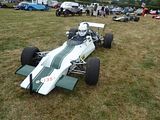


The original Elan was introduced in 1962 as a roadster, although an optional hardtop was offered in 1963 and a coupé version appeared in 1965, and there were examples of all of these here. The two-seat Lotus Elan replaced the elegant, but unreliable and expensive to produce Lotus Elite. It was the first Lotus road car to use a steel backbone chassis with a fibreglass body. At 1,600 lb (726 kg), the Elan embodied the Colin Chapman minimum weight design philosophy. Initial versions of the Elan were also available as a kit to be assembled by the customer. The Elan was technologically advanced with a DOHC 1557 cc engine, 4-wheel disc brakes, rack and pinion steering, and 4-wheel independent suspension. Gordon Murray, who designed the spectacular McLaren F1 supercar, reportedly said that his only disappointment with the McLaren F1 was that he couldn’t give it the perfect steering of the Lotus Elan. This generation of the two-seater Elan was famously driven by the character Emma Peel on the 1960s British television series The Avengers. The “Lotus TwinCam” engine was based on Ford Kent Pre-Crossflow 4-cylinder 1498 cc engine, with a Harry Mundy-designed 2 valve alloy chain-driven twin-cam head. The rights to this design was later purchased by Ford, who renamed it to “Lotus-Ford Twin Cam”. It would go on to be used in a number of Ford and Lotus production and racing models.


There has only ever been one front wheel drive model with Lotus badges on it, the “M100” Elan sports car. Like many specialist produced cars of the era, there was a long wait for this car form when news first broke that it was under development to the actual release of cars people could buy. The M100 Elan story goes back to 1986 and the purchase of Lotus by General Motors which provided the financial backing to develop a new, small, affordable car in the same spirit as the original Elan, the last of which had been built in December 1972. A development prototype, the M90 (later renamed the X100) had been built a few years earlier, using a fibreglass body designed by Oliver Winterbottom and a Toyota-supplied 1.6-litre engine and transmission. Lotus was hoping to sell the car through Toyota dealerships worldwide, badged as a Lotus Toyota, but the project never came to fruition and the prototype was shelved, although Lotus’s collaboration with Toyota had some influence on the design of the Toyota MR2. The idea of a small roadster powered by an outsourced engine remained, however, and in late 1986 Peter Stevens’s design for the Type M100 was approved and work began by Lotus engineers to turn the clay styling buck into a car that could be built. This process was completed in just under three years, a remarkably short time from design to production car. The M100 Elan was conceived as a mass-market car and in particular one that would appeal to US buyers. Consequently, Lotus put an enormous effort (for such a small firm) into testing the car; over a two-year period 19 crash cars and 42 development vehicles were built, logging nearly a million test miles in locations from Arizona to the Arctic. The Elan was driven at racing speeds for 24 hours around the track at Snetterton. Finally each new car was test-driven for around 30 miles at Lotus’s Hethel factory to check for any manufacturing defects before being shipped to dealers. The choice of front-wheel drive is unusual for a sports car, but according to Lotus sales literature, “for a given vehicle weight, power and tyre size, a front wheel drive car was always faster over a given section of road. There were definite advantages in traction and controllability, and drawbacks such as torque steer, bump steer and steering kickback were not insurmountable.” This was the only front-wheel-drive vehicle made by Lotus. Every model made since the M100 Elan, such as the Lotus Elise, has been rear-wheel drive. The M100 Elan’s cornering performance was undeniable (on release the Elan was described by Autocar magazine as “the quickest point to point car available”). Press reaction was not uniformly positive, as some reviewers found the handling too secure and predictable compared to a rear-wheel-drive car. However, the Elan’s rigid chassis minimised roll through the corners and has led to its description as ‘the finest front wheel drive [car] bar none’. Unlike the naturally aspirated version, the turbocharged SE received power steering as standard, as well as tyres with a higher ZR speed rating. The M100 Elan used a 1,588 cc double overhead camshaft (DOHC) 16-valve engine, sourced from the Isuzu Gemini and extensively modified by Lotus (a third generation of this engine was later used in the Isuzu Impulse), which produced 162 hp. 0–60 acceleration time was measured by Autocar and Motor magazine at 6.5 seconds, and a top speed of 137 mph was recorded. Significant differences in the Isuzu-Lotus engine from the original include a new exhaust system, re-routed intake plumbing for better thermodynamic efficiency, improved engine suspension, and major modifications to the engine control unit to improve torque and boost response. Almost all models featured an IHI turbocharger. Two variants were available at launch, the 130 bhp Elan 1.6 (retailing at £17,850) and the 162 bhp Turbo SE (£19,850). Initial sales were disappointing, perhaps because its launch coincided with a major economic recession in the UK and USA, and perhaps also because it coincided with the cheaper Mazda MX-5 which was arguably similar in concept, though the MX-5 was quite intentionally nostalgic and old fashioned (apeing the original Elan), while the M100 was deliberately futuristic, modern and forward looking. The Elan was regarded as a good product in a bad market, but was also very expensive to make (the cost to design and produce the dashboard alone was more than the total cost of the Excel production line), and sales figures were too low to recoup its huge development costs. Altogether 3,855 Elans were built between November 1989 and July 1992, including 129 normally aspirated (non-turbo) cars. 559 of them were sold in the US, featuring a ‘stage 2 body’ which had a different rear boot spoiler arrangement together with a lengthened nose to accommodate a USA-compliant crash structure and airbag, and 16-inch wheels (optional in most markets, standard in the U.S.) instead of 15-inch as on the UK model. A limited edition of 800 Series 2 (S2) M100 Elans was released during the Romano Artioli era (produced June 1994–September 1995) when it was discovered that enough surplus engines were available to make this possible. According to Autocar magazine, the S2 addressed some of the concerns over handling, but power was reduced to 155 bhp and the 0–60 acceleration time increased to 7.5 seconds, due to the legislative requirement to fit a catalytic converter in all markets. The S2s have very similar performance to the USA vehicles, having an identical engine management system calibration and a slightly lower overall vehicle weight.

The Lotus 2-Eleven is based on the Lotus Exige S, and thus has the same Toyota 2ZZ-GE with VVTL-i, Eaton M62 Roots-type supercharger and intercooled inline-four engine. Weighing 670 kg (1,477 lb), with 252 bhp at 8,000 rpm and 242 Nm (178 lb/ft) at 7,000 rpm of torque, the 2-Eleven can sprint from 0-60 mph (97 km/h) in 3.8 seconds and has a top speed of 150 mph (241 km/h). Intended as a track day car, it cost £39,995 though for an additional £1,100 Lotus would make the car fully road legal. Slight differences exist between the track and road versions, where the track car is slightly longer, at 3,872 mm (152.4 in) and lighter at 666 kg (1,468 lb). The cars were made between 2007 and 2011.

Lotus dusted off the Europa name for a new car in 2005, based on the Elise, which was officially introduced at the 2006 Geneva Motor Show. Lotus Europa S production commenced in July 2006 and continued to 2010. The engine was a 2.0 litre turbo delivering 197 bhp at 5,400 rpm, with a maximum torque of 272 Nm (201 lb/ft) at 5,400 rpm, delivering 0-60 mph in 5.6 seconds and a maximum speed of 143 mph. Lotus did not export the Europa S to the USA, but despite this, the American manufacturer Dodge developed an electric vehicle based on the Europa, known as the Dodge Circuit, which it planned to bring to the US market by 2010, but the project was cancelled in May 2009. The Europa SE was unveiled at the Geneva International Motor Show on 5 March 2008. The Europa was an upgraded model with more comfort in mind, intended to bring in more customers. The Europa S motor was modified to bring power to 222 bhp and torque to 300 Nm (221 lb/ft). Neither version was a success, though and the Europa was discontinued in 2010 after a short model life.


Developed under the project name Project Eagle, this car was launched as the Evora on 22 July 2008 at the British International Motor Show. The Evora is based on the first all-new vehicle platform from Lotus Cars since the introduction of the Lotus Elise in 1995 (the Exige, introduced in 2000, and the 2006 Europa S are both derivatives of the Elise Evora was planned to be the first vehicle of three to be built on the same platform and was the first product of a five-year plan started in 2006 to expand the Lotus line-up beyond its track-specialised offerings, with the aim of making Evora a somewhat of a more practical road car that would appeal to the mainstream. As such it is a larger car than recent Lotus models Elise and its derivatives (Exige, Europa S, etc.), with an unladen weight of 1,383 kg (3,049 lb). It is currently the only Lotus model with a 2+2 configuration, although it is also offered in a two-seater configuration, referred to as the “Plus Zero” option. It is also the only 2+2 mid engined coupé on sale. The interior is larger to allow taller persons of 6’5″ to fit. The cooled boot behind the engine is large enough to fit a set of golf clubs, although Lotus Design Head Russell Carr denies that this was intentional. Lotus intends Evora to compete with different market sectors including the Porsche Cayman. The name “Evora” keeps the Lotus tradition of beginning model names with an “E”. The name is derived from the words evolution, vogue, and aura. and it of course sounds similar to Évora, which is the name of a Portuguese city and UNESCO World Heritage Site. Sales started in summer 2009, with an annual target of 2000 cars per year, with prices between £45,000 and just over £50,000. and in America from the beginning of 2010. The Evora received several accolades at its launch from the British motoring press, including: Britain’s Best Driver’s Car 2009 from Autocar and Car of the Year 2009, from Evo. Sales, however, were far from target, as the car was seen as too costly. A more powerful Evora S was launched in 2010 with a supercharged equipped 3.5-litre V6. A facelifted and more powerful Evora 400 model was unveiled at the 2015 Geneva Motor Show.

Final Lotus here was the Emira, the only sports car and the only non-electric car currently being produced by Lotus.

MARCOS
There were a number of Marcos models on the Owners Club stand. Designed by brothers Dennis and Peter Adams, this well-known car caused something of a sensation when it was shown at the 1964 Racing Car Show. Known as the Marcos 1800, it had a glassfibre body, with a wooden chassis and was offered for sale fully built or in kit form. This was to be the design that would become familiar to sports car enthusiasts for more than 30 years, even though the original plywood chassis would later be replaced by a steel chassis and the futuristic scalloped dashboard also vanished after a few years. The plywood chassis was glued together from 386 separate pieces and was not only light and strong, but also required a minimum up front investment to construct. The extremely low Marcos required a nearly supine driving position and fixed seats, mounted lower than the floor of the car. In return, the entire pedal set could be moved fore and aft with a knob on the dashboard. If this proved not to be enough Marcos also offered optional booster pillows. This setup, with the fixed seats, remained until the end of Marcos production in late 2007. The original Marcos 1800 had a two-spoke steering wheel and a novel dash with a prominent centre console, a rather expensive design which did not survive onto the Ford-engined cars. The entire nose portion, of a long and tapered design, was hinged at the front and was held down by latches behind the front wheelwells. It used the cast-iron four-cylinder 96 hp Volvo 1778 cc B18 unit with overdrive gearbox from the Volvo P1800S enough for a 116 mph top speed and a 0-60 mph time of 8.2 seconds. Successful in competition, the rather expensive 1800 sold very slowly, and after the first 33 cars the de Dion rear suspension was replaced by a live Ford axle. The price was dropped from ₤1500 to ₤1340, but it was not enough to make the car profitable. Cars were stockpiling in 1966, and after 106 (or 99) had been built, the 1800 was replaced by the Ford-engined 1500. Normally fitted with a four-speed manual transmission a five-speed one was also available, allowing for a higher top speed. According to some sources, a few of the last cars built had the 2 litre Volvo B20 engine fitted, as did some of the racing cars. The 1800 is the only Marcos that is eligible for historic racing and as such is considerably more valuable today than later models. In 1966 the GT was changed to a pushrod inline-four Ford Kent engine of 1500 cc, in order to lower costs as the 1800 had been rather too expensive to market. The complex dash was also replaced with a flat polished wood unit, which was soon downgraded further yet to a mass-produced “wood-effect” one. Power and performance were both down on the 1800, but sales increased considerably. To hide the fact that a common Ford engine was used, Marsh replaced the rocker covers with Marcos ones and switched from Weber to Stromberg carburettors. An overbored Lawrencetune 1650 cc version was made available in 1967 (32 built) to ameliorate the power shortage, for the Marcos 1650 GT. The 1650 also had bigger disc brakes and a standard Webasto sunroof, but proved somewhat less than reliable It and the 1500 were both replaced by Ford’s new Crossflow four not much later, in late 1967. The 1600 proved to be the most popular model yet, with 192 cars built until early 1969. Weight was 740 kg (1,631 lb) and disc brakes up front were standard, although power assist was an optional extra. Production ended in October 1969 as the new steel chassis was not well suited for the crossflow engine. A new model, the 2 litre, appeared at the January 1969 London Show with the engine changed to the Ford Essex V4 engine from the Ford Corsair – while a V6 engine had already appeared at the top of the lineup in 1968. Also in 1969, the plywood chassis was gradually replaced by a square section steel one, which shortened production time and saved on cost. These steel framed cars required a lower sill panel and have reshaped rear bumpers, as well as some subtle interior differences. The wooden chassis had also begun to meet a certain amount of resistance from buyers. There seem to have been no V4-engined wooden cars made, although there is a few months overlap between the introduction dates. The V4 received most of the same standard and optional equipment (except the overdrive) and the same central bonnet bulge as did the V6 models; very few of the Marcos 2 litres still have their V4 engines, as a V6 swap is a rather quick job and makes for a much faster car than the original’s 85 hp. It was not exactly a success story, 78 2 litres were most likely built, although numbers as low as 40 have also been mentioned. New at the October 1968 London Show was the more powerful Marcos 3 litre. Fitted with the double-carb Ford Essex V6 engine and transmission from the Ford Zodiac, production beginning in January 1969. Max power was 140 bhp and aside from the badging, this car is most easily recognised by the large, central bonnet bulge necessary to clear the larger engine. The 3 litre had a four-speed manual with a Laycock-de-Normanville Overdrive for the third and fourth gears fitted. In December 1969 a twin-carburetted 3-litre Volvo B30 straight-six became available (initially only for the US), and in 1971 eleven or twelve cars were fitted with the 150 bhp Triumph 2.5-litre straight-six. These were called the Marcos 2½ litre. As the bonnet was a close fit over the various larger engines, this resulted in a corresponding variation in the bonnet design as regards changes designed to clear engine air intakes, often the only external sign of the type of engine fitted. All inline-sixes required a rather angular bulge right of centre on the bonnet to clear the carburettors. Around this time, some V6 cars begun sporting single rectangular headlights (not on US-market cars), borrowed from the Vauxhall Viva HB. Later in 1969 the six-cylinder cars, as with their four-cylinder counterparts, received the new steel chassis. Either 100 or 119 of the wood-chassied V6 cars were built. The Ford V6 version achieved over 120 mph on test and the Volvo-engined model was not far behind it, but the heavy cast-iron engines increased nose-heaviness in comparison to the four-cylinder variants. With US sales going strong, Marcos production was up to three per week and they had to invest in a bigger space in 1969. Cars for the North Americas market had Volvo’s inline-six cylinder, 3 litre engines with a standard Borg-Warner Type 35 automatic transmissions. They sat on tubular steel space frames, have a higher ride height, and no headlight covers – all of this was in order to get US road certification. Air conditioning was also listed as an option by New York-based importers Marcos International Inc. Delays and problems with the federalised cars were beginning to mount. In 1970, 27 exported cars were impounded by US Customs for supposedly not meeting federal law, causing Marcos to withdraw entirely from the US market. Together with the development costs of the Mantis and the introduction of VAT on kit cars on the horizon, Marcos had to close its doors for what turned out to be the first time. About sixty US market cars were built, some of which were brought back after the US market dried up in 1970 and converted to RHD for sale in the home market. Production of the Volvo 3 litre continued for the rest of the world, with these cars fitted with a four-speed manual transmission. Either 80 or 172 of the Volvo I6-engined Marcos were built until early 1972, with the final one destined to become the last Marcos built for the next ten years. After Marcos had run out of money the company was sold to Hebron & Medlock Bath Engineering in mid-1971. They themselves had to call in the receivers only six months later. The Rob Walker Garage Group bought the factory only to sell off everything, including some finished cars such as all six Mark 2 1600s built. Jem Marsh bought up spares and other parts at the liquidation sale and proceeded to run a company servicing existing Marcos, until he resumed production of Marcos kits in 1981. The original GT continued to be built until 1989 or 1990, being developed into its altered Mantula form. This was further developed into more powerful and aggressively-styled designs, culminating in the 1994 LM600 (which competed in the 1995 Le Mans 24-hour race).

McLAREN
The McLaren 570S is a sports car designed and manufactured by the British car manufacturer McLaren Automotive, produced from 2015 until 2021. It was unveiled at the 2015 New York International Auto Show. The car is powered by a new iteration of the 3.8-litre twin-turbocharged V8 engine already used in the 650S and P1, designated M838T E with thirty per cent of the parts redesigned. It delivers 562 hp and 443 lb/ft (601 Nm) of torque through a 7-speed dual-clutch transmission developed by Graziano Trasmissioni, as it is arranged in the car as a rear-mid engine configuration, The car can accelerate from 0–62 mph (0–100 km/h) in 3.2 seconds and can achieve a top speed of 204 mph (328 km/h). A total dry weight of 2,989 lb (1,356 kg) and maximum weight of 3,201 lb (1,452 kg) gives the 570S a power to weight ratio of 428 PS per tonne delivering a fuel economy of 25.5 miles per imperial gallon (11.1 L/100 km; 21.2 mpg‑US) and CO2 emissions of 249 g/km. McLaren focused on delivering “day-to-day usability and driveability” against the most sporting model options in its range with increased luggage space, greater interior storage and leather upholstery options. The car is designed with aerodynamics in mind and the teardrop shaped cockpit helps achieve that objective. The rear of the car is inspired by the P1 and borrows the slim LED tail lights and diffuser styling from the flagship sports car. The car features dihedral doors, a trademark of McLaren as featured on its ultimate and super series cars. At the 2015 Shanghai Motor Show, the entry level McLaren Sports Series car named 540C was unveiled with 533 hp (540 PS) and 540 Nm (398 lb/ft) of torque. This new entry-level model focuses on “day-to-day usability and driveability” even more than that of the 570S with improved city driving and ride quality. The car can accelerate from 0–60 mph (0–97 km/h) in 3.4 seconds and has a top speed of 199 mph (320 km/h). The 540C is cheaper than the 570S and went on sale shortly after its Shanghai debut. The 540C is not available in the US due to McLaren wanting to focus on the more powerful 570S model for the US market. At the 2016 Geneva Motor Show, McLaren presented another addition to the Sport Series and 570 line up, dubbed the 570GT. The 570GT is the less track focused, and more road trip worthy version of the 570S. The 570GT sports a side opening cargo hatch above the mid-mounted engine for additional cargo space in place of the engine cover of the 570S, slightly softer suspension settings and improved sound insulation. The 570GT went through a facelift at the start of 2018 which added ceramic brakes as standard and steel as a free option. The convertible version of the 570S was unveiled at the 2017 Goodwood Festival of Speed event. It borrows the roof folding mechanism from the Super Series line-up. The two-piece aluminium roof folds into a compartment located behind the seats of the car leaving the rear buttress in place. The roof folding mechanism takes 30 seconds to fold and unfold and is operable at speeds up to 48 km/h (30 mph). Unlike the 12C Spider and the 650S Spider, the 570S spider required no significant reengineering for the folding roof mechanism because of the carbon monocell used in the 570S. As a result, the 570S Spider is only 46 kg (101 lb) heavier than the coupe. The drivetrain of the Spider remains identical to that of the coupe which results in similar performance to the coupé counterpart with the roof up. The Spider has new forged aluminium wheels and three special launch colours namely Vega Blue, Sicilian Yellow and Ventura Orange. Deliveries of the Spider began in late 2017

MG
The diminutive M Type Midget is a tiny sports car produced from April 1929 to 1932. It was sometimes referred to as the 8/33. Launched at the 1928 London Motor Show when the sales of the larger MG saloons was faltering because of the economic climate, the small car brought MG ownership to a new sector of the market and probably saved the company. Early cars were made in the Cowley factory, but from 1930 production had transferred to Abingdon. The M-Type was one of the first genuinely affordable sports cars to be offered by an established manufacturer, as opposed to modified versions of factory-built saloon cars and tourers. By offering a car with excellent road manners and an entertaining driving experience at a low price (the new MG cost less than double the cheapest version of the Morris Minor on which it was based) despite relatively low overall performance the M-type set the template for many of the MG products that were to follow, as well as many of the other famous British sports cars of the 20th century. The M-type was also the first MG to wear the Midget name that would be used on a succession of small sports cars until 1980. This 2-door sports car used an updated version of the four-cylinder bevel-gear driven overhead camshaft engine used in the 1928 Morris Minor and Wolseley 10 with a single SU carburettor giving 20 bhp at 4000 rpm. Drive was to the rear wheels through a three-speed non-synchromesh gearbox. The chassis was based on the one used in the 1928 Morris Minor with lowered suspension using half-elliptic springs and Hartford friction disk shock absorbers with rigid front and rear axles and bolt on wire wheels. The car had a wheelbase of 78 inches and a track of 42 inches. 1930 brought a series of improvements to the car. The Morris rod brake system, with the handbrake working on the transmission, was replaced a cable system with cross shaft coupled to the handbrake and the transmission brake deleted. Engine output was increased to 27 bhp by improving the camshaft and a four-speed gearbox was offered as an option. The doors became front-hinged. A supercharged version could be ordered from 1932, raising the top speed to 80 mph. Early bodies were fabric-covered using a wood frame; this changed to all-metal in 1931. Most cars had bodies made by Carbodies of Coventry and fitted by MG in either open two-seat or closed two-door “Sportsmans” coupé versions, but some chassis were supplied to external coachbuilders such as Jarvis. The factory even made a van version as a service vehicle. The car could reach 65 mph and return 40 miles per gallon. The open version cost £175 at launch, soon rising to £185, and the coupé cost £245. The 1932 supercharged car cost £250. The M-type had considerable sporting success, both privately and with official teams winning gold medals in the 1929 Land’s End Trial and class wins in the 1930 “Double Twelve” race at Brooklands. An entry was also made in the 1930 Le Mans 24 hour, but neither of the two cars finished. It was replaced by the J Type, and then the P Series in 1934.


The J-type was produced from 1932 to 1934. This 2-door sports car used an updated version of the overhead camshaft, crossflow engine, used in the 1928 Morris Minor and Wolseley 10 and previously fitted in the MG M-type Midget of 1929 to 1932, driving the rear wheels through a four-speed non-synchromesh gearbox. The chassis was from the D-Type with suspension by half-elliptic springs and Hartford friction shock absorbers all round with rigid front and rear axles. The car had a wheelbase of 86″ and a track of 42″. Most cars were open two-seaters, but a closed salonette version of the J1 was also made, and some chassis were supplied to external coachbuilders. The open cars can be distinguished from the M type by having cut-away tops to the doors. Small numbers of J3 and J4 models, designed for racing, were made and the J1 was the four seater model in the range, but by far the most common were the J2 models, such as this one. The 847cc engine gave the car a top speed of 65 mph, although The Autocar managed to get nearly 20 mph more than that from a specially prepared one that they tested in 1933. The most serious of the J2’s technical failings is that has only a two-bearing crankshaft, which could break if over-revved. The overhead camshaft is driven by a vertical shaft through bevel gears, which also forms the armature of the dynamo. Thus any oil leak from the cambox seal goes into the dynamo brushgear, presenting a fire hazard. Rather than hydraulic brakes the car has Bowden cables to each drum. Although requiring no more pedal force than any other non-power-assisted drum brake if they are well maintained, the drums themselves are small, and even in period it was a common modification to replace them with larger drums from later models. Nonetheless, the car was quite popular, and at £199, was relatively affordable.

Replacing the J series cars was the 1934 PA. The PA and later PB replaced the J Type Midget. These 2-door sports cars used an updated version of the overhead camshaft, crossflow engine that was also used in the 1928 Morris Minor and Wolseley 10 as well as the J-type Midget of 1932 to 1934. It drove the rear wheels through a four-speed non-synchromesh gearbox. The chassis was a strengthened and slightly longer version of that used in the J-type with suspension by half-elliptic springs all round with rigid front and rear axles. Steering was initially by a Marles Weller and later a Bishop Cam system. The two-seat car had a wheelbase of 87″ and a track of 42″. Most cars were open two seaters, but streamlined Airline coupé bodies were also made. The P-type was also available as a four-seater, a car that suffered from a lack of power and poor rear ground clearance. Whereas J, K and L-type MGs differentiated between versions with the use of numbers, with 1 indicating a four-seater (the J1) and 2 a two-seater (the J2), this was not the case with the P-type (or its six-cylinder sister, the N-type Magnette), and there is no clue to the type in the name. The first version, the PA used an 847 cc engine similar to the one on the J-Type, but now with a 3-bearing crankshaft, larger camshaft and twin SU carburettors. It produced 36 bhp at 5,500 rpm. In 1935, a PA open two-seater cost £222. Around 2,000 PAs were made. In late 1936 the PA was replaced by the PB, which had a larger 939cc 43bhp engine and which is distinguished by a grille of vertical slats as opposed to the honeycomb pattern of the PA. 526 examples of the PB were made.

This one is a 1936 NA Magnette. The MG N-type (also known as the MG Magnette) is a sports car that was produced by MG from October 1934 to 1936. The car was developed from the K-Type and L-Type but had a new chassis that broke away in design from the simple ladder type used on the earlier cars of the 1930s being wider at the rear than the front and with the body fitted to outriggers off the main frame. The engine was a further development of the 1271 cc 6-cylinder KD series overhead camshaft engine used in the K-type and originally used in the 1930 Wolseley Hornet. Modifications were made to the cylinder block and head and fitted with twin SU carburettor. It produced 56 bhp at 5500 rpm, a near 25% improvement. Drive was to the rear wheels through a four-speed non-synchromesh gearbox. The car had a wheelbase of 96 inches (2439 mm) and a track of 45 inches (1143 mm). Semi elliptic leaf springs, wider and longer than those used on previous cars, were fitted all round and the body was mounted to the chassis using rubber pads. The factory-supplied body was new and taller than on earlier cars, the doors were rear hinged and featured cut-away tops. The slab type fuel tank at the rear which had featured on earlier models was no longer seen on the N-Type, being hidden in the tail. In addition to the solid colour factory options, also offered were two tone combinations. The darker colour was applied to the upper surfaces (bonnet, scuttle, rear deck and guards). As well as the open cars, an Airline Coupé model was also available but few were sold. Some cars were supplied in chassis form to outside coachbuilders including Allingham, (actually made by Carbodies) who made a 2/4-seater where the rear seats could be closed off by a removable deck to appear like a 2-seater, and Abbey. The NB, announced in 1935, had an updated body with lower lines and vertical slats on the radiator grille. The doors were now front hinged, better seats were fitted and the instruments re-arranged with the speedometer and tachometer now having separate dials. The factory supplied two tone colour options were reversed, that is, the lighter colour was on the upper surfaces. The Airline Coupé body was still available. The ND was a special model using unsold MG K2 bodies fitted to the N-Type chassis probably only available in 1934. The number made is uncertain as the model does not seem to have been officially listed. The NE was the competition variant built for the 1934 Tourist Trophy race. Lightweight 2-seat bodies were fitted and the engine was further tuned to give 68 bhp at 6500 rpm. In 1935 three of the cars were fitted with P-Type style bodies and formed the Musketeer racing team which with factory support gained considerable success in various trials.

Whilst the TC, the first postwar MG and launched in 1945, was quite similar to the pre-war TB, sharing the same 1,250 cc pushrod-OHV engine, it had a slightly higher compression ratio of 7.4:1 giving 54.5 bhp at 5200 rpm. The makers also provided several alternative stages of tuning for “specific purposes”. It was exported to the United States, even though only ever built in right-hand drive. The export version had slightly smaller US specification sealed-beam headlights and larger twin rear lights, as well as turn signals and chrome-plated front and rear bumpers. The body of the TC was approximately 4 inches wider than the TB measured at the rear of the doors to give more cockpit space. The overall car width remained the same resulting in narrower running boards with two tread strips as opposed to the previous three. The tachometer was directly in front of the driver, while the speedometer was on the other side of the dash in front of the passenger. 10,001 TCs were produced, from September 1945 to Nov. 1949, more than any previous MG model. It cost £527 on the home market in 1947.


The 1961 Midget resurrected the name that was used by MG for their smallest car, the M Type, in the late 20s, was the Midget announced in 1961, and was essentially a slightly more expensive badge-engineered version of the MkII Austin-Healey Sprite. The original ‘Frogeye’ Sprite had been introduced specifically to fill the gap in the market left by the end of production of the MG T-type Midget as its replacement, the MGA had been a significantly larger and more expensive car with greater performance. Many existing MG enthusiast and buyers turned to the Sprite to provide a modern low-cost sports car and so a badge-engineered MG version reusing the Midget name made sense. The new Midget differed from the Sprite only in its grille design, badging, colour options and having both leather seats and more external chrome trim as standard to justify its higher purchase price. Mechanically the car was identical to its Austin-Healey counterpart, retaining the rear suspension using quarter-elliptic leaf springs and trailing arms from the ‘Frogeye’. The engine was initially a 948 cc A-Series with twin SU carburettors producing 46 hp at 5500 rpm and 53 lb/ft at 3000 rpm. Brakes were 7″ drums all round. A hard top, heater, radio and luggage rack were available as factory-fitted extras. In October 1962 the engine was increased to 1098 cc, raising the output to 56 hp at 5500 rpm and 62 lb/ft at 3250 rpm, and disc brakes replaced the drums at the front. Wire spoked wheels became available. The doors had no external handles or locks and the windows were sliding Perspex side-screens. A heater was still an optional extra. The car sold well, with 16,080 of the small-engined version and 9601 of the 1098 being made before the arrival in 1964 of the Mark II. Externally the main changes were to the doors, which gained wind-up windows, swivelling quarter lights, external handles and separate locks. The windscreen also gained a slight curvature and was retained in a more substantial frame. The hood, though modified, continued to have a removable frame that had to be erected before the cover was put on. The rear springs were replaced by more conventional semi-elliptic types which gave a better ride. The engine block was strengthened and larger main bearings were fitted, increasing the power to 59 hp at 5750 rpm and torque to 65 lbf·ft at 3500 rpm. A total of 26,601 were made. 1967 saw the arrival of the Mark III. The engine now grew to 1275 cc using the development seen on the Mini-Cooper ‘S’. Enthusiasts were disappointed that this was a detuned version of the 76-bhp Cooper ‘S’ engine, giving only 65 hp at 6000 rpm and 72 lbf·ft at 3000 rpm. A reduced compression ratio of 8.8:1 was used instead of the 9.75:1 employed on the Cooper S engine. The Midget used the 12G940 cylinder head casting that was common to other BMC 1300 cars, whereas the Cooper ‘S’ had a special head with not only larger inlet, but also larger exhaust valves; however, these exhaust valves caused many ‘S’ heads to fail through cracking between the valve seats. The detuned engine was used for reasons of model range placement – with the Cooper ‘S’ spec engine, the Midget would have been faster than the more expensive MGB. The hydraulic system gained a separate master cylinder for the clutch. The hood was now permanently attached to the car, with an improved mechanism making it much easier to use. Minor facelift changes were made to the body trim in late 1969 with the sills painted black, a revised recessed black grille, and squared off taillights as on the MGB. The 13″ “Rostyle” wheels were standardised, but wire-spoked ones remained an option. The square-shaped rear wheel arches became rounded in January 1972 and later that year a Triumph steering rack was fitted, giving a gearing that was somewhat lower than earlier Midgets. A second exhaust silencer was also added in 1972. Alternators were fitted instead of dynamos from 1973 onwards. Many consider the round-arch Midgets with chrome bumpers produced for model years 1972 and 1974 to be the most desirable. These round-arch cars started leaving the Abingdon factory in late 1971. Between 1966 and the 1969 face lift, 22,415 were made, and a further 77,831 up to 1974. In late 1974, to meet US federal regulations, large black plastic bumpers (usually called rubber bumpers, despite not actually being rubber) were added to the front and rear and the ride height was increased. The increased ride height affected handling, and an anti-roll bar was added to help with higher centre of gravity. The A-Series engine was replaced by the 1493 cc unit from the Triumph Spitfire with a modified Morris Marina gearbox with synchromesh on all four gears. The increased displacement of the new engine was better able to cope with the increasing emission regulations. Although the horsepower ratings were similar, at 65 bhp, the 1493 cc engine produced more torque. The increased output combined with taller gear ratios resulted in faster acceleration and a top speed of just over 100 mph. In the US market British Leyland struggled to keep engine power at acceptable levels, as the engines were loaded with air pumps, EGR valves and catalytic converters to keep up with new US and California exhaust emission control regulations. The home market’s dual SU HS4 carbs were swapped for a single Zenith-Stromberg 150 CD4 unit, and the power fell to 50 bhp at 5000 rpm and 67 lb-ft of torque at 2500 rpm. The round rear-wheel arches were now square again, to increase the body strength. The last car was made on 7 December 1979, after 73,899 of the 1500 model had been made, with the last 500 home-market cars painted black.

MINI
Issigonis’ friend John Cooper, owner of the Cooper Car Company and designer and builder of Formula One cars, saw the potential of the Mini for competition. Issigonis was initially reluctant to see the Mini in the role of a performance car, but after John Cooper appealed to BMC management, the two men collaborated to create the Mini Cooper. The Austin Mini Cooper and Morris Mini Cooper debuted in September 1961. The 848 cc engine from the Morris Mini-Minor was given a longer stroke to increase capacity to 997 cc increasing power from 34 to 55 bhp. The car featured a race-tuned engine, twin SU carburettors, a closer-ratio gearbox and front disc brakes, uncommon at the time in a small car. One thousand units of this version were commissioned by management, intended for and designed to meet the homologation rules of Group 2 rally racing. The 997 cc engine was replaced by a shorter stroke 998 cc unit in 1964. In 1962, Rhodesian John Love became the first non-British racing driver to win the British Saloon Car Championship driving a Mini Cooper. A more powerful Mini Cooper, dubbed the “S”, was developed in tandem and released in 1963. Featuring a 1071 cc engine with a 70.61 mm bore and nitrided steel crankshaft and strengthened bottom end to allow further tuning; and larger servo-assisted disc brakes, 4,030 Cooper S cars were produced and sold until the model was updated in August 1964. Cooper also produced two S models specifically for circuit racing in the under 1,000 cc and under 1,300 cc classes respectively, rated at 970 cc and a 1,275 cc both had a 70.61 mm bore and both were also offered to the public. The smaller-engine model was not well received, and only 963 had been built when the model was discontinued in 1965. The 1,275 cc Cooper S models continued in production until 1971. Sales of the Mini Cooper were: 64,000 Mark I Coopers with 997 cc or 998 cc engines; 19,000 Mark I Cooper S with 970 cc, 1,071 cc or 1,275 cc engines; 16,000 Mark II Coopers with 998 cc engines; 6,300 Mark II Cooper S with 1,275 cc engines. There were no Mark III Coopers and 1,570 Mark III Cooper S.

MISC


MORGAN

In March this year, Morgan released a new model, called the SuperSport, to replace the Plus Six. The design of the Supersport is a further development of the Midsummer special model based on the Plus Six, introduced in summer 2024. Technically, the Supersport is based on a further developed platform (CXV) of the predecessor model. The body is handcrafted from aluminium. The roof is available as either a carbon fiber composite hardtop or a mohair folding roof. The Supersport has removable side windows and a boot. Compared to the Plus Six, the car is longer, wider and taller, but the wheelbase is the same. The manufacturer states the kerb weight as 1,170 kg (2,580 lb). The Supersport is powered by the B58 six-cylinder inline petrol engine familiar from the predecessor model. It achieves a maximum output of 340 hp and a maximum torque of 500 Nm. The vehicle is said to accelerate from 0 to 60 mph in 3.9 seconds, and the top speed is stated as 166 mph (267 km/h). An 8-speed automatic transmission from ZF transmits the power to the rear wheels. Sales started immediately, but this would be the first time many would have seen the car – and this one came as the factory demonstrator – for real.


MORRIS
The “bullnose” Morris Oxford is a series of motor car models produced by British manufacturer Morris from 1913 to 1926. It was named by W R Morris after the city in which he grew up and which his cars were to industrialise. William Morris’s first car was called Oxford in recognition of its home city. It was announced in The Autocar magazine in October 1912 and production began in March 1913. Because he had a limited amount of capital and was unwilling to share ownership of his business little was made in-house. Virtually all components were bought-in and assembled by Morris. It was a small car with a 1018 cc four-cylinder side-valve engine with fixed cylinder head from White & Poppe. Ignition was by a Bosch magneto. The chassis made by Rubery Owen was of pressed-steel construction and suspension was by leaf springs, semi-elliptic at the front and longer three-quarter elliptic at the rear slung above the axle. The welded single piece banjo rear axle with splined half shafts was driven by a Wrigley Worm. The front axle was of forged steel and, like the back axle assembly and the steering, was made by Wrigley. The brakes, on the rear wheels only, were the external contracting type, metal to metal, using four shoes in each drum. A White & Poppe three-forward and reverse gearbox was fitted. The Powell & Hanmer headlamps were acetylene and the side and tail lamps oil. The windscreen, by Auster Limited of Barford Street, Birmingham, like the lamps was classed as an accessory. The car got its popular name, Bullnose, from its distinctive round-topped radiator at first called the bullet nose. Most bodies, made by Raworth of Oxford, were of the two-seat open-tourer type. There was also a van version, but the chassis did not allow four-seat bodies to be fitted, as it was not strong enough and too short. It was first displayed at the Olympia Motor Show which opened 7 November 1913. The standard model remained in production unchanged. The new de luxe had a longer wheelbase, 90 in (2,300 mm), and track was now 45 in (1,100 mm). The range of bodies was now expanded from the simple two-seater to include even a limousine and a sporting car which, like the vans, had no windscreen or doors but was provided with a speedometer as a standard fitting. Its front axle and steering had been re-designed to reduce “bump-steer” and its radiator capacity increased. Grooved tyres were now supplied at the rear. The banjo back axle was no longer welded but built up from three pieces and its springs were now slung below it. The 1919 Oxford (advertised as early as September 1918) was assembled from locally made components and now took on the rather more substantial aspect of 1915’s Cowley. Longer and stronger than the old Oxford, enough to carry five passengers, the new Oxford retained the pre-war Bullnose radiator style in its larger version. From August 1919, the Cowley became the downmarket “no frills” variant with only a 2-seater body and lighter smaller tyres. The Oxford had a self-starter (an extra for the Cowley) and a better electrical system and the Oxford took and kept the Cowley’s leather upholstery. The new car’s 11.9 fiscal horsepower 1548 cc engine was made under licence in Coventry for Morris by a British branch of Hotchkiss the French ordnance company which was turning away from guns to the motor industry. The Hotchkiss engine used the Cowley’s Detroit USA Continental Motors Company design. Hotchkiss prices well undercut White and Poppe who had made Oxford engines up to that time. Morris bought Hotchkiss’s British factory in May 1923 and named it Morris Engines. When it was shown at the Scottish Motor Show in January 1920 it drew large crowds of enthusiasts all day. The chassis alone was shown and was genuinely admired for the way all transmission, everything revolving, was fully enclosed in what amounts to an oil bath, everything but the fan belt. A few weeks later after a lengthy trial of the new car The Times’ motoring reporter wrote that the car represents “a very decided advance in light car construction”. The common sense of the designers is shown in many small details but “its greatest charm is in the engine’s steam-like flexibility” and liveliness. In these respects it was the best engine the writer had ever encountered.

Beginning in 1922, the tiny Austin Seven had brought motoring to a new public and broadened the market. Against that Morris’s Oxfords and Cowleys had taken 41 per cent of the entire 1925 British private car market. Morris sales had begun to slow in 1926. They were revived by a new face for the Morris Oxford and Cowley and an expansion of Morris’s range both up and down the scale. The same year William Morris realised millions from the sale and stock market listing of preference shares in his business and he privately bought Wolseley, founded by Herbert Austin, which up to a few years earlier had been Britain’s largest car manufacturer. This gave Morris ample wherewithal to go after Herbert Austin’s little car with his own small Morris. With a surplus of production facilities, and Wolseley’s design engineers added to his own at Morris Commercial Cars, little time was taken for development of the Morris Minor. A more complex design than Austin’s Seven the all-new car was revealed in 1928. The launch was on 11 October 1928 at the opening of London’s 22nd Olympia Motor Show. A 4-seated tourer was displayed and a 4-seated saloon with sliding windows. Both had two doors. The Times’ motoring correspondent tested the fabric saloon and reported at length in December finishing with “I liked the general control and one does not get the impression that one is driving a very small car”. The fabric covered bodies used so much wadding to smooth their corners birds learned to peck through the fabric for the felt to build their nests. Coachbuilt, steel-panelled cars with a folding “sunshine” roof, for £9 more than the fabric car, were announced in August 1929 and all three cars were given rear-hinged doors with their forward ends sloping towards the front at the bottom. A 5-cwt van was added to the Minor range for 1930. It was displayed as Morris’s smallest van offering at the 1929 Motor Transport Show. The following year, in August 1930, a new 2-seater semi-sports joined the range with a hood and side screens. It was designed for two adults and their luggage and was cheapest in the range by £5. The tourer and two saloons, fabric and steel-panelled, remained in production. Advertisements referred to improved coachwork comfort and finish and improved lubrication and electrical systems. Tyres were now 19 x 4.00-inches. The coachbuilt saloon might now be had in black as well as blue. This last saloon came with automatic windscreen wiper, rear-vision mirror, safety glass and the new chromium finish. Morris’s stand at Olympia displayed just a chassis of the Minor. Just before Christmas 1930 Sir William Morris released a statement saying that he would put on the market very soon a new car to sell at £100 and it would be known as the Morris Minor S.V. two-seater. The body, he said, is to be coach built—steel panels on a wood frame—has as few bright parts as possible “to reduce polishing” and is finished in naval grey with red upholstery. Decarbonisation and valve adjustment were very simple and contributed to the new car’s low running costs.Within a few months 2-door saloon models with the S.V. type engine were also in production. A 4-seater S.V. tourer was announced in April.The overhead valve engine was proving to be expensive to make and Wolseley’s design—the six-cylinder version powered their successful Hornet saloon, and racing MGs—suffered from oil getting into the dynamo. So in 1931 a version with valve gear re-designed by staff of Morris Engines using side-valves and giving nearly the same power output, 19 bhp was introduced. On the road, the tester advised, the new Morris Minor S.V. exceeded 50 mph. A certain amount of wheel-bounce consumed a lot of power when testing standing-start times. The tappets could have been adjusted more finely, the accelerator needs a steadier spring and there should be a rest pedal beside it. Speed and brake levers were rather distant, top speed was apt to jump out when the load came off, some wheel bounce and movement with such a short wheelbase is acceptable, the foot brakes pulled to the near-side. The lower cost of the new engine allowed the Minor to be sold for the magic £100 as a stripped-down two-seater. The S.V. 2-seater cars were priced exactly 25 per cent cheaper than the SOHC cars had been. For a while both overhead and side valve versions were produced. The overhead-camshaft unit survived until 1932 in the four-door model, which also gained hydraulic brakes. In August 1931 a new radiator shape was revealed. The overhead valve version was renamed Morris Family Eight and was given a 7 ft 7 inches wheelbase, an extra 13 inches. The Family Eight was placed within the range between the Minor and Cowley. This saloon has four doors and has enough room for four grown persons. 17 x 4.50-inch tyres were fitted to the new Magna type wire wheels. Magna wheels were now fitted throughout the entire Morris range. The saloon bodies were slightly restyled with a more rounded look being given an “eddyfree” front, the standard size was roomier, their front seats could be adjusted and their doors were widened and fitted with safety glass winding instead of sliding windows. New colour schemes were made available. The fuel tank moved from the scuttle area below the windscreen to the rear of the car. An electric fuel pump or “automatic petrol-lift” was fitted. These Morris Family Eight cars were fitted with hydraulic brakes. Their new smooth sloping screen and rounded front allowed smooth passage of air and less resistance. The use of hydraulics distinguished the Morris from the competing Austin 7 with its less reliable cable brakes. The S.V. cars continued now known as Morris Minors in contrast to the Morris Family Eight cars. Morris displayed at the next Motor Show in October 1932 a Minor chassis for £87.10.0. For £90 the same chassis came equipped with a four-speed twin-top gearbox (“silent” third), cam steering and deep radiator. The 2-door Minor coachbuilt saloon was £125 or with fixed head £122.10.0. By the end of August 1933 all Morris cars had synchromesh four-speed gearboxes, dipping headlights, hydraulic shock absorbers, leather upholstery, hydraulic brakes, rear petrol tank, direction indicators and safety glass. The Family Saloon and Minor added to that illuminated direction indicators and pneumatic upholstery. The Minor and Family Saloon were replaced by the Morris Eight in August 1934 with an entirely new body and a slightly larger 918 cc engine.

This is a Morris McEvoy Special. McEvoy offered two models of Minor special – the Model 60, which was a Jensen-bodied car with no tuning – just the McEvoy radiator script, and the Model 70 (reputedly good for 70 mph) which featured the downdraft carburettor, finned manifold and a skimmed and polished head. NV 2803 retains its original polished head, but needs a little work because the skimming done my McEvoy has left so little metal between the core plugs on the side of the head and the cylinder head surface that a small piece of the casting has broken away and will need specialist laser welding repair. McEvoy offered his Minor specials on the 1932 and 1933 season chassis. As of today, two 1932 models are known to survive (the prototype RC 300 owned by Stuart Cooke, and VK 6158 owned by Sarah Gibson) and two 1933 models, one of which is NV 2803, the other being the ex-Bev Hicks, ex-Tony Dunster TJ 1876, currently owned by Etienne Tinant over in Belgium.


The Series E announced in October 1938 brought a major restyle with a “waterfall” dummy grille, headlights in the wings and the running boards had gone. The car was longer, wider and heavier but the wheelbase was actually 1-inch (25 mm) shorter at 7 feet 5 inches (2.26 m). There was now an “inbuilt luggage compartment with external access” with a space available of ‘close on 5¼ cubic feet with the door closed’. There was also a parcels tray the full width of the dashboard. The “alligator” bonnet was now rear hinged making engine access poor. The engine was upgraded to the Morris USHM series, getting a new cylinder head, still side-valve however, the unit being very similar to those used in Series I and II cars. Increased power to 29 bhp was now available and the crankshaft was counterbalanced and fitted with shell-type bearings. The gearbox was now four-speed with synchromesh on second, third and top. The Lucas electrics remained at 6 volts, but now with automatic regulation of the dynamo in a two-brush system. Top speed was around 58 mph (93 km/h). The engine went on to be used, with very minor changes, in the series MM from 1948 till 1953 Morris Minor and was also adapted as an auxiliary power unit in Centurion, Conqueror and Chieftain tanks. Morris also used this engine as the basis of special Marine and Stationary power plants. Production continued through the war for the military, essential civilian use and some export. Post-war general production restarted in 1945 but there were no more tourers made in the UK

MOTOR BIKES


NISSAN
The Figaro was introduced at the 1989 Tokyo Motor Show under the slogan “Back to the Future”. The name references the title character in the play The Marriage of Figaro by Pierre Beaumarchais. Based on the Nissan Micra, the Figaro was built at Aichi Machine Industry, a special projects group which Nissan would later call “Pike Factory,” which also produced three other niche automobiles: the Be-1, Pao and S-Cargo. As a fixed-profile convertible, the upper side elements of the Figaro’s bodywork remain fixed, while its fabric soft top retracts to provide a less fully open experience than a typical convertible. The fixed-profile concept is seen on other convertibles, including the Citroën 2CV and the 1957 Fiat 500. The Figaro was marketed in four colours representing the four seasons: Topaz Mist (Autumn), Emerald Green (Spring), Pale Aqua (Summer) and Lapis Grey (Winter). Few, reportedly 2,000, were marketed in Topaz Mist. The Figaro was equipped with leather seats, air conditioning, CD player and a fixed-profile slide-back open roof. 8000 were originally available with an additional 12,000 added to production numbers to meet demand. Prospective purchasers entered a lottery to purchase a Figaro. Limited edition cars came with passenger side baskets and cup holders. A surprising number of them have been imported to the UK in recent years.

OPEL
First shown at Frankfurt in September 1979, the Ascona 400 was a homologation special sold only to make it eligible for rallying’s Group 4 category. The Ascona 400s were built at General Motors’ plant in Antwerp. The 1980 world champion Walter Röhrl took the rally car to victory and won the World Rally Championship drivers’ title in the 1982 season. The car was developed by Opel alongside the Manta B 400 model which consisted of the same changes. Irmscher and Cosworth were hired as partners for the project, Cosworth to deliver a 16 valve double cam crossflow head for the engine, and Irmscher for the exterior and interior styling. Cosworth delivered the heads to Opel and Opel soon discovered a major mistake. The plan was to use the 2.0-litre engine block but this did not produce enough power. Time was running out and Opel badly needed to do something. Opel took the 2.0E block, installed forged pistons, different connecting-rods, and forged crankshaft with 85mm stroke. The result was a 2.4-litre engine. The 2.4-litre engine gave rise to some massive power outputs using the 16 valve head. The street versions of the 400 therefore came with 144 PS engines, using the Bosch fuel injection of the Manta GSi and GT/E series. However, in race trim they were delivered putting out 230 PS, which could be improved further to 340 PS, while still using normally aspirated engine components. Irmscher delivered the rally trim for the exterior. Large and widened wings, light weight hood, front wings, rear boot lid and doors were also installed. By 1984, the Audi Quattro gained increased power and the Ascona 400 was rendered obsolete. However, the Ascona 400 retains several notable records. It was the last rear-wheel-drive rally car to win the Drivers’ World Championship, ensuring its place in motorsports history.

PEUGEOT
From 1988 to 1992, Peugeot produced another variant of the 205, the 205 Rallye, which was engineered and produced by Peugeot–Talbot sport. This edition of the 205 was positioned as a cost-effective alternative to the 205 GTI, retaining its sporty character, but being less expensive to buy or maintain. To achieve this, Peugeot used a derivative of the TU-series engine used in the post-1987 205s, which was designated TU24. The engine is essentially the same engine as was in the 1.1-litre 205 with the cylinders bored out to a total engine displacement of 1294 cc, a sports camshaft and twin Weber carburettors. The 1.3-litre engine produced 102 bhp at 6,800 rpm. The car got the 1.6 GTI front suspension with ventilated brake discs, and the 1.6 GTI rear axle with drum brakes. The 205 Rallye was stripped of almost all soundproofing, electrical systems or other luxury items, bringing down the weight to no more than 794 kg (1,750 lb). Peugeot expected to build around 5000 Rallyes. In the end 30,111 Rallyes were produced, even though they were only sold in certain mainland European markets (including France, Belgium, Portugal, Spain, Italy, Greece and the Netherlands). The distinctive aesthetic features of the 205 Rallye include the squarer wheel arches (which are different from GTI arches), the steel body-coloured wheels and the rainbow-coloured Peugeot-Talbot sport decals on the front grille and the tailgate. They were only available in white. The Rallye was sold with a reduced-weight interior with the Peugeot-Talbot sport logo embroidered in the front seats. From 1990 to 1992, Peugeot also built a 1.9 litre version of the 205 Rallye. Only about 1000 examples were produced and they were only sold in Germany, because the 1.3 litre version did not meet German road regulations. The 1.9 Rallye is just a 105 bhp 1.9 GTI with the Rallye bodyshell and the new-style clear indicators and rear light units. Although they are even rarer than the 1.3 Rallye, they are less popular among Peugeot enthusiasts, because they lack the raw and spartan character of the 1.3 Rallye and are 150 kg (331 lb) heavier. In 1992, Peugeot introduced the Rallye to the UK market, it was available in three colours (500 white, 250 yellow, 80 blue) and was essentially a re-badged XT. It came equipped with black cloth seats embroidered with the Peugeot-Talbot Sport logo, the Peugeot-Talbot sports colours behind the front arches and over the back arches, as well as the same markings on the grille and tailgate of its European brother. It was powered by an iron-blocked 1360 cc TU3.2 engine with the same twin-choke Solex carburettor found on the earlier XS engine. It produced 75 bhp and achieved 107 mph (172 km/h) with a 0–60 mph time of 11.7 seconds. After the 205 Rallye, Peugeot again used the ‘Rallye’ designation for some of its 106 and 306 models.


PORSCHE
This vehicle is a Porsche 904 FF Special, a notable racing car frequently campaigned by driver Bill Drysdale at historic UK speed events like the Shelsley Walsh Hillclimb and the Bo’ness Speed Hill Climb. Unlike factory 1960s models that initially carried a four-cylinder motor, this modified Porsche 904 features a distinct Flat-6 engine, giving it the “FF” designation. The car prominently showcases a stylized Saltire (the national flag of Scotland) wrapped across its nose cone along with classic livery prepared by Valley Motorsport.


It was only really with the launch in 1989 of the 964 that a truly “new” model would appear. Designed by Benjamin Dimson in 1986, it featured significant styling revisions over previous 911 models, most prominently the more integrated bumpers. The 964 was considered to be 85% new as compared to its predecessor. The first 964s available in 1989 were all wheel drive equipped “Carrera 4” models; Porsche added the rear wheel drive Carrera 2 variant to the range in 1990. Both variants were available as a coupe, Targa or Cabriolet. The 964 Carrera was the last generation sold with the traditional removable Targa roof until the 2011 991. A new naturally aspirated engine called the M64 was used for 964 models, with a flat-6 displacement of 3.6 litres. Porsche substantially revised the suspension, replacing torsion bars with coil springs and shock absorbers. Power steering and ABS brakes were added to the 911 for the first time; both were standard. The exterior bumpers and fog lamps became flush with the car for better aerodynamics. A new electric rear spoiler raised at speeds above 50 mph and lowered down flush with the rear engine lid at lower speeds. A revised interior featured standard dual airbags beginning in 1990 for all North American production cars. A new automatic climate control system provided improved heating and cooling. Revised instrumentation housed a large set of warning lights that were tied into the car’s central warning system, alerting the driver to a possible problem or malfunction. In 1992, Porsche produced a super-lightweight, rear-wheel-drive only version of the 964 dubbed Carrera RS for the European market. It was based on Porsche’s 911 “Carrera Cup” race car and harked back to the 2.7 and 3.0 RS and RSR models. It featured a revised version of the standard engine, titled M64/03 internally, with an increased power output of 260 bhp and lightweight flywheel coupled to the G50/10 transmission with closer ratios, asymmetrical Limited Slip Differential and steel synchromesh. A track-oriented suspension system with 40 mm (1.6 in) lower ride height, stiffer springs, shocks and adjustable stabiliser bars without power steering (RHD UK cars did have power steering). A stripped-out interior devoid of power windows or seats, rear seats, air conditioning, cruise control, sound deadening or a stereo system (optionally fitted) and new racing-bucket front seats were part of the package. The front boot cover was made of aluminium and the chassis was seam welded. Wheels were made of magnesium and the glass was thinner in the doors and rear window. The Carrera RS is approximately 345 pounds (155 kg) lighter than the Carrera 2 model. Also available were a heavier Touring variant (with sound deadening, power seats (optional), undercarriage protection and power windows) and an N/GT racing variant with a stripped, blank metal interior and a roll cage. They also came with optional lights on the visors. The RS was regarded as somewhat challenging to drive, though as time has gone by, everyone seems to have warmed to it.

Replacing the 964, the 993 models were first seen in October 1993, with production starting a few weeks later. Its arrival marked the end of air-cooled 911 models. The 993 was much improved over, and quite different from its predecessor. According to Porsche, every part of the car was designed from the ground up, including the engine and only 20% of its parts were carried over from the previous generation. Porsche refers to the 993 as “a significant advance, not just from a technical, but also a visual perspective.” Porsche’s engineers devised a new light-alloy subframe with coil and wishbone suspension (an all new multi-link system), putting behind the previous lift-off oversteer and making significant progress with the engine and handling, creating a more civilised car overall providing an improved driving experience. The 993 was also the first 911 to receive a six speed transmission. The 993 had several variants, as its predecessors, varying in body style, engines, drivetrains and included equipment. Power was increased by the addition of the VarioRam system, which added additional power, particularly in the mid-ranges, and also resulted in more throttle noise at higher revs; as a consequence, resulted in a 15% increase in power over its predecessor. The external design of the Porsche 993, penned by English designer Tony Hatter, retained the basic body shell architecture of the 964 and other earlier 911 models, but with revised exterior panels, with much more flared wheel arches, a smoother front and rear bumper design, an enlarged retractable rear wing and teardrop mirrors. A major change was the implementation of all alloy multi-link rear suspension attached to an alloy sub frame, a completely new design derived from the 989, a four-door sedan which never went into production. The system later continued in the 993’s successor, the 996, and required the widening of the rear wheel arches, which gave better stability. The new suspension improved handling, making it more direct, more stable, and helping to reduce the tendency to oversteer if the throttle was lifted during hard cornering, a trait of earlier 911s. It also reduced interior noise and improved ride quality. The 993 was the first generation of the 911 to have a 6-speed manual transmission included as standard; its predecessors had 4 or 5-speed transmissions. In virtually every situation, it was possible to keep the engine at its best torque range above 4,500 rpm. The Carrera, Carrera S, Cabriolet and Targa models (rear wheel drive) were available with a “Tiptronic” 4-speed automatic transmission, first introduced in the 964. From the 1995 model year, Porsche offered the Tiptronic S with additional steering wheel mounted controls and refined software for smoother, quicker shifts. Since the 993’s introduction, the Tiptronic is capable of recognising climbs and descents. The Tiptronic equipped cars suffer as compared to the manual transmission equipped cars in both acceleration and also top speed, but the differences are not much notable. Tiptronic cars also suffered a 55 lb (25 kg) increase in weight. The 993’s optional all wheel drive system was refined over that of the 964. Porsche departed from the 964’s setup consisting of three differentials and revised the system based on the layout from its 959 flagship, replacing the centre differential with a viscous coupling unit. In conjunction with the 993’s redesigned suspension, this system improved handling characteristics in inclement weather and still retained the stability offered by all wheel drive without having to suffer as many compromises as the previous all-wheel-drive system. Its simpler layout also reduced weight, though the four wheel drive Carrera 4 weighs 111 lb (50 kg) more than its rear wheel drive counterpart (at 3,131 lb (1,420 kg) vs. 3,020 lb (1,370 kg)). Other improvements over the 964 include a new dual-flow exhaust system, larger brakes with drilled discs, and a revised power steering. A full range of models arrived before the arrival of the 996 generation in 1998.

PROTON
The Proton Arena (also called Proton Jumbuck in some markets) is a small front wheel drive coupé utility manufactured by Malaysian automaker Proton. Introduced in 2002, the Arena is the only form of pickup by Proton, and is the only Proton model to enjoy significantly more popularity in its export market than domestically. The suspension configuration of the Arena consists of a combination of independent MacPherson strut suspensions from a saloon car at the front, and torsion beam, leaf sprung suspensions at the rear. Common vehicle modifications include the use of a rigid rear axle, an uprated front stabiliser bar, 14″ front ventilated discs and 9″ rear diffs with load sensing proportioning valves (AWD conversion), large bull bars, suspension lift kits and the use of reinforced high-profile tyres. Lotus Engineering provided additional ride and handling enhancements. Similar to the car it is based on, the Arena is powered by a 1.5-litre, 12-valve Electronically Fuel Injected (EFI) Mitsubishi 4G15 engine fitted with Proton’s proprietary EMS 400 engine management system. The Arena was proclaimed to have met Europe’s Euro 2 emission standards, and was also claimed to provide a good power-and-fuel efficiency balance by producing an output of 60.6 hp per litre and a power-to-weight ratio of 85.2 hp per tonne. While fuel consumption is low for a utility (5.8-litre per 100 km on the highway and 8.5-litre per 100 km in the city), it was not intended for heavy duty usage, and instead fills a market segment below that occupied by larger coupé utilities. This can be rectified via the installation of the 4G93 and 4G63T engines from the Mitsubishi Lancer range of vehicles. The Arena is based largely on Proton’s Wira/Persona saloon, sharing similar frontal designs of the then current Wira and mechanics, but having a reduced seating capacity of two confined to a Wira-based cabin and featuring a rear cargo bed measuring 1,636 mm (64.4 in) x 1,349 mm (53.1 in) x 415 mm (16.3 in) with a maximum payload of 570 kg (1,257 lb) and a maximum load area of 1.64 m (65 in) x 1.18 m (46 in). Although the Arena was offered in Malaysia, the Arena was not popular in the local market and was mostly an export model (particularly to the United Kingdom, Australia and South Africa, where coupé utilities are more marketable). The Jumbuck remains a relevant model two decades after its British launch. Of the estimated 1,800 units registered between 2003 and 2006 in Great Britain and Northern Ireland, only 410 units remain licensed as of Q2 2025, with a further 472 units on SORN. just under 25% of all Proton Jumbucks sold in the UK are still on the roads.


RAILTON
The Railton marque was founded in 1933 by Noel Macklin, following his sale of the Invicta company. The business operated from The Fairmile Engineering Company in Cobham, Surrey, with input from Reid Railton, who was famed for his designing of a number of World speed record cars. The first new car to be produced was the Railton Terraplane, based on a Hudson 8 cylinder chassis, this 4 litre model featured coachwork by Ranalah and boasted exceptional performance for the period, being capable of accelerating from 0 – 60 mph in just under 13 seconds. The Light Sports Tourer model, launched in 1935 was a particularly rapid machine, able to show a clean pair of heels to considerably more exotic and expensive cars and reach 60 mph from a standstill in just 9 seconds.


RENAULT
Often see at events in the area is this 4CV. There seem to be several different accounts surrounding the conception of the car, one being that it was originally conceived and designed covertly by Renault engineers during the World War II German occupation of France, when the manufacturer was under strict orders to design and produce only commercial and military vehicles, in defiance of the direction of the boss, Louis Renault, whereas another version says that in 1940, he had directed his engineering team to “make him a car like the Germans’. Regardless, the truth is that work did go on during the war, with the occupying Germans who were keeping a watch on the company turning a blind eye to what came to be known as Project 106E. Certainly those working on the project were looking closely at the Volkswagen and their new car had a similar overall architecture to that, while recalling the modern designs of the fashionable front-engined passenger cars produced in Detroit during the earlier 1940s. The first prototype had only two doors and was completed in 1942, and two more prototypes were produced in the following three years. An important part of the 4CV’s success was due to the new methodologies used in its manufacture, pioneered by Pierre Bézier, who had begun his 42-year tenure at Renault as a tool setter, moving up to tool designer and then becoming head of the Tool Design Office. As Director of Production Engineering in 1949, he designed the transfer lines (or transfer machines) producing most of the mechanical parts for the 4CV. The transfer machines were high-performance work tools designed to machine engine blocks. While imprisoned during World War II, Bézier developed and improved on the automatic machine principle, introduced before the war by GM. The new transfer station with multiple workstations and electromagnetic heads (antecedents to robots), enabled different operations on a single part to be consecutively performed by transferring the part from one station to another. The 4CV was ultimately presented to the public and media at the 1946 Paris Motor Show and went on sale a year later. Volume production was said to have commenced at the company’s Billancourt plant a few weeks before the Paris Motor Show of October 1947, although the cars were in very short supply for the next year or so. Renault’s advertising highlighted the hundreds of machine-tools installed and processes adopted for the assembly of the first high volume car to be produced since the war, boasting that the little car was now no longer a prototype but a reality. On the 4CV’s launch, it was nicknamed “La motte de beurre” (the lump of butter); this was due to the combination of its shape and the fact that early deliveries all used surplus paint from the German Army vehicles of Rommel’s Afrika Korps, which were a sand-yellow colour. Later it was known affectionately as the “quatre pattes”, “four paws”.The 4CV was initially powered by a 760 cc rear-mounted four-cylinder engine coupled to a three-speed manual transmission. In 1950, the 760 cc unit was replaced by a 747 cc version of the “Ventoux” engine producing 17 hp. Despite an initial period of uncertainty and poor sales due to the ravaged state of the French economy, the 4CV had sold 37,000 units by mid-1949 and was the most popular car in France. Across the Rhine 1,760 4CVs were sold in West Germany in 1950, accounting for 23% of that country’s imported cars, and ranking second only to the Fiat 500 on the list. The car remained in production for more than another decade. Claimed power output increased subsequently to 21 hp as increased fuel octanes allowed for higher compression ratios, which along with the relatively low weight of the car (620 kg) enabled the manufacturers to report a 0–90 km/h (0–56 mph) time of 38 seconds and a top speed barely under 100 km/h (62 mph) The engine was notable also for its elasticity, the second and top gear both being usable for speeds between 5 and 100 km/h (3 and 62 mph); the absence of synchromesh on first gear would presumably have discouraged use of the bottom gear except when starting from rest. The rear mounting of the engine meant that the steering could be highly geared while remaining relatively light; in the early cars, only 2¼ turns were needed from lock to lock. The unusually direct steering no doubt delighted some keen drivers, but road tests of the time nonetheless included warnings to take great care with the car’s handling on wet roads. In due course, the manufacturers switched from one extreme to the other, and on later cars 4½ turns were needed to turn the steering wheel from lock to lock. Early in 1953, Renault launched a stripped-down version of the 4CV bereft of anything which might be considered a luxury. Tyre width was reduced, and the dummy grille was removed from the front of the car along with the chrome headlamp surrounds. The seats were simplified and the number of bars incorporated in the steering wheel reduced from three to two. The only colour offered was grey. The car achieved its objective of retailing for less than 400,000 Francs. With the Dauphine already at an advanced stage of development it may have made sense to try and expand the 4CV’s own market coverage downwards in order to open up a clearer gap between the two models which would be produced in parallel for several years, but reaction to the down-market 4 CV, branded as the “Renault 4CV Service”, must have disappointed Renault as this version disappeared from the Renault showrooms after less than a year. The poor sales performance may have been linked to the growing popularity of the Citroën 2CV: although at this stage powered by an engine of just 375 cc and offering sclerotic performance, the 2CV was bigger than the Renault and in 1952 came with a starting price of just 341,870 francs The 4CV’s direct replacement was the Dauphine, launched in 1956, but the 4CV in fact remained in production until 1961. The 4CV was replaced by the Renault 4 which used the same engine as the 4CV and sold for a similar price.


The Megane Renault Sport 230 Renault F1 Team R26 is a version that commemorates the success of Renault in the Formula 1 World Championship with the 2005 and 2006 Constructors’ and Drivers’ Championship titles and is named after the 2006 F1 car (R26). It is based on the facelifted Mégane RS. The engine is rated at 227 hp (230 PS) at 5,500 rpm and 310 Nm (229 lb⋅ft) at 3,000 rpm. It incorporates the improved version of the Cup Chassis package now with a limited slip differential fitted for the first time in addition to 18-inch Anthracite spoked alloy wheels with Michelin Pilot Sport 2 235/40 R18 tyres, Brembo front and rear red brake calipers and an increased brake master cylinder diameter, plus revised stiffened steering. Other features include a sport exhaust, Recaro seats, climate control, 4×15-watt RDS radio single CD/MP3 player with 6 speakers, Renault F1 decals, numbered plaque, limited slip differential and a rear spoiler. The car weights 1,355 kg (2,987 lb) kerb, 1,820 kg (4,012 lb) gross. This generation of Megane RS was widely regarded as one of the best hot hatches of the time.

You don’t see one of these very often, the Renault Sport Spider that was made in small quantities between 1996 and 1999. The idea for the Renault Spider was formulated in the early 1990s: in the midst of a revival after a difficult second half of the 1980s, Renault wanted a car to promote it as a sporting brand in much the way the Renault 5 Turbo had done a decade earlier. The Spider was intended to both serve as a racing car, in a one-make series organised by Renault, and as a road car. The first prototypes for Project W94, as it was known at the time, were completed in mid-1994 and a concept version was presented to the public at the Geneva Motor Show a year later. The concept featured several differences to the version that ultimately became the road car, most notably butterfly doors and the absence of a windshield. The car went on sale in early 1996, assembled at the Alpine factory in Dieppe. Designed from the outset as a driver’s car, the chassis was made of aluminium for its combination of low weight and substantial strength, while the actual bodywork is a plastic composite. Unusually, the Spider did not have a roof, either folding or hard-top. The gearbox and the engine were one unit transversally fixed in an oscillating hinge (an arrangement inspired by aeronautical design), which all but eradicated the interference of engine vibration with the chassis, and the pedals of the Spider were adjustable as well as the seat so the driver could achieve a better driving position. Power for the Spider came from a version of the 2-litre F7R engine from the Renault Megane Coupe, producing 148 hp. Either a windscreen or a small wind deflector was fitted, with the driver wearing a helmet in vehicles without a windscreen. Despite the promise of the design, the initial reviews were not particularly effusive and the car was expensive, so it struggled for sales. Around 1800 were made over a three year period.

RILEY

The Riley One-Point-Five and similar Wolseley 1500 were produced from 1957 to 1965. They utilised the Morris Minor floorpan, suspension and steering but were fitted with the larger 1,489 cc B-Series engine and MG Magnette gearbox. The two models were differentiated by nearly 20 bhp, the Riley having twin SU carburettors giving it the more power at 68 bhp. The Wolseley was released in April 1957 and the Riley was launched in November, directly after the 1957 London Motor Show. The Series II was released in May 1960. The most notable external difference was the hidden boot and bonnet hinges. Interior storage was improved with the fitting of a full width parcel shelf directly beneath the fascia. The Series III was introduced in October 1961, featuring revisions to the grille and rear lights. In October 1962 the cars received the more robust crank, bearing and other details of the larger 1,622 cc unit now being fitted in the Austin Cambridge and its “Farina” styled clones. Unlike the Farina models, however, the Wolseley 1500 and Riley One-Point-Five retained the 1,489cc engine size with which they had been launched back in 1957. Production ended in 1965 with 39,568 Rileys and 103,394 Wolseleys made.


ROLLS ROYCE
When new, the Silver Shadow was considered a big car, but looking at this one, it does not seem quite so massive any more. The Silver Shadow was produced from 1965 to 1976, and the Silver Shadow II from 1977 to 1980. Initially, the model was planned to be called “Silver Mist”, a natural progression from its predecessor Silver Cloud. The name was changed to “Silver Shadow” after realising that “Mist” is the German word for manure, rubbish, or dirt. The design was a major departure from its predecessor, the Silver Cloud; although several styling cues from the Silver Cloud were modified and preserved, as the automobile had sold well. The John Polwhele Blatchley design was the firm’s first single bow model. The original Shadow was 3 1⁄2 inches narrower and 7 inches shorter than the car it replaced, but nevertheless managed to offer increased passenger and luggage space thanks to more efficient packaging made possible by unitary construction. Aside from a more modern appearance and construction, the Silver Shadow introduced many new features such as disc rather than drum brakes, and independent rear suspension, rather than the outdated live axle design of previous cars. The Shadow featured a 172 hp 6.2 litre V8 from 1965 to 1969, and a 189 hp 6.75 litre V8 from 1970 to 1980. Both powerplants were coupled to a General Motors-sourced Turbo Hydramatic 400 automatic gearbox, except on pre-1970 right-hand-drive models, which used the same 4-speed automatic gearbox as the Silver Cloud (also sourced from General Motors, the Hydramatic). The car’s most innovative feature was a high-pressure hydropneumatic suspension system licensed from Citroën, with dual-circuit braking and hydraulic self-levelling suspension. At first, both the front and rear of the car were controlled by the levelling system; the front levelling was deleted in 1969 as it had been determined that the rear levelling did almost all the work. Rolls-Royce achieved a high degree of ride quality with this arrangement. In 1977, the model was renamed the Silver Shadow II in recognition of several major changes, most notably rack and pinion steering; modifications to the front suspension improved handling markedly. Externally, the bumpers were changed from chrome to alloy and rubber starting with the late 1976 Silver Shadows. These new energy absorbing bumpers had been used in the United States since 1974, as a response to tightening safety standards there. Nonetheless, the bumpers on cars sold outside of North America were still solidly mounted and protruded 2 in less. Also now made standard across the board was the deletion of the small grilles mounted beneath the headlamps. Outside of North America, where tall kerbs and the like demanded more ground clearance, a front skirt was also fitted to the Silver Shadow II and its sister cars. In 1979 75 Silver Shadow II cars were specially fitted to commemorate the 75th anniversary of the company with the original red “RR” badges front and rear, pewter/silver paint, grey leather with red piping, scarlet red carpets, and a silver commemorative placard on the inside of the glove box door. 33 75th anniversary cars were designated for and shipped to the North American market. 8425 examples of the Shadow II were made, which, when added to the total of over 16,000 of the first generation cars made this the biggest selling Rolls Royce of all time.

SAAB
Compared with its predecessor, the Saab 93, the 96 featured greater and more easily accessible storage space and larger rear window. The front end was lengthened for 1965 models, in preparation for a new engine, and the radiator was placed ahead of the engine, rather than above and behind, a leftover from the thermosiphon cooling days. Both front and rear windows were enlarged slightly for 1968 models. The Saab 96 had a longitudinally mounted engine layout. As first designed, it had an 841 cc displacement, 38 PS three-cylinder Saab two-stroke engine. By 1965 this was increased to 40 PS. An optional 52 PS version of the engine, with triple carburettors and oil injection, was used in the Sport and Monte Carlo models. The additional power was obtained from a modified cylinder head and filled crankshaft counterweights offering higher overall compression ratio. For 1966 models, the standard 96 841 cc engine, using pre-mix oil, appeared with a three throat Solex carburettor in which the centre carburettor handled start, idle, and low speed functions, increasing the power to 42 PS. The same carburettor had been used in the Monte Carlo and Sport models. A common throttle shaft minimized carburettor synchronization problems. The model continued to evolve, with frequent changes made to the styling details and trim. Mechanically the most significant alteration came in 1967 when the traditional two stroke in-house engine was replaced by Ford’s V4 unit that was also used in German Ford Taunus cars, a four-stroke 1498 cc V4 unit, originally developed for the 1962 Ford Taunus 15M. Saab’s project to source a four-stroke engine was dubbed ‘Operation Kajsa’. The two-stroke option was offered until 1968. Four-stroke engines had been tested before, between 1962 and 1964 Kjell Knutsson and Ingvar Andersson under Rolf Mellde tested three different engines: a 45 hp Lloyd Arabella 897cc; a 33 hp BMC A-Series 848cc engine and a Lancia Appia engine of 1089cc and 48 hp. However Rolf Mellde’s view that Saab needed to switch to a four-stroke engine was stopped higher up by CEO Tryggve Holm. Mellde then went behind the back of Holm and made contact with Marc Wallenberg, son of Marcus Wallenberg, Saab’s major stockholder. The coup succeeded and testing could begin. The tested engines were Volvo B18, Ford V4, Triumph 1300, Lancia V4 engine, Opel, Volkswagen and Hillman Imp. Whilst the Volvo unit proved the most reliable, the Ford V4 was not far behind and was significantly easier to fit into the engine bay of the 96. The testing was done in secrecy. Rolf Mellde took a leave of absence and said he was going to run his father’s paint shop. In reality he went to Desenzano in northern Italy with a 96V4 prototype for testing. With five months to go before production only seven people knew about the new engine. To maintain secrecy they rented a house west of Kristinehamn. To keep purchases of V4 specific parts secret they started the company Maskinverktyg AB. The ordinary purchase department at Saab was oblivious to what was going on, something that caused an incident when Rune Ahlberg cancelled the orders for cables for the two-stroke engine and the purchase department called the supplier and sharply told them to keep their deliveries. In the last week of July, just before the summer holidays, information about the new engine was released to further people and they were informed that full-scale production would start in four weeks. To keep secrecy, 40 of the ordinary staff were told to report to work to fix a problem with the disc brakes. Just prior to the official introduction, a journalist noticed a lorry loaded with 96s with V4 stickers on the front bumpers. The ordinary V4 engines produced between 1967 and 1976 had 65 hp. For the 1976 model, known as the 96L, power was reduced to 62 hp due to new Swedish emission regulations. However, the 1977-1980 models had 68 hp due to a two-stage Solex 32TDID carburettor. The V4 96 managed 0–100 km/h in 16 seconds. The car was tough, and although by the 1970s it was old fashioned in many respects, but it had plenty of fans, who only started to desert the model as the decade ran its course.

SINGER
The Gazelle was the first Singer to be produced following the take-over of the Singer company by the Rootes Group in 1956 and was a version of the new mainstream “Audax” Hillman Minx differing mainly in retaining the Singer overhead cam engine. Externally the only significant difference was a restyled nose based around a traditional Singer grille. The Gazelle was initially offered in saloon and convertible body styles, though when the first changes came through, creating, the Gazelle Series II, in the autumn of 1957, an estate car was added to the range, which had optional overdrive and larger fuel tank. Engineering of the car was pretty conventional, with independent suspension at the front using coil springs while at the rear was a live axle and half elliptic leaf springs. The steering gear used a worm and nut system. As standard, the car had a bench front seat but individual seats were available as an option. To allow for the bench seat, the handbrake lever was between the seat and the door. Roots Group made frequent updates to their cars, so the Series II was soon followed by the Series IIa, the main difference being the substitution of the standard Hillman pushrod overhead valve engine for the Singer overhead cam unit, though the new engine was more powerful, developing 56 bhp against 49 bhp. In September 1958 the car became the Series III and received better seats, now enhanced at the front by a folding central arm rest. A new two-tone paint became available with this upgrade. The Series IIIA of 1959 gained small tail fins and a larger windscreen. The engine was upgraded with twin Solex carburettors replacing the single Solex, distinguishing it from the Minx, and lifting output to 60 bhp. Home market cars got a floor gear change and as well as overdrive, Smith’s Easidrive automatic transmission also became an option. The Series IIIB was launched September 1960,. It reverted to a single carburettor which improved fuel consumption and facilitated servicing “in remoter territories”. The IIIB also received a new back axle featuring a hypoid bevel in place of the former model’s spiral bevel. A larger engine of 1592 cc developing 53 bhp was fitted to the July 1961 Series IIIC. The convertible was dropped in February 1962 followed by the estate car in March 1962. There was no Series IV, as this name was intended to be applied to the larger model that emerged as the Hillman Super Minx and Singer Vogue. That was not the end for the model, though, and a Series V was introduced in August 1963. Following a similar change to the Hillman Minx it had an updated body with longer rear doors and no longer having a wrap-around rear window, the front brakes became discs and from 1964 it gained a new gearbox with synchromesh on first gear. The optional Borg Warner automatic got a floor mounted selector lever. The final change came when the Series VI was announced. It had an all new, five-bearing crankshaft engine of 1725 cc at first developing 65 bhp but this was later reduced to 59 bhp. These cars are easily recognised by a chance to the Singer grille, with the top now somewhat flattened and no longer attached to the opening bonnet but fixed to the front panels on opening. Only 1182 of the Series VI were made before the Gazelle was replaced, in 1967 by the “Arrow” based “New Gazelle”. The car seen here is a 1600 Series IIIC.


The Chamois was the luxury version of the Hillman Imp, added to the range in the autumn of 1964, just over a year after the launch of the Hillman versions. It was updated during the 1960s inline with the Imp versions and was deleted in 1970 when the Singer name was phased out.

STANLEY
Something a bit different is this 1907 Stanley Model H Gentleman’s Speedy Roadster (such as the H4 variant), a lightweight, two-seat steam-powered veteran sports car built by the Stanley Motor Carriage Company. It is powered by a double-acting two-piston steam engine with instant maximum torque from a stationary position and there is no gearbox or clutch. Total output is around 20 hp. It is powered by a kerosene-fuelled blowtorch which preheats the vaporizing tube, paired with a water boiler. It takes around 20 minutes to build steam pressure. Top speed is around 75 to 80 mph (making it one of the fastest production cars of its era). It weighs around 612 kg (1,350 lbs) with a 100-inch wheelbase and 28-inch wire wheels. The design is open roadster layout with rubber tires, spoked wheels, and brass fittings; it lacks a roof, doors, and a boot (trunk). Only a couple of these H4 models were built and this is the only survivor.


SUBARU
This is a P1 version of the first generation Impreza. To counter the grey imports of high-performance Japanese variants, Subaru UK commissioned Prodrive to produce a limited edition of 1,000 two-door cars in Sonic Blue, called the WRX “P1”. Released in March 2000, they were taken from the STI Type R lines and used for the P1. The car was the only coupé version of the WRX STI GC chassis to receive ABS. In order to allow for ABS, the DCCD was dropped. Engine output was boosted to 276 bhp, and the suspension optimised for British roads. Options were available from Subaru consisting of four-piston front brake calipers, electric Recaro seats, 18-inch wheels and a P1 stamped backbox. The P1, or Prodrive One, is echoed in the name of the Prodrive P2 concept car. They are among the most sought after of all Subaru Impreza models now.

SUNBEAM
The Sunbeam Tiger was a development of the Sunbeam Alpine series I, introduced by the British manufacturer Rootes in 1959. Rootes realised that the Alpine needed more power if it was to compete successfully in world markets, but lacked a suitable engine and the resources to develop one. The company approached Ferrari to redesign the standard inline-four engine, recognising the cachet that “powered by Ferrari” would likely bring. Negotiations initially went well, but ultimately failed. In 1962 racing driver and Formula 1 champion Jack Brabham proposed to Rootes competition manager Norman Garrad the idea of fitting the Alpine with a Ford V8 engine, which Garrad relayed to his son Ian, then the West Coast Sales Manager of Rootes American Motors Inc. Ian Garrad lived near Carroll Shelby’s Shelby American operation, which had done a similar V8 conversion for the British AC Cobra. According to journalist William Carroll, after measuring the Alpine’s engine bay with “a ‘precision’ instrument of questionable antecedents” – a wooden yardstick – Ian Garrad despatched his service manager Walter McKenzie to visit the local new car dealerships, looking for a V8 engine that might fit. McKenzie returned with the news that the Ford 260 V8 engine appeared to be suitable, which apart from its size advantage was relatively light at 440 lb (200 kg). Ian Garrad asked Shelby for an idea of the timescale and cost to build a prototype, which Shelby estimated to be eight weeks and $10,000. He then approached Brian Rootes, head of sales for the Rootes Group, for funding and authorisation to build a prototype, to which Brian Rootes agreed. Ian Garrad, impatient to establish whether the conversion was feasible, commissioned racing driver and fabricator Ken Miles to build another prototype as quickly as he could. Miles was provided with a budget of $800, a Series II Alpine, a Ford V8 engine and a 2-speed automatic transmission, and in about a week he had a running V8 conversion, thus proving the concept. Shelby began work on his prototype, the white car as it came to be known, in April 1963, and by the end of the month it was ready for trial runs around Los Angeles. Ian Garrad and John Panks, director of Rootes Motors Inc. of North America, tested an early version of the car and were so impressed that Panks wrote a glowing report to Brian Rootes: “we have a tremendously exciting sports car which handles extremely well and has a performance equivalent to an XX-K Jaguar … it is quite apparent that we have a most successful experiment that can now be developed into a production car.” Provisionally known as the Thunderbolt, the Shelby prototype was more polished than the Miles version, and used a Ford 4-speed manual transmission. The Ford V8 was only 3.5 inches longer than the Alpine’s 4-cylinder engine it replaced, so the primary concern was the engine’s width. Like Miles, Shelby found that the Ford V8 would only just fit into the Alpine engine bay: “I think that if the figure of speech about the shoehorn ever applied to anything, it surely did to the tight squeak in getting that 260 Ford mill into the Sunbeam engine compartment. There was a place for everything and a space for everything, but positively not an inch to spare.” All Rootes products had to be approved by Lord Rootes, who was reportedly “very grumpy” when he learned of the work that had gone into the Tiger project without his knowledge. He agreed to have the Shelby prototype shipped from America in July 1963 for him and his team to assess. He insisted on driving the car himself, and was so impressed that shortly after returning from his test drive he contacted Henry Ford II directly to negotiate a deal for the supply of Ford V8 engines. Rootes placed an initial order for 3000, the number of Tigers it expected to sell in the first year, the largest single order Ford had ever received for its engines from an automobile manufacturer. Not only did Lord Rootes agree that the car would go into production, but he decided that it should be launched at the 1964 New York Motor Show, only eight months away, despite the company’s normal development cycle from “good idea” to delivery of the final product being three to four years. Installing such a large engine in a relatively small vehicle required some modifications, although the exterior sheet metal remained essentially the same as the Alpine’s. Necessary chassis modifications included moving from the Burman recirculating ball steering mechanism to a more modern rack and pinion system. Although twice as powerful as the Alpine, the Tiger is only about 20% heavier, but the extra weight of the larger engine required some minor suspension modifications. Nevertheless, the Tiger’s front-to-back weight ratio is very similar to the Alpine’s, at 51.7/48.3 front/rear. Shortly before its public unveiling at the New York Motor Show in April 1964, the car was renamed from Thunderbolt to Tiger—the new name inspired by Sunbeam’s 1925 land-speed-record holder. Shelby had hoped to be given the contract to produce the Tiger in America, but Rootes was uneasy about the closeness of his relationship with Ford, so it was decided to build the car in England. The Rootes factory at Ryton did not have the capacity to build the Tiger, so the company contracted the job to Jensen in West Bromwich. Any disappointment Shelby may have felt was tempered by an offer from Rootes to pay him an undisclosed royalty on every Tiger built. Jensen was able to assume production of the Tiger because its assembly contract for the Volvo P1800 had recently been cancelled. An additional factor in the decision was that Jensen’s chief engineer Kevin Beattie and his assistant Mike Jones had previously worked for Rootes, and understood how the company operated. The first of 14 Jensen-built prototypes were based on the Series IV body shell, which became available at the end of 1963. The Tiger went into production in June 1964, less than a year after completion of the Shelby prototype. Painted and trimmed bodies were supplied by Pressed Steel in Oxfordshire, and the engines and gearboxes directly from Ford in America. Installing the engine required some unusual manufacturing methods, including using a sledgehammer to bash in part of the already primed and painted bulkhead to allow the engine to be slid into place. Jensen was soon able to assemble up to 300 Tigers a month, which were initially offered for sale only in North America. The first few Tigers assembled had to be fitted with a Borg-Warner 4-speed all-synchromesh manual gearbox, until Ford resolved its supply problems and was able to provide an equivalent unit as used in the Ford Mustang. Several performance modifications were available from dealers. The original 260 CID engine was considered only mildly tuned at 164 hp, and some dealers offered modified versions with up to 245 hp for an additional $250. These modifications were particularly noticeable to the driver above 60 mph (97 km/h), although they proved problematic for the standard suspension and tyres, which were perfectly tuned for the stock engine. A 1965 report in the British magazine Motor Sport concluded that “No combination of an American V8 and a British chassis could be happier.” Apart from the bigger engine the changes to the Mark II Tiger were largely cosmetic: the most obvious are the speed stripes and the “egg crate” radiator grille. Production reached 7128 cars over three distinct series. The factory only ever designated two, the Mark I and Mark II, but as the official Mark I production spanned the change in body style from the Series IV Alpine panels to the Series V panels, the later Mark I cars are generally designated Mark IA by Sunbeam Tiger enthusiasts. The Mark II Tiger, fitted with the larger Ford 289 cu in (4.7 L), was intended exclusively for export to America and was never marketed in the UK, although six right-hand drive models were sold to the Metropolitan Police for use in traffic patrols and high-speed pursuits; four more went to the owners of important Rootes dealerships. All Tigers were fitted with a single Ford two barrel carburettor. The compression ratio of the larger Mark II engine was increased from the 8.8:1 of the smaller block to 9.3:1. Other differences between the versions included upgraded valve springs (the 260 had developed a reputation for self-destructing if pushed beyond 5000 rpm), an engine-oil cooler, an alternator instead of a dynamo, a larger single dry plate hydraulically operated clutch, wider ratio transmission, and some rear-axle modifications. There were also cosmetic changes: speed stripes instead of chrome strips down the side of the car, a modified radiator grille, and removal of the headlamp cowls. All Tigers were fitted with the same 4.5 in (110 mm) wide steel disc bolt-on wheels as the Alpine IV, and Dunlop RS5 4.90 in × 13 in cross-ply tyres. The lack of space in the Tiger’s engine bay causes a few maintenance problems; the left bank of spark plugs is only accessible through a hole in the firewall, normally sealed with a rubber bung, and the oil filter was relocated from the lower left on the block to a higher position on the right-hand side, behind the alternator. The Ford V8 as fitted to the Tiger produced 164 bhp @ 4400 rpm, sufficient to give the car a 0–60 mph (97 km/h) time of 8.6 seconds and a top speed of 120 mph (190 km/h). The Girling-manufactured brakes used 9.85 in (250 mm) discs at the front and 9 in (229 mm) drums at the rear. The suspension was independent at the front, using coil springs, and at the rear had a live axle and semi-elliptic springs. Apart from the addition of a Panhard rod to better locate the rear axle, and stiffer front springs to cope with the weight of the V8 engine, the Tiger’s suspension and braking systems are identical to that of the standard Alpine. The fitting points for the Panhard rod interfered with the upright spare wheel in the boot, which was repositioned to lie horizontally beneath a false floor. The battery was moved from beneath the rear seat to the boot at the same time. The kerb weight of the car increased from the 2,220 lb (1,010 kg) of the standard Alpine to 2,653 lb (1,203 kg). In 1964, its first year of production, all but 56 of the 1649 Mark I Tigers assembled were shipped to North America, where it was priced at $3499. In an effort to increase its marketability to American buyers the car was fitted with “Powered by Ford 260” badges on each front wing beneath the Tiger logo. The Mark I was unavailable in the UK until March 1965 when it entered the market priced at £1446.It was also sold in South Africa for R3350, badged as the Sunbeam Alpine 260. A chrome strip along the sides was a quick way to distinguish the Tiger from the Alpine. Priced at $3842, the Mark II Tiger was little more than a re-engined Mark IA; by comparison, a contemporary V8 Ford Mustang sold for $2898. The larger 289 cu in (4.7 L) Ford engine improved the Tiger’s 0–60 mph (97 km/h) time to 7.5 seconds, and increased the top speed to 122 mph (196 km/h). Officially the Mark II Tiger was only available in the US, where it was called the Tiger II. By the time the Mark II car went into production Chrysler was firmly in charge of Rootes, and the “Powered by Ford” shields were replaced by “Sunbeam V-8” badges. Rootes had always been insufficiently capitalised, and losses resulting from a damaging thirteen-week strike at one of its subsidiaries, British & Light Steel Pressings, coupled with the expense of launching the Hillman Imp, meant that by 1964 the company was in serious financial difficulties. At the same time, Chrysler was looking for ways to boost its presence in Europe, and so a deal was struck in June 1964 in which Chrysler paid £12.3 million ($34.44 million) for a large stake in Rootes, although not a controlling one. As part of the agreement Chrysler committed not to acquire a majority of Rootes voting shares without the approval of the UK government, which was keen not to see any further American ownership of the UK motor industry. In 1967 Minister of Technology Anthony Wedgewood Benn approached BMH and Leyland to see if they would buy out Chrysler and Rootes and keep the company British, but neither had the resources to do so. Later that year Chrysler was allowed to acquire a controlling interest in Rootes for a further investment of £20 million. Manufacturing a car powered by a competitor’s engine was unacceptable to the new controlling owner, but Chrysler’s own 273 small-block V-8 was too large to fit under the Tiger’s bonnet without major modifications. Compounding the problem, the company’s small-block V8 engines had the distributor positioned at the rear, unlike the front-mounted distributor of the Ford V8. Chrysler’s big-block V8 had a front-mounted distributor but was significantly larger. Shortly after the takeover, Chrysler ordered that production of the Tiger was to end once Rootes’ stock of Ford V8 engines was exhausted; Jensen assembled the last Tiger on 27 June 1967. Chrysler added its pentastar logo to the car’s badging, and in its marketing literature de-emphasised the Ford connection, simply describing the Tiger as having “an American V-8 power train”. Rootes’ design director Roy Axe commented later that “The Alpine and Tiger were always oddballs in the [Rootes] range. I think they [Chrysler] didn’t understand it, or have the same interest in it as the family cars – I think it was as simple as that.” The Tiger name was resurrected in 1972 when Chrysler introduced the Avenger Tiger, a limited-edition modified Hillman Avenger intended primarily for rallying


TALBOT
This is a 1931 AM75/90. The 90 was a car made by Talbot between 1930 and 1933. 216 were produced during this time. When the British firm Fox & Nicholls expressed a desire to enter a Talbot in the 1930 Brooklands Double 12. The cylinder head of the Talbot 75 was slightly modified to increase the compression to 10:1 and the Talbot 90 was born. Despite the racing preparation, the 90 retained the typical characteristics of the Roesch Talbots, so it quite literally, motored to racing success in Great Britain and mainland Europe. The engine was a 2276cc unit with an overhead camshaft and pushrods. The engine was connected to a four speed (silent third) gearbox via a single plate clutch. The engine output was 70bhp and the competition version produced 85bhp. The top speed of the standard car was 85mph (137kmh) and the competition car was 100mph (161kmh). The chassis was 9ft 6in long and had semi-elliptical brakes on the front and quarter-elliptical on the rear. The car was originally fitted with Rod operated Perrot brakes on the front wheels but this changed to rod and cable operated brakes later on. In the shadow of the big battle between the Speed Six Bentleys and a supercharged Mercedes-Benz SSK, two Works Talbot 90’s recorded an impressive third and fourth in the 1930 24 Hours of Le Mans. Thanks to the small displacement, the third placed car also won the Index of Performance. The Weyann bodied tourer cost £675 in 1930.


TRACTORS
This is a rural area so perhaps it is no surprise that there was an impressive showing of tractors. The latest machines are simply vast – far too big for traditional farms and gateways, but they at least have a reasonable turn of speed out on the open road!


The MF135 was the first of the MF100 range, and was a successor to the MF35. Production began in 1964, with the MF135 and the 165 and 175 all launched at the 1964 Smithfield Show. A smaller MF130 was produced for the French market. A change to the design was made in 1965 to make the bodywork more angular. The design was updated in 1971, which included a larger fuel tank. Production continued in the UK until 1979, although it ended in the US in 1975 when it was succeeded by the MF235. A total of 413,153 units were produced at Coventry between 1965 and 1979. Along with the MF165, it was one of the most popular tractors of the era. The tractor is still sought after in the 21st century in the second-hand market due to demand in developing countries, one of the main reasons being its simple mechanical construction and high reliability, as well as familiarity with the model from farmers’ experiences studying at British agricultural colleges. The MF135 was most commonly fitted with a 45hp 2.5L Perkins AD3.152 3-cylinder diesel engine. Alternatives included the Perkins AG3.152 petrol variant or a 37hp 4-cylinder Continental petrol engine in the US. It was 2 wheel drive and the gearbox had 6 forward and 2 reverse gears, (3+1, high / low range) with a mechanical clutch. Later versions (1970 onwards) came with an eight-speed transmission (four forward and one reverse across two ranges, high and low). There was a multi-power option giving twelve forward and four reverse gears, plus a hydraulic clutch.

The Ford 4000 tractor was built from 1962 to 1975 at the company’s factory in Highland Park, Michigan in the USA. As a utility tractor, it was originally designed for towing auxiliary equipment but is now also used in construction work such as trenching, dozing, and breaking. The second model in the 1000 series to be launched, it is slightly bigger than its predecessor, the Ford 2000, and slightly smaller than the next model, the 6000. The 4000 was marketed as a replacement for the Ford 801. Its early models were painted blue and white, but later on, it was coloured entirely blue, which became a standard for succeeding models like the 6000. Ford made around 300,000 of these tractors, 15% of which were built in its final year. In the first three years of the Ford 4000’s production, it was almost identical to the 801 and 901 series and was equipped with 2.8-litre, four-cylinder Ford engines that are available in gasoline, diesel, or LP gas and have a 64-litre fuel tank. They were also fitted with four-speed gear, five-speed gear, 10-speed full-power shift, or 12-speed transmission. In 1965, the three-cylinder Ford 4000 model was introduced, and they were entirely different from the 801 and 901 tractors. It has a fuel capacity of 60 litres. It was also equipped with either an eight-speed or 10-speed full-power shift transmission. The later models’ eight-speed transmission has a four-speed gear selector on the left and a high-low range select lever on the right. With this transmission, the tractor must be stopped before shifting. Meanwhile, with the 10-speed full-power shift, transmission can be shifted between gears while the tractor is moving. The early 4000 utility variants weigh 1,434 kg, while the early row-crop variants weigh 1,588 kg. The three-cylinder models weigh heavier at 2,215 kg. All models come with standard equipment such as a tachometer, oil-pressure warning light, generator warning light, water temperature gauge, headlights, and taillights. They also have instrumental panel lights, a deluxe seat, vertical exhaust, swinging drawbar, fenders, and a toolbox. Meanwhile, their available options were power steering, horizontal exhaust, power-adjusted rear wheels, and diesel-engine cold start. Buyers were also able to purchase a differential lock for their wheels. The Ford 4000 remains a well-regarded tractor due to its build quality, features, and performance, to name a few. It is suitable for all-around tasks from loading manure to hauling hay.


TRIUMPH
The 1800 Roadster, model number 18TR, was designed in the closing days of World War II. Triumph had been bought by the Standard Motor Company in 1944, and the managing director of Standard, Sir John Black, wanted a sports car to take on Jaguar, who had used Standard engines in the pre-war period. Frank Callaby was selected to style the new car. After getting Black’s approval for the general shape, Callaby worked with Arthur Ballard to design the details of the body. Design of the rolling chassis was by Ray Turner. Walter Belgrove, who had styled the pre-war Triumphs and was employed as Chief Body Engineer, had no part in the design. Early post-war steel shortages meant that the body was built from aluminium, using rubber press tools that had been used making panels for the largely wooden bodied Mosquito bomber that had been built by Standard during the war. The frame was hand welded up from steel tube. The engine was a version of Standard’s 1.5-litre, four-cylinder side-valve design that had been converted to overhead valves by Harry Weslake and built by Standard exclusively for SS-Jaguar before World War II. The Triumph version differed from the Jaguar version in having a 6.7:1 compression ratio instead of the Jaguar’s 7.6:1 and a downdraught Solex carburettor instead of the Jaguar’s side-draught SU. A four-speed gearbox with synchromesh on the top three ratios was used. The tubular steel chassis was a short-wheelbase version of the 1800 saloon, featuring transverse leaf sprung independent suspension at the front and a live axle with semi-elliptic springs at the rear. The rear track was wider than the front by some 4 inches. Brakes were hydraulic. The body design was anachronistic. A journalist old enough to remember the pre-war Dolomite Roadster that had inspired the car felt that the elegant proportions of the earlier model had been abandoned in favour of a committee-based compromise, “a plump Christmas turkey to set against that dainty peacock … [more] Toadster [than Roadster]”. The front had large separate headlamps and the radiator was well back from the front between large “coal scuttle” wings. Passenger accommodation was on a bench seat that was claimed to seat three: the car’s 64 inch width helped make a reality of the three-abreast seating, and the approach meant a column gear change was required. The car’s unusual width also made it necessary to fit three screen wipers in a row, an example followed by early shallow windscreen Jaguar E Types. Additional room for two was provided at the rear in a dickey seat with its own folding windscreen: this was outside the hood that could be erected to cover the front seat. Entry and exit to the dickey seat was never easy and a step was provided on the rear bumper. The Roadster was the last production car with a dickey seat. The actor, John Nettles, drove a red 1947 Triumph Roadster 1800 in the 1980s television series, Bergerac. Two cars were actually used over the duration of the series production. This was made evident by the colour difference of the front mudguards and body without hood ornament on one car used in the earlier series and the same colour front mudguards and body with the hood ornament on the other car used in later series. The same number plate J 1610 was used on both cars in the series. In some episodes both cars appeared purporting to be the same car. The only significant update in the Roadster’s production came in September 1948 for the 1949 models, when the 2088 cc Vanguard engine, transmission, and rear axle were fitted. A retrograde step was the fitting of a three-speed gearbox even though it now had synchromesh on bottom gear. Apart from minor modifications to the mounting points, the chassis, suspension and steering were unaltered. This later version of the Roadster was given the model designation

Launched in 1955, the TR3 was an evolution of the TR2 and not a brand new model. It was powered by a 1991 cc straight-4 OHV engine initially producing 95 bhp, an increase of 5 hp over the TR2 thanks to the larger SU-H6 carburettors fitted. This was later increased to 100 bhp at 5000 rpm by the addition of a “high port” cylinder head and enlarged manifold. The four-speed manual gearbox could be supplemented by an overdrive unit on the top three ratios, electrically operated and controlled by a switch on the dashboard. In 1956 the front brakes were changed from drums to discs, the TR3 thus becoming the first British series production car to be so fitted. The TR3 was updated in 1957, with various changes of which the full width radiator grille is the easiest recognition point and the facelifted model is commonly referred to as the Triumph “TR3A”, though unlike the later TR4 series, where the “A” suffix was adopted, the cars were not badged as such and the “TR3A” name was not used officially, Other updates included exterior door handles, a lockable boot handle and the car came with a full tool kit as standard (this was an option on the TR3). The total production run of the “TR3A” was 58,236. This makes it the third best-selling TR after the TR6 and TR7. The TR3A was so successful that the original panel moulds eventually wore out and had to be replaced. In 1959 a slightly modified version came out that had raised stampings under the bonnet and boot hinges and under the door handles, as well as a redesigned rear floor section. In addition, the windscreen was attached with bolts rather than the Dzus connectors used on the early “A” models. Partly because it was produced for less time, the original TR3 sold 13,377 examples, of which 1286 were sold within the UK; the rest being exported mainly to the USA.


This is an Italia Coupé. These were built between 1959 and 1962, during which time 329 cars were produced. Designed by Giovanni Michelotti, the TR3 chassis and mechanical components were supplied by the Triumph Motor Company in the United Kingdom, and built by Alfredo Vignale in Turin, Italy. Designed by Giovanni Michelotti and built by Alfredo Vignale in Turin, under contract to Ruffino S.p.A. Industria Construzione Automobile of Naples – it was thought that these cars would appeal to people willing to spend more for the dependability and ease of obtaining stock mechanical parts of a Triumph, but who wanted a better looking car than the standard Triumph. At the time, Salvatore Ruffino was the owner of CESAC, the Italian company that distributed Standard-Triumph in Italy. He approached Standard-Triumph to supply chassis and mechanical components to build 1,000 cars. Ruffino approached a number of carrozzeria, including Zagato. He had not found a design that was to his liking and was later introduced to the young, Giovanni Michelotti. It was this introduction that was to lead to the Triumph Italia. The resulting two door coupé, now referred to as the “slope-nosed prototype,” was well received at the 1958 Turin Motor Show – “Italian artistry and British craftsmanship have come together and produced this new, superlative Italia 2000 Coupé.” A second prototype was built with a revised nose and rear roof line. The change was necessary after road tests with the first prototype highlighted some handling issues. This second prototype was much closer to the final “look” of the Italia. The first prototype was converted into another car, quite possibly the second prototype. This second car still survives. The 1959 Turin show featured another early car (probably Italia #3) on the Triumph stand and, by all accounts, the motoring press was impressed. The first two “show” cars were Italia #1 which was delivered to Standard-Triumph for testing and Italia #2 which was reputedly Ruffino’s personal car. These early show cars had many small differences from the later “production” run. The first 13 cars were assembled completely by Vignale. These cars have a number of different badges but not all appeared on all of these “show” cars. On the nose was a large “V” (for Vignale) badge, a “by G. Michelotti” badge on the bonnet, small “Vignale” scripts and a cloisonné Vignale-badge on the front wings, “Triumph Italia” on the rear wings with a set of Vignale crossed-flags (these are very similar to the ones on the S-T Vignale Vanguard, they are nautical flags for “V” and “S,” the “S” presumably for Standard-Triumph), a large Vignale script on the boot handle and a “Triumph 2000” script on the boot. After the first 13, Ruffino took over production on an assembly line he leased from Vignale for the remainder of production. Ruffino began full production in December 1959 with only a few changes from the Vignale-built “show” cars. The most noticeable differences include the badging. The car was no longer billed as the “Triumph Italia” and was now referred to as the “Italia 2000.” Other than a cloisonné Vignale-badge on the front wings and crossed-flags on the rear wings, all other references to Vignale were removed. The only reference to Triumph were the “T.M. Triumph” badges on the rear wings. Subsequent investigation points to the “T.M.” representing the Italian (Telaio e Motore) for “Chassis and Engine.” Perhaps the easiest method to identify a “production” Italia is the use of side marker lights on the front wings. While aluminium was used for a few internal panels, all Italias used steel for the bodywork. Each Italia has a small badge located near the bonnet catch, identifying its place in production. For the production series, this badge was riveted in place. If this badge is missing, the number can be found stamped on other parts of the car or written on the backs of the interior panels. In the case of a missing badge, it is important for owners to check in multiple places for numbers as occasionally parts from cars being assembled at the same time were interchanged with others. Cars in the 1XX or 2XX series may only have the last two digits of their numbers stamped on subsequent parts. Chassis were not used consecutively and this can make it difficult to identify a car if the S-T chassis plate is missing. If the original engine is still in place, the chassis number can be found from this. It would be highly unusual for a TR series car to have an engine and chassis number that are the same, because engines were pulled from the assembly line to supply other manufacturers, including Morgan and Peerless. No Italia has matching engine and chassis numbers. Ruffino envisioned building 1,000 cars, between 1960 and 1962, with worldwide distribution including the American marketplace. He had a verbal agreement to have every Triumph dealer (720) purchase an Italia. The Italia never became an official model of Standard-Triumph. Faced with ensuing financial and labour problems, Standard-Triumph was taken over by Leyland Motors in 1961. The new management did not follow through with the verbal contract that Ruffino had made with Triumph. Perhaps fearing increased competition, Triumph concentrated their efforts on the new TR4 to be released in 1962. The TR4, also designed by Michelotti, clearly borrowed many elements from the Italia: the distinctive bonnet bulge, kick-up door with wind-up windows, and roomier modern body design. With Triumph’s decision not to distribute the Italia, Ruffino S.p.A. re-badged the car as the Italia 2000 and continued production. Over a three-year production period (mid-1959 to mid-1962) Vignale produced approximately 329 cars. Six cars were produced in right-hand drive. The first show car, Italia #1, was converted to right-hand drive after being sold by Standard-Triumph. After a six-month halt in production, the last run of 30 cars was based on the TR3B chassis. These all used the TSF chassis specification and, as such, retained the 1991cc engine and non-synchro first gear transmission of the TR3.


Successor to the TR3a, and code named “Zest” during development, the TR4 was based on the chassis and drivetrain of the previous TR sports cars, but with a modern Michelotti styled body. The TR 4 engine was carried over from the earlier TR2/3 models, but the displacement was increased from 1991cc to 2138 cc by increasing the bore size. Gradual improvements in the manifolds and cylinder head allowed for some improvements culminating in the TR4A model. The 1991 cc engine became a no-cost option for those cars destined to race in the under-two-litre classes of the day. Some cars were fitted with vane-type superchargers, as the three main bearing engine was liable to crankshaft failure if revved beyond 6,500 rpm; superchargers allowed a TR4 to produce much more horse-power and torque at relatively modest revolutions. The standard engine produced 105 bhp but, supercharged and otherwise performance-tuned, a 2.2-litre I4 version could produce in excess of 200 bhp at the flywheel. The TR4, in common with its predecessors, was fitted with a wet-sleeve engine, so that for competition use the engine’s cubic capacity could be changed by swapping the cylinder liners and pistons, allowing a competitor to race under different capacity rules (i.e. below or above 2 litres for example). Other key improvements over the TR3 included a wider track front and rear, slightly larger standard engine displacement, full synchromesh on all forward gears, and rack and pinion steering. In addition, the optional Laycock de Normanville electrically operated overdrive Laycock Overdrive could now be selected for 2nd and 3rd gear as well as 4th, effectively providing the TR4 with a seven-speed manual close ratio gearbox. The TR4 was originally fitted with 15×4.5″ disc wheels. Optional 48-lace wire wheels could be ordered painted the same colour as the car’s bodywork (rare), stove-enamelled (matte silver with chrome spinners, most common) or in matte or polished chrome finishes (originally rare, but now more commonly fitted). The most typical tyre originally fitted was 590-15 bias ply or optional radial tires. In the US at one point, American Racing alloy (magnesium and aluminium) wheels were offered as an option, in 15×5.5″ or 15×6″ size. Tyres were a problem for original owners who opted for 60-spoke wire wheels, as the correct size radial-ply tyre for the factory rims was 155-15, an odd-sized tyre at the time only available from Michelin at considerable expense. Some original TR4 sales literature says the original radial size was 165-15. The much more common 185-15 radials were too wide to be fitted safely. As a result, many owners had new and wider rims fitted and their wheels re-laced. The new TR4 body style did away with the classical cutaway door design of the previous TRs to allow for wind-down windows (in place of less convenient side-curtains), and the angular rear allowed a boot with considerable capacity for a sports car. Advanced features included the use of adjustable fascia ventilation, and the option of a unique hard top that consisted of a fixed glass rear window (called a backlight) with an integral rollbar and a detachable, steel centre panel (aluminium for the first 500 units). This was the first such roof system on a production car and preceded by 5 years the Porsche 911/912 Targa, which has since become a generic name for this style of top. On the TR4 the rigid roof panel was replaceable with an easily folded and stowed vinyl insert and supporting frame called a Surrey Top. The entire hard top assembly is often mistakenly referred to as a Surrey Top. In original factory parts catalogues the rigid top and backlight assembly is listed as the Hard Top kit. The vinyl insert and frame are offered separately as a Surrey Top. Features such as wind-down windows were seen as a necessary step forward to meet competition and achieve good sales in the important US market, where the vast majority of TR4s were eventually sold. Dealers had concerns that buyers might not fully appreciate the new amenities, therefore a special short run of TR3As (commonly called TR3Bs) was produced in 1961 and ’62. The TR4 proved very successful and continued the rugged, “hairy-chested” image that the previous TRs had enjoyed. 40,253 cars were built during production years. Most were sold new to the US, but plenty have returned, and it is estimated that there are not far short of 900 examples of the model in the UK at present.


Replacing the Tr4 was the TR5, but this car was not sold on the North American market. Instead, American buyers were offered the TR250. In 1968, it sold in the US for approximately US$3,395, with wire wheels an $118 option, overdrive $175, and air conditioning $395. The TR250 is visually distinguished from the TR5 by its model-specific badging, larger front indicator lamps, and a speed-stripe across the front of the nose of the car. Price pressures and tighter US emission regulations resulted in the TR250 receiving twin Zenith-Stromberg carburettors instead of fuel injection. This change, along with a lower compression ratio and a milder camshaft, combine to reduce power output to 111 bhp, 39 bhp less than the TR5. Due to the lower engine output, the car’s differential housing and 3.70:1 final drive ratio are the same as the TR4A’s. The TR250’s 0–60 mph (0–97 km/h) acceleration time is 10.6 seconds. A total of 8,484 TR250s were built, most destined for the US and Canada. More than 1300 TR250s are still viable; many of those are outside the United States, primarily in Europe.


The TR’s smaller and cheaper brother was the Spitfire and there were a couple of examples from the later part of production. Based on the chassis and mechanicals of the Triumph Herald, the Spitfire was conceived as a rival to the Austin-Healey Sprite and MG Midget, which were launched a year earlier. The Triumph soon found a strong following, with many preferring it to the BMC cars which in time would become in-house stablemates. Mark II models arrived in 1965 and a more comprehensive facelift in 1967 with the distinctive “bone in mouth” front grille necessitated by US bumper height regulations also brought changes, but it was with the Mark IV that the greatest number of alterations would come about. The Mark IV featured a completely re-designed cut-off rear end, giving a strong family resemblance to the Triumph Stag and Triumph 2000 models, both of which were also Michelotti-designed. The front end was also cleaned up, with a new bonnet pressing losing the weld lines on top of the wings from the older models, and the doors were given recessed handles and squared-off glass in the top rear corner. The interior was much improved: a proper full-width dashboard was provided, putting the instruments ahead of the driver rather than over the centre console. This was initially black plastic however was replaced with wood in 1973. An all-new hardtop was also available, with rear quarter-lights and a flatter rear screen. By far the most significant change, however, was to the rear suspension, which was de-cambered and redesigned to eliminate the unfortunate tendencies of the original swing-axle design. The Triumph GT6 and Triumph Vitesse had already been modified, and the result on all these cars was safe and progressive handling even at the limit. The 75 hp engine was now rated at 63 hp (for UK market employing the 9:1 compression ratio and twin SU HS2 carburettors; the less powerful North American version still used a single Zenith Stromberg carburettor and an 8.5:1 compression ratio) due to the German DIN system; the actual output was the same for the early Mark IV. However, it was slightly slower than the previous Mark III due to carrying more weight, and employing a taller 3.89:1 final drive as opposed to the earlier 4.11:1. The engine continued at 1296 cc, but in 1973 was modified with larger big-end bearings to rationalise production with the TR6 2.5 litre engines, which somewhat decreased its “revvy” nature; there was some detuning, to meet new emissions laws, which resulted in the new car being a little tamer. With the overall weight also increasing to 1,717 lb (779 kg) the performance dropped as a consequence, 0 to 60 mph now being achieved in 15.8 seconds and the top speed reducing to 90 mph. The overall fuel economy also dipped to 32mpg. The gearbox gained synchromesh on its bottom gear. The Mark IV went on sale in the UK at the end of 1970 with a base price of £735. In 1973 in the United States and Canada, and 1975 in the rest of the world, the 1500 engine was used to make the Spitfire 1500. Although in this final incarnation the engine was rather rougher and more prone to failure than the earlier units, torque was greatly increased by increasing the cylinder stroke to 87.5 mm (3.44 in), which made it much more drivable in traffic. While the rest of the world saw 1500s with the compression ratio reduced to 8.0:1, the American market model was fitted with a single Zenith-Stromberg carburettor and a compression ratio reduced to 7.5:1 to allow it to run on lower octane unleaded fuel, and after adding a catalytic converter and exhaust gas recirculating system, the engine only delivered 53 bhp with a slower 0–60 time of 16.3 seconds. The notable exception to this was the 1976 model year, where the compression ratio was raised to 9.1:1. This improvement was short-lived, however, as the ratio was again reduced to 7.5:1 for the remaining years of production. In the UK the 9:1 compression ratio, less restrictive emissions control equipment, and the Type HS2 SU carburettors now being replaced with larger Type HS4 models, led to the most powerful variant to date. The 1500 Spitfire now produced 71hp (DIN) at 5500 rpm, and produced 82 lb/ft of torque at 3000 rpm. Top speed was now at the magical 100 mph mark, and 0 to 60 mph was reached in 13.2 seconds. Fuel economy was reduced to 29mpg. Further improvements to the suspension followed with the 1500 included longer swing axles and a lowered spring mounting point for more negative camber and a wider rear track. The wider, lower stance gave an impressive skid pad result of 0.87g average. This put the Spitfire head and shoulders over its competition in handling. The American market Spitfire 1500 is easily identified by the big plastic over-riders and wing mounted reflectors on the front and back wings. The US specification models up to 1978 still had chrome bumpers, but on the 1979 and 1980 models these were replaced by black rubber bumpers with built-in over-riders. Chassis extensions were also fitted under the boot to support the bumpers. Detail improvements continued to be made throughout the life of the Mark IV, and included reclining seats with “chequered brushed nylon centre panels” and head restraints, introduced for domestic market cars early in 1977 along with a new set of column stalk operated minor controls (as fitted already in the TR7) replacing the old dashboard mounted knobs and switches. Also added for the model’s final years were a wood dash, hazard flashers and an electric screen washer, in place of the previous manual pump operated ones. Options such as the hard top, tonneau cover, map light and overdrive continued to be popular, but wire wheels ceased to be available. The 1980 model was the last and the heaviest of the entire run, weighing 1,875 lb (850.5 kg). Base prices for the 1980 model year was £3,631 in the UK. The last Spitfire, an Inca Yellow UK-market model with hardtop and overdrive, rolled off the assembly line at Canley in August 1980, shortly before the factory closed. It was never sold and is now displayed at the museum at Gaydon.

TVR
The Chimaera was originally intended to replace the Griffith but sufficient demand for both of the models led TVR continuing them. In 1994, TVR introduced the Chimaera 500, a high performance derivative of the Chimaera. The BorgWarner T5 manual transmission replaced the Rover LT77 unit on the rest of the range. A new alternator, power steering and a single Vee belt were fitted to improve reliability. The 4.3 litre engine option was replaced by the 4.0 litre High Compression option. The Chimaera was mildly updated in 1996. Updates included a rear bumper shared with the Cerbera, push button doors with the buttons located under the wing mirrors, a boot lid shared with the Cerbera and the replacement of the front mesh grille with a horizontal bar. The GKN differential was also replaced by a BTR unit. A 4.5 litre model was added to the lineup in 1997. It was originally intended to be fitted with the AJP8 V8 engine but due to the engine not being ready on time, a bored version of the Rover V8 was used instead. In 1998, the rear light styling and the number plate mounting angle was updated while the base 4.0 litre model was discontinued. In 2001, the Chimaera was again facelifted and now featured the Griffith’s headlights as well as seats from the Cerbera. The Chimaera was succeeded by the Tamora in 2002.


VAMPIRE
The Vampire is a jet-propelled car that currently holds the outright British land speed record, driven by Colin Fallows to a speed of 300.3 mph (483.3 km/h) on 5 July 2000 at Elvington, Yorkshire. Vampire is one of two near-identical dragsters built to be raced at the Santa Pod Raceway in 1980, the other being named Hellbender. Measuring 30 feet (9.1 m) long, it consumes between 7 and 10 UK gallons of fuel per mile and delivers 2,500 pounds of thrust without the afterburner or 5,500 pounds of thrust with it lit. The vehicle is powered by a Rolls-Royce Orpheus turbojet engine from an ex-Red Arrows Folland Gnat paired to the afterburner from a Jaguar fighter’s Rolls-Royce Turbomeca Adour turbofan. It can accelerate from standstill to 272 mph (438 km/h) in six seconds, a personal best set at Santa Pod Raceway. Vampire was originally constructed by Allan ‘Bootsie’ Herridge, a pioneer British drag racer, as one of a pair of identical match-race jet dragsters in 1981. The sister car “Hellbender” was involved in a crash in 1986 at Santa Pod, in which Mark Woodley, an experienced dragster driver, was killed. Vampire crashed in 2006 during shooting of a segment for the television show Top Gear, severely injuring its driver, Top Gear presenter Richard Hammond. The accident occurred as a result of a loss of control caused by a failure in the front-right wheel. Hammond’s peak speed from several test runs was higher than the official British land speed record, recording a top speed of 314 mph (505 km/h). However, he did not officially break the British record as, according to the rules, two runs in different directions and an independent observer are required. Hammond crashed on his seventh run. Hammond’s co-presenter, Jeremy Clarkson, joked that Hammond would have created the record for the fastest crash but would have needed to repeat the crash in the opposite direction. In December 2007, the damaged vehicle went up for sale as scrap on eBay UK. After an extensive restoration and recommissioning, Vampire made its first appearance since the 2006 crash at the Bromyard Speed Festival at Shelsley Walsh Hill Climb in August 2021


VAUXHALL
There were a couple of examples of the 30/98 entered for the competitive element of the day. This long running car was produced from 1913 to 1927, although it is believed that only 13 30/98s were made before war intervened and these were all for selected drivers, the last of these pre war cars, built in 1915 for Percy Kidner a joint Managing Director of Vauxhall. Actual production began in 1919. Also known as the E Type, the 30/98 name is believed to have been coined because the car had an output of 30 bhp at 1,000 rpm and 98 bhp at 3,000 rpm, though another explanation is that it had an RAC horsepower rating of 30 and a cylinder bore of 98 mm. Perhaps the most likely of all is that there was then a popular but heavier slower Mercedes 38/90. However it was found, the name 30-98 looked and sounded so well and the car proved popular. The 30/98s used the earlier Prince Henry chassis, but were distinguished by having more-or-less flat rather than V-shaped radiators. Laurence Pomeroy took the Prince Henry L-head side-valve engine, bored it out 3 mm, then cold-stretched the crankshaft throws 5 mm using a steam power hammer to lengthen the stroke. The camshaft was given a new chain drive at the front of the engine, high lift cams and new tappet clearances. The Prince Henry chassis was slightly modified and the whole given a narrow alloy four-seater body, a pair of alloy wings (front mudguards) and no doors. The first 30/98 was constructed at the behest of car dealer and motor sport competitor, Joseph Higginson—inventor of the Autovac fuel lifter—who won the Shelsley Walsh hill-climb motoring competition on 7 June 1913 in his new Vauxhall, setting a hill record in the process, having in previous weeks made fastest time of the day at Waddington Pike and Aston Clinton, but these were not racing machines but fast touring cars. The exhaust made a tranquillising rumble, there was no howl, no shriek, no wail, but there was the quiet satisfaction of knowing that if stripped for action, the car could lap Brooklands at 100 mph, and its makers guaranteed that. Most of them were built with a 4 seater open tourer body, though other body styles were produced as well.


The front-wheel drive Opel Corsa was first launched in September 1982. It went on sale first in France, Italy, and Spain – markets where small cars represented from 34 to 43 percent of sales. Built-in Zaragoza, Spain, the first Corsas were three-door hatchback and two-door saloon models, with four-door and five-door versions arriving in 1984. In certain markets, commercial “van” models were also sold, with or without rear windows depending on local requirements. In mainland Europe, the saloon versions were known as the “Corsa TR” until May 1985 and received an egg-crate grille rather than the four slits used on hatchbacks. The saloons were intended to appeal to customers of the Opel Kadett C and its sister the Vauxhall Chevette who still desired a traditional 3-box sedan shape – but it did not sell particularly well in most of Europe but were popular in Spain and Portugal, among other markets. While only taking ten percent of French Corsa sales during the car’s first half-year, the TR represented half of all Corsas sold in Spain. The basic trim level was called just the Corsa, which was followed by the Corsa Luxus, Corsa Berlina, and the sporty Corsa SR. The SR receives a spoiler which surrounds the rear window, alloy wheels, checkered sport seats, and a somewhat more powerful 70 PS engine. Six years later, the Corsa received a facelift, which included a new front fascia and some other minor changes. The models were called LS, GL, GLS, and GT. The Corsa A was known in the United Kingdom market as the Vauxhall Nova (as it was considered that Corsa sounded too much like “coarser”), where it was launched in April 1983, following a seven-month-long union dispute due to British workers being angry about the car not being built there, in contrast to the rival Ford Fiesta, Austin Metro and Talbot Samba. In addition, there was also a dispute about the disparity of import tariffs, as while cars exported from Spain to the European Community were subject to tariffs of only 4.4 per cent, those exported in the other direction were subject to tariffs as high as 36.7 per cent. Power first came from 1.0 L 45 hp, 1.2 L 55 hp, and 1.3 L 70 hp petrol engines. (The first engines were all equipped with carburettors; fuel injection came later, but never for the 1.0.) The engines were based on the well proven Family II design, except for the 1.0 L and early 1.2 L engines, which were based on the OHV unit from the Kadett C. There was also an Isuzu-built, 67 PS 1.5 L turbo diesel engine available, which was also used in the Isuzu Gemini at around the same time. The diesel joined the line up in May 1987, at the Frankfurt Motor Show, along with the sporty GSi. The engines and most of the mechanical componentry were derived from those used in the Astra/Kadett. In September 1987 the Corsa received a light facelift, with a new grille that was now the same on hatchbacks and sedans, an updated interior, and other slight changes. For the 1989 model year, the 1.3 was bored out to 1.4 liters. Power remained the same, although torque increased. A rare “Sport” model was produced in 1985 to homologate for the sub 1,300 cc class of Group A for the British Rally Championship. These Sport models were white and came with unique vinyl decals, a 13SB engine with twin Weber 40 DCOE carburettors, an optional bespoke camshaft, a replacement rear silencer, and few luxuries. This gave 93 hp and a top speed of 112 mph (180 km/h) with a 0–60 mph time of 8.9 seconds. These are by far the rarest models (500 produced) and thus acquire a high market price if one does become available. A 1.6 L multi point fuel-injected engine with 101 PS at 5600 rpm (98 PS in the catalysed version) and capable of 186 km/h (116 mph) was added to the Corsa/Nova at the 1987 Frankfurt Motor Show, giving decent performance and being badged as a GSi (“Nova GTE” in pre-facelift models in the United Kingdom, later models were all called GSi). The GSi’s engine mapping had been carried out by Opel tuning specialists Irmscher. A model with the 82 PS 1.4 L multi-point fuel-injected engine, which was otherwise mechanically identical to the GSi, also became available as the Nova SRi in the United Kingdom. In January 1988, a turbocharged version of the Isuzu diesel engine was introduced, with power increased to 67 PS. The design was freshened in September 1990, with new bumpers, headlights, grille, and interior, but it was clearly recognisable as a gentle makeover of an early 1980s design when it had to compete with the latest two all-new superminis in Europe – the Peugeot 106 and the Renault Clio. The car was finally replaced in the spring of 1993. Nearly 500,000 Novas were sold in Britain over its ten years on sale. In its best year, 1989, it was Britain’s seventh best selling car with more than 70,000 sales, but by February 2016, only 1,757 were still on the road.

Although it looks quite different, the VX220 and its Opel Speedster alter ego share much under the skin with the Lotus Elise, and indeed the cars were built for General Motors, by Lotus at Hethel. Quite unlike any Vauxhall that had ever come before it, the VX220 was the result of a deal between GM and Lotus, struck to generate enough funding for the latter to be able to develop a replacement for their Elise model, something forced on them owing to changes in European crash safety regulations for the 2000 model year. Lotus agreed to develop and produce a 2 seater sports car for GM, on the new Series 2 Elise chassis, with the a concept version of the proposed GM model being shown at the Geneva Motor Show in 1999. Although the body styling was different, clearly the economies would only work if as much else could be shared, and that presented a challenge as it was planned to use a 1.8-litre Toyota engine, similar to that found in the Toyota Celica, in the second generation Elise, whereas the GM cars clearly had to use a GM engine, namely the 2.2-litre GM Ecotec engine from the Astra. As neither engine had been used in the original Elise, which had been fitted with a 1.8-litre Rover K-Series engine, this simply became one of the many design challenges .In order to accommodate the production of the new cars, Lotus expanded its Hethel factory to a capacity of 10,000 cars, with around 3,500 slots allocated to Speedster production. Production of the Speedster commenced in 2000. The car was hailed by the motoring press as a great drivers’ car and won several accolades, including Top Gear’s Car of the Year in 2003. The lesser naturally aspirated 2.2 version was considered easier to drive than the potent Turbo model, and some journalists suggested that the Opel/Vauxhall car was better value for money than the Lotus, among them one Jeremy Clarkson in his 2003 DVD Shoot Out. However, the market did not really agree, and sales were limited. The car was deleted in 2005, with no successor.


WOLSELEY
The Wolseley 11/22 was an automobile of the lower middle class produced by Wolseley in 1925. Like its predecessor, the cars had a 4-cylinder engine with a 1261 cc capacity and water cooling, but instead of the overhead camshaft, overhead valves with rocker arms were used. Cars came on a chassis with a length of 2464 mm. The bodies were 3,683 mm long and 1,575 mm wide. The car weighed 864 kg. In 1929, the production was terminated. Only in 1936/1937 was a successor produced.

The Wolseley Hornet is a six-cylinder twelve fiscal horsepower lightweight automobile which was offered as a saloon car, coupé and open two-seater as well as the usual rolling chassis for bespoke coachwork. Produced by Wolseley Motors Limited from 1930 until 1936, the Hornet was unveiled to the public at the end of April 1930. Wolseley had been bought from the receivers by William Morris in 1927. This car’s small six-cylinder engine, described by Motor Sport magazine as a miniature six, reflected the brief vogue for less vibratory 6, 8, 12 and 16 cylinder engines soon superseded by an improved flexible engine mountings. Because of the overhead camshaft engines, cars built on their Hornet Special chassis developed a positive reputation on the road and in club competition. The initial offering was something of a quart in a pint pot, tiny but relatively powerful for its size. Furthermore, four passengers might be fitted into the very lightly constructed car. However the market soon required more room and more comfort and the car’s nature changed. This was countered by making and selling the Special with a more highly tuned engine. The last Hornet was replaced, following acquisition of Wolseley by Morris Motors, with Morris’s badge-engineered Wolseley 12/48, announced 24 April 1936. Announced at the end of April 1930 — though ownership was quite separate from Morris Motors — the first Wolseley Hornet was in effect a 2-door 4-seater Morris Minor saloon fitted with an extended engine bay to make room for a small six-cylinder engine in place of the four-cylinder unit that was normal for this size of car. The new Hornet was supplied as an enclosed four-seater two-door saloon with coachbuilt body or, for £10 less, fabric body; as an open two-seater or as a bare “rolling” chassis for the owner’s choice of coachwork. In the autumn of 1930 the lack of body room and difficult access to the interior was recognised by Wolseley and new four-seater two-door coachwork was provided which was considerably longer and wider with wider doors. Sunshine roofs were now made available. Separate front bucket-type seats were adjustable and Wolseley claimed the back seat gave plenty of leg and headroom for two adults. The four windows slid open and had locking devices. Safety glass was fitted throughout. Some of the popular bodies were made by: Swallow Coachbuilding (S. S.): open 2-seater £220, 4-seater £225; Boyd-Carpenter: open 2-seater £232.10, fixed head coupé £250; Abbey: open 4-seater £235; ustace Watkins: open 4-seater £220; EW Tickford coupé £245. At the 1931 Olympia Motor Show, responding to demand Wolseley presented a much roomier four-door saloon with wind-up windows. One month before the Motor Show agents from all over the country were called to Birmingham to see the new Hornet four door saloon. A changed design for the engine’s drive to the camshaft allowed a shorter engine which could now be placed further forward in the chassis and the bodywork could be more capacious. A silent third four-speed gearbox was added to the car’s equipment. The Autocar published its road test on announcement day, 25 September 1931. Autocar’s testers were pleased with the result of the engine being moved 8 inches (20 cm) forward, weight distribution was better and the ride more comfortable for all passengers, no tossing them about over appalling surfaces and no pitching at all. Weight and wind resistance were increased but at 64 miles per hour this car was faster than the last Hornet tested. The performance of the new third gear in the new four-speed gearbox was much admired. “Altogether the new Wolseley Hornet is a fascinating small car. It offers a very high degree of comfort and convenience, possesses an excellent performance, yet runs with complete refinement. It gives an extraordinary combination of economy and an ability to do all that the majority of owners can possibly require.” A 21st century reader might better understand the gear-changing difficulties of early motoring compounded by the lack of synchromesh gearboxes by reading this excerpt from that 1931 Autocar roadtest: “To obtain the best out of the car it is desirable to use the gearbox sensibly, and to change down early. . . . This is a matter of small consequence, for the reason that the gear change is extraordinarily easy to accomplish between top and third without paying much attention to the use of the accelerator pedal. All the same the gear change responds just as readily to the more orthodox style of handling, and a little practice with double-clutching and finding the right pauses soon gives a quiet mastery.” During 1932 Wolseley added two and four-seat coupés to the range. The display at Olympia was two four-door six-light saloons with soft leather upholstery and sliding roofs. On 18 April 1932 a Special chassis with engine and other modifications was also made available but only as a chassis, at a cost of £175 and it made for itself an enduring reputation. More information is provided below. New Hornets were shown at Olympia in the autumn beside the continuing 7 ft 6½ins wheelbase four-door saloon and occasional four coupé which were not fitted with freewheel but did have the quiet-third four-speed gearboxes with new synchromesh on all but first gear. Two new Hornets shown were: a four-door saloon and an occasional four on a new 7 ft 11ins wheelbase. The engines of the new cars had a single camshaft drive in place of the earlier two-stage chain drive. Propeller shaft universal joints were now metal in place of their fabric predecessors. On the freewheel cars the frame was now underslung at the rear. Automatic restarting of the engine was provided. Electric direction indicators were now built into the body pillars. A new form of gearbox was announced in the autumn of 1934, preselective with a finger-operated lever below the steering wheel. By the driver’s left hand was a small additional lever which selected forward neutral or reverse. A standard type of clutch was operated by the first part of the pedal’s travel. The rest of the travel changed the gears as preselected. A freewheel was provided on the indirect ratios though it could be locked out on second gear to provide engine-braking. For 1935, there was a new more powerful, roomy and pleasing in design Hornet (and Wasp) models with special easy clean wheels were shown to the motor trade at a Birmingham gathering on 29 April 1935. The range was rationalised to a standard saloon and coupé. But six weeks later, in the middle of June, it was announced that W R Morris had sold Wolseley to Morris Motors and the transfer of ownership would take effect on 1 July 1935. So the 1935 Hornet saloon and coupé were replaced just twelve months later by a badge-engineered Morris Twelve labelled Wolseley 12/48. When launched in 1930 the Hornet came with a UK retail price of £175 and could be seen as a competitively priced small saloon with unusually brisk performance but the saloon gained in overall weight and lost the well judged weight distribution that gave the early Hornets much of their market-place appeal.


This was a very enjoyable event. It all felt very laid back and quite informal, which is quite a contrast to most events these days. There was a surprising amount to see and a the cars were extremely varied which made for an interesting meander around that main field. This is definitely the sort of event which is worth returning to, so let’s hope the 2026 diary does not have undue conflicts that tempt me to go elsewhere.