

Ever since the launch of the Nissan Qashqai back in 2006, the market for C-segment family cars has continued to move away from the hatchback format that had dominated for the past thirty plus years to the Crossover. Most European manufacturers are still hedging their bets and offer both formats, with an awful lot of platform and component sharing under the skin even if the cars themselves look different generally bear different model names. Peugeot follow this approach, offering us the 308 in classic hatch and estate format and the 3008 as their crossover. The first 3008 was launched in late 2008 and although the styling did not elicit much praise, sales were strong right from the outset. The second generation 3008 was premiered at the 2016 Paris Auto Show, with sales starting a few weeks later. Based on the EMP2 platform which also underpins the 7-seater Peugeot 5008, as well as models which launched a little later such as the DS7 Crossback and Opel/Vauxhall Grandland, the new 3008 brought a new and much edgier look to Peugeot’s vital family car offering and it was an immediate hit with around half of the sales in the first few months going to people who had not previously had a Peugeot. A mild facelift arrived in 2020, with styling tweaks to the front that are hard to spot, as well as upgraded equipment and tech and a Hybrid model joined the range in early 2023.


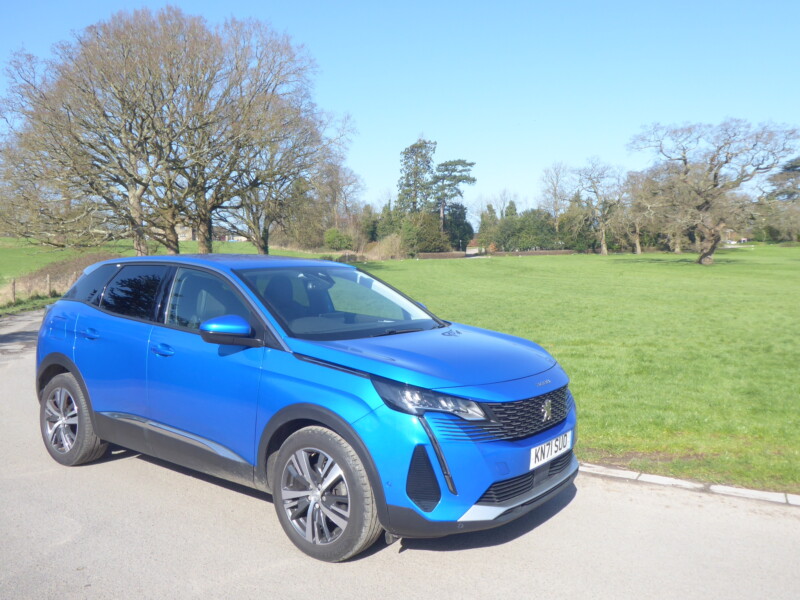
In the last year or so, I’ve noticed quite a lot of Peugeot and Citroen models in the Hertz UK fleet, and indeed I’ve already sampled both the 2008 crossover and last autumn, the 308 hatch. There are also some 3008 and 5008 models on fleet, and so when I needed a car for a few days in advance of an upcoming trip out of the country, I found a 3008 allocated to me without even asking if I could try one, and as I had not sampled one even though the car had been on sale for seven years, was keen to try it out. I was even more keen when I saw that it was in the most striking of the available colours, the same Bleu Vertigo that had featured on the 308 I had driven a few months ago. The Hertz cars all seem to have been sourced in 2021 and early 2022, so by the time of this teat I was in fact sampling a now obsolete model, a third generation 3008 having been announced in September 2003. Supplies of that model will gradually build up during 2024 but for now, a rental 3008 is likely to be the second generation car. I wondered what I would make of this car, a manual gearbox 1.2 THP in Allure spec, as the 308 had surprised me by being a lot better than Peugeots of the recent past and so I was rather hoping that would be the case here, as well. Was it?


Although the engine capacity on the 3008 is just 1.2 litres, there is no cause for alarm, as this 130 bhp Puretech three cylinder unit is something of a pleasant surprise. It sounds good, with an interesting note that becomes quite growly under harder acceleration, without ever sounding harsh. More to the point, it pulls strongly, giving lots of usable performance. The engine is pretty flexible, as this Peugeot can do a 40 mph cruise in 6th, which is something that few modern cars can do. First gear is needed just to get going but after that, strong mid-range torque means that you can use the gears relatively sparingly, if you feel like it. The gearchange is a lot better than that of recent PSA cars, and whilst it is still not going to get class honours, it is slick enough. Whilst the engine impressed me on this test, I do have to point out that this is a wet belt engine and there is lots of evidence to suggest that this is not a Good Thing. Overall noise levels are low, so this is a good motorway cruiser and fuel economy was pretty good. The test car was not full when collecting it, so it is harder than usual to be sure of the economy I achieved but it seemed to be around 50 mpg on a test which comprised a couple of long motorway journeys and some local pottering around.


Peugeot did not intend the 3008 to be a particularly sporty car – despite some of the trim versions suggesting that they might be – but it is pleasant enough from behind the wheel. The steering is light but it does have some feel. I still fail to see any particular advantage from the diminutive steering wheel, despite Peugeot constantly telling us that it should make the feel more direct. Handling is equally benign, with plenty of grip and not much in the way of body roll on the corners. This car came on 225/55 R18 wheels and so equipped the ride was the right combination of firm yet comfortable. The brakes in this car seemed quite fierce, and could be quite grabby. There is an electronic handbrake, as is generally the case these days. You do need to set it in this manual gearbox car. It disengaged smoothly when moving away. Unfortunately, the large pillars obscure your view when exiting junctions and the small rear window doesn’t help when you’re trying to reverse into a parking bay. The standard 180-degree colour reversing camera does help, but there are alternatives out there with better visibility. There are plenty of ADAS aids fitted as standard. The Forward Collision Alert system seemed rather sensitive, but thankfully the Lane Keep Assist could be turned out with a button on the dash.


Two things strike you when opening the door for the first time: the interior looks quite plush and Peugeot have persisted with their i-Cockpit with its small diameter steering wheel set low that has brought more than a little criticism. The quality to start with. Yes, this is a big improvement on Peugeot interiors even of the relatively recent past. The free-standing central infotainment screen, slim air vents and chrome plastic detailing all lend the Peugeot 3008’s interior a more stylish air than the rather bland cabins in a SEAT Ateca or VW Tiguan. There’s also an unusual combination of soft plastics and fabric on the dashboard and inside the doors, but it works well and feels posher than it sounds. Build quality seemed pretty solid and everything fits together well. The controls and dashboard are all angled slightly towards the driver, with a row of aircraft-style toggles and raised central console making you feel like you’re piloting something far more exotic. The idea of the i-cockpit is that you look over the steering wheel to see the instruments, and I have found in Peugeot’s non-SUV models that this just does not work for me. The 2008 was better and thankfully so was this 3008, where I could see all but the very bottom of the instrument cluster. As it was on collection, that electronic dash looked a bit odd with a tiny rotating drum speedo and rev counter down the sides of the cluster, and a large digital speed repeater in the middle, but in fact the 12.0” cluster which is known as a driver’s display is configurable and you can have two more conventional looking dials. Everything else is more straight-forward. As well as the matching pair of column stalks for indicators, lights and wipers (these last two both having an auto function) there is a third stalk for the cruise control. The steering wheel boss has audio repeater buttons. The centre of the dash has a 10” touch screen which is used for the audio system and other services. There is a row of toggle switches beneath this that operate commonly used functions. Allure trim includes Apple CarPlay, Android Auto and Bluetooth connectivity, all as standard, as is a six-speaker audio system. Beneath the toggles are the buttons for the dual zone automated climate control. The start button is down by the gearlever


Seats in this Allure trim are a mix of leather outers and a cloth centre. There is a wide range of adjustment all of it done manually. The driver gets the benefit of lumbar support as well. The front seat belts are height adjustable. It was easy to get comfortable, but I still really do not get on with that low-set steering wheel.


The rear seat area has a decent amount for space. A flat floor, decent headroom and a great view out make it quite an inviting place to be. It is not as wide as some alternatives though, and the middle seat is narrow so as a result, three adults will be rubbing shoulders back there. There is a drop-down central armrest with cupholders in the upper surface and occupants here have access to map pockets on the back of the front seats, as well as door bins. There are separate air vents and USB ports.


People who buy the 3008 will want a decent amount of space for their luggage as well as people, and this Peugeot should not disappoint. The boot is a good size, at 520 litres, exactly the same capacity as you get in a VW Tiguan and a Skoda Karoq, and loading is easy as the floor is flush with the base of the tailgate. There is no spare wheel, but this means that there is a big underfloor well instead. The rear seats are asymmetrically split and simply drop down to create a completely flat load platform. The 3008 has plenty of handy storage compartments for your odds and ends, with a closable centre armrest that can swallow even larger items and wide door bins for your water bottles. The two obligatory cupholders are located between the front seats, there’s also a spot in the centre console for your phone and another one for coins and keys. The glovebox is a bit small, though.


The 2020 update revised the trim structure slightly, so the range now starts with the Active Premium + and then comprises Allure, GT and GT Premium. All 3008s come with plenty of equipment, with even entry-level versions coming with 17-inch alloy wheels, LED headlights, dual-zone climate control and an eight-inch touchscreen with Apple CarPlay and Android Auto. You also get front and rear parking sensors, a reversing camera, electric folding mirrors, cruise control and the 12.3-inch digital instrument cluster. Next up, the Allure gains more stylish 18-inch alloy wheels, polished stainless steel door trim inserts, tinted windows and a larger 10-inch touchscreen with satellite navigation. You also get lane keep assist, a driver attention alert and blind spot monitoring, along with LED interior lighting and half leather seats. The Allure Premium features keyless entry and start, a fabric-effect dashboard, blue ambient interior lighting and aluminium roof rails. GT models bring gloss black 18-inch alloy wheels, a black roof, twin exhaust trim and full LED headlights with an integrated ‘fog mode’. It also comes with a perforated leather steering wheel, aluminium pedals and a range of additional safety kit – including adaptive cruise control, an advanced autonomous emergency braking system and lane positioning assist. Right at the top of the range, the GT Premium comes with larger 19-inch alloy wheels, a Focal sound system and Alcantara and leather seats. You also get a 360-degree camera system, self-parking functionality and an electric boot. Following the 2020 update, Peugeot revised the available engines, reflecting the market move away from diesel in favour of hybrid. So the for the facelift models there is now a choice of one petrol engine – the 1.2 THP as fitted to the test car, which gained 6 bhp from very mild hybrid assistance in 2023, some months after my car was made, a 130 bhp 1.5 HDi diesel and three hybrids. The first of three plug-in hybrid engines makes 180 bhp, is available on the lower two trims and is the most affordable way into a 3008 that can drive on electricity alone. Above it sits the 225 bhp plug-in hybrid engine, with little difference other than power between the two – both do around 200mpg in official tests and record sub-9.0-second 0-60mph times. One minor difference is that the more powerful 300 bhp version has a slightly bigger battery and can go 41 miles on electricity compared with 36 miles. It also has standard all-wheel drive, whereas all the other models are front driven. You can’t have all the trims with all the engines, of course.


This is a good example of a modern Peugeot. Well styled, good quality interior, generous levels of equipment, and a lusty engine (until the dreaded wet belt issue strikes!) but with the challenging ergonomics of the i-cockpit. If you can live with that, then the 3008 is well worthy of consideration. Of course, it has a lengthy list of rivals, with pretty much every volume and premium brand having a similarly-sized alternative. Some score on value (the Koreans and the Dacia Duster), some on driving dynamics (Mazda CX-5, Ford Kuga and Seat Ateca), and most of the others are sort of there but not likely to generate much enthusiasm. It is interesting to see that Peugeot have taken a slightly different direction for the third generation model, focusing on style as opposed to space. Sampling that is for another day, but for now, I can assert that the 3008 is a decent, if not exciting car.