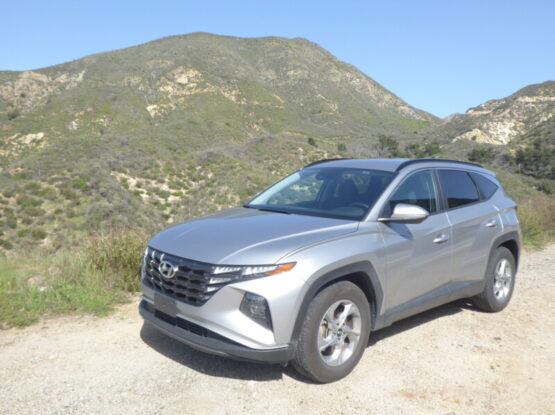


Named after a city in New Mexico, the Santa Fe was the first SUV offered by Hyundai, dating back to 2001, a time when the market was still generally focused on conventional saloons of various sizes. It was an immediate hit with US buyers, so not surprisingly, it was not long before it was joined by a second model of this genre, the Tucson. That car was slightly smaller, initially presented as a “compact”, leading inevitably to Hyundai moving the Santa Fe up a size class. As the SUV craze accelerated, so Hyundai, along with pretty much every manufacturer filled out their range with more SUV offerings, both smaller and larger than the Tucson and Santa Fe. Whilst some of those SUVs have been confined to a subset of world markets – the larger Veracruz of the early 2010s and the current Palisade being seen as too large for European tastes, for instance, and the Bayon that we get in Europe is not offered to Americans who get the locally built Venue instead, the Tucson and Santa Fe remain core models in the range and are familiar to most markets. Annual sales of the Santa Fe globally exceed 200,000 units, with the US taking more than half of these.


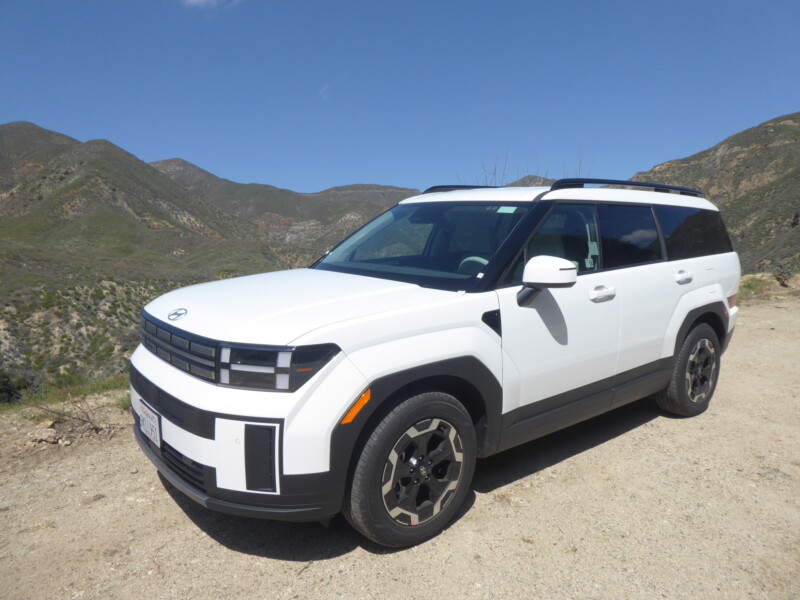
The 2024 Hyundai Santa Fe made its US debut at the Los Angeles Auto Show in late November 2023. It was one few true show debuts there and the new styling certainly ensured that it generated plenty of reaction. A couple of inches longer than the fourth generation car, it looked completely different, with much boxier styling that is in the “love it or hate it” category. Whatever you think, you cannot deny that it is striking and not really like anything else in its class. Hyundai said that they had gone with this boxy look to ensure the greatest levels of space inside, noting a growing demand for cars that can meet the requirements of the outdoor lifestyle sector. The extra length and height meant that there was room for a third row of seats, and in addition, the car had to be designed to be able to offer extended range electric capability in a version to be added some time after launch. A thorough reworking of the mechanical components and a completely new approach to the cockpit incorporating more tech as well as all the latest ADAS features meant that this truly was a brand new vehicle with little in common with its predecessor, a version that was only on the market for five years. Sales started immediately, but even so I was a little surprised to find a sizeable delivery had just hit the Hertz US rental fleet by mid March. That had clearly only just happened, as the car I took had only a couple of hundred miles showing, so for once, I decided to have a day with a car at the start of its production rather than playing catch-up with models which had been on sale for some time. The Santa Fe has a lot of competitors and whilst its predecessor had sold strongly in the US, standards are high and ever improving, so this new one would need more than just its striking looks to win the battle of the showroom. I wanted to find out it if had what it would take to build on the success of its predecessor.


For the US market, all versions of this new Santa Fe have the same 2.5 litre turbo four cylinder engine, which puts out 277 bhp, a lot more than the same capacity engine in the Tucson that I had sampled a couple of days previously. Obviously this is a bigger and heavier car, but even so, it makes a huge difference as the Santa Fe drives very well. The engine is willing and super smooth, emitting a purposeful growl on inclines and when worked hard but with noise levels otherwise very low. This is a refined car that you could happily take on a long journey. There is a standard eight speed dual cutch automatic transmission, and this car follows the current trend of putting the gearlever on the column, lower down on the right. You have to twist it for Drive or Reverse and push it for Park, something you quickly get used to. I drove this car exactly 300 miles and it took 10.6 gallons to fill it up, which computes to 28.3 mpg US or 33.8 mpg Imperial, a decent result for a large car like this.


For the overall driving experience, my expectations were not that high. I was being unfair. Yes, this is a large car, and it is not designed to have sporting appeal, but it was actually very pleasant to drive. The steering is good, with some nice weighting and feel and the Santa Fe proved far more nimble than I was expecting. It can be cornered quite enthusiastically, taking advantage of the good levels of grip and enjoying the fact that there is minimal body roll. Not only that but the suspension is well judged, so, riding on the 235/60 R18 wheels of this version, it was smooth and comfortable. The brakes were powerful and effective. All-round visibility is generally good, the exception being a bit of a blind spot created by the rather thick C pillars. The straight back and the inclusion of a reversing camera meant that judging the back end was easy.


For a non-premium badged car, I have to say that the interior struck me as rather impressive. The quality is superb, with a nice design and the use of some rich materials. You even get a white leather-wrapped steering wheel. There is a single curved panel which includes the instrumentation and the touch screen. The instruments are all electronic, of course with a large speedometer and rev counter and smaller bar chart style gauges for fuel level and water temperature and a trip computer display area between the larger dials. There are two main column stalks for indicators, wipers and lights as well as the transmission selector leaving cruise control and audio repeaters to the steering wheel hub. The 12.3” colour touchscreen was easy enough to use and thankfully there are still some buttons for audio controls. XM satellite radio is included but when you select navigation, it relies on Apple Car Play or Android Auto for this function. There is dual zone automated climate control and there is a wireless phone charger in the central console.


The SEL spec of the test car means synthetic leather seats that might actually convince many people that they were the real cow-hide. There is eight-way electrical adjustment for the driver, and there is also lumbar support included and the seats have a heating element. I particularly liked the really soft feeling headrests, which added to the overall feeling of comfort. There is a feeling of space, too with a lot of headroom. The seat belts have height adjustment included and the steering column telescopes in/out as well as up/down.


The Santa Fe now comes as standard with three rows of seats. There is lots of space in the second row. The seats are on sliders, so if you set them as far forward as you can and the front seats back as far as they will go, then legroom does become a bit limited but otherwise, there is a real feeling of spaciousness here. The generous amount of headroom certainly helps and you can vary the seat backrest rake. Occupants here have a central drop-down armrest and there are map pockets on the back of the front seats, bins on the doors and they can access the central cubby thanks to an ingenious design that allows the cubby to open from either end. The seats here tip forward to enable entry to the third row. There is actually a reasonable amount of space here, too. Adults would not feel particularly comfortable on a long journey, but children would find it just fine. There are cup holders moulded in the side panels on both sides.


There is electrical assistance for the tailgate which is just as well as it is very heavy. It is wide and extends down low to give excellent access to the boot, flush with the floor, so you can just slide items in. if the third row of seats is erect, you won’t be putting anything much in there as space is really limited, but fold these down and you have a massive cargo area. It gets even bigger if you fold the asymmetrically-split second row down, as well. There is a bit of additional stowage space under the boot floor. Inside the cabin, there is ample provision for odds and ends. There are two gloveboxes and as well as the usual format of door pockets and a deep central armrest cubby with an upper tray, there is also a lot of space under the centre console, though as is usually the case, this area is not that easy to reach.


The 2024 Hyundai Santa Fe comes in five trims: SE, SEL, XRT, Limited and Calligraphy. A turbocharged 2.5-litre four-cylinder that makes 277 bhp and 311 lb/ft of torque is standard on every model, as is an eight-speed dual-clutch automatic transmission. Front-wheel drive is also standard; all-wheel drive is available on all trims for $1,800. Starting at $33,950, the entry-level SE trim comes standard with cloth upholstery, six-way manually adjustable front seats, 18-inch alloy wheels, a 12.3-inch touch screen, a 4.2-inch driver display, wireless Apple CarPlay, wireless Android Auto, Bluetooth, four USB ports, proximity keyless entry, push-button start, satellite radio and HD Radio. The SE also comes with plenty of standard driver-assistance features, including a rearview camera, blind-spot monitoring, rear cross-traffic alert, LED headlights with automatic high beams, forward collision warning, forward automatic emergency braking, pedestrian detection, adaptive cruise control, lane-keep assist, lane-following assist, driver-attention monitoring, a rear-seat alert and safe-exit assist. The SEL trim starts at $36,450. Building on the standard features of the SE trim, the SEL adds synthetic leather upholstery, heated front seats, an eight-way power-adjustable driver’s seat, wireless device charging, dual-zone automatic climate control, roof rails and Hyundai Digital Key 2. Extra driver-assistance features on the SEL include forward attention warning and an advanced rear-seat alert. The off-road-oriented XRT trim has a starting price of $40,600. All-wheel drive comes standard, as does exclusive XRT badging, blacked-out accents, dynamic voice recognition, a 110-volt power outlet, a sunroof, navigation and Highway Driving Assist 1. Towing capacity increases from 3,500 to 4,500 pounds. Other features carry over from the SEL trim. The Limited trim has a starting MSRP of $43,350. Extra features include genuine leather upholstery, a heated steering wheel, ventilated front seats, heated rear seats, memory settings for the driver’s seat, four-way power-adjustable lumbar support for the driver’s seat and a six-way power-adjustable passenger seat. Additional standard features include power-folding side mirrors, a 12-speaker Bose premium stereo, a 12.3-inch digital instrument cluster, manual rear sunshades, a panoramic sunroof, an auto-dimming rearview mirror, ambient interior lighting and 20-inch wheels. This trim also gains a surround-view camera system, a blind-spot camera, rain-sensing windshield wipers, side parking sensors and Remote Smart Parking Assist. The top-tier Calligraphy trim starts at $46,500. This trim gains premium Nappa leather upholstery, a driver’s seat leg cushion extension, power-folding second-row captain’s chairs, an Eco-suede microfiber headliner, a head-up display, dual wireless device charging, a digital rearview mirror, blind-spot collision-avoidance assist, Highway Driving Assist 2 and 21-inch wheels.


This is a very impressive car. Probably the only thing which might count against it for some buyers will be the looks. But if you approve, or just don’t care, then what you will find is a spacious, practical and roomy large family vehicle that is nicely finished, well equipped and which is surprisingly good to drive. Couple these attributes with Hyundai’s generous warranty terms and a price that is still lower than most of its rivals and the case for the Santa Fe looks very compelling. The only car I think might beat it, especially dynamically, is the Mazda CX-90, of which very few are in the rental fleets and I’ve not managed to source one yet, but that option aside, if you are looking for what the Americans still laughably call a “Mid-Size” SUV, then for now at least, the Santa Fe is the one to pick.