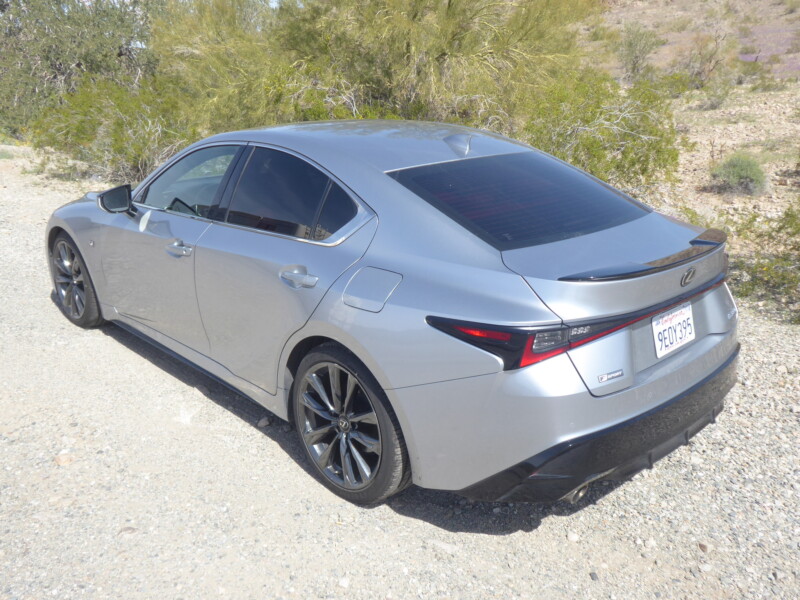


Having created more than a stir with their first product, the Lexus LS400, which gave the proverbial bloody nose to established luxury cars such as the S Class Mercedes, it seemed that Lexus were going to do it all over again 10 years later when they showed us a compact rear wheel drive sedan which they branded the IS. Smallest Lexus to date, this car was aimed fair and square at the likes of the BMW 3 Series and Mercedes C Class, and on both sides of the Atlantic, there was universal acclaim for the result. All the Lexus virtues were there, but in a smaller package and with a super smooth V6 engine and a well-engineered rear wheel drive chassis, the car was as good to drive as it was to sit in and to own. Lexus added a sort of cross between a hatch and estate model, and in Europe added the larger 3.0 litre engine which had always been the offering in US market cars. When it came to replace the model, although the formula did not deviate much, the new car did not impress quite as its predecessor had done, something which even the launch of the potent M3-rivalling IS-F failed to address. As the market shifted, Lexus went down the diesel route, but late and in Europe, it looked the IS had been a one-hit wonder. In the US, and some other world markets, though, it fared better, and so in 2013 a third generation car arrived. Again, in many ways a cautious evolution of its predecessor, the styling reflected the latest Lexus look, this time offered only as a four door saloon and with a variety of new engines including a petrol-hybrid for Europe and Japan. Americans continued to buy the car in decent numbers but Europeans had lost all interest, as they either preferred an SUV of if they wanted a car of this format, it would likely have a German badge on it. The IS was retired from European showrooms in 2020, but that is not the end of the IS story as this was the year when a substantial revamp was launched. Visual changes are apparent at the front and back with an integrated rear spoiler being an easy recognition point. Inside the dashboard was updated and a whole load of new tech was added, and there were changes to the chassis and suspension. Not quite enough to call this a new car but certainly a significant facelift. A number of Lexus had appeared in the Hertz US fleet as part of the recovery post Covid, all of which had been sourced second-hand, and I managed to try a few of them, including a 2020 model year Lexus IS300, and now I’ve spotted a few of the 2021 model year facelift cars parked up at LAX as well, so I did not hesitate to ask for one, to see if this heavily updated car can still compete with the class best.


Badging on the car told me that this is the IS350, the top model in the range. This means 311 bhp from the 3.5 litre V6 engine, and it is coupled to an eight speed automatic gearbox. Honestly, I would not have believed the power output from the way the car drove. It certainly sounds good, with the refinement of a V6 and a slightly sporty edge to it, but this Lexus just did not feel all that rapid. Put it in Eco mode and it is a lot quieter and also a lot slower. Let’s be clear, in absolute terms this is not a slow car. there is more than ample acceleration available, it is just that I was expecting it to feel brisker than it actually was. What it is, though, is very refined. The engine revs smoothly from idle to the red line very willingly, and once you have reached a cruising speed, noise levels are very low. The gearbox is well matched to the engine, so although there are paddles, I felt little need to use them. I went a long way in my day with this car, covering a grand total of 552 miles and it consumed no less than 19.98 gallons which works out at 27.67 mpg US or 33.0 mpg Imperial. On paper not a bad result but remember that almost all that total was done at a steady speed so this is probably about as good as you would ever see. Other reports suggest that fuel efficiency is not on the list of merits of this car.


F-Sport is to Lexus what M Sport is to BMW or S-Line to Audi. Well, conceptually, it is, but if you think that a car badged F-Sport is going to be an enthusiast’s machine with crisp responses that you can really enjoy punting down a twisty road, well, sorry, you are going to be disappointed. This is not remotely a sporting car from behind the wheel, despite the changes made in the 2021 facelift. The steering is light to the point of over-assisted and lacking much in the way of feel. The handling, whilst predictable enough lacks sparkle and the ride, on 265/35 R19 tyres, is extremely soft, which does at least mean you will feel quite comfortable. Think of this car more as a freeway cruiser than a sports sedan and you might be quite happy. The brakes did their job well, though the parking brake is buried on the dash somewhere over the driver’s knee. All-round visibility was not too bad though you really do need the rear-view camera when backing up, and the Blind Spot Warning system was certainly useful. The IS350 comes with a suite of other driver aids, including adaptive cruise control, lane keeping assist and automatic high beams.


Opening the door for the first time, what hit me right away was the bright red interior. I’m all for a bit of colour, but this one struck me as rather too much and would definitely be an acquired taste. Thankfully, more muted colours are also available. The quality of the materials and the fit and finish is, in true Lexus tradition, beyond reproach. Leather is used for a number of the surfaces including the instrument binnacle, complete with red stitching and there is plenty of the currently fashionable gloss black trim. There is a chunky leather-wrapped steering wheel. The instrument cluster is configurable. The way I had it presented there is a large rev counter in the centre and a digital speed readout. Much smaller gauges for water temperature and fuel level were to the lower left of the central dial. In general, it looked there wasn’t that good a use of the available real estate here, though. The 8” touch screen is perched up high where it is easy to see. Lexus still persist with their touch pad in the console, though this is not as easy to use as the erstwhile buttons used by the likes of BMW or Audi. There are still some buttons for the climate control system, though this has some awkward sliders for the temperature control, but otherwise, like so many cars these days, the screen is all icons and sliders, which is far from ideal. The spec includes XM Satellite radio but no navigation, and finally Lexus do include Apple Car Play and Android Auto and you also get HD radio, Bluetooth, 10 audio speakers and somewhat surprisingly, a CD slot. One further annoyance were the one touch column stalks – seemingly the solution to what was not a problem! There are lots of buttons on the steering wheel boss.


When getting in, even without adjusting the seat, my impression was that you sit quite low. There is a full range of electric adjustment for the seat, and it also boasts heating and cooling functions. I found the seat itself to be comfortable and thanks to a wide range of adjustment on the column, could easily get a good driving position.


Access to the rear seats is not that easy, as you have to duck to clear the roofline. There’s not that much space here once you are in, either. Further compounding the problems, there is a massive central tunnel and the centre console extends well back. Occupants here do get a central drop-down armrest but surprisingly without cupholders in the upper surface and there are map pockets on the back of the front seats but there are no door bins.


The boot is equally unimpressive. There is no external release, which is irksome. Access through the lid is quite restricted and the actual capacity is considerably less than you will find in pretty much all the IS’ rivals. The rear wheelarches intrude a lot, so the shape is less than regular. There is a space saver under the boot floor but it is packed in tightly so there is no room around it for odds and ends. The rear seat backrests do drop down to give some more space at the expense of passenger capacity, though again it is only the central area of the rear bulkhead that will be clear for those longer loads. Inside the car things are somewhat better as there is a large glovebox as well as the customary door pockets and central armrest cubby.


The 2021 Lexus IS comes in three trims: IS 300, IS 300 AWD and IS 350 F Sport. The main difference between these trims is the powertrain. The IS 300 is equipped with a turbo-four engine and rear-wheel drive. The IS 300 AWD has a V6 and all-wheel drive, and the IS 350 F Sport features a stronger V6 and can be found in either rear- or all-wheel drive. The Lexus IS 300 comes with a 241 bhp turbocharged four-cylinder engine, an eight-speed automatic transmission and rear-wheel drive. Standard features include synthetic leather upholstery, power-adjustable front seats, an 8-inch touch screen, Apple CarPlay, Android Auto, Amazon Alexa, Bluetooth, two USB ports, HD Radio, satellite radio, a 10-speaker audio system, a Wi-Fi hot spot, proximity keyless entry, dual-zone automatic climate control, blind-spot monitoring, LED headlights, rain-sensing windshield wipers and 18-inch wheels. The Lexus Safety System+ 2.5 package also comes standard, and it includes forward collision warning, pedestrian and cyclist detection, forward automatic emergency braking, adaptive cruise control, lane-departure warning, lane-keep assist, automatic high-beam headlights and traffic-sign recognition. When the IS was new, available add-ons included a 10.3-inch touch screen, navigation, a 17-speaker Mark Levinson sound system, a moonroof, heated and ventilated front seats, a heated steering wheel, front and rear parking sensors, hands-free park assist and a surround-view parking camera system. The Lexus IS 300 AWD features a 260 bhp V6 engine, a six-speed automatic transmission, all-wheel drive and heated front seats. All available features carry over unchanged. The Lexus IS 350 F Sport is available in either rear- or all-wheel-drive models. This trim has a 311 bhp V6 engine, a stiffer F Sport suspension, 19-inch wheels, restyled front and rear bumpers, a trunk lid spoiler, heated and ventilated front seats and a heated steering wheel. In addition to the optional add-ons listed above, you may find the IS 350 F Sport with the F Sport Dynamic Handling package, which includes an adaptive suspension, a limited-slip rear differential, matte black BBS wheels and a carbon-fibre rear spoiler.


Lexus’ decision not to sell this updated IS in Europe was undoubtedly the correct one. This is a highly competitive class and when even really good cars like the Alfa Giulia and Jaguar XE struggle for buyer’s attention, then car with as many demerits as this one would not stand a chance. Whilst the Lexus ownership experience remains highly rated, it’s only worth having if the car itself is one you would really want. And this is one you really would not want. Disappointing performance, poor economy and a soggy driving experience even in F-Sport mode all count against it, as does the tight cabin and small boot. Even the US press, who normally rate Lexus products have been very luke-warm about this one. It was great to be able to sample it, but it is definitely not a car that I would particularly want to experience again if there were almost any of its rivals on offer.