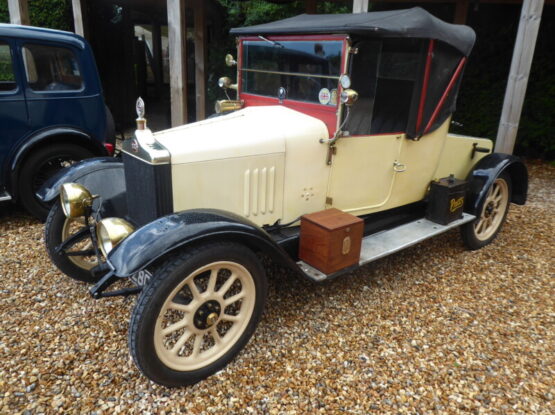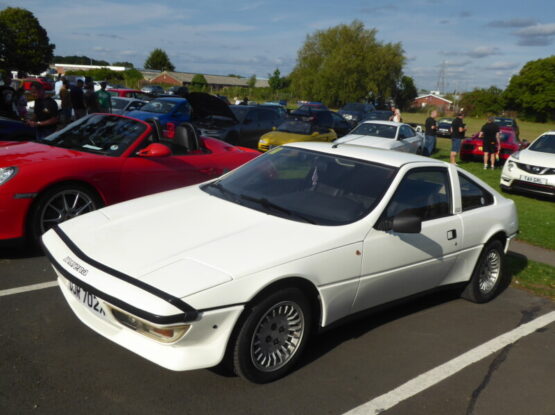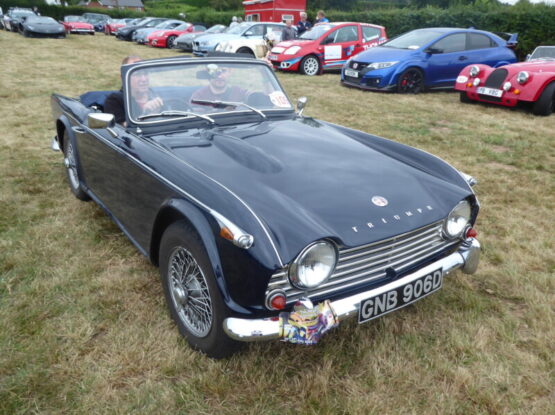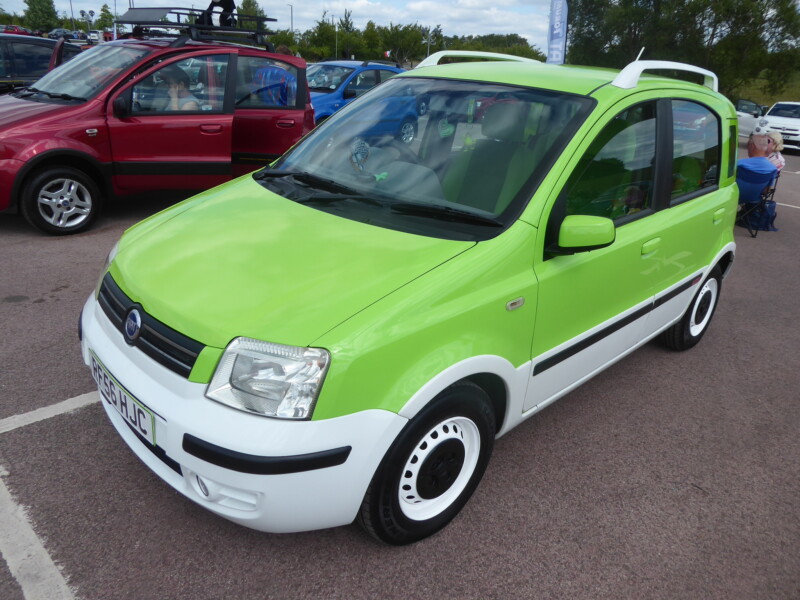
The Fiats and Friends event was conceived to celebrate the 125th anniversary of the marque. Held at the British Motor Museum at Gaydon, it was so well received that it was not a hard decision for the organisers, the Fiat Motor Club, to decide to hold it again in 2025. And so here we are. No particular anniversary this time, just a gathering of Italian cars, dominated by Fiat, which is unusual for Italian car meets these days, but with a good number of Abarth and Alfa Romeo and a handful of the other recent Italian marques as well. Among the displays were cars that are very familiar and a few rather more rare machines. Enjoy!
ABARTH
The first Abarth 750 GT appeared in early 1956, and was the first Abarth product to use standard Fiat bodywork, that of the little 600 saloon. Fiat delivered these cars incomplete, to make it easier and more cost effective for Abarth to carry out their performance modifications. Rather than the 633 cc original or Abarth’s own 710 cc model, the engine now displaced 747 cc thanks to a one millimetre wider bore and a stroke increased by four millimetres. Sharper cams, lighter flywheel, a bigger carburettor, and a myriad other traditional tuning tricks were employed; as a result power nearly doubled, up from 21.5 to 40 bhp. Claimed top speed was 80 mph. As well as the “standard” car, a special model was then built with a Zagato body, known as the Fiat Abarth 750 GT Zagato. It was launched at the 1955 Salon di Torino. The original model was also offered in a more luxurious variant for export (called “America”, as it was almost strictly meant for the United States) and a stripped down model with lower, uncovered headlamps and smaller taillights for the domestic Italian market. The “America” also has a different layout around the rear license plate. The all-aluminium bodywork has Zagato’s famous “double-bubble” design and Abarth’s tuned derivazione engine with 43 bhp. Aside from the floorpan, not much of the Fiat 600 remains in use for these cars. It had a top speed of around 90 mph and proved popular. Around 600 were sold. By the time of the appearance of the Abarth Zagato Record Monza 750 Bialbero, the bodywork had been unified into a separate model with a rather large hump on the engine lid, made necessary by the taller twin-cam motor. There were then three distinct models 750 “Double Bubble”, 750 Record Monza and 750 “Sestrieie”, this last having a single cam pushrod engine and the majority built with a steel body and a very small number of Alloy cars, just one of which is known to exist today. The 750 GT Bialbero model appeared at the 1958 Turin Show; along with various alterations to the bodywork, it had the new twin-cam engine with 57 bhp at 7000 rpm. The first series constituted 100 cars, enough to homologate the car for the Gran Turismo competition category. The “Record Monza” was the most successful racing Abarth in the USA under the Franklin D. Roosevelt Jr Racing team, (Abarth cars winning over 700 races worldwide), including both Sebring with the 750cc Bialbero engine and Daytona under 1000cc races in 1959 widely believed to have had the first 982cc Bialbero engine. The Sestriere had upright headlights and two very large air intakes on the engine lid much wider than a double bubble. The Sestriere was believed to be the last model produced for Abarth by Zagato, due to disagreements between Abarth and Zagato, so Abarth developed the 750 GTZ with a twin cam engine and the body evolved by Sibona and Basono into the Bialbero 700 and 1000 models. which were first seen in 1960. They are equally rare these days.


Abarth produced several tuned versions of the Fiat 850 Berlina, Coupé, and Spider, with ever-increasing displacements. These belonged to the OT series of Abarth cars—standing for Omologata Turismo or “touring homologated”, which also included two-seater sports racing cars. The Fiat-Abarth OT 850, as seen here, was Abarth’s first 850 derivative, introduced in July 1964. Its Tipo 201 engine was the regular saloon’s 847 cc inline-four brought from 34 bhp to 44 bhp. The top speed went up accordingly from 75 mph (120 kn/h) to 81 mph (130 km/h). The OT 850 could be distinguished from the standard Fiat model by its Abarth badging, an asymmetric front ornament with the Abarth shield on the right hand side and the “Fiat Abarth” script on a red field on the left, and wheels with cooling slots. From October of the same year it became available in two guises: OT 850 Oltre 130 (“Over 130”), almost unchanged from the initial model, and OT 850 Oltre 150, with a 52 bhp engine, front disc brakes and a 150 km/h (93 mph) top speed. In October 1964, Abarth added the Fiat-Abarth OT 1000. With engine displacement increased to 982 cc, it produced 60 bhp and 58 lb·ft of torque. The front brakes were changed to discs. Coupe and Spider models would follow from 1965, initially with the same 982cc engine, but it was not long before 1300, 1600 and then 2 litre engines were inserted in the car. There are not many of these in any body style in the UK, but of those that you do see, the Coupe would seem to be the most numerous

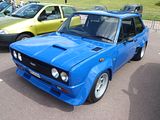
In 1976, 400 examples of the Fiat Abarth 131 Rally were built for homologation purposes. These cars were built in a co-operation between Fiat, Bertone and Abarth. Bertone took part-completed two door standard bodyshells from the production line in Mirafiori, fitted plastic mudguards front and rear, a plastic bonnet and bootlid and modified the metal structure to accept the independent rear suspension. The cars were fully painted an trimmed and then delivered back to the Fiat special Rivalta plant where they received the Abarth mechanicals. The street version of the car used a 16-valve DOHC derivative of the standard DOHC engine, which equipped with a double Weber downdraught carburettor produced 140 PS. The street cars used the standard gearbox with no synchromesh (Rally type regulations required the use of the same type of synchromesh on the competition cars as on the street versions) and the hopelessly underdimensioned brake system of the small Fiat 127. Competition cars used dry sump lubrication and eventually Kugelfischer mechanical fuel injection. In race specifications, the engine produced up to 240 PS in 1980, being driven to World Championship status by Walter Röhrl. Original Rally cars are rare these days, and most of the ones you see are, like this one, in fact a recreation. A very nice recreation, I have to say.


The vast majority of Abarth cars here were the 500-based models which have been on sale now since the end of 2008, following a launch at the Paris Show that year. Since that time there have been a number of detailed changes to the standard cars and a lot of limited editions. Those who really know the marque can spot most of them, but some are so subtle that unless there is a badge you can see, you will not be quite sure which version you are looking at. It used to be relatively easy, when the model was first launched, as there was only one version as shipped ex works called the 500. It had a 135 bhp 1.4 litre turbo-charged engine coupled to a five speed manual gearbox, with 16″ alloys as standard, and the option of 17″ wheels, and a colour palette comprising of two whites (BossaNova White, the standard colour, or the pearlescent Funk White), Red (Pasadoble), Pale Grey (Campovolo) or Black. If you wanted more power – 160 bhp – then you could order an Esseesse kit, which came in a large wooden crate, containing new wheels, springs, an ECU upgrade, the Monza exhaust system and badging. It was dealer fitted and could be applied at any time within the first 12 months or 10,000 miles from registration. Needless to say, it proved popular. As were many of the optional extras, with stickers for the sides, a large scorpion for the bonnet and even a chequered pattern for the roof among the personalisation options offered. Several of the original style of cars were here.


Whilst a sliding glass sunroof (Skydome in Fiat/Abarth parlance) was an option from inception, fans of open air motoring had to wait until Geneva 2010 for the launch of the 500C models, with a roll-back roof which provided the best of open-topped motoring and yet still with the rigidity of the regular body style. For the first few months these cars only came with the robotised manual gearbox, which limited the appeal in the eyes of some, but they also introduced us to the “bi-colore”, a series of two tone cars, with upper and lower halves of the body painted in different colours. It took us a while to get used to this, as no other production road cars had been painted like this for some time, but now this is seen as yet another of those marque defining attributes, and (perhaps with the exception of the rarely seen Rally Beige and Officina Red combination that would come for 2014) in the eyes of many this distinctive look enhances the appeal of the cars still further.

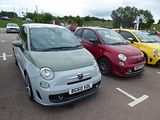

Having used the legendary 695 badging from the 1960s on the Tributo cars, at the 2012 Geneva Show, Abarth dusted off the 595 name that had been used on the less powerful of the Nuova 500 based cars of the same generation, and created two new versions which we should think of as Series 2 cars, the 595 Turismo and Competizione, both of which could be bought in either closed or open top C guise, with either the 5 speed manual or robotised automated gearshifts. Both models had the 160 bhp engine as standard. Effectively they were a replacement for the Esseesse kit, and it meant that the cars were produced complete at the factory, rather than needing the dealer to undertake the upgrade (and the associated paperwork), though Abarth did not withdraw the Esseesse kits from the market for some while. Turismo, as the name suggests was aimed slightly less extreme in intent, featuring standard leather upholstery, upgraded dampers and climate control, Xenon headlights and Alutex interior details. The sportier Abarth 595 Competizione replaced the leather seats with Sabelt cloth sport seats and Alutex with aluminium, while adding p-cross-drilled brakes and the Record Monza dual-mode exhaust.


This 50th Anniversary Edition car used to belong to the late Kris Lukas, who sadly passed away not long after concluding a program of work to restore it as new condition. Thankfully, the car remains in the community so we still get to see it and it reminds us of a much missed owner. This version was unveiled at the 2013 Frankfurt Motor Show, as a limited production car of which just 299 vehicles would be made commemorating the 50th anniversary of the original Fiat-Abarth 595. As that original car had been badged a Fiat, so was this one, which confused everyone who had been trying to explain how Abarth is a separate company. The UK cars listed at around £29,000 so not cheap, but for that money you got the 180 PS 1.4 T-Jet engine, Abarth Competizione gearbox, 17-inch alloy wheels with 695 Magnesio Grey design embellished and red liner, Brembo 305 mm floating brake discs, fixed four-piston caliper, special shock absorbers, ‘Record Monza’ variable back-pressure dual mode exhaust, matt three-layer white body colour, Xenon headlights with dipped and driving light functions, red leather sports seats with white inserts and red stitching, Abarth logo at black leather steering wheel with red inserts and finder and the kick plate.
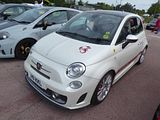
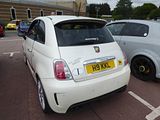
Rumours started to circulate towards the end of 2014 that Abarth were going to upgrade the Competizione model, so as better to bridge the gap between the Turismo and the 190 bhp 695 Biposto that had been added to the range earlier in the year. It was Geneva 2015 when the result was finally shown to an expectant fan base. Most exciting news was that thanks to a bigger Garrett Turbo, the engine had been tweaked to 180 bhp, and with reduced CO2 emissions. A standard spec that included Koni Dampers, Brembo brakes, Xenon lights, Sabelt seats, Climate Control, parking sensors as well as other refinements that had been added like the TFT instrument display all proved very compelling, so not long after the first cars reached the UK in June of 2015, I found temptation too hard to resist, and as is well documented here, swapped my 2010 car for one of these. At the time I ordered it, Cordolo Red, a tri-coat pearlescent paint which shimmers in bright sunlight looked set to become one of the most popular colours of the lot, even though it is a cost option. Indeed, the Launch Edition models were all offered either in this colour or Scorpion Black, with black wheels. Surprisingly, the colour was not carried over to the Series 4 cars.


A new colour was announced with the new Competizione cars, called Podium Blue, but it was not going to be immediately available, and there were no accurate representations of exactly what shade it would be. Rumours circulated on Abarth forums and Facebook Groups all summer, with lots of guessing and no real facts, although we had been assured that it was not the same as the Abu Dhabi Blue that had featured on a very small number of 695 Tributo Ferrari models in 2011. It was October 2016 when the first cars reached the UK and those who had taken the gamble could see for themselves whether they had got it right. Common consent is this is a stunning colour. A rich blue, it changes shade in different lights. I think it looks fantastic. It has proved very popular and remains on offer to this day.


What is known as the Series 4 version of the familiar 595 reached the markets in the middle of 2016. After rumours had circulated all winter following the launch of the facelifted Fiat 500 last year, Abarth finally unveiled the Series 4 at the end of May 2016. Initially, we were told that the cars would not be available in the UK until September, but that came forward somewhat, with dealers all receiving demo cars in June, and the first customers taking delivery in July. Three regular production versions of both the closed car and the open-topped C were initially available, all badged 595, and called Custom, Turismo and Competizione, as before, though numerous limited edition models have since appeared and in most case disappeared. The most significant changes with the Series 4 are visual, with a couple of new colours, including the much asked for Modena Yellow and a different red, called Abarth Red, which replaces both the non-metallic Officina and – slightly surprisingly – the tri-coat pearlescent Cordolo Red. as well as styling changes front and rear. The jury is still out on these, with many, me included, remaining to be convinced. At the front, the new air intake does apparently allow around 15 – 20 % more air in and out, which will be welcome, as these cars do generate quite a lot of heat under the bonnet. Competizione models for the UK retain the old style headlights, as they have Xenon lights as standard, whereas the Custom and Turismo cars have reshaped units. At the back, there are new light clusters and a new rear bumper and diffuser. Inside, the most notable change is the replacement of the Blue & Me system with a more modern uConnect Audio set up, which brings a new colour screen to the dash. Mechanically, there is an additional 5 bhp on the Custom (now 145) and Turismo (now 165 bhp) and the option of a Limited Slip Diff for the Competizione, which is likely to prove a popular option. Details of the interior trim have changed, with a filled-in glovebox like the US market cars have always had, and electric windows switches that are like the US ones, as well as a part Alcantara trim to the steering wheel in Competizione cars. These cars have now been on offer for eight years and with Abarth sales on the rise, it was no surprise that they were particularly well represented here.


The 595 Scorpioneoro is another model which takes its inspiration from a history which few in the Uk will be familiar with, there will be just 2000 units of this distinctive model available globally. The 595 Scorpioneoro was born to continue the legacy of the famous A112 Abarth “Gold Ring” of 1979, better known as the A112 Abarth “Targa Oro”, of which only 150 models produced and, as with the new Abarth 595 Scorpioneoro, what made it so special were its stylistic details. These details included black livery, gold-coloured decorative line contouring the bodywork and the alloy wheels, also painted in the distinctive gold colour. This car is liveried in the same way, marked out by its black livery, decorative gold bodywork lining and gold-painted alloy wheels. It also boasts a matt black chessboard roof and grey finish on the door handles and mirror caps. And to mirror the ‘Gold Scorpion’ name, the car is adorned with gold scorpions on the bonnet and the wheel centres. Inside the cabin of this new exciting new model, you’ll be greeted with a black dashboard which is home to the new gold finished 500 logo. Leather detailing on the seats introduces the original “scorpionflage”. The seats are further embellished with dedicated stitching and personalised headrests with the word “Scorpioneoro”, the Italian flag and Abarth embroidered on them. An additional touch of exclusivity comes from the numbered, gold coloured plaque, available solely on this model. The Scorpioneoro also comes with Abarth’s top-of-the-range seven-inch touchscreen infotainment system, complete with Apple CarPlay and Android Auto, as well as a Beats Audio sound system. Mechanically, there is nothing new, as the car has the 165 bhp version of the familiar T-Jet engine and the other features you get in the regular production Trofeo cars.
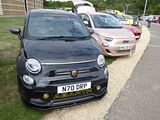
Many Abarth owners spend a lot of time and money on modifying their cars. Some focus on looks, whilst others are interested in what they can do mechanically to add more power, or other mechanical modifications. There were a number of duly modified cars here, all of which attract lots of attention from everyone present. Whilst some of the changes are not entirely to my taste (I can be something of a purist at times!, there can be no doubting the care and attention (and in many cases money) that has gone into their creation).


The Punto Evo was launched at the 2010 Geneva Show, with the cars reaching UK buyers in the summer of that year, and it incorporated many of the changes which had been seen a few months earlier on the associated Fiat models, the visual alterations being the most obvious, with the car taking on the nose of the associated Fiat, but adapted to make it distinctively Abarth, new rear lights and new badging. There was more to it than this, though, as under the bonnet, the T-Jet unit was swapped for the 1.4 litre Multi-Air, coupled to a 6 speed gearbox, which meant that the car now had 165 bhp at its disposal. Eventually, Abarth offered an Esseesse kit for these cars, though these are exceedingly rare.


Part of the Punto Evo family is the SuperSport, usually identified by the distinctive black bonnet, though not all cars feature it. Just 199 of the SuperSport versions were built, of which around 120 are registered on UK roads. These cars had many of the options from the Punto Evo included as standard. Power came from the 1.4-litre MultiAir turbo engine, tuned to produce 178bhp and 199lb ft of torque, up from 165 of the standard Punto Evo, giving the SuperSport a 0-62 time of 7.5 seconds and a top speed of over 132mph. To help put the power down, the SuperSport was fitted with wider 18″ wheels and optional Koni FSD dampers. Standard equipment included the Blue&Me infotainment system with steering wheel controls, automatic climate control and a popular option was the ‘Abarth Corsa by Sabelt’ sports leather seats. The SuperSport was available in the same colours as the regular Punto Evo, which means white, grey, black and red. For those in the know – which never seemed to be that many people – this was a really capable and desirable car, and the owners love them, lamenting the fact that the model had quite a short production life and has not been replaced


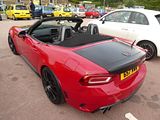
The Abarth 124 Spider was developed in parallel with the Fiat model. It does cost a lot more, and there are those who think you don’t get enough extra for your money, but those who have driven it will tell you otherwise. You certainly get more power. The 1.4 MultiAir turbo unit jumps up from 138bhp to 168bhp, while torque also increases by a modest 10Nm to 250Nm, which gives it a 0-62mph time of 6.8 seconds, which is half a second quicker than the 2.0-litre Mazda MX-5. The top speed is 143mph. It weighs just 1060kg meaning a power-to-weight ratio of 158bhp-per-tonne, and with the new Record Monza exhaust system it sounds great even at idle. The Abarth version gets a stiffer suspension setup than the regular Fiat 124 Spider, with Bilstein dampers and beefed-up anti-roll bars. Bigger Brembo brakes also feature, with aluminium calipers. It can be had with a six-speed manual or six-speed automatic transmission with paddles, and the latter gets a Sport mode for quicker shifts. Many of the UK cars sport the ‘Heritage Look’ pack, which is a no-cost option. It brings a matt black bonnet and bootlid, plus red exterior trim detailing and has proved popular. The £29,565 starting price gets you standard equipment such as cruise control, climate control, Bluetooth, a DAB radio and satnav, plus Alcantara black and red (or pure black) seat trim. The automatic gearbox is a £2,035 extra, while an optional visibility pack brings LED DRLs, auto lights and wipers and rear parking sensors. Sales ceased during 2019, with around 1800 cars having been brought into the UK, so this is always going to be a rare car, and values are already increasing at a rate reflecting its desirability and the difficulty in finding one.



Representing the future for the brand, which is now all-electric was tis 600e, a larger companion to the 500e. Deliveries started a few weeks ago, so it is going to be interesting to see if the Abarth faithful take to it or not.


ALFA ROMEO
Following the 1900 family, Alfa’s next new model range would be cheaper and aimed at capturing some of the market from middle class buyers. Known as Giulietta, the 750 and later 101 Series were a series of family-sized cars made from 1954 to 1965, and Alfa Romeo’s first, successful, foray into the 1.3-litre class. The first to be introduced was the Giulietta Sprint 2+2 coupé which was premiered at the 1954 Turin Motor Show. Designed by Franco Scaglione at Bertone, it was produced at the coachbuilder’s Grugliasco plant, near Turin. A year later, at the Turin Motor Show in April 1955, the Sprint was joined by the 4-door saloon Berlina. In mid 1955, the open two-seat Giulietta Spider, featuring convertible bodywork by Pininfarina arrived. The Giulietta used unibody construction and a front-engine, rear-wheel-drive layout. Front suspension was by control arms, with coaxial coil springs and hydraulic dampers. At the rear there was a solid axle on coil springs and hydraulic dampers. The axle was located by a longitudinal link on each side, and by a wishbone-shaped arm linking the top of the aluminium differential housing to the chassis. All Giuliettas (save for the last SZ examples) had hydraulic drum brakes on all four corners. The Giulietta used an Alfa Romeo Twin Cam straight-four of 1290 cc, with an aluminium alloy engine block and cast iron inserted sleeves. Bore and stroke measured 74.0 mm and 75.0 mm. The aluminium alloy cylinder head was of a crossflow design and featured hemispherical combustion chambers. The double overhead camshafts were driven by two timing chains, and acted on two valves per cylinder, angled 80°. In 1957 a more powerful Berlina version, called Giulietta T.I. (Turismo Internazionale) was presented with minor cosmetic changes to the bonnet, the dial lights and rear lamps. Carrozzeria Colli also made the Giulietta station wagon variant called Giulietta Promiscua. Ninety-one examples of this version were built. Carrozzeria Boneschi also made a few station wagon examples called Weekendina. A new version of the Giulietta Berlina debuted at the Frankfurt Motor Show in 1959. Mechanical changes were limited to shifting the fuel pump from the cylinder head to a lower position below the distributor, and moving the previously exposed fuel filler cap from the tail to the right rear wing, under a flap. The bodywork showed a revised front end, with more rounded wings, recessed head lights, and new grilles with chrome frames and two horizontal bars. The rear also showed changes, with new larger tail lights on vestigial fins, which replaced the earlier rounded rear wings. The interior was much more organised and upholstered in new cloth material; the redesigned dashboard included a strip speedometer flanked by two round bezels, that on the T.I. housed a tachometer and oil and water temperature gauges. The T.I. also received a front side repeater mounted in a small spear, unlike the Normale which kept the earlier small round lamp with no decorations. During 1959 the type designation for all models was changed from 750 and 753 to 101. In February 1961 the 100,001st Giulietta rolled out of the Portello factory, with a celebration sponsored by Italian actress Giulietta Masina. In Autumn 1961 the Giulietta was updated a second time. Both Normale and T.I. had revised engines and new exhaust systems; output rose to 61 bhp and 73 bhp. With this new engine the car could reach a speed of almost 100mph. At the front of the car square mesh side grilles were now pieced together with the centre shield, and at the rear there were larger tail lights. Inside the T.I. had individual instead of bench seats, with storage nets on the seatbacks. June 1962 saw the introduction of the Alfa Romeo Giulia, which would eventually replace the Giulietta. As until 1964 the Giulia only had a larger 1.6-litre engine, production of the standard Berlina ended with 1963, whilst the T.I. continued for a full year more. A last T.I. was completed in 1965. The Giulietta sport models had a different fate: Sprint, Sprint Speciale and Spider were fitted with the new 1.6-litre engine, received some updates and continued to be sold under the Giulia name until they were replaced by all-new Giulia-based models during 1965. These days., the Berlina is the model you see the least often. A few of the model are used in historic racing where the car takes on the might of those with far larger engines. A total of 177,690 Giuliettas were made, the great majority in Berlina saloon, Sprint coupé or Spider roadster body styles.

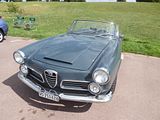
The 2600, or 106 Series, were an evolution of the model first seen in 1958 as a replacement for the 1900, and called the 2000 and known internally as the 102 Series. This was the time when Alfa was still in transition from being a maker of exclusive coachbuilt and racing cars to one that offered volume production models. The 102 Series were never likely to be big sellers, in a world that was still recovering economically from the ravages of the Second World War, but the range was an important flagship, nonetheless. The 2000 models ran for 4 years, from 1958 to 1962, at which point they were updated, taking on the name of 106 Series, with minor styling changes being accompanied by a larger 2600cc engine under the bonnet. As with the 2000 models, the new 2600 cars were sold in Berlina (Saloon), Sprint (Coupe) and Spider (Convertible) versions, along with a dramatically styled SZ Coupe from Italian styling house Zagato and a rebodied Berlina from OSI, all of them with an inline twin overhead cam six cylinder engine of 2.6 litres, the last Alfas to offer this configuration. Just 6999 of the Sprint models were made and 2255 Spiders, very few of which were sold new in the UK where they were exceedingly expensive thanks to the dreaded Import Duty which made them much more costly than an E Type. Many of the parts were unique to these cars, so owning one now is far harder than the more plentiful 4 cylinder Alfas of the era. Whilst the rather square styling of the Berlina, which won it relatively few friends when new and not a lot more in recent times means that there are few of these versions to be seen, the Sprint and Spider models do appear from time to time, and market interest in the cars is now starting to accelerate, with values rise accordingly. Seen here were the regular Coupe, the Spider and the 2600 Zagato.


The first car was called the Alfa Romeo Giulia Sprint GT, and was revealed at a press event held at the then newly opened Arese plant on 9 September 1963, and displayed later the same month at the Frankfurt Motor Show. In its original form the Bertone body is known as scalino (step) or “step front”, because of the leading edge of the engine compartment lid which sat 1/4 an inch above the nose of the car. The Giulia Sprint GT can be distinguished from the later models by a number of features including: Exterior badging: Alfa Romeo logo on the front grille, a chrome script reading “Giulia Sprint GT” on the boot lid, and rectangular “Disegno di Bertone” badges aft of the front wheel arches; flat, chrome grille in plain, wide rectangular mesh without additional chrome bars; single-piece chrome bumpers; no overriders. Inside the cabin the padded vinyl dashboard was characterised by a concave horizontal fascia, finished in grey anti-glare crackle-effect paint. Four round instruments were inset in the fascia in front of the driver. The steering wheel was non-dished, with three aluminium spokes, a thin bakelite rim and a centre horn button. Vinyl-covered seats with cloth centres and a fully carpeted floor were standard, while leather upholstery was an extra-cost option. After initially marketing it as a four-seater, Alfa Romeo soon changed its definition of the car to a more realistic 2+2. The Giulia Sprint GT was fitted with the 1,570 cc version of Alfa Romeo’s all-aluminium twin cam inline four (78 mm bore × 82 mm stroke), which had first debuted on the 1962 Giulia Berlina. Breathing through two twin-choke Weber 40 DCOE 4 carburettors, on the Sprint GT this engine produced 105 hp at 6,000 rpm. Like all subsequent models, the Sprint GT was equipped with an all-synchromesh 5-speed manual transmission. The braking system comprised four Dunlop disc brakes and a vacuum servo. The rear brakes featured an unusual arrangement with the slave cylinders mounted on the axle tubes, operating the calipers by a system of levers and cranks. According to Alfa Romeo the car could reach a top speed of “over 180 km/h (112 mph)”. In total 21,902 Giulia Sprint GT were produced from 1963 to 1965, when the model was superseded by the Giulia Sprint GT Veloce. Of these 2,274 were right hand drive: 1,354 cars fully finished in Arese, and 920 shipped in complete knock-down kit form for foreign assembly. For 1966, the Giulia Sprint GT was replaced by the Alfa Romeo Giulia Sprint GT Veloce, which was very similar but featuring a number of improvements: a revised engine—slightly more powerful and with more torque—better interior fittings and changes to the exterior trim. Alongside the brand new 1750 Spider Veloce which shared its updated engine the Sprint GT Veloce was introduced at the 36th Geneva Motor Show in March 1966, and then tested by the international specialist press in Gardone on the Garda Lake. Production had began in 1965 and ended in 1968. The Giulia Sprint GT Veloce can be most easily distinguished from other models by the following features: badging as per Giulia Sprint GT, with the addition of round enamel badges on the C-pillar—a green Quadrifoglio (four-leaf clover) on an ivory background—and a chrome “Veloce” script on the tail panel; black mesh grille with three horizontal chrome bars; the grille heart has 7 bars instead of 6; stainless steel bumpers, as opposed to the chromed mild steel bumpers on the Giulia Sprint GT. The bumpers are the same shape, but are made in two pieces (front) and three pieces (rear) with small covers hiding the joining rivets. Inside the main changes from the Giulia Sprint GT were imitation wood dashboard fascia instead of the previous anti-glare grey finish, front seats revised to a mild “bucket” design, and a dished three aluminium spoke steering wheel, with a black rim and horn buttons through the spokes. The Veloce’s type 00536 engine, identical to the Spider 1600 Duetto’s, featured modifications compared to the Giulia Sprint GT’s type 00502—such as larger diameter exhaust valves. As a result it produced 108 hp at 6,000 rpm, an increase of 3 hp over the previous model, and significantly more torque. The top speed now exceeded 185 km/h (115 mph). Early Giulia Sprint GT Veloces featured the same Dunlop disc brake system as the Giulia Sprint GT, while later cars substituted ATE disc brakes as pioneered on the GT 1300 Junior in 1966. The ATE brakes featured an handbrake system entirely separate from the pedal brakes, using drum brakes incorporated in the rear disc castings. Though the Sprint GT Veloce’s replacement—the 1750 GT Veloce—was introduced in 1967, production continued throughout the year and thirty final cars were completed in 1968. By then total Giulia Sprint GT Veloce production amounted to 14,240 examples. 1,407 of these were right hand drive cars, and 332 right hand drive complete knock-down kits. The Alfa Romeo 1750 GT Veloce (also known as 1750 GTV) appeared in 1967 along with the 1750 Berlina sedan and 1750 Spider. The same type of engine was used to power all three versions; this rationalisation was a first for Alfa Romeo. The 1750 GTV replaced the Giulia Sprint GT Veloce and introduced many updates and modifications. Most significantly, the engine capacity was increased to 1779 cc displacement. Peak power from the engine was increased to 120 hp at 5500 rpm. The stroke was lengthened from 82 to 88.5 mm over the 1600 engine, and a reduced rev limit from 7000 rpm to 6000 rpm. Maximum torque was increased to 137 lb·ft at 3000 rpm. A higher ratio final drive was fitted (10/41 instead of 9/41) but the same gearbox ratios were retained. The result was that, on paper, the car had only slightly improved performance compared to the Giulia Sprint GT Veloce, but on the road it was much more flexible to drive and it was easier to maintain higher average speeds for fast touring. For the United States market, the 1779 cc engine was fitted with a fuel injection system made by Alfa Romeo subsidiary SPICA, to meet emission control laws that were coming into effect at the time. Fuel injection was also featured on Canadian market cars after 1971. Carburettors were retained for other markets. The chassis was also significantly modified. Tyre size went to 165/14 from 155/15 and wheel size to 5 1/2J x 14 instead of 5J x 15, giving a wider section and slightly smaller rolling diameter. The suspension geometry was also revised, and an anti-roll bar was fitted to the rear suspension. ATE disc brakes were fitted from the outset, but with bigger front discs and calipers than the ones fitted to GT 1300 Juniors and late Giulia Sprint GT Veloces. The changes resulted in significant improvements to the handling and braking, which once again made it easier for the driver to maintain high average speeds for fast touring. The 1750 GTV also departed significantly from the earlier cars externally. New nose styling eliminated the “stepped” bonnet of the Giulia Sprint GT, GTC, GTA and early GT 1300 Juniors and incorporated four headlamps. For the 1971 model year, United States market 1750 GTV’s also featured larger rear light clusters (there were no 1970 model year Alfas on the US market). Besides the chrome “1750” badge on the bootlid, there was also a round Alfa Romeo badge. Similar Quadrofoglio badges to those on the Giulia Sprint GT Veloce were fitted on C pillars, but the Quadrofoglio was coloured gold instead of green. The car also adopted the higher rear wheelarches first seen on the GT 1300 Junior. The interior was also much modified over that of earlier cars. There was a new dashboard with large speedometer and tachometer instruments in twin binnacles closer to the driver’s line of sight. The instruments were mounted at a more conventional angle, avoiding the reflections caused by the upward angled flat dash of earlier cars. Conversely, auxiliary instruments were moved to angled bezels in the centre console, further from the driver’s line of sight than before. The new seats introduced adjustable headrests which merged with the top of the seat when fully down. The window winder levers, the door release levers and the quarterlight vent knobs were also restyled. The remote release for the boot lid, located on the inside of the door opening on the B-post just under the door lock striker, was moved from the right hand side of the car to the left hand side. The location of this item was always independent of whether the car was left hand drive or right hand drive. Early (Series 1) 1750 GTV’s featured the same bumpers as the Giulia Sprint GT Veloce, with the front bumper modified to mount the indicator / sidelight units on the top of its corners, or under the bumper on US market cars. The Series 2 1750 GTV of 1970 introduced other mechanical changes, including a dual circuit braking system (split front and rear, with separate servos). The brake and clutch pedals on left hand drive cars were also of an improved pendant design, instead of the earlier floor-hinged type. On right hand drive cars the floor-hinged pedals were retained, as there was no space for the pedal box behind the carburettors. Externally, the series 2 1750 GTV is identified by new, slimmer bumpers with front and rear overriders. The combined front indicator and sidelight units were now mounted to the front panel instead of the front bumper, except again on the 1971-72 US/Canadian market cars. The interior was slightly modified, with the seats retaining the same basic outline but following a simpler design. 44,269 1750 GTVs were made before their replacement came along. That car was the 2000GTV. Introduced in 1971, together with the 2000 Berlina sedan and 2000 Spider, the 2 litre cars were replacements for the 1750 range. The engine displacement was increased to 1962 cc. Oil and radiator capacities remained unchanged. The North American market cars had fuel injection, but everyone else retained carburettors. Officially, both versions generated the same power, 130 hp at 5500 rpm. The interior trim was changed, with the most notable differences being the introduction of a separate instrument cluster, instead of the gauges installed in the dash panel in earlier cars. Externally the 2000 GTV is most easily distinguished by its grille with horizontal chrome bars, featuring protruding blocks forming the familiar Alfa heart in outline, smaller hubcaps with exposed wheel nuts, optional aluminium alloy wheels of the same size as the standard 5. 1/2J × 14 steel items, styled to the “turbina” design first seen on the alloy wheels of the Alfa Romeo Montreal, and the larger rear light clusters first fitted to United States market 1750 GTV’s were standard for all markets. From 1974 on, the 105 Series coupé models were rationalised and these external features became common to post-1974 GT 1300 Junior and GT 1600 Junior models, with only few distinguishing features marking the difference between models. 37,459 2000 GTVs were made before production ended and these days they are very sought after with prices having sky-rocketed in recent years.


Slotting into the range below the Alfetta was the 116 series Giulietta, and there was just one of these cars, a late model. This Giulietta was introduced in November 1977 and while it took its name from the original Giulietta of 1954 to 1965, it was a new design based on the Alfa Romeo Alfetta chassis (including its rear mounted transaxle). While it was a conventional three-box saloon/sedan body style, a defining point of difference was at the rear, where there was a short boot, and a small aerodynamic spoiler, integrated into the body. The Giulietta was only offered in saloon form, but there were several estate/station wagon conversions made. First out was Moretti, whose conversion appeared in the first half of 1978. At launch, two models were available: Giulietta 1.3, with an oversquare 95 PS 1357 cc engine, and Giulietta 1.6, with a 109 PS 1570 cc engine, both Alfa Romeo Twin Cam inline-fours fed by two twin-choke carburettors. In April 1979, just under two years later, Giulietta 1.8 with a 122 PS 1,779 cc engine was added, and in May of the following year the Giulietta Super with a 2-litre engine (1,962 cc, 130 PS appeared. In summer of 1981, the Giulietta received a minor facelift, externally and internally, while the engines remained the same. The car got plastic protection around the lower body, while interior modifications included a new steering wheel and new seats. The instrument panel and the centre armrest were also modified. The Autodelta-produced Giulietta 2.0 Turbo Autodelta (175 PS) was introduced at the 1982 Paris motor show. This special version had a turbocharged 1,962 cc engine. The production Giulietta Turbodelta version had 170 PS and a KKK turbocharger coupled with two double-barrel Weber carburettors. All turbo versions were black with red interior; only 361 were produced. In the same year, the Giulietta 2.0 Ti and turbodiesel (VM) 1995 cc version with 82 PS were also introduced, going on sale in early 1983. In 1982, Alfetta and Giulietta turbodiesels achieved seven world speed records over 5/10/25/50 thousand kilometres and 5/10/25 thousand miles at Nardò (Lecce). While one of the quickest diesels in its category at the time, the Giulietta was rather costly and suffered from a very forward weight distribution (56.9 per cent over the front wheels). In late 1983, the “84” Giulietta (Series 3) was presented, with minor differences in appearance, bumpers were redesigned and the dashboard was significantly re-designed, the instruments changed slightly and the rear seat in some versions changed its form. Mechanically it was basically the same, with minor modifications to the brake booster and inlet manifold on some versions. The largest market for the Giulietta was South Africa, where a very successful TV advertising campaign by Alfa Romeo produced good sales between 1981 and 1984. Central to this campaign was emphasis of the Giulietta’s new ‘aerodynamic’ line, which was carried over to the 75, and then the 33. The Giulietta was the ‘last hurrah’ for Alfa in South Africa before the appearance of the 164 and 156 models in the 1990s. In 1985, after around 380,000 Giuliettas had been built, it was replaced by the Alfa Romeo 75, which used much of the Alfetta/Giulietta underpinnings.


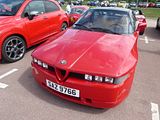
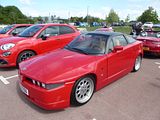
It was more than 10 years after the Montreal had ceased production before Alfa offered another high-end and costly Coupe model, and the result, seen for the first time in 1989, could hardly have been more different than its forebear. That car had been praised for its looks, whereas this one, the SZ, and cruelly nicknamed “Il Mostro”, was almost wilfully, well, “different”. First seen at the 1989 Geneva Show, the car was also first shown simply as a concept, called the ES-30, for Experimental Sports car 3 litre. It was produced by Zagato. Robert Opron of the Fiat design studio was responsible for the initial sketches while Antonio Castellana was largely responsible for the final styling details and interior. Only the ‘Z’ logo of Zagato was kept. The car possessed unusual headlights positioned in a trio on each side – a styling used more subtly on later Alfa Romeos in the 2000s. Mechanically and engine-wise, the car was based on the Alfa 75, production being carried out by Zagato at Terrazzano di Rho near the Alfa factory in Arese. The thermoplastic injection moulded composite body panels were produced by Italian company Carplast and French company Stratime Cappelo Systems. The suspension was taken from the Alfa 75 Group A/IMSA car, and modified by Giorgio Pianta, engineer and team manager of the Lancia and Fiat rally works team. A hydraulic damper system was made by Koni. The SZ was originally equipped with Pirelli P Zero tyres (front 205/55 ZR 16, rear 225/50 ZR 16) and is able to sustain over 1.1 G in cornering, some drivers have measured a cornering force of 1.4 G, which remains an excellent performance figure. Low volume production got underway late in 1989, and over the next three years, 1036 were built, slightly more than planned. With the exception of a black car made for Zagato, all of them were red. Subsequently a convertible version, the RZ (for Roadster Zagato), was produced from 1992 until December 1994. Although almost identical to look at the two cars had completely different body panels save for the front wings and boot. The RZ had a revised bumper and door sills to give better ground clearance and the bonnet no longer featured the aggressive ridges. Three colours were available as standard: black, yellow and red, with black and yellow being the more popular choices. Yellow and red cars got a black leather interior and black cars burgundy. Although the interior layout was almost unchanged from the SZ, the RZ had a painted central console that swept up between the seats to conceal the convertible roof storage area. 350 units were planned but production was halted after 252 units when the Zagato factory producing the cars for Alfa Romeo went in to receivership, a further 32 cars were then completed under the control of the receivers before production finished at 284 units. Of those final three were painted silver with burgundy interior and another pearlescent white.


The 155 was one of a series of cars built by the Fiat Group on a shared platform, the so called Tipo 3 or Tipo Tre, which sat under the Fiat Tipo, and Lancia Delta 2, as well as the Fiat Coupe. Built to replace the rear wheel drive 75, the 155 was somewhat larger in dimension than its predecessor. The 155 was designed by Italian design house I.DE.A Institute which achieved an exceptional drag coefficient of 0.29, and the rather boxy design gave the car a sizeable boot, as well. The single most significant technical change from the 75 was the change to a front-wheel drive layout. This new configuration gave cost and packaging benefits but many Alfa die-hards and the automotive press lamented the passing of the “purer” rear-wheel drive layout on a car from this sporting marque. Not even the availability of the 155 Q4, which had a 2.0-litre turbocharged engine and a permanent four-wheel drive powertrain, both derived from the Lancia Delta Integrale; making the car essentially a Lancia Delta Integrale with a different body was enough to win the sceptics over. Reception of the model was generally lukewarm. The 75 had been conceived prior to Fiat’s acquisition of the Alfa brand, so as “the last real Alfa” it cast rather a shadow over the 155; the loss of rear-wheel drive was frequently cited as the main cause of the disappointment. Nevertheless, the 155 was entered in Touring Car racing and was successful in every major championship it entered, which gradually improved its image. Belatedly, the factory introduced a wider version in 1995 (the “wide-body”) which as well as a wider track and revised steering based on racing experience or requirements, also brought in new 16-valve engines for the 1.8 and 2.0-litre whilst retaining the 2.5 V6 and making some improvements to cabin materials and build quality. There were several Sport Packs available, including a race-inspired body kit (spoiler and side skirts) and black or graphite-coloured 16-inch Speedline wheels. The more genteel could opt for the Super which came with wood inserts in the cabin and silver-painted alloy wheels. With this version, the 155 really came good. When production ceased in 1998, following the launch of the 156, 192,618 examples had been built.

The 916 Series cars were conceived to replace two very different models in the Alfa range. First of these was the open topped 105 Series Spider which had been in production since 1966 and by the 1990s was long overdue a replacement. Alfa decided to combine a follow on to the Alfetta GTV, long out of production, with a new Spider model, and first work started in the late 1980s. The task was handed to Pininfarina, and Enrico Fumia’s initial renderings were produced in September 1987, with the first clay models to complete 1:1 scale model made in July 1988. Fumia produced something rather special. Clearly an Italian design, with the Alfa Romeo grille with dual round headlights, recalling the Audi-based Pininfarina Quartz, another design produced by Enrico Fumia back in 1981, the proposal was for a car that was low-slung, wedge-shaped with a low nose and high kicked up tail. The back of the car is “cut-off” with a “Kamm tail” giving improved aerodynamics. The Spider would share these traits with the GTV except that the rear is rounded, and would feature a folding soft-top with five hoop frame, which would completely disappear from sight under a flush fitting cover. An electric folding mechanism would be fitted as an option. Details included a one-piece rear lamp/foglamp/indicator strip across the rear of the body, the minor instruments in the centre console angled towards the driver. The exterior design was finished in July 1988. After Vittorio Ghidella, Fiat’s CEO, accepted the design, Alfa Romeo Centro Stile under Walter de Silva was made responsible for the completion of the detail work and also for the design of the interiors, as Pininfarina’s proposal was not accepted. The Spider and GTV were to be based on the then-current Fiat Group platform, called Tipo Due, in this case a heavily modified version with an all new multilink rear suspension. The front suspension and drivetrain was based on the 1992 Alfa Romeo 155 saloon. Chief engineer at that time was Bruno Cena. Drag coefficient was 0.33 for the GTV and 0.38 for the Spider. Production began in late 1993 with four cars, all 3.0 V6 Spiders, assembled at the Alfa Romeo Arese Plant in Milan. In early 1994 the first GTV was produced, with 2.0 Twin Spark engine. The first premiere was then held at the Paris Motor Show in 1994. The GTV and Spider were officially launched at the Geneva Motor Show in March 1995 and sales began the same year. The cars were well received. At launch, many journalists commented that Alfa had improved overall build quality considerably and that it came very close to equalling its German rivals. I can vouch for that, as I owned an early GTV for eighteen months, and it was a well built and reliable car. In 1997 a new engine, a 24-valve 3.0 litre V6, was available for the GTV along with bigger, 12.0 inch brakes and red four-pot calipers from Brembo. The console knobs were changed from round central to rectangle ones and to a three-spoke steering wheel. Some versions were upgraded with different front bumper mesh to bring the wind noise down to 74 dBA. In May 1998 the cars were revamped for the first time, creating the Phase 2 models. Most of the alterations were inside. The interior was changed with new centre console, painted letters on skirt seals, changed controls and switches arrangement and different instrument cluster. Outside, the main changes included chrome frame around the grille and colour-coded side skirts and bumpers. A new engine was introduced, the 142 hp 1.8 Twin Spark, and others were changed: the 2.0 Twin Spark was updated with a modular intake manifold with different length intakes and a different plastic cover. Power output of the 2.0 TS was raised to 153 hp. Engines changed engine management units and have a nomenclature of CF2. The dashboard was available in two new colours in addition to the standard black: Red Style and Blue Style, and with it new colour-coded upholstery and carpets. The 3.0 24V got a six-speed manual gearbox as standard and the 2.0 V6 TB engine was now also available for the Spider. August 2000 saw the revamp of engines to comply with new emission regulations, Euro3. The new engines were slightly detuned, and have a new identification code: CF3. 3.0 V6 12V was discontinued for the Spider and replaced with 24V Euro3 version from the GTV. 2.0 V6 Turbo and 1.8 T.Spark were discontinued as they did not comply with Euro3 emissions. By the 2001-2002 model year, only 2 engines were left, the 2.0 Twin.Spark and 3.0 V6 24V, until the Phase 3 engine range arrived. The Arese plant, where the cars had been built, was closing and, in October 2000, the production of GTV/Spider was transferred to Pininfarina Plant in San Giorgio Canavese in Turin. In 2003 there was another and final revamp, creating the Phase 3, also designed in Pininfarina but not by Enrico Fumia. The main changes were focused on the front with new 147-style grille and different front bumpers with offset numberplate holder. Change to the interior was minimal with different centre console and upholstery pattern and colours available. Instrument illumination colour was changed from green to red. Main specification change is an ASR traction control, not available for 2.0 TS Base model. New engines were introduced: 163 hp 2.0 JTS with direct petrol injection and 237 hp 3.2 V6 24V allowing a 158 mph top speed. Production ceased in late 2004, though some cars were still available for purchase till 2006. A total of 80,747 cars were made, and sales of the GTV and Spider were roughly equal. More V6 engined GTVs than Spiders were made, but in 2.0 guise, it was the other way round with the open model proving marginally more popular.


Rather than replacing the 916 Series GTV with a single model, Alfa elected to produce two successors., The more commodious of the two, the GT, was the first to appear, making its debut in March 2003 at the Geneva Motor Show, finally going on sale in early 2004. It was built at the Pomigliano plant, alongside the 147 and 159. The GT was based on the Alfa 156 platform, which was also used for the 147, providing the 2-door coupé with genuine five-passenger capacity. It was styled by Bertone. Most mechanicals were taken directly from the 156/147 using the same double wishbone front suspension and MacPherson rear setup. The interior was derived form the smaller hatchback 147 and shared many common parts. The GT shared the same dash layout and functions, the climate control system as well as having a similar electrical system. Some exterior parts were taken from 147 with the same bonnet, wing mirrors and front wings (from 147 GTA). The engine range included both a 1.8 TS, and 2.0 JTS petrol engine, a 1.9 MultiJet turbodiesel, and a top-of-the-range 240 bhp 3.2 V6 petrol. There were few changes during the GT’s production life. In 2006 Alfa introduced a 1.9 JTD Q2 version with a limited slip differential, and also added a new trim level called Black Line. In 2008 Alfa introduced the cloverleaf model as a limited edition complete with new trim levels, lowered suspension, body kit, 18 inch alloy wheels and was only available in the colours black, Alfa red, or blue. with 1.8 and 2.0 litre petrol engines as well as the 1.9 litre Multijet turbo diesel. The GT was acclaimed for its attractive styling and purposeful good looks, in 2004 being voted the world’s most beautiful coupe in the annual ‘World’s Most Beautiful Automobile’ (L’Automobile più Bella del Mondo) awards. The car sold reasonably well, with 80,832 units being produced before the model was deleted in 2010.


Visually similar to the 159 models at the front, the Brera and Spider boasted unique styling from the A pillars rearwards. They were offered with the same range of engines as the 159, and thanks to that strong, but rather heavy platform on which they were built, even the 3.2 litre V6 cars were more Grand Tourer than rapid sports car. Pininfarina was responsible for both models. The Brera was first to market, in 2005, with the Spider following in 2006. Production of both ceased in late 2010, by which time 12,488 units of the Spider and 21,786 units of the Brera had been built. It will be very surprising if these do not attain classic status, and the consequent rise in values, though that has not happened yet.


The Alfa Romeo MiTo (Type 955) is a front-wheel drive, three-door supermini designed by Centro Stile Alfa Romeo and presented in 2008 at Castello Sforzesco in Milan with an international introduction at the British Motor Show in 2008. The new car was provisionally named the “Junior”. In November 2007, Alfa Romeo launched a European public naming competition; the winner from each country to win an Alfa Romeo Spider or an Alfa Romeo mountain bike. The winning name was “Furiosa”, which scored well in Italy, France, United Kingdom and Germany, but not in Spain. In 2008, Alfa Romeo announced “MiTo” as the official name, a portmanteau of Milano (Milan) & Torino (Turin), because it was designed in the former and was assembled in the latter. The name is also a play on the Italian word “mito”, meaning “myth” or “legend”. The MiTo is front-wheel drive, with a system allowing the driver to choose three driving settings: Dynamic, Normal, and All-Weather. The system, marketed as “Alfa DNA,” tunes the behaviour of the engine, brakes, steering, suspension and gearbox. The MiTo also features LED tail lights and 250-litre (8.8 cu ft) of luggage space. The MiTo also features a Q2 electronic differential on the front wheels, which is active with the DNA switch in Dynamic position, and allows for faster and tighter cornering without loss of traction. In 2010 a new transmission for the MiTo was unveiled at the 2010 Geneva Motor Show, the six-speed TCT which is produced by Fiat Powertrain Technologies in Verrone (TCT Dual Dry Clutch Transmission). Magneti Marelli delivers the control system which integrates BorgWarner’s hydraulic actuation module into its own power and transmission control units. It can handle torque inputs of up to 350 N⋅m (258 lbf⋅ft) In Geneva was also unveiled Blue&Me–TomTom, this new system integrates TomTom navigation to the Blue&Me infotelematic system. At its launch the MiTo featured low-displacement turbocharged petrol and diesel engines. Also, a power limited 78 bhp naturally aspirated engine variant is produced to meet the new Italian legislation for young people. MiTo got new electro-hydraulic valve control system Multiair engines from September 2009. MultiAir engines will increase power (up to 10%) and torque (up to 15%), as well as a considerable reduction in consumption levels (up to 10%) and CO2 emissions (up to 10%), of particulates (up to 40%) and NOx (up to 60%). This new engine is available with 104 bhp,133 bhp and 168 bhp power ratings. All multiair versions have start-stop system as standard. In October 2009 was unveiled a dual fuel MiTo version, this version can run with LPG (Liquefied petroleum gas) or petrol, with this engine MiTo has range of 1,200 km (750 miles). The LPG version is made in collaboration with Landi Renzo. In Summer 2010 Alfa introduced the Dual Dry Clutch Transmission called Alfa TCT ( i.e. Twin Clutch Transmission ). From model year 2011 the start-stop system came as standard on all versions. At the 2011 Frankfurt Motor Show, AR introduced two new engines for the MiTo – The 0.9 L I2 TwinAir and a new low emission 85 PS version of the 1.3 JTD diesel engine. The Quadrifoglio Verde (green four-leaf clover) has traditionally been the highest line of Alfa Romeo models. The car (see Alfa Romeo in motorsport article for the history of this emblem) version of Mito was presented at the 2009 Frankfurt Motor Show. The QV version has the new 1.4 litres (1,368 cc) Turbo Multiair inline-four engine 168 bhp at 5500 rpm and 250 Nm (184 lb/ft) of torque at 2500 rpm, with newly engineered suspension, steering and new six-speed C635 gearbox developed by Fiat Powertrain Technologies (FPT). Its specific output of 124 PS per litre was highest in its segment at that time. The new multiair technology allows fuel consumption of 6 l/100 km (47 mpg) in EU combined driving and CO2 emissions of 139 g/km. QV had bigger 305 mm front brake discs and exclusive 18″ alloy wheels as standard and Sabelt carbon fibre backed bucket seats as an option. From 2014 QV was now available with TCT robotised gearbox which brought down the 0–100 km/h time to 7.3 s. With the 2016 facelift, the QV was renamed as the Veloce. For model year 2014, the MiTo got a new 105 PS 0.9 L Turbo TwinAir engine, new chrome-plated grille, new Anthracite grey colour and new burnished front light clusters. The car interior was also updated with new upholsteries, three new dashboards looks, as well as the new Uconnect 5.0 infotainment systems. The engine range now consists two turbo diesel engines (the updated E5+ 85 PS 1.3 L JTDM and the 120 PS 1.6 L JTDM) and five petrol engines: the 70 PS 1.4, the 78 PS 1.4, the 135 PS 1.4 MultiAir Turbo (with manual or Alfa TCT Dual Dry Clutch Transmission) and the 170 PS 1.4 MultiAir Turbo. The range has also 120 HP 1.4 LPG Turbo option. Debuting at the 2016 2016 Geneva Motor Show, the revised Mito featured a facelifted front fascia with a new updated brand logo and new lettering. Trim line up was changed to Mito, Super and Veloce. A new body colour and new rims designs also became available. The previous MiTo QV became the Mito Veloce, available with 170 PS engine and TCT transmission. The MiTo was marketed across a single generation from 2008 to 2018, sharing the Fiat Small platform with the Fiat Grande Punto. Production reached 293,428 at FCA’s Mirafiori plant.

The Alfa Romeo 4C is a two-seater, rear-wheel drive coupé with technology and materials derived from the Alfa Romeo 8C Competizione, with a 1750 cc turbo petrol engine with direct injection, the “Alfa TCT” twin dry clutch transmission, and the Alfa DNA dynamic control selector. The 4C concept version was unveiled in the 81st Geneva Motor Show in March 2011, followed by the Mille Miglia 2011 parade, Goodwood Festival of Speed 2011,2011 Frankfurt Motor Show. It was displayed for the first time outside in Concorso d’Eleganza Villa d’Este in 2012. Compared to the production version, it is very similar, with the biggest differences being front lights, side vents and mirrors. The Alfa Romeo 4C Concept was voted the ‘Most Beautiful Concept Car of the Year’ award by the readers of German magazine Auto Bild, and won the Auto Bild Design Award 2011. It was awarded the “Design Award for Concept Cars & Prototypes” by referendum of the public in Villa d’Este. The production car was unveiled at the 2013 Geneva Motor Show, followed by 2013 Essen ‘Techno Classica’, Goodwood Festival of Speed 2013, Moscow Raceway, 2013 Frankfurt Motor Show. The bare ‘4C000’ chassis was also shown at the 2013 Geneva Motor Show. Ordering of European models began in October 2013 at Alfa Romeo dealerships in Europe. As part of the Alfa Romeo 4C launch, Alfa Romeo Style Centre and Compagnia Ducale designed a 4C IFD (Innovative Frame Design) Bicycle, inspired by the Alfa Romeo 4C coupé. The vehicle went on sale in December 2013 and marketed in Europe, Asia and America. Production of the 4C began May 2013 at Maserati’s plant in Modena, with an expected production of up to 2500 units per year. It was the first mass-produced Alfa Romeo model to be sold in the US market since 1995 when the 164 sedan stopped being sold in the US. Production of the Alfa Romeo 4C was originally estimated to be over 1000 units per year, with an upper limit of 3500 units per year, depending on the quantity of carbon fibre chassis that can be built by the supplier Adler Plastic.Within the 3,500-unit quota, 1,000 units are earmarked for Europe. Delivery of the European Alfa Romeo 4C Launch Edition took place at Balocco (Vercelli, Italy) Test Centre. In 2018, the 4C coupe was discontinued for the North American market. The 4C Spider, however continued to be sold there for model year 2019 and model year 2020. In other markets, such as Australia and Japan, both the coupe and Spider continued. In late 2020, a new tribute-edition named the 4C Spider 33 Stradale Tributo was announced. The car was designed by Centro Stile Alfa Romeo (Style Centre) and developed by Alfa Romeo. The chassis is composed of a central carbon fibre tub, with aluminium subframes front and rear. The carbon fibre tub is produced by TTA (Tecno Tessile Adler) in Airola, as a joint venture between Adler Plastic and Lavorazione Materiali Compositi. The carbon fibre components that make up the chassis are cut using CNC technology. The entire carbon-fiber monocoque chassis (“tub”) of the car weighs 143 pounds (65 kg). Front and rear aluminium subframes combine with the tub, roof reinforcements and engine mounting to comprise the 4C chassis giving the vehicle a total chassis weight of 236 lb (107 kg) and a total vehicle curb weight of just 2,465 lb (1,118 kg). The 4C has a single carbon fibre body, similar to the body of many supercars. The outer body is made of a composite material (SMC for Sheet Moulding Compound) which is 20% lighter than steel. The stability is comparable to steel and better than aluminium. The 4C employs double wishbone suspensions at the front and MacPherson struts at the rear. The resultant weight distribution is 38% on the front and 62% on the rear axle. Wheels and tyres have different diameters and widths front and rear: 205/45 R17 front and 235/40 R18 back as standard, with optional 205/40 R18 and 235/35 R19. Both wheel options come equipped with Pirelli P Zero tyres. The 4C uses vented disc brakes on all wheels; Brembo 305 millimetres (12.0 in) on the front and 292 millimetres (11.5 in) on the rear. The car can stop from 100 km/h (62 mph) in 36 metres. To save weight and increase steering feel, the 4C has no power steering. Its centre of gravity height, at 40 centimetres (16 in) off the ground, is 7 centimetres (2.8 in) lower than that of the Lotus Elise. The 4C uses a new all-aluminium 1,742 cc inline 4 cylinder turbocharged engine producing 240 PS at 6000 rpm. The engine has been designed for minimum weight. The engine’s combined fuel consumption 6.8 l/100 km (42 mpg‑imp; 35 mpg‑US). 0–62 mph (0–100 km/h) acceleration is achieved in 4.5 seconds and the top speed is 258 km/h (160 mph), the power-to-weight-ratio being just 0.267 hp/kg (8.22 lb/hp) A journalist from Quattroruote car magazine demonstrated how the 4C accelerates from 0–100 km/h (0–62 mph) faster than 4.5 seconds. In race mode, with left foot on the brake pedal, if you pull the right shift paddle the engine will rev to 3500 rpm, but if you also pull the left paddle the engine will rev to 6000 rpm and 0–100 km/h (0–62 mph) time will go down to 4.2 seconds. Italian car magazine Quattroruote published the lap time of 4C around Nürburgring. It lapped the ring in 8:04. The 4C is equipped with a six speed Alfa TCT Dual Dry Clutch Transmission, and can be operated via gearshift paddles on the steering wheel. It also has an Alfa ‘DNA’ dynamic control selector which controls the behavior of engine, brakes, throttle response, suspension and gearbox. In addition to the modes already seen in Giulietta, the 4C has a new “Race” mode. The U.S. version of the 4C was introduced in the 2014 New York International Auto Show with the first 100 4C’s being shipped to the U.S. early July, with a total of 850 being shipped by the end of 2014. The U.S. model includes extra bracing and strengthening required to meet U.S. crash regulations (including aluminium inserts in the carbon fiber chassis), resulting in 100 kg (220 lb) of weight increase. This version also has new headlamps similar to those seen before in the 4C Spider version. In 2018, the 4C coupe was discontinued for the North American market due to US DOT NHTSA FMVSS 226 Ejection Mitigation. The regulation called for a progressive compliance date based on volume and, due to low volume, the 4C was allowed to continue until the last compliance date of 9/1/2017, thus all 2018 4C coupes in North America have build dates of 8/2017 or earlier. The 4C Spider, however continued to be sold in North America for model year 2019 and model year 2020. The Spider version of the 4C was previewed showing a pre-production prototype at the 2014 Geneva Motor Show. Sharing its engine with the Coupé version, the 4C Spider has different external parts such as the headlights, exhaust and engine hood, as well as a different roof section that features a removable roof panel. The North American spec 4C reflects a weight difference of only 22 lb (10 kg) (2,465 lbs vs. 2,487 lbs) for the Spider variant. Top speed is quoted at 257 km/h (160 mph) and acceleration from 0 to 100 km/h (62 mph) at 4.5 seconds. The 4C Launch Edition was a limited and numbered edition, unveiled at the vehicle’s launch at the 2013 Geneva Motor Show. The vehicle came in a choice of four paint colours (Rosso Alfa, Rosso Competizione tri-coat, Madreperla White tri-coat or Carrara White matte). 500 examples were reserved for Europe/ROW, 500 for North America, 88 for Australia (Rosso Alfa and Madreperla White only), 200 to Japan and 100 for the Middle East. Note that the original press release cited 500 for North America, 400 Europe, and 100 ROW; however, the plaques on actual cars suggest that more were built and are the numbers referenced above. Distinguishing features of the Launch Edition were carbon fiber trim (including headlight housings, spoiler and door mirror caps), rear aluminium extractor with dark finishing, Bi-LED headlights, dark painted 18-inch front and 19-inch rear alloy wheels, additional air intakes on the front fascia, red brake calipers, racing exhaust system, BMC air cleaner, specific calibration for shock absorbers and rear anti-roll bar, leather/fabric sports seats with parts in Alcantara and a numbered plaque. Alfa Red coloured cars got matching red stitching on the steering wheel, handbrake, mats, handles and sports seats. In Europe the vehicle went on sale for 60,000 euros including VAT. The 4C Competizione is a limited edition version of the 4C introduced in the 2018 Geneva Motor Show, finished in matte Vesuvio Grey, with carbon details on the roof, rear spoiler, mirror caps, side air vents and headlight moulding. The run reportedly consisted of 108 units. The Japanese market received 25 units, and 10 units were assigned to Australia. The US-market received no Competizione editions. The car had a very mixed reaction. The UK press hated it at launch, but owners generally disagreed and loved it. A total of 9117 were built before production ceased in 2020.


The Alfa Romeo Giulia is a compact executive car. Known internally as the Type 952, it was unveiled in June 2015, with market launch scheduled for February 2016, and it is the first saloon offered by Alfa Romeo after the production of the 159 ended in 2011. The Giulia is also the first mass-market Alfa Romeo vehicle in over two decades to use a longitudinal rear-wheel drive platform, since the 75 which was discontinued in 1992. The Giulia was second in 2017 European Car of the Year voting and was named Motor Trend Car of the Year for 2018. In 2018, Giulia was awarded the Compasso d’Oro industrial design award. In 2013 Fiat Chrysler Automobiles CEO Sergio Marchionne requested a clean-sheet design for the next Alfa Romeo—a rear-wheel drive sports saloon to help return the company to its roots. He appointed former technical director at Ferrari and chassis engineer for the 458 Speciale Philippe Krief as chief engineer for the Giulia, and asked him to assemble a team of ten to create the Giulia, to be designed and built in two and a half years. Krief oversaw the development of the Giulia, along with the platform that underpins it—Giorgio. This is an all-new, longitudinal-engine, rear-wheel drive platform developed by Alfa Romeo. Marco Tencone of Centro Stile Alfa Romeo at the Fiat Mirafiori factory in Turin headed the design team, with oversight from Lorenzo Ramaciotti. The Giulia had a long gestation and delayed launch due to Marchionne sending its design back to the drawing board. The new Giulia was unveiled to the press at the Museo Storico Alfa Romeo in Arese, on 24 June 2015, at an event which involved only the top-of-the-range Quadrifoglio variant and a rendition of “Nessun dorma” by Italian tenor Andrea Bocelli. The occasion coincided with the company’s 105th anniversary, and also saw the company debut a restyled logo for all future Alfa Romeo models. The Giulia uses a front-engine, rear-wheel-drive layout, targeting an even 50% front and 50% rear weight distribution. Suspension is independent all-around—double wishbone with a semi-virtual steering axis front and multilink rear. All Giulia models employ a carbon-fibre drive shaft made by Hitachi Automotive Systems, as well as aluminium alloy shock towers, suspension components, front wings, and doors. All-wheel drive is offered in non-Quadrifoglio models. The Giulia has a drag coefficient of Cd=0.28. The base Giulia, mid-level Super, and fully loaded Speciale are powered by a 200 PS (197 hp) 2-litre petrol engine, or the choice of 136 PS, 150 PS or 180 PS 2.2-litre turbo diesel engine. The base model comes with 16-inch alloys, the Super can be distinguished with 17-inch alloys and dual chrome exhaust tip for the diesel model. The Speciale has 18-inch alloys, black brake calipers, as well as leather sports seats and sporty bumpers from the Veloce. Fixed rear seat is standard on the base and Super, while the Speciale has folding rear seat. The Giulia Sprint is positioned above the base and Super model grades, but below the Ti and Veloce. In Europe, the early Giulia Sprint was powered by either the base 2.0 gasoline engine, or 180 PS 2.2-litre diesel engine. For 2020, the Sprint got the updated diesel engine with 190 PS. In North America, the Giulia Sprint was new for 2021 model year. It is the entry-level model although motored by the same engine as the Veloce. The diesel-powered Sprint was never offered in North America. The Giulia Veloce was presented at the 2016 Paris International Motor Show held in October. The Veloce offers the choice of two engines: the 2.0-litre turbo petrol and the 2.2-litre diesel inline-4 engines, both equipped with an 8-speed automatic transmission and Alfa Q4 all-wheel drive system (rear-wheel-drive in the UK). The Veloce has specific bumpers and a glossy black door trim; it has also various performance components like special rear extractor with double exhaust pipes and optional 5-spoke 19-inch alloy wheels (the 19-inch option is not available in the UK). On the interior, it has black, red or tan leather sport seats and a sports steering wheel with a suede grip, aluminium inserts on the dashboard, central tunnel, door panels and Xenon headlights. The new four-cylinder petrol engine is rated at a maximum power output of 280 PS (276 hp) at 5,250 rpm and a maximum torque of 400 Nm (295 lb/ft) at 2,250 rpm. It has MultiAir electro-hydraulic valve activation system along with “2-in-1″ ” turbocharger system and direct injection with a 200-bar high pressure system. The 210 PS (207 hp) diesel all aluminium straight-4 engine comes with MultiJet II technology and electrically operated variable geometry turbocharger. The Alfa Q4 all wheel drive system behaves like a rear-wheel drive vehicle: 100% of torque is distributed to the rear axle. As it reaches the wheel adherence limit, the system transfers up to 60% of the torque to the front axle. To ensure maximum speed of response in re-distributing torque, the system exploits a high mechanical over slippage (up to 2.5%) between the two axles, which translates into segment-beating vehicle control in terms of traction and directional stability on bends. Meanwhile, the Giulia Ti is the luxury-oriented version. It has chrome grille and window surrounds, heated steering wheel and front seats, wood panel interior, 18-inch alloy wheels, and headlight washers. Basically, it came with more features than the Sprint, but without paddle shift like in a Veloce. The North American Ti is powered by the 280 hp gasoline engine, while the European Ti was also offered with the 187 hp diesel engine. The Ti was also available with Lusso package which consists of Cannelloni leather interior, heated rear seat, and the choice of multi-spoke or optional “Y” shape 18-inch alloy wheels. With paddle shift, 19-inch 5-hole alloy wheels, sportier front and rear bumpers, the North American Ti Sport was roughly the equivalent of the Veloce, before it was officially called the Veloce for 2022 model year. The American Ti Sport Carbon or European Veloce Ti is basically the Veloce with carbon fibre mirror caps and body kits. Based on the Veloce, the Estrema was released in 2022 for 2023 model year. It came with standard active suspension, 19-inch alloy wheels, “Estrema” side emblems, Alcantara with red stitching seats, dashboard, steering wheel and shift knob, and 14-speakers Harman Kardon sound system. The Giulia Estrema is offered with either 280 PS gasoline engine, or 210 PS diesel engine matched to 8-speed automatic gearbox and Q4 all-wheel-drive system. The top-of-the-line Giulia Quadrifoglio (Italian for “four-leaf clover”) was the first model in the new Giulia range. It was unveiled in Italy in June 2015. It made its official international debut at the 2015 Frankfurt Motor Show. The Quadrifoglio is powered by an all-aluminium alloy, twin-turbocharged gasoline direct injection 90° 690T V6 engine, with a single-cylinder displacement of just under half a litre, for a total of 2,891 cc. This engine was developed for the Quadrifoglio by engineers with Ferrari background and is derived from Ferrari’s own twin-turbocharged F154 CB V8 engine, sharing the California T’s bore x stroke of 86.5 mm × 82 mm. The engine has a maximum power output of 510 PS (503 hp) at 6,500 rpm, and 600 Nm (443 lb/ft) of torque between 2,500 and 5,000 rpm. The turbochargers are single-scroll compressor IHI units integrated into the manifold, with water-charge air coolers. It has side-mounted direct and port fuel injection, and the peak turbo boost reaches up to 1.4 bar (20 psi) relative pressure. From the front, the Quadrifoglio distinguishes itself from the rest of the range by a specific front bumper — with a carbon fibre splitter and enlarged air intakes for the added radiators (additional air-to-water intercooler on the right and additional engine cooling radiator on the left) and for the brakes — and by a bonnet featuring two cooling outlets for the engine bay. The front fenders have air vents and bear Quadrifoglio badges; the side skirts are specific to the model, as are the 19-inch cast or forged alloy wheels. At the rear, a low-profile carbon fibre lip-spoiler is applied to the boot lid, and a rear diffuser makes up the lower half of the bumper, flanked by quadruple exhaust tips. Working in conjunction with the faired-in underside, the diffuser is fully functional in generating downforce — as at the front is the “Active Aero Splitter”, which lowers by 10 degrees between 100 and 230 km/h (62 and 143 mph) in Dynamic or Race modes. The manufacturer claims these active aero elements are the firsts in the Giulia’s market segment and are able to generate up to 100 kp (1 kN; 220 lbf) of downforce at 186 mph (300 km/h). The Giulia Quadrifoglio has a drag coefficient of Cd=0.31. Mechanically, this model was fitted with a torque-vectoring rear differential able to send 100% of the torque to each wheel, and an 8-speed automatic transmission manufactured by ZF, with a ZF six-speed manual transmission available as an option in European markets. A dual-clutch transmission was initially announced] but was rejected. The differential was changed to a mechanical limited slip for the 2024 model year. The braking system has the option of Ceramic Composite Material (CCM) carbon-ceramic rotors, 390 mm (15 in) front and 360 mm (14 in) rear. On the interior, the dashboard is part-trimmed in leather and carbon fibre, and the engine start button is located on the multi-function steering wheel. In addition, the driver is offered the Alfa Romeo DNA [it] control selector, placed on the centre console. Driving modes include “Dynamic”, “Natural”, and “Advanced Efficiency”, and “Race” (for high performance — with louder exhaust note and all electronic stability control systems turned off). Sales have been steady but not spectacualr but after nearly ten years on the market, there are quite a number on British roads now.


The production Tonale was originally scheduled for release in 2021, but was delayed until 2022 due to the global semiconductor shortage and Alfa Romeo management demanding better range and performance from its drivetrain. It was developed during the ownership of Fiat Chrysler Automobiles and underpinned by a heavily modified version of the SCCS crossover platform shared with the Jeep Compass. It is also the first Alfa Romeo to be equipped with an optional plug-in hybrid system, which uses a 15.5 kWh (56 MJ) lithium-ion battery to achieve 30 miles (48 km) of all-electric range. The Tonale marks the brand’s electrification effort, where Alfa Romeo will be the first brand among the 14 brands of Stellantis to go fully electric by 2027. The Tonale is marketed in the premium segment, and has been described variously as a “compact crossover”, a “compact SUV”, a “small SUV”, and a “tall hatchback”. All models of the Tonale are equipped with a 12.3-inch (31 cm) digital infotainment cluster and a 10.25-inch (26.0 cm) infotainment screen, which will run on the Uconnect 5 software suite. In addition, the Tonale will come with an NFT that records and stores data of the car’s life cycle. According to Alfa Romeo, the NFT will generate a certificate that Stellantis claims can help maintain the car’s residual value. The Verge noted that Alfa Romeo had not provided much information about what blockchain technology they intended to use for this. Jalopnik felt that digitising a car’s service history was a good idea, but that blockchain NFTs were a “bad” and “entirely unnecessary” way to achieve this. According to Alfa Romeo, the Tonale was designed to offer more driving engagement than the class average by using a very quick steering rack (2.3 turns lock-to-lock). It also features torque vectoring by braking, frequency-selective dampers as standard, and adaptive items and four-piston brakes on the range-topping Veloce. UK sales started in late 2022 and the car is starting to appear at Italian car events now.

The latest Alfa model is the Junior and there was one example of this here.

AUTOBIANCHI
The Autobianchi A112 was a supermini, developed using a shrunken version of the contemporary Fiat 128’s platform and whose mechanicals subsequently underpinned the Fiat 127. It was introduced in November 1969, as a replacement for the Bianchina and Primula, and was built until 1986, when it made way for the more modern Autobianchi Y10 (branded in most export markets as the Lancia Y10). Over 1.2 million A112s were produced in Autobianchi’s Milan factory. The A112 was available only with a 3-door body. It was offered with the OHV engine of 903 cc from the Fiat 850 capable of attaining 42 PS. The Autobianchi represented the first appearance of this engine in a front-engine, front-wheel drive configuration which would later become familiar to a wider range of drivers in the top selling Fiat 127 and its derivatives. Claimed power increased to 47 PS in 1971, but without any mechanical changes having taken place. The A112 reached a very particular market; by 1984 female buyers represented 35% of A112 owners and about a third were in the 18-24 age range. In September 1971 the A112 E (“E” for Elegant, which also became its name after the 1973 facelift) was introduced. This featured improved seats, higher grade trimming and equipment, as well as a five-speed gearbox later in life. The mechanics were originally identical to the regular version, now referred to as the Normale, but from 1975 until 1977 the Normale’ received a less powerful engine. A performance edition “Abarth” was introduced too. In March 1973 the A112 received a makeover. The grille was new, with a larger mesh, and the bumpers were now of rubber with chrome insert (although the Normale retained the old metal bumpers with rubber strips). A new style of alloys were also available, and the seats and dashboard underwent some changes. The Abarth received a new chess pattern upholstery. In 1975 the third series arrived. The insides in the rear were recontoured, so that the car now became a five-seater (instead of four). The easiest way to spot a third series is that it received new, much larger vents on the C-pillars, as well as redesigned taillights – with integrated reversing lights on the Elegant and Abarth. The Abarth also received a new larger 1050 cc engine (“70HP”), while the Normale’s output dropped to 42 PS in July 1975. All engines were still pushrod units, derived from the old tipo 100 engine first introduced in the Fiat 600. In 1976, due to new emissions standards, the Elegant lost two horsepower, now down to 45 PS. Third series Normales still received metal bumpers, but from now on they were painted black (instead of being chromed) and no longer had a rubber strip. This was the last model to have the diamond shaped turn signals on the front fenders, with later models receiving more orthodox rectangular ones. In November 1977 the “Nuova A112” (new A112) was introduced: The most obvious difference is a slightly taller roof, with a marked edge around the sides. This improved interior habitability considerably. Autobianchi also at this time modified the upmarket version branded as the “A112 Elegant” with an engine enlarged to 965 cc, now promising 48 PS and improved torque. Later, there were also “A112 Elite” and “A112 LX” versions which received even more comfortable equipment. The 903 cc engine of the lesser A112 Normale remained unchanged. In July 1979 the car underwent another styling modification, receiving large black plastic cladding on the rear, surrounding new taillights, and new side trim and bumpers. The grille was also new, and there was black plastic wheelarches to link all of the plastic parts together. The extractor vents behind the rear side windows were also larger, of black plastic, and wrapped around the pillar. In terms of transmissions, a five-speed transmission now became available on certain models. The fifth gear was an overgear, while the ratios of the four lower speeds and the final gearing remained unchanged. The front turn signals were moved from the front of the fenders to a spot just in front of the leading edge of the doors, while a small badge denoting the trim level appeared in the turn signal’s old place. The Normale now became the Junior, and the Elite version was added, a notch above the Elegant in the lineup. There were some very light modifications to the interior. A large, rollback canvas sunroof became available on the Junior, and a rear window wiper became optional across the range. Aside from the new transmission there were no notable mechanical changes. Power outputs remained at 42, 48, and 70 PS. The Abarth also received the new five-speed gearbox, as well as new alloy wheels and foglights as standard. A lot of the plastic excesses of the fifth series were reversed for the sixth series, which was introduced in the autumn of 1982. New smoother bumpers, removal of the wheelarch trim, and a less heavy grille treatment brought back some of the original elegance of the A112, while the interior was also completely renovated. Another new version arrived, the top-of-the-line LX, which featured tinted windows, velvet seat trimming, power windows, metallic paintwork, and a digital clock amongst other creature comforts. Mechanically, the LX was identical to the Elite, with the five-speed transmission and 965 cc engine. The Elegant version was discontinued, with the Elite taking its position in the lineup. The sixth series also received new body-coloured vents on the C-pillar, and the front corner lights were incorporated into the top of the bumper. The seventh series, presented in 1984, only saw minor changes, largely remaining the same as the sixth. The taillights were again redesigned and were now joined by a reflective strip. The rear license plate was relocated to the bumper and the dashboard received modifications, more noticeable in the better equipped Elite and LX versions. The Abarth received standard front foglights, which were optional on the other versions. The Abarth also has red seatbelts. While the Junior retained small hubcaps, and the Abarth received alloys, the rest of the range now received full-face hubcaps. The front corner lights were now white, instead of orange as before. The engines remained as before, all models except the lowest-priced Junior now used five-speed transmissions. By this time, only France, Italy and Israel still used the “Autobianchi” badge; all others had switched to calling the car a Lancia. At the time of the seventh series introduction, a total of 1,115,000 A112s had been built. As the new Autobianchi Y10 was introduced in 1985, the A112 range was cut down considerably, with only the Junior remaining on sale as a low-priced alternative. It was no longer called Junior, however, now being marketed simply as the “Autobianchi A112”. Other than the name change, there were no design changes to the car. Production continued into 1986, at which point 1,254,178 Autobianchi A112s had been built. The most interesting version was the A112 Abarth, introduced in September 1971 at the same time as the Elegant. It was prepared by the motorsports division of the Fiat Group, at first with a 982 cc engine, obtained by increasing the stroke, coupled to a sportive exhaust, a twin carburettor, and a different camshaft. In 1975, displacement was increased to 1,050 cc, while power climbed from 58 HP to 70 HP at 6600 rpm, for a weight of only 700 kg (1,540 lb). The two engines were offered in parallel until production of the smaller unit ended in late 1976. The 1975 model was also the first A112 to use a 5-speed manual gearbox. These changes turned the A112 into a nervous machine, much admired by young performance enthusiasts. The car was entered in various rallying events throughout Europe and even spawned a one-make trophy: the Campionato A112 Abarth spanned eight editions, from 1977 to 1984, and adopted contemporary Group 1 rules, which meant nearly-stock cars. Some famous Italian rally drivers, including Attilio Bettega, Fabrizio Tabaton and Gianfranco Cunico, were among the winners of the championship. The increasing popularity of the A112 in historic rallies and hillclimbs led to the reintroduction of a one-make trophy, called Trofeo A112 Abarth, in 2010. Abarths have often led hard lives, having been preferred by young owners with aggressive driving styles!


FERRARI
Top of the Ferrari range from the mid 70s for 10 years was the Berlinetta Boxer, object of many a small child’s intense desire, as I can attest from my own childhood! Production of the Berlinetta Boxer was a major step for Enzo Ferrari. He felt that a mid-engined road car would be too difficult for his buyers to handle, and it took many years for his engineers to convince him to adopt the layout. This attitude began to change as the marque lost its racing dominance in the late 1950s to mid-engined competitors. The mid-engined 6- and 8-cylinder Dino racing cars were the result, and Ferrari later allowed for the production Dino road cars to use the layout as well. The company also moved its V12 engines to the rear with its P and LM racing cars, but the Daytona was launched with its engine in front. It was not until 1970 that a mid-engined 12-cylinder road car would appear. The first “Boxer” was the 365 GT4 BB shown at the 1971 Turin Motor Show. Designed to rival the Lamborghini Miura and the newly developed Lamborghini Countach, it was finally released for sale in 1973 at the Paris Motor Show. 387 were built, of which 88 were right-hand drive (of which 58 were for the UK market), making it the rarest of all Berlinetta Boxers. The Pininfarina-designed body followed the P6 show car with popup headlights. Though it shared its numerical designation with the Daytona, the Boxer was radically different. It was a mid-engined car like the Dino, and the now flat-12 engine was mounted longitudinally rather than transversely. Although referred to as a Boxer, the 180° V12 was not a true boxer engine, but rather a flat engine. It had 380 hp, slightly more than the Daytona. The 365 GT4 BB was updated as the BB 512 in 1976, resurrecting the name of the earlier Ferrari 512 racer. The name 512 referred to the car’s 5 litre, 12 cylinder engine; a deviation from Ferrari’s established practice of naming 12-cylinder road cars (as the 365 BB) after their cylinder displacement. The engine was enlarged to 4943.04 cc, with an increased compression ratio of 9.2:1. Power was slightly down to 360 hp, while a dual plate clutch handled the added torque and eased the pedal effort. Dry sump lubrication prevented oil starvation in hard cornering. The chassis remained unaltered, but wider rear tyres (in place of the 365’s equally sized on all four corners) meant the rear track grew 63 mm. External differentiators included a new chin spoiler upfront, incorporated in the bumper. A NACA duct on the side provided cooling for the exhaust system. At the rear there were now twin tail lights and exhaust pipes each side, instead of triple units as on the 365 GT4 BB. 929 BB 512 models were produced. The Bosch K-Jetronic CIS fuel injected BB 512i introduced in 1981 was the last of the series. The fuel injected motor produced cleaner emissions and offered a better balance of performance and daily-driver temperament. External differentiators from the BB 512 besides badging include a change to metric sized wheels and the Michelin TRX metric tyre system, small white running lights in the nose, and red rear fog lamps outboard of the exhaust pipes in the rear valance. 1,007 BB 512i models were produced.


Effectively a mid-life update to the 360 Modena, the F430 debuted at the 2004 Paris Motor Show. Designed by Pininfarina, under the guidance of Frank Stephenson, the body styling of the F430 was revised from the 360 Modena, to improve its aerodynamic efficiency. Although the drag coefficient remained the same, downforce was greatly enhanced. Despite sharing the same basic Alcoa Aluminium chassis, roof line, doors and glass, the car looked significantly different from the 360. A great deal of Ferrari heritage was included in the exterior design. At the rear, the Enzo’s tail lights and interior vents were added. The car’s name was etched into the Testarossa-styled driver’s side mirror. The large oval openings in the front bumper are reminiscent of Ferrari racing models from the 60s, specifically the 156 “sharknose” Formula One car and 250 TR61 Le Mans cars of Phil Hill. Designed with soft-top-convertible. The F430 featured a 4.3 litre V8 petrol engine of the “Ferrari-Maserati” F136 family. This new power plant was a significant departure for Ferrari, as all previous Ferrari V8’s were descendants of the Dino racing program of the 1950s. This fifty-year development cycle came to an end with the entirely new unit. The engine’s output was 490 hp at 8500 rpm and 343 lb/ft of torque at 5250 rpm, 80% of which was available below 3500rpm. Despite a 20% increase in displacement, engine weight grew by only 4 kg and engine dimensions were decreased, for easier packaging. The connecting rods, pistons and crankshaft were all entirely new, while the four-valve cylinder head, valves and intake trumpets were copied directly from Formula 1 engines, for ideal volumetric efficiency. The F430 has a top speed in excess of 196 mph and could accelerate from 0 to 100 km/h in 3.9 seconds, 0.6 seconds quicker than the old model. The brakes on the F430 were designed in close cooperation with Brembo (who did the calipers and discs) and Bosch (who did the electronics package),resulting in a new cast-iron alloy for the discs. The new alloy includes molybdenum which has better heat dissipation performance. The F430 was also available with the optional Carbon fibre-reinforced Silicon Carbide (C/SiC) ceramic composite brake package. Ferrari claims the carbon ceramic brakes will not fade even after 300-360 laps at their test track. The F430 featured the E-Diff, a computer-controlled limited slip active differential which can vary the distribution of torque based on inputs such as steering angle and lateral acceleration. Other notable features include the first application of Ferrari’s manettino steering wheel-mounted control knob. Drivers can select from five different settings which modify the vehicle’s ESC system, “Skyhook” electronic suspension, transmission behaviour, throttle response, and E-Diff. The feature is similar to Land Rover’s “Terrain Response” system. The Ferrari F430 was also released with exclusive Goodyear Eagle F1 GSD3 EMT tyres, which have a V-shaped tread design, run-flat capability, and OneTRED technology. The F430 Spider, Ferrari’s 21st road going convertible, made its world premiere at the 2005 Geneva Motor Show. The car was designed by Pininfarina with aerodynamic simulation programs also used for Formula 1 cars. The roof panel automatically folds away inside a space above the engine bay. The conversion from a closed top to an open-air convertible is a two-stage folding-action. The interior of the Spider is identical to that of the coupé. Serving as the successor to the Challenge Stradale, the 430 Scuderia was unveiled by Michael Schumacher at the 2007 Frankfurt Auto Show. Aimed to compete with cars like the Porsche RS-models and the Lamborghini Gallardo Superleggera it was lighter by 100 kg/220 lb and more powerful (510 PS) than the standard F430. Increased power came from a revised intake, exhaust, and an ion-sensing knock-detection system that allows for a higher compression ratio. Thus the weight-to-power ratio was reduced from 2.96 kg/hp to 2.5 kg/hp. In addition to the weight saving measures, the Scuderia semi-automatic transmission gained improved “Superfast”, known as “Superfast2”, software for faster 60 millisecond shift-times. A new traction control system combined the F1-Trac traction and stability control with the E-Diff electronic differential. The Ferrari 430 Scuderia accelerates from 0-100 km/h in 3.6 seconds, with a top speed of 202 miles per hour. Ferrari claimed that around their test track, Fiorano Circuit, it matched the Ferrari Enzo, and the Ferrari F430’s successor, the Ferrari 458. To commemorate Ferrari’s 16th victory in the Formula 1 Constructor’s World Championship in 2008, Ferrari unveiled the Scuderia Spider 16M at World Finals in Mugello. It is effectively a convertible version of the 430 Scuderia. The engine produces 510 PS at 8500 rpm. The car has a dry weight of 1,340 kg, making it 80 kg lighter than the F430 Spider, at a curb weight of 1,440 kg (3,175 lb). The chassis was stiffened to cope with the extra performance available and the car featured many carbon fibre parts as standard. Specially lightened front and rear bumpers (compared to the 430 Scuderia) were a further sign of the efforts Ferrari was putting into this convertible track car for the road. Unique 5-spoke forged wheels were produced for the 16M’s launch and helped to considerably reduce unsprung weight with larger front brakes and callipers added for extra stopping power (also featured on 430 Scuderia). It accelerates from 0-100 km/h in 3.7 seconds, with a top speed of 315 km/h (196 mph). 499 vehicles were released beginning early 2009 and all were pre-sold to select clients.

The GTC4Lusso is a successor to the Ferrari FF. Like its predecessor, the GTC4Lusso is a 3-door shooting-brake with an all-wheel drive drivetrain, and is powered by a front-mid mounted V12 engine. The GTC4Lusso’s 6,262 cc Ferrari F140 65° V12 engine is rated at 690 PS at 8,000 rpm and 697 Nm (514 lb/ft) of torque at 5,750rpm. The increase in output of the engine is due to the compression ratio raised to 13.5:1. Ferrari claims a top speed of 335 km/h (208 mph), unchanged from the FF, and a 0–100 km/h (0–62 mph) acceleration time of 3.4 seconds. The car uses an improved version (called the 4RM Evo) of Ferrari’s patented four-wheel drive system introduced on the FF, integrated with four-wheel steering into the system. Collectively, the system is called 4RM-S. The GTC4Lusso was unveiled at the 2016 Geneva Motor Show. A second version joined the range, unveiled at the 2016 Paris Motor Show. This was the GTC4Lusso T, a rear wheel drive only version of the GTC4Lusso powered by a V8 engine with lesser displacement, though the 4WS four-wheel steering system from its V12 variant is retained. The GTC4Lusso T comes with a 3,855 cc Ferrari F154 twin turbocharged V8 engine rated at 610 PS at 7,500 rpm and 760 Nm (561lb/ft) of torque at 3,000–5,250 rpm. According to the manufacturer the car can attain a top speed of over 320 km/h (199 mph) and accelerate from 0 to 100 km/h (0 to 62 mph) in 3.5 seconds. The rear features Ferrari’s signature Quad Circular Rear Lights (last seen on the F430) and the interior contains a Dual Cockpit Concept Design, separating the Driver Cockpit and the Passenger Cockpit by a central divider. The front of the car has a single grille that provides all the necessary cooling.


FIAT
By some measure, this spectacular Fiat 520 belonging to Steve and Brigit White was the oldest car of the day. Fiat had used the 520 name for a very expensive V12 powered car in the early 1920s. They used the same again later in the decade with the model seen here, for their “upper middle-class” model. This one had a 2.2 litre straight 6 engine putting out 46 hp. It was somewhat smaller and more modestly powered than its earlier namesake. During the early decades of the 20th century, European automakers, once steering wheels had replaced centrally positioned steering tillers, tended to place the driver and his steering wheel on the right side of the car regardless of local regulations or conventions concerning which side of the road cars should be driven. By the 1920s, as the number of motorized vehicles on the roads increased, clearer consensus had become necessary in the more populous parts of Italy about the need for everyone to drive along the right side of the road. The 1927 Fiat 520 was one of the first cars, presumably in recognition of this trend, to place the steering wheel on the left side of the car. The 520 was replaced by the Fiat 521 in 1928, although the 520 appears to have continued in production until 1929, by when more than 20,000 six-cylinder Fiat 520s had been produced. Steve’s car is believed to be the only 520 in the UK and was rescued from South America and subsequently restored to the splendid condition you see here.


Known for being the car which really put Italy on wheels, the 500 Topolino was one of the smallest cars in the world at the time of its production. Launched in 1937, three versions were produced until 1955, all with only minor mechanical and cosmetic changes. It was equipped with a 569 cc four-cylinder, side-valve, water-cooled engine mounted in front of the front axle, which meant that it was a full-scale car rather than a cyclecar. The radiator was located behind the engine which made possible a lowered aerodynamic nose profile at a time when competitors had a flat, nearly vertical grille. The shape of the car’s front allowed exceptional forward visibility. The rear suspension initially used quarter-elliptic rear springs, but buyers frequently squeezed four or five people into the nominally two-seater car, and in later models the chassis was extended at the rear to allow for more robust semi-elliptic springs. With horsepower of about 13 bhp, its top speed was about 53 mph and it could achieve about 48 mpg. The target price given when the car was planned was 5,000 lire. In the event the price at launch was 9,750 lire, though the decade was one of falling prices in several part of Europe and later in the 1930s the Topolino was sold for about 8,900 lire. Despite being more expensive than first envisioned, the car was competitively priced and nearly 520,000 were sold. Nowadays the car seen here is known as the 500A, and this shares its body with the later 500 Model B, but the later car had more power, a heady 16 hp. It was made between 1948 and 1949. The Model A was offered as a 2-door coupé, 2-door cabriolet and a 2-door van, while the Model B also introduced a 3-door estate under the name 500 B Giardinetta (“estate car”). The Model C was introduced in 1949 with a restyled body and the same engine as Model B, and was offered in 2-door coupé, 2-door cabriolet, 3-door estate and 2-door van versions. In 1952, the Giardinetta was renamed the Belvedere (“A turret or other raised structure offering a pleasant view of the surrounding area”, referring to its sunroof). The car seen here, belonging to Jackie Kowaleski, may look pretty standard but under that body, it is anything but, as the car has a 2 litre Ford engine which makes it considerably more rapid than the original car. She has had to re-engineer the chassis to take this much bigger engine, and also upgrade the brakes and suspension, so the car is now quite a rocket.


These days the 600 is somewhat overshadowed by the smaller 500, but in its day this was probably the more significant car. Codenamed Progetto 100 (“Project 100”), the Fiat 600 mirrored the layout of the Volkswagen Beetle and Renault 4CV of its era. Aimed at being an economical but capable vehicle, its design parameters stipulated a weight of around 450 kg with the ability to carry 4 people and luggage plus a cruising speed of no less than 85 km/h. A total of 5 prototypes were built between 1952 and 1954, which all differed from one another. Chassis number 000001 with engine number 000002 is believed to be the sole remaining example. It was powered by an innovative single-cam V2-cylinder engine designed to simplify maintenance and did not feature a clutch pedal. At the official launch in 1955, FIAT engineer, Dante Giacosa declared that the aim had been to create something new, both in the interest of progress and simplification. This prototype, however, did not become the chosen design. When the car made it to production, with a launch at the 1955 Geneva Show, it was christened the 600. It had hydraulic drum brakes on all four wheels. Suspension was a unique single double-mounted leafspring—which acts as a stabiliser—between the front wheels coupled to gas-charged shock absorbers, and an independent coil-over-shock absorber setup coupled to semi-trailing arms at the rear. All 600 models had 3-synchro (no synchro on 1st) 4-speed transaxles. Unlike the Volkswagen Beetle or Fiat 500, the Fiat 600 was water-cooled with an ample cabin heater and, while cooling is generally adequate, for high-power modified versions a front-mounted radiator or oil cooler is needed to complement the rear-mounted radiator. All models of the 600 had generators with mechanical external regulators. The first cars had a 633 cc inline-four cylinder engine which max-ed out at 59 mph. Sales were brisk, as it was just the right size for a market still recovering from the war of the previous decade. A year after its debut, in 1956, a soft-top version was introduced, and it was followed by a six-seater variant—the Fiat 600 Multipla, the very definite precursor of current multi-purpose vehicles. By 1957, assembly started in Spain, where the car would go on to become a legend, and where you can still see large numbers of them certainly at classic car events. Production was also undertaken by Steyr Puch in Austria, and in Yugoslavia and Argentina. The millionth 600 was produced in February 1961, less than six years after the car’s launch, and at the time when the millionth car was produced, the manufacturer reported it was producing the car at the then remarkable rate of 1,000 a day. Italian production ceased in 1969, but the model continued to be made in other countries, and a grand total of nearly 3 million examples were eventually made.


The first Campagnola was launched in 1951, a utility vehicle that was a sort of Italian Land-Rover. It came with short and long wheelbases, and a choice of a fixed, steel or canvas roof. A redesigned model was launched in June 1974 and in this form was produced until 1987. The new vehicle used the petrol engine of the Fiat 132, but with a longer stroke which increased the capacity to 1,995 cc. – the same enlarged engine turned up in the Fiat 132 itself two years later, albeit with twin overhead camshafts. There was a light alloy cylinder head: instead of the twin overhead camshafts of the 132, the engine in the Campagnola had a single side-mounted camshaft driven by a toothed belt, the valve movement being driven by pushrods and rockers. The large square engine compartment gave easy access to the engine bay which was designed to permit “wading” up to 70 cm deep. The 57 litre fuel tank was positioned well out of range from rocks and flying stones, being under the twin passenger seat beside the driver. MacPherson struts suspended all four wheels, with two struts for each of the rear wheels and a single strut for each of the front wheels. All six struts used were of identical specification and thereby interchangeable. Road testers from the UK commended the smoothness of the ride over rough ground which evidently compared very favourably with that offered by the Land Rover of the time. A military version was introduced in 1976 (AR76) and 1979 after new updated it was called AR76.

Known as project 110, the brief for the Nuova 500 was to create a micro-car that would not only carry on the tradition of the earlier Topolino, but which would also take sales away from the ever popular Lambretta and Vespa scooters of the day. It clearly needed to be smaller than the 600 which had been released with a conventional 4 cylinder engine. Not an easy task, but development started in 1953 and by August 1954, two designs were ready to be shown to Fiat management. They selected one, and serious development began. At first the car was referred to as the 400, as it was going to have a 400cc engine, but it was soon realised that this was just too small, so a larger 500cc air-cooled engine was developed. It was signed off in January 1956, with production starting in March 1957 in advance of a June launch. Fiat’s marketing department got busy, with hundreds of the new car taking to the streets of Turin, each with a pretty girl standing through the open sunroof that was a feature of all the early cars. The press loved it. 50 units were shipped to Britain, where the car made its debut at Brands Hatch, and again the reception was enthusiastic. But the orders just did not come in. Fiat went for a hasty rethink, relaunching the car at the Turin Show later that year. power was increased from 13 to 15 bhp, and the poverty spec was lessened a little, with headlight bezels, brightwork on the side and chrome hubcaps, a Nuova500 badge on the engine cover, winding side windows (the launch cars just had opening quarterlights) and the option of a heater fan. It was enough to get sales moving. The original car was still offered, at a lower price, called the Economy. In the first year of production, 28,452 Fiat 500s were made. Over the next 19 years, the car changed little in overall appearance, but there were a number of updates with more power and equipment added. A 500 Sport was launched in August 1958, with a more powerful version of the 499cc engine. It lost the soft top, having a ridged steel roof, to increase strength of the body. It was only available in grey with a red side flash. The first major changes came in 1960 with the 500D. This looks very similar to the Nuova, but with two key differences. One is the engine size: the D features an uprated 499 cc engine producing 17 bhp as standard, an engine which would be used right through until the end of the L in 1973; and the other is the roof: the standard D roof does not fold back as far as the roof on the Nuova, though it was also available as the “Transformable” with the same roof as the Nuova. The D still featured “suicide doors”. There were larger rear light clusters, more space in the front boot thanks to a redesign of the fuel tank and new indicators under the headlights. A year later, Fiat added a light on the rear-view mirrors and a windscreen washer, but the car still lacked a fuel gauge. Sales increased from 20,900 in 1960 to 87.000 in 1961, 132,000 in 1962 and by 1964, the last year of production, they hit 194,000 units. The D was replaced in 1965 by the 500F, which finally moved the door hinges from back to the front, owing to changes in Italian safety laws. There was a deeper windscreen and thinner door pillars, which increased the height of the car by 10mm, improving visibility for the driver. The 500F ran through to 1975, from 1968 alongside the more luxurious 500L which was added to the range in 1968. The L is easy to tell apart, with its bumper overriders. The final updates created the 500R, which incorporated many changes from the 126 under the skin of the classic shape, and in this form production continued alongside the newer 126 until 1976.
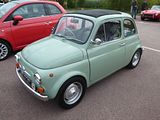


Although Fiat replaced the 1200 Saloon with the new 1300 and 1500 models in 1960, the Pininfarina-designed Coupé and Cabriolet models continued with largely unchanged bodywork, although they were now equipped with the larger 1.5 litre engine. The O.S.C.A. engined 1600 S Coupé and Cabriolet also continued to be available. All of the coupés and convertibles were replaced by the new 124 coupés and spiders in 1966.

Following the success of the 500 and 600 models, Fiat introduced a slightly larger and more expensive variant, the 850 in 1964. The regular 2 door saloon was soon joined in the range by other models and they are the ones you see more often these days, not that they are exactly common now. The 850 Coupe, early and later versions of which were to be seen here was seen for the first time at the 1965 Geneva Show. As was generally the case at the time, the body looked completely different from the saloon on which it was based, but underneath it shared the same mechanicals including the the original 843 cc engine producing 47 hp, which gave it a maximum speed of 84 mph. A Spider model was launched at the same time. In order to separate the sportier variants, equipment levels were raised, with both models getting sport seats, a sport steering wheel and round speedometer; The Spider even received a completely rearranged instrument panel. The front drum brakes were replaced with disc brakes, although drum brakes remained on the rear wheels. In 1968, Fiat revised both the Spider and Coupé and gave them a stronger engine with 903 cc and 52 hp. They were called Sport Spider and Sport Coupé. The Sport Spider body stayed essentially the same, but with a restyled front, whereas the Coupe gained twin headlights at the front and a revised tail with a slight lip on the trailing edge of the engine cover. Despite its popularity, the Coupe was the first model to cease production, being deleted in 1971.

The Fiat 124 is a small family car manufactured and marketed by Fiat between 1966 and 1974. The saloon superseded the Fiat 1300 and was the basis for several variants including a station wagon, a four-seater coupé (124 Sport Coupé), and a two-seater convertible (124 Sport Spider). The Russian-built VAZ-2101 “Zhiguli” and its many derivatives (known universally as the Lada outside the Soviet Union) were based on the Fiat 124, and are the best known of the many licensed variants of the 124 manufactured around the world. The Lada constitutes the vast majority of 124 production, and makes it the fifth best selling automotive platform in history. The 124 was superseded in its home market by the Fiat 131. Following its introduction in 1966 with a publicity stunt, with Fiat filming the dropping of the car by parachute from a plane, the 124 won the 1967 European Car of the Year. As a clean-sheet design[clarification needed] by Oscar Montabone, the chief engineer responsible for its development, the 124 used only the all-synchromesh gear box from the Fiat 1500. The 124 featured a spacious interior, advanced coil spring rear suspension, disc brakes on all wheels and lightweight construction. A 5-door station wagon variant (named 124 Familiare on its home market) as well as the 124 Sport Spider variants debuted at the 48th Turin Motor show in November 1966. A few months later, at the March 1967 Geneva Motor Show, the 124 Sport Coupé completed the range. The two Sport models were powered by an all-new 1.4-litre dual overhead camshaft engine producing 90 DIN-rated PS (89 bhp) at 6,500 rpm. In October 1968, Fiat launched the 124 Special; like Fiat’s other Special models, it was an upmarket, better appointed and higher performance variant of the standard saloon. A month after, in November, it was displayed at the 50th Turin Motor Show alongside its larger sibling, the new 125 Special. In addition to a 1.4-litre overhead valve engine, the 124 Special notably introduced all-new 5-link (four longitudinal, one transverse) solid axle rear suspension in place of the original 3-link design. Starting from late 1968 the same improved rear axle was adopted by both Sport models. In detail the Special’s 1,438 cc type 124 A2 engine had the same bore and stroke of the Sport Coupé and Sport Spider engines (80 × 71.5 mm), but eschewed the dual overhead camshafts of the two sportscars in favour of the more conventional overhead valve setup from the 124 saloon. With a downdraught (instead of the 1.2’s sidedraught) twin-choke Weber 32 DHS or Solex C32 EIES carburettor and a 9.0:1 compression ratio, engine output was 70 DIN-rated bhp (69 bhp) at 5,400 rpm and 110 DIN-rated newton-metres (81 lb⋅ft) of torque at 3,300 rpm. Fiat advertised a top speed of over 150 km/h (93 mph). Besides engine and rear axle, notable mechanical changes from the regular 124 were an alternator replacing the dynamo, an uprated clutch, standard 155R13 Pirelli Cinturato radial tyres, and the addition of a vacuum servo to the all-disc braking system. Visually the Special could be immediately distinguished from the standard model by its new, rectangular grille with four inset round headlamps. Less evident differences were larger vertical bumper over-riders, wheels with round ventilation holes as on the Sport models, new flush door handles, different tail lamps with integrated reflectors, and a central back-up light. The interior featured a redesigned padded dashboard with an oval binnacle housing two round instruments and a car radio console, a steering wheel without horn ring, new door cards, and more supportive seats. At the November 1970 Turin Motor Show, Fiat introduced a round of updates for the entire saloon and estate 124 range, as well as a new model variant—the 124 Special T. All models had gained air outlets added to the C-pillar for better ventilation, and a split brake circuit; while some features previously exclusive to the 124 Special such as servo-assisted brakes, back-up light and an alternator were made standard across the range. Berlina and Familiare both had a new grille with alternated chrome and black horizontal bars, and larger bumper over-riders. Additionally the Berlina had large, nearly square tail lamps made up by two stacked rectangular elements. The renewed Special sported a completely redesigned front end. A black, square-mesh radiator grille was crossed by a horizontal bright bar joining the dual headlamps; each of the four round lamps was set in its own square, bright-edged housing. The grille-headlamps assembly was flanked by the turn indicators. Front and rear the bumpers had lost their over-riders, replaced by full-width rubber strips. At the rear the lamps were also new—still horizontal and rectangular in shape unlike the ones used on the standard saloon—and the whole tail panel was surrounded by a chromed profile. Inside there was a new dashboard with imitation wood inserts, carpets instead of rubber mats, and cloth upholstery. The “T” in 124 Special T stood for twin cam, hinting at the car’s 1,438 cc dual overhead camshaft engine, derived from the Sport Coupé and Spider but in a milder state of tune. Coded 124 AC.300, this engine had revised valve timing and fuel system and produced 80 DIN-rated PS (79 bhp) at 5,800 rpm and 112 DIN-rated Nm (83 lb/ft) of torque at 4,000 rpm. According to the manufacturer top speed was 160 km/h (99 mph). Externally the Special T was identical to the Special, save for model badging at the rear.


It was only a few months after the launch of the 124 Berlina (saloon), that Fiat expanded the range with a very stylish Coupe model. It was designed as a three-box, 2-door notchback coupé by Mario Boano, known for designing the bodywork on the Ferrari 250 GT “Boano”. As many parts as possible were used from the 124 saloon. Both the Coupe and the Spider and Coupé shared the same basic platform as the 124 Berlina, but the Spider had a 14 cm shorter wheelbase. There were three distinct generations, known as AC, BC and CC. The AC model began in 1967 and came with a 90PS 1438 cc twin cam, 4-speed gearbox (the option of a 5-speed item appearing in mid-’67), front and rear anti-roll bars and a torque tube rear axle. It featured a 120 mph speedo, three supplementary gauges, a faux wood steering wheel, a woodgrain dash and console top, as well as tail lights shared with the Lamborghini Espada and Iso Rivolta. 124 Sport Coupés were modern in chassis and engine design. Braking was via four 9″ disc brakes with a front/rear weight-sensitive proportioning valve. It also had a sealed cooling system, viscous fan clutch and a toothed timing belt for the twin-cam motor, the first mass-produced engine to feature this instead of the usual chain-drive. Launched in 1969, the BC featured revised styling with twin headlights and revised taillights shared with the Lamborghini Jarama. The BC was available with both the 1438 cc and later the 1608 cc engine. Other details remained similar to the AC except the interior dash now had a 140 mph or 220 km/h speedo, 9000 rpm tacho in 1608 cc models and a clock. The steering wheel now had black painted spokes and the seats had for the first time cloth inserts in the centre. There was no woodgrain inside like before (all the panels were finished in black vinyl and the gauge rims were matt black to match) and “eyeball” vents were fitted in the centre console where the AC had a decorative panel simply filling in the space for an optional radio. Options included green tinted windows, Cromodora alloy wheels with chrome centre hub cap (as per AC optional), radio, seat headrests, heated rear window, electronic ignition. At the end of the BC run air conditioning was available as an option as well. The fuel tanks were always around 46 litres. The CC Coupe arrived in 1973 with new front styling and a revised squarer rear tail with a new deeper boot lid. Taillights were changed to a vertical arrangement and the side rear windows were revised. The CC started with a small batch fitted with the 1608 cc engine, soon changing to a revised 1592 cc engine (slightly shorter stroke at 79,2 mm to create a “sub-1600” engine to fit the lower tax bracket in Italy) and an enlarged 84 mm bore creating an engine of 1756 cc. The 1592 cc and 1756 cc (sourced from the new Fiat 132, introduced in 1972) both made use of a single carburettor again (the Weber 34 DMS). In spite of this change the 1756 cc was the most powerful engine produced with 118 hp and 115 mph (185 km/h) top speed. The CC’s revised interior featured a new dashboard incorporating a lower panel on the passenger side, an alloy fascia in front of the driver and seats covered completely in cloth. There was a new vinyl-covered steering wheel rim with anodised silver spokes. The optional but not uncommon Cromodora wheels now had a revised design with no chrome centre hubcap, instead having exposed wheelnuts. These were of an 8 slot design, the earlier wheels used coming in 6 slot configuration (an 8-slot design was also current but not original to the 124 range). The car continued until 1975. There were approx 113,000 AC Coupés, 98,000 BC Coupés 1,438 cc/1,608 cc, and about 75,000 CC Coupés manufactured.

The first 124 Spider made its debut at the Turin Show in 1966, and continued in production until the mid 1980s, bearing the badge of its desginer, Pininfarina, in later years when it remained popular in the American market. Early cars had 1400 and 1600cc engines, and these were gradually enlarged first 1800cc and then 2 litre, with fuel injection being added for more power and emissions compliance during the 1970s. Fiat spotted the potential of the car for more than just boulevard cruising, though, so in November 1972 they announced the Fiat Abarth 124 Rally, an overtly sporting version. Its main purpose was to receive FIA homologation in the special grand touring cars (Group 4) racing class, and replaced the 1.6-litre Fiat Sport Spider rally car which had been campaigned. At the time, the 124 had already won the 1972 European Rally Championship at the hands of Raffaele Pinto and Gino Macaluso. The 124 Rally was added to the Sport Spider range, which included the 1600 and 1800 models; the first 500 examples produced were earmarked for the domestic Italian market. Amongst the most notable modifications over the standard spider there were independent rear suspension, engine upgrades, lightweight body panels, and a fixed hard top. In place of the usual rear solid axle, there was a Chapman-type McPherson strut independent suspension, supplemented by a longitudinal torque arm. At the front a radius rod on each side was added to the standard double wishbones. The Abarth-tuned type 132 AC 4.000 1.8-litre, twin-cam engine was brought from the standard 118 to 128 PS DIN by replacing the standard twin-choke carburettor with double vertical twin-choke Weber 44 IDF ones, and by fitting an Abarth exhaust with a dual exit exhaust The 9.8:1 compression ratio was left unchanged. The transmission was the all-synchronised 5-speed optional on the other Sport Spider models, and brakes were discs on all four corners. Despite the 20 kg (44 lb) 4-point roll bar fitted, kerb weight was 938 kg (2,068 lb), roughly 25 kg (55 lb) less than the regular 1.8-litre Sport Spider. The bonnet, boot lid and the fixed hard top were fibreglass, painted matt black, the rear window was perspex and the doors aluminium. Front and rear bumpers were deleted and replaced by simple rubber bumperettes. A single matte black wing mirror was fitted. Matte black wheel arch extensions housed 185/70 VR 13 Pirelli CN 36 tyres on 5.5 J × 13″ 4-spoke alloy wheels. Inside, the centre console, rear occasional seats, and glovebox lid were eliminated; while new features were anodised aluminium dashboard trim, a small three-spoke leather-covered Abarth steering wheel, and Recaro corduroy-and-leather bucket seats as an extra-cost option. The car carried Fiat badging front and rear, Abarth badges and “Fiat Abarth” scripts on the front wings, and Abarth wheel centre caps. Only three paint colours were available: Corsa red, white, and light blue.


The up-market brother to the 124, the Fiat 125 was introduced in 1967 and produced by them until 1972, though derivatives were built under license outside Italy until the 1990s, and these are perhaps better known these days. As launched the car was unusual in blending saloon car passenger accommodation with sports car performance, a combination which would be more widely adopted by the European volume auto-makers in the decade ahead. The floor pan was virtually unchanged from that of the longer variant of the outgoing model, the Fiat 1300/1500, and the chassis used was the same as the Fiat 1300/1500. The body was a slightly lengthened development of the Fiat 124: both models shared the same passenger compartment and doors, but the 125’s rear seat was set slightly further back, reflecting the 2505 mm wheel-base, inherited from the Fiat 1500 and over 8 cm (3 inches) longer than that of the 124. The 125’s engine was based on the one fitted in the Fiat 124 Sport: a 1608 cc DOHC unit with 90 bhp driving the rear wheels. The 125 was equipped with a Solex carburettor. The car was fitted with an alternator, reflecting the twin headlights and the increasing number of energy intensive electrical components appearing on cars at this time. Other noteworthy features included the electromagnetic cooling fan clutch. In 1968 the 125 Special was added to the range, with 100 bhp (from a modified cylinder head, camshafts, inlet/outlet manifold and Weber/Solex carburettor) and, unusually at this time, a five-speed gearbox. It also had one of the worlds first intermittent wipers, halogen lights, servo-assisted twin circuit brakes and optional superlight magnesium wheels. A variety of other improvements were made including improved cabin ventilation, trim and styling. The Special was facelifted in 1971 using pretty much the same trim as the 125S, but both front and rear lights were new and wider, enhancing the visual width of the car. The interior gained upgraded upholstery of the seats and a wood facia. A three-speed automatic transmission as well as air conditioning became available as an option. A variant, the 125 T, was made by the Fiat importers in New Zealand, Torino Motors, for the annual 6 hour production car race, the Benson and Hedges 500. The 125T has larger valves, two twin Weber DCOH or Dell’Orto 40DHLA carburettors (depending on availability), modified camshafts and a higher compression ratio to produce around 125 bhp, lowered and stiffer suspension. All featured Ward alloy wheels and were painted bright yellow. Sources for production figures quote that between 84 and 89 were modified. Reasons for stopping production are sometimes given that Fiat headquarters found out and stopped this venture. However a more likely scenario is that selling the required 200 cars in a market that only sold 1,000 Fiats in total each year was a tall order. Other versions were built by Moretti, who made the 125GS 1.6 with styling similar to the Fiat Dino Spider. Zagato made the 125Z; Savio, a 125 Coupé and 125 Station Wagon; Bertone, a 125 Executive; and Vignale produced the Samantha, a two-door coupé with pop-up headlights, designed by Virginio Vairo. Production by Fiat in Italy ceased in 1972 when the Fiat 132 was introduced, a total of 603,877 cars having been built.


You might not guess it from looking at it, but the 850 Familiare and the later 900T were based on the small 850 saloon. There were quite a few of these, and other derivatives of the 850T and 900T bodyshell on our roads throughout the 1970s and 1980s, but like almost everything else of that era, suddenly they all disappeared and there are very few of them left now, and certainly not as nice as this pair. The model is part of the 850 family that first appeared in 1964, with this overall shape first offered as the 850 Familiare, a boxier and slightly larger heir to the Fiat 600 Multipla. It featured space for seven passengers in three rows, which made it suitable for groups including children and thin adults. It was too small to accommodate in comfort seven large adults. In Van guise, it was known as the 850T. The 850 Familiare and related 850T continued in production till 1976 long after the saloon version of the 850 had been replaced by the Fiat 127. In 1976 the Fiat 900T was introduced, retaining most of the body panels of the 850 Familiare, but featuring the 903 cc engine from the Fiat 127 (although, in this application, still mounted behind the rear axle). The 900T benefitted from significant enhancements in 1980, at which point it was renamed the 900E. A number of them were sold as camper vans, and in the UK, these were badged as the FIAT Amigo, and the 7 seater model was called the Pandora. Production finally ended in 1985.


It was good to see a number of examples of the Fiat 128 here. Named European Car of the Year in 1970, over three million were manufactured, but few are left.. Introduced in 1969, it was built in an entirely new plant in Rivalta, north-west of Turin, specifically to manufacture the car. With engineering by Dante Giacosa and engine design by Aurelio Lampredi, the 128 was noted for its relatively roomy passenger and cargo volume — enabled by a breakthrough innovation to the front-engine, front-drive layout which became the layout “adopted by virtually every other manufacturer in the world”. Front-wheel drive had previously been introduced to small, inexpensive cars with the British Mini. As engineered by Alec Issigonis, the compact arrangement located the transmission and engine sharing a single oil sump — despite disparate lubricating requirements — and had the engine’s radiator mounted to the side of the engine, away from the flow of fresh air and drawing heated rather than cool air over the engine. The layout often required the engine be removed to service the clutch. As engineered by Dante Giacosa, the 128 featured a transverse-mounted engine with unequal length drive shafts and an innovative clutch release mechanism. The layout enabled the engine and gearbox to be located side by side without sharing lubricating fluid while orienting an electrically controlled cooling fan toward fresh air flow. Fiat tested this then new engineering for a full five years in the Autobianchi Primula, Fiat’s less market-critical subsidiary, Autobianchi which allowed them to sufficiently resolve the layout’s disadvantages, including uneven side-to-side power transmission, uneven tyre wear and potential torque steer, the tendency for the power of the engine alone to steer the car under heavy acceleration. The compact and efficient layout — a transversely-mounted engine with transmission mounted beside the engine driving the front wheels through an offset final-drive and unequal-length driveshafts — subsequently became common with competitors and arguably an industry standard. The 128 used an all new 1.1 litre Fiat SOHC engine, engineered by noted engine designer Aurelio Lampredi, featuring an iron block mated to an aluminium head along with a belt-driven single overhead camshaft producing 49 hp. The 128 was styled similarly to the 124 and 125 and featured rack-and-pinion steering, front disc brakes, independent rear suspension with a transverse leaf spring, and a strut-type front suspension with integral anti-roll bar. Initially, the 128 was available as a two-door or four-door sedan. At the 1970 Turin Motor Show a three-door station wagon model called “Familiare” was added to the line-up. The car was only available with a 1116 cc engine on launch, though the two-door-only 128 Rally edition launched in 1971 used a 1,290 cc unit. Also in 1971, the Sport Coupé, an all-new coupé body on a shortened 128 platform, was unveiled at the Turin Show. At launch it was available with both existing 128 engines. The 128 range underwent a facelift in 1972, featuring a revised grille. 1974 saw the launch of the 128 Special, which used the Rally engine in a four-door sedan body. In 1975 the 128 3P (3-door) Berlinetta replaced the Sport Coupé. In 1976, the range received new bumpers, rectangular headlights, tail lights and dashboard as well as modifications to the engines. At this time, the wagon was also renamed the “Panorama”. Production of all 128s except that of the base 1,100 cc powered model ended in 1979 after the introduction of the Fiat Ritmo/Strada in 1978. In 1980 production of the small three-door station wagon Panorama was dropped from the range and 128 production finally ended in 1985.


You don’t often see examples of the once very popular 127 range here, so this 127 Sport was a pleasant surprise. Developed towards the end of the 1960s, the Fiat 127 was launched as a two-door saloon in April 1971. A three-door hatchback, using an identical body profile but with a full-depth rear door and folding rear seat, was launched the following year; this would prove to be the most popular version of the 127. This was Fiat’s first supermini-sized hatchback, along with a state-of-the-art transverse-engine/front-wheel-drive layout, with the transmission mounted on the end of the engine, both design ideas had been fully trialled since 1964, by Fiat’s Autobianchi subsidiary with the Autobianchi Primula and 1969 Autobianchi A112 and A111 – although these models were not as widely exported as the 127 was. The larger Fiat 128, launched in 1969, was the first Fiat badged car to use the same transverse powertrain layout. The 127 used, as the A112, a shrunken version of the 128 platform and the rugged Fiat OHV 100 series 903 cc engine, that had powered the Autobianchi and, with various cylinder capacities, earlier generations of Fiat cars. The 127 also featured a unique transverse leaf spring suspension at the rear. Safety was another area of innovation – the 127 included an articulated steering column and crumple zones for progressive deformation under impact. The car was one of the first of the modern superminis, and won praise for its utilisation of space (80 percent of the floor space was available for passengers and luggage) as well as its road-holding. It was launched a year before the comparable Renault 5, and before the end of the 1970s most mass market European manufacturers were producing similar cars, notable examples being the Ford Fiesta and Volkswagen Polo, while General Motors added a three-door hatchback to the Opel Kadett range, which was reworked for British production and sold as the Vauxhall Chevette. The 127 was also one of the more popular imported cars on the UK market, peaking at more than 20,000 sales in 1978. It was also the first car fitted with an all-polypropylene bumper on steel support. The 127 was an instant success, winning the European Car of the Year award for 1972, and quickly became one of the best-selling cars in Europe for several years. It was the third Fiat in six years to receive this accolade. In June 1974, slightly over three years after the model’s introduction, Fiat reported that the one millionth 127 had been completed at the Mirafiori plant in Turin, after just over three years in production. The (in its time) hugely successful Fiat 600 had taken seven years to reach that same milestone. The Series 1 car changed little during its lifetime. However, in May 1973 saloons became available in both standard and deluxe versions. In 1975 the 127 Special variant was released which featured a restyled front grille and detail changes to the interior. The deluxe version was differentiated by its reclining front seats and opening hinged rear side windows as standard equipment. During the next couple of years the Fiat 850, which had initially been marketed alongside the 127, was withdrawn from most markets. The Series 2 version of the 127 debuted in May 1977. It featured a restyled front and rear, a new dashboard (although almost identical in layout to that of the Series 1), larger rear side windows (using rear quarter pressings derived from those used on the Brazil market Fiat 147) and the option of the 1049 cc engine – uniquely for the 127 this was the five-bearing OHC “Brazil” 124 series engine from the 147 rather than the Fiat OHC unit from the 128. The tailgate was extended and now reached nearly to the rear bumper, addressing complaints about the high lip over which luggage had to be lifted for loading into the earlier 127 hatchbacks. A short-lived Series 3 came early in 1982, but when the Uno followed it just a year later, the car was deleted from most European markets.


The X1/9 followed a 1969 show concept car called the Autobianchi Runabout, with styling by Bertone under chief designer Marcello Gandini. The Runabout was powered by the same engine as the Autobianchi A112. Designed around the all-new 128 SOHC engine and with the gearbox (transmission) from the front wheel drive Fiat 128, the X1/9 relocated the transverse drive train and suspension assembly from the front of the 128 to the rear of the passenger cabin, directly in front of the rear axle, giving a mid-engined layout. The layout also located the fuel tank and spare wheel side by side ahead of the engine, directly behind the seats — optimising the proportion of the car’s weight falling within its wheelbase for more effective handling and also enabling cargo areas front and rear. Unlike Fiat’s marketing nomenclature at the time which used a numerical system (e.g., 127, 128, 124, 131) denoting relative position in the model range, the X1/9 retained its prototype code as its marketing name. Fiat’s prototype coding used X0 for engines, X1 for passenger vehicles and X2 for commercial vehicles. The X1/9 was thus the ninth passenger car developed using the nomenclature. The prototype car featured a distinctive wedge shape and took many styling cues from contemporary power-boat design. Though the more extreme features of the Runabout such as the C pillar mounted headlights and the small wind-deflector windscreen were lost for the production car, many aesthetic features of the Autobianchi Runabout are readily identifiable on the X1/9. The long flat bonnet with central indentation, the large front obbbbbbverhang, the wedge shape with prominent C pillar roll-over hoop and the car-length indented plimsoll-line all made the successful transition to the X1/9, giving it a highly distinctive appearance. Once developed for production, the two-seater featured sharp-edged styling with a wedge shape, pop-up headlights and a removable hard top roof panel (targa top). The removable hardtop stores in the front luggage compartment, below the front hood, only slightly reducing the space available for cargo. An aftermarket company offered a top made of lightweight clear-smoked polycarbonate. The car was developed for release for European sales in 1972 to replace the 850 spider by Bertone. It was not intended as a replacement for the 124 Sport spider and production of the 124 spider and X1/9 continued in parallel for much of the X1/9’s life. The car’s monocoque body was produced at the Bertone factory in Torino and then transported to the Fiat’s Lingotto factory for final assembly. In 1982, shortly after the introduction of the 1500 model, complete production was assumed by Bertone with models subsequently badged as the “Bertone” X1/9. Bertone models featured revised footwells redesigned to enhance legroom and sitting comfort for persons taller than the original design’s target. The first models featured a 75 bhp 1290 cc single overhead cam engine with an aluminium head. In 1978 the more powerful 85bhp 1500cc unit found its way into the engine bay which necessitated a raised engine cover to provide the clearance. Larger bumpers were fitted at this time. Fiat made few other changes for many years, as if they lost interest in the car. The last production models were named the Gran Finale and sold over the 1989/1990 period. They were a dealer modification of the special edition (commonly abbreviated to SE) of 1988/1989, with the addition of a rear spoiler and “gran finale” badges.

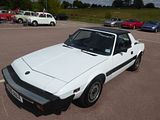
Named after the Turin suburb where it was built, the Fiat 131 was a much more conventional car than the innovative 128 and 127 which it joined in the range. The Fiat 131 employed construction techniques and technologies typical of its day. The body was a steel monocoque. Designed and styled on the typical three-box design, with distinct boxes for the engine compartment, passenger compartment, and boot. The major mechanical components were also conventional and contemporary, but with some notable advances. The 131 employed a front engine, rear-wheel drive layout. The engines were all inline-four types, derived from those used in the outgoing 124 range, with a cast iron cylinder block and aluminium alloy cylinder head. Initially the 131 was offered only with pushrod valve gear, which offered the innovation of being the worldwide first engine with OHV valve gear and a belt driven camshaft. Only later in the model’s life came the well known double overhead camshaft (DOHC) engines which used a toothed timing belt. Fuel supply was via a single Weber ADF twin-choke carburettor. Traditional contact breaker ignition systems were used, usually with Marelli distributors. The suspension system utilised fully independent front suspension, with MacPherson struts, track control arms and anti-roll bar. The rear suspension was quite advanced (when using a solid live rear axle), in that the rear axle was controlled by double unequal length trailing arms and a panhard rod, with coil springs and direct acting dampers. This design proved far superior to many of its contemporaries, especially with vehicle stability and handling. The car’s interior offered another worldwide first in having the secondary switches in the dashboard illuminated by a central bulb somewhere in the dashboard and fibre optics from there to the switches. The Fiat 131 Mirafiori was introduced at the 55th Turin Motor Show in late October 1974. The 131 came with a choice of a 1,297 cc or 1,585 cc OHV inline-four engines, both from the engine family first introduced on the Fiat 124. Both engines were fitted with a single twin-choke Weber 32 ADF downdraught carburettor. A four-speed manual transmission was standard, with a 5-speed manual and a 3-speed torque converter automatic optional on the 1600 engine only. The initial range comprised eleven different models. There were three body styles: 2-door saloon, 4-door saloon and Familiare station wagon (Estate on the British market). Station wagons were built by SEAT in Spain, but were labelled Fiats for all non-Spanish markets. Trim levels were two; the entry-level 131 Mirafiori (also known as “Normale” or “Standard”) had single square headlamps, wheels and dished hubcap from the 124, and simplified interior furnishings. Next was the better appointed 131 Mirafiori Special (or simply “S”), which could be distinguished from the base model by its quadruple circular headlamps, specific grille, side rubbing strips, chrome window surrounds, and rubber bumper inserts. Inside it added different instrumentation with triple square dials, a padded adjustable steering wheel, cloth upholstery, and reclining seats. Additionally the more sophisticated options—such as air conditioning, tachometer, limited slip differential and vinyl roof—were exclusive to the Special. Each body style could be combined with either of the engines and trim levels—save for the Special estate which only came with the larger engine. The 131 got a minor facelift in 1978. New DOHC, or “Twin Cam” engines arrived, and these models were badged as Supermirafiori. The biggest change exterior-wise for the Series 2 was larger rectangular shaped front lights, new bumpers, new bigger rear lights and new interior trim including a chunky, single-spoked steering wheel. Later in 1978, the 2-door sporting version Racing (Mirafiori Sport in the UK) with 115 PS twin cam engine, was launched. This car had four round headlights (the inner headlights being smaller than the outer ones, unlike any other Mirafiori model produced), different grille, spoilers and extended wheel arches, and a short-throw 5 speed gearbox. The Racing had top speed of 180 km/h (110 mph). Diesel engined versions also had four round headlights (equally sized), and a noticeable (and characteristic) bump in the hood to accommodate the taller engine. The 131 was updated again in March 1981. Production of the Racing/Sport versions ceased, although these were sold well into 1982. The same 2.0 twin cam engine went to the Supermirafiori. The car received a slightly updated interior (instruments, single-piece glovebox lid), whilst lower rubbing strips found their way onto all models up to CL specification. The Supermirafiori received larger lower door cladding. Mechanically, Mirafiori versions now received overhead cam engines rather than pushrod versions; a new 1.4 litre engine and a revised 1.6 litre. Also new were the clutch and gearboxes, a tweaked suspension was also introduced and the fuel tank increased in size by three litres. In June 1981, a new sport version, the Volumetrico Abarth, was introduced to some markets, with a supercharged version of the familiar 2 litre twin-cam. This car, also known as the 2000 TC Compressore, was built in a small series (about 200 units) and could reach 190 km/h (118 mph).In 1983, the production of saloon version was discontinued, but the estate, now named 131 Maratea, remained in production with two engine choices (115 PS 2.0 TC and 72 PS 2.5 D) until 1985, when they were replaced with the Ritmo-based Regata Weekend. These last versions featured four round headlights and the by-now familiar five-bar grille. In total, 1,513,800 units were produced in Italy.


Fiat started work on the Ritmo in 1972, at a time when the hatchback bodystyle for small family cars was still relatively uncommon in Europe, although Fiat had utilised it for its 127 supermini. In the intervening years, however, rival European manufacturers began launching small family hatchbacks, the most notable being the Volkswagen Golf in 1974. Prior to its launch, the press speculated that the project codename 138 would be the final production name, however, Fiat resolved to follow the precedent set by the Fiat Mirafiori by giving its new car the Ritmo name, rather than another three digit number. Technologically, the biggest innovation of the Ritmo was not the car itself (since it was mechanically based on its predecessor, the Fiat 128) but the way in which it was manufactured at the Cassino plant. Fiat, in conjunction with its subsidiary Comau, developed the pioneering “Robogate” system which automated the entire bodyshell assembly and welding process using robots, earning the car the advertising slogan “Handbuilt by robots”, immortalised in a memorable television advertising campaign showing the robots assembling the Ritmo bodyshells to the strains of Rossini’s The Barber of Seville. The avant-garde nature of its exterior design is highlighted by large plastic bumper bars integrated into the styling (a trend that became an industry standard, thanks to this plastic’s ability to absorb small impacts without damage, unlike the then more prevalent metal bumper bars), the manner in which these intersected the front round headlights and incorporated the rear taillights plus licence plates, and how round shapes (such as the headlights, door handles and the rear edge of the roof ending in an upward sweep) were combined within overall sharp lines (e.g. from those of the sloping rear hatch and slanted rear window corners to the badges and shape of the side indicators and rear view mirrors). Its aerodynamic design resulted in an excellent — for its era — drag coefficient of Cd=0.38, The initial 4-cylinder engine range included 1.1-Litre 60 PS 1.3-litre 65 PS and 1.5-litre 75 PS petrol engines, which were reasonably refined and economical. Suspension was independent all-round, the braking system comprised front discs and rear drums and the wheels measured 13-inch in diameter. Gearboxes ranged from a standard 4-speed manual (5-speed optional on CL models) and an optional 3-speed Volkswagen-derived automatic. The Ritmo finished second in the European Car of the Year awards, finishing narrowly behind the winning car, the Simca-Chrysler Horizon – which was similar in concept. The CL range was the better-equipped model (with the 60 CL comprising 80% of total initial sales in Italy) and the whole range also distinguished itself by having numerous optional accessories unseen in past Fiat cars. These included: larger tyres; a rev counter; stereo system; safety seatbelts and headrests; passenger-side rear view mirror; split-fold rear seat; tinted windows; rear window wiper; heated rear window; metallic paint; sunroof . The instrumentation was incorporated in a rectangular pod with modular slots that could house various gauges and switches, either standard depending on the model or optional (e.g. digital clock and switches for hazard lights or adjustable-speed ventilation fan). Whilst well received in the key Italian and German markets, the first series of the Ritmo was criticised for its basic interior trim (e.g. no fabric on door panels) and other assembly shortfalls. As a consequence, Fiat quickly responded in 1979 with various revisions and the introduction of the Targa Oro (“Gold plate”) range. The latter was based on the Ritmo 65 (or 75 for export markets) and was distinguished by, among other things: a mink paint (or black for the 3-door version), gold striping plus accents in the alloy wheels, foglights, dark bumper bars and velour trim interiors. That same year, the 65 CL range could also be had with a VW-derived automatic transmission, and a 1,049 cc petrol engine built by Fiat of Brazil that had the same power and torque figures as those of the 128-derived 1.1-litre engine, was also introduced to power the “60 L” models available in some markets. At the 1980 Geneva Motor Show, a 5-door only diesel version — marketed as the Ritmo D and available in both L and CL trim — was introduced with a 1,714 cc 55PS engine.To accommodate this considerably heavier engine, the steering rack was slowed down (from 3.5 to 4 turns) and the suspension adjusted. Nonetheless, a 65.5% forward weight distribution was hard to mask and both handling and braking suffered when compared to petrol-powered Ritmos. In 1981, the Targa Oro and 75 models were replaced by the 5-door only Ritmo Super (or Superstrada in some export markets). They brought higher specification and fittings (from chrome trimmings to a more complete instrumentation and optional central locking), larger 14-inch wheels and, most significantly, revised engines with 75 PS (1300) and 85 PS (1500). This extra power was gained through slight alterations to the camshaft profile, a twin carburettor, and a twin exhaust system. Other differences included lower profile tyres (Pirelli P8) and a close-ratio 5-speed manual gearbox. The steering was also somewhat faster. By this time, the Ritmo range in Italy also included 3- and 5-door manual versions of the 75 CL and 3-door 75 CL Automatica, with the price of the popular 60CL now ranging from ₤6,868,000 to 7,180,000 for the 3- and 5-door versions, respectively. In May 1981, the first sports version, the Ritmo 105 TC, was launched. Available only as a 3-door, it was powered by a 105 PS Fiat DOHC engine with a displacement of 1,585 cc, which was derived from that used in the 131 and 132 models. This car had the same 14-inch wheels as the Ritmo Super, but with black centre hubcaps. British and Irish models had black and silver Speedline alloy wheels (5.5 x 14) as standard. Other distinguishing features relative to the normal range included: front fog lights integrated into the front bumper; integrated front spoiler combined with wheel arch extensions; black lower door paint; black mesh air intake; rear spoiler at the base of the rear window. Series 2 cars would be introduced in 1982, with more conventional frontal styling. In 1983, Fiat completed the range with the Ritmo ES (“energy saving”) models and the hot hatch, Ritmo Abarth 130 TC. The latter was based on the 125 TC (which had not been sold in the UK) but was powered by a 1,995 cc engine with power output increased to 130 PS. This was achieved by replacing the single Weber carb used in the 125 TC with twin Solex/Weber carburettors on a side-draught manifold, and via improved cam profiles. The 130 TC had a top speed of 195 km/h (121 mph) and accelerated from 0 to100 km/h (62 mph) in 7.8 seconds. It was fitted with Recaro bucket seats in Britain and it remained the only 1980s European hot hatch to continue utilise carburettors instead of fuel injection. Ignition timing was controlled electronically. Although appearing outwardly similar to the restyled 105 TC with its lower door and wheelarch trims, the 130 TC could be distinguished by its polished four-spoke alloy wheels (continued from the earlier 125 TC), aerodynamic perspex front door wind deflectors, and lower hatchback spoiler. The powerful twin-cam was mated to a close ratio five-speed ZF manual gearbox and had superior performance to its contemporary rivals, which included the Volkswagen Golf GTI, Ford Escort XR3i, Vauxhall Astra GTE and the MG Maestro. In its day, it was faster than all of them, but it found relatively few buyers.


The Fiat Ritmo cabrio was originally displayed as a concept at the 1979 Frankfurt Motor Show but went on sale in mainland Europe only in 1981. It was assembled by Bertone and, coinciding with the 1982 facelift, was badged as a Bertone instead of a Fiat. It was cheaper than, and competed against, the Volkswagen Golf cabriolet but was not up to Volkswagen standards in terms of quality or ability, despite the fact that the German rival was not built in-house, but by Karmann. With the introduction of the Series 2 cars, Fiat began manufacture of a RHD Ritmo Cabrio, which was offered in the UK (Superstrada Cabrio) and Ireland (Ritmo Cabrio) only in 85S (Superstrada) guise. The Bertone cabriolet was sold in various European markets in petrol-engined form only (75S, 85S, 100S; some with fuel injection) until 1988. There were various special editions including the Ritmo Cabrio Chrono and Ritmo Cabrio Bianco (all white).


Introduced at the 1980 Geneva Show, the Panda (Tipo 141) was designed as a cheap, easy to use and maintain, no-frills utility vehicle, positioned in Fiat’s range between the 126 and 127. It can be seen as a then-modern approach to the same niche which the Citroën 2CV and Renault 4 were designed to serve. The first Panda was designed by Giorgetto Giugiaro of Italdesign. In an interview to Turinese newspaper La Stampa published in February 1980, Giugiaro likened the Panda to a pair of jeans, because of its practicality and simplicity, and he has often said that this is his favourite of all the cars he designed. Mechanically the first Pandas borrowed heavily from the Fiat parts bin. Engines and transmissions came from the Fiat 127 and, in certain territories, the air-cooled 652 cc two-cylinder powerplant from the Fiat 126. The plan for a mechanically simple car was also evident in the rear suspension, which used a solid axle suspended on leaf springs. Later versions of the car added various mechanical improvements but this spirit of robust simplicity was adhered to throughout the life of the model. Many design features reflect the Panda’s utilitarian practicality. Examples include a seven-position adjustable rear seat which could be folded flat to make an improvised bed, or folded into a V shape to support awkward loads, or easily and quickly removed altogether to increase the overall load space. The first Pandas also featured removable, washable seat covers, door trims and dashboard cover, and all the glass panels were flat making them cheap to produce, easy to replace and interchangeable between left and right door. Much like its earlier French counterparts the Panda could be specified with a two piece roll forward canvas roof. At launch two models were available: the Panda 30, powered by a longitudinally-mounted air cooled 652 cc straight-two-cylinder engine derived from the 126, or the Panda 45, with a transversely-mounted water cooled 903 cc four-cylinder from the 127. As a consequence of the different drivetrain layout the 45 had the radiator grille to the right side, the 30 to the left. In September 1982 Fiat added another engine to the line-up: the Panda 34 used an 843 cc water-cooled unit, derived from that in the 850. It was originally reserved for export to France, Belgium, Germany, and the Netherlands. Fiat launched the Panda 45 Super at the Paris Motor Show later in 1982, with previous specification models continuing as the “Comfort” trim. The Super offered numerous improvements, most significant being the availability of a five-speed gearbox as well as improved trim. There were minor styling changes to the Super including the introduction of Fiat’s new black plastic “corporate” grille with five diagonal silver bars. The earlier grille design (metal with slots on the left for ventilation) continued on the Comfort models until the next major revision of the line-up. A 30 Super was added to the range in February 1983, offering the Super trim combined with the smaller engine. The Panda 4×4 was launched in June 1983, it was powered by a 965 cc engine with 48 bhp derived from that in the Autobianchi A112. Known simply as the Panda 4×4, this model was the first small, transverse-engined production car to have a 4WD system. The system itself was manually selectable, with an ultra-low first gear. Under normal (on-road) conditions starting was from second, with the fifth gear having the same ratio as fourth in the normal Panda. Austrian company Steyr-Puch supplied the entire drivetrain (clutch, gearbox, power take-off, three-piece propshaft, rear live axle including differential and brakes) to the plant at Termini Imerese where it was fitted to the reinforced bodyshell. Minor revisions in November 1984 saw the range renamed “L”, “CL”, and “S”. Specifications and detailing were modified across the range including the adoption of the Fiat corporate grille across all versions. Mechanically, however, the cars remained largely unchanged. In January 1986, the Panda received a substantial overhaul and a series of significant mechanical improvements. Most of these changes resulted in the majority of parts being changed and redesigned, making many of the pre-facelift and post-facelift Panda parts incompatible between models. The 652 cc air-cooled 2-cyl engine was replaced by a 769 cc (34 bhp) water-cooled 4-cyl unit, and the 903/965cc by a 999cc (45 bhp, 50 bhp in the 4×4) unit. Both new engines were from Fiat’s new FIRE family of 4-cylinder water-cooled powerplants with a single overhead camshaft. The rear suspension was also upgraded, the solid axle with leaf springs being replaced by a more modern dependent suspension system using a non-straight rigid axle (known as the ‘Omega’ axle) with a central mounting and coil springs (first seen on the Lancia Y10, which used the same platform). The 4×4 retained the old leaf sprung live axle set-up, presumably to avoid having to redesign the entire 4WD system. Improvements were also made to the interior and the structure. The body was strengthened and fully galvanised on later models, virtually eliminating the earlier car’s strong tendency to rust. The rear panel design was also revamped to include flared arches that mirrored those of the front wings, replacing the un-sculpted style seen on earlier models, and the doors received a slight redesign with the earlier car’s quarter light windows being removed and replaced by a full width roll-down window. The bottom seam of the facelifted model’s doors unfortunately retained much the earlier car’s susceptibility to rust. In ascending order of specification and cost, the revised range was as follows: 750L, 750CL, 750S, 1000CL, 1000S, 4×4. April 1986 saw the introduction of a 1,301 cc diesel engine with 37 bhp (a detuned 127/Uno unit). Fitted as standard with a five-speed gearbox it was only available in the basic “L” trim. A van variant of the Panda was also introduced, with both petrol and diesel engines. The van was basically a standard Panda without rear seats. The rear windows were replaced with plastic blanking panels and a small (always black) steel extension with side hinged doors was fitted instead of the usual hatchback tailgate. Neither the van nor the diesel were available in right hand drive markets. In 1987, a new entry-level model badged “Panda Young” was added to the range. This was essentially an L spec car with a 769 cc OHV engine based on the old 903 cc push-rod FIAT 100 engine and producing the same 34 bhp as the more sophisticated 769 cc FIRE unit. The Panda 4×4 Sisley limited edition was also released; this was based on the standard 4×4, but came with metallic paint, inclinometer, white painted wheels, roof rack, headlamp washers, bonnet scoop, “Sisley” badging and trim. Although originally limited to the production of only 500, in 1989 the Sisley model became a permanent model due to its popularity. In 1991, a facelift was introduced. This entailed a new front grille with a smaller five-bar corporate badge, plus revisions to trim and specifications across the range. New arrivals included the ‘Selecta’, which had a continuously variable transmission with an electromagnetic clutch. This advanced transmission was available either with the normal 999 cc FIRE engine (revised with single-point fuel injection and a catalytic converter) or an all new 1108 cc FIRE unit, fitted with electronic fuel injection and a three-way catalytic converter and producing 51 bhp. The new CLX trim also featured a five-speed gearbox as standard. The range now comprised the 750 Young (769 cc ohv), 750 and 750 CLX (both 769 cc FIRE sohc), 900 Dance (903 cc ohv), 1000 Shopping, CLX, CL Selecta and S (all with 999 cc sohc, available with or without SPI and catalytic converter depending on the market), 1100 CL Selecta (1108 cc sohc with SPI and cat) and the 4×4 Trekking (999 cc, again available with and without a cat depending on the market). The Elettra concluded the range. In 1992, the 1108 cc engine, complete with SPI and catalytic converter, replaced the 999 cc unit in the 4×4 (with 50 bhp) and also in 1992 an 899 cc (with injection and catalyst) became available, in the ‘Cafe’ special edition. This was a reduced capacity 903 cc unit, designed to meet tax requirements in some markets. From 1996 onwards, the Panda was gradually phased out across Europe, due to tightening emissions and safety legislation. The car remained in production in Italy until May 2003. Its total production run of 23 years makes the Panda one of Europe’s longest-lived small cars. Over 4,5 million were built and the car is still popular in Italy.


Fiat launched the Uno, the Tipo 146, in January 1983, just one day before the equally iconic Peugeot 205, to replace the elderly Fiat 127. Both were huge sellers, and deservedly so too, but it was the Fiat that sold in greater quantity, with over 8 million examples produced. It was Italy’s best selling car, and by some margin, throughout its 10 year production life, though you might find that hard to believe now, as they were are not a common sight even in Italy. The 127 had revolutionised the supermini market on its launch more than 10 years earlier, and the Uno followed the same format, but brought uptodate. Designed by Giorgetto Giugiaro’s ItalDesign company, its tall, square body utilising a Kamm tail achieved a low drag coefficient of 0.34 won it much praise for interior space and fuel economy as well as its excellent ride and handling, and was widely regarded as the most innovative small car in Europe at the time of its launch. It incorporated many packaging lessons learnt from Giugiaro’s 1978 Lancia Megagamma concept car (the first modern people carrier / MPV / mini-van) but miniaturised. Its tall car / high seating packaging is imitated by every small car today. It reversed the trend for lower and lower built cars. It showed that not just low sleek cars could be aerodynamic, but small, roomy, boxy well packaged cars could be too. There was a lot of activity in the supermini class in 1983, as the Uno hit the UK market a couple of months before the Peugeot 205 – another small European car which became the benchmark for this market sector, enjoying a long production life and strong sales, and just after General Motors launched its new Opel Corsa/Vauxhall Nova. Within a few months of its launch it had gained two new major competitors in the shape of the restyled Ford Fiesta and Nissan’s new Micra. UK sales began in June 1983, and more than 20,000 were sold in its first full year and peaking at more than 40,000 sales in 1988, making it one of the UK’s most popular imported cars during the 1980s. In December 1983, it was European Car of the Year for 1984, finishing narrowly ahead of the Peugeot 205. Initially, the Uno was offered with the 0.9 litre (903 cc) 100-series OHV, 1.1 litre (1116 cc) and 1.3 litre (1301 cc) 128-series SOHC petrol engines and transmissions carried over from the 127. The Uno’s badging was not by the commonly used measurement of engine size but by metric horsepower: 45, 55, 60, 70, or 75. The Uno was available as either a three- or five-door hatchback. It also featured ergonomic “pod” switchgear clusters each side of the main instrument binnacle, (that could be operated without removing the driver’s hands from the steering wheel), although indicators remained on a stalk; an unusual arrangement similar to that used by Citroën. The Uno had MacPherson strut independent front suspension and twist-beam rear suspension with telescopic dampers and coil springs. From 1985, the 1.0 litre (999 cc) SOHC Fully Integrated Robotised Engine (FIRE) powerplant was offered, replacing the 0.9 litre unit. This was a lighter engine, built with fewer parts, and gave improved performance and economy. The most luxurious version, the single-point injected 75 SX i.e., had remote door locks, integrated front foglamps, and the oval exhaust tip also used on the Turbo. In April 1985 the hot hatch version of the first series Uno – the Uno Turbo i.e. – was launched as a three-door only derivative. It competed with the likes of the Ford Fiesta XR2, MG Metro Turbo and Peugeot 205 GTI. The Uno was replaced by the Punto in late 1993, although production for some markets continued for some time after that.


The Fiat Tempra (Type 159) was a family car intended as a replacement for the Fiat Regata. The original project was called Tipo 3, being a mid size car between the Fiat Tipo (project Tipo 2) and the bigger Fiat Croma (project Tipo 4). The chassis and some other parts (most notably, the doors) were shared with the Fiat Tipo. Other vehicles, derived from the same project were Lancia Dedra (theTempra’s closest relative, sharing all mechanical components), Lancia Delta second generation, Alfa Romeo 155, Alfa 145 and Alfa 146. The Tempra saloon was shown for the first time in newspapers in November 1989 and introduced at the 1990 Geneva Salon, with the estate version (marketed as the “Tempra SW”) arriving two months later in Turin. The Tempra’s engine range was similar to that of the Tipo. Initially 1.4- and 1.6-litre models had carburettor engines. Both of these models were discontinued in 1992, due to the new European emission standards, and thus all models from 1992 on had catalytic converters and electronic injection. Transmission was a standard five speed manual, but for the first time a midsize sedan was offered as with a continuously variable transmission which was previously available on the Fiat Uno, Panda, Ritmo and Tipo. This, called the “Selecta”, was available only with the 1.6 litre engine with either bodystyle. As of July 1991, the 2.0 litre SX model became available with an optional four speed automatic transmission. Presented at the 1992 Geneva Show, there was a version of the station wagon which offered the two litre engine, combined with permanent four wheel drive. The four wheel drive version had a slight front bias (56/44%). During its six year production run, few changes were made apart from a minor facelift in April 1993, which resulted in a new front grille and other minor styling changes, as well as new equipment levels. Only two trim levels were available in its early years: standard (S) and SX, both reasonably equipped considering the Tempra’s low price. SX models for example, featured power windows, power locks, adjustable belts and steering wheel, front fog lights, body coloured bumpers, velvet upholstery, a futuristic digital dashboard and many other standard extras. They were also available with optional extras like anti-lock brakes, alloy wheels, sunroof, electronic climate control, etc. A facelift in April 1993 featured more trim levels, now ranging from the standard models (“L” in the United Kingdom, where it was only available with 1.4 engine) via the S and SX to the top SLX, which was only available with 1.8, and 2.0 litre engines in the United Kingdom. An optional driver’s airbag was another innovation that year. The four wheel drive Station Wagons continued to be available in some markets such as Switzerland. The car was built in Brazil and Turkey (by Tofas), as well as Italy, and there were local variants available in both of these markets, as well as the popular Marengo commercial version which sold well in Italy. In the UK, the SW outsold the saloon. The Tempra was discontinued in Europe in August 1996, and in Brazil in 1998. It was replaced by the Fiat Marea. There are only a very small number of them left in the UK now.


The Cinquecento, Tipo 170 in Fiat development parlance, was launched in December 1991, to replace the Fiat 126. It was the first Fiat model to be solely manufactured in the FSM plant in Tychy, Poland, which had been sold to Fiat by the Polish state, and where production of the Polish variant of the Fiat 126, the Polski Fiat 126p, was still running. It took 18 months before the new city car reached the UK, and its success proved that there was a market for very small cars after all, even though Renault had concluded that there was not sufficient demand for their Twingo which appeared around the same time. The Fiat sold well, and it was not long before it had a number of market rivals, such as the Ford Ka, Seat Arosa and Volkswagen Lupo. The smallest engine, intended for sale in Poland only, was a 704 cc OHV two-cylinder unit, delivering 31 bhp, an engine which was inherited from the 126p BIS. For the front-wheel drive Cinquecento, it underwent a major refurbishment (although the engine still employed a carburettor), which resulted, among other changes, in the crankshaft revolving in the opposite direction than in the 126p BIS! The bigger engine was the 903 cc 40 PS version of the veteran Fiat 100 OHV four-cylinder engine, which saw service in many small Fiat models, starting with the Fiat 850, and dating back to the initial 633 cc unit as introduced in the 1955 Fiat 600. It was fitted with single point fuel injection and was the base engine in most markets. Due to fiscal limitations, the displacement of this unit was limited to 899 cc in 1993, with a slight reduction of output, now producing 39 PS. In 1994, Fiat introduced the Cinquecento Sporting, featuring the 1108 cc SOHC FIRE 54 PS engine from the entry-level Punto of the same era, mated to a close-ratio 5 speed gearbox. Other additions were a drop in standard ride height, front anti-roll bar, 13″ alloy wheels, plus colour-coded bumpers and mirrors. The interior saw a tachometer added, along with sports seats, red seatbelts and a leather steering wheel and gear knob. It is the Sporting model which gave birth to a rallying trophy and a Group A Kit-Car version, and the Sporting is the version you see most often these days, and indeed, that was the variant seen here. Production of the Cinquecento ended in early 1998, when it was replaced by the Seicento.


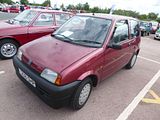


Follow on to the Uno was the Punto, first appearing in 1993 and proving an immediate hit. Internally codenamed Project 176, the Punto was announced in September 1993 as a replacement for the ageing Fiat Uno and launched in the end of 1993 or the beginning of 1994, depending on the market. The Fiat Punto was voted European Car of the Year for 1995, defeating rival Volkswagen Polo by only 78 points. The Punto was designed by Giorgetto Giugiaro and was available as a three-door or five door hatchback, a two-door cabriolet and a three-door panel van. As with the majority of the new Fiat group models, suspension was all independent, composed of MacPherson struts at the front and trailing arms at the rear. Entry level in the Punto range were the 1.1 and 1.2 L petrol engines and the 1.7 diesel engine. The 1.2 engine’s actual capacity is 1242 cc, available in three versions. The first, was fitted in the Punto ELX 75 and produced 75 hp at 6000 rpm while the second, fitted to Punto ELX 85 produced 86 hp at 6000 rpm. The third was a 60 hp engine which eventually replaced the 1.1 54 hp engine. A Sporting model was also available with a 1.6 8v updated 128 SOHC engine, producing 88 hp, later replaced in 1997 by the 1.2 16v FIRE engine used in the 85 ELX, and a power drop to 86 hp. The top of the range model was the 136 PS 1.4 GT, using an evolution of the turbocharged 128 SOHC engine originally found in the Fiat Uno Turbo Mk II – capable of running over 200 km/h (120 mph) and reaching 100 km/h (62 mph) in 7.9 seconds, which came fitted with a five speed manual gearbox. During the years the GT was made in three different “series” with power 136 PS (1993–1995),133 PS (1995–1997) and 130 PS (1997–1999).


Taking note of the increasing popularity of open-topped versions of family-sized cars during the 1980s and 1990s, Fiat decided to offer an open version of their hugely popular Punto. The cabriolet version was built by Bertone rather than at the main Fiat factory. It featured an electric powered fully retracting roof and was one of the cheapest open-top cars in the world at the time. In Europe, it was also made with a manual roof. Available in both ELX and SX trim, initially powered by the 90 hp 1.6 engine, replaced in 1995 by the 86 hp 1.2 litre 16v FIRE unit. Approximately 55,000 cars were built between 1994 and 1999, although the last cars were registered in 2000.


Launched in mid 1995, Bravo and Brava were replacements for Fiat’s successful but ageing Tipo model, quite different in styling detail and driving experience, with the Bravo chassis being tuned for more precise handling whilst the Brava was tuned for better comfort. Even the interior trim and many of the body colours were unique to either one version or the other. The cars came with all new engines, the base model using a 1.4 litre 2-valve engine producing 80 PS. Three other petrol engines were available: the 103 PS 1.6 litre 16-valve; the 113 PS 1.8 litre 16-valve engine and the top of the range 2.0 litre 20-valve inline-5 unit used in the HGT model, which produced 147 PS and which could take the car to a maximum speed of 132 mph. Later in 1999 the 155 HGT model replaced the older model, power rising to 155 PS. Two turbodiesel engines were also available: both were 1.9 litre four cylinder units, one producing 75 PS and the other making 100 PS. They were among the best diesels of the day, with strong pulling power and nicely refined. In 1996, the Bravo/Brava chassis spawned saloon and estate versions, badged Fiat Marea, a car which was aimed at Ford Mondeo and Opel/Vauxhall Vectra buyers, which won praise for its large boot. Another car based on the Bravo/Brava underpinnings was launched in 1998: the curious-looking Fiat Multipla, a six-seater compact MPV. The Bravo/Brava received a mild makeover in 1999, but there were few real changes except the replacement of the 1.4 litre 12-valve engine with a 1.2 litre 80 bhp 16-valve engine from the smaller Fiat Punto and a restyling of the dashboard. The 1.9 turbodiesel was also phased out in favour of 1.9 JTD diesel units (now with 105 PS), to give even better economy and refinement. The Bravo/Brava was voted European Car of the Year on its launch and it sold quite well in the UK, a feat never achieved by its replacement, the Stilo. I used to get these regularly both as rental and courtesy cars and enjoyed them, even the entry level 1.2 litre 80 bhp petrol models. but a lot of them fell victim to scrappage, and there are surprisingly few of them left.



Developed as the Tipo 175, the Coupe was introduced at the Brussels Motor Show in 1993. It is perhaps best remembered for its distinctive, angular design, with unique scalloped side panels. The body was designed by Chris Bangle from Centro Stile Fiat, while the interior was designed by Pininfarina, and the car media headlines in auto magazines during 1992 after several spy shots were taken revealing the car on test. On its launch in 1993, the Coupé was available with a four-cylinder, 2.0 litre 16V engine, in both turbo (190 PS) and normally aspirated (139 PS) versions. Both engines were later versions of Fiat’s twin-cam design and inherited from the Lancia Delta Integrale. 1996 brought in a 1.8 litre 131 PS 16V engine (not available in the UK), along with a 2.0-litre 5-cylinder 20V (147 PS), and a 5-cylinder 2.0-litre 20V turbo (220 PS). The turbocharged 16 and 20 valve versions were equipped with a very efficient Viscodrive limited-slip differential to counter the understeer that plagues most powerful front wheel drive cars. Additionally, the coupe featured independent suspension all round: at the front MacPherson struts and lower wishbones anchored to an auxiliary crossbeam, offset coil springs and anti-roll bar; at the rear, trailing arms mounted on an auxiliary subframe, coil springs and an anti-roll bar. The car was well received at launch, and the 5 cylinder engines just made it even better, with sales increasing slightly for a couple of years, but then they started to drop off, as Coupe models in general fell from favour. 1998 saw the release of the Limited Edition which featured red Brembo brake calipers at the front and standard red calipers at the back, a body kit, push-button start, six-speed gearbox, strut brace to make the chassis more rigid and Recaro seats with red leather inserts which offered better support than the standard 20VT seats. The LE was produced in Black, Red, Vinci Grey (metallic), Crono Grey and Steel Grey (metallic). The bodywork of the LE also benefited from titanium coloured insert around the light bezels and the wing mirrors. Each Limited Edition (‘LE’) Coupé was manufactured with a badge located by the rear-view mirror which contained that car’s unique number (it is rumoured that Michael Schumacher was the original owner of LE No. 0001, however when the question was raised to him personally he confirmed he had owned one, but a red one, while LE No. 0001 is a Crono Grey one). Originally a spokesman from Fiat stated only approximately 300 Limited Editions would be built. The final number was much higher, perhaps as many as 1400. This angered many of the owners of the original 300 cars and almost certainly impacted residual values. The original number however was quoted by a Fiat UK spokesman, so probably that number only applied to the UK market. The numbered plaque on every Coupe features enough space for 4 numbers. In 1998 the 2.0-litre 5-cylinder 20V got a Variable Inlet System which brought the power to 154 PS. The 2.0-litre 5-cylinder 20V Turbo received a 6-speed gearbox and a large, satin gloss push starter button. In addition, the sills of the Turbo version were colour matched with the body paintwork. Fiat also released the 2.0 litre 5 cylinder Turbo ‘Plus’. This model came with an option kit that made it virtually identical to the LE, except for minor interior design changes and without the unique identification badge of the LE. In 2000 Fiat released another special version of the Fiat Coupé. Featuring the 1.8-litre engine, it was only available throughout mainland Europe and marketed as an elegant and affordable edition. Fiat also made changes throughout the rest of the range: new seats, side skirts and wheels for the 2.0-litre 20V model, ‘Plus’ edition wheels on turbo models and Fiat manufactured seats on the ‘Plus’ that were virtually identical to the original Plus Recaro seats with the addition of extra airbags. The 2.0-litre 20V Turbo model is capable of accelerating from 0–100 km/h (0 to 62 mph) in 6.5 seconds and 6.3 seconds for the 20v Turbo Plus, with a top speed of 240 km/h (149 mph) or 250 km/h (155 mph) with later 6-speed gearbox. When production finally stopped in September 2000, a total number of 72,762 units had been produced. There are still well over 1000 units in the UK, so this is a Fiat which has proved durable as well as good to drive, and to look at.


After the 124 Spider ended production, there was a wait of over 10 years before Fiat would produce another open-topped car. Developed between 1990 and 1994 under the project name Tipo B Spider 176, the Barchetta, a small open topped rival to the Mazda MX5 was designed by Andreas Zapatinas and Alessandro Cavazza under the supervision of Peter Barrett Davis and other car designers at the Fiat Centro Stile, and prototyping was carried out by Stola. Production began in February 1995 and lasted until June 2005, with a brief pause due to the bankruptcy of coachbuilder Maggiora. The Barchetta was based on the chassis of the Mark 1 Fiat Punto. The Barchetta has 1,747 cc DOHC petrol engine fitted with variable camshaft timing, used for the first time in a Fiat production car, after being patented in 1970. The engine has 132 PS, and with a weight of 1056 kg (2328 lb) without air conditioning can accelerate to 100 km/h in 8.9 seconds and on to a top speed of 200 km/h (124 mph). It came in various trim levels which offered different features, for example, diamond cross stitch – patterned red leather instead of the standard black leather or fabric seats, alloy wheels instead of steel wheels, or fog-lights as an option. Arguably one of the biggest external cosmetic changes was made by the addition of the third brake light, first introduced by Fiat on the Lido and Riviera in 2000, and on sub models thereafter. The bodies were welded at ILCAS in Sparone Canavese, and final assembly was done in Chivasso by the coachbuilder Maggiora. After Maggiora’s bankruptcy in 2002, Fiat relocated production of the Barchetta to its Mirafiori plant and resumed production two years later. The most notable changes were the revised front spoiler and rear bumper. Production of the car eventually stopped in June 2005, with around 57,700 cars having been built. Production of the Barchetta was limited to LHD cars only, even though the car was marketed and sold in two RHD markets, the United Kingdom and Japan.


Follow on to the Cinquecento was the Seicento, and that was represented here by the Sporting version, debuting in 1997. It did not differ much from its predecessor, retaining the same engines, chassis and general dimensions, although it did gain a minor 9 cm in length (total length of 3.34 m). At launch, the Seicento was available with three trim levels; a basic ‘S’ with black bumpers and spartan equipment and initially the 899 cc 39 PS FIAT 100 series engine; an ‘SX’ model, a slight upgrade over the ‘S’ with colour-coded bumpers, electric windows, central locking and a sunroof – which was also available as a ‘Citymatic’ with a clutchless manual gearchange – and a ‘Sporting’ with the larger FIAT FIRE series 1108 cc 55 PS engine, 20 mm (0.8 in) lower suspension and anti-roll bars added. Cosmetically, this version gained 13″ alloy wheels, sports seats. An Abarth styling kit was also available with a body kit with optional Abarth 14″ wheels a close-ratio gearbox, sill kick plates, embroidered headrests, leather gear stick and steering wheel, colour highlighted trim in the bumpers, side skirts and a spoiler also available. Both the sporting and the Abarths were available with ABS, air-conditioning and power steering but due to cost not very many owners took up the options. In 1999, the FIRE engine was used in the special ‘Suite’ version, which came with air-conditioning. A special edition ‘Soleil’ model was available in some markets, which was based on the ‘SX’ model but came with a full-length electrically-folding fabric roof. In 2001, after the update, all cars were given clear indicator lenses, with the Sporting model getting a restyled bodykit. Power steering was still an option, in lower end Seicentos. A ‘Michael Schumacher’ edition of the Sporting, with ABS and the Abarth styling kit, was also launched at this time to celebrate the Ferrari driver’s Formula One success, This model was almost identical to the Abarth kit with the exception of chrome gear stick surrounds and Michael’s signature on the boot lid and side skirt. A limited edition plate and number was also on the passenger door. In 2004, the model was withdrawn from the UK market, and production of RHD models ceased, following the arrival of the new and more practical Panda. The LHD model was facelifted, gaining a new design for the wheel rims and the introduction of the new Fiat logo to the rear. In 2005, the name Seicento was replaced by 600 (on the occasion of the 50th anniversary of the first edition, in 1955) together with some changes in the front and in versions donations: now the name Fiat is written on the seats. The new versions now were named “Class” and “50 anniversary”, thus reminding the strict relationship between this model and the previous one. Production continued until 2010 by which time over 1.33 million units had been built.


The Fiat Multipla (Type 186) is a six-seater car produced from 1998 to 2010. Based on the Bravo/Brava, the Multipla was shorter and wider than its rivals. It had two rows of three seats, where its compact MPV competitors had two across front seating. The Multipla is shorter than the three-door Bravo/Brava on which it was based, yet it offered increased seating and cargo volume. Sales commenced in Italy in November 1998. In common with a number of other modern Fiats, the Multipla reused the name of an earlier vehicle, in this case the “Multipla” variant of the Fiat 600 produced during the 1950s and 1960s. The Multipla was assembled and marketed in China from 2008 to 2013 under license by Zotye Auto as the Zotye M300 Langyue, using knock-down kits from Italy. Zotye also sold a total of 220 all-electric versions of the M300. A first Multipla concept car was unveiled in at the Paris Motor Show in October 1996. The final production car was presented at the International Motor Show Germany in Frankfurt in the Autumn of 1997. The exterior and interior design of the Multipla were displayed at the Museum of Modern Art (MOMA) in New York during its “Different Roads – Automobiles for the Next Century” exhibition in 1999. It won the Top Gear Car of the Year (2000). It was also voted Top Gear Magazine’s Family Car of the Year for four years in a row, from 2001 to 2004. In July 2000, in the series finale of Clarkson’s Car Years, it was awarded “Family Car of the Moment”. Multipla sales began in Italy in November 1998, with most other markets receiving it a year later. The Multipla sold well with Italian buyers, but sales elsewhere were less successful. The Multipla underwent a major facelift in March 2004, in an attempt to shed its original styling for a more restrained look. This was with the intention of attracting more buyers, but failed to garner critical acclaim. Upon the subsequent restyling, The Daily Telegraph reported designers were “desperately sad that the new Multipla no longer resembles a psychotic cartoon duck,” and “while passengers loved the adaptability of the clever interior, they were less keen on the sarcastic sneers and derisive laughter of their neighbours, friends and schoolmates; children can be cruel.” The Telegraph placed it #2 on its list of the 100 Ugliest Cars in August 2008, saying, “Derided for the blandness of its output during the 1980s and early 1990s, Fiat dared to start thinking outside the box. In this case, however, it simply added wheels to the box.” The Multipla was also named the ugliest car of all time by readers of Car Throttle in January 2014. In February 2018, The Sunday Times named it on a list of ugliest cars, saying, “The tragedy of the Multipla is that its Elephant Man-esque exterior enclosed a genuinely clever and spacious interior, and it wasn’t bad to drive, either. It’s a shame, then, that you’d rather walk than be seen in it.”


The second generation Punto codenamed Project 188, was launched in September 1999 at the Frankfurt Motor Show. The styling was all-new while retaining the original Punto’s distinctive shape and design, while the chassis and interior were completely overhauled, with a new torsion beam rear suspension. The new Punto also became the first Fiat in decades to carry the original round Fiat badge, to celebrate Fiat’s centenary. At the launch event of the hatchback, the Fiat Wish concept car was also presented, which was hardtop convertible version of the Fiat Punto, very similar in styling with the Peugeot 206 CC. The model was conceived by Pininfarina to celebrate the centenary of Fiat. The 1.1 and 1.4 engines were discontinued due to emissions issues and the entry level models had only a 1.2 petrol unit, with either 8 or 16 valves, giving 60 hp and 80 hp respectively, or a 1.9L diesel, with common rail injection and turbocharger or naturally aspired with mechanical injection. Two sporty versions were offered. The 1.2 16 valve Sporting model with a six-speed manual, and the 1.8 HGT which could reach almost 130 mph (210 km/h). The 1.2 16V model also has a Speedgear CVT equipped variant (with a sequential manual shift mode consisting of six gears, seven for the Sporting model). The 1.8 HGT accelerates from 0 to 60 in 8.0 seconds. It was considered a big improvement in handling over the Punto GT. The HGT was also available (in limited numbers) as an “HGT Abarth” which added deeper bumpers, rear spoiler, side skirts, new alloy wheels, and interior trim. The HGT Abarth had no technical improvements over the regular HGT. The second generation Punto has also adopted the Dualdrive electric power steering and came with two operation modes, using an electric motor, rather than a hydraulic pump driven by the engine. This resulted in reduced fuel consumption and less environmental impact. It has a fuel economy of 5.6 l/100 km (50 mpg), urban and 3.9 l/100 km (72 mpg), extra urban for the 1.9 diesel. The 1.8 petrol does 8.8 l/100 km (32 mpg), urban and 5.3 l/100 km (53 mpg), extra urban. At the beginning of 2003, Fiat celebrated the rollout of the 5,000,000th production Punto. During the same year, the second generation facelift brought further revisions to the platform, including extensive changes to the exterior styling and engines, partly due to changes in pedestrian safety regulations. The round Fiat badge, found only on the bonnet of second-generation models, was introduced on the tailgate of the second generation facelift. On 1 June 2005, Fiat produced the 6,000,000th Punto at the Melfi plant. Engine changes included a new 1.4 L 16v engine, alongside the staple 1.2 and 1.2 L 16v variants, and the introduction of two HGT versions, the 1.9 L MultiJet diesel engine and the 1.8 L 16v petrol engine, which could reach almost 130 mph (210 km/h) continued over from the pre-facelift version. There was an introduction also of the 1.3 L common rail diesel MultiJet engine. Despite the launch of the slightly larger Grande Punto at the end of 2005, the second generation Punto remained in production, marketed as the Punto Classic, and has been sold in many emerging markets in addition to the newer versions. It was launched for the first time in Chile in 2007. It ended production in Italy in November 2010.


Developed as the Tipo 192, this C-segment mode was launched in November 2001, at the Bologna Motor Show, to replace the Fiat Bravo/Brava, with the Stilo MultiWagon following in 2002, a successor to the Bravo and Brava hatches and the Marea Weekend. Originally, its petrol engines were the 1242 cc DOHC 16 valve engine also powering the Punto and Lancia Ypsilon with an output of 80 PS combined with a 6 speed manual gearbox, a 103 PS, 1.6 litre with a 5 or 6 speed manual gearbox, a 133 PS 1.8 litre with a 5 speed manual gearbox and a 170 PS 5 cylinder, 2.4 litre engine combined with Fiat’s Selespeed 5 speed semi-automatic gearbox, similar to the gearbox used on the Alfa Romeo 147 and Alfa Romeo 156. An 8 valve, 1.9 JTD unit with 80 PS, 100 PS, 116 PS, 120 PS or 16 valve 140 PS and 150 PS diesel unit were/are also available. The Stilo’s styling received mixed reviews, with many journalists and enthusiasts criticising it as being too bland and too German-looking (somewhat ironically as the styling of the preceding Bravo and Brava had been criticised for being too “Italian”). Critics also attacked the car’s excessive weight and its semi-independent rear torsion beam suspension / twist-beam rear suspension, (like a previous generation Volkswagen Golf), which was seen as a step backwards from the acclaimed fully independent rear suspension used in the Bravo/Brava, and which resulted in handling many found uninspired and uninvolving. Although the Bravo/Brava IRS was prone to suspension bush wear. The engine range, particularly the 1.2 litre petrol, was also criticised for being underpowered. The car’s fuel economy was also seen as poor for its class, a result of the car’s heavy weight and the transmission, which used very long gear ratios. Another point of criticism was the Selespeed gearbox, which was seen as too slow in its reactions and particularly inappropriate for the high-powered Abarth version. In the UK, different trim levels available were: Active, Active Aircon, Blue, Dynamic, Sporting, Abarth, GT, Prestigio, Xbox limited edition, Michael Schumacher and the Schumacher GP, with general modifications by British car specialists, Prodrive. Sales were sluggish from the start, and only got worse. As the model range aged, the range of available options was reduced. The Stilo was originally offered in some markets with a radar guided cruise control option; it included sensors in the front bumper and rear of the car to adjust the speed of the car according to other vehicles’ speed. This was soon dropped as it became apparent that other interferences were creating undesired results for the driver. A keyless entry, named ‘Easy Go’, push button start, similar in function to Citroen’s, Mercedes’ and BMW MINI’s systems, was also an available option. For 2006, the Stilo was updated with a new front grille, different seat fabric, a relocation of the electric mirror controls from the window control console to just behind the gear stick. The entry models also had the centre arm-rest removed (which when in the downward position prevented comfortable use of the handbrake as in the Audi A3) and the deletion of the rear air vent. The model was replaced in 2007 by the new Bravo, another sales disappointment. There is some interest in the stylish 3 door models these days, with Schumacher cars like this one the most commonly seen, but the 5 doors have sunk almost without trace.


The second generation Panda, codenamed Tipo 169, first appeared in 2003. In its development phase, the new Panda was originally intended to be called “Gingo”. However, this name was considered to be too similar to the Renault Twingo, so Fiat decided to continue with the Panda name, although it has almost no direct engineering link to the original 1980 car. Successor to the Fiat Seicento, the new model also effectively replaced the old Panda after 23 years of production, although the Seicento itself proved still popular and remained in production. Like the Seicento, the Panda was manufactured only in Tychy, Poland, by Fiat Auto Poland. The high-bodied Panda took clear styling cues from mini MPVs and mini SUVs, especially the second generation Fiat Multipla. Its long high positioned vertical tail lights are in particular reminiscent of much larger cars (especially estate cars) from the likes of Volvo, although Fiat started using smaller versions of this style of lights on the 1994 Italdesign Giugiaro Fiat Punto. The Panda won the European Car of the Year award in 2004. The financially troubled Fiat needed the new Panda to be a success, and indeed it was, selling half a million units by October 2005. It sold particularly well in Italy (over half of the cars produced were sold in Italy), being seen as closer to a spiritual successor to the Fiat 500 than a replacement for either the Seicento or the old Panda. Fiat expanded the range with diesel and 4X4 versions, and the decided to add a sporting model. It is widely believed that this sporting version was going to be the car to reintroduce the Abarth brand, but a last minute declaration (unbroken for now, but rumours suggest it may well be rescinded) that Abarth models do not have 4 or 5 doors meant that it was branded the 100HP instead. The Panda 100 HP was launched in 2004, a few months after the debut of the second generation Panda, and it was the sporty model in the range, with its 1.4-litre 16-valve FIRE petrol engine tuned to develop 100 PS (99 bhp) through a six-speed manual transmission. It differs from other Pandas by being equipped with 4-wheel disc brakes, tinted windows, and sports styled front and rear bumpers. The Panda 100 HP features a unique suspension setup with modified springs, dampers, bushes and compliance giving a considerably firmer ride. Performance was far livelier than the other models in the range, with 0–100 km/h acceleration in 9.5 secs and a maximum speed of 185 km/h (115 mph), fuel consumption at 6.5 L/100 km (43.5 mpg) in the EU combined cycle and 154 g/km of CO2 emissions. It was available in black, white, red, metallic blue, and metallic gray while a “Pandamonium Pack” which added red disc brakes, decals and colour-coded wing mirrors was an optional extra. Due to tightening emissions regulations, Fiat halted all Panda 100HP production in July 2010.


This is the Panda Alessi, a limited-edition version of the second-generation Fiat Panda (Type 169), created in collaboration with the Italian houseware design brand Alessi. First introduced as a concept car at the 2004 Paris Motor Show and the Triennale di Milano, before the production version debuted at the 2005 Tokyo Motor Show, it was built and sold in limited numbers from 2006 through 2009. It applied consumer-product industrial design principles to an automobile, emphasizing playful colours and bespoke interior elements. It was available in three distinct exterior shades: Arancio Narciso (Narciso orange), Verde Tagliente (Tagliente green), and Nero Cattivo (Cattivo black). It features contrasting white or custom bumpers, white side protective mouldings, and redesigned wheel trims decorated with Alessi’s signature “little man” mascot and there are white roof rails and a distinct white antenna. Inside there are custom instrument graphics, colour-coded seat upholstery matching the exterior accents, and metallic-coloured centre console and gearshift trim. It includes a redesigned central tunnel with a round multi-purpose compartment (capable of storing CDs), a silicone mobile phone holder, and Fiat’s “cargo-system” boot floor-levelling tray. The car is powered exclusively by the 1.2-litre FIRE petrol engine (60bhp(, paired with standard equipment including ABS, electric power steering (Dualdrive), air conditioning, and early Bluetooth mobile phone integration.


In March 2005, Fiat introduced the second generation Croma: a large high-roof, six passenger, crossover wagon with an upright tailgate, with styling by Italdesign. Reflecting Fiat’s short term joint venture with General Motors, the new Croma, internally designated the Type 194, used an extended variant of the GM Epsilon platform sharing components with the Opel Vectra, Opel Signum and Saab 9-3. It was presented at the Geneva Motor Show in spring 2005 and went on sale in Italy in June of that year. Aware of its lack of image in the upper market segments, Fiat opted for developing a “Comfort Wagon”, an automobile with design elements of both estates and large MPVs, instead of developing a standard large family car like the previous model. Its height of 1,600 mm (63.0 in) falls between that of the Mitsubishi Grandis and Ford S-Max large MPVs (1,655 mm (65.2 in) and 1,660 mm (65.4 in) respectively) and SEAT Altea XL (1,525 mm (60.0 in)). In February 2007, Fiat UK announced that the Croma would no longer be generally available in the United Kingdom, after less than 900 had been sold in 2005. The car was still offered, but only on special order, with right-hand drive models manufactured to customer specifications. Production of the second generation Croma ended at the end of 2010 and the car was replaced by the Dodge-based Fiat Freemont.

The Grande Punto, codenamed Project 199, was unveiled at the 2005 Frankfurt Motor Show and went on sale later on that year. Again styled by Giugiaro, the car is based on the Fiat Small platform developed in joint venture with Opel-General Motors. Whilst the model shares some of its name with the previous Punto, a large number of its components are new, including a new chassis and body shell. The engines are the Fiat 1.2 8v Fire (65 PS), a new 1.4 8v Fire (77 PS) and the 1.4 16v StarJet (95 PS). Four MultiJet diesel engines are also available: two 1.3 16v units (75 PS and 90 PS, the latter with a variable geometry turbocharger) and two 1.9 with 120 PS and 130 PS, all of them with diesel particulate filter. The 1.9 diesel was replaced with the new 1.6 MultiJet starting the end of 2008. All the engines are Euro IV compliant. In 2007, a new 1.4 16v T-Jet turbocharged petrol engine, 120 PS, became available. At the 2007 Frankfurt Motor Show, Fiat introduced 155 PS an Abarth version by Abarth & C S.p.A. It was branded as an Abarth rather than Fiat. The car’s nose, headlights and front grille look reminiscent of the Maserati Coupé (both were designed by Giorgetto Giugiaro of ItalDesign). The Punto Evo, a facelift version of the Grande Punto, was presented in September 2009 at the Frankfurt Motor Show. It received a new front end, in addition to revised rear lights, and a new interior. It has two new engines, a 1.3 L second generation Multijet diesel and a 1.4 L petrol engine with the MultiAir technology. It also features a new navigation system integrated to the Blue&Me system called Blue&Me–TomTom. Fiat introduced the 2012 Punto in September 2011 at the Frankfurt Motor Show, as a facelifted version of the Punto Evo that reintroduced the Punto nomenclature (without Grande or Evo). The facelift was consisted of slighter tweaks than changing from Grande Punto to Punto Evo, keeping the revised rear lights and interior of the 2009 Punto Evo, but not on the base ‘Pop’ trim level which reverted to the older Grande Punto interior. In October 2014, Top Gear Magazine placed the Punto Pop 1.2 litre 8v 69 on its list of The Worst Cars You Can Buy Right Now, describing the car as “An outclassed elderly supermini that kicks out 126 g/km yet takes 14.4 secs to wheeze to 62 mph, and it costs more than £10k.” Production of the three-door version ended in 2015, leaving only the five-door version available in Europe. In June 2016, Fiat introduced the new Techno Pack with the 5-inch touchscreen infotainment system and cruise control. Production of the Punto ended on 7 August 2018, with no direct successor being announced. However, it continued to be produced in India for an additional three months before production ended in November of that year.


It was good to see an example of the Tipo 198 generation Bravo cars here. Introduced to the press in January 2007 in Rome, and later to the public in March at the Geneva Motor Show, this five door hatch was a replacement for the Stilo, and was the car that Fiat would reposition them as a contender in the C-Segment class. The Bravo was powered by three different petrol and three diesel engines. The petrols were all 1.4 litre units, using the new ‘T-Jet’ range of turbocharged petrol engines, with power ranging from 80 to a rather healthy 150 bhp and diesels were initially 1.6 and 1.9 units, with a 2 litre Multi-Jet diesel supplanting the larger 1.9 unit at the end of 2008. Despite being praised for its looks, and being quite decent to drive, it bombed even more than the Stilo. A minor facelift in 2010, with changes to the front grille, door handles and side mirrors, new colours, as well as interior improvements. and changes to the engine line-up throughout the life of the car made little difference and the car was quietly deleted in 2014, with no direct replacement until the launch of the Tipo some 2 years later.

There were lots of the modern generation 500 here, as you would expect.


The reborn Fiat 500 caused a stir at its 2007 launch, with Roberto Giolito’s design for Centro Stile Fiat mixing just the right amount of retro into an otherwise modern concept. Fans were always quick to paint the 500 as a baby Ferrari, and in 2008 Ferrari themselves commissioned 200 ‘Dealer Editions’ to be supplied to authorised Ferrari service centres for use as loan cars. With a specification foreshadowing the upcoming Abarth 695 and Tributo Ferrari models, the 160 bhp drivetrain and manual transmission was borrowed from the Abarth 500 essesse, with a Record Monza exhaust, Sabelt leather seats, glass sunroof, red brake calipers, a carbon-look steering wheel with red stitching, and the iconic Scuderia Ferrari shields completing the look. The 200 cars were supplied to dealers globally, and it is thought that most were sold directly into collections before they ever saw duty as loan cars.


The Fiat 124 Spider (Type 348) is a front-engine, rear-drive, two-passenger roadster manufactured by Mazda for FCA, having debuted at the 2015 LA Auto Show for model year 2016. Largely based on the fourth generation Mazda MX-5 Miata roadster, and manufactured alongside the MX-5 at Mazda’s Hiroshima plant, the 124 shares its platform, mechanicals, interior and top mechanism with the MX-5 — it is distinguished by an FCA engineered and manufactured turbocharged Multiair engine, uniquely tuned shock absorbers, unique exterior styling and slightly increased length and cargo capacity over the MX-5. In May 2012, Mazda and Alfa Romeo — at the time a subsidiary of the Fiat Group, now Stellantis — announced a joint venture to manufacture a common rear wheel drive platform. The companies would “develop two differentiated, distinctly styled, iconic and brand specific, lightweight roadsters featuring rear wheel drive”, with the two variants offering proprietary engines unique to each brand. In December 2014, FCA’s Sergio Marchionne determined Alfa Romeos would be manufactured only in Italy, saying “some things belong to a place. Alfa belongs to Italy,” adding “I remain committed to that architecture, with our powertrain. I’m not sure it will be with Alfa. But it will be with one of our brands.” At the time, Alfa Romeos were manufactured only in Italy, while Fiats were manufactured in Italy, but also globally — from Tychy, Poland, to Toluca, Mexico. With their prior agreement in place — for FCA to market a roadster based on the MX-5 to be manufactured by Mazda at its Hiroshima factory — FCA conceived of marketing a Fiat badged variant in lieu of the Alfa Romeo variant. In August 2016, FCA formally announced the Fiat 124 Spider based on the Mazda ND platform. In December 2016, the Detroit News said “in partnering with Mazda’s MX-5 Miata to resurrect the classic Fiat 124 Spider, Fiat Chrysler not only gained a halo sports car for its struggling Italian brand, but likely saved the most celebrated small sports car of the past 25 years (the MX-5)” — citing the markedly increased cost of developing a new car at the time and “the costliest wave of government regulation since the 1970s.” The 124 Spider was powered by Fiat’s 1.4 litre MultiAir turbocharged inline-four, producing 140 PS (138 bhp) and 240 Nm (177 lb/ft) of torque in European specification—and 160 bhp and 184 lb/ft (249 Nm) of torque in North American specification. The 124 manual transmission is from the third generation MX-5’s six speed transmission to cope with the turbo’s torque. Multiair is a hydraulically actuated variable valve timing (VVT) engine technology enabling “cylinder by cylinder, stroke by stroke” control of intake air directly via a gasoline engine’s inlet valves. Developed by Fiat Powertrain Technologies, the technology bypasses a primary engine inefficiency: pumping losses caused by restriction of the intake passage by the throttle plate, used to regulate air feeding the cylinders. At the 124’s debut, Fiat marketed a 124 Spider Anniversary edition, with 124 units carrying the designation—to commemorate the 50th anniversary of original 124 Sport Spider. Including features of the 124 Spider Lusso Plus trim, the edition also includes chromed mirrors, red ‘124’ badge on the front grille, interior numbered plaque, red exterior and black leather interior. In January 2019, FCA announced the Fiat 124 Spider was to be withdrawn from the market in the United Kingdom with immediate effect. The Abarth 124 Spider continued to be sold, but this too was withdrawn from the UK market in April 2019. On December 23, 2020, Stellantis announced the 124 Spider and 500 were to be withdrawn from their North American model lineup after the 2020 model year and would not return for 2021, as is the situation with 500L. These models were expected to sell into 2021 until stock depletion.


Other recent model Fiats included the 500X and the Tipo.


There were a number of examples of the latest Fiat models to be offered, thanks to a display by sponsoring dealer Unity Automotive Among them were the all-electric 500, the larger 600 as well as the eagerly awaited and yet to go on sale Grande Panda.


From Fiat’s commercial vehicle range was the latest Ducato van.

LADA
The VAZ-2106 Zhiguli (alternatively Zhiguli 2106) is a saloon produced by the Soviet (later Russian) automaker VAZ, and later, after the breakup of the Soviet Union, also by Russian Izhevsk Avto and Ukrainian Anto-Rus. In export markets, it was known simply as Lada 1600 or alternatively as Lada 2106. In the domestic market it was popularly nicknamed Шестёрка (Shestyorka, in English; The sixth one). A hugely popular car and one of the most successful Lada models, it was in serial production for 30 years (from 1976 to 2006), although production in the VAZ plant ended after 25 years, in 2001, with manufacture continuing at Izhevsk for the final five years. Derived from its predecessor, the VAZ-2103, 2106 was created as its alternative due to expense and complexity of production of chrome elements which were severely reduced on it (although it did not fully replace it until 1984, when the 2103 was finally discontinued). Like the 2103, the 2106 was a four-door, four-seat saloon, but powered by a more powerful 78 hp 1,568 cc single overhead cam inline four engine of Lada’s own design. It used the pistons of the VAZ-21011’s 1,294 cc and the crankshaft of the VAZ-2103’s 1,452 cc. Though only marginally more powerful than the 2103’s engine, it produced more torque, 86 ft/lb (117 Nm) rather than 76 ft/lb (103 Nm), making it easier to drive. Top speed was 93 mph (150 km/h), with 0–62 mph (0–100 km/h) acceleration in 16 seconds. For many consumers, it was “the top of the Eastern Bloc charts for comfort and prestige”, since the more expensive and luxurious GAZ and ZIL cars, intended firstly for party members and various other state officials, were out of reach for them. It debuted in December 1975, and “would become the most popular and most numerous VAZ product”. It externally differed from its predecessor, the VAZ-2103, firstly by having smaller grille due to having plastic headlight surrounds, different bumpers and by wider taillights also featuring reverse lights, which were then a new feature for VAZ models. Internally it was almost as same as its predecessor with only minimal differences, most notably by being the first VAZ model with height adjustable headrests on front seats and also by its steering wheel; it was visually easily recognizable by being decorated with classic Russian ornaments together with Lada logo on its central (leather) part. In 1976, due to being the latest model in VAZ arsenal, it served as a basis for latest prototype what would become the highly successful VAZ-2121 Niva or Lada Niva 1600 the next year. It borrowed many of its elements to it, like firstly its 1600 cc 75 hp petrol engine, as well as its headlights and taillights, direction pointers, side/external mirrors, front seat headrests, steering wheel, instruments and many other details. The VAZ-2106 was severely restyled in the second half of 1990s, its chrome lined elements having further been reduced. The chrome external/side mirrors became black metallic back in the first half of the 1980s, when the VAZ-2103 was discontinued; however, the grille was now replaced with a black plastic one which also featured a new front Lada badge. Chrome lined rim covers and exterior body part edges were also removed. However, the chromed bumpers as well as Fiat 124 door knobs were still present until the very end of production. Internally, the aging Fiat 125 steering wheel (firstly used by VAZ-2103 and later by VAZ-2121 Niva) also featuring chrome elements was replaced by newer one. The previous wood imitation dashboard was replaced with black one and, along with some other details, its original berth foldable seats were also replaced with more modern ones. The 21061, with the 75 hp 1,452 cc VAZ-2103 engine, and 21063, with the 64 hp 1,294 cc, appeared in 1979. The 21063 would disappear in 1993. The less-powerful, but also cheaper, 21061 would be the sales leader, helping make the 2106 the top-selling Lada model. In Canada, the model was sold from late 1978-early 1979 as the Lada Signet, with the official factory name being VAZ 21061-37. It was made up to 1984. One variant of this model is the 21061-41, which had Canadian Domestic Market bumpers and fitments, but it featured European Domestic Market repeaters, tail lights, side logo, etc. This model is one of the rarest of the 2106 series, and some examples survive in the former USSR and in Europe.


LAMBORGHINI
Lamborghini had been toying for some time with the idea of a smaller and cheaper car, powered by a V8 engine, to rival the smaller Ferraris, and the result, the Urraco, was first seen at the 1970 Turin Show. It was styled by Marcello Gandini, and engineered by Paolo Stanzani. It was launched with a 2.5 litre V8 engine, engineered to be cheaper to build, with belt-driven camshafts, situated within a steel monocoque structure suspended on McPherson struts. It reached the market before the rival Maserati Merak and Ferrari 308 GT4 Dino, which should have given it a big advantage. But it did not. For a start, it was deemed not powerful enough, so even before the difficulties of the late 1973 Fuel Crisis made things difficult, the car did not sell well at all. The solution was to add more power, and this came when the engine was enlarged to 3 litres, with four chain-driven cams, which took power from 220 bhp to 265 bhp. A roll-hoop across the back of the cabin improved rigidity, and more powerful brakes were fitted. It sold better, though never in the sort of volume that had been anticipated, and the addition of an Italian market tax special P200 did not help much, either. Just 66 of these were built, whereas 520 of the original P250 models found buyers, and 190 of the more powerful P300s added to the total before production ceased in 1979. The story did not quite end there, as in 1976 a heavily revised version, with removable targa roof panels, appeared, called the Silhouette, and both were replaced by the Jalpa in the 1980s, though neither of these sold as well as the Urraco.


LANCIA
The Lancia Ardea is a small family car produced between 1939 and 1953. Its unusually short bonnet reportedly contained the smallest V4 engine ever commercialized in a small family car. Nearly 23,000 of the Ardeas produced were standard bodied saloons but between 1940 and 1942 approximately 500 Ardeas were manufactured with lengthened bodies and a squared off rear cabin for use in Rome as taxis. After the war more than 8,500 commercial adaptations of the Ardea known as ‘furgoncini’ (light van versions) and the ‘camioncini’ (car based light trucks) were also produced. The third series Ardea, produced from 1948, was the first mass-produced car with a 5-speed manual transmission. Ardea was named either after Ardea town (Lazio), or Via Ardeatina, Roman road leading from Rome to that town. Instrumentation included a centrally mounted speedometer, the fuel level and the oil pressure. A third dial directly below the driver’s sight line was a clock, unusually on this size of car. The three floor pedals followed the pattern still ‘conventional’ for a manual transmission car (clutch, brake, gas) but to the left of the clutch pedal was a small foot-operated dipper switch for the headlights. Control knobs lined up along the base of the fascia included a hand throttle. Early Italian images of Ardea interiors confirm that Lancias of the period were still right hand drive, a position elsewhere taken to imply driving on the left side of the road. However, right-hand drive is practical even where drivers drive on the right-hand side of the road as it allows a better view of the edge of the road, which is useful when driving on rough roads in mountainous districts. This did mean that drivers of cars with centrally located floor mounted gear shifts, such as the Ardea, needed to learn how to shift with the left hand. During the 1920s Italian leader Benito Mussolini required all Italian drivers to drive on the right, but Lancia would continue, through the 1950s, to supply right hand drive cars in areas viewed by other automakers as left hand drive markets. Four versions of the Ardea were built: 1st series, produced between 1939 and 1941, 2,992 built; 2nd series, produced between 1941 and 1948, 4,438 built. 12 Volt electric system introduced; 3rd series, produced between 1948 and 1949, 3,600 built. 5-speed gearbox introduced; 4th series, produced between 1949 and 1953, 11,700 built. New cylinder head, aluminium, higher compression ratio, more power: 30 bhp. Alongside the type 250 4-door saloon other body variants of the Ardea were offered. The Ardea was offered as bare chassis (type 350) between 1939–1941 to be bodied by independent coachbuilders. The chassis had the 2440 mm wheelbase of the saloon. The Aurelia chassis type 550 van (furgoncino, literally “small van”) was built in 9 examples already in 1941, but regular production begun only in 1945. The Ardea chassis type 650 pick-up (camioncino, literally “small pickup”) was introduced in 1948. In 1949 they were upgraded to fourth series specifications (5-speed gearbox and more powerful 101B engine), and continued to be built until they were superseded by equivalent versions of the Appia in 1954. Unlike on the earlier Augusta, whose commercial variants were bodied by third-party coachbuilders, these Ardeas were factory-built by Lancia.


The Lancia Beta (Type 828) was an entry-level luxury car produced by Italian car manufacturer Lancia from 1972 to 1984. It was the first new model introduced by Lancia after it had been taken over by Fiat in 1969. The Beta was made in several body styles, namely 4-door fastback saloon (Beta berlina), 4-door three-box, notchback saloon (Beta Trevi), 2-door coupé (Beta Coupé), 2-door targa (Beta Spider), 3-door estate (Beta HPE); a mid-engined sports car was also sold under the Beta name, the Lancia Beta Montecarlo. When Fiat acquired Lancia in 1969, the company had been without a Technical Director for the year following the death of Technical Director Antonio Fessia. Ing. Sergio Camuffo was given the job of developing the new model in early 1970. Although in the difficult years before the Fiat take-over, a number of the engineering staff had left the company, Camuffo was able to pull together a core of Lancia engineers — who were tasked with getting the car into production by the end of 1972. Romanini, chassis design, Zaccone Mina, engine development, with Gilio and Bencini in testing. This was a very short timeframe, and development money was relatively limited. These were key factors that influenced the decision to use an existing power plant: the Fiat twin overhead cam straight four engine with its alloy head and cast iron block. At the Beta’s launch late in 1972 Fiat chief Gianni Agnelli told journalists that Lancia’s output would be about 40,000 units in 1972 at a time when a volume of 100,000 was needed to cover the fixed costs involved in developing and building the cars. Lancia’s lack of profitability was also evidenced by the absence of replacement models under development at the time of the Fiat take-over. The Lancia Fulvia, though much loved, had been developed with little concern for making it cost-effective to manufacture; it had therefore been sold at a high price in correspondingly low volumes. The company’s new owner’s objective with the new Beta was to retain the quality image and price premium of existing Lancias, while minimising development time and production costs — using in-house Fiat group technology and parts where possible. The project adapted a well-regarded existing Fiat engine, fitted transversely and driving the front wheels, in line with Fiat’s investment in this configuration during the previous decade. The gear box was a development of a transmission unit then being developed by Fiat-partner Citroën for a forthcoming model of their own. Above all, and in contrast with the Fulvia, the Beta design was relatively inexpensive to produce in volumes significantly higher than those achieved by predecessor Lancia saloons. The company chose the name Beta for a new vehicle to be launched in 1972. The choice of name symbolised a new beginning as it reflected the fact that the company’s founder, Vincenzo Lancia (1881–1937), had used letters of the Greek alphabet for his early vehicles — such as Alpha, Beta, Gamma, Delta, and so on. “Beta” had been used before, for Lancia’s 1908 car and again for a 1953 bus. Lancia had previously used the first letter of the Greek alphabet, Alpha, but this was not chosen for the new 1972 Lancia due to the obvious confusion it might cause with Alfa Romeo. All versions of the car came with DOHC engines, five-speed gearboxes, rack and pinion steering, fully independent suspension using MacPherson struts, both front and rear, with disc brakes on all four wheels. The front-wheel-drive models were available in a number of engine capacities ranging from 1.3 L to 2.0 L. Breathing was provided by a single Weber carburettor until fuel injection was introduced on late two litre HPE and Coupe models. As with a number of previous front-wheel drive-Lancia models, the engine and gearbox were mounted on a subframe that bolted to the underside of the body. However, in the Beta the engine and manual gearbox were fitted transversely in-line. This Fiat-inspired configuration not only enabled neat engine bay packaging, but also, by tilting the engine 20 degrees rearwards, the Lancia engineers achieved improved weight transfer over the driven wheels and towards the centre of the car, as well as lowering the centre of gravity. The rear-wheel drive Lancia Montecarlo employed a similar layout except the subframe was mounted at the rear. On the front-wheel drive Betas, Lancia designed a particularly original independent rear suspension with MacPherson struts attached to parallel transverse links that pivoted on a centrally mounted cross member bolted to the underside of the floorpan. An anti-roll bar was fitted to the floorpan ahead of the rear struts with both ends of the bar trailing back to bolt to the rear struts on each side. This unique design went on to be used in later Lancia models. The design was never patented by Lancia, and consequently inspired similar rear suspension system layouts in other manufacturers’ vehicles during the 1980s and 1990s. A short wheelbase coupé was introduced in June 1973, then the following year the 2+2 Spider convertible. At the 1975 Geneva Motor Show Lancia launched the HPE (High Performance Estate), styled in a similar vein to the Reliant Scimitar and Volvo 1800ES while utilizing the wheelbase of the Berlina. Later the Beta Montecarlo, a two-seater mid-engined coupé was launched. The different models all underwent various revisions and improvements over the years. Power steering specially produced by the German company ZF became available on certain Left Hand Drive models and was also used on the Gamma. For 1975 the exterior styling was modified by Pininfarina: “the back window has been relocated in a more upright position” to aid visibility, the rear quarter pillars gained sharper trailing edges, the waistline was lowered and windows made larger. Electronic ignition became available in 1978. Automatic transmission became available the same year; the Beta was the first Lancia manufactured with an automatic transmission factory option. In 1981 power steering also became available on certain Right Hand Drive models. Also in that year a fuel-injected version of the 2.0-litre engine became available on certain models. The Coupé and HPE underwent a facelift in June 1983 (at the same time that the supercharged VX versions were introduced) and remained available for a little while longer than the other bodystyles. Introduced in 1972, the first body style to appear, and the most common was the four-door berlina (saloon), with a wheelbase of 2,535 mm (99.8 in) and ‘fastback’ styling giving the appearance of a hatchback, although in fact it had a conventional boot like a saloon. This practice was common in the industry at the time as manufacturers deemed that hatchback designs would not be accepted in this market sector. It featured 1400, 1600 and 1800 transversely mounted twin-cam engines based on earlier Fiat designs along with five speed gearbox. In 1974 the 1.8ES version was launched featuring electric windows, alloy wheels and sunroof. At the Turin Auto Show in November 1974 a 1300 engine joined the range at the bottom, then in the fall of 1975 the existing 1600 and 1800 engines were replaced by new 1600 and 2000 units. The 2.0 litre units had improved torque (up 20% to 128 lb ft at 2800 rpm). In the same year Lancia returned to the US market with the Beta. Automatic versions were introduced in 1978. In 1981 the 2.0 became available with electronic fuel injection. Berlina production ended in 1981


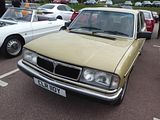


In 1973 the second style to appear was a 2+2 two-door coupé with a 93″ wheelbase, although due to the fuel crisis it did not become available to the public until early 1974. It was launched with 1.6 and 1.8 engines. New 1.6 and 2.0 engines replaced the original units in late 1975 followed by a 1.3 in early 1976, at which point the Fulvia Coupe was deleted. In 1978 automatic transmission and power steering became available. In 1981 the car received a minor facelift and at the same time the 2.0 became available with fuel Bosch electronic fuel injection. In 1983 a 2.0 VX supercharged engine became available with an output of 135 bhp. The bodywork was developed in-house by a Lancia team led by Aldo Castagno, with Pietro Castagnero acting as styling consultant. Castagnero had also styled the Beta’s predecessor, the Lancia Fulvia saloon and coupé. The car was popular in the mid 1970s with 111,801 examples being built, though they are quite rare now


Lancia launched the Delta in 1979, as what we would now think of as a “premium hatch”. Offered in 1300 and 1500cc engines, this car, which collected the prestigious “Car of the year” award a few months later, brought Italian style and an expensive feeling interior to a new and lower price point in the market than Lancia had occupied since the early days of the Fulvia some 15 years earlier. The range grew first when a model was offered using the 4 speed AP automatic transmission and then in late 1982, more powerful models started to appear, with first a 1600cc engine, and then one with fuel injection, before the introduction of the HF Turbo. All these cars kept the same appearance and were quite hard to tell apart. These were the volume models of the range, but now they are very definitely the rare ones, as it is the performance versions which have survived and are now much loved classics, even though relatively were sold when they were new, thanks to a combination of the fact that they were quite costly and that they only ever came with left hand drive. The Integrale evolved over several years, starting off as the HF Turbo 4WD that was launched in April 1986, to homologate a new rally car for Lancia who needed something to fill the void left by the cancellation of Group B from the end of 1986. The Delta HF 4X4 had a four-wheel drive system with an in-built torque-splitting action. Three differentials were used. Drive to the front wheels was linked through a free-floating differential; drive to the rear wheels was transmitted via a 56/44 front/rear torque-splitting Ferguson viscous-coupling-controlled epicyclic central differential. At the rear wheels was a Torsen (torque sensing) rear differential. It divided the torque between the wheels according to the available grip, with a maximum lockup of 70%. The basic suspension layout of the Delta 4WD remained the same as in the rest of the two-wheel drive Delta range: MacPherson strut–type independent suspension with dual-rate dampers and helicoidal springs, with the struts and springs set slightly off-centre. The suspension mounting provided more isolation by incorporating flexible rubber links. Progressive rebound bumpers were adopted, while the damper rates, front and rear toe-in and the relative angle between springs and dampers were all altered. The steering was power-assisted rack and pinion. The car looked little different from the front wheel drive models. In September 1987, Lancia showed a more sophisticated version of the car, the Lancia Delta HF Integrale 8V. This version incorporated some of the features of the Delta HF 4WD into a road car. The engine was an 8-valve 2 litre fuel injected 4-cylinder, with balancing shafts. The HF version featured new valves, valve seats and water pump, larger water and oil radiators, more powerful cooling fan and bigger air cleaner. A larger capacity Garrett T3 turbocharger with improved air flow and bigger inter-cooler, revised settings for the electronic injection/ignition control unit and a knock sensor, boosting power output to 185 bhp at 5300 rpm and maximum torque of 224 lb/ft at 3500 rpm. The HF Integrale had permanent 4-wheel drive, a front transversely mounted engine and five-speed gearbox. An epicyclic centre differential normally split the torque 56 per cent to the front axle, 44 per cent to the rear. A Ferguson viscous coupling balanced the torque split between front and rear axles depending on road conditions and tyre grip. The Torsen rear differential further divided the torque delivered to each rear wheel according to grip available. A shorter final drive ratio (3.111 instead of 2.944 on the HF 4WD) matched the larger 6.5×15 wheels to give 24 mph/1000 rpm in fifth gear. Braking and suspension were uprated to 284 mm ventilated front discs, a larger brake master cylinder and servo, as well as revised front springs, dampers, and front struts. Next update was to change the engine from 8 valves to 16. The 16v Integrale was introduced at the 1989 Geneva Motorshow, and made a winning debut on the 1989 San Remo Rally. It featured a raised centre of the bonnet to accommodate the new 16 valve engine, as well as wider wheels and tyres and new identity badges front and rear. The torque split was changed to 47% front and 53% rear. The turbocharged 2-litre Lancia 16v engine now produced 200 bhp at 5500 rpm, for a maximum speed of 137 mph and 0–100 km/h in 5.5 seconds. Changes included larger injectors, a more responsive Garrett T3 turbocharger, a more efficient intercooler, and the ability to run on unleaded fuel without modification. The first Evoluzione cars were built at the end of 1991 and through 1992. These were to be the final homologation cars for the Lancia Rally Team; the Catalytic Evoluzione II was never rallied by the factory. The Evoluzione I had a wider track front and rear than earlier Deltas. The bodyside arches were extended and became more rounded. The wings were now made in a single pressing. The front strut top mounts were also raised, which necessitated a front strut brace. The new Integrale retained the four wheel drive layout. The engine was modified to produce 210 bhp at 5750 rpm. External changes included: new grilles in the front bumper to improve the air intake for engine compartment cooling; a redesigned bonnet with new lateral air slats to further assist underbonnet ventilation; an adjustable roof spoiler above the tailgate; new five-bolt wheels with the same design of the rally cars; and a new single exhaust pipe. Interior trim was now grey Alcantara on the Recaro seats, as fitted to the earlier 16V cars; leather and air conditioning were offered as options, as well as a leather-covered Momo steering wheel. Presented in June 1993, the second Evolution version of the Delta HF Integrale featured an updated version of the 2-litre 16-valve turbo engine to produce more power, as well as a three-way catalyst and Lambda probe. A Marelli integrated engine control system with an 8 MHz clock frequency which incorporates: timed sequential multipoint injection; self-adapting injection times; automatic idling control; engine protection strategies depending on the temperature of intaken air; Mapped ignition with two double outlet coils; Three-way catalyst and pre-catalyst with lambda probe (oxygen sensor) on the turbine outlet link; anti-evaporation system with air line for canister flushing optimised for the turbo engine; new Garrett turbocharger: water-cooled with boost-drive management i.e. boost controlled by feedback from the central control unit on the basis of revs/throttle angle; Knock control by engine block sensor and new signal handling software for spark park advance, fuel quantity injected, and turbocharging. The engine now developed 215 PS as against 210 PS on the earlier uncatalysed version and marginally more torque. The 1993 Integrale received a cosmetic and functional facelift that included. new 16″ light alloy rims with 205/45 ZR 16 tyres; body colour roof moulding to underline the connection between the roof and the Solar control windows; aluminium fuel cap and air-intake grilles on the front mudguards; red-painted cylinder head; new leather-covered three-spoke MOMO steering wheel; standard Recaro seats upholstered in beige Alcantara with diagonal stitching. In its latter years the Delta HF gave birth to a number of limited and numbered editions, differing mainly in colour, trim and equipment; some were put on general sale, while others were reserved to specific markets, clubs or selected customers.


First shown at the Turin Auto Show in 1986, the Lancia Thema 8·32 (“8” standing for the number of cylinders and “32” for the number of valves) was assembled at Lancia’s S. Paolo plant in Turin. It used a 2,927 cc, Tipo F105L, Ferrari V8. This engine was based on the unit used in the Ferrari 308 and in the Ferrari Mondial Quattrovalvole, and some of the componentry was assembled by Ducati from castings made at Maranello. The engine differed from other Ferrari V8s of the time in that it was equipped with a cross-plane type crankshaft rather than the usual flat-plane crankshaft, smaller valves and different firing order: all this was to make the engine characteristics more suitable for a four-door luxury saloon. In non catalysed form the engine produced 215 PS at 6,750 rpm, and the car was capable of 0–100 km/h in 6.8 seconds and a top speed of 240 km/h (149 mph). Catalysed versions produce 205 PS which gave 0–100 km/h in 7.2 seconds and a top speed of 235 km/h (146 mph). The transmission was a 5-speed manual gearbox; there was no automatic option. The braking system used larger 294 mm vented front discs and the standard 251 mm rear ones from the other Themas. All 8·32s featured Bosch KE3 Jetronic fuel injection, ABS, ZF’s brand new Servotronic electronically controlled rack-and-pinion power steering (which varied steering wheel effort according to vehicle speed), and a retractable rear spoiler. The latter, designed to increase high speed stability, was controlled by the driver via a rotary switch on the right stalk. In closed position, it would fit flush with the boot lid. The tyres were specially developed 205/55 VR15 Goodyears on five-spoke 6J×15 alloy wheels. The car offered a handmade wood-and-Alcantara (or optional Poltrona Frau leather) interior, and was complete with similar luxury equipment as LX versions of the Thema. Stitched leather covered the entire dashboard, the steering wheel (including centre), gear and handbrake levers and booths, centre console, door panels and sun visors, while the headlining was Alcantara. A bespoke dashboard fascia housed two main instruments, six small auxiliary gauges, and triple round air conditioning vents. Like the door cappings and the lids concealing the radio and ashtray, it was veneered in matte varnish burr wood. The instrumentation had black dials with yellow hands and markings; it included water thermometer, oil thermometer and pressure gauge, and check panels for the lights and the drivetrain. The seats (and matching door panel inserts) were trimmed in beige or date brown Alcantara as standard, with black or brown leather was an optional extra. Brown interiors got colour-matching switchgear, carpets and trim. Irrespective of interior selection, Thema 8·32 buyers could choose from five paint colours, all metallics: Blizzard Blue, Winner Red, Quartz Grey, Reflex Green and Black. A double hand-painted pinstripe (the upper matched to body colour, the lower yellow) ran along the sides and the rear of the car. Besides the paint scheme, retractable spoiler and wheels, the only exterior details setting the 8·32 apart from other Themas were yellow “8·32” badges, a silver eggcrate-type grille, and twin exhaust outlets. Some notable options were automatic climate control, electrically actuated sunroof, provision for a car phone in the front armrest, and rear individual power seats. In 1988 the 8·32 received series 2 updates like other Themas, including new lights front and rear, a smaller grille badge, removal of model badging at the rear and on the side skirts, and the new side rubbing strips (previously absent on this model). There were no third series 8·32s. This version of the Thema was produced in limited numbers, with 2370 Series 1 built between 1986 and 1988 and 1601 Series 2 built between 1989 and 1992. All were left-hand drive, although one Thema 8·32 was converted to right hand drive by TAK Motor Co. in South Africa in 1987 for the MD of TAK. The Thema 8·32’s key competitors were some of the fastest saloon models of the late 1980s including the Audi 100 Quattro, BMW M535i, Ford Sierra RS Cosworth, Saab 9000 2.3 Turbo S, and the Vauxhall Lotus Carlton/Opel Lotus Omega. Road & Track described the 8·32 as one of the “one of the weirder sleepers to come out of the 1980s”. Towards the end of his life, Enzo Ferrari owned an 8·32 as his personal transport.


The Lancia Dedra (Type 835) is a compact executive car produced from 1989 to 1999. It was initially designed to support, and went on to replace, the Prisma which, six years after its launch, was having difficulty remaining competitive in the market. It was based on a stretched version of the platform underpinning the second generation of the Delta (which launched in 1993) and is often considered a saloon variant of the Delta. The task of the Dedra was demanding, it had to continue the legacy of the Prisma, which relaunched the Lancia brand in the field of compact executive cars, and to expand its market share if possible. Being larger than its predecessor, the Dedra was positioned as the second flagship car of Lancia that could satisfy those looking for an elegant medium-sized sedan but did not want to buy an executive car, such as the Thema. The Dedra was designed by Ercole Spada of the I.DE.A Institute and produced an excellent drag coefficient of only 0.29. The core concept of the Dedra was prestige, exclusivity, personality and comfort, achieved through a high level of equipment and use of materials (e.g. Alcantara) as well as details such as configurable colours, alloy wheels and an attention given to soundproofing, ventilation and other creature comforts. The ability to obtain the perfect driving position was helped by the adjustable seats, steering wheel and electrically adjustable mirrors. Safety, both passive with a structure designed to minimize injury in an accident, and active, such as ABS and airbag, was also near the top of the Dedra’s agenda. In order to help the Fiat Group achieve economies of scale, the Dedra was based on the Fiat Tipo Tre platform. This single floorpan thus formed the basis for three different cars with three different product themes: elegance for the Lancia Dedra (1989), convenience at a competitive price for the large-booted Fiat Tempra (1990), and sportsmanship for the Alfa Romeo 155 (1992). In 1991, a performance focused variant called the Dedra Integrale was launched. It used a similar engine and transmission to the Delta Integrale 8v. The engine was touted at the time as one of the world’s most competition proven units. It is a 2-litre four-cylinder fuel injected twin cam engine, fitted with contra-rotating balancing shafts, a Garrett T3 turbocharger and an associated inter-cooler to aid volumetric efficiency that boosts power output to 169 PS in the catalyzed version. The Dedra Integrale was also fitted with the new Visco Drive 2000 traction control system, as well as the electronically controlled suspension which was available as option in the 2.0 and upper models. The equipment was largely equivalent to that of the Dedra LX, with some modifications such as more bolstered seats and a sporty steering wheel. The Integrale retained a front-wheel bias, with 56 percent of the power going to the front axle. The Integrale was equipped with a standard rear spoiler for improved high-speed stability. A front-wheel drive model with a turbocharged engine called the Dedra 2000 turbo was released simultaneously with the Integrale; it had slightly less power so as to not overwhelm the chassis. This model also benefitted from the Visco Drive 2000 system, a necessity to avoid wheelspin. Aside from being lighter, the model was also somewhat lower. The Integrale’s spoiler was an option on the turbo. When the Dedra was launched, it was a good time for Lancia: The Thema had been facelifted a year earlier, and despite being on the market for five years was selling well, the Delta launched initially in 1979, due to its continued success in rally competition was living a second youth, and the Y10 had a slight restyling and good sales. However, the Dedra was not a strong success outside Italy. A major facelift in 1993 did little to boost the car’s sales success and the whole Lancia range including the Dedra was withdrawn from right hand drive markets a year later. From 1994 the car was also sold as a station wagon, developed by French coachbuilders Heuliez. The Dedra remained reasonably popular in the Italian market until it was replaced by the all-new Lybra in 1999. A total of 418,084 Dedras were manufactured during its production run.

MASERATI
Maserati replaced their entire range in 1981 with the BiTurbo. Introduced initially as a single model, a 2 door coupe with a 2 litre twin-turbo V6 engine, over the next 15 years, it would evolve into a complex range of different models, and three basic bodystyles, as well as the special low-volume Karif and V8 engined Shamal cars. The car was designed by Pierangelo Andreani, Chief of Centro Stile Maserati up to 1981, and was somewhat influenced by the design of the recent Quattroporte III. The BiTurbo marked quite a change of direction for the Modense firm, a consequence of its acquisition by Alejandro de Tomaso in 1976. de Tomaso’s ambitious plans for the marque were to combine the prestige of the Maserati brand with a sports car that would be more affordable than the earlier high-priced models that had traditionally made up the Maserati range. The Biturbo was initially a strong seller and brought Italian prestige to a wide audience, with sales of about 40,000 units, but it quickly became apparent that the quality of the car was way off what the market expected, and the car is not regarded as one of the marque’s better models. Indeed, the Biturbo is number 28 in the BBC book of “Crap Cars” and in 2007 was selected as Time Magazine’s worst car of 1984, although they ranked the Chrysler TC by Maserati as a “greater ignominy”. Between 1987–89 a facelift was phased in, which helped to soften the sharp bodylines. The redesign included a taller and more rounded grille with mesh grille and bonnet, aerodynamic wing mirrors and 15″ disc-shaped alloy wheels, now mounted on 5-lug hubs. Some models received the wraparound bumpers with integral foglights and the deep sills introduced with the 2.24v. In 1991 the entire lineup was restyled for a second time, again by the hand of Marcello Gandini; the design features introduced with the Shamal were spread to the other models. Gandini, the Shamal’s designer, developed an aerodynamic kit that included a unique spoiler at the base of the windscreen hiding the windshield wipers, a rear spoiler, and side skirts. The new two-element headlights used poli-ellypsoidal projectors developed by Magneti-Marelli. Inset in body-colour housings, they flanked a redesigned grille, slimmer and integrated in the bonnet; the 1988 bumpers were adopted by all models. The 15″ disc-shaped alloys were replaced by new 16″ seven-spoke wheels, with a hubcap designed to look like a centerlock nut. The second facelift was referred to as “nuovolook”. The engines underwent change, too. As well as being the first ever production car with a twin-turbocharged engine, it was also the first production car engine with three valves per cylinder. The aluminium 90-degree SOHC V6 engine was roughly based on the 2.0 litre Merak engine, itself based on earlier V8 Formula One Maserati engines, designed by Giulio Alfieri. Because in Italy new cars with engine displacement over 2000 cc were subjected to a 38% value added tax, against 19% on smaller displacement cars, throughout the Biturbo’s production life there were both two-litre models aimed mainly at the domestic market and “export” versions, initially with a 2.5 litre V6. The carburettor 2.5 unit produced 185 hp and 208 lb·ft of torque in North American spec and slightly more elsewhere. Fuel injection was fitted in 1987 raising power to 187 hp. In 1989 the enlarged 2.8 litre engine bumped power to 225 hp and 246 lb·ft of torque for North America and 250 PS for Europe. In 1988, with the coupés being restyled, the Biturbo name was dropped in favour of 222—meaning 2-door, 2-litre engine and 2nd generation. The car carried all the visual clues of Gandini’s first facelift, with a more rounded grille and bonnet, different wing mirrors and rear spoiler. The engine size of the 222 E export model grew from the Biturbo’s 2.5- to 2.8-litres. A mixed velour-leather interior was standard on the domestic models, while export markets got leather upholstery as standard. 1990 saw the arrival of the 2.8 litre 222 SE, heir to the Biturbo ES. It inherited the latter’s limited paint finish availability (red, silver or black) and the dark trim and grille, while modern aprons and side skirts (blacked out as well) came from the 2.24v. After just a year the 222 SE was replaced by the 1991-restyled 222 SR; the SR offered adaptive suspension as an option. Simultaneously the very similar 222 4v. joined the lineup; it was a 222 SR with a 2.8 litre four-valve engine, the first DOHC car in the direct Biturbo E lineage. It used wider, 16″ 7-spoke wheels.


SEAT
The SEAT Marbella (codenamed 141A) was a badge-engineered Fiat Panda produced by SEAT from 1980 to 1986 (initially called the SEAT Panda), in the company’s Landaben plant in the Spanish city of Pamplona (from February 1980 until 29 April 1983, when its production ended in that plant) and also in the Zona Franca plant in Barcelona. After the break in the partnership between SEAT and Fiat, the former’s model was restyled and renamed SEAT Marbella. It received a slight restyling in 1983, with a new grille and other slight differences. The “Marbella” badge was first used for the 1983 model year, on a luxurious version of the SEAT Panda. After a second, more thorough restyling in December 1986, it received the SEAT Marbella nameplate (codenamed 28 for SEAT Marbella and 028A for SEAT Marbella box) and was produced by SEAT until 1998 in the company’s Zona Franca plant in Spain. The end of Marbella production in 1998 also meant the end of vehicle production in that factory. The SEAT model did not receive the mechanical and cosmetic tweaks (such as the loss of front window quarter-lights) applied to Fiat Pandas “Mark II”s from 1986 but was instead subjected to those from SEAT. The obvious differences between a Panda and a Marbella are at the front and back of the car where head and tail lights and boot panels are different, the Marbella gaining a pronounced slope to the front panel. The Marbella featured a boot with capacity of 272 litres, expandable to 1,088 litres when the rear seats are folded. Mechanically, the Panda borrowed heavily from the Fiat “parts bin”, using engines and transmissions from the Fiat 127. The engine is an inline four-cylinder with 40 PS and 903 cc. This proved adequate for this light car which weighed in at about 680 kg. A 60 PS kit to make a more powerful SEAT Panda Abarth version was also on offer, sold in Spain by a company called Apicsa. Shortly after introduction, a smaller-hearted version corresponding to the Italian two-cylinder model was added. Called the “Panda 35”, it had a smaller 843 cc version of the engine, a development of the engine originally fitted to the SEAT 850 beginning in the mid-sixties. To set it further apart from the “45”, a lower compression rate was chosen. Nonetheless, the smaller engine had to work that much harder to keep up, and in practice the fuel economy savings were negligible. When the Marbella was introduced in December 1986, the smaller 843 cc version continued to be available. This low-priced version produced only 34 PS at 5,600 rpm and was not available with the five-speed transmission. Top speed for the bigger engine was 131 km/h (81 mph), while the 850 could only reach 125 km/h (78 mph). 903 cc version of the engine later got electronic injection and reduced its size to 899 cc. Several differently labeled models were produced during the lifetime of the car, with few corresponding significant changes in specifications. Common models include the L, Special, XL, GL, and GLX, but there were many “special editions”, especially later in the life of the Marbella. In September 1989 the “Black”, “Red”, and “Yellow” specials were added, “Blue”, “Green”, “CLX”, and “Jeans” joined in September 1990. Various export markets also


NON-ITALIAN FRIENDS
Although the main parking area directly in front of the museum had been reserved for the event, there was not exclusivity of the venue so the combination of the “and Friends” bit and general access meant a few other interesting cars on site, of which these caught my eye.
Daimler Sovereign (XJ40): Throughout the 1970s Jaguar had been developing “Project XJ40”, which was an all-new model intended to replace the original XJ6. Scale models were being built as early as 1972. Due to the 1973 oil crisis and problems at parent company British Leyland, the car was continually delayed. Proposals from both Jaguar’s in-house designers and Pininfarina were received. Eventually, it was decided an internal design would be carried through to production and, in February 1981, the British Leyland board approved £80 million to produce the new car. Launch was originally scheduled for 1984, but following Jaguar’s de-merger from BL and privatisation that same year, the company’s CEO Sir John Egan took advantage of the resurgence in sales of the existing Series III XJ6 (particularly in the lucrative North American market) to delay the XJ40’s launch a further two years to allow for more development time. The XJ40 was at the time, the most extensively tested vehicle the company had ever developed. Designs for the XJ40 pioneered significant improvements to how Jaguar cars were designed, built, and assembled. Among these improvements was a 25% reduction in the number of bodywork panels required per car (e.g. three pressings needed for a Series 3 door compared with one for a XJ40 door), resulting in not only a more efficient assembly process, but also a weight saving and a stiffer structure. Initially, only two engines were offered across the XJ40 models: a 2.9 L and a 3.6 L version of the AJ6 inline-six. In 1990 the 3.6 L was replaced by a 4.0 L model and in 1991 the 2.9 L was replaced by a 3.2 L model. During the development of the XJ40, British Leyland had considered providing the Rover V8 engine for the car, which would have eliminated the need for future Jaguar engine production. The XJ40 bodyshell was allegedly engineered to prevent fitting V-configuration engines – in particular the Rover V8 – which British Leyland management had desired; this delayed the introduction of the V12-powered XJ12 until 1993 as the front structure of the XJ40 had to be extensively redesigned. As a consequence, the preceeding Series III XJ was kept in production in V12 form to cater for this market need until 1992. The automatic gearbox used in the 2.9 L, 3.2 L and 3.6 L six-cylinder cars was the four-speed ZF 4HP22. On the 4.0 L, the four-speed ZF 4HP24 was used. A stronger automatic gearbox was required for the V12-equipped cars, and the four-speed GM 4L80-E was selected. The manual gearbox fitted to early cars was the five-speed Getrag 265, while later cars received the Getrag 290. The automatic transmission selector was redesigned to allow the manual selection of forward gears without accidentally selecting neutral or reverse. This new feature was dubbed the “J-Gate” and remained a staple of all Jaguar models up until the 2008 Jaguar XF, when shift by wire technology rendered it redundant – all subsequent Jaguar models now use a rotary knob for transmission mode selection. The base XJ6 of the model range was modestly equipped; extra-cost options included alloy wheels, anti-lock brakes, air conditioning, leather upholstery, and an automatic transmission. The exterior featured two pairs of circular headlamps and black powder-coated window frames. The Sovereign model came equipped with significantly more features than the base XJ6. Included was air conditioning, headlamp washers, a six-speaker sound system, rear self-levelling suspension (SLS), anti-lock braking system, and inlaid burl walnut wood trim (pre-MY1991). The headlamps fitted were the rectangular single units. The window frames were made from stainless steel. Further variants would follow, before the car’s replacement in 1994.

Honda Prelude: On 24 November 1978, the Prelude was launched to the Japanese market. It had its world premiere at the 1979 AutoRAI in Amsterdam, two months later. In Japan it was only available at the newly established dealership sales channel Honda Verno. This dealership chain also introduced the Honda Quint, the Honda Ballade, and the Accord-based Honda Vigor as its largest sedan and hatchback. The four-wheel independent struts, brakes, and engine were all borrowed from the first-generation Accord, but the chassis was all new and developed by chief engineer Hiroshi Kizawa expressly for the sporting Prelude. At 4,090 mm (length) x 1,635 mm (width) x 1,290 mm (height), it had quite a low and wide profile. The wheelbase was 2,320 mm, and was 60 mm shorter than that of the original Accord. Honda appears to have followed the successful introduction of the Toyota Celica example by taking a small car, like the Accord, installing a more powerful engine, and giving the body a short trunk, and a long engine hood. The Prelude (and period Accord) were the first cars under two liters to receive standard power steering. The Prelude also benefited from Honda’s experience with sporting cars like the Honda S800 and Coupé 1300. The Prelude was the first Honda model to offer a power moonroof as standard equipment, which eventually became a Prelude trademark. In Japan, the Prelude was available with a sliding metal sunroof, while US versions received a glass top which freed up more headroom. Japanese buyers were liable for slightly more annual road taxes over the smaller Civic, which also had a smaller engine. While marketed as a 2+2, the rear seat was not usable for anyone larger than a small child. Initial reviews for the Prelude were favorable. “It is,” wrote Brock Yates for Motor Trend, “by any sane measurement, a splendid automobile. The machine, like all Hondas, embodies fabrication that is, in my opinion, surpassed only by the narrowest of margins by Mercedes-Benz. It is a relatively powerful little automobile by anybody’s standards.” Motor Trend measured an early Prelude completing the quarter-mile in 18.8 seconds at 70 mph. In terms of underpinnings it was mostly a Honda Accord, although its more compact package and lower weight allowed for a marginally higher top speed and gas mileage. The standard engine at the time of introduction was the “EL” SOHC eight-valve 1,602 cc (non-CVCC) inline-four rated at 80 PS at 5,000 rpm and 127 Nm (93 lb/ft) at 3,500 rpm. It remained the only engine available for most markets, aside from the US and Japan. It featured a non-automatic choke with three positions and a two-barrel carburettor. In September 1978 the larger “EK” SOHC 12-valve 1,751 cc CVCC inline-four was introduced in Japan, rated at 90 PS at 5,300 rpm (SAE gross). Automatics had five less horsepower. It took until March 1979 for the Prelude to appear in the United States, then with 72 hp at 4,500 rpm and 94 lb/ft (127 Nm) at 3,000 rpm (SAE net) from the larger 1.8 engine. The EK engine made use of an engine oil cooler and transistor-controlled ignition system. Transmission choices were either the standard five-speed manual or initially a two-speed “Hondamatic” semi-automatic, which by October 1979 had been replaced by a three-speed automatic that used the final gear as the overdrive. In addition to the standard fabrics offered in most models, an ‘Executive’ option was offered in some markets which added power steering and Connolly leather upholstery. Honda used a single central gauge cluster design in this car which housed the speedometer and tachometer in one combined unit where both instrument’s needles swept along the same arc. They also placed the compact AM/FM radio unit up high next to the gauge cluster. The Prelude featured intermittent wipers, tinted glass, and a remote trunk release. 1980 saw the introduction of the CVCC-II engine which employed the use of a catalytic converter and several other refinements that improved driveability, the Prelude also received a mild facelift in 1981. This facelift meant a return to a more traditional dashboard, rather than the much critiqued “Concentrated Target Meter” used before. The 1981 Prelude also received a stainless steel trim strip along the bumpers and side mouldings, as well as a new grille. 313,000 units were manufactured by Honda from 1978 to 1982, with over 80% being sold outside of Japan. 41,190 Preludes were sold in the home market during its production run. The Prelude was introduced in Europe during 1979, but was not a strong seller, its high asking price not helping its chances of sales success. A second generation model was launched in late 1982.


Jensen Interceptor: An enduring classic that has far more appeal now than when it was new (not an uncommon story) is the Jensen Interceptor, launched as a replacement for the rather gawky looking CV8 of the early 1960s. After a false start when a car with the same name was shown in 1965, which received a massive “thumbs down”, Jensen went to Italy to find a new stylist for another attempt. They ended up with Carozzeria Touring, who produced a stunning looking grand tourer which, although sharing some styling cues with other models that they had designed, had a style all of its own, and they then approached another, Vignale, to build the bodies before they would be shipped back to West Bromwich for final assembly. As with the CV8, motive power came from a large Chrysler V8 engine, which gave the car effortless performance, and a somewhat prodigious thirst. The original specification included electric windows, reclining front seats, a wood rimmed steering wheel, radio with twin speakers, reversing lights and an electric clock. Power steering was included as standard from September 1968. The Mark II was announced in October 1969, with slightly revised styling around the headlamps, front grille and bumper and revised rear lights. The interior was substantially revised in order to meet US regulations, and air conditioning was an option. The Mark III, introduced in 1971, revised the front grille, headlamp finishers and bumper treatment again. It had GKN alloy wheels and air conditioning as standard, and revised seats. It was divided into G-, H-, and J-series depending on the production year. The 6.3 litre engine was superseded by the 7.2 litre in 1971. A Convertible version was premiered in 1974,. but just 267 were built, and then in 1975 a Coupe model was shown, effectively a fixed roof version of the Convertible, just 60 of which were made as by this time, the company had fallen on hard times due to the then world-wide recession, and massive and costly reliability problems with its Jensen-Healey sports car. It was placed into receivership and the receivers allowed production to be wrapped up using the available cache of parts. Production of the Interceptor ended in 1976. Enthusiasm for the car remained, though, so in the late 1980s, a group of investors stepped in and re-launched production of the Interceptor, as the Series 4, back as a low-volume hand built and bespoke affair, marketed in a similar way to Bristol, with a price (£70,000 and more) to match. Though the body remained essentially the same as the last of the main production run of series 3; the engine was a much smaller Chrysler supplied 5.9 litre unit which used more modern controls to reduce emissions comparatively and still produce about 230 hp. In addition, the interior was slightly re-designed with the addition of modern “sports” front seats as opposed to the armchair style of the earlier models, as well as a revised dashboard and electronics. The then owner sold up in 1990 to an engineering company believed to be in a stronger position to manufacture the car which lasted until 1993 with approximately 36 cars built, and while work commenced on development of a Series 5 Interceptor, once again receivers were called in and the company was liquidated. Even that was not quite the end of the story, as the Jensen specialist based at Cropredy Bridge has made a business out of rebuilding original Interceptors using modern components, with a General Motors supplied 6.2 litre LS3 engine and transmission from a Chevrolet Corvette. In May 2010, Jensen International Automotive was set up, with the financial backing and know-how of Carphone Warehouse founder and chairman Charles Dunstone who joined its board of directors. A small number of Jensen Interceptor Ss, which had started production under a previous company, are being completed by Jensen International Automotive (JIA), in parallel with JIA’s own production of the new Jensen Interceptor R; deliveries of the latter started at the beginning of 2011.

This event was at least as good as the first and should now surely cement its place into a calendar which, whilst well-endowed with Italian car events does not see any of them at this very central UK location nor any where Fiat is the dominant marque. Let’s hope that it returns for a third iteration in 2026!